Feeds:
Posts
Comments

Archive for the ‘Epigenetics and Cardiovascular Risks’ Category

Larry H Bernstein, MD, Curator

Leaders in Pharmaceutical Intelligence


Natriuretic Peptides (BNP and Amino-terminal proBNP)

Author: Larry Bernstein, M.D.,
(see Reviewers/Authors page)
Revised: 12 December 2010, last major update December 2010
Copyright: (c) 2003-2010, PathologyOutlines.com, Inc.
http://dx.doi.org:/PathologyOutlines.com/cardiac

General
=========================================================================

  • Brain natriuretic peptide (BNP), now known as B-type natriuretic peptide (also BNP),
    is a 32 amino acid polypeptide secreted by the cardiac ventricles in response to
    excessive stretching of cardiomyocytes (Wikipedia)
  • BNP was originally identified in extracts of porcine brain, although in humans
    it is produced mainly in the cardiac ventricles
  • BNP is co-secreted with a 76 amino acid N-terminal fragment (NT-proBNP),
    which is biologically inactive Indications

=========================================================================

  • Evaluation of dyspneic patient with suspected congestive heart failure,
    regardless of renal function (J Am Coll Cardiol 2006;47:91)
  • B-type natriuretic peptide levels are higher in patients with congestive heart
    failure than in dyspnea from other causes (J Am Coll Cardiol 2002;39:202,
    N Engl J Med 2004;350:647)
  • NT-proBNP measurement is a valuable addition to standard clinical
    assessment for the identification and exclusion of acute CHF in the
    emergency department setting (Am J Cardiol 2005;95:9480)

Clinical features
=========================================================================

  • Reduces misdiagnosis of congestive heart failure, which occurs
    50% to 75% of the time
  • NT-proBNP is superior to BNP for predicting mortality and morbidity for heart
    failure (Clin Chem 2006;52:1528), and coexisting renal disease and heart failure
    (Clin Chem 2007;53:1511)

Reference ranges
=========================================================================

  • BNP levels below 100 pg/mL indicate no heart failure

Limitations
=========================================================================

  • Determination of endogenous BNP with the AxSYM assay using frozen
    plasma samples may not be valid after 1 day, but NT-proBNP as
    measured by the Elecsys assay may be stored at -20 degrees C for
    at least four months without a relevant loss of the immunoreactive
    analyte (Clin Chem Lab Med 2004;42:942)

Additional references
=========================================================================

  • Clin Chem 2007;53:1928, Am J Kidney Dis 2005;46:610,
    Hypertension 2005;46:118, Hypertension 2006;47:874,
    Eur J Heart Fail 2004;6:269

Natriuretic peptides for risk stratification of patients with acute
coronary
 syndromes  
M Galvani,  D Ferrini, F Ottani. Eur J Heart Fail 2004;  6: 327–333.
http://eurjhf.oxfordjournals.org

Both BNP and NT-proBNP possess several characteristics of the ideal biomarker,
showing independent and incremental prognostic value above traditional clinical,
electrocardiographic, and biochemical (particularly troponin) risk indicators. Specifically,
in ACS patients, BNP and NT-proBNP have powerful prognostic value both in patients
without a history of previous heart failure or without clinical or instrumental signs of
left ventricular dysfunction on admission or during hospital stay.

Our results show that the prognostic value of natriuretic peptides is similar:
(1) both at short- and long-term;
(2) when natriuretic peptides are measured at first patient contact or during hospital stay;
(3) for BNP or NT-proBNP; and
(4) in patients with ST elevation myocardial infarction or no ST elevation ACS.


Steady-State Levels of Troponin and Brain Natriuretic Peptide for Prediction
of Long-Term
 Outcome after Acute Heart Failure with or without Stage 3 to 4
Chronic Kidney Disease

Y Endo, S Kohsaka, T Nagai, K Koide, M Takahashi, et al.
Br J Med Med Res 2012; 2(4): 490-500.
http://dx.doi.org:/10.9734/BJMMR/2012/1384

The population was predominantly male (69.3%), and the mean age was 66.6±15.3 years.
Patients with higher BNP levels or detectable TnT had a worse prognosis (BNP45.0% vs.
18.8%, p<0.001; TnT 43.8% vs. 25.1%, p=0.002, respectively). The primary event rate
was additively worse among patients with both increased BNP levels and detectable TnT
compared to those with increased levels of BNP or detectable TnT alone (log-rank p<0.001).
A similar trend was observed in the subgroup of patients with CKD stage III–V (n=172).

The Effect of Correction of Mild Anemia in Severe, Resistant Congestive
Heart Failure
 Using Subcutaneous Erythropoietin and Intravenous Iron:
A Randomized Controlled Study

DS. Silverberg, D Wexler, D Sheps, M Blum, G Keren, et al.  JACC 2001; 37(7).
PII S0735-1097(01)01248-7  http://www.ncbi.nlm.nih.gov/pubmed/11401110

When anemia in CHF is treated with EPO and IV iron, a marked improvement in
cardiac and patient function is seen, associated with less hospitalization and renal
impairment and less need for diuretics. (J Am Coll Cardiol 2001;37:1775– 80)


Hemoglobin on NT proBNP

Hemoglobin on NT proBNP


What is the best approximation of reference normal for NT-proBNP?
Clinical levels for enhanced assessment
 of NT-proBNP (CLEAN) 

Larry H. Bernstein1*, Michael Y. Zions1,4, Mohammed E. Alam1,5, Salman A. Haq1,
John F. Heitner1, Stuart Zarich2, Bette Seamonds3 and Stanley Berger3
1New York Methodist Hospital, Brooklyn, NY; 2Bridgeport Hospital, Bridgeport, CT;
3Mercy Catholic Medical Center, Darby, Phila, PA;  4Touro College, &  5Medgar
Evers College, Brooklyn, NY
Journal of Medical Laboratory and Diagnosis 04/2011; 2:16-21.
http://www.academicjournals.org/jmld

The natriuretic peptides, B-type natriuretic peptide (BNP) and NT-proBNP that
have emerged as tools for diagnosing congestive heart failure (CHF) are affected
by age and renal insufficiency (RI).  NTproBNP is used in rejecting CHF and as a
marker of risk for patients with acute coronary syndromes. This observational study
was undertaken to evaluate the reference value for interpreting NT-proBNP
concentrations. The hypothesis is that increasing concentrations of NT-proBNP
are associated with the effects of multiple co-morbidities, not merely CHF,
resulting in altered volume status or myocardial filling pressures.

NT-proBNP was measured in a population with normal trans-thoracic echocardiograms
(TTE) and free of anemia or renal impairment. Exclusion conditions were the following
co-morbidities:

  • anemia as defined by WHO,
  • atrial fibrillation (AF),
  • elevated troponin T exceeding 0.070 mg/dl,
  • systolic or diastolic blood pressure exceeding 140 and 90 respectively,
  • ejection fraction less than 45%,
  • left ventricular hypertrophy (LVH),
  • left ventricular wall relaxation impairment, and
  • renal insufficiency (RI) defined by creatinine clearance < 60ml/min using
    the MDRD formula .

Study participants were seen in acute care for symptoms of shortness of breath
suspicious for CHF requiring evaluation with cardiac NTproBNP assay. The median
NT-proBNP for patients under 50 years is 60.5 pg/ml with an upper limit of 462 pg/ml,
and for patients over 50 years the median was 272.8 pg/ml with an upper limit of
998.2 pg/ml.
We suggest that NT-proBNP levels can be more accurately interpreted only after
removal of the major co-morbidities that affect an increase in this  peptide in serum.
The PRIDE study guidelines should be applied until presence or absence of
comorbidities is diagnosed. With no comorbidities, the reference range for normal
over 50 years of age remains steady at ~1000 pg/ml. The effect shown in previous
papers likely is due to increasing concurrent comorbidity with age.

NT-proBNP profile of combined population taken from 3 sites and donors.

Age    Under 50 years 50-69 years 70 and over
NT-proBNP

Mean   
95% CI of Mean
Median   
95% CI of median
2.5-97.5 percentile   
25-75 percentile
209
35.9
29.8-43.3
27.6
24.8-33.6
5.0-1364
14.9-55.8
126
182.4
132.1-251.9
142.3
92.3-219.0
10.8-11604
42.1-565
82
611.7
425.2-880.1
564.2
419.7-1007.7
28.8-14242
210.2-2062


We observe the following changes with respect to NTproBNP and age:

(i) Sharp increase in NT-proBNP at over age 50

(ii) Increase in NT-proBNP at 7% per decade over 50

(iii) Decrease in eGFR at 4% per decade over 50

(iv) Slope of NT-proBNP increase with age is related to proportion of patients with
eGFR less than 90

(v) NT-proBNP increase can be delayed or accelerated based on disease
comorbidities

NT-proBNP sensitivity and specificity with RI prevalence

NT-proBNP sensitivity and specificity with RI prevalence

Figure 1. Plot of NT-proBNP sensitivity and specificity with RI prevalence.
GFRe scale: 0, > 120; 1, 90- 119; 2, 60-89; 3, 40-59; 4, 15-39; 5, under 15 ml/min.

NKF staging by GFRe interval and NT-proBNP (CHF removed).

NKF staging by GFRe interval and NT-proBNP (CHF removed).


Figure 2  plots the mean and 95% CI of NTproBNP (CHF removed) by the National Kidney Foundation
staging for eGFR interval (eGFR scale: 0, > 120; 1, 90 to 119;2, 60 to 89; 3, 40 to 59; 4, 15 to 39; 5,
under 15 ml/min). We created a new variable to minimize the effects of age and eGFR variability by
correcting these large effects in the whole sample population.

Adjustment of the NT-proBNP for eGFR and for age over 50 differences. We have
carried out a normalization to adjust for both eGFR and for age over 50:

(i) Take Log of NT-proBNP and multiply by 1000

(ii) Divide the result by eGFR (using MDRD9 or Cockroft Gault10)

(iii) Compare results for age under 50, 50-70, and over 70 years

(iv) Adjust to age under 50 years by multiplying by 0.66 and 0.56.

The equation does not require weight because the results are reported normalized
to 1.73 m2 body surface area, which is an accepted average adult surface area.


fn.log-NT-proBNP vs age

fn.log-NT-proBNP vs age

Figure 3.  Plot of 1000*log (NT-proBNP)/GFR vs age at  eGFR over 90  and 60 ml/min

scatterplot and regression line with centroid and confidence interval for fn.logNTproBNP vs age

scatterplot and regression line with centroid and confidence interval for fn.logNTproBNP vs age

Figure 4. Superimposed scatterplot and regression line with centroid and
confidence interval for 1000*log(NT-proBNP)/eGFR vs age (anemia removed)
at eGFR over 40 and 90 ml/min. (Black: eGFR > 90, Blue:  eGFR > 40)  


Ref Range NTpro NKLogNTpro

Ref Range NTpro NKLogNTpro


Reference range for NT-proBNP before and after adjusting


Amino-Terminal Pro-Brain Natriuretic Peptide, Renal Function, and
Outcomes in Acute Heart Failure
RRJ. van Kimmenade,  JL. Januzzi, JR,  AL. Baggish, et al. JACC 2006; 48(8).: 1621-7.

We sought to study the individual and integrative role of amino-terminal pro-brain natriuretic
peptide (NT-proBNP) and parameters of renal function for prognosis in heart failure. The
combination of NT-proBNP with measures of renal function better predicts short-term outcome
in acute heart failure than either parameter alone. Among heart failure patients, the objective
parameter of NT-proBNP seems more useful to delineate the “cardiorenal syndrome” than the
previous criteria of a clinical diagnosis of heart failure.


NT-proBNP testing for diagnosis and short-term prognosis in acute destabilized
heart failure: an international pooled analysis of 1256 patients The International
Collaborative of NT-proBNP Study
Januzzi, R van Kimmenade, J Lainchbury, A Bayes-Genis, J Ordonez-Llanos, et al.
Eur Heart J 2006; 27, 330–337. http://dx.doi.org:/10.1093/eurheartj/ehi631

Differences in NT-proBNP levels among 1256 patients with and without acute HF and the relationship
between NT-proBNPlevels and HF symptomswere examined.Optimal cut-points for diagnosis and
prognosis were identified and verified using bootstrapping and multi-variable logistic regression techniques.

Seven hundred and twenty subjects (57.3%) had acute HF, whose median NT-proBNP was considerably
higher than those without (4639 vs. 108 pg/mL, P < 0.001), and levels of NT-proBNP correlated with HF
symptom severity (P < 0.008). An optimal strategy to identify acute HF was to use age-related cut-points
of 450, 900, and 1800 pg/mL for ages < 50, 50–75, and  > 75, which yielded 90% sensitivity and 84% specificity
for acute HF. An age-independent cut-point of 300 pg/mL had 98% negative predictive value to exclude acute
HF. Among those with acute HF, a presenting NT-proBNP concentration > 5180 pg/mL was strongly predictive
of death by 76 days [odds ratio = 5.2, 95% confidence interval (CI) =2.2 – 8.1, P < 0.001].

Effect of B-type natriuretic peptide-guided treatment of chronic heart failure on total mortality
and hospitalization: an individual patient meta-analysis
RW. Troughton, CM. Frampton, HP Brunner-La Rocca, M Pfisterer, LW.M. Eurlings, et al.
Eur Heart J Mar 2014; 35, 1559–1567.
http://dx.doi.org:/10.1093/eurheartj/ehu090

We sought to perform an individual patient data meta-analysis to evaluate the effect of NP-guided treatment
of heart failure on all-cause mortality.  The survival benefit from NP-guided therapy was seen in younger (< 75
years) patients [0.62 (0.45–0.85); P = 0.004] but not older (≥75 years) patients [0.98 (0.75–1.27); P = 0.96].
Hospitalization due to heart failure [0.80 (0.67–0.94); P = 0.009] or cardiovascular disease [0.82 (0.67–0.99);
P = 0.048] was significantly lower in NP-guided patients with no heterogeneity between studies and no interaction
with age or LVEF.


Diagnostic and prognostic evaluation of left ventricular systolic heart failure by plasma N-terminal
pro-brain natriuretic peptide concentrations in a large sample of the general population

BA Groenning, I Raymond, PR Hildebrandt, JC Nilsson, M Baumann, F Pedersen.
Heart 2004; 90:297–303.  http://dx.doi.org:/10.1136/hrt.2003.026021

Value of NT-proBNP in evaluating patients with symptoms of heart failure and impaired left ventricular (LV) systolic
function; prognostic value of NT-proBNP for mortality and hospital admissions. In 38 (5.6%) participants LV ejection
fraction (LVEF) was ( 40%. NT-proBNP identified patients with symptoms of heart failure and LVEF ( 40% with a
sensitivity of 0.92, a specificity of 0.86, AUC of 0.94.  NT-proBNP was the strongest independent predictor of mortality
(hazard ratio (HR) = 5.70, p , 0.0001), hospital admissions for heart failure (HR = 13.83, p , 0.0001), and other cardiac
admissions (HR = 3.69, p , 0.0001). Mortality (26 v 6, p = 0.0003), heart failure admissions (18 v 2, p = 0.0002), and
admissions for other cardiac causes (44 v 13, p , 0.0001) were significantly higher in patients with NTproBNP above the
study median (32.5 pmol/l).


Testing for BNP and NT-proBNP in the Diagnosis and Prognosis of Heart Failure
Evidence Report/Technology Assessment – Number 142. Agency for Healthcare Research and Quality.
Prepared by: McMaster University Evidence-based Practice Center, Hamilton, ON, Canada
C Balion, PL. Santaguida, S Hill, A Worster, M McQueen, et al.
http://archive.ahrq.gov/downloads/pub/evidence/pdf/bnp/bnp.pdf

Question 1: What are the determinants of both BNP and NT-proBNP?
Question 2a: What are the clinical performance characteristics of both BNP and NTproBNP
measurement in patients with symptoms suggestive of HF or with known HF?
Question 2b: Does measurement of BNP or NT-proBNP add independent diagnostic information
to the traditional diagnostic measures of HF in patients with suggestive HF?
Question 3a: Do BNP or NT-proBNP levels predict cardiac events in populations at risk of CAD,
with diagnosed CAD and HF?
Question 3b: What are the screening performance characteristics of BNP or NT-proBNP in
general asymptomatic populations?
Question 4: Can BNP or NT-proBNP measurement be used to monitor response to therapy?        

Diagnosis: In all settings both BNP and NT-proBNP show good diagnostic properties as a rule out test for HF.
Prognosis: BNP and NT-proBNP are consistent independent predictors of mortality and other cardiac composite
endpoints for populations with risk of CAD, diagnosed CAD, and diagnosed HF. There is insufficient evidence to
determine the value of B-type natriuretic peptides for screening of HF.
Monitoring Treatment: There is insufficient evidence to demonstrate that BNP and NT-proBNP levels
show change in response to therapies to manage stable chronic HF patients.

Guide-IT Trial

Biomarker-Guided HF Therapy: Is It Cost-Effective
www.medscape.org/viewarticle/764686_transcript

Jan 29, 2013 – Uploaded by DCLRI
Michael Felker, MD, MHS
Associate Professor in the Division of Cardiology
Duke University Medical Center
www.youtube.com/watch?v=AW0480EE2kw

GUIDE-IT will last five years and involve approximately 45 trial sites in the United States. The first group of
patients will be enrolled by the end of 2012.

The trial tests NT-proBNP guided therapy with a COMPANION diagnostic biomarker used to optimize already
available and effective therapies for heart failure. It may identify  patients who will benefit from intensified therapy,
and  who would not have been known using only signs and symptoms of heart failure as it is currently the practice.
The NT-proBNP biomarker would enable doctors to create personalized treatment plans for patients to substantially
reduce mortality and morbidity

 Risk stratification in acute heart failure: Rationale and design of the
STRATIFY and DECIDE studies 

SP. Collins, CJ. Lindsell, CA. Jenkins, FE. Harrell, et al.
Am Heart J 2012;164:825-34.
http://dx.doi.org/10.1016/j.ahj.2012.07.033

Two studies (STRATIFY and DECIDE) have been funded by the National Heart Lung and Blood Institute with
the goal of developing prediction rules to facilitate early decision making in AHF. Using prospectively gathered
evaluation and treatment data from the acute setting (STRATIFY) and early inpatient stay (DECIDE), rules will
be generated to predict risk for death and serious complications.
A rigorous analysis plan has been developed to construct the prediction rules that will maximally extract both the
statistical and clinical properties of every data element. Upon completion of this study we will subsequently externally
test the prediction rules in a heterogeneous patient cohort.

N-terminal pro-B-type natriuretic peptide and the prediction of primary cardiovascular
events: results from 15-year follow-up of WOSCOPS

P Welsh, O Doolin, P Willeit, C Packard, P Macfarlane, S Cobbe, et al.
Eur Heart J Aug  2012.
http://dx.doi.org:/10.1093/eurheartj/ehs239

To test whether N-terminal pro-B-type natriuretic peptide (NT-proBNP) was independently associated with, and
improved the prediction of, cardiovascular disease (CVD) in a primary prevention cohort. N-terminal pro-B-type
natriuretic peptide predicts CVD events in men without clinical evidence of CHD, angina, or history of stroke,
and appears related more strongly to the risk for fatal events.
NT-proBNP was associated with an increased risk of all CVD [HR: 1.17 (95% CI: 1.11–1.23) per standard deviation
increase in log NT-proBNP] after adjustment for classical and clinical cardiovascular risk factors plus C-reactive protein.
N-terminal pro-B-type natriuretic peptide was more strongly related to the rsk of fatal [HR: 1.34 (95% CI: 1.19–1.52)]
than non-fatal CVD [HR: 1.17 (95% CI: 1.10–1.24)] (P = 0.022). The addition of NT-proBNP to traditional risk factors
improved the C-index (+0.013; P = 0.001). The continuous net reclassification index improved with the addition of NT-
proBNP by 19.8% (95% CI: 13.6–25.9%) compared with 9.8% (95% CI: 4.2–15.6%) with the addition of C-reactive protein.


Utility of B-Natriuretic Peptide in Detecting Diastolic Dysfunction: Comparison With
Doppler Velocity Recordings
E Lubien, A DeMaria, P Krishnaswamy, P Clopton, J Koon…A Maisel.
http://circ.ahajournals.org/content/105/5/595
Circulation. 2002;105:595-601
http://dx.doi.org:/10.1161/hc0502.103010

Although Doppler echocardiography has been used to identify abnormal left ventricular (LV) diastolic filling dynamics,
inherent limitations suggest the need for additional measures of diastolic dysfunction. Because data suggest that B-natriuretic
peptide (BNP) partially reflects ventricular pressure, we hypothesized that BNP levels could predict diastolic abnormalities
in patients with normal systolic function. A rapid assay for BNP can reliably detect the presence of diastolic abnormalities
on echocardiography. In  patients with normal systolic function, elevated BNP levels and diastolic filling abnormalities might
help to reinforce the diagnosis diastolic dysfunction

Association of common variants in NPPA and NPPB with circulating natriuretic
peptides and blood pressure.
C Newton-Cheh, MG Larson, RS Vasan, D Levy, KD Bloch, et al.
Nat Genet. 2009 Mar; 41(3): 348–353.
http://dx.doi.org:/10.1038/ng.328

We examined the association of common variants at the NPPA-NPPB locus with circulating concentrations of the
natriuretic peptides, which have blood pressure–lowering properties. In 29,717 individuals, the alleles of rs5068
and rs198358 that showed association with increased circulating natriuretic peptide concentrations were also found
to be associated with lower systolic (P = 2 ×10⁻⁶ and 6 × 10⁻⁵, respectively) and diastolic blood pressure (P = 1 × 10⁻⁶
and 5 × 10⁻⁵), as well as reduced odds of hypertension (OR = 0.85, 95% CI = 0.79–0.92, P = 4 × 10⁻⁵; OR = 0.90, 95%
CI = 0.85–0.95, P = 2 × 10⁻⁴, respectively).

2013 ACC/AHA Guideline on the Assessment of Cardiovascular Risk
DC. Goff, Jr, DM. Lloyd-Jones, G Bennett, S Coady, RB. D’Agostino, Sr, et al.
Circulation. 2013;  http://circ.ahajournals.org/content/early/2013/11/11/01.cir.0000437741.48606.98.citation
http://dx.doi.org:/10.1161/01.cir.0000437741.48606.98

The ACC and AHA have collaborated with the National Heart, Lung, and Blood Institute (NHLBI) and stakeholder
and professional organizations to develop clinical practice guidelines for assessment of CV risk, lifestyle modifications
to reduce CV risk, and management of blood cholesterol, overweight and obesity in adults.
Although the Task Force led the final development of these prevention guidelines, they differ from other ACC/AHA
guidelines. First, as opposed to an extensive compendium of clinical information, these documents are significantly
more limited in scope and focus on selected CQs in each topic, based on the highest quality evidence available.
Recommendations were derived from randomized trials, meta-analyses, and observational studies evaluated for quality,
and were not formulated when sufficient evidence was not available. Second, the text accompanying each recommendation
is succinct, summarizing the evidence for each question. Third, the format of the recommendations differs from other
ACC/AHA guidelines. Each recommendation has been mapped from the NHLBI grading format to the ACC/AHA Class
of Recommendation/Level of Evidence (COR/LOE) construct (Table 1) and is expressed in both formats.


Read Full Post »

Compilation of References in Leaders in Pharmaceutical Intelligence about proteomics, metabolomics, signaling pathways, and cell regulation

Compilation of References in Leaders in Pharmaceutical Intelligence about
proteomics, metabolomics, signaling pathways, and cell regulation

Curator: Larry H. Bernstein, MD, FCAP


Proteomics

  1. The Human Proteome Map Completed
    Reporter and Curator: Larry H. Bernstein, MD, FCAP
    http://pharmaceuticalintelligence.com/2014/08/28/the-human-proteome-map-completed/
  1. Proteomics – The Pathway to Understanding and Decision-making in Medicine
    Author and Curator, Larry H Bernstein, MD, FCAP
    http://pharmaceuticalintelligence.com/2014/06/24/proteomics-the-pathway-to-understanding-and-decision-making-in-medicine/
  1. Advances in Separations Technology for the “OMICs” and Clarification of Therapeutic Targets
    Author and Curator, Larry H Bernstein, MD, FCAP
    http://pharmaceuticalintelligence.com/2012/10/22/advances-in-separations-technology-for-the-omics-and-clarification-of-therapeutic-targets/
  1. Expanding the Genetic Alphabet and Linking the Genome to the Metabolome
    Author and Curator, Larry H Bernstein, MD, FCAP
    http://pharmaceuticalintelligence.com/2012/09/24/expanding-the-genetic-alphabet-and-linking-the-genome-to-the-metabolome/
  1. Synthesizing Synthetic Biology: PLOS Collections
    Reporter: Aviva Lev-Ari
    http://pharmaceuticalintelligence.com/2012/08/17/synthesizing-synthetic-biology-plos-collections/


Metabolomics

  1. Extracellular evaluation of intracellular flux in yeast cells
    Larry H. Bernstein, MD, FCAP, Reviewer and Curator
    http://pharmaceuticalintelligence.com/2014/08/25/extracellular-evaluation-of-intracellular-flux-in-yeast-cells/ 
  2. Metabolomic analysis of two leukemia cell lines. I.
    Larry H. Bernstein, MD, FCAP, Reviewer and Curator
    http://pharmaceuticalintelligence.com/2014/08/23/metabolomic-analysis-of-two-leukemia-cell-lines-_i/ 
  3. Metabolomic analysis of two leukemia cell lines. II.
    Larry H. Bernstein, MD, FCAP, Reviewer and Curator
    http://pharmaceuticalintelligence.com/2014/08/24/metabolomic-analysis-of-two-leukemia-cell-lines-ii/ 
  4. Metabolomics, Metabonomics and Functional Nutrition: the next step in nutritional metabolism and biotherapeutics
    Reviewer and Curator, Larry H. Bernstein, MD, FCAP
    http://pharmaceuticalintelligence.com/2014/08/22/metabolomics-metabonomics-and-functional-nutrition-the-next-step-in-nutritional-metabolism-and-biotherapeutics/ 
  5. Buffering of genetic modules involved in tricarboxylic acid cycle metabolism provides homeomeostatic regulation
    Larry H. Bernstein, MD, FCAP, Reviewer and curator
    http://pharmaceuticalintelligence.com/2014/08/27/buffering-of-genetic-modules-involved-in-tricarboxylic-acid-cycle-metabolism-provides-homeomeostatic-regulation/


Metabolic Pathways

  1. Pentose Shunt, Electron Transfer, Galactose, more Lipids in brief
    Reviewer and Curator: Larry H. Bernstein, MD, FCAP
    http://pharmaceuticalintelligence.com/2014/08/21/pentose-shunt-electron-transfer-galactose-more-lipids-in-brief/
  2. Mitochondria: More than just the “powerhouse of the cell”
    Reviewer and Curator: Ritu Saxena
    http://pharmaceuticalintelligence.com/2012/07/09/mitochondria-more-than-just-the-powerhouse-of-the-cell/
  3. Mitochondrial fission and fusion: potential therapeutic targets?
    Reviewer and Curator: Ritu saxena
    http://pharmaceuticalintelligence.com/2012/10/31/mitochondrial-fission-and-fusion-potential-therapeutic-target/ 
  4. Mitochondrial mutation analysis might be “1-step” away
    Reviewer and Curator: Ritu Saxena
    http://pharmaceuticalintelligence.com/2012/08/14/mitochondrial-mutation-analysis-might-be-1-step-away/
  5. Selected References to Signaling and Metabolic Pathways in PharmaceuticalIntelligence.com
    Curator: Larry H. Bernstein, MD, FCAP
    http://pharmaceuticalintelligence.com/2014/08/14/selected-references-to-signaling-and-metabolic-pathways-in-leaders-in-pharmaceutical-intelligence/
  6. Metabolic drivers in aggressive brain tumors
    Prabodh Kandal, PhD
    http://pharmaceuticalintelligence.com/2012/11/11/metabolic-drivers-in-aggressive-brain-tumors/ 
  7. Metabolite Identification Combining Genetic and Metabolic Information: Genetic association links unknown metabolites to functionally related genes
    Author and Curator: Aviva Lev-Ari, PhD, RD
    http://pharmaceuticalintelligence.com/2012/10/22/metabolite-identification-combining-genetic-and-metabolic-information-genetic-association-links-unknown-metabolites-to-functionally-related-genes/
  8. Mitochondria: Origin from oxygen free environment, role in aerobic glycolysis, metabolic adaptation
    Author and curator:Larry H Bernstein, MD, FCAP
    http://pharmaceuticalintelligence.com/2012/09/26/mitochondria-origin-from-oxygen-free-environment-role-in-aerobic-glycolysis-metabolic-adaptation/
  9. Therapeutic Targets for Diabetes and Related Metabolic Disorders
    Reporter, Aviva Lev-Ari, PhD, RD
    http://pharmaceuticalintelligence.com/2012/08/20/therapeutic-targets-for-diabetes-and-related-metabolic-disorders/
  10. Buffering of genetic modules involved in tricarboxylic acid cycle metabolism provides homeomeostatic regulation
    Larry H. Bernstein, MD, FCAP, Reviewer and curator
    http://pharmaceuticalintelligence.com/2014/08/27/buffering-of-genetic-modules-involved-in-tricarboxylic-acid-cycle-metabolism-provides-homeomeostatic-regulation/
  11. The multi-step transfer of phosphate bond and hydrogen exchange energy
    Curator:Larry H. Bernstein, MD, FCAP,
    http://pharmaceuticalintelligence.com/2014/08/19/the-multi-step-transfer-of-phosphate-bond-and-hydrogen-exchange-energy/
  12. Studies of Respiration Lead to Acetyl CoA
    Author and Curator: Larry H. Bernstein, MD, FCAP
    http://pharmaceuticalintelligence.com/2014/08/18/studies-of-respiration-lead-to-acetyl-coa/
  13. Lipid Metabolism
    Author and Curator: Larry H. Bernstein, MD, FCAP
    http://pharmaceuticalintelligence.com/2014/08/15/lipid-metabolism/
  14. Carbohydrate Metabolism
    Author and Curator: Larry H. Bernstein, MD, FCAP
    http://pharmaceuticalintelligence.com/2014/08/13/carbohydrate-metabolism/
  15. Prologue to Cancer – e-book Volume One – Where are we in this journey?
    Author and Curator: Larry H. Bernstein, MD, FCAP
    http://pharmaceuticalintelligence.com/2014/04/13/prologue-to-cancer-ebook-4-where-are-we-in-this-journey/
  16. Introduction – The Evolution of Cancer Therapy and Cancer Research: How We Got Here?
    Author and Curator: Larry H. Bernstein, MD, FCAP
    http://pharmaceuticalintelligence.com/2014/04/04/introduction-the-evolution-of-cancer-therapy-and-cancer-research-how-we-got-here/
  17. Inhibition of the Cardiomyocyte-Specific Kinase TNNI3K
    Author and Curator: Larry H. Bernstein, MD, FCAP
    http://pharmaceuticalintelligence.com/2013/11/01/inhibition-of-the-cardiomyocyte-specific-kinase-tnni3k/
  18. The Binding of Oligonucleotides in DNA and 3-D Lattice Structures
    Author and Curator: Larry H. Bernstein, MD, FCAP
    http://pharmaceuticalintelligence.com/2013/05/15/the-binding-of-oligonucleotides-in-dna-and-3-d-lattice-structures/
  19. Mitochondrial Metabolism and Cardiac Function
    Author and Curator: Larry H. Bernstein, MD, FCAP
    http://pharmaceuticalintelligence.com/2013/04/14/mitochondrial-metabolism-and-cardiac-function/
  20. How Methionine Imbalance with Sulfur-Insufficiency Leads to Hyperhomocysteinemia
    Curator: Larry H. Bernstein, MD, FCAP
    http://pharmaceuticalintelligence.com/2013/04/04/sulfur-deficiency-leads_to_hyperhomocysteinemia/
  21. AMPK Is a Negative Regulator of the Warburg Effect and Suppresses Tumor Growth In Vivo
    Author and Curator: SJ. Williams
    http://pharmaceuticalintelligence.com/2013/03/12/ampk-is-a-negative-regulator-of-the-warburg-effect-and-suppresses-tumor-growth-in-vivo/
  22. A Second Look at the Transthyretin Nutrition Inflammatory Conundrum
    Author and Curator: Larry H. Bernstein, MD, FCAP
    http://pharmaceuticalintelligence.com/2012/12/03/a-second-look-at-the-transthyretin-nutrition-inflammatory-conundrum/
  23. Overview of Posttranslational Modification (PTM)
    Writer and Curator: Larry H. Bernstein, MD, FCAP
    http://pharmaceuticalintelligence.com/2014/07/29/overview-of-posttranslational-modification-ptm/
  24. Malnutrition in India, high newborn death rate and stunting of children age under five years
    Writer and Curator: Larry H. Bernstein, MD, FCAP
    http://pharmaceuticalintelligence.com/2014/07/15/malnutrition-in-india-high-newborn-death-rate-and-stunting-of-children-age-under-five-years/
  25. Update on mitochondrial function, respiration, and associated disorders
    Writer and Curator: Larry H. Bernstein, MD, FCAP
    http://pharmaceuticalintelligence.com/2014/07/08/update-on-mitochondrial-function-respiration-and-associated-disorders/
  26. Omega-3 fatty acids, depleting the source, and protein insufficiency in renal disease
    Larry H. Bernstein, MD, FCAP, Curator
    http://pharmaceuticalintelligence.com/2014/07/06/omega-3-fatty-acids-depleting-the-source-and-protein-insufficiency-in-renal-disease/ 
  27. Late Onset of Alzheimer’s Disease and One-carbon Metabolism
    Reporter and Curator: Dr. Sudipta Saha, Ph.D.
    http://pharmaceuticalintelligence.com/2013/05/06/alzheimers-disease-and-one-carbon-metabolism/
  28. Problems of vegetarianism
    Reporter and Curator: Dr. Sudipta Saha, Ph.D.
    http://pharmaceuticalintelligence.com/2013/04/22/problems-of-vegetarianism/


Signaling Pathways

  1. Introduction to e-Series A: Cardiovascular Diseases, Volume Four Part 2: Regenerative Medicine
    Larry H. Bernstein, MD, FCAP, writer, and Aviva Lev- Ari, PhD, RN  http://pharmaceuticalintelligence.com/2014/04/27/larryhbernintroduction_to_cardiovascular_diseases-translational_medicine-part_2/
  2. Epilogue: Envisioning New Insights in Cancer Translational Biology
    Series C: e-Books on Cancer & Oncology
    Author & Curator: Larry H. Bernstein, MD, FCAP, Series C Content Consultant
    http://pharmaceuticalintelligence.com/2014/03/29/epilogue-envisioning-new-insights/
  3. Ca2+-Stimulated Exocytosis:  The Role of Calmodulin and Protein Kinase C in Ca2+ Regulation of Hormone and Neurotransmitter  Writer and Curator: Larry H Bernstein, MD, FCAP and Curator and Content Editor: Aviva Lev-Ari, PhD, RN
    http://pharmaceuticalintelligence.com/2013/12/23/calmodulin-and-protein-kinase-c-drive-the-ca2-regulation-of-hormone-and-neurotransmitter-release-that-triggers-ca2-stimulated-exocy
  4. Cardiac Contractility & Myocardial Performance: Therapeutic Implications of Ryanopathy (Calcium Release-related Contractile Dysfunction) and Catecholamine Responses
    Author, and Content Consultant to e-SERIES A: Cardiovascular Diseases: Justin Pearlman, MD, PhD, FACC
    Author and Curator: Larry H Bernstein, MD, FCAP and Article Curator: Aviva Lev-Ari, PhD, RN
    http://pharmaceuticalintelligence.com/2013/08/28/cardiac-contractility-myocardium-performance-ventricular-arrhythmias-and-non-ischemic-heart-failure-therapeutic-implications-for-cardiomyocyte-ryanopathy-calcium-release-related-contractile/
  5. Role of Calcium, the Actin Skeleton, and Lipid Structures in Signaling and Cell Motility
    Author and Curator: Larry H Bernstein, MD, FCAP Author: Stephen Williams, PhD, and Curator: Aviva Lev-Ari, PhD, RN
    http://pharmaceuticalintelligence.com/2013/08/26/role-of-calcium-the-actin-skeleton-and-lipid-structures-in-signaling-and-cell-motility/
  6. Identification of Biomarkers that are Related to the Actin Cytoskeleton
    Larry H Bernstein, MD, FCAP, Author and Curator
    http://pharmaceuticalintelligence.com/2012/12/10/identification-of-biomarkers-that-are-related-to-the-actin-cytoskeleton/
  7. Advanced Topics in Sepsis and the Cardiovascular System at its End Stage
    Author and Curator: Larry H Bernstein, MD, FCAP
    http://pharmaceuticalintelligence.com/2013/08/18/advanced-topics-in-Sepsis-and-the-Cardiovascular-System-at-its-End-Stage/
  8. The Delicate Connection: IDO (Indolamine 2, 3 dehydrogenase) and Cancer Immunology
    Demet Sag, PhD, Author and Curator
    http://pharmaceuticalintelligence.com/2013/08/04/the-delicate-connection-ido-indolamine-2-3-dehydrogenase-and-immunology/
  9. IDO for Commitment of a Life Time: The Origins and Mechanisms of IDO, indolamine 2, 3-dioxygenase
    Demet Sag, PhD, Author and Curator
    http://pharmaceuticalintelligence.com/2013/08/04/ido-for-commitment-of-a-life-time-the-origins-and-mechanisms-of-ido-indolamine-2-3-dioxygenase/
  10. Confined Indolamine 2, 3 dioxygenase (IDO) Controls the Homeostasis of Immune Responses for Good and Bad
    Author and Curator: Demet Sag, PhD, CRA, GCP
    http://pharmaceuticalintelligence.com/2013/07/31/confined-indolamine-2-3-dehydrogenase-controls-the-hemostasis-of-immune-responses-for-good-and-bad/
  11. Signaling Pathway that Makes Young Neurons Connect was discovered @ Scripps Research Institute
    Reporter: Aviva Lev-Ari, PhD, RN
    http://pharmaceuticalintelligence.com/2013/06/26/signaling-pathway-that-makes-young-neurons-connect-was-discovered-scripps-research-institute/
  12. Naked Mole Rats Cancer-Free
    Writer and Curator: Larry H. Bernstein, MD, FCAP
    http://pharmaceuticalintelligence.com/2013/06/20/naked-mole-rats-cancer-free/
  13. Amyloidosis with Cardiomyopathy
    Writer and Curator: Larry H. Bernstein, MD, FCAP
    http://pharmaceuticalintelligence.com/2013/03/31/amyloidosis-with-cardiomyopathy/
  14. Liver endoplasmic reticulum stress and hepatosteatosis
    Larry H Bernstein, MD, FACP
    http://pharmaceuticalintelligence.com/2013/03/10/liver-endoplasmic-reticulum-stress-and-hepatosteatosis/
  15. The Molecular Biology of Renal Disorders: Nitric Oxide – Part III
    Curator and Author: Larry H Bernstein, MD, FACP
    http://pharmaceuticalintelligence.com/2012/11/26/the-molecular-biology-of-renal-disorders/
  16. Nitric Oxide Function in Coagulation – Part II
    Curator and Author: Larry H. Bernstein, MD, FCAP
    http://pharmaceuticalintelligence.com/2012/11/26/nitric-oxide-function-in-coagulation/
  17. Nitric Oxide, Platelets, Endothelium and Hemostasis
    Curator and Author: Larry H Bernstein, MD, FACP
    http://pharmaceuticalintelligence.com/2012/11/08/nitric-oxide-platelets-endothelium-and-hemostasis/
  18. Interaction of Nitric Oxide and Prostacyclin in Vascular Endothelium
    Curator and Author: Larry H Bernstein, MD, FACP
    http://pharmaceuticalintelligence.com/2012/09/14/interaction-of-nitric-oxide-and-prostacyclin-in-vascular-endothelium/
  19. Nitric Oxide and Immune Responses: Part 1
    Curator and Author:  Aviral Vatsa PhD, MBBS
    http://pharmaceuticalintelligence.com/2012/10/18/nitric-oxide-and-immune-responses-part-1/
  20. Nitric Oxide and Immune Responses: Part 2
    Curator and Author:  Aviral Vatsa PhD, MBBS
    http://pharmaceuticalintelligence.com/2012/10/28/nitric-oxide-and-immune-responses-part-2/
  21. Nitric Oxide and iNOS have Key Roles in Kidney Diseases – Part II
    Curator and Author: Larry H Bernstein, MD, FACP
    http://pharmaceuticalintelligence.com/2012/11/26/nitric-oxide-and-inos-have-key-roles-in-kidney-diseases/
  22. New Insights on Nitric Oxide donors – Part IV
    Curator and Author: Larry H Bernstein, MD, FACP
    http://pharmaceuticalintelligence.com/2012/11/26/new-insights-on-no-donors/
  23. Crucial role of Nitric Oxide in Cancer
    Curator and Author: Ritu Saxena, Ph.D.
    http://pharmaceuticalintelligence.com/2012/10/16/crucial-role-of-nitric-oxide-in-cancer/
  24. Nitric Oxide has a ubiquitous role in the regulation of glycolysis -with a concomitant influence on mitochondrial function
    Curator and Author: Larry H Bernstein, MD, FACP
    http://pharmaceuticalintelligence.com/2012/09/16/nitric-oxide-has-a-ubiquitous-role-in-the-regulation-of-glycolysis-with-a-concomitant-influence-on-mitochondrial-function/
  25. Nitric Oxide and Immune Responses: Part 2
    Author and Curator: Aviral Vatsa, PhD, MBBS
    http://pharmaceuticalintelligence.com/2012/10/28/nitric-oxide-and-immune-responses-part-2/
  26. Mitochondrial Damage and Repair under Oxidative Stress
    Author and Curator: Larry H. Bernstein, MD, FCAP
    http://pharmaceuticalintelligence.com/2012/10/28/mitochondrial-damage-and-repair-under-oxidative-stress/
  27. Is the Warburg Effect the cause or the effect of cancer: A 21st Century View?
    Curator and Author: Larry H Bernstein, MD, FACP
    http://pharmaceuticalintelligence.com/2012/10/17/is-the-warburg-effect-the-cause-or-the-effect-of-cancer-a-21st-century-view/
  28. Targeting Mitochondrial-bound Hexokinase for Cancer Therapy
    Curator and Author: Ziv Raviv, PhD, RN 04/06/2013
    http://pharmaceuticalintelligence.com/2013/04/06/targeting-mitochondrial-bound-hexokinase-for-cancer-therapy/
  29. Ubiquinin-Proteosome pathway, autophagy, the mitochondrion, proteolysis and cell apoptosis
    Curator and Author: Larry H Bernstein, MD, FACP
    http://pharmaceuticalintelligence.com/2012/10/30/ubiquinin-proteosome-pathway-autophagy-the-mitochondrion-proteolysis-and-cell-apoptosis/
  30. Ubiquitin-Proteosome pathway, Autophagy, the Mitochondrion, Proteolysis and Cell Apoptosis: Part III
    Curator and Author: Larry H Bernstein, MD, FACP
    http://pharmaceuticalintelligence.com/2013/02/14/ubiquinin-proteosome-pathway-autophagy-the-mitochondrion-proteolysis-and-cell-apoptosis-reconsidered/
  31. Biochemistry of the Coagulation Cascade and Platelet Aggregation – Part I
    Curator and Author: Larry H Bernstein, MD, FACP
    http://pharmaceuticalintelligence.com/2012/11/26/biochemistry-of-the-coagulation-cascade-and-platelet-aggregation/


Genomics, Transcriptomics, and Epigenetics

  1. What is the meaning of so many RNAs?
    Writer and Curator: Larry H. Bernstein, MD, FCAP
    http://pharmaceuticalintelligence.com/2014/08/06/what-is-the-meaning-of-so-many-rnas/
  2. RNA and the transcription the genetic code
    Larry H. Bernstein, MD, FCAP, Writer and Curator
    http://pharmaceuticalintelligence.com/2014/08/02/rna-and-the-transcription-of-the-genetic-code/
  3. A Primer on DNA and DNA Replication
    Writer and Curator: Larry H. Bernstein, MD, FCAP
    http://pharmaceuticalintelligence.com/2014/07/29/a_primer_on_dna_and_dna_replication/
  4. Pathology Emergence in the 21st Century
    Author and Curator: Larry Bernstein, MD, FCAP
    http://pharmaceuticalintelligence.com/2014/08/03/pathology-emergence-in-the-21st-century/
  5. RNA and the transcription the genetic code
    Writer and Curator, Larry H. Bernstein, MD, FCAP
    http://pharmaceuticalintelligence.com/2014/08/02/rna-and-the-transcription-of-the-genetic-code/
  6. Commentary on Biomarkers for Genetics and Genomics of Cardiovascular Disease: Views by Larry H Bernstein, MD, FCAP
    Author: Larry H Bernstein, MD, FCAP
    http://pharmaceuticalintelligence.com/2014/07/16/commentary-on-biomarkers-for-genetics-and-genomics-of-cardiovascular-disease-views-by-larry-h-bernstein-md-fcap/
  7. Observations on Finding the Genetic Links in Common Disease: Whole Genomic Sequencing Studies
    Author an Curator: Larry H Bernstein, MD, FCAP
    http://pharmaceuticalintelligence.com/2013/05/18/observations-on-finding-the-genetic-links/
  8. Silencing Cancers with Synthetic siRNAs
    Larry H. Bernstein, MD, FCAP, Reviewer and Curator
    http://pharmaceuticalintelligence.com/2013/12/09/silencing-cancers-with-synthetic-sirnas/
  9. Cardiometabolic Syndrome and the Genetics of Hypertension: The Neuroendocrine Transcriptome Control Points
    Reporter: Aviva Lev-Ari, PhD, RN
    http://pharmaceuticalintelligence.com/2013/12/12/cardiometabolic-syndrome-and-the-genetics-of-hypertension-the-neuroendocrine-transcriptome-control-points/
  10. Developments in the Genomics and Proteomics of Type 2 Diabetes Mellitus and Treatment Targets
    Larry H. Bernstein, MD, FCAP, Reviewer and Curator
    http://pharmaceuticalintelligence.com/2013/12/08/developments-in-the-genomics-and-proteomics-of-type-2-diabetes-mellitus-and-treatment-targets/
  11. CT Angiography & TrueVision™ Metabolomics (Genomic Phenotyping) for new Therapeutic Targets to Atherosclerosis
    Reporter: Aviva Lev-Ari, PhD, RN
    http://pharmaceuticalintelligence.com/2013/11/15/ct-angiography-truevision-metabolomics-genomic-phenotyping-for-new-therapeutic-targets-to-atherosclerosis/
  12. CRACKING THE CODE OF HUMAN LIFE: The Birth of BioInformatics & Computational Genomics
    Genomics Curator, Larry H Bernstein, MD, FCAP
    http://pharmaceuticalintelligence.com/2014/08/30/cracking-the-code-of-human-life-the-birth-of-bioinformatics-computational-genomics/
  13. Big Data in Genomic Medicine
    Author and Curator, Larry H Bernstein, MD, FCAP
    http://pharmaceuticalintelligence.com/2012/12/17/big-data-in-genomic-medicine/
  14.  From Genomics of Microorganisms to Translational Medicine
    Author and Curator: Demet Sag, PhD
    http://pharmaceuticalintelligence.com/2014/03/20/without-the-past-no-future-but-learn-and-move-genomics-of-microorganisms-to-translational-medicine/
  15.  Summary of Genomics and Medicine: Role in Cardiovascular Diseases
    Author and Curator, Larry H Bernstein, MD, FCAP
    http://pharmaceuticalintelligence.com/2014/01/06/summary-of-genomics-and-medicine-role-in-cardiovascular-diseases/

Read Full Post »

Lipid Metabolism

Lipid Metabolism

Reporter and Curator: Larry H. Bernstein, MD, FCAP 


This is fourth of a series of articles, lipid metabolism, that began with signaling and signaling pathways. These discussion lay the groundwork to proceed in later discussions that will take on a somewhat different approach. These are critical to develop a more complete point of view of life processes.  I have indicated that many of the protein-protein interactions or protein-membrane interactions and associated regulatory features have been referred to previously, but the focus of the discussion or points made were different.  The role of lipids in circulating plasma proteins as biomarkers for coronary vascular disease can be traced to the early work of Frederickson and the classification of lipid disorders.  The very critical role of lipids in membrane structure in health and disease has had much less attention, despite the enormous importance, especially in the nervous system.

  1. Signaling and signaling pathways
  2. Signaling transduction tutorial.
  3. Carbohydrate metabolism

3.1  Selected References to Signaling and Metabolic Pathways in Leaders in Pharmaceutical Intelligence

  1. Lipid metabolism
  2. Protein synthesis and degradation
  3. Subcellular structure
  4. Impairments in pathological states: endocrine disorders; stress hypermetabolism; cancer.


Lipid Metabolism

http://www.elmhurst.edu/~chm/vchembook/622overview.html

Overview of Lipid Catabolism:

The major aspects of lipid metabolism are involved with

  • Fatty Acid Oxidationto produce energy or
  • the synthesis of lipids which is called Lipogenesis.

The metabolism of lipids and carbohydrates are related by the conversion of lipids from carbohydrates. This can be seen in the diagram. Notice the link through actyl-CoA, the seminal discovery of Fritz Lipmann. The metabolism of both is upset by diabetes mellitus, which results in the release of ketones (2/3 betahydroxybutyric acid) into the circulation.


metabolism of fats

metabolism of fats


http://www.elmhurst.edu/~chm/vchembook/images/590metabolism.gif

The first step in lipid metabolism is the hydrolysis of the lipid in the cytoplasm to produce glycerol and fatty acids.

Since glycerol is a three carbon alcohol, it is metabolized quite readily into an intermediate in glycolysis, dihydroxyacetone phosphate. The last reaction is readily reversible if glycerol is needed for the synthesis of a lipid.

The hydroxyacetone, obtained from glycerol is metabolized into one of two possible compounds. Dihydroxyacetone may be converted into pyruvic acid, a 3-C intermediate at the last step of glycolysis to make energy.

In addition, the dihydroxyacetone may also be used in gluconeogenesis (usually dependent on conversion of gluconeogenic amino acids) to make glucose-6-phosphate for glucose to the blood or glycogen depending upon what is required at that time.

Fatty acids are oxidized to acetyl CoA in the mitochondria using the fatty acid spiral. The acetyl CoA is then ultimately converted into ATP, CO2, and H2O using the citric acid cycle and the electron transport chain.

There are two major types of fatty acids – ω-3 and ω-6.  There are also saturated and unsaturated with respect to the existence of double bonds, and monounsaturated and polyunsatured.  Polyunsaturated fatty acids (PUFAs) are important in long term health, and it will be seen that high cardiovascular risk is most associated with a low ratio of ω-3/ω-6, the denominator being from animal fat. Ω-3 fatty acids are readily available from fish, seaweed, and flax seed. More can be said of this later.

Fatty acids are synthesized from carbohydrates and occasionally from proteins. Actually, the carbohydrates and proteins have first been catabolized into acetyl CoA. Depending upon the energy requirements, the acetyl CoA enters the citric acid cycle or is used to synthesize fatty acids in a process known as LIPOGENESIS.

The relationships between lipid and carbohydrate metabolism are
summarized in Figure 2.


fattyacidspiral

fattyacidspiral

http://www.elmhurst.edu/~chm/vchembook/images/620fattyacidspiral.gif


 Energy Production Fatty Acid Oxidation:

Visible” ATP:

In the fatty acid spiral, there is only one reaction which directly uses ATP and that is in the initiating step. So this is a loss of ATP and must be subtracted later.

A large amount of energy is released and restored as ATP during the oxidation of fatty acids. The ATP is formed from both the fatty acid spiral and the citric acid cycle.


Connections to Electron Transport and ATP:

One turn of the fatty acid spiral produces ATP from the interaction of the coenzymes FAD (step 1) and NAD+ (step 3) with the electron transport chain. Total ATP per turn of the fatty acid spiral is:

Electron Transport Diagram – (e.t.c.)

Step 1 – FAD into e.t.c. = 2 ATP
Step 3 – NAD+ into e.t.c. = 3 ATP
Total ATP per turn of spiral = 5 ATP

In order to calculate total ATP from the fatty acid spiral, you must calculate the number of turns that the spiral makes. Remember that the number of turns is found by subtracting one from the number of acetyl CoA produced. See the graphic on the left bottom.

Example with Palmitic Acid = 16 carbons = 8 acetyl groups

Number of turns of fatty acid spiral = 8-1 = 7 turns

ATP from fatty acid spiral = 7 turns and 5 per turn = 35 ATP.

This would be a good time to remember that single ATP that was needed to get the fatty acid spiral started. Therefore subtract it now.

NET ATP from Fatty Acid Spiral = 35 – 1 = 34 ATP

Review ATP Summary for Citric Acid Cycle:The acetyl CoA produced from the fatty acid spiral enters the citric acid cycle. When calculating ATP production, you have to show how many acetyl CoA are produced from a given fatty acid as this controls how many “turns” the citric acid cycle makes.Starting with acetyl CoA, how many ATP are made using the citric acid cycle? E.T.C = electron transport chain

 Step  ATP produced
7  1
Step 4 (NAD+ to E.T.C.) 3
Step 6 (NAD+ to E.T.C.)  3
Step10 (NAD+ to E.T.C.)  3
Step 8 (FAD to E.T.C.) 2
 NET 12 ATP


 ATP Summary for Palmitic Acid – Complete Metabolism:The phrase “complete metabolism” means do reactions until you end up with carbon dioxide and water. This also means to use fatty acid spiral, citric acid cycle, and electron transport as needed.Starting with palmitic acid (16 carbons) how many ATP are made using fatty acid spiral? This is a review of the above panel E.T.C = electron transport chain

 Step  ATP (used -) (produced +)
Step 1 (FAD to E.T.C.) +2
Step 4 (NAD+ to E.T.C.) +3
Total ATP  +5
 7 turns  7 x 5 = 35
initial step  -1
 NET  34 ATP

The fatty acid spiral ends with the production of 8 acetyl CoA from the 16 carbon palmitic acid.

Starting with one acetyl CoA, how many ATP are made using the citric acid cycle? Above panel gave the answer of 12 ATP per acetyl CoA.

E.T.C = electron transport chain

 Step  ATP produced
One acetyl CoA per turn C.A.C. +12 ATP
8 Acetyl CoA = 8 turns C.A.C. 8 x 12 = 96 ATP
Fatty Acid Spiral 34 ATP
GRAND TOTAL  130 ATP


Fyodor Lynen

Feodor Lynen was born in Munich on 6 April 1911, the son of Wilhelm Lynen, Professor of Mechanical Engineering at the Munich Technische Hochschule. He received his Doctorate in Chemistry from Munich University under Heinrich Wieland, who had won the Nobel Prize for Chemistry in 1927, in March 1937 with the work: «On the Toxic Substances in Amanita». in 1954 he became head of the Max-Planck-Institut für Zellchemie, newly created for him as a result of the initiative of Otto Warburg and Otto Hahn, then President of the Max-Planck-Gesellschaft zur Förderung der Wissenschaften.

Lynen’s work was devoted to the elucidation of the chemical details of metabolic processes in living cells, and of the mechanisms of metabolic regulation. The problems tackled by him, in conjunction with German and other workers, include the Pasteur effect, acetic acid degradation in yeast, the chemical structure of «activated acetic acid» of «activated isoprene», of «activated carboxylic acid», and of cytohaemin, degradation of fatty acids and formation of acetoacetic acid, degradation of tararic acid, biosynthesis of cysteine, of terpenes, of rubber, and of fatty acids.

In 1954 Lynen received the Neuberg Medal of the American Society of European Chemists and Pharmacists, in 1955 the Liebig Commemorative Medal of the Gesellschaft Deutscher Chemiker, in 1961 the Carus Medal of the Deutsche Akademie der Naturforscher «Leopoldina», and in 1963 the Otto Warburg Medal of the Gesellschaft für Physiologische Chemie. He was also a member of the U>S> National Academy of Sciences, and shared the Nobel Prize in Physiology and Medicine with Konrad Bloch in 1964, and was made President of the Gesellschaft Deutscher Chemiker (GDCh) in 1972.

This biography was written at the time of the award and first published in the book series Les Prix Nobel. It was later edited and republished in Nobel Lectures, and shortened by myself.

The Pathway from “Activated Acetic Acid” to the Terpenes and Fatty Acids

My first contact with dynamic biochemistry in 1937 occurred at an exceedingly propitious time. The remarkable investigations on the enzyme chain of respiration, on the oxygen-transferring haemin enzyme of respiration, the cytochromes, the yellow enzymes, and the pyridine proteins had thrown the first rays of light on the chemical processes underlying the mystery of biological catalysis, which had been recognised by your famous countryman Jöns Jakob Berzelius. Vitamin B2 , which is essential to the nourishment of man and of animals, had been recognised by Hugo Theorell in the form of the phosphate ester as the active group of an important class of enzymes, and the fermentation processes that are necessary for Pasteur’s “life without oxygen”

had been elucidated as the result of a sequence of reactions centered around “hydrogen shift” and “phosphate shift” with adenosine triphosphate as the phosphate-transferring coenzyme. However, 1,3-diphosphoglyceric acid, the key substance to an understanding of the chemical relation between oxidation and phosphorylation, still lay in the depths of the unknown. Never-

theless, Otto Warburg was on its trail in the course of his investigations on the fermentation enzymes, and he was able to present it to the world in 1939.


This was the period in which I carried out my first independent investigation, which was concerned with the metabolism of yeast cells after freezing in liquid air, and which brought me directly into contact with the mechanism of alcoholic fermentation. This work taught me a great deal, and yielded two important pieces of information.


  • The first was that in experiments with living cells, special attention must be given to the permeability properties of the cell membranes, and
  • the second was that the adenosine polyphosphate system plays a vital part in the cell,
    • not only in energy transfer, but
    • also in the regulation of the metabolic processes.


.

This investigation aroused by interest in problems of metabolic regulation, which led me to the investigation of the Pasteur effects, and has remained with me to the present day.


My subsequent concern with the problem of the acetic acid metabolism arose from my stay at Heinrich Wieland’s laboratory. Workers here had studied the oxidation of acetic acid by yeast cells, and had found that though most of the acetic acid undergoes complete oxidation, some remains in the form of succinic and citric acids.


The explanation of these observations was provided-by the Thunberg-Wieland process, according to which two molecules of acetic acid are dehydrogenated to succinic acid, which is converted back into acetic acid via oxaloacetic acid, pyruvic acid, and acetaldehyde, or combines at the oxaloacetic acid stage with a further molecule of acetic acid to form citric acid (Fig. 1). However, an experimental check on this view by a Wieland’s student Robert Sonderhoffs brought a surprise. The citric acid formed when trideuteroacetic acid was supplied to yeast cells contained the expected quantity of deuterium, but the succinic acid contained only half of the four deuterium atoms required by Wieland’s scheme.


This investigation aroused by interest in problems of metabolic regulation, which led me to the investigation of the Pasteur effects, and has remained with me to the present day. My subsequent concern with the problem of the acetic acid metabolism arose from my stay at Heinrich Wieland’s laboratory. Workers here had studied the oxidation of acetic acid by yeast cells, and had found that though most of the acetic acid undergoes complete oxidation, some remains in the form of succinic and citric acid

The answer provided by Martius was that citric acid  is in equilibrium with isocitric acid and is oxidised to cr-ketoglutaric acid, the conversion of which into succinic acid had already been discovered by Carl Neuberg (Fig. 1).

It was possible to assume with fair certainty from these results that the succinic acid produced by yeast from acetate is formed via citric acid. Sonderhoff’s experiments with deuterated acetic acid led to another important discovery.

In the analysis of the yeast cells themselves, it was found that while the carbohydrate fraction contained only insignificant quantities of deuterium, large quantities of heavy hydrogen were present in the fatty acids formed and in the sterol fraction. This showed that

  • fatty acids and sterols were formed directly from acetic acid, and not indirectly via the carbohydrates.

As a result of Sonderhoff’s early death, these important findings were not pursued further in the Munich laboratory.

  • This situation was elucidated only by Konrad Bloch’s isotope experiments, on which he reports.

My interest first turned entirely to the conversion of acetic acid into citric acid, which had been made the focus of the aerobic degradation of carbohydrates by the formulation of the citric acid cycle by Hans Adolf Krebs. Unlike Krebs, who regarded pyruvic acid as the condensation partner of acetic acid,

  • we were firmly convinced, on the basis of the experiments on yeast, that pyruvic acid is first oxidised to acetic acid, and only then does the condensation take place.

Further progress resulted from Wieland’s observation that yeast cells that had been “impoverished” in endogenous fuels by shaking under oxygen were able to oxidise added acetic acid only after a certain “induction period” (Fig. 2). This “induction period” could be shortened by addition of small quantities of a readily oxidisable substrate such as ethyl alcohol, though propyl and butyl alcohol were also effective. I explained this by assuming that acetic acid is converted, at the expense of the oxidation of the alcohol, into an “activated acetic acid”, and can only then condense with oxalacetic acid.

In retrospect, we find that I had come independently on the same group of problems as Fritz Lipmann, who had discovered that inorganic phosphate is indispensable to the oxidation of pyruvic acid by lactobacilli, and had detected acetylphosphate as an oxidation product. Since this anhydride of acetic acid and phosphoric acid could be assumed to be the “activated acetic acid”.

I learned of the advances that had been made in the meantime in the investigation of the problem of “activated acetic acid”. Fritz Lipmann has described the development at length in his Nobel Lecture’s, and I need not repeat it. The main advance was the recognition that the formation of “activated acetic acid” from acetate involved not only ATP as an energy source, but also the newly discovered coenzyme A, which contains the vitamin pantothenic acid, and that “activated acetic acid” was probably an acetylated coenzyme  A.

http://www.nobelprize.org/nobel_prizes/medicine/laureates/1964/lynen-bio.html

http://onlinelibrary.wiley.com/store/10.1002/anie.201106003/asset/image_m/mcontent.gif?v=1&s=1e6dc789dfa585fe48947e92cc5dfdcabd8e2677

Fyodor Lynen

Lynen’s most important research at the University of Munich focused on intermediary metabolism, cholesterol synthesis, and fatty acid biosynthesis. Metabolism involves all the chemical processes by which an organism converts matter and energy into forms that it can use. Metabolism supplies the matter—the molecular building blocks an organism needs for the growth of new tissues. These building blocks must either come from the breakdown of molecules of food, such as glucose (sugar) and fat, or be built up from simpler molecules within the organism.

Cholesterol is one of the fatty substances found in animal tissues. The human body produces cholesterol, but this substance also enters the body in food. Meats, egg yolks, and milk products, such as butter and cheese, contain cholesterol. Such organs as the brain and liver contain much cholesterol. Cholesterol is a type of lipid, one of the classes of chemical compounds essential to human health. It makes up an important part of the membranes of each cell in the body. The body also uses cholesterol to produce vitamin D and certain hormones.

All fats are composed of an alcohol called glycerol and substances called fatty acids. A fatty acid consists of a long chain of carbon atoms, to which hydrogen atoms are attached. There are three types of fatty acids: saturated, monounsaturated, and polyunsaturated.

Living cells manufacture complicated chemical compounds from simpler substances through a process called biosynthesis. For example, simple molecules called amino acids are put together to make proteins. The biosynthesis of both fatty acids and cholesterol begins with a chemically active form of acetate, a two-carbon molecule. Lynen discovered that the active form of acetate is a coenzyme, a heat-stabilized, water-soluble portion of an enzyme, called acetyl coenzyme A. Lynen and his colleagues demonstrated that the formation of cholesterol begins with the condensation of two molecules of acetyl coenzyme A to form acetoacetyl coenzyme A, a four-carbon molecule.

http://science.howstuffworks.com/dictionary/famous-scientists/biologists/feodor-lynen-info.htm

Fyodor Lynen

Fyodor Lynen


SREBPs: activators of the complete program of cholesterol and fatty acid synthesis in the liver

Jay D. Horton1,2, Joseph L. Goldstein1 and Michael S. Brown1

1Department of Molecular Genetics, and
2Department of Internal Medicine, University of Texas Southwestern Medical Center, Dallas, Texas, USA

J Clin Invest. 2002;109(9):1125–1131.
http://dx.doi.org:/10.1172/JCI15593
Lipid homeostasis in vertebrate cells is regulated by a family of membrane-bound transcription factors designated sterol regulatory element–binding proteins (SREBPs). SREBPs directly activate the expression of more than 30 genes dedicated to the synthesis and uptake of cholesterol, fatty acids, triglycerides, and phospholipids, as well as the NADPH cofactor required to synthesize these molecules (14). In the liver, three SREBPs regulate the production of lipids for export into the plasma as lipoproteins and into the bile as micelles. The complex, interdigitated roles of these three SREBPs have been dissected through the study of ten different lines of gene-manipulated mice. These studies form the subject of this review.

SREBPs: activation through proteolytic processing

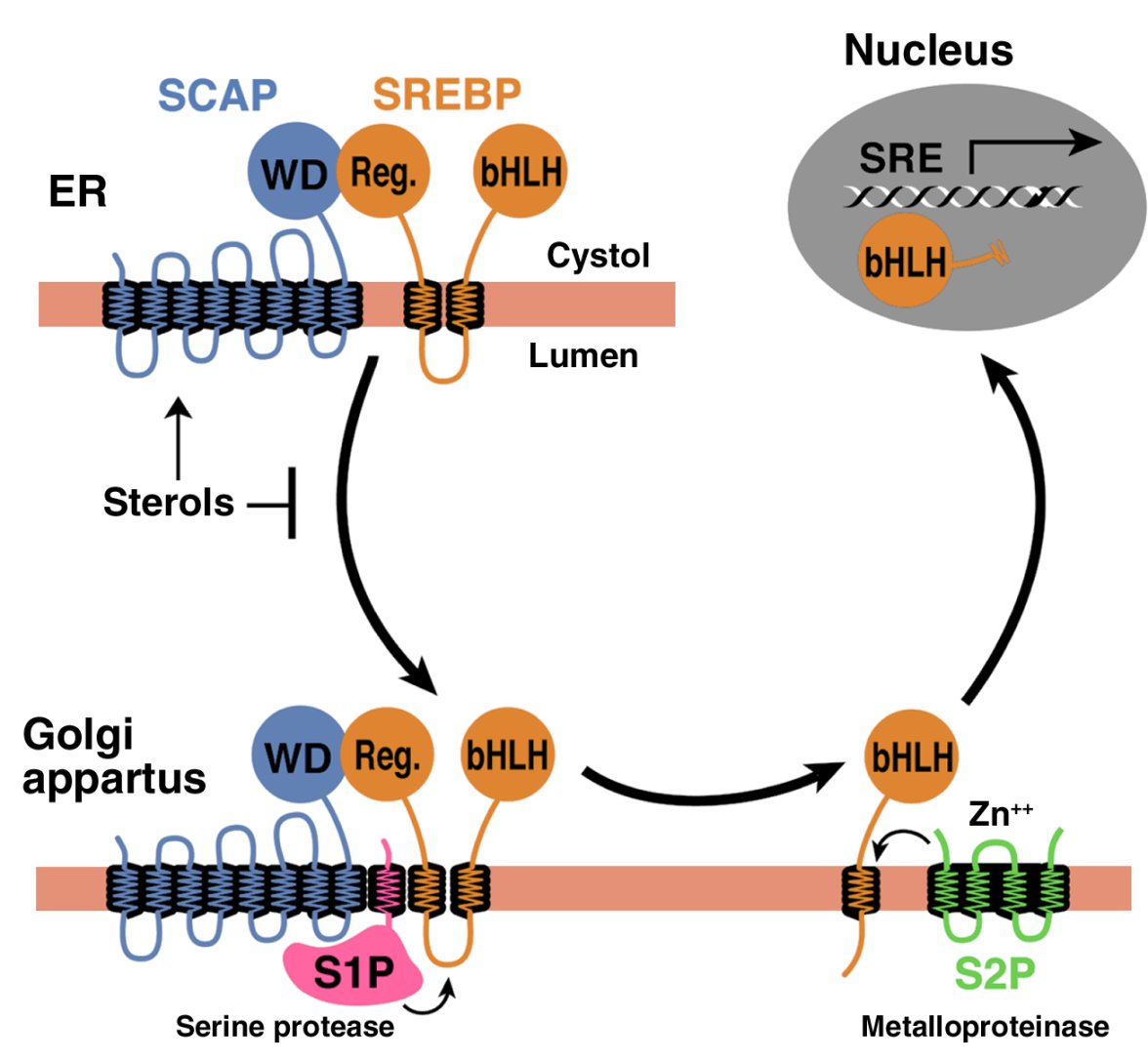
SREBPs belong to the basic helix-loop-helix–leucine zipper (bHLH-Zip) family of transcription factors, but they differ from other bHLH-Zip proteins in that they are synthesized as inactive precursors bound to the endoplasmic reticulum (ER) (1, 5). Each SREBP precursor of about 1150 amino acids is organized into three domains: (a) an NH2-terminal domain of about 480 amino acids that contains the bHLH-Zip region for binding DNA; (b) two hydrophobic transmembrane–spanning segments interrupted by a short loop of about 30 amino acids that projects into the lumen of the ER; and (c) a COOH-terminal domain of about 590 amino acids that performs the essential regulatory function described below.

In order to reach the nucleus and act as a transcription factor, the NH2-terminal domain of each SREBP must be released from the membrane proteolytically (Figure 1). Three proteins required for SREBP processing have been delineated in cultured cells, using the tools of somatic cell genetics (see ref. 5for review). One is an escort protein designated SREBP cleavage–activating protein (SCAP). The other two are proteases, designated Site-1 protease (S1P) and Site-2 protease (S2P). Newly synthesized SREBP is inserted into the membranes of the ER, where its COOH-terminal regulatory domain binds to the COOH-terminal domain of SCAP (Figure 1).


Figure 1

Model for the sterol-mediated proteolytic release of SREBPs from membranes JCI0215593.f1

Model for the sterol-mediated proteolytic release of SREBPs from membranes JCI0215593.f1


Model for the sterol-mediated proteolytic release of SREBPs from membranes. SCAP is a sensor of sterols and an escort of SREBPs. When cells are depleted of sterols, SCAP transports SREBPs from the ER to the Golgi apparatus, where two proteases, Site-1 protease (S1P) and Site-2 protease (S2P), act sequentially to release the NH2-terminal bHLH-Zip domain from the membrane. The bHLH-Zip domain enters the nucleus and binds to a sterol response element (SRE) in the enhancer/promoter region of target genes, activating their transcription. When cellular cholesterol rises, the SCAP/SREBP complex is no longer incorporated into ER transport vesicles, SREBPs no longer reach the Golgi apparatus, and the bHLH-Zip domain cannot be released from the membrane. As a result, transcription of all target genes declines. Reprinted from ref. 5 with permission.

http://dm5migu4zj3pb.cloudfront.net/manuscripts/15000/15593/large/JCI0215593.f1.jpg

SCAP is both an escort for SREBPs and a sensor of sterols. When cells become depleted in cholesterol, SCAP escorts the SREBP from the ER to the Golgi apparatus, where the two proteases reside. In the Golgi apparatus, S1P, a membrane-bound serine protease, cleaves the SREBP in the luminal loop between its two membrane-spanning segments, dividing the SREBP molecule in half (Figure 1). The NH2-terminal bHLH-Zip domain is then released from the membrane via a second cleavage mediated by S2P, a membrane-bound zinc metalloproteinase. The NH2-terminal domain, designated nuclear SREBP (nSREBP), translocates to the nucleus, where it activates transcription by binding to nonpalindromic sterol response elements (SREs) in the promoter/enhancer regions of multiple target genes.


Figure 1


When the cholesterol content of cells rises, SCAP senses the excess cholesterol through its membranous sterol-sensing domain, changing its conformation in such a way that the SCAP/SREBP complex is no longer incorporated into ER transport vesicles. The net result is that SREBPs lose their access to S1P and S2P in the Golgi apparatus, so their bHLH-Zip domains cannot be released from the ER membrane, and the transcription of target genes ceases (1, 5). The biophysical mechanism by which SCAP senses sterol levels in the ER membrane and regulates its movement to the Golgi apparatus is not yet understood. Elucidating this mechanism will be fundamental to understanding the molecular basis of cholesterol feedback inhibition of gene expression.

SREBPs: two genes, three proteins

The mammalian genome encodes three SREBP isoforms, designated SREBP-1a, SREBP-1c, and SREBP-2. SREBP-2 is encoded by a gene on human chromosome 22q13. Both SREBP-1a and -1c are derived from a single gene on human chromosome 17p11.2 through the use of alternative transcription start sites that produce alternate forms of exon 1, designated 1a and 1c (1). SREBP-1a is a potent activator of all SREBP-responsive genes, including those that mediate the synthesis of cholesterol, fatty acids, and triglycerides. High-level transcriptional activation is dependent on exon 1a, which encodes a longer acidic transactivation segment than does the first exon of SREBP-1c. The roles of SREBP-1c and SREBP-2 are more restricted than that of SREBP-1a. SREBP-1c preferentially enhances transcription of genes required for fatty acid synthesis but not cholesterol synthesis. Like SREBP-1a, SREBP-2 has a long transcriptional activation domain, but it preferentially activates cholesterol synthesis (1). SREBP-1a and SREBP-2 are the predominant isoforms of SREBP in most cultured cell lines, whereas SREBP-1c and SREBP-2 predominate in the liver and most other intact tissues (6).

When expressed at higher than physiologic levels, each of the three SREBP isoforms can activate all enzymes indicated in Figure 2, which shows the biosynthetic pathways used to generate cholesterol and fatty acids. However, at normal levels of expression, SREBP-1c favors the fatty acid biosynthetic pathway and SREBP-2 favors cholesterologenesis. SREBP-2–responsive genes in the cholesterol biosynthetic pathway include those for the enzymes HMG-CoA synthase, HMG-CoA reductase, farnesyl diphosphate synthase, and squalene synthase. SREBP-1c–responsive genes include those for ATP citrate lyase (which produces acetyl-CoA) and acetyl-CoA carboxylase and fatty acid synthase (which together produce palmitate [C16:0]). Other SREBP-1c target genes encode a rate-limiting enzyme of the fatty acid elongase complex, which converts palmitate to stearate (C18:0) (ref.7); stearoyl-CoA desaturase, which converts stearate to oleate (C18:1); and glycerol-3-phosphate acyltransferase, the first committed enzyme in triglyceride and phospholipid synthesis (3). Finally, SREBP-1c and SREBP-2 activate three genes required to generate NADPH, which is consumed at multiple stages in these lipid biosynthetic pathways (8) (Figure 2).


Figure 2


major metabolic intermediates in the pathways for synthesis of cholesterol, fatty acids, and triglycerides JCI0215593.f2

major metabolic intermediates in the pathways for synthesis of cholesterol, fatty acids, and triglycerides JCI0215593.f2


http://dm5migu4zj3pb.cloudfront.net/manuscripts/15000/15593/large/JCI0215593.f2.jpg


Genes regulated by SREBPs. The diagram shows the major metabolic intermediates in the pathways for synthesis of cholesterol, fatty acids, and triglycerides. In vivo, SREBP-2 preferentially activates genes of cholesterol metabolism, whereas SREBP-1c preferentially activates genes of fatty acid and triglyceride metabolism. DHCR, 7-dehydrocholesterol reductase; FPP, farnesyl diphosphate; GPP, geranylgeranyl pyrophosphate synthase; CYP51, lanosterol 14α-demethylase; G6PD, glucose-6-phosphate dehydrogenase; PGDH, 6-phosphogluconate dehydrogenase; GPAT, glycerol-3-phosphate acyltransferase.

Genes regulated by SREBPs. The diagram shows the major metabolic intermediates in the pathways for synthesis of cholesterol, fatty acids, and triglycerides. In vivo, SREBP-2 preferentially activates genes of cholesterol metabolism, whereas SREBP-1c preferentially activates genes of fatty acid and triglyceride metabolism. DHCR, 7-dehydrocholesterol reductase; FPP, farnesyl diphosphate; GPP, geranylgeranyl pyrophosphate synthase; CYP51, lanosterol 14α-demethylase; G6PD, glucose-6-phosphate dehydrogenase; PGDH, 6-phosphogluconate dehydrogenase; GPAT, glycerol-3-phosphate acyltransferase.

Knockout and transgenic mice

Ten different genetically manipulated mouse models that either lack or overexpress a single component of the SREBP pathway have been generated in the last 6 years (916). The key molecular and metabolic alterations observed in these mice are summarized in Table 1.


Table 1
Alterations in hepatic lipid metabolism in gene-manipulated mice overexpressing or lacking SREBPs

http://dm5migu4zj3pb.cloudfront.net/manuscripts/15000/15593/small/JCI0215593.t1.gif

Knockout mice that lack all nSREBPs die early in embryonic development. For instance, a germline deletion of S1p, which prevents the processing of all SREBP isoforms, results in death before day 4 of development (15, 17). Germline deletion of Srebp2 leads to 100% lethality at a later stage of embryonic development than does deletion of S1p (embryonic day 7–8). In contrast, germline deletion of Srebp1, which eliminates both the 1a and the 1c transcripts, leads to partial lethality, in that about 15–45% of Srebp1–/– mice survive (13). The surviving homozygotes manifest elevated levels of SREBP-2 mRNA and protein (Table 1), which presumably compensates for the loss of SREBP-1a and -1c. When the SREBP-1c transcript is selectively eliminated, no embryonic lethality is observed, suggesting that the partial embryonic lethality in the Srebp1–/– mice is due to the loss of the SREBP-1a transcript (16).

To bypass embryonic lethality, we have produced mice in which all SREBP function can be disrupted in adulthood through induction of Cre recombinase. For this purpose, loxP recombination sites were inserted into genomic regions that flank crucial exons in the Scap or S1p genes (so-called floxed alleles) (14, 15). Mice homozygous for the floxed gene and heterozygous for a Cre recombinase transgene, which is under control of an IFN-inducible promoter (MX1-Cre), can be induced to delete Scap or S1p by stimulating IFN expression. Thus, following injection with polyinosinic acid–polycytidylic acid, a double-stranded RNA that provokes antiviral responses, the Cre recombinase is produced in liver and disrupts the floxed gene by recombination between the loxP sites.

Cre-mediated disruption of Scap or S1p dramatically reduces nSREBP-1 and nSREBP-2 levels in liver and diminishes expression of all SREBP target genes in both the cholesterol and the fatty acid synthetic pathways (Table 1). As a result, the rates of synthesis of cholesterol and fatty acids fall by 70–80% in Scap- and S1p-deficient livers.

In cultured cells, the processing of SREBP is inhibited by sterols, and the sensor for this inhibition is SCAP (5). To learn whether SCAP performs the same function in liver, we have produced transgenic mice that express a mutant SCAP with a single amino acid substitution in the sterol-sensing domain (D443N) (12). Studies in tissue culture show that SCAP(D443N) is resistant to inhibition by sterols. Cells that express a single copy of this mutant gene overproduce cholesterol (18). Transgenic mice that express this mutant version of SCAP in the liver exhibit a similar phenotype (12). These livers manifest elevated levels of nSREBP-1 and nSREBP-2, owing to constitutive SREBP processing, which is not suppressed when the animals are fed a cholesterol-rich diet. nSREBP-1 and -2 increase the expression of all SREBP target genes shown in Figure 2, thus stimulating cholesterol and fatty acid synthesis and causing a marked accumulation of hepatic cholesterol and triglycerides (Table 1). This transgenic model provides strong in vivo evidence that SCAP activity is normally under partial inhibition by endogenous sterols, which keeps the synthesis of cholesterol and fatty acids in a partially repressed state in the liver.

http://dm5migu4zj3pb.cloudfront.net/manuscripts/15000/15593/small/JCI0215593.t1.gif

Function of individual SREBP isoforms in vivo

To study the functions of individual SREBPs in the liver, we have produced transgenic mice that overexpress truncated versions of SREBPs (nSREBPs) that terminate prior to the membrane attachment domain. These nSREBPs enter the nucleus directly, bypassing the sterol-regulated cleavage step. By studying each nSREBP isoform separately, we could determine their distinct activating properties, albeit when overexpressed at nonphysiologic levels.

Overexpression of nSREBP-1c in the liver of transgenic mice produces a triglyceride-enriched fatty liver with no increase in cholesterol (10). mRNAs for fatty acid synthetic enzymes and rates of fatty acid synthesis are elevated fourfold in this tissue, whereas the mRNAs for cholesterol synthetic enzymes and the rate of cholesterol synthesis are not increased (8). Conversely, overexpression of nSREBP-2 in the liver increases the mRNAs only fourfold. This increase in cholesterol synthesis is even more remarkable when encoding all cholesterol biosynthetic enzymes; the most dramatic is a 75-fold increase in HMG-CoA reductase mRNA (11). mRNAs for fatty acid synthesis enzymes are increased to a lesser extent, consistent with the in vivo observation that the rate of cholesterol synthesis increases 28-fold in these transgenic nSREBP-2 livers, while fatty acid synthesis increases one considers the extent of cholesterol overload in this tissue, which would ordinarily reduce SREBP processing and essentially abolish cholesterol synthesis (Table 1).

http://dm5migu4zj3pb.cloudfront.net/manuscripts/15000/15593/small/JCI0215593.t1.gif

We have also studied the consequences of overexpressing SREBP-1a, which is expressed only at low levels in the livers of adult mice, rats, hamsters, and humans (6). nSREBP-1a transgenic mice develop a massive fatty liver engorged with both cholesterol and triglycerides (9), with heightened expression of genes controlling cholesterol biosynthesis and, still more dramatically, fatty acid synthesis (Table 1). The preferential activation of fatty acid synthesis (26-fold increase) relative to cholesterol synthesis (fivefold increase) explains the greater accumulation of triglycerides in their livers. The relative representation of the various fatty acids accumulating in this tissue is also unusual. Transgenic nSREBP-1a livers contain about 65% oleate (C18:1), markedly higher levels than the 15–20% found in typical wild-type livers (8) — a result of the induction of fatty acid elongase and stearoyl-CoA desaturase-1 (7). Considered together, the overexpression studies indicate that both SREBP-1 isoforms show a relative preference for activating fatty acid synthesis, whereas SREBP-2 favors cholesterol.

The phenotype of animals lacking the Srebp1 gene, which encodes both the SREBP-1a and -1c transcripts, also supports the notion of distinct hepatic functions for SREBP-1 and SREBP-2 (13). Most homozygous SREBP-1 knockout mice die in utero. The surviving Srebp1–/– mice show reduced synthesis of fatty acids, owing to reduced expression of mRNAs for fatty acid synthetic enzymes (Table 1). Hepatic nSREBP-2 levels increase in these mice, presumably in compensation for the loss of nSREBP-1. As a result, transcription of cholesterol biosynthetic genes increases, producing a threefold increase in hepatic cholesterol synthesis (Table 1).

http://dm5migu4zj3pb.cloudfront.net/manuscripts/15000/15593/small/JCI0215593.t1.gif

The studies in genetically manipulated mice clearly show that, as in cultured cells, SCAP and S1P are required for normal SREBP processing in the liver. SCAP, acting through its sterol-sensing domain, mediates feedback regulation of cholesterol synthesis. The SREBPs play related but distinct roles: SREBP-1c, the predominant SREBP-1 isoform in adult liver, preferentially activates genes required for fatty acid synthesis, while SREBP-2 preferentially activates the LDL receptor gene and various genes required for cholesterol synthesis. SREBP-1a and SREBP-2, but not SREBP-1c, are required for normal embryogenesis.

Transcriptional regulation of SREBP genes

Regulation of SREBPs occurs at two levels — transcriptional and posttranscriptional. The posttranscriptional regulation discussed above involves the sterol-mediated suppression of SREBP cleavage, which results from sterol-mediated suppression of the movement of the SCAP/SREBP complex from the ER to the Golgi apparatus (Figure 1). This form of regulation is manifest not only in cultured cells (1), but also in the livers of rodents fed cholesterol-enriched diets (19).

http://dm5migu4zj3pb.cloudfront.net/manuscripts/15000/15593/small/JCI0215593.f1.gif

The transcriptional regulation of the SREBPs is more complex. SREBP-1c and SREBP-2 are subject to distinct forms of transcriptional regulation, whereas SREBP-1a appears to be constitutively expressed at low levels in liver and most other tissues of adult animals (6). One mechanism of regulation shared by SREBP-1c and SREBP-2 involves a feed-forward regulation mediated by SREs present in the enhancer/promoters of each gene (20, 21). Through this feed-forward loop, nSREBPs activate the transcription of their own genes. In contrast, when nSREBPs decline, as in Scap or S1p knockout mice, there is a secondary decline in the mRNAs encoding SREBP-1c and SREBP-2 (14, 15).

Three factors selectively regulate the transcription of SREBP-1c: liver X-activated receptors (LXRs), insulin, and glucagon. LXRα and LXRβ, nuclear receptors that form heterodimers with retinoid X receptors, are activated by a variety of sterols, including oxysterol intermediates that form during cholesterol biosynthesis (2224). An LXR-binding site in the SREBP-1c promoter activates SREBP-1c transcription in the presence of LXR agonists (23). The functional significance of LXR-mediated SREBP-1c regulation has been confirmed in two animal models. Mice that lack both LXRα and LXRβ express reduced levels of SREBP-1c and its lipogenic target enzymes in liver and respond relatively weakly to treatment with a synthetic LXR agonist (23). Because a similar blunted response is found in mice that lack SREBP-1c, it appears that LXR increases fatty acid synthesis largely by inducing SREBP-1c (16). LXR-mediated activation of SREBP-1c transcription provides a mechanism for the cell to induce the synthesis of oleate when sterols are in excess (23). Oleate is the preferred fatty acid for the synthesis of cholesteryl esters, which are necessary for both the transport and the storage of cholesterol.

LXR-mediated regulation of SREBP-1c appears also to be one mechanism by which unsaturated fatty acids suppress SREBP-1c transcription and thus fatty acid synthesis. Rodents fed diets enriched in polyunsaturated fatty acids manifest reduced SREBP-1c mRNA expression and low rates of lipogenesis in liver (25). In vitro, unsaturated fatty acids competitively block LXR activation of SREBP-1c expression by antagonizing the activation of LXR by its endogenous ligands (26). In addition to LXR-mediated transcriptional inhibition, polyunsaturated fatty acids lower SREBP-1c levels by accelerating degradation of its mRNA (27). These combined effects may contribute to the long-recognized ability of polyunsaturated fatty acids to lower plasma triglyceride levels.

SREBP-1c and the insulin/glucagon ratio

The liver is the organ responsible for the conversion of excess carbohydrates to fatty acids to be stored as triglycerides or burned in muscle. A classic action of insulin is to stimulate fatty acid synthesis in liver during times of carbohydrate excess. The action of insulin is opposed by glucagon, which acts by raising cAMP. Multiple lines of evidence suggest that insulin’s stimulatory effect on fatty acid synthesis is mediated by an increase in SREBP-1c. In isolated rat hepatocytes, insulin treatment increases the amount of mRNA for SREBP-1c in parallel with the mRNAs of its target genes (28, 29). The induction of the target genes can be blocked if a dominant negative form of SREBP-1c is expressed (30). Conversely, incubating primary hepatocytes with glucagon or dibutyryl cAMP decreases the mRNAs for SREBP-1c and its associated lipogenic target genes (30, 31).

In vivo, the total amount of SREBP-1c in liver and adipose tissue is reduced by fasting, which suppresses insulin and increases glucagon levels, and is elevated by refeeding (32, 33). The levels of mRNA for SREBP-1c target genes parallel the changes in SREBP-1c expression. Similarly, SREBP-1c mRNA levels fall when rats are treated with streptozotocin, which abolishes insulin secretion, and rise after insulin injection (29). Overexpression of nSREBP-1c in livers of transgenic mice prevents the reduction in lipogenic mRNAs that normally follows a fall in plasma insulin levels (32). Conversely, in livers of Scap knockout mice that lack all nSREBPs in the liver (14) or knockout mice lacking either nSREBP-1c (16) or both SREBP-1 isoforms (34), there is a marked decrease in the insulin-induced stimulation of lipogenic gene expression that normally occurs after fasting/refeeding. It should be noted that insulin and glucagon also exert a posttranslational control of fatty acid synthesis though changes in the phosphorylation and activation of acetyl-CoA carboxylase. The posttranslational regulation of fatty acid synthesis persists in transgenic mice that overexpress nSREBP-1c (10). In these mice, the rates of fatty acid synthesis, as measured by [3H]water incorporation, decline after fasting even though the levels of the lipogenic mRNAs remain high (our unpublished observations).

Taken together, the above evidence suggests that SREBP-1c mediates insulin’s lipogenic actions in liver. Recent in vitro and in vivo studies involving adenoviral gene transfer suggest that SREBP-1c may also contribute to the regulation of glucose uptake and glucose synthesis. When overexpressed in hepatocytes, nSREBP-1c induces expression of glucokinase, a key enzyme in glucose utilization. It also suppresses phosphoenolpyruvate carboxykinase, a key gluconeogenic enzyme (35, 36).

SREBPs in disease

Many individuals with obesity and insulin resistance also have fatty livers, one of the most commonly encountered liver abnormalities in the US (37). A subset of individuals with fatty liver go on to develop fibrosis, cirrhosis, and liver failure. Evidence indicates that the fatty liver of insulin resistance is caused by SREBP-1c, which is elevated in response to the high insulin levels. Thus, SREBP-1c levels are elevated in the fatty livers of obese (ob/ob) mice with insulin resistance and hyperinsulinemia caused by leptin deficiency (38, 39). Despite the presence of insulin resistance in peripheral tissues, insulin continues to activate SREBP-1c transcription and cleavage in the livers of these insulin-resistant mice. The elevated nSREBP-1c increases lipogenic gene expression, enhances fatty acid synthesis, and accelerates triglyceride accumulation (31, 39). These metabolic abnormalities are reversed with the administration of leptin, which corrects the insulin resistance and lowers the insulin levels (38).

Metformin, a biguanide drug used to treat insulin-resistant diabetes, reduces hepatic nSREBP-1 levels and dramatically lowers the lipid accumulation in livers of insulin-resistant ob/ob mice (40). Metformin stimulates AMP-activated protein kinase (AMPK), an enzyme that inhibits lipid synthesis through phosphorylation and inactivation of key lipogenic enzymes (41). In rat hepatocytes, metformin-induced activation of AMPK also leads to decreased mRNA expression of SREBP-1c and its lipogenic target genes (41), but the basis of this effect is not understood.

The incidence of coronary artery disease increases with increasing plasma LDL-cholesterol levels, which in turn are inversely proportional to the levels of hepatic LDL receptors. SREBPs stimulate LDL receptor expression, but they also enhance lipid synthesis (1), so their net effect on plasma lipoprotein levels depends on a balance between opposing effects. In mice, the plasma levels of lipoproteins tend to fall when SREBPs are either overexpressed or underexpressed. In transgenic mice that overexpress nSREBPs in liver, plasma cholesterol and triglycerides are generally lower than in control mice (Table 1), even though these mice massively overproduce fatty acids, cholesterol, or both. Hepatocytes of nSREBP-1a transgenic mice overproduce VLDL, but these particles are rapidly removed through the action of LDL receptors, and they do not accumulate in the plasma. Indeed, some nascent VLDL particles are degraded even before secretion by a process that is mediated by LDL receptors (42). The high levels of nSREBP-1a in these animals support continued expression of the LDL receptor, even in cells whose cholesterol concentration is elevated. In LDL receptor–deficient mice carrying the nSREBP-1a transgene, plasma cholesterol and triglyceride levels rise tenfold (43).

Mice that lack all SREBPs in liver as a result of disruption of Scap or S1p also manifest lower plasma cholesterol and triglyceride levels (Table 1).

http://dm5migu4zj3pb.cloudfront.net/manuscripts/15000/15593/small/JCI0215593.t1.gif

In these mice, hepatic cholesterol and triglyceride synthesis is markedly reduced, and this likely causes a decrease in VLDL production and secretion. LDL receptor mRNA and LDL clearance from plasma is also significantly reduced in these mice, but the reduction in LDL clearance is less than the overall reduction in VLDL secretion, the net result being a decrease in plasma lipid levels (15). However, because

humans and mice differ substantially with regard to LDL receptor expression, LDL levels, and other aspects of lipoprotein metabolism,

it is difficult to predict whether human plasma lipids will rise or fall when the SREBP pathway is blocked or activated.

SREBPs in liver: unanswered questions

The studies of SREBPs in liver have exposed a complex regulatory system whose individual parts are coming into focus. Major unanswered questions relate to the ways in which the transcriptional and posttranscriptional controls on SREBP activity are integrated so as to permit independent regulation of cholesterol and fatty acid synthesis in specific nutritional states. A few clues regarding these integration mechanisms are discussed below.

Whereas cholesterol synthesis depends almost entirely on SREBPs, fatty acid synthesis is only partially dependent on these proteins. This has been shown most clearly in cultured nonhepatic cells such as Chinese hamster ovary cells. In the absence of SREBP processing, as when the Site-2 protease is defective, the levels of mRNAs encoding cholesterol biosynthetic enzymes and the rates of cholesterol synthesis decline nearly to undetectable levels, whereas the rate of fatty acid synthesis is reduced by only 30% (44). Under these conditions, transcription of the fatty acid biosynthetic genes must be maintained by factors other than SREBPs. In liver, the gene encoding fatty acid synthase (FASN) can be activated transcriptionally by upstream stimulatory factor, which acts in concert with SREBPs (45). The FASN promoter also contains an LXR element that permits a low-level response to LXR ligands even when SREBPs are suppressed (46). These two transcription factors may help to maintain fatty acid synthesis in liver when nSREBP-1c is low.

Another mechanism of differential regulation is seen in the ability of cholesterol to block the processing of SREBP-2, but not SREBP-1, under certain metabolic conditions. This differential regulation has been studied most thoroughly in cultured cells such as human embryonic kidney (HEK-293) cells. When these cells are incubated in the absence of fatty acids and cholesterol, the addition of sterols blocks processing of SREBP-2, but not SREBP-1, which is largely produced as SREBP-1a in these cells (47). Inhibition of SREBP-1 processing requires an unsaturated fatty acid, such as oleate or arachidonate, in addition to sterols (47). In the absence of fatty acids and in the presence of sterols, SCAP may be able to carry SREBP-1 proteins, but not SREBP-2, to the Golgi apparatus. Further studies are necessary to document this apparent independent regulation of SREBP-1 and SREBP-2 processing and to determine its mechanism.


Acknowledgments

Support for the research cited from the authors’ laboratories was provided by grants from the NIH (HL-20948), the Moss Heart Foundation, the Keck Foundation, and the Perot Family Foundation. J.D. Horton is a Pew Scholar in the Biomedical Sciences and is the recipient of an Established Investigator Grant from the American Heart Association and a Research Scholar Award from the American Digestive Health Industry.

References

  1. Brown, MS, Goldstein, JL. The SREBP pathway: regulation of cholesterol metabolism by proteolysis of a membrane-bound transcription factor. Cell 1997. 89:331-340.

View this article via: PubMed

  1. Horton, JD, Shimomura, I. Sterol regulatory element-binding proteins: activators of cholesterol and fatty acid biosynthesis. Curr Opin Lipidol 1999. 10:143-150.

View this article via: PubMed

  1. Edwards, PA, Tabor, D, Kast, HR, Venkateswaran, A. Regulation of gene expression by SREBP and SCAP. Biochim Biophys Acta 2000. 1529:103-113.

View this article via: PubMed

  1. Sakakura, Y, et al. Sterol regulatory element-binding proteins induce an entire pathway of cholesterol synthesis. Biochem Biophys Res Commun 2001. 286:176-183.

View this article via: PubMed

  1. Goldstein, JL, Rawson, RB, Brown, MS. Mutant mammalian cells as tools to delineate the sterol regulatory element-binding protein pathway for feedback regulation of lipid synthesis. Arch Biochem Biophys 2002. 397:139-148.

View this article via: PubMed

  1. Shimomura, I, Shimano, H, Horton, JD, Goldstein, JL, Brown, MS. Differential expression of exons 1a and 1c in mRNAs for sterol regulatory element binding protein-1 in human and mouse organs and cultured cells. J Clin Invest 1997. 99:838-845.

View this article via: JCI.org PubMed

  1. Moon, Y-A, Shah, NA, Mohapatra, S, Warrington, JA, Horton, JD. Identification of a mammalian long chain fatty acyl elongase regulated by sterol regulatory element-binding proteins. J Biol Chem 2001. 276:45358-45366.

View this article via: PubMed

  1. Shimomura, I, Shimano, H, Korn, BS, Bashmakov, Y, Horton, JD. Nuclear sterol regulatory element binding proteins activate genes responsible for entire program of unsaturated fatty acid biosynthesis in transgenic mouse liver. J Biol Chem 1998. 273:35299-35306.

View this article via: PubMed

  1. Shimano, H, et al. Overproduction of cholesterol and fatty acids causes massive liver enlargement in transgenic mice expressing truncated SREBP-1a. J Clin Invest 1996. 98:1575-1584.

View this article via: JCI.org PubMed

  1. Shimano, H, et al. Isoform 1c of sterol regulatory element binding protein is less active than isoform 1a in livers of transgenic mice and in cultured cells. J Clin Invest 1997. 99:846-854.

View this article via: JCI.org PubMed

  1. Horton, JD, et al. Activation of cholesterol synthesis in preference to fatty acid synthesis in liver and adipose tissue of transgenic mice overproducing sterol regulatory element-binding protein-2. J Clin Invest 1998. 101:2331-2339.

View this article via: JCI.org PubMed

  1. Korn, BS, et al. Blunted feedback suppression of SREBP processing by dietary cholesterol in transgenic mice expressing sterol-resistant SCAP(D443N). J Clin Invest 1998. 102:2050-2060.

View this article via: JCI.org PubMed

  1. Shimano, H, et al. Elevated levels of SREBP-2 and cholesterol synthesis in livers of mice homozygous for a targeted disruption of the SREBP-1 gene. J Clin Invest 1997. 100:2115-2124.

View this article via: JCI.org PubMed

  1. Matsuda, M, et al. SREBP cleavage-activating protein (SCAP) is required for increased lipid synthesis in liver induced by cholesterol deprivation and insulin elevation. Genes Dev 2001. 15:1206-1216.

View this article via: PubMed

  1. Yang, J, et al. Decreased lipid synthesis in livers of mice with disrupted Site-1 protease gene. Proc Natl Acad Sci USA 2001. 98:13607-13612.

View this article via: PubMed

Liang, G, et al. Diminished hepatic response to fasting/refeeding and liver X receptor agonists in mice with selective deficiency of sterol regulatory element-binding protein-1c. J Biol Chem 2002. 277:9520-9528.

http://www.jci.org/articles/view/15593


Structural Biochemistry/Lipids/Membrane Lipids

< Structural Biochemistry‎ | Lipids

Membrane proteins rely on their interaction with membrane lipids to uphold its structure and maintain its functions as a protein. For membrane proteins to purify and crystallize, it is essential for the membrane protein to be in the appropriate lipid environment. Lipids assist in crystallization and stabilize the protein and provide lattice contacts. Lipids can also help obtain membrane protein structures in a native conformation. Membrane protein structures contain bound lipid molecules. Biological membranes are important in life, providing permeable barriers for cells and their organelles. The interaction between membrane proteins and lipids facilitates basic processes such as respiration, photosynthesis, transport, signal transduction and motility. These basic processes require a diverse group of proteins, which are encoded by 20-30% of an organism’s annotated genes.

There exist a great number of membrane lipids. Specifically, eukaryotic cells have a very complex collection of lipids that rely on many of the cell’s resources for its synthesis. Interactions between proteins and lipids can be very specific. Specific types of lipids can make a structure stable, provide control in insertion and folding processes, and help to assemble multisubunit complexes or supercomplexes, and most importantly, can significantly affect a membrane protein’s functions. Protein and lipid interactions are not sufficiently tight, meaning that lipids are retained during membrane protein purification. Since cellular membranes are fluid arrangements of lipids, some lipids affect interesting changes to membrane due to their characteristics. Glycosphigolipids and cholesterol tend to form small islands within the membranes, called lipid rafts, due to their physical properties. Some proteins also tend to cluster in lipid raft, while others avoid being in lipid rafts. However, the existence of lipid rafts in cells seems to be transitory.

Recent progress in determining membrane protein structure has brought attention to the importance of maintaining a favorable lipid environment so proteins to crystallize and purify successfully. Lipids assist in crystallization by stabilizing the protein fold and the relationships between subunits or monomers. The lipid content in protein-lipid detergent complexes can be altered by adjusting solubilisation and purification protocols, also by adding native or non-native lipids.

There are three type of membrane lipids: 1. Phospholipids: major class of membrane lipids. 2. glycolipids. 3. Cholesterols. Membrane lipids were started with eukaryotes and bacteria.

http://en.wikibooks.org/wiki/Structural_Biochemistry/Lipids/Membrane_Lipids

Types of Membrane Lipids

Lipids are often used as membrane constituents. The three major classes that membrane lipids are divided into are phospholipids, glycolipids, and cholesterol. Lipids are found in eukaryotes and bacteria. Although the lipids in archaea have many features that are related to the membrane formation that is similar with lipids of other organisms, they are still distinct from one another. The membranes of archaea differ in composition in three major ways. Firstly, the nonpolar chains are joined to a glycerol backbone by ether instead of esters, allowing for more resistance to hydrolysis. Second, the alkyl chains are not linear, but branched and make them more resistant to oxidation. The ability of archaeal lipids to resist hydrolysis and oxidation help these types of organisms to withstand the extreme conditions of high temperature, low pH, or high salt concentration. Lastly, the stereochemistry of the central glycerol is inverted. Membrane lipids have an extensive repertoire, but they possess a critical common structural theme in which they are amphipathic molecules, meaning they contain both a hydrophilic and hydrophobic moiety.

Membrane lipids are all closed bodies or boundaries separating substituent parts of the cell. The thickness of membranes is usually between 60 and 100 angstroms. These bodies are constructed from non-covalent assemblies. Their polar heads align with each other and their non-polar hydrocarbon tails align as well. The resulting stability is credited to hydrophobic interaction which proves to be quite stable due to the length of their hydrocarbon tails.


Membrane Lipids

Lipid Vesicles

Lipid vesicles, also known as liposomes, are vesicles that are essentially aqueous vesicles that are surrounded by a circular phospholipid bilayer. Like the other phospholipid structures, they have the hydrocarbon/hydrophobic tails facing inward, away from the aqueous solution, and the hydrophilic heads facing towards the aqueous solution. These vesicles are structures that form enclosed compartments of ions and solutes, and can be utilized to study the permeability of certain membranes, or to transfer these ions or solutes to certain cells found elsewhere.

Liposomes as vesicles can serve various clinical uses. Injecting liposomes containing medicine or DNA (for gene therapy) into patients is a possible method of drug delivery. The liposomes fuse with other cells’ membranes and therefore combine their contents with that of the patient’s cell. This method of drug delivery is less toxic than direct exposure because the liposomes carry the drug directly to cells without any unnecessary intermediate steps.

Because of the hydrophobic interactions among several phospholipids and glycolipids, a certain structure called the lipid bilayer or bimolecular sheet is favored. As mentioned earlier, phospholipids and glycolipids have both hydrophilic and hydrophobic moieties; thus, when several phospholipids or glycolipids come together in an aqueous solution, the hydrophobic tails interact with each other to form a hydrophobic center, while the hydrophilic heads interact with each other forming a hydrophilic coating on each side of the bilayer.

http://upload.wikimedia.org/wikibooks/en/b/ba/Liposome_final%2A.png

http://upload.wikimedia.org/wikibooks/en/f/fa/Membrane_bilayer.jpg


Liposome_

Liposome_


Membrane_bilayer

Membrane_bilayer


Evidence Report/Technology Assessment   Number 89


Effects of Omega-3 Fatty Acids on Lipids and Glycemic Control in Type II Diabetes and the Metabolic Syndrome and on Inflammatory Bowel Disease, Rheumatoid Arthritis, Renal Disease, Systemic Lupus Erythematosus, and Osteoporosis


Prepared for:

Agency for Healthcare Research and Quality

U.S. Department of Health and Human Services

540 Gaither Road

Rockville, MD 20850

http://www.ahrq.gov

Contract No. 290-02-0003


Chapter 1. Introduction

This report is one of a group of evidence reports prepared by three Agency for Healthcare Research and Quality (AHRQ)-funded Evidence-Based Practice Centers (EPCs) on the role of omega-3 fatty acids (both from food sources and from dietary supplements) in the prevention or treatment of a variety of diseases. These reports were requested and funded by the Office of Dietary Supplements, National Institutes of Health. The three EPCs – the Southern California EPC (SCEPC, based at RAND), the Tufts-New England Medical Center (NEMC) EPC, and the University of Ottawa EPC – have each produced evidence reports. To ensure consistency of approach, the three EPCs collaborated on selected methodological elements, including literature search strategies, rating of evidence, and data table design.

The aim of these reports is to summarize the current evidence on the effects of omega-3 fatty acids on prevention and treatment of cardiovascular diseases, cancer, child and maternal health, eye health, gastrointestinal/renal diseases, asthma, immune- mediated diseases, tissue/organ transplantation, mental health, and neurological diseases and conditions. In addition to informing the research community and the public on the effects of omega-3 fatty acids on various health conditions, it is anticipated that the findings of the reports will also be used to help define the agenda for future research.

This report focuses on the effects of omega-3 fatty acids on immune- mediated diseases, bone metabolism, and gastrointestinal/renal diseases. Subsequent reports from the SCEPC will focus on cancer and neurological diseases and conditions.

This chapter provides a brief review of the current state of knowledge about the metabolism, physiological functions, and sources of omega-3 fatty acids.


The Recognition of Essential Fatty Acids

Dietary fat has long been recognized as an important source of energy for mammals, but in the late 1920s, researchers demonstrated the dietary requirement for particular fatty acids, which came to be called essential fatty acids. It was not until the advent of intravenous feeding, however, that the importance of essential fatty acids was widely accepted: Clinical signs of essential fatty acid deficiency are generally observed only in patients on total parenteral nutrition who received mixtures devoid of essential fatty acids or in those with malabsorption syndromes.

These signs include dermatitis and changes in visual and neural function. Over the past 40 years, an increasing number of physiological functions, such as immunomodulation, have been attributed to the essential fatty acids and their metabolites, and this area of research remains quite active.1, 2

Fatty Acid Nomenclature

The fat found in foods consists largely of a heterogeneous mixture of triacylglycerols (triglycerides)–glycerol molecules that are each combined with three fatty acids. The fatty acids can be divided into two categories, based on chemical properties: saturated fatty acids, which are usually solid at room temperature, and unsaturated fatty acids, which are liquid at room temperature. The term “saturation” refers to a chemical structure in which each carbon atom in the fatty acyl chain is bound to (saturated with) four other atoms, these carbons are linked by single bonds, and no other atoms or molecules can attach; unsaturated fatty acids contain at least one pair of carbon atoms linked by a double bond, which allows the attachment of additional atoms to those carbons (resulting in saturation). Despite their differences in structure, all fats contain approximately the same amount of energy (37 kilojoules/gram, or 9 kilocalories/gram).

The class of unsaturated fatty acids can be further divided into monounsaturated and polyunsaturated fatty acids. Monounsaturated fatty acids (the primary constituents of olive and canola oils) contain only one double bond. Polyunsaturated fatty acids (PUFAs) (the primary constituents of corn, sunflower, flax seed and many other vegetable oils) contain more than one double bond. Fatty acids are often referred to using the number of carbon atoms in the acyl chain, followed by a colon, followed by the number of double bonds in the chain (e.g., 18:1 refers to the 18-carbon monounsaturated fatty acid, oleic acid; 18:3 refers to any 18-carbon PUFA with three double bonds).

PUFAs are further categorized on the basis of the location of their double bonds. An omega or n notation indicates the number of carbon atoms from the methyl end of the acyl chain to the first double bond. Thus, for example, in the omega-3 (n-3) family of PUFAs, the first double bond is 3 carbons from the methyl end of the molecule. The trivial names, chemical names and abbreviations for the omega-3 fatty acids are detailed in Table 1.1.  Finally, PUFAs can be categorized according to their chain length. The 18-carbon n-3 and n-6 short-chain PUFAs are precursors to the longer 20- and 22-carbon PUFAs, called long-chain PUFAs (LCPUFAs).

Fatty Acid Metabolism

Mammalian cells can introduce double bonds into all positions on the fatty acid chain except the n-3 and n-6 position. Thus, the short-chain alpha- linolenic acid (ALA, chemical abbreviation: 18:3n-3) and linoleic acid (LA, chemical abbreviation: 18:2n-6) are essential fatty acids.

No other fatty acids found in food are considered ‘essential’ for humans, because they can all be synthesized from the short chain fatty acids.

Following ingestion, ALA and LA can be converted in the liver to the long chain, more unsaturated n-3 and n-6 LCPUFAs by a complex set of synthetic pathways that share several enzymes (Figure 1). LC PUFAs retain the original sites of desaturation (including n-3 or n-6). The omega-6 fatty acid LA is converted to gamma-linolenic acid (GLA, 18:3n-6), an omega- 6 fatty acid that is a positional isomer of ALA. GLA, in turn, can be converted to the longerchain omega-6 fatty acid, arachidonic acid (AA, 20:4n-6). AA is the precursor for certain classes of an important family of hormone- like substances called the eicosanoids (see below).

The omega-3 fatty acid ALA (18:3n-3) can be converted to the long-chain omega-3 fatty acid, eicosapentaenoic acid (EPA; 20:5n-3). EPA can be elongated to docosapentaenoic acid (DPA 22:5n-3), which is further desaturated to docosahexaenoic acid (DHA; 22:6n-3). EPA and DHA are also precursors of several classes of eicosanoids and are known to play several other critical roles, some of which are discussed further below.

The conversion from parent fatty acids into the LC PUFAs – EPA, DHA, and AA – appears to occur slowly in humans. In addition, the regulation of conversion is not well understood, although it is known that ALA and LA compete for entry into the metabolic pathways.

Physiological Functions of EPA and AA

As stated earlier, fatty acids play a variety of physiological roles. The specific biological functions of a fatty acid are determined by the number and position of double bonds and the length of the acyl chain.

Both EPA (20:5n-3) and AA (20:4n-6) are precursors for the formation of a family of hormone- like agents called eicosanoids. Eicosanoids are rudimentary hormones or regulating – molecules that appear to occur in most forms of life. However, unlike endocrine hormones, which travel in the blood stream to exert their effects at distant sites, the eicosanoids are autocrine or paracrine factors, which exert their effects locally – in the cells that synthesize them or adjacent cells. Processes affected include the movement of calcium and other substances into and out of cells, relaxation and contraction of muscles, inhibition and promotion of clotting, regulation of secretions including digestive juices and hormones, and control of fertility, cell division, and growth.3

The eicosanoid family includes subgroups of substances known as prostaglandins, leukotrienes, and thromboxanes, among others. As shown in Figure 1.1, the long-chain omega-6 fatty acid, AA (20:4n-6), is the precursor of a group of eicosanoids that include series-2 prostaglandins and series-4 leukotrienes. The omega-3 fatty acid, EPA (20:5n-3), is the precursor to a group of eicosanoids that includes series-3 prostaglandins and series-5 leukotrienes. The AA-derived series-2 prostaglandins and series-4 leukotrienes are often synthesized in response to some emergency such as injury or stress, whereas the EPA-derived series-3 prostaglandins and series-5 leukotrienes appear to modulate the effects of the series-2 prostaglandins and series-4 leukotrienes (usually on the same target cells). More specifically, the series-3 prostaglandins are formed at a slower rate and work to attenuate the effects of excessive levels of series-2 prostaglandins. Thus, adequate production of the series-3 prostaglandins seems to protect against heart attack and stroke as well as certain inflammatory diseases like arthritis, lupus, and asthma.3.

EPA (22:6 n-3) also affects lipoprotein metabolism and decreases the production of substances – including cytokines, interleukin 1ß (IL-1ß), and tumor necrosis factor a (TNF-a) – that have pro-inflammatory effects (such as stimulation of collagenase synthesis and the expression of adhesion molecules necessary for leukocyte extravasation [movement from the circulatory system into tissues]).2 The mechanism responsible for the suppression of cytokine production by omega-3 LC PUFAs remains unknown, although suppression of omega-6-derived eicosanoid production by omega-3 fatty acids may be involved, because the omega-3 and omega-6 fatty acids compete for a common enzyme in the eicosanoid synthetic pathway, delta-6 desaturase.

DPA (22:5n-3) (the elongation product of EPA) and its metabolite DHA (22:6n-3) are frequently referred to as very long chain n-3 fatty acids (VLCFA). Along with AA, DHA is the major PUFA found in the brain and is thought to be important for brain development and function. Recent research has focused on this role and the effect of supplementing infant formula with DHA (since DHA is naturally present in breast milk but not in formula).

Dietary Sources and Requirements

Both ALA and LA are present in a variety of foods. LA is present in high concentrations in many commonly used oils, including safflower, sunflower, soy, and corn oil. ALA is present in some commonly used oils, including canola and soybean oil, and in some leafy green vegetables. Thus, the major dietary sources of ALA and LA are PUFA-rich vegetable oils. The proportion of LA to ALA as well as the proportion of those PUFAs to others varies considerably by the type of oil. With the exception of flaxseed, canola, and soybean oil, the ratio of LA to ALA in vegetable oils is at least 10 to 1. The ratios of LA to ALA for flaxseed, canola, and soy are approximately 1: 3.5, 2:1, and 8:1, respectively; however, flaxseed oil is not typically consumed in the North American diet. It is estimated that on average in the U.S., LA accounts for 89% of the total PUFAs consumed, and ALA accounts for 9%. Another estimate suggests that Americans consume 10 times more omega-6 than omega-3 fatty acids.4 Table 1.2 shows the proportion of omega 3 fatty acids for a number of foods.

Syntheis and Degradation

Source of Acetyl CoA for Fatty Acid Synthesis

Source of Acetyl CoA for Fatty Acid Synthesis

step 1

step 1

condensation reaction with malonyl ACP

ACP (acyl carrier protein)

ACP (acyl carrier protein)

synthesis requires acetyl CoA from citrate shuttle

synthesis requires acetyl CoA from citrate shuttle

conversion to fatty acyl co A in cytoplasm

conversion to fatty acyl co A in cytoplasm

ACP (acyl carrier protein)

ACP (acyl carrier protein)

FA synthesis not exactly reverse of catabolism

FA synthesis not exactly reverse of catabolism


Fatty Acid Synthase

Fatty Acid Synthase

complete FA synthesis

complete FA synthesis

Desaturation

Desaturation

Elongation and Desaturation of Fatty Acids

Elongation and Desaturation of Fatty Acids

release of FAs from adiposites

release of FAs from adiposites

Fatty acid beta oxidation and Krebs cycle produce NAD, NADH, FADH2

Fatty acid beta oxidation and Krebs cycle produce NAD, NADH, FADH2

ketone bodies

ketone bodies

metabolism of ketone bodies

metabolism of ketone bodies

Arachidonoyl-mimicking

Arachidonoyl-mimicking

Arachidonate pathways

Arachidonate pathways

arachidonic acid derivatives

arachidonic acid derivatives

major metabolic intermediates in the pathways for synthesis of cholesterol, fatty acids, and triglycerides

major metabolic intermediates in the pathways for synthesis of cholesterol, fatty acids, and triglycerides

Model for the sterol-mediated proteolytic release of SREBPs from membrane

Model for the sterol-mediated proteolytic release of SREBPs from membrane

hormone regulation

hormone regulation

 insulin receptor and and insulin receptor signaling pathway (IRS)

insulin receptor and and insulin receptor signaling pathway (IRS)

 islet brain glucose signaling

islet brain glucose signaling


Fish source

Fish source

omega FAs

omega FAs


Excessive omega 6s

Excessive omega 6s

omega 6s

omega 6s

diet and cancer

diet and cancer

Patients at risk of FA deficiency

Patients at risk of FA deficiency

PPAR role

PPAR role

PPAR role

PPAR role

Omega 6_3 pathways

Omega 6_3 pathways

n3 vs n6 PUFAs

n3 vs n6 PUFAs

triene-teraene ratio

triene-teraene ratio

arachidonic acid, leukotrienes, PG and thromboxanes

arachidonic acid, leukotrienes, PG and thromboxanes

Cox 2 and cancer

Cox 2 and cancer

Lipidomics of atherosclerotic plaques

Lipidomics of atherosclerotic plaques


Effect of TPN on EFAD

Effect of TPN on EFAD

benefits of omega 3s

benefits of omega 3s

food consumption

food consumption


Read Full Post »

Signaling and Signaling Pathways

Curator: Larry H. Bernstein, MD, FCAP


http://pharmaceuticalintelligence.com/8-9-2014/Signaling and Signaling Pathways

This portion of the discussion is a series of articles on signaling and signaling pathways. Many of the protein-protein interactions or protein-membrane interactions and associated regulatory features have been referred to previously, but the focus of the discussion or points made were different.  I considered placing this after the discussion of proteins and how they play out their essential role, but this is quite a suitable place for a progression to what follows.  This is introduced by material taken from Wikipedia, which will be followed by a series of mechanisms and examples from the current literature, which give insight into the developments in cell metabolism, with the later goal of separating views introduced by molecular biology and genomics from functional cellular dynamics that are not dependent on the classic view.  The work is vast, and this discussion does not attempt to cover it in great depth.  It is the first in a series.

  1. Signaling and signaling pathways
  2. Signaling transduction tutorial.
  3. Carbohydrate metabolism
  4. Lipid metabolism
  5. Protein synthesis and degradation
  6. Subcellular structure
  7. Impairments in pathological states: endocrine disorders; stress hypermetabolism; cancer.

Signal transduction

(From Wikipedia, the free encyclopedia)
http://en.wikipedia.org/wiki/File:Signal_transduction_publications_graph.jpeg


Signal_transduction_pathways.svg

Signal_transduction_pathways.svg


Signal transduction occurs when an extracellular signaling[1] molecule activates a specific receptor located on the cell surface or inside the cell. In turn, this receptor triggers a biochemical chain of events inside the cell, creating a response.[2] Depending on the cell, the response alters the cell’s metabolism, shape, gene expression, or ability to divide.[3] The signal can be amplified at any step. Thus, one signaling molecule can cause many responses.[4]

In 1970, Martin Rodbell examined the effects of glucagon on a rat’s liver cell membrane receptor. He noted that guanosine triphosphate disassociated glucagon from this receptor and stimulated the G-protein, which strongly influenced the cell’s metabolism. Thus, he deduced that the G-protein is a transducer that accepts glucagon molecules and affects the cell.[5] For this, he shared the 1994 Nobel Prize in Physiology or Medicine with Alfred G. Gilman.

Signal_transduction_publications_graph

Signal_transduction_publications_graph

The earliest MEDLINE entry for “signal transduction” dates from 1972.[6] Some early articles used the terms signal transmission and sensory transduction.[7][8] In 2007, a total of 48,377 scientific papers—including 11,211 e review papers—were published on the subject. The term first appeared in a paper’s title in 1979.[9][10] Widespread use of the term has been traced to a 1980 review article by Rodbell:[5][11] Research papers focusing on signal transduction first appeared in large numbers in the late 1980s and early 1990s.[12]

Notch-mediated juxtacrine signal between adjacent cells.

Notch-mediated juxtacrine signal between adjacent cells.

Signal transduction involves the binding of extracellular signaling molecules and ligands to cell-surface receptors that trigger events inside the cell. The combination of messenger with receptor causes a change in the conformation of the receptor, known as receptor activation. This activation is always the initial step (the cause) leading to the cell’s ultimate responses (effect) to the messenger. Despite the myriad of these ultimate responses, they are all directly due to changes in particular cell proteins. Intracellular signaling cascades can be started through cell-substratum interactions; examples are the integrin that binds ligands in the extracellular matrix and steroids.[13] Most steroid hormones have receptors within the cytoplasm and act by stimulating the binding of their receptors to the promoter region of steroid-responsive genes.[14] Examples of signaling molecules include the hormone melatonin,[15] the neurotransmitter acetylcholine[16] and the cytokine interferon γ.[17]

Signal transduction cascades amplify the signal output

Signal transduction cascades amplify the signal output

Various environmental stimuli exist that initiate signal transmission processes in multicellular organisms; examples include photons hitting cells in the retina of the eye,[20] and odorants binding to odorant receptors in the nasal epithelium.[21] Certain microbial molecules, such as viral nucleotides and protein antigens, can elicit an immune system response against invading pathogens mediated by signal transduction processes. This may occur independent of signal transduction stimulation by other molecules, as is the case for the toll-like receptor. It may occur with help from stimulatory molecules located at the cell surface of other cells, as with T-cell receptor signaling. Unicellular organisms may respond to environmental stimuli through the activation of signal transduction pathways. For example, slime molds secrete cyclic adenosine monophosphate upon starvation, stimulating individual cells in the immediate environment to aggregate,[22] and yeast cells use mating factors to determine the mating types of other cells and to participate in sexual reproduction.[23] Receptors can be roughly divided into two major classes: intracellular receptors and extracellular receptors.

Extracellular

Extracellular receptors are integral transmembrane proteins and make up most receptors. They span the plasma membrane of the cell, with one part of the receptor on the outside of the cell and the other on the inside. Signal transduction occurs as a result of a ligand binding to the outside; the molecule does not pass through the membrane. This binding stimulates a series of events inside the cell; different types of receptor stimulate different responses and receptors typically respond to only the binding of a specific ligand. Upon binding, the ligand induces a change in the conformation of the inside part of the receptor.[24] These result in either the activation of an enzyme in the receptor or the exposure of a binding site for other intracellular signaling proteins within the cell, eventually propagating the signal through the cytoplasm.

In eukaryotic cells, most intracellular proteins activated by a ligand/receptor interaction possess an enzymatic activity; examples include tyrosine kinase and phosphatases. Some of them create second messengers such as cyclic AMP and IP3, the latter controlling the release of intracellular calcium stores into the cytoplasm. Other activated proteins interact with adaptor proteins that facilitate signalling protein interactions and coordination of signalling complexes necessary to respond to a particular stimulus. Enzymes and adaptor proteins are both responsive to various second messenger molecules.

Many adaptor proteins and enzymes activated as part of signal transduction possess specialized protein domains that bind to specific secondary messenger molecules. For example, calcium ions bind to the EF hand domains of calmodulin, allowing it to bind and activate calmodulin-dependent kinase. PIP3 and other phosphoinositides do the same thing to the Pleckstrin homology domains of proteins such as the kinase protein AKT.

G protein-coupled

G protein-coupled receptors (GPCRs) are a family of integral transmembrane proteins that possess seven transmembrane domains and are linked to a heterotrimeric G protein. Many receptors are in this family, including adrenergic receptors and chemokine receptors.

Arrestin binding to active GPCR kinase (GRK)-phosphorylated GPCRs blocks G protein coupling

Arrestin binding to active GPCR kinase (GRK)-phosphorylated GPCRs blocks G protein coupling

Signal transduction by a GPCR begins with an inactive G protein coupled to the receptor; it exists as a heterotrimer consisting of Gα, Gβ, and Gγ.[25] Once the GPCR recognizes a ligand, the conformation of the receptor changes to activate the G protein, causing Gα to bind a molecule of GTP and dissociate from the other two G-protein subunits. The dissociation exposes sites on the subunits that can interact with other molecules.[26] The activated G protein subunits detach from the receptor and initiate signaling from many downstream effector proteins such as phospholipases and ion channels, the latter permitting the release of second messenger molecules.[27] The total strength of signal amplification by a GPCR is determined by the lifetimes of the ligand-receptor complex and receptor-effector protein complex and the deactivation time of the activated receptor and effectors through intrinsic enzymatic activity.

A study was conducted where a point mutation was inserted into the gene encoding the chemokine receptor CXCR2; mutated cells underwent a malignant transformation due to the expression of CXCR2 in an active conformation despite the absence of chemokine-binding. This meant that chemokine receptors can contribute to cancer development.[28]

Tyrosine and histidine kinase

Receptor tyrosine kinases (RTKs) are transmembrane proteins with an intracellular kinase domain and an extracellular domain that binds ligands; examples include growth factor receptors such as the insulin receptor.[29] To perform signal transduction, RTKs need to form dimers in the plasma membrane;[30] the dimer is stabilized by ligands binding to the receptor. The interaction between the cytoplasmic domains stimulates the autophosphorylation of tyrosines within the domains of the RTKs, causing conformational changes. Subsequent to this, the receptors’ kinase domains are activated, initiating phosphorylation signaling cascades of downstream cytoplasmic molecules that facilitate various cellular processes such as cell differentiation and metabolism.[29]

As is the case with GPCRs, proteins that bind GTP play a major role in signal transduction from the activated RTK into the cell. In this case, the G proteins are members of the Ras, Rho, and Raf families, referred to collectively as small G proteins. They act as molecular switches usually tethered to membranes by isoprenyl groups linked to their carboxyl ends. Upon activation, they assign proteins to specific membrane subdomains where they participate in signaling. Activated RTKs in turn activate small G proteins that activate guanine nucleotide exchange factors such as SOS1. Once activated, these exchange factors can activate more small G proteins, thus amplifying the receptor’s initial signal. The mutation of certain RTK genes, as with that of GPCRs, can result in the expression of receptors that exist in a constitutively activate state; such mutated genes may act as oncogenes.[31]

Histidine-specific protein kinases are structurally distinct from other protein kinases and are found in prokaryotes, fungi, and plants as part of a two-component signal transduction mechanism: a phosphate group from ATP is first added to a histidine residue within the kinase, then transferred to an aspartate residue on a receiver domain on a different protein or the kinase itself, thus activating the aspartate residue.[32]

Integrin

integrin-mediated signal transduction

integrin-mediated signal transduction

An overview of integrin-mediated signal transduction, adapted from Hehlgens et al. (2007).[33]

Integrins are produced by a wide variety of cells; they play a role in cell attachment to other cells and the extracellular matrix and in the transduction of signals from extracellular matrix components such as fibronectin and collagen. Ligand binding to the extracellular domain of integrins changes the protein’s conformation, clustering it at the cell membrane to initiate signal transduction. Integrins lack kinase activity; hence, integrin-mediated signal transduction is achieved through a variety of intracellular protein kinases and adaptor molecules, the main coordinator being integrin-linked kinase.[33] As shown in the picture to the right, cooperative integrin-RTK signalling determines the timing of cellular survival, apoptosis, proliferation, and differentiation.

Important differences exist between integrin-signalling in circulating blood cells and non-circulating cells such as epithelial cells; integrins of circulating cells are normally inactive. For example, cell membrane integrins on circulating leukocytes are maintained in an inactive state to avoid epithelial cell attachment; they are activated only in response to stimuli such as those received at the site of an inflammatory response. In a similar manner, integrins at the cell membrane of circulating platelets are normally kept inactive to avoid thrombosis. Epithelial cells (which are non-circulating) normally have active integrins at their cell membrane, helping maintain their stable adhesion to underlying stromal cells that provide signals to maintain normal functioning.[34]

Toll gate

When activated, toll-like receptors (TLRs) take adapter molecules within the cytoplasm of cells in order to propagate a signal. Four adaptor molecules are known to be involved in signaling, which are Myd88, TIRAP, TRIF, and TRAM.[35][36][37] These adapters activate other intracellular molecules such as IRAK1, IRAK4, TBK1[disambiguation needed], and IKKi that amplify the signal, eventually leading to the induction or suppression of genes that cause certain responses. Thousands of genes are activated by TLR signaling, implying that this method constitutes an important gateway for gene modulation.

Ligand-gated ion channel

A ligand-gated ion channel, upon binding with a ligand, changes conformation to open a channel in the cell membrane through which ions relaying signals can pass. An example of this mechanism is found in the receiving cell of a neural synapse. The influx of ions that occurs in response to the opening of these channels induces action potentials, such as those that travel along nerves, by depolarizing the membrane of post-synaptic cells, resulting in the opening of voltage-gated ion channels.

An example of an ion allowed into the cell during a ligand-gated ion channel opening is Ca2+; it acts as a second messenger initiating signal transduction cascades and altering the physiology of the responding cell. This results in amplification of the synapse response between synaptic cells by remodelling the dendritic spines involved in the synapse.

Ion transporters and channels in mammalian choroidal epithelium

Ion transporters and channels in mammalian choroidal epithelium


Intracellular

Extracellular receptors are integral transmembrane proteins and make up most receptors. They span the plasma membrane of the cell, with one part of the receptor on the outside of the cell and the other on the inside. Signal transduction occurs as a result of a ligand binding to the outside; the molecule does not pass through the membrane. This binding stimulates a series of events inside the cell; different types of receptor stimulate different responses and receptors typically respond to only the binding of a specific ligand. Upon binding, the ligand induces a change in the conformation of the inside part of the receptor.[24] These result in either the activation of an enzyme in the receptor or the exposure of a binding site for other intracellular signaling proteins within the cell, eventually propagating the signal through the cytoplasm.

Understanding these receptors and identifying their ligands and the resulting signal transduction pathways represent a major conceptual advance

Understanding these receptors and identifying their ligands and the resulting signal transduction pathways represent a major conceptual advance


intercellular signaling

intercellular signaling


conformational-rearrangements

conformational-rearrangements


membrane protein receptor binds with hormone

membrane protein receptor binds with hormone


The multiple protein-dependent steps in signal transduction

The multiple protein-dependent steps in signal transduction

In eukaryotic cells, most intracellular proteins activated by a ligand/receptor interaction possess an enzymatic activity; examples include tyrosine kinase and phosphatases. Some of them create second messengers such as cyclic AMP and IP3, the latter controlling the release of intracellular calcium stores into the cytoplasm. Other activated proteins interact with adaptor proteins that facilitate signalling protein interactions and coordination of signalling complexes necessary to respond to a particular stimulus. Enzymes and adaptor proteins are both responsive to various second messenger molecules.

Ca++ exchange

Ca++ exchange

Many adaptor proteins and enzymes activated as part of signal transduction possess specialized protein domains that bind to specific secondary messenger molecules. For example, calcium ions bind to the EF hand domains of calmodulin, allowing it to bind and activate calmodulin-dependent kinase. PIP3 and other phosphoinositides do the same thing to the Pleckstrin homology domains of proteins such as the kinase protein AKT.

G protein-coupled

G protein-coupled receptors (GPCRs) are a family of integral transmembrane proteins that possess seven transmembrane domains and are linked to a heterotrimeric G protein. Many receptors are in this family, including adrenergic receptors and chemokine receptors.

membrane_receptor_g protein

membrane_receptor_g protein


intracellular_receptor_steroid

intracellular_receptor_steroid

Signal transduction by a GPCR begins with an inactive G protein coupled to the receptor; it exists as a heterotrimer consisting of Gα, Gβ, and Gγ.[25] Once the GPCR recognizes a ligand, the conformation of the receptor changes to activate the G protein, causing Gα to bind a molecule of GTP and dissociate from the other two G-protein subunits. The dissociation exposes sites on the subunits that can interact with other molecules.[26] The activated G protein subunits detach from the receptor and initiate signaling from many downstream effector proteins such as phospholipases and ion channels, the latter permitting the release of second messenger molecules.[27] The total strength of signal amplification by a GPCR is determined by the lifetimes of the ligand-receptor complex and receptor-effector protein complex and the deactivation time of the activated receptor and effectors through intrinsic enzymatic activity.

A study was conducted where a point mutation was inserted into the gene encoding the chemokine receptor CXCR2; mutated cells underwent a malignant transformation due to the expression of CXCR2 in an active conformation despite the absence of chemokine-binding. This meant that chemokine receptors can contribute to cancer development.[28]

Tyrosine and histidine kinase

Receptor tyrosine kinases (RTKs) are transmembrane proteins with an intracellular kinase domain and an extracellular domain that binds ligands; examples include growth factor receptors such as the insulin receptor.[29] To perform signal transduction, RTKs need to form dimers in the plasma membrane;[30] the dimer is stabilized by ligands binding to the receptor. The interaction between the cytoplasmic domains stimulates the autophosphorylation of tyrosines within the domains of the RTKs, causing conformational changes. Subsequent to this, the receptors’ kinase domains are activated, initiating phosphorylation signaling cascades of downstream cytoplasmic molecules that facilitate various cellular processes such as cell differentiation and metabolism.[29]

insulin-receptor-and-and-insulin-receptor-signaling-pathway-irs

insulin-receptor-and-and-insulin-receptor-signaling-pathway-irs


receptors-regulators

receptors-regulators

phosphorylation-cascade

phosphorylation-cascade


As is the case with GPCRs, proteins that bind GTP play a major role in signal transduction from the activated RTK into the cell. In this case, the G proteins are members of the Ras, Rho, and Raf families, referred to collectively as small G proteins. They act as molecular switches usually tethered to membranes by isoprenyl groups linked to their carboxyl ends. Upon activation, they assign proteins to specific membrane subdomains where they participate in signaling. Activated RTKs in turn activate small G proteins that activate guanine nucleotide exchange factors such as SOS1. Once activated, these exchange factors can activate more small G proteins, thus amplifying the receptor’s initial signal. The mutation of certain RTK genes, as with that of GPCRs, can result in the expression of receptors that exist in a constitutively activate state; such mutated genes may act as oncogenes.[31]

Histidine-specific protein kinases are structurally distinct from other protein kinases and are found in prokaryotes, fungi, and plants as part of a two-component signal transduction mechanism: a phosphate group from ATP is first added to a histidine residue within the kinase, then transferred to an aspartate residue on a receiver domain on a different protein or the kinase itself, thus activating the aspartate residue.[32]


Integrin

integrin-mediated signal transduction

integrin-mediated signal transduction

An overview of integrin-mediated signal transduction, adapted from Hehlgens et al. (2007).[33]

Integrins are produced by a wide variety of cells; they play a role in cell attachment to other cells and the extracellular matrix and in the transduction of signals from extracellular matrix components such as fibronectin and collagen. Ligand binding to the extracellular domain of integrins changes the protein’s conformation, clustering it at the cell membrane to initiate signal transduction. Integrins lack kinase activity; hence, integrin-mediated signal transduction is achieved through a variety of intracellular protein kinases and adaptor molecules, the main coordinator being integrin-linked kinase.[33] As shown in the picture to the right, cooperative integrin-RTK signalling determines the timing of cellular survival, apoptosis, proliferation, and differentiation.

Platelet signaling pathways

Platelet signaling pathways


Protein ubiquitylation

Protein ubiquitylation

ubiquitylation-is-a-multistep-reaction.

ubiquitylation-is-a-multistep-reaction.


Important differences exist between integrin-signaling in circulating blood cells and non-circulating cells such as epithelial cells; integrins of circulating cells are normally inactive. For example, cell membrane integrins on circulating leukocytes are maintained in an inactive state to avoid epithelial cell attachment; they are activated only in response to stimuli such as those received at the site of an inflammatory response. In a similar manner, integrins at the cell membrane of circulating platelets are normally kept inactive to avoid thrombosis. Epithelial cells (which are non-circulating) normally have active integrins at their cell membrane, helping maintain their stable adhesion to underlying stromal cells that provide signals to maintain normal functioning.[34]

Toll gate

When activated, toll-like receptors (TLRs) take adapter molecules within the cytoplasm of cells in order to propagate a signal. Four adaptor molecules are known to be involved in signaling, which are Myd88, TIRAP, TRIF, and TRAM.[35][36][37] These adapters activate other intracellular molecules such as IRAK1, IRAK4, TBK1[disambiguation needed], and IKKi that amplify the signal, eventually leading to the induction or suppression of genes that cause certain responses. Thousands of genes are activated by TLR signaling, implying that this method constitutes an important gateway for gene modulation.


SignalTrans

SignalTrans


Signal-Transduction-Pathway


Ligand-gated ion channel

A ligand-gated ion channel, upon binding with a ligand, changes conformation to open a channel in the cell membrane through which ions relaying signals can pass. An example of this mechanism is found in the receiving cell of a neural synapse. The influx of ions that occurs in response to the opening of these channels induces action potentials, such as those that travel along nerves, by depolarizing the membrane of post-synaptic cells, resulting in the opening of voltage-gated ion channels.

An example of an ion allowed into the cell during a ligand-gated ion channel opening is Ca2+; it acts as a second messenger initiating signal transduction cascades and altering the physiology of the responding cell. This results in amplification of the synapse response between synaptic cells by remodelling the dendritic spines involved in the synapse.

Ion transporters and channels in mammalian choroidal epithelium

Ion transporters and channels in mammalian choroidal epithelium

Intracellular

Intracellular receptors, such as nuclear receptors and cytoplasmic receptors, are soluble proteins localized within their respective areas. The typical ligands for nuclear receptors are lipophilic hormones like the steroid hormones testosterone and progesterone and derivatives of vitamins A and D. To initiate signal transduction, the ligand must pass through the plasma membrane by passive diffusion. On binding with the receptor, the ligands pass through the nuclear membrane into the nucleus, enabling gene transcription and protein production.


Signal Transduction

Signal Transduction


Activated nuclear receptors attach to the DNA at receptor-specific hormone-responsive element (HRE) sequences, located in the promoter region of the genes activated by the hormone-receptor complex. Due to their enabling gene transcription, they are alternatively called inductors of gene expression. All hormones that act by regulation of gene expression have two consequences in their mechanism of action; their effects are produced after a characteristically long period of time and their effects persist for another long period of time, even after their concentration has been reduced to zero, due to a relatively slow turnover of most enzymes and proteins that would either deactivate or terminate ligand binding onto the receptor.

Signal transduction via these receptors involves little proteins, but the details of gene regulation by this method are not well-understood. Nucleic receptors have DNA-binding domains containing zinc fingers and a ligand-binding domain; the zinc fingers stabilize DNA binding by holding its phosphate backbone. DNA sequences that match the receptor are usually hexameric repeats of any kind; the sequences are similar but their orientation and distance differentiate them. The ligand-binding domain is additionally responsible for dimerization of nucleic receptors prior to binding and providing structures for transactivation used for communication with the translational apparatus.


signal-transduction-in-protease-signaling-

signal-transduction-in-protease-signaling-


protein changes in biological mechanisms

protein changes in biological mechanisms


Steroid receptors are a subclass of nuclear receptors located primarily within the cytosol; in the absence of steroids, they cling together in an aporeceptor complex containing chaperone or heatshock proteins (HSPs). The HSPs are necessary to activate the receptor by assisting the protein to fold in a way such that the signal sequence enabling its passage into the nucleus is accessible. Steroid receptors, on the other hand, may be repressive on gene expression when their transactivation domain is hidden; activity can be enhanced by phosphorylation of serine residues at their N-terminal as a result of another signal transduction pathway, a process called crosstalk.

Structure of the N-terminal domain of the yeast Hsp90 chaperone

Structure of the N-terminal domain of the yeast Hsp90 chaperone

Pincer movement of Hsp90 coupled to the ATPase cycle. NTD = N-terminal domain, MD = middle domain, CTD = C-terminal domain.

Pincer movement of Hsp90 coupled to the ATPase cycle. NTD = N-terminal domain, MD = middle domain, CTD = C-terminal domain.

Retinoic acid receptors are another subset of nuclear receptors. They can be activated by an endocrine-synthesized ligand that entered the cell by diffusion, a ligand synthesised from a precursor like retinol brought to the cell through the bloodstream or a completely intracellularly synthesised ligand like prostaglandin. These receptors are located in the nucleus and are not accompanied by HSPs; they repress their gene by binding to their specific DNA sequence when no ligand binds to them, and vice versa.

Certain intracellular receptors of the immune system are cytoplasmic receptors; recently identified NOD-like receptors (NLRs) reside in the cytoplasm of some eukaryotic cells and interact with ligands using a leucine-rich repeat (LRR) motif similar to TLRs. Some of these molecules like NOD2 interact with RIP2 kinase that activates NF-κB signaling, whereas others like NALP3 interact with inflammatory caspases and initiate processing of particular cytokines like interleukin-1β.[38][39]


Cell signaling

signaling pathjways map

signaling pathjways map

Cell signalling is part of a complex system of communication that governs basic cellular activities and coordinates cell actions. The ability of cells to perceive and correctly respond to their microenvironment is the basis of development, tissue repair, and immunity as well as normal tissue homeostasis. Errors in cellular information processing are responsible for diseases such as cancer, autoimmunity, and diabetes. By understanding cell signalling, diseases may be treated effectively and, theoretically, artificial tissues may be created.

Traditional work in biology has focused on studying individual parts of cell signaling pathways. Systems biology research helps us to understand the underlying structure of cell signaling networks and how changes in these networks may affect the transmission and flow of information. Such networks are complex systems in their organization and may exhibit a number of emergent properties. Long-range allostery is often a significant component of cell signaling events.[1]

Enzyme_Model allosterism

Enzyme_Model allosterism

Classification

Signaling within, between, and among cells is subdivided into the following classifications:

  • Intracrine signals are produced by the target cell that stay within the target cell.
  • Autocrine signals are produced by the target cell, are secreted, and effect the target cell itself via receptors. Sometimes autocrine cells can target cells close by if they are the same type of cell as the emitting cell. An example of this are immune cells.
  • Juxtacrine signals target adjacent (touching) cells. These signals are transmitted along cell membranes via protein or lipid components integral to the membrane and are capable of affecting either the emitting cell or cells immediately adjacent.
transepithelial-electrogenic-ion-transport

transepithelial-electrogenic-ion-transport

calcium release calmodulin + ER

calcium release calmodulin + ER


Ca++ exchange

Ca++ exchange

Paracrine bidirectional cardiac fibroblast-myocyte crosstalk

Paracrine bidirectional cardiac fibroblast-myocyte crosstalk

  • Paracrine signals target cells in the vicinity of the emitting cell. Neurotransmitters represent an example.
  • Endocrine signals target distant cells. Endocrine cells produce hormones that travel through the blood to reach all parts of the body.
Notch-mediated juxtacrine signal between adjacent cells.

Notch-mediated juxtacrine signal between adjacent cells.


Notch-mediated juxtacrine signal between adjacent cells.

Some cell–cell communication requires direct cell–cell contact. Some cells can form gap junctions that connect their cytoplasm to the cytoplasm of adjacent cells. In cardiac muscle, gap junctions between adjacent cells allows for action potential propagation from the cardiac pacemaker region of the heart to spread and coordinately cause contraction of the heart.

The notch signaling mechanism is an example of juxtacrine signaling (also known as contact-dependent signaling) in which two adjacent cells must make physical contact in order to communicate. This requirement for direct contact allows for very precise control of cell differentiation during embryonic development. In the worm Caenorhabditis elegans, two cells of the developing gonad each have an equal chance of terminally differentiating or becoming a uterine precursor cell that continues to divide. The choice of which cell continues to divide is controlled by competition of cell surface signals. One cell will happen to produce more of a cell surface protein that activates the Notch receptor on the adjacent cell. This activates a feedback loop or system that reduces Notch expression in the cell that will differentiate and that increases Notch on the surface of the cell that continues as a stem cell.[5]

Many cell signals are carried by molecules that are released by one cell and move to make contact with another cell. Endocrine signals are called hormones. Hormones are produced by endocrine cells and they travel through the blood to reach all parts of the body. Specificity of signaling can be controlled if only some cells can respond to a particular hormone. Paracrine signals such as retinoic acid target only cells in the vicinity of the emitting cell.[6] Neurotransmitters represent another example of a paracrine signal. Some signaling molecules can function as both a hormone and a neurotransmitter. For example, epinephrine and norepinephrine can function as hormones when released from the adrenal gland and are transported to the heart by way of the blood stream. Norepinephrine can also be produced by neurons to function as a neurotransmitter within the brain.[7] Estrogen can be released by the ovary and function as a hormone or act locally via paracrine or autocrine signaling.[8] Active species of oxygen and nitric oxide can also act as cellular messengers. This process is dubbed redox signaling.

Signaling Pathways

Cell Signaling Biology

Michael J. Berridge

Module 2

Cell Signaling Pathways
The nine membrane-bound adenylyl cyclases (AC1–AC9) have a similar domain structure. The single polypeptide has a tandem repeat of six transmembrane domains (TM) with TM1- -TM6 in one repeat and TM7- -TM12 in the other. Each TM cassette is followed by large cytoplasmic domains (C1 and C2), which contain the catalytic regions that convert ATP into cyclic AMP. As shown in the lower panel, the C1 and C2 domains come together to form a heterodimer. The ATP-binding site is located at the interface between these two domains. The soluble AC10 isoform lacks the transmembrane regions, but it retains the C1 and C2 domains that are responsible for catalysis
www.cellsignallingbiology.org  http://www.biochemj.org/csb/002/csb002.pdf


Resources:

Elucidate Target-Specific Pathways With a Suite of Cellular Assays

DiscoveRx® offers a comprehensive collection of cell-based pathway indicator assays designed to detect activation or inhibition of complex signal transduction pathways in response to compound treatment. Based on the proven PathHunter® technology, These biosensor cell lines allow you to measure distinct events within a variety of pathways involved in compound toxicity, cholesterol metabolism, antioxidant function, DNA damage and ER stress. In combination with our biosensor cell lines with fast and simple chemiluminescent detection, DiscoveRx Pathway Signaling assays will help you generate cellular pathway selectivity profiles of your compounds without relying on reporter gene assays or complex phenotypic screens. – See more at: http://www.discoverx.com/targets/signaling-pathways?gclid=CPPrxrrli8ACFSdp7AodO2IADQ#sthash.OhK3iKl4.dpuf

  GPCR Targets ,   Kinase Targets ,   Nuclear Receptors ,   Protease Targets ,   Epigenetic Targets ,   Signaling Pathways –  See more at: http://www.discoverx.com/targets#sthash.KjwWEjjx.dpuf

DiscoveRx® offers a comprehensive collection of cell-based pathway indicator assays designed to detect activation or inhibition of complex signal transduction pathways in response to compound treatment. Based on the proven PathHunter® technology, These biosensor cell lines allow you to measure distinct events within a variety of pathways involved in compound toxicity, cholesterol metabolism, antioxidant function, DNA damage and ER stress. – See more at: http://www.discoverx.com/targets/signaling-pathways#sthash.ZTb5UXVO.dpuf


inhibitors of signal transduction pathway

inhibitors of signal transduction pathway

Inhibitors of MAPK Signaling Pathway

Inhibitors of MAPK Signaling Pathway


jak-stat

jak-stat


Nrf2 signaling in ARE-mediated coordinated activation of defensive genes

Nrf2 signaling in ARE-mediated coordinated activation of defensive genes


Regulation of AMPK

Regulation of AMPK


metabolic pathways

metabolic pathways


On these resource pages you can find signaling pathway diagrams, research overviews, relevant antibody products, publications, and other research resources organized by topic. The pathway diagrams associated with these topics have been assembled by CST scientists and outside experts to provide succinct and current overviews of selected signaling pathways. Please send suggestions for developing new pathways to info@cellsignal.com. Protein nodes in each pathway diagram are linked to specific antibody product information or, optionally, to protein-specific listings in the PhosphoSitePlus® database of post-translational modifications.

http://www.cellsignal.com/common/content/content.jsp?id=science-pathways
http://www.cellsignal.com/common/content/content.jsp?id=pathways-akt-signaling
http://www.cellsignal.com/common/content/content.jsp?id=pathways-mtor-signaling

PI3K / Akt Signaling Overview

 The serine/threonine kinase Akt/PKB exists as three isoforms in mammals. Akt1 has a wide tissue distribution, whereas Akt2 is found predominantly in muscle and fat cells and Akt3 is expressed in testes and brain. Akt regulates multiple biological processes including cell survival, proliferation, growth, and glycogen metabolism. Various growth factors, hormones, and cytokines activate Akt by binding their cognate receptor tyrosine kinase (RTK), cytokine receptor, or GPCR and triggering activation of the lipid kinase PI3K, which generates PIP3 at the plasma membrane. Akt binds PIP3 through its pleckstrin homology (PH) domain, resulting in translocation of Akt to the membrane. Akt is activated through a dual phosphorylation mechanism. PDK1, which is also brought to the membrane through its PH domain, phosphorylates Akt within its activation loop at Thr308. A second phosphorylation at Ser473 within the carboxy terminus is also required for activity and is carried out by the mTOR-rictor complex, mTORC2.

PTEN, a lipid phosphatase that catalyzes the dephosphorylation of PIP3, is a major negative regulator of Akt signaling. Loss of PTEN function has been implicated in many human cancers. Akt activity is also negatively regulated by the phosphatases PP2A and PHLPP, as well as by the chemical modulators wortmannin and LY294002, both of which are inhibitors of PI3K.

Activated Akt phosphorylates a large number of downstream substrates containing the consensus sequence RXRXXS/T. One of its primary functions is to promote cell growth and protein synthesis through regulation of the mTOR signaling pathway. Akt directly phosphorylates and activates mTOR, as well as inhibits the mTOR inhibitor proteins PRAS40 and tuberin (TSC2). Combined, these actions promote cell growth and G1 cell cycle progression through signaling via p70 S6 Kinase and inhibition of 4E-BP1.

Phosphofructokinase mechanism

Phosphofructokinase mechanism

GSK-3 is a primary target of Akt and inhibitory phosphorylation of GSK-3α (Ser21) or GSK-3β (Ser9) has numerous cellular effects such as promoting glycogen metabolism, cell cycle progression, regulation of wnt signaling, and formation of neurofibrillary tangles in Alzheimers disease. Akt promotes cell survival directly by its ability to phosphorylate and inactivate several pro-apoptotic targets, including Bad, Bim, Bax, and the forkhead (FoxO1/3a) transcription factors. Akt also plays an important role in metabolism and insulin signaling. Insulin receptor signaling through Akt promotes Glut4 translocation through activation of AS160 and TBC1D1, resulting in increased glucose uptake. Akt regulates glycolysis through phosphorylation of PFK and hexokinase, and plays a significant role in aerobic glycolysis of cancer cells, also known as the Warburg Effect.

Aberrant Akt signaling is the underlying defect found in several pathologies. Akt is one of the most frequently activated kinases in human cancer as constitutively active Akt can promote unregulated cell proliferation. Abnormalities in Akt2 signaling can result in diabetes due to defects in glucose homeostasis. Akt is also a key player in cardiovascular disease through its role in cardiac growth, angiogenesis, and hypertrophy.

References

  1. Robey RB, Hay N (2009) Is Akt the “Warburg kinase”?-Akt-energy metabolism interactions and oncogenesis. Cancer Biol. 19(1), 25–31.
  2. Zhang S, Yu D (2010) PI(3)king apart PTEN’s role in cancer. Cancer Res. 16(17), 4325–30.
  3. Zoncu R, Efeyan A, Sabatini DM (2011) mTOR: from growth signal integration to cancer, diabetes and ageing. Rev. Mol. Cell Biol. 12(1), 21–35.
  4. Zhang X, Tang N, Hadden TJ, Rishi AK (2011) Akt, FoxO and regulation of apoptosis. Biophys. Acta 1813(11), 1978–86.
  5. Kloet DE, Burgering BM (2011) The PKB/FOXO switch in aging and cancer. Biophys. Acta 1813(11), 1926–37.
  6. Hers I, Vincent EE, Tavars JM (2011) Akt signalling in health and disease. Signal. 23(10), 1515–27.
  7. Wang H, Zhang Q, Wen Q, Zheng Y, Lazarovici P, Philip L, Jiang H, Lin J, Zheng W (2012) Proline-rich Akt substrate of 40kDa (PRAS40): a novel downstream target of PI3k/Akt signaling pathway. Signal. 24(1), 17–24.
  8. Dazert E, Hall MN (2011) mTOR signaling in disease. Opin. Cell Biol. 23(6), 744–55.
  9. Bayley JP, Devilee P (2012) The Warburg effect in 2012. Curr Opin Oncol 24(1), 62–7.


mTOR Signaling Pathway

Akt mTOR pathway

Akt mTOR pathway

The mammalian target of rapamycin (mTOR) is an atypical serine/threonine kinase that is present in two distinct complexes. mTOR complex 1 (mTORC1) is composed of mTOR, Raptor, GβL (mLST8), and Deptor and is partially inhibited by rapamycin. mTORC1 integrates multiple signals reflecting the availability of growth factors, nutrients, or energy to promote either cellular growth when conditions are favorable or catabolic processes during stress or when conditions are unfavorable. Growth factors and hormones (e.g. insulin) signal to mTORC1 via Akt, which inactivates TSC2 to prevent inhibition of mTORC1. Alternatively, low ATP levels lead to the AMPK-dependent activation of TSC2 and phosphorylation of raptor to reduce mTORC1 signaling. Amino acid availability is signaled to mTORC1 via a pathway involving the Rag and Ragulator (LAMTOR1-3) proteins. Active mTORC1 has a number of downstream biological effects including translation of mRNA via the phosphorylation of downstream targets (4E-BP1 and p70 S6 Kinase), suppression of autophagy (Atg13, ULK1), ribosome biogenesis, and activation of transcription leading to mitochondrial metabolism or adipogenesis. The mTOR complex 2 (mTORC2) is composed of mTOR, Rictor, GβL, Sin1, PRR5/Protor-1, and Deptor and promotes cellular survival by activating Akt. mTORC2 also regulates cytoskeletal dynamics by activating PKCα and regulates ion transport and growth via SGK1 phosphorylation. Aberrant mTOR signaling is involved in many disease states including cancer, cardiovascular disease, and metabolic disorders.

Selected Reviews:

We would like to thank Carson Thoreen and Prof. David Sabatini, Whitehead Institute for Biomedical Research, MIT, Cambridge, MA, for reviewing this diagram. revised November 2012

Protein Folding


conformational-rearrangements

conformational-rearrangements

Pincer movement of Hsp90 coupled to the ATPase cycle. NTD = N-terminal domain, MD = middle domain, CTD = C-terminal domain.

Pincer movement of Hsp90 coupled to the ATPase cycle. NTD = N-terminal domain, MD = middle domain, CTD = C-terminal domain.


Heat Shock Proteins (HSPs) form seven families (small HSPs (sHSPs), HSP10, 40, 60, 70, 90, and 100) of molecular chaperone proteins that play a central role in the cellular resistance to stress and actin organization. They are involved in the proper folding of proteins and the recognition and refolding of misfolded proteins. HSP expression is induced by a variety of environmental stresses, including heat, hypoxia, nutrient deficiency, free radicals, toxins, ischemia, and UV radiation. HSP27 is a member of the sHSP family. It is phosphorylated at Ser15, Ser78, and Ser82 by MAPKAPK-2 as a result of the activation of the p38 MAP kinase pathway. Phosphorylation and increased concentration of HSP27 has been implicated in actin polymerization and reorganization. HSP70 and HSP90 interact with unfolded proteins to prevent irreversible aggregation and catalyze the refolding of their substrates in an ATP- and co-chaperone-dependent manner. HSP70 has a broad range of substrates including newly synthesized and denatured proteins, while HSP90 tends to have a more limited subset of substrates, most of which are signaling molecules. HSP70 and HSP90 are also essential for the maturation and inactivation of nuclear hormones and other signaling molecules.

References

  1. Stenmark H (2009) Rab GTPases as coordinators of vesicle traffic. Rev. Mol. Cell Biol. 10(8), 513–25.
  2. Horgan CP, McCaffrey MW (2009) The dynamic Rab11-FIPs. Soc. Trans. 37(Pt 5), 1032–6.
  3. Evans CG, Chang L, Gestwicki JE (2010) Heat shock protein 70 (hsp70) as an emerging drug target. Med. Chem. 53(12), 4585–602.
  4. Lanneau D, Wettstein G, Bonniaud P, Garrido C (2010) Heat shock proteins: cell protection through protein triage. ScientificWorldJournal 10, 1543–52.
  5. Ghayour-Mobarhan M, Saber H, Ferns GA (2012) The potential role of heat shock protein 27 in cardiovascular disease. Chim. Acta 413(1-2), 15–24.
  6. Horgan CP, McCaffrey MW (2011) Rab GTPases and microtubule motors. Soc. Trans. 39(5), 1202–6.
  7. Stenmark H (2009) Rab GTPases as coordinators of vesicle traffic. Rev. Mol. Cell Biol. 10(8), 513–25.
  8. Horgan CP, McCaffrey MW (2009) The dynamic Rab11-FIPs. Soc. Trans. 37(Pt 5), 1032–6.
  9. Evans CG, Chang L, Gestwicki JE (2010) Heat shock protein 70 (hsp70) as an emerging drug target. Med. Chem. 53(12), 4585–602.
  10. Lanneau D, Wettstein G, Bonniaud P, Garrido C (2010) Heat shock proteins: cell protection through protein triage. ScientificWorldJournal 10, 1543–52.
  11. Ghayour-Mobarhan M, Saber H, Ferns GA (2012) The potential role of heat shock protein 27 in cardiovascular disease. Chim. Acta 413(1-2), 15–24.
  12. Horgan CP, McCaffrey MW (2011) Rab GTPases and microtubule motors. Soc. Trans. 39(5), 1202–6

– See more at: http://www.cellsignal.com/common/content/content.jsp?id=protein-folding#sthash.xAfeElH1.dpuf


Read Full Post »

RNA and the Transcription the Genetic Code

Curator: Larry H. Bernstein, MD, FCAP


This portion of the series is a followup on the series on the replication of the genetic code (DNA).  It may be considered alone, or as a tenth article.  Just as DNA has become far more than it was envisioned 60 years ago, the RNA, which was opened to further investigation by Roger Kornberg, Nobel Laureate, and son of the Nobel Laureate, Arthur Kornberg, who studied DNA polymerase, and with his Nobel Associate, attracted the finest minds in biochemistry and built the best academic department of Biochemistry at Stanford University.  RNA is associated with RNA polymerase as DNA is associated with DNA polymerase.  We have already highlighted the several critical reactions involved in the step-by-step replication of DNA.  The classic model has dictated DNA-RNA-protein.  We shall here look at the amazing view that RNA is heterogeneous, and is involved in living processes in health and disease.


Transcription (Wikipedia)

Transcription is the first step of gene expression, in which a particular segment of DNA is copied into RNA

Both RNA and DNA are nucleic acids, which use base pairs of nucleotides as a complementary language

  • that can be converted back and forth from DNA to RNA by the action of the correct enzymes.

During transcription, a DNA sequence is read by an RNA polymerase,

As opposed to DNA replication, transcription results in

  1. an RNA complement that includes the nucleotide uracil (U) in all instances
  • where thymine (T) would have occurred in a DNA complement.

Also unlike DNA replication where DNA is synthesized, transcription does not involve an RNA primer to initiate RNA synthesis.

Eukaryotic transcription is the elaborate process that eukaryotic cells use to copy genetic information stored in DNA into units of RNA replica. Gene transcription occurs in both eukaryotic and prokaryotic cells.
A eukaryotic cell has a nucleus that separates the processes of transcription and translation. Eukaryotic transcription occurs

The complexity of the eukaryotic genome necessitates a great variety and complexity of gene expression control.

Transcription can be reduced to the following steps, each moving like a wave along the DNA.

  1. One or more sigma factors initiate transcription of a gene by enabling binding of RNA polymerase to promoter DNA.
  2. RNA polymerase moves a transcription bubble, like the slider of a zipper, which splits the double helix DNA molecule into two strands of unpaired DNA nucleotides, by breaking the hydrogen bonds between complementary DNA nucleotides.
  3. RNA polymerase adds matching RNA nucleotides that are paired with complementary DNA nucleotides of one DNA strand.
  4. RNA sugar-phosphate backbone forms with assistance from RNA polymerase to form an RNA strand.
  5. Hydrogen bonds of the untwisted RNA + DNA helix break, freeing the newly synthesized RNA strand.
  6. If the cell has a nucleus, the RNA may be further processed (with the addition of a 3’UTR poly-A tail and a 5’UTR cap) and exits to the cytoplasm through the nuclear pore complex.

The stretch of DNA transcribed into an RNA molecule is called a transcription unit and encodes at least one gene. If the gene transcribed encodes a protein, the result of transcription is messenger RNA (mRNA), which will then be used to create that protein via the process of translation. Alternatively, the transcribed gene may encode for either non-coding RNA genes (such as microRNA, lincRNA, etc.) or ribosomal RNA (rRNA) or transfer RNA (tRNA), other components of the protein-assembly process, or other ribozymes.[1]

Making RNA replication of gene in eukaryotic cells

Transcription is the process of copying genetic information stored in a DNA strand into a transportable complementary strand of RNA.[1] Eukaryotic transcription takes place in the nucleus of the cell and proceeds in three sequential stages: initiation, elongation, and termination.[1] The transcriptional machinery that catalyzes this complex reaction has at its core three multi-subunit RNA polymerases.[1]

Protein coding genes are transcribed into messenger RNAs (mRNAs) that carry the information from DNA to the site of protein synthesis.[1] Although mRNAs possess great diversity, they are not the most abundant RNA species made in the cell. The so-called non-coding RNAs account for the large majority of the transcriptional output of a cell.[2] These non-coding RNAs perform a variety of important cellular functions.[2]

RNA Polymerase

Eukaryotes have three nuclear RNA polymerases, each with distinct roles and properties

Name Location Product
RNA Polymerase I (Pol I, Pol A) nucleolus larger ribosomal RNA (rRNA) (28S, 18S, 5.8S)
RNA Polymerase II (Pol II, Pol B) nucleus messenger RNA (mRNA), most small nuclear RNAs (snRNAs), small interfering RNA (siRNAs) and micro RNA (miRNA).
RNA Polymerase III (Pol III, Pol C) nucleus (and possibly the nucleolus-nucleoplasm interface) transfer RNA (tRNA), other small RNAs (including the small 5S ribosomal RNA (5s rRNA), snRNA U6, signal recognition particle RNA (SRP RNA) and other stable short RNAs

RNA polymerase I (Pol I)

  • catalyzes the transcription of all rRNA genes except 5S.[3][4]

These rRNA genes are organized into a single transcriptional unit and are transcribed into a continuous transcript. This precursor is then processed into

  • three rRNAs: 18S, 5.8S, and 28S.

The transcription of rRNA genes

  1. takes place in a specialized structure of the nucleus called the nucleolus,[5] where
  2. the transcribed rRNAs are combined with proteins to form ribosomes.[6]

RNA polymerase II (Pol II)

  • is responsible for the transcription of all mRNAs, some snRNAs, siRNAs, and all miRNAs.[3][4]

Many Pol II transcripts exist transiently as single strand precursor RNAs (pre-RNAs) that

  • are further processed to generate mature RNAs.[1]
  1.  precursor mRNAs (pre-mRNAs)are extensively processed
  2. before exiting into the cytoplasm through the nuclear pore for protein translation.

RNA polymerase III (Pol III) transcribes small non-coding RNAs, including tRNAs, 5S rRNA, U6 snRNA, SRP RNA, and other stable short RNAs such as ribonuclease P RNA.[7]

Structure of eukaryotic RNA polymerase II (light blue) in complex with α-amanitin (red), a strong poison found in death cap mushrooms that targets this vital enzyme

RNA Polymerases I, II, and III contain 14, 12, and 17 subunits, respectively.[8] All three eukaryotic polymerases have five core subunits that exhibit

  • homology with the β, β’, αI, αII, and ω subunits of E. coli RNA polymerase.

An identical ω-like subunit (RBP6) is used by all three eukaryotic polymerases,

  • while the same α-like subunits are used by Pol I and III.

The three eukaryotic polymerases share four other common subunits among themselves. The remaining subunits are unique to each RNA polymerase.

The additional subunits found in Pol I and Pol III relative to Pol II, are

  • homologous to Pol II transcription factors.[8]

Crystal structures of RNA polymerases I[9] and II [10] provide an opportunity to understand the interactions among the subunits and the molecular mechanism of eukaryotic transcription in atomic detail.

The carboxyl terminal domain (CTD) of RPB1, the largest subunit of RNA polymerase II,

  • plays an important role in bringing together the machinery necessary for the synthesis and processing of Pol II transcripts.[11]

Long and structurally disordered, the CTD

  • contains multiple repeats of heptapeptide sequence YSPTSPS
  1. that are subject to phosphorylation and
  2. other posttranslational modifications during the transcription cycle.

These modifications and their regulation constitute

  • the operational code for the CTD to control
  1. transcription initiation,
  2. elongation and
  3. termination and
  • to couple transcription and RNA processing.[11]

A DNA transcription unit encoding for a protein contains

  • not only the sequence that will eventually be directly translated into the protein (the coding sequence)
  • but also regulatory sequences that direct and regulate the synthesis of that protein.

The regulatory sequence before (i.e., upstream from) the coding sequence is called

the sequence following (downstream from) the coding sequence is called

Initiation

The initiation of gene transcription in eukaryotes occurs in specific steps.[1]

First, an RNA polymerase along with general transcription factors binds to the promoter region of the gene

The subsequent transition of the complex from the closed state to the open state results in

  • the melting or separation of the two DNA strands and
  • the positioning of the template strand to the active site of the RNA polymerase.

Without the need of a primer

  1. RNA polymerase can initiate the synthesis of a new RNA chain using the template DNA strand
  2. to guide ribonucleotide selection and polymerization chemistry.[1]

However, many of the initiated syntheses are aborted

  • before the transcripts reach a significant length (~10 nucleotides).

During these abortive cycles, the polymerase keeps making and releasing short transcripts

  • until it is able to produce a transcript that surpasses ten nucleotides in length.

Once this threshold is attained, RNA polymerase escapes the promoter and

  • transcription proceeds to the elongation phase.[1]

Eukaryotic promoters and general transcription factors

Pol II-transcribed genes contain a region

  • in the immediate vicinity of the transcription start site (TSS) that binds and positions the preinitiation complex.

This region is called the core promoter because of its essential role in transcription initiation.[12][13] Different classes

  • of sequence elements are found in the promoters. For example,
  • the TATA box is the highly conserved DNA recognition sequence for the TATA box binding protein,
  • TBP, whose binding initiates transcription complex assembly at many genes.

Eukaryotic genes

  • contain regulatory sequences beyond the core promoter.

These cis-acting control elements

  • bind transcriptional activators or repressors to increase or decrease transcription from the core promoter.

Well-characterized regulatory elements include

These regulatory sequences

  • can be spread over a large genomic distance, sometimes located
  • hundreds of kilobases from the core promoters.[1]

General transcription factors are

  • a group of proteins involved in transcription initiation and regulation.[1]

These factors typically have DNA-binding domains that bind

  1. specific sequence elements of the core promoter and
  2. help recruit RNA polymerase to the transcriptional start site.

General transcription factors for RNA polymerase II include TFIID, TFIIA, TFIIB, TFIIF, TFIIE, and TFIIH.[1][14][15]

Transcription has some proofreading mechanisms

  • but they are fewer and less effective than the controls for copying DNA; therefore, transcription has a lower copying fidelity than DNA replication.[2]

As in DNA replication, DNA is read from 3′ end → 5′ end during transcription. Meanwhile,

  • the complementary RNA is created from the 5′ end → 3′ end direction.

This means its 5′ end is created first in base pairing. Although DNA is arranged as two antiparallel strands in a double helix, only

one of the two DNA strands, called the template strand, is used for transcription.

This is because RNA is only single-stranded, as opposed to double-stranded DNA. The other DNA strand (the non-template strand) is called the coding strand,

  • because its sequence is the same as the newly created RNA transcript (except for the substitution of uracil for thymine).

The use of only the 3′ end → 5′ end strand eliminates the need for the Okazaki fragments seen in DNA replication.[1]

In virology, the term may also be used when referring to mRNA synthesis from a RNA molecule (i.e. RNA replication). For instance,

  • the genome of an negative-sense single-stranded RNA (ssRNA -) virus
  1. may serve as a template to transcribe a positive-sense single-stranded RNA (ssRNA +) molecule,
  • since the positive-sense strand contains the information needed
  • to translate the viral proteins for viral replication afterwards.

This process is catalysed by a viral RNA replicase.

Transcription is divided into pre-initiation, initiation, promoter clearance, elongation and termination.

Pre-initiation

In eukaryotes, RNA polymerase, and therefore the initiation of transcription, requires

  • the presence of a core promoter sequence in the DNA.

Promoters are regions of DNA that promote transcription and, in eukaryotes, are found at -30, -75, and -90 base pairs

  • upstream from the transcription start site (abbreviated to TSS).

Core promoters are sequences within the promoter that are essential for transcription initiation. RNA polymerase is able to

The most characterized type of core promoter in eukaryotes is

  • a short DNA sequence known as a TATA box, found 25-30 base pairs upstream from the TSS.

The TATA box, as a core promoter, is the binding site for

  1. a transcription factor known as TATA-binding protein (TBP), which
  2. is itself a subunit of another transcription factor, called Transcription Factor II D (TFIID).

After TFIID binds to the TATA box via the TBP,

  • five more transcription factors and RNA polymerase combine around the TATA box
  • in a series of stages to form a preinitiation complex.

One transcription factor, Transcription factor II H, has two components

  • with helicase activity and so
  • is involved in the separating of opposing strands of double-stranded DNA
  • to form the initial transcription bubble.

However, only a low, or basal, rate of transcription is driven by the preinitiation complex alone. Other proteins known as

  1. activators and repressors,
  2. along with any associated coactivators or corepressors,
  3. are responsible for modulating transcription rate.

Thus, preinitiation complex contains:

  1. Core Promoter Sequence
  2. Transcription Factors
  3. RNA Polymerase
  4. Activators and Repressors.

The transcription preinitiation in archaea is, in essence, homologous to that of eukaryotes, but is much less complex.[3]

The archaeal preinitiation complex assembles at a TATA-box binding site; however,

  • in archaea, this complex is composed of only RNA polymerase II, TBP, and TFB (the archaeal homologue of eukaryotic transcription factor II B (TFIIB)).[4][5]

Initiation

Simple diagram of transcription initiation. RNAP = RNA polymerase

In bacteria, transcription begins with the binding of RNA polymerase to the promoter in DNA. RNA polymerase is a core enzyme consisting of five subunits: 2 α subunits, 1 β subunit, 1 β’ subunit, and 1 ω subunit. At the start of initiation,

  • the core enzyme is associated with a sigma factor that
  • aids in finding the appropriate -35 and -10 base pairs downstream of promoter sequences.[6]

When the sigma factor and RNA polymerase combine, they form a holoenzyme.

Transcription initiation is more complex in eukaryotes. Eukaryotic RNA polymerase

  • does not directly recognize the core promoter sequences. Instead,
  • a collection of proteins called transcription factors mediate
  • the binding of RNA polymerase and the initiation of transcription.

Only after certain transcription factors are attached to the promoter does the RNA polymerase bind to it. The completed assembly of

  • transcription factors and RNA polymerase bind to the promoter,
  • forming a transcription initiation complex.

Transcription in the archaea domain is similar to transcription in eukaryotes.[7]

Promoter clearance

After the first bond is synthesized, the RNA polymerase must clear the promoter. During this time

  • there is a tendency to release the RNA transcript and produce truncated transcripts. This is called
  • abortive initiation and is common for both eukaryotes and prokaryotes.[8]

In prokaryotes, abortive initiation continues to occur

  • until an RNA product of a threshold length of approximately 10 nucleotides is synthesized,
  • at which point promoter escape occurs and a transcription elongation complex is formed.

The σ factor is released according to a stochastic model.[9] Mechanistically, promoter escape occurs through a scrunching mechanism, where

  • the energy built up by DNA scrunching provides the energy needed to break interactions between RNA polymerase holoenzyme and the promoter.[10]

In eukaryotes, after several rounds of 10nt abortive initiation,

  • promoter clearance coincides with the TFIIH’s phosphorylation of serine 5 on the carboxy terminal domain of RNAP II,
  • leading to the recruitment of capping enzyme (CE).[11][12]

The exact mechanism of how CE induces promoter clearance in eukaryotes is not yet known.

Elongation

Simple diagram of transcription elongation

One strand of the DNA, the template strand (or noncoding strand), is used as a template for RNA synthesis. As transcription proceeds,

  • RNA polymerase traverses the template strand and uses base pairing complementarity with the DNA template to create an RNA copy.

Although RNA polymerase traverses the template strand from 3′ → 5′, the coding (non-template) strand and newly formed RNA can also be used as reference points,

  • so transcription can be described as occurring 5′ → 3′.

This produces an RNA molecule from 5′ → 3′, an exact copy of the coding strand (except that thymines are replaced with uracils, and the nucleotides are composed of a ribose (5-carbon) sugar where DNA has deoxyribose (one fewer oxygen atom) in its sugar-phosphate backbone).

mRNA transcription can involve multiple RNA polymerases on a single DNA template and multiple rounds of transcription (amplification of particular mRNA),

  • so many mRNA molecules can be rapidly produced from a single copy of a gene.

Elongation also involves a proofreading mechanism

  • that can replace incorrectly incorporated bases.

In eukaryotes,

  • short pauses during transcription allow appropriate RNA editing factors to bind.

These pauses may be intrinsic to the RNA polymerase or due to chromatin structure.

Termination

Main article: Terminator (genetics)

Bacteria use two different strategies for transcription termination –

  1. Rho-independent termination and
  2. Rho-dependent termination.

In Rho-independent transcription termination, also called intrinsic termination,

RNA transcription stops when the newly synthesized RNA molecule forms

  1. a G-C-rich hairpin loop followed by a run of Us. When the hairpin forms,
  2. the mechanical stress breaks the weak rU-dA bonds,
  3. now filling the DNA-RNA hybrid. This pulls the poly-U transcript out of the active site of the RNA polymerase,
  4. in effect, terminating transcription.

In the “Rho-dependent” type of termination, a protein factor called “Rho

  • destabilizes the interaction between the template and the mRNA, thus
  • releasing the newly synthesized mRNA from the elongation complex.[13]

Transcription termination in eukaryotes is less understood but involves cleavage of the new transcript followed by template-independent addition of As at its new 3′ end, in a process called polyadenylation.[14]

Inhibitors

Transcription inhibitors can be used as antibiotics against, for example, pathogenic bacteria (antibacterials) and fungi (antifungals). An example of such an antibacterial is

8-Hydroxyquinoline is an antifungal transcription inhibitor.[15] The effects of histone methylation may also work to inhibit the action of transcription.

Transcription factories

Active transcription units are clustered in the nucleus, in discrete sites called transcription factories or euchromatin. Such sites can be visualized by allowing engaged polymerases to extend their transcripts in tagged precursors (Br-UTP or Br-U) and immuno-labeling the tagged nascent RNA. Transcription factories can also be localized using fluorescence in situ hybridization or marked by antibodies directed against polymerases. There are ~10,000 factories in the nucleoplasm of a HeLa cell, among which are ~8,000 polymerase II factories and ~2,000 polymerase III factories. Each polymerase II factory contains ~8 polymerases. As most active transcription units are associated with only one polymerase, each factory usually contains ~8 different transcription units. These units might be associated through promoters and/or enhancers, with loops forming a ‘cloud’ around the factor.[16]

History

A molecule that allows the genetic material to be realized as a protein was first hypothesized by François Jacob and Jacques Monod. Severo Ochoa won a Nobel Prize in Physiology or Medicine in 1959 for developing a process for synthesizing RNA in vitro with polynucleotide phosphorylase, which was useful for cracking the genetic code. RNA synthesis by RNA polymerase was established in vitro by several laboratories by 1965; however, the RNA synthesized by these enzymes had properties that suggested the existence of an additional factor needed to terminate transcription correctly.

In 1972, Walter Fiers became the first person to actually prove the existence of the terminating enzyme.

Roger D. Kornberg won the 2006 Nobel Prize in Chemistry “for his studies of the molecular basis of eukaryotic transcription”.

Reverse transcription

Some viruses (such as HIV, the cause of AIDS), have the ability to transcribe RNA into DNA. HIV has an RNA genome that is reverse transcribed into DNA. The resulting DNA can be merged with the DNA genome of the host cell. The main enzyme responsible for synthesis of DNA from an RNA template is called reverse transcriptase.

Some eukaryotic cells contain an enzyme with reverse transcription activity called telomerase. Telomerase is a reverse transcriptase that lengthens the ends of linear chromosomes. Telomerase carries an RNA template from which it synthesizes a repeating sequence of DNA, or “junk” DNA. This repeated sequence of DNA is called a telomere and can be thought of as a “cap” for a chromosome. It is important because every time a linear chromosome is duplicated, it is shortened. With this “junk” DNA or “cap” at the ends of chromosomes, the shortening eliminates some of the non-essential, repeated sequence rather than the protein-encoding DNA sequence, that is farther away from the chromosome end.

Telomerase is often activated in cancer cells to enable cancer cells to duplicate their genomes indefinitely without losing important protein-coding DNA sequence. Activation of telomerase could be part of the process that allows cancer cells to become immortal. The immortalizing factor of cancer via telomere lengthening due to telomerase has been proven to occur in 90% of all carcinogenic tumors in vivo with the remaining 10% using an alternative telomere maintenance route called ALT or Alternative Lengthening of Telomeres.[20]

RNA-Seq Dissects the Transcriptome

Transcript Targeting  Kathy Liszewski
GEN    Jul 1, 2014 (Vol. 34, No. 13)

With the rapid rise of next-generation sequencing (NGS), one of its technologies, RNA sequencing (RNA-Seq), has taken center stage for analyzing whole transcriptomes.

Although RNA-Seq is still the new kid on the block,

  • this technology has the potential to revolutionize transcriptomics,
  • revealing the architecture of gene expression in unprecedented detail.

RNA-Seq applications are proliferating and include

  • the elucidation of disease processes,
  • targeted drug development, and
  • personalized medicine.

To orient researchers who are unfamiliar with the differences between  RNA-Seq platforms, Kelli Bramlett, R&D scientist, Life Technologies, poses two key questions:

1. Are you interested in pure discovery, in a nonguided fashion, of every RNA species present in your test samples?

2. Are you mainly focused on measuring expression levels of well-annotated coding RNA transcripts?

You might have a set of genes crucial to


  • identifying a disease state, or
  • profiling the stage of a specific type of cancer, or
  • monitoring development in your experimental system,

You then would want to employ a system that

  • “allows you to quickly and efficiently focus on just your genes of interest and screen through many different samples in a short amount of time.”

RNA-Seq allows for true discovery but

  • “requires sequencing depth and
  • requires significant additional time for analysis
  • If a focused panel targeting specific RNAs will better meet your needs, this can be accomplished on systems with
  • much faster turnaround time and less sequencing depth.”( according to Dr. Bramlett)

Enhancing Sensitivity

RNA-Seq has advanced our ability to characterize transcriptomes at high resolution, and the laboratory and data analysis techniques used for this NGS application continue to mature, notes John Tan, Ph.D., senior scientist, Roche NimbleGen. “High sequencing costs combined with the omnipresence of pervasive, abundant transcripts decrease our power to study rare transcripts, decrease throughput, and limit the routine use of this technology.”

For example, notes Dr. Tan, a small number of

  • highly expressed housekeeping genes can be responsible for a large fraction of total sequence reads in an experiment, thus
  • increasing the amount of sequencing required to characterize less abundant transcripts of interest.

To improve the cost-effectiveness, throughput, and sensitivity of RNA-Seq, Dr. Tan and colleagues are developing methods to perform targeted RNA-Seq.
“Targeted enrichment of transcripts of interest

  • circumvents the need to perform separate rRNA depletion or polyA enrichment steps on input RNA,” explains Dr. Tan.

“By targeting their sequencing, researchers can avoid wasting resources on

  • housekeeping transcripts and focus instead on genes or genomic regions of interest.”

Targeted RNA-Seq can allow deeper sequence coverage, increased sensitivity for low-abundance transcripts, less total sequencing per sample, and more samples processed per sequencing instrument run. “Significantly, we observe that the enrichment step also preserves quantitative information very well,” adds Dr. Tan. “These advances will facilitate a more routine use of RNA-Seq technology.”

  • Sample Integrity Issues

“Formalin-fixed, paraffin-embedded (FFPE) patient tissue archives and the clinical data associated with them may provide only limited amounts of sample that may also be degraded,” comments Gary Schroth, Ph.D., distinguished scientist, Illumina. Dr. Schroth says that most labs currently gauge RNA integrity via the RIN (RNA integrity number). but the RIN number from FFPE samples is not a sensitive measure of RNA quality or a good predictor for library preparation. A better predictor is RNA fragment size. We developed the DV200 metric, the percentage of RNA fragments greater than 200 nucleotides, a size needed for accurate construction of libraries.”

Illumina offers its TruSeq® RNA Access Library Preparation Kit especially for FFPE samples. This kit, when used with the DV200 metric, provides cleaner and more accurate library preparation. This new approach allows researchers to start with five-to tenfold less material when making libraries from FFPE samples.

  • Strand Specificity

Most NGS requires initial construction of libraries that may not provide the specificity desired even when prepared from mRNA. “Traditional RNA-Seq library preparation loses the strandedness of transcripts—information that is critical in understanding cellular transcription,” says Jungsoo Park, senior marketing and sales manager, Lexogen.

According to Park, Lexogen tackled this problem

  • by developing a method to generate libraries with greater than 99.9% strand specificity with a simplified process that takes 4.5 hours to complete.

Lexogen’s SENSE mRNA-Seq library kit initially isolates mRNA via

  • the poly A tail and utilizes random hybridization of the transcripts that
  • are bound to the magnetic beads without transcript fragmentation.

“This is a revolutionary method, which keeps high strandedness of the transcripts,” asserts Park.

One of the novel aspects of this approach is the use of starter/stopper heterodimers containing platform-specific linkers that hybridize to the mRNA.
“The starters serve as primers for reverse transcription, which then

  • terminates once the stopper from the next heterodimer is reached,

“At this point, the newly synthesized cDNA and the stopper are ligated while still bound to the RNA template.” According to Park,

  • there is no need for a time-consuming fragmentation step, and library size is determined simply by the protocol itself.

For researchers only intending to see the expression levels, sequencing of the entire mRNA transcript will require subsequent bioinformatics processes such as RPKM, a measure of relative molar RNA concentration.

  RNA-Seq Libraries

NuGEN Technologies offers its Ovation Human Blood RNA-Seq Library System as an end-to-end solution for strand-specific RNA-Seq library construction. NuGEN’s Insert Dependent Adaptor Cleavage (InDA-C) technology can provide targeted depletion of unwanted high-abundance transcripts.
  • Cells possess many thousands of transcripts.
  • uninformative transcript species that can compromise data quality and the cost-effectiveness of sequencing
  • NuGEN Technologies has developed a method for targeted depletion of unwanted transcripts following construction of RNA-Seq libraries. (Insert Dependent Adaptor Cleavage (InDA-C),

employs customized primers that target specific transcripts, such as ribosomal and globin RNAs, to exclude from final RNA-Seq libraries. (hemoglobin RNA derived from blood accounts for at least 60% of transcripts)  “By depleting these two transcript classes, InDA-C quadruples informative reads. and it avoids off-target mRNA cross-hybridization events that can potentially introduce bias. The species and transcript specificity of the workflow relies on the design of InDA-C primers, which can be constructed

  • to target virtually any class of unwanted transcripts for targeted depletion,”  according to Dr. Kain.

NuGEN has developed Single Primer Enrichment Technology, which can be used to prepare targeted NGS libraries from both gDNA or cDNA,

  •  used to identify gene fusion products and alternative splicing patterns from enriched cDNA libraries.

platforms automate the RNA sequencing sample preparation process [Beckman Coulter]

Preparation of libraries for RNA-Seq entails an intensive workflow.  according to Alisa Jackson, senior marketing manager, Genomic Solutions, Beckman Coulter, automation provides four key advantages:

  • Creation of high-quality mRNA libraries. Initial steps in this process include depleting samples of ribosomal RNA. Although it has the greatest abundance, rRNA gives the least amount of information.
  • “We’ve automated this process on our Biomek instruments using popular sample preparation kits from Illumina and New England Biolabs,” notes Jackson. “Accurate pipetting and thorough mixing are critical for this process. The Biomek liquid handler’s 96-channel pipetting head is used in combination with an on-deck orbital shaker to vigorously mix samples. Results show this ‘mix and shake’ approach works well.”
  • Limited exposure to RNAses from human contact. Every scientist’s nemesis when working with RNA is the universal presence of RNA-degrading RNAses. To help overcome this problem, says Jackson, “Biomek consumables such as pipette tips are DNase and RNase-free.”
  • Reduced exposure to toxic chemicals. “An instrument dispenses all reagents involved in the various steps of process.”
  • Enhanced reproducibility. “This is still a very expensive process,” asserts Jackson. “Obtaining accurate results the first time prevents costly repetitions. For this reason, we provide Biomek methods for many NGS library preparation kits. By fully testing these methods with real-life samples, we ensure reliable and repeatable creation of sequence-ready RNA libraries, whether stranded or nonstranded, mRNA or total RNA.”
  • What’s Next?

RNA-seq data analysis

RNA-seq data analysis for target identification. [Boehringer Ingelheim]

  •  “With RNA-Seq, we are closing in on personalized medicine,” suggests Qichao Zhu, Ph.D., principal scientist, Boehringer Ingelheim. “This technology allows more exact identification of patient subgroups. Instead of ‘one drug fits all,’ we can now begin to more appropriately define which drugs will work in which patients. Diseases such as cancer and cystic fibrosis as well as neurodegenerative illnesses have many patient subcategories. Future pharmaceutical drug discovery will be better able to develop targeted therapeutics with the help of RNA-Seq.
  • ”There are still many challenges in the field, however. “A critical aspect is accuracy. Given the large scale set of RNA-Seq, even 99.99% accuracy is not good enough for diagnostics,” insists Dr. Zhu. “Further, as we move forward, we will need to improve many aspects of the technology including
  • disease tissue sample isolation,
  • library construction methodologies, as well as
  • analysis of massive datasets.

“In the future, a patient will go into the doctor’s office and have a whole transcriptome profile test performed.“When PCR technology was discovered, no one knew just how powerful it would become or how many applications it would generate. Now, it is used everywhere. NGS technology and RNA-Seq have a similar potential. ”


Gene Paces microRNAs to Set Developmental Rhythms

Kevin Mayer   Jul 18, 2014   GEN News Highlights

http:/www.genengnews.com/gen-news-highlights/gene-paces-micrornas-to-set-developmental-rhythms/81250124/

Using C. elegans as a model researchers identified LIN-42, a gene that is found in animals across the evolutionary tree, as a potent regulator of numerous developmental processes. [C. Hammell, Cold Spring Harbor Laboratory]

  • Although the how of a gene’s function is important, the when, too, is crucial. The ebb and flow ofgene expression can influence a cell’s fate during development, the maturation of entire organisms, and even the evolution of species—helping to explain how species with very similar gene content can differ so dramatically.

Nature’s developmental clockwork

  • depends on the activation or repression of a specific and unique complement of genes. And these genes, in turn,
  • are regulated by microRNA molecules. And, finally,
  • the microRNAs are also subject to regulation.
  •  one must then study the regulators of the regulators of the regulators.

Little is known of the ultimate regulators—the elements that determine the activities of microRNAs. These elements, however, are presumably as subtle as they are powerful—

  1. subtle because microRNAs defined temporal gene expression and cell lineage patterns in a dosage-dependent manner;
  2. powerful because a single microRNA gene can control hundreds of other genes at once.
  3. as always, timing is everything: If a microRNA turns off genes too early or too late, the organism that depends on them will likely suffer severe developmental defects.

To undertake a search for genes that control developmental timing through microRNAs, a team of researchers at Cold Spring Harbor Laboratory relied on a tried-and-true model of animal development, Caenorhabditis elegans. These worms have a fixed number of cells, and each cell division is precisely timed.  “It enables us to understand

  • exactly how a mutation affects development,
  • whether maturation is precocious or delayed,
  • by directly observing defects in the timing of gene expression.” (said team leader Christopher Hammell, Ph.D.)

The researchers described their work in an article entitled, “LIN-42, the Caenorhabditis elegans PERIOD  homolog, Negatively Regulates MicroRNA Transcription,” which appeared July 17 in PLoS Genetics.

the goal to unveil factors that regulate the expression of microRNAs that control developmental timing –

  • they  identified LIN-42, the C. elegans homolog of the human and Drosophila period gene implicated in circadian gene regulation, as a negative regulator of microRNA expression

“By analyzing the transcriptional expression patterns of representative microRNAs, we found that the transcription of many microRNAs is normally highly dynamic and coupled aspects of post-embryonic growth and behavior.”

“LIN-42 shares a significant amount of similarity to the genes that control circadian rhythms in organisms such as mice and humans,” explained Roberto Perales, Ph.D., one of the lead authors of the study. “These are genes that control the timing of cellular processes on a daily basis for you and me. In the worm, these same genes and mechanisms control development, growth, and behavior. This system will provide us with leverage to understand how all of these things are coordinated.”

  1.  LIN-42 controls the repression of numerous genes in addition to microRNAs.
  2.  levels of the protein encoded by LIN-42 tend to
  • oscillate over the course of development and form a part of a developmental clock.

“LIN-42 provides the organism with a kind of cadence or temporal memory, so that

  1. it can remember that it has completed one developmental step before it moves on to the next,” emphasized Dr. Hammell. “This way, LIN-42 coordinates optimal levels of the genes required throughout development.”


Intracellular RNA-Seq

This literature review highlights a study led by George Church describing FISSEQ, or fluorescent in situ RNA sequencing.

Anton Simeonov, Ph.D.   Jul 25, 2014

http://www.genengnews.com/insight-and-intelligence/intracellular-rna-seq/77900207/


 FISSEQ appears to be sensitive to genes associated with cell type and function, and this in turn could be used for cell typing. [© Alila Medicinal Media – Fotolia.com]

  • Methods such as fluorescence in situ hybridization (FISH) allow gene expression to be observed at the tissue and cellular level; however, only a limited number of genes can be monitored in this manner, making transcriptome-wide studies impractical. George Church’s group* is presenting the further development of their original approach called
  • fluorescent in situ sequencing (FISSEQ) to incorporate a spatially structured sequencing library and an imaging method capable of resolving the amplicons (see Figure 1).

In fixed cells, RNA was reverse transcribed with tagged random hexamers to produce cDNA amplicons.

  1. Aminoallyl deoxyuridine 5-triphosphate (dUTP) was incorporated during reverse transcription and
  2. after the cDNA fragments were circularized before rolling circle amplification (RCA),
  3. an amine-reactive linker was used to cross-link the RCA amplicons containing aminoallyl dUTP.

The team generated RNA sequencing libraries in different cell types, tissue sections, and whole-mount embryos for three-dimensional (3D) visualization that spanned multiple resolution scales (see Figure 1).

Click Image To Enlarge +
Figure 1
  • Figure 1. Construction of 3D RNA-seq libraries in situ. After RT using random hexamers with an adapter sequence in fixed cells, the cDNA is amplified and cross-linked in situ. (A) A fluorescent probe is hybridized to the adapter sequence and imaged by confocal microscopy in human iPS cells (hiPSCs; scale bar: 10 μm) and fibroblasts (scale bar: 25 μm). (B) FISSEQ can localize the total RNA transcriptome in mouse embryo and adult brain sections (scale bar: 1 mm) and whole-mount Drosophila embryos (scale bar: 5 μm), although we have not sequenced these samples. (C) 3D rendering of gene-specific or adapter-specific probes hybridized to cDNA amplicons. 3D, three-dimensional; RT, reverse transcription; FISSEQ, fluorescent in situ sequencing; FISH, fluorescence in situ hybridization.
  • In a proof-of-concept experiment (see Figure 2) the authors sequenced primary fibroblasts in situ after simulating a response to injury, which yielded 156,762 reads, mapped to 8,102 annotated genes. When the 100 highest ranked genes were clustered, cells kept in fetal bovine serum medium were enriched for fibroblast-associated gene hits, while the rapidly dividing cells in epidermal growth factor medium were less fibroblast-like, reaffirming that the FISSEQ platform output reflects the change in transcription status as a function of the cellular environment and stress factors.


  • Figure 2. Overcoming resolution limitations and enhancing the signal-to-noise ratio. Ligation of fluorescent oligonucleotides occurs when the sequencing primer ends are perfectly complementary to the template. Extending sequencing primers by one or more bases, one can randomly sample amplicons at 1/4th, 1/16th, and 1/256th of the original density in fibroblasts (scale bar: 5 μm). N, nucleus; C, cytoplasm.
  • The authors further noted that FISSEQ appears to be sensitive to genes associated with cell type and function, and this in turn could be used for cell typing. It was also speculated that FISSEQ might allow for a combined transcriptome profiling and mutation detection in situ.
  • *Abstract from Science 2014, Vol. 343:1360–1363

Understanding the spatial organization of gene expression with single-nucleotide resolution requires

  • localizing the sequences of expressed RNA transcripts within a cell in situ.

Here, we describe fluorescent in situ RNA sequencing (FISSEQ), in which stably cross-linked complementary DNA (cDNA) amplicons are sequenced within a biological sample.

  1. Using 30-base reads from 8102 genes in situ, we examined RNA expression and localization in human primary fibroblasts with a simulated wound-healing assay.
  2. FISSEQ is compatible with tissue sections and whole-mount embryos and
  3. reduces the limitations of optical resolution and noisy signals on single-molecule detection.

Our platform enables massively parallel detection of genetic elements, including

  • gene transcripts and molecular barcodes, and can be used
  • to investigate cellular phenotype, gene regulation, and environment in situ.

Anton Simeonov, Ph.D., works at the NIH.

ASSAY & Drug Development Technologies, is published by Mary Ann Liebert, Inc.
GEN presents here one article that was analyzed in the “Literature Search and Review” column, a paper published in Science titled “Highly multiplexed subcellular RNA sequencing in situ.” Authors of the paper are Lee JH, Daugharthy ER, Scheiman J, Kalhor R, Yang JL, Ferrante TC, Terry R, … and Church GM.


Completely ablate microRNA genes on the genomic level

  • miR-KOs are transcription activator-like effector (TALE) nucleases that
  • precisely edit specific miRNAs in mammalian cells.
  • SBI designed miR-TALE-nucleases to cleave within the miRNA seed region.

In the absence of HR donor vectors, the cellular machinery repairs such breaks via

  • non-homologous end joining (NHEJ).

This is an error-prone system that typically generates small deletions or insertions (indels) at or near the site of cleavage. Since the seed region (defined as bases 2-8 of the microRNA) directs miRNA binding to its target DNA, indels within the seed region completely abolish miRNA function.


Design of miR-KO TALE Nucleases

The miR-KOs are designed to disrupt the miRNA seed region. Pairing miR-KOs with an HR donor

  • replaces the entire miRNA hairpin structure with an insulated selectable marker cassette.

Sample data for miR-KO 21 Knockout

Selection for HR events by puromycin or by FACS-based sorting for RFP can enrich for properly knocked-out alleles. The enriched cell populations are then

  • genotyped to determine whether the knockout is at a single allele or bi-allelic (as in the case of hsa-miR-21).

Genotyping for HR events is performed via junction PCR of genomic DNA-insert junctions at 5′ and/or 3′ ends of an HR site. PCR primer pairs are designed with one of the primer sequences corresponding to the targeted genomic DNA region and the other corresponding to the HR vector.

Primer design strategy for HR-directed genotyping

Genomic DNA PCR was used to to detect HR integration in one or both alleles of hsa-miR-21. Individual cellular clones that display one HR event typically display mutated seed regions in the other allele. miR-KOs, when combined with HR donor vectors have been shown to be highly efficient in generating double miRNA knockouts. For example, a miR-KO strategy against human miR-21 in HEK293T cells resulted in 30 puromycin-resistant lines out of 96 single cell-derived clones. Subsequent PCR-based genotyping of 23 successful PCR amplifications revealed that ~96% (22/23) were mono-allelic (i.e. one allele with HR and other with NHEJ or WT) and ~4% (1/23) were bi-allelic (e.g. both alleles undergone HR) for HR-induced miR-21 deletion. Furthermore, sequencing of PCR products spanning the targeted seed region of miR-21 revealed that 91% (10/11) were NHEJ-modified.

Taken together, these results show a 87% bi-allelic modification rate (20 out of 23 clones)

  • when the miR-KOs are combined with an HR donor vector.

Validation and phenotypic analysis of miR-KO of hsa-miR-21

To confirm complete loss of miRNA-21 expression, we quantified miR-21 expression in three independent miR-21 double knockouts by qPCR.

  1. Clone #1 and #7 carry one deletion of the miR-21 hairpin structure (via HR) and
  2. one indel within the seed region (via NHEJ);
  3. clone #5 carries bi-allelic deletions of the hairpin structure (bi-allelic HR).

We found complete abolishment of miR-21 expression in all three cell lines.

Growth phenotype uncovered in miR-21 KO cell lines

MicroRNA-21 has been characterized as a cell-promoting OncomiR. The abalation of the genomic hsa-miR-21 in human cells resulted in reduced proliferation in all three miR-21 knockout lines tested. Growth curves were plotted for the parental HEK293 cells as well as the three independent knockout lines.

Increase the ease and efficiency of obtaining KOs with matched HR vectors

While the use of miR-KOs alone can successfully abolish miRNA function,

  • screening for bi-allelic indels can be laborious.

Due to the small changes seen with indels, many clonal lines have to be established through limited dilution or single-cell sorting techniques, and

  • subsequently genomic DNA is PCR-amplified,
  • cloned into vectors and
  • subjected to genotyping by Sanger sequencing.

Since many cells will only have either zero or one alleles modified, tremendous work is often required to obtain bi-allelic indels.

To facilitate the screening process,

  • one may combine miRNA-specific TALE-nucleases with HR donor vectors, which enables positive selection and convenient screening of targeted cells.

Because NHEJ occurs more frequently than HR donor integration,

  • the majority of cells that undergo HR integration on one allele carry an indel in the miRNA seed region of the second allele.

This strategy has been shown to be highly efficient in generating bi-allelic miRNA knockouts. A positive selection strategy reveals puromycin-resistant and RFP-positive single-cell derived colonies, majority of which are double knockouts (i.e. HR event on one allele and indel in seed region of second allele).

Shown above is an overview of miR-KO strategies with miR-KOs alone and in combination with an HR donor vector. The HR donor vector enables positive selection, which allows for simple and efficient generation of cells harboring double knockouts.
Gene Described as Critical to Stem Cell Development

GEN News Highlights  Jul 18, 2014
http://www.genengnews.com/gen-news-highlights/gene-described-as-critical-to-stem-cell-development/81250121/

  • Scientists at Michigan State University say they have found that a gene known as ASF1A could be critical to the development of stem cells. ASF1A is at least one of the genes responsible for the mechanism of cellular reprogramming, a phenomenon that can turn one cell type into another, which is key to the making of stem cells, according to the researchers.

In a paper (“Histone chaperone ASF1A is required for maintenance of pluripotency and cellular reprogramming”) published in Science, the MSU team describes

  • how they analyzed more than 5,000 genes from a human oocyte before determining that
  • the ASF1A, along with another gene known as OCT4 and a helper soluble molecule, were the ones responsible for the reprogramming.

In 2006, an MSU team identified the thousands of genes that reside in the oocyte. In 2007, a team of Japanese researchers found that

  • by introducing four other genes into cells, induced pluripotent stem cells (iPSCs) could be created without the use of a human egg.

The researchers say that the genes ASF1A and OCT4 work in tandem with a ligand,

  • a hormone-like substance that also is produced in the oocyte called GDF9, to facilitate the reprogramming process.
  • overexpression of just ASF1A and OCT4 in hADFs exposed to the oocyte-specific paracrine growth factor GDF9 can reprogram hADFs into pluripotent cells

The report underscores the importance of studying the unfertilized MII [metaphase II human] as a means

  • to understand the molecular pathways governing somatic cell reprogramming.

“We believe that ASF1A and GDF9 are two players among many others that remain to be discovered, which are part of the cellular-reprogramming process,” noted Dr. Cibelli. “We hope that in the near future, with what we have learned here, we will be able to test new hypotheses that will reveal more secrets the oocyte is hiding from us. In turn, we will be able to develop new and safer cell therapy strategies.”

  • Although the how of a gene’s function is important, the when, too, is crucial. The ebb and flow of gene expression can influence a cell’s fate during development, the maturation of entire organisms, and even the evolution of species—helping to explain how species with very similar gene content can differ so dramatically.


Identification and Insilico Analysis of Retinoblastoma Serum microRNA Profile and Gene Targets Towards Prediction of Novel Serum Biomarkers

M Beta, A Venkatesan, M Vasudevan, U Vetrivel, et al. Identification and Insilico Analysis of Retinoblastoma Serum microRNA Profile and Gene Targets Towards Prediction of Novel Serum Biomarkers.

Bioinformatics and Biology Insights 2013:7 21–34.   http://dx.doi.org:/10.4137/BBI.S10501

This study was undertaken

  • to identify the differentially expressed miRNAs in the serum of children with RB in comparison with the normal age matched serum,
  • to analyze its concurrence with the existing RB tumor miRNA profile,
  • to identify its novel gene targets specific to RB, and
  • to study the expression of a few of the identified oncogenic miRNAs in the advanced stage primary RB patient’s serum sample.

MiRNA profiling performed on 14 pooled serum from chil­dren with advanced RB and 14 normal age matched serum samples

  • 21 miRNAs found to be upregulated (fold change > 2.0, P < 0.05) and
  • 24 downregulated (fold change > 2.0, P < 0.05).

Intersection of 59 significantly deregulated miRNAs identified from RB tumor profiles with that of miRNAs detected in serum profile revealed that

  • 33 miRNAs had followed a similar deregulation pattern in RB serum.

Later we validated a few of the miRNAs (miRNA 17-92) identified by microarray in the RB patient serum samples (n = 20) by using qRT-PCR.

Expression of the oncogenic miRNAs, miR-17, miR-18a, and miR-20a by qRT-PCR was significant in the serum samples

  • exploring the potential of serum miRNAs identification as noninvasive diagnosis.

Moreover, from miRNA gene target prediction, key regulatory genes of

  • cell proliferation,
  • apoptosis, and
  • positive and negative regulatory networks

involved in RB progression were identified in the gene expression profile of RB tumors.
Therefore, these identified miRNAs and their corresponding target genes could give insights on

  • potential biomarkers and key events involved in the RB pathway.


Prediction of Breast Cancer Metastasis by Gene Expression Profiles: A Comparison of Metagenes and Single Genes

(M Burton, M Thomassen, Q Tan, and TA Kruse.) Cancer Informatics 2012:11 193–217

http://dx.doi.org:/10.4137/CIN.S10375

The popularity of a large number of microarray applications has in cancer research led to the development of predictive or prognostic gene expression profiles. However, the diversity of microarray platforms has made the full validation of such profiles and their related gene lists across studies difficult and, at the level of classification accuracies, rarely validated in multiple independent datasets. Frequently, while the individual genes between such lists may not match, genes with same function are included across such gene lists. Development of such lists does not take into account the fact that

  • genes can be grouped together as metagenes (MGs) based on common characteristics such as pathways, regulation, or genomic location.

In this study we compared the performance of either metagene- or single gene-based feature sets and classifiers using random forest and two support vector machines for classifier building. The performance

  • within the same dataset,
  • feature set validation perfor­mance, and
  • validation performance of entire classifiers in strictly independent datasets

were assessed by

  • 10 times repeated 10-fold cross validation,
  • leave-one-out cross validation, and
  • one-fold validation, respectively.

To test the significance of the performance difference between MG- and SG-features/classifiers, we used a repeated down-sampled binomial test approach.

MG- and SG-feature sets are transferable and perform well for training and testing prediction of metastasis outcome

  • in strictly independent data sets, both
  • between different and
  • within similar microarray platforms, while
  • classifiers had a poorer performance when validated in strictly independent datasets.

The study showed that MG- and SG-feature sets perform equally well in classifying indepen­dent data. Furthermore, SG-classifiers significantly outperformed MG-classifier

  • when validation is conducted between datasets using similar platforms, while
  • no significant performance difference was found when validation was performed between different platforms.

Prediction of metastasis outcome in lymph node–negative patients by MG- and SG-classifiers showed that SG-classifiers performed significantly better than MG-classifiers when validated in independent data based on the same microarray platform as used for developing the classifier. However, the MG- and SG-classifiers had similar performance when conducting classifier validation in independent data based on a different microarray platform. The latter was also true when only validating sets of MG- and SG-features in independent datasets, both between and within similar and different platforms.


Molecular basis of transcription pausing

Jeffrey W. Roberts

Science 13 June 2014;  344(6189), pp. 1226-1227   http://dx.doi.org:/10.1126/science.1255712

+Author Affiliations

  1. Department of Molecular Biology and Genetics, Cornell University, Ithaca, NY 14853, USA.
  2. E-mail: jwr7@cornell.edu

During RNA synthesis, RNA polymerase moves erratically along DNA,

  1. frequently resting as it produces an RNA copy of the DNA sequence.

Such pausing helps coordinate the appearance of a transcript with its utilization by cellular processes; to this end,

  • the movement of RNA polymerase is modulated by mechanisms that determine its rate. For example,
  1. pausing is critical to regulatory activities of the enzyme such as the termination of transcription. It is also essential
  2. during early modifications of eukaryotic RNA polymerase II that activate the enzyme for elongation.

Two reports analyzing transcription pausing on a global scale in Escherichia coli, by Larson et al. (1) and by Vvedenskaya et al. (2) on page 1285 of this issue, suggest new functions of pausing and reveal important aspects of its molecular basis.

The studies of Larson et al. and Vvedenskaya et al. follow decades of analysis of bacterial transcription that has illuminated

  • the molecular basis of polymerase pausing events that serve critical regulatory functions.

A transcription pause specified by the DNA sequence

  • synchronizes the translation of RNA into protein with
  • the transcription of leader regions of operons (groups of genes transcribed together) for amino acid biosynthesis;
  • this coordination controls amino acid synthesis in response to amino acid availability (3).

A protein-induced pause occurs when the E. coli initiation factor σ70 restrains RNA polymerase

  • by binding a second occurrence of the “−10” promoter element.

This paused polymerase provides a structure for

  1. engaging a transcription antiterminator (the bacteriophage λ Q protein) (4) that,
  2. inhibits transcription pauses, including those essential for transcription termination.

Knowledge about the interactions between nucleic acids and RNA polymerase that induce pausing

  • comes partly from studies on the E. coli histidine biosynthesis operon.

RNA polymerase pauses at the leader region of this cluster of genes (the “his pause”),

  • allowing an essential RNA hairpin structure to form just upstream of the RNA-DNA hybrid
  • where RNA synthesis is templated in the polymerase’s catalytic cleft.

Importantly, however, other sequence elements are required to induce and stabilize the his pause—particularly

  • the nucleotide at the newly formed, growing end of the RNA (pausing is favored by pyrimidines rather than purines) (5), and
  • at the incoming nucleotide position [pausing is favored particularly by guanine (G)] (6), as well as surrounding elements.

Biochemical and structural analyses have identified an endpoint of the pausing process called the “elemental pause” in which

  • the catalytic structure in the active site is distorted, preventing further nucleotide addition (7).

The elemental paused state also involves distinct conformational changes in the polymerase

  1. that may favor transcription termination and
  2. allow the his and related pauses to be stabilized by RNA hairpins (8).

ILLUSTRATION: V. ALTOUNIAN/SCIENCE

Single-molecule analysis of transcribing RNA polymerase, at nearly single-nucleotide resolution, identified many specific pause sites in the E. coli genome (9). Pausing occurs on essentially any DNA, and very frequently—every 100 nucleotides or so. These “ubiquitous” pauses are only partly efficient (i.e., not always recognized as the enzyme transits), and mostly have not been associated with specific functions. However, their existence is consistent with biochemical experiments showing that the progress of RNA polymerase is generally erratic. A consensus sequence for ubiquitous pauses was identified, with two important elements:

  • a preference for pyrimidine [mostly cytosine (C)] at the newly formed RNA end,
  • followed by G to be incorporated next—just as found for the his pause; and
  • a preference for G at position −10 of the RNA (10 nucleotides before the 3′ end), which is
  • at the upstream boundary of the RNA-DNA templating hybrid.

Remarkably, the tendency of a G in this position to induce pausing was recognized earlier, when DNA could be sequenced only through its transcript (10); it was thought that inhibited unwinding of the RNA-DNA hybrid underlies the pause.


Polyymerase, paused.

During transcription, RNA exists in two states as RNA polymerase progresses:

  1. pretranslocated, just after the addition of the last nucleotide [here, cytosine (C)]; and
  2. posttranslocated, after all nucleic acids have shifted in register by one nucleotide relative to the enzyme,
  • exposing the active site for binding of the next substrate molecule [here, guanine (G)].

The pretranslocated state is dominant in the pause. The critical G-C base (RNA-DNA) pair at position −10 in pretranslocated state and

  • the nontemplate DNA strand G bound in the polymerase in the posttranslocated state are marked with an asterisk.

ILLUSTRATION: V. ALTOUNIAN/SCIENCE

This ubiquitous pausing consensus sequence now has been refined and mapped exhaustively in the E. coligenome by Larson et al. and Vvedenskaya et al. (see the figure). In an analysis called native elongating transcript sequencing (NET-Seq) (11), transcripts associated with the whole cellular population of RNA polymerase are isolated from abruptly frozen cells and their growing ends are sequenced, giving a snapshot at nucleotide resolution of global transcription activity; DNA sites that are highly populated by RNA polymerase represent pauses. Larson et al. identified ∼20,000 transcription pause sites in the E. coli genome, including those expected from previous analysis of known sites like the his pause. Their analysis raises interesting questions about the role of such abundant pausing sequences.

Primarily, Larson et al. note that pauses frequently occur

  • exactly at the site of translation initiation, suggesting an important role in gene expression.

This coincidence of events is understandable when you examine the sequences. The consensus sequence in RNA for RNA polymerase pausing is G−10Y−1G+1 [G at position −10 and at the site after the pause; Y denotes either C or uracil (U) at the RNA end] according to Larson et al. and Vvedenskaya et al. The Shine-Dalgarno consensus sequence in RNA that the small-subunit ribosome recognizes is AGGAGG [adenine (A)] providing the G at the −10 position;

  • the downstream initiation codon for RNA translation is AUG, providing (for E. coli) the U at the pause end at position −1, with a following G at position +1.

A slightly modified pausing consensus sequence in the bacterium Bacillus subtilis accommodates the difference in spacing between the Shine-Dalgarno sequence and the initiation codon. What might be the role of a pause exactly at the translation initiation site? Because the ribosome binding site is physically concealed by RNA at the pause,

  • pausing may enable some process that prepares the RNA for translation once RNA polymerase transits the pause site.

Larson et al. suggest that the pause allows upstream RNA secondary structure to resolve in order to present the initiation region properly to the ribosome.

A particularly informative application of NET-Seq that provides new mechanistic information about pausing is based on the discovery of a specific binding site in RNA polymerase [the core recognition element (CRE)] for G in the non-template DNA strand (the strand not transcribed), at position +1 in the “posttranslocated” structure (12).

  • It could be that specific binding of a nucleotide to the enzyme in this position enhances pausing by slowing translocation;

surprisingly, however, Vvedenskaya et al. find the opposite. Cells altered to destroy the G binding site have up to twice as many sites of pausing as in wild-type cells, with

  • a greater preference for G as the incoming nucleotide.

However, this result is understandable in terms of the translocation cycle of RNA polymerase and the ubiquitous pausing sequence that has G at position +1. Binding of G at position +1 to CRE only occurs in the posttranslocated state, which would thus be favored over the pretranslocated state. Hence,

  • if G binding inhibits pausing, then the rate-limiting paused structure must be in the pretranslocated state (a conclusion also made by Larson et al. from biochemical experiments).

This is an important insight into the sequence of protein–nucleic acid interactions that occur in pausing. Vvedenskaya et al. suggest that the actual role of the G binding site is to promote translocation and thus inhibit pausing, to smooth out adventitious pauses in genomic DNA.

The studies by Larson et al. and Vvedenskaya et al. provide a refined and detailed analysis of DNA sequence–induced transcription pausing. As a core process in gene expression, this understanding is relevant not only for the basic biology of transcription, but also has applications in synthetic biology and the design of genetic circuits.

References

    1. H. Larson
    2. et al

., Science 344, 1042 (2014).


Abstract/FREE Full Text

O. Vvedenskaya et al.

,Science 344, 1285 (2014).

Abstract/FREE Full Text

  1. Landick, Turnbough, , C. Yanofsky

, in Escherichia coli and Salmonella, F. Neidhardt , Ed. (American Society for Microbiology, Washington, DC, 1996), vol. 1, pp. 1263–1286.

Google Scholar

  1. A. Perdue, W. Roberts

, J. Mol. Biol. 412, 782 (2011).

CrossRefMedlineGoogle Scholar

  1. L. Chan Landick

, J. Mol. Biol. 233, 25 (1993)

CrossRefMedlineWeb of ScienceGoogle Scholar

  1. N. Lee, Phung,Stewart, Landick

, J. Biol. Chem. 265, 15145 (1990).

Abstract/FREE Full Text

  1. Toulokhonov, Zhang,Palangat, Landick

, Mol. Cell 27, 406 (2007).

CrossRefMedlineWeb of ScienceGoogle Scholar

  1. Weixlbaumer, Leon, Landick, A. Darst

, Cell 152, 431 (2013).

CrossRefMedlineWeb of ScienceGoogle Scholar

9. M. Herbert, et al

., Cell 125, 1083 (2006).

CrossRefMedlineWeb of ScienceGoogle Scholar

10. Gilbert

, in RNA Polymerase, R. L. a. M. J. Chamberl1n , Ed. (Cold Spring Harbor Laboratory, Cold Spring Harbor, NY, 1976), pp. 193–205.

Google Scholar

10. Churchman,, S. Weissman

, Nature 469, 368 (2011).


CrossRefMedlineWeb of ScienceGoogle Scholar

12.Zhan et al

., Science 338, 1076 (2012).


The editors suggest the following Related Resources on Science sites

In Science Magazine

REPORT Interactions between RNA polymerase and the “core recognition element” counteract pausing

Irina O. Vvedenskaya,  Hanif Vahedian-Movahed, Jeremy G. Bird, Jared G. Knoblauch, Seth R. Goldman,

Yu Zhang, Richard H. Ebright, and Bryce E. Nickels

Science 13 June 2014: 1285-1289.


“miR”roring Lupus Control

Angela Colmone

Sci.Signal., 29 July 2014;; 7(336),, p. ec202   http://dx.doi.org:/10.1126/scisignal.2005732

Decreased expression of the B cell signaling inhibitor PTEN may contribute to lupus pathology. Wu et al. found that microRNA (miR)–mediated regulation of PTEN is altered in patients with the autoimmune disease systemic lupus erythematosus (SLE). Patients with SLE have hyperactivated B cells, which results in the production of autoantibodies. The authors found that decreased expression of PTEN in B cells from SLE patients contributes to this B cell hyperactivation. What’s more, they found that PTEN expression in these cells was regulated by miRs and that blocking miR-7 could restore PTEN expression and function to that of healthy controls. These data support exploring miR-7 and PTEN as therapeutic targets for SLE.

X-n. Wu, Y-x. Ye, J-w. Niu, Y. Li, X. Li, X. You, H. Chen, L-d. Zhao, X-f. Zeng, F-c. Zhang, F-l. Tang, W. He, X-t. Cao, X. Zhang, P. E. Lipsky, Defective PTEN regulation contributes to B cell hyperresponsiveness in systemic lupus erythematosus. Sci. Transl. Med. 6, 246ra99 (2014). [Full Text]

Citation:

  1. Colmone, “miR”roring Lupus Control. Sci. Signal.7, ec202 (2014).


Long Noncoding RNA Regulating Apoptosis Discovered

Source: © Dmitry Sunagatov – Fotolia.com

  • Scientists from the University of São Paulo (USP) have identified an RNA molecule known as INXS that, although containing no instructions for the production of a protein, modulates the action of an important gene that impactsapoptosis.

According to Sergio Verjovski-Almeida, Ph.D., professor at the USP Chemistry Institute, INXS expression is generally diminished in cancer cells, and methods that are capable of stimulating the production of this noncoding RNA can be used to treat tumors. In experiments on mice, the USP scientists were able to effect a 10-fold reduction in the volume of subcutaneous malignant tumors by administering local injections of a plasmid containing INXS.

The team’s findings (“Long noncoding RNA INXS is a critical mediator of BCL-XS induced apoptosis”) were published in Nucleic Acids Research.

The group headed by Dr. Verjovski-Almeida at USP has been investigating the regulatory role of so-called intronic nonprotein-coding genes—those found in the same region of the genome as a coding gene but on the opposite DNA strand. INXS, for example, is an RNA expressed on the opposite strand of a gene coding for  the BCL-X protein.

“We were studying several protein-coding genes involved in cell death in search of evidence that one of them was regulated by intronic noncoding RNA. That was when we found the gene for BCL-X, which is located on chromosome 20,” he explained.

BCL-X is present in cells in two different forms: one that inhibits apoptosis (BCL-XL) and one that induces the process of cell death (BCL-XS). The two isoforms act on the mitochondria but in opposite ways. The BCL-XS isoform is considered a tumor suppressor because it activates caspases, which are required for the activation of other genes that cause cell death.

“In a healthy cell, there is a balance between the two BCL-X isoforms. Normally, there is already a smaller number of the pro-apoptotic form (BCL-XS). However, in comparing tumor cells to nontumor cells, we observed that tumor cells contain even fewer of the pro-apoptotic form, as well as reduced levels of INXS. We suspect that one thing affects the other,” continued Dr. Verjovski-Almeida.

To confirm the hypothesis, the group silenced INXS expression in a normal cell lineage and the result, as expected, was an increase in the BCL-XL (anti-apoptotic) isoform. “The rate between the two—which was 0.25—decreased to 0.15; in other words, the pro-apoptotic form that previously represented one fourth of the total began to represent only one sixth,” noted Dr. Verjovski-Almeida.

The opposite occurred when the researchers artificially increased the amount of INXS using plasmid expression in a kidney cancer cell line, with the noncoding RNA being reduced. “The pro-apoptotic form increased, and the anti-apoptotic form decreased,” he added.

“In a mouse xenograft model, intra-tumor injections of an INXS-expressing plasmid caused a marked reduction in tumor weight, and an increase in BCL-XS isoform, as determined in the excised tumors,” wrote the investigators. “We revealed an endogenous lncRNA that induces apoptosis, suggesting that INXS is a possible target to be explored in cancer therapies.


Scientists map one of the most important proteins in life—and cancer

Mon, 07/21/2014

Scientists have revealed the structure of one of the most important and complicated proteins in cell division—a fundamental process in life and the development of cancer—in research published in Nature.

Images of the gigantic protein in unprecedented detail will transform scientists’ understanding of exactly how cells copy their chromosomes and divide, and could reveal binding sites for future cancer drugs.

A team from The Institute of Cancer Research, London, and the Medical Research Council Laboratory of Molecular Biology in Cambridge produced the first detailed images of the anaphase-promoting complex (APC/C).

The APC/C performs a wide range of vital tasks associated with mitosis,

  1. the process during which a cell copies its chromosomes and
  2. pulls them apart into two separate cells.
  3. Mitosis is used in cell division by all animals and plants.

Discovering its structure could ultimately lead to new treatments for cancer, which

  • hijacks the normal process of cell division to make thousands of copies of harmful cancer cells.

In the study, which was funded by Cancer Research UK,

the researchers reconstituted human APC/C and used a combination of electron microscopy and imaging software to visualize it at a resolution of less than a billionth of a meter.

The resolution was so fine that it allowed the researchers to see the secondary structure—

  • the set of basic building blocks which combine to form every protein.

Alpha-helix rods and folded beta-sheet constructions were clearly visible within the 20 subunits of the APC/C, defining the overall architecture of the complex.

Previous studies led by the same research team had shown

  • a globular structure for APC/C in much lower resolution, but
  • the secondary structure had not previously been mapped.

The new study could identify binding sites for potential cancer drugs.

Each of the APC/C’s subunits bond and mesh with other units at different points in the cell cycle,

  1. allowing it to control a range of mitotic processes including the initiation of DNA replication,
  2. the segregation of chromosomes along protein ‘rails’ called spindles, and
  3. the ultimate splitting of one cell into two, called cytokinesis.

Disrupting each of these processes could

  • selectively kill cancer cells or prevent them from dividing.

Dr David Barford, who led the study as Professor of Molecular Biology at The Institute of Cancer Research, London, before taking up a new position at the Medical Research Council Laboratory of Molecular Biology in Cambridge, said:

“It’s very rewarding to finally tie down the detailed structure of this important protein, which is both

  • one of the most important and most complicated found in all of nature.

We hope our discovery will open up whole new avenues of research that increase our understanding of the process of mitosis, and ultimately lead to the discovery of new cancer drugs.”

Professor Paul Workman, Interim Chief Executive of The Institute of Cancer Research, London, said: “The fantastic insights into molecular structure

  • provided by this study are a vivid illustration of the critical role played by fundamental cell biology in cancer research.

“The new study is a major step forward in our understanding of cell division. When this process goes awry

  • it is a critical difference that separates cancer cells from their healthy counterparts.

Understanding exactly how cancer cells divide inappropriately is crucial to

  • the discovery of innovative cancer treatments to improve outcomes for cancer patients.”

Dr Kat Arney, Science Information Manager at Cancer Research UK, said “Figuring out how the fundamental molecular ‘nuts and bolts’ of cells work is vital

  • if we’re to make progress understanding what goes wrong in cancer cells and how to tackle them more effectively.

Revealing the intricate details of biological shapes is a hugely important step towards identifying targets for future cancer drugs.”

Source: The Institute of Cancer Research, London


A cell death avenue evolved from a life-saving path

  1. Harm H. Kampinga

+Author Affiliations

  1. Department of Cell Biology, University Medical Center Groningen, University of Groningen, Groningen, Netherlands.
  2. E-mail: h.kampinga@umcg.nl

Related Resources

In Science Magazine

Science 20 June 2014: 1389-1392.Published online 22 May 2014

In Science Signaling

Sci. Signal. 24 June 2014: ec175.

Yeast metacaspases are the ancestral enzymes of caspases that execute cellular suicide (“programmed cell death”) in multicellular organisms. Studies on metacaspase 1 (Mca1)

  • have suggested that single-cell eukaryotes can also commit programmed cell death (12). However,

on page 1389 of this issue, Malmgren Hill et al. (3) show that

  • Mca1 has positive rather than negative effects on the life span of the budding yeast Saccharomyces cerevisiae,
  • especially when protein homeostasis is impaired.

Mca1 helps to degrade misfolded proteins that accumulate during aging or that are generated by acute stress, and

  • thereby ensures the continuous and healthy generation of daughter cells
  • that are free of insoluble aggregates that otherwise would limit life span.

View larger version:


ILLUSTRATION: V. ALTOUNIAN/SCIENCE

Loss of Mca1 activity has been associated with a reduced appearance of programmed cell death markers (14),

  • implying that its overexpression should decrease the replicative life span of yeast (the number of daughter cells a mother cell can produce throughout its life). Cells lacking Mca1
  • have increased amounts of protein aggregates and oxidized proteins (45).

Malmgren Hill et al. not only show that this is related to decreased survival,

  • but also provide mechanistic insights into the mode of action of Mca1.

Its pro-life action depends on the chaperone heat shock protein 104 (Hsp104), a protein that

  1. can disentangle protein aggregates and
  2. is crucial for the asymmetric segregation of protein aggregates in dividing cells.

Mca1 deficiency does not affect life span of wild-type strains, but

  1. further decreases life span in strains already compromised in protein quality control. In particular,
  2. replicative aging is accelerated in strains lacking the Hsp70 co-chaperone Ydj1.

Mca1 does not improve protein folding but supports

  • degradation of terminally misfolded proteins.

Malmgren Hill et al. show that Mca1 requires proteasomes (protein structures that break down proteins) for all its effects.

The study by Malmgren Hill et al. challenges the idea that

  1. caspases are activated as an altruistic suicide mechanism in single-cell eukaryotes
  2. as a means to provide nutrients for younger and fitter cells in the population (2). Rather,
  3. the data suggest that from an evolutionary perspective, caspase activation is an integrated part of a protective response
  4. to help cells survive toxic stress caused by the accumulation of misfolded proteins.

When, however, activated incorrectly (e.g., in the absence of proteotoxic stress) or too strongly (e.g., in the case of excessive damage to the cell),

  1. the caspase activity may become nonselective and thus
  2. lead to the typical Mca1-dependent hallmarks of programmed cell death (124). Also,
  3. caspase activation in metazoa may function primarily in cell-autonomous protection and cellular remodeling or
  4. pruning. Its role in programmed cell death may also simply reflect overactivation upon severe cellular damage or
  5. hijacking of the caspases in the absence of stress to serve in non–cell-autonomous regulated tissue homeostasis.

View larger version:

Defense against protein damage.

Stress-damaged proteins that form aggregates in cells can be reactivated with the Hsp104-Ssa-Ydj1 chaperone machinery. Mca1 may act

  • in parallel by binding to misfolded proteins during early stages of aggregation for proteasomal degradation (this is independent of Mca1’s enzymatic activity). Alternatively,
  • Mca1 may associate with misfolded proteins formed at late stages of aggregation (together with Hsp104 and Ssa), helping to disentangle
  • the aggregates by its protease cleavage activity before shunting them to the proteasome for degradation.

ILLUSTRATION: V. ALTOUNIAN/SCIENCE

The results of Malmgren Hill et al. also highlight the importance of protein quality control for cellular aging. A collapse of protein homeostasis

  • has been implicated mostly in chronological aging of differentiated cells and, for example,
  • as a cause of neurodegenerative diseases (6).

The authors show that it also plays a prominent role in replicative aging.

  • This supports early findings in yeast (7) and may also be relevant to metazoa,
  • in which stem cells have extremely efficient protein degradation mechanisms (8) and
  • also use asymmetric segregation of protein damage for rejuvenation (9).

The data of Malmgren Hill et al. also suggest the existence of an additional layer of control of protein homeostasis. Beyond the

  • activation and induction of chaperones that assist in protein sorting, refolding, and protein degradation via proteasomes and
  • autophagosomes (membrane structures that deliver proteins to lysosomes for enzymatic destruction) (10),
  • Malmgren Hill et al. show that activation of caspases also belongs to the cell’s repertoire of defense mechanisms against protein damage.
  • Mca1 might act in parallel to the Ssa-Ydj1 machinery. Although
  • Ssa-Ydj1 collaborates with Hsp104 to refold proteins after their aggregation (11),
  • Mca1 primarily supports protein degradation, as its actions require not only Hsp104 but also proteasomal activity (3).

Precisely how Mca1 exerts its effect is yet unclear. It can associate with aggregates independent of other chaperones (35) and

  • independent of its catalytic activity (5), suggesting that
  • it binds directly to misfolded proteins [likely through its amino-terminal “pro-domain”
  • that is rich in glutamine and asparagine repeats].

This interaction may exert chaperone-like activity by keeping unfolded proteins

  • in a proteasome-competent form, which explains why part of Mca1’s protective actions in wild-type strains is independent of its protease activity.

However, the caspase activity of Mca1 is required for protein homeostasis and control of life span in Ydj1-deficient strains. It could be that

  • for more terminally misfolded proteins that accumulate in the absence of Ydj1,
  • protease cleavage may help to dismantle such aggregates in concert with Ssa and Hsp104 (see the figure).

This would also explain why the strongest phenotypes of Mca1 are seen under conditions in which Ydj1 is absent. More biochemical data with purified proteins will be needed to test these ideas.

The study of Malmgren Hill et al. suggests that altruism may not exist among cells. However, life and death seem to be close neighbors, and the things that are life saving may also become lethal. It will therefore be a challenge

  • to make use of these insights into caspase function in order to treat diseases by selectively tipping the balance toward life (e.g., in neurodegenerative diseases) or death (e.g., in cancer).

References

  1. Madeo et al

., Mol. Cell 9, 911 (2002).


CrossRefMedlineWeb of ScienceGoogle Scholar

  1. Herker et al

., J. Cell Biol. 164, 501 (2004).


Abstract/FREE Full Text

  1. Malmgren Hill et al

., Science 344, 1389 (2014).


Abstract/FREE Full Text

  1. A. Khan, . Chock, R. Stadtman

, Proc. Natl. Acad. Sci. U.S.A. 102, 17326 (2005).

Abstract/FREE Full Text

  1. E. Lee, Brunette, G. Puente, A. Megeney

, Proc. Natl. Acad. Sci. U.S.A. 107, 13348(2010).


Abstract/FREE Full Text

  1. E. Balch, I. Morimoto, Dillin, W. Kelly

, Science 319, 916 (2008).


Abstract/FREE Full Text

  1. Aguilaniu, Gustafsson, Rigoulet, Nyström

, Science 299, 1751 (2003).

Abstract/FREE Full Text

  1. Vilchez et al

., Nature 489, 304 (2012).


CrossRefMedlineWeb of ScienceGoogle Scholar

  1. A. Rujano et al

., PLOS Biol. 4, e417 (2006).


CrossRefMedlineGoogle Scholar

  1. H. Kampinga, A. Craig

, Nat. Rev. Mol. Cell Biol. 11, 579 (2010).


CrossRefMedlineWeb of ScienceGoogle Scholar

  1. R. Glover, Lindquist

, Cell 94, 73 (1998).


CrossRefMedlineWeb of ScienceGoogle Scholar

 the following Related Report

Life-span extension by a metacaspase in the yeast Saccharomyces cerevisiae

Sandra Malmgren Hill, Xinxin Hao, Beidong Liu, and Thomas Nyström

Science 20 June 2014: 1389-1392.


Synthetic biology: the many facets of T7 RNA polymerase

David L Shis, Matthew R Bennett
Molecular Systems Biology(2014)10:745   30.07.2014
http://dx.doi.org:/10.15252/msb.20145492


Added 8-2-2014

Split T7 RNA polymerase provides new avenues for creating synthetic gene circuits that are decoupled from host regulatory processes—but how many times can this enzyme be split, yet retain function? New research by Voigt and colleagues (SegallShapiro et al, 2014) indicates that it may be more than you think.

See also: TH Segall‐Shapiro et al (July 2014)

Synthetic gene circuits have become an invaluable tool for studying the design principles of native gene networks and facilitating new biotechnologies (Wayet al2014). Synthetic biologists often strive to build circuits within a framework that enables their consistent and robust operation across a range of hosts and conditions. Currently, however, each circuit must be fastidiously tuned and retuned in order to properly function within a particular host, leading to costly design cycles and esoteric conclusions. As a result, researchers have invested a great deal in developing strategies that

  • decouple synthetic gene circuits from host metabolism and regulation.

In their recent work, Segall‐Shapiro et al (2014) address this problem by

  • expanding the capabilities of orthogonal transcriptional systems in Escherichia coli using fragmented mutants of bacteriophage‐T7 RNA polymerase (T7 RNAP).

T7 RNAP has had a long relationship with biotechnology and

  • is renowned for its compactness and transcriptional activity.

This single subunit polymerase strongly

  • drives transcription from a miniscule 17‐bp promoter
  • that is orthogonally regulated inE. coli.

In this context, orthogonal means that

  • T7 RNAP will not transcribe genes driven by native E. coli promoters, and
  • native polymerases in E. coli will not recognize T7 RNAP’s special promoter—that is
  • the two transcriptional systems leave each other alone.

Interestingly, T7 RNAP drives transcription so strongly that,

  • if left unregulated, it can quickly exhaust cellular resources and lead to cell death.

Because of this, T7 RNAP

  • has been leveraged in many situations calling for protein over‐expression (Studier & Moffatt, 1986).

Additionally, studies examining the binding of T7 RNAP to its promoter have identified

  • a specificity loop within the enzyme that makes direct contact with the promoter
  • between base pairs −11 and −8.

This has led to a number of efforts that have generated T7 RNAP mutants

  • with modified specificities to promoters orthogonal to the original (Chelliserrykattil et al2001).

Given the growing interest in the development of synthetic gene circuits, researchers have taken a renewed interest in T7 RNAP. The orthogonality,

  • transcriptional activity and promoter malleability of T7 RNAP make the enzyme uniquely suited for use in synthetic gene circuits. Importantly,
  • any modifications made to the enzyme increase the possible functionality of circuits. For instance, we recently utilized
  • a split version of T7 RNAP in conjunction with promoter specificity mutants to create a library of transcriptional AND gates (Shis & Bennett, 2013).

The split version of T7 RNAP was originally discovered during purification and shown to be active in vitro (Ikeda & Richardson, 1987). While the catalytic core and DNA‐binding domain

  • are both located on the C‐terminal fragment of split T7 RNAP,
  • the N‐terminal fragment is needed for transcript elongation.

Therefore, if the two halves of split T7 RNAP are placed behind two different inducible promoters,

  1. both inputs must be active in order to form a functional enzyme and
  2. activate a downstream gene.

When the split mutant is combined with promoter specificity mutants,

  • a library of transcriptional AND gates is created.

Segall‐Shapiro et al take the idea of splitting T7 RNAP for novel regulatory architectures one step further. Instead of settling for the one split site already discovered,

  • the authors first streamlined a transposon mutagenesis strategy (Segall‐Shapiro et al2011) to identify four novel cut sites within T7 RNAP.

By expressing T7 RNAP split at two different sites,

  • they create a tripartite T7 RNAP—a polymerase
  • that requires all three subunits for activity.

The authors suggestively designate the fragments of the tripartite enzyme as ‘core’, ‘alpha’, and ‘sigma’ (Fig 1) and they go on to show that

  • tripartite T7 RNAP can not only be used to create 3‐input AND gates, but
  • it also works as a ‘resource allocator’.

In other words, the transcriptional activity of the split polymerase can be regulated

  • by limiting the availability of core and/or alpha fragment, or
  • by expressing additional sigma fragments.

The authors demonstrate strategies to account for common pitfalls in synthetic gene networks

  • such as host toxicity and plasmid copy number variability.


Figure 1. Segall‐Shapiro et al extend previous efforts to engineer split T7 RNAP by fragmenting the enzyme at two novel locations to create a tripartite transcription complex.

Co‐expressing different sigma fragments with the alpha and core fragments enables a network of multi‐input transcriptional AND gates.

The tripartite T7 RNAP presented by Segall‐Shapiro et al

  • expands the utility of T7 RNAP in orthogonal gene circuits.

Until now, while T7 RNAP has been attractive for use in synthetic gene circuits,

  • the inability to regulate its activity has often prevented its use.

Splitting the protein into fragments and regulating the transcription complex by fragment availability

  • brings the regulation of T7 RNAP closer to the regulation of multi‐subunit prokaryotic RNA polymerases.

Sigma fragments direct the activity of the transcription complex much like σ‐factors, and the alpha fragment helps activate transcription

  • in the same way as α‐fragments of prokaryotic polymerases.

For additional regulation, the authors note that the tripartite T7 RNAP can be further split at the previously discovered split site to create a four‐fragment enzyme.

More nuanced regulation using split T7 RNAP may be possible

  • with the addition of heterodimerization domains
  • that can drive the specific association of fragments.

This strategy has been successfully applied to engineer specificity and signal diversity

  • in two‐component signaling pathways (Whitaker et al2012).

The activity of T7 RNAP might also be directed to various promoters

  • by using multiple sigma fragments simultaneously,
  • just as σ‐factors do in E. coli.

Finally, synthetic gene circuits driven primarily by T7 RNAP create the possibility of easily transplantable gene circuits. A synthetic gene circuit driven entirely by fragmented T7 RNAP

  • would depend more on fragment availability than unknown interactions with host metabolism.

This would enable rapid prototyping of synthetic gene circuits in laboratory‐friendly strains or cell‐free systems (Shin & Noireaux, 2012) before transplantation into the desired host.

References

  1. Chelliserrykattil J, Cai G, Ellington AD (2001) A combined in vitro/in vivo selection for polymerases with novel promoter specificities. BMC Biotechnol 1: 13

CrossRefMedline

  1. Ikeda RA, Richardson CC (1987) Interactions of a proteolytically nicked RNApolymerase of bacteriophageT7 with its promoter. J Biol Chem 262: 3800–3808

Abstract/FREE Full Text

  1. SegallShapiro TH, Meyer AJ, Ellington AD, Sontag ED, Voigt CA (2014) A “resource allocator” for transcription based on a highly fragmented T7 RNA polymerase.Mol Syst Biol 10: 742

Abstract/FREE Full Text

  1. SegallShapiro TH, Nguyen PQ, Dos Santos ED, Subedi S, Judd J, Suh J, Silberg JJ(2011) Mesophilic and hyperthermophilic adenylate kinases differ in their tolerance to random fragmentation. J Mol Biol 406: 135–148

CrossRefMedline

  1. Shin J, Noireaux V (2012) An  coli cellfree expression toolbox: application to synthetic gene circuits and artificial cells. Acs Synth Biol 1: 29–41

CrossRefMedlineWeb of Science

  1. Shis DL, Bennett MR (2013) Library of synthetic transcriptional AND gates built with split T7 RNA polymerase mutants. Proc Natl Acad Sci USA 110: 5028–5033

Abstract/FREE Full Text

  1. Studier FW, Moffatt BA (1986) Use of bacteriophageT7 RNApolymerase to direct selective highlevel expression of cloned genes. J Mol Biol 189: 113–130

CrossRefMedlineWeb of Science

  1. Way JC, Collins JJ, Keasling JD, Silver PA (2014) Integrating biological redesign: where synthetic biology came from and where it needs to go. Cell 157: 151–161
  2. Whitaker WR, Davis SA, Arkin AP, Dueber JE (2012) Engineering robust control of twocomponent system phosphotransfer using modular scaffolds. Proc Natl Acad Sci USA 109: 18090–18095

Abstract/FREE Full Text

© 2014 The Authors. Published under the terms of the CC BY 4.0 license


MicroRNA References

Plasma microRNAs serve as biomarkers of therapeutic efficacy and disease progression in hypertension-induced heart failure. Dickinson BA, Semus HM, Montgomery RL, Stack C, Latimer PA, et al. Eur J Heart Fail. 2013 Jun; 15(6):650-9.  http://dx.doi.org:/10.1093/eurjhf/hft018

Circulating microRNAs – Biomarkers or mediators of cardiovascular disease?  S Fichtlscherer, AM Zeiher, S Dimmeler. Arteriosclerosis, Thrombosis, and Vascular Biology. 2011; 31:2383-2390.
http://dx.doi.org:/10.1161/​ATVBAHA.111.226696

Circulating microRNAs as diagnostic biomarkers for cardiovascular diseases. AJ Tijsen, YM Pinto, and EE Creemers. Am J Physiol Heart Circ Physiol 303: H1085–H1095, 2012.  http://dx.doi.org:/10.1152/ajpheart.00191.2012.

MicroRNAs in Patients on Chronic Hemodialysis (MINOS Study). Emilian C, Goretti E, Prospert F, Pouthier D, Duhoux P, et al. Clin J Am Soc Nephrol  (CJASN)2012;  7: 619-623. http://dx.doi.org:/10.2215/CJN.10471011

Plasma microRNAs serve as biomarkers of therapeutic efficacy and disease progression in hypertension-induced heart failure.  BA Dickinson, HM Semus, RL Montgomery, C Stack, PA Latimer, et al. Eur J Heart Fail 2013 Jun 6;15(6):650-9. http://www.pubfacts.com/detail/23388090/Plasma-microRNAs-serve-as-biomarkers-of-therapeutic-efficacy-and-disease-progression-in-hypertension

Circulating MicroRNAs: Novel Biomarkers and Extracellular Communicators in Cardiovascular Disease?  Esther E. Creemers, Anke J. Tijsen, Yigal M. Pinto.  Circulation Research. 2012; 110: 483-495    http://dx.doi.org:/10.1161/​CIRCRESAHA.111.247452

Novel techniques and targets in cardiovascular microRNA research.  Dangwal S, Bang C, Thum T. Cardiovasc Res. 2012 Mar 15; 93(4):545-54.  http://dx.doi.org:/10.1093/cvr/cvr297

Microparticles: major transport vehicles for distinct microRNAs in circulation. Diehl P, Fricke A, Sander L, Stamm J, Bassler N, Htun N, et al.  Cardiovasc Res. 2012 Mar 15; 93(4):633-44. http://dx.doi.org:/10.1093/cvr/cvs007.

Profiling of circulating microRNAs: from single biomarkers to re-wired networks. A  ZampetakiP Willeit, I Drozdov, S Kiechl and M Mayr. Cardiovasc Res 2012; 93 (4): 555-562.  http://dx.doi.org:/10.1093/cvr/cvr266

Small but smart–microRNAs in the centre of inflammatory processes during cardiovascular diseases, the metabolic syndrome, and ageing. Schroen B, Heymans S.
Cardiovasc Res. 2012; 93(4):605-613http://dx.doi.org:/10.1093/cvr/cvr268

Therapeutic Inhibition of miR-208a Improves Cardiac Function and Survival During Heart Failure. RL Montgomery, TG Hullinger, HM Semus, BA Dickinson, AG Seto, et al.
http://dx.doi.org:/10.1161/​CIRCULATIONAHA.111.030932

Circulating microRNAs to identify human heart failure.  Seto AG, van Rooij E.
Eur J Heart Fail. 2012;14(2):118-119http://dx.doi.org:/10.1093/eurjhf/hfr179.

Use of Circulating MicroRNAs to Diagnose Acute Myocardial Infarction. Y Devaux,
M Vausort, E Goretti, PV Nazarov, F Azuaje. Clin Chem. 2012; 58:559-567. http://dx.doi.org:/10.1373/clinchem.2011.173823

Next Steps in Cardiovascular Disease Genomic Research–Sequencing, Epigenetics, and Transcriptomics  RB Schnabel, A Baccarelli, H Lin, PT Ellinor, and EJ Benjamin.
Clin Chem . 2012 Jan; 58(1): 113–126.  http://dx.doi.org:/10.1373/clinchem.2011.170423

MicroRNA-133 Modulates the {beta}1-Adrenergic Receptor Transduction Cascade.  A Castaldi, T Zaglia, V Di Mauro, P Carullo, G Viggiani, et al.  Circ. Res.. 2014; 115:273-283.
http://dx.doi.org:/10.1161/​CIRCRESAHA.115.303252

Development of microRNA therapeutics is coming of age.  E van Rooij, S Kauppinen.  EMBO Mol Med.. 2014; 6:851-864.  http://dx.doi.org:/10.15252/emmm.201100899

Pitx2-microRNA pathway that delimits sinoatrial node development and inhibits predisposition to atrial fibrillation.   J Wang, Y Bai, N Li, W Ye, M Zhang,et al. PNAS 2014; 111: 9181-9186.

MicroRNA-126 modulates endothelial SDF-1 expression and mobilization of Sca-1+/Lin- progenitor cells in ischaemia  Cardiovasc Res. 2011; 92:449-455,

The use of genomics for treatment is another matter, and has several factors, e.g., age, residual function after AMI, comorbidities

Read Full Post »

Risk of Major Cardiovascular Events by LDL-Cholesterol Level (mg/dL): Among those treated with high-dose statin therapy, more than 40% of patients failed to achieve an LDL-cholesterol target of less than 70 mg/dL.

Reporter: Aviva Lev-Ari, PhD, RN

UPDATED on 9/15/2025

Jamal Rana MD FACCJamal Rana MD FACC  

• 2ndVerified • 2ndChair (APIC) Medical Specialties & Interventional Services, People Operations, Professional Development TPMG | Clinician Researcher | Past President California ACC I Professor Department of Clinical Science KPSOMChair (APIC) Medical Specialties & Interventional Services, People Operations, Professional Development TPMG | Clinician Researcher | Past President California ACC I Professor Department of Clinical Science KPSOM4d

•  4 days ago • Visible to anyone on or off LinkedIn

“The Importance of Being Ernest” about #LDL Cholesterol

Our latest paper out in JACC Journals, led by Dr. Peng & Dr. Eugenia Gianos.
LINK: https://lnkd.in/gNqrjzSv

⚡ We asked if cumulative LDL-Cholesterol exposure in individuals with a Coronary artery Calcium hashtag#CAC of 0 associated with higher rates of long-term cardiovascular events?
⚡ We found that despite CAC of 0, long-term cumulative LDL-C exposure is associated with significantly higher CVD risk, highlighting hashtag#early individualized risk factor optimization and hashtag#CVDprevention across the hashtag#lifecourse.
⚡ Although patients with CAC = 0 have overall low CVD risk, their risk is not zero, and that risk increases with cumulative LDL-C exposure.
⚡ Cumulative LDL-C exposure during early adulthood starting in one’s teens to early 20s contributes to increased risk.
⚡ I have started to use the term hashtag#LDLYears more and more. From lifestyle to so many pharmaceutical therapy options, focusing primary prevention is still better than secondary prevention, as many patients do not survive their 1st heart attack!

Original Article

JACC Journals › JACC › Archives › Vol. 86 No. 9

25 August 2025

Impact of LDL-Cholesterol When the Coronary Artery Calcium Score Is 0: Long-Term Cardiovascular Events

Authors: Allison W. PengAlexander C. RazaviJohn T. WilkinsNorrina B. AllenLaurence S. SperlingJamal S. RanaTia BimalSeamus P. WheltonMichael J. BlahaRoger S. Blumenthal, and Eugenia Gianos egianos@northwell.eduAuthors Info & Affiliations

Publication: JACC, Volume 86, Number 9

https://www.jacc.org/doi/abs/10.1016/j.jacc.2025.06.053


@@@@@@@@@

Lower LDL Still Best: Very Low Levels of LDL Linked with Reduced CV Events

July 28, 2014


AMSTERDAM, THE NETHERLANDS — The question of how low LDL-cholesterol levels should be in the present statin era, recently addressed with the new US clinical guidelines, is once again questioned with the new publication of a patient-level meta-analysis of eight clinical trials investigating statin therapy[1].


The new meta-analysis, published July 28, 2014 in the Journal of the American College of Cardiology, suggests that lowering LDL-cholesterol levels to very low levels results in a significant reduction in cardiovascular events. Individuals with LDL-cholesterol levels <50 mg/dL had a significantly lower risk of major cardiovascular events compared with individuals who had higher LDL-cholesterol levels, including those with LDL levels 50 to <75 mg/dL and 75 to <100 mg/dL.


The Results From the Meta-analysis


The investigators, including first author Dr Matthijs Boekholdt (Academic Medical Center), analyzed eight trials and 38 153 patients treated with statin therapy. The studies included some of the landmark statin trials, including AFCAPS-TexCAPS 4S LIPID SPARCL , TNT IDEAL , and JUPITER .


The investigators observed a large degree of interindividual variability in the reductions of LDL cholesterol, non-HDL cholesterol, and apolipoprotein B (apoB) levels with statin therapy. Among those treated with high-dose statin therapy, more than 40% of patients failed to achieve an LDL-cholesterol target of less than 70 mg/dL.


Compared with individuals with LDL-cholesterol levels >175 mg/dL, which served as the reference group, individuals who achieved lower levels of LDL cholesterol had a significantly lower risk of major cardiovascular events. For those with LDL-cholesterol levels <50 mg/dL, 50 to <75 mg/dL, and 75 to <100 mg/dL, the relative reduction in risk was 56%, 49%, and 44%, respectively. Regarding the end point of major coronary events and cerebrovascular events, a similar trend was observed with lower LDL cholesterol levels.


Risk of Major Cardiovascular Events by LDL-Cholesterol Level (mg/dL)


Outcome LDL <50 50 to <75 75 to <100 100 to <125 125 to <150 150 to <175 > 175
Major cardiovascular events 0.44 (0.35–0.55) 0.51 (0.42–0.62) 0.56 (0.46–0.67) 0.58 (0.48–0.69) 0.64 (0.53–0.79) 0.71 (0.56–0.89) 1.00 (ref)


References


  1. Boekholdt SM, Hovingh GK, Mora S, et al. Very low levels of atherogenic lipoprotein and the risk for cardiovascular events. J Am Coll Cardiol 2014; DOI:10.1016.j.jacc.2014.02.615. Available at:http://content.onlinejacc.org/journal.aspx
  2. Ben-Yehuda O, DeMaria AN. LDL-cholesterol after the ACC/AHA 2013 guidelines. J Am Coll Cardiol 2014; DOI:10.1016.j.jacc.2014.05.020. Available at: http://content.onlinejacc.org/journal.aspx

SOURCE

http://www.medscape.com/viewarticle/828967?nlid=62503_2562&src=wnl_edit_medp_card&uac=93761AJ&spon=2


Other related articles published in this Open Access Online Scientific Journal include the following:


  • Endothelium, Angiogenesis, and Disordered Coagulation

What is the Role of Plasma Viscosity in Hemostasis and Vascular Disease Risk? 

Larry H Bernstein, MD, FACP and Aviva Lev-Ari, PhD, RN

Special Considerations in Blood Lipoproteins, Viscosity, Assessment and Treatment 

Larry H Bernstein, MD, FACP  and Aviva Lev-Ari, PhD, RN

Coagulation: Transition from a Familiar Model tied to Laboratory Testing, and the New Cellular-driven Model

Larry H Bernstein, MD, FACP

Telling NO to Cardiac Risk

Stephen J Williams, PhD

Nitric Oxide Function in Coagulation – Part II

Larry H Bernstein, MD, FACP

Nitric Oxide, Platelets, Endothelium and Hemostasis (Coagulation Part II)

Larry H Bernstein, MD, FACP

Peroxisome Proliferator-Activated Receptor (PPAR-gamma) Receptors Activation: PPARγ Transrepression for Angiogenesis in Cardiovascular Disease and PPARγ Transactivation for Treatment of Diabetes 

Aviva Lev-Ari, PhD, RN

  • Hypertension BioMarkers

Hypertension – JNC 8 Guideline: Henry R. Black, MD, Michael A. Weber, MD and Raymond R. Townsend, MD

Aviva Lev-Ari, PhD, RN

Imaging Biomarker for Arterial Stiffness: Pathways in Pharmacotherapy for Hypertension and Hypercholesterolemia Management

Justin D. Pearlman, MD, PhD and Aviva Lev-Ari, PhD, RN

Hypertension and Vascular Compliance: 2013 Thought Frontier – An Arterial Elasticity Focus

Justin D. Pearlman, MD, PhD and Aviva Lev-Ari, PhD, RN

Arterial Hypertension in Young Adults: An Ignored Chronic Problem

Manuela Stoicescu, MD, PhD

An Important Marker of Hypertension in Youth

Manuela Stoicescu, MD, PhD

IF Elevated Pediatric Blood Pressure THEN High Adult Arterial Stiffness

Aviva Lev-Ari, PhD, RN

2014 High Blood Pressure Research Conference, 9/9 – 9/12, 2014 — Hilton SF Union Square, San Francisco, CA

Aviva Lev-Ari, PhD, RN


  • Inflammatory, Atherosclerotic and Heart Failure Markers

Cardiovascular Risk: C-Reactive Protein BioMarker and Plasma Fibrinogen

Aviva Lev-Ari, PhD, RN

Clinical Trials Results for Endothelin System: Pathophysiological role in Chronic Heart Failure, Acute Coronary Syndromes and MI ­Marker of Disease Severity or Genetic Determination?

Aviva Lev-Ari, PhD, RN

The Cardiorenal Syndrome in Heart Failure: Cardiac? Renal? syndrome?

Larry H. Bernstein, MD, FCAP and Aviva Lev-Ari, PhD, RN

Voices from the Cleveland Clinic On Circulating apoA1: A Biomarker for a Proatherogenic Process in the Artery Wall

Aviva Lev-Ari, PhD, RN

Voice from the Cleveland Clinic: On the New Lipid Guidelines and On the ACC/AHA Risk Calculator

Aviva Lev-Ari, PhD, RN

Atherogenesis: Predictor of CVD ­ the Smaller and Denser LDL Particles

Aviva Lev-Ari, PhD, RN

Cardiovascular Risk Inflammatory Marker: Risk Assessment for Coronary Heart Disease and Ischemic Stroke ­ Atherosclerosis.  

Aviva Lev-Ari, PhD, RN

Recombinant Human Lecithin-Cholesterol Acyltransferase (rhLCAT): New Biomarker for Atherosclerosis

Aviva Lev-Ari, PhD, RN

Identification of Biomarkers that are Related to the Actin Cytoskeleton

Larry H Bernstein, MD, FCAP

Leptin Signaling in Mediating the Cardiac Hypertrophy associated with Obesity

Larry H Bernstein, MD, FCAP and Aviva Lev-Ari, PhD, RN

Publications on Heart Failure by Prof. William Gregory Stevenson, M.D.

Aviva Lev-Ari, PhD, RN

CVD Prevention and Evaluation of Cardiovascular Imaging Modalities: Coronary Calcium Score by CT Scan Screening to justify or not the Use of Statin

Aviva Lev-Ari, PhD, RN


Read Full Post »

Overview of Posttranslational Modification (PTM)

Curator:  Larry H. Bernstein, MD, FCAP

UPDATED on 4/1/2022

Cited in

https://www.beckman.com/resources/sample-type/bio-molecules/post-translational-modification


This is the second discussion of a several part series leading from the genome, to protein synthesis (1), posttranslational modification of proteins (2), examples of protein effects on metabolism and signaling pathways (3), and leading to disruption of signaling pathways in disease (4), and effects leading to mutagenesis.

1.  A Primer on DNAand DNA Replication

2. Overview of translational medicine

3. Genes, proteomes, and their interaction

4. Regulation of somatic stem cell Function

5.  Proteomics – The Pathway to Understanding and Decision-making in Medicine

6.  Genomics, Proteomics and standards

7.  Long Non-coding RNAs Can Encode Proteins After All

8.  Proteins and cellular adaptation to stress

9.  Loss of normal growth regulation


Posttranslational modification is a step in protein biosynthesis. Proteins are created by ribosomes translating mRNA into polypeptide chains. These polypeptide chains undergo
PTM before becoming the mature protein product.

Protein phosphorylation is one type of post-translational modification. Wikipedia

Explore: Phosphorylation

Glycosylation is a form of co-translational and post-translational modification. Wikipedia

Explore: Glycosylation

Acetylation occurs as a co-translational and post-translational modification of proteins, for example, histones, p53, and tubulins.


Post-Translational Modifications
As noted above, the large number of different PTMs precludes a thorough review of all possible protein modifications. Therefore, this overview only touches on a small number of the most common types of PTMs studied in protein research today. Furthermore, greater focus is placed on phosphorylation, glycosylation and ubiquitination, and therefore these PTMs are described in greater detail on pages dedicated to the respective PTM.
PhosphorylationReversible protein phosphorylation, principally on serine, threonine or tyrosine residues, is one of the most important and well-studied post-translational modifications. Phosphorylation plays critical roles in the regulation of many cellular processes including cell cycle, growth, apoptosis and signal transduction pathways.
GlycosylationProtein glycosylation is acknowledged as one of the major post-translational modifications, with significant effects on protein folding, conformation, distribution, stability and activity. Glycosylation encompasses a diverse selection of sugar-moiety additions to proteins that ranges from simple monosaccharide modifications of nuclear transcription factors to highly complex branched polysaccharide changes of cell surface receptors. Carbohydrates in the form of aspargine-linked (N-linked) or serine/threonine-linked (O-linked) oligosaccharides are major structural components of many cell surface and secreted proteins.
UbiquitinationUbiquitin is an 8-kDa polypeptide consisting of 76 amino acids that is appended to lysine in target proteins via the C-terminal glycine of ubiquitin. A ubiquitin polymer is formed after  initial monoubiquitination. Polyubiquitinated proteins are degraded recycling the ubiquitin.
S-NitrosylationNitric oxide (NO) is produced by three isoforms of nitric oxide synthase (NOS) and is a chemical messenger that reacts with free cysteine residues to form S-nitrothiols (SNOs). S-nitrosylation is a critical PTM used by cells to stabilize proteins, regulate gene expression and provide NO donors, and the generation, localization, activation and catabolism of SNOs are tightly regulated.S-nitrosylation is a reversible reaction, and SNOs have a short half life in the cytoplasm because of the host of reducing enzymes, including glutathione (GSH) and thioredoxin, that denitrosylate proteins. Therefore, SNOs are often stored in membranes, vesicles, the interstitial space and lipophilic protein folds to protect them from denitrosylation (5). For example, caspases, which mediate apoptosis, are stored in the mitochondrial intermembrane space as SNOs. In response to extra- or intracellular cues, the caspases are released into the cytoplasm, and the highly reducing environment rapidly denitrosylates the proteins, resulting in caspase activation and the induction of apoptosis.Only specific cysteine residues are S-nitrosylated. Proteins may contain multiple cysteines and due to the labile nature of SNOs, S-nitrosylated cysteines can be difficult to detect and distinguish from non-S-nitrosylated amino acids. The biotin switch assay, developed by Jaffrey et al., is a common method of detecting SNOs, and the steps of the assay are listed below (6):

  • All free cysteines are blocked.
  • All remaining cysteines (presumably only those that are denitrosylated) are denitrosylated.
  • The now-free thiol groups are then biotinylated.
  • Biotinylated proteins are detected by SDS-PAGE and Western blot analysis or mass spectrometry (7).
MethylationThe transfer of one-carbon methyl groups to nitrogen or oxygen (N- and O-methylation, respectively) to amino acid side chains increases the hydrophobicity of the protein and can neutralize a negative amino acid charge when bound to carboxylic acids. Methylation is mediated by methyltransferases, and S-adenosyl methionine (SAM) is the primary methyl group donor.Methylation occurs so often that SAM has been suggested to be the most-used substrate in enzymatic reactions after ATP (4). Additionally, while N-methylation is irreversible, O-methylation is potentially reversible. Methylation is a well-known mechanism of epigenetic regulation, as histone methylation and demethylation influences the availability of DNA for transcription.
N-AcetylationN-acetylation, or the transfer of an acetyl group to nitrogen, occurs in almost all eukaryotic proteins through both irreversible and reversible mechanisms. N-terminal acetylation requires the cleavage of the N-terminal methionine by methionine aminopeptidase (MAP) before replacing the amino acid with an acetyl group from acetyl-CoA by N-acetyltransferase (NAT) enzymes. This type of acetylation is co-translational, in that N-terminus is acetylated on growing polypeptide chains that are still attached to the ribosome.Acetylation at the ε-NH2 of lysine (termed lysine acetylation) on histone N-termini is a common method of regulating gene transcription. Histone acetylation is a reversible event that reduces chromosomal condensation to promote transcription, and the acetylation of these lysine residues is regulated by transcription factors that contain histone acetyletransferase (HAT) activity. While transcription factors with HAT activity act as transcription co-activators, histone deacetylase (HDAC) enzymes are co-repressors that reverse the effects of acetylation by reducing the level of lysine acetylation and increasing chromosomal condensation.Sirtuins (silent information regulator) are a group of NAD-dependent deacetylases that target histones. As their name implies, they maintain gene silencing by hypoacetylating histones and have been reported to aid in maintaining genomic stability (8).Cytoplasmic proteins may also be acetylated, and therefore acetylation seems to play a greater role in cell biology than simply transcriptional regulation (9). Furthermore, crosstalk between acetylation and other post-translational modifications, including phosphorylation, ubiquitination and methylation, can modify the biological function of the acetylated protein (10).
LipidationLipidation is a method to target proteins to membranes in organelles (endoplasmic reticulum [ER], Golgi apparatus, mitochondria), vesicles (endosomes, lysosomes) and the plasma membrane. The four types of lipidation are:

  • C-terminal glycosyl phosphatidylinositol (GPI) anchor
  • N-terminal myristoylation
  • S-myristoylation
  • S-prenylation

Each type of modification gives proteins distinct membrane affinities, although all types of lipidation increase the hydrophobicity of a protein and thus its affinity for membranes. The different types of lipidation are not mutually exclusive, in that two or more lipids can be attached to a given protein.

GPI anchors tether cell surface proteins to the plasma membrane. These hydrophobic moieties are prepared in the ER, where they are then added to the nascent protein en bloc. GPI-anchored proteins are often localized to cholesterol- and sphingolipid-rich lipid rafts, which act as signaling platforms on the plasma membrane.

N-myristoylation
is a method to give proteins a hydrophobic handle for membrane localization. The myristoyl group is a 14-carbon saturated fatty acid (C14), which gives the protein sufficient hydrophobicity and affinity for membranes, but not enough to permanently anchor the protein in the membrane. N-myristoylation can therefore act as a conformational localization switch, in which protein conformational changes influence the availability of the handle for membrane attachment.

N-myristoylation, facilitated specifically by N-myristoyltransferase (NMT), uses myristoyl-CoA to attach the myristoyl group to the N-terminal glycine. This PTM requires methionine cleavage prior to addition of the myristoyl group because methionine is the N-terminal amino acid of all eukaryotic proteins.

 S-palmitoylation adds a C16 palmitoyl group from palmitoyl-CoA to the thiolate side chain of cysteine residues via palmitoyl acyl transferases (PATs). Because of the longer hydrophobic group, this anchor can permanently anchor the protein to the membrane. S-palmitoylation is used as an on/off switch to regulate membrane localization.

S-prenylation covalently adds a farnesyl (C15) or geranylgeranyl (C20) group to specific cysteine residues within 5 amino acids from the C-terminus via farnesyl transferase (FT) or geranylgeranyl transferases (GGT I and II). All members of the Ras superfamily are prenylated. These proteins have specific 4-amino acid motifs at the C-terminus that determine the type of prenylation at single or dual cysteines. Prenylation occurs in the ER and is often part of a stepwise process of PTMs that is followed by proteolytic cleavage by Rce1 and methylation by isoprenyl cysteine methyltransferase (ICMT).

ProteolysisPeptide bonds are indefinitely stable under physiological conditions, and therefore cells require some mechanism to break these bonds. Proteases comprise a family of enzymes that cleave the peptide bonds of proteins and are critical in antigen processing, apoptosis, surface protein shedding and cell signaling.Degradative proteolysis is critical to remove unassembled protein subunits and misfolded proteins and to maintain protein concentrations at homeostatic concentrations.Proteolysis is a thermodynamically favorable and irreversible reaction. Therefore, protease activity is tightly regulated to avoid uncontrolled proteolysis through temporal and/or spatial control mechanisms including regulation by cleavage in cis or trans and compartmentalization (e.g., proteasomes, lysosomes).


The diverse family of proteases can be classified by the site of action, such as aminopeptidases and carboxypeptidase, which cleave at the amino or carboxy terminus of a protein, respectively. Another type of classification is based on the active site groups of a given protease that are involved in proteolysis. Based on this classification strategy, greater than 90% of known proteases fall into one of four categories as follows:

  • Serine proteases
  • Cysteine proteases
  • Aspartic acid proteases
  • Zinc metalloproteases
References
  1. International Human Genome Sequencing Consortium (2004) Finishing the euchromatic sequence of the human genome. Nature. 431, 931-45.
  2. Jensen O. N. (2004) Modification-specific proteomics: Characterization of post-translational modifications by mass spectrometry. Curr Opin Chem Biol. 8, 33-41.
  3. Ayoubi T. A. and Van De Ven W. J. (1996) Regulation of gene expression by alternative promoters. FASEB J. 10, 453-60.
  4. Walsh C. (2006) Posttranslational modification of proteins : Expanding nature’s inventory. Englewood, Colo.: Roberts and Co. Publishers. xxi, 490 p. p.
  5. Gaston B. M. et al. (2003) S-nitrosylation signaling in cell biology. Mol Interv. 3, 253-63.
  6. Jaffrey S. R. and Snyder S. H. (2001) The biotin switch method for the detection of S-nitrosylated proteins. Sci STKE. 2001, pl1.
  7. Han P. and Chen C. (2008) Detergent-free biotin switch combined with liquid chromatography/tandem mass spectrometry in the analysis of S-nitrosylated proteins. Rapid Commun Mass Spectrom. 22, 1137-45.
  8. Imai S. et al. (2000) Transcriptional silencing and longevity protein SIR2 is an NAD-dependent histone deacetylase. Nature. 403, 795-800.
  9. Glozak M. A. et al. (2005) Acetylation and deacetylation of non-histone proteins. Gene. 363, 15-23.
  10. Yang X. J. and Seto E. (2008) Lysine acetylation: Codified crosstalk with other posttranslational modifications. Mol Cell. 31, 449-61


Protein phosphorylation

From Wikipedia, the free encyclopedia

Protein phosphorylation is a post-translational modification of proteins in which a serine, a threonine or a tyrosine residue is phosphorylated by a protein kinase by the addition of a covalently bound phosphate group. Regulation of proteins by phosphorylation is one of the most common modes of regulation of protein function, and is often termed “phosphoregulation”. In almost all cases of phosphoregulation, the protein switches between a phosphorylated and an unphosphorylated form, and one of these two is an active form, while the other one is an inactive form.

Functions of phosphorylation[edit]

In some reactions, the purpose of phosphorylation is to “activate” or “volatize” a molecule, increasing its energy so it is able to participate in a subsequent reaction with a negativefree-energy change. All kinases require a divalent metal ion such as Mg2+ or Mn2+ to be present, which stabilizes the high-energy bonds of the donor molecule (usually ATP or ATP derivative) and allows phosphorylation to occur.

In other reactions, phosphorylation of a protein substrate can inhibit its activity (as when AKT phosphorylates the enzyme GSK-3). One common mechanism for phosphorylation-mediated enzyme inhibition was demonstrated in the tyrosine kinase called “src” (pronounced “sarc”, see: Src (gene)). When src is phosphorylated on a particular tyrosine, it folds on itself, and thus masks its own kinase domain, and is thus turned “off”.

In still other reactions, phosphorylation of a protein causes it to be bound to other proteins which have “recognition domains” for a phosphorylated tyrosineserine, or threoninemotif. As a result of binding a particular protein, a distinct signaling system may be activated or inhibited.

In the late 1990s it was recognized that phosphorylation of some proteins causes them to be degraded by the ATP-dependent ubiquitin/proteasome pathway. These target proteins become substrates for particular E3 ubiquitin ligases only when they are phosphorylated.


Oxidative phosphorylation

From Wikipedia, the free encyclopedia

Oxidative phosphorylation (or OXPHOS in short) is the metabolic pathway in which the mitochondria in cellsuse their structure, enzymes, and energy released by the oxidation of nutrients to reform ATP. Although the many forms of life on earth use a range of different nutrients, ATP is the molecule that supplies energy tometabolism. Almost all aerobic organisms carry out oxidative phosphorylation. This pathway is probably so pervasive because it is a highly efficient way of releasing energy, compared to alternative fermentationprocesses such as anaerobic glycolysis.

During oxidative phosphorylation, electrons are transferred from electron donors to electron acceptors such as oxygen, in redox reactions. These redox reactions release energy, which is used to form ATP. In eukaryotes, these redox reactions are carried out by a series of protein complexes within the cell’s intermembrane wall mitochondria, whereas, in prokaryotes, these proteins are located in the cells’ intermembrane space.

The electron transport chain in the mitochondrion is the site of oxidative phosphorylation in eukaryotes. The NADH and succinate generated in the citric acid cycle are oxidized, releasing energy to power the ATP synthase.

These linked sets of proteins are called electron transport chains. In eukaryotes, five main protein complexes are involved, whereas in prokaryotes many different enzymes are present, using a variety of electron donors and acceptors.

electron transport chain in the mitochondrion

The energy released by electrons flowing through this electron transport chain is used to transport protons across the inner mitochondrial membrane, in a process called electron transport. This generates potential energy in the form of a pH gradient and an electrical potential across this membrane. This store of energy is tapped by allowing protons to flow back across the membrane and down this gradient, through a large enzymecalled ATP synthase; this process is known as chemiosmosis. This enzyme uses this energy to generate ATP from adenosine diphosphate (ADP), in a phosphorylation reaction. This reaction is driven by the proton flow, which forces the rotation of a part of the enzyme; the ATP synthase is a rotary mechanical motor.

Although oxidative phosphorylation is a vital part of metabolism, it produces reactive oxygen species such assuperoxide and hydrogen peroxide, which lead to propagation of free radicals, damaging cells and contributing to disease and, possibly, aging (senescence). The enzymes carrying out this metabolic pathway are also the target of many drugs and poisons that inhibit their activities.

Additional References in Leaders in Pharmaceutical Intelligence

Proteomics and Biomarker Discovery

http://pharmaceuticalintelligence.com/2012/08/21/proteomics-and-biomarker-discovery/

Developments in the Genomics and Proteomics of Type 2 Diabetes Mellitus and Treatment Targets

http://pharmaceuticalintelligence.com/2013/12/08/developments-in-the-genomics-and-proteomics-of-type-2-diabetes-mellitus-and-treatment-targets/

Immune activation, immunity, antibacterial activity

http://pharmaceuticalintelligence.com/2014/07/06/immune-activation-immunity-antibacterial-activity/

Ubiquitin-Proteosome pathway, Autophagy, the Mitochondrion, Proteolysis and Cell Apoptosis: Part III

http://pharmaceuticalintelligence.com/2013/02/14/ubiquinin-proteosome-pathway-autophagy-the-mitochondrion-proteolysis-and-cell-apoptosis-reconsidered/

Ubiquinin-Proteosome pathway, autophagy, the mitochondrion, proteolysis and cell apoptosis

http://pharmaceuticalintelligence.com/2012/10/30/ubiquinin-proteosome-pathway-autophagy-the-mitochondrion-proteolysis-and-cell-apoptosis/

Research on inflammasomes opens therapeutic ways for treatment of rheumatoid arthritis

http://pharmaceuticalintelligence.com/2014/07/12/research-on-inflammasomes-opens-therapeutic-ways-for-treatment-of-rheumatoid-arthritis/

Update on mitochondrial function, respiration, and associated disorders

http://pharmaceuticalintelligence.com/2014/07/08/update-on-mitochondrial-function-respiration-and-associated-disorders/

Insert – on ETC

Overview of energy transfer by chemiosmosis[edit]

Further information: Chemiosmosis and Bioenergetics

Oxidative phosphorylation works by using energy-releasing chemical reactions to drive energy-requiring reactions: The two sets of reactions are said to be coupled. This means one cannot occur without the other. The flow of electrons through the electron transport chain, from electron donors such as NADH to electron acceptors such as oxygen, is anexergonic process – it releases energy, whereas the synthesis of ATP is an endergonic process, which requires an input of energy. Both the electron transport chain and the ATP synthase are embedded in a membrane, and energy is transferred from electron transport chain to the ATP synthase by movements of protons across this membrane, in a process called chemiosmosis.[1] In practice, this is like a simple electric circuit, with a current of protons being driven from the negative N-side of the membrane to the positive P-side by the proton-pumping enzymes of the electron transport chain. These enzymes are like a battery, as they perform work to drive current through the circuit. The movement of protons creates an electrochemical gradient across the membrane, which is often called the proton-motive force. It has two components: a difference in proton concentration (a H+gradient, ΔpH) and a difference in electric potential, with the N-side having a negative charge.[2]

ATP synthase releases this stored energy by completing the circuit and allowing protons to flow down the electrochemical gradient, back to the N-side of the membrane.[3] This kinetic energy drives the rotation of part of the enzymes structure and couples this motion to the synthesis of ATP.

The two components of the proton-motive force are thermodynamically equivalent: In mitochondria, the largest part of energy is provided by the potential; in alkaliphile bacteria the electrical energy even has to compensate for a counteracting inverse pH difference. Inversely, chloroplasts operate mainly on ΔpH. However, they also require a small membrane potential for the kinetics of ATP synthesis. At least in the case of the fusobacterium P. modestum it drives the counter-rotation of subunits a and c of the FO motor of ATP synthase.[2]

The amount of energy released by oxidative phosphorylation is high, compared with the amount produced by anaerobic fermentationGlycolysis produces only 2 ATP molecules, but somewhere between 30 and 36 ATPs are produced by the oxidative phosphorylation of the 10 NADH and 2 succinate molecules made by converting one molecule of glucoseto carbon dioxide and water,[4] while each cycle of beta oxidation of a fatty acid yields about 14 ATPs. These ATP yields are theoretical maximum values; in practice, some protons leak across the membrane, lowering the yield of ATP.[5]

Electron and proton transfer molecules[edit]

Further information: Coenzyme and Cofactor

The electron transport chain carries both protons and electrons, passing electrons from donors to acceptors, and transporting protons across a membrane. These processes use both soluble and protein-bound transfer molecules. In mitochondria, electrons are transferred within the intermembrane space by the water-soluble electron transfer protein cytochrome c.[6] This carries only electrons, and these are transferred by the reduction and oxidation of an iron atom that the protein holds within a heme group in its structure. Cytochrome c is also found in some bacteria, where it is located within the periplasmic space.[7]

Krebs_Cycler_1402785124Overview of The Electron Transport Chain


Reduction of coenzyme Q from itsubiquinone form (Q) to the reduced ubiquinol form (QH2).


Within the inner mitochondrial membrane, the lipid-soluble electron carrier coenzyme Q10 (Q) carries both electrons and protons by a redox cycle.[8] This small benzoquinone molecule is very hydrophobic, so it diffuses freely within the membrane. When Q accepts two electrons and two protons, it becomes reduced to the ubiquinol form (QH2); when QH2 releases two electrons and two protons, it becomes oxidized back to the ubiquinone (Q) form. As a result, if two enzymes are arranged so that Q is reduced on one side of the membrane and QH2 oxidized on the other, ubiquinone will couple these reactions and shuttle protons across the membrane.[9] Some bacterial electron transport chains use different quinones, such as menaquinone, in addition to ubiquinone.[10]

Within proteins, electrons are transferred between flavin cofactors,[3][11] iron–sulfur clusters, and cytochromes. There are several types of iron–sulfur cluster. The simplest kind found in the electron transfer chain consists of two iron atoms joined by two atoms of inorganic sulfur; these are called [2Fe–2S] clusters. The second kind, called [4Fe–4S], contains a cube of four iron atoms and four sulfur atoms. Each iron atom in these clusters is coordinated by an additional amino acid, usually by the sulfur atom of cysteine. Metal ion cofactors undergo redox reactions without binding or releasing protons, so in the electron transport chain they serve solely to transport electrons through proteins. Electrons move quite long distances through proteins by hopping along chains of these cofactors.[12] This occurs by quantum tunnelling, which is rapid over distances of less than 1.4×10⁻⁹ m.[13]

Eukaryotic electron transport chains[edit]

Further information: Electron transport chain and Chemiosmosis

Many catabolic biochemical processes, such as glycolysis, the citric acid cycle, and beta oxidation, produce the reduced coenzyme NADH. This coenzyme contains electrons that have a high transfer potential; in other words, they will release a large amount of energy upon oxidation. However, the cell does not release this energy all at once, as this would be an uncontrollable reaction. Instead, the electrons are removed from NADH and passed to oxygen through a series of enzymes that each release a small amount of the energy. This set of enzymes, consisting of complexes I through IV, is called the electron transport chain and is found in the inner membrane of the mitochondrion. Succinate is also oxidized by the electron transport chain, but feeds into the pathway at a different point.

In eukaryotes, the enzymes in this electron transport system use the energy released from the oxidation of NADH to pump protons across the inner membrane of the mitochondrion. This causes protons to build up in the intermembrane space, and generates an electrochemical gradient across the membrane. The energy stored in this potential is then used by ATP synthase to produce ATP. Oxidative phosphorylation in the eukaryotic mitochondrion is the best-understood example of this process. The mitochondrion is present in almost all eukaryotes, with the exception of anaerobic protozoa such as Trichomonas vaginalis that instead reduce protons to hydrogen in a remnant mitochondrion called a hydrogenosome.[14]


Typical respiratory enzymes and substrates in eukaryotes.
Respiratory enzyme Redox pair Midpoint potential (Volts)
NADH dehydrogenase NAD+ / NADH −0.32[15]
Succinate dehydrogenase FMN or FAD / FMNH2 or FADH2 −0.20[15]
Cytochrome bc1 complex Coenzyme Q10ox / Coenzyme Q10red +0.06[15]
Cytochrome bc1 complex Cytochrome box / Cytochrome bred +0.12[15]
Complex IV Cytochrome cox / Cytochrome cred +0.22[15]
Complex IV Cytochrome aox / Cytochrome ared +0.29[15]
Complex IV O2 / HO +0.82[15]
Conditions: pH = 7[15]


NADH-coenzyme Q oxidoreductase (complex I)[edit]

NADH-coenzyme Q oxidoreductase, also known as NADH dehydrogenase or complex I, is the first protein in the electron transport chain.[16] Complex I is a giant enzyme with the mammalian complex I having 46 subunits and a molecular mass of about 1,000 kilodaltons (kDa).[17] The structure is known in detail only from a bacterium;[18][19]  in most organisms the complex resembles a boot with a large “ball” poking out from the membrane into the mitochondrion.[20][21]

Complex I or NADH-Q oxidoreductase


Complex I or NADH-Q oxidoreductase. The abbreviations are discussed in the text. In all diagrams of respiratory complexes in this article, the matrix is at the bottom, with the intermembrane space above.

The genes that encode the individual proteins are contained in both the cell nucleus and themitochondrial genome, as is the case for many enzymes present in the mitochondrion.

The reaction that is catalyzed by this enzyme is the two electron oxidation of NADH by coenzyme Q10 or ubiquinone(represented as Q in the equation below), a lipid-soluble quinone that is found in the mitochondrion membrane:

The start of the reaction, and indeed of the entire electron chain, is the binding of a NADH molecule to complex I and the donation of two electrons. The electrons enter complex I via a prosthetic group attached to the complex, flavin mononucleotide (FMN). The addition of electrons to FMN converts it to its reduced form, FMNH2. The electrons are then transferred through a series of iron–sulfur clusters: the second kind of prosthetic group present in the complex.[18] There are both [2Fe–2S] and [4Fe–4S] iron–sulfur clusters in complex I.

As the electrons pass through this complex, four protons are pumped from the matrix into the intermembrane space. Exactly how this occurs is unclear, but it seems to involve conformational changes in complex I that cause the protein to bind protons on the N-side of the membrane and release them on the P-side of the membrane.[22] Finally, the electrons are transferred from the chain of iron–sulfur clusters to a ubiquinone molecule in the membrane.[16] Reduction of ubiquinone also contributes to the generation of a proton gradient, as two protons are taken up from the matrix as it is reduced to ubiquinol (QH2).

Succinate-Q oxidoreductase (complex II)[edit]

Succinate-Q oxidoreductase, also known as complex II or succinate dehydrogenase, is a second entry point to the electron transport chain.[23] It is unusual because it is the only enzyme that is part of both the citric acid cycle and the electron transport chain. Complex II consists of four protein subunits and contains a bound flavin adenine dinucleotide (FAD) cofactor, iron–sulfur clusters, and a hemegroup that does not participate in electron transfer to coenzyme Q, but is believed to be important in decreasing production of reactive oxygen species.[24][25]

Complex II


Complex II: Succinate-Q oxidoreductase.

It oxidizes succinate to fumarate and reduces ubiquinone.As this reaction releases less energy than the oxidation of NADH, complex II does not transport protons across the membrane and does not contribute to the proton gradient.

In some eukaryotes, such as the parasitic worm Ascaris suum, an enzyme similar to complex II, fumarate reductase (menaquinol:fumarate oxidoreductase, or QFR), operates in reverse to oxidize ubiquinol and reduce fumarate. This allows the worm to survive in the anaerobic environment of the large intestine, carrying out anaerobic oxidative phosphorylation with fumarate as the electron acceptor.[26] Another unconventional function of complex II is seen in the malaria parasite Plasmodium falciparum. Here, the reversed action of complex II as an oxidase is important in regenerating ubiquinol, which the parasite uses in an unusual form ofpyrimidine biosynthesis.[27]

Electron transfer flavoprotein-Q oxidoreductase[edit]

Electron transfer flavoprotein-ubiquinone oxidoreductase (ETF-Q oxidoreductase), also known as electron transferring-flavoprotein dehydrogenase, is a third entry point to the electron transport chain. It is an enzyme that accepts electrons from electron-transferring flavoprotein in the mitochondrial matrix, and uses these electrons to reduce ubiquinone.[28] This enzyme contains a flavin and a [4Fe–4S] cluster, but, unlike the other respiratory complexes, it attaches to the surface of the membrane and does not cross the lipid bilayer.[29]

In mammals, this metabolic pathway is important in beta oxidation of fatty acids and catabolism of amino acids and choline, as it accepts electrons from multiple acetyl-CoAdehydrogenases.[30][31] In plants, ETF-Q oxidoreductase is also important in the metabolic responses that allow survival in extended periods of darkness.[32]


Q-cytochrome c oxidoreductase (complex III)[edit]

Q-cytochrome c oxidoreductase is also known as cytochrome c reductasecytochrome bc1 complex, or simply complex III.[33][34] In mammals, this enzyme is a dimer, with each subunit complex containing 11 protein subunits, an [2Fe-2S] iron–sulfur cluster and three cytochromes: one cytochrome c1 and two bcytochromes.[35] A cytochrome is a kind of electron-transferring protein that contains at least one hemegroup. The iron atoms inside complex III’s heme groups alternate between a reduced ferrous (+2) and oxidized ferric (+3) state as the electrons are transferred through the protein.

complex III


The two electron transfer steps in complex III: Q-cytochrome c oxidoreductase. After each step, Q (in the upper part of the figure) leaves the enzyme.

The reaction catalyzed by complex III is the oxidation of one molecule of ubiquinol and the reduction of two molecules of cytochrome c, a heme protein loosely associated with the mitochondrion. Unlike coenzyme Q, which carries two electrons, cytochrome c carries only one electron.

As only one of the electrons can be transferred from the QH2 donor to a cytochrome c acceptor at a time, the reaction mechanism of complex III is more elaborate than those of the other respiratory complexes, and occurs in two steps called the Q cycle.[36] In the first step, the enzyme binds three substrates, first, QH2, which is then oxidized, with one electron being passed to the second substrate, cytochrome c. The two protons released from QH2 pass into the intermembrane space. The third substrate is Q, which accepts the second electron from the QH2 and is reduced to Q.-, which is the ubisemiquinone free radical. The first two substrates are released, but this ubisemiquinone intermediate remains bound. In the second step, a second molecule of QH2 is bound and again passes its first electron to a cytochrome c acceptor. The second electron is passed to the bound ubisemiquinone, reducing it to QH2 as it gains two protons from the mitochondrial matrix. This QH2 is then released from the enzyme.[37]

As coenzyme Q is reduced to ubiquinol on the inner side of the membrane and oxidized to ubiquinone on the other, a net transfer of protons across the membrane occurs, adding to the proton gradient.[3] The rather complex two-step mechanism by which this occurs is important, as it increases the efficiency of proton transfer. If, instead of the Q cycle, one molecule of QH2 were used to directly reduce two molecules of cytochrome c, the efficiency would be halved, with only one proton transferred per cytochrome c reduced.[3]


Cytochrome c oxidase (complex IV)[edit]

For more details on this topic, see cytochrome c oxidase.

Cytochrome c oxidase, also known as complex IV, is the final protein complex in the electron transport chain.[38] The mammalian enzyme has an extremely complicated structure and contains 13 subunits, two heme groups, as well as multiple metal ion cofactors – in all, three atoms of copper, one of magnesium and one of zinc.[39]

This enzyme mediates the final reaction in the electron transport chain and transfers electrons to oxygen, while pumping protons across the membrane.[40] The final electron acceptor oxygen, which is also called the terminal electron acceptor, is reduced to water in this step. Both the direct pumping of protons and the consumption of matrix protons in the reduction of oxygen contribute to the proton gradient. The reaction catalyzed is the oxidation of cytochrome c and the reduction of oxygen:

Complex IV


Complex IV: cytochrome c oxidase.

Organization of complexes[edit]

The original model for how the respiratory chain complexes are organized was that they diffuse freely and independently in the mitochondrial membrane.[17] However, recent data suggest that the complexes might form higher-order structures called supercomplexes or “respirasomes.”[49] In this model, the various complexes exist as organized sets of interacting enzymes.[50] These associations might allow channeling of substrates between the various enzyme complexes, increasing the rate and efficiency of electron transfer.[51] Within such mammalian supercomplexes, some components would be present in higher amounts than others, with some data suggesting a ratio between complexes I/II/III/IV and the ATP synthase of approximately 1:1:3:7:4.[52] However, the debate over this supercomplex hypothesis is not completely resolved, as some data do not appear to fit with this model.[17][53]


Reversible protein phosphorylation, principally on serine, threonine or tyrosine residues, is one of the most important and well-studied post-translational modifications. Phosphorylation plays critical roles in the regulation of many cellular processes including cell cycle, growth, apoptosis and signal transduction pathways.

Phosphorylation is the most common mechanism of regulating protein function and transmitting signals throughout the cell. While phosphorylation has been observed in bacterial proteins, it is considerably more pervasive in eukaryotic cells. It is estimated that one-third of the proteins in the human proteome are substrates for phosphorylation at some point (1). Indeed, phosphoproteomics has been established as a branch of proteomics that focuses solely on the identification and characterization of phosphorylated proteins.

Mechanism of Phosphorylation
While phosphorylation is a prevalent post-translational modification (PTM) for regulating protein function, it only occurs at the side chains of three amino acids, serine, threonine and tyrosine, in eukaryotic cells. These amino acids have a nucleophilic (–OH) group that attacks the terminal phosphate group (γ-PO32-) on the universal phosphoryl donor adenosine triphosphate (ATP), resulting in the transfer of the phosphate group to the amino acid side chain. This transfer is facilitated by magnesium (Mg2+), which chelates the γ- and β-phosphate groups to lower the threshold for phosphoryl transfer to the nucleophilic (–OH) group. This reaction is unidirectional because of the large amount of free energy that is released when the phosphate-phosphate bond in ATP is broken to form adenosine diphosphate (ADP).

Serine Phosphorylation


http://www.piercenet.com/media/Serine%20Phosphorylation.jpg

Diagram of serine phosphorylation. Enzyme-catalyzed proton transfer from the (–OH) group on serine stimulates the nucleophilic attack of the γ-phosphate group on ATP, resulting in transfer of the phosphate group to serine to form phosphoserine and ADP. (—B:) indicates the enzyme base that initiates proton transfer.

For a large subset of proteins, phosphorylation is tightly associated with protein activity and is a key point of protein function regulation. Phosphorylation regulates protein function and cell signaling by causing conformational changes in the phosphorylated protein. These changes can affect the protein in two ways. First, conformational changes regulate the catalytic activity of the protein. Thus, a protein can be either activated or inactivated by phosphorylation. Second, phosphorylated proteins recruit neighboring proteins that have structurally conserved domains that recognize and bind to phosphomotifs. These domains show specificity for distinct amino acids. For example, Src homology 2 (SH2) and phosphotyrosine binding (PTB) domains show specificity for phosphotyrosine (pY), although distinctions in these two structures give each domain specificity for distinct phosphotyrosine motifs (2). Phosphoserine (pS) recognition domains include MH2 and the WW domain, while phosphothreonine (pT) is recognized by forkhead-associated (FHA) domains. The ability of phosphoproteins to recruit other proteins is critical for signal transduction, in which downstream effector proteins are recruited to phosphorylated signaling proteins.

Protein phosphorylation is a reversible PTM that is mediated by kinases and phosphatases, which phosphorylate and dephosphorylate substrates, respectively. These two families of enzymes facilitate the dynamic nature of phosphorylated proteins in a cell. Indeed, the size of the phosphoproteome in a given cell is dependent upon the temporal and spatial balance of kinase and phosphatase concentrations in the cell and the catalytic efficiency of a particular phosphorylation site.

Phosphorylation is a reversible PTM that regulates protein function


http://www.piercenet.com/media/Phosphorylation%20Dephosphorylation.jpg

Phosphorylation is a reversible PTM that regulates protein function. Left panel: Protein kinases mediate phosphorylation at serine, threonine and tyrosine side chains, and phosphatases reverse protein phosphorylation by hydrolyzing the phosphate group. Right panel: Phosphorylation causes conformational changes in proteins that either activate (top) or inactivate (bottom) protein function.

Protein Kinases
Kinases are enzymes that facilitate phosphate group transfer to substrates. Greater than 500 kinases have been predicted in the human proteome; this subset of proteins comprises the human kinome (3). Substrates for kinase activity are diverse and include lipids, carbohydrates, nucleotides and proteins.ATP is the cosubstrate for almost all protein kinases, although guanosine triphosphate is used by a small number of kinases. ATP is the ideal structure for the transfer of α-, β- or γ-phosphate groups for nucleotidyl-, pyrophosphoryl- or phosphoryltransfer, respectively (4). While the substrate specificity of kinases varies, the ATP-binding site is generally conserved (5).Protein kinases are categorized into subfamilies that show specificity for distinct catalytic domains and include tyrosine kinases or serine/threonine kinases. Approximately 80% of the mammalian kinome comprises serine/threonine kinases, and >90% of the phosphoproteome consists of pS and pT. Indeed, studies have shown that the relative abundance ratio of pS:pT:pY in a cell is 1800:200:1 (6). Although pY is not as prevalent as pS and pT, global tyrosine phosphorylation is at the forefront of biomedical research because of its relation to human disease via the dysregulation of receptor tyrosine kinases (RTKs).Protein kinase substrate specificity is based not only on the target amino acid but also on consensus sequences that flank it (7). These consensus sequences allow some kinases to phosphorylate single proteins and others to phosphorylate multiple substrates (>300) (5). Additionally, kinases can phosphorylate single or multiple amino acids on an individual protein if the kinase-specific consensus sequences are available.

Kinases have regulatory subunits that function as activating or autoinhibitory domains and have various regulatory substrates. Phosphorylation of these subunits is a common approach to regulating kinase activity (8). Most protein kinases are dephosphorylated and inactive in the basal state and are activated by phosphorylation. A small number of kinases are constitutively active and are made intrinsically inefficient, or inactive, when phosphorylated. Some kinases, such as Src, require a combination of phosphorylation and dephosphorylation to become active, indicating the high regulation of this proto-oncogene. Scaffolding and adaptor proteins can also influence kinase activity by regulating the spatial relationship between kinases and upstream regulators and downstream substrates.

Signal Transduction Cascades
The reversibility of protein phosphorylation makes this type of PTM ideal for signal transduction, which allows cells to rapidly respond to intracellular or extracellular stimuli. Signal transduction cascades are characterized by one or more proteins physically sensing cues, either through ligand binding, cleavage or some other response, that then relay the signal to second messengers and signaling enzymes. In the case of phosphorylation, these receptors activate downstream kinases, which then phosphorylate and activate their cognate downstream substrates, including additional kinases, until the specific response is achieved. Signal transduction cascades can be linear, in which kinase A activates kinase B, which activates kinase C and so forth. Signaling pathways have also been discovered that amplify the initial signal; kinase A activates multiple kinases, which in turn activate additional kinases. With this type of signaling, a single molecule, such as a growth factor, can activate global cellular programs such as proliferation (9).


Signal Transduction Pathways


http://www.piercenet.com/media/Signal%20Transduction%20Pathways.jpg

Signal transduction cascades amplify the signal output. External and internal stimuli induce a wide range of cellular responses through a series of second messengers and enzymes. Linear signal transduction pathways yield the sequential activation of a discrete number of downstream effectors, while other stimuli elicit signal cascades that amplify the initial stimulus for large-scale or global cellular responses.

Protein Phosphatases
The intensity and duration of phosphorylation-dependent signaling is regulated by three mechanisms (5):

  • Removal of the activating ligand
  • Kinase or substrate proteolysis
  • Phosphatase-dependent dephosphorylation

The human proteome is estimated to contain approximately 150 protein phosphatases, which show specificity for pS/pT and pY residues (10,11). While dephosphorylation is the end goal of these two groups of phosphatases, they do it through separate mechanisms. Serine/threonine phosphatases mediate the direct hydrolysis of the phosphorus atom of the phosphate group using a bimetallic (Fe/Zn) center, while tyrosine phosphatases form a covalent thiophosphoryl intermediate that facilitates removal of the tyrosine residue.


Phosphorylation and Ubiquitylation

Almost all aspects of biology are regulated by reversible protein phosphorylation and ubiquitylation. Abnormalities in these pathways cause numerous diseases including cancer, neurodegeneration and inflammation – all conditions under intense scrutiny in our Unit. Deciphering how disruptions in phosphorylation and ubiquitin networks lead to disease will reveal novel drug targets and improved strategies to treat these maladies in the future.

Protein ubiquitylation is analogous to protein phosphorylation except that ubiquitin molecules are attached covalently to Lys residues, as opposed to phosphate groups becoming covalently attached to one or more Ser, Thr or Tyr residues. Like phosphorylation, ubiquitylation can alter protein properties and functions in every conceivable way. Ubiquitylation is likely to be a more versatile control mechanism than phosphorylation, as ubiquitin molecules can not only be linked to one or more amino acid residues on the same protein, but can also form ubiquitin chains.

Moreover, there are also several ubiquitin-like modifiers (ULMs), such as Nedd8, SUMO1, SUMO2, SUMO3, FAT10 and ISG15, which can become attached to proteins in reactions termed Neddylation, SUMOylation, Tenylation and ISGylation, while poly-SUMO chains (involving SUMO2 and SUMO3) are also formed in cells. Recent research has highlighted an exquisite interplay between phosphorylation and ubiquitin pathways that regulate many physiological systems.

phos_deubuiq


http://www.ppu.mrc.ac.uk/overview/images/phos_deubuiq.jpg

Protein ubiquitylation is an even more versatile control mechanism
than protein phosphorylation

This includes pathways of relevance to understanding innate immunity, Parkinson’s disease and cancer, emphasising the importance of integrating phosphorylation and ubiquitylation research, and not considering these separate areas to be studied in isolation.

Phosphorylation Ubiquitylation
Discovered 1955 Discovered 1978
>500 protein kinases ~10 E1s, ~40 E2s
>600 E3 ligases
140 protein phosphatases ~100 deubiquitylases
Nobel Prize 1992 Nobel Prize 2004
First drug approval
2001 (Gleevec)
First drug approval
2003 (Bortezomib)
16 drugs approved,
>150 in clinical trials
15 drugs in Phase I/II
Current sales of
USS$15 billion p.a.
Current sales of
USS$1.5 billion p.a.
30% of Pharma R&D <<1% of Pharma R&D


History of the development of protein phoshorylation and ubiquitylation

The MRC-PPU research focuses on unravelling the roles of protein phosphorylation and ubiquitylation pathways that have strong links to understanding human disease. This is where we can make the best use of our expertise, grasp opportunities emerging from the golden era of genetic analysis of human disease, and make a significant contribution to medical research.

Our Principal Investigators (PIs) deploy a blend of creativity, curiosity, expertise and state-of-the-art technology to tackle their selected projects. Their aim is to uncover fundamentally new knowledge on how biological systems are controlled, hopefully shedding novel insights into the understanding and treatment of disease. Effective translation of our research will also be impossible without robust interactions with drug discovery units such as the MRC Technology Centre for Therapeutics Discovery, the University of Dundee’s Drug Discovery Unit and close collaboration with pharmaceutical companies.

The latter will be greatly enhanced by major collaborations with the six pharmaceutical companies that support the Division of Signal Transduction Therapy. Access to the exceptional support services available within the MRC-PPU and DSTT also helps to maximise the competitiveness of our research groups and reinforce collaborations with our external partners.

Central questions being addressed by our PIs include understanding how ubiquitin and phosphorylation pathways are organised, characterising the interplay between these pathways, determining how they recognise and respond to signals, and uncovering how disruption of these networks causes disease. The expectation is that the data, reagents and expertise emerging from our research and working effectively with clinicians and pharmaceutical industry will enable us to devise new

MIT Scientists on Proteomics: All the Proteins in the Mitochondrial Matrix identified

http://pharmaceuticalintelligence.com/2013/02/03/mit-scientists-on-proteomics-all-the-proteins-in-the-mitochondrial-matrix-identified/

Mitochondrial Damage and Repair under Oxidative Stress

http://pharmaceuticalintelligence.com/2012/10/28/mitochondrial-damage-and-repair-under-oxidative-stress/

Bzzz! Are fruitflies like us?

http://pharmaceuticalintelligence.com/2014/07/07/bzzz-are-fruitflies-like-us/

Discovery of Imigliptin, a Novel Selective DPP-4 Inhibitor for the Treatment of Type 2 Diabetes

http://pharmaceuticalintelligence.com/2014/06/25/discovery-of-imigliptin-a-novel-selective-dpp-4-inhibitor-for-the-treatment-of-type-2-diabetes/

Molecular biology mystery unravelled

http://pharmaceuticalintelligence.com/2014/06/22/molecular-biology-mystery-unravelled/

Gene Switch Takes Blood Cells to Leukemia and Back Again

http://pharmaceuticalintelligence.com/2014/06/20/gene-switch-takes-blood-cells-to-leukemia-and-back-again/

Wound-healing role for microRNAs in colon offer new insight to inflammatory bowel diseases

http://pharmaceuticalintelligence.com/2014/06/19/wound-healing-role-for-micrornas-in-colon-offer-new-insight-to-inflammatory-bowel-diseases/

Targeting a key driver of cancer

http://pharmaceuticalintelligence.com/2014/06/20/targeting-a-key-driver-of-cancer/

Tang Prize for 2014: Immunity and Cancer

http://pharmaceuticalintelligence.com/2014/06/20/tang-prize-for-2014-immunity-and-cancer/

Confined Indolamine 2, 3 dioxygenase (IDO) Controls the Hemeostasis of Immune Responses for Good and Bad                             Demet Sag, PhD

http://pharmaceuticalintelligence.com/2013/07/31/confined-indolamine-2-3-dehydrogenase-controls-the-hemostasis-of-immune-responses-for-good-and-bad/

3:45 – 4:15, 2014, Scott Lowe “Tumor suppressor and tumor maintenance genes”

12:00 – 12:30, 6/13/2014, John Maraganore “Progress in advancement of RNAi therapeutics”

9:30 – 10:00, 6/13/2014, David Bartel “MicroRNAs, poly(A) tails and post-transcriptional gene regulation.”

10:00 – 10:30, 6/13/2014, Joshua Mendell “Novel microRNA functions in mammalian physiology and cancer”

Aviva Lev-Ari, PhD, RN

http://pharmaceuticalintelligence.com/2014/06/04/koch-institute-for-integrative-cancer-research-mit-summer-symposium-2014-rna-biology-cancer-and-therapeutic-implications-june-13-2014-830am-430pm-kresge-auditorium-mit/

Targeted genome editing by lentiviral protein transduction of zinc-finger and TAL-effector nucleases          Aviva Lev-Ari, PhD, RN

http://pharmaceuticalintelligence.com/2014/06/04/targeted-genome-editing-by-lentiviral-protein-transduction-of-zinc-finger-and-tal-effector-nucleases/

Illana Gozes discovered Novel Protein Fragments that have proven Protective Properties for Cognitive Functioning

Aviva Lev-Ari, PhD, RN

http://pharmaceuticalintelligence.com/2014/06/03/prof-illana-gozes-discovered-novel-protein-fragments-that-have-proven-protective-properties-for-cognitive-functioning/


Read Full Post »

Why did this occur? The matter of Individual Actions Undermining Trust, The Patent Dilemma and The Value of a Clinical Trials

Why did this occur? The matter of Individual Actions Undermining Trust, The Patent Dilemma and The Value of a Clinical Trials

Reporter and Curator: Larry H. Bernstein, MD, FCAP


he large amount of funding tied to continued research and support of postdoctoral fellows leads one to ask how following the money can lead to discredited work in th elite scientific community.

Moreover, the pressure to publish in prestigious journals with high impact factors is a road to academic promotion.  In the last twenty years, it is unusual to find submissions for review with less than 6-8 authors, with the statement that all contributed to the work.  These factors can’t be discounted outright, but it is easy for work to fall through the cracks when a key investigator has over 200 publications and holds tenure in a great research environment.  But that is where we find ourselves today.

There is another issue that comes up, which is also related to the issue of carrying out research, and then protecting the work for commercialization.  It is more complicated in the sense that it is necessary to determine whether there is prior art, and then there is the possibility that after the cost of filing patent and a 6 year delay in obtaining protection, there is as great a cost in bringing the patent to finasl production.

I.  Individual actions undermining trust.

II. The patent dilemma.

III. The value of a clinical trial.

IV. The value contributions of RAP physicians
(radiologists, anesthesiologists, and pathologists – the last for discussion)
Those who maintain and inform the integrity of medical and surgical decisions


I. Top heart lab comes under fire

Kelly Servick

Science 18 July 2014: Vol. 345 no. 6194 p. 254 DOI: 10.1126/science.345.6194.25


In the study of cardiac regeneration, Piero Anversa is among the heavy hitters. His research into the heart’s repair mechanisms helped kick-start the field of cardiac cell therapy (see main story). After more than 4 decades of research and 350 papers, he heads a lab at Harvard Medical School’s Brigham and Women’s Hospital (BWH) in Boston that has more than $6 million in active grant funding from the National Institutes of Health (NIH). He is also an outspoken voice in a field full of disagreement.

So when an ongoing BWH investigation of the lab came to light earlier this year, Anversa’s colleagues were transfixed. “Reactions in the field run the gamut from disbelief to vindication,” says Mark Sussman, a cardiovascular researcher at San Diego State University in California who has collaborated with Anversa. By Sussman’s account, Anversa’s reputation for “pushing the envelope” and “challenging existing dogma” has generated some criticism. Others, however, say that the disputes run deeper—to doubts about a cell therapy his lab has developed and about the group’s scientific integrity. Anversa told Science he was unable to comment during the investigation.

“People are talking about this all the time—at every scientific meeting I go to,” says Charles Murry, a cardiovascular pathologist at the University of Washington, Seattle. “It’s of grave concern to people in the field, but it’s been frustrating,” because no information is available about BWH’s investigation. BWH would not comment for this article, other than to say that it addresses concerns about its researchers confidentially.

In April, however, the journal Circulation agreed to Harvard’s request to retract a 2012 paper on which Anversa is a corresponding author, citing “compromised” data. The Lancet also issued an “Expression of Concern” about a 2011 paper reporting results from a clinical trial, known as SCIPIO, on which Anversa collaborated. According to a notice from the journal, two supplemental figures are at issue.

For some, Anversa’s status has earned him the benefit of the doubt. “Obviously, this is very disconcerting,” says Timothy Kamp, a cardiologist at the University of Wisconsin, Madison, but “I would be surprised if it was an implication of a whole career of research.”

Throughout that career, Anversa has argued that the heart is a prolific, lifelong factory for new muscle cells. Most now accept the view that the adult heart can regenerate muscle, but many have sparred with Anversa over his high estimates for the rate of this turnover, which he maintained in the retracted Circulation paper.

Anversa’s group also pioneered a method of separating cells with potential regenerative abilities from other cardiac tissue based on the presence of a protein called c-kit. After publishing evidence that these cardiac c-kit+cells spur new muscle growth in rodent hearts, the group collaborated in the SCIPIO trial to inject them into patients with heart failure. In The Lancet, the scientists reported that the therapy was safe and showed modest ability to strengthen the heart—evidence that many found intriguing and provocative. Roberto Bolli, the cardiologist whose group at the University of Louisville in Kentucky ran the SCIPIO trial, plans to test c-kit+ cells in further clinical trials as part of the NIH-funded Cardiovascular Cell Therapy Research Network.

But others have been unable to reproduce the dramatic effects Anversa saw in animals, and some have questioned whether these cells really have stem cell–like properties. In May, a group led by Jeffery Molkentin, a molecular biologist at Cincinnati Children’s Hospital Medical Center in Ohio, published a paper in Nature tracing the genetic lineage of c-kit+ cells that reside in the heart. He concluded that although they did make new muscle cells, the number is “astonishingly low” and likely not enough to contribute to the repair of damaged hearts. Still, Molkentin says that he “believe[s] in their therapeutic potential” and that he and Anversa have discussed collaborating.

Now, an anonymous blogger claims that problems in the Anversa lab go beyond controversial findings. In a letter published on the blog Retraction Watch on 30 May, a former research fellow in the Anversa lab described a lab culture focused on protecting the c-kit+ cell hypothesis: “[A]ll data that did not point to the ‘truth’ of the hypothesis were considered wrong,” the person wrote. But another former lab member offers a different perspective. “I had a great experience,” says Federica Limana, a cardiovascular disease researcher at IRCCS San Raffaele Pisana in Rome who spent 2 years of her Ph.D. work with the group in 1999 and 2000, as it was beginning to investigate c-kit+ cells. “In that period, there was no such pressure” to produce any particular result, she says.

Accusations about the lab’s integrity, combined with continued silence from BWH, are deeply troubling for scientists who have staked their research on theories that Anversa helped pioneer. Some have criticized BWH for requesting retractions in the midst of an investigation. “Scientific reputations and careers hang in the balance,” Sussman says, “so everyone should wait until all facts are clearly and fully disclosed.”


II.  Trolling Along: Recent Commotion About Patent Trolls

July 17, 2014

PriceWaterhouseCoopers recently released a study about 2014 Patent Litigation. PwC’s ultimate conclusion was that case volume increased vastly and damages continue a general decline, but what’s making headlines everywhere is that “patent trolls” now account for 67% of all new patent lawsuits (see, e.g., Washington Post and Fast Company).

Surprisingly, looking at PwC’s study, the word “troll” is not to be found. So, with regard to patent trolls, what does this study really mean for companies, patent owners and casual onlookers?

First of all, who are these trolls?

“Patent Troll” is a label applied to patent owners who do not make or manufacture a product, or offer a service. Patent trolls live (and die) by suing others for allegedly practicing an invention that is claimed by their patents.

The politically correct term is Non-practicing Entity (NPE). PwC solely uses the term NPE, which it defines as an entity that does not have the capability to design, manufacture, or distribute products with features protected by the patent.

So, what’s so bad about them?

The common impression of an NPEs is a business venture looking to collect and monetize assets (i.e., patents). In the most basic strategy, an NPE typically buys patents with broad claims that cover a wide variety of technologies and markets, and then sues a large group of alleged patent infringers in the hope to collect a licensing royalty or a settlement. NPEs typically don’t want to spend money on a trial unless they have to, and one tactic uses settlements with smaller businesses to build a “war chest” for potential suits with larger companies.

NPEs initiating a lawsuit can be viewed positively, such as a just defense of the lowly inventor who sold his patent to someone (with deeper pockets) who could fund the litigation to protect the inventor’s hard work against a mega-conglomerate who ripped off his idea.

Or NPE litigation can be seen negatively, such as an attorney’s demand letter on behalf of an anonymous shell corporation to shake down dozens of five-figure settlements from all the local small businesses that have ever used a fax machine.

NPEs can waste a company’s valuable time and resources with lawsuits, yet also bring value to their patent portfolios by energizing a patent sales and licensing market. There are unscrupulous NPEs, but it’s hardly the black and white situation that some media outlets are depicting.

What did PwC say about trolls?

Well, the PwC study looked at the success rates and awards of patent litigation decisions. One conclusion is that damages awards for NPEs averaged more than triple those for practicing entities over the last four years. We’ll come back to this statistic.

Another key observation is that NPEs have been successful 25% of the time overall, versus 35% for practicing entities. This makes sense because of the burden of proof the NPEs carry as a plaintiff at trial and the relative lack of success for NPEs at summary judgment. However, PwC’s report states that both types of entities win about two-thirds of their trials.

But what about this “67% of all patent trials are initiated by trolls” discussion?

The 67% number comes from the RPX Corporation’s litigation report (produced January 2014) that quantified the percentage of NPE cases filed in 2013 as 67%, compared to 64% in 2012, 47% in 2011, 30% in 2010 and 28% in 2009.

PwC refers to the RPX statistics to accentuate that this new study indicates that only 20% ofdecisions in 2013 involved NPE-filed cases, so the general conclusion would be that NPE cases tend to settle or be dismissed prior to a court’s decision. Admittedly, this is indicative of the prevalent “spray and pray” strategy where NPEs prefer to collect many settlement checks from several “targets” and avoid the courtroom.

In this study, who else is an NPE?

If someone were looking to dramatize the role of “trolls,” the name can be thrown around liberally (and hurtfully) to anyone who owns and asserts a patent without offering a product or a service. For instance, colleges and universities fall under the NPE umbrella as their research and development often ends with a series of published papers rather than a marketable product on an assembly line.

In fact, PwC distinguishes universities and non-profits from companies and individuals within their NPE analysis, with only about 5% of the NPE cases from 1995 to 2013 being attributed to universities and non-profits. Almost 50% of the NPE cases are attributed to an “individual,” who could be the listed inventor for the patent or a third-party assignee.

The word “troll” is obviously a derogatory term used to connote greed and hiding (under a bridge), but the term has adopted a newer, meme-like status as trolls are currently depicted as lacking any contribution to society and merely living off of others’ misfortunes and fears. [Three Billy Goats Gruff]. This is not always the truth with NPEs (e.g., universities).

No one wants to be called a troll—especially in front of a jury—so we’ve even recently seen courts bar defendants from referring to NPEs as such colorful terms as a “corporate shell,” “bounty hunter,” “privateer,” or someone “playing the lawsuit lottery.” [Judge Koh Bans Use Of Term ” Patent Troll” In Apple Jury Trial]

Regardless of the portrayal of an NPE, most people in the patent world distinguish the “trolls” by the strength of the patent, merits of the alleged infringement and their behavior upon notification. Often these are expressed as “frivolity” of the case and “gamesmanship” of the attorneys. Courts are able to punish plaintiffs who bring frivolous claims against a party and state bar associations are tasked with monitoring the ethics of attorneys. The USPTO is tasked with working to strengthen the quality of patents.

What’s the take-away from this study regarding NPEs?

The study focuses on patent litigation that produced a decision, therefore the most important and relevant conclusion is that, over the last four years, average damages awards for NPEs are more than triple the damages for practicing entities. Everything else in these articles, such as the initiation of litigation by NPEs, settlement percentages, and the general behavior of patent trolls is pure inference beyond the scope of the study.

This may sound sympathetic to trolls, but keep in mind that the study highlights that NPEs have more than triple the damages on average compared to practicing entities and it is meant to shock the reader a bit. One explanation for this is that NPEs are in the best position to choose the patents they want to assert and choose the targets they wish to sue—especially when the NPE is willing to ride that patent all the way to the end of a long, expensive trial. Sometimes settling is not an option. Chart 2b indicates that the disparity in the damages awarded to NPEs relative to practicing entities has always been big (since 2000), but perhaps going from two-fold from 2000 – 2009 to three times as much in the past 4 years indicates that NPEs are improving at finding patents and/or picking battles to take all the way to a court decision. More than anything, this seems to reflect the growth in the concept of patents as a business asset.

The PwC report is chock full of interesting patterns and trends of litigation results, so it’s a shame that the 67% number makes the headlines—far more interesting are the charts comparing success rates by 4-year periods (Chart 6b) or success rates for NPEs and practicing entities in front of a jury verusin front of a bench (Chart 6c), as well as other tables that reveal statistics for specific districts of the federal courts. Even the stats that look at the success rates of each type of NPE are telling because the reader sees that universities and non-profits have a higher success rate than non-practicing companies or individuals.

What do we do about the trolls?

The White House has recently called for Congress to do something about the trolls as horror stories of scams and shake-downs are shared. A bill was gaining momentum in the Senate, when Senator Leahy took it off the agenda in early July. That bill had miraculously passed 325-91 in the House and President Obama was willing to sign it if the Senate were to pass it. The bill was opposed by trial attorneys, universities, and bio-pharmaceutical businesses who felt as though the law would severely inhibit everyone’s access to the courts in order to hinder just the trolls. Regardless, most people think that the sitting Congressmen merely wanted a “win” prior to the mid-term elections and that patent reform is unlikely to reappear until next term.

In the meantime, the Supreme Court has recently reiterated rules concerning attorney fee-shifting on frivolous patent cases, as well as clarifying the validity of software patents. Time will tell if these changes have any effects on the damages awards that PwC’s study examined or even if they cause a chilling of the number of patent lawsuit filings.

Furthermore, new ways to challenge the validity of asserted patents have been initiated via the America Invents Act. For example, the Inter Partes Review (IPR) has yielded frightening preliminary statistics as to slowing, if not killing, patents that have been asserted in a suit. While these administrative trials are not cheap, many view these new tools at the Patent Trial and Appeals Board as anti-troll measures. It will be interesting to watch how the USPTO implements these procedures in the near future, especially while former Google counsel, Acting Director Michelle K. Lee, oversees the office.

In the private sector, Silicon Valley has recently seen a handful of tech companies come together as the License on Transfer Network, a group hoping to disarm the “Patent Assertion Entities.” Joining the LOT Network comes via an agreement that creates a license for use of a patent by anyone in the LOT network once that patent is sold. The thought is that the NPEs who consider purchasing patents from companies in the LOT Network will have fewer companies to sue since the license to the other active LOT participants will have triggered upon the transfer and, thus, the NPE will not be as inclined to “troll.” For instance, if a member-company such as Google were to sell a patent to a non-member company and an NPE bought that patent, the NPE would not be able to sue any members of the LOT Network with that patent.

Other notes

NPEs are only as evil as the people who run them—that being said, there are plenty of horror stories of small businesses receiving phantom demand letters that threaten a patent infringement suit without identifying themselves or the patent. This is an out-and-out scam and a plague on society that results in wasted time and resource, and inevitably higher prices on the consumer end.

It is a sin and a shame that patent rights can be misused in scams and shake-downs of businesses around us, but there is a reason that U.S. courts are so often used to defend patent rights. The PwC study, at minimum, reflects the high stakes of the patent market and perhaps the fragility. Nevertheless, merely monitoring the courts may not keep the trolls at bay.

I’d love to hear your thoughts.

*This is provided for informational purposes only, and does not constitute legal or financial advice. The information expressed is subject to change at any time and should be checked for completeness, accuracy and current applicability. For advice, consult a suitably licensed attorney or patent agent.


III. Large-scale analysis finds majority of clinical trials don’t provide meaningful evidence

Ineffective TreatmentsMedical Ethics • Tags: Center for Drug Evaluation and ResearchClinical trialCTTIDuke University HospitalFDAFood and Drug AdministrationNational Institutes of HealthUnited States National Library of Medicine

04 May 2012

DURHAM, N.C.— The largest comprehensive analysis of ClinicalTrials.gov finds that clinical trials are falling short of producing high-quality evidence needed to guide medical decision-making. The analysis, published today in JAMA, found the majority of clinical trials is small, and there are significant differences among methodical approaches, including randomizing, blinding and the use of data monitoring committees.

“Our analysis raises questions about the best methods for generating evidence, as well as the capacity of the clinical trials enterprise to supply sufficient amounts of high quality evidence to ensure confidence in guideline recommendations,” said Robert Califf, M.D., first author of the paper, vice chancellor for clinical research at Duke University Medical Center, and director of the Duke Translational Medicine Institute.

The analysis was conducted by the Clinical Trials Transformation Initiative (CTTI), a public private partnership founded by the Food and Drug Administration (FDA) and Duke. It extends the usability of the data in ClinicalTrials.gov for research by placing the data through September 27, 2010 into a database structured to facilitate aggregate analysis. This publically accessible database facilitates the assessment of the clinical trials enterprise in a more comprehensive manner than ever before and enables the identification of trends by study type.


The National Library of Medicine (NLM), a part of the National Institutes of Health, developed and manages ClinicalTrials.gov. This site maintains a registry of past, current, and planned clinical research studies.

“Since 2007, the Food and Drug Administration Amendment Act has required registration of clinical trials, and the expanded scope and rigor of trial registration policies internationally is producing more complete data from around the world,” stated Deborah Zarin, MD, director, ClinicalTrials.gov, and assistant director for clinical research projects, NLM. “We have amassed over 120,000 registered clinical trials. This rich repository of data has a lot to say about the national and international research portfolio.”

This CTTI project was a collaborative effort by informaticians, statisticians and project managers from NLM, FDA and Duke. CTTI comprises more than 60 member organizations with the goal of identifying practices that will improve the quality and efficiency of clinical trials.

“Since the ClinicalTrials.gov registry contains studies sponsored by multiple entities, including government, industry, foundations and universities, CTTI leaders recognized that it might be a valuable source for benchmarking the state of the clinical trials enterprise,” stated Judith Kramer, MD, executive director of CTTI.

The project goal was to produce an easily accessible database incorporating advances in informatics to permit a detailed characterization of the body of clinical research and facilitate analysis of groups of studies by therapeutic areas, by type of sponsor, by number of participants and by many other parameters.

“Analysis of the entire portfolio will enable the many entities in the clinical trials enterprise to examine their practices in comparison with others,” says Califf. “For example, 96% of clinical trials have ≤1000 participants, and 62% have ≤ 100. While there are many excellent small clinical trials, these studies will not be able to inform patients, doctors and consumers about the choices they must make to prevent and treat disease.”

The analysis showed heterogeneity in median trial size, with cardiovascular trials tending to be twice as large as those in oncology and trials in mental health falling in the middle. It also showed major differences in the use of randomization, blinding, and data monitoring committees, critical issues often used to judge the quality of evidence for medical decisions in clinical practice guidelines and systematic overviews.

“These results reinforce the importance of exploration, analysis and inspection of our clinical trials enterprise,” said Rachel Behrman Sherman, MD, associate director for the Office of Medical Policy at the FDA’s Center for Drug Evaluation and Research. “Generation of this evidence will contribute to our understanding of the number of studies in different phases of research, the therapeutic areas, and ways we can improve data collection about clinical trials, eventually improving the quality of clinical trials.”

Related articles


IV.  Lawmakers urge CMS to extend MU hardship exemption for pathologists


Eighty-nine members of Congress have asked the Centers for Medicare & Medicaid Services to give pathologists a break and extend the hardship exemption they currently enjoy for all of Stage 3 of the Meaningful Use program.In the letter–dated July 10 and addressed to CMS Administrator Marilyn Tavenner–the lawmakers point out that CMS had recognized in its 2012 final rule implementing Stage 2 of the program that it was difficult for pathologists to meet the Meaningful Use requirements and granted a one year exception for 2015, the first year that penalties will be imposed. They now are asking that the exception be expanded to include the full five-year maximum allowed under the American Recovery and Reinvestment Act.

“Pathologists have limited direct contact with patients and do not operate in EHRs,” the letter states. “Instead, pathologists use sophisticated computerized laboratory information systems (LISs) to support the work of analyzing patient specimens and generating test results. These LISs exchange laboratory and pathology data with EHRs.”

Interestingly, the lawmakers’ exemption request is only on behalf of pathologists, even though CMS had granted the one-year hardship exception to pathologists, radiologists and anesthesiologists.

Rep. Tom Price (R-Ga.), one of the members spearheading the letter, had also introduced a bill (H.R. 1309) in March 2013 that would exclude pathologists from the incentives and penalties of the Meaningful Use program. The bill, which has 31 cosponsors, is currently sitting in committee. That bill also does not include relief for radiologists or anesthesiologists.

CMS has provided some flexibility about the hardship exceptions in the past, most recently by allowing providers to apply for one due to EHR vendor delays in upgrading to Stage 2 of the program.

However, CMS also noted in the 2012 rule granting the one-year exception that it was granting the exception in large part because of the then-current lack of health information exchange and that “physicians in these three specialties should not expect that this exception will continue indefinitely, nor should they expect that we will grant the exception for the full 5-year period permitted by statute.”

To learn more:
– read the letter (.pdf)

Read Full Post »

Genomics, Proteomics and standards

Larry H. Bernstein, MD, FCAP, Curator

http://pharmaceuticalintelligence/7/6/2014/Genomics, Proteomics and standards

This article is a look at where the biomedical research sciences are in developing standards for development in the near term.


Let’s Not Wait for the FDA: Raising the Standards of Biomarker Development – A New Series

published by Theral Timpson on Tue, 07/01/2014 – 15:03

We talk a lot on this show about the potential of personalized medicine. Never before have we learned at such breakneck speed just how our bodies function. The pace of biological research staggers the mind and hints at a time when we will “crack the code” of the system that is homo sapiens, going from picking the low hanging fruit to a more rational approach. The high tech world has put at the fingertips of biologists just the tools to do it. There is plenty of compute, plenty of storage available to untangle, or decipher the human body. Yet still, we talk of potential.

Chat with anyone heavily involved in the life science industry–be it diagnostics or pharma– and you’ll quickly hear that we must have better biomarkers.

Next week we launch a series, Let’s Not Wait for the FDA: Raising the Standards of Biomarker Development, where we will pursue the “hotspots” that are haunting those in the field.

The National Biomarker Development Alliance (NBDA) is a non profit organization based at Arizona State University and led by the formidable Anna Barker, former deputy director of the NCI. The aim of the NBDA is to identify problem areas in biomarker development–from the biospecimen and sampling issues to experiment design to bioinformatics challenges–and raise the standards in each area. This series of interviews is based on their approach. We will purse each of these topics with a special guest.

The place to start is with samples. The majority of researchers who are working on biomarker assays don’t give much thought to the “story” of their samples. Yet the quality of their research will never exceed the quality of the samples with which they start–a very scary thought according toCarolyn Compton, a former pathologist, now professor of pathology at ASU and Johns Hopkins. Carolyn worked originally as a clinical pathologist and knows first hand the the issues around sample degradation. She left the clinic when she was recruited to the NCI with the mission of bringing more awareness to the issue of bio specimens. She joins us as our first guest in the series.

That Carolyn has straddled the world of the clinic and the world of research is key to her message. And it’s key to this series. As we see an increased push to “translate” research into clinical applications, we find that these two worlds do not work enough together.

Researchers spend a lot of time analyzing data and developing causal relationships from certain biological molecules to a disease. But how often do these researchers consider how the history of a sample might be altering their data?

“Garbage in, garbage out,” says Carolyn, who links low quality samples with the abysmal non-reproducable rate of most published research.

Two of our guests in the series have worked on the adaptive iSpy breast cancer trials. These are innovative clinical trials that have been designed to “adapt” to the specific biology of those in the trial. Using the latest advances in genetics, the iSPY trials aim to match experimental drugs with the molecular makeup of tumors most likely to respond to them. And the trials are testing multiple drugs at once.

Don Berry is known for bringing statistics to clinical trials. He designed the iSpy trials and joins us to explain how these new trials work and of the promise of the adaptive design.

Laura Esserman is the director of the breast cancer center at UCSC and has been heavily involved in the implementation of the iSpy trials. Esserman is concerned that “if we keep doing conventional clinical trials, people are going to give up on doing them.” An MBA as well as an MD, Esserman brings what she learned about innovation in the high-tech industry to treatment for breast cancer.

From there we turn to the topic of “systems biology” where we will chat with George Poste, a tour de force when it comes to considering all of the various aspects of biology. Anyone who has ever been present for one of George’s presentations has no doubt come away scratching your head wondering if we’ll ever really glimpse the whole system that is a human being. If there is one brain that has seen all the rooms and hallways of our complex system, it’s George Poste.

We’ll finish the series by interviewing David Haussler from UCSC of Genome Browser fame. Recently Haussler has worked extensively on an NCI project, The Cancer Genome Atlas, to bring together data sets and connect cancer researchers around the world. What is the promise and pitfalls David sees with the latest bioinformatics tools?

George Poste says that in the literature we have identified 150,000 biomarkers that have causal linkage to disease. Yet only 100 of these have been commercialized and are used in the clinic. Why is the number so low? We hope to come up with some answers in this series.


Why Hasn’t Clinical Genetics Taken Off? (part 2)

published by Sultan Meghji on Fri, 06/20/2014 – 14:49


In my previous post, I made the broad comment that education of the patient and front line doctors was the single largest barrier to entry for clinical genetics. Here I look at the steps in the scientific process and where the biggest opportunities lie:

The Sequencing (still)

PCR is a perfectly reasonable technology for sequencing in the research lab today, but the current configuration of technologies need to change. We need to move away from an expert level skill set and a complicated chemistry process in the lab to a disposable, consumer friendly set of technologies. I’m not convinced PCR is the right technology for that and would love to see nanopore be a serious contender, but lack of funding for a broad spectrum of both physics-only as well as physical-electrical startups have slowed the progress of these technologies. And waiting in the wings, other technologies are spinning up in research labs around the world. Price is no longer a serious problem in the space – reliable, repeatable, easy to use sequencing technologies are. The complexity of the current technology (both in terms of sample preparation and machine operation) is a big hurdle.

The Analysis (compute)

Over the last few years, quite a bit of commentary and effort has been put into making the case that the compute is a significant challenge (including more than a few comments by yours truly in that vein!). Today, it can be said with total confidence that compute is NOT a problem. Compute has been commoditized. Through excellent new software to advanced platforms and new hardware, it is a trivial exercise to do the analysis and costs tiny amounts of money ($<25 per sample on a cloud provider appears to be the going rate for a clinical exome in terms of platform & infrastructure cost). Integration with the sequencer and downstream medical middleware is the biggest opportunity.

The Analysis (value)

The bigger challenge on the analysis is the specific things being analyzed as mapped to the needs of the patient. We are still in a world where the vast majority of the sequencing work is being done in support of a specific patient with a specific disease. There isn’t even broad consensus yet in the scientific community about the basics of the pipeline (see my blog posthere for an attempt at capturing what I’m seeing in the market). A movement away from the recent trend in studying specific indications (esp. cancer) is called for. Broadening the sample population will allow us to pick simpler, clearer and easier pipelines which will then make them more adoptable. It would be a massive benefit to the world if the scientific, medical and regulatory communities would get together and start creating, in a crowdsourced manner, a small number of databases that are specifically useful to healthy people. Targeting things like nutrition, athletics, metabolism, and other normal aspects of daily life. A dataset that could, when any one person’s DNA is references, would find something useful. Including the regulators is key so that we can begin to move away from the old fashioned model of clearances that still permeate the industry.

The Regulators

Beyond the broader issues around education I referenced in my previous post, there is a massive upgrade in the regulation infrastructure that is needed. We still live in a world of fax machines, overnight shipping of paper documents and personal relationships all being more important than the quality of the science you as an innovator are bringing to bear.

Consider the recent massive growth in wearables, fitness trackers and other instrumentation local to the human body. Why must we treat clinical genetics simply as a diagnostic and not, as it should be, as a fundamental set of quantitative data about your body that you can leverage in a myriad of ways. Direct to consumer (DTC) genetics companies, most notably 23andme, have approached this problem poorly – instead of making it valuable to the average consumer, what they’ve done is attempted to straddle the line between medical and not. The Fitbit model has shown very clearly that lifestyle activities can be directly harnessed to build commercial value in scaling health related activities without becoming a regulatory issue. It’s time for genetics to do the same thing.


Development and Role of the Human Reference Sequence in Personal Genomics

Posted by @finchtalk on July 3, 2014

discovery in a digital world


A few weeks back, we published a review about the development and role of the human reference genome. A key point of the reference genome is that it is not a single sequence. Instead it is an assembly of consensus sequences that are designed to deal with variation in the human population and uncertainty in the data. The reference is a map and like a geographical maps evolves though increased understanding over time.

From the Wiley On Line site:

Abstract

Genome maps, like geographical maps, need to be interpreted carefully. Although maps are essential to exploration and navigation they cannot be completely accurate. Humans have been mapping the world for several millennia, but genomes have been mapped and explored for just a single century with the greatest advancements in making a sequence reference map of the human genome possible in the past 30 years. After the deoxyribonucleic acid (DNA) sequence of the human genome was completed in 2003, the reference sequence underwent several improvements and today provides the underlying comparative resource for a multitude genetic assays and biochemical measurements. However, the ability to simplify genetic analysis through a single comprehensive map remains an elusive goal.

Key Concepts:

  • Maps are incomplete and contain errors.
  • DNA sequence data are interpreted through biochemical experiments or comparisons to other DNA sequences.
  • A reference genome sequence is a map that provides the essential coordinate system for annotating the functional regions of the genome and comparing differences between individuals’ genomes.
  • The reference genome sequence is always product of understanding at a set point in time and continues to evolve.
  • DNA sequences evolve through duplication and mutation and, as a result, contain many repeated sequences of different sizes, which complicates data analysis.
  • DNA sequence variation happens on large and small scales with respect to the lengths of the DNA differences to include single base changes, insertions, deletions, duplications and rearrangements.
  • DNA sequences within the human population undergo continual change and vary highly between individuals.
  • The current reference genome sequence is a collection of sequences, an assembly, that include sequences assembled into chromosomes, sequences that are part of structurally complex regions that cannot be assembled, patches (fixes) that cannot be included in the primary sequence, and high variability sequences that are organised into alternate loci.
  • Genetic analysis is error prone and the data require validation because the methods for collecting DNA sequences create artifacts and the reference sequence used for comparative analyses is incomplete.

Keywords:DNA sequencing


Read Full Post »

Summary – Volume 4, Part 2: Translational Medicine in Cardiovascular Diseases

Summary – Volume 4, Part 2:  Translational Medicine in Cardiovascular Diseases

Author and Curator: Larry H Bernstein, MD, FCAP


We have covered a large amount of material that involves

  • the development,
  • application, and
  • validation of outcomes of medical and surgical procedures

that are based on translation of science from the laboratory to the bedside, improving the standards of medical practice at an accelerated pace in the last quarter century, and in the last decade.  Encouraging enabling developments have been:

1. The establishment of national and international outcomes databases for procedures by specialist medical societies

Stent Design and Thrombosis: Bifurcation Intervention, Drug Eluting Stents (DES) and Biodegrable Stents
Curator: Aviva Lev-Ari, PhD, RN
http://pharmaceuticalintelligence.com/2013/08/06/stent-design-and-thrombosis-bifurcation-intervention-drug-eluting-stents-des-and-biodegrable-stents/

On Devices and On Algorithms: Prediction of Arrhythmia after Cardiac Surgery and ECG Prediction of an Onset of Paroxysmal Atrial Fibrillation
Author, and Content Consultant to e-SERIES A: Cardiovascular Diseases: Justin Pearlman, MD, PhD, FACC
http://pharmaceuticalintelligence.com/2013/05/07/on-devices-and-on-algorithms-arrhythmia-after-cardiac-surgery-prediction-and-ecg-prediction-of-paroxysmal-atrial-fibrillation-onset/

Mitral Valve Repair: Who is a Patient Candidate for a Non-Ablative Fully Non-Invasive Procedure?
Author, and Content Consultant to e-SERIES A: Cardiovascular Diseases: Justin Pearlman, MD, PhD, FACC and Article Curator: Aviva Lev-Ari, PhD, RN
http://pharmaceuticalintelligence.com/2013/11/04/mitral-valve-repair-who-is-a-candidate-for-a-non-ablative-fully-non-invasive-procedure/

Cardiovascular Complications: Death from Reoperative Sternotomy after prior CABG, MVR, AVR, or Radiation; Complications of PCI; Sepsis from Cardiovascular Interventions
Author, Introduction and Summary: Justin D Pearlman, MD, PhD, FACC and Article Curator: Aviva Lev-Ari, PhD, RN
http://pharmaceuticalintelligence.com/2013/07/23/cardiovascular-complications-of-multiple-etiologies-repeat-sternotomy-post-cabg-or-avr-post-pci-pad-endoscopy-andor-resultant-of-systemic-sepsis/

Survivals Comparison of Coronary Artery Bypass Graft (CABG) and Percutaneous Coronary Intervention (PCI) /Coronary Angioplasty
Larry H. Bernstein, MD, Writer And Aviva Lev-Ari, PhD, RN, Curator
http://pharmaceuticalintelligence.com/2013/06/23/comparison-of-cardiothoracic-bypass-and-percutaneous-interventional-catheterization-survivals/

Revascularization: PCI, Prior History of PCI vs CABG
Curator: Aviva Lev-Ari, PhD, RN
http://pharmaceuticalintelligence.com/2013/04/25/revascularization-pci-prior-history-of-pci-vs-cabg/

Outcomes in High Cardiovascular Risk Patients: Prasugrel (Effient) vs. Clopidogrel (Plavix); Aliskiren (Tekturna) added to ACE or added to ARB
Reporter and Curator: Aviva Lev-Ari, PhD, RN
http://pharmaceuticalintelligence.com/2012/08/27/outcomes-in-high-cardiovascular-risk-patients-prasugrel-effient-vs-clopidogrel-plavix-aliskiren-tekturna-added-to-ace-or-added-to-arb/

Endovascular Lower-extremity Revascularization Effectiveness: Vascular Surgeons (VSs), Interventional Cardiologists (ICs) and Interventional Radiologists (IRs)
Curator: Aviva Lev-Ari, PhD, RN
http://pharmaceuticalintelligence.com/2012/08/13/coronary-artery-disease-medical-devices-solutions-from-first-in-man-stent-implantation-via-medical-ethical-dilemmas-to-drug-eluting-stents/

and more

2. The identification of problem areas, particularly in activation of the prothrombotic pathways, infection control to an extent, and targeting of pathways leading to progression or to arrythmogenic complications.

Cardiovascular Complications: Death from Reoperative Sternotomy after prior CABG, MVR, AVR, or Radiation; Complications of PCI; Sepsis from Cardiovascular Interventions Author, Introduction and Summary: Justin D Pearlman, MD, PhD, FACC and Article Curator: Aviva Lev-Ari, PhD, RN
http://pharmaceuticalintelligence.com/2013/07/23/cardiovascular-complications-of-multiple-etiologies-repeat-sternotomy-post-cabg-or-avr-post-pci-pad-endoscopy-andor-resultant-of-systemic-sepsis/

Anticoagulation genotype guided dosing
Larry H. Bernstein, MD, FCAP, Author and Curator
http://pharmaceuticalintelligence.com/2013/12/08/anticoagulation-genotype-guided-dosing/

Stent Design and Thrombosis: Bifurcation Intervention, Drug Eluting Stents (DES) and Biodegrable Stents
Curator: Aviva Lev-Ari, PhD, RN
http://pharmaceuticalintelligence.com/2013/08/06/stent-design-and-thrombosis-bifurcation-intervention-drug-eluting-stents-des-and-biodegrable-stents/

The Effects of Aprotinin on Endothelial Cell Coagulant Biology
Co-Author (Kamran Baig, MBBS, James Jaggers, MD, Jeffrey H. Lawson, MD, PhD) and Curator
http://pharmaceuticalintelligence.com/2013/07/20/the-effects-of-aprotinin-on-endothelial-cell-coagulant-biology/

Outcomes in High Cardiovascular Risk Patients: Prasugrel (Effient) vs. Clopidogrel (Plavix); Aliskiren (Tekturna) added to ACE or added to ARB
Reporter and Curator: Aviva Lev-Ari, PhD, RN
http://pharmaceuticalintelligence.com/2012/08/27/outcomes-in-high-cardiovascular-risk-patients-prasugrel-effient-vs-clopidogrel-plavix-aliskiren-tekturna-added-to-ace-or-added-to-arb/

Pharmacogenomics – A New Method for Druggability  Author and Curator: Demet Sag, PhD
http://pharmaceuticalintelligence.com/2014/04/28/pharmacogenomics-a-new-method-for-druggability/

Advanced Topics in Sepsis and the Cardiovascular System at its End Stage    Author: Larry H Bernstein, MD, FCAP
http://pharmaceuticalintelligence.com/2013/08/18/advanced-topics-in-Sepsis-and-the-Cardiovascular-System-at-its-End-Stage/

3. Development of procedures that use a safer materials in vascular management.

Stent Design and Thrombosis: Bifurcation Intervention, Drug Eluting Stents (DES) and Biodegrable Stents
Curator: Aviva Lev-Ari, PhD, RN
http://pharmaceuticalintelligence.com/2013/08/06/stent-design-and-thrombosis-bifurcation-intervention-drug-eluting-stents-des-and-biodegrable-stents/

Biomaterials Technology: Models of Tissue Engineering for Reperfusion and Implantable Devices for Revascularization
Author and Curator: Larry H Bernstein, MD, FACP and Curator: Aviva Lev-Ari, PhD, RN
http://pharmaceuticalintelligence.com/2013/05/05/bioengineering-of-vascular-and-tissue-models/

Vascular Repair: Stents and Biologically Active Implants
Author and Curator: Larry H Bernstein, MD, FACP and Curator: Aviva Lev-Ari, RN, PhD
http://pharmaceuticalintelligence.com/2013/05/04/stents-biologically-active-implants-and-vascular-repair/

Drug Eluting Stents: On MIT’s Edelman Lab’s Contributions to Vascular Biology and its Pioneering Research on DES
Author: Larry H Bernstein, MD, FACP and Curator: Aviva Lev-Ari, PhD, RN
http://PharmaceuticalIntelligence.com/2013/04/25/Contributions-to-vascular-biology/

MedTech & Medical Devices for Cardiovascular Repair – Curations by Aviva Lev-Ari, PhD, RN
http://pharmaceuticalintelligence.com/2014/04/17/medtech-medical-devices-for-cardiovascular-repair-curation-by-aviva-lev-ari-phd-rn/

4. Discrimination of cases presenting for treatment based on qualifications for medical versus surgical intervention.

Treatment Options for Left Ventricular Failure – Temporary Circulatory Support: Intra-aortic balloon pump (IABP) – Impella Recover LD/LP 5.0 and 2.5, Pump Catheters (Non-surgical) vs Bridge Therapy: Percutaneous Left Ventricular Assist Devices (pLVADs) and LVADs (Surgical)
Author: Larry H Bernstein, MD, FCAP And Curator: Justin D Pearlman, MD, PhD, FACC
http://pharmaceuticalintelligence.com/2013/07/17/treatment-options-for-left-ventricular-failure-temporary-circulatory-support-intra-aortic-balloon-pump-iabp-impella-recover-ldlp-5-0-and-2-5-pump-catheters-non-surgical-vs-bridge-therapy/

Coronary Reperfusion Therapies: CABG vs PCI – Mayo Clinic preprocedure Risk Score (MCRS) for Prediction of in-Hospital Mortality after CABG or PCI
Writer and Curator: Larry H. Bernstein, MD, FCAP and Curator: Aviva Lev-Ari, PhD, RN
http://pharmaceuticalintelligence.com/2013/06/30/mayo-risk-score-for-percutaneous-coronary-intervention/

ACC/AHA Guidelines for Coronary Artery Bypass Graft Surgery Reporter: Aviva Lev-Ari, PhD, RN
http://pharmaceuticalintelligence.com/2013/11/05/accaha-guidelines-for-coronary-artery-bypass-graft-surgery/

Mitral Valve Repair: Who is a Patient Candidate for a Non-Ablative Fully Non-Invasive Procedure?
Author, and Content Consultant to e-SERIES A: Cardiovascular Diseases: Justin Pearlman, MD, PhD, FACC and Article Curator: Aviva Lev-Ari, PhD, RN
http://pharmaceuticalintelligence.com/2013/11/04/mitral-valve-repair-who-is-a-candidate-for-a-non-ablative-fully-non-invasive-procedure/ 

5.  This has become possible because of the advances in our knowledge of key related pathogenetic mechanisms involving gene expression and cellular regulation of complex mechanisms.

What is the key method to harness Inflammation to close the doors for many complex diseases?
Author and Curator: Larry H Bernstein, MD, FCAP
http://pharmaceuticalintelligence.com/2014/03/21/what-is-the-key-method-to-harness-inflammation-to-close-the-doors-for-many-complex-diseases/

CVD Prevention and Evaluation of Cardiovascular Imaging Modalities: Coronary Calcium Score by CT Scan Screening to justify or not the Use of Statin
Curator: Aviva Lev-Ari, PhD, RN
http://pharmaceuticalintelligence.com/2014/03/03/cvd-prevention-and-evaluation-of-cardiovascular-imaging-modalities-coronary-calcium-score-by-ct-scan-screening-to-justify-or-not-the-use-of-statin/

Richard Lifton, MD, PhD of Yale University and Howard Hughes Medical Institute: Recipient of 2014 Breakthrough Prizes Awarded in Life Sciences for the Discovery of Genes and Biochemical Mechanisms that cause Hypertension
Curator: Aviva Lev-Ari, PhD, RN
http://pharmaceuticalintelligence.com/2014/03/03/richard-lifton-md-phd-of-yale-university-and-howard-hughes-medical-institute-recipient-of-2014-breakthrough-prizes-awarded-in-life-sciences-for-the-discovery-of-genes-and-biochemical-mechanisms-tha/

Pathophysiological Effects of Diabetes on Ischemic-Cardiovascular Disease and on Chronic Obstructive Pulmonary Disease (COPD)
Curator:  Larry H. Bernstein, MD, FCAP
http://pharmaceuticalintelligence.com/2014/01/15/pathophysiological-effects-of-diabetes-on-ischemic-cardiovascular-disease-and-on-chronic-obstructive-pulmonary-disease-copd/

Atherosclerosis Independence: Genetic Polymorphisms of Ion Channels Role in the Pathogenesis of Coronary Microvascular Dysfunction and Myocardial Ischemia (Coronary Artery Disease (CAD))
Reviewer and Co-Curator: Larry H Bernstein, MD, CAP and Curator: Aviva Lev-Ari, PhD, RN
http://pharmaceuticalintelligence.com/2013/12/21/genetic-polymorphisms-of-ion-channels-have-a-role-in-the-pathogenesis-of-coronary-microvascular-dysfunction-and-ischemic-heart-disease/

Notable Contributions to Regenerative Cardiology  Author and Curator: Larry H Bernstein, MD, FCAP and Article Commissioner: Aviva Lev-Ari, PhD, RD
http://pharmaceuticalintelligence.com/2013/10/20/notable-contributions-to-regenerative-cardiology/

As noted in the introduction, any of the material can be found and reviewed by content, and the eTOC is identified in attached:

http://wp.me/p2xfv8-1W


This completes what has been presented in Part 2, Vol 4 , and supporting references for the main points that are found in the Leaders in Pharmaceutical Intelligence Cardiovascular book.  Part 1 was concerned with Posttranslational Modification of Proteins, vital for understanding cellular regulation and dysregulation.  Part 2 was concerned with Translational Medical Therapeutics, the efficacy of medical and surgical decisions based on bringing the knowledge gained from the laboratory, and from clinical trials into the realm opf best practice.  The time for this to occur in practice in the past has been through roughly a generation of physicians.  That was in part related to the busy workload of physicians, and inability to easily access specialty literature as the volume and complexity increased.  This had an effect of making access of a family to a primary care provider through a lifetime less likely than the period post WWII into the 1980s.

However, the growth of knowledge has accelerated in the specialties since the 1980’s so that the use of physician referral in time became a concern about the cost of medical care.  This is not the place for or a matter for discussion here.  It is also true that the scientific advances and improvements in available technology have had a great impact on medical outcomes.  The only unrelated issue is that of healthcare delivery, which is not up to the standard set by serial advances in therapeutics, accompanied by high cost due to development costs, marketing costs, and development of drug resistance.

I shall identify continuing developments in cardiovascular diagnostics, therapeutics, and bioengineering that is and has been emerging.

1. Mechanisms of disease

REPORT: Mapping the Cellular Response to Small Molecules Using Chemogenomic Fitness Signatures 

Science 11 April 2014:
Vol. 344 no. 6180 pp. 208-211
http://dx.doi.org/10.1126/science.1250217

Abstract: Genome-wide characterization of the in vivo cellular response to perturbation is fundamental to understanding how cells survive stress. Identifying the proteins and pathways perturbed by small molecules affects biology and medicine by revealing the mechanisms of drug action. We used a yeast chemogenomics platform that quantifies the requirement for each gene for resistance to a compound in vivo to profile 3250 small molecules in a systematic and unbiased manner. We identified 317 compounds that specifically perturb the function of 121 genes and characterized the mechanism of specific compounds. Global analysis revealed that the cellular response to small molecules is limited and described by a network of 45 major chemogenomic signatures. Our results provide a resource for the discovery of functional interactions among genes, chemicals, and biological processes.

Yeasty HIPHOP

Laura Zahn
Sci. Signal. 15 April 2014; 7(321): ec103.   http://dx.doi.org/10.1126/scisignal.2005362

In order to identify how chemical compounds target genes and affect the physiology of the cell, tests of the perturbations that occur when treated with a range of pharmacological chemicals are required. By examining the haploinsufficiency profiling (HIP) and homozygous profiling (HOP) chemogenomic platforms, Lee et al.(p. 208) analyzed the response of yeast to thousands of different small molecules, with genetic, proteomic, and bioinformatic analyses. Over 300 compounds were identified that targeted 121 genes within 45 cellular response signature networks. These networks were used to extrapolate the likely effects of related chemicals, their impact upon genetic pathways, and to identify putative gene functions

Key Heart Failure Culprit Discovered

A team of cardiovascular researchers from the Cardiovascular Research Center at Icahn School of Medicine at Mount Sinai, Sanford-Burnham Medical Research Institute, and University of California, San Diego have identified a small, but powerful, new player in thIe onset and progression of heart failure. Their findings, published in the journal Nature  on March 12, also show how they successfully blocked the newly discovered culprit.
Investigators identified a tiny piece of RNA called miR-25 that blocks a gene known as SERCA2a, which regulates the flow of calcium within heart muscle cells. Decreased SERCA2a activity is one of the main causes of poor contraction of the heart and enlargement of heart muscle cells leading to heart failure.

Using a functional screening system developed by researchers at Sanford-Burnham, the research team discovered miR-25 acts pathologically in patients suffering from heart failure, delaying proper calcium uptake in heart muscle cells. According to co-lead study authors Christine Wahlquist and Dr. Agustin Rojas Muñoz, developers of the approach and researchers in Mercola’s lab at Sanford-Burnham, they used high-throughput robotics to sift through the entire genome for microRNAs involved in heart muscle dysfunction.

Subsequently, the researchers at the Cardiovascular Research Center at Icahn School of Medicine at Mount Sinai found that injecting a small piece of RNA to inhibit the effects of miR-25 dramatically halted heart failure progression in mice. In addition, it also improved their cardiac function and survival.

“In this study, we have not only identified one of the key cellular processes leading to heart failure, but have also demonstrated the therapeutic potential of blocking this process,” says co-lead study author Dr. Dongtak Jeong, a post-doctoral fellow at the Cardiovascular Research Center at Icahn School of  Medicine at Mount Sinai in the laboratory of the study’s co-senior author Dr. Roger J. Hajjar.

Publication: Inhibition of miR-25 improves cardiac contractility in the failing heart.Christine Wahlquist, Dongtak Jeong, Agustin Rojas-Muñoz, Changwon Kho, Ahyoung Lee, Shinichi Mitsuyama, Alain Van Mil, Woo Jin Park, Joost P. G. Sluijter, Pieter A. F. Doevendans, Roger J. :  Hajjar & Mark Mercola.     Nature (March 2014)    http://www.nature.com/nature/journal/vaop/ncurrent/full/nature13073.html


“Junk” DNA Tied to Heart Failure

Deep RNA Sequencing Reveals Dynamic Regulation of Myocardial Noncoding RNAs in Failing Human Heart and Remodeling With Mechanical Circulatory Support

Yang KC, Yamada KA, Patel AY, Topkara VK, George I, et al.
Circulation 2014;  129(9):1009-21.
http://dx.doi.org/10.1161/CIRCULATIONAHA.113.003863              http://circ.ahajournals.org/…/CIRCULATIONAHA.113.003863.full

The myocardial transcriptome is dynamically regulated in advanced heart failure and after LVAD support. The expression profiles of lncRNAs, but not mRNAs or miRNAs, can discriminate failing hearts of different pathologies and are markedly altered in response to LVAD support. These results suggest an important role for lncRNAs in the pathogenesis of heart failure and in reverse remodeling observed with mechanical support.

Junk DNA was long thought to have no important role in heredity or disease because it doesn’t code for proteins. But emerging research in recent years has revealed that many of these sections of the genome produce noncoding RNA molecules that still have important functions in the body. They come in a variety of forms, some more widely studied than others. Of these, about 90% are called long noncoding RNAs (lncRNAs), and exploration of their roles in health and disease is just beginning.

The Washington University group performed a comprehensive analysis of all RNA molecules expressed in the human heart. The researchers studied nonfailing hearts and failing hearts before and after patients received pump support from left ventricular assist devices (LVAD). The LVADs increased each heart’s pumping capacity while patients waited for heart transplants.

In their study, the researchers found that unlike other RNA molecules, expression patterns of long noncoding RNAs could distinguish between two major types of heart failure and between failing hearts before and after they received LVAD support.

“The myocardial transcriptome is dynamically regulated in advanced heart failure and after LVAD support. The expression profiles of lncRNAs, but not mRNAs or miRNAs, can discriminate failing hearts of different pathologies and are markedly altered in response to LVAD support,” wrote the researchers. “These results suggest an important role for lncRNAs in the pathogenesis of heart failure and in reverse remodeling observed with mechanical support.”

‘Junk’ Genome Regions Linked to Heart Failure

In a recent issue of the journal Circulation, Washington University investigators report results from the first comprehensive analysis of all RNA molecules expressed in the human heart. The researchers studied nonfailing hearts and failing hearts before and after patients received pump support from left ventricular assist devices (LVAD). The LVADs increased each heart’s pumping capacity while patients waited for heart transplants.

“We took an unbiased approach to investigating which types of RNA might be linked to heart failure,” said senior author Jeanne Nerbonne, the Alumni Endowed Professor of Molecular Biology and Pharmacology. “We were surprised to find that long noncoding RNAs stood out.

In the new study, the investigators found that unlike other RNA molecules, expression patterns of long noncoding RNAs could distinguish between two major types of heart failure and between failing hearts before and after they received LVAD support.

“We don’t know whether these changes in long noncoding RNAs are a cause or an effect of heart failure,” Nerbonne said. “But it seems likely they play some role in coordinating the regulation of multiple genes involved in heart function.”

Nerbonne pointed out that all types of RNA molecules they examined could make the obvious distinction: telling the difference between failing and nonfailing hearts. But only expression of the long noncoding RNAs was measurably different between heart failure associated with a heart attack (ischemic) and heart failure without the obvious trigger of blocked arteries (nonischemic). Similarly, only long noncoding RNAs significantly changed expression patterns after implantation of left ventricular assist devices.

Comment

Decoding the noncoding transcripts in human heart failure

Xiao XG, Touma M, Wang Y
Circulation. 2014; 129(9): 958960,  http://dx.doi.org/10.1161/CIRCULATIONAHA.114.007548 

Heart failure is a complex disease with a broad spectrum of pathological features. Despite significant advancement in clinical diagnosis through improved imaging modalities and hemodynamic approaches, reliable molecular signatures for better differential diagnosis and better monitoring of heart failure progression remain elusive. The few known clinical biomarkers for heart failure, such as plasma brain natriuretic peptide and troponin, have been shown to have limited use in defining the cause or prognosis of the disease.1,2 Consequently, current clinical identification and classification of heart failure remain descriptive, mostly based on functional and morphological parameters. Therefore, defining the pathogenic mechanisms for hypertrophic versus dilated or ischemic versus nonischemic cardiomyopathies in the failing heart remain a major challenge to both basic science and clinic researchers. In recent years, mechanical circulatory support using left ventricular assist devices (LVADs) has assumed a growing role in the care of patients with end-stage heart failure.3 During the earlier years of LVAD application as a bridge to transplant, it became evident that some patients exhibit substantial recovery of ventricular function, structure, and electric properties.4 This led to the recognition that reverse remodeling is potentially an achievable therapeutic goal using LVADs. However, the underlying mechanism for the reverse remodeling in the LVAD-treated hearts is unclear, and its discovery would likely hold great promise to halt or even reverse the progression of heart failure.


Efficacy and Safety of Dabigatran Compared With Warfarin in Relation to Baseline Renal Function in Patients With Atrial Fibrillation: A RE-LY (Randomized Evaluation of Long-term Anticoagulation Therapy) Trial Analysis

Circulation. 2014; 129: 951-952     http://dx.doi.org/10.1161/​CIR.0000000000000022

In patients with atrial fibrillation, impaired renal function is associated with a higher risk of thromboembolic events and major bleeding. Oral anticoagulation with vitamin K antagonists reduces thromboembolic events but raises the risk of bleeding. The new oral anticoagulant dabigatran has 80% renal elimination, and its efficacy and safety might, therefore, be related to renal function. In this prespecified analysis from the Randomized Evaluation of Long-Term Anticoagulant Therapy (RELY) trial, outcomes with dabigatran versus warfarin were evaluated in relation to 4 estimates of renal function, that is, equations based on creatinine levels (Cockcroft-Gault, Modification of Diet in Renal Disease (MDRD), Chronic Kidney Disease Epidemiology Collaboration [CKD-EPI]) and cystatin C. The rates of stroke or systemic embolism were lower with dabigatran 150 mg and similar with 110 mg twice daily irrespective of renal function. Rates of major bleeding were lower with dabigatran 110 mg and similar with 150 mg twice daily across the entire range of renal function. However, when the CKD-EPI or MDRD equations were used, there was a significantly greater relative reduction in major bleeding with both doses of dabigatran than with warfarin in patients with estimated glomerular filtration rate ≥80 mL/min. These findings show that dabigatran can be used with the same efficacy and adequate safety in patients with a wide range of renal function and that a more accurate estimate of renal function might be useful for improved tailoring of anticoagulant treatment in patients with atrial fibrillation and an increased risk of stroke.

Aldosterone Regulates MicroRNAs in the Cortical Collecting Duct to Alter Sodium Transport.

Robert S Edinger, Claudia Coronnello, Andrew J Bodnar, William A Laframboise, Panayiotis V Benos, Jacqueline Ho, John P Johnson, Michael B Butterworth

Journal of the American Society of Nephrology (Impact Factor: 8.99). 04/2014;     http://dx. DO.org/I:10.1681/ASN.2013090931

Source: PubMed

ABSTRACT A role for microRNAs (miRs) in the physiologic regulation of sodium transport in the kidney has not been established. In this study, we investigated the potential of aldosterone to alter miR expression in mouse cortical collecting duct (mCCD) epithelial cells. Microarray studies demonstrated the regulation of miR expression by aldosterone in both cultured mCCD and isolated primary distal nephron principal cells.

Aldosterone regulation of the most significantly downregulated miRs, mmu-miR-335-3p, mmu-miR-290-5p, and mmu-miR-1983 was confirmed by quantitative RT-PCR. Reducing the expression of these miRs separately or in combination increased epithelial sodium channel (ENaC)-mediated sodium transport in mCCD cells, without mineralocorticoid supplementation. Artificially increasing the expression of these miRs by transfection with plasmid precursors or miR mimic constructs blunted aldosterone stimulation of ENaC transport.

Using a newly developed computational approach, termed ComiR, we predicted potential gene targets for the aldosterone-regulated miRs and confirmed ankyrin 3 (Ank3) as a novel aldosterone and miR-regulated protein.

A dual-luciferase assay demonstrated direct binding of the miRs with the Ank3-3′ untranslated region. Overexpression of Ank3 increased and depletion of Ank3 decreased ENaC-mediated sodium transport in mCCD cells. These findings implicate miRs as intermediaries in aldosterone signaling in principal cells of the distal kidney nephron.


2. Diagnostic Biomarker Status

A prospective study of the impact of serial troponin measurements on the diagnosis of myocardial infarction and hospital and 6-month mortality in patients admitted to ICU with non-cardiac diagnoses.

Marlies Ostermann, Jessica Lo, Michael Toolan, Emma Tuddenham, Barnaby Sanderson, Katie Lei, John Smith, Anna Griffiths, Ian Webb, James Coutts, John hambers, Paul Collinson, Janet Peacock, David Bennett, David Treacher

Critical care (London, England) (Impact Factor: 4.72). 04/2014; 18(2):R62.   http://dx.doi.org/:10.1186/cc13818

Source: PubMed

ABSTRACT Troponin T (cTnT) elevation is common in patients in the Intensive Care Unit (ICU) and associated with morbidity and mortality. Our aim was to determine the epidemiology of raised cTnT levels and contemporaneous electrocardiogram (ECG) changes suggesting myocardial infarction (MI) in ICU patients admitted for non-cardiac reasons.
cTnT and ECGs were recorded daily during week 1 and on alternate days during week 2 until discharge from ICU or death. ECGs were interpreted independently for the presence of ischaemic changes. Patients were classified into 4 groups: (i) definite MI (cTnT >=15 ng/L and contemporaneous changes of MI on ECG), (ii) possible MI (cTnT >=15 ng/L and contemporaneous ischaemic changes on ECG), (iii) troponin rise alone (cTnT >=15 ng/L), or (iv) normal. Medical notes were screened independently by two ICU clinicians for evidence that the clinical teams had considered a cardiac event.
Data from 144 patients were analysed [42% female; mean age 61.9 (SD 16.9)]. 121 patients (84%) had at least one cTnT level >=15 ng/L. A total of 20 patients (14%) had a definite MI, 27% had a possible MI, 43% had a cTNT rise without contemporaneous ECG changes, and 16% had no cTNT rise. ICU, hospital and 180 day mortality were significantly higher in patients with a definite or possible MI.Only 20% of definite MIs were recognised by the clinical team. There was no significant difference in mortality between recognised and non-recognised events.At time of cTNT rise, 100 patients (70%) were septic and 58% were on vasopressors. Patients who were septic when cTNT was elevated had an ICU mortality of 28% compared to 9% in patients without sepsis. ICU mortality of patients who were on vasopressors at time of cTNT elevation was 37% compared to 1.7% in patients not on vasopressors.
The majority of critically ill patients (84%) had a cTnT rise and 41% met criteria for a possible or definite MI of whom only 20% were recognised clinically. Mortality up to 180 days was higher in patients with a cTnT rise.


Prognostic performance of high-sensitivity cardiac troponin T kinetic changes adjusted for elevated admission values and the GRACE score in an unselected emergency department population.

Moritz BienerMatthias MuellerMehrshad VafaieAllan S JaffeHugo A Katus,Evangelos Giannitsis

Clinica chimica acta; international journal of clinical chemistry (Impact Factor: 2.54). 04/2014;   http://dx.doi.org/10.1016/j.cca.2014.04.007

Source: PubMed

ABSTRACT To test the prognostic performance of rising and falling kinetic changes of high-sensitivity cardiac troponin T (hs-cTnT) and the GRACE score.
Rising and falling hs-cTnT changes in an unselected emergency department population were compared.
635 patients with a hs-cTnT >99th percentile admission value were enrolled. Of these, 572 patients qualified for evaluation with rising patterns (n=254, 44.4%), falling patterns (n=224, 39.2%), or falling patterns following an initial rise (n=94, 16.4%). During 407days of follow-up, we observed 74 deaths, 17 recurrent AMI, and 79 subjects with a composite of death/AMI. Admission values >14ng/L were associated with a higher rate of adverse outcomes (OR, 95%CI:death:12.6, 1.8-92.1, p=0.01, death/AMI:6.7, 1.6-27.9, p=0.01). Neither rising nor falling changes increased the AUC of baseline values (AUC: rising 0.562 vs 0.561, p=ns, falling: 0.533 vs 0.575, p=ns). A GRACE score ≥140 points indicated a higher risk of death (OR, 95%CI: 3.14, 1.84-5.36), AMI (OR,95%CI: 1.56, 0.59-4.17), or death/AMI (OR, 95%CI: 2.49, 1.51-4.11). Hs-cTnT changes did not improve prognostic performance of a GRACE score ≥140 points (AUC, 95%CI: death: 0.635, 0.570-0.701 vs. 0.560, 0.470-0.649 p=ns, AMI: 0.555, 0.418-0.693 vs. 0.603, 0.424-0.782, p=ns, death/AMI: 0.610, 0.545-0.676 vs. 0.538, 0.454-0.622, p=ns). Coronary angiography was performed earlier in patients with rising than with falling kinetics (median, IQR [hours]:13.7, 5.5-28.0 vs. 20.8, 6.3-59.0, p=0.01).
Neither rising nor falling hs-cTnT changes improve prognostic performance of elevated hs-cTnT admission values or the GRACE score. However, rising values are more likely associated with the decision for earlier invasive strategy.


Troponin assays for the diagnosis of myocardial infarction and acute coronary syndrome: where do we stand?

Arie Eisenman

ABSTRACT: Under normal circumstances, most intracellular troponin is part of the muscle contractile apparatus, and only a small percentage (< 2-8%) is free in the cytoplasm. The presence of a cardiac-specific troponin in the circulation at levels above normal is good evidence of damage to cardiac muscle cells, such as myocardial infarction, myocarditis, trauma, unstable angina, cardiac surgery or other cardiac procedures. Troponins are released as complexes leading to various cut-off values depending on the assay used. This makes them very sensitive and specific indicators of cardiac injury. As with other cardiac markers, observation of a rise and fall in troponin levels in the appropriate time-frame increases the diagnostic specificity for acute myocardial infarction. They start to rise approximately 4-6 h after the onset of acute myocardial infarction and peak at approximately 24 h, as is the case with creatine kinase-MB. They remain elevated for 7-10 days giving a longer diagnostic window than creatine kinase. Although the diagnosis of various types of acute coronary syndrome remains a clinical-based diagnosis, the use of troponin levels contributes to their classification. This Editorial elaborates on the nature of troponin, its classification, clinical use and importance, as well as comparing it with other currently available cardiac markers.

Expert Review of Cardiovascular Therapy 07/2006; 4(4):509-14.   http://dx.doi.org/:10.1586/14779072.4.4.509 


Impact of redefining acute myocardial infarction on incidence, management and reimbursement rate of acute coronary syndromes.

Carísi A Polanczyk, Samir Schneid, Betina V Imhof, Mariana Furtado, Carolina Pithan, Luis E Rohde, Jorge P Ribeiro

ABSTRACT: Although redefinition for acute myocardial infarction (AMI) has been proposed few years ago, to date it has not been universally adopted by many institutions. The purpose of this study is to evaluate the diagnostic, prognostic and economical impact of the new diagnostic criteria for AMI. Patients consecutively admitted to the emergency department with suspected acute coronary syndromes were enrolled in this study. Troponin T (cTnT) was measured in samples collected for routine CK-MB analyses and results were not available to physicians. Patients without AMI by traditional criteria and cTnT > or = 0.035 ng/mL were coded as redefined AMI. Clinical outcomes were hospital death, major cardiac events and revascularization procedures. In-hospital management and reimbursement rates were also analyzed. Among 363 patients, 59 (16%) patients had AMI by conventional criteria, whereas additional 75 (21%) had redefined AMI, an increase of 127% in the incidence. Patients with redefined AMI were significantly older, more frequently male, with atypical chest pain and more risk factors. In multivariate analysis, redefined AMI was associated with 3.1 fold higher hospital death (95% CI: 0.6-14) and a 5.6 fold more cardiac events (95% CI: 2.1-15) compared to those without AMI. From hospital perspective, based on DRGs payment system, adoption of AMI redefinition would increase 12% the reimbursement rate [3552 Int dollars per 100 patients evaluated]. The redefined criteria result in a substantial increase in AMI cases, and allow identification of high-risk patients. Efforts should be made to reinforce the adoption of AMI redefinition, which may result in more qualified and efficient management of ACS.

International Journal of Cardiology 03/2006; 107(2):180-7. · 5.51 Impact Factor   http://www.sciencedirect.com/science/article/pii/S0167527305005279


3. Biomedical Engineerin3g

Safety and Efficacy of an Injectable Extracellular Matrix Hydrogel for Treating Myocardial Infarction 

Sonya B. Seif-Naraghi, Jennifer M. Singelyn, Michael A. Salvatore,  et al.
Sci Transl Med 20 February 2013 5:173ra25  http://dx.doi.org/10.1126/scitranslmed.3005503

Acellular biomaterials can stimulate the local environment to repair tissues without the regulatory and scientific challenges of cell-based therapies. A greater understanding of the mechanisms of such endogenous tissue repair is furthering the design and application of these biomaterials. We discuss recent progress in acellular materials for tissue repair, using cartilage and cardiac tissues as examples of application with substantial intrinsic hurdles, but where human translation is now occurring.

 Acellular Biomaterials: An Evolving Alternative to Cell-Based Therapies

J. A. Burdick, R. L. Mauck, J. H. Gorman, R. C. Gorman,
Sci. Transl. Med. 2013; 5, (176): 176 ps4    http://stm.sciencemag.org/content/5/176/176ps4

Acellular biomaterials can stimulate the local environment to repair tissues without the regulatory and scientific challenges of cell-based therapies. A greater understanding of the mechanisms of such endogenous tissue repair is furthering the design and application of these biomaterials. We discuss recent progress in acellular materials for tissue repair, using cartilage and cardiac tissues as examples of applications with substantial intrinsic hurdles, but where human translation is now occurring.


Instructive Nanofiber Scaffolds with VEGF Create a Microenvironment for Arteriogenesis and Cardiac Repair

Yi-Dong Lin, Chwan-Yau Luo, Yu-Ning Hu, Ming-Long Yeh, Ying-Chang Hsueh, Min-Yao Chang, et al.
Sci Transl Med 8 August 2012; 4(146):ra109.   http://dx.doi.org/ 10.1126/scitranslmed.3003841

Angiogenic therapy is a promising approach for tissue repair and regeneration. However, recent clinical trials with protein delivery or gene therapy to promote angiogenesis have failed to provide therapeutic effects. A key factor for achieving effective revascularization is the durability of the microvasculature and the formation of new arterial vessels. Accordingly, we carried out experiments to test whether intramyocardial injection of self-assembling peptide nanofibers (NFs) combined with vascular endothelial growth factor (VEGF) could create an intramyocardial microenvironment with prolonged VEGF release to improve post-infarct neovascularization in rats. Our data showed that when injected with NF, VEGF delivery was sustained within the myocardium for up to 14 days, and the side effects of systemic edema and proteinuria were significantly reduced to the same level as that of control. NF/VEGF injection significantly improved angiogenesis, arteriogenesis, and cardiac performance 28 days after myocardial infarction. NF/VEGF injection not only allowed controlled local delivery but also transformed the injected site into a favorable microenvironment that recruited endogenous myofibroblasts and helped achieve effective revascularization. The engineered vascular niche further attracted a new population of cardiomyocyte-like cells to home to the injected sites, suggesting cardiomyocyte regeneration. Follow-up studies in pigs also revealed healing benefits consistent with observations in rats. In summary, this study demonstrates a new strategy for cardiovascular repair with potential for future clinical translation.

Manufacturing Challenges in Regenerative Medicine

I. Martin, P. J. Simmons, D. F. Williams.
Sci. Transl. Med. 2014; 6(232): fs16.   http://dx.doi.org/10.1126/scitranslmed.3008558

Along with scientific and regulatory issues, the translation of cell and tissue therapies in the routine clinical practice needs to address standardization and cost-effectiveness through the definition of suitable manufacturing paradigms.


Read Full Post »

« Newer Posts - Older Posts »