Feeds:
Posts
Comments

Posts Tagged ‘Proteomics’

Proteomics, Metabolomics, Signaling Pathways, and Cell Regulation: a Compilation of Articles in the Journal http://pharmaceuticalintelligence.com

Compilation of References by Leaders in Pharmaceutical Business Intelligence in the Journal http://pharmaceuticalintelligence.com about
Proteomics, Metabolomics, Signaling Pathways, and Cell Regulation

Curator: Larry H Bernstein, MD, FCAP

Proteomics

  1. The Human Proteome Map Completed

Reporter and Curator: Larry H. Bernstein, MD, FCAP

http://pharmaceuticalintelligence.com/2014/08/28/the-human-proteome-map-completed/

  1. Proteomics – The Pathway to Understanding and Decision-making in Medicine

Author and Curator, Larry H Bernstein, MD, FCAP

http://pharmaceuticalintelligence.com/2014/06/24/proteomics-the-pathway-to-
understanding-and-decision-making-in-medicine/

3. Advances in Separations Technology for the “OMICs” and Clarification of Therapeutic Targets

Author and Curator, Larry H Bernstein, MD, FCAP

http://pharmaceuticalintelligence.com/2012/10/22/advances-in-separations-technology-for-the-omics-and-clarification-         of-therapeutic-targets/

  1. Expanding the Genetic Alphabet and Linking the Genome to the Metabolome

Author and Curator, Larry H Bernstein, MD, FCAP

http://pharmaceuticalintelligence.com/2012/09/24/expanding-the-genetic-alphabet-and-linking-the-genome-to-the-                metabolome/

5. Genomics, Proteomics and standards

Larry H Bernstein, MD, FCAP, Author and Curator

http://pharmaceuticalintelligence.com/2014/07/06/genomics-proteomics-and-standards/

6. Proteins and cellular adaptation to stress

Larry H Bernstein, MD, FCAP, Author and Curator

http://pharmaceuticalintelligence.com/2014/07/08/proteins-and-cellular-adaptation-to-stress/


Metabolomics

  1. Extracellular evaluation of intracellular flux in yeast cells

Larry H. Bernstein, MD, FCAP, Reviewer and Curator

http://pharmaceuticalintelligence.com/2014/08/25/extracellular-evaluation-of-intracellular-flux-in-yeast-cells/

  1. Metabolomic analysis of two leukemia cell lines. I.

Larry H. Bernstein, MD, FCAP, Reviewer and Curator

http://pharmaceuticalintelligence.com/2014/08/23/metabolomic-analysis-of-two-leukemia-cell-lines-_i/

  1. Metabolomic analysis of two leukemia cell lines. II.

Larry H. Bernstein, MD, FCAP, Reviewer and Curator

http://pharmaceuticalintelligence.com/2014/08/24/metabolomic-analysis-of-two-leukemia-cell-lines-ii/

  1. Metabolomics, Metabonomics and Functional Nutrition: the next step in nutritional metabolism and biotherapeutics

Reviewer and Curator, Larry H. Bernstein, MD, FCAP

http://pharmaceuticalintelligence.com/2014/08/22/metabolomics-metabonomics-and-functional-nutrition-the-next-step-          in-nutritional-metabolism-and-biotherapeutics/

  1. Buffering of genetic modules involved in tricarboxylic acid cycle metabolism provides homeomeostatic regulation

Larry H. Bernstein, MD, FCAP, Reviewer and curator

http://pharmaceuticalintelligence.com/2014/08/27/buffering-of-genetic-modules-involved-in-tricarboxylic-acid-cycle-              metabolism-provides-homeomeostatic-regulation/

Metabolic Pathways

  1. Pentose Shunt, Electron Transfer, Galactose, more Lipids in brief

Reviewer and Curator: Larry H. Bernstein, MD, FCAP

http://pharmaceuticalintelligence.com/2014/08/21/pentose-shunt-electron-transfer-galactose-more-lipids-in-brief/

  1. Mitochondria: More than just the “powerhouse of the cell”

Ritu Saxena, PhD

http://pharmaceuticalintelligence.com/2012/07/09/mitochondria-more-than-just-the-powerhouse-of-the-cell/

  1. Mitochondrial fission and fusion: potential therapeutic targets?

Ritu saxena

http://pharmaceuticalintelligence.com/2012/10/31/mitochondrial-fission-and-fusion-potential-therapeutic-target/

4.  Mitochondrial mutation analysis might be “1-step” away

Ritu Saxena

http://pharmaceuticalintelligence.com/2012/08/14/mitochondrial-mutation-analysis-might-be-1-step-away/

  1. Selected References to Signaling and Metabolic Pathways in PharmaceuticalIntelligence.com

Curator: Larry H. Bernstein, MD, FCAP

http://pharmaceuticalintelligence.com/2014/08/14/selected-references-to-signaling-and-metabolic-pathways-in-                     leaders-in-pharmaceutical-intelligence/

  1. Metabolic drivers in aggressive brain tumors

Prabodh Kandal, PhD

http://pharmaceuticalintelligence.com/2012/11/11/metabolic-drivers-in-aggressive-brain-tumors/

  1. Metabolite Identification Combining Genetic and Metabolic Information: Genetic association links unknown metabolites to functionally related genes

Writer and Curator, Aviva Lev-Ari, PhD, RD

http://pharmaceuticalintelligence.com/2012/10/22/metabolite-identification-combining-genetic-and-metabolic-                        information-genetic-association-links-unknown-metabolites-to-functionally-related-genes/

  1. Mitochondria: Origin from oxygen free environment, role in aerobic glycolysis, metabolic adaptation

Larry H Bernstein, MD, FCAP, author and curator

http://pharmaceuticalintelligence.com/2012/09/26/mitochondria-origin-from-oxygen-free-environment-role-in-aerobic-            glycolysis-metabolic-adaptation/

  1. Therapeutic Targets for Diabetes and Related Metabolic Disorders

Reporter, Aviva Lev-Ari, PhD, RD

http://pharmaceuticalintelligence.com/2012/08/20/therapeutic-targets-for-diabetes-and-related-metabolic-disorders/

10.  Buffering of genetic modules involved in tricarboxylic acid cycle metabolism provides homeomeostatic regulation

Larry H. Bernstein, MD, FCAP, Reviewer and curator

http://pharmaceuticalintelligence.com/2014/08/27/buffering-of-genetic-modules-involved-in-tricarboxylic-acid-cycle-              metabolism-provides-homeomeostatic-regulation/

11. The multi-step transfer of phosphate bond and hydrogen exchange energy

Larry H. Bernstein, MD, FCAP, Curator:

http://pharmaceuticalintelligence.com/2014/08/19/the-multi-step-transfer-of-phosphate-bond-and-hydrogen-                          exchange-energy/

12. Studies of Respiration Lead to Acetyl CoA

http://pharmaceuticalintelligence.com/2014/08/18/studies-of-respiration-lead-to-acetyl-coa/

13. Lipid Metabolism

Author and Curator: Larry H. Bernstein, MD, FCAP

http://pharmaceuticalintelligence.com/2014/08/15/lipid-metabolism/

14. Carbohydrate Metabolism

Author and Curator: Larry H. Bernstein, MD, FCAP

http://pharmaceuticalintelligence.com/2014/08/13/carbohydrate-metabolism/

15. Update on mitochondrial function, respiration, and associated disorders

Larry H. Bernstein, MD, FCAP, Author and Curator

http://pharmaceuticalintelligence.com/2014/07/08/update-on-mitochondrial-function-respiration-and-associated-                   disorders/

16. Prologue to Cancer – e-book Volume One – Where are we in this journey?

Author and Curator: Larry H. Bernstein, MD, FCAP

http://pharmaceuticalintelligence.com/2014/04/13/prologue-to-cancer-ebook-4-where-are-we-in-this-journey/

17. Introduction – The Evolution of Cancer Therapy and Cancer Research: How We Got Here?

Author and Curator: Larry H. Bernstein, MD, FCAP

http://pharmaceuticalintelligence.com/2014/04/04/introduction-the-evolution-of-cancer-therapy-and-cancer-research-          how-we-got-here/

18. Inhibition of the Cardiomyocyte-Specific Kinase TNNI3K

Author and Curator: Larry H. Bernstein, MD, FCAP

http://pharmaceuticalintelligence.com/2013/11/01/inhibition-of-the-cardiomyocyte-specific-kinase-tnni3k/

19. The Binding of Oligonucleotides in DNA and 3-D Lattice Structures

Author and Curator: Larry H. Bernstein, MD, FCAP

http://pharmaceuticalintelligence.com/2013/05/15/the-binding-of-oligonucleotides-in-dna-and-3-d-lattice-structures/

20. Mitochondrial Metabolism and Cardiac Function

Author and Curator: Larry H. Bernstein, MD, FCAP

http://pharmaceuticalintelligence.com/2013/04/14/mitochondrial-metabolism-and-cardiac-function/

21. How Methionine Imbalance with Sulfur-Insufficiency Leads to Hyperhomocysteinemia

Curator: Larry H. Bernstein, MD, FCAP

http://pharmaceuticalintelligence.com/2013/04/04/sulfur-deficiency-leads_to_hyperhomocysteinemia/

22. AMPK Is a Negative Regulator of the Warburg Effect and Suppresses Tumor Growth In Vivo

Author and Curator: Stephen J. Williams, PhD

http://pharmaceuticalintelligence.com/2013/03/12/ampk-is-a-negative-regulator-of-the-warburg-effect-and-suppresses-         tumor-growth-in-vivo/

23. A Second Look at the Transthyretin Nutrition Inflammatory Conundrum

Author and Curator: Larry H. Bernstein, MD, FCAP

http://pharmaceuticalintelligence.com/2012/12/03/a-second-look-at-the-transthyretin-nutrition-inflammatory-                         conundrum/

24. Mitochondrial Damage and Repair under Oxidative Stress

Author and Curator: Larry H. Bernstein, MD, FCAP

http://pharmaceuticalintelligence.com/2012/10/28/mitochondrial-damage-and-repair-under-oxidative-stress/

25. Nitric Oxide and Immune Responses: Part 2

Author and Curator: Aviral Vatsa, PhD, MBBS

http://pharmaceuticalintelligence.com/2012/10/28/nitric-oxide-and-immune-responses-part-2/

26. Overview of Posttranslational Modification (PTM)

Writer and Curator: Larry H. Bernstein, MD, FCAP

http://pharmaceuticalintelligence.com/2014/07/29/overview-of-posttranslational-modification-ptm/

27. Malnutrition in India, high newborn death rate and stunting of children age under five years

Writer and Curator: Larry H. Bernstein, MD, FCAP

http://pharmaceuticalintelligence.com/2014/07/15/malnutrition-in-india-high-newborn-death-rate-and-stunting-of-                   children-age-under-five-years/

28. Update on mitochondrial function, respiration, and associated disorders

Writer and Curator: Larry H. Bernstein, MD, FCAP

http://pharmaceuticalintelligence.com/2014/07/08/update-on-mitochondrial-function-respiration-and-associated-                  disorders/

29. Omega-3 fatty acids, depleting the source, and protein insufficiency in renal disease

Larry H. Bernstein, MD, FCAP, Curator

http://pharmaceuticalintelligence.com/2014/07/06/omega-3-fatty-acids-depleting-the-source-and-protein-insufficiency-         in-renal-disease/

30. Introduction to e-Series A: Cardiovascular Diseases, Volume Four Part 2: Regenerative Medicine

Larry H. Bernstein, MD, FCAP, writer, and Aviva Lev- Ari, PhD, RN

http://pharmaceuticalintelligence.com/2014/04/27/larryhbernintroduction_to_cardiovascular_diseases-                                  translational_medicine-part_2/

31. Epilogue: Envisioning New Insights in Cancer Translational Biology
Series C: e-Books on Cancer & Oncology

Author & Curator: Larry H. Bernstein, MD, FCAP, Series C Content Consultant

http://pharmaceuticalintelligence.com/2014/03/29/epilogue-envisioning-new-insights/

32. Ca2+-Stimulated Exocytosis:  The Role of Calmodulin and Protein Kinase C in Ca2+ Regulation of Hormone                         and Neurotransmitter

Writer and Curator: Larry H Bernstein, MD, FCAP and
Curator and Content Editor: Aviva Lev-Ari, PhD, RN

http://pharmaceuticalintelligence.com/2013/12/23/calmodulin-and-protein-kinase-c-drive-the-ca2-regulation-of-                    hormone-and-neurotransmitter-release-that-triggers-ca2-stimulated-exocy

33. Cardiac Contractility & Myocardial Performance: Therapeutic Implications of Ryanopathy (Calcium Release-                           related Contractile Dysfunction) and Catecholamine Responses

Author, and Content Consultant to e-SERIES A: Cardiovascular Diseases: Justin Pearlman, MD, PhD, FACC
Author and Curator: Larry H Bernstein, MD, FCAP
and Article Curator: Aviva Lev-Ari, PhD, RN

http://pharmaceuticalintelligence.com/2013/08/28/cardiac-contractility-myocardium-performance-ventricular-arrhythmias-      and-non-ischemic-heart-failure-therapeutic-implications-for-cardiomyocyte-ryanopathy-calcium-release-related-                    contractile/

34. Role of Calcium, the Actin Skeleton, and Lipid Structures in Signaling and Cell Motility

Author and Curator: Larry H Bernstein, MD, FCAP Author: Stephen Williams, PhD, and Curator: Aviva Lev-Ari, PhD, RN

http://pharmaceuticalintelligence.com/2013/08/26/role-of-calcium-the-actin-skeleton-and-lipid-structures-in-signaling-and-cell-motility/

35. Identification of Biomarkers that are Related to the Actin Cytoskeleton

Larry H Bernstein, MD, FCAP, Author and Curator

http://pharmaceuticalintelligence.com/2012/12/10/identification-of-biomarkers-that-are-related-to-the-actin-                           cytoskeleton/

36. Advanced Topics in Sepsis and the Cardiovascular System at its End Stage

Author: Larry H Bernstein, MD, FCAP

http://pharmaceuticalintelligence.com/2013/08/18/advanced-topics-in-Sepsis-and-the-Cardiovascular-System-at-its-              End-Stage/

37. The Delicate Connection: IDO (Indolamine 2, 3 dehydrogenase) and Cancer Immunology

Demet Sag, PhD, Author and Curator

http://pharmaceuticalintelligence.com/2013/08/04/the-delicate-connection-ido-indolamine-2-3-dehydrogenase-and-               immunology/

38. IDO for Commitment of a Life Time: The Origins and Mechanisms of IDO, indolamine 2, 3-dioxygenase

Demet Sag, PhD, Author and Curator

http://pharmaceuticalintelligence.com/2013/08/04/ido-for-commitment-of-a-life-time-the-origins-and-mechanisms-of-             ido-indolamine-2-3-dioxygenase/

39. Confined Indolamine 2, 3 dioxygenase (IDO) Controls the Homeostasis of Immune Responses for Good and Bad

Curator: Demet Sag, PhD, CRA, GCP

http://pharmaceuticalintelligence.com/2013/07/31/confined-indolamine-2-3-dehydrogenase-controls-the-hemostasis-           of-immune-responses-for-good-and-bad/

40. Signaling Pathway that Makes Young Neurons Connect was discovered @ Scripps Research Institute

Reporter: Aviva Lev-Ari, PhD, RN

http://pharmaceuticalintelligence.com/2013/06/26/signaling-pathway-that-makes-young-neurons-connect-was-                     discovered-scripps-research-institute/

41. Naked Mole Rats Cancer-Free

Writer and Curator: Larry H. Bernstein, MD, FCAP

http://pharmaceuticalintelligence.com/2013/06/20/naked-mole-rats-cancer-free/

42. Late Onset of Alzheimer’s Disease and One-carbon Metabolism

Reporter and Curator: Dr. Sudipta Saha, Ph.D.

http://pharmaceuticalintelligence.com/2013/05/06/alzheimers-disease-and-one-carbon-metabolism/

43. Problems of vegetarianism

Reporter and Curator: Dr. Sudipta Saha, Ph.D.

http://pharmaceuticalintelligence.com/2013/04/22/problems-of-vegetarianism/

44.  Amyloidosis with Cardiomyopathy

Writer and Curator: Larry H. Bernstein, MD, FCAP

http://pharmaceuticalintelligence.com/2013/03/31/amyloidosis-with-cardiomyopathy/

45. Liver endoplasmic reticulum stress and hepatosteatosis

Larry H Bernstein, MD, FACP

http://pharmaceuticalintelligence.com/2013/03/10/liver-endoplasmic-reticulum-stress-and-hepatosteatosis/

46. The Molecular Biology of Renal Disorders: Nitric Oxide – Part III

Curator and Author: Larry H Bernstein, MD, FACP

http://pharmaceuticalintelligence.com/2012/11/26/the-molecular-biology-of-renal-disorders/

47. Nitric Oxide Function in Coagulation – Part II

Curator and Author: Larry H. Bernstein, MD, FCAP

http://pharmaceuticalintelligence.com/2012/11/26/nitric-oxide-function-in-coagulation/

48. Nitric Oxide, Platelets, Endothelium and Hemostasis

Curator and Author: Larry H Bernstein, MD, FACP

http://pharmaceuticalintelligence.com/2012/11/08/nitric-oxide-platelets-endothelium-and-hemostasis/

49. Interaction of Nitric Oxide and Prostacyclin in Vascular Endothelium

Curator and Author: Larry H Bernstein, MD, FACP

http://pharmaceuticalintelligence.com/2012/09/14/interaction-of-nitric-oxide-and-prostacyclin-in-vascular-endothelium/

50. Nitric Oxide and Immune Responses: Part 1

Curator and Author:  Aviral Vatsa PhD, MBBS

http://pharmaceuticalintelligence.com/2012/10/18/nitric-oxide-and-immune-responses-part-1/

51. Nitric Oxide and Immune Responses: Part 2

Curator and Author:  Aviral Vatsa PhD, MBBS

http://pharmaceuticalintelligence.com/2012/10/28/nitric-oxide-and-immune-responses-part-2/

52. Mitochondrial Damage and Repair under Oxidative Stress

Curator and Author: Larry H Bernstein, MD, FACP

http://pharmaceuticalintelligence.com/2012/10/28/mitochondrial-damage-and-repair-under-oxidative-stress/

53. Is the Warburg Effect the cause or the effect of cancer: A 21st Century View?

Curator and Author: Larry H Bernstein, MD, FACP

http://pharmaceuticalintelligence.com/2012/10/17/is-the-warburg-effect-the-cause-or-the-effect-of-cancer-a-21st-                 century-view/

54. Ubiquinin-Proteosome pathway, autophagy, the mitochondrion, proteolysis and cell apoptosis

Curator and Author: Larry H Bernstein, MD, FACP

http://pharmaceuticalintelligence.com/2012/10/30/ubiquinin-proteosome-pathway-autophagy-the-mitochondrion-                  proteolysis-and-cell-apoptosis/

55. Ubiquitin-Proteosome pathway, Autophagy, the Mitochondrion, Proteolysis and Cell Apoptosis: Part III

Curator and Author: Larry H Bernstein, MD, FACP

http://pharmaceuticalintelligence.com/2013/02/14/ubiquinin-proteosome-pathway-autophagy-the-mitochondrion-                   proteolysis-and-cell-apoptosis-reconsidered/

56. Nitric Oxide and iNOS have Key Roles in Kidney Diseases – Part II

Curator and Author: Larry H Bernstein, MD, FACP

http://pharmaceuticalintelligence.com/2012/11/26/nitric-oxide-and-inos-have-key-roles-in-kidney-diseases/

57. New Insights on Nitric Oxide donors – Part IV

Curator and Author: Larry H Bernstein, MD, FACP

http://pharmaceuticalintelligence.com/2012/11/26/new-insights-on-no-donors/

58. Crucial role of Nitric Oxide in Cancer

Curator and Author: Ritu Saxena, Ph.D.

http://pharmaceuticalintelligence.com/2012/10/16/crucial-role-of-nitric-oxide-in-cancer/

59. Nitric Oxide has a ubiquitous role in the regulation of glycolysis -with a concomitant influence on mitochondrial function

Curator and Author: Larry H Bernstein, MD, FACP

http://pharmaceuticalintelligence.com/2012/09/16/nitric-oxide-has-a-ubiquitous-role-in-the-regulation-of-glycolysis-with-         a-concomitant-influence-on-mitochondrial-function/

60. Targeting Mitochondrial-bound Hexokinase for Cancer Therapy

Curator and Author: Ziv Raviv, PhD, RN 04/06/2013

http://pharmaceuticalintelligence.com/2013/04/06/targeting-mitochondrial-bound-hexokinase-for-cancer-therapy/

61. Biochemistry of the Coagulation Cascade and Platelet Aggregation – Part I

Curator and Author: Larry H Bernstein, MD, FACP

http://pharmaceuticalintelligence.com/2012/11/26/biochemistry-of-the-coagulation-cascade-and-platelet-aggregation/

Genomics, Transcriptomics, and Epigenetics

  1. What is the meaning of so many RNAs?

Writer and Curator: Larry H. Bernstein, MD, FCAP

http://pharmaceuticalintelligence.com/2014/08/06/what-is-the-meaning-of-so-many-rnas/

  1. RNA and the transcription the genetic code

Larry H. Bernstein, MD, FCAP, Writer and Curator

http://pharmaceuticalintelligence.com/2014/08/02/rna-and-the-transcription-of-the-genetic-code/

  1. A Primer on DNA and DNA Replication

Writer and Curator: Larry H. Bernstein, MD, FCAP

http://pharmaceuticalintelligence.com/2014/07/29/a_primer_on_dna_and_dna_replication/

4. Synthesizing Synthetic Biology: PLOS Collections

Reporter: Aviva Lev-Ari

http://pharmaceuticalintelligence.com/2012/08/17/synthesizing-synthetic-biology-plos-collections/

5. Pathology Emergence in the 21st Century

Author and Curator: Larry Bernstein, MD, FCAP

http://pharmaceuticalintelligence.com/2014/08/03/pathology-emergence-in-the-21st-century/

6. RNA and the transcription the genetic code

Writer and Curator, Larry H. Bernstein, MD, FCAP

http://pharmaceuticalintelligence.com/2014/08/02/rna-and-the-transcription-of-the-genetic-code/

7. A Great University engaged in Drug Discovery: University of Pittsburgh

Larry H. Bernstein, MD, FCAP, Reporter and Curator

http://pharmaceuticalintelligence.com/2014/07/15/a-great-university-engaged-in-drug-discovery/

8. microRNA called miRNA-142 involved in the process by which the immature cells in the bone  marrow give                              rise to all the types of blood cells, including immune cells and the oxygen-bearing red blood cells

Aviva Lev-Ari, PhD, RN, Author and Curator

http://pharmaceuticalintelligence.com/2014/07/24/microrna-called-mir-142-involved-in-the-process-by-which-the-                   immature-cells-in-the-bone-marrow-give-rise-to-all-the-types-of-blood-cells-including-immune-cells-and-the-oxygen-             bearing-red-blood-cells/

9. Genes, proteomes, and their interaction

Larry H. Bernstein, MD, FCAP, Writer and Curator

http://pharmaceuticalintelligence.com/2014/07/28/genes-proteomes-and-their-interaction/

10. Regulation of somatic stem cell Function

Larry H. Bernstein, MD, FCAP, Writer and Curator    Aviva Lev-Ari, PhD, RN, Curator

http://pharmaceuticalintelligence.com/2014/07/29/regulation-of-somatic-stem-cell-function/

11. Scientists discover that pluripotency factor NANOG is also active in adult organisms

Larry H. Bernstein, MD, FCAP, Reporter

http://pharmaceuticalintelligence.com/2014/07/10/scientists-discover-that-pluripotency-factor-nanog-is-also-active-in-           adult-organisms/

12. Bzzz! Are fruitflies like us?

Larry H Bernstein, MD, FCAP, Author and Curator

http://pharmaceuticalintelligence.com/2014/07/07/bzzz-are-fruitflies-like-us/

13. Long Non-coding RNAs Can Encode Proteins After All

Larry H Bernstein, MD, FCAP, Reporter

http://pharmaceuticalintelligence.com/2014/06/29/long-non-coding-rnas-can-encode-proteins-after-all/

14. Michael Snyder @Stanford University sequenced the lymphoblastoid transcriptomes and developed an
allele-specific full-length transcriptome

Aviva Lev-Ari, PhD, RN, Author and Curator

http://pharmaceuticalintelligence.com/014/06/23/michael-snyder-stanford-university-sequenced-the-lymphoblastoid-            transcriptomes-and-developed-an-allele-specific-full-length-transcriptome/

15. Commentary on Biomarkers for Genetics and Genomics of Cardiovascular Disease: Views by Larry H                                     Bernstein, MD, FCAP

Author: Larry H Bernstein, MD, FCAP

http://pharmaceuticalintelligence.com/2014/07/16/commentary-on-biomarkers-for-genetics-and-genomics-of-                        cardiovascular-disease-views-by-larry-h-bernstein-md-fcap/

16. Observations on Finding the Genetic Links in Common Disease: Whole Genomic Sequencing Studies

Author an curator: Larry H Bernstein, MD, FCAP

http://pharmaceuticalintelligence.com/2013/05/18/observations-on-finding-the-genetic-links/

17. Silencing Cancers with Synthetic siRNAs

Larry H. Bernstein, MD, FCAP, Reviewer and Curator

http://pharmaceuticalintelligence.com/2013/12/09/silencing-cancers-with-synthetic-sirnas/

18. Cardiometabolic Syndrome and the Genetics of Hypertension: The Neuroendocrine Transcriptome Control Points

Reporter: Aviva Lev-Ari, PhD, RN

http://pharmaceuticalintelligence.com/2013/12/12/cardiometabolic-syndrome-and-the-genetics-of-hypertension-the-neuroendocrine-transcriptome-control-points/

19. Developments in the Genomics and Proteomics of Type 2 Diabetes Mellitus and Treatment Targets

Larry H. Bernstein, MD, FCAP, Reviewer and Curator

http://pharmaceuticalintelligence.com/2013/12/08/developments-in-the-genomics-and-proteomics-of-type-2-diabetes-           mellitus-and-treatment-targets/

20. Loss of normal growth regulation

Larry H Bernstein, MD, FCAP, Curator

http://pharmaceuticalintelligence.com/2014/07/06/loss-of-normal-growth-regulation/

21. CT Angiography & TrueVision™ Metabolomics (Genomic Phenotyping) for new Therapeutic Targets to Atherosclerosis

Reporter: Aviva Lev-Ari, PhD, RN

http://pharmaceuticalintelligence.com/2013/11/15/ct-angiography-truevision-metabolomics-genomic-phenotyping-for-           new-therapeutic-targets-to-atherosclerosis/

22.  CRACKING THE CODE OF HUMAN LIFE: The Birth of BioInformatics & Computational Genomics

Genomics Curator, Larry H Bernstein, MD, FCAP

http://pharmaceuticalintelligence.com/2014/08/30/cracking-the-code-of-human-life-the-birth-of-bioinformatics-                      computational-genomics/

23. Big Data in Genomic Medicine

Author and Curator, Larry H Bernstein, MD, FCAP

http://pharmaceuticalintelligence.com/2012/12/17/big-data-in-genomic-medicine/

24. From Genomics of Microorganisms to Translational Medicine

Author and Curator: Demet Sag, PhD

http://pharmaceuticalintelligence.com/2014/03/20/without-the-past-no-future-but-learn-and-move-genomics-of-                      microorganisms-to-translational-medicine/

25. Summary of Genomics and Medicine: Role in Cardiovascular Diseases

Author and Curator, Larry H Bernstein, MD, FCAP

http://pharmaceuticalintelligence.com/2014/01/06/summary-of-genomics-and-medicine-role-in-cardiovascular-diseases/

 26. Genomic Promise for Neurodegenerative Diseases, Dementias, Autism Spectrum, Schizophrenia, and Serious                      Depression

Author and Curator, Larry H Bernstein, MD, FCAP

http://pharmaceuticalintelligence.com/2013/02/19/genomic-promise-for-neurodegenerative-diseases-dementias-autism-        spectrum-schizophrenia-and-serious-depression/

 27.  BRCA1 a tumour suppressor in breast and ovarian cancer – functions in transcription, ubiquitination and DNA repair

Sudipta Saha, PhD

http://pharmaceuticalintelligence.com/2012/12/04/brca1-a-tumour-suppressor-in-breast-and-ovarian-cancer-functions-         in-transcription-ubiquitination-and-dna-repair/

28. Personalized medicine gearing up to tackle cancer

Ritu Saxena, PhD

http://pharmaceuticalintelligence.com/2013/01/07/personalized-medicine-gearing-up-to-tackle-cancer/

29. Differentiation Therapy – Epigenetics Tackles Solid Tumors

Stephen J Williams, PhD

      http://pharmaceuticalintelligence.com/2013/01/03/differentiation-therapy-epigenetics-tackles-solid-tumors/

30. Mechanism involved in Breast Cancer Cell Growth: Function in Early Detection & Treatment

     Aviva Lev-Ari, PhD, RN

http://pharmaceuticalintelligence.com/2013/01/17/mechanism-involved-in-breast-cancer-cell-growth-function-in-early-          detection-treatment/

31. The Molecular pathology of Breast Cancer Progression

Tilde Barliya, PhD

http://pharmaceuticalintelligence.com/2013/01/10/the-molecular-pathology-of-breast-cancer-progression

32. Gastric Cancer: Whole-genome reconstruction and mutational signatures

Aviva Lev-Ari, PhD, RN

http://pharmaceuticalintelligence.com/2012/12/24/gastric-cancer-whole-genome-reconstruction-and-mutational-                   signatures-2/

33. Paradigm Shift in Human Genomics – Predictive Biomarkers and Personalized Medicine –                                                       Part 1 (pharmaceuticalintelligence.com)

Aviva  Lev-Ari, PhD, RN

http://pharmaceuticalntelligence.com/2013/01/13/paradigm-shift-in-human-genomics-predictive-biomarkers-and-personalized-medicine-part-1/

34. LEADERS in Genome Sequencing of Genetic Mutations for Therapeutic Drug Selection in Cancer                                         Personalized Treatment: Part 2

A Lev-Ari, PhD, RN

http://pharmaceuticalintelligence.com/2013/01/13/leaders-in-genome-sequencing-of-genetic-mutations-for-therapeutic-       drug-selection-in-cancer-personalized-treatment-part-2/

35. Personalized Medicine: An Institute Profile – Coriell Institute for Medical Research: Part 3

Aviva Lev-Ari, PhD, RN

http://pharmaceuticalintelligence.com/2013/01/13/personalized-medicine-an-institute-profile-coriell-institute-for-medical-        research-part-3/

36. Harnessing Personalized Medicine for Cancer Management, Prospects of Prevention and Cure: Opinions of                           Cancer Scientific Leaders @http://pharmaceuticalintelligence.com

Aviva Lev-Ari, PhD, RN

http://pharmaceuticalintelligence.com/2013/01/13/7000/Harnessing_Personalized_Medicine_for_ Cancer_Management-      Prospects_of_Prevention_and_Cure/

37.  GSK for Personalized Medicine using Cancer Drugs needs Alacris systems biology model to determine the in silico
effect of the inhibitor in its “virtual clinical trial”

Aviva Lev-Ari, PhD, RN

http://pharmaceuticalintelligence.com/2012/11/14/gsk-for-personalized-medicine-using-cancer-drugs-needs-alacris-             systems-biology-model-to-determine-the-in-silico-effect-of-the-inhibitor-in-its-virtual-clinical-trial/

38. Personalized medicine-based cure for cancer might not be far away

Ritu Saxena, PhD

  http://pharmaceuticalintelligence.com/2012/11/20/personalized-medicine-based-cure-for-cancer-might-not-be-far-away/

39. Human Variome Project: encyclopedic catalog of sequence variants indexed to the human genome sequence

Aviva Lev-Ari, PhD, RN

http://pharmaceuticalintelligence.com/2012/11/24/human-variome-project-encyclopedic-catalog-of-sequence-variants-         indexed-to-the-human-genome-sequence/

40. Inspiration From Dr. Maureen Cronin’s Achievements in Applying Genomic Sequencing to Cancer Diagnostics

Aviva Lev-Ari, PhD, RN

http://pharmaceuticalintelligence.com/2013/01/10/inspiration-from-dr-maureen-cronins-achievements-in-applying-                genomic-sequencing-to-cancer-diagnostics/

41. The “Cancer establishments” examined by James Watson, co-discoverer of DNA w/Crick, 4/1953

Aviva Lev-Ari, PhD, RN

http://pharmaceuticalintelligence.com/2013/01/09/the-cancer-establishments-examined-by-james-watson-co-discover-         of-dna-wcrick-41953/

42. What can we expect of tumor therapeutic response?

Author and curator: Larry H Bernstein, MD, FACP

http://pharmaceuticalintelligence.com/2012/12/05/what-can-we-expect-of-tumor-therapeutic-response/

43. Directions for genomics in personalized medicine

Author and Curator: Larry H. Bernstein, MD, FCAP

http://pharmaceuticalintelligence.com/2013/01/27/directions-for-genomics-in-personalized-medicine/

44. How mobile elements in “Junk” DNA promote cancer. Part 1: Transposon-mediated tumorigenesis.

Stephen J Williams, PhD

http://pharmaceuticalintelligence.com/2012/10/31/how-mobile-elements-in-junk-dna-prote-cancer-part1-transposon-            mediated-tumorigenesis/

45. mRNA interference with cancer expression

Author and Curator, Larry H. Bernstein, MD, FCAP

 http://pharmaceuticalintelligence.com/2012/10/26/mrna-interference-with-cancer-expression/

46. Expanding the Genetic Alphabet and linking the genome to the metabolome

Aviva Lev-Ari, PhD, RD

http://pharmaceuticalintelligence.com/2012/09/24/expanding-the-genetic-alphabet-and-linking-the-genome-to-the-               metabolome/

47. Breast Cancer, drug resistance, and biopharmaceutical targets

Author and Curator: Larry H Bernstein, MD, FCAP

http://pharmaceuticalintelligence.com/2012/09/18/breast-cancer-drug-resistance-and-biopharmaceutical-targets/

48.  Breast Cancer: Genomic profiling to predict Survival: Combination of Histopathology and Gene Expression                            Analysis

Aviva Lev-Ari, PhD, RD

http://pharmaceuticalintelligence.com/2012/12/24/breast-cancer-genomic-profiling-to-predict-survival-combination-of-           histopathology-and-gene-expression-analysis

49. Gastric Cancer: Whole-genome reconstruction and mutational signatures

Aviva  Lev-Ari, PhD, RD

http://pharmaceuticalintelligence.com/2012/12/24/gastric-cancer-whole-genome-reconstruction-and-mutational-                   signatures-2/

50. Genomic Analysis: FLUIDIGM Technology in the Life Science and Agricultural Biotechnology

Aviva Lev-Ari, PhD, RD

http://pharmaceuticalintelligence.com/2012/08/22/genomic-analysis-fluidigm-technology-in-the-life-science-and-                   agricultural-biotechnology/

51. 2013 Genomics: The Era Beyond the Sequencing Human Genome: Francis Collins, Craig Venter, Eric Lander, et al.

Aviva Lev-Ari, PhD, RD

http://pharmaceuticalintelligence.com/2013_Genomics

52. Paradigm Shift in Human Genomics – Predictive Biomarkers and Personalized Medicine – Part 1

Aviva Lev-Ari, PhD, RD

http://pharmaceuticalintelligence.com/Paradigm Shift in Human Genomics_/

Signaling Pathways

  1. Proteins and cellular adaptation to stress

Larry H Bernstein, MD, FCAP, Curator

http://pharmaceuticalintelligence.com/2014/07/08/proteins-and-cellular-adaptation-to-stress/

  1. A Synthesis of the Beauty and Complexity of How We View Cancer:
    Cancer Volume One – Summary

Author and Curator: Larry H. Bernstein, MD, FCAP

http://pharmaceuticalintelligence.com/2014/03/26/a-synthesis-of-the-beauty-and-complexity-of-how-we-view-cancer/

  1. Recurrent somatic mutations in chromatin-remodeling and ubiquitin ligase complex genes in
    serous endometrial tumors

Sudipta Saha, PhD

http://pharmaceuticalintelligence.com/2012/11/19/recurrent-somatic-mutations-in-chromatin-remodeling-ad-ubiquitin-           ligase-complex-genes-in-serous-endometrial-tumors/

4.  Prostate Cancer Cells: Histone Deacetylase Inhibitors Induce Epithelial-to-Mesenchymal Transition

Stephen J Williams, PhD

http://pharmaceuticalintelligence.com/2012/11/30/histone-deacetylase-inhibitors-induce-epithelial-to-mesenchymal-              transition-in-prostate-cancer-cells/

5. Ubiquinin-Proteosome pathway, autophagy, the mitochondrion, proteolysis and cell apoptosis

Author and Curator: Larry H Bernstein, MD, FCAP

http://pharmaceuticalintelligence.com/2012/10/30/ubiquinin-proteosome-pathway-autophagy-the-mitochondrion-                   proteolysis-and-cell-apoptosis/

6. Signaling and Signaling Pathways

Larry H. Bernstein, MD, FCAP, Reporter and Curator

http://pharmaceuticalintelligence.com/2014/08/12/signaling-and-signaling-pathways/

7.  Leptin signaling in mediating the cardiac hypertrophy associated with obesity

Larry H. Bernstein, MD, FCAP, Reporter and Curator

http://pharmaceuticalintelligence.com/2013/11/03/leptin-signaling-in-mediating-the-cardiac-hypertrophy-associated-            with-obesity/

  1. Sensors and Signaling in Oxidative Stress

Larry H. Bernstein, MD, FCAP, Reporter and Curator

http://pharmaceuticalintelligence.com/2013/11/01/sensors-and-signaling-in-oxidative-stress/

  1. The Final Considerations of the Role of Platelets and Platelet Endothelial Reactions in Atherosclerosis and Novel
    Treatments

Larry H. Bernstein, MD, FCAP, Reporter and Curator

http://pharmaceuticalintelligence.com/2013/10/15/the-final-considerations-of-the-role-of-platelets-and-platelet-                      endothelial-reactions-in-atherosclerosis-and-novel-treatments

10.   Platelets in Translational Research – Part 1

Larry H. Bernstein, MD, FCAP, Reporter and Curator

http://pharmaceuticalintelligence.com/2013/10/07/platelets-in-translational-research-1/

11.  Disruption of Calcium Homeostasis: Cardiomyocytes and Vascular Smooth Muscle Cells: The Cardiac and
Cardiovascular Calcium Signaling Mechanism

Author and Curator: Larry H Bernstein, MD, FCAP, Author, and Content Consultant to e-SERIES A:
Cardiovascular Diseases: Justin Pearlman, MD, PhD, FACC and Curator: Aviva Lev-Ari, PhD, RN

http://pharmaceuticalintelligence.com/2013/09/12/disruption-of-calcium-homeostasis-cardiomyocytes-and-vascular-             smooth-muscle-cells-the-cardiac-and-cardiovascular-calcium-signaling-mechanism/

12. The Centrality of Ca(2+) Signaling and Cytoskeleton Involving Calmodulin Kinases and
Ryanodine Receptors in Cardiac Failure, Arterial Smooth Muscle, Post-ischemic Arrhythmia,
Similarities and Differences, and Pharmaceutical Targets

     Author and Curator: Larry H Bernstein, MD, FCAP, Author, and Content Consultant to
e-SERIES A: Cardiovascular Diseases: Justin Pearlman, MD, PhD, FACC and
Curator: Aviva Lev-Ari, PhD, RN

http://pharmaceuticalintelligence.com/2013/09/08/the-centrality-of-ca2-signaling-and-cytoskeleton-involving-calmodulin-       kinases-and-ryanodine-receptors-in-cardiac-failure-arterial-smooth-muscle-post-ischemic-arrhythmia-similarities-and-           differen/

13.  Nitric Oxide Signalling Pathways

Aviral Vatsa, PhD, MBBS

http://pharmaceuticalintelligence.com/2012/08/22/nitric-oxide-signalling-pathways/

14. Immune activation, immunity, antibacterial activity

Larry H. Bernstein, MD, FCAP, Curator

http://pharmaceuticalintelligence.com/2014/07/06/immune-activation-immunity-antibacterial-activity/

15.  Regulation of somatic stem cell Function

Larry H. Bernstein, MD, FCAP, Writer and Curator    Aviva Lev-Ari, PhD, RN, Curator

http://pharmaceuticalintelligence.com/2014/07/29/regulation-of-somatic-stem-cell-function/

16. Scientists discover that pluripotency factor NANOG is also active in adult organisms

Larry H. Bernstein, MD, FCAP, Reporter

http://pharmaceuticalintelligence.com/2014/07/10/scientists-discover-that-pluripotency-factor-nanog-is-also-active-in-adult-organisms/

Read Full Post »

The Human Proteome Map Completed

Reporter and Curator: Larry H. Bernstein, MD, FCAP

UPDATED 6/02/2024

The genetic, pharmacogenomic, and immune landscapes associated with protein expression across human cancers.

Source: Chen C, Liu Y, Li Q, Zhang Z, Luo M, Liu Y, Han L. The Genetic, Pharmacogenomic, and Immune Landscapes Associated with Protein Expression across Human Cancers. Cancer Res. 2023 Nov 15;83(22):3673-3680. doi: 10.1158/0008-5472.CAN-23-0758. PMID: 37548539; PMCID: PMC10843800.

Abstract

Proteomics is a powerful approach that can rapidly enhance our understanding of cancer development. Detailed characterization of the genetic, pharmacogenomic, and immune landscape in relation to protein expression in cancer patients could provide new insights into the functional roles of proteins in cancer. By taking advantage of the genotype data from The Cancer Genome Atlas (TCGA) and protein expression data from The Cancer Proteome Atlas (TCPA), we characterized the effects of genetic variants on protein expression across 31 cancer types and identified approximately 100,000 protein quantitative trait loci (pQTL). Among these, over 8000 pQTL were associated with patient overall survival. Furthermore, characterization of the impact of protein expression on more than 350 imputed anticancer drug responses in patients revealed nearly 230,000 significant associations. In addition, approximately 21,000 significant associations were identified between protein expression and immune cell abundance. Finally, a user-friendly data portal, GPIP (https://hanlaboratory.com/GPIP), was developed featuring multiple modules that enable researchers to explore, visualize, and browse multidimensional data. This detailed analysis reveals the associations between the proteomic landscape and genetic variation, patient outcome, the immune microenvironment, and drug response across cancer types, providing a resource that may offer valuable clinical insights and encourage further functional investigations of proteins in cancer.

Introduction

Functional proteomics is a powerful approach that helps us understand cancer pathophysiology and identify potential therapeutic strategies (). Functional protein analysis using reverse-phase protein arrays (RPPA) has already proven highly effective in studying large numbers of TCGA samples, especially when integrated with genomic, transcriptomic, and clinical information (). Previous works demonstrated that a QTL mapping approach is effective to understand the genetic basis of multiple molecular features in human diseases (). Identifying the sequence determinants of protein levels (pQTLs) may guide the search for causal genes and facilitate understanding the underlying mechanisms of human diseases. However, it remains challenging to further understand the functional roles of protein expression in cancers. For example, it is unclear whether proteins are associated with drug response and/or immune features in patients. In this study, we systematically investigated the effects of genetic variants on protein expression and characterized the impact of protein expression on imputed drug responses and immune cell abundances from different sources (Fig. 1). To facilitate broad access of these data for the biomedical research community, we developed a user-friendly database, GPIP (https://hanlaboratory.com/GPIP). We expect this study to have a significant clinical impact on the future development of protein-based targeted therapies.

An external file that holds a picture, illustration, etc.
Object name is nihms-1924390-f0001.jpg
Impact of genetic variants on protein expression.

A Workflow of GPIP to identify pQTLs and survival-associated pQTLs. B The number of pQTLs identified for each cancer type. C Association between CYCLINB1 protein expression level and rs12576855 in LUAD patients. D Association between CYCLINB1 protein expression level and rs2722796 in LGG patients. E The number of survival-associated pQTLs identified for each cancer type. F Kaplan–Meier plot showing the association between rs10918659 (pQTL of HER2_pY1248) genotypes and overall survival times of STAD patients. G Kaplan–Meier plot showing the association between rs13158796 (pQTL of HER2_pY1248) genotypes and overall survival times of STAD patients.

Identification of protein–drug associations

To investigate potential associations between protein expression and drug response, we calculated the Spearman rank correlation between protein expression data and drug response from DrVAEN and cancerRxTissue. These two datasets employed distinct predictive models that integrated omics data from CCLE and drug response data from GDSC to predict drug response in TCGA samples (Fig. 2A) (,). Association with |Rs| > 0.3 and FDR < 0.05 were considered as significant associations in each cancer type.

An external file that holds a picture, illustration, etc.
Object name is nihms-1924390-f0002.jpg
Exploring the pharmacogenomics of protein in human cancer.

A Workflow of GPIP to identify Drug-associated proteins. B The number of protein-drug response pairs identified from DrVAEN (left) and cancerRxTissue (right) for each cancer type. C Visualization of the associations between proteins and drugs (DrVAEN) within and across different cancer signaling pathways. Blue links represent associations within a single pathway, while orange links represent associations cross pathways. D Enrichment analysis of drug target pathways among significant protein-drug response pairs. The color represents the log2 (odds ratio) of Fisher’s exact test. The size represents the FDR value.

Identification of protein–immune cell associations

To examine the relationship between protein expression and immune cell abundance, we utilized Spearman rank correlation coefficient to calculate the associations between protein expression data and immune cell abundance data from TIMER, CIBERSORT, ImmuneCellAI, and ImmuneCellGSVA (Fig. 3). These datasets utilized different methods to evaluate immune cell abundance by leveraging immune gene signatures as a proxy (). We considered correlations with |Rs| > 0.3 and FDR < 0.05 as significant associations.

An external file that holds a picture, illustration, etc.
Object name is nihms-1924390-f0003.jpg
Exploring the immune landscapes of protein in human cancer.

A Workflow of GPIP to identify Immune cell-associated proteins. B The number of protein-drug response pairs identified from ImmuneCellsGSVA (purple), ImmuCellAI (yellow), TIMER (red) and CIBERSORT (green) for each cancer type. C The top 10 proteins with the highest number of significantly associated immune cell types in HNSC. The color represents the Rs between protein expression and immune cell abundance (ImmuneCellGSVA). The size represents the FDR value. D Association between PREX1expression and impute MDSC abundance in HNSC patients.

Database construction

GPIP was developed using Python Flask-RESTful API frameworks (https://flask-restful.readthedocs.io/), AngularJS (https://angularjs.org), and Bootstrap (https://getbootstrap.com/). The database for GPIP was implemented using the NoSQL database program MongoDB (https://www.mongodb.com/). The user-friendly interface of the GPIP web application was served through the Apache HTTP Server, allowing users to access the database and perform queries and analysis through a web browser.

Data availability

All results generated in this study can be found in GPIP database, (https://hanlaboratory.com/GPIP). Publicly available data generated by others were used by the authors in this study: The genotype data and clinical data were obtained from The Cancer Genome Atlas (TCGA) data portal at https://tcga-data.nci.nih.gov/tcga/. The reverse-phase protein array (RPPA) protein expression data was obtained from The Cancer Proteome Atlas (TCPA) data portal at https://www.tcpaportal.org/. The imputed pharmacogenomic data were obtained from DrVAEN at https://bioinfo.uth.edu/drvaen/ and cancerRxTissue at https://manticore.niehs.nih.gov/cancerRxTissue/. The immune-cell infiltration data were obtained from Tumor Immune Estimation Resource (TIMER) at http://timer.cistrome.org/, Immune Cell Abundance Identifier (ImmuCellAI) at http://bioinfo.life.hust.edu.cn/ImmuCellAI/, and CIBERSORT at https://cibersort.stanford.edu/.

A comprehensive data portal

We developed a user-friendly data portal, GPIP (https://hanlaboratory.com/GPIP), to facilitate visualizing, searching, and browsing of our results by the biomedical research community (Fig. 4A). GPIP contains four main modules: Protein-QTLs, Surivial-QTLs, Drug Response, and Immune Infiltration (Fig. 4B). Querying can be easily performed by selecting cancer type, protein, drug, immune cell abundance, or entering the SNP ID of interest (Fig. 4C). For example, in the Protein-QTLs and Survival-QTLs modules, users can search for pQTLs by selecting a cancer type (e.g., LUAD) and entering a protein name (e.g., CYCLINB1) or an SNP ID (e.g., rs12576855). In the Drug Response module, users can search for protein-drug response associations by selecting a data source for imputed drug response (e.g., DrVAEN) and selecting an anticancer drug (e.g., Talazoparib) or a protein (e.g., PARP1). In the Immune Infiltration module, users can search for protein-immune infiltration pairs by selecting a data source for imputed immune cell abundance (e.g., ImmuneCellsGSVA), and selecting an immune cell type (e.g., Activated B cell) or a protein (e.g., PDL1). In addition, on the bottom of the main page, we developed a cancer type module where users can click on a specific cancer type (e.g., BLCA) to search for related information across all 4 modules (Fig. 4D). The search results for each module included a table to list related information accordingly (Fig. 4E). A “Details” button for each result item was clicked for generating a box plot in protein-QTLs module (Fig. 4F), a Kaplan–Meier plot in Survival-QTLs module (Fig. 4G) and a scatter plot in Drug Response and Immune Infiltration modules, respectively (Fig. 4H,I).I). Our database provides a valuable resource for cancer research and will be of great interest to the research community.

An external file that holds a picture, illustration, etc.
Object name is nihms-1924390-f0004.jpg
Content and interface of GPIP.

A GPIP homepage and browser bar. B The four main modules of GPIP. C Search boxes in the pQTLs module. D Search boxes in the cancer type-specific search module. E An example of resulting list in the pQTL module. F An example of boxplot for the pQTLs module result. G An example of Kaplan–Meier plot for the Survival protein-QTLs module result. H An example of scatter plot for the Drug Response module result. I An example of scatter plot for the Immune Infiltration module result.

Discussion

Proteomics plays a crucial role in identifying potential therapeutic strategies and understanding cancer pathophysiology (). In this study, we investigated the effects of genetic variants on protein expression and characterized the impact of protein expression on imputed drug responses and immune cell abundances across human cancers. We also developed the user-friendly data portal, GPIP, to provide access to these results. Our study provides a comprehensive analysis of protein expression in different cancer types and their association with drug response and immune cell abundance.

Identifying genetic variants associated with cancer has revolutionized our understanding of the disease and holds promise for improved diagnosis and treatment. In GPIP, we identified ~100,000 pQTLs across 31 cancer types and 8.8% of them were found to be associated with patient survival (Fig. 1). These genetic variants hold significant promise for unraveling the underlying biological mechanisms of disease progression and response to treatments. For example, a survival-associated pQTL may help to identify a genetic variant that controls the expression of a protein crucial for tumor growth or immune response, thus impacting patient survival. Our results suggest that pQTLs have the potential to serve as prognostic biomarkers and aid in the development of precision medicine.

Despite the promising implications, it is crucial to consider potential limitations of pQTL identification. One limitation is the small number of tumor samples in rare cancers, which limits statistical power and the detection of significant pQTLs. For example, only 8 proteins with pQTLs were found in CHOL, likely due to the small sample size (Table S1). Additionally, we observed that some cancer types with large sample sizes identified only a small number of pQTLs (e.g., BRAC), possibly due to the data quality of protein abundance. Tumors originating from different tissues may have variations in protein extraction quality or protein measurement accuracy (). Furthermore, cancer type heterogeneity can impact pQTL identification, as tumors from different tissues exhibit distinct protein expression profiles and genetic landscapes. Addressing these limitations is necessary to ensure valid and reliable results.

Protein expression levels in tumors can impact response of cancer cells to therapeutic drugs due to their role as targets of drug action, with alterations in expression potentially modifying drug sensitivity or resistance. In GPIP, we utilized the imputed drug response and protein expression data in TCGA patients to identify the potential associations between protein expression and drug response (Fig. 2). Our results revealed that certain proteins were significantly associated with drug sensitivity or resistance, suggesting that protein expression levels could potentially be used as biomarkers to predict drug response in cancer patients. Recent studies have shown that the impact of genetic variants on drug response can be mediated through protein-protein interaction (PPI) networks (,). Integrating genetic variants and PPI to further understand the associations between protein expression and drug response may provide further insights.

The protein expression level in tumors is crucial in the context of tumor immune microenvironment and immunotherapy, as it might impact immune cell abundance and response, and potentially improve the efficacy of immunotherapy. In GPIP, we examined the association between protein expression levels and imputed immune cell abundance across multiple cancer types. Our study identified ~21,000 significant correlations between proteins and immune cell types, highlighting the potential role of protein expression levels in shaping the tumor immune microenvironment (Fig. 3). Our results offer a promising avenue for future research to understand the interplay between protein expression and the tumor immune microenvironment, leading to personalized immunotherapy strategies and better treatment outcomes for cancer patients.

In summary, GPIP is a comprehensive and multifaceted data platform designed to aid functional and clinical research on protein in cancer patients. As more relevant datasets become available, we will continually update GPIP to ensure its relevance and usefulness to the research community.

Significance:

Comprehensive characterization of the relationship between protein expression and the genetic, pharmacogenomic, and immune landscape of tumors across cancer types provides a foundation for investigating the role of protein expression in cancer development and treatment.

Researchers Produce First Map of Human Proteome, and Reveal New
Significance in The Human Proteome

HAHNE, TECHNISCHE UNIVERSITÄT MÜNCHENTwo international teams have
independently produced the first drafts of the human proteome. These curated
catalogs of the proteins expressed in most non-diseased human tissues and
organs can be used as a baseline to better understand changes that occur in
disease states. Their findings were published today (May 29) in Nature.

Both teams uncovered new complexities of the human genome, identifying novel
proteins from regions of the genome previously thought to be non-coding.

“the real breakthrough with these two projects is the comprehensive coverage of
more than 80 percent of the expected human proteome” said Hanno Steen, director
of proteomics at Boston Children’s Hospital, who was not involved in the work.

The human proteome map provides a catalog of proteins expressed in nondiseased tissues and organs to use as baseline in understanding changes that occur in disease

Given the growing importance of proteins in medical laboratory testing,

Experts are comparing this to the first complete map of the human genome

  • and this information provides for rapid advances
  • in understanding transcriptomics and metabolomics

Map of Human Proteome Expected to Advance Medical Science

“Housekeeping genes” that are expressed in all tissues and cell types

  • have been thought to be involved in basic cellular functions.

Two teams developing a Human Proteome Map

  • detected proteins encoded by 2,350 genes
  • across all human cells and tissues.

The corresponding housekeeping proteins comprised
about 75% of total protein mass.

  •  histones,
  • ribosomal proteins,
  • metabolic enzymes, and
  • cytoskeletal proteins

The two international teams produced

  • the first drafts of the human protoeome,
  • a catalog of proteins expressed in most
  • nondiseased human issues and organs.

The evidence suggests there is translation from DNA regions

  • that were not thought to be translated—including
  • more than 400 translated long, intergenic non-coding RNAs (lincRNAs)—
    found by the Küster team—and
  • 193 new proteins—uncovered by the Pandey team.

This proteome map can be used as a baseline to understand

  • changes that occur in the disease state

These studies are part of the Human Proteome Project,

  1. an international effort by the Human Proteome Organization
  2. to revolutionize our understanding of the human proteome
  3. by coordinating research at laboratories around the world directed
  4. at mapping the entire human proteome.

This new information about the human proteome

  • is expected to trigger rapid advances in medical science
  • and a better understanding of the underlying causes of human diseases.

One Study Team Was at Johns Hopkins University

  • In one study, which was headed by Ahilesh Pandey, M.D.,
    at Johns Hopkins University in Baltimore,
  • and colleague Harsha Gowda, Ph.D.,
    of the Institute of Bioinformatics in Bangalore, India,
  • the research team used an advanced form of mass spectrometry to analyze proteins
  • to create the human proteome map,

according to a report published in NIH Research Matters.

The research team examined

  1. 30 normal human tissue and cell types:
  2. 17 adult tissues,
  3. 7 fetal tissue and
  4. 6 blood cell types.

Samples from three people per tissue type

  • were processed through several steps.

The protein fragments, or peptides, were analyzed on

The amino acid sequences were

  • then compared to known sequences.

Their results were published in the May 28, 2014, issue of Nature.

The resulting draft map of the human proteome map includes

  • proteins encoded by more than 17,000 genes,
  • noted the Research Matters article.

Among these are hundreds of proteins from regions

  • previously thought to be non-coding.

This study also provided a new understanding of

  • how genes are expressed.

For example, almost 200 genes begin in locations

  • other than those predicted based on genetic sequence.

“The fact that 193 of the proteins came from DNA sequences

  • predicted to be non-coding means that
  • we don’t fully understand how cells read DNA,
  • since the sequences code for proteins

This study also produced the Human Proteome Map,

  • an interactive online portal.

This can be accessed at this link.

The study data will soon be accessible through

German’s ProteomicsDB Analyzed a Mix of Available and New Tissue Data

The other study was conducted by a team lead by  Bernhard Küster
of the Technische Universität München in Germany.

Küster and his colleagues created a

This database contains 92% of the

  • estimated 19,629 human proteins,

noted The Scientist article.

Küster’s team also used mass spectrometry

  • to analyze human tissue samples.

This team’s approach differed from Johns Hopkins’ in that

  • it compiled about 60% of the information
  • in the ProteomicsDB database
  1. by using existing raw mass spec (MS) data
  2. from databases and colleagues’ contributions.

To fill data gaps, the Küster lab generated its own
MS data after analyzing

  1. 60 human tissues,
  2. 13 body fluids, and
  3. 147 cancer cell lines.

High-resolution public data

  • was selected and computationally processed
  • for strict quality

The database for ProteomicsDB is

  • public and searchable.

It can be accessed at this link.

German Study Added New Insights to Transcription Process

Comparing the ratio of protein to mRNA levels for every protein globally,

  • the Küster lab found that the translation rate
  • is a constant feature of each mRNA transcript. 

The proteomics community has viewed

  • transcriptome and proteome data as two sides of a coin.

But this analysis shows that at least, at steady state,

  • once the ratio for an mRNA/protein pair has been calculated,
  1. protein levels can be determined
  2. just from specific mRNA levels.

Proteomics researchers in Toronto maintaining ionic balance and in Boston commented on the
importance of the findings, even a “new paradigm” because of

  • the fixed ratio of protein to mRNA

This is quite in keeping with what we have been learning

  • with respect to homeostasis.

In 2003, the Human Genome Project created a

  • draft map of the human genome—
  • all the genes in the human body.

Genomics has since driven many advances in medical science.

This was a progress from the classic discovery of Watson and Crick –

  • the classical dogma holds that
  • DNA makes RNA makes protein.
  • no constraints are place on this

But the cell is functioning in contact with other cells,

  • immersed in interstitial fluid
  • maintaining cationic and anionic balance
  • and mitochondrial energy balance and ubiquitin systems interact
  • and protein interacts with the chromatin and transcriptional RNA

So the restriction that has been discovered has credence,

  • the classical diagram has to be redrawn

Deeper Knowledge of Proteome to Improve Diagnostics and Therapeutics

In the two projects is:

  • the comprehensive coverage of more than 80% of
  • the expected human proteome,

These studies indicate that to get to

  • a deep level of proteome coverage,
  • many different tissue types must be probed.

the  studies are  complimentary.

  1. The Hopkins group provided a survey of human proteins from a single source, which allows for easy comparisons within their data.
  2. The ProteomeDB effort connected new information with existing data

A deeper knowledge of the human proteome could help

  • fill the gap between genomes and phenotypes.

As this occurs, it has the potential to transform

  • the way diagnostics and therapeutics are developed,
  •  enhancing overall biomedical research and healthcare,

it was noted in a report presented to scientific leaders at a NIH workshop

  • on advances in proteomics and its applications.

Having completed a draft map of the human proteome—
the set of all proteins in the human body

  • It opens another window to cell function.

It has been ASSUMED –

  • genes control the most basic functions of the cell,
  • including what proteins to make and when.
  • but we have assumed for too much in assigning
    full control to the genome

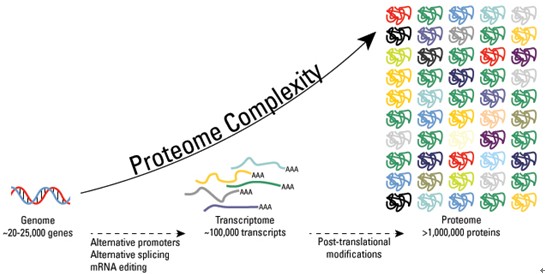
Researchers have identified more than 20,000 protein- coding genes.

However, scientific understanding of the proteome has

  • lagged behind that of the genome,
  • partly because of the proteome’s complexities.

The relationship between genes and proteins isn’t a simple matter of

  • one gene coding for one protein.

Stretches of DNA can be read and translated

  • into proteins in different ways.

Proteins are also more difficult to sequence than genes.

The importance of these latest studies to pathologists and Ph.D.s working

  • in molecular diagnostics laboratories is that
  • this information will expedite further research into the human proteome.

Such research is expected to lead to

  • novel methods of diagnosis and complex
  • “multi-analyte” clinical laboratory tests that
  • look for multiple proteins in a single assay.

“The prevalent view was that information transfer was from genome to transcriptome to proteome.
What these efforts show is that it’s a two-way road— proteomics can be used to annotate the genome.
The importance is that, using these datasets, we can improve the annotation of the genome and the
algorithms that predict transcription and translation,” said Steen. “The genomics field can now hugely
benefit from proteomics data.”

Wilhelm et al., “Mass-spectrometry- based draft of the human proteome,”
Nature,  http://dx.doi.doi:/10.1038/nature13319, 2014

M.S. Kim et al. “A draft map of the human proteome,”
Nature,  http://dx.doi.org:/10.1038/nature13302, 2014.

Tags

proteomicsnoncoding RNAhuman researchhuman proteome projecthuman genetics and genomics

http://www.the-scientist.com/?articles.view/articleNo/40083/title/Human-Proteome-Mapped/


__Patricia Kirk

__by Harrison Wein, Ph.D.

__by Anna Azvolinsky

Related Information:

Revealing The Human Proteome

Human Proteome Mapped

The human proteome – a scientific opportunity for transforming diagnostics, therapeutics, and healthcare

Reference: A draft map of the human proteome.
Kim MS, Pinto SM, Getnet D, Nirujogi RS, Manda SS, Donahue CA, Gowda H, Pandey A.
Nature. 2014 May 29;509(7502):575-81. http://dx.doi.org:/10.1038/nature13302. PMID: 24870542

Funding: NIH’s National Institute of General Medical Sciences (NIGMS), National Cancer Institute (NCI),
and National Heart, Lung, and Blood Institute (NHLBI); the Sol Goldman Pancreatic Cancer Research Center;
India’s Council of Scientific and Industrial Research; and Wellcome Trust/DBT India Alliance.

http://nihprod.cit.nih.gov/researchmatters/june2014/06092014proteome.htm


Read Full Post »

Metabolomic analysis of two leukemia cell lines. II.

Larry H. Bernstein, MD, FCAP, Reviewer and Curator

Leaders in Pharmaceutical Intelligence


In Part I of metabolomics of two leukemia cell lines, we have established a major premise for the study, an insight into the use of an experimental model, and some insight into questions raised.

I here return to examine these before pursuing more detail in the study.

Q1. What strong metabolic pathways come into focus in this study?

Answer – The aerobic and anaerobic glycolytic pathways, with a difference measured in the extent of participation of mitochondrial oxidative phosphorylation.

Q2. Would we expect to also gain insight into the effect, on balance, played by a suppressed ubiquitin pathway?

Answer – lets look into this in Part II.

Q3. Would the synthesis of phospholipid and the maintenance of membrane structures requires availability of NADPH, which would be a reversal of the TCA cycle at the cost of delta G in catabolic energy, be consistent with increased dependence of anaerobic glycolysis  with unchecked replication?

Answer: Part II might show this, as the direction and the difference between the cell lines is consistent with a Warburg (Pasteur) effect.

Recall the observation that the model is based on experimental results from  lymphocytic leukemia cell lines in cell culture.  The internal metabolic state is inferred from measurement of external metabolites.

The classification of the lymphocytic leukemias in humans is based on T-cell and B-cell lineages, but actually uses cell differentiation (CD) markers on the cytoskeleton for recognition.  It is only a conjecture that if the cells line were highly anaplastic, they might not be sustainable in cell culture in perpetuity.
The analogue of these cells to what I would expect to see in humans is the SLL having the characteristic marking: CD5, see http://www.pathologyoutlines.com/topic/lymphomaSLL.html

Micro description
=======================================================

● Effacement of nodal architecture by pale staining pseudofollicles or proliferation centers with ill-defined borders, containing small round mature lymphocytes, prolymphocytes (larger than small lymphocytes, abundant basophilic cytoplasm, prominent nucleoli), paraimmunoblasts (larger cells with distinct nucleoli) and many smudge cells
● Pseudofollicular centers are highlighted by decreasing light through the condenser at low power; cells have pale cytoplasm but resemble soccer balls or smudge cells on peripheral smear (cytoplasm is bubbly in mantle cell lymphoma); may have plasmacytoid features
● May have marginal zone, perifollicular or interfollicular patterns, but these cases also have proliferation centers (Mod Pathol 2000;13:1161)
● Interfollicular pattern: large, reactive germinal centers; resembles follicular lymphoma but germinal centers are bcl2 negative and tumor cells resemble SLL by morphology and immunostains
(Am J Clin Path 2000;114:41)
● Paraimmunoblastic variant: diffuse proliferation of paraimmunoblasts (normally just in pseudoproliferation centers); rare, <30 reported cases; usually multiple lymphadenopathies and rapid disease progression; case report in 69 year old man (Hum Pathol 2002;33:1145); consider as mantile cell lymphoma if t(11;14)(q13;q32) is present; may also represent CD5+ diffuse large B cell lymphoma
Bone marrow: small focal aggregates of variable size with irregular, poorly circumscribed outlines; lymphocytes are well differentiated, small, round with minimal atypia; may have foci of transformation; rarely has granulomas (J Clin Pathol 2005;58:815)
● Marrow infiltrative patterns are also described as diffuse (unmutated IgH genes, ZAP-70+, more aggressive), nodular (associated with IgH hypermutation, ZAP-70 negative) or mixed (variable mutation of IgH, variable ZAP-70, Hum Pathol 2006;37:1153)


Positive stains
=======================================================

● CD5, CD19, CD20 (dim), CD23, surface Ig light chain, surface IgM (dim)
● Also CD43, CD79a, CD79b (dim in 20%, Arch Pathol Lab Med 2003;127:561), bcl2
● Variable CD11c, FMC7 (42%)
Negative stains
=======================================================

● CD10, cyclin D1
Molecular
=======================================================

● Trisomy 12 (30%, associated with atypical CLL and CD79b), deletion 13q14 (25-50%),
deletion of 11q23 (worse prognosis, 10-20%)


Results

We set up a pipeline that could be used to

  • infer intracellular metabolic states from semi-quantitative data
  • regarding metabolites exchanged between cells and their environment.

Our pipeline combined the following four steps:

  1. data acquisition,
  2. data analysis,
  3. metabolic modeling and
  4.  experimental validation of
  • the model predictions (Fig. 1A).

We demonstrated the pipeline and the predictive potential

  • to predict metabolic alternations in diseases such as cancer
  • based on two lymphoblastic leukemia cell lines.

The resulting Molt-4 and CCRF-CEM condition-specific cell line models were able

  • to explain metabolite uptake and secretion
  •  by predicting the distinct utilization of central metabolic pathways by the two cell lines.

Whereas the CCRF-CEM model

  • resembled more a glycolytic, commonly referred to as ‘Warburg’ phenotype,
  • our predictions suggested  a more respiratory phenotype for the Molt-4  model.

We found these predictions to be in agreement with measured gene expression differences

  • at key regulatory steps in the central metabolic pathways, and
  • they were also consistent with  data regarding the energy and redox states of the cells.

After a brief discussion of the data generation and analysis steps, the results

  • derived from model generation and analysis will be described in detail.


2.1 Pipeline for generation of condition-specific metabolic cell line models

2.1.1 Generation of experimental data

We monitored the growth and viability of lymphoblastic leukemia cell lines in
serum- free medium (File S2, Fig. S1). Multiple omics  data sets  were derived  from these cells.

Extracellular metabolomics (exo-metabolomic) data,

  • comprising measurements of the metabolites in the spent medium of the cell cultures
    (Paglia et al. 2012a),
  • were collected along with transcriptomic data, and
  • these data sets were used to construct the models.


2.1.4 Condition-specific models for CCRF-CEM and Molt-4 cells

To determine whether we had obtained two distinct models,

  • we evaluated the reactions, metabolites, and genes of the two models.

Both the Molt-4 and CCRF-CEM models contained approximately

  • half of the reactions and metabolites present in the global model (Fig. 1C).

They were very similar to each other in terms of their

  • reactions,
  • metabolites, and
  • genes (File S1, Table S5A–C).

The Molt– 4 model contained

  • seven reactions that were not present in the CCRF-CEM model
    (Co-A biosynthesis pathway and exchange reactions).

In contrast, the CCRF-CEM  contained

31 unique reactions

  • arginine and proline metabolism,
  • vitamin B6  metabolism,
  • fatty acid activation,
  • transport, and exchange reaction.
  • There  were 2 and 15 unique metabolites in the Molt-4 and CCRF-CEM models,  respectively
    (File S1, Table S5B).
    Approximately three quarters of the global  model  genesremained in the condition-specific cell line models  (Fig. 1C).

The Molt-4 model contained

  • 15 unique genes, and

the CCRF-CEM model had

  • 4 unique genes (File S1, Table S5C).

Both models lacked NADH dehydrogenase
(complex I of the electron transport chain—ETC),

  •  determined by  the  absence of expression of a mandatory subunit
    (NDUFB3, Entrez gene ID 4709).

The ETC was fueled by FADH2 originating from

  1. succinate dehydrogenase and
  2. from fatty acid oxidation, which
  • through flavoprotein electron transfer
  • could contribute to the same ubiquinone pool as
  • complex I and complex II (succinate dehydrogenase).

Despite their different in vitro growth rates
(which differed by 11 %, see File S2, Fig. S1) and

  • differences in exo-metabolomic data (Fig. 1B) and
  • transcriptomic data,
  • the internal networks were largely conserved
  • in the two condition-specific cell line models.


2.1.5 Condition-specific cell line models predict distinct metabolic strategies

Despite the overall similarity of the metabolic models,

  • differences in their cellular uptake and secretion patterns suggested
  • distinct metabolic states in the two cell lines
    (Fig. 1B and see “Materials and methods” section for more detail).

To interrogate the metabolic differences, we sampled the solution space

  • of each model  using an Artificial Centering Hit-and-Run (ACHR) sampler (Thiele et al. 2005).

For this  analysis, additional constraints were applied, emphasizing

  • the  quantitative differences in commonly uptaken and secreted metabolites.

The  maximum possible uptake and maximum possible secretion flux rates were

  • reduced according to the measured relative differences between the cell lines
    (Fig. 1D, see “Materials and methods” section).

We plotted the number of sample points containing a particular flux rate for each reaction. The resulting

  • binned histograms can be understood as representing the probability that
  • a particular reaction can have a certain flux value.

A comparison of the sample points obtained for the Molt-4 and CCRF-CEM models revealed

  • a  considerable shift in the distributions, suggesting
  • a higher utilization of  glycolysis by the CCRF-CEM model (File S2, Fig. S2).

This result  was further  supported by differences

  • in medians calculated from sampling points (File S1,  Table S6).

The shift persisted throughout all reactions of the pathway and

  • was  induced by the higher glucose uptake (35 %) from
  • the extracellular medium in CCRF-CEM cells.

The sampling median for glucose uptake was 34 % higher

  • in the  CCRF-CEM model than in Molt-4 model (File S2, Fig. S2).

The usage of the  TCA cycle was also distinct in the two condition-specific cell-line models (Fig. 2).

  • the models used succinate dehydrogenase differently (Figs. 23).

The Molt-4 model utilized an associated reaction to generate FADH2, whereas

  • in  the CCRF-CEM model, the histogram was shifted in the opposite direction,
  • toward  the generation of succinate.

Additionally, there was a higher efflux of  citrate toward

  • amino acid and lipid metabolism in the CCRF-CEM model (Fig. 2).

There was higher flux through anaplerotic and cataplerotic reactions

  • in the CCRF-CEM model than in the Molt-4 model (Fig. 2);
  • these reactions include the efflux  of citrate through


  1. ATP-citrate lyase,
  2. uptake of glutamine,
  3. generation of  glutamate from glutamine,
  4. transamination of pyruvate and
  5.  glutamate to alanine  and to 2-oxoglutarate,
  6. secretion of nitrogen, and
  7. secretion of alanine.

The Molt-4 model showed higher utilization of oxidative phosphorylation (Fig. 3),

  • supported by elevated median flux through ATP synthase (36 %) and other  enzymes,
  • which contributed to higher oxidative metabolism.

The sampling  analysis therefore revealed different usage of

  • central metabolic pathways by the condition-specific models.


Fig. 2

Differences in the use of the TCA cycle by the CCRF-CEM

Differences in the use of the TCA cycle by the CCRF-CEM

Differences in the use of the TCA cycle by the CCRF-CEM model (red) and the Molt-4 model (blue).
The table provides the median values of the sampling results. Negative values in histograms and Table

  • describe reversible  reactions with flux in the reverse direction.

There are multiple reversible  reactions for the transformation of

  1. isocitrate and α-ketoglutarate,
  2. malate and  fumarate, and
  3. succinyl-CoA and succinate.

These reactions are  unbounded,  and therefore histograms are not shown.
The details of participating cofactors  have been removed.

Atp ATP, cit citrate, adp ADP, pi phosphate, oaa oxaloacetate, accoa acetyl-CoAcoa coenzyme-A,
icit isocitrate, αkg α-ketoglutarate, succcoa succinyl-CoAsucc succinate, fumfumarate, mal malate,
oxa oxaloacetate,  pyr pyruvate, lac lactate, ala alanine, gln glutamine, ETC electron transport  chain.


Electronic supplementary material The online version of this article
http://dx.doi.org:/10.1007/s11306-014-0721-3 
contains supplementary material,  which  is available to authorized users.

  1.  K. Aurich _ G. Paglia _ O ´ . Rolfsson _ S. Hrafnsdo´ ttir _
  2. Magnu´sdo´ ttir _ B. Ø. Palsson _ R. M. T. Fleming _ I. Thiele. Center for Systems Biology,
    University of Iceland, Reykjavik, Iceland
  3.  K. Aurich _ R. M. T. Fleming _ I. Thiele (&). Luxembourg Centre for Systems Biomedicine,
    University of Luxembourg, Campus Belval, Esch-Sur-Alzette, Luxembourg
    e-mail: ines.thiele@uni.lu
  4. M. Stefaniak. School of Health Science, Faculty of Food Science and Nutrition,
    University of Iceland, Reykjavik, Iceland
  5. Ø. Palsson. Department of Bioengineering, University of California San Diego, La Jolla, CA, USA

http://link.springer.com/static-content/images/404/art%253A10.1007%252
Fs11306-014-0721-3/MediaObjects/11306_2014_721_Fig3_HTML.gif


Fig. 3

Fatty acid oxidation and ETC _Fig3

Fatty acid oxidation and ETC _Fig3


Sampling reveals different utilization of oxidative phosphorylation by the

  • generated models.

Different distributions are observed for the CCRF-CEM model (red) and the Molt-4 model (blue).

  • Molt-4 has higher  median  flux through ETC reactions II–IV.

The table provides the median values  of the sampling results. Negative values in the histograms and in the table describe

  • reversible reactions with flux in the reverse direction.

Both models lack Complex I of the ETC because of constraints

  • arising from the mapping of transcriptomic data.

Electron transfer flavoprotein and

  • electron transfer flavoprotein–ubiquinone oxidoreductase
  •  both also carry higher flux in the Molt-4 model


2.1.6 Experimental validation of energy and redox status of CCRF-CEM and Molt-4 cells

Cancer cells have to balance their needs

  •  for energy and biosynthetic precursors, and they have
  • to maintain redox homeostasis to proliferate (Cairns et al. 2011).

We conducted enzymatic assays of cell lysates to measure levels and/or ratios of

  • ATP,
  • NADPH + NADP,
  • NADH + NAD, and
  • glutathione.

These measurements were used to provide support for

  • the in silico predicted metabolic differences (Fig. 4).

Additionally, an Oxygen Radical Absorbance Capacity (ORAC) assay was used

  • to evaluate the cellular antioxidant status (Fig. 4B).

Total concentrations of NADH + NAD, GSH + GSSG, NADPH + NADP and ATP, were higher in Molt-4 cells  (Fig. 4A).

The higher ATP concentration in Molt-4 cells could either result from

  • high production rates, or intracellular  accumulation connected to high or
  • low reactions fluxes (Fig. 4A).

Our simplified view that oxidative Molt-4 produces less ATP and was contradicted by

  • the higher ATP concentrations measured (Fig. 4L).

Yet we want to emphasize that concentrations

  • cannot be compared to flux values,
  • since we are modeling at steady-state.

NADH/NAD+ ratios for both cell lines were shifted toward NADH (Fig. 4D, E), but

  • the shift toward NADH was more pronounced in CCRF-CEM (Fig. 4E),
  • which matched  our expectation based on the higher utilization of
  • glycolysis and 2-oxoglutarate  dehydrogenase in the CCRF-CEM model (Fig. 4L).


Fig. 4 (not shown)

A–K  Experimentally determined ATP, NADH + NAD, NADPH + NADP, and GSH + GSSG concentrations, and ROS detoxification in the CCRF-CEM and Molt-4 cells.

L Expectations for cellular energy and redox states. Expectations are based on predicted metabolic differences of the Molt-4 and CCRF-CEM models

2.1.7 Comparison of network utilization and alteration in gene expression

With the assumption that

  • differential expression of particular genes would cause reaction flux changes,

we determined how the differences in gene expression (between CCRF-CEM and Molt-4)

  • compared to the flux differences observed in the  models.

Specifically, we checked whether the reactions associated with genes upregulated
(significantly more expressed in CCRF-CEM cells compared to Molt-4  cells)

  • were indeed more utilized by the CCRF-CEM model,

and we  checked  whether downregulated genes

  • were associated with reactions more utilized by the Molt-4 model.

The set of downregulated genes was associated with 15 reactions, and

  • the set of 49 upregulated genes was associated with 113 reactions in the models.

Reactions were defined as differently utilized

  • if the difference in flux exceeded 10 % (considering only non-loop reactions).

Of the reactions associated with upregulated genes,

  • 72.57 % were more utilized by the CCRF-CEM model, and
  • 2.65 % were more utilized by the Molt-4 model (File S1, Table S7).

In contrast, all 15 reactions associated with the 12 downregulated genes

  • were more utilized in the CCRF-CEM model (File S1, Table S8).

After this initial analysis, we approached the question from a different angle, asking

  • whether the majority of the reactions associated with each individual gene
  • upregulated in CCRF-CEM were more utilized by the CCRF-CEM model.
  •  this was the case for 77.55 % of the upregulated genes.

The majority of reactions associated with two (16.67 %) downregulated genes

  • were more utilized by the Molt-4 model.

Taken together, our comparisons of the

  • direction of gene expression with the fluxes of the two cancer cell-line models
  • confirmed that reactions associated with upregulated genes in the CCRF-CEM
    cells were generally more utilized by the CCRF-CEM model.

2.1.8 Accumulation of DEGs and AS genes at key metabolic steps

After we confirmed that most reactions associated with upregulated genes

  • were more utilized by the CCRF-CEM model,

we checked the locations of DEGs within the network. In this analysis, we paid special attention to

  • the central metabolic pathways that we had found
  • to be distinctively utilized by the two models.

Several DEGs and AS events were associated with

  • glycolysis,
  • the ETC,
  • pyruvate metabolism, and
  • the PPP (Table 1).


Table 1

DEGs and AS events of central metabolic and cancer-related pathways

Full lists of DEGs and AS are provided in the supplementary material.

Upregulated significantly more expressed in CCRF-CEM compared to Molt-4 cells

PPP pentose phosphate pathway, OxPhos oxidative phosphorylation, Glycolysis/gluconglycolysis/gluconeogenesis, Pyruvate met. pyruvate metabolism

Moreover, in glycolysis, the DEGs and/or AS genes

  • were associated with all three rate-limiting steps, i.e., the steps mediated by
  1. hexokinase,
  2. pyruvate kinase, and
  3. phosphofructokinase.

Of these key enzymes,

  • hexokinase 1 (Entrez Gene ID: 3098) was alternatively spliced,
  • pyruvate kinase (PKM, Entrez gene ID: 5315) was significantly more
    expressed in the CCRF-CEM cells (Table 1),

in agreement with the higher in silico predicted flux.

However, in contrast to the observed

  • higher utilization of glycolysis in the CCRF-CEM model,
  • the gene associated with the rate-limiting glycolysis step, phosphofructokinase (Entrez Gene ID: 5213),
  • was significantly upregulated in Molt-4 cells relative to CCRF-CEM cells.

This higher expression was detected for only a single isozyme, however. Two of
the three genes associated with phosphofructokinase were also subject to
alternative splicing (Table 1). In addition to the key enzymes, fructose
bisphosphate aldolase (Entrez Gene ID: 230) was also significantly

  • upregulated in Molt-4 cells relative to CCRF-CEM cells,
  • in contrast to the predicted higher utilization of glycolysis in the CCRF-CEM model.

Additionally, glucose-6P-dehydrogenase (G6PD), which catalyzes

  • the first reaction and committed step of the PPP,
  • was an AS gene (Table 1).

A second AS gene associated with

  •  the PPP reaction of the deoxyribokinase
  • was RBKS (Entrez Gene ID: 64080).

This gene is also associated with ribokinase, but ribokinase was removed

  • because of the lack of ribose uptake or secretion.

Single AS genes were associated with different complexes of the ETC (Table 1).

Literature query revealed that at least 13 genes associated with alternative

  • splicing events were mentioned previously in connection with both alternative
    splicing and cancer (File S1, Table S14), and
  • 37 genes were associated with cancer, e.g., upregulated, downregulated at the
    level of mRNA or protein, or otherwise
  • connected to cancer metabolism and signaling.

One general observation was that there was a surprising

  • accumulation of metabolite transporters among the AS.

Overall, the high incidence of

  • differential gene expression events at metabolic control points
  • increases the plausibility of the in silico predictions.


2.1.9 Single gene deletion

Analyses of essential genes in metabolic models have been used

  • to predict candidate drug targets for cancer cells (Folger et al. 2011).

Here, we conducted an in silico gene deletion study for all model genes to identify

  • a unique set of knock-out (KO) genes
  • for each condition-specific cell line model.

The analysis yielded 63 shared lethal KO genes and

  • distinct sets of KO genes for the CCRF-CEM model (11 genes) and the Molt-4 model (3 genes).

For three of the unique CCRF-CEM KO genes,

  • the genes were only present in the CCRF-CEM model (File S1, Table S9).


The essential genes for both models were then

  • related to the cell-line-specific differences in metabolite uptake and secretion (Fig. 1B).

The CCRF-CEM model

  1. needed to generate putrescine from ornithine
    (ORNDC, Entrez Gene ID: 4953)
  2. to subsequently produce 5-methylthioadenosine for secretion (Fig. 1B).
  3. S-adenosylmethioninamine produced by adenosylmethionine decarboxylase
    (arginine and proline metabolism, associated with Entrez Gene ID: 262)
  • is a substrate required for generation of 5-methylthioadenosine.

Another example of a KO gene connected to an enforced exchange reaction was

  • glutamic-oxaloacetic transaminase 1 (GOT1, Entrez Gene ID: 2805).

Without GOT1, the CCRF-CEM model was forced to secrete

  • 4-hydroxyphenylpyruvate (Fig. 1B),
  • the second product of tyrosine transaminase,
  • which is produced only by that enzyme.


One KO gene in the Molt-4 model (Entrez Gene ID: 26227) was associated with

  • phosphoglycerate dehydrogenase (PGDH),
  • which catalyzes the conversion of 3-phospho-d-glycerate to 3-phosphohydroxypyruvate
  • while generating NADH from NAD+.

This KO gene is particularly interesting, given

  • the involvement of this reaction in a novel pathway for ATP generation in rapidly proliferating cells
    (Locasale et al. 2011; Vander Heiden 2011; Vazquez et al. 2011).

Reactions associated with unique KO genes were in many cases utilized more by the model, in which

  • the gene KO was lethal,
  • underlining the potential importance of these reactions for the models.

Thus, single gene deletion provided unique sets of lethal genes that could be

  • specifically targeted to kill these cells.


3 Discussion

In the current study, we explored the possibility of

  • semi-quantitatively integrating metabolomic data with
  • the human genome-scale reconstruction to facilitate analysis.

By constructing condition-specific cell line models

  • to provide a structured framework,
  • we derived insights that could not have been obtained from data analysis alone.

We derived condition-specific cell line models

  • for CCRF-CEM and
  • Molt-4 cells

that were able to explain the observed exo-metabolomic differences (Fig. 1B).

Despite the overall similarities between the models, the analysis revealed

  • distinct usage of central metabolic pathways (Figs. 234),
  • which we validated based on experimental data and
  • differential gene expression.

The additional data sufficiently supported

  • metabolic differences in the cell lines,
  • providing confidence in the generated models and the model-based predictions.

We used the validated models

  • to predict unique sets of lethal genes
  • to identify weak links in each model.

These weak links may represent potential drug targets.

Integrating omics data with the human genome-scale reconstruction

  • provides a structured framework (i.e., pathways)
  • that is based on careful consideration of the available biochemical literature
    (Thiele and Palsson2010).

This network context can simplify omics data analysis, and

  • it allows even non-biochemical experts
  • to gain fast and comprehensive insights
  • into the metabolic aspects of omics data sets.

Compared to transcriptomic data,

  • methods for the integration and analysis of metabolomic data
  • in the context of metabolic models are less well established,

although it is an active field of research (Li et al. 2013; Paglia et al. 2012b).
In contrast to other studies, our approach emphasizes

  • the representation of experimental conditions rather than
  • the reconstruction of a generic, cell-line-specific network,
  • which would require the combination of data sets from
  • many experimental conditions and extensive manual curation.

Rather, our way of model construction allowed us to efficiently

  • assess the metabolic characteristics of cells.

Despite the fact, that only a limited number of exchanged metabolites can be

  • measured by available metabolomics platforms and
  • at reasonable time-scale,

and that pathways of measured metabolites might still be unknown to date
(File S1, Tables S2–S3), our methods have the potential

  • to reveal metabolic characteristics of cells
  • which could be useful for biomedicine and personalized health.

The reasons why some cancers respond to certain treatments and not others
remain unclear, and choosing a treatment for a specific patient is often difficult
(Vander Heiden 2011). One potential application of our approach could be the
characterization of cancer phenotypes to explore how cancer cells or other cell
types

  • with particular metabolic characteristics respond to drugs.

The generation of our condition-specific cell line models involved

  • only limited manual curation,
  • making this approach a fast way to place metabolomic data
  • into a network context.

Model building mainly involves

  • the rigid reduction of metabolite exchanges
  • to match the observed metabolite exchange pattern
  • with as few additional metabolite exchanges as possible.

It should be noted that this reduction determines,

  • which pathways can be utilized by the model.

Our approach mostly conserved the internal network redundancy. However, a

  • more significant reduction may be achieved using different data.

Generally, a trade-off exists between the reduction of the internal network and

  • the increasing number of network gaps that need to be curated
  • by using additional omics data, such as transcriptomics and proteomics.

One way to prevent the emergence of network gaps would be

  • to use mapping algorithms that conserve network functionality,
    such as GIMME (Becker and Palsson 2008).

However, several additional methods exist for the integration of
transcriptomic data (Blazier and Papin 2012), and

  • which model-building method is best depends on the available data.

Interestingly, the lack of a significant contribution of our

  • gene expression data to the reduction of network size
  • suggests that the use of transcriptomic data is not necessary
  • to identify distinct metabolic strategies;
  • rather, the integration of exo-metabolomic data alone
    may provide sufficient insight.

However, sampling of the cell line models constrained

  • according to the exo-metabolomic profiles only, or
  • increasing the cutoff for the generation of absent and present calls (p < 0.01),
  • did not yield the same insights as presented herein (File S1, Table S18).

Only recently Gene Inactivation Moderated by Metabolism, Metabolomics and
Expression (GIM(3)E) became available, which

  • enforces minimum turnover of detected metabolites
  • based on intracellular metabolomics data as well as
  • gene expression microarray data (Schmidt et al. 2013).

In contrast to this approach, we emphasized our analysis on the

  • relative differences in the exo-metabolomic data of two cell lines.

GIM(3)E constitutes another integration method when the analysis should be

  • emphasized on intracellular metabolomics data (Schmidt et al. 2013).

The metabolic differences predicted by the models are generally plausible.
Cancers are known to be heterogeneous (Cairns et al. 2011), and

  • the contribution of oxidative phosphorylation to cellular ATP production
    may vary (Zu and Guppy 2004).

Moreover, leukemia cell lines have been shown

  • to depend on glucose, glutamine, and fatty acids to varying extents
  • to support proliferation.

Such dependence may cause the cells to adapt their metabolism

  • to the environmental conditions (Suganuma et al. 2010).

In addition to identifying supporting data in the literature, we performed

  • several analyses to validate the models and model predictions.

Our expectations regarding the levels and ratios of metabolites

  • relevant to energy and redox state were largely met (Fig. 4L).

The more pronounced shift of the NADH/NAD+ ratio

  • toward NADH in the CCRF-CEM cells
  • was in agreement with the predicted Warburg phenotype (Fig. 4),
  • and the higher lactate secretion in the CCRF-CEM cells (File S2, Fig. S2)
  • implies an increase in NADH relative to NAD+
    (Chiarugi et al. 2012; Nikiforov et al. 2011), again
  • matching the known Warburg phenotype.

ROS production is enhanced in certain types of cancer (Droge 2002; Ha et al. 2000), and

  • the generation of ROS is thought to contribute to
  1. mutagenesis,
  2. tumor promotion, and
  3. tumor progression (Dreher and Junod1996; Ha et al. 2000).

However, decreased mitochondrial glucose oxidation and

  • a transition to aerobic glycolysis
  • protect cells against ROS damage during biosynthesis and cell division
    (Brand and Hermfisse1997).

The higher ROS detoxification capability in Molt-4 cells, in combination with

  • higher spermidine dismutase utilization by the Molt-4 model (Fig. 4),
  • provided a consistent picture of the predicted respiratory phenotype (Fig. 4L).

Control of NADPH maintains the redox potential through GSH and

  • protects against oxidative stress, yet
  • changes in the NADPH ratio in response to oxidative damage
  • are not well understood (Ogasawara et al.2009).

Under stress conditions, as assumed for Molt-4 cells,

  • the NADPH/NADP+ ratio is expected to decrease because of
  • the continuous reduction of GSSG (Fig. 4L), and
  • this was confirmed in the Molt-4 cells (Fig. 4).

The higher amounts of GSH found in Molt-4 cells in vitro may demonstrate

  • an additional need for ROS scavengers because of
  • a greater reliance on oxidative metabolism.

Cancer is related to metabolic reprogramming, which results from

  • alterations of gene expression and
  • the expression of specific isoforms or
  • splice forms to support proliferation
    (Cortes-Cros et al. 2013; Marin-Hernandez et al. 2009).

The gene expression differences detected between the two cell lines in this study
supported the existence of

  • metabolic differences in these cell lines, particularly because
  • key steps of the metabolic pathways central to cancer metabolism
  • seemed to be differentially regulated (Table 1).

The detailed analysis of the respective

  • differences on the pathway fluxes exceeds the scope of this study, which was to
  • demonstrate the potential of the integration of exo-metabolomic data into the network context.

We found discrepancies between differential gene regulation and

  • the flux differences between the two models as well as
  • the utilization AS gene-associated reaction.

This is not surprising, since analysis of the detailed system is required

  • to make any further assumptions on the impact that
  • the differential regulation or splicing might have on the reaction flux,
  • given that for many of the concerned enzymes isozymes exist, or
  • only one of multiple subunits of a protein complex was concerned.

Additionally, reaction fluxes are regulated by numerous post-translational factors, e.g.,

  • protein modification,
  • inhibition through proteins or metabolites,
  • alter reaction fluxes (Lenzen 2014),

which are out of the scope of constraint-based steady-state modeling.

Rather, the results of the presented  approach

  • demonstrate how the models can be used to generate
  • informed hypothesis that can guide experimental work.

The combination of our tailored metabolic models and

  • differential gene expression analysis seems well-suited
  • to determine the potential drivers
  • involved in metabolic differences between cells.

Such information could be valuable for drug discovery, especially when more

  • peripheral metabolic pathways are considered.

Statistical comparisons of gene expression data with sampling-derived flux data

  • could be useful in future studies (Mardinoglu et al. 2013).

A single-gene-deletion analysis revealed that PGDH was

  • a lethal KO gene for the Molt-4 model only.

Differences in PGDH protein levels

  • correspond to the amount of glycolytic carbon
  • diverted into glycine biosynthesis.

Rapidly proliferating cells may use an

  • alternative glycolytic pathway for ATP generation,
  • which may provide an advantage in the case of
  • extensive oxidative phosphorylation and proliferation
    (Locasale et al.2011; Vander Heiden 2011; Vazquez et al. 2011).

For breast cancer cell lines, variable dependency on

  • the expression of PGDH has already been demonstrated
    (Locasale et al. 2011).

This example of a unique KO gene demonstrates how

  • in silico gene deletion in metabolomics-driven models
  • can identify the metabolic pathways used by cancer cells.

This approach can provide valuable information for drug discovery.

In conclusion, our contextualization method produced

  • metabolic models that agreed in many ways with the validation data sets.

The analyses described in this study have great potential to reveal

  • the mechanisms of metabolic reprogramming,
  • not only in cancer cells but also in other cells affected by diseases, and
  • for drug discovery in general.


4.3 Analysis of the extracellular metabolome

Mass spectrometry analysis of the exo-metabolome was performed by
Metabolon®, Inc. (Durham, NC, USA) using a standardized analytical platform.
In total, 75 extracellular metabolites were detected in the initial data set for at
least 1 of the 2 cell lines (Paglia et al. 2012a). Of these metabolites, 15 were not
part of our global model and were discarded. Apart from being absent in our
global model, an independent search in HMDB (Wishart et al. 2013) revealed no
pathway information was available for most of these metabolites (File S1, Tables S2–S3).
It should be noted that metabolites e.g.,

  • N-acetylisoleucine,
  • N-acetyl-methionine or pseudouridine,

constitute protein and RNA degradation products, which were out of the scope
of the metabolic network.

Thiamin (Vitamin B1) was part of the minimal medium of essential compounds
supplied to both models.Riboflavin (Vitamin B2) and Trehalose were excluded
since these compounds cannot be produced by human cells. Erythrose and
fructose were also excluded. In contrast 46 metabolites that were part of the
global model. The data set included two different time points, which allowed us
to treat the increase/decrease of a metabolite signal between time points as

  • evidence for uptake or secretion when the change was greater than 5 %
    from what was observed in the control (File S1, Tables S2–S3).

We found 12 metabolites that were taken up by both cell lines and
10 metabolites that were commonly secreted by both cell lines over
the course of the experiment.

Molt-4 cells took up three metabolites not taken up by CCRF-CEM cells, and
secreted one metabolite not secreted by CCRF-CEM cells. Two of the three
uniquely uptaken metabolites were essential amino acids:

  1. valine and
  2. methionine.

It is unlikely that these metabolites were not taken up by the CCRF-CEM cells,
and the CCRF-CEM model was allowed to take up this metabolite. Therefore,
no quantitative constraints were applied for the sampling analysis either.
CCRF-CEM cells had

  • four unique uptaken
  • and seven unique secreted metabolites
    (exchange not detected in Molt-4 cells).


4.4 Network refinement based on exo-metabolic data

Despite its comprehensiveness, the human metabolic reconstruction is

  • not complete with respect to extracellular metabolite transporters
    (Sahoo et al. 2014; Thiele et al. 2013).

Accordingly, we identified metabolite transport systems

  • from the literature for metabolites that were already part of the global model,
  • but whose extracellular transport was not yet accounted for.

Diffusion reactions were included whenever a respective transporter could not be identified.

In total, 34 reactions [11 exchange reactions, 16 transport reactions and 7 demand reactions
(File S1, Table S11)] were added to Recon 2 (Thiele et al. 2013), and 2 additional reactions
were added to the global model (File S1, Table S10).

4.5 Expression profiling

Molt-4 and CCRF-CEM cells were grown in advanced RPMI 1640 and 2 mM
GlutaMax, and the cells were resuspended in medium containing DMSO
(0.67 %) at a concentration of 5 × 105 cells/mL. The cell suspension (2 mL)
was seeded in 12-well plates in triplicate. After 48 h of growth, the cells
were collected by centrifugation at 201×g for 5 min. Cell pellets were snap-frozen
in liquid N2 and kept frozen until RNA extraction and analysis by Aros
(Aarhus, Denmark).

4.6 Analysis of transcriptomic data

We used the Affymetrix GeneChip Human Exon 1.0 ST Array to measure whole
genome exon expression. We generated detection above background (DABG) calls
using ROOT (version 22) and the XPS package for R (version 11.1), with Robust
Multi-array Analysis summarization. Calls for data mapping were assigned based
on p < 0.05 as the cutoff probability to distinguish presence versus absence for
the 1,278 model genes (File S1, Table S12).

Differential gene expression and alternative splicing analyses were performed by
using AltAnalyse software (v2.02beta) with default options on the raw data files
(CEL files). The Homo sapiens Ensemble 65 database was used, probe set filtering
was kept as DABG p < 0.05, and non-log expression < 70 was used for
constitutive probe sets to determine gene expression levels. For the comparison,
CCRF-CEM was the experimental group and Molt-4 was the baseline group. The
set of DEGs between cell lines was identified based on a p < 0.05 FDR cutoff
(File S1, Table S13A–B). Alternative splicing analysis was performed on core probe sets
with a minimum alternative exon score of 2 and a maximum absolute gene
expression change of 3 because alternative splicing is a less critical factor among
highly DEGs (File S1, Table S14). Gene expression data, complete lists of DABG p-values,
DEGs and alternative splicing events have been deposited in the Gene
Expression Omnibus
 (GEO) database (Accession number: GSE53123).


4.7 Deriving cell-type-specific subnetworks

Transcriptomic data were mapped to the model in a manual fashion (COBRA
function: deleteModelGenes). Specifically, reactions dependent on gene products
that were called as “absent” were constrained to zero, such that fluxes through
these reactions were disabled. Submodels were extracted based on the set of
reactions carrying flux (network pruning) by running fastFVA
(Gudmundsson and Thiele 2010) after mapping the metabolomic and
transcriptomic data using the COBRA toolbox (Schellenberger et al. 2011).


…..


Electronic supplementary material

Below is the link to the electronic supplementary material.

File S1. Supplementary material 1 (XLSX 915 kb)

File S2. Supplementary material 2 (DOCX 448 kb)

References

Antonucci, R., Pilloni, M. D., Atzori, L., & Fanos, V. (2012). Pharmaceutical research and metabolomics in the newborn. Journal of Maternal-Fetal and Neonatal Medicine, 25, 22–26.PubMedCrossRef

Barrett, T., Troup, D. B., Wilhite, S. E., Ledoux, P., Evangelista, C., Kim, I. F., et al. (2011). NCBI GEO: archive for functional genomics data sets—10 years on. Nucleic Acids Research, 39, D1005–D1010.PubMedCentralPubMedCrossRef

Beck, M., Schmidt, A., Malmstroem, J., Claassen, M., Ori, A., Szymborska, A., et al. (2011). The quantitative proteome of a human cell line.Molecular Systems Biology, 7, 549.PubMedCentralPubMedCrossRef

Becker, S. A., & Palsson, B. O. (2008). Context-specific metabolic networks are consistent with experiments. PLoS Computational Biology, 4, e1000082.PubMedCentralPubMedCrossRef

Blazier, A. S., & Papin, J. A. (2012). Integration of expression data in genome-scale metabolic network reconstructions. Frontiers in Physiology, 3, 299.PubMedCentralPubMedCrossRef

Bordbar, A., Lewis, N. E., Schellenberger, J., Palsson, B. O., & Jamshidi, N. (2010). Insight into human alveolar macrophage and M. tuberculosisinteractions via metabolic reconstructions. Molecular Systems Biology, 6, 422.PubMedCentralPubMedCrossRef

Bordbar, A., & Palsson, B. O. (2012). Using the reconstructed genome-scale human metabolic network to study physiology and pathology. Journal of Internal Medicine, 271, 131–141.PubMedCentralPubMedCrossRef

Brand, K. A., & Hermfisse, U. (1997). Aerobic glycolysis by proliferating cells: a protective strategy against reactive oxygen species. FASEB Journal, 11, 388–395.PubMed

Cairns, R. A., Harris, I. S., & Mak, T. W. (2011). Regulation of cancer cell metabolism. Nature Reviews Cancer, 11, 85–95.PubMedCrossRef

Chance, B., Sies, H., & Boveris, A. (1979). Hydroperoxide metabolism in mammalian organs. Physiological Reviews, 59, 527–605.PubMed

Chapman, E. H., Kurec, A. S., & Davey, F. R. (1981). Cell volumes of normal and malignant mononuclear cells. Journal of Clinical Pathology, 34, 1083–1090.PubMedCentralPubMedCrossRef

Chiarugi, A., Dolle, C., Felici, R., & Ziegler, M. (2012). The NAD metabolome—a key determinant of cancer cell biology. Nature Reviews Cancer, 12, 741–752.PubMedCrossRef

Cortes-Cros, M., Hemmerlin, C., Ferretti, S., Zhang, J., Gounarides, J. S., Yin, H., et al. (2013). M2 isoform of pyruvate kinase is dispensable for tumor maintenance and growth. Proceedings of the National Academy of Sciences of the United States of America, 110, 489–494.PubMedCentralPubMedCrossRef

Dreher, D., & Junod, A. F. (1996). Role of oxygen free radicals in cancer development. European Journal of Cancer, 32a, 30–38.PubMedCrossRef

Droge, W. (2002). Free radicals in the physiological control of cell function. Physiological Reviews, 82, 47–95.PubMed

Duarte, N. C., Becker, S. A., Jamshidi, N., Thiele, I., Mo, M. L., Vo, T. D., et al. (2007). Global reconstruction of the human metabolic network based on genomic and bibliomic data. Proceedings of the National Academy of Sciences of the United States of America, 104, 1777–1782.PubMedCentralPubMedCrossRef

Durot, M., Bourguignon, P. Y., & Schachter, V. (2009). Genome-scale models of bacterial metabolism: Reconstruction and applications. FEMS Microbiology Reviews, 33, 164–190.PubMedCentralPubMedCrossRef

Fleming, R. M., Thiele, I., & Nasheuer, H. P. (2009). Quantitative assignment of reaction directionality in constraint-based models of metabolism: Application to Escherichia coliBiophysical Chemistry, 145, 47–56.PubMedCentralPubMedCrossRef

Folger, O., Jerby, L., Frezza, C., Gottlieb, E., Ruppin, E., & Shlomi, T. (2011). Predicting selective drug targets in cancer through metabolic networks. Molecular Systems Biology, 7, 501.PubMedCentralPubMedCrossRef

Frezza, C., Zheng, L., Folger, O., Rajagopalan, K. N., MacKenzie, E. D., Jerby, L., et al. (2011). Haem oxygenase is synthetically lethal with the tumour suppressor fumarate hydratase. Nature, 477, 225–228.PubMedCrossRef

Ganske, F., & Dell, E. J. (2006). ORAC assay on the FLUOstar OPTIMA to determine antioxidant capacity. BMG LABTECH.

Gudmundsson, S., & Thiele, I. (2010). Computationally efficient flux variability analysis. BMC Bioinformatics, 11, 489.PubMedCentralPubMedCrossRef

Ha, H. C., Thiagalingam, A., Nelkin, B. D., & Casero, R. A, Jr. (2000). Reactive oxygen species are critical for the growth and differentiation of medullary thyroid carcinoma cells. Clinical Cancer Research, 6, 3783–3787.PubMed

Hyduke, D. R., Lewis, N. E., & Palsson, B. O. (2013). Analysis of omics data with genome-scale models of metabolism. Molecular BioSystems, 9, 167–174.PubMedCentralPubMedCrossRef

Jerby, L., & Ruppin, E. (2012). Predicting drug targets and biomarkers of cancer via genome-scale metabolic modeling. Clinical Cancer Research,18, 5572–5584.PubMedCrossRef

Jerby, L., Shlomi, T., & Ruppin, E. (2010). Computational reconstruction of tissue-specific metabolic models: Application to human liver metabolism.Molecular Systems Biology, 6, 401.PubMedCentralPubMedCrossRef

Jerby, L., Wolf, L., Denkert, C., Stein, G. Y., Hilvo, M., Oresic, M., et al. (2012). Metabolic associations of reduced proliferation and oxidative stress in advanced breast cancer. Cancer Research, 72, 5712–5720.PubMedCrossRef

Lenzen, S. (2014). A fresh view of glycolysis and glucokinase regulation: History and current status. Journal of Biological Chemistry, 289, 12189–12194.PubMedCrossRef

Lewis, N. E., Nagarajan, H., & Palsson, B. O. (2012). Constraining the metabolic genotype–phenotype relationship using a phylogeny of in silico methods. Nature Reviews Microbiology, 10, 291–305.PubMedCentralPubMed

Lewis, N. E., Schramm, G., Bordbar, A., Schellenberger, J., Andersen, M. P., Cheng, J. K., et al. (2010). Large-scale in silico modeling of metabolic interactions between cell types in the human brain. Nature Biotechnology, 28, 1279–1285.PubMedCentralPubMedCrossRef

Li, S., Park, Y., Duraisingham, S., Strobel, F. H., Khan, N., Soltow, Q. A., et al. (2013). Predicting network activity from high throughput metabolomics. PLoS Computational Biology, 9, e1003123.PubMedCentralPubMedCrossRef

Locasale, J. W., Grassian, A. R., Melman, T., Lyssiotis, C. A., Mattaini, K. R., Bass, A. J., et al. (2011). Phosphoglycerate dehydrogenase diverts glycolytic flux and contributes to oncogenesis. Nature Genetics, 43, 869–874.PubMedCentralPubMedCrossRef

Mardinoglu, A., Agren, R., Kampf, C., Asplund, A., Nookaew, I., Jacobson, P., et al. (2013). Integration of clinical data with a genome-scale metabolic model of the human adipocyte. Molecular Systems Biology, 9, 649.PubMedCentralPubMedCrossRef

Marin-Hernandez, A., Gallardo-Perez, J. C., Ralph, S. J., Rodriguez-Enriquez, S., & Moreno-Sanchez, R. (2009). HIF-1alpha modulates energy metabolism in cancer cells by inducing over-expression of specific glycolytic isoforms. Mini Reviews in Medicinal Chemistry, 9, 1084–1101.PubMedCrossRef

Mir, M., Wang, Z., Shen, Z., Bednarz, M., Bashir, R., Golding, I., et al. (2011). Optical measurement of cycle-dependent cell growth. Proceedings of the National Academy of Sciences of the United States of America, 108, 13124–13129.PubMedCentralPubMedCrossRef

Mo, M. L., Palsson, B. O., & Herrgard, M. J. (2009). Connecting extracellular metabolomic measurements to intracellular flux states in yeast. BMC Systems Biology, 3, 37.PubMedCentralPubMedCrossRef

Nikiforov, A., Dolle, C., Niere, M., & Ziegler, M. (2011). Pathways and subcellular compartmentation of NAD biosynthesis in human cells: From entry of extracellular precursors to mitochondrial NAD generation. The Journal of biological chemistry, 286, 21767–21778.PubMedCentralPubMedCrossRef

Ogasawara, Y., Funakoshi, M., & Ishii, K. (2009). Determination of reduced nicotinamide adenine dinucleotide phosphate concentration using high-performance liquid chromatography with fluorescence detection: Ratio of the reduced form as a biomarker of oxidative stress. Biological & Pharmaceutical Bulletin, 32, 1819–1823.CrossRef

Paglia, G., Hrafnsdottir, S., Magnusdottir, M., Fleming, R. M., Thorlacius, S., Palsson, B. O., et al. (2012a). Monitoring metabolites consumption and secretion in cultured cells using ultra-performance liquid chromatography quadrupole-time of flight mass spectrometry (UPLC-Q-ToF-MS).Analytical and Bioanalytical Chemistry, 402, 1183–1198.PubMedCrossRef

Paglia, G., Palsson, B. O., & Sigurjonsson, O. E. (2012b). Systems biology of stored blood cells: Can it help to extend the expiration date? Journal of Proteomics, 76, 163–167.PubMedCrossRef

Price, N. D., Schellenberger, J., & Palsson, B. O. (2004). Uniform sampling of steady-state flux spaces: Means to design experiments and to interpret enzymopathies. Biophysical Journal, 87, 2172–2186.PubMedCentralPubMedCrossRef

Reed, J. L., Famili, I., Thiele, I., & Palsson, B. O. (2006). Towards multidimensional genome annotation. Nature Reviews Genetics, 7, 130–141.PubMedCrossRef

Sahoo, S., Aurich, M. K., Jonsson, J. J., & Thiele, I. (2014). Membrane transporters in a human genome-scale metabolic knowledgebase and their implications for disease. Frontiers in Physiology, 5, 91.PubMedCentralPubMedCrossRef

Sahoo, S., & Thiele, I. (2013). Predicting the impact of diet and enzymopathies on human small intestinal epithelial cells. Human Molecular Genetics, 22, 2705–2722.PubMedCentralPubMedCrossRef

Schellenberger, J., & Palsson, B. O. (2009). Use of randomized sampling for analysis of metabolic networks. The Journal of biological chemistry,284, 5457–5461.PubMedCrossRef

Schellenberger, J., Que, R., Fleming, R. M., Thiele, I., Orth, J. D., Feist, A. M., et al. (2011). Quantitative prediction of cellular metabolism with constraint-based models: The COBRA Toolbox v2.0. Nature Protocols, 6, 1290–1307.PubMedCentralPubMedCrossRef

Schmidt, B. J., Ebrahim, A., Metz, T. O., Adkins, J. N., Palsson, B. O., & Hyduke, D. R. (2013). GIM3E: Condition-specific models of cellular metabolism developed from metabolomics and expression data. Bioinformatics (Oxford, England), 29, 2900–2908.CrossRef

Suganuma, K., Miwa, H., Imai, N., Shikami, M., Gotou, M., Goto, M., et al. (2010). Energy metabolism of leukemia cells: Glycolysis versus oxidative phosphorylation. Leukemia & Lymphoma, 51, 2112–2119.CrossRef

Thiele, I., & Palsson, B. O. (2010). A protocol for generating a high-quality genome-scale metabolic reconstruction. Nature Protocols, 5, 93–121.PubMedCentralPubMedCrossRef

Thiele, I., Price, N. D., Vo, T. D., & Palsson, B. O. (2005). Candidate metabolic network states in human mitochondria. Impact of diabetes, ischemia, and diet. The Journal of biological chemistry, 280, 11683–11695.PubMedCrossRef

Thiele, I., Swainston, N., Fleming, R. M., Hoppe, A., Sahoo, S., Aurich, M. K., et al. (2013). A community-driven global reconstruction of human metabolism. Nature Biotechnology, 31, 419–425.PubMedCrossRef

Uhlen, M., Oksvold, P., Fagerberg, L., Lundberg, E., Jonasson, K., Forsberg, M., et al. (2010). Towards a knowledge-based human protein Atlas.Nature Biotechnology, 28, 1248–1250.PubMedCrossRef

Vander Heiden, M. G. (2011). Targeting cancer metabolism: A therapeutic window opens. Nature Reviews Drug Discovery, 10, 671–684.PubMedCrossRef

Vazquez, A., Markert, E. K., & Oltvai, Z. N. (2011). Serine biosynthesis with one carbon catabolism and the glycine cleavage system represents a novel pathway for ATP generation. PLoS ONE, 6, e25881.PubMedCentralPubMedCrossRef

Wishart, D. S., Jewison, T., Guo, A. C., Wilson, M., Knox, C., Liu, Y., et al. (2013). HMDB 3.0—The human metabolome database in 2013. Nucleic Acids Research, 41, D801–D807.PubMedCentralPubMedCrossRef

Zu, X. L., & Guppy, M. (2004). Cancer metabolism: Facts, fantasy, and fiction. Biochemical and Biophysical Research Communications, 313, 459–465.PubMedCrossRef


Read Full Post »

Overview of Posttranslational Modification (PTM)

Curator:  Larry H. Bernstein, MD, FCAP

UPDATED on 4/1/2022

Cited in

https://www.beckman.com/resources/sample-type/bio-molecules/post-translational-modification


This is the second discussion of a several part series leading from the genome, to protein synthesis (1), posttranslational modification of proteins (2), examples of protein effects on metabolism and signaling pathways (3), and leading to disruption of signaling pathways in disease (4), and effects leading to mutagenesis.

1.  A Primer on DNAand DNA Replication

2. Overview of translational medicine

3. Genes, proteomes, and their interaction

4. Regulation of somatic stem cell Function

5.  Proteomics – The Pathway to Understanding and Decision-making in Medicine

6.  Genomics, Proteomics and standards

7.  Long Non-coding RNAs Can Encode Proteins After All

8.  Proteins and cellular adaptation to stress

9.  Loss of normal growth regulation


Posttranslational modification is a step in protein biosynthesis. Proteins are created by ribosomes translating mRNA into polypeptide chains. These polypeptide chains undergo
PTM before becoming the mature protein product.

Protein phosphorylation is one type of post-translational modification. Wikipedia

Explore: Phosphorylation

Glycosylation is a form of co-translational and post-translational modification. Wikipedia

Explore: Glycosylation

Acetylation occurs as a co-translational and post-translational modification of proteins, for example, histones, p53, and tubulins.


Post-Translational Modifications
As noted above, the large number of different PTMs precludes a thorough review of all possible protein modifications. Therefore, this overview only touches on a small number of the most common types of PTMs studied in protein research today. Furthermore, greater focus is placed on phosphorylation, glycosylation and ubiquitination, and therefore these PTMs are described in greater detail on pages dedicated to the respective PTM.
PhosphorylationReversible protein phosphorylation, principally on serine, threonine or tyrosine residues, is one of the most important and well-studied post-translational modifications. Phosphorylation plays critical roles in the regulation of many cellular processes including cell cycle, growth, apoptosis and signal transduction pathways.
GlycosylationProtein glycosylation is acknowledged as one of the major post-translational modifications, with significant effects on protein folding, conformation, distribution, stability and activity. Glycosylation encompasses a diverse selection of sugar-moiety additions to proteins that ranges from simple monosaccharide modifications of nuclear transcription factors to highly complex branched polysaccharide changes of cell surface receptors. Carbohydrates in the form of aspargine-linked (N-linked) or serine/threonine-linked (O-linked) oligosaccharides are major structural components of many cell surface and secreted proteins.
UbiquitinationUbiquitin is an 8-kDa polypeptide consisting of 76 amino acids that is appended to lysine in target proteins via the C-terminal glycine of ubiquitin. A ubiquitin polymer is formed after  initial monoubiquitination. Polyubiquitinated proteins are degraded recycling the ubiquitin.
S-NitrosylationNitric oxide (NO) is produced by three isoforms of nitric oxide synthase (NOS) and is a chemical messenger that reacts with free cysteine residues to form S-nitrothiols (SNOs). S-nitrosylation is a critical PTM used by cells to stabilize proteins, regulate gene expression and provide NO donors, and the generation, localization, activation and catabolism of SNOs are tightly regulated.S-nitrosylation is a reversible reaction, and SNOs have a short half life in the cytoplasm because of the host of reducing enzymes, including glutathione (GSH) and thioredoxin, that denitrosylate proteins. Therefore, SNOs are often stored in membranes, vesicles, the interstitial space and lipophilic protein folds to protect them from denitrosylation (5). For example, caspases, which mediate apoptosis, are stored in the mitochondrial intermembrane space as SNOs. In response to extra- or intracellular cues, the caspases are released into the cytoplasm, and the highly reducing environment rapidly denitrosylates the proteins, resulting in caspase activation and the induction of apoptosis.Only specific cysteine residues are S-nitrosylated. Proteins may contain multiple cysteines and due to the labile nature of SNOs, S-nitrosylated cysteines can be difficult to detect and distinguish from non-S-nitrosylated amino acids. The biotin switch assay, developed by Jaffrey et al., is a common method of detecting SNOs, and the steps of the assay are listed below (6):

  • All free cysteines are blocked.
  • All remaining cysteines (presumably only those that are denitrosylated) are denitrosylated.
  • The now-free thiol groups are then biotinylated.
  • Biotinylated proteins are detected by SDS-PAGE and Western blot analysis or mass spectrometry (7).
MethylationThe transfer of one-carbon methyl groups to nitrogen or oxygen (N- and O-methylation, respectively) to amino acid side chains increases the hydrophobicity of the protein and can neutralize a negative amino acid charge when bound to carboxylic acids. Methylation is mediated by methyltransferases, and S-adenosyl methionine (SAM) is the primary methyl group donor.Methylation occurs so often that SAM has been suggested to be the most-used substrate in enzymatic reactions after ATP (4). Additionally, while N-methylation is irreversible, O-methylation is potentially reversible. Methylation is a well-known mechanism of epigenetic regulation, as histone methylation and demethylation influences the availability of DNA for transcription.
N-AcetylationN-acetylation, or the transfer of an acetyl group to nitrogen, occurs in almost all eukaryotic proteins through both irreversible and reversible mechanisms. N-terminal acetylation requires the cleavage of the N-terminal methionine by methionine aminopeptidase (MAP) before replacing the amino acid with an acetyl group from acetyl-CoA by N-acetyltransferase (NAT) enzymes. This type of acetylation is co-translational, in that N-terminus is acetylated on growing polypeptide chains that are still attached to the ribosome.Acetylation at the ε-NH2 of lysine (termed lysine acetylation) on histone N-termini is a common method of regulating gene transcription. Histone acetylation is a reversible event that reduces chromosomal condensation to promote transcription, and the acetylation of these lysine residues is regulated by transcription factors that contain histone acetyletransferase (HAT) activity. While transcription factors with HAT activity act as transcription co-activators, histone deacetylase (HDAC) enzymes are co-repressors that reverse the effects of acetylation by reducing the level of lysine acetylation and increasing chromosomal condensation.Sirtuins (silent information regulator) are a group of NAD-dependent deacetylases that target histones. As their name implies, they maintain gene silencing by hypoacetylating histones and have been reported to aid in maintaining genomic stability (8).Cytoplasmic proteins may also be acetylated, and therefore acetylation seems to play a greater role in cell biology than simply transcriptional regulation (9). Furthermore, crosstalk between acetylation and other post-translational modifications, including phosphorylation, ubiquitination and methylation, can modify the biological function of the acetylated protein (10).
LipidationLipidation is a method to target proteins to membranes in organelles (endoplasmic reticulum [ER], Golgi apparatus, mitochondria), vesicles (endosomes, lysosomes) and the plasma membrane. The four types of lipidation are:

  • C-terminal glycosyl phosphatidylinositol (GPI) anchor
  • N-terminal myristoylation
  • S-myristoylation
  • S-prenylation

Each type of modification gives proteins distinct membrane affinities, although all types of lipidation increase the hydrophobicity of a protein and thus its affinity for membranes. The different types of lipidation are not mutually exclusive, in that two or more lipids can be attached to a given protein.

GPI anchors tether cell surface proteins to the plasma membrane. These hydrophobic moieties are prepared in the ER, where they are then added to the nascent protein en bloc. GPI-anchored proteins are often localized to cholesterol- and sphingolipid-rich lipid rafts, which act as signaling platforms on the plasma membrane.

N-myristoylation
is a method to give proteins a hydrophobic handle for membrane localization. The myristoyl group is a 14-carbon saturated fatty acid (C14), which gives the protein sufficient hydrophobicity and affinity for membranes, but not enough to permanently anchor the protein in the membrane. N-myristoylation can therefore act as a conformational localization switch, in which protein conformational changes influence the availability of the handle for membrane attachment.

N-myristoylation, facilitated specifically by N-myristoyltransferase (NMT), uses myristoyl-CoA to attach the myristoyl group to the N-terminal glycine. This PTM requires methionine cleavage prior to addition of the myristoyl group because methionine is the N-terminal amino acid of all eukaryotic proteins.

 S-palmitoylation adds a C16 palmitoyl group from palmitoyl-CoA to the thiolate side chain of cysteine residues via palmitoyl acyl transferases (PATs). Because of the longer hydrophobic group, this anchor can permanently anchor the protein to the membrane. S-palmitoylation is used as an on/off switch to regulate membrane localization.

S-prenylation covalently adds a farnesyl (C15) or geranylgeranyl (C20) group to specific cysteine residues within 5 amino acids from the C-terminus via farnesyl transferase (FT) or geranylgeranyl transferases (GGT I and II). All members of the Ras superfamily are prenylated. These proteins have specific 4-amino acid motifs at the C-terminus that determine the type of prenylation at single or dual cysteines. Prenylation occurs in the ER and is often part of a stepwise process of PTMs that is followed by proteolytic cleavage by Rce1 and methylation by isoprenyl cysteine methyltransferase (ICMT).

ProteolysisPeptide bonds are indefinitely stable under physiological conditions, and therefore cells require some mechanism to break these bonds. Proteases comprise a family of enzymes that cleave the peptide bonds of proteins and are critical in antigen processing, apoptosis, surface protein shedding and cell signaling.Degradative proteolysis is critical to remove unassembled protein subunits and misfolded proteins and to maintain protein concentrations at homeostatic concentrations.Proteolysis is a thermodynamically favorable and irreversible reaction. Therefore, protease activity is tightly regulated to avoid uncontrolled proteolysis through temporal and/or spatial control mechanisms including regulation by cleavage in cis or trans and compartmentalization (e.g., proteasomes, lysosomes).


The diverse family of proteases can be classified by the site of action, such as aminopeptidases and carboxypeptidase, which cleave at the amino or carboxy terminus of a protein, respectively. Another type of classification is based on the active site groups of a given protease that are involved in proteolysis. Based on this classification strategy, greater than 90% of known proteases fall into one of four categories as follows:

  • Serine proteases
  • Cysteine proteases
  • Aspartic acid proteases
  • Zinc metalloproteases
References
  1. International Human Genome Sequencing Consortium (2004) Finishing the euchromatic sequence of the human genome. Nature. 431, 931-45.
  2. Jensen O. N. (2004) Modification-specific proteomics: Characterization of post-translational modifications by mass spectrometry. Curr Opin Chem Biol. 8, 33-41.
  3. Ayoubi T. A. and Van De Ven W. J. (1996) Regulation of gene expression by alternative promoters. FASEB J. 10, 453-60.
  4. Walsh C. (2006) Posttranslational modification of proteins : Expanding nature’s inventory. Englewood, Colo.: Roberts and Co. Publishers. xxi, 490 p. p.
  5. Gaston B. M. et al. (2003) S-nitrosylation signaling in cell biology. Mol Interv. 3, 253-63.
  6. Jaffrey S. R. and Snyder S. H. (2001) The biotin switch method for the detection of S-nitrosylated proteins. Sci STKE. 2001, pl1.
  7. Han P. and Chen C. (2008) Detergent-free biotin switch combined with liquid chromatography/tandem mass spectrometry in the analysis of S-nitrosylated proteins. Rapid Commun Mass Spectrom. 22, 1137-45.
  8. Imai S. et al. (2000) Transcriptional silencing and longevity protein SIR2 is an NAD-dependent histone deacetylase. Nature. 403, 795-800.
  9. Glozak M. A. et al. (2005) Acetylation and deacetylation of non-histone proteins. Gene. 363, 15-23.
  10. Yang X. J. and Seto E. (2008) Lysine acetylation: Codified crosstalk with other posttranslational modifications. Mol Cell. 31, 449-61


Protein phosphorylation

From Wikipedia, the free encyclopedia

Protein phosphorylation is a post-translational modification of proteins in which a serine, a threonine or a tyrosine residue is phosphorylated by a protein kinase by the addition of a covalently bound phosphate group. Regulation of proteins by phosphorylation is one of the most common modes of regulation of protein function, and is often termed “phosphoregulation”. In almost all cases of phosphoregulation, the protein switches between a phosphorylated and an unphosphorylated form, and one of these two is an active form, while the other one is an inactive form.

Functions of phosphorylation[edit]

In some reactions, the purpose of phosphorylation is to “activate” or “volatize” a molecule, increasing its energy so it is able to participate in a subsequent reaction with a negativefree-energy change. All kinases require a divalent metal ion such as Mg2+ or Mn2+ to be present, which stabilizes the high-energy bonds of the donor molecule (usually ATP or ATP derivative) and allows phosphorylation to occur.

In other reactions, phosphorylation of a protein substrate can inhibit its activity (as when AKT phosphorylates the enzyme GSK-3). One common mechanism for phosphorylation-mediated enzyme inhibition was demonstrated in the tyrosine kinase called “src” (pronounced “sarc”, see: Src (gene)). When src is phosphorylated on a particular tyrosine, it folds on itself, and thus masks its own kinase domain, and is thus turned “off”.

In still other reactions, phosphorylation of a protein causes it to be bound to other proteins which have “recognition domains” for a phosphorylated tyrosineserine, or threoninemotif. As a result of binding a particular protein, a distinct signaling system may be activated or inhibited.

In the late 1990s it was recognized that phosphorylation of some proteins causes them to be degraded by the ATP-dependent ubiquitin/proteasome pathway. These target proteins become substrates for particular E3 ubiquitin ligases only when they are phosphorylated.


Oxidative phosphorylation

From Wikipedia, the free encyclopedia

Oxidative phosphorylation (or OXPHOS in short) is the metabolic pathway in which the mitochondria in cellsuse their structure, enzymes, and energy released by the oxidation of nutrients to reform ATP. Although the many forms of life on earth use a range of different nutrients, ATP is the molecule that supplies energy tometabolism. Almost all aerobic organisms carry out oxidative phosphorylation. This pathway is probably so pervasive because it is a highly efficient way of releasing energy, compared to alternative fermentationprocesses such as anaerobic glycolysis.

During oxidative phosphorylation, electrons are transferred from electron donors to electron acceptors such as oxygen, in redox reactions. These redox reactions release energy, which is used to form ATP. In eukaryotes, these redox reactions are carried out by a series of protein complexes within the cell’s intermembrane wall mitochondria, whereas, in prokaryotes, these proteins are located in the cells’ intermembrane space.

The electron transport chain in the mitochondrion is the site of oxidative phosphorylation in eukaryotes. The NADH and succinate generated in the citric acid cycle are oxidized, releasing energy to power the ATP synthase.

These linked sets of proteins are called electron transport chains. In eukaryotes, five main protein complexes are involved, whereas in prokaryotes many different enzymes are present, using a variety of electron donors and acceptors.

electron transport chain in the mitochondrion

The energy released by electrons flowing through this electron transport chain is used to transport protons across the inner mitochondrial membrane, in a process called electron transport. This generates potential energy in the form of a pH gradient and an electrical potential across this membrane. This store of energy is tapped by allowing protons to flow back across the membrane and down this gradient, through a large enzymecalled ATP synthase; this process is known as chemiosmosis. This enzyme uses this energy to generate ATP from adenosine diphosphate (ADP), in a phosphorylation reaction. This reaction is driven by the proton flow, which forces the rotation of a part of the enzyme; the ATP synthase is a rotary mechanical motor.

Although oxidative phosphorylation is a vital part of metabolism, it produces reactive oxygen species such assuperoxide and hydrogen peroxide, which lead to propagation of free radicals, damaging cells and contributing to disease and, possibly, aging (senescence). The enzymes carrying out this metabolic pathway are also the target of many drugs and poisons that inhibit their activities.

Additional References in Leaders in Pharmaceutical Intelligence

Proteomics and Biomarker Discovery

http://pharmaceuticalintelligence.com/2012/08/21/proteomics-and-biomarker-discovery/

Developments in the Genomics and Proteomics of Type 2 Diabetes Mellitus and Treatment Targets

http://pharmaceuticalintelligence.com/2013/12/08/developments-in-the-genomics-and-proteomics-of-type-2-diabetes-mellitus-and-treatment-targets/

Immune activation, immunity, antibacterial activity

http://pharmaceuticalintelligence.com/2014/07/06/immune-activation-immunity-antibacterial-activity/

Ubiquitin-Proteosome pathway, Autophagy, the Mitochondrion, Proteolysis and Cell Apoptosis: Part III

http://pharmaceuticalintelligence.com/2013/02/14/ubiquinin-proteosome-pathway-autophagy-the-mitochondrion-proteolysis-and-cell-apoptosis-reconsidered/

Ubiquinin-Proteosome pathway, autophagy, the mitochondrion, proteolysis and cell apoptosis

http://pharmaceuticalintelligence.com/2012/10/30/ubiquinin-proteosome-pathway-autophagy-the-mitochondrion-proteolysis-and-cell-apoptosis/

Research on inflammasomes opens therapeutic ways for treatment of rheumatoid arthritis

http://pharmaceuticalintelligence.com/2014/07/12/research-on-inflammasomes-opens-therapeutic-ways-for-treatment-of-rheumatoid-arthritis/

Update on mitochondrial function, respiration, and associated disorders

http://pharmaceuticalintelligence.com/2014/07/08/update-on-mitochondrial-function-respiration-and-associated-disorders/

Insert – on ETC

Overview of energy transfer by chemiosmosis[edit]

Further information: Chemiosmosis and Bioenergetics

Oxidative phosphorylation works by using energy-releasing chemical reactions to drive energy-requiring reactions: The two sets of reactions are said to be coupled. This means one cannot occur without the other. The flow of electrons through the electron transport chain, from electron donors such as NADH to electron acceptors such as oxygen, is anexergonic process – it releases energy, whereas the synthesis of ATP is an endergonic process, which requires an input of energy. Both the electron transport chain and the ATP synthase are embedded in a membrane, and energy is transferred from electron transport chain to the ATP synthase by movements of protons across this membrane, in a process called chemiosmosis.[1] In practice, this is like a simple electric circuit, with a current of protons being driven from the negative N-side of the membrane to the positive P-side by the proton-pumping enzymes of the electron transport chain. These enzymes are like a battery, as they perform work to drive current through the circuit. The movement of protons creates an electrochemical gradient across the membrane, which is often called the proton-motive force. It has two components: a difference in proton concentration (a H+gradient, ΔpH) and a difference in electric potential, with the N-side having a negative charge.[2]

ATP synthase releases this stored energy by completing the circuit and allowing protons to flow down the electrochemical gradient, back to the N-side of the membrane.[3] This kinetic energy drives the rotation of part of the enzymes structure and couples this motion to the synthesis of ATP.

The two components of the proton-motive force are thermodynamically equivalent: In mitochondria, the largest part of energy is provided by the potential; in alkaliphile bacteria the electrical energy even has to compensate for a counteracting inverse pH difference. Inversely, chloroplasts operate mainly on ΔpH. However, they also require a small membrane potential for the kinetics of ATP synthesis. At least in the case of the fusobacterium P. modestum it drives the counter-rotation of subunits a and c of the FO motor of ATP synthase.[2]

The amount of energy released by oxidative phosphorylation is high, compared with the amount produced by anaerobic fermentationGlycolysis produces only 2 ATP molecules, but somewhere between 30 and 36 ATPs are produced by the oxidative phosphorylation of the 10 NADH and 2 succinate molecules made by converting one molecule of glucoseto carbon dioxide and water,[4] while each cycle of beta oxidation of a fatty acid yields about 14 ATPs. These ATP yields are theoretical maximum values; in practice, some protons leak across the membrane, lowering the yield of ATP.[5]

Electron and proton transfer molecules[edit]

Further information: Coenzyme and Cofactor

The electron transport chain carries both protons and electrons, passing electrons from donors to acceptors, and transporting protons across a membrane. These processes use both soluble and protein-bound transfer molecules. In mitochondria, electrons are transferred within the intermembrane space by the water-soluble electron transfer protein cytochrome c.[6] This carries only electrons, and these are transferred by the reduction and oxidation of an iron atom that the protein holds within a heme group in its structure. Cytochrome c is also found in some bacteria, where it is located within the periplasmic space.[7]

Krebs_Cycler_1402785124Overview of The Electron Transport Chain


Reduction of coenzyme Q from itsubiquinone form (Q) to the reduced ubiquinol form (QH2).


Within the inner mitochondrial membrane, the lipid-soluble electron carrier coenzyme Q10 (Q) carries both electrons and protons by a redox cycle.[8] This small benzoquinone molecule is very hydrophobic, so it diffuses freely within the membrane. When Q accepts two electrons and two protons, it becomes reduced to the ubiquinol form (QH2); when QH2 releases two electrons and two protons, it becomes oxidized back to the ubiquinone (Q) form. As a result, if two enzymes are arranged so that Q is reduced on one side of the membrane and QH2 oxidized on the other, ubiquinone will couple these reactions and shuttle protons across the membrane.[9] Some bacterial electron transport chains use different quinones, such as menaquinone, in addition to ubiquinone.[10]

Within proteins, electrons are transferred between flavin cofactors,[3][11] iron–sulfur clusters, and cytochromes. There are several types of iron–sulfur cluster. The simplest kind found in the electron transfer chain consists of two iron atoms joined by two atoms of inorganic sulfur; these are called [2Fe–2S] clusters. The second kind, called [4Fe–4S], contains a cube of four iron atoms and four sulfur atoms. Each iron atom in these clusters is coordinated by an additional amino acid, usually by the sulfur atom of cysteine. Metal ion cofactors undergo redox reactions without binding or releasing protons, so in the electron transport chain they serve solely to transport electrons through proteins. Electrons move quite long distances through proteins by hopping along chains of these cofactors.[12] This occurs by quantum tunnelling, which is rapid over distances of less than 1.4×10⁻⁹ m.[13]

Eukaryotic electron transport chains[edit]

Further information: Electron transport chain and Chemiosmosis

Many catabolic biochemical processes, such as glycolysis, the citric acid cycle, and beta oxidation, produce the reduced coenzyme NADH. This coenzyme contains electrons that have a high transfer potential; in other words, they will release a large amount of energy upon oxidation. However, the cell does not release this energy all at once, as this would be an uncontrollable reaction. Instead, the electrons are removed from NADH and passed to oxygen through a series of enzymes that each release a small amount of the energy. This set of enzymes, consisting of complexes I through IV, is called the electron transport chain and is found in the inner membrane of the mitochondrion. Succinate is also oxidized by the electron transport chain, but feeds into the pathway at a different point.

In eukaryotes, the enzymes in this electron transport system use the energy released from the oxidation of NADH to pump protons across the inner membrane of the mitochondrion. This causes protons to build up in the intermembrane space, and generates an electrochemical gradient across the membrane. The energy stored in this potential is then used by ATP synthase to produce ATP. Oxidative phosphorylation in the eukaryotic mitochondrion is the best-understood example of this process. The mitochondrion is present in almost all eukaryotes, with the exception of anaerobic protozoa such as Trichomonas vaginalis that instead reduce protons to hydrogen in a remnant mitochondrion called a hydrogenosome.[14]


Typical respiratory enzymes and substrates in eukaryotes.
Respiratory enzyme Redox pair Midpoint potential (Volts)
NADH dehydrogenase NAD+ / NADH −0.32[15]
Succinate dehydrogenase FMN or FAD / FMNH2 or FADH2 −0.20[15]
Cytochrome bc1 complex Coenzyme Q10ox / Coenzyme Q10red +0.06[15]
Cytochrome bc1 complex Cytochrome box / Cytochrome bred +0.12[15]
Complex IV Cytochrome cox / Cytochrome cred +0.22[15]
Complex IV Cytochrome aox / Cytochrome ared +0.29[15]
Complex IV O2 / HO +0.82[15]
Conditions: pH = 7[15]


NADH-coenzyme Q oxidoreductase (complex I)[edit]

NADH-coenzyme Q oxidoreductase, also known as NADH dehydrogenase or complex I, is the first protein in the electron transport chain.[16] Complex I is a giant enzyme with the mammalian complex I having 46 subunits and a molecular mass of about 1,000 kilodaltons (kDa).[17] The structure is known in detail only from a bacterium;[18][19]  in most organisms the complex resembles a boot with a large “ball” poking out from the membrane into the mitochondrion.[20][21]

Complex I or NADH-Q oxidoreductase


Complex I or NADH-Q oxidoreductase. The abbreviations are discussed in the text. In all diagrams of respiratory complexes in this article, the matrix is at the bottom, with the intermembrane space above.

The genes that encode the individual proteins are contained in both the cell nucleus and themitochondrial genome, as is the case for many enzymes present in the mitochondrion.

The reaction that is catalyzed by this enzyme is the two electron oxidation of NADH by coenzyme Q10 or ubiquinone(represented as Q in the equation below), a lipid-soluble quinone that is found in the mitochondrion membrane:

The start of the reaction, and indeed of the entire electron chain, is the binding of a NADH molecule to complex I and the donation of two electrons. The electrons enter complex I via a prosthetic group attached to the complex, flavin mononucleotide (FMN). The addition of electrons to FMN converts it to its reduced form, FMNH2. The electrons are then transferred through a series of iron–sulfur clusters: the second kind of prosthetic group present in the complex.[18] There are both [2Fe–2S] and [4Fe–4S] iron–sulfur clusters in complex I.

As the electrons pass through this complex, four protons are pumped from the matrix into the intermembrane space. Exactly how this occurs is unclear, but it seems to involve conformational changes in complex I that cause the protein to bind protons on the N-side of the membrane and release them on the P-side of the membrane.[22] Finally, the electrons are transferred from the chain of iron–sulfur clusters to a ubiquinone molecule in the membrane.[16] Reduction of ubiquinone also contributes to the generation of a proton gradient, as two protons are taken up from the matrix as it is reduced to ubiquinol (QH2).

Succinate-Q oxidoreductase (complex II)[edit]

Succinate-Q oxidoreductase, also known as complex II or succinate dehydrogenase, is a second entry point to the electron transport chain.[23] It is unusual because it is the only enzyme that is part of both the citric acid cycle and the electron transport chain. Complex II consists of four protein subunits and contains a bound flavin adenine dinucleotide (FAD) cofactor, iron–sulfur clusters, and a hemegroup that does not participate in electron transfer to coenzyme Q, but is believed to be important in decreasing production of reactive oxygen species.[24][25]

Complex II


Complex II: Succinate-Q oxidoreductase.

It oxidizes succinate to fumarate and reduces ubiquinone.As this reaction releases less energy than the oxidation of NADH, complex II does not transport protons across the membrane and does not contribute to the proton gradient.

In some eukaryotes, such as the parasitic worm Ascaris suum, an enzyme similar to complex II, fumarate reductase (menaquinol:fumarate oxidoreductase, or QFR), operates in reverse to oxidize ubiquinol and reduce fumarate. This allows the worm to survive in the anaerobic environment of the large intestine, carrying out anaerobic oxidative phosphorylation with fumarate as the electron acceptor.[26] Another unconventional function of complex II is seen in the malaria parasite Plasmodium falciparum. Here, the reversed action of complex II as an oxidase is important in regenerating ubiquinol, which the parasite uses in an unusual form ofpyrimidine biosynthesis.[27]

Electron transfer flavoprotein-Q oxidoreductase[edit]

Electron transfer flavoprotein-ubiquinone oxidoreductase (ETF-Q oxidoreductase), also known as electron transferring-flavoprotein dehydrogenase, is a third entry point to the electron transport chain. It is an enzyme that accepts electrons from electron-transferring flavoprotein in the mitochondrial matrix, and uses these electrons to reduce ubiquinone.[28] This enzyme contains a flavin and a [4Fe–4S] cluster, but, unlike the other respiratory complexes, it attaches to the surface of the membrane and does not cross the lipid bilayer.[29]

In mammals, this metabolic pathway is important in beta oxidation of fatty acids and catabolism of amino acids and choline, as it accepts electrons from multiple acetyl-CoAdehydrogenases.[30][31] In plants, ETF-Q oxidoreductase is also important in the metabolic responses that allow survival in extended periods of darkness.[32]


Q-cytochrome c oxidoreductase (complex III)[edit]

Q-cytochrome c oxidoreductase is also known as cytochrome c reductasecytochrome bc1 complex, or simply complex III.[33][34] In mammals, this enzyme is a dimer, with each subunit complex containing 11 protein subunits, an [2Fe-2S] iron–sulfur cluster and three cytochromes: one cytochrome c1 and two bcytochromes.[35] A cytochrome is a kind of electron-transferring protein that contains at least one hemegroup. The iron atoms inside complex III’s heme groups alternate between a reduced ferrous (+2) and oxidized ferric (+3) state as the electrons are transferred through the protein.

complex III


The two electron transfer steps in complex III: Q-cytochrome c oxidoreductase. After each step, Q (in the upper part of the figure) leaves the enzyme.

The reaction catalyzed by complex III is the oxidation of one molecule of ubiquinol and the reduction of two molecules of cytochrome c, a heme protein loosely associated with the mitochondrion. Unlike coenzyme Q, which carries two electrons, cytochrome c carries only one electron.

As only one of the electrons can be transferred from the QH2 donor to a cytochrome c acceptor at a time, the reaction mechanism of complex III is more elaborate than those of the other respiratory complexes, and occurs in two steps called the Q cycle.[36] In the first step, the enzyme binds three substrates, first, QH2, which is then oxidized, with one electron being passed to the second substrate, cytochrome c. The two protons released from QH2 pass into the intermembrane space. The third substrate is Q, which accepts the second electron from the QH2 and is reduced to Q.-, which is the ubisemiquinone free radical. The first two substrates are released, but this ubisemiquinone intermediate remains bound. In the second step, a second molecule of QH2 is bound and again passes its first electron to a cytochrome c acceptor. The second electron is passed to the bound ubisemiquinone, reducing it to QH2 as it gains two protons from the mitochondrial matrix. This QH2 is then released from the enzyme.[37]

As coenzyme Q is reduced to ubiquinol on the inner side of the membrane and oxidized to ubiquinone on the other, a net transfer of protons across the membrane occurs, adding to the proton gradient.[3] The rather complex two-step mechanism by which this occurs is important, as it increases the efficiency of proton transfer. If, instead of the Q cycle, one molecule of QH2 were used to directly reduce two molecules of cytochrome c, the efficiency would be halved, with only one proton transferred per cytochrome c reduced.[3]


Cytochrome c oxidase (complex IV)[edit]

For more details on this topic, see cytochrome c oxidase.

Cytochrome c oxidase, also known as complex IV, is the final protein complex in the electron transport chain.[38] The mammalian enzyme has an extremely complicated structure and contains 13 subunits, two heme groups, as well as multiple metal ion cofactors – in all, three atoms of copper, one of magnesium and one of zinc.[39]

This enzyme mediates the final reaction in the electron transport chain and transfers electrons to oxygen, while pumping protons across the membrane.[40] The final electron acceptor oxygen, which is also called the terminal electron acceptor, is reduced to water in this step. Both the direct pumping of protons and the consumption of matrix protons in the reduction of oxygen contribute to the proton gradient. The reaction catalyzed is the oxidation of cytochrome c and the reduction of oxygen:

Complex IV


Complex IV: cytochrome c oxidase.

Organization of complexes[edit]

The original model for how the respiratory chain complexes are organized was that they diffuse freely and independently in the mitochondrial membrane.[17] However, recent data suggest that the complexes might form higher-order structures called supercomplexes or “respirasomes.”[49] In this model, the various complexes exist as organized sets of interacting enzymes.[50] These associations might allow channeling of substrates between the various enzyme complexes, increasing the rate and efficiency of electron transfer.[51] Within such mammalian supercomplexes, some components would be present in higher amounts than others, with some data suggesting a ratio between complexes I/II/III/IV and the ATP synthase of approximately 1:1:3:7:4.[52] However, the debate over this supercomplex hypothesis is not completely resolved, as some data do not appear to fit with this model.[17][53]


Reversible protein phosphorylation, principally on serine, threonine or tyrosine residues, is one of the most important and well-studied post-translational modifications. Phosphorylation plays critical roles in the regulation of many cellular processes including cell cycle, growth, apoptosis and signal transduction pathways.

Phosphorylation is the most common mechanism of regulating protein function and transmitting signals throughout the cell. While phosphorylation has been observed in bacterial proteins, it is considerably more pervasive in eukaryotic cells. It is estimated that one-third of the proteins in the human proteome are substrates for phosphorylation at some point (1). Indeed, phosphoproteomics has been established as a branch of proteomics that focuses solely on the identification and characterization of phosphorylated proteins.

Mechanism of Phosphorylation
While phosphorylation is a prevalent post-translational modification (PTM) for regulating protein function, it only occurs at the side chains of three amino acids, serine, threonine and tyrosine, in eukaryotic cells. These amino acids have a nucleophilic (–OH) group that attacks the terminal phosphate group (γ-PO32-) on the universal phosphoryl donor adenosine triphosphate (ATP), resulting in the transfer of the phosphate group to the amino acid side chain. This transfer is facilitated by magnesium (Mg2+), which chelates the γ- and β-phosphate groups to lower the threshold for phosphoryl transfer to the nucleophilic (–OH) group. This reaction is unidirectional because of the large amount of free energy that is released when the phosphate-phosphate bond in ATP is broken to form adenosine diphosphate (ADP).

Serine Phosphorylation


http://www.piercenet.com/media/Serine%20Phosphorylation.jpg

Diagram of serine phosphorylation. Enzyme-catalyzed proton transfer from the (–OH) group on serine stimulates the nucleophilic attack of the γ-phosphate group on ATP, resulting in transfer of the phosphate group to serine to form phosphoserine and ADP. (—B:) indicates the enzyme base that initiates proton transfer.

For a large subset of proteins, phosphorylation is tightly associated with protein activity and is a key point of protein function regulation. Phosphorylation regulates protein function and cell signaling by causing conformational changes in the phosphorylated protein. These changes can affect the protein in two ways. First, conformational changes regulate the catalytic activity of the protein. Thus, a protein can be either activated or inactivated by phosphorylation. Second, phosphorylated proteins recruit neighboring proteins that have structurally conserved domains that recognize and bind to phosphomotifs. These domains show specificity for distinct amino acids. For example, Src homology 2 (SH2) and phosphotyrosine binding (PTB) domains show specificity for phosphotyrosine (pY), although distinctions in these two structures give each domain specificity for distinct phosphotyrosine motifs (2). Phosphoserine (pS) recognition domains include MH2 and the WW domain, while phosphothreonine (pT) is recognized by forkhead-associated (FHA) domains. The ability of phosphoproteins to recruit other proteins is critical for signal transduction, in which downstream effector proteins are recruited to phosphorylated signaling proteins.

Protein phosphorylation is a reversible PTM that is mediated by kinases and phosphatases, which phosphorylate and dephosphorylate substrates, respectively. These two families of enzymes facilitate the dynamic nature of phosphorylated proteins in a cell. Indeed, the size of the phosphoproteome in a given cell is dependent upon the temporal and spatial balance of kinase and phosphatase concentrations in the cell and the catalytic efficiency of a particular phosphorylation site.

Phosphorylation is a reversible PTM that regulates protein function


http://www.piercenet.com/media/Phosphorylation%20Dephosphorylation.jpg

Phosphorylation is a reversible PTM that regulates protein function. Left panel: Protein kinases mediate phosphorylation at serine, threonine and tyrosine side chains, and phosphatases reverse protein phosphorylation by hydrolyzing the phosphate group. Right panel: Phosphorylation causes conformational changes in proteins that either activate (top) or inactivate (bottom) protein function.

Protein Kinases
Kinases are enzymes that facilitate phosphate group transfer to substrates. Greater than 500 kinases have been predicted in the human proteome; this subset of proteins comprises the human kinome (3). Substrates for kinase activity are diverse and include lipids, carbohydrates, nucleotides and proteins.ATP is the cosubstrate for almost all protein kinases, although guanosine triphosphate is used by a small number of kinases. ATP is the ideal structure for the transfer of α-, β- or γ-phosphate groups for nucleotidyl-, pyrophosphoryl- or phosphoryltransfer, respectively (4). While the substrate specificity of kinases varies, the ATP-binding site is generally conserved (5).Protein kinases are categorized into subfamilies that show specificity for distinct catalytic domains and include tyrosine kinases or serine/threonine kinases. Approximately 80% of the mammalian kinome comprises serine/threonine kinases, and >90% of the phosphoproteome consists of pS and pT. Indeed, studies have shown that the relative abundance ratio of pS:pT:pY in a cell is 1800:200:1 (6). Although pY is not as prevalent as pS and pT, global tyrosine phosphorylation is at the forefront of biomedical research because of its relation to human disease via the dysregulation of receptor tyrosine kinases (RTKs).Protein kinase substrate specificity is based not only on the target amino acid but also on consensus sequences that flank it (7). These consensus sequences allow some kinases to phosphorylate single proteins and others to phosphorylate multiple substrates (>300) (5). Additionally, kinases can phosphorylate single or multiple amino acids on an individual protein if the kinase-specific consensus sequences are available.

Kinases have regulatory subunits that function as activating or autoinhibitory domains and have various regulatory substrates. Phosphorylation of these subunits is a common approach to regulating kinase activity (8). Most protein kinases are dephosphorylated and inactive in the basal state and are activated by phosphorylation. A small number of kinases are constitutively active and are made intrinsically inefficient, or inactive, when phosphorylated. Some kinases, such as Src, require a combination of phosphorylation and dephosphorylation to become active, indicating the high regulation of this proto-oncogene. Scaffolding and adaptor proteins can also influence kinase activity by regulating the spatial relationship between kinases and upstream regulators and downstream substrates.

Signal Transduction Cascades
The reversibility of protein phosphorylation makes this type of PTM ideal for signal transduction, which allows cells to rapidly respond to intracellular or extracellular stimuli. Signal transduction cascades are characterized by one or more proteins physically sensing cues, either through ligand binding, cleavage or some other response, that then relay the signal to second messengers and signaling enzymes. In the case of phosphorylation, these receptors activate downstream kinases, which then phosphorylate and activate their cognate downstream substrates, including additional kinases, until the specific response is achieved. Signal transduction cascades can be linear, in which kinase A activates kinase B, which activates kinase C and so forth. Signaling pathways have also been discovered that amplify the initial signal; kinase A activates multiple kinases, which in turn activate additional kinases. With this type of signaling, a single molecule, such as a growth factor, can activate global cellular programs such as proliferation (9).


Signal Transduction Pathways


http://www.piercenet.com/media/Signal%20Transduction%20Pathways.jpg

Signal transduction cascades amplify the signal output. External and internal stimuli induce a wide range of cellular responses through a series of second messengers and enzymes. Linear signal transduction pathways yield the sequential activation of a discrete number of downstream effectors, while other stimuli elicit signal cascades that amplify the initial stimulus for large-scale or global cellular responses.

Protein Phosphatases
The intensity and duration of phosphorylation-dependent signaling is regulated by three mechanisms (5):

  • Removal of the activating ligand
  • Kinase or substrate proteolysis
  • Phosphatase-dependent dephosphorylation

The human proteome is estimated to contain approximately 150 protein phosphatases, which show specificity for pS/pT and pY residues (10,11). While dephosphorylation is the end goal of these two groups of phosphatases, they do it through separate mechanisms. Serine/threonine phosphatases mediate the direct hydrolysis of the phosphorus atom of the phosphate group using a bimetallic (Fe/Zn) center, while tyrosine phosphatases form a covalent thiophosphoryl intermediate that facilitates removal of the tyrosine residue.


Phosphorylation and Ubiquitylation

Almost all aspects of biology are regulated by reversible protein phosphorylation and ubiquitylation. Abnormalities in these pathways cause numerous diseases including cancer, neurodegeneration and inflammation – all conditions under intense scrutiny in our Unit. Deciphering how disruptions in phosphorylation and ubiquitin networks lead to disease will reveal novel drug targets and improved strategies to treat these maladies in the future.

Protein ubiquitylation is analogous to protein phosphorylation except that ubiquitin molecules are attached covalently to Lys residues, as opposed to phosphate groups becoming covalently attached to one or more Ser, Thr or Tyr residues. Like phosphorylation, ubiquitylation can alter protein properties and functions in every conceivable way. Ubiquitylation is likely to be a more versatile control mechanism than phosphorylation, as ubiquitin molecules can not only be linked to one or more amino acid residues on the same protein, but can also form ubiquitin chains.

Moreover, there are also several ubiquitin-like modifiers (ULMs), such as Nedd8, SUMO1, SUMO2, SUMO3, FAT10 and ISG15, which can become attached to proteins in reactions termed Neddylation, SUMOylation, Tenylation and ISGylation, while poly-SUMO chains (involving SUMO2 and SUMO3) are also formed in cells. Recent research has highlighted an exquisite interplay between phosphorylation and ubiquitin pathways that regulate many physiological systems.

phos_deubuiq


http://www.ppu.mrc.ac.uk/overview/images/phos_deubuiq.jpg

Protein ubiquitylation is an even more versatile control mechanism
than protein phosphorylation

This includes pathways of relevance to understanding innate immunity, Parkinson’s disease and cancer, emphasising the importance of integrating phosphorylation and ubiquitylation research, and not considering these separate areas to be studied in isolation.

Phosphorylation Ubiquitylation
Discovered 1955 Discovered 1978
>500 protein kinases ~10 E1s, ~40 E2s
>600 E3 ligases
140 protein phosphatases ~100 deubiquitylases
Nobel Prize 1992 Nobel Prize 2004
First drug approval
2001 (Gleevec)
First drug approval
2003 (Bortezomib)
16 drugs approved,
>150 in clinical trials
15 drugs in Phase I/II
Current sales of
USS$15 billion p.a.
Current sales of
USS$1.5 billion p.a.
30% of Pharma R&D <<1% of Pharma R&D


History of the development of protein phoshorylation and ubiquitylation

The MRC-PPU research focuses on unravelling the roles of protein phosphorylation and ubiquitylation pathways that have strong links to understanding human disease. This is where we can make the best use of our expertise, grasp opportunities emerging from the golden era of genetic analysis of human disease, and make a significant contribution to medical research.

Our Principal Investigators (PIs) deploy a blend of creativity, curiosity, expertise and state-of-the-art technology to tackle their selected projects. Their aim is to uncover fundamentally new knowledge on how biological systems are controlled, hopefully shedding novel insights into the understanding and treatment of disease. Effective translation of our research will also be impossible without robust interactions with drug discovery units such as the MRC Technology Centre for Therapeutics Discovery, the University of Dundee’s Drug Discovery Unit and close collaboration with pharmaceutical companies.

The latter will be greatly enhanced by major collaborations with the six pharmaceutical companies that support the Division of Signal Transduction Therapy. Access to the exceptional support services available within the MRC-PPU and DSTT also helps to maximise the competitiveness of our research groups and reinforce collaborations with our external partners.

Central questions being addressed by our PIs include understanding how ubiquitin and phosphorylation pathways are organised, characterising the interplay between these pathways, determining how they recognise and respond to signals, and uncovering how disruption of these networks causes disease. The expectation is that the data, reagents and expertise emerging from our research and working effectively with clinicians and pharmaceutical industry will enable us to devise new

MIT Scientists on Proteomics: All the Proteins in the Mitochondrial Matrix identified

http://pharmaceuticalintelligence.com/2013/02/03/mit-scientists-on-proteomics-all-the-proteins-in-the-mitochondrial-matrix-identified/

Mitochondrial Damage and Repair under Oxidative Stress

http://pharmaceuticalintelligence.com/2012/10/28/mitochondrial-damage-and-repair-under-oxidative-stress/

Bzzz! Are fruitflies like us?

http://pharmaceuticalintelligence.com/2014/07/07/bzzz-are-fruitflies-like-us/

Discovery of Imigliptin, a Novel Selective DPP-4 Inhibitor for the Treatment of Type 2 Diabetes

http://pharmaceuticalintelligence.com/2014/06/25/discovery-of-imigliptin-a-novel-selective-dpp-4-inhibitor-for-the-treatment-of-type-2-diabetes/

Molecular biology mystery unravelled

http://pharmaceuticalintelligence.com/2014/06/22/molecular-biology-mystery-unravelled/

Gene Switch Takes Blood Cells to Leukemia and Back Again

http://pharmaceuticalintelligence.com/2014/06/20/gene-switch-takes-blood-cells-to-leukemia-and-back-again/

Wound-healing role for microRNAs in colon offer new insight to inflammatory bowel diseases

http://pharmaceuticalintelligence.com/2014/06/19/wound-healing-role-for-micrornas-in-colon-offer-new-insight-to-inflammatory-bowel-diseases/

Targeting a key driver of cancer

http://pharmaceuticalintelligence.com/2014/06/20/targeting-a-key-driver-of-cancer/

Tang Prize for 2014: Immunity and Cancer

http://pharmaceuticalintelligence.com/2014/06/20/tang-prize-for-2014-immunity-and-cancer/

Confined Indolamine 2, 3 dioxygenase (IDO) Controls the Hemeostasis of Immune Responses for Good and Bad                             Demet Sag, PhD

http://pharmaceuticalintelligence.com/2013/07/31/confined-indolamine-2-3-dehydrogenase-controls-the-hemostasis-of-immune-responses-for-good-and-bad/

3:45 – 4:15, 2014, Scott Lowe “Tumor suppressor and tumor maintenance genes”

12:00 – 12:30, 6/13/2014, John Maraganore “Progress in advancement of RNAi therapeutics”

9:30 – 10:00, 6/13/2014, David Bartel “MicroRNAs, poly(A) tails and post-transcriptional gene regulation.”

10:00 – 10:30, 6/13/2014, Joshua Mendell “Novel microRNA functions in mammalian physiology and cancer”

Aviva Lev-Ari, PhD, RN

http://pharmaceuticalintelligence.com/2014/06/04/koch-institute-for-integrative-cancer-research-mit-summer-symposium-2014-rna-biology-cancer-and-therapeutic-implications-june-13-2014-830am-430pm-kresge-auditorium-mit/

Targeted genome editing by lentiviral protein transduction of zinc-finger and TAL-effector nucleases          Aviva Lev-Ari, PhD, RN

http://pharmaceuticalintelligence.com/2014/06/04/targeted-genome-editing-by-lentiviral-protein-transduction-of-zinc-finger-and-tal-effector-nucleases/

Illana Gozes discovered Novel Protein Fragments that have proven Protective Properties for Cognitive Functioning

Aviva Lev-Ari, PhD, RN

http://pharmaceuticalintelligence.com/2014/06/03/prof-illana-gozes-discovered-novel-protein-fragments-that-have-proven-protective-properties-for-cognitive-functioning/


Read Full Post »

Larry H. Bernstein, MD, FCAP, Author and Curator

http://pharmaceuticalintelligence.com/7/17/2014/Genes, proteomes, and their interaction


This is the third discussion of a several part series leading from the genome, to protein synthesis (1), posttranslational modification of proteins (2), examples of protein effects on metabolism and signaling pathways (3), and leading to disruption of signaling pathways in disease (4), and effects leading to mutagenesis.


1.  A Primer on DNAand DNA Replication


Dna triplex pic

Epigenetic_mechanisms


2. Overview of translational medicine

3. Genes, proteomes, and their interaction

4. Regulation of somatic stem cell Function

5.  Proteomics – The Pathway to Understanding and Decision-making in Medicine

6.  Genomics, Proteomics and standards

7.  Long Non-coding RNAs Can Encode Proteins After All

8.  Proteins and cellular adaptation to stress

9.  Loss of normal growth regulation


This discussion is the beginning of a diversion away from the routine discussion of a specific sequence and pairing of nucleotides in the classic model, to explore the interaction between proteins, or folded proteins and RNA or hidtones that reside in the nucleus and contribute to induction or inactivation of gene expression.  The basic text document is rigid, inflexible, and resides in all cells.  Yet, in bacteria, yeast, and eukaryotic cells, there are models of gene expression, and in eukaryotes, there is the development of expressed organ systems.  These systems have similar proteins or enzymes that are functionally identical, but they have isoforms that bind with proteins, membranes, lipopolysaccharides, and lipoproteins – which has an impact on the catabolic and anabolic activity of the cells, and they are affected by oxidative stress, and they are often dependent on the energy of binding with metal ions,i.e., Mn, Cu, Cd, Zn,..,Fe, and in other cases anionic ligands, such as I, and they may transiently act through a nucleotide or influenced by a hormone.


This will be presented as a group of predetermined articles to follow:

1.   Scientists discover a broad spectrum of alternatively spliced human protein variants within a well-studied family of genes.  

2.  Thyroid Hormone Key to Lipid Kinase Regulation

3.  Mammalian Target of Rapamycin Complex 1 Orchestrates Invariant NKT Cell Differentiation and Effector Function

4   The E3 ligase PARC mediates the degradation of cytosolic cytochrome c to promote survival in neurons and cancer cells

5.  Nf k-beta signaling pathway

6.  P181 cAMP-mediated Rac1 activation regulates the re-establishment of endothelial adherens junctions and barrier restoration during inflammation.

7.  Structure of the DDB1–CRBN E3 ubiquitin ligase in complex with thalidomide

8.  Protein misfolding, congophilia, oligomerization, and defective amyloid processing in preeclampsia

9.  Removing parts of shape-shifting protein explains how blood clots


1.  Added Layers of Proteome Complexity

Scientists discover a broad spectrum of alternatively spliced human protein variants within a well-studied family of genes.  

By Anna Azvolinsky | July 17, 2014

added layers of proteome

added layers of proteome


There may be more to the human proteome than previously thought. Some genes are known to have several different alternatively spliced protein variants, but the Scripps Research Institute’s Paul Schimmel and his colleagues have now uncovered almost 250 protein splice variants of an essential, evolutionarily conserved family of human genes. The results were published today (July 17) in Science.

Focusing on the 20-gene family of aminoacyl tRNA synthetases (AARSs), the team captured AARS transcripts from human tissues—some fetal, some adult—and showed that many of these messenger RNAs (mRNAs) were translated into proteins. Previous studies have identified several splice variants of these enzymes that have novel functions, but uncovering so many more variants was unexpected, Schimmel said. Most of these new protein products lack the catalytic domain but retain other AARS non-catalytic functional domains.

“The main point is that a vast new area of biology, previously missed, has been uncovered,” said Schimmel.

“This is an incredible study that fundamentally changes how we look at the protein-synthesis machinery,” Michael Ibba, a protein translation researcher at Ohio State University who was not involved in the work, told The Scientist in an e-mail. “The unexpected and potentially vast expanded functional networks that emerge from this study have the potential to influence virtually any aspect of cell growth.”

The team—including researchers at the Hong Kong University of Science and Technology, Stanford University, and aTyr Pharma, a San Diego-based biotech company that Schimmel co-founded—comprehensively captured and sequenced the AARS mRNAs from six human tissue types using high-throughput deep sequencing. While many of the transcripts were expressed in each of the tissues, there was also some tissue specificity.

Next, the team showed that a proportion of these transcripts, including those missing the catalytic domain, indeed resulted in stable protein products: 48 of these splice variants associated with polysomes. In vitro translation assays and the expression of more than 100 of these variants in cells confirmed that many of these variants could be made into stable protein products.

The AARS enzymes—of which there’s one for each of the 20 amino acids—bring together an amino acid with its appropriate transfer RNA (tRNA) molecule. This reaction allows a ribosome to add the amino acid to a growing peptide chain during protein translation. AARS enzymes can be found in all living organisms and are thought to be among the first proteins to have originated on Earth.

To understand whether these non-catalytic proteins had unique biological activities, the researchers expressed and purified recombinant AARS fragments, testing them in cell-based assays for proliferation, cell differentiation, and transcriptional regulation, among other phenotypes. “We screened through dozens of biological assays and found that these variants operate in many signaling pathways,” said Schimmel.

“This is an interesting finding and fits into the existing paradigm that, in many cases, a single gene is processed in various ways [in the cell] to have alternative functions,” said­ Steven Brenner, a computational genomics researcher at the University of California, Berkeley.

The team is now investigating the potentially unique roles of these protein splice variants in greater detail—in both human tissue as well as in model organisms. For example, it is not yet clear whether any of these variants directly bind tRNAs.

“I do think [these proteins] will play some biological roles,” said Tao Pan, who studies the functional roles of tRNAs at the University of Chicago. “I am very optimistic that interesting biological functions will come out of future studies on these variants.”

Brenner agreed. “There could be very different biological roles [for some of these proteins]. Biology is very creative that way, [it’s] able to generate highly diverse new functions using combinations of existing protein domains.” However, the low abundance of these variants is likely to constrain their potential cellular functions, he noted.

Because AARSs are among the oldest proteins, these ancient enzymes were likely subject to plenty of change over time, said Karin Musier-Forsyth, who studies protein translational at the Ohio State University. According to Musier-Forsyth, synthetases are already known to have non-translational functions and differential localizations. “Like the addition of post-translational modifications, splicing variation has evolved as another way to repurpose protein function,” she said.

One of the protein variants was able to stimulate skeletal muscle fiber formation ex vivo and upregulate genes involved in muscle cell differentiation and metabolism in primary human skeletal myoblasts. “This was really striking,” said Musier-Forsyth. “This suggests that, perhaps, peptides derived from these splice variants could be used as protein-based therapeutics for a variety of diseases.”

W.S. Lo et al., “Human tRNA synthetase catalytic nulls with diverse functions,” Science,  http://dx.doi.org:/10.1126/science.1252943, 2014.

Tags  tRNAproteomicsprotein synthesis and human proteome project


2. Thyroid Hormone Key to Lipid Kinase Regulation

Published: Jul 16, 2014 | Updated: Jul 17, 2014
By Salynn Boyles, Contributing Writer, MedPage Today
Reviewed by Zalman S. Agus, MD; Emeritus Professor, Perelman School of Medicine at the University of Pennsylvania and
Dorothy Caputo, MA, BSN, RN, Nurse Planner

Action Points

  • Thyroid hormone is an essential regulator of human growth, brain maturation, and adult cognition and metabolism.
  • This study provides evidence that cytoplasmic thyroid hormone signaling through phosphatidylinositol 3-kinase appears to be an essential mechanism underlying normal synaptic maturation and plasticity in the postnatal mouse hippocampus

Thyroid hormones are key for brain development and synaptic maturation, and researchers have identified a specific molecular mechanism for rapid lipid kinase activation by the thyroid hormone receptor beta (TR-beta) that involves a cytoplasmic complex of the gene.

Many effects of the thyroid hormone on mammalian cells in vitro have been shown to be mediated by the phosphatidylinositol 3-kinase (PI3K), but the molecular mechanism of PI3K regulation and its relevance to brain development have not been clear, according to David L. Armstrong, PhD, of the National Institute of Environmental Health and Development in Research Triangle, N.C., and colleagues.

They identified a specific molecular mechanism for rapid PI3 kinase activation by TR-beta which involves a cytoplasmic complex of TR-beta, the p85 regulatory subunit of PI3 kinase and the Src family kinase, Lyn, they wrote in Endocrinology.Armstrong’s co-authors are from Duke University and Loyola University in Chicago.

This complex provides a unique mechanism for integrating growth signals through thyroid hormone and receptor tyrosine kinases, they explained.

“Most everyone agrees that thyroid hormones are essential for brain development and synaptic maturation, but we didn’t know how exactly,” Armstrong told MedPage Today. “We show that nongenomic signaling in TR-beta through PI3 kinase is essential for one of its physiological actions.”

The Role of T3 Hormone

The recognition that many hormones regulate gene expression through receptor proteins that bind to DNA is a major biological discovery over the past 50 years, the researchers noted.

“More recently, it has become clear that in many cases the same hormones produce rapid effects on cell physiology though the same receptors signaling in the cytoplasm,” they wrote. “However, testing the relative importance of the genomic and nongenomic mechanisms in vivo has been prevented by the absence of specific molecular mechanisms for the nongenomic effects that could be blocked by mutation of the receptor without disrupting its direct effects on gene expression.”

The thyroid hormone T3 has been shown to be a regulator of many physiological effects, including human growth, brain maturation, and adult cognition and metabolism.

Many of these effects have been found to be mediated through the regulation of gene expression by zinc-finger nuclear receptor proteins that are encoded by the THRA and THRB genes. But many in vitro effects of T3 are too rapid to be explained by transcriptional regulation, Armstrong and colleagues noted.

In earlier work, they identified PI3 kinase as a key player in these rapid effects. Like thyroid hormone, PI3 kinase activity has been identified as essential for growth, metabolism, and brain development.

PI3 kinase is regulated primarily by receptor tyrosine kinases, and an integrin receptor has been identified that mediates some of the PI3 kinase-dependent effects of thyroxine (T4), the widely circulated precursor of T3.

Both TR-alpha and TR-beta have also been reported to associate with PI3 kinase and stimulate its activity in many cell types. In a 2006 study in the Proceedings of the National Academy of Sciences, Armstrong and colleagues demonstrated that TRis required to reconstitute T3 and PI3 kinase-dependent regulation of Kv11.1 channels in cell-free membrane patches from Chinese hamster ovary (CHO) cells.

Based on that research, they concluded that TR-beta signaling through PI3K “provides a molecular explanation for the essential role of thyroid hormone in human brain development and adult lipid metabolism.”

Measuring PIP3 Production

In the newly reported series of experiments, the researchers used fluorescent PIP3 indicator to directly measure PIP3 production in response to thyroid hormone on the same time scale as the electrophysiological measurements in the CHO cells expressing recombinant human thyroid hormone receptors.

The research revealed that, in the absence of hormone, the nuclear receptor TR-beta forms a cytoplasmic complex with the p85 subunit of PI3 kinase and the Src family tyrosine kinase, Lyn, which depends on two canonical phosphotyrosine motifs in the second zinc finger of TR that are not conserved in  TR-beta

“When hormone is added, [TR-beta] dissociates and moves to the nucleus, and PIP3production goes up rapidly,” the researchers wrote. “Mutating either tyrosine to a phenylalanine prevents rapid signaling through PI3 kinase but does not prevent hormone-dependent transcription of genes with a thyroid hormone response element.”

“It is only when you have both thyroid hormone and phosphotyrosine signaling that you get maximal stimulation of PI3 kinase,” Armstrong said, adding that the novel methodology of the study, which involved serum from thyroidectomized animals, led to the finding.

These experiments led to in vivo research to test the physiological relevance of thyroid hormone signaling through PI3 kinase for brain development in a novel mouse line created by the researchers.

“We reasoned that blocking binding of TR-beta to p85 by mutating Y171 might eliminate any dominant negative effect of the mutant, in much the same way that receptor knockdown proved much less deleterious to the organism than hormone withdrawal, presumably because many of the effects of the receptor on gene expression are mediated by binding of the unliganded receptor,” they wrote.

They created a novel mouse line with a targeted mutation knocked into the THRB gene to substitute phenylalanine for tyrosine at residue 147 of TR-beta-1, which prevents Lyn binding to the mutant receptor.

They confirmed that the mutation did not alter total circulating levels of thyroxine (T4) or T3 by mass spectrometry of serum samples from 4-month-old mice.

“When the rapid signaling mechanism was blocked chronically throughout development in mice by a targeted point mutation in both alleles of THRB, circulating hormone levels, TR-betaexpression, and direct gene regulation by TR-beta in the brain and liver were all unaffected,” the researchers wrote. “The mutation did significantly impair maturation and plasticity of the Schaffer collateral synapses on CA1 pyramidal neurons in the postnatal hippocampus. Thus, phosphotyrosine-dependent association of TR-betawith PI3K provides a potential mechanism for integrating regulation of development and metabolism by thyroid hormone and receptor tyrosine kinases.”

A Novel Finding

The finding that thyroid hormone signaling through PI3 kinase appears to be an essential mechanism underlying normal synaptic maturation and plasticity in the postnatal mouse hippocampus is novel.

The researchers noted that they could not formally exclude some more subtle effects of the mutation on the regulation of an unknown gene that plays as central a role in synaptic development as PI3K, but the added that “our results do categorically rule out a role for other thyroid hormone receptors in this particular aspect of synaptic maturation in the mouse hippocampus.

“In either case, given the importance of thyroid hormone signaling for human brain development and adult metabolism, future studies will need to investigate whether PI3 kinase stimulation by thyroid hormone is also susceptible to disruption by environmental toxicants,” they wrote.

Armstrong also pointed out that the tyrosine motifs in TR-beta, which were shown to be essential for signaling through PI3 kinase, are present in all mammals, but not in other species with known genome data, with the exception of the gecko and the axolotl (Mexican salamander).

“Mammals evolved from reptiles, and the thinking is that they survived by adopting a nocturnal niche,” he said. “This is exactly what thyroid hormone does, so it may be that this mutation contributed to the (evolutionary) success of mammals.”

Primary source: Endocrinology
Source reference: Martin NP, et al “A rapid cytoplasmic mechanism for PI3 kinase regulation by the nuclear thyroid hormone receptor, TR beta, and genetic evidence for its role in the maturation of mouse hippocampal synapses in vivo”

Endocrinology 2014;         http://dx.doi.org:/10.1210/en.2013-2058.


3.  Mammalian Target of Rapamycin Complex 1 Orchestrates Invariant NKT Cell Differentiation and Effector Function.

Lianjun ZhangBenjamin O TschumiStéphanie CorgnacMarkus A Rüegg,Michael N HallJean-Pierre MachPedro RomeroAlena Donda

Journal of immunology (Baltimore, Md. : 1950) 07/2014;     http://dx.doi.org:/10.4049/jimmunol.1400769

Source: PubMed

ABSTRACT Invariant NKT (iNKT) cells play critical roles in bridging innate and adaptive immunity. The Raptor containing mTOR complex 1 (mTORC1) has been well documented to control peripheral CD4 or CD8 T cell effector or memory differentiation. However, the role of mTORC1 in iNKT cell development and function remains largely unknown. By using mice with T cell-restricted deletion of Raptor, we show that mTORC1 is selectively required for iNKT but not for conventional T cell development. Indeed, Raptor-deficient iNKT cells are mostly blocked at thymic stage 1-2, resulting in a dramatic decrease of terminal differentiation into stage 3 and severe reduction of peripheral iNKT cells. Moreover, residual iNKT cells in Raptor knockout mice are impaired in their rapid cytokine production upon αGalcer challenge. Bone marrow chimera studies demonstrate that mTORC1 controls iNKT differentiation in a cell-intrinsic manner. Collectively, our data provide the genetic evidence that iNKT cell development and effector functions are under the control of mTORC1 signaling.


4.  PARC

The E3 ligase PARC mediates the degradation of cytosolic cytochrome c to promote survival in neurons and cancer cells

Vivian Gama1,2, Vijay Swahari1,2, Johanna Schafer1*, Adam J. Kole2, Allyson Evans2, Yolanda Huang2, Anna Cliffe1,2, Brian Golitz3,4, Noah Sciaky3,4, Xin-Hai Pei5,6, Yue Xiong5,6, and Mohanish Deshmukh1,2,5

1 Neuroscience Center, 2 Department of Cell Biology and Physiology, 3 UNC RNAi Screening Facility,4 Department of Pharmacology, 5 Lineberger Comprehensive Cancer Center, 6 Department of Biochemistry and Biophysics, University of North Carolina, Chapel Hill, NC 27599, USA.* Present address: Vanderbilt University, Nashville, TN 37232, USA.  Present address: Cell Press, Cambridge, MA 02139, USA.  Present address: Department of Anesthesiology, Columbia University Medical Center, New York, NY 10032, USA.

Abstract: The ability to withstand mitochondrial damage is especially critical for the survival of postmitotic cells, such as neurons. Likewise, cancer cells can also survive mitochondrial stress. We found that cytochrome c (Cyt c), which induces apoptosis upon its release from damaged mitochondria, is targeted for proteasome-mediated degradation in mouse neurons, cardiomyocytes, and myotubes and in human glioma and neuroblastoma cells, but not in proliferating human fibroblasts. In mouse neurons, apoptotic protease-activating factor 1 (Apaf-1) prevented the proteasome-dependent degradation of Cyt c in response to induced mitochondrial stress. An RNA interference screen in U-87 MG glioma cells identified p53-associated Parkin-like cytoplasmic protein (PARC, also known as CUL9) as an E3 ligase that targets Cyt c for degradation. The abundance of PARC positively correlated with differentiation in mouse neurons, and overexpression of PARC reduced the abundance of mitochondrially-released cytosolic Cyt c in various cancer cell lines and in mouse embryonic fibroblasts. Conversely, neurons from Parc-deficient mice had increased sensitivity to mitochondrial damage, and neuroblastoma or glioma cells in which PARC or ubiquitin was knocked down had increased abundance of mitochondrially-released cytosolic Cyt c and decreased viability in response to stress. These findings suggest that PARC-mediated ubiquitination and degradation of Cyt c is a strategy engaged by both neurons and cancer cells to prevent apoptosis during conditions of mitochondrial stress.
Sci. Signal., 15 July 2014   Vol. 7, Issue 334, p. ra67
http://dx.doi.org:/10.1126/scisignal.2005309

Citation: V. Gama, V. Swahari, J. Schafer, A. J. Kole, A. Evans, Y. Huang, A. Cliffe, B. Golitz, N. Sciaky, X.-H. Pei, Y. Xiong, M. Deshmukh, The E3 ligase PARC mediates the degradation of cytosolic cytochrome c to promote survival in neurons and cancer cells. Sci. Signal. 7, ra67 (2014).

Killing the Killer: PARC/CUL9 Promotes Cell Survival by Destroying Cytochrome c

Jonathan Lopez and Stephen W. G. Tait*
Cancer Research UK Beatson Institute, Institute of Cancer Sciences, University of Glasgow, Garscube Estate, Switchback Road, Glasgow G61 1BD, UK.

Abstract: Balanced amounts of apoptotic cell death are essential for health; its deregulation plays key roles in neurodegeneration, autoimmunity, and cancer. Mitochondria orchestrate apoptosis through a process called mitochondrial outer-membrane permeabilization (MOMP). After MOMP, mitochondrial cytochrome c is released into the cytoplasm, where it binds the adaptor molecule APAF1, triggering caspase protease activation and cell death. In this issue of Science Signaling, Deshmukh and colleagues define a new survival mechanism downstream of mitochondrial permeabilization. Specifically, they identify proteasomal degradation of cytochrome c as a major determinant of cell survival. In an unbiased approach, PARC (also known as CUL9) was found to be the ubiquitin ligase responsible for the ubiquitination and proteasomal degradation of cytochrome c. The consequences of this survival process may be double-edged because both cancer cells and postmitotic cells use PARC/CUL9–mediated cytochrome c degradation to ensure cell survival. Ultimately, differential targeting of this process may promote survival of postmitotic tissue or enhance tumor-specific killing.

Citation: J. Lopez, S. W. G. Tait, Killing the Killer: PARC/CUL9 Promotes Cell Survival by Destroying Cytochrome c. Sci. Signal. 7, pe17 (2014).

Sci. Signal., 15 July 2014  Vol. 7, Issue 334, p. pe17
http://dx.doi.org:/10.1126/scisignal.2005619


4. The WNK-SPAK/OSR1 pathway: Master regulator of cation-chloride cotransporters

Dario R. Alessi1, Jinwei Zhang1, Arjun Khanna2, Thomas Hochdörfer1, Yuze Shang3, and Kristopher T. Kahle2,3*
1 MRC Protein Phosphorylation and Ubiquitylation Unit, College of Life Sciences, University of Dundee, Dundee DD1 5EH, Scotland.
2 Department of Neurosurgery, Massachusetts General Hospital, and Harvard Medical School, 3 Manton Center for Orphan Disease Research, Boston Children’s Hospital, Boston, MA 02115, USA.

Abstract: The WNK-SPAK/OSR1 kinase complex is composed of the kinases WNK (with no lysine) and SPAK (SPS1-related proline/alanine-rich kinase) or the SPAK homolog OSR1 (oxidative stress–responsive kinase 1). The WNK family senses changes in intracellular Cl concentration, extracellular osmolarity, and cell volume and transduces this information to sodium (Na+), potassium (K+), and chloride (Cl) cotransporters [collectively referred to as CCCs (cation-chloride cotransporters)] and ion channels to maintain cellular and organismal homeostasis and affect cellular morphology and behavior. Several genes encoding proteins in this pathway are mutated in human disease, and the cotransporters are targets of commonly used drugs. WNKs stimulate the kinases SPAK and OSR1, which directly phosphorylate and stimulate Cl-importing, Na+-driven CCCs or inhibit the Cl-extruding, K+-driven CCCs. These coordinated and reciprocal actions on the CCCs are triggered by an interaction between RFXV/I motifs within the WNKs and CCCs and a conserved carboxyl-terminal docking domain in SPAK and OSR1. This interaction site represents a potentially druggable node that could be more effective than targeting the cotransporters directly. In the kidney, WNK-SPAK/OSR1 inhibition decreases epithelial NaCl reabsorption and K+ secretion to lower blood pressure while maintaining serum K+. In neurons, WNK-SPAK/OSR1 inhibition could facilitate Clextrusion and promote -aminobutyric acidergic (GABAergic) inhibition. Such drugs could have efficacy as K+-sparing blood pressure–lowering agents in essential hypertension, nonaddictive analgesics in neuropathic pain, and promoters of GABAergic inhibition in diseases associated with neuronal hyperactivity, such as epilepsy, spasticity, neuropathic pain, schizophrenia, and autism.
Citation: D. R. Alessi, J. Zhang, A. Khanna, T. Hochdörfer, Y. Shang, K. T. Kahle, The WNK-SPAK/OSR1 pathway: Master regulator of cation-chloride cotransporters. Sci. Signal. 7, re3 (2014).

Sci. Signal., 15 July 2014  Vol. 7, Issue 334, p. re3
http://dx.doi.org:/10.1126/scisignal.2005365


5. Nf k-beta signaling pathway

Cracking the NF-B Code

Karen E. Tkach, Jennifer E. Oyler, and Grégoire Altan-Bonnet*
ImmunoDynamics Group, Memorial Sloan Kettering Cancer Center, New York, NY 10065, USA.

Abstract: The discovery of feedback loops between signaling and gene expression is ushering in new quantitative models of cellular regulation. In a recent issue of Science Signaling, Sung et al. showed how positive feedback downstream of nuclear factor B (NF-B) signaling enhances the capacity of macrophages to scale their antimicrobial responses to the dose of pathogen-associated molecular cues. This finding stemmed from analysis of cell-to-cell variability and computational modeling of time integration between signaling and transcriptional responses. Ultimately, such quantitative approaches challenge the oft-assumed time separation of “fast” signal transduction followed by “slow” gene expression, and they provide a better understanding of complex biological regulation over long time scales.

Citation: K. E. Tkach, J. E. Oyler, G. Altan-Bonnet, Cracking the NF-B Code. Sci. Signal. 7, pe5 (2014).

Sci. Signal., 18 February 2014  Vol. 7, Issue 313, p. pe5
http://dx.doi.org:/10.1126/scisignal.2005108


Switching of the Relative Dominance Between Feedback Mechanisms in Lipopolysaccharide-Induced Nfk-B Signaling

Myong-Hee Sung1*, Ning Li2, Qizong Lao1, Rachel A. Gottschalk2, Gordon L. Hager1*, and Iain D. C. Fraser2*
1 Laboratory of Receptor Biology and Gene Expression, National Cancer Institute, 2 Laboratory of Systems Biology, National Institute of Allergy and Infectious Diseases, National Institutes of Health, Bethesda, MD 20892, USA.

Abstract: A fundamental goal in biology is to gain a quantitative understanding of how appropriate cell responses are achieved amid conflicting signals that work in parallel. Through live, single-cell imaging, we monitored both the dynamics of nuclear factor B (NF-B) signaling and inflammatory cytokine transcription in macrophages exposed to the bacterial product lipopolysaccharide (LPS). Our analysis revealed a previously uncharacterized positive feedback loop involving induction of the expression of Rela, which encodes the RelA (p65) NF-B subunit. This positive feedback loop rewired the regulatory network when cells were exposed to LPS above a distinct concentration. Paradoxically, this rewiring of NF-B signaling in macrophages (a myeloid cell type) required the transcription factor Ikaros, which promotes the development of lymphoid cells. Mathematical modeling and experimental validation showed that the RelA positive feedback overcame existing negative feedback loops and enabled cells to discriminate between different concentrations of LPS to mount an effective innate immune response only at higher concentrations. We suggest that this switching in the relative dominance of feedback loops (“feedback dominance switching”) may be a general mechanism in immune cells to integrate opposing feedback on a key transcriptional regulator and to set a response threshold for the host.

Citation: M.-H. Sung, N. Li, Q. Lao, R. A. Gottschalk, G. L. Hager, I. D. C. Fraser, Switching of the Relative Dominance Between Feedback Mechanisms in Lipopolysaccharide-Induced NF-B Signaling. Sci. Signal. 7, ra6 (2014).

Sci. Signal., 14 January 2014  Vol. 7, Issue 308, p. ra6
http://dx.doi.org:/10.1126/scisignal.2004764

Drug development in the Alzheimer’s field has been riddled with failures, and most research efforts have focused on pinpointing genetic and environmental factors responsible for causing or accelerating the progression of the disease.

Now, researchers from Montreal’s Douglas Mental Health Institute and McGill University have identified a relatively frequent genetic variant that may provide protection against the devastating neurodegenerative disease.

“We found that specific genetic variants in a gene called HMG CoA reductase which normally regulates cholesterol production and mobilization in the brain can interfere with, and delay the onset of Alzheimer’s disease by nearly four years. This is an exciting breakthrough in a field where successes have been scarce these past few years,” said Dr. Judes Poirier, whose previous research led to the discovery that a genetic variant was formally associated with the common form of Alzheimer’s disease.

This variant may explain why some people who are carriers of predisposing genetic factors for the common form of Alzheimer’s do not develop the disease, living long lives without memory problems until their nineties.


6.  P181 cAMP-mediated Rac1 activation regulates the re-establishment of endothelial adherens junctions and barrier restoration during inflammation.

M AslamH NefC TroidlR SchulzT NollC HammD Guenduez

Cardiovascular research 07/2014; 103(suppl 1):S32.
http://dx.doi.org:/10.1093/cvr/cvu082.117
Source: PubMed

ABSTRACT Inflammatory mediators like thrombin and TNFα disrupt endothelial junctions and barrier integrity, leading to edema formation. This increase in endothelial permeability is followed by slow restoration of the endothelial barrier, which is critical for the maintenance of basal endothelial permeability. However, the molecular mechanism of recovery of the endothelial barrier in response to inflammatory mediators has not yet been well delineated. The aim of the present study was to explore the mechanism of this barrier restoration. Specific emphasis was given to the role of Rac1 GTPase activation, which is an important regulator of endothelial adherens junction (AJ) integrity.


7.  Thalidomide

Structure of the DDB1–CRBN E3 ubiquitin ligase in complex with thalidomide

Eric S. Fischer, Kerstin Böhm, John R. Lydeard, Haidi Yang, Michael B. Stadler, et al.
Nature (2014)     http://dx.doi.org:/10.1038/nature13527

In the 1950s, the drug thalidomide, administered as a sedative to pregnant women, led to the birth of thousands of children with multiple defects. Despite the teratogenicity of thalidomide and its derivatives lenalidomide and pomalidomide, these immunomodulatory drugs (IMiDs) recently emerged as effective treatments for multiple myeloma and 5q-deletion-associated dysplasia. IMiDs target the E3 ubiquitin ligase CUL4–RBX1–DDB1–CRBN (known as CRL4CRBN) and promote the ubiquitination of the IKAROS family transcription factors IKZF1 and IKZF3 by CRL4CRBN. Here we present crystal structures of the DDB1–CRBN complex bound to thalidomide, lenalidomide and pomalidomide. The structure establishes that CRBN is a substrate receptor within CRL4CRBN and enantioselectively binds IMiDs. Using an unbiased screen, we identified the homeobox transcription factor MEIS2 as an endogenous substrate of CRL4CRBN. Our studies suggest that IMiDs block endogenous substrates (MEIS2) from binding to CRL4CRBN while the ligase complex is recruiting IKZF1 or IKZF3 for degradation. This dual activity implies that small molecules can modulate an E3 ubiquitin ligase and thereby upregulate or downregulate the ubiquitination of proteins.

Figure 1: The overall structure of the DDB1–CRBN complex.

http://www.nature.com/nature/journal/vaop/ncurrent/carousel/nature13527-f1.jpg

a, Cartoon representation of the structure of the complex of human DDB1, G. gallus CRBN and thalidomide: DDB1, highlighting the domains BPA (red), BPB (magenta), BPC (orange) and DDB1-CTD (grey); G. gallus CRBN, highlighting the domain…

Figure 2: IMiD binding to CRBN.

http://www.nature.com/nature/journal/vaop/ncurrent/carousel/nature13527-f2.jpg

a, Chemical structure of lenalidomide. b, Chemical structure of pomalidomide. c, Sketch of thalidomide and its interactions with G. gallus CRBN. Hydrogen bonds are shown as dashed lines, and hydrophobic interactions are indicated as gr

Figure 3: CRBN is a substrate receptor in the ligase CRL4CRBN.

http://www.nature.com/nature/journal/vaop/ncurrent/carousel/nature13527-f3.jpg

a, Architecture of the CRL4DDB2 complex bound to DNA (PDB ID 4A0K). b, Model of CRL4CRBN bound to thalidomide. c, Firefly luciferase (Fluc) to Renillaluciferase (Rluc) ratios (Fluc:Rluc) of IKZF1-reporter-plasmid-transfected HEK 293T…


Figure 5: Molecular model of IMiD function.

http://www.nature.com/nature/journal/vaop/ncurrent/carousel/nature13527-f5.jpg

a, Thalidomide binds to CRBN at the canonical substrate-binding site. b, The potent anti-myeloma drug thalidomide and its derivatives lenalidomide and pomalidomide occupy the same site but with different solvent-exposed moieties. c, Bi…


8. Preeclampsia of pregnancyand protein misfolding

Protein misfolding, congophilia, oligomerization, and defective amyloid processing in preeclampsia

Irina A. Buhimschi1,2,*Unzila A. Nayeri2Guomao Zhao1Lydia L. Shook2Anna Pensalfini3, et al.
1Center for Perinatal Research, The Research Institute at Nationwide Children’s Hospital and Department of Pediatrics, 4Depart of ObGyn, The Ohio State University College of Medicine, Columbus, OH
2Depart of ObGyn and Reproductive Sciences, Yale University School of Medicine, New Haven, CT

3Center for Dementia Research, Nathan Kline Institute for Psychiatric Research and Department of Psychiatry, New York University School of Medicine, New York, NY
5Depart of ObGyn and Reproductive Sciences, University of Vermont College of Medicine, Burlington, VT .
6Department of Molecular Biology and Biochemistry, University of California, Irvine, Irvine, CA 92617, USA.
7Department of Biochemistry and Experimental Biochemistry Unit, King Abdulaziz Univ, Jeddah , Saudi Arabia.

Preeclampsia is a pregnancy-specific disorder of unknown etiology and a leading contributor to maternal and perinatal morbidity and mortality worldwide. Because there is no cure other than delivery, preeclampsia is the leading cause of iatrogenic preterm birth. We show that preeclampsia shares pathophysiologic features with recognized protein misfolding disorders. These features include urine congophilia (affinity for the amyloidophilic dye Congo red), affinity for conformational state–dependent antibodies, and dysregulation of prototype proteolytic enzymes involved in amyloid precursor protein (APP) processing. Assessment of global protein misfolding load in pregnancy based on urine congophilia (Congo red dot test) carries diagnostic and prognostic potential for preeclampsia. We used conformational state–dependent antibodies to demonstrate the presence of generic supramolecular assemblies (prefibrillar oligomers and annular protofibrils), which vary in quantitative and qualitative representation with preeclampsia severity. In the first attempt to characterize the preeclampsia misfoldome, we report that the urine congophilic material includes proteoforms of ceruloplasmin, immunoglobulin free light chains, SERPINA1, albumin, interferon-inducible protein 6-16, and Alzheimer’s β-amyloid. The human placenta abundantly expresses APP along with prototype APP-processing enzymes, of which the α-secretase ADAM10, the β-secretases BACE1 and BACE2, and the γ-secretase presenilin-1 were all up-regulated in preeclampsia. The presence of β-amyloid aggregates in placentas of women with preeclampsia and fetal growth restriction further supports the notion that this condition should join the growing list of protein conformational disorders. If these aggregates play a pathophysiologic role, our findings may lead to treatment for preeclampsia.

Citation: I. A. Buhimschi, U. A. Nayeri, G. Zhao, L. L. Shook, A. Pensalfini, E. F. Funai, I. M. Bernstein, C. G. Glabe, C. S. Buhimschi,Protein misfolding, congophilia, oligomerization, and defective amyloid processing in preeclampsia. Sci. Transl. Med. 6, 245ra92 (2014).


9. Blood Clotting

Removing parts of shape-shifting protein explains how blood clots

prothrombin (FII)

prothrombin (FII)


Using x-ray crystallography, SLU researchers published the first image of the important blood-clotting protein prothrombin (coagulation factor II). The protein’s flexible structure is key to the development of blood-clotting.In results recently published in Proceedings of the National Academy of Sciences (PNAS), Saint Louis University scientists have discovered that removal of disordered sections of a protein’s structure reveals the molecular mechanism of a key reaction that initiates blood clotting.

Enrico Di Cera, M.D., chair of the Edward A. Doisy department of biochemistry and molecular biology at Saint Louis University, studies thrombin, a key vitamin K-dependent blood-clotting protein, and its inactive precursor prothrombin (or coagulation factor II).

“Prothrombin is essential for life and is the most important clotting factor,” Di Cera said. “We are proud to report that our lab here at SLU has finally succeeded in crystallizing prothrombin for the first time.”

Blood-clotting has long ensured our survival, stopping blood loss after an injury. However, when triggered in the wrong circumstances, clotting can lead to debilitating or fatal conditions such as a heart attack, stroke or deep vein thrombosis.

Before thrombin becomes active, it circulates throughout the blood in the inactive (zymogen) form called prothrombin. When the active enzyme is needed (after a vascular injury, for example), the coagulation cascade is initiated and prothrombin is converted into the active enzyme thrombin that causes blood to clot.

X-ray crystallography is one tool in scientists’ toolbox for understanding processes at the molecular level. It offers a way to obtain a “snap shot” of a protein’s structure.

In this technique, scientists grow crystals of the protein they want to study, shoot x-rays at them and record data about the way the rays are scattered by crystals. Then they use computer programs to create an image of the protein based on that data.

Once scientists can visualize the three dimensional structure of a molecule, they can begin to piece together the way in which the protein functions and interacts with other molecules in the body, or with drugs.

Last year, Di Cera and colleagues published the first structure of prothrombin. This first structure lacked a domain responsible for interaction with membranes and certain other sections were not detected by x-ray analysis. Though the scientists were able to crystallize the protein, there were disordered regions in the structure that they could not see.

Within prothrombin there are two kringle domains (looped sections of a protein named after the Scandinavian pastry) connected by a “linker” region that intrigued the SLU investigators because of its intrinsic disorder.

“We deleted this linker and crystals grew in a few days instead of months, revealing for the first time the full architecture of prothrombin,” Di Cera said.

In addition to this remarkable discovery, Di Cera and colleagues found that the deleted version of prothrombin is activated to thrombin much faster than the intact prothrombin. The structure without the disordered linker is in fact optimized for conversion to thrombin and reveals key information on the mechanism of prothrombin activation.

For over four decades, scientists have tried to crystallize prothrombin but without success.

“It took us almost two years to discover that the disordered linker was the key,” Di Cera said.  “Finally, prothrombin revealed its secrets and with that the molecular mechanism of a key reaction of blood clotting finally becomes amenable to rational drug design for therapeutic intervention.”

SLU researchers Nicola Pozzi, Ph.D., Zhiwei Chen, Leslie Pelc and Daniel Shropshire also are authors on the paper.

Read Full Post »

Larry H Bernstein, MD, FCAP, Author and Curator

http://pharmaceuticalintelligence.com/2014/06/22/Proteomics – The Pathway to Understanding and Decision-making in Medicine

This dialogue is a series of discussions introducing several perspective on proteomics discovery, an emerging scientific enterprise in the -OMICS- family of disciplines that aim to clarify many of the challenges toward the understanding of disease and aiding in the diagnosis as well as guiding treatment decisions. Beyond that focus, it will contribute to personalized medical treatment in facilitating the identification of treatment targets for the pharmaceutical industry. Despite enormous advances in genomics research over the last two decades, there is a still a problem in reaching anticipated goals for introducing new targeted treatments that has seen repeated failures in stage III of clinical trials, and even when success has been achieved, it is temporal.  The other problem has been toxicity of agents widely used in chemotherapy.  Even though the genomic approach brings relieve to the issues of toxicity found in organic chemistry derivative blocking reactions, the specificity for the target cell without an effect on normal cells has been elusive.

This is not confined to cancer chemotherapy, but can also be seen in pain medication, and has been a growing problem in antimicrobial therapy.  The stumbling block has been inability to manage a multiplicity of reactions that also have to be modulated in a changing environment based on 3-dimension structure of proteins, pH changes, ionic balance, micro- and macrovascular circulation, and protein-protein and protein- membrane interactions. There is reason to consider that the present problems can be overcome through a much better modification of target cellular metabolism as we peel away the confounding and blinding factors with a multivariable control of these imbalances, like removing the skin of an onion.

This is the first of a series of articles, and for convenience we shall here  only emphasize the progress of application of proteomics to cardiovascular disease.

growth in funding proteomics 1990-2010

growth in funding proteomics 1990-2010

Part I.

Panomics: Decoding Biological Networks  (Clinical OMICs 2014; 5)

Technological advances such as high-throughput sequencing are transforming medicine from symptom-based diagnosis and treatment to personalized medicine as scientists employ novel rapid genomic methodologies to gain a broader comprehension of disease and disease progression. As next-generation sequencing becomes more rapid, researchers are turning toward large-scale pan-omics, the collective use of all omics such as genomics, epigenomics, transcriptomics, proteomics, metabolomics, lipidomics and lipoprotein proteomics, to better understand, identify, and treat complex disease.

Genomics has been a cornerstone in understanding disease, and the sequencing of the human genome has led to the identification of numerous disease biomarkers through genome-wide association studies (GWAS). It was the goal of these studies that these biomarkers would serve to predict individual disease risk, enable early detection of disease, help make treatment decisions, and identify new therapeutic targets. In reality, however, only a few have gone on to become established in clinical practice. For example in human GWAS studies for heart failure at least 35 biomarkers have been identified but only natriuretic peptides have moved into clinical practice, where they are limited primarily for use as a diagnostic tool.

Proteomics Advances Will Rival the Genetics Advances of the Last Ten Years

Seventy percent of the decisions made by physicians today are influenced by results of diagnostic tests, according to N. Leigh Anderson, founder of the Plasma Proteome Institute and CEO of SISCAPA Assay Technologies. Imagine the changes that will come about when future diagnostics tests are more accurate, more useful, more economical, and more accessible to healthcare practitioners. For Dr. Anderson, that’s the promise of proteomics, the study of the structure and function of proteins, the principal constituents of the protoplasm of all cells.

In explaining why proteomics is likely to have such a major impact, Dr. Anderson starts with a major difference between the genetic testing common today, and the proteomic testing that is fast coming on the scene. “Most genetic tests are aimed at measuring something that’s constant in a person over his or her entire lifetime. These tests provide information on the probability of something happening, and they can help us understand the basis of various diseases and their potential risks. What’s missing is, a genetic test is not going to tell you what’s happening to you right now.”

Mass Spec-Based Multiplexed Protein Biomarkers

Clinical proteomics applications rely on the translation of targeted protein quantitation technologies and methods to develop robust assays that can guide diagnostic, prognostic, and therapeutic decision-making. The development of a clinical proteomics-based test begins with the discovery of disease-relevant biomarkers, followed by validation of those biomarkers.

“In common practice, the discovery stage is performed on a MS-based platform for global unbiased sampling of the proteome, while biomarker qualification and clinical implementation generally involve the development of an antibody-based protocol, such as the commonly used enzyme linked ELISA assays,” state López et al. in Proteome Science (2012; 10: 35–45). “Although this process is potentially capable of delivering clinically important biomarkers, it is not the most efficient process as the latter is low-throughput, very costly, and time-consuming.”

Part II.  Proteomics for Clinical and Research Use: Combining Protein Chips, 2D Gels and Mass Spectrometry in 

The next Step: Exploring the Proteome: Translation and Beyond

N. Leigh Anderson, Ph.D., Chief Scientific Officer, Large Scale Proteomics Corporation

Three streams of technology will play major roles in quantitative (expression) proteomics over the coming decade. Two-dimensional electrophoresis and mass spectrometry represent well-established methods for, respectively, resolving and characterizing proteins, and both have now been automated to enable the high-throughput generation of data from large numbers of samples.

These methods can be powerfully applied to discover proteins of interest as diagnostics, small molecule therapeutic targets, and protein therapeutics. However, neither offers a simple, rapid, routine way to measure many proteins in common samples like blood or tissue homogenates.

Protein chips do offer this possibility, and thus complete the triumvirate of technologies that will deliver the benefits of proteomics to both research and clinical users. Integration of efforts in all three approaches are discussed, highlighting the application of the Human Protein Index® database as a source of protein leads.

leighAnderson

leighAnderson

N. Leigh Anderson, Ph D. is Chief Scientific Officer of the Proteomics subsidiary of Large Scale Biology Corporation (LSBC).
Dr. Anderson obtained his B.A. in Physics with honors from Yale and a Ph.D. in Molecular Biology from Cambridge University
(England) where he worked with M. F. Perutz as a Churchill Fellow at the MRC Laboratory of Molecular Biology. Subsequently
he co-founded the Molecular Anatomy Program at the Argonne National Laboratory (Chicago) where his work in the development
of 2D electrophoresis and molecular database technology earned him, among other distinctions, the American Association for
Clinical Chemistry’s Young Investigator Award for 1982, the 1983 Pittsburgh Analytical Chemistry Award, 2008 AACC Outstanding
Research Award, and 2013 National Science Medal..

In 1985 Dr. Anderson co-founded LSBC in order to pursue commercial development and large scale applications of 2-D electro-
phoretic protein mapping technology. This effort has resulted in a large-scale proteomics analytical facility supporting research
work for LSBC and its pharmaceutical industry partners. Dr. Anderson’s current primary interests are in the automation of proteomics
technologies, and the expansion of LSBC’s proteomics databases describing drug effects and disease processes in vivo and in vitro.
Large Scale Biology went public in August 2000.

Part II. Plasma Proteomics: Lessons in Biomarkers and Diagnostics

Exposome Workshop
N Leigh Anderson
Washington 8 Dec 2011

QUESTIONS AND LESSONS:

CLINICAL DIAGNOSTICS AS A MODEL FOR EXPOSOME INDICATORS
TECHNOLOGY OPTIONS FOR MEASURING PROTEIN RESPONSES TO EXPOSURES
SCALE OF THE PROBLEM: EXPOSURE SIGNALS VS POPULATION NOISE

The Clinical Plasma Proteome
• Plasma and serum are the dominant non-invasive clinical sample types
– standard materials for in vitro diagnostics (IVD)
• Proteins measured in clinically-available tests in the US
– 109 proteins via FDA-cleared or approved tests
• Clinical test costs range from $9 (albumin) to $122 (Her2)
• 90% of those ever approved are still in use
– 96 additional proteins via laboratory-developed tests (not FDA
cleared or approved)
– Total 205 proteins (≅ products of 211genes, excluding Ig’s)
• Clinically applied proteins thus account for
– About 1% of the baseline human proteome (1 gene :1 protein)
– About 10% of the 2,000+ proteins observed in deep discovery
plasma proteome datasets

“New” Protein Diagnostics Are FDA-Cleared at a Rate of ~1.5/yr:
Insufficient to Meet Dx or Rx Development Needs

FDA clearance of protein diagnostics

FDA clearance of protein diagnostics

A  Major Technology Gulf Exists Between Discovery

Proteomics and Routine Diagnostic Platforms

Two Streams of Proteomics
A.  Problem Technology
Basic biology: maximum proteome coverage (including PTM’s, splices) to
provide unbiased discovery of mechanistic information
• Critical: Depth and breadth
• Not critical: Cost, throughput, quant precision

B.  Discovery proteomics
Specialized proteomics field,
large groups,
complex workflows and informatics

Part III.  Addressing the Clinical Proteome with Mass Spectrometric Assays

N. Leigh Anderson, PhD, SISCAPA Assay Technologies, Inc.

protein changes in biological mechanisms

protein changes in biological mechanisms

No Increase in FDA Cleared Protein Tests in 20 yr

“New” Protein Tests in Plasma Are FDA-Cleared at a Rate of ~1.5/yr:
Insufficient to Meet Dx or Rx Development Needs

See figure above

An Explanation: the Biomarker Pipeline is Blocked at the Verification Step

Immunoassay Weaknesses Impact Biomarker Verification

1) Specificity: what actually forms the immunoassay sandwich – or prevents its
formation – is not directly visualized

2) Cost: an assay developed to FDA approvable quality costs $2-5M per
protein

Major_Plasma_Proteins

Major_Plasma_Proteins

Immunoassay vs Hybrid MS-based assays

Immunoassay vs Hybrid MS-based assays

MASS SPECTROMETRY: MRM’s provide what is missing in..IMMUNOASSAYS:

– SPECIFICITY
– INTERNAL STANDARDIZATION
– MULTIPLEXING
– RAPID CONFIGURATION PROVIDED A PROTEIN CAN ACT LIKE A SMALL
MOLECULE

MRM of Proteotypic Tryptic Peptides Provides Highly Specific Assays for Proteins > 1ug/ml in Plasma

Peptide-Level MS Provides High Structural Specificity
Multiple Reaction Monitoring (MRM) Quantitation

ADDRESSING MRM LIMITATIONS VIA SPECIFIC ENRICHMENT OF ANALYTE  PEPTIDES: SISCAPA

– SENSITIVITY
– THROUGHPUT (LC-MS/MS CYCLE TIME)

SISCAPA combines best features of immuno and MS

SISCAPA combines best features of immuno and MS

SISCAPA Process Schematic Diagram
Stable Isotope-labeled Standards with Capture on Anti-Peptide Antibodies

An automated process for SISCAPA targeted protein quantitation utilizes high affinity capture antibodies that are immobilized on magnetic beads

An automated process for SISCAPA targeted protein quantitation utilizes high affinity capture antibodies that are immobilized on magnetic beads

Antibodies sequence specific peptide binding

Antibodies sequence specific peptide binding

SISCAP target enrichmant

SISCAP target enrichmant

Multiple reaction monitoring (MRM) quantitation

Multiple reaction monitoring (MRM) quantitation

protein-quantitation-via-signature-peptides.png

protein-quantitation-via-signature-peptides.png

First SISCAP Assay - thyroglobulin

First SISCAP Assay – thyroglobulin

personalized reference range within population range

Glycemic control in DM

Glycemic control in DM

Part IV. National Heart, Lung, and Blood Institute Clinical

Proteomics Working Group Report
Christopher B. Granger, MD; Jennifer E. Van Eyk, PhD; Stephen C. Mockrin, PhD;
N. Leigh Anderson, PhD; on behalf of the Working Group Members*
Circulation. 2004;109:1697-1703 doi: 10.1161/01.CIR.0000121563.47232.2A
http://circ.ahajournals.org/content/109/14/1697

Abstract—The National Heart, Lung, and Blood Institute (NHLBI) Clinical Proteomics Working Group
was charged with identifying opportunities and challenges in clinical proteomics and using these as a
basis for recommendations aimed at directly improving patient care. The group included representatives
of clinical and translational research, proteomic technologies, laboratory medicine, bioinformatics, and
2 of the NHLBI Proteomics Centers, which form part of a program focused on innovative technology development.

This report represents the results from a one-and-a-half-day meeting on May 8 and 9, 2003. For the purposes
of this report, clinical proteomics is defined as the systematic, comprehensive, large-scale identification of
protein patterns (“fingerprints”) of disease and the application of this knowledge to improve patient care
and public health through better assessment of disease susceptibility, prevention of disease, selection of
therapy for the individual, and monitoring of treatment response. (Circulation. 2004;109:1697-1703.)
Key Words: proteins diagnosis prognosis genetics plasma

Part V.  Overview: The Maturing of Proteomics in Cardiovascular Research

Jennifer E. Van Eyk
Circ Res. 2011;108:490-498  doi: 10.1161/CIRCRESAHA.110.226894
http://circres.ahajournals.org/content/108/4/490

Abstract: Proteomic technologies are used to study the complexity of proteins, their roles, and biological functions.
It is based on the premise that the diversity of proteins, comprising their isoforms, and posttranslational modifications
(PTMs) underlies biology.

Based on an annotated human cardiac protein database, 62% have at least one PTM (phosphorylation currently dominating),
whereas 25% have more than one type of modification.

The field of proteomics strives to observe and quantify this protein diversity. It represents a broad group of technologies
and methods arising from analytic protein biochemistry, analytic separation, mass spectrometry, and bioinformatics.
Since the 1990s, the application of proteomic analysis has been increasingly used in cardiovascular research.

prevalence-of-cardiovascular-diseases-in-adults-by-age-and-sex-u-s-2007-2010.

prevalence-of-cardiovascular-diseases-in-adults-by-age-and-sex-u-s-2007-2010.

Technology development and adaptation have been at the heart of this progress. Technology undergoes a maturation,

becoming routine and ultimately obsolete, being replaced by newer methods. Because of extensive methodological
improvements, many proteomic studies today observe 1000 to 5000 proteins.

Only 5 years ago, this was not feasible. Even so, there are still road blocks. Nowadays, there is a focus on obtaining
better characterization of protein isoforms and specific PTMs. Consequentl, new techniques for identification and
quantification of modified amino acid residues are required, as is the assessment of single-nucleotide polymorphisms
in addition to determination of the structural and functional consequences.

In this series, 4 articles provide concrete examples of how proteomics can be incorporated into cardiovascular
research and address specific biological questions. They also illustrate how novel discoveries can be made and
how proteomic technology has continued to evolve. (Circ Res. 2011;108:490-498.)
Key Words: proteomics technology protein isoform posttranslational modification polymorphism

Part VI.   The -omics era: Proteomics and lipidomics in vascular research

Athanasios Didangelos, Christin Stegemann, Manuel Mayr∗

King’s British Heart Foundation Centre, King’s College London, UK

Atherosclerosis 2012; 221: 12– 17     http://dx.doi.org/10.1016/j.atherosclerosis.2011.09.043

a b s t r a c t

A main limitation of the current approaches to atherosclerosis research is the focus on the investigation of individual
factors, which are presumed to be involved in the pathophysiology and whose biological functions are, at least in part, understood.

These molecules are investigated extensively while others are not studied at all. In comparison to our detailed
knowledge about the role of inflammation in atherosclerosis, little is known about extracellular matrix remodelling
and the retention of individual lipid species rather than lipid classes in early and advanced atherosclerotic lesions.

The recent development of mass spectrometry-based methods and advanced analytical tools are transforming
our ability to profile extracellular proteins and lipid species in animal models and clinical specimen with the goal
of illuminating pathological processes and discovering new biomarkers.

Fig. 1. ECM in atherosclerosis

Fig. 1. ECM in atherosclerosis. The bulk of the vascular ECM is synthesised by smooth muscle cells and composed primarily of collagens, proteoglycans and glycoproteins.During the early stages of atherosclerosis, LDL binds to the proteoglycans of the vessel wall, becomes modified, i.e. by oxidation (ox-LDL), and sustains a proinflammatory cascade that is proatherogenic

Lipidomics of atherosclerotic plaques

Lipidomics of atherosclerotic plaques

Fig. 2. Lipidomics of atherosclerotic plaques. Lipids were separated by ultra performance reverse phase
liquid chromatography on a Waters® ACQUITY UPLC® (HSS T3 Column, 100 mm × 2.1 mm i.d., 1.8 _m
particle size, 55 ◦C, flow rate 400 _L/min, Waters, Milford MA, USA) and analyzed on a quadrupole time-of-flight
mass spectrometer (Waters® SYNAPTTM HDMSTM system) in both positive (A) and negative ion mode (C).
In positive MS mode, lysophosphatidyl-cholines (lPCs) and lysophosphatidylethanolamines (lPEs) eluted first;
followed by phosphatidylcholines (PCs), sphingomyelin (SMs), phosphatidylethanol-amines (PEs) and cholesteryl
esters (CEs); diacylglycerols (DAGs) and triacylglycerols (TAGs) had the longest retention times. In negative MS mode,
fatty acids (FA) were followed by phosphatidyl-glycerols (PGs), phosphatidyl-inositols (PIs), phosphatidylserines (PS)
and PEs. The chromatographic peaks corresponding to the different classes were detected as retention time-mass to
charge ratio (m/z) pairs and their areas were recorded. Principal component analyses on 629 variables from triplicate
analysis (C1, 2, 3 = control 1, 2, 3; P1, 2, 3 = endarterectomy patient 1, 2, 3) demonstrated a clear separation of
atherosclerotic plaques and control radial arteries in positive (B) and negative (D) ion mode. The clustering of the
technical replicates and the central projection of the pooled sample within the scores plot confirm the reproducibility
of the analyses, and the Goodness of Fit test returned a chi-squared of 0.4 and a R-squared value of 0.6.

Challenges in mass spectrometry

Mass spectrometry is an evolving technology and the technological advances facilitate the detection and quantification
of scarce proteins. Nonetheless, the enrichment of specific subproteomes using differential solubilityor isolation of cellular
organelleswill remain important to increase coverage and, at least partially, overcome the inhomogeneity of diseased tissue,
one of the major factors affecting sample-to-sample variation.

Proteomics is also the method of choice for the identification of post-translational modifications, which play an essential
role in protein function, i.e. enzymatic activation, binding ability and formation of ECM structures. Again, efficient enrichment
is essential to increase the likelihood of identifying modified peptides in complex mixtures. Lipidomics faces similar challenges.
While the extraction of lipids is more selective, new enrichment methods are needed for scarce lipids as well as labile lipid
metabolites, that may have important bioactivity. Another pressing issue in lipidomics is data analysis, in particular the lack
of automated search engines that can analyze mass spectra obtained from instruments of different vendors. Efforts to
overcome this issue are currently underway.

Conclusions

Proteomics and lipidomics offer an unbiased platform for the investigation of ECM and lipids within atherosclerosis. In
combination, these innovative technologies will reveal key differences in proteolytic processes responsible for plaque rupture
and advance our understanding of ECM – lipoprotein interactions in atherosclerosis.

references

Virtualization in Proteomics: ‘Sakshat’ in India, at IIT Bombay(tginnovations.wordpress.com)

Proteome Portraits (the-scientist.com)

A Protease for ‘Middle-down’ Proteomics(pharmaceuticalintelligence.com)

Intrinsic Disorder in the Human Spliceosomal Proteome(ploscompbiol.org)

proteome

proteome

active site of eNOS (PDB_1P6L) and nNOS (PDB_1P6H).

active site of eNOS (PDB_1P6L) and nNOS (PDB_1P6H).

Table - metabolic  targets

Table – metabolic targets

HK-II Phosphorylation

Read Full Post »

Summary of Translational Medicine – e-Series A: Cardiovascular Diseases, Volume Four – Part 1

Summary of Translational Medicine – e-Series A: Cardiovascular Diseases, Volume Four – Part 1

Author and Curator: Larry H Bernstein, MD, FCAP

and

Curator: Aviva Lev-Ari, PhD, RN

Article ID #135: Summary of Translational Medicine – e-Series A: Cardiovascular Diseases, Volume Four – Part 1. Published on 4/28/2014

WordCloud Image Produced by Adam Tubman


Part 1 of Volume 4 in the e-series A: Cardiovascular Diseases and Translational Medicine, provides a foundation for grasping a rapidly developing surging scientific endeavor that is transcending laboratory hypothesis testing and providing guidelines to:

  • Target genomes and multiple nucleotide sequences involved in either coding or in regulation that might have an impact on complex diseases, not necessarily genetic in nature.
  • Target signaling pathways that are demonstrably maladjusted, activated or suppressed in many common and complex diseases, or in their progression.
  • Enable a reduction in failure due to toxicities in the later stages of clinical drug trials as a result of this science-based understanding.
  • Enable a reduction in complications from the improvement of machanical devices that have already had an impact on the practice of interventional procedures in cardiology, cardiac surgery, and radiological imaging, as well as improving laboratory diagnostics at the molecular level.
  • Enable the discovery of new drugs in the continuing emergence of drug resistance.
  • Enable the construction of critical pathways and better guidelines for patient management based on population outcomes data, that will be critically dependent on computational methods and large data-bases.

What has been presented can be essentially viewed in the following Table:


Summary Table for TM - Part 1

Summary Table for TM – Part 1


There are some developments that deserve additional development:

1. The importance of mitochondrial function in the activity state of the mitochondria in cellular work (combustion) is understood, and impairments of function are identified in diseases of muscle, cardiac contraction, nerve conduction, ion transport, water balance, and the cytoskeleton – beyond the disordered metabolism in cancer.  A more detailed explanation of the energetics that was elucidated based on the electron transport chain might also be in order.

2. The processes that are enabling a more full application of technology to a host of problems in the environment we live in and in disease modification is growing rapidly, and will change the face of medicine and its allied health sciences.


Electron Transport and Bioenergetics

Deferred for metabolomics topic

Synthetic Biology

Introduction to Synthetic Biology and Metabolic Engineering

Kristala L. J. Prather: Part-1    <iBiology > iBioSeminars > Biophysics & Chemical Biology >

http://www.ibiology.org Lecturers generously donate their time to prepare these lectures. The project is funded by NSF and NIGMS, and is supported by the ASCB and HHMI.
Dr. Prather explains that synthetic biology involves applying engineering principles to biological systems to build “biological machines”.

Dr. Prather has received numerous awards both for her innovative research and for excellence in teaching.  Learn more about how Kris became a scientist at
Prather 1: Synthetic Biology and Metabolic Engineering  2/6/14IntroductionLecture Overview In the first part of her lecture, Dr. Prather explains that synthetic biology involves applying engineering principles to biological systems to build “biological machines”. The key material in building these machines is synthetic DNA. Synthetic DNA can be added in different combinations to biological hosts, such as bacteria, turning them into chemical factories that can produce small molecules of choice. In Part 2, Prather describes how her lab used design principles to engineer E. coli that produce glucaric acid from glucose. Glucaric acid is not naturally produced in bacteria, so Prather and her colleagues “bioprospected” enzymes from other organisms and expressed them in E. coli to build the needed enzymatic pathway. Prather walks us through the many steps of optimizing the timing, localization and levels of enzyme expression to produce the greatest yield. Speaker Bio: Kristala Jones Prather received her S.B. degree from the Massachusetts Institute of Technology and her PhD at the University of California, Berkeley both in chemical engineering. Upon graduation, Prather joined the Merck Research Labs for 4 years before returning to academia. Prather is now an Associate Professor of Chemical Engineering at MIT and an investigator with the multi-university Synthetic Biology Engineering Reseach Center (SynBERC). Her lab designs and constructs novel synthetic pathways in microorganisms converting them into tiny factories for the production of small molecules. Dr. Prather has received numerous awards both for her innovative research and for excellence in teaching.

VIEW VIDEOS

https://www.youtube.com/watch?feature=player_embedded&v=ndThuqVumAk#t=0

https://www.youtube.com/watch?feature=player_embedded&v=ndThuqVumAk#t=12

https://www.youtube.com/watch?feature=player_embedded&v=ndThuqVumAk#t=74

https://www.youtube.com/watch?feature=player_embedded&v=ndThuqVumAk#t=129

https://www.youtube.com/watch?feature=player_embedded&v=ndThuqVumAk#t=168

https://www.youtube.com/watch?feature=player_embedded&v=ndThuqVumAk


II. Regulatory Effects of Mammalian microRNAs

Calcium Cycling in Synthetic and Contractile Phasic or Tonic Vascular Smooth Muscle Cells

in INTECH
Current Basic and Pathological Approaches to
the Function of Muscle Cells and Tissues – From Molecules to HumansLarissa Lipskaia, Isabelle Limon, Regis Bobe and Roger Hajjar
Additional information is available at the end of the chapter
http://dx.doi.org/10.5772/48240
1. Introduction
Calcium ions (Ca ) are present in low concentrations in the cytosol (~100 nM) and in high concentrations (in mM range) in both the extracellular medium and intracellular stores (mainly sarco/endo/plasmic reticulum, SR). This differential allows the calcium ion messenger that carries information
as diverse as contraction, metabolism, apoptosis, proliferation and/or hypertrophic growth. The mechanisms responsible for generating a Ca signal greatly differ from one cell type to another.
In the different types of vascular smooth muscle cells (VSMC), enormous variations do exist with regard to the mechanisms responsible for generating Ca signal. In each VSMC phenotype (synthetic/proliferating and contractile [1], tonic or phasic), the Ca signaling system is adapted to its particular function and is due to the specific patterns of expression and regulation of Ca.
For instance, in contractile VSMCs, the initiation of contractile events is driven by mem- brane depolarization; and the principal entry-point for extracellular Ca is the voltage-operated L-type calcium channel (LTCC). In contrast, in synthetic/proliferating VSMCs, the principal way-in for extracellular Ca is the store-operated calcium (SOC) channel.
Whatever the cell type, the calcium signal consists of  limited elevations of cytosolic free calcium ions in time and space. The calcium pump, sarco/endoplasmic reticulum Ca ATPase (SERCA), has a critical role in determining the frequency of SR Ca release by upload into the sarcoplasmic
sensitivity of  SR calcium channels, Ryanodin Receptor, RyR and Inositol tri-Phosphate Receptor, IP3R.
Synthetic VSMCs have a fibroblast appearance, proliferate readily, and synthesize increased levels of various extracellular matrix components, particularly fibronectin, collagen types I and III, and tropoelastin [1].
Contractile VSMCs have a muscle-like or spindle-shaped appearance and well-developed contractile apparatus resulting from the expression and intracellular accumulation of thick and thin muscle filaments [1].
Schematic representation of Calcium Cycling in Contractile and Proliferating VSMCs

Schematic representation of Calcium Cycling in Contractile and Proliferating VSMCs


Figure 1. Schematic representation of Calcium Cycling in Contractile and Proliferating VSMCs.

Left panel: schematic representation of calcium cycling in quiescent /contractile VSMCs. Contractile re-sponse is initiated by extracellular Ca influx due to activation of Receptor Operated Ca (through phosphoinositol-coupled receptor) or to activation of L-Type Calcium channels (through an increase in luminal pressure). Small increase of cytosolic due IP3 binding to IP3R (puff) or RyR activation by LTCC or ROC-dependent Ca influx leads to large SR Ca IP3R or RyR clusters (“Ca -induced Ca SR calcium pumps (both SERCA2a and SERCA2b are expressed in quiescent VSMCs), maintaining high concentration of cytosolic Ca and setting the sensitivity of RyR or IP3R for the next spike.
Contraction of VSMCs occurs during oscillatory Ca transient.
Middle panel: schematic representa tion of atherosclerotic vessel wall. Contractile VSMC are located in the media layer, synthetic VSMC are located in sub-endothelial intima.
Right panel: schematic representation of calcium cycling in quiescent /contractile VSMCs. Agonist binding to phosphoinositol-coupled receptor leads to the activation of IP3R resulting in large increase in cytosolic Ca calcium pumps (only SERCA2b, having low turnover and low affinity to Ca depletion leads to translocation of SR Ca sensor STIM1 towards PM, resulting in extracellular Ca influx though opening of Store Operated Channel (CRAC). Resulted steady state Ca transient is critical for activation of proliferation-related transcription factors ‘NFAT).
Abbreviations: PLC – phospholipase C; PM – plasma membrane; PP2B – Ca /calmodulin-activated protein phosphatase 2B (calcineurin); ROC- receptor activated channel; IP3 – inositol-1,4,5-trisphosphate, IP3R – inositol-1,4,5- trisphosphate receptor; RyR – ryanodine receptor; NFAT – nuclear factor of activated T-lymphocytes; VSMC – vascular smooth muscle cells; SERCA – sarco(endo)plasmic reticulum Ca sarcoplasmic reticulum.


Time for New DNA Synthesis and Sequencing Cost Curves

By Rob Carlson

I’ll start with the productivity plot, as this one isn’t new. For a discussion of the substantial performance increase in sequencing compared to Moore’s Law, as well as the difficulty of finding this data, please see this post. If nothing else, keep two features of the plot in mind: 1) the consistency of the pace of Moore’s Law and 2) the inconsistency and pace of sequencing productivity. Illumina appears to be the primary driver, and beneficiary, of improvements in productivity at the moment, especially if you are looking at share prices. It looks like the recently announced NextSeq and Hiseq instruments will provide substantially higher productivities (hand waving, I would say the next datum will come in another order of magnitude higher), but I think I need a bit more data before officially putting another point on the plot.


cost-of-oligo-and-gene-synthesis

cost-of-oligo-and-gene-synthesis

Illumina’s instruments are now responsible for such a high percentage of sequencing output that the company is effectively setting prices for the entire industry. Illumina is being pushed by competition to increase performance, but this does not necessarily translate into lower prices. It doesn’t behoove Illumina to drop prices at this point, and we won’t see any substantial decrease until a serious competitor shows up and starts threatening Illumina’s market share. The absence of real competition is the primary reason sequencing prices have flattened out over the last couple of data points.

Note that the oligo prices above are for column-based synthesis, and that oligos synthesized on arrays are much less expensive. However, array synthesis comes with the usual caveat that the quality is generally lower, unless you are getting your DNA from Agilent, which probably means you are getting your dsDNA from Gen9.

Note also that the distinction between the price of oligos and the price of double-stranded sDNA is becoming less useful. Whether you are ordering from Life/Thermo or from your local academic facility, the cost of producing oligos is now, in most cases, independent of their length. That’s because the cost of capital (including rent, insurance, labor, etc) is now more significant than the cost of goods. Consequently, the price reflects the cost of capital rather than the cost of goods. Moreover, the cost of the columns, reagents, and shipping tubes is certainly more than the cost of the atoms in the sDNA you are ostensibly paying for. Once you get into longer oligos (substantially larger than 50-mers) this relationship breaks down and the sDNA is more expensive. But, at this point in time, most people aren’t going to use longer oligos to assemble genes unless they have a tricky job that doesn’t work using short oligos.

Looking forward, I suspect oligos aren’t going to get much cheaper unless someone sorts out how to either 1) replace the requisite human labor and thereby reduce the cost of capital, or 2) finally replace the phosphoramidite chemistry that the industry relies upon.

IDT’s gBlocks come at prices that are constant across quite substantial ranges in length. Moreover, part of the decrease in price for these products is embedded in the fact that you are buying smaller chunks of DNA that you then must assemble and integrate into your organism of choice.

Someone who has purchased and assembled an absolutely enormous amount of sDNA over the last decade, suggested that if prices fell by another order of magnitude, he could switch completely to outsourced assembly. This is a potentially interesting “tipping point”. However, what this person really needs is sDNA integrated in a particular way into a particular genome operating in a particular host. The integration and testing of the new genome in the host organism is where most of the cost is. Given the wide variety of emerging applications, and the growing array of hosts/chassis, it isn’t clear that any given technology or firm will be able to provide arbitrary synthetic sequences incorporated into arbitrary hosts.

 TrackBack URL: http://www.synthesis.cc/cgi-bin/mt/mt-t.cgi/397


Startup to Strengthen Synthetic Biology and Regenerative Medicine Industries with Cutting Edge Cell Products

28 Nov 2013 | PR Web

Dr. Jon Rowley and Dr. Uplaksh Kumar, Co-Founders of RoosterBio, Inc., a newly formed biotech startup located in Frederick, are paving the way for even more innovation in the rapidly growing fields of Synthetic Biology and Regenerative Medicine. Synthetic Biology combines engineering principles with basic science to build biological products, including regenerative medicines and cellular therapies. Regenerative medicine is a broad definition for innovative medical therapies that will enable the body to repair, replace, restore and regenerate damaged or diseased cells, tissues and organs. Regenerative therapies that are in clinical trials today may enable repair of damaged heart muscle following heart attack, replacement of skin for burn victims, restoration of movement after spinal cord injury, regeneration of pancreatic tissue for insulin production in diabetics and provide new treatments for Parkinson’s and Alzheimer’s diseases, to name just a few applications.

While the potential of the field is promising, the pace of development has been slow. One main reason for this is that the living cells required for these therapies are cost-prohibitive and not supplied at volumes that support many research and product development efforts. RoosterBio will manufacture large quantities of standardized primary cells at high quality and low cost, which will quicken the pace of scientific discovery and translation to the clinic. “Our goal is to accelerate the development of products that incorporate living cells by providing abundant, affordable and high quality materials to researchers that are developing and commercializing these regenerative technologies” says Dr. Rowley


Life at the Speed of Light

http://kcpw.org/?powerpress_pinw=92027-podcast

NHMU Lecture featuring – J. Craig Venter, Ph.D.
Founder, Chairman, and CEO – J. Craig Venter Institute; Co-Founder and CEO, Synthetic Genomics Inc.

J. Craig Venter, Ph.D., is Founder, Chairman, and CEO of the J. Craig Venter Institute (JVCI), a not-for-profit, research organization dedicated to human, microbial, plant, synthetic and environmental research. He is also Co-Founder and CEO of Synthetic Genomics Inc. (SGI), a privately-held company dedicated to commercializing genomic-driven solutions to address global needs.

In 1998, Dr. Venter founded Celera Genomics to sequence the human genome using new tools and techniques he and his team developed.  This research culminated with the February 2001 publication of the human genome in the journal, Science. Dr. Venter and his team at JVCI continue to blaze new trails in genomics.  They have sequenced and a created a bacterial cell constructed with synthetic DNA,  putting humankind at the threshold of a new phase of biological research.  Whereas, we could  previously read the genetic code (sequencing genomes), we can now write the genetic code for designing new species.

The science of synthetic genomics will have a profound impact on society, including new methods for chemical and energy production, human health and medical advances, clean water, and new food and nutritional products. One of the most prolific scientists of the 21st century for his numerous pioneering advances in genomics,  he  guides us through this emerging field, detailing its origins, current challenges, and the potential positive advances.

His work on synthetic biology truly embodies the theme of “pushing the boundaries of life.”  Essentially, Venter is seeking to “write the software of life” to create microbes designed by humans rather than only through evolution. The potential benefits and risks of this new technology are enormous. It also requires us to examine, both scientifically and philosophically, the question of “What is life?”

J Craig Venter wants to digitize DNA and transmit the signal to teleport organisms

http://pharmaceuticalintelligence.com/2013/11/01/j-craig-venter-wants-to-digitize-dna-and-transmit-the-signal-to-teleport-organisms/

2013 Genomics: The Era Beyond the Sequencing of the Human Genome: Francis Collins, Craig Venter, Eric Lander, et al.

http://pharmaceuticalintelligence.com/2013/02/11/2013-genomics-the-era-beyond-the-sequencing-human-genome-francis-collins-craig-venter-eric-lander-et-al/

Human Longevity Inc (HLI) – $70M in Financing of Venter’s New Integrative Omics and Clinical Bioinformatics

http://pharmaceuticalintelligence.com/2014/03/05/human-longevity-inc-hli-70m-in-financing-of-venters-new-integrative-omics-and-clinical-bioinformatics/


Where Will the Century of Biology Lead Us?

By Randall Mayes

A technology trend analyst offers an overview of synthetic biology, its potential applications, obstacles to its development, and prospects for public approval.

  • In addition to boosting the economy, synthetic biology projects currently in development could have profound implications for the future of manufacturing, sustainability, and medicine.
  • Before society can fully reap the benefits of synthetic biology, however, the field requires development and faces a series of hurdles in the process. Do researchers have the scientific know-how and technical capabilities to develop the field?

Biology + Engineering = Synthetic Biology

Bioengineers aim to build synthetic biological systems using compatible standardized parts that behave predictably. Bioengineers synthesize DNA parts—oligonucleotides composed of 50–100 base pairs—which make specialized components that ultimately make a biological system. As biology becomes a true engineering discipline, bioengineers will create genomes using mass-produced modular units similar to the microelectronics and computer industries.

Currently, bioengineering projects cost millions of dollars and take years to develop products. For synthetic biology to become a Schumpeterian revolution, smaller companies will need to be able to afford to use bioengineering concepts for industrial applications. This will require standardized and automated processes.

A major challenge to developing synthetic biology is the complexity of biological systems. When bioengineers assemble synthetic parts, they must prevent cross talk between signals in other biological pathways. Until researchers better understand these undesired interactions that nature has already worked out, applications such as gene therapy will have unwanted side effects. Scientists do not fully understand the effects of environmental and developmental interaction on gene expression. Currently, bioengineers must repeatedly use trial and error to create predictable systems.

Similar to physics, synthetic biology requires the ability to model systems and quantify relationships between variables in biological systems at the molecular level.

The second major challenge to ensuring the success of synthetic biology is the development of enabling technologies. With genomes having billions of nucleotides, this requires fast, powerful, and cost-efficient computers. Moore’s law, named for Intel co-founder Gordon Moore, posits that computing power progresses at a predictable rate and that the number of components in integrated circuits doubles each year until its limits are reached. Since Moore’s prediction, computer power has increased at an exponential rate while pricing has declined.

DNA sequencers and synthesizers are necessary to identify genes and make synthetic DNA sequences. Bioengineer Robert Carlson calculated that the capabilities of DNA sequencers and synthesizers have followed a pattern similar to computing. This pattern, referred to as the Carlson Curve, projects that scientists are approaching the ability to sequence a human genome for $1,000, perhaps in 2020. Carlson calculated that the costs of reading and writing new genes and genomes are falling by a factor of two every 18–24 months. (see recent Carlson comment on requirement to read and write for a variety of limiting  conditions).

Startup to Strengthen Synthetic Biology and Regenerative Medicine Industries with Cutting Edge Cell Products

http://pharmaceuticalintelligence.com/2013/11/28/startup-to-strengthen-synthetic-biology-and-regenerative-medicine-industries-with-cutting-edge-cell-products/

Synthetic Biology: On Advanced Genome Interpretation for Gene Variants and Pathways: What is the Genetic Base of Atherosclerosis and Loss of Arterial Elasticity with Aging

http://pharmaceuticalintelligence.com/2013/05/17/synthetic-biology-on-advanced-genome-interpretation-for-gene-variants-and-pathways-what-is-the-genetic-base-of-atherosclerosis-and-loss-of-arterial-elasticity-with-aging/

Synthesizing Synthetic Biology: PLOS Collections

http://pharmaceuticalintelligence.com/2012/08/17/synthesizing-synthetic-biology-plos-collections/

Capturing ten-color ultrasharp images of synthetic DNA structures resembling numerals 0 to 9

http://pharmaceuticalintelligence.com/2014/02/05/capturing-ten-color-ultrasharp-images-of-synthetic-dna-structures-resembling-numerals-0-to-9/

Silencing Cancers with Synthetic siRNAs

http://pharmaceuticalintelligence.com/2013/12/09/silencing-cancers-with-synthetic-sirnas/

Genomics Now—and Beyond the Bubble

Futurists have touted the twenty-first century as the century of biology based primarily on the promise of genomics. Medical researchers aim to use variations within genes as biomarkers for diseases, personalized treatments, and drug responses. Currently, we are experiencing a genomics bubble, but with advances in understanding biological complexity and the development of enabling technologies, synthetic biology is reviving optimism in many fields, particularly medicine.

BY MICHAEL BROOKS    17 APR, 2014     http://www.newstatesman.com/

Michael Brooks holds a PhD in quantum physics. He writes a weekly science column for the New Statesman, and his most recent book is The Secret Anarchy of Science.

The basic idea is that we take an organism – a bacterium, say – and re-engineer its genome so that it does something different. You might, for instance, make it ingest carbon dioxide from the atmosphere, process it and excrete crude oil.

That project is still under construction, but others, such as using synthesised DNA for data storage, have already been achieved. As evolution has proved, DNA is an extraordinarily stable medium that can preserve information for millions of years. In 2012, the Harvard geneticist George Church proved its potential by taking a book he had written, encoding it in a synthesised strand of DNA, and then making DNA sequencing machines read it back to him.

When we first started achieving such things it was costly and time-consuming and demanded extraordinary resources, such as those available to the millionaire biologist Craig Venter. Venter’s team spent most of the past two decades and tens of millions of dollars creating the first artificial organism, nicknamed “Synthia”. Using computer programs and robots that process the necessary chemicals, the team rebuilt the genome of the bacterium Mycoplasma mycoides from scratch. They also inserted a few watermarks and puzzles into the DNA sequence, partly as an identifying measure for safety’s sake, but mostly as a publicity stunt.

What they didn’t do was redesign the genome to do anything interesting. When the synthetic genome was inserted into an eviscerated bacterial cell, the new organism behaved exactly the same as its natural counterpart. Nevertheless, that Synthia, as Venter put it at the press conference to announce the research in 2010, was “the first self-replicating species we’ve had on the planet whose parent is a computer” made it a standout achievement.

Today, however, we have entered another era in synthetic biology and Venter faces stiff competition. The Steve Jobs to Venter’s Bill Gates is Jef Boeke, who researches yeast genetics at New York University.

Boeke wanted to redesign the yeast genome so that he could strip out various parts to see what they did. Because it took a private company a year to complete just a small part of the task, at a cost of $50,000, he realised he should go open-source. By teaching an undergraduate course on how to build a genome and teaming up with institutions all over the world, he has assembled a skilled workforce that, tinkering together, has made a synthetic chromosome for baker’s yeast.


Stepping into DIYbio and Synthetic Biology at ScienceHack

Posted April 22, 2014 by Heather McGaw and Kyrie Vala-Webb

We got a crash course on genetics and protein pathways, and then set out to design and build our own pathways using both the “Genomikon: Violacein Factory” kit and Synbiota platform. With Synbiota’s software, we dragged and dropped the enzymes to create the sequence that we were then going to build out. After a process of sketching ideas, mocking up pathways, and writing hypotheses, we were ready to start building!

The night stretched long, and at midnight we were forced to vacate the school. Not quite finished, we loaded our delicate bacteria, incubator, and boxes of gloves onto the bus and headed back to complete our bacterial transformation in one of our hotel rooms. Jammed in between the beds and the mini-fridge, we heat-shocked our bacteria in the hotel ice bucket. It was a surreal moment.

While waiting for our bacteria, we held an “unconference” where we explored bioethics, security and risk related to synthetic biology, 3D printing on Mars, patterns in juggling (with live demonstration!), and even did a Google Hangout with Rob Carlson. Every few hours, we would excitedly check in on our bacteria, looking for bacterial colonies and the purple hue characteristic of violacein.

Most impressive was the wildly successful and seamless integration of a diverse set of people: in a matter of hours, we were transformed from individual experts and practitioners in assorted fields into cohesive and passionate teams of DIY biologists and science hackers. The ability of everyone to connect and learn was a powerful experience, and over the course of just one weekend we were able to challenge each other and grow.

Returning to work on Monday, we were hungry for more. We wanted to find a way to bring the excitement and energy from the weekend into the studio and into the projects we’re working on. It struck us that there are strong parallels between design and DIYbio, and we knew there was an opportunity to bring some of the scientific approaches and curiosity into our studio.


Read Full Post »

Introduction to Translational Medicine (TM) – Part 1: Translational Medicine

Introduction to Translational Medicine (TM) – Part 1: Translational Medicine

Author and Curator: Larry H Bernstein, MD, FCAP

and

Curator: Aviva Lev-Ari, PhD, RN 

Article ID #134: Introduction to Translational Medicine (TM) – Part 1: Translational Medicine. Published on 4/25/2014

WordCloud Image Produced by Adam Tubman


This document in the Series A: Cardiovascular Diseases e-Series Volume 4: Translational and Regenerative Medicine,  is a measure of the postgenomic and proteomic advances in the laboratory to the practice of clinical medicine.  The Chapters are preceded by several videos by prominent figures in the emergence of this transformative change.  When I was a medical student, a large body of the current language and technology that has extended the practice of medicine did not exist, but a new foundation, predicated on the principles of modern medical education set forth by Abraham Flexner, was sprouting.  The highlights of this evolution were:

  • Requirement for premedical education in biology, organic chemistry, physics, and genetics.
  • Medical education included two years of basic science education in anatomy, physiology, pharmacology, and pathology prior to introduction into the clinical course sequence of the last two years.
  • Post medical graduate education was an internship year followed by residency in pediatrics, OBGyn, internal medicine, general surgery, psychiatry, neurology, neurosurgery, pathology, radiology, and anesthesiology, emergency medicine.
  • Academic teaching centers were developing subspecialty centers in ophthalmology, ENT and head and neck surgery, cardiology and cardiothoracic surgery, and hematology, hematology/oncology, and neurology.
  • The expansion of postgraduate medical programs included significant postgraduate funding for programs by the National Institutes of Health, and the NIH had faculty development support in a system of peer-reviewed research grant programs in medical and allied sciences.

The period after the late 1980s saw a rapid expansion of research in genomics and drug development to treat emerging threats of infectious diseases as US had a large worldwide involvement after the end of the Vietnam War, and drug resistance was increasingly encountered (malaria, tick borne diseases, salmonellosis, pseudomonas aeruginosa, staphylococcus aureus, etc.).

Moreover, the post-millenium found a large, dwindling population of veterans who had served in WWII and Vietnam, and cardiovascular, musculoskeletal,  dementias, and cancer were now more common.  The Human Genome Project was undertaken to realign the existing knowledge of gene structure and genetic regulation with the needs for drug development, which was languishing in development failures due to unexpected toxicities.

A substantial disconnect existed between diagnostics and pharmaceutical development, which had been over-reliant on modification of known organic structures to increase potency and reduce toxicity.  This was about to change with changes in medical curricula, changes in residency programs and physicians cross-training in disciplines, and the emergence of bio-pharma, based on the emerging knowledge of the cell function, and at the same time, the medical profession was developing an evidence-base for therapeutics, and more pressure was placed on informed decision-making.

The great improvement in proteomics came from GCLC/MS-MS and is described in the video interview with Dr. Gyorgy Marko-Varga, Sweden, in video 1 of 3 (Advancing Translational Medicine).  This is a discussion that is focused on functional proteomics role in future diagnostics and therapy, involving a greater degree of accuracy in mass spectrometry (MS) than can be obtained by antibody-ligand binding, and is illustrated below, the last emphasizing the importance of information technology and predictive analytics

Thermo ScientificImmunoassays and LC–MS/MS have emerged as the two main approaches for quantifying peptides and proteins in biological samples. ELISA kits are available for quantification, but inherently lack the discriminative power to resolve isoforms and PTMs.

To address this issue we have developed and applied a mass spectrometry immunoassay–selected reaction monitoring (Thermo Scientific™ MSIA™ SRM technology) research method to quantify PCSK9 (and PTMs), a key player in the regulation of circulating low density lipoprotein cholesterol (LDL-C).

A Day in the (Future) Life of a Predictive Analytics Scientist


By Lars Rinnan, CEO, NextBridge   April 22, 2014

A look into a normal day in the near future, where predictive analytics is everywhere, incorporated in everything from household appliances to wearable computing devices.

During the test drive (of an automobile), the extreme acceleration makes your heart beat so fast that your personal health data sensor triggers an alarm. The health data sensor is integrated into the strap of your wrist watch. This data is transferred to your health insurance company, so you say a prayer that their data scientists are clever enough to exclude these abnormal values from your otherwise impressive health data. Based on such data, your health insurance company’s consulting unit regularly gives you advice about diet, exercise, and sleep. You have followed their advice in the past, and your performance has increased, which automatically reduced your insurance premiums. Win-win, you think to yourself, as you park the car, and decide to buy it.

In the clinical presentation at Harlan Krumholtz’ Yale Symposium, Prof. Robert Califf, Director of the Duke University Translational medicine Clinical Research Institute, defines translational medicine as effective translation of science to clinical medicine in two segments:

  1. Adherence to current standards
  2. Improving the enterprise by translating knowledge

He says that discrepancies between outcomes and medical science will bridge a gap in translation by traversing two parallel systems.

  1. Physician-health organization
  2. Personalized medicine

He emphasizes that the new basis for physician standards will be legitimized in the following:

  1. Comparative effectiveness (Krumholtz)
  2. Accountability

Some of these points are repeated below:

WATCH VIDEOS ON YOUTUBE

https://www.youtube.com/watch?v=JFdJRh9ZPps#t=678  Harlan Krumholtz

https://www.youtube.com/watch?v=JFdJRh9ZPps#t=678  complexity

https://www.youtube.com/watch?v=JFdJRh9ZPps#t=678  integration map

https://www.youtube.com/watch?v=JFdJRh9ZPps#t=678  progression

https://www.youtube.com/watch?v=JFdJRh9ZPps#t=678  informatics

An interesting sidebar to the scientific medical advances is the huge shift in pressure on an insurance system that has coexisted with a public system in Medicare and Medicaid, initially introduced by the health insurance industry for worker benefits (Kaiser, IBM, Rockefeller), and we are undertaking a formidable change in the ACA.

The current reality is that actuarially, the twin system that has existed was unsustainable in the long term because it is necessary to have a very large pool of the population to spread the costs, and in addition, the cost of pharmaceutical development has driven consolidation in the industry, and has relied on the successes from public and privately funded research.

https://www.youtube.com/watch?v=X6J_7PvWoMw#t=57  Corbett Report Nov 2013

(1979 ER Brown)  UCPress  Rockefeller Medicine Men

https://www.youtube.com/watch?v=X6J_7PvWoMw#t=57   Liz Fowler VP of Wellpoint (designed ACA)

I shall digress for a moment and insert a video history of DNA, that hits the high points very well, and is quite explanatory of the genomic revolution in medical science, biology, infectious disease and microbial antibiotic resistance, virology, stem cell biology, and the undeniability of evolution.

DNA History

https://www.youtube.com/watch?v=UUDzN4w8mKI&list=UUoHRSQ0ahscV14hlmPabkVQ

As I have noted above, genomics is necessary, but not sufficient.  The story began as replication of the genetic code, which accounted for variation, but the accounting for regulation of the cell and for metabolic processes was, and remains in the domain of an essential library of proteins. Moreover, the functional activity of proteins, at least but not only if they are catalytic, shows structural variants that is characterized by small differences in some amino acids that allow for separation by net charge and have an effect on protein-protein and other interactions.

Protein chemistry is so different from DNA chemistry that it is quite safe to consider that DNA in the nucleotide sequence does no more than establish the order of amino acids in proteins. On the other hand, proteins that we know so little about their function and regulation, do everything that matters including to set what and when to read something in the DNA.

Jose Eduardo de Salles Roselino

Chapters 2, 3, and 4 sequentially examine:

  • The causes and etiologies of cardiovascular diseases
  • The diagnosis, prognosis and risks determined by – biomarkers in serum, circulating cells, and solid tissue by contrast radiography
  • Treatment of cardiovascular diseases by translation of science from bench to bedside, including interventional cardiology and surgical repair

These are systematically examined within a framework of:

  • Genomics
  • Proteomics
  • Cardiac and Vascular Signaling
  • Platelet and Endothelial Signaling
  • Cell-protein interactions
  • Protein-protein interactions
  • Post-Translational Modifications (PTMs)
  • Epigenetics
  • Noncoding RNAs and regulatory considerations
  • Metabolomics (the metabolome)
  • Mitochondria and oxidative stress


Read Full Post »

Acetylation and Deacetylation of non-Histone Proteins

Author and Curator: Larry H Bernstein, MD, FCAP 


Acetylation and Deacetylation of non-histone proteins

MA Glozak, N Sengupta, X Zhang, E Seto
Gene 2005; 363(19): 15-23     http://dx.doi.org/10.1016/j.gene.2005.09.010

Since the first report of p53 as a non-histone target of a histone acetyltransferase (HAT), there has been a rapid proliferation in the description of new non-histone targets of HATs. Of these,

  • transcription factors comprise the largest class of new targets.

The substrates for HATs extend to

  1. cytoskeletal proteins,
  2. molecular chaperones and
  3. nuclear import factors.

Deacetylation of these non-histone proteins by histone deacetylases (HDACs) opens yet another exciting new field of discovery in

  • the role of the dynamic acetylation and deacetylation on cellular function.

This review will focus on these non-histone targets of HATs and HDACs and the consequences of their modification.

Abbreviations:

HAT, histone acetyltransferase; HDAC, histone deacetylase; TSA, trichostatin A; CtBP, C-terminal binding protein; YY1, yin yang 1; HMG, high mobility group; NR, nuclear receptor; AR, androgen receptor; ER α, estrogen receptor α; SHP, short heterodimer partner; EKLF, erythroid Kruppel like factor; Rb, retinoblastoma; GR, glucocorticoid receptor; HDV, hepatitis delta virus; L-HDAg, large delta antigen; S-HDAg, small delta antigen

Keywords  HATs; HDACs; Post-translational modification

Histone deacetylases (EC 3.5.1.98, HDAC) are a class of enzymes that

This is important because DNA is wrapped around histones, and

  • DNA expression is regulated by acetylation and de-acetylation.

Its action is opposite to that of histone acetyltransferase. HDAC proteins are now also called

  • lysine deacetylases (KDAC),
  • to describe their function rather than their target, which also
  • includes non-histone proteins

Histone modification

Histone tails are normally positively charged due to

These positive charges help the histone tails to

  • interact with and bind to the negatively charged phosphate groups on the DNA backbone.

Acetylation, which occurs normally in a cell,

  1. neutralizes the positive charges on the histone by changing amines into amides and
  2. decreases the ability of the histones to bind to DNA.

This decreased binding

Histone deacetylases

  1. remove those acetyl groups,
  2. increasing the positive charge of histone tails and
  3. encouraging high-affinity binding between the histones and DNA backbone.

The increased DNA binding

  1. condenses DNA structure,
  2. preventing transcription.

Histone deacetylase is involved in a series of pathways within the living system. According to the Kyoto Encyclopedia of Genes and Genomes (KEGG), these are:

Histone acetylation plays an important role in the regulation of gene expression.

Hyperacetylated chromatin is

  • transcriptionally active, and

hypoacetylated chromatin

  • is silent.

A study on mice found that a

  • specific subset of mouse genes (7%) was
    • deregulated in the absence of HDAC1.[10]

Their study also found a

  • regulatory crosstalk between HDAC1 and HDAC2 and suggest
    • a novel function for HDAC1 as a transcriptional coactivator.

HDAC1 expression was found to be

  1. increased in the prefrontal cortex of schizophrenia subjects,[11]
  2. negatively correlating with the expression of GAD67 mRNA.

Non-histone effects

It is a mistake to regard HDACs solely in the context of regulating gene transcription by modifying histones and chromatin structure, although

  • that appears to be the predominant function.

The function, activity, and stability of proteins can be controlled by

Protein phosphorylation is perhaps the most widely studied and understood modification in which

  1. certain amino acid residues are phosphorylated by the action of protein kinases or
  2. dephosphorylated by the action of phosphatases.

The acetylation of lysine residues is emerging as an analogous mechanism, in which

    • non-histone proteins are acted on by acetylases and deacetylases.[12]

It is in this context that HDACs are being found to interact with a variety of non-histone proteins

some of these are transcription factors and co-regulators, some are not. Note the following four examples:

  • HDAC6 is associated with aggresomes.Misfolded protein aggregates are
    • tagged by ubiquitination and removed from the cytoplasm by dynein motors via the microtubule network to an organelle termed the aggresome.
    • HDAC 6 binds polyubiquitinated misfolded proteins and links to dynein motors, thereby
    • allowing the misfolded protein cargo to be physically transported to chaperones and proteasomes for subsequent destruction.[13]
  • PTEN is an important phosphatase involved in cell signaling via phosphoinositols and the AKT/PI3 kinase pathway.
    • PTEN is subject to complex regulatory control via phosphorylation, ubiquitination, oxidation and acetylation.
    • Acetylation of  PTEN by the histone acetyltransferase p300/CBP-associated factor (PCAF) can repress its activity; on the converse,
    • deacetylation of  PTEN by SIRT1 deacetylase and, by HDAC1, can stimulate its activity.[14][15]
  • APE1/Ref-1 (APEX1) is a multifunctional protein possessing both
    • DNA repair activity (on abasic and single-strand break sites) and
    • transcriptional regulatory activity associated with oxidative stress.
    • APE1/Ref-1isacetylatedbyPCAF; on the converse,
      • it is stably associated with and deacetylated by Class I HDACs.
    • The acetylation state of APE1/Ref-1 does not appear to affect its DNA repair activity, but it does
      • regulate its transcriptional activity such as
      • its ability to bind to the PTH promoter and initiate transcription of the parathyroid hormone gene.[16][17]
  • NF-κB is a key transcription factor and
    • effector molecule involved in responses to cell stress, consisting of a p50/p65 heterodimer.
    • The p65 subunit is controlled by acetylation via PCAF and by deacetylation via HDAC3 and HDAC6.[18]

HDAC inhibitors

Main article: Histone deacetylase inhibitor

Histone deacetylase inhibitors (HDIs) have a long history of use in psychiatry and neurology as mood stabilizers and anti-epileptics,

In more recent times, HDIs are being studied as

  1. a mitigator or treatment for neurodegenerative diseases.[19][20]
  2. there has been an effort to develop HDIs for cancer therapy.[21][22]

The exact mechanisms by which the compounds may work are unclear, but

  • epigenetic pathways are proposed.[23] In addition, a clinical trial is studying valproic acid effects on the latent pools of HIV in infected persons.[24]

HDIs are currently being investigated as chemosensitizers for

  • cytotoxic chemotherapy or radiation therapy, or in association with DNA methylation inhibitors based on in vitro synergy.[25]

Recent research has focused on developing isoform selective HDIs which can aid in elucidating role of

  1. individual HDAC isoforms and device strategy for effective treatment of
  2. diseases related to relevant HDAC isoform.[26][27][28]

HDAC inhibitors have effects on non-histone proteins that are related to acetylation. HDIs can

  1. alter the degree of acetylation of these molecules and, therefore,
  2. increase or repress their activity.

For the four examples given above (see Function) on HDACs acting on non-histone proteins, in each of those instances

HDIs have been shown to alter the activity of many transcription factors, including

ACTR, cMyb, E2F1, EKLF, FEN 1, GATA, HNF-4, HSP90, Ku70, NFκB, PCNA, p53, RB, Runx, SF1 Sp3, STAT, TFIIE, TCF, YY1.[29][30]

To carry out gene expression, a cell must control the coiling and uncoiling of DNA around histones. This is accomplished with the assistance of histone acetyl transferases (HAT), which

  1. acetylate the lysine residues in core histones leading to
    • a less compact and more transcriptionally active chromatin, and, on the converse,
  2. the actions of histone deacetylases (HDAC), which
    • remove the acetyl groups from the lysine residues
    • leading to the formation of a condensed and transcriptionally silenced chromatin.

Reversible modification of the terminal tails of core histones constitutes

HDAC inhibitors (HDI) block this action and

  • can result in hyperacetylation of histones, thereby affecting gene expression.[5][6][7]

The histone deacetylase inhibitors are a new class of cytostatic agents that inhibit the proliferation of tumor cells in culture and in vivo

  1. by inducing cell cycle arrest,
  2. differentiation
  3. and/or apoptosis.

Histone deacetylase inhibitors exert their anti-tumour effects via

  1. the induction of expression changes of oncogenes or tumour suppressor, through
  2. modulating that the acetylation/deactylation of histones and/or non-histone proteins such as transcription factors[8].

Histone acetylation and deacetylation play important roles in the modulation of chromatin topology and the regulation of gene transcription.

Histone deacetylase inhibition induces

  • the accumulation of hyperacetylated nucleosome core histones in most regions of chromatin

but affects the expression of only a small subset of genes, leading to transcriptional activation of some genes, but repression of an equal or larger number of other genes.

Non-histone proteins such as transcription factors are also targets for acetylation with varying functional effects. Acetylation

  • enhances the activity of some transcription factors such as the tumor suppressor p53 and
  • the erythroid differentiation factor GATA-1
  • but may repress transcriptional activity of others including T cell factor and the co-activator ACTR.

Recent studies […] have shown that the estrogen receptor alpha (ERalpha) can be hyperacetylated

  1. in response to histone deacetylase inhibition,
  2. suppressing ligand sensitivity and regulating transcriptional activation by histone deacetylase inhibitors.[9]

Conservation of the acetylated ER-alpha motif in other nuclear receptors suggests that

  • acetylation may play an important regulatory role in diverse nuclear receptor signaling functions.

A number of structurally diverse histone deacetylase inhibitors have shown potent antitumor efficacy with little toxicity in vivo in animal models. Several compounds are currently in early phase clinical development as potential treatments for solid and hematological cancers both as monotherapy and in combination with cytotoxics and differentiation agents.”[10]

HDIs MI  ·  Granger, A.; Abdullah, I.; Huebner, F.; Stout, A.; Wang, T.; Huebner, T.; Epstein, J. A.; Gruber, P. J. (2008). “Histone deacetylase inhibition reduces myocardial ischemia-reperfusion injury in mice”. The FASEB Journal 22 (10): 3549–60. http://dx.doi.org/10.1096/fj.08-108548. PMC 2537432. PMID 18606865.


Protein Acetylation: Much More than Histone Acetylation

By Tom Brock, Ph.D.

Just last decade, everyone was excited about the Human Genome Project,  and the gene was king. Today, epigenetics is reminding us that

  • non-genetic factors are important in shaping gene expression and development.

Similarly, where phosphorylation once seemed the primary way to modulate proteins,

  • epigenetics has re-introduced us to acetylation as an important force in defining protein function.

In particular, the acetylation of histones has moved to center stage, even though it was described over 45 years ago. Research on histone acetylation has

  • led to a resurgence in the interest in enzymatically-mediated acetylation of other proteins.

This article examines acetylation as a post-translational modification of proteins that impacts gene expression and plays a role in epigenetics.

The Basics

Acetylation refers to the addition of an acetyl group (CH3CO) to organic compounds. Proteins can be acetylated by both enzymatic and non-enzymatic processes.

One group of acetyltransferases commonly catalyze the transfer of an acetyl group from acetyl-CoA to the terminal amine on the side chain of lysine residues (Figure 1).

These enzymes are commonly called HATs, because their best-known substrates have been histones.

However, the nomenclature is being revised to lysine acetyltransferases (KATs), reflecting their ability to acetylate lysine (denoted ‘K’) on many proteins.

1 The KATs are numerous, with many assigned, based on structural similarities, to either

  1. the GNAT (Gcn5-related N-acetyltransferases) superfamily or
  2. the MYST (MOZ, YBF2/Sas3, Sas2, Tip60) family.

Other important KATs include

  1. p300 (E1A-associated protein 300 kDa),
  2. CBP (cAMP response element binding (CREB)-binding protein), and
  3. TAFII 250 (TATA-binding protein associated factor II 250).

The conversion of the positively charged lysine to acetyl-lysine, like the addition of negative phosphates to uncharged amino acids during phosphorylation,

alters protein structure and interactions with other biomolecules. For example, acetylation of  histones typically

  1. promotes the recruitment of effector proteins,
  2. relaxation of chromatin conformation, and
  3. an increase in transcription.

Like phosphorylation,

  • acetylation is reversible.

Histone deacetylases (HDACs, a.k.a. KDACs) are a smaller group of evolutionarily conserved enzymes.

The human class I HDACs are

  • homologous to the yeast enzyme Rpd3 and include HDAC1, 2, 3, and 8.

Class II HDACs are

  • homologous to yeast HDA1 and are divided into class IIa (HDAC4, 5, 7, 9) and class IIb (HDAC6 and 10) based on structure.
  • The human class III HDACs include the sirtuin family of NAD+-dependent protein deacetylases.
  • The novel HDAC11 has a distinct structure and is a class IV HDAC.

The HDACs often participate in the formation of transcriptional repressor complexes, inducing

  • chromatin compaction through histone deacetylation, and silencing gene expression.

A Diversity of Partners

A great resource for the research scientist is the National Center for Biotechnology Information (NCBI), your tax dollars at work compiling information about everything molecular. This site should be your first stopping point when trying to learn authoritative information about a new protein or gene that you’re studying. Information at this site helps to underscore two points about KATs and deacetylases: they are social enzymes, always interacting with other proteins, and they are promiscuous, binding to an astounding array of partners. Take, for example, the KAT known commonly as p300. At the NCBI gene link, entering ‘human p300’ finds the gene EP300 (KAT3B), with a summary stating that it associates with the adenovirus protein E1A, acetylates histones, binds CREB, and is a co-activator of HIF-1α (hypoxia-inducible factor 1α). Further down, we find that it binds three different proteins produced by the lentivirus human immunodeficiency virus (HIV)-1. Then, impressively, is a list of over two hundred proteins that have been documented to directly interact with p300 (with links to references and other interactome datasets included). Similarly, the deacetylase HDAC1 is summarized as a histone deacetylase that also interacts with retinoblastoma tumor-suppressor to control cell growth and, together with metastasis-associated protein-2, deacetylates the tumor suppressor p53. Like p300, HDAC1 has an amazing list of partners: it interacts with some 300 proteins, with over 125 of these documented as direct binding partners.

The abundance of protein partners, for both KATs and HDACs, suggests that these enzymes tend to form multimeric complexes. In fact, such complexes serve the critical purpose of positioning the (de)acetylases at specific sites to perform their functions. Certainly, KATs can directly acetylate substrates in vitro. However, KAT activity in vivo is regulated, at least in part, by where it is positioned. For example, the classical model for activation of PPARs (peroxisome proliferator-activated receptors) posits that this receptor heterodimerizes at specific response elements with RXR (retinoid X receptor). In the absence of ligand, the unactivated heterodimer binds co-repressor proteins, such as nuclear receptor co-repressors (NCoR), G-protein pathways suppressor 2 (GPS2), and HDACs (Figure 2). The HDACs help prevent expression of PPAR-specific genes by keeping the neighboring histones deacetylated. The appearance of a ligand for PPAR causes dissociation of the co-repressor proteins followed by the recruitment of co-activators, including PPAR co-activator (PGC-1), CREB binding protein (CBP), and p300. Formation of the PPAR activation complex leads to histone acetylation by CBP and p300, giving rise to altered expression of genes involved in fatty acid metabolism, lipid homeostasis, and adipocyte differentiation. In this example, ligand binding to its receptor causes a large scale switch from a cluster of proteins serving various roles in preventing transcription to a different group designed to facilitate gene transcription.

Acetylation Patterns

In its simplest form acetylation is merely another form of post-translational modification of proteins. A good example is the acetylation of tubulin, which can be deacetylated by HDAC6 or SIRT2. Acetylation of this key microtubule component appears to alter its affinity for kinesin-1 and redirect motor-based trafficking of vesicles.2,3 In short, acetylation changes protein function by adjusting protein-protein interactions. The net ‘global’ acetylation, in this case, may be determined by the balance of overall KAT and HDAC activities.

More commonly, acetylation is targeted to specific proteins and, possibly, specific lysine residues on those protein targets. One way that this can be achieved is by the formation of protein complexes containing either KATs or HDACs, as in the PPAR case described above. The assembly of the complex serves to place the KATs/HDACs near histones, transcription factors, or other targets. Histones, assembled as an octamer core surrounded by DNA, have amino termini that are freely exposed (Figure 3). Positively-charged lysine residues on these tails interact electrostatically with negatively-charged phosphate groups along the DNA backbone. Acetylation reduces these interactions and loosens the DNA, facilitating transcription. Bear in mind that, while it is generally true that histone acetylation increases transcriptional activation, there are exceptions. For example, acetylation of estrogen receptor-α suppresses ligand sensitivity and reduces ligand-induced transcriptional activity.4,5

References

1. Glozak, M.A., Sengubpta, N., Zhang, X., et al. Gene 363, 15-23 (2005).

2. Hammond, J.W., Cai, D., and Verhey, K.J. Curr. Opin. Cell Biol. 20, 71-76 (2008).

3. Gao, Y., Hubber, C.C., and Yao, T.P. J. Biol. Chem. epub ahead of print (2010).

4. Wang, C., Fu, M., Angeletti, R.H., et al. J. Biol. Chem. 276, 18375-18383 (2001).

5. Popov, V.M., Wang, C., Shirley, L.A., et al. Steroids 72, 221-230 (2007).

6. Mellert, H.S. and McMahon, S.B. Trends Biochem. Sci. 34, 571-578 (2009).

7. Yang, X.J. and Seto, E. Mol. Cell 31, 49-461 (2008).

8. Wilson, A.J., Byun, D.S., Popova, N., et al. J. Biol. Chem. 281, 13548-13558 (2006).

9. Vincent, A. and Van Seuningen, I. Differentiation 78, 99-107 (2009).

10. Li, Z., Chen, L., Kabra, N., et al. J. Biol. Chem. 284, 10361-10366 (2009).

From Protein Acetylation: Much More than Histone Acetylation by Brock, T.G.

2 Figures saved


PTM modifications

PTM modifications

Basic CMYK


3-d-genome-map

3-d-genome-map


graphs_superdex-both-high-resolution-size-exclusion-gel-filtration-chromatography

graphs_superdex-both-high-resolution-size-exclusion-gel-filtration-chromatography


Read Full Post »

PostTranslational Modification of Proteins


Author and Curator: Larry H Bernstein, MD, FCAP 


Posttranslational modification of proteins: expanding nature’s inventory.

Walsh, Christopher T.
Roberts & Company Publishers   2006
Englewood, Colo.: xxi, 490

For students of protein structure, metabolism, and cellular signaling, Walsh (biological chemistry, molecular pharmacology, Harvard Medical School), a leading enzymologist, examines major classes of posttranslational modifications (PTMs) that account for the diversity of protein structure and function in living cells. He contributes to emerging knowledge,
relevant to pharmaceutical intervention,

of the enzymes involved in generating PTMs, i.e.,

changes that occur after messenger RNA code has been translated into the amino acid sequence code of nascent proteins.

The text contains numerous examples of the role PTMs play in signal transduction and metabolism, and crisp color illustrations.

The Quarterly Review of Biology, Vol. 83, No. 4. (1 December 2008), pp. 403-403,    http://dx.doi.org/10.1086/596250        Key: citeulike:3682226


Peptidylglycine alpha-amidating monooxygenase: A multifunctional protein with catalytic, processing, and routing domains

by Betty A. Eipper, Sharon L. Milgram, E. Jean Husten, Hye-Young Yun, Richard E. Mains

Protein Science 1993; 2(4): pp. 489-497,    http://dx.doi.org10.1002/pro.5560020401

Overview of Post-Translational Modifications (PTMs) Analysis:

PTMs(hereafter): Phosphorylation (pS/T, pY), Methylation, Deamidation, Oxidation, Nitration, N-glycosylation, Amino acid mutation, Unnatural amino acid, Chemical modifications, Palmitoylation, Glycosylation, Ubiquitination, SUMOylation, Dimethylation, Acetylation, Decarboxylation, etc..

Protein post-translational modification (PTM) increases the functional diversity of the proteome by the covalent addition of functional groups or proteins, proteolytic cleavage of regulatory subunits or degradation of entire proteins. These modifications include phosphorylation, glycosylation, ubiquitination, nitrosylation, methylation, acetylation, lipidation and proteolysis and influence almost all aspects of normal cell biology and pathogenesis. Therefore, identifying and understanding PTMs is critical in the study of cell biology and disease treatment and prevention.


1) Significance:

Protein post-translational modifications play a key role in many cellular processes such as cellular differentiation (Grotenbreg and Ploegh, 2007), protein degradation (Geiss-Friedlander and Melchior, 2007), signaling and regulatory processes (Morrison, et al 2002), regulation of gene expression, and protein-protein interactions. These modifications include phosphorylation, glycosylation, ubiquitination, nitrosylation, methylation, acetylation, lipidation and proteolysis and influence almost all aspects of normal cell biology and pathogenesis. Therefore, identifying and understanding PTMs is critical in the study of cell biology and disease treatment and prevention.

PTM modifications

PTM modifications


2) Post-translational modifications are key mechanisms to increase proteomic diversity

While the human genome comprises 20-25,000 genes, the proteome is estimated to encompass over 1 million proteins. Changes at the transcriptional and mRNA levels increase the size of the transcriptome relative to the genome, and the myriad of different post-translational modifications exponentially increases the complexity of the proteome relative to both the transcriptome and genome.

a)       Some Modifications (Phosphorylations, etc.) are easier to find than others. We can look for specific modifications or unknown modifications.

b)       As a general rule, any post-translational modification (PTM) could be searched for in your protein as long as we know the mass added by the modification and the potentially modified amino acid (e.g. in the case of phosphorylation: +80 Da on a Serine, Threonine or Tyrosine).

PTM (Post-Translational Modification) Analysis  http://www.creative-proteomics.com/protein-post-translational-modification-analysis.htm#1._Overview_of_Post-Translational_Modifications_%28PTMs%29_Analysis


Jose Eduardo de Salles Roselino:

The easy way to look at protein is to present it as a by-product of DNA. However, protein must be viewed as central macromolecule in biology since; even DNA is made from building blocks by protein activity. DNA are the reservoir of genetic information that establishes amino acid in proteins.
In normal living beings, normality defined by general health parameters whose values are inside an acceptable range of variation. Normal here is a statistical idea, as it must be and not as presented in recent years, as a living being that has a genome that does not have “glitches”, or a genome that would be defined as an ideal or a perfect genome.
In line with this idea, protein receives the information that determines its amino acid sequence from DNA but have its conformation, activity and function derived from its ability to change its conformation in response to changes in its microenvironment and environment. These changes in conformation are in a form adequate to keep those parameters mentioned above inside the range that define the idea of normality in accordance with the condition in which the living being is, both in time (development) as well as in space.
Therefore, post-translational must indicate a clear cut in the domain of DNA influence and not something, which is also derived from this DNA-centric view. This distortion of biochemistry has led to the never-ending genetics of non-genetic diseases. Genetics appears in inborn errors that are not acquired and show its effects in defects of proteins that could be established by a change in the DNA. Normality, or lack of abnormal genetic defect are perceived in all genomes that are able to maintain inside the normality range those parameters that define normal under defined circumstances. When this view is taken into account, DNA is take into account only when genetic diseases are considered. For the majority of the cases the scheme here presented must be made for each kind of cell, in each organ or system and the posttranslational changes thus, presented as function of development and/or a required fast regulatory change necessary to keep a cell and the organisms in general inside the normal range.

Read Full Post »

« Newer Posts - Older Posts »