Feeds:
Posts
Comments

Posts Tagged ‘RNA’

Identifying Cancers and Resistance, Volume 2 (Volume Two: Latest in Genomics Methodologies for Therapeutics: Gene Editing, NGS and BioInformatics, Simulations and the Genome Ontology), Part 1: Next Generation Sequencing (NGS)

Identifying Cancers and Resistance

Larry H/ Bernstein, MD, FCAP, Curator

LPBI


New Way of Detecting Cancer

http://www.technologynetworks.com/Diagnostics/news.aspx?ID=185201

A new RNA test of blood platelets can be used to detect, classify and pinpoint the location of cancer by analysing a sample equivalent to one drop of blood.

Using this new method for blood-based RNA tests of blood platelets, researchers have been able to identify cancer with 96 per cent accuracy and classifying the type of cancer at an accuracy of 71 per cent.

“Being able to detect cancer at an early stage is vital. We have studied how a whole new blood-based method of biopsy can be used to detect cancer, which in the future renders an invasive cell tissue sample unnecessary in diagnosing lung cancer, for instance. In the study, nearly all forms of cancer were identified, which proves that blood-based biopsies have an immense potential to improve early detection of cancer,” according to Jonas Nilsson, cancer researcher at Umeå University and co-author of the article.

In the study, researchers from Umeå University, in collaborations with researchers from the Netherlands and the US, have investigated how a new method of blood-based RNA tests of the part of the blood called platelets could be used in detecting and classifying cancer.

The results show that blood platelets could constitute a complete and easily accessible blood-based source for sampling and hence be used in diagnosing cancer as well as in the choice of treatment method.

Blood samples from 283 individuals were studied of which 228 people had some form of cancer and 55 showed no evidence of cancer. By comparing the blood samples RNA profiles, researchers could identify the presence of cancer with an accuracy of 96 per cent among patients. Among the 39 patients in the study in which an early detection of cancer had been made, 100 per cent of the cases could be identified and classified.

In follow-up tests using the same method, researchers could identify the origin of tumours with a so far unsurpassed accuracy of 71 per cent in patients with diagnosed cancer in the lung, breast, pancreas, brain, liver, colon and rectum. The samples could also be sorted in subdivisions depending on molecular differences in the cancer form, which can be of great use in the choice of treatment method.


Blood Test Picks Out Prostate Cancer Drug Resistance

http://www.technologynetworks.com/Diagnostics/news.aspx?ID=185032

Scientists have developed a blood test that can identify key mutations driving resistance to a widely used prostate cancer drug, and identify in advance patients who will not respond to treatment.

The new research paves the way for information from a blood test to inform prostate cancer treatment in future, with only those patients whose cancers are free of resistance mutations taking the drug, abiraterone.

The study is also a proof of principle that tests for cancer DNA in the bloodstream can be used to detect drug resistance mutations – allowing patients who will not benefit from one drug to be given an alternative treatment instead.

Researchers at The Institute of Cancer Research, London, the Royal Marsden NHS Foundation Trust, and the University of Trento, Italy, analysed 274 blood samples from 97 patients using state-of-the-art DNA sequencing techniques.

They found that mutations in a gene called the androgen receptor (AR) predicted resistance to the prostate cancer drug abiraterone, and that patients with these mutations had poorer survival.

Abiraterone, which was discovered at the ICR, is now standard treatment for men with advanced prostate cancer – but while it is highly effective in many patients, 30-60% do not respond.

So researchers have been searching for a marker that will help predict in advance which men will benefit from the drug, and who should be given a different treatment.

Researchers discovered that men who harbour either a specific mutation or an increase in the number of copies of the AR gene, were 7.8 times less likely to have a reduction of more than 90% in their PSA levels, a widely used test to monitor the response of prostate cancer.

The study also found that in about 15% of men given abiraterone who did not have either mutation before starting treatment, this was acquired as the drug stopped working and appeared in the bloodstream several months before patients developed any symptoms.

Blood tests are particularly valuable in cancer patients because biopsies are often difficult to perform and can carry risks. Even when biopsies are possible, they only give a snapshot of cancer genetics in a small specific area, whereas blood tests can give information that is more representative of multiple different tumours around the body.

Dr Gerhardt Attard, Clinician Scientist at The Institute of Cancer Research, London, and Consultant Medical Oncologist at The Royal Marsden NHS Foundation Trust, said: “The discovery of abiraterone was an important step forward for patients with advanced prostate cancer, but we know it doesn’t work for all men, and we’ve been searching for a marker that will tell us in advance which men will benefit. We’re delighted to have developed a test that appears to predict very accurately whether a patient will respond to abiraterone, and that it can be performed on blood samples – removing the need to take a biopsy.

“We are now planning a clinical trial involving up to 600 men in which we aim to prospectively show that men who are positive with our test have significantly greater benefit from chemotherapy in preference to abiraterone or similar drugs. Critically, we believe that this sort of technology would be relatively straightforward to implement in NHS hospitals, making it accessible to a large number of patients. Additionally, looking at tumour DNA in the blood of patients could potentially give us an overall picture of why the cancer is progressing all over the body, unlike a biopsy that only tells us about the area sampled.”

Professor Paul Workman, Chief Executive of The Institute of Cancer Research, London, said: “Abiraterone has extended the lives of many thousands of men in the UK, with fewer side-effects than chemotherapy, and we are really proud that it was discovered here at the ICR. But we don’t stop at taking a new treatment like abiraterone to patients – it’s also essential to continue to conduct research on these new drugs, to make sure they are being used as effectively as possible.

“This new study finds that by analysing tumour DNA present in the bloodstream, we should be able to personalise treatment with abiraterone, so that only those who will benefit from the drug will receive it. It is the latest step forward in the new era we are in of precision cancer medicine, where rather than using a treatment in the hope that a patient will benefit, we can look at tumour DNA in advance and be much more confident that a particular treatment will work.”

Associate Professor Francesca Demichelis, leader of the Computational Oncology Group at the University of Trento, Italy, said:

“Being able to quantify tumor DNA from a blood sample and to characterize structural changes of the DNA that are predictive of treatment response is powerful. This is especially true as a blood-based test gives us a global picture of the patient’s tumor burden rather than a focal snapshot as with a standard biopsy.

“In principle the same computational approach we adopted in this study is applicable across tumor types. This study represents a step towards sensitive and specific detection of resistance to targeted therapies.”

Dr Emma Smith, Cancer Research UK’s senior science information officer, said:

“Abiraterone, a drug which Cancer Research UK helped to develop, gives men with advanced prostate cancer a much-needed treatment option and more time with their loved ones. But it doesn’t work for everyone.  If these important early results bear up in larger clinical trials it could lead to a test which would indicate which patients might benefit more from trying other therapies instead.”

Dr Iain Frame, Director of Research at Prostate Cancer UK said: “We know that a one-size-fits-all approach to treating prostate cancer doesn’t work, and research like this is crucially important in helping us understand which treatments will – and won’t – work best for each individual. When the clock is ticking for a man with advanced prostate cancer, finding out early that his treatment needs changing can not only save precious time, but can also help avoid unpleasant side effects from a treatment that longer works for him.

“Research like this wouldn’t be possible without the thousands of people who take part in Movember every year – and so with another campaign upon us, we can all do something to help the fight against prostate cancer.”

Read Full Post »

charged gold nanoparticles influence the structure of DNA and RNA

Larry H. Bernstein, MD, FCAP, Curator

LPBI


How to Control Shape, Structure of DNA and RNA

http://www.technologynetworks.com/news.aspx?ID=185126


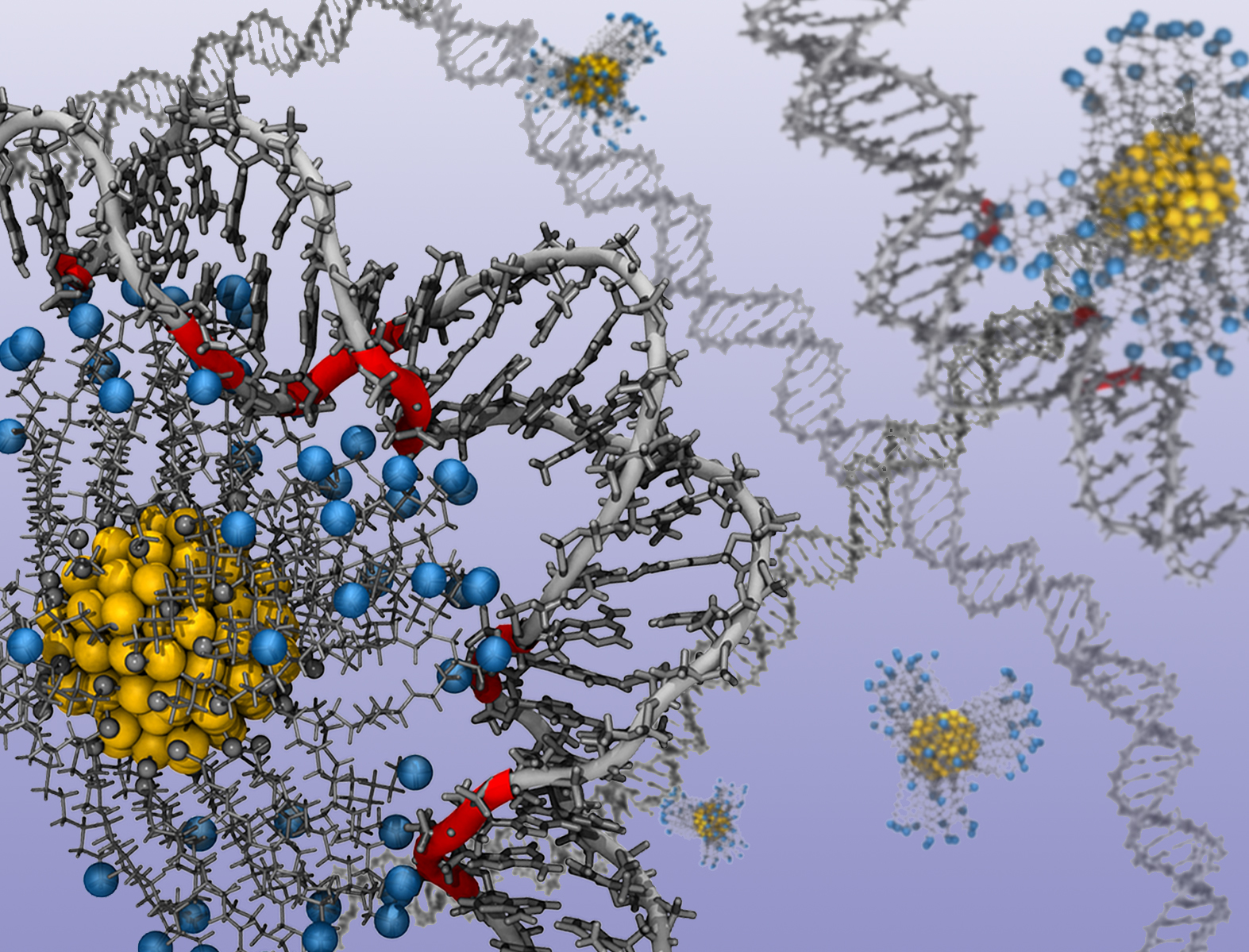
Researchers have used computational modelling to shed light on precisely how charged gold nanoparticles influence the structure of DNA and RNA.


The work holds promise for developing applications that can store and transport genetic information, create custom scaffolds for bioelectronics and create new drug delivery technologies.

“In nature, meters of DNA are packed tightly into every living cell,” says Jessica Nash, a Ph.D. student at NC State and lead author of a paper on the work. “This is possible because the DNA is wrapped tightly around a positively charged protein called a histone. We’d like to be able to shape DNA using a similar approach that replaces the histone with a charged gold nanoparticle. So we used computational techniques to determine exactly how different charges influence the curvature of nucleic acids – DNA and RNA.”

In their model, the researchers manipulated the charge of the gold nanoparticles by adding or removing positively charged ligands – organic molecules attached to the surface of the nanoparticle. This allowed them to determine how the nucleic acid responded to each level of charge. An animation of a nanoparticle and ligands shaping a strand of DNA is available on the further information link below.

“This will let researchers know what to expect – how much charge they need in order to get the desired curvature in the nucleic acid,” says Yaroslava Yingling, an associate professor of materials science and engineering at NC State and corresponding author of the paper.

“We used ligands in the model, but there are other ways to manipulate the charge of the nanoparticles,” says Abhishek Singh, a postdoctoral researcher at NC State and co-author of the paper. “For example, if the nanoparticles and nucleic acid are in solution, you can change the charge by changing the pH of the solution.”

The work is also significant because it highlights how far computational research has come in materials science.

“Our large-scale models account for every atom involved in the process,” says Nan Li, a Ph.D. student at NC State and co-author of the paper. “This is an example of how we can use advanced computational hardware, such as the GPUs – or graphics processing units – developed for use in videogames, to conduct state-of-the-art scientific simulations.”

The research team is now building on these findings to design new nanoparticles with different shapes and surface chemistries to get even more control over the shape and structure of nucleic acids.

“No one has come close to matching nature’s efficiency when it comes to wrapping and unwrapping nucleic acids,” Yingling says. “We’re trying to advance our understanding of precisely how that works.”


Researchers Detail How to Control Shape, Structure of DNA and RNA 

Yaroslava YinglingMatt Shipman

https://news.ncsu.edu/2015/11/yingling-shaping-dna-2015/

https://news.ncsu.edu/wp-content/uploads/2015/11/Yingling-histone-mimic-FULL.jpg

Researchers used a computer model of gold nanoparticles and ligands to determine how nucleic acids respond to various charges. In technical language, the image shows the binding of alkyl ligand functionalized gold nanoparticles with protonated amine end groups (the blue spheres) to double stranded DNA. Image credit: Jessica Nash. Click to enlarge.

Researchers at North Carolina State University have used computational modelling to shed light on precisely how charged gold nanoparticles influence the structure of DNA and RNA – which may lead to new techniques for manipulating these genetic materials.

The work holds promise for developing applications that can store and transport genetic information, create custom scaffolds for bioelectronics and create new drug delivery technologies.

“In nature, meters of DNA are packed tightly into every living cell,” says Jessica Nash, a Ph.D. student at NC State and lead author of a paper on the work. “This is possible because the DNA is wrapped tightly around a positively charged protein called a histone. We’d like to be able to shape DNA using a similar approach that replaces the histone with a charged gold nanoparticle. So we used computational techniques to determine exactly how different charges influence the curvature of nucleic acids – DNA and RNA.”

In their model, the researchers manipulated the charge of the gold nanoparticles by adding or removing positively charged ligands – organic molecules attached to the surface of the nanoparticle. This allowed them to determine how the nucleic acid responded to each level of charge. An animation of a nanoparticle and ligands shaping a strand of DNA is available at https://www.youtube.com/watch?v=kNpvPyc2bmc&feature=youtu.be.

https://youtu.be/kNpvPyc2bmc

Published on 22 Mar 2015

Explains what is meant by specific and non-specific binding and how they are measured in a radioligand binding assay.

“This will let researchers know what to expect – how much charge they need in order to get the desired curvature in the nucleic acid,” says Yaroslava Yingling, an associate professor of materials science and engineering at NC State and corresponding author of the paper.

“We used ligands in the model, but there are other ways to manipulate the charge of the nanoparticles,” says Abhishek Singh, a postdoctoral researcher at NC State and co-author of the paper. “For example, if the nanoparticles and nucleic acid are in solution, you can change the charge by changing the pH of the solution.”

The work is also significant because it highlights how far computational research has come in materials science.

“Our large-scale models account for every atom involved in the process,” says Nan Li, a Ph.D. student at NC State and co-author of the paper. “This is an example of how we can use advanced computational hardware, such as the GPUs – or graphics processing units – developed for use in videogames, to conduct state-of-the-art scientific simulations.”


Chromosomes

http://www.nature.com/scitable/topicpage/chromosomes-14121320

Cells package their DNA not only to protect it, but also to regulate which genes are accessed and when. Cellular genes are therefore similar to valuable files stored in a file cabinet — but in this case, the cabinet’s drawers are constantly opening and closing; various files are continually being located, pulled, and copied; and the original files are always returned to the correct location.

Of course, just as file drawers help conserve space in an office, DNA packaging helps conserve space in cells. Packaging is the reason why the approximately two meters of human DNA can fit into a cell that is only a few micrometers wide. But how, exactly, is DNA compacted to fit within eukaryotic and prokaryotic cells? And what mechanisms do cells use to access this highly compacted genetic material?

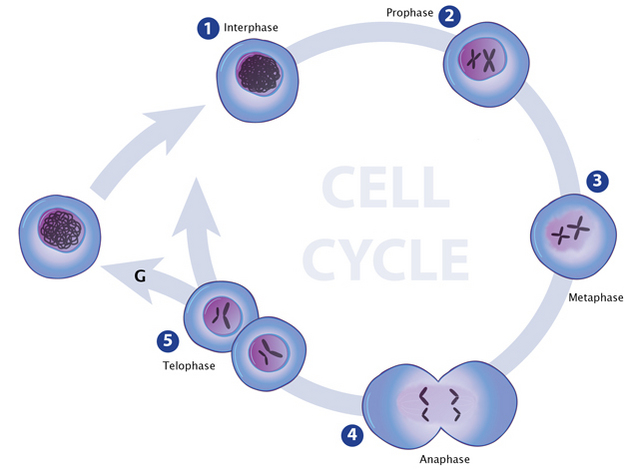
A circular cell-cycle diagram shows the degree to which chromatin is condensed inside a cell during the five stages of mitosis. Each stage is labeled and numbered beside an illustration of a cell. At the center of each cell is a nucleus containing chromatin. The illustration for stages 1 (interphase), 2 (prophase), and 3 (metaphase) show only a single cell. Stage 4 (anaphase) shows a cell in the process of dividing: two distinct cell shapes with two developing nuclei are shown. In stage 5 (telophase), two separate cells are shown, each with its own nuclei and chromatin.

http://www.nature.com/scitable/content/ne0000/ne0000/ne0000/ne0000/113367985/1_2.jpg

In the first stage of mitosis, an illustration of chromatin looks like a loosely packed clump of thread contained inside a cell’s nucleus (early interphase). In late interphase, the chromatin appears tightly packed into two chromosome-like structures within the nucleus. The structures look like two hockey sticks. In the 2ndstage of mitosis (prophase), true chromosomes have formed inside the nucleus: each chromosome pair looks like two hockey sticks connected to one another where they bend to form an “X” shape. There are two pairs of chromosomes, so the nucleus contains two “X” shaped structures. In stage 3 (metaphase), each chromosome has separated from its partner in each pair, so that four individual chromosomes are visible inside the nucleus. In stage 4 (anaphase), two separate cells are forming, and each contains its own developing nucleus. Inside each nucleus are two chromosomes. In stage 5 (telophase), two individual cells are shown. Inside each cell’s nucleus are two chromosomes. An arrow connects each stage to the one succeeding it. Between telophase and interphase an arrow completes the cycle.


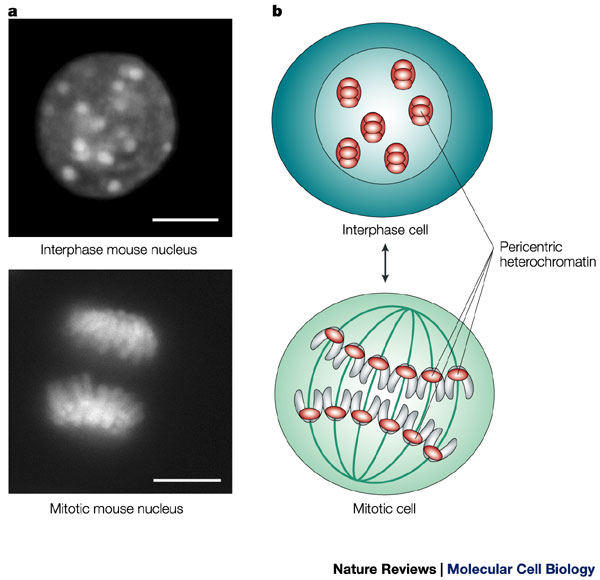
Eukaryotes typically possess multiple pairs of linear chromosomes, all of which are contained in the cellular nucleus, and these chromosomes have characteristic and changeable forms. During cell division, for example, they become more tightly packed, and their condensed form can be visualized with a light microscope. This condensed form is approximately 10,000 times shorter than the linear DNA strand would be if it was devoid of proteins and pulled taut. However, when eukaryotic cells are not dividing — a stage called interphase — the chromatin within their chromosomes is less tightly packed. This looser configuration is important because it permits transcription to take place (Figure 1, Figure 2).

Two photomicrographs and an illustration show DNA during interphase and mitosis. On the left-hand side are two greyscale photomicrographs of fluorescently labeled DNA in mouse cells during interphase and mitosis. On the right-hand side are illustrations of a cell in interphase and a cell in mitosis. The pericentric heterochromatin is labeled in the illustrations.

http://www.nature.com/scitable/content/ne0000/ne0000/ne0000/ne0000/14668934/U2.cp2.1_nrm1355-f1.jpg

During interphase, the cell’s DNA is not condensed and is loosely distributed. A stain for heterochromatin (which indicates the position of chromosomes) shows this broad distribution of chromatin in a mouse cell (upper left). The same stain also shows the organized, aligned structure of the chromosomes during mitosis. Scale bars = 10 microns.
© 2004 Nature Publishing Group Maison, C. & Almouzni, G. HP1 and the dynamics of heterochromatin maintenance. Nature Reviews Molecular Cell Biology 5, 296-305 (2004)
Two photomicrographs, which are labeled “a,” show fluorescently labeled heterochromatin in a mouse nucleus during interphase (top) and in a mouse cell during mitosis (bottom). In the interphase photomicrograph, the nucleus appears as a circle filled with dark grey, light grey, and white spots of different sizes. These spots are found scattered throughout the nucleus, because the chromosomes are not condensed. The brighter spots are regions where pericentric heterochromatin has clustered. Everything outside the nucleus appears black. In the photomicrograph of the mitotic cell, the heterochromatin staining is not spotty, and the chromosomes are condensed and distinct. The chromosomes are being pulled to opposite sides of the cell, so the cell is in anaphase. The chromosomes resemble fingers reaching towards the cell’s center from either end. In the mitotic cell, the staining is more even than the interphase cell, but the portions of the chromosomes that are being pulled to the sides of the cell (the pericentric regions) stain brighter than the ends of the chromosomes, which lie toward the center of the cell. The background is black. In the illustrations, which are labeled “b,” an interphase cell is shown at the top, and a mitotic cell is shown at the bottom. The interphase cell is depicted as a blue circle containing a large nucleus, which is shown as a light blue circle. There are six heterochromatin aggregates distributed throughout the nucleus. Each aggregate is made up of a vertical, orange, oval structure that contains three horizontal, smaller, orange oval structures. An arrow indicates that these aggregates are pericentric heterochromatin. The illustration of the mitotic cell has a mitotic spindle, which is depicted as dark green lines radiating from two poles. Twelve chromosomes are being segregated into two groups; six chromosomes are being pulled to each pole of the spindle. Each chromosome looks like two light grey ovals oriented in a V-shaped pattern and attached to an orange oval in the middle. The orange oval is the pericentric heterochromatin, and this is the part of the chromosome that is being pulled toward the spindle poles first.
Eukaryotic chromosomes consist of repeated units of chromatin called nucleosomes, which were discovered by chemically digesting cellular nuclei and stripping away as much of the outer protein packaging from the DNA as possible. The chromatin that resisted digestion had the appearance of “beads on a string” in electron micrographs — with the “beads” being nucleosomes positioned at intervals along the length of the DNA molecule (Figure 3).Nucleosomes are made up of double-stranded DNA that has complexed with small proteins called histones. The core particle of each nucleosome consists of eight histone molecules, two each of four different histone types: H2A, H2B, H3, and H4. The structure of histones has been strongly conserved across evolution, suggesting that their DNA packaging function is crucially important to all eukaryotic cells (Figure 4).

Histones carry positive charges and bind negatively charged DNA in a specific conformation. In particular, a segment of the DNA double helix wraps around each histone core particle a little less than twice. The exact length of the DNA segment associated with each histone core varies from species to species, but most such segments are approximately 150 base pairs in length. Furthermore, each histone molecule within the core particle has one end that sticks out from the particle. These ends are called N-terminal tails, and they play an important role in higher-order chromatin structure and gene expression.

…….

Chromatin

Getting a Lot of Information into a Small Package

http://modencode.sciencemag.org/chromatin/introduction

P. J. Horn and C. L. Peterson, Science 297, 1824-1827 (2002)

  • Learn how the cell packs six feet of DNA into a nucleus 5 micrometers in length, through the amazing structure known as chromatin.
  • Begin to decipher the “histone code” and the mechanisms, beyond transcription, by which the expression of genes is regulated.
  • Explore how the modENCODE project has expanded our understanding of how chromatin states affect gene expression, in a Vignette.

Compared to prokaryotes, eukaryotes have enormous genomes. For example, inside each of your cells is a genome containing more than 3 billion base pairs. Lined up, that’s more thansix feet (~2 meters) of DNA.

Fitting that much DNA in a cell nucleus (average width: 5 micrometers) is like fitting a string the length of the Empire State building underneath your fingernail! How do our cells store these extremely long, information-packed molecules?

The answer, in one word: Chromatin.

Chromatin — found only in the cells of eukaryotic organisms — is the complex of DNA and a specialized suite of of proteins that are organized in beads, wrapped with DNA, and the string folded, at multiple scales, to allow the DNA to be packaged into the neat nuclear structures called chromosomes that we see through the microscope. But chromatin is about more than just solving a storage problem. In the past few decades, scientists have come to increasingly appreciate the role of chromatin, and of modifications to the histone proteins central to chromatin structure, in regulating gene expression. The packaging is even as a mechanism for heritable changes in phenotype that don’t involve actual changes to the genome sequence. The study of such mechanisms makes up an exciting, and rapidly growing, branch of biology called epigenetics.

In this section of the site, we’ll take a brief look at chromatin as a regulator of gene expression in some ways complementary to transcription factors. And we’ll see how the techniques used in the modENCODE project have helped to broaden our understanding of the system.

Strings, Beads, and Nucleosomes

Image Source: Reprinted by perimisson from Macmillan Publishers Ltd:Nature 421, 448-453 (23 January 2003), copyright 2003.

To fit our genomes into a tiny cell, the DNA of each chromosome is coiled, compacted, and coiled up some more. At the primary level of compaction, the DNA is wrapped around a group of special proteins called histones. When DNA wraps around a group of histones, it forms a nucleosome. You can think of the system as DNA “thread” wound around a protein “spool”. The first scientists who saw nucleosomes with an electron microscope remarked that they looked like “beads on a string,” though we now know that nucleosomes are more like “string wrapped around beads.”

Each nucleosome is made of four different histones — H2A, H2B, H3, and H4. Two molecules of each histone come together to form an octamer. (Note the prefix “octa” — an octamer is just a complex made of eight proteins.) The DNA string wraps around the histone octamer bead to create the nucleosome.

So the process of fitting all of that DNA into a tiny cell nucleus begins with wrapping the DNA around histones into a nucleosome. But it doesn’t end there — the chain of nucleosomes coils around a central axis to get even more compact. As depicted in the diagram at the right, the packaging actually takes place at a number of scales:

  • The DNA wraps around histone octamers to form a “beads on string” fiber approximately 10nanometers (nm) in width.
  • The beads-on-string structure in turn coils into a 30-nm-diameter fiber that packs the nucleosomes more closely together.
  • During cellular interphase — the period in which the cell is not actively dividing — “scaffold” proteins fold the 30-nm fibers into a somewhat more compact structure to fit within the nucleus.
  • During cell division, the chromatin, through the action of additional scaffold proteins, is radically packed and condensed to form the metaphase chromosome that divides and passes the DNA carrying the genetic code to the two daughter cells.

You might be starting to see a problem here. You already know that the genome contains important information — the instructions for making all of the proteins of your cells. If the DNA is all twisted up on itself, how can the cell access that information so it can make proteins?

Getting at the Data: Histone Modification

Image Source: Richard Wheeler/Wikimedia Commons (Creative Commons Attribution Share Alike)

At the end of the holiday season, you may store your holiday decorations away in a closet or garage. You don’t need them immediately at hand in the house, since you don’t use them regularly — but you know where they are in storage, and can find them when you need them.

Something very similar is happening in your cells. Cells have ways of opening up the DNA to be read — or of hiding it so that it isn’t read by mistake. And different types of cells have different sets of genes that are accessible for transcription, and other sets of genes that they have closed up and stored away. That’s why your nerve cells are so different from your muscle cells, even though both types of cells contain exactly the same genome with exactly the same DNA code. And, just as you can push or slide boxes out of the way in your garage or closet to get at the holiday decorations when you need them, the cell can remove or slide nucleosomes so that RNA polymerase can get to a gene it needs to transcribe.

One way that cells can open or close a certain gene is by modifying the histones around which the DNA is wrapped. The ends of histone proteins form so-called “tails”, and certain chemical groups can attach to those tails, changing their chemical properties and affecting how the tails interact with the DNA. Sometimes, chemical modification of histones makes a whole region of the genome easier to access –- sort of like putting the boxes you use most often on a lower shelf, or at the front of the closet. Other times, these chemical markers are labels that can be read by other proteins, as you might label a box with a marker to make it easier to find what you need.

Image Source: Reprinted by perimisson from Macmillan Publishers Ltd: Nature Reviews Neuroscience 8, 355-367 (May 2007), copyright 2007.

Examples of chemical modifications to histones are methylation, acetylation, orphosphorylation (the names just refer to the types of chemical group that is attached – methyl, acetyl, phosphate, etc.). These modifications can be added and removed by special enzymes, so that each type of cell can organize its genome to make it easier to synthesize the proteins that cell type uses most often. These enzymes can also change the modifications as the organism develops, or in response to the environment — for example, in response to a hormone signal or temperature change.

These histone modifications can directly affect how tightly DNA binds to histones. In unmodified histones, the positively charged (basic) histone tails bind very tightly to the negatively charged (acidic) DNA. Some modifications, like the acetylation of a lysine, help neutralize the positive charge of the histone tails. This means the tails bind the DNA less tightly, and the chromatin is more open. Acetylation is thus a histone modification that is associated with genes that are very active, and expressed at high levels. (Check out an animation that illustrates how acetylation weakens the binding between DNA and the histone octamer, making it easier to disassemble the nucleosome.)

As already noted, other histone modifications work differently — instead of directly affecting how tightly the tails bind to DNA, they are instead interpreted by other proteins. These modifications are believed to be part of a histone code, which is “read” by proteins that respond by making the chromatin either more open or more compact, depending on the specific histone modification.

Vignette: modENCODE, the Fly, and Chromatin States

Image source: Mr.checker/Wikimedia Commons (Creative Commons Attribution Share Alike)

The modENCODE scientists worked hard to understand how chromatin functions in model organisms like flies and worms. This has uncovered a lot of important and useful information about how chromatin is structured in general, which can be applied to other organisms, including humans. It’s time to drill down into some of this work. Click on the image to the right to explore what detailed work in the fly has taught us about chromatin.


Thought Questions

  1. Why would modifications like acetylation, that make histones bind to DNA less tightly, affect how active a gene is?
  2. Imagine a gene that encodes a protein important for developing the axons of neurons. There are histones binding your DNA coding for this gene in every cell. Do you think these histones are more likely to be acetylated in your skin cells, brain cells, or the cells of your immune system?
  3. What effect do you think histone deacetylases have on gene expression, in general?
  4. Why would we study chromatin in flies and worms? Can you think of living organisms that might not be helpful for studying chromatin structure?

Read Full Post »

Diagnostic Revelations

Larry H. Bernstein, MD, FCAP, Curator

LPBI

New Liquid Biopsy Test Uses Platelet RNA as Cancer Diagnostic

  • Click Image To Enlarge +
    Using platelet RNA, scientists have been able to detect the presence of cancer and pinpoint its primary location. [Best et al., 2015, Cancer Cell 28, 1–11]

    The age of fast, accurate, and noninvasive cancer screening is rapidly becoming reality. The power of next-generation sequencing has allowed molecular diagnostic techniques to sample small amounts of blood for the genetic hallmarks of tumorigenesis. These liquid biopsy procedures, as they have been dubbed, typically search for circulating tumor DNA (ctDNA) that has made its way into the systemic circulation from tumor cells that have died or enrich for circulating tumor cells (CTCs) that have broken off from the primary cancer site.

    Now, a team of researchers lead by scientists at Massachusetts General Hospital (MGH), have developed a new diagnostic test that analyzes the tumor RNA picked up in circulating platelets. The investigators believe this new method could become even more useful than other molecular technologies for diagnosing cancer since it can also determine the primary location of the tumor and provide insight to potential therapeutic approaches.

    “By combining next-generation-sequencing gene expression profiles of platelet RNA with computational algorithms we developed, we were able to detect the presence of cancer with 96 percent accuracy,” explains co-senior author Bakhos Tannous, Ph.D., associate professor Harvard Medical School and associate neuroscientist at MGH. “Platelet RNA signatures also provide valuable information on the type of tumor present in the body and can guide the selection of the most optimal treatment for individual patients.

    The findings from this study were published recently in Cancer Cell through an article entitled “RNA-Seq of Tumor-Educated Platelets Enables Blood-Based Pan-Cancer, Multiclass, and Molecular Pathway Cancer Diagnostics.”

    In the current study the research team describes finding that the RNA profiles of tumor-educated platelets (TEPs)—those that have taken up molecules shed by tumors—can distinguish among blood samples of healthy individuals and those of patients with six types of cancer, determine the location of the primary tumor, and identify tumors carrying mutations that can guide therapeutic decision-making.

    Over the past several years, the scientific literature has shown that in addition to their role in promoting blood clotting, platelets take up protein and RNA molecules from tumors, possibly playing a role in tumor growth and metastasis. Dr. Tannous and his colleagues set out to determine whether tumor RNA carried in platelets could be used to diagnose and classify common types of cancer.

    The investigators isolated platelets from blood samples taken from 55 healthy donors, 39 individual with early-stage cancer and 189 patients with advanced, metastatic cancer. Among those patients with cancer, they were diagnosed with non-small-cell lung cancer, colorectal cancer, glioblastoma, pancreatic cancer, hepatobiliary cancer, or breast cancer.

    The comparison of RNA profiles from the healthy donors to those of the cancer patients identified increased levels of approximately 1,500 RNA molecules—many involved in cancer-associated processes—and a reduction of almost 800 in samples from cancer patients. Using their novel algorithm, the MGH group was able to examine close to 1,000 RNAs from almost 300 individuals with 96% accuracy for the presence of cancer.

    Additionally, the platelet mRNA profiles were able to identify the particular type of cancer within each patient participant, including distinguishing among three types of gastrointestinal adenocarcinoma: colorectal cancer, pancreatic cancer, and hepatobiliary cancer. Platelets from patients with tumors driven by mutations in KRAS or EGFR proteins—biomarkers that can guide the use of drugs targeting those mutations—proved to have unique RNA profiles as well.

    The researchers were excited by their findings and emphasize the uniqueness of their approach as currently utilized liquid biopsy approaches have been unable to diagnose cancer while simultaneously pinpointing the location of the primary tumor.

    “We observed that the mRNA profiles of tumor-educated platelets have the sensitivity and specificity to detect cancer, even in early, non-metastasized tumors,” noted Dr. Tannous. “We are further assessing the potential of TEP-based screening for therapeutic decision making and also investigating how non-cancerous diseases may further influence the RNA repertoire of TEPs.”

  • RNA-Seq of Tumor-Educated Platelets Enables Blood-Based Pan-Cancer, Multiclass, and Molecular Pathway Cancer Diagnostics

Myron G. Best Nik Sol, Jihane Tannous, Bart A. Westerman, François Rustenburg, Pepijn Schellen, Heleen Verschueren, Edward Post, Jan Koster, Bauke Ylstra, Irsan Kooi, et al.
Highlights

Tumors “educate” platelets (TEPs) by altering the platelet RNA profile

TEPs provide a RNA biosource for pan-cancer, multiclass, and companion diagnostics

TEP-based liquid biopsies may guide clinical diagnostics and therapy selection

A total of 100–500 pg of total platelet RNA is sufficient for TEP-based diagnostics

mRNA Profiles of Tumor-Educated Platelets Are Distinct from Platelets of Healthy Individuals

Summary

Tumor-educated blood platelets (TEPs) are implicated as central players in the systemic and local responses to tumor growth, thereby altering their RNA profile. We determined the diagnostic potential of TEPs by mRNA sequencing of 283 platelet samples. We distinguished 228 patients with localized and metastasized tumors from 55 healthy individuals with 96% accuracy. Across six different tumor types, the location of the primary tumor was correctly identified with 71% accuracy. Also, MET or HER2-positive, and mutant KRAS, EGFR, orPIK3CA tumors were accurately distinguished using surrogate TEP mRNA profiles. Our results indicate that blood platelets provide a valuable platform for pan-cancer, multiclass cancer, and companion diagnostics, possibly enabling clinical advances in blood-based “liquid biopsies”.

Figure thumbnail fx1

http://www.cell.com/cms/attachment/2039645414/2053235278/fx1.jpg

Significance

Blood-based “liquid biopsies” provide a means for minimally invasive molecular diagnostics, overcoming limitations of tissue acquisition. Early detection of cancer, clinical cancer diagnostics, and companion diagnostics are regarded as important applications of liquid biopsies. Here, we report that mRNA profiles of tumor-educated blood platelets (TEPs) enable for pan-cancer, multiclass cancer, and companion diagnostics in both localized and metastasized cancer patients. The ability of TEPs to pinpoint the location of the primary tumor advances the use of liquid biopsies for cancer diagnostics. The results of this proof-of-principle study indicate that blood platelets are a potential all-in-one platform for blood-based cancer diagnostics, using the equivalent of one drop of blood.

Introduction

Cancer is primarily diagnosed by clinical presentation, radiology, biochemical tests, and pathological analysis of tumor tissue, increasingly supported by molecular diagnostic tests. Molecular profiling of tumor tissue samples has emerged as a potential cancer classifying method (Akbani et al., 2014, Golub et al., 1999, Han et al., 2014, Hoadley et al., 2014, Kandoth et al., 2013,Ramaswamy et al., 2001, Su et al., 2001). In order to overcome limitations of tissue acquisition, the use of blood-based liquid biopsies has been suggested (Alix-Panabières et al., 2012, Crowley et al., 2013, Haber and Velculescu, 2014). Several blood-based biosources are currently being evaluated as liquid biopsies, including plasma DNA (Bettegowda et al., 2014, Chan et al., 2013, Diehl et al., 2008, Murtaza et al., 2013, Newman et al., 2014, Thierry et al., 2014) and circulating tumor cells (Bidard et al., 2014, Dawson et al., 2013, Maheswaran et al., 2008, Rack et al., 2014). So far, implementation of liquid biopsies for early detection of cancer has been hampered by non-specificity of these biosources to pinpoint the nature of the primary tumor (Alix-Panabières and Pantel, 2014,Bettegowda et al., 2014).

It has been reported that tumor-educated platelets (TEPs) may enable blood-based cancer diagnostics (Calverley et al., 2010, McAllister and Weinberg, 2014,Nilsson et al., 2011). Blood platelets—the second most-abundant cell type in peripheral blood—are circulating anucleated cell fragments that originate from megakaryocytes in bone marrow and are traditionally known for their role in hemostasis and initiation of wound healing (George, 2000, Leslie, 2010). More recently, platelets have emerged as central players in the systemic and local responses to tumor growth. Confrontation of platelets with tumor cells via transfer of tumor-associated biomolecules (“education”) is an emerging concept and results in the sequestration of such biomolecules (Klement et al., 2009,Kuznetsov et al., 2012, McAllister and Weinberg, 2014, Nilsson et al., 2011,Quail and Joyce, 2013). Moreover, external stimuli, such as activation of platelet surface receptors and lipopolysaccharide-mediated platelet activation (Denis et al., 2005, Rondina et al., 2011), induce specific splicing of pre-mRNAs in circulating platelets (Power et al., 2009, Rowley et al., 2011, Schubert et al., 2014). Platelets may also undergo queue-specific splice events in response to signals released by cancer cells and the tumor microenvironment—such as stromal and immune cells. The combination of specific splice events in response to external signals and the capacity of platelets to directly ingest (spliced) circulating mRNA can provide TEPs with a highly dynamic mRNA repertoire, with potential applicability to cancer diagnostics (Calverley et al., 2010, Nilsson et al., 2011) (Figure 1A). In this study, we characterize the platelet mRNA profiles of various cancer patients and healthy donors and investigate their potential for TEP-based pan-cancer, multiclass cancer, and companion diagnostics.

  
Results

We prospectively collected and isolated blood platelets from healthy donors (n = 55) and both treated and untreated patients with early, localized (n = 39) or advanced, metastatic cancer (n = 189) diagnosed by clinical presentation and pathological analysis of tumor tissue supported by molecular diagnostics tests. The patient cohort included six tumor types, i.e., non-small cell lung carcinoma (NSCLC, n = 60), colorectal cancer (CRC, n = 41), glioblastoma (GBM, n = 39), pancreatic cancer (PAAD, n = 35), hepatobiliary cancer (HBC, n = 14), and breast cancer (BrCa, n = 39) (Figure 1B; Table 1; Table S1). The cohort of healthy donors covered a wide range of ages (21–64 years old, Table 1).

Table 1Summary of Patient Characteristics
PATIENT GROUP TOTAL (N) GENDER M (%)A AGE (SD)B METASTASIS (%) MUTATION PRESENCE (%)
TRAINING VALIDATION TRAINING VALIDATION TRAINING VALIDATION TRAINING VALIDATION TRAINING VALIDATION
HD 39 16 21 (54) 6 (38) 41 (13) 38 (16)
GBM 23 16 18 (78) 10 (63) 59 (16) 62 (14) 0 (0) 0 (0)
NSCLC 36 24 14 (39) 14 (58) 60 (11) 59 (12) 33 (92) 23 (96) KRAS 15 (42) 11 (46)
EGFR 14 (39) 7 (29)
MET-overexpression 5 (14) 3 (13)
CRC 25 16 13 (52) 9 (56) 59 (13) 63 (16) 20 (80) 15 (94) KRAS 7 (28) 8 (50)
PAAD 21 14 12 (57) 7 (50) 66 (9) 66 (10) 15 (71) 9 (64) KRAS 13 (62) 9 (64)
BrCa 23 16 0 (0) 0 (0) 59 (11) 59 (11) 16 (70) 9 (56) HER2+ 7 (30) 5 (31)
PIK3CA 6 (26) 2 (13)
triple negative 5 (22) 3 (19)
HBC 8 6 6 (75) 2 (33) 68 (13) 62 (16) 6 (75) 4 (67) KRAS 3 (38) 1 (17)

HD, healthy donors; GBM, glioblastoma; NSCLC, non-small cell lung cancer; CRC, colorectal cancer; PAAD, pancreatic cancer; BrCa, breast cancer; HBC, hepatobiliary cancer. See also Table S1.

aIndicated are number of male individuals.
bIndicated is mean age in years.

Platelet purity was confirmed by morphological analysis of randomly selected and freshly isolated platelet samples (contamination is 1 to 5 nucleated cells per 10 million platelets, see Supplemental Experimental Procedures), and platelet RNA was isolated and evaluated for quality and quantity (Figure S1A). A total of 100–500 pg of platelet total RNA (the equivalent of purified platelets in less than one drop of blood) was used for SMARTer mRNA amplification and sequencing (Ramsköld et al., 2012) (Figures 1C and S1A). Platelet RNA sequencing yielded a mean read count of ∼22 million reads per sample. After selection of intron-spanning (spliced) RNA reads and exclusion of genes with low coverage (seeSupplemental Experimental Procedures), we detected in platelets of healthy donors (n = 55) and localized and metastasized cancer patients (n = 228) 5,003 different protein coding and non-coding RNAs that were used for subsequent analyses. The obtained platelet RNA profiles correlated with previously reported mRNA profiles of platelets (Bray et al., 2013, Kissopoulou et al., 2013, Rowley et al., 2011, Simon et al., 2014) and megakaryocytes (Chen et al., 2014) and not with various non-related blood cell mRNA profiles (Hrdlickova et al., 2014) (Figure S1B). Furthermore, DAVID Gene Ontology (GO) analysis revealed that the detected RNAs are strongly enriched for transcripts associated with blood platelets (false discovery rate [FDR] < 10−126).

Among the 5,003 RNAs, we identified known platelet markers, such as B2M, PPBP, TMSB4X, PF4, and several long non-coding RNAs (e.g., MALAT1). A total of 1,453 out of 5,003 mRNAs were increased and 793 out of 5,003 mRNAs were decreased in TEPs as compared to platelet samples of healthy donors (FDR < 0.001), while presenting a strong correlation between these platelet mRNA profiles (r = 0.90, Pearson correlation) (Figure 1D). Unsupervised hierarchical clustering based on the differentially detected platelet mRNAs distinguished two sample groups with minor overlap (Figure 1E; Table S2). DAVID GO analysis revealed that the increased TEP mRNAs were enriched for biological processes such as vesicle-mediated transport and the cytoskeletal protein binding while decreased mRNAs were strongly involved in RNA processing and splicing (Table S3). A correlative analysis of gene set enrichment (CAGE) GO methodology, in which 3,875 curated gene sets of the GSEA database were correlated to TEP profiles (see Experimental Procedures), demonstrated significant correlation of TEP mRNA profiles with cancer tissue signatures, histone deacetylases regulation, and platelets (Table 2). The levels of 20 non-protein coding RNAs were altered in TEPs as compared to platelets from healthy individuals and these show a tumor type-associated RNA profile (Figure S1C).

Thumbnail image of Figure 1. Opens large image

http://www.cell.com/cms/attachment/2039645414/2053235279/gr1.jpg

Tumor-Educated Platelet mRNA Profiling for Pan-Cancer Diagnostics

(A) Schematic overview of tumor-educated platelets (TEPs) as biosource for liquid biopsies.

(B) Number of platelet samples of healthy donors and patients with different types of cancer.

(C) TEP mRNA sequencing (mRNA-seq) workflow, as starting from 6 ml EDTA-coated tubes, to platelet isolation, mRNA amplification, and sequencing.

(D) Correlation plot of mRNAs detected in healthy donor (HD) platelets and cancer patients’ TEPs, including highlighted increased (red) and decreased (blue) TEP mRNAs.

(E) Heatmap of unsupervised clustering of platelet mRNA profiles of healthy donors (red) and patients with cancer (gray).

(F) Cross-table of pan-cancer SVM/LOOCV diagnostics of healthy donor subjects and patients with cancer in training cohort (n = 175). Indicated are sample numbers and detection rates in percentages.

(G) Performance of pan-cancer SVM algorithm in validation cohort (n = 108). Indicated are sample numbers and detection rates in percentages.

(H) ROC-curve of SVM diagnostics of training (red), validation (blue) cohort, and random classifiers, indicating the classification accuracies obtained by chance of the training and validation cohort (gray).

(I) Total accuracy ratios of SVM classification in five subgroups, including corresponding predictive strengths. Genes, number of mRNAs included in training of the SVM algorithm.

See also Figure S1 and Tables S1, S2, S3, and S4.

Table 2Pan-Cancer CAGE Gene Ontology
TOP 25 GO CORRELATIONS
# LOWESTA HIGHESTA
DOWN
Translation 10 −0.865 −0.890
Immune, T cell 5 −0.853 −0.883
Cancer-associated 2 −0.875 −0.887
Viral replication 2 −0.875 −0.878
IL-signaling 2 −0.869 −0.874
RNA processing 1 −0.886
Ago2-Dicer-silencing 1 −0.882
Protein metabolism 1 −0.879
Receptor processing 1 −0.869
UP
Cancer-associated 6 −0.783 −0.906
Infection 3 −0.798 −0.853
HDAC 3 −0.795 −0.852
Platelet 3 −0.837 −0.906
Cytoskeleton 2 −0.801 −0.886
Hypoxia 2 −0.763 −0.937
Protease 1 −0.854
Immunodeficiency 1 −0.812
Differentiation 1 −0.810
Immune differentiation 1 −0.801
Methylation 1 −0.778
Metabolism 1 −0.768

Top-ranking correlations of platelet-mRNA profiles with 3,875 Broad Institute curated gene sets. CAGE, Correlative Analysis of Gene Set Enrichment; GO, gene ontology; #, number of hits per annotation; IL, interleukin; HDAC, histone deacetylase.

aIndicated are lowest and highest correlations per annotation.

Next, we determined the diagnostic accuracy of TEP-based pan-cancer classification in the training cohort (n = 175), employing a leave-one-out cross-validation support vector machine algorithm (SVM/LOOCV, see Experimental Procedures; Figures S1D and S1E), previously used to classify primary and metastatic tumor tissues (Ramaswamy et al., 2001, Su et al., 2001, Vapnik, 1998, Yeang et al., 2001). Briefly, the SVM algorithm (blindly) classifies each individual sample as cancer or healthy by comparison to all other samples (175 − 1) and was performed 175 times to classify and cross validate all individuals samples. The algorithms we developed use a limited number of different spliced RNAs for sample classification. To determine the specific input gene lists for the classifying algorithms we performed ANOVA testing for differences (as implemented in the R-package edgeR), yielding classifier-specific gene lists (Table S4). For the specific algorithm of the pan-cancer TEP-based classifier test we selected 1,072 RNAs (Table S4) for the n = 175 training cohort, yielding a sensitivity of 96%, a specificity of 92%, and an accuracy of 95% (Figure 1F). Subsequent validation using a separate validation cohort (n = 108), not involved in input gene list selection and training of the algorithm, yielded a sensitivity of 97%, a specificity of 94%, and an accuracy of 96% (Figure 1G), with an area under the curve (AUC) of 0.986 to detect cancer (Figure 1H) and high predictive strength (Figure 1I). In contrast, random classifiers, as determined by multiple rounds of randomly shuffling class labels (permutation) during the SVM training process (see Experimental Procedures), had no predictive power (mean overall accuracy: 78%, SD ± 0.3%, p < 0.01), thereby showing, albeit an unbalanced representation of both groups in the study cohort, specificity of our procedure. A total of 100 times random class-proportional subsampling of the entire dataset in a training and validation set (ratio 60:40) yielded similar accuracy rates (mean overall accuracy: 96%, SD: ± 2%), confirming reproducible classification accuracy in this dataset. Of note, all 39 patients with localized tumors and 33 of the 39 patients with primary tumors in the CNS were correctly classified as cancer patients (Figure 1I). Visualization of 22 genes previously identified at differential RNA levels in platelets of patients with various non-cancerous diseases (Gnatenko et al., 2010, Healy et al., 2006, Lood et al., 2010,Raghavachari et al., 2007), revealed mixed levels in our TEP dataset (Figure S1F), suggesting that the platelet RNA repertoire in patients with non-cancerous disease is distinct from patients with cancer.

Tumor-Specific Educational Program of Blood Platelets Allows for Multiclass Cancer Diagnostics

In addition to the pan-cancer diagnosis, the TEP mRNA profiles also distinguished healthy donors and patients with specific types of cancer, as demonstrated by the unsupervised hierarchical clustering of differential platelet mRNA levels of healthy donors and all six individual tumor types, i.e., NSCLC, CRC, GBM, PAAD, BrCa, and HBC (Figures 2A, all p < 0.0001, Fisher’s exact test, and S2A; Table S5), and this resulted in tumor-specific gene lists that were used as input for training and validation of the tumor-specific algorithms (Table S4). For the unsupervised clustering of the all-female group of BrCa patients, male healthy donors were excluded to avoid sample bias due to gender-specific platelet mRNA profiles (Figure S2B). SVM-based classification of all individual tumor classes with healthy donors resulted in clear distinction of both groups in both the training and validation cohort, with high sensitivity and specificity, and 38/39 (97%) cancer patients with localized disease were classified correctly (Figures 2B and S2C). CAGE GO analysis showed that biological processes differed between TEPs of individual tumor types, suggestive of tumor-specific “educational” programs (Table S6). We did not detect sufficient differences in mRNA levels to discriminate patients with non-metastasized from patients with metastasized tumors, suggesting that the altered platelet profile is predominantly influenced by the molecular tumor type and, to a lesser extent, by tumor progression and metastases.

 We next determined whether we could discriminate three different types of adenocarcinomas in the gastro-intestinal tract by analysis of the TEP-profiles, i.e., CRC, PAAD, and HBC. We developed a CRC/PAAD/HBC algorithm that correctly classified the mixed TEP samples (n = 90) with an overall accuracy of 76% (mean overall accuracy random classifiers: 42%, SD: ± 5%, p < 0.01,Figure 2C). In order to determine whether the TEP mRNA profiles allowed for multiclass cancer diagnosis across all tumor types and healthy donors, we extended the SVM/LOOCV classification test using a combination of algorithms that classified each individual sample of the training cohort (n = 175) as healthy donor or one of six tumor types (Figures S2D and S2E). The results of the multiclass cancer diagnostics test resulted in an average accuracy of 71% (mean overall accuracy random classifiers: 19%, SD: ± 2%, p < 0.01,Figure 2D), demonstrating significant multiclass cancer discriminative power in the platelet mRNA profiles. The classification capacity of the multiclass SVM-based classifier was confirmed in the validation cohort of 108 samples, with an overall accuracy of 71% (Figure 2E). An overall accuracy of 71% might not be sufficient for introduction into cancer diagnostics. However, of the initially misclassified samples according to the SVM algorithms choice with strongest classification strength the second ranked classification was correct in 60% of the cases. This yields an overall accuracy using the combined first and second ranked classifications of 89%. The low validation score of HBC samples can be attributed to the relative low number of samples and possibly to the heterogenic nature of this group of cancers (hepatocellular cancers and cholangiocarcinomas).
large Image

Tumor-Educated Platelet mRNA Profiles for Multiclass Cancer Diagnostics

(A) Heatmaps of unsupervised clustering of platelet mRNA profiles of healthy donors (HD; n = 55) (red) and patients with non-small cell lung cancer (NSCLC; n = 60), colorectal cancer (CRC; n = 41), glioblastoma (GBM; n = 39), pancreatic cancer (PAAD, n = 35), breast cancer (BrCa; n = 39; female HD; n = 29), and hepatobiliary cancer (HBC; n = 14).

(B) ROC-curve of SVM diagnostics of healthy donors and individual tumor classes in both training (left) and validation (right) cohort. Random classifiers, indicating the classification accuracies obtained by chance, are shown in gray.

(C) Confusion matrix of multiclass SVM/LOOCV diagnostics of patients with CRC, PAAD, and HBC. Indicated are detection rates as compared to the actual classes in percentages.

(D) Confusion matrix of multiclass SVM/LOOCV diagnostics of the training cohort consisting of healthy donors (healthy) and patients with GBM, NSCLC, PAAD, CRC, BrCa, and HBC. Indicated are detection rates as compared to the actual classes in percentages.

(E) Confusion matrix of multiclass SVM algorithm in a validation cohort (n = 108). Indicated are sample numbers and detection rates in percentages. Genes, number of mRNAs included in training of the SVM algorithm.

See also Figure S2 and Tables S4, S5, and S6.

Companion Diagnostics Tumor Tissue Biomarkers Are Reflected by Surrogate TEP mRNA Onco-signatures

Blood provides a promising biosource for the detection of companion diagnostics biomarkers for therapy selection (Bettegowda et al., 2014, Crowley et al., 2013,Papadopoulos et al., 2006). We selected platelet samples of patients with distinct therapy-guiding markers confirmed in matching tumor tissue. Although the platelet mRNA profiles contained undetectable or low levels of these mutant biomarkers, the TEP mRNA profiles did allow to distinguish patients with KRASmutant tumors from KRAS wild-type tumors in PAAD, CRC, NSCLC, and HBC patients, and EGFR mutant tumors in NSCLC patients, using algorithms specifically trained on biomarker-specific input gene lists (all p < 0.01 versus random classifiers, Figures 3A–3E ; Table S4). Even though the number of samples analyzed is relatively low and the risk of algorithm overfitting needs to be taken into account, the TEP profiles distinguished patients with HER2-amplified, PIK3CA mutant or triple-negative BrCa, and NSCLC patients with MET overexpression (all p < 0.01 versus random classifiers, Figures 3F–3I).

 We subsequently compared the diagnostic accuracy of the TEP mRNA classification method with a targeted KRAS (exon 12 and 13) and EGFR (exon 20 and 21) amplicon deep sequencing strategy (∼5,000× coverage) on the Illumina Miseq platform using prospectively collected blood samples of patients with localized or metastasized cancer. This method did allow for the detection of individual mutant KRAS and EGFR sequences in both plasma DNA and platelet RNA (Table S7), indicating sequestration and potential education capacity of mutant, tumor-derived RNA biomarkers in TEPs. Mutant KRAS was detected in 62% and 39%, respectively, of plasma DNA (n = 103, kappa statistics = 0.370, p < 0.05) and platelet RNA (n = 144, kappa statistics = 0.213, p < 0.05) of patients with a KRAS mutation in primary tumor tissue. The sensitivity of the plasma DNA tests was relatively poor as reported by others (Bettegowda et al., 2014, Thierry et al., 2014), which may partly be attributed to the loss of plasma DNA quality due to relatively long blood sample storage (EDTA blood samples were stored up to 48 hr at room temperature before plasma isolation). To discriminate KRAS mutant from wild-type tumors in blood, the TEP mRNA profiles provided superior concordance with tissue molecular status (kappa statistics = 0.795–0.895, p < 0.05) compared to KRAS amplicon sequencing analysis of both plasma DNA and platelet RNA (Table S7). Thus, TEP mRNA profiles can harness potential blood-based surrogate onco-signatures for tumor tissue biomarkers that enable cancer patient stratification and therapy selection.
large Image

Tumor-Educated Platelet mRNA Profiles for Molecular Pathway Diagnostics

Cross tables of SVM/LOOCV diagnostics with the molecular markers KRAS in (A) CRC, (B) PAAD, and (C) NSCLC patients, (D) KRAS in the combined cohort of patients with either CRC, PAAD, NSCLC, or HBC, (E) EGFR and (F) MET in NSCLC patients, (G) PIK3CA mutations, (H) HER2-amplification, and (I) triple negative status in BrCa patients. Genes, number of mRNAs included in training of the SVM algorithm. See alsoTables S4 and S7.

TEP-Profiles Provide an All-in-One Biosource for Blood-Based Liquid Biopsies in Patients with Cancer

Unequivocal discrimination of primary versus metastatic nature of a tumor may be difficult and hamper adequate therapy selection. Since the TEP profiles closely resemble the different tumor types as determined by their organ of origin—regardless of systemic dissemination—this potentially allows for organ-specific cancer diagnostics. Hence we selected all healthy donors and all patients with primary or metastatic tumor burden in the lung (n = 154), brain (n = 114), or liver (n = 127). We performed “organ exams” and instructed the SVM/LOOCV algorithm to determine for lung, brain, and liver the presence or absence of cancer (96%, 91%, and 96% accuracy, respectively), with cancer subclassified as primary or metastatic tumor (84%, 93%, and 90% accuracy, respectively) and in case of metastases to identify the potential organ of origin (64%, 70%, and 64% accuracy, respectively). The platelet mRNA profiles enabled assignment of the cancer to the different organs with high accuracy (Figure 4). In addition, using the same TEP mRNA profiles we were able to again indicate the biomarker status of the tumor tissues (90%, 82%, and 93% accuracy, respectively) (Figure 4).

large Image

Organ-Focused TEP-Based Cancer Diagnostics

SVM/LOOCV diagnostics of healthy donors (n = 55) and patients with primary or metastatic tumor burden in the lung (n = 99; totaling 154 tests), brain (n = 62; totaling 114 tests), or liver (n = 72; totaling 127 tests), to determine the presence or absence of cancer, with cancer subclassified as primary or metastatic tumor, in case of metastases the identified organ of origin, and the correctly identified molecular markers. Of note, at the exam level of mutational subtypes some samples were included in multiple classifiers (i.e., KRAS, EGFR, PIK3CA,HER2-amplification, MET-overexpression, or triple negative status), explaining the higher number in mutational tests than the total number of included samples. TP, true positive; FP, false positive; FN, false negative; TN, true negative. Indicated are sample numbers and detection rates in percentages.

Discussion

The use of blood-based liquid biopsies to detect, diagnose, and monitor cancer may enable earlier diagnosis of cancer, lower costs by tailoring molecular targeted treatments, improve convenience for cancer patients, and ultimately supplements clinical oncological decision-making. Current blood-based biosources under evaluation demonstrate suboptimal sensitivity for cancer diagnostics, in particular in patients with localized disease. So far, none of the current blood-based biosources, including plasma DNA, exosomes, and CTCs, have been employed for multiclass cancer diagnostics (Alix-Panabières and Pantel, 2014, Bettegowda et al., 2014, Skog et al., 2008), hampering its implementation for early cancer detection. Here, we report that molecular interrogation of blood platelet mRNA can offer valuable diagnostics information for all cancer patients analyzed—spanning six different tumor types. Our results suggest that platelets may be employable as an all-in-one biosource to broadly scan for molecular traces of cancer in general and provide a strong indication on tumor type and molecular subclass. This includes patients with localized disease possibly allowing for targeted diagnostic confirmation using routine clinical diagnostics for each particular tumor type.

Since the discovery of circulating tumor material in blood of patients with cancer (Leon et al., 1977) and the recognition of the clinical utility of blood-based liquid biopsies, a wealth of studies has assessed the use of blood for cancer diagnostics, prognostication and treatment monitoring (Alix-Panabières et al., 2012, Bidard et al., 2014, Crowley et al., 2013, Haber and Velculescu, 2014). By development of highly sensitive targeted detection methods, such as targeted deep sequencing (Newman et al., 2014), droplet digital PCR (Bettegowda et al., 2014), and allele-specific PCR (Maheswaran et al., 2008, Thierry et al., 2014), the utility and applicability of liquid biopsies for clinical implementation has accelerated. These advances previously allowed for a pan-cancer comparison of various biosources and revealed that in >75% of cancers, including advanced stage pancreas, colorectal, breast, and ovarian cancer, cell-free DNA is detectable although detection rates are dependent on the grade of the tumor and depth of analysis (Bettegowda et al., 2014). Here, we show that the platelet RNA profiles are affected in nearly all cancer patients, regardless of the type of tumor, although the abundance of tumor-associated RNAs seems variable among cancer patients. In addition, surrogate RNA onco-signatures of tissue biomarkers, also in 88% of localized KRAS mutant cancer patients as measured by the tumor-specific and pan-cancer SVM/LOOCV procedures, are readily available from a minute amount (100–500 pg) of platelet RNA. As whole blood can be stored up to 48 hr on room temperature prior to isolation of the platelet pellet, while maintaining high-quality RNA and the dominant cancer RNA signatures, TEPs can be more readily implemented in daily clinical laboratory practice and could potentially be shipped prior to further blood sample processing.

Blood platelets are widely involved in tumor growth and cancer progression (Gay and Felding-Habermann, 2011). Platelets sequester solubilized tumor-associated proteins (Klement et al., 2009) and spliced and unspliced mRNAs (Calverley et al., 2010, Nilsson et al., 2011), whereas platelets do also directly interact with tumor cells (Labelle et al., 2011), neutrophils (Sreeramkumar et al., 2014), circulating NK-cells (Palumbo et al., 2005, Placke et al., 2012), and circulating tumor cells (Ting et al., 2014, Yu et al., 2013). Interestingly, in vivo experiments have revealed breast cancer-mediated systemic instigation by supplying circulating platelets with pro-inflammatory and pro-angiogenic proteins, supporting outgrowth of dormant metastatic foci (Kuznetsov et al., 2012). Using a gene ontology methodology, CAGE, we correlated TEP-cancer signatures with publicly available curated datasets. Indeed, we identified widespread correlations with cancer tissues, hypoxia, platelet-signatures, and cytoskeleton, possibly reflecting the “alert” and pro-tumorigenic state of TEPs. We observed strong negative correlations with RNAs implicated in RNA translation, T cell immunity, and interleukin-signaling, implying diminished needs of TEPs for RNAs involved in these biological processes or orchestrated translation of these RNAs to proteins (Denis et al., 2005). We observed that the tumor-specific educational programs in TEPs are predominantly influenced by tumor type and, to a lesser extent, by tumor progression and metastases. Although we were not able to measure significant differences between non-metastasized and metastasized tumors, we do not exclude that the use of larger sample sets could allow for the generation of SVM algorithms that do have the power to discriminate between certain stages of cancer, including those with in situ carcinomas and even pre-malignant lesions. In addition, different molecular tumor subtypes (e.g., HER2-amplified versus wild-type BrCa) result in different effects on the platelet profiles, possibly caused by different “educational” stimuli generated by the different molecular tumor subtypes (Koboldt et al., 2012). Altogether, the RNA content of platelets in patients with cancer is dependent on the transcriptional state of the bone-marrow megakaryocyte (Calverley et al., 2010, McAllister and Weinberg, 2014), complemented by sequestration of spliced RNA (Nilsson et al., 2011), release of RNA (Clancy and Freedman, 2014, Kirschbaum et al., 2015, Rak and Guha, 2012, Risitano et al., 2012), and possibly queue-specific pre-mRNA splicing during platelet circulation. Partial or complete normalization of the platelet profiles following successful treatment of the tumor would enable TEP-based disease recurrence monitoring, requiring the analysis of follow-up platelet samples. Future studies will be required to address the tumor-specific “educated” profiles on both an (small non-coding) RNA (Laffont et al., 2013, Landry et al., 2009, Leidinger et al., 2014, Lu et al., 2005) and protein (Burkhart et al., 2014,Geiger et al., 2013, Klement et al., 2009) level and determine the ability of gene ontology, blood-based cancer classification.

In conclusion, we provide robust evidence for the clinical relevance of blood platelets for liquid biopsy-based molecular diagnostics in patients with several types of cancer. Further validation is warranted to determine the potential of surrogate TEP profiles for blood-based companion diagnostics, therapy selection, longitudinal monitoring, and disease recurrence monitoring. In addition, we expect the self-learning algorithms to further improve by including significantly more samples. For this approach, isolation of the platelet fraction from whole blood should be performed within 48 hr after blood withdrawal, the platelet fraction can subsequently be frozen for cancer diagnosis. Also, future studies should address causes and anticipated risks of outlier samples identified in this study, such as healthy donors classified as cancer patients. Systemic factors such as chronic or transient inflammatory diseases, or cardiovascular events and other non-cancerous diseases may also influence the platelet mRNA profile and require evaluation in follow-up studies, possibly also including individuals predisposed for cancer.

References   

Authors  Title
Source

Akbani, R., Ng, P.K.S., Werner, H.M.J., Shahmoradgoli, M., Zhang, F., Ju, Z., Liu, W., Yang, J.-Y., Yoshihara, K., Li, J. et al. A pan-cancer proteomic perspective on The Cancer Genome Atlas.

Nat. Commun. 2014; 5: 3887

Alix-Panabières, C. and Pantel, K. Challenges in circulating tumour cell research.

Nat. Rev. Cancer. 2014; 14:623–631

Alix-Panabières, C., Schwarzenbach, H., and Pantel, K. Circulating tumor cells and circulating tumor DNA.

Annu. Rev. Med. 2012; 63:199–215

Bettegowda, C., Sausen, M., Leary, R.J., Kinde, I., Wang, Y., Agrawal, N., Bartlett, B.R., Wang, H., Luber, B., Alani, R.M. et al. Detection of circulating tumor DNA in early- and late-stage human malignancies.

Sci. Transl. Med. 2014; 6:224ra24

Bidard, F.-C., Peeters, D.J., Fehm, T., Nolé, F., Gisbert-Criado, R., Mavroudis, D., Grisanti, S., Generali, D., Garcia-Saenz, J.A., Stebbing, J. et al. Clinical validity of circulating tumour cells in patients with metastatic breast cancer: a pooled analysis of individual patient data.

Lancet Oncol. 2014; 15: 406–414

Bray, P.F., McKenzie, S.E., Edelstein, L.C., Nagalla, S., Delgrosso, K., Ertel, A., Kupper, J., Jing, Y., Londin, E., Loher, P. et al. The complex transcriptional landscape of the anucleate human platelet.

BMC Genomics. 2013; 14: 1

Burkhart, J.M., Gambaryan, S., Watson, S.P., Jurk, K., Walter, U., Sickmann, A., Heemskerk, J.W.M., and Zahedi, R.P.  What can proteomics tell us about platelets?.

Circ. Res. 2014; 114: 1204–1219

Calverley, D.C., Phang, T.L., Choudhury, Q.G., Gao, B., Oton, A.B., Weyant, M.J., and Geraci, M.W. Significant downregulation of platelet gene expression in metastatic lung cancer.

Clin. Transl. Sci. 2010; 3:227–232

Chan, K.C.A., Jiang, P., Chan, C.W.M., Sun, K., Wong, J., Hui, E.P., Chan, S.L., Chan, W.C., Hui, D.S.C., Ng, S.S.M. et al. Noninvasive detection of cancer-associated genome-wide hypomethylation and copy number aberrations by plasma DNA bisulfite sequencing.

Proc. Natl. Acad. Sci. USA.2013; 110: 18761–18768

Abstract Image
Chi-Ping Day, Glenn Merlino, Terry Van Dyke
Cell, Vol. 163, Issue 1, p39–53
Published in issue: September 24, 2015
Abstract Image
Katherine A. Hoadley, Christina Yau, Denise M. Wolf, Andrew D. Cherniack, David Tamborero, Sam Ng, Max D.M. Leiserson, Beifang Niu, Michael D. McLellan, Vladislav Uzunangelov, Jiashan Zhang, Cyriac Kandoth, Rehan Akbani, Hui Shen, Larsson Omberg, Andy Chu, Adam A. Margolin, Laura J. van’t Veer, Nuria Lopez-Bigas, Peter W. Laird, Benjamin J. Raphael, Li Ding, A. Gordon Robertson, Lauren A. Byers, Gordon B. Mills, John N. Weinstein, Carter Van Waes, Zhong Chen, Eric A. Collisson, The Cancer Genome Atlas Research Network, Christopher C. Benz, Charles M. Perou, Joshua M. Stuart
Cell, Vol. 158, Issue 4, p929–944
Published online: August 7, 2014

Open Archive

Abstract Image
Pau Creixell, Erwin M. Schoof, Craig D. Simpson, James Longden, Chad J. Miller, Hua Jane Lou, Lara Perryman, Thomas R. Cox, Nevena Zivanovic, Antonio Palmeri, Agata Wesolowska-Andersen, Manuela Helmer-Citterich, Jesper Ferkinghoff-Borg, Hiroaki Itamochi, Bernd Bodenmiller, Janine T. Erler, Benjamin E. Turk, Rune Linding
Cell, Vol. 163, Issue 1, p202–217
Published online: September 17, 2015
Abstract Image
Cell, Vol. 155, Issue 1, p9–10
Published in issue: September 26, 2013

Open Archive

Abstract Image
Corina E. Antal, Andrew M. Hudson, Emily Kang, Ciro Zanca, Christopher Wirth, Natalie L. Stephenson, Eleanor W. Trotter, Lisa L. Gallegos, Crispin J. Miller, Frank B. Furnari, Tony Hunter, John Brognard, Alexandra C. Newton
Cell, Vol. 160, Issue 3, p489–502
Published online: January 22, 2015
Abstract Image
Cell, Vol. 160, Issues 1-2, p7
Published in issue: January 15, 2015
Abstract Image
Amelia J. Johnston, Kate T. Murphy, Laura Jenkinson, David Laine, Kerstin Emmrich, Pierre Faou, Ross Weston, Krishnath M. Jayatilleke, Jessie Schloegel, Gert Talbo, Joanne L. Casey, Vita Levina, W. Wei-Lynn Wong, Helen Dillon, Tushar Sahay, Joan Hoogenraad, Holly Anderton, Cathrine Hall, Pascal Schneider, Maria Tanzer, Michael Foley, Andrew M. Scott, Paul Gregorevic, Spring Yingchun Liu, Linda C. Burkly, Gordon S. Lynch, John Silke, Nicholas J. Hoogenraad
Cell, Vol. 162, Issue 6, p1365–1378
Published in issue: September 10, 2015
Abstract Image
Levi A. Garraway, Eric S. Lander
Cell, Vol. 153, Issue 1, p17–37
Published in issue: March 28, 2013

Open Archive

Abstract Image
Hector L. Franco, W. Lee Kraus
Cell, Vol. 163, Issue 1, p28–30
Published in issue: September 24, 2015

Read Full Post »

Turning genetic information into working proteins

Larry H Bernstein, MD, FCAP, Curator

Leaders in Pharmaceutical Intelligence

Series 2; 3.3

James E. Darnell Jr. (1930— )
Vincent Astor Professor Emeritus
2002 Albert Lasker Award for Special Achievement in Medical Science

Responsible for the various tasks required in turning genetic information into working proteins, ribonucleic acids are one of the most essential players in the life of a cell. First discovered in 1868, RNA today remains the subject of intense scientific scrutiny. Over the course of a career dedicated to understanding the intricate workings of gene transcription, Rockefeller University scientist James E. Darnell Jr. has revealed some of RNA’s most secretive and surprising mechanisms. For his half-century of illuminating research, Dr. Darnell received the 2002 Albert Lasker Award for Special Achievement in Medical Science.

In 1963, Dr. Darnell described a phenomenon he termed “RNA processing,” a step in the process of gene transcription, which had only recently been elucidated in bacterial systems. Working with mammalian cells — which differ from bacterial cells in that they contain a nucleus, where RNA is created — Dr. Darnell observed that very long strings of RNA disappear from the cell nucleus and that subsequently, shorter RNAs resembling the absent longer ones appear in the cytoplasm. Mammalian cells, he concluded, must distill their massive, immature nuclear RNA into shorter, mature forms that are individually coded for specific purposes by specific segments of the genome.

Dr. Darnell carried the principles of his finding — which he made in ribosomal RNA, part of the construction crew that builds cellular proteins — to other long nuclear RNA, including the longest one, which he named heterogeneous nuclear RNA (hnRNA). His hypothesis, that hnRNA is the precursor of the better known messenger RNA — which carries the genetic blueprint for protein building — soon bore fruit when he found a structural correlation between the two. Certain hnRNAs and nearly all messenger RNAs have a “tail” of adenine nucleotides at one end. Dr. Darnell followed this discovery with the observation that when an hnRNA string with an adenine tail disappears from the nucleus, a messenger RNA with the same tail then appears in the cytoplasm, suggesting a causal link between the two. When he found a second similarity — a cap at the end of the string opposite the adenine tail — he faced a conundrum. Scientific dogma had it that the order of nucleotides in any RNA mirrors that of DNA, whether the RNA is modeled from somewhere in the middle of the DNA or from one of the ends. The matching of a nuclear RNA to its cytoplasmic product by two end pieces glued together was surprising, but the concept was soon proven by colleagues at other institutions and called RNA splicing.

After a brief sojourn in Paris to work in François Jacob’s lab, Darnell worked at MIT, the Albert Einstein College of Medicine, and Rockefeller University on the relationship between mRNA and hnRNA. hnRNA was believed to be the precursor to mRNA, and despite making some key discoveries, Darnell admits that he could not free his imagination from the idea of colinearity and envision an hnRNA spliced to produce a smaller mRNA.

At this time, Darnell turned his attention to the question he had pondered since Paris: how were genes regulated in animal cells? This led to the discovery of the STAT and the Jak-STAT pathway of transcription control.

With the knowledge of RNA processing and splicing, Dr. Darnell next examined how cells begin the process of transcription and how they activate particular segments of DNA. Having moved to Rockefeller University in 1974, he found in the early 1980s that cells retain their specificity only in the context of their natural environment. Away from other liver cells, for example, a single liver cell stops producing liver-specific RNA, though it continues to make RNA for more generic cellular tasks. To pinpoint the signals responsible, which he believed must be coming from outside the cell, Dr. Darnell took a closer look at interferons (IFN), proteins that warn a cell when it’s time to raise its genetic defenses against harmful microbes.

Dr. Darnell’s laboratory studies how signals from the cell surface affect transcription of genes in the nucleus. Originally using interferon as a model cytokine, the Darnell group discovered that cell transcription was quickly changed by binding of cytokines to the cell surface. Introducing IFNβ into cell cultures, he watched as a particular type of mRNA accumulated in the cytoplasm, unaccompanied by any new protein synthesis. Analyzing the mRNA led him to the segment of DNA that had been activated, and the lack of new proteins told him that the cell contained its own, usually dormant, IFN-responsive transcription factor. By isolating a particular stretch of DNA from IFN-treated cells, he was able to call out of hiding the proteins that make up that factor, which, partly because they respond to signals very quickly, he called “STATs.” Dr. Darnell then traced the chemical relay that activates the STATs after IFN contact, called the Jak-Stat pathway.

The bound interferon led to the tyrosine phosphorylation of latent cytoplasmic proteins now called STATs (signal transducers and activators of transcription) that dimerize by reciprocal phosphotyrosine-SH2 interchange. They accumulate in the nucleus, bind DNA and drive transcription. This pathway has proved to be of wide importance, with seven STATs now known in mammals that take part in a wide variety of developmental and homeostatic events in all multicellular animals. Crystallographic analysis defined functional domains in the STATs, and current attention is focused on two areas: how the STATs complete their cycle of activation and inactivation, which requires regulated tyrosine dephosphorylation; and how persistent activation of STAT3 that occurs in a high proportion of many human cancers contributes to blocking apoptosis in cancer cells. Current efforts are devoted to inhibiting STAT3 with modified peptides that can enter cells.


Dr. Darnell received his M.D. in 1955 from the Washington University School of Medicine. His career has included poliovirus research with Harry Eagle at the National Institute of Allergy and Infectious Diseases, research with François Jacob at the Pasteur Institute in Paris and academic appointments at the Massachusetts Institute of Technology, the Albert Einstein College of Medicine and Columbia University. In 1974 Dr. Darnell joined Rockefeller as Vincent Astor Professor, and from 1990 to 1991 he was vice president for academic affairs.

A member of the National Academy of Sciences since 1973, he has received numerous awards, including the 2012 Albany Medical Center Prize in Medicine and Biomedical Research, the 2003 National Medal of Science, the 2002 Albert Lasker Award for Special Achievement in Medical Science, the 1997 Passano Award, the 1994 Paul Janssen Prize in Advanced Biotechnology and Medicine and the 1986 Gairdner Foundation International Award.

He is the coauthor with S.E. Luria of General Virology and the founding author with Harvey Lodish and David Baltimore of Molecular Cell Biology, now in its seventh edition. His book RNA, Life’s Indispensable Molecule was published in July 2011 by Cold Spring Harbor Laboratory Press. He is a member of the American Academy of Arts and Sciences and a foreign member of The Royal Society and The Royal Swedish Academy of Sciences.


Read Full Post »

RNA polymerase – molecular basis for DNA transcription

Larry H. Bernstein, MD, FCAP, Curator

Leaders in Pharmaceutical Intelligence

Series E: 2; 3.1

Roger Kornberg, MD
Nobel Prize in Chemistry
Stanford University

Son of Arthur Kornberg, who received the Nobel Prize for DNA polymerase, Roger Kornberg spent decades on the problem of transcription of the genetic code in eukaryotic cells. Roger Kornberg made several contributions to the understanding of the transcription model including – recognition of the nucleosomal structure of DNA, characterization of the chromatin modifying factors, and discovering the bridging factor that mediates transcriptional activation (called Mediator). The three types of RNA are termed mRNA, tRNA, and rRNA. Kornberg recognized that chromatin consists of nucleosomes arranged along DNA in the form of beads on a string. He used electron crystallography to determine that lateral diffusion in molecules tethered to the bilayer to pack into two-dimensional crystals suitable for crystallography.   Using yeast, Kornberg identified the role of RNA polymerase II and other proteins in transcribing DNA, and he created three-dimensional images of the protein cluster using X-ray crystallography. Polymerase II is used by all organisms with nuclei, including humans, to transcribe DNA.

While a graduate student working with Harden McConnell at Stanford in the late 1960s, he discovered the “flip-flop” and lateral diffusion of phospholipids in bilayer membranes. While a postdoctoral fellow working with Aaron Klug and Francis Crick at the MRC in the 1970s, Kornberg discovered the nucleosome as the basic protein complex packaging chromosomal DNA in the nucleus of eukaryotic cells (chromosomal DNA is often termed “Chromatin” when it is bound to proteins in this manner, reflecting Walther Flemming‘s discovery that certain structures within the cell nucleus would absorb dyes and become visible under a microscope).[10] Within the nucleosome, Kornberg found that roughly 200 bp of DNA are wrapped around an octamer of histone proteins.

Kornberg’s research group at Stanford later succeeded in the development of a faithful transcription system from baker’s yeast, a simple unicellular eukaryote, which they then used to isolate in a purified form all of the several dozen proteins required for the transcription process. Through the work of Kornberg and others, it has become clear that these protein components are remarkably conserved across the full spectrum of eukaryotes, from yeast to human cells.

Using this system, Kornberg made the major discovery that transmission of gene regulatory signals to the RNA polymerase machinery is accomplished by an additional protein complex that they dubbed Mediator.[11] As noted by the Nobel Prize committee, “the great complexity of eukaryotic organisms is actually enabled by the fine interplay between tissue-specific substances, enhancers in the DNA and Mediator. The discovery of Mediator is therefore a true milestone in the understanding of the transcription process.”[12]

Kornberg took advantage of expertise with lipid membranes gained from his graduate studies to devise a technique for the formation of two-dimensional protein crystals on lipid bilayers. These 2D crystals could then be analyzed using electron microscopy to derive low-resolution images of the protein’s structure. Eventually, Kornberg was able to use X-ray crystallography to solve the 3-dimensional structure of RNA polymerase at atomic resolution.[13][14] He extended these studies to obtain structural images of RNA polymerase associated with accessory proteins.[15] Through these studies, Kornberg created an actual picture of how transcription works at a molecular level.

“I measured the molecular weight of the purified H3/H4 preparation by equilibrium ultracentrifugation, while Jean Thomas offered to analyze the material by chemical cross-linking. Both methods showed unequivocally that H3 and H4 were in the form of a double dimer, an (H3)2(H4)2 tetramer (Kornberg and Thomas, 1974). I pondered this result for days, and came to the following conclusions (Kornberg, 1974). First, the exact equivalence of H3 and H4 in the tetramer implied that the differences in relative amounts of the histones from various sources measured in the past must be due to experimental error. This and the stoichiometry of the tetramer implied a unit of structure in chromatin based on two each of the four histones, or an (H2A)2(H2B)2(H3)2(H4)2 octamer. Second, since chromatin from all sources contains roughly one of each histone for every 100 bp of DNA, a histone octamer would be associated with 200 bp of DNA. Finally, the (H3)2(H4)2 tetramer was reminiscent of hemoglobin, an a2b2 tetramer. The X-ray structures of hemoglobin and other oligomeric proteins available at the time were compact, with no holes through which a molecule the size of DNA might pass. Rather, the DNA in chromatin must be wrapped on the outside of the histone octamer.

As I turned these ideas over in mind, it struck me how I might explain the results of Hewish and Burgoyne. What if their sedimentation coefficient of unit length DNA fragments was measured under neutral rather than alkaline conditions? Then the DNA would have been double stranded and about 250 bp in length. Allowing for the approximate nature of the result, the correspondence with my prediction of 200 bp was electrifying. Then I recalled a reference near the end of the Hewish and Burgoyne paper to a report of a similar pattern of DNA fragments by Williamson. I rushed to the library and found that Williamson had obtained a ladder of DNA fragments from the cytoplasm of necrotic cells and measured the unit size by sedimentation under neutral conditions: the result was 205 bp! … with colleagues in Cambridge, I proved the existence of the histone octamer and the equivalence of the 200 bp unit with the particle seen in the electron microscope (Kornberg, 1977). This chapter of the chromatin story concluded with the X-ray crystal structure determination of the particle, now known as the nucleosome, showing a histone octamer surrounded by DNA, in near atomic detail (Luger et al., 1997).

I had decided to pursue the function rather than the structure of the nucleosome, and was joined in this by Yahli Lorch, who became my lifelong partner in chromatin research, and also my partner in life. We investigated the consequences of the nucleosome for transcription. It was believed that histones are generally inhibitory to transcription. We found, to the contrary, that RNA polymerases are capable of reading right through a nucleosome. Coiling of promoter DNA in a nucleosome, however, abolished initiation by RNA polymerase II (pol II) (Lorch et al., 1987). This finding, together with genetic studies of Michael Grunstein and colleagues, identified a regulatory role of the nucleosome in transcription. It has since emerged that nucleosomes play regulatory roles in a wide range of chromosomal transactions. A whole new field has emerged, one of the most active in bioscience today. It involves a bewildering variety of posttranslational modifications of the histones, and a protein machinery of great complexity for applying, recognizing, and removing these modifications.”


Read Full Post »

Cancer Biology and Genomics for Disease Diagnosis (Vol. I) Now Available for Amazon Kindle

Cancer Biology and Genomics for Disease Diagnosis (Vol. I) Now Available for Amazon Kindle

Reporter: Stephen J Williams, PhD

Article ID #179: Cancer Biology and Genomics for Disease Diagnosis (Vol. I) Now Available for Amazon Kindle. Published on 8/14/2015

WordCloud Image Produced by Adam Tubman

Leaders in Pharmaceutical Business Intelligence would like to announce the First volume of their BioMedical E-Book Series C: e-Books on Cancer & Oncology

Volume One: Cancer Biology and Genomics for Disease Diagnosis

CancerandOncologyseriesCcoverwhich is now available on Amazon Kindle at                          http://www.amazon.com/dp/B013RVYR2K.

This e-Book is a comprehensive review of recent Original Research on Cancer & Genomics including related opportunities for Targeted Therapy written by Experts, Authors, Writers. This ebook highlights some of the recent trends and discoveries in cancer research and cancer treatment, with particular attention how new technological and informatics advancements have ushered in paradigm shifts in how we think about, diagnose, and treat cancer. The results of Original Research are gaining value added for the e-Reader by the Methodology of Curation. The e-Book’s articles have been published on the Open Access Online Scientific Journal, since April 2012.  All new articles on this subject, will continue to be incorporated, as published with periodical updates.

We invite e-Readers to write an Article Reviews on Amazon for this e-Book on Amazon. All forthcoming BioMed e-Book Titles can be viewed at:

http://pharmaceuticalintelligence.com/biomed-e-books/

Leaders in Pharmaceutical Business Intelligence, launched in April 2012 an Open Access Online Scientific Journal is a scientific, medical and business multi expert authoring environment in several domains of  life sciences, pharmaceutical, healthcare & medicine industries. The venture operates as an online scientific intellectual exchange at their website http://pharmaceuticalintelligence.com and for curation and reporting on frontiers in biomedical, biological sciences, healthcare economics, pharmacology, pharmaceuticals & medicine. In addition the venture publishes a Medical E-book Series available on Amazon’s Kindle platform.

Analyzing and sharing the vast and rapidly expanding volume of scientific knowledge has never been so crucial to innovation in the medical field. WE are addressing need of overcoming this scientific information overload by:

  • delivering curation and summary interpretations of latest findings and innovations
  • on an open-access, Web 2.0 platform with future goals of providing primarily concept-driven search in the near future
  • providing a social platform for scientists and clinicians to enter into discussion using social media
  • compiling recent discoveries and issues in yearly-updated Medical E-book Series on Amazon’s mobile Kindle platform

This curation offers better organization and visibility to the critical information useful for the next innovations in academic, clinical, and industrial research by providing these hybrid networks.

Table of Contents for Cancer Biology and Genomics for Disease Diagnosis

Preface

Introduction  The evolution of cancer therapy and cancer research: How we got here?

Part I. Historical Perspective of Cancer Demographics, Etiology, and Progress in Research

Chapter 1:  The Occurrence of Cancer in World Populations

Chapter 2.  Rapid Scientific Advances Changes Our View on How Cancer Forms

Chapter 3:  A Genetic Basis and Genetic Complexity of Cancer Emerge

Chapter 4: How Epigenetic and Metabolic Factors Affect Tumor Growth

Chapter 5: Advances in Breast and Gastrointestinal Cancer Research Supports Hope for Cure

Part II. Advent of Translational Medicine, “omics”, and Personalized Medicine Ushers in New Paradigms in Cancer Treatment and Advances in Drug Development

Chapter 6:  Treatment Strategies

Chapter 7:  Personalized Medicine and Targeted Therapy

Part III.Translational Medicine, Genomics, and New Technologies Converge to Improve Early Detection

Chapter 8:  Diagnosis                                     

Chapter 9:  Detection

Chapter 10:  Biomarkers

Chapter 11:  Imaging In Cancer

Chapter 12: Nanotechnology Imparts New Advances in Cancer Treatment, Detection, &  Imaging                                 

Epilogue by Larry H. Bernstein, MD, FACP: Envisioning New Insights in Cancer Translational Biology


Read Full Post »

Proteomics, Metabolomics, Signaling Pathways, and Cell Regulation: a Compilation of Articles in the Journal http://pharmaceuticalintelligence.com

Compilation of References by Leaders in Pharmaceutical Business Intelligence in the Journal http://pharmaceuticalintelligence.com about
Proteomics, Metabolomics, Signaling Pathways, and Cell Regulation

Curator: Larry H Bernstein, MD, FCAP

Proteomics

  1. The Human Proteome Map Completed

Reporter and Curator: Larry H. Bernstein, MD, FCAP

http://pharmaceuticalintelligence.com/2014/08/28/the-human-proteome-map-completed/

  1. Proteomics – The Pathway to Understanding and Decision-making in Medicine

Author and Curator, Larry H Bernstein, MD, FCAP

http://pharmaceuticalintelligence.com/2014/06/24/proteomics-the-pathway-to-
understanding-and-decision-making-in-medicine/

3. Advances in Separations Technology for the “OMICs” and Clarification of Therapeutic Targets

Author and Curator, Larry H Bernstein, MD, FCAP

http://pharmaceuticalintelligence.com/2012/10/22/advances-in-separations-technology-for-the-omics-and-clarification-         of-therapeutic-targets/

  1. Expanding the Genetic Alphabet and Linking the Genome to the Metabolome

Author and Curator, Larry H Bernstein, MD, FCAP

http://pharmaceuticalintelligence.com/2012/09/24/expanding-the-genetic-alphabet-and-linking-the-genome-to-the-                metabolome/

5. Genomics, Proteomics and standards

Larry H Bernstein, MD, FCAP, Author and Curator

http://pharmaceuticalintelligence.com/2014/07/06/genomics-proteomics-and-standards/

6. Proteins and cellular adaptation to stress

Larry H Bernstein, MD, FCAP, Author and Curator

http://pharmaceuticalintelligence.com/2014/07/08/proteins-and-cellular-adaptation-to-stress/


Metabolomics

  1. Extracellular evaluation of intracellular flux in yeast cells

Larry H. Bernstein, MD, FCAP, Reviewer and Curator

http://pharmaceuticalintelligence.com/2014/08/25/extracellular-evaluation-of-intracellular-flux-in-yeast-cells/

  1. Metabolomic analysis of two leukemia cell lines. I.

Larry H. Bernstein, MD, FCAP, Reviewer and Curator

http://pharmaceuticalintelligence.com/2014/08/23/metabolomic-analysis-of-two-leukemia-cell-lines-_i/

  1. Metabolomic analysis of two leukemia cell lines. II.

Larry H. Bernstein, MD, FCAP, Reviewer and Curator

http://pharmaceuticalintelligence.com/2014/08/24/metabolomic-analysis-of-two-leukemia-cell-lines-ii/

  1. Metabolomics, Metabonomics and Functional Nutrition: the next step in nutritional metabolism and biotherapeutics

Reviewer and Curator, Larry H. Bernstein, MD, FCAP

http://pharmaceuticalintelligence.com/2014/08/22/metabolomics-metabonomics-and-functional-nutrition-the-next-step-          in-nutritional-metabolism-and-biotherapeutics/

  1. Buffering of genetic modules involved in tricarboxylic acid cycle metabolism provides homeomeostatic regulation

Larry H. Bernstein, MD, FCAP, Reviewer and curator

http://pharmaceuticalintelligence.com/2014/08/27/buffering-of-genetic-modules-involved-in-tricarboxylic-acid-cycle-              metabolism-provides-homeomeostatic-regulation/

Metabolic Pathways

  1. Pentose Shunt, Electron Transfer, Galactose, more Lipids in brief

Reviewer and Curator: Larry H. Bernstein, MD, FCAP

http://pharmaceuticalintelligence.com/2014/08/21/pentose-shunt-electron-transfer-galactose-more-lipids-in-brief/

  1. Mitochondria: More than just the “powerhouse of the cell”

Ritu Saxena, PhD

http://pharmaceuticalintelligence.com/2012/07/09/mitochondria-more-than-just-the-powerhouse-of-the-cell/

  1. Mitochondrial fission and fusion: potential therapeutic targets?

Ritu saxena

http://pharmaceuticalintelligence.com/2012/10/31/mitochondrial-fission-and-fusion-potential-therapeutic-target/

4.  Mitochondrial mutation analysis might be “1-step” away

Ritu Saxena

http://pharmaceuticalintelligence.com/2012/08/14/mitochondrial-mutation-analysis-might-be-1-step-away/

  1. Selected References to Signaling and Metabolic Pathways in PharmaceuticalIntelligence.com

Curator: Larry H. Bernstein, MD, FCAP

http://pharmaceuticalintelligence.com/2014/08/14/selected-references-to-signaling-and-metabolic-pathways-in-                     leaders-in-pharmaceutical-intelligence/

  1. Metabolic drivers in aggressive brain tumors

Prabodh Kandal, PhD

http://pharmaceuticalintelligence.com/2012/11/11/metabolic-drivers-in-aggressive-brain-tumors/

  1. Metabolite Identification Combining Genetic and Metabolic Information: Genetic association links unknown metabolites to functionally related genes

Writer and Curator, Aviva Lev-Ari, PhD, RD

http://pharmaceuticalintelligence.com/2012/10/22/metabolite-identification-combining-genetic-and-metabolic-                        information-genetic-association-links-unknown-metabolites-to-functionally-related-genes/

  1. Mitochondria: Origin from oxygen free environment, role in aerobic glycolysis, metabolic adaptation

Larry H Bernstein, MD, FCAP, author and curator

http://pharmaceuticalintelligence.com/2012/09/26/mitochondria-origin-from-oxygen-free-environment-role-in-aerobic-            glycolysis-metabolic-adaptation/

  1. Therapeutic Targets for Diabetes and Related Metabolic Disorders

Reporter, Aviva Lev-Ari, PhD, RD

http://pharmaceuticalintelligence.com/2012/08/20/therapeutic-targets-for-diabetes-and-related-metabolic-disorders/

10.  Buffering of genetic modules involved in tricarboxylic acid cycle metabolism provides homeomeostatic regulation

Larry H. Bernstein, MD, FCAP, Reviewer and curator

http://pharmaceuticalintelligence.com/2014/08/27/buffering-of-genetic-modules-involved-in-tricarboxylic-acid-cycle-              metabolism-provides-homeomeostatic-regulation/

11. The multi-step transfer of phosphate bond and hydrogen exchange energy

Larry H. Bernstein, MD, FCAP, Curator:

http://pharmaceuticalintelligence.com/2014/08/19/the-multi-step-transfer-of-phosphate-bond-and-hydrogen-                          exchange-energy/

12. Studies of Respiration Lead to Acetyl CoA

http://pharmaceuticalintelligence.com/2014/08/18/studies-of-respiration-lead-to-acetyl-coa/

13. Lipid Metabolism

Author and Curator: Larry H. Bernstein, MD, FCAP

http://pharmaceuticalintelligence.com/2014/08/15/lipid-metabolism/

14. Carbohydrate Metabolism

Author and Curator: Larry H. Bernstein, MD, FCAP

http://pharmaceuticalintelligence.com/2014/08/13/carbohydrate-metabolism/

15. Update on mitochondrial function, respiration, and associated disorders

Larry H. Bernstein, MD, FCAP, Author and Curator

http://pharmaceuticalintelligence.com/2014/07/08/update-on-mitochondrial-function-respiration-and-associated-                   disorders/

16. Prologue to Cancer – e-book Volume One – Where are we in this journey?

Author and Curator: Larry H. Bernstein, MD, FCAP

http://pharmaceuticalintelligence.com/2014/04/13/prologue-to-cancer-ebook-4-where-are-we-in-this-journey/

17. Introduction – The Evolution of Cancer Therapy and Cancer Research: How We Got Here?

Author and Curator: Larry H. Bernstein, MD, FCAP

http://pharmaceuticalintelligence.com/2014/04/04/introduction-the-evolution-of-cancer-therapy-and-cancer-research-          how-we-got-here/

18. Inhibition of the Cardiomyocyte-Specific Kinase TNNI3K

Author and Curator: Larry H. Bernstein, MD, FCAP

http://pharmaceuticalintelligence.com/2013/11/01/inhibition-of-the-cardiomyocyte-specific-kinase-tnni3k/

19. The Binding of Oligonucleotides in DNA and 3-D Lattice Structures

Author and Curator: Larry H. Bernstein, MD, FCAP

http://pharmaceuticalintelligence.com/2013/05/15/the-binding-of-oligonucleotides-in-dna-and-3-d-lattice-structures/

20. Mitochondrial Metabolism and Cardiac Function

Author and Curator: Larry H. Bernstein, MD, FCAP

http://pharmaceuticalintelligence.com/2013/04/14/mitochondrial-metabolism-and-cardiac-function/

21. How Methionine Imbalance with Sulfur-Insufficiency Leads to Hyperhomocysteinemia

Curator: Larry H. Bernstein, MD, FCAP

http://pharmaceuticalintelligence.com/2013/04/04/sulfur-deficiency-leads_to_hyperhomocysteinemia/

22. AMPK Is a Negative Regulator of the Warburg Effect and Suppresses Tumor Growth In Vivo

Author and Curator: Stephen J. Williams, PhD

http://pharmaceuticalintelligence.com/2013/03/12/ampk-is-a-negative-regulator-of-the-warburg-effect-and-suppresses-         tumor-growth-in-vivo/

23. A Second Look at the Transthyretin Nutrition Inflammatory Conundrum

Author and Curator: Larry H. Bernstein, MD, FCAP

http://pharmaceuticalintelligence.com/2012/12/03/a-second-look-at-the-transthyretin-nutrition-inflammatory-                         conundrum/

24. Mitochondrial Damage and Repair under Oxidative Stress

Author and Curator: Larry H. Bernstein, MD, FCAP

http://pharmaceuticalintelligence.com/2012/10/28/mitochondrial-damage-and-repair-under-oxidative-stress/

25. Nitric Oxide and Immune Responses: Part 2

Author and Curator: Aviral Vatsa, PhD, MBBS

http://pharmaceuticalintelligence.com/2012/10/28/nitric-oxide-and-immune-responses-part-2/

26. Overview of Posttranslational Modification (PTM)

Writer and Curator: Larry H. Bernstein, MD, FCAP

http://pharmaceuticalintelligence.com/2014/07/29/overview-of-posttranslational-modification-ptm/

27. Malnutrition in India, high newborn death rate and stunting of children age under five years

Writer and Curator: Larry H. Bernstein, MD, FCAP

http://pharmaceuticalintelligence.com/2014/07/15/malnutrition-in-india-high-newborn-death-rate-and-stunting-of-                   children-age-under-five-years/

28. Update on mitochondrial function, respiration, and associated disorders

Writer and Curator: Larry H. Bernstein, MD, FCAP

http://pharmaceuticalintelligence.com/2014/07/08/update-on-mitochondrial-function-respiration-and-associated-                  disorders/

29. Omega-3 fatty acids, depleting the source, and protein insufficiency in renal disease

Larry H. Bernstein, MD, FCAP, Curator

http://pharmaceuticalintelligence.com/2014/07/06/omega-3-fatty-acids-depleting-the-source-and-protein-insufficiency-         in-renal-disease/

30. Introduction to e-Series A: Cardiovascular Diseases, Volume Four Part 2: Regenerative Medicine

Larry H. Bernstein, MD, FCAP, writer, and Aviva Lev- Ari, PhD, RN

http://pharmaceuticalintelligence.com/2014/04/27/larryhbernintroduction_to_cardiovascular_diseases-                                  translational_medicine-part_2/

31. Epilogue: Envisioning New Insights in Cancer Translational Biology
Series C: e-Books on Cancer & Oncology

Author & Curator: Larry H. Bernstein, MD, FCAP, Series C Content Consultant

http://pharmaceuticalintelligence.com/2014/03/29/epilogue-envisioning-new-insights/

32. Ca2+-Stimulated Exocytosis:  The Role of Calmodulin and Protein Kinase C in Ca2+ Regulation of Hormone                         and Neurotransmitter

Writer and Curator: Larry H Bernstein, MD, FCAP and
Curator and Content Editor: Aviva Lev-Ari, PhD, RN

http://pharmaceuticalintelligence.com/2013/12/23/calmodulin-and-protein-kinase-c-drive-the-ca2-regulation-of-                    hormone-and-neurotransmitter-release-that-triggers-ca2-stimulated-exocy

33. Cardiac Contractility & Myocardial Performance: Therapeutic Implications of Ryanopathy (Calcium Release-                           related Contractile Dysfunction) and Catecholamine Responses

Author, and Content Consultant to e-SERIES A: Cardiovascular Diseases: Justin Pearlman, MD, PhD, FACC
Author and Curator: Larry H Bernstein, MD, FCAP
and Article Curator: Aviva Lev-Ari, PhD, RN

http://pharmaceuticalintelligence.com/2013/08/28/cardiac-contractility-myocardium-performance-ventricular-arrhythmias-      and-non-ischemic-heart-failure-therapeutic-implications-for-cardiomyocyte-ryanopathy-calcium-release-related-                    contractile/

34. Role of Calcium, the Actin Skeleton, and Lipid Structures in Signaling and Cell Motility

Author and Curator: Larry H Bernstein, MD, FCAP Author: Stephen Williams, PhD, and Curator: Aviva Lev-Ari, PhD, RN

http://pharmaceuticalintelligence.com/2013/08/26/role-of-calcium-the-actin-skeleton-and-lipid-structures-in-signaling-and-cell-motility/

35. Identification of Biomarkers that are Related to the Actin Cytoskeleton

Larry H Bernstein, MD, FCAP, Author and Curator

http://pharmaceuticalintelligence.com/2012/12/10/identification-of-biomarkers-that-are-related-to-the-actin-                           cytoskeleton/

36. Advanced Topics in Sepsis and the Cardiovascular System at its End Stage

Author: Larry H Bernstein, MD, FCAP

http://pharmaceuticalintelligence.com/2013/08/18/advanced-topics-in-Sepsis-and-the-Cardiovascular-System-at-its-              End-Stage/

37. The Delicate Connection: IDO (Indolamine 2, 3 dehydrogenase) and Cancer Immunology

Demet Sag, PhD, Author and Curator

http://pharmaceuticalintelligence.com/2013/08/04/the-delicate-connection-ido-indolamine-2-3-dehydrogenase-and-               immunology/

38. IDO for Commitment of a Life Time: The Origins and Mechanisms of IDO, indolamine 2, 3-dioxygenase

Demet Sag, PhD, Author and Curator

http://pharmaceuticalintelligence.com/2013/08/04/ido-for-commitment-of-a-life-time-the-origins-and-mechanisms-of-             ido-indolamine-2-3-dioxygenase/

39. Confined Indolamine 2, 3 dioxygenase (IDO) Controls the Homeostasis of Immune Responses for Good and Bad

Curator: Demet Sag, PhD, CRA, GCP

http://pharmaceuticalintelligence.com/2013/07/31/confined-indolamine-2-3-dehydrogenase-controls-the-hemostasis-           of-immune-responses-for-good-and-bad/

40. Signaling Pathway that Makes Young Neurons Connect was discovered @ Scripps Research Institute

Reporter: Aviva Lev-Ari, PhD, RN

http://pharmaceuticalintelligence.com/2013/06/26/signaling-pathway-that-makes-young-neurons-connect-was-                     discovered-scripps-research-institute/

41. Naked Mole Rats Cancer-Free

Writer and Curator: Larry H. Bernstein, MD, FCAP

http://pharmaceuticalintelligence.com/2013/06/20/naked-mole-rats-cancer-free/

42. Late Onset of Alzheimer’s Disease and One-carbon Metabolism

Reporter and Curator: Dr. Sudipta Saha, Ph.D.

http://pharmaceuticalintelligence.com/2013/05/06/alzheimers-disease-and-one-carbon-metabolism/

43. Problems of vegetarianism

Reporter and Curator: Dr. Sudipta Saha, Ph.D.

http://pharmaceuticalintelligence.com/2013/04/22/problems-of-vegetarianism/

44.  Amyloidosis with Cardiomyopathy

Writer and Curator: Larry H. Bernstein, MD, FCAP

http://pharmaceuticalintelligence.com/2013/03/31/amyloidosis-with-cardiomyopathy/

45. Liver endoplasmic reticulum stress and hepatosteatosis

Larry H Bernstein, MD, FACP

http://pharmaceuticalintelligence.com/2013/03/10/liver-endoplasmic-reticulum-stress-and-hepatosteatosis/

46. The Molecular Biology of Renal Disorders: Nitric Oxide – Part III

Curator and Author: Larry H Bernstein, MD, FACP

http://pharmaceuticalintelligence.com/2012/11/26/the-molecular-biology-of-renal-disorders/

47. Nitric Oxide Function in Coagulation – Part II

Curator and Author: Larry H. Bernstein, MD, FCAP

http://pharmaceuticalintelligence.com/2012/11/26/nitric-oxide-function-in-coagulation/

48. Nitric Oxide, Platelets, Endothelium and Hemostasis

Curator and Author: Larry H Bernstein, MD, FACP

http://pharmaceuticalintelligence.com/2012/11/08/nitric-oxide-platelets-endothelium-and-hemostasis/

49. Interaction of Nitric Oxide and Prostacyclin in Vascular Endothelium

Curator and Author: Larry H Bernstein, MD, FACP

http://pharmaceuticalintelligence.com/2012/09/14/interaction-of-nitric-oxide-and-prostacyclin-in-vascular-endothelium/

50. Nitric Oxide and Immune Responses: Part 1

Curator and Author:  Aviral Vatsa PhD, MBBS

http://pharmaceuticalintelligence.com/2012/10/18/nitric-oxide-and-immune-responses-part-1/

51. Nitric Oxide and Immune Responses: Part 2

Curator and Author:  Aviral Vatsa PhD, MBBS

http://pharmaceuticalintelligence.com/2012/10/28/nitric-oxide-and-immune-responses-part-2/

52. Mitochondrial Damage and Repair under Oxidative Stress

Curator and Author: Larry H Bernstein, MD, FACP

http://pharmaceuticalintelligence.com/2012/10/28/mitochondrial-damage-and-repair-under-oxidative-stress/

53. Is the Warburg Effect the cause or the effect of cancer: A 21st Century View?

Curator and Author: Larry H Bernstein, MD, FACP

http://pharmaceuticalintelligence.com/2012/10/17/is-the-warburg-effect-the-cause-or-the-effect-of-cancer-a-21st-                 century-view/

54. Ubiquinin-Proteosome pathway, autophagy, the mitochondrion, proteolysis and cell apoptosis

Curator and Author: Larry H Bernstein, MD, FACP

http://pharmaceuticalintelligence.com/2012/10/30/ubiquinin-proteosome-pathway-autophagy-the-mitochondrion-                  proteolysis-and-cell-apoptosis/

55. Ubiquitin-Proteosome pathway, Autophagy, the Mitochondrion, Proteolysis and Cell Apoptosis: Part III

Curator and Author: Larry H Bernstein, MD, FACP

http://pharmaceuticalintelligence.com/2013/02/14/ubiquinin-proteosome-pathway-autophagy-the-mitochondrion-                   proteolysis-and-cell-apoptosis-reconsidered/

56. Nitric Oxide and iNOS have Key Roles in Kidney Diseases – Part II

Curator and Author: Larry H Bernstein, MD, FACP

http://pharmaceuticalintelligence.com/2012/11/26/nitric-oxide-and-inos-have-key-roles-in-kidney-diseases/

57. New Insights on Nitric Oxide donors – Part IV

Curator and Author: Larry H Bernstein, MD, FACP

http://pharmaceuticalintelligence.com/2012/11/26/new-insights-on-no-donors/

58. Crucial role of Nitric Oxide in Cancer

Curator and Author: Ritu Saxena, Ph.D.

http://pharmaceuticalintelligence.com/2012/10/16/crucial-role-of-nitric-oxide-in-cancer/

59. Nitric Oxide has a ubiquitous role in the regulation of glycolysis -with a concomitant influence on mitochondrial function

Curator and Author: Larry H Bernstein, MD, FACP

http://pharmaceuticalintelligence.com/2012/09/16/nitric-oxide-has-a-ubiquitous-role-in-the-regulation-of-glycolysis-with-         a-concomitant-influence-on-mitochondrial-function/

60. Targeting Mitochondrial-bound Hexokinase for Cancer Therapy

Curator and Author: Ziv Raviv, PhD, RN 04/06/2013

http://pharmaceuticalintelligence.com/2013/04/06/targeting-mitochondrial-bound-hexokinase-for-cancer-therapy/

61. Biochemistry of the Coagulation Cascade and Platelet Aggregation – Part I

Curator and Author: Larry H Bernstein, MD, FACP

http://pharmaceuticalintelligence.com/2012/11/26/biochemistry-of-the-coagulation-cascade-and-platelet-aggregation/

Genomics, Transcriptomics, and Epigenetics

  1. What is the meaning of so many RNAs?

Writer and Curator: Larry H. Bernstein, MD, FCAP

http://pharmaceuticalintelligence.com/2014/08/06/what-is-the-meaning-of-so-many-rnas/

  1. RNA and the transcription the genetic code

Larry H. Bernstein, MD, FCAP, Writer and Curator

http://pharmaceuticalintelligence.com/2014/08/02/rna-and-the-transcription-of-the-genetic-code/

  1. A Primer on DNA and DNA Replication

Writer and Curator: Larry H. Bernstein, MD, FCAP

http://pharmaceuticalintelligence.com/2014/07/29/a_primer_on_dna_and_dna_replication/

4. Synthesizing Synthetic Biology: PLOS Collections

Reporter: Aviva Lev-Ari

http://pharmaceuticalintelligence.com/2012/08/17/synthesizing-synthetic-biology-plos-collections/

5. Pathology Emergence in the 21st Century

Author and Curator: Larry Bernstein, MD, FCAP

http://pharmaceuticalintelligence.com/2014/08/03/pathology-emergence-in-the-21st-century/

6. RNA and the transcription the genetic code

Writer and Curator, Larry H. Bernstein, MD, FCAP

http://pharmaceuticalintelligence.com/2014/08/02/rna-and-the-transcription-of-the-genetic-code/

7. A Great University engaged in Drug Discovery: University of Pittsburgh

Larry H. Bernstein, MD, FCAP, Reporter and Curator

http://pharmaceuticalintelligence.com/2014/07/15/a-great-university-engaged-in-drug-discovery/

8. microRNA called miRNA-142 involved in the process by which the immature cells in the bone  marrow give                              rise to all the types of blood cells, including immune cells and the oxygen-bearing red blood cells

Aviva Lev-Ari, PhD, RN, Author and Curator

http://pharmaceuticalintelligence.com/2014/07/24/microrna-called-mir-142-involved-in-the-process-by-which-the-                   immature-cells-in-the-bone-marrow-give-rise-to-all-the-types-of-blood-cells-including-immune-cells-and-the-oxygen-             bearing-red-blood-cells/

9. Genes, proteomes, and their interaction

Larry H. Bernstein, MD, FCAP, Writer and Curator

http://pharmaceuticalintelligence.com/2014/07/28/genes-proteomes-and-their-interaction/

10. Regulation of somatic stem cell Function

Larry H. Bernstein, MD, FCAP, Writer and Curator    Aviva Lev-Ari, PhD, RN, Curator

http://pharmaceuticalintelligence.com/2014/07/29/regulation-of-somatic-stem-cell-function/

11. Scientists discover that pluripotency factor NANOG is also active in adult organisms

Larry H. Bernstein, MD, FCAP, Reporter

http://pharmaceuticalintelligence.com/2014/07/10/scientists-discover-that-pluripotency-factor-nanog-is-also-active-in-           adult-organisms/

12. Bzzz! Are fruitflies like us?

Larry H Bernstein, MD, FCAP, Author and Curator

http://pharmaceuticalintelligence.com/2014/07/07/bzzz-are-fruitflies-like-us/

13. Long Non-coding RNAs Can Encode Proteins After All

Larry H Bernstein, MD, FCAP, Reporter

http://pharmaceuticalintelligence.com/2014/06/29/long-non-coding-rnas-can-encode-proteins-after-all/

14. Michael Snyder @Stanford University sequenced the lymphoblastoid transcriptomes and developed an
allele-specific full-length transcriptome

Aviva Lev-Ari, PhD, RN, Author and Curator

http://pharmaceuticalintelligence.com/014/06/23/michael-snyder-stanford-university-sequenced-the-lymphoblastoid-            transcriptomes-and-developed-an-allele-specific-full-length-transcriptome/

15. Commentary on Biomarkers for Genetics and Genomics of Cardiovascular Disease: Views by Larry H                                     Bernstein, MD, FCAP

Author: Larry H Bernstein, MD, FCAP

http://pharmaceuticalintelligence.com/2014/07/16/commentary-on-biomarkers-for-genetics-and-genomics-of-                        cardiovascular-disease-views-by-larry-h-bernstein-md-fcap/

16. Observations on Finding the Genetic Links in Common Disease: Whole Genomic Sequencing Studies

Author an curator: Larry H Bernstein, MD, FCAP

http://pharmaceuticalintelligence.com/2013/05/18/observations-on-finding-the-genetic-links/

17. Silencing Cancers with Synthetic siRNAs

Larry H. Bernstein, MD, FCAP, Reviewer and Curator

http://pharmaceuticalintelligence.com/2013/12/09/silencing-cancers-with-synthetic-sirnas/

18. Cardiometabolic Syndrome and the Genetics of Hypertension: The Neuroendocrine Transcriptome Control Points

Reporter: Aviva Lev-Ari, PhD, RN

http://pharmaceuticalintelligence.com/2013/12/12/cardiometabolic-syndrome-and-the-genetics-of-hypertension-the-neuroendocrine-transcriptome-control-points/

19. Developments in the Genomics and Proteomics of Type 2 Diabetes Mellitus and Treatment Targets

Larry H. Bernstein, MD, FCAP, Reviewer and Curator

http://pharmaceuticalintelligence.com/2013/12/08/developments-in-the-genomics-and-proteomics-of-type-2-diabetes-           mellitus-and-treatment-targets/

20. Loss of normal growth regulation

Larry H Bernstein, MD, FCAP, Curator

http://pharmaceuticalintelligence.com/2014/07/06/loss-of-normal-growth-regulation/

21. CT Angiography & TrueVision™ Metabolomics (Genomic Phenotyping) for new Therapeutic Targets to Atherosclerosis

Reporter: Aviva Lev-Ari, PhD, RN

http://pharmaceuticalintelligence.com/2013/11/15/ct-angiography-truevision-metabolomics-genomic-phenotyping-for-           new-therapeutic-targets-to-atherosclerosis/

22.  CRACKING THE CODE OF HUMAN LIFE: The Birth of BioInformatics & Computational Genomics

Genomics Curator, Larry H Bernstein, MD, FCAP

http://pharmaceuticalintelligence.com/2014/08/30/cracking-the-code-of-human-life-the-birth-of-bioinformatics-                      computational-genomics/

23. Big Data in Genomic Medicine

Author and Curator, Larry H Bernstein, MD, FCAP

http://pharmaceuticalintelligence.com/2012/12/17/big-data-in-genomic-medicine/

24. From Genomics of Microorganisms to Translational Medicine

Author and Curator: Demet Sag, PhD

http://pharmaceuticalintelligence.com/2014/03/20/without-the-past-no-future-but-learn-and-move-genomics-of-                      microorganisms-to-translational-medicine/

25. Summary of Genomics and Medicine: Role in Cardiovascular Diseases

Author and Curator, Larry H Bernstein, MD, FCAP

http://pharmaceuticalintelligence.com/2014/01/06/summary-of-genomics-and-medicine-role-in-cardiovascular-diseases/

 26. Genomic Promise for Neurodegenerative Diseases, Dementias, Autism Spectrum, Schizophrenia, and Serious                      Depression

Author and Curator, Larry H Bernstein, MD, FCAP

http://pharmaceuticalintelligence.com/2013/02/19/genomic-promise-for-neurodegenerative-diseases-dementias-autism-        spectrum-schizophrenia-and-serious-depression/

 27.  BRCA1 a tumour suppressor in breast and ovarian cancer – functions in transcription, ubiquitination and DNA repair

Sudipta Saha, PhD

http://pharmaceuticalintelligence.com/2012/12/04/brca1-a-tumour-suppressor-in-breast-and-ovarian-cancer-functions-         in-transcription-ubiquitination-and-dna-repair/

28. Personalized medicine gearing up to tackle cancer

Ritu Saxena, PhD

http://pharmaceuticalintelligence.com/2013/01/07/personalized-medicine-gearing-up-to-tackle-cancer/

29. Differentiation Therapy – Epigenetics Tackles Solid Tumors

Stephen J Williams, PhD

      http://pharmaceuticalintelligence.com/2013/01/03/differentiation-therapy-epigenetics-tackles-solid-tumors/

30. Mechanism involved in Breast Cancer Cell Growth: Function in Early Detection & Treatment

     Aviva Lev-Ari, PhD, RN

http://pharmaceuticalintelligence.com/2013/01/17/mechanism-involved-in-breast-cancer-cell-growth-function-in-early-          detection-treatment/

31. The Molecular pathology of Breast Cancer Progression

Tilde Barliya, PhD

http://pharmaceuticalintelligence.com/2013/01/10/the-molecular-pathology-of-breast-cancer-progression

32. Gastric Cancer: Whole-genome reconstruction and mutational signatures

Aviva Lev-Ari, PhD, RN

http://pharmaceuticalintelligence.com/2012/12/24/gastric-cancer-whole-genome-reconstruction-and-mutational-                   signatures-2/

33. Paradigm Shift in Human Genomics – Predictive Biomarkers and Personalized Medicine –                                                       Part 1 (pharmaceuticalintelligence.com)

Aviva  Lev-Ari, PhD, RN

http://pharmaceuticalntelligence.com/2013/01/13/paradigm-shift-in-human-genomics-predictive-biomarkers-and-personalized-medicine-part-1/

34. LEADERS in Genome Sequencing of Genetic Mutations for Therapeutic Drug Selection in Cancer                                         Personalized Treatment: Part 2

A Lev-Ari, PhD, RN

http://pharmaceuticalintelligence.com/2013/01/13/leaders-in-genome-sequencing-of-genetic-mutations-for-therapeutic-       drug-selection-in-cancer-personalized-treatment-part-2/

35. Personalized Medicine: An Institute Profile – Coriell Institute for Medical Research: Part 3

Aviva Lev-Ari, PhD, RN

http://pharmaceuticalintelligence.com/2013/01/13/personalized-medicine-an-institute-profile-coriell-institute-for-medical-        research-part-3/

36. Harnessing Personalized Medicine for Cancer Management, Prospects of Prevention and Cure: Opinions of                           Cancer Scientific Leaders @http://pharmaceuticalintelligence.com

Aviva Lev-Ari, PhD, RN

http://pharmaceuticalintelligence.com/2013/01/13/7000/Harnessing_Personalized_Medicine_for_ Cancer_Management-      Prospects_of_Prevention_and_Cure/

37.  GSK for Personalized Medicine using Cancer Drugs needs Alacris systems biology model to determine the in silico
effect of the inhibitor in its “virtual clinical trial”

Aviva Lev-Ari, PhD, RN

http://pharmaceuticalintelligence.com/2012/11/14/gsk-for-personalized-medicine-using-cancer-drugs-needs-alacris-             systems-biology-model-to-determine-the-in-silico-effect-of-the-inhibitor-in-its-virtual-clinical-trial/

38. Personalized medicine-based cure for cancer might not be far away

Ritu Saxena, PhD

  http://pharmaceuticalintelligence.com/2012/11/20/personalized-medicine-based-cure-for-cancer-might-not-be-far-away/

39. Human Variome Project: encyclopedic catalog of sequence variants indexed to the human genome sequence

Aviva Lev-Ari, PhD, RN

http://pharmaceuticalintelligence.com/2012/11/24/human-variome-project-encyclopedic-catalog-of-sequence-variants-         indexed-to-the-human-genome-sequence/

40. Inspiration From Dr. Maureen Cronin’s Achievements in Applying Genomic Sequencing to Cancer Diagnostics

Aviva Lev-Ari, PhD, RN

http://pharmaceuticalintelligence.com/2013/01/10/inspiration-from-dr-maureen-cronins-achievements-in-applying-                genomic-sequencing-to-cancer-diagnostics/

41. The “Cancer establishments” examined by James Watson, co-discoverer of DNA w/Crick, 4/1953

Aviva Lev-Ari, PhD, RN

http://pharmaceuticalintelligence.com/2013/01/09/the-cancer-establishments-examined-by-james-watson-co-discover-         of-dna-wcrick-41953/

42. What can we expect of tumor therapeutic response?

Author and curator: Larry H Bernstein, MD, FACP

http://pharmaceuticalintelligence.com/2012/12/05/what-can-we-expect-of-tumor-therapeutic-response/

43. Directions for genomics in personalized medicine

Author and Curator: Larry H. Bernstein, MD, FCAP

http://pharmaceuticalintelligence.com/2013/01/27/directions-for-genomics-in-personalized-medicine/

44. How mobile elements in “Junk” DNA promote cancer. Part 1: Transposon-mediated tumorigenesis.

Stephen J Williams, PhD

http://pharmaceuticalintelligence.com/2012/10/31/how-mobile-elements-in-junk-dna-prote-cancer-part1-transposon-            mediated-tumorigenesis/

45. mRNA interference with cancer expression

Author and Curator, Larry H. Bernstein, MD, FCAP

 http://pharmaceuticalintelligence.com/2012/10/26/mrna-interference-with-cancer-expression/

46. Expanding the Genetic Alphabet and linking the genome to the metabolome

Aviva Lev-Ari, PhD, RD

http://pharmaceuticalintelligence.com/2012/09/24/expanding-the-genetic-alphabet-and-linking-the-genome-to-the-               metabolome/

47. Breast Cancer, drug resistance, and biopharmaceutical targets

Author and Curator: Larry H Bernstein, MD, FCAP

http://pharmaceuticalintelligence.com/2012/09/18/breast-cancer-drug-resistance-and-biopharmaceutical-targets/

48.  Breast Cancer: Genomic profiling to predict Survival: Combination of Histopathology and Gene Expression                            Analysis

Aviva Lev-Ari, PhD, RD

http://pharmaceuticalintelligence.com/2012/12/24/breast-cancer-genomic-profiling-to-predict-survival-combination-of-           histopathology-and-gene-expression-analysis

49. Gastric Cancer: Whole-genome reconstruction and mutational signatures

Aviva  Lev-Ari, PhD, RD

http://pharmaceuticalintelligence.com/2012/12/24/gastric-cancer-whole-genome-reconstruction-and-mutational-                   signatures-2/

50. Genomic Analysis: FLUIDIGM Technology in the Life Science and Agricultural Biotechnology

Aviva Lev-Ari, PhD, RD

http://pharmaceuticalintelligence.com/2012/08/22/genomic-analysis-fluidigm-technology-in-the-life-science-and-                   agricultural-biotechnology/

51. 2013 Genomics: The Era Beyond the Sequencing Human Genome: Francis Collins, Craig Venter, Eric Lander, et al.

Aviva Lev-Ari, PhD, RD

http://pharmaceuticalintelligence.com/2013_Genomics

52. Paradigm Shift in Human Genomics – Predictive Biomarkers and Personalized Medicine – Part 1

Aviva Lev-Ari, PhD, RD

http://pharmaceuticalintelligence.com/Paradigm Shift in Human Genomics_/

Signaling Pathways

  1. Proteins and cellular adaptation to stress

Larry H Bernstein, MD, FCAP, Curator

http://pharmaceuticalintelligence.com/2014/07/08/proteins-and-cellular-adaptation-to-stress/

  1. A Synthesis of the Beauty and Complexity of How We View Cancer:
    Cancer Volume One – Summary

Author and Curator: Larry H. Bernstein, MD, FCAP

http://pharmaceuticalintelligence.com/2014/03/26/a-synthesis-of-the-beauty-and-complexity-of-how-we-view-cancer/

  1. Recurrent somatic mutations in chromatin-remodeling and ubiquitin ligase complex genes in
    serous endometrial tumors

Sudipta Saha, PhD

http://pharmaceuticalintelligence.com/2012/11/19/recurrent-somatic-mutations-in-chromatin-remodeling-ad-ubiquitin-           ligase-complex-genes-in-serous-endometrial-tumors/

4.  Prostate Cancer Cells: Histone Deacetylase Inhibitors Induce Epithelial-to-Mesenchymal Transition

Stephen J Williams, PhD

http://pharmaceuticalintelligence.com/2012/11/30/histone-deacetylase-inhibitors-induce-epithelial-to-mesenchymal-              transition-in-prostate-cancer-cells/

5. Ubiquinin-Proteosome pathway, autophagy, the mitochondrion, proteolysis and cell apoptosis

Author and Curator: Larry H Bernstein, MD, FCAP

http://pharmaceuticalintelligence.com/2012/10/30/ubiquinin-proteosome-pathway-autophagy-the-mitochondrion-                   proteolysis-and-cell-apoptosis/

6. Signaling and Signaling Pathways

Larry H. Bernstein, MD, FCAP, Reporter and Curator

http://pharmaceuticalintelligence.com/2014/08/12/signaling-and-signaling-pathways/

7.  Leptin signaling in mediating the cardiac hypertrophy associated with obesity

Larry H. Bernstein, MD, FCAP, Reporter and Curator

http://pharmaceuticalintelligence.com/2013/11/03/leptin-signaling-in-mediating-the-cardiac-hypertrophy-associated-            with-obesity/

  1. Sensors and Signaling in Oxidative Stress

Larry H. Bernstein, MD, FCAP, Reporter and Curator

http://pharmaceuticalintelligence.com/2013/11/01/sensors-and-signaling-in-oxidative-stress/

  1. The Final Considerations of the Role of Platelets and Platelet Endothelial Reactions in Atherosclerosis and Novel
    Treatments

Larry H. Bernstein, MD, FCAP, Reporter and Curator

http://pharmaceuticalintelligence.com/2013/10/15/the-final-considerations-of-the-role-of-platelets-and-platelet-                      endothelial-reactions-in-atherosclerosis-and-novel-treatments

10.   Platelets in Translational Research – Part 1

Larry H. Bernstein, MD, FCAP, Reporter and Curator

http://pharmaceuticalintelligence.com/2013/10/07/platelets-in-translational-research-1/

11.  Disruption of Calcium Homeostasis: Cardiomyocytes and Vascular Smooth Muscle Cells: The Cardiac and
Cardiovascular Calcium Signaling Mechanism

Author and Curator: Larry H Bernstein, MD, FCAP, Author, and Content Consultant to e-SERIES A:
Cardiovascular Diseases: Justin Pearlman, MD, PhD, FACC and Curator: Aviva Lev-Ari, PhD, RN

http://pharmaceuticalintelligence.com/2013/09/12/disruption-of-calcium-homeostasis-cardiomyocytes-and-vascular-             smooth-muscle-cells-the-cardiac-and-cardiovascular-calcium-signaling-mechanism/

12. The Centrality of Ca(2+) Signaling and Cytoskeleton Involving Calmodulin Kinases and
Ryanodine Receptors in Cardiac Failure, Arterial Smooth Muscle, Post-ischemic Arrhythmia,
Similarities and Differences, and Pharmaceutical Targets

     Author and Curator: Larry H Bernstein, MD, FCAP, Author, and Content Consultant to
e-SERIES A: Cardiovascular Diseases: Justin Pearlman, MD, PhD, FACC and
Curator: Aviva Lev-Ari, PhD, RN

http://pharmaceuticalintelligence.com/2013/09/08/the-centrality-of-ca2-signaling-and-cytoskeleton-involving-calmodulin-       kinases-and-ryanodine-receptors-in-cardiac-failure-arterial-smooth-muscle-post-ischemic-arrhythmia-similarities-and-           differen/

13.  Nitric Oxide Signalling Pathways

Aviral Vatsa, PhD, MBBS

http://pharmaceuticalintelligence.com/2012/08/22/nitric-oxide-signalling-pathways/

14. Immune activation, immunity, antibacterial activity

Larry H. Bernstein, MD, FCAP, Curator

http://pharmaceuticalintelligence.com/2014/07/06/immune-activation-immunity-antibacterial-activity/

15.  Regulation of somatic stem cell Function

Larry H. Bernstein, MD, FCAP, Writer and Curator    Aviva Lev-Ari, PhD, RN, Curator

http://pharmaceuticalintelligence.com/2014/07/29/regulation-of-somatic-stem-cell-function/

16. Scientists discover that pluripotency factor NANOG is also active in adult organisms

Larry H. Bernstein, MD, FCAP, Reporter

http://pharmaceuticalintelligence.com/2014/07/10/scientists-discover-that-pluripotency-factor-nanog-is-also-active-in-adult-organisms/

Read Full Post »

What is the meaning of so many RNAs?

Writer and Curator: Larry H. Bernstein, MD, FCAP


The following is a third in the 2nd series that is focused on the topic of the impact of genomics and transcriptomics in the evolution of 21st century of medicine, We have already visited the transcription process, by which an RNA sequence is read.  This is essential for protein synthesis through the ordering of the amino acids in the primary structure. However, there are microRNAs and noncoding RNAs, and there are transcription factors.  The transcription factors bind to chromatin, and the RNAs also have some role in regulating the transcription process. We shall examine this further.

  • RNA and the transcription the genetic code

Larry H. Bernstein, MD, FCAP, Writer and Curator http://pharmaceuticalintelligence.com/2014/08/02/rna-and-the-transcription-of-the-genetic-code/

  • The role and importance of transcription factors?

Larry H. Bernstein, MD, FCAP, Writer and Curator http://pharmaceuticalintelligence.com/2014/8/05/What-is-the-meaning-of-so-many-RNAs

  • What is the meaning of so many RNAs?

Larry H. Bernstein, MD, FCAP, Writer and Curator http://pharmaceuticalintelligence.com/2014/8/05/What-is-the-meaning-of-so-many-RNAs

  • Pathology Emergence in the 21st Century

Larry Bernstein, MD, FCAP, Author and Curator http://pharmaceuticalintelligence.com/2014/08/03/pathology-emergence-in-the-21st-century/

  • The Arnold Relman Challenge: US HealthCare Costs vs US HealthCare Outcomes

Larry H. Bernstein, MD, FCAP, Reviewer and Curator; and Aviva Lev-Ari, PhD, RN, Curator http://pharmaceuticalintelligence.com/2014/08/05/the-relman-challenge/

Exploring the Roles of Enhancer RNAs Scientists have recently discovered that enhancers are often transcribed into RNAs. But they’re still not sure what, if anything, these eRNAs do.

By Ashley P. Taylor | May 7, 2014

http://www.the-scientist.com/?articles.view/articleNo/39906/title/Exploring-the-Roles-of-Enhancer-RNAs/

Four mechanisms by which eRNAs can function

Four mechanisms by which eRNAs can function

Four mechanisms by which eRNAs can function Wikimedia, PClermont There’s a lot that scientists don’t yet know about enhancers, genetic elements first described almost 35 years ago that, unlike promoters,

  • can upregulate genes from some distance.

That distance, while generally under 100 kilobases, can vary greatly. Usually,

  • enhancers regulate the genes closest to them,

but not always; the enhancer for the developmental gene Sonic hedgehog is a megabase away from its promoter in the human genome. What scientists do know is that enhancers seem to play key roles in human biology. One recently published atlas of enhancer expression in the human genome suggested that

  • enhancers, which are expressed differently across cell types,

could help explain how one genome encodes so many different kinds of cells. The same paper reported that

  • single-nucleotide changes associated with human diseases are
  • over-represented in enhancers and promoters relative to exons.

In a 2010 Nature paper, researchers in the lab of neurobiologist Michael Greenberg at Harvard Medical School reported that enhancers can produce RNA. Working with cultured mouse neurons, the scientists found that

  • enhancers activated by neuron depolarization were transcribed all over the genome
  • and that levels of enhancer RNAs (eRNAs)
  • correlated with the production of messenger RNA (mRNA)
  • from genes near the enhancers.

Researchers had observed enhancer RNAs before, but this was the first evidence of widespread enhancer transcription. In the years since, several other groups have reported finding eRNAs in various biological systems. While eRNAs promise to help researchers understand how enhancers work, they also raise many questions of their own. ERNAs are fairly short, ranging in length from 500 basepairs to 5 kilobases. Most of the time, although not always,

  • enhancer RNAs are transcribed from both DNA strands, producing what are called bidirectional transcripts.

As the Greenberg lab originally found,

  • eRNA production correlates with the production of mRNA from the genes that enhancers regulate.

“Perhaps the best mark of an active enhancer is the induction of an enhancer RNA,” said M. Geoffrey Rosenfeld from the University of California, San Diego, whose group studies genome-wide regulation of gene expression and has been probing eRNA function. Of course, correlation does not equal causation, he warned. “The next question is whether the enhancer RNA is just a mark of an active enhancer or if it could have function, per se.” What might those functions be? Scientists have crafted a few hypotheses, although most agree that the mechanisms by which eRNAs function remain a mystery. One thought is that eRNAs represent transcriptional noise. That’s a view held by Albin Sandelin at the Bioinformatics Centre of Copenhagen University, who led the aforementioned enhancer atlas project. “Something that most people believe is that the enhancer, when it’s active, it loops in to the promoter, and then the concentration of RNA polymerase II will be a lot higher,” Sandelin told The Scientist. He referred to the idea that

  • enhancers upregulate genes by physically interacting with target promoters;
  • as enhancers and the promoters they regulate are usually on the same chromosome,
  • this interaction creates a loop of DNA between the two genetic elements.

“I think that most of the eRNAs are due to this: you have piece of open DNA, which is the enhancer, near a promoter with high concentrations of RNA polymerase II, and

  • then you will get transcription of the enhancer.”

This idea is supported by the fact that, because they are so short, eRNAs tend to degrade rather quickly. “There are a few cases where [enhancer RNAs] are proven to be functional; I just personally don’t think that the majority work that way,” Sandelin said. “[But] it seems to me that this [supposed function] is a byproduct of proximity to some sites that have a lot of polymerase II.” Another hypothesis suggests that

  • the act of transcription trumps the importance of the transcripts themselves.

Experiments in macrophages, led by the University of California, San Diego’s Chris Glass, support this idea. “I don’t think that transcription at enhancers is noise,” said Vittorio Sartorelli, a researcher at the National Institute of Arthritis and Musculoskeletal and Skin Diseases (NIAMS) who has studied eRNAs in the context of myogenesis. “Whether eRNAs are absolutely required in every situation or the act of transcription at enhancers is the major determinant, I think that it’s still open for debate,” he said. Several studies have presented evidence to suggest that eRNAs do play a key role. As described in a 2013 Nature paper, the Rosenfeld lab found that estrogen bound to its receptor in breast cancer cells increases expression of particular genes by binding to enhancers and inducing the transcription of eRNAs. Eliminating the eRNAs using both RNA interference (RNAi) and antisense oligonucleotides—

  • which bind to the RNA and lead to its degradation by an RNase—
  • reduced the ability of enhancers to upregulate gene expression.

Depletion of eRNAs in this system also

  • reduced looping between enhancers and promoters.

“Using two different strategies, there [was] evidence that

  • the presence of the interrogated eRNA is important for activation of the target gene
  • and for the interaction between the enhancer and the cognate regulated promoter,” said Rosenfeld.

Taking the reverse approach, the researchers also tested whether eRNAs could upregulate transcription independent of the enhancer itself. Rosenfeld and his colleagues experimentally

  • tethered eRNAs to a promoter driving expression of a luciferase reporter gene in a plasmid construct. When this construct was
  • transfected into cultured breast cancer cells,
    • luciferase expression was upregulated about 2.5-fold.

“These data indicate that

  • the interrogated eRNA plays a functional role, at least in this system,
  • in activation of the coding target gene,”

said Rosenfeld. “But it does not distinguish between the alternative possibilities that this is because of a specific sequence in the eRNA that might interact with a regulatory factor or that some other function of the eRNA …” Scientists, such as Reuven Agami from the Netherlands Cancer Institute, the NIAMS’s Sartorelli, and San Diego’s Glass, have reported similar results in other systems. Greenberg said that some eRNAs could have functions unrelated to the promoters activated by their associated enhancers while others could play direct roles in gene expression. “I think that we need to keep an open mind as to what the functions are; there are likely to be multiple functions.” Tags: transcriptional       regulationtranscriptionRNAipromotersmRNAEnhancers and DNA   SiRNA-Mediated Down-Regulation of Livin Expression in Breast Cancer Cells Hussein Sabit, Mohamed M.M. Ibrahim and Nabil S. Awad 1College of Biotechnology, Misr University for Science and Technology, Egypt 2Scientific Research Deanship, Taif University, KSA Academic Journal of Cancer Research 6 (2): 69-73, 2013  http://dx.doi.org:/10.5829/idosi.ajcr.2013.6.2.76211   Livin, also called melanoma inhibitor of apoptosis protein (IAP) or kidney IAP, is an anti-apoptotic protein belonging to the IAP family which consists of eight members. The genes of this family render cancer cells insensitive to apoptotic stimulation. The aim of the present study was to investigate and assess the role of siRNA

  • in the regulation of livin gene expression in two breast cancer cell lines (4Ti and MCF-7).

Lipofection was carried out to introduce the livin-specific small interference RNA (siRNA) segment (19 mer) into the cancerous cells and the livin expression was determined using RT-PCR. Trypan blue assay was conducted to assess the integrity of the cell membranes after being transfected. 3-(4, 5-dimethylthiazol-2-yl)-2-5-diphenyltetrazolium bromide (MTT) assay was also implemented to assess the cell viability through the mitochondrial reductase enzymes activity. The obtained results concluded that

  • transfecting the cancerous cells with livin-specific siRNA have
  • led to the down regulation of livin expression.

RNA interference (RNAi) targeting the anti-apoptotic genes such as livin is a promising approach and may help as a future therapeutic tool for breast cancer. Key words: SiRNA Livin Down-regulation Breast cancer     Endogenous RNA interference is driven by copy number Cristina Cruz, Jonathan Houseley* Epigenetics Programme, The Babraham Institute, Cambridge, United Kingdom Cell biology | Genomics and evolutionary biology cruz and Houseley. eLife 2014;3:e01581  http://dx.doi.org:/10.7554/elife.01581   A plethora of non-protein coding RNAs are produced throughout eukaryotic genomes, many of which are transcribed antisense to protein-coding genes and could potentially instigate

  • RNA interference (RNAi) responses.

Here we have used a synthetic RNAi system to show that

  • gene copy number is a key factor controlling RNAi for transcripts from endogenous loci,

since transcripts from multi-copy loci form double stranded RNA more efficiently than transcripts from equivalently expressed single-copy loci.

  • Selectivity towards transcripts from high-copy DNA

is therefore an emergent property of a minimal RNAi system. The ability of RNAi to

  • selectively degrade transcripts from high-copy loci
  • would allow suppression of newly emerging transposable elements,

but such a surveillance system requires transcription. We show that

  • low-level genome-wide pervasive transcription
  • is sufficient to instigate RNAi, and propose that
  • pervasive transcription is part of a defense mechanism capable of directing a
  • sequence-independent RNAi response against
  • transposable elements amplifying within the genome.

http://dx.doi.org:/10.7554/eLife.01581.001     Over the past decade, our understanding of the complexity of the eukaryotic transcriptome has been revolutionized. Genome-wide sequencing studies in many organisms have revealed that protein-coding mRNAs are augmented by a multitude of non-protein coding RNAs (ncRNAs), many produced from regions of the genome traditionally considered to be transcriptionally silent (Brummelkamp et al., 2002; Bertone et al., 2004; Cheng et al., 2005; David et al., 2006; Birney et al., 2007). Functional data for the vast majority of ncRNAs are currently lacking, with only a few examples characterized in any detail; however, the diversity of mechanisms by which these act suggests that ncRNAs have a rich and varied biology that is largely still to be sampled. Long ncRNAs which overlap protein-coding genes have the potential to modulate the expression of their cognate coding RNA. Early characterized examples in yeast were thought to work by directly disrupting transcription factor or polymerase binding to the promoter of the coding RNA (Martens et al., 2004; Hongay et al., 2006); however, more recent data implicate specific chromatin structure changes in repression (Gelfand et al., 2011; Hainer et al., 2011), and many other cases of ncRNAs that alter chromatin modifications have been described (Camblong et al., 2007; Berretta et al., 2008; Houseley et al., 2008; Pinskaya et al., 2009; van Werven et al., 2012). Chromatin modifications are not necessarily repressive, and ncRNAs that enhance expression of their overlapping coding gene have also been described (Uhler et al., 2007; Hirota et al., 2008).

Frequency of annotated antisense non-protein coding RNAs

Frequency of annotated antisense non-protein coding RNAs

Figure 1. Frequency of annotated antisense non-protein coding RNAs (ncRNAs) and effects on mRNA abundance. (A) Schematic of an example sense mRNA-antisense (ncRNA) system. (B) Number of annotated open reading frames (ORFs) with antisense transcripts. Positions of CUTs, SUTs, and XUTs were collated with expressed ORFs (Xu et al., 2009; van Dijk et al., 2011), SUTs were later re-classified as XUTs were removed. Overlaps between ORFs expressed in glucose media (total 5171, Xu et al., 2009) and other RNAs were calculated and summed for increasing minimum overlaps of 50–500 bp. ORF–ORF overlaps and ORF–ncRNA overlaps were analyzed separately as ORF–ORF overlaps are consistently smaller. Detailed figures are given in Table 1. (C) Abundance of short interfering RNAs (siRNAs) in RNA interference (RNAi)+ strain produced from expressed ORFs with and without an annotated overlapping antisense ncRNA, based on read counts from published high-throughput sequencing data (Drinnenberg et al., 2011). Minimum antisense overlap with ORF was set at 250 bp; only ORFs with >100 reads in the wild-type poly(A)+ library were assessed to remove noise. Stated p value calculated by Student’s t test. (D) Abundance of mRNA in RNAi+ cells relative to wild-type; data source and categories as in C, differences were not significant. http://dx.doi.org:/10.7554/eLife.01581.003

Multi-copy loci are preferentially targeted by RNA interference (RNAi).

Multi-copy loci are preferentially targeted by RNA interference (RNAi).

Figure 4. Multi-copy loci are preferentially targeted by RNA interference (RNAi). (A) Short interfering RNA (siRNA) (Drinnenberg et al., 2011) and total RNA (Silva et al., 2002) abundance for loci with copy number <2 (left, single-copy) or ≥2 (right, multi-copy). (B) Quantification of data from A binned into categories of increasing total RNA level, with p values for pairwise comparisons of siRNA abundance in single-copy and multi-copy datasets using the Wilcoxon Rank Sum test. (C) Copy number distribution of the 1% of loci with the highest siRNA:total RNA ratio compared with other loci; difference is significant by Wilcoxon Rank Sum test, p<2.2 × 10⁻¹⁶, loci scoring below noise threshold (0–2 category in B) were removed. n values for tests in B and C are given in Table 2. (D) Comparison of copy number with siRNA:total RNA ratio across chromosome I. Cruz and Houseley. eLife 2014;3:e01581. http://dx.doi.org:/10.7554/elife.01581   eLife digest Genes contain the codes that are needed to make the proteins used by cells. This code is transcribed to make a messenger RNA molecule that is then translated to make a protein. However, other types of RNA called

  • non-coding RNA molecules can disrupt this process
  • by binding to messenger RNA molecules,
  • with matching sequences, before translation begins.

RNA interference involves enzymes called Dicer and Argonaute. Many cells contain large numbers of non-coding RNA molecules—

  • so called because they are not translated to produce proteins—
  • and many of these are capable of starting the process of RNA interference.

However, most do not, and the reasons for this are not understood. Now, work by Cruz and Houseley has provided new insight into this phenomenon by showing that

  • it is related to the number of copies of the gene encoding such RNAs in the genome.

Yeast cells normally do not have the genes for RNA interference, but Cruz and Houseley used

  • genetically engineered yeast cells containing Dicer and Argonaute.

Although most of the messenger RNA molecules in these cells showed no change,

  • the expression of some genes with high ‘copy numbers’ was reduced.

Further experiments that involved adding more and more copies of other genes showed that

  • RNA interference could selectively target messenger RNA molecules produced from genes with an increased copy number—
  • particularly if the copies of the genes were clustered in one location in the genome.

RNA interference is also used to defend against DNA sequences that invade and multiply within a genome, such as viruses and other ‘genetic parasites’. As such, the effect observed by Cruz and Houseley could explain why entire genomes are often continuously copied to RNA at low levels. This activity would allow the monitoring of the genome for the invasion of any genetic parasites that had multiplied to high numbers. Following on from this work, the next challenge will be to understand how gene copy number and location are balanced to achieve a selective RNA interference system.   RNA in unexpected places: long non-coding RNA functions in diverse cellular contexts Sarah Geisler1,2 and Jeff Coller1 1Center for RNA Molecular Biology, Case Western Reserve, Cleveland , OH 2Present address: Department of Biosystems Science and Engineering, Eidgenössische Technische Hochschule (ETH) Zürich, 4058 Basel, Switzerland. NATURE REVIEWS | MOLECULAR CELL BIOLOGY

  1. nature.com/reviews/molcellbio http://dx.doi.org:/10.1038/nrm3679

Abstract | The increased application of transcriptome-wide profiling approaches has led to an explosion in the number of documented long non-coding RNAs (lncRNAs). While these new and enigmatic players in the complex transcriptional milieu are encoded by a significant proportion of the genome, their functions are mostly unknown. Early discoveries support a paradigm in which   lncRNAs regulate transcription via chromatin modulation, but

  • new functions are steadily emerging.

Given the biochemical versatility of RNA, lncRNAs may be used for various tasks, including

  • post-transcriptional regulation,
  • organization of protein complexes,
  • cell-cell signalling and
  • allosteric regulation of proteins.

Nature Reviews – Molecular Cell Biology | 9 Oct 2013; http://dx.doi.org:/10.1038/nrm3679   In this Review, we focus on the functional attrib­utes of RNA and highlight the unconventional, and perhaps underappreciated, biological contributions of lncRNAs, including the diverse mechanisms through which lncRNAs participate in transcriptional regu­lation. We touch briefly on the roles of lncRNAs in regulating chromatin states, as this has been explored in several recent reviews (see REFS 8,9,13–15). In addi­tion, we highlight roles beyond transcription whereby lncRNAs function in various cellular contexts, includ­ing

  1. post-transcriptional regulation,
  2. post-translational regulation of protein activity,
  3. organization of protein complexes,
  4. cell–cell signalling, as well as
  5. recombination

Transcription activator-like effectors (TALEs). Naturally found in some bacteria, TALEs are proteins that bind DNA through repeat domains, and their code for sequence specificity has been elucidated allowing sequence specific TALEs to be engineered.

  • PUF proteins

A family of sequence-specific RNA-binding proteins, which bind 3ʹ untranslated regions within mRNAs to repress target mRNA translation.

  • Pseudogenes

Dysfunctional relatives of normal genes thought to arise from duplication or retrotransposition.

  • Chromatin-modifying complexes

Protein complexes that catalyse the covalent chemical modification of chromatin

  • Adaptive immune system

A system of specialized cells that create immunological memory via specific antibodies after an initial response to a pathogen.   A biochemically versatile polymer   Figure 1 | RNA is a biochemically versatile polymer. a | RNA is particularly well suited for sequence-specific nucleic acid targeting through base pairing interactions over a short region (for example, eight nucleotides). By contrast, proteins require repeat motifs comprising 35–39 amino acids (105–117 base pairs of genomic sequence) to recognize a single RNA base with specificity. Therefore, to recognize eight nucleotides, 280–312 amino acids (840–936 base pairs of genomic sequence) would be required. Compared to the eight base pairs required for an RNA, protein-based nucleic acid recognition requires substantially more genomic sequence17. b | RNA can fold into complex three-dimensional structures that can specifically bind various ligands, including small molecules and peptides18. c | RNA is suitable for transient expression, because a fully functional RNA can be generated immediately following transcription and processing but can also be rapidly degraded. Together, this allows RNA effectors to be produced in quick pulses. Proteins, however, require additional steps, including mRNA export and translation, to produce a functional peptide. Likewise, both the mRNA and the protein need to be degraded to turn off expression. d | RNA is malleable and, therefore, more tolerant of mutations. Although some mutations in protein-coding genes are silent, many are deleterious such as nonsense mutations that generate truncated polypeptides. RNA, however, can tolerate mutations even within the regions responsible for target recognition. e | RNA-dependent events can be heritable. For instance, processed pseudogenes were once RNA transcripts that have been genomically integrated. In addition, telomerase uses an RNA template to add telomeric repeats to the ends of chromosomes. ORF, open reading frame; Pol II, RNA polymerase II.   lncRNAs as regulators of transcription   Figure 2 | lncRNAs regulate transcription through several mechanisms. ac | Long non-coding RNAs (lncRNAs) can modulate chromatin through transcription-independent (part a) and transcription-dependent mechanisms (parts b and c). lncRNAs can bind one or more chromatin-modifying complexes and target their activities to specific DNA loci (part a). Depending on the nature of the enzymes bound, lncRNA-mediated chromatin modifications can activate or repress gene expression22,23,26,27,120. Chromatin-modifying complexes bound to the RNA polymerase II (Pol II) carboxy-terminal domain (CTD) can modify chromatin during transcription of lncRNAs33–35 (part b). Transcription of lncRNAs can also result in chromatin remodelling that can either favour or inhibit the binding of regulatory factors (part c). Depending on the nature of the factors that bind during remodelling, gene expression is activated or repressed 37–40. dg | lncRNAs can modulate both the general transcription machinery (parts d and e) as well as specific regulatory factors (parts f and g). lncRNAs can bind Pol II directly to inhibit transcription47 (part d). Formation of lncRNA–DNA triplex structures can also inhibit the assembly of the pre-initiation complex48 (part e). lncRNAs can fold into structures that mimic DNA-binding sites (left) or that generally inhibit or enhance the activity of specific transcription factors (right)50–53 (part f). lncRNAs can also regulate gene expression by binding specific transport factors to inhibit the nuclear localization of specific transcription factors54 (part g). Regulators of mRNA processing Modulators of post-transcriptional control   Figure 3 | lncRNAs influence mRNA processing and post-transcriptional regulation. a,b | Long non-coding RNAs (lncRNAs) can modulate mRNA processing. Splicing patterns can be influenced by lncRNAs that associate with the pre-mRNA (part a). For example, splicing of the first intron of neuroblastoma MYC mRNA is prevented by a natural antisense transcript61. Antisense lncRNAs that associate with an mRNA could direct mRNA editing, perhaps through association of the duplex with ADAR (adenosine deaminase acting on RNA) enzymes that catalyse adenosine to inosine conversion in double-stranded RNA63,66 (part b). cf | lncRNAs modulate post-transcriptional regulatory events. lncRNAs containing SINEB2 repeat elements can upregulate translation through association with the 5ʹ region of an mRNA68 (part c). lncRNAs containing Alu repeat elements associate with the Alu elements in the 3ʹ untranslated region (UTR) of an mRNA, and this double-stranded structure can direct Staufen-mediated decay through a pathway that is molecularly similar to nonsense-mediated decay70 (part d). lncRNAs can mask miRNA-binding sites on a target mRNA to block miRNA-induced silencing through the RNA-induced silencing complex (RISC)72 (part e). Linear or circular lncRNAs can function as miRNA decoys to sequester miRNAs from their target mRNAs74,75 (part f).                   Regulators of protein activity                 Scaffolds for higher-order complexes                 Signaling molecules   Figure 4 | lncRNAs are involved in various cellular contexts. Long non-coding RNAs (lncRNAs) modulate protein activity by post-translational mechanisms (parts ac). a | Small nucleolar lncRNAs (sno-lncRNAs) generated from the 15q11‑q13 locus bind and modulate the activity of the FOX2 alternative splicing factor, and this can inhibit FOX2‑mediated splicing80. b | The highly structured rncs‑1 lncRNA binds Dicer to inhibit the processing of small RNAs81. c | The gadd7 lncRNA binds and modulates the ability of TDP43 (TAR DNA-binding protein 43) to target and process specific mRNAs84. d | lncRNAs can act as scaffolds to organize several complexes24. e | As the cargo of exosomes that mediate transfer of material between cells, exosomal shuttle RNAs (exRNAs) may act as signalling molecules during cell–cell communication; exosomal cargo includes mRNAs, microRNAs (miRNAs) and lncRNAs102. f | lncRNAs expressed from the switch region of genes encoding antibodies form R‑loops to direct class switch recombination via activation-induced deaminase (AID) recruitment111                   Vehicles for increasing genetic diversity                 Conclusions and perspectives                 lncRNAs have now been demonstrated to regulate all aspects of gene expression, including transcription (FIG. 2), processing and post-transcriptional control path­ways (FIG. 3). Likewise, lncRNAs have also been shown to regulate protein function and organize multiprotein com­plex assembly. Now with hints that lncRNAs might par­ticipate in cell–cell communication and recombination, the possible reach of lncRNA functions seems endless (FIG. 4).   Targeting Noncoding RNAs in Disease: Challenges and Opportunities Science/AAAS technology webinar   4 Sept 2013  

  • Noncoding RNAs serve a wide range of functions in cellular and developmental processes and are therefore likely involved in the development and pathophysiology of many diseases.

Thanks to the effective inhibition of micro RNAs in vivo, scientists have already made groundbreaking discoveries about the contribution of short regulating RNAs in human diseases in areas such as cancer, heart disease, and diabetes. Dr. David Corey from the Department of Pharmacology at the University of Texas Southwestern Medical Campus in Dallas, Texas; Dr. Stefanie Dimmeler from the Institute of Cardiovascular Regeneration at Goethe‐University in Frankfurt, Germany; Dr. Jan‐Wilhelm Kornfeld from the Department of Mouse Genetics and Metabolism, University of Cologne in Germany.   Dr. Corey’s group is interested in antigene oligonucleotides, antisense oligonucleotides, nucleic acids, RNAi, and telomerase.   I have two goals for my presentation today.

  • give a brief introduction to the concept of using nucleic acids as dugs.
  • show the boundaries of using nucleic acids to affect gene expression


  • a search for new methods to develop drugs includes nucleic acids that can bind to RNA and affect gene expression. The advantages of this approach are that one can identify an active oligomer, a lead compound very quickly in weeks rather than years.
  • the medicinal chemistry and pharmacology of all of these nucleic acids is similar
  • by affecting gene expression, one has the ability to treat almost any disease

the two main strategies for using nucleic acid to affect gene expression are

  • use single cell stranded oligonucleotides to bind directly to an RNA target and block their action.
  • use double stranded RNA. Double stranded RNA then goes through the RNA silencing process. That machinery
  • helps it to find a messenger RNA target and efficiently inhibit gene expression.

What kind of cellular RNAs can be targeted by nucleic acids?

  • they could be the RNA domains of ribonucleoproteins and the classic example of that is telomerase.
  • One could also target messenger RNA.
  • You could block translation or you could affect splicing so for example upregulate an isoform that might be useful in treating a disease.
  • Today, we focus mainly on targetingnoncodingRNAs and one of thosenoncodingRNAs ismicroRNAs and by
    • blocking the microRNA you can affect its action.

I’m going to discuss targeting long noncoding RNAs, which can be used to either up or down regulate gene transcription. Earlier this year Kynamro, an antisense oligonucleotide that targets Ap‐B1 messenger RNA, was approved by the food and drug administration. This is a systemically administered oligonucleotide that’s been shown to reduce LDL cholesterol. So it’s the strongest proof to date that synthetic oligonucleotides can be made on the scale that’s large enough to be used as drugs and be administered to patients and get through the FDA approval process.

  • Now I’d like to show you just how the boundaries of regulation can be pushed by using noncoding RNAs to regulate transcription of an operon within the icosanoid signaling pathway. Messenger RNAs are often overlapped by long RNAs at both their 3’ and the 5’ termini as well as within the gene providing a new realm of potential targets for addressing gene expression.


  • examples of the important ones include XIST and HOTAIR
  • These are genes that are known to regulate x chromosome inactivation or transcriptional multigene regulation programs. one might think that with RNA that RNAi factors that are so successful in regulating messenger RNA might be involved. But today they haven’t really been strongly implicated in mammalian cells.


  •  we know that microRNAs are in the nucleus.
  • we also know that RNAi factors like argonaute 2 are in the nucleus.
  • we also know that noncoding RNAs are in the nucleus.

The hypothesis that we’ve built up over that time is that these RNAi factors can interact with small RNAs

  • to form what are essentially ribonucleoprotein complexes that can act to control either gene transcription or gene splicing.
  • The RNA domain protects the RNA and promotes binding to the target. The RNA domain directs specificity to a particular RNA target inside the cell, for example a long noncoding RNA.

in about 2010 working with my colleague Bethany Janowski, we decided to go very deeply into an important physiology pathway — the eicosanoid production pathway and cyclooxygenase‐2 and PLA2G4a

  • we began by asking whether or not there was noncoding expression at the COX‐2 promoter
  • we characterized this expression by RNA sequencing by quantitative PCI and 5’ RACE and
  • we discovered that there were transcripts overlapping the COX-promoter in both the antisense and the sense direction –
  • we now have the noncoding RNA raw material that might allow recognition to control gene expression of COX‐2 messenger RNA.


  • there were a substantial number of microRNAs with complementarity to the COX‐2 promoter.
  • small RNA sequencing to identify microRNAs in the nucleus and
  • microRNAs that were both in the nucleus and complementary to the

COX‐2 promoter became candidates for regulating COX‐2.

  • The most promising of these microRNAs was microRNA‐
  • It had strong complementarity to two adjacent sequences within the COX‐2

promoter. So that resembles how micro‐RNAs recognize typically 3’ untranslated regions.

  • it became our prime candidate for investigating for potential regulation of COX‐2 expression through regulating its transcription by binding a noncoding RNA.
  •  we used a microRNA inhibitor
  • When we add these inhibitors into cells COX‐2 expression goes down.
  • consistent with a microRNA binding to the noncoding RNA and activating COX‐2 expression

This is as far as this reviewer wishes to prodeed in the presentation(s)   Explore microRNA as therapeutic targets Efficient [in vivo] silencing using LNA™-enhanced inhibitors exiqon.com/in-vivo-mirna-inhibitors   Nature Reprint Collection MicroRNAs from bench to clinic   Progress in the microRNA fi eld over the last 12 years has been nothing but remarkable. MicroRNAs were only discovered in humans in 2001, but since then they have revolutionized cell biology and completely changed the way we view the regulation of gene expression. They are now known to be involved, at some level, in all cellular and developmental pathways and all major types of disease, including all cancers, as well as metabolic, cardiovascular, neuronal and immune-related disorders. Exiqon’s LNA™- based microRNA research tools have been instrumental in many of the groundbreaking discoveries in the field. In this collection, we are thrilled to present some of the recent advances in moving microRNAs from basic research into the clinic both as biomarkers and therapeutic targets. Since the discovery of circulating or extracellular microRNAs, their potential as minimally invasive diagnostic and prognostic markers for disease has been actively investigated. Here we feature two articles where qPCR profiling of microRNAs in biofluids have been shown to have diagnostic potential. Another promising area with clinical prospects is microRNA in situ hybridization (ISH) in FFPE samples. We have included an article detailing the prognostic potential of microRNA ISH in this collection. Due to their extensive involvement in human disease, microRNAs are naturally interesting targets for therapeutic intervention. One of the most advanced areas in this respect is the potential of microRNAs as therapeutic targets in cardiovascular disease and we have included a review of this area. In addition, two very recent and groundbreaking studies that have shown the exciting potential for microRNA inhibition in diabetes and epilepsy are also included.   Identification of serum microRNA profiles in colon cancer E Hofsli*,1,2,7, W Sjursen3,4,7, W S Prestvik5, J Johansen2, M Rye2, G Tranø6, et al. 1Department of Oncology, St Olavs Hospital, Trondheim University Hospital, 2Faculty of Medicine, Department of Cancer and Molecular Medicine, Norwegian University of Science and Technology,  3Department of Laboratory Medicine Children’s and Women’s Health, Norwegian University of Science and Technology, 4Department of Pathology and Medical Genetics, St Olavs Hospital, Trondheim University Hospital, 5 Faculty of Technology, Sør-Trøndelag University College, and 6Department of Gastrointestinal Surgery, St Olavs Hospital, Trondheim University Hospital, Olav Kyrresgt 17, Trondheim 7006, Norway British Journal of Cancer (2013) 108, 1712–1719 |  http://dx.doi.org/10.1038/bjc.2013.121 Background: microRNAs (miRNAs) exist in blood in an apparently stable form. We have explored whether serum miRNAs can be used as non-invasive early biomarkers of colon cancer. Methods: Serum samples from 30 patients with colon cancer stage IV and 10 healthy controls were examined for the expression of 375 cancer-relevant miRNAs. Based on the miRNA profile in this study, 34 selected miRNAs were measured in serum from 40 patients with stage I–II colon cancer and from 10 additional controls. Results: Twenty miRNAs were differentially expressed in serum from stage IV patients compared with controls (Po0.01). Unsupervised clustering revealed four subgroups; one corresponding mostly to the control group and the three others to the patient groups. Of the 34 miRNAs measured in the follow-up study of stage I–II patients, 21 showed concordant expression between stage IV and stage I–II patient. Based on the profiles of these 21 miRNAs, a supervised linear regression analysis (Partial Least Squares Regression) was performed. Using this model we correctly assigned stage I–II colon cancer patients based on miRNA profiles of stage IV patients. Conclusion: Serum miRNA expression profiling may be utilised in early detection of colon cancer. MicroRNAs from bench to clinic   Figure 2. Differentially expressed miRNAs in stage IV (red bars) vs stage I–II (blue bars) colon cancer. The expression of 34 miRNAs was compared, and 26 miRNAs were detected. In all, 21 of 26 detected miRNAs showed the same expression profile in early-stage I–II vs metastatic stage IV colon cancer.     Figure 3. Prediction analysis of early-stage colon cancer patients. Controls are shown in red and cancer samples in blue. 9 out of 10 healthy controls were correctly predicted as true negatives and 35 out of 40 patients with cancer as true positives.     MicroRNA profiling of diagnostic needle aspirates from patients with pancreatic cancer S Ali1, H Saleh2,3, S Sethi2, FH Sarkar1,2 and PA Philip*,1 1Department of Oncology; 2Department of Pathology; 3Karmanos Cancer Institute, Detroit Medical Center, Wayne State University School of Medicine, Detroit, MI   BACKGROUND: A major challenge to the development of biomarkers for pancreatic cancer (PC) is the small amount of tissue obtained at the time of diagnosis. Single-gene analyses may not reliably predict biology of PC because of its complex molecular makeup.MicroRNA (miRNA) profiling may provide a more informative molecular interrogation of tumours. The primary objective of this study was to determine the feasibility of performing miRNA arrays and quantitative real-time PCR (qRT– PCR) from archival formalin fixed paraffin-embedded (FFPE) cell blocks obtained from fine-needle aspirates (FNAs) that is the commonest diagnostic procedure for suspected PC. METHODS: MicroRNA expression profiling was performed on FFPE from FNA of suspicious pancreatic masses. Subjects included those who had a pathological diagnosis of pancreatic adenocarcinoma and others with a non-malignant pancreatic histology. Exiqon assay was used to quantify miRNA levels and qRT–PCR was used to validate abnormal expression of selected miRNAs. RESULTS: A total of 29 and 15 subjects had pancreatic adenocarcinoma and no evidence of cancer, respectively. The RNA yields per patient varied from 25 to 100 ng. Profiling demonstrated deregulation of over 228 miRNAs in pancreatic adenocarcinoma of which the top 7 were further validated by qRT–PCR. The expression of let-7c, let-7 f, and miR-200c were significantly reduced in most patients whereas the expression of miR-486-5p and miR-451 were significantly elevated in all pancreas cancer patients. MicroRNAs let-7d and miR-423-5p was either downregulated or upregulated with a significant inter-individual variation in their expression. CONCLUSION: This study demonstrated the feasibility of using archival FFPE cell blocks from FNAs to establish RNA-based molecular signatures unique to pancreatic adenocarcinoma with potential applications in clinical trials for risk stratification, patient selection, and target validation. British Journal of Cancer (2012) 107, 1354–1360.  http://dx.doi,org:/10.1038/bjc.2012.383 Comparative expression of seven miRNAs tested in FNA samples   Figure 1 Ingenuity network analysis showing up (red) and downregulation (green) of miRNAs analysed by miRNA profiling in PC and their targeted genes.

miRNAs analysed by miRNA profiling in PC and their targeted genes

miRNAs analysed by miRNA profiling in PC and their targeted genes

Figure 2 Ingenuity network analysis showing up (red) and downregulation (green) of miRNAs involved in PC and their target genes (A). The solid lines connecting genes represent a direct relation and dotted lines indirect relation. We also observed 15 bio functional network groups that included cancer, genetic disorder, and gastrointestinal disease (B).

Ingenuity network analysis showing up (red) and downregulation (green) of miRNAs involved in PC and their target genes

Ingenuity network analysis showing up (red) and downregulation (green) of miRNAs involved in PC and their target genes

Figure 6 Box plot representing the expression of 7 miRNAs as assessed by qRT–PCR in 29 FNA cell blocks from PC patients analysed individually compared with FNA cell blocks obtained from 15 normal controls by using qRT–PCR. The graph is presented in log2 values and 1.0 represents average of normal subjects (n¼15). [not shown]   The prognostic importance of miR-21 in stage II colon cancer:a population-based study S Kjaer-Frifeldt*,1,2, TF Hansen1, BS Nielsen3, S Joergensen3, J Lindebjerg4, …on behalf of Danish Colorectal Cancer Group 1Department of Oncology, Danish Colorectal Cancer Group South, Vejle Hospital; 2University of Southern Denmark, Odense, Denmark; 3Diagnostic Product Development, Exiqon A/S, Vedbæk 2950, Denmark; 4Department of Clinical Pathology, Vejle Hospital, Vejle, Denmark British Journal of Cancer (2012) 107, 1169–1174   BACKGROUND: Despite several years of research and attempts to develop prognostic models a considerable fraction of stage II colon cancer patients will experience relapse within few years from their operation. The aim of the present study was to investigate the prognostic importance of miRNA-21 (miR-21), quantified by in situ hybridisation, in a unique, large population-based cohort. PATIENTS AND METHODS: The study included 764 patients diagnosed with stage II colon cancer in Denmark in the year 2003. One section from a representative paraffin-embedded tumour tissue specimen from each patient was processed for analysis of miR-21 and quantitatively assessed by image analysis. RESULTS: The miR-21 signal was predominantly observed in fibroblast-like cells located in the stromal compartment of the tumours. We found that patients expressing high levels of miR-21 had significantly inferior recurrence-free cancer-specific survival (RF-CSS): HR¼1.26; 95% CI: 1.15–1.60; Po0.001. In Cox regression analysis, a high level of miR-21 retained its prognostic importance and was found to be significantly related to poor RF-CSS: HR¼1.41; 95% CI: 1.19–1.67; Po0.001. CONCLUSION: The present study showed that increasing miR-21 expression levels were significantly correlated to decreasing RF-CSS. Further investigations of the clinical importance of miR-21 in the selection of high-risk stage II colon cancer patients are merited. British Journal of Cancer (2012) 107, 1169–1174. http://dx.doi.org:/10.1038/bjc.2012.365

Read Full Post »

The role and importance of transcription factors

Larry H. Bernstein, MD, FCAP, Writer and Curator

http://pharmaceuticalintelligence.com/2014/8/05/The-role-and-importance-of-transcripton-factors

The following is a second in the 2nd series that is focused on the topic of the impact of genomics and transcriptomics in the evolution of 21st century of medicine, which shall have to be more efficient and more effective by the end of this decade, if the prediction for the funding of Medicare is expected to run out. Even so, Social Security was devised by none other than the Otto von Bismarck, who unified Germany, and United Kingdom has had a charity hospital care system begun to protect the widows of the ravages of war, and nursing was developed by Florence Nightengale as a result of the experience of war. It can only be concluded that the care for the elderly, the infirm, and those who have little resources to live on has a long history in western civilization, and it will not cease to exist as a public social obligation anytime soon. The 20th century saw an explosive development of physics; organic, inorganic, biochemistry, and medicinal chemistry, and the elucidation of the genetic code and its mechanism of translation in plants, microorganisms, and eukaryotes.  All of which occurred irrespective of the most horrendous wars that have reshaped the world map.

The following are the second portions of a puzzle in construction that is intended to move into deeper complexities introduced by proteomics, cell metabolism, metabolomics, and signaling.  This is the only manner by which I can begin to appreciate what a wonder it is to view and live in this world with all its imperfections.

We have already visited the transcription process, by which an RNA sequence is read.  This is essential for protein synthesis through the ordering of the amino acids in the primary structure. However, there are microRNAs and noncoding RNAs, and there are transcription factors.  The transcription factors bind to chromatin, and the RNAs also have some role in regulating the transcription process. We shall examine this further.

  1. RNA and the transcription the genetic code

Larry H. Bernstein, MD, FCAP, Writer and Curator
http://pharmaceuticalintelligence.com/2014/08/02/rna-and-the-transcription-of-the-genetic-code/

  1. The role and importance of transcription factors?
    Larry H. Bernstein, MD, FCAP, Writer and Curator
    http://pharmaceuticalintelligence.com/2014/8/05/What-is-the-meaning-of-so-many-RNAs
  2. What is the meaning of so many RNAs?

Larry H. Bernstein, MD, FCAP, Writer and Curator
http://pharmaceuticalintelligence.com/2014/8/05/What-is-the-meaning-of-so-many-RNAs

  1. Pathology Emergence in the 21st Century
    Larry Bernstein, MD, FCAP, Author and Curator
    http://pharmaceuticalintelligence.com/2014/08/03/pathology-emergence-in-the-21st-century/
  2. The Arnold Relman Challenge: US HealthCare Costs vs US HealthCare Outcomes

Larry H. Bernstein, MD, FCAP, Reviewer and Curator; and
Aviva Lev-Ari, PhD, RN, Curator
http://pharmaceuticalintelligence.com/2014/08/05/the-relman-challenge/


Quantifying transcription factor kinetics: At work or at play?

Posted online on September 11, 2013. (doi:10.3109/10409238.2013.833891)

Florian Mueller1,2, Timothy J. Stasevich3, Davide Mazza4, and James G. McNally5
1Institut Pasteur, Computational Imaging and Modeling Unit, CNRS, Paris, Fr
2Functional Imaging of Transcription, Institut de Biologie de l’Ecole Normale Supérieure, Paris, Fr
3Graduate School of Frontier Biosciences, Osaka University, Osaka, Jp
4Istituto Scientifico Ospedale San Raffaele, Centro di Imaging Sperimentale e Università Vita-Salute
San Raffaele, Milano, It, and
5Fluorescence Imaging Group, National Cancer Institute, NIH, Bethesda, MD, USA

Read More: http://informahealthcare.com/doi/abs/10.3109/10409238.2013.833891?goback=%2Egde_3795224_member_273907669#%2EUjYZ8jMt8mo%2Elinkedin

Abstract

Transcription factors (TFs) interact dynamically in vivo with chromatin binding sites. Here we summarize and compare the four different techniques that are currently used to measure these kinetics in live cells, namely fluorescence recovery after photobleaching (FRAP), fluorescence correlation spectroscopy (FCS), single molecule tracking (SMT) and competition ChIP (CC). We highlight the principles underlying each of these approaches as well as their advantages and disadvantages. A comparison of data from each of these techniques raises an important question: do measured transcription kinetics reflect biologically functional interactions at specific sites (i.e. working TFs) or do they reflect non-specific interactions (i.e. playing TFs)? To help resolve this dilemma we discuss five key unresolved biological questions related to the functionality of transient and prolonged binding events at both specific promoter response elements as well as non-specific sites. In support of functionality, we review data suggesting that TF residence times are tightly regulated, and that this regulation modulates transcriptional output at single genes. We argue that in addition to this site-specific regulatory role, TF residence times also determine the fraction of promoter targets occupied within a cell thereby impacting the functional status of cellular gene networks. Thus, TF residence times are key parameters that could influence transcription in multiple ways.

Keywords: Competition-ChIP, kinetic modeling, live-cell imaging, non-specific binding, specific binding, transcription, transcription factor dynamics http://informahealthcare.com/doi/abs/10.3109/10409238.2013.833891?goback=%2Egde_3795224_member_273907669#%2EUjYZ8jMt8mo%2Elinkedin

The Transcription Factor Titration Effect Dictates Level of Gene ExpressionCalifornia Institute of Technology

Robert C. Brewster, Franz M. Weinert, Hernan G. Garcia, Dan Song, Mattias Rydenfelt, and Rob Phillips  CalTech
 Cell Mar 13, 2014; 156:1312–1323,.

Models of transcription are often built around a picture of RNA polymerase and transcription factors (TFs) acting on a single copy of a promoter. However, most TFs are shared between multiple genes with varying binding affinities. Beyond that, genes often exist at high copy number—in multiple identical copies on the chromosome or on plasmids or viral vectors with copy numbers in the hundreds. Using a thermodynamic model, we characterize the interplay between TF copy number and the demand for that TF. We demonstrate the parameter-free predictive power of this model as a function of the copy number of the TF and the number and affinities of the available specific binding sites; such predictive control is important for the understanding of transcription and the desire to quantitatively design the output of genetic circuits. Finally, we use these experiments to dynamically measure plasmid copy number through the cell cycle.


Optimal reference genes for normalization of qRT-PCR data from archival formalin-fixed, paraffin-embedded breast tumors controlling for tumor cell content and decay of mRNA.

Tramm TSørensen BSOvergaard JAlsner J.

Diagn Mol Pathol. 2013 Sep;22(3):181-7. http://dx.doi.org:/10.1097/PDM.0b013e318285651e

Gene-expression analysis is increasingly performed on degraded mRNA from formalin-fixed, paraffin-embedded tissue (FFPE), giving the option of examining retrospective cohorts. The aim of this study was to select robust reference genes showing stable expression over time in FFPE, controlling for various content of tumor tissue and decay of mRNA because of variable length of storage of the tissue.

Sixteen reference genes were quantified by qRT-PCR in 40 FFPE breast tumor samples, stored for 1 to 29 years. Samples included 2 benign lesions and 38 carcinomas with varying tumor content. Stability of the reference genes were determined by the geNorm algorithm. mRNA was successfully extracted from all samples, and the 16 genes quantified in the majority of samples.

Results showed 14% loss of amplifiable mRNA per year, corresponding to a half-life of 4.6 years. The 4 most stable expressed genes were CALM2, RPL37A, ACTB, and RPLP0. Several of the other examined genes showed considerably instability over time (GAPDH, PSMC4, OAZ1, IPO8).

In conclusion, we identified 4 genes robustly expressed over time and independent of neoplastic tissue content in the FFPE block.   PMID:23846446


Structures of Cas9 Endonucleases Reveal RNA-Mediated Conformational Activation

Martin Jinek1,*,Fuguo Jiang2,*David W. Taylor3,4,*Samuel H. Sternberg5,*Emine Kaya2, et al.


1Department of Biochemistry, University of Zurich, CH-8057 Zurich, Switzerland. 2Department of Molecular and Cell Biology,3Howard Hughes Medical Institute, 4California Institute for Quantitative Biosciences, 5Department of Chemistry, 6Physical Biosciences Division, Lawrence Berkeley National Laboratory, Berkeley, CA 94720,. 7The Laboratory for Molecular Infection Medicine Sweden, Umeå University, Umeå S-90187, Sweden. 8Helmholtz Centre for Infection Research, Department of Regulation in Infection Biology, D-38124 Braunschweig, Germany. 9Hannover Medical School, D-30625 Hannover, Germany. 10Life Sciences Division, Lawrence Berkeley National Laboratory, Berkeley, CA 94720.

‡ Present address: Friedrich Miescher Institute for Biomedical Research, Maulbeerstrasse 66 CH-4058 Basel, Switzerland.

§ Present address: Department of Agricultural and Biological Engineering, University of Florida, Gainesville, FL 32611, USA.


Science  http://dx.doi.org:/10.1126/science.1247997


Type II CRISPR-Cas systems use an RNA-guided DNA endonuclease, Cas9,

  • to generate double-strand breaks in invasive DNA during an adaptive bacterial immune response.

Cas9 has been harnessed as a powerful tool for genome editing and gene regulation in many eukaryotic organisms.

Here, we report 2.6 and 2.2 Å resolution crystal structures of two major Cas9 enzymes subtypes,

  • revealing the structural core shared by all Cas9 family members.

The architectures of Cas9 enzymes define nucleic acid binding clefts, and

single-particle electron microscopy reconstructions show that the two structural lobes harboring these clefts undergo guide

  • RNA-induced reorientation to form a central channel where DNA substrates are bound.

The observation that extensive structural rearrangements occur before target DNA duplex binding

  • implicates guide RNA loading as a key step in Cas9 activation.

MicroRNA function in endothelial cells
Dr. Virginie Mattot
Angiogenesis, endothelium activation
Solving the mystery of an unknown target gene using microRNA Target Site Blockers

Dr. Virgine Mattot works in the team “Angiogenesis, endothelium activation and Cancer” directed by Dr. Fabrice Soncin at the Institut de Biologie de Lille in France where she studies the roles played by microRNAs in endothelial cells during physiological and pathological processes such as angiogenesis or endothelium activation. She has been using Target Site Blockers to investigate the role of microRNAs on putative targets which functions are yet unknown.

What is the main focus of the research conducted in your lab?

We are studying endothelial cell functions with a particular interest in angiogenesis and endothelium activation during physiological and tumoral vascular development.

How did your research lead to the study of microRNAs?

A few years ago, we identified

  • an endothelial cell-specific gene which
  • harbors a microRNA in its intronic sequence.

We have since been working on understanding the functions of

  • both this new gene and its intronic microRNA in endothelial cells.

What is the aim of your current project?

While we were searching for the functions of the intronic microRNA,

  • we identified an unknown gene as a putative target.

The aim of my project was to investigate if this unknown gene was actually a genuine target and if regulation of this gene by the microRNA was involved in endothelial cell function. We had already characterized the endothelial cell phenotype associated with the inhibition of our intronic microRNA. We then used miRCURY LNA™ Target Site Blockers to demonstrate

  • the expression of this unknown gene is actually controlled by this microRNA.
  • the microRNA regulates specific endothelial cell properties through regulation of this unknown gene.

How did you perform the experiments and analyze the results?

LNA™ enhanced target site blockers (TSB) for our microRNA were designed by Exiqon. We

  • transfected the TSBs into endothelial cells using our standard procedure and
  • analysed the induced phenotype.

As a control for these experiments, a mutated version of the TSB was designed by Exiqon and transfected into endothelial cells. We first verified that this TSB was functional by analyzing

  • the expression of the miRNA target against which the TSB was directed
  • we then showed the TSB induced similar phenotypes as those when we inhibited the microRNA in the same cells.

What do you find to be the main benefits/advantage of the LNA™ microRNA target site blockers from Exiqon?

Target Site Blockers are efficient tools to demonstrate the specific involvement of

  • putative microRNA targets in the function played by this microRNA.

What would be your advice to colleagues about getting started with microRNA functional analysis?

  • it is essential to perform both gain and loss of functions experiments.

 Changing the core of transcription

Different members of the TAF family of proteins work in differentiated cells, such as motor neurons or brown fat cells, to control the expression of genes that are specific to each cell type.

Katherine A Jones
Jones. eLife 2014;3:e03575. http://dx.doi.org:/10.7554/eLife.03575


Related research articles: Herrera FJ, Yamaguchi T, Roelink H, Tjian R. 2014. Core promoter factor TAF9B regulates neuronal gene expression. eLife 3:e02559. http://dx.doi.org:/10.7554eLife.02559

Zhou H, Wan B, Grubisic I, Kaplan T, Tjian R. 2014. TAF7L modulates brown adipose tissue formation. eLife 3:e02811. Http://dx.doi.org:/10.7554/eLife.02811


Motor neurons (green) being grown in vitro

Motor neurons (green) being grown in vitro

Image Motor neurons (green) being grown in vitro


In a developing organism, different genes are expressed at different times


  • the pattern of gene expression can often change abruptly.


Expressing a gene involves multiple steps:


  • the DNA must be transcribed into a molecule of messenger RNA,
  • which is then trans­lated into a protein.


The mechanisms that start the transcription of protein-coding genes in rap­idly growing cells are reasonably well understood: two types of proteins—


  • DNA-binding activators and general transcription factors—


cooperate to recruit an enzyme called RNA polymerase, which then transcribes the gene (Kadonaga, 2012).


These proteins bind to a region of the gene called the promoter, which is


  • upstream from the protein-coding region of the gene.


TATA-binding protein is a general transcrip­tion factor that

  • binds to certain sequences of DNA bases found within promoters

14 TATA-binding protein associated factors (TAFs) are included into two different protein complexes called TFIID and SAGA (Müller et al., 2010). which, in budding yeast, can recruit TATA-binding protein to gene promoters (Basehoar et al., 2004), but not all genes require all of the general transcription factors, and some genes require both TFIID and SAGA complexes.

Although the steps that are required to switch on genes when cells are rapidly dividing are fairly well known,

  • the same is not true for cells that are differentiating into specialised cell types.

In these cells, many transcription factors are downregulated and

  • the entire pattern of gene expression changes dramatically.

Moreover, certain TAFs are strongly up-regulated during differentiation. The core transcriptional machinery is essentially rebuilt at the genes that are expressed in differentiated cells.

Over the years Robert Tjian of the University of California Berkeley and co-workers have illu­minated how individual TAFs can affect how a cell differentiates in different contexts (Figure 1). Now, in eLife, Francisco Herrera of UC Berkeley and co-workers—including Teppei Yamaguchi, Henk Roelink and Tjian—have identified a critical role for a TAF called TAF9B in the expression of genes in motor neurons (Herrera et al., 2014).

Herrera et al. found that TAF9B predominantly associates with the SAGA complex, rather than the TFIID complex, in the motor neuron cells. Mice in which the gene for TAF9B had been deleted had less neuronal tissue in the developing spinal cord. Moreover, the genes that are involved in forming the branches of neurons were not properly regu¬lated in these mice.

Recently, in another eLife paper, Tjian and co-workers at Berkeley, Fudan University and the Hebrew University of Jerusalem—including Haiying Zhou as first author, Bo Wan, Ivan Grubisic and Tommy Kaplan—reported that another TAF protein, called TAF7L, works as part of the TFIID complex to up-regulate genes that direct cells to become brown adipose tissue (Zhou et al., 2014).


TATA-binding protein associated factors

TATA-binding protein associated factors

Figure 1. TATA-binding protein associated factors (TAFs) regulate transcription in specific cell types. TAF3, for example, works with another transcription factor to regulate the expression of genes that are critical for the differentiation of the endoderm in the early embryo (Liu et al., 2011). TAF3 also forms a complex with the TATA-related factor, TRF3, to regulate Myogenin and other muscle-specific genes to form myotubes (Deato et al., 2008). TAF7L interacts with another transcription factor to activate genes involved in the formation of adipocytes (‘fat cells’) and adipose tissue (Zhou et al., 2013; Zhou et al., 2014). Finally, TAF9B is a key regulator of transcription in motor neurons (Herrera et al., 2014). The names of some of the genes regulated by the TAFs are shown in brackets.

TAF9B

Deleting the gene for TAF9B in mouse embryonic stem cells revealed that this TAF

  • is not needed for the growth of stem cells, or
  • required for the expression of genes that prevent differentiation:

both of these processes are known to be highly-dependent upon the TFIID complex
(Pijnappel et al., 2013). However,

  • genes that would normally be expressed specifically in neurons were not
  • up-regulated when cells without the TAF9B gene started to specialise.

Herrera et al. identified numerous genes that can only be switched on when the TAF9B protein is present, which means that it joins a growing list of TAF proteins that are dedicated to controllingthe expression of genes in specialised cell types.

TAF9B activates neuron-specific genes by binding to sites that

  • reside outside of these genes’ core promoters.

Further, many of these sites were also bound by a master regulator of motor neuron-specific genes.

TAF7L


Whilst most of the fat tissue in humans is white adipose tissue, which contains cells that store fatty molecules, some is brown adipose tissue, or ‘brown fat’, that instead generates heat. When TAF7L promotes the differentiation of brown fat, it up-regulates genes that are targeted by a tran­scription

factor called PPAR-γ; last year it was shown that this transcription factor also promotes the differentiation of white adipose tissue (Zhou et al., 2013).
Mice without the TAF7L gene had 40% less brown fat than wild-type mice, and also grew too much skeletal muscle tissue. TAF7L was specifi­cally required to activate genes that control how brown fat develops and functions. Thus TAF7L expression appears to shift the fate of a stem cell towards brown adipose tissue, potentially at the expense of skeletal muscle, as both cell types develop from the same group of stem cells.

When stem cells with less TAF7L than normal are differentiated in vitro, they yield more muscle than fat cells. Conversely, cells with an excess of TAF7L express brown fat-specific genes and switch off muscle-specific genes.

The work of Herrera et al. and Zhou et al. reinforces the idea that different TAFs

  • provide the flexibility needed to control gene expression in a tissue-specific manner, and
  • enable differenti­ating cells to change which genes they express rapidly.

However many interesting questions remain:

Which signals lead to the destruction of core transcription factors?
Are core promoter ele­ments at tissue-specific genes designed to rec­ognise variant TAFs?
What determines whether variant TAFs are incorporated within TFIID, SAGA, or other complexes?

Shortly after RNA polymerase II starts to tran­scribe a gene, it briefly pauses. Interestingly, a DNA sequence associated with this pausing, called the pause button, closely matches the sequences that bind to two subunits of TFIID (TAF6 and TAF9; Kadonaga, 2012). Consequently, TAF6 and TAF9 might be involved in pausing transcription, and if so, the variant TAF9B could play a similar role at motor neuron genes.

Molecular basis of transcription pausing

Jeffrey W. Roberts
Science 344, 1226 (2014);  http://dx.doi.org:/10.1126/science.1255712
http://www.sciencemag.org/content/344/6189/1226.full.html

During RNA synthesis, RNA polymerase moves erratically along DNA, frequently
resting as it produces an RNA copy of the DNA sequence. Such pausing helps coordinate the appearance of a transcript with its utilization by cellular processes; to this end,

  • the movement of RNA polymerase is modulated by mechanisms that determine its rate. For example,
  • pausing is critical to regulatory activities of the enzyme such as the termination of transcription. It is also
  • essential during early modifications of eukaryotic RNA polymerase II that activate the enzyme for elongation.


Two reports analyzing transcription pausing on a global scale in Escherichia coli, by Larson et al. ( 1) and by Vvedenskaya et al. ( 2) on page 1285 of this issue, suggest


  • new functions of pausing and important aspects of its molecular basis.


The studies of Larson et al. and Vvedenskaya et al. follow decades of analysis of

bacterial transcription that has illuminated the molecular basis of polymerase pausing

events that serve critical regulatory functions.


A transcription pause specified by the DNA sequence synchronizes the translation of RNA into protein


  • with the transcription of leader regions of operons (groups of genes transcribed together) for amino acid biosynthesis;


  • this coordination controls amino acid synthesis in response to amino acid availability ( 3).

A protein induced pause occurs when the E. coli initiation factor σ70 restrains RNA polymerase by binding a second occurrence of the “–10” promoter element.


This paused polymerase provides a structure for engaging a transcription antiterminator (the bacteriophage λ Q protein) ( 4) that, in turn, inhibits transcription

pauses, including those essential for transcription termination.


Biochemical and structural analyses have identified an endpoint of the pausing process called the “elemental pause” in which the catalytic structure in the active site is distorted,


  • preventing further nucleotide addition ( 7).


The elemental paused state also involves distinct


  • conformational changes in the polymerase that may favor transcription termination
  • and allow the his and related pauses to be stabilized by RNA hairpins ( 8).

A consensus sequence for ubiquitous pauses was identified, with two important elements:


  • a preference for pyrimidine [mostly cytosine (C)] at the newly formed RNA end
  • followed by G to be incorporated next—just as found for the his pause; and a preference for G at position –10 of the RNA (10 nucleotides before the 3’ end)


Polymerase, paused

Polymerase, paused

Polymerase, paused. During transcription, RNA exists in two states as RNA polymerase progresses: pretranslocated, just after the addition of the last nucleotide [here, cytosine (C)];

and posttranslocated, after all nucleic acids have shifted in register by one nucleotide relative

to the enzyme, exposing the active site for binding of the next substrate molecule [here, guanine (G)]. The pretranslocated state is dominant in the pause. The critical G-C base (RNA-DNA) pair at position –10 in the pretranslocated state and the nontemplate DNA strand G bound in the

polymerase in the posttranslocated state are marked with an asterisk.
Binding of G at position 􀀀1 to CRE only occurs in the posttranslocated state, which would thus

be favored over the pretranslocated state. Hence, if G binding inhibits pausing, then the rate-limiting paused structure must be in the pretranslocated state (a conclusion also made by Larson et al. from biochemical experiments).
This is an important insight into the sequence of protein–nucleic acid interactions that occur in pausing. Vvedenskaya et al. suggest that the actual role of the G binding site is to promote translocation and thus

inhibit pausing, to smooth out adventitious pauses in genomic DNA.
The studies by Larson et al. and Vvedenskaya et al. provide a refined and detailed analysis of DNA sequence–induced transcription pausing.
Processive Antitermination

Robert A. Weisberg1* and Max E. Gottesman2

Section on Microbial Genetics, Laboratory of Molecular Genetics, National Institute of Child Health and

Human Development, National Institutes of Health, Bethesda, Maryland 20892-2785,1 and

Institute of Cancer Research, Columbia University, New York, New York 100322

Journal Of Bacteriology, Jan. 1999; 181(2): 359–367.
After initiating synthesis of RNA at a promoter, RNA polymerase (RNAP) normally continues to elongate the transcript until it reaches a termination site. Important elements of termination sites are transcribed before polymerase translocation stops, and the resulting RNA is an active element of the termination pathway. Nascent transcripts of intrinsic sites can halt transcription without the assistance of additional factors, and

those of Rho-dependent sites recruit the Rho termination protein to the elongation complex. In both cases, RNAP, the transcript, and the template dissociate (reviewed in references 76 and 80).


Termination is rarely, if ever, completely efficient, and the expression of downstream genes can be controlled by altering the efficiency of terminator readthrough. Two distinct mechanisms of elongation control have been reported for bacterial RNA polymerases. In one, exemplified by attenuation of the his and trp operons of Salmonella typhimurium and Escherichia coli, respectively,

  • a single terminator is inactivated by interaction with an upstream sequence in the transcript, with a terminator-specific protein, or with a translating ribosome that follows closely behind RNAP (reviewed in references 35 and 104).

In a second, whose prototype is antitermination of phage l early transcription,

  • polymerase is stably modified to a terminator-resistant form after it leaves the promoter.

In this case, the modified enzyme not only transcribes through sequential downstream terminators,

  • but also it is less sensitive to the pause sites that normally delay transcript elongation.

Both pathways are widespread in nature, but in this minireview we consider only the second,

  • known as processive antitermination
    (for previous reviews, see references 22, 23, 27, and 32).

The recent explosive growth in our understanding of transcription elongation (reviewed in references 57, 96, and 99) make this an especially appropriate time to survey regulatory elements that target the transcription elongation complex.

Antitermination in l is induced by two quite distinct mechanisms.

  • the result of interaction between l N protein and its targets in the early phage transcripts,
  • an interaction between the l Q protein and its target in the late phage promoter.

We describe the N mechanism first. Lambda N, a small basic protein of the arginine- rich motif (ARM) (Fig. 1) family of RNA binding proteins, binds to a 15-nucleotide (nt) stem-loop called BOXB (17) (Fig. 2).


FIG. 1. [not shown] (A) Alignment of phage N proteins and the HK022 Nun protein. The color groupings reflect the frequency of amino acid substitutions in evolutionarily related protein domains: an amino acid is more likely to be replaced by one in the same color group than by one in a different color group in related proteins (34).

The amino-proximal ARM regions were aligned by eye and according to the structures of the P22 and l ARMs complexed to their cognate nut sites (see text and Fig. 2), and the remainder of the proteins was aligned by ClustalW (38). The dots indicate gaps introduced to improve the alignment. Aside from the ARM regions, the

proteins fall into three very distantly related (or unrelated) families: (i) l and phage 21; (ii) P22, phage L, and HK97; and (iii) HK022 Nun.


FIG. 2. [not shown] BOXA and BOXB RNAs and their interaction with the ARM of their cognate N proteins. The amino acid-nucleotide interactions are shown to the left except for BOXB of phage 21, for which the structure of the complex is unknown. The sequences of BOXA and BOXA-BOXB spacer are shown to the right. The dots

to the left and right of the spacer sequences are for alignment. (A) l N-ARM-BOXB complex (adapted from reference 48 with permission of the publisher). Open circles, pentagons, and rectangles represent phosphates, riboses, and bases, respectively. Watson-Crick base pairs (????) are indicated. The zigzag line denotes a sheared

G z A base pair. Open circles, open rectangles, and arrowheads depict ionic, hydrophobic, and hydrogen-bonding interactions, respectively. Guanine-11, indicated by a bold rectangle, is extruded from the BOXB loop (see text). (B) P22 N-ARM-BOXB complex (adapted from reference 15 with permission of the publisher). Open

circles, pentagons, rectangles, and ovals represent phosphates, riboses, bases, and amino acids, respectively. The solid pentagons indicate riboses with a C29-endo pucker.

Base stacking ( ), intermolecular hydrogen bonding or electrostatic interactions (,—–), intermolecular hydrophobic or van der Waals interactions (4), intramolecular hydrogen bonds (– – – –) and Watson-Crick base pairs (?????) are indicated. Cytosine-11 is extruded from the loop (see text). Note that the amino-terminal amino acid

residue in the complex corresponds to Asn-14 in the complete protein (Fig. 1), and the displayed amino acids are numbered accordingly. (C) NUTL site of phage 21. The arrows indicate the inverted sequence repeats of BOXB.


FIG. 3. [not skown] HK022 put sites and folded PUT RNAs. (A) Alignment of putL and putR (43). The numbers give distances from the start sites of the PL and PR promoters, respectively, and the pairs of arrows indicate inverted sequence repeats. (B) Folded PUTL and PUTR RNAs. The structures, which were generated by energy

minimization as described (43), have been partially confirmed by genetic and biochemical studies (7, 43).
The active bacterial elongation complex consists of

  • core RNAP,
  • template, and
  • RNA product.

The 39 end of the RNA

  • is engaged in the active site of the enzyme,
  • The following ;8 nt are hybridized to the template strand of the DNA, and
  • the next ;9 nt remain closely associated with RNAP (64).
  • About 17 nt of the nontemplate DNA strand are separated from the template strand in the transcription bubble.

Elongation complexes can also contain NusA and/or NusG. These proteins, which

  • increase the stability of the N-mediated antitermination complex (see above),
  • have different effects on elongation.
  • NusA decreases and NusG increases the elongation rate, and
  • both proteins alter termination efficiency in a terminator-specific manner (13, 14, 86; see reference 76).

An elongation complex, unless located at a terminator, is extraordinarily stable,

  • even when translocation is prevented by removal of substrates.

Recent observations suggest that this stability depends mainly on

  • interactions between RNAP and the RNA-DNA hybrid as well as
  • between polymerase and the downstream duplex DNA template (63, 87).

Nascent RNA emerging from the hybrid region and upstream duplex DNA

  • do not appear to be required.

The strength of the RNA-DNA hybrid is believed to

  • assure the lateral stability of the complex.


Reducing the strength of the RNA-DNA bonds, for example

  • by incorporation of nucleotide analogs,
  • favors backsliding of RNAP on the template, with consequent
  • disengagement of the 39 RNA end from the active site, and
  • concerted retreat of the RNA-DNA hybrid region from the 39 end (65).

Such a disengaged complex retains its resistance to dissociation and

  • is capable of resuming elongation if the original or a newly created 39 end reengages with the active site (10, 44, 45, 65, 71, 95).

Intrinsic terminators consist of a guanine- and cytosine-rich RNA hairpin stem

  • immediately followed by a short uracil-rich segment
  • within which termination can occur.


If termination does not occur at this point,

  • polymerase continues to elongate the transcript with normal processivity
  • until it reaches the next terminator.

Neither the stem nor the uracil-rich segment

  • is sufficient for termination, although
  • either can transiently slow elongation.

The weakness of base pairing between rU and dA

  • destabilizes the RNA-DNA hybrid in the uracil-rich segment, and
  • this probably contributes to termination.

Formation of the hairpin stem as nascent terminator RNA emerges from polymerase

  • destabilizes the RNA-DNA hybrid and
  • interrupts contacts between the emerging nascent RNA and RNAP (62a).

It might also interfere with the stabilizing interactions between

  • RNAP and the hybrid or those between RNAP and
  • the downstream region of the template.

Cross-linking of nucleic acid to RNAP suggests that

  • both the downstream DNA and the nascent RNA
  • that emerges from the hybrid region, and
  • within which the terminator hairpin might form,
  • are located close to the same regions of the enzyme (64).

Conversely, modifications that render RNAP termination resistant

  • could prevent the terminator stem from destabilizing one or more of these targets,
  • at least while the 39 end of the RNA is within the uracil rich segment of the terminator.

The l N and Q proteins and HK022 PUT RNA

  • also suppress Rho-dependent terminators (43a, 79, 103) which,
  • in contrast to intrinsic terminators, lack a precisely determined termination point.

Rho is an RNA-dependent ATPase that binds to cytosine-rich, unstructured regions in nascent RNA and acts preferentially

  • to terminate elongation complexes that are paused at nearby downstream sites
    (19, 29, 46, 47, 59, 60).

Rho possesses RNA-DNA helicase activity, and this activity is directional,

  • unwinding DNA paired to the 39 end of the RNA molecule (11, 90).
  • This corresponds to the location of the hybrid and of RNAP
    in an active ternary elongation complex.

The ability of antiterminators to suppress Rho-dependent and -independent terminators

  • suggests that they prevent a step that is common to both classes.

Given the helicase activity of Rho, a likely candidate for this step is disruption of the RNA-DNA

hybrid. However, other candidates, such as destabilization of RNAP-template or RNAP-hybrid interactions, are also plausible.

Alternatively, the ability of N, Q, and PUT to suppress RNAP pausing (31, 43, 54, 74)

  • suggests that they prevent Rho-dependent termination
  • by accelerating polymerase away from Rho bound at upstream RNA sites.

This explanation raises the problem of why NusG,

  • which also accelerates polymerase,
  • enhances rather than suppresses Rho-dependent termination (see above).

Clearly, the molecular details of processive antitermination remain poorly understood despite the 30 years that have elapsed since its discovery.


System wide analyses have underestimated protein abundances and the importance of transcription in mammals

OPEN ACCESS

Jingyi Jessica Li1, 2, Peter J Bickel1 and Mark D Biggin3

1Department of Statistics, University of California, Berkeley, CA, USA

2Departments of Statistics and Human Genetics, University of California, Los Angeles, CA, USA

3Genomics Division, Lawrence Berkeley National Laboratory, Berkeley, CA, USA

Academic editor – Barbara Engelhardt   http://dx.doi.org:/10.7717/peerj.270

Distributed under Creative-Commons CC-0

ABSTRACT

Large scale surveys in mammalian tissue culture cells suggest that the protein ex-

pressed at the median abundance is present at 8,000_16,000 molecules per cell and

that differences in mRNA expression between genes explain only 10_40% of the dif-

ferences in protein levels. We find, however, that these surveys have significantly un-

derestimated protein abundances and the relative importance of transcription.

Using individual measurements for 61 housekeeping proteins to rescale whole proteome

data from Schwanhausser et al. (2011), we find that the median protein detected is

expressed at 170,000 molecules per cell and that our corrected protein abundance

estimates show a higher correlation with mRNA abundances than do the uncorrected

protein data. In addition, we estimated the impact of further errors in mRNA and

protein abundances using direct experimental measurements of these errors.

The resulting analysis suggests that mRNA levels explain at least

  • 56% of the differences in protein abundance for the 4,212 genes

detected by Schwanhausser et al. (2011), though because one major source of error

could not be estimated the true percent contribution should be higher.
We also employed a second, independent strategy to

  • determine the contribution of mRNA levels to protein expression.

The variance in translation rates directly measured by ribosome profiling is only 12%

of that inferred by Schwanhausser et al. (2011), and

  • the measured and inferred translation rates correlate poorly (R2 D 13).

Based on this, our second strategy suggests that

  • mRNA levels explain _81% of the variance in protein levels.

We also determined the percent contributions of

  • transcription,
  • RNA degradation,
  • translation
  • and protein degradation

to the variance in protein abundances using both of our strategies.

While the magnitudes of the two estimates vary, they both suggest that

  • transcription plays a more important role than the earlier studies implied and
  • translation a much smaller role.

Finally, the above estimates only apply to those genes whose mRNA and protein expression was detected. Based on a detailed analysis by Hebenstreit et al. (2012), we estimate that approximately

  • 40% of genes in a given cell within a population express no mRNA.

Since there can be no translation in the absence of mRNA, we argue that

  • differences in translation rates can play no role in determining the expression levels for the _40% of genes that are non-expressed.

Subjects Bioinformatics, Computational Biology

Keywords Transcription, Translation, Mass spectrometry, Gene expression, Protein abundance

How to cite this article Li et al. (2014), System wide analyses have underestimated protein abundances and the importance of transcription in mammals. PeerJ 2:e270; 

http://dx.doi.org:/10.7717/peerj.270


Assessing quality and completeness of human transcriptional regulatory pathways on a genome-wide scale

Evgeny Shmelkov1,2, Zuojian Tang2, Iannis Aifantis3, Alexander Statnikov2,4

Shmelkov et al. Biology Direct 2011, 6:15  http://www.biology-direct.com/content/6/1/15


Background: Pathway databases are becoming increasingly important and almost omnipresent in most types of biological and translational research. However, little is known about the quality and completeness of pathways stored in these databases. The present study conducts a comprehensive assessment of transcriptional regulatory pathways in humans for seven well-studied transcription factors: MYC, NOTCH1, BCL6, TP53, AR, STAT1, and RELA.

The employed benchmarking methodology first

  • involves integrating genome-wide binding with functional gene expression data to derive direct targets of transcription factors.
  • Then the lists of experimentally obtained direct targets are compared with relevant lists of transcriptional targets from 10 commonly used pathway databases.

Results: The results of this study show that for the majority of pathway databases,

  • the overlap between experimentally obtained target genes and targets reported in transcriptional regulatory pathway databases is surprisingly small and often is not statistically significant.

The only exception is MetaCore pathway database which yields statistically significant intersection with experimental results in 84% cases. Additionally, we suggest that

  • the lists of experimentally derived direct targets obtained in this study can be used to reveal new biological insight in transcriptional regulation and
  • suggest novel putative therapeutic targets in cancer.

Conclusions: Our study opens a debate on validity of using many popular pathway databases to obtain transcriptional regulatory targets. We conclude that the choice of pathway databases should be informed by solid scientific evidence and rigorous empirical evaluation.


Illustration of statistical methodology

Illustration of statistical methodology


Figure 2 Illustration of statistical methodology for comparison

between a gold-standard and a pathway database


Additional material

Additional file 1: Supplementary Information. Table S1: Functional gene expression data. Table 2: Transcription factor-DNA binding data. Table S3: Most confident direct transcriptional targets of each of the four transcription factors. These targets were obtained by overlapping several gold-standards obtained with different datasets for the same transcription factor. Table S4: Genes directly regulated by two or more of the three transcription factors: MYC, NOTCH1, and RELA. Figure S1: Comparison of gene sets of transcriptional targets derived from ten different pathway databases by Jaccard index. In case, where Jaccard index of an overlap could not be determined due to comparison of two empty gene lists, we assigned value 0. Cells are colored according to the Jaccard index, from white (Jaccard index equal to 0) to dark-orange (Jaccard index equal to 1). Each sub-figure gives results for a different transcription factor: (a) AR, (b) BCL6, (c) MYC, (d) NOTCH1, (e) RELA, (f) STAT1, (g) TP53


http://dx.doi.org:/10.1186/1745-6150-6-15


Cite this article as: Shmelkov et al.: Assessing quality and completeness of human transcriptional regulatory pathways on a genome-wide scale. Biology Direct 2011 6:15


The Functional Consequences of Variation in Transcription Factor Binding
Darren A. Cusanovich1, Bryan Pavlovic1,2, Jonathan K. Pritchard1,2,3*, Yoav Gilad1*

1 Department of Human Genetics, University of Chicago, 2 Howard Hughes Medical Institute, University of Chicago, Chicago,

Illinois, 3 Departments of Genetics and Biology and Howard Hughes Medical Institute, Stanford University, Stanford, California,


One goal of human genetics is to understand how the information for precise and dynamic gene expression programs is encoded in the genome. The interactions of transcription factors (TFs) with DNA regulatory elements clearly play an important role in determining gene expression outputs, yet the regulatory logic underlying functional transcription factor binding is poorly understood. Many studies have focused on characterizing the genomic locations of TF binding, yet it is unclear to what extent TF binding at any specific locus has functional consequences with respect to gene expression output.

To evaluate the context of functional TF binding we knocked down

  • 59 TFs and chromatin modifiers in one HapMap lymphoblastoid cell line.
  • We identified genes whose expression was affected by the knockdowns.
  • We intersected the gene expression data with transcription factor binding data
    (based on ChIP-seq and DNase-seq) within 10 kb of the transcription start sites

This combination of data allowed us to infer functional TF binding.

  • we found that only a small subset of genes bound by a factor were differentially expressed following the knockdown of that factor, suggesting that
  • most interactions between TF and chromatin do not result in measurable changes in gene expression levels of putative target genes.
  • functional TF binding is enriched in regulatory elements that harbor
    • a large number of TF binding sites,
    • at sites with predicted higher binding affinity, and
    • at sites that are enriched in genomic regions annotated as ‘‘active enhancers.’’

Author Summary

An important question in genomics is to understand how a class of proteins called ‘‘transcription factors’’ controls the expression level of other genes in the genome in a cell type-specific manner – a process that is essential to human development. One major approach to this problem is to

study where these transcription factors bind in the genome, but this does not tell us about the effect of that binding on gene expression levels and it is generally accepted that much of the binding does not strongly influence gene expression. To address this issue, we artificially reduced the concentration of 59 different transcription factors in the cell and then examined which genes were impacted by the reduced transcription factor level. Our results implicate some attributes that might

influence what binding is functional, but they also suggest that a simple model of functional vs. non-functional binding may not suffice.

Citation: Cusanovich DA, Pavlovic B, Pritchard JK, Gilad Y (2014) The Functional Consequences of Variation in Transcription Factor Binding. PLoS Genet 10(3):e1004226. http://dx.doi.org:/10.1371/journal.pgen.1004226

Editor: Yitzhak Pilpel, Weizmann Institute of Science, Israel


Effect sizes for differentially expressed genes

Effect sizes for differentially expressed genes

Figure 2. Effect sizes for differentially expressed genes.

Boxplots of absolute Log2(fold-change) between knockdown arrays

and control arrays for all genes identified as differentially expressed in

each experiment. Outliers are not plotted. The gray bar indicates the

interquartile range across all genes differentially expressed in all

knockdowns. Boxplots are ordered by the number of genes differentially

expressed in each experiment. Outliers were not plotted.

http://dx.doi.org:/10.1371/journal.pgen.1004226.g002


Intersecting binding data and expression data for each knockdown

Intersecting binding data and expression data for each knockdown


Figure 3. Intersecting binding data and expression data for each knockdown. (a) Example Venn diagrams showing the overlap of binding and differential expression for the knockdowns of HCST and IRF4 (the same genes as in Figure 1). (b) Boxplot summarizing the distribution of the fraction of all expressed genes that are bound by the targeted gene or downstream factors. (c) Boxplot summarizing the distribution of the fraction of

bound genes that are classified as differentially expressed, using an FDR of either 5% or 20%.

http://dx.doi.org:/10.1371/journal.pgen.1004226.g003


Degree of binding correlated with function

Degree of binding correlated with function


Figure 4. Degree of binding correlated with function. Boxplots comparing (a) the number of sites bound, and (b) the number of differentially expressed transcription factors binding events near functionally or non-functionally bound genes. We considered binding for siRNA-targeted factor and any factor differentially expressed in the knockdown. (c) Focusing only on genes differentially expressed in common between each pairwise set of knockdowns we tested for enrichments of functional binding (y-axis). Pairwise comparisons between knock-down experiments were binned by the fraction of differentially expressed transcription factors in common between the two experiments. For these boxplots, outliers were not plotted.

http://dx.doi.org:/10.1371/journal.pgen.1004226.g004


Distribution of functional binding about the TSS

Distribution of functional binding about the TSS


Figure 5. Distribution of functional binding about the TSS. (a) A density plot of the distribution of bound sites within 10 kb of the TSS for both functional and non-functional genes. Inset is a zoom-in of the region +/21 kb from the TSS (b) Boxplots comparing the distances from the TSS to the binding sites for functionally bound genes and non-functionally bound genes. For the boxplots, 0.001 was added before log10 transforming

the distances and outliers were not plotted.

http://dx.doi.org:/10.1371/journal.pgen.1004226.g005


Magnitude and direction of differential expression after knockdown

Magnitude and direction of differential expression after knockdown


Figure 6. Magnitude and direction of differential expression after knockdown. (a) Density plot of all Log2(fold-changes) between the knockdown arrays and controls for genes that are differentially expressed at 5% FDR in one of the knockdown experiments as well as bound by the targeted transcription factor. (b) Plot of the fraction of differentially expressed putative direct targets that were up-regulated in each of the knockdown experiments.

http://dx.doi.org:/10.1371/journal.pgen.1004226.g006


To test whether the number of paralogs or the degree of similarity with the closest paralog for each transcription factor knocked down might influence the number of genes differentially expressed in our experiments, we obtained definitions of paralogy and the calculations of percent identity for 29 different factors from Ensembl’s BioMart (http://useast.ensembl.org/biomart/martview/) [31]. We used genome build GRCh37.p13.

For each gene, we counted the number of paralogs classified as a ‘‘within_species_paralog’’. After selecting only genes considered a ‘‘within_species_paralog’’, we also assigned the maximum percent identity as the closest paralog.

To evaluate the effect that an independent assignment of target genes to regulatory regions might have on our analyses, we used the definition of target genes defined by Thurman et al. (ftp://ftp.ebi.ac.uk/pub/databases/…)

which use correlations in DNase hypersensitivity between distal and proximal regulatory regions across different cell types to link distal elements to putative target genes [38].

We intersected the midpoints of our called binding events (defined above) with these regulatory elements in order to assign our binding events to specific target genes and then re-analyzed the overlap between

binding and differential expression in our experiments.

PLOS Genetics 6 Mar 2014; 10 (3), e1004226


The essential biology of the endoplasmic reticulum stress response

for structural and computational biologists

Sadao Wakabayashia, Hiderou Yoshidaa,*

aDepartment of Molecular Biochemistry, Graduate School of Life Science,

University of Hyogo, Hyogo 678-1297, Japan

CSBJ Mar 2013; 6(7), e201303010, http://dx.doi.org/10.5936/csbj.201303010


Abstract: The endoplasmic reticulum (ER) stress response is a cytoprotective mechanism that maintains homeostasis of the ER by

  • upregulating the capacity of the ER in accordance with cellular demands.

If the ER stress response cannot function correctly, because of reasons such as aging, genetic mutation or environmental stress,

  • unfolded proteins accumulate in the ER and cause ER stress-induced apoptosis,
  • resulting in the onset of folding diseases,
    • including Alzheimer’s disease and diabetes mellitus.

Although the mechanism of the ER stress response has been analyzed extensively by biochemists, cell biologists and molecular biologists, many aspects remain to be elucidated. For example,

  • it is unclear how sensor molecules detect ER stress, or
  • how cells choose the two opposite cell fates
    (survival or apoptosis) during the ER stress response.

To resolve these critical issues, structural and computational approaches will be indispensable, although the mechanism of the ER stress response is complicated and difficult to understand holistically at a glance. Here, we provide a concise introduction to the mammalian ER stress response for structural and computational biologists.

The basic mechanism of the mammalian ER stress response

The mammalian ER stress response consists of three pathways: the ATF6, IRE1 and PERK pathways, of which the main functions are

  • augmentation of folding and ERAD capacity, and
  • translational attenuation, respectively.

Although these response pathways cross-talk with each other and have several branched subpathways, we focus on the main pathways in this section.

  • The ATF6 pathway regulates the transcriptional induction of ER chaperone genes
  • pATF6(P) is a sensor molecule comprising a type II transmembrane protein residing on the ER membrane (Figure 2).

When pATF6(P) detects ER stress,

  • the protein is transported to the Golgi apparatus through vesicular transport in a COP-II vesicle
  • and is sequentially cleaved by two proteases residing in the Golgi,
    • namely site 1 protease (S1P) and site 2 protease (S2P)

The cytoplasmic portion of pATF6(P) (pATF6(N)) is

  1. released from the Golgi membrane,
  2. translocates into the nucleus,
  3. binds to an enhancer element called the ER stress response element (ERSE),
  4. and activates the transcription of ER chaperone genes,
  • including BiP, GRP94, calreticulin and protein disulfide isomerase (PDI)

The consensus nucleotide sequence of ERSE is CCAAT(N9)CCACG, and pATF6(N) recognizes both the CCACG portion and another transcription factor NF-Y,

  • which binds to the CCAAT portion

NF-Y is a general transcription factor required for

  • the transcription of various human genes


Figure 2. The ATF6 pathway. The sensor molecule pATF6(P) located on the ER membrane is transported to the Golgi apparatus by transport vesicles in response to ER stress. In the Golgi apparatus, pATF6(P) is sequentially cleaved by two proteases, S1P and S2P, resulting in release of the cytoplasmic portion pATF6(N) from the ER membrane. pATF6(N) translocates into the nucleus and activates transcription of ER chaperone genes through binding to the cis-acting enhancer ERSE.


Figure 3. The IRE1 pathway. In normal growth conditions, the sensor molecule IRE1 is an inactive monomer, whereas IRE1 forms an active oligomer in response to ER stress. Activated IRE1 converts unspliced XBP1 mRNA to mature mRNA by the cytoplasmic mRNA splicing. From mature XBP1 mRNA, an active transcription factor pXBP1(S) is translated and activates the transcription of ERAD genes through binding to the enhancer UPRE.


Figure 4. The PERK pathway. When PERK detects unfolded proteins in the ER, PERK phosphorylates eIF2α, resulting in translational attenuation and translational induction of ATF4. ATF4 activates the transcription of target genes encoding translation factors, anti-oxidation factors and a transcription factor CHOP. Other kinases such as PKR, GCN2 and HRI also phosphorylate eIF2α, and phosphorylated eIF2α is dephosphorylated by CReP, PP1C-GADD34 and p58IPK


Figure 7. Three functions of pXBP1(U). pXBP1(U) translated from XBP1(U) mRNA binds to pXBP1(S) and enhances its degradation. The CTR region of pXBP1(U) interacts with the ribosome tunnel and slows translation, while the HR2 region anchors XBP1(U) mRNA to the ER membrane, in order to enhance splicing of XBP1(U) mRNA by IRE1.


Figure 8. Major pathways of ER stress-induced apoptosis. ER stress induces apoptosis through various pathways, including transcriptional induction of CHOP by the PERK and ATF6 pathways, the IRE1-TRAF2 pathway and the caspase-12 pathway.

If cells are damaged by strong and sustained ER stress that they cannot deal with and ER stress still persists and hampers the survival of the organism, the ER stress response activates the apoptotic pathways and disposes of damaged cells from the body.

Computational simulation of response pathways to analyze the decision mechanism that determines cell fate (survival or apoptosis) provides a valuable analysis tool, although there have been few such studies to date.

Read Full Post »

RNA and the Transcription the Genetic Code

Curator: Larry H. Bernstein, MD, FCAP


This portion of the series is a followup on the series on the replication of the genetic code (DNA).  It may be considered alone, or as a tenth article.  Just as DNA has become far more than it was envisioned 60 years ago, the RNA, which was opened to further investigation by Roger Kornberg, Nobel Laureate, and son of the Nobel Laureate, Arthur Kornberg, who studied DNA polymerase, and with his Nobel Associate, attracted the finest minds in biochemistry and built the best academic department of Biochemistry at Stanford University.  RNA is associated with RNA polymerase as DNA is associated with DNA polymerase.  We have already highlighted the several critical reactions involved in the step-by-step replication of DNA.  The classic model has dictated DNA-RNA-protein.  We shall here look at the amazing view that RNA is heterogeneous, and is involved in living processes in health and disease.


Transcription (Wikipedia)

Transcription is the first step of gene expression, in which a particular segment of DNA is copied into RNA

Both RNA and DNA are nucleic acids, which use base pairs of nucleotides as a complementary language

  • that can be converted back and forth from DNA to RNA by the action of the correct enzymes.

During transcription, a DNA sequence is read by an RNA polymerase,

As opposed to DNA replication, transcription results in

  1. an RNA complement that includes the nucleotide uracil (U) in all instances
  • where thymine (T) would have occurred in a DNA complement.

Also unlike DNA replication where DNA is synthesized, transcription does not involve an RNA primer to initiate RNA synthesis.

Eukaryotic transcription is the elaborate process that eukaryotic cells use to copy genetic information stored in DNA into units of RNA replica. Gene transcription occurs in both eukaryotic and prokaryotic cells.
A eukaryotic cell has a nucleus that separates the processes of transcription and translation. Eukaryotic transcription occurs

The complexity of the eukaryotic genome necessitates a great variety and complexity of gene expression control.

Transcription can be reduced to the following steps, each moving like a wave along the DNA.

  1. One or more sigma factors initiate transcription of a gene by enabling binding of RNA polymerase to promoter DNA.
  2. RNA polymerase moves a transcription bubble, like the slider of a zipper, which splits the double helix DNA molecule into two strands of unpaired DNA nucleotides, by breaking the hydrogen bonds between complementary DNA nucleotides.
  3. RNA polymerase adds matching RNA nucleotides that are paired with complementary DNA nucleotides of one DNA strand.
  4. RNA sugar-phosphate backbone forms with assistance from RNA polymerase to form an RNA strand.
  5. Hydrogen bonds of the untwisted RNA + DNA helix break, freeing the newly synthesized RNA strand.
  6. If the cell has a nucleus, the RNA may be further processed (with the addition of a 3’UTR poly-A tail and a 5’UTR cap) and exits to the cytoplasm through the nuclear pore complex.

The stretch of DNA transcribed into an RNA molecule is called a transcription unit and encodes at least one gene. If the gene transcribed encodes a protein, the result of transcription is messenger RNA (mRNA), which will then be used to create that protein via the process of translation. Alternatively, the transcribed gene may encode for either non-coding RNA genes (such as microRNA, lincRNA, etc.) or ribosomal RNA (rRNA) or transfer RNA (tRNA), other components of the protein-assembly process, or other ribozymes.[1]

Making RNA replication of gene in eukaryotic cells

Transcription is the process of copying genetic information stored in a DNA strand into a transportable complementary strand of RNA.[1] Eukaryotic transcription takes place in the nucleus of the cell and proceeds in three sequential stages: initiation, elongation, and termination.[1] The transcriptional machinery that catalyzes this complex reaction has at its core three multi-subunit RNA polymerases.[1]

Protein coding genes are transcribed into messenger RNAs (mRNAs) that carry the information from DNA to the site of protein synthesis.[1] Although mRNAs possess great diversity, they are not the most abundant RNA species made in the cell. The so-called non-coding RNAs account for the large majority of the transcriptional output of a cell.[2] These non-coding RNAs perform a variety of important cellular functions.[2]

RNA Polymerase

Eukaryotes have three nuclear RNA polymerases, each with distinct roles and properties

Name Location Product
RNA Polymerase I (Pol I, Pol A) nucleolus larger ribosomal RNA (rRNA) (28S, 18S, 5.8S)
RNA Polymerase II (Pol II, Pol B) nucleus messenger RNA (mRNA), most small nuclear RNAs (snRNAs), small interfering RNA (siRNAs) and micro RNA (miRNA).
RNA Polymerase III (Pol III, Pol C) nucleus (and possibly the nucleolus-nucleoplasm interface) transfer RNA (tRNA), other small RNAs (including the small 5S ribosomal RNA (5s rRNA), snRNA U6, signal recognition particle RNA (SRP RNA) and other stable short RNAs

RNA polymerase I (Pol I)

  • catalyzes the transcription of all rRNA genes except 5S.[3][4]

These rRNA genes are organized into a single transcriptional unit and are transcribed into a continuous transcript. This precursor is then processed into

  • three rRNAs: 18S, 5.8S, and 28S.

The transcription of rRNA genes

  1. takes place in a specialized structure of the nucleus called the nucleolus,[5] where
  2. the transcribed rRNAs are combined with proteins to form ribosomes.[6]

RNA polymerase II (Pol II)

  • is responsible for the transcription of all mRNAs, some snRNAs, siRNAs, and all miRNAs.[3][4]

Many Pol II transcripts exist transiently as single strand precursor RNAs (pre-RNAs) that

  • are further processed to generate mature RNAs.[1]
  1.  precursor mRNAs (pre-mRNAs)are extensively processed
  2. before exiting into the cytoplasm through the nuclear pore for protein translation.

RNA polymerase III (Pol III) transcribes small non-coding RNAs, including tRNAs, 5S rRNA, U6 snRNA, SRP RNA, and other stable short RNAs such as ribonuclease P RNA.[7]

Structure of eukaryotic RNA polymerase II (light blue) in complex with α-amanitin (red), a strong poison found in death cap mushrooms that targets this vital enzyme

RNA Polymerases I, II, and III contain 14, 12, and 17 subunits, respectively.[8] All three eukaryotic polymerases have five core subunits that exhibit

  • homology with the β, β’, αI, αII, and ω subunits of E. coli RNA polymerase.

An identical ω-like subunit (RBP6) is used by all three eukaryotic polymerases,

  • while the same α-like subunits are used by Pol I and III.

The three eukaryotic polymerases share four other common subunits among themselves. The remaining subunits are unique to each RNA polymerase.

The additional subunits found in Pol I and Pol III relative to Pol II, are

  • homologous to Pol II transcription factors.[8]

Crystal structures of RNA polymerases I[9] and II [10] provide an opportunity to understand the interactions among the subunits and the molecular mechanism of eukaryotic transcription in atomic detail.

The carboxyl terminal domain (CTD) of RPB1, the largest subunit of RNA polymerase II,

  • plays an important role in bringing together the machinery necessary for the synthesis and processing of Pol II transcripts.[11]

Long and structurally disordered, the CTD

  • contains multiple repeats of heptapeptide sequence YSPTSPS
  1. that are subject to phosphorylation and
  2. other posttranslational modifications during the transcription cycle.

These modifications and their regulation constitute

  • the operational code for the CTD to control
  1. transcription initiation,
  2. elongation and
  3. termination and
  • to couple transcription and RNA processing.[11]

A DNA transcription unit encoding for a protein contains

  • not only the sequence that will eventually be directly translated into the protein (the coding sequence)
  • but also regulatory sequences that direct and regulate the synthesis of that protein.

The regulatory sequence before (i.e., upstream from) the coding sequence is called

the sequence following (downstream from) the coding sequence is called

Initiation

The initiation of gene transcription in eukaryotes occurs in specific steps.[1]

First, an RNA polymerase along with general transcription factors binds to the promoter region of the gene

The subsequent transition of the complex from the closed state to the open state results in

  • the melting or separation of the two DNA strands and
  • the positioning of the template strand to the active site of the RNA polymerase.

Without the need of a primer

  1. RNA polymerase can initiate the synthesis of a new RNA chain using the template DNA strand
  2. to guide ribonucleotide selection and polymerization chemistry.[1]

However, many of the initiated syntheses are aborted

  • before the transcripts reach a significant length (~10 nucleotides).

During these abortive cycles, the polymerase keeps making and releasing short transcripts

  • until it is able to produce a transcript that surpasses ten nucleotides in length.

Once this threshold is attained, RNA polymerase escapes the promoter and

  • transcription proceeds to the elongation phase.[1]

Eukaryotic promoters and general transcription factors

Pol II-transcribed genes contain a region

  • in the immediate vicinity of the transcription start site (TSS) that binds and positions the preinitiation complex.

This region is called the core promoter because of its essential role in transcription initiation.[12][13] Different classes

  • of sequence elements are found in the promoters. For example,
  • the TATA box is the highly conserved DNA recognition sequence for the TATA box binding protein,
  • TBP, whose binding initiates transcription complex assembly at many genes.

Eukaryotic genes

  • contain regulatory sequences beyond the core promoter.

These cis-acting control elements

  • bind transcriptional activators or repressors to increase or decrease transcription from the core promoter.

Well-characterized regulatory elements include

These regulatory sequences

  • can be spread over a large genomic distance, sometimes located
  • hundreds of kilobases from the core promoters.[1]

General transcription factors are

  • a group of proteins involved in transcription initiation and regulation.[1]

These factors typically have DNA-binding domains that bind

  1. specific sequence elements of the core promoter and
  2. help recruit RNA polymerase to the transcriptional start site.

General transcription factors for RNA polymerase II include TFIID, TFIIA, TFIIB, TFIIF, TFIIE, and TFIIH.[1][14][15]

Transcription has some proofreading mechanisms

  • but they are fewer and less effective than the controls for copying DNA; therefore, transcription has a lower copying fidelity than DNA replication.[2]

As in DNA replication, DNA is read from 3′ end → 5′ end during transcription. Meanwhile,

  • the complementary RNA is created from the 5′ end → 3′ end direction.

This means its 5′ end is created first in base pairing. Although DNA is arranged as two antiparallel strands in a double helix, only

one of the two DNA strands, called the template strand, is used for transcription.

This is because RNA is only single-stranded, as opposed to double-stranded DNA. The other DNA strand (the non-template strand) is called the coding strand,

  • because its sequence is the same as the newly created RNA transcript (except for the substitution of uracil for thymine).

The use of only the 3′ end → 5′ end strand eliminates the need for the Okazaki fragments seen in DNA replication.[1]

In virology, the term may also be used when referring to mRNA synthesis from a RNA molecule (i.e. RNA replication). For instance,

  • the genome of an negative-sense single-stranded RNA (ssRNA -) virus
  1. may serve as a template to transcribe a positive-sense single-stranded RNA (ssRNA +) molecule,
  • since the positive-sense strand contains the information needed
  • to translate the viral proteins for viral replication afterwards.

This process is catalysed by a viral RNA replicase.

Transcription is divided into pre-initiation, initiation, promoter clearance, elongation and termination.

Pre-initiation

In eukaryotes, RNA polymerase, and therefore the initiation of transcription, requires

  • the presence of a core promoter sequence in the DNA.

Promoters are regions of DNA that promote transcription and, in eukaryotes, are found at -30, -75, and -90 base pairs

  • upstream from the transcription start site (abbreviated to TSS).

Core promoters are sequences within the promoter that are essential for transcription initiation. RNA polymerase is able to

The most characterized type of core promoter in eukaryotes is

  • a short DNA sequence known as a TATA box, found 25-30 base pairs upstream from the TSS.

The TATA box, as a core promoter, is the binding site for

  1. a transcription factor known as TATA-binding protein (TBP), which
  2. is itself a subunit of another transcription factor, called Transcription Factor II D (TFIID).

After TFIID binds to the TATA box via the TBP,

  • five more transcription factors and RNA polymerase combine around the TATA box
  • in a series of stages to form a preinitiation complex.

One transcription factor, Transcription factor II H, has two components

  • with helicase activity and so
  • is involved in the separating of opposing strands of double-stranded DNA
  • to form the initial transcription bubble.

However, only a low, or basal, rate of transcription is driven by the preinitiation complex alone. Other proteins known as

  1. activators and repressors,
  2. along with any associated coactivators or corepressors,
  3. are responsible for modulating transcription rate.

Thus, preinitiation complex contains:

  1. Core Promoter Sequence
  2. Transcription Factors
  3. RNA Polymerase
  4. Activators and Repressors.

The transcription preinitiation in archaea is, in essence, homologous to that of eukaryotes, but is much less complex.[3]

The archaeal preinitiation complex assembles at a TATA-box binding site; however,

  • in archaea, this complex is composed of only RNA polymerase II, TBP, and TFB (the archaeal homologue of eukaryotic transcription factor II B (TFIIB)).[4][5]

Initiation

Simple diagram of transcription initiation. RNAP = RNA polymerase

In bacteria, transcription begins with the binding of RNA polymerase to the promoter in DNA. RNA polymerase is a core enzyme consisting of five subunits: 2 α subunits, 1 β subunit, 1 β’ subunit, and 1 ω subunit. At the start of initiation,

  • the core enzyme is associated with a sigma factor that
  • aids in finding the appropriate -35 and -10 base pairs downstream of promoter sequences.[6]

When the sigma factor and RNA polymerase combine, they form a holoenzyme.

Transcription initiation is more complex in eukaryotes. Eukaryotic RNA polymerase

  • does not directly recognize the core promoter sequences. Instead,
  • a collection of proteins called transcription factors mediate
  • the binding of RNA polymerase and the initiation of transcription.

Only after certain transcription factors are attached to the promoter does the RNA polymerase bind to it. The completed assembly of

  • transcription factors and RNA polymerase bind to the promoter,
  • forming a transcription initiation complex.

Transcription in the archaea domain is similar to transcription in eukaryotes.[7]

Promoter clearance

After the first bond is synthesized, the RNA polymerase must clear the promoter. During this time

  • there is a tendency to release the RNA transcript and produce truncated transcripts. This is called
  • abortive initiation and is common for both eukaryotes and prokaryotes.[8]

In prokaryotes, abortive initiation continues to occur

  • until an RNA product of a threshold length of approximately 10 nucleotides is synthesized,
  • at which point promoter escape occurs and a transcription elongation complex is formed.

The σ factor is released according to a stochastic model.[9] Mechanistically, promoter escape occurs through a scrunching mechanism, where

  • the energy built up by DNA scrunching provides the energy needed to break interactions between RNA polymerase holoenzyme and the promoter.[10]

In eukaryotes, after several rounds of 10nt abortive initiation,

  • promoter clearance coincides with the TFIIH’s phosphorylation of serine 5 on the carboxy terminal domain of RNAP II,
  • leading to the recruitment of capping enzyme (CE).[11][12]

The exact mechanism of how CE induces promoter clearance in eukaryotes is not yet known.

Elongation

Simple diagram of transcription elongation

One strand of the DNA, the template strand (or noncoding strand), is used as a template for RNA synthesis. As transcription proceeds,

  • RNA polymerase traverses the template strand and uses base pairing complementarity with the DNA template to create an RNA copy.

Although RNA polymerase traverses the template strand from 3′ → 5′, the coding (non-template) strand and newly formed RNA can also be used as reference points,

  • so transcription can be described as occurring 5′ → 3′.

This produces an RNA molecule from 5′ → 3′, an exact copy of the coding strand (except that thymines are replaced with uracils, and the nucleotides are composed of a ribose (5-carbon) sugar where DNA has deoxyribose (one fewer oxygen atom) in its sugar-phosphate backbone).

mRNA transcription can involve multiple RNA polymerases on a single DNA template and multiple rounds of transcription (amplification of particular mRNA),

  • so many mRNA molecules can be rapidly produced from a single copy of a gene.

Elongation also involves a proofreading mechanism

  • that can replace incorrectly incorporated bases.

In eukaryotes,

  • short pauses during transcription allow appropriate RNA editing factors to bind.

These pauses may be intrinsic to the RNA polymerase or due to chromatin structure.

Termination

Main article: Terminator (genetics)

Bacteria use two different strategies for transcription termination –

  1. Rho-independent termination and
  2. Rho-dependent termination.

In Rho-independent transcription termination, also called intrinsic termination,

RNA transcription stops when the newly synthesized RNA molecule forms

  1. a G-C-rich hairpin loop followed by a run of Us. When the hairpin forms,
  2. the mechanical stress breaks the weak rU-dA bonds,
  3. now filling the DNA-RNA hybrid. This pulls the poly-U transcript out of the active site of the RNA polymerase,
  4. in effect, terminating transcription.

In the “Rho-dependent” type of termination, a protein factor called “Rho

  • destabilizes the interaction between the template and the mRNA, thus
  • releasing the newly synthesized mRNA from the elongation complex.[13]

Transcription termination in eukaryotes is less understood but involves cleavage of the new transcript followed by template-independent addition of As at its new 3′ end, in a process called polyadenylation.[14]

Inhibitors

Transcription inhibitors can be used as antibiotics against, for example, pathogenic bacteria (antibacterials) and fungi (antifungals). An example of such an antibacterial is

8-Hydroxyquinoline is an antifungal transcription inhibitor.[15] The effects of histone methylation may also work to inhibit the action of transcription.

Transcription factories

Active transcription units are clustered in the nucleus, in discrete sites called transcription factories or euchromatin. Such sites can be visualized by allowing engaged polymerases to extend their transcripts in tagged precursors (Br-UTP or Br-U) and immuno-labeling the tagged nascent RNA. Transcription factories can also be localized using fluorescence in situ hybridization or marked by antibodies directed against polymerases. There are ~10,000 factories in the nucleoplasm of a HeLa cell, among which are ~8,000 polymerase II factories and ~2,000 polymerase III factories. Each polymerase II factory contains ~8 polymerases. As most active transcription units are associated with only one polymerase, each factory usually contains ~8 different transcription units. These units might be associated through promoters and/or enhancers, with loops forming a ‘cloud’ around the factor.[16]

History

A molecule that allows the genetic material to be realized as a protein was first hypothesized by François Jacob and Jacques Monod. Severo Ochoa won a Nobel Prize in Physiology or Medicine in 1959 for developing a process for synthesizing RNA in vitro with polynucleotide phosphorylase, which was useful for cracking the genetic code. RNA synthesis by RNA polymerase was established in vitro by several laboratories by 1965; however, the RNA synthesized by these enzymes had properties that suggested the existence of an additional factor needed to terminate transcription correctly.

In 1972, Walter Fiers became the first person to actually prove the existence of the terminating enzyme.

Roger D. Kornberg won the 2006 Nobel Prize in Chemistry “for his studies of the molecular basis of eukaryotic transcription”.

Reverse transcription

Some viruses (such as HIV, the cause of AIDS), have the ability to transcribe RNA into DNA. HIV has an RNA genome that is reverse transcribed into DNA. The resulting DNA can be merged with the DNA genome of the host cell. The main enzyme responsible for synthesis of DNA from an RNA template is called reverse transcriptase.

Some eukaryotic cells contain an enzyme with reverse transcription activity called telomerase. Telomerase is a reverse transcriptase that lengthens the ends of linear chromosomes. Telomerase carries an RNA template from which it synthesizes a repeating sequence of DNA, or “junk” DNA. This repeated sequence of DNA is called a telomere and can be thought of as a “cap” for a chromosome. It is important because every time a linear chromosome is duplicated, it is shortened. With this “junk” DNA or “cap” at the ends of chromosomes, the shortening eliminates some of the non-essential, repeated sequence rather than the protein-encoding DNA sequence, that is farther away from the chromosome end.

Telomerase is often activated in cancer cells to enable cancer cells to duplicate their genomes indefinitely without losing important protein-coding DNA sequence. Activation of telomerase could be part of the process that allows cancer cells to become immortal. The immortalizing factor of cancer via telomere lengthening due to telomerase has been proven to occur in 90% of all carcinogenic tumors in vivo with the remaining 10% using an alternative telomere maintenance route called ALT or Alternative Lengthening of Telomeres.[20]

RNA-Seq Dissects the Transcriptome

Transcript Targeting  Kathy Liszewski
GEN    Jul 1, 2014 (Vol. 34, No. 13)

With the rapid rise of next-generation sequencing (NGS), one of its technologies, RNA sequencing (RNA-Seq), has taken center stage for analyzing whole transcriptomes.

Although RNA-Seq is still the new kid on the block,

  • this technology has the potential to revolutionize transcriptomics,
  • revealing the architecture of gene expression in unprecedented detail.

RNA-Seq applications are proliferating and include

  • the elucidation of disease processes,
  • targeted drug development, and
  • personalized medicine.

To orient researchers who are unfamiliar with the differences between  RNA-Seq platforms, Kelli Bramlett, R&D scientist, Life Technologies, poses two key questions:

1. Are you interested in pure discovery, in a nonguided fashion, of every RNA species present in your test samples?

2. Are you mainly focused on measuring expression levels of well-annotated coding RNA transcripts?

You might have a set of genes crucial to


  • identifying a disease state, or
  • profiling the stage of a specific type of cancer, or
  • monitoring development in your experimental system,

You then would want to employ a system that

  • “allows you to quickly and efficiently focus on just your genes of interest and screen through many different samples in a short amount of time.”

RNA-Seq allows for true discovery but

  • “requires sequencing depth and
  • requires significant additional time for analysis
  • If a focused panel targeting specific RNAs will better meet your needs, this can be accomplished on systems with
  • much faster turnaround time and less sequencing depth.”( according to Dr. Bramlett)

Enhancing Sensitivity

RNA-Seq has advanced our ability to characterize transcriptomes at high resolution, and the laboratory and data analysis techniques used for this NGS application continue to mature, notes John Tan, Ph.D., senior scientist, Roche NimbleGen. “High sequencing costs combined with the omnipresence of pervasive, abundant transcripts decrease our power to study rare transcripts, decrease throughput, and limit the routine use of this technology.”

For example, notes Dr. Tan, a small number of

  • highly expressed housekeeping genes can be responsible for a large fraction of total sequence reads in an experiment, thus
  • increasing the amount of sequencing required to characterize less abundant transcripts of interest.

To improve the cost-effectiveness, throughput, and sensitivity of RNA-Seq, Dr. Tan and colleagues are developing methods to perform targeted RNA-Seq.
“Targeted enrichment of transcripts of interest

  • circumvents the need to perform separate rRNA depletion or polyA enrichment steps on input RNA,” explains Dr. Tan.

“By targeting their sequencing, researchers can avoid wasting resources on

  • housekeeping transcripts and focus instead on genes or genomic regions of interest.”

Targeted RNA-Seq can allow deeper sequence coverage, increased sensitivity for low-abundance transcripts, less total sequencing per sample, and more samples processed per sequencing instrument run. “Significantly, we observe that the enrichment step also preserves quantitative information very well,” adds Dr. Tan. “These advances will facilitate a more routine use of RNA-Seq technology.”

  • Sample Integrity Issues

“Formalin-fixed, paraffin-embedded (FFPE) patient tissue archives and the clinical data associated with them may provide only limited amounts of sample that may also be degraded,” comments Gary Schroth, Ph.D., distinguished scientist, Illumina. Dr. Schroth says that most labs currently gauge RNA integrity via the RIN (RNA integrity number). but the RIN number from FFPE samples is not a sensitive measure of RNA quality or a good predictor for library preparation. A better predictor is RNA fragment size. We developed the DV200 metric, the percentage of RNA fragments greater than 200 nucleotides, a size needed for accurate construction of libraries.”

Illumina offers its TruSeq® RNA Access Library Preparation Kit especially for FFPE samples. This kit, when used with the DV200 metric, provides cleaner and more accurate library preparation. This new approach allows researchers to start with five-to tenfold less material when making libraries from FFPE samples.

  • Strand Specificity

Most NGS requires initial construction of libraries that may not provide the specificity desired even when prepared from mRNA. “Traditional RNA-Seq library preparation loses the strandedness of transcripts—information that is critical in understanding cellular transcription,” says Jungsoo Park, senior marketing and sales manager, Lexogen.

According to Park, Lexogen tackled this problem

  • by developing a method to generate libraries with greater than 99.9% strand specificity with a simplified process that takes 4.5 hours to complete.

Lexogen’s SENSE mRNA-Seq library kit initially isolates mRNA via

  • the poly A tail and utilizes random hybridization of the transcripts that
  • are bound to the magnetic beads without transcript fragmentation.

“This is a revolutionary method, which keeps high strandedness of the transcripts,” asserts Park.

One of the novel aspects of this approach is the use of starter/stopper heterodimers containing platform-specific linkers that hybridize to the mRNA.
“The starters serve as primers for reverse transcription, which then

  • terminates once the stopper from the next heterodimer is reached,

“At this point, the newly synthesized cDNA and the stopper are ligated while still bound to the RNA template.” According to Park,

  • there is no need for a time-consuming fragmentation step, and library size is determined simply by the protocol itself.

For researchers only intending to see the expression levels, sequencing of the entire mRNA transcript will require subsequent bioinformatics processes such as RPKM, a measure of relative molar RNA concentration.

  RNA-Seq Libraries

NuGEN Technologies offers its Ovation Human Blood RNA-Seq Library System as an end-to-end solution for strand-specific RNA-Seq library construction. NuGEN’s Insert Dependent Adaptor Cleavage (InDA-C) technology can provide targeted depletion of unwanted high-abundance transcripts.
  • Cells possess many thousands of transcripts.
  • uninformative transcript species that can compromise data quality and the cost-effectiveness of sequencing
  • NuGEN Technologies has developed a method for targeted depletion of unwanted transcripts following construction of RNA-Seq libraries. (Insert Dependent Adaptor Cleavage (InDA-C),

employs customized primers that target specific transcripts, such as ribosomal and globin RNAs, to exclude from final RNA-Seq libraries. (hemoglobin RNA derived from blood accounts for at least 60% of transcripts)  “By depleting these two transcript classes, InDA-C quadruples informative reads. and it avoids off-target mRNA cross-hybridization events that can potentially introduce bias. The species and transcript specificity of the workflow relies on the design of InDA-C primers, which can be constructed

  • to target virtually any class of unwanted transcripts for targeted depletion,”  according to Dr. Kain.

NuGEN has developed Single Primer Enrichment Technology, which can be used to prepare targeted NGS libraries from both gDNA or cDNA,

  •  used to identify gene fusion products and alternative splicing patterns from enriched cDNA libraries.

platforms automate the RNA sequencing sample preparation process [Beckman Coulter]

Preparation of libraries for RNA-Seq entails an intensive workflow.  according to Alisa Jackson, senior marketing manager, Genomic Solutions, Beckman Coulter, automation provides four key advantages:

  • Creation of high-quality mRNA libraries. Initial steps in this process include depleting samples of ribosomal RNA. Although it has the greatest abundance, rRNA gives the least amount of information.
  • “We’ve automated this process on our Biomek instruments using popular sample preparation kits from Illumina and New England Biolabs,” notes Jackson. “Accurate pipetting and thorough mixing are critical for this process. The Biomek liquid handler’s 96-channel pipetting head is used in combination with an on-deck orbital shaker to vigorously mix samples. Results show this ‘mix and shake’ approach works well.”
  • Limited exposure to RNAses from human contact. Every scientist’s nemesis when working with RNA is the universal presence of RNA-degrading RNAses. To help overcome this problem, says Jackson, “Biomek consumables such as pipette tips are DNase and RNase-free.”
  • Reduced exposure to toxic chemicals. “An instrument dispenses all reagents involved in the various steps of process.”
  • Enhanced reproducibility. “This is still a very expensive process,” asserts Jackson. “Obtaining accurate results the first time prevents costly repetitions. For this reason, we provide Biomek methods for many NGS library preparation kits. By fully testing these methods with real-life samples, we ensure reliable and repeatable creation of sequence-ready RNA libraries, whether stranded or nonstranded, mRNA or total RNA.”
  • What’s Next?

RNA-seq data analysis

RNA-seq data analysis for target identification. [Boehringer Ingelheim]

  •  “With RNA-Seq, we are closing in on personalized medicine,” suggests Qichao Zhu, Ph.D., principal scientist, Boehringer Ingelheim. “This technology allows more exact identification of patient subgroups. Instead of ‘one drug fits all,’ we can now begin to more appropriately define which drugs will work in which patients. Diseases such as cancer and cystic fibrosis as well as neurodegenerative illnesses have many patient subcategories. Future pharmaceutical drug discovery will be better able to develop targeted therapeutics with the help of RNA-Seq.
  • ”There are still many challenges in the field, however. “A critical aspect is accuracy. Given the large scale set of RNA-Seq, even 99.99% accuracy is not good enough for diagnostics,” insists Dr. Zhu. “Further, as we move forward, we will need to improve many aspects of the technology including
  • disease tissue sample isolation,
  • library construction methodologies, as well as
  • analysis of massive datasets.

“In the future, a patient will go into the doctor’s office and have a whole transcriptome profile test performed.“When PCR technology was discovered, no one knew just how powerful it would become or how many applications it would generate. Now, it is used everywhere. NGS technology and RNA-Seq have a similar potential. ”


Gene Paces microRNAs to Set Developmental Rhythms

Kevin Mayer   Jul 18, 2014   GEN News Highlights

http:/www.genengnews.com/gen-news-highlights/gene-paces-micrornas-to-set-developmental-rhythms/81250124/

Using C. elegans as a model researchers identified LIN-42, a gene that is found in animals across the evolutionary tree, as a potent regulator of numerous developmental processes. [C. Hammell, Cold Spring Harbor Laboratory]

  • Although the how of a gene’s function is important, the when, too, is crucial. The ebb and flow ofgene expression can influence a cell’s fate during development, the maturation of entire organisms, and even the evolution of species—helping to explain how species with very similar gene content can differ so dramatically.

Nature’s developmental clockwork

  • depends on the activation or repression of a specific and unique complement of genes. And these genes, in turn,
  • are regulated by microRNA molecules. And, finally,
  • the microRNAs are also subject to regulation.
  •  one must then study the regulators of the regulators of the regulators.

Little is known of the ultimate regulators—the elements that determine the activities of microRNAs. These elements, however, are presumably as subtle as they are powerful—

  1. subtle because microRNAs defined temporal gene expression and cell lineage patterns in a dosage-dependent manner;
  2. powerful because a single microRNA gene can control hundreds of other genes at once.
  3. as always, timing is everything: If a microRNA turns off genes too early or too late, the organism that depends on them will likely suffer severe developmental defects.

To undertake a search for genes that control developmental timing through microRNAs, a team of researchers at Cold Spring Harbor Laboratory relied on a tried-and-true model of animal development, Caenorhabditis elegans. These worms have a fixed number of cells, and each cell division is precisely timed.  “It enables us to understand

  • exactly how a mutation affects development,
  • whether maturation is precocious or delayed,
  • by directly observing defects in the timing of gene expression.” (said team leader Christopher Hammell, Ph.D.)

The researchers described their work in an article entitled, “LIN-42, the Caenorhabditis elegans PERIOD  homolog, Negatively Regulates MicroRNA Transcription,” which appeared July 17 in PLoS Genetics.

the goal to unveil factors that regulate the expression of microRNAs that control developmental timing –

  • they  identified LIN-42, the C. elegans homolog of the human and Drosophila period gene implicated in circadian gene regulation, as a negative regulator of microRNA expression

“By analyzing the transcriptional expression patterns of representative microRNAs, we found that the transcription of many microRNAs is normally highly dynamic and coupled aspects of post-embryonic growth and behavior.”

“LIN-42 shares a significant amount of similarity to the genes that control circadian rhythms in organisms such as mice and humans,” explained Roberto Perales, Ph.D., one of the lead authors of the study. “These are genes that control the timing of cellular processes on a daily basis for you and me. In the worm, these same genes and mechanisms control development, growth, and behavior. This system will provide us with leverage to understand how all of these things are coordinated.”

  1.  LIN-42 controls the repression of numerous genes in addition to microRNAs.
  2.  levels of the protein encoded by LIN-42 tend to
  • oscillate over the course of development and form a part of a developmental clock.

“LIN-42 provides the organism with a kind of cadence or temporal memory, so that

  1. it can remember that it has completed one developmental step before it moves on to the next,” emphasized Dr. Hammell. “This way, LIN-42 coordinates optimal levels of the genes required throughout development.”


Intracellular RNA-Seq

This literature review highlights a study led by George Church describing FISSEQ, or fluorescent in situ RNA sequencing.

Anton Simeonov, Ph.D.   Jul 25, 2014

http://www.genengnews.com/insight-and-intelligence/intracellular-rna-seq/77900207/


 FISSEQ appears to be sensitive to genes associated with cell type and function, and this in turn could be used for cell typing. [© Alila Medicinal Media – Fotolia.com]

  • Methods such as fluorescence in situ hybridization (FISH) allow gene expression to be observed at the tissue and cellular level; however, only a limited number of genes can be monitored in this manner, making transcriptome-wide studies impractical. George Church’s group* is presenting the further development of their original approach called
  • fluorescent in situ sequencing (FISSEQ) to incorporate a spatially structured sequencing library and an imaging method capable of resolving the amplicons (see Figure 1).

In fixed cells, RNA was reverse transcribed with tagged random hexamers to produce cDNA amplicons.

  1. Aminoallyl deoxyuridine 5-triphosphate (dUTP) was incorporated during reverse transcription and
  2. after the cDNA fragments were circularized before rolling circle amplification (RCA),
  3. an amine-reactive linker was used to cross-link the RCA amplicons containing aminoallyl dUTP.

The team generated RNA sequencing libraries in different cell types, tissue sections, and whole-mount embryos for three-dimensional (3D) visualization that spanned multiple resolution scales (see Figure 1).

Click Image To Enlarge +
Figure 1
  • Figure 1. Construction of 3D RNA-seq libraries in situ. After RT using random hexamers with an adapter sequence in fixed cells, the cDNA is amplified and cross-linked in situ. (A) A fluorescent probe is hybridized to the adapter sequence and imaged by confocal microscopy in human iPS cells (hiPSCs; scale bar: 10 μm) and fibroblasts (scale bar: 25 μm). (B) FISSEQ can localize the total RNA transcriptome in mouse embryo and adult brain sections (scale bar: 1 mm) and whole-mount Drosophila embryos (scale bar: 5 μm), although we have not sequenced these samples. (C) 3D rendering of gene-specific or adapter-specific probes hybridized to cDNA amplicons. 3D, three-dimensional; RT, reverse transcription; FISSEQ, fluorescent in situ sequencing; FISH, fluorescence in situ hybridization.
  • In a proof-of-concept experiment (see Figure 2) the authors sequenced primary fibroblasts in situ after simulating a response to injury, which yielded 156,762 reads, mapped to 8,102 annotated genes. When the 100 highest ranked genes were clustered, cells kept in fetal bovine serum medium were enriched for fibroblast-associated gene hits, while the rapidly dividing cells in epidermal growth factor medium were less fibroblast-like, reaffirming that the FISSEQ platform output reflects the change in transcription status as a function of the cellular environment and stress factors.


  • Figure 2. Overcoming resolution limitations and enhancing the signal-to-noise ratio. Ligation of fluorescent oligonucleotides occurs when the sequencing primer ends are perfectly complementary to the template. Extending sequencing primers by one or more bases, one can randomly sample amplicons at 1/4th, 1/16th, and 1/256th of the original density in fibroblasts (scale bar: 5 μm). N, nucleus; C, cytoplasm.
  • The authors further noted that FISSEQ appears to be sensitive to genes associated with cell type and function, and this in turn could be used for cell typing. It was also speculated that FISSEQ might allow for a combined transcriptome profiling and mutation detection in situ.
  • *Abstract from Science 2014, Vol. 343:1360–1363

Understanding the spatial organization of gene expression with single-nucleotide resolution requires

  • localizing the sequences of expressed RNA transcripts within a cell in situ.

Here, we describe fluorescent in situ RNA sequencing (FISSEQ), in which stably cross-linked complementary DNA (cDNA) amplicons are sequenced within a biological sample.

  1. Using 30-base reads from 8102 genes in situ, we examined RNA expression and localization in human primary fibroblasts with a simulated wound-healing assay.
  2. FISSEQ is compatible with tissue sections and whole-mount embryos and
  3. reduces the limitations of optical resolution and noisy signals on single-molecule detection.

Our platform enables massively parallel detection of genetic elements, including

  • gene transcripts and molecular barcodes, and can be used
  • to investigate cellular phenotype, gene regulation, and environment in situ.

Anton Simeonov, Ph.D., works at the NIH.

ASSAY & Drug Development Technologies, is published by Mary Ann Liebert, Inc.
GEN presents here one article that was analyzed in the “Literature Search and Review” column, a paper published in Science titled “Highly multiplexed subcellular RNA sequencing in situ.” Authors of the paper are Lee JH, Daugharthy ER, Scheiman J, Kalhor R, Yang JL, Ferrante TC, Terry R, … and Church GM.


Completely ablate microRNA genes on the genomic level

  • miR-KOs are transcription activator-like effector (TALE) nucleases that
  • precisely edit specific miRNAs in mammalian cells.
  • SBI designed miR-TALE-nucleases to cleave within the miRNA seed region.

In the absence of HR donor vectors, the cellular machinery repairs such breaks via

  • non-homologous end joining (NHEJ).

This is an error-prone system that typically generates small deletions or insertions (indels) at or near the site of cleavage. Since the seed region (defined as bases 2-8 of the microRNA) directs miRNA binding to its target DNA, indels within the seed region completely abolish miRNA function.


Design of miR-KO TALE Nucleases

The miR-KOs are designed to disrupt the miRNA seed region. Pairing miR-KOs with an HR donor

  • replaces the entire miRNA hairpin structure with an insulated selectable marker cassette.

Sample data for miR-KO 21 Knockout

Selection for HR events by puromycin or by FACS-based sorting for RFP can enrich for properly knocked-out alleles. The enriched cell populations are then

  • genotyped to determine whether the knockout is at a single allele or bi-allelic (as in the case of hsa-miR-21).

Genotyping for HR events is performed via junction PCR of genomic DNA-insert junctions at 5′ and/or 3′ ends of an HR site. PCR primer pairs are designed with one of the primer sequences corresponding to the targeted genomic DNA region and the other corresponding to the HR vector.

Primer design strategy for HR-directed genotyping

Genomic DNA PCR was used to to detect HR integration in one or both alleles of hsa-miR-21. Individual cellular clones that display one HR event typically display mutated seed regions in the other allele. miR-KOs, when combined with HR donor vectors have been shown to be highly efficient in generating double miRNA knockouts. For example, a miR-KO strategy against human miR-21 in HEK293T cells resulted in 30 puromycin-resistant lines out of 96 single cell-derived clones. Subsequent PCR-based genotyping of 23 successful PCR amplifications revealed that ~96% (22/23) were mono-allelic (i.e. one allele with HR and other with NHEJ or WT) and ~4% (1/23) were bi-allelic (e.g. both alleles undergone HR) for HR-induced miR-21 deletion. Furthermore, sequencing of PCR products spanning the targeted seed region of miR-21 revealed that 91% (10/11) were NHEJ-modified.

Taken together, these results show a 87% bi-allelic modification rate (20 out of 23 clones)

  • when the miR-KOs are combined with an HR donor vector.

Validation and phenotypic analysis of miR-KO of hsa-miR-21

To confirm complete loss of miRNA-21 expression, we quantified miR-21 expression in three independent miR-21 double knockouts by qPCR.

  1. Clone #1 and #7 carry one deletion of the miR-21 hairpin structure (via HR) and
  2. one indel within the seed region (via NHEJ);
  3. clone #5 carries bi-allelic deletions of the hairpin structure (bi-allelic HR).

We found complete abolishment of miR-21 expression in all three cell lines.

Growth phenotype uncovered in miR-21 KO cell lines

MicroRNA-21 has been characterized as a cell-promoting OncomiR. The abalation of the genomic hsa-miR-21 in human cells resulted in reduced proliferation in all three miR-21 knockout lines tested. Growth curves were plotted for the parental HEK293 cells as well as the three independent knockout lines.

Increase the ease and efficiency of obtaining KOs with matched HR vectors

While the use of miR-KOs alone can successfully abolish miRNA function,

  • screening for bi-allelic indels can be laborious.

Due to the small changes seen with indels, many clonal lines have to be established through limited dilution or single-cell sorting techniques, and

  • subsequently genomic DNA is PCR-amplified,
  • cloned into vectors and
  • subjected to genotyping by Sanger sequencing.

Since many cells will only have either zero or one alleles modified, tremendous work is often required to obtain bi-allelic indels.

To facilitate the screening process,

  • one may combine miRNA-specific TALE-nucleases with HR donor vectors, which enables positive selection and convenient screening of targeted cells.

Because NHEJ occurs more frequently than HR donor integration,

  • the majority of cells that undergo HR integration on one allele carry an indel in the miRNA seed region of the second allele.

This strategy has been shown to be highly efficient in generating bi-allelic miRNA knockouts. A positive selection strategy reveals puromycin-resistant and RFP-positive single-cell derived colonies, majority of which are double knockouts (i.e. HR event on one allele and indel in seed region of second allele).

Shown above is an overview of miR-KO strategies with miR-KOs alone and in combination with an HR donor vector. The HR donor vector enables positive selection, which allows for simple and efficient generation of cells harboring double knockouts.
Gene Described as Critical to Stem Cell Development

GEN News Highlights  Jul 18, 2014
http://www.genengnews.com/gen-news-highlights/gene-described-as-critical-to-stem-cell-development/81250121/

  • Scientists at Michigan State University say they have found that a gene known as ASF1A could be critical to the development of stem cells. ASF1A is at least one of the genes responsible for the mechanism of cellular reprogramming, a phenomenon that can turn one cell type into another, which is key to the making of stem cells, according to the researchers.

In a paper (“Histone chaperone ASF1A is required for maintenance of pluripotency and cellular reprogramming”) published in Science, the MSU team describes

  • how they analyzed more than 5,000 genes from a human oocyte before determining that
  • the ASF1A, along with another gene known as OCT4 and a helper soluble molecule, were the ones responsible for the reprogramming.

In 2006, an MSU team identified the thousands of genes that reside in the oocyte. In 2007, a team of Japanese researchers found that

  • by introducing four other genes into cells, induced pluripotent stem cells (iPSCs) could be created without the use of a human egg.

The researchers say that the genes ASF1A and OCT4 work in tandem with a ligand,

  • a hormone-like substance that also is produced in the oocyte called GDF9, to facilitate the reprogramming process.
  • overexpression of just ASF1A and OCT4 in hADFs exposed to the oocyte-specific paracrine growth factor GDF9 can reprogram hADFs into pluripotent cells

The report underscores the importance of studying the unfertilized MII [metaphase II human] as a means

  • to understand the molecular pathways governing somatic cell reprogramming.

“We believe that ASF1A and GDF9 are two players among many others that remain to be discovered, which are part of the cellular-reprogramming process,” noted Dr. Cibelli. “We hope that in the near future, with what we have learned here, we will be able to test new hypotheses that will reveal more secrets the oocyte is hiding from us. In turn, we will be able to develop new and safer cell therapy strategies.”

  • Although the how of a gene’s function is important, the when, too, is crucial. The ebb and flow of gene expression can influence a cell’s fate during development, the maturation of entire organisms, and even the evolution of species—helping to explain how species with very similar gene content can differ so dramatically.


Identification and Insilico Analysis of Retinoblastoma Serum microRNA Profile and Gene Targets Towards Prediction of Novel Serum Biomarkers

M Beta, A Venkatesan, M Vasudevan, U Vetrivel, et al. Identification and Insilico Analysis of Retinoblastoma Serum microRNA Profile and Gene Targets Towards Prediction of Novel Serum Biomarkers.

Bioinformatics and Biology Insights 2013:7 21–34.   http://dx.doi.org:/10.4137/BBI.S10501

This study was undertaken

  • to identify the differentially expressed miRNAs in the serum of children with RB in comparison with the normal age matched serum,
  • to analyze its concurrence with the existing RB tumor miRNA profile,
  • to identify its novel gene targets specific to RB, and
  • to study the expression of a few of the identified oncogenic miRNAs in the advanced stage primary RB patient’s serum sample.

MiRNA profiling performed on 14 pooled serum from chil­dren with advanced RB and 14 normal age matched serum samples

  • 21 miRNAs found to be upregulated (fold change > 2.0, P < 0.05) and
  • 24 downregulated (fold change > 2.0, P < 0.05).

Intersection of 59 significantly deregulated miRNAs identified from RB tumor profiles with that of miRNAs detected in serum profile revealed that

  • 33 miRNAs had followed a similar deregulation pattern in RB serum.

Later we validated a few of the miRNAs (miRNA 17-92) identified by microarray in the RB patient serum samples (n = 20) by using qRT-PCR.

Expression of the oncogenic miRNAs, miR-17, miR-18a, and miR-20a by qRT-PCR was significant in the serum samples

  • exploring the potential of serum miRNAs identification as noninvasive diagnosis.

Moreover, from miRNA gene target prediction, key regulatory genes of

  • cell proliferation,
  • apoptosis, and
  • positive and negative regulatory networks

involved in RB progression were identified in the gene expression profile of RB tumors.
Therefore, these identified miRNAs and their corresponding target genes could give insights on

  • potential biomarkers and key events involved in the RB pathway.


Prediction of Breast Cancer Metastasis by Gene Expression Profiles: A Comparison of Metagenes and Single Genes

(M Burton, M Thomassen, Q Tan, and TA Kruse.) Cancer Informatics 2012:11 193–217

http://dx.doi.org:/10.4137/CIN.S10375

The popularity of a large number of microarray applications has in cancer research led to the development of predictive or prognostic gene expression profiles. However, the diversity of microarray platforms has made the full validation of such profiles and their related gene lists across studies difficult and, at the level of classification accuracies, rarely validated in multiple independent datasets. Frequently, while the individual genes between such lists may not match, genes with same function are included across such gene lists. Development of such lists does not take into account the fact that

  • genes can be grouped together as metagenes (MGs) based on common characteristics such as pathways, regulation, or genomic location.

In this study we compared the performance of either metagene- or single gene-based feature sets and classifiers using random forest and two support vector machines for classifier building. The performance

  • within the same dataset,
  • feature set validation perfor­mance, and
  • validation performance of entire classifiers in strictly independent datasets

were assessed by

  • 10 times repeated 10-fold cross validation,
  • leave-one-out cross validation, and
  • one-fold validation, respectively.

To test the significance of the performance difference between MG- and SG-features/classifiers, we used a repeated down-sampled binomial test approach.

MG- and SG-feature sets are transferable and perform well for training and testing prediction of metastasis outcome

  • in strictly independent data sets, both
  • between different and
  • within similar microarray platforms, while
  • classifiers had a poorer performance when validated in strictly independent datasets.

The study showed that MG- and SG-feature sets perform equally well in classifying indepen­dent data. Furthermore, SG-classifiers significantly outperformed MG-classifier

  • when validation is conducted between datasets using similar platforms, while
  • no significant performance difference was found when validation was performed between different platforms.

Prediction of metastasis outcome in lymph node–negative patients by MG- and SG-classifiers showed that SG-classifiers performed significantly better than MG-classifiers when validated in independent data based on the same microarray platform as used for developing the classifier. However, the MG- and SG-classifiers had similar performance when conducting classifier validation in independent data based on a different microarray platform. The latter was also true when only validating sets of MG- and SG-features in independent datasets, both between and within similar and different platforms.


Molecular basis of transcription pausing

Jeffrey W. Roberts

Science 13 June 2014;  344(6189), pp. 1226-1227   http://dx.doi.org:/10.1126/science.1255712

+Author Affiliations

  1. Department of Molecular Biology and Genetics, Cornell University, Ithaca, NY 14853, USA.
  2. E-mail: jwr7@cornell.edu

During RNA synthesis, RNA polymerase moves erratically along DNA,

  1. frequently resting as it produces an RNA copy of the DNA sequence.

Such pausing helps coordinate the appearance of a transcript with its utilization by cellular processes; to this end,

  • the movement of RNA polymerase is modulated by mechanisms that determine its rate. For example,
  1. pausing is critical to regulatory activities of the enzyme such as the termination of transcription. It is also essential
  2. during early modifications of eukaryotic RNA polymerase II that activate the enzyme for elongation.

Two reports analyzing transcription pausing on a global scale in Escherichia coli, by Larson et al. (1) and by Vvedenskaya et al. (2) on page 1285 of this issue, suggest new functions of pausing and reveal important aspects of its molecular basis.

The studies of Larson et al. and Vvedenskaya et al. follow decades of analysis of bacterial transcription that has illuminated

  • the molecular basis of polymerase pausing events that serve critical regulatory functions.

A transcription pause specified by the DNA sequence

  • synchronizes the translation of RNA into protein with
  • the transcription of leader regions of operons (groups of genes transcribed together) for amino acid biosynthesis;
  • this coordination controls amino acid synthesis in response to amino acid availability (3).

A protein-induced pause occurs when the E. coli initiation factor σ70 restrains RNA polymerase

  • by binding a second occurrence of the “−10” promoter element.

This paused polymerase provides a structure for

  1. engaging a transcription antiterminator (the bacteriophage λ Q protein) (4) that,
  2. inhibits transcription pauses, including those essential for transcription termination.

Knowledge about the interactions between nucleic acids and RNA polymerase that induce pausing

  • comes partly from studies on the E. coli histidine biosynthesis operon.

RNA polymerase pauses at the leader region of this cluster of genes (the “his pause”),

  • allowing an essential RNA hairpin structure to form just upstream of the RNA-DNA hybrid
  • where RNA synthesis is templated in the polymerase’s catalytic cleft.

Importantly, however, other sequence elements are required to induce and stabilize the his pause—particularly

  • the nucleotide at the newly formed, growing end of the RNA (pausing is favored by pyrimidines rather than purines) (5), and
  • at the incoming nucleotide position [pausing is favored particularly by guanine (G)] (6), as well as surrounding elements.

Biochemical and structural analyses have identified an endpoint of the pausing process called the “elemental pause” in which

  • the catalytic structure in the active site is distorted, preventing further nucleotide addition (7).

The elemental paused state also involves distinct conformational changes in the polymerase

  1. that may favor transcription termination and
  2. allow the his and related pauses to be stabilized by RNA hairpins (8).

ILLUSTRATION: V. ALTOUNIAN/SCIENCE

Single-molecule analysis of transcribing RNA polymerase, at nearly single-nucleotide resolution, identified many specific pause sites in the E. coli genome (9). Pausing occurs on essentially any DNA, and very frequently—every 100 nucleotides or so. These “ubiquitous” pauses are only partly efficient (i.e., not always recognized as the enzyme transits), and mostly have not been associated with specific functions. However, their existence is consistent with biochemical experiments showing that the progress of RNA polymerase is generally erratic. A consensus sequence for ubiquitous pauses was identified, with two important elements:

  • a preference for pyrimidine [mostly cytosine (C)] at the newly formed RNA end,
  • followed by G to be incorporated next—just as found for the his pause; and
  • a preference for G at position −10 of the RNA (10 nucleotides before the 3′ end), which is
  • at the upstream boundary of the RNA-DNA templating hybrid.

Remarkably, the tendency of a G in this position to induce pausing was recognized earlier, when DNA could be sequenced only through its transcript (10); it was thought that inhibited unwinding of the RNA-DNA hybrid underlies the pause.


Polyymerase, paused.

During transcription, RNA exists in two states as RNA polymerase progresses:

  1. pretranslocated, just after the addition of the last nucleotide [here, cytosine (C)]; and
  2. posttranslocated, after all nucleic acids have shifted in register by one nucleotide relative to the enzyme,
  • exposing the active site for binding of the next substrate molecule [here, guanine (G)].

The pretranslocated state is dominant in the pause. The critical G-C base (RNA-DNA) pair at position −10 in pretranslocated state and

  • the nontemplate DNA strand G bound in the polymerase in the posttranslocated state are marked with an asterisk.

ILLUSTRATION: V. ALTOUNIAN/SCIENCE

This ubiquitous pausing consensus sequence now has been refined and mapped exhaustively in the E. coligenome by Larson et al. and Vvedenskaya et al. (see the figure). In an analysis called native elongating transcript sequencing (NET-Seq) (11), transcripts associated with the whole cellular population of RNA polymerase are isolated from abruptly frozen cells and their growing ends are sequenced, giving a snapshot at nucleotide resolution of global transcription activity; DNA sites that are highly populated by RNA polymerase represent pauses. Larson et al. identified ∼20,000 transcription pause sites in the E. coli genome, including those expected from previous analysis of known sites like the his pause. Their analysis raises interesting questions about the role of such abundant pausing sequences.

Primarily, Larson et al. note that pauses frequently occur

  • exactly at the site of translation initiation, suggesting an important role in gene expression.

This coincidence of events is understandable when you examine the sequences. The consensus sequence in RNA for RNA polymerase pausing is G−10Y−1G+1 [G at position −10 and at the site after the pause; Y denotes either C or uracil (U) at the RNA end] according to Larson et al. and Vvedenskaya et al. The Shine-Dalgarno consensus sequence in RNA that the small-subunit ribosome recognizes is AGGAGG [adenine (A)] providing the G at the −10 position;

  • the downstream initiation codon for RNA translation is AUG, providing (for E. coli) the U at the pause end at position −1, with a following G at position +1.

A slightly modified pausing consensus sequence in the bacterium Bacillus subtilis accommodates the difference in spacing between the Shine-Dalgarno sequence and the initiation codon. What might be the role of a pause exactly at the translation initiation site? Because the ribosome binding site is physically concealed by RNA at the pause,

  • pausing may enable some process that prepares the RNA for translation once RNA polymerase transits the pause site.

Larson et al. suggest that the pause allows upstream RNA secondary structure to resolve in order to present the initiation region properly to the ribosome.

A particularly informative application of NET-Seq that provides new mechanistic information about pausing is based on the discovery of a specific binding site in RNA polymerase [the core recognition element (CRE)] for G in the non-template DNA strand (the strand not transcribed), at position +1 in the “posttranslocated” structure (12).

  • It could be that specific binding of a nucleotide to the enzyme in this position enhances pausing by slowing translocation;

surprisingly, however, Vvedenskaya et al. find the opposite. Cells altered to destroy the G binding site have up to twice as many sites of pausing as in wild-type cells, with

  • a greater preference for G as the incoming nucleotide.

However, this result is understandable in terms of the translocation cycle of RNA polymerase and the ubiquitous pausing sequence that has G at position +1. Binding of G at position +1 to CRE only occurs in the posttranslocated state, which would thus be favored over the pretranslocated state. Hence,

  • if G binding inhibits pausing, then the rate-limiting paused structure must be in the pretranslocated state (a conclusion also made by Larson et al. from biochemical experiments).

This is an important insight into the sequence of protein–nucleic acid interactions that occur in pausing. Vvedenskaya et al. suggest that the actual role of the G binding site is to promote translocation and thus inhibit pausing, to smooth out adventitious pauses in genomic DNA.

The studies by Larson et al. and Vvedenskaya et al. provide a refined and detailed analysis of DNA sequence–induced transcription pausing. As a core process in gene expression, this understanding is relevant not only for the basic biology of transcription, but also has applications in synthetic biology and the design of genetic circuits.

References

    1. H. Larson
    2. et al

., Science 344, 1042 (2014).


Abstract/FREE Full Text

O. Vvedenskaya et al.

,Science 344, 1285 (2014).

Abstract/FREE Full Text

  1. Landick, Turnbough, , C. Yanofsky

, in Escherichia coli and Salmonella, F. Neidhardt , Ed. (American Society for Microbiology, Washington, DC, 1996), vol. 1, pp. 1263–1286.

Google Scholar

  1. A. Perdue, W. Roberts

, J. Mol. Biol. 412, 782 (2011).

CrossRefMedlineGoogle Scholar

  1. L. Chan Landick

, J. Mol. Biol. 233, 25 (1993)

CrossRefMedlineWeb of ScienceGoogle Scholar

  1. N. Lee, Phung,Stewart, Landick

, J. Biol. Chem. 265, 15145 (1990).

Abstract/FREE Full Text

  1. Toulokhonov, Zhang,Palangat, Landick

, Mol. Cell 27, 406 (2007).

CrossRefMedlineWeb of ScienceGoogle Scholar

  1. Weixlbaumer, Leon, Landick, A. Darst

, Cell 152, 431 (2013).

CrossRefMedlineWeb of ScienceGoogle Scholar

9. M. Herbert, et al

., Cell 125, 1083 (2006).

CrossRefMedlineWeb of ScienceGoogle Scholar

10. Gilbert

, in RNA Polymerase, R. L. a. M. J. Chamberl1n , Ed. (Cold Spring Harbor Laboratory, Cold Spring Harbor, NY, 1976), pp. 193–205.

Google Scholar

10. Churchman,, S. Weissman

, Nature 469, 368 (2011).


CrossRefMedlineWeb of ScienceGoogle Scholar

12.Zhan et al

., Science 338, 1076 (2012).


The editors suggest the following Related Resources on Science sites

In Science Magazine

REPORT Interactions between RNA polymerase and the “core recognition element” counteract pausing

Irina O. Vvedenskaya,  Hanif Vahedian-Movahed, Jeremy G. Bird, Jared G. Knoblauch, Seth R. Goldman,

Yu Zhang, Richard H. Ebright, and Bryce E. Nickels

Science 13 June 2014: 1285-1289.


“miR”roring Lupus Control

Angela Colmone

Sci.Signal., 29 July 2014;; 7(336),, p. ec202   http://dx.doi.org:/10.1126/scisignal.2005732

Decreased expression of the B cell signaling inhibitor PTEN may contribute to lupus pathology. Wu et al. found that microRNA (miR)–mediated regulation of PTEN is altered in patients with the autoimmune disease systemic lupus erythematosus (SLE). Patients with SLE have hyperactivated B cells, which results in the production of autoantibodies. The authors found that decreased expression of PTEN in B cells from SLE patients contributes to this B cell hyperactivation. What’s more, they found that PTEN expression in these cells was regulated by miRs and that blocking miR-7 could restore PTEN expression and function to that of healthy controls. These data support exploring miR-7 and PTEN as therapeutic targets for SLE.

X-n. Wu, Y-x. Ye, J-w. Niu, Y. Li, X. Li, X. You, H. Chen, L-d. Zhao, X-f. Zeng, F-c. Zhang, F-l. Tang, W. He, X-t. Cao, X. Zhang, P. E. Lipsky, Defective PTEN regulation contributes to B cell hyperresponsiveness in systemic lupus erythematosus. Sci. Transl. Med. 6, 246ra99 (2014). [Full Text]

Citation:

  1. Colmone, “miR”roring Lupus Control. Sci. Signal.7, ec202 (2014).


Long Noncoding RNA Regulating Apoptosis Discovered

Source: © Dmitry Sunagatov – Fotolia.com

  • Scientists from the University of São Paulo (USP) have identified an RNA molecule known as INXS that, although containing no instructions for the production of a protein, modulates the action of an important gene that impactsapoptosis.

According to Sergio Verjovski-Almeida, Ph.D., professor at the USP Chemistry Institute, INXS expression is generally diminished in cancer cells, and methods that are capable of stimulating the production of this noncoding RNA can be used to treat tumors. In experiments on mice, the USP scientists were able to effect a 10-fold reduction in the volume of subcutaneous malignant tumors by administering local injections of a plasmid containing INXS.

The team’s findings (“Long noncoding RNA INXS is a critical mediator of BCL-XS induced apoptosis”) were published in Nucleic Acids Research.

The group headed by Dr. Verjovski-Almeida at USP has been investigating the regulatory role of so-called intronic nonprotein-coding genes—those found in the same region of the genome as a coding gene but on the opposite DNA strand. INXS, for example, is an RNA expressed on the opposite strand of a gene coding for  the BCL-X protein.

“We were studying several protein-coding genes involved in cell death in search of evidence that one of them was regulated by intronic noncoding RNA. That was when we found the gene for BCL-X, which is located on chromosome 20,” he explained.

BCL-X is present in cells in two different forms: one that inhibits apoptosis (BCL-XL) and one that induces the process of cell death (BCL-XS). The two isoforms act on the mitochondria but in opposite ways. The BCL-XS isoform is considered a tumor suppressor because it activates caspases, which are required for the activation of other genes that cause cell death.

“In a healthy cell, there is a balance between the two BCL-X isoforms. Normally, there is already a smaller number of the pro-apoptotic form (BCL-XS). However, in comparing tumor cells to nontumor cells, we observed that tumor cells contain even fewer of the pro-apoptotic form, as well as reduced levels of INXS. We suspect that one thing affects the other,” continued Dr. Verjovski-Almeida.

To confirm the hypothesis, the group silenced INXS expression in a normal cell lineage and the result, as expected, was an increase in the BCL-XL (anti-apoptotic) isoform. “The rate between the two—which was 0.25—decreased to 0.15; in other words, the pro-apoptotic form that previously represented one fourth of the total began to represent only one sixth,” noted Dr. Verjovski-Almeida.

The opposite occurred when the researchers artificially increased the amount of INXS using plasmid expression in a kidney cancer cell line, with the noncoding RNA being reduced. “The pro-apoptotic form increased, and the anti-apoptotic form decreased,” he added.

“In a mouse xenograft model, intra-tumor injections of an INXS-expressing plasmid caused a marked reduction in tumor weight, and an increase in BCL-XS isoform, as determined in the excised tumors,” wrote the investigators. “We revealed an endogenous lncRNA that induces apoptosis, suggesting that INXS is a possible target to be explored in cancer therapies.


Scientists map one of the most important proteins in life—and cancer

Mon, 07/21/2014

Scientists have revealed the structure of one of the most important and complicated proteins in cell division—a fundamental process in life and the development of cancer—in research published in Nature.

Images of the gigantic protein in unprecedented detail will transform scientists’ understanding of exactly how cells copy their chromosomes and divide, and could reveal binding sites for future cancer drugs.

A team from The Institute of Cancer Research, London, and the Medical Research Council Laboratory of Molecular Biology in Cambridge produced the first detailed images of the anaphase-promoting complex (APC/C).

The APC/C performs a wide range of vital tasks associated with mitosis,

  1. the process during which a cell copies its chromosomes and
  2. pulls them apart into two separate cells.
  3. Mitosis is used in cell division by all animals and plants.

Discovering its structure could ultimately lead to new treatments for cancer, which

  • hijacks the normal process of cell division to make thousands of copies of harmful cancer cells.

In the study, which was funded by Cancer Research UK,

the researchers reconstituted human APC/C and used a combination of electron microscopy and imaging software to visualize it at a resolution of less than a billionth of a meter.

The resolution was so fine that it allowed the researchers to see the secondary structure—

  • the set of basic building blocks which combine to form every protein.

Alpha-helix rods and folded beta-sheet constructions were clearly visible within the 20 subunits of the APC/C, defining the overall architecture of the complex.

Previous studies led by the same research team had shown

  • a globular structure for APC/C in much lower resolution, but
  • the secondary structure had not previously been mapped.

The new study could identify binding sites for potential cancer drugs.

Each of the APC/C’s subunits bond and mesh with other units at different points in the cell cycle,

  1. allowing it to control a range of mitotic processes including the initiation of DNA replication,
  2. the segregation of chromosomes along protein ‘rails’ called spindles, and
  3. the ultimate splitting of one cell into two, called cytokinesis.

Disrupting each of these processes could

  • selectively kill cancer cells or prevent them from dividing.

Dr David Barford, who led the study as Professor of Molecular Biology at The Institute of Cancer Research, London, before taking up a new position at the Medical Research Council Laboratory of Molecular Biology in Cambridge, said:

“It’s very rewarding to finally tie down the detailed structure of this important protein, which is both

  • one of the most important and most complicated found in all of nature.

We hope our discovery will open up whole new avenues of research that increase our understanding of the process of mitosis, and ultimately lead to the discovery of new cancer drugs.”

Professor Paul Workman, Interim Chief Executive of The Institute of Cancer Research, London, said: “The fantastic insights into molecular structure

  • provided by this study are a vivid illustration of the critical role played by fundamental cell biology in cancer research.

“The new study is a major step forward in our understanding of cell division. When this process goes awry

  • it is a critical difference that separates cancer cells from their healthy counterparts.

Understanding exactly how cancer cells divide inappropriately is crucial to

  • the discovery of innovative cancer treatments to improve outcomes for cancer patients.”

Dr Kat Arney, Science Information Manager at Cancer Research UK, said “Figuring out how the fundamental molecular ‘nuts and bolts’ of cells work is vital

  • if we’re to make progress understanding what goes wrong in cancer cells and how to tackle them more effectively.

Revealing the intricate details of biological shapes is a hugely important step towards identifying targets for future cancer drugs.”

Source: The Institute of Cancer Research, London


A cell death avenue evolved from a life-saving path

  1. Harm H. Kampinga

+Author Affiliations

  1. Department of Cell Biology, University Medical Center Groningen, University of Groningen, Groningen, Netherlands.
  2. E-mail: h.kampinga@umcg.nl

Related Resources

In Science Magazine

Science 20 June 2014: 1389-1392.Published online 22 May 2014

In Science Signaling

Sci. Signal. 24 June 2014: ec175.

Yeast metacaspases are the ancestral enzymes of caspases that execute cellular suicide (“programmed cell death”) in multicellular organisms. Studies on metacaspase 1 (Mca1)

  • have suggested that single-cell eukaryotes can also commit programmed cell death (12). However,

on page 1389 of this issue, Malmgren Hill et al. (3) show that

  • Mca1 has positive rather than negative effects on the life span of the budding yeast Saccharomyces cerevisiae,
  • especially when protein homeostasis is impaired.

Mca1 helps to degrade misfolded proteins that accumulate during aging or that are generated by acute stress, and

  • thereby ensures the continuous and healthy generation of daughter cells
  • that are free of insoluble aggregates that otherwise would limit life span.

View larger version:


ILLUSTRATION: V. ALTOUNIAN/SCIENCE

Loss of Mca1 activity has been associated with a reduced appearance of programmed cell death markers (14),

  • implying that its overexpression should decrease the replicative life span of yeast (the number of daughter cells a mother cell can produce throughout its life). Cells lacking Mca1
  • have increased amounts of protein aggregates and oxidized proteins (45).

Malmgren Hill et al. not only show that this is related to decreased survival,

  • but also provide mechanistic insights into the mode of action of Mca1.

Its pro-life action depends on the chaperone heat shock protein 104 (Hsp104), a protein that

  1. can disentangle protein aggregates and
  2. is crucial for the asymmetric segregation of protein aggregates in dividing cells.

Mca1 deficiency does not affect life span of wild-type strains, but

  1. further decreases life span in strains already compromised in protein quality control. In particular,
  2. replicative aging is accelerated in strains lacking the Hsp70 co-chaperone Ydj1.

Mca1 does not improve protein folding but supports

  • degradation of terminally misfolded proteins.

Malmgren Hill et al. show that Mca1 requires proteasomes (protein structures that break down proteins) for all its effects.

The study by Malmgren Hill et al. challenges the idea that

  1. caspases are activated as an altruistic suicide mechanism in single-cell eukaryotes
  2. as a means to provide nutrients for younger and fitter cells in the population (2). Rather,
  3. the data suggest that from an evolutionary perspective, caspase activation is an integrated part of a protective response
  4. to help cells survive toxic stress caused by the accumulation of misfolded proteins.

When, however, activated incorrectly (e.g., in the absence of proteotoxic stress) or too strongly (e.g., in the case of excessive damage to the cell),

  1. the caspase activity may become nonselective and thus
  2. lead to the typical Mca1-dependent hallmarks of programmed cell death (124). Also,
  3. caspase activation in metazoa may function primarily in cell-autonomous protection and cellular remodeling or
  4. pruning. Its role in programmed cell death may also simply reflect overactivation upon severe cellular damage or
  5. hijacking of the caspases in the absence of stress to serve in non–cell-autonomous regulated tissue homeostasis.

View larger version:

Defense against protein damage.

Stress-damaged proteins that form aggregates in cells can be reactivated with the Hsp104-Ssa-Ydj1 chaperone machinery. Mca1 may act

  • in parallel by binding to misfolded proteins during early stages of aggregation for proteasomal degradation (this is independent of Mca1’s enzymatic activity). Alternatively,
  • Mca1 may associate with misfolded proteins formed at late stages of aggregation (together with Hsp104 and Ssa), helping to disentangle
  • the aggregates by its protease cleavage activity before shunting them to the proteasome for degradation.

ILLUSTRATION: V. ALTOUNIAN/SCIENCE

The results of Malmgren Hill et al. also highlight the importance of protein quality control for cellular aging. A collapse of protein homeostasis

  • has been implicated mostly in chronological aging of differentiated cells and, for example,
  • as a cause of neurodegenerative diseases (6).

The authors show that it also plays a prominent role in replicative aging.

  • This supports early findings in yeast (7) and may also be relevant to metazoa,
  • in which stem cells have extremely efficient protein degradation mechanisms (8) and
  • also use asymmetric segregation of protein damage for rejuvenation (9).

The data of Malmgren Hill et al. also suggest the existence of an additional layer of control of protein homeostasis. Beyond the

  • activation and induction of chaperones that assist in protein sorting, refolding, and protein degradation via proteasomes and
  • autophagosomes (membrane structures that deliver proteins to lysosomes for enzymatic destruction) (10),
  • Malmgren Hill et al. show that activation of caspases also belongs to the cell’s repertoire of defense mechanisms against protein damage.
  • Mca1 might act in parallel to the Ssa-Ydj1 machinery. Although
  • Ssa-Ydj1 collaborates with Hsp104 to refold proteins after their aggregation (11),
  • Mca1 primarily supports protein degradation, as its actions require not only Hsp104 but also proteasomal activity (3).

Precisely how Mca1 exerts its effect is yet unclear. It can associate with aggregates independent of other chaperones (35) and

  • independent of its catalytic activity (5), suggesting that
  • it binds directly to misfolded proteins [likely through its amino-terminal “pro-domain”
  • that is rich in glutamine and asparagine repeats].

This interaction may exert chaperone-like activity by keeping unfolded proteins

  • in a proteasome-competent form, which explains why part of Mca1’s protective actions in wild-type strains is independent of its protease activity.

However, the caspase activity of Mca1 is required for protein homeostasis and control of life span in Ydj1-deficient strains. It could be that

  • for more terminally misfolded proteins that accumulate in the absence of Ydj1,
  • protease cleavage may help to dismantle such aggregates in concert with Ssa and Hsp104 (see the figure).

This would also explain why the strongest phenotypes of Mca1 are seen under conditions in which Ydj1 is absent. More biochemical data with purified proteins will be needed to test these ideas.

The study of Malmgren Hill et al. suggests that altruism may not exist among cells. However, life and death seem to be close neighbors, and the things that are life saving may also become lethal. It will therefore be a challenge

  • to make use of these insights into caspase function in order to treat diseases by selectively tipping the balance toward life (e.g., in neurodegenerative diseases) or death (e.g., in cancer).

References

  1. Madeo et al

., Mol. Cell 9, 911 (2002).


CrossRefMedlineWeb of ScienceGoogle Scholar

  1. Herker et al

., J. Cell Biol. 164, 501 (2004).


Abstract/FREE Full Text

  1. Malmgren Hill et al

., Science 344, 1389 (2014).


Abstract/FREE Full Text

  1. A. Khan, . Chock, R. Stadtman

, Proc. Natl. Acad. Sci. U.S.A. 102, 17326 (2005).

Abstract/FREE Full Text

  1. E. Lee, Brunette, G. Puente, A. Megeney

, Proc. Natl. Acad. Sci. U.S.A. 107, 13348(2010).


Abstract/FREE Full Text

  1. E. Balch, I. Morimoto, Dillin, W. Kelly

, Science 319, 916 (2008).


Abstract/FREE Full Text

  1. Aguilaniu, Gustafsson, Rigoulet, Nyström

, Science 299, 1751 (2003).

Abstract/FREE Full Text

  1. Vilchez et al

., Nature 489, 304 (2012).


CrossRefMedlineWeb of ScienceGoogle Scholar

  1. A. Rujano et al

., PLOS Biol. 4, e417 (2006).


CrossRefMedlineGoogle Scholar

  1. H. Kampinga, A. Craig

, Nat. Rev. Mol. Cell Biol. 11, 579 (2010).


CrossRefMedlineWeb of ScienceGoogle Scholar

  1. R. Glover, Lindquist

, Cell 94, 73 (1998).


CrossRefMedlineWeb of ScienceGoogle Scholar

 the following Related Report

Life-span extension by a metacaspase in the yeast Saccharomyces cerevisiae

Sandra Malmgren Hill, Xinxin Hao, Beidong Liu, and Thomas Nyström

Science 20 June 2014: 1389-1392.


Synthetic biology: the many facets of T7 RNA polymerase

David L Shis, Matthew R Bennett
Molecular Systems Biology(2014)10:745   30.07.2014
http://dx.doi.org:/10.15252/msb.20145492


Added 8-2-2014

Split T7 RNA polymerase provides new avenues for creating synthetic gene circuits that are decoupled from host regulatory processes—but how many times can this enzyme be split, yet retain function? New research by Voigt and colleagues (SegallShapiro et al, 2014) indicates that it may be more than you think.

See also: TH Segall‐Shapiro et al (July 2014)

Synthetic gene circuits have become an invaluable tool for studying the design principles of native gene networks and facilitating new biotechnologies (Wayet al2014). Synthetic biologists often strive to build circuits within a framework that enables their consistent and robust operation across a range of hosts and conditions. Currently, however, each circuit must be fastidiously tuned and retuned in order to properly function within a particular host, leading to costly design cycles and esoteric conclusions. As a result, researchers have invested a great deal in developing strategies that

  • decouple synthetic gene circuits from host metabolism and regulation.

In their recent work, Segall‐Shapiro et al (2014) address this problem by

  • expanding the capabilities of orthogonal transcriptional systems in Escherichia coli using fragmented mutants of bacteriophage‐T7 RNA polymerase (T7 RNAP).

T7 RNAP has had a long relationship with biotechnology and

  • is renowned for its compactness and transcriptional activity.

This single subunit polymerase strongly

  • drives transcription from a miniscule 17‐bp promoter
  • that is orthogonally regulated inE. coli.

In this context, orthogonal means that

  • T7 RNAP will not transcribe genes driven by native E. coli promoters, and
  • native polymerases in E. coli will not recognize T7 RNAP’s special promoter—that is
  • the two transcriptional systems leave each other alone.

Interestingly, T7 RNAP drives transcription so strongly that,

  • if left unregulated, it can quickly exhaust cellular resources and lead to cell death.

Because of this, T7 RNAP

  • has been leveraged in many situations calling for protein over‐expression (Studier & Moffatt, 1986).

Additionally, studies examining the binding of T7 RNAP to its promoter have identified

  • a specificity loop within the enzyme that makes direct contact with the promoter
  • between base pairs −11 and −8.

This has led to a number of efforts that have generated T7 RNAP mutants

  • with modified specificities to promoters orthogonal to the original (Chelliserrykattil et al2001).

Given the growing interest in the development of synthetic gene circuits, researchers have taken a renewed interest in T7 RNAP. The orthogonality,

  • transcriptional activity and promoter malleability of T7 RNAP make the enzyme uniquely suited for use in synthetic gene circuits. Importantly,
  • any modifications made to the enzyme increase the possible functionality of circuits. For instance, we recently utilized
  • a split version of T7 RNAP in conjunction with promoter specificity mutants to create a library of transcriptional AND gates (Shis & Bennett, 2013).

The split version of T7 RNAP was originally discovered during purification and shown to be active in vitro (Ikeda & Richardson, 1987). While the catalytic core and DNA‐binding domain

  • are both located on the C‐terminal fragment of split T7 RNAP,
  • the N‐terminal fragment is needed for transcript elongation.

Therefore, if the two halves of split T7 RNAP are placed behind two different inducible promoters,

  1. both inputs must be active in order to form a functional enzyme and
  2. activate a downstream gene.

When the split mutant is combined with promoter specificity mutants,

  • a library of transcriptional AND gates is created.

Segall‐Shapiro et al take the idea of splitting T7 RNAP for novel regulatory architectures one step further. Instead of settling for the one split site already discovered,

  • the authors first streamlined a transposon mutagenesis strategy (Segall‐Shapiro et al2011) to identify four novel cut sites within T7 RNAP.

By expressing T7 RNAP split at two different sites,

  • they create a tripartite T7 RNAP—a polymerase
  • that requires all three subunits for activity.

The authors suggestively designate the fragments of the tripartite enzyme as ‘core’, ‘alpha’, and ‘sigma’ (Fig 1) and they go on to show that

  • tripartite T7 RNAP can not only be used to create 3‐input AND gates, but
  • it also works as a ‘resource allocator’.

In other words, the transcriptional activity of the split polymerase can be regulated

  • by limiting the availability of core and/or alpha fragment, or
  • by expressing additional sigma fragments.

The authors demonstrate strategies to account for common pitfalls in synthetic gene networks

  • such as host toxicity and plasmid copy number variability.


Figure 1. Segall‐Shapiro et al extend previous efforts to engineer split T7 RNAP by fragmenting the enzyme at two novel locations to create a tripartite transcription complex.

Co‐expressing different sigma fragments with the alpha and core fragments enables a network of multi‐input transcriptional AND gates.

The tripartite T7 RNAP presented by Segall‐Shapiro et al

  • expands the utility of T7 RNAP in orthogonal gene circuits.

Until now, while T7 RNAP has been attractive for use in synthetic gene circuits,

  • the inability to regulate its activity has often prevented its use.

Splitting the protein into fragments and regulating the transcription complex by fragment availability

  • brings the regulation of T7 RNAP closer to the regulation of multi‐subunit prokaryotic RNA polymerases.

Sigma fragments direct the activity of the transcription complex much like σ‐factors, and the alpha fragment helps activate transcription

  • in the same way as α‐fragments of prokaryotic polymerases.

For additional regulation, the authors note that the tripartite T7 RNAP can be further split at the previously discovered split site to create a four‐fragment enzyme.

More nuanced regulation using split T7 RNAP may be possible

  • with the addition of heterodimerization domains
  • that can drive the specific association of fragments.

This strategy has been successfully applied to engineer specificity and signal diversity

  • in two‐component signaling pathways (Whitaker et al2012).

The activity of T7 RNAP might also be directed to various promoters

  • by using multiple sigma fragments simultaneously,
  • just as σ‐factors do in E. coli.

Finally, synthetic gene circuits driven primarily by T7 RNAP create the possibility of easily transplantable gene circuits. A synthetic gene circuit driven entirely by fragmented T7 RNAP

  • would depend more on fragment availability than unknown interactions with host metabolism.

This would enable rapid prototyping of synthetic gene circuits in laboratory‐friendly strains or cell‐free systems (Shin & Noireaux, 2012) before transplantation into the desired host.

References

  1. Chelliserrykattil J, Cai G, Ellington AD (2001) A combined in vitro/in vivo selection for polymerases with novel promoter specificities. BMC Biotechnol 1: 13

CrossRefMedline

  1. Ikeda RA, Richardson CC (1987) Interactions of a proteolytically nicked RNApolymerase of bacteriophageT7 with its promoter. J Biol Chem 262: 3800–3808

Abstract/FREE Full Text

  1. SegallShapiro TH, Meyer AJ, Ellington AD, Sontag ED, Voigt CA (2014) A “resource allocator” for transcription based on a highly fragmented T7 RNA polymerase.Mol Syst Biol 10: 742

Abstract/FREE Full Text

  1. SegallShapiro TH, Nguyen PQ, Dos Santos ED, Subedi S, Judd J, Suh J, Silberg JJ(2011) Mesophilic and hyperthermophilic adenylate kinases differ in their tolerance to random fragmentation. J Mol Biol 406: 135–148

CrossRefMedline

  1. Shin J, Noireaux V (2012) An  coli cellfree expression toolbox: application to synthetic gene circuits and artificial cells. Acs Synth Biol 1: 29–41

CrossRefMedlineWeb of Science

  1. Shis DL, Bennett MR (2013) Library of synthetic transcriptional AND gates built with split T7 RNA polymerase mutants. Proc Natl Acad Sci USA 110: 5028–5033

Abstract/FREE Full Text

  1. Studier FW, Moffatt BA (1986) Use of bacteriophageT7 RNApolymerase to direct selective highlevel expression of cloned genes. J Mol Biol 189: 113–130

CrossRefMedlineWeb of Science

  1. Way JC, Collins JJ, Keasling JD, Silver PA (2014) Integrating biological redesign: where synthetic biology came from and where it needs to go. Cell 157: 151–161
  2. Whitaker WR, Davis SA, Arkin AP, Dueber JE (2012) Engineering robust control of twocomponent system phosphotransfer using modular scaffolds. Proc Natl Acad Sci USA 109: 18090–18095

Abstract/FREE Full Text

© 2014 The Authors. Published under the terms of the CC BY 4.0 license


MicroRNA References

Plasma microRNAs serve as biomarkers of therapeutic efficacy and disease progression in hypertension-induced heart failure. Dickinson BA, Semus HM, Montgomery RL, Stack C, Latimer PA, et al. Eur J Heart Fail. 2013 Jun; 15(6):650-9.  http://dx.doi.org:/10.1093/eurjhf/hft018

Circulating microRNAs – Biomarkers or mediators of cardiovascular disease?  S Fichtlscherer, AM Zeiher, S Dimmeler. Arteriosclerosis, Thrombosis, and Vascular Biology. 2011; 31:2383-2390.
http://dx.doi.org:/10.1161/​ATVBAHA.111.226696

Circulating microRNAs as diagnostic biomarkers for cardiovascular diseases. AJ Tijsen, YM Pinto, and EE Creemers. Am J Physiol Heart Circ Physiol 303: H1085–H1095, 2012.  http://dx.doi.org:/10.1152/ajpheart.00191.2012.

MicroRNAs in Patients on Chronic Hemodialysis (MINOS Study). Emilian C, Goretti E, Prospert F, Pouthier D, Duhoux P, et al. Clin J Am Soc Nephrol  (CJASN)2012;  7: 619-623. http://dx.doi.org:/10.2215/CJN.10471011

Plasma microRNAs serve as biomarkers of therapeutic efficacy and disease progression in hypertension-induced heart failure.  BA Dickinson, HM Semus, RL Montgomery, C Stack, PA Latimer, et al. Eur J Heart Fail 2013 Jun 6;15(6):650-9. http://www.pubfacts.com/detail/23388090/Plasma-microRNAs-serve-as-biomarkers-of-therapeutic-efficacy-and-disease-progression-in-hypertension

Circulating MicroRNAs: Novel Biomarkers and Extracellular Communicators in Cardiovascular Disease?  Esther E. Creemers, Anke J. Tijsen, Yigal M. Pinto.  Circulation Research. 2012; 110: 483-495    http://dx.doi.org:/10.1161/​CIRCRESAHA.111.247452

Novel techniques and targets in cardiovascular microRNA research.  Dangwal S, Bang C, Thum T. Cardiovasc Res. 2012 Mar 15; 93(4):545-54.  http://dx.doi.org:/10.1093/cvr/cvr297

Microparticles: major transport vehicles for distinct microRNAs in circulation. Diehl P, Fricke A, Sander L, Stamm J, Bassler N, Htun N, et al.  Cardiovasc Res. 2012 Mar 15; 93(4):633-44. http://dx.doi.org:/10.1093/cvr/cvs007.

Profiling of circulating microRNAs: from single biomarkers to re-wired networks. A  ZampetakiP Willeit, I Drozdov, S Kiechl and M Mayr. Cardiovasc Res 2012; 93 (4): 555-562.  http://dx.doi.org:/10.1093/cvr/cvr266

Small but smart–microRNAs in the centre of inflammatory processes during cardiovascular diseases, the metabolic syndrome, and ageing. Schroen B, Heymans S.
Cardiovasc Res. 2012; 93(4):605-613http://dx.doi.org:/10.1093/cvr/cvr268

Therapeutic Inhibition of miR-208a Improves Cardiac Function and Survival During Heart Failure. RL Montgomery, TG Hullinger, HM Semus, BA Dickinson, AG Seto, et al.
http://dx.doi.org:/10.1161/​CIRCULATIONAHA.111.030932

Circulating microRNAs to identify human heart failure.  Seto AG, van Rooij E.
Eur J Heart Fail. 2012;14(2):118-119http://dx.doi.org:/10.1093/eurjhf/hfr179.

Use of Circulating MicroRNAs to Diagnose Acute Myocardial Infarction. Y Devaux,
M Vausort, E Goretti, PV Nazarov, F Azuaje. Clin Chem. 2012; 58:559-567. http://dx.doi.org:/10.1373/clinchem.2011.173823

Next Steps in Cardiovascular Disease Genomic Research–Sequencing, Epigenetics, and Transcriptomics  RB Schnabel, A Baccarelli, H Lin, PT Ellinor, and EJ Benjamin.
Clin Chem . 2012 Jan; 58(1): 113–126.  http://dx.doi.org:/10.1373/clinchem.2011.170423

MicroRNA-133 Modulates the {beta}1-Adrenergic Receptor Transduction Cascade.  A Castaldi, T Zaglia, V Di Mauro, P Carullo, G Viggiani, et al.  Circ. Res.. 2014; 115:273-283.
http://dx.doi.org:/10.1161/​CIRCRESAHA.115.303252

Development of microRNA therapeutics is coming of age.  E van Rooij, S Kauppinen.  EMBO Mol Med.. 2014; 6:851-864.  http://dx.doi.org:/10.15252/emmm.201100899

Pitx2-microRNA pathway that delimits sinoatrial node development and inhibits predisposition to atrial fibrillation.   J Wang, Y Bai, N Li, W Ye, M Zhang,et al. PNAS 2014; 111: 9181-9186.

MicroRNA-126 modulates endothelial SDF-1 expression and mobilization of Sca-1+/Lin- progenitor cells in ischaemia  Cardiovasc Res. 2011; 92:449-455,

The use of genomics for treatment is another matter, and has several factors, e.g., age, residual function after AMI, comorbidities

Read Full Post »

« Newer Posts - Older Posts »