Feeds:
Posts
Comments

Archive for the ‘Experimental validation’ Category

Functional Correlates of Signaling Pathways

Author and Curator: Larry H. Bernstein, MD, FCAP


We here move on to a number of specific, key published work on signaling, and look at the possible therapeutic applications to disease states.

Scripps Research Professor Wolfram Ruf and colleagues have identified a key connection between

  • the signaling pathways and the immune system spiraling out of control involving
  • the coagulation system and vascular endothelium that,
  • if disrupted may be a target for sepsis. (Science Daily, Feb 29, 2008).

It may be caused by a bacterial infection that enters the bloodstream, but

  • we now recognize the same cascade not triggered by bacterial invasion.

The acute respiratory distress syndrome (ARDS) has been defined as

  • a severe form of acute lung injury featuring
  • pulmonary inflammation and increased capillary leak.

ARDS is associated with a high mortality rate and accounts for 100,000 deaths annually in the United States. ARDS may arise in a number of clinical situations, especially in patients with sepsis. A well-described pathophysiological model of ARDS is one form of

  • the acute lung inflammation mediated by
  1. neutrophils,
  2. cytokines, and
  3. oxidant stress.

Neutrophils are major effect cells at the frontier of

  • innate immune responses, and they play
  • a critical role in host defense against invading microorganisms.

The tissue injury appears to be related to

  • proteases and toxic reactive oxygen radicals
  • released from activated neutrophils.

In addition, neutrophils can produce cytokines and chemokines that

enhance the acute inflammatory response.

Neutrophil accumulation in the lung plays a pivotal role in the pathogenesis of acute lung injury during sepsis. Directed movement of neutrophils is

  • mediated by a group of chemoattractants,
  • especially CXC chemokines.

Local lung production of CXC chemokines is intensified during experimental sepsis induced by cecal ligation and puncture (CLP).

Sepsis, Multi-organ Dysfunction Syndrome, and Septic Shock: A Conundrum of Signaling Pathways Cascading Out of Control

http://pharmaceuticalintelligence.com/2012/10/13/sepsis-multi-organ-dysfunction-syndrome-and-septic-shock-a-conundrum-of-signaling-pathways-cascading-out-of-control/

Integrins and extracellular matrix in mechanotransduction

ligand binding of integrins

ligand binding of integrins

Integrins are a family of cell surface receptors which

mediate cell–matrix and cell–cell adhesions.

Among other functions they provide an important

mechanical link between the cells external and intracellular environments while

the adhesions that they form also have critical roles in cellular signal-transduction.

Cell–matrix contacts occur at zones in the cell surface where

adhesion receptors cluster and when activated

the receptors bind to ligands in the extracellular matrix.

The extracellular matrix surrounds the cells of tissues and forms the

structural support of tissue which is particularly important in connective tissues.

Cells attach to the extracellular matrix through

specific cell-surface receptors and molecules

including integrins and transmembrane proteoglycans.

The integrin family of αβ heterodimeric receptors act as

cell adhesion molecules

connecting the ECM to the actin cytoskeleton.

The actin cytoskeleton is involved in the regulation of

1.cell motility,

2.cell polarity,

3.cell growth, and

4.cell survival.

The combination of αβ subunits determines

binding specificity and

signaling properties.

Both α and β integrin subunits contain two separate tails, which

penetrate the plasma membrane and possess small cytoplasmic domains which facilitate

the signaling functions of the receptor.

There is some evidence that the β subunit is the principal site for

binding of cytoskeletal and signaling molecules,

whereas the α subunit has a regulatory role. The integrin tails

link the ECM to the actin cytoskeleton within the cell and with cytoplasmic proteins,

such as talin, tensin, and filamin. The extracellular domains of integrin receptors bind the ECM ligands.

binding of integrins depends on ECM divalent cations ch19

binding of integrins depends on ECM divalent cations ch19

integrin coupled to F-actin via linker

integrin coupled to F-actin via linker

http://www.nature.com/nrm/journal/vaop/ncurrent/images/nrm3896-f4.jpg

Schematic of the ‘focal adhesion clutch’ on stiff (a) versus soft (b) extracellular matrix (ECM). In all cases, integrins are coupled to F-actin via linker proteins (for example, talin and vinculin). The linker proteins move backwards (as indicated by the small arrows) as F-actin also moves backwards, under pushing forces from actin polymerization and/or pulling forces from myosin II activity. This mechanism transfers force from actin to integrins, which pull on the ECM. A stiff ECM (a) resists this force so that the bound integrins remain immobile. A compliant matrix (b) deforms under this force (as indicated by the compressed ECM labelled as deformed matrix) so that the bound integrins can also move backwards. Their movement reduces the net loading rate on all the force-bearing elements, which results in altered cellular responses

The ECM is a complex mixture of matrix molecules, including –

  • glycoproteins, collagens, laminins, glycosaminoglycans, proteoglycans,
  • and nonmatrix proteins, – including growth factors

The integrin receptor formed from the binding of α and β subunits is

  • shaped like a globular head supported by two rod-like legs (Figure 1).

Most of the contact between the two subunits occurs in the head region, with

  • the intracellular tails of the subunits forming the legs of the receptor.

Integrin recognition of ligands is not constitutive but

  • is regulated by alteration of integrin affinity for ligand binding.

For integrin binding to ligands to occur

  • the integrin must be primed and activated, both of which involve
  • conformational changes to the receptor.

Linking integrin conformation to function

Figure  Integrin binding to extracellular matrix (ECM). Conformational changes to integrin structure and clustering of subunits which allow enhanced function of the receptor.

Integrins work alongside other proteins such as

cadherins,

immunoglobulin superfamily

cell adhesion molecules,

selectins, and

syndecans

to mediate

cell–cell and

cell–matrix interactions and communication.

Activation of adhesion receptors triggers the formation of matrix contacts in which

bound matrix components,

adhesion receptors,

and associated intracellular cytoskeletal and signaling molecules

form large functional, localized multiprotein complexes.

Cell–matrix contacts are important in a variety of different cell and

tissue properties including

1.embryonic development,

2.inflammatory responses,

3.wound healing,

4.and adult tissue homeostasis.

Integrin extracellular binding activity is regulated from inside the cell and binding to the ECM induces signals that are transmitted into the cell. This bidirectional signaling requires

dynamic,

spatially, and

temporally regulated formation and

disassembly of multiprotein complexes that

form around the short cytoplasmic tails of integrins.

Ligand binding to integrin family members leads to clustering of integrin molecules in the plasma membrane and recruitment of actin filaments and intracellular signaling molecules to the cytoplasmic domain of the integrins. This forms focal adhesion complexes which are able to maintain

not only adhesion to the ECM

but are involved in complex signaling pathways

which include establishing

1.cell polarity,

2.directed cell migration, and

3.maintaining cell growth and survival.

Initial activation through integrin adhesion to matrix recruits up to around 50 diverse signaling molecules

to assemble the focal adhesion complex

which is capable of responding to environmental stimuli efficiently.

Mapping of the integrin

adhesome binding and signaling interactions

a network of 156 components linked together which can be modified by 690 interactions.

Genetic programming occurs with the binding of integrins to the ECM

Signal transduction pathway activation arising from integrin-ECM binding results in

  • changes in gene expression of cells and
  • leads to alterations in cell and tissue function.

Various different effects can arise depending on the

1.cell type,

2.matrix composition, and

3.integrins activated

It has been suggested that integrin-type I collagen interaction is necessary for

  • the phosphorylation and activation of osteoblast-specific transcription factors
  • present in committed osteoprogenitor cells.

During mechanical loading/stimulation of chondrocytes there is an

  1. influx of ions across the cell membrane resulting from
  2. activation of mechanosensitive ion channels
  3. which can be inhibited by subunit-specific anti-integrin blocking antibodies or RGD peptides.

Using these strategies it was identified that

  • α5β1 integrin is a major mechanoreceptor in articular chondrocyte
  • responses to mechanical loading/stimulation.

Osteoarthritic chondrocytes show a depolarization response to 0.33 Hz stimulation

  • in contrast to the hyperpolarization response of normal chondrocytes.

The mechanotransduction pathway in chondrocytes derived from normal and osteoarthritic cartilage

  • both involve recognition of the mechanical stimulus
  • by integrin receptors resulting in
  • the activation of integrin signaling pathways
  • leading to the generation of a cytokine loop.

Normal and osteoarthritic chondrocytes show differences

  • at multiple stages of the mechanotransduction cascade.
Signaling pathways activated in chondrocytes

Signaling pathways activated in chondrocytes

http://dx.doi.org/10.1016/j.matbio.2014.08.007

Chondrocyte integrins are important mediators of cell–matrix interactions in cartilage

  • by regulating the response of the cells to signals from the ECM that
  1. control cell proliferation,
  2. survival,
  3. differentiation,
  4. matrix remodeling.

Integrins participate in development and maintenance of the tissue but also

  • in pathological processes related to matrix destruction, where
  • they likely play a role in the progression of OA.

Cellular adaptation to mechanical stress: role of integrins, Rho, cytoskeletal tension and mechanosensitive ion channels

Cells exhibited four types of mechanical responses:

(1) an immediate viscoelastic response;

(2) early adaptive behavior characterized by pulse-to-pulse attenuation in response to oscillatory forces;

(3) later adaptive cell stiffening with sustained (>15 second) static stresses; and

(4) a large-scale repositioning response with prolonged (>1 minute) stress.

Importantly, these adaptation responses differed biochemically.

The immediate and early responses were affected by

chemically dissipating cytoskeletal prestress (isometric tension), whereas

the later adaptive response was not.

The repositioning response was prevented by

inhibiting tension through interference with Rho signaling,

similar to the case of the immediate and early responses, but it was also prevented by

blocking mechanosensitive ion channels or

by inhibiting Src tyrosine kinases.

All adaptive responses were suppressed by cooling cells to 4°C to slow biochemical remodeling. Thus, cells use multiple mechanisms to sense and respond to static and dynamic changes in the level of mechanical stress applied to integrins.

Microtubule-Stimulated ADP Release, ATP Binding, and Force Generation In Transport Kinesins

All three classes of molecular motor proteins are now known to be

  • large protein families with diverse cellular functions.

Both the kinesin family and the myosin family have been defined and their proteins grouped into subfamilies. Finally, the elusive cytoplasmic version of dynein was identified and a multigene family of flagellar and cytoplasmic dyneins defined. Members of a given motor protein family share

  • significant homology in their motor domains with the defining member,
  • kinesin, dynein or myosin; but they also contain
  • unique protein domains that are specialized for interaction with different cargoes.

This large number of motor proteins may reflect

  • the number of cellular functions that require force generation or movement,
  • ranging from mitosis to morphogenesis to transport of vesicles.

Kinesins are a large family of microtubule (MT)-based motors that play important roles in many cellular activities including

mitosis,

motility, and

intracellular transport

Their involvement in a range of pathological processes

  • also highlights their significance as therapeutic targets and
  • the importance of understanding the molecular basis of their function

They are defined by their motor domains that contain both

  • the microtubule (MT) and
  • ATP binding sites.

Three ATP binding motifs—

  1. the P-loop,
  2. switch I,
  3. switch II–

are highly conserved among

  1. kinesins,
  2. myosin motors, and
  • small GTPases.

They share a conserved mode of MT binding such that

  • MT binding,
  • ATP binding, and
  • hydrolysis

are functionally coupled for efficient MT-based work.

The interior of a cell is a hive of activity, filled with

  • proteins and other items moving from one location to another.

A network of filaments called microtubules forms tracks

  • along which so-called motor proteins carry these items.

Kinesins are one group of motor proteins, and a typical kinesin protein has

  • one end (called the ‘motor domain’) that can attach itself to the microtubules.

The other end links to the cargo being carried, and a ‘neck’ connects the two. When two of these proteins work together,

  • flexible regions of the neck allow the two motor domains to move past one another,
  • which enable the kinesin to essentially walk along a microtubule in a stepwise manner.

Although the two kinesins have been thought to move along the microtubule tracks in different ways, Atherton et al. find that the core mechanism used by their motor domains is the same.

When a motor domain binds to the microtubule, its shape changes,

  • first stimulating release of the breakdown products of ATP from the previous cycle.

This release makes room for a new ATP molecule to bind. The structural changes caused by ATP binding

  • produce larger changes in the flexible neck region that
  • enable individual motor domains within a kinesin pair to
  • co-ordinate their movement and move in a consistent direction.

The major and largely invariant point of contact between kinesin motor domains and the MT is helix-α4,

  • which lies at the tubulin intradimer interface.

The conformational changes in functionally important regions of each motor domain are described,

  • starting with the nucleotide-binding site,
  • from which all other conformational changes emanate.

The nucleotide-binding site (Figure 2) has three major elements:

(1) the P-loop (brown) is visible in all our reconstructions;

(2) loop9 (yellow, contains switch I) undergoes major conformational changes through the ATPase cycle; and

(3) loop11 (red, contains switch II) that connects strand-β7 to helix-α4, the conformation and flexibility of which is

  • determined by MT binding and motor nucleotide state.

Movement and extension of helix-α6 controls neck linker docking

the N-terminus of helix-α6 is closely associated with elements of the nucleotide binding site suggesting that

  • its conformation alters in response to different nucleotide states.

Further,

  • because the orientation of helix-α6 with respect to helix-α4 controls neck linker docking and
  • because helix-α4 is held against the MT during the ATPase cycle,
    • conformational changes in helix-α6 control movement of the neck linker.

Mechanical amplification and force generation involves conformational changes across the motor domain

A key conformational change in the motor domain following Mg-ATP binding is

  • peeling of the central β-sheet from the C-terminus of helix-α4 increasing their separation;
  • this is required to accommodate rotation of helix-α6 and consequent neck linker docking

ATP binding draws loop11 and loop9 closer together; causing

(1) tilting of most of the motor domain not contacting the MT towards the nucleotide-binding site,

(2) rotation, translation, and extension of helix-α6 which we propose contributes to force generation, and

(3) allows neck linker docking and biases movement of the 2nd head towards the MT plus end.

In both motors, microtubule binding promotes

ordered conformations of conserved loops that

stimulate ADP release,

enhance microtubule affinity and

prime the catalytic site for ATP binding.

ATP binding causes only small shifts of these nucleotide-coordinating loops but induces

large conformational changes elsewhere that

allow force generation and

neck linker docking towards the microtubule plus end.

The study presents evidence provide evidence for a conserved ATP-driven

mechanism for kinesins and

reveals the critical mechanistic contribution of the microtubule interface.

Phosphorylation at endothelial cell–cell junctions: Implications for VE-cadherin function

This review summarizes the role of VE-cadherin phosphorylation in the regulation of endothelial cell–cell junctions and highlights how this affects vascular permeability and leukocyte extravasation.

The vascular endothelium is the inner lining of blood vessels and

forms a physical barrier between the vessel lumen and surrounding tissue;

controlling the extravasation of fluids,

plasma proteins and leukocytes.

Changes in the permeability of the endothelium are tightly regulated. Under basal physiological conditions, there is a continuous transfer of substances across the capillary beds. In addition the endothelium can mediate inducible,

transient hyperpermeability

in response to stimulation with inflammatory mediators,

which takes place primarily in post-capillary venules

However, when severe, inflammation may result in dysfunction of the endothelial barrier

  • in various parts of the vascular tree, including large veins, arterioles and capillaries.

Dysregulated permeability is observed in various pathological conditions, such as

  • tumor-induced angiogenesis,
  • cerebrovascular accident and
  • atherosclerosis.

Two fundamentally different pathways regulate endothelial permeability,

  1. the transcellular and
  2. paracellular pathways.

Solutes and cells can pass through the body of endothelial cells via the transcellular pathway, which includes

  • vesicular transport systems,
  • fenestrae, and
  • biochemical transporters.

The paracellular route is controlled by

  • the coordinated opening and closing of endothelial junctions and
  • thereby regulates traffic across the intercellular spaces between endothelial cells.

Endothelial cells are connected by

tight, gap and

adherens junctions,

of which the latter, and particularly the adherens junction component,

vascular endothelial (VE)-cadherin,

are of central importance for the initiation and stabilization of cell–cell contacts.

Although multiple adhesion molecules are localized at endothelial junctions,

  • blocking the adhesive function of VE-cadherin using antibodies
  • is sufficient to disrupt endothelial junctions and
  • to increase endothelial monolayer permeability both in vitro and in vivo.

Like other cadherins, VE-cadherin mediates adhesion via

  • homophilic, calcium-dependent interactions.

This cell–cell adhesion

is strengthened by binding of cytoplasmic proteins, the catenins,

to the C-terminus of VE-cadherin.

VE-cadherin can directly bind

  • β-catenin and plakoglobin, which
  • both associate with the actin binding protein α-catenin.

Initially, α-catenin was thought to directly anchor cadherins to the actin cytoskeleton, but recently it became clear that

  • α-catenin cannot bind to both β-catenin and actin simultaneously.

Numerous lines of evidence indicate that p120-catenin

  • promotes VE-cadherin surface expression and stability at the plasma membrane.

Different models are proposed that describe how

  • p120-catenin regulates cadherin membrane dynamics, including the hypothesis
  • that p120-catenin functions as a ‘cap’ that prevents the interaction of VE-cadherin
  • with the endocytic membrane trafficking machinery.

In addition, p120-catenin might regulate VE-cadherin internalization

  • through interactions with small GTPases.

Cytoplasmic p120-catenin, which is not bound to VE-cadherin, has been shown to

decrease RhoA activity,

elevate active Rac1 and Cdc42, and thereby is thought

to regulate actin cytoskeleton organization and membrane trafficking.

The intact cadherin-catenin complex is required for proper functioning of the adherens junction.

Several mechanisms may be involved in the

  • regulation of the organization and function of the cadherin–catenin complex, including
  1. endocytosis of the complex,
  2. VE-cadherin cleavage and
  3. actin cytoskeleton reorganization.

The remainder of this review primarily focuses on the

role of tyrosine phosphorylation in the control of VE-cadherin-mediated cell–cell adhesion.

Regulation of the adhesive function of VE-cadherin by tyrosine phosphorylation

It is a widely accepted concept that tyrosine phosphorylation of

  • components of the VE–cadherin-catenin complex
  • Correlates with the weakening of cell–cell adhesion.

A general idea has emerged that

tyrosine phosphorylation of the VE-cadherin complex

leads to the uncoupling of VE-cadherin from the actin cytoskeleton

through dissociation of catenins from the cadherin.

However, tyrosine phosphorylation of VE-cadherin

  • is required for efficient transmigration of leukocytes.

This suggests that VE-cadherin-mediated cell–cell contacts

1.are not just pushed open by the migrating leukocytes, but play

2.a more active role in the transmigration process.

A schematic overview of leukocyte adhesion-induced signals leading to VE-cadherin phosphorylation

Regulation of the integrity of endothelial cell–cell contacts by phosphorylation of VE-cadherin.

Regulation of the integrity of endothelial cell–cell contacts by phosphorylation of VE-cadherin

Regulation of the integrity of endothelial cell–cell contacts by phosphorylation of VE-cadherin

N-glycosylation status of E-cadherin controls cytoskeletal dynamics through the organization of distinct β-catenin- and γ-catenin-containing AJs

N-glycosylation of E-cadherin has been shown to inhibit cell–cell adhesion.

Specifically, our recent studies have provided evidence that

  • the reduction of E-cadherin N-glycosylation
  • promoted the recruitment of stabilizing components,
  • vinculin and serine/ threonine protein phosphatase 2A (PP2A), to adherens junctions (AJs)
  • and enhanced the association of AJs with the actin cytoskeleton.

Here, we examined the details of how

N-glycosylation of E-cadherin affected the molecular organization of AJs and their cytoskeletal interactions.

Using the hypoglycosylated E-cadherin variant, V13, we show that

V13/β-catenin complexes preferentially interacted with PP2A and with the microtubule motor protein dynein.

This correlated with dephosphorylation of the microtubule-associated protein tau, suggesting that

increased association of PP2A with V13-containing AJs promoted their tethering to microtubules.

These studies provide the first mechanistic insights into how N-glycosylation of E-cadherin drives changes in AJ composition through

  • the assembly of distinct β-catenin- and γ-catenin-containing scaffolds that impact the interaction with different cytoskeletal components

Cytoskeletal Basis of Ion Channel Function in Cardiac Muscle

MacKinnon. Fig 1  Ion channels exhibit three basic properties

MacKinnon. Fig 1 Ion channels exhibit three basic properties

In order to contract and accommodate the repetitive morphological changes induced by the cardiac cycle, cardiomyocytes

depend on their highly evolved and specialized cytoskeletal apparatus.

Defects in components of the cytoskeleton, in the long term,

affect the ability of the cell to compensate at both functional and structural levels.

In addition to the structural remodeling,

the myocardium becomes increasingly susceptible to altered electrical activity leading to arrhythmogenesis.

The development of arrhythmias secondary to structural remodeling defects has been noted, although the detailed molecular mechanisms are still elusive.

subjects with severe left ventricular chamber dilation such as in DCM can have left bundle branch block (LBBB), while right bundle branch block (RBBB) is more characteristic of right ventricular failure.  LBBB and RBBB have both been repeatedly associated with AV block in heart failure.

The impact of volume overload on structural and electro-cardiographic alterations has been noted in cardiomyopathy patients treated with left ventricular assist device (LVAD) therapy, which puts the heart at mechanical rest.

In LVAD-treated subjects,

QRS- and both QT- and QTc duration decreased,

suggesting that QRS- and QT-duration are significantly influenced by mechanical load and

that the shortening of the action potential duration contributes to the improved contractile performance after LVAD support.

An early postoperative period study after cardiac unloading therapy in 17 HF patients showed that in the first two weeks after LVAD implantation,

HF was associated with a relatively high incidence of ventricular arrhythmias associated with QTc interval prolongation.

In addition, a recent retrospective study of 100 adult patients with advanced HF, treated with an axial-flow HeartMate LVAD suggested that

  • the rate of new-onset monomorphic ventricular tachycardia (MVT) was increased in LVAD treated patients compared to patients given only medical treatment,

The myocardium is exposed to severe and continuous biomechanical stress during each contraction-relaxation cycle. When fiber tension remains uncompensated or simply unbalanced,

it may represent a trigger for arrhythmogenesis caused by cytoskeletal stretching,

which ultimately leads to altered ion channel localization, and subsequent action potential and conduction alterations.

Cytoskeletal proteins not only provide the backbone of the cellular structure, but they also

maintain the shape and flexibility of the different sub-cellular compartments, including the

1.plasma membrane,

2.the double lipid layer, which defines the boundaries of the cell and where

ion channels are mainly localized.

The interaction between the sarcomere, which is the basic for the passive force during diastole and for the restoring force during systole.

Sarcomeric Proteins and Ion Channels

besides fiber stretch associated with mechanical and hemodynamic impairment, cytoskeletal alterations due to primary genetic defects or indirectly to alterations in response to cellular injury can potentially

1.affect ion channel anchoring, and trafficking, as well as

2.functional regulation by second messenger pathways,

3.causing an imbalance in cardiac ionic homeostasis that will trigger arrhythmogenesis.

Intense investigation of

the sarcomeric actin network,

the Z-line structure, and

chaperone molecules docking in the plasma membrane,

has shed new light on the molecular basis of

  • cytoskeletal interactions in regulating ion channels

Actin disruption using cytochalasin D, an agent that interferes with actin polymerization, increased Na+ channel activity in 90% of excised patches tested within 2 min, which indicated that

the integrity of the filamentous actin (F-actin) network was essential for the maintenance of normal Na+ channel function

These data were the first to support a role for the cytoskeleton in cardiac arrhythmias.

Molecular interactions between the cytoskeleton and ion channels

The figure illustrates the interactions between the ion channels on the sarcolemma, and the sarcomere in cardiac myocytes. Note that the Z-line is connected to the cardiac T-tubules. The diagram illustrates the complex protein-protein interactions that occur between structural components of the cytoskeleton and ion channels. The cytoskeleton is involved in regulating the metabolism of ion channels, modifying their expression, localization, and electrical properties.

sarcomere structure

sarcomere structure

It is important to be aware of the enormous variety of clinical presentations that derive from distinct variants in the same pool of genetic factors. Knowledge of these variants could facilitate tailoring the therapy of choice for each patient. In particular,

the recent findings of structural and functional links between

the cytoskeleton and ion channels

could expand the therapeutic interventions in

arrhythmia management in structurally abnormal myocardium, where aberrant binding

between cytoskeletal proteins can directly or indirectly alter ion channel function.

Read Full Post »

Introduction to Protein Synthesis and Degradation

Curator: Larry H. Bernstein, MD, FCAP

Updated 8/31/2019


Introduction to Protein Synthesis and Degradation

This chapter I made to follow signaling, rather than to precede it. I had already written much of the content before reorganizing the contents. The previous chapters on carbohydrate and on lipid metabolism have already provided much material on proteins and protein function, which was persuasive of the need to introduce signaling, which entails a substantial introduction to conformational changes in proteins that direct the trafficking of metabolic pathways, but more subtly uncovers an important role for microRNAs, not divorced from transcription, but involved in a non-transcriptional role.  This is where the classic model of molecular biology lacked any integration with emerging metabolic concepts concerning regulation. Consequently, the science was bereft of understanding the ties between the multiple convergence of transcripts, the selective inhibition of transcriptions, and the relative balance of aerobic and anaerobic metabolism, the weight of the pentose phosphate shunt, and the utilization of available energy source for synthetic and catabolic adaptive responses.

The first subchapter serves to introduce the importance of transcription in translational science.  The several subtitles that follow are intended to lay out the scope of the transcriptional activity, and also to direct attention toward the huge role of proteomics in the cell construct.  As we have already seen, proteins engage with carbohydrates and with lipids in important structural and signaling processes.  They are integrasl to the composition of the cytoskeleton, and also to the extracellular matrix.  Many proteins are actually enzymes, carrying out the transformation of some substrate, a derivative of the food we ingest.  They have a catalytic site, and they function with a cofactor – either a multivalent metal or a nucleotide.

The amino acids that go into protein synthesis include “indispensable” nutrients that are not made for use, but must be derived from animal protein, although the need is partially satisfied by plant sources. The essential amino acids are classified into well established groups. There are 20 amino acids commonly found in proteins.  They are classified into the following groups based on the chemical and/or structural properties of their side chains :

  1. Aliphatic Amino Acids
  2. Cyclic Amino Acid
  3. AAs with Hydroxyl or Sulfur-containing side chains
  4. Aromatic Amino Acids
  5. Basic Amino Acids
  6. Acidic Amino Acids and their Amides

Examples include:

Alanine                  aliphatic hydrophobic neutral
Arginine                 polar hydrophilic charged (+)
Cysteine                polar hydrophobic neutral
Glutamine             polar hydrophilic neutral
Histidine                aromatic polar hydrophilic charged (+)
Lysine                   polar hydrophilic charged (+)
Methionine            hydrophobic neutral
Serine                   polar hydrophilic neutral
Tyrosine                aromatic polar hydrophobic

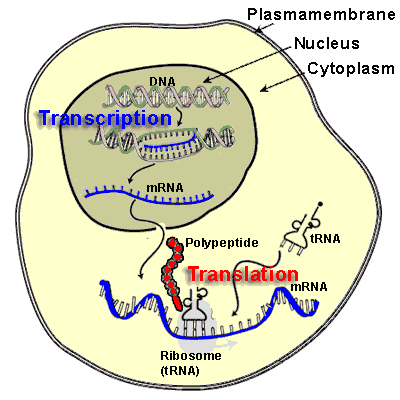
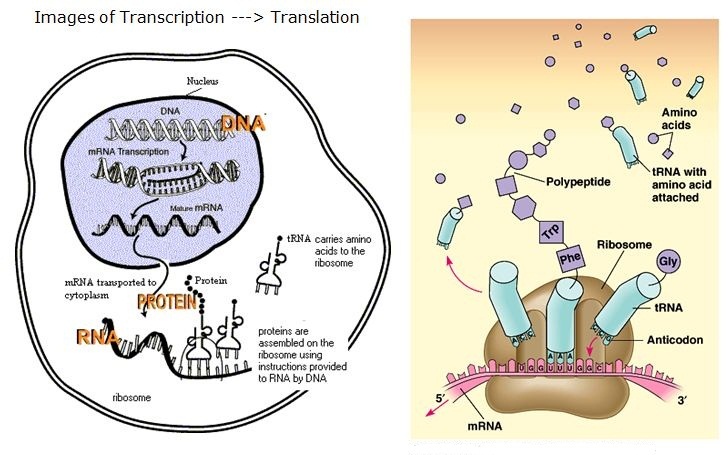
Transcribe and Translate a Gene

  1. For each RNA base there is a corresponding DNA base
  2. Cells use the two-step process of transcription and translation to read each gene and produce the string of amino acids that makes up a protein.
  3. mRNA is produced in the nucleus, and is transferred to the ribosome
  4. mRNA uses uracil instead of thymine
  5. the ribosome reads the RNA sequence and makes protein
  6. There is a sequence combination to fit each amino acid to a three letter RNA code
  7. The ribosome starts at AUG (start), and it reads each codon three letters at a time
  8. Stop codons are UAA, UAG and UGA


protein synthesis

protein synthesis

http://learn.genetics.utah.edu/content/molecules/transcribe/images/TandT.png

mcell-transcription-translation

mcell-transcription-translation

http://www.vcbio.science.ru.nl/images/cellcycle/mcell-transcription-translation_eng_zoom.gif

transcription_translation

transcription_translation


http://www.biologycorner.com/resources/transcription_translation.JPG


What about the purine inosine?

Inosine triphosphate pyrophosphatase – Pyrophosphatase that hydrolyzes the non-canonical purine nucleotides inosine triphosphate (ITP), deoxyinosine triphosphate (dITP) as well as 2′-deoxy-N-6-hydroxylaminopurine triposphate (dHAPTP) and xanthosine 5′-triphosphate (XTP) to their respective monophosphate derivatives. The enzyme does not distinguish between the deoxy- and ribose forms. Probably excludes non-canonical purines from RNA and DNA precursor pools, thus preventing their incorporation into RNA and DNA and avoiding chromosomal lesions.

Gastroenterology. 2011 Apr;140(4):1314-21.  http://dx.doi.org:/10.1053/j.gastro.2010.12.038. Epub 2011 Jan 1.

Inosine triphosphate protects against ribavirin-induced adenosine triphosphate loss by adenylosuccinate synthase function.

Hitomi Y1, Cirulli ET, Fellay J, McHutchison JG, Thompson AJ, Gumbs CE, Shianna KV, Urban TJ, Goldstein DB.

Genetic variation of inosine triphosphatase (ITPA) causing an accumulation of inosine triphosphate (ITP) has been shown to protect patients against ribavirin (RBV)-induced anemia during treatment for chronic hepatitis C infection by genome-wide association study (GWAS). However, the biologic mechanism by which this occurs is unknown.

Although ITP is not used directly by human erythrocyte ATPase, it can be used for ATP biosynthesis via ADSS in place of guanosine triphosphate (GTP). With RBV challenge, erythrocyte ATP reduction was more severe in the wild-type ITPA genotype than in the hemolysis protective ITPA genotype. This difference also remains after inhibiting adenosine uptake using nitrobenzylmercaptopurine riboside (NBMPR).

ITP confers protection against RBV-induced ATP reduction by substituting for erythrocyte GTP, which is depleted by RBV, in the biosynthesis of ATP. Because patients with excess ITP appear largely protected against anemia, these results confirm that RBV-induced anemia is due primarily to the effect of the drug on GTP and consequently ATP levels in erythrocytes.

Ther Drug Monit. 2012 Aug;34(4):477-80.  http://dx.doi.org:/10.1097/FTD.0b013e31825c2703.

Determination of inosine triphosphate pyrophosphatase phenotype in human red blood cells using HPLC.

Citterio-Quentin A1, Salvi JP, Boulieu R.

Thiopurine drugs, widely used in cancer chemotherapy, inflammatory bowel disease, and autoimmune hepatitis, are responsible for common adverse events. Only some of these may be explained by genetic polymorphism of thiopurine S-methyltransferase. Recent articles have reported that inosine triphosphate pyrophosphatase (ITPase) deficiency was associated with adverse drug reactions toward thiopurine drug therapy. Here, we report a weak anion exchange high-performance liquid chromatography method to determine ITPase activity in red blood cells and to investigate the relationship with the occurrence of adverse events during azathioprine therapy.

The chromatographic method reported allows the analysis of IMP, inosine diphosphate, and ITP in a single run in <12.5 minutes. The method was linear in the range 5-1500 μmole/L of IMP. Intraassay and interassay precisions were <5% for red blood cell lysates supplemented with 50, 500, and 1000 μmole/L IMP. Km and Vmax evaluated by Lineweaver-Burk plot were 677.4 μmole/L and 19.6 μmole·L·min, respectively. The frequency distribution of ITPase from 73 patients was investigated.

The method described is useful to determine the ITPase phenotype from patients on thiopurine therapy and to investigate the potential relation between ITPase deficiency and the occurrence of adverse events.


System wide analyses have underestimated protein abundances and the importance of transcription in mammals

Jingyi Jessica Li1, 2, Peter J Bickel1 and Mark D Biggin3

PeerJ 2:e270; http://dx.doi.org:/10.7717/peerj.270

Using individual measurements for 61 housekeeping proteins to rescale whole proteome data from Schwanhausser et al. (2011), we find that the median protein detected is expressed at 170,000 molecules per cell and that our corrected protein abundance estimates show a higher correlation with mRNA abundances than do the uncorrected protein data. In addition, we estimated the impact of further errors in mRNA and protein abundances using direct experimental measurements of these errors. The resulting analysis suggests that mRNA levels explain at least 56% of the differences in protein abundance for the 4,212 genes detected by Schwanhausser et al. (2011), though because one major source of error could not be estimated the true percent contribution should be higher.We also employed a second, independent strategy to determine the contribution of mRNA levels to protein expression.We show that the variance in translation rates directly measured by ribosome profiling is only 12% of that inferred by Schwanhausser et al. (2011), and that the measured and inferred translation rates correlate poorly (R2 D 0.13). Based on this, our second strategy suggests that mRNA levels explain 81% of the variance in protein levels. We also determined the percent contributions of transcription, RNA degradation, translation and protein degradation to the variance in protein abundances using both of our strategies. While the magnitudes of the two estimates vary, they both suggest that transcription plays a more important role than the earlier studies implied and translation a much smaller role. Finally, the above estimates only apply to those genes whose mRNA and protein expression was detected. Based on a detailed analysis by Hebenstreit et al. (2012), we estimat that approximately 40% of genes in a given cell within a population express no mRNA. Since there can be no translation in the ab-sence of mRNA, we argue that differences in translation rates can play no role in determining the expression levels for the 40% of genes that are non-expressed.


Related studies that reveal issues that are not part of this chapter:

  1. Ubiquitylation in relationship to tissue remodeling
  2. Post-translational modification of proteins
    1. Glycosylation
    2. Phosphorylation
    3. Methylation
    4. Nitrosylation
    5. Sulfation – sulfotransferases
      cell-matrix communication
    6. Acetylation and histone deacetylation (HDAC)
      Connecting Protein Phosphatase to 1α (PP1α)
      Acetylation complexes (such as CBP/p300 and PCAF)
      Sirtuins
      Rel/NF-kB Signal Transduction
      Homologous Recombination Pathway of Double-Strand DNA Repair
    7. Glycination
    8. cyclin dependent kinases (CDKs)
    9. lyase
    10. transferase


This year, the Lasker award for basic medical research went to Kazutoshi Mori (Kyoto University) and Peter Walter (University of California, San Francisco) for their “discoveries concerning the unfolded protein response (UPR) — an intracellular quality control system that

detects harmful misfolded proteins in the endoplasmic reticulum and signals the nucleus to carry out corrective measures.”

About UPR: Approximately a third of cellular proteins pass through the Endoplasmic Reticulum (ER) which performs stringent quality control of these proteins. All proteins need to assume the proper 3-dimensional shape in order to function properly in the harsh cellular environment. Related to this is the fact that cells are under constant stress and have to make rapid, real time decisions about survival or death.

A major indicator of stress is the accumulation of unfolded proteins within the Endoplasmic Reticulum (ER), which triggers a transcriptional cascade in order to increase the folding capacity of the ER. If the metabolic burden is too great and homeostasis cannot be achieved, the response shifts from

damage control to the induction of pro-apoptotic pathways that would ultimately cause cell death.

This response to unfolded proteins or the UPR is conserved among all eukaryotes, and dysfunction in this pathway underlies many human diseases, including Alzheimer’s, Parkinson’s, Diabetes and Cancer.


The discovery of a new class of human proteins with previously unidentified activities

In a landmark study conducted by scientists at the Scripps Research Institute, The Hong Kong University of Science and Technology, aTyr Pharma and their collaborators, a new class of human proteins has been discovered. These proteins [nearly 250], called Physiocrines belong to the aminoacyl tRNA synthetase gene family and carry out novel, diverse and distinct biological functions.

The aminoacyl tRNA synthetase gene family codes for a group of 20 ubiquitous enzymes almost all of which are part of the protein synthesis machinery. Using recombinant protein purification, deep sequencing technique, mass spectroscopy and cell based assays, the team made this discovery. The finding is significant, also because it highlights the alternate use of a gene family whose protein product normally performs catalytic activities for non-catalytic regulation of basic and complex physiological processes spanning metabolism, vascularization, stem cell biology and immunology


Muscle maintenance and regeneration – key player identified

Muscle tissue suffers from atrophy with age and its regenerative capacity also declines over time. Most molecules discovered thus far to boost tissue regeneration are also implicated in cancers.  During a quest to find safer alternatives that can regenerate tissue, scientists reported that the hormone Oxytocin is required for proper muscle tissue regeneration and homeostasis and that its levels decline with age.

Oxytocin could be an alternative to hormone replacement therapy as a way to combat aging and other organ related degeneration.

Oxytocin is an age-specific circulating hormone that is necessary for muscle maintenance and regeneration (June 2014)


Proc Natl Acad Sci U S A. 2014 Sep 30;111(39):14289-94.   http://dx.doi.org:/10.1073/pnas.1407640111. Epub 2014 Sep 15.

Role of forkhead box protein A3 in age-associated metabolic decline.

Ma X1, Xu L1, Gavrilova O2, Mueller E3.

Aging is associated with increased adiposity and diminished thermogenesis, but the critical transcription factors influencing these metabolic changes late in life are poorly understood. We recently demonstrated that the winged helix factor forkhead box protein A3 (Foxa3) regulates the expansion of visceral adipose tissue in high-fat diet regimens; however, whether Foxa3 also contributes to the increase in adiposity and the decrease in brown fat activity observed during the normal aging process is currently unknown. Here we report that during aging, levels of Foxa3 are significantly and selectively up-regulated in brown and inguinal white fat depots, and that midage Foxa3-null mice have increased white fat browning and thermogenic capacity, decreased adipose tissue expansion, improved insulin sensitivity, and increased longevity. Foxa3 gain-of-function and loss-of-function studies in inguinal adipose depots demonstrated a cell-autonomous function for Foxa3 in white fat tissue browning. Furthermore, our analysis revealed that the mechanisms of Foxa3 modulation of brown fat gene programs involve the suppression of peroxisome proliferator activated receptor γ coactivtor 1 α (PGC1α) levels through interference with cAMP responsive element binding protein 1-mediated transcriptional regulation of the PGC1α promoter.


Asymmetric mRNA localization contributes to fidelity and sensitivity of spatially localized systems

RJ Weatheritt, TJ Gibson & MM Babu
Nature Structural & Molecular Biology 24 Aug, 2014; 21: 833–839 http://dx.do.orgi:/10.1038/nsmb.2876

Although many proteins are localized after translation, asymmetric protein distribution is also achieved by translation after mRNA localization. Why are certain mRNA transported to a distal location and translated on-site? Here we undertake a systematic, genome-scale study of asymmetrically distributed protein and mRNA in mammalian cells. Our findings suggest that asymmetric protein distribution by mRNA localization enhances interaction fidelity and signaling sensitivity. Proteins synthesized at distal locations frequently contain intrinsically disordered segments. These regions are generally rich in assembly-promoting modules and are often regulated by post-translational modifications. Such proteins are tightly regulated but display distinct temporal dynamics upon stimulation with growth factors. Thus, proteins synthesized on-site may rapidly alter proteome composition and act as dynamically regulated scaffolds to promote the formation of reversible cellular assemblies. Our observations are consistent across multiple mammalian species, cell types and developmental stages, suggesting that localized translation is a recurring feature of cell signaling and regulation.


An overview of the potential advantages conferred by distal-site protein synthesis, inferred from our analysis.


An overview of the potential advantages conferred by distal-site protein synthesis

An overview of the potential advantages conferred by distal-site protein synthesis


Turquoise and red filled circle represents off-target and correct interaction partners, respectively. Wavy lines represent a disordered region within a distal site synthesis protein. Grey and red line in graphs represents profiles of t…

http://www.nature.com/nsmb/journal/v21/n9/carousel/nsmb.2876-F5.jpg


Tweaking transcriptional programming for high quality recombinant protein production

Since overexpression of recombinant proteins in E. coli often leads to the formation of inclusion bodies, producing properly folded, soluble proteins is undoubtedly the most important end goal in a protein expression campaign. Various approaches have been devised to bypass the insolubility issues during E. coli expression and in a recent report a group of researchers discuss reprogramming the E. coli proteostasis [protein homeostasis] network to achieve high yields of soluble, functional protein. The premise of their studies is that the basal E. coli proteostasis network is insufficient, and often unable, to fold overexpressed proteins, thus clogging the folding machinery.

By overexpressing a mutant, negative-feedback deficient heat shock transcription factor [σ32 I54N] before and during overexpression of the protein of interest, reprogramming can be achieved, resulting in high yields of soluble and functional recombinant target protein. The authors explain that this method is better than simply co-expressing/over-expressing chaperones, co-chaperones, foldases or other components of the proteostasis network because reprogramming readies the folding machinery and up regulates the essential folding components beforehand thus  maintaining system capability of the folding machinery.

The Heat-Shock Response Transcriptional Program Enables High-Yield and High-Quality Recombinant Protein Production in Escherichia coli (July 2014)


 Unfolded proteins collapse when exposed to heat and crowded environments

Proteins are important molecules in our body and they fulfil a broad range of functions. For instance as enzymes they help to release energy from food and as muscle proteins they assist with motion. As antibodies they are involved in immune defence and as hormone receptors in signal transduction in cells. Until only recently it was assumed that all proteins take on a clearly defined three-dimensional structure – i.e. they fold in order to be able to assume these functions. Surprisingly, it has been shown that many important proteins occur as unfolded coils. Researchers seek to establish how these disordered proteins are capable at all of assuming highly complex functions.

Ben Schuler’s research group from the Institute of Biochemistry of the University of Zurich has now established that an increase in temperature leads to folded proteins collapsing and becoming smaller. Other environmental factors can trigger the same effect.

Measurements using the “molecular ruler”

“The fact that unfolded proteins shrink at higher temperatures is an indication that cell water does indeed play an important role as to the spatial organisation eventually adopted by the molecules”, comments Schuler with regard to the impact of temperature on protein structure. For their studies the biophysicists use what is known as single-molecule spectroscopy. Small colour probes in the protein enable the observation of changes with an accuracy of more than one millionth of a millimetre. With this “molecular yardstick” it is possible to measure how molecular forces impact protein structure.

With computer simulations the researchers have mimicked the behaviour of disordered proteins.
(Courtesy of Jose EDS Roselino, PhD.


MLKL compromises plasma membrane integrity

Necroptosis is implicated in many diseases and understanding this process is essential in the search for new therapies. While mixed lineage kinase domain-like (MLKL) protein has been known to be a critical component of necroptosis induction, how MLKL transduces the death signal was not clear. In a recent finding, scientists demonstrated that the full four-helical bundle domain (4HBD) in the N-terminal region of MLKL is required and sufficient to induce its oligomerization and trigger cell death.

They also found a patch of positively charged amino acids on the surface of the 4HBD that bound to phosphatidylinositol phosphates (PIPs) and allowed the recruitment of MLKL to the plasma membrane that resulted in the formation of pores consisting of MLKL proteins, due to which cells absorbed excess water causing them to explode. Detailed knowledge about how MLKL proteins create pores offers possibilities for the development of new therapeutic interventions for tolerating or preventing cell death.

MLKL compromises plasma membrane integrity by binding to phosphatidylinositol phosphates (May 2014)


Mitochondrial and ER proteins implicated in dementia

Mitochondria and the endoplasmic reticulum (ER) form tight structural associations that facilitate a number of cellular functions. However, the molecular mechanisms of these interactions aren’t properly understood.

A group of researchers showed that the ER protein VAPB interacted with mitochondrial protein PTPIP51 to regulate ER-mitochondria associations and that TDP-43, a protein implicated in dementia, disturbs this interaction to regulate cellular Ca2+ homeostasis. These studies point to a new pathogenic mechanism for TDP-43 and may also provide a potential new target for the development of new treatments for devastating neurological conditions like dementia.

ER-mitochondria associations are regulated by the VAPB-PTPIP51 interaction and are disrupted by ALS/FTD-associated TDP-43. Nature (June 2014)


A novel strategy to improve membrane protein expression in Yeast

Membrane proteins play indispensable roles in the physiology of an organism. However, recombinant production of membrane proteins is one of the biggest hurdles facing protein biochemists today. A group of scientists in Belgium showed that,

by increasing the intracellular membrane production by interfering with a key enzymatic step of lipid synthesis,

enhanced expression of recombinant membrane proteins in yeast is achieved.

Specifically, they engineered the oleotrophic yeast, Yarrowia lipolytica, by

deleting the phosphatidic acid phosphatase, PAH1 gene,

which led to massive proliferation of endoplasmic reticulum (ER) membranes.

For all 8 tested representatives of different integral membrane protein families, they obtained enhanced protein accumulation.


An unconventional method to boost recombinant protein levels

MazF is an mRNA interferase enzyme in E.coli that functions as and degrades cellular mRNA in a targeted fashion, at the “ACA” sequence. This degradation of cellular mRNA causes a precipitous drop in cellular protein synthesis. A group of scientists at the Robert Wood Johnson Medical School in New Jersey, exploited the degeneracy of the genetic code to modify all “ACA” triplets within their gene of interest in a way that the corresponding amino acid (Threonine) remained unchanged. Consequently, induction of MazF toxin caused degradation of E.coli cellular mRNA but the recombinant gene transcription and protein synthesis continued, causing significant accumulation of high quality target protein. This expression system enables unparalleled signal to noise ratios that could dramatically simplify structural and functional studies of difficult-to-purify, biologically important proteins.


Tandem fusions and bacterial strain evolution for enhanced functional membrane protein production

Membrane protein production remains a significant challenge in its characterization and structure determination. Despite the fact that there are a variety of host cell types, E.coli remains the popular choice for producing recombinant membrane proteins. A group of scientists in Netherlands devised a robust strategy to increase the probability of functional membrane protein overexpression in E.coli.

By fusing Green Fluorescent Protein (GFP) and the Erythromycin Resistance protein (ErmC) to the C-terminus of a target membrane protein they wer e able to track the folding state of their target protein while using Erythromycin to select for increased expression. By increasing erythromycin concentration in the growth media and testing different membrane targets, they were able to identify four evolved E.coli strains, all of which carried a mutation in the hns gene, whose product is implicated in genome organization and transcriptional silencing. Through their experiments the group showed that partial removal of the transcriptional silencing mechanism was related to production of proteins that were essential for functional overexpression of membrane proteins.


The role of an anti-apoptotic factor in recombinant protein production

In a recent study, scientists at the Johns Hopkins University and Frederick National Laboratory for Cancer Research examined an alternative method of utilizing the benefits of anti-apoptotic gene expression to enhance the transient expression of biotherapeutics, specifically, through the co-transfection of Bcl-xL along with the product-coding target gene.

Chinese Hamster Ovary(CHO) cells were co-transfected with the product-coding gene and a vector containing Bcl-xL, using Polyethylenimine (PEI) reagent. They found that the cells co-transfected with Bcl-xL demonstrated reduced apoptosis, increased specific productivity, and an overall increase in product yield.

B-cell lymphoma-extra-large (Bcl-xL) is a mitochondrial transmembrane protein and a member of the Bcl-2 family of proteins which are known to act as either pro- or anti-apoptotic proteins. Bcl-xL itself acts as an anti-apoptotic molecule by preventing the release of mitochondrial contents such as cytochrome c, which would lead to caspase activation. Higher levels of Bcl-xL push a cell toward survival mode by making the membranes pores less permeable and leaky.

Introduction to Protein Synthesis and Degradation Updated 8/31/2019

N-Terminal Degradation of Proteins: The N-End Rule and N-degrons

In both prokaryotes and eukaryotes mitochondria and chloroplasts, the ribosomal synthesis of proteins is initiated with the addition of the N-formyl methionine residue.  However in eukaryotic cytosolic ribosomes, the N terminal was assumed to be devoid of the N-formyl group.  The unformylated N-terminal methionine residues of eukaryotes is then  often N-acetylated (Ac) and creates specific degradation signals, the Ac N-end rule.  These N-end rule pathways are proteolytic systems which recognize these N-degrons resulting in proteosomal degradation or autophagy.  In prokaryotes this system is stimulated by certain amino acid deficiencies and in eukaryotes is dependent on the Psh1 E3 ligase.

Two papers in the journal Science describe this N-degron in more detail.

Structured Abstract
INTRODUCTION

In both bacteria and eukaryotic mitochondria and chloroplasts, the ribosomal synthesis of proteins is initiated with the N-terminal (Nt) formyl-methionine (fMet) residue. Nt-fMet is produced pretranslationally by formyltransferases, which use 10-formyltetrahydrofolate as a cosubstrate. By contrast, proteins synthesized by cytosolic ribosomes of eukaryotes were always presumed to bear unformylated N-terminal Met (Nt-Met). The unformylated Nt-Met residue of eukaryotic proteins is often cotranslationally Nt-acetylated, a modification that creates specific degradation signals, Ac/N-degrons, which are targeted by the Ac/N-end rule pathway. The N-end rule pathways are a set of proteolytic systems whose unifying feature is their ability to recognize proteins containing N-degrons, thereby causing the degradation of these proteins by the proteasome or autophagy in eukaryotes and by the proteasome-like ClpAP protease in bacteria. The main determinant of an N‑degron is a destabilizing Nt-residue of a protein. Studies over the past three decades have shown that all 20 amino acids of the genetic code can act, in cognate sequence contexts, as destabilizing Nt‑residues. The previously known eukaryotic N-end rule pathways are the Arg/N-end rule pathway, the Ac/N-end rule pathway, and the Pro/N-end rule pathway. Regulated degradation of proteins and their natural fragments by the N-end rule pathways has been shown to mediate a broad range of biological processes.

RATIONALE

The chemical similarity of the formyl and acetyl groups and their identical locations in, respectively, Nt‑formylated and Nt-acetylated proteins led us to suggest, and later to show, that the Nt-fMet residues of nascent bacterial proteins can act as bacterial N-degrons, termed fMet/N-degrons. Here we wished to determine whether Nt-formylated proteins might also form in the cytosol of a eukaryote such as the yeast Saccharomyces cerevisiae and to determine the metabolic fates of Nt-formylated proteins if they could be produced outside mitochondria. Our approaches included molecular genetic techniques, mass spectrometric analyses of proteins’ N termini, and affinity-purified antibodies that selectively recognized Nt-formylated reporter proteins.

RESULTS

We discovered that the yeast formyltransferase Fmt1, which is imported from the cytosol into the mitochondria inner matrix, can generate Nt-formylated proteins in the cytosol, because the translocation of Fmt1 into mitochondria is not as efficacious, even under unstressful conditions, as had previously been assumed. We also found that Nt‑formylated proteins are greatly up-regulated in stationary phase or upon starvation for specific amino acids. The massive increase of Nt-formylated proteins strictly requires the Gcn2 kinase, which phosphorylates Fmt1 and mediates its retention in the cytosol. Notably, the ability of Gcn2 to retain a large fraction of Fmt1 in the cytosol of nutritionally stressed cells is confined to Fmt1, inasmuch as the Gcn2 kinase does not have such an effect, under the same conditions, on other examined nuclear DNA–encoded mitochondrial matrix proteins. The Gcn2-Fmt1 protein localization circuit is a previously unknown signal transduction pathway. A down-regulation of cytosolic Nt‑formylation was found to increase the sensitivity of cells to undernutrition stresses, to a prolonged cold stress, and to a toxic compound. We also discovered that the Nt-fMet residues of Nt‑formylated cytosolic proteins act as eukaryotic fMet/N-degrons and identified the Psh1 E3 ubiquitin ligase as the recognition component (fMet/N-recognin) of the previously unknown eukaryotic fMet/N-end rule pathway, which destroys Nt‑formylated proteins.

CONCLUSION

The Nt-formylation of proteins, a long-known pretranslational protein modification, is mediated by formyltransferases. Nt-formylation was thought to be confined to bacteria and bacteria-descended eukaryotic organelles but was found here to also occur at the start of translation by the cytosolic ribosomes of a eukaryote. The levels of Nt‑formylated eukaryotic proteins are greatly increased upon specific stresses, including undernutrition, and appear to be important for adaptation to these stresses. We also discovered that Nt-formylated cytosolic proteins are selectively destroyed by the eukaryotic fMet/N-end rule pathway, mediated by the Psh1 E3 ubiquitin ligase. This previously unknown proteolytic system is likely to be universal among eukaryotes, given strongly conserved mechanisms that mediate Nt‑formylation and degron recognition.

The eukaryotic fMet/N-end rule pathway.

(Top) Under undernutrition conditions, the Gcn2 kinase augments the cytosolic localization of the Fmt1 formyltransferase, and possibly also its enzymatic activity. Consequently, Fmt1 up-regulates the cytosolic fMet–tRNAi (initiator transfer RNA), and thereby increases the levels of cytosolic Nt-formylated proteins, which are required for the adaptation of cells to specific stressors. (Bottom) The Psh1 E3 ubiquitin ligase targets the N-terminal fMet-residues of eukaryotic cytosolic proteins, such as Cse4, Pgd1, and Rps22a, for the polyubiquitylation-mediated, proteasome-dependent degradation.

” data-icon-position=”” data-hide-link-title=”0″>

The eukaryotic fMet/N-end rule pathway.

(Top) Under undernutrition conditions, the Gcn2 kinase augments the cytosolic localization of the Fmt1 formyltransferase, and possibly also its enzymatic activity. Consequently, Fmt1 up-regulates the cytosolic fMet–tRNAi (initiator transfer RNA), and thereby increases the levels of cytosolic Nt-formylated proteins, which are required for the adaptation of cells to specific stressors. (Bottom) The Psh1 E3 ubiquitin ligase targets the N-terminal fMet-residues of eukaryotic cytosolic proteins, such as Cse4, Pgd1, and Rps22a, for the polyubiquitylation-mediated, proteasome-dependent degradation.


A glycine-specific N-degron pathway mediates the quality control of protein N-myristoylation. Richard T. Timms1,2Zhiqian Zhang1,2David Y. Rhee3J. Wade Harper3Itay Koren1,2,*,Stephen J. Elledge1,2

Science  05 Jul 2019: Vol. 365, Issue 6448

The second paper describes a glycine specific N-degron pathway in humans.  Specifically the authors set up a screen to identify specific N-terminal degron motifs in the human.  Findings included an expanded repertoire for the UBR E3 ligases to include substrates with arginine and lysine following an intact initiator methionine and a glycine at the extreme N-terminus, which is a potent degron.

Glycine N-degron regulation revealed

For more than 30 years, N-terminal sequences have been known to influence protein stability, but additional features of these N-end rule, or N-degron, pathways continue to be uncovered. Timms et al. used a global protein stability (GPS) technology to take a broader look at these pathways in human cells. Unexpectedly, glycine exposed at the N terminus could act as a potent degron; proteins bearing N-terminal glycine were targeted for proteasomal degradation by two Cullin-RING E3 ubiquitin ligases through the substrate adaptors ZYG11B and ZER1. This pathway may be important, for example, to degrade proteins that fail to localize properly to cellular membranes and to destroy protein fragments generated during cell death.

Science, this issue p. eaaw4912

Structured Abstract

INTRODUCTION

The ubiquitin-proteasome system is the major route through which the cell achieves selective protein degradation. The E3 ubiquitin ligases are the major determinants of specificity in this system, which is thought to be achieved through their selective recognition of specific degron motifs in substrate proteins. However, our ability to identify these degrons and match them to their cognate E3 ligase remains a major challenge.

RATIONALE

It has long been known that the stability of proteins is influenced by their N-terminal residue, and a large body of work over the past three decades has characterized a collection of N-end rule pathways that target proteins for degradation through N-terminal degron motifs. Recently, we developed Global Protein Stability (GPS)–peptidome technology and used it to delineate a suite of degrons that lie at the extreme C terminus of proteins. We adapted this approach to examine the stability of the human N terminome, allowing us to reevaluate our understanding of N-degron pathways in an unbiased manner.

RESULTS

Stability profiling of the human N terminome identified two major findings: an expanded repertoire for UBR family E3 ligases to include substrates that begin with arginine and lysine following an intact initiator methionine and, more notably, that glycine positioned at the extreme N terminus can act as a potent degron. We established human embryonic kidney 293T reporter cell lines in which unstable peptides that bear N-terminal glycine degrons were fused to green fluorescent protein, and we performed CRISPR screens to identify the degradative machinery involved. These screens identified two Cul2 Cullin-RING E3 ligase complexes, defined by the related substrate adaptors ZYG11B and ZER1, that act redundantly to target substrates bearing N-terminal glycine degrons for proteasomal degradation. Moreover, through the saturation mutagenesis of example substrates, we defined the composition of preferred N-terminal glycine degrons specifically recognized by ZYG11B and ZER1.

We found that preferred glycine degrons are depleted from the native N termini of metazoan proteomes, suggesting that proteins have evolved to avoid degradation through this pathway, but are strongly enriched at annotated caspase cleavage sites. Stability profiling of N-terminal peptides lying downstream of all known caspase cleavages sites confirmed that Cul2ZYG11Band Cul2ZER1 could make a substantial contribution to the removal of proteolytic cleavage products during apoptosis. Last, we identified a role for ZYG11B and ZER1 in the quality control of N-myristoylated proteins. N-myristoylation is an important posttranslational modification that occurs exclusively on N-terminal glycine. By profiling the stability of the human N-terminome in the absence of the N-myristoyltransferases NMT1 and NMT2, we found that a failure to undergo N-myristoylation exposes N-terminal glycine degrons that are otherwise obscured. Thus, conditional exposure of glycine degrons to ZYG11B and ZER1 permits the selective proteasomal degradation of aberrant proteins that have escaped N-terminal myristoylation.

CONCLUSION

These data demonstrate that an additional N-degron pathway centered on N-terminal glycine regulates the stability of metazoan proteomes. Cul2ZYG11B– and Cul2ZER1-mediated protein degradation through N-terminal glycine degrons may be particularly important in the clearance of proteolytic fragments generated by caspase cleavage during apoptosis and in the quality control of protein N-myristoylation.

The glycine N-degron pathway.

Stability profiling of the human N-terminome revealed that N-terminal glycine acts as a potent degron. CRISPR screening revealed two Cul2 complexes, defined by the related substrate adaptors ZYG11B and ZER1, that recognize N-terminal glycine degrons. This pathway may be particularly important for the degradation of caspase cleavage products during apoptosis and the removal of proteins that fail to undergo N-myristoylation.

” data-icon-position=”” data-hide-link-title=”0″>

The glycine N-degron pathway.

Stability profiling of the human N-terminome revealed that N-terminal glycine acts as a potent degron. CRISPR screening revealed two Cul2 complexes, defined by the related substrate adaptors ZYG11B and ZER1, that recognize N-terminal glycine degrons. This pathway may be particularly important for the degradation of caspase cleavage products during apoptosis and the removal of proteins that fail to undergo N-myristoylation.


Read Full Post »

Summary of Signaling and Signaling Pathways

Summary of Signaling and Signaling Pathways

Author and Curator: Larry H Bernstein, MD, FCAP

In the imtroduction to this series of discussions I pointed out JEDS Rosalino’s observation about the construction of a complex molecule of acetyl coenzyme A, and the amount of genetic coding that had to go into it.  Furthermore, he observes –  Millions of years later, or as soon as, the information of interaction leading to activity and regulation could be found in RNA, proteins like reverse transcriptase move this information to a more stable form (DNA). In this way it is easier to understand the use of CoA to make two carbon molecules more reactive.

acetylCoA

acetylCoA

In the tutorial that follows we find support for the view that mechanisms and examples from the current literature, which give insight into the developments in cell metabolism, are achieving a separation from inconsistent views introduced by the classical model of molecular biology and genomics, toward a more functional cellular dynamics that is not dependent on the classic view.  The classical view fits a rigid framework that is to genomics and metabolomics as Mendelian genetics if to multidimentional, multifactorial genetics.  The inherent difficulty lies in two places:

  1. Interactions between differently weighted determinants
  2. A large part of the genome is concerned with regulatory function, not expression of the code

The goal of the tutorial was to achieve an understanding of how cell signaling occurs in a cell.  Completion of the tutorial would provide

  1. a basic understanding signal transduction and
  2. the role of phosphorylation in signal transduction.
Regulation of the integrity of endothelial cell–cell contacts by phosphorylation of VE-cadherin

Regulation of the integrity of endothelial cell–cell contacts by phosphorylation of VE-cadherin

In addition – detailed knowledge of –

  1. the role of Tyrosine kinases and
  2. G protein-coupled receptors in cell signaling.
serine

serine

threonine

threonine

protein kinase

protein kinase

We are constantly receiving and interpreting signals from our environment, which can come

  • in the form of light, heat, odors, touch or sound.

The cells of our bodies are also

  • constantly receiving signals from other cells.

These signals are important to

  • keep cells alive and functioning as well as
  • to stimulate important events such as
  • cell division and differentiation.

Signals are most often chemicals that can be found

  • in the extracellular fluid around cells.

These chemicals can come

  • from distant locations in the body (endocrine signaling by hormones), from
  • nearby cells (paracrine signaling) or can even
  • be secreted by the same cell (autocrine signaling).

Notch-mediated juxtacrine signal between adjacent cells. 220px-Notchccr

Signaling molecules may trigger any number of cellular responses, including

  • changing the metabolism of the cell receiving the signal or
  • result in a change in gene expression (transcription) within the nucleus of the cell or both.
controlling the output of ribosomes.

controlling the output of ribosomes.

To which I would now add..

  • result in either an inhibitory or a stimulatory effect

The three stages of cell signaling are:

Cell signaling can be divided into 3 stages:

Reception: A cell detects a signaling molecule from the outside of the cell.

Transduction: When the signaling molecule binds the receptor it changes the receptor protein in some way. This change initiates the process of transduction. Signal transduction is usually a pathway of several steps. Each relay molecule in the signal transduction pathway changes the next molecule in the pathway.

Response: Finally, the signal triggers a specific cellular response.

signal transduction

signal transduction

http://www.hartnell.edu/tutorials/biology/images/signaltransduction_simple.jpg

The initiation is depicted as follows:

Signal Transduction – ligand binds to surface receptor

Membrane receptors function by binding the signal molecule (ligand) and causing the production of a second signal (also known as a second messenger) that then causes a cellular response. These types of receptors transmit information from the extracellular environment to the inside of the cell.

  • by changing shape or
  • by joining with another protein
  • once a specific ligand binds to it.

Examples of membrane receptors include

  • G Protein-Coupled Receptors and
Understanding these receptors and identifying their ligands and the resulting signal transduction pathways represent a major conceptual advance.

Understanding these receptors and identifying their ligands and the resulting signal transduction pathways represent a major conceptual advance.

  • Receptor Tyrosine Kinases.
intracellular signaling

intracellular signaling

http://www.hartnell.edu/tutorials/biology/images/membrane_receptor_tk.jpg

Intracellular receptors are found inside the cell, either in the cytopolasm or in the nucleus of the target cell (the cell receiving the signal).

Note that though change in gene expression is stated, the change in gene expression does not here imply a change in the genetic information – such as – mutation.  That does not have to be the case in the normal homeostatic case.

This point is the differentiating case between what JEDS Roselino has referred as

  1. a fast, adaptive reaction, that is the feature of protein molecules, and distinguishes this interaction from
  2. a one-to-one transcription of the genetic code.

The rate of transcription can be controlled, or it can be blocked.  This is in large part in response to the metabolites in the immediate interstitium.

This might only be

  • a change in the rate of a transcription or a suppression of expression through RNA.
  • Or through a conformational change in an enzyme
 Swinging domains in HECT E3 enzymes

Swinging domains in HECT E3 enzymes

Since signaling systems need to be

  • responsive to small concentrations of chemical signals and act quickly,
  • cells often use a multi-step pathway that transmits the signal quickly,
  • while amplifying the signal to numerous molecules at each step.

Signal transduction pathways are shown (simplified):

Signal Transduction

Signal Transduction

Signal transduction occurs when an

  1. extracellular signaling molecule activates a specific receptor located on the cell surface or inside the cell.
  2. In turn, this receptor triggers a biochemical chain of events inside the cell, creating a response.
  3. Depending on the cell, the response alters the cell’s metabolism, shape, gene expression, or ability to divide.
  4. The signal can be amplified at any step. Thus, one signaling molecule can cause many responses.

In 1970, Martin Rodbell examined the effects of glucagon on a rat’s liver cell membrane receptor. He noted that guanosine triphosphate disassociated glucagon from this receptor and stimulated the G-protein, which strongly influenced the cell’s metabolism. Thus, he deduced that the G-protein is a transducer that accepts glucagon molecules and affects the cell. For this, he shared the 1994 Nobel Prize in Physiology or Medicine with Alfred G. Gilman.

Guanosine monophosphate structure

Guanosine monophosphate structure

In 2007, a total of 48,377 scientific papers—including 11,211 e-review papers—were published on the subject. The term first appeared in a paper’s title in 1979. Widespread use of the term has been traced to a 1980 review article by Rodbell: Research papers focusing on signal transduction first appeared in large numbers in the late 1980s and early 1990s.

Signal transduction involves the binding of extracellular signaling molecules and ligands to cell-surface receptors that trigger events inside the cell. The combination of messenger with receptor causes a change in the conformation of the receptor, known as receptor activation.

This activation is always the initial step (the cause) leading to the cell’s ultimate responses (effect) to the messenger. Despite the myriad of these ultimate responses, they are all directly due to changes in particular cell proteins. Intracellular signaling cascades can be started through cell-substratum interactions; examples are the integrin that binds ligands in the extracellular matrix and steroids.

Integrin

Integrin

Most steroid hormones have receptors within the cytoplasm and act by stimulating the binding of their receptors to the promoter region of steroid-responsive genes.

steroid hormone receptor

steroid hormone receptor

Various environmental stimuli exist that initiate signal transmission processes in multicellular organisms; examples include photons hitting cells in the retina of the eye, and odorants binding to odorant receptors in the nasal epithelium. Certain microbial molecules, such as viral nucleotides and protein antigens, can elicit an immune system response against invading pathogens mediated by signal transduction processes. This may occur independent of signal transduction stimulation by other molecules, as is the case for the toll-like receptor. It may occur with help from stimulatory molecules located at the cell surface of other cells, as with T-cell receptor signaling. Receptors can be roughly divided into two major classes: intracellular receptors and extracellular receptors.

Signal transduction cascades amplify the signal output

Signal transduction cascades amplify the signal output

Signal transduction cascades amplify the signal output

G protein-coupled receptors (GPCRs) are a family of integral transmembrane proteins that possess seven transmembrane domains and are linked to a heterotrimeric G protein. Many receptors are in this family, including adrenergic receptors and chemokine receptors.

Arrestin binding to active GPCR kinase (GRK)-phosphorylated GPCRs blocks G protein coupling

signal transduction pathways

signal transduction pathways

Arrestin binding to active GPCR kinase (GRK)-phosphorylated GPCRs blocks G protein coupling

Arrestin binding to active GPCR kinase (GRK)-phosphorylated GPCRs blocks G protein coupling

Signal transduction by a GPCR begins with an inactive G protein coupled to the receptor; it exists as a heterotrimer consisting of Gα, Gβ, and Gγ. Once the GPCR recognizes a ligand, the conformation of the receptor changes to activate the G protein, causing Gα to bind a molecule of GTP and dissociate from the other two G-protein subunits.

The dissociation exposes sites on the subunits that can interact with other molecules. The activated G protein subunits detach from the receptor and initiate signaling from many downstream effector proteins such as phospholipases and ion channels, the latter permitting the release of second messenger molecules.

Receptor tyrosine kinases (RTKs) are transmembrane proteins with an intracellular kinase domain and an extracellular domain that binds ligands; examples include growth factor receptors such as the insulin receptor.

 insulin receptor and and insulin receptor signaling pathway (IRS)

insulin receptor and and insulin receptor signaling pathway (IRS)

To perform signal transduction, RTKs need to form dimers in the plasma membrane; the dimer is stabilized by ligands binding to the receptor.

RTKs

RTKs

The interaction between the cytoplasmic domains stimulates the autophosphorylation of tyrosines within the domains of the RTKs, causing conformational changes.

Allosteric_Regulation.svg

Subsequent to this, the receptors’ kinase domains are activated, initiating phosphorylation signaling cascades of downstream cytoplasmic molecules that facilitate various cellular processes such as cell differentiation and metabolism.

Signal-Transduction-Pathway

Signal-Transduction-Pathway

As is the case with GPCRs, proteins that bind GTP play a major role in signal transduction from the activated RTK into the cell. In this case, the G proteins are

  • members of the Ras, Rho, and Raf families, referred to collectively as small G proteins.

They act as molecular switches usually

  • tethered to membranes by isoprenyl groups linked to their carboxyl ends.

Upon activation, they assign proteins to specific membrane subdomains where they participate in signaling. Activated RTKs in turn activate

  • small G proteins that activate guanine nucleotide exchange factors such as SOS1.

Once activated, these exchange factors can activate more small G proteins, thus

  • amplifying the receptor’s initial signal.

The mutation of certain RTK genes, as with that of GPCRs, can result in the expression of receptors that exist in a constitutively activate state; such mutated genes may act as oncogenes.

Integrin


Integrin

Integrin

Integrin-mediated signal transduction

An overview of integrin-mediated signal transduction, adapted from Hehlgens et al. (2007).

Integrins are produced by a wide variety of cells; they play a role in

  • cell attachment to other cells and the extracellular matrix and
  • in the transduction of signals from extracellular matrix components such as fibronectin and collagen.

Ligand binding to the extracellular domain of integrins

  • changes the protein’s conformation,
  • clustering it at the cell membrane to
  • initiate signal transduction.

Integrins lack kinase activity; hence, integrin-mediated signal transduction is achieved through a variety of intracellular protein kinases and adaptor molecules, the main coordinator being integrin-linked kinase.

As shown in the picture, cooperative integrin-RTK signaling determines the

  1. timing of cellular survival,
  2. apoptosis,
  3. proliferation, and
  4. differentiation.
integrin-mediated signal transduction

integrin-mediated signal transduction

Integrin signaling

Integrin signaling

ion channel

A ligand-gated ion channel, upon binding with a ligand, changes conformation

  • to open a channel in the cell membrane
  • through which ions relaying signals can pass.

An example of this mechanism is found in the receiving cell of a neural synapse. The influx of ions that occurs in response to the opening of these channels

  1. induces action potentials, such as those that travel along nerves,
  2. by depolarizing the membrane of post-synaptic cells,
  3. resulting in the opening of voltage-gated ion channels.
RyR and Ca+ release from SR

RyR and Ca+ release from SR

An example of an ion allowed into the cell during a ligand-gated ion channel opening is Ca2+;

  • it acts as a second messenger
  • initiating signal transduction cascades and
  • altering the physiology of the responding cell.

This results in amplification of the synapse response between synaptic cells

  • by remodelling the dendritic spines involved in the synapse.

In eukaryotic cells, most intracellular proteins activated by a ligand/receptor interaction possess an enzymatic activity; examples include tyrosine kinase and phosphatases. Some of them create second messengers such as cyclic AMP and IP3,

cAMP

cAMP

Inositol_1,4,5-trisphosphate.svg

Inositol_1,4,5-trisphosphate.svg

  • the latter controlling the release of intracellular calcium stores into the cytoplasm.

Many adaptor proteins and enzymes activated as part of signal transduction possess specialized protein domains that bind to specific secondary messenger molecules. For example,

  • calcium ions bind to the EF hand domains of calmodulin,
  • allowing it to bind and activate calmodulin-dependent kinase.
calcium movement and RyR2 receptor

calcium movement and RyR2 receptor

PIP3 and other phosphoinositides do the same thing to the Pleckstrin homology domains of proteins such as the kinase protein AKT.

Signals can be generated within organelles, such as chloroplasts and mitochondria, modulating the nuclear
gene expression in a process called retrograde signaling.

Recently, integrative genomics approaches, in which correlation analysis has been applied on transcript and metabolite profiling data of Arabidopsis thaliana, revealed the identification of metabolites which are putatively acting as mediators of nuclear gene expression.

http://fpls.com/unraveling_retrograde_signaling_pathways:_finding_candidate_signaling_molecules_via_metabolomics_and_systems_biology_driven_approaches

Related articles

  1. Systems Biology Approach Reveals Genome to Phenome Correlation in Type 2 Diabetes (plosone.org)
  2. Gene Expression and Thiopurine Metabolite Profiling in Inflammatory Bowel Disease – Novel Clues to Drug Targets and Disease Mechanisms? (plosone.org)
  3. Activation of the Jasmonic Acid Plant Defence Pathway Alters the Composition of Rhizosphere

Nutrients 2014, 6, 3245-3258; http://dx.doi.org:/10.3390/nu6083245

Omega-3 (ω-3) fatty acids are one of the two main families of long chain polyunsaturated fatty acids (PUFA). The main omega-3 fatty acids in the mammalian body are

  • α-linolenic acid (ALA), docosahexaenoic acid (DHA) and eicosapentaenoic acid (EPA).

Central nervous tissues of vertebrates are characterized by a high concentration of omega-3 fatty acids. Moreover, in the human brain,

  • DHA is considered as the main structural omega-3 fatty acid, which comprises about 40% of the PUFAs in total.

DHA deficiency may be the cause of many disorders such as depression, inability to concentrate, excessive mood swings, anxiety, cardiovascular disease, type 2 diabetes, dry skin and so on.

On the other hand,

  • zinc is the most abundant trace metal in the human brain.

There are many scientific studies linking zinc, especially

  • excess amounts of free zinc, to cellular death.

Neurodegenerative diseases, such as Alzheimer’s disease, are characterized by altered zinc metabolism. Both animal model studies and human cell culture studies have shown a possible link between

  • omega-3 fatty acids, zinc transporter levels and
  • free zinc availability at cellular levels.

Many other studies have also suggested a possible

  • omega-3 and zinc effect on neurodegeneration and cellular death.

Therefore, in this review, we will examine

  • the effect of omega-3 fatty acids on zinc transporters and
  • the importance of free zinc for human neuronal cells.

Moreover, we will evaluate the collective understanding of

  • mechanism(s) for the interaction of these elements in neuronal research and their
  • significance for the diagnosis and treatment of neurodegeneration.

Epidemiological studies have linked high intake of fish and shellfish as part of the daily diet to

  • reduction of the incidence and/or severity of Alzheimer’s disease (AD) and senile mental decline in

Omega-3 fatty acids are one of the two main families of a broader group of fatty acids referred to as polyunsaturated fatty acids (PUFAs). The other main family of PUFAs encompasses the omega-6 fatty acids. In general, PUFAs are essential in many biochemical events, especially in early post-natal development processes such as

  • cellular differentiation,
  • photoreceptor membrane biogenesis and
  • active synaptogenesis.

Despite the significance of these

two families, mammals cannot synthesize PUFA de novo, so they must be ingested from dietary sources. Though belonging to the same family, both

  • omega-3 and omega-6 fatty acids are metabolically and functionally distinct and have
  • opposing physiological effects. In the human body,
  • high concentrations of omega-6 fatty acids are known to increase the formation of prostaglandins and
  • thereby increase inflammatory processes [10].

the reverse process can be seen with increased omega-3 fatty acids in the body.

Many other factors, such as

  1. thromboxane A2 (TXA2),
  2. leukotriene
  3. B4 (LTB4),
  4. IL-1,
  5. IL-6,
  6. tumor necrosis factor (TNF) and
  7. C-reactive protein,

which are implicated in various health conditions, have been shown to be increased with high omega-6 fatty acids but decreased with omega-3 fatty acids in the human body.

Dietary fatty acids have been identified as protective factors in coronary heart disease, and PUFA levels are known to play a critical role in

  • immune responses,
  • gene expression and
  • intercellular communications.

omega-3 fatty acids are known to be vital in

  • the prevention of fatal ventricular arrhythmias, and
  • are also known to reduce thrombus formation propensity by decreasing platelet aggregation, blood viscosity and fibrinogen levels

.Since omega-3 fatty acids are prevalent in the nervous system, it seems logical that a deficiency may result in neuronal problems, and this is indeed what has been identified and reported.

The main

In another study conducted with individuals of 65 years of age or older (n = 6158), it was found that

  • only high fish consumption, but
  • not dietary omega-3 acid intake,
  • had a protective effect on cognitive decline

In 2005, based on a meta-analysis of the available epidemiology and preclinical studies, clinical trials were conducted to assess the effects of omega-3 fatty acids on cognitive protection. Four of the trials completed have shown

a protective effect of omega-3 fatty acids only among those with mild cognitive impairment conditions.

A  trial of subjects with mild memory complaints demonstrated

  • an improvement with 900 mg of DHA.

We review key findings on

  • the effect of the omega-3 fatty acid DHA on zinc transporters and the
  • importance of free zinc to human neuronal cells.

DHA is the most abundant fatty acid in neural membranes, imparting appropriate

  • fluidity and other properties,

and is thus considered as the most important fatty acid in neuronal studies. DHA is well conserved throughout the mammalian species despite their dietary differences. It is mainly concentrated

  • in membrane phospholipids at synapses and
  • in retinal photoreceptors and
  • also in the testis and sperm.

In adult rats’ brain, DHA comprises approximately

  • 17% of the total fatty acid weight, and
  • in the retina it is as high as 33%.

DHA is believed to have played a major role in the evolution of the modern human –

  • in particular the well-developed brain.

Premature babies fed on DHA-rich formula show improvements in vocabulary and motor performance.

Analysis of human cadaver brains have shown that

  • people with AD have less DHA in their frontal lobe
  • and hippocampus compared with unaffected individuals

Furthermore, studies in mice have increased support for the

  • protective role of omega-3 fatty acids.

Mice administrated with a dietary intake of DHA showed

  • an increase in DHA levels in the hippocampus.

Errors in memory were decreased in these mice and they demonstrated

  • reduced peroxide and free radical levels,
  • suggesting a role in antioxidant defense.

Another study conducted with a Tg2576 mouse model of AD demonstrated that dietary

  • DHA supplementation had a protective effect against reduction in
  • drebrin (actin associated protein), elevated oxidation, and to some extent, apoptosis via
  • decreased caspase activity.


Zinc

Zinc is a trace element, which is indispensable for life, and it is the second most abundant trace element in the body. It is known to be related to

  • growth,
  • development,
  • differentiation,
  • immune response,
  • receptor activity,
  • DNA synthesis,
  • gene expression,
  • neuro-transmission,
  • enzymatic catalysis,
  • hormonal storage and release,
  • tissue repair,
  • memory,
  • the visual process

and many other cellular functions. Moreover, the indispensability of zinc to the body can be discussed in many other aspects,  as

  • a component of over 300 different enzymes
  • an integral component of a metallothioneins
  • a gene regulatory protein.

Approximately 3% of all proteins contain

  • zinc binding motifs .

The broad biological functionality of zinc is thought to be due to its stable chemical and physical properties. Zinc is considered to have three different functions in enzymes;

  1. catalytic,
  2. coactive and

Indeed, it is the only metal found in all six different subclasses

of enzymes. The essential nature of zinc to the human body can be clearly displayed by studying the wide range of pathological effects of zinc deficiency. Anorexia, embryonic and post-natal growth retardation, alopecia, skin lesions, difficulties in wound healing, increased hemorrhage tendency and severe reproductive abnormalities, emotional instability, irritability and depression are just some of the detrimental effects of zinc deficiency.

Proper development and function of the central nervous system (CNS) is highly dependent on zinc levels. In the mammalian organs, zinc is mainly concentrated in the brain at around 150 μm. However, free zinc in the mammalian brain is calculated to be around 10 to 20 nm and the rest exists in either protein-, enzyme- or nucleotide bound form. The brain and zinc relationship is thought to be mediated

  • through glutamate receptors, and
  • it inhibits excitatory and inhibitory receptors.

Vesicular localization of zinc in pre-synaptic terminals is a characteristic feature of brain-localized zinc, and

  • its release is dependent on neural activity.

Retardation of the growth and development of CNS tissues have been linked to low zinc levels. Peripheral neuropathy, spina bifida, hydrocephalus, anencephalus, epilepsy and Pick’s disease have been linked to zinc deficiency. However, the body cannot tolerate excessive amounts of zinc.

The relationship between zinc and neurodegeneration, specifically AD, has been interpreted in several ways. One study has proposed that β-amyloid has a greater propensity to

  • form insoluble amyloid in the presence of
  • high physiological levels of zinc.

Insoluble amyloid is thought to

  • aggregate to form plaques,

which is a main pathological feature of AD. Further studies have shown that

  • chelation of zinc ions can deform and disaggregate plaques.

In AD, the most prominent injuries are found in

  • hippocampal pyramidal neurons, acetylcholine-containing neurons in the basal forebrain, and in
  • somatostatin-containing neurons in the forebrain.

All of these neurons are known to favor

  • rapid and direct entry of zinc in high concentration
  • leaving neurons frequently exposed to high dosages of zinc.

This is thought to promote neuronal cell damage through oxidative stress and mitochondrial dysfunction. Excessive levels of zinc are also capable of

  • inhibiting Ca2+ and Na+ voltage gated channels
  • and up-regulating the cellular levels of reactive oxygen species (ROS).

High levels of zinc are found in Alzheimer’s brains indicating a possible zinc related neurodegeneration. A study conducted with mouse neuronal cells has shown that even a 24-h exposure to high levels of zinc (40 μm) is sufficient to degenerate cells.

If the human diet is deficient in zinc, the body

  • efficiently conserves zinc at the tissue level by compensating other cellular mechanisms

to delay the dietary deficiency effects of zinc. These include reduction of cellular growth rate and zinc excretion levels, and

  • redistribution of available zinc to more zinc dependent cells or organs.

A novel method of measuring metallothionein (MT) levels was introduced as a biomarker for the

  • assessment of the zinc status of individuals and populations.

In humans, erythrocyte metallothionein (E-MT) levels may be considered as an indicator of zinc depletion and repletion, as E-MT levels are sensitive to dietary zinc intake. It should be noted here that MT plays an important role in zinc homeostasis by acting

  • as a target for zinc ion binding and thus
  • assisting in the trafficking of zinc ions through the cell,
  • which may be similar to that of zinc transporters

Zinc Transporters

Deficient or excess amounts of zinc in the body can be catastrophic to the integrity of cellular biochemical and biological systems. The gastrointestinal system controls the absorption, excretion and the distribution of zinc, although the hydrophilic and high-charge molecular characteristics of zinc are not favorable for passive diffusion across the cell membranes. Zinc movement is known to occur

  • via intermembrane proteins and zinc transporter (ZnT) proteins

These transporters are mainly categorized under two metal transporter families; Zip (ZRT, IRT like proteins) and CDF/ZnT (Cation Diffusion Facilitator), also known as SLC (Solute Linked Carrier) gene families: Zip (SLC-39) and ZnT (SLC-30). More than 20 zinc transporters have been identified and characterized over the last two decades (14 Zips and 8 ZnTs).

Members of the SLC39 family have been identified as the putative facilitators of zinc influx into the cytosol, either from the extracellular environment or from intracellular compartments (Figure 1).

The identification of this transporter family was a result of gene sequencing of known Zip1 protein transporters in plants, yeast and human cells. In contrast to the SLC39 family, the SLC30 family facilitates the opposite process, namely zinc efflux from the cytosol to the extracellular environment or into luminal compartments such as secretory granules, endosomes and synaptic vesicles; thus decreasing intracellular zinc availability (Figure 1). ZnT3 is the most important in the brain where

  • it is responsible for the transport of zinc into the synaptic vesicles of
  • glutamatergic neurons in the hippocampus and neocortex,

Figure 1: Subcellular localization and direction of transport of the zinc transporter families, ZnT and ZIP. Arrows show the direction of zinc mobilization for the ZnT (green) and ZIP (red) proteins. A net gain in cytosolic zinc is achieved by the transportation of zinc from the extracellular region and organelles such as the endoplasmic reticulum (ER) and Golgi apparatus by the ZIP transporters. Cytosolic zinc is mobilized into early secretory compartments such as the ER and Golgi apparatus by the ZnT transporters. Figures were produced using Servier Medical Art, http://www.servier.com/.   http://www.hindawi.com/journals/jnme/2012/173712.fig.001.jpg

Figure 2: Early zinc signaling (EZS) and late zinc signaling (LZS). EZS involves transcription-independent mechanisms where an extracellular stimulus directly induces an increase in zinc levels within several minutes by releasing zinc from intracellular stores (e.g., endoplasmic reticulum). LSZ is induced several hours after an external stimulus and is dependent on transcriptional changes in zinc transporter expression. Components of this figure were produced using Servier Medical Art, http://www.servier.com/ and adapted from Fukada et al. [30].

omega-3 fatty acids in the mammalian body are

  1. α-linolenic acid (ALA),
  2. docosahexenoic acid (DHA) and
  3. eicosapentaenoic acid (EPA).

In general, seafood is rich in omega-3 fatty acids, more specifically DHA and EPA (Table 1). Thus far, there are nine separate epidemiological studies that suggest a possible link between

  • increased fish consumption and reduced risk of AD
  • and eight out of ten studies have reported a link between higher blood omega-3 levels

DHA and Zinc Homeostasis

Many studies have identified possible associations between DHA levels, zinc homeostasis, neuroprotection and neurodegeneration. Dietary DHA deficiency resulted in

  • increased zinc levels in the hippocampus and
  • elevated expression of the putative zinc transporter, ZnT3, in the rat brain.

Altered zinc metabolism in neuronal cells has been linked to neurodegenerative conditions such as AD. A study conducted with transgenic mice has shown a significant link between ZnT3 transporter levels and cerebral amyloid plaque pathology. When the ZnT3 transporter was silenced in transgenic mice expressing cerebral amyloid plaque pathology,

  • a significant reduction in plaque load
  • and the presence of insoluble amyloid were observed.

In addition to the decrease in plaque load, ZnT3 silenced mice also exhibited a significant

  • reduction in free zinc availability in the hippocampus
  • and cerebral cortex.

Collectively, the findings from this study are very interesting and indicate a clear connection between

  • zinc availability and amyloid plaque formation,

thus indicating a possible link to AD.

DHA supplementation has also been reported to limit the following:

  1. amyloid presence,
  2. synaptic marker loss,
  3. hyper-phosphorylation of Tau,
  4. oxidative damage and
  5. cognitive deficits in transgenic mouse model of AD.

In addition, studies by Stoltenberg, Flinn and colleagues report on the modulation of zinc and the effect in transgenic mouse models of AD. Given that all of these are classic pathological features of AD, and considering the limiting nature of DHA in these processes, it can be argued that DHA is a key candidate in preventing or even curing this debilitating disease.

In order to better understand the possible links and pathways of zinc and DHA with neurodegeneration, we designed a study that incorporates all three of these aspects, to study their effects at the cellular level. In this study, we were able to demonstrate a possible link between omega-3 fatty acid (DHA) concentration, zinc availability and zinc transporter expression levels in cultured human neuronal cells.

When treated with DHA over 48 h, ZnT3 levels were markedly reduced in the human neuroblastoma M17 cell line. Moreover, in the same study, we were able to propose a possible

  • neuroprotective mechanism of DHA,

which we believe is exerted through

  • a reduction in cellular zinc levels (through altering zinc transporter expression levels)
  • that in turn inhibits apoptosis.

DHA supplemented M17 cells also showed a marked depletion of zinc uptake (up to 30%), and

  • free zinc levels in the cytosol were significantly low compared to the control

This reduction in free zinc availability was specific to DHA; cells treated with EPA had no significant change in free zinc levels (unpublished data). Moreover, DHA-repleted cells had

  • low levels of active caspase-3 and
  • high Bcl-2 levels compared to the control treatment.

These findings are consistent with previous published data and further strengthen the possible

  • correlation between zinc, DHA and neurodegeneration.

On the other hand, recent studies using ZnT3 knockout (ZnT3KO) mice have shown the importance of

  • ZnT3 in memory and AD pathology.

For example, Sindreu and colleagues have used ZnT3KO mice to establish the important role of

  • ZnT3 in zinc homeostasis that modulates presynaptic MAPK signaling
  • required for hippocampus-dependent memory

Results from these studies indicate a possible zinc-transporter-expression-level-dependent mechanism for DHA neuroprotection.

Read Full Post »

Complex Models of Signaling: Therapeutic Implications

Complex Models of Signaling: Therapeutic Implications

Curator: Larry H. Bernstein, MD, FCAP

Updated 6/24/2019

Fishy Business: Effect of Omega-3 Fatty Acids on Zinc Transporters and Free Zinc Availability in Human Neuronal Cells

Damitha De Mel and Cenk Suphioglu *

NeuroAllergy Research Laboratory (NARL), School of Life and Environmental Sciences, Faculty of Science, Engineering and Built Environment, Waurn Ponds, Victoria, Australia.

Nutrients 2014, 6, 3245-3258; http://dx.doi.org:/10.3390/nu6083245

Omega-3 (ω-3) fatty acids are one of the two main families of long chain polyunsaturated fatty acids (PUFA). The main omega-3 fatty acids in the mammalian body are

  • α-linolenic acid (ALA), docosahexaenoic acid (DHA) and eicosapentaenoic acid (EPA).

Central nervous tissues of vertebrates are characterized by a high concentration of omega-3 fatty acids. Moreover, in the human brain,

  • DHA is considered as the main structural omega-3 fatty acid, which comprises about 40% of the PUFAs in total.

DHA deficiency may be the cause of many disorders such as depression, inability to concentrate, excessive mood swings, anxiety, cardiovascular disease, type 2 diabetes, dry skin and so on.

On the other hand,

  • zinc is the most abundant trace metal in the human brain.

There are many scientific studies linking zinc, especially

  • excess amounts of free zinc, to cellular death.

Neurodegenerative diseases, such as Alzheimer’s disease, are characterized by altered zinc metabolism. Both animal model studies and human cell culture studies have shown a possible link between

  • omega-3 fatty acids, zinc transporter levels and
  • free zinc availability at cellular levels.

Many other studies have also suggested a possible

  • omega-3 and zinc effect on neurodegeneration and cellular death.

Therefore, in this review, we will examine

  • the effect of omega-3 fatty acids on zinc transporters and
  • the importance of free zinc for human neuronal cells.

Moreover, we will evaluate the collective understanding of

  • mechanism(s) for the interaction of these elements in neuronal research and their
  • significance for the diagnosis and treatment of neurodegeneration.

Epidemiological studies have linked high intake of fish and shellfish as part of the daily diet to

  • reduction of the incidence and/or severity of Alzheimer’s disease (AD) and senile mental decline in

Omega-3 fatty acids are one of the two main families of a broader group of fatty acids referred to as polyunsaturated fatty acids (PUFAs). The other main family of PUFAs encompasses the omega-6 fatty acids. In general, PUFAs are essential in many biochemical events, especially in early post-natal development processes such as

  • cellular differentiation,
  • photoreceptor membrane biogenesis and
  • active synaptogenesis.

Despite the significance of these

two families, mammals cannot synthesize PUFA de novo, so they must be ingested from dietary sources. Though belonging to the same family, both

  • omega-3 and omega-6 fatty acids are metabolically and functionally distinct and have
  • opposing physiological effects. In the human body,
  • high concentrations of omega-6 fatty acids are known to increase the formation of prostaglandins and
  • thereby increase inflammatory processes [10].

the reverse process can be seen with increased omega-3 fatty acids in the body.

Many other factors, such as

  1. thromboxane A2 (TXA2),
  2. leukotriene
  3. B4 (LTB4),
  4. IL-1,
  5. IL-6,
  6. tumor necrosis factor (TNF) and
  7. C-reactive protein,

which are implicated in various health conditions, have been shown to be increased with high omega-6 fatty acids but decreased with omega-3 fatty acids in the human body.

Dietary fatty acids have been identified as protective factors in coronary heart disease, and PUFA levels are known to play a critical role in

  • immune responses,
  • gene expression and
  • intercellular communications.

omega-3 fatty acids are known to be vital in

  • the prevention of fatal ventricular arrhythmias, and
  • are also known to reduce thrombus formation propensity by decreasing platelet aggregation, blood viscosity and fibrinogen levels

.Since omega-3 fatty acids are prevalent in the nervous system, it seems logical that a deficiency may result in neuronal problems, and this is indeed what has been identified and reported.

The main omega-3 fatty acids in the mammalian body are

  1. α-linolenic acid (ALA),
  2. docosahexenoic acid (DHA) and
  3. eicosapentaenoic acid (EPA).

In general, seafood is rich in omega-3 fatty acids, more specifically DHA and EPA (Table 1). Thus far, there are nine separate epidemiological studies that suggest a possible link between

  • increased fish consumption and reduced risk of AD
  • and eight out of ten studies have reported a link between higher blood omega-3 levels

Table 1. Total percentage of omega-3 fatty acids in common foods and supplements.

Food/Supplement EPA DHA ALA Total %
Fish
SalmonSardine

Anchovy

Halibut

Herring

Mackerel

Tuna

Fresh Bluefin

XX

X

X

X

X

X

X

XX

X

X

X

X

X

X

>50%>50%

>50%

>50%

>50%

>50%

>50%

>50%

Oils/Supplements
Fish oil capsulesCod liver oils

Salmon oil

Sardine oil

XX

X

X

XX

X

X

>50%>50%

>50%

>50%

Black currant oilCanola oil Mustard seed oils

Soybean oil

Walnut oil

Wheat germ oil

XX

X

X

X

X

10%–50%10%–50%

10%–50%

10%–50%

10%–50%

10%–50%

Seeds and other foods
Flaxseeds/LinseedsSpinach

Wheat germ Human milk

Peanut butter

Soybeans

Olive oil

Walnuts

XX

X

X

X

X

X

X

>50%>50%

10%–50%

10%–50%

<10%

<10%

<10%

<10%


Table adopted from Maclean C.H. et al. [18].

In another study conducted with individuals of 65 years of age or older (n = 6158), it was found that

  • only high fish consumption, but
  • not dietary omega-3 acid intake,
  • had a protective effect on cognitive decline

In 2005, based on a meta-analysis of the available epidemiology and preclinical studies, clinical trials were conducted to assess the effects of omega-3 fatty acids on cognitive protection. Four of the trials completed have shown

a protective effect of omega-3 fatty acids only among those with mild cognitive impairment conditions.

A  trial of subjects with mild memory complaints demonstrated

  • an improvement with 900 mg of DHA.

We review key findings on

  • the effect of the omega-3 fatty acid DHA on zinc transporters and the
  • importance of free zinc to human neuronal cells.

DHA is the most abundant fatty acid in neural membranes, imparting appropriate

  • fluidity and other properties,

and is thus considered as the most important fatty acid in neuronal studies. DHA is well conserved throughout the mammalian species despite their dietary differences. It is mainly concentrated

  • in membrane phospholipids at synapses and
  • in retinal photoreceptors and
  • also in the testis and sperm.

In adult rats’ brain, DHA comprises approximately

  • 17% of the total fatty acid weight, and
  • in the retina it is as high as 33%.

DHA is believed to have played a major role in the evolution of the modern human –

  • in particular the well-developed brain.

Premature babies fed on DHA-rich formula show improvements in vocabulary and motor performance.

Analysis of human cadaver brains have shown that

  • people with AD have less DHA in their frontal lobe
  • and hippocampus compared with unaffected individuals

Furthermore, studies in mice have increased support for the

  • protective role of omega-3 fatty acids.

Mice administrated with a dietary intake of DHA showed

  • an increase in DHA levels in the hippocampus.

Errors in memory were decreased in these mice and they demonstrated

  • reduced peroxide and free radical levels,
  • suggesting a role in antioxidant defense.

Another study conducted with a Tg2576 mouse model of AD demonstrated that dietary

  • DHA supplementation had a protective effect against reduction in
  • drebrin (actin associated protein), elevated oxidation, and to some extent, apoptosis via
  • decreased caspase activity.


Zinc

Zinc is a trace element, which is indispensable for life, and it is the second most abundant trace element in the body. It is known to be related to

  • growth,
  • development,
  • differentiation,
  • immune response,
  • receptor activity,
  • DNA synthesis,
  • gene expression,
  • neuro-transmission,
  • enzymatic catalysis,
  • hormonal storage and release,
  • tissue repair,
  • memory,
  • the visual process

and many other cellular functions. Moreover, the indispensability of zinc to the body can be discussed in many other aspects,  as

  • a component of over 300 different enzymes
  • an integral component of a metallothioneins
  • a gene regulatory protein.

Approximately 3% of all proteins contain

  • zinc binding motifs .

The broad biological functionality of zinc is thought to be due to its stable chemical and physical properties. Zinc is considered to have three different functions in enzymes;

  1. catalytic,
  2. coactive and

Indeed, it is the only metal found in all six different subclasses

of enzymes. The essential nature of zinc to the human body can be clearly displayed by studying the wide range of pathological effects of zinc deficiency. Anorexia, embryonic and post-natal growth retardation, alopecia, skin lesions, difficulties in wound healing, increased hemorrhage tendency and severe reproductive abnormalities, emotional instability, irritability and depression are just some of the detrimental effects of zinc deficiency.

Proper development and function of the central nervous system (CNS) is highly dependent on zinc levels. In the mammalian organs, zinc is mainly concentrated in the brain at around 150 μm. However, free zinc in the mammalian brain is calculated to be around 10 to 20 nm and the rest exists in either protein-, enzyme- or nucleotide bound form. The brain and zinc relationship is thought to be mediated

  • through glutamate receptors, and
  • it inhibits excitatory and inhibitory receptors.

Vesicular localization of zinc in pre-synaptic terminals is a characteristic feature of brain-localized zinc, and

  • its release is dependent on neural activity.

Retardation of the growth and development of CNS tissues have been linked to low zinc levels. Peripheral neuropathy, spina bifida, hydrocephalus, anencephalus, epilepsy and Pick’s disease have been linked to zinc deficiency. However, the body cannot tolerate excessive amounts of zinc.

The relationship between zinc and neurodegeneration, specifically AD, has been interpreted in several ways. One study has proposed that β-amyloid has a greater propensity to

  • form insoluble amyloid in the presence of
  • high physiological levels of zinc.

Insoluble amyloid is thought to

  • aggregate to form plaques,

which is a main pathological feature of AD. Further studies have shown that

  • chelation of zinc ions can deform and disaggregate plaques.

In AD, the most prominent injuries are found in

  • hippocampal pyramidal neurons, acetylcholine-containing neurons in the basal forebrain, and in
  • somatostatin-containing neurons in the forebrain.

All of these neurons are known to favor

  • rapid and direct entry of zinc in high concentration
  • leaving neurons frequently exposed to high dosages of zinc.

This is thought to promote neuronal cell damage through oxidative stress and mitochondrial dysfunction. Excessive levels of zinc are also capable of

  • inhibiting Ca2+ and Na+ voltage gated channels
  • and up-regulating the cellular levels of reactive oxygen species (ROS).

High levels of zinc are found in Alzheimer’s brains indicating a possible zinc related neurodegeneration. A study conducted with mouse neuronal cells has shown that even a 24-h exposure to high levels of zinc (40 μm) is sufficient to degenerate cells.

If the human diet is deficient in zinc, the body

  • efficiently conserves zinc at the tissue level by compensating other cellular mechanisms

to delay the dietary deficiency effects of zinc. These include reduction of cellular growth rate and zinc excretion levels, and

  • redistribution of available zinc to more zinc dependent cells or organs.

A novel method of measuring metallothionein (MT) levels was introduced as a biomarker for the

  • assessment of the zinc status of individuals and populations.

In humans, erythrocyte metallothionein (E-MT) levels may be considered as an indicator of zinc depletion and repletion, as E-MT levels are sensitive to dietary zinc intake. It should be noted here that MT plays an important role in zinc homeostasis by acting

  • as a target for zinc ion binding and thus
  • assisting in the trafficking of zinc ions through the cell,
  • which may be similar to that of zinc transporters

Zinc Transporters

Deficient or excess amounts of zinc in the body can be catastrophic to the integrity of cellular biochemical and biological systems. The gastrointestinal system controls the absorption, excretion and the distribution of zinc, although the hydrophilic and high-charge molecular characteristics of zinc are not favorable for passive diffusion across the cell membranes. Zinc movement is known to occur

  • via intermembrane proteins and zinc transporter (ZnT) proteins

These transporters are mainly categorized under two metal transporter families; Zip (ZRT, IRT like proteins) and CDF/ZnT (Cation Diffusion Facilitator), also known as SLC (Solute Linked Carrier) gene families: Zip (SLC-39) and ZnT (SLC-30). More than 20 zinc transporters have been identified and characterized over the last two decades (14 Zips and 8 ZnTs).

Members of the SLC39 family have been identified as the putative facilitators of zinc influx into the cytosol, either from the extracellular environment or from intracellular compartments (Figure 1).

The identification of this transporter family was a result of gene sequencing of known Zip1 protein transporters in plants, yeast and human cells. In contrast to the SLC39 family, the SLC30 family facilitates the opposite process, namely zinc efflux from the cytosol to the extracellular environment or into luminal compartments such as secretory granules, endosomes and synaptic vesicles; thus decreasing intracellular zinc availability (Figure 1). ZnT3 is the most important in the brain where

  • it is responsible for the transport of zinc into the synaptic vesicles of
  • glutamatergic neurons in the hippocampus and neocortex,


Figure 1. Putative cellular localization of some of the different human zinc transporters (i.e., Zip1- Zip4 and ZnT1- ZnT7). Arrows indicate the direction of zinc passage by the appropriate putative zinc transporters in a generalized human cell. Although there are fourteen Zips and eight ZnTs known so far, only the main zinc transporters are illustrated in this figure for clarity and brevity.

Figure 1: Subcellular localization and direction of transport of the zinc transporter families, ZnT and ZIP. Arrows show the direction of zinc mobilization for the ZnT (green) and ZIP (red) proteins. A net gain in cytosolic zinc is achieved by the transportation of zinc from the extracellular region and organelles such as the endoplasmic reticulum (ER) and Golgi apparatus by the ZIP transporters. Cytosolic zinc is mobilized into early secretory compartments such as the ER and Golgi apparatus by the ZnT transporters. Figures were produced using Servier Medical Art, http://www.servier.com/.   http://www.hindawi.com/journals/jnme/2012/173712.fig.001.jpg

zinc transporters

zinc transporters


Early zinc signaling (EZS) and late zinc signaling (LZS)

Early zinc signaling (EZS) and late zinc signaling (LZS)

http://www.hindawi.com/journals/jnme/2012/floats/173712/thumbnails/173712.fig.002_th.jpg


Figure 2: Early zinc signaling (EZS) and late zinc signaling (LZS). EZS involves transcription-independent mechanisms where an extracellular stimulus directly induces an increase in zinc levels within several minutes by releasing zinc from intracellular stores (e.g., endoplasmic reticulum). LSZ is induced several hours after an external stimulus and is dependent on transcriptional changes in zinc transporter expression. Components of this figure were produced using Servier Medical Art, http://www.servier.com/ and adapted from Fukada et al. [30].


DHA and Zinc Homeostasis

Many studies have identified possible associations between DHA levels, zinc homeostasis, neuroprotection and neurodegeneration. Dietary DHA deficiency resulted in

  • increased zinc levels in the hippocampus and
  • elevated expression of the putative zinc transporter, ZnT3, in the rat brain.

Altered zinc metabolism in neuronal cells has been linked to neurodegenerative conditions such as AD. A study conducted with transgenic mice has shown a significant link between ZnT3 transporter levels and cerebral amyloid plaque pathology. When the ZnT3 transporter was silenced in transgenic mice expressing cerebral amyloid plaque pathology,

  • a significant reduction in plaque load
  • and the presence of insoluble amyloid were observed.

In addition to the decrease in plaque load, ZnT3 silenced mice also exhibited a significant

  • reduction in free zinc availability in the hippocampus
  • and cerebral cortex.

Collectively, the findings from this study are very interesting and indicate a clear connection between

  • zinc availability and amyloid plaque formation,

thus indicating a possible link to AD.

DHA supplementation has also been reported to limit the following:

  1. amyloid presence,
  2. synaptic marker loss,
  3. hyper-phosphorylation of Tau,
  4. oxidative damage and
  5. cognitive deficits in transgenic mouse model of AD.

In addition, studies by Stoltenberg, Flinn and colleagues report on the modulation of zinc and the effect in transgenic mouse models of AD. Given that all of these are classic pathological features of AD, and considering the limiting nature of DHA in these processes, it can be argued that DHA is a key candidate in preventing or even curing this debilitating disease.

In order to better understand the possible links and pathways of zinc and DHA with neurodegeneration, we designed a study that incorporates all three of these aspects, to study their effects at the cellular level. In this study, we were able to demonstrate a possible link between omega-3 fatty acid (DHA) concentration, zinc availability and zinc transporter expression levels in cultured human neuronal cells.

When treated with DHA over 48 h, ZnT3 levels were markedly reduced in the human neuroblastoma M17 cell line. Moreover, in the same study, we were able to propose a possible

  • neuroprotective mechanism of DHA,

which we believe is exerted through

  • a reduction in cellular zinc levels (through altering zinc transporter expression levels)
  • that in turn inhibits apoptosis.

DHA supplemented M17 cells also showed a marked depletion of zinc uptake (up to 30%), and

  • free zinc levels in the cytosol were significantly low compared to the control

This reduction in free zinc availability was specific to DHA; cells treated with EPA had no significant change in free zinc levels (unpublished data). Moreover, DHA-repleted cells had

  • low levels of active caspase-3 and
  • high Bcl-2 levels compared to the control treatment.

These findings are consistent with previous published data and further strengthen the possible

  • correlation between zinc, DHA and neurodegeneration.

On the other hand, recent studies using ZnT3 knockout (ZnT3KO) mice have shown the importance of

  • ZnT3 in memory and AD pathology.

For example, Sindreu and colleagues have used ZnT3KO mice to establish the important role of

  • ZnT3 in zinc homeostasis that modulates presynaptic MAPK signaling
  • required for hippocampus-dependent memory

Results from these studies indicate a possible zinc-transporter-expression-level-dependent mechanism for DHA neuroprotection.

Collectively from these studies, the following possible mechanism can be proposed (Figure 2).

possible benefits of DHA in neuroprotection through reduction of ZnT3 transporter

possible benefits of DHA in neuroprotection through reduction of ZnT3 transporter


Figure 2. Proposed neuroprotection mechanism of docosahexaenoic acid (DHA) in reference to synaptic zinc. Schematic diagram showing possible benefits of DHA in neuroprotection through reduction of ZnT3 transporter expression levels in human neuronal cells, which results in a reduction of zinc flux and thus lowering zinc concentrations in neuronal synaptic vesicles, and therefore contributing to a lower incidence of neurodegenerative diseases (ND), such as Alzheimer’s disease (AD).

More recent data from our research group have also shown a link between the expression levels of histone H3 and H4 proteins in human neuronal cells in relation to DHA and zinc. Following DHA treatment, both H3 and H4 levels were up-regulated. In contrast, zinc treatment resulted in a down-regulation of histone levels. Both zinc and DHA have shown opposing effects on histone post-translational modifications, indicating a possible distinctive epigenetic pattern. Upon treatment with zinc, M17 cells displayed an increase in histone deacetylase (HDACs) and a reduction in histone acetylation. Conversely, with DHA treatment, HDAC levels were significantly reduced and the acetylation of histones was up-regulated. These findings also support a possible interaction between DHA and zinc availability.

Conclusions

It is possible to safely claim that there is more than one potential pathway by which DHA and zinc interact at a cellular level, at least in cultured human neuronal cells. Significance and importance of both DHA and zinc in neuronal survival is attested by the presence of these multiple mechanisms.
Most of these reported studies were conducted using human neuroblastoma cells, or similar cell types, due to the lack of live mature human neuronal cells. Thus, the results may differ from results achieved under actual human physiological conditions due to the structural and functional differences between these cells and mature human neurons. Therefore, an alternative approach that can mimic the human neuronal cells more effectively would be advantageous.

Sphingosine-1-phosphate signaling as a therapeutic target          

E Giannoudaki, DJ Swan, JA Kirby, S Ali

Applied Immunobiology and Transplantation Research Group, Institute of Cellular Medicine, Faculty of Medical Sciences, Newcastle University, Newcastle upon Tyne, UK

Cell Health and Cytoskeleton 2012; 4: 63–72

S1P is a 379Da member of the lysophospholipid family. It is the direct metabolite of sphingosine through the action of two sphingosine kinases, SphK1 and SphK2. The main metabolic pathway starts with the hydrolysis of sphingomyelin, a membrane sphingolipid, into ceramide by the enzyme sphingomyelinase and the subsequent production of sphingosine by ceramidase (Figure 1). Ceramide can also be produced de novo in the endoplasmic reticulum (ER) from serine and palmitoyl coenzyme A through multiple intermediates. S1P production is regulated by various S1P-specific and general lipid phosphatases, as well as S1P lyase, which irreversibly degrades S1P into phosphoethanolamine and hexadecanal. The balance between intracellular S1P and its metabolite ceramide can determine cellular fate. Ceramide promotes apoptosis, while S1P suppresses cell death and promotes cell survival. This creates an S1P ceramide “rheostat” inside the cells. S1P lyase expression in tissue is higher than it is in erythrocytes and platelets, the main “suppliers” of S1P in blood. This causes a tissue–blood gradient of S1P, which is important in many S1P-mediated responses, like the lymphocyte egress from lymphoid organs.

S1P signaling overview

S1P is produced inside cells; however, it can also be found extracellularly, in a variety of different tissues. It is abundant in the blood, at concentrations of 0.4–1.5 μM, where it is mainly secreted by erythrocytes and platelets. Blood S1P can be found separately, but mainly it exists in complexes with high-density lipoprotein (HDL) (∼60%).  Many of the cardioprotective effects of HDL are hypothesized to involve S1P. Before 1996, S1P was thought to act mainly intracellularly as a second messenger. However, the identification of several GPCRs that bind S1P led to the initiation of many studies on

  • extracellular S1P signaling through those receptors.

There are five receptors that have been identified currently. These can be coupled with different G-proteins. Assuming that each receptor coupling with a G protein has a slightly different function, one can recognize the complexity of S1P receptor signaling.

S1P as a second messenger

S1P is involved in many cellular processes through its GPCR signaling; studies demonstrate that S1P also acts at an intracellular level. Intracellular S1P plays a role in maintaining the balance of cell survival signal toward apoptotic signals, creating a

  • cell “rheostat” between S1P and its precursor ceramide.

Important evidence that S1P can act intracellularly as a second messenger came from yeast (Saccharomyces cerevisiae) and plant (Arabidopsis thaliana) cells. Yeast cells do not express any S1P receptors, although they can be affected by S1P during heat-shock responses. Similarly, Arabidopsis has only one GPCR-like protein, termed “GCR1,” which does not bind S1P, although S1P regulates stomata closure during drought.

Sphingosine-1-phosphate

Sphingosine-1-phosphate

In mammals, the sphingosine kinases have been found to localize in different cell compartments, being responsible for the accumulation of S1P in those compartments to give intracellular signals. In mitochondria, for instance,

  • S1P was recently found to interact with prohibitin 2,

a conserved protein that maintains mitochondria assembly and function. According to the same study,

SphK2 is the major producer of S1P in mitochondria and the knockout of its gene can cause

  • disruption of mitochondrial respiration and cytochrome c oxidase function.

SphK2 is also present in the nucleus of many cells and has been implicated to cause cell cycle arrest, and it causes S1P accumulation in the nucleus. It seems that nuclear S1P is affiliated with the histone deacetylases HDAC1 and HDAC2,

  • inhibiting their activity, thus having an indirect effect in epigenetic regulation of gene expression.

In the ER, SphK2 has been identified to translocate during stress, and promote apoptosis. It seems that S1P has specific targets in the ER that cause apoptosis, probably through calcium mobilization signals.

Sphingosine 1-phosphate (S1P) is a small bioactive lipid molecule that is involved in several processes both intracellularly and extracellularly. It acts intracellularly

  • to promote the survival and growth of the cell,

through its interaction with molecules in different compartments of the cell.

It can also exist at high concentrations extracellularly, in the blood plasma and lymph. This causes an S1P gradient important for cell migration. S1P signals through five G protein-coupled receptors, S1PR1–S1PR5, whose expression varies in different types of cells and tissue. S1P signaling can be involved in physiological and pathophysiological conditions of the cardiovascular, nervous, and immune systems and diseases such as ischemia/reperfusion injury, autoimmunity, and cancer. In this review, we discuss how it can be used to discover novel therapeutic targets.

The involvement of S1P signaling in disease

In a mouse model of myocardial ischemia-reperfusion injury (IRI), S1P and its carrier, HDL, can help protect myocardial tissue and decrease the infarct size. It seems they reduce cardiomyocyte apoptosis and neutrophil recruitment to the ischemic tissue and may decrease leukocyte adhesion to the endothelium. This effect appears to be S1PR3 mediated, since in S1PR3 knockout mice it is alleviated.

Ischemia activates SphK1, which is then translocated to the plasma membrane. This leads to an increase of intracellular S1P, helping to promote cardiomyocyte survival against apoptosis, induced by ceramide. SphK1 knockout mice cannot be preconditioned against IRI, whereas SphK1 gene induction in the heart protects it from IRI. Interestingly, a recent study shows SphK2 may also play a role, since its knockout reduces the cardioprotective effects of preconditioning. Further, administration of S1P or sphingosine during reperfusion results in better recovery and attenuation of damage to cardiomyocytes. As with preconditioning, SphK1 deficiency also affects post-conditioning of mouse hearts after ischemia reperfusion (IR).

S1P does not only protect the heart from IRI. During intestinal IR, multiple organs can be damaged, including the lungs. S1P treatment of mice during intestinal IR seems to have a protective effect on lung injury, probably due to suppression of iNOS-induced nitric oxide generation. In renal IRI, SphK1 seems to be important, since its deficiency increased the damage in kidney tissue, whereas the lentiviral overexpression of the SphK1 gene protected from injury. Another study suggests that, after IRI, apoptotic renal cells release S1P, which recruits macrophages through S1PR3 activation and might contribute to kidney regeneration and restoration of renal epithelium. However, SphK2 is negatively implicated in hepatic IRI, its inhibition helping protect hepatocytes and restoring mitochondrial function.

Further studies are implicating S1P signaling or sphingosine kinases in several kinds of cancer as well as autoimmune diseases.

Figure 2 FTY720-P causes retention of T cells in the lymph nodes.

Notes: C57BL/6 mice were injected with BALB/c splenocytes in the footpad to create an allogenic response then treated with FTY720-P or vehicle every day on days 2 to 5. On day 6, the popliteal lymph nodes were removed. Popliteal node-derived cells were mixed with BALB/c splenocytes in interferon gamma (IFN-γ) cultured enzyme-linked immunosorbent spot reactions. Bars represent the mean number of IFN-γ spot-forming cells per 1000 popliteal node-derived cells, from six mice treated with vehicle and seven with FTY720-P. **P , 0.01.  (not shown)

Fingolimod (INN, trade name Gilenya, Novartis) is an immunomodulating drug, approved for treating multiple sclerosis. It has reduced the rate of relapses in relapsing-remitting multiple sclerosis by over half. Fingolimod is a sphingosine-1-phosphate receptor modulator, which sequesters lymphocytes in lymph nodes, preventing them from contributing to an autoimmune reaction.

Fingolimod3Dan

Fingolimod3Dan


http://upload.wikimedia.org/wikipedia/commons/thumb/4/48/Fingolimod3Dan.gif/200px-Fingolimod3Dan.gif

The S1P antagonist FTY720 has been approved by the US Food and Drug Administration to be used as a drug against multiple sclerosis (MS). FTY720 is in fact a prodrug, since it is phosphorylated in vivo by SphK2 into FTY720-P, an S1P structural analog, which can activate S1PR1, 3, 4, and 5. FTY720-P binding to S1PR1 causes internalization of the receptor, as does S1P – but instead of recycling it back to the cell surface, it promotes its ubiquitination and degradation at the proteasome. This has a direct effect on lymphocyte trafficking through the lymph nodes, since it relies on S1PR1 signaling and S1P gradient (Figure 2). In MS, it stops migrating lymphocytes into the brain, but it may also have direct effects on the CNS through neuroprotection. FTY720 can pass the blood–brain barrier and it could be phosphorylated by local sphingosine kinases to act through S1PR1 and S1PR3 receptors that are mainly expressed in the CNS. In MS lesions, astrocytes upregulate those two receptors and it has been shown that FTY720-P treatment in vitro inhibits astrocyte production of inflammatory cytokines. A recent study confirms the importance of S1PR3 signaling on activated astrocytes, as well as SphK1, that are upregulated and promote the secretion of the potentially neuroprotective cytokine CXCL-1.

There are several studies implicating the intracellular S1P ceramide rheostat to cancer cell survival or apoptosis and resistance to chemotherapy or irradiation in vitro. Studies with SphK1 inhibition in pancreatic, prostate cancers, and leukemia, show increased ceramide/S1P ratio and induction of apoptosis. However, S1P receptor signaling plays conflicting roles in cancer cell migration and metastasis.

Modulation of S1P signaling: therapeutic potential

S1P signaling can be involved in many pathophysiological conditions. This means that we could look for therapeutic targets in all the molecules taking part in S1P signaling and production, most importantly the S1P receptors and the sphingosine kinases. S1P agonists and antagonists could also be used to modulate S1P signaling during pathological conditions.

S1P can have direct effects on the cardiovascular system. During IRI, intracellular S1P can protect the cardiomyocytes and promote their survival. Pre- or post-conditioning of the heart with S1P could be used as a treatment, but upregulation of sphingosine kinases could also increase intracellular S1P bioavailability. S1P could also have effects on endothelial cells and neutrophil trafficking. Vascular endothelial cells mainly express S1PR1 and S1PR3; only a few types express S1PR2. S1PR1 and S1PR3 activation on these cells has been shown to enhance their chemotactic migration, probably through direct phosphorylation of S1PR1 by Akt, in a phosphatidylinositol 3-kinase and Rac1-dependent signaling pathway. Moreover, it stimulates endothelial cell proliferation through an ERK pathway. S1PR2 activation, however, inhibits endothelial cell migration, morphogenesis, and angiogenesis, most likely through Rho-dependent inhibition of Rac signaling pathway, as Inoki et al showed in mouse cells with the use of S1PR1 and S1PR3 specific antagonists.

Regarding permeability of the vascular endothelium and endothelial barrier integrity, S1P receptors can have different effects. S1PR1 activation enhances endothelial barrier integrity by stimulation of cellular adhesion and upregulation of adhesion molecules. However, S1PR2 and S1PR3 have been shown to have barrier-disrupting effects in vitro, and vascular permeability increasing effects in vivo. All the effects S1P can have on vascular endothelium and smooth muscle cells suggest that activation of S1PR2, not S1PR1 and S1PR3, signaling, perhaps with the use of S1PR2 specific agonists, could be used therapeutically to inhibit angiogenesis and disrupt vasculature, suppressing tumor growth and progression.

An important aspect of S1P signaling that is being already therapeutically targeted, but could be further investigated, is immune cell trafficking. Attempts have already been made to regulate lymphocyte cell migration with the use of the drug FTY720, whose phosphorylated form can inhibit the cells S1PR1-dependent egress from the lymph nodes, causing lymphopenia. FTY720 is used as an immunosuppressant for MS but is also being investigated for other autoimmune conditions and for transplantation. Unfortunately, Phase II and III clinical trials for the prevention of kidney graft rejection have not shown an advantage over standard therapies. Moreover, FTY720 can have some adverse cardiac effects, such as bradycardia. However, there are other S1PR1 antagonists that could be considered instead, including KRP-203, AUY954, and SEW2871. KRP-203 in particular has been shown to prolong rat skin and heart allograft survival and attenuate chronic rejection without causing bradycardia, especially when combined with other immunomodulators.

There are studies that argue S1P pretreatment has a negative effect on neutrophil chemotaxis toward the chemokine CXCL-8 (interleukin-8) or the potent chemoattractant formyl-methionyl-leucyl-phenylalanine. S1P pretreatment might also inhibit trans-endothelial migration of neutrophils, without affecting their adhesion to the endothelium. S1P effects on neutrophil migration toward CXCL-8 might be the result of S1PRs cross-linking with the CXCL-8 receptors in neutrophils, CXCR-1 and CXCR-2. Indeed, there is evidence suggesting S1PR4 and S1PR3 form heterodimers with CXCR-1 in neutrophils. Another indication that S1P plays a role in neutrophil trafficking is a recent paper on S1P lyase deficiency, a deficiency that impairs neutrophil migration from blood to tissue in knockout mice.

S1P lyase and S1PRs in neutrophils may be new therapeutic targets against IRI and inflammatory conditions in general. Consistent with these results, another study has shown that inhibition of S1P lyase can have a protective effect on the heart after IRI and this effect is alleviated when pretreated with an S1PR1 and S1PR3 antagonist. Inhibition was achieved with a US Food and Drug Administration-approved food additive, 2-acetyl-4-tetrahydroxybutylimidazole, providing a possible new drug perspective. Another S1P lyase inhibitor, LX2931, a synthetic analog of 2-acetyl-4-tetrahydroxybutylimidazole, has been shown to cause peripheral lymphopenia when administered in mice, providing a potential treatment for autoimmune diseases and prevention of graft rejection in transplantation. This molecule is currently under Phase II clinical trials in rheumatoid arthritis patients.

S1P signaling research has the potential to discover novel therapeutic targets. S1P signaling is involved in many physiological and pathological processes. However, the complexity of S1P signaling makes it necessary to consider every possible pathway, either through its GPCRs, or intracellularly, with S1P as a second messenger. Where the activation of one S1P receptor may lead to the desired outcome, the simultaneous activation of another S1P receptor may lead to the opposite outcome. Thus, if we are to target a specific signaling pathway, we might need specific agonists for S1P receptors to activate one S1P receptor pathway, while, at the same time, we might need to inhibit another through S1P receptor antagonists.

Evidence of sphingolipid signaling in cancer

Biologically active lipids are important cellular signaling molecules and play a role in cell communication and cancer cell proliferation, and cancer stem cell biology.  A recent study in ovarian cancer cell lines shows that exogenous sphingosine 1 phosphate (SIP1) or overexpression of the sphingosine kinase (SPHK1) increases ovarian cancer cell proliferation, invasion and contributes to cancer stem cell like phenotype.  The diabetes drug metformin was shown to be an inhibitor of SPHK1 and reduce ovarian cancer tumor growth.

 2019 Apr;17(4):870-881. doi: 10.1158/1541-7786.MCR-18-0409. Epub 2019 Jan 17.

SPHK1 Is a Novel Target of Metformin in Ovarian Cancer.

Abstract

The role of phospholipid signaling in ovarian cancer is poorly understood. Sphingosine-1-phosphate (S1P) is a bioactive metabolite of sphingosine that has been associated with tumor progression through enhanced cell proliferation and motility. Similarly, sphingosine kinases (SPHK), which catalyze the formation of S1P and thus regulate the sphingolipid rheostat, have been reported to promote tumor growth in a variety of cancers. The findings reported here show that exogenous S1P or overexpression of SPHK1 increased proliferation, migration, invasion, and stem-like phenotypes in ovarian cancer cell lines. Likewise, overexpression of SPHK1 markedly enhanced tumor growth in a xenograft model of ovarian cancer, which was associated with elevation of key markers of proliferation and stemness. The diabetes drug, metformin, has been shown to have anticancer effects. Here, we found that ovarian cancer patients taking metformin had significantly reduced serum S1P levels, a finding that was recapitulated when ovarian cancer cells were treated with metformin and analyzed by lipidomics. These findings suggested that in cancer the sphingolipid rheostat may be a novel metabolic target of metformin. In support of this, metformin blocked hypoxia-induced SPHK1, which was associated with inhibited nuclear translocation and transcriptional activity of hypoxia-inducible factors (HIF1α and HIF2α). Further, ovarian cancer cells with high SPHK1 were found to be highly sensitive to the cytotoxic effects of metformin, whereas ovarian cancer cells with low SPHK1 were resistant. Together, the findings reported here show that hypoxia-induced SPHK1 expression and downstream S1P signaling promote ovarian cancer progression and that tumors with high expression of SPHK1 or S1P levels might have increased sensitivity to the cytotoxic effects of metformin. IMPLICATIONS: Metformin targets sphingolipid metabolism through inhibiting SPHK1, thereby impeding ovarian cancer cell migration, proliferation, and self-renewal.

Nrf2:INrf2(Keap1) Signaling in Oxidative Stress

James W. Kaspar, Suresh K. Niture, and Anil K. Jaiswal*

Department of Pharmacology, University of Maryland School of Medicine, Baltimore, MD

Free Radic Biol Med. 2009 Nov 1; 47(9): 1304–1309. http://dx.doi.org:/10.1016/j.freeradbiomed.2009.07.035

Nrf2:INrf2(Keap1) are cellular sensors of chemical and radiation induced oxidative and electrophilic stress. Nrf2 is a nuclear transcription factor that

  • controls the expression and coordinated induction of a battery of defensive genes encoding detoxifying enzymes and antioxidant proteins.

This is a mechanism of critical importance for cellular protection and cell survival. Nrf2 is retained in the cytoplasm by an inhibitor INrf2. INrf2 functions as an adapter for

  • Cul3/Rbx1 mediated degradation of Nrf2.
  • In response to oxidative/electrophilic stress,
  • Nrf2 is switched on and then off by distinct

early and delayed mechanisms.

Oxidative/electrophilic modification of INrf2cysteine151 and/or PKC phosphorylation of Nrf2serine40 results in the escape or release of Nrf2 from INrf2. Nrf2 is stabilized and translocates to the nucleus, forms heterodimers with unknown proteins, and binds antioxidant response element (ARE) that leads to coordinated activation of gene expression. It takes less than fifteen minutes from the time of exposure

  • to switch on nuclear import of Nrf2.

This is followed by activation of a delayed mechanism that controls

  • switching off of Nrf2 activation of gene expression.

GSK3β phosphorylates Fyn at unknown threonine residue(s) leading to

  • nuclear localization of Fyn.

Fyn phosphorylates Nrf2tyrosine568 resulting in

  • nuclear export of Nrf2,
  • binding with INrf2 and
  • degradation of Nrf2.

The switching on and off of Nrf2 protects cells against free radical damage, prevents apoptosis and promotes cell survival.

NPRA-mediated suppression of AngII-induced ROS production contributes to the antiproliferative effects of B-type natriuretic peptide in VSMC

Pan Gao, De-Hui Qian, Wei Li,  Lan Huang
Mol Cell Biochem (2009) 324:165–172

http://dx.doi.org/10.1007/s11010-008-9995-y

Excessive proliferation of vascular smooth cells (VSMCs) plays a critical role in the pathogenesis of diverse vascular disorders, and inhibition of VSMCs proliferation has been proved to be beneficial to these diseases.

In this study, we investigated the antiproliferative effect of

  • B-type natriuretic peptide (BNP), a natriuretic peptide with potent antioxidant capacity,

on rat aortic VSMCs, and the possible mechanisms involved. The results indicate that

  • BNP potently inhibited Angiotensin II (AngII)-induced VSMCs proliferation,

as evaluated by [3H]-thymidine incorporation assay. Consistently, BNP significantly decreased

  • AngII-induced intracellular reactive oxygen species (ROS)
  • and NAD(P)H oxidase activity.

8-Br-cGMP, a cGMP analog,

  • mimicked these effects.

To confirm its mechanism, siRNA of natriuretic peptide receptor-A(NRPA) strategy technology was used

  • to block cGMP production in VSMCs, and
  • siNPRA attenuated the inhibitory effects of BNP in VSMCs.

Taken together, these results indicate that

  • BNP was capable of inhibiting VSMCs proliferation by
  • NPRA/cGMP pathway,

which might be associated with

  • the suppression of ROS production.

These results might be related, at least partly, to the anti-oxidant property of BNP.

Cellular prion protein is required for neuritogenesis: fine-tuning of multiple signaling pathways involved in focal adhesions and actin cytoskeleton dynamics

A Alleaume-Butaux, C Dakowski, M Pietri, S Mouillet-Richard, Jean-Marie Launay, O Kellermann, B Schneider

1INSERM, UMR-S 747, 2Paris Descartes University, Sorbonne Paris, 3Public Hospital of Paris, Department of Biochemistry, Paris, France; 4Pharma Research Department, Hoffmann La Roche Ltd, Basel, Switzerland

Cell Health and Cytoskeleton 2013; 5: 1–12

Neuritogenesis is a complex morphological phenomena accompanying neuronal differentiation. Neuritogenesis relies on the initial breakage of the rather spherical symmetry of neuroblasts and the formation of buds emerging from the postmitotic neuronal soma. Buds then evolve into neurites, which later convert into an axon or dendrites. At the distal tip of neurites, the growth cone integrates extracellular signals and guides the neurite to its target. The acquisition of neuronal polarity depends on deep modifications of the neuroblast cytoskeleton characterized by the remodeling and activation of focal adhesions (FAs) and localized destabilization of the actin network in the neuronal sphere.Actin instability in unpolarized neurons allows neurite sprouting, ie, the protrusion of microtubules, and subsequent neurite outgrowth. Once the neurite is formed, actin microfilaments recover their stability and exert a sheathed action on neurites, a dynamic process necessary for the maintenance and integrity of neurites.

A combination of extrinsic and intrinsic cues pilots the architectural and functional changes in FAs and the actin network along neuritogenesis. This process includes neurotrophic factors (nerve growth factor, brain derived neurotrophic factor, neurotrophin, ciliary neurotrophic factor, glial derived neurotrophic factor) and their receptors, protein components of the extracellular matrix (ECM) (laminin, vitronectin, fibronectin), plasma membrane integrins and neural cell adhesion molecules (NCAM), and intracellular molecular protagonists such as small G proteins (RhoA, Rac, Cdc42) and their downstream targets.

Neuritogenesis is a dynamic phenomenon associated with neuronal differentiation that allows a rather spherical neuronal stem cell to develop dendrites and axon, a prerequisite for the integration and transmission of signals. The acquisition of neuronal polarity occurs in three steps:

(1) neurite sprouting, which consists of the formation of buds emerging from the postmitotic neuronal soma;

(2) neurite outgrowth, which represents the conversion of buds into neurites, their elongation and evolution into axon or dendrites; and

(3) the stability and plasticity of neuronal polarity.

In neuronal stem cells, remodeling and activation of focal adhesions (FAs) associated with deep modifications of the actin cytoskeleton is a prerequisite for neurite sprouting and subsequent neurite outgrowth. A multiple set of growth factors and interactors located in the extracellular matrix and the plasma membrane orchestrate neuritogenesis

  • by acting on intracellular signaling effectors,
  • notably small G proteins such as RhoA, Rac, and Cdc42,
  • which are involved in actin turnover and the dynamics of FAs.

The cellular prion protein (PrPC), a glycosylphosphatidylinositol

  • (GPI)-anchored membrane protein

mainly known for its role in a group of fatal

  • neurodegenerative diseases,

has emerged as a central player in neuritogenesis.

Here, we review the contribution of PrPC to neuronal polarization and detail the current knowledge on the

  • signaling pathways fine-tuned by PrPC
  • to promote neurite sprouting, outgrowth, and maintenance.

We emphasize that PrPC-dependent neurite sprouting is a process in which PrPC

  • governs the dynamics of FAs and the actin cytoskeleton
  • via β1 integrin signaling.

The presence of PrPC is necessary to render neuronal stem cells

  • competent to respond to neuronal inducers and
  • to develop neurites.

In differentiating neurons, PrPC exerts

  • a facilitator role towards neurite elongation.

This function relies on the interaction of PrPC with a set of diverse partners such as

  1. elements of the extracellular matrix,
  2. plasma membrane receptors,
  3. adhesion molecules, and
  4. soluble factors that control actin cytoskeleton turnover through Rho-GTPase signaling.

Once neurons have reached their terminal stage of differentiation and acquired their polarized morphology, PrPC also

  • takes part in the maintenance of neurites.

By acting on tissue nonspecific alkaline phosphatase, or

  • matrix metalloproteinase type 9,

PrPC stabilizes interactions between

  • neurites and the extracellular matrix.

Keywords: prion, neuronal differentiation

Read Full Post »

Introduction to Signaling

Curator: Larry H. Bernstein, MD, FCAP


We have laid down a basic structure and foundation for the remaining presentations.  It was essential to begin with the genome, which changed the course of teaching of biology and medicine in the 20th century, and introduced a central dogma of translation by transcription.  Nevertheless, there were significant inconsistencies and unanswered questions entering the twenty first century, accompanied by vast improvements in technical advances to clarify these issues. We have covered carbohydrate, protein, and lipid metabolism, which function in concert with the development of cellular structure, organ system development, and physiology.  To be sure, the progress in the study of the microscopic and particulate can’t be divorced from the observation of the whole.  We were left in the not so distant past with the impression of the Sufi story of the elephant and the three blind men, who one at a time held the tail, the trunk, and the ear, each proclaiming that it was the elephant.

I introduce here a story from the Brazilian biochemist, Jose

Eduardo des Salles Rosalino, on a formativr experience he had with the Nobelist, Luis Leloir.

Just at the beginning, when phosphorylation of proteins is presented, I assume you must mention that some proteins are activated by phosphorylation. This is fundamental in order to present self –organization reflex upon fast regulatory mechanisms. Even from an historical point of view. The first observation arrived from a sample due to be studied on the following day of glycogen synthetase. It was unintended left overnight out of the refrigerator. The result was it has changed from active form of the previous day to a non-active form. The story could have being finished here, if the researcher did not decide to spent this day increasing substrate levels (it could be a simple case of denaturation of proteins that changes its conformation despite the same order of amino acids). He kept on trying and found restoration of maximal activity. This assay was repeated with glycogen phosphorylase and the result was the opposite – it increases its activity. This led to the discovery

  • of cAMP activated protein kinase and
  • the assembly of a very complex system in the glycogen granule
  • that is not a simple carbohydrate polymer.

Instead, it has several proteins assembled and

  • preserves the capacity to receive from a single event (rise in cAMP)
  • two opposing signals with maximal efficiency,
  • stops glycogen synthesis,
  • as long as levels of glucose 6 phosphate are low
  • and increases glycogen phosphorylation as long as AMP levels are high).

I did everything I was able to do by the end of 1970 in order to repeat the assays with PK I, PKII and PKIII of M. Rouxii and using the Sutherland route to cAMP failed in this case. I then asked Leloir to suggest to my chief (SP) the idea of AA, AB, BB subunits as was observed in lactic dehydrogenase (tetramer) indicating this as his idea. The reason was my “chief”(SP) more than once, had said to me: “Leave these great ideas for the Houssay, Leloir etc…We must do our career with small things.” However, as she also had a faulty ability for recollection she also used to arrive some time later, with the very same idea but in that case, as her idea.
Leloir, said to me: I will not offer your interpretation to her as mine. I think it is not phosphorylation, however I think it is glycosylation that explains the changes in the isoenzymes with the same molecular weight preserved. This dialogue explains why during the reading and discussing “What is life” with him he asked me if as a biochemist in exile, talking to another biochemist, I expressed myself fully. I had considered that Schrödinger would not have confronted Darlington & Haldane because he was in U.K. in exile. This might explain why Leloir could have answered a bad telephone call from P. Boyer, Editor of The Enzymes, in a way that suggested that the pattern could be of covalent changes over a protein. Our FEBS and Eur J. Biochemistry papers on pyruvate kinase of M. Rouxii is wrongly quoted in this way on his review about pyruvate kinase of that year (1971).


Another aspect I think you must call attention to the following. Show in detail with different colors what carbons belongs to CoA, a huge molecule in comparison with the single two carbons of acetate that will produce the enormous jump in energy yield

  • in comparison with anaerobic glycolysis.

The idea is

  • how much must have been spent in DNA sequences to build that molecule in order to use only two atoms of carbon.

Very limited aspects of biology could be explained in this way. In case we follow an alternative way of thinking, it becomes clearer that proteins were made more stable by interaction with other molecules (great and small). Afterwards, it’s rather easy to understand how the stability of protein-RNA complexes where transmitted to RNA (vibrational +solvational reactivity stability pair of conformational energy).

Millions of years later, or as soon as, the information of interaction leading to activity and regulation could be found in RNA, proteins like reverse transcriptase move this information to a more stable form (DNA). In this way it is easier to understand the use of CoA to make two carbon molecules more reactive.

The discussions that follow are concerned with protein interactions and signaling.

Read Full Post »

Antimalarial flow synthesis closer to commercialisation.

Read Full Post »

Introduction to Metabolic Pathways

Author: Larry H. Bernstein, MD, FCAP


Humans, mammals, plants and animals, and eukaryotes and prokaryotes all share a common denominator in their manner of existence.  It makes no difference whether they inhabit the land, or the sea, or another living host. They exist by virtue of their metabolic adaptation by way of taking in nutrients as fuel, and converting the nutrients to waste in the expenditure of carrying out the functions of motility, breakdown and utilization of fuel, and replication of their functional mass.

There are essentially two major sources of fuel, mainly, carbohydrate and fat.  A third source, amino acids which requires protein breakdown, is utilized to a limited extent as needed from conversion of gluconeogenic amino acids for entry into the carbohydrate pathway. Amino acids follow specific metabolic pathways related to protein synthesis and cell renewal tied to genomic expression.

Carbohydrates are a major fuel utilized by way of either of two pathways.  They are a source of readily available fuel that is accessible either from breakdown of disaccharides or from hepatic glycogenolysis by way of the Cori cycle.  Fat derived energy is a high energy source that is metabolized by one carbon transfers using the oxidation of fatty acids in mitochondria. In the case of fats, the advantage of high energy is conferred by chain length.

Carbohydrate metabolism has either of two routes of utilization.  This introduces an innovation by way of the mitochondrion or its equivalent, for the process of respiration, or aerobic metabolism through the tricarboxylic acid, or Krebs cycle.  In the presence of low oxygen supply, carbohydrate is metabolized anaerobically, the six carbon glucose being split into two three carbon intermediates, which are finally converted from pyruvate to lactate.  In the presence of oxygen, the lactate is channeled back into respiration, or mitochondrial oxidation, referred to as oxidative phosphorylation. The actual mechanism of this process was of considerable debate for some years until it was resolved that the mechanism involve hydrogen transfers along the “electron transport chain” on the inner membrane of the mitochondrion, and it was tied to the formation of ATP from ADP linked to the so called “active acetate” in Acetyl-Coenzyme A, discovered by Fritz Lipmann (and Nathan O. Kaplan) at Massachusetts General Hospital.  Kaplan then joined with Sidney Colowick at the McCollum Pratt Institute at Johns Hopkins, where they shared tn the seminal discovery of the “pyridine nucleotide transhydrogenases” with Elizabeth Neufeld,  who later established her reputation in the mucopolysaccharidoses (MPS) with L-iduronidase and lysosomal storage disease.

This chapter covers primarily the metabolic pathways for glucose, anaerobic and by mitochondrial oxidation, the electron transport chain, fatty acid oxidation, galactose assimilation, and the hexose monophosphate shunt, essential for the generation of NADPH. The is to be more elaboration on lipids and coverage of transcription, involving amino acids and RNA in other chapters.

The subchapters are as follows:

1.1      Carbohydrate Metabolism

1.2      Studies of Respiration Lead to Acetyl CoA

1.3      Pentose Shunt, Electron Transfer, Galactose, more Lipids in brief

1.4      The Multi-step Transfer of Phosphate Bond and Hydrogen Exchange Energy

Complex I or NADH-Q oxidoreductase

Complex I or NADH-Q oxidoreductase

Fatty acid oxidation and ETC

Fatty acid oxidation and ETC

Read Full Post »

Metformin, Thyroid-Pituitary Axis, Diabetes Mellitus, and Metabolism

Metformin, Thyroid-Pituitary Axis, Diabetes Mellitus, and Metabolism

Larry H, Bernstein, MD, FCAP, Author and Curator
and Aviva Lev-Ari, PhD, RN

http://pharmaceuticalintelligence.com/9/27/2014/Metformin,_thyroid-pituitary_ axis,_diabetes_mellitus,_and_metabolism

The following article is a review of the central relationship between the action of
metformin as a diabetic medication and its relationship to AMPK, the important and
essential regulator of glucose and lipid metabolism under normal activity, stress, with
its effects on skeletal muscle, the liver, the action of T3 and more.

We start with a case study and a publication in the J Can Med Assoc.  Then we shall look
into key literature on these metabolic relationships.

Part I.  Metformin , Diabetes Mellitus, and Thyroid Function

Hypothyroidism, Insulin resistance and Metformin
May 30, 2012   By Janie Bowthorpe
The following was written by a UK hypothyroid patient’s mother –
Sarah Wilson.

My daughter’s epilepsy is triggered by unstable blood sugars. And since taking
Metformin to control her blood sugar, she has significantly reduced the number of
seizures. I have been doing research and read numerous academic medical journals,
which got me thinking about natural thyroid hormone and Hypothyroidism. My hunch
was that when patients develop hypothyroid symptoms, they are actually becoming
insulin resistant (IR). There are many symptoms in common between women with
polycystic ovaries and hypothyroidism–the hair loss, the weight gain, etc.
(http://insulinhub.hubpages.com/hub/PCOS-and-Hypothyroidism).

A hypothyroid person’s body behaves as if it’s going into starvation mode and so, to
preserve resources and prolong life, the metabolism changes. If hypothyroid is prolonged
or pronounced, then perhaps, chemical preservation mode becomes permanent even
with the reintroduction of thyroid hormones. To get back to normal, they need
a “jump-start” reinitiate a higher rate of metabolism. The kick start is initiated through
AMPK, which is known as the “master metabolic regulating enzyme.”
(http://en.wikipedia.org/wiki/AMP-activated protein kinase).

Guess what? This is exactly what happens to Diabetes patients when Metformin is
introduced. http://en.wikipedia.org/wiki/Metformin
Suggested articles: http://www.springerlink.com/content/r81606gl3r603167/  and
http://onlinelibrary.wiley.com/doi/10.1111/j.1365-2265.2011.04029.x/pdf

Note the following comments/partial statements:
“Hypothyroidism is characterized by decreased insulin responsiveness”;
“the pivotal regulatory role of T3 in major metabolic pathways”.

The community knows that T3/NTH (natural thyroid hormone [Armour]) makes
hypothyroid patients feel better – but the medical establishment is averse to T3/NTH
(treating subclinical hypoT (T3/T4 euthyroid) with natural dessicated thyroid (NDT).
The medical establishment might find an alternative view about impaired metabolism
more if shown real proof that the old NDT **was/is** having the right result –i.e., the
T3 is jump-starting the metabolism by re-activating
 AMPK.

If NDT also can be used for hypothyroidism without the surmised “dangers” of NTH,
then they should consider it. [The reality in the choice is actually recombinant TH
(Synthroid)]. Metformin is cheap, stable and has very few serious side effects. I use the
car engine metaphor, and refer to glucose as our petrol, AMPK as the spark plug and
both T3 and Metformin as the ignition switches. Sometimes if you have flat batteries in
the car, it doesn’t matter how much you turn the ignition switch or pump the petrol
pedal, all it does is flatten the battery and flood the engine.

Dr. Skinner in the UK has been treating “pre-hypothyroidism” the way that some
doctors treat “pre-diabetes”. Those hypothyroid patients who get treated early
might not have had their AMPK pathways altered and the T4-T3 conversion still works.
There seems to be no reason why thyroid hormone replacement therapy shouldn’t
logically be given to ward off a greater problem down the line.

It’s my belief that there is clear and abundant academic evidence that the AMPK/
Metformin research should branch out to also look at thyroid disease.

Point – direct T3 is kicking the closed -down metabolic process back into life,
just like Metformin does for insulin resistance.
http://www.hotthyroidology.com/editorial_79.html
There is serotonin resistance! http://www.ncbi.nlm.nih.gov/pubmed/17250776

Metformin Linked to Risk of Low Levels of Thyroid Hormone

CMAJ (Canadian Medical Association Journal) 09/22/2014

Metformin, the drug commonly for treating type 2 diabetes,

  • is linked to an increased risk of low thyroid-stimulating hormone
    (TSH) levels
  • in patients with underactive thyroids (hypothyroidism),

according to a study in CMAJ (Canadian Medical Association Journal).

Metformin is used to lower blood glucose levels

  • by reducing glucose production in the liver.

previous studies have raised concerns that

  • metformin may lower thyroid-stimulating hormone levels.

Study characteristics:

  1. Retrospective  long-term
  2. 74 300 patient who received metformin and sulfonylurea
  3. 25-year study period.
  4. 5689 had treated hypothyroidism
  5. 59 937 had normal thyroid function.

Metformin and low levels of thyroid-stimulating hormone in
patients with type 2 diabetes mellitus

Jean-Pascal Fournier,  Hui Yin, Oriana Hoi Yun Yu, Laurent Azoulay  +
Centre for Clinical Epidemiology (Fournier, Yin, Yu, Azoulay), Lady Davis Institute,
Jewish General Hospital; Department of Epidemiology, Biostatistics and Occupational
Health (Fournier), McGill University; Division of Endocrinology (Yu), Jewish General
Hospital; Department of Oncology (Azoulay), McGill University, Montréal, Que., Cananda

CMAJ Sep 22, 2014,   http://dx.doi.org:/10.1503/cmaj.140688

Background:

  • metformin may lower thyroid-stimulating hormone (TSH) levels.

Objective:

  • determine whether the use of metformin monotherapy, when compared with
    sulfonylurea monotherapy,
  • is associated with an increased risk of low TSH levels(< 0.4 mIU/L)
  • in patients with type 2 diabetes mellitus.

Methods:

  • Used the Clinical Practice Research Datalink,
  • identified patients who began receiving metformin or sulfonylurea monotherapy
    between Jan. 1, 1988, and Dec. 31, 2012.
  • 2 subcohorts of patients with treated hypothyroidism or euthyroidism,

followed them until Mar. 31, 2013.

  • Used Cox proportional hazards models to evaluate the association of low TSH
    levels with metformin monotherapy, compared with sulfonylurea monotherapy,
    in each subcohort.

Results:

  • 5689 patients with treated hypothyroidism and 59 937 euthyroid patients were
    included in the subcohorts.

For patients with treated hypothyroidism:

  1. 495 events of low TSH levels were observed (incidence rate 0.1197/person-years).
  2. 322 events of low TSH levels were observed (incidence rate 0.0045/person-years)
    in the euthyroid group.
  • metformin monotherapy was associated with a 55% increased risk of low TSH
    levels 
    in patients with treated hypothyroidism (incidence rate 0.0795/person-years
    vs.0.1252/ person-years, adjusted hazard ratio [HR] 1.55, 95% confidence
    interval [CI] 1.09– 1.20), compared with sulfonylurea monotherapy,
  • the highest risk in the 90–180 days after initiation (adjusted HR 2.30, 95% CI
    1.00–5.29).
  • No association was observed in euthyroid patients (adjusted HR 0.97, 95% CI 0.69–1.36).

Interpretation: The clinical consequences of this needs further investigation.


Crude and adjusted hazard ratios for suppressed thyroid-stimulating hormone
levels (< 0.1 mIU/L) associated with the use metformin monotherapy, compared
with sulfonylurea monotherapy, in patients with treated hypothyroidism or
euthyroidism and type 2 diabetes
Variable No. events
suppressed
TSH levels
Person-years of
exposure
Incidence rate,
per 1000 person-years (95% CI)
Crude
HR
Adjusted HR*(95% CI)
Patients with treated hypothyroidism, = 5689
Sulfonylure,
= 762
18 503 35.8
(21.2–56.6)
1.00 1.00
(reference)
Metformin,
= 4927
130 3 633 35.8
(29.9–42.5)
1.05 0.99
(0.57–1.72)
Euthyroid patients, = 59 937
Sulfonylurea,
= 7980
12 8 576 1.4
(0.7–2.4)
1.00 1.00
(reference)
Metformin,
= 51 957
75 63 047 1.2
(0.9–1.5)
0.85 1.03
(0.52–2.03)


Part II. Metabolic Underpinning 
(Source: Wikipedia, AMPK and thyroid)

5′ AMP-activated protein kinase or AMPK or 5′ adenosine monophosphate-activated protein kinase
is an enzyme that plays a role in cellular energy homeostasis.
It consists of three proteins (subunits) that

  1. together make a functional enzyme, conserved from yeast to humans.
  2. It is expressed in a number of tissues, including the liver, brain, and skeletal
    muscle.
  3. The net effect of AMPK activation is stimulation of
    1. hepatic fatty acid oxidation and ketogenesis,
    2. inhibition of cholesterol synthesis,
    3. lipogenesis, and triglyceride synthesis,
    4. inhibition of adipocyte lipolysis and lipogenesis,
    5. stimulation of skeletal muscle fatty acid oxidation and muscle
      glucose uptake, and
    6. modulation of insulin secretion by pancreatic beta-cells.

The heterotrimeric protein AMPK is formed by α, β, and γ subunits. Each of these three
subunits takes on a specific role in both the stability and activity of AMPK.

  • the γ subunit includes four particular Cystathionine beta synthase (CBS) domains
    giving AMPK its ability to sensitively detect shifts in the AMP:ATP ratio.
  • The four CBS domains create two binding sites for AMP commonly referred to as
    Bateman domains. Binding of one AMP to a Bateman domain cooperatively
    increases the binding affinity of the second AMP to the other Bateman domain.
  • As AMP binds both Bateman domains the γ subunit undergoes a conformational
    change which exposes the catalytic domain found on the α subunit.
  • It is in this catalytic domain where AMPK becomes activated when
    phosphorylation takes place at threonine-172by an upstream AMPK kinase
    (AMPKK). The α, β, and γ subunits can also be found in different isoforms.

AMPK acts as a metabolic master switch regulating several intracellular systems

  1. the cellular uptake of glucose,
  2. the β-oxidation of fatty acids and
  3. the biogenesis of glucose transporter 4 (GLUT4) and
  4. mitochondria

The energy-sensing capability of AMPK can be attributed to

  • its ability to detect and react to fluctuations in the AMP:ATP ratio that take
    place during rest and exercise (muscle stimulation).

During muscle stimulation,

  • AMP increases while ATP decreases, which changes AMPK into a good substrate
    for activation.
  • AMPK activity increases while the muscle cell experiences metabolic stress
    brought about by an extreme cellular demand for ATP.
  • Upon activation, AMPK increases cellular energy levels by
    • inhibiting anabolic energy consuming pathways (fatty acid synthesis,
      protein synthesis, etc.) and
    • stimulating energy producing, catabolic pathways (fatty acid oxidation,
      glucose transport, etc.).

A recent JBC paper on mice at Johns Hopkins has shown that when the activity of brain
AMPK was pharmacologically inhibited,

  • the mice ate less and lost weight.

When AMPK activity was pharmacologically raised (AICAR see below)

  • the mice ate more and gained weight.

Research in Britain has shown that the appetite-stimulating hormone ghrelin also
affects AMPK levels.

The antidiabetic drug metformin (Glucophage) acts by stimulating AMPK, leading to

  1. reduced glucose production in the liver and
  2. reduced insulin resistance in the muscle.

(Metformin usually causes weight loss and reduced appetite, not weight gain and
increased appetite, ..opposite of expected from the Johns Hopkins mouse study results.)

Triggering the activation of AMPK can be carried out provided two conditions are met.

First, the γ subunit of AMPK

  • must undergo a conformational change so as to
  • expose the active site(Thr-172) on the α subunit.

The conformational change of the γ subunit of AMPK can be accomplished

  • under increased concentrations of AMP.

Increased concentrations of AMP will

  • give rise to the conformational change on the γ subunit of AMPK
  • as two AMP bind the two Bateman domains located on that subunit.
  • It is this conformational change brought about by increased concentrations
    of  AMP that exposes the active site (Thr-172) on the α subunit.

This critical role of AMP is further substantiated in experiments that demonstrate

  • AMPK activation via an AMP analogue 5-amino-4-imidazolecarboxamide
    ribotide (ZMP) which is derived fromthe familiar
  • 5-amino-4-imidazolecarboxamide riboside (AICAR)

AMPK is a good substrate for activation via an upstream kinase complex, AMPKK
AMPKK is a complex of three proteins,

  1. STE-related adaptor (STRAD),
  2. mouse protein 25 (MO25), and
  3. LKB1 (a serine/threonine kinase).

The second condition that must be met is

  • the phosphorylation/activation of AMPK on its activating loop at
    Thr-172of the α subunit
  • brought about by an upstream kinase (AMPKK).

The complex formed between LKB1 (STK 11), mouse protein 25 (MO25), and the
pseudokinase STE-related adaptor protein (STRAD) has been identified as

  • the major upstream kinase responsible for phosphorylation of AMPK
    on its activating loop at Thr-172

Although AMPK must be phosphorylated by the LKB1/MO25/STRAD complex,

  • it can also be regulated by allosteric modulators which
  • directly increase general AMPK activity and
  • modify AMPK to make it a better substrate for AMPKK
  • and a worse substrate for phosphatases.

It has recently been found that 3-phosphoglycerate (glycolysis intermediate)

  • acts to further pronounce AMPK activation via AMPKK

Muscle contraction is the main method carried out by the body that can provide
the conditions mentioned above needed for AMPK activation

  • As muscles contract, ATP is hydrolyzed, forming ADP.
  • ADP then helps to replenish cellular ATP by donating a phosphate group to
    another ADP,

    • forming an ATP and an AMP.
  • As more AMP is produced during muscle contraction,
    • the AMP:ATP ratio dramatically increases,
  • leading to the allosteric activation of AMPK

For over a decade it has been known that calmodulin-dependent protein kinase
kinase-beta (CaMKKbeta) can phosphorylate and thereby activate AMPK,

  • but it was not the main AMPKK in liver.

CaMKK inhibitors had no effect on 5-aminoimidazole-4-carboxamide-1-beta-4-
ribofuranoside (AICAR) phosphorylation and activation of AMPK.

  • AICAR is taken into the celland converted to ZMP,
  • an AMP analogthat has been shown to activate AMPK.

Recent LKB1 knockout studies have shown that without LKB1,

  • electrical and AICAR stimulation of muscleresults in very little
    phosphorylation of AMPK and of ACC, providing evidence that
  • LKB1-STRAD-MO25 is the major AMPKK in muscle.

Two particular adipokines, adiponectin and leptin, have even been demonstrated
to regulate AMPK. A main functions of leptin in skeletal muscle is

  • the upregulation of fatty acid oxidation.

Leptin works by way of the AMPK signaling pathway, and adiponectin also
stimulates the oxidation of fatty acids via the AMPK pathway, and

  • Adiponectin also stimulates the uptake of glucose in skeletal muscle.

An increase in enzymes which specialize in glucose uptake in cells such as GLUT4
and hexokinase II are thought to be mediated in part by AMPK when it is activated.
Increases in AMPK activity are brought about by increases in the AMP:ATP ratio
during single bouts of exercise and long-term training.

One of the key pathways in AMPK’s regulation of fatty acid oxidation is the

  • phosphorylation and inactivation of acetyl-CoA carboxylase.
  1. Acetyl-CoA carboxylase (ACC) converts acetyl-CoA (ACA) to malonyl-CoA
    (MCA), an inhibitor of carnitine palmitoyltransferase 1 (CPT-1).
  2. CPT-1 transports fatty acids into the mitochondria for oxidation.
  3. Inactivation of ACC results in increased fatty acid transport and oxidation.
  4. the AMPK induced ACC inactivation  and reduced conversion to MCA
    may occur as a result of malonyl-CoA decarboxylase (MCD)
  5. MCD as an antagonist to ACC, decarboxylatesmalonyl-CoA to acetyl-CoA
    (reversal of ACC conversion of ACA to MCA)
  6. This resultsin decreased malonyl-CoA and increased CPT-1 and fatty acid oxidation.

AMPK also plays an important role in lipid metabolism in the liver. It has long been
known that hepatic ACC has been regulated in the liver.

  1. It phosphorylates and inactivates 3-hydroxy-3-methylglutaryl-CoA reductase (HMGCR)
  2. acetyl-CoA(ACA) is converted to mevalonic acid (MVA) by ACC
    with inhibition of CPT-1
  3. HMGR converts 3-hydroxy-3-methylglutaryl-CoA, which is made from MVA
  4. which then travels down several more metabolic steps to become cholesterol.

Insulin facilitates the uptake of glucose into cells via increased expression and
translocation of glucose transporter GLUT-4. In addition, glucose is phosphorylated
by hexokinase wheni iot enters the cell. The phosphorylated form keeps glucose from
leaving the cell,

  • The decreasedthe concentration of glucose molecules creates a gradient for more
    glucose to be transported into the cell.
AMPK and thyroid hormone regulate some similar processes. Knowing these similarities,
Winder and Hardie et al. designed an experiment to see if AMPK was influenced by thyroid
hormone. They found that all of the subunits of AMPK were increased in skeletal muscle,
especially in the soleus and red quadriceps, with thyroid hormone treatment. There was
also an increase in phospho-ACC, a marker of AMPK activity.
  •  Winder WW, Hardie DG (July 1999). “AMP-activated protein kinase,
    a metabolic master switch: possible roles in type 2 diabetes”. J. Physiol. 277
    (1 Pt 1): E1–10. PMID 10409121.
  • Winder WW, Hardie DG (February 1996). “Inactivation of acetyl-CoA
    carboxylase and activation of AMP-activated protein kinase in muscle
    during exercise”. J. Physiol. 270 (2 Pt 1): E299–304. PMID 8779952.
  • Hutber CA, Hardie DG, Winder WW (February 1997). “Electrical stimulation
    inactivates muscle acetyl-CoA carboxylase and increases AMP-activated
    protein kinase”. Am. J. Physiol. 272 (2 Pt 1): E262–6. PMID 9124333
  • Durante PE, Mustard KJ, Park SH, Winder WW, Hardie DG (July 2002).
    “Effects of endurance training on activity and expression of AMP-activated
    protein kinase isoforms in rat muscles”. Am. J. Physiol. Endocrinol.
    Metab. 283 (1): E178–86. doi:10.1152/ajpendo.00404.2001. PMID 12067859
  • Corton JM, Gillespie JG, Hardie DG (April 1994). “Role of the AMP-activated
    protein kinase in the cellular stress response”. Curr. Biol. 4 (4):
    315–24. doi:10.1016/S0960-9822(00)00070-1. PMID 7922340
  • Winder WW (September 2001). “Energy-sensing and signaling by
    AMP-activated protein kinase in skeletal muscle”. J. Appl. Physiol. 91 (3):
    1017–28. PMID 11509493
  • Suter M, Riek U, Tuerk R, Schlattner U, Wallimann T, Neumann D (October
    2006). “Dissecting the role of 5′-AMP for allosteric stimulation, activation,
    and deactivation of AMP-activated protein kinase”.  J. Biol. Chem.
    281 (43): 32207–6. doi:10.1074/jbc.M606357200. PMID 16943194


Part III. Pituitary-thyroid axis and diabetes mellitus
The Interface Between Thyroid and Diabetes Mellitus

Leonidas H. Duntas, Jacques Orgiazzi, Georg Brabant   Clin Endocrinol. 2011;75(1):1-9.
Interaction of Metformin and Thyroid Function

Metformin acts primarily by

  • suppressing hepatic gluconeogenesis via activation of AMPK
  • It has the opposite effects on hypothalamic AMPK,
    • inhibiting activity of the enzyme.
  • the metformin effects on hypothalamic AMPK activity will
    • counteractT3 effects at the hypothalamic level.
  • AMPK therefore represents a direct target for dual regulation
    • in the hypothalamic partitioning of energy homeostasis.
  • metformin crossesthe blood–brain barrier and
    • levels in the pituitary gland are substantially increased.
  • It convincinglysuppresses TSH

A recent study recruiting 66 patients with benign thyroid nodules furthermore
demonstrated that metformin significantly decreases nodule size in patients with
insulin resistance.[76] The effect of metformin, which was produced over a
6-month treatment period, parallelled a fall in TSH concentrations and achieved a
shrinkage amounting to 30% of the initial nodule size when metformin was
administered alone and up to 55% when it was added to ongoing LT4 treatment.

These studies reveal a

  • suppressive effect of metformin on TSH secretion patterns in
    hypothyroid patients, an effect that is apparently
  • independent of T4 treatment and does not alter the TH profile.
  • A rebound of TSH secretion occurs at about 3 months following metformin
    withdrawal.

It appears that recommendations for more frequent testing, on an annual to
biannual basis, seems justified in higher risk groups like patients over 50 or 55,
particularly with suggestive symptoms, raised antibody titres or dylipidaemia.
We thus would support the suggestion of an initial TSH and TPO antibody testing
which, as discussed, will help to predict the development of hypothyroidism in
patients with diabetes.

Hypothalamic AMPK and fatty acid metabolism mediate thyroid
regulation of energy 
balance
M López,  L Varela,  MJ Vázquez,  S Rodríguez-Cuenca, CR González, …, & Vidal-Puig
Nature Medicine  29 Aug 2010; 16: 1001–1008 http://dx.doi.org:/10.1038/nm.2207

Thyroid hormones have widespread cellular effects; however it is unclear whether
their effects on the central nervous system (CNS) contribute to global energy balance.
Here we demonstrate that either

  • whole-body hyperthyroidism or central administration of triiodothyronine
    (T3) decreases

    • the activity of hypothalamic AMP-activated protein kinase (AMPK),
    • increases sympathetic nervous system (SNS) activity and
    • upregulates thermogenic markers in brown adipose tissue (BAT).

Inhibition of the lipogenic pathway in the ventromedial nucleus of the hypothalamus
(VMH) prevents CNS-mediated activation of BAT by thyroid hormone and reverses
the weight loss associated with hyperthyroidism. Similarly, inhibition of thyroid
hormone receptors in the VMH reverses the weight loss associated with hyperthyroidism.

This regulatory mechanism depends on AMPK inactivation, as genetic inhibition of this
enzyme in the VMH of euthyroid rats induces feeding-independent weight loss and
increases expression of thermogenic markers in BAT. These effects are reversed by
pharmacological blockade of the SNS. Thus, thyroid hormone–induced modulation
of AMPK activity and lipid metabolism in the hypothalamus is a major regulator of
whole-body energy homeostasis.

Metabolic Basis for Thyroid Hormone Liver Preconditioning:
Upregulation of AMP-Activated Protein Kinase Signaling
  
LA Videla,1 V Fernández, P Cornejo, and R Vargas
1Molecular and Clinical Pharmacology Program, Institute of Biomedical Sciences,
Faculty of Medicine, University of Chile, 2Faculty of Medicine, Diego Portales University,
Santiago, Chile
Academic Editors: H. M. Abu-Soud and D. Benke
The Scientific World Journal 2012; 2012, ID 475675, 10 pp
http://dx.doi.org/10.1100/2012/475675

The liver is a major organ responsible for most functions of cellular metabolism and

  • a mediator between dietary and endogenous sources of energy for extrahepatic tissues.
  • In this context, adenosine-monophosphate- (AMP-) activated protein kinase (AMPK)
    constitutes an intrahepatic energy sensor
  • regulating physiological energy dynamics by limiting anabolism and stimulating
    catabolism, thus increasing ATP availability.
  • This is achieved by mechanisms involving direct allosteric activation and
    reversible phosphorylation of AMPK, in response to signals such as

    • energy status,
    • serum insulin/glucagon ratio,
    • nutritional stresses,
    • pharmacological and natural compounds, and
    • oxidative stress status.

Reactive oxygen species (ROS) lead to cellular AMPK activation and

  • downstream signaling under several experimental conditions.

Thyroid hormone (L-3,3′,5-triiodothyronine, T3) administration, a condition
that enhances liver ROS generation,

  • triggers the redox upregulation of cytoprotective proteins
    • affording preconditioning against ischemia-reperfusion (IR) liver injury.

Data discussed in this work suggest that T3-induced liver activation of AMPK

  • may be of importance in the promotion of metabolic processes
  • favouring energy supply for the induction and operation of preconditioning
    mechanisms.

These include

  1. antioxidant,
  2. antiapoptotic, and
  3. anti-inflammatory mechanisms,
  4. repair or resynthesis of altered biomolecules,
  5. induction of the homeostatic acute-phase response, and
  6. stimulation of liver cell proliferation,

which are required to cope with the damaging processes set in by IR.

The liver functions as a mediator between dietary and endogenous sources
of energy and extrahepatic organs that continuously require energy, mainly
the brain and erythrocytes, under cycling conditions between fed and fasted states.

In the fed state, where insulin action predominates, digestion-derived glucose is
converted to pyruvate via glycolysis, which is oxidized to produce energy, whereas
fatty acid oxidation is suppressed. Excess glucose can be either stored as hepatic
glycogen or channelled into de novo lipogenesis.

In the fasted state, considerable liver fuel metabolism changes occur due to decreased
serum insulin/glucagon ratio, with higher glucose production as a consequence of
stimulated glycogenolysis and gluconeogenesis (from alanine, lactate, and glycerol).

Major enhancement in fatty acid oxidation also occurs to provide energy for liver
processes and ketogenesis to supply metabolic fuels for extrahepatic tissues. For these
reasons, the liver is considered as the metabolic processing organ of the body, and
alterations in liver functioning affect whole-body metabolism and energy homeostasis.

In this context, adenosine-monophosphate- (AMP-) activated protein kinase (AMPK)
is the downstream component of a protein kinase cascade acting as an

  • intracellular energy sensor regulating physiological energy dynamics by
  • limiting anabolic pathways, to prevent excessive adenosine triphosphate (ATP)
    utilization, and
  • by stimulating catabolic processes, to increase ATP production.

Thus, the understanding of the mechanisms by which liver AMPK coordinates hepatic
energy metabolism represents a crucial point of convergence of regulatory signals
monitoring systemic and cellular energy status

Liver AMPK: Structure and Regulation

AMPK, a serine/threonine kinase, is a heterotrimeric complex comprising

  1. a catalytic subunit α and
  2. two regulatory subunits β and γ .

The α subunit has a threonine residue (Thr172) within the activation loop of the kinase
domain, with the C-terminal region being required for association with β and γ subunits.
The β subunit associates with α and γ by means of its C-terminal region , whereas

  • the γ subunit has four cystathionine β-synthase (CBS) motifs, which
  • bind AMP or ATP in a competitive manner.

75675.fig.001 (not shown)

Figure 1: Regulation of AMP-activated protein kinase (AMPK) by
(A) direct allosteric activation and
(B) reversible phosphorylation and downstream responses maintaining
intracellular energy balance.

Regulation of liver AMPK activity involves both direct allosteric activation and
reversible phosphorylation. AMPK is allosterically activated by AMP through

  • binding to the regulatory subunit-γ, which induces a conformational change in
    the kinase domain of subunit α that protects AMPK from dephosphorylation
    of Thr172, probably by protein phosphatase-2C.

Activation of AMPK requires phosphorylation of Thr172 in its α subunit, which can be
attained by either

(i) tumor suppressor LKB1 kinase following enhancement in the AMP/ATP ratio, a
kinase that plays a crucial role in AMPK-dependent control of liver glucose and
lipid metabolism;

(ii) Ca2+-calmodulin-dependent protein kinase kinase-β (CaMKKβ) that
phosphorylates AMPK in an AMP-independent, Ca2+-dependent manner;

(iii) transforming growth-factor-β-activated kinase-1 (TAK1), an important
kinase in hepatic Toll-like receptor 4 signaling in response to lipopolysaccharide.

Among these kinases, the relevance of CaMKKβ and TAK1 in liver AMPK activation
remains to be established in metabolic stress conditions. Both allosteric and
phosphorylation mechanisms are able to elicit

  • over 1000-fold increase in AMPK activity, thus allowing
  • the liver to respond to small changes in energy status in a highly sensitive fashion.

In addition to rapid AMPK regulation through allosterism and reversible phosphorylation

  • long-term effects of AMPK activation induce changes in hepatic gene expression.

This was demonstrated for

(i) the transcription factor carbohydrate-response element-binding protein (ChREBP),

  • whose Ser568 phosphorylation by activated AMPK
  • blocks its DNA binding capacity and glucose-induced gene transcription
  • under hyperlipidemic conditions;(ii) liver sterol regulatory element-binding
    protein-1c (SREBP-1c), whose mRNA and protein expression and those of
    its target gene for fatty acid synthase (FAS)
  • are reduced by metformin-induced AMPK activation,
  • decreasing lipogenesis and increasing fatty acid oxidation due to
    malonyl-CoA depletion;

(iii) transcriptional coactivator transducer of regulated CREB activity-2 (TORC2),
a crucial component of the hepatic gluconeogenic program, was reported
to be phosphorylated by activated AMPK.

This modification leads to subsequent cytoplasmatic sequestration of TORC2 and
inhibition of gluconeogenic gene expression, a mechanism underlying

  • the plasma glucose-lowering effects of adiponectin and metformin
  • through AMPK activation by upstream LKB1.

Activation of AMPK in the liver is a key regulatory mechanism controlling glucose
and lipid metabolism,

  1. inhibiting anabolic processes, and
  2. enhancing catabolic pathways in response to different signals, including
    1. energy status,
    2. serum insulin/glucagon ratio,
    3. nutritional stresses,
    4. pharmacological and natural compounds, and
    5. oxidative stress status

Reactive Oxygen Species (ROS) and AMPK Activation

The high energy demands required to cope with all the metabolic functions
of the liver are met by

  • fatty acid oxidation under conditions of both normal blood glucose levels and
    hypoglycemia, whereas
  • glucose oxidation is favoured in hyperglycemic states, with consequent
    generation of ROS.

Under normal conditions, ROS occur at relatively low levels due to their fast processing
by antioxidant mechanisms, whereas at acute or prolonged high ROS levels, severe
oxidation of biomolecules and dysregulation of signal transduction and gene expression
is achieved, with consequent cell death through necrotic and/or apoptotic-signaling
pathways.

Thyroid Hormone (L-3,3′,5-Triiodothyronine, T3), Metabolic Regulation,
and ROS Production

T3 is important for the normal function of most mammalian tissues, with major actions
on O2 consumption and metabolic rate, thus

  • determining enhancement in fuel consumption for oxidation processes
  • and ATP repletion.

T3 acts predominantly through nuclear receptors (TR) α and β, forming

  • functional complexes with retinoic X receptor that
  • bind to thyroid hormone response elements (TRE) to activate gene expression.

T3 calorigenesis is primarily due to the

  • induction of enzymes related to mitochondrial electron transport and ATP
    synthesis, catabolism, and
  • some anabolic processes via upregulation of genomic mechanisms.

The net result of T3 action is the enhancement in the rate of O2 consumption of target
tissues such as liver, which may be effected by secondary processes induced by T3

(i) energy expenditure due to higher active cation transport,

(ii) energy loss due to futile cycles coupled to increase in catabolic and anabolic pathways, and

(iii) O2 equivalents used in hepatic ROS generation both in hepatocytes and Kupffer cells

In addition, T3-induced higher rates of mitochondrial oxidative phosphorylation are
likely to induce higher levels of ATP, which are partially balanced by intrinsic uncoupling
afforded by induction of uncoupling proteins by T3. In agreement with this view, the
cytosolic ATP/ADP ratio is decreased in hyperthyroid tissues, due to simultaneous
stimulation of ATP synthesis and consumption.

Regulation of fatty acid oxidation is mainly attained by carnitine palmitoyltransferase Iα (CPT-Iα),

  • catalyzing the transport of fatty acids from cytosol to mitochondria for β-oxidation,
    and acyl-CoA oxidase (ACO),
  • catalyzing the first rate-limiting reaction of peroxisomal β-oxidation, enzymes that are
    induced by both T3 and peroxisome proliferator-activated receptor α (PPAR-α).

Furthermore, PPAR-α-mediated upregulation of CPT-Iα mRNA is enhanced by PPAR-γ
coactivator 1α (PGC-1α), which in turn

  • augments T3 induction of CPT-Iα expression.

Interestingly, PGC-1α is induced by

  1. T3,
  2. AMPK activation, and
  3. ROS,

thus establishing potential links between

  • T3 action, ROS generation, and AMPK activation

with the onset of mitochondrial biogenesis and fatty acid β-oxidation.

Liver ROS generation leads to activation of the transcription factors

  1. nuclear factor-κB (NF-κB),
  2. activating protein 1 (AP-1), and
  3. signal transducer and activator of transcription 3 (STAT3)

at the Kupffer cell level, with upregulation of cytokine expression (TNF-α, IL-1, IL-6),
which upon interaction with specific receptors in hepatocytes trigger the expression of

  1. cytoprotective proteins (Figure 3(A)).

These responses and the promotion of hepatocyte and Kupffer-cell proliferation
represent hormetic effects reestablishing

  1. redox homeostasis,
  2. promoting cell survival, and
  3. protecting the liver against ischemia-reperfusion injury.

T3 liver preconditioning also involves the activation of the

  1. Nrf2-Keap1 defense pathway
  • upregulating antioxidant proteins,
  • phase-2 detoxifying enzymes, and
  • multidrug resistance proteins, members of the ATP binding cassette (ABC)
    superfamily of transporters (Figure 3(B))

In agreement with T3-induced liver preconditioning, T3 or L-thyroxin afford
preconditioning against IR injury in the heart, in association with

  • activation of protein kinase C and
  • attenuation of p38 and
  • c-Jun-N-terminal kinase activation ,

and in the kidney, in association with

  • heme oxygenase-1 upregulation.

475675.fig.002

http://www.hindawi.com/journals/tswj/2012/floats/475675/thumbnails/475675.fig.002_th.jpg

Figure 2: Calorigenic response of thyroid hormone (T3) and its relationship with O2
consumption, reactive oxygen species (ROS) generation, and antioxidant depletion in the liver.
Abbreviations: CYP2E1, cytochrome P450 isoform 2E1; GSH, reduced glutathione; QO2, rate
of O2 consumption; SOD, superoxide dismutase.

475675.fig.003

genomic signaling in T3 calorigenesis and ROS production 475675.fig.003

genomic signaling in T3 calorigenesis and ROS production 475675.fig.003

http://www.hindawi.com/journals/tswj/2012/floats/475675/thumbnails/475675.fig.003_th.jpg

Figure 3: Genomic signaling mechanisms in T3 calorigenesis and liver reactive oxygen
species (ROS) production leading to
(A) upregulation of cytokine expression in Kupffer cells and hepatocyte activation of genes
conferring cytoprotection,
(B) Nrf2 activation controling expression of antioxidant and detoxication proteins, and
(C) activation of the AMPK cascade regulating metabolic functions.Abbreviations: AP-1, activating protein 1; ARE, antioxidant responsive element; CaMKKβ,
Ca2+-calmodulin-dependent kinase kinase-β; CBP, CREB binding protein; CRC, chromatin
remodelling complex; EH, epoxide hydrolase; HO-1, hemoxygenase-1; GC-Ligase,
glutamate cysteine ligase; GPx, glutathione peroxidase; G-S-T, glutathione-S-transferase;
HAT, histone acetyltransferase; HMT, histone arginine methyltransferase; IL1,
interleukin 1; iNOS, inducible nitric oxide synthase; LKB1, tumor suppressor LKB1 kinase;
MnSOD, manganese superoxide dismutase; MRPs, multidrug resistance proteins; NF-κB,
nuclear factor-κB; NQO1, NADPH-quinone oxidoreductase-1; NRF-1, nuclear respiratory
factor-1; Nrf2, nuclear receptor-E2-related factor 2; PCAF, p300/CBP-associated
factor; RXR, retinoic acid receptor; PGC-1, peroxisome proliferator-activated receptor-γ
coactivator-1; QO2, rate of O2 consumption; STAT3, signal transducer and activator
of transcription 3; TAK1, transforming-growth-factor-β-activated kinase-1; TNF-α, tumor
necrosis factor-α; TR, T 3 receptor; TRAP, T3-receptor-associated protein; TRE,  T3 responsive element; UCP, uncoupling proteins; (—), reported mechanisms;
(- - - -), proposed mechanisms.


T3 is a key metabolic regulator coordinating short-term and long-term energy needs,
with major actions on liver metabolism. These include promotion of

(i) gluconeogenesis and hepatic glucose production, and

(ii) fatty acid oxidation coupled to enhanced adipose tissue lipolysis, with

  • higher fatty acid flux to the liver and
  • consequent ROS production (Figure 2) and
  • redox upregulation of cytoprotective proteins

affording liver preconditioning (Figure 3).

Thyroid Hormone and AMPK Activation: Skeletal Muscle and Heart

In skeletal muscle, T3 increases the levels of numerous proteins involved in

  1. glucose uptake (GLUT4),
  2. glycolysis (enolase, pyruvate kinase, triose phosphate isomerase),
  3. fatty acid oxidation (carnitine palmitoyl transferase-1, mitochondrial thioesterase I),
    and uncoupling protein-3,

effects that are achieved through enhanced transcription of TRE-containing genes

Skeletal muscle AMPK activation is characterized by

(i) being a rapid and transient response,

(ii) upstream activation by Ca2+-induced mobilization and CaMKKβ activation,

(iii) upstream upregulation of LKB1 expression, which requires association with STRAD
and MO25 for optimal phosphorylation/activation of AMPK, and

(iv) stimulation of mitochondrial fatty acid β-oxidation.

T3-induced muscle AMPK activation was found to trigger two major downstream

signaling pathways, namely,

(i) peroxisome proliferator-activated receptor-γ coactivator-1α (PGC-1α) mRNA
expression and phosphorylation, a transcriptional regulator for genes related to

  • mitochondrial biogenesis,
  • fatty acid oxidation, and
  • gluconeogenesis and

(ii) cyclic AMP response element binding protein (CREB) phosphorylation, which

  • in turn induces PGC-1α expression in liver tissue, thus
  • reinforcing mechanism (i).

These data indicate that AMPK phosphorylation of PGC-1α initiates many of the
important gene regulatory functions of AMPK in skeletal muscle.

In heart, hyperthyroidism increased glycolysis and sarcolemmal GLUT4 levels by the
combined effects of AMPK activation and insulin stimulation, with concomitant increase
in fatty acid oxidation proportional to enhanced cardiac mass and contractile function.

Thyroid Hormone, AMPK Activation, and Liver Preconditioning

Recent studies by our group revealed that administration of a single dose of 0.1 mg T3/kg
to rats activates liver AMPK (Figure 4; unpublished work).

  1. enhancement in phosphorylated AMPK/nonphosphorylated AMPK ratios in T3-
    treated rats over control values thatis significant in the time period of 1 to 48
    hours after hormone treatment
  2. Administration of a substantially higher dose (0.4 mg T3/kg) resulted in
    decreased liver AMPK activation at 4 h to return to control values at 6 h
    after treatment

Activation of liver AMPK by T3 may be of relevance in terms of

  • promotion of fatty acid oxidation for ATP supply,
  • supporting hepatoprotection against IR injury (Figure 3(C)).

This proposal is based on the high energy demands underlying effective liver
preconditioning for full operation of hepatic

  • antioxidant, antiapoptotic, and anti-inflammatory mechanisms,
  • oxidized biomolecules repair or resynthesis,
  • induction of the homeostatic acute-phase response, and
  • promotion of hepatocyte and Kupffer cell proliferation,

mechanisms that are needed to cope with the damaging processes set in by IR.
T3 liver preconditioning , in addition to that afforded by

  • n-3 long-chain polyunsaturated fatty acids given alone or
  • combined with T3 at lower dosages, or
  • by iron supplementation,

constitutes protective strategies against hepatic IR injury.

Studies on the molecular mechanisms underlying T3-induced liver AMPK
activation (Figure 4) are currently under assessment in our laboratory.

References

Fernández and L. A. Videla, “Kupffer cell-dependent signaling in thyroid hormone
calorigenesis: possible applications for liver preconditioning,” Current Signal
Transduction Therapy 2009; 4(2): 144–151.

Viollet, B. Guigas, J. Leclerc et al., “AMP-activated protein kinase in the regulation
of  hepatic energy metabolism: from physiology to therapeutic perspectives,” Acta
Physiologica 2009; 196(1): 81–98.

Carling, “The AMP-activated protein kinase cascade – A unifying system
for energy control,” Trends in Biochemical Sciences, 2004;. 29(1): 18–24.

E. Kemp, D. Stapleton, D. J. Campbell et al., “AMP-activated protein kinase,
super 
metabolic regulator,” Biochemical Society Transactions 2003; 31(1):
162–168
.

G. Hardie, “AMP-activated protein kinase-an energy sensor that
regulates all ;aspects of cell function,” Genes and Development,
2011; 25(18): 1895–1908.

Woods, P. C. F. Cheung, F. C. Smith et al., “Characterization of AMP-activated
protein kinase βandγ subunits Assembly of the heterotrimeric complex in vitro,”
Journal of Biological Chemistry 1996;271(17): 10282–10290.

Xiao, R. Heath, P. Saiu et al., “Structural basis for AMP binding to mammalian AMP-
activated protein kinase,” Nature 2007; 449(7161): 496–500.

more…

Impact of Metformin and compound C on NIS expression and iodine uptake in vitro and in vivo: a role for CRE in AMPK modulation of thyroid function.
Abdulrahman RM1, Boon MRSips HCGuigas BRensen PCSmit JWHovens GC.
Author information 
Thyroid. 2014 Jan;24(1):78-87.  Epub 2013 Sep 25.  PMID: 23819433
http://dx.doi.org:/10.1089/thy.2013.0041.

Although adenosine monophosphate activated protein kinase (AMPK) plays a crucial role
in energy metabolism, a direct effect of AMPK modulation on thyroid function has only
recently been reported, and much of its function in the thyroid is currently unknown.

The aim of this study was

  1. to investigate the mechanism of AMPK modulation in iodide uptake.
  2. to investigate the potential of the AMPK inhibitor compound C as an enhancer of
    iodide uptake by thyrocytes.

Metformin reduced NIS promoter activity (0.6-fold of control), whereas compound C
stimulated its activity (3.4-fold) after 4 days. This largely coincides with

  • CRE activation (0.6- and 3.0-fold).

These experiments show that AMPK exerts its effects on iodide uptake, at least partly,
through the CRE element in the NIS promoter. Furthermore, we have used AMPK-alpha1
knockout mice to determine the long-term effects of AMPK inhibition without chemical compounds.
These mice have a less active thyroid, as shown by reduced colloid volume and reduced
responsiveness to thyrotropin.

NIS expression and iodine uptake in thyrocytes

  • can be modulated by metformin and compound C.

These compounds exert their effect by

  • modulation of AMPK, which, in turn, regulates
  • the activation of the CRE element in the NIS promoter.

Overall, this suggests that AMPK modulating compounds may be useful for the
enhancement of iodide uptake by thyrocytes, which could be useful for the
treatment of thyroid cancer patients with radioactive iodine.

AMPK: Master Metabolic Regulator

© 1996–2013 themedicalbiochemistrypage.org, LLC | info
@ themedicalbiochemistrypage.org

AMPK-activating drugs metformin or phenformin might provide protection against cancer 1741-7007-11-36-5

AMPK-activating drugs metformin or phenformin might provide protection against cancer 1741-7007-11-36-5


AMPK and AMPK-related kinase (ARK) family 1741-7007-11-36-4

AMPK and AMPK-related kinase (ARK) family 1741-7007-11-36-4


central role of AMPK in the regulation of metabolism


AMP-activated protein kinase (AMPK) was first discovered as an activity that

AMPK induces a cascade of events within cells in response to the ever changing energy
charge of the cell. The role of AMPK in regulating cellular energy charge places this
enzyme at a central control point in maintaining energy homeostasis.

More recent evidence has shown that AMPK activity can also be regulated by physiological stimuli, independent of the energy charge of the cell, including hormones and nutrients.


Once activated, AMPK-mediated phosphorylation events

These events are rapidly initiated and are referred to as

  • short-term regulatory processes.

The activation of AMPK also exerts

  • long-term effects at the level of both gene expression and protein synthesis.

Other important activities attributable to AMPK are

  1. regulation of insulin synthesis and
  2. secretion in pancreatic islet β-cells and
  3. modulation of hypothalamic functions involved in the regulation of satiety.

How these latter two functions impact obesity and diabetes will be discussed below.

Regulation of AMPK

In the presence of AMP the activity of AMPK is increased approximately 5-fold.
However, more importantly is the role of AMP in regulating the level of phosphorylation
of AMPK. An increased AMP to ATP ratio leads to a conformational change in the γ-subunit
leading to increased phosphorylation and decreased dephosphorylation of AMPK.

The phosphorylation of AMPK results in activation by at least 100-fold. AMPK is
phosphorylated by at least three different upstream AMPK kinases (AMPKKs).
Phosphorylation of AMPK occurs in the α subunit at threonine 172 (T172) which

  • lies in the activation loop.

One kinase activator of AMPK is

  • Ca2+-calmodulin-dependent kinase kinase β (CaMKKβ)
  • which phosphorylates and activates AMPK in response to increased calcium.

The distribution of CaMKKβ expression is primarily in the brain with detectable levels
also found in the testes, thymus, and T cells. As described for the Ca2+-mediated
regulation of glycogen metabolism,

  • increased release of intracellular stores of Ca2+ create a subsequent demand for
    ATP.

Activation of AMPK in response to Ca fluxes

  • provides a mechanism for cells to anticipate the increased demand for ATP.

Evidence has also demonstrated that the serine-threonine kinase, LKB1 (also called
serine-threonine kinase 11, STK11) which is encoded by the Peutz-Jeghers syndrome
tumor suppressor gene, is required for activation of AMPK in response to stress.

The active LKB1 kinase is actually a complex of three proteins:

  1. LKB1,
  2. Ste20-related adaptor (STRAD) and
  3. mouse protein 25 (MO25).

Thus, the enzyme complex is often referred to as LKB1-STRAD-MO25. Phosphorylation
of AMPK by LKB1 also occurs on T172. Unlike the limited distribution of CaMKKβ,

  • LKB1 is widely expressed, thus making it the primary AMPK-regulating kinase.

Loss of LKB1 activity in adult mouse liver leads to

  • near complete loss of AMPK activity and
  • is associated with hyperglycemia.

The hyperglycemia is, in part, due to an increase in the transcription of gluconeogenic
genes. Of particular significance is the increased expression of

  • the peroxisome proliferator-activated receptor-γ (PPAR-γ) coactivator 1α
    (PGC-1α), which drives gluconeogenesis.
  • Reduction in PGC-1α activity results in normalized blood glucose levels in
    LKB1-deficient mice.

The third AMPK phosphorylating kinase is transforming growth factor-β-activated
kinase 1 (TAK1). However, the normal physiological conditions under which TAK1
phosphorylates AMPK are currently unclear.

The effects of AMP are two-fold:

  1. a direct allosteric activation and making AMPK a poorer substrate for
    dephosphorylation.

Because AMP affects both
the rate of AMPK phoshorylation in the positive direction and
dephosphorylation in the negative direction,

the cascade is ultrasensitive. This means that

  1. a very small rise in AMP levels can induce a dramatic increase in the activity of
    AMPK.

The activity of adenylate kinase, catalyzing the reaction shown below, ensures that

  • AMPK is highly sensitive to small changes in the intracellular [ATP]/[ADP] ratio.

2 ADP ——> ATP + AMP

Negative allosteric regulation of AMPK also occurs and this effect is exerted by
phosphocreatine. As indicated above, the β subunits of AMPK have a glycogen-binding domain, GBD. In muscle, a high glycogen content

  • represses AMPK activity and
  • this is likely the result of interaction between the GBD and glycogen,
  • the GBD of AMPK allows association of the enzyme with the regulation of glycogen metabolism
  • by placing AMPK in close proximity to one of its substrates glycogen synthase.

AMPK has also been shown to be activated by receptors that are coupled to

  • phospholipase C-β (PLC-β) and by
  • hormones secreted by adipose tissue (termed adipokines) such as leptinand adiponectin (discussed below).

Targets of AMPK

The signaling cascades initiated by the activation of AMPK exert effects on

  • glucose and lipid metabolism,
  • gene expression and
  • protein synthesis.

These effects are most important for regulating metabolic events in the liver, skeletal
muscle, heart, adipose tissue, and pancreas.

Demonstration of the central role of AMPK in the regulation of metabolism in response
to events such as nutrient- or exercise-induced stress. Several of the known physiologic
targets for AMPK are included as well as several pathways whose flux is affected by
AMPK activation. Arrows indicate positive effects of AMPK, whereas, T-lines indicate
the resultant inhibitory effects of AMPK action.

The uptake, by skeletal muscle, accounts for >70% of the glucose removal from the
serum in humans. Therefore, it should be obvious that this event is extremely important
for overall glucose homeostasis, keeping in mind, of course, that glucose uptake by
cardiac muscle and adipocytes cannot be excluded from consideration. An important fact
related to skeletal muscle glucose uptake is that this process is markedly impaired in
individuals with type 2 diabetes.

The uptake of glucose increases dramatically in response to stress (such as ischemia) and
exercise and is stimulated by insulin-induced recruitment of glucose transporters
to the plasma membrane, primarily GLUT4. Insulin-independent recruitment of glucose
transporters also occurs in skeletal muscle in response to contraction (exercise).

The activation of AMPK plays an important, albeit not an exclusive, role in the induction of
GLUT4 recruitment to the plasma membrane. The ability of AMPK to stimulate
GLUT4 translocation to the plasma membrane in skeletal muscle is by a different mechanism
than that stimulated by insulin and insulin and AMPK effects are additive.

Under ischemic/hypoxic conditions in the heart the activation of AMPK leads to the
phosphorylation and activation of the kinase activity of phosphofructokinase-2, PFK-2
(6-phosphofructo-2-kinase). The product of the action of PFK-2 (fructose-2,6-bisphosphate,
F2,6BP) is one of the most potent regulators of the rate of flux through
glycolysis and gluconeogenesis.

In liver the PKA-mediated phosphorylation of PFK-2 results in conversion of the
enzyme from a kinase that generates F2,6BP to a phosphatase that removes the
2-phosphate thus reducing the levels of the potent allosteric activator of the glycolytic
enzyme 6-phosphfructo-1-kinase, PFK-1 and the potent allosteric inhibitor
of the gluconeogenic enzyme fructose-1,6-bisphosphatase (F1,-6BPase).

It is important to note that like many enzymes, there are multiple isoforms of PFK-2
(at least 4) and neither the liver or the skeletal muscle isoforms contain the AMPK
phosphorylation sites found in the cardiac and inducible (iPFK2) isoforms of PFK-2.

Inducible PFK-2 is expressed in the monocyte/macrophage lineage in response to pro-
inflammatory stimuli. The ability to activate the kinase activity by phosphorylation of
PFK-2 in cardiac tissue and macrophages in response to ischemic conditions allows these
cells to continue to have a source of ATP via anaerobic glycolysis. This phenomenon is
recognized as the Pasteur effect: an increased rate of glycolysis in response to hypoxia.

Of pathological significance is the fact that the inducible form of PFK-2 is commonly
expressed in many tumor cells and this may allow AMPK to play an important role in
protecting tumor cells from hypoxic stress. Indeed, techniques for depleting AMPK in
tumor cells have shown that these cells become sensitized to nutritional stress upon loss
of AMPK activity.

Whereas, stress and exercise are powerful inducers of AMPK activity in skeletal muscle,
additional regulators of its activity have been identified.

Insulin-sensitizing drugs of the thiazolidinedione family (activators of PPAR-γ, see
below) as well as the hypoglycemia drug metformin exert a portion of their effects
through regulation of the activity of AMPK.

As indicated above, the activity of the AMPK activating kinase, LKB1, is critical for
regulating gluconeogenic flux and consequent glucose homeostasis. The action of
metformin in reducing blood glucose levels

  • requires the activity of LKB1 in the liver for this function.

Also, several adipokines (hormones secreted by adipocytes) either stimulate or inhibit
AMPK activation:

  1. leptin and adiponectin have been shown to stimulate AMPK activation, whereas,
  2. resistininhibits AMPK activation.

Cardiac effects exerted by activation of AMPK also include

AMPK-mediated phosphorylation of eNOS leads to increased activity and consequent
NO production and provides a link between metabolic stresses and cardiac function.

In platelets, insulin action leads to an increase in eNOS activity that is

  • due to its phosphorylation by AMPK.

Activation of NO production in platelets leads to

  • a decrease in thrombin-induced aggregation, thereby,
  • limiting the pro-coagulant effects of platelet activation.

The response of platelets to insulin function clearly indicates why disruption in insulin
action is a major contributing factor in the development of the metabolic syndrome

Activation of AMPK leads to a reduction in the level of SREBP

  • a transcription factor &regulator of the expression of numerous
    lipogenic enzymes

Another transcription factor reduced in response to AMPK activation is

  • hepatocyte nuclear factor 4α, HNF4α
    • a member of the steroid/thyroid hormone superfamily.
    • HNF4α is known to regulate the expression of several liver and
      pancreatic β-cell genes such as GLUT2, L-PK and preproinsulin.
  • Of clinical significance is that mutations in HNF4α are responsible for
    • maturity-onset diabetes of the young, MODY-1.

Recent evidence indicates that the gene for the carbohydrate-response-element-
binding protein (ChREBP) is a target for AMPK-mediated transcriptional regulation
in the liver. ChREBP is rapidly being recognized as a master regulator of lipid
metabolism in liver, in particular in response to glucose uptake.

The target of the thiazolidinedione (TZD) class of drugs used to treat type 2 diabetes is
the peroxisome proliferator-activated receptor γPPARγ which

  • itself may be a target for the action of AMPK.

The transcription co-activator, p300, is phosphorylated by AMPK

  • which inhibits interaction of p300 with not only PPARγ but also
  • the retinoic acid receptor, retinoid X receptor, and
  • thyroid hormone receptor.

PPARγ is primarily expressed in adipose tissue and thus it was difficult to reconcile how
a drug that was apparently acting only in adipose tissue could lead to improved insulin
sensitivity of other tissues. The answer to this question came when it was discovered that the TZDs stimulated the expression and release of the adipocyte hormone (adipokine),
adiponectin. Adiponectin stimulates glucose uptake and fatty acid oxidation in skeletal
muscle. In addition, adiponectin stimulates fatty acid oxidation in liver while inhibiting
expression of gluconeogenic enzymes in this tissue.

These responses to adiponectin are exerted via activation of AMPK. Another
transcription factor target of AMPK is the forkhead protein, FKHR (now referred to as
FoxO1). FoxO1 is involved in the activation of glucose-6-phosphatase expression and,
therefore, loss of FoxO1 activity in response to AMPK activation will lead to reduced
hepatic output of glucose.

This concludes a very complicated perspective that ties together the thyroid hormone
activity, the hypophysis, diabetes mellitus, and AMPK tegulation of metabolism in the
liver, skeletal muscle, adipose tissue, and heart.  I also note at this time that there
nongenetic points to be made here:

  1. The tissue specificity of isoenzymes
  2. The modulatory role of AMP:ATP ratio in phosphorylation/dephosphorylation
    effects on metabolism tied to AMPK
  3. The tie in of stress or ROS with fast reactions to protect harm to tissues
  4. The relationship of cytokine activation and release to the above metabolic events
  5. The relationship of effective and commonly used diabetes medications to AMPK
    mediated processes
  6. The preceding presentation is notable for the importance of proteomic and
    metabolomic invetigations in elucidation common chronic and nongenetic diseases


Read Full Post »

Imaging-Biomarkers; from discovery to validation

Author: Dror Nir, PhD.

Preface

Recent technology advances such as miniaturization and improvement in electronic-processing components is driving increased introduction of innovative medical-imaging devices into critical nodes of major-diseases’ management pathways. Similarly, medical imaging bears outstanding potential to improve the process of drugs development and regulation (e.g. companion diagnostics and imaging surrogate markers. In; The Role of Medical Imaging in Personalized Medicine I discussed in length the role medical imaging assumes in drugs development.  Integrating imaging into drug development processes, specifically at the early stages of drug discovery, as well as for monitoring drug delivery and the response of targeted processes to the therapy is a growing trend. A nice (and short) review highlighting the processes, opportunities, and challenges of medical imaging in new drug development is: Medical imaging in new drug clinical development. An important aspect of drug development that is largely discussed is facilitating testing of the new drug through clinical studies. A major hurdle in development of many anti-cancer drugs is the long time that is required to determine the efficacy of the new drug through measurement of clinically meaningful endpoints; e.g. overall survival. Imaging is offering the opportunity to determine surrogate markers of clinical outcome (as a substitute for a clinically meaningful endpoints). The need for surrogate outcome markers is especially great with newer agents that may act by tumour stabilization as opposed to shrinkage.

To comply with current trends; e.g. personalized medicine and evidence-based medicine, medical imaging must support quantification of meaningful pathological phenomena; e.g. morphological deformations, enhanced/reduced chemical reactions, presence/absence of biological substances etc….


Two examples: 

Molecular imaging (e.g. PET, MRS) allows the visual representation, characterization, and quantification of biological processes at the cellular and subcellular levels within intact living organisms. In oncology, it can be used to depict the abnormal molecules as well as the aberrant interactions of altered molecules on which cancers depend. An established biological process is neoplastic angiogenesis is associated with a number of detectable changes at molecular and microcirculatory levels. In Positron emission tomographic imaging of angiogenesis and vascular function the authors are offering that direct study of angiogenic molecular biology and tumour circulation before during and after treatment may offer useful surrogate markers for vascular-targeted therapies. The paper reviews two main areas: (a) the methodology behind PET imaging of tumour blood supply with 15O-oxygen labelled compounds; and (b) newer tracers in development as markers of angiogenetic biology.

A largely sought-for application for medical imaging is Monitoring quality of surgery: Cancer patients could benefit from a surgical procedure that helps the surgeon to determine adequate tumor resection margins. Variety of applications and work-flows; e.g. Systemic injection of tumor-specific fluorescence agents with subsequent intraoperative optical imaging to guide the surgeon in the process are offered. Recently, in order to overcome the problem of tumor heterogeneity it was proposed to shift the focus of tumor targeting towards the follicle-stimulating hormone receptor (FSHR).

Imaging bio-markers

Being able to discover and clinically validate fundamental finger-prints of cancer which can be detected and quantified through medical-imaging modalities is key to transforming the potential presented by medical imaging into clinical reality. Such specific finger-prints/characteristics are usually referred to as imaging bio-markers.

A critical step in the discovery and validation of imaging bio-markers is the matching of tissue location as depicted by imaging-products (most commonly images) to their histology, as underlined by a pathologist under the microscope.

Since histology requires extraction of organ tissue and some processing, it is impossible to achieve such matching in real time. Therefore, different techniques were developed to support the retrospective matching between histology and imaging. The most prevalent one rely on image registration: i.e. the products of medical imaging are registered to images of pathology slides. The main limitation of such methods has to do with:

  1. The fact that the two images poses largely different image resolution.
  2. The form-factor (shape and dimensions) of Histological tissue-slides are distorted in comparison to their in-vivo state.
  3. Histology-reading is subjective; i.e. the concordance between readings of different pathologist is far from being satisfactory. It gets worse when it comes to staging of the cancer.
  4. There is large variation in the quality of medical imaging products.

A Workflow to Improve the Alignment of Prostate Imaging with Whole-mount Histopathology presents a robust methodology validating imaging biomarkers in the case of prostate cancer. In this paper we describe a workflow for three-dimensional alignment of prostate imaging data against whole-mount prostatectomy reference specimens and assess its performance against a standard workflow. We hypothesized that integration of image registration principles into the histological workflow for radical prostatectomy specimens would increase the alignment accuracy. In this post I will include only few excerpts from this paper which I strongly recommend to read in full.

Materials and Methods

Ethical approval was granted. Patients underwent motorized transrectal ultrasound (Prostate Histoscanning) to generate a three-dimensional image of the prostate before radical prostatectomy. The test workflow incorporated steps for axial alignment between imaging and histology, size adjustments following formalin fixation, and use of custom-made parallel cutters and digital caliper instruments. The control workflow comprised freehand cutting and assumed homogeneous block thicknesses at the same relative angles between pathology and imaging sections. The basic requirements of image registration were incorporated within the pathological protocol.

We demonstrate that the use of a simple, custom-made tissue-planer to slice the formalin-fixed prostate results in more uniform and parallel tissue blocks than conventional freehand techniques, and increases the accuracy of image alignment.  We also show that accounting for dimensional change due to formalin fixation is essential during image alignment.

Figure 1: Suggested workflow for registration of scanned histopathological data with radiological imaging

 fig1

 Figure 3

A sketch of the tissue cutting device is shown (A).  The formalin-fixed prostate was placed on the space marked “X” on the device with its flat posterior surface facing down.  With the probe in the urethra to align the AP axis with the device, the base of the gland was gently pressed onto “Y”.  The probe was then removed, and a mounted microtome blade was lowered along the 4mm raised edge of the device from top to bottom to cut away the block (B).  The sliced block was put aside with its apical face facing down, and the process was repeated by gently pressing the cut surface flush against the device before each cut (C).  The thickness of each block was measured in 5 locations marked (D).

fig3

Results

Thirty radical prostatectomy specimens were histologically and radiologically processed, either by an alignment-optimized workflow (n = 20) or a control workflow (n = 10). The optimized workflow generated tissue blocks of heterogeneous thicknesses but with no significant drifting in the cutting plane. The control workflow resulted in significantly nonparallel blocks, accurately matching only one out of four histology blocks to their respective imaging data. The image-to-histology alignment accuracy was 20% greater in the optimized workflow (P < .0001), with higher sensitivity (85% vs. 69%) and specificity (94% vs. 73%) for margin prediction in a 5 × 5-mm grid analysis.

Figure 5. Assessment of alignment accuracy between radiological images and pathological sections

The method of assessing alignment accuracy between radiological images and pathological slides is shown using an example.  Each square within the grids overlaid onto histology and radiological images were scored either as a “1”, indicating the presence of a histological or radiological margin, respectively, or “0”.  Scored pathology grids were used as the reference, and scored radiology grids were used as the index.  Hence, we determined true positives i.e. grid points score “1” in both histology and radiology (yellow squares, n=25), false positives i.e. grid points on the radiology scores “1” but not on histology (green squares, n=4), false negatives i.e. grid points on the histology scores “0” but not on radiology (red squares, n=3), and true negatives (grey squares, n=38).

 fig5

Conclusions

A significantly better alignment was observed in the optimized workflow. Evaluation of prostate imaging biomarkers using whole-mount histology references should include a test-to-reference spatial alignment workflow.

Read Full Post »

Leaders in Pharmaceutical Business Intelligence Announced New Cardiovascular Series of e-Books at SACHS Associates 14th Annual Biotech In Europe Forum

Reporter: Aviva Lev-Ari, PhD, RN


Please see Further Titles at

http://pharmaceuticalintelligence.com/biomed-e-books/

Please see Further Information on the Sachs Associates 14th Annual Biotech in Europe Forum for Global Investing & Partnering at:

http://pharmaceuticalintelligence.com/2014/03/25/14th-annual-biotech-in-europe-forum-for-global-partnering-investment-930-1012014-%E2%80%A2-congress-center-basel-sachs-associates-london/

AND

http://www.sachsforum.com/basel14/index.html

why-is-twitter-s-logo-named-after-larry-bird--b8d70319daON TWITTER Follow at

@SachsAssociates

#Sachs14thBEF

@pharma_BI

@AVIVA1950 

Read Full Post »

« Newer Posts - Older Posts »