Feeds:
Posts
Comments

Archive for the ‘Signaling & Cell Circuits’ Category

Selected References to Signaling and Metabolic Pathways in PharmaceuticalIntelligence.com

Curator: Larry H. Bernstein, MD, FCAP


This is an added selection of articles in Leaders in Pharmaceutical Intelligence after the third portion of the discussion in a series of articles that began with signaling and signaling pathways. There are fine features on the functioning of enzymes and proteins, on sequential changes in a chain reaction, and on conformational changes that we shall return to.  These are critical to developing a more complete understanding of life processes.  I have indicated that many of the protein-protein interactions or protein-membrane interactions and associated regulatory features have been referred to previously, but the focus of the discussion or points made were different.

  1. Signaling and signaling pathways
  2. Signaling transduction tutorial.
  3. Carbohydrate metabolism3.1  Selected References to Signaling and Metabolic Pathways in Leaders in Pharmaceutical Intelligence
  4. Lipid metabolism
  5. Protein synthesis and degradation
  6. Subcellular structure
  7. Impairments in pathological states: endocrine disorders; stress hypermetabolism; cancer.

Selected References to Signaling and Metabolic Pathwayspublished in this Open Access Online Scientific Journal, include the following:

Update on mitochondrial function, respiration, and associated disorders

Curator and writer: Larry H. Benstein, MD, FCAP

http://pharmaceuticalintelligence.com/2014/07/08/update-on-mitochondrial-function-respiration-and-associated-disorders/

A Synthesis of the Beauty and Complexity of How We View Cancer


Cancer Volume One – Summary

A Synthesis of the Beauty and Complexity of How We View Cancer

Author: Larry H. Bernstein, MD, FCAP

http://pharmaceuticalintelligence.com/2014/03/26/a-synthesis-of-the-beauty-and-complexity-of-how-we-view-cancer/

Introduction – The Evolution of Cancer Therapy and Cancer Research: How We Got Here?

Author and Curator: Larry H Bernstein, MD, FCAP

http://pharmaceuticalintelligence.com/2014/04/04/introduction-the-evolution-of-cancer-therapy-and-cancer-research-how-we-got-here/

 The Centrality of Ca(2+) Signaling and Cytoskeleton Involving Calmodulin Kinases and Ryanodine Receptors in Cardiac Failure, Arterial Smooth Muscle, Post-ischemic Arrhythmia, Similarities and Differences, and Pharmaceutical Targets

Author and Curator: Larry H Bernstein, MD, FCAP, 
Author, and Content Consultant to e-SERIES A: Cardiovascular Diseases: Justin Pearlman, MD, PhD, FACC
And Curator: Aviva Lev-Ari, PhD, RN

http://pharmaceuticalintelligence.com/2013/09/08/the-centrality-of-ca2-signaling-and-cytoskeleton-involving-calmodulin-kinases-and-ryanodine-receptors-in-cardiac-failure

Renal Distal Tubular Ca2+ Exchange Mechanism in Health and Disease

Author and Curator: Larry H. Bernstein, MD, FCAP
Curator:  Stephen J. Williams, PhD
and Curator: Aviva Lev-Ari, PhD, RN

http://pharmaceuticalintelligence.com/2013/09/02/renal-distal-tubular-ca2-exchange-mechanism-in-health-and-disease/

Mitochondrial Metabolism and Cardiac Function

Curator: Larry H Bernstein, MD, FACP

http://pharmaceuticalintelligence.com/2013/04/14/mitochondrial-metabolism-and-cardiac-function/

Mitochondrial Dysfunction and Cardiac Disorders

Curator: Larry H Bernstein, MD, FACP

http://pharmaceuticalintelligence.com/2013/04/14/mitochondrial-metabolism-and-cardiac-function/

Reversal of Cardiac mitochondrial dysfunction

Curator: Larry H Bernstein, MD, FACP

http://pharmaceuticalintelligence.com/2013/04/14/reversal-of-cardiac-mitochondrial-dysfunction/

Advanced Topics in Sepsis and the Cardiovascular System  at its End Stage

Author: Larry H Bernstein, MD, FCAP

http://pharmaceuticalintelligence.com/2013/08/18/advanced-topics-in-Sepsis-and-the-Cardiovascular-System-at-its-End-Stage/

Ubiquinin-Proteosome pathway, autophagy, the mitochondrion, proteolysis and cell apoptosis

Curator: Larry H Bernstein, MD, FACP

http://pharmaceuticalintelligence.com/2012/10/30/ubiquinin-proteosome-pathway-autophagy-the-mitochondrion-proteolysis-and-cell-apoptosis/

Ubiquitin-Proteosome pathway, Autophagy, the Mitochondrion, Proteolysis and Cell Apoptosis: Part III

Curator: Larry H Bernstein, MD, FCAP

http://pharmaceuticalintelligence.com/2013/02/14/ubiquinin-proteosome-pathway-autophagy-the-mitochondrion-proteolysis-and-cell-apoptosis-reconsidered/


Nitric Oxide, Platelets, Endothelium and Hemostasis (Coagulation Part II)

Curator: Larry H. Bernstein, MD, FCAP 

http://pharmaceuticalintelligence.com/2012/11/08/nitric-oxide-platelets-endothelium-and-hemostasis/


Mitochondrial Damage and Repair under Oxidative Stress

Curator: Larry H Bernstein, MD, FCAP

http://pharmaceuticalintelligence.com/2012/10/28/mitochondrial-damage-and-repair-under-oxidative-stress/

Mitochondria: Origin from oxygen free environment, role in aerobic glycolysis, metabolic adaptation

Reporter and Curator: Larry H Bernstein, MD, FACP

http://pharmaceuticalintelligence.com/2012/09/26/mitochondria-origin-from-oxygen-free-environment-role-in-aerobic-glycolysis-metabolic-adaptation/


Nitric Oxide has a Ubiquitous Role in the Regulation of Glycolysis – with a Concomitant Influence on Mitochondrial Function

Reporter, Editor, and Topic Co-Leader: Larry H. Bernstein, MD, FCAP

http://pharmaceuticalintelligence.com/2012/09/16/nitric-oxide-has-a-ubiquitous-role-in-the-regulation-of-glycolysis-with-a-concomitant-influence-on-mitochondrial-function/


Mitochondria and Cancer: An overview of mechanisms

Author and Curator: Ritu Saxena, Ph.D.

http://pharmaceuticalintelligence.com/2012/09/01/mitochondria-and-cancer-an-overview/

Mitochondria: More than just the “powerhouse of the cell”

Author and Curator: Ritu Saxena, Ph.D.

http://pharmaceuticalintelligence.com/2012/07/09/mitochondria-more-than-just-the-powerhouse-of-the-cell/

Overview of Posttranslational Modification (PTM)

Curator: Larry H. Bernstein, MD, FCAP

http://pharmaceuticalintelligence.com/2014/07/29/overview-of-posttranslational-modification-ptm/


Ubiquitin Pathway Involved in Neurodegenerative Diseases

Author and curator: Larry H Bernstein, MD,  FCAP

http://pharmaceuticalintelligence.com/2013/02/15/ubiquitin-pathway-involved-in-neurodegenerative-diseases/

Is the Warburg Effect the Cause or the Effect of Cancer: A 21st Century View?

Author: Larry H. Bernstein, MD, FCAP 

http://pharmaceuticalintelligence.com/2012/10/17/is-the-warburg-effect-the-cause-or-the-effect-of-cancer-a-21st-century-view/

New Insights on Nitric Oxide donors – Part IV

Curator and Author: Larry H. Bernstein, MD, FCAP

http://pharmaceuticalintelligence.com/2012/11/26/new-insights-on-no-donors/

Perspectives on Nitric Oxide in Disease Mechanisms [Kindle Edition]

Margaret Baker PhD (Author), Tilda Barliya PhD (Author), Anamika Sarkar PhD (Author), Ritu Saxena PhD (Author), Stephen J. Williams PhD (Author), Larry Bernstein MD FCAP (Editor), Aviva Lev-Ari PhD RN (Editor), Aviral Vatsa PhD (Editor)

http://pharmaceuticalintelligence.com/biomed-e-books/series-a-e-books-on-cardiovascular-diseases/perspectives-on-nitric-oxide-in-disease-mechanisms-v2/


Summary

Nitric oxide and its role in vascular biology

Signal transmission by a gas that is produced by one cell, penetrates through membranes and regulates the function of another cell represents an entirely new principle for signaling in biological systems.   All compounds that inhibit endothelium-derived relaxation-factor (EDRF) have one property in common, redox activity, which accounts for their inhibitory action on EDRF. One exception is hemoglobin, which inactivates EDRF by binding to it. Furchgott, Ignarro and Murad received the Nobel Prize in Physiology and Medicine for discovery of EDRF in 1998 and demonstrating that it might be nitric oxide (NO) based on a study of the transient relaxations of endothelium-denuded rings of rabbit aorta.  These investigators working independently demonstrated that NO is indeed produced by mammalian cells and that NO has specific biological roles in the human body. These studies highlighted the role of NO in cardiovascular, nervous and immune systems. In cardiovascular system NO was shown to cause relaxation of vascular smooth muscle cells causing vasodilatation, in nervous system NO acts as a signaling molecule and in immune system it is used against pathogens by the phagocytosis cells. These pioneering studies opened the path of investigation of role of NO in biology.

NO modulates vascular tone, fibrinolysis, blood pressure and proliferation of vascular smooth muscles. In cardiovascular system disruption of NO pathways or alterations in NO production can result in preponderance to hypertension, hypercholesterolemia, diabetes mellitus, atherosclerosis and thrombosis. The three enzyme isoforms of NO synthase family are responsible for generating NO in different tissues under various circumstances.

Reduction in NO production is implicated as one of the initial factors in initiating endothelial dysfunction. This reduction could be due to

  • reduction in eNOS production
  • reduction in eNOS enzymatic activity
  • reduced bioavailability of NO

Nitric oxide is one of the smallest molecules involved in physiological functions in the body. It is seeks formation of chemical bonds with its targets.  Nitric oxide can exert its effects principally by two ways:

  • Direct
  • Indirect

Direct actions, as the name suggests, result from direct chemical interaction of NO with its targets e.g. with metal complexes, radical species. These actions occur at relatively low NO concentrations (<200 nM)

Indirect actions result from the effects of reactive nitrogen species (RNS) such as NO2 and N2O3. These reactive species are formed by the interaction of NO with superoxide or molecular oxygen. RNS are generally formed at relatively high NO concentrations (>400 nM)

Although it can be tempting for scientists to believe that RNS will always have deleterious effects and NO will have anabolic effects, this is not entirely true as certain RNS mediated actions mediate important signalling steps e.g. thiol oxidation and nitrosation of proteins mediate cell proliferation and survival, and apoptosis respectively.

  • Cells subjected to NO concentration between 10-30 nM were associated with cGMP dependent phosphorylation of ERK
  • Cells subjected to NO concentration between 30-60 nM were associated with Akt phosphorylation
  • Concentration nearing 100 nM resulted in stabilisation of hypoxia inducible factor-1
  • At nearly 400 nM NO, p53 can be modulated
  • >1μM NO, it nhibits mitochondrial respiration


Nitric oxide signaling, oxidative stress,  mitochondria, cell damage

Recent data suggests that other NO containing compounds such as S- or N-nitrosoproteins and iron-nitrosyl complexes can be reduced back to produce NO. These NO containing compounds can serve as storage and can reach distant tissues via blood circulation, remote from their place of origin. Hence NO can have both paracrine and ‘endocrine’ effects.

Intracellularly the oxidants present in the cytosol determine the amount of bioacitivity that NO performs. NO can travel roughly 100 microns from NOS enzymes where it is produced.

NO itself in low concentrations have protective action on mitochondrial signaling of cell death.

The aerobic cell was an advance in evolutionary development, but despite the energetic advantage of using oxygen, the associated toxicity of oxygen abundance required adaptive changes.

Oxidation-reduction reactions that are necessary for catabolic and synthetic reactions, can cumulatively damage the organism associated with cancer, cardiovascular disease, neurodegerative disease, and inflammatory overload.  The normal balance between production of pro-oxidant species and destruction by the antioxidant defenses is upset in favor of overproduction of the toxic species, which leads to oxidative stress and disease.

We reviewed the complex interactions and underlying regulatory balances/imbalances between the mechanism of vasorelaxation and vasoconstriction of vascular endothelium by way of nitric oxide (NO), prostacyclin, in response to oxidative stress and intimal injury.

Nitric oxide has a ubiquitous role in the regulation of glycolysis with a concomitant influence on mitochondrial function. The influence on mitochondrial function that is active in endothelium, platelets, vascular smooth muscle and neural cells and the resulting balance has a role in chronic inflammation, asthma, hypertension, sepsis and cancer.

Potential cytotoxic mediators of endothelial cell (EC) apoptosis include increased formation of reactive oxygen and nitrogen species (ROSRNS) during the atherosclerotic process. Nitric oxide (NO) has a biphasic action on oxidative cell killing with low concentrations protecting against cell death, whereas higher concentrations are cytotoxic.

ROS induces mitochondrial DNA damage in ECs, and this damage is accompanied by a decrease in mitochondrial RNA (mtRNA) transcripts, mitochondrial protein synthesis, and cellular ATP levels.

NO and circulatory diseases

Blood vessels arise from endothelial precursors that are thin, flat cells lining the inside of blood vessels forming a monolayer throughout the circulatory system. ECs are defined by specific cell surface markers that characterize their phenotype.

Scientists at the University of Helsinki, Finland, wanted to find out if there exists a rare vascular endothelial stem cell (VESC) population that is capable of producing very high numbers of endothelial daughter cells, and can lead to neovascular growth in adults.

VESCs discovered that reside at the blood vessel wall endothelium are a small population of CD117+ ECs capable of self-renewal.  These cells are capable of undergoing clonal expansion unlike the surrounding ECs that bear limited proliferating potential. A single VESC cell isolated from the endothelial population was able to generate functional blood vessels.

Among many important roles of Nitric oxide (NO), one of the key actions is to act as a vasodilator and maintain cardiovascular health. Induction of NO is regulated by signals in tissue as well as endothelium.

Chen et. al. (Med. Biol. Eng. Comp., 2011) developed a 3-D model consisting of two branched arterioles and nine capillaries surrounding the vessels. Their model not only takes into account of the 3-D volume, but also branching effects on blood flow.

The model indicates that wall shear stress changes depending upon the distribution of RBC in the microcirculations of blood vessels, lead to differential production of NO along the vascular network.

Endothelial dysfunction, the hallmark of which is reduced activity of endothelial cell derived nitric oxide (NO), is a key factor in developing atherosclerosis and cardiovascular disease. Vascular endothelial cells play a pivotal role in modulation of leukocyte and platelet adherence, thrombogenicity, anticoagulation, and vessel wall contraction and relaxation, so that endothelial dysfunction has become almost a synonym for vascular disease. A single layer of endothelial cells is the only constituent of capillaries, which differ from other vessels, which contain smooth muscle cells and adventitia. Capillaries directly mediate nutritional supply as well as gas exchange within all organs. The failure of the microcirculation leads to tissue apoptosis/necrosis.

Read Full Post »

Carbohydrate Metabolism

Author and Curator: Larry H. Bernstein, MD, FCAP

This is the portion of the discussion in a series of articles that began with signaling and signaling pathways. There are features on the functioning of enzymes and proteins, on sequential changes in a chain reaction, and on conformational changes that we shall return to.  These are critical to developing a more complete understanding of life processes.  I have indicated that many of the protein-protein interactions or protein-membrane interactions and associated regulatory features have been referred to previously, but the focus of the discussion or points made were different.  Even though I considered placing this after the discussion of proteins and how they play out their essential role, I needed to lay out the scope of metabolic reactions and pathways, and their complementary changes. These may not appear to be adaptive, if the circumstances and the duration is not clear. The metabolic pathways map in total is in interaction with environmental conditions – light, heat, external nutrients and minerals, and toxins – all of which give direction and strength to these reactions. I shall again take from Wikipedia, as needed, and also follow mechanisms and examples from the literature, which give insight into the developments in cell metabolism. A developing goal is to discover how views introduced by molecular biology and genomics don’t clarify functional cellular dynamics that are not related to the classical view.  The work is vast.

  1. Signaling and signaling pathways
  2. Signaling transduction tutorial.
  3. Carbohydrate metabolism
  4. Lipid metabolism
  5. Protein synthesis and degradation
  6. Subcellular structure
  7. Impairments in pathological states: endocrine disorders; stress hypermetabolism; cancer.

Carbohydrate metabolism

Carbohydrate metabolism denotes the various biochemical processes responsible for the formation, breakdown and interconversion of carbohydrates in living organisms.

The most important carbohydrate is glucose, a simple sugar (monosaccharide) that is metabolized by nearly all known organisms. Glucose and other carbohydrates are part of a wide variety of metabolic pathways across species: plants synthesize carbohydrates from carbon dioxide and water by photosynthesis storing the absorbed energy internally, often in the form of starch or lipids. Plant components are consumed by animals and fungi, and used as fuel for cellular respiration. Oxidation of one gram of carbohydrate yields approximately 4 kcal of energy and from lipids about 9 kcal. Energy obtained from metabolism (e.g. oxidation of glucose) is usually stored temporarily within cells in the form of ATP.[1] Organisms capable of aerobic respiration metabolize glucose and oxygen to release energy with carbon dioxide and water as byproducts.

Complex carbohydrates contain three or more sugar units linked in a chain, with most containing hundreds to thousands of sugar units. They are digested by enzymes to release the simple sugars.
I shall not go into the digestion, breakdown and absorption of these sugar molecules. Carbohydrates are used for short-term fuel, and the most important is glucose.  Even though they are simpler to metabolize than fats or those amino acids (components of proteins) that can be used for fuel, they do not produce as effect an energy yield measured by ATP.  In animals, The concentration of glucose in the blood is linked to the pancreatic endocrine hormone, insulin.

Carbohydrates are typically stored as long polymers of glucose molecules with glycosidic bonds for structural support (e.g. chitin, cellulose) or for energy storage (e.g. glycogen, starch). However, the strong affinity of most carbohydrates for water makes storage of large quantities of carbohydrates inefficient due to the large molecular weight of the solvated water-carbohydrate complex. In most organisms, excess carbohydrates are regularly catabolised to form acetyl-CoA, which is a feed stock for the fatty acid synthesis pathway; fatty acids, triglycerides, and other lipids are commonly used for long-term energy storage. The hydrophobic character of lipids makes them a much more compact form of energy storage than hydrophilic carbohydrates. However, animals, including humans, lack the necessary enzymatic machinery and so do not synthesize glucose from lipids, though glycerol can be converted to glucose.[6]

Metabolic pathways in eukaryotes

  • Carbon fixation, or photosynthesis, in which CO2 is reduced to carbohydrate.  [omitted]
  • Glycolysis – the metabolism of glucose molecules to obtain ATP and pyruvate[7] by way of first splitting a six-carbon into two three csrbon chains, which are converted to lactic acid from pyruvate in the lactic dehydrogenase reaction. The reverse conversion is by a separate unidirectional reaction back to pyruvate after moving through pyruvate dehydrogenase complex.[8]
  • Krebs, tricarboxylic acic, or citric acid cycle
    • Typically, a breakdown of one molecule of glucose by aerobic respiration (i.e. involving both glycolysis and Kreb’s cycle) is about 33-35 ATP.[1] This is categorized as:
  • Glycogenolysis – the breakdown of glycogen into glucose, which provides a glucose supply for glucose-dependent tissues.
    • Glycogenolysis in liver provides circulating glucose short term.
    • Glycogenolysis in muscle is obligatory for muscle contraction.
    •     Anaerobic breakdown by glycolysis – yielding 8-10 ATP
    •     Aerobic respiration by kreb’s cycle – yielding 25 ATP
  • The pentose phosphate pathway (shunt) converts hexoses into pentoses and regenerates NADPH.[9] NADPH is an essential antioxidant in cells which prevents oxidative damage and acts as precursor for production of many biomolecules.
  • Glycogenesis – the conversion of excess glucose into glycogen as a cellular storage mechanism; achieving low osmotic pressure.
  • Gluconeogenesisde novo synthesis of glucose molecules from simple organic compounds. An example in humans is the conversion of a few amino acids in cellular protein to glucose.
    Metabolic use of glucose is highly important as an energy source for muscle cells and in the brain, and red blood cells.

Glucoregulation

The hormone insulin is the primary glucose regulatory signal in animals. It mainly promotes glucose uptake by the cells,  and causes liver to store excess glucose as glycogen. Its absence turns off glucose uptake, reverses electrolyte adjustments, begins glycogen breakdown and glucose release into the circulation by some cells, begins lipid release from lipid storage cells, etc. The level of circulatory glucose (known informally as “blood sugar”) is the most important signal to the insulin-producing cells. Because the level of circulatory glucose is largely determined by the intake of dietary carbohydrates, diet controls major aspects of metabolism via insulin. In humans, insulin is made by beta cells in the pancreas, fat is stored in adipose tissue cells, and glycogen is both stored and released as needed by liver cells. Regardless of insulin levels, no glucose is released to the blood from internal glycogen stores from muscle cells.

The hormone glucagon, on the other hand, opposes that of insulin, forcing the conversion of glycogen in liver cells to glucose, and then release into the blood. Muscle cells, however, lack the ability to export glucose into the blood. The release of glucagon is precipitated by low levels of blood glucose. Other hormones, notably growth hormone, cortisol, and certain catecholamines (such as epinepherine) have glucoregulatory actions similar to glucagon.  These hormones are referred to as stress hormones because they are released under the influence of catabolic proinflammatory (stress) cytokines – interleukin-1 (IL1) and tumor necrosis factor α (TNFα).

metabolic pathways

metabolic pathways

Glycemic control in DM

Glycemic control in DM

  1. Catabolic proinflammatory cytokines. Argilés JM1López-Soriano FJ. Curr Opin Clin Nutr Metab Care.1998 May;1(3):245-51.
  2. Tumor necrosis factor as a mediator of shock, cachexia and inflammation. Cerami A. Blood Purif. 1993; 11(2):108-17.
  3. Mediators of cytokine-induced insulin resistance in obesity and other inflammatory settings. Marette A. Curr Opin Clin Nutr Metab Care. 2002 Jul; 5(4):377-83.
  4. Inflammation: the link between insulin resistance, obesity and diabetes. Dandona P, Aljada A, Bandyopadhyay A. Trends Immunol. 2004 Jan; 25(1):4-7
  5. Proinflammatory cytokines and skeletal muscle. Späte U1, Schulze PC. Curr Opin Clin Nutr Metab Care. 2004 May;7(3):265-9.
  6. Insulin-like growth factor-1 and muscle wasting in chronic heart failure. Schulze PC, Späte U. Int J Biochem Cell Biol. 2005 Oct; 37(10):2023-35.
  7. IGF-I stimulates muscle growth by suppressing protein breakdown and expression of atrophy-related ubiquitin ligases, atrogin-1 and MuRF1. Sacheck JM, Ohtsuka A, McLary SC, Goldberg AL. Am J Physiol Endocrinol Metab. 2004 Oct; 287(4):E591-601. Epub 2004 Apr 20.

Glycolysis – Animation and Notes

By Sweety Mehta – Sept 20, 2011  in: Animations, Biochemistry Animations, Biochemistry Notes

http://pharmaxchange.info/press/2011/09/glycolysis-animation-and-notes/

Cellular respiration involves breaking the bonds of glucose to produce energy in the form of ATP (adenosine triphosphate). The total energy produced during glucose metabolism is described at Energetics of Cellular Respiration. Glycolysis is the most critical phase in glucose metabolism during cellular respiration. The term “glycolysis” literally means breakdown of glucose and sugars. Biochemically, it involves the breakdown of glucose to pyruvate (or pyruvic acid) via a series of enzymes. Glycolysis does not require molecular oxygen and is hence considered anaerobic. Therefore, it is a common pathway for all living organisms.

Glycolysis is followed by

Kreb’s cycle in the stages of cellular respiration.

Glycolysis is said to occur in two phases:

  1. The Preparatory Phase: From glucose till formation of Glyceraldehyde 3-Phosphate (GADP)
  2. The Pay-off Phase: From Glyceraldehyde-3-Phosphate (GADP) to the final product pyruvate

.

.

glycolysis

The animation below gives an outline of the entire pathway of glucose metabolism by glycolysis

Note – The animation is best played in full screen. To go forward in the animation, press the Play button. To skip the whole section press the forward button. To go back press the rewind button.

The Preparatory Phase

In this stage of the cycle, ATP or energy is actually consumed and is hence also known as the investment phase of glycolysis.

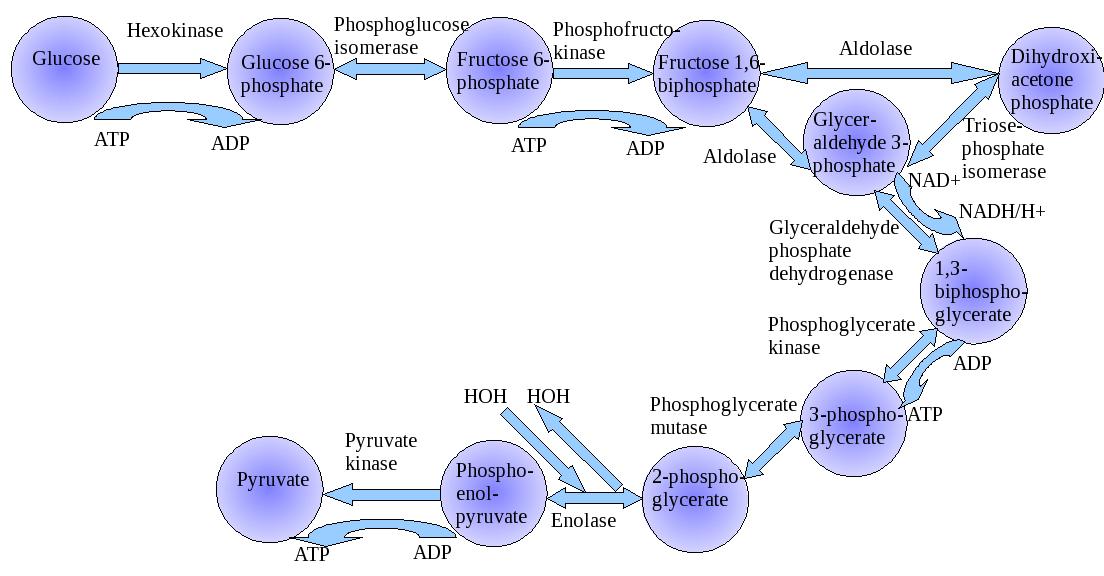
Step 1, involves the conversion of glucose to glucose-6-phosphate (G6P) with the help of the enzyme hexokinase and the consumption of 1 molecule of ATP. This reaction helps keep the concentration of glucose low in the cell, allowing for more absorption of glucose into it. Additionally, G6P is not transported out of the cell as there are no G6P transporters on the cell.

Step 2 involves the rearrangement of glucose-6-phosphate to fructose-6-phosphate (F6P) with the help of the enzyme phosphohexose isomerase in a reversible manner. Fructose can directly enter the glycolysis pathway at this point. This isomerization to a keto-sugar such as fructose is essential for carbanion stabilization required for the next step.

Step 3 involves the phosphorylation of fructose-6-phosphate to fructose-1,6-biphosphate (F1,6BP) by the use of 1 molecule of ATP and the enzyme phosphofructokinase-1 (PPK1). This phosphorylation step destabilizes the molecule and helps drive the next reaction which ensures breakdown of the molecule to a 3-carbon unit.

Step 4 involves the breakdown of fructose-1,6-biphosphate (6 carbons) to two molecules of 3-carbon units i.e. glyceralde 3-phosphate (GADP) and Dihydroxyacetone phosphate (DHAP). The GADP can be interconverted to DHAP by enzyme triose phosphate isomerase.

The Pay-Off Phase

In this stage of the cycle, ATP or energy is produced either in the form of ATP alone or in the form of NADH + H+ which can be later converted to ATP via the electron transport chain (ETS). In this since energy is restored it is known as the pay-off phase of glycolysis. All steps in this phase occur with 2 molecules of the substrates each as indicated in the brackets by the name of the molecules.

Step 1, involves the dehydrogenation of glyceraldehyde-3-phosphate (GADP) to 1,3-biphophoglycerate (1,3BPG) by the use of 2 molecules of inorganic phosphate (Pi) with the production of 2 molecules of NADH + H+ in the presence of the enzyme glyceraldehyde 3-phosphate dehydrogenase.

Step 2, in this step dephosphorylation of 1,3-biphosphoglycerate (1,3BPG) to 3-phospoglycerate (3PG) produces 2 molecules of ATP by the enzyme phosphoglycerate kinase.

Step 3, involves the isomerisation of 3-phosphoglycerate (3PG) to 2-phosphoglycerate (2PG) by the enzyme phosphoglycerate mutase in a reversible manner.

Step 4 involves the enolization of 2-phosphoglycerate (2PG) to phosphoenolpyruvate (PEP) with the loss of one molecule of water in the presence of enzyme enolase.

Step 5 is the final step of the glycolysis pathway and it involves the dephosphorylation of the phosphoenolpyruvate (PEP) to pyruvate by enzyme pyruvate kinase to produce 2 more molecules of ATP.

Net Yield of Glycolysis

  1. The preparatory phase consumes 2 ATP
  2. The pay-off phase produces 4 ATP.
  3. The gross yield of glycolysis is therefore
    4 ATP – 2 ATP = 2 ATP
  4. The pay-off phase also produces 2 molecules of NADH + H+ which can be further converted to a total of 5 molecules of ATP* by the electron transport chain (ETC) during oxidative phosphorylation.
  5. Thus the net yield during glycolysis is 7 molecules of ATP.

* This is calculated assuming one NADH molecule gives 2.5 molecules of ATP during oxidative phosphorylation.

References

  1. David L. Nelson and Michael M. Cox, Lehninger Principles of Biochemistry, 4th Ed.
  2. Jeremy M. Berg, John L. Tymockzo and Luber Stryer, Biochemistry, 7th Ed.

Tags: cellular respiration, electron transport chain, etc, glucose, glycolysis, metabolism, pay-off phase

Kreb’s Cycle or Citric Acid Cycle or Tricarboxylic Acid Cycle (with Animation)

By Sweety Mehta  – Sept 21, 2013  in: Animations, Biochemistry Animations, Biochemistry Notes
http://pharmaxchange.info/press/2013/09/krebs-cycle-citric-acid-cycle-tricarboxylic-acid-cycle-animation/

Introduction

Cellular respiration involves 3 stages for the breakdown of glucose – glycolysis, Kreb’s cycle and the electron transport system. The total energy produced during glucose metabolism is described at Energetics of Cellular Respiration. We have seen the glycolysis pathway with animation previously. The Kreb’s cycle is named after Adolf Krebs who studied the utilization of oxygen in a pigeon. It is also commonly known as the citric acid cycle or the tricarboxylic acid cycle. Kreb’s cycle is a very important step in the metabolic pathway as it produces about 60-70% of ATP for release of energy in the body. It directly or indirectly connects with all the other individual pathways in the body too. It takes place in the mitochondria as all the enzymes and co-enzymes required are present there.

The Kreb’s Cycle occurs in two stages:

1. Conversion of Pyruvate to Acetyl CoA

Glycolysis of 1 molecule of glucose produces 2 molecules of pyruvate. Each pyruvate in the presence of pyruvate dehydrogenase (PDH) complex in the mitochondria gets converted to acetyl CoA which in turn enters the Kreb’s cycle. This reaction is called as oxidative  decarboxylation as the carboxyl group is removed from the pyruvate molecule in the form of CO2 thus yielding 2-carbon acetyl group which along with the coenzyme A forms acetyl CoA.

The pyruvate dehydrogenase complex (PDH) comprises of three enzymes – pyruvate dehydrogenase, dihydrolipoyl transacetylase and dihydrolipoyl dehydrogenase each one playing an important role in the reaction as shown below. The PDH requires the sequential action of five co-factors or co-enzymes for the combined action of dehydrogenation and decarboxylation to take place. These five are TPP (thiamine phosphate), FAD (flavin adenine dinucleotide), NAD (nicotinamide adenine dinucleotide), coenzyme A (denoted as CoA-SH at times to depict role of -SH group) and lipoamide.

Conversion of pyruvate to acetyl CoA by the pyruvate dehydrogenase complex

pyruvate_dehydrogenase_complex_new2

Conversion of pyruvate to acetyl CoA by the pyruvate dehydrogenase complex

Pyruvate reacts with the TPP (Thiamine Phosphate) bound part of pyruvate dehydrogenase and undergoes decarboxylation to give hydroxyethyl-TPP.

This hydroxyethyl-TPP in turn gets oxidised to acetyl lipoamide by the same enzyme pyruvate dehydrogenase by the transfer of two electrons. These electrons then reduce the disulfide bond of the enzyme dihydrolipoyl transacetylase with the transfer of the acetyl group as highlighted in purple.

Dihydrolipoyl transacetylase catalyses the transesterification forming acetyl CoA by transfer of acetyl group to coenzyme A.

When acetyl CoA is being formed, at the same time reduced lipoamide is getting converted to oxidised lipoamide due to enzyme dihydrolipoyl dehydrogenase by the transfer of 2 hydrogen atoms to FAD.

Dihydrolipoyl dehydrogenase transfers the reduced equivalents (2 hydrogen atoms) to FAD thus forming FADH2. FADH2 in turn transfers a hydride ion to NAD+ to form NADH+H+.

2. Acetyl CoA Enters the Kreb’s Cycle

The acetyl CoA produced from the pyruvate dehydrogenase complex enters the Kreb’s cycle.

The animation below describes the Kreb’s cycle in detail followed by the discussion. A static image of the cycle can be found next to the discussion for reference. Press the play button to progress in the animation.

Discussion

Krebs1 cycle

The Kreb’s Cycle or Citric Acid Cycle or Tricarboxylic Acid Cycle in a static image version of the animation.

Acetyl CoA condenses with oxaloacetate (4C) to form a citrate (6C) by transferring its acetyl group in the presence of enzyme citrate synthase. The CoA liberated in this reaction is ready to participate in the oxidative decarboxylation of another molecule of pyruvate by PDH complex.

  • Citrate is then isomerised to Isocitrate by the enzyme aconitase through the formation of the intermediate cis-aconitate. This is a reversible reaction as aconitase has an iron-sulfur center which can promote reversible addition of H2O to the double bond of enzyme-bound cis-aconitate in 2 different ways, one forming citrate and the other isocitrate.
  • Isocitrate undergoes oxidative decarboxylation by the enzyme isocitrate dehydrogenase to form oxalosuccinate (intermediate- not shown) which in turn forms α-ketoglutarate (also known as oxoglutarate) which is a five carbon compound. CO2 and NADH are released in this step.
  • α-ketoglutarate (5C) undergoes oxidative decarboxylation once again to form succinyl CoA (4C) catalysed by the enzyme α-ketoglutarate dehydrogenase complex. α-ketoglutarate dehydrogenase complex is similar to PDH complex and is made up of 3 enzymes and is dependent on five co-enzymes TPP, FAD, NAD, bound lipoate and conenzyme A. In this step once again NADH and CO2 are liberated. So in all 2 molecules of NADH and 2 molecules of CO2 is produced till now.
  • Succinyl CoA is then converted to succinate by succinate thiokinase or succinyl coA synthetase in a reversible manner. This reaction involves an intermediate step in which the enzyme gets phosphorylated and then the phosphoryl group which has a high group transfer potential is transferred to GDP to form GTP. This GTP is converted to ATP by the enzyme nucleoside diphosphate kinase by donating its phosphoryl group to ADP. This reaction which involves the formation of GTP is a substrate level phosphorylation as it happens by using the energy formed by the oxidative decarboxylation of α-ketoglutarate.
  • Succinate then gets oxidised reversibly to fumarate by succinate dehydrogenase. The enzyme contains iron-sulfur clusters and covalently bound FAD which when undergoes electron exchange in the mitochondria causes the production of FADH2.
  • Fumarate is then by the enzyme fumarase converted to malate by hydration(addition of H2O) in a reversible manner.
  • Malate is then reversibly converted to oxaloacetate by malate dehydrogenase which is NAD linked and thus produces NADH.
  • The oxaloacetate produced is now ready to be utilized in the next cycle by the citrate synthase reaction and thus the equilibrium of the cycle shifts to the right.
Schrodingers_cat

Schrodingers_cat

Energetics of the Kreb’s Cycle

Keeping in mind that 1 molecule of glucose would produce 2 molecules of pyruvate via glycolysis. Hence the net energy produced by the Kreb’s cycle for each molecule of pyruvate is doubled for each molecule of glucose. Thus net energy yield in Kreb’s cycle can be summarized as follows for each molecule of glucose:

Reaction                                                              Number of ATP or                                        Number of ATP
reduced coenzyme formed                        ultimately formed

2 Pyruvate → 2 acetyl CoA                                  2 NADH                                                             5

2 Isocitrate → 2 α- ketoglutarate                     2 NADH                                                              5

2 α- ketoglutarate → 2 succinyl CoA             2 NADH                                                               5

2 Succinyl CoA → 2 succinate                           2 ATP                                                                  2

2 Succinate → 2 fumarate                               2 FADH2                                                               3

2 Malate → 2 oxaloacetate                            2 NADH                                                                  5

TOTAL                                                                                                                                                 25 ATP

* Note- This is calculated as 2.5 ATP per NADH and 1.5 ATP per FADH2. This is because there are multiple electron transport shuttle pathways through which these can be broken to ATP.

Regulation of Kreb’s Cycle

The amount of ADP and ATP largely control the citric acid cycle along with the activity of three key enzymes within the cycle:

Availability of ADP: ADP is a key substrate which finally gets converted to ATP that is essential for the energetics of the cell. A drop in ADP levels would result in inhibition of the electron transport system leading to accumulation of NADH and FADH2. These in turn inhibit the enzymes below.

Citrate Synthase: inhibited by ATP, acetyl CoA, NADH, and succinyl CoA.
Isocitrate Dehydrogenase: activated by ADP, and inhibited by NADH and ATP.
α-ketoglutarate dehydrogenase: inhibited by NADH and succinyl CoA.

Recommended Texts

David L. Nelson and Michael M. Cox, Lehninger Principles of Biochemistry 6th Edition
Jeremy M. Berg, John L. Tymockzo and Luber Stryer, Biochemistry 7th Edition

Tags: acetyl coA, animation, cellular respiration, citric acid cycle, energy, kreb’s cycle, pyruvate, pyruvate dehydrogenase, TCA cycle, tricarboxylic acid cycle

Energetics of Cellular Respiration (Glucose Metabolism)

By Sweety Mehta   – Oct 9, 2013 in: Biochemistry Notes, Notes
http://pharmaxchange.info/press/2013/10/energetics-of-cellular-respiration-glucose-metabolism/

energetics-of-cellular-respiration

electron transport chain in the mitochondrion energetics-of-cellular-respiration

Important Note: The NADH formed in the cytosol can yield variable amounts of ATP depending on the shuttle system utilized to transport them into the mitochondrial matrix. This NADH, formed in the cytosol, is impermeable to the mitochondrial inner-membrane where oxidative phosphorylation takes place. Thus to carry this NADH to the mitochondrial matrix there are special shuttle systems in the body. The most active shuttle is the malate-aspartate shuttle via which 2.5 molecules of ATP are generated for 1 NADH molecule. This shuttle is mainly used by the heart, liver and kidneys. The brain and skeletal muscles use the other shuttle known as glycerol 3-phosphate shuttle which synthesizes 1.5 molecules of ATP for 1 NADH.

Note: The above calculations are done considering that one NADH molecules produces 2.5 ATP and one FADH2 molecule produces 1.5 ATP in the ETS cycle (See full reasoning above). This is because the Kreb’s cycle occurs within the mitochondria and therefore does not require any shuttle pathway for the transport of the NADH into the mitochondrial matrix. Hence there is optimal conversion of NADH to ATP.

Development of the acetylation problem: a personal account

FRITZ LI P M A N N  Nobel Prize  1953

After my  apprenticeship with Otto Meyerhof, a first interest on my own became the phenomenon we call the Pasteur effect, this peculiar depression of the wasteful fermentation in the respiring cell. By looking for a chemical explanation of this economy measure on the cellular level, I was prompted into a study of the mechanism of pyruvic acid oxidation, since it is at the pyruvic stage where respiration branches off from fermentation. For this study I chose as a  promising system a relatively simple looking pyruvic acid oxidation enzyme in a certain strain of Lactobacillus delbrueckii1.

The most important event during this whole period, I now feel, was the accidental observation that in the L. delbrueckii system, pyruvic acid oxidation was completely dependent on the presence of inorganic phosphate. This observation was made in the course of attempts to replace oxygen by methylene blue. To measure the methylene blue reduction manometrically,
I had to switch to a bicarbonate buffer instead of the otherwise routinely used In bicarbonate, to my surprise, as shown in Fig. 1, pyruvate oxidation was very slow, but the addition of a little phosphate caused a remarkable increase in rate. The next figure, Fig. 2, shows the phosphate effect more drastically, using a preparation from which all phosphate was removed by washing with acetate buffer. Then it appeared that the reaction was really fully dependent on phosphate.

In spite of such a phosphate dependence, the phosphate balance measured by the ordinary Fiske-Subbarow procedure did not at first indicate any phosphorylative step. Nevertheless, the suspicion remained that phosphate in  some manner was entering into the reaction and that a phosphorylated intermediary was formed. As a first approximation, a coupling of this pyruvate oxidation with adenylic acid phosphorylation was attempted. And,indeed, addition of adenylic acid to the pyruvic oxidation system brought out a net  disappearance of inorganic phosphate, accounted for as adenosine triphosphate (Table 11).

I  now concluded that the missing link in the reaction chain was acetyl phosphate. In partial confirmation it was shown that a crude preparation of acetyl phosphate, synthesized by the old method of Kämmerer and Carius 2 would transfer phosphate to adenylic acid (Table 2). However, it still took quite some time from then on to identify acetyl phosphate definitely as the initial product of the pyruvic oxidation in this system3,4

At the time when these observations were made, about a dozen years ago,there was, to say the least, a tendency to believe that phosphorylation was rather specifically coupled with the glycolytic reaction. Here, however, we had found a coupling of phosphorylation with a respiratory system. This observation immediately suggested a rather sweeping biochemical significance, of transformations of electron transfer potential, respiratory or fermentative, to phosphate bond energy and therefrom to a wide range of biosynthetic reactions7.

There was a further unusual feature in this pyruvate oxidation system in that the product emerging from the process not only carried an energy-rich phosphoryl radical such as already known, but the acetyl phosphate was even more impressive through its energy-rich acetyl. It rather naturally became a contender for the role of “active” acetate, for the widespread existence of which the isotope experience had already furnished extensive evidence. I became, therefore, quite attracted by the possibility that acetyl phosphate could serve two rather different purposes, either to transfer its phosphoryl group into the phosphate pool, or to supply its active acetyl for biosynthesisof carbon structures. Thus acetyl phosphate should be able to serve as acetyldonor as well as phosphoryl donor, transferring, as shown in Fig. 3, on either side of the oxygen center, such as indicated by Bentley’s early experiments on cleavage7a of acetyl phosphate in H218O.

Phosphate dependence of pyruvate oxidation

Phosphate dependence of pyruvate oxidation

These two novel aspects of the energy problem, namely

(1) the emergence of an energy-rich phosphate bond from a purely
respiratory reaction; and

(2) the presumed derivation of a metabolic building-block through this same
reaction, prompted me to propose not only

  • the generalization of the phosphate bond as a versatie energy distributing system, but also to
    aim from there towards
  • a general concept of transfer of activated groupings by carrier as the fundamental reaction in
    biosynthesis8,9.

Although in the related manner the appearance of acetyl phosphate as a
metabolic intermediary first

  •  focused attention to possible mechanisms for the metabolic elaboration of  group activation,

it soon turned out that the relationship between acetyl phosphate and
acetyl transfer was much more complicated than anticipated.

Acetyl phosphate as acetyl and phosphoryl donor.

Although acetylation was found with rabbit liver homogenate, the
reaction was rather weak. In search of a more active system,   Pigeon
liver homogenate was tried and found to harbour an exceedingly potent
acetylation system (Ref. 11, cf. also Ref. 12). This finding of a particularly
active acetylation reaction in cell-free pigeon liver preparations was most
fortunate and played a quite important part in the development of the
acetylation problem.

[portion of lecture]

The pentose phosphate pathway is the major source for the NADPH
required for anabolic processes.
Pentose Phosphate Pathway

http://chemwiki.ucdavis.edu/Biological_Chemistry/Metabolism/Pentose_
Phosphate_Pathway

  • There are three distinct phases each of which has a distinct outcome.
  • Depending on the needs of the organism the metabolites of that outcome
    can be fed into many other pathways.
  • Gluconeogenesis is directly connected to the pentose phosphate pathway.
  • As the need for glucose-6-phosphate (the beginning metabolite in the pentose
    phosphate pathway) increases so does the activity of gluconeogenesis.

 pentose-phosphate-pathway

http://images.tutorvista.com/content/respiration/pentose-phosphate-pathway.jpeg

Introduction

The main molecule in the body that makes anabolic processes possible is NADPH.  Because of the structure of this molecule it readily donates hydrogen ions to metabolites thus reducing them and making them available for energy harvest at a later time. The PPP is the main source of synthesis for NADPH.  The pentose phosphate pathway (PPP) is also responsible for the production of Ribose-5-phosphate which is an important part of nucleic acids. Finally the PPP can also be used to produce glyceraldehyde-3-phosphate which can then be fed into the TCA and ETC cycles allowing for the harvest of energy. Depending on the needs of the cell certain enzymes can be regulated and thus increasing or decreasing the production of desired metabolites. The enzymes reasonable for catalyzing the steps of the PPP are found most abundantly in the liver (the major site of gluconeogenesis) more specifically in the cytosol. The cytosol is where fatty acid synthesis takes place which is a NADPH dependent process.


Oxidation Phase

  • The beginning molecule for the PPP is glucose-6-P which is the second intermediate metabolite in glycolysis. Glucose-6-P is oxidized in the presence of glucose-6-P dehydrogenase and NADP+.  This step is irreversible and is highly regulated.  NADPH and fatty acyl-CoA are strong negative inhibitors to this enzyme.  The purpose of this is to decrease production of NADPH when concentrations are high or the synthesis of fatty acids is no longer necessary.
  • The metabolic product of this step is gluconolactone which is hydrolytrically unstable.  Gluconolactonase causes gluconolactone to undergo a ring opening hydrolysis.  The product of this reaction is the more stable sugar acid, 6-phospho-D-gluconate.
  • 6-phospho-D-gluconate is oxidized by NADP+ in the presence of 6-phosphogluconate dehydrogenase which yields ribulose-5-phosphate.
  • The oxidation phase of the PPP is solely responsible for the production of the NADPH to be used in anabolic processes.

Isomerization Phase

  •  Ribulose-5-phosphate can then be isomerized by phosphopentose isomerase to produce ribose-5-phosphate.  Ribose-5-phosphate is one of the main building blocks of nucleic acids and the PPP is the primary source of production of ribose-5-phosphate.
  • If production of ribose-5-phosphate exceeds the needs of required ribose-5-phosphate in the organism, then phosphopentose epimerase catalyzes a chiralty rearrangement about the center carbon creating xylulose-5-phosphate.
  • The products of these two reactions can then be rearranged to produce many different length carbon chains.  These different length carbon chains have a variety of metabolic fates.

Rearrangement Phase 

  •  There are two main classes of enzymes responsible for the rearrangement and synthesis of the different length carbon chain molecules.  These are transketolase and transaldolase.
  • Transketolase is responsible for the cleaving of a two carbon unit from xylulose-5-P and adding that two carbon unit to ribose-5-P thus resulting in glyceraldehyde-3-P and sedoheptulose-7-P.
  • Transketolase is also responsible for the cleaving of a two carbon unit from xylulose-5-P and adding that two carbon unit to erythrose-4-P resulting in glyceraldehyde-3-P and fructose-6-P.
  • Transaldolase is responsible for cleaving the three carbon unit from sedoheptulose-7-P and adding that three carbon unit to glyceraldehyde-3-P thus resulting in erythrose-4-P and fructose-6-P.
  • The end results of the rearrangement phase is a variety of different length sugars which can be fed into many other metabolic processes.  For example, fructose-6-P is a key intermediate of glycolysis as well as glyceraldehyde-3-P.

References

  1. Garrett, H., Reginald and Charles Grisham. Biochemistry. Boston: Twayne Publishers, 2008.
  2. Raven, Peter. Biology. Boston: Twayne Publishers, 2005.

Glycogen Metabolism

Glycogen is a readily mobilized storage form of glucose. It is a very large, branched polymer of glucose residues (Figure 21.1) that can be broken down to yield glucose molecules when energy is needed. Most of the glucose residues in glycogen are linked by α-1,4-glycosidic bonds. Branches at about every tenth residue are created by α-1,6-glycosidic bonds. Recall that α-glycosidic linkages form open helical polymers, whereas β linkages produce nearly straight strands that form structural fibrils, as in cellulose (Section 11.2.3).

http://www.ncbi.nlm.nih.gov/books/NBK21190/bin/ch21f1.jpg

Figure 21.1

Glycogen Structure ch21f1

Glycogen Structure. In this structure of two outer branches of a glycogen molecule, the residues at the nonreducing ends are shown in red and residue that starts a branch is shown in green. The rest of the glycogen molecule is represented by R.

Glycogen is not as reduced as fatty acids are and consequently not as energy rich. Why do animals store any energy as glycogen? Why not convert all excess fuel into fatty acids? Glycogen is an important fuel reserve for several reasons. The controlled breakdown of glycogen and release of glucose increase the amount of glucose that is available between meals. Hence, glycogen serves as a buffer to maintain blood-glucose levels. Glycogen’s role in maintaining blood-glucose levels is especially important because glucose is virtually the only fuel used by the brain, except during prolonged starvation. Moreover, the glucose from glycogen is readily mobilized and is therefore a good source of energy for sudden, strenuous activity. Unlike fatty acids, the released glucose can provide energy in the absence of oxygen and can thus supply energy for anaerobic activity.

Gluconeogenesis
ChemWiki: The Dynamic Chemistry E-textbook > Biological Chemistry > Metabolism > Gluconeogenesis

Gluconeogenesis is much like glycolysis only the process occurs in reverse. However, there are exceptions. In glycolysis there are three highly exergonic steps (steps 1,3,10). These are also regulatory steps which include the enzymes hexokinase, phosphofructokinase, and pyruvate kinase. Biological reactions can occur in both the forward and reverse direction. If the reaction occurs in the reverse direction the energy normally released in that reaction is now required. If gluconeogenesis were to simply occur in reverse the reaction would require too much energy to be profitable to that particular organism. In order to overcome this problem, nature has evolved three other enzymes to replace the glycolysis enzymes hexokinase, phosphofructokinase, and pyruvate kinase when going through the process of gluconeogenesis:

  1. The first step in gluconeogenesis is the conversion of pyruvate to phosphoenolpyruvic acid (PEP). In order to convert pyruvate to PEP there are several steps and several enzymes required. Pyruvate carboxylase, PEP carboxykinase and malate dehydrogenase are the three enzymes responsible for this conversion. Pyruvate carboxylase is found on the mitochondria and converts pyruvate into oxaloacetate. Because oxaloacetate cannot pass through the mitochondria membranes it must be first converted into malate by malate dehydrogenase. Malate can then cross the mitochondria membrane into the cytoplasm where it is then converted back into oxaloacetate with another malate dehydrogenase. Lastly, oxaloacetate is converted into PEP via PEP carboxykinase. The next several steps are exactly the same as glycolysis only the process is in reverse.
  2. The second step that differs from glycolysis is the conversion of fructose-1,6-bP to fructose-6-P with the use of the enzyme fructose-1,6-phosphatase. The conversion of fructose-6-P to glucose-6-P uses the same enzyme as glycolysis, phosphoglucoisomerase.
  3. The last step that differs from glycolysis is the conversion of glucose-6-P to glucose with the enzyme glucose-6-phosphatase. This enzyme is located in the endoplasmic reticulum.

Glycolysis

File:Glycolysis overview.svg

Regulation

Because it is important for organisms to conserve energy, they have derived ways to regulate those metabolic pathways that require and release the most energy. In glycolysis and gluconeogenesis seven of the ten steps occur at or near equilibrium. In gluconeogenesis the conversion of pyruvate to PEP, the conversion of fructose-1,6-bP, and the conversion of glucose-6-P to glucose all occur very spontaneously which is why these processes are highly regulated. It is important for the organism to conserve as much energy as possible. When there is an excess of energy available, gluconeogenesis is inhibited. When energy is required, gluconeogenesis is activated.

  1. The conversion of pyruvate to PEP is regulated by acetyl-CoA. More specifically pyruvate carboxylase is activated by acetyl-CoA. Because acetyl-CoA is an important metabolite in the TCA cycle which produces a lot of energy, when concentrations of acetyl-CoA are high organisms use pyruvate carboxylase to channel pyruvate away from the TCA cycle. If the organism does not need more energy, then it is best to divert those metabolites towards storage or other necessary processes.
  2. The conversion of fructose-1,6-bP to fructose-6-P with the use of fructose-1,6-phosphatase is negatively regulated and inhibited by the molecules AMP and fructose-2,6-bP. These are reciprocal regulators to glycolysis’ phosphofructokinase. Phosphofructosekinase is positively regulated by AMP and fructose-2,6-bP. Once again, when the energy levels produced are higher than needed, i.e. a large ATP to AMP ratio, the organism increases gluconeogenesis and decreases glycolysis. The opposite also applies when energy levels are lower than needed, i.e. a low ATP to AMP ratio, the organism increases glycolysis and decreases gluconeogenesis.
  3. The conversion of glucose-6-P to glucose with use of glucose-6-phosphatase is controlled by substrate level regulation. The metabolite responsible for this type of regulation is glucose-6-P. As levels of glucose-6-P increase, glucose-6-phosphatase increases activity and more glucose is produced. Thus glycolysis is unable to proceed.


Read Full Post »

Research on inflammasomes opens therapeutic ways for treatment of rheumatoid arthritis

Reporter: Larry H. Bernstein, MD, FCAP


One of the processes accounted for by inflammasomes is the production of interleukin-1, a protein with an important role in inflammatory reactions. Stopping the effects of interleukin-1 resulted in a cure for the mice. In this manner, Vande Walle and Lamkanfi demonstrated that the mouse model is perfectly suitable for studying the correlation between inflammasomes and RA.

RA is a syndrome rather than a single disease
Previous research has already demonstrated that other proteins in our immune system – such as TNF and IL-17 – could possibly play a role in RA
We could evolve towards a more personalized approach for RA

Read Full Post »

Introduction – The Evolution of Cancer Therapy and Cancer Research: How We Got Here?

Introduction – The Evolution of Cancer Therapy and Cancer Research: How We Got Here?

Author and Curator: Larry H Bernstein, MD, FCAP

The evolution of progress we have achieved in cancer research, diagnosis, and therapeutics has  originated from an emergence of scientific disciplines and the focus on cancer has been recent. We can imagine this from a historical perspective with respect to two observations. The first is that the oldest concepts of medicine lie with the anatomic dissection of animals and the repeated recurrence of war, pestilence, and plague throughout the middle ages, and including the renaissance.  In the awakening, architecture, arts, music, math, architecture and science that accompanied the invention of printing blossomed, a unique collaboration of individuals working in disparate disciplines occurred, and those who were privileged received an education, which led to exploration, and with it, colonialism.  This also led to the need to increasingly, if not without reprisal, questioning long-held church doctrines.

It was in Vienna that Rokitansky developed the discipline of pathology, and his student Semelweis identified an association between then unknown infection and childbirth fever. The extraordinary accomplishments of John Hunter in anatomy and surgery came during the twelve years war, and his student, Edward Jenner, observed the association between cowpox and smallpox resistance. The development of a nursing profession is associated with the work of Florence Nightengale during the Crimean War (at the same time as Leo Tolstoy). These events preceded the work of Pasteur, Metchnikoff, and Koch in developing a germ theory, although Semelweis had committed suicide by infecting himself with syphilis. The first decade of the Nobel Prize was dominated by discoveries in infectious disease and public health (Ronald Ross, Walter Reed) and we know that the Civil War in America saw an epidemic of Yellow Fever, and the Armed Services Medical Museum was endowed with a large repository of osteomyelitis specimens. We also recall that the Russian physician and playwriter, Anton Checkov, wrote about the conditions in prison camps.

But the pharmacopeia was about to open with the discoveries of insulin, antibiotics, vitamins, thyroid action (Mayo brothers pioneered thyroid surgery in the thyroid iodine-deficient midwest), and pitutitary and sex hormones (isolatation, crystal structure, and synthesis years later), and Karl Landsteiner’s discovery of red cell antigenic groups (but he also pioneered in discoveries in meningitis and poliomyelitis, and conceived of the term hapten) with the introduction of transfusion therapy that would lead to transplantation medicine.  The next phase would be heralded by the discovery of cancer, which was highlighted by the identification of leukemia by Rudolph Virchow, who cautioned about the limitations of microscopy. This period is highlighted by the classic work – “Microbe Hunters”.

John Hunter

John Hunter

Walter Reed

Walter Reed

Robert Koch

Robert Koch

goldberger 1916 Pellagra

goldberger 1916 Pellagra

Louis Pasteur

Louis Pasteur

A multidisciplinary approach has led us to a unique multidisciplinary or systems view of cancer, with different fields of study offering their unique expertise, contributions, and viewpoints on the etiology of cancer.  Diverse fields in immunology, biology, biochemistry, toxicology, molecular biology, virology, mathematics, social activism and policy, and engineering have made such important contributions to our understanding of cancer, that without cooperation among these diverse fields our knowledge of cancer would never had evolved as it has. In a series of posts “Heroes in Medical Research:” the work of researchers are highlighted as examples of how disparate scientific disciplines converged to produce seminal discoveries which propelled the cancer field, although, at the time, they seemed like serendipitous findings.  In the post Heroes in Medical Research: Barnett Rosenberg and the Discovery of Cisplatin (Translating Basic Research to the Clinic) discusses the seminal yet serendipitous discoveries by bacteriologist Dr. Barnett Rosenberg, which eventually led to the development of cisplatin, a staple of many chemotherapeutic regimens. Molecular biologist Dr. Robert Ting, working with soon-to-be Nobel Laureate virologist Dr. James Gallo on AIDS research and the associated Karposi’s sarcoma identified one of the first retroviral oncogenes, revolutionizing previous held misconceptions of the origins of cancer (described in Heroes in Medical Research: Dr. Robert Ting, Ph.D. and Retrovirus in AIDS and Cancer).   Located here will be a MONTAGE of PHOTOS of PEOPLE who made seminal discoveries and contributions in every field to cancer   Each of these paths of discovery in cancer research have led to the unique strategies of cancer therapeutics and detection for the purpose of reducing the burden of human cancer.  However, we must recall that this work has come at great cost, while it is indeed cause for celebration. The current failure rate of clinical trials at over 70 percent, has been a cause for disappointment, and has led to serious reconsideration of how we can proceed with greater success. The result of the evolution of the cancer field is evident in the many parts and chapters of this ebook.  Volume 4 contains chapters that are in a predetermined order:

  1. The concepts of neoplasm, malignancy, carcinogenesis,  and metastatic potential, which encompass:

(a)     How cancer cells bathed in an oxygen rich environment rely on anaerobic glycolysis for energy, and the secondary consequences of cachexia and sarcopenia associated with progression

invasion

invasion

ARTS protein and cancer

ARTS protein and cancer

Glycolysis

Glycolysis

Krebs cycle

Krebs cycle

Metabolic control analysis of respiration in human cancer tissue

Metabolic control analysis of respiration in human cancer tissue

akip1-expression-modulates-mitochondrial-function

akip1-expression-modulates-mitochondrial-function

(b)     How advances in genetic analysis, molecular and cellular biology, metabolomics have expanded our basic knowledge of the mechanisms which are involved in cellular transformation to the cancerous state.

nucleotides

nucleotides

Methylation of adenine

Methylation of adenine

ampk-and-ampk-related-kinase-ark-family-

ampk-and-ampk-related-kinase-ark-family-

ubiquitylation

ubiquitylation

(c)  How molecular techniques continue to advance our understanding  of how genetics, epigenetics, and alterations in cellular metabolism contribute to cancer and afford new pathways for therapeutic intervention.

 genomic effects

genomic effects

LKB1AMPK pathway

LKB1AMPK pathway

mutation-frequencies-across-12-cancer-types

mutation-frequencies-across-12-cancer-types

AMPK-activating drugs metformin or phenformin might provide protection against cancer

AMPK-activating drugs metformin or phenformin might provide protection against cancer

pim2-phosphorylates-pkm2-and-promotes-glycolysis-in-cancer-cells

pim2-phosphorylates-pkm2-and-promotes-glycolysis-in-cancer-cells

pim2-phosphorylates-pkm2-and-promotes-glycolysis-in-cancer-cells

pim2-phosphorylates-pkm2-and-promotes-glycolysis-in-cancer-cells

2. The distinct features of cancers of specific tissue sites of origin

3.  The diagnosis of cancer by

(a)     Clinical presentation

(b)     Age of onset and stage of life

(c)     Biomarker features

hairy cell leukemia

hairy cell leukemia

lymphoma leukemia

lymphoma leukemia

(d)     Radiological and ultrasound imaging

  1. Treatments
  2. Prognostic differences within and between cancer types

We have introduced the emergence of a disease of great complexity that has been clouded in more questions than answers until the emergence of molecular biology in the mid 20th century, and then had to await further discoveries going into the 21st century.  What gave the research impetus was the revelation of

1     the mechanism of transcription of the DNA into amino acid sequences

Proteins in Disease

Proteins in Disease

2     the identification of stresses imposed on cellular function

NO beneficial effects

NO beneficial effects

3     the elucidation of the substructure of the cell – cell membrane, mitochondria, ribosomes, lysosomes – and their functions, respectively

pone.0080815.g006  AKIP1 Expression Modulates Mitochondrial Function

AKIP1 Expression Modulates Mitochondrial Function

4     the elucidation of oligonucleotide sequences

nucleotides

nucleotides

dna-replication-unwinding

dna-replication-unwinding

dna-replication-ligation

dna-replication-ligation

dna-replication-primer-removal

dna-replication-primer-removal

dna-replication-leading-strand

dna-replication-leading-strand

dna-replication-lagging-strand

dna-replication-lagging-strand

dna-replication-primer-synthesis

dna-replication-primer-synthesis

dna-replication-termination

dna-replication-termination

5     the further elucidation of functionally relevant noncoding lncDNA

lncRNA-s   A summary of the various functions described for lncRNA

6     the technology to synthesis mRNA and siRNA sequences

RNAi_Q4 Primary research objectives

Figure. RNAi and gene silencing

7     the repeated discovery of isoforms of critical enzymes and their pleiotropic properties

8.     the regulatory pathways involved in signaling

signaling pathjways map

Figure. Signaling Pathways Map

This is a brief outline of the modern progression of advances in our understanding of cancer.  Let us go back to the beginning and check out a sequence of  Nobel Prizes awarded and related discoveries that have a historical relationship to what we know.  The first discovery was the finding by Louis Pasteur that fungi that grew in an oxygen poor environment did not put down filaments.  They did not utilize oxygen and they produced used energy by fermentation.  This was the basis for Otto Warburg sixty years later to make the comparison to cancer cells that grew in the presence of oxygen, but relied on anaerobic glycolysis. He used a manometer to measure respiration in tissue one cell layer thick to measure CO2 production in an adiabatic system.

video width=”1280″ height=”720″ caption=”1741-7007-11-65-s1 Macromolecular juggling by ubiquitylation enzymes.” mp4=”http://pharmaceuticalintelligence.com/wp-content/uploads/2014/04/1741-7007-11-65-s1-macromolecular-juggling-by-ubiquitylation-enzymes.mp4“][/video]

An Introduction to the Warburg Apparatus

http://www.youtube.com/watch?v=M-HYbZwN43o

Lavoisier Antoine-Laurent and Laplace Pierre-Simon (1783) Memoir on heat. Mémoirs de l’Académie des sciences. Translated by Guerlac H, Neale Watson Academic Publications, New York, 1982.

Instrumental background 200 years later:   Gnaiger E (1983) The twin-flow microrespirometer and simultaneous calorimetry. In Gnaiger E, Forstner H, eds. Polarographic Oxygen Sensors. Springer, Heidelberg, Berlin, New York: 134-166.

otto_heinrich_warburg

otto_heinrich_warburg

Warburg apparatus

The Warburg apparatus is a manometric respirometer which was used for decades in biochemistry for measuring oxygen consumption of tissue homogenates or tissue slices.

The Warburg apparatus has its name from the German biochemist Otto Heinrich Warburg (1883-1970) who was awarded the Nobel Prize in physiology or medicine in 1931 for his “discovery of the nature and mode of action of the respiratory enzyme” [1].

The aqueous phase is vigorously shaken to equilibrate with a gas phase, from which oxygen is consumed while the evolved carbon dioxide is trapped, such that the pressure in the constant-volume gas phase drops proportional to oxygen consumption. The Warburg apparatus was introduced to study cell respiration, i.e. the uptake of molecular oxygen and the production of carbon dioxide by cells or tissues. Its applications were extended to the study of fermentation, when gas exchange takes place in the absence of oxygen. Thus the Warburg apparatus became established as an instrument for both aerobic and anaerobic biochemical studies [2, 3].

The respiration chamber was a detachable glass flask (F) equipped with one or more sidearms (S) for additions of chemicals and an open connection to a manometer (M; pressure gauge). A constant temperature was provided by immersion of the Warburg chamber in a constant temperature water bath. At thermal mass transfer equilibrium, an initial reading is obtained on the manometer, and the volume of gas produced or absorbed is determined at specific time intervals. A limited number of ‘titrations’ can be performed by adding the liquid contained in a side arm into the main reaction chamber. A Warburg apparatus may be equipped with more than 10 respiration chambers shaking in a common water bath.   Since temperature has to be controlled very precisely in a manometric approach, the early studies on mammalian tissue respiration were generally carried out at a physiological temperature of 37 °C.

The Warburg apparatus has been replaced by polarographic instruments introduced by Britton Chance in the 1950s. Since Chance and Williams (1955) measured respiration of isolated mitochondria simultaneously with the spectrophotometric determination of cytochrome redox states, a water chacket could not be used, and measurements were carried out at room temperature (or 25 °C). Thus most later studies on isolated mitochondria were shifted to the artifical temperature of 25 °C.

Today, the importance of investigating mitochondrial performance at in vivo temperatures is recognized again in mitochondrial physiology.  Incubation times of 1 hour were typical in experiments with the Warburg apparatus, but were reduced to a few or up to 20 min, following Chance and Williams, due to rapid oxygen depletion in closed, aqueous phase oxygraphs with high sample concentrations.  Today, incubation times of 1 hour are typical again in high-resolution respirometry, with low sample concentrations and the option of reoxygenations.

“The Nobel Prize in Physiology or Medicine 1931”. Nobelprize.org. 27 Dec 2011 www.nobelprize.org/nobel_prizes/medicine/laureates/1931/

  1. Oesper P (1964) The history of the Warburg apparatus: Some reminiscences on its use. J Chem Educ 41: 294.
  2. Koppenol WH, Bounds PL, Dang CV (2011) Otto Warburg’s contributions to current concepts of cancer metabolism. Nature Reviews Cancer 11: 325-337.
  3. Gnaiger E, Kemp RB (1990) Anaerobic metabolism in aerobic mammalian cells: information from the ratio of calorimetric heat flux and respirometric oxygen flux. Biochim Biophys Acta 1016: 328-332. – “At high fructose concen­trations, respiration is inhibited while glycolytic end products accumulate, a phenomenon known as the Crabtree effect. It is commonly believed that this effect is restric­ted to microbial and tumour cells with uniquely high glycolytic capaci­ties (Sussman et al, 1980). How­ever, inhibition of respiration and increase of lactate production are observed under aerobic condi­tions in beating rat heart cell cultures (Frelin et al, 1974) and in isolated rat lung cells (Ayuso-Parrilla et al, 1978). Thus, the same general mechanisms respon­sible for the integra­tion of respiration and glycolysis in tumour cells (Sussman et al, 1980) appear to be operating to some extent in several isolated mammalian cells.”

Mitochondria are sometimes described as “cellular power plants” because they generate most of the cell’s supply of adenosine triphosphate (ATP), used as a source of chemical energy.[2] In addition to supplying cellular energy, mitochondria are involved in other tasks such as signalingcellular differentiationcell death, as well as the control of the cell cycle and cell growth.[3]   The organelle is composed of compartments that carry out specialized functions. These compartments or regions include the outer membrane, the intermembrane space, the inner membrane, and the cristae and matrix. Mitochondrial proteins vary depending on the tissue and the species. In humans, 615 distinct types of proteins have been identified from cardiac mitochondria,[9   Leonor Michaelis discovered that Janus green can be used as a supravital stain for mitochondria in 1900.  Benjamin F. Kingsbury, in 1912, first related them with cell respiration, but almost exclusively based on morphological observations.[13] In 1913 particles from extracts of guinea-pig liver were linked to respiration by Otto Heinrich Warburg, which he called “grana”. Warburg and Heinrich Otto Wieland, who had also postulated a similar particle mechanism, disagreed on the chemical nature of the respiration. It was not until 1925 when David Keilin discovered cytochromes that the respiratory chain was described.[13]    

The Clark Oxygen Sensor

Dr. Leland Clark – inventor of the “Clark Oxygen Sensor” (1954); the Clark type polarographic oxygen sensor remains the gold standard for measuring dissolved oxygen in biomedical, environmental and industrial applications .   ‘The convenience and simplicity of the polarographic ‘oxygen electrode’ technique for measuring rapid changes in the rate of oxygen utilization by cellular and subcellular systems is now leading to its more general application in many laboratories. The types and design of oxygen electrodes vary, depending on the investigator’s ingenuity and specific requirements of the system under investigation.’Estabrook R (1967) Mitochondrial respiratory control and the polarographic measurement of ADP:O ratios. Methods Enzymol. 10: 41-47.   “one approach that is underutilized in whole-cell bioenergetics, and that is accessible as long as cells can be obtained in suspension, is the oxygen electrode, which can obtain more precise information on the bioenergetic status of the in situ mitochondria than more ‘high-tech’ approaches such as fluorescent monitoring of Δψm.” Nicholls DG, Ferguson S (2002) Bioenergetics 3. Academic Press, London.

Great Figures in Cancer

Dr. Elizabeth Blackburn,

Dr. Elizabeth Blackburn,

j_michael_bishop onogene

j_michael_bishop onogene

Harold Varmus

Harold Varmus

Potts and Habener (PTH mRNA, Harvard MIT)  JCI

Potts and Habener (PTH mRNA, Harvard MIT) JCI

JCI Fuller Albright and hPTH AA sequence

JCI Fuller Albright and hPTH AA sequence

Dr. E. Donnall Thomas  Bone Marrow Transplants

Dr. E. Donnall Thomas Bone Marrow Transplants

Dr Haraldzur Hausen  EBV HPV

Dr Haraldzur Hausen EBV HPV

Dr. Craig Mello

Dr. Craig Mello

Dorothy Hodgkin  protein crystallography

Lee Hartwell - Hutchinson Cancer Res Center

Lee Hartwell – Hutchinson Cancer Res Center

Judah Folkman, MD

Judah Folkman, MD

Gertrude B. Elien (1918-1999)

Gertrude B. Elien (1918-1999)

The Nobel Prize in Physiology or Medicine 1922   

Archibald V. Hill, Otto Meyerhof

AV Hill –

“the production of heat in the muscle” Hill started his research work in 1909. It was due to J.N. Langley, Head of the Department of Physiology at that time that Hill took up the study on the nature of muscular contraction. Langley drew his attention to the important (later to become classic) work carried out by Fletcher and Hopkins on the problem of lactic acid in muscle, particularly in relation to the effect of oxygen upon its removal in recovery. In 1919 he took up again his study of the physiology of muscle, and came into close contact with Meyerhof of Kiel who, approaching the problem differently, arrived at results closely analogous to his study. In 1919 Hill’s friend W. Hartree, mathematician and engineer, joined in the myothermic investigations – a cooperation which had rewarding results.

Otto Meyerhof

otto-fritz-meyerhof

otto-fritz-meyerhof

lactic acid production in muscle contraction Under the influence of Otto Warburg, then at Heidelberg, Meyerhof became more and more interested in cell physiology.  In 1923 he was offered a Professorship of Biochemistry in the United States, but Germany was unwilling to lose him.  In 1929 he was he was placed in charge of the newly founded Kaiser Wilhelm Institute for Medical Research at Heidelberg.  From 1938 to 1940 he was Director of Research at the Institut de Biologie physico-chimique at Paris, but in 1940 he moved to the United States, where the post of Research Professor of Physiological Chemistry had been created for him by the University of Pennsylvania and the Rockefeller Foundation.  Meyerhof’s own account states that he was occupied chiefly with oxidation mechanisms in cells and with extending methods of gas analysis through the calorimetric measurement of heat production, and especially the respiratory processes of nitrifying bacteria. The physico-chemical analogy between oxygen respiration and alcoholic fermentation caused him to study both these processes in the same subject, namely, yeast extract. By this work he discovered a co-enzyme of respiration, which could be found in all the cells and tissues up till then investigated. At the same time he also found a co-enzyme of alcoholic fermentation. He also discovered the capacity of the SH-group to transfer oxygen; after Hopkins had isolated from cells the SH bodies concerned, Meyerhof showed that the unsaturated fatty acids in the cell are oxidized with the help of the sulfhydryl group. After studying closer the respiration of muscle, Meyerhof investigated the energy changes in muscle. Considerable progress had been achieved by the English scientists Fletcher and Hopkins by their recognition of the fact that lactic acid formation in the muscle is closely connected with the contraction process. These investigations were the first to throw light upon the highly paradoxical fact, already established by the physiologist Hermann, that the muscle can perform a considerable part of its external function in the complete absence of oxygen.

But it was indisputable that in the last resort the energy for muscle activity comes from oxidation, so the connection between activity and combustion must be an indirect one, and observed that in the absence of oxygen in the muscle, lactic acid appears, slowly in the relaxed state and rapidly in the active state, disappearing in the presence of oxygen. Obviously, then, oxygen is involved when muscle is in the relaxed state. http://upload.wikimedia.org/wikipedia/commons/e/e1/Glycolysis.jpg

The Nobel Prize committee had been receiving nominations intermittently for the previous 14 years (for Eijkman, Funk, Goldberger, Grijns, Hopkins and Suzuki but, strangely, not for McCollum in this period). Tthe Committee for the 1929 awards apparently agreed that it was high time to honor the discoverer(s) of vitamins; but who were they? There was a clear case for Grijns, but he had not been re-nominated for that particular year, and it could be said that he was just taking the relatively obvious next steps along the new trail that had been laid down by Eijkman, who was also now an old man in poor health, but there was no doubt that he had taken the first steps in the use of an animal model to investigate the nutritional basis of a clinical disorder affecting millions. Goldberger had been another important contributor, but his recent death put him out of consideration. The clearest evidence for lack of an unknown “something” in a mammalian diet was presented by Gowland Hopkins in 1912. This Cambridge biochemist was already well known for having isolated the amino acid tryptophan from a protein and demonstrated its essential nature. He fed young rats on an experimental diet, half of them receiving a daily milk supplement, and only those receiving milk grew well, Hopkins suggested that this was analogous to human diseases related to diet, as he had suggested already in a lecture published in 1906. Hopkins, the leader of the “dynamic biochemistry” school in Britain and an influential advocate for the importance of vitamins, was awarded the prize jointly with Eijkman. A door was opened. Recognition of work on the fat-soluble vitamins begun by McCollum. The next award related to vitamins was given in 1934 to George WhippleGeorge Minot and William Murphy “for their discoveries concerning liver therapy in cases of [then incurable pernicious] anemia,” The essential liver factor (cobalamin, or vitamin B12) was isolated in 1948, and Vitamin B12  was absent from plant foods. But William Castle in 1928 had demonstrated that the stomachs of pernicious anemia patients were abnormal in failing to secrete an “intrinsic factor”.

1937   Albert von Szent-Györgyi Nagyrápolt

” the biological combustion processes, with special reference to vitamin C and the catalysis of fumaric acid”

http://www.biocheminfo.org/klotho/html/fumarate.html

structure of fumarate

Szent-Györgyi was a Hungarian biochemist who had worked with Otto Warburg and had a special interest in oxidation-reduction mechanisms. He was invited to Cambridge in England in 1927 after detecting an antioxidant compound in the adrenal cortex, and there, he isolated a compound that he named hexuronic acid. Charles Glen King of the University of Pittsburgh reported success In isolating the anti-scorbutic factor in 1932, and added that his crystals had all the properties reported by Szent-Györgyi for hexuronic acid. But his work on oxidation reactions was also important. Fumarate is an intermediate in the citric acid cycle used by cells to produce energy in the form of adenosine triphosphate (ATP) from food. It is formed by the oxidation of succinate by the enzyme succinate dehydrogenase. Fumarate is then converted by the enzyme fumarase to malate. An enzyme adds water to the fumarate molecule to form malate. The malate is created by adding one hydrogen atom to a carbon atom and then adding a hydroxyl group to a carbon next to a terminal carbonyl group.

In the same year, Norman Haworth from the University of Birmingham in England received a Nobel prize from the Chemistry Committee for having advanced carbohydrate chemistry and, specifically, for having worked out the structure of Szent-Györgyi’s crystals, and then been able to synthesize the vitamin. This was a considerable achievement. The Nobel Prize in Chemistry was shared with the Swiss organic chemist Paul Karrer, cited for his work on the structures of riboflavin and vitamins A and E as well as other biologically interesting compounds. This was followed in 1938 by a further Chemistry award to the German biochemist Richard Kuhn, who had also worked on carotenoids and B-vitamins, including riboflavin and pyridoxine. But Karrer was not permitted to leave Germany at that time by the Nazi regime. However, the American work with radioisotopes at Lawrence Livermore Laboratory, UC Berkeley, was already ushering in a new era of biochemistry that would enrich our studies of metabolic pathways. The importance of work involving vitamins was acknowledged in at least ten awards in the 20th century.

1.   Carpenter, K.J., Beriberi, White Rice and Vitamin B, University of California Press, Berkeley (2000).

2.  Weatherall, M.W. and Kamminga, H., The making of a biochemist: the construction of Frederick Gowland Hopkins’ reputation. Medical History vol.40, pp. 415-436 (1996).

3.  Becker, S.L., Will milk make them grow? An episode in the discovery of the vitamins. In Chemistry and Modern Society (J. Parascandela, editor) pp. 61-83, American Chemical Society,

Washington, D.C. (1983).

4.  Carpenter, K.J., The History of Scurvy and Vitamin C, Cambridge University Press, New York (1986).

Transport and metabolism of exogenous fumarate and 3-phosphoglycerate in vascular smooth muscle.

D R FinderC D Hardin

Molecular and Cellular Biochemistry (Impact Factor: 2.33). 05/1999; 195(1-2):113-21.  http://dx.doi.org/10.1023/A:1006976432578

The keto (linear) form of exogenous fructose 1,6-bisphosphate, a highly charged glycolytic intermediate, may utilize a dicarboxylate transporter to cross the cell membrane, support glycolysis, and produce ATP anaerobically. We tested the hypothesis that fumarate, a dicarboxylate, and 3-phosphoglycerate (3-PG), an intermediate structurally similar to a dicarboxylate, can support contraction in vascular smooth muscle during hypoxia. 3-PG improved maintenance of force (p < 0.05) during the 30-80 min period of hypoxia. Fumarate decreased peak isometric force development by 9.5% (p = 0.008) but modestly improved maintenance of force (p < 0.05) throughout the first 80 min of hypoxia. 13C-NMR on tissue extracts and superfusates revealed 1,2,3,4-(13)C-fumarate (5 mM) metabolism to 1,2,3,4-(13)C-malate under oxygenated and hypoxic conditions suggesting uptake and metabolism of fumarate. In conclusion, exogenous fumarate and 3-PG readily enter vascular smooth muscle cells, presumably by a dicarboxylate transporter, and support energetically important pathways.

Comparison of endogenous and exogenous sources of ATP in fueling Ca2+ uptake in smooth muscle plasma membrane vesicles.

C D HardinL RaeymaekersR J Paul

The Journal of General Physiology (Impact Factor: 4.73). 12/1991; 99(1):21-40.   http://dx.doi.org:/10.1085/jgp.99.1.21

A smooth muscle plasma membrane vesicular fraction (PMV) purified for the (Ca2+/Mg2+)-ATPase has endogenous glycolytic enzyme activity. In the presence of glycolytic substrate (fructose 1,6-diphosphate) and cofactors, PMV produced ATP and lactate and supported calcium uptake. The endogenous glycolytic cascade supports calcium uptake independent of bath [ATP]. A 10-fold dilution of PMV, with the resultant 10-fold dilution of glycolytically produced bath [ATP] did not change glycolytically fueled calcium uptake (nanomoles per milligram protein). Furthermore, the calcium uptake fueled by the endogenous glycolytic cascade persisted in the presence of a hexokinase-based ATP trap which eliminated calcium uptake fueled by exogenously added ATP. Thus, it appears that the endogenous glycolytic cascade fuels calcium uptake in PMV via a membrane-associated pool of ATP and not via an exchange of ATP with the bulk solution. To determine whether ATP produced endogenously was utilized preferentially by the calcium pump, the ATP production rates of the endogenous creatine kinase and pyruvate kinase were matched to that of glycolysis and the calcium uptake fueled by the endogenous sources was compared with that fueled by exogenous ATP added at the same rate. The rate of calcium uptake fueled by endogenous sources of ATP was approximately twice that supported by exogenously added ATP, indicating that the calcium pump preferentially utilizes ATP produced by membrane-bound enzymes.

Evidence for succinate production by reduction of fumarate during hypoxia in isolated adult rat heart cells.

C HohlR OestreichP RösenR WiesnerM Grieshaber

Archives of Biochemistry and Biophysics (Impact Factor: 3.37). 01/1988; 259(2):527-35. http://dx.doi.org:/10.1016/0003-9861(87)90519-4   It has been demonstrated that perfusion of myocardium with glutamic acid or tricarboxylic acid cycle intermediates during hypoxia or ischemia, improves cardiac function, increases ATP levels, and stimulates succinate production. In this study isolated adult rat heart cells were used to investigate the mechanism of anaerobic succinate formation and examine beneficial effects attributed to ATP generated by this pathway. Myocytes incubated for 60 min under hypoxic conditions showed a slight loss of ATP from an initial value of 21 +/- 1 nmol/mg protein, a decline of CP from 42 to 17 nmol/mg protein and a fourfold increase in lactic acid production to 1.8 +/- 0.2 mumol/mg protein/h. These metabolite contents were not altered by the addition of malate and 2-oxoglutarate to the incubation medium nor were differences in cell viability observed; however, succinate release was substantially accelerated to 241 +/- 53 nmol/mg protein. Incubation of cells with [U-14C]malate or [2-U-14C]oxoglutarate indicates that succinate is formed directly from malate but not from 2-oxoglutarate. Moreover, anaerobic succinate formation was rotenone sensitive.

We conclude that malate reduction to succinate occurs via the reverse action of succinate dehydrogenase in a coupled reaction where NADH is oxidized (and FAD reduced) and ADP is phosphorylated. Furthermore, by transaminating with aspartate to produce oxaloacetate, 2-oxoglutarate stimulates cytosolic malic dehydrogenase activity, whereby malate is formed and NADH is oxidized.

In the form of malate, reducing equivalents and substrate are transported into the mitochondria where they are utilized for succinate synthesis.

1953 Hans Adolf Krebs –

 ” discovery of the citric acid cycle” and In the course of the 1920’s and 1930’s great progress was made in the study of the intermediary reactions by which sugar is anaerobically fermented to lactic acid or to ethanol and carbon dioxide. The success was mainly due to the joint efforts of the schools of Meyerhof, Embden, Parnas, von Euler, Warburg and the Coris, who built on the pioneer work of Harden and of Neuberg. This work brought to light the main intermediary steps of anaerobic fermentations.

In contrast, very little was known in the earlier 1930’s about the intermediary stages through which sugar is oxidized in living cells. When, in 1930, I left the laboratory of Otto Warburg (under whose guidance I had worked since 1926 and from whom I have learnt more than from any other single teacher), I was confronted with the question of selecting a major field of study and I felt greatly attracted by the problem of the intermediary pathway of oxidations.

These reactions represent the main energy source in higher organisms, and in view of the importance of energy production to living organisms (whose activities all depend on a continuous supply of energy) the problem seemed well worthwhile studying.   http://www.johnkyrk.com/krebs.html

Interactive Krebs cycle

There are different points where metabolites enter the Krebs’ cycle. Most of the products of protein, carbohydrates and fat metabolism are reduced to the molecule acetyl coenzyme A that enters the Krebs’ cycle. Glucose, the primary fuel in the body, is first metabolized into pyruvic acid and then into acetyl coenzyme A. The breakdown of the glucose molecule forms two molecules of ATP for energy in the Embden Meyerhof pathway process of glycolysis.

On the other hand, amino acids and some chained fatty acids can be metabolized into Krebs intermediates and enter the cycle at several points. When oxygen is unavailable or the Krebs’ cycle is inhibited, the body shifts its energy production from the Krebs’ cycle to the Embden Meyerhof pathway of glycolysis, a very inefficient way of making energy.  

Fritz Albert Lipmann –

 “discovery of co-enzyme A and its importance for intermediary metabolism”.

In my development, the recognition of facts and the rationalization of these facts into a unified picture, have interplayed continuously. After my apprenticeship with Otto Meyerhof, a first interest on my own became the phenomenon we call the Pasteur effect, this peculiar depression of the wasteful fermentation in the respiring cell. By looking for a chemical explanation of this economy measure on the cellular level, I was prompted into a study of the mechanism of pyruvic acid oxidation, since it is at the pyruvic stage where respiration branches off from fermentation.

For this study I chose as a promising system a relatively simple looking pyruvic acid oxidation enzyme in a certain strain of Lactobacillus delbrueckii1.   In 1939, experiments using minced muscle cells demonstrated that one oxygen atom can form two adenosine triphosphate molecules, and, in 1941, the concept of phosphate bonds being a form of energy in cellular metabolism was developed by Fritz Albert Lipmann.

In the following years, the mechanism behind cellular respiration was further elaborated, although its link to the mitochondria was not known.[13]The introduction of tissue fractionation by Albert Claude allowed mitochondria to be isolated from other cell fractions and biochemical analysis to be conducted on them alone. In 1946, he concluded that cytochrome oxidase and other enzymes responsible for the respiratory chain were isolated to the mitchondria. Over time, the fractionation method was tweaked, improving the quality of the mitochondria isolated, and other elements of cell respiration were determined to occur in the mitochondria.[13]

The most important event during this whole period, I now feel, was the accidental observation that in the L. delbrueckii system, pyruvic acid oxidation was completely dependent on the presence of inorganic phosphate. This observation was made in the course of attempts to replace oxygen by methylene blue. To measure the methylene blue reduction manometrically, I had to switch to a bicarbonate buffer instead of the otherwise routinely used phosphate. In bicarbonate, pyruvate oxidation was very slow, but the addition of a little phosphate caused a remarkable increase in rate. The phosphate effect was removed by washing with a phosphate free acetate buffer. Then it appeared that the reaction was really fully dependent on phosphate.

A coupling of this pyruvate oxidation with adenylic acid phosphorylation was attempted. Addition of adenylic acid to the pyruvic oxidation system brought out a net disappearance of inorganic phosphate, accounted for as adenosine triphosphate.   The acetic acid subunit of acetyl CoA is combined with oxaloacetate to form a molecule of citrate. Acetyl coenzyme A acts only as a transporter of acetic acid from one enzyme to another. After Step 1, the coenzyme is released by hydrolysis to combine with another acetic acid molecule and begin the Krebs’ Cycle again.

Hugo Theorell

the nature and effects of oxidation enzymes”

From 1933 until 1935 Theorell held a Rockefeller Fellowship and worked with Otto Warburg at Berlin-Dahlem, and here he became interested in oxidation enzymes. At Berlin-Dahlem he produced, for the first time, the oxidation enzyme called «the yellow ferment» and he succeeded in splitting it reversibly into a coenzyme part, which was found to be flavin mononucleotide, and a colourless protein part. On return to Sweden, he was appointed Head of the newly established Biochemical Department of the Nobel Medical Institute, which was opened in 1937.

Succinate is oxidized by a molecule of FAD (Flavin Adenine Dinucleotide). The FAD removes two hydrogen atoms from the succinate and forms a double bond between the two carbon atoms to create fumarate.

1953

double-stranded-dna

double-stranded-dna

crick-watson-with-their-dna-model.

crick-watson-with-their-dna-model.

Watson & Crick double helix model 

A landmark in this journey

They followed the path that became clear from intense collaborative work in California by George Beadle, by Avery and McCarthy, Max Delbruck, TH Morgan, Max Delbruck and by Chargaff that indicated that genetics would be important.

1965

François Jacob, André Lwoff and Jacques Monod  –

” genetic control of enzyme and virus synthesis”.

In 1958 the remarkable analogy revealed by genetic analysis of lysogeny and that of the induced biosynthesis of ß-galactosidase led François Jacob, with Jacques Monod, to study the mechanisms responsible for the transfer of genetic information as well as the regulatory pathways which, in the bacterial cell, adjust the activity and synthesis of macromolecules. Following this analysis, Jacob and Monod proposed a series of new concepts, those of messenger RNA, regulator genes, operons and allosteric proteins.

Francois Jacob

Having determined the constants of growth in the presence of different carbohydrates, it occurred to me that it would be interesting to determine the same constants in paired mixtures of carbohydrates. From the first experiment on, I noticed that, whereas the growth was kinetically normal in the presence of certain mixtures (that is, it exhibited a single exponential phase), two complete growth cycles could be observed in other carbohydrate mixtures, these cycles consisting of two exponential phases separated by a-complete cessation of growth.

Lwoff, after considering this strange result for a moment, said to me, “That could have something to do with enzyme adaptation.”

“Enzyme adaptation? Never heard of it!” I said.

Lwoff’s only reply was to give me a copy of the then recent work of Marjorie Stephenson, in which a chapter summarized with great insight the still few studies concerning this phenomenon, which had been discovered by Duclaux at the end of the last century.  Studied by Dienert and by Went as early as 1901 and then by Euler and Josephson, it was more or less rediscovered by Karström, who should be credited with giving it a name and attracting attention to its existence.

Lwoff’s intuition was correct. The phenomenon of “diauxy” that I had discovered was indeed closely related to enzyme adaptation, as my experiments, included in the second part of my doctoral dissertation, soon convinced me. It was actually a case of the “glucose effect” discovered by Dienert as early as 1900.   That agents that uncouple oxidative phosphorylation, such as 2,4-dinitrophenol, completely inhibit adaptation to lactose or other carbohydrates suggested that “adaptation” implied an expenditure of chemical potential and therefore probably involved the true synthesis of an enzyme.

With Alice Audureau, I sought to discover the still quite obscure relations between this phenomenon and the one Massini, Lewis, and others had discovered: the appearance and selection of “spontaneous” mutants.   We showed that an apparently spontaneous mutation was allowing these originally “lactose-negative” bacteria to become “lactose-positive”. However, we proved that the original strain (Lac-) and the mutant strain (Lac+) did not differ from each other by the presence of a specific enzyme system, but rather by the ability to produce this system in the presence of lactose.  This mutation involved the selective control of an enzyme by a gene, and the conditions necessary for its expression seemed directly linked to the chemical activity of the system.

1974

Albert Claude, Christian de Duve and George E. Palade –

” the structural and functional organization of the cell”.

I returned to Louvain in March 1947 after a period of working with Theorell in Sweden, the Cori’s, and E Southerland in St. Louis, fortunate in the choice of my mentors, all sticklers for technical excellence and intellectual rigor, those prerequisites of good scientific work. Insulin, together with glucagon which I had helped rediscover, was still my main focus of interest, and our first investigations were accordingly directed on certain enzymatic aspects of carbohydrate metabolism in liver, which were expected to throw light on the broader problem of insulin action. But I became distracted by an accidental finding related to acid phosphatase, drawing most of my collaborators along with me. The studies led to the discovery of the lysosome, and later of the peroxisome.

In 1962, I was appointed a professor at the Rockefeller Institute in New York, now the Rockefeller University, the institution where Albert Claude had made his pioneering studies between 1929 and 1949, and where George Palade had been working since 1946.  In New York, I was able to develop a second flourishing group, which follows the same general lines of research as the Belgian group, but with a program of its own.

1968

Robert W. Holley, Har Gobind Khorana and Marshall W. Nirenberg –

“interpretation of the genetic code and its function in protein synthesis”.

1969

Max Delbrück, Alfred D. Hershey and Salvador E. Luria –

” the replication mechanism and the genetic structure of viruses”.

1975 David Baltimore, Renato Dulbecco and Howard Martin Temin –

” the interaction between tumor viruses and the genetic material of the cell”.

1976

Baruch S. Blumberg and D. Carleton Gajdusek –

” new mechanisms for the origin and dissemination of infectious diseases” The editors of the Nobelprize.org website of the Nobel Foundation have asked me to provide a supplement to the autobiography that I wrote in 1976 and to recount the events that happened after the award. Much of what I will have to say relates to the scientific developments since the last essay. These are described in greater detail in a scientific memoir first published in 2002 (Blumberg, B. S., Hepatitis B. The Hunt for a Killer Virus, Princeton University Press, 2002, 2004).

1980

Baruj Benacerraf, Jean Dausset and George D. Snell 

” genetically determined structures on the cell surface that regulate immunological reactions”.

1992

Edmond H. Fischer and Edwin G. Krebs 

“for their discoveries concerning reversible protein phosphorylation as a biological regulatory mechanism”

1994

Alfred G. Gilman and Martin Rodbell –

“G-proteins and the role of these proteins in signal transduction in cells”

2011

Bruce A. Beutler and Jules A. Hoffmann –

the activation of innate immunity and the other half to Ralph M. Steinman – “the dendritic cell and its role in adaptive immunity”.

Renato L. Baserga, M.D.

Kimmel Cancer Center and Keck School of Medicine

Dr. Baserga’s research focuses on the multiple roles of the type 1 insulin-like growth factor receptor (IGF-IR) in the proliferation of mammalian cells. The IGF-IR activated by its ligands is mitogenic, is required for the establishment and the maintenance of the transformed phenotype, and protects tumor cells from apoptosis. It, therefore, serves as an excellent target for therapeutic interventions aimed at inhibiting abnormal growth. In basic investigations, this group is presently studying the effects that the number of IGF-IRs and specific mutations in the receptor itself have on its ability to protect cells from apoptosis.

This investigation is strictly correlated with IGF-IR signaling, and part of this work tries to elucidate the pathways originating from the IGF-IR that are important for its functional effects. Baserga’s group has recently discovered a new signaling pathway used by the IGF-IR to protect cells from apoptosis, a unique pathway that is not used by other growth factor receptors. This pathway depends on the integrity of serines 1280-1283 in the C-terminus of the receptor, which bind 14.3.3 and cause the mitochondrial translocation of Raf-1.

Another recent discovery of this group has been the identification of a mechanism by which the IGF-IR can actually induce differentiation in certain types of cells. When cells have IRS-1 (a major substrate of the IGF-IR), the IGF-IR sends a proliferative signal; in the absence of IRS-1, the receptor induces cell differentiation. The extinction of IRS-1 expression is usually achieved by DNA methylation.

Janardan Reddy, MD

Northwestern University

The central effort of our research has been on a detailed analysis at the cellular and molecular levels of the pleiotropic responses in liver induced by structurally diverse classes of chemicals that include fibrate class of hypolipidemic drugs, and phthalate ester plasticizers, which we designated hepatic peroxisome proliferators. Our work has been central to the establishment of several principles, namely that hepatic peroxisome proliferation is associated with increases in fatty acid oxidation systems in liver, and that peroxisome proliferators, as a class, are novel nongenotoxic hepatocarcinogens.

We introduced the concept that sustained generation of reactive oxygen species leads to oxidative stress and serves as the basis for peroxisome proliferator-induced liver cancer development. Furthermore, based on the tissue/cell specificity of pleiotropic responses and the coordinated transcriptional regulation of fatty acid oxidation system genes, we postulated that peroxisome proliferators exert their action by a receptor-mediated mechanism. This receptor concept laid the foundation for the discovery of

  • a three member peroxisome proliferator-activated receptor (PPARalpha-, ß-, and gamma) subfamily of nuclear receptors.
  •  PPARalpha is responsible for peroxisome proliferator-induced pleiotropic responses, including
    • hepatocarcinogenesis and energy combustion as it serves as a fatty acid sensor and regulates fatty acid oxidation.

Our current work focuses on the molecular mechanisms responsible for PPAR action and generation of fatty acid oxidation deficient mouse knockout models. Transcription of specific genes by nuclear receptors is a complex process involving the participation of multiprotein complexes composed of transcription coactivators.  

Jose Delgado de Salles Roselino, Ph.D.

Leloir Institute, Brazil

Warburg effect, in reality “Pasteur-effect” was the first example of metabolic regulation described. A decrease in the carbon flux originated at the sugar molecule towards the end metabolic products, ethanol and carbon dioxide that was observed when yeast cells were transferred from anaerobic environmental condition to an aerobic one. In Pasteur´s works, sugar metabolism was measured mainly by the decrease of sugar concentration in the yeast growth media observed after a measured period of time. The decrease of the sugar concentration in the media occurs at great speed in yeast grown in anaerobiosis condition and its speed was greatly reduced by the transfer of the yeast culture to an aerobic condition. This finding was very important for the wine industry of France in Pasteur time, since most of the undesirable outcomes in the industrial use of yeast were perceived when yeasts cells took very long time to create a rather selective anaerobic condition. This selective culture media was led by the carbon dioxide higher levels produced by fast growing yeast cells and by a great alcohol content in the yeast culture media. This finding was required to understand Lavoisier’s results indicating that chemical and biological oxidation of sugars produced the same calorimetric results. This observation requires a control mechanism (metabolic regulation) to avoid burning living cells by fast heat released by the sugar biological oxidative processes (metabolism). In addition, Lavoisier´s results were the first indications that both processes happened inside similar thermodynamics limits.

In much resumed form, these observations indicates the major reasons that led Warburg to test failure in control mechanisms in cancer cells in comparison with the ones observed in normal cells. Biology inside classical thermo dynamics poses some challenges to scientists. For instance, all classical thermodynamics must be measured in reversible thermodynamic conditions. In an isolated system, increase in P (pressure) leads to decrease in V (volume) all this in a condition in which infinitesimal changes in one affects in the same way the other, a continuum response. Not even a quantic amount of energy will stand beyond those parameters. In a reversible system, a decrease in V, under same condition, will led to an increase in P.

In biochemistry, reversible usually indicates a reaction that easily goes from A to B or B to A. This observation confirms the important contribution of E Schrodinger in his What´s Life: “This little book arose from a course of public lectures, delivered by a theoretical physicist to an audience of about four hundred which did not substantially dwindle, though warned at the outset that the subject-matter was a difficult one and that the lectures could not be termed popular, even though the physicist’s most dreaded weapon, mathematical deduction, would hardly be utilized. The reason for this was not that the subject was simple enough to be explained without mathematics, but rather that it was much too involved to be fully accessible to mathematics.”

Hans Krebs describes the cyclic nature of the citrate metabolism. Two major research lines search to understand the mechanism of energy transfer that explains how ADP is converted into ATP. One followed the organic chemistry line of reasoning and therefore, searched how the breakdown of carbon-carbon link could have its energy transferred to ATP synthesis. A major leader of this research line was B. Chance who tried to account for two carbon atoms of acetyl released as carbon dioxide in the series of Krebs cycle reactions. The intermediary could store in a phosphorylated amino acid the energy of carbon-carbon bond breakdown. This activated amino acid could transfer its phosphate group to ADP producing ATP. Alternatively, under the possible influence of the excellent results of Hodgkin and Huxley a second line of research appears.

The work of Hodgkin & Huxley indicated the storage of electrical potential energy in transmembrane ionic asymmetries and presented the explanation for the change from resting to action potential in excitable cells. This second line of research, under the leadership of P Mitchell postulated a mechanism for the transfer of oxide/reductive power of organic molecules oxidation through electron transfer as the key for energetic transfer mechanism required for ATP synthesis. Paul Boyer could present how the energy was transduced by a molecular machine that changes in conformation in a series of 3 steps while rotating in one direction in order to produce ATP and in opposite direction in order to produce ADP plus Pi from ATP (reversibility). Nonetheless, a victorious Peter Mitchell obtained the correct result in the conceptual dispute, over the B. Chance point of view, after he used E. Coli mutants to show H gradients in membrane and its use as energy source.

However, this should not detract from the important work of Chance. B. Chance got the simple and rapid polarographic assay method of oxidative phosphorylation and the idea of control of energy metabolism that bring us back to Pasteur. This second result seems to have been neglected in searching for a single molecular mechanism required for the understanding of the buildup of chemical reserve in our body. In respiring mitochondria the rate of electron transport, and thus the rate of ATP production, is determined primarily by the relative concentrations of ADP, ATP and phosphate in the external media (cytosol) and not by the concentration of respiratory substrate as pyruvate. Therefore, when the yield of ATP is high as is in aerobiosis and the cellular use of ATP is not changed, the oxidation of pyruvate and therefore of glycolysis is quickly (without change in gene expression), throttled down to the resting state. The dependence of respiratory rate on ADP concentration is also seen in intact cells. A muscle at rest and using no ATP has very low respiratory rate.

I have had an ongoing discussion with Jose Eduardo de Salles Roselino, inBrazil. He has made important points that need to be noted.

  1. The constancy of composition which animals maintain in the environment surrounding their cells is one of the dominant features of their physiology. Although this phenomenon, homeostasis, has held the interest of biologists over a long period of time, the elucidation of the molecular basis for complex processes such as temperature control and the maintenance of various substances at constant levels in the blood has not yet been achieved. By comparison, metabolic regulation in microorganisms is much better understood, in part because the microbial physiologist has focused his attention on enzyme-catalyzed reactions and their control, as these are among the few activities of microorganisms amenable to quantitative study. Furthermore, bacteria are characterized by their ability to make rapid and efficient adjustments to extensive variations in most parameters of their environment; therefore, they exhibit a surprising lack of rigid requirements for their environment, and appears to influence it only as an incidental result of their metabolism. Animal cells on the other hand have only a limited capacity for adjustment and therefore require a constant milieu. Maintenance of such constancy appears to be a major goal in their physiology (Regulation of Biosynthetic Pathways H.S. Moyed and H EUmbarger Phys Rev,42 444 (1962)).
  2. A living cell consists in a large part of a concentrated mixture of hundreds of different enzymes, each a highly effective catalyst for one or more chemical reactions involving other components of the cell. The paradox of intense and highly diverse chemical activity on the one hand and strongly poised chemical stability (biological homeostasis) on the other is one of the most challenging problems of biology (Biological feedback Control at the molecular Level D.E. Atkinson Science vol. 150: 851, 1965). Almost nothing is known concerning the actual molecular basis for modulation of an enzyme`s kinetic behavior by interaction with a small molecule. (Biological feedback Control at the molecular Level D.E. Atkinson Science vol. 150: 851, 1965). In the same article, since the core of Atkinson´s thinking seems to be strongly linked with Adenylates as regulatory effectors, the previous phrases seems to indicate a first step towards the conversion of homeostasis to an intracellular phenomenon and therefore, one that contrary to Umbarger´s consideration could be also studied in microorganisms.
  3.  Most biochemical studies using bacteria, were made before the end of the third upper part of log growth phase. Therefore, they could be considered as time-independent as S Luria presented biochemistry in Life an Unfinished Experiment. The sole ingredient on the missing side of the events that led us into the molecular biology construction was to consider that proteins, a macromolecule, would never be affected by small molecules translational kinetic energy. This, despite the fact that in a catalytic environment and its biological implications S Grisolia incorporated A K Balls observation indicating that the word proteins could be related to Proteus an old sea god that changed its form whenever he was subjected to inquiry (Phys Rev v 4,657 (1964).
  1. In D.E. Atkinson´s work (Science vol 150 p 851, 1965), changes in protein synthesis acting together with factors that interfere with enzyme activity will lead to “fine-tuned” regulation better than enzymatic activity regulation alone. Comparison of glycemic regulation in granivorous and carnivorous birds indicate that when no important nutritional source of glucose is available, glycemic levels can be kept constant in fasted and fed birds. The same was found in rats and cats fed on high protein diets. Gluconeogenesis is controlled by pyruvate kinase inhibition. Therefore, the fact that it can discriminate between fasting alone and fasting plus exercise (carbachol) requirement of gluconeogenic activity (correspondent level of pyruvate kinase inhibition) the control of enzyme activity can be made fast and efficient without need for changes in genetic expression (20 minute after stimulus) ( Migliorini,R.H. et al Am J. Physiol.257 (Endocrinol. Met. 20): E486, 1989). Regrettably, this was not discussed in the quoted work. So, when the control is not affected by the absorption of nutritional glucose it can be very fast, less energy intensive and very sensitive mechanism of control despite its action being made in the extracellular medium (homeostasis).

Read Full Post »

The Delicate Connection:  IDO (Indolamine 2, 3 dehydrogenase) and Cancer Immunology

Author and Curator: Demet Sag, PhD, CRA, GCP      

Table of Contents:

  1. Abstract
  2. Dual role for IDO
  3. Immune System and IDO
  4. Autoimmune disorders and IDO
  5. Cancer and Ido
  6. Clinical Interventions
  7. Clinical Trials
  8. Future Actions for Molecular Dx and Targeted Therapies:
  9. Conclusion
  10. References

TABLE 1- IDO Clinical Trials

TABLE 2- Kyn induced Genes

TABLE 3 Possible biomarkers and molecular diagnostics targets

TABLE 4: Current Interventions ______________________________________________________________________________________________________________

ABSTRACT:

Overall purpose is to find a method to manipulate IDO for clinical applications, mainly the focus of this review is is cancer prevention and treatment.  The first study proving the connection between IDO and immune response came from, a very natural event, a protection of pregnancy in human. This led to discover that high IDO expression is a common factor in cancer tumors. Thus, attention promoted investigations on IDO’s role in various disease states, immune disorders, transplantation, inflammation, women health, mood disorders.
Many approaches, vaccines and adjuvants are underway to find new immunotherapies by combining the power of DCs in immune response regulation and specific direction of siRNA.  As a result, with this unique qualities of IDO, DCs and siRNA, we orchestrated a novel intervention for immunomodulation of IDO by inhibiting with small interference RNA, called siRNA-IDO-DCvax.  Proven that our DCvax created a delay and regression of tumor growth without changing the natural structure and characterization of DCs in melanoma and breast cancers in vivo. (** The shRNA IDO- DCvax is developed by Regen BioPhrama, San Diego, CA ,  Thomas Ichim, Ph.D, CSO. and David Koos, CEO)

______________________________________________________________________________________________________________

Double-Edged Sword of IDO: The Good and The Bad for Clinical intervention and Developments

IDO almost has a dual role. There is a positive side of high expression of IDO during pregnancy (29; 28; 114), transplants (115; 116; 117; 118; 119), infectious diseases (96) and but this tolerance is negative during autoimmune-disorders (120; 121; 122), tumors of cancer (123; 124; 117; 121; 125; 126; 127) (127), and mood disorders (46). The increased IDO expression has a double-edged sword in human physiology provides a positive role during protection of fetus and grafts after transplantations but becomes a negative factor during autoimmune disorders, cancer, sepsis and mood disorders.

Prevention of allogeneic fetal rejection is possible by tryptophan metabolism (26) rejecting with lack of IDO but allocating if IDO present (29; 28; 114). These studies lead to find “the natural regulation mechanism” for protecting the transplants from graft versus host disease GVHD (128) and getting rid of tumors.

The plasticity of  mammary and uterus during reproduction may hold some more answers to prevent GVHD and tumors of cancer with good understanding of IDO and tryptophan mechanism (129; 130). After allogeneic bone marrow transplants the risk of solid tumor development increased about 80% among 19,229 patients even with a greater risk among patients under 18 years old (117).  The adaptation of tolerance against host mechanism is connected to the IDO expression (131). During implantation and early pregnancy IDO has a role by making CD4+CD25+Foxp3+ regulatory T cells (Tregs) and expressing in DCs and  MQs  (114; 132; 133).

Clonal deletion mechanism prevents mother to react with paternal products since female mice accepted the paternal MHC antigen-expressing tumor graft during pregnancy and rejected three weeks after delivery (134). CTLA-4Ig gene therapy alleviates abortion through regulation of apoptosis and inhibition of spleen lymphocytes (135).  

 Immune System and IDO DCs are the orchestrator of the immune response (56; 57; 58) with list of functions in uptake, processing, and presentation of antigens; activation of effector cells, such as T-cells and NK-cells; and secretion of cytokines and other immune-modulating molecules to direct the immune response. The differential regulation of IDO in distinct DC subsets is widely studied to delineate and correct immune homeostasis during autoimmunity, infection and cancer and the associated immunological outcomes. Genesis of antigen presenting cells (APCs), eventually the immune system, require migration of monocytes (MOs), which is originated in bone marrow. Then, these MOs move from bloodstream to other tissues to become macrophages and DCs (59; 60).

Initiation of immune response requires APCs to link resting helper T-cell with the matching antigen to protect body. DCs are superior to MQs and MOs in their immune action model. When DCs are first described (61) and classified, their role is determined as a highly potent antigen-presenting cell (APC) subset with 100 to 1000-times more effective than macrophages and B-cells in priming T-cells. Both MQs and monocytes phagocytize the pathogen, and their cell structure contains very large nucleus and many internal vesicles. However, there is a nuance between MQ and DCs, since DCs has a wider capacity of stimulation, because MQs activates only memory T cells, yet DCs can activate both naïve and memory T cells.

DCs are potent activators of T cells and they also have well controlled regulatory roles. DC properties determine the regulation regardless of their origin or the subset of the DCs. DCs reacts after identification of the signals or influencers for their inhibitory, stimulatory or regulatory roles, before they express a complex repertoire of positive and negative cytokines, transmembrane proteins and other molecules. Thus, “two signal theory” gains support with a defined rule.  The combination of two signals, their interaction with types of cells and time are critical.

In short, specificity and time are matter for a proper response. When IDO mRNA expression is activated with CTL40 ligand and IFNgamma, IDO results inhibition of T cell production (4).  However, if DCs are inhibited by 1MT, an inhibitor of IDO, the response stop but IgG has no affect (10).  In addition, if the stimulation is started by a tryptophan metabolite, which is downstream of IDO, such as 3-hydroxyantranilic or quinolinic acids, it only inhibits Th1 but not Th2 subset of T cells (62).

Furthermore, inclusion of signal molecules, such as Fas Ligand, cytochrome c, and pathways also differ in the T cell differentiation mechanisms due to combination, time and specificity of two-signals.  The co-culture experiments are great tool to identify specific stimuli in disease specific microenvironment (63; 12; 64) for discovering the mechanism and interactions between molecules in gene regulation, biochemical mechanism and physiological function during cell differentiation.

As a result, the simplest differential cell development from the early development of DCs impact the outcome of the data. For example, collection of MOs from peripheral blood mononuclear cells (PBMCs) with IL4 and GM-CSF leads to immature DCs (iDCs). On next step, treatment of iDCs with tumor necrosis factor (TNF) or other plausible cytokines (TGFb1, IFNgamma, IFNalpha,  IFNbeta, IL6 etc.) based on the desired outcome differentiate iDCs  into mature DCs (mDCs). DCs live only up to a week but MOs and generated MQs can live up to a month in the given tissue. B cells inhibit T cell dependent immune responses in tumors (65).

AutoImmune Disorders:

The Circadian Clock Circuitry and the AHR

The balance of IDO expression becomes necessary to prevent overactive immune response self-destruction, so modulation in tryptophan and NDA metabolisms maybe essential.  When splenic IDO-expressing CD11b (+) DCs from tolerized animals applied, they suppressed the development of arthritis, increased the Treg/Th17 cell ratio, and decreased the production of inflammatory cytokines in the spleen (136).

The role of Nicotinamide prevention on type 1 diabetes and ameliorates multiple sclerosis in animal model presented with activities of  NDAs stimulating GPCR109a to produce prostaglandins to induce IDO expression, then these PGEs and PGDs converted to the anti-inflammatory prostaglandin, 15d-PGJ(2) (137; 138; 139).  Thus, these events promotes endogenous signaling mechanisms involving the GPCRs EP2, EP4, and DP1 along with PPARgamma. (137).

Modulating the immune response at non-canonical at canonocal pathway while keeping the non-canonical Nf-KB intact may help to mend immune disorders. As a result, the targeted blocking in canonical at associated kinase IKKβ and leaving non-canonocal Nf-kB pathway intact, DCs tips the balance towards immune supression. Hence, noncanonical NF-κB pathway for regulatory functions in DCs required effective IDO induction, directly or indirectly by endogenous ligand Kyn and negative regulation of proinflammatory cytokine production. As a result, this may help to treat autoimmune diseases such as rheumatoid arthritis, type 1 diabetes, inflammatory bowel disease, and multiple sclerosis, or allergy or transplant rejection.

While the opposite action needs to be taken during prevention of tumors, that is inhibition of non-canonical pathway.  Inflammation induces not only relaxation of veins and lowering blood pressure but also stimulate coagulopathies that worsen the microenvironment and decrease survival rate of patients after radio or chemotherapies.Cancer Generating tumor vaccines and using adjuvants underway (140).

Clinical correlation and genetic responses also compared in several studies to diagnose and target the system for cancer therapies (127; 141; 131).  The recent surveys on IDO expression and human cancers showed that IDO targeting is a candidate for cancer therapy since IDO expression recruiting Tregs, downregulates MHC class I and creating negative immune microenvironment for protection of development of tumors (125; 27; 142).  Inhibition of IDO expression can make advances in immunotherapy and chemotherapy fields (143; 125; 131; 144).

IDO has a great importance on prevention of cancer development (126). There are many approaches to create the homeostasis of immune response by Immunotherapy.  However, given the complexity of immune regulations, immunomodulation is a better approach to correct and relieve the system from the disease.  Some of the current IDO targeted immunotherapy or immmunomodulations with RNA technology for cancer prevention (145; 146; 147; 148; 149; 150) or applied on human or animals  (75; 151; 12; 115; 152; 9; 125) or chemical, (153; 154) or  radiological (155).  The targeted cell type in immune system generally DCs, monocytes (94)T cells (110; 156)and neutrophils (146; 157). On this paper, we will concentrate on DCvax on cancer treatments.

 T-reg, regulatory T cells; Th, T helper; CTLA-4, cytotoxic T lymphocyte-associated antigen 4; TCR, T cell receptor; IDO, indoleamine 2,3-dioxygenase. (refernece: http://www.pnas.org/content/101/28/10398/suppl/DC)

T-reg, regulatory T cells; Th, T helper; CTLA-4, cytotoxic T lymphocyte-associated antigen 4; TCR, T cell receptor; IDO, indoleamine 2,3-dioxygenase. (refernece: http://www.pnas.org/content/101/28/10398/suppl/DC)

IDO and the downstream enzymes in tryptophan pathway produce a series of immunosuppressive tryptophan metabolites that may lead into Tregs proliferation or increase in T cell apoptosis (62; 16; 27; 158), and some can affect NK cell function (159).

The interesting part of the mechanism is even without presence of IDO itself, downstream enzymes of IDO in the kynurenine tryptophan degradation still show immunosuppressive outcome (160; 73) due to not only Kyn but also TGFbeta stimulated long term responses. DC vaccination with IDO plausible (161) due to its power in immune response changes and longevity in the bloodstream for reversing the system for Th17 production (162).

Clinical Interventions are taking advantage of the DC’s central role and combining with enhancing molecules for induction of immunity may overcome tolerogenic DCs in tumors of cancers (163; 164).

The first successful application of DC vaccine used against advanced melanoma after loading DCs with tumor peptides or autologous cell lysate in presence of adjuvants keyhole limpet hematocyanin (KLH) (165).  Previous animal and clinical studies show use of DCs against tumors created success (165; 166; 167) as well as some problems due to heterogeneity of DC populations in one study supporting tumor growth rather than diminishing (168).

DC vaccination applied onto over four thousand clinical trial but none of them used siRNA-IDO DC vaccination method. Clinical trials evaluating DCs loaded ex vivo with purified TAAs as an anticancer immunotherapeutic interventions also did not include IDO (Table from (169). This table presented the data from 30 clinical trials, 3 of which discontinued, evaluating DCs loaded ex vivo with TAAs as an anticancer immunotherapy for 12 types of cancer [(AML(1), Breast cancer (4), glioblastoma (1), glioma (2), hepatocellular carcinoma (1), hematological malignancies (1), melanoma (6), neuroblastoma sarcoma (2), NSCLC (1), ovarian cancer (3), pancreatic cancer (3), prostate cancer (10)] at phase I, II or I/II.

Tipping the balance between Treg and Th17 ratio has a therapeutic advantage for restoring the health that is also shown in ovarian cancer by DC vaccination with adjuvants (161).  This rebalancing of the immune system towards immunogenicity may restore Treg/Th17 ratio (162; 170) but it is complicated. The stimulation of IL10 and IL12 induce Treg produce less Th17 and inhibiting CTL activation and its function (76; 171; 172) while animals treated with anti-TGFb before vaccination increase the plasma levels of IL-15 for tumor specific T cell survival in vivo (173; 174) ovarian cancer studies after human papilloma virus infection present an increase of IL12 (175).

Opposing signal mechanism downregulates the TGFb to activate CTL and Th1 population with IL12 and IL15 expression (162; 173).  The effects of IL17 on antitumor properties observed by unique subset of CD4+ T cells (176) called also CD8+ T cells secrete even more IL17 (177).

Using cytokines as adjuvants during vaccination may improve the efficacy of vaccination since cancer vaccines unlike infections vaccines applied after the infection or disease started against the established adoptive immune response.  Adjuvants are used to improve the responses of the given therapies commonly in immunotherapy applications as a combination therapy (178).

Enhancing cancer vaccine efficacy via modulation of the microenvironment is a plausible solution if only know who are the players.  Several molecules can be used to initiate and lengthen the activity of intervention to stimulate IDO expression without compromising the mechanism (179).  The system is complicated so generally induction is completed ex-vivo stimulation of DCs in cell lysates, whole tumor lysates, to create the microenvironment and natural stimulatory agents. Introduction of molecules as an adjuvants on genetic regulation on modulation of DCs are critical, because order and time of the signals, specific location/ tissue, and heterogeneity of personal needs (174; 138; 180). These studies demonstrated that IL15 with low TGFb stimulates CTL and Th1, whereas elevated TGFb with IL10 increases Th17 and Tregs in cancer microenvironments.

IDO and signaling gene regulation

For example Ret-peptide antitumor vaccine contains an extracellular fragment of Ret protein and Th1 polarized immunoregulator CpG oligonucleotide (1826), with 1MT, a potent inhibitor of IDO, brought a powerful as well as specific cellular and humoral immune responses in mice (152).

The main idea of choosing Ret to produce vaccine in ret related carcinomas fall in two criterion, first choosing patients self-antigens for cancer therapy with a non-mutated gene, second, there is no evidence of genetic mutations in Ret amino acids 64-269. Demonstration of proliferating hemangiomas, benign endothelial tumors and often referred as hemangiomas of infancy appearing at head or neck, express IDO and slowly regressed as a result of immune mediated process.

After large scale of genomic analysis show insulin like growth factor 2 as the key regulator of hematoma growth (Ritter et al. 2003). We set out to develop new technology with our previous expertise in immunotherapy and immunomodulation (181; 182; 183; 184), correcting Th17/Th1 ratio (185), and siRNA technology (186; 187).  We developed siRNA-IDO-DCvax. Patented two technologies “Immunomodulation using Altered DCs (Patent No: US2006/0165665 A1) and Method of Cancer Treatments using siRNA Silencing (Patent No: US2009/0220582 A1).

In melanoma cancer DCs were preconditioned with whole tumor lysate but in breast cancer model pretreatment completed with tumor cell lysate before siRNA-IDO-DCvax applied. Both of these studies was a success without modifying the autanticity of DCs but decreasing the IDO expression to restore immunegenity by delaying tumor growth in breast cancer (147) and in melanoma (188).  Thus, our DCvax specifically interfere with Ido without disturbing natural structure and content of the DCs in vivo showed that it is possible to carry on this technology to clinical applications.

Furthermore, our method of intervention is more sophisticated since it has a direct interaction mechanism with ex-vivo DC modulation without creating long term metabolism imbalance in Trp/Kyn metabolite mechanisms since the action is corrective and non-invasive.

There were several reasons.

First, prevention of tumor development studies targeting non-enzymatic pathway initiated by pDCs conditioned with TGFbeta is specific to IDO1 (189).

Second, IDO upregulation in antigen presenting cells allowing metastasis show that most human tumors express IDO at high levels (123; 124).

Third, tolerogenic DCs secretes several molecules some of them are transforming growth factor beta (TGFb), interleukin IL10), human leukocyte antigen G (HLA-G), and leukemia inhibitory factor (LIF), and non-secreted program cell death ligand 1 (PD-1 L) and IDO, indolamine 2.3-dioxygenase, which promote tumor tolerance. Thus, we took advantage of DCs properties and Ido specificity to prevent the tolerogenicity with siRNA-IDO DC vaccine in both melanoma and breast cancer.

Fourth, IDO expression in DCs make them even more potent against tumor antigens and create more T cells against tumors. IDOs are expressed at different levels by both in broad range of tumor cells and many subtypes of DCs including monocyte-derived DCs (10), plasmacytoid DCs (142), CD8a+ DCs (190), IDO compotent DCs (17), IFNgamma-activated DCs used in DC vaccination.  These DCs suppress immune responses through several mechanisms for induction of apoptosis towards activated T cells (156) to mediate antigen-specific T cell anergy in vivo (142) and for enhancement of Treg cells production at sites of vaccination with IDO-positive DCs+ in human patients (142; 191; 192; 168; 193; 194). If DCs are preconditioned with tumor lysate with 1MT vaccination they increase DCvax effectiveness unlike DCs originated from “normal”, healthy lysate with 1MT in pancreatic cancer (195).  As a result, we concluded that the immunesupressive effect of IDO can be reversed by siRNA because Treg cells enhances DC vaccine-mediated anti-tumor-immunity in cancer patients.

Gene silencing is a promising technology regardless of advantages simplicity for finding gene interaction mechanisms in vitro and disadvantages of the technology is utilizing the system with specificity in vivo (186; 196).  siRNA technology is one of the newest solution for the treatment of diseases as human genomics is only producing about 25,000 genes by representing 1% of its genome. Thus, utilizing the RNA open the doors for more comprehensive and less invasive effects on interventions. Thus this technology is still improving and using adjuvants. Silencing of K-Ras inhibit the growth of tumors in human pancreatic cancers (197), silencing of beta-catenin in colon cancers causes tumor regression in mouse models (198), silencing of vascular endothelial growth factor (VGEF) decreased angiogenesis and inhibit tumor growth (199).

Combining siRNA IDO and DCvax from adult stem cell is a novel technology for regression of tumors in melanoma and breast cancers in vivo. Our data showed that IDO-siRNA reduced tumor derived T cell apoptosis and tumor derived inhibition of T cell proliferation.  In addition, silencing IDO made DCs more potent against tumors since treated or pretreated animals showed a delay or decreased the tumor growth (188; 147)


Clinical Trials:

First FDA approved DC-based cancer therapies for treatment of hormone-refractory prostate cancer as autologous cellular immunotherapy (163; 164).  However, there are many probabilities to iron out for a predictive outcome in patients.

Table 2 demonstrates the current summary of clinical trials report.  This table shows 38 total studies specifically Ido related function on cancer (16), eye (3), surgery (2), women health (4), obesity (1), Cardiovascular (2), brain (1), kidney (1), bladder (1), sepsis shock (1), transplant (1),  nervous system and behavioral studies (4), HIV (1) (Table 4).  Among these only 22 of which active, recruiting or not yet started to recruit, and 17 completed and one terminated.

Most of these studies concentrated on cancer by the industry, Teva GTC ( Phase I traumatic brain injury) Astra Zeneca (Phase IV on efficacy of CRESTOR 5mg for cardiovascular health concern), Incyte corporation (Phase II ovarian cancer) NewLink Genetics Corporation Phase I breast/lung/melanoma/pancreatic solid tumors that is terminated; Phase II malignant melanoma recruiting, Phase II active, not recruiting metastatic breast cancer, Phase I/II metastatic melanoma, Phase I advanced malignancies) , HIV (Phase IV enrolling by invitation supported by Salix Corp-UC, San Francisco and HIV/AIDS Research Programs).

Many studies based on chemotherapy but there are few that use biological methods completed study with  IDO vaccine peptide vaccination for Stage III-IV non-small-cell lung cancer patients (NCT01219348), observational study on effect of biological therapy on biomarkers in patients with untreated hepatitis C, metastasis melanoma, or Crohn disease by IFNalpha and chemical (ribavirin, ticilimumab (NCT00897312), polymorphisms of patients after 1MT drug application in treating patients with metastatic or unmovable refractory solid tumors by surgery (NCT00758537), IDO expression analysis on MSCs (NCT01668576), and not yet recruiting intervention with adenovirus-p53 transduced dendric cell vaccine , 1MT , radiation, Carbon C 11 aplha-methyltryptophan- (NCT01302821).

Among the registered clinical trials some of them are not interventional but  observational and evaluation studies on Trp/Kyn ratio (NCT01042847), Kyn/Trp ratio (NCT01219348), Kyn levels (NCT00897312, NCT00573300),  RT-PCR analysis for Kyn metabolism (NCT00573300, NCT00684736, NCT00758537), and intrinsic IDO expression of mesenchymal stem cells in lung transplant with percent inhibition of CD4+ and CD8+ T cell proliferation toward donor cells (NCT01668576), determining polymorphisms (NCT00426894). These clinical trials/studies are immensely valuable to understand the mechanism and route of intervention development with the data collected from human populations   

Future Actions for Molecular Dx and Targeted Therapies:

Viable tumor environment. Tumor survival is dependent upon an exquisite interplay between the critical functions of stromal development and angiogenesis, local immune suppression and tumor tolerance, and paradoxical inflammation. TEMs: TIE-2 expressing monocytes; “M2” TAMs: tolerogenic tumor-associated macrophages; MDSCs: myeloid-derived suppressor cells; pDCs: plasmacytoid dendritic cells; co-stim.: co-stimulation; IDO: indoleamine 2,3-dioxygenase; VEGF: vascular endothelial growth factor; EGF: epidermal growth factor; MMP: matrix metaloprotease; IL: interleukin; TGF-β: transforming growth factor-beta; TLRs: toll-like receptors.  (reference: http://www.hindawi.com/journals/cdi/2012/937253/fig1/)

Viable tumor environment. Tumor survival is dependent upon an exquisite interplay between the critical functions of stromal development and angiogenesis, local immune suppression and tumor tolerance, and paradoxical inflammation. TEMs: TIE-2 expressing monocytes; “M2” TAMs: tolerogenic tumor-associated macrophages; MDSCs: myeloid-derived suppressor cells; pDCs: plasmacytoid dendritic cells; co-stim.: co-stimulation; IDO: indoleamine 2,3-dioxygenase; VEGF: vascular endothelial growth factor; EGF: epidermal growth factor; MMP: matrix metaloprotease; IL: interleukin; TGF-β: transforming growth factor-beta; TLRs: toll-like receptors. (reference: http://www.hindawi.com/journals/cdi/2012/937253/fig1/)

Current survival or response rate is around 40 to 50 % range.  By using specific cell type, selected inhibition/activation sequence based on patient’s genomic profile may improve the efficacy of clinical interventions on cancer treatments. Targeted therapies for specific gene regulation through signal transduction is necessary but there are few studies with genomics based approach.

On the other hand, there are surveys, observational or evaluations (listed in clinical trials section) registered with www.clinicaltrials.gov that will provide a valuable short-list of molecules.  Preventing stimulation of Ido1 as well as Tgfb-1gene expression by modulating receptor mediated phosphorylation between TGFb/SMAD either at Mad-Homology 1 (MH1) or Mad-Homology 1 (MH2) domains maybe possible (79; 82; 80). Within Smads are the conserved Mad-Homology 1 (MH1) domain, which is a DNA binding module contains tightly bound Zinc atom.

Smad MH2 domain is well conserved and one the most diverse protein-signal interacting molecule during signal transduction due to two important Serine residues located extreme distal C-termini at Ser-Val-Ser in Smad 2 or at pSer-X-PSer in RSmads (80). Kyn activated orphan G protein–coupled receptor, GPR35 with unknown function with a distinct expression pattern that collides with IDO sites since its expression at high levels of the immune system and the gut (63) (200; 63).  

The first study to connect IDO with cancer shows that group (75).  The directly targeting to regulate IDO expression is another method through modulating ISREs in its promoter with RNA-peptide combination technology. Indirectly, IDO can be regulated through Bin1 gene expression control over IDO since Bin1 is a negative regulator of IDO and prevents IDO expression.  IDO is under negative genetic control of Bin1, BAR adapter–encoding gene Bin1 (also known as Amphiphysin2). Bin1 functions in cancer suppression since attenuation of Bin1 observed in many human malignancies (141; 201; 202; 203; 204; 205; 206) .  Null Bin-/- mice showed that when there is lack of Bin1, upregulation of IDO through STAT1- and NF-kB-dependent expression of IDO makes tumor cells to escape from T cell–dependent antitumor immunity.

This pathway lies in non-enzymatic signal transducer function of IDO after stimulation of DCs by TGFb1.  The detail study on Bin1 gene by alternative spicing also provided that Bin1 is a tumor suppressor.  Its activities also depends on these spliced outcome, such as  Exon 10, in muscle, in turn Exon 13 in mice has importance in role for regulating growth when Bin1 is deleted or mutated C2C12 myoblasts interrupted due to its missing Myc, cyclinD1, or growth factor inhibiting genes like p21WAF1 (207; 208).

On the other hand alternative spliced Exon12A contributing brain cell differentiation (209; 210). Myc as a target at the junction between IDO gene interaction and Trp metabolism.  Bin1 interacts with Myc either early-dependent on Myc or late-independent on Myc, when Myc is not present. This gene regulation also interfered by the long term signaling mechanism related to Kynurenine (Kyn) acting as an endogenous ligand to AHR in Trp metabolite and TGFb1 and/or IFNalpha and IFNbeta up regulation of DCs to induce IDO in noncanonical pathway for NF-kB and myc gene activations (73; 74).  Hence, Trp/Kyn, Kyn/Trp, Th1/Th17 ratios are important to be observed in patients peripheral blood. These direct and indirect gene interactions place Bin1 to function in cell differentiation (211; 212; 205).

Regulatory T-cel generation via reverse and non-canonical signaliing to pDCs

Table 3 contains the microarray analysis for Kyn affect showed that there are 25 genes affected by Kyn, two of which are upregulated and 23 of them downregulated (100). This list of genes and additional knowledge based on studies creating the diagnostics panel with these genes as a biomarker may help to analyze the outcomes of given interventions and therapies. Some of these molecules are great candidate to seek as an adjuvant or co-stimulation agents.  These are myc, NfKB at IKKA, C2CD2, CREB3L2, GPR115, IL2, IL8, IL6, and IL1B, mir-376 RNA, NFKB3, TGFb, RelA, and SH3RF1. In addition, Lip, Fox3P, CTLA-4, Bin1, and IMPACT should be monitored.

In addition, Table 4 presents the other possible mechanisms. The highlights of possible target/biomarkers are specific TLRs, conserved sequences of IDO across its homologous structures, CCR6, CCR5, RORgammat, ISREs of IDO, Jak, STAT, IRFs, MH1 and MH2 domains of Smads. Endothelial cell coagulation activation mechanism and pDC maturation or immigration from lymph nodes to bloodstream should marry to control not only IDO expression but also genesis of preferred DC subsets. Stromal mesenchymal cells are also activated by these modulation at vascular system and interferes with metastasis of cancer. First, thrombin (human factor II) is a well regulated protein in coagulation hemostasis has a role in cell differentiation and angiogenesis.

Protein kinase activated receptors (PARs), type of GPCRs, moderate the actions. Second, during hematopoietic response endothelial cells produce hematopoietic growth factors (213; 214). Third, components of bone marrow stroma cells include monocytes, adipocytes, and mesenchymal stem cells (215). As a result, addressing this issue will prevent occurrence of coagulapathologies, namely DIC, bleeding, thrombosis, so that patients may also improve response rate towards therapies. Personal genomic profiles are powerful tool to improve efficacy in immunotherapies since there is an influence of age (young vs. adult), state of immune system (innate vs. adopted or acquired immunity). Table 5 includes some of the current studies directly with IDO and indirectly effecting its mechanisms via gene therapy, DNA vaccine, gene silencing and adjuvant applications as an intervention method to prevent various cancer types.

CONCLUSION

IDO has a confined function in immune system through complex interactions to maintain hemostasis of immune responses. The genesis of IDO stem from duplication of bacterial IDO-like genes.  Inhibition of microbial infection and invasion by depleting tryptophan limits and kills the invader but during starvation of trp the host may pass the twilight zone since trp required by host’s T cells.  Thus, the host cells in these small pockets adopt to new microenvironment with depleted trp and oxygen poor conditions. Hence, the cell metabolism differentiate to generate new cellular structure like nodules and tumors under the protection of constitutively expressed IDO in tumors, DCs and inhibited T cell proliferation.

On the other hand, having a dichotomy in IDO function can be a potential limiting factor that means is that IDOs impact on biological system could be variable based on several issues such as target cells, IDO’s capacity, pathologic state of the disease and conditions of the microenvironment. Thus, close monitoring is necessary to analyze the outcome to prevent conspiracies since previous studies generated paradoxical results.

Current therapies through chemotherapies, radiotherapies are costly and effectiveness shown that the clinical interventions require immunotherapies as well as coagulation and vascular biology manipulations for a higher efficacy and survival rate in cancer patients. Our siRNA and DC technologies based on stem cell modulation will provide at least prevention of cancer development and hopefully prevention in cancer.

11.       References

1. Biochemistry of tryptophan in health and disease. BenderDA. 1983, Mol Aspects Med , pp. 6:101–197.

2. Molecular insights into substrate recognition and catalysis by indolamine 2,3-dioxygenase. Forouhar, F., Anderson, R., Mowat, C.F, et al. 2006, PNAS, pp. vol. 104, no:2, 473-478.

3. Importance of the Two Interferon-stimulated Response Element. Konan KV, Taylor, MW. 1996, J. Biol. Chem.-, pp. 19140-5.

4. Induction of indolamine 2,3 dioxygenase: A mechanism of the anti-tumor activity of interferon gamma. Ozaki, Y., Edelstein, M.P., Duch, D.S. 1998, PNAS USA., pp. vol:85, 1242-1246.

5. Localization of the human indoleamine 2,3-dioxygenase (IDO) gene to the pericentromeric region of human chromosome . Burkin, D. J., Kimbro, K. S., Barr, B. L., Jones, C., Taylor, M. W., Gupta, S. L. 1993, Genomics , pp. 17: 262-263.

6. Localization of indoleamine 2,3-dioxygenase gene (INDO) to chromosome 8p12-p11 by fluorescent in situ hybridization. Najfeld, V., Menninger, J., Muhleman, D., Comings, D. E., Gupta, S. L. 1993, Cytogenet. Cell Genet. , pp. 64: 231-232.

7. Molecular cloning, sequencing and expression of human interferon-gamma-inducible indoleamine 2,3-dioxygenase cDNA.  Dai, W., Gupta, S. L. 1990, Biochem. Biophys. Res. Commun. , pp. 168: 1-8.

8. Gene structure of human indoleamine 2,3-dioxygenase. Kadoya, A., Tone, S., Maeda, H., Minatogawa, Y., Kido, R. 1992, Biochem. Biophys. Res. Commun. , pp. 189: 530-536.

9. A gene atlas of th emouse and human protein-encoding transcriptomes. Andrew I. Su, Tim Wiltshire, Serge Batalov , Hilmar Lapp , Keith A. Ching , David Block, Jie Zhang , Richard Soden , Mimi Hayakawa , Gabriel Kreiman , Michael P. Cooke , John R. Walker , and John B. Hogenesch. 2004, PNAS, pp. vol. 101, no. 166062-6067 (http://dx.doi.org:/10.1073/pnas.0400782101).

10. Indoleamine 2,3-dioxygenase production by human dendritic cells results in the inhibition of T cell proliferation. Hwu P, Du MX, Lapointe R, Do M, Taylor MW, Young HA. 2000, J. Immunol, pp. 164:3596–3599.

11. Inhibition of T cell proliferation by acrophage tryptophan catabolism. Munn, D.H. et al. 1999, J. Exp. Med., p. 189:1363.

12. HeLa cells cocultured with peripheral blood lymphocytes acquire an immuno-inhibitory phenotype through up-regulation of indoleamine 2,3-dioxygenase activity. Logan, G. J., Smyth, C. M. F., Earl, J. W., Zaikina, I., Rowe, P. B., Smythe, J. A., Alexander, I. E. 2002, Immunology, pp. 105:478-487.

13. Indoleamine 2,3-Dioxygenase – Is It an Immun Suppressor? Soliman H, Mediaville-Varela M, Antonia S. 2010, Cancer J. , pp. 16:354-359.

14. Targeting the immunoregulatory indoleamine 2,3-dioxygenase pathway in immunotherapy. Johnson BA, III, Baban B, Mellor AL. 2009, Immunotherapy. , pp. 645–661.

15. Indoleamine 2,3-dioxygenase and regulation of T cell immunity. AL., Mellor. 2005, Biochem Biophys Res Commun. , pp. 338(1):20–24.

16. Modulation of tryptophan catabolism by regulatory T cells. Fallarino, F., Grohmann, U., Hwang, K. W., Orabona, C., Vacca, C., Bianchi, R., Belladonna, M. L., Fioretti, M. C., Alegre, M.-L., Puccetti, P. 2003, Nature Immun., pp. 4: 1206-1212.

17. CTLA-4-Ig regulates tryptophan catabolism in vivo. Grohmann, U., Orabona, C., Fallarino, F., Vacca, C., Calcinaro, F., Falorni, A., Candeloro, P., Belladonna, M. L., Bianchi, R., Fioretti, M. C., Puccetti, P. 2002, Nature Immun. , pp. 3: 1097-1101.

18. Reverse signaling through GITR ligand enables dexamethasone to activate IDO in allergy. Grohmann, U., Volpi, C., Fallarino, F., Bozza, S., Bianchi, R., Vacca, C., Orabona, C., Belladonna, M. L., Ayroldi, E., Nocentini, G., Boon, L., Bistoni, F., Fioretti, M. C., Romani, L., Riccardi, C., Puccetti, P. 2007, Nature Med., pp. 13:579-586.

19. Cells expressing indoleamine 2,3-dioxygenase inhibit T cell responses. Mellor, A. L., Keskin, D. B., Johnson, T., Chandler, P., Munn, D. H. 2002, J. Immun. , pp. 168: 3771-3776.

20. Chon, SY, Hassanain, HH, Piine, R., and Gupta, SL. 1995, J. Interferon Cytokine Res. , pp. 15, 517-526.

21. Levy, ED, KEsler, DS, Pine, R., Reich, N, and Darnell, JE.Jr et al. 1988, Genes Dev, pp. 2,383-393.

22. Benoist, C. and Manthis, D. 1990, Annu. Rev of Immunol., pp. 8, 681-715.

23. Dorn, A, Durand, B., Marling, C., Meur, M.L., Beoist, C., and Mathis, D. 1987, PNAS USA, pp. 34, 6249-6253.

24. Konan, K.V. Ph.D. Thesis. Transcriptional Regulation of the Indolamine 2,3-oxygenase Gene. s.l. : Indiana University, Bloominigton, 1995.

25. Tryptophan pyrrolase of rabbit intestine: D- and L–tryptophan cleaving enzyme or enzymes. Yamamoto, S., and Hayashi, O. 1967, J Biol Chem, pp. 242: 5260-5266.

26. Prevention of allogeneic fetal rejection by tryptophan catabolism. Munn, DH, Zhou M, Attwood JT, Bondarev I, Conway SJ, Marshall B, Brown C, Mellor AL. 1998, Science, pp. 281:1191–3.

27. Evidence for a tumoral immune resistance mechanismbased on tryptophan degradation by indoleamine 2,3-dioxygenase. Uyttenhove, C. et al. 2003, Nature Med. 9, pp. 1269–1274 .

28. Pregnancy: success and failure within the Th1/Th2/Th3 paradigm. Raghupathy, R. 2001., Seminars in Immunology, pp. Volume 13, Issue 4, Pages 219–227.

29. Why is the fetal allograft not rejected? Davies, C. J. March 2007 , J ANIM SCI , pp. vol. 85 no. 13 suppl E32-E35 .

30. Exploring the mechanism of tryptoophan 2,3-dioxygenase. Thackray, S., Mowat, C.G., Chapman, K. 2008, Biochem. Society Transaction., pp. 36, 1120-1123.

31. The new life of a centenarian: signalling functions of NAD(P). Berger F, Ramírez-Hernández MH, Ziegler M. 2004, Trends Biochem Sci , pp. 29:111–118 .

32. Biochemistry of tryptophan in health and disease. DA, Bender. 1983, Mol Aspects Med, pp. 6:101–197. 33. Poliovirus induces indoleamine-2,3-dioxygenase and quinolinic acid synthesis in macaque brain. Heyes MP, Saito K, Jacobowitz D, Markey SP, Takikawa O, Vickers JH. 1992, FASEB J., pp. 6:2977–2989.

34. Dramatic changes in oxidative tryptophan metabolism along the kynurenine pathway in experimental cerebral and noncerebral malaria. . Sanni LA, Thomas SR, Tattam BN, Moore DE, Chaudhri G, Stocker R, Hunt NH. 1998, Am J Pathol, pp. 152:611–619.

35. Induction of pulmonary indoleamine 2,3-dioxygenase by intraperitoneal injection of bacterial lipopolysaccharide. . Yoshida R, Hayaishi O. 1978, Proc Natl Acad Sci USA , pp. 75:3998–4000.

36. Induction of indoleamine 2,3-dioxygenase in mouse lung during virus infection. Yoshida R, Urade Y, Tokuda M, Hayaishi O. 1979, Proc Natl Acad Sci USA , pp. 76:4084–4086.

37. Induction of pulmonary indoleamine 2,3-dioxygenase by intraperitoneal injection of bacterial lipopolysaccharide. Yoshida R, Hayaishi. 1978, PNAS USA, pp. 3998-4000.

38. Sequence of human 2,3-dioxygenase (TDO2): presence of a glucorticoid response-like element composed of a GTT repeat and intronic CCCCT repeat. Comings DE, Muhleman D, Dietz G, Sherman M, Forest. 1995, Genomics, pp. 29:390-396165.

39. Studies on the biosynthesis of Nicotinamide adenine inucleotide. II.Arole of picolinic carboxylase in the Biosynthesisofnicotinamideadeninedinucleotidefromtryptophan in mammals. Ikeda M, Tsuji H, Nakamura S, Ichiyama A, Nishizuka Y, HayaishiO. 1965, J. Biol. Chem. , pp. 240: 1395-1401.

40. The Secret Life of NAD+: An Old Metabolite Controlling New Metabolic Signaling Pathways. Houtkooper R.H., Carles Cantó C. , Wanders, R.J. and Auwerx, J. 2010, Endocrine Reviews , pp. vol. 31 no. 2 194-223, http://dx.doi.org:/10.1210/er.2009-0026.

41. Stimulation of Nicotinamide adenine dinucleotide biosynthetic pathways delays axonal degeneration after axotomy. Sasaki Y, Araki T, Milbrandt J. 2006, J Neurosci , pp. 26: 8484–8491.

42. European Nicotinamide Diabetes Intervention Trial (ENDIT): a randomised controlled trial of intervention before the onset of type 1 diabetes. Gale EA, Bingley PJ, Emmett CL, CollierT. 2004, Lancet., pp. 363:925–931.

43. Safety of high-dose nicotinamide: a review. Knip M, Douek IF, Moore WP, Gillmor HA, McLean AE, Bingley PJ, Gale EA. 2000, Diabetologia, pp. 43:1337–1345.

44. Large supplements of nicotinic acid and nicotinamide increase tissue NAD and poly(ADP-ribose) levels but do not affect diethylnitrosamine-induced altered hepatic foci in Fischer-344 rats. JacksonTM, Rawling JM, Roebuck BD, Kirkland JB. 1995, J Nutr , p. 125:1455.

45. Characterization and evolution of vertebrate indelamine 2,3-dihydrogenases IDOs from monotremes and marsupials. Yuasa, HJ, Ball, HJ, Ho, YF, Austin, CJ, et al. 2009, Comp. Biochem. Physiol. B. Biochem.. Mol. Biol., pp. 153 (2): 137-144.

46. Novel tryptophan catabolic enzyme IDO2 is the preferred biochemical target of the antitumor indolamine 2,3-dihydrogenase inhibitor compound D-1 methyl-tryptophan. Metz, R., Duhadaway, JB, Kamasani, U, Laury-Kleintop, L., Muller, AJ, Prendergast, GC. 2007, Cancer Res., pp. 67 (15): 7082-7087.

47. Total synthesis of exiguamines A and B inspired by catechollamine chemistry. Sofiyev, V, Lumb, JP, Volgraf, M., Trauner, D. 2012, Chemistry., pp. 18 (16): 4999-5005.

48. Molecular evolution of bacterial indolamine 2,3-dioxygenase. Yuasa, H J, Ushigoe, A, Ball, HJ. 2011, Gene., pp. 484 (1) : 22-31.

49. Infectious tolerance and the long-term acceptance of transplant tissue. Waldman, H., Adams, E., Fairchild, P., and Cobbold, S. 2006, J. Immunol., pp. 212:301-313.

50. Molecular evolution and characterizationof fungal indolamine 2,3-dioxygenases. Yuasa, HJ and Ball, HJ. 2012, J. Mol. Eval., pp. 72 (2): 160-168.

51. convergent evolution. The gene structure of Sulculus 41 kDa myoglobin is homologous with tht of human indolamine dioxygenase. Suzuki, T, Imai, K. 1996, Biochim. Biophys. Acta., pp. 1308(1):41-48.

52. Evolutionof myoglobin. Suzuki, T., Imai, K. 1998, Cell Mol Life Sci, pp. 54(9):979-1004.

53. A myoglobin evolved from indolamine 2,3-dioxygenase, trtptophan-degrading enzyme. Suzuki, T., Kawamichi, H., Imai, K. 1998, Comp Biochem Phisiol. Mol. Biol., pp. 121(2):117-128.

54. Do molluscs possess indolamine 2,3-dioxygenase? Yuasa, HJ and Suzuki, T. 2005, Comp. Biochem. Physiol. B. Biochem. Mol. Biol. , pp. (3) 445-454.

55. Comparison studies of the indolamine dioxygenase-like myoglobin from the abalone Sulculus diversicolor. Suzuki, T., Imai, K. 1997, Comp. Biohem. Phsiol B Biochem Mol Biol, pp. 117 (4)599-604.

56. Orchestration of the immune response by dendritic cells. Buckwalter MR, Albert ML. 2009, Curr Biol., pp. 19(9):355–361.

57. Dendritic cells and the control of immunity. Banchereau J, Steinman RM. 1998, Nature., pp. 245–52.

58. IDO expression by dendritic cells: tolerance and tryptophan catabolism. . Munn DH, Mellor AL. 2004, Nat Rev Immunol. , pp. 762–74.

59. Monocyte and Macrophage. Gordon, S. and Taylor, P.R. 2005, NATURE REVIEWS | IMMUNOLOGY , pp. vol:5, 953-964.

60. Blood monocytes consist of two principal subsets with distinct migratory properties. Geissmann F, Jung S, Littman DR. 2003, Immunity. , pp. 19:71–82.

61. Identification of a novel cell type in peripheral lymphoid organs of mice. I Morphology, quantitation, tissue distribution. . Steinman RM, Cohn ZA. 1973, J Exp Med., pp. 137(5):1142–1162.

62. T cell apoptosis by tryptophan catabolism. Fallarino F, Grohmann U, Vacca C, Bianchi R, Orabona C, Spreca A, Fioretti MC, Puccetti P. 2002, Cell Death Differ , pp. 9:1069–1077.

63. Kynurenine is a novel endothelium derived relaxing factor produced during inflammation. Wang, et al. 2010, Nat. Med., pp. 16(3): 279-285.

64. Activation of the noncanonical NF-kB pathway by HIV controls a Dendritic cell immunoregulatory phenotype. Manches, O. Fernandez, V.M.,, Plumas, J., Chaperot, L., and Bhardwaj, N. 2012, PNAS, pp. vol: 109, 14122-14127.

65. B cells inhibit induction of T cell-dependent tumor immunity. Qin, Z., Richter, G., Schuler, T., Ibe, S., Cao, X, Blakenstein, T. 1998, Nat. Med, p. 4:627.

66. Different partners, Opposite Outcmes: A new perspective of immunobiology of Indolamine 2,3 dioxygenase. Orabona, C., Pallotta, M.T., Grohman, U. 2012, Molecular Medicine., pp. 18:834-842.

67. Indolamine 2,3-dioxygenase: From catalyst to signaling function. Fallarino, F., Grohman, U., and Puccetti, P. 2012, Eurepean J. of Immunol. , pp. 42:1932-1937.

68. IDO: more than an enzyme. Chen, W. 2011, Nature Immonology, pp. 809-811.

69. Indolamine2,3-dehydrogenase in lung dendritic cells promotes Th2 responses and allergic inflammation. Xu, H., Oriss, T.B., Fei, M., Henry, A.C., Melgert, B.N., Chen, L., Mellor, A.L. 2008, PNAS USA, pp. 105: 6690-6695.

70. The immunoregulatory enzyme IDO paradoxically drives B-cellmediated autoimmunity. Scott, G.N., DuHadaway, J., Pigott, E., Ridge, N., Prendergast, G.C., Muller, A.J., Mandik-Nayak, L. 2009, J. Immunol., pp. 182:7509-7517.

71. Tryptophan deprivation sensitizes activated T cells to apoptosis prior to cell division. Lee GK, Park HJ, Macleod M, Chandler P, Munn DH, Mellor AL. 2002, Immunology , pp. 107:452–460.

72. Enzymology of NAD+ homeostasis in man. . Magni G, Amici A, Emanuelli M, Orsomando G, Raffaelli N, Ruggieri S. 2004, Cell Mol Life Sci , pp. 61:19–34.

73. Kynurenine pathway enzymes in dendritic cells initiate tolerogenesis in the absence of functional IDO. . Belladonna ML, Grohmann U, Guidetti P, Volpi C, Bianchi R, Fioretti MC, Schwarcz R, Fallarino F, Puccetti P. 2006, J Immunol. , pp. ;177:130–7.

74. An indogenous tumour promoting ligand of the human aryl hydrocarbon receptor. Opitz, et. al. 2011, pp. http://dx.doi.org:/10.1038/nature10491.

75. Inhibition of indoleamine 2,3-dioxygenase, animmunoregulatorytarget of the cancer suppression gene Bin1, potentiates cancer chemotherapy. Muller, A. J. et al. 2005, Nature Med. , pp. 11, 312–319 .

76. TGF-b; a master of all T cell trades. Li, M.O., Fravell, R.A. 2008, Cell. , pp. 134: 392-404.

77. Palotta, M.T. et al. 2011, Nat. Immunol., pp. 12:870-878. 78. Chen, W. et al. 2003, J. Exp. Immunol., p. 198: 1875.

79. Smads: transcriptional activators of TGF-beta responses. . Derynck R, Zhang Y, Feng XH. 1998, Cell , pp. 95 (6): 737–40.
http://dx.doi.org:/10.1016/S0092-8674(00)81696-7.  PMID 9865691.

80. Smad transcription factors. Massagué J, Seoane J, Wotton D. 2005, Genes Dev, pp. 19 (23): 2783–810.
http://dx.doi.org:/10.1101/gad.1350705. PMID .

81. A structural basis for mutational inactivation of the tumour suppressor Smad4. Shi Y, Hata A, Lo RS, Massagué J, Pavletich NP. 1997, Nature., pp. 388 (6637): 87–93.   http://dx.doi.org:/10.1038/40431. PMID 9214508.

82. Promoting bone morphogenetic protein signaling through negative regulation of inhibitory Smads. Itoh F, Asao H, Sugamura K, Heldin CH, ten Dijke P, Itoh S. 2001, EMBO J., pp. 20 (15): 4132–     http://dx.doi.org:/10.1093/emboj/20.15.4132. PMC 149146. PMID 11483516.

83. SMAD_Signaling_Network. http://www.sabiosciences.com. [Online] 2013. http://www.sabiosciences.com/pathway.php?sn=SMAD_Signaling_Network.

84. Immune inhibitory receptors. Revetch, J.V., and Lanier, L.L. 2000, Science., pp. 290:84-89.

85. Soc3 drives proteasomal degradation of indolamine 2,3-dioxygenase (IDO) and antagonizes IDO-dependent tolerogenesis. Orabona, C., Pallotta, M., Volpi, C., et al. 2008, PNAS USA, pp. 105: 20828-20833.

86. Cutting edge; silencing supressor of cytokine signaling3 expression in dendritic cells turns CD28-Ig from immune adjuvant to supressant. Orabona, C.,, Belladonna, M.L., et all. 2005, J. Immunol., pp. 174: 6582-6586.

87. Molecular signatures of T-cell inhibition in HIV-1 infection. Larsson, M., Shankar. E.M, Che, K.F., Ellegard, R., Barathan, M., Velu, V., and Kamarulzaman, A. 2013, Retrovirology, p. 10:31.

88. TGF-beta and CD4+CD25+ regulatory cells. Huber, S. and Schramn, C. 2006, Front. Bioscie., pp. 11:1014-1023.

89. Immune Escape as a fundemental trait of cancer; focus on IDO. Prendergast, G.C. 2008, Oncogene., pp. 27, 3889-3900.

90. Il-6 inhibits the tolerogenic functionof CD8+ dendritic cells expressing indolamine 2,3-dioxygenase. Grohman, U., Fallarino, F., et al. 2001, J. Immunol., pp. 167:708-714.

91. Avoiding horror autotoxicus: Th eimportance of dentritic cells in peripheral T cell tolerance. Steinman, R.M., and Nussenzweig, M.C. 2002, PNAS, pp. no:1, 351-358.

92. Dendritic-cell function in Toll-like receptor- and MyD88-knockout mice . Kaisho, T., Akira, S. 2001, Trends Immunol , pp. 22,78-83.

93. Innate sensing of self and non-self RNAs by Toll-like receptors. Sioud, M. 2006., Trends Mol Med., pp. 12:67–76.

94. Impaired expression of indoleamine 2, 3-dioxygenase in monocyte-derived dendritic cells in response to Toll-like receptor-7/8 ligands. Furset, G., Fløisand, Y. and Sioud, M. 2008, Immunology., pp. 123(2): 263–271,  http://dx.doi.org:/10.1111/j.1365-2567.2007.02695.x.

95. Toll-;ike receptor 9 mediated induction of the immunorepressor pathway of tryptophan metabolism. Fallarino, F., and Puccetti, P. 2006, Eur. J. of Imm., pp. 36:8-11.

96. Toll-like receptors and host defense against microbial pathogens: bringing specificity to the innate immune system. . Netea MG, der Graaf C, Van der Meer JWM, Kullberg BJ. 2004, J Leukoc Biol. , pp. 75:749–55.

97. Species-specific recognition of single-stranded RNA via toll-like receptor 7 and 8. . Heil F, Hemmi H, Hochrein H, et al. 2004, Science. , pp. 303:1526–9.

98. Innate antiviral responses by means of TLR7-mediated recognition of single-stranded RNA. . Diebold SS, Kaisho T, Hemmi H, Akira S, Reis e Sousa C. 2004., Science. , pp. 303:1529–31.

99. The role of CpG motifs in innate immunity. Krieg, A.M. 2000., Curr Opin Immunol., pp. 12:35–43.

100. Anendogenous tumour-promoting ligand of the human aryl hydrocarbon receptor. Opitz, C.A., Litzenburger, U.M., Sahm, F., Ott,M., Tritschler, I., Trump, S. 2011, Nature, pp. vol 478; 197-203.

101. Impaired impression of Indolamine 2,3-deoxygenase in monocyte derived DCs in response to TLR-7/8. Furset, G., Floisand, Y., Sioud, M. 2007, Immunology, pp. 263-271.

102. Activationof the noncanonical NF-kB pathway by HIV controls a Dendritic cell immunoregulatory phenotype. Manches, O. Fernandez, V.M.,, Plumas, J., Chaperot, L., and Bhardwaj, N. 2012, PNAS, pp. vol: 109, 14122-14127.

103. Regulation of dendritic cell numbers and maturation by lipopolysaccharide in vivo . de Smedt, T., Pajak, B., Muraille, E., Lespagnard, L., Heinen, E., De Baetselier, P., Urbain, J., Leo, O., Moser, M. 1996, J. Exp. Med., pp. 184,1413-1424.

104. Subsets of dendritic cell precursors express different Toll-like receptors and respond to different microbial antigens . Kadowaki, N., Ho, S., Antonenko, S., de Waal Malefyt, R., Kastelein, R. A., Bazan, F., Liu, Y-J. 2001, J. Exp. Med., pp. 194,863-869 .

105. TRAF6 is a critical factor for dendritic cell maturation and development . Kobayashi, T., Walsh, P. T., Walsh, M. C., Speirs, K. M., Chiffoleau, E., King, C. G., Hancock, W. W., Caamano, J. H., Hunter, C. A., Scott, P., Turka, L. A., Choi, Y. 2003, Immunity , pp. 19,353-363 .

106. Activation of interferon regulatory factor-3 via toll-like receptor 3 and immunomodulatory functions detected in A549 lung epithelial cells exposed to misplaced U1-snRNA. Sadik CD, Bachmann M, Pfeilschifter J, Mühl H. 2009, Nucleic Acids Res. , pp. 37(15):5041-56. http://dx.doi.org:/10.1093/nar/gkp525. Epub 2009 Jun 18.

107. Triggering of the dsRNA sensors TLR3, MDA5, and RIG-I induces CD55 expression in synovial fibroblasts. Karpus ON, Heutinck KM, Wijnker PJ, Tak PP, Hamann J. 2012, PLoS One., p. 7(5):e35606.  http://dx.doi.org:/10.1371/journal.pone.0035606. Epub 2012 May 10.

108. The structure of the TLR5-flagellin complex: a new mode of pathogen detection, conserved receptor dimerization for signaling. Lu J, Sun PD. 2012, Sci Signal., p. 5(216):pe11.  http://dx.doi.org:/10.1126/scisignal.2002963.

109. Flagellin/Toll-like receptor 5 response was specifically attenuated by keratan sulfate disaccharide via decreased EGFR phosphorylation in normal human bronchial epithelial cells. Shirato K, Gao C, Ota F, Angata T, Shogomori H, Ohtsubo K, Yoshida K, Lepenies B, Taniguchi N. 2013, Biochem Biophys Res Commun., pp. doi:pii: S0006-291X(13)00779-1. http://dx.doi.org:/10.1016/j.bbrc.2013.05.009. [Epub ahead of print].

110. Differential induction of interleukin-10 and interleukin-12 in dendritic cells by microbial Toll-like receptor activators and skewing of T-cell cytokine profiles Infect. Qi, H., Denning, T. L., Soong, L. 2003, Immun. , pp. 71,3337-3342 .

111. Activation of Toll-like receptor 2 on human dendritic cells triggers induction of IL-12, but not IL-10 . Thoma-Uszynski, S., Kiertscher, S. M., Ochoa, M. T., Bouis, D. A., Norgard, M. V., Miyake, K., Godowski, P. J., Roth, M. D., Modlin, R. L. 2000, J. Immunol. , pp. 165,3804-3810.

112. Toll-like receptor 2 (TLR2) and TLR4 differentially activate human dendritic cells . Re, F., Strominger, J. L. 2001, J. Biol. Chem. , pp. 276,37692-37699.

113. Pasare, C., Medzhitov, R. (2003) Toll pathway-dependent blockade of CD4+CD25+ T cell-mediated suppression by dendritic cells. Pasare, C., Medzhitov, R. 2003, Science , pp. 299,1033-1036 .

114. What is the role of regulatory T cells in the success of implantation and early pregnancy? Saito, S., Shima, T., Nakashima, A., Shiozaki, A., Ito, M., Sasaki, Y. 2007, J Assist Reprod Genet, pp. 24: 379-386.

115. Sleeping Beauty-based gene therapy with indoleamine 2,3-dioxygenase inhibits lung allograft fibrosis. Liu H, Liu L, Fletcher BS, Visner GA. 2006, FASEB J, pp. 20:2384-2386.

116. Indoleamine 2,3-dioxygenase expression in transplanted NOD Islets prolongs graft survival after adoptive transfer of diabetogenic splenocytes. Alexander AM, Crawford M, Bertera S, et al. 2002, Diabetes. , pp. 51(2):356–365.

117. Solid Cancers after Bone Marrow Transplantatioin. Curtis, R.E., Rowlings, P.A., Deeg, J., Schirer, D.A. et al. 1997, The New England Journal of Medicine., pp. 336, No: 13: 897-904.

118. More ADO about IDO; GVHD (commentary). Curti, A., Trabanelli, S., Lemoli, M. 2008, Blood, p. 2950.

119. Jasperson, et al, . 2008, Blood, p. 3257.

120. Tolerance, DCs and tryptophan: much ado about IDO. Grohmann U, Fallarino F, Puccetti P. 2003, Trends Immunol, pp. 24:242-248.

121. Evidence for a tumoral immune resistance mechanism based on tryptophan degradation by indoleamine 2,3-dioxygenase. Uyttenhove C, Pilotte L, Théate I, Stroobant V, Colau D, Parmentier N, et al. 2003, Nat Med , pp. 9:1269–74.

122. Indoleamine 2,3-dioxygenase is a critical regulator of acute graft-versus-host disease lethality. Lisa K. Jasperson, Christoph Bucher, Angela Panoskaltsis-Mortari, Patricia A. Taylor, Andrew L. Mellor, David H. Munn, and Bruce R. Blazar. 2008., Blood., pp. 111:3257-3265.

123. The metabolism of tryptophan. 2. The metabolism of tryptophan in patients suffering from cancer of the bladder. . Boyland, E. & Willliams, D.C. 1956, Biochem. J., pp. 64, 578−582 .

124. Tryptophan metabolism in carcinoma of the breast. . Rose, D. 1967, Lancet , pp. 1, 239−241. 

125. Inhibitors of indoleamine-2,3-dioxygenase for cancer therapy: can we see the wood for the trees? . Löb S, Königsrainer A, Rammensee HG, Opelz G, Terness P. 2009;, Nat Rev Cancer , pp. 9:445–52.  http://dx.doi.org:/10.1158/1078-0432.CCR-11-1331.

126. The hallmarks of cancer. . Hanahan, D. & Weinberg, R.A. 2000., Cell., pp. 100, 57−70.

127. Indoleamine 2,3-Dioxygenase Expression in Human Cancers: Clinical and Immunologic Perspectives. Godin-Ethier, J., Hanafi,L.A., Piccirillo,C.A. and Lapointe, R. 2011, Clin Cancer Res, pp. 17; 6985,  http://dx.doi.org:/10.1158/1078-0432.CCR-11-1331.

128. Dendritic cell modification as a route to inhibiting corneal graft rejection by the indirect pathway of allorecognition. Khan A, Fu H, Tan LA, Harper JE, Beutelspacher SC, Larkin DF, Lombardi G, McClure MO, George AJ. 2013, Eur J Immunol., pp. 43(3):734-46. http://dx.doi.org:/10.1002/eji.201242914. Epub 2013 Jan 18.

129. Possible role of the ‘IDO-AhR axis’ in maternal-foetal tolerance. . Hao K, Zhou Q, Chen W, Jia W, Zheng J, Kang J, Wang K, Duan T. 2013, Cell Biol Int., pp. 37(2):105-8.  http://dx.doi.org:/10.1002/cbin.10023. Epub 2013 Jan 2.

130. Implication of indolamine 2,3 dioxygenase in the tolerance toward fetuses, tumors, and allografts. . Dürr S, Kindler V. 2013, J Leukoc Biol. , pp. 93(5):681-7.
http://dx.doi.org:/10.1189/jlb.0712347. Epub 2013 Jan 16.

131. Evidence for a tumoral immune resistance mechanism based on tryptophan degradation by indoleamine 2,3-dioxygenase. Uyttenhove C, Pilotte L, Théate I, Stroobant V, Colau D, Parmentier N, et al. 2003, Nat Med, pp. 9:1269–74.

132. NAturally arising CD4+ regulatory T cells for immunologic self-tolerance and negative control of immune responses. Sagaguchi, S. 2004, Annu. Rev. of Immunol., pp. 22: 531-562.

133. Regulatory T cells in transplantation tolerance. Wood, K.J., zZSakaguchi, S.,. 2003, Nat. Rev. Immunol., pp. 3; 199-210.

134. The cell awareness of paternal alloantigens during pregnancy. Tafuri, A., Alferink, J., Hammerling, G.J., Arnold, B. 1995, Science, pp. 270; 630-3.

135. Adenovirus mediated CTLA4Ig transgene therapy alleviates abortion by inhibiting spleen lymphocyte proliferation and regulating apoptosis in the feto-placental unit. Li W, Li B, Li S. 2013, J Reprod Immunol. , pp. 97(2):167-74.

136. A distinct tolerogenic subset of splenic IDO(+)CD11b(+) dendritic cells from orally tolerized mice is responsible for induction of systemic immune tolerance and suppression of collagen-induced arthritis. Park MJ, Park KS, Park HS, Cho ML, Hwang SY, Min SY, Park MK, Park SH, Kim HY. 2012, Cell Immunol. , pp. 278(1-2):45-54. http://dx.doi.org:/10.1016/j.cellimm.2012.06.009. Epub 2012 Jul 10.

137. Pharmacological targeting of IDO-mediated tolerance for treating autoimmune disease. Penberthy, W.T. 2007, Curr. Drug Metab., pp. 8:(3):245-266.

138. Indoleamine 2,3-dioxygenase expression in transplanted NOD Islets prolongs graft survival after adoptive transfer of diabetogenic splenocytes. Alexander AM, Crawford M, Bertera S, et al. 2002, Diabetes. , pp. 51(2):356–365.

139. Heme oxygenase-1 plays an important protective role in experimental autoimmune encephalomyelitis. . Liu Y, Zhu B, Luo L, Li P, Paty DW, Cynader MS. 2001., NeuroReport. , pp. 12(9):1841–1845.

140. Tumor vaccines in 2010: need for integration. Koos, D., Josephs, SF, Alexandrescu, DT et al. 2010, Cell Immunol, pp. 263: 138-147.

141. BIN1 is a novel MYC-interacting protein with features of a tumor suppressor. . Sakamuro, D., Elliott, K., Wechsler-Reya, R. & Prendergast, G.C. 1996, Nat. Genet. , pp. 14, 69−77.

142. Expression of Indolamine 2,3-dioxygenase by plasmacytoid dendritic cells in tumor draining nodes. Munn, S.H., Sharma, M.D., Hou, D., Baban, B. et al. 2004, J. Clin. Invest. , pp. 114: 280-290.

143. Indoleamine 2,3-Dioxygenase Expression in Human Cancers: Clinical and Immunologic Perspectives. Jessica Godin-Ethier, Laïla-Aïcha Hanafi, Ciriaco A. Piccirillo, and Réjean Lapointe. 2011 , Clin Cancer Res, pp. 17; 6985, http://dx.doi.org:/10.1158/1078-0432.CCR-11-1331.

144. Potential regulatory function of human dendritic cells expressing indoleamine 2,3-dioxygenase. . Munn, D.H. et al. 2002, Science 297, 1867−1870, pp. 297, 1867−1870 .

145. An HDAC inhibitor enhances cancer therapeutic efficiency of RNA polymerase III promoter-driven IDO shRNA. Yen MC, Weng TY, Chen YL, Lin CC, Chen CY, Wang CY, Chao HL, Chen CS, Lai MD. 2013, Cancer Gene Ther. , p. http://dx.doi.org:/10.1038/cgt.2013.27. [Epub ahead of print].

146. Systemic delivery of Salmonella typhimurium transformed with IDO shRNA enhances intratumoral vector colonization and suppresses tumor growth. Blache CA, Manuel ER, Kaltcheva TI, Wong AN, Ellenhorn JD, Blazar BR, Diamond DJ. 2012, Cancer Res. , pp. 72(24):6447-56.
http://dx.doi.org:/ZZ1158/0008-5472.CAN-12-0193. Epub 2012 Oct 22.

147. Silencing IDO in dendritic cells: a novel approach to enhance cancer immunotherapy in a murine breast cancer model. Zheng X, Koropatnick J, Chen D, Velenosi T, Ling H, Zhang X, Jiang N, Navarro B, Ichim TE, Urquhart B, Min W. 2013, Int J Cancer., pp.132(4):967-77. http://dx.doi.org:/10.1002/ijc.27710. Epub 2012 Jul 20.

148. Immunosuppressive CD14+HLA-DRlow/neg IDO+ myeloid cells in patients following allogeneic hematopoietic stem cell transplantation. Mougiakakos D, Jitschin R, von Bahr L, Poschke I, Gary R, Sundberg B, Gerbitz A, Ljungman P, Le Blanc K. 2013, Leukemia. , pp. 27(2):377-88.
http://dx.doi.org:/10.1038/leu.2012.215. Epub 2012 Jul 25.

149. Upregulated expression of indoleamine 2, 3-dioxygenase in primary breast cancer correlates with increase of infiltrated regulatory T cells in situ and lymph node metastasis. Yu J, Sun J, Wang SE, Li H, Cao S, Cong Y, Liu J, Ren X. 2011, Clin Dev Immunol. , p. 11:469135.
http://dx.doi.org:/10.1155/2011/469135. Epub 2011 Oct 24.

150. Skin delivery of short hairpin RNA of indoleamine 2,3 dioxygenase induces antitumor immunity against orthotopic and metastatic liver cancer. Huang TT, Yen MC, Lin CC, Weng TY, Chen YL, Lin CM, Lai MD. 2011, Cancer Sci. , pp. 102(12):2214-20. http://dx.doi.org:/10.1111/j.1349-7006.2011.02094.x.

151. Indoleamine 2,3-dioxygenase expression in transplanted NOD Islets prolongs graft survival after adoptive transfer of diabetogenic splenocytes. . Alexander AM, Crawford M, Bertera S, et al. 2002, Diabetes. , pp. 51(2):356–365.

152. Prevention of Spontaneous Tumor Development in a ret Transgenic Mouse Model by Ret Peptide Vaccination with Indoleamine 2,3-Dioxygenase Inhibitor 1-Methyl Tryptophan. Zeng, J., Cai, S., Yi, Y., et al. 2009, Cancer Res., pp. 69: 3963-3970,  http://dx.doi.org:/10.1158/0008-5472.CAN-08-2476.

153. Medicinal electronomics bricolage design of hypoxia-targeting antineoplastic drugs and invention of boron tracedrugs as innovative future-architectural drugs. Hori H, Uto Y, Nakata E. 2010, Anticancer Res. , pp. 30(9):3233-42.

154. Synthesis of 4-cyano and 4-nitrophenyl 1,6-dithio-D-manno-, L-ido- and D-glucoseptanosides possessing antithrombotic activity. Bozó E, Gáti T, Demeter A, Kuszmann J. 2002, Carbohydr Res. , pp. 3;337(15):1351-65.

155. Radiopharmaceuticals XXVII. 18F-labeled 2-deoxy-2-fluoro-d-glucose as a radiopharmaceutical for measuring regional myocardial glucose metabolism in vivo: tissue distribution and imaging studies in animals. Gallagher BM, Ansari A, Atkins H, Casella V, Christman DR, Fowler JS, Ido T, MacGregor RR, Som P, Wan CN, Wolf AP, Kuhl DE, Reivich M. 1977, J Nucl Med. , pp. 18(10):990-6.

156. Tryptophan deprivation sensitizes activated T cells to apoptosis prior to cell division. Lee GK, Park HJ, Macleod M, Chandler P, Munn DH, Mellor AL. 2002, Immunology, pp. 107:452–460.

157. Induction of indoleamine 2,3-dioxygenase by uropathogenic bacteria attenuates innate responses to epithelial infection. Loughman JA, Hunstad DA. 2012 , J Infect Dis. , pp. 205(12):1830-9.  http://dx.doi.org:/10.1093/infdis/jis280.

158. Inhibition of allogeneic T cell proliferation by indoleamine 2,3-dioxygenase-expressing dendritic cells: mediation of suppression by tryptophan metabolites. . Terness, P., et al. 2002, J. Exp. Med.196:447–457., pp. 196:447–457.

159. The tryptophan catabolite L-kynurenine inhibits the surface expression of NKp46- and NKG2D-activating receptors and regulates NK-cell function. . Chiesa, M.D., et al. 2006, Blood. , pp. 108:4118–4125.38.

160. Differential effects of the tryptophan metabolite 3-hydroxyanthranilic acid on the proliferation of human CD8+ T cells induced by TCR triggering or homeostatic cytokines. Weber, W.P., et al. 2006, Eur. J. Immunol. , pp. 36:296-304.

161. Dendritic cell vaccination against ovarian cancer–tipping the Treg/TH17 balance to therapeutic advantage? Cannon MJ, Goyne H, Stone PJ, Chiriva-Internati M. 2011, Expert Opin Biol Ther. , pp. 11(4):441-5. http://dx.doi.org:/10.1517/14712598.2011.554812.

162. Phenotype, distribution, generation, and functional and clinical relevance of Th17 cells in the human tumor environments. . Kryczek I, Banerjee M, Cheng P, et al. 2009, Blood., pp. 114:1141–1149.

163. The use of dendritic cells in cancer immunitherapy. Schuler, G., Schuker-Turner, B., Steinman, RM, 2003, Curr. Opin. Immunol., pp. 15: 138-147.

164. Clinical applications of dentritic cell vaccines. Morse, MA, Lyerly, HK. 2000, Curr. Opin. Mol Ther., pp. 2:20-28.

165. Vaccination of melanoma patients with peptide or tumor lysate-pulsed dendritic cells. Nestle, FO, Alijagic, S., Gillet, M. et al. 1998, Nat. Med., pp. 4: 328-332.

166. Dentritic cell based tumor vaccination in prostate and renal cell cancer: a systamatic review. Draube, A., Klein-Gonzales, Matheus, S et al. 2011, Plos One, p. 6:e1881.

167. [Online] http://www.fda.gov/BiologicsBloodVaccines/CellularGeneTherapy-Products/ApprovedProducts/ucm210215.htm.

168. Dendritic cell based antitumor vaccination: impact of functional indolamine 2,3-dioxygenase expression. Wobster, m., Voigt, H., Houben, R. et al. 2007, Cancer Immunol Immunother, pp. 56:1017-1024. 169. [Online] oncoimmunology.2012 October1; 1(17):1111-1134,  http://dx.doi.org:/10.4161/onci.21494.

170. Interleukins 1beta and 6 but not transforming growth factor-beta are essential for the differentiation of interleukin 17-producing human T helper cells. Acosta-Rodriguez EV, Napolitani G, Lanzavecchia A, Sallusto F. 2007 , Nat Immunol. , pp. 8(9):942-9.

171. IFNgamma promotes generationof Il-10 secreting CD4+ T cells that suppress generationof CD8responses in an antigen-experienced host. Liu, X.S., Leerberg, J., MacDonald, K., Leggatt, G.R., Frazer, I.H. 2009, J. Immunol., pp. 183: 51-58.

172. Antigen, in the presence of TGF-beta, induces up-regulationof FoxP3gfp+ in CD4+ TCR transgenic T cells that mediate linked supressionof CD8+ T cell responses. . Kapp, J.A., Honjo, K., Kapp, L.M., Goldsmith, K., Bucy, R.P. 2007, J. Immunol., pp. 179: 2105-2114.

173. Opposing effects of TGF-beta and IL-15 cytokines control the number of short lived effecctor CD8+ T cells. Sanjabi, S, Mosaheb, M.M., Flavell, R.A. 2009, Immunity., pp. 31; 131-144.

174. Synergestic enhancement of CD8+ T cell mediated tumor vaccines efficacy by an anti-tumor forming growth factor-beta monoclonal antibody. . Terabe, M., Ambrosino, E., Takaku, S. et al. 2009, Clin. Cancer Res., pp. 15; 6560-9.

175. IL-12 enhances CTL synapse formationand induces self-reactivity. Markinewicz, MA, Wise, EL, Buchwald, ZS et al. 2009, J. Immunol., pp. 182: 1351-1362.

176. Tumor specific Th17-polarized cells eradicate large established melanoma. Muranski, P., Boni, A., Antony, PA, et al. 2008, Blood, pp. 112; 362-373.

177. Type17 CD8+ T cells dispplay enhanced antitumor immunity. Hinrichs, C.S., Kaiser, A., Paulos, C.M., et al. 2008, Blood., pp. 112:362-373.

178. Marying Immunotherapy with Chemotherapy: Why Say IDO? Muller, AJ, and Prendergrast, GC. 2005, Cancer Research, pp. 65: 8065-8068.

179. Enhancing Cancer Vaccine efficacy via Modulationof the Tumor Environment. Disis, ML. 2009, Clin Cancer Res, pp. 15: 6476-6478.

180. Systemic inhibition of transforming growth factor beta 1 in glioma bearing mice improves the therapeutic efficacy of glioma-associated antigen peptide vaccines. Ueda, R., Fujita, M., Zhu, X., et al. 2009, Clin. Cancer res., pp. 15: 6551-9.

181. Immune modulation by silencing IL-12 productionin dendritic cells using smal interfering RNA. Hill, JA, Ichim, TE, Kusznieruk, KP, et al. 2003, J. Immunol, pp. 171:809-813.

182. Immune modulation and tolerance induction by RelB-silenced dentritic cells through RNA interference. Li, M. Zang, X, Zheng, X, et al. 2007, J. Immunol, pp. 178: 5480-7.

183. RNAi mediated CD40-CD54 interruption promotes tolerance in autoimmune arthritis. . Zheng, X., Suzuki, M., Zhang, X., et al. 2010, Arthritis Res. Ther., p. 12:R13.

184. Dendritic cells genetically engineered to express Fas ligand induce donor-specific hyporesponsiveness and prolong allograft survival. Min, WP. Gorczynki, R., huang, XY et al. 2000, J. Immunol., pp. 164:161-167.

185. LF15-0195 generates tolerogenic dendritic cells by supressionof NF-kappaB signaling through inhibitionof IKK activity. . Yang, J., Bernier, SM, Ichim, TE, et al. 2003, J Leukoc. Biol., pp. 74: 438-447.

186. RNA interfrence: A potent tool for gene specific therapeutics. . Ichim, TE, Li, M., Qian, H., Popov, HI, Rycerz, K., Zheng, X., White, D., Zhong, R., and Min, WP. 2004, Am. J. Transplant, pp. 4:1227-1236.

187. A novel in vivo siRNA delivery system specifically targeting dendritic cells and silencing CD40 genes for immunomodulation. Zheng, X., Vladau, C., Zhang, X. et al. 2009, Blood, pp. 113:2646-2654.

188. Reinstalling Antitumor Immunity by Inhibiting Tumor derived ImmunoSupressive Molecule IDO through RNA interference. Zheng, X et al. 2006, Int. Journal of Immunology., pp. 177:5639-5646.

189. Roles of TGFbeta in metastasis. Padua, D., Massague, J. 2009, Cell Res., pp. 19;89-102.

190. Functional expression of indolamine2,3-dioxygenase by murine CDalpha+dendritic cells. Fallarino, F., Vacca, C, Orabona, C et al. 2002, Int Immunol., pp. 14:65-8.

191. Indolamine2,3-dioxygenase controls conversion of Fox3+ Tregs to TH17-like cells in tumor draining lymph nodes. Sharma, MD, Hou, DY, Liu, Y et al. 2009, Blood, pp.113: 6102-11.

192. IDO upregulates regulatory T cells via tryptoophan catabolite and supresses encephalitogenic T cell responses in experimental autoimmune encephalomyelitis. Yan, Y, Zhang, GX, Gran, B et al. 2010, J Immunol, pp. 185; 5953-61.

193. IDO activates regulatory T cells and blocks their conversion into Th-17-like T cells. Baban, B, Chandler, PR, Sharma, MD et al. 2009, J Immunol, pp. 183; 2475-83.

194. Enhancement of vaccine-mediated antitumor immunity in cancer patients after depletionof regulatory T cells. Dannull, J., Farrand, KJ, Mathews, SA, et al. 2005, J Clin Invest, pp. 115: 3623-33.

195. 1-MT enhances potency of tumor cell lysate pulled dentritic cells against pancreatic adenocarcinoma by downregulating percentage of Tregs. Li, Y, Xu, J, Zhou, H. et al. 2010, J Huazhong Univ Sci Technol Med Sci , pp. 30: 344-8.

196. siRNA mediated antitumorigenesis for drug target validation and therapeutics. Lu, PY, Xie, FY and Woodle, MC. 2003, Curr Opin Mol. Ther., pp. 5:225-234.

197. Stable supression of tumorigenicity by virus-mediated RNA interference. Brumellkamp, TR, Bernards, R, Agami, R. 2002, Cancer Cell, pp. 2; 243-247.

198. Small interferring RNAs directed against beta-catenin inhibit the in vitro and in vivo growth of colon cancer cells. Verma, UN, Surabhi, RM, Schmaltieg, A., Becerra, C., Gaynor, RB. 2003, Clin. Cancer. Res., pp. 9:1291-1300.

199. siRNA mediated inhibition of vascular endothelial growth factor severely limits tumor resistance to antiangiogeneic thromboposdin-1 and slows tumor vascularization and growth. Filleur, S., Courtin, A, Ait-Si-Ali, S., Guglielmi, J., Merel, C., Harel-Bellan, A., CLezardin, P., and Cabon, F. 2003, Cancer Res, pp. 63; 3919-3922.

200. Kynurenic acid as a ligand for orphan G protein-coupled receptor GPR35. . Wang, J., et al. 2006, J. Biol.Chem. , pp. 281:22021–22028. 201. Bin1 functionally interacts with Myc in cells and inhibits cell proliferation by multiple mechanisms. Elliott, K. et al. 1999, Oncogene , pp. 18, 3564−3573 .

202. Mechanism for elimination of a tumor suppressor: aberrant splicing of a brain-specific exon causes loss of function of Bin1 in melanoma. . Ge, K. et al. 1999, Proc. Natl. Acad. Sci. USA, pp. 96, 9689−9694. 

203. Losses of the tumor suppressor Bin1 in breast carcinoma are frequent and reflect deficits in a programmed cell death capacity. Ge, K. et al. 2000, Int. J. Cancer , pp. 85, 376−383.

204. Loss of heterozygosity and tumor suppressor activity of Bin1 in prostate carcinoma. Ge, K. et al. 2000, Int. J. Cancer , pp. 86, 155−161.

205. Expression of a MYCN-interacting isoform of the tumor suppressor BIN1 is reduced in neuroblastomas with unfavorable biological features. . Tajiri, T. et al. 2003, Clin. Cancer Res., pp. 9, 3345−3355.

206. Targeted deletion of the suppressor gene Bin1/Amphiphysin2 enhances the malignant character of transformed cells. Muller, A.J., DuHadaway, J.B., Donover, P.S., Sutanto-Ward, E. & Prendergast, G.C. 2004, Cancer Biol. Ther. , p. 3.

207. Interactions of myogenic factors and the retinoblastoma protein mediates muscle commitment and cell differentiation. Gu, WJ., Scheniider,W., Condrolli,G., Kaushal,, S, Mahdavi,V., Nadal-Gnard, B. 1993, Cell, pp. 72; 309-324.

208. Structural analysis of the human BIN1 gene: evidence of tissue-specific transcriptional regualtion and alternate splicing. Wechsler-Reya, R, Sakamuro, J., Zhang, J., DuHadaway, J., and Predengast. 1998, J of Biol Chem.

209. A role for th ePutative Tuimor Supressor Bin1 in Muscle Differentiation. Wechsler-Reya, R., Elliott, KJ, Prendergast, GC. 1998, Molecular and Cellular Biology, p. 18 (1) :566.

210. The putative tumor repressor BIN1 is a short lived nuclear phosphoprotein whose localization is altered in malignant cells. Wechsler-Reya, R., Elliot, K., Herlyn, M., Prendergast, GC. 1997, Cancer Res, pp. 57: 3258-3263.

211. Transformation selective apoptosis by farnesyltransferase inhibitors requires Bin1. DuHadaway, J.B. et al. 2003, Oncogene, pp. 22, 3578−3588 (2003).

212. The c-Myc-interacting adapter protein Bin1 activates a caspase-independent cell death program. Elliott, K., Ge, K., Du, W. & Prendergast, G.C. 2000., Oncogene , pp. 19, 4669−4684.

213. Growth stimulation of human bone marrow cells in agar culture by vascular cells. Knudtzon, S., and Mortensen, BT. 1975, Blood, pp. 46 (6) 937-943.

214. Exogenous endothelial cells as accelerators of hematopoietic reconstitution. Mizer, C., Ichim, TE, Alexandrescu, DT, DAsanu, CA, Ramos, F., Turner, A., Woods, EJ, Bogon, V., Murphy, MP, Koos, D., and Patel, A. 2013, J. Translational Medicine, p. 10: 231.

215. Dissecting the bone marrow microenvironment . Torok-Storb, B. et al. 1999, Annals of New York Academy of Science, pp. 872: 164-170. 217. Yuasa, XX and Ball YY. 2011.

218. Possible role of the ‘IDO-AhR axis’ in maternal-foetal tolerance. Hao K, Zhou Q, Chen W, Jia W, Zheng J, Kang J, Wang K, Duan T. 2013, Cell Biol Int. , pp. 37(2):105-8. http://dx.doi.org:/10.1002/cbin.10023.

219. Toll pathway-dependent blockade of CD4+CD25+ T cell-mediated suppression by dendritic cells. Pasare, C., Medzhitov, R. 2003, Science , pp. 299,1033-1036 .

220. Activation of Toll-like receptor 2 on human dendritic cells triggers induction of IL-12, but not IL-10. Thoma-Uszynski, S., Kiertscher, S. M., Ochoa, M. T., Bouis, D. A., Norgard, M. V., Miyake, K., Godowski, P. J., Roth, M. D., Modlin, R. L. 2000, J. Immunol. , pp. 165,3804-3810.

Read Full Post »

The immune response

The immune response (Photo credit: Wikipedia)

Confined Indolamine 2, 3 dioxygenase (IDO) Controls the Hemeostasis of Immune Responses for Good and Bad

Curator: Demet Sag, PhD, CRA, GCP

ABSTRACT:

The immune response mechanism is the holy grail of the human defense system for health.   IDO, indolamine 2, 3-dioxygenase, is a key gene for homeostasis of immune responses and producing an enzyme catabolizing the first rate-limiting step in tryptophan degradation metabolism. The hemostasis of immune system is complicated.  In this review we will discuss properties of IDO such as basic molecular genetics, biochemistry and genesis. IDO belongs to globin gene family to carry oxygen and heme.

The main function and genesis of IDO comes from the immune responses during host-microbial invasion and choice between tolerance and immunegenity. In addition IDO has a role in vascular tone as well.  In human there are three kinds of IDOs, which are IDO1, IDO2, and TDO, with distinguished mechanisms and expression profiles. , IDO mechanism includes three distinguished pathways: enzymatic acts through IFNgamma, non-enzymatic acts through TGFbeta-IFNalpha/IFNbeta and moonlighting acts through AhR/Kyn. These mechanisms and their relation with various health and disease will be presented. Overall our purpose is to find a method to manipulate IDO to correct/fix/modulate immune responses for clinical applications.

Our focus is on cancer prevention with DCvax.  The first study proving the connection between IDO and immune response came from, a very natural event, a protection of pregnancy in human. This led to discover that high IDO expression is a common factor in cancer tumors. Thus, attention promoted investigations on IDO’s role in various disease states, immune disorders, transplantation, inflammation, women health, mood disorders.  Many approaches, vaccines and adjuvants are underway to find new immunotherapies by combining the power of DCs in immune response regulation and specific direction of siRNA.  As a result, with this unique qualities of IDO, DCs and siRNA, we orchestrated a novel intervention for immunomodulation of IDO by inhibiting with small interference RNA, called siRNA-IDO-DCvax.  Proven that our DCvax created a delay and regression of tumor growth without changing the natural structure and characterization of DCs in melanoma and breast cancers in vivo.

_____________________________________________________________________________

IDO is a key homeostatic regulator and confined in immune system mechanism for the balance between tolerance and immunity.  This gene encodes indoleamine 2, 3-dioxygenase (IDO) – a heme enzyme (EC=1.13.11.52) that catalyzes the first rate-limiting step in tryptophan catabolism to N-formyl-kynurenine and acts on multiple tryptophan substrates including D-tryptophan, L-tryptophan, 5-hydroxy-tryptophan, tryptamine, and serotonin (1; 2; 3; 4).

The basic genetic information describes indoleamine 2, 3-dioxygenase 1 (IDO1, IDO, INDO) as an enzyme located at Chromosome 8p12-p11 (5; 6) that active at the first step of the Tryptophan catabolism.    The cloned gene structure showed that IDO contains 10 exons ad 9 introns (7; 8) producing 9 transcripts.  After alternative splicing only five of the transcripts encode a protein but the other four does not make protein products, three of transcripts retain intron and one of them create a nonsense code (7).  Based on IDO related studies 15 phenotypes of IDO is identified, of which, twelve in cancer tumor models of lung, kidney, endometrium, intestine, two in nervous system, and one HGMD- deletion.

The specific cellular location of IDO is in cytosol, smooth muscle contractile fibers and stereocilium bundle. The expression specificity shows that IDO is present very widely in all cell types but there is an elevation of expression in placenta, pancreas, pancreas islets, including dendritic cells (DCs) according to gene atlas of transcriptome (9).  Expression of IDO is common in antigen presenting cells (APCs), monocytes (MO), macrophages (MQs), DCs, T-cells, and some B-cells. IDO present in APCs (10; 11), due to magnitude of role play hierarchy and level of expression DCs are the better choice but including MOs during establishment of three DC cell subset, CD14+CD25+, CD14++CD25+ and CD14+CD25++ may increase the longevity and efficacy of the interventions.

IDO is strictly regulated and confined to immune system with diverse functions based on either positive or negative stimulations. The positive stimulations are T cell tolerance induction, apoptotic process, and chronic inflammatory response, type 2 immune response, interleukin-12 production (12).  The negative stimulations are interleukin-10 production, activated T cell proliferation, T cell apoptotic process.  Furthermore, there are more functions allocating fetus during female pregnancy; changing behavior, responding to lipopolysaccharide or multicellular organismal response to stress possible due to degradation of tryptophan, kynurenic acid biosynthetic process, cellular nitrogen compound metabolic process, small molecule metabolic process, producing kynurenine process (13; 14; 15).   IDO plays a role in a variety of pathophysiological processes such as antimicrobial and antitumor defense, neuropathology, immunoregulation, and antioxidant activity (16; 17; 18; 19).

Active site of IDO–PI complex. (A) Stereoview of the residues around the heme of IDO viewed from the side of heme plane. The proximal ligand H346 is H-bonded to wa1. The 6-propionate of the heme contacts with wa2 and R343 Nε. The wa2 is H-bonded to wa1, L388 O, and 6-propionate. Mutations of F226, F227, and R231 do not lose the substrate affinity but produce the inactive enzyme. Two CHES molecules are bound in the distal pocket. The cyclohexan ring of CHES-1 (green) contacts with F226 and R231. The 7-propionate of the heme interacts with the amino group of CHES-1 and side chain of Ser-263. The mutational analyses for these distal residues are shown in Table 1. (B) Top view of A by a rotation of 90°. The proximal residues are omitted. (http://www.pnas.org/content/103/8/2611/F3.expansion.html)

Active site of IDO–PI complex. (A) Stereoview of the residues around the heme of IDO viewed from the side of heme plane. The proximal ligand H346 is H-bonded to wa1. The 6-propionate of the heme contacts with wa2 and R343 Nε. The wa2 is H-bonded to wa1, L388 O, and 6-propionate. Mutations of F226, F227, and R231 do not lose the substrate affinity but produce the inactive enzyme. Two CHES molecules are bound in the distal pocket. The cyclohexan ring of CHES-1 (green) contacts with F226 and R231. The 7-propionate of the heme interacts with the amino group of CHES-1 and side chain of Ser-263. The mutational analyses for these distal residues are shown in Table 1. (B) Top view of A by a rotation of 90°. The proximal residues are omitted. (http://www.pnas.org/content/103/8/2611/F3.expansion.html)

Molecular genetics data from earlier findings based on reporter assay results showed that IDO promoter is regulated by ISRE-like elements and GAS-sequence at -1126 and -1083 region (20).

Two cis-acting elements are ISRE1 (interferon sequence response element 1) and interferon sequence response element 2 (ISRE2).    Analyses of site directed and deletion mutation with transfected cells demonstrated that introduction of point mutations at these elements decreases the IDO expression. Removing ISRE1 decreases the effects of IFNgamma induction 50 fold and deleting ISRE1 at -1126 reduced by 25 fold (3). Introducing point mutations in conserved t residues at -1124 and -1122 (from T to C or G) in ISRE consensus sequence NAGtttCA/tntttNCC of IFNa/b inducible gene ISG4 eliminates the promoter activity by 24 fold (21).

ISRE2 have two boxes, X box (-114/1104) and Y Box 9-144/-135), which are essential part of the IFNgamma response region of major histocompatibility complex class II promoters (22; 23).  When these were removed from ISRE2 or introducing point mutations at two A residues of ISRE2 at -111 showed a sharp decrease after IFNgamma treatment by 4 fold (3).  The lack of responses related to truncated or deleted IRF-1 interactions whereas IRF-2, Jak2 and STAT91 levels were similar in the cells, HEPg2 and ME180 (3). Furthermore, 748 bp deleted between these elements did not affect the IDO expression, thus the distance between ISRE1 and ISRE2 elements have no function or influence on IDO (3; 24)

There are three types of IDO in human genome:

IDO was originally discovered in 1967 in rabbit intestine (25). Later, in 1990 the human IDO gene is cloned and sequenced (7).  However, its importance and relevance in immunology was not created until prevention of allocation of fetal rejection and founding expression in wide range of human cancers (26; 27).  There are three types of IDO, pro-IDO like, IDO1, and IDO2.  In addition, another enzyme called TDO, tryptophan 2, 3, dehydrogenase solely degrade L-Trp at first-rate limiting mechanism in liver and brain.


IDO1 mechanism is the target for immunotherapy applications. The initial discovery of IDO in human physiology is protection of pregnancy (1) since lack of IDO results in premature recurrent abortion (28; 26; 29).   The initial rate-limiting step of tryptophan metabolism is catalyzed by either IDO or tryptophan 2, 3-dioxygenase (TDO).

Structural studies of IDO versus TDO presenting active site environments, conserved Arg 117 and Tyr113, found both in TDO and IDO for the Tyr-Glu motif, but His55 in TDO replaced by Ser167b in IDO (30; 2). As a result, they are regulated with different mechanisms (1; 2) (30).

 The short-lived TDO, about 2h, responds to level of tryptophan and its expression regulated by glucorticoids (31; 32).  Thus, it is a useful target for regulation and induced by tryptophan so that increasing tryptophan induces NAD biosynthesis. Whereas, IDO is not activated by the level of Trp presence but inflammatory agents with its interferon stimulated response elements (ISRE1 and ISRE2) in its (33; 34; 35; 36; 3; 10) promoter.

TDO promoter contains glucorticoid response elements (37; 38) and regulated by glucocorticoids and other available amino acids for gluconeogenesis. This is how IDO binds to only immune response cells and TDO relates to NAD biosynthesis mechanisms.

Furthermore, TDO is express solely in liver and brain (36).  NAD synthesis (39) showed increased IDO ubiquitous and TDO in liver and causing NAD level increase in rat with neuronal degeneration (40; 41).  NAM has protective function in beta-cells could be used to cure Type1 diabetes (40; 42; 43). In addition, knowledge on NADH/NAD, Kyn/Trp or Trp/Kyn ratios as well as Th1/Th2, CD4/CD8 or Th17/Threg are equally important (44; 40).

The third type of IDO, called IDO2 exists in lower vertebrates like chicken, fish and frogs (45) and in human with differential expression properties. The expression of IDO2 is only in DCs, unlike IDO1 expresses on both tumors and DCs in human tissues.  Yet, in lower invertebrates IDO2 is not inhibited by general inhibitor of IDO, D-1-methyl-tryptophan (1MT) (46).

Recently, two structurally unusual natural inhibitors of IDO molecules, EXIGUAMINES A and B, are synthesized (47).  LIP mechanism cannot be switch back to activation after its induction in IDO2 (46). Crucial cancer progression can continue with production of IL6, IL10 and TGF-beta1 to help invasion and metastasis.  Inclusion of two common SNPs affects the function of IDO2 in certain populations.  SNP1 reduces 90% of IDO2 catalytic activity in 50% of European and Asian descent and SNP2 produce premature protein through inclusion of stop-codon in 25% of African descent lack functional IDO2 (Uniport).

The Origin of IDO:

A: Structure of human IDO2 gene and transcripts. Complete coding region is 1260 bps encoding a 420 aa polypeptide. Alternate splice isoforms lacking the exons indicated are noted. Hatch boxes represent a frameshift in the coding region to an alternate reading frame leading to termination. Black boxes represent 3' untranslated regions. Nucleotide numbers, intron sizes, and positioning are based on IDO sequence files NW_923907.1 and GI:89028628 in the Genbank database. (reference: http://atlasgeneticsoncology.org/Genes/IDO2ID44387ch8p11.html)

A: Structure of human IDO2 gene and transcripts. Complete coding region is 1260 bps encoding a 420 aa polypeptide. Alternate splice isoforms lacking the exons indicated are noted. Hatch boxes represent a frameshift in the coding region to an alternate reading frame leading to termination. Black boxes represent 3′ untranslated regions. Nucleotide numbers, intron sizes, and positioning are based on IDO sequence files NW_923907.1 and GI:89028628 in the Genbank database.
(reference: http://atlasgeneticsoncology.org/Genes/IDO2ID44387ch8p11.html)

Knowing the evolutionary steps will helps us to identify how we can manage the regulator function to protect human health in cancer, immune disorders, diabetes, and infectious diseases.   Bacterial IDO has two types of IDOs that are group I and group II IDO (48)These are the earliest version of the IDO, pro-IDO like, proteins with a quite complicated function.  Each microorganism recognized by a specific set of receptors, called Toll-Like Receptors (TLR), to activate the IDO-like protein expression based on the origin of the bacteria or virus (49; 35).  

Thus, the genesis of human IDO originates from gene duplication of these early bacterial versions of IDO-like proteins after their invasion interactions with human host.  IDO1 only exists in mammals and fungi.  Fungi also has three types of IDO; IDOa, IDO beta, and IDO gamma (50) with different properties than human IDOs, perhaps multiple IDO is necessary for the world’s decomposers.

All globins, haemoglobins and myoglobins, destined to evolve from a common ancestor that is only 14-16kDa (51) length. Binding of a heme and being oxygen carrier are central to the enzyme mechanism of this family.  Globins are classified under three distinct origins; a universal globin, a compact globin, and IDO-like globin (52).  IDO like globin widely distributed among gastropodic mollusks (53; 51).

The indoleamine 2, 3-dioxygenase 1–like “myoglobin” (Myb) was discovered in 1989 in the buccal mass of the abalone Sulculus diversicolor (54).  The conserved region between Myb and IDO-like Myb existed for at least 600 million years (53).  Even though the splice junction of seven introns was kept intact, the overall homolog region between Myb and IDO is only about 35%.  No significant evolutionary relationship is found between them after their amino acid sequence of each exon is compared to usual globin sequences. This led the hint that molluscan IDO-like protein must have other functions besides carrying oxygen, like myoglobin.   Alignment of S. cerevisiae cDNA, mollusk and vertebrate IDO–like globins show the key regions for controlling IDO or myoglobin function (55). These data suggest that there is an alternative pathways of myoglobin evolution.  In addition, understanding the diversity of globin may help to design better protocols for interventions of diseases.

B: Amino acid alignment of IDO and IDO2. Amino acids determined by mutagenesis and the crystal structure of IDO that are critical for catalytic activity are positioned below the human IDO sequence. Two commonly occurring SNPs identified in the coding region of human IDO2 are shown above the sequence which alter a critical amino acid (R248W) or introduce a premature termination codon (Y359stop).

B: Amino acid alignment of IDO and IDO2. Amino acids determined by mutagenesis and the crystal structure of IDO that are critical for catalytic activity are positioned below the human IDO sequence. Two commonly occurring SNPs identified in the coding region of human IDO2 are shown above the sequence which alter a critical amino acid (R248W) or introduce a premature termination codon (Y359stop).

The Immune Cells and IDO in DCs:

DCs are the orchestrator of the immune response (56; 57; 58) with list of functions in uptake, processing, and presentation of antigens; activation of effector cells, such as T-cells and NK-cells; and secretion of cytokines and other immune-modulating molecules to direct the immune response. The differential regulation of IDO in distinct DC subsets is widely studied to delineate and correct immune homeostasis during autoimmunity, infection and cancer and the associated immunological outcomes.

Genesis of antigen presenting cells (APCs), eventually the immune system, require migration of monocytes (MOs), which is originated in bone marrow. Then, these MOs move from bloodstream to other tissues to become macrophages and DCs (59; 60). Initiation of immune response requires APCs to link resting helper T-cell with the matching antigen to protect body. DCs are superior to MQs and MOs in their immune action model. When DCs are first described (61) and classified, their role is determined as a highly potent antigen-presenting cell (APC) subset with 100 to 1000-times more effective than macrophages and B-cells in priming T-cells. Both MQs and monocytes phagocytize the pathogen, and their cell structure contains very large nucleus and many internal vesicles. However, there is a nuance between MQ and DCs, since DCs has a wider capacity of stimulation, because MQs activates only memory T cells, yet DCs can activate both naïve and memory T cells.

DCs are potent activators of T cells and they also have well controlled regulatory roles. DC properties determine the regulation regardless of their origin or the subset of the DCs.  DCs react after identification of the signals or influencers for their inhibitory, stimulatory or regulatory roles, before they express a complex repertoire of positive and negative cytokines, transmembrane proteins and other molecules. Thus, “two signal theory” gains support with a defined rule.

The combination of two signals, their interaction with types of cells and time are critical. In short, specificity and time are matter for a proper response.  When IDO mRNA expression is activated with CTL40 ligand and IFNgamma, IDO results inhibition of T cell production (4).  However, if DCs are inhibited by 1MT, an inhibitor of IDO, the response stop but IgG has no affect (10).  In addition, if the stimulation is started by a tryptophan metabolite, which is downstream of IDO, such as 3-hydroxyantranilic or quinolinic acids, it only inhibits Th1 but not Th2 subset of T cells (62). Furthermore, inclusion of signal molecules, such as Fas Ligand, cytochrome c, and pathways also differ in the T cell differentiation mechanisms due to combination, time and specificity of two-signals.  The co-culture experiments are great tool to identify specific stimuli in disease specific microenvironment (63; 12; 64) for discovering the mechanism and interactions between molecules in gene regulation, biochemical mechanism and physiological function during cell differentiation.

As a result, the simplest differential cell development from the early development of DCs impact the outcome of the data. For example, collection of MOs from peripheral blood mononuclear cells (PBMCs) with IL4 and GM-CSF leads to immature DCs (iDCs). On next step, treatment of iDCs with tumor necrosis factor (TNF) or other plausible cytokines (TGFb1, IFNgamma, IFNalpha,  IFNbeta, IL6 etc.) based on the desired outcome differentiate iDCs  into mature DCs (mDCs). DCs live only up to a week but MOs and generated MQs can live up to a month in the given tissue. B cells inhibit T cell dependent immune responses in tumors (65).

Mechanisms of IDO:

IDO mechanism for immune response

The dichotomy of IDO mechanism lead the discovery that IDO is more than an enzyme as a versatile regulator of innate and adaptive immune responses in DCs (66; 67; 68). Meantime IDO also involve with Th2 response and B cell mediated autoimmunity showing that it has three paths, short term (acute) based on enzymatic actions, long term (chronic) based on non-enzymatic role, and moonlighting relies of downstream metabolites of tryptophan metabolism (69; 70).

IFNgamma produced by DC, MQ, NK, NKT, CD4+ T cells and CD8+ T cells, after stimulation with IL12 and IL8.  Inflammatory cytokine(s) expressed by DCs produce IFNgamma to stimulate IDO’s enzymatic reactions in acute response.  Then, TDO in liver and tryptophan catabolites act through Aryl hydrocarbon receptor induction for prevention of T cell proliferation. This mechanism is common among IDO, IDO2 (expresses in brain and liver) and TDO (expresses in liver) provide an acute response for an innate immunity (30). When the pDCs are stimulated with IFNgamma, activation of IDO is go through Jak, STAT signaling pathway to degrade Trp to Kyn causing Trp depletion. The starvation of tryptophan in microenvironment inhibits generation of T cells by un-read t-RNAs and induce apoptosis through myc pathway.  In sum, lack of tryptophan halts T cell proliferation and put the T cells in apoptosis at S1 phase of cell division (71; 62).

 T-reg, regulatory T cells; Th, T helper; CTLA-4, cytotoxic T lymphocyte-associated antigen 4; TCR, T cell receptor; IDO, indoleamine 2,3-dioxygenase. (refernece: http://www.pnas.org/content/101/28/10398/suppl/DC)

T-reg, regulatory T cells; Th, T helper; CTLA-4, cytotoxic T lymphocyte-associated antigen 4; TCR, T cell receptor; IDO, indoleamine 2,3-dioxygenase. (refernece: http://www.pnas.org/content/101/28/10398/suppl/DC)

The intermediary enzymes, functioning during Tryptophan degradation in Kynurenine (Kyn) pathway like kynurenine 3-hydroxylase and kynureninase, are also induced after stimulation with liposaccaride and proinflammatory cytokines (72). They exhibit their function in homeostasis through aryl-hydrocarbon receptor (AhR) induction by kynurenine as an endogenous signal (73; 74).  The endogenous tumor-promoting ligand of AhR are usually activated by environmental stress or xenobiotic toxic chemicals in several cellular processes like tumorigenesis, inflammation, transformation, and embryogenesis (Opitz ET. Al, 2011).

Human tumor cells constitutively produce TDO also contributes to production of Kyn as an endogenous ligand of the AhR (75; 27).  Degradation of tryptophan by IDO1/2 in tumors and tumor-draining lymph nodes occur. As a result, there are animal studies and Phase I/II clinical trials to inhibit the IDO1/2 to prevent cancer and poor prognosis (NewLink Genetics Corp. NCT00739609, 2007).

Systemic inflammation (like in sepsis, cerebral malaria and brain tumor) creates hypotension and IDO expression has the central role on vascular tone control (63).  Moreover, inflammation activates the endothelial coagulation activation system causing coagulopathies on patients.  This reaction is namely endothelial cell activation of IDO by IFNgamma inducing Trp to Kyn conversion. After infection with malaria the blood vessel tone has decreases, inflammation induce IDO expression in endothelial cells producing Kyn causing decreased trp, lower arterial relaxation, and develop hypotension (Wang, Y. et. al 2010).  Furthermore, existing hypotension in knock out Ido mice point out a secondary mechanism driven by Kyn as an endogenous ligand to activate non-canonical NfKB pathway (63). Another study also hints this “back –up” mechanism by a significant outcome with a differential response in pDCs against IMT treatment.  Unlike IFN gamma conditioned pDC blocks T cell proliferation and apoptosis, methyl tryptophan fails to inhibit IDO activity for activating naïve T cells to make Tregs at TGF-b1 conditioned pDCs (77; 78).

The second role of the IDO relies on non-enzymatic action as being a signal molecule. Yet, IDO2 and TDO are devoid of this function. This role mainly for maintenance of microenvironment condition. DCs response to TGFbeta-1 exposure starts the kinase Fyn induce phosphorylation of IDO-associated immunoreceptor tyrosine–based inhibitory motifs (ITIMs) for propagation of the downstream signals involving non-canonical (anti-inflammatory) NF-kB pathway for a long term response.

When the pDCs are conditioned with TGF-beta1 the signaling (68; 77; 78) Phospho Inositol Kinase3 (PIK-3)-dependent and Smad independent pathways (79; 80; 81; 82; 83) induce Fyn-dependent phosphorylation of IDO ITIMs.  A prototypic ITIM has the I/V/L/SxYxxL/V/F sequence (84), where x in place of an amino acid and Y is phosphorylation sites of tyrosines (85; 86).  Smad independent pathway stimulates SHP and PIK3 induce both SHP and IDO phosphorylation. Then, formed SHP-IDO complex can induce non-canonical (non-inflammatory) NF-kB pathway (64; 79; 80; 82) by phosphorylation of kinase IKKa to induce nuclear translocation of p52-Relb towards their targets.  Furthermore, the SHP-IDO complex also may inhibit IRAK1 (68).  SHP-IDO complex activates genes through Nf-KB for production of Ido1 and Tgfb1 genes and secretion of IFNalpha/IFNbeta.  IFNa/IFNb establishes a second short positive feedback loop towards p52-RelB for continuous gene expression of IDO, TGFb1, IFNa and IFNb (87; 68).  However, SHP-IDO inhibited IRAK1 also activates p52-RelB.  Nf-KB induction at three path, one main and two positive feedback loops, is also critical.  Finally, based on TGF-beta1 induction (76) cellular differentiation occurs to stimulate naïve CD4+ T cell differentiation to regulatory T cells (Tregs).  In sum, TGF-b1 and IFNalpha/IFNbeta stimulate pDCs to keep inducing naïve T cells for generation of Treg cells at various stages, initiate, maintain, differentiate, infect, amplify, during long-term immune responses (67; 66).

Moonlighting function of Kyn/AhR is an adaptation mechanism after the catalytic (enzymatic) role of IDO depletes tryptophan and produce high concentration of Kyn induce Treg and Tr1 cell expansion leading Tregs to use TGFbeta for maintaining this environment (67; 76). In this role, Kyn pathway has positive-feedback-loop function to induce IDO expression.

TABLE 3- Kyn induced Genes

Table 2: Kyn induced genes based on the only microarray analysis (based on Opitz et. al 2011 data)
  Upregulators Phenotype Location
 Upregulators MYC Oncogene myc
avian myelocytomatosis viral oncogene homolog
protooncogene homologous to myelocytomatosis virus
INDIRECTLY MANIPULATED TARGET
NfKB complex Inappropriate activation of NF-kappa-B has been linked to inflammatory events associated with autoimmune arthritis, asthma, septic shock, lung fibrosis, glomerulonephritis, atherosclerosis, and AIDS. In contrast, complete and persistent inhibition of NF-kappa-B has been linked directly to apoptosis, inappropriate immune cell development, and delayed cell growth. 10q24.32POSSIBLE INDIRECTLY MANIPULATEDTARGET   4q24 
  Downregulators


ALDH1A3(ALDEHYDE DEHYDROGENASE 1 FAMILY, MEMBER A3) An unique ALDH isozyme in human saliva 15q26.3
ARNT2,ARYL HYDROCARBON RECEPTOR NUCLEAR TRANSLOCATOR 2 Member of a novel transcription factor family consisting of a conserved basic helix-loop-helix (bhlh) structural motif contiguous with a PAS domain. Members of this family include PER, the aryl hydrocarbon receptor,SIM1,and HIF1A. 15q25.1
C2CD2 Myogenesis in C2C12 mouse myoblasts by DUX4 and inhibited zebrafish development past gastrulation or caused severe developmental abnormalities in the surviving embryos. 4q35.2
CDC42EP2,CDC42 EFFECTOR PROTEIN 2 A small RHO gtpase, regulates the formation of F-actin-containing structures through its interaction with several downstream effector proteins.  11q13.1
 CDH1,CADHERIN 1;  Uvomorulin, a specific calcium ion-dependent cell adhesion molecule, expresses its adhesive function during the preimplantation stage of development and in epithelial cells,Endometrial carcinoma, somatic, Ovarian carcinoma, somatic, Gastric cancer, familial diffuse, with or without cleft lip and/or palate, Breast cancer, lobular, Prostate cancer, susceptibility to. 16q22.1
CENPACENTROMERIC PROTEIN A;  Centromeric proteins, see CENPB 2p23.3
CREB3L2cAMP RESPONSE ELEMENT-BINDING PROTEIN 3-LIKE 2; Member of the old astrocyte specifically induced substance (OASIS) DNA binding and basic leucine zipper dimerization (bzip) family of transcription factors, which includes CREB3 and CREB4. 7q33
CYP1B1,CYTOCHROME P450, SUBFAMILY I, POLYPEPTIDE 1
Glaucoma 3A, primary open angle, congenital, juvenile,Or adult onset, Peters anomaly 231300
2p22.2
EGR; Discovered first as a putative G0/G1 switch regulatory gene in human blood lymphocyte cultures and named G0S30 (Forsdyke, 1985). Sequence analysis of the murine gene predicted a protein with 3 DNA-binding zinc fingers POSSIBLE TARGET
EGR1;EARLY GROWTH RESPONSE 1 Displays FOS-like induction kinetics in fibroblasts, epithelial cells, and lymphocyte. EGR1 is also known as KROX24. Or nerve growth factor-induced clone A (NGFIA). 5q31.2(Sukhatme et al., 1988).
EREG;EPIREGULIN Functions as a tumor growth-inhibitory factor inducing morphologic changes and exhibits low affinity for the EGF receptor. Found on hela,on human epidermoid carcinoma A431 cells. Toyoda et al. (1995), Toyoda et al. (1997)
GPR115; G PROTEIN-COUPLED RECEPTOR 115 Expression in pregnant uterus, breast, and genitourinary tract. 6p12.3fredriksson et al. (2002) POSSIBLE target
HK2; HEXOKINASE 2 Hexokinase (EC 2.7.1.1) catalyzes the first step in glucose metabolism, using ATP for the phosphorylation of glucose to glucose-6-phosphate. Four different types of hexokinase, designated HK1, HK2, HK3, and HK4 (encoded by different genes, are present in mammalian tissues. 2p12
HTT; HUNTINGTON DISEASE  Huntington disease (HD) is caused by an expanded trinucleotide repeat (CAG)n, encoding glutamine, in the gene encoding Huntington. An autosomal dominant progressive neurodegenerative disorder with a distinct phenotype characterized by chorea, dystonia, incoordination, cognitive decline, and behavioral difficulties. 4p16.3
IGFBP4; INSULIN-LIKE GROWTH FACTOR-BINDING PROTEIN 4 Insulin-like growth factor binding proteins (igfbps), such as IGFBP4, are involved in the systemic and local regulation of IGF activity. Igfbps contain 3 structurally distinct domains each comprising approximately one-third of the molecule.). 17q21.2(Kiefer et al., 1992
IL1A; INTERLEUKIN 1-ALPHA IL1A is 1 of 2 structurally distinct forms of IL1, the other being IL1B (147720). The IL1A and IL1B proteins are synthesized by a variety of cell types, including activated macrophages, keratinocytes, stimulated B lymphocytes, and fibroblasts, and are potent mediators of inflammation and immunity 2q13(Lord et al., 1991).
IL1B; INTERLEUKIN 1-BETA {Gastric cancer risk after H. Pylori infection} 2q13
IL6INTERFERON, BETA-2; IFNB2
B-
CELL DIFFERENTIATION FACTOR, B-CELL STIMULATORY FACTOR 2; BSF2,  HEPATOCYTE STIMULATORY FACTOR; HSF,HYBRIDOMA GROWTH FACTOR; HGF 
Crohn disease-associated growth, failure}, {Diabetes, susceptibility to}, {Kaposi sarcoma, susceptibility to}, {Intracranial hemorrhage in brain, Cerebrovascular malformations, susceptibility to}, {Rheumatoid arthritis, systemic juvenile}. 7p15.3 POSSIBLE COSTIMULATION TARGET
IL8SMALL INDUCIBLE CYTOKINE SUBFAMILY B, MEMBER 8; SCYB8, MONOCYTE-DERIVED NEUTROPHIL CHEMOTACTIC FACTOR,
NEUTROPHIL-ACTIVATING PEPTIDE 1;
NAP1
GRANULOCYTE CHEMOTACTIC PROTEIN 1; GCP1
CHEMOKINE, CXC MOTIF, LIGAND 8; CXCL8
 
A member of the CXC chemokine family. These small basic heparin-binding proteins are proinflammatory and primarily mediate the activation and migration of neutrophils into tissue from peripheral blood. 4q13.3 (Hull et al., 2001). POSSIBLE  COSTIMULATION TARGET
ITGAE;INTEGRIN, ALPHA-ECD103 ANTIGEN
HUMAN MUCOSAL LYMPHOCYTE ANTIGEN 1, ALPHA SUBUNIT
Integrins are a family of cell surface adhesion molecules that play a major role in diverse cellular and developmental processes including morphogenesis, hemostasis, leukocyte activation, cellular adhesion, and homing.Immune responses at mucosal sites are mediated by lymphocytes associated with mammary glands and the gastrointestinal, genitourinary, and respiratory tracts. Cerf-Bensussan et al. (1987),Parker et al. (1992)
JUN
kiaa1644;TRIL;  TLR4 INTERACTOR WITH LEUCINE-RICH REPEATS TRIL is a component of the TLR4 complex and is induced in a number of cell types by lipopolysaccharide (LPS) 7p14.3(Carpenter et al., 2009).
LDO C1LLEUCINE ZIPPER, DOWNREGULATED IN CANCER 1; LDOC1 Contains a leucine zipper-like motif in its N-terminal region and a proline-rich region that shares marked similarity to an SH3-binding domain.  Northern blot analysis detected ubiquitous expression of LDOC1 in normal tissues, with high expression in brain and thyroid and low expression in placenta, liver, and leukocytes.  LDOC1 was expressed in 6 of 7 human breast cancer cell lines examined, but, with only 1 exception, was not expressed in any pancreatic or gastric cancer cell lines examined.  Fluorescence microscopy analysis demonstrated that the LDOC1 protein is located predominantly in the nucleus. Xq27.1 Nagasaki et al. (1999) COSTIMULATION TARGET
MID1; MIDLINE 1 Midline 1 ring finger gene
midin
finger on x and y, mouse, homolog of; fxyOpitz gbbb syndrome, type I
 xp22.2
mir-124; MICRO RNA 124-1 Lagos-Quintana et al. (2002) cloned mouse mir124a.Northern blot analysis showed that mir124a was highly expressed in mouse brain, but not in any other mouse tissues examined.Suh et al. (2004) cloned human mirna124a from embryonic stem cells. The mature mirna124a sequence is UUAAGGCACGCGGUGAAUGCCA.Sempere et al. (2004) found that mirna124 was preferentially expressed in brain. Chromosome 8
mir-290 Both of the major editing sites in pri-mir-376 rnas (+4 and +44) are located within the functionally critical 5-prime-proximal ‘seed’ sequences, critical for the hybridization of mirnas to targets, of mir-376, suggesting that edited mature mir-376 rnas may target genes different from those targeted by the unedited mir-376 rnas. Their results suggested that a single A-I base change is sufficient to redirect silencing mirnas to a new set of targets.Editing of mir-376 appears to be one of the mechanisms that ensure tight regulation of uric acid levels in select tissues such as the brain cortex. MICRO RNA 376-B; MIRN376B Kawahara et al. (2007)POSSIBLE COSTIMULATION TARGET
mir548
RB1;RB1 GENE Bladder cancer, somatic, Osteosarcoma, somatic, Retinoblastoma, Retinoblastoma, trilateral, Small cell cancer of the lung, somatic. 13q14.2Dryja et al. (1984)
RELA; V-REL AVIAN RETICULOENDOTHELIOSIS VIRAL ONCOGENE HOMOLOG A NUCLEAR FACTOR KAPPA-B, SUBUNIT 3; NFKB3
TRANSCRIPTION FACTOR NFKB3
NFKB, p65 SUBUNIT
NUCLEAR FACTOR OF KAPPA LIGHT CHAIN
GENE ENHANCER IN B CELLS 3Activated NFKB complex translocates into the nucleus and binds DNA at kappa-B-binding motifs such as 5-prime GGGRNNYYCC 3-prime or 5-prime HGGARNYYCC 3-prime (where H is A, C, or T; R is an A or G purine; and Y is a C or T pyrimidine). 
11q13.1   POSSIBLE CO-TIMULATION TARGET
SERPINB2;SERPIN PEPTIDASE INHIBITOR,Clade B (Ovalbumin), Member 2Plasminogen Activator Inhibitor, Type 2; Pai2
Planh2
Monocyte Arginine-Serpin
Monocyte-Derived Plasminogen Activator Inhibitor
Urokinase Inhibitor
The specific inhibitors of plasminogen activators have been classified into 4 immunologically distinct groups: PAI1 type PA inhibitor from endothelial cells; PAI2 type PA inhibitor from placenta, monocytes, and macrophages; urinary inhibitor; and protease-nexin-I.Plasminogen activator inhibitor-2 is also known as monocyte arg-serpin because it belongs to the superfamily of serine proteases in which the target specificity of each is determined by the amino acid residue located at its reactive center; i.e., met or val for elastase, leu for kinase, and arg for thrombin. 18q21.33
SH3RF1; SH3 DOMAIN-CONTAINING RING FINGER PROTEIN 2 Chen et al. (2010) cloned SH3RF2, which they called HEPP1. The deduced 186-amino acid protein contains a PP1-binding motif (KTVRFQ). Northern blot analysis detected 1.24- and 0.68-kb HEPP1 transcripts in heart and testis only. 5q32
STC2;STANNIOCALCIN-RELATED PROTEIN Northern blot analysis revealed that STC2 is expressed as multiple transcripts in several human tissues, with the strongest expression in skeletal muscle and heart. No entry??
TAF9; TAF9 RNA POLYMERASE II, TATA BOX-BINDING PROTEIN-ASSOCIATED FACTOR, 32-KD The tafs are required for activated rather than basal transcription and serve to mediate signals between various activators and the basal transcriptional machinery. 5q13.2
TGFB1; TRANSFORMING GROWTH FACTOR, BETA-1
Camurati-Engelmann disease 131300
{Cystic fibrosis lung disease, modifier of}TGFB is a multifunctional peptide that controls proliferation, differentiation, and other functions in many cell types. TGFB acts synergistically with TGFA (190170) in inducing transformation. It also acts as a negative autocrine growth factor. Dysregulation of TGFB activation and signaling may result in apoptosis. Many cells synthesize TGFB and almost all of them have specific receptors for this peptide. TGFB1, TGFB2 (190220), and TGFB3 (190230) all function through the same receptor signaling systems.
19q13.2
  TIPARP; TCDD-INDUCIBLE POLY(ADP-RIBOSE) POLYMERASE Amplified and upregulated in head and neck squamous cell carcinoma (HNSCC). The N-terminal part of the TPH domain contains a CCCH-type zinc finger. 3q25.31Katoh and Katoh (2003)  Redon et al. (2001)
TOP2A DNA topoisomerase II, resistance to inhibition of, by amsacrine.  DNA topoisomerases (EC 5.99.1.3) are enzymes that control and alter the topologic states of DNA in both prokaryotes and eukaryotes.There are about 100,000 molecules of topoisomerase II per hela cell nucleus, constituting about 0.1% of the nuclear extract. In a human leukemia cell line, HL-60/AMSA, Hinds et al. (1991) found that resistance to inhibition of topoisomerase II by amsacrine and other intercalating agents was dueTo a single base change, AGA (arginine) to AAA (lysine). 17q21.2
TP53; P53
TRANSFORMATION-RELATED PROTEIN 53;
TRP53Osteosarcoma, Choroid plexus papilloma, Breast cancer,Adrenal cortical carcinoma, Colorectal cancer, Hepatocellular carcinoma, Li-Fraumeni syndrome, Nasop haryngeal carcinoma, Pancreatic cancer, {Glioma susceptibility 1}, {Basal cell carcinoma 7} 
The transcription factor p53 responds to diverse cellular stresses to regulate target genes that induce cell cycle arrest, apoptosis, senescence, DNA repair, or changes in metabolism. In addition, p53 appears to induce apoptosis through nontranscriptional cytoplasmic processes.Activity of p53 is ubiquitously lost in human cancer either by mutation of the p53 gene itself or by loss of cell signaling upstream or downstream 17p13.1 POSSIBLE TARGET FOR CO-STIMULATION
TP73; p53-RELATED PROTEIN p73; p73
TRP73, MOUSE, HOMOLOG OF
The p53 gene (TP53; 191170) is the most frequently mutated tumor suppressor in human cancers. The ability of p53 to inhibit cell growth is due, at least in part, to its ability to bind to specific DNA sequences and activate transcription of target genes, such as that encoding cell cycle inhibitor p21(Waf1/Cip1) 1p36.32
ZIC2; ZIC FAMILY MEMBER 2  Brown et al. (1998) reported that the human ZIC2 gene, a homolog of the Drosophila ‘odd-paired’ (opa) gene, maps to the region of chromosome 13 associated with holoprosencephaly (HPE5; 609637). Have zinc finger domain.Holoprosencephaly-5Holoprosencephaly is the most common structural anomaly of the human brain and is one of the anomalies seen in patients with deletions and duplications of chromosome 13 13q32.3

In T cells, tryptophan starvation induces Gcn2-dependent stress signaling pathway, which  initiates uncharged Trp-tRNA binding onto ribosomes. Elevated GCN2 expression stimulates elF2alfa phosphorylation to stop translation initiation (88). Therefore, most genes downregulated and LIP, an alternatively initiated isoform of the b/ZIP transcription factor NF-IL6/CEBP-beta (89).  This mechanism happens in tumor cells based on Prendergast group observations. As a result, not only IDO1 propagates itself while producing IFNalpha/IFNbeta, but also demonstrates homeostasis choosing between immunegenity by production of TH17or tolerance by Tregs. This mechanism acts like a see-saw. Yet, tolerance also can be broken by IL6 induction so reversal mechanism by SOC-3 dependent proteosomal degradation of the enzyme (90).  All proper responses require functional peripheral DCs to generate mature DCs for T cells to avoid autoimmunity (91)

Niacin (vitamin B3) is the final product of tryptophan catabolism and first molecule at Nicotinomic acid (NDA) Biosynthesis.  The function of IDO in tryptophan and NDA metabolism has a great importance to develop new clinical applications (40; 42; 41).  NAD+, biosynthesis and tryptophan metabolisms regulate several steps that can be utilize pharmacologically for reformation of healthy physiology (40).

IDO for protection in Microbial Infection with Toll-like Receptors

The mechanism of microbial response and infectious tolerance are complex and the origination of IDO based on duplication of microbial IDO (49).  During microbial responses, Toll-like receptors (TLRs) play a role to differentiate and determine the microbial structures as a ligand to initiate production of cytokines and pro-inflammatory agents to activate specific T helper cells (92; 93; 94; 95). Uniqueness of TLR comes from four major characteristics of each individual TLR by ligand specificity, signal transduction pathways, expression profiles and cellular localization (96). Thus, TLRs are important part of the immune response signaling mechanism to initiate and design adoptive responses from innate (naïve) immune system to defend the host.

TLRs are expressed cell type specific patterns and present themselves on APCs (DCs, MQs, monocytes) with a rich expression levels (96; 97; 98; 99; 93; 100; 101; 102; 87). Induction signals originate from microbial stimuli for the genesis of mature immune response cells.  Co-stimulation mechanisms stimulate immature DCs to travel from lymphoid organs to blood stream for proliferation of specific T cells (96).  After the induction of iDCs by microbial stimuli, they produce proinflammatory cytokines such as TNF and IL-12, which can activate differentiation of T cells into T helper cell, type one (Th1) cells. (103). Specific TLR stimulation links innate and acquired responses through simple recognition of pathogen-associated molecular patterns (PAMPs) or co-stimulation of PAMPs with other TLR or non-TLR receptors, or even better with proinflammatory cytokines.   Some examples of ligand- TLR specificity shown in Table1, which are bacterial lipopeptides, Pam3Cys through TLR2 (92; 104; 105), double stranded (ds) RNAs through TLR3 (106; 107), lipopolysaccharide (LPS) through TLR4, bacterial flagellin through TLR5 (108; 109), single stranded RNAs through TLR7/8 (97; 98), synthetic anti-viral compounds imiquinod through TLR 7 and resiquimod through TLR8, unmethylated CpG DNA motifs through TLR9 (Krieg, 2000).

The specificity is established by correct pairing of a TLR with its proinflammatory cytokine(s), so that these permutations influence creation and maintenance of cell differentiation. For example, leading the T cell response toward a preferred Th1 or Th2 response possible if the cytokines TLR-2 mediated signals induce a Th2 profile when combined with IL-2 but TLR4 mediated signals lean towards Th1 if it is combined with IL-10 or Il-12, (110; 111)  (112).

TLR ligand TLR Reference
Lipopolysaccharide, LPS TLR4 (96).  (112).
Lipopeptides, Pam3Cys TLR2 (92; 104; 105)
Double stranded (ds) RNAs TLR3 (106; 107)
Bacterial flagellin TLR5 (108; 109)
Single stranded RNAs TLR7/8 (97; 98)
Unmethylated CpG DNA motifs TLR9 (Krieg, 2000)
Synthetic anti-viral compounds imiquinod and resiquimod TLR7 and TLR8 (Lee J, 2003)

Furthermore, IL6 stimulated DCs relieve the suppression of effector T cells by regulatory T cells (113).  The modification of IDO+ monocytes towards specific subset of T cell activation with specific TLRs are significantly important (94).  The type of cell with correct TLR and stimuli improves or decreases the effectiveness of stimuli. Induction of IDO in monocytes by synthetic viral RNAs (isRNA) or CMV was possible but not in monocyte derived DCs or TLR2 ligand lipopeptide Pam3Cys.  Single- stranded RNA ligands target TLR7/8 in monocytes derive DCs only (Lee J, 2003).  These futures of TLRs important during design of experiments to target and improve the efficacy.

Double-Edged Sword of IDO: The Good and The Bad for Clinical intervention and Developments

High expression level of IDO has a positive impact during pregnancy (29; 28; 114), transplants (115; 116; 117; 118; 119), infectious diseases (96). On the other hand, high IDO expression leads the system to a tolerance state is negative during autoimmune-disorders (120; 121; 122), tumors of cancer (123; 124; 117; 121; 125; 126; 127) (127), and mood disorders (46).

Prevention of allogeneic fetal rejection is possible by tryptophan metabolism (26) by rejecting at lack of IDO but allocating with abundant IDO  (29; 28; 114). The plasticity of  mammary and uterus during reproduction may hold some more answers to prevent GVHD and tumors of cancer with good understanding of IDO and tryptophan mechanism (129; 130). These studies lead to find “the natural regulation mechanism” for protecting the transplants from graft versus host disease GVHD (128) and getting rid of tumors. After allogeneic bone marrow transplants the risk of solid tumor development increased about 80% among 19,229 patients,  even with a greater risk if patients are under 18 years old (117).  The adaptation of tolerance against host mechanism is connected to the IDO expression (131).   During implantation and early pregnancy IDO has a role by making CD4+CD25+Foxp3+ regulatory T cells (Tregs) and expressing in DCs and  MQs  (114; 132; 133).  Clonal deletion mechanism prevents mother to react with paternal products since female mice accepted the paternal MHC antigen-expressing tumor graft during pregnancy and rejected three weeks after delivery (134). CTLA-4Ig gene therapy alleviates abortion through regulation of apoptosis and inhibition of spleen lymphocytes (135).

AutoImmune Disorders:

The balance of IDO expression becomes necessary to prevent overactive immune response self-destruction, so modulation in tryptophan and NDA metabolisms maybe essential.  When splenic IDO-expressing CD11b (+) DCs from tolerized animals applied, they suppressed the development of arthritis, increased the Treg/Th17 cell ratio, and decreased the production of inflammatory cytokines in the spleen (136).   The role of Nicotinamide prevention on type 1 diabetes and ameliorates multiple sclerosis in animal model presented with activities of  NDAs stimulating GPCR109a to produce prostaglandins to induce IDO expression, then these PGEs and PGDs converted to the anti-inflammatory prostaglandin, 15d-PGJ(2) (137; 138; 139).  Thus, these events promote endogenous signaling mechanisms involving the GPCRs EP2, EP4, and DP1 along with PPARgamma. (137).

IDO (indoleamine 2,3-dioxygenase) and IDO2 control a tryptophan catabolism signaling pathway. (a) From tryptophan starvation to LIP activation. By catabolizing the essential amino acid tryptophan, IDO and IDO2 generate kynurenines and other reaction products that can modulate T-cell immunity as well as a local microenvironment that is starved for tryptophan. Little is known as yet of the precise mechanistic effects of the tryptophan catabolites generated. Elaboration of the starvation condition triggers a stress response in local T cells through Gcn2, which responds to amino-acid deprivation by phosphorylating the translation initiation factor eIF2alpha, leading to a blockade of most translation initiation with the exception of certain factors such as LIP involved in mediating responses to the stress. (b) LIP is a dominant negative isoform of the immune regulatory b/ZIP transcription factor NF-IL6, also known as CEBPbeta. LIP is an alternately translated isoform of the transcription factor NF-IL6/CEBPbeta implicated in regulating proliferation and immune response. Starvation responses switch NF-IL6/CEBPbeta expression from LAP isoforms to the LIP isoform through the use of a downstream translation start site in the mRNA. Encoding only a b/ZIP dimerization domain, LIP functions as a 'natural' dominant negative molecule that disrupts NF-IL6/CEBPbeta function by competing with LAP isoforms for binding to target gene promoters. Both IDO and IDO2 can switch on LIP, but subsequent restoration of tryptophan levels will only switch it off in the case of IDO, offering a possible mechanism for distal propagation of immune suppression away from the local tumor microenvironment (Figure 5). NF-IL6/CEBPbeta target genes with relevance to the function of IDO include the immune suppressive cytokines IL-6, IL-10 and TGF-beta, which may be upregulated as a result of LIP induction. (http://www.nature.com/onc/journal/v27/n28/fig_tab/onc200835f3.html)

IDO (indoleamine 2,3-dioxygenase) and IDO2 control a tryptophan catabolism signaling pathway. (a) From tryptophan starvation to LIP activation. By catabolizing the essential amino acid tryptophan, IDO and IDO2 generate kynurenines and other reaction products that can modulate T-cell immunity as well as a local microenvironment that is starved for tryptophan. Little is known as yet of the precise mechanistic effects of the tryptophan catabolites generated. Elaboration of the starvation condition triggers a stress response in local T cells through Gcn2, which responds to amino-acid deprivation by phosphorylating the translation initiation factor eIF2alpha, leading to a blockade of most translation initiation with the exception of certain factors such as LIP involved in mediating responses to the stress. (b) LIP is a dominant negative isoform of the immune regulatory b/ZIP transcription factor NF-IL6, also known as CEBPbeta. LIP is an alternately translated isoform of the transcription factor NF-IL6/CEBPbeta implicated in regulating proliferation and immune response. Starvation responses switch NF-IL6/CEBPbeta expression from LAP isoforms to the LIP isoform through the use of a downstream translation start site in the mRNA. Encoding only a b/ZIP dimerization domain, LIP functions as a ‘natural’ dominant negative molecule that disrupts NF-IL6/CEBPbeta function by competing with LAP isoforms for binding to target gene promoters. Both IDO and IDO2 can switch on LIP, but subsequent restoration of tryptophan levels will only switch it off in the case of IDO, offering a possible mechanism for distal propagation of immune suppression away from the local tumor microenvironment (Figure 5). NF-IL6/CEBPbeta target genes with relevance to the function of IDO include the immune suppressive cytokines IL-6, IL-10 and TGF-beta, which may be upregulated as a result of LIP induction. (http://www.nature.com/onc/journal/v27/n28/fig_tab/onc200835f3.html)

Modulating the immune response at non-canonical at canonocal pathway while keeping the non-canonical Nf-  KB intact may help to mend immune disorders. As a result, the targeted blocking in canonical at associated  kinase IKKβ and leaving non-canonocal Nf-kB pathway intact, DCs tips the balance towards immune supression.  Hence, noncanonical NF-κB pathway for regulatory functions in DCs required effective IDO induction, directly or  indirectly by endogenous ligand Kyn and negative regulation of proinflammatory cytokine production.

As a result, this may help to treat autoimmune diseases such as rheumatoid arthritis, type 1 diabetes,        inflammatory bowel disease, and multiple sclerosis, or allergy or transplant rejection. While the opposite action  needs to be taken during prevention of tumors, that is inhibition of non-canonical pathway.  Inflammation    induces not only relaxation of veins and lowering blood pressure but also stimulate coagulopathies that worsen  the microenvironment and decrease survival rate of patients after radio or chemotherapies .

Viable tumor environment. Tumor survival is dependent upon an exquisite interplay between the critical functions of stromal development and angiogenesis, local immune suppression and tumor tolerance, and paradoxical inflammation. TEMs: TIE-2 expressing monocytes; “M2” TAMs: tolerogenic tumor-associated macrophages; MDSCs: myeloid-derived suppressor cells; pDCs: plasmacytoid dendritic cells; co-stim.: co-stimulation; IDO: indoleamine 2,3-dioxygenase; VEGF: vascular endothelial growth factor; EGF: epidermal growth factor; MMP: matrix metaloprotease; IL: interleukin; TGF-β: transforming growth factor-beta; TLRs: toll-like receptors.  (reference: http://www.hindawi.com/journals/cdi/2012/937253/fig1/)

Viable tumor environment. Tumor survival is dependent upon an exquisite interplay between the critical functions of stromal development and angiogenesis, local immune suppression and tumor tolerance, and paradoxical inflammation. TEMs: TIE-2 expressing monocytes; “M2” TAMs: tolerogenic tumor-associated macrophages; MDSCs: myeloid-derived suppressor cells; pDCs: plasmacytoid dendritic cells; co-stim.: co-stimulation; IDO: indoleamine 2,3-dioxygenase; VEGF: vascular endothelial growth factor; EGF: epidermal growth factor; MMP: matrix metaloprotease; IL: interleukin; TGF-β: transforming growth factor-beta; TLRs: toll-like receptors. (reference: http://www.hindawi.com/journals/cdi/2012/937253/fig1/)

Cancer:

Generating tumor vaccines and using adjuvants underway (140).   Comparison of clinical correlation and genetic responses in several studies hopes to diagnose and target the system for cancer therapies (127; 141; 131).  The recent surveys on IDO expression and human cancers show that IDO targeting is a candidate for cancer therapy since IDO expression recruiting Tregs, downregulating MHC class I and creating negative immune microenvironment for protection of development of tumors (125; 27; 142).  Inhibition of IDO expression can make advances in immunotherapy and chemotherapy fields (143; 125; 131; 144).  IDO has a great importance on prevention of cancer development (126).    There are many approaches to create the homeostasis of immune response by Immunotherapy.  However, given the complexity of immune regulations, immunomodulation is a better approach to correct and relieve the system from the disease.  Some of the current IDO targeted immunotherapy or immmunomodulations are with RNA technology for cancer prevention (145; 146; 147; 148; 149; 150) or applied on human or animals  (75; 151; 12; 115; 152; 9; 125) or chemical, (153; 154) or  radiological (155).  The targeted cell type in immune system generally DCs, monocytes (94), T cells (110; 156) and neutrophils (146; 157). On this paper, we will concentrate on DCvax on cancer treatments.

IDO and the downstream enzymes in tryptophan pathway produce a series of immunosuppressive tryptophan     metabolites that may lead into Tregs proliferation or increase in T cell apoptosis (62; 16; 27; 158), and some can   affect NK cell function (159).  The interesting part of the mechanism is, even without presence of IDO itself,    downstream enzymes of IDO in the kynurenine tryptophan degradation still show immunosuppressive outcome   (160; 73) due to not only Kyn but also TGFbeta stimulated long term responses. DC vaccination with IDO is    plausible (161) due to its power in immune response changes and longevity in the bloodstream for reversing  the system for Th17 production (162).

Taking advantage of the DC’s central role and combining with enhancing molecules for induction of immunity may overcome tolerogenic DCs in tumors of cancers (163; 164). The first successful application of DC vaccine used against advanced melanoma after loading DCs with tumor peptides or autologous cell lysate in presence of adjuvants keyhole limpet hematocyanin (KLH) (165).  Previous animal and clinical studies show use of DCs against tumors created success (165; 166; 167) as well as some problems due to heterogeneity of DC populations in one study supporting tumor growth rather than diminishing (168).

DC vaccination applied onto over four thousand clinical trial but none of them used siRNA-IDO DC vaccination method. Clinical trials evaluating DCs, loaded ex vivo with purified TAAs as anticancer immunotherapeutic interventions, also did not include IDO (Table from (169). This data is coming from 30 clinical trials, 3 of which discontinued, evaluating DCs loaded ex vivo with TAAs as an anticancer immunotherapy for 12 types of cancer [(AML(1), Breast cancer (4), glioblastoma (1), glioma (2), hepatocellular carcinoma (1), hematological malignancies (1), melanoma (6), neuroblastoma sarcoma (2), NSCLC (1), ovarian cancer (3), pancreatic cancer (3), prostate cancer (10)] at phase I, II or I/II.

Tipping the balance between Treg and Th17 ratio has a therapeutic advantage for restoring the health.  This is shown in ovarian cancer by DC vaccination with adjuvants (161).  Rebalancing of the immune system towards immunogenicity may restore Treg/Th17 ratio (162; 170) but it is complicated. The stimulation of IL10 and IL12 induce Tregs produce less Th17 while inhibiting CTL activation and its function (76; 171; 172).  When animals were pre-treated with anti-TGFbeta before vaccination, elevation in the plasma levels of IL-15 for tumor specific T cell survival in (173; 174) ovarian cancer studies was observed.   After human papilloma virus infection, the system present an increase of IL12 (175).  Opposing signal mechanism downregulates the TGFbeta to activate CTL and Th1 population with IL12 and IL15 expression (162; 173).  The effects of IL17 on antitumor properties observed by unique subset of CD4+ T cells (176) called also CD8+ T cells secrete even more IL17 (177).

Use of cytokines as adjuvants during vaccination may improve the efficacy of vaccination, since cancer vaccines, unlike infections vaccines, applied after the infection or disease started against the established adoptive immune response.  It is an almost common practice to use adjuvants to improve efficacy in immunotherapy as a combination therapy (178). Enhancing cancer vaccine efficacy via modulation of the microenvironment is another solution, if only know who are the players.  For example, changing intercellular Ca signaling in T cells is necessary to convert them to Tregs.    Several molecules can be used to initiate and lengthen the activity of intervention to stimulate IDO expression without compromising the mechanism (179) because of the positive feedback loops.  The system is complicated so generally induction is completed ex-vivo stimulation of DCs in cell lysates, or in whole tumor lysates, to create the microenvironment and natural stimulatory agents. Introduction of molecules as an adjuvants on genetic regulation on modulation of DCs are critical, because order and time of the signals, specific location/ tissue, and heterogeneity of personal needs (174; 138; 180). These studies demonstrated that IL15 with low TGFb stimulates CTL and Th1, whereas elevated TGFb with IL10 increases Th17 and Tregs in cancer microenvironments.

For example Ret-peptide antitumor vaccine contains an extracellular fragment of Ret protein and Th1 polarized immunoregulator CpG oligonucleotide (1826), with 1MT, a potent inhibitor of IDO, brought a powerful as well as specific cellular and humoral immune responses in mice (152).  The main idea of choosing Ret is to produce vaccine in ret related carcinomas because ret fulfilled two requirements, first choosing patients self-antigens for cancer therapy with a non-mutated gene, and second, there is no evidence of genetic mutations in Ret amino acids 64-269.

Table 2- IDO Clinical Trials

1

Clinical Trials From Clinicaltrials.Gov

Title And Details Of The Study

NCT Number Recruitment Condition Primary Completion Date Sponsor/Collaborator Phase orObservation. Intervention Type
2 IDO Inhibitor Study For Relapsed Or Refractory Solid Tumors NCT00739609

Terminated

Breast Cancer|Lung Cancer|Melanoma|Pancreatic Cancer|Solid Tumors October 2012 NewlLink enetics Corp. 1 CHEM
3  IDO2 Genetic Status Informs The Neoadjuvant Efficacy Of Chloroquine (CQ) In Brain Metastasis Radiotherapy NCT01727531

Recruiting

Brain Metastasis Dec. 2020 Main Line Health NA CHEM
4 Peptide Vaccine And Temozolomide For Metastatic Melanoma Patients NCT01543464

Recruiting

Malignant Melanoma September 2014 Newlink Genetics Corporation 2 CHEM
5 A Phase 1/2 Randomized, Blinded, Placebo Controlled Study Of Ipilimumab In Combination With INCB024360 Or Placebo In Subjects With Unresectable Or Metastatic Melanoma NCT01604889

Recruiting

Metastatic Melanoma August 2014 Incyte Corporation 1/2 BIOLINH+CHEM
6 A Phase 2 Study Of The IDO Inhibitor INCB024360 Versus Tamoxifen For Subjects With Biochemical-Recurrent-Only EOC, PPC Or FTC Following Complete Remission With First-Line Chemotherapy NCT01685255

Recruiting

April 2014 Incyte Corporation 2 CHEM
7   Different Injection Number Of The Same Dose Of Botulinum Toxin A On Overactive Bladder Syndrome NCT01657409

Recruiting

Overactive Bladder March 2014 Buddhist Tzu Chi General Hospital 2 CHEM
8  Study On The Effect Of Intravenous Ascorbic Acid On Intraoperative Blood Loss In Women With Uterine MyomaInterventions: Drug: Ascorbic Acid NCT01715597

Recruiting

Uterine Leiomyoma January 2014 Seoul National University Hospital 3 CHEM
9 1-Methyl-D-Tryptophan In Treating Patients With Metastatic Or Refractory Solid Tumors That Cannot Be Removed By Surgery NCT00567931

Recruiting

Unspecified Adult Solid Tumor, Protocol Specific September 2013 National Cancer Institute (NCI) 1 CHEM
10  Properties Of Mesenchymal Stem Cells In Lung Transplant NCT01668576

Recruiting

Lung Transplantation August 2013 Emory University OBS BIOL
11  The Effects Of Medical Clowns In Children Undergoing Blood Tests NCT01396876

Recruiting

Pain And Anxiety Reduction July 2012 Tel-Aviv Sourasky Medical Center NA BIOL
12   Saline Injection – Assisted Anesthesia In Eyelid Surgery NCT01239498

Recruiting

Blepharoptosis October 2011 Sheba Medical Center 4 CHEMBIOL
13   Effects Of The Consumption Of California Walnuts On Cardiovascular HealthInterventions:            Dietary Supplement: Walnuts NCT01235390

Recruiting

Cardiovascular Disease|Immune Health October 2011 University Of California, Davis|California Walnut Commission 1 FOODALERGY-WALNUT
14  Pomegranate To Reduce Maternal And Fetal Oxidative Stress And Improve Outcome In Pregnancies Complicated With Preterm Premature Rupture Of The Membranes NCT01584323

Recruiting

Preterm Premature Rupture Of Membranes|Pregnant State 2013 Rambam Health Care Campus NA FOODSUP
1 Phase II INCB024360 Study For Patients With Myelodysplastic Syndromes (MDS) NCT01822691

Not Yet Recruiting

Myelodysplastic Syndromes September 2015 H. Lee Moffitt Cancer Center And Research Institute|Incyte Corporation 2 CHEM-BIOL?
2   Title:  Schizophrenia Imaging NCT01655472

Not Yet Recruiting

Foetal Differences Between Healthy And Schizophernic Parents July 2014 Tel-Aviv Sourasky Medical Center IMAGEN
3  C11 AMT Positron Emission Tomography (PET) Imaging In Patients With Metastatic Invasive Breast Cancer NCT01302821

Not Yet Recruiting

Breast Cancer April 2014     H. Lee Moffitt Cancer Center And Research Institute|National Cancer Institute (NCI) NA BIOLDCAV-P53MTRADIA
4   Sonographic Evaluation Of Visceral Fat After Bariatric Surgery NCT01285791

Not Yet Recruiting

Morbid Obesity April 2012 Hadassah Medical Organization OBS BIOL CELL
5 How Our Immune System Can Help Fight Cancer NCT01042847

Not Yet Recruiting

Ovarian Cancer January 2011 Winthrop UniversityHospita EVALNA POLY.BIOL
6  Title: Study Of The Long-Term Effect Of Frequent Anti-VEGF Dosing On Retinal Function In Patients With Neovascular AMD NCT00533689

Not Yet Recruiting

Electrophysiology 2013 NA  Tel-Aviv Sourasky Medical Center NAEYE BIOL
7  Microbial Surveillance In Children Hospitalized For Cardiovascular Surgery NCT00426894

Not Yet Recruiting

Cardiac Surgery|Perioperative Prophylaxis 2013 NA Hadassah Medical Organization OBS
8 Study Of Chemotherapy In Combination With IDO Inhibitor In Metastatic Breast Cancer NCT01792050

Not Recruitinbut  Active  G

Metastatic Breast Cancer January 2015 Newlink Genetics Corporation 2 CHEM
9 A Dose-Escalation Study In Subjects With Advanced Malignancies NCT01195311

Not BUT  Active Recruiting

Advanced Malignancies November 2012 Incyte Corporation 1 CHEM DOSE
SP  Title:   Mesalamine To Reduce T Cell Activation In HIV Infection NCT01090102

Enrolling By Invitation

HIV Infections|Sexually Transmitted Diseases|Immune System Diseases|Lentivirus Infections|Acquired Immunodeficiency Syndrome January 2013 UC, San Francisco|California HIV/AIDS Research Program|Salix Pharmaceuticals 4 CHEM
1 Study Of Indoleamine 2,3-Dioxygenase Activity, Serum Levels Of Cytokines, BDNF, BH4 And NCT00919295

Completed

Fibromyalgia Syndrome October 2011 Mahidol University|University Of Texas|University Of Wuerzburg 2 CHEM.
2 Diagnosis Of Posttraumatic Stress Disorder Following Primary Rhegmatogenous Retinal Detachment NCT01233908

Completed

Stress Disorders, Post-Traumatic|Retinal Detachment September 2010 Sheba Medical Center OBSEYE BIOL
3 Comparison Of DCT, ORA And GAT In Eyes After Penetrating Keratoplasty NCT00834782

Completed

Corneal Transplantation December 2009 Sheba Medical Center 4
4 Disturbances Of Kynurenine Pathway Of Trytophan Metabolism In Schizophrenia: A Quantitative Reverse Transcription Polymerase Chain Reaction (RT-PCR) Study NCT00573300

Completed

Schizophrenia May 2009 North Suffolk Mental Health Association OBSV. BIOL
5 Effect Of Biological Therapy On Biomarkers In Patients With Untreated Hepatitis C, Metastatic Melanoma, Or Crohn Disease NCT00897312

Completed

Melanoma August 2008 Vanderbilt-Ingram Cancer Center|National Cancer Institute (NCI) OBSV.  BIOL-CHEM
6 A Prospective Comparative Study Of Induction Of Labor With A Cervical Ripening Double Balloon Vs Foley Catheter NCT00501033

Completed

Induction Of Labor|Cesarean|Endometritis February 2008 Western Galilee Hospital-Nahariya NA DEVICE
7 Tryptophan, Serotonin And Kynurenine In Septic Shock NCT00684736

Completed

Shock, Septic April 2007 Central Hospital, Versailles OBS KYN
8 Imatinib Mesylate In Treating Patients With Metastatic Breast Cancer NCT00045188

Completed

Male Breast Cancer|Recurrent Breast Cancer|Stage IV Breast Cancer July 2004 National Cancer Institute (NCI) 2 CHEM
9 IDO Peptid Vaccination For Stage III-IV Non Small-Cell Lung Cancer Patients. NCT01219348

Completed

NSCLC|Lung Cancer NA IDO Peptide Vaccinantio 1
10  Indoleamine 2,3-Dioxygenase (IDO) Activity In Patients With Chronic Lymphocytic Leukemia (CLL) NCT01397916

Completed

CLL NA Tampere University Hospital NA
11   Tryptophan Metabolism In Kidney Disease NCT00758537

Completed

Chronic Kidney Disease NA Charite University, Berlin, Germany OBS BIOLTRP LEVELS
12 Observational To Investigate The Efficacy Of CRESTOR 5mg In Reaching LDL-C Target Goals In Patients Who Are At High Risk For A Cardiovascular Event NCT00347217

Completed

HypercholesteremiaCardiovascular NA Astrazeneca 4 CHEM
13 The Association Between Delivery Method And Maternal Rehospitalization NCT00501501

Completed

Hospitalization NA Western Galilee Hospital-Nahariya OBS BIOL
14 Uterine Flora During Elective And Urgent Cesarean Sections NCT00500019

Completed

Endometritis NA Western Galilee Hospital-Nahariya OBS BIOL
15   Title: Pilot, Proof-Of-Concept Study Of Sublingual Tizanidine In Children With Chronic Traumatic Brain Injury (TBI) NCT00287157

Completed

 Traumatic Brain Injury NA Teva GTC 1B CHEM

Another example came from demonstration of proliferating hemangiomas, benign endothelial tumors and often referred as hemangiomas of infancy appearing at head or neck, expresses IDO and slowly regressed as a result of immune mediated process. Large scale of genomic analysis shows insulin like growth factor 2 as the key regulator of hematoma growth (Ritter et al. 2003).

We set out to develop new technology with our previous expertise in immunotherapy and immunomodulation (181; 182; 183; 184), correcting Th17/Th1 ratio (185), and siRNA technology (186; 187).  We developed siRNA-IDO-DCvax. Patented two technologies “Immunomodulation using Altered DCs (Patent No: US2006/0165665 A1) and Method of Cancer Treatments using siRNA Silencing (Patent No: US2009/0220582 A1). In melanoma cancer DCs were preconditioned with whole tumor lysate but in breast cancer model pretreatment completed with tumor cell lysate before siRNA-IDO-DCvax applied. Both of these studies presented a success without modifying the autanticity of DCs but decreasing the IDO expression to restore immunegenity by delaying tumor growth in breast cancer (147) and in melanoma (188).  Thus, our DCvax specifically interfere with IDO without disturbing natural structure and content of the DCs in vivo.  Thus, we showed that DCvax can carry on this technology to clinical applications.   Furthermore, our method of intervention is more sophisticated since it has a direct interaction mechanism with ex-vivo DC modulation without creating long term metabolism imbalance in Trp/Kyn metabolite mechanisms with corrective and non-invasive actioins.

There are several reasons for us to combine DCs with siRNA technology for making DCvax.  First, prevention of tumor development studies targeting non-enzymatic pathway initiated by pDCs conditioned with TGFbeta is specific to IDO1 (189). Second, IDO upregulation in antigen presenting cells allowing metastasis show that most human tumors express IDO at high levels (123; 124).  Third, tolerogenic DCs secretes several molecules some of them are transforming growth factor beta (TGFb), interleukin IL10), human leukocyte antigen G (HLA-G), and leukemia inhibitory factor (LIF), and non-secreted program cell death ligand 1 (PD-1 L) and IDO, indolamine 2.3-dioxygenase, which promote tumor tolerance. Thus, we took advantage of DCs properties and IDO specificity to prevent the tolerogenicity with siRNA-IDO DC vaccine in both melanoma and breast cancer.  Fourth, IDO expression in DCs makes them even more potent against tumor antigens and create more T cells against tumors. IDOs are expressed at different levels by both in broad range of tumor cells and many subtypes of DCs including monocyte-derived DCs (10), plasmacytoid DCs (142), CD8a+ DCs (190), IDO compotent DCs (17), IFNgamma-activated DCs used in DC vaccination.  These DCs suppress immune responses through several mechanisms for induction of apoptosis towards activated T cells (156) to mediate antigen-specific T cell anergy in vivo (142) and for enhancement of Treg cells production at sites of vaccination with IDO-positive DCs+ in human patients (142; 191; 192; 168; 193; 194).  If DCs are preconditioned with tumor lysate with 1MT vaccination they increase DCvax effectiveness unlike DCs originated from “normal”, healthy lysate with 1MT in pancreatic cancer (195).  As a result, we concluded that the immunesupressive effect of IDO can be reversed by siRNA because Treg cells enhance DC vaccine-mediated anti-tumor-immunity in cancer patients.

Gene silencing is a promising technology regardless of advantages simplicity for finding gene interaction mechanisms in vitro and disadvantages of the technology is utilizing the system with specificity in vivo yet improved(186; 196).  siRNA technology is one of the newest solution for the treatment of diseases as human genomics is only producing about 25,000 genes by representing 1% of its genome. Thus, utilizing RNA opens the doors for more comprehensive and less invasive effects on interventions. Thus this technology is still improving and using adjuvants.  Silencing of K-Ras inhibit the growth of tumors in human pancreatic cancers (197), silencing of beta-catenin in colon cancers causes tumor regression in mouse models (198), silencing of vascular endothelial growth factor (VGEF) decreased angiogenesis and inhibit tumor growth (199).   Combining siRNA IDO and DCvax from adult stem cell is a novel technology for regression of tumors in melanoma and breast cancers in vivo. Our data showed that IDO-siRNA reduced tumor derived T cell apoptosis and tumor derived inhibition of T cell proliferation.  In addition, silencing IDO made DCs more potent against tumors since treated or pretreated animals showed a delay or decreased the tumor growth (188; 147).

Clinical Trials:

First FDA approved DC-based cancer therapies for treatment of hormone-refractory prostate cancer as autologous cellular immunotherapy (163; 164).  However, there are many probabilities to iron out for a predictive outcome in patients.  Clinical trials report shows 38 total studies specifically IDO related function on cancer (16), eye (3), surgery (2), women health (4), obesity (1), Cardiovascular (2), brain (1), kidney (1), bladder (1), sepsis shock (1), transplant (1),  nervous system and behavioral studies (4), HIV (1).  Among these only 22 of which active, recruiting or not yet started to recruit, and 17 completed and one terminated. Most of these studies concentrated on cancer by the industry, Teva GTC ( Phase I traumatic brain injury), Astra Zeneca (Phase IV on efficacy of CRESTOR 5mg for cardiovascular health concern), Incyte corporation (Phase II ovarian cancer), NewLink Genetics Corporation (Phase I breast/lung/melanoma/pancreatic solid tumors that is terminated; Phase II malignant melanoma recruiting, Phase II active, not recruiting metastatic breast cancer, Phase I/II metastatic melanoma, Phase I advanced malignancies), and Salix Corp-UC, San Francisco and HIV/AIDS Research Programs (for HIV Phase IV enrolling by invitation).  Most of these studies based on chemotherapy but there are few that use biological methods completed study with  IDO vaccine peptide vaccination for Stage III-IV non-small-cell lung cancer patients (NCT01219348), observational study on effect of biological therapy on biomarkers in patients with untreated hepatitis C, metastasis melanoma, or Crohn disease by IFNalpha and chemical (ribavirin, ticilimumab (NCT00897312), polymorphisms of patients after 1MT drug application in treating patients with metastatic or unmovable refractory solid tumors by surgery (NCT00758537), IDO expression analysis on MSCs (NCT01668576), and not yet recruiting intervention with adenovirus-p53 transduced dendric cell vaccine , 1MT , radiation, Carbon C 11 aplha-methyltryptophan (NCT01302821).

Among the registered clinical trials some of them are not interventional but  observational and evaluation studies on Trp/Kyn ratio (NCT01042847), Kyn/Trp ratio (NCT01219348), Kyn levels (NCT00897312, NCT00573300),  RT-PCR analysis for Kyn metabolism (NCT00573300, NCT00684736, NCT00758537), and intrinsic IDO expression of mesenchymal stem cells in lung transplant with percent inhibition of CD4+ and CD8+ T cell proliferation toward donor cells (NCT01668576), determining polymorphisms (NCT00426894). These clinical trials/studies are immensely valuable to understand the mechanism and route of intervention development with the data collected from human populations.


Future Actions for Molecular Diagnosis and Targeted Therapies:

Current survival or response rate is around 40 to 50 % range.  By using specific cell type, selected inhibition/activation sequence based on patient’s genomic profile may improve the efficacy of clinical interventions on cancer treatments.

Targeted therapies for specific gene regulation through signal transduction are necessary but there are few studies with genomics based approach.  On the other hand, there are surveys, observational or evaluations (listed in clinical trials section) registered with www.clinicaltrials.gov that will provide a valuable short-list of molecules.  Preventing stimulation of Ido1 as well as Tgfb-1gene expression by modulating receptor mediated phosphorylation between TGFb/SMAD either at Mad-Homology 1 (MH1) or Mad-Homology 1 (MH2) domains is possible (79; 82; 80). Within Smads there is a conserved Mad-Homology 1 (MH1) domain, which is a DNA binding module contains tightly bound Zinc atom. So the zinc can be targeted with a small molecule adjuvant.  Smad MH2 domain is also well conserved as one the most diverse protein-signal interacting molecule during signal transduction due to two important Serine residues located extreme distal C-termini at Ser-Val-Ser in Smad 2 or at pSer-X-PSer in RSmads (80).  Kyn activated orphan G protein–coupled receptor, GPR35 with unknown function with a distinct expression pattern that collides with IDO sites since its expression at high levels of the immune system and the gut (63) (200; 63).


The first study to connect IDO with cancer shows that group (75) so direct targeting to regulate IDO expression is another method.  It is best to act through modulating ISREs in its promoter with RNA-peptide combination technology. Indirectly, IDO can be regulated through Bin1 gene expression control over IDO since Bin1 is a negative regulator of IDO and prevents IDO expression.  IDO is under negative genetic control of Bin1, BAR adapter–encoding gene Bin1 (also known as Amphiphysin2). Bin1 functions in cancer suppression, because attenuation of Bin1 observed in many human malignancies (141; 201; 202; 203; 204; 205; 206).  Absence of Bin1, null Bin1-/- mice studies, upregulates IDO through STAT1- and NF-kB-dependent in tumor cells to escape from T cell–dependent antitumor immunity.   Detailed molecular genetics studies showed that alternative spicing of Bin1 creates tumor suppressor affect.  Its activities also depends on these spliced outcome, such as Exon 10, in muscle. On the other hand, alternative spliced Exon12A contributes brain cell differentiation (209; 210).  In turn Exon 13 in mice has importance in role for regulating growth. When Bin1 is deleted or mutated C2C12 myoblasts interrupted due to its missing Myc, cyclinD1, or growth factor inhibiting genes like p21WAF1 (207; 208).  Thus, myc becomes a natural target and biomarker as well.

Myc is a target at the junction between IDO gene interaction and Trp metabolism.  Bin1 interacts with Myc either early-dependent on Myc or late-independent on Myc, meaning Myc is not present. This gene regulation also interfered by the long term signaling mechanism related to moonlighting pathway (73; 74).  Hence, Trp/Kyn, Kyn/Trp, Th1/Th17 ratios are important to be observed in patients peripheral blood. These direct and indirect gene interactions place Bin1 to function in cell differentiation (211; 212; 205).

Moonlighting maintains the tolerance. The key factor is in this pathway is Kyn so by reviewing one of the microarray analysis for Kyn affect is critical. This data showed that there are 25 genes affected by Kyn, two of which are upregulated and 23 of them downregulated (100). The list of genes and additional knowledge based on previous intervention methods are a good place to start creating a diagnostics panel as a biomarker to monitor outcomes of given immunotherapies. The short list of candidates are as an adjuvant or co-stimulation agents are myc, NfKB at IKKA, C2CD2, CREB3L2, GPR115, IL2, IL8, IL6, and IL1B, mir-376 RNA, NFKB3, TGFb, RelA, and SH3RF1. From the preivos studies we can also add LIP, Fox3P, CTLA-4, Bin1 and IMPACT to the list.  In addition, specific use of TLR, conserved sequences of IDO across its homologous structures and ISREs of IDO or glucorticoid response elements of TDO are great direct targets to modulate the mechanism. Furthermore, some of the signaling pathway molecules CCR6, CCR5, RORgammat, Jak, STAT, IRFs, MH1 and MH2 domains of Smads may add a value.

Endothelial cell coagulation activation mechanism and pDC maturation or immigration from lymph nodes to bloodstream should marry to control not only IDO expression but also genesis of preferred DC subsets. Stromal mesenchymal cells are activated by this modulation at vascular system and interferes with metastasis of cancer. First, thrombin (human factor II) is a well regulated protein in coagulation hemostasis has a role in cell differentiation and angiogenesis. Protein kinase activated receptors (PARs), type of GPCRs, moderate the actions. Second, during hematopoietic response endothelial cells produce hematopoietic growth factors (213; 214) to revise the vascular structure.  Third, components of bone marrow stroma cells include monocytes, adipocytes, and mesenchymal stem cells (215), which are addressing occurrence of coagulapathologies, DIC, bleeding, thrombosis, and penalizing patients response rate towards therapies and decreasing survival rates specially in breast, lung, prostate cancers.

Both silencing IDO in DCs and reinstallinig antitumor immunity by inhibiting tumor-derived immunosupressive molecule IDO through RNA inference combined with our specialization in stem cell technology created a novel method with a success in vivo.  This data suggests that IDO siRNA DCvax can provide a clinical intervention to increase survival rate and prevention of cancer.

Personal genomic profiles are powerful tool to improve efficacy in immunotherapies so considering the influence of age (young vs. adult) and state of immune system (innate vs. adopted or acquired immunity) are important as well.

CONCLUSION


IDO has a confined function in immune system through complex interactions to maintain hemostasis of immune responses. The genesis of IDO stem from duplication of bacterial IDO-like genes.  Inhibition of microbial infection and invasion by depleting tryptophan limits and kills the invader but during starvation of tryptophan the host may pass the twilight zone since tryptophan required by host’s T cells.  Thus, the host cells in these small pockets adapt to new microenvironment with depleted tryptophan and oxygen poor conditions. Hence, the cell metabolism differentiates to generate new cellular structures, like nodules and tumors under the protection of constitutively expressed IDO in tumors, DCs to inhibit T cell proliferation. On the other hand, having a dichotomy in IDO function can be a potential limiting factor that means is that IDO’s impact on biological system could be variable at many levels based on target cells, IDO’s capacity, pathologic state of the disease and conditions of the microenvironment.  This complexity requires a very close monitoring to analyze the outcome and to prevent conspiracies over the data since some previous studies generated paradoxical results.  Healthcare cost of current therapies through chemotherapies, radiotherapies is very high and provide low efficacy.  Clinical interventions of immunotherapies require control of more than one system, such as coagulation and vascular biology manipulations for a higher efficacy and survival rate in cancer patients. Our siRNA and DC technologies based on stem cell modulation will provide at least prevention of cancer development and hopefully prevention in cancer.

References

1. Biochemistry of tryptophan in health and disease. BenderDA. 1983, Mol Aspects Med , pp. 6:101–197.

2. Molecular insights into substrate recognition and catalysis by indolamine 2,3-dioxygenase. Forouhar, F., Anderson, R., Mowat, C.F, et al. 2006, PNAS, pp. vol. 104, no:2, 473-478.

3. Importance of the Two Interferon-stimulated Response Element. Konan KV, Taylor, MW. 1996, J. Biol. Chem.-, pp. 19140-5.

4. induction of indolamine 2,3 dioxygenase: A mechanism of the anti-tumor activity of interferon gamma. Ozaki, Y., Edelstein, M.P., Duch, D.S. 1998, PNAS USA., pp. vol:85, 1242-1246.

5. Localization of the human indoleamine 2,3-dioxygenase (IDO) gene to the pericentromeric region of human chromosome 8. . Burkin, D. J., Kimbro, K. S., Barr, B. L., Jones, C., Taylor, M. W., Gupta, S. L. 1993, Genomics , pp. 17: 262-263.

6. Localization of indoleamine 2,3-dioxygenase gene (INDO) to chromosome 8p12-p11 by fluorescent in situ hybridization. Najfeld, V., Menninger, J., Muhleman, D., Comings, D. E., Gupta, S. L. 1993, Cytogenet. Cell Genet. , pp. 64: 231-232.

7. Molecular cloning, sequencing and expression of human interferon-gamma-inducible indoleamine 2,3-dioxygenase cDNA. . Dai, W., Gupta, S. L. 1990, Biochem. Biophys. Res. Commun. , pp. 168: 1-8.

8. Gene structure of human indoleamine 2,3-dioxygenase. Kadoya, A., Tone, S., Maeda, H., Minatogawa, Y., Kido, R. 1992, Biochem. Biophys. Res. Commun. , pp. 189: 530-536.

9. A gene atlas of th emouse and human protein-encoding transcriptomes. Andrew I. Su, Tim Wiltshire, Serge Batalov , Hilmar Lapp , Keith A. Ching , David Block, Jie Zhang , Richard Soden , Mimi Hayakawa , Gabriel Kreiman , Michael P. Cooke , John R. Walker , and John B. Hogenesch. 2004, PNAS, pp. vol. 101, no. 166062-6067 (http://dx.doi.org:/10.1073/pnas.0400782101).

10. Indoleamine 2,3-dioxygenase production by human dendritic cells results in the inhibition of T cell proliferation. Hwu P, Du MX, Lapointe R, Do M, Taylor MW, Young HA. 2000, J. Immunol, pp. 164:3596–3599.

11. Inhibition of T cell proliferation by acrophage tryptophan catabolism. Munn, D.H. et al. 1999, J. Exp. Med., p. 189:1363.

12. HeLa cells cocultured with peripheral blood lymphocytes acquire an immuno-inhibitory phenotype through up-regulation of indoleamine 2,3-dioxygenase activity. Logan, G. J., Smyth, C. M. F., Earl, J. W., Zaikina, I., Rowe, P. B., Smythe, J. A., Alexander, I. E. 2002, Immunology, pp. 105:478-487.

13. Indoleamine 2,3-Dioxygenase – Is It an Immun Suppressor? Soliman H, Mediaville-Varela M, Antonia S. 2010, Cancer J. , pp. 16:354-359.

14. Targeting the immunoregulatory indoleamine 2,3-dioxygenase pathway in immunotherapy. Johnson BA, III, Baban B, Mellor AL. 2009, Immunotherapy. , pp. 645–661.

15. Indoleamine 2,3-dioxygenase and regulation of T cell immunity. AL., Mellor. 2005, Biochem Biophys Res Commun. , pp. 338(1):20–24.

16. Fallarino, F., Grohmann, U., Hwang, K. W., Orabona, C., Vacca, C., Bianchi, R., Belladonna, M. L., Fioretti, M. C.Modulation of tryptophan catabolism by regulatory T cells. Fallarino, F., Grohmann, U., Hwang, K. W., Orabona, C., Vacca, C., Bianchi, R., Belladonna, M. L., Fioretti, M. C., Alegre, M.-L., Puccetti, P. 2003, Nature Immun., pp. 4: 1206-1212.

17. CTLA-4-Ig regulates tryptophan catabolism in vivo. Grohmann, U., Orabona, C., Fallarino, F., Vacca, C., Calcinaro, F., Falorni, A., Candeloro, P., Belladonna, M. L., Bianchi, R., Fioretti, M. C., Puccetti, P. 2002, Nature Immun. , pp. 3: 1097-1101.

18. Reverse signaling through GITR ligand enables dexamethasone to activate IDO in allergy. Grohmann, U., Volpi, C., Fallarino, F., Bozza, S., Bianchi, R., Vacca, C., Orabona, C., Belladonna, M. L., Ayroldi, E., Nocentini, G., Boon, L., Bistoni, F., Fioretti, M. C., Romani, L., Riccardi, C., Puccetti, P. 2007, Nature Med., pp. 13:579-586.

19. Cells expressing indoleamine 2,3-dioxygenase inhibit T cell responses. Mellor, A. L., Keskin, D. B., Johnson, T., Chandler, P., Munn, D. H. 2002, J. Immun. , pp. 168: 3771-3776.

20. Chon, SY, Hassanain, HH, Piine, R., and Gupta, SL. 1995, J. Interferon Cytokine Res. , pp. 15, 517-526.

21. Levy, ED, KEsler, DS, Pine, R., Reich, N, and Darnell, JE.Jr et al. 1988, Genes Dev, pp. 2,383-393.

22. Benoist, C. and Manthis, D. 1990, Annu. Rev of Immunol., pp. 8, 681-715.

23. Dorn, A, Durand, B., Marling, C., Meur, M.L., Beoist, C., and Mathis, D. 1987, PNAS USA, pp. 34, 6249-6253.

24. Konan, K.V. Ph.D. Thesis. Transcriptional Regulation of the Indolamine 2,3-oxygenase Gene. s.l. : Indiana University, Bloominigton, 1995.

25. Tryptophan pyrrolase of rabbit intestine: D- and L–tryptophan cleaving enzyme or enzymes. Yamamoto, S., and Hayashi, O. 1967, J Biol Chem, pp. 242: 5260-5266.

26. Prevention of allogeneic fetal rejection by tryptophan catabolism. Munn, DH, Zhou M, Attwood JT, Bondarev I, Conway SJ, Marshall B, Brown C, Mellor AL. 1998, Science, pp. 281:1191–3.

27. Evidence for a tumoral immune resistance mechanismbased on tryptophan degradation by indoleamine 2,3-dioxygenase. Uyttenhove, C. et al. 2003, Nature Med. 9,, pp. 1269–1274 .

28. Pregnancy: success and failure within the Th1/Th2/Th3 paradigm. Raghupathy, R. 2001., Seminars in Immunology, pp. Volume 13, Issue 4, Pages 219–227.

29. Why is the fetal allograft not rejected? Davies, C. J. March 2007 , J ANIM SCI , pp. vol. 85 no. 13 suppl E32-E35 .

30. Exploring the mechanism of tryptoophan 2,3-dioxygenase. Thackray, S., Mowat, C.G., Chapman, K. 2008, Biochem. Society Transaction., pp. 36, 1120-1123.

31. The new life of a centenarian: signalling functions of NAD(P). Berger F, Ramírez-Hernández MH, Ziegler M. 2004, Trends Biochem Sci , pp. 29:111–118 .

32. Biochemistry of tryptophan in health and disease. DA, Bender. 1983, Mol Aspects Med, pp. 6:101–197.

33. Poliovirus induces indoleamine-2,3-dioxygenase and quinolinic acid synthesis in macaque brain. Heyes MP, Saito K, Jacobowitz D, Markey SP, Takikawa O, Vickers JH. 1992, FASEB J., pp. 6:2977–2989.

34. Sanni LA, Thomas SR, Tattam BN, Moore DE, Chaudhri G, Stocker R, Hunt NH 1998Dramatic changes in oxidative tryptophan metabolism along the kynurenine pathway in experimental cerebral and noncerebral malaria. . Sanni LA, Thomas SR, Tattam BN, Moore DE, Chaudhri G, Stocker R, Hunt NH. 1998, Am J Pathol, pp. 152:611–619.

35. Induction of pulmonary indoleamine 2,3-dioxygenase by intraperitoneal injection of bacterial lipopolysaccharide. . Yoshida R, Hayaishi O. 1978, Proc Natl Acad Sci USA , pp. 75:3998–4000.

36. Induction of indoleamine 2,3-dioxygenase in mouse lung during virus infection. . Yoshida R, Urade Y, Tokuda M, Hayaishi O. 1979, Proc Natl Acad Sci USA , pp. 76:4084–4086.

37. Induction of pulmonary indoleamine 2,3-dioxygenase by intraperitoneal injection of bacterial lipopolysaccharide. Yoshida R, Hayaishi. 1978, PNAS USA, pp. 3998-4000.

38. Sequence of human 2,3-dioxygenase (TDO2): presence of a glucorticoid response-like element composed of a GTT repeat and intronic CCCCT repeat. Comings DE, Muhleman D, Dietz G, Sherman M, Forest. 1995, Genomics, pp. 29:390-396165.

39. Studies on the biosynthesis of Nicotinamide adenine inucleotide. II.Arole of picolinic carboxylase in the Biosynthesisofnicotinamideadeninedinucleotidefromtryptophan in mammals. Ikeda M, Tsuji H, Nakamura S, Ichiyama A, Nishizuka Y, HayaishiO. 1965, J. Biol. Chem. , pp. 240: 1395-1401.

40. The Secret Life of NAD+: An Old Metabolite Controlling New Metabolic Signaling Pathways. Houtkooper R.H., Carles Cantó C. , Wanders, R.J. and Auwerx, J. 2010, Endocrine Reviews , pp. vol. 31 no. 2 194-223,  http://dx.doi.org:/10.1210/er.2009-0026.

41. Stimulation of Nicotinamide adenine dinucleotide biosynthetic pathways delays axonal degeneration after axotomy. Sasaki Y, Araki T, Milbrandt J. 2006, J Neurosci , pp. 26: 8484–8491.

42. European Nicotinamide Diabetes Intervention Trial (ENDIT): a randomised controlled trial of intervention before the onset of type 1 diabetes. Gale EA, Bingley PJ, Emmett CL, CollierT. 2004, Lancet., pp. 363:925–931.

43. Safety of high-dose nicotinamide: a review. Knip M, Douek IF, Moore WP, Gillmor HA, McLean AE, Bingley PJ, Gale EA. 2000, Diabetologia, pp. 43:1337–1345.

44. Large supplements of nicotinic acid and nicotinamide increase tissue NAD and poly(ADP-ribose) levels but do not affect diethylnitrosamine-induced altered hepatic foci in Fischer-344 rats. JacksonTM, Rawling JM, Roebuck BD, Kirkland JB. 1995, J Nutr , p. 125:1455.

45. Characterization and evolution of vertebrate indelamine 2,3-dihydrogenases IDOs from monotremes and marsupials. Yuasa, HJ, Ball, HJ, Ho, YF, Austin, CJ, et al. 2009, Comp. Biochem. Physiol. B. Biochem.. Mol. Biol., pp. 153 (2): 137-144.

46. Novel tryptophan catabolic enzyme IDO2 is the preferred biochemical target of the antitumor indolamine 2,3-dihydrogenase inhibitor compound D-1 methyl-tryptophan. Metz, R., Duhadaway, JB, Kamasani, U, Laury-Kleintop, L., Muller, AJ, Prendergast, GC. 2007, Cancer Res., pp. 67 (15): 7082-7087.

47. Total synthesis of exiguamines A and B inspired by catechollamine chemistry. Sofiyev, V, Lumb, JP, Volgraf, M., Trauner, D. 2012, Chemistry., pp. 18 (16): 4999-5005.

48. Molecular evolution of bacterial indolamine 2,3-dioxygenase. Yuasa, H J, Ushigoe, A, Ball, HJ. 2011, Gene., pp. 484 (1) : 22-31.

49. Infectious tolerance and the long-term acceptance of transplant tissue. Waldman, H., Adams, E., Fairchild, P., and Cobbold, S. 2006, J. Immunol., pp. 212:301-313.

50. Molecular evolution and characterizationof fungal indolamine 2,3-dioxygenases. Yuasa, HJ and Ball, HJ. 2012, J. Mol. Eval., pp. 72 (2): 160-168.

51. convergent evolution. The gene structure of Sulculus 41 kDa myoglobin is homologous with tht of human indolamine dioxygenase. Suzuki, T, Imai, K. 1996, Biochim. Biophys. Acta., pp. 1308(1):41-48.

52. Evolutionof myoglobin. Suzuki, T., Imai, K. 1998, Cell Mol Life Sci, pp. 54(9):979-1004.

53. A myoglobin evolved from indolamine 2,3-dioxygenase, trtptophan-degrading enzyme. Suzuki, T., Kawamichi, H., Imai, K. 1998, Comp Biochem Phisiol. Mol. Biol., pp. 121(2):117-128.

54. Do molluscs possess indolamine 2,3-dioxygenase? Yuasa, HJ and Suzuki, T. 2005, Comp. Biochem. Physiol. B. Biochem. Mol. Biol. , pp. (3) 445-454.

55. Comparison studies of the indolamine dioxygenase-like myoglobin from the abalone Sulculus diversicolor. Suzuki, T., Imai, K. 1997, Comp. Biohem. Phsiol B Biochem Mol Biol, pp. 117 (4)599-604.

56. Orchestration of the immune response by dendritic cells. Buckwalter MR, Albert ML. 2009, Curr Biol., pp. 19(9):355–361.

57. Dendritic cells and the control of immunity. Banchereau J, Steinman RM. 1998, Nature., pp. 245–52.

58. IDO expression by dendritic cells: tolerance and tryptophan catabolism. . Munn DH, Mellor AL. 2004, Nat Rev Immunol. , pp. 762–74.

59. Monocyte and Macrophage. Gordon, S. and Taylor, P.R. 2005, NATURE REVIEWS | IMMUNOLOGY , pp. vol:5, 953-964.

60. Blood monocytes consist of two principal subsets with distinct migratory properties. Geissmann F, Jung S, Littman DR. 2003, Immunity. , pp. 19:71–82.

61. Identification of a novel cell type in peripheral lymphoid organs of mice. I Morphology, quantitation, tissue distribution. . Steinman RM, Cohn ZA. 1973, J Exp Med., pp. 137(5):1142–1162.

62. T cell apoptosis by tryptophan catabolism. Fallarino F, Grohmann U, Vacca C, Bianchi R, Orabona C, Spreca A, Fioretti MC, Puccetti P. 2002, Cell Death Differ , pp. 9:1069–1077.

63. Kynurenine is a novel endothelium derived relaxing factor produced during inflammation. Wang, et al. 2010, Nat. Med., pp. 16(3): 279-285.

64. Activation of the noncanonical NF-kB pathway by HIV controls a Dendritic cell immunoregulatory phenotype. Manches, O. Fernandez, V.M.,, Plumas, J., Chaperot, L., and Bhardwaj, N. 2012, PNAS, pp. vol: 109, 14122-14127.

65. B cells inhibit induction of T cell-dependent tumor immunity. Qin, Z., Richter, G., Schuler, T., Ibe, S., Cao, X, Blakenstein, T. 1998, Nat. Med, p. 4:627.

66. Different partners, Opposite Outcmes: A new perspective of immunobiology of Indolamine 2,3 dioxygenase. Orabona, C., Pallotta, M.T., Grohman, U. 2012, Molecular Medicine., pp. 18:834-842.

67. Indolamine 2,3-dioxygenase: From catalyst to signaling function. Fallarino, F., Grohman, U., and Puccetti, P. 2012, Eurepean J. of Immunol. , pp. 42:1932-1937.

68. IDO: more than an enzyme. Chen, W. 2011, Nature Immonology, pp. 809-811.

69. Indolamine2,3-dehydrogenase in lung dendritic cells promotes Th2 responses and allergic inflammation. Xu, H., Oriss, T.B., Fei, M., Henry, A.C., Melgert, B.N., Chen, L., Mellor, A.L. 2008, PNAS USA, pp. 105: 6690-6695.

70. The immunoregulatory enzyme IDO paradoxically drives B-cellmediated autoimmunity. Scott, G.N., DuHadaway, J., Pigott, E., Ridge, N., Prendergast, G.C., Muller, A.J., Mandik-Nayak, L. 2009, J. Immunol., pp. 182:7509-7517.

71. Tryptophan deprivation sensitizes activated T cells to apoptosis prior to cell division. Lee GK, Park HJ, Macleod M, Chandler P, Munn DH, Mellor AL. 2002, Immunology , pp. 107:452–460.

72. Enzymology of NAD+ homeostasis in man. . Magni G, Amici A, Emanuelli M, Orsomando G, Raffaelli N, Ruggieri S. 2004, Cell Mol Life Sci , pp. 61:19–34.

73. Kynurenine pathway enzymes in dendritic cells initiate tolerogenesis in the absence of functional IDO. . Belladonna ML, Grohmann U, Guidetti P, Volpi C, Bianchi R, Fioretti MC, Schwarcz R, Fallarino F, Puccetti P. 2006, J Immunol. , pp. ;177:130–7.

74. An indogenous tumour promoting ligand of the human aryl hydrocarbon receptor. Opitz, et. al. 2011, pp.  http://dx.doi.org:/10.1038/nature10491,.

75. Inhibition of indoleamine 2,3-dioxygenase, animmunoregulatorytarget of the cancer suppression gene Bin1, potentiates cancer chemotherapy. Muller, A. J. et al. 2005, Nature Med. , pp. 11, 312–319 .

76. TGF-b; a master of all T cell trades. Li, M.O., Fravell, R.A. 2008, Cell. , pp. 134: 392-404.

77. Palotta, M.T. et al. 2011, Nat. Immunol., pp. 12:870-878.

78. Chen, W. et al. 2003, J. Exp. Immunol., p. 198: 1875.

79. Smads: transcriptional activators of TGF-beta responses. . Derynck R, Zhang Y, Feng XH. 1998, Cell , pp. 95 (6): 737–40.
http://dx.doi.org:/10.1016/S0092-8674(00)81696-7.PMID 9865691. .

80. Smad transcription factors. Massagué J, Seoane J, Wotton D. 2005, Genes Dev, pp. 19 (23): 2783–810.
http://dx.doi.org:/10.1101/gad.1350705. PMID .

81. A structural basis for mutational inactivation of the tumour suppressor Smad4. Shi Y, Hata A, Lo RS, Massagué J, Pavletich NP. 1997, Nature., pp. 388 (6637): 87–93.  http://dx.doi.org:/10.1038/40431. PMID 9214508.

82. Promoting bone morphogenetic protein signaling through negative regulation of inhibitory Smads. Itoh F, Asao H, Sugamura K, Heldin CH, ten Dijke P, Itoh S. 2001, EMBO J., pp. 20 (15): 4132–   http://dx.doi.org:/10.1093/emboj/20.15.4132. PMC 149146. PMID 11483516.

83. SMAD_Signaling_Network. http://www.sabiosciences.com. [Online] 2013. http://www.sabiosciences.com/pathway.php?sn=SMAD_Signaling_Network.

84. Immune inhibitory receptors. Revetch, J.V., and Lanier, L.L. 2000, Science., pp. 290:84-89.

85. Soc3 drives proteasomal degradation of indolamine 2,3-dioxygenase (IDO) and antagonizes IDO-dependent tolerogenesis. Orabona, C., Pallotta, M., Volpi, C., et al. 2008, PNAS USA, pp. 105: 20828-20833.

86. Cutting edge; silencing supressor of cytokine signaling3 expression in dendritic cells turns CD28-Ig from immune adjuvant to supressant. Orabona, C.,, Belladonna, M.L., et all. 2005, J. Immunol., pp. 174: 6582-6586.

87. Molecular signatures of T-cell inhibition in HIV-1 infection. Larsson, M., Shankar. E.M, Che, K.F., Ellegard, R., Barathan, M., Velu, V., and Kamarulzaman, A. 2013, Retrovirology, p. 10:31.

88. TGF-beta and CD4+CD25+ regulatory cells. Huber, S. and Schramn, C. 2006, Front. Bioscie., pp. 11:1014-1023.

89. Immune Escape as a fundemental trait of cancer; focus on IDO. Prendergast, G.C. 2008, Oncogene., pp. 27, 3889-3900.

90. Il-6 inhibits the tolerogenic functionof CD8+ dendritic cells expressing indolamine 2,3-dioxygenase. Grohman, U., Fallarino, F., et al. 2001, J. Immunol., pp. 167:708-714.

91. Avoiding horror autotoxicus: Th eimportance of dentritic cells in peripheral T cell tolerance. Steinman, R.M., and Nussenzweig, M.C. 2002, PNAS, pp. no:1, 351-358.

92. Dendritic-cell function in Toll-like receptor- and MyD88-knockout mice . Kaisho, T., Akira, S. 2001, Trends Immunol , pp. 22,78-83.

93. Innate sensing of self and non-self RNAs by Toll-like receptors. Sioud, M. 2006., Trends Mol Med., pp. 12:67–76.

94. Impaired expression of indoleamine 2, 3-dioxygenase in monocyte-derived dendritic cells in response to Toll-like receptor-7/8 ligands. Furset, G., Fløisand, Y. and Sioud, M. 2008, Immunology., pp. 123(2): 263–271, http://dx.doi.org:/10.1111/j.1365-2567.2007.02695.x.

95. Toll-;ike receptor 9 mediated induction of the immunorepressor pathway of tryptophan metabolism. Fallarino, F., and Puccetti, P. 2006, Eur. J. of Imm., pp. 36:8-11.

96. Toll-like receptors and host defense against microbial pathogens: bringing specificity to the innate immune system. . Netea MG, der Graaf C, Van der Meer JWM, Kullberg BJ. 2004, J Leukoc Biol. , pp. 75:749–55.

97. Species-specific recognition of single-stranded RNA via toll-like receptor 7 and 8. . Heil F, Hemmi H, Hochrein H, et al. 2004, Science. , pp. 303:1526–9.

98. Innate antiviral responses by means of TLR7-mediated recognition of single-stranded RNA. . Diebold SS, Kaisho T, Hemmi H, Akira S, Reis e Sousa C. 2004., Science. , pp. 303:1529–31. .

99. The role of CpG motifs in innate immunity. Krieg, A.M. 2000., Curr Opin Immunol., pp. 12:35–43.

100. Anendogenous tumour-promoting ligand of the human aryl hydrocarbon receptor. Opitz, C.A., Litzenburger, U.M., Sahm, F., Ott,M., Tritschler, I., Trump, S. 2011, Nature, pp. vol 478; 197-203.

101. Impaired impression of Indolamine 2,3-deoxygenase in monocyte derived DCs in response to TLR-7/8. Furset, G., Floisand, Y., Sioud, M. 2007, Immunology, pp. 263-271.

102. Activationof the noncanonical NF-kB pathway by HIV controls a Dendritic cell immunoregulatory phenotype. Manches, O. Fernandez, V.M.,, Plumas, J., Chaperot, L., and Bhardwaj, N. 2012, PNAS, pp. vol: 109, 14122-14127.

103. Regulation of dendritic cell numbers and maturation by lipopolysaccharide in vivo . de Smedt, T., Pajak, B., Muraille, E., Lespagnard, L., Heinen, E., De Baetselier, P., Urbain, J., Leo, O., Moser, M. 1996, J. Exp. Med., pp. 184,1413-1424.

104. Subsets of dendritic cell precursors express different Toll-like receptors and respond to different microbial antigens . Kadowaki, N., Ho, S., Antonenko, S., de Waal Malefyt, R., Kastelein, R. A., Bazan, F., Liu, Y-J. 2001, J. Exp. Med., pp. 194,863-869 .

105. TRAF6 is a critical factor for dendritic cell maturation and development . Kobayashi, T., Walsh, P. T., Walsh, M. C., Speirs, K. M., Chiffoleau, E., King, C. G., Hancock, W. W., Caamano, J. H., Hunter, C. A., Scott, P., Turka, L. A., Choi, Y. 2003, Immunity , pp. 19,353-363 .

106. Activation of interferon regulatory factor-3 via toll-like receptor 3 and immunomodulatory functions detected in A549 lung epithelial cells exposed to misplaced U1-snRNA. Sadik CD, Bachmann M, Pfeilschifter J, Mühl H. 2009, Nucleic Acids Res. , pp. 37(15):5041-56. http://dx.doi.org:/10.1093/nar/gkp525. Epub 2009 Jun 18.

107. Triggering of the dsRNA sensors TLR3, MDA5, and RIG-I induces CD55 expression in synovial fibroblasts. Karpus ON, Heutinck KM, Wijnker PJ, Tak PP, Hamann J. 2012, PLoS One., p. 7(5):e35606.  http://dx.doi.org:/10.1371/journal.pone.0035606. Epub 2012 May 10.

108. The structure of the TLR5-flagellin complex: a new mode of pathogen detection, conserved receptor dimerization for signaling. Lu J, Sun PD. 2012, Sci Signal., p. 5(216):pe11.   http://dx.doi.org:/10.1126/scisignal.2002963. .

109. Flagellin/Toll-like receptor 5 response was specifically attenuated by keratan sulfate disaccharide via decreased EGFR phosphorylation in normal human bronchial epithelial cells. Shirato K, Gao C, Ota F, Angata T, Shogomori H, Ohtsubo K, Yoshida K, Lepenies B, Taniguchi N. 2013, Biochem Biophys Res Commun., pp. doi:pii:S0006-291X(13)00779-1. http://dx.doi.org:/10.1016/j.bbrc.2013.05.009. [Epub ahead of print].

110. Differential induction of interleukin-10 and interleukin-12 in dendritic cells by microbial Toll-like receptor activators and skewing of T-cell cytokine profiles Infect. Qi, H., Denning, T. L., Soong, L. 2003, Immun. , pp. 71,3337-3342 .

111. Thoma-Uszynski, S., Kiertscher, S. M., Ochoa, M. T., Bouis, D. A., Norgard, M. V., Miyake, K., Godowski, P. J., Roth, M. D.Activation of Toll-like receptor 2 on human dendritic cells triggers induction of IL-12, but not IL-10 . Thoma-Uszynski, S., Kiertscher, S. M., Ochoa, M. T., Bouis, D. A., Norgard, M. V., Miyake, K., Godowski, P. J., Roth, M. D., Modlin, R. L. 2000, J. Immunol. , pp. 165,3804-3810.

112. Toll-like receptor 2 (TLR2) and TLR4 differentially activate human dendritic cells . Re, F., Strominger, J. L. 2001, J. Biol. Chem. , pp. 276,37692-37699.

113. Pasare, C., Medzhitov, R. (2003) Toll pathway-dependent blockade of CD4+CD25+ T cell-mediated suppression by dendritic cells. Pasare, C., Medzhitov, R. 2003, Science , pp. 299,1033-1036 .

114. What is the role of regulatory T cells in the success of implantation and early pregnancy? Saito, S., Shima, T., Nakashima, A., Shiozaki, A., Ito, M., Sasaki, Y. 2007, J Assist Reprod Genet, pp. 24: 379-386.

115. Sleeping Beauty-based gene therapy with indoleamine 2,3-dioxygenase inhibits lung allograft fibrosis. . Liu H, Liu L, Fletcher BS, Visner GA. 2006, FASEB J, pp. 20:2384-2386. .

116. Indoleamine 2,3-dioxygenase expression in transplanted NOD Islets prolongs graft survival after adoptive transfer of diabetogenic splenocytes. Alexander AM, Crawford M, Bertera S, et al. 2002, Diabetes. , pp. 51(2):356–365.

117. Solid Cancers after Bone Marrow Transplantatioin. Curtis, R.E., Rowlings, P.A., Deeg, J., Schirer, D.A. et al. 1997, The New England Journal of Medicine., pp. 336, No: 13: 897-904.

118. More ADO about IDO; GVHD (commentary). Curti, A., Trabanelli, S., Lemoli, M. 2008, Blood, p. 2950.

119. Jasperson, et al, . 2008, Blood, p. 3257.

120. Tolerance, DCs and tryptophan: much ado about IDO. Grohmann U, Fallarino F, Puccetti P. 2003, Trends Immunol, pp. 24:242-248.

121. Evidence for a tumoral immune resistance mechanism based on tryptophan degradation by indoleamine 2,3-dioxygenase. Uyttenhove C, Pilotte L, Théate I, Stroobant V, Colau D, Parmentier N, et al. 2003, Nat Med , pp. 9:1269–74.

122. Indoleamine 2,3-dioxygenase is a critical regulator of acute graft-versus-host disease lethality. Lisa K. Jasperson, Christoph Bucher, Angela Panoskaltsis-Mortari, Patricia A. Taylor, Andrew L. Mellor, David H. Munn, and Bruce R. Blazar. 2008., Blood., pp. 111:3257-3265.

123. The metabolism of tryptophan. 2. The metabolism of tryptophan in patients suffering from cancer of the bladder. . Boyland, E. & Willliams, D.C. 1956, Biochem. J., pp. 64, 578−582 .

124. Tryptophan metabolism in carcinoma of the breast. . Rose, D. 1967, Lancet , pp. 1, 239−241 .

125. Inhibitors of indoleamine-2,3-dioxygenase for cancer therapy: can we see the wood for the trees? . Löb S, Königsrainer A, Rammensee HG, Opelz G, Terness P. 2009;, Nat Rev Cancer , pp. 9:445–52.  http://dx.doi.org:/10.1158/1078-0432.CCR-11-1331.

126. The hallmarks of cancer. . Hanahan, D. & Weinberg, R.A. 2000., Cell., pp. 100, 57−70.

127. Indoleamine 2,3-Dioxygenase Expression in Human Cancers: Clinical and Immunologic Perspectives. Godin-Ethier, J., Hanafi,L.A., Piccirillo,C.A. and Lapointe, R. 2011, Clin Cancer Res, pp. 17; 6985,  http://dx.doi.org:/10.1158/1078-0432.CCR-11-1331.

128. Dendritic cell modification as a route to inhibiting corneal graft rejection by the indirect pathway of allorecognition. Khan A, Fu H, Tan LA, Harper JE, Beutelspacher SC, Larkin DF, Lombardi G, McClure MO, George AJ. 2013, Eur J Immunol., pp. 43(3):734-46.  http://dx.doi.org:/10.1002/eji.201242914. Epub 2013 Jan 18.

129. Possible role of the ‘IDO-AhR axis’ in maternal-foetal tolerance. . Hao K, Zhou Q, Chen W, Jia W, Zheng J, Kang J, Wang K, Duan T. 2013, Cell Biol Int., pp. 37(2):105-8. doi: 10.1002/cbin.10023. Epub 2013 Jan 2.

130. Implication of indolamine 2,3 dioxygenase in the tolerance toward fetuses, tumors, and allografts. . Dürr S, Kindler V. 2013, J Leukoc Biol. , pp. 93(5):681-7. doi: 10.1189/jlb.0712347. Epub 2013 Jan 16.

131. Evidence for a tumoral immune resistance mechanism based on tryptophan degradation by indoleamine 2,3-dioxygenase. Uyttenhove C, Pilotte L, Théate I, Stroobant V, Colau D, Parmentier N, et al. 2003, Nat Med, pp. 9:1269–74.

132. NAturally arising CD4+ regulatory T cells for immunologic self-tolerance and negative control of immune responses. Sagaguchi, S. 2004, Annu. Rev. of Immunol., pp. 22: 531-562.

133. Regulatory T cells in transplantation tolerance. Wood, K.J., zZSakaguchi, S.,. 2003, Nat. Rev. Immunol., pp. 3; 199-210.

134. The cell awareness of paternal alloantigens during pregnancy. Tafuri, A., Alferink, J., Hammerling, G.J., Arnold, B. 1995, Science, pp. 270; 630-3.

135. Adenovirus mediated CTLA4Ig transgene therapy alleviates abortion by inhibiting spleen lymphocyte proliferation and regulating apoptosis in the feto-placental unit. Li W, Li B, Li S. 2013, J Reprod Immunol. , pp. 97(2):167-74.

136. A distinct tolerogenic subset of splenic IDO(+)CD11b(+) dendritic cells from orally tolerized mice is responsible for induction of systemic immune tolerance and suppression of collagen-induced arthritis. Park MJ, Park KS, Park HS, Cho ML, Hwang SY, Min SY, Park MK, Park SH, Kim HY. 2012, Cell Immunol. , pp. 278(1-2):45-54. http://dx.doi.org:/10.1016/j.cellimm.2012.06.009. Epub 2012 Jul 10.

137. Pharmacological targeting of IDO-mediated tolerance for treating autoimmune disease. Penberthy, W.T. 2007, Curr. Drug Metab., pp. 8:(3):245-266.

138. Indoleamine 2,3-dioxygenase expression in transplanted NOD Islets prolongs graft survival after adoptive transfer of diabetogenic splenocytes. Alexander AM, Crawford M, Bertera S, et al. 2002, Diabetes. , pp. 51(2):356–365.

139. Heme oxygenase-1 plays an important protective role in experimental autoimmune encephalomyelitis. . Liu Y, Zhu B, Luo L, Li P, Paty DW, Cynader MS. 2001., NeuroReport. , pp. 12(9):1841–1845. .

140. Tumor vaccines in 2010: need for integration. Koos, D., Josephs, SF, Alexandrescu, DT et al. 2010, Cell Immunol, pp. 263: 138-147.

141. BIN1 is a novel MYC-interacting protein with features of a tumor suppressor. . Sakamuro, D., Elliott, K., Wechsler-Reya, R. & Prendergast, G.C. 1996, Nat. Genet. , pp. 14, 69−77. .

142. Expression of Indolamine 2,3-dioxygenase by plasmacytoid dendritic cells in tumor draining nodes. Munn, S.H., Sharma, M.D., Hou, D., Baban, B. et al. 2004, J. Clin. Invest. , pp. 114: 280-290.

143. Indoleamine 2,3-Dioxygenase Expression in Human Cancers: Clinical and Immunologic Perspectives. Jessica Godin-Ethier, Laïla-Aïcha Hanafi, Ciriaco A. Piccirillo, and Réjean Lapointe. 2011 , Clin Cancer Res, pp. 17; 6985,   http://dx.doi.org:/10.1158/1078-0432.CCR-11-1331.

144. Potential regulatory function of human dendritic cells expressing indoleamine 2,3-dioxygenase. . Munn, D.H. et al. 2002, Science 297, 1867−1870, pp. 297, 1867−1870 .

145. An HDAC inhibitor enhances cancer therapeutic efficiency of RNA polymerase III promoter-driven IDO shRNA. Yen MC, Weng TY, Chen YL, Lin CC, Chen CY, Wang CY, Chao HL, Chen CS, Lai MD. 2013, Cancer Gene Ther. , p.  http://dx.doi.org:/10.1038/cgt.2013.27. [Epub ahead of print].

146. Systemic delivery of Salmonella typhimurium transformed with IDO shRNA enhances intratumoral vector colonization and suppresses tumor growth. Blache CA, Manuel ER, Kaltcheva TI, Wong AN, Ellenhorn JD, Blazar BR, Diamond DJ. 2012, Cancer Res. , pp. 72(24):6447-56.
http://dx.doi.org:/10.1158/0008-5472.CAN-12-0193. Epub 2012 Oct 22.

147. Silencing IDO in dendritic cells: a novel approach to enhance cancer immunotherapy in a murine breast cancer model. Zheng X, Koropatnick J, Chen D, Velenosi T, Ling H, Zhang X, Jiang N, Navarro B, Ichim TE, Urquhart B, Min W. 2013, Int J Cancer., pp. 132(4):967-77. http://dx.doi.org:/10.1002/ijc.27710. Epub 2012 Jul 20.

148. Immunosuppressive CD14+HLA-DRlow/neg IDO+ myeloid cells in patients following allogeneic hematopoietic stem cell transplantation. Mougiakakos D, Jitschin R, von Bahr L, Poschke I, Gary R, Sundberg B, Gerbitz A, Ljungman P, Le Blanc K. 2013, Leukemia. , pp. 27(2):377-88.
http://dx.doi.org:/10.1038/leu.2012.215. Epub 2012 Jul 25.

149. Upregulated expression of indoleamine 2, 3-dioxygenase in primary breast cancer correlates with increase of infiltrated regulatory T cells in situ and lymph node metastasis. Yu J, Sun J, Wang SE, Li H, Cao S, Cong Y, Liu J, Ren X. 2011, Clin Dev Immunol. , p. 11:469135.
http://dx.doi.org:/10.1155/2011/469135. Epub 2011 Oct 24.

150. Skin delivery of short hairpin RNA of indoleamine 2,3 dioxygenase induces antitumor immunity against orthotopic and metastatic liver cancer. Huang TT, Yen MC, Lin CC, Weng TY, Chen YL, Lin CM, Lai MD. 2011, Cancer Sci. , pp. 102(12):2214-20. http://dx.doi.org:/10.1111/j.1349-7006.2011.02094.x. .

151. Indoleamine 2,3-dioxygenase expression in transplanted NOD Islets prolongs graft survival after adoptive transfer of diabetogenic splenocytes. . Alexander AM, Crawford M, Bertera S, et al. 2002, Diabetes. , pp. 51(2):356–365.

152. Prevention of Spontaneous Tumor Development in a ret Transgenic Mouse Model by Ret Peptide Vaccination with Indoleamine 2,3-Dioxygenase Inhibitor 1-Methyl Tryptophan. Zeng, J., Cai, S., Yi, Y., et al. 2009, Cancer Res., pp. 69: 3963-3970, http://dx.doi.org:/10.1158/0008-5472.CAN-08-2476.

153. Medicinal electronomics bricolage design of hypoxia-targeting antineoplastic drugs and invention of boron tracedrugs as innovative future-architectural drugs. Hori H, Uto Y, Nakata E. 2010, Anticancer Res. , pp. 30(9):3233-42. .

154. Synthesis of 4-cyano and 4-nitrophenyl 1,6-dithio-D-manno-, L-ido- and D-glucoseptanosides possessing antithrombotic activity. Bozó E, Gáti T, Demeter A, Kuszmann J. 2002, Carbohydr Res. , pp. 3;337(15):1351-65.

155. Radiopharmaceuticals XXVII. 18F-labeled 2-deoxy-2-fluoro-d-glucose as a radiopharmaceutical for measuring regional myocardial glucose metabolism in vivo: tissue distribution and imaging studies in animals. Gallagher BM, Ansari A, Atkins H, Casella V, Christman DR, Fowler JS, Ido T, MacGregor RR, Som P, Wan CN, Wolf AP, Kuhl DE, Reivich M. 1977, J Nucl Med. , pp. 18(10):990-6.

156. Tryptophan deprivation sensitizes activated T cells to apoptosis prior to cell division. Lee GK, Park HJ, Macleod M, Chandler P, Munn DH, Mellor AL. 2002, Immunology, pp. 107:452–460.

157. Induction of indoleamine 2,3-dioxygenase by uropathogenic bacteria attenuates innate responses to epithelial infection. Loughman JA, Hunstad DA. 2012 , J Infect Dis. , pp. 205(12):1830-9. http://dx.doi.org:/10.1093/infdis/jis280.

158. Inhibition of allogeneic T cell proliferation by indoleamine 2,3-dioxygenase-expressing dendritic cells: mediation of suppression by tryptophan metabolites. . Terness, P., et al. 2002, J. Exp. Med.196:447–457., pp. 196:447–457.

159. The tryptophan catabolite L-kynurenine inhibits the surface expression of NKp46- and NKG2D-activating receptors and regulates NK-cell function. . Chiesa, M.D., et al. 2006, Blood. , pp. 108:4118–4125.38.

160. Differential effects of the tryptophan metabolite 3-hydroxyanthranilic acid on the proliferation of human CD8+ T cells induced by TCR triggering or homeostatic cytokines. Weber, W.P., et al. 2006, Eur. J. Immunol. , pp. 36:296-304.

161. Dendritic cell vaccination against ovarian cancer–tipping the Treg/TH17 balance to therapeutic advantage? Cannon MJ, Goyne H, Stone PJ, Chiriva-Internati M. 2011, Expert Opin Biol Ther. , pp. 11(4):441-5.  http://dx.doi.org:/10.1517/14712598.2011.554812. .

162. Phenotype, distribution, generation, and functional and clinical relevance of Th17 cells in the human tumor environments. . Kryczek I, Banerjee M, Cheng P, et al. 2009, Blood., pp. 114:1141–1149. .

163. The use of dendritic cells in cancer immunitherapy. Schuler, G., Schuker-Turner, B., Steinman, RM,. 2003, Curr. Opin. Immunol., pp. 15: 138-147.

164. Clinical applications of dentritic cell vaccines. Morse, MA, Lyerly, HK. 2000, Curr. Opin. Mol Ther., pp. 2:20-28.

165. Vaccination of melanoma patients with peptide or tumor lysate-pulsed dendritic cells. Nestle, FO, Alijagic, S., Gillet, M. et al. 1998, Nat. Med., pp. 4: 328-332.

166. Dentritic cell based tumor vaccination in prostate and renal cell cancer: a systamatic review. Draube, A., Klein-Gonzales, Matheus, S et al. 2011, Plos One, p. 6:e1881.

167. [Online] http://www.fda.gov/BiologicsBloodVaccines/CellularGeneTherapy-Products/ApprovedProducts/ucm210215.htm..

168. Dendritic cell based antitumor vaccination: impact of functional indolamine 2,3-dioxygenase expression. Wobster, m., Voigt, H., Houben, R. et al. 2007, Cancer Immunol Immunother, pp. 56:1017-1024.

169. [Online] oncoimmunology.2012 October1; 1(17):1111-1134, doi: 10.4161/onci.21494.

170. Interleukins 1beta and 6 but not transforming growth factor-beta are essential for the differentiation of interleukin 17-producing human T helper cells. Acosta-Rodriguez EV, Napolitani G, Lanzavecchia A, Sallusto F. 2007 , Nat Immunol. , pp. 8(9):942-9. .

171. IFNgamma promotes generationof Il-10 secreting CD4+ T cells that suppress generationof CD8responses in an antigen-experienced host. Liu, X.S., Leerberg, J., MacDonald, K., Leggatt, G.R., Frazer, I.H. 2009, J. Immunol., pp. 183: 51-58.

172. Antigen, in the presence of TGF-beta, induces up-regulationof FoxP3gfp+ in CD4+ TCR transgenic T cells that mediate linked supressionof CD8+ T cell responses. . Kapp, J.A., Honjo, K., Kapp, L.M., Goldsmith, K., Bucy, R.P. 2007, J. Immunol., pp. 179: 2105-2114.

173. Opposing effects of TGF-beta and IL-15 cytokines control the number of short lived effecctor CD8+ T cells. Sanjabi, S, Mosaheb, M.M., Flavell, R.A. 2009, Immunity., pp. 31; 131-144.

174. Synergestic enhancement of CD8+ T cell mediated tumor vaccines efficacy by an anti-tumor forming growth factor-beta monoclonal antibody. . Terabe, M., Ambrosino, E., Takaku, S. et al. 2009, Clin. Cancer Res., pp. 15; 6560-9.

175. IL-12 enhances CTL synapse formationand induces self-reactivity. Markinewicz, MA, Wise, EL, Buchwald, ZS et al. 2009, J. Immunol., pp. 182: 1351-1362.

176. Tumor specific Th17-polarized cells eradicate large established melanoma. Muranski, P., Boni, A., Antony, PA, et al. 2008, Blood, pp. 112; 362-373.

177. Type17 CD8+ T cells dispplay enhanced antitumor immunity. Hinrichs, C.S., Kaiser, A., Paulos, C.M., et al. 2008, Blood., pp. 112:362-373.

178. Marying Immunotherapy with Chemotherapy: Why Say IDO? Muller, AJ, and Prendergrast, GC. 2005, Cancer Research, pp. 65: 8065-8068.

179. Enhancing Cancer Vaccine efficacy via Modulationof the Tumor Environment. Disis, ML. 2009, Clin Cancer Res, pp. 15: 6476-6478.

180. Systemic inhibition of transforming growth factor beta 1 in glioma bearing mice improves the therapeutic efficacy of glioma-associated antigen peptide vaccines. Ueda, R., Fujita, M., Zhu, X., et al. 2009, Clin. Cancer res., pp. 15: 6551-9.

181. Immune modulation by silencing IL-12 productionin dendritic cells using smal interfering RNA. Hill, JA, Ichim, TE, Kusznieruk, KP, et al. 2003, J. Immunol, pp. 171:809-813.

182. Immune modulation and tolerance induction by RelB-silenced dentritic cells through RNA interference. Li, M. Zang, X, Zheng, X, et al. 2007, J. Immunol, pp. 178: 5480-7.

183. RNAi mediated CD40-CD54 interruption promotes tolerance in autoimmune arthritis. . Zheng, X., Suzuki, M., Zhang, X., et al. 2010, Arthritis Res. Ther., p. 12:R13.

184. Dendritic cells genetically engineered to express Fas ligand induce donor-specific hyporesponsiveness and prolong allograft survival. Min, WP. Gorczynki, R., huang, XY et al. 2000, J. Immunol., pp. 164:161-167.

185. LF15-0195 generates tolerogenic dendritic cells by supressionof NF-kappaB signaling through inhibitionof IKK activity. . Yang, J., Bernier, SM, Ichim, TE, et al. 2003, J Leukoc. Biol., pp. 74: 438-447.

186. RNA interfrence: A potent tool for gene specific therapeutics. . Ichim, TE, Li, M., Qian, H., Popov, HI, Rycerz, K., Zheng, X., White, D., Zhong, R., and Min, WP. 2004, Am. J. Transplant, pp. 4:1227-1236.

187. A novel in vivo siRNA delivery system specifically targeting dendritic cells and silencing CD40 genes for immunomodulation. Zheng, X., Vladau, C., Zhang, X. et al. 2009, Blood, pp. 113:2646-2654.

188. Reinstalling Antitumor Immunity by Inhibiting Tumor derived ImmunoSupressive Molecule IDO through RNA interference. Zheng, X et al. 2006, Int. Journal of Immunology., pp. 177:5639-5646.

189. Roles of TGFbeta in metastasis. Padua, D., Massague, J. 2009, Cell Res., pp. 19;89-102.

190. Functional expression of indolamine2,3-dioxygenase by murine CDalpha+dendritic cells. Fallarino, F., Vacca, C, Orabona, C et al. 2002, Int Immunol., pp. 14:65-8.

191. Indolamine2,3-dioxygenase controls conversion of Fox3+ Tregs to TH17-like cells in tumor draining lymph nodes. Sharma, MD, Hou, DY, Liu, Y et al. 2009, Blood, pp. 113: 6102-11.

192. IDO upregulates regulatory T cells via tryptoophan catabolite and supresses encephalitogenic T cell responses in experimental autoimmune encephalomyelitis. Yan, Y, Zhang, GX, Gran, B et al. 2010, J Immunol, pp. 185; 5953-61.

193. IDO activates regulatory T cells and blocks their conversion into Th-17-like T cells. Baban, B, Chandler, PR, Sharma, MD et al. 2009, J Immunol, pp. 183; 2475-83.

194. Enhancement of vaccine-mediated antitumor immunity in cancer patients after depletionof regulatory T cells. Dannull, J., Farrand, KJ, Mathews, SA, et al. 2005, J Clin Invest, pp. 115: 3623-33.

195. 1-MT enhances potency of tumor cell lysate pulled dentritic cells against pancreatic adenocarcinoma by downregulating percentage of Tregs. Li, Y, Xu, J, Zhou, H. et al. 2010, J Huazhong Univ Sci Technol Med Sci , pp. 30: 344-8.

196. siRNA mediated antitumorigenesis for drug target validation and therapeutics. Lu, PY, Xie, FY and Woodle, MC. 2003, Curr Opin Mol. Ther., pp. 5:225-234.

197. Stable supression of tumorigenicity by virus-mediated RNA interference. Brumellkamp, TR, Bernards, R, Agami, R. 2002, Cancer Cell, pp. 2; 243-247.

198. Small interferring RNAs directed against beta-catenin inhibit the in vitro and in vivo growth of colon cancer cells. Verma, UN, Surabhi, RM, Schmaltieg, A., Becerra, C., Gaynor, RB. 2003, Clin. Cancer. Res., pp. 9:1291-1300.

199. siRNA mediated inhibition of vascular endothelial growth factor severely limits tumor resistance to antiangiogeneic thromboposdin-1 and slows tumor vascularization and growth. Filleur, S., Courtin, A, Ait-Si-Ali, S., Guglielmi, J., Merel, C., Harel-Bellan, A., CLezardin, P., and Cabon, F. 2003, Cancer Res, pp. 63; 3919-3922.

200. Kynurenic acid as a ligand for orphan G protein-coupled receptor GPR35. . Wang, J., et al. 2006, J. Biol.Chem. , pp. 281:22021–22028.

201. Bin1 functionally interacts with Myc in cells and inhibits cell proliferation by multiple mechanisms. Elliott, K. et al. 1999, Oncogene , pp. 18, 3564−3573 .

202. Mechanism for elimination of a tumor suppressor: aberrant splicing of a brain-specific exon causes loss of function of Bin1 in melanoma. . Ge, K. et al. 1999, Proc. Natl. Acad. Sci. USA, pp. 96, 9689−9694. .

203. Losses of the tumor suppressor Bin1 in breast carcinoma are frequent and reflect deficits in a programmed cell death capacity. Ge, K. et al. 2000, Int. J. Cancer , pp. 85, 376−383.

204. Loss of heterozygosity and tumor suppressor activity of Bin1 in prostate carcinoma. Ge, K. et al. 2000, Int. J. Cancer , pp. 86, 155−161.

205. Expression of a MYCN-interacting isoform of the tumor suppressor BIN1 is reduced in neuroblastomas with unfavorable biological features. . Tajiri, T. et al. 2003, Clin. Cancer Res., pp. 9, 3345−3355.

206. Targeted deletion of the suppressor gene Bin1/Amphiphysin2 enhances the malignant character of transformed cells. Muller, A.J., DuHadaway, J.B., Donover, P.S., Sutanto-Ward, E. & Prendergast, G.C. 2004, Cancer Biol. Ther. , p. 3.

207. Interactions of myogenic factors and the retinoblastoma protein mediates muscle commitment and cell differentiation. Gu, WJ., Scheniider,W., Condrolli,G., Kaushal,, S, Mahdavi,V., Nadal-Gnard, B. 1993, Cell, pp. 72; 309-324.

208. Structural analysis of the human BIN1 gene: evidence of tissue-specific transcriptional regualtion and alternate splicing. Wechsler-Reya, R, Sakamuro, J., Zhang, J., DuHadaway, J., and Predengast. 1998, J of Biol Chem.

209. A role for th ePutative Tuimor Supressor Bin1 in Muscle Differentiation. Wechsler-Reya, R., Elliott, KJ, Prendergast, GC. 1998, Molecular and Cellular Biology, p. 18 (1) :566.

210. The putative tumor repressor BIN1 is a short lived nuclear phosphoprotein whose localization is altered in malignant cells. Wechsler-Reya, R., Elliot, K., Herlyn, M., Prendergast, GC. 1997, Cancer Res, pp. 57: 3258-3263.

211. Transformation selective apoptosis by farnesyltransferase inhibitors requires Bin1. DuHadaway, J.B. et al. 2003, Oncogene, pp. 22, 3578−3588 (2003).

212. The c-Myc-interacting adapter protein Bin1 activates a caspase-independent cell death program. Elliott, K., Ge, K., Du, W. & Prendergast, G.C. 2000., Oncogene , pp. 19, 4669−4684.

213. Growth stimulation of human bone marrow cells in agar culture by vascular cells. Knudtzon, S., and Mortensen, BT. 1975, Blood, pp. 46 (6) 937-943.

214. Exogenous endothelial cells as accelerators of hematopoietic reconstitution. Mizer, C., Ichim, TE, Alexandrescu, DT, DAsanu, CA, Ramos, F., Turner, A., Woods, EJ, Bogon, V., Murphy, MP, Koos, D., and Patel, A. 2013, J. Translational Medicine, p. 10: 231.

215. Dissecting the bone marrow microenvironment . Torok-Storb, B. et al. 1999, Annals of New York Academy of Science, pp. 872: 164-170.

217. Yuasa, XX and Ball YY. 2011.

218. Possible role of the ‘IDO-AhR axis’ in maternal-foetal tolerance. Hao K, Zhou Q, Chen W, Jia W, Zheng J, Kang J, Wang K, Duan T. 2013, Cell Biol Int. , pp. 37(2):105-8. doi: 10.1002/cbin.10023. .

219. Toll pathway-dependent blockade of CD4+CD25+ T cell-mediated suppression by dendritic cells. Pasare, C., Medzhitov, R. 2003, Science , pp. 299,1033-1036 .

220. Activation of Toll-like receptor 2 on human dendritic cells triggers induction of IL-12, but not IL-10. Thoma-Uszynski, S., Kiertscher, S. M., Ochoa, M. T., Bouis, D. A., Norgard, M. V., Miyake, K., Godowski, P. J., Roth, M. D., Modlin, R. L. 2000, J. Immunol. , pp. 165,3804-3810.

Read Full Post »

Ca2+ Signaling: Transcriptional Control

Reporter: Larry H. Bernstein, MD, FCAP

Cardiac Physiology (excitation-transcription coupling)(transient receptor potential channels canonical; TRPCs)
The other side of cardiac Ca2+ signaling: transcriptional control
Domínguez-Rodríguez A, Ruiz-Hurtado G, Benitah J-P and Gómez AM
Front. Physio.2012; 3:452.    http://dx.doi.org/10.3389/fphys.2012.00452
 http://www.FrontPhysiol.com/The_other_side_of_cardiac_Ca2+_signaling:_transcriptional_control
http://www.frontiersin.org/Computational_Physiology_and_Medicine/10.3389/fphys.2012.00299/full

Integration of expression data in genome-scale metabolic network reconstructions
Anna S. Blazier and Jason A. Papin*
Department of Biomedical Engineering, University of Virginia, Charlottesville, VA, USA
Front. Physiol., 06 August 2012 |          http://dx.doi.org/10.3389/fphys.2012.00299
http://

The other side of cardiac Ca2+ signaling: transcriptional control
Alejandro Domínguez-Rodríguez1, Gema Ruiz-Hurtado2, Jean-Pierre Benitah1 and Ana M. Gómez1*
Ca2+ is probably the most versatile signal transduction element used by all cell types. In the heart, it is essential to activate cellular contraction in each heartbeat. Nevertheless Ca2+ is not only a key element in excitation-contraction coupling (EC coupling), but it is also

  • a pivotal second messenger in cardiac signal transduction, being able to control processes such as
    • excitability, metabolism, and transcriptional regulation.

Regarding the latter, Ca2+ activates Ca2+-dependent transcription factors by a process called excitation-transcription coupling (ET coupling). ET coupling is an integrated process by which

  • the common signaling pathways that regulate EC coupling
    • activate transcription factors.

In studies on the development of cardiac hypertrophy, two Ca2+-dependent enzymes are key actors:

  1. Ca2+/Calmodulin kinase II (CaMKII) and
  2. phosphatase calcineurin,
    • both of which are activated by the complex Ca2+/Calmodulin.

The question now is how ET coupling occurs in cardiomyocytes, where intracellular Ca2+ is continuously oscillating. We draw attention to location of Ca2+ signaling:

  1. intranuclear ([Ca2+]n) or cytoplasmic ([Ca2+]c), and
  2. the specific ionic channels involved in the activation of cardiac ET coupling.

We highlight the role of the 1,4,5 inositol triphosphate receptors (IP3Rs) in the elevation of [Ca2+]n levels, which are important to

  • locally activate CaMKII, and
  • the role of transient receptor potential channels canonical (TRPCs) in [Ca2+]c,
    • needed to activate calcineurin (Cn).

Keywords: heart, calcium, excitation-transcription coupling, TRPC, nuclear calcium
Citation: Domínguez-Rodríguez A, Ruiz-Hurtado G, Benitah J-P and Gómez AM (2012) The other side of cardiac Ca2+ signaling: transcriptional control.
Front. Physio. 3:452.   http://dx.doi.org/10.3389/fphys.2012.00452       Published online: 28 November 2012.
Edited by:Eric A. Sobie, Mount Sinai School of Medicine, USA; Reviewed by: Jeffrey Varner, Cornell University, USA; Ravi Radhakrishnan, University of Pennsylvania, USA

Integration of expression data in genome-scale metabolic network reconstructions
Anna S. Blazier and Jason A. Papin*
Front. Physiol., 06 August 2012 | doi: 10.3389/fphys.2012.00299

With the advent of high-throughput technologies, the field of systems biology has amassed an abundance of “omics” data,

  • quantifying thousands of cellular components across a variety of scales,
    • ranging from mRNA transcript levels to metabolite quantities.

Methods are needed to not only

  • integrate this omics data but to also
  • use this data to heighten the predictive capabilities of computational models.

Several recent studies have successfully demonstrated how flux balance analysis (FBA), a constraint-based modeling approach, can be used

  • to integrate transcriptomic data into genome-scale metabolic network reconstructions
    • to generate predictive computational models.

We summarize such FBA-based methods for integrating expression data into genome-scale metabolic network reconstructions, highlighting their advantages as well as their limitations.

Introduction
  1. Genomics provides data on a cell’s DNA sequence,
  2. transcriptomics on the mRNA expression of cells,
  3. proteomics on a cell’s protein composition, and
  4. metabolomics on a cell’s metabolite abundance.

Computational methods are needed to reduce this dimensionality across the wide spectrum of omics data to improve understanding of the underlying biological processes (Cakir et al., 2006Pfau et al., 2011).

Metabolic network reconstructions are an advantageous platform for the integration of omics data (Palsson, 2002). Assembled in part from

  • annotated genomes as well as
    • biochemical, genetic, and cell phenotype data,
  • a metabolic network reconstruction is a manually-curated, computational framework that

Numerous studies have demonstrated how such reconstructions of metabolism can guide the development of biological hypotheses and discoveries (Oberhardt et al., 2010Sigurdsson et al., 2010Chang et al., 2011).

Flux balance analysis (FBA), a constraint-based modeling approach, can be used to probe these network reconstructions by

  • predicting physiologically relevant growth rates as a function of the underlying biochemical networks (Gianchandani et al., 2009).

To do so, FBA involves delineating constraints on the network according to

After applying constraints, the solution space of possible phenotypes narrows, allowing for more accurate characterization of the reconstructed metabolic network,

  • Omics data can be used to further constrain the possible solution space and
  • enhance the model’s predictive powers

Given the wealth of transcriptomic data, efforts to integrate mRNA expression data with metabolic network reconstructions, have, in particular, made significant progress when using FBA as an analytical platform (Covert and Palsson, 2002Akesson et al., 2004Covert et al., 2004). However, despite this abundance of data, the integration of expression data faces unique challenges such as

  • experimental and inherent biological noise,
  • variation among experimental platforms,
  • detection bias, and the
  • unclear relationship between gene expression and reaction flux

The past few years have witnessed several advances in the integration of transcriptomic data with genome-scale metabolic network reconstructions. Specifically, numerous FBA-driven algorithms have been introduced that use experimentally derived mRNA transcript levels to modify the network’s reactions either by

  • inactivating them entirely or
  • by constraining their activity levels.

Such algorithms have demonstrated their applicability by, for example,

  1. We give an overview of the formulation of FBA.
  2. We summarize various FBA-driven methods for integrating expression data into genome-scale metabolic network reconstructions.
  3. We survey the limitations of these algorithms as well as look to the future of
    • multi-omics data integration using genome-scale metabolic network reconstructions as the scaffold.

Flux balance analysis

FBA is a constraint-based modeling approach that characterizes and predicts aspects of an organism’s metabolism (Gianchandani et al., 2009) To use FBA, the user supplies a metabolic network reconstruction in the form of a stoichiometric matrix, S, where

  1. the rows in S correspond to the metabolites of the reconstruction and
  2. the columns in S represent reactions in the reconstruction.
  3.  a stoichiometric coefficient sij conveys the molecularity of a certain metabolite in a particular reaction, with
    • sij ≥ 1 indicating that the metabolite is a product of the reaction,
    • sij ≤ −1 a reactant, and
    • sij = 0 signifies that the metabolite is not involved.

A system of linear equations is established by multiplying the matrix by a column vector, v, which contains the unknown fluxes through each of the reactions of the S matrix. Under the assumption that the system operates at steady-state, that is to say there is no net production or consumption of mass within the system, the product of this matrix multiplication must equal zero, S · v = 0 (Gianchandani et al., 2009). Because the resulting system is underdetermined (i.e., too few equations, too many unknowns), linear programming (LP) is used to optimize for a particular flux,Z, the objective function, subject to underlying constraints. The objective function typically takes on the form of:    Z = c ⋅ v
where c is a row vector of weights for each of the fluxes in column vector v, indicating how much each reaction in v contributes to the objective function,Z (Lee et al., 2006; Orth et al., 2010). Examples of objective functions include maximizing biomass, ATP production, and the production of a metabolite of interest (Lewis et al., 2012).

equation M2     (1)

subject to

S ⋅ v = 0
(2)
lb ≤ v ≤ ub                     
(3)

(1) outlines the objective function to be optimized,

(2) the steady state assumption, and

(3) describes the upper and lower bounds, ub and lb, of each of the fluxes in v according to such constraints as

  • enzyme capacities,
  • maximum uptake and secretion rates, and
  • thermodynamic constraints
    • (Price et al., 2003; Jensen and Papin, 2011).

Through this application of constraints, the solution space of physiologically feasible flux distributions for v shrinks. Thus, the task of FBA is to find a solution to v that lies within the bounded solution space and that optimizes the objective function at the same time.

Several recently developed algorithms have demonstrated how expression data can be incorporated into FBA models to further constrain the flux distribution solution space in genome-scale metabolic network reconstructions .
Summary of the algorithms for the integration of expression data.     Table 1 image URL  http://www.ncbi.nlm.nih.gov/pmc/articles/PMC3429070/table/T1/?report=thumb

List of Methods:

GIMME guarantees to both produce a functioning metabolic model based on gene expression levels and quantify the agreement between the model and the data is called the Gene Inactivity Moderated by Metabolism and Expression (GIMME) algorithm (Becker and Palsson, 2008).

iMAT Similar to GIMME, the Integrative Metabolic Analysis Tool (iMAT) results in a functioning model in which the fluxes of reactions correlated with high mRNA levels are maximized and the fluxes of reactions associated with low mRNA levels are minimized (Shlomi et al., 2008; Zur et al., 2010). A key difference is that iMAT does not require a priori knowledge of a defined metabolic functionality. Briefly, this method establishes a tri-valued gene-to-reaction mapping for each reaction in the model according to the level of gene expression in the data. iMAT requires that reactions catalyzed by the products of highly expressed genes are able to carry a minimum flux. By removing this need for user-specified objective functions, iMAT bypasses assumptions about metabolic functionalities of a particular network, which proves advantageous for models where there is no clear objective function, as in models of mammalian cells.

MADE While both GIMME and iMAT rely on user-specified threshold values to determine which reactions are highly expressed and which reactions are lowly expressed, Metabolic Adjustment by Differential Expression (MADE) uses statistically significant changes in gene expression measurements to determine sequences of highly and lowly expressed reactions (Jensen and Papin, 2011). The lack of correlation between mRNA levels and protein levels makes it difficult to accurately determine when genes are “turned on,” and when they are “turned off.” Therefore, in eliminating this need for thresholding, MADE removes significant user-bias from the system.

E-Flux Whereas GIMME, iMAT, and MADE incorporate gene expression data into their models by reducing gene expression levels to binary states, the method E-Flux attempts to more directly incorporate gene expression data into FBA optimization problems by constraining the maximum possible flux through the reactions (Colijn et al., 2009). Rather than setting the upper bounds of a reaction to some large constant or 0, mirroring the implementation of binary-based algorithms, E-Flux constrains the upper bound of a reaction according to its respective gene expression level relative to a particular threshold. In cases where the gene expression data is below a certain threshold, tight constraints are placed on the flux through the corresponding reactions in the reconstruction; conversely, in cases where the gene expression is above a certain threshold, loose constraints are placed on the flux through the corresponding reactions.

PROM In contrast to the other methods discussed, which focused solely on integrating gene expression data into genome-scale metabolic network reconstructions, Probabilistic Regulation of Metabolism (PROM) aims to fuse together metabolic networks and transcription regulatory networks with expression data (Chandrasekaran and Price, 2010). To run PROM, the user supplies a genome-scale metabolic network reconstruction, a regulatory network structure describing transcription factors and their targets, and a range of expression data from various environmental and genetic perturbations. Given this expression data, PROM binarizes the genes with respect to a user-supplied threshold to evaluate the likelihood of the expression of a target gene given the expression of that gene’s transcription factor.

 Challenges facing the integration of expression data

Each of the methods discussed hinges on the assumption that mRNA transcript levels are a strong indicator for the level of protein activity. For instance, GIMME and iMAT assume that mRNA levels below a certain threshold suggest that the corresponding reactions are inactive. MADE follows a similar logic, turning reactions on and off depending on the changes in mRNA transcript levels. E-Flux and PROM assume that transcript levels indicate the degree to which reactions are active, evident in the constraining of the upper bounds in the FBA optimization problems associated with these methods.

Rather than requiring that the reconstruction mirror the expression data exactly, the methods allow for deviations in the FBA flux solution space in order to generate a functioning model that adheres to the specified constraints. In the case of GIMME, highly expressed reactions are prioritized relative to lowly expressed reactions; however, in the event that an optimal, functioning solution cannot be found, the assumption can be violated and lowly expressed reactions can be added back into the reconstruction. Thus, this assumption that mRNA transcript levels correlate to protein levels serves as a cue rather than a mandate.

Conclusion

The above methods have been used to not only integrate expression data from a variety of sources but to also make progress toward overcoming key challenges in the field of systems biology. For instance, iMAT, highlighting its applicability in multi-cellular organisms, was used to curate the human metabolic network reconstruction and predict tissue-specific gene activity levels in ten human tissues (Duarte et al., 2007; Shlomi et al., 2008). Additionally, both E-Flux and PROM have been used to discover novel drug targets in Mycobacterium tuberculosis (Colijn et al., 2009; Chandrasekaran and Price, 2010).

Given the recent success with using genome-scale metabolic network reconstructions as a platform for integrating expression data, efforts should focus on multi-omics data integration. A handful of methods have already been introduced that integrate two or more types of omics data into genome-scale metabolic network reconstructions. For example, despite the current dearth of quantitative metabolomics data, a method has been developed that demonstrates how semi-quantitative metabolomics data can be used with transcriptomic data to curate genome-scale metabolic network reconstructions and identify key reactions involved in the production of certain metabolites (Cakir et al., 2006). Another algorithm, called Integrative Omics-Metabolic Analysis (IOMA), integrates metabolomics data and proteomics data into a genome-scale metabolic network reconstruction by evaluating kinetic rate equations subject to quantitative omics measurements (Yizhak et al., 2010). Furthermore, Mass Action Stoichiometric Simulation (MASS) uses metabolomic, fluxomic, and proteomic data to transform a static stoichiometric reconstruction of an organism into a large-scale dynamic network model (Jamshidi and Palsson, 2010). And finally, building off of iMAT, the Model-Building Algorithm (MBA) utilizes literature-based knowledge, transcriptomic, proteomic, metabolomic, and phenotypic data to curate the human metabolic network reconstruction to derive a more complete picture of tissue-specific metabolism (Jerby et al., 2010). Such algorithms show promise in their ability to easily integrate high-throughput data into genome-scale metabolic network reconstructions to generate phenotypically accurate and predictive computational models.

calcium release calmodulin

calcium release calmodulin

Ca(2+) and contraction

Ca(2+) and contraction

Read Full Post »

Cardiac Ca2+ Signaling: Transcriptional Control

Reporter: Larry H Bernstein, MD, FCAP

The other side of cardiac Ca2+ signaling: transcriptional control

A Domínguez-Rodríguez, G Ruiz-Hurtado, Jean-Pierre Benitah and AM Gómez

  • Ca2+ is not only a key element in excitation-contraction coupling (EC coupling), but
  • it is also a pivotal second messenger in cardiac signal transduction,
  • being able to control processes such as
    • excitability,
    • metabolism, and
    • transcriptional regulation.

Front. Physio. 2012; 3:452.                 http://dx.doi.org/fphys.2012.00452/
http://www.fphys.com/The other side of cardiac Ca2+ signaling: transcriptional control

calcium release calmodulin

calcium release calmodulin

English: A rendition of the CaMKII holoenzyme ...

English: A rendition of the CaMKII holoenzyme in the (A) Closed and the (B) Open conformation (Photo credit: Wikipedia)

Read Full Post »

A perspective on where we are on carcinogenesis, cancer variability and predictors of time to recurrence and future behavior

Author: Larry H Bernstein, MD, FCAP

Predicting Tumor Response, Progression, and Time to Recurrence

Word Cloud by Daniel Menzin

I.     Background

In “Tumor Imaging and Targeting: Predicting Tumor Response to Treatment: Where we stand? “ ( Dec 13, 2012) Dr. Ritu Saxena  attempts to integrate three posts and to embed all comments made to all three papers, allowing the reader a critically thought compilation of evidence-based medicine and scientific discourse.

Dr. Dror Nir authored a post on October 16th titled “Knowing the tumor’s size and location, could we target treatment to THE ROI by applying imaging-guided intervention?” The article attracted over 20 comments from readers including researchers and oncologists debating the following issues:

imaging technologies in cancer

  • tumor size, and
  • tumor response to treatment.

The debate lead to several new posts authored by:

Dr. Bernstein’s (What can we expect of tumor therapeutic response),

Dr. Saxena, the Author of this post’s, (Judging ‘tumor response’-there is more food for thought) and

Dr. Lev-Ari’s post on Personalized Medicine: Cancer Cell Biology and Minimally Invasive Surgery (MIS) http://pharmaceuticalintelligence.com/2012/12/01/personalized-medicine-cancer-cell-biology-and-minimally-invasive-surgery-mis/#comment-5269

The post was a compilation of the views of authors representing different specialties including research and medicine. In medicine: Pathology, Oncology Surgery and Medical Imaging, are represented.

Dror Nir added a fresh discussion in “New clinical results supports Imaging-guidance for targeted prostate biopsy” based on a study of “Artemis”, a system that is adjunct to ultrasound and performs 3D Imaging and Navigation for Prostate Biopsy by Eigen (a complementary post to “Imaging-guided biopsies: Is there a preferred strategy to choose?”).

Image fusion is the process of combining multiple images from various sources into a single representative image. Ultrasound is the imaging modality used to guide Artemis in performing the biopsies. In this study MRI is used to overcome the “blindness” regarding tumor location.  This supports the detection reliability issue made in his “ Imaging-guided biopsies: Is there a preferred strategy to choose?” and  “Fundamental challenge in Prostate cancer screening.”

This makes the case that In the future, MRI-ultrasound fusion for lesion targeting is likely to result in fewer and more accurate prostate biopsies than the present use of systematic biopsies with ultrasound guidance alone.   Nevertheless, we haven’t completed the case for prediction of recurrence, even if we may eliminate the unnecessary consequences of radical prostatectomy.

Let’s look a little further. A discussion opens up more questions for discussion. I just read an interesting related article. The door has opened  wider.

II.               Novel technology to detect cancer in early stages

A. nanoparticles

Researchers have developed novel technology to detect the tumors in the body in early stages with the help of nanoparticles .( Nature Biotechnology).

Cancer cells produce many of the proteins that could be used as biomarkers to detect the cancer in the body but the amount of these proteins is not up to the mark or they may get diluted in the body of the patients making it nearly impossible to detect them in early stages.

This new technology has been developed by the researchers from MIT . Nanoparticles (brown) coated with peptides (blue) cleaved by enzymes (green) at the disease site. Peptides than come into the urine to be detected by mass spectrometry. (Credit: Justin H. Lo/MIT)

In this technology, nanoparticles will interact with the tumor proteins helping to make thousands of biomarkers secreted by the cancer cells. We had this ‘aha’ moment: What if you could deliver something that could amplify the signal?”

  • Scientists administered ‘synthetic biomarkers’ having peptides bonded to the nanoparticles and
  • the particles interact with the protease enzymes often found in large quantities in cancer cells

as they help them to cut the proteins normally holding the cells in place and to spread in other parts of the body.

Researchers found that the proteases break down hundreds of peptides from the nanoparticles and release them in the bloodstream. These peptides are then excreted in the urine, where the process of mass spectrometry could help to detect such peptides.

These “Synthetic biomarkers” perform three functions in vivo:

  1. they target sites of disease,
  2. sample dysregulated protease activities and
  3. emit mass-encoded reporters into host urine (for multiplexed detection by MS).

According to Bhatia, this biomarker amplification technology could also be used to manage the advancement of the disease and to check the response of the tumors to the drugs.

Reference:

Kwong, G., von Maltzahn, G., Murugappan, G., Abudayyeh, O., Mo, S., Papayannopoulos, I., Sverdlov, D., Liu, S., Warren, A., Popov, Y., Schuppan, D., & Bhatia, S. (2012). Mass-encoded synthetic biomarkers for multiplexed urinary monitoring of disease Nature Biotechnology  http://dx.doi.org:/10.1038/nbt.2464

IIB    Synthetic Nucleosides

J Gong and SJ Sturla published “A Synthetic Nucleoside Probe that Discerns a DNA Adduct from Unmodified DNA” in JACS Communications on web 4/03/2007).  They state that biologically reactive chemicals alkylate DNA and induce structural modifications in the form of covalent adducts that can persist, escape repair, and serve as templates for polymerase-mediated DNA synthesis. Therefore, correlating chemical structures and quantitative levels of adducts with toxicity is essential for targeting specific agents to carcinogenesis.

  • DNA adducts are formed at exceedingly low levels.
  • Minor lesions may have greater biological impact than more abundant products.
  • New molecular approaches for addressing specific low-abundance adducts are needed

They describe the first example of a synthetic nucleoside that may serve as the chemical basis for a probe of a bulky carcinogen-DNA adduct

IIC.  MicroRNAs caused by DNA methylation

Another molecular approach “ A microRNA DNA methylation signature for human cancer metastasis” was published in PNAS [2008;105(36):13556-13561)] by A Lujambio , Calin GA, Villanueva A et al.

Different sets of miRNAs are usually deregulated in different cancers, and some miRNAs are aberrantly methylated and silenced, causing tumorigenesis. The authors

  • identified aberrantly methylated and silenced miRNAs that are cancer-specific
  • using miRNA microarray techniques.

Functional analyses for the selected genes proved that these miRNAs act on C-MYC, E2F3, CDK6 and TGIF2, resulting in metastasis through aberrant methylation of the miRNAs. The authors suggest that these may be applicable to advance research in the clinical setting.

III.              New methods require advanced mathematical prediction methods

A.  First Case …ProsVue PSA

One of the most elegant papers I have seen in several years  has been published in Clinical Biochemistry (CLB–12-00159), by Mark J. Sarnoa1 and Charles S. Davis2. [1Vision Biotechnology Consulting, 19833 Fortuna Del Este Road, Escondido, CA 92029, USA (mjsarno@att.net), 2CSD Biostatistics, Inc., San Diego, CA, 4860 Barlows Landing Cove, San Diego, CA 92130, USA (chuck@csdbiostat.com)]

Robustness of ProsVue™ linear slope for prediction of prostate cancer recurrence: Simulation studies on effects of analytical imprecision and sampling time variation.
Keywords: ProsVue, slope, prostate cancer, random variates.
Financial support for the investigation was provided by Iris Molecular Diagnostics

Abstract: Objective: The ProsVue assay measures

  • serum total prostate-specific antigen (PSA) over three time points post-radical prostatectomy and
  • calculates rate of change expressed as linear slope. Slopes ≤2.0 pg/ml/month are associated with reduced risk for prostate cancer recurrence.

However, an indicator based on measurement at multiple time points, calculation of slope, and relation of slope to a binary cutpoint may be subject to effects of analytical imprecision and sampling time variation.

They performed simulation studies to determine the presence and magnitude of such effects.

Design and Methods: Using data from a two-site precision study and a multicenter retrospective clinical trial of 304 men, they carried out simulation studies to assess whether analytical imprecision and sampling time variation can drive misclassification of patients with stable disease or classification switching for patients with clinical recurrence.

Results:

  • Analytical imprecision related to expected PSA values in a stable disease population results in ≤1.2% misclassifications.
  • For recurrent populations, an analysis taking into account correlation between sampling time points demonstrated that classification switching across the 2.0 pg/ml/month cutpoint occurs at a rate ≤11%.
  • Lastly, sampling time variation across a wide range of scenarios results in 99.7% retention of proper classification for stable disease patients with linear slopes up to the 75th percentile of the distribution.

Conclusions:

  • These results demonstrate the robustness of the ProsVue assay and the linear slope indicator.
  • Further, these simulation studies provide a potential framework for evaluation of future assays that may rely on the rate of change principle

The ProsVue Assay has been cleared for commercial use by the US Food and Drug Administration (FDA) as “a prognostic marker in conjunction with clinical evaluation as an aid in

  • identifying those patients at reduced risk for recurrence of prostate cancer for the eight year period following prostatectomy.”

The assay measures

  1. serum total prostate specific antigen (PSA) in post-RP samples and
  2. calculates rate of change of PSA over the sampling period,

expressing the outcome as linear slope. The assay is novel in at least a few respects.

  • the assay is optimized to identify patients at reduced risk for recurrence.

In order to demonstrate efficacy for this indication, the assay employs the immuno-polymerase chain reaction (immuno-PCR) to achieve sensitivity

  • an order of magnitude lower than existing “ultrasensitive” PSA assays.

The improved sensitivity allows quantification of PSA at levels exhibited in stable disease (<5 pg/ml), which have been historically below the

measurement range of ultrasensitive assays.

Secondly, the assay is the first to receive clearance based on

  • linear slope of tumor marker concentration versus time post-surgery.
  • Specifically, PSA is measured in three samples taken between 1.5 and 20 months post-RP and
  • the slope calculated using simple least squares regression.
  • The calculated slope is compared to a threshold of 2.0 pg/ml/month with values at or below the threshold associated with reduced risk for PCa recurrence.

Does analytical imprecision present a potential risk for misclassification by driving errors in the calculated slope that result in classification switching?  Since excursions of precision can occur as point sources in single sampling points or in cumulative effect from the three sampling points, the question is worthy of consideration. They carried out studies

  • to address these questions specific to ProsVue and also
  • provide a potential framework for evaluation of future assays.
  • Similarly, does variation in the time at which samples are taken drive errors resulting in classification switching?

Both questions require evaluating the robustness of the ProsVue Assay and are properly presented for clinical chemists and physicians evaluating use of the assay in clinical practice. Furthermore, since future diagnostic assays may employ the rate of change principle, it is important to develop statistical methods to evaluate effects of variation.

The point is that more sophisticated methods are needed to measure scarce analytes associated with risk for eventual clinical events.

  • Accurate measurement at post-RP levels to identify patients with reduced risk of recurrence represents a new development.
  • Furthermore, measurement of PSA at multiple time points and calculation of rate of change using linear regression extends application of the analyte markedly beyond traditional use.

Such use presents certain questions of variation effects.

Their results indicate that analytical imprecision in the range of concentrations exhibited in patients at reduced risk for recurrence (the focus of the assay) presents no significant risk of misclassification.

  • Classification switching in this population occurs at a frequency of ≤1.2%.
  • Slopes for recurrent patients and clinical classification are substantively insensitive to analytical variation even in a subpopulation of recurrent patients with slowly rising PSA values.
  • Sampling time variation negligibly affects clinical classification for stable disease patients with slopes at and below the 75th percentile.
Table 1. Side-effects and effects on recovery ...

Table 1. Side-effects and effects on recovery of treatments for newly diagnosed prostate cancer. The Prostate Brachytherapy Advisory Group: http://www.prostatebrachytherapyinfo.net (Photo credit: Wikipedia)

_____________________________________________________________________________________________________

IIIB. Other interesting developments are going to need further development and validation.

For instance, research has been published online in the journal Cancer Cell, reports a cellular component that is involved in mobility of cancer to other body parts and inhibition of which could increase the tumor formation. These investigators worked on various animal models including chicken, zebrafish and mouse, and patient samples and have found a cellular component; Prrx1 that stops the cancer cells from staying in organs.  Epithelial-mesenchymal transition (EMT) is the process that is required by the cancer cells to spread to other organs. This process helps the cells to become mobile and move with the bloodstream. These cells must lose their mobility before attaching to other body parts.

In the final analysis the cells have to lose the component Prrx1 to lose mobility and to become stationary. Researchers wrote, “Prrx1 loss reverts EMT & induces stemness, both required for metastatic colonization.”  Consequently,  Prrx1 has to be turned off for these cells to group together to form other tumours.” It has been found that the tumors with elevated levels of Prrx1 cannot form new tumors.

IIIC.  PXR and AhR Nuclear Receptor Activation

  • The primary mechanism of cytochrome P450 induction is via increased gene transcription which typically occurs through nuclear receptor activation.
  • The most common nuclear receptors involved in the induction of drug metabolizing enzymes include the pregnane X receptor (PXR), the aryl hydrocarbon receptor (AhR), and the constitutive androstane receptor (CAR) which are known to regulate CYP3A4, CYP1A2 and CYP2B6, respectively.
  • An industry survey of current practices and recommendations (Chu et al., (2009) Drug Metab Dispos 37: 1339-1354) indicates 64% of survey respondents routinely use nuclear receptor transactivation assays to assess the potential of test compounds to cause enzyme induction
  • ‘Because reporter assays are relatively high throughput and cost effective, they can be a valuable tool in drug discovery.’(Chu V, Einolf HJ, Evers R, Kumar G, et.  (2009) Drug Metab Dispos 37; 1339-1354)
  • Luciferase reporter gene assay

No cytotoxicity was observed for any of six compounds at the concentration range tested with the exception of troglitazone for which cytotoxicity was observed at the highest concentration of 50μM.  This data point was excluded in this instance and not used for calculating the Emax or EC50.

In brief, CAR and PXR regulate distinct but overlapping sets of target genes, which include certain phase 1 P450 enzymes (e.g., CYP2B, CYP3A, and CYP2C), phase II conjugation enzymes such as UDP glucuronosyltransferase UGT1A1 and sulfotransferase SULT2A, and phase III transporters such as P-glycoprotein (MDR-1). The AhR receptor has been shown to regulate the expression of CYP1A.

Will this be combined with the other methods for drug selection and prediction of drug free survival?

I have mentioned an improved molecular assay of PSA at the pcg/ml level that is approved for use with an acceptable linear prediction of survival for 8 years post radical prostatectomy.  Then there is a report of a method of measuring nanoparticles in urine, to amplify the signal detected by mass spectrometry. This new technology has been developed by the researchers from MIT and led by Sangeeta Bhatia at MIT. (Novel technology to detect cancer in early stages, Nature Biotechnology, Dec 16, 2012).  There is still another recent report about using gene expression profiles to predict breast cancer, and a number of articles have shown variability in breast cancer types.   I view with reservations until I can see long term predictions of prognosis.

IIID.  Prediction of Breast Cancer Metastasis by Gene Expression Profiles

The report in Cancer Informatics (http://www.la-press.com; open access)  by M Burton, M Thomassen, Q Tan, and TA Kruse is “Prediction of Breast Cancer Metastasis by Gene Expression Profiles: A Comparison of Metagenes and Single Genes.”   The authors state “The diversity of microarray platforms has made the full validation of gene expression  profiles across studies difficult and, the classification accuracies are rarely validated in multiple independent datasets. The individual genes between such lists may not match, but genes with comparable function are included across gene lists. However,  genes can be grouped together as metagenes (MGs) based on common characteristics such as pathways, regulation, or genomic location. Such MGs might be used as features in building a predictive model applicable for classifying independent data.”

Microarray gene expression analysis has in several previous studies been applied to elucidate the relation between clinical outcome and gene expression patterns in breast cancer and has demonstrated improvement of recurrence prediction. In some studies, genes in such profiles might be fully or partially missing in the test data used for validation due to the choice of microarray platform or the presence of missing values associated with a given probe.

To overcome the obstacles, these authors propose that individual genes could be considered part of a larger network such that their expression being controlled by the expression level of other genes or that a group of genes belong to a specific pathway performing a well-defined task. These genes may be controlled by the same transcription factor or located in the same chromosomal region. In fact these groupings have been collected in public databases (the Kyoto Encyclopedia of Genes and Genomes (KEGG), the Molecular Signature Database (MsigDB), the Gene Ontology database (GO)). This could be upregulation or deregulation of pathways associated with metastasis. Metastasis progressionas well as tumor grading (in breast cancer) are associated with accumulated mutations in several genes, leading to amplification or inactivation of genes.

Several studies have defined metagene/gene modules derived from microarray data using various methods such as penalized matrix decomposition which clusters similar genes but without similar expression profiles – hierarchical clustering, correlation, or combining a priori protein-protein interactions with microarray gene expression data defining interaction networks as features. Few studies have attempted to use such predefined gene sets for prediction models.

Their study compared the performance of either metagene- or single gene-based feature sets and classifiers using random forest and two support vector machines for classifier building. The performance within the same dataset, feature set validation performance, and validation performance of entire classifiers in strictly independent datasets were assessed by 10 times repeated 10-fold cross validation, leave-one-out cross validation, and one-fold validation, respectively. To test the significance of the performance difference between MG- and SG-features/classifiers, we used a repeated down-sampled binomial test approach.

They found MG- and SG-feature sets are transferable and perform well for training and testing prediction of metastasis outcome in strictly independent data sets, both between different and within similar microarray platforms.  Further, The study showed that MG- and SG-feature sets perform equally well in classifying independent data. Furthermore, SG-classifiers significantly outperformed MG-classifier when validation is conducted between datasets using similar platforms, while no significant performance difference was found when validation was performed between different platforms.

  • The MG- and SG-classifiers had similar performance when conducting classifier validation in independent data based on a different microarray platform.
  • The latter was also true when only validating sets of MG- and SG-features in independent datasets, both between and within similar and different platforms.

This study appears to be unique in the same way that the PCa prediction study is unique in that genome-based expression patterns are used to classify and predict metastatic potential.

These studies have the potential to materialize into practice changing behavior.

IIIE. Colon Cancer and Treatment Recurrence

Cancer scientists led by Dr. John Dick at the Princess Margaret Cancer Centre have found a way to follow single tumour cells and observe their growth over time. By using special immune-deficient mice to propagate human colorectal cancer, they found that genetic mutations, regarded by many as the chief suspect driving cancer growth, are only one piece of the puzzle. The team discovered that biological factors and cell behaviour — not only genes — drive tumour growth, contributing to therapy failure and relapse. The findings are published December 13 online ahead of print in Science, are “a major conceptual advance in understanding tumour growth and treatment response” according to Dr. Dick.

[1] only some cancer cells are responsible for keeping the cancer growing.

[2] these kept the cancer growing for long time periods (up to 500 days of repeated tumour transplantation)

[3] a class of propagating cancer cells that could lie dormant before being activated.

[4] the mutated cancer genes were identical for all of these different cell behaviours.

[5] given chemotherapy the long-term propagating cells were generally sensitive to treatment, but dormant cells were not killed by drug treatment.

[6] these became activated andpropagated new tumour.

IV. Related References

Diagnostic efficiency of carcinoembryonic antigen and CA125 in the cytological evaluation of effusions.
M M Pinto, L H Bernstein, R A Rudolph, D A Brogan, M Rosman
Arch Pathol Lab Med 1992; 116(6):626-631 ; ICID: 825503

Medically significant concentrations of prostate-specific antigen in serum assessed.
L H Bernstein, R A Rudolph, M M Pinto, N Viner, H Zuckerman
Clin Chem 1990; 36(3):515-518 ; ICID: 825497

Entropy and Information Content of Laboratory Test Results
R T Vollmer
Am J Clin Pathol.  2007;127(1):60-65.

Abstract

This article introduces the use of information theoretic concepts such as entropy, S, for the evaluation of laboratory test results, and it offers a new measure of information, 1 – S,
which tells us just how far toward certainty a laboratory test result can predict a binary outcome. The derived method is applied to the serum markers troponin I and
prostate-specific antigen and to histologic grading of HER-2/neu staining, to cytologic diagnosis of cervical specimens, and to the measurement of tumor thickness in malignant
melanoma. Not only do the graphic results provide insight for these tests, they also validate prior conclusions. Thus, this information theoretic approach shows promise for
evaluating and understanding laboratory test results.

A map of protein-protein interactions involving calmodulin. Protein-protein interactions are both numerous and incredibly complex, and they can be mapped using the Database of
Interacting Proteins (DIP). This image depicts a DIP map for the protein calmodulin. The interactions with the most confidence are drawn with wider connecting lines. This diagram
highlights one level of complexity involved in understanding the downstream effects of gene regulation and expression.

Related article

Read Full Post »

SDS-PAGE with Taq DNA Polymerase. SDS-PAGE is ...

SDS-PAGE with Taq DNA Polymerase. SDS-PAGE is an useful technique to separate proteins according to their electrophoretic mobility. (Photo credit: Wikipedia)

Proteomics and Biomarker Discovery

Reporter: Larry H. Bernstein, MD, FCAP


Advanced Proteomic Technologies for Cancer Biomarker Discovery

Sze Chuen Cesar Wong; Charles Ming Lok Chan; Brigette Buig Yue Ma; Money Yan Yee Lam; Gigi Ching Gee Choi; Thomas Chi Chuen Au; Andrew Sai Kit Chan; Anthony Tak Cheung Chan

Published: 06/10/2009

This report is extracted from the article above with editing and shortening as much as possible for the reader, and updated from LCGCNA Aug 12,  2012; 8
www.chromatographyonline.com

Part I

Abstract

This review will focus on four state-of-the-art proteomic technologies, namely 2D difference gel electrophoresis, MALDI imaging mass spectrometry, electron transfer dissociation mass spectrometry and reverse-phase protein array. The major advancements these techniques have brought about biomarker discovery will be presented in this review. The wide dynamic range of protein abundance, standardization of protocols and validation of cancer biomarkers, and a 5-year view of potential solutions to such problems is discussed.

English: Public domain image from cancer.gov h...

English: Public domain image from cancer.gov http://visualsonline.cancer.gov/details.cf?imageid=3483. TECAN Genesis 2000 robot preparing Ciphergen SELDI-TOF protein chips for proteomic  analysis. (Photo credit: Wikipedia)

Introduction

A common method used for isolating and identifying cancer biomarkers involves the use of serum or tissue protein identification. Unfortunately, currently used tumor markers have low sensitivities and specificities.[2] Therefore, the development of novel tumor markers might be helpful in improving cancer diagnosis, prognosis and treatment.

The rapid development of proteomic technologies during the past 10 years has brought about a massive increase in the discovery of novel cancer biomarkers. Such biomarkers may have broad applications, such as for the detection of the presence of a disease, monitoring of disease clearance and/or progression, monitoring of treatment response and demonstration of drug targeting of a particular pathway and/or target. In general, proteomic approaches begin with the collection of biological specimens representing two different physiological conditions, cancer patients and reference subjects. Proteins or peptides are extracted and separated, and the protein or peptide profiles are compared against each other in order to detect differentially expressed proteins. Commonly, quantitative proteomics is mainly performed by protein separation using either 2DE- or liquid chromatography (LC)-based methods coupled with protein identification using mass spectrometry (MS). Limitations include inability to obtain protein profiles directly from tissue sections for correlation with tissue morphology, limited ability to analyze post-translational modifications (PTMs) and low capacity for high-throughput validation of identified markers. Progress in proteomic technologies has led to the development of 2D DIGE, MALDI imaging MS (IMS), electron transfer dissociation (ETD) MS, and reverse-phase protein array (RPA).

2D Difference Gel Electrophoresis

The 2DE method has been one of the mainstream technologies used for proteomic investigations.[3,4] In this method, proteins are separated in the first dimension according to charge by isoelectric focusing, followed by separation in the second dimension according to molecular weight, using polyacrylamide gel electrophoresis. The gels are then stained to visualize separated protein spots,[5] separating up to 1000 protein spots in a single experiment and  protein spots are then excised and identified using mass spectrometry (MS).[6,7]

We previously used a 2DE approach to compare the proteomic profiles to identify differentially expressed proteins that may be involved in the development of nasopharyngeal cancer, [8]   as well as proteins that were responsive to treatment with the chemotherapeutic agent 5-fluorouracil (5FU) in the colorectal cancer SW480 cell line. Briefly, cell lysates from SW480 cells that were either treated with 5FU or were controls were separated using 2DE. After staining and analysis of the gels, differentially expressed protein spots were excised and identified using MS. The upregulation of heat-shock protein (Hsp)-27 and peroxiredoxin 6 and the downregulation of Hsp-70 were successfully validated by immunohistochemical (IHC) staining of SW480 cells.[9]

The 2D DIGE method improved the 2DE technique. Figure 1 shows how two different protein samples (e.g., control and disease) and, optionally, one reference sample (e.g., control and disease pooled together) are labeled with one of three spectrally different fluorophores: cyanine (Cy)2, 3 or 5. They have the same charge, similar molecular weight and distinct fluorescent properties, allowing their discrimination during fluorometric scanning.[10-12]  The minimal dye causes minimal change in the electrophoretic mobility pattern of the protein, whereas the saturation dye labels all available cysteine residues but causes a shift in electrophoretic mobility labeled proteins.[13]  The same pooled reference sample used for all gels within an experiment is an internal reference for normalization and spot matching.[12] The gel is scanned at three different wavelengths yielding images for each of the different samples, and variation between gels is minimized and difficulties are reduced in correctly matching of protein spots across different gels.[10,11]  Significant advantages of the DIGE technology includes a dynamic range of over four orders of magnitude and full compatibility with MS.  However, careful validations of identified markers using alternative techniques are still needed.

In a study that compared three commonly used DIGE analysis software packages, Kang et al. concluded that although the three softwares performed satisfactorily with minimal user intervention, significant improvements in the accuracy of analysis could be achieved .[14] Moreover, it was suggested that results concerning the magnitude of differential expression between protein spots after statistical analysis by such softwares must be examined with care.[14]

Figure 1.  Procedures for performing a 2D DIGE experiment. CY: Cyanine; DIGE: Differential in gel electrophoresis.

The choice of appropriate statistical methods for the analysis of DIGE data has to be considered. Statistical methodological error can be addressed by the use of statistical methods that apply a false-discovery rate (FDR) for the determination of significance. In this method, q-values are calculated for all protein spots. The q-value of each spot corresponds to the expected proportion of false-positives incurred by a change in expression level of that protein spot found to be significant.

Despite the ease of use and enabling the researcher to select an appropriate FDR according to study requirements, this approach was found to be only applicable to DIGE experiments using a two-dye labeling scheme, as a three-dye labeling approach violated the assumption of data independence required for statistical analysis.[16] Other statistical tests that have been applied for the analysis of DIGE results include significance analysis of microarrays,[7] principal components analysis[17,18] and partial least squares discriminant analysis.[18,19] Detailed discussions of the different statistical approaches applicable to proteomic research are beyond the scope of this review and readers may refer to[18,20] for further reading.

Using 2D DIGE, Yu et al. successfully identified biomarkers that were associated with pancreatic cancer.[21] In the study, 24 upregulated and 17 downregulated proteins were identified by MS. Among those proteins, upregulation of apolipoprotein E, α-1-antichymotrypsin and inter-α-trypsin inhibitor were confirmed by western blot analysis. Furthermore, the association of those three proteins with pancreatic cancer was successfully validated in another series of 20 serum samples from pancreatic cancer patients. Using a similar approach, Huang et al. identified and confirmed the upregulation of transferrin in the sera of patients with breast cancer.[22] When Sun et al. compared the proteomic profiles between malignant and adjacent benign tissue samples from patients with hepatocellular carcinoma, they proved 2D DIGE is not limited to serum or plasma samples.[23] In their study, overexpression of Hsp70/Hsp90-organizing protein and heterogenous nuclear ribonucleoproteins C1 and C2 were identified by 2D DIGE coupled with MS analysis, and the findings were successfully validated by both western blotting and IHC staining. Next, Kondo et al. applied 2D DIGE to laser-microdissected cells from fresh patient tissues.[13] Using this protocol, a 1-mm area of an 8-12-µm-thick tissue section was shown to be sufficient. These examples demonstrate the high sensitivity and broad applicability of 2D DIGE for proteomic investigations using various types of patient samples and provide evidence that 2D DIGE is a powerful technique for biomarker discovery.

MALDI Imaging Mass Spectrometry

A deeper understanding of the complex biochemical processes occurring within tumor cells and tissues requires a knowledge of the spatial and temporal expression of individual proteins. Currently, such information is mainly obtained by IHC staining for specific proteins in patient tissues.[8,24,25] Nevertheless, IHC has limited use in high-throughput proteomic biomarker discovery because only a few proteins can be immunostained simultaneously. MALDI IMS allows researchers to analyze proteomic expression profiles directly from patient tissue sections.[26-28] The protocol begins with mounting a tissue section onto a sample plate (Figure 2). MALDI matrix is then applied onto the tissue sample, which is analyzed by MALDI MS in order to obtain mass spectra from predefined locations across the entire patient tissue section. The mass spectrum from each location is a complete proteomic profile for that particular area. All acquired mass spectra from the entire tissue are then compiled to create a 2D map for that tissue sample. This map could then be compared with those from other tissue samples to identify changes in protein or peptide expression or comparisons of the maps from different areas within the same tissue section could be performed. This technology  importantly allows the high-throughput discovery of novel protein markers. In addition, correlations between protein expression and tissue histology can also be studied easily.

Most studies using MALDI IMS have been performed on frozen tissue sections ranging from 5 to 20 µm in thickness.[26,27,29] After sectioning, a MALDI matrix is applied either by automated spraying or spotting. The matrix of choice is usually α-cyano-4-hydroxy-cinnamic acid for peptides and sinapinic acid (3,5-dimethoxy-4-hydroxycinnamic acid) for proteins.

Figure 2.  Procedures for MALDI imaging. IMS: Imaging mass spectrometry; MS: Mass spectrometry.

Spotting allows the precise application of matrix to areas of interest and minimizes the diffusion of analyte material across the sample, although the imaging resolution achieved by spotting is lower (~150 µm). A laser beam is then fired towards the area of interest on the tissue section to generate protein ions for analysis by a mass analyzer.[29] Among the different mass analyzers, TOF analyzers are the most commonly used owing to their high sensitivity, broad mass range and suitability for detection of ions generated by MALDI. Use of other mass analyzers such as TOF-TOF, quadrupole TOF (QTOF), ion traps (ITs) and Fourier transform-ion cyclotron resonance (FT-ICR) have also been reported in other studies.[30-33]

After obtaining the mass spectra, statistical analysis needs to be performed to identify statistically significant features that could have potential use as biomarkers. But before such analyses can be applied, there has to be background-noise subtraction, spectral normalization and spectral alignment.[34,35,34] Statistical methods used to identify significant differences in peak intensity are symbolic discriminant analysis and principal component analysis. Symbolic discriminant analysis determines discriminatory features and builds functions based on such features for distinguishing samples according to their classification.[36,37] Using this approach, Lemaire et al. found a putative proteomic biomarker from ovarian cancer tissues by MALDI IMS that was later identified to be the Reg-α protein, a member of the proteasome activator 11S.[37] This result was later successfully validated by western blot (protein expression found in 88.8% carcinoma cases vs 18.7% benign disease) and IHC (protein expression found in 63.6% carcinoma tissues vs 16.6% benign tissues).[37] On the other hand, principal component analysis reduces data complexity by transforming data based on peak intensities to information based on data variance, termed ‘principal components’, resulting in a list of significant peaks (principal components) ordered by decreasing variance.[35,38,39] Neither symbolic discriminant analysis or principal component analysis is capable of performing unsupervised classification. This aim requires the use of other methods such as hierarchical clustering.[39,40] In this method identified peaks are clustered as nodes in a pair-wise manner according to similarity until a dendogram is obtained, providing information as to the degree of association of all peak masses in a hierarchical fashion. Peaks that are capable of differentiating between different histological/pathological features could then be chosen for further validation of their value as tumor markers.[39]

In MALDI IMS, protein identification cannot be performed with confidence solely on the molecular weight. However, Groseclose et al. have developed a method using in situ digestion of proteins directly on tissue section.[41] They first used MALDI IMS to obtain a map of the protein and peptide spectra, then spotted a consecutive section of the same tissue sample with trypsin for protein digestion, and then spotted matrix solution onto the digested spots and the resulting peptides are identified directly from the tissue by MS/MS. This modification increases the confidence in protein identification. The time required for MALDI IMS analysis per tissue section is as follows: tissue sectioning, mounting and matrix application: 4-8 h; MALDI image acquisition: 1-2 days; spectral analysis: 1-2 h.[33,39]

Recently, in situ enzymatic digestion has been successfully applied for improving the retrieval of peptides directly from formalin-fixed, paraffin-embedded FFPE tissue samples.[27] Such development has greatly facilitated the application of MALDI IMS in FFPE tissues.[26,42] In fact, Stauber et al. identified the downregulation of ubiquitin, transelongation factor 1, hexokinase and neurofilament M from FFPE brain tissues of rat models of Parkinson disease using this modified technique.[42] The success of performing proteomic profiling using MALDI IMS directly on FFPE tissues opens up great possibility for using archival patient materials in high-throughput biomarker discovery. Novel cancer biomarkers identified using MALDI IMS still require validation by other techniques such as IHC.

Electron Transfer Dissociation MS

Post-translational modifications play important roles in the structure and function of proteins such as protein folding, protein localization, regulation of protein activity and mediation of protein-protein interaction. Two common forms of PTM that have been implicated in cancer development are phosphorylation and glycosylation. Previously, phosphoproteomic studies have led to the identification of novel tyrosine kinase substrates in breast cancer,[43] discovery of novel therapeutic targets for brain cancer[44] and increased understanding of signaling pathways involved in lung cancer formation.[45,46] Conversely, the identification of abnormally glycosylated proteins, such as mucins, has provided novel biomarkers and therapeutic targets for ovarian cancer.[47]

The study of PTM begins with digesting the target protein using enzymes such as trypsin,   introducing the fragments into MS for determination of the sites and types of modification and, at the same time, identification of the protein. The analysis is conventionally carried out using collision-induced dissociation (CID) MS, where peptides are collided with a neutral gas for cleavage of peptide bonds to produce b- and y-type ions (Figure 3). A complete series of peptides differing in length by one amino acid is produced, leading to identification of the protein by peptide-sequence determination. However, for phosphopeptides, the presence of phosphate groups would compete with the peptide backbone as the preferred cleavage site. The end result is a reduced set of peptide fragments, which hinders protein identification, and the exact location of the phosphate group on the peptide cannot be determined accurately when there are more than one possible phosphorylation sites.[48,49]

Figure 3.  Peptide bond-cleavage site for a-, b-, c-, x-, y– and z-type ions.

Electron transfer dissociation is a recently developed dissociation technique for the analysis of peptides by MS, utilizing radiofrequency quadrupole ion traps such as 2D linear IT, spherical IT and Orbitrap™ (Thermo Fisher Scientific Inc., MA, USA) mass analyzers.[48,49] In this technology, peptides are fragmented by transfer of electrons from anions to induce cleavage of Cα-N bonds along the peptide backbone, hence producing c- and z-type ions (Figure 3). In contrast to CID, ETD preserves the localization of labile PTM and also provides peptide-sequence information.[48] But ETD fails to fragment peptide bonds adjacent to proline, which are readily cleaved by CID.[50] A study that compared the performance of CID with that of ETD found that only 12% of the identified peptides were commonly detected between the two techniques. A study reported that CID successfully identified more peptides with charge states of +2 and below, whereas ETD was found to be better at identifying peptide ions with charge states of greater than +2.[51] Therefore, it is suggested that CID and ETD should be used together to complement each other.[52]  Han et al. successfully differentiated the isobaric amino acids isoleucine and leucine from one another by performing CID on the resulting z-ions after ETD. The presence of isoleucine residue was then confirmed by the detection of a specific 29-Da loss from the peptide.[53]  A clear advantage of using ETD for the analysis of phosphopeptides is a near complete series of c- and z-ions without loss of phosphoric acid,[48] greatly facilitating the determination of the phosphorylation sites and the identification of phosphopeptides. Recently, an analysis of yeast phosphoproteome using ETD successfully identified 1252 phosphorylation sites on 629 proteins, whose expression levels ranged from less than 50 to 1,200,000 copies per cell.[54] In another study using ETD, a total of 1435 phosphorylation sites were identified from human embryonic kidney 293T cells, of which 1141 (80%) were previously unidentified. Finally, a study by Molina et al. successfully identified 80% of the known phosphorylation sites in more than 1000 yeast phosphopeptides in one single study using a combination of ETD and CID.[55] In addition, ETD could be applied to investigate other forms of PTM, such as N-linked glycosylations.[56,57] N-linked glycans contain a common core with branched structures. These can be processed by stepwise addition or removal of monosaccharide residues linked by glycosidic bonds, producing highly varied forms of N-linked glycan structures.[58-60] A weakness of analyzing glycopeptides using CID is that cleavage of glycosidic bonds occurs with little peptide backbone fragmentation, so that only the glycan structure is available.[61]  Hogan et al. used CID and ETD together to overcome this problem determining the glycan structure and glycosylation site.[61] ICID was initially used for cleavage of glycosidic bonds that allowed the entire glycan structure to be inferred from the CID spectrum alone. ETD was later performed to dissociate the same peptide that resulted in a contiguous series of fragment ions with no loss of glycan molecules, allowing the identification of both the site of glycosylation and the identity of the glycoprotein.[61] Readers are strongly encouraged to refer to[49] and.[62] In a comprehensive comparison of CID versus ETD for the identification of peptides without PTMs, CID was found to identify 50% more peptides than ETD (3518 by CID vs 2235 by ETD), but ETD provided somewhat better sequence coverage (67% for CID vs 82% for ETD). It turns out that ETD produced more uniformly fragmented ions with intensities that were five- to ten-times lower than those produced by CID.[55] Finally, the best sequence coverage of up to 92% was achieved when consecutive CID and ETD were performed.[55]

This increase in sequence coverage using the combined approach is needed for studies requiring de novo peptide identifications. As such, this strategy is particularly suited for studies involved in the discovery, identification and characterization of novel peptides or proteins and their PTMs for biomarker use. A prerequisite of this technique is that the biological samples under investigation must undergo some form of fractionation before they are amenable to analysis by ETD or CID. This is achieved by the use of LC techniques, such as reverse-phase, strong cation exchange or strong anion exchange chromatography, and serves to reduce the complexity and wide dynamic range of protein-expression levels commonly found in biological specimens. Given the important roles of PTM in the function and activity of proteins, this technology paves the way for exploring the intricate cellular activities within a cancer cell.

References

  1. Duffy MJ, van Dalen A, Haglund C et al. Tumor markers in colorectal caner: European Group on Tumor Markers (EGTM) guidelines for clinical use. Eur. J. Cancer 43(9),1348-1360 (2007).
  2. Duffy MJ. Role of tumor markers in patients with solid cancers: a critical review. Eur. J. Intern. Med. 18(3),175-184 (2007).
  3. Bertucci F, Birnbaum D, Goncalves A. Proteomics of breast cancer: principles and potential clinical applications. Mol. Cell. Proteomics 5(10),1772-1786 (2006).
  4. Feng JT, Shang S, Beretta L. Proteomics for the early detection and treatment of hepatocellular carcinoma. Oncogene 25(27),3810-3817 (2006).
  5. Miller I, Crawford J, Gianazza E. Protein stains for proteomic applications: which, when, why? Proteomics 6(20),5385-5408 (2006).
  6. Kumarathasan P, Mohottalage S, Goegan P, Vincent R. An optimized protein in-gel digest method for reliable proteome characterization by MALDI-TOF-MS analysis. Anal. Biochem. 346(1),85-89 (2005).
  7. Meunier B, Bouley J, Piec I, Bernard C, Picard B, Hocquette JF. Data analysis methods for detection of differential protein expression in two-dimensional gel electrophoresis. Anal. Biochem. 340(2),226-230 (2005).
  8. Chan CM, Wong SC, Lam MY et al. Proteomic comparison of nasopharyngeal cancer cell lines C666-1 and NP69 identifies down-regulation of annexin II and ß2-tubulin for nasopharyngeal carcinoma. Arch. Pathol. Lab. Med. 132(4),675-683 (2008).
  9. Wong SC, Wong VW, Chan CM et al. Identification of 5-fluorouracil response proteins in colorectal carcinoma cell line SW480 by two-dimensional electrophoresis and MALDI-TOF mass spectrometry. Oncol. Rep. 20(1),89-98 (2008).
  10. Marouga R, David S, Hawkins E. The development of the DIGE system: 2D fluorescence difference gel analysis technology. Anal. BioAnal. Chem. 382(3),669-678 (2005).
  11. Timms JF, Cramer R. Difference gel electrophoresis. Proteomics 8(23-24),4886-4897 (2008).
  12. Minden J. Comparative proteomics and difference gel electrophoresis. Biotechniques 43(6),739-745 (2007).
  13. Kondo T, Hirohashi S. Application of highly sensitive fluorescent dyes (CyDye DIGE Fluor saturation dyes) to laser microdissection and two-dimensional difference gel electrophoresis (2D-DIGE) for cancer proteomics. Nat. Protoc. 1(6),2940-2986 (2007).
  14. Kang Y, Techanukul T, Mantalaris A, Nagy JM. Comparison of three commercially available DIGE analysis software packages: minimal user intervention in gel-based proteomics. J. Proteome Res. 8(2),1077-1084 (2009).
  15. Kreil DP, Karp NA, Lilley KS. DNA microarray normalization methods can remove bias from differential protein expression analysis of 2D difference gel electrophoresis results. Bioinformatics 20(13),2026-2034 (2004).
  16. Karp NA, McCormick PS, Russell MR, Lilley KS. Experimental and statistical considerations to avoid false conclusions in proteomics studies using differential in-gel electrophoresis. Mol. Cell. Proteomics 6(8),1354-1364 (2007).
  17. Kleno TG, Leonardsen LR, Kjeldal HØ, Laursen SM, Jensen ON, Baunsgaard D. Mechanisms of hydrazine toxicity in rat liver investigated by proteomics and multivariate data analysis. Proteomics 4(3),868-880 (2004).
  18. Smit S, Hoefsloot HCJ, Smilde AK. Statistical data processing in clinical proteomics. J. Chromatogr. B Analyt. Technol. Biomed. Life Sci. 866(1-2),77-88 (2008).
  19. Karp NA, Griffin JL, Lilley KS. Application of partial least squares discriminant analysis to two-dimensional difference gel studies in expression proteomics. Proteomics 5(1),81-90 (2005).
  20. Grove H, Jørgensen BM, Jessen F et al. Combination of statistical approaches for analysis of 2-DE data gives complementary results. J. Proteome Res. 7(12),5119-5124 (2008).
  21. Yu KH, Rustgi AK, Blair IA. Characterization of proteins in human pancreatic serum using differential gel electrophoresis and tandem mass spectrometry. J. Proteome Res. 4(5),1742-1751 (2005).
  22. Huang H-L, Stasyk T, Morandell S et al. Biomarker discovery in breast cancer serum using 2-D differential gel electrophoresis/MALDI-TOF/TOF and data validation by routine clinical assays. Electrophoresis 27(8),1641-1650 (2006).
  23. Sun W, Xing B, Sun Y et al. Proteome analysis of hepatocellular carcinoma by two-dimensional difference gel electrophoresis. Mol. Cell. Proteomics 6(10),1798-1808 (2007).
    •• Presents a very detailed account of the procedures for 2D difference gel electrophoresis analysis.
  24. Wong SC, Chan AT, Chan JK, Lo YM. Nuclear ß-catenin and Ki-67 expression in chriocarcinoma and its pre-malignant form. J. Clin. Pathol. 59(4),387-392 (2006).
  25. Chan CM, Ma BB, Hui EP et al. Cyclooxygenase-2 expression in advanced nasopharyngeal carcinoma: a prognostic evaluation and correlation with hypoxia inducible factor 1 α and vascular endothelial growth factor. Oral Oncol. 43(4),373-378 (2007).
  26. Groseclose MR, Massion PP, Chaurand P, Caprioli RM. High throughput proteomic analysis of formalin-fixed paraffin embedded tissue microarrays using MALDI imaging mass spectrometry. Proteomics 8(18),3715-3724 (2008).
  27. Lemaire R, Desmons A, Tabet JC, Day R, Salzet M, Fournier I. Direct analysis and MALDI imaging of formalin-fixed, paraffin-embedded tissue sections. J. Proteome Res. 6(4),1295-1305 (2007).
    •• Provides a detailed account of procedures for the analysis of paraffin-embedded tissue sections using MALDI imaging mass spectrometry (MS).
  28. Meistermann H, Norris JL, Aerni HR et al. Biomarker discovery by imaging mass spectrometry: transthyretin is a biomarker for gentamicin-induced nephrotoxicity in rat. Mol. Cell Proteomics 5(10),1876-1886 (2006).
  29. Cornett DS, Reyzer ML, Chaurand P, Caprioli RM. MALDI imaging mass spectrometry: molecular snapshots of biochemical systems. Nat. Methods 4(10),828-823 (2007).
    •• Excellent review on the application of MALDI imaging MS for studying biological systems.
  30. Shimma S, Sugiura Y, Hayasaka T, Zaima N, Matsumoto M, Setou M. Mass imaging and identification of biomolecules with MALDI-QIT-TOF-based system. Anal. Chem. 80(3),878-885 (2008).
  31. Taban IM, Altelaar AFM, van der Burgt YEM et al. Imaging of peptides in the rat brain using MALDI-FTICR mass spectrometry. J. Am. Soc. Mass Spectrom. 18(1),145-151 (2007).
  32. Hsieh Y, Casale R, Fukuda E et al. Matrix-assisted laser desorption/ionization imaging mass spectrometry for direct measurement of clozapine in rat brain tissue. Rapid Commun. Mass Spectrom. 20(6),965-972 (2006).
  33. Goodwin RJA, Penington SR, Pitt AR. Protein and peptides in pictures: imaging with MALDI mass spectrometry. Proteomics 8(18),3785-3800 (2008).
  34. Chaurand P, Norris JL, Cornett DS, Mobley JA, Caprioli RM. New developments in profiling and imaging of proteins from tissue sections by MALDI mass spectrometry. J. Proteome Res. 5(11),2889-2900 (2006).
  35. Yao I, Sugiura Y, Matsumoto M, Setou M. In situ proteomics with imaging mass spectrometry and principal component analysis in the Scrapper-knockout mouse brain. Proteomics 8(18),3692-3701 (2008).
  36. Schwartz SA, Weil RJ, Thompson RC et al. Proteomic-based prognosis of brain tumor patients using direct-tissue matrix-assisted laser desorption ionization mass spectrometry. Cancer Res. 65(17),7674-7681 (2005).
  37. Lemaire R, Menguellet SA, Stauber J et al. Specific MALDI imaging and profiling for biomarler hunting and validation: fragment of the 11S proteasome activator complex, Reg α fragment, is a new potential ovary cancer biomarker. J. Proteome Res. 6(11),4127-4134 (2007).
  38. Walch A, Rauser S, Deninger SO, Höfler H. MALDI imaging mass spectrometry for direct tissue analysis: a new frontier for molecular histology. Histochem. Cell Biol. 130(3),421-434 (2008).
  39. Deninger SO, Ebert MP, Fütterer A, Gerhard M, Röcken C. MALDI imaging combined with hierarchical clustering as a new tool for the interpretation of complex human cancers. J. Proteome Res. 7(12),5230-5236 (2008).
  40. McCombie G, Staab D, Stoeckli M, Knochenmuss R. Spatial and spectral correlations in MALDI mass spectrometry images by clustering and multivariate analysis. Anal. Chem. 77(19),6118-6124 (2005).
  41. Groseclose MR, Andersson M, Hardesty WM et al. Identification of proteins directly from tissue: in situ tryptic digestions coupled with imaging mass spectrometry. J. Mass Spectrom. 42(2),254-262 (2007).
    • First report of protein identification performed directly from tissue sections.
  42. Stauber J, Lemaire R, Franck J et al. MALDI imaging of formalin-fixed paraffin-embedded tissues: application to model animals of Parkinson disease for biomarker hunting. J. Proteome Res. 7(3),969-978 (2008).
  43. Chen Y, Choong LY, Lin Q et al. Differential expression of novel tyrosine kinase substrates during breast cancer development. Mol. Cell Proteomics 6(12),2072-2087 (2007).
  44. Huang PY, Cavenee WK, Furnari FB, White FM. Uncovering therapeutic targets for glioblastoma: a systems biology approach. Cell Cycle 6(22),2750-2754 (2007).
  45. Guha U, Chaerkady R, Marimuthu A et al. Comparisons of tyrosine phosphorylated proteins in cells expressing lung cancer-specific alleles of EGFR and KRAS. Proc. Natl Acad. Sci. USA 105(37),14112-14117 (2008).
  46. Rikova K, Guo A, Zeng Q et al. Global survey of phosphotyrosine signaling identifies oncogenic kinases in lung cancer. Cell 131(6),1190-1203 (2007).
  47. Singh AP, Senapati S, Ponnusamy MP et al. Clinical potential of mucins in diagnosis, prognosis, and therapy of ovarian cancer. Lancet Oncol. 9(11),1076-1085 (2008).
  48. Syka JEP, Coon JJ, Schroeder MJ, Shabanowitz J, Hunt DF. Peptide and protein sequence analysis by electron transfer dissociation mass spectrometry. Proc. Natl Acad. Sci. USA 101(26),9528-9533 (2004).
    • First report of the application of electron transfer dissociation MS for the analysis of peptides and proteins.
  49. Wiesner J, Premsler T, Sickmann A. Application of electron transfer dissociation (ETD) for the analysis of posttranslational modifications. Proteomics 8(21),4466-4483 (2008).
  50. Hayakawa S, Hashimoto M, Matsubara H, Turecek F. Dissecting the proline effect: dissociations of proline radicals formed by electron transfer to protonated Pro-Gly and Gly-Pro dipeptides in the gas phase. J. Am. Chem. Soc. 129(25),7936-7949 (2007).
  51. Good DM, Wirtala M, McAlister GC, Coon JJ. Performance characteristics of electron transfer dissociation mass spectrometry. Mol. Cell Proteomics 6(11),1942-1951 (2007).
  52. Han H, Xia Y, Yang M, McLuckey SA. Rapidly alternating transmission mode electron-transfer dissociation and collisional activation for the characterization of polypeptide ions. Anal. Chem. 80(9),3492-3497 (2008).
  53. Han H, Xia Y, McLuckey SA. Ion trap collisional activation of c and z ions formed via gas-phase ion/ion electron-transfer dissociation. J. Proteome Res. 6(8),3062-3069 (2007).
  54. Chi A, Huttenhower C, Geer LY et al. Analysis of phosphorylation sites on proteins from Saccharomyces cerevisiae by electron transfer dissociation (ETD) mass spectrometry. Proc. Natl Acad. Sci. USA 104(7),2193-2198 (2007).
  55. Molina H, Matthiesen R, Kandasamy K, Pandey A. Comprehensive comparison of collision induced dissociation and electron transfer dissociation. Anal. Chem. 80(13),4825-4835 (2008).
    • Study comparing the characteristics of peptide fragmentation performed by collision-induced dissociation with that of electron transfer dissociation.
  56. Catalina MI, Koeleman CAM, Deelder AM, Wuhrer M. Electron transfer dissociation of N-glycopeptides: loss of the entire N-glycosylated asparagine side chain. Rapid Commun. Mass Spectrom. 21(6),1053-1061 (2007).
  57. Abbott KL, Aoki K, Lim JM et al. Targeted glycoproteomic identification of biomarkers for human breast carcinoma. J. Proteome Res. 7(4),1470-1480 (2008).
  58. Yan A, Lennarz WJ. Unraveling the mechanism of protein N-glycosylation. J. Biol. Chem. 280(5),3121-3124 (2005).
  59. Danielle H, Bertozzi CR. Glycans in cancer and inflammation – potential for therapeutics and diagnostics. Nat. Rev. Drug Discov. 4(6),477-488 (2005).
  60. Morelle W, Canis K, Chirat F, Faid V, Michalski J-C. The use of mass spectrometry for the proteomic analysis of glycosylation. Proteomics 6(14),3993-4015 (2006).
  61. Hogan JM, Pitteri SJ, Chrisman PA, McLuckey SA. Complementary structural information from a tryptic N-linked glycopeptide via electron transfer ion/ion reactions and collision induced dissociation. J. Proteome Res. 4(2),628-632 (2005).
  62. Mikesh LM, Ueberheide B, Chi A et al. The utility of ETD mass spectrometry in proteomic analysis. Biochim. Biophys. Acta 1764(12),1811-1822 (2006).

Advanced Proteomic Technologies for Cancer Biomarker Discovery

Part II

Reverse-phase Protein Array

One of the goals of proteomics is to identify protein changes associated with the development of diseases such as cancer.  Even with the rapid development of proteomic technologies during the past few years, analysis of patient samples is still a challenge. Difficulties arise from the fact that[63,64]:

  • Proteomic patterns differ among cell types;
  • Protein expression changes occur over time;
  • Proteins have a broad dynamic range of expression levels spanning several orders of magnitude;
  • Proteins can be present in multiple forms, such as polymorphisms and splice variants;
  • Traditional proteomic methods require relatively large amounts of protein
  • Many proteomic technologies cannot be used to study protein-protein interactions.

The principle of RPA is simple and involves the spotting of patient samples in an array format onto a nitrocellulose support (Figure 4). Hundreds of patient specimens can be spotted onto an array, allowing a comparison of a large number of samples at once.[65] Each array is incubated with one particular antibody, and signal intensity proportional to the amount of analyte in the sample spot is generated.[66] Signal detection is commonly performed by fluorescence, chemiluminescence or colorimetric methods. The results are quantified by scanning and analyzed by softwares such as P-SCAN and ProteinScan, which can be downloaded from[84] for free.[67,68]

Figure 4.  Principle of reverse-phase protein array.

Main advantages of RPA technology include[69-71]:

  • Various types of biological samples can be used;
  • The possibility of investigating PTMs;
  • Protein-protein interactions can be studied;
  • Labeling of patient samples with fluorescent dyes (e.g., 2D DIGE) or mass tags (e.g., isotope-coded affinity tag [ICAT]) are not required;
  • Any samples spotted as a dilution allows quantifying in the linear range of detection;
  • Quantitative measurement of any protein is possible compared to reference standards of known amounts on the same array.

It has been shown that RPA is extremely sensitive as it is capable of detecting up to zeptomole (1 x 10-21 mole) levels of target proteins with less than 10% variance. The analysis of few cell signaling events is known.[65,70,71] The assay sensitivity depends on antibody affinity, which depends upon antigen-antibody pairs.[68] Of course, only known proteins with available antibodies can be identified. Therefore, this method is more suitable for biomarker screening or validation than discovery of novel proteins. To assist researchers in selecting suitable antibodies, two open antibody databases show their western blot results using cell lysates.[72,73,85,86]

One application of RPA is to investigate the signaling pathways in human cancers. Zha et al. compared the survival signaling events between Bcl 2-positive and -negative lymphomas and found that survival signals, independent of Bcl 2 expression, were detected in follicular lymphoma and confirmed by validation with IHC.[71] In another study, patient-specific signaling pathways have been identified in breast cancers using RPA. Bayesian clustering of a set of 54 subjects successfully separated normal subjects from cancer patients based on an epithelial signaling signature. Principal component analysis was capable of distinguishing normal from cancer patient samples by using a signature composed of a panel of kinase substrates.[69] Differences in cell signaling between patient-matched primary and metastatic lesions have also been found using RPA. In the study, six patient-matched primary ovarian tumors probed with antibodies against signaling proteins, and the signaling profiles differed significantly between primary and metastatic tumors and upregulation of phosphor c-kit was capable of distinguishing five of the six metastatic tumors from the primary lesions.[70] These findings suggest that treatment strategies may need to target signaling events among disseminated tumor cells.

Reverse-phase protein array has also been used to validate mathematical models of cellular pathways. The p53-Mdm2 feedback loop is one of the most well-studied cellular-feedback mechanisms.[74] Normally, p53 activates transcription and expression of Mdm2, which, in turn, suppresses p53 activity. This negative-feedback loop ensures the low-level expression of p53 under normal conditions. Mathematical models have previously been used to investigate this negative-feedback loop.[67] Ramalingam et al. has shown, by using RPA, that part of the mechanism of the p53-Mdm2 feedback loop can be explained by current mathematical models.[75]

Another important application of RPA is for the identification of cancer specific antigens.  Using this method serum from 14 lung cancer patients, colon cancer patients and normal subjects were incubated and eight fractions of the cell lysate were recognized by the sera from four patients, while none of the sera from normal individuals was positive.[76] This study demonstrates the diagnostic potential of identifying cancer antigens that induce immune response in cancer patients by using RPA.

Expert Commentary and Five-year View

The development of 2D DIGE in the past few years has provided researchers with a more accurate method for relative quantification of proteins substantially reducing the number of replicates required for 2D gels and increased its applicability for high-throughput biomarker discovery. MALDI MS has immensely facilitated the direct discovery of biomarkers from patient tissue. Even though archival patient tissue samples are a potential source of materials for tumor marker research, high-throughput techniques for biomarker discovery using such samples has been problematic. With the development of MALDI IMS, investigators can now perform studies that aim to discover novel biomarkers directly from tissue sections and are able to correlate their expression with the histopathological changes of tumors. Previously, investigation into the sites of protein PTM has been difficult since MS-dissociation techniques, such as CID, would lead to preferential loss of PTM, but the use of ETD as a complementary peptide ion-dissociation method has allowed researchers to investigate the precise location and structure of the PTM, and to identify peptide sequence with higher confidence.

The rapid technological improvements in proteomic technologies will identify potential biomarkers for clinical use. Independent validation studies using clinical specimens must be performed before such markers can be applied clinically,. In this regard, RPA has added a potential for high-throughput screening or validation of newly found markers. Using this technique, it will be possible for researchers to quantitatively measure and validate novel markers on hundreds of patient samples simultaneously.

A big problem for proteomic researchers iincludes the abundance of proteins in biological samples. This could be partially solved by depletion of abundant proteins or by fractionation of protein samples according to characteristics. It is envisaged that, in the future, proteomic technologies will be developed to a stage that is capable of analyzing complex protein mixtures without preparatory fractionation. Such progress has recently been achieved in LC-MS, where the use of a high-field, asymmetric waveform, ion-mobility spectrometry device as an interface to an IT MS resulted in a more than fivefold increase in dynamic range without increasing the length of the LC-MS analysis.[77]

Another area that needs improvement is the standardization of protocols for patient-sample collection because results were found to be inconsistent among various studies using MS.[78] It is also considered that part of the reason for this inconsistency is due to the differences in sample-collection or sample-handling procedures.[78,79] The Human Proteome Organization previously published its findings on pre-analytical factors that affect plasma proteomic patterns and provides suggestions for sample handling.[80,81] In addition to the pre-analytical stages, it is imperative to stress that consistent and strict adherence to predefined procedures or standards, from sample collection, sample processing, experimentation, data analysis through to result validation, are of utmost importance to minimize variations and achieve consistent and reproducible results.

Any newly identified potential biomarker must also be validated using an independent cohort of patients in order to establish its clinical value, but the translation of results from the laboratory to the clinic has been slow. Consequently, it has been suggested that quantitative MS could be used for the detection of proteins.[82] The increasing availability of MS facilities to researchers worldwide will facilitate the detection, measurement and validation of protein biomarkers using quantitative MS techniques. Even after validation of such results in the laboratory, diagnostic tests will need to be developed for the marker and large-scale clinical trials would also have to be performed to confirm the results.  All these efforts require cooperation of personnel from various disciplines, such as scientists, medical professionals, pharmaceutical companies and governments. Finally, it is hoped that, through improved understanding of the protein expression as cancer progresses will lead to the discovery and development of useful cancer biomarkers for patient diagnosis, prognosis, monitoring and treatment.

Key Issues

  • 2DE coupled with mass spectrometry has been the main workhorse for the proteomic discovery of novel biomarkers in the past 10 years, and the development of 2D difference gel electrophoresis has substantially improved the quantification accuracy of 2DE.
  • MALDI imaging mass spectrometry has allowed the identification of novel proteomic features directly from patient tissue section for correlation with histopathological changes.
  • Electron transfer dissociation mass spectrometry has opened up the possibility of identifying the structure and localization of the post-translational modification and the peptide/protein.
  • Reverse-phase protein array is a powerful tool for the high-throughput validation of novel biomarkers across hundreds of patient samples simultaneously.

References

63.  States DJ, Omenn GS, Blackwell TW et al. Challenges in deriving high-confidence protein identifications from data gathered by a HUPO plasma proteome collaborative study. Nat. Biotechnol. 24(3),333-338 (2006).

64. Wulfkuhle JD, Edmiston KH, Liotta LA, Petricoin EF 3rd. Technology insight: pharmacoproteomics for cancer – promises of patient-tailored medicine using protein microarrays. Nat. Clin. Pract. Oncol. 3(5),256-268 (2006).

•• Excellent review on the clinical application of reverse-phase protein array.

65. Tibes R, Qiu Y, Lu Y et al. Reverse phase protein array: validation of a novel proteomic technology and utility for analysis of primary leukemia specimens and hematopoietic stem cells. Mol. Cancer Ther. 5(10),2512-2521 (2006).

66. LaBaer J, Ramachandran N. Protein microarrays as tools for functional proteomics. Curr. Opin. Chem. Biol. 9(1),14-19 (2005).

67. Ramalingam S, Honkanen P, Young L et al. Quantitative assessment of the p53-Mdm2 feedback loop using protein lysate microarrays. Cancer Res. 67(13),6247-6252 (2007).

68. Nishizuka S, Ramalingam S, Spurrier B et al. Quantitative protein network monitoring in response to DNA damage. J. Proteome Res. 7(2),803-808 (2008).

69. Petricoin EF 3rd, Bichsel VE, Calvert VS et al. Mapping molecular networks using proteomics: a vision for patient-tailored combination therapy. J. Clin. Oncol. 23(15),3614-3621 (2005).

70. Sheehan KM, Calvert VS, Kay EW et al. Use of reverse-phase protein microarrays and reference standard development for molecular network analysis of metastatic ovarian carcinoma. Mol. Cell Proteomics 4(4),346-355 (2005).

71. Zha H, Raffled M, Charboneau L et al. Similarities of prosurvival signals in Bcl 2-positive and Bcl 2-negative follicular lymphomas identified by reverse phase protein microarray. Lab. Invest. 84(2),235-244 (2004).

72. Major SM, Nishizuka S, Morita D et al. AbMiner: a bioinformatic resource on available monoclonal antibodies and corresponding gene identifiers for genomic, proteomic, and immunologic studies. BMC Bioinformatics 7,192 (2006).

73. Spurrier B, Washburn FL, Asin S, Ramalingam S, Nishizuka S. Antibody screening database for protein kinetic modeling. Proteomics 7(18),3259-3263 (2007).

74. Ciliberto A, Novak B, Tyson JJ. Steady states and oscillations in the p53/Mdm2 network. Cell Cycle 4(3),488-493 (2005).

75. Ma L, Wagner J, Rice JJ, Hu W, Levine AJ, Stolovitzky GA. A plausible model for the digital response of p53 to DNA damage. Proc. Natl Acad. Sci. USA 102(40),14266-14271 (2005).

76. Madoz-Gurpide J, Kuick R, Wang H, Misek DE, Hanash SM. Integral protein microarrays for the identification of lung cancer antigens in sera that induce a humoral immune response. Mol. Cell. Proteomics 7(2),268-281 (2007).

77. Canterbury JD, Yi X, Hoopmann MR, MacCoss MJ. Assessing the dynamic range and peak capacity of nanoflow LC-FAIMS-MS on an ion trap mass spectrometer for proteomics. Anal. Chem. 80(18),6888-6897 (2008).

78. Coombes KR, Morris JS, Hu J, Edmonson SR, Baggerly KA. Serum proteomics – a young technology begins to mature. Nat. Biotechnol. 23(3),291-292 (2005).

78. Hortin GL. Can mass spectrometric protein profiling meet desired standards of clinical laboratory practice? Clin. Chem. 51(1),3-5 (2005).

79. Omenn GS, States DJ, Adamski M et al. Overview of the HUPO plasma proteome project: results from the pilot phase with 35 collaborating laboratories and multiple analytical groups, generating a core dataset of 3020 proteins and a publicly-available database. Proteomics 5(13),3226-3245 (2005).

80. Rai AJ, Gelfrand CA, Haywood BC et al. HUPO plasma proteome project specimen collection and handling: towards the standardization of parameters for plasma proteome samples. Proteomics 5(13),3262-3277 (2005).

• Concise report on several pre-analytical factors that impact the results of plasma proteomic profiling.

81. Mann M. Can proteomics retire the western blot? J. Proteome Res. 7(8),3065 (2008).

Update from LC/GC North America.

Solutions for Separation Scientists. Aug 2012; 30(8).

30 years of LCGC

www.chromatographyonline.com

The key advances in separation science is covered in five areas of the discipline:

  1. sample preparation
  2. gas chromatography(GC) columns
  3. GC instrumentation
  4. liquid cheomatography (LC) columns
  5. LC instrumentation

In the first, there is automated sample preparation in kit form (QuEChERS). A short list of automated sample preparation techniques includes: supercritical fluid extraction (SFE), microwave extraction, automated solvent extraction (ASE), and solid phase extraction (SPE). A panel of experts views the bast basic method of extraction is SPE, and one uses solid phase microextraction with direct immersion and static headspace extraction, along with liquid-liquid extraction.[2] In GC incremental improvements have been made with ionic liquids, multidimentional GC, and fast GC. LC has advanced dramatically with ultra-high pressure LC and superficially porous particles. LC-MS has become standard equipment routinely used in many labs.[1]

Biomarkers have to be detected in a background of 104-106 other components of comparable concentration that also partition with the stationary phase. The partition coefficients of many species are similar, or identical to the biomarker target. The issue is how to select and resolve fewer than 100 biomarkers from a milieu of 1 million components in a complex mixture. The novel idea is to target structure instead of general properties of molecules.[3] How might this work?  A single substrate, metabolite, hormone, or toxin is identified in milliseconds by specific protein receptors. The combinatorial chemistry community has shown that synthetic polynucleotides (aptamers) can be found and amplified that have selectivities approaching antibodies.This is a method well know for years as affinity chromatography. A distinct problem has been the natural process of post translational modification (PTMs), which may create isoforms by addition of a single phosphate ester to be found in the proverbial soup.

1. Bush L. Separation Science: Past, Present and Future. LCGC NA 2012; 30(8):620.

2.McNally ME. Analysis of the State of the Art: Sample Preparation. LCGC NA 2012; 30(8):648-651.

2. Regnier FE. Plates vs Selectivity: An Emerging Issue with Complex Samples.  LCGC NA 2012; 30(8):622.

Read Full Post »

« Newer Posts