Feeds:
Posts
Comments

Archive for the ‘Enzyme Induction’ Category

Development Of Super-Resolved Fluorescence Microscopy


Author and Curator: Larry H. Bernstein, MD, FCAP

CSO, Leaders in Pharmaceutical Business Intelligence

Article ID #153: Development Of Super-Resolved Fluorescence Microscopy. Published on 10/12/2014

WordCloud Image Produced by Adam Tubman

Development Of Super-Resolved Fluorescence Microscopy


Part I. Nobel Prize For Chemistry 2014: Eric Betzig, Stefan W. Hell
and William E. Moerner Honored For Development Of Super-
Resolved Fluorescence Microscopy

The 2014 Nobel Prize in Chemistry was awarded on 10/08/2014 to
Eric Betzig, Stefan W. Hell and William E. Moerner for
“the development of super-resolved fluorescence microscopy.”

The invention of the electron microscope by Max Knoll and Ernst Ruska at the
Berlin Technische Hochschule in 1931 finally overcame the barrier to higher
resolution that had been imposed by the limitations of visible light. Since then
resolution has defined the progress of the technology.

The ultimate goal was atomic resolution – the ability to see atoms – but this would
have to be approached incrementally over the course of decades. The earliest microscopes merely proved the concept: electron beams could, indeed, be tamed
to provide visible images of matter. By the late 1930s electron microscopes with theoretical resolutions of 10 nm were being designed and produced, and by 1944
this was further reduced to 2 nm. (The theoretical resolution of a an optical light microscope is 200 nm.)

Increases in the accelerating voltage of the electron beam accounted for much of
the improvement in resolution. But voltage was not everything. Improvements in electron lens technology minimized aberrations and provided a clearer picture,
which also contributed to improved resolution, as did better vacuum systems and brighter electron guns. So increasing the resolution of electron microscopes was a main driving force throughout the instrument’s development.

With nanoscopy, scientists could observe viruses, proteins and molecules there
are smaller than 0.0000002 metres.

Three researchers won the 2014 Nobel Prize in Chemistry on Wednesday,
October 8, for giving microscopes much sharper vision than was thought possible, letting scientists peer into living cells with unprecedented detail to seek the roots
of disease.  It was awarded to U.S. researchers Eric Betzig and William Moerner
and German scientist Stefan Hell. They found ways to use molecules that glow on demand to overcome what was considered a fundamental limitation for optical microscopes.

Hell, 52, of Germany, is the director at the Max Planck Institute for Biophysical Chemistry and the division head at the German Cancer Research Center in
Heidelberg. He was honored for his work on fluorescence microscopy, a kind
of nano-flashlight where scientists use fluorescent molecules to see parts of a
cell. Later in his career, he developed the STED microscope, which collects light
from “a multitude of small volumes to create a whole.”

Moerner, a 61-year-old professor in chemistry and applied physics at Stanford University in California, is the recipient of the 2008 Wolf Prize in Chemistry, the
2009 Irving Langmuir Award and the 2013 Peter Debye Award. In 1989, he
was the first scientist to be able to measure the light absorption of a single molecule.
This inspired many chemists to begin focusing on single molecules, including Betzig.

Betzig, 54, the group leader at Janelia Farm Research campus at the Howard
Hughes Medical Institute in Virginia, developed new optical imaging tools for
biology. His work involved taking images of the same area multiple times, and illuminating just a few molecules each time. These images were then
superimposed to create a dense super image at the nano level,

The limitation of optical microscopy was thought to have been determined in a calculation published in 1873 that defined the limit of how tiny a detail could be revealed by optical microscopes. Based on experimental evidence and basic principles of physics, Ernst Abbe and Lord Rayleigh defined and formulated
this diffraction-limited resolution in the late 19th century (Abbe, 1873; Rayleigh,
1896
).  However, only cellular structure and objects that were at least 200 to
350 nm apart could be resolved by light microscopy because, the optical resolution
of light microscopy was limited to approximately half of the wavelength of the light used.  Later key innovations—including fluorescence and confocal laser scanning microscopy (CLSM)—made optical microscopy one of the most powerful and
versatile diagnostic tools in modern cell biology. Using highly specific fluorescent labeling techniques such as immunocytochemistry, in situ hybridization, or
fluorescent protein tags, the spatial distribution and dynamics of virtually every subcellular structure, protein, or genomic sequence of interest can be analyzed in chemically fixed or living samples (Conchello and Lichtman, 2005; Giepmans et al., 2006).

The result of their advance is “really a window into the cell which we didn’t have before,” said Catherine Lewis, director of the cell biology and biophysics division
of the National Institute of General Medical Sciences in Bethesda, Maryland.

“You can observe the behavior of individual molecules in living cells in real time.
You can see … molecules moving around inside the cell. You can see them interacting with each other.”

The research of the three men has let scientists study diseases such as
Parkinson’s, Alzheimer’s and Huntington’s at a molecular level, the Royal
Swedish Academy of Sciences said.

Part II. Electron microscopy limitations

Manfred Von Ardenne in Berlin produced the earliest scanning-transmission
electron microscope in 1937. At the University of Toronto in Canada, Cecil Hall, James Hillier, and Albert Prebus, working under the direction of Eli Burton,
produced an advanced 1938 Toronto Model electron microscope that would
later become the basis for Radio Corporation of America’s Model B, the first commercial electron microscope in North America. Ruska at Siemens in
Germany produced the first commercial electron microscope in the world in 938.

Starting in 1939, scientists in Japan gathered to decide on the best way to build
an electron microscope. This group evolved into the Japan Electron Optics Laboratory (JEOL) that would eventually produce more models and varieties
of electron microscopes than any other company. Hitachi and Toshiba in Japan
also played a major role in the early development process.

The 1960s through the 1990s produced many innovative instruments and trends.
The introduction of the first commercial scanning electron microscopes (SEMs)
in 1965 opened up a new world of analysis for materials scientists. Ultrahigh
voltage TEM instruments (up to 3 MeV at CEMES-LOE/CNRS in Toulouse,
France, and at Hitachi in Tokyo, Japan), in the 1960s and 1970s gave electrons higher energy to penetrate more deeply into thick samples. The evolution and incorporation of other detectors (electron microprobes, electron energy loss spectroscopy (EELS), etc.) made the SEM into a true analytical electron
microscope (AEM) beginning in the 1970s. The development of brighter
electron sources, such as the lanthanum hexaboride filament (LAB6) and the
field emission gun in the 1960s, and their commercialization in the 1970s
brought researchers a brighter source of electrons and with it better imaging
and resolution. Tilting specimen stages permitting examination of the specimen
from different angles aided significantly in the determination of crystal structure.
In the late 1980s and throughout the 1990s, the environmental electron
microscopes that allow scientists to examine samples under more natural
conditions of temperature and pressure have dramatically expanded the
types of samples that can be examined.

In medicine, the EM made a unique contribution to diagnostic anatomic
pathology in renal biopsy analysis. However, the small sample had to be
embedded, and in the early days one cut the specimen by breaking glass
for the cutting of the specimen. But even though EM ushered in a new era of molecular pathology, the contribution was limited, despite incremental
improvements.

In the past, the use of microscopes was limited by a physical restriction;
scientists could only see items that were larger than roughly half the
wavelength of light (.2 micrometers)
. However, the groundbreaking work
of the Nobel laureates bypassed the maximum resolution of traditional
microscopes and launched optical microscopy into the nanodimension.

Part III. Super resolution fluorescence microscopy

Bo Huang,1,2 Mark Bates,3 and Xiaowei Zhuang1,2,4
Author information ► Copyright and License information ►
Annu Rev Biochem. 2009; 78: 993–1016.
http://dx.doi.org:/10.1146/annurev.biochem.77.061906.092014
PMCID: PMC2835776  NIHMSID: NIHMS179491

Achieving a spatial resolution that is not limited by the diffraction of
light, recent developments of super-resolution fluorescence microscopy
techniques allow the observation of many biological structures not
resolvable in conventional fluorescence microscopy. New advances
in these techniques now give them the ability to image three-dimensional
(3D) structures, measure interactions by multicolor colocalization, and
record dynamic processes in living cells at the nanometer scale. It is
anticipated that super-resolution fluorescence microscopy will become
a widely used tool for cell and tissue imaging to provide previously
unobserved details of biological structures and processes.

Keywords: Sub-diffraction limit, single-molecule, multicolor imaging,
three-dimensional imaging, live cell imaging, single-particle tracking,
photoswitchable probe

Among the various microscopy techniques, fluorescence microscopy is
one of the most widely used because of its two principal advantages:
Specific cellular components may be observed through molecule-specific
labeling, and light microscopy allows the observation of structures inside
a live sample in real time. Compared to other imaging techniques such
as electron microscopy (EM), however, conventional fluorescence
microscopy is limited by relatively low spatial resolution because of the
diffraction of light. This diffraction limit, about 200–300 nm in the lateral
direction and 500–700 nm in the axial direction, is comparable to or larger
than many subcellular structures, leaving them too small to be observed in
detail. In recent years, a number of “super-resolution” fluorescence microscopy techniques have been invented to overcome the diffraction barrier, including techniques that employ nonlinear effects to sharpen the point-spread function
of the microscope, such as stimulated emission depletion (STED) microscopy
(1, 2), related methods using other reversible saturable optically linear
fluorescence transitions (RESOLFTs) (3), and saturated structured-illumination microscopy (SSIM) (4), as well as techniques that are based on the localization
of individual fluorescent molecules, such as stochastic optical reconstruction microscopy (STORM) (5), photoactivated localization microscopy (PALM) (6),
and fluorescence photoactivation localization microscopy (FPALM) (7). These methods have yielded an order of magnitude improvement in spatial resolution
in all three dimensions over conventional light microscopy.

THE RESOLUTION LIMIT IN OPTICAL MICROSCOPY

Microscopes can be used to visualize fine structures in a sample by providing
a magnified image. However, even an arbitrarily high magnification does not
translate into the ability to see infinitely small details. Instead, the resolution
of light microscopy is limited because light is a wave and is subject to diffraction.

The diffraction limit

An optical microscope can be thought of as a lens system that produces a
magnified image of a small object. In this imaging process, light rays from
each point on the object converge to a single point at the image plane. However,
the diffraction of light prevents exact convergence of the rays, causing a sharp
point on the object to blur into a finite-sized spot in the image. The three-
dimensional (3D) intensity distribution of the image of a point object is called
the point spread function (PSF). The size of the PSF determines the resolution
of the microscope: Two points closer than the full width at half-maximum
(FWHM) of the PSF will be difficult to resolve because their images overlap substantially.

The FWHM of the PSF in the lateral directions (the x–y directions perpendicular
to the optical axis) can be approximated as Δxy ≈ 0.61λ / NA, where λ is the wavelength of the light, and NA is the numerical aperture of the objective
defined as NA = n sinα, with n being the refractive index of the medium and
α being the half-cone angle of the focused light produced by the objective.
The axial width of the PSF is about 2–3 times as large as the lateral width
for ordinary high NA objectives. When imaging with visible light (λ ≈ 550 nm),
the commonly used oil immersion objective with NA = 1.40 yields a PSF with
a lateral size of ~200 nm and an axial size of ~500 nm in a refractive index-
matched medium (Figure 1) (8).

Figure 1

The PSF of a common oil immersion objective with NA = 1.40, showing the
focal spot of 550 nm light in a medium with refractive index n = 1.515. The
intensity distribution in the x-z plane of the focus spot is computed numerically.

PFS of oil immersion microscope

PFS of oil immersion microscope

Because the loss of high-frequency spatial information in optical microscopy
results from the diffraction of light when it propagates through a distance larger
than the wavelength of the light (far field), near-field microscopy is one of the
earliest approaches sought to achieve high spatial resolution. By exciting the fluorophores or detecting the signal through the nonpropagating light near the fluorophore, high-resolution information be retained. Near-field scanning optical microscopy (NSOM) acquires an image by scanning a sharp probe tip across
the sample, typically providing a resolution of 20–50 nm (911). Wide-field
imaging has also been recently demonstrated in the near-field regime using
a super lens with negative refractive index (12, 13). However, the short range
of the near-field region (tens of nanometers) compromises the ability of light microscopy to look into a sample, limiting the application of near-field microscopy
to near-surface features only. This limit highlights the need to develop far-field
high-resolution imaging methods.

Among far-field fluorescence microscopy techniques, confocal and multiphoton microscopy are among the most widely used to moderately enhance the spatial resolution (14, 15). By combining a focused laser for excitation and a pinhole for detection, confocal microscopy can, in principle, have a factor of √2 improvement
in the spatial resolution. In multiphoton microscopy, nonlinear absorption processes reduce the effective size of the excitation PSF. However, this gain in the PSF size
is counteracted by the increased wavelength of the excitation light. Thus, instead
of improving the resolution, the main advantage of confocal and multi-photon microscopy over wide-field microscopy is the reduction of out-of-focus fluorescence background, allowing optical sectioning in 3D imaging.

Two techniques, 4Pi and I5M microscopy, approach this ideal situation by using
two opposing objectives for excitation and/or detection (16, 17). By acquiring
multiple images with illumination patterns of different phases and orientations,
a high-resolution image can be reconstructed. Because the illumination pattern
itself is also limited by the diffraction of light, structured illumination microscopy
(SIM) is only capable of doubling the spatial resolution by combining two diffraction-limited sources of information.  The best achievable result using these methods
would be an isotropic PSF with an additional factor of 2 in resolution improvement. This would correspond to ~100-nm image resolution in all three dimensions, as
has been demonstrated by the I5S technique, which combines I5M and SIM (22). Albeit a significant improvement, this resolution is still fundamentally limited by
the diffraction of light.

SUPER RESOLUTION FLUORESCENCE MICROSCOPY BY SPATIALLY PATTERNED EXCITATION

One approach to attain a resolution far beyond the limit of diffraction, i.e., to
realize super-resolution microscopy, is to introduce sub-diffraction-limit features
in the excitation pattern so that small-length-scale information can be read out.
We refer to this approach, including STED, RESOLFT, and SSIM, as super-
resolution microscopy by spatially patterned excitation or the “patterned excitation” approach.

The concept of STED microscopy was first proposed in 1994 (1) and subsequently demonstrated experimentally (2). Simply speaking, it uses a second laser (STED laser) to suppress the fluorescence emission from the fluorophores located off the center of the excitation. This suppression is achieved through stimulated emission: When an excited-state fluorophores encounters a photon that matches the energy difference between the excited and the ground state, it can be brought back to
the ground state through stimulated emission before spontaneous fluorescence emission occurs. This process effectively depletes excited-state fluorophores
capable of fluorescence emission (Figure 2a,b).

Figure 2

The principle of STED microscopy. (a) The process of stimulated emission. A
ground state (S0) fluorophore can absorb a photon from the excitation light and
jump to the excited state (S1).

STED microsopy

STED microsopy

The pattern of the STED laser is typically generated by inserting a phase mask
into the light path to modulate its phase-spatial distribution (Figure 2b). One such phase mask generates a donut-shaped STED pattern in the xy plane (Figure 2c)
and has provided an xy resolution of ~30 nm (24). STED can also be employed
in 4Pi microscopy (STED-4Pi), resulting in an axial resolution of 30–40 nm (25). STED has been applied to biological samples either immuno-stained with
fluorophore labeled antibodies (26) or genetically tagged with fluorescent
proteins (FPs) (27). Dyes with high photostability under STED conditions and
large stimulated emission cross sections in the visible to near infrared (IR) range
are preferred. Atto 532 and Atto 647N are among the most often used dyes for
STED microscopy.

Stimulated emission is not the only mechanism capable of suppressing
undesired fluorescence emission. A more general scheme using saturable
depletion to achieve super resolution has been formalized with the name
RESOLFT microscopy (3). This scheme employs fluorescent probes that
can be reversibly photoswitched between a fluorescent on state and a dark
off state. The off state can be the ground state of a fluorophores as in the
case of STED, the triplet state as in ground-state-depletion microscopy
(28, 29), or the dark state of a reversibly photoswitchable fluorophore (30).  RESOLFT has been demonstrated using a reversibly photoswitchable
fluorescent protein as FP595 which leads to a resolution better than 100 nm
at a depletion laser intensity of 600 W/cm2(30).

The same concept of employing saturable processes can also be applied
to SIM by introducing sub-diffraction-limit spatial features into the excitation
pattern. SSIM has been demonstrated using the saturation of fluorescence
emission, which occurs when a fluorophore is illuminated by a very high
intensity of excitation light (4). Under this strong excitation, it is immediately
pumped to the excited state each time it returns to the ground state. In SSIM,
where the sample is illuminated with a sinusoidal pattern of strong excitation
light, the peaks of the excitation pattern can be clipped by fluorescence
saturation and become flat, whereas fluorescence emission is still absent
from the zero points in the valleys (Figure 3a). These effects add higher order
spatial frequencies to the excitation pattern. Mixing this excitation pattern with
the high-frequency spatial features in the sample can effectively bring the sub-diffraction-limit spatial features into the detection range of the microscopy
(Figure 3b).

Figure 3

The principle of SSIM. (a) The generation of the illumination pattern. A
diffractive grating in the excitation path splits the light into two beams. Their interference after emerging from the objective and reaching the sample creates
a sinusoidal illumination

SSIM

SSIM

Although the image of a single fluorophore, which resembles the PSF, is a
finite-sized spot, the precision of determining the fluorophores position from
its image can be much higher than the diffraction limit, as long as the image
results from multiple photons emitted from the fluorophore. Fitting an image
consisting of N photons can be viewed as N measurements of the fluorophore position, each with an uncertainty determined by the PSF (8), thus leading to
a localization precision approximated by:

Δloc≈ΔN−−√

where Δloc is the localization precision and Δ is the size of the PSF. This
scaling of the localization precision with the photon number allows super-
resolution microscopy with a resolution not limited by the diffraction of light.

High-precision localization of bright light has reached a precision as high
as ~1 Å (33). Taking advantage of single-molecule detection and imaging
(34, 35), nanometer localization precision has been achieved for single
fluorescent molecules (36).

Using fluorescent probes that can switch between a fluorescent and a dark
state, a recent invention overcomes this barrier by separating in the time
domain the otherwise spatially overlapping fluorescent images. In this approach, molecules within a diffraction limited region can be activated at different time
points so that they can be individually imaged, localized, and subsequently deactivated (Figure 4). Massively parallel localization is achieved through
wide-field imaging, so that the coordinates of many fluorophores can be
mapped and a super-resolution images subsequently reconstructed. This
concept has been independently conceived and implemented by three labs,
and it was given the names STORM (5), PALM (6), and FPALM (7), respectively.

Iterating the activation and imaging process allows the locations of many
fluorophores to be mapped and a super-resolution image to be constructed
from these fluorophore locations. In the following, we refer to this approach
as super-resolution microscopy by single-molecule localization.

Figure 4

The principle of stochastic optical reconstruction microscopy (STORM), photoactivated localization microscopy (PALM), and fluorescence photo-
activation localization microscopy (FPALM). Different fluorescent probes
marking the sample structure are activated.

STORM

STORM

After capturing the images with a digital camera, the point-spread functions
of the individual molecules are localized with high precision based on the
photon output before the probes spontaneously photo-bleach or switch to
a dark state. The positions of localized molecular centers are indicated with
black crosses. The process is repeated in Figures (c) through (e) until all of
the fluorescent probes are exhausted due to photo-bleaching or because the background fluorescence becomes too high. The final super-resolution image
(Figure (f)) is constructed by plotting the measured positions of the fluorescent probes.
http://microscopyu.com/tutorials/flash/superresolution/storm/index.html

The resolution of this technique is limited by the number of photons detected
per photoactivation event, which varies from several hundred for FPs (6) to
several thousand for cyanine dyes such as Cy5 (5, 46). These numbers
theoretically allow more than an order of magnitude improvement in spatial
resolution according to the √N scaling rule. In practice, a lateral resolution
of ~20 nm has been established experimentally using the photoswitchable
cyanine dyes (5, 46). Super-resolution images of biological samples have
been reported with directly labeled DNA structures and immunostained DNA-
protein complexes in vitro (5) as well as with FPtagged or immunostained
cellular structures (6, 44, 46).

Table 1   Photoswitchable fluorophores used in super resolution
fluorescence microscopy

Photoswitchable fluorophores

Photoswitchable fluorophores

Recent advances in super-resolution fluorescence microscopy
(including the capability for 3D, multicolor, live-cell imaging) enable
new applications in biological samples. These technical advances
were made possible through the development of both imaging optics
and fluorescent probes.

  • 3D imaging using the single-molecule localization approach
  • 3D imaging using the patterned excitation approach
  • Multicolor imaging
  • Multicolor imaging using the patterned excitation approach
  • Multicolor imaging using the single-molecule localization approach
  • Live cell imaging

Fluorescence imaging of a live cell has two requirements: specific labeling
of the cell and a time resolution that is high enough to record relevant
dynamics in the cell.  Many fluorescent proteins and organic dyes, including
cyanine dyes (46) and caged dyes, have been shown switchable in live cells.

Because STED has a much smaller PSF than scanning confocal microscopy,
STED would inherently take more time to scan though the same size of image
field. By increasing the scanning speed and limiting the field of view to a few µm, Westphal and coworkers have observed Brownian motion of a dense suspension
of nanoparticles with an impressive rate of 80 frames per second (fps) using
STED microscopy (63). More recently, they have demonstrated video-rate
(28 fps) imaging of live hippocampal neurons and observed the movement of individual synaptic vesicles with 60–80-nm resolution (64).

Sub-diffraction-limit imaging of focal adhesion proteins in live cells has recently
been demonstrated (65). Photoswitchable fluorescent protein, EosFP, was used
to label the focal adhesion protein paxillin. A time resolution of ~25–60 seconds
per frame was obtained, and during this time interval, approximately 103
fluorophores were activated and localized per square micrometer, providing
an effective resolution of 60–70 nm by the Nyquist criterion (65). More recently, super-resolution imaging has also been demonstrated in live bacteria with photoswitchable enhanced yellow fluorescent protein (EYFP), allowing the
MreB structure in the cell to be traced (66).

The optical resolution

Optical resolution is the intrinsic ability of a given method to resolve a structure
and can be defined as the ability to distinguish two point sources in proximity.
For the patterned excitation approaches, such as STED, SSIM, and RESOLFT,
the optical resolution is represented by the size of the effective PSF. For the
single-molecule localization approach, such as STORM/PALM/FPALM, the
precision of determining the positions of individual fluorescent probes is the
principal measure of optical resolution.

By using a spatially patterned excitation profile, this approach achieves super resolution by generating an effective excitation volume with dimensions far
below the diffraction limit. Taking STED as an example, the sharpness of the
PSF results from the saturation of depletion of excited-state fluorophores in
the region neighboring the zero point of the STED laser (which coincide with
the focal point of the excitation laser). With an increasing STED laser power,
the saturated region expands toward the zero point, but fluorophores at the
zero point are not affected by the STED laser if the zero point is strictly kept
at zero intensity. Therefore, a theoretically unlimited gain in spatial resolution
may be achieved if the zero point in the depletion pattern is ideal.

The single-molecule localization approach achieves super resolution through
high precision localization of individual fluorophores. The number of photons
collected from a fluorophore is a principal factor limiting the localization
precision and hence the resolution of the final image.

Several photoswitchable fluorophores have been reported to give thousands
of photons detected per activation event [e.g., 6000 from Cy5 (46)].With the
PSF fitting procedure and the mechanical stability of the system optimized,
the background signal suppressed, and the nonuniformity of camera pixels
corrected, optical resolution of just a few nanometers could potentially be
achieved, reaching the molecular scale. As in the case of the patterned
excitation approach, the optical resolution here is also unlimited, in principle,
given a sufficient number of photons detected from the fluorescent probes.

Part III. A guide to super-resolution fluorescence microscopy

L Schermelleh1R Heintzmann2,3,4, and H Leonhardt1
JCB Jul 19, 2010 // 190(2): 165-175
The Rockefeller University Press,
http://dx.doi.org:/10.1083/jcb.201002018

Based on experimental evidence and basic principles of physics, Ernst Abbe
and Lord Rayleigh defined and formulated this diffraction-limited resolution in
the late 19th century (Abbe, 1873Rayleigh, 1896). Later key innovations—including fluorescence and confocal laser scanning microscopy (CLSM)—made optical microscopy one of the most powerful and versatile diagnostic
tools in modern cell biology.

The optical resolution defines the physical limit of the smallest structure it
can resolve. When imaging a biological sample, the effective resolution is
also affected by several sample-specific factors, including the labeling density,
probe size, and how well the ultrastructures are preserved during sample
preparation.

The diffraction (Abbe) limit of detection

Resolution is often defined as the largest distance at which the image of
two point-like objects seems to amalgamate. Thus, most resolution criteria
(Rayleigh limit,Sparrow limit, full width at half maximum of the PSF) directly
relate to properties of the PSF. These are useful resolution criteria for visible
observation of specimen, but there are several shortcomings of such a definition
of resolution: (1) Knowing that the image is an image of two particles, these
can in fact be discriminated with the help of a computer down to arbitrary
smaller distances. Determining the positions of two adjacent particles thus
becomes a question of experimental precision and most notably photon statistics
rather than being described by the Rayleigh limit. (2) These limits do not
necessarily correspond well to what level of detail can be seen in images or
real world objects; e.g., the Rayleigh limit is defined as the distance from the
center to the first minimum of the point spread function, which can be made
arbitrarily small with the help of ordinary linear optics (e.g., Toraldo-filters),
albeit at the expense of the side lobes becoming much higher than the central
maximum. (3)

Abbe’s formulation of a resolution limit avoids all of the above shortcomings
at the expense of a less direct interpretation. The process of imaging can be
described by a convolution operation. With the help of a Fourier transformation,
every object (whether periodic or not) can uniquely be described as a sum of
sinusoidal curves with different spatial frequencies (where higher frequencies
represent fine object details and lower frequencies represent coarse details).
The rather complex process of convolution can be greatly simplified by looking
at the equivalent operation in Fourier space: The Fourier-transformed object
just needs to be multiplied with the
Fourier-transformed PSF to yield the Fourier-transformed ideal image (without
the noise). Because the Fourier-transformed PSF now describes how well each
spatial frequency of the Fourier-transformed object gets transferred to appear in the
image, this Fourier-transformed PSF is called the optical transfer function, OTF
(right panel). Its strength at each spatial frequency (e.g., measured in oscillations
per meter) conveniently describes the contrast that a sinusoidal object would
achieve in an image.
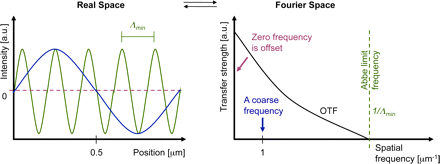
Abbe limit

Abbe limit

Interestingly, the detection OTF of a microscope has a fixed frequency
border (Abbe limit frequency, right panel). The maximum-to-maximum
distance Λmin of the corresponding sine curve is commonly referred to
as Abbe’s limit (left panel). In other words: The Abbe limit is the smallest
periodicity in a structure, which can be discriminated in its image. As a
point object contains all spatial frequencies, this Abbe limit sine curve
needs to also be present in the PSF. A standard wide-field microscope
creates an image of a point object (e.g., an emitting molecule) by capturing
the light from that molecule at various places of the objective lens, and
processing it with further lenses to then interfere at the image plane.
Conveniently due to the reciprocity principle in optics, the Abbe limit Λmin
along an in-plane direction in fluorescence imaging corresponds to the
maximum-to-maximum distance of the intensity structure one would get by
interfering two waves at extreme angles captured by the objective lens:
where λ/n is the wavelength of light in the medium of refractive index n.
The term NA = n sin(α) conveniently combines the half opening angle α
of the objective and the refractive index n of the embedding medium.

Abbe’s famous resolution limit is so attractive because it simply depends
on the maximal relative angle between different waves leaving the
object and being captured by the objective lens to be sent to the image.
It describes the smallest level of detail that can possibly be imaged with
this PSF “brush”. No periodic object detail smaller than this shortest
wavelength can possibly be transferred to the image.

Confocal laser scanning microscopy employs a redesigned optical
path and specialized hardware. A tightly focused spot of laser light is
used to scan the sample and a small aperture (or pinhole) in the
confocal image plane of the light path allows only light originating
from the nominal focus to pass (Cremer and Cremer, 1978Sheppard
and Wilson, 1981
Brakenhoff et al., 1985). The emitted light is
detected by a photomultiplier tube (PMT) or an avalanche photodiode
(APD) and the image is then constructed by mapping the detected
light in dependence of the position of the scanning spot. CLSM can
achieve a better resolution than wide-field fluorescence microscopy
but, to obtain a significant practical advantage, the pinhole needs to
be closed to an extent where most of the light is discarded
(Heintzmann et al., 2003).

Wide-field deconvolution and CLSM have long been the gold standards
in optical bioimaging, but we are now witnessing a revolution in light
microscopy that will fundamentally expand our perception of the cell.
Recently, several new technologies,collectively termed super-resolution
microscopy or nanoscopy, have been developed that break or bypass
the classical diffraction limit and shift the optical resolution down to
macromolecular or even molecular levels (Table I).

Super-resolution light microscopy methods

super resolution microscopy

super resolution microscopy

http://zeiss-campus.magnet.fsu.edu/articles/superresolution/introduction.html

Conceptually, one can discern near-field from far-field methods and
whether the subdiffraction resolution is based on a linear or nonlinear
response of the sample to its locally illuminating (exciting or depleting) irradiance. The required nonlinearity is currently achieved by using reversible saturable optical fluorescence transitions (RESOLFT) between molecular states (Hofmann et al., 2005Hell, 2007).

Besides these saturable optical fluorescence transitions also other
approaches, e.g., Rabi oscillations, could be used to generate the
required nonlinear response.

Note that each of the novel imaging modes has its individual signal-
to-noise consideration depending on various factors.  A full
discussion of this issue is beyond the scope of this review, but as a
general rule, single-point scanning systems, albeit fundamentally limited
in speed by fluorescence saturation effects, can have better signal-
to-noise performance for thicker samples.

With three-dimensional SIM (3D-SIM), an additional twofold increase
in the axial resolution can be achieved by generating an excitation
light modulation along the z-axis using three-beam interference
(Gustafsson et al., 2008Schermelleh et al.,2008) and processing a
z-stack of images accordingly. Thus, with 3D-SIM an approximately eightfold smaller volume can be resolved in comparison to conventional microscopy (Fig. 2). To computationally reconstruct a three-dimensional dataset of a typical mammalian cell of 8-µm height with a
z-spacing of 125 nm, roughly 1,000 raw images (512 × 512 pixels) are
recorded. Because no special photophysics is needed, virtually all modern fluorescent labels can be used provided they are sufficiently photostable
to accommodate the additional exposure cycles.

Resolvable volumes obtained with current commercial super-resolution microscopes.

A schematic 3D representation of focal volumes is shown for the indicated
emission maxima. The approximate lateral (x,y) and axial (z) resolution
and resolvable volumes are listed. Note that STED/CW-STED and 3D-SIM
can reach up to 20 µm into the sample, whereas PALM/STORM is usually
confined to the evanescent wave field near the sample bottom. It should be
noted that deconvolution approaches can further improve STED resolution.
For comparison the “focal volume” for PALM/STORM was estimated based
on the localization precision in combination with the z-range of TIRF.

Resolvable volumes obtained

Resolvable volumes obtained

Super-resolution microscopy of biological samples.

(A) Conventional wide-field image (left) and 3D-SIM image of a mouse
C2C12 prometaphase cell stained with primary antibodies against
lamin B and tubulin, and secondary antibodies conjugated to Alexa 488
(green) and Alexa 594 (red), respectively. Nuclear chromatin was stained
with DAPI (blue). 3D image stacks were acquired with a DeltaVision OMX
prototype system (Applied Precision). The bottom panel shows the
respective orthogonal cross sections. (B) HeLa cell stained with primary
antibodies against the nuclear pore complex protein Nup153 and
secondary antibodies conjugated with ATTO647N. The image was
acquired with a TCS STED confocal microscope (Leica). (C) TdEosFP-
paxillin expressed in a Hep G2 cell to label adhesion complexes at
the lower surface. The image was acquired on an ELYRA P.1
prototype system (Carl Zeiss, Inc.) using TIRF illumination. Single
molecule positional information was projected from 10,000 frames
recorded at 30 frames per second. On the left, signals were summed
up to generate a TIRF image with conventional wide-field lateral
resolution. Bars: 5 µm (insets, 0.5 µm).

biological images

biological images

APPLICATIONS IN BIOLOGICAL SYSTEMS

The cytoskeleton of mammalian cells, especially microtubules
(Figure 5a) (29444652), is the most commonly used benchmark
structure for super-resolution imaging. Other cytoskeletal structures
imaged so far include actin filaments in the lamellipodium (6),
keratin intermediate filaments (59), neurofilaments (2683) and
MreB in Caulobacter (66).

Figure 5

cytoskeleton. f5.

cytoskeleton. f5.

Examples of super-resolution images of biological samples.
(a) Two-color STORM imaging of immunostained microtubule (green)
and clathrin-coated pits (red) (From Reference 46. Reprinted with
permission from AAAS).

Organelles, such as the endoplasmic reticulum (27), lysosome (6),
endocytic and exocytic vesicles (465264), and mitochondria
(65356), have also been imaged. For example, using the single-molecule localization approach, 3D STORM imaging has clearly
resolved the ~150-nm diameter, hemispherical cage shape of clathrin-coated pits (4652), which only appear as diffraction-limited spots
without any feature in conventional fluorescence microscopy (Figure 5a,b).
Two-color 3D STED has resolved the hollow shape of the mitochondrial
outer membrane (marked by the translocase protein Tom20), enclosing
a matrix protein Hsp60 (56), even though the diameter of mitochondria is
only about 300–500 nm (Figure 5c). The outer membrane structure of
mitochondria and their interactions with microtubules have been resolved
by two-color 3D STORM (53). The transport of synaptic vesicles
has been recorded at video rate using 2D STED (Figure 5d ) (64).

Many plasma membrane proteins or membrane associated protein
complexes have also been studied by super-resolution fluorescence
microscopy. For example, synaptotagmin clusters after exocytosis in
primary cultured hippocampal neurons (84), the donut-shaped
clusters of Drosophila protein Bruchpilot at the neuromuscular
synaptic active zone (85), and the size distribution of syntaxin clusters
have all been imaged (8687). Photoactivation has enabled the tracking
of the influenza protein hemagglutinin and the retroviral protein Gag in
live cells, revealing the membrane microdomains (67) and the spatial
heterogeneity of membrane diffusion (68). The morphology and transport
of the focal adhension complex has also been observed using live-cell
PALM (Figure 5e) (65).

Summary points

  1. Super resolution fluorescence microscopy with a spatial resolution not limited by the diffraction of
    light has been implemented using saturated depletion/excitation or single-molecule localization
    of switchable fluorophores.
  2. Three-dimensional imaging with an optical resolution as high as ~20 nm in the lateral direction
    and 40–50 nm in axial dimension has been achieved.
  3. The resolution of these super-resolution fluorescence microscopy techniques can in principle
    reach molecular scale.
  4. In practice, the resolution of the images are not only limited by the intrinsic optical resolution,
    but also by sample specific factors including the labeling density, probe size and sample preservation.
  5. Multicolor super resolution imaging has been implemented, allowing colocalization measurements
    to be performed at nanometer scale resolution and molecular interaction to be more précisely
    identified in cells.
  6. Super-resolution fluorescence imaging allows dynamic processes to be investigated at the tens of
    nanometer resolution in living cells.
  7. Many cellular structures have been imaged at sub-diffraction-limit resolution.

Future issues

  1. Achieving molecular scale resolution (a few nanometers or less).
  2. Fast super resolution imaging of a large view field by multi-point scanning or high-speed single-molecule switching/localization.
  3. Developing new fluorescent probes that are brighter, more photostable and switchable fluorophores
    that have high on-off contrast and fast switching rate.
  4. Developing fluorescent labeling methods that can stain the target with small molecules at high specificity,
    high density and good ultrastructure preservation.
  5. Application of super resolution microscopy to provide novel biological insights

Acronyms

FP

Fluorescent Protein

FPALM

Fluorescence PhotoActivation Localization Microscopy

I5M

Combination of I2M (Illumination Interference Microscopy) and I3M
(Incoherent Imaging Interference Microscopy)

PALM

PhotoActivated Localization Microscopy

PSF

Point Spread Function

RESOLFT

REversible Saturable Optically Linear Fluorescence Transition

SIM

Structured Illumination Microscopy

SSIM

Saturated Structured Illumination Microscopy

STED

STimulated Emission Depletion

STORM

STochastic Optical Reconstruction Microscopy

glossary

Numerical aperture (NA)

The numerical aperture of an objective characterizes the solid angle
of light collected from a point light source at the focus of the objective.

Stimulated emission

The process that an excited state molecule or atom jumps to the
ground state by emitting another photon that is identical to the incoming
photon. It is the basis of laser.

Fluorescence saturation

At high excitation intensity, the fluorescence lifetime instead of the excitation
rate becomes the rate limiting step of fluorescence emission, causing the
fluorescence signal not to increase proportionally with the excitation intensity.

Nyquist criterion

To determine a structure, the sampling interval needs to be no larger than
half of the feature size.

Mitochondria

Organelles in eukaryotic cells for APT generation, consisting of two
membrane (inner and outer) enclosing the inter membrane space and
the matrix inside the inner membrane.

Clathrin-coated pit

Vesicle forming machinery involved in endocytosis and intracellular
vesicle transport, consisting of clathrin coats, adapter proteins, and
other regulatory proteins.

Focal adhesion

The macromolecular complex serving as the mechanical connection
and signaling hub between a cell and the extracellular matrix or other cells.

Selected references with abstract

Near-Field Optics: Microscopy, Spectroscopy, and Surface
Modification Beyond the Diffraction Limit
Eric Betzig,  Jay K. Trautman
AT&T Bell Laboratories, Murray Hill, NJ 07974
Science 10 Jul 1992; 257(5067) pp. 189-195
http://dx.doi.org:/0.1126/science.257.5067.189

 The near-field optical interaction between a sharp probe and a sample
of interest can be exploited to image, spectroscopically probe, or modify
surfaces at a resolution (down to ∼12 nm) inaccessible by traditional far-field
techniques. Many of the attractive features of conventional optics are
retained, including noninvasiveness, reliability, and low cost. In addition, most
optical contrast mechanisms can be extended to the near-field regime,
resulting in a technique of considerable versatility. This versatility
is demonstrated by several examples, such as the imaging of nanometric-scale features in mammalian tissue sections and the creation of ultrasmall,
magneto-optic domains having implications for high density data storage.
Although the technique may find uses in many diverse fields, two of the
most exciting possibilities are localized optical spectroscopy of semiconductors
and the fluorescence imaging of living cells.

Imaging Intracellular Fluorescent Proteins at Nanometer Resolution

 E Betzig1,2,*,†, GH. Patterson3, R Sougrat3, O.W Lindwasser3,
S Olenych4, JS. Bonifacino3, MW. Davidson4, JL Schwartz3, HF. Hess5,*  1 Howard Hughes Medical Institute, Janelia Farm Research Campus,
Ashburn, VA   2 New Millennium Research, LLC, Okemos, MI.   3 Cell Biology and Metabolism Branch, National Institute of Child Health
and Human Development (NICHD), Bethesda, MD.  4 National High
Magnetic Field Laboratory, Florida State University, Tallahassee, FL.
5 NuQuest Research, LLC, La Jolla, CA.
Science 15 Sep 2006; 313(5793): pp. 1642-1645
http://dx.doi.org:/10.1126/science.1127344

We introduce a method for optically imaging intracellular proteins at
nanometer spatial resolution. Numerous sparse subsets of photo-activatable fluorescent protein molecules were activated, localized
(to ∼2 to 25 nanometers), and then bleached. The
aggregate position information from all subsets was then assembled
into a super-resolution image. We used this method—termed photo-
activated localization microscopy to image specific target proteins
in thin sections of lysosomes and mitochondria; in fixed whole cells,
we imaged vinculin at focal adhesions, actin within a lamellipodium,
and the distribution of the retroviral protein Gag at the plasma
membrane.

Toward fluorescence nanoscopy.

Hell SW.   Author information 
Nat Biotechnol. 2003 Nov; 21(11):1347-55.
http://www.ncbi.nlm.nih.gov/pubmed/14595362

For more than a century, the resolution of focusing light microscopy
has been limited by diffraction to 180 nm in the focal plane and to
500 nm along the optic axis. Recently, microscopes have been
reported that provide three- to seven-fold improved axial
resolution in live cells. Moreover, a family of concepts has emerged
that overcomes the diffraction barrier altogether. Its first exponent,
stimulated emission depletion microscopy, has so far displayed a
resolution down to 28 nm. Relying on saturated optical transitions,
these concepts are limited only by the attainable saturation level.
As strong saturation should be feasible at low light intensities,
nanoscale imaging with focused light may be closer than ever.
PMID: 14595362

Far-field optical nanoscopy.

Hell SW.  Author information 
Science. 2007 May 25;316(5828):1153-8.
http://www.ncbi.nlm.nih.gov/pubmed/17525330

In 1873, Ernst Abbe discovered what was to become a well-known
paradigm: the inability of a lens-based optical microscope to
discern details that are closer together than half of the wavelength
for its most popular imaging mode, fluorescence microscopy, the
diffraction barrier is crumbling. Here, I discuss the physical concepts
that have pushed fluorescence microscopy to the nanoscale, once
the prerogative of electron and scanning probe microscopes. Initial
applications indicate that emergent far-field optical nanoscopy will
have a strong impact in the life sciences and in other areas benefiting
from nanoscale visualization.
PMID:  17525330

Imaging intracellular fluorescent proteins at nanometer resolution.

Betzig E1, Patterson GHSougrat RLindwasser OWOlenych S,
Bonifacino JSDavidson MWLippincott-Schwartz JHess HF.
Author information
Science. 2006 Sep 15;313(5793):1642-5. Epub 2006 Aug 10
http://www.ncbi.nlm.nih.gov/pubmed/16902090

We introduce a method for optically imaging intracellular proteins at
nanometer spatial resolution. Numerous sparse subsets of photo-ctivatable fluorescent protein molecules were activated, localized
(to approximately 2 to 25 nanometers), and then bleached. The
aggregate position information from all subsets was then assembled
into a super-resolution image. We used this method–termed photo-activated localization microscopy–to image specific target proteins in
thin sections of lysosomes and mitochondria; in fixed whole cells,
we imaged vinculin at focal adhesions, actin within a lamellipodium,
and the distribution of the retroviral protein Gag at the plasma
membrane.

Comment in

PMID:  16902090  [PubMed – indexed for MEDLINE]

Illuminating single molecules in condensed matter.

Moerner WE1, Orrit M.  Author information 
Science. 1999 Mar 12;283(5408):1670-6.
http://www.ncbi.nlm.nih.gov/pubmed/10073924

Efficient collection and detection of fluorescence coupled with careful
minimization of background from impurities and Raman scattering
now enable routine optical microscopy and study of single molecules
in complex condensed matter environments. This ultimate method
for unraveling ensemble averages leads to the observation of
new effects and to direct measurements of stochastic fluctuations.
Experiments at cryogenic temperatures open new directions in
molecular spectroscopy, quantum optics, and solid-state dynamics.
Room-emperature investigations apply several techniques
(polarization microscopy, single-molecule imaging, emission time
dependence, energy transfer, lifetime studies, and the like) to a
growing array of biophysical problems where new insight may be
gained from direct observations of hidden static and dynamic
inhomogeneity.  PMID: 10073924

Fluorescence microscopy with super-resolved optical sections.

Egner A1, Hell SW.  Author information 
Trends Cell Biol. 2005 Apr;15(4):207-15.
http://www.ncbi.nlm.nih.gov/pubmed/15817377

The fluorescence microscope, especially its confocal variant, has
become a standard tool in cell biology research for delivering
3D-images of intact cells. However, the resolution of any standard
optical microscope is atleast 3 times poorer along the axis of the
lens that in its focal plane. Here, we review principles and applications
of an emerging family of fluorescence microscopes, such as 4Pi
microscopes, which improve axial resolution by a factor of seven by
employing two opposing lenses. Noninvasive axial sections of 80-160 nm
thickness deliver more faithful 3D-images of subcellular features,
providing a new opportunity to significantly enhance our understanding
of cellular structure and function. PMID: 15817377

4Pi-confocal microscopy provides three-dimensional images of the
microtubule network with 100- to 150-nm resolution.

Nagorni M1, Hell SW.  Author information 
J Struct Biol. 1998 Nov;123(3):236-47.

We show the applicability of 4Pi-confocal microscopy to three-dimensional imaging of the microtubule network in a fixed mouse
fibroblast cell.Comparison with two-photon confocal resolution
reveals a fourfold better axial resolution in the 4Pi-confocal case.
By combining 4Pi-confocal microscopy with Richardson-Lucy
image restoration a further resolution increase is achieved.
Featuring a three-dimensional resolution in the range 100-150 nm,
the 4Pi-confocal (restored) images are intrinsically more detailed
than their confocal counterparts. Our images constitute what
to our knowledge are the best-resolved three-dimensional
images of entangled cellular microtubules obtained with light
to date.  PMID: 9878578

Part IV. Super-resolution microscopy

Super-resolution microscopy is a form of light microscopy. Due
to the diffraction of light, the resolution of conventional light
microscopy is limited as stated by Ernst Abbe in 1873.[1]
A good approximation of the resolution attainable is the full
width at half maximum 
 (FWHM) of the point spread function,
and a precise wide-field microscope with high numerical
aperture
 and visible light usually reaches a resolution of ~250 nm.

Super-resolution techniques allow the capture of images with
a higher resolution than the diffraction limit. They fall into
two broad categories,
“true” super-resolution techniques, which capture information
contained in evanescent waves, and “functional” super-
resolution techniques, which use clever experimental
techniques and known limitations on the matter being
imaged to reconstruct a super-resolution image.[2]

True subwavelength imaging techniques include those that
utilize the Pendry Superlens and near field scanning optical
microscopy
, the 4Pi Microscope and structured illumination
microscopy technologies like SIM and SMI. However, the
majority of techniques of importance in biological imaging
fall into the functional category.

Groups of methods for functional super-resolution microscopy:

  1. Deterministic super-resolution: The most commonly used emitters in biological
    microscopy, fluorophores, show a nonlinear response to excitation, and this
    nonlinear response can be exploited to enhance resolution. These
    methods include STEDGSDRESOLFTand SSIM.
  2. Stochastic super-resolution: The chemical complexity of many molecular
    light sources gives them a complex temporal behaviour, which can be used
    to make several close-by fluorophores emit light at separate times and
    thereby become resolvable in time.  These methods include SOFI and all
    single-molecule localization methods (SMLM) such as SPDM,
    SPDMphymodPALM, FPALM, STORM and dSTORM.

Part V. HIV-1

Conformational dynamics of single HIV-1 envelope
trimers on the surface of native virions

James B. Munro1,*,Jason Gorman2Xiaochu Ma1,
Zhou Zhou3James Arthos4,
Dennis R. Burton5,6, et al.
1Department of Microbial Pathogenesis, Yale University
School of Medicine, New Haven, CT. 2Vaccine Research
Center, National Institute of Allergy and Infectious
Diseases, National Institutes of Health, Bethesda, MD .
3Department of Physiology and Biophysics, Weill
Cornell Medical College of Cornell University, New York, NY .
4Laboratory of Immunoregulation, National Institute of Allergy
and Infectious Diseases, National Institutes of Health, Bethesda,
MD . 5Department of Immunology and Microbial Science, and
IAVI Neutralizing Antibody Center, The Scripps Research
Institute, La Jolla, CA . 6Ragon Institute of MGH, MIT, and
Harvard, Cambridge, MA. 7International AIDS Vaccine Initiative
(IAVI), New York, NY . 8Department of
Chemistry, University of Pennsylvania, Philadelphia, PA.

The HIV-1 envelope (Env) mediates viral entry into host cells.
To enable the direct imaging of conformational dynamics
within Env we introduced fluorophores into variable
regions of the gp120 subunit and measured single-molecule
fluorescence resonance energy transfer (smFRET) within
the context of native trimers on the surface of HIV-1 virions.
Our observations revealed unliganded HIV-1 Env to be
intrinsically dynamic, transitioning between three distinct
pre-fusion conformations, whose relative occupancies
were remodeled by receptor CD4 and antibody binding.
The distinct properties of neutralization-sensitive and
neutralization-resistant HIV-1 isolates support a dynamics-based mechanism of immune evasion and ligand recognition.

Read Full Post »

Ischemia-Related Subcellular Redistribution of Sodium Channels Enhances the Proarrhythmic Effect of Class I Antiarrhythmic Drugs: A Simulation Study

Reporter: Aviva Lev-Ari, PhD, RN


PLOS ONE: an inclusive, peer-reviewed, open-access resource from the PUBLIC LIBRARY OF SCIENCE. Reports of well-performed scientific studies from all disciplines freely available to the whole world.

Source: www.plosone.org

See on Scoop.itCardiovascular and vascular imaging

Read Full Post »

Mechanisms of Drug Resistance

Curator: Larry H. Bernstein, MD, FCAP

Leaders in Pharmaceutical Intelligence, CSO


Mechanisms of Drug Resistance

This discussion is a continuing discussion of matters of metabolomics and the
essential role of genomic or epigenetic mechanisms to guide the development of
proteomic driven effectors of resistance to drug therapy.
We start with the elucidation of efflux pumps in bacteria, and we conclude with
consideration of cancer cells.

Part 1. Antimicrobial Resistance

Antimicrobial resistance is the ability of microbes, such as bacteria, viruses,
parasites, or
fungi, to grow in the presence of a chemical (drug) that would normally kill it
or limit its growth.

difference between non-resistant bacteria and drug resistant bacteria

difference between non-resistant bacteria and drug resistant bacteria

http://www.niaid.nih.gov/SiteCollectionImages/topics/antimicrobialresistance/1whatIs
DrugResistance.gif

Non-resistant bacteria multiply, and upon drug treatment, the bacteria die. Drug
resistant bacteria multiply as well, but upon drug treatment, the bacteria continue
to spread.

Many infectious diseases are increasingly difficult to treat because of antimicrobial-resistant organisms, including HIV infection, staphylococcal infection, tuberculosis,
influenza, gonorrhea, candida infection, and malaria.

Between 5 and 10 percent of all hospital patients develop an infection. About 90,000
of these patients die each year as a result of their infection, up from 13,300 patient
deaths in 1992.

According to the Centers for Disease Control and Prevention (April 2011), antibiotic
resistance in the United States costs an estimated $20 billion a year in excess health
care costs. In addition, a cost of $35 million in other societal costs and more than 8
million additional days that people spend in the hospital. This is because people
infected with antimicrobial-resistant organisms are more likely to have longer hospital stays and may require more complicated treatment.

Diagnostic tests designed to determine which microbe is causing infection and to
which antimicrobials the microbe might be resistant take a few days or weeks to give
results because of a requirement for the microbe to grow for it to be identified.

Part 2. Antibiotic Tolerance   
Reported By Jef Akst | June 25, 2014

Optimization of lag time underlies antibiotic tolerance in evolved bacterial
populations

O. Fridma et al.    Nature, 2014 
http://dx.doi.org://10.1038/nature13469

Populations of Escherichia coli grown in the lab develop tolerance when exposed to
repeated treatments with the antibiotic ampicillin. The bacteria evolved to stay in a
dormant “lag” phase for just longer than three-, five-, or eight-hour-long treatment
courses. Antibiotic tolerance, which allows bacteria to survive even high levels of
antibiotics by remaining dormant. Tolerance may lead to an inaccurate assumption
that an unsuccessful antibiotic treatment failed as a result of resistance, in which
the microbe has evolved to grow in the presence of the drug. Resistance is very well
known; but the issue of tolerance is much less known,” according to Tom Coenye of
the Laboratory of Pharmaceutical Microbiology (LPM) at Gent University in Belgium,
who was not involved in the research.  This is a new phenomenon, extended lag,
where mutants have a longer lag time, and that extended lag allows them to survive
an attack by antibiotics.

To gain a better understanding of how bacterial populations might evolve to tolerate
antibiotic exposure, Nathalie Q. Balaban, a microbiologist and physicist at The Hebrew
University of Jerusalem in Israel and her colleagues exposed cultures of E. coli to high
concentrations of ampicillin for three, five, or eight hours, then washed the drug away
and suspended the bacteria in fresh media to be grown overnight. The next day, the
team repeated these treatments. In 10 cycles we could see that tolerance had evolved,
” Balaban said. Indeed, while the ampicillin treatments killed more than 99.9 percent of
the E. coli, by day 10, bacterial survival had increased 100-fold.

Moreover, the bacteria were also tolerant to norfloxacin, an antibiotic with a different mechanism of action than ampicillin but also ineffective during the dormant stage,
further supporting the idea that the E. coli populations had evolved to tolerate certain
durations of antibiotic exposure. “This is characteristic of tolerance,” said Balaban.
“The bacteria that have evolved tolerance under ampicillin are also more tolerant to
this completely different class of antibiotics.” Resistance, on the other hand, is usually
class-specific, she noted.

The researchers identified three genes that seemed to play a functional role in antibiotic
tolerance. While the exact mechanism of how mutations in these genes may have
lengthened the bacteria’s lag time is not yet known, two of the genes are part of pathways
that were previously implicated in bacterial persistence, including an antitoxin in a
common toxin-antitoxin module
 that may help regulate that bacteria’s growth.

Part 3. Multidrug Resistance Perspective

Mechanisms of antibiotic resistance in salmonella: efflux pumps, genetics,
quorum sensing and biofilm formation.

Perspectives in Drug Discovery and Design 02/2011; 8:114-123.
Martins M, McCusker, Amaral, Fanning S

Multidrug resistance (MDR) to antibiotics presents a serious therapeutic problem
in the treatment of bacterial infections. The importance of this mechanism of resistance
in clinical settings is reflected in the increasing number of reports of multidrug resistant
isolates. In Salmonella enterica, the most common etiological agent of food borne
salmonellosis worldwide, MDR is becoming a major concern.

In Salmonella the main mechanisms of antibiotic resistance are mutations in target
genes (such as DNA gyrase and topoisomerase IV) and the over-expression of efflux pumps. However, other mechanisms such as

  1. changes in the cell envelope;
  2. down regulation of membrane porins;
  3. increased lipopolysaccharide (LPS) component of the outer cell membrane;
  4. quorum sensing and
  5. biofilm formation

can also contribute to the resistance seen in this microorganism. To overcome
this problem new therapeutic approaches are urgently needed.

In the case of efflux-mediated multidrug resistant isolates, one of the treatment
options could be

  • the use of efflux pump inhibitors (EPIs)
  • in combination with the antibiotics to which the bacteria is resistant.

By blocking the efflux pumps

  • resistance is partly or wholly reversed,
  • allowing antibiotics showing no activity against the MDR strains
  • to be used to treat these infections.

Compounds that show potential as an EPI are therefore of interest, as well as new
strategies to target the efflux systems. Quorum sensing (QS) and biofilm formation
are systems also known to be involved in antibiotic resistance. Consequently,
compounds that

  • can disrupt or inhibit these bacterial “communication systems” will be of use in
    the treatment of these infections.

Part 5. Effux pumps and S. Aureus

Multidrug Efflux Pumps in Staphylococcus aureus: an Update

SS Costa, M Viveiros, L Amaral and I Couto
1Grupo de Micobactérias, Unidade de Microbiologia Médica, Instituto de Higiene e
Medicina Tropical, Universidade Nova de Lisboa (IHMT, UNL), 2Centro de Recursos
Microbiológicos (CREM), UNL, Portugal,3COST ACTION BM0701 (ATENS), Brussels,
Belgium
The Open Microbiology Journal 2013;(Suppl 1-M5): 59-71

The emergence of infections caused by multi- or pan-resistant bacteria in the hospital
or in the community settings is an increasing health concern. Albeit there is no single
resistance mechanism behind multi-resistance, multidrug efflux pumps,

  • proteins that cells use to detoxify from noxious compounds,

seem to play a key role in the emergence of these multidrug resistant (MDR) bacteria.
During the last decades, experimental data has established their contribution to low
level resistance to antimicrobials in bacteria and their

  • potential role in the appearance of MDR phenotypes, by the extrusion of multiple,
    unrelated compounds.

Recent studies suggest that

  • efflux pumps may be used by the cell as a first-line defense mechanism,

avoiding the drug to reach lethal concentrations, until a stable, more efficient alteration
occurs, that allows survival in the presence of that agent.

In this paper we review the current knowledge on

  • MDR efflux pumps and their
  • intricate regulatory network in Staphylococcus aureus,

a major pathogen, responsible from mild to life-threatening infections. Particular emphasis will be given to the potential role that

  • aureus MDR efflux pumps,
  • either chromosomal or plasmid-encoded, have
  • on resistance towards different antimicrobial agents and
  • on the selection of drug – resistant strains.

We will also discuss the many questions that still remain on the role of each specific
efflux pump and the need to establish appropriate methodological approaches to
address all these questions.

        Table 1. Multidrug Efflux Pumps Described for Staphylococcus aureus

Efflux Pump  Family Regulator(s) Substrate Specificity  References 
Chromosomally-encoded Efflux Systems 
NorA MFS MgrA,
NorG(?)
Hydrophilic fluoroquinolones (ciprofloxacin,
norfloxacin) QACs (tetraphenylphosphonium,
benzalkonium chloride) Dyes (e.g. ethidium
bromide, rhodamine)
[16,18,19]
NorB MFS MgrA,
NorG
Fluoroquinolones (e.g. hydrophilic: ciprofloxacin,
norfloxacin and hydrophobic: moxifloxacin,
sparfloxacin) Tetracycline QACs (e.g.
tetraphenylphosphonium, cetrimide) Dyes (e.g. ethidium bromide)
[31]
NorC MFS MgrA(?),
NorG
Fluoroquinolones (e.g. hydrophilic: ciprofloxacin
and hydrophobic: moxifloxacin) Dyes
(e.g. rhodamine)
[35,36]
MepA MATE MepR Fluoroquinolones (e.g. hydrophilic: ciprofloxacin,
norfloxacin and hydrophobic: moxifloxacin,
sparfloxacin) Glycylcyclines (e.g. tigecycline) QACs (e.g. tetraphenylphosphonium, cetrimide, benzalkonium chloride) Dyes
(e.g. ethidium bromide)
[37,38]
MdeA MFS n.i. Hydrophilic fluoroquinolones (e.g. ciprofloxacin,
norfloxacin) Virginiamycin, novobiocin, mupirocin,
fusidic acid QACs (e.g. tetraphenylphosphonium,
benzalkonium chloride, dequalinium) Dyes (e.g. ethidium bromide)
[39,40]
SepA n.d. n.i. QACs (e.g. benzalkonium chloride) Biguanidines
(e.g. chlorhexidine) Dyes (e.g. acriflavine)
[41]
SdrM MFS n.i. Hydrophilic fluoroquinolones (e.g. norfloxacin) Dyes (e.g. ethidium bromide, acriflavine) [42]
LmrS MFS n.i. Oxazolidinone (linezolid) Phenicols
(e.g. choramphenicol, florfenicol) Trimethoprim, erythromycin, kanamycin,
fusidic acid QACs (e.g. tetrapheny-
lphosphonium) Detergents (e.g. sodium
docecyl sulphate) Dyes (e.g. ethidium
bromide)
[43]
Plasmid-encoded Efflux Systems

QacA MFS QacR QACs (e.g. tetraphenylphosphonium,
benzalkonium chloride, dequalinium)
Biguanidines (e.g. chlorhexidine)
Diamidines (e.g. pentamidine) Dyes
(e.g. ethidium bromide,
rhodamine, acriflavine)
[45,49]
QacB MFS QacR QACs (e.g. tetraphenylphosphonium,
benzalkonium chloride)Dyes (e.g. ethidium bromide, rhodamine,
acriflavine)
[53]
Smr SMR n.i. QACs (e.g. benzalkonium chloride,
cetrimide) Dyes (e.g. ethidium bromide)
[58,61]
QacG SMR n.i. QACs (e.g. benzalkonium chloride,
cetyltrymethylammonium) Dyes
(e.g. ethidium bromide)
[67]
QacH SMR n.i. QACs (e.g. benzalkonium chloride,
cetyltrymethylammonium) Dyes
(e.g. ethidium bromide)
[68]
QacJ SMR n.i. QACs (e.g. benzalkonium chloride,
cetyltrymethylammonium) Dyes
(e.g. ethidium bromide)
[69]

a n.d.: The family of transporters to which SepA belongs is not elucidated to date.
b n.i.: The transporter has no regulator identified to date.
QACs: quaternary ammonium compounds

Identification of the plasmid-encoded qacA efflux pump gene
in meticillin-resistant Staphylococcus aureus (MRSA)
strain HPV107, a representative of the MRSA Iberian clone

S.S. Costaa,b, E. Ntokouc, A. Martinsa,d, M. Viveirosa,e, S. Pournarasc,
I. Coutoa,b, L. Amarala,d,e,∗
a Unidade de Micobactérias, Instituto de Higiene e Medicina Tropical,
Universidade Nova de Lisboa (IHMT, UNL), b Centro de Recursos Microbiológicos,
Universidade Nova de Lisboa (CREM, UNL), d Unidade de Parasitologia e
Microbiologia Médica (UPMM), Instituto de Higiene e Medicina Tropical, Universidade
Nova de Lisboa (IHMT, UNL), Lisbon, Portugal; e COST ACTION BM0701 (ATENS)
c Department of Microbiology, Medical School, University of Thessaly, Larissa, Greece;
Int J Antimicrobial Agents  2010; 36: 557–561
http://www.elsevier.com/locate/ijantimicag

Methicillin-resistant Staphylococcus aureus (MRSA) is a major nosocomial
bacterium for which prevention and control measures consist mainly of

  • the application of biocides with antiseptic and disinfectant activity.

In this study, we demonstrated the presence of

  • the plasmid-located efflux pump gene qacA in MRSA strain HPV107,

a clinical isolate representative of the MRSA Iberian clone. The existence
of efflux activity in strain HPV107 due to the QacA pump was found and

  • this QacA efflux activity was linked with a phenotype of
  • reduced susceptibility towards several biocide compounds.

No association could be made with antibiotic resistance. This work
emphasises the potential of QacA pump activity in

  • the maintenance and dissemination of important MRSA strains in
    the hospital setting and, increasingly, in the community.

Efflux-mediated response of Staphylococcus aureus exposed to
ethidium bromide

I Couto1,2, S S Costa1, M Viveiros1, M Martins1,3 and L Amaral1,3*
1Unidade de Micobacterias, Instituto de Higiene e Medicina Tropical,
Universidade Nova de Lisboa (UNL), 2Centro de Recursos Microbiolo´gicos (CREM), Faculdade de Cieˆncias e Tecnologia, UNL,3UPMM,
Instituto de Higiene e Medicina Tropical, UNL, Portugal
J Antimicrob Chemother  (2008) 62, 504–513
http://dx.doi.org:/10.1093/jac/dkn217

By adapting an antibiotic-susceptible Staphylococcus aureus strain to
increasing concentrations of ethidium bromide, a known substrate
of efflux pumps (EPs), and

  • by phenotypically and genotypically analysing the resulting progeny,
  • we characterized the molecular mechanisms of S. aureus
    adaptation to ethidium bromide.

ATCC 25923 was grown in increasing concentrations of ethidium bromide.
The MICs of representatives of eight classes of antibiotics, eight biocides
and two dyes against ATCC 25923 and its ethidium bromide-resistant progeny
ATCC 25923EtBr were determined

  • with or without six efflux pump inhibitors (EPIs).

Efflux activity in the presence/absence of EPIs was evaluated by realtime
fluorometry. The presence and expression of eight EP genes were assayed
by PCR and quantitative RT–PCR (qRT–PCR), respectively. Mutations in
grlA, gyrA and norA promoter regions were screened by DNA sequencing.

Compared with its parental strain, ATCC 25923EtBr was

  • 32-fold more resistant to ethidium bromide and
  • also more resistant to biocides and hydrophilic fluoroquinolones.
  • Resistance to these could be reduced by the EPIs chlorpromazine,
    thioridazine and reserpine.

Increased efflux of ethidium bromide by ATCC 25923EtBr could be
inhibited by the same EPIs. qRT–PCR showed that

  • norA was 35-fold over-expressed in ATCC 25923EtBr,

whereas the remaining EP genes showed no significant increase in their

expression. Sequencing of the norA promoter region revealed

  • a 70 bp deletion in ATCC 25923EtBr.

Exposure of S. aureus to quaternary compounds such as ethidium bromide
results in decreased susceptibility of the organism to a wide variety of
compounds, including quinolones and biocides

  • through an efflux-mediated response, which
  • for strain ATCC 25923 is mainly NorA-mediated.

This altered expression may result from alterations in the norA
promoter region
.

Ethnic consumption of plant leaf extracts and appraisal of
their nutraceutical efficacy against multidrug resistant
staphylococcus aureus

Kaushik S1, 2*, Tomar Rs1, Shrivastav V1, Shrivastav A2 And Jain Sk3
Amity Institute of Biotechnology, Amity University Madhya Pradesh,
Gwalior (M.P.);  2: College of Life Sciences, Cancer Hospital and
Research Institute, Gwalior (M.P.); 3: Department of Microbiology,
Vikram University, Ujjain (M.P.), INDIA
IJBPAS, Feb, 2014, 3(2): 204-209

Nutraceuticals are natural bioactive chemical compounds that have
health promoting, disease preventing or medicinal properties.
Emergence of Multi Drug Resistant Staphylococci is increasing at
alarming rates and diseases caused by these strains leave patients
against multiple resistant Staphylococcus aureus.

The test bacteria were isolated and characterized by standard and
NCCLS recommended microbiological techniques. A total of eighteen
plant extracts were analysed for their antimicrobial activity. The
selection of medicinal plants was based on their traditional uses in
India. However most of these plants were not previously screened.
Antibacterial activity of these components was performed by standard
Kirby Bauer Disk Diffusion method approved by NCCLS and the
inhibitory effect was analysed by calculating Zone of inhibition.

Among the eighteen plant extracts analysed we found highest
activity in the effect of chemotherapy and as promising bio control agents

  • Guava,
  • Mango,
  • Jamun and
  • Pomengrate plant extracts,

while most of the other plants were either showing very moderate/
least activity against test bacteria. Our recent experiment indicated
that phytochemicals extracted with methanol can be utilized as
nutraceutical to lower the side.

Part 6. Efflux pumps and gram-negative organisms

Efflux Pumps that Bestow Multi-Drug Resistance of Pathogenic Gram-
negative 
Bacteria 

Amaral L1,2*, Spengler G2, Martins A2,3 and Molnar J2
1Travel Medicine of the Centre for Malaria and Other Tropical Diseases (CMDT),
Institute of Hygiene and Tropical Medicine, Lisbon, Portugal 2Department of
Medical Microbiology and Immunobiology, Faculty of Medicine, University of
Szeged, Szeged, Hungary 3Unit of Parasitology and Medical Microbiology
(UPMM), Institute of Hygiene and Tropical Medicine, Lisbon, Portugal
Amaral et al., Biochem Pharmacol 2013; 2:3
http://dx.doi.org/10.4172/2167-0501.1000119

The efflux pump

The efflux pump

Efflux pumps are integral plasma membrane protein systems that recognize and bind
noxious compounds present in the cytoplasm (toxic products produced by metabolism;
compounds that have penetrated the cell), or periplasm of the bacterial cell and extrude
it into the environment in which the bacterium resides [1].

The efflux pump machinery gives the cell additional protection to the one provided by

  • the constituents of its cell wall (example: lipopolysaccharides), and
  • provides an initial protection to noxious agents present in its
    natural environment that have penetrated into the cell (example: bile
    salts in the colon) [1].

The efflux pump machinery is divided into five superfamily classes;

  • the major facilitator (MF),
  • the ATP-binding cassette (ABC),
  • the resistance-nodulation-division (RND),
  • the small multi-drug resistance (SMR) and
  • the multi-drug and toxic compound extrusion (MATE).

With respect to Gram-negative bacteria, although they all play
important roles in the protection of the bacterium from noxious
agents present in the environment, the

  • main efflux pump of the Gram negative bacterium is a
    member of the RND superfamily, and
  • because multi-drug resistance of clinical isolates have
    been associated with the over-expression of this pump,

it has received a great deal of attention [2].

The first in vitro response of bacteria to a given noxious agent,
such as an antibiotic, is to over-express its main efflux pump [2].
If the bacterium is serially exposed in vitro to increasing
concentrations of that compound, it responds by increasing
the effective number of its main efflux pump, as well as others
that provide redundant protection [2].

However, if that “adapted” bacterium is now maintained at a
constant level of a noxious agent, the level of efflux pump
activity increases up to a maximum, followed by a gradual
return of efflux pump activity to its basal level. Concomitant
to this process, an accumulation of mutations of essential
proteins located in the plasma membrane (example penicillin
binding proteins), mutations 30 S component of the ribosome
and gyrase take place [3]. These events suggest that when
the organism is faced with an environment that contains a
constant toxic level of a compound, and the cost for
maintaining an energy consuming system, such as that
needed for the energy dependent efflux pump, is too
great a price to pay.

Therefore, in order to survive in this unchanging environment,
other mechanisms are activated. For example, activation of a
mutator master gene is thought to be an important step at this
level, which results in the mutation of genes that code for
essential proteins, reversing the over-expression of efflux-
pumps, but still conferring the bacterial resistant to the
environmental pressure via other mechanism(s), yet
to be understood [4,5].

During therapy, the level of resistance increases many fold
higher than that of the initial infecting strain. Hence, clinical
isolates from treated patients often show much higher levels
of antibiotic resistance than that of their wild type counterpart
(sometimes it can even present a 1000 fold increase) [6].
At this stage, resistance is usually related to the presence
of mutations, which reduces the survival of the resistant
bacteria,

  • once it is transferred to a noxious agent-free environment

that contains the competing wild type counterpart [3,4].

Depending upon when during therapy a clinical strain is isolated,
its resistance to two or more antibiotic classes (multi-drug
resistance (MDR)), may be due entirely to over-expressed
efflux pumps; to a mixture of over-expressed efflux pumps
and increasing accumulation of mutations; and only to mutations [3,4].

The degree of resistance can readily be determined with
methods that employ compounds known for their modulation
of efflux pump activity, such as

  • phenothiazines [7] or phenyl-arginine-betanaphthylamide
    (PAβN),
  • the latter which competes with the antibiotic as
    substrate of the efflux pump [8].

If in presence of such compounds,

  • the MDR bacterium is rendered fully susceptible
    to the antibiotic(s) to which it was initially resistant,
  • resistance is most likely due to its overexpressed
    efflux pump systems.
  • Contributions made by accumulated mutations
    render the organism less and less affected by the EPI.

This type of information is of great value to clinicians faced
with long-term therapy of a bacterial infection that
progresses to an MDR phenotype. It should be understood
that although the Gram-negative bacterium has essentially
one main efflux pump, such as

  • the AcrAB (Escherichia coli) or
  • the MexAB (Pseudomonas aeruginosa),

the deletion of the main efflux pump results in the over-
expression of one or more other RND efflux pumps,
such as is the case for deletion of the AcrAB, followed by

  • the over-expression of the AcrEF pump [2].

Redundancy of as many as nine RND efflux pumps [2],
provides additional protection to the organism.

The pumps belonging to the RND family form

  • a tripartite complex together with
  • the periplasmic proteins belonging to the
    membrane fusion-protein (MFP) family and
  • the outer membrane channels.

RND transporters consist of

  • a transporter protein that recognises and
    binds the noxious agent
    in the cytoplasm or periplasm and
  • transports it to the contiguous channel (TolC),
  • ending at the surface of the outer membrane.

The transporter is attached to the plasma membrane
by two or three fusion proteins, which are believed to assist the

  • extrusion of the substrate by peristaltic actions [9].

Although the actual structure of RND efflux pumps
in the cell envelop is not completely understood,

  • the structure of the transporter, TolC and fusion
    proteins are well established for major Gram-negative
    bacteria [10].

The PMF energy dependent efflux pump most likely needs the
passage of hydronium ions through its internal cavity,

  • for the release of the substrate that is
  • in turn ejected into the TolC channel via the
  • peristaltic action of the fusion proteins [11].

A low pH,

  • the concentration of hydronium ions at the surface of the cell
  • results in a pH difference of 2 or 3 pH units compared
    to that of the milieu,

the surface concentration of hydronium ions

  • provides the force for the mobility of hydronium ions
  • through porins leading to the acidification of the periplasm,
  • providing the low pH needed by the transporter
  • for the release of the substrate.

At high pH, these hydronium ions come from

  • hydrolysis of ATP by ATP synthase, and
  • are passed into the transporter, thereby
  • reducing its internal pH, so that
  • the release of the substrates can take place [11,12].

EPIs, such as the phenothiazines chlorpromazine or thioridazine,

  • exert their inhibition at pH above 6, and
  • are thought to affect hydrolysis of ATP
  • denying the efflux pump transporter hydronium ions needed

for release of the bound substrate [11,12].

The search for EPIs that are clinically useful continues, although

with respect to thioridazine, this old neuroleptic has been shown

  • to inhibit efflux pumps of pathogenic mycobacteria [13], and
  • has been successfully used to treat extensively drug resistant
    tuberculosis infections [14].

The regulation of the main efflux pump of Escherichia coli may
take place via   distinct pathways. The induced synthesis of the
transporter component of the AcrAB efflux pump, when the
organism is exposed in vitro to a noxious agent,

  1. involves the activation of the stress gene soxS,
  2. followed by the activation of the local regulator marA,
  3. then by the activation of the transporter gene acrB [8].

In the case of Salmonella spp. two component resistance
mechanisms, such as the PmrA/PmrB system, directly
activate the master efflux pump regulator ram A gene [15].
The activation of the PmrA/PmrB system takes place
readily when Salmonella spp. is phagocytosed due to
the acidic nature of the phagolysosome [15], as follows:

  1. PmrB is a sensor that self-phosphorylates, and
  2. then transfers the phosphate to PmrA.
  3. PmrA activates a nine gene operon, which
  4. codes for Lipid A introduced into the nascent
    lipopolysaccharide layer of the outer membrane.
  5. The increased presence of Lipid A renders the
    phagocytosed bacterium practically immune to
    everything, including the hydrolases of the
    phagolysososome [15].

Although some EPIs are in clinical trials, none have yet to
reach the marketplace,    mainly due to their common
toxicity against healthy mammalian cells, affecting
intrinsic mammalian efflux pumps, as for example
those of the blood brain barrier. Lastly, it should be
noted that compounds that inhibit the efflux pump
of bacteria also have the capacity to promote the
removal of plasmids that carry antibiotic resistant
genes [16,17].

  1. Nikaido H, Pages JM (2012) Broad-specificity efflux
    pumps and their role in multidrug resistance of Gram-
    negative bacteria. FEMSMicrobiol Rev 36: 340-363.
  2. Viveiros M, Jesus A, Brito M, Leandro C, Martins M,
    et al. (2005) Inducement and reversal of tetracycline
    resistance in Escherichia coli K-12 and expression of
    proton gradient-dependent multidrug efflux pump
    genes. Antimicrob Agents Chemother 49: 3578-3582.
  3. Martins A, Couto I, Aagaard L, Martins M, Viveiros M
    (2007) Prolonged exposure of methicillin-resistant
    Staphylococcus aureus (MRSA) COL strain to
    increasing concentrations of oxacillin results in a
    multidrug-resistant phenotype. Int J Antimicrob
    Agent 29: 302-305.
  4. Martins A, Spengler G, Molnar J, Amaral L (2012)
    Sequential responses of bacteria to noxious agents
    (antibiotics) leading to accumulation of mutations
    and permanent resistance. Biochem Pharmacol J
    Open Access 1: 7.

Inhibitors of efflux pumps of Gram-negative
bacteria inhibit Quorum Sensing

Leonard Amaral, Joseph Molnar
1 Grupo de Micobacterias, Unidade de Microbacterilogia,
Centro de Malaria e Doenças Tropicais (CMDT), Instituto de
Higiene e Medicina Tropical, Universidade Nova de Lisboa,
Lisbon, Portugal; 2 Cost Action BM0701 (ATENS) of the
European Commission/European Science Foundation;
3 Department of Medical Microbiology and Immunobiology,
University of Szeged, Szeged, Hungary
Open Journal of Pharmacology, 2012, 2-2

Quorum Sensing (QS) systems of bacteria consist of

  • a producer of the QS signal and the responder.

The generation of a QS signal provides the means by which
a population can behave in a concerted manner such as

  • swarming, swimming and secretion of biofilm, etc.

Because concerted bahaviour bestows protection to the bacterial
species, and hence factors involved in the severity of an infection
such as virulence are products of QS systems, compounds that
inhibit the QS system have significant clinical relevance. Recent
evidence suggests that

  • the secretion of QS signals takes place via
  • the efflux pump system of the producer of the signal.

Interestingly, compounds such as phenothiazines and
trifluoromethyl ketones (TFs)

  • that inhibit proton motive force (PMF) activities such
    as swarming and swimming also
  • inhibit the PMF dependent efflux pump systems of
    bacteria and their QS   systems.

This review discusses the relationship between the efflux
pump, the QS system and the compounds that affect both.
Lastly, suggestions are made regarding classes of compounds
that have been shown

  • to inhibit PMF dependent efflux pumps and the need
  • to evaluate them for QS inhibitory properties.

Keywords: Quorum Sensing, QS signal, acylated hydroxyl
lactone (AHL), efflux pumps, Proton Motive Force (PMF),
inhibitors of efflux pumps, inhibitors of QS systems,
phenothiazines, Trifluormethyl Ketones (TFs), plants
sources for QS inhibitors

Efflux pumps of bacteria provide protection from noxious
agents that are present in the environment in which they
exist. Noxious agents may be naturally occurring compounds
present in environments outside and within the human.

Because over-expressed efflux pumps render antibiotic
therapy problematic, an intense search for agents that
inhibit specific efflux pumps of specific bacteria has
been conducted during the past decade [9].

Communication between bacteria of the same strain
or species and between species contributes to their
survival [11-13]. Communication involves the secretion
of signals that invoke a specific response from the responder
[11-13]. This  communication process is termed Quorum
sensing (QS). When it takes place between strains of the
same species,

  • communication is directed towards the reduction
    of population growth and
  • reducing the possibility of exceeding the nutritional
    support of the environment

Other signals may involve a population response that involves

  • the secretion of bioactive molecules that inhibit the
    replication of a competing population species [14-16]
    or even kill [biocidins) [17-21] or
  • promote a swarming effect that recruits members
    of the same species to migrate  to a specific location [22-24]
    similar to swarming by insects subsequent to signals
    indicating site of food [example bees).
  • biofilm, encase the bacteria at distances from each other
    [25-29] and within the matrix of this biofilm are
    channels used for further communication [30].

Biofilms are produced in the wild, at sites such as surfaces
of rocks which maintain the bacterial population in situ [31]
and are also produced at sites of the human colonized by
infecting bacteria [32, 33].

Agents that inhibit the QS response of the infecting bacterium
are obviously important and hence, the search for such agents
that inhibit the QS system and biofilm formation has been in
effect for the past two decades [11-13].

There is a relationship between efflux pumps (EP), QS and
biofilm (BF) secretion which has come to the forefront only
recently [13]. Control of this relationship is critical for
successful therapy of MDR bacterial infections which have
become rather commonplace. It is the intent of this review
to identify agents which may serve to interfere with the
complex system of EP-QS-BF interaction.

Proton motive force (PMF) dependent transporters obtain
their energy for function from the proton motive force. The
proton motive force is the result of cellular metabolism which
yields protons that are not used for coupling with molecular
oxygen and which are exported to the surface of the cell [43-45]
where they are distributed and bound to components of
the protective lipopolysaccharide layer that covers the cell
and constitutes a part of the outer cell wall of Gram-negative
[46] and the cell wall of Gram positive bacteria [47].

The larger the concentration of protons (hydronium ions)
on the surface of the cell with respect to their lower
concentration on the medial side of the cytoplasmic
membrane creates an electrochemical gradient that
is termed the proton motive force (PMF) [48].

Because hydronium ions cannot penetrate the cell wall
or the membrane, they may re-enter the cell only
through channels such as porins in general [49, 50].
The movement of these hydromium ions from the
surface of the cell to the periplasm or cytoplasm is
predicated upon systems that use the PMF as source
of energy-namely the resistance nodulation division
(RND) family of transporters.

E. coli has a multiplicity of efflux pumps that may
exceed 30 in number [51]. However, the main
efflux pump of this organism is the AcrAB-TolC
efflux pump [52, 53] which when deleted, its
function is replaced by the AcrEF-TolC efflux
pump [51]. Both efflux pumps are members
of the resistance nodulation division family of
transporters [51] and consist of three proteins:

  1. The transporter AcrB coded by the gene acrB and
    is intimately attached to the  plasma membrane;
  2. Two fusion proteins AcrA coded by the gene acrA
    that flank the AcrB transporter and are thought
    to assist the movement of a substrate through
    the AcrB transporter [35]; and,
  3. TolC which is also part of other tri-unit efflux pumps
    of the organism [35], is contiguous with the AcrB
    transporter and provides a conduit for the extrusion
    of the substrate [38].

Although the means for the recognition of the substrate to
be extruded appears to involve a pocket within the transporter,
it appears to be

  • defined by a phenyalanine residue [54].

Nevertheless, studies employing fluorochromes recognised by
the AcrB transporter indicate that the binding and release of
the substrate are pH dependent [55].

  • At low pH the dissociation of the substrate is high and
  • at high pH it is very slow.

In a physiological environment of ca. pH 7, if the dissociation
of the substrate is slow or not at all, then the effectiveness of
the pump to extrude a noxious agent would be nullified.
However, since the pump functions at this pH, conditions that
result in the dissociation of the substrate needed for continuous
pump action must involve a

  • decrease of the pH of the internal cavity of the pump
    to which the substrate is bound.

It has been postulated that the lowering of the pH takes place
by the generation of hydronium ions from metabolism [6] which

  • pass from the cytoplasmic side of the plasma membrane
    through the transporter.

At lower pH, there is no need for the generation of metabolically
derived  hydronium ions since these ions can be

  • diverted by the PMF from the surface of the cell
    to the periplasm via porins.

Whether hydronium ions are to be generated from the
hydrolysis of ATP at high pH or used for the synthesis
of ATP at low pH is a special

  • function of ATP synthase [56-58].

Model of the AcrAB-TolC efflux pump of a Gram-
negative bacterium

AcrAB-TolC efflux pump of a Gram-negative bacterium

AcrAB-TolC efflux pump of a Gram-negative bacterium

Hypothesis. At near neutral pH, Hydronium ions from hydrolysis of ATP
by ATP synthase pass through the AcrB

transporter, reduce the pH to a point that causes the release of the
substrate. When the hydronium ions reach the surface of the cell they
are distributed over that surface and bind to lipopolysaccharides
and basic amino acids. When there is a need for hydronium ions for
activity of the efflux pump and the pH is lower than neutral, and
the hydrolysis of ATP is not favoured, hydronium ions from the
surface of cell via the PMF mobilize through the Aqua porins
and reach the transporter where they are pushed through
the transporter by the peristaltic action caused by the fusion
proteins. Substrates bound to the transporter dissociate
when the pH is reduced by the flow of hydronium ions and
are carried out by the flow of water.

Inhibitors of bacterial efflux pumps
Inhibitors of the QS of bacteria

Because phenothiazines inhibit many energy dependent systems
of bacteria such as motility [89, 90, 95], and these phenothiazines
also inhibit efflux pumps of bacteria [6, 7, 9, 41, 51, 73, 74, 76-83],
there seems to be a correlation between an active efflux pump
system and a functional QS system. That this assumption is correct,
recent evidence has been provided showing that the efflux pumps of
the AHL responding environmental Chromobacterium violaceum
(CV026) bacterium and that of E. coli are inhibited by the phenothiazine
thioridazine (TZ) [12]. Because TZ is known to inhibit genes that
regulate and code for efflux pumps of bacteria [41, 119, 120], it is
possible that the inhibition of the responding CV0126 bacterium to
AHLs [12] involves the inhibition of genes that code and regulate
the efflux pump of the responder which is assumed to recognise the
AHL signal as an noxious agent and hence would extrude it to the
environment [12]. The inhibition of an efflux pump should manifest
itself as an inhibitor of the QS component responsible for biofilm
formation.

Since the discovery of berberine a powerful inhibitor of bacterial
efflux pumps [159], plants have become sources of inhibitors of
efflux pumps [160-164]. Given that efflux pumps and the  QS of
bacteria have an intimate relationship as described in this review,
attention has been focused on plants for potential sources of inhibitors
of efflux pumps and QS systems. Essential oils from Columbian
plants have yielded a large number of compounds that inhibit the
QS system of responding bacteria such as

  1. limonene-carvone , the
  2. citral (geranial-neral) (isolated from Lippia alba),
  3. α-pinene (from Ocotea sp.),
  4. β-pinene (from Swinglea glutinosa),
  5. cineol (from Elettaria cardamomun),
  6. α-zingiberene (from Zingiber officinale) and
  7.  pulegone (from Minthostachys mollis) [165].

Several other essential oils, in particular were shown to present
promising inhibitory properties for the short chain AHL quorum
sensing (QS) system in Escherichia coli containing the biosensor

  •  plasmid pJBA132, in  particular Lippia alba.

Citral was the only  essential oil that presented some activity for
the long chain AHL QS system in Pseudomonas putida containing

  •  the plasmid pRK-C12 [165].

The essence of this review is to correlate the relationship of the
efflux pump system to the QS system of bacteria via the use of
compounds that inhibit both systems. Simply put, inhibitors of
the efflux pump system also, when studied, inhibit the QS system
as well. Because the PMF dependent efflux pump system of Gram-
negatives that is overexpressed is responsible for the multi-drug
phenotype of the bacterium, compounds that affect the PMF of
the bacterium are candidates that will inhibit the activity of the
pump. Consequently, this inhibition will inhibit the secretion of
biofilm, and because biofilm is a deterrent to the action of antibiotics,
compounds that affect the efflux pump system are promising
candidates for clinical evaluation.

Limiting and controlling carbapenem-resistant
Klebsiella pneumonia

L Saidel-Odes, A Borer.
1Infection Control and Hospital Epidemiology Unit, 2Infectious
Diseases Institute, Soroka University Medical Center and the
Faculty of Health Sciences, Ben-Gurion University of the Negev,
Beer-Sheva, Israel
Infection and Drug Resistance 2014:7 9–14

Carbapenem-resistant Klebsiella pneumoniae (CRKP)

  • is resistant to almost all antimicrobial agents,
  • is associated with substantial morbidity and mortality, and
  • poses a serious threat to public health.

The ongoing worldwide spread of this pathogen emphasizes the
need for immediate intervention. This article reviews the global
spread and risk factors for CRKP colonization/infection, and
provides an overview of the strategy to combat CRKP dissemination

Outbreaks of CRKP that have occurred around the world have
been associated with the plasmid-encoded carbapenemase
K. pneumoniae carbapenemase (KPC),

  • a carbapenem-hydrolyzing β-lactamase.19

CRKP isolates are resistant to almost all available antimicrobials
and are susceptible

  • only to polymyxins and tigecycline;
  • a minority to the few remaining aminoglycosides,
    though resistance to these agents is increasingly reported.20,21

Several investigators have evaluated predictors for CRKP colonization.
The following summarizes various studies.

  1. In a multivariate analysis, prior use of macrolides and
    any antibiotic exposure $14 days remained the only
    independent factors associated with CRKP bacteremia
  2. Nosocomial isolation of CRKP was strongly favored by the
    selection pressure of carbapenem. In this study, prior
    treatment with fluoroquinolones was associated with
    decreased risk for the emergence of CRKP.
  3. Previous use of carbapenem and cephalosporin
  4. Nursing home residency before hospital admission, bedridden
    status, and previous antibiotic therapy
  5. exposure to fluoroquinolones
  6. the recipient of antibiotics
  7. intensive care unit (ICU) stay, and
  8. Poor functional status,
  9. Independent predictors of subsequent carbapenem-
    resistant Enterobacteriaceae (CRE) infection were
  • admission to the ICU,
  • having a central venous  catheter,
  • receipt of antibiotics, and
  • diabetes mellitus

Schwaber et al and the Israeli CRE Working Group enforced the
Israel Ministry of Health guidelines mandating physical separation
of hospitalized carriers of CRE and dedicated staffing and appointed
a professional task force charged with containment.19 The monthly
incidence of nosocomial CRE was reduced from 55.5 to 11.7 cases
per 100,000 patient days within 15 months.

Part 7.  Tuberculosis

The Mechanism by which the Phenothiazine Thioridazine
Contributes to Cure Problematic Drug-Resistant Forms
of Pulmonary Tuberculosis: Recent Patents for “New Use”

L Amaral1*, A Martins2,3, G Spengler2, A Hunyadi4 and J Molnar2
Recent Patents on Anti-Infective Drug Discovery 2013; 8(3):000-000

At this moment, over half million patients suffer from multi-drug
resistant tuberculosis (MDR-TB) according to the data from the WHO.
A large majority is terminally ill with essentially incurable pulmonary
tuberculosis. This herein mini-review provides the experimental and
observational evidence that a specific phenothiazine,

  • thioridazine,

will contribute to cure any form of drug-resistant tuberculosis. This
antipsychotic agent is no longer under patent  protection for its
initial use. The reader is informed on the recent developments

  • in patenting this compound for “new use” with a special
  • emphasis on the aspects of drug-resistance.

Given that economic motivation can stimulate the use of this drug
as an antitubercular agent, future prospects are also discussed.

Thioridazine is not the only phenothiazine that has been recommended
for therapy of pulmonary tuberculosis. In general, many phenothiazines
have been implicated for antitubercular activity [62, 80-86]. Among
these are

  • trifluoperazine [87-94],
  • methdilazine [95, 96],
  • promazine [97, 98],
  • promethazine [97, 98],
  • fluphenazin [99],
  • propiomazine [100], and
  • the methylene blue related toluidine blue [101].

There are phenothiazine compounds derived from the parental
methylene blue for therapy of pathologies unrelated to tuberculosis
that also possess

  •  antitubercular [44, 48] and/or antimalarial properties [44].

Moreover, derivatives made from any of the phenothiazines that
have in vitro activity against Mycobacterium tuberculosis are also
active [61, 67, 102, 103], suggesting ample opportunities for
patenting of new analogs developed from known, active phenothiazines
with even less side effects than those of TZ, as recently suggested by
Musuka and co-authors [104]. It is important to mention, that the
commercially available phenothiazines such as for example

  •  trifluoperazine, methdilazine, promazine, promethazine,
    fluphenazin and propiomazine

are beyond patent protection as initially intended. Nevertheless,
these compounds have been patented as adjuvants for the treatment
of MDR cancer (patent expired in 2011 [105]; and, right afterwards,
a new patent has been filed with a priority date of 28th March, 2012,
claiming combination therapy of cancer with a chemotherapeutic
agent and a dopamine receptor antagonist against Cancer stem cells (CSC).

Taking into account that intrinsic MDR is considered as one of the key
properties of CSCs [107], the subject to be covered is indeed related.
According to the MDR, XDR and TDR Mycobacterium tuberculosis,
subjects of this herein paper, the initial step for actually reaching those
in need has been made: a patent has been published in December, 2007,
for the use of TZ and its derivatives for reversing anti-microbial drug
resistance [108]. We must note, however, that, despite the six years
passed since, we were unable to find any related clinical trials, which
would certainly be of outmost importance and urgency in order to
proceed towards an effective therapy of highly resistant mycobacterial
infections.

Mechanism Of Action Of Tz: Why It Cures Multi-Drug,
Extensively Drug Resistant And Probably Totally Drug
Resistant Tuberculosis

Over-expressed efflux pumps of Mycobacterium tuberculosis render
the organism multi-drug resistant [13]. Special attention has been
given to those coded by the

  • mmpL7, p55, efpA, mmr, Rv1258c and Rv2459 genes [109].

The activity of these efflux pumps can be suppressed by

  • concentrations of TZ that have no effect on the viability of
    Mycobacterium tuberculosis
  • rendering the organism susceptible to the antibiotic to
    which it was initially resistant
  • as a consequence of the over-expression of its
    efflux pumps [109].

TZ has also been shown to inhibit the activity of the main

  • efflux pumps of bacteria belonging to other species.

TZ has strong inhibitory activity against the genes that code for
essential proteins of M. tuberculosis [122-124].  Consequently, we
may conclude that the in vitro activity of TZ involves

  • the inhibition of the efflux pumps of M. tuberculosis and that
  • the in vitro exposure of this organism to TZ renders the organism
  • susceptible to antibiotics to which it was initially resistant
  • as a consequence of over-expressed efflux pumps [21].

Phenothiazines such as CPZ, TZ, trifluoperazine, etc., also inhibit

  • the binding of calcium to calcium binding proteins such as

calmodulin in eukaryotes [125], and

  • interfere with other proteins involved in
  • the regulation of cellular activity [126].

They inhibit the transport of calcium and potassium systems

  • in eukaryotic cells [127-129] as well as in
  • mycobacteria [89, 130] and
  • E. coli [113].

In fact, in the latter case, calcium was shown essential to

  • the continuous activity of the thioridiazine sensitive
    efflux system [113].

The killing activity of the human macrophage as well as that
of the neutrophil

  • is dependent upon the retention of calcium and potassium
  • within the phagolysosome of the cell [131].

Considering this, several alternative choices are available for
patenting under “new use”, which would allow a “fresh start”
for the compound to be developed. However, the needed
experimental proof that these phenothiazine agents have
activity at the pulmonary macrophage of the alveolar unit
(the site where the causative organism of pulmonary tuberculosis
resides) is still absent.

Targeting the Human Macrophage with Combinations
of Drugs and Inhibitors of Ca2+ and K+ Transport to
Enhance the Killing of Intracellular Multi-Drug Resistant
M. tuberculosis (MDR-TB) – a Novel, Patentable Approach
to Limit the Emergence of XDR-TB

Marta Martins
UCD Centre for Food Safety, School of Agriculture, Food Science and
Veterinary Medicine, University College Dublin, Belfield, Dublin 4, Ireland
& Unit of Mycobacteriology and UPMM; Instituto de Higiene e Medicina
Tropical, Universidade Nova de Lisboa (IHMT/UNL),  Lisbon, Portugal
Recent Patents on Anti-Infective Drug Discovery, 2011, 6, 000-000

The emergence of resistance in Tuberculosis has become a serious
problem for the control of this disease. For that reason, new therapeutic
strategies that can be implemented in the clinical setting are urgently
needed. The design of new compounds active against mycobacteria
must take into account that Tuberculosis is mainly an intracellular
infection of the alveolar macrophage and therefore must maintain
activity within the host cells.

An alternative therapeutic approach will be described in this review,
focusing on the activation of the phagocytic cell and the subsequent
killing of the internalized bacteria. This approach explores the combined
use of antibiotics and phenothiazines, or Ca2+ and K+ flux inhibitors,
in the infected macrophage.

Targeting the infected macrophage and not the internalized bacteria
could overcome the problem of bacterial multi-drug resistance. This
will potentially eliminate the appearance of new multi-drug resistant
tuberculosis (MDR-TB) cases and subsequently prevent the emergence
of extensively-drug resistant tuberculosis (XDR-TB).

Patents resulting from this novel and innovative approach could be
extremely valuable if they can be implemented in the clinical setting.
Other patents will also be discussed such as the treatment of TB
using immunomodulator compounds (for example: betaglycans).

Role of Phenothiazines and Structurally Similar
Compounds of Plant Origin in the Fight against
Infections by Drug Resistant Bacteria


SG. Dastidar 1, JE. Kristiansen 2, J Molnar 3 and L Amaral
Antibiotics 2013; 2: 58-71;
http://dx.doi.org:/10.3390/antibiotics2010058

Phenothiazines have their primary effects on the plasma membranes
of prokaryotes and eukaryotes. Among the components of the
prokaryotic plasma membrane affected are

  • efflux pumps,
  • their energy sources
  • and energy providing enzymes, such as ATPase,
  • and genes that regulate and code for the permeability
    aspect of a bacterium.

The response of multidrug and extensively drug resistant
tuberculosis to phenothiazines shows an alternative therapy for the
treatment of these dreaded diseases, which are claiming more and
more lives every year throughout the world.

Many phenothiazines have shown

  • synergistic activity with several antibiotics thereby
  • lowering the doses of antibiotics administered to patients
    suffering from specific bacterial infections.

Trimeprazine is synergistic with trimethoprim. Flupenthixol (Fp)
has been found to be synergistic with penicillin and chlorpromazine
(CPZ); in addition, some antibiotics are also synergistic. Along with
the antibacterial action described in this review,

  • many phenothiazines possess plasmid curing activities, which
  • render the bacterial carrier of the plasmid sensitive to antibiotics.

Thus, simultaneous applications of a phenothiazine like TZ would not
only act as an additional antibacterial agent but also would help

  • to eliminate drug resistant plasmid from
    the infectious bacterial cells.

Part 8.  Cancer Cytotherapy

Synthesis and Structure-Activity Relationships of Novel
Dioxolanes as MDR Modulators in Cancer

A Martins 1,2,†,*, J Csábi 3,†, A Balázs 4, DKitka 1, L Amaral 5,
J Molnár 1, A Simon 6, G Tóth 6 and A Hunyadi 3,
Molecules 2013, 18, 15255-15275;
http://dx.doi.org:/10.3390/molecules181215255

Ecdysteroids, molting hormones of insects, can exert several mild,
non-hormonal bioactivities in mammals, including humans. In a
previous study, we have found a significant effect of certain derivatives

  • on the ABCB1 transporter mediated multi-drug resistance of a
  • transfected murine leukemia cell line.

In this paper, we present a structure-activity relationship study
focused on

  • the apolar dioxolane derivatives of 20-hydroxyecdysone.

Semi-synthesis and bioactivity of a total of 32 ecdysteroids, including
20 new compounds, is presented, supplemented with their

  • complete 1H- and 13C-NMR signal assignment

As published before [9], the 20,22-diol moiety of 20E is more reactive
than the 2,3-diol, probably due to the free rotation of the 20,22-bond
of 20E that allows the 20,22-dioxolane ring to form with less strain.

This allowed us to selectively obtain the 20,22-mono-dioxolane
derivatives 2–14, or, depending on the amount of reagent and the
reaction time, the 2,3;20,22-bis-homo-dioxolanes 17 and 21–25.

By utilizing the 20,22-monodioxolane ecdysteroids, another aldehyde
or ketone could be coupled to position 2,3, resulting in several bis-hetero-
dioxolane derivatives 26–33. For this, however, gradually decreasing
reactivity with the increase of the size of the reagent was a limiting factor:

  • larger aldehydes or ketones (mainly those containing a
    substituted aromatic ring) could not be coupled at the 2,3-position.
  • The 2,3-monodioxolane derivatives also appeared to be present as
    minor side-products of the reactions, and as a consequence of their
    low amount, only one such compound (compound 15) was isolated and studied.

To selectively obtain this kind of a compound (16) in a more reasonable
yield, another, three-step approach was successfully applied:

  • after protecting the 20,22-diol with phenylboronic acid, the
    2,3-acetonide could be prepared, and
  • removal of the 20,22 protecting group afforded the desired
    2,3-monoacetonide in a one-pot procedure.

In the case of the reactions with aldehydes or asymmetric ketones,
the new C-28 and C-29 central atoms of the dioxolane rings are
stereogenic centers and thus two possible diastereomers can be
formed at both diols. Their configuration was elucidated by two-
dimensional ROESY or selective one-dimensional ROESY experiments,
e.g., in the doubly substituted

  • dioxolane derivative 22 (R1 = R4 = n-Bu, R2 = R3 = H)
  • the unambiguous differentiation of the 1H and 13C signals of
    the two n-butyl groups was achieved in the following way
    (see Figure 2).

Assignment of the H-C(28) atoms (δ = 4.93/105.9 ppm) was supported by

  • the H-2/C-28 and H-3/C-28 HMBC correlations, and
  • that of H-C(29) (δ = 4.91/105.6 ppm) by the H-22/C-29
    cross peak, respectively.

The selective ROESY experiment irradiating at 4.93 ppm showed

  • contacts with the Hα-2 and Hα-3 atoms proving the
    α position of the R2 = H atom.

The ROESY response obtained irradiating H = R3 signal (δ = 4.91)
on H-22 (δ = 3.64 ppm) revealed their

  • cis arrangement and the R configuration around C-29.

The unambiguous assignments of the signals

  • of the two n-butyl groups R1 and R4 were achieved by
  • selective TOCSY experiments (irradiation at
  • δ = 4.93 and 4.91, respectively).

Figure 2

Stereostructure of 22. Red-ROESY proximitries. Blue- 1H. Black-1 001

Stereostructure of 22. Red-ROESY proximitries. Blue- 1H. Black-1 001

Stereostructure of 22. Red arrows indicate the detected ROESY
steric proximities, the blue numbers give the characteristic 1H,
and the black numbers the 13C chemical shifts.


Related Material

Identification of Efflux Pump-mediated Multidrug-resistant
Bacteria by the Ethidium Bromide-agar Cartwheel Method

M Martins, M Viveiros, I Couto, SS. Costa, T Pacheco, S Fanning,
Jean-Marie Pagès, and L Amaral
in vivo 2011; 25: 171-178  

Index for efflux activity of the MDR strains. The capacity to efflux EtBr
of each bacterial strain was ranked relative to the reference strain
according to the following formula:


Index for efflux activity of the MDR strains

Index for efflux activity of the MDR strains

A Simple Method for Assessment of MDR Bacteria for
Over-Expressed Efflux Pumps

M Martinsa,b*, MP. McCuskera,b, M Viveirosa,c, I Coutoc,d,
S Fanninga,b, Jean-Marie Pagès b,e, L Amaral,b,
The Open Microbiol J 2013; 7: 1-5  1874-2858/13 Bentham

Flowchart followed to test bacterial strains using the EtBr-agar
Cartwheel method.

Flowchart followed to test bacterial strains using the EtBr-agar Cartwheel method.

Flowchart followed to test bacterial strains using the EtBr-agar Cartwheel method.

EtBr-agar cartwheel method applied to different bacterial species

EtBr-agar cartwheel method applied to different bacterial species

EtBr-agar cartwheel method applied to different bacterial species

The effect of selected EPIs on the resistance of the induced and
MDR Gram-positive bacteria.

TET
Enterococcus EFC
ATCC29212
HSEFM-D
1.5
>2.5
w/o
EPI
+
TZ
+
CPZ
+
RES
4
16
4
4
4
4
4
8
(4×) (4×) (2×)
                                MCEtBr NOR  (mg/l) MIC NOR (mg/l)
HSEFM-E >2.5 0.125 0.125 0.125 0.125

EPI: Efflux pump inhibitor; w/o: without; TZ: thioridazine; CPZ:
chlorpromazine; PAN: phenyl arginine β-naphthylamide. Values
in bold-type correspond to a decrease of 4-fold or higher on
the MIC values in comparison to those in the absence of inhibitor.
Values in parenthesis indicate the MIC decrease relative to that
of the original culture. The concentration of each EPI used is
defined in the Materials and Methods section.

Macrocyclic diterpenes resensitizing multidrug
resistant phenotypes 

MA. Reis a, A Paterna a, RJ. Ferreira a, H Lage b,
Maria-José U. Ferreira a,⇑
a Instituto de Investigação do Medicamento (iMed.ULisboa), Faculdade
de Farmácia, Universidade de Lisboa, Lisboa, Portugal
b Charité Campus Mitte, Institute of Pathology, Berlin, Germany
Bioorganic & Medicinal Chemistry xxx (2014) xxx–xxx

Herein, collateral sensitivity effect was exploited as a strategy to
select effective compounds to overcome multidrug resistance in
cancer. Thus, eleven macrocyclic diterpenes, namely jolkinol D (1),
isolated from Euphorbia piscatoria, and its derivatives (2–11) were
evaluated for their activity on three different Human cancer entities:

  • gastric (EPG85-257), pancreatic (EPP85-181) and colon (HT-29)

each with a variant selected for resistance to mitoxantrone

  1. EPG85-257RN;
  2. EPP85-181RN;
  3. HT-29RN and
  • one to daunorubicin (EPG85-257RD; EPP85-181RD; HT-29RD).

Jolkinol D (1) and most of its derivatives (2–11) exhibited significant
collateral sensitivity effect towards the cell lines

  • EPG85-257RN (associated with P-glycoprotein overexpression) and
  • HT-29RD (altered topoisomerase II expression).

The benzoyl derivative, jolkinoate L (8) demonstrated ability to

  • target different cellular contexts with
  • concomitant high antiproliferative activity.

These compounds were previously assessed as
P-glycoprotein modulators,

  • at non-cytotoxic doses, on MDR1-mouse lymphoma cells.

A regression analysis between

  1. the antiproliferative activity presented herein and
  2. the previously assessed P-glycoprotein modulatory effect

showed a strong relation between the compounds that presented

  • both high P-glycoprotein modulation and cytotoxicity.

Molecular Docking Characterizes Substrate-Binding Sites
and Efflux Modulation Mechanisms within P
Glycoprotein.

Ferreira,† Maria-José U. Ferreira,† and DJVA dos Santos*,†,‡
†Research Institute for Medicines and Pharmaceutical Sciences
(iMed.UL), Faculty of Pharmacy, University of Lisbon, Lisbon, Portugal
‡REQUIMTE, Department of Chemistry & Biochemistry, Faculty of
Sciences, University of Porto, Porto, Portugal
J. Chem. Inf. Model. XXXX, XXX, XXX−XXX
http://dx.doi.org:/10.1021/ci400195v

P-Glycoprotein (Pgp) is one of the best characterized ABC
transporters
, often involved

  • in the multidrug-resistance phenotype
  • overexpressed by several cancer cell lines.

Experimental studies contributed to important knowledge concerning
substrate polyspecificity, efflux mechanism, and drug binding sites.
This information is, however, scattered through different perspectives,
not existing a unifying model for the knowledge available for this transporter.
Using a previously refined structure of murine Pgp,

  • three putative drug-binding sites were hereby characterized
  • by means of molecular docking.

The modulator site (M-site) is characterized by

  • cross interactions between both Pgp halves

herein defined for the first time, having an important role in

  • impairing conformational changes leading to substrate efflux.

Two other binding sites, located next to the inner leaflet of the lipid bilayer,

  • were identified as the substrate binding H and R sites
  • by matching docking and experimental results.

A new classification model

  • with the ability to discriminate substrates from modulators

is also proposed, integrating a vast number of theoretical and experimental data.

conformational changes leading to substrate efflux

conformational changes leading to substrate efflux

conformational changes leading to substrate efflux

http://pubs.acs.org/appl/literatum/publisher/achs/journals/content/jcisd8/
2013/jcisd8.2013.53.issue-7/ci400195v/production/pdfimages_v02/normal.img-000.jpg


Read Full Post »

Metformin, Thyroid-Pituitary Axis, Diabetes Mellitus, and Metabolism

Metformin, Thyroid-Pituitary Axis, Diabetes Mellitus, and Metabolism

Larry H, Bernstein, MD, FCAP, Author and Curator
and Aviva Lev-Ari, PhD, RN

http://pharmaceuticalintelligence.com/9/27/2014/Metformin,_thyroid-pituitary_ axis,_diabetes_mellitus,_and_metabolism

The following article is a review of the central relationship between the action of
metformin as a diabetic medication and its relationship to AMPK, the important and
essential regulator of glucose and lipid metabolism under normal activity, stress, with
its effects on skeletal muscle, the liver, the action of T3 and more.

We start with a case study and a publication in the J Can Med Assoc.  Then we shall look
into key literature on these metabolic relationships.

Part I.  Metformin , Diabetes Mellitus, and Thyroid Function

Hypothyroidism, Insulin resistance and Metformin
May 30, 2012   By Janie Bowthorpe
The following was written by a UK hypothyroid patient’s mother –
Sarah Wilson.

My daughter’s epilepsy is triggered by unstable blood sugars. And since taking
Metformin to control her blood sugar, she has significantly reduced the number of
seizures. I have been doing research and read numerous academic medical journals,
which got me thinking about natural thyroid hormone and Hypothyroidism. My hunch
was that when patients develop hypothyroid symptoms, they are actually becoming
insulin resistant (IR). There are many symptoms in common between women with
polycystic ovaries and hypothyroidism–the hair loss, the weight gain, etc.
(http://insulinhub.hubpages.com/hub/PCOS-and-Hypothyroidism).

A hypothyroid person’s body behaves as if it’s going into starvation mode and so, to
preserve resources and prolong life, the metabolism changes. If hypothyroid is prolonged
or pronounced, then perhaps, chemical preservation mode becomes permanent even
with the reintroduction of thyroid hormones. To get back to normal, they need
a “jump-start” reinitiate a higher rate of metabolism. The kick start is initiated through
AMPK, which is known as the “master metabolic regulating enzyme.”
(http://en.wikipedia.org/wiki/AMP-activated protein kinase).

Guess what? This is exactly what happens to Diabetes patients when Metformin is
introduced. http://en.wikipedia.org/wiki/Metformin
Suggested articles: http://www.springerlink.com/content/r81606gl3r603167/  and
http://onlinelibrary.wiley.com/doi/10.1111/j.1365-2265.2011.04029.x/pdf

Note the following comments/partial statements:
“Hypothyroidism is characterized by decreased insulin responsiveness”;
“the pivotal regulatory role of T3 in major metabolic pathways”.

The community knows that T3/NTH (natural thyroid hormone [Armour]) makes
hypothyroid patients feel better – but the medical establishment is averse to T3/NTH
(treating subclinical hypoT (T3/T4 euthyroid) with natural dessicated thyroid (NDT).
The medical establishment might find an alternative view about impaired metabolism
more if shown real proof that the old NDT **was/is** having the right result –i.e., the
T3 is jump-starting the metabolism by re-activating
 AMPK.

If NDT also can be used for hypothyroidism without the surmised “dangers” of NTH,
then they should consider it. [The reality in the choice is actually recombinant TH
(Synthroid)]. Metformin is cheap, stable and has very few serious side effects. I use the
car engine metaphor, and refer to glucose as our petrol, AMPK as the spark plug and
both T3 and Metformin as the ignition switches. Sometimes if you have flat batteries in
the car, it doesn’t matter how much you turn the ignition switch or pump the petrol
pedal, all it does is flatten the battery and flood the engine.

Dr. Skinner in the UK has been treating “pre-hypothyroidism” the way that some
doctors treat “pre-diabetes”. Those hypothyroid patients who get treated early
might not have had their AMPK pathways altered and the T4-T3 conversion still works.
There seems to be no reason why thyroid hormone replacement therapy shouldn’t
logically be given to ward off a greater problem down the line.

It’s my belief that there is clear and abundant academic evidence that the AMPK/
Metformin research should branch out to also look at thyroid disease.

Point – direct T3 is kicking the closed -down metabolic process back into life,
just like Metformin does for insulin resistance.
http://www.hotthyroidology.com/editorial_79.html
There is serotonin resistance! http://www.ncbi.nlm.nih.gov/pubmed/17250776

Metformin Linked to Risk of Low Levels of Thyroid Hormone

CMAJ (Canadian Medical Association Journal) 09/22/2014

Metformin, the drug commonly for treating type 2 diabetes,

  • is linked to an increased risk of low thyroid-stimulating hormone
    (TSH) levels
  • in patients with underactive thyroids (hypothyroidism),

according to a study in CMAJ (Canadian Medical Association Journal).

Metformin is used to lower blood glucose levels

  • by reducing glucose production in the liver.

previous studies have raised concerns that

  • metformin may lower thyroid-stimulating hormone levels.

Study characteristics:

  1. Retrospective  long-term
  2. 74 300 patient who received metformin and sulfonylurea
  3. 25-year study period.
  4. 5689 had treated hypothyroidism
  5. 59 937 had normal thyroid function.

Metformin and low levels of thyroid-stimulating hormone in
patients with type 2 diabetes mellitus

Jean-Pascal Fournier,  Hui Yin, Oriana Hoi Yun Yu, Laurent Azoulay  +
Centre for Clinical Epidemiology (Fournier, Yin, Yu, Azoulay), Lady Davis Institute,
Jewish General Hospital; Department of Epidemiology, Biostatistics and Occupational
Health (Fournier), McGill University; Division of Endocrinology (Yu), Jewish General
Hospital; Department of Oncology (Azoulay), McGill University, Montréal, Que., Cananda

CMAJ Sep 22, 2014,   http://dx.doi.org:/10.1503/cmaj.140688

Background:

  • metformin may lower thyroid-stimulating hormone (TSH) levels.

Objective:

  • determine whether the use of metformin monotherapy, when compared with
    sulfonylurea monotherapy,
  • is associated with an increased risk of low TSH levels(< 0.4 mIU/L)
  • in patients with type 2 diabetes mellitus.

Methods:

  • Used the Clinical Practice Research Datalink,
  • identified patients who began receiving metformin or sulfonylurea monotherapy
    between Jan. 1, 1988, and Dec. 31, 2012.
  • 2 subcohorts of patients with treated hypothyroidism or euthyroidism,

followed them until Mar. 31, 2013.

  • Used Cox proportional hazards models to evaluate the association of low TSH
    levels with metformin monotherapy, compared with sulfonylurea monotherapy,
    in each subcohort.

Results:

  • 5689 patients with treated hypothyroidism and 59 937 euthyroid patients were
    included in the subcohorts.

For patients with treated hypothyroidism:

  1. 495 events of low TSH levels were observed (incidence rate 0.1197/person-years).
  2. 322 events of low TSH levels were observed (incidence rate 0.0045/person-years)
    in the euthyroid group.
  • metformin monotherapy was associated with a 55% increased risk of low TSH
    levels 
    in patients with treated hypothyroidism (incidence rate 0.0795/person-years
    vs.0.1252/ person-years, adjusted hazard ratio [HR] 1.55, 95% confidence
    interval [CI] 1.09– 1.20), compared with sulfonylurea monotherapy,
  • the highest risk in the 90–180 days after initiation (adjusted HR 2.30, 95% CI
    1.00–5.29).
  • No association was observed in euthyroid patients (adjusted HR 0.97, 95% CI 0.69–1.36).

Interpretation: The clinical consequences of this needs further investigation.


Crude and adjusted hazard ratios for suppressed thyroid-stimulating hormone
levels (< 0.1 mIU/L) associated with the use metformin monotherapy, compared
with sulfonylurea monotherapy, in patients with treated hypothyroidism or
euthyroidism and type 2 diabetes
Variable No. events
suppressed
TSH levels
Person-years of
exposure
Incidence rate,
per 1000 person-years (95% CI)
Crude
HR
Adjusted HR*(95% CI)
Patients with treated hypothyroidism, = 5689
Sulfonylure,
= 762
18 503 35.8
(21.2–56.6)
1.00 1.00
(reference)
Metformin,
= 4927
130 3 633 35.8
(29.9–42.5)
1.05 0.99
(0.57–1.72)
Euthyroid patients, = 59 937
Sulfonylurea,
= 7980
12 8 576 1.4
(0.7–2.4)
1.00 1.00
(reference)
Metformin,
= 51 957
75 63 047 1.2
(0.9–1.5)
0.85 1.03
(0.52–2.03)


Part II. Metabolic Underpinning 
(Source: Wikipedia, AMPK and thyroid)

5′ AMP-activated protein kinase or AMPK or 5′ adenosine monophosphate-activated protein kinase
is an enzyme that plays a role in cellular energy homeostasis.
It consists of three proteins (subunits) that

  1. together make a functional enzyme, conserved from yeast to humans.
  2. It is expressed in a number of tissues, including the liver, brain, and skeletal
    muscle.
  3. The net effect of AMPK activation is stimulation of
    1. hepatic fatty acid oxidation and ketogenesis,
    2. inhibition of cholesterol synthesis,
    3. lipogenesis, and triglyceride synthesis,
    4. inhibition of adipocyte lipolysis and lipogenesis,
    5. stimulation of skeletal muscle fatty acid oxidation and muscle
      glucose uptake, and
    6. modulation of insulin secretion by pancreatic beta-cells.

The heterotrimeric protein AMPK is formed by α, β, and γ subunits. Each of these three
subunits takes on a specific role in both the stability and activity of AMPK.

  • the γ subunit includes four particular Cystathionine beta synthase (CBS) domains
    giving AMPK its ability to sensitively detect shifts in the AMP:ATP ratio.
  • The four CBS domains create two binding sites for AMP commonly referred to as
    Bateman domains. Binding of one AMP to a Bateman domain cooperatively
    increases the binding affinity of the second AMP to the other Bateman domain.
  • As AMP binds both Bateman domains the γ subunit undergoes a conformational
    change which exposes the catalytic domain found on the α subunit.
  • It is in this catalytic domain where AMPK becomes activated when
    phosphorylation takes place at threonine-172by an upstream AMPK kinase
    (AMPKK). The α, β, and γ subunits can also be found in different isoforms.

AMPK acts as a metabolic master switch regulating several intracellular systems

  1. the cellular uptake of glucose,
  2. the β-oxidation of fatty acids and
  3. the biogenesis of glucose transporter 4 (GLUT4) and
  4. mitochondria

The energy-sensing capability of AMPK can be attributed to

  • its ability to detect and react to fluctuations in the AMP:ATP ratio that take
    place during rest and exercise (muscle stimulation).

During muscle stimulation,

  • AMP increases while ATP decreases, which changes AMPK into a good substrate
    for activation.
  • AMPK activity increases while the muscle cell experiences metabolic stress
    brought about by an extreme cellular demand for ATP.
  • Upon activation, AMPK increases cellular energy levels by
    • inhibiting anabolic energy consuming pathways (fatty acid synthesis,
      protein synthesis, etc.) and
    • stimulating energy producing, catabolic pathways (fatty acid oxidation,
      glucose transport, etc.).

A recent JBC paper on mice at Johns Hopkins has shown that when the activity of brain
AMPK was pharmacologically inhibited,

  • the mice ate less and lost weight.

When AMPK activity was pharmacologically raised (AICAR see below)

  • the mice ate more and gained weight.

Research in Britain has shown that the appetite-stimulating hormone ghrelin also
affects AMPK levels.

The antidiabetic drug metformin (Glucophage) acts by stimulating AMPK, leading to

  1. reduced glucose production in the liver and
  2. reduced insulin resistance in the muscle.

(Metformin usually causes weight loss and reduced appetite, not weight gain and
increased appetite, ..opposite of expected from the Johns Hopkins mouse study results.)

Triggering the activation of AMPK can be carried out provided two conditions are met.

First, the γ subunit of AMPK

  • must undergo a conformational change so as to
  • expose the active site(Thr-172) on the α subunit.

The conformational change of the γ subunit of AMPK can be accomplished

  • under increased concentrations of AMP.

Increased concentrations of AMP will

  • give rise to the conformational change on the γ subunit of AMPK
  • as two AMP bind the two Bateman domains located on that subunit.
  • It is this conformational change brought about by increased concentrations
    of  AMP that exposes the active site (Thr-172) on the α subunit.

This critical role of AMP is further substantiated in experiments that demonstrate

  • AMPK activation via an AMP analogue 5-amino-4-imidazolecarboxamide
    ribotide (ZMP) which is derived fromthe familiar
  • 5-amino-4-imidazolecarboxamide riboside (AICAR)

AMPK is a good substrate for activation via an upstream kinase complex, AMPKK
AMPKK is a complex of three proteins,

  1. STE-related adaptor (STRAD),
  2. mouse protein 25 (MO25), and
  3. LKB1 (a serine/threonine kinase).

The second condition that must be met is

  • the phosphorylation/activation of AMPK on its activating loop at
    Thr-172of the α subunit
  • brought about by an upstream kinase (AMPKK).

The complex formed between LKB1 (STK 11), mouse protein 25 (MO25), and the
pseudokinase STE-related adaptor protein (STRAD) has been identified as

  • the major upstream kinase responsible for phosphorylation of AMPK
    on its activating loop at Thr-172

Although AMPK must be phosphorylated by the LKB1/MO25/STRAD complex,

  • it can also be regulated by allosteric modulators which
  • directly increase general AMPK activity and
  • modify AMPK to make it a better substrate for AMPKK
  • and a worse substrate for phosphatases.

It has recently been found that 3-phosphoglycerate (glycolysis intermediate)

  • acts to further pronounce AMPK activation via AMPKK

Muscle contraction is the main method carried out by the body that can provide
the conditions mentioned above needed for AMPK activation

  • As muscles contract, ATP is hydrolyzed, forming ADP.
  • ADP then helps to replenish cellular ATP by donating a phosphate group to
    another ADP,

    • forming an ATP and an AMP.
  • As more AMP is produced during muscle contraction,
    • the AMP:ATP ratio dramatically increases,
  • leading to the allosteric activation of AMPK

For over a decade it has been known that calmodulin-dependent protein kinase
kinase-beta (CaMKKbeta) can phosphorylate and thereby activate AMPK,

  • but it was not the main AMPKK in liver.

CaMKK inhibitors had no effect on 5-aminoimidazole-4-carboxamide-1-beta-4-
ribofuranoside (AICAR) phosphorylation and activation of AMPK.

  • AICAR is taken into the celland converted to ZMP,
  • an AMP analogthat has been shown to activate AMPK.

Recent LKB1 knockout studies have shown that without LKB1,

  • electrical and AICAR stimulation of muscleresults in very little
    phosphorylation of AMPK and of ACC, providing evidence that
  • LKB1-STRAD-MO25 is the major AMPKK in muscle.

Two particular adipokines, adiponectin and leptin, have even been demonstrated
to regulate AMPK. A main functions of leptin in skeletal muscle is

  • the upregulation of fatty acid oxidation.

Leptin works by way of the AMPK signaling pathway, and adiponectin also
stimulates the oxidation of fatty acids via the AMPK pathway, and

  • Adiponectin also stimulates the uptake of glucose in skeletal muscle.

An increase in enzymes which specialize in glucose uptake in cells such as GLUT4
and hexokinase II are thought to be mediated in part by AMPK when it is activated.
Increases in AMPK activity are brought about by increases in the AMP:ATP ratio
during single bouts of exercise and long-term training.

One of the key pathways in AMPK’s regulation of fatty acid oxidation is the

  • phosphorylation and inactivation of acetyl-CoA carboxylase.
  1. Acetyl-CoA carboxylase (ACC) converts acetyl-CoA (ACA) to malonyl-CoA
    (MCA), an inhibitor of carnitine palmitoyltransferase 1 (CPT-1).
  2. CPT-1 transports fatty acids into the mitochondria for oxidation.
  3. Inactivation of ACC results in increased fatty acid transport and oxidation.
  4. the AMPK induced ACC inactivation  and reduced conversion to MCA
    may occur as a result of malonyl-CoA decarboxylase (MCD)
  5. MCD as an antagonist to ACC, decarboxylatesmalonyl-CoA to acetyl-CoA
    (reversal of ACC conversion of ACA to MCA)
  6. This resultsin decreased malonyl-CoA and increased CPT-1 and fatty acid oxidation.

AMPK also plays an important role in lipid metabolism in the liver. It has long been
known that hepatic ACC has been regulated in the liver.

  1. It phosphorylates and inactivates 3-hydroxy-3-methylglutaryl-CoA reductase (HMGCR)
  2. acetyl-CoA(ACA) is converted to mevalonic acid (MVA) by ACC
    with inhibition of CPT-1
  3. HMGR converts 3-hydroxy-3-methylglutaryl-CoA, which is made from MVA
  4. which then travels down several more metabolic steps to become cholesterol.

Insulin facilitates the uptake of glucose into cells via increased expression and
translocation of glucose transporter GLUT-4. In addition, glucose is phosphorylated
by hexokinase wheni iot enters the cell. The phosphorylated form keeps glucose from
leaving the cell,

  • The decreasedthe concentration of glucose molecules creates a gradient for more
    glucose to be transported into the cell.
AMPK and thyroid hormone regulate some similar processes. Knowing these similarities,
Winder and Hardie et al. designed an experiment to see if AMPK was influenced by thyroid
hormone. They found that all of the subunits of AMPK were increased in skeletal muscle,
especially in the soleus and red quadriceps, with thyroid hormone treatment. There was
also an increase in phospho-ACC, a marker of AMPK activity.
  •  Winder WW, Hardie DG (July 1999). “AMP-activated protein kinase,
    a metabolic master switch: possible roles in type 2 diabetes”. J. Physiol. 277
    (1 Pt 1): E1–10. PMID 10409121.
  • Winder WW, Hardie DG (February 1996). “Inactivation of acetyl-CoA
    carboxylase and activation of AMP-activated protein kinase in muscle
    during exercise”. J. Physiol. 270 (2 Pt 1): E299–304. PMID 8779952.
  • Hutber CA, Hardie DG, Winder WW (February 1997). “Electrical stimulation
    inactivates muscle acetyl-CoA carboxylase and increases AMP-activated
    protein kinase”. Am. J. Physiol. 272 (2 Pt 1): E262–6. PMID 9124333
  • Durante PE, Mustard KJ, Park SH, Winder WW, Hardie DG (July 2002).
    “Effects of endurance training on activity and expression of AMP-activated
    protein kinase isoforms in rat muscles”. Am. J. Physiol. Endocrinol.
    Metab. 283 (1): E178–86. doi:10.1152/ajpendo.00404.2001. PMID 12067859
  • Corton JM, Gillespie JG, Hardie DG (April 1994). “Role of the AMP-activated
    protein kinase in the cellular stress response”. Curr. Biol. 4 (4):
    315–24. doi:10.1016/S0960-9822(00)00070-1. PMID 7922340
  • Winder WW (September 2001). “Energy-sensing and signaling by
    AMP-activated protein kinase in skeletal muscle”. J. Appl. Physiol. 91 (3):
    1017–28. PMID 11509493
  • Suter M, Riek U, Tuerk R, Schlattner U, Wallimann T, Neumann D (October
    2006). “Dissecting the role of 5′-AMP for allosteric stimulation, activation,
    and deactivation of AMP-activated protein kinase”.  J. Biol. Chem.
    281 (43): 32207–6. doi:10.1074/jbc.M606357200. PMID 16943194


Part III. Pituitary-thyroid axis and diabetes mellitus
The Interface Between Thyroid and Diabetes Mellitus

Leonidas H. Duntas, Jacques Orgiazzi, Georg Brabant   Clin Endocrinol. 2011;75(1):1-9.
Interaction of Metformin and Thyroid Function

Metformin acts primarily by

  • suppressing hepatic gluconeogenesis via activation of AMPK
  • It has the opposite effects on hypothalamic AMPK,
    • inhibiting activity of the enzyme.
  • the metformin effects on hypothalamic AMPK activity will
    • counteractT3 effects at the hypothalamic level.
  • AMPK therefore represents a direct target for dual regulation
    • in the hypothalamic partitioning of energy homeostasis.
  • metformin crossesthe blood–brain barrier and
    • levels in the pituitary gland are substantially increased.
  • It convincinglysuppresses TSH

A recent study recruiting 66 patients with benign thyroid nodules furthermore
demonstrated that metformin significantly decreases nodule size in patients with
insulin resistance.[76] The effect of metformin, which was produced over a
6-month treatment period, parallelled a fall in TSH concentrations and achieved a
shrinkage amounting to 30% of the initial nodule size when metformin was
administered alone and up to 55% when it was added to ongoing LT4 treatment.

These studies reveal a

  • suppressive effect of metformin on TSH secretion patterns in
    hypothyroid patients, an effect that is apparently
  • independent of T4 treatment and does not alter the TH profile.
  • A rebound of TSH secretion occurs at about 3 months following metformin
    withdrawal.

It appears that recommendations for more frequent testing, on an annual to
biannual basis, seems justified in higher risk groups like patients over 50 or 55,
particularly with suggestive symptoms, raised antibody titres or dylipidaemia.
We thus would support the suggestion of an initial TSH and TPO antibody testing
which, as discussed, will help to predict the development of hypothyroidism in
patients with diabetes.

Hypothalamic AMPK and fatty acid metabolism mediate thyroid
regulation of energy 
balance
M López,  L Varela,  MJ Vázquez,  S Rodríguez-Cuenca, CR González, …, & Vidal-Puig
Nature Medicine  29 Aug 2010; 16: 1001–1008 http://dx.doi.org:/10.1038/nm.2207

Thyroid hormones have widespread cellular effects; however it is unclear whether
their effects on the central nervous system (CNS) contribute to global energy balance.
Here we demonstrate that either

  • whole-body hyperthyroidism or central administration of triiodothyronine
    (T3) decreases

    • the activity of hypothalamic AMP-activated protein kinase (AMPK),
    • increases sympathetic nervous system (SNS) activity and
    • upregulates thermogenic markers in brown adipose tissue (BAT).

Inhibition of the lipogenic pathway in the ventromedial nucleus of the hypothalamus
(VMH) prevents CNS-mediated activation of BAT by thyroid hormone and reverses
the weight loss associated with hyperthyroidism. Similarly, inhibition of thyroid
hormone receptors in the VMH reverses the weight loss associated with hyperthyroidism.

This regulatory mechanism depends on AMPK inactivation, as genetic inhibition of this
enzyme in the VMH of euthyroid rats induces feeding-independent weight loss and
increases expression of thermogenic markers in BAT. These effects are reversed by
pharmacological blockade of the SNS. Thus, thyroid hormone–induced modulation
of AMPK activity and lipid metabolism in the hypothalamus is a major regulator of
whole-body energy homeostasis.

Metabolic Basis for Thyroid Hormone Liver Preconditioning:
Upregulation of AMP-Activated Protein Kinase Signaling
  
LA Videla,1 V Fernández, P Cornejo, and R Vargas
1Molecular and Clinical Pharmacology Program, Institute of Biomedical Sciences,
Faculty of Medicine, University of Chile, 2Faculty of Medicine, Diego Portales University,
Santiago, Chile
Academic Editors: H. M. Abu-Soud and D. Benke
The Scientific World Journal 2012; 2012, ID 475675, 10 pp
http://dx.doi.org/10.1100/2012/475675

The liver is a major organ responsible for most functions of cellular metabolism and

  • a mediator between dietary and endogenous sources of energy for extrahepatic tissues.
  • In this context, adenosine-monophosphate- (AMP-) activated protein kinase (AMPK)
    constitutes an intrahepatic energy sensor
  • regulating physiological energy dynamics by limiting anabolism and stimulating
    catabolism, thus increasing ATP availability.
  • This is achieved by mechanisms involving direct allosteric activation and
    reversible phosphorylation of AMPK, in response to signals such as

    • energy status,
    • serum insulin/glucagon ratio,
    • nutritional stresses,
    • pharmacological and natural compounds, and
    • oxidative stress status.

Reactive oxygen species (ROS) lead to cellular AMPK activation and

  • downstream signaling under several experimental conditions.

Thyroid hormone (L-3,3′,5-triiodothyronine, T3) administration, a condition
that enhances liver ROS generation,

  • triggers the redox upregulation of cytoprotective proteins
    • affording preconditioning against ischemia-reperfusion (IR) liver injury.

Data discussed in this work suggest that T3-induced liver activation of AMPK

  • may be of importance in the promotion of metabolic processes
  • favouring energy supply for the induction and operation of preconditioning
    mechanisms.

These include

  1. antioxidant,
  2. antiapoptotic, and
  3. anti-inflammatory mechanisms,
  4. repair or resynthesis of altered biomolecules,
  5. induction of the homeostatic acute-phase response, and
  6. stimulation of liver cell proliferation,

which are required to cope with the damaging processes set in by IR.

The liver functions as a mediator between dietary and endogenous sources
of energy and extrahepatic organs that continuously require energy, mainly
the brain and erythrocytes, under cycling conditions between fed and fasted states.

In the fed state, where insulin action predominates, digestion-derived glucose is
converted to pyruvate via glycolysis, which is oxidized to produce energy, whereas
fatty acid oxidation is suppressed. Excess glucose can be either stored as hepatic
glycogen or channelled into de novo lipogenesis.

In the fasted state, considerable liver fuel metabolism changes occur due to decreased
serum insulin/glucagon ratio, with higher glucose production as a consequence of
stimulated glycogenolysis and gluconeogenesis (from alanine, lactate, and glycerol).

Major enhancement in fatty acid oxidation also occurs to provide energy for liver
processes and ketogenesis to supply metabolic fuels for extrahepatic tissues. For these
reasons, the liver is considered as the metabolic processing organ of the body, and
alterations in liver functioning affect whole-body metabolism and energy homeostasis.

In this context, adenosine-monophosphate- (AMP-) activated protein kinase (AMPK)
is the downstream component of a protein kinase cascade acting as an

  • intracellular energy sensor regulating physiological energy dynamics by
  • limiting anabolic pathways, to prevent excessive adenosine triphosphate (ATP)
    utilization, and
  • by stimulating catabolic processes, to increase ATP production.

Thus, the understanding of the mechanisms by which liver AMPK coordinates hepatic
energy metabolism represents a crucial point of convergence of regulatory signals
monitoring systemic and cellular energy status

Liver AMPK: Structure and Regulation

AMPK, a serine/threonine kinase, is a heterotrimeric complex comprising

  1. a catalytic subunit α and
  2. two regulatory subunits β and γ .

The α subunit has a threonine residue (Thr172) within the activation loop of the kinase
domain, with the C-terminal region being required for association with β and γ subunits.
The β subunit associates with α and γ by means of its C-terminal region , whereas

  • the γ subunit has four cystathionine β-synthase (CBS) motifs, which
  • bind AMP or ATP in a competitive manner.

75675.fig.001 (not shown)

Figure 1: Regulation of AMP-activated protein kinase (AMPK) by
(A) direct allosteric activation and
(B) reversible phosphorylation and downstream responses maintaining
intracellular energy balance.

Regulation of liver AMPK activity involves both direct allosteric activation and
reversible phosphorylation. AMPK is allosterically activated by AMP through

  • binding to the regulatory subunit-γ, which induces a conformational change in
    the kinase domain of subunit α that protects AMPK from dephosphorylation
    of Thr172, probably by protein phosphatase-2C.

Activation of AMPK requires phosphorylation of Thr172 in its α subunit, which can be
attained by either

(i) tumor suppressor LKB1 kinase following enhancement in the AMP/ATP ratio, a
kinase that plays a crucial role in AMPK-dependent control of liver glucose and
lipid metabolism;

(ii) Ca2+-calmodulin-dependent protein kinase kinase-β (CaMKKβ) that
phosphorylates AMPK in an AMP-independent, Ca2+-dependent manner;

(iii) transforming growth-factor-β-activated kinase-1 (TAK1), an important
kinase in hepatic Toll-like receptor 4 signaling in response to lipopolysaccharide.

Among these kinases, the relevance of CaMKKβ and TAK1 in liver AMPK activation
remains to be established in metabolic stress conditions. Both allosteric and
phosphorylation mechanisms are able to elicit

  • over 1000-fold increase in AMPK activity, thus allowing
  • the liver to respond to small changes in energy status in a highly sensitive fashion.

In addition to rapid AMPK regulation through allosterism and reversible phosphorylation

  • long-term effects of AMPK activation induce changes in hepatic gene expression.

This was demonstrated for

(i) the transcription factor carbohydrate-response element-binding protein (ChREBP),

  • whose Ser568 phosphorylation by activated AMPK
  • blocks its DNA binding capacity and glucose-induced gene transcription
  • under hyperlipidemic conditions;(ii) liver sterol regulatory element-binding
    protein-1c (SREBP-1c), whose mRNA and protein expression and those of
    its target gene for fatty acid synthase (FAS)
  • are reduced by metformin-induced AMPK activation,
  • decreasing lipogenesis and increasing fatty acid oxidation due to
    malonyl-CoA depletion;

(iii) transcriptional coactivator transducer of regulated CREB activity-2 (TORC2),
a crucial component of the hepatic gluconeogenic program, was reported
to be phosphorylated by activated AMPK.

This modification leads to subsequent cytoplasmatic sequestration of TORC2 and
inhibition of gluconeogenic gene expression, a mechanism underlying

  • the plasma glucose-lowering effects of adiponectin and metformin
  • through AMPK activation by upstream LKB1.

Activation of AMPK in the liver is a key regulatory mechanism controlling glucose
and lipid metabolism,

  1. inhibiting anabolic processes, and
  2. enhancing catabolic pathways in response to different signals, including
    1. energy status,
    2. serum insulin/glucagon ratio,
    3. nutritional stresses,
    4. pharmacological and natural compounds, and
    5. oxidative stress status

Reactive Oxygen Species (ROS) and AMPK Activation

The high energy demands required to cope with all the metabolic functions
of the liver are met by

  • fatty acid oxidation under conditions of both normal blood glucose levels and
    hypoglycemia, whereas
  • glucose oxidation is favoured in hyperglycemic states, with consequent
    generation of ROS.

Under normal conditions, ROS occur at relatively low levels due to their fast processing
by antioxidant mechanisms, whereas at acute or prolonged high ROS levels, severe
oxidation of biomolecules and dysregulation of signal transduction and gene expression
is achieved, with consequent cell death through necrotic and/or apoptotic-signaling
pathways.

Thyroid Hormone (L-3,3′,5-Triiodothyronine, T3), Metabolic Regulation,
and ROS Production

T3 is important for the normal function of most mammalian tissues, with major actions
on O2 consumption and metabolic rate, thus

  • determining enhancement in fuel consumption for oxidation processes
  • and ATP repletion.

T3 acts predominantly through nuclear receptors (TR) α and β, forming

  • functional complexes with retinoic X receptor that
  • bind to thyroid hormone response elements (TRE) to activate gene expression.

T3 calorigenesis is primarily due to the

  • induction of enzymes related to mitochondrial electron transport and ATP
    synthesis, catabolism, and
  • some anabolic processes via upregulation of genomic mechanisms.

The net result of T3 action is the enhancement in the rate of O2 consumption of target
tissues such as liver, which may be effected by secondary processes induced by T3

(i) energy expenditure due to higher active cation transport,

(ii) energy loss due to futile cycles coupled to increase in catabolic and anabolic pathways, and

(iii) O2 equivalents used in hepatic ROS generation both in hepatocytes and Kupffer cells

In addition, T3-induced higher rates of mitochondrial oxidative phosphorylation are
likely to induce higher levels of ATP, which are partially balanced by intrinsic uncoupling
afforded by induction of uncoupling proteins by T3. In agreement with this view, the
cytosolic ATP/ADP ratio is decreased in hyperthyroid tissues, due to simultaneous
stimulation of ATP synthesis and consumption.

Regulation of fatty acid oxidation is mainly attained by carnitine palmitoyltransferase Iα (CPT-Iα),

  • catalyzing the transport of fatty acids from cytosol to mitochondria for β-oxidation,
    and acyl-CoA oxidase (ACO),
  • catalyzing the first rate-limiting reaction of peroxisomal β-oxidation, enzymes that are
    induced by both T3 and peroxisome proliferator-activated receptor α (PPAR-α).

Furthermore, PPAR-α-mediated upregulation of CPT-Iα mRNA is enhanced by PPAR-γ
coactivator 1α (PGC-1α), which in turn

  • augments T3 induction of CPT-Iα expression.

Interestingly, PGC-1α is induced by

  1. T3,
  2. AMPK activation, and
  3. ROS,

thus establishing potential links between

  • T3 action, ROS generation, and AMPK activation

with the onset of mitochondrial biogenesis and fatty acid β-oxidation.

Liver ROS generation leads to activation of the transcription factors

  1. nuclear factor-κB (NF-κB),
  2. activating protein 1 (AP-1), and
  3. signal transducer and activator of transcription 3 (STAT3)

at the Kupffer cell level, with upregulation of cytokine expression (TNF-α, IL-1, IL-6),
which upon interaction with specific receptors in hepatocytes trigger the expression of

  1. cytoprotective proteins (Figure 3(A)).

These responses and the promotion of hepatocyte and Kupffer-cell proliferation
represent hormetic effects reestablishing

  1. redox homeostasis,
  2. promoting cell survival, and
  3. protecting the liver against ischemia-reperfusion injury.

T3 liver preconditioning also involves the activation of the

  1. Nrf2-Keap1 defense pathway
  • upregulating antioxidant proteins,
  • phase-2 detoxifying enzymes, and
  • multidrug resistance proteins, members of the ATP binding cassette (ABC)
    superfamily of transporters (Figure 3(B))

In agreement with T3-induced liver preconditioning, T3 or L-thyroxin afford
preconditioning against IR injury in the heart, in association with

  • activation of protein kinase C and
  • attenuation of p38 and
  • c-Jun-N-terminal kinase activation ,

and in the kidney, in association with

  • heme oxygenase-1 upregulation.

475675.fig.002

http://www.hindawi.com/journals/tswj/2012/floats/475675/thumbnails/475675.fig.002_th.jpg

Figure 2: Calorigenic response of thyroid hormone (T3) and its relationship with O2
consumption, reactive oxygen species (ROS) generation, and antioxidant depletion in the liver.
Abbreviations: CYP2E1, cytochrome P450 isoform 2E1; GSH, reduced glutathione; QO2, rate
of O2 consumption; SOD, superoxide dismutase.

475675.fig.003

genomic signaling in T3 calorigenesis and ROS production 475675.fig.003

genomic signaling in T3 calorigenesis and ROS production 475675.fig.003

http://www.hindawi.com/journals/tswj/2012/floats/475675/thumbnails/475675.fig.003_th.jpg

Figure 3: Genomic signaling mechanisms in T3 calorigenesis and liver reactive oxygen
species (ROS) production leading to
(A) upregulation of cytokine expression in Kupffer cells and hepatocyte activation of genes
conferring cytoprotection,
(B) Nrf2 activation controling expression of antioxidant and detoxication proteins, and
(C) activation of the AMPK cascade regulating metabolic functions.Abbreviations: AP-1, activating protein 1; ARE, antioxidant responsive element; CaMKKβ,
Ca2+-calmodulin-dependent kinase kinase-β; CBP, CREB binding protein; CRC, chromatin
remodelling complex; EH, epoxide hydrolase; HO-1, hemoxygenase-1; GC-Ligase,
glutamate cysteine ligase; GPx, glutathione peroxidase; G-S-T, glutathione-S-transferase;
HAT, histone acetyltransferase; HMT, histone arginine methyltransferase; IL1,
interleukin 1; iNOS, inducible nitric oxide synthase; LKB1, tumor suppressor LKB1 kinase;
MnSOD, manganese superoxide dismutase; MRPs, multidrug resistance proteins; NF-κB,
nuclear factor-κB; NQO1, NADPH-quinone oxidoreductase-1; NRF-1, nuclear respiratory
factor-1; Nrf2, nuclear receptor-E2-related factor 2; PCAF, p300/CBP-associated
factor; RXR, retinoic acid receptor; PGC-1, peroxisome proliferator-activated receptor-γ
coactivator-1; QO2, rate of O2 consumption; STAT3, signal transducer and activator
of transcription 3; TAK1, transforming-growth-factor-β-activated kinase-1; TNF-α, tumor
necrosis factor-α; TR, T 3 receptor; TRAP, T3-receptor-associated protein; TRE,  T3 responsive element; UCP, uncoupling proteins; (—), reported mechanisms;
(- - - -), proposed mechanisms.


T3 is a key metabolic regulator coordinating short-term and long-term energy needs,
with major actions on liver metabolism. These include promotion of

(i) gluconeogenesis and hepatic glucose production, and

(ii) fatty acid oxidation coupled to enhanced adipose tissue lipolysis, with

  • higher fatty acid flux to the liver and
  • consequent ROS production (Figure 2) and
  • redox upregulation of cytoprotective proteins

affording liver preconditioning (Figure 3).

Thyroid Hormone and AMPK Activation: Skeletal Muscle and Heart

In skeletal muscle, T3 increases the levels of numerous proteins involved in

  1. glucose uptake (GLUT4),
  2. glycolysis (enolase, pyruvate kinase, triose phosphate isomerase),
  3. fatty acid oxidation (carnitine palmitoyl transferase-1, mitochondrial thioesterase I),
    and uncoupling protein-3,

effects that are achieved through enhanced transcription of TRE-containing genes

Skeletal muscle AMPK activation is characterized by

(i) being a rapid and transient response,

(ii) upstream activation by Ca2+-induced mobilization and CaMKKβ activation,

(iii) upstream upregulation of LKB1 expression, which requires association with STRAD
and MO25 for optimal phosphorylation/activation of AMPK, and

(iv) stimulation of mitochondrial fatty acid β-oxidation.

T3-induced muscle AMPK activation was found to trigger two major downstream

signaling pathways, namely,

(i) peroxisome proliferator-activated receptor-γ coactivator-1α (PGC-1α) mRNA
expression and phosphorylation, a transcriptional regulator for genes related to

  • mitochondrial biogenesis,
  • fatty acid oxidation, and
  • gluconeogenesis and

(ii) cyclic AMP response element binding protein (CREB) phosphorylation, which

  • in turn induces PGC-1α expression in liver tissue, thus
  • reinforcing mechanism (i).

These data indicate that AMPK phosphorylation of PGC-1α initiates many of the
important gene regulatory functions of AMPK in skeletal muscle.

In heart, hyperthyroidism increased glycolysis and sarcolemmal GLUT4 levels by the
combined effects of AMPK activation and insulin stimulation, with concomitant increase
in fatty acid oxidation proportional to enhanced cardiac mass and contractile function.

Thyroid Hormone, AMPK Activation, and Liver Preconditioning

Recent studies by our group revealed that administration of a single dose of 0.1 mg T3/kg
to rats activates liver AMPK (Figure 4; unpublished work).

  1. enhancement in phosphorylated AMPK/nonphosphorylated AMPK ratios in T3-
    treated rats over control values thatis significant in the time period of 1 to 48
    hours after hormone treatment
  2. Administration of a substantially higher dose (0.4 mg T3/kg) resulted in
    decreased liver AMPK activation at 4 h to return to control values at 6 h
    after treatment

Activation of liver AMPK by T3 may be of relevance in terms of

  • promotion of fatty acid oxidation for ATP supply,
  • supporting hepatoprotection against IR injury (Figure 3(C)).

This proposal is based on the high energy demands underlying effective liver
preconditioning for full operation of hepatic

  • antioxidant, antiapoptotic, and anti-inflammatory mechanisms,
  • oxidized biomolecules repair or resynthesis,
  • induction of the homeostatic acute-phase response, and
  • promotion of hepatocyte and Kupffer cell proliferation,

mechanisms that are needed to cope with the damaging processes set in by IR.
T3 liver preconditioning , in addition to that afforded by

  • n-3 long-chain polyunsaturated fatty acids given alone or
  • combined with T3 at lower dosages, or
  • by iron supplementation,

constitutes protective strategies against hepatic IR injury.

Studies on the molecular mechanisms underlying T3-induced liver AMPK
activation (Figure 4) are currently under assessment in our laboratory.

References

Fernández and L. A. Videla, “Kupffer cell-dependent signaling in thyroid hormone
calorigenesis: possible applications for liver preconditioning,” Current Signal
Transduction Therapy 2009; 4(2): 144–151.

Viollet, B. Guigas, J. Leclerc et al., “AMP-activated protein kinase in the regulation
of  hepatic energy metabolism: from physiology to therapeutic perspectives,” Acta
Physiologica 2009; 196(1): 81–98.

Carling, “The AMP-activated protein kinase cascade – A unifying system
for energy control,” Trends in Biochemical Sciences, 2004;. 29(1): 18–24.

E. Kemp, D. Stapleton, D. J. Campbell et al., “AMP-activated protein kinase,
super 
metabolic regulator,” Biochemical Society Transactions 2003; 31(1):
162–168
.

G. Hardie, “AMP-activated protein kinase-an energy sensor that
regulates all ;aspects of cell function,” Genes and Development,
2011; 25(18): 1895–1908.

Woods, P. C. F. Cheung, F. C. Smith et al., “Characterization of AMP-activated
protein kinase βandγ subunits Assembly of the heterotrimeric complex in vitro,”
Journal of Biological Chemistry 1996;271(17): 10282–10290.

Xiao, R. Heath, P. Saiu et al., “Structural basis for AMP binding to mammalian AMP-
activated protein kinase,” Nature 2007; 449(7161): 496–500.

more…

Impact of Metformin and compound C on NIS expression and iodine uptake in vitro and in vivo: a role for CRE in AMPK modulation of thyroid function.
Abdulrahman RM1, Boon MRSips HCGuigas BRensen PCSmit JWHovens GC.
Author information 
Thyroid. 2014 Jan;24(1):78-87.  Epub 2013 Sep 25.  PMID: 23819433
http://dx.doi.org:/10.1089/thy.2013.0041.

Although adenosine monophosphate activated protein kinase (AMPK) plays a crucial role
in energy metabolism, a direct effect of AMPK modulation on thyroid function has only
recently been reported, and much of its function in the thyroid is currently unknown.

The aim of this study was

  1. to investigate the mechanism of AMPK modulation in iodide uptake.
  2. to investigate the potential of the AMPK inhibitor compound C as an enhancer of
    iodide uptake by thyrocytes.

Metformin reduced NIS promoter activity (0.6-fold of control), whereas compound C
stimulated its activity (3.4-fold) after 4 days. This largely coincides with

  • CRE activation (0.6- and 3.0-fold).

These experiments show that AMPK exerts its effects on iodide uptake, at least partly,
through the CRE element in the NIS promoter. Furthermore, we have used AMPK-alpha1
knockout mice to determine the long-term effects of AMPK inhibition without chemical compounds.
These mice have a less active thyroid, as shown by reduced colloid volume and reduced
responsiveness to thyrotropin.

NIS expression and iodine uptake in thyrocytes

  • can be modulated by metformin and compound C.

These compounds exert their effect by

  • modulation of AMPK, which, in turn, regulates
  • the activation of the CRE element in the NIS promoter.

Overall, this suggests that AMPK modulating compounds may be useful for the
enhancement of iodide uptake by thyrocytes, which could be useful for the
treatment of thyroid cancer patients with radioactive iodine.

AMPK: Master Metabolic Regulator

© 1996–2013 themedicalbiochemistrypage.org, LLC | info
@ themedicalbiochemistrypage.org

AMPK-activating drugs metformin or phenformin might provide protection against cancer 1741-7007-11-36-5

AMPK-activating drugs metformin or phenformin might provide protection against cancer 1741-7007-11-36-5


AMPK and AMPK-related kinase (ARK) family 1741-7007-11-36-4

AMPK and AMPK-related kinase (ARK) family 1741-7007-11-36-4


central role of AMPK in the regulation of metabolism


AMP-activated protein kinase (AMPK) was first discovered as an activity that

AMPK induces a cascade of events within cells in response to the ever changing energy
charge of the cell. The role of AMPK in regulating cellular energy charge places this
enzyme at a central control point in maintaining energy homeostasis.

More recent evidence has shown that AMPK activity can also be regulated by physiological stimuli, independent of the energy charge of the cell, including hormones and nutrients.


Once activated, AMPK-mediated phosphorylation events

These events are rapidly initiated and are referred to as

  • short-term regulatory processes.

The activation of AMPK also exerts

  • long-term effects at the level of both gene expression and protein synthesis.

Other important activities attributable to AMPK are

  1. regulation of insulin synthesis and
  2. secretion in pancreatic islet β-cells and
  3. modulation of hypothalamic functions involved in the regulation of satiety.

How these latter two functions impact obesity and diabetes will be discussed below.

Regulation of AMPK

In the presence of AMP the activity of AMPK is increased approximately 5-fold.
However, more importantly is the role of AMP in regulating the level of phosphorylation
of AMPK. An increased AMP to ATP ratio leads to a conformational change in the γ-subunit
leading to increased phosphorylation and decreased dephosphorylation of AMPK.

The phosphorylation of AMPK results in activation by at least 100-fold. AMPK is
phosphorylated by at least three different upstream AMPK kinases (AMPKKs).
Phosphorylation of AMPK occurs in the α subunit at threonine 172 (T172) which

  • lies in the activation loop.

One kinase activator of AMPK is

  • Ca2+-calmodulin-dependent kinase kinase β (CaMKKβ)
  • which phosphorylates and activates AMPK in response to increased calcium.

The distribution of CaMKKβ expression is primarily in the brain with detectable levels
also found in the testes, thymus, and T cells. As described for the Ca2+-mediated
regulation of glycogen metabolism,

  • increased release of intracellular stores of Ca2+ create a subsequent demand for
    ATP.

Activation of AMPK in response to Ca fluxes

  • provides a mechanism for cells to anticipate the increased demand for ATP.

Evidence has also demonstrated that the serine-threonine kinase, LKB1 (also called
serine-threonine kinase 11, STK11) which is encoded by the Peutz-Jeghers syndrome
tumor suppressor gene, is required for activation of AMPK in response to stress.

The active LKB1 kinase is actually a complex of three proteins:

  1. LKB1,
  2. Ste20-related adaptor (STRAD) and
  3. mouse protein 25 (MO25).

Thus, the enzyme complex is often referred to as LKB1-STRAD-MO25. Phosphorylation
of AMPK by LKB1 also occurs on T172. Unlike the limited distribution of CaMKKβ,

  • LKB1 is widely expressed, thus making it the primary AMPK-regulating kinase.

Loss of LKB1 activity in adult mouse liver leads to

  • near complete loss of AMPK activity and
  • is associated with hyperglycemia.

The hyperglycemia is, in part, due to an increase in the transcription of gluconeogenic
genes. Of particular significance is the increased expression of

  • the peroxisome proliferator-activated receptor-γ (PPAR-γ) coactivator 1α
    (PGC-1α), which drives gluconeogenesis.
  • Reduction in PGC-1α activity results in normalized blood glucose levels in
    LKB1-deficient mice.

The third AMPK phosphorylating kinase is transforming growth factor-β-activated
kinase 1 (TAK1). However, the normal physiological conditions under which TAK1
phosphorylates AMPK are currently unclear.

The effects of AMP are two-fold:

  1. a direct allosteric activation and making AMPK a poorer substrate for
    dephosphorylation.

Because AMP affects both
the rate of AMPK phoshorylation in the positive direction and
dephosphorylation in the negative direction,

the cascade is ultrasensitive. This means that

  1. a very small rise in AMP levels can induce a dramatic increase in the activity of
    AMPK.

The activity of adenylate kinase, catalyzing the reaction shown below, ensures that

  • AMPK is highly sensitive to small changes in the intracellular [ATP]/[ADP] ratio.

2 ADP ——> ATP + AMP

Negative allosteric regulation of AMPK also occurs and this effect is exerted by
phosphocreatine. As indicated above, the β subunits of AMPK have a glycogen-binding domain, GBD. In muscle, a high glycogen content

  • represses AMPK activity and
  • this is likely the result of interaction between the GBD and glycogen,
  • the GBD of AMPK allows association of the enzyme with the regulation of glycogen metabolism
  • by placing AMPK in close proximity to one of its substrates glycogen synthase.

AMPK has also been shown to be activated by receptors that are coupled to

  • phospholipase C-β (PLC-β) and by
  • hormones secreted by adipose tissue (termed adipokines) such as leptinand adiponectin (discussed below).

Targets of AMPK

The signaling cascades initiated by the activation of AMPK exert effects on

  • glucose and lipid metabolism,
  • gene expression and
  • protein synthesis.

These effects are most important for regulating metabolic events in the liver, skeletal
muscle, heart, adipose tissue, and pancreas.

Demonstration of the central role of AMPK in the regulation of metabolism in response
to events such as nutrient- or exercise-induced stress. Several of the known physiologic
targets for AMPK are included as well as several pathways whose flux is affected by
AMPK activation. Arrows indicate positive effects of AMPK, whereas, T-lines indicate
the resultant inhibitory effects of AMPK action.

The uptake, by skeletal muscle, accounts for >70% of the glucose removal from the
serum in humans. Therefore, it should be obvious that this event is extremely important
for overall glucose homeostasis, keeping in mind, of course, that glucose uptake by
cardiac muscle and adipocytes cannot be excluded from consideration. An important fact
related to skeletal muscle glucose uptake is that this process is markedly impaired in
individuals with type 2 diabetes.

The uptake of glucose increases dramatically in response to stress (such as ischemia) and
exercise and is stimulated by insulin-induced recruitment of glucose transporters
to the plasma membrane, primarily GLUT4. Insulin-independent recruitment of glucose
transporters also occurs in skeletal muscle in response to contraction (exercise).

The activation of AMPK plays an important, albeit not an exclusive, role in the induction of
GLUT4 recruitment to the plasma membrane. The ability of AMPK to stimulate
GLUT4 translocation to the plasma membrane in skeletal muscle is by a different mechanism
than that stimulated by insulin and insulin and AMPK effects are additive.

Under ischemic/hypoxic conditions in the heart the activation of AMPK leads to the
phosphorylation and activation of the kinase activity of phosphofructokinase-2, PFK-2
(6-phosphofructo-2-kinase). The product of the action of PFK-2 (fructose-2,6-bisphosphate,
F2,6BP) is one of the most potent regulators of the rate of flux through
glycolysis and gluconeogenesis.

In liver the PKA-mediated phosphorylation of PFK-2 results in conversion of the
enzyme from a kinase that generates F2,6BP to a phosphatase that removes the
2-phosphate thus reducing the levels of the potent allosteric activator of the glycolytic
enzyme 6-phosphfructo-1-kinase, PFK-1 and the potent allosteric inhibitor
of the gluconeogenic enzyme fructose-1,6-bisphosphatase (F1,-6BPase).

It is important to note that like many enzymes, there are multiple isoforms of PFK-2
(at least 4) and neither the liver or the skeletal muscle isoforms contain the AMPK
phosphorylation sites found in the cardiac and inducible (iPFK2) isoforms of PFK-2.

Inducible PFK-2 is expressed in the monocyte/macrophage lineage in response to pro-
inflammatory stimuli. The ability to activate the kinase activity by phosphorylation of
PFK-2 in cardiac tissue and macrophages in response to ischemic conditions allows these
cells to continue to have a source of ATP via anaerobic glycolysis. This phenomenon is
recognized as the Pasteur effect: an increased rate of glycolysis in response to hypoxia.

Of pathological significance is the fact that the inducible form of PFK-2 is commonly
expressed in many tumor cells and this may allow AMPK to play an important role in
protecting tumor cells from hypoxic stress. Indeed, techniques for depleting AMPK in
tumor cells have shown that these cells become sensitized to nutritional stress upon loss
of AMPK activity.

Whereas, stress and exercise are powerful inducers of AMPK activity in skeletal muscle,
additional regulators of its activity have been identified.

Insulin-sensitizing drugs of the thiazolidinedione family (activators of PPAR-γ, see
below) as well as the hypoglycemia drug metformin exert a portion of their effects
through regulation of the activity of AMPK.

As indicated above, the activity of the AMPK activating kinase, LKB1, is critical for
regulating gluconeogenic flux and consequent glucose homeostasis. The action of
metformin in reducing blood glucose levels

  • requires the activity of LKB1 in the liver for this function.

Also, several adipokines (hormones secreted by adipocytes) either stimulate or inhibit
AMPK activation:

  1. leptin and adiponectin have been shown to stimulate AMPK activation, whereas,
  2. resistininhibits AMPK activation.

Cardiac effects exerted by activation of AMPK also include

AMPK-mediated phosphorylation of eNOS leads to increased activity and consequent
NO production and provides a link between metabolic stresses and cardiac function.

In platelets, insulin action leads to an increase in eNOS activity that is

  • due to its phosphorylation by AMPK.

Activation of NO production in platelets leads to

  • a decrease in thrombin-induced aggregation, thereby,
  • limiting the pro-coagulant effects of platelet activation.

The response of platelets to insulin function clearly indicates why disruption in insulin
action is a major contributing factor in the development of the metabolic syndrome

Activation of AMPK leads to a reduction in the level of SREBP

  • a transcription factor &regulator of the expression of numerous
    lipogenic enzymes

Another transcription factor reduced in response to AMPK activation is

  • hepatocyte nuclear factor 4α, HNF4α
    • a member of the steroid/thyroid hormone superfamily.
    • HNF4α is known to regulate the expression of several liver and
      pancreatic β-cell genes such as GLUT2, L-PK and preproinsulin.
  • Of clinical significance is that mutations in HNF4α are responsible for
    • maturity-onset diabetes of the young, MODY-1.

Recent evidence indicates that the gene for the carbohydrate-response-element-
binding protein (ChREBP) is a target for AMPK-mediated transcriptional regulation
in the liver. ChREBP is rapidly being recognized as a master regulator of lipid
metabolism in liver, in particular in response to glucose uptake.

The target of the thiazolidinedione (TZD) class of drugs used to treat type 2 diabetes is
the peroxisome proliferator-activated receptor γPPARγ which

  • itself may be a target for the action of AMPK.

The transcription co-activator, p300, is phosphorylated by AMPK

  • which inhibits interaction of p300 with not only PPARγ but also
  • the retinoic acid receptor, retinoid X receptor, and
  • thyroid hormone receptor.

PPARγ is primarily expressed in adipose tissue and thus it was difficult to reconcile how
a drug that was apparently acting only in adipose tissue could lead to improved insulin
sensitivity of other tissues. The answer to this question came when it was discovered that the TZDs stimulated the expression and release of the adipocyte hormone (adipokine),
adiponectin. Adiponectin stimulates glucose uptake and fatty acid oxidation in skeletal
muscle. In addition, adiponectin stimulates fatty acid oxidation in liver while inhibiting
expression of gluconeogenic enzymes in this tissue.

These responses to adiponectin are exerted via activation of AMPK. Another
transcription factor target of AMPK is the forkhead protein, FKHR (now referred to as
FoxO1). FoxO1 is involved in the activation of glucose-6-phosphatase expression and,
therefore, loss of FoxO1 activity in response to AMPK activation will lead to reduced
hepatic output of glucose.

This concludes a very complicated perspective that ties together the thyroid hormone
activity, the hypophysis, diabetes mellitus, and AMPK tegulation of metabolism in the
liver, skeletal muscle, adipose tissue, and heart.  I also note at this time that there
nongenetic points to be made here:

  1. The tissue specificity of isoenzymes
  2. The modulatory role of AMP:ATP ratio in phosphorylation/dephosphorylation
    effects on metabolism tied to AMPK
  3. The tie in of stress or ROS with fast reactions to protect harm to tissues
  4. The relationship of cytokine activation and release to the above metabolic events
  5. The relationship of effective and commonly used diabetes medications to AMPK
    mediated processes
  6. The preceding presentation is notable for the importance of proteomic and
    metabolomic invetigations in elucidation common chronic and nongenetic diseases


Read Full Post »

Extracellular evaluation of intracellular flux in yeast cells

Larry H. Bernstein, MD, FCAP, Reviewer and Curator

Leaders in Pharmaceutical Intelligence

This is the fourth article in a series on metabolomics, which is a major development in -omics, integrating transcriptomics, proteomics,  genomics, metabolic pathways analysis, metabolic and genomic regulatory control using computational mapping.  In the previous two part presentation, flux analysis was not a topic for evaluation, but here it is the major focus.  It is a study of yeast cells, and bears some relationship to the comparison of glycemia, oxidative phosphorylation, TCA cycle, and ETC in leukemia cell lines.  In the previous study – system flux was beyond the scope of analysis, and explicitly stated.  The inferences made in comparing the two lymphocytic leukemia cells was of intracellular metabolism from extracellular measurements.  The study of yeast cells is aimed at looking at cellular effluxes, which is also an important method for studying pharmacological effects and drug resistance.

Metabolomic series

1.  Metabolomics, Metabonomics and Functional Nutrition: the next step in nutritional metabolism and biotherapeutics

http://pharmaceuticalintelligence.com/2014/08/22/metabolomics-metabonomics-and-functional-nutrition-the-next-step-in-nutritional-metabolism-and-biotherapeutics/

2.  Metabolomic analysis of two leukemia cell lines. I

http://pharmaceuticalintelligence.com/2014/08/23/metabolomic-analysis-of-two-leukemia-cell-lines-_i/

3.  Metabolomic analysis of two leukemia cell lines. II.

 http://pharmaceuticalintelligence.com/2014/08/24/metabolomic-analysis-of-two-leukemia-cell-lines-ii/

4.  Extracellular evaluation of intracellular flux in yeast cells

Q1. What is efflux?

Q2. What measurements were excluded from the previous study that would not allow inference about fluxes?

Q3. Would this study bear any relationship to the Pasteur effect?

Q4 What is a genome scale network reconstruction?

Q5 What type of information is required for a network prediction model?

Q6. Is there a difference between the metabolites profiles for yeast grown under aerobic and anaerobuc conditions – under the constrainsts?

Q7.  If there is a difference in the S metabolism, would there be an effect on ATP production?


Connecting extracellular metabolomic measurements to intracellular flux
states in yeast

Monica L Mo1Bernhard Ø Palsson1 and Markus J Herrgård12*

Author Affiliations

1 Department of Bioengineering, University of California, San Diego, La Jolla, CA 92093, USA

2 Current address: Synthetic Genomics, Inc, 11149 N Torrey Pines Rd, La Jolla, CA 92037, USA

For all author emails, please log on.

BMC Systems Biology 2009, 3:37  doi:10.1186/1752-0509-3-37


The electronic version of this article is the complete one and can be found online at: http://www.biomedcentral.com/1752-0509/3/37


Received: 15 December 2008
Accepted: 25 March 2009
Published: 25 March 2009

© 2009 Mo et al; licensee BioMed Central Ltd.

This is an Open Access article distributed under the terms of the Creative Commons Attribution License (http://creativecommons.org/licenses/by/2.0), which permits unrestricted use, distribution, and reproduction in any medium, provided the original work is properly cited.

Abstract

Background

Metabolomics has emerged as a powerful tool in the

  • quantitative identification of physiological and disease-induced biological states.

Extracellular metabolome or metabolic profiling data, in particular,

  • can provide an insightful view of intracellular physiological states in a noninvasive manner.

Results

We used an updated genome-scale

  • metabolic network model of Saccharomyces cerevisiae, iMM904, to investigate
  1. how changes in the extracellular metabolome can be used
  2. to study systemic changes in intracellular metabolic states.

The iMM904 metabolic network was reconstructed based on

  • an existing genome-scale network, iND750,
  • and includes 904 genes and 1,412 reactions.

The network model was first validated by

  • comparing 2,888 in silico single-gene deletion strain growth phenotype predictions
  • to published experimental data.

Extracellular metabolome data measured

  • of ammonium assimilation pathways 
  • in response to environmental and genetic perturbations

was then integrated with the iMM904 network

  • in the form of relative overflow secretion constraints and
  • a flux sampling approach was used to characterize candidate flux distributions allowed by these constraints.

Predicted intracellular flux changes were

  • consistent with published measurements
  • on intracellular metabolite levels and fluxes.

Patterns of predicted intracellular flux changes

  • could also be used to correctly identify the regions of
  • the metabolic network that were perturbed.

Conclusion

Our results indicate that

  • integrating quantitative extracellular metabolomic profiles
  • in a constraint-based framework
  • enables inferring changes in intracellular metabolic flux states.

Similar methods could potentially be applied

  • towards analyzing biofluid metabolome variations
  • related to human physiological and disease states.

Background

“Omics” technologies are rapidly generating high amounts of data

  • at varying levels of biological detail.

In addition, there is a rapidly growing literature and

  • accompanying databases that compile this information.

This has provided the basis for the assembly of

  • genome-scale metabolic networks for various microbial and eukaryotic organisms [111].

These network reconstructions serve

  • as manually curated knowledge bases of
  • biological information as well as
  • mathematical representations of biochemical components and
  • interactions specific to each organism.

genome-scale network reconstruction is

  • structured collection of genes, proteins, biochemical reactions, and metabolites
  • determined to exist and operate within a particular organism.

This network can be converted into a predictive model

  • that enables in silico simulations of allowable network states based on
  • governing physico-chemical and genetic constraints [12,13].

A wide range of constraint-based methods have been developed and applied

  • to analyze network metabolic capabilities under
  • different environmental and genetic conditions [13].

These methods have been extensively used to

  • study genome-scale metabolic networks and have successfully predicted, for example,
  1. optimal metabolic states,
  2. gene deletion lethality, and
  3. adaptive evolutionary endpoints [1416].

Most of these applications utilize

  • optimization-based methods such as flux balance analysis (FBA)
  • to explore the metabolic flux space.

However, the behavior of genome-scale metabolic networks can also be studied

  • using unbiased approaches such as
  • uniform random sampling of steady-state flux distributions [17].

Instead of identifying a single optimal flux distribution based on

  • a given optimization criterion (e.g. biomass production),

these methods allow statistical analysis of

  • a large range of possible alternative flux solutions determined by
  • constraints imposed on the network.

Sampling methods have been previously used to study

  1. global organization of E. coli metabolism [18] as well as
  2. to identify candidate disease states in the cardiomyocyte mitochondria [19].

Network reconstructions provide a structured framework

  • to systematically integrate and analyze disparate datasets
  • including transcriptomic, proteomic, metabolomic, and fluxomic data.

Metabolomic data is one of the more relevant data types for this type of analysis as

  1. network reconstructions define the biochemical links between metabolites, and
  2. recent advancements in analytical technologies have allowed increasingly comprehensive
  • intracellular and extracellular metabolite level measurements [20,21].

The metabolome is

  1. the set of metabolites present under a given physiological condition
  2. at a particular time and is the culminating phenotype resulting from
  • various “upstream” control mechanisms of metabolic processes.

Of particular interest to this present study are

  • the quantitative profiles of metabolites that are secreted into the extracellular environment
  • by cells under different conditions.

Recent advances in profiling the extracellular metabolome (EM) have allowed

  • obtaining insightful biological information on cellular metabolism
  • without disrupting the cell itself.

This information can be obtained through various

  • analytical detection,
  • identification, and
  • quantization techniques

for a variety of systems ranging from

  • unicellular model organisms to human biofluids [2023].

Metabolite secretion by a cell reflects its internal metabolic state, and

  • its composition varies in response to
  • genetic or experimental perturbations
  • due to changes in intracellular pathway activities
  • involved in the production and utilization of extracellular metabolites [21].

Variations in metabolic fluxes can be reflected in EM changes which can

  • provide insight into the intracellular pathway activities related to metabolite secretion.

The extracellular metabolomic approach has already shown promise

  • in a variety of applications, including
  1. capturing detailed metabolite biomarker variations related to disease and
  2. drug-induced states and
  3. characterizing gene functions in yeast [2427].

However, interpreting changes in the extracellular metabolome can be challenging

  • due to the indirect relationship between the proximal cause of the change
    (e.g. a mutation)
  • and metabolite secretion.

Since metabolic networks describe

  • mechanistic,
  • biochemical links between metabolites,

integrating such data can allow a systematic approach

  • to identifying altered pathways linked to
  • quantitative changes in secretion profiles.

Measured secretion rates of major byproduct metabolites

  • can be applied as additional exchange flux constraints
  • that define observed metabolic behavior.

For example, a recent study integrating small-scale EM data

  • with a genome-scale yeast model
  • correctly predicted oxygen consumption and ethanol production capacities
  • in mutant strains with respiratory deficiencies [28].

The respiratory deficient mutant study

  • used high accuracy measurements for a small number of
  • major byproduct secretion rates
  • together with an optimization-based method well suited for such data.

Here, we expand the application range of the model-based method used in [28]

  • to extracellular metabolome profiles,
  • which represent a temporal snapshot of the relative abundance
  • for a larger number of secreted metabolites.

Our approach is complementary to

  • statistical (i.e. “top-down”) approaches to metabolome analysis [29]
  • and can potentially be used in applications such as biofluid-based diagnostics or
  • large-scale characterization of mutants strains using metabolite profiles.

This study implements a constraint-based sampling approach on

  • an updated genome-scale network of yeast metabolism
  • to systematically determine how EM level variations

are linked to global changes in intracellular metabolic flux states.

By using a sampling-based network approach and statistical methods (Figure 1),

  • EM changes were linked to systemic intracellular flux perturbations
    in an unbiased manner
  • without relying on defining single optimal flux distributions
  • used in the previously mentioned study [28].

The inferred perturbations in intracellular reaction fluxes were further analyzed

  • using reporter metabolite and subsystem (i.e., metabolic pathway) approaches [30]
  • in order to identify dominant metabolic features that are collectively perturbed (Figure 2).

The sampling-based approach also has the additional benefit of

  • being less sensitive to inaccuracies in metabolite secretion profiles than
  • optimization-based methods and can effectively be used – in biofluid metabolome analysis.
integration of exometabolomic (EM) data

integration of exometabolomic (EM) data

Figure 1. Schematic illustrating the integration of exometabolomic (EM) data with the constraint-based framework.

(A) Cells are subjected to genetic and/or environmental perturbations to secrete metabolite patterns unique to that condition.
(B) EM is detected, identified, and quantified.
(C) EM data is integrated as required secretion flux constraints to define allowable solution space.
(D) Random sampling of solution space yields the range of feasible flux distributions for intracellular reactions.
(E) Sampled fluxes were compared to sampled fluxes of another condition to determine

  • which metabolic regions were altered between the two conditions (see Figure 2).

(F) Significantly altered metabolic regions were identified.

http://www.biomedcentral.com/content/figures/1752-0509-3-37-1.jpg


sampling and scoring analysis to determine intracellular flux changes

sampling and scoring analysis to determine intracellular flux changes

Figure 2. Schematic of sampling and scoring analysis to determine intracellular flux changes.

(A) Reaction fluxes are sampled for two conditions.
(B & C) Sample of flux differences is calculated by selecting random flux values from each condition

  • to obtain a distribution of flux differences for each reaction.

(D) Standardized reaction Z-scores are determined, which represent

  • how far the sampled flux differences deviates from a zero flux change.

Reaction scores can be used in

  1. visualizing perturbation subnetworks and
  2. analyzing reporter metabolites and subsystems.

http://www.biomedcentral.com/content/figures/1752-0509-3-37-2.jpg

This study was divided into two parts and describes:

(i) the reconstruction and validation of an expanded S. cerevisiae metabolic network, iMM904; and
(ii) the systematic inference of intracellular metabolic states from

  • two yeast EM data sets using a constraint-based sampling approach.

The first EM data set compares wild type yeast to the gdh1/GDH2 (glutamate dehydrogenase) strain [31],

  • which indicated good agreement between predicted metabolic changes
  • of intracellular metabolite levels and fluxes [31,32].

The second EM data set focused on secreted amino acid measurements

  • from a separate study of yeast cultured in different
    ammonium and potassium concentrations [33].

We analyzed the EM data to gain further insight into

  • perturbed ammonium assimilation processes as well as
  1. metabolic states relating potassium limitation and
  2. ammonium excess conditions to one another.

The model-based analysis of both

  • separately published extracellular metabolome datasets
  • suggests a relationship between
  1. glutamate,
  2. threonine and
  3. folate metabolism,
  • which are collectively perturbed when
    ammonium assimilation processes are broadly disrupted
  1. either by environmental (excess ammonia) or
  2. genetic (gene deletion/overexpression) perturbations.

The methods herein present an approach to

  • interpreting extracellular metabolome data and
  • associating these measured secreted metabolite variations
  • to changes in intracellular metabolic network states.

Additional file 1. iMM904 network content.

The data provided represent the content description of the iMM904 metabolic network and
detailed information on the expanded content.

Format: XLS Size: 2.7MB Download file

This file can be viewed with: Microsoft Excel Viewer

Additional file 2. iMM904 model files.

The data provided are the model text files of the iMM904 metabolic network
that is compatible with the available COBRA Toolbox [13]. The model structure
can be loaded into Matlab using the ‘SimPhenyPlus’ format with GPR and compound information.

Format: ZIP Size: 163KB Download file

Conversion of the network to a predictive model

The network reconstruction was converted to a constraint-based model using established procedures [13].

Network reactions and metabolites were assembled into a stoichiometric matrix 

  • containing the stoichiometric coefficients of the reactions in the network.

The steady-state solution space containing possible flux distributions

  • is determined by calculating the null space of S= 0,

where is the reaction flux vector.

Minimal media conditions were set through constraints on exchange fluxes

  • corresponding to the experimental measured substrate uptake rates.

All the model-based calculations were done using the Matlab COBRA Toolbox [13]

  • utilizing the glpk or Tomlab/CPLEX (Tomopt, Inc.) optimization solvers.

Chemostat growth simulations

The iMM904 model was initially validated by

  1. simulating wild type yeast growth in aerobic and anaerobic
    carbon-limited chemostat conditions
  2. and comparing the simulation results to published experimental data

on substrate uptake and byproduct secretion in these conditions [34].

The study was performed following the approach taken to validate the iFF708 model in a previous study [35].

The predicted glucose uptake rates were determined

  1. by setting the in silico growth rate to the measured dilution rate,
    – equivalent under continuous culture growth,
  2. and minimizing the glucose uptake rate.

The accuracy of in silico predictions of

  • substrate uptake and byproduct secretion by the iMM904 model
  • was similar to the accuracy obtained using the iFF708 model
  • and results are shown in Figure S1 [see Additional file 3].

Additional file 3. Supplemental figures. 

The file provides the supplemental figures and descriptions of S1, S2, S3, and S4.

Format: PDF Size: 513KB Download file

This file can be viewed with: Adobe Acrobat Reader

Genome-scale gene deletion phenotype predictions

The iMM904 network was further validated by

  • performing genome-scale gene lethality computations
  • following established procedures to determine growth phenotypes
  1. under minimal medium conditions and
  2. compared to published data.

A modified version of the biomass function used in previous iND750 studies

  1. was set as the objective to be maximized and
  2. gene deletions were simulated by

setting the flux through the corresponding reaction(s) to zero.

The biomass function was based on the experimentally measured

  1. composition of major cellular constituents
  2. during exponential growth of yeast cells and
  3. was reformulated to include trace amounts of
  4. additional cofactors and metabolites
  5. with the assumed fractional contribution of 10-.

These additional biomass compounds were included

according to the biomass formulation used in the iLL672 study

  • to improve lethality predictions through
  • the inclusion of additional essential biomass components [3].

The model was constrained by limiting

  1. the carbon source uptake to 10 mmol/h/gDW
  2. and oxygen uptake to 2 mmol/h/gDW.

Ammonia, phosphate, and sulfate were assumed to be non-limiting.

The experimental phenotyping data was obtained

  • using strains that were auxotrophic for
  1. methionine,
  2. leucine,
  3. histidine, and
  4. uracil.

These auxotrophies were simulated

  1. by deleting the appropriate genes from the model and
  2. supplementing the in silico strain with the appropriate supplements
  3. at non-limiting, but low levels.

Furthermore, trace amounts of essential nutrients that are present

  • in the experimental minimal media formulation
  1. 4-aminobenzoate,
  2. biotin,
  3. inositol,
  4. nicotinate,
  5. panthothenate,
  6. thiamin)
  • were supplied in the simulations [3].

Three distinct methods to simulate the outcome of gene deletions were utilized:

  1. Flux-balance analysis (FBA) [36-38],
  2. Minimization of Metabolic Adjustment (MoMA) [39], and
  3. a linear version of MoMA (linearMoMA).

In the linearMoMA method, minimization of the quadratic objective function
of the original MoMA algorithm

  • was replaced by minimization of the corresponding 1-norm objective function
    (i.e. sum of the absolute values of the differences of wild type FBA solution
    and the knockout strain flux solution).

The computed results were then compared to growth phenotype data
(viable/lethal) from a previously published experimental gene deletion study [3].

The comparison between experimental and in silico deletion phenotypes involved

  • choosing a threshold for the predicted relative growth rate of
  • a deletion strain that is considered to be viable.

We used standard ROC curve analysis

  • to assess the accuracy of different prediction methods and models
  • across the full range of the viability threshold parameter,
    results shown in Figure S2 [see Additional file 3].

The ROC curve plots the true viable rate against the false viable rate

  • allowing comparison of different models and methods
  • without requiring arbitrarily choosing this parameter a priori [40].

The optimal prediction performance corresponds to

  • the point closest to the top left corner of the ROC plot
    (i.e. 100% true viable rate, 0% false viable rate).

Table 1

Table 1 Comparison of iMM904 and iLL672 gene deletion predictions and experimental data under minimal media conditions
Media Model Method True viable False viable False lethal True lethal True viable % False viable % MCC
Glucose iMM904 full FBA 647 10 32 33 95.29 23.26 0.6
iMM904 full linMOMA 644 10 35 33 94.85 23.26 0.58
iMM904 full MOMA 644 10 35 33 94.85 23.26 0.58
iMM904 red FBA 440 9 28 33 94.02 21.43 0.61
iMM904 red linMOMA 437 9 31 33 93.38 21.43 0.6
iMM904 red MOMA 437 9 31 33 93.38 21.43 0.6
iLL672 full MOMA 433 9 35 33 92.52 21.43 0.57
Galactose iMM904 full FBA 595 32 36 59 94.29 35.16 0.58
iMM904 full linMOMA 595 32 36 59 94.29 35.16 0.58
iMM904 full MOMA 595 32 36 59 94.29 35.16 0.58
iMM904 red FBA 409 12 33 56 92.53 17.65 0.67
iMM904 red linMOMA 409 12 33 56 92.53 17.65 0.67
iMM904 red MOMA 409 12 33 56 92.53 17.65 0.67
iLL672 full MOMA 411 19 31 49 92.99 27.94 0.61
Glycerol iMM904 full FBA 596 43 36 47 94.3 47.78 0.48
iMM904 full linMOMA 595 44 37 46 94.15 48.89 0.47
iMM904 full MOMA 598 44 34 46 94.62 48.89 0.48
iMM904 red FBA 410 20 34 46 92.34 30.3 0.57
iMM904 red linMOMA 409 21 35 45 92.12 31.82 0.56
iMM904 red MOMA 412 21 32 45 92.79 31.82 0.57
iLL672 full MOMA 406 20 38 46 91.44 30.3 0.55
Ethanol iMM904 full FBA 593 45 29 55 95.34 45 0.54
iMM904 full linMOMA 592 45 30 55 95.18 45 0.54
iMM904 full MOMA 592 44 30 56 95.18 44 0.55
iMM904 red FBA 408 21 27 54 93.79 28 0.64
iMM904 red linMOMA 407 21 28 54 93.56 28 0.63
iMM904 red MOMA 407 20 28 55 93.56 26.67 0.64
iLL672 full MOMA 401 13 34 62 92.18 17.33 0.68
MCC, Matthews correlation coefficient (see Methods). Note that the iLL672 predictions were obtained directly from [3] and thus the viability threshold was not optimized using the maximum MCC approach.
Mo et al. BMC Systems Biology 2009 3:37  http://dx.doi.org:/10.1186/1752-0509-3-37


The values reported in Table 1 correspond to selecting

  • the optimal viability threshold based on this criterion.

We summarized the overall prediction accuracy of a model and method

  • using the Matthews Correlation Coefficient (MCC) [40].

The MCC ranges from -1 (all predictions incorrect) to +1 (all predictions correct) and

  • is suitable for summarizing overall prediction performance

in our case where there are substantially more viable than lethal gene deletions.

ROC plots were produced in Matlab (Mathworks, Inc.).


Table 1. Comparison of iMM904 and iLL672

  • gene deletion predictions and
  • experimental data

Inferring perturbed metabolic regions based on EM profiles

The method implemented in this study is shown schematically in Figures 1 and 2

Constraining the iMM904 network 

Relative levels of quantitative EM data were incorporated into the constraint-based framework

  • as overflow secretion exchange fluxes to simulate the required low-level production of
  • experimentally observed excreted metabolites.

The primary objective of this study is to associate

  • relative metabolite levels that are generally measured for metabonomic or biofluid analyses
  • to the quantitative ranges of intracellular reaction fluxes required to produce them.

However, without detailed kinetic information or dynamic metabolite measurements available,

  • we approximated EM datasets of relative quantitative metabolite levels
  • to be proportional to the rate in which they are secreted and detected
  • (at a steady state) – into the extracellular media.

This approach is analogous to approximating uptake rates based

  • on metabolite concentrations from a previous study performing sampling analysis
  • on a cardiomyocyte mitochondrial network
  • to identify differential flux distribution ranges

for various environmental (i.e. substrate uptake) conditions [19].

The raw data was normalized by the raw maximum value of the dataset
(thus the maximum secretion flux was 1 mmol/hr/gDW) with

  • an assumed error of 10%
  • to set the lower and upper bounds and thus
  • inherently accounting for sampling calculation sensitivity.

The gdh1/GDH2 strains were flask cultured under minimal glucose media conditions; thus,

  • glucose and oxygen uptake rates were set at 15 and 2 mmol/hr/gDW, respectively,
  • for the gdh1/GDH2 strain study.

In the anaerobic case the oxygen uptake rate was set to zero, and

  • sterols and fatty acids were provided as in silico supplements as described in [35].

For the potassium limitation/ammonium toxicity study

  • the growth rate was set at 0.17 1/h, and
  • the glucose uptake rate was minimized
  • to mimic experimental chemostat cultivation conditions.

These input constraints were constant for each perturbation and comparative wild-type condition

  • such that the calculated solution spaces between the conditions
  • differed based only on variations in the output secretion constraints.

FBA optimization of EM-constrained networks

A modified FBA method with minimization of the 1-norm objective function

  • between two optimal flux distributions was used
  • to determine optimal intracellular fluxes
  • based on the EM-constrained metabolic models.

This method determines two optimal flux distributions simultaneously

  • for two differently constrained models (e.g. wild type vs. mutant) –
  • these flux distributions maximize biomass production in each case and
  • the 1-norm distance between the distributions is as small as possible
  • given the two sets of constraints.

This approach avoids problems with

  • alternative optimal solutions when comparing two FBA-computed flux distributions
  • by assuming minimal rerouting of flux distibution between a perturbed network and its reference network.

Reaction flux changes from the FBA optimization results were determined

  • by computing the relative percentage fold change for each reaction
  • between the mutant and wild-type flux distributions.

Random sampling of the steady-state solution space

We utilized artificial centering hit-and-run (ACHR) Monte Carlo sampling [19,41]

  • to uniformly sample the metabolic flux solution space
  • defined by the constraints described above.

Reactions, and their participating metabolites, found to participate in intracellular loops [42]

  • were discarded from further analysis as these reactions can have arbitrary flux values.

The following sections describe the approaches used for the analysis of the different datasets.

Sampling approach used in the gdh1/GDH2 study

Due to the overall shape of the metabolic flux solution space,

  • most of the sampled flux distributions resided close to the minimally allowed growth rate
    (i.e. biomass production) and
  • corresponded to various futile cycles that utilized substrates but
  • did not produce significant biomass.

In order to study more physiologically relevant portions of the flux space

  • we restricted the sampling to the part of the solution space
  • where the growth rate was at least 50% of the maximum growth rate
  • for the condition as determined by FBA.

This assumes that cellular growth remains an important overall objective by the yeast cells

  • even in batch cultivation conditions, but
  • that the intracellular flux distributions
  • may not correspond to maximum biomass production [43].

To test the sensitivity of the results to the minimum growth rate threshold,

  • separate Monte Carlo samples were created for each minimum threshold
  • ranging from 50% to 100% at 5% increments.

We also tested the sensitivity of the results

  • to the relative magnitude of the extracellular metabolite secretion rates
  • by performing the sampling at three different relative levels

(0 corresponding to no extracellular metabolite secretion, maximum rate of 0.5 mmol/hr/gDW,
and maximum rate of 1.0 mmol/hr/gDW).

For each minimum growth rate threshold and extracellular metabolite secretion rate,

  • the ACHR sampler was run for 5 million steps and
  • a flux distribution was stored every 5000 steps.

The sensitivity analysis results are presented in Figures S3 and S4 [see Additional File 3], and

  • the results indicate that the reaction Z-scores (see below) are not significantly affected by
  1. either the portion of the solution space sampled or
  2. the exact scaling of secretion rates.

The final overall sample used was created by combining the samples for all minimum growth rate thresholds

  • for the highest extracellular metabolite secretion rate (maximum 1 mmol/hr/gDW).

This approach allowed biasing the sampling towards

  • physiologically relevant parts of the solution space
  • without imposing the requirement of strictly maximizing a predetermined objective function.

The samples obtained with no EM data were used as control samples

  • to filter reporter metabolites/subsystems whose scores were significantly high
  • due to only random differences between sampling runs.

Sampling approach used in the potassium limitation/ammonium toxicity study

Since the experimental data used in this study was generated in chemostat conditions, and

  • previous studies have indicated that chemostat flux patterns predicted by FBA are
  • close to the experimentally measured ones [43],
  • we assumed that sampling of the optimal solution space was appropriate for this study.

In order to sample a physiologically reasonable range of flux distributions,

  • samples for four different oxygen uptake rates
    (1, 2, 3, and 4 mmol/hr/gDW with 5 million steps each)
  • were combined in the final analysis.

Standardized scoring of flux differences between perturbation and control conditions

Z-score based approach was implemented to quantify differences in flux samples between two conditions (Figure 2).
First, two flux vectors were chosen randomly,

  • one from each of the two samples to be compared and
  • the difference between the flux vectors was computed.

This approach was repeated to create a sample of 10,000 (n) flux difference vectors

  • for each pair of conditions considered (e.g. mutant or perturbed environment vs. wild type).

Based on this flux difference sample, the sample mean (μdiff,i) and standard deviation (σdiff,i)

  • between the two conditions was calculated for each reaction i. The reaction Z-score was calculated as:


reaction Z-score

reaction Z-score

which describes the sampled mean difference deviation

  • from a population mean change of zero (i.e. no flux difference
    between perturbation and wild type).

Note that this approach allows accounting for uncertainty in the

  • flux distributions inferred based on the extracellular metabolite secretion constraints.

This is in contrast to approaches such as FBA or MoMA that would predict

  • a single flux distribution for each condition and thus potentially
  • overestimate differences between conditions.

The reaction Z-scores can then be further used in analysis

  • to identify significantly perturbed regions of the metabolic network
  • based on reporter metabolite [44] or subsystem [30] Z-scores.

These reporter regions indicate, or “report”, dominant perturbation features

  • at the metabolite and pathway levels for a particular condition.

The reporter metabolite Z-score for any metabolite can be derived from the reaction Z-scores

  • of the reactions consuming or producing j (set of reactions denoted as Rj) as:


reporter z-score for any metabolite j

reporter z-score for any metabolite j

where Nis the number of reactions in Rand mmet,is calculated as


distributional correction for m_met,j SQRT

distributional correction for m_met,j SQRT

To account and correct for background distribution, the metabolite Z-score was normalized

  • by computing μmet,Nj and σmet,,Nj corresponding to the mean mmet and
  • its standard deviation for 1,000 randomly generated reaction sets of size Nj.

Z-scores for subsystems were calculated similarly by considering the set of reactions R

  • that belongs to each subsystem k.

Hence, positive metabolite and subsystem scores indicate a significantly perturbed metabolic region

  • relative to other regions, whereas
  • a negative score indicate regions that are not perturbed
  • more significantly than what is expected by random chance.

Perturbation subnetworks of reactions and connecting metabolites were visualized using Cytoscape [45].

Results and discussion

  1. Reconstruction and validation of iMM904 network iMM904 network content 

A previously reconstructed S. cerevisiae network, iND750,

  • was used as the basis for the construction of the expanded iMM904 network.
  • Prior to its presentation here, the
    iMM904 network content was the basis for a consensus jamboree network that was recently published
  • but has not yet been adapted for FBA calculations [46].

The majority of iND750 content was carried over and

  • further expanded on to construct iMM904, which accounts for
  1. 904 genes,
  2. 1,228 individual metabolites, and
  3. 1,412 reactions of which
  •                       395 are transport reactions.

Both the number of gene-associated reactions and the number of metabolites

  • increased in iMM904 compared with the iND750 network.

Additional genes and reactions included in the network primarily expanded the

  • lipid,
  • transport, and
  • carbohydrate subsystems.

The lipid subsystem includes

  • new genes and
  • reactions involving the degradation of sphingolipids and glycerolipids.

Sterol metabolism was also expanded to include

  • the formation and degradation of steryl esters, the
  •                      storage form of sterols.

The majority of the new transport reactions were added

  • to connect network gaps between intracellular compartments
  • to enable the completion of known physiological functions.

We also added a number of new secretion pathways

  • based on experimentally observed secreted metabolites [31].

A number of gene-protein-reaction (GPR) relationships were modified

  • to include additional gene products that are required to catalyze a reaction.

For example, the protein compounds

  • thioredoxin and
  • ferricytochrome C

were explicitly represented as compounds in iND750 reactions, but

  • the genes encoding these proteins were not associated with their corresponding GPRs.

Other examples include glycogenin and NADPH cytochrome p450 reductases (CPRs),

  1. which are required in the assembly of glycogen and
  2. to sustain catalytic activity in cytochromes p450, respectively.

These additional proteins were included in iMM904 as

  • part of protein complexes to provide a more complete
  • representation of the genes and
  • their corresponding products necessary for a catalytic activity to occur.

Major modifications to existing reactions were in cofactor biosynthesis, namely in

  • quinone,
  • beta-alanine, and
  • riboflavin biosynthetic pathways.

Reactions from previous S. cerevisiae networks associated with

  • quinone,
  • beta-alanine, and
  • riboflavin biosynthetic pathways

were essentially inferred from known reaction mechanisms based on

  • reactions in previous network reconstructions of E. coli [2,47].

These pathways were manually reviewed

  • based on current literature and subsequently replaced by
  • reactions and metabolites specific to yeast.

Additional changes in other subsystems were also made, such as

  1. changes to the compartmental location of a gene and
  2. its corresponding reaction(s),
  3. changes in reaction reversibility and cofactor specificity, and
  4. the elucidation of particular transport mechanisms.

A comprehensive listing of iMM904 network contents as well as

  • a detailed list of changes between iND750 and iMM904 is included
    [see Additional file 1].

Predicting deletion growth phenotypes

The updated genome-scale iMM904 metabolic network was validated

  • by comparing in silico single-gene deletion predictions to
  • in vivo results from a previous study used
  • to analyze another S. cerevisiae metabolic model, iLL672 [3].

This network was constructed based on the iFF708 network [22],

  • which was also the starting point for
  • reconstructing the iND750 network [2].

The experimental data used to validate the iLL672 model consisted of

3,360 single-gene knockout strain phenotypes evaluated

  • under minimal media growth conditions with
  1. glucose,
  2. galactose,
  3. glycerol, and
  4. ethanol

as sole carbon sources. Growth phenotypes for the iMM904 network were predictedusing

  1. FBA [3234],
  2. MoMA [35], and
  3. linear MoMA methods

as described in Methods and subsequently compared to the experimental data (Table 1).

Each deleted gene growth prediction comparison was classified as

  1. true lethal,
  2. true viable,
  3. false lethal, or
  4. false viable.

The growth rate threshold for considering a prediction viable was chosen

  • for each condition and method separately
  • to optimize the tradeoff between true viable and false viable predictions
    (maximum Matthews correlation coefficient, see Methods).

Since iMM904 has 212 more genes than iLL672 with experimental data, we also present results

  • for the subset of iMM904 predictions with genes included in iLL672 (reduced iMM904 set).

When the same gene sets are compared, iMM904 improves gene lethality predictions under

  • glucose,
  • galactose, and
  • glycerol conditions

over iLL672 somewhat, but is less accurate

  • at predicting growth phenotypes under the ethanol condition.

It should be noted that the iLL672 predictions were obtained directly from [3]

  • thus the growth rate threshold was not optimized similarly to iMM904 predictions.

Overall, when viability cutoff is chosen

  • as indicated above for each method separately,
  • the three prediction methods perform similarly
  1. FBA,
  2. MOMA, and
  3. linear MOMA) .

While the full gene complement in iMM904 greatly increased

  • the number of true viable predictions,
  • the full model also made significantly more false viable predictions
  • compared with reduced iMM904 and iLL672 predictions.

However, it is important to note that 143 reactions involved in dead-end biosynthetic pathways were actually

  • removed from iFF708 to build the iLL672 reconstruction [3].

These dead-ends are considered “knowledge gaps” in pathways

  • that have not been fully characterized and, as a result,
  • lead to false viable predictions when determining gene essentiality
  • if the pathway is in fact required for growth under a certain condition [2,26].

As more of these pathways are elucidated and

  • included in the model to
  • fill in existing network gaps,
  • we can expect false viable prediction rates to consequently decrease.

Thus, while a larger network has a temporarily reduced capacity to accurately predict gene deletion phenotypes,

  • it captures a more complete picture of currently known metabolic functions and
  • provides a framework for network expansion as new pathways are elucidated [48].


Inferring intracellular perturbation states from metabolic profiles – Aerobic and anaerobic gdh1/GDH2 mutant behavior

The gdh1/GDH2 mutant strain was previously developed [49,50]

  • to lower NADPH consumption in ammonia assimilation, which would
  • favor the NADPH-dependent fermentation of xylose.

In this strain, the NADPH-dependent glutamate dehydrogenase, Gdh1, was

  • deleted and the NADH-dependent form of the enzyme, Gdh2,
  •                     was overexpressed.

The net effect is to allow efficient assimilation of ammonia

  • into glutamate using NADH instead of NADPH as a cofactor.

While growth characteristics remained unaffected,

  • relative quantities of secreted metabolites differed between the wild-type and mutant strain
  • under aerobic and anaerobic conditions.

We analyzed EM data for the gdh1/GDH2 and wild-type strains reported

  • in [31] under aerobic and anaerobic conditions separately using
  • both FBA optimization and
  • sampling-based approaches as described in Methods.

43 measured extracellular and intracellular metabolites from the original dataset [31],

  • primarily of central carbon and amino acid metabolism,
  • were explicitly represented in the iMM904 network [see Additional file 4].

Extracellular metabolite levels were used

  • to formulate secretion constraints and
  • differential intracellular metabolites were used
  • to compare and validate the intracellular flux predictions.

Perturbed reactions from the FBA results were

  • determined by calculating relative flux changes, and
  • reaction Z-scores were calculated from the sampling analysis
  • to quantify flux changes between the mutant and wild-type strains,
  • with Z reaction > 1.96 corresponding to a two-tailed p-value < 0.05 and
  • considered to be significantly perturbed [see Additional file 4].

Additional file 4. Gdh mutant aerobic and anaerobic analysis results. 

The data provided are the full results for the exometabolomic analysis of aerobic and anerobic gdh1/GDH2 mutant.

Format: XLS Size: 669KB Download file

This file can be viewed with: Microsoft Excel Viewer

To validate the predicted results, reaction flux changes from both FBA and sampling methods were compared to differential intracellular metabolite level data measured from the same study. Intracellular metabolites involved in highly perturbed reactions (i.e. reactants and products) predicted from FBA and sampling analyses were identified and
compared to metabolites that were experimentally identified as significantly changed (< 0.05) between mutant and wild-type. Statistical measures of recall, accuracy, and
precision were calculated and represent the predictive sensitivity, exactness, and reproducibility respectively. From the sampling analysis, a considerably larger number of
significantly perturbed reactions are predicted in the anaerobic case (505 reactions, or 70.7% of active reactions) than in aerobic (394 reactions, or 49.8% of active reactions). The top percentile of FBA flux changes equivalent to the percentage of significantly perturbed sampling reactions were compared to the intracellular data. Results from both analyses are summarized in Table 2. Sampling predictions were considerably higher in recall than FBA predictions for both conditions, with respective ranges of 0.83–1
compared to 0.48–0.96. Accuracy was also higher in sampling predictions; however, precision was slightly better in the FBA predictions as expected due to the smaller
number of predicted changes. Overall, the sampling predictions of perturbed intracellular metabolites are strongly consistent with the experimental data and significantly
outperforms that of FBA optimization predictions in accurately predicting differential metabolites involved in perturbed intracellular fluxes.

Table 2. Statistical comparison of the differential intracellular metabolite data set (< 0.05) with metabolites involved in perturbed reactions predicted by FBA optimization and sampling analyses for aerobic and anaerobic gdh1/GDH2 mutant.


Table 2 Statistical comparison of the differential intracellular metabolite data set (p < 0.05)
with metabolites involved in perturbed reactions predicted by FBA optimization and
sampling analyses for aerobic and anaerobic gdh1/GDH2 mutant.
                           Aerobic                         Anaerobic                             Overall
FBA Sampling FBA Sampling FBA
Recall 0.48 0.83 0.96 1 0.71 0.91
Accuracy 0.55 0.62 0.64 0.64 0.6 0.63
Precision 0.78 0.69 0.64 0.63 0.68 0.66
Overall statistics indicate combined results of both conditions.
Mo et al. BMC Systems Biology 2009 3:37   http://dx.doi.org:/10.1186/1752-0509-3-37


Figure 3.
 Perturbation reaction subnetwork of gdh1/GDH2 mutant under aerobic conditions.

The network illustrates a simplified subset of highly perturbedPerturbation subnetworks can be drawn to visualize predicted significantly perturbed intracellular reactions and illustrate their connection to the observed secreted metabolites in the aerobic and anaerobic gdh1/GDH2 mutants.

Perturbation reaction subnetwork of gdh1.GDH2 mutant under aerobic conditions.

Perturbation reaction subnetwork of gdh1.GDH2 mutant under aerobic conditions.

Figure 3 shows an example of a simplified aerobic perturbation subnetwork consisting primarily of proximal pathways connected directly to a subset of major secreted
metabolites

  • glutamate,
  • proline,
  • D-lactate, and
  • 2-hydroxybuturate.

Figure 4 displays anaerobic reactions with Z-scores of similar magnitude to the perturbed reactions in Figure 3. The same subset of metabolites is also present in the
larger anaerobic perturbation network and indicates that the NADPH/NADH balance perturbation induced by the gdh1/GDH2 manipulation has widespread effects
beyond just altering glutamate metabolism anaerobically.

Interestingly, it is clear that the majority of the secreted metabolite pathways involve connected perturbed reactions that broadly converge on glutamate.

Note that Figures 3 and 4 only show the subnetworks that consisted of two or more connected reactions  for a number of secreted metabolites no contiguous perturbed pathway could be identified by the sampling approach. This indicates that the secreted metabolite pattern alone is not sufficient to determine which specific
production and secretion pathways are used by the cell for these metabolites.

Reactions connected to aerobically-secreted metabolites predicted from the sampling analysis of the gdh1/GDH2 mutant strain.
The major secreted metabolites

  • glutamate,
  • proline,
  • D-lactate, and
  • 2-hydroxybuturate

were also detected in the anaerobic condition. Metabolite abbreviations are found in Additional file 1.

Figure 4.

Perturbation reaction subnetwork of gdh1/GDH2 mutant under anaerobic conditions.

Perturbation reaction subnetwork of gdh1.GDH2 mutant under anaerobic conditions

Perturbation reaction subnetwork of gdh1.GDH2 mutant under anaerobic conditions

Subnetwork illustrates the highly perturbed anaerobic reactions of similar Z-reaction magnitude to the reactions in Figure 3.

A significantly larger number of reactions indicates mutant metabolic effects are more widespread in the anaerobic environment.
The network shows that perturbed pathways converge on glutamate, the main site in which the gdh1/GDH2 modification was introduced, which
suggests that the direct genetic perturbation effects are amplified under this environment. Metabolite abbreviations are found in Additional file 1.

To further highlight metabolic regions that have been systemically affected by the gdh1/GDH2 modification, reporter metabolite and subsystem methods [30] were used to
summarize reaction scores around specific metabolites and in specific metabolic subsystems. The top ten significant scores for metabolites/subsystems associated with more
than three reactions are summarized in Tables 3 (aerobic) and 4 (anaerobic), with Z > 1.64 corresponding to < 0.05 for a one-tailed distribution. Full data for all reactions,
reporter metabolites, and reporter subsystems is included [see Additional file 4].

Table 3. List of the top ten significant reporter metabolite and subsystem scores for the gdh1/GDH2 vs. wild type comparison in aerobic conditions.

Table 3
List of the top ten significant reporter metabolite and subsystem scores for the gdh1/GDH2 vs. wild type comparison in aerobic conditions.
Reporter metabolite Z-score No of reactions*
L-proline [c] 2.71 4
Carbon dioxide [m] 2.51 15
Proton [m] 2.19 51
Glyceraldehyde 3-phosphate [c] 1.93 7
Ubiquinone-6 [m] 1.82 5
Ubiquinol-6 [m] 1.82 5
Ribulose-5-phosphate [c] 1.8 4
Uracil [c] 1.74 4
L-homoserine [c] 1.72 4
Alpha-ketoglutarate [m] 1.71 8
Reporter subsystem Z-score No of reactions
Citric Acid Cycle 4.58 7
Pentose Phosphate Pathway 3.29 12
Glycine and Serine Metabolism 2.69 17
Alanine and Aspartate Metabolism 2.65 6
Oxidative Phosphorylation 1.79 8
Thiamine Metabolism 1.54 8
Arginine and Proline Metabolism 1.44 20
Other Amino Acid Metabolism 1.28 5
Glycolysis/Gluconeogenesis 0.58 14
Anaplerotic reactions 0.19 9
*Number of reactions categorized in a subsystem or found to be neighboring each metabolite
Mo et al. BMC Systems Biology 2009 3:37   http://dx.doi.org:/10.1186/1752-0509-3-37

Table 4. List of top ten significant reporter metabolite and subsystem scores for the gdh1/GDH2 vs. wild type comparison in anaerobic conditions.


Table 4
List of top ten significant reporter metabolite and subsystem scores for the gdh1/GDH2 vs. wild type comparison in anaerobic conditions.
Reporter metabolite Z-score No of reactions
Glutamate [c] 4.52 35
Aspartate [c] 3.21 11
Alpha-ketoglutarate [c] 2.66 17
Glycine [c] 2.65 7
Pyruvate [m] 2.56 7
Ribulose-5-phosphate [c] 2.43 4
Threonine [c] 2.28 6
10-formyltetrahydrofolate [c] 2.27 5
Fumarate [c] 2.27 5
L-proline [c] 2.04 4
Reporter subsystem Z-score No of reactions
Valine, Leucine, and Isoleucine Metabolism 3.97 15
Tyrosine, Tryptophan, and Phenylalanine Metabolism 3.39 23
Pentose Phosphate Pathway 3.29 11
Purine and Pyrimidine Biosynthesis 3.08 40
Arginine and Proline Metabolism 2.96 19
Threonine and Lysine Metabolism 2.74 14
NAD Biosynthesis 2.66 7
Alanine and Aspartate Metabolism 2.65 6
Histidine Metabolism 2.24 10
Cysteine Metabolism 1.85 10
Mo et al. BMC Systems Biology 2009 3:37   http://dx.doi.org:/10.1186/1752-0509-3-37
Open Data

Perturbations under aerobic conditions largely consisted of pathways involved in mediating the NADH and NADPH balance. Among the highest scoring aerobic subsystems
are TCA cycle and pentose phosphate pathway – key pathways directly involved in the generation of NADH and NADPH. Reporter metabolites involved in these
subsystems –

  • glyceraldehyde-3-phosphate,
  • ribulose-5-phosphate, and
  • alpha-ketoglutarate – were also identified.

These results are consistent with flux and enzyme activity measurements

  • of the gdh1/GDH2 strain under aerobic conditions [32],
  1. which reported significant reduction in the pentose phosphate pathway flux
  2. with concomitant changes in other central metabolic pathways.

Levels of several TCA cycle intermediates (e.g. fumarate, succinate, malate) were also elevated

  • in the gdh1/GDH2 mutant according to the differential intracellular metabolite data.

Altered energy metabolism, as indicated by

  • reporter metabolites (i.e. ubiquinone- , ubiquinol, mitochondrial proton)
  • and subsystem (oxidative phosphorylation),

is certainly feasible as NADH is a primary reducing agent for ATP production.

Pentose phosphate pathway and NAD biosynthesis also appears

  • among the most perturbed anaerobic subsystems, further suggesting
  • perturbed cofactor balance as a common, dominant effect under both conditions.

Glutamate dehydrogenase is a critical enzyme of amino acid biosynthesis as it acts as

  • the entry point for ammonium assimilation via glutamate.

Consequently, metabolic subsystems involved in amino acid biosynthesis were broadly perturbed

  • as a result of the gdh1/GDH2 modification in both aerobic and anaerobic conditions.

For example, the proline biosynthesis pathway that uses glutamate as a precursor

  • was significantly perturbed in both conditions,
  • with significantly changed intracellular and extracellular levels.

There were differences, however, in that more amino acid related subsystems were

  • significantly affected in the anaerobic case (Table 4),
  • further highlighting that altered ammonium assimilation in the mutant
  • has a more widespread effect under anaerobic conditions.

This effect is especially pronounced for

  • threonine and nucleotide metabolism,
  • which were predicted to be significantly perturbed only in anaerobic conditions.

Intracellular threonine levels were amongst the most significantly reduced

  • relative to other differential intracellular metabolites in the anaerobically grown gdh1/GDH2 strain
    (see [31] and Additional file 4), and
  • the relationship between threonine and nucleotide biosynthesis is further supported

by threonine’s recently discovered role as a key precursor in yeast nucleotide biosynthesis [51].

Other key anaerobic reporter metabolites are

  • glycine and 10-formyltetrahydrofolate,
  • both of which are involved in the cytosolic folate cycle (one-carbon metabolism).

Folate is intimately linked to biosynthetic pathways of

  • glycine (with threonine as its precursor) and purines
  • by mediating one-carbon reaction transfers necessary in their metabolism and
  • is a key cofactor in cellular growth [52].

Thus, the anaerobic perturbations identified in the analysis emphasize the close relationship

  • between threonine, folate, and nucleotide metabolic pathways as well as
  • their potential connection to perturbed ammonium assimilation processes.

Interestingly, this association has been previously demonstrated at the transcriptional level

  • as yeast ammonium assimilation (via glutamine synthesis) was found to be
  • co-regulated with genes involved in glycine, folate, and purine synthesis [53].

In summary, the overall differences in predicted gdh1/GDH2 mutant behavior

  • under aerobic and anaerobic conditions show that changes in flux states
  • directly related to modified ammonium assimilation pathway
  1. are amplified anaerobically whereas the
  2. indirect effects through NADH/NADPH balance are more significant aerobically.

Perturbed metabolic regions under aerobic conditions were predominantly

  • in central metabolic pathways involved in responding to the changed NADH/NADPH demand
  • and did not necessarily emphasize that glutamate dehydrogenase was the site of the genetic modification.

The majority of affected anaerobic pathways were involved directly

  • in modified ammonium assimilation as evidenced by

1) significantly perturbed amino acid subsystems,

2) a broad perturbation subnetwork converging on glutamate (Figure 4), and

3) glutamate as the most significant reporter metabolite (Table 4).

Potassium-limited and excess ammonium environments

A recent study reported that potassium limitation resulted in significant

  • growth retardation effect in yeast due to excess ammonium uptake
  • when ammonium was provided as the sole nitrogen source [33].

The proposed mechanism for this effect was that ammonium

  • could to be freely transported through potassium channels
  • when potassium concentrations were low in the media environment, thereby
  • resulting in excess ammonium uptake [33].

As a result, yeast incurred a significant metabolic cost

  • in assimilating ammonia to glutamate and
  • secreting significant amounts of glutamate and other amino acids
  • in potassium-limited conditions as a means to detoxify the excess ammonium.

A similar effect was observed when yeast was grown

  • with no potassium limitation,
  • but with excess ammonia in the environment.

While the observed effect of both environments (low potassium or excess ammonia) was similar,

  • quantitatively unique amino acid secretion profiles suggested that
  • internal metabolic states in these conditions are potentially different.

In order to elucidate the differences in internal metabolic states, we utilized

  • the iMM904 model and the EM profile analysis method to analyze amino acid secretion profiles
  • for a range of low potassium and high ammonia conditions reported in [33].

As before, we utilized amino acid secretion patterns as constraints to the iMM904 model,

  1. sampled the allowable solution space,
  2. computed reaction Z-scores for changes from a reference condition (normal potassium and ammonia), and
  3. finally summarized the resulting changes using reporter metabolites.

Figure 5 shows a clustering of the most significant reporter metabolites (Z ≥ 1.96 in any of the four conditions studied)

  • obtained from this analysis across the four conditions studied.

Interestingly, the potassium-limited environment perturbed only a subset of

  • the significant reporter metabolites identified in the high ammonia environments.

Both low potassium environments shared a consistent pattern of

  • highly perturbed amino acids and related precursor biosynthesis metabolites
    (e.g. pyruvate, PRPP, alpha-ketoglutarate)
  • with high ammonium environments.

The amino acid perturbation pattern (indicated by red labels in Figure 5) was present in

  • the ammonium-toxic environments, although the pattern was
  • slightly weaker for the lower ammonium concentration.

Nevertheless, the results clearly indicate that a similar

  • ammonium detoxifying mechanism that primarily perturbs pathways
  • directly related to amino acid metabolism
  • exists under both types of media conditions.

Figure 5.

Clustergram of top reporter metabolites - y in ammonium-toxic and potassium-limited conditions

Clustergram of top reporter metabolites – y in ammonium-toxic and potassium-limited conditions

Clustergram of top reporter metabolites (i.e. in yellow) in ammonium-toxic and potassium-limited conditions.

Amino acid perturbation patterns (shown in red) were shown to be consistently scored across conditions, indicating that potassium-limited environments K1 (lowest
concentration) and K2 (low concentration) elicited a similar ammonium detoxification response as ammonium-toxic environments N1 (high concentration) and N2
(highest concentration). Metabolites associated with folate metabolism (highlighted in green) are also highly perturbed in ammonium-toxic conditions. Metabolite
abbreviations are found in Additional file 1.

In addition to perturbed amino acids, a secondary effect notably appears at high ammonia levels in which metabolic regions related to folate metabolism are significantly affected. As highlighted in green in Figure 3, we predicted significantly perturbed key metabolites involved in the cytosolic folate cycle. These include tetrahydrofolate derivatives and other metabolites connected to the folate pathway, namely glycine and the methionine-derived methylation cofactors S-adenosylmethionine and S-adenosyl-homocysteine. Additionally, threonine was identified to be a key perturbed metabolite in excess ammonium conditions. These results further illustrate the close
connection between threonine biosynthesis, folate metabolism involving glycine derived from its threonine precursor, and nucleotide biosynthesis [51] that was discussed in
conjunction with the gdh1/GDH2 strain data. Taken together with the anaerobic gdh1/GDH2 data, the results consistently suggest highly perturbed threonine and folate
metabolism when amino acid-related pathways are broadly affected.

In both ammonium-toxic and potassium-limited environments, impaired cellular growth was observed, which can be attributed to high energetic costs of increased
ammonium assimilation to synthesize and excrete amino acids. However, under high ammonium environments, reporter metabolites related to threonine and folate
metabolism indicated that their perturbation, and thus purine supply, may be an additional factor in decreasing cellular viability as there is a direct relationship between
intracellular folate levels and growth rate [54]. Based on these results, we concluded that while potassiumlimited growth in yeast indeed shares physiological features with
growth in ammonium excess, its effects are not as detrimental as actual ammonium excess. The effects on proximal amino acid metabolic pathways are similar in both
environments as indicated by the secretion of the majority of amino acids. However, when our method was applied to analyze the physiological basis behind differences in
secretion profiles between low potassium and high ammonium conditions, ammonium excess was predicted to likely disrupt physiological ammonium assimilation processes,
which in turn potentially impacts folate metabolism and associated cellular growth.

Conclusion

The method presented in this study presents an approach to connecting intracellular flux states to metabolites that are excreted under various physiological conditions. We
showed that well-curated genome-scale metabolic networks can be used to integrate and analyze quantitative EM data by systematically identifying altered intracellular
pathways related to measured changes in the extracellular metabolome. We were able to identify statistically significant metabolic regions that were altered as a result of
genetic (gdh1/GD2 mutant) and environmental (excess ammonium and limited potassium) perturbations, and the predicted intracellular metabolic changes were consistent
with previously published experimental data including measurements of intracellular metabolite levels and metabolic fluxes. Our reanalysis of previously published EM data
on ammonium assimilation-related genetic and environmental perturbations also resulted in testable hypotheses about the role of threonine and folate pathways in mediating
broad responses to changes in ammonium utilization. These studies also demonstrated that the samplingbased method can be readily applied when only partial secreted
metabolite profiles (e.g. only amino acids) are available.

With the emergence of metabolite biofluid biomarkers as a diagnostic tool in human disease [55,56] and the availability of genome-scale human metabolic networks [1],
extensions of the present method would allow identifying potential pathway changes linked to these biomarkers. Employing such a method for studying yeast metabolism was possible as the metabolomic data was measured under controllable environmental conditions where the inputs and outputs of the system were defined. Measured metabolite biomarkers in a clinical setting, however, is far from a controlled environment with significant variations in genetic, nutritional, and environmental factors between different
patients. While there are certainly limitations for clinical applications, the method introduced here is a progressive step towards applying genome-scale metabolic networks
towards analyzing biofluid metabolome data as it 1) avoids the need to only study optimal metabolic states based on a predetermined objective function, 2) allows dealing with noisy experimental data through the sampling approach, and 3) enables analysis even with limited identification of metabolites in the data. The ability to establish potential
connections between extracellular markers and intracellular pathways would be valuable in delineating the genetic and environmental factors associated with a particular
disease.

Authors’ contributions

Conceived and designed the experiments: MLM MJH BOP. Performed experiments: MLM MJH. Analyzed the data: MLM MJH. Wrote the paper: MLM MJH BOP. All authors have read and approved the final manuscript.

Acknowledgements

We thank Jens Nielsen for providing the raw metabolome data for the mutant strain, and Jan Schellenberger and Ines Thiele for valuable discussions. This work was supported by NIH grant R01 GM071808. BOP serves on the scientific advisory board of Genomatica Inc.


References

  1. Duarte NC, Becker SA, Jamshidi N, Thiele I, Mo ML, Vo TD, Srivas R, Palsson BO: Global reconstruction of the human metabolic network based on genomic and bibliomic data. 

Proc Natl Acad Sci USA 2007, 104(6):1777-1782. PubMed Abstract | Publisher Full Text | PubMed Central Full Text

  1. Duarte NC, Herrgard MJ, Palsson B: Reconstruction and Validation of Saccharomyces cerevisiae iND750, a Fully Compartmentalized Genome-Scale Metabolic Model. 

Genome Res 2004, 14(7):1298-1309. PubMed Abstract | Publisher Full Text | PubMed Central Full Text

  1. Kuepfer L, Sauer U, Blank LM: Metabolic functions of duplicate genes in Saccharomyces cerevisiae. 

Genome Res 2005, 15(10):1421-1430. PubMed Abstract | Publisher Full Text | PubMed Central Full Text

  1. Nookaew I, Jewett MC, Meechai A, Thammarongtham C, Laoteng K, Cheevadhanarak S, Nielsen J, Bhumiratana S: The genome-scale metabolic model iIN800 of Saccharomyces cerevisiae and its validation: a scaffold to query lipid metabolism. 

BMC Syst Biol 2008, 2:71. PubMed Abstract | BioMed Central Full Text | PubMed Central Full Text

  1. Edwards JS, Palsson BO: Systems properties of the Haemophilus influenzae Rd metabolic genotype. 

J biol chem 1999, 274(25):17410-17416. PubMed Abstract | Publisher Full Text

  1. Edwards JS, Palsson BO: The Escherichia coli MG1655 in silico metabolic genotype: Its definition, characteristics, and capabilities. 

Proc Natl Acad Sci USA 2000, 97(10):5528-5533. PubMed Abstract | Publisher Full Text | PubMed Central Full Text

  1. Thiele I, Vo TD, Price ND, Palsson B: An Expanded Metabolic Reconstruction of Helicobacter pylori (IT341 GSM/GPR): An in silico genome-scale characterization of single and double deletion mutants. 

J Bacteriol 2005, 187(16):5818-5830. PubMed Abstract | Publisher Full Text | PubMed Central Full Text

  1. Vo TD, Greenberg HJ, Palsson BO: Reconstruction and functional characterization of the human mitochondrial metabolic network based on proteomic and biochemical data. 

J Biol Chem 2004, 279(38):39532-39540. PubMed Abstract | Publisher Full Text

  1. Reed JL, Vo TD, Schilling CH, Palsson BO: An expanded genome-scale model of Escherichia coli K-12 (iJR904 GSM/GPR). 

Genome Biology 2003, 4(9):R54.51-R54.12. BioMed Central Full Text

  1. Feist AM, Henry CS, Reed JL, Krummenacker M, Joyce AR, Karp PD, V H, Palsson BO: A genome-scale metabolic reconstruction for Escherichia coli K-12 MG1655 that accounts for 1261 ORFs and thermodynamic information. 

Molecular Systems Biology 2007, 3:121. PubMed Abstract | Publisher Full Text | PubMed Central Full Text

  1. Suthers PF, Dasika MS, Kumar VS, Denisov G, Glass JI, Maranas CD: A genome-scale metabolic reconstruction of Mycoplasma genitalium, iPS189. 

PLos Comp Biol 2009, 5(2):e1000285. Publisher Full Text

  1. Price ND, Reed JL, Palsson BO: Genome-scale models of microbial cells: evaluating the consequences of constraints. 

Nat Rev Microbiol 2004, 2(11):886-897. PubMed Abstract | Publisher Full Text

  1. Becker SA, Feist AM, Mo ML, Hannum G, Palsson BO, Herrgard MJ: Quantitative Prediction of Cellular Metabolism with Constraint-based Models: The COBRA Toolbox. 

Nature protocols 2007, 2(3):727-738. PubMed Abstract | Publisher Full Text

  1. Reed JL, Palsson BO: Genome-Scale In Silico Models of E. coli Have Multiple Equivalent Phenotypic States: Assessment of Correlated Reaction Subsets That Comprise Network States. 

Genome Res 2004, 14(9):1797-1805. PubMed Abstract | Publisher Full Text | PubMed Central Full Text

  1. Fong SS, Palsson BO: Metabolic gene deletion strains of Escherichia coli evolve to computationally predicted growth phenotypes. 

Nature Genetics 2004, 36(10):1056-1058. PubMed Abstract | Publisher Full Text

  1. Ibarra RU, Edwards JS, Palsson BO: Escherichia coli K-12 undergoes adaptive evolution to achieve in silico predicted optimal growth. 

Nature 2002, 420(6912):186-189. PubMed Abstract | Publisher Full Text

  1. Schellenberger J, Palsson BØ: Use of randomized sampling for analysis of metabolic networks. 

J Biol Chem 2009, 284(9):5457-5461. PubMed Abstract | Publisher Full Text

  1. Almaas E, Kovács B, Vicsek T, Oltvai ZN, Barabási AL: Global organization of metabolic fluxes in the bacterium Escherichia coli. 

Nature 2004, 427(6977):839-843. PubMed Abstract | Publisher Full Text

  1. Thiele I, Price ND, Vo TD, Palsson BO: Candidate metabolic network states in human mitochondria: Impact of diabetes, ischemia, and diet. 

J Biol Chem 2005, 280(12):11683-11695. PubMed Abstract | Publisher Full Text

  1. Kell DB: Metabolomics and systems biology: making sense of the soup. 

Curr Opin Microbiol 2004, 7(3):296-307. PubMed Abstract | Publisher Full Text

  1. Kell DB, Brown M, Davey HM, Dunn WB, Spasic I, Oliver SG: Metabolic footprinting and systems biology: the medium is the message. 

Nat Rev Microbiol 2005, 3(7):557-565. PubMed Abstract | Publisher Full Text

  1. Goodacre R, Vaidyanathan S, Dunn WB, Harrigan GG, Kell DB: Metabolomics by numbers: acquiring and understanding global metabolite data. 

Trends Biotechnol 2004, 22(5):245-252. PubMed Abstract | Publisher Full Text

  1. Lenz EM, Bright J, Wilson ID, Morgan SR, Nash AF: A 1H NMR-based metabonomic study of urine and plasma samples obtained from healthy human subjects. 

J Pharm Biomed Anal 2003, 33(5):1103-1115. PubMed Abstract | Publisher Full Text

  1. Allen J, Davey HM, Broadhurst D, Heald JK, Rowland JJ, Oliver SG, Kell DB: High-throughput classification of yeast mutants for functional genomics using metabolic footprinting. 

Nat Biotech 2003, 21(6):692-696. Publisher Full Text

  1. Nicholson JK, Connelly J, Lindon JC, Holmes E: Metabonomics: a platform for studying drug toxicity and gene function. 

Nat Rev Drug Discov 2002, 1(2):153-161. PubMed Abstract | Publisher Full Text

  1. Mortishire-Smith RJ, Skiles GL, Lawrence JW, Spence S, Nicholls AW, Johnson BA, Nicholson JK: Use of metabonomics to identify impaired fatty acid metabolism as the mechanism of a drug-induced toxicity. 

Chem Res Toxicol 2004, 17(2):165-173. PubMed Abstract | Publisher Full Text

  1. Sabatine MS, Liu E, Morrow DA, Heller E, McCarroll R, Wiegand R, Berriz GF, Roth FP, Gerszten RE: Metabolomic identification of novel biomarkers of myocardial ischemia. 

Circulation 2005, 112(25):3868-3875. PubMed Abstract | Publisher Full Text

  1. Cakir T, Efe C, Dikicioglu D, Hortaçsu AKB, Oliver SG: Flux balance analysis of a genome-scale yeast model constrained by exometabolomic data allows metabolic system identification of genetically different strains. 

Biotechnol Prog 2007, 23(2):320-326. PubMed Abstract | Publisher Full Text

  1. Bang JW, Crockford DJ, Holmes E, Pazos F, Sternberg MJ, Muggleton SH, Nicholson JK: Integrative top-down system metabolic modeling in experimental disease states via data-driven Bayesian methods. 

J Proteome Res 2008, 7(2):497-503. PubMed Abstract | Publisher Full Text

  1. Oliveira AP, Patil KR, Nielsen J: Architecture of transcriptional regulatory circuits is knitted over the topology of bio-molecular interaction networks. 

BMC Syst Biol 2008, 2:17. PubMed Abstract | BioMed Central Full Text | PubMed Central Full Text

  1. Villas-Boas SG, Moxley JF, Akesson M, Stephanopoulos G, Nielsen J: High-throughput metabolic state analysis: the missing link in integrated functional genomics of yeasts. 

Biochem J 2005, 388(Pt 2):669-677. PubMed Abstract | Publisher Full Text | PubMed Central Full Text

  1. Moreira dos Santos M, Thygesen G, Kötter P, Olsson L, Nielsen J: Aerobic physiology of redox-engineered Saccharomyces cerevisiae strains modified in the ammonium assimilation for increased NADPH availability. 

FEMS Yeast Res 2003, 4(1):59-68. PubMed Abstract | Publisher Full Text

  1. Hess DC, Lu W, Rabinowitz JD, Botstein D: Ammonium toxicity and potassium limitation in yeast. 

PLoS Biol 2006, 4(11):e351. PubMed Abstract | Publisher Full Text | PubMed Central Full Text

  1. Nissen TL, Schulze U, Nielsen J, Villadsen J: Flux distributions in anaerobic, glucose-limited continuous cultures of Saccharomyces cerevisiae. 

Microbiology 1997, 143(Pt 1):203-218. PubMed Abstract | Publisher Full Text

  1. Famili I, Forster J, Nielsen J, Palsson BO: Saccharomyces cerevisiae phenotypes can be predicted by using constraint-based analysis of a genome-scale reconstructed metabolic network. 

Proc Natl Acad Sci USA 2003, 100(23):13134-13139. PubMed Abstract | Publisher Full Text | PubMed Central Full Text

  1. Bonarius HPJ, Schmid G, Tramper J: Flux analysis of underdetermined metabolic networks: The quest for the missing constraints. 

Trends in Biotechnology 1997, 15(8):308-314. Publisher Full Text

  1. Edwards JS, Palsson BO: Metabolic flux balance analysis and the in silico analysis of Escherichia coli K-12 gene deletions. 

BMC Bioinformatics 2000, 1:1. PubMed Abstract | BioMed Central Full Text | PubMed Central Full Text

  1. Varma A, Palsson BO: Metabolic Flux Balancing: Basic concepts, Scientific and Practical Use. 

Nat Biotechnol 1994, 12:994-998. Publisher Full Text

  1. Segre D, Vitkup D, Church GM: Analysis of optimality in natural and perturbed metabolic networks. 

Proc Natl Acad Sci USA 2002, 99(23):15112-15117. PubMed Abstract | Publisher Full Text | PubMed Central Full Text

  1. Baldi P, Brunak S, Chauvin Y, Andersen CA, Nielsen H: Assessing the accuracy of prediction algorithms for classification: an overview. 

Bioinformatics 2000, 16(5):412-424. PubMed Abstract | Publisher Full Text

  1. Price ND, Schellenberger J, Palsson BO: Uniform Sampling of Steady State Flux Spaces: Means to Design Experiments and to Interpret Enzymopathies. 

Biophysical Journal 2004, 87(4):2172-2186. PubMed Abstract | Publisher Full Text | PubMed Central Full Text

  1. Price ND, Thiele I, Palsson BO: Candidate states of Helicobacter pylori’s genome-scale metabolic network upon application of “loop law” thermodynamic constraints. 

Biophysical J 2006, 90(11):3919-3928. Publisher Full Text

  1. Schuetz R, Kuepfer L, Sauer U: Systematic evaluation of objective functions for predicting intracellular fluxes in Escherichia coli. 

Mol Syst Biol 2007, 3:119. PubMed Abstract | Publisher Full Text | PubMed Central Full Text

  1. Patil KR, Nielsen J: Uncovering transcriptional regulation of metabolism by using metabolic network topology. 

Proc Natl Acad Sci USA 2005, 102(8):2685-2689. PubMed Abstract | Publisher Full Text | PubMed Central Full Text

  1. Shannon P, Markiel A, Ozier O, Baliga NS, Wang JT, Ramage D, Amin N, Schwikowski B, Ideker T: Cytoscape: a software environment for integrated models of biomolecular interaction networks. 

Genome Res 2003, 13(11):2498-2504. PubMed Abstract | Publisher Full Text | PubMed Central Full Text

  1. Herrgard MJ, Swainston N, Dobson P, Dunn WB, Arga KY, Arvas M, Bluthgen N, Borger S, Costenoble R, Heinemann M, et al.: A consensus yeast metabolic network reconstruction obtained from a community approach to systems biology. 

Nat Biotech 2008, 26:1155-1160. Publisher Full Text

  1. Forster J, Famili I, Fu PC, Palsson BO, Nielsen J: Genome-Scale Reconstruction of the Saccharomyces cerevisiae Metabolic Network. 

Genome Research 2003, 13(2):244-253. PubMed Abstract | Publisher Full Text | PubMed Central Full Text

  1. Reed JL, Patel TR, Chen KH, Joyce AR, Applebee MK, Herring CD, Bui OT, Knight EM, Fong SS, Palsson BO: Systems Approach to Genome Annotation: Prediction and Validation of Metabolic Functions. 

Proc Natl Acad Sci USA 2006, 103(46):17480-17484. PubMed Abstract | Publisher Full Text | PubMed Central Full Text

  1. Nissen TL, Kielland-Brandt MC, Nielsen J, Villadsen J: Optimization of ethanol production in Saccharomyces cerevisiae by metabolic engineering of the ammonium assimilation. 

Metab Eng 2000, 2(1):69-77. PubMed Abstract | Publisher Full Text

  1. Roca C, Nielsen J, Olsson L: Metabolic engineering of ammonium assimilation in xylose-fermenting Saccharomyces cerevisiae improves ethanol production. 

Appl Environ Microbiol 2003, 69(8):4732-4736. PubMed Abstract | Publisher Full Text | PubMed Central Full Text

  1. Hartman JL IV: Buffering of deoxyribonucleotide pool homeostasis by threonine metabolism. 

Proc Natl Acad Sci USA 2007, 104(28):11700-11705. PubMed Abstract | Publisher Full Text | PubMed Central Full Text

  1. Gelling CL, Piper MD, Hong SP, Kornfeld GD, Dawes IW: Identification of a novel one-carbon metabolism regulon in Saccharomyces cerevisiae. 

J Biol Chem 2004, 279(8):7072-7081. PubMed Abstract | Publisher Full Text

  1. Denis V, Daignan-Fornier B: Synthesis of glutamine, glycine and 10-formyl tetrahydrofolate is coregulated with purine biosynthesis in Saccharomyces cerevisiae. 

Mol Gen Genet 1998, 259(3):246-255. PubMed Abstract | Publisher Full Text

  1. Hjortmo S, Patring J, Andlid T: Growth rate and medium composition strongly affect folate content in Saccharomyces cerevisiae. 

Int J Food Microbiol 2008, 123(1–2):93-100. PubMed Abstract | Publisher Full Text

  1. Kussmann MRF, Affolter M: OMICS-driven biomarker discovery in nutrition and health. 

J Biotechnol 2006, 124(4):758-787. PubMed Abstract | Publisher Full Text

  1. Serkova NJ, Niemann CU: Pattern recognition and biomarker validation using quantitative 1H-NMR-based metabolomics. 

Expert Rev Mol Diagn 2006, 6(5):717-731. PubMed Abstract | Publisher Full Text


Read Full Post »

Metabolomic analysis of two leukemia cell lines. II.

Larry H. Bernstein, MD, FCAP, Reviewer and Curator

Leaders in Pharmaceutical Intelligence


In Part I of metabolomics of two leukemia cell lines, we have established a major premise for the study, an insight into the use of an experimental model, and some insight into questions raised.

I here return to examine these before pursuing more detail in the study.

Q1. What strong metabolic pathways come into focus in this study?

Answer – The aerobic and anaerobic glycolytic pathways, with a difference measured in the extent of participation of mitochondrial oxidative phosphorylation.

Q2. Would we expect to also gain insight into the effect, on balance, played by a suppressed ubiquitin pathway?

Answer – lets look into this in Part II.

Q3. Would the synthesis of phospholipid and the maintenance of membrane structures requires availability of NADPH, which would be a reversal of the TCA cycle at the cost of delta G in catabolic energy, be consistent with increased dependence of anaerobic glycolysis  with unchecked replication?

Answer: Part II might show this, as the direction and the difference between the cell lines is consistent with a Warburg (Pasteur) effect.

Recall the observation that the model is based on experimental results from  lymphocytic leukemia cell lines in cell culture.  The internal metabolic state is inferred from measurement of external metabolites.

The classification of the lymphocytic leukemias in humans is based on T-cell and B-cell lineages, but actually uses cell differentiation (CD) markers on the cytoskeleton for recognition.  It is only a conjecture that if the cells line were highly anaplastic, they might not be sustainable in cell culture in perpetuity.
The analogue of these cells to what I would expect to see in humans is the SLL having the characteristic marking: CD5, see http://www.pathologyoutlines.com/topic/lymphomaSLL.html

Micro description
=======================================================

● Effacement of nodal architecture by pale staining pseudofollicles or proliferation centers with ill-defined borders, containing small round mature lymphocytes, prolymphocytes (larger than small lymphocytes, abundant basophilic cytoplasm, prominent nucleoli), paraimmunoblasts (larger cells with distinct nucleoli) and many smudge cells
● Pseudofollicular centers are highlighted by decreasing light through the condenser at low power; cells have pale cytoplasm but resemble soccer balls or smudge cells on peripheral smear (cytoplasm is bubbly in mantle cell lymphoma); may have plasmacytoid features
● May have marginal zone, perifollicular or interfollicular patterns, but these cases also have proliferation centers (Mod Pathol 2000;13:1161)
● Interfollicular pattern: large, reactive germinal centers; resembles follicular lymphoma but germinal centers are bcl2 negative and tumor cells resemble SLL by morphology and immunostains
(Am J Clin Path 2000;114:41)
● Paraimmunoblastic variant: diffuse proliferation of paraimmunoblasts (normally just in pseudoproliferation centers); rare, <30 reported cases; usually multiple lymphadenopathies and rapid disease progression; case report in 69 year old man (Hum Pathol 2002;33:1145); consider as mantile cell lymphoma if t(11;14)(q13;q32) is present; may also represent CD5+ diffuse large B cell lymphoma
Bone marrow: small focal aggregates of variable size with irregular, poorly circumscribed outlines; lymphocytes are well differentiated, small, round with minimal atypia; may have foci of transformation; rarely has granulomas (J Clin Pathol 2005;58:815)
● Marrow infiltrative patterns are also described as diffuse (unmutated IgH genes, ZAP-70+, more aggressive), nodular (associated with IgH hypermutation, ZAP-70 negative) or mixed (variable mutation of IgH, variable ZAP-70, Hum Pathol 2006;37:1153)


Positive stains
=======================================================

● CD5, CD19, CD20 (dim), CD23, surface Ig light chain, surface IgM (dim)
● Also CD43, CD79a, CD79b (dim in 20%, Arch Pathol Lab Med 2003;127:561), bcl2
● Variable CD11c, FMC7 (42%)
Negative stains
=======================================================

● CD10, cyclin D1
Molecular
=======================================================

● Trisomy 12 (30%, associated with atypical CLL and CD79b), deletion 13q14 (25-50%),
deletion of 11q23 (worse prognosis, 10-20%)


Results

We set up a pipeline that could be used to

  • infer intracellular metabolic states from semi-quantitative data
  • regarding metabolites exchanged between cells and their environment.

Our pipeline combined the following four steps:

  1. data acquisition,
  2. data analysis,
  3. metabolic modeling and
  4.  experimental validation of
  • the model predictions (Fig. 1A).

We demonstrated the pipeline and the predictive potential

  • to predict metabolic alternations in diseases such as cancer
  • based on two lymphoblastic leukemia cell lines.

The resulting Molt-4 and CCRF-CEM condition-specific cell line models were able

  • to explain metabolite uptake and secretion
  •  by predicting the distinct utilization of central metabolic pathways by the two cell lines.

Whereas the CCRF-CEM model

  • resembled more a glycolytic, commonly referred to as ‘Warburg’ phenotype,
  • our predictions suggested  a more respiratory phenotype for the Molt-4  model.

We found these predictions to be in agreement with measured gene expression differences

  • at key regulatory steps in the central metabolic pathways, and
  • they were also consistent with  data regarding the energy and redox states of the cells.

After a brief discussion of the data generation and analysis steps, the results

  • derived from model generation and analysis will be described in detail.


2.1 Pipeline for generation of condition-specific metabolic cell line models

2.1.1 Generation of experimental data

We monitored the growth and viability of lymphoblastic leukemia cell lines in
serum- free medium (File S2, Fig. S1). Multiple omics  data sets  were derived  from these cells.

Extracellular metabolomics (exo-metabolomic) data,

  • comprising measurements of the metabolites in the spent medium of the cell cultures
    (Paglia et al. 2012a),
  • were collected along with transcriptomic data, and
  • these data sets were used to construct the models.


2.1.4 Condition-specific models for CCRF-CEM and Molt-4 cells

To determine whether we had obtained two distinct models,

  • we evaluated the reactions, metabolites, and genes of the two models.

Both the Molt-4 and CCRF-CEM models contained approximately

  • half of the reactions and metabolites present in the global model (Fig. 1C).

They were very similar to each other in terms of their

  • reactions,
  • metabolites, and
  • genes (File S1, Table S5A–C).

The Molt– 4 model contained

  • seven reactions that were not present in the CCRF-CEM model
    (Co-A biosynthesis pathway and exchange reactions).

In contrast, the CCRF-CEM  contained

31 unique reactions

  • arginine and proline metabolism,
  • vitamin B6  metabolism,
  • fatty acid activation,
  • transport, and exchange reaction.
  • There  were 2 and 15 unique metabolites in the Molt-4 and CCRF-CEM models,  respectively
    (File S1, Table S5B).
    Approximately three quarters of the global  model  genesremained in the condition-specific cell line models  (Fig. 1C).

The Molt-4 model contained

  • 15 unique genes, and

the CCRF-CEM model had

  • 4 unique genes (File S1, Table S5C).

Both models lacked NADH dehydrogenase
(complex I of the electron transport chain—ETC),

  •  determined by  the  absence of expression of a mandatory subunit
    (NDUFB3, Entrez gene ID 4709).

The ETC was fueled by FADH2 originating from

  1. succinate dehydrogenase and
  2. from fatty acid oxidation, which
  • through flavoprotein electron transfer
  • could contribute to the same ubiquinone pool as
  • complex I and complex II (succinate dehydrogenase).

Despite their different in vitro growth rates
(which differed by 11 %, see File S2, Fig. S1) and

  • differences in exo-metabolomic data (Fig. 1B) and
  • transcriptomic data,
  • the internal networks were largely conserved
  • in the two condition-specific cell line models.


2.1.5 Condition-specific cell line models predict distinct metabolic strategies

Despite the overall similarity of the metabolic models,

  • differences in their cellular uptake and secretion patterns suggested
  • distinct metabolic states in the two cell lines
    (Fig. 1B and see “Materials and methods” section for more detail).

To interrogate the metabolic differences, we sampled the solution space

  • of each model  using an Artificial Centering Hit-and-Run (ACHR) sampler (Thiele et al. 2005).

For this  analysis, additional constraints were applied, emphasizing

  • the  quantitative differences in commonly uptaken and secreted metabolites.

The  maximum possible uptake and maximum possible secretion flux rates were

  • reduced according to the measured relative differences between the cell lines
    (Fig. 1D, see “Materials and methods” section).

We plotted the number of sample points containing a particular flux rate for each reaction. The resulting

  • binned histograms can be understood as representing the probability that
  • a particular reaction can have a certain flux value.

A comparison of the sample points obtained for the Molt-4 and CCRF-CEM models revealed

  • a  considerable shift in the distributions, suggesting
  • a higher utilization of  glycolysis by the CCRF-CEM model (File S2, Fig. S2).

This result  was further  supported by differences

  • in medians calculated from sampling points (File S1,  Table S6).

The shift persisted throughout all reactions of the pathway and

  • was  induced by the higher glucose uptake (35 %) from
  • the extracellular medium in CCRF-CEM cells.

The sampling median for glucose uptake was 34 % higher

  • in the  CCRF-CEM model than in Molt-4 model (File S2, Fig. S2).

The usage of the  TCA cycle was also distinct in the two condition-specific cell-line models (Fig. 2).

  • the models used succinate dehydrogenase differently (Figs. 23).

The Molt-4 model utilized an associated reaction to generate FADH2, whereas

  • in  the CCRF-CEM model, the histogram was shifted in the opposite direction,
  • toward  the generation of succinate.

Additionally, there was a higher efflux of  citrate toward

  • amino acid and lipid metabolism in the CCRF-CEM model (Fig. 2).

There was higher flux through anaplerotic and cataplerotic reactions

  • in the CCRF-CEM model than in the Molt-4 model (Fig. 2);
  • these reactions include the efflux  of citrate through


  1. ATP-citrate lyase,
  2. uptake of glutamine,
  3. generation of  glutamate from glutamine,
  4. transamination of pyruvate and
  5.  glutamate to alanine  and to 2-oxoglutarate,
  6. secretion of nitrogen, and
  7. secretion of alanine.

The Molt-4 model showed higher utilization of oxidative phosphorylation (Fig. 3),

  • supported by elevated median flux through ATP synthase (36 %) and other  enzymes,
  • which contributed to higher oxidative metabolism.

The sampling  analysis therefore revealed different usage of

  • central metabolic pathways by the condition-specific models.


Fig. 2

Differences in the use of the TCA cycle by the CCRF-CEM

Differences in the use of the TCA cycle by the CCRF-CEM

Differences in the use of the TCA cycle by the CCRF-CEM model (red) and the Molt-4 model (blue).
The table provides the median values of the sampling results. Negative values in histograms and Table

  • describe reversible  reactions with flux in the reverse direction.

There are multiple reversible  reactions for the transformation of

  1. isocitrate and α-ketoglutarate,
  2. malate and  fumarate, and
  3. succinyl-CoA and succinate.

These reactions are  unbounded,  and therefore histograms are not shown.
The details of participating cofactors  have been removed.

Atp ATP, cit citrate, adp ADP, pi phosphate, oaa oxaloacetate, accoa acetyl-CoAcoa coenzyme-A,
icit isocitrate, αkg α-ketoglutarate, succcoa succinyl-CoAsucc succinate, fumfumarate, mal malate,
oxa oxaloacetate,  pyr pyruvate, lac lactate, ala alanine, gln glutamine, ETC electron transport  chain.


Electronic supplementary material The online version of this article
http://dx.doi.org:/10.1007/s11306-014-0721-3 
contains supplementary material,  which  is available to authorized users.

  1.  K. Aurich _ G. Paglia _ O ´ . Rolfsson _ S. Hrafnsdo´ ttir _
  2. Magnu´sdo´ ttir _ B. Ø. Palsson _ R. M. T. Fleming _ I. Thiele. Center for Systems Biology,
    University of Iceland, Reykjavik, Iceland
  3.  K. Aurich _ R. M. T. Fleming _ I. Thiele (&). Luxembourg Centre for Systems Biomedicine,
    University of Luxembourg, Campus Belval, Esch-Sur-Alzette, Luxembourg
    e-mail: ines.thiele@uni.lu
  4. M. Stefaniak. School of Health Science, Faculty of Food Science and Nutrition,
    University of Iceland, Reykjavik, Iceland
  5. Ø. Palsson. Department of Bioengineering, University of California San Diego, La Jolla, CA, USA

http://link.springer.com/static-content/images/404/art%253A10.1007%252
Fs11306-014-0721-3/MediaObjects/11306_2014_721_Fig3_HTML.gif


Fig. 3

Fatty acid oxidation and ETC _Fig3

Fatty acid oxidation and ETC _Fig3


Sampling reveals different utilization of oxidative phosphorylation by the

  • generated models.

Different distributions are observed for the CCRF-CEM model (red) and the Molt-4 model (blue).

  • Molt-4 has higher  median  flux through ETC reactions II–IV.

The table provides the median values  of the sampling results. Negative values in the histograms and in the table describe

  • reversible reactions with flux in the reverse direction.

Both models lack Complex I of the ETC because of constraints

  • arising from the mapping of transcriptomic data.

Electron transfer flavoprotein and

  • electron transfer flavoprotein–ubiquinone oxidoreductase
  •  both also carry higher flux in the Molt-4 model


2.1.6 Experimental validation of energy and redox status of CCRF-CEM and Molt-4 cells

Cancer cells have to balance their needs

  •  for energy and biosynthetic precursors, and they have
  • to maintain redox homeostasis to proliferate (Cairns et al. 2011).

We conducted enzymatic assays of cell lysates to measure levels and/or ratios of

  • ATP,
  • NADPH + NADP,
  • NADH + NAD, and
  • glutathione.

These measurements were used to provide support for

  • the in silico predicted metabolic differences (Fig. 4).

Additionally, an Oxygen Radical Absorbance Capacity (ORAC) assay was used

  • to evaluate the cellular antioxidant status (Fig. 4B).

Total concentrations of NADH + NAD, GSH + GSSG, NADPH + NADP and ATP, were higher in Molt-4 cells  (Fig. 4A).

The higher ATP concentration in Molt-4 cells could either result from

  • high production rates, or intracellular  accumulation connected to high or
  • low reactions fluxes (Fig. 4A).

Our simplified view that oxidative Molt-4 produces less ATP and was contradicted by

  • the higher ATP concentrations measured (Fig. 4L).

Yet we want to emphasize that concentrations

  • cannot be compared to flux values,
  • since we are modeling at steady-state.

NADH/NAD+ ratios for both cell lines were shifted toward NADH (Fig. 4D, E), but

  • the shift toward NADH was more pronounced in CCRF-CEM (Fig. 4E),
  • which matched  our expectation based on the higher utilization of
  • glycolysis and 2-oxoglutarate  dehydrogenase in the CCRF-CEM model (Fig. 4L).


Fig. 4 (not shown)

A–K  Experimentally determined ATP, NADH + NAD, NADPH + NADP, and GSH + GSSG concentrations, and ROS detoxification in the CCRF-CEM and Molt-4 cells.

L Expectations for cellular energy and redox states. Expectations are based on predicted metabolic differences of the Molt-4 and CCRF-CEM models

2.1.7 Comparison of network utilization and alteration in gene expression

With the assumption that

  • differential expression of particular genes would cause reaction flux changes,

we determined how the differences in gene expression (between CCRF-CEM and Molt-4)

  • compared to the flux differences observed in the  models.

Specifically, we checked whether the reactions associated with genes upregulated
(significantly more expressed in CCRF-CEM cells compared to Molt-4  cells)

  • were indeed more utilized by the CCRF-CEM model,

and we  checked  whether downregulated genes

  • were associated with reactions more utilized by the Molt-4 model.

The set of downregulated genes was associated with 15 reactions, and

  • the set of 49 upregulated genes was associated with 113 reactions in the models.

Reactions were defined as differently utilized

  • if the difference in flux exceeded 10 % (considering only non-loop reactions).

Of the reactions associated with upregulated genes,

  • 72.57 % were more utilized by the CCRF-CEM model, and
  • 2.65 % were more utilized by the Molt-4 model (File S1, Table S7).

In contrast, all 15 reactions associated with the 12 downregulated genes

  • were more utilized in the CCRF-CEM model (File S1, Table S8).

After this initial analysis, we approached the question from a different angle, asking

  • whether the majority of the reactions associated with each individual gene
  • upregulated in CCRF-CEM were more utilized by the CCRF-CEM model.
  •  this was the case for 77.55 % of the upregulated genes.

The majority of reactions associated with two (16.67 %) downregulated genes

  • were more utilized by the Molt-4 model.

Taken together, our comparisons of the

  • direction of gene expression with the fluxes of the two cancer cell-line models
  • confirmed that reactions associated with upregulated genes in the CCRF-CEM
    cells were generally more utilized by the CCRF-CEM model.

2.1.8 Accumulation of DEGs and AS genes at key metabolic steps

After we confirmed that most reactions associated with upregulated genes

  • were more utilized by the CCRF-CEM model,

we checked the locations of DEGs within the network. In this analysis, we paid special attention to

  • the central metabolic pathways that we had found
  • to be distinctively utilized by the two models.

Several DEGs and AS events were associated with

  • glycolysis,
  • the ETC,
  • pyruvate metabolism, and
  • the PPP (Table 1).


Table 1

DEGs and AS events of central metabolic and cancer-related pathways

Full lists of DEGs and AS are provided in the supplementary material.

Upregulated significantly more expressed in CCRF-CEM compared to Molt-4 cells

PPP pentose phosphate pathway, OxPhos oxidative phosphorylation, Glycolysis/gluconglycolysis/gluconeogenesis, Pyruvate met. pyruvate metabolism

Moreover, in glycolysis, the DEGs and/or AS genes

  • were associated with all three rate-limiting steps, i.e., the steps mediated by
  1. hexokinase,
  2. pyruvate kinase, and
  3. phosphofructokinase.

Of these key enzymes,

  • hexokinase 1 (Entrez Gene ID: 3098) was alternatively spliced,
  • pyruvate kinase (PKM, Entrez gene ID: 5315) was significantly more
    expressed in the CCRF-CEM cells (Table 1),

in agreement with the higher in silico predicted flux.

However, in contrast to the observed

  • higher utilization of glycolysis in the CCRF-CEM model,
  • the gene associated with the rate-limiting glycolysis step, phosphofructokinase (Entrez Gene ID: 5213),
  • was significantly upregulated in Molt-4 cells relative to CCRF-CEM cells.

This higher expression was detected for only a single isozyme, however. Two of
the three genes associated with phosphofructokinase were also subject to
alternative splicing (Table 1). In addition to the key enzymes, fructose
bisphosphate aldolase (Entrez Gene ID: 230) was also significantly

  • upregulated in Molt-4 cells relative to CCRF-CEM cells,
  • in contrast to the predicted higher utilization of glycolysis in the CCRF-CEM model.

Additionally, glucose-6P-dehydrogenase (G6PD), which catalyzes

  • the first reaction and committed step of the PPP,
  • was an AS gene (Table 1).

A second AS gene associated with

  •  the PPP reaction of the deoxyribokinase
  • was RBKS (Entrez Gene ID: 64080).

This gene is also associated with ribokinase, but ribokinase was removed

  • because of the lack of ribose uptake or secretion.

Single AS genes were associated with different complexes of the ETC (Table 1).

Literature query revealed that at least 13 genes associated with alternative

  • splicing events were mentioned previously in connection with both alternative
    splicing and cancer (File S1, Table S14), and
  • 37 genes were associated with cancer, e.g., upregulated, downregulated at the
    level of mRNA or protein, or otherwise
  • connected to cancer metabolism and signaling.

One general observation was that there was a surprising

  • accumulation of metabolite transporters among the AS.

Overall, the high incidence of

  • differential gene expression events at metabolic control points
  • increases the plausibility of the in silico predictions.


2.1.9 Single gene deletion

Analyses of essential genes in metabolic models have been used

  • to predict candidate drug targets for cancer cells (Folger et al. 2011).

Here, we conducted an in silico gene deletion study for all model genes to identify

  • a unique set of knock-out (KO) genes
  • for each condition-specific cell line model.

The analysis yielded 63 shared lethal KO genes and

  • distinct sets of KO genes for the CCRF-CEM model (11 genes) and the Molt-4 model (3 genes).

For three of the unique CCRF-CEM KO genes,

  • the genes were only present in the CCRF-CEM model (File S1, Table S9).


The essential genes for both models were then

  • related to the cell-line-specific differences in metabolite uptake and secretion (Fig. 1B).

The CCRF-CEM model

  1. needed to generate putrescine from ornithine
    (ORNDC, Entrez Gene ID: 4953)
  2. to subsequently produce 5-methylthioadenosine for secretion (Fig. 1B).
  3. S-adenosylmethioninamine produced by adenosylmethionine decarboxylase
    (arginine and proline metabolism, associated with Entrez Gene ID: 262)
  • is a substrate required for generation of 5-methylthioadenosine.

Another example of a KO gene connected to an enforced exchange reaction was

  • glutamic-oxaloacetic transaminase 1 (GOT1, Entrez Gene ID: 2805).

Without GOT1, the CCRF-CEM model was forced to secrete

  • 4-hydroxyphenylpyruvate (Fig. 1B),
  • the second product of tyrosine transaminase,
  • which is produced only by that enzyme.


One KO gene in the Molt-4 model (Entrez Gene ID: 26227) was associated with

  • phosphoglycerate dehydrogenase (PGDH),
  • which catalyzes the conversion of 3-phospho-d-glycerate to 3-phosphohydroxypyruvate
  • while generating NADH from NAD+.

This KO gene is particularly interesting, given

  • the involvement of this reaction in a novel pathway for ATP generation in rapidly proliferating cells
    (Locasale et al. 2011; Vander Heiden 2011; Vazquez et al. 2011).

Reactions associated with unique KO genes were in many cases utilized more by the model, in which

  • the gene KO was lethal,
  • underlining the potential importance of these reactions for the models.

Thus, single gene deletion provided unique sets of lethal genes that could be

  • specifically targeted to kill these cells.


3 Discussion

In the current study, we explored the possibility of

  • semi-quantitatively integrating metabolomic data with
  • the human genome-scale reconstruction to facilitate analysis.

By constructing condition-specific cell line models

  • to provide a structured framework,
  • we derived insights that could not have been obtained from data analysis alone.

We derived condition-specific cell line models

  • for CCRF-CEM and
  • Molt-4 cells

that were able to explain the observed exo-metabolomic differences (Fig. 1B).

Despite the overall similarities between the models, the analysis revealed

  • distinct usage of central metabolic pathways (Figs. 234),
  • which we validated based on experimental data and
  • differential gene expression.

The additional data sufficiently supported

  • metabolic differences in the cell lines,
  • providing confidence in the generated models and the model-based predictions.

We used the validated models

  • to predict unique sets of lethal genes
  • to identify weak links in each model.

These weak links may represent potential drug targets.

Integrating omics data with the human genome-scale reconstruction

  • provides a structured framework (i.e., pathways)
  • that is based on careful consideration of the available biochemical literature
    (Thiele and Palsson2010).

This network context can simplify omics data analysis, and

  • it allows even non-biochemical experts
  • to gain fast and comprehensive insights
  • into the metabolic aspects of omics data sets.

Compared to transcriptomic data,

  • methods for the integration and analysis of metabolomic data
  • in the context of metabolic models are less well established,

although it is an active field of research (Li et al. 2013; Paglia et al. 2012b).
In contrast to other studies, our approach emphasizes

  • the representation of experimental conditions rather than
  • the reconstruction of a generic, cell-line-specific network,
  • which would require the combination of data sets from
  • many experimental conditions and extensive manual curation.

Rather, our way of model construction allowed us to efficiently

  • assess the metabolic characteristics of cells.

Despite the fact, that only a limited number of exchanged metabolites can be

  • measured by available metabolomics platforms and
  • at reasonable time-scale,

and that pathways of measured metabolites might still be unknown to date
(File S1, Tables S2–S3), our methods have the potential

  • to reveal metabolic characteristics of cells
  • which could be useful for biomedicine and personalized health.

The reasons why some cancers respond to certain treatments and not others
remain unclear, and choosing a treatment for a specific patient is often difficult
(Vander Heiden 2011). One potential application of our approach could be the
characterization of cancer phenotypes to explore how cancer cells or other cell
types

  • with particular metabolic characteristics respond to drugs.

The generation of our condition-specific cell line models involved

  • only limited manual curation,
  • making this approach a fast way to place metabolomic data
  • into a network context.

Model building mainly involves

  • the rigid reduction of metabolite exchanges
  • to match the observed metabolite exchange pattern
  • with as few additional metabolite exchanges as possible.

It should be noted that this reduction determines,

  • which pathways can be utilized by the model.

Our approach mostly conserved the internal network redundancy. However, a

  • more significant reduction may be achieved using different data.

Generally, a trade-off exists between the reduction of the internal network and

  • the increasing number of network gaps that need to be curated
  • by using additional omics data, such as transcriptomics and proteomics.

One way to prevent the emergence of network gaps would be

  • to use mapping algorithms that conserve network functionality,
    such as GIMME (Becker and Palsson 2008).

However, several additional methods exist for the integration of
transcriptomic data (Blazier and Papin 2012), and

  • which model-building method is best depends on the available data.

Interestingly, the lack of a significant contribution of our

  • gene expression data to the reduction of network size
  • suggests that the use of transcriptomic data is not necessary
  • to identify distinct metabolic strategies;
  • rather, the integration of exo-metabolomic data alone
    may provide sufficient insight.

However, sampling of the cell line models constrained

  • according to the exo-metabolomic profiles only, or
  • increasing the cutoff for the generation of absent and present calls (p < 0.01),
  • did not yield the same insights as presented herein (File S1, Table S18).

Only recently Gene Inactivation Moderated by Metabolism, Metabolomics and
Expression (GIM(3)E) became available, which

  • enforces minimum turnover of detected metabolites
  • based on intracellular metabolomics data as well as
  • gene expression microarray data (Schmidt et al. 2013).

In contrast to this approach, we emphasized our analysis on the

  • relative differences in the exo-metabolomic data of two cell lines.

GIM(3)E constitutes another integration method when the analysis should be

  • emphasized on intracellular metabolomics data (Schmidt et al. 2013).

The metabolic differences predicted by the models are generally plausible.
Cancers are known to be heterogeneous (Cairns et al. 2011), and

  • the contribution of oxidative phosphorylation to cellular ATP production
    may vary (Zu and Guppy 2004).

Moreover, leukemia cell lines have been shown

  • to depend on glucose, glutamine, and fatty acids to varying extents
  • to support proliferation.

Such dependence may cause the cells to adapt their metabolism

  • to the environmental conditions (Suganuma et al. 2010).

In addition to identifying supporting data in the literature, we performed

  • several analyses to validate the models and model predictions.

Our expectations regarding the levels and ratios of metabolites

  • relevant to energy and redox state were largely met (Fig. 4L).

The more pronounced shift of the NADH/NAD+ ratio

  • toward NADH in the CCRF-CEM cells
  • was in agreement with the predicted Warburg phenotype (Fig. 4),
  • and the higher lactate secretion in the CCRF-CEM cells (File S2, Fig. S2)
  • implies an increase in NADH relative to NAD+
    (Chiarugi et al. 2012; Nikiforov et al. 2011), again
  • matching the known Warburg phenotype.

ROS production is enhanced in certain types of cancer (Droge 2002; Ha et al. 2000), and

  • the generation of ROS is thought to contribute to
  1. mutagenesis,
  2. tumor promotion, and
  3. tumor progression (Dreher and Junod1996; Ha et al. 2000).

However, decreased mitochondrial glucose oxidation and

  • a transition to aerobic glycolysis
  • protect cells against ROS damage during biosynthesis and cell division
    (Brand and Hermfisse1997).

The higher ROS detoxification capability in Molt-4 cells, in combination with

  • higher spermidine dismutase utilization by the Molt-4 model (Fig. 4),
  • provided a consistent picture of the predicted respiratory phenotype (Fig. 4L).

Control of NADPH maintains the redox potential through GSH and

  • protects against oxidative stress, yet
  • changes in the NADPH ratio in response to oxidative damage
  • are not well understood (Ogasawara et al.2009).

Under stress conditions, as assumed for Molt-4 cells,

  • the NADPH/NADP+ ratio is expected to decrease because of
  • the continuous reduction of GSSG (Fig. 4L), and
  • this was confirmed in the Molt-4 cells (Fig. 4).

The higher amounts of GSH found in Molt-4 cells in vitro may demonstrate

  • an additional need for ROS scavengers because of
  • a greater reliance on oxidative metabolism.

Cancer is related to metabolic reprogramming, which results from

  • alterations of gene expression and
  • the expression of specific isoforms or
  • splice forms to support proliferation
    (Cortes-Cros et al. 2013; Marin-Hernandez et al. 2009).

The gene expression differences detected between the two cell lines in this study
supported the existence of

  • metabolic differences in these cell lines, particularly because
  • key steps of the metabolic pathways central to cancer metabolism
  • seemed to be differentially regulated (Table 1).

The detailed analysis of the respective

  • differences on the pathway fluxes exceeds the scope of this study, which was to
  • demonstrate the potential of the integration of exo-metabolomic data into the network context.

We found discrepancies between differential gene regulation and

  • the flux differences between the two models as well as
  • the utilization AS gene-associated reaction.

This is not surprising, since analysis of the detailed system is required

  • to make any further assumptions on the impact that
  • the differential regulation or splicing might have on the reaction flux,
  • given that for many of the concerned enzymes isozymes exist, or
  • only one of multiple subunits of a protein complex was concerned.

Additionally, reaction fluxes are regulated by numerous post-translational factors, e.g.,

  • protein modification,
  • inhibition through proteins or metabolites,
  • alter reaction fluxes (Lenzen 2014),

which are out of the scope of constraint-based steady-state modeling.

Rather, the results of the presented  approach

  • demonstrate how the models can be used to generate
  • informed hypothesis that can guide experimental work.

The combination of our tailored metabolic models and

  • differential gene expression analysis seems well-suited
  • to determine the potential drivers
  • involved in metabolic differences between cells.

Such information could be valuable for drug discovery, especially when more

  • peripheral metabolic pathways are considered.

Statistical comparisons of gene expression data with sampling-derived flux data

  • could be useful in future studies (Mardinoglu et al. 2013).

A single-gene-deletion analysis revealed that PGDH was

  • a lethal KO gene for the Molt-4 model only.

Differences in PGDH protein levels

  • correspond to the amount of glycolytic carbon
  • diverted into glycine biosynthesis.

Rapidly proliferating cells may use an

  • alternative glycolytic pathway for ATP generation,
  • which may provide an advantage in the case of
  • extensive oxidative phosphorylation and proliferation
    (Locasale et al.2011; Vander Heiden 2011; Vazquez et al. 2011).

For breast cancer cell lines, variable dependency on

  • the expression of PGDH has already been demonstrated
    (Locasale et al. 2011).

This example of a unique KO gene demonstrates how

  • in silico gene deletion in metabolomics-driven models
  • can identify the metabolic pathways used by cancer cells.

This approach can provide valuable information for drug discovery.

In conclusion, our contextualization method produced

  • metabolic models that agreed in many ways with the validation data sets.

The analyses described in this study have great potential to reveal

  • the mechanisms of metabolic reprogramming,
  • not only in cancer cells but also in other cells affected by diseases, and
  • for drug discovery in general.


4.3 Analysis of the extracellular metabolome

Mass spectrometry analysis of the exo-metabolome was performed by
Metabolon®, Inc. (Durham, NC, USA) using a standardized analytical platform.
In total, 75 extracellular metabolites were detected in the initial data set for at
least 1 of the 2 cell lines (Paglia et al. 2012a). Of these metabolites, 15 were not
part of our global model and were discarded. Apart from being absent in our
global model, an independent search in HMDB (Wishart et al. 2013) revealed no
pathway information was available for most of these metabolites (File S1, Tables S2–S3).
It should be noted that metabolites e.g.,

  • N-acetylisoleucine,
  • N-acetyl-methionine or pseudouridine,

constitute protein and RNA degradation products, which were out of the scope
of the metabolic network.

Thiamin (Vitamin B1) was part of the minimal medium of essential compounds
supplied to both models.Riboflavin (Vitamin B2) and Trehalose were excluded
since these compounds cannot be produced by human cells. Erythrose and
fructose were also excluded. In contrast 46 metabolites that were part of the
global model. The data set included two different time points, which allowed us
to treat the increase/decrease of a metabolite signal between time points as

  • evidence for uptake or secretion when the change was greater than 5 %
    from what was observed in the control (File S1, Tables S2–S3).

We found 12 metabolites that were taken up by both cell lines and
10 metabolites that were commonly secreted by both cell lines over
the course of the experiment.

Molt-4 cells took up three metabolites not taken up by CCRF-CEM cells, and
secreted one metabolite not secreted by CCRF-CEM cells. Two of the three
uniquely uptaken metabolites were essential amino acids:

  1. valine and
  2. methionine.

It is unlikely that these metabolites were not taken up by the CCRF-CEM cells,
and the CCRF-CEM model was allowed to take up this metabolite. Therefore,
no quantitative constraints were applied for the sampling analysis either.
CCRF-CEM cells had

  • four unique uptaken
  • and seven unique secreted metabolites
    (exchange not detected in Molt-4 cells).


4.4 Network refinement based on exo-metabolic data

Despite its comprehensiveness, the human metabolic reconstruction is

  • not complete with respect to extracellular metabolite transporters
    (Sahoo et al. 2014; Thiele et al. 2013).

Accordingly, we identified metabolite transport systems

  • from the literature for metabolites that were already part of the global model,
  • but whose extracellular transport was not yet accounted for.

Diffusion reactions were included whenever a respective transporter could not be identified.

In total, 34 reactions [11 exchange reactions, 16 transport reactions and 7 demand reactions
(File S1, Table S11)] were added to Recon 2 (Thiele et al. 2013), and 2 additional reactions
were added to the global model (File S1, Table S10).

4.5 Expression profiling

Molt-4 and CCRF-CEM cells were grown in advanced RPMI 1640 and 2 mM
GlutaMax, and the cells were resuspended in medium containing DMSO
(0.67 %) at a concentration of 5 × 105 cells/mL. The cell suspension (2 mL)
was seeded in 12-well plates in triplicate. After 48 h of growth, the cells
were collected by centrifugation at 201×g for 5 min. Cell pellets were snap-frozen
in liquid N2 and kept frozen until RNA extraction and analysis by Aros
(Aarhus, Denmark).

4.6 Analysis of transcriptomic data

We used the Affymetrix GeneChip Human Exon 1.0 ST Array to measure whole
genome exon expression. We generated detection above background (DABG) calls
using ROOT (version 22) and the XPS package for R (version 11.1), with Robust
Multi-array Analysis summarization. Calls for data mapping were assigned based
on p < 0.05 as the cutoff probability to distinguish presence versus absence for
the 1,278 model genes (File S1, Table S12).

Differential gene expression and alternative splicing analyses were performed by
using AltAnalyse software (v2.02beta) with default options on the raw data files
(CEL files). The Homo sapiens Ensemble 65 database was used, probe set filtering
was kept as DABG p < 0.05, and non-log expression < 70 was used for
constitutive probe sets to determine gene expression levels. For the comparison,
CCRF-CEM was the experimental group and Molt-4 was the baseline group. The
set of DEGs between cell lines was identified based on a p < 0.05 FDR cutoff
(File S1, Table S13A–B). Alternative splicing analysis was performed on core probe sets
with a minimum alternative exon score of 2 and a maximum absolute gene
expression change of 3 because alternative splicing is a less critical factor among
highly DEGs (File S1, Table S14). Gene expression data, complete lists of DABG p-values,
DEGs and alternative splicing events have been deposited in the Gene
Expression Omnibus
 (GEO) database (Accession number: GSE53123).


4.7 Deriving cell-type-specific subnetworks

Transcriptomic data were mapped to the model in a manual fashion (COBRA
function: deleteModelGenes). Specifically, reactions dependent on gene products
that were called as “absent” were constrained to zero, such that fluxes through
these reactions were disabled. Submodels were extracted based on the set of
reactions carrying flux (network pruning) by running fastFVA
(Gudmundsson and Thiele 2010) after mapping the metabolomic and
transcriptomic data using the COBRA toolbox (Schellenberger et al. 2011).


…..


Electronic supplementary material

Below is the link to the electronic supplementary material.

File S1. Supplementary material 1 (XLSX 915 kb)

File S2. Supplementary material 2 (DOCX 448 kb)

References

Antonucci, R., Pilloni, M. D., Atzori, L., & Fanos, V. (2012). Pharmaceutical research and metabolomics in the newborn. Journal of Maternal-Fetal and Neonatal Medicine, 25, 22–26.PubMedCrossRef

Barrett, T., Troup, D. B., Wilhite, S. E., Ledoux, P., Evangelista, C., Kim, I. F., et al. (2011). NCBI GEO: archive for functional genomics data sets—10 years on. Nucleic Acids Research, 39, D1005–D1010.PubMedCentralPubMedCrossRef

Beck, M., Schmidt, A., Malmstroem, J., Claassen, M., Ori, A., Szymborska, A., et al. (2011). The quantitative proteome of a human cell line.Molecular Systems Biology, 7, 549.PubMedCentralPubMedCrossRef

Becker, S. A., & Palsson, B. O. (2008). Context-specific metabolic networks are consistent with experiments. PLoS Computational Biology, 4, e1000082.PubMedCentralPubMedCrossRef

Blazier, A. S., & Papin, J. A. (2012). Integration of expression data in genome-scale metabolic network reconstructions. Frontiers in Physiology, 3, 299.PubMedCentralPubMedCrossRef

Bordbar, A., Lewis, N. E., Schellenberger, J., Palsson, B. O., & Jamshidi, N. (2010). Insight into human alveolar macrophage and M. tuberculosisinteractions via metabolic reconstructions. Molecular Systems Biology, 6, 422.PubMedCentralPubMedCrossRef

Bordbar, A., & Palsson, B. O. (2012). Using the reconstructed genome-scale human metabolic network to study physiology and pathology. Journal of Internal Medicine, 271, 131–141.PubMedCentralPubMedCrossRef

Brand, K. A., & Hermfisse, U. (1997). Aerobic glycolysis by proliferating cells: a protective strategy against reactive oxygen species. FASEB Journal, 11, 388–395.PubMed

Cairns, R. A., Harris, I. S., & Mak, T. W. (2011). Regulation of cancer cell metabolism. Nature Reviews Cancer, 11, 85–95.PubMedCrossRef

Chance, B., Sies, H., & Boveris, A. (1979). Hydroperoxide metabolism in mammalian organs. Physiological Reviews, 59, 527–605.PubMed

Chapman, E. H., Kurec, A. S., & Davey, F. R. (1981). Cell volumes of normal and malignant mononuclear cells. Journal of Clinical Pathology, 34, 1083–1090.PubMedCentralPubMedCrossRef

Chiarugi, A., Dolle, C., Felici, R., & Ziegler, M. (2012). The NAD metabolome—a key determinant of cancer cell biology. Nature Reviews Cancer, 12, 741–752.PubMedCrossRef

Cortes-Cros, M., Hemmerlin, C., Ferretti, S., Zhang, J., Gounarides, J. S., Yin, H., et al. (2013). M2 isoform of pyruvate kinase is dispensable for tumor maintenance and growth. Proceedings of the National Academy of Sciences of the United States of America, 110, 489–494.PubMedCentralPubMedCrossRef

Dreher, D., & Junod, A. F. (1996). Role of oxygen free radicals in cancer development. European Journal of Cancer, 32a, 30–38.PubMedCrossRef

Droge, W. (2002). Free radicals in the physiological control of cell function. Physiological Reviews, 82, 47–95.PubMed

Duarte, N. C., Becker, S. A., Jamshidi, N., Thiele, I., Mo, M. L., Vo, T. D., et al. (2007). Global reconstruction of the human metabolic network based on genomic and bibliomic data. Proceedings of the National Academy of Sciences of the United States of America, 104, 1777–1782.PubMedCentralPubMedCrossRef

Durot, M., Bourguignon, P. Y., & Schachter, V. (2009). Genome-scale models of bacterial metabolism: Reconstruction and applications. FEMS Microbiology Reviews, 33, 164–190.PubMedCentralPubMedCrossRef

Fleming, R. M., Thiele, I., & Nasheuer, H. P. (2009). Quantitative assignment of reaction directionality in constraint-based models of metabolism: Application to Escherichia coliBiophysical Chemistry, 145, 47–56.PubMedCentralPubMedCrossRef

Folger, O., Jerby, L., Frezza, C., Gottlieb, E., Ruppin, E., & Shlomi, T. (2011). Predicting selective drug targets in cancer through metabolic networks. Molecular Systems Biology, 7, 501.PubMedCentralPubMedCrossRef

Frezza, C., Zheng, L., Folger, O., Rajagopalan, K. N., MacKenzie, E. D., Jerby, L., et al. (2011). Haem oxygenase is synthetically lethal with the tumour suppressor fumarate hydratase. Nature, 477, 225–228.PubMedCrossRef

Ganske, F., & Dell, E. J. (2006). ORAC assay on the FLUOstar OPTIMA to determine antioxidant capacity. BMG LABTECH.

Gudmundsson, S., & Thiele, I. (2010). Computationally efficient flux variability analysis. BMC Bioinformatics, 11, 489.PubMedCentralPubMedCrossRef

Ha, H. C., Thiagalingam, A., Nelkin, B. D., & Casero, R. A, Jr. (2000). Reactive oxygen species are critical for the growth and differentiation of medullary thyroid carcinoma cells. Clinical Cancer Research, 6, 3783–3787.PubMed

Hyduke, D. R., Lewis, N. E., & Palsson, B. O. (2013). Analysis of omics data with genome-scale models of metabolism. Molecular BioSystems, 9, 167–174.PubMedCentralPubMedCrossRef

Jerby, L., & Ruppin, E. (2012). Predicting drug targets and biomarkers of cancer via genome-scale metabolic modeling. Clinical Cancer Research,18, 5572–5584.PubMedCrossRef

Jerby, L., Shlomi, T., & Ruppin, E. (2010). Computational reconstruction of tissue-specific metabolic models: Application to human liver metabolism.Molecular Systems Biology, 6, 401.PubMedCentralPubMedCrossRef

Jerby, L., Wolf, L., Denkert, C., Stein, G. Y., Hilvo, M., Oresic, M., et al. (2012). Metabolic associations of reduced proliferation and oxidative stress in advanced breast cancer. Cancer Research, 72, 5712–5720.PubMedCrossRef

Lenzen, S. (2014). A fresh view of glycolysis and glucokinase regulation: History and current status. Journal of Biological Chemistry, 289, 12189–12194.PubMedCrossRef

Lewis, N. E., Nagarajan, H., & Palsson, B. O. (2012). Constraining the metabolic genotype–phenotype relationship using a phylogeny of in silico methods. Nature Reviews Microbiology, 10, 291–305.PubMedCentralPubMed

Lewis, N. E., Schramm, G., Bordbar, A., Schellenberger, J., Andersen, M. P., Cheng, J. K., et al. (2010). Large-scale in silico modeling of metabolic interactions between cell types in the human brain. Nature Biotechnology, 28, 1279–1285.PubMedCentralPubMedCrossRef

Li, S., Park, Y., Duraisingham, S., Strobel, F. H., Khan, N., Soltow, Q. A., et al. (2013). Predicting network activity from high throughput metabolomics. PLoS Computational Biology, 9, e1003123.PubMedCentralPubMedCrossRef

Locasale, J. W., Grassian, A. R., Melman, T., Lyssiotis, C. A., Mattaini, K. R., Bass, A. J., et al. (2011). Phosphoglycerate dehydrogenase diverts glycolytic flux and contributes to oncogenesis. Nature Genetics, 43, 869–874.PubMedCentralPubMedCrossRef

Mardinoglu, A., Agren, R., Kampf, C., Asplund, A., Nookaew, I., Jacobson, P., et al. (2013). Integration of clinical data with a genome-scale metabolic model of the human adipocyte. Molecular Systems Biology, 9, 649.PubMedCentralPubMedCrossRef

Marin-Hernandez, A., Gallardo-Perez, J. C., Ralph, S. J., Rodriguez-Enriquez, S., & Moreno-Sanchez, R. (2009). HIF-1alpha modulates energy metabolism in cancer cells by inducing over-expression of specific glycolytic isoforms. Mini Reviews in Medicinal Chemistry, 9, 1084–1101.PubMedCrossRef

Mir, M., Wang, Z., Shen, Z., Bednarz, M., Bashir, R., Golding, I., et al. (2011). Optical measurement of cycle-dependent cell growth. Proceedings of the National Academy of Sciences of the United States of America, 108, 13124–13129.PubMedCentralPubMedCrossRef

Mo, M. L., Palsson, B. O., & Herrgard, M. J. (2009). Connecting extracellular metabolomic measurements to intracellular flux states in yeast. BMC Systems Biology, 3, 37.PubMedCentralPubMedCrossRef

Nikiforov, A., Dolle, C., Niere, M., & Ziegler, M. (2011). Pathways and subcellular compartmentation of NAD biosynthesis in human cells: From entry of extracellular precursors to mitochondrial NAD generation. The Journal of biological chemistry, 286, 21767–21778.PubMedCentralPubMedCrossRef

Ogasawara, Y., Funakoshi, M., & Ishii, K. (2009). Determination of reduced nicotinamide adenine dinucleotide phosphate concentration using high-performance liquid chromatography with fluorescence detection: Ratio of the reduced form as a biomarker of oxidative stress. Biological & Pharmaceutical Bulletin, 32, 1819–1823.CrossRef

Paglia, G., Hrafnsdottir, S., Magnusdottir, M., Fleming, R. M., Thorlacius, S., Palsson, B. O., et al. (2012a). Monitoring metabolites consumption and secretion in cultured cells using ultra-performance liquid chromatography quadrupole-time of flight mass spectrometry (UPLC-Q-ToF-MS).Analytical and Bioanalytical Chemistry, 402, 1183–1198.PubMedCrossRef

Paglia, G., Palsson, B. O., & Sigurjonsson, O. E. (2012b). Systems biology of stored blood cells: Can it help to extend the expiration date? Journal of Proteomics, 76, 163–167.PubMedCrossRef

Price, N. D., Schellenberger, J., & Palsson, B. O. (2004). Uniform sampling of steady-state flux spaces: Means to design experiments and to interpret enzymopathies. Biophysical Journal, 87, 2172–2186.PubMedCentralPubMedCrossRef

Reed, J. L., Famili, I., Thiele, I., & Palsson, B. O. (2006). Towards multidimensional genome annotation. Nature Reviews Genetics, 7, 130–141.PubMedCrossRef

Sahoo, S., Aurich, M. K., Jonsson, J. J., & Thiele, I. (2014). Membrane transporters in a human genome-scale metabolic knowledgebase and their implications for disease. Frontiers in Physiology, 5, 91.PubMedCentralPubMedCrossRef

Sahoo, S., & Thiele, I. (2013). Predicting the impact of diet and enzymopathies on human small intestinal epithelial cells. Human Molecular Genetics, 22, 2705–2722.PubMedCentralPubMedCrossRef

Schellenberger, J., & Palsson, B. O. (2009). Use of randomized sampling for analysis of metabolic networks. The Journal of biological chemistry,284, 5457–5461.PubMedCrossRef

Schellenberger, J., Que, R., Fleming, R. M., Thiele, I., Orth, J. D., Feist, A. M., et al. (2011). Quantitative prediction of cellular metabolism with constraint-based models: The COBRA Toolbox v2.0. Nature Protocols, 6, 1290–1307.PubMedCentralPubMedCrossRef

Schmidt, B. J., Ebrahim, A., Metz, T. O., Adkins, J. N., Palsson, B. O., & Hyduke, D. R. (2013). GIM3E: Condition-specific models of cellular metabolism developed from metabolomics and expression data. Bioinformatics (Oxford, England), 29, 2900–2908.CrossRef

Suganuma, K., Miwa, H., Imai, N., Shikami, M., Gotou, M., Goto, M., et al. (2010). Energy metabolism of leukemia cells: Glycolysis versus oxidative phosphorylation. Leukemia & Lymphoma, 51, 2112–2119.CrossRef

Thiele, I., & Palsson, B. O. (2010). A protocol for generating a high-quality genome-scale metabolic reconstruction. Nature Protocols, 5, 93–121.PubMedCentralPubMedCrossRef

Thiele, I., Price, N. D., Vo, T. D., & Palsson, B. O. (2005). Candidate metabolic network states in human mitochondria. Impact of diabetes, ischemia, and diet. The Journal of biological chemistry, 280, 11683–11695.PubMedCrossRef

Thiele, I., Swainston, N., Fleming, R. M., Hoppe, A., Sahoo, S., Aurich, M. K., et al. (2013). A community-driven global reconstruction of human metabolism. Nature Biotechnology, 31, 419–425.PubMedCrossRef

Uhlen, M., Oksvold, P., Fagerberg, L., Lundberg, E., Jonasson, K., Forsberg, M., et al. (2010). Towards a knowledge-based human protein Atlas.Nature Biotechnology, 28, 1248–1250.PubMedCrossRef

Vander Heiden, M. G. (2011). Targeting cancer metabolism: A therapeutic window opens. Nature Reviews Drug Discovery, 10, 671–684.PubMedCrossRef

Vazquez, A., Markert, E. K., & Oltvai, Z. N. (2011). Serine biosynthesis with one carbon catabolism and the glycine cleavage system represents a novel pathway for ATP generation. PLoS ONE, 6, e25881.PubMedCentralPubMedCrossRef

Wishart, D. S., Jewison, T., Guo, A. C., Wilson, M., Knox, C., Liu, Y., et al. (2013). HMDB 3.0—The human metabolome database in 2013. Nucleic Acids Research, 41, D801–D807.PubMedCentralPubMedCrossRef

Zu, X. L., & Guppy, M. (2004). Cancer metabolism: Facts, fantasy, and fiction. Biochemical and Biophysical Research Communications, 313, 459–465.PubMedCrossRef


Read Full Post »

Pentose Shunt, Electron Transfer, Galactose, more Lipids in brief

Pentose Shunt, Electron Transfer, Galactose, more Lipids in brief

Reviewer and Curator: Larry H. Bernstein, MD, FCAP

Pentose Shunt, Electron Transfer, Galactose, and other Lipids in brief

This is a continuation of the series of articles that spans the horizon of the genetic
code and the progression in complexity from genomics to proteomics, which must
be completed before proceeding to metabolomics and multi-omics.  At this point
we have covered genomics, transcriptomics, signaling, and carbohydrate metabolism
with considerable detail.In carbohydrates. There are two topics that need some attention –
(1) pentose phosphate shunt;
(2) H+ transfer
(3) galactose.
(4) more lipids
Then we are to move on to proteins and proteomics.

Summary of this series:

The outline of what I am presenting in series is as follows:

  1. Signaling and Signaling Pathways
    http://pharmaceuticalintelligence.com/2014/08/12/signaling-and-signaling-pathways/
  2. Signaling transduction tutorial.
    http://pharmaceuticalintelligence.com/2014/08/12/signaling-transduction-tutorial/
  3. Carbohydrate metabolism
    http://pharmaceuticalintelligence.com/2014/08/13/carbohydrate-metabolism/

Selected References to Signaling and Metabolic Pathways published in this Open Access Online Scientific Journal, include the following: 

http://pharmaceuticalintelligence.com/2014/08/14/selected-references-to-signaling-
and-metabolic-pathways-in-leaders-in-pharmaceutical-intelligence/

  1. Lipid metabolism

4.1  Studies of respiration lead to Acetyl CoA
http://pharmaceuticalintelligence.com/2014/08/18/studies-of-respiration-lead-to-acetyl-coa/

4.2 The multi-step transfer of phosphate bond and hydrogen exchange energy
http://pharmaceuticalintelligence.com/2014/08/19/the-multi-step-transfer-of-phosphate-
bond-and-hydrogen-exchange-energy/

5.Pentose shunt, electron transfers, galactose, and other lipids in brief

6. Protein synthesis and degradation

7.  Subcellular structure

8. Impairments in pathological states: endocrine disorders; stress
hypermetabolism; cancer.

Section I. Pentose Shunt

Bernard L. Horecker’s Contributions to Elucidating the Pentose Phosphate Pathway

Nicole Kresge,     Robert D. Simoni and     Robert L. Hill

The Enzymatic Conversion of 6-Phosphogluconate to Ribulose-5-Phosphate
and Ribose-5-Phosphate (Horecker, B. L., Smyrniotis, P. Z., and Seegmiller,
J. E.      J. Biol. Chem. 1951; 193: 383–396

Bernard Horecker

Bernard Leonard Horecker (1914) began his training in enzymology in 1936 as a
graduate student at the University of Chicago in the laboratory of T. R. Hogness.
His initial project involved studying succinic dehydrogenase from beef heart using
the Warburg manometric apparatus. However, when Erwin Hass arrived from Otto
Warburg’s laboratory he asked Horecker to join him in the search for an enzyme
that would catalyze the reduction of cytochrome c by reduced NADP. This marked
the beginning of Horecker’s lifelong involvement with the pentose phosphate pathway.

During World War II, Horecker left Chicago and got a job at the National Institutes of
Health (NIH) in Frederick S. Brackett’s laboratory in the Division of Industrial Hygiene.
As part of the wartime effort, Horecker was assigned the task of developing a method
to determine the carbon monoxide hemoglobin content of the blood of Navy pilots
returning from combat missions. When the war ended, Horecker returned to research
in enzymology and began studying the reduction of cytochrome c by the succinic
dehydrogenase system.

Shortly after he began these investigation changes, Horecker was approached by
future Nobel laureate Arthur Kornberg, who was convinced that enzymes were the
key to understanding intracellular biochemical processes
. Kornberg suggested
they collaborate, and the two began to study the effect of cyanide on the succinic
dehydrogenase system. Cyanide had previously been found to inhibit enzymes
containing a heme group, with the exception of cytochrome c. However, Horecker
and Kornberg found that

  • cyanide did in fact react with cytochrome c and concluded that
  • previous groups had failed to perceive this interaction because
    • the shift in the absorption maximum was too small to be detected by
      visual examination.

Two years later, Kornberg invited Horecker and Leon Heppel to join him in setting up
a new Section on Enzymes in the Laboratory of Physiology at the NIH. Their Section on Enzymes eventually became part of the new Experimental Biology and Medicine
Institute and was later renamed the National Institute of Arthritis and Metabolic
Diseases.

Horecker and Kornberg continued to collaborate, this time on

  • the isolation of DPN and TPN.

By 1948 they had amassed a huge supply of the coenzymes and were able to
present Otto Warburg, the discoverer of TPN, with a gift of 25 mg of the enzyme
when he came to visit. Horecker also collaborated with Heppel on 

  • the isolation of cytochrome c reductase from yeast and 
  • eventually accomplished the first isolation of the flavoprotein from
    mammalian liver.

Along with his lab technician Pauline Smyrniotis, Horecker began to study

  • the enzymes involved in the oxidation of 6-phosphogluconate and the
    metabolic intermediates formed in the pentose phosphate pathway.

Joined by Horecker’s first postdoctoral student, J. E. Seegmiller, they worked
out a new method for the preparation of glucose 6-phosphate and 6-phosphogluconate, 
both of which were not yet commercially available.
As reported in the Journal of Biological Chemistry (JBC) Classic reprinted here, they

  • purified 6-phosphogluconate dehydrogenase from brewer’s yeast (1), and 
  • by coupling the reduction of TPN to its reoxidation by pyruvate in
    the presence of lactic dehydrogenase
    ,
  • they were able to show that the first product of 6-phosphogluconate oxidation,
  • in addition to carbon dioxide, was ribulose 5-phosphte.
  • This pentose ester was then converted to ribose 5-phosphate by a
    pentose-phosphate isomerase.

They were able to separate ribulose 5-phosphate from ribose 5- phosphate and demonstrate their interconversion using a recently developed nucleotide separation
technique called ion-exchange chromatography. Horecker and Seegmiller later
showed that 6-phosphogluconate metabolism by enzymes from mammalian
tissues also produced the same products
.8

Bernard Horecker

Bernard Horecker

http://www.jbc.org/content/280/29/e26/F1.small.gif

Over the next several years, Horecker played a key role in elucidating the

  • remaining steps of the pentose phosphate pathway.

His total contributions included the discovery of three new sugar phosphate esters,
ribulose 5-phosphate, sedoheptulose 7-phosphate, and erythrose 4-phosphate, and
three new enzymes, transketolase, transaldolase, and pentose-phosphate 3-epimerase.
The outline of the complete pentose phosphate cycle was published in 1955
(2). Horecker’s personal account of his work on the pentose phosphate pathway can
be found in his JBC Reflection (3).1

Horecker’s contributions to science were recognized with many awards and honors
including the Washington Academy of Sciences Award for Scientific Achievement in
Biological Sciences (1954) and his election to the National Academy of Sciences in
1961. Horecker also served as president of the American Society of Biological
Chemists (now the American Society for Biochemistry and Molecular Biology) in 1968.

Footnotes

  • 1 All biographical information on Bernard L. Horecker was taken from Ref. 3.
  • The American Society for Biochemistry and Molecular Biology, Inc.

References

  1. ↵Horecker, B. L., and Smyrniotis, P. Z. (1951) Phosphogluconic acid dehydrogenase
    from yeast. J. Biol. Chem. 193, 371–381FREE Full Text
  2. Gunsalus, I. C., Horecker, B. L., and Wood, W. A. (1955) Pathways of carbohydrate
    metabolism in microorganisms. Bacteriol. Rev. 19, 79–128  FREE Full Text
  3. Horecker, B. L. (2002) The pentose phosphate pathway. J. Biol. Chem. 277, 47965–
    47971 FREE Full Text

The Pentose Phosphate Pathway (also called Phosphogluconate Pathway, or Hexose
Monophosphate Shunt) is depicted with structures of intermediates in Fig. 23-25
p. 863 of Biochemistry, by Voet & Voet, 3rd Edition. The linear portion of the pathway
carries out oxidation and decarboxylation of glucose-6-phosphate, producing the
5-C sugar ribulose-5-phosphate.

Glucose-6-phosphate Dehydrogenase catalyzes oxidation of the aldehyde
(hemiacetal), at C1 of glucose-6-phosphate, to a carboxylic acid in ester linkage
(lactone). NADPserves as electron acceptor.

6-Phosphogluconolactonase catalyzes hydrolysis of the ester linkage (lactone)
resulting in ring opening. The product is 6-phosphogluconate. Although ring opening
occurs in the absence of a catalyst, 6-Phosphogluconolactonase speeds up the
reaction, decreasing the lifetime of the highly reactive, and thus potentially
toxic, 6-phosphogluconolactone.

Phosphogluconate Dehydrogenase catalyzes oxidative decarboxylation of
6-phosphogluconate, to yield the 5-C ketose ribulose-5-phosphate. The
hydroxyl at C(C2 of the product) is oxidized to a ketone. This promotes loss
of the carboxyl at C1 as CO2.  NADP+ again serves as oxidant (electron acceptor).

pglucose hd

pglucose hd

https://www.rpi.edu/dept/bcbp/molbiochem/MBWeb/mb2/part1/images/pglucd.gif

Reduction of NADP+ (as with NAD+) involves transfer of 2e- plus 1H+ to the
nicotinamide moiety.

nadp

NADPH, a product of the Pentose Phosphate Pathway, functions as a reductant in
various synthetic (anabolic) pathways, including fatty acid synthesis.

NAD+ serves as electron acceptor in catabolic pathways in which metabolites are
oxidized. The resultant NADH is reoxidized by the respiratory chain, producing ATP.

nadnadp

https://www.rpi.edu/dept/bcbp/molbiochem/MBWeb/mb2/part1/images/nadnadp.gif

Regulation: 
Glucose-6-phosphate Dehydrogenase is the committed step of the Pentose
Phosphate Pathway. This enzyme is regulated by availability of the substrate NADP+.
As NADPH is utilized in reductive synthetic pathways, the increasing concentration of
NADP+ stimulates the Pentose Phosphate Pathway, to replenish NADPH.

The remainder of the Pentose Phosphate Pathway accomplishes conversion of the
5-C ribulose-5-phosphate to the 5-C product ribose-5-phosphate, or to the 3-C
glyceraldehyde -3-phosphate and the 6-C fructose-6-phosphate (reactions 4 to 8
p. 863).

Transketolase utilizes as prosthetic group thiamine pyrophosphate (TPP), a
derivative of vitamin B1.

tpp

tpp

https://www.rpi.edu/dept/bcbp/molbiochem/MBWeb/mb2/part1/images/tpp.gif

Thiamine pyrophosphate binds at the active sites of enzymes in a “V” conformation.The amino group of the aminopyrimidine moiety is close to the dissociable proton,
and serves as the proton acceptor. This proton transfer is promoted by a glutamate
residue adjacent to the pyrimidine ring.

The positively charged N in the thiazole ring acts as an electron sink, promoting
C-C bond cleavage. The 3-C aldose glyceraldehyde-3-phosphate is released.
2-C fragment remains on TPP.

FASEB J. 1996 Mar;10(4):461-70.   http://www.ncbi.nlm.nih.gov/pubmed/8647345

Reviewer

The importance of this pathway can easily be underestimated.  The main source for
energy in respiration was considered to be tied to the

  • high energy phosphate bond in phosphorylation and utilizes NADPH, converting it to NADP+.

glycolysis n skeletal muscle in short term, dependent on muscle glycogen conversion
to glucose, and there is a buildup of lactic acid – used as fuel by the heart.  This
pathway accounts for roughly 5% of metabolic needs, varying between tissues,
depending on there priority for synthetic functions, such as endocrine or nucleic
acid production.

The mature erythrocyte and the ocular lens both are enucleate.  85% of their
metabolic energy needs are by anaerobic glycolysis.  Consider the erythrocyte
somewhat different than the lens because it has iron-based hemoglobin, which
exchanges O2 and CO2 in the pulmonary alveoli, and in that role, is a rapid
regulator of H+ and pH in the circulation (carbonic anhydrase reaction), and also to
a lesser extent in the kidney cortex, where H+ is removed  from the circulation to
the urine, making the blood less acidic, except when there is a reciprocal loss of K+.
This is how we need a nomogram to determine respiratory vs renal acidosis or
alkalosis.  In the case of chronic renal disease, there is substantial loss of
functioning nephrons, loss of countercurrent multiplier, and a reduced capacity to
remove H+.  So there is both a metabolic acidosis and a hyperkalemia, with increased
serum creatinine, but the creatinine is only from muscle mass – not accurately
reflecting total body mass, which includes visceral organs.  The only accurate
measure of lean body mass would be in the linear relationship between circulating
hepatic produced transthyretin (TTR).

The pentose phosphate shunt is essential for

  • the generation of nucleic acids, in regeneration of red cells and lens – requiring NADPH.

Insofar as the red blood cell is engaged in O2 exchange, the lactic dehydrogenase
isoenzyme composition is the same as the heart. What about the lens of and cornea the eye, and platelets?  The explanation does appear to be more complex than
has been proposed and is not discussed here.

Section II. Mitochondrial NADH – NADP+ Transhydrogenase Reaction

There is also another consideration for the balance of di- and tri- phospopyridine
nucleotides in their oxidized and reduced forms.  I have brought this into the
discussion because of the centrality of hydride tranfer to mitochondrial oxidative
phosphorylation and the energetics – for catabolism and synthesis.

The role of transhydrogenase in the energy-linked reduction of TPN 

Fritz HommesRonald W. Estabrook∗∗

The Wenner-Gren Institute, University of Stockholm
Stockholm, Sweden
Biochemical and Biophysical Research Communications 11, (1), 2 Apr 1963, Pp 1–6
http://dx.doi.org:/10.1016/0006-291X(63)90017-2

In 1959, Klingenberg and Slenczka (1) made the important observation that incubation of isolated

  • liver mitochondria with DPN-specific substrates or succinate in the absence of phosphate
    acceptor resulted in a rapid and almost complete reduction of the intramitochondrial TPN.

These and related findings led Klingenberg and co-workers (1-3) to postulate

  • the occurrence of an ATP-controlled transhydrogenase reaction catalyzing the reduction of
    mitochondrial TPN by DPNH. A similar conclusion was reached by Estabrook and Nissley (4).

The present paper describes the demonstration and some properties of an

  • energy-dependent reduction of TPN by DPNH, catalyzed by submitochondrial particles.

Preliminary reports of some of these results have already appeared (5, 6 ) , and a
complete account is being published elsewhere (7).We have studied the energy- dependent reduction of TPN by PNH with submitochondrial particles from both
rat liver and beef heart. Rat liver particles were prepared essentially according to
the method of Kielley and Bronk (8), and beef heart particles by the method of
Low and Vallin (9).

PYRIDINE NUCLEOTIDE TRANSHYDROGENASE  II. DIRECT EVIDENCE FOR
AND MECHANISM OF THE
 TRANSHYDROGENASE REACTION*

BY  NATHAN 0. KAPLAN, SIDNEY P. COLOWICK, AND ELIZABETH F. NEUFELD
(From the McCollum-Pratt Institute, The Johns Hopkins University, Baltimore,
Maryland)  J. Biol. Chem. 1952, 195:107-119.
http://www.jbc.org/content/195/1/107.citation

NO Kaplan

NO Kaplan

Sidney Colowick

Sidney Colowick

Elizabeth Neufeld

Elizabeth Neufeld

Kaplan studied carbohydrate metabolism in the liver under David M. Greenberg at the
University of California, Berkeley medical school. He earned his Ph.D. in 1943. From
1942 to 1944, Kaplan participated in the Manhattan Project. From 1945 to 1949,
Kaplan worked with Fritz Lipmann at Massachusetts General Hospital to study
coenzyme A. He worked at the McCollum-Pratt Institute of Johns Hopkins University
from 1950 to 957. In 1957, he was recruited to head a new graduate program in
biochemistry at Brandeis University. In 1968, Kaplan moved to the University of
California, San Diego
, where he studied the role of lactate dehydrogenase in cancer. He also founded a colony of nude mice, a strain of laboratory mice useful in the study
of cancer and other diseases. [1] He was a member of the National Academy of
Sciences.One of Kaplan’s students at the University of California was genomic
researcher Craig Venter.[2]3]  He was, with Sidney Colowick, a founding editor of the scientific book series Methods
in Enzymology
.[1]

http://books.nap.edu/books/0309049768/xhtml/images/img00009.jpg

Colowick became Carl Cori’s first graduate student and earned his Ph.D. at
Washington University St. Louis in 1942, continuing to work with the Coris (Nobel
Prize jointly) for 10 years. At the age of 21, he published his first paper on the
classical studies of glucose 1-phosphate (2), and a year later he was the sole author on a paper on the synthesis of mannose 1-phosphate and galactose 1-phosphate (3). Both papers were published in the JBC. During his time in the Cori lab,

Colowick was involved in many projects. Along with Herman Kalckar he discovered
myokinase (distinguished from adenylate kinase from liver), which is now known as
adenyl kinase. This discovery proved to be important in understanding transphos-phorylation reactions in yeast and animal cells. Colowick’s interest then turned to
the conversion of glucose to polysaccharides, and he and Earl Sutherland (who
will be featured in an upcoming JBC Classic) published an important paper on the
formation of glycogen from glucose using purified enzymes (4). In 1951, Colowick
and Nathan Kaplan were approached by Kurt Jacoby of Academic Press to do a
series comparable to Methodem der Ferment Forschung. Colowick and Kaplan
planned and edited the first 6 volumes of Methods in Enzymology, launching in 1955
what became a series of well known and useful handbooks. He continued as
Editor of the series until his death in 1985.

http://bioenergetics.jbc.org/highwire/filestream/9/field_highwire_fragment_image_s/0/F1.small.gif

The Structure of NADH: the Work of Sidney P. Colowick

Nicole KresgeRobert D. Simoni and Robert L. Hill

On the Structure of Reduced Diphosphopyridine Nucleotide

(Pullman, M. E., San Pietro, A., and Colowick, S. P. (1954)

J. Biol. Chem. 206, 129–141)

Elizabeth Neufeld
·  Born: September 27, 1928 (age 85), Paris, France
·  EducationQueens College, City University of New YorkUniversity of California,
Berkeley

http://fdb5.ctrl.ucla.edu/biological-chemistry/institution/photo?personnel%5fid=45290&max_width=155&max_height=225

In Paper I (l), indirect evidence was presented for the following transhydrogenase
reaction, catalyzed by an enzyme present in extracts of Pseudomonas
fluorescens:

TPNHz + DPN -+ TPN + DPNHz

The evidence was obtained by coupling TPN-specific dehydrogenases with the
transhydrogenase and observing the reduction of large amounts of diphosphopyridine nucleotide (DPN) in the presence of catalytic amounts of triphosphopyridine
nucleotide (TPN).

In this paper, data will be reported showing the direct

  • interaction between TPNHz and DPN, in thepresence of transhydrogenase alone,
  • to yield products having the propertiesof TPN and DPNHZ.

Information will be given indicating that the reaction involves

  • a transfer of electrons (or hydrogen) rather than a phosphate 

Experiments dealing with the kinetics and reversibility of the reaction, and with the
nature of the products, suggest that the reaction is a complex one, not fully described
by the above formulation.

Materials and Methods [edited]

The TPN and DPN used in these studies were preparations of approximately 75
percent purity and were prepared from sheep liver by the chromatographic procedure
of Kornberg and Horecker (unpublished). Reduced DPN was prepared enzymatically with alcohol dehydrogenase as described elsewhere (2). Reduced TPN was prepared by treating TPN with hydrosulfite. This treated mixture contained 2 pM of TPNHz per ml.
The preparations of desamino DPN and reduced desamino DPN have been
described previously (2, 3). Phosphogluconate was a barium salt which was kindly
supplied by Dr. B. F. Horecker. Cytochrome c was obtained from the Sigma Chemical Company.

Transhydrogenase preparations with an activity of 250 to 7000 units per mg. were
used in these studies. The DPNase was a purified enzyme, which was obtained
from zinc-deficient Neurospora and had an activity of 5500 units per mg. (4). The
alcohol dehydrogenase was a crystalline preparation isolated from yeast according to the procedure of Racker (5).

Phosphogluconate dehydrogenase from yeast and a 10 per cent pure preparation of the TPN-specific cytochrome c reductase from liver (6) were gifts of Dr. B. F.
Horecker.

DPN was assayed with alcohol and crystalline yeast alcohol dehydrogenase. TPN was determined By the specific phosphogluconic acid dehydrogenase from yeast and also by the specific isocitric dehydrogenase from pig heart. Reduced DPN was
determined by the use of acetaldehyde and the yeast alcohol dehydrogenase.
All of the above assays were based on the measurement of optical density changes
at 340 rnp. TPNHz was determined with the TPN-specific cytochrome c reductase system. The assay of the reaction followed increase in optical density at 550 rnp  as a measure of the reduction of the cytochrome c after cytochrome c
reductase was added to initiate the reaction. The changes at 550 rnp are plotted for different concentrations of TPNHz in Fig. 3, a. The method is an extremely sensitive and accurate assay for reduced TPN.

Results
[No Figures or Table shown]

Formation of DPNHz from TPNHz and DPN-Fig. 1, a illustrates the direct reaction between TPNHz and DPN to form DPNHZ. The reaction was carried out by incubating TPNHz with DPN in the presence of the
transhydrogenase, yeast alcohol dehydrogenase, and acetaldehyde. Since the yeast dehydrogenase is specific for DPN,

  • a decrease in absorption at340 rnp can only be due to the formation of reduced DPN. It can
    be seen from the curves in Fig. 1, a that a decrease in optical density occurs only in the
    presence of the complete system.

The Pseudomonas enzyme is essential for the formation of DPNH2. It is noteworthy
that, under the conditions of reaction in Fig. 1, a,

  • approximately 40 per cent of theTPNH, reacted with the DPN.

Fig. 1, a also indicates that magnesium is not required for transhydrogenase activity.  The reaction between TPNHz and DPN takes place in the absence of alcohol
dehydrogenase and acetaldehyde
. This can be demonstrated by incubating the
two pyridine nucleotides with the transhydrogenase for 4 8 12 16 20 24 28 32 36
minutes

FIG. 1. Evidence for enzymatic reaction of TPNHt with DPN.

  • Rate offormation of DPNH2.

(b) DPN disappearance and TPN formation.

(c) Identification of desamino DPNHz as product of reaction of TPNHz with desamino DPN.  (assaying for reduced DPN by the yeast alcohol dehydrogenase technique.

Table I (Experiment 1) summarizes the results of such experiments in which TPNHz was added with varying amounts of DPN.

  • In the absence of DPN, no DPNHz was formed. This eliminates the possibility that TPNH 2 is
    converted to DPNHz
  • by removal ofthe monoester phosphate grouping.

The data also show that the extent of the reaction is

  • dependent on the concentration of DPN.

Even with a large excess of DPN, only approximately 40 per cent of the TPNHzreacts to form reduced DPN. It is of importance to emphasize that in the above
experiments, which were carried out in phosphate buffer, the extent of  the reaction

  • is the same in the presence or absence of acetaldehyde andalcohol dehydrogenase.

With an excess of DPN and different  levels of TPNHZ,

  • the amount of reduced DPN which is formed is
  • dependent on the concentration of TPNHz(Table I, Experiment 2).
  • In all cases, the amount of DPNHz formed is approximately
    40 per cent of the added reduced TPN.

Formation of TPN-The reaction between TPNHz and DPN should yield TPN as well as DPNHz.
The formation of TPN is demonstrated in Table 1. in Fig. 1, b. In this experiment,
TPNHz was allowed to react with DPN in the presence of the transhydrogenase
(PS.), and then alcohol and alcohol dehydrogenase were added . This
would result in reduction of the residual DPN, and the sample incubated with the
transhydrogenase contained less DPN. After the completion of the alcohol
dehydrogenase reaction, phosphogluconate and phosphogluconic dehydrogenase (PGAD) were added to reduce the TPN. The addition of this TPN-specific
dehydrogenase results in an

  • increase inoptical density in the enzymatically treated sample.
  • This change represents the amount of TPN formed.

It is of interest to point out that, after addition of both dehydrogenases,

  • the total optical density change is the same in both

Therefore it is evident that

  • for every mole of DPN disappearing  a mole of TPN appears.

Balance of All Components of Reaction

Table II (Experiment 1) shows that,

  • if measurements for all components of the reaction are made, one can demonstrate
    that there is
  • a mole for mole disappearance of TPNH, and DPN, and
  • a stoichiometric appearance of TPN and DPNH2.
  1. The oxidized forms of the nucleotides were assayed as described
  2. the reduced form of TPN was determined by the TPNHz-specific cytochrome c reductase,
  3. the DPNHz by means of yeast alcohol dehydrogenase plus

This stoichiometric balance is true, however,

  • only when the analyses for the oxidized forms are determined directly on the reaction

When analyses are made after acidification of the incubated reaction mixture,

  • the values found forDPN and TPN are much lower than those obtained by direct analysis.

This discrepancy in the balance when analyses for the oxidized nucleotides are
carried out in acid is indicated in Table II (Experiment 2). The results, when
compared with the findings in Experiment 1, are quite striking.

Reaction of TPNHz with Desamino DPN

Desamino DPN

  • reacts with the transhydrogenase system at the same rate as does DPN (2).

This was of value in establishing the fact that

  • the transhydrogenase catalyzesa transfer of hydrogen rather than a phosphate transfer reaction.

The reaction between desamino DPN and TPNHz can be written in two ways.

TPN f desamino DPNHz

TPNH, + desamino DPN

DPNH2 + desamino TPN

If the reaction involved an electron transfer,

  • desamino DPNHz would be
  • Phosphate transfer would result in the production of reduced

Desamino DPNHz can be distinguished from DPNHz by its

  • slowerrate of reaction with yeast alcohol dehydrogenase (2, 3).

Fig. 1, c illustrates that, when desamino DPN reacts with TPNH2, 

  • the product of the reaction is desamino DPNHZ.

This is indicated by the slow rate of oxidation of the product by yeast alcohol
dehydrogenase and acetaldehyde.

From the above evidence phosphate transfer 

  • has been ruled out as a possible mechanism for the transhydrogenase reaction.

Inhibition by TPN

As mentioned in Paper I and as will be discussed later in this paper,

  • the transhydrogenase reaction does not appear to be readily reversible.

This is surprising, particularly since only approximately 

  • 40 per cent of the TPNHz undergoes reaction with DPN
    under the conditions described above. It was therefore thought that
  • the TPN formed might inhibit further transfer of electrons from TPNH2.

Table III summarizes data showing the

  • strong inhibitory effect of TPN on thereaction between TPNHz and DPN.

It is evident from the data that

  • TPN concentration is a factor in determining the extent of the reaction.

Effect of Removal of TPN on Extent of Reaction

A purified DPNase from Neurospora has been found

  • to cleave the nicotinamide riboside linkagesof the oxidized forms of both TPN and DPN
  • without acting on thereduced forms of both nucleotides (4).

It has been found, however, that

  • the DPNase hydrolyzes desamino DPN at a very slow rate (3).

In the reaction between TPNHz and desamino DPN, TPN and desamino DPNH:,

  • TPNis the only component of this reaction attacked by the Neurospora enzyme
    at an appreciable rate

It was  thought that addition of the DPNase to the TPNHZ-desamino DPN trans-
hydrogenase reaction mixture

  • would split the TPN formed andpermit the reaction to go to completion.

This, indeed, proved to be the case, as indicated in Table IV, where addition of
the DPNase with desamino DPN results in almost

  • a stoichiometric formation of desamino DPNHz
  • and a complete disappearance of TPNH2.

Extent of Reaction in Buffers Other Than Phosphate

All the reactions described above were carried out in phosphate buffer of pH 7.5.
If the transhydrogenase reaction between TPNHz and DPN is run at the same pH
in tris(hydroxymethyl)aminomethane buffer (TRIS buffer)

  • with acetaldehydeand alcohol dehydrogenase present,
  • the reaction proceeds muchfurther toward completion 
  • than is the case under the same conditions ina phosphate medium (Fig. 2, a).

The importance of phosphate concentration in governing the extent of the reaction
is illustrated in Fig. 2, b.

In the presence of TRIS the transfer reaction

  • seems to go further toward completion in the presence of acetaldehyde
    and 
    alcohol dehydrogenase
  • than when these two components are absent.

This is not true of the reaction in phosphate,

  • in which the extent is independent of the alcoholdehydrogenase system.

Removal of one of the products of the reaction (DPNHp) in TRIS thus

  • appears to permit the reaction to approach completion,whereas
  • in phosphate this removal is without effect on the finalcourse of the reaction.

The extent of the reaction in TRIS in the absence of alcohol dehydrogenase
and acetaldehyde
 is

  • somewhat greater than when the reaction is run in phosphate.

TPN also inhibits the reaction of TPNHz with DPN in TRIS medium, but the inhibition

  • is not as marked as when the reaction is carried out in phosphate buffer.

Reversibility of Transhydrogenase Reaction;

Reaction between DPNHz and TPN

In Paper I, it was mentioned that no reversal of the reaction could be achieved in a system containing alcohol, alcohol dehydrogenase, TPN, and catalytic amounts of
DPN.

When DPNH, and TPN are incubated with the purified transhydrogenase, there is
also

  • no evidence for reversibility.

This is indicated in Table V which shows that

  • there is no disappearance of DPNHz in such a system.

It was thought that removal of the TPNHz, which might be formed in the reaction,
could promote the reversal of the reaction. Hence,

  • by using the TPNHe-specific cytochrome c reductase, one could
  1. not only accomplishthe removal of any reduced TPN,
  2. but also follow the course of the reaction.

A system containing DPNH2, TPN, the transhydrogenase, the cytochrome c
reductase, and cytochrome c, however, gives

  • no reduction of the cytochrome

This is true for either TRIS or phosphate buffers.2

Some positive evidence for the reversibility has been obtained by using a system
containing

  • DPNH2, TPNH2, cytochrome c, and the cytochrome creductase in TRIS buffer.

In this case, there is, of course, reduction of cytochrome c by TPNHZ, but,

  • when the transhydrogenase is present.,there is
  • additional reduction over and above that due to the added TPNH2.

This additional reduction suggests that some reversibility of the reaction occurred
under these conditions. Fig. 3, b shows

  • the necessity of DPNHzfor this additional reduction.

Interaction of DPNHz with Desamino DPN-

If desamino DPN and DPNHz are incubated with the purified Pseudomonas enzyme,
there appears

  • to be a transfer of electrons to form desamino DPNHz.

This is illustrated in Fig. 4, a, which shows the

  • decreased rate of oxidation by thealcohol dehydrogenase system
  • after incubation with the transhydrogenase.
  • Incubation of desamino DPNHz with DPN results in the formation of DPNH2,
  • which is detected by the faster rate of oxidation by the alcohol dehydrogenase system
  • after reaction of the pyridine nucleotides with thetranshydrogenase (Fig. 4, b).

It is evident from the above experiments that

the transhydrogenase catalyzes an exchange of hydrogens between

  • the adenylic and inosinic pyridine nucleotides.

However, it is difficult to obtain any quantitative information on the rate or extent of
the reaction by the method used, because

  • desamino DPNHz also reacts with the alcohol dehydrogenase system,
  • although at a much slower rate than does DPNH2.

DISCUSSION

The results of the balance experiments seem to offer convincing evidence that
the transhydrogenase catalyzes the following reaction.

TPNHz + DPN -+ DPNHz + TPN

Since desamino DPNHz is formed from TPNHz and desamino DPN,

  • thereaction appears to involve an electron (or hydrogen) transfer
  • rather thana transfer of the monoester phosphate grouping of TPN.

A number of the findings reported in this paper are not readily understandable in
terms of the above simple formulation of the reaction. It is difficult to understand
the greater extent of the reaction in TRIS than in phosphate when acetaldehyde
and alcohol dehydrogenase are present.

One possibility is that an intermediate may be involved which is more easily converted
to reduced DPN in the TRIS medium. The existence of such an intermediate is also
suggested by the discrepancies noted in balance experiments, in which

  • analyses of the oxidized nucleotides after acidification showed
  • much lower values than those found by direct analysis.

These findings suggest that the reaction may involve

  • a 1 electron ratherthan a 2 electron transfer with
  • the formation of acid-labile free radicals as intermediates.

The transfer of hydrogens from DPNHz to desamino DPN

  • to yield desamino DPNHz and DPN and the reversal of this transfer
  • indicate the unique role of the transhydrogenase
  • in promoting electron exchange between the pyridine nucleotides.

In this connection, it is of interest that alcohol dehydrogenase and lactic
dehydrogenase cannot duplicate this exchange  between the DPN and
the desamino systems.3  If one assumes that desamino DPN behaves
like DPN,

  • one might predict that the transhydrogenase would catalyze an
    exchange of electrons (or hydrogen) 3.

Since alcohol dehydrogenase alone

  • does not catalyze an exchange of electrons between the adenylic
    and inosinic pyridine nucleotides, this rules out the possibility
  • that the dehydrogenase is converted to a reduced intermediate
  • during electron between DPNHz and added DPN.

It is hoped to investigate this possibility with isotopically labeled DPN.
Experiments to test the interaction between TPN and desamino TPN are
also now in progress.

It seems likely that the transhydrogenase will prove capable of

  • catalyzingan exchange between TPN and TPNH2, as well as between DPN and

The observed inhibition by TPN of the reaction between TPNHz and DPN may
therefore

  • be due to a competition between DPN and TPNfor the TPNH2.

SUMMARY

  1. Direct evidence for the following transhydrogenase reaction. catalyzedby an
    enzyme from Pseudomonas fluorescens, is presented.

TPNHz + DPN -+ TPN + DPNHz

Balance experiments have shown that for every mole of TPNHz disappearing
1 mole of TPN appears and that for each mole of DPNHz generated 1 mole of
DPN disappears. The oxidized nucleotides found at the end of the reaction,
however, show anomalous lability toward acid.

  1. The transhydrogenase also promotes the following reaction.

TPNHz + desamino DPN -+ TPN + desamino DPNH,

This rules out the possibility that the transhydrogenase reaction involves a
phosphate transfer and indicates that the

  • enzyme catalyzes a shift of electrons (or hydrogen atoms).

The reaction of TPNHz with DPN in 0.1 M phosphate buffer is strongly
inhibited by TPN; thus

  • it proceeds only to the extent of about40 per cent or less, even
  • when DPNHz is removed continuously by meansof acetaldehyde
    and alcohol dehydrogenase.
  • In other buffers, in whichTPN is less inhibitory, the reaction proceeds
    much further toward completion under these conditions.
  • The reaction in phosphate buffer proceedsto completion when TPN
    is removed as it is formed.
  1. DPNHz does not react with TPN to form TPNHz and DPN in the presence
    of transhydrogenase. Some evidence, however, has been obtained for
    the reversibility by using the following system:
  • DPNHZ, TPNHZ, cytochromec, the TPNHz-specific cytochrome c reductase,
    and the transhydrogenase.
  1. Evidence is cited for the following reversible reaction, which is catalyzed
    by the transhydrogenase.

DPNHz + desamino DPN fi DPN + desamino DPNHz

  1. The results are discussed with respect to the possibility that the
    transhydrogenase reaction may
  • involve a 1 electron transfer with theformation of free radicals as intermediates.


BIBLIOGRAPHY

  1. Coiowick, S. P., Kaplan, N. O., Neufeld, E. F., and Ciotti, M. M., J. Biol. Chem.,196, 95 (1952).
  2. Pullman, 111. E., Colowick, S. P., and Kaplan, N. O., J. Biol. Chem., 194, 593(1952).
  3. Kaplan, N. O., Colowick, S. P., and Ciotti, M. M., J. Biol. Chem., 194, 579 (1952).
  4. Kaplan, N. O., Colowick, S. P., and Nason, A., J. Biol. Chem., 191, 473 (1951).
  5. Racker, E., J. Biol. Chem., 184, 313 (1950).
  6. Horecker, B. F., J. Biol. Chem., 183, 593 (1950).

Section !II. 

Luis_Federico_Leloir_-_young

The Leloir pathway: a mechanistic imperative for three enzymes to change
the stereochemical configuration of a single carbon in galactose.

Frey PA.
FASEB J. 1996 Mar;10(4):461-70.    http://www.fasebj.org/content/10/4/461.full.pdf
PMID:8647345

The biological interconversion of galactose and glucose takes place only by way of
the Leloir pathway and requires the three enzymes galactokinase, galactose-1-P
uridylyltransferase, and UDP-galactose 4-epimerase.
The only biological importance of these enzymes appears to be to

  • provide for the interconversion of galactosyl and glucosyl groups.

Galactose mutarotase also participates by producing the galactokinase substrate
alpha-D-galactose from its beta-anomer. The galacto/gluco configurational change takes place at the level of the nucleotide sugar by an oxidation/reduction
mechanism in the active site of the epimerase NAD+ complex. The nucleotide portion
of UDP-galactose and UDP-glucose participates in the epimerization process in two ways:

1) by serving as a binding anchor that allows epimerization to take place at glycosyl-C-4 through weak binding of the sugar, and

2) by inducing a conformational change in the epimerase that destabilizes NAD+ and
increases its reactivity toward substrates.

Reversible hydride transfer is thereby facilitated between NAD+ and carbon-4
of the weakly bound sugars.

The structure of the enzyme reveals many details of the binding of NAD+ and
inhibitors at the active site
.

The essential roles of the kinase and transferase are to attach the UDP group
to galactose, allowing for its participation in catalysis by the epimerase. The
transferase is a Zn/Fe metalloprotein
, in which the metal ions stabilize the
structure rather than participating in catalysis. The structure is interesting
in that

  • it consists of single beta-sheet with 13 antiparallel strands and 1 parallel strand
    connected by 6 helices.

The mechanism of UMP attachment at the active site of the transferase is a double
displacement
, with the participation of a covalent UMP-His 166-enzyme intermediate
in the Escherichia coli enzyme. The evolution of this mechanism appears to have
been guided by the principle of economy in the evolution of binding sites.

PMID: 8647345 Free full text

Section IV.

More on Lipids – Role of lipids – classification

  • Energy
  • Energy Storage
  • Hormones
  • Vitamins
  • Digestion
  • Insulation
  • Membrane structure: Hydrophobic properties

Lipid types

lipid types

lipid types

nat occuring FAs in mammals

nat occuring FAs in mammals

Read Full Post »

The multi-step transfer of phosphate bond and hydrogen exchange energy

Curator: Larry H. Bernstein, MD, FCAP, Leaders in Pharmaceutical Intelligence

In this subtext of the series we expand on a tie between respiration and glycolysis, and the functioning of the mitochondrion to discover the key role played by oxidative phosphorylation, “acetyl coenzyme A, and electron transport.  This was crucial to understanding cellular energetics, which explains the high energy of fatty acid catabolism from stored adipose tissue, and the criticality of the multi-step sequence of reactions in energy transfer.

This portion considerably provides a response to the TWO points made by Jose EDS Rosallis:

  1. Just at the beginning, when phosphorylation of proteins is presented, I assume you must mention that some proteins are activated by phosphorylation. This is fundamental in order to present self –organization reflex upon fast regulatory mechanisms. This poiny needs further clarification, but he makes important observations here.
  • Even from an historical point of view. The first observation arrived from a sample due to be studied on the following day of glycogen synthetase. It was unintended left overnight out of the refrigerator. The result was it had changed from active form of the previous day to a non-active form.

The story could have being finished here, if the researcher did not decide to spent this day increasing substrate levels (it could be a simple case of denaturation of proteins that changes its conformation despite the same order of amino acids). He kept on trying and found restoration of maximal activity.

  • This assay was repeated with glycogen phosphorylase and the result was the opposite it increases its activity.

This led to the discovery of cAMP activated protein kinase and the assembly of a very complex system in the glycogen granule that is not a simple carbohydrate polymer. Instead

  • it has several proteins assembled and preserves the capacity to receive from a single event (rise in cAMP) two opposing signals with maximal efficiency,
  • stops glycogen synthesis, as long as levels of glucose 6 phosphate are low and
  • increases glycogen phosphorylation as long as AMP levels are high).

I did everything I was able to do by the end of 1970 in order to repeat these assays with

  • PK I, PKII and PKIII of M. Rouxii and Sutherland route to cAMP failed in this case.

I ask Leloir to suggest to my chief (SP) the idea of AA, AB, BB subunits as was observed in lactic dehydrogenase (tetramer)
(Nathan O. Kaplan discovery) indicating this as his idea. The reason was my “chief” (SP) more than once,  said to me: “Leave these great ideas for the Houssay, Leloir etc…We must do our career with small things. ” However, as she also had a faulty ability for recollection she also used to arrive some time later, with the very same idea but in that case, as her idea.

[This reminds me of when I was studying the emergence of lactic dehysrogenase isoenzyme patterns in the developing eye lens of cattle, I raised reservations about Elliott Vessells challenge to Nathan Kaplan, but that not being my primary problem, my brilliant mentor (H.M.), a very young full professor of anatomy said – leave that to NOK.}

Leloir, said to me: I will not offer your interpretation to her as mine. I think it is not phosphorylation, however I think it is

  • glycosylation that explains the changes in the isoenzymes with the same molecular weight preserved.

This dialogue explains why during the Schroedinger’s “What is life?” reading with him he asked me if from biochemist in exile, to biochemist I expressed all of my thoughts to him. Since I had considered that Schrödinger did not confront Darlington & Haldane for being in exile. This may explain why Leloir could have answered a bad telephone call from P. Boyer, Editor of The Enzymes in a way that suggests the the pattern could be of covalent changes over a protein. Our FEBS and Eur J. Biochemistry papers on pyruvate kinase of M. Rouxii is wrongly quoted in this way on his review about pyruvate kinase of
that year(1971).

  1. show in detail with different colors what carbons belongs to CoA a huge molecule, in comparison with the single two carbons of acetate that will produce the enormous jump in energy yield in comparison with anaerobic glycolysis. The idea is how much must have being spent in DNA sequences to build that molecule in order to use only two atoms of carbon. Very limited aspects of biology could be explained in this way. In case we follow an alternative way of thinking, it becomes clearer that proteins were made more stable by interaction with other molecules (great and small). Afterwards, it rather easy to understand how the stability of protein-RNA complexes where transmitted to RNA (vibrational +solvational reactivity stability pair of conformational energy). Latter, millions of years, or as soon as, the information of interaction leading to activity and regulation could be found in RNA, proteins like reverse transcriptase move this information to a more stable form (DNA). In this way it is easier to understand the use of CoA to make two carbon molecules more reactive.

The outline of what I am presenting in series is as follows:

  1. Signaling and Signaling Pathways
    http://pharmaceuticalintelligence.com/2014/08/12/signaling-and-signaling-pathways/
  1. Signaling transduction tutorial.
    http://pharmaceuticalintelligence.com/2014/08/12/signaling-transduction-tutorial/
  1. Carbohydrate metabolism
    http://pharmaceuticalintelligence.com/2014/08/13/carbohydrate-metabolism/

3.1  Selected References to Signaling and Metabolic Pathways in Leaders in Pharmaceutical Intelligence

http://pharmaceuticalintelligence.com/2014/08/14/selected-references-to-signaling-and-metabolic-pathways-in-leaders-in-pharmaceutical-intelligence/

  1. Lipid metabolism

4.1  Studies of respiration lead to Acetyl CoA

http://pharmaceuticalintelligence.com/2014/08/18/studies-of-respiration-lead-to-acetyl-coa/

4.2 The multi-step transfer of phosphate bond and hydrogen exchange energy

  1. Protein synthesis and degradation
  2. Subcellular structure
  3. Impairments in pathological states: endocrine disorders; stress hypermetabolism; cancer.

Oxidation-Reduction Reactions

Rachel Casiday, Carolyn Herman, and Regina Frey
Department of Chemistry, Washington University
St. Louis, MO 63130

http://www.chemistry.wustl.edu/~edudev/LabTutorials/Cytochromes/cytochromes.html


OX-Phos steps

OX-Phos steps

http://s1.hubimg.com/u/6583902_f496.jpg


Key Concepts:

  • ATP as Free-Energy Currency in the Body
  • Coupled Reactions
    • Standard Free-Energy Change for Coupled Reactions
    • ATP Dephosphorylation Coupled to Nonspontaneous Reactions
    • Coupled Reactions to Generate ATP
  • Structure and Function of the Mitochondria
  • Oxidation-Reduction Reactions in the Electron-Transport Chain
    • Electron-Carrier Proteins (NOTE: This section includes a separate link and an animation.)
    • Relationship Between Reduction Potentials and Free Energy
  • Proton Gradient as Means of Coupling Oxidative and Phosphorylation Components of Oxidative Phosphorylation
  • ATP Synthetase Uses Energy From Proton Gradient to Generate ATP

Every day, we build bones, move muscles, eat food, think, and perform many other activities with our bodies. All of these activities are based upon chemical reactions. However, most of these reactions are not spontaneous (i.e., they are accompanied by a positive change in free energy, DG>0) and do not occur without some other source of free energy. Hence, the body needs some sort of “free-energy currency,” (Figure 1) a molecule that can store and release free energy when it is needed to power a given biochemical reaction.

The four questions:

  1. How does the body “spend” free-energy currency to make a nonspontaneous reaction spontaneous? The answer, which is based on thermodynamics, is to use coupled reactions.
  2. How is food used to produce the reducing agents (NADH and FADH2) that can regenerate the free-energy currency? The answer, from biology, is found in glycolysis and the citric-acid cycle.
  3. How are the reducing agents (NADH and FADH2) able to generate the free-energy currency molecule (ATP)? Once again, coupled reactions are key.
  4. What mechanism does the body use to couple the reducing agent reactions and the generation of ATP? ATP is synthesized primarily by a two-step process consisting of an electron-transport chain and a proton gradient.  This process is based on electrochemistry and equilibrium, as well as thermodynamics.

The free-energy change (DG) for the net reaction is given by the sum of the free-energy changes for the individual reactions.  The phospholipids that form cell membranes are formed from glycerol with a phosphate group and two fatty-acid chains attached.This step actually consists of two reactions:

(1) the phosphorylation of glycerol, and

(2) the dephosphorylation of ATP (the free-energy-currency molecule). The reactions may be added as shown in Equations 2-4, below:

      Glycerol + HPO42- –>  (Glycerol-3-Phosphate)2- + H2O DGo= +9.2 kJ
(nonspontaneous)
(2)
+      ATP4- + H2O –>       ADP3- + HPO42- + H+ DGo30.5 kJ
(spontaneous)
(3)
     Glycerol + ATP4- –> (Glycerol-3-Phosphate)2- +ADP3- + H+ DGo21.3 kJ
(spontaneous)
(4)
   

ATP is the most important “free-energy-currency” molecule in living organisms (see Figure 2, below). Adenosine triphosphate (ATP) is a useful free-energy currency because the dephosphorylation reaction is very spontaneous; i.e., it releases a large amount of free energy (30.5 kJ/mol). Thus, the dephosphorylation reaction of ATP to ADP and inorganic phosphate (Equation 3) is often coupled with nonspontaneous reactions (e.g., Equation 2) to drive them forward. The body’s use of ATP as a free-energy currency is a very effective strategy to cause vital nonspontaneous reactions to occur.

http://www.chemistry.wustl.edu/~edudev/LabTutorials/Cytochromes/images/ATP.jpg

structure of ATP

structure of ATP

This is the two-dimensional (ChemDraw) structure of ATP, adenosine triphosphate. The removal of one phosphate group (green) from ATP requires the breaking of a bond (blue) and results in a large release of free energy. Removal of this phosphate group (green) results in ADP, adenosine diphosphate.

http://www.chemistry.wustl.edu/~edudev/LabTutorials/Cytochromes/images/ATP.jpg

flowchart of food energy

flowchart of food energy

This flowchart shows that the energy used by the body for its many activities ultimately comes from the chemical energy in our food. The chemical energy in our food is converted to reducing agents (NADH and FADH2). These reducing agents are then used to make ATP. ATP stores chemical energy, so that it is available to the body in a readily accessible form.

http://www.chemistry.wustl.edu/~edudev/LabTutorials/Cytochromes/images/flowchart1.jpg

Glycolysis   Glucose + 2 HPO42- + 2 ADP3- + 2 NAD+ –>
2 Pyruvate + 2 ATP4- + 2 NADH + 2 H+ + 2 H2O
(5)
Intermediate Step   2(Pyruvate + Coenzyme A + NAD+ –>
Acetyl CoA + CO2 + NADH)
(6)
Citric-Acid Cycle 2(Acetyl CoA + 3 NAD++ FAD + GDP3-
+ HPO42- + 2H2O –> 2 CO2 + 3 NADH + FADH2
+ GTP4- + 2H+ + Coenzyme A)
(7)

The structures of the important molecules in Equations 5-7 are shown in Table 1, below.

How is Food Used to Make the Reducing Agents Needed for the Production of ATP?

To make ATP, energy must be absorbed. This energy is supplied by the food we eat, and then used to synthsize two reducing agents, NADH and FADH2 that are needed to produce ATP. One of the principal energy-yielding nutrients in our diet is glucose (see structure in Table 1 in the blue box below), a simple six-carbon sugar that can be broken down by the body. When the chemical bonds in glucose are broken, free energy is released. The complete breakdown of glucose into CO2 occurs in two processes: glycolysis and the citric-acid cycle. The reactions for these two processes are shown in the blue box below.

pyruvate

pyruvate

  Pyruvate

http://www.chemistry.wustl.edu/~edudev/LabTutorials/Cytochromes/images/pyruvate.jpg

acetylCoA

acetylCoA

Acetyl CoA

http://www.chemistry.wustl.edu/~edudev/LabTutorials/Cytochromes/images/acetylCoA.jpg

NADH

NADH

NADH

http://www.chemistry.wustl.edu/~edudev/LabTutorials/Cytochromes/images/acetylCoA.jpg


FADH2

FADH2

FADH2

http://www.chemistry.wustl.edu/~edudev/LabTutorials/Cytochromes/images/FADH2.jpg

two-dimensional representations of several important molecules in Equations 5-7.

As seen in Equations 5-7 in the blue box, glycolysis and the citric-acid cycle produce a net total of only four ATP or GTP molecules (GTP is an energy-currency molecule similar to ATP) per glucose molecule. This yield isfar below the amount needed by the body for normal functioning, and in fact is far below the actual ATP yield for glucose in aerobic organisms (organisms that use molecular oxygen). For each glucose molecule the body processes, the body actually gains approximately 30 ATP molecules! (See Figure 4, below.)  So, how does the body generate ATP?

The process that accounts for the high ATP yield is known as oxidative phosphorylation. A quick examination of Equations 5-7 shows that glycolysis and the citric-acid cycle generate other products besides ATP and GTP, namely NADH and FADH2 (blue). These products are molecules that are oxidized (i.e., give up electrons) spontaneously. The body uses these reducing agents (NADH and FADH2) in an oxidation-reduction reaction .  As you will see later in this tutorial, it is the free energy from these redox reactions that is used to drive the production of ATP.

flowchart - making of ATP

flowchart – making of ATP

http://www.chemistry.wustl.edu/~edudev/LabTutorials/Cytochromes/images/flowchart2.jpg

This flowchart shows the major steps involved in breaking down glucose from the diet and converting its chemical energy to the chemical energy in the phosphate bonds of ATP, in aerobic (oxygen-using) organisms. Note: In this flowchart, red denotes a source of carbon atoms (originally from glucose),green denotes energy-currency molecules, and blue denotes the reducing agents that can be oxidized spontaneously.

In the discussion above, we see that glucose by itself generates only a tiny amount of ATP. However, during the breakdown of glucose, a large amount of NADH and FADHis produced; it is these reducing agents that dramatically increase the amount of ATP produced. How does this work?

How are the reducing agents (NADH and FADH2) able to generate the free-energy currency molecule (ATP)?

As discussed in an earlier section about coupling reactions, ATP is used as free-energy currency by coupling its (spontaneous) dephosphorylation (Equation 3) with a (nonspontaneous) biochemical reaction to give a net release of free energy (i.e., a net spontaneous reaction). Coupled reactions are also used to generate ATP by phosphorylating ADP. The nonspontaneous reaction of joining ADP to inorganic phosphate to make ATP (Equation 8, below, and Figure 2, above) is coupled to the oxidation reaction of NADH or FADH(Equation 9, below). (Recall, NADH and FADH2 are produced in glycolysis and the citric-acid cycle as described in the blue box). For simplicity, we shall henceforth discuss only the oxidation of NADH; FADH2 follows a very similar oxidation pathway.

The oxidation reaction for NADH has a larger, but negative, DG than the positive DG required for the formation of ATP from ADP and phosphate. This set of coupled reactions is so important that it has been given a special name: oxidative phosphorylation. This name emphasizes the fact that an oxidation (of NADH) reaction (Equation 9 and Figure 5, below) is being coupled to a phosphorylation (of ADP) reaction (Equation 8, below, and Figure 2, above). In addition, we must consider the reduction reaction (gaining of electrons) that accompanies the oxidation of NADH. (Oxidation reactions are always accompanied by reduction reactions, because an electron given up by one group must be accepted by another group.) In this case, molecular oxygen (O2) is the electron acceptor, and the oxygen is reduced to water (Equation 10, below) .

The individual reactions of interest for oxidative phosphorylation are:

Phosphorylation

ADP3- + HPO42- + H+ –>
ATP4- + H2O

DGo= +30.5 kJ
(nonspontaneous)
(8)
oxidation

NADH –> NAD+ + H+ +  2e

DGo158.2 Kj
(spontaneous)
(9)
reduction

1/2 O2 + 2H+ + 2e –> H2O

DGo61.9 kJ
(spontaneous)

                                                                       (10)                                    

The net reaction is obtained by summing the coupled reactions, as shown in Equation 11, below.

ADP3- + HPO42- + NADH + 1/2 O2 + 2H+ –>
ATP4- + NAD+ + 2 H2O
DGo= -189.6 kJ
(spontaneous)
(11)

The molecular changes that occur upon oxidation of NADH are shown:

NAD+_NADH

NAD+_NADH

http://www.chemistry.wustl.edu/~edudev/LabTutorials/Cytochromes/images/NAD+_NADH.jpg

This is a two-dimensional (ChemDraw) representation showing the change that occurs when NADH is oxidized to NAD+. “R” represents the part of the structure that is shown in black in the drawing of NADH in Table 1, and does not change during the oxidation half-reaction. The molecular changes that occur upon oxidation are shown in red.

In this tutorial, we have seen that nonspontaneous reactions in the body occur by coupling them with a very spontaneous reaction (usually the ATP reaction shown in Equation 3). We have just seen that ATP is produced by coupling the phosphorylation reaction with NADH oxidation (a very spontaneous reaction). But we have not yet answered the question: by what mechanism are these reactions coupled?

Coupling Reactions in Biological Systems

Every day your body carries out many nonspontaneous reactions. As discussed earlier, if a nonspontaneous reaction is coupled to a spontaneous reaction, as long as the sum of the free energies for the two reactions is negative, the coupled reactions will occur spontaneously. How is this coupling achieved in the body? Living systems couple reactions in several ways, but the most common method of coupling reactions is to carry out both reactions on the same enzyme. Consider again the phosphorylation of glycerol (Equations 2-4). Glycerol is phosphorylated by the enzyme glycerol kinase, which is found in your liver. The product of glycerol phosporylation, glycerol-3-phosphate (Equation 2), is used in the synthesis of phospholipids.

Glycerol kinase is a large protein comprised of about 500 amino acids. X-ray crystallography of the protein shows us that there is a deep groove or cleft in the protein where glycerol and ATP attach (see Figure 6, below). Because the enzyme holds the ATP and the glycerol in place, the phosphate can be transferred directly from the ATP to glycerol. Instead of two separate reactions where ATP loses a phosphate (Equation 3) and glycerol picks up a phosphate (Equation 2), the enzyme allows the phosphate to move directly from ATP to glycerol (Equation 4).

The coupling in oxidative phosphorylation uses a more complicated (and amazing!) mechanism, but the end result is the same: the reactions are linked together, the net free energy for the linked reactions is negative, and, therefore, the linked reactions are spontaneous.

glyckin

glyckin

http://www.chemistry.wustl.edu/~edudev/LabTutorials/Cytochromes/images/glyckin.jpg

This is a schematic representation of ATP and glycerol bound (attached) to glycerol kinase. The enzyme glycerol kinase is a dimer (consists of two identical subuits). There is a deep cleft between the subunits where ATP and glycerol bind. Since the ATP and phosphate are physically so close together when they are bound to the enzyme, the phosphate can be transferred directly from ATP to glycerol. Hence, the processes of ATP losing a phosphate (spontaneous) and glycerol gaining a phosphate (nonspontaneous) are linked together as one spontaneous process

Questions on ATP: The Body’s Free-Energy Currency (How Free-Energy Currency Works)

  • Biological systems involve many molecules containing phosphate groups, such as ATP. Although ATP is the most commonly used free-energy currency, any of these phosphorylated molecules could, in theory, be used as free-energy currency. The standard free-energy change (DGo) for the dephosphorylation (removal of a phosphate group) of several biological compounds is given below:
Acetyl phosphate DGo = -47.3 kJ/mol
Adenosine triphosphate (ATP) DGo = -30.5 kJ/mol
Glucose-6-phosphate DGo = -13.8 kJ/mol
Phosphoenolpyruvate (PEP) DGo = -61.9 kJ/mol
Phosphocreatine DGo = -43.1 kJ/mol

Neglecting any differences in difficulty synthesizing or accessing these molecules by biological systems, rank the molecules in order of their efficiency as a free-energy currency (i.e., the amount of nonspontaneous reactions enabled per phosphate removed from a molecule of free-energy currency) from the most efficient to the least efficient.

  • What, if any, changes are there in the shape of the ring as NADH is oxidized to NAD+(see Figure 5)? (Hint: Consider which atoms lie in the same plane in each structure.)

Mechanism of Coupling the Oxidative-Phosphorylation Reactions

In order to couple the redox and phosphorylation reactions needed for ATP synthesis in the body, there must be some mechanism linking the reactions together. In cells, this is accomplished through an elegant proton-pumping system that occurs inside special double-membrane-bound organelles (specialized cellular components) known as mitochondria. A number of proteins are required to maintain this proton-pumping system and catalyze the oxidative and phosphorylation reactions.

Synthesis of ATP (Equation 8) is coupled with the oxidation of NADH (Equation 9) and the reduction of O2 (Equation 10). There are three key steps in this process:

  1. Electrons are transferred from NADH, through a series of electron carriers, to O2. The electron carriers are proteins embedded in the inner mitochondrial membrane. (More detail about the structure of the mitochondria is presented in the next section.) (See Figure 7a.)
  2. Transfer of electrons by these carriers generates a proton (H+) gradient across the inner mitochondrial membrane. (See Figure 7b.)
  3. When Hspontaneously diffuses back across the inner mitochondrial membrane, ATP is synthesized. The large positive free energy of ATP synthesis is overcome by the even larger negative free energy associated with proton flow down the concentration gradient. (See Figure 7c.)

These steps are outlined below.

  1. Electron Transport (Oxidation-Reduction Reactions) Through a Series of Proteins in the Inner Membrane of the Mitochondria
e_transfer

e_transfer

http://www.chemistry.wustl.edu/~edudev/LabTutorials/Cytochromes/images/e_transfer.jpg

Generation of H+(Proton) Concentration Gradient Across the Inner Mitochondrial Membrane During the Electron-Transport Process (via a Proton Pump)

. Generation of H+ (Proton) Concentration Gradient Across the Inner Mitochondrial Membrane

. Generation of H+ (Proton) Concentration Gradient Across the Inner Mitochondrial Membrane

http://www.chemistry.wustl.edu/~edudev/LabTutorials/Cytochromes/images/gradient.jpg

Synthesis of ATP Using Free Energy Released From Spontaneous Diffusion of H+Back to the Matrix Inside the Inner Mitochondrial Membrane

. Synthesis of ATP Using Free Energy Released From Spontaneous Diffusion of H+

. Synthesis of ATP Using Free Energy Released From Spontaneous Diffusion of H+

http://www.chemistry.wustl.edu/~edudev/LabTutorials/Cytochromes/images/ATP_produced.jpg

The three major steps in oxidative phosphorylation are

(a) oxidation-reduction reactions involving electron transfers between specialized proteins embedded in the inner mitochondrial membrane; 

(b) the generation of a proton (H+) gradient across the inner mitochondrial membrane (which occurs simultaneously with step (a)); and 

(c) the synthesis of ATP using energy from the spontaneous diffusion of electrons down the proton gradient generated in step (b).

Note: Steps (a) and (b) show cytochrome oxidase, the final electron-carrier protein in the electron-transport chain described above. When this protein accepts an electron (green) from another protein in the electron-transport chain, an Fe(III) ion in the center of a heme group (purple) embedded in the protein is reduced to Fe(II). The coordinates for the protein were determined using x-ray crystallography, and the image was rendered using SwissPDB Viewer and POV-Ray (see References).

Cells use a proton-pumping system made up of proteins inside the mitochondria to generate ATP. Before we examine the details of ATP synthesis, we shall step back and look at the big picture by exploring the structure and function of the mitochondria, where oxidative phosphorylation occurs.

Structure and Function of the Mitochondria

mitochondria

mitochondria

http://www.chemistry.wustl.edu/~edudev/LabTutorials/Cytochromes/images/mitochondria.jpg

This is a schematic diagram showing the membranes of the mitochondrion. The purple shapes on the inner membrane represent proteins, which are described in the section below. An enlargement of the boxed portion of the inner membrane in this figure is shown in Figure.

The mitochondrial membranes are crucial for this organelle’s role in oxidative phosphorylation. As shown in Figure 8, mitochondria have two membranes, an inner and an outer membrane. The outer membrane ispermeable to most small molecules and ions, because it contains large protein channels called porins. The inner membrane is impermeable to most ions and polar molecules. The inner membrane is the site of oxidative phosphorylation. Although the membrane is mostly impermeable, it contains special H+ (proton) channels and pumps that enable the coupling of the redox reaction involving NADH and O2 (Equations 9-10) to the phosphorylation reaction of ADP (Equation 8), as described below (“Oxidation-Reduction Reactions and Proton Pumping in Oxidative Phosphorylation”). (Recall the discussion of protein channels in the “Maintaining the Body’s Chemistry: Dialysis in the Kidneys” Tutorial .)

As shown in Figure 8, inside the inner membrane is a space known as the matrix; the space between the two membranes is known as the intermembrane space. The matrix side of the inner membrane has a negative electrical charge relative to the intermembrane space due to an H+ gradient set up by the redox reaction (Equations 9 and 10). This charge difference is used to provide free energy (G) for the phosphorylation reaction (Equation 8).

Oxidation-Reduction Reactions and Proton Pumping in Oxidative Phosphorylation

Phosphorylation of ADP (Equation 8) is coupled to the oxidation-reduction reaction of NADH and O2 (Equations 9 and 10). Electrons are not transferred directly from NADH to O2, but rather pass through a series of intermediate electron carriers in the inner membrane of the mitochondrion. Why? This allows something very important to occur: the pumping of protons across the inner membrane of the mitochondrion. As we shall see, it is this proton pumping that is ultimately responsible for coupling the oxidation-reduction reaction to ATP synthesis.

Two major types of mitochondrial proteins (see Figure 9, below) are required for oxidative phosphorylation to occur. Both classes of proteins are located in the inner mitochondrial membrane.

  1. The electron carriers (NADH-Q reductase, ubiquinone (Q), cytochrome reductase, cytochrome c, and cytochrome oxidase shown in shades of purple in Figure 9 below) transport electrons in a stepwise fashion from NADH to O2.  Three of these carriers (NADH-Q reductase, cytochrome reductase, and cytochrome oxidase) are also proton pumps, and simultaneously pump H+ ions (protons) from the matrix to the intermembrane space. (Proton movement from one side of the membrane to the other is shown as blue arrows in Figure 9, below.) The protons that are pumped across the membrane complete the redox reaction (Equations 9 and 10). The creation of a proton gradient across the membrane is one way of storing free energy.
  2. ATP synthetase (shown in red in Figure 9 below) allows H+ ions to diffuse back into the matrix and uses the free energy released to synthesize ATP from ADP and HPO42-. The ATP synthetase is essential for the phosphorylation to occur (Equation 8). (Proton movement from one side of the membrane to the other is shown as blue arrows in Figure 9, below.)

The electron carriers can be divided into three protein complexes (NADH-Q reductase (1), cytochrome reductase (3), and cytochrome oxidase (5)) that pump protons from the matrix to the intermembrane space, and two mobile carriers (ubiquinone (2) and cytochrome c (4)) that transfer electrons between the three proton-pumping complexes. (Gold numbers refer to the labels on each protein in Figure 9, below.) Because electrons move from one carrier to another until they are finally transferred to O2, the electron carriers (shown in Figure 9,below) are said to form an electron-transport chain.

Figure  below, is a schematic representation of the proteins involved in oxidative phosphorylation. To see an animation of oxidative phosphorylation, click on “View the Movie.”

Proteins of inner space

Proteins of inner space

http://www.chemistry.wustl.edu/~edudev/LabTutorials/Cytochromes/images/Proteins.jpg

This is a schematic diagram illustrating the transfer of electrons from NADH, through the electron carriers in the electron transport chain, to molecular oxygen. Please click on the pink button below to view a QuickTime animation of the functions of the proteins embedded in the inner mitochondrial membrane that are necessary for oxidative phosphorylation. Click the blue button below to download QuickTime 4.0 to view the movie.

NADH-Q reductase (1), cytochrome reductase (3) , and cytochrome oxidase (5) are electron carriers as well as proton pumps, using the energy gained from each electron-transfer step to move protons (H+) against a concentration gradient, from the matrix to the intermembrane space.Ubiquinone (Q) (2) and cytochrome c (Cyt C) (4) are mobile electron carriers. (Ubiquinone is not actually a protein.) All of the electron carriers are shown in purple, with lighter shades representing increasingly higher reduction potentials. Together, these electron carriers form a “chain” to transport electrons from NADH to O2. The path of the electrons is shown with the green dotted line.

ATP synthetase (red) has two components: a proton channel (allowing diffusion of protons down a concentration gradient, from the intermembrane space to the matrix), and a catalytic component to catalyze the formation of ATP.

For a more complete description of each step in oxidative phosphorylation (indicated by the gold numbers), click here.

view movie

view movie

http://www.apple.com/quicktime/

http://www.chemistry.wustl.edu/~edudev/LabTutorials/Cytochromes/images/movie.jpg

http://www.chemistry.wustl.edu/~edudev/LabTutorials/Cytochromes/images/QuickTime.jpg

Click here for a brief description of each of the electron carriers in the electron-transport chain. It is important to note that, although NADH donates two electrons and O2 ultimately accepts four electrons, each of the carriers can only transfer one electron at a time. Hence, there are several points along the chain where electrons can be collected and dispersed. For the sake of simplicity, these points are not described in this tutorial.

In the section above, we see that the oxidation-reduction process is a series of electron transfers that occurs spontaneously and produces a proton gradient. Why are the electron tranfers from one electron carrier to the next spontaneous?

What causes electrons to be transferred down the electron-transport chain?

As seen in Table 2, below, and Figure 7a, in these carriers, the species being oxidized or reduced is Fe, which is found either in a iron-sulfur (Fe-S) group or in a heme group. (Recall the heme group from the Chem 151 tutorial “Hemoglobin and the Heme Group: Metal Complexes in the Blood“.) The iron in these groups is alternately oxidized and reduced between Fe(II) (reduced) or Fe(III) (oxidized) states.

Table 2 shows that the electrons are transferred through the electron-transport chain because of the difference in the reduction potential of the electron carriers. As explained in the green box below, the higher the electrical potential (e) of a reduction half reaction is, the greater the tendency is for the species to accept an electron. Hence, in the electron-transport chain, electrons are transferred spontaneously from carriers whose reduction results in a small electrical potential change to carriers whose reduction results in an increasingly larger electrical potential change.

Reduction Potentials and Relationship to Free Energy

An oxidation-reduction reaction consists of an oxidation half reaction and a reduction half reaction. Every half reaction has an electrical potential (e). By convention, all half reactions are written as reductions, and the electrical potential for an oxidation half-reaction is equal in magnitude, but opposite in sign, to the electrical potential for the corresponding reduction (i.e., the opposite reaction). The electrical potential for an oxidation-reduction reaction is calculated by

erxn = eoxidation + ereduction (12)

For example, for the overall reaction of the oxidation of NADH paired with the reduction of O2, the potential can be calculated as shown below.

Reduction Potentials ereduction
NAD+ + 2H+ + 2e –> NADH + H+ -0.32 V
(1/2) O2 + 2H+ + 2e –> H2O +0.82 V

The overall reaction is

NADH + H–> NAD+ + 2H+ + 2e eoxidation = 0.32 V
(1/2) O2 + 2H+ + 2e –> H2O ereduction = 0.82 V
net: NADH + (1/2)O2 + H+ –>
H2O + NAD+
erxn = 1.14 V

The electrical potential (erxn) is related to the free energy (DG) by the following equation:

DG= -nFerxn (13)

where n is the number of electrons transferred (in moles, from the balanced equation), and F is the Faraday constant (96,485 Coulombs/mole). (Using this equation, DG is given in Joules; one Joule = 1 Volt x 1 Coulomb.)

Hence the overall reaction for the oxidation of NADH paired with the reduction of O2 has a negative change in free energy (DG =-220 kJ); i.e., it is spontaneous. Thus, the higher the electrical potential of a reduction half reaction, the greater the tendency for the species to accept an electron.

Just as in the box above, the electrical potential for the overall reaction (electron transfer) between two electron carriers is the sum of the potentials for the two half reactions. As long as the potential for the overall reaction is positive the reaction is spontaneous. Hence, from Table 2 below, we see that cytochrome c1 (part of the cytochrome reductase complex, #3 in Figure 9) can spontaneously transfer an electron to cytochrome c (#4 in Figure 9). The net reaction is given by Equation 16, below.

reduced cytochrome c–> oxidized cytochrome c+ e eoxidation = – .220 V (14)
oxidized cytochrome c + e –> reduced cytochrome c ereduction = .250 V (15)
NET: reduced cyt c1 + oxidized cyt c –>
oxidized cyt c+ reduced cyt c
erxn = 0.030 V (16) Spontaneous

We can also see from Table 2 that cytochrome c1 cannot spontaneously transfer an electron to cytochrome b (Equation 19):

reduced cyt c–> oxidized cyt c+ e eoxidation = – .220 V (17)
oxidized cyt b + e –> reduced cyt b ereduction = – 0.34 V (18)
NET: reduced cyt c1 + oxidized cyt c –>
oxidized cyt c+ reduced cyt c
erxn = – 0.56 V (19) NOT Spontaneous

Table 2 lists the reduction potentials for each of the cytochrome proteins (i.e., the last three steps in the electron-transport chain before the electrons are accepted by O2) involved in the electron-transport chain. Note that each electron transfer is to a cytochrome with a higher reduction potential than the previous cytochrome. As described in the box above and seen in Equations 14-19, an increase in potential leads to a decrease in DG (Equation 13), and thus the transfer of electrons through the chain is spontaneous.

Complex Name Half Reaction Reduction Potential
Cytochrome reductase

(also known as cytochrome b-c1 complex)

(3 in Figure 9)

Cytochrome b (Fe(III) center)
+ e –>
Cytochrome b (Fe(II) center)
-0.34 V
(at pH 7, T=30oC)
Cytochrome c1 (Fe(III) center)
+ e– –>
Cytochrome c1 (Fe(II) center)
+0.220 V
(at pH 7, T=30oC)
Cytochrome c

(4 in Figure 9)

Cytochrome c (Fe(III) center)
+ e– –>
Cytochrome c (Fe(II) center)
+0.250 V
(at pH 7, T=30oC)
Cytochrome oxidase

(5 in Figure 9)

Cytochrome oxidase
( Fe(III) center) + e– –>
Cytochrome oxidase
(Fe(II) center)
+0.285 V
(at pH 7.4, T=25oC)
Table 2

To view the cytochrome molecules interactively using RASMOL, please click on the name of the complex to download the pdb file.

Hence, the electron-transport chain (which works because of the difference in reduction potentials) leads to a large concentration gradient for H+. As we shall see below, this huge concentration gradient leads to the production of ATP.

Questions on Electron Carriers: Steps in the Electron-Transport Chain; Reduction Potentials and Relationship to Free Energy

  • Briefly, explain why electrons travel from NADH-Q reductase, to ubiquinone (Q), to cytochrome reductase, rather than in the opposite direction.
  • One result of the transfer of electrons from NADH-Q reductase down the electron transport chain is that the concentration of protons (H+ ions) in the intermembrane space is increased.  Could cells move protons (H+ ions) from the matrix to the intermembrane space without transporting electrons?  Why or why not?

 ATP Synthetase: Production of ATP

We have seen that the electron-transport chain generates a large proton gradient across the inner mitochondrial membrane. But recall that the ultimate goal of oxidative phosphorylation is to generate ATP to supply readily-available free energy for the body. How does this occur? In addition to the electron-carrier proteins embedded in the inner mitochondrial membrane, a special protein called ATP synthetase (Figure 9, the red-colored protein) is also embedded in this membrane. ATP synthetase uses the proton gradient created by the electron-transport chain to drive the phosphorylation reaction that generates ATP (Figure 7c).

ATP synthetase is a protein consisting of two important segments: a transmembrane proton channel, and a catalytic component located inside the matrix. The proton-channel segment allows H+ ions to diffuse from the intermembrane space, where the concentration is high, to the matrix, where the concentration is low. Recall from the Kidney Dialysis tutorial that particles spontaneously diffuse from areas of high concentration to areas of low concentration. Thus, since the diffusion of protons through the channel component of ATP synthetase is spontaneous, this process is accompanied by a negative change in free energy (i.e., free energy is released). The catalytic component of ATP synthetase has a site where ADP can enter. Then, using the free energy released by the spontaneous diffusion of protons through the channel segment, a bond is formed between the ADP and a free phosphate group, creating an ATP molecule. The ATP is then released from the reaction site, and a new ADP molecule can enter in order to be phosphorylated.

Questions on ATP Synthetase: Production of ATP

  • A scientist has created a phospholipid-bilayer membrane containing ATP-synthetase proteins. Instead of a proton gradient, this scientist has created a large Cs+ gradient (many Cs+ ions on the side of the membrane without the catalytic unit, and few Cs+ ions on the side of the membrane with the catalytic unit). Would you expect the ATP-synthetase proteins in this membrane to be able to generate ATP, given an abundant supply of ADP and phosphate? Briefly, explain your answer. (HINT: Draw on your knowledge of the structure of protein channels to predict what effect replacing H+ ions with Cs+ ions would have.)
  • Certain toxins allow H+ ions to move freely across the inner mitochondrial membrane (i.e., without needing to pass through the channel in ATP synthetase). What effect do you expect these toxins to have on the production of ATP? Briefly, explain your answer.

Summary

In this tutorial, we have learned that the ability of the body to perform daily activities is dependent on thermodynamic, equilibrium, and electrochemical concepts.   These activities, which are typically based on nonspontaneous chemical reactions, are performed by using free-energy currency. The common free-energy currency is ATP, which is a molecule that easily dephosphorylates (loses a phosphate group) and releases a large amount of free energy. In the body, the nonspontaneous reactions are coupled to this very spontaneous dephosphorylation reaction, thereby making the overall reaction spontaneous (DG < 0). As the coupled reactions occur (i.e., as the body performs daily activities), ATP is consumed and the body regenerates ATP by using energy from the food we eat (Figure 3). As seen in Figure 4, the breakdown of glucose (glycolysis) obtained from the food we eat cannot by itself generate the large amount of ATP that is needed for metabolic energy by the body. However, glycolysis and the subsequent step, the citric-acid cycle, produce two easily oxidized molecules: NADH and FADH2. These redox molecules are used in an oxidative-phosphorylation process to produce the majority of the ATP that the body uses. This oxidative-phosphorylation process consists of two steps: the oxidation of NADH (or FADH2) and the phosphorylation reaction which regenerates ATP. Oxidative phosphorylation occurs in the mitochondria, and the two reactions (oxidation of NADH or FADHand phosphorylation to generate ATP) are coupled by a proton gradient across the inner membrane of the mitochondria (Figure 9). As seen in Figures 7 and 9, the oxidation of NADH occurs by electron transport through a series of protein complexes located in the inner membrane of the mitochondria. This electron transport is very spontaneous and creates the proton gradient that is necessary to then drive the phosphorylation reaction that generates the ATP. Hence, oxidative-phosphorylation demonstrates that free energy can be easily transferred by proton gradients. Oxidative-phosphorylation is the primary means of generating free-energy currency for aerobic organisms, and as such is one of the most important subjects in the study of bioenergetics (the study of energy and its chemical changes in the biological world).

Additional Link:

  • This fun description of oxidative phosphorylation by Dr. E.J.Oakeley contains step-by-step animated illustrations of the redox reactions involved, as well as a quiz to test your understanding of the material.

References:

Alberts, B. et al. In Molecular Biology of the Cell, 3rd ed., Garland Publishing, Inc.: New York, 1994, pp. 653-684.

Becker, W.M. and Deamer, D.W. In The World of the Cell, 2nd ed., The Benjamin/Cummings Publishing Co., Inc.: Redwood City, CA, 1991, pp. 291-307.

Fasman, G.D. In Handbook of Biochemistry and Molecular Biology, 3rd ed., CRC Press, Inc.: Cleveland, OH, 1976, Vol. I (Physical and Chemical Data), pp. 132-137.

Guex, N. and Peitsch, M.C. Electrophoresis, 1997, 18, 2714-2723. (SwissPDB Viewer) URL: http://www.expasy.ch/spdbv/mainpage.htm.

Moa, C., Ozer, Z., Zhou, M. and Uckun, F. X-Ray Structure of Glycerol Kinase Complexed with an ATP Analog Implies a Novel Mechanism for the ATP-Dependent Gylcerol Phosphorylation by Glycerol Kinase.Biochemical and Biophysical Reaearch Communications. 1999, 259, 640-644.

Persistence of Vision Ray Tracer (POV-Ray). URL: http://www.povray.org.

Stryer, L. In Biochemistry, 4th. ed., W.H. Freeman and Co.: New York, 1995, pp. 490, 509, 513, 529-557.

Zubay, G. Biochemistry, 3rd. ed., Wm. C. Brown Publishers: Dubuque, IA, 1983, p. 42.

Acknowledgements:

The authors thank Dewey Holten (Washington University in St. Louis) for many helpful suggestions in the writing of this tutorial.

The development of this tutorial was supported by a grant from the Howard Hughes Medical Institute, through the Undergraduate Biological Sciences Education program, Grant HHMI# 71199-502008 to Washington University.

Copyright 1999, Washington University, All Rights Reserved.


Read Full Post »

Studies of Respiration Lead to Acetyl CoA

Curator: Larry H. Bernstein, MD, FCAP

In this series of discussions it has become clear that the studies of carbohydrate metabolism were highlighted by Meyerhof’s work on the glycolytic pathway, and the further elucidation of a tie between Warburg’s studies of impaired respiration for malignant aerobic cells relying on glycolysis, comparanle to Pasteur’s observations 60 years earlier by for yeast.   The mitochondrion was unknown at the time, and it took many years to discover the key role played by oxidative phosphorylation and Fritz Lipmann’s discovery of “acetyl coenzyme A, and the later explanation of electron transport.  This was crucial to understanding cellular energetics, which explains the high energy of fatty acid catabolism from stored adipose tissue.  I shall here embark on a journey to trace these important connected developments.

  1. Signaling and signaling pathways
  2. Signaling transduction tutorial.
  3. Carbohydrate metabolism

3.1  Selected References to Signaling and Metabolic Pathways in Leaders in Pharmaceutical Intelligence

  1. Lipid metabolism

4.1  Studies of respiration lead to Acetyl CoA

  1. Protein synthesis and degradation
  2. Subcellular structure
  3. Impairments in pathological states: endocrine disorders; stress hypermetabolism; cancer.

Phosphorylation

In some reactions, the purpose of phosphorylation is to “activate” or “volatize” a molecule, increasing its energy so it is able to participate in a subsequent reaction with a negative free-energy change. All kinases require a divalent metal ion such as Mg2+ or Mn2+ to be present, which stabilizes the high-energy bonds of the donor molecule (usually ATP or ATP derivative) and allows phosphorylation to occur.This is a major focus of this discussion.

In other reactions, phosphorylation of a protein substrate can inhibit its activity (as when AKT phosphorylates the enzyme GSK-3). When src is phosphorylated on a particular tyrosine, it folds on itself, and thus masks its own kinase domain, and is thus turned “off”. In still other reactions, phosphorylation of a protein causes it to be bound to other proteins which have “recognition domains” for a phosphorylated tyrosine, serine, or threonine motif. In the late 1990s it was recognized that phosphorylation of some proteins causes them to be degraded by the ATP-dependent ubiquitin/proteasome pathway. This is all that needs to be said at this time about proteins.


Oxidative Phosphorylation

ATP is the molecule that supplies energy to metabolism. Almost all aerobic organisms carry out oxidative phosphorylation. This pathway is probably so pervasive because it is a highly efficient way of releasing energy, compared to alternative fermentation processes such as anaerobic glycolysis.

During oxidative phosphorylation, electrons are transferred from electron donors to electron acceptors such as oxygen, in redox reactions. These redox reactions release energy, which is used to form ATP. In eukaryotes, these redox reactions are carried out by a series of protein complexes within the cell’s intermembrane wall mitochondria, whereas, in prokaryotes, these proteins are located in the cells’ intermembrane space.

O t to  W a r b u r g
Nobel Lecture, December 10, 1931

The oxygen-transferring ferment of respiration

The effects of iron are very great, and it follows that oxidation and reduction of the ferment iron must occur extremely rapidly. In fact, almost every molecule of oxygen that comes into contact with an atom of ferment iron reacts with it.  Complex-bound bivalent iron in compounds reacts, in vitro as well as in the cell, with molecular oxygen. tt is not yet possible to reduce in vitro trivalent iron with the cell fuel: it is always necessary to add a substance of unknown composition, a ferment, that activates the combustible material for the attack of the iron. It must, therefore, be concluded that activation of the combustible substance in the breathing cell precedes the attack of the ferment iron; this corresponds with “hydrogen activation” as postulated in the theory of Wieland and Thunberg. According to the results of a joint research with W. Christian, this is a cleavage comparable with those known as fermentation.

It is possible that the interplay of splitting ferment and oxygen-transferring ferment does not fully explain the mechanism of cellular respiration; that the iron that reacts with the molecular oxygen does not directly oxidize the activated combustible substances, but that it exerts its effects indirectly through still other iron compounds – the three non-auto-oxidizable cell hemes of MacMunn, which occur in living cells according to the spectroscopic observations of MacMunn and Keilin, and which are reduced in the cell under exclusion of oxygen. It is still not possible to answer the question whether the MacMunn hemes form part of the normal respiratory cycle, i.e., whether respiration is not a simple iron catalysis but a four-fold one. The available spectroscopic observations are also consistent with the view that the MacMunn hemes in the cell are only reduced when the concentration of activated combustible substance is physiologically above normal. This will suffice to indicate that oxygen transfer by the iron of the oxygen transferring ferment is not the whole story of respiration. Respiration requires not only oxygen-transferring ferment and combustible substance, but oxygen-transferring ferment and the living cell.

Inhibition of cellular respiration by prussic acid was discovered some 50 years ago by Claude Bernard, and has interested both chemists and biologists ever since. It takes place as the result of a reaction between the prussic acid and the oxygen-transferring ferment iron, that is, with the ferment iron in trivalent form. [In the prussic acid reaction] the oxidizing OH-group of the trivalent ferment-iron is replaced by the non-oxidizing CN-group, thus bringing transfer of oxygen to a standstill. Prussic acid inhibits reduction of the ferment iron. Inhibition of respiration by carbon monoxide was discovered only a few years ago. [Given] the initial reaction in respiration, then, in the presence of carbon monoxide, the competing reaction will also occur and, varying with the pressures of the carbon monoxide and of the oxygen, more or less of the ferment iron will be removed from the catalytic process on account of fixation of carbon monoxide to the ferment iron. Unlike prussic acid, therefore, carbon monoxide affects the bivalent iron of the ferment. Carbon monoxide inhibits oxidation of the ferment iron.

Thus inhibition of respiration by carbon monoxide, unlike that by prussic acid, depends upon the partial pressure of oxygen. The toxic action of prussic acid in the human subject is based on its inhibitory action on cellular respiration. The toxic effect of carbon monoxide on man has nothing to do with inhibition of cellular respiration by carbon monoxide but is based on the reaction of carbon monoxide with blood iron. For, the effect of carbon monoxide on blood iron occurs at pressures of carbon monoxide far from the level at which cellular respiration would be inhibited.

If carbon monoxide is added to the oxygen in which living cells breathe, respiration ceases, as has already been mentioned, but if exposure to ultraviolet or visible light is administered, respiration recurs. By alternate illumination and darkness it is possible to cause respiration and cessation of respiration in living, breathing cells in mixtures of carbon monoxide and oxygen. In the dark, the iron of the oxygen-transferring ferment becomes bound to carbon monoxide, whereas in the light the carbon monoxide is split off from the iron which is, thus, liberated for oxygen transfer. This fact was discovered in 1926 in collaboration with Fritz Kubowitz. Photochemical dissociation of iron carbonyl compounds was discovered in 1891 by Mond and Langer, by exposing iron pentacarbonyl. This reaction is specific for carbonyl compounds of iron, most of which appear to dissociate in the presence of light, e.g., carbon-monoxide hemoglobin (John Haldane, 1897) carbon-monoxide hemochromogen (Anson and Mirsky, 1925), carbon-monoxide pyridine hemochromogen (H. A. Krebs, 1928), and carbon-monoxide ferrocysteine (W. Cremer, 1929).

When the photochemical dissociation of iron carbonyl compounds is measured quantitatively (we followed hereby Emil Warburg’s photochemical experiments), by using monochromatic light and comparing the amount of light energy absorbed with the amount of carbon monoxide set free, it is found that Einstein’s law of photochemical equivalence is very exactly fulfilled. The number of FeCO-groups set free is equal to the number of light quanta absorbed, and this is independent of the wavelength employed.

Photochemical dissociation of iron carbonyl compounds can be used to determine the absorption spectrum of a catalytic oxygen-transferring iron compound. One combines the catalyst in the dark with carbon monoxide, and so abolishes the oxygen-transferring power of the iron. If then this is exposed to monochromatic light of various wavelengths and of measured quantum intensity, and the effect of light W measured the increase in the rate of catalysis – it is found that the effects of the light are proportional to the quanta absorbed. The arrangement becomes very simple if the catalyst is present, as is usually the case, in infinitesimally low concentration in the exposed system. Then the thickness of the layers related to the amount of absorption of light can be considered to be infinitely thin, the number of quanta absorbed is proportional to the number of quanta supplied by irradiation.

In collaboration with Erwin Negelein, this principle was employed to measure the relative absorption spectrum of the oxygen-transferring respiratory ferment. The respiration of living cells was inhibited by carbon monoxide which was mixed with the oxygen. We then irradiated with monochromatic light of various wavelengths and of measured quantum intensity, and [measured] the increase of respiration together with the relative absorption spectrum. Only practically colorless cells are suitable for this type of experiment, [which requires] a layer infinitely thin with regard to light absorption.

Imagine living cells whose respiration is inhibited by carbon monoxide. If these are irradiated, respiration does not increase suddenly from the dark to the light-value, but there is a definite, although very short, interval until the combination of carbon monoxide with the ferment is broken down by the light. Even without calculation, it is obvious that the rate of increase in the effect of light must be related to the depth of colour of the ferment. If the ferment absorbs strongly, the -monoxide compound will be rapidly broken down, and vice versa.

The time of increase of the action of light can be measured. The time taken for a given intensity of light to cause dissociation of approximately half the carbon-monoxide compound of the ferment can be measured and, from this time, and from the effective intensity of light, the absolute absorption coefficient of the ferment for every wavelength can be calculated. The absorption capacity of the ferment, measured in accordance with this principle, was found to be of the same order as the power of light absorption of our strongest pigments. If one imagines a ferment solution of molar concentration, a layer of 2 x 10⁻⁶ cm thickness would weaken the blue mercury line 436 µµ up by half. The fact that the ferment in spite of this cannot be seen in the cells is due to its low concentration.

Monochromators and color filters were used to isolate the lines from these sources of light. If the absorption coefficient is entered as a function of the wavelength, the absorption spectrum of the carbon-monoxide compound of the ferment is obtained. The principal absorption-band or y-band lies in the blue.
This is the spectrum of a heme compound, according to the position of the bands, the intensity state of the bands, and the absolute magnitude of the absorption coefficients.

It appeared essential to have a control to ascertain whether heme as an oxidation catalyst of carbon monoxide and prussic acid really behaves like the ferment. If cysteine is dissolved in water containing pyridine, and a trace of heme is added, and this is shaken with air, the cysteine is catalytically oxidized by the oxygen-transferring power of the heme. According to Krebs, the catalysis is inhibited by carbon monoxide in the dark, but the inhibition ceases when the mixture is illuminated. Prussic acid too acts on this model on cellular respiration, inasmuch as it combines with the trivalent heme and inhibits its reduction. Just as in life, inhibition by carbon monoxide is dependent on the oxygen pressure, while inhibition by prussic acid is independent of the oxygen pressure.

In conjunction with Negelein, this model was also used to test the ferment experiments quantitatively. Heme catalysis in the model was inhibited by carbon monoxide in the dark. Then monochromatic light of known quantum intensity was used to irradiate it, and the absorption spectrum of the catalyst calculated from the effect of the light which was known from direct measurements on the pure substance. The calculation gave the absorption spectrum of the heme that had been added as a catalyst, and so the method was verified as a technique for the determination of the ferment spectrum, both the calculation and the measurement method.

The positions of the principal band and a-band of the ferment are:

Principal band            α-band

433 µµ                    590 µµ

These will be referred to as the “ferment bands” because the ferment was the first for which they were determined. Hemes are the complex iron compounds of the porphyrins, in which two valencies of the iron are bound to nitrogen. The porphyrins, of which Hans Fischer determined the chemical structure, are tetrapyrrole compounds in which the four pyrrole nuclei are held together by four interposed methane groups in the cr-position. Green, red, and mixed shades of hemes are known. If magnesium is replaced by iron in chlorophyll, green hemes are obtained. Their color is due to a strong band in the red which is already recognized in chlorophyll. The ferment does not absorb in the red and cannot, therefore, be a green heme. Red hemes are the usual hemes in blood pigment and in its related substances, such as mesoheme and deuteroheme. Coproheme is also a red heme which is an iron compound of the coproporphyrin that H. Fischer recognized in the body. Other red hemes are 20 µµ further from the red than the ferment bands. It follows that the ferment is not a red heme.

The pheoporphyrins are closely related to blood pigment but, as H. Fischer showed, pheoporphyrin a is simply mesoporphyrin in which the one propionic acid has been oxidized so that ring closure with the porphyrin nucleus is made possible. Pheoporphyrin a is a reduction product of chlorophyll a or an oxidation product of blood pigment, and connects together, in an amazingly simple manner, the principal pigments of the organic world the blood pigment and the leaf pigment.

Chlorophyll b has, in general, bands of longer wavelength than chlorophyll a, and for this reason,

  1. Christian and I applied Fischer’s reduction method to it. In this way we obtained pheoheme b, which, when linked with protein, corresponds with the ferment in respect to the position of the principal band. The principal band of the carbon-monoxide compound of pheohemoglobin b is 435 µµ.
  2. However, while the principal band of pheohemoglobin corresponds with the ferment bands within the permitted limits, the α-band shifts so far beyond them because it lies too near the red. It is, nevertheless, interesting that
  3. when ‘chlorophyll b is reduced, one obtains a pheoporphyrin of which the heme of all the pheohemes that have been demonstrated up to the present time is the most like the ferment.


Still nearer the ferment in its spectrum, is a heme occurring in Nature. This is

  • spirographis heme, which has been isolated from chlorocruorin, the blood pigment of the bristle-worm Spirographis,

in collaboration with Negelein and Haas, the bands of spirographis heme, coupled to globin, are :

  • carbon-monoxyhemoglobin of spirographis:  principle band, 434 µµ; α-band, 594 µµ.

Spirographis heme differs from the red hemes by the surplus or ketone oxygen-atom, and is classified as pheoheme. Like Fischer’s pheohemes, spirographis heme is intermediate between chlorophyll and blood pigment in respect of

  • the degree of oxidation of the side-chains.

The two hemes with a spectrum most like that of the ferment – pheoheme b and spirographis heme – possess a remarkable property. If they are dissolved in dilute sodium-hydroxide solution, in the form of ferrous compounds,

  • the absorption bands slowly wander towards the blue, near the bands of blood heme. In this way,
  • mixed-color hemes have been converted into red hemes.

On acidification, the change reverts: the <<blood bands>> disappear and

  • the ferment bands appear.

This experiment shows that

  1. oxidation of the side-chains does not suffice to give rise to the ferment bands, but
  2. some process of the type of anhydride formation must also occur.

The unique intermediate status of the ferment-like hemes demonstrated by these simple experiments suggests

  1. the suspicion that blood pigment and leaf pigments have both arisen from the ferment –
  2. blood pigments by reduction, and leaf pigment by oxidation.
  • For evidently, the ferment existed earlier than hemoglobin and chlorophyll.

The investigations on the oxygen-transferring ferment have been supported from the start by the Notgemeinschaft der deutschen Wissenschaft and the Rockefeller Foundation, without whose help they could not have been carried out. I have to thank both organizations here.

A L B E R T S Z E N T- GY Ö R G Y I      Nobel Lecture, December 11, 1937

Oxidation, energy transfer, and vitamins

A living cell requires energy not only for all its functions, but also

  • for the maintenance of its structure.
  • The source of this energy is the sun’s radiation.

Energy from the sun’s rays is trapped by green plants, and

  • converted into a bound form, invested in a chemical reaction.

When sunlight falls on green-plants, they liberate oxygen from carbon dioxide, and

  1. store up carbon, bound to the elements of water, as carbohydrate.

The radiant energy is now locked up in this carbohydrate molecule. This molecule is our food. When energy is required,

  • the carbohydrate is again combined with oxygen to form carbon dioxide, oxidized, and energy released.

Investigations during the last few decades have brought hydrogen instead of carbon, and instead of CO2 water, the mother of all life, into the foreground. It is becoming increasingly probable that

  1. radiant energy is used primarily to break water down into its elements,
  2. while CO2, serves only to fix the elusive hydrogen thus released.

While this concept of energy fixation was still being developed, the importance of hydrogen in the reversal of this process, whereby energy is liberated by oxidation, had already been confirmed by H. Wieland’s experiments.

Our body really only knowns one fuel, hydrogen. The foodstuff, carbohydrate, is essentially a packet of hydrogen, a hydrogen supplier, a hydrogen donor, and the main event during its combustion is

  • the splitting off of hydrogen.

So the combustion of hydrogen is

  • the real energy-supplying reaction;

To the elucidation of reaction (6), which seems so simple, I have devoted all my energy for the last fifteen years.

When I first ventured into this territory, the foundations had already been laid by the two pioneers H. Wieland and
O. Warburg, and Wieland’s teaching had been applied by Th. Thunberg to the realm of animal physiology.Wieland and Thunberg showed, with regard to foodstuffs, how

  1. the first step in oxidation is the “activation” of hydrogen, whereby
  2. the bonds linking it to the food molecule are loosened, and
  3. hydrogen prepared for splitting off.

But at the same time oxygen is also, as Warburg showed,

  • activated for the reaction by an enzyme.
  • the hydrogen-activating enzymes are called dehydrases or dehydrogenases.

Warburg called his oxygen-activating catalyst, “respiratory enzyme”.These concepts of Wieland and Warburg were apparently contradictory, and

  1. my first task was to show that the two processes are complementary to one another, and that
  2. in muscle cells activated oxygen oxidizes activated hydrogen.

This picture was enriched by the English worker D. Keilin, who showed that

  • activated oxygen does not oxidize activated hydrogen directly, but
  • that a dye, cytochrome, is interposed between them.

In keeping with this function, the “respiratory enzyme” is now also called “cytochrome oxidase”.

About ten years ago, when I tried to construct this system of respiration artificially and added together the respiratory enzyme with cytochrome and some foodstuff together with its dehydrogenase, I could justifiably expect that this system would use up oxygen and oxidize the food. But the system remained inactive. I found that

  • the dehydrogenation of certain donors is linked to the presence of a co-enzyme.

Analysis of this co-enzyme showed it to be a nucleotide, identical with v. Euler’s co-zymase, which H. v. Euler and R. Nilsson had already shown to accelerate the process of dehydration. As a result of Warburg’s investigations,this co-dehydrogenase has recently come very much into the foreground. Warburg showed that

  • it contains a pyridine base, and that it accepts hydrogen directly
    [pyridine nucleotide, triphosphopyridine nucleotide, TPN]

from food when the latter is dehydrogenated. It is therefore, the primary H-acceptor.

While working on the isolation of the co-enzyme with Banga, I found a remarkable dye, which showed clearly by its reversible oxidation that it, too, played a part in the respiration. We called this new dye cytoflav. Later Warburg showed that

  • this substance exercised its function in combination with a protein.

He called this protein complex of the dye, “yellow enzyme”. R. Kuhn, to whom we owe the structural analysis of the dye, called the dye lactoflavin and, with Györgyi and Wagner-Jauregg, showed it to be identical with vitamin B,.But the respiratory system stayed inactive even

  • after the addition of both these new components, codehydrogenase and yellow enzyme.

The C4-dicarboxylic acids and their activators which Thunberg discovered are

  • interposed between cytochrome and the activation of hydrogen as intermediate hydrogen-carriers.

In the case of carbohydrate, hydrogen from the food is first taken up by oxaloacetic acid, which

  • is reacted with the cytoplasmic malic dehydrogenase (and pyridine nucleotide –
    reduced DPN[H])
    , and thereby activated.

By taking up two hydrogen atoms, oxaloacetic acid is changed into malic acid.

  • OAA + NADH – (MDH) – malate + NAD+ + H+

This malic acid now passes on the H-atoms, and thus reverts to oxaloacetic acid,

  • which can again take up new H-atoms.

Malate + NAD+ + H+ — MDH – OAA + NADH

The H-atoms released by malic acid are taken up by fumaric acid, which is similarly

  • activated by the so-called succinic dehydrogenase.

The uptake of two H-atoms

  • converts the fumarate to succinate, to succinic acid.

The two H-atoms of succinic acid are then

  • oxidized away by the cytochrome.

Finally the cytochrome is oxidized by the respiratory enzyme, and

  • the respiratory enzyme by oxygen.

The function of the C4-dicarboxylic acids is not to be pictured as consisting of a certain amount of C4-dicarboxylic acid in the cell which is alternately oxidized and reduced. Fig. 2 corresponds more to the real situation. The protoplasmic surface, which is represented by the semi-circle, has single molecules of oxaloacetate and fumarate attached to it as prosthetic groups. These fused, activated dicarboxylic molecules then temporarily bind the hydrogen from the food. The co-dehydrogenases and the yellow enzymes also take part in this system. I have attempted to add them in at the right place.

This diagram, which will probably still undergo many more modifications, states that the “foodstuff” – H-donor – starts by

  1. passing its hydrogen, which has been activated by dehydrase, to the co-dehydrogenase.
  2. The coenzyme passes it to the oxaloacetic acid*.
  3. The malic acid then passes it on again to a co-enzyme,
  4. which passes the hydrogen to the yellow enzyme.
  5. The yellow enzyme passes the hydrogen to the fumarate.
  6. The succinate so produced is then oxidized by cytochrome,
  7. the cytochrome by respiratory enzyme,
  8. the respiratory enzyme by oxygen.

So the reaction 2H + O – H2O, which seems such a simple one,

  • breaks down into a long series of separate reactions.

With each new step, with each transfer between substances,

  • the hydrogen loses some of its energy,
  • finally combining with oxygen in its lowest-energy compound.

So each hydrogen atom is gradually oxidized in a long series of reactions, and

  • its energy released in stages.

This oxidation of hydrogen in stages seems to be one of the basic principles of biological oxidation. The reason for it is probably mainly that

  • the cell would not be able to harness and transfer to other processes
  • the large amount of energy which would be released by direct oxidation.

The cell needs small change if it is to be able to

  • pay for its functions without losing too much in the process.

So it oxidizes the H-atom by stages, converting the large banknote into small change.

About half of all plants – contain a polyphenol, generally a pyrocatechol derivative, together with an enzyme, polyphenoloxidase, which oxidizes polyphenol with the help of oxygen. The current interpretation of the mode of action of this oxidase was a confused one. I succeeded in showing that the situation was simply this, that

the oxidase oxidizes the polyphenol to quinone with oxygen.

  • In the intact plant the quinone is reduced back again
  • with hydrogen made available from the foodstuff.

Phenol therefore acts as a hydrogen-carrier between oxygen and the H-donor, and we are here again faced with a probably still imperfectly understood system for

  • the stepwise combustion of hydrogen.

——————————————————————————————————————————–

Vitamin C

If benzidine is added to a peroxide in the presence of peroxidase, a deep-blue color appears immediately, which is caused by the oxidation of the benzidine. This reaction does not occur without peroxidase. I simply used some juice which had been squeezed from these plants instead of a purified peroxidase, and added benzidine and peroxide, and the blue pigment appeared, after a small delay of about a second. Analysis of this delay showed that it was due to the presence of a powerful reducing substance, which reduced the oxidized benzidine again, until it had itself been used up. Thanks to the invitation from F. G. Hopkins and the help of the Rockefeller Foundation, I was able ten years ago to transfer my workshop to Cambridge, where for the first time I was able to pay more serious attention to chemistry. Soon I succeeded in isolating the substance in question from adrenals and various plants, and in showing that it corresponded to the formula C6H8O6 and was related to the carbohydrates. This last circumstance induced me to apply to Prof. W. N. Haworth, who immediately recognized the chemical interest of the substance and asked me for a larger quantity to permit analysis of its structure.

The Mayo Foundation and Prof. Kendall came to my help on a large scale, and made it possible for me to work, regardless of expense, on the material from large American slaughter-houses. The result of a year’s

work-was 25 g of a crystalline substance, which was given the name “hexuronic acid”. I shared this amount of the substance with Prof. Haworth. He undertook to investigate the exact structural formula of the substance. I used the other half of my preparation to gain a deeper understanding of the substance’s function. The substance could not replace the adrenals, but caused the disappearance of pigmentation in patients with Addison’s disease.

In 1930 I settled down in my own country at the University of Szeged. I also received a first-rate young American collaborator, J. L. Svirbely, who had experience in vitamin research, but besides this experience brought only the conviction that my hexuronic acid was not identical with vitamin C. In the autumn of 1931 our first experiments were completed, and showed unmistakably that hexuronic acid was power- fully anti-scorbutic, and that the anti-scorbutic acitvity of plant juices corresponded to their hexuronic acid content. We did not publish our results till the following year after repeating our experiments. At this time Tillmans was already directing attention to the connection between the reducing strength and the vitamin activity of plant juices. At the same time King and Waugh also reported crystals obtained from lemon juice, which were active anti-scorbutically and resembled our hexuronic acid.

My town, Szeged, is the centre of the Hungarian paprika industry. Since this fruit travels badly, I had not had the chance of trying it earlier. The sight of this healthy fruit inspired me one evening with a last hope, and that same night investigation revealed that this fruit represented an unbelievably rich source of hexuronic acid, which, with Haworth, I re-baptized ascorbic acid. I also had the privilege of providing my two prize-winning colleagues P. Karrer and W. N. Haworth with abundant material, and making its structural analysis possible for them. I myself produced with Varga the mono-acetone derivative of ascorbic acid, which forms magnificent crystals; from which, after repeated dissolving and recrystallization, ascorbic acid can be separated again with undiminished activity. This was the first proof that ascorbic acid was identical with vitamin C.
————————————————————————————————————————————-

Returning to the processes of oxidation, I now tried to analyse further the system of respiration in plants, in which ascorbic acid and peroxidase played an important part. I had already found in Rochester that the peroxidase plants contain an enzyme which reversibly oxidizes ascorbic acid with two valencies in the presence of oxygen. Further analysis showed that here again a system of respiration was in question, in which hydrogen was oxidized by stages. I would like, in the interests of brevity, to summarize the end result of these experiments, which I carried out with St. Huszák. Ascorbic acid oxidase oxidizes the acid with oxygen to reversible dehydroascorbic acid, whereby the oxygen unites with the two labile H-atoms from the acid to form hydrogen peroxide. This peroxide reacts with peroxidase and oxidizes a second molecule of ascorbic acid. Both these molecules of dehydro-ascorbic acid again take up hydrogen from the foodstuff, possibly by means of SH-groups. But peroxidase does not oxidize ascorbic acid directly. Another substance is interposed between the two, which belongs to the large group of yellow, water-soluble phenol-benzol-r-pyran plant dyes (flavone, flavonol, flavanone). Here the peroxidase oxidizes the phenol group to the quinone, which then oxidizes the ascorbic acid directly, taking up both its H-atoms.

At the time that I had just detected the rich vitamin content of the paprika, I was asked by a colleague of mine for pure vitamin C. This colleague himself suffered from a serious haemorrhagic diathesis. Since I still did not have enough of this crystalline substance at my disposal then, I sent him paprikas. My colleague was cured. But later we tried in vain to obtain the same therapeutic effect with pure vitamin C. Guided by my earlier studies into the peroxidase system, I investigated with my friend St. Rusznyák and his collaborators Armentano and Bentsáth the effect of the other link in the chain, the flavones. Certain members of this group of substances, the flavanone hesperidin (Fig. 5) and the formerly unknown eriodictyolglycoside, a mixture of which we had isolated from lemons and named citrin, now had the same therapeutic effect as paprika itself.

H U G O T H E O R E L L          Nobel Lecture, December 12, 1955

The nature and mode of action of oxidation enzymes


Practically all chemical reactions in living nature are started and directed in their course by enzymes. This being the case, Man has of course since time immemorial seen examples of what we now call enzymatic reactions, e.g. fermentation and decay. It would thus be possible to trace the history of enzymes back to the ancient Greeks, or still further for that matter. But it would be rather pointless, since to observe a phenomenon is not the same thing as to explain it. It is more correct to say that our knowledge of enzymes is essentially a product of twentieth-century research.

Jöns Jacob Berzelius, wrote in his yearbook in 1835: “…The catalytic force appears actually to consist thought herein that through their mere presence, and not through their affinity, bodies are able to arouse affinities which at this temperature are slumbering…”  Enzymes are the catalyzers of the biological world, and Berzelius’ description of catalytic force is surprisingly far-sighted…  if one could once understand the mechanism it would doubtless prove that the forces of ordinary chemistry would suffice to explain also these as yet mysterious reactions.

The year 1926 was a memorable one. The German chemist Richard Willstitter gave a lecture then in Deutsche Chemische Gesellschaft, in which he summarized the experiences gained in his attempts over many years to produce pure enzymes. Willstätter drew the conclusion that the enzymes did not belong to any known class of chemical substances, and that the effects of the enzymes derived from a new natural force, thus taking the view that 90 years earlier Berzelius thought to be improbable. That same year, through an irony of fate, the American researcher J. B. Sumner published a work in which he claimed to have crystallized in pure form an enzyme, urease. In the ensuing years J. H. Northrop and his collaborators crystallized out a further three enzyme preparations, pepsin, trypsin, and chymotrypsin, like urease, hydrolytic enzymes that split linkages by introducing water. If these discoveries had been undisputed from the outset it would probably not have been 20 years before Sumner, together with Northrop and Stanley, received a Nobel Prize.

When in 1933 I went on a Rockefeller fellowship to Otto Warburg’s institute in Berlin, Warburg and Christian had in the previous year produced a yellow-coloured preparation of an oxidation enzyme from yeast. The yellow colour was of particular interest: it faded away on reduction and returned on oxidation with e.g. oxygen, so that it was evident that the yellow pigment had to do with the actual enzymatic process of oxido-reduction. It was possible to free the yellow pigment from the high-molecular carrier substance, whose nature was still unknown, for example by treatment with acid methyl alcohol, whereupon the enzyme effect disappeared. Through simultaneous works by Warburg in Berlin, Kuhn in Heidelberg and Karrer in Zurich the constitution of the yellow pigment (lactoflavin, later riboflavin or vitamin B,) was determined. It was here for the first time possible to localize the enzymatic effect to a definite atomic constellation: hydrogen freed from the substrate (hexose monophosphate) is, with the aid of a special enzyme system (TPN-Zwischenferment) whose nature was elucidated somewhat later, placed on the nitrogen atoms of the flavin (1) and (10), giving rise to the colourless leucoflavin. This is reoxidized by oxygen, hydrogen peroxide being formed, and may afterwards be reduced again, and so forth. This cyclic process then continues until the entire amount of substrate has been deprived of two hydrogen atoms and been transformed into phosphogluconic acid; and a corresponding amount of hydrogen peroxide has been formed. At the end of the process the yellow enzyme is still there in unchanged form, and has thus apparently, as Berzelius expressed himself, aroused a chemical affinity through its mere presence.

The polysaccharides, which constituted 80-90% of the entire weight, were completely removed, together with some inactive colourless proteins. After fractionated precipitations with ammonium sulphate I produced a crystalline preparation which on ultracentrifuging and electrophoresis appeared homogeneous. The enzyme was a protein with the molecular weight 75,000 and strongly yellow-colored by the flavin part. The result of the Flavin analysis was 1 mol flavin per 1 mol protein. With dialysis against diluted hydrochloric acid at low temperature the yellow pigment was separated from the protein, which then became colorless. In the enzyme test the flavin part and the protein separately were inactive, but if the flavin part and the protein were mixed at approximately neutral reaction the enzyme effect returned, and the original effect came back when one mixed them in the molecular proportions 1 : 1. That in this connection a combination between the pigment and the protein came about was obvious, moreover, for other reasons: the green-yellow colour of the flavin part changed to pure yellow,and its strong. yellow fluorescence disappeared with linking to the protein.

In my electrophoretic experiments lactoflavin behaved as a neutral body, while the pigment part separated from the yellow enzyme moved rapidly towards the anode and was thus an acid. An analysis for phosphorus showed 1 P per mol flavin, and when after a time (1934) I succeeded in isolating the natural pigment component this proved to be a lactoflavin phosphoric acid ester, thus a kind of nucleotide, and it was obvious that the phosphoric acid served to link the pigment part to the protein. I will now show some simple experiments with the yellow enzyme, its colored part, which we now generally refer to as FMN (flavin mononucleotide), and the colorless enzyme protein.

  • The ferment-solution is pure yellow, the FMN-solution green-yellow,owing to the 1st that the light-absorption band in the blue of the free FMN is displaced somewhat in the long-wave direction on being linked with the protein component. A reducing agent (Na2S2O4) is now added to the one cuvette, it is indifferent which. The colour disappears in consequence of the formation of leucoflavin. Oxygen-gas is bubbled through the solution: the colour comes back as soon as the excess of reducing agent has been consumed. The experiment demonstrates the reaction cycle of the yellow enzyme: reduction through hydrogen from the substrate side, reoxidation with oxygen-gas.
  • A flask containing FMN-solution so diluted that its yellow color is not descernible to the eye is placed on a lamp giving long-wave ultraviolet light. The solution gives a strong, yellow fluorescence which disappears on reduction and returns on bubbling with oxygen-gas.
  • Two flasks are placed on the fluorescence lamp. The one contains a diluted solution of the free protein in phosphate buffer (pH 7), the other phosphate buffer alone. An equal amount of FMN-solution is dripped into each flask. In the flask with protein the fluorescence is at once extinguished,

but in the flask with buffer-solution alone it remains. The experiment demonstrates the resynthesis of  yellow enzyme, and since the fluorescence is extinguished by the protein, one may draw the conclusion that some group in the protein is in this connection linked to the imino-group NH(3) of the flavin, which according to Kuhn must be free for the fluorescence to appear.

The significance of these investigations on the yellow enzyme may be summarized

as follows.

  1. The reversible splitting of the yellow enzyme to apo-enzyme + coenzyme in the simple molecular relation 1 : 1 proved that we had here to do with a pure enzyme; the experiments would have been incomprehensible if the enzyme itself had been only an impurity.
  2. This enzyme was thus demonstrably a protein. In the sequel all the enzymes which have been isolated have proved to be proteins.
  3. The first coenzyme, FMN, was isolated and found to be a vitamin phosphoric acid ester. This has since proved to be something occurring widely in nature: the vitamins nicotinic acid amide, thiamine and pyridoxine form in an analogous way nucleotide-like coenzymes, which like the nucleic acids

themselves combine reversibly with proteins.

During the past 20 years a large number of flavoproteins with various enzyme effects have been produced. Instead of FMN many of them contain a dinucleotide, FAD, which consists of FMN + adenylic acid.

We constructed a very sensitive apparatus to record changes in the intensity of the fluorescence, and were thus able to follow the rapidity with which the fluorescence diminishes when FMN and protein are combined, or increases when they are split. Under suitable conditions the speed of combination is very high. Thanks to the great sensitivity of the fluorescent method my Norwegian collaborator Agnar Nygaard and I were able to make accurate determinations of the speed-constant simply by working in extremely diluted solutions, where the speed of combination is low because an FMN molecule so seldom happens to collide with a protein-molecule. We then varied the degree of acidity, ionic milieu and temperature, and we treated the protein with a large number of different reagents which affect in a known way different groups in proteins. In this way we succeeded with a rather high degree of certainty in ascertaining that phosphoric acid in FMN is linked to primary amino-groups in the protein, and the imino-group (3) in FMN to the phenolic hydroxyl group in a tyrosine residue, whereby the fluorescence is extinguished.

We still do not quite understand how through its linkage to the coenzyme the enzyme-protein “activates” the latter to a rapid absorption and giving off of hydrogen. But something we do know. The so-called oxido-reduction potential of the enzyme is in any case of great importance, and it is determined by a simple relation to the dissociation constants for the oxidized and for the reduced coenzyme-enzyme complex. The dissociation constants are in their turn functions of the velocity constants for the combination between coenzyme and enzyme and for the reverse process, and these velocity constants we have been able to determine both in the yellow ferment and in a number of enzyme systems. Without going into any details I may mention that the linkage of coenzyme to enzyme was found to have surprisingly big effects upon the potential of the former.

Alcohol dehydrogenase


Alcohol dehydrogenases occur in both the animal and the vegetable kingdoms, e.g. in liver, in yeast, and in peas. They are colourless proteins which together with DPN may either oxidize alcohol to aldehyde, as occurs chiefly in the liver, or conversely reduce aldehyde to alcohol, as occurs in yeast.

The yeast enzyme was crystallized by Negelein & Wulf (1936) in Warburg’s institute, the liver enzyme (from horse liver) by Bonnichsen & Wassén at our institute in Stockholm in 1948. These two enzymes have come to play a certain general rôle in biochemistry on account of the fact that it has been possible to investigate their kinetics more accurately than is the case with other enzyme systems. The liver enzyme especially, we have on repeated occasions studied with particular thoroughness, since especially favourable experimental conditions here presented themselves. For all reactions with DPN-system it is possible to follow the reaction DPN+ + 2H =+ DPNH + H+ spectrophotometrically, since DPNH has an absorption-band in the more long-wave ultraviolet region, at 340 rnp, and thousands of such experiments have been performed all over the world. A couple of years ago, moreover, we began to apply our fluorescence method, which is based on the fact that DPNH but not DPN fluoresces, even if considerably more weakly than the flavins. Asregards the liver enzyme there is a further effect, which proved extremely useful for certain spectrophotometrical determinations of reaction speeds; together with Bonnichsen I found in 1950 that the 340 rnp band of the reduced coenzyme was displaced, on combination with liver alcohol dehydrogenase, to 325 rnp, and together with Britton Chance we were thus able with the help of his extremely refined rapid spectrophotometric methods to determine the velocity constant for this very rapid reaction. This reaction belongs to the 3 bost problem involving the enzyme, the coenzyme, and the substrate, and both the coenzyme and the substrate occur in both oxidized and reduced forms.

It is a curious whim of nature that the same coenzyme which in the yeast makes alcohol by attaching hydrogen to aldehyde also occurs in the liver to remove from alcohol the same hydrogen, so that the alcohol becomes aldehyde again, which is then oxidized further
————————————————————————————————————————————–
Heme proteins

In 1936 we had obtained cytochrome approximately 80% pure, and in 1939 close to 100%.It is a beautiful red, iron-porphyrin-containing protein which functions as a link in the chain of the cell-respiration enzymes, the iron atom now taking up and now giving off an electron, and the iron thus alternating valency between the 3-valent ferri and the 2-valent ferro stages. It is a very pleasant substance to work with, not merely because it is lovely to look at, but also because it is uncommonly stable and durable. From 100 kg horse heart one can produce 3-4 grams of pure cytochrome c. The molecule weighs about 12,000 and contains one mol iron porphyrin per-mol.

Exp. 4. Two cuvettes each contain a solution of ferricytochrome c. The colour is blood-red. To the one are added some grains of sodium hydrosulphite: the color is changed to violet-red (ferrocytochrome). Oxygen is now bubbled through the ferrocytochrome-solution: no visible change occurs. The ferrocyto-chrome can thus not be oxidized by oxygen. A small amount of cytochrome oxidase is now added: the ferricytochrome color returns.

From this experiment we can draw the conclusion that reduced cytochrome c cannot react with molecular oxygen. In a chain of oxidation enzymes it will thus not be able to be next to the oxygen. The incapacity of cytochrome to react with oxygen was a striking fact that required an explanation. Another peculiarity was the extremely firm linkage between the red heme pigment and the protein part; in contradistinction to the majority of other heme protides, the pigment cannot be split off by the addition of acetone acidified with hydrochloric acid. Further, there was a displacement of the light-absorption bands which indicated that the two unsaturated vinyl groups occurring in ordinary protohemin were saturated in the hematin of

the cytochrome. In 1938 we succeeded in showing that the porphyrin part of the cytochrome was linked to the protein by means of two sulphur bridges from cysteine residues in the protein of the porphyrin in such a way that the vinyl groups were saturated and were converted to α-thioether groups. The firmness of the linkage and the displacement of the spectral bands were herewith explained. This was the first time that it had been possible to show the nature of chemical linkages between a “prosthetic” group (in this case iron porphyrin) and the protein part in an enzyme.

The light-absorption bands of the cytochrome showed that it is a so-called hemochromogen, which means that two as a rule nitrogen-containing groups are linked to the iron, in addition to the four pyrrol-nitrogen atoms in the porphyrin. From magnetic measurements that I made at Linus Pauling’s institute in Pasadena and from amino-acid analyses, titration curves and spectrophotometry together with Å. Åkeson it emerged (1941) that the nitrogen-containing, hemochromogen-forming groups in cytochrome c were histidine residues, or to be more specific, their imidazole groups.   Recently we have got a bit farther. Tuppy & Bodo in Vienna began last year with Sanger’s method to elucidate the amino-acid sequence in the hemin-containing peptide fragment that one obtains with the proteolytic breaking down of cytochrome c, and succeeded in determining the sequence of the amino acids nearest the heme. The experiments were continued and supplemented by Tuppy, Paléus & Ehrenberg at our institute in Stockholm with the following result:

The peptide chain 1-12 (“Val”) = the amino acid valine, “Glu” = glutamine,”Lys” = lysine, and so forth) is by means of two cysteine-S-bridges and a linkage histidine-Fe linked to the heme. When in 1954 Linus Pauling delivered his Nobel Lecture in Stockholm he showed a new kind of models for the study of the steric configuration of peptide chains, which as we know may form helices or “pleated sheets” of various kinds. It struck me then that it would be extremely interesting to study the question as to which of these possibilities might be compatible with the sulphur bridges to the hemin part and with the linkage of nitrogen containing groups to the iron. Pauling was kind enough to make me a present of his peptide-model pieces, which I shall show presently. This is thus the second time they figure in a Lecture.

Anders Ehrenberg and I now made a hemin model on the same scale as the peptide pieces and constructed models of hemin peptides with every conceivable variant of hydrogen bonding. It proved that many variants could be definitely excluded on steric grounds, and others were improbable for other reasons. Of the original, at least 20 alternatives, finally only one remained – a left-twisting a-helix with the cysteine residue no. 4 linked to the porphyrin side-chain in 4-position, and cysteine no. 7 to the side-chain in 2-position. The imidazole residue fitted exactly to linkage with the iron atom. The peptide spiral becomes parallel with the plane of the heme disc.

Through calculations on the basis of the known partial specific volume of the cytochrome we now consider it extremely probable that the heme plate in cytochrome c is surrounded by peptide spirals on all sides in such a way that the heme iron is entirely screened off from contact with oxygen; here is the explanation of our experiment in which we were unable to oxidize reduced cytochrome c with oxygen-gas. The oxygen simply cannot get at the iron atom. There is, on the other hand, a possibility for electrons to pass in and out in the iron atom via the imidazole groups.  It strikes us as interesting that even at this stage the special mode of reacting of the cytochrome is beginning to be understood from what we know of its chemical constitution.

F r i t z  L i p m a n n           Nobel Lecture, December 11, 1953

Development of the acetylation problem: a personal account


In my development, the recognition of facts and the rationalization of these facts into a unified picture, have interplayed continuously. After my apprenticeship with Otto Meyerhof, a first interest on my own became the phenomenon we call the Pasteur effect, this peculiar depression of the wasteful fermentation in the respiring cell. By looking for a chemical explanation of this economy measure on the cellular level, I was prompted into a study of the mechanism of pyruvic acid oxidation, since it is at the pyruvic stage where respiration branches off from fermentation. For this study I chose as a promising system a relatively simple looking pyruvic acid oxidation enzyme in a certain strain of Lactobacillus delbrueckii1. The decision to explore this particular reaction started me on a rather continuous journey into partly virgin territory to meet with some unexpected discoveries, but also to encounter quite a few nagging disappointments

The most important event during this whole period, I now feel, was the accidental observation that in the L. delbrueckii system, pyruvic acid oxidation was completely dependent on the presence of inorganic phosphate. This observation was made in the course of attempts to replace oxygen by methylene blue. To measure the methylene blue reduction manometrically, I had to switch to a bicarbonate buffer instead of the otherwise routinely used phosphate. In bicarbonate, to my surprise, as shown in Fig. 1, pyruvate oxidation was very slow, but the addition of a little phosphate caused a  remarkable increase in rate. The next figure, Fig. 2, shows the phosphate effect more drastically, using a preparation from which all phosphate was removed by washing with acetate buffer. Then it appeared that the reaction was really fully dependent on phosphate. In spite of such a phosphate dependence, the phosphate balance measured by the ordinary Fiske-Subbarow procedure did not at first indicate any phosphorylative step. Nevertheless, the suspicion remained that phosphate in some manner was entering into the reaction and that a phosphorylated intermediary was formed. As a first approximation, a coupling of this pyruvate

oxidation with adenylic acid phosphorylation was attempted. And, indeed, addition of adenylic acid to the pyruvic oxidation system brought out a net disappearance of inorganic phosphate, accounted for as adenosine triphosphate (Table 11). In parallel with the then just developing fermentation now concluded that the missing link in the reaction chain was acetyl phosphate. In partial confirmation it was shown that a crude preparation of acetyl phosphate, synthesized by the old method of Kämmerer and Carius2

would transfer phosphate to adenylic acid (Table 2). However, it still took quite some time from then on to identify acetyl phosphate definitely as the initial product of the pyruvic oxidation in this system3,4.

At the time when these observations were made, about a dozen years ago, there was, to say the least, a tendency to believe that phosphorylation was rather specifically coupled with the glycolytic reaction. Here, however, we had found a coupling of phosphorylation with a respiratory system. This observation immediately suggested a rather sweeping biochemical significance, of transformations of electron transfer potential, respiratory or fermentative, to phosphate bond energy and therefrom to a wide range of biosynthetic reactions7.

There was a further unusual feature in this pyruvate oxidation system in that the product emerging from the process not only carried an energy-rich phosphoryl radical such as already known, but the acetyl phosphate was even more impressive through its energy-rich acetyl. It rather naturally became a contender for the role of “active” acetate, for the widespread existence of which the isotope experience had already furnished extensive evidence. I became, therefore, quite attracted by the possibility that acetyl phosphate could serve two rather different purposes, either to transfer its phosphoryl group into the phosphate pool, or to supply its active acetyl for biosynthesis of carbon structures. Thus acetyl phosphate should be able to serve as acetyl donor as well as phosphoryl donor, transferring, as shown in Fig. 3, on either side of the oxygen center, such as indicated by Bentley’s early experiments on cleavage7a of acetyl phosphate in H2 18O.

These two novel aspects of the energy problem, namely

(1) the emergence of an energy-rich phosphate bond from a purely respiratory reaction; and

(2) the presumed derivation of a metabolic building-block through this same there towards a general concept of transfer of activated groupings by carrier as the fundamental reaction in biosynthesis8,9.

Although in the related manner the appearance of acetyl phosphate as a metabolic intermediary first

focussed attention to possible mechanisms for the metabolic elaboration of group activation, it soon turned out that the relationship between acetyl phosphate and acetyl transfer was much more complicated than anticipated. reaction, prompted me to propose

  • not only the generalization of the phosphate bond as a versatile energy distributing system,
  • but also to aim there towards a general concept of transfer of activated groupings by carrier as the fundamental reaction in biosynthesis8,9.

Although in the related manner the appearance of acetyl phosphate as a metabolic intermediary first focussed attention to possible mechanisms for the metabolic elaboration of group activation, it soon turned out that the relationship between acetyl phosphate and acetyl transfer was much more complicated than anticipated.

It appeared that as an energy source the particle bound oxidative phosphorylation of the kind observed first by Herman Kalckar14 could be replaced by ATP, as had first been observed with the acetylation of choline in brain preparations by Nachmansohn and his group15,16. Using ATP and acetate as precursors, it was possible to set up a homogeneous particle-free acetylation system obtained by extraction of acetone pigeon liver. In this extract acetyl phosphate was unable to replace the ATP acetate as acetyl precursor.

In spite of this disappointment with acetyl phosphate, our decision to turn to a study of acetylation started then to be rewarding in another way. During these studies we became aware of the participation of a heat-stable factor which disappeared from our enzyme extracts on aging or dialysis. This cofactor was present in boiled extracts of all organs, as well as in microorganisms and yeast. It could not be replaced by any other known cofactor. Therefore, it was suspected that we were dealing with a new coenzyme. From then on, for a number of years, the isolation and identification of this coenzyme became the prominent task of our laboratory. The problem now increased in volume and I had the very good fortune that a group of exceedingly able people were attracted to the laboratory; first Constance Tuttle, then Nathan O. Kaplan and shortly afterwards, G. David Novelli, and then others.

Early data on the replacement of this heat-stable factor by boiled extracts are shown in the next table (Table 3). The pigeon liver acetylation system proved to be a very convenient assay system for the new coenzyme17 since on aging for 4 hours at room temperature, the cofactor was completely autolyzed.

Fortunately, on the other hand, the enzyme responsible for the decomposition of this factor was quite unstable and faded out during the aging, while the acetylation apoenzymes were unaffected.

The next figure, Fig. 4, shows coenzyme A (CoA) assay curves obtained with acetone pigeon liver extract. Finding pig liver a good source for the coenzyme, we set out to collect a reasonably large quantity of a highly purified preparation and then to concentrate on the chemistry with this material. In this analysis we paid particular attention to the possibility of finding in this obviously novel cofactor one of the vitamins.

The subsequence finding of a B-vitamin in the preparation gave us further confidence that we were dealing here with a key substance. We still felt, however, slightly dissatisfied with the proof for pantothenic acid. Therefore, to liberate the chemically rather unstable pantothenic acid from CoA, we made use of observations on enzymatic cleavage of the coenzyme. Two enzyme preparations, intestinal phosphatase and an enzyme in pigeon liver extract, had caused independent inactivation. It then was found that through combined action of these two enzymes, pantothenic acid was liberated18,19.

The two independent enzymatic cleavages indicated early that in CoA existed two independent sites of attachment to the pantothenic acid molecule. One of these obviously was a phosphate link, linking presumably to one of a hydroxyl group in pantothenic acid. The other moiety attached to pantothenic acid, which, cleaved off by liver enzyme, remained unidentified for a long time. In addition to pantothenic acid, our sample of 40 per cent purity had been found to contain about 2 per cent sulfur by elementary analysis and identified by cyanide-nitroprusside test as a potential SH grouping 20,21. Furthermore, the coenzyme preparation contained large amounts of adenylic acid21.

Units Coenzyme

Fig. 4. Concentration-activity curves for coenzyme A preparations of different purity. The arrow indicates the point of 1 unit on the curve. (o) crude coenzyme, 0.25 unit per mg; (x) purified coenzyme, 130 units per mg.

In the subsequent elaboration of the structure, the indications by enzyme analysis for the two sites of attachment to pantothenic acid have been most helpful. The phosphate link was soon identified as a pyrophosphate bridge22; 5-adenylic acid was identified by Novelli23 as enzymatic split product and by Baddiley 24, through chemical cleavage. At the same time, Novelli made observations which indicated the presence of a third phosphate in addition to the pyrophosphate bridge. These indications were confirmed by analysis of a nearly pure preparation which was obtained by Gregoryas from Streptomyces fradiae in collaboration with the research group at the Upjohn Company26.

It was at this period that we started to pay more and more attention to the sulfur in the coenzyme. As shown in Table 5, our purest preparation contained 4.13 per cent sulfur corresponding to one mole per mole of pantothenate. We also found26 that dephosphorylation of CoA yielded a compound containing pantothenic acid and the sulfur carrying moiety, which we suspected as bound through the carboxyl. Through the work of Snell and his group27, the sulfur-containing moiety proved to be attached to pantothenic acid through a link broken by our liver enzyme. It was identified as thioethanolamine by Snell and his group, linked peptidically to pantothenic acid.

Through analysis and synthesis, Baddiley now identified the point of attachment of the phosphate bridge to pantothenic acid in 4-position24 and Novelli et al.28 completed the structure analysis by enzymatic synthesis of “dephospho-CoA” from pantetheine-4’-phosphates and ATP. Furthermore, the attachment of the third phosphate was identified by Kaplan29 to attach in s-position on the ribose of the 5-adenylic acid (while in triphosphopyridine nucleotide it happens to be in 2-position). Therefore, the structure was now

established, as shown in Fig. 5.

Fig. 5. Structure of coenzyme A


The metabolic function of CoA


Parallel with this slow but steady elaboration of the structure, all the time we explored intensively metabolic mechanisms in the acetylation field. By use of the enzymatic assay, as shown in Tables 6, 7, 8, and 9, CoA was found present in all living cells, animals, plants and microorganisms17. Furthermore,

the finding that all cellular pantothenic acid could be accounted for by CoA17 made it clear that CoA represented the only functional form of this vitamin. The finding of the vitamin furnished great impetus; nevertheless, a temptation to connect the pantothenic acid with the acetyl transfer function has

blinded us for a long time to other possibilities.

The first attempts to further explore the function of CoA were made with pantothenic acid-deficient cells and tissues. A deficiency of pyruvate oxidation in pantothenic acid-deficient Proteus morganii, an early isolated observation by Dorfman30 and Hills31, now fitted rather well into the picture. We soon became quite interested in this effect, taking it as an indication for participation of CoA in citric acid synthesis. A parallel between CoA levels and pyruvate oxidation in Proteus morganii was demonstrated32. Using panto thenic aciddeficient yeast, Novelli et al.33 demonstrated a CoA-dependence of acetate oxidation (Fig. 5a) and Olson and Kaplan34 found with duck liver a striking parallel between CoA content and pyruvic utilization, which is shown in Fig. 6.

But more important information was being gathered on -the enzymatic level. The first example of a generality of function was obtained by comparing the activation of apoenzymes for choline- and sulfonamide-acetylation respectively, using our highly purified preparations9 of CoA. As shown in Fig. 7, similar activation curves obtained for the two respective enzymes. Through these experiments, the heat-stable factor for choline acetylation that had been found by Nachmansohn and Berman35 and by Feldberg and Mann36 was identified with CoA. The next most significant step toward a generalization of CoA function for acetyl transfer was made by demonstrating its functioning in the enzymatic synthesis of acetoacetate. The CoA effect in acetoacetate synthesis was studied by Morris Soodak37, who obtained for this reaction a reactivation curve quite similar to those for enzymatic acetylation, as shown in Fig. 8.

Soon afterwards Stern and Ochoa38 showed a CoA-dependent citrate synthesis with a pigeon liver fraction similar to the one used by Soodak for acetoacetate synthesis. In our laboratory, Novelli et al. confirmed and extended this observation with extracts of Escherichia coli39.

In the course of this work, which more and more clearly defined the acetyl transfer function of CoA, Novelli once more tried acetyl phosphate. To our surprise and satisfaction, it then appeared, as shown in Table 9, that in Escherichia coli extracts in contrast to the animal tissue, acetyl phosphate was more than twice as active as acetyl donor for citrate synthesis than ATP acetate 39. Acetyl phosphate, therefore, functioned as a patent microbial acetyl donor. Acetyl transfer from acetyl phosphate, like that from ATP-acetate, was CoA-dependent, as shown in Table 9. Furthermore, a small amount of “microbial conversion factor”, as we called it first, primed acetyl phosphate for activity with pigeon liver acetylation systems40, as shown in Table 10.

Eventually the microbial conversion factor was identified by Stadtman et al.40 with the transacetylase first encountered by Stadtman and Barker in extracts of Clostridium kluyveri41 and likewise, although not clearly defined as such, in extracts of Escherichia coli and Clostridium butylicum by Lipmann and Tuttle42. The definition of such a function was based on the work of Doudoroff et al.43 on transglucosidation with sucrose phosphorylase. Their imaginative use of isotope exchange for closer definition of enzyme mechanisms has been most influential. Like glucose-I-phosphate with sucrose phosphorylase, acetyl phosphate with these various microbial preparations equilibrates its phosphate rapidly with the inorganic phosphate of the solution. As in Doudoroff et al. experiments, first a covalent substrate enzyme derivative had been proposed 43. However, then Stadtman et al.40, with the new experience of CoA dependent acetyl transfer, could implicate CoA in this equilibration between acetyl- and inorganic phosphate and thus could define the transacetylase as an enzyme equilibrating acetyl between phosphate and CoA:

In the course of these various observations, it became quite clear that there existed in cellular metabolism an acetyl distribution system centering around CoA as the acetyl carrier which was rather similar to the ATP-centered phosphoryl distribution system. The general pattern of group transfer became recognizable, with donor and acceptor enzymes being connected through the CoA —- acetyl CoA shuttle. A clearer definition of the donor-acceptor enzyme scheme was obtained through acetone fractionation of our standard system for acetylation of sulfonamide into two separate enzyme fractions, which were inactive separately but showed the acetylation effect when combined. A fraction, A-40, separating out with 40 per cent acetone, was shown by Chou44 to contain the donor enzyme responsible for the ATP-CoA-acetate reaction, while with more acetone precipitated, the acceptor function, A-60, the acetoarylamine kinase as we propose to call this type of enzyme. The need for a combination of the two for overall acetyl transfer is shown in Fig. 9. This showed that a separate system was responsible for acetyl CoA formation through interaction of ATP, CoA and acetate (cf. below) and that the overall acetylation was a two-step reaction:

These observations crystallized into the definition of a metabolic acetyl transfer territory as pictured in Fig. 10. This picture had developed from the growing understanding of enzymatic interplay involving metabolic generation of acyl CoA and transfer of the active acyl to various acceptor systems. A most important, then still missing link in the picture was supplied through the brilliant work of Feodor Lynen45 who chemically identified acetyl CoA as the thioester of CoA. Therewith the thioester link was introduced as a new energy-rich bond and this discovery added a very novel facet to our understanding of the mechanisms of metabolic energy transformation.

Enzyme Localization In The  Anaerobic Mitochondria Of Ascaris L Umbricoides


Robert S. Rew And Howard J. Saz

From the Department of Biology, University of Notre Dame, Notre Dame, Indiana 46556


Mitochondria from the muscle of the parasitic nematode Ascaris lumbricoides   var. suum function anaerobically in electron transport-associated  phosphorylations under physiological conditions. These helminth organelles have been fractionated into inner and outer membrane, matrix, and intermembrane space fractions. The distributions of enzyme systems were determined and compared with corresponding distributions reported in mammalian mitochondria.  Succinate and pyruvate dehydrogenases as well as NADH  oxidase, Mg++-dependent ATPase, adenylate kinase, citrate synthase, and cytochrome c  reductases  were  determined to be distributed  as  in mammalian mitochondria.  In contrast  with  the  mammalian systems, fumarase and NAD-linked “malic” enzyme were isolated primarily from the intermembrane  space fraction of the worm mitochondria. These enzymes required for the anaerobic  energy-generating system in Ascaris and would be expected to give rise to NADH in the intermembrane space.  The need for and possible mechanism of a proton translocation system to obtain energy generation is suggested.                                Downloaded from jcb.rupress.org


David Keilin’s Respiratory Chain Concept and its Chemiosmotic Consequences

Peter Mitchell              Nobel Lecture, 8 December, 1978

Glynn Research Institute, Bodmin, Cornwall, U. K.
“for his contribution to the understanding of biological energy transfer through the formulation of the chemiosmotic theory”

Peter D. Mitchell (1920-1992) received the Nobel Prize in 1978 for developing the Chemiosmotic Theory to explain ATP synthesis resulting from membrane-associated electron transport [Ubiquinone and the Proton Pump].

Mitchell is the last of the gentleman scientists. He first proposed the chemiosmotic principle in a 1961 Nature article while he was at the University of Edinburgh. Shortly after that, ill health forced him to move to Cornwall where he renovated an old manor house and converted it into a research laboratory. From then on, he and his research colleague, Jennifer Moyle, continued to work on the chemiosmotic theory while being funded by his private research foundation. [Peter Mitchell: Wikipedia]

The Chemiosmotic Theory was controversial in 1978 and it still has not been fully integrated into some biochemistry textbooks in spite of the fact that it is now proven. The main reason for the resistance is that it overthrows much of traditional biochemistry and introduces a new way of thinking. It is a good example of a “paradigm shift” in biology.

Because he was such a private, and eccentric, scientist there are very few photos of Peter Mitchell or his research laboratory at Glynn House . The best description of him is in his biography Wandering in the Gardens of the Mind: Peter Mitchell and the Making of Glynn by John Prebble, and Bruce Weber. A Nature review by E.C. Slater [Metabolic Gardening] gives some of the flavor and mentions some of the controversy.

Wandering_in_the_Gardens_of_the_Mind_Peter_Mitchell

Wandering_in_the_Gardens_of_the_Mind_Peter_Mitchell

Peter_Mitchell

Peter_Mitchell

http://pharmaceuticalintelligence.com/wp-content/uploads/2014/08/44abe-peter_mitchell.jpg

http://pharmaceuticalintelligence.com/wp-content/uploads/2014/08/77938-wandering_in_the_gardens_of_the_mind_peter_mitchell.jpg

Many scientists believe that the Chemiosmotic Theory was the second greatest contribution to biology in the 2oth century (after the discovery of the structure of DNA). Mitchell had to overcome many critics including Hans Krebs. The case is strong.

In the 1960s, ATP was known to be the energy currency of life, but the mechanism by which ATP was created in the mitochondria was assumed to be by substrate-level phosphorylation. Mitchell’s chemiosmotic hypothesis was the basis for understanding the actual process of oxidative phosphorylation. At the time, the biochemical mechanism of ATP synthesis by oxidative phosphorylation was unknown.

Mitchell realised that the movement of ions across an electrochemical potential difference could provide the energy needed to produce ATP. His hypothesis was derived from information that was well known in the 1960s. He knew that living cells had a membrane potential; interior negative to the environment. The movement of charged ions across a membrane is thus affected by the electrical forces (the attraction of positive to negative charges). Their movement is also affected by thermodynamic forces, the tendency of substances to diffuse from regions of higher concentration. He went on to show that ATP synthesis was coupled to this electrochemical gradient.[11]

His hypothesis was confirmed by the discovery of ATP synthase, a membrane-bound protein that uses the potential energy of the electrochemical gradient to make ATP.

Growth, development and metabolism are some of the central phenomena in the study of biological organisms. The role of energy is fundamental to such biological processes. The ability to harness energy from a variety of metabolic pathways is a property of all living organisms. Life is dependent on energy transformations; living organisms survive because of exchange of energy within and without.

In a living organism, chemical bonds are broken and made as part of the exchange and transformation of energy. Energy is available for work (such as mechanical work) or for other processes (such as chemical synthesis and anabolic processes in growth), when weak bonds are broken and stronger bonds are made. The production of stronger bonds allows release of usable energy.

One of the major triumphs of bioenergetics is Peter D. Mitchell‘s chemiosmotic theory of how protons in aqueous solution function in the production of ATP in cell organelles such as mitochondria.[5] This work earned Mitchell the 1978 Nobel Prize for Chemistry. Other cellular sources of ATP such as glycolysis were understood first, but such processes for direct coupling of enzyme activity to ATP production are not the major source of useful chemical energy in most cells. Chemiosmotic coupling is the major energy producing process in most cells, being utilized in chloroplasts and several single celled organisms in addition to mitochondria.

Cotransport

In August 1960, Robert K. Crane presented for the first time his discovery of the sodium-glucose cotransport as the mechanism for intestinal glucose absorption.[2] Crane’s discovery of cotransport was the first ever proposal of flux coupling in biology and was the most important event concerning carbohydrate absorption in the 20th century.[3][4]

The free energy (ΔG) gained or lost in a reaction can be calculated: ΔG = ΔH – TΔS
where G = Gibbs free energy, H = enthalpy, T = temperature, and S = entropy.

How inositol pyrophosphates control cellular phosphate homeostasis?

Adolfo Saiardi*

Cell Biology Unit, Medical Research Council Laboratory for Molecular Cell Biology, Department of Cell and Developmental Biology,

University College London, Gower Street, London WC1E 6BT, United Kingdom

Advances in Biological Regulation 52 (2012) 351–359

Phosphorus in his phosphate PO43_ configuration is an essential constituent of all life forms. Phosphate diesters are at the core of nucleic acid structure, while phosphate monoester transmits information under the control of protein kinases and phosphatases. Due to these fundamental roles in biology it is not a surprise that phosphate cellular homeostasis is under tight control.

Inositol pyrophosphates are organic molecules with the highest proportion of phosphate groups, and they are capable of regulating many biological processes, possibly by controlling energetic metabolism and adenosine triphosphate (ATP) production.

Furthermore, inositol pyrophosphates influence inorganic polyphosphates (polyP) synthesis. The polymer polyP is solely constituted by phosphate groups and beside other known functions, it also plays a role in buffering cellular free phosphate [Pi] levels, an event that is ultimately necessary to generate ATP and inositol pyrophosphate.

Two distinct classes of proteins the inositol hexakisphosphates kinases (IP6Ks) and the diphosphoinositol pentakisphosphate kinases (PP-IP5Ks or IP7Ks) are capable of synthesizing inositol pyrophosphates.

IP6Ks utilize ATP as a phosphate donor to phosphorylate IP6 to IP7, generation the isomer 5PP-IP5 (Fig. 1A), and inositol pentakisphosphate I(1,3,4,5,6)P5 to PP-IP4 (Saiardi et al., 1999, 2000; Losito et al., 2009). Furthermore, at least in vitro, IP6Ks generate more complex molecules containing two or more pyrophosphate moieties, or even three-phosphate species (Draskovic et al., 2008; Saiardi et al., 2001). Three IP6K isoforms referred to as IP6K1, 2, 3 exist in mammal; however, there is a single IP6K in the yeast Saccharomyces cerevisiae called Kcs1.

The PP-IP5Ks enzymes, synthesize inositol pyrophosphate from IP6, but not from IP5, (Losito et al., 2009) generating the isomer 1PP-IP5. Kinetic studies performed in vitro suggested that IP7, the 5PP-IP5 isomer generated by IP6Ks, is the primary substrate of this new enzyme, and this finding was confirmed in vivo by analysing PP-IP5K null yeast (vip1D) that accumulate the un-metabolized substrate IP7 (Azevedo et al., 2009; Onnebo and Saiardi, 2009). Thus PP-IP5K is responsible for IP8,

isomer 1,5PP2-IP4 synthesis (Fig. 1A). Two PP-IP5K isoforms referred to as PP-IP5Ka and b exist in mammal while a single PP-IP5K called Vip1 is present in S. cerevisiae.

Inositol pyrophosphates are hydrolysed by the diphosphoinositol-polyphosphate phosphohydrolases (DIPPs) (Safrany et al., 1998). Four mammalian enzymes DIPP1,2,3,4 have been identified, while only one DIPP protein exists in S. cerevisiae called Ddp1. These phosphatases are promiscuous enzymes able to hydrolyse inositol pyrophosphate as well as nucleotide analogues, such as diadenosine hexaphosphate (Ap6A) (Caffrey et al., 2000; Fisher et al., 2002). More recently, it has been shown that DIPPs also degrade polyP (Lonetti et al., 2011). Inositol pyrophosphates control the most disparate biological processes, from telomere length to vesicular trafficking. It is conceivable that all these function can be focused on the fact that inositol pyrophosphates are controlling cellular energy metabolism and consequently, ATP production. We have recently, demonstrated that inositol pyrophosphates control glycolysis and mitochondrial oxidative phosphorylation by both inhibiting the glycolytic flux and increasing mitochondrial activity (Szijgyarto et al., 2011).

Another important molecule to briefly introduce is polyP (Fig. 1B). The interested reader is encouraged to read the following comprehensive reviews (Kornberg et al., 1999; Rao et al., 2009). The polyP polymer likely represents a phosphate buffer that is synthesized and degraded in function of the phosphate needs of the cells. Furthermore, it also functions as a chelator of metal ions, thereby regulating cellular cation homeostasis. However, polyP also possesses more classical signalling roles.

In bacteria for example, it influences pathogenicity (Brown and Kornberg, 2008) and in mammalian cells it has been proposed to regulate fibrinolysis and platelet aggregation (Caen and Wu, 2010). In prokaryotes, polyP synthesis is carried out by a family of conserved polyP kinases (PPKs), whereas degradation is mediated by several polyP phosphatases (Rao et al., 2009). In higher eukaryotes polyP synthesis remains poorly characterized.

In humans alteration of phosphate metabolism is implicated in several pathological states. Higher serum phosphate leads to vascular calcification and cardiovascular complications. Although only very small amount of phosphate circulates in the serum, its concentration is tightly regulated and it is independent from dietary phosphorus intake (de Boer et al., 2009). Therefore, it is not surprising that intense research efforts are aimed to elucidate phosphate uptake and metabolism. IP6K2 was initially cloned while searching for a novel mammalian intestinal phosphate transporter that the group of Murer identified as PiUS (Phosphate inorganic Uptake Stimulator) (Norbis et al., 1997). Once transfected into Xenopus oocytes, PiUS stimulated the cellular uptake of radioactive phosphate.

Subsequently, two groups discovered that PiUS was capable of converting IP6 to IP7 and rename it to IP6K2 (Saiardi et al., 1999; Schell et al., 1999). The ability of inositol pyrophosphate to control the uptake of phosphate is an evolutionary conserved feature; in fact, kcs1D yeast with undetectable level of IP7 exhibits a reduced uptake of phosphate from the culture medium (Saiardi et al., 2004).

In mammals, regulation of phosphate homeostasis is not restricted to IP6K2, all three mammalian IP6Ks are likely to play a role. A genome-wide study aimed at identifying genetic variations associated with changes of serum phosphorus concentration identified IP6K3 (Kestenbaum et al., 2010). This human genetic study identified two independent single nucleotide polymorphisms (SNP) at locus 6p21.31, which are localised within the first intron of the IP6K3 gene. Interestingly, this study that analysed more than 16,000 humans identified SNP variant in only seven genes. Three of which, the sodium phosphate cotransporter type IIa, the calcium sensing receptor and the fibroblast growth factor 23, are well known regulators of phosphate homeostasis. These evidences support a role for IP6K3 in controlling serum phosphate levels in humans (Kestenbaum et al., 2010).


The hypothesis


Although, inositol pyrophosphate may have acquired unique organism-specific functions, the conserved ability of this class of molecules to regulate phosphate metabolism suggests an evolutionary ancient role. In this last paragraph, I will formulate few hypotheses that I hope will stimulate further research aimed at elucidating the biological link between phosphate, inositol pyrophosphates and polyP.

Inositol pyrophosphates regulate the entry of phosphate into the cells (Norbis et al., 1997), suggesting that they could affect phosphate uptake either directly (by stimulating a transporter, for example) or a indirectly by helping ‘fixing’ free phosphates in organic molecules. The cytosolic concentration of free phosphate [Pi] cannot fluctuate widely. Therefore, cellular entry of phosphates and its utilization may well be coupled. For example, the synthesis of polyP may be linked to phosphate entry in the cell. Inositol pyrophosphate control of energy metabolism (Szijgyarto et al., 2011) affects not only ATP levels but it can also alter the entire cellular balance of adenine nucleotides. Given that phosphate transfer reactions mainly use ATP as a vehicle for the phosphate groups, inositol pyrophosphate could affect phosphate metabolism by regulating the adenylate cellular pool. Moreover, it is tempting to speculate the existence of a feedback mechanism that coordinates the metabolic balance between ATP, phosphate and inositol pyrophosphates.

Inositol pyrophosphates could either contribute to the regulation of polyP synthesis, play a role in polyP degradation, or both. The yeast polyP polymerase has been identified with the subunit four (Vtc4) of the vacuolar membrane transporter chaperone (VTC) complex (Hothorn et al., 2009). Interestingly, pyrophosphates (Pi–Pi) dramatically accelerate the polyP polymerase reaction. It would therefore be interesting to determine whether the pyrophosphate moiety of IP7 can stimulate polyP vacuolar synthesis in a similar fashion. Similarly, it would be interesting to analyse the effect of inositol pyrophosphates on controlling the activity of the actin-like DdIPK2 enzyme. It should be noted however, that the existence even in yeast or Dictyostelium of other enzymes able to synthesize different polyP pools cannot be excluded. Thus, we will be able to validate and fully appreciate the role played by inositol pyrophosphates on polyP synthesis only after the identification of higher eukaryotes polyp synthesizing peptide/s.

The most abundant form of organic phosphate on earth is IP6, or phytic acid, a molecule that is highly abundant in plant seeds from which was originally characterised. In plant seeds, IP6 represents a phosphate storage molecule that it is hydrolysed during germination, releasing phosphates and cations. It will be an astonishing twist of event if inositol pyrophosphates were controlling the levels of their own precursor IP6 (Raboy, 2003), although due to the evolutionary conserved ability of inositol pyrophosphate to control phosphate homeostasis we should not be entirely surprised.

Although it is not yet clear how inositol pyrophosphates regulate cellular metabolism, understanding how inositol pyrophosphates influence phosphates homeostasis will help to clarify this important link.

Auesukaree C, Tochio H, Shirakawa M, Kaneko Y, Harashima S. Plc1p, Arg82p, and Kcs1p, enzymes involved in inositol pyrophosphate synthesis, are essential for phosphate regulation and polyphosphate accumulation in Saccharomyces cerevisiae. J Biol Chem 2005;280:25127–33.

Azevedo C, Burton A, Ruiz-Mateos E, Marsh M, Saiardi A. Inositol pyrophosphate mediated pyrophosphorylation of AP3B1 regulates HIV-1 Gag release. Proc Natl Acad Sci U S A 2009;106:21161–6.

Bennett M, Onnebo SM, Azevedo C, Saiardi A. Inositol pyrophosphates: metabolism and signaling. Cell Mol Life Sci 2006;63:552–64.

Boer VM, Crutchfield CA, Bradley PH, Botstein D, Rabinowitz JD. Growth-limiting intracellular metabolites in yeast growing under diverse nutrient limitations. Mol Biol Cell 2010;21:198–211.

Brown MR, Kornberg A. The long and short of it – polyphosphate, PPK and bacterial survival. Trends Biochem Sci 2008;33:284–90.

Burton A, Hu X, Saiardi A. Are inositol pyrophosphates signalling molecules? J Cell Physiol 2009;220:8–15.

Caen J, Wu Q. Hageman factor, platelets and polyphosphates: early history and recent connection. J Thromb Haemost 2010;8:1670–4.

Caffrey JJ, Safrany ST, Yang X, Shears SB. Discovery of molecular and catalytic diversity among human diphosphoinositol polyphosphate phosphohydrolases. An expanding Nudt family. J Biol Chem 2000;275:12730–6.

A Mitochondrial RNAi Screen Defines Cellular Bioenergetic Determinants and Identifies an Adenylate Kinase as a Key Regulator of ATP Levels

Nathan J. Lanning,1 Brendan D. Looyenga,1,2 Audra L. Kauffman,1 Natalie M. Niemi,1 Jessica Sudderth,3

Ralph J. DeBerardinis,3 and Jeffrey P. MacKeigan1,*

Cell Reports   http://dx.doi.org/10.1016/j.celrep.2014.03.065

Altered cellular bioenergetics and mitochondrial function are major features of several diseases, including cancer, diabetes, and neurodegenerative disorders. Given this important link to human health, we sought to define proteins within mitochondria that are critical for maintaining homeostatic ATP levels.

We screened an RNAi library targeting >1,000 nuclear-encoded genes whose protein products localize to the mitochondria in multiple metabolic conditions in order to examine their effects on cellular ATP levels. We identified a mechanism by which electron transport chain (ETC) perturbation under glycolytic conditions increased ATP production through enhanced glycolytic flux, thereby highlighting the cellular potential for metabolic plasticity.

Additionally, we identified a mitochondrial adenylate kinase (AK4) that regulates cellular ATP levels and AMPK signaling and whose expression significantly correlates with glioma patient survival. This study maps the bioenergetic landscape of >1,000 mitochondrial proteins in the context of varied metabolic substrates and begins to link key metabolic genes with clinical outcome.

Comments to be further addressed by JES Roselino

I will add some observations or at least one single observation.
Just at the beginning, when phosphorylation of proteins is presented, I assume you must mention that some proteins are activated by phosphorylation. This is fundamental in order to present self –organization reflex upon fast regulatory mechanisms. Even from an historical point of view. The first observation arrived from a sample due to be studied on the following day of glycogen synthetase. It was unintended left overnight out of the refrigerator. The result was it has changed from active form of the previous day to a non-active form. The story could have being finished here, if the researcher did not decide to spent this day increasing substrate levels (it could be a simple case of denaturation of proteins that changes its conformation despite the same order of amino acids). He kept on trying and found restoration of maximal activity. This assay was repeated with glycogen phosphorylase and the result was the opposite it increases its activity. This lead to the discovery of cAMP activated protein kinase and the assembly of a very complex system in the glycogen granule that is not a simple carbohydrate polymer. Instead it has several proteins assembled and preserves the capacity to receive from a single event (rise in cAMP) two opposing signals with maximal efficiency, stops glycogen synthesis, as long as levels of glucose 6 phosphate are low and increases glycogen phosphorylation as long as AMP levels are high).
I did everything I was able to do by the end of 1970 in order to repeat this assays with PK I, PKII and PKIII of M. Rouxii and Sutherland route to cAMP failed in this case. I ask Leloir to suggest to my chief (SP) the idea of AA, AB, BB subunits as was observed in lactic dehydrogenase (tetramer) indicating this as his idea. The reason was my “chief”(SP) more than once, have said it to me: “Leave these great ideas for the Houssay, Leloir etc…We must do our career with small things.” However, as she also have a faulty ability for recollection she also uses to arrive some time later, with the very same idea but in that case, as her idea.
Leloir, said to me: I will not offer your interpretation to her as mine. I think it is not phosphorylation, however I think it is glycosylation that explains the changes in the isoenzymes with the same molecular weight preserved. This dialogue explains why during “What is life” reading with him he asked me if from biochemist in exile, to biochemist I talked everything to him. Since I have considered that Schrödinger did not have confronted Darlington & Haldane for being in exile. Also, may explain why Leloir could have answered a bad telephone call from P. Boyer, Editor of The Enzymes in a way that suggest the the pattern could be of covalent changes over a protein. Our FEBS and Eur J. Biochemistry papers on pyruvate kinase of M. Rouxii is wrongly quoted in this way on his review about pyruvate kinase of that year(1971).

Another aspect I think you must call attention, in my opinion, is the following, show in detail with different colors what carbons belongs to CoA a huge molecule, in comparison with the single two carbons of acetate that will produce the enormous jump in energy yield in comparison with anaerobic glycolysis. The idea is how much must have being spent in DNA sequences to build that molecule in order to use only two atoms of carbon. Very limited aspects of biology could be explained in this way. In case we follow an alternative way of thinking, it becomes clearer that proteins were made more stable by interaction with other molecules (great and small). Afterwards, it rather easy to understand how the stability of protein-RNA complexes where transmitted to RNA (vibrational +solvational reactivity stability pair of conformational energy). Latter, millions of years, or as soon as, the information of interaction leading to activity and regulation could be found in RNA, proteins like reverse transcriptase move this information to a more stable form (DNA). In this way it is easier to understand the use of CoA to make two carbon molecules more reactive.

Yours,

JES Roselino

Read Full Post »

Lipid Metabolism

Lipid Metabolism

Reporter and Curator: Larry H. Bernstein, MD, FCAP 


This is fourth of a series of articles, lipid metabolism, that began with signaling and signaling pathways. These discussion lay the groundwork to proceed in later discussions that will take on a somewhat different approach. These are critical to develop a more complete point of view of life processes.  I have indicated that many of the protein-protein interactions or protein-membrane interactions and associated regulatory features have been referred to previously, but the focus of the discussion or points made were different.  The role of lipids in circulating plasma proteins as biomarkers for coronary vascular disease can be traced to the early work of Frederickson and the classification of lipid disorders.  The very critical role of lipids in membrane structure in health and disease has had much less attention, despite the enormous importance, especially in the nervous system.

  1. Signaling and signaling pathways
  2. Signaling transduction tutorial.
  3. Carbohydrate metabolism

3.1  Selected References to Signaling and Metabolic Pathways in Leaders in Pharmaceutical Intelligence

  1. Lipid metabolism
  2. Protein synthesis and degradation
  3. Subcellular structure
  4. Impairments in pathological states: endocrine disorders; stress hypermetabolism; cancer.


Lipid Metabolism

http://www.elmhurst.edu/~chm/vchembook/622overview.html

Overview of Lipid Catabolism:

The major aspects of lipid metabolism are involved with

  • Fatty Acid Oxidationto produce energy or
  • the synthesis of lipids which is called Lipogenesis.

The metabolism of lipids and carbohydrates are related by the conversion of lipids from carbohydrates. This can be seen in the diagram. Notice the link through actyl-CoA, the seminal discovery of Fritz Lipmann. The metabolism of both is upset by diabetes mellitus, which results in the release of ketones (2/3 betahydroxybutyric acid) into the circulation.


metabolism of fats

metabolism of fats


http://www.elmhurst.edu/~chm/vchembook/images/590metabolism.gif

The first step in lipid metabolism is the hydrolysis of the lipid in the cytoplasm to produce glycerol and fatty acids.

Since glycerol is a three carbon alcohol, it is metabolized quite readily into an intermediate in glycolysis, dihydroxyacetone phosphate. The last reaction is readily reversible if glycerol is needed for the synthesis of a lipid.

The hydroxyacetone, obtained from glycerol is metabolized into one of two possible compounds. Dihydroxyacetone may be converted into pyruvic acid, a 3-C intermediate at the last step of glycolysis to make energy.

In addition, the dihydroxyacetone may also be used in gluconeogenesis (usually dependent on conversion of gluconeogenic amino acids) to make glucose-6-phosphate for glucose to the blood or glycogen depending upon what is required at that time.

Fatty acids are oxidized to acetyl CoA in the mitochondria using the fatty acid spiral. The acetyl CoA is then ultimately converted into ATP, CO2, and H2O using the citric acid cycle and the electron transport chain.

There are two major types of fatty acids – ω-3 and ω-6.  There are also saturated and unsaturated with respect to the existence of double bonds, and monounsaturated and polyunsatured.  Polyunsaturated fatty acids (PUFAs) are important in long term health, and it will be seen that high cardiovascular risk is most associated with a low ratio of ω-3/ω-6, the denominator being from animal fat. Ω-3 fatty acids are readily available from fish, seaweed, and flax seed. More can be said of this later.

Fatty acids are synthesized from carbohydrates and occasionally from proteins. Actually, the carbohydrates and proteins have first been catabolized into acetyl CoA. Depending upon the energy requirements, the acetyl CoA enters the citric acid cycle or is used to synthesize fatty acids in a process known as LIPOGENESIS.

The relationships between lipid and carbohydrate metabolism are
summarized in Figure 2.


fattyacidspiral

fattyacidspiral

http://www.elmhurst.edu/~chm/vchembook/images/620fattyacidspiral.gif


 Energy Production Fatty Acid Oxidation:

Visible” ATP:

In the fatty acid spiral, there is only one reaction which directly uses ATP and that is in the initiating step. So this is a loss of ATP and must be subtracted later.

A large amount of energy is released and restored as ATP during the oxidation of fatty acids. The ATP is formed from both the fatty acid spiral and the citric acid cycle.


Connections to Electron Transport and ATP:

One turn of the fatty acid spiral produces ATP from the interaction of the coenzymes FAD (step 1) and NAD+ (step 3) with the electron transport chain. Total ATP per turn of the fatty acid spiral is:

Electron Transport Diagram – (e.t.c.)

Step 1 – FAD into e.t.c. = 2 ATP
Step 3 – NAD+ into e.t.c. = 3 ATP
Total ATP per turn of spiral = 5 ATP

In order to calculate total ATP from the fatty acid spiral, you must calculate the number of turns that the spiral makes. Remember that the number of turns is found by subtracting one from the number of acetyl CoA produced. See the graphic on the left bottom.

Example with Palmitic Acid = 16 carbons = 8 acetyl groups

Number of turns of fatty acid spiral = 8-1 = 7 turns

ATP from fatty acid spiral = 7 turns and 5 per turn = 35 ATP.

This would be a good time to remember that single ATP that was needed to get the fatty acid spiral started. Therefore subtract it now.

NET ATP from Fatty Acid Spiral = 35 – 1 = 34 ATP

Review ATP Summary for Citric Acid Cycle:The acetyl CoA produced from the fatty acid spiral enters the citric acid cycle. When calculating ATP production, you have to show how many acetyl CoA are produced from a given fatty acid as this controls how many “turns” the citric acid cycle makes.Starting with acetyl CoA, how many ATP are made using the citric acid cycle? E.T.C = electron transport chain

 Step  ATP produced
7  1
Step 4 (NAD+ to E.T.C.) 3
Step 6 (NAD+ to E.T.C.)  3
Step10 (NAD+ to E.T.C.)  3
Step 8 (FAD to E.T.C.) 2
 NET 12 ATP


 ATP Summary for Palmitic Acid – Complete Metabolism:The phrase “complete metabolism” means do reactions until you end up with carbon dioxide and water. This also means to use fatty acid spiral, citric acid cycle, and electron transport as needed.Starting with palmitic acid (16 carbons) how many ATP are made using fatty acid spiral? This is a review of the above panel E.T.C = electron transport chain

 Step  ATP (used -) (produced +)
Step 1 (FAD to E.T.C.) +2
Step 4 (NAD+ to E.T.C.) +3
Total ATP  +5
 7 turns  7 x 5 = 35
initial step  -1
 NET  34 ATP

The fatty acid spiral ends with the production of 8 acetyl CoA from the 16 carbon palmitic acid.

Starting with one acetyl CoA, how many ATP are made using the citric acid cycle? Above panel gave the answer of 12 ATP per acetyl CoA.

E.T.C = electron transport chain

 Step  ATP produced
One acetyl CoA per turn C.A.C. +12 ATP
8 Acetyl CoA = 8 turns C.A.C. 8 x 12 = 96 ATP
Fatty Acid Spiral 34 ATP
GRAND TOTAL  130 ATP


Fyodor Lynen

Feodor Lynen was born in Munich on 6 April 1911, the son of Wilhelm Lynen, Professor of Mechanical Engineering at the Munich Technische Hochschule. He received his Doctorate in Chemistry from Munich University under Heinrich Wieland, who had won the Nobel Prize for Chemistry in 1927, in March 1937 with the work: «On the Toxic Substances in Amanita». in 1954 he became head of the Max-Planck-Institut für Zellchemie, newly created for him as a result of the initiative of Otto Warburg and Otto Hahn, then President of the Max-Planck-Gesellschaft zur Förderung der Wissenschaften.

Lynen’s work was devoted to the elucidation of the chemical details of metabolic processes in living cells, and of the mechanisms of metabolic regulation. The problems tackled by him, in conjunction with German and other workers, include the Pasteur effect, acetic acid degradation in yeast, the chemical structure of «activated acetic acid» of «activated isoprene», of «activated carboxylic acid», and of cytohaemin, degradation of fatty acids and formation of acetoacetic acid, degradation of tararic acid, biosynthesis of cysteine, of terpenes, of rubber, and of fatty acids.

In 1954 Lynen received the Neuberg Medal of the American Society of European Chemists and Pharmacists, in 1955 the Liebig Commemorative Medal of the Gesellschaft Deutscher Chemiker, in 1961 the Carus Medal of the Deutsche Akademie der Naturforscher «Leopoldina», and in 1963 the Otto Warburg Medal of the Gesellschaft für Physiologische Chemie. He was also a member of the U>S> National Academy of Sciences, and shared the Nobel Prize in Physiology and Medicine with Konrad Bloch in 1964, and was made President of the Gesellschaft Deutscher Chemiker (GDCh) in 1972.

This biography was written at the time of the award and first published in the book series Les Prix Nobel. It was later edited and republished in Nobel Lectures, and shortened by myself.

The Pathway from “Activated Acetic Acid” to the Terpenes and Fatty Acids

My first contact with dynamic biochemistry in 1937 occurred at an exceedingly propitious time. The remarkable investigations on the enzyme chain of respiration, on the oxygen-transferring haemin enzyme of respiration, the cytochromes, the yellow enzymes, and the pyridine proteins had thrown the first rays of light on the chemical processes underlying the mystery of biological catalysis, which had been recognised by your famous countryman Jöns Jakob Berzelius. Vitamin B2 , which is essential to the nourishment of man and of animals, had been recognised by Hugo Theorell in the form of the phosphate ester as the active group of an important class of enzymes, and the fermentation processes that are necessary for Pasteur’s “life without oxygen”

had been elucidated as the result of a sequence of reactions centered around “hydrogen shift” and “phosphate shift” with adenosine triphosphate as the phosphate-transferring coenzyme. However, 1,3-diphosphoglyceric acid, the key substance to an understanding of the chemical relation between oxidation and phosphorylation, still lay in the depths of the unknown. Never-

theless, Otto Warburg was on its trail in the course of his investigations on the fermentation enzymes, and he was able to present it to the world in 1939.


This was the period in which I carried out my first independent investigation, which was concerned with the metabolism of yeast cells after freezing in liquid air, and which brought me directly into contact with the mechanism of alcoholic fermentation. This work taught me a great deal, and yielded two important pieces of information.


  • The first was that in experiments with living cells, special attention must be given to the permeability properties of the cell membranes, and
  • the second was that the adenosine polyphosphate system plays a vital part in the cell,
    • not only in energy transfer, but
    • also in the regulation of the metabolic processes.


.

This investigation aroused by interest in problems of metabolic regulation, which led me to the investigation of the Pasteur effects, and has remained with me to the present day.


My subsequent concern with the problem of the acetic acid metabolism arose from my stay at Heinrich Wieland’s laboratory. Workers here had studied the oxidation of acetic acid by yeast cells, and had found that though most of the acetic acid undergoes complete oxidation, some remains in the form of succinic and citric acids.


The explanation of these observations was provided-by the Thunberg-Wieland process, according to which two molecules of acetic acid are dehydrogenated to succinic acid, which is converted back into acetic acid via oxaloacetic acid, pyruvic acid, and acetaldehyde, or combines at the oxaloacetic acid stage with a further molecule of acetic acid to form citric acid (Fig. 1). However, an experimental check on this view by a Wieland’s student Robert Sonderhoffs brought a surprise. The citric acid formed when trideuteroacetic acid was supplied to yeast cells contained the expected quantity of deuterium, but the succinic acid contained only half of the four deuterium atoms required by Wieland’s scheme.


This investigation aroused by interest in problems of metabolic regulation, which led me to the investigation of the Pasteur effects, and has remained with me to the present day. My subsequent concern with the problem of the acetic acid metabolism arose from my stay at Heinrich Wieland’s laboratory. Workers here had studied the oxidation of acetic acid by yeast cells, and had found that though most of the acetic acid undergoes complete oxidation, some remains in the form of succinic and citric acid

The answer provided by Martius was that citric acid  is in equilibrium with isocitric acid and is oxidised to cr-ketoglutaric acid, the conversion of which into succinic acid had already been discovered by Carl Neuberg (Fig. 1).

It was possible to assume with fair certainty from these results that the succinic acid produced by yeast from acetate is formed via citric acid. Sonderhoff’s experiments with deuterated acetic acid led to another important discovery.

In the analysis of the yeast cells themselves, it was found that while the carbohydrate fraction contained only insignificant quantities of deuterium, large quantities of heavy hydrogen were present in the fatty acids formed and in the sterol fraction. This showed that

  • fatty acids and sterols were formed directly from acetic acid, and not indirectly via the carbohydrates.

As a result of Sonderhoff’s early death, these important findings were not pursued further in the Munich laboratory.

  • This situation was elucidated only by Konrad Bloch’s isotope experiments, on which he reports.

My interest first turned entirely to the conversion of acetic acid into citric acid, which had been made the focus of the aerobic degradation of carbohydrates by the formulation of the citric acid cycle by Hans Adolf Krebs. Unlike Krebs, who regarded pyruvic acid as the condensation partner of acetic acid,

  • we were firmly convinced, on the basis of the experiments on yeast, that pyruvic acid is first oxidised to acetic acid, and only then does the condensation take place.

Further progress resulted from Wieland’s observation that yeast cells that had been “impoverished” in endogenous fuels by shaking under oxygen were able to oxidise added acetic acid only after a certain “induction period” (Fig. 2). This “induction period” could be shortened by addition of small quantities of a readily oxidisable substrate such as ethyl alcohol, though propyl and butyl alcohol were also effective. I explained this by assuming that acetic acid is converted, at the expense of the oxidation of the alcohol, into an “activated acetic acid”, and can only then condense with oxalacetic acid.

In retrospect, we find that I had come independently on the same group of problems as Fritz Lipmann, who had discovered that inorganic phosphate is indispensable to the oxidation of pyruvic acid by lactobacilli, and had detected acetylphosphate as an oxidation product. Since this anhydride of acetic acid and phosphoric acid could be assumed to be the “activated acetic acid”.

I learned of the advances that had been made in the meantime in the investigation of the problem of “activated acetic acid”. Fritz Lipmann has described the development at length in his Nobel Lecture’s, and I need not repeat it. The main advance was the recognition that the formation of “activated acetic acid” from acetate involved not only ATP as an energy source, but also the newly discovered coenzyme A, which contains the vitamin pantothenic acid, and that “activated acetic acid” was probably an acetylated coenzyme  A.

http://www.nobelprize.org/nobel_prizes/medicine/laureates/1964/lynen-bio.html

http://onlinelibrary.wiley.com/store/10.1002/anie.201106003/asset/image_m/mcontent.gif?v=1&s=1e6dc789dfa585fe48947e92cc5dfdcabd8e2677

Fyodor Lynen

Lynen’s most important research at the University of Munich focused on intermediary metabolism, cholesterol synthesis, and fatty acid biosynthesis. Metabolism involves all the chemical processes by which an organism converts matter and energy into forms that it can use. Metabolism supplies the matter—the molecular building blocks an organism needs for the growth of new tissues. These building blocks must either come from the breakdown of molecules of food, such as glucose (sugar) and fat, or be built up from simpler molecules within the organism.

Cholesterol is one of the fatty substances found in animal tissues. The human body produces cholesterol, but this substance also enters the body in food. Meats, egg yolks, and milk products, such as butter and cheese, contain cholesterol. Such organs as the brain and liver contain much cholesterol. Cholesterol is a type of lipid, one of the classes of chemical compounds essential to human health. It makes up an important part of the membranes of each cell in the body. The body also uses cholesterol to produce vitamin D and certain hormones.

All fats are composed of an alcohol called glycerol and substances called fatty acids. A fatty acid consists of a long chain of carbon atoms, to which hydrogen atoms are attached. There are three types of fatty acids: saturated, monounsaturated, and polyunsaturated.

Living cells manufacture complicated chemical compounds from simpler substances through a process called biosynthesis. For example, simple molecules called amino acids are put together to make proteins. The biosynthesis of both fatty acids and cholesterol begins with a chemically active form of acetate, a two-carbon molecule. Lynen discovered that the active form of acetate is a coenzyme, a heat-stabilized, water-soluble portion of an enzyme, called acetyl coenzyme A. Lynen and his colleagues demonstrated that the formation of cholesterol begins with the condensation of two molecules of acetyl coenzyme A to form acetoacetyl coenzyme A, a four-carbon molecule.

http://science.howstuffworks.com/dictionary/famous-scientists/biologists/feodor-lynen-info.htm

Fyodor Lynen

Fyodor Lynen


SREBPs: activators of the complete program of cholesterol and fatty acid synthesis in the liver

Jay D. Horton1,2, Joseph L. Goldstein1 and Michael S. Brown1

1Department of Molecular Genetics, and
2Department of Internal Medicine, University of Texas Southwestern Medical Center, Dallas, Texas, USA

J Clin Invest. 2002;109(9):1125–1131.
http://dx.doi.org:/10.1172/JCI15593
Lipid homeostasis in vertebrate cells is regulated by a family of membrane-bound transcription factors designated sterol regulatory element–binding proteins (SREBPs). SREBPs directly activate the expression of more than 30 genes dedicated to the synthesis and uptake of cholesterol, fatty acids, triglycerides, and phospholipids, as well as the NADPH cofactor required to synthesize these molecules (14). In the liver, three SREBPs regulate the production of lipids for export into the plasma as lipoproteins and into the bile as micelles. The complex, interdigitated roles of these three SREBPs have been dissected through the study of ten different lines of gene-manipulated mice. These studies form the subject of this review.

SREBPs: activation through proteolytic processing

SREBPs belong to the basic helix-loop-helix–leucine zipper (bHLH-Zip) family of transcription factors, but they differ from other bHLH-Zip proteins in that they are synthesized as inactive precursors bound to the endoplasmic reticulum (ER) (1, 5). Each SREBP precursor of about 1150 amino acids is organized into three domains: (a) an NH2-terminal domain of about 480 amino acids that contains the bHLH-Zip region for binding DNA; (b) two hydrophobic transmembrane–spanning segments interrupted by a short loop of about 30 amino acids that projects into the lumen of the ER; and (c) a COOH-terminal domain of about 590 amino acids that performs the essential regulatory function described below.

In order to reach the nucleus and act as a transcription factor, the NH2-terminal domain of each SREBP must be released from the membrane proteolytically (Figure 1). Three proteins required for SREBP processing have been delineated in cultured cells, using the tools of somatic cell genetics (see ref. 5for review). One is an escort protein designated SREBP cleavage–activating protein (SCAP). The other two are proteases, designated Site-1 protease (S1P) and Site-2 protease (S2P). Newly synthesized SREBP is inserted into the membranes of the ER, where its COOH-terminal regulatory domain binds to the COOH-terminal domain of SCAP (Figure 1).


Figure 1

Model for the sterol-mediated proteolytic release of SREBPs from membranes JCI0215593.f1

Model for the sterol-mediated proteolytic release of SREBPs from membranes JCI0215593.f1


Model for the sterol-mediated proteolytic release of SREBPs from membranes. SCAP is a sensor of sterols and an escort of SREBPs. When cells are depleted of sterols, SCAP transports SREBPs from the ER to the Golgi apparatus, where two proteases, Site-1 protease (S1P) and Site-2 protease (S2P), act sequentially to release the NH2-terminal bHLH-Zip domain from the membrane. The bHLH-Zip domain enters the nucleus and binds to a sterol response element (SRE) in the enhancer/promoter region of target genes, activating their transcription. When cellular cholesterol rises, the SCAP/SREBP complex is no longer incorporated into ER transport vesicles, SREBPs no longer reach the Golgi apparatus, and the bHLH-Zip domain cannot be released from the membrane. As a result, transcription of all target genes declines. Reprinted from ref. 5 with permission.

http://dm5migu4zj3pb.cloudfront.net/manuscripts/15000/15593/large/JCI0215593.f1.jpg

SCAP is both an escort for SREBPs and a sensor of sterols. When cells become depleted in cholesterol, SCAP escorts the SREBP from the ER to the Golgi apparatus, where the two proteases reside. In the Golgi apparatus, S1P, a membrane-bound serine protease, cleaves the SREBP in the luminal loop between its two membrane-spanning segments, dividing the SREBP molecule in half (Figure 1). The NH2-terminal bHLH-Zip domain is then released from the membrane via a second cleavage mediated by S2P, a membrane-bound zinc metalloproteinase. The NH2-terminal domain, designated nuclear SREBP (nSREBP), translocates to the nucleus, where it activates transcription by binding to nonpalindromic sterol response elements (SREs) in the promoter/enhancer regions of multiple target genes.


Figure 1


When the cholesterol content of cells rises, SCAP senses the excess cholesterol through its membranous sterol-sensing domain, changing its conformation in such a way that the SCAP/SREBP complex is no longer incorporated into ER transport vesicles. The net result is that SREBPs lose their access to S1P and S2P in the Golgi apparatus, so their bHLH-Zip domains cannot be released from the ER membrane, and the transcription of target genes ceases (1, 5). The biophysical mechanism by which SCAP senses sterol levels in the ER membrane and regulates its movement to the Golgi apparatus is not yet understood. Elucidating this mechanism will be fundamental to understanding the molecular basis of cholesterol feedback inhibition of gene expression.

SREBPs: two genes, three proteins

The mammalian genome encodes three SREBP isoforms, designated SREBP-1a, SREBP-1c, and SREBP-2. SREBP-2 is encoded by a gene on human chromosome 22q13. Both SREBP-1a and -1c are derived from a single gene on human chromosome 17p11.2 through the use of alternative transcription start sites that produce alternate forms of exon 1, designated 1a and 1c (1). SREBP-1a is a potent activator of all SREBP-responsive genes, including those that mediate the synthesis of cholesterol, fatty acids, and triglycerides. High-level transcriptional activation is dependent on exon 1a, which encodes a longer acidic transactivation segment than does the first exon of SREBP-1c. The roles of SREBP-1c and SREBP-2 are more restricted than that of SREBP-1a. SREBP-1c preferentially enhances transcription of genes required for fatty acid synthesis but not cholesterol synthesis. Like SREBP-1a, SREBP-2 has a long transcriptional activation domain, but it preferentially activates cholesterol synthesis (1). SREBP-1a and SREBP-2 are the predominant isoforms of SREBP in most cultured cell lines, whereas SREBP-1c and SREBP-2 predominate in the liver and most other intact tissues (6).

When expressed at higher than physiologic levels, each of the three SREBP isoforms can activate all enzymes indicated in Figure 2, which shows the biosynthetic pathways used to generate cholesterol and fatty acids. However, at normal levels of expression, SREBP-1c favors the fatty acid biosynthetic pathway and SREBP-2 favors cholesterologenesis. SREBP-2–responsive genes in the cholesterol biosynthetic pathway include those for the enzymes HMG-CoA synthase, HMG-CoA reductase, farnesyl diphosphate synthase, and squalene synthase. SREBP-1c–responsive genes include those for ATP citrate lyase (which produces acetyl-CoA) and acetyl-CoA carboxylase and fatty acid synthase (which together produce palmitate [C16:0]). Other SREBP-1c target genes encode a rate-limiting enzyme of the fatty acid elongase complex, which converts palmitate to stearate (C18:0) (ref.7); stearoyl-CoA desaturase, which converts stearate to oleate (C18:1); and glycerol-3-phosphate acyltransferase, the first committed enzyme in triglyceride and phospholipid synthesis (3). Finally, SREBP-1c and SREBP-2 activate three genes required to generate NADPH, which is consumed at multiple stages in these lipid biosynthetic pathways (8) (Figure 2).


Figure 2


major metabolic intermediates in the pathways for synthesis of cholesterol, fatty acids, and triglycerides JCI0215593.f2

major metabolic intermediates in the pathways for synthesis of cholesterol, fatty acids, and triglycerides JCI0215593.f2


http://dm5migu4zj3pb.cloudfront.net/manuscripts/15000/15593/large/JCI0215593.f2.jpg


Genes regulated by SREBPs. The diagram shows the major metabolic intermediates in the pathways for synthesis of cholesterol, fatty acids, and triglycerides. In vivo, SREBP-2 preferentially activates genes of cholesterol metabolism, whereas SREBP-1c preferentially activates genes of fatty acid and triglyceride metabolism. DHCR, 7-dehydrocholesterol reductase; FPP, farnesyl diphosphate; GPP, geranylgeranyl pyrophosphate synthase; CYP51, lanosterol 14α-demethylase; G6PD, glucose-6-phosphate dehydrogenase; PGDH, 6-phosphogluconate dehydrogenase; GPAT, glycerol-3-phosphate acyltransferase.

Genes regulated by SREBPs. The diagram shows the major metabolic intermediates in the pathways for synthesis of cholesterol, fatty acids, and triglycerides. In vivo, SREBP-2 preferentially activates genes of cholesterol metabolism, whereas SREBP-1c preferentially activates genes of fatty acid and triglyceride metabolism. DHCR, 7-dehydrocholesterol reductase; FPP, farnesyl diphosphate; GPP, geranylgeranyl pyrophosphate synthase; CYP51, lanosterol 14α-demethylase; G6PD, glucose-6-phosphate dehydrogenase; PGDH, 6-phosphogluconate dehydrogenase; GPAT, glycerol-3-phosphate acyltransferase.

Knockout and transgenic mice

Ten different genetically manipulated mouse models that either lack or overexpress a single component of the SREBP pathway have been generated in the last 6 years (916). The key molecular and metabolic alterations observed in these mice are summarized in Table 1.


Table 1
Alterations in hepatic lipid metabolism in gene-manipulated mice overexpressing or lacking SREBPs

http://dm5migu4zj3pb.cloudfront.net/manuscripts/15000/15593/small/JCI0215593.t1.gif

Knockout mice that lack all nSREBPs die early in embryonic development. For instance, a germline deletion of S1p, which prevents the processing of all SREBP isoforms, results in death before day 4 of development (15, 17). Germline deletion of Srebp2 leads to 100% lethality at a later stage of embryonic development than does deletion of S1p (embryonic day 7–8). In contrast, germline deletion of Srebp1, which eliminates both the 1a and the 1c transcripts, leads to partial lethality, in that about 15–45% of Srebp1–/– mice survive (13). The surviving homozygotes manifest elevated levels of SREBP-2 mRNA and protein (Table 1), which presumably compensates for the loss of SREBP-1a and -1c. When the SREBP-1c transcript is selectively eliminated, no embryonic lethality is observed, suggesting that the partial embryonic lethality in the Srebp1–/– mice is due to the loss of the SREBP-1a transcript (16).

To bypass embryonic lethality, we have produced mice in which all SREBP function can be disrupted in adulthood through induction of Cre recombinase. For this purpose, loxP recombination sites were inserted into genomic regions that flank crucial exons in the Scap or S1p genes (so-called floxed alleles) (14, 15). Mice homozygous for the floxed gene and heterozygous for a Cre recombinase transgene, which is under control of an IFN-inducible promoter (MX1-Cre), can be induced to delete Scap or S1p by stimulating IFN expression. Thus, following injection with polyinosinic acid–polycytidylic acid, a double-stranded RNA that provokes antiviral responses, the Cre recombinase is produced in liver and disrupts the floxed gene by recombination between the loxP sites.

Cre-mediated disruption of Scap or S1p dramatically reduces nSREBP-1 and nSREBP-2 levels in liver and diminishes expression of all SREBP target genes in both the cholesterol and the fatty acid synthetic pathways (Table 1). As a result, the rates of synthesis of cholesterol and fatty acids fall by 70–80% in Scap- and S1p-deficient livers.

In cultured cells, the processing of SREBP is inhibited by sterols, and the sensor for this inhibition is SCAP (5). To learn whether SCAP performs the same function in liver, we have produced transgenic mice that express a mutant SCAP with a single amino acid substitution in the sterol-sensing domain (D443N) (12). Studies in tissue culture show that SCAP(D443N) is resistant to inhibition by sterols. Cells that express a single copy of this mutant gene overproduce cholesterol (18). Transgenic mice that express this mutant version of SCAP in the liver exhibit a similar phenotype (12). These livers manifest elevated levels of nSREBP-1 and nSREBP-2, owing to constitutive SREBP processing, which is not suppressed when the animals are fed a cholesterol-rich diet. nSREBP-1 and -2 increase the expression of all SREBP target genes shown in Figure 2, thus stimulating cholesterol and fatty acid synthesis and causing a marked accumulation of hepatic cholesterol and triglycerides (Table 1). This transgenic model provides strong in vivo evidence that SCAP activity is normally under partial inhibition by endogenous sterols, which keeps the synthesis of cholesterol and fatty acids in a partially repressed state in the liver.

http://dm5migu4zj3pb.cloudfront.net/manuscripts/15000/15593/small/JCI0215593.t1.gif

Function of individual SREBP isoforms in vivo

To study the functions of individual SREBPs in the liver, we have produced transgenic mice that overexpress truncated versions of SREBPs (nSREBPs) that terminate prior to the membrane attachment domain. These nSREBPs enter the nucleus directly, bypassing the sterol-regulated cleavage step. By studying each nSREBP isoform separately, we could determine their distinct activating properties, albeit when overexpressed at nonphysiologic levels.

Overexpression of nSREBP-1c in the liver of transgenic mice produces a triglyceride-enriched fatty liver with no increase in cholesterol (10). mRNAs for fatty acid synthetic enzymes and rates of fatty acid synthesis are elevated fourfold in this tissue, whereas the mRNAs for cholesterol synthetic enzymes and the rate of cholesterol synthesis are not increased (8). Conversely, overexpression of nSREBP-2 in the liver increases the mRNAs only fourfold. This increase in cholesterol synthesis is even more remarkable when encoding all cholesterol biosynthetic enzymes; the most dramatic is a 75-fold increase in HMG-CoA reductase mRNA (11). mRNAs for fatty acid synthesis enzymes are increased to a lesser extent, consistent with the in vivo observation that the rate of cholesterol synthesis increases 28-fold in these transgenic nSREBP-2 livers, while fatty acid synthesis increases one considers the extent of cholesterol overload in this tissue, which would ordinarily reduce SREBP processing and essentially abolish cholesterol synthesis (Table 1).

http://dm5migu4zj3pb.cloudfront.net/manuscripts/15000/15593/small/JCI0215593.t1.gif

We have also studied the consequences of overexpressing SREBP-1a, which is expressed only at low levels in the livers of adult mice, rats, hamsters, and humans (6). nSREBP-1a transgenic mice develop a massive fatty liver engorged with both cholesterol and triglycerides (9), with heightened expression of genes controlling cholesterol biosynthesis and, still more dramatically, fatty acid synthesis (Table 1). The preferential activation of fatty acid synthesis (26-fold increase) relative to cholesterol synthesis (fivefold increase) explains the greater accumulation of triglycerides in their livers. The relative representation of the various fatty acids accumulating in this tissue is also unusual. Transgenic nSREBP-1a livers contain about 65% oleate (C18:1), markedly higher levels than the 15–20% found in typical wild-type livers (8) — a result of the induction of fatty acid elongase and stearoyl-CoA desaturase-1 (7). Considered together, the overexpression studies indicate that both SREBP-1 isoforms show a relative preference for activating fatty acid synthesis, whereas SREBP-2 favors cholesterol.

The phenotype of animals lacking the Srebp1 gene, which encodes both the SREBP-1a and -1c transcripts, also supports the notion of distinct hepatic functions for SREBP-1 and SREBP-2 (13). Most homozygous SREBP-1 knockout mice die in utero. The surviving Srebp1–/– mice show reduced synthesis of fatty acids, owing to reduced expression of mRNAs for fatty acid synthetic enzymes (Table 1). Hepatic nSREBP-2 levels increase in these mice, presumably in compensation for the loss of nSREBP-1. As a result, transcription of cholesterol biosynthetic genes increases, producing a threefold increase in hepatic cholesterol synthesis (Table 1).

http://dm5migu4zj3pb.cloudfront.net/manuscripts/15000/15593/small/JCI0215593.t1.gif

The studies in genetically manipulated mice clearly show that, as in cultured cells, SCAP and S1P are required for normal SREBP processing in the liver. SCAP, acting through its sterol-sensing domain, mediates feedback regulation of cholesterol synthesis. The SREBPs play related but distinct roles: SREBP-1c, the predominant SREBP-1 isoform in adult liver, preferentially activates genes required for fatty acid synthesis, while SREBP-2 preferentially activates the LDL receptor gene and various genes required for cholesterol synthesis. SREBP-1a and SREBP-2, but not SREBP-1c, are required for normal embryogenesis.

Transcriptional regulation of SREBP genes

Regulation of SREBPs occurs at two levels — transcriptional and posttranscriptional. The posttranscriptional regulation discussed above involves the sterol-mediated suppression of SREBP cleavage, which results from sterol-mediated suppression of the movement of the SCAP/SREBP complex from the ER to the Golgi apparatus (Figure 1). This form of regulation is manifest not only in cultured cells (1), but also in the livers of rodents fed cholesterol-enriched diets (19).

http://dm5migu4zj3pb.cloudfront.net/manuscripts/15000/15593/small/JCI0215593.f1.gif

The transcriptional regulation of the SREBPs is more complex. SREBP-1c and SREBP-2 are subject to distinct forms of transcriptional regulation, whereas SREBP-1a appears to be constitutively expressed at low levels in liver and most other tissues of adult animals (6). One mechanism of regulation shared by SREBP-1c and SREBP-2 involves a feed-forward regulation mediated by SREs present in the enhancer/promoters of each gene (20, 21). Through this feed-forward loop, nSREBPs activate the transcription of their own genes. In contrast, when nSREBPs decline, as in Scap or S1p knockout mice, there is a secondary decline in the mRNAs encoding SREBP-1c and SREBP-2 (14, 15).

Three factors selectively regulate the transcription of SREBP-1c: liver X-activated receptors (LXRs), insulin, and glucagon. LXRα and LXRβ, nuclear receptors that form heterodimers with retinoid X receptors, are activated by a variety of sterols, including oxysterol intermediates that form during cholesterol biosynthesis (2224). An LXR-binding site in the SREBP-1c promoter activates SREBP-1c transcription in the presence of LXR agonists (23). The functional significance of LXR-mediated SREBP-1c regulation has been confirmed in two animal models. Mice that lack both LXRα and LXRβ express reduced levels of SREBP-1c and its lipogenic target enzymes in liver and respond relatively weakly to treatment with a synthetic LXR agonist (23). Because a similar blunted response is found in mice that lack SREBP-1c, it appears that LXR increases fatty acid synthesis largely by inducing SREBP-1c (16). LXR-mediated activation of SREBP-1c transcription provides a mechanism for the cell to induce the synthesis of oleate when sterols are in excess (23). Oleate is the preferred fatty acid for the synthesis of cholesteryl esters, which are necessary for both the transport and the storage of cholesterol.

LXR-mediated regulation of SREBP-1c appears also to be one mechanism by which unsaturated fatty acids suppress SREBP-1c transcription and thus fatty acid synthesis. Rodents fed diets enriched in polyunsaturated fatty acids manifest reduced SREBP-1c mRNA expression and low rates of lipogenesis in liver (25). In vitro, unsaturated fatty acids competitively block LXR activation of SREBP-1c expression by antagonizing the activation of LXR by its endogenous ligands (26). In addition to LXR-mediated transcriptional inhibition, polyunsaturated fatty acids lower SREBP-1c levels by accelerating degradation of its mRNA (27). These combined effects may contribute to the long-recognized ability of polyunsaturated fatty acids to lower plasma triglyceride levels.

SREBP-1c and the insulin/glucagon ratio

The liver is the organ responsible for the conversion of excess carbohydrates to fatty acids to be stored as triglycerides or burned in muscle. A classic action of insulin is to stimulate fatty acid synthesis in liver during times of carbohydrate excess. The action of insulin is opposed by glucagon, which acts by raising cAMP. Multiple lines of evidence suggest that insulin’s stimulatory effect on fatty acid synthesis is mediated by an increase in SREBP-1c. In isolated rat hepatocytes, insulin treatment increases the amount of mRNA for SREBP-1c in parallel with the mRNAs of its target genes (28, 29). The induction of the target genes can be blocked if a dominant negative form of SREBP-1c is expressed (30). Conversely, incubating primary hepatocytes with glucagon or dibutyryl cAMP decreases the mRNAs for SREBP-1c and its associated lipogenic target genes (30, 31).

In vivo, the total amount of SREBP-1c in liver and adipose tissue is reduced by fasting, which suppresses insulin and increases glucagon levels, and is elevated by refeeding (32, 33). The levels of mRNA for SREBP-1c target genes parallel the changes in SREBP-1c expression. Similarly, SREBP-1c mRNA levels fall when rats are treated with streptozotocin, which abolishes insulin secretion, and rise after insulin injection (29). Overexpression of nSREBP-1c in livers of transgenic mice prevents the reduction in lipogenic mRNAs that normally follows a fall in plasma insulin levels (32). Conversely, in livers of Scap knockout mice that lack all nSREBPs in the liver (14) or knockout mice lacking either nSREBP-1c (16) or both SREBP-1 isoforms (34), there is a marked decrease in the insulin-induced stimulation of lipogenic gene expression that normally occurs after fasting/refeeding. It should be noted that insulin and glucagon also exert a posttranslational control of fatty acid synthesis though changes in the phosphorylation and activation of acetyl-CoA carboxylase. The posttranslational regulation of fatty acid synthesis persists in transgenic mice that overexpress nSREBP-1c (10). In these mice, the rates of fatty acid synthesis, as measured by [3H]water incorporation, decline after fasting even though the levels of the lipogenic mRNAs remain high (our unpublished observations).

Taken together, the above evidence suggests that SREBP-1c mediates insulin’s lipogenic actions in liver. Recent in vitro and in vivo studies involving adenoviral gene transfer suggest that SREBP-1c may also contribute to the regulation of glucose uptake and glucose synthesis. When overexpressed in hepatocytes, nSREBP-1c induces expression of glucokinase, a key enzyme in glucose utilization. It also suppresses phosphoenolpyruvate carboxykinase, a key gluconeogenic enzyme (35, 36).

SREBPs in disease

Many individuals with obesity and insulin resistance also have fatty livers, one of the most commonly encountered liver abnormalities in the US (37). A subset of individuals with fatty liver go on to develop fibrosis, cirrhosis, and liver failure. Evidence indicates that the fatty liver of insulin resistance is caused by SREBP-1c, which is elevated in response to the high insulin levels. Thus, SREBP-1c levels are elevated in the fatty livers of obese (ob/ob) mice with insulin resistance and hyperinsulinemia caused by leptin deficiency (38, 39). Despite the presence of insulin resistance in peripheral tissues, insulin continues to activate SREBP-1c transcription and cleavage in the livers of these insulin-resistant mice. The elevated nSREBP-1c increases lipogenic gene expression, enhances fatty acid synthesis, and accelerates triglyceride accumulation (31, 39). These metabolic abnormalities are reversed with the administration of leptin, which corrects the insulin resistance and lowers the insulin levels (38).

Metformin, a biguanide drug used to treat insulin-resistant diabetes, reduces hepatic nSREBP-1 levels and dramatically lowers the lipid accumulation in livers of insulin-resistant ob/ob mice (40). Metformin stimulates AMP-activated protein kinase (AMPK), an enzyme that inhibits lipid synthesis through phosphorylation and inactivation of key lipogenic enzymes (41). In rat hepatocytes, metformin-induced activation of AMPK also leads to decreased mRNA expression of SREBP-1c and its lipogenic target genes (41), but the basis of this effect is not understood.

The incidence of coronary artery disease increases with increasing plasma LDL-cholesterol levels, which in turn are inversely proportional to the levels of hepatic LDL receptors. SREBPs stimulate LDL receptor expression, but they also enhance lipid synthesis (1), so their net effect on plasma lipoprotein levels depends on a balance between opposing effects. In mice, the plasma levels of lipoproteins tend to fall when SREBPs are either overexpressed or underexpressed. In transgenic mice that overexpress nSREBPs in liver, plasma cholesterol and triglycerides are generally lower than in control mice (Table 1), even though these mice massively overproduce fatty acids, cholesterol, or both. Hepatocytes of nSREBP-1a transgenic mice overproduce VLDL, but these particles are rapidly removed through the action of LDL receptors, and they do not accumulate in the plasma. Indeed, some nascent VLDL particles are degraded even before secretion by a process that is mediated by LDL receptors (42). The high levels of nSREBP-1a in these animals support continued expression of the LDL receptor, even in cells whose cholesterol concentration is elevated. In LDL receptor–deficient mice carrying the nSREBP-1a transgene, plasma cholesterol and triglyceride levels rise tenfold (43).

Mice that lack all SREBPs in liver as a result of disruption of Scap or S1p also manifest lower plasma cholesterol and triglyceride levels (Table 1).

http://dm5migu4zj3pb.cloudfront.net/manuscripts/15000/15593/small/JCI0215593.t1.gif

In these mice, hepatic cholesterol and triglyceride synthesis is markedly reduced, and this likely causes a decrease in VLDL production and secretion. LDL receptor mRNA and LDL clearance from plasma is also significantly reduced in these mice, but the reduction in LDL clearance is less than the overall reduction in VLDL secretion, the net result being a decrease in plasma lipid levels (15). However, because

humans and mice differ substantially with regard to LDL receptor expression, LDL levels, and other aspects of lipoprotein metabolism,

it is difficult to predict whether human plasma lipids will rise or fall when the SREBP pathway is blocked or activated.

SREBPs in liver: unanswered questions

The studies of SREBPs in liver have exposed a complex regulatory system whose individual parts are coming into focus. Major unanswered questions relate to the ways in which the transcriptional and posttranscriptional controls on SREBP activity are integrated so as to permit independent regulation of cholesterol and fatty acid synthesis in specific nutritional states. A few clues regarding these integration mechanisms are discussed below.

Whereas cholesterol synthesis depends almost entirely on SREBPs, fatty acid synthesis is only partially dependent on these proteins. This has been shown most clearly in cultured nonhepatic cells such as Chinese hamster ovary cells. In the absence of SREBP processing, as when the Site-2 protease is defective, the levels of mRNAs encoding cholesterol biosynthetic enzymes and the rates of cholesterol synthesis decline nearly to undetectable levels, whereas the rate of fatty acid synthesis is reduced by only 30% (44). Under these conditions, transcription of the fatty acid biosynthetic genes must be maintained by factors other than SREBPs. In liver, the gene encoding fatty acid synthase (FASN) can be activated transcriptionally by upstream stimulatory factor, which acts in concert with SREBPs (45). The FASN promoter also contains an LXR element that permits a low-level response to LXR ligands even when SREBPs are suppressed (46). These two transcription factors may help to maintain fatty acid synthesis in liver when nSREBP-1c is low.

Another mechanism of differential regulation is seen in the ability of cholesterol to block the processing of SREBP-2, but not SREBP-1, under certain metabolic conditions. This differential regulation has been studied most thoroughly in cultured cells such as human embryonic kidney (HEK-293) cells. When these cells are incubated in the absence of fatty acids and cholesterol, the addition of sterols blocks processing of SREBP-2, but not SREBP-1, which is largely produced as SREBP-1a in these cells (47). Inhibition of SREBP-1 processing requires an unsaturated fatty acid, such as oleate or arachidonate, in addition to sterols (47). In the absence of fatty acids and in the presence of sterols, SCAP may be able to carry SREBP-1 proteins, but not SREBP-2, to the Golgi apparatus. Further studies are necessary to document this apparent independent regulation of SREBP-1 and SREBP-2 processing and to determine its mechanism.


Acknowledgments

Support for the research cited from the authors’ laboratories was provided by grants from the NIH (HL-20948), the Moss Heart Foundation, the Keck Foundation, and the Perot Family Foundation. J.D. Horton is a Pew Scholar in the Biomedical Sciences and is the recipient of an Established Investigator Grant from the American Heart Association and a Research Scholar Award from the American Digestive Health Industry.

References

  1. Brown, MS, Goldstein, JL. The SREBP pathway: regulation of cholesterol metabolism by proteolysis of a membrane-bound transcription factor. Cell 1997. 89:331-340.

View this article via: PubMed

  1. Horton, JD, Shimomura, I. Sterol regulatory element-binding proteins: activators of cholesterol and fatty acid biosynthesis. Curr Opin Lipidol 1999. 10:143-150.

View this article via: PubMed

  1. Edwards, PA, Tabor, D, Kast, HR, Venkateswaran, A. Regulation of gene expression by SREBP and SCAP. Biochim Biophys Acta 2000. 1529:103-113.

View this article via: PubMed

  1. Sakakura, Y, et al. Sterol regulatory element-binding proteins induce an entire pathway of cholesterol synthesis. Biochem Biophys Res Commun 2001. 286:176-183.

View this article via: PubMed

  1. Goldstein, JL, Rawson, RB, Brown, MS. Mutant mammalian cells as tools to delineate the sterol regulatory element-binding protein pathway for feedback regulation of lipid synthesis. Arch Biochem Biophys 2002. 397:139-148.

View this article via: PubMed

  1. Shimomura, I, Shimano, H, Horton, JD, Goldstein, JL, Brown, MS. Differential expression of exons 1a and 1c in mRNAs for sterol regulatory element binding protein-1 in human and mouse organs and cultured cells. J Clin Invest 1997. 99:838-845.

View this article via: JCI.org PubMed

  1. Moon, Y-A, Shah, NA, Mohapatra, S, Warrington, JA, Horton, JD. Identification of a mammalian long chain fatty acyl elongase regulated by sterol regulatory element-binding proteins. J Biol Chem 2001. 276:45358-45366.

View this article via: PubMed

  1. Shimomura, I, Shimano, H, Korn, BS, Bashmakov, Y, Horton, JD. Nuclear sterol regulatory element binding proteins activate genes responsible for entire program of unsaturated fatty acid biosynthesis in transgenic mouse liver. J Biol Chem 1998. 273:35299-35306.

View this article via: PubMed

  1. Shimano, H, et al. Overproduction of cholesterol and fatty acids causes massive liver enlargement in transgenic mice expressing truncated SREBP-1a. J Clin Invest 1996. 98:1575-1584.

View this article via: JCI.org PubMed

  1. Shimano, H, et al. Isoform 1c of sterol regulatory element binding protein is less active than isoform 1a in livers of transgenic mice and in cultured cells. J Clin Invest 1997. 99:846-854.

View this article via: JCI.org PubMed

  1. Horton, JD, et al. Activation of cholesterol synthesis in preference to fatty acid synthesis in liver and adipose tissue of transgenic mice overproducing sterol regulatory element-binding protein-2. J Clin Invest 1998. 101:2331-2339.

View this article via: JCI.org PubMed

  1. Korn, BS, et al. Blunted feedback suppression of SREBP processing by dietary cholesterol in transgenic mice expressing sterol-resistant SCAP(D443N). J Clin Invest 1998. 102:2050-2060.

View this article via: JCI.org PubMed

  1. Shimano, H, et al. Elevated levels of SREBP-2 and cholesterol synthesis in livers of mice homozygous for a targeted disruption of the SREBP-1 gene. J Clin Invest 1997. 100:2115-2124.

View this article via: JCI.org PubMed

  1. Matsuda, M, et al. SREBP cleavage-activating protein (SCAP) is required for increased lipid synthesis in liver induced by cholesterol deprivation and insulin elevation. Genes Dev 2001. 15:1206-1216.

View this article via: PubMed

  1. Yang, J, et al. Decreased lipid synthesis in livers of mice with disrupted Site-1 protease gene. Proc Natl Acad Sci USA 2001. 98:13607-13612.

View this article via: PubMed

Liang, G, et al. Diminished hepatic response to fasting/refeeding and liver X receptor agonists in mice with selective deficiency of sterol regulatory element-binding protein-1c. J Biol Chem 2002. 277:9520-9528.

http://www.jci.org/articles/view/15593


Structural Biochemistry/Lipids/Membrane Lipids

< Structural Biochemistry‎ | Lipids

Membrane proteins rely on their interaction with membrane lipids to uphold its structure and maintain its functions as a protein. For membrane proteins to purify and crystallize, it is essential for the membrane protein to be in the appropriate lipid environment. Lipids assist in crystallization and stabilize the protein and provide lattice contacts. Lipids can also help obtain membrane protein structures in a native conformation. Membrane protein structures contain bound lipid molecules. Biological membranes are important in life, providing permeable barriers for cells and their organelles. The interaction between membrane proteins and lipids facilitates basic processes such as respiration, photosynthesis, transport, signal transduction and motility. These basic processes require a diverse group of proteins, which are encoded by 20-30% of an organism’s annotated genes.

There exist a great number of membrane lipids. Specifically, eukaryotic cells have a very complex collection of lipids that rely on many of the cell’s resources for its synthesis. Interactions between proteins and lipids can be very specific. Specific types of lipids can make a structure stable, provide control in insertion and folding processes, and help to assemble multisubunit complexes or supercomplexes, and most importantly, can significantly affect a membrane protein’s functions. Protein and lipid interactions are not sufficiently tight, meaning that lipids are retained during membrane protein purification. Since cellular membranes are fluid arrangements of lipids, some lipids affect interesting changes to membrane due to their characteristics. Glycosphigolipids and cholesterol tend to form small islands within the membranes, called lipid rafts, due to their physical properties. Some proteins also tend to cluster in lipid raft, while others avoid being in lipid rafts. However, the existence of lipid rafts in cells seems to be transitory.

Recent progress in determining membrane protein structure has brought attention to the importance of maintaining a favorable lipid environment so proteins to crystallize and purify successfully. Lipids assist in crystallization by stabilizing the protein fold and the relationships between subunits or monomers. The lipid content in protein-lipid detergent complexes can be altered by adjusting solubilisation and purification protocols, also by adding native or non-native lipids.

There are three type of membrane lipids: 1. Phospholipids: major class of membrane lipids. 2. glycolipids. 3. Cholesterols. Membrane lipids were started with eukaryotes and bacteria.

http://en.wikibooks.org/wiki/Structural_Biochemistry/Lipids/Membrane_Lipids

Types of Membrane Lipids

Lipids are often used as membrane constituents. The three major classes that membrane lipids are divided into are phospholipids, glycolipids, and cholesterol. Lipids are found in eukaryotes and bacteria. Although the lipids in archaea have many features that are related to the membrane formation that is similar with lipids of other organisms, they are still distinct from one another. The membranes of archaea differ in composition in three major ways. Firstly, the nonpolar chains are joined to a glycerol backbone by ether instead of esters, allowing for more resistance to hydrolysis. Second, the alkyl chains are not linear, but branched and make them more resistant to oxidation. The ability of archaeal lipids to resist hydrolysis and oxidation help these types of organisms to withstand the extreme conditions of high temperature, low pH, or high salt concentration. Lastly, the stereochemistry of the central glycerol is inverted. Membrane lipids have an extensive repertoire, but they possess a critical common structural theme in which they are amphipathic molecules, meaning they contain both a hydrophilic and hydrophobic moiety.

Membrane lipids are all closed bodies or boundaries separating substituent parts of the cell. The thickness of membranes is usually between 60 and 100 angstroms. These bodies are constructed from non-covalent assemblies. Their polar heads align with each other and their non-polar hydrocarbon tails align as well. The resulting stability is credited to hydrophobic interaction which proves to be quite stable due to the length of their hydrocarbon tails.


Membrane Lipids

Lipid Vesicles

Lipid vesicles, also known as liposomes, are vesicles that are essentially aqueous vesicles that are surrounded by a circular phospholipid bilayer. Like the other phospholipid structures, they have the hydrocarbon/hydrophobic tails facing inward, away from the aqueous solution, and the hydrophilic heads facing towards the aqueous solution. These vesicles are structures that form enclosed compartments of ions and solutes, and can be utilized to study the permeability of certain membranes, or to transfer these ions or solutes to certain cells found elsewhere.

Liposomes as vesicles can serve various clinical uses. Injecting liposomes containing medicine or DNA (for gene therapy) into patients is a possible method of drug delivery. The liposomes fuse with other cells’ membranes and therefore combine their contents with that of the patient’s cell. This method of drug delivery is less toxic than direct exposure because the liposomes carry the drug directly to cells without any unnecessary intermediate steps.

Because of the hydrophobic interactions among several phospholipids and glycolipids, a certain structure called the lipid bilayer or bimolecular sheet is favored. As mentioned earlier, phospholipids and glycolipids have both hydrophilic and hydrophobic moieties; thus, when several phospholipids or glycolipids come together in an aqueous solution, the hydrophobic tails interact with each other to form a hydrophobic center, while the hydrophilic heads interact with each other forming a hydrophilic coating on each side of the bilayer.

http://upload.wikimedia.org/wikibooks/en/b/ba/Liposome_final%2A.png

http://upload.wikimedia.org/wikibooks/en/f/fa/Membrane_bilayer.jpg


Liposome_

Liposome_


Membrane_bilayer

Membrane_bilayer


Evidence Report/Technology Assessment   Number 89


Effects of Omega-3 Fatty Acids on Lipids and Glycemic Control in Type II Diabetes and the Metabolic Syndrome and on Inflammatory Bowel Disease, Rheumatoid Arthritis, Renal Disease, Systemic Lupus Erythematosus, and Osteoporosis


Prepared for:

Agency for Healthcare Research and Quality

U.S. Department of Health and Human Services

540 Gaither Road

Rockville, MD 20850

http://www.ahrq.gov

Contract No. 290-02-0003


Chapter 1. Introduction

This report is one of a group of evidence reports prepared by three Agency for Healthcare Research and Quality (AHRQ)-funded Evidence-Based Practice Centers (EPCs) on the role of omega-3 fatty acids (both from food sources and from dietary supplements) in the prevention or treatment of a variety of diseases. These reports were requested and funded by the Office of Dietary Supplements, National Institutes of Health. The three EPCs – the Southern California EPC (SCEPC, based at RAND), the Tufts-New England Medical Center (NEMC) EPC, and the University of Ottawa EPC – have each produced evidence reports. To ensure consistency of approach, the three EPCs collaborated on selected methodological elements, including literature search strategies, rating of evidence, and data table design.

The aim of these reports is to summarize the current evidence on the effects of omega-3 fatty acids on prevention and treatment of cardiovascular diseases, cancer, child and maternal health, eye health, gastrointestinal/renal diseases, asthma, immune- mediated diseases, tissue/organ transplantation, mental health, and neurological diseases and conditions. In addition to informing the research community and the public on the effects of omega-3 fatty acids on various health conditions, it is anticipated that the findings of the reports will also be used to help define the agenda for future research.

This report focuses on the effects of omega-3 fatty acids on immune- mediated diseases, bone metabolism, and gastrointestinal/renal diseases. Subsequent reports from the SCEPC will focus on cancer and neurological diseases and conditions.

This chapter provides a brief review of the current state of knowledge about the metabolism, physiological functions, and sources of omega-3 fatty acids.


The Recognition of Essential Fatty Acids

Dietary fat has long been recognized as an important source of energy for mammals, but in the late 1920s, researchers demonstrated the dietary requirement for particular fatty acids, which came to be called essential fatty acids. It was not until the advent of intravenous feeding, however, that the importance of essential fatty acids was widely accepted: Clinical signs of essential fatty acid deficiency are generally observed only in patients on total parenteral nutrition who received mixtures devoid of essential fatty acids or in those with malabsorption syndromes.

These signs include dermatitis and changes in visual and neural function. Over the past 40 years, an increasing number of physiological functions, such as immunomodulation, have been attributed to the essential fatty acids and their metabolites, and this area of research remains quite active.1, 2

Fatty Acid Nomenclature

The fat found in foods consists largely of a heterogeneous mixture of triacylglycerols (triglycerides)–glycerol molecules that are each combined with three fatty acids. The fatty acids can be divided into two categories, based on chemical properties: saturated fatty acids, which are usually solid at room temperature, and unsaturated fatty acids, which are liquid at room temperature. The term “saturation” refers to a chemical structure in which each carbon atom in the fatty acyl chain is bound to (saturated with) four other atoms, these carbons are linked by single bonds, and no other atoms or molecules can attach; unsaturated fatty acids contain at least one pair of carbon atoms linked by a double bond, which allows the attachment of additional atoms to those carbons (resulting in saturation). Despite their differences in structure, all fats contain approximately the same amount of energy (37 kilojoules/gram, or 9 kilocalories/gram).

The class of unsaturated fatty acids can be further divided into monounsaturated and polyunsaturated fatty acids. Monounsaturated fatty acids (the primary constituents of olive and canola oils) contain only one double bond. Polyunsaturated fatty acids (PUFAs) (the primary constituents of corn, sunflower, flax seed and many other vegetable oils) contain more than one double bond. Fatty acids are often referred to using the number of carbon atoms in the acyl chain, followed by a colon, followed by the number of double bonds in the chain (e.g., 18:1 refers to the 18-carbon monounsaturated fatty acid, oleic acid; 18:3 refers to any 18-carbon PUFA with three double bonds).

PUFAs are further categorized on the basis of the location of their double bonds. An omega or n notation indicates the number of carbon atoms from the methyl end of the acyl chain to the first double bond. Thus, for example, in the omega-3 (n-3) family of PUFAs, the first double bond is 3 carbons from the methyl end of the molecule. The trivial names, chemical names and abbreviations for the omega-3 fatty acids are detailed in Table 1.1.  Finally, PUFAs can be categorized according to their chain length. The 18-carbon n-3 and n-6 short-chain PUFAs are precursors to the longer 20- and 22-carbon PUFAs, called long-chain PUFAs (LCPUFAs).

Fatty Acid Metabolism

Mammalian cells can introduce double bonds into all positions on the fatty acid chain except the n-3 and n-6 position. Thus, the short-chain alpha- linolenic acid (ALA, chemical abbreviation: 18:3n-3) and linoleic acid (LA, chemical abbreviation: 18:2n-6) are essential fatty acids.

No other fatty acids found in food are considered ‘essential’ for humans, because they can all be synthesized from the short chain fatty acids.

Following ingestion, ALA and LA can be converted in the liver to the long chain, more unsaturated n-3 and n-6 LCPUFAs by a complex set of synthetic pathways that share several enzymes (Figure 1). LC PUFAs retain the original sites of desaturation (including n-3 or n-6). The omega-6 fatty acid LA is converted to gamma-linolenic acid (GLA, 18:3n-6), an omega- 6 fatty acid that is a positional isomer of ALA. GLA, in turn, can be converted to the longerchain omega-6 fatty acid, arachidonic acid (AA, 20:4n-6). AA is the precursor for certain classes of an important family of hormone- like substances called the eicosanoids (see below).

The omega-3 fatty acid ALA (18:3n-3) can be converted to the long-chain omega-3 fatty acid, eicosapentaenoic acid (EPA; 20:5n-3). EPA can be elongated to docosapentaenoic acid (DPA 22:5n-3), which is further desaturated to docosahexaenoic acid (DHA; 22:6n-3). EPA and DHA are also precursors of several classes of eicosanoids and are known to play several other critical roles, some of which are discussed further below.

The conversion from parent fatty acids into the LC PUFAs – EPA, DHA, and AA – appears to occur slowly in humans. In addition, the regulation of conversion is not well understood, although it is known that ALA and LA compete for entry into the metabolic pathways.

Physiological Functions of EPA and AA

As stated earlier, fatty acids play a variety of physiological roles. The specific biological functions of a fatty acid are determined by the number and position of double bonds and the length of the acyl chain.

Both EPA (20:5n-3) and AA (20:4n-6) are precursors for the formation of a family of hormone- like agents called eicosanoids. Eicosanoids are rudimentary hormones or regulating – molecules that appear to occur in most forms of life. However, unlike endocrine hormones, which travel in the blood stream to exert their effects at distant sites, the eicosanoids are autocrine or paracrine factors, which exert their effects locally – in the cells that synthesize them or adjacent cells. Processes affected include the movement of calcium and other substances into and out of cells, relaxation and contraction of muscles, inhibition and promotion of clotting, regulation of secretions including digestive juices and hormones, and control of fertility, cell division, and growth.3

The eicosanoid family includes subgroups of substances known as prostaglandins, leukotrienes, and thromboxanes, among others. As shown in Figure 1.1, the long-chain omega-6 fatty acid, AA (20:4n-6), is the precursor of a group of eicosanoids that include series-2 prostaglandins and series-4 leukotrienes. The omega-3 fatty acid, EPA (20:5n-3), is the precursor to a group of eicosanoids that includes series-3 prostaglandins and series-5 leukotrienes. The AA-derived series-2 prostaglandins and series-4 leukotrienes are often synthesized in response to some emergency such as injury or stress, whereas the EPA-derived series-3 prostaglandins and series-5 leukotrienes appear to modulate the effects of the series-2 prostaglandins and series-4 leukotrienes (usually on the same target cells). More specifically, the series-3 prostaglandins are formed at a slower rate and work to attenuate the effects of excessive levels of series-2 prostaglandins. Thus, adequate production of the series-3 prostaglandins seems to protect against heart attack and stroke as well as certain inflammatory diseases like arthritis, lupus, and asthma.3.

EPA (22:6 n-3) also affects lipoprotein metabolism and decreases the production of substances – including cytokines, interleukin 1ß (IL-1ß), and tumor necrosis factor a (TNF-a) – that have pro-inflammatory effects (such as stimulation of collagenase synthesis and the expression of adhesion molecules necessary for leukocyte extravasation [movement from the circulatory system into tissues]).2 The mechanism responsible for the suppression of cytokine production by omega-3 LC PUFAs remains unknown, although suppression of omega-6-derived eicosanoid production by omega-3 fatty acids may be involved, because the omega-3 and omega-6 fatty acids compete for a common enzyme in the eicosanoid synthetic pathway, delta-6 desaturase.

DPA (22:5n-3) (the elongation product of EPA) and its metabolite DHA (22:6n-3) are frequently referred to as very long chain n-3 fatty acids (VLCFA). Along with AA, DHA is the major PUFA found in the brain and is thought to be important for brain development and function. Recent research has focused on this role and the effect of supplementing infant formula with DHA (since DHA is naturally present in breast milk but not in formula).

Dietary Sources and Requirements

Both ALA and LA are present in a variety of foods. LA is present in high concentrations in many commonly used oils, including safflower, sunflower, soy, and corn oil. ALA is present in some commonly used oils, including canola and soybean oil, and in some leafy green vegetables. Thus, the major dietary sources of ALA and LA are PUFA-rich vegetable oils. The proportion of LA to ALA as well as the proportion of those PUFAs to others varies considerably by the type of oil. With the exception of flaxseed, canola, and soybean oil, the ratio of LA to ALA in vegetable oils is at least 10 to 1. The ratios of LA to ALA for flaxseed, canola, and soy are approximately 1: 3.5, 2:1, and 8:1, respectively; however, flaxseed oil is not typically consumed in the North American diet. It is estimated that on average in the U.S., LA accounts for 89% of the total PUFAs consumed, and ALA accounts for 9%. Another estimate suggests that Americans consume 10 times more omega-6 than omega-3 fatty acids.4 Table 1.2 shows the proportion of omega 3 fatty acids for a number of foods.

Syntheis and Degradation

Source of Acetyl CoA for Fatty Acid Synthesis

Source of Acetyl CoA for Fatty Acid Synthesis

step 1

step 1

condensation reaction with malonyl ACP

ACP (acyl carrier protein)

ACP (acyl carrier protein)

synthesis requires acetyl CoA from citrate shuttle

synthesis requires acetyl CoA from citrate shuttle

conversion to fatty acyl co A in cytoplasm

conversion to fatty acyl co A in cytoplasm

ACP (acyl carrier protein)

ACP (acyl carrier protein)

FA synthesis not exactly reverse of catabolism

FA synthesis not exactly reverse of catabolism


Fatty Acid Synthase

Fatty Acid Synthase

complete FA synthesis

complete FA synthesis

Desaturation

Desaturation

Elongation and Desaturation of Fatty Acids

Elongation and Desaturation of Fatty Acids

release of FAs from adiposites

release of FAs from adiposites

Fatty acid beta oxidation and Krebs cycle produce NAD, NADH, FADH2

Fatty acid beta oxidation and Krebs cycle produce NAD, NADH, FADH2

ketone bodies

ketone bodies

metabolism of ketone bodies

metabolism of ketone bodies

Arachidonoyl-mimicking

Arachidonoyl-mimicking

Arachidonate pathways

Arachidonate pathways

arachidonic acid derivatives

arachidonic acid derivatives

major metabolic intermediates in the pathways for synthesis of cholesterol, fatty acids, and triglycerides

major metabolic intermediates in the pathways for synthesis of cholesterol, fatty acids, and triglycerides

Model for the sterol-mediated proteolytic release of SREBPs from membrane

Model for the sterol-mediated proteolytic release of SREBPs from membrane

hormone regulation

hormone regulation

 insulin receptor and and insulin receptor signaling pathway (IRS)

insulin receptor and and insulin receptor signaling pathway (IRS)

 islet brain glucose signaling

islet brain glucose signaling


Fish source

Fish source

omega FAs

omega FAs


Excessive omega 6s

Excessive omega 6s

omega 6s

omega 6s

diet and cancer

diet and cancer

Patients at risk of FA deficiency

Patients at risk of FA deficiency

PPAR role

PPAR role

PPAR role

PPAR role

Omega 6_3 pathways

Omega 6_3 pathways

n3 vs n6 PUFAs

n3 vs n6 PUFAs

triene-teraene ratio

triene-teraene ratio

arachidonic acid, leukotrienes, PG and thromboxanes

arachidonic acid, leukotrienes, PG and thromboxanes

Cox 2 and cancer

Cox 2 and cancer

Lipidomics of atherosclerotic plaques

Lipidomics of atherosclerotic plaques


Effect of TPN on EFAD

Effect of TPN on EFAD

benefits of omega 3s

benefits of omega 3s

food consumption

food consumption


Read Full Post »

« Newer Posts - Older Posts »