Feeds:
Posts
Comments

Archive for the ‘Medical Devices R&D Investment’ Category

Google Life Sciences: Nano particle Sensor to Detect Illness Early

Reporter: Aviva Lev-Ari, PhD, RN

NANOPARTICLE SENSOR TO DETECT ILLNESS EARLY

Andrew Conrad, head of Google Lifesciences, has confirmed that the company is working on nanoparticle technology that would be swallowed, and used in combination with an external device to continuously monitor the blood to detect cancer, heart disease, and other health issues.  It is known as the “Nanoparticle Platform.”

While the technology is in an early development stage, Conrad said that Google  “has been able to “functionalize” the nano particles, using them to find a few cancer cells among a million normal ones.”  He continued:  “We’ve probably done hundreds of thousands of experiments exploring the parameters of nanoparticle binding, While there is still much work to be done, he said, “we would definitely hope that it’s years, not decades, until this is deployed.”


SOURCE

http://blog.applysci.com/?p=2790


Meet the Google X Life Sciences Team – University of California minted

Andrew Conrad, head of Google X’s Life Sciences team, shows colleagues Alberto Vitari and Marija Pavloic some of the instruments they will be using in the lab for biomedical research.

Andrew Conrad is leading a small but fast-growing effort at Google X to change the face of medicine. His Life Sciences division is working on a “smart” contact lens. It wants to use data to help prevent people from getting sick rather than just treat sick people. Scores of people from physiology, biochemistry and molecular biology are part of the team. He wears flip-flops to work.

Back in 2005, Conrad helped Dole Food Company chairman and billionaire David Murdock set up the North Carolina Research Campus, which studies health, nutrition and agriculture. Conrad hired experts from diverse fields such as physics, mathematics, zoology and molecular biology, putting them to work on powerful new medical devices like electron microscopes and gene synthesizers. They knew little about what their colleagues did, but Conrad hoped that together they might come up with new ways to treat diseases like cancer.

He is taking a similar approach at Google X, mushing together experts from disparate medical fields to produce health-care advances from the creative soup.

“Google X is one of the few places where the world’s best physicians and other scientists sit together in a cafeteria eating free food and figuring out how a smart contact lens should work,” Conrad said. “I have a strong belief that this will be fruitful.”

Who makes up the Life Sciences team? Here are five members, starting with the boss.

SOURCE


Read Full Post »

Antimalarial flow synthesis closer to commercialisation.

Read Full Post »

Integrating laser diode and ultrasound transducer array to build compact medical imaging device

Reporter: Aviva Lev-Ari, PhD, RN


Scientists at the MIRA research institute, in collaboration with various companies, have developed a prototype of a handy device that combines echoscopy (ultrasound) with photoacoustics. Combining these two medical imaging technologies in a compact device is designed, among other things, to enable the amount of inflammation in rheumatic patients’ joints to be measured more simply and precisely. The researchers expect that the technology will eventually also be able to play a role in detecting the severity of burns, skin cancer and furring of the arteries. The prototype is presented in the scientific journal Optics Express.


Echoscopy and photoacoustics are complementary medical imaging technologies. Photoacoustics involves sending brief laser pulses into the patient’s body. When the laser light hits a blood vessel, for example, it is locally converted into heat, which causes a minor rise in pressure. This propagates through the body like a sound wave and can then be measured on the skin. Echoscopy involves sending ultrasound waves into the body: different tissues reflect them in different ways, and they too can then be detected on the skin. Whereas echoscopy provides an image of structures, photoacoustics can provide an image containing more functional information, such as the presence of blood.

Source: phys.org

See on Scoop.itCardiovascular and vascular imaging

Read Full Post »

Exalenz Bioscience: Parameters in the Patient’s Breath vs HVPG (Hepatic Venous Pressure Gradient) for Diagnosis of Clinically Significant Portal Hypertension (CSPH)

Reporter: Aviva Lev-Ari, PhD, RN


World’s First Breath-Test for Portal Hypertension

Tue, 10/21/2014 – 12:43pm
Exalenz Bioscience
SOURCE

Portal hypertension is the most common complication of cirrhosis, accounting for significant morbidity and mortality

Exalenz Bioscience announced the start of a pivotal study investigating the potential of its BreathID test as a non-invasive tool to diagnose Clinically Significant Portal Hypertension (CSPH), the most common complication of cirrhosis that accounts for significant morbidity and mortality in patients with advanced liver disease. The multinational study will compare the patient-friendly BreathID test to Hepatic Venous Pressure Gradient (HVPG).

During the 200-patient first stage of the study, leading medical centers in Europe and the United States will recruit patients with chronic liver disease. Data collected during this stage will be used to build the index algorithm to compare the BreathID test with HVPG. During the second stage of the study, expected to start in 2016, investigators will verify the algorithm.

Following completion of the pivotal study, Exalenz plans to submit data to the U.S. Food and Drug Administration (FDA) for PMA approval.

Prof. J. Bosch, Hospital Clinic, University of Barcelona, Spain, a study investigator and world leader in diagnosing and treating portal hypertension, said “I am very impressed with the potential of this unique technology by Exalenz Bioscience that is based on measuring different parameters in the patient’s breath. This technology can definitely be a breakthrough in the non-invasive detection of liver diseases.” Hepatic portal vein hypertension is currently diagnosed by measuring HVPG (Hepatic Venous Pressure Gradient), an invasive and expensive test that requires local anesthesia and the use of contrast material that may harm the kidneys, and exposes the patient to radiation. In addition, the test requires a high degree of skill, time and resources that are not available in most medical centers.

Exalenz believes that the BreathID test will be a non-invasive, rapid, safe and significantly less expensive alternative test for this large market, estimated by the company to be approximately $100 million. Since the cost and complexities of currently available modalities to detect CSPH could be limiting the identification of many patients with this serious condition, Exalenz believes that the availability of a more convenient breath-based test could eventually increase the overall size of the market.

“The start of this pivotal study represents an important milestone in our strategic plan to launch a broad portfolio of liver diagnostics based on our patient-friendly BreathID test,” said Larry Cohen, CEO of Exalenz Bioscience. “We believe that the availability of a less-invasive test will enable clinicians to detect CSPH in a greater number of chronic liver disease patients, while helping reduce healthcare costs.” Exalenz plans to launch clinical studies for the diagnosis and monitoring of additional liver indications including NASH (non-alcoholic steateohepatitis), HCC (hepatocellular carcinoma) and ALF (acute liver failure). These will be achieved in part through partnering with companies developing therapies for these diseases.


TOPICS


Read Full Post »

Editorials & Publications of Articles (Post)

in e-Books by

Leaders in Pharmaceutical Business Intelligence (LPBI) Group

Contributions of Aviva Lev-Ari, PhD, RN

UPDATED on 1/21/2023

Five Bilingual BioMed e-Series – 37 volumes

Curator, Book Editor & Bilingual BioMed e-Series, Editor-in-Chief:

Aviva Lev-Ari, PhD, RN

  • English Edition:  18 volumes in 17 books, and
  • Spanish Edition (EDICIÓN EN ESPAÑOL): 19 volumes in 19 books

https://pharmaceuticalintelligence.com/five-bilingual-biomed-e-series/

List of Aviva Lev-Ari’s Articles in English Edition

18 volumes in 17 e-Books

https://lnkd.in/ekWGNqA


Book of Business for LPBI Group’s English Edition, 2013-2021

Series A: Cardiovascular Diseases

(6 books) Kindle Edition

https://www.amazon.com/dp/B07P981RCS?binding=kindle_edition&ref=dbs_dp_rwt_sb_pc_tukn
Series A: Price Volume 1
Number of Page Downloads
$515 $75
Publication Date 6/21/13
Book URL http://www.amazon.com/dp/B00DINFFYC
Book Title Perspectives on Nitric Oxide in Disease Mechanisms
Total # of articles in the volume 42
Aviva’s articles in  Volume 1 1.1.2, 1.6.2, 2.2.3, 3.1.1, 3.2.1, 3.2.2, 3.2.3, 3.2.4, 3.3.1, 7.4


Volume 2
$75
11/30/15
http://www.amazon.com/dp/B018Q5MCN8
Cardiovascular Original Research: Cases in Methodology Design for Content Co-Curation
67
Aviva’s articles in Volume 2:

1.1, 1.2, 1.3, 1.4, 1.5, 2.1.1, 2.1.2, 2.1.3, 2.2.1, 2.2.2, 2.2.4, 2.3, 3.1.1.1, 3.1.2.1, 3.1.2.2., 3.1.3.1, 3.2.2, 3.2.3, 3.2.4, 3.2.5, 3.2.6, 3.2.7, 3.2.8, 3.3.1, 3.3.2, 3.3.3, 3.3.4, 4.1.1, 4.2.1, 4.2.2, 4.2.3, 4.2.4, 4.2.5, 4.2.7, 4.2.8, 4.2.9, 4.3.1, 4.3.2, 4.3.3, 4.3.4, 4.3.5, 4.3.6, 4.4.1, 4.4.2, 4.4.3, 4.4.4, 4.5.1, 4.5.2, 4.5.3, 4.5.4, 4.4.5, 5.1.1, 5.1.2, 5.1.3, 5.1.4, 5.1.5, 5.1.6, 5.1.7, 5.1.9, 5.1.10, 5.1.11, 5.1.12, 5.1.13, 5.2.1, 5.2.2, 5.2.3, 5.3.1, 5.4.1, Epilogue to Volume Two


Volume 3
$75
11/29/15
http://www.amazon.com/dp/B018PNHJ84
Etiologies of Cardiovascular Diseases – Epigenetics, Genetics and Genomics
168
Aviva’s articles in Volume 3:

1.2, 1.3.1, 1.3.2, 1.3.3, 1.3.4, 1.3.5, 1.3.6, 1.4.1, 1.5, 2.1.1.1, 2.1.1.2, 2.1.1.3, 2.1.2.4, 2.1.2.5, 2.1.2.6, 2.1.2.7, 2.1.2.8, 2.1.2.9, 2.1.2.11, 2.1.2.12, 2.1.3.1, 2.1.3.2, 2.1.3.3, 2.1.3.4, 2.1.3.6, 2.1.3.7, 2.1.4.2, 2.1.5.1, 2.1.5.2, 2.1.5.5, 2.1.5.6, 2.1.5.7, 2.1.5.8, 2.1.6.1, 2.1.6.3, 2.1.6.4, 2.1.7.1, 2.1.7.2, 2.1.8.3, 2.1.8.5, 2.1.9.1, 2.2.1.3, 2.2.1.5, 2.2.1.6, 2.2.2.1, 2.2.2.2, 2.2.2.7, 2.2.2.8, 2.2.2.9, 2.2.3.1, 2.2.3.2, 2.2.3.3, 2.2.3.6, 2.2.3.7, 2.2.4.1, 2.2.4.2, 2.2.4.3, 2.2.4.4, 2.2.4.5, 2.2.4.6, 2.2.4.7, 2.2.4.9, 2.2.5.1, 2.2.5.3, 2.2.5.7, 2.3.1, 2.3.5, 2.3.6, 2.3.7, 2.4.1, 2.4.3, 2.4.4, 2.4.6, 2.4.9, 2.4.10, 2.4.11, 2.5.4, 2.5.6, 2.6.1, 2.6.2, 3.3.1.1, 3.3.1.2, 3.3.1.3, 3.3.2.1, 3.3.2.2, 3.3.3.1, 3.3.3.2, 3.3.3.3, 3.3.4.1, 3.3.4.2, 3.3.4.3, 3.3.4.4, 3.3.5.1, 3.3.6.1, 3.3.6.3, 3.3.6.4, 3.3.6.5, 3.3.6.6, 3.3.7.1, 3.3.7.2, 3.3.7.3, 3.3.7.4, 3.3.7.5, 3.3.8.1, 3.3.8.2, 3.3.9.1, 3.3.9.2, 3.3.9.3, 3.3.9.4, 3.3.10.1, 4.2, 4.1.1, 4.5.1, 4.5.2, 4.5.3, 4.5.4, 4.5.5, 4.5.6, 4.5.7


Volume 4
$75
12/26/15
http://www.amazon.com/dp/B019UM909A
Therapeutic Promise: Cardiovascular Diseases, Regenerative & Translational Medicine
128
Aviva’s articles in Volume 4:

Part One:
Introduction, 1.2, 1.4, 2.1.1, 2.1.2, 2.1.3, 2.1.4, 2.2.5, 2.2.8, 2.3.1, 2.3.2, 2.3.5, 2.5.5, 2.6.5, 2.6.10, 2.8.2, 2.8.6, 2.8.10, 3.7, 3.10, 3.11, 3.12, 4.1.2, 4.1.3, 4.1.4, 4.1.5, 4.1.6, 4.1.7, 4.2.2, 4.2.3, 4.2.4, 4.2.5, 4.2.6, 4.2.7, 4.2.8, Summary

Part Two:
Introduction, 1.1, 1.2, 1.3, 1.4, 1.5, 1.6, 1.7, 1.8, 1.9, 1.10, 1.11, 2.1, 2.2, 2.4, 2.5, 3.1, 3.3.2, 3.4, 3.5, 3.6, 4.1, 4.2, 4.3, 4.4, 4.5, 4.6, 4.7, 4.8, 4.9, 4.10, 4.11, 4.12
Epilogue to Volume Four


Volume 5
$115
12/23/18
https://www.amazon.com/dp/B07MGSFDWR
Pharmacological Agents in Treatment of Cardiovascular Diseases
238
Aviva’s articles in Volume 5:

Single Author Curations

(N=65)

Single Author Scientific Reporting Articles
(N=92)

Co-Curation with one Author
(N=17)

Co-Curation with two Authors

(N=7)


Volume 6
$100
12/24/18
https://www.amazon.com/dp/B07MKHDBHF
Interventional Cardiology for Disease Diagnosis and and Cardiac Surgery for Condition Treatment
154 authored and curated articles
194 Scientific reports
In Total,  348 articleIDs
Aviva’s articles in Volume 6:

Curations:
N = 56
Scientific Reports:
N = 194
ArticleIDs in
Series A, Volume 6:
N = 250


Series B: Frontiers in Genomics Research

(2 book series) Kindle Edition

https://www.amazon.com/gp/product/B0BSDPG2RX?ref_=dbs_p_pwh_rwt_anx_b_lnk&storeType=ebooks


Series B: Price Volume 1
$200 $75
Publication Date 11/23/15
Book URL http://www.amazon.com/dp/B018DHBUO6
Book Title Genomics Orientations for Personalized Medicine
Total # of articles in the volume 188
Aviva’s articles in volume 1 1.6, 2.1, 2.5, 3.4, 3.5, 3.7, 3.8, 4.1, 4.4, 4.5, 5.1, 5.2, 5.3, 5.4, 5.5, 5.6, 5.7, 6.18, 7.1, 7.2, 7.3, 7.4, 7.5, 8.1, 8.2, 8.3, 8.7, 8.9, 9.1, 9.2, 9.3, 9.4, 9.5, 9.8, 10.1, 10.2, 10.3, 10.8, 11.2, 11.3, 11.5, 11.9, 12.1, 13.5 13.7, 15.1, 15.2, 15.4, 15.6, 15.7, 15.9.1, 15.9.2, 15.9.3, 15.9.5, 15.10, 17.1, 18.3, 18.4, 19.4, 19.5, 20.1, 20.8, 21.1.1, 21.1.2, 21.1.3, 21.1.4, 21.2.1, 21.2.2, 21.2.3, 21.2.4, 21.3.1, 21.3.2, 21.4.2

Volume 2
$125
12/28/19
https://www.amazon.com/dp/B08385KF87
Latest in Genomics Methodologies for Therapeutics: Gene Editing, NGS and BioInformatics, Simulations and the Genome Ontology
326
 Total articles in Volume: 326.

Aviva’s articles in Volume 2:

Part 1:  Aviva = 66;

Part 2: Aviva = 78;

Part 3: Aviva = 25;

Part 4: Aviva = 7;

Part 7: Aviva = 4;

Part 8: Aviva = 6.

Total 121;

Larry + Aviva = 8;

SWJ + Aviva = 3.

Series C: Cancer & Oncology

(2 book series) Kindle Edition

https://www.amazon.com/gp/product/B0BSDWVB3H?ref_=dbs_p_mng_rwt_ser_shvlr&storeType=ebooks
Series C: Price Volume 1
Number of Page Downloads
$175 $75
Publication Date 8/11/15
Book URL http://www.amazon.com/dp/B013RVYR2K
Book Title Cancer Biology and Genomics for Disease Diagnosis
Total # of articles in the volume 162
Aviva’s articles in  Volume 1 BOLD are curations: 1.3, 1.4, 1.7, 1.11, 3.5, 3.7, 3.8, 3.9, 3.10, 4.1.2, 4.1.6, 4.2.2, 4.2.5, 4.3.2, 5.1.3, 5.1.6, 5.2.2, 5.2.5, 6.1.2, 6.1.4, 7.1.1, 7.1.5, 7.1.6, 7.2.1, 7.2.3, 7.2.4, 7.2.5, 7.3.5, 7.3.6, 7.4.2, 8.1, 8.3, 9.2, 9.3, 10.3, 10.4, 10.6, 10.7

Volume 2
$100
5/18/17
http://www.amazon.com/dp/B071VQ6YYK
Cancer Therapies: Metabolic, Genomics, Interventional, Immunotherapy and Nanotechnology in Therapy Delivery
242
Aviva’s articles in Volume 2:

1.3.2, 8.4, 9.1.2.1, 9.1.2.2, 9.1.2.4, 9.1.2.6, 9.3.1.2, 11.1, 16.6, 19.1, 19.2, 19.3, 19.6, 19.7.1, 19.7.2, 19.8, 20.2.3, 20.2.4, 20.2.5, 20.2.6, 20.3.1, 20.3.2, 20.3.3, 20.3.4, 20.3.5

Series D: BioMedicine – Metabolomics, Immunology, Infectious

Diseases, Reproductive Genomic Endocrinology

(4 book series) Kindle Edition

https://www.amazon.com/gp/product/B08VVWTNR4?ref_=dbs_p_pwh_rwt_anx_b_lnk&storeType=ebooks

Series D: Price Volume 1
Number of Page Downloads
$325 $75
Publication Date 7/21/15
Book URL http://www.amazon.com/dp/B012BB0ZF0
Book Title Metabolic Genomics & Pharmaceutics
Total # of articles in the volume 92
Aviva’s articles in  Volume 1 4.3, 4.10, 5.6, 5.7, 5.8, 5.9, 6.10, 7.5, 9.1, 9.4, 9.5, 9.7, 9.8, 9.9

Volume 2 & 3
$115
9/4/17
https://www.amazon.com/dp/B075CXHY1B
The Immune System, Stress Signaling, Infectious Diseases and Therapeutic Implications
165
Aviva’s articles in each volume,

Volume 2 and Volume 3:

Volume 2

1.11, 1.13, 2.5, 3.3, 3.4,3.5, 4.1, 4.2, 4.3, 5.5, 5.7, 5.10, 6.2, 6.14, 8.6, 8.7, 8.8, 9.3, 9.7, 9.11, Part 3 Summary,

Volume 3

1.2, 1.3, 2.3, 3.2, 3.4, 3.5, 3.6, 3.7, 3.8, 3.9, 3.10, 3.11, 3.12, 3.13, 3.14, 3.15, 3.16, 3.17, 4.1, 4.2, 5.4, 8.5, 9.5, 9.6, 9.9, 10.1, 10.2, 10.3, 11.1, 11.3, 11.5,

Volume 4
$135
2/2/21
http://www.amazon.com/dp/B08VTFWVKM
Human Reproductive System, Genomic Endocrinology and Cancer Types
86
Aviva’s articles in Volume 4:

Volume Introduction, 1.1, 1.4, 4.3, 4.6, 6.5, 6.7, 7.2, 7.5, 7.6, 9.2, 9.5, 10.3.1.2, 10.3.2.4, 10.3.2.5, 10.3.3.1, 10.3.3.2, 10.3.3.5, 10.3.4.2, 10.3.4.4, 10.3.4.5

Series E: Patient-Centered Medicine & Precision Medicine

(4 book series) Kindle Edition

https://www.amazon.com/gp/product/B0BSDW2K6C?ref_=dbs_p_mng_rwt_ser_shvlr&storeType=ebooks

Series E: Price Volume 1
Number of Page Downloads
$274 $49
Publication Date 10/16/2017
Book URL https://www.amazon.com/dp/B076HGB6MZ
Book Title The VOICES of Patients, Hospitals CEOs, Health Care Providers, Caregivers and Families: Personal Experience with Critical Care and Invasive Medical Procedures
Total # of articles in the volume 87
Aviva’s articles in Volume 1 1.1, 4.1, 5.1.2, 5.5.8, 6.1, 6.2,

Volume 2
$75
12/9/2017
https://www.amazon.com/dp/B078313281
Medical Scientific Discoveries for the 21st Century & Interviews with Scientific Leaders
167
Aviva’s articles in Volume 2

Part One:

1.1, 1.2, 1.3, 1.4, 1.5, 1.7, 2.2.1, 2.3

Part Two:

5.1, 5.4, 5.5, 5.7, 5.8, 5.9, 5.10, 5.11, 6.1.3, 6.2.3, 6.2.4, 6.2.5, 6.3.1, 6.3.3, 6.3.7, 6.3.9, 6.4.3, 6.5.1.1, 6.5.2, 6.5.2.1, 6.5.2.2, 6.5.3.1, 6.5.4, 6.5.5, 6,5,6, 8.9.2, 8.10.2, 9.1, 9.4, 10.1, 10.3, 11.4, 12.6, 13.5, 13.7, 13.8, 13.9, 13.10, 13.11

Volume 3
$75
12/27/2015
http://www.amazon.com/dp/B019VH97LU
Milestones in Physiology & Discoveries in Medicine and Genomics
86
Aviva’s articles in Volume 3

7.1, 7.2, 7.3, 7.4, 7.5, 7.6, 7.8, 7.9, 7.10, 7.11

Volume 4
$75
12/30/2017
https://www.amazon.com/dp/B078QVDV2W
Medical 3D BioPrinting – The Revolution in Medicine
136
Aviva’s articles in Volume 4

1.8, 1.14, 2.1, 2.2, 2.4, 2.5, 2.6, 2.7, 2.8, 2.9, 2.10, 2.11, 3.1, 3.2, 3.4, 3.6, 3.7, 3.8, 3.9, 3.10, 4.10, 4.17, 5.2, 5.3, 6.3, 6.4, 6.5, 6.6, 6.11, 7.1, 7.6, 7.7, 8.2, 9.2, 9.3, 9.4, 9.6, 10.1, 10.2, 10.3, 11.4, 11.5, 12.5, 13.1, 13.4, 13.7

@@@@@@@


WE ARE ON AMAZON.COM

http://www.amazon.com/dp/B00DINFFYC

http://www.amazon.com/dp/B018Q5MCN8

http://www.amazon.com/dp/B018PNHJ84

http://www.amazon.com/dp/B018DHBUO6

http://www.amazon.com/dp/B013RVYR2K

http://www.amazon.com/dp/B012BB0ZF0

http://www.amazon.com/dp/B019UM909A

http://www.amazon.com/dp/B019VH97LU

https://www.amazon.com/dp/B071VQ6YYK

https://www.amazon.com/dp/B075CXHY1B

https://www.amazon.com/dp/B076HGB6MZ

https://www.amazon.com/dp/B078313281

https://www.amazon.com/dp/B078QVDV2W

https://www.amazon.com/dp/B07MGSFDWR

https://www.amazon.com/dp/B07MKHDBHF

https://www.amazon.com/dp/B08385KF87

http://www.amazon.com/dp/B08VTFWVKM

e-Books in Medicine

electronic Table of Contents (eTOCs) of each Volume in the SIXTEEN Volume BioMed e-Series

https://pharmaceuticalintelligence.com/2017/12/12/biomed-e-series-16-volumes-electronic-table-of-contents-of-each-volume/


All 18 volumes in e-Books on the Medicine and Life Sciences shelf in Kindle Store:

  • English Edition: 18 Volumes in 17 e-Books, Series D; Volume 2&3 in one e-Book
  • Spanish Edition: 19 Volumes in 19 e-Books

https://www.amazon.com/s/ref=nb_sb_noss?url=search-alias%3Ddigital-text&field-keywords=Aviva+Lev-Ari&rh=n%3A133140011%2Ck%3AAviva+Lev-Ari

https://www.amazon.com/s/ref=dp_byline_sr_ebooks_9?ie=UTF8&text=Aviva+Lev-Ari&search-alias=digital-text&field-author=Aviva+Lev-Ari&sort=relevancerank

Amazon’s Aviva Lev-Ari Page

Discover books, read about the author, find related products, and more.More about Aviva Lev-Ari

36 results for Kindle Store :

“Aviva Lev-Ari”

English Edition: 18 Volumes in 17 e-Books

Pharmacological Agents in Treatment of Cardiovascular Diseases (Series A: Cardiovascular Diseases Book 5)
You borrowed this item
Available instantly
or $112.00 to buy after credits
Medical Scientific Discoveries for the 21st Century & Interviews with Scientific Leaders (Series E: Patient-Centered Medic...
Included with your Kindle Unlimited membership Learn More
Available instantly
or $72.00 to buy after credits
Cancer Biology and Genomics for Disease Diagnosis (Series C: e-Books on Cancer and Oncology Book 1)
Included with your Kindle Unlimited membership Learn More
Available instantly
or $72.00 to buy after credits
  
Interventional Cardiology for Disease Diagnosis and Cardiac Surgery for Condition Treatment (Series A: Cardiovascular Dise...
Included with your Kindle Unlimited membership Learn More
Available instantly
Etiologies of Cardiovascular Diseases: Epigenetics, Genetics and Genomics

Etiologies of Cardiovascular Diseases: Epigenetics, Genetics and Genomics

Book 3 of 6: Series A: Cardiovascular Diseases  | by Justin D. Pearlman MD ME PhD MA FACCStephen J. Williams PhD, et al. | Sold by: Amazon.com Services LLC
Included with your Kindle Unlimited membership Learn More
Available instantly
Human Reproductive System, Genomic Endocrinology and Cancer Types (Series D: e-Books on BioMedicine – Metabolomics, Immuno...
Medical 3D BioPrinting – The Revolution in Medicine Technologies for Patient-centered Medicine: From R&D in Biologics to N...
Cancer Therapies: Metabolic, Genomics, Interventional, Immunotherapy and Nanotechnology in Therapy Delivery (Series C Book 2)
Included with your Kindle Unlimited membership Learn More
Available instantly
or $97.00 to buy after credits
Perspectives on Nitric Oxide in Disease Mechanisms (Biomed e-Books Book 1)
Included with your Kindle Unlimited membership Learn More
Available instantly
Milestones in Physiology: Discoveries in Medicine, Genomics and Therapeutics (Series E: Patient-Centered Medicine Book 3)
Included with your Kindle Unlimited membership Learn More
Available instantly
or $72.00 to buy after credits
Cardiovascular Original Research: Cases in Methodology Design for Content Co-Curation: The Art of Scientific & Medical Cur...
Included with your Kindle Unlimited membership Learn More
Available instantly
or $72.00 to buy after credits
Genomics Orientations for Personalized Medicine (Series B: Frontiers in Genomics Research Book 1)
Included with your Kindle Unlimited membership Learn More
Available instantly
or $72.00 to buy after credits
Regenerative and Translational Medicine: The Therapeutic Promise for Cardiovascular Diseases
Included with your Kindle Unlimited membership Learn More
Available instantly


ARTICLES in e-BOOKS

Series A: e-Books on Cardiovascular Diseases

Content Consultant: Justin D Pearlman, MD, PhD, FACC


Volume One: Perspectives on Nitric Oxide

Sr. Editor: Larry Bernstein, MD, FCAP, Editor: Aviral Vatsa, PhD and Content Consultant: Stephen J Williams, PhD

available on Kindle Store @ Amazon.com

http://www.amazon.com/dp/B00DINFFYC

Articles in e-Book by  Aviva Lev-Ari, PhD, RN:

1.1.2, 1.6.2, 2.2.3, 3.1.1, 3.2.1, 3.2.2, 3.2.3, 3.2.4, 3.3.1, 7.4


Volume Two: Cardiovascular Original Research: Cases in Methodology Design for Content Co-Curation

Curators: Justin D Pearlman, MD, PhD, FACC, Larry H Bernstein, MD, FCAP, Aviva Lev-Ari, PhD, RN

available on Kindle Store @ Amazon.com

http://www.amazon.com/dp/B018Q5MCN8

Articles in e-Book by  Aviva Lev-Ari, PhD, RN:

1.1, 1.2, 1.3, 1.4, 1.5, 2.1.1, 2.1.2, 2.1.3, 2.2.1, 2.2.2, 2.2.4, 2.3, 3.1.1.1, 3.1.2.1, 3.1.2.2., 3.1.3.1, 3.2.2, 3.2.3, 3.2.4, 3.2.5, 3.2.6, 3.2.7, 3.2.8, 3.3.1, 3.3.2, 3.3.3, 3.3.4, 4.1.1, 4.2.1, 4.2.2, 4.2.3, 4.2.4, 4.2.5, 4.2.7, 4.2.8, 4.2.9, 4.3.1, 4.3.2, 4.3.3, 4.3.4, 4.3.5, 4.3.6, 4.4.1, 4.4.2, 4.4.3, 4.4.4, 4.5.1, 4.5.2, 4.5.3, 4.5.4, 4.4.5, 5.1.1, 5.1.2, 5.1.3, 5.1.4, 5.1.5, 5.1.6, 5.1.7, 5.1.9, 5.1.10, 5.1.11, 5.1.12, 5.1.13, 5.2.1, 5.2.2, 5.2.3, 5.3.1, 5.4.1, Epilogue to Volume Two


Volume Three: Etiologies of CVD: Epigenetics, Genetics & Genomics

Curators: Larry H Bernstein, MD, FCAP and Aviva Lev-Ari, PhD, RN

available on Kindle Store @ Amazon.com

http://www.amazon.com/dp/B018PNHJ84

Articles in e-Book by  Aviva Lev-Ari, PhD, RN:

1.2, 1.3.1, 1.3.2, 1.3.3, 1.3.4, 1.3.5, 1.3.6, 1.4.1, 1.5, 2.1.1.1, 2.1.1.2, 2.1.1.3, 2.1.2.4, 2.1.2.5, 2.1.2.6, 2.1.2.7, 2.1.2.8, 2.1.2.9, 2.1.2.11, 2.1.2.12, 2.1.3.1, 2.1.3.2, 2.1.3.3, 2.1.3.4, 2.1.3.6, 2.1.3.7, 2.1.4.2, 2.1.5.1, 2.1.5.2, 2.1.5.5, 2.1.5.6, 2.1.5.7, 2.1.5.8, 2.1.6.1, 2.1.6.3, 2.1.6.4, 2.1.7.1, 2.1.7.2, 2.1.8.3, 2.1.8.5, 2.1.9.1, 2.2.1.3, 2.2.1.5, 2.2.1.6, 2.2.2.1, 2.2.2.2, 2.2.2.7, 2.2.2.8, 2.2.2.9, 2.2.3.1, 2.2.3.2, 2.2.3.3, 2.2.3.6, 2.2.3.7, 2.2.4.1, 2.2.4.2, 2.2.4.3, 2.2.4.4, 2.2.4.5, 2.2.4.6, 2.2.4.7, 2.2.4.9, 2.2.5.1, 2.2.5.3, 2.2.5.7, 2.3.1, 2.3.5, 2.3.6, 2.3.7, 2.4.1, 2.4.3, 2.4.4, 2.4.6, 2.4.9, 2.4.10, 2.4.11, 2.5.4, 2.5.6, 2.6.1, 2.6.2, 3.3.1.1, 3.3.1.2, 3.3.1.3, 3.3.2.1, 3.3.2.2, 3.3.3.1, 3.3.3.2, 3.3.3.3, 3.3.4.1, 3.3.4.2, 3.3.4.3, 3.3.4.4, 3.3.5.1, 3.3.6.1, 3.3.6.3, 3.3.6.4, 3.3.6.5, 3.3.6.6, 3.3.7.1, 3.3.7.2, 3.3.7.3, 3.3.7.4, 3.3.7.5, 3.3.8.1, 3.3.8.2, 3.3.9.1, 3.3.9.2, 3.3.9.3, 3.3.9.4, 3.3.10.1, 4.1.1, 4.5.1, 4.5.2, 4.5.3, 4.5.4, 4.5.5, 4.5.6, 4.5.7


Volume Four: Therapeutic Promise: CVD, Regenerative & Translational Medicine

Curators: Larry H Bernstein, MD, FCAP and Aviva Lev-Ari, PhD, RN

available on Kindle Store @ Amazon.com

http://www.amazon.com/dp/B019UM909A

Articles in e-Book by  Aviva Lev-Ari, PhD, RN:

Part One: 

Introduction, 1.2, 1.4, 2.1.1, 2.1.2, 2.1.3, 2.1.4, 2.2.5, 2.2.8, 2.3.1, 2.3.2, 2.3.5, 2.5.5, 2.6.5, 2.6.10, 2.8.2, 2.8.6, 2.8.10, 3.7, 3.10, 3.11, 3.12, 4.1.2, 4.1.3, 4.1.4, 4.1.5, 4.1.6, 4.1.7, 4.2.2, 4.2.3, 4.2.4, 4.2.5, 4.2.6, 4.2.7, 4.2.8, Summary

Part Two: 

Introduction, 1.1, 1.2, 1.3, 1.4, 1.5, 1.6, 1.7, 1.8, 1.9, 1.10, 1.11, 2.1, 2.2, 2.4, 2.5, 3.1, 3.3.2, 3.4, 3.5, 3.6, 4.1, 4.2, 4.3, 4.4, 4.5, 4.6, 4.7, 4.8, 4.9, 4.10, 4.11, 4.12, Epilogue to Volume Four


Volume Five: Pharmaco-Therapies for CVD

Curators: Justin D Pearlman, MD, PhD, FACC, Larry H. Bernstein, MD, FCAP and Aviva Lev-Ari, PhD, RN

http://pharmaceuticalintelligence.com/biomed-e-books/series-a-e-books-on-cardiovascular-diseases/volume-five-pharmaco-therapies-for-cvd/


Productive Collaborations among Team members: N = 24


  • Curators: Justin D. Pearlman, MD, PhD, FACC, Larry H. Bernstein, MD, FCAP and Aviva Lev-Ari, PhD, RN

1.1, 1.9, 10.2, 10.5

  • Curators: Larry H. Bernstein, MD FCAP, Justin D. Pearlman, MD, PhD, FACC, and Aviva Lev-Ari, PhD, RN

10.3, 17.1.3, 17.2.1 

  • Authors and Curators: Larry H. Bernstein, MD, FCAP and Aviva Lev-Ari, PhD, RN

4.17, 5.6.7, 5.8.3, 10.4, 17.2.2, 17.3.10, 17.4.1, 17.4.6, 18.2.1, 18.2.2, 19.1.6, 20.2.7

  • Curators: Lal, V., Justin D. Pearlman, MD, PhD, FACC and Aviva Lev-Ari, PhD, RN

4.10,

  • Curators: Aviva Lev-Ari, PhD, RN and Larry H. Bernstein, MD, FCAP

5.1, 5.7

  • Curators: Justin D. Pearlman, MD, PhD, FACC and Aviva Lev-Ari, PhD, RN

7.9, 17.4.3

Aviva Lev-Ari, PhD, RN, Volume Co-Editor and Curator  – Single Author Curations, Single Author of Scientific Reporting articles and Co-curations in CVD, Volume 5 by ArticleID.

Single Author Curations

(N=66)

Single Author Reporting Articles

(N=92)

Co-Curation with one Author

(N=17)

Co-Curation with two Authors

(N=7)

Classification of Drugs, 1.3, 2.1, 2.2, 2.3, 2.4, 2.6, 2.7, 2.8, 2.12, 2.13, 2.14, 4.1, 4.2, 4.3, 4.6, 4.13, 5.3, 5.4, 5.6.6, 5.9, 6.6, 6.7, 6.8, 6.10, 7.1, 7.10, 8.1, 8.2, 9.1, 9.4, 9.7, 9.8, 9.9, 10.1, 11.1, 11.2, 11.4, 11.5, 11.6, 11.7, 11.8, 12.1, 12.2, 12.3, 12.4, 12.5, 12.6, 12.7, 12.8, 12.9, 12.10, 12.11, 12.12, 12.13, 16.1, 17.2.3, 17.6.1, 18.1.3, 18.2.6, 19.1.5, 19.2.1, 19.2.4, 19.2.5, 19.3.1, 20.2.4 1.2, 1.4, 1.5, 1.6, 1.7, 2.5, 2.9, 2.10, 2.11, 2.15, 2.16, 3.1, 3.2, 3.3, 3.4, 4.4, 4.5, 4.7, 4.8, 4.9, 4.11, 4.14, 4.15, 4.16, 5.2, 5.5, 5.6.1, 5.6.2, 5.6.3, 5.6.4, 5.6.5, 5.6.8, 5.6.9, 5.8.1, 5.8.2, 5.11, 5.12, 5.13, 6.1, 6.2, 6.3, 6.4, 6.5, 6.9, 6.11, 6.12, 7.2, 7.3, 7.4, 7.5, 7.6, 7.7, 7.8, 7.11, 8.3, 8.4, 8.5, 9.2, 9.3, 9.5, 9.6, 9.10, 9.12, 9.13, 10.6, 11.3, 13.4, 13.5, 16.4, 16.5, 16.6, 16.7, 17.1.2, 17.1.4, 17.1.5, 17.3.2, 17.3.3, 17.3.5, 17.3.12, 17.4.5, 17.5.1, 17.5.2, 17.5.3, 17.6.2, 18.1.2, 18.2.7, 19.2.2, 19.2.3, 19.3.2, 20.2.5, 20.2.6, 20.3.2 4.17, 5.1, 5.6.7, 5.7, 5.8.3, 7.9, 10.4, 17.2.1, 17.2.2, 17.3.10, 17.4.1, 17.4.3, 17.4.6, 18.2.1, 18.2.2, 19.1.6, 20.2.7, 1.1, 1.9, 4.10, 10.2, 10.3, 10.5, 17.1.3


Volume Six: Interventional Cardiology, Cardiac Surgery and Cardiovascular Imaging for Disease Diagnosis and Guidance of Treatment

Co-Editors: Justin D Pearlman, MD, PhD, FACC, Larry H. Bernstein, MD, FCAP and Aviva Lev-Ari, PhD, RN

http://pharmaceuticalintelligence.com/biomed-e-books/series-a-e-books-on-cardiovascular-diseases/volume-six-interventional-cardiology-and-cardiac-surgery/

Aviva Lev-Ari, PhD, RN, Volume Co-Editor and Curator  – Single Author Curations, Single Author of Scientific Reporting articles and Co-curations in CVD, Volume 6 by ArticleID.

Curators: 

Larry H. Bernstein, MD, FCAP

and

Aviva Lev-Ari, PhD, RN

N = 35


1.2.3, 1.3.6, 3.3.5.1, 3.3.5.2, 3.3.5.3, 4.4.2, 6.2.8, 6.2.9, 7.2.3, 7.2.6, 9.4.1, 9.6.4, 9.6.6, 10.1.1, 10.1.6, 10.1,7, 10.1.8, 10.1.9, 10.1.11, 10.1.14, 10.2.1.3, 11.1.2, 11.1.3, 11.2.6, 12.3.1.2, 12.3.4.2, 12.3.4.3, 12.3.4.5, 12.4.1.1, 12.4.2.1, 13.2.12, 13.2.13, 13.4.1, 14.3.2, 14.3.5
Author: Justin Pearlman,

MD, PhD, FACC,

Author: Larry H Bernstein, MD, FCAP

and Curator:

Aviva Lev-Ari, PhD, RN

N = 1

2.6
Curators: 

Justin D. Pearlman, MD, PhD, FACC

and 

Aviva Lev-Ari, PhD, RN

N = 13


2.7, 4.1.4, 4.1.5, 8.4.2, 8.4.4, 8.4.5, 8.5.1, 8.5.2, 8.7.4, 8.8.1, 10.1.10, 11.1.7, 13.3.2
Curators: 

Aviva Lev-Ari, PhD, RN 

and

Larry H. Bernstein, MD, FCAP

N = 1

9.4.5
Authors:

Larry H Bernstein, MD, FCAP,

Justin Pearlman, MD, PhD, FACC 

and

Curator: Aviva Lev-Ari, PhD, RN

N = 2

3.3.5.5, 10.1.4
Aviva Lev-Ari, PhD, RN 

Curations:

N = 56


Scientific Reports:

N = 194


N = 250

Curations

N = 56


1.3.2, 2.1, 3.1.1, 3.1.2, 3.1.3, 3.1.4, 3.2.4, 3.2.6, 3.3.2.8, 3.3.2.12, 3.3.2.13, 3.3.3.2, 3.3.4.2, 3.3.5.6, 4.1.6, 4.3.2, 5.1.3, 5.1.4, 5.1.5, 6.2.7, 7.1.1, 7.2.4, 8.1.3, 8.1.6, 8.1.17, 8.4.1, 8.6.5, 8.9.2, 9.4.9, 9.5.1, 10.1.3, 10.1.5, 10.2.2.1, 10.2.2.3, 10.2.2.5, 10.3.1.5, 11.1.1, 11.1.5, 11.1.6, 11.2.2, 11.2.3, 11.2.4, 11.2.7, 11.3.1, 11.3.7, 11.3.10, 11.3.11, 12.1, 12.3.1.1. 12.3.2.2, 12.3.2.3, 12.3.4.7, 12.4.1.3, 13.1.8, 13.3.5, 14.6.1

 Aviva Lev-Ari, PhD, RN


Curations:

N = 56


Scientific Reports:

N = 194


N = 250


Scientific Reporting

N = 194


1.1.4, 1.2.1, 1.2.2, 1.3.1, 1.3.4, 1.3.5, 1.3.7, 1.3.8, 1.3.10, 2.2, 2.3, 2.5, 2.9, 2.10, 2.11, 3.1.5, 3.2.2, 3.2.3, 3.2.5, 3.3.1.1, 3.3.1.2, 3.3.1.3, 3.3.2.1, 3.3.2.2, 3.3.2.3, 3.3.2.4, 3.3.2.5, 3.3.2.6, 3.3.2.7, 3.3.2.9, 3.3.2.10, 3.3.2.11, 3.3.2.14, 3.3.3.1, 4.1.1, 4.1.7, 4.2.1, 4.2.2, 4.3.1, 4.4.1, 4.4.3, 5.1.6, 5.1.7, 5.1.8, 5.1.10, 5.1.11, 5.1.12, 5.1.13, 5.2.3, 5.2.4, 6.2.3, 6.2.6, 6.2.10, 6.3.1, 6.3.2, 6.3.3, 7.1.2, 7.1.3, 7.2.1, 7.2.5, 7.3.1, 8.1.4, 8.1.5, 8.1.7, 8.1.8, 8.1.9, 8.1.10, 8.1.11, 8.1.12, 8.1.13, 8.1.14, 8.1.15, 8.1.16, 8.2.1, 8.2.2, 8.2.3, 8.2.4, 8.2.5, 8.3.1, 8.3.2, 8.3.3, 8.3.4, 8.3.5, 8.3.6, 8.4.3, 8.4.6, 8.4.7, 8.6.1, 8.6.2, 8.6.3, 8.6.4, 8.7.1, 8.7.2, 8.7.3, 8.7.5, 8.9.1, 8.10.1, 8.11.1, 9.2, 9.3, 9.4.2, 9.4.3, 9.4.4, 9.4.6, 9.4.7, 9.4.8, 9.6.3, 10.1.2, 10.1.12, 10.1.13, 10.2.1.1, 10.2.1.2, 10.2.1.4, 10.2.2.2, 10.2.2.4, 10.2.2.6, 10.2.2.7, 10.3.1.2, 10.3.1.3, 10.3.1.4, 10.3.2.2, 10.3.2.3, 11.1.4, 11.1.8, 11.1.9, 11.1.10, 11.2.1, 11.2.8, 11.2.9, 11.2.10, 11.3.2, 11.3.3, 11.3.4, 11.3.5, 11.3.6, 11.3.8, 11.3.9, 12.2, 12.3.1.3, 12.3.1.4, 12.3.2.1, 12.3.3.1, 12.3.3.2, 12.3.4.1, 12.3.4.4, 12.3.4.6, 12.4.1.2, 12.4.2.2,12.4.2.3, 12.4.2.4, 12.4.2.6, 12.4.2.7, 12.4.2.8, 13.1.1, 13.1.2, 13.1.3, 13.1.4, 13.1.5, 13.1.6, 13.1.7, 13.1.9, 13.2.1, 13.2.2, 13.2.3, 13.2.4, 13.2.5, 13.2.6, 13.2.7, 13.2.8, 13.2.9, 13.2.10, 13.2.11, 13.2.14, 13.2.15, 13.2.16, 13.2.17, 13.2.18, 13.3.1, 13.3.3, 13.3.4, 13.3.6, 13.3.7, 13.5.1, 13.5.2, 13.6.1, 14.2.1, 14.2.2, 14.2.3, 14.2.4, 14.2.6, 14.3.3, 14.3.4, 14.5.1, 14.5.2


Series B: e-Books on Genomics & Medicine

Content Consultant: Larry H Bernstein, MD, FCAP

Volume 1: Genomics and Individualized Medicine

Sr. Editor: Stephen J Williams, PhD

Editors: Larry H Bernstein, MD, FCAP and Aviva Lev-Ari, PhD, RN

available on Kindle Store @ Amazon.com

http://www.amazon.com/dp/B018DHBUO6

Articles in e-Book by  Aviva Lev-Ari, PhD, RN:

1.6, 2.1, 2.5, 3.4, 3.5, 3.7, 3.8, 4.1, 4.4, 4.5, 5.1, 5.2, 5.3, 5.4, 5.5, 5.6, 5.7, 6.18, 7.1, 7.2, 7.3, 7.4, 7.5, 8.1, 8.2, 8.3, 8.7, 8.9, 9.1, 9.2, 9.3, 9.4, 9.5, 9.8, 10.1, 10.2, 10.3, 10.8, 11.2, 11.3, 11.4, 11.5, 11.9, 12.1, 13.5 13.7, 15.1, 15.2, 15.4, 15.6, 15.7, 15.9.1, 15.9.2, 15.9.3, 15.9.5, 15.10, 17.1, 18.3, 18.4, 19.4, 19.5, 20.1, 20.8, 21.1.1, 21.1.2, 21.1.3, 21.1.4, 21.2.1, 21.2.2, 21.2.3, 21.2.4, 21.3.1, 21.3.2, 21.4.2 


Volume Two: Latest in Genomics Methodologies for Therapeutics: Gene Editing, NGS & BioInformatics, Simulations and the Genome Ontology

Stephen J. Williams, PhD, Senior Editor Prof. Marcus W. Feldman Content Consultant and Aviva Lev-Ari, PhD, RN, Editor

 Total articles in Volume: 326. Part 1:  Aviva 66;

Part 2: Aviva 78;

Part 3: Aviva 25;

Part 4: Aviva 7;

Part 7: Aviva 4;

Part 8: Aviva 6.

Total 121;

Larry + Aviva 8;

SWJ + Aviva 3.

Series C: e-Books on Cancer & Oncology

Content Consultant: Larry H Bernstein, MD, FCAP

Volume One: Cancer and Genomics

Sr. Editor: Stephen J Williams, PhD

Editors: Ritu Saxena, PhD, Tilda Barliya, PhD

available on Kindle Store @ Amazon.com

http://www.amazon.com/dp/B013RVYR2K

Articles in e-Book by  Aviva Lev-Ari, PhD, RN:

1.3, 1.4, 1.7, 1.11, 3.5, 3.7, 3.8, 3.9, 3.10, 4.1.2, 4.1.6, 4.2.2, 4.2.5, 4.3.2, 5.1.3, 5.1.6, 5.2.2, 5.2.5, 6.1.2, 6.1.47.1.1, 7.1.5, 7.1.6, 7.2.1, 7.2.3, 7.2.4, 7.2.5, 7.3.5, 7.3.6, 7.4.2, 8.1, 8.3, 9.2, 9.3, 10.3, 10.4, 10.6, 10.7


Volume Two: Cancer Therapies: Metabolic, Genomics, Interventional, Immunotherapy and Nanotechnology in Therapy Delivery

Authors, Curators and Editors: Larry H Bernstein, MD, FCAP and Stephen J Williams, PhD
available on Kindle Store @ Amazon.com

http://www.amazon.com/dp/B071VQ6YYK

Articles in e-Book by  Aviva Lev-Ari, PhD, RN:

1.3.2, 8.4, 9.1.2.1, 9.1.2.2, 9.1.2.4, 9.1.2.6, 9.3.1.2, 11.1, 16.6, 19.1, 19.2, 19.3, 19.6, 19.7.1, 19.7.2, 19.8, 20.2.3, 20.2.4, 20.2.5, 20.2.6, 20.3.1, 20.3.2, 20.3.3, 20.3.4, 20.3.5

Series D: e-Books on BioMedicine


Volume 1: Metabolic Genomics & Pharmaceutics

Author, Curator and Editors: Larry H Bernstein, MD, FCAP

available on Kindle Store @ Amazon.com

http://www.amazon.com/dp/B012BB0ZF0

Articles in e-Book by Aviva Lev-Ari, PhD, RN:

4.3, 4.10, 5.6, 5.7, 5.8, 5.9, 6.10, 7.5, 9.1, 9.4, 9.5, 9.7, 9.8, 9.9

Volume 2 & 3: The Immune System, Stress Signaling, Infectious Diseases and Therapeutic Implications

Available on Kindle Store @ Amazon.com

https://www.amazon.com/dp/B075CXHY1B

 Articles in e-Book by  Aviva Lev-Ari, PhD, RN

Volume 2

1.11, 1.13, 2.5, 3.3, 3.4,3.5, 4.1, 4.2, 4.3, 5.5, 5.7, 5.10, 6.2, 8.6, 8.7, 8.8, 9.3, 9.7, 9.11, Part 3 Summary,

Volume 3

1.2, 1.3, 2.3, 3.2, 3.4, 3.5, 3.6, 3.7, 3.8, 3.9, 3.10, 3.11, 3.12, 3.13, 3.14, 3.15, 3.16, 3.17, 4.1, 4.2, 5.4, 8.5, 9.5, 9.6, 9.9, 10.1, 10.2, 10.3, 11.1, 11.3, 11.5,

Volume 4

Volume Introduction, 1.1, 1.4, 4.3, 4.6, 6.5, 6.7, 7.2, 7.5, 7.6, 9.2, 9.5, 10.3.1.2, 10.3.2.4, 10.3.2.5, 10.3.3.1, 10.3.3.2, 10.3.3.5, 10.3.4.2, 10.3.4.4, 10.3.4.5

Series E:

Patient-centric Medicine

Content Consultant: Larry H Bernstein, MD, FCAP


Volume 1: The VOICES of Patients, Hospital CEOs, Health Care Providers, Care Givers and Families: Personal Experience with Critical Care and Invasive Medical Procedures

Author, Curator and Editor: Larry H Bernstein, MD, FCAP and Gail Thornton, MSc, PhD(c)

On Amazon.com since 10/16/2017

https://www.amazon.com/dp/B076HGB6MZ

Articles in e-Book by  Aviva Lev-Ari, PhD, RN:

1.1, 4.1, 5.1.2, 5.5.8, 6.1, 6.2

Volume 2: Medical Scientific Discoveries for the 21st Century & Interviews with Scientific Leaders – Conversion Format stage

Author, Curator and Editor: Larry H Bernstein, MD, FCAP

Available on Kindle Store @ Amazon.com since 12/9/2017

https://www.amazon.com/dp/B078313281

Articles in e-Book by  Aviva Lev-Ari, PhD, RN:

Part One:

1.1, 1.2, 1.3, 1.4, 1.5, 1.7, 2.2.1, 2.3

Part Two:

5.1, 5.4, 5.5, 5.6, 5.7, 5.8, 5.9, 5.10, 5.11, 6.1.3, 6.2.3, 6.2.4, 6.2.5, 6.3.1, 6.3.3, 6.3.7, 6.3.9, 6.4.3, 6.5.1.1, 6.5.2.1, 6.5.2.2, 6.5.3.1, 6.5.4, 6.5.5, 8.11, 9.1, 9.4, 10.1, 10.3, 12.6, 13.5, 13.7, 13.8, 13.9, 13.10, 13.11

Volume 3: Milestones in Physiology & Discoveries in Medicine and Genomics, on Amazon.com since 12/27/2015

Author, Curator and Editor: Larry H Bernstein, MD, FCAP

available on Kindle Store @ Amazon.com

http://www.amazon.com/dp/B019VH97LU

Articles in e-Book by  Aviva Lev-Ari, PhD, RN:

7.1, 7.2, 7.3, 7.4, 7.5, 7.6, 7.8, 7.9, 7.10, 7.11


Volume 4:  Medical 3D BioPrinting – The Revolution in Medicine

Editors: Larry H Bernstein, MD, FCAP and Aviva Lev-Ari, PhD, RN

Available on Kindle Store @ Amazon.com since 12/30/2017

https://www.amazon.com/dp/B078QVDV2W

 Articles in e-Book by  Aviva Lev-Ari, PhD, RN:

Aviva Lev-Ari, PhD, RN, Editor and Curator,1.8, 1.14, 2.1, 2.2, 2.4, 2.5, 2.6, 2.7, 2.8, 2.9, 2.10, 2.11, 3.1, 3.2, 3.4, 3.6, 3.7, 3.8, 3.9, 4.10, 4.12, 4.16, 5.2, 5.3, 6.3, 6.4, 6.5, 6.6, 7.1, 7.6, 7.7, 8.2, 9.2, 9.3, 9.4, 9.6, 10.1, 10.2, 10.3, 11.4, 11.5, 12.5, 13.1, 13.4


Read Full Post »

Surgical Options for Left Atrial Appendage (LAA) Removal for A-Fib Patients without Indication for Anticoagulant Therapy

Reporter: Aviva Lev-Ari, PhD, RN


Sacha Salzberg of the HeartClinic Zurich discusses surgical options for treating the left atrial appendage (LAA), including concomitant and stand-alone LAA therapies. Dr. Salzberg also offers insights into the use of the Atriclip and Tiger-Paw devices for LAA treatment.

SOURCE

VIEW VIDEO
This presentation was originally given during the SCTS Ionescu University program at the 80th Annual Meeting of the Society for Cardiothoracic Surgery in Great Britain and Ireland. This content is published with the permission of SCTS. Please click here for information on the 2015 ACTA/SCTS Annual Meeting & Forum in Manchester, United Kingdom.


Read Full Post »

Mapping the Universe of Pharmaceutical Business Intelligence: The Model developed by LPBI and the Model of Best Practices LLC

Mapping the Universe of Pharmaceutical Business Intelligence: The Model developed by LPBI and the Model of Best Practices LLC


Author and Curator of Model A: Aviva Lev-Ari, PhD, RN

Reporter on Model B: Aviva Lev-Ari, PhD, RN


This article provides the e-Reader with a MAP for navigation through two different Business Models that Co-exist in the EcoSystem of an industry called Pharmaceutical Business Intelligence.

Model A: is represented by Six Ventures of Leaders in Pharmaceutical Business Intelligence (LPBI), based in Boston, Philadelphia, CT, CA and Israel

Model B: is represented by Best Practices, LLC, headquartered in Chapel Hill, NC, with Offices in NYC and in Mumbai, India.


We concluded that the two models are viable, represent fast growth, the models and non-competing and are in full complementarity, thus, expanding the domain and the practice of the industrial sector, aka, Pharmaceutical Business Intelligence.


Model A:

Leaders in Pharmaceutical Business Intelligence (LPBI),

Boston, Philadelphia, CT, CA and Israel 

Team members


Our Growth Needs: Leaders in Pharmaceutical Business Intelligence


 Our Business Portfolio

VENTURE #1:

e-Publishing: Medicine, HealthCare, Life Sciences, BioMed, Pharmaceutical

  • Open Access Online Scientific Journal

http://pharmaceuticalintelligence.com Site statistics http://pharmaceuticalintelligence.com/wp-admin/index.php?page=stats

  • Scoop.it!.com

  1. http://www.scoop.it/t/cardiotoxicity
  2. http://www.scoop.it/t/cardiovascular-and-vascular-imaging
  3. http://www.scoop.it/t/cardiovascular-disease-pharmaco-therapy

VENTURE #2:

1. BioMedical e-Books e-Series: Cardiovascular, Genomics, Cancer, BioMed, Patient Centered Medicine

http://pharmaceuticalintelligence.com/biomed-e-books/

2. on Amazon’s Kindle e-Books List since 6/2013

3. Plans for Volume 1,2,3 – Hardcover

VENTURE #3:

International Scientific Delegations

http://pharmaceuticalintelligence.com/scientific-delegation/

  • Shanghai, May 2015
  • Barcelona, Spain, November 2015
  • Amsterdam, May 2016
  • Geneva, November 2016


VENTURE #4:

Funding, Deals & Partnerships

http://pharmaceuticalintelligence.com/joint-ventures/


VENTURE #5:

IP Invented HERE!

1.  Development of a NEW Nitric Oxide monitor to Alpha Szenszor Inc. sensor portfolio. A concept for a low cost POC e-nose, capable of real time ppb detection of Cancer The Cancer Team at Leaders in Pharmaceutical Business Intelligence under the leadership of Dr. Williams

2.  Development of a NEW Nitric Oxide monitor to Alpha Szenszor Inc. sensor portfolio. A concept for Inhaled Nitric Oxide for the Adult HomeCare Market – IP by Dr. Pearlman and Dr. A. Lev-Ari

a.  iknow iNO is i-kNOw – Inhaled Nitric Oxide for the HomeCare Markethttp://pharmaceuticalintelligence.com/2013/10/16/iknow-ino-is-i-know-inhaled-nitric-oxide-for-the-homecare-market/

b. electronic Book on Nitric Oxide by Nitric Oxide Team @ Leaders in Pharmaceutical Business Intelligence (LPBI)

Perspectives on Nitric Oxide in Disease Mechanisms

http://www.amazon.com/dp/B00DINFFY

c. The rationale and use of inhaled NO in Pulmonary Artery Hypertension and Right Sided Heart Failure Larry H. Bernstein 8/20/2012

d. Inhaled Nitric Oxide in Adults: Clinical Trials and Meta Analysis Studies – Recent Findings

Aviva Lev-Ari, PhD, RN, 6/2/2013

e. Clinical Indications for Use of Inhaled Nitric Oxide (iNO) in the Adult Patient Market: Clinical Outcomes after Use, Therapy Demand and Cost of Care

Aviva Lev-Ari, PhD, RN, 6/3/2013

3.  Cancer Genomics for NEW product development in diagnosis and treatment of Cancer Patients using sensory technology with applications for Radiation Therapy –The Cancer Team at Leaders in Pharmaceutical Business Intelligence under leadership of TBA

4.  Developing Mitral Valve Disease: MRI Methods and Devices for Percutaneous Mitral Valve Replacement and Mitral Valve Repair Augmentation of Patented Technology using RF – Dr. Pearlman’s IP Non-Hardware Mitral Annuloplasty – Dr. Justin D. Pearlman

http://pharmaceuticalintelligence.com/joint-ventures/valvecure-llc/non-hardware-mitral-annuloplasty-dr-justin-d-pearlman/

5.  Novel Technology using MRI for Vascular Lesions, Tumors, Hyperactive Glands and non-Surgical Cosmetic Reconstruction – Dr. Pearlman’s IP

http://pharmaceuticalintelligence.com/biomed-e-books/series-a-e-books-on-cardiovascular-diseases/httppharmaceuticalintelligence-combiomed-e-bookscardiovascular-diseases-causes-risks-and-management/cvd-business-affairs/mitral-valve-disease-mri-methods-and-devices/


VENTURE # 6:

PRESS Coverage of Conferences

http://pharmaceuticalintelligence.com/press-coverage/

Model B:

 
Best Practices, LLC, Chapel Hill, NC, Mumbai, India, Branch in New York


Best Practices, LLC
6350 Quadrangle Drive, Suite 200,
Chapel HillNC 27517

+1 919-403-0251

SOURCE

http://www.best-in-class.com/sitemap


Read Full Post »

Development Of Super-Resolved Fluorescence Microscopy


Author and Curator: Larry H. Bernstein, MD, FCAP

CSO, Leaders in Pharmaceutical Business Intelligence

Article ID #153: Development Of Super-Resolved Fluorescence Microscopy. Published on 10/12/2014

WordCloud Image Produced by Adam Tubman

Development Of Super-Resolved Fluorescence Microscopy


Part I. Nobel Prize For Chemistry 2014: Eric Betzig, Stefan W. Hell
and William E. Moerner Honored For Development Of Super-
Resolved Fluorescence Microscopy

The 2014 Nobel Prize in Chemistry was awarded on 10/08/2014 to
Eric Betzig, Stefan W. Hell and William E. Moerner for
“the development of super-resolved fluorescence microscopy.”

The invention of the electron microscope by Max Knoll and Ernst Ruska at the
Berlin Technische Hochschule in 1931 finally overcame the barrier to higher
resolution that had been imposed by the limitations of visible light. Since then
resolution has defined the progress of the technology.

The ultimate goal was atomic resolution – the ability to see atoms – but this would
have to be approached incrementally over the course of decades. The earliest microscopes merely proved the concept: electron beams could, indeed, be tamed
to provide visible images of matter. By the late 1930s electron microscopes with theoretical resolutions of 10 nm were being designed and produced, and by 1944
this was further reduced to 2 nm. (The theoretical resolution of a an optical light microscope is 200 nm.)

Increases in the accelerating voltage of the electron beam accounted for much of
the improvement in resolution. But voltage was not everything. Improvements in electron lens technology minimized aberrations and provided a clearer picture,
which also contributed to improved resolution, as did better vacuum systems and brighter electron guns. So increasing the resolution of electron microscopes was a main driving force throughout the instrument’s development.

With nanoscopy, scientists could observe viruses, proteins and molecules there
are smaller than 0.0000002 metres.

Three researchers won the 2014 Nobel Prize in Chemistry on Wednesday,
October 8, for giving microscopes much sharper vision than was thought possible, letting scientists peer into living cells with unprecedented detail to seek the roots
of disease.  It was awarded to U.S. researchers Eric Betzig and William Moerner
and German scientist Stefan Hell. They found ways to use molecules that glow on demand to overcome what was considered a fundamental limitation for optical microscopes.

Hell, 52, of Germany, is the director at the Max Planck Institute for Biophysical Chemistry and the division head at the German Cancer Research Center in
Heidelberg. He was honored for his work on fluorescence microscopy, a kind
of nano-flashlight where scientists use fluorescent molecules to see parts of a
cell. Later in his career, he developed the STED microscope, which collects light
from “a multitude of small volumes to create a whole.”

Moerner, a 61-year-old professor in chemistry and applied physics at Stanford University in California, is the recipient of the 2008 Wolf Prize in Chemistry, the
2009 Irving Langmuir Award and the 2013 Peter Debye Award. In 1989, he
was the first scientist to be able to measure the light absorption of a single molecule.
This inspired many chemists to begin focusing on single molecules, including Betzig.

Betzig, 54, the group leader at Janelia Farm Research campus at the Howard
Hughes Medical Institute in Virginia, developed new optical imaging tools for
biology. His work involved taking images of the same area multiple times, and illuminating just a few molecules each time. These images were then
superimposed to create a dense super image at the nano level,

The limitation of optical microscopy was thought to have been determined in a calculation published in 1873 that defined the limit of how tiny a detail could be revealed by optical microscopes. Based on experimental evidence and basic principles of physics, Ernst Abbe and Lord Rayleigh defined and formulated
this diffraction-limited resolution in the late 19th century (Abbe, 1873; Rayleigh,
1896
).  However, only cellular structure and objects that were at least 200 to
350 nm apart could be resolved by light microscopy because, the optical resolution
of light microscopy was limited to approximately half of the wavelength of the light used.  Later key innovations—including fluorescence and confocal laser scanning microscopy (CLSM)—made optical microscopy one of the most powerful and
versatile diagnostic tools in modern cell biology. Using highly specific fluorescent labeling techniques such as immunocytochemistry, in situ hybridization, or
fluorescent protein tags, the spatial distribution and dynamics of virtually every subcellular structure, protein, or genomic sequence of interest can be analyzed in chemically fixed or living samples (Conchello and Lichtman, 2005; Giepmans et al., 2006).

The result of their advance is “really a window into the cell which we didn’t have before,” said Catherine Lewis, director of the cell biology and biophysics division
of the National Institute of General Medical Sciences in Bethesda, Maryland.

“You can observe the behavior of individual molecules in living cells in real time.
You can see … molecules moving around inside the cell. You can see them interacting with each other.”

The research of the three men has let scientists study diseases such as
Parkinson’s, Alzheimer’s and Huntington’s at a molecular level, the Royal
Swedish Academy of Sciences said.

Part II. Electron microscopy limitations

Manfred Von Ardenne in Berlin produced the earliest scanning-transmission
electron microscope in 1937. At the University of Toronto in Canada, Cecil Hall, James Hillier, and Albert Prebus, working under the direction of Eli Burton,
produced an advanced 1938 Toronto Model electron microscope that would
later become the basis for Radio Corporation of America’s Model B, the first commercial electron microscope in North America. Ruska at Siemens in
Germany produced the first commercial electron microscope in the world in 938.

Starting in 1939, scientists in Japan gathered to decide on the best way to build
an electron microscope. This group evolved into the Japan Electron Optics Laboratory (JEOL) that would eventually produce more models and varieties
of electron microscopes than any other company. Hitachi and Toshiba in Japan
also played a major role in the early development process.

The 1960s through the 1990s produced many innovative instruments and trends.
The introduction of the first commercial scanning electron microscopes (SEMs)
in 1965 opened up a new world of analysis for materials scientists. Ultrahigh
voltage TEM instruments (up to 3 MeV at CEMES-LOE/CNRS in Toulouse,
France, and at Hitachi in Tokyo, Japan), in the 1960s and 1970s gave electrons higher energy to penetrate more deeply into thick samples. The evolution and incorporation of other detectors (electron microprobes, electron energy loss spectroscopy (EELS), etc.) made the SEM into a true analytical electron
microscope (AEM) beginning in the 1970s. The development of brighter
electron sources, such as the lanthanum hexaboride filament (LAB6) and the
field emission gun in the 1960s, and their commercialization in the 1970s
brought researchers a brighter source of electrons and with it better imaging
and resolution. Tilting specimen stages permitting examination of the specimen
from different angles aided significantly in the determination of crystal structure.
In the late 1980s and throughout the 1990s, the environmental electron
microscopes that allow scientists to examine samples under more natural
conditions of temperature and pressure have dramatically expanded the
types of samples that can be examined.

In medicine, the EM made a unique contribution to diagnostic anatomic
pathology in renal biopsy analysis. However, the small sample had to be
embedded, and in the early days one cut the specimen by breaking glass
for the cutting of the specimen. But even though EM ushered in a new era of molecular pathology, the contribution was limited, despite incremental
improvements.

In the past, the use of microscopes was limited by a physical restriction;
scientists could only see items that were larger than roughly half the
wavelength of light (.2 micrometers)
. However, the groundbreaking work
of the Nobel laureates bypassed the maximum resolution of traditional
microscopes and launched optical microscopy into the nanodimension.

Part III. Super resolution fluorescence microscopy

Bo Huang,1,2 Mark Bates,3 and Xiaowei Zhuang1,2,4
Author information ► Copyright and License information ►
Annu Rev Biochem. 2009; 78: 993–1016.
http://dx.doi.org:/10.1146/annurev.biochem.77.061906.092014
PMCID: PMC2835776  NIHMSID: NIHMS179491

Achieving a spatial resolution that is not limited by the diffraction of
light, recent developments of super-resolution fluorescence microscopy
techniques allow the observation of many biological structures not
resolvable in conventional fluorescence microscopy. New advances
in these techniques now give them the ability to image three-dimensional
(3D) structures, measure interactions by multicolor colocalization, and
record dynamic processes in living cells at the nanometer scale. It is
anticipated that super-resolution fluorescence microscopy will become
a widely used tool for cell and tissue imaging to provide previously
unobserved details of biological structures and processes.

Keywords: Sub-diffraction limit, single-molecule, multicolor imaging,
three-dimensional imaging, live cell imaging, single-particle tracking,
photoswitchable probe

Among the various microscopy techniques, fluorescence microscopy is
one of the most widely used because of its two principal advantages:
Specific cellular components may be observed through molecule-specific
labeling, and light microscopy allows the observation of structures inside
a live sample in real time. Compared to other imaging techniques such
as electron microscopy (EM), however, conventional fluorescence
microscopy is limited by relatively low spatial resolution because of the
diffraction of light. This diffraction limit, about 200–300 nm in the lateral
direction and 500–700 nm in the axial direction, is comparable to or larger
than many subcellular structures, leaving them too small to be observed in
detail. In recent years, a number of “super-resolution” fluorescence microscopy techniques have been invented to overcome the diffraction barrier, including techniques that employ nonlinear effects to sharpen the point-spread function
of the microscope, such as stimulated emission depletion (STED) microscopy
(1, 2), related methods using other reversible saturable optically linear
fluorescence transitions (RESOLFTs) (3), and saturated structured-illumination microscopy (SSIM) (4), as well as techniques that are based on the localization
of individual fluorescent molecules, such as stochastic optical reconstruction microscopy (STORM) (5), photoactivated localization microscopy (PALM) (6),
and fluorescence photoactivation localization microscopy (FPALM) (7). These methods have yielded an order of magnitude improvement in spatial resolution
in all three dimensions over conventional light microscopy.

THE RESOLUTION LIMIT IN OPTICAL MICROSCOPY

Microscopes can be used to visualize fine structures in a sample by providing
a magnified image. However, even an arbitrarily high magnification does not
translate into the ability to see infinitely small details. Instead, the resolution
of light microscopy is limited because light is a wave and is subject to diffraction.

The diffraction limit

An optical microscope can be thought of as a lens system that produces a
magnified image of a small object. In this imaging process, light rays from
each point on the object converge to a single point at the image plane. However,
the diffraction of light prevents exact convergence of the rays, causing a sharp
point on the object to blur into a finite-sized spot in the image. The three-
dimensional (3D) intensity distribution of the image of a point object is called
the point spread function (PSF). The size of the PSF determines the resolution
of the microscope: Two points closer than the full width at half-maximum
(FWHM) of the PSF will be difficult to resolve because their images overlap substantially.

The FWHM of the PSF in the lateral directions (the x–y directions perpendicular
to the optical axis) can be approximated as Δxy ≈ 0.61λ / NA, where λ is the wavelength of the light, and NA is the numerical aperture of the objective
defined as NA = n sinα, with n being the refractive index of the medium and
α being the half-cone angle of the focused light produced by the objective.
The axial width of the PSF is about 2–3 times as large as the lateral width
for ordinary high NA objectives. When imaging with visible light (λ ≈ 550 nm),
the commonly used oil immersion objective with NA = 1.40 yields a PSF with
a lateral size of ~200 nm and an axial size of ~500 nm in a refractive index-
matched medium (Figure 1) (8).

Figure 1

The PSF of a common oil immersion objective with NA = 1.40, showing the
focal spot of 550 nm light in a medium with refractive index n = 1.515. The
intensity distribution in the x-z plane of the focus spot is computed numerically.

PFS of oil immersion microscope

PFS of oil immersion microscope

Because the loss of high-frequency spatial information in optical microscopy
results from the diffraction of light when it propagates through a distance larger
than the wavelength of the light (far field), near-field microscopy is one of the
earliest approaches sought to achieve high spatial resolution. By exciting the fluorophores or detecting the signal through the nonpropagating light near the fluorophore, high-resolution information be retained. Near-field scanning optical microscopy (NSOM) acquires an image by scanning a sharp probe tip across
the sample, typically providing a resolution of 20–50 nm (911). Wide-field
imaging has also been recently demonstrated in the near-field regime using
a super lens with negative refractive index (12, 13). However, the short range
of the near-field region (tens of nanometers) compromises the ability of light microscopy to look into a sample, limiting the application of near-field microscopy
to near-surface features only. This limit highlights the need to develop far-field
high-resolution imaging methods.

Among far-field fluorescence microscopy techniques, confocal and multiphoton microscopy are among the most widely used to moderately enhance the spatial resolution (14, 15). By combining a focused laser for excitation and a pinhole for detection, confocal microscopy can, in principle, have a factor of √2 improvement
in the spatial resolution. In multiphoton microscopy, nonlinear absorption processes reduce the effective size of the excitation PSF. However, this gain in the PSF size
is counteracted by the increased wavelength of the excitation light. Thus, instead
of improving the resolution, the main advantage of confocal and multi-photon microscopy over wide-field microscopy is the reduction of out-of-focus fluorescence background, allowing optical sectioning in 3D imaging.

Two techniques, 4Pi and I5M microscopy, approach this ideal situation by using
two opposing objectives for excitation and/or detection (16, 17). By acquiring
multiple images with illumination patterns of different phases and orientations,
a high-resolution image can be reconstructed. Because the illumination pattern
itself is also limited by the diffraction of light, structured illumination microscopy
(SIM) is only capable of doubling the spatial resolution by combining two diffraction-limited sources of information.  The best achievable result using these methods
would be an isotropic PSF with an additional factor of 2 in resolution improvement. This would correspond to ~100-nm image resolution in all three dimensions, as
has been demonstrated by the I5S technique, which combines I5M and SIM (22). Albeit a significant improvement, this resolution is still fundamentally limited by
the diffraction of light.

SUPER RESOLUTION FLUORESCENCE MICROSCOPY BY SPATIALLY PATTERNED EXCITATION

One approach to attain a resolution far beyond the limit of diffraction, i.e., to
realize super-resolution microscopy, is to introduce sub-diffraction-limit features
in the excitation pattern so that small-length-scale information can be read out.
We refer to this approach, including STED, RESOLFT, and SSIM, as super-
resolution microscopy by spatially patterned excitation or the “patterned excitation” approach.

The concept of STED microscopy was first proposed in 1994 (1) and subsequently demonstrated experimentally (2). Simply speaking, it uses a second laser (STED laser) to suppress the fluorescence emission from the fluorophores located off the center of the excitation. This suppression is achieved through stimulated emission: When an excited-state fluorophores encounters a photon that matches the energy difference between the excited and the ground state, it can be brought back to
the ground state through stimulated emission before spontaneous fluorescence emission occurs. This process effectively depletes excited-state fluorophores
capable of fluorescence emission (Figure 2a,b).

Figure 2

The principle of STED microscopy. (a) The process of stimulated emission. A
ground state (S0) fluorophore can absorb a photon from the excitation light and
jump to the excited state (S1).

STED microsopy

STED microsopy

The pattern of the STED laser is typically generated by inserting a phase mask
into the light path to modulate its phase-spatial distribution (Figure 2b). One such phase mask generates a donut-shaped STED pattern in the xy plane (Figure 2c)
and has provided an xy resolution of ~30 nm (24). STED can also be employed
in 4Pi microscopy (STED-4Pi), resulting in an axial resolution of 30–40 nm (25). STED has been applied to biological samples either immuno-stained with
fluorophore labeled antibodies (26) or genetically tagged with fluorescent
proteins (FPs) (27). Dyes with high photostability under STED conditions and
large stimulated emission cross sections in the visible to near infrared (IR) range
are preferred. Atto 532 and Atto 647N are among the most often used dyes for
STED microscopy.

Stimulated emission is not the only mechanism capable of suppressing
undesired fluorescence emission. A more general scheme using saturable
depletion to achieve super resolution has been formalized with the name
RESOLFT microscopy (3). This scheme employs fluorescent probes that
can be reversibly photoswitched between a fluorescent on state and a dark
off state. The off state can be the ground state of a fluorophores as in the
case of STED, the triplet state as in ground-state-depletion microscopy
(28, 29), or the dark state of a reversibly photoswitchable fluorophore (30).  RESOLFT has been demonstrated using a reversibly photoswitchable
fluorescent protein as FP595 which leads to a resolution better than 100 nm
at a depletion laser intensity of 600 W/cm2(30).

The same concept of employing saturable processes can also be applied
to SIM by introducing sub-diffraction-limit spatial features into the excitation
pattern. SSIM has been demonstrated using the saturation of fluorescence
emission, which occurs when a fluorophore is illuminated by a very high
intensity of excitation light (4). Under this strong excitation, it is immediately
pumped to the excited state each time it returns to the ground state. In SSIM,
where the sample is illuminated with a sinusoidal pattern of strong excitation
light, the peaks of the excitation pattern can be clipped by fluorescence
saturation and become flat, whereas fluorescence emission is still absent
from the zero points in the valleys (Figure 3a). These effects add higher order
spatial frequencies to the excitation pattern. Mixing this excitation pattern with
the high-frequency spatial features in the sample can effectively bring the sub-diffraction-limit spatial features into the detection range of the microscopy
(Figure 3b).

Figure 3

The principle of SSIM. (a) The generation of the illumination pattern. A
diffractive grating in the excitation path splits the light into two beams. Their interference after emerging from the objective and reaching the sample creates
a sinusoidal illumination

SSIM

SSIM

Although the image of a single fluorophore, which resembles the PSF, is a
finite-sized spot, the precision of determining the fluorophores position from
its image can be much higher than the diffraction limit, as long as the image
results from multiple photons emitted from the fluorophore. Fitting an image
consisting of N photons can be viewed as N measurements of the fluorophore position, each with an uncertainty determined by the PSF (8), thus leading to
a localization precision approximated by:

Δloc≈ΔN−−√

where Δloc is the localization precision and Δ is the size of the PSF. This
scaling of the localization precision with the photon number allows super-
resolution microscopy with a resolution not limited by the diffraction of light.

High-precision localization of bright light has reached a precision as high
as ~1 Å (33). Taking advantage of single-molecule detection and imaging
(34, 35), nanometer localization precision has been achieved for single
fluorescent molecules (36).

Using fluorescent probes that can switch between a fluorescent and a dark
state, a recent invention overcomes this barrier by separating in the time
domain the otherwise spatially overlapping fluorescent images. In this approach, molecules within a diffraction limited region can be activated at different time
points so that they can be individually imaged, localized, and subsequently deactivated (Figure 4). Massively parallel localization is achieved through
wide-field imaging, so that the coordinates of many fluorophores can be
mapped and a super-resolution images subsequently reconstructed. This
concept has been independently conceived and implemented by three labs,
and it was given the names STORM (5), PALM (6), and FPALM (7), respectively.

Iterating the activation and imaging process allows the locations of many
fluorophores to be mapped and a super-resolution image to be constructed
from these fluorophore locations. In the following, we refer to this approach
as super-resolution microscopy by single-molecule localization.

Figure 4

The principle of stochastic optical reconstruction microscopy (STORM), photoactivated localization microscopy (PALM), and fluorescence photo-
activation localization microscopy (FPALM). Different fluorescent probes
marking the sample structure are activated.

STORM

STORM

After capturing the images with a digital camera, the point-spread functions
of the individual molecules are localized with high precision based on the
photon output before the probes spontaneously photo-bleach or switch to
a dark state. The positions of localized molecular centers are indicated with
black crosses. The process is repeated in Figures (c) through (e) until all of
the fluorescent probes are exhausted due to photo-bleaching or because the background fluorescence becomes too high. The final super-resolution image
(Figure (f)) is constructed by plotting the measured positions of the fluorescent probes.
http://microscopyu.com/tutorials/flash/superresolution/storm/index.html

The resolution of this technique is limited by the number of photons detected
per photoactivation event, which varies from several hundred for FPs (6) to
several thousand for cyanine dyes such as Cy5 (5, 46). These numbers
theoretically allow more than an order of magnitude improvement in spatial
resolution according to the √N scaling rule. In practice, a lateral resolution
of ~20 nm has been established experimentally using the photoswitchable
cyanine dyes (5, 46). Super-resolution images of biological samples have
been reported with directly labeled DNA structures and immunostained DNA-
protein complexes in vitro (5) as well as with FPtagged or immunostained
cellular structures (6, 44, 46).

Table 1   Photoswitchable fluorophores used in super resolution
fluorescence microscopy

Photoswitchable fluorophores

Photoswitchable fluorophores

Recent advances in super-resolution fluorescence microscopy
(including the capability for 3D, multicolor, live-cell imaging) enable
new applications in biological samples. These technical advances
were made possible through the development of both imaging optics
and fluorescent probes.

  • 3D imaging using the single-molecule localization approach
  • 3D imaging using the patterned excitation approach
  • Multicolor imaging
  • Multicolor imaging using the patterned excitation approach
  • Multicolor imaging using the single-molecule localization approach
  • Live cell imaging

Fluorescence imaging of a live cell has two requirements: specific labeling
of the cell and a time resolution that is high enough to record relevant
dynamics in the cell.  Many fluorescent proteins and organic dyes, including
cyanine dyes (46) and caged dyes, have been shown switchable in live cells.

Because STED has a much smaller PSF than scanning confocal microscopy,
STED would inherently take more time to scan though the same size of image
field. By increasing the scanning speed and limiting the field of view to a few µm, Westphal and coworkers have observed Brownian motion of a dense suspension
of nanoparticles with an impressive rate of 80 frames per second (fps) using
STED microscopy (63). More recently, they have demonstrated video-rate
(28 fps) imaging of live hippocampal neurons and observed the movement of individual synaptic vesicles with 60–80-nm resolution (64).

Sub-diffraction-limit imaging of focal adhesion proteins in live cells has recently
been demonstrated (65). Photoswitchable fluorescent protein, EosFP, was used
to label the focal adhesion protein paxillin. A time resolution of ~25–60 seconds
per frame was obtained, and during this time interval, approximately 103
fluorophores were activated and localized per square micrometer, providing
an effective resolution of 60–70 nm by the Nyquist criterion (65). More recently, super-resolution imaging has also been demonstrated in live bacteria with photoswitchable enhanced yellow fluorescent protein (EYFP), allowing the
MreB structure in the cell to be traced (66).

The optical resolution

Optical resolution is the intrinsic ability of a given method to resolve a structure
and can be defined as the ability to distinguish two point sources in proximity.
For the patterned excitation approaches, such as STED, SSIM, and RESOLFT,
the optical resolution is represented by the size of the effective PSF. For the
single-molecule localization approach, such as STORM/PALM/FPALM, the
precision of determining the positions of individual fluorescent probes is the
principal measure of optical resolution.

By using a spatially patterned excitation profile, this approach achieves super resolution by generating an effective excitation volume with dimensions far
below the diffraction limit. Taking STED as an example, the sharpness of the
PSF results from the saturation of depletion of excited-state fluorophores in
the region neighboring the zero point of the STED laser (which coincide with
the focal point of the excitation laser). With an increasing STED laser power,
the saturated region expands toward the zero point, but fluorophores at the
zero point are not affected by the STED laser if the zero point is strictly kept
at zero intensity. Therefore, a theoretically unlimited gain in spatial resolution
may be achieved if the zero point in the depletion pattern is ideal.

The single-molecule localization approach achieves super resolution through
high precision localization of individual fluorophores. The number of photons
collected from a fluorophore is a principal factor limiting the localization
precision and hence the resolution of the final image.

Several photoswitchable fluorophores have been reported to give thousands
of photons detected per activation event [e.g., 6000 from Cy5 (46)].With the
PSF fitting procedure and the mechanical stability of the system optimized,
the background signal suppressed, and the nonuniformity of camera pixels
corrected, optical resolution of just a few nanometers could potentially be
achieved, reaching the molecular scale. As in the case of the patterned
excitation approach, the optical resolution here is also unlimited, in principle,
given a sufficient number of photons detected from the fluorescent probes.

Part III. A guide to super-resolution fluorescence microscopy

L Schermelleh1R Heintzmann2,3,4, and H Leonhardt1
JCB Jul 19, 2010 // 190(2): 165-175
The Rockefeller University Press,
http://dx.doi.org:/10.1083/jcb.201002018

Based on experimental evidence and basic principles of physics, Ernst Abbe
and Lord Rayleigh defined and formulated this diffraction-limited resolution in
the late 19th century (Abbe, 1873Rayleigh, 1896). Later key innovations—including fluorescence and confocal laser scanning microscopy (CLSM)—made optical microscopy one of the most powerful and versatile diagnostic
tools in modern cell biology.

The optical resolution defines the physical limit of the smallest structure it
can resolve. When imaging a biological sample, the effective resolution is
also affected by several sample-specific factors, including the labeling density,
probe size, and how well the ultrastructures are preserved during sample
preparation.

The diffraction (Abbe) limit of detection

Resolution is often defined as the largest distance at which the image of
two point-like objects seems to amalgamate. Thus, most resolution criteria
(Rayleigh limit,Sparrow limit, full width at half maximum of the PSF) directly
relate to properties of the PSF. These are useful resolution criteria for visible
observation of specimen, but there are several shortcomings of such a definition
of resolution: (1) Knowing that the image is an image of two particles, these
can in fact be discriminated with the help of a computer down to arbitrary
smaller distances. Determining the positions of two adjacent particles thus
becomes a question of experimental precision and most notably photon statistics
rather than being described by the Rayleigh limit. (2) These limits do not
necessarily correspond well to what level of detail can be seen in images or
real world objects; e.g., the Rayleigh limit is defined as the distance from the
center to the first minimum of the point spread function, which can be made
arbitrarily small with the help of ordinary linear optics (e.g., Toraldo-filters),
albeit at the expense of the side lobes becoming much higher than the central
maximum. (3)

Abbe’s formulation of a resolution limit avoids all of the above shortcomings
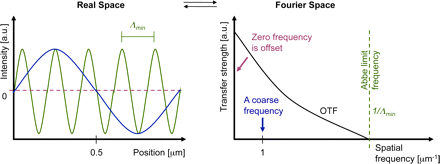
at the expense of a less direct interpretation. The process of imaging can be
described by a convolution operation. With the help of a Fourier transformation,
every object (whether periodic or not) can uniquely be described as a sum of
sinusoidal curves with different spatial frequencies (where higher frequencies
represent fine object details and lower frequencies represent coarse details).
The rather complex process of convolution can be greatly simplified by looking
at the equivalent operation in Fourier space: The Fourier-transformed object
just needs to be multiplied with the
Fourier-transformed PSF to yield the Fourier-transformed ideal image (without
the noise). Because the Fourier-transformed PSF now describes how well each
spatial frequency of the Fourier-transformed object gets transferred to appear in the
image, this Fourier-transformed PSF is called the optical transfer function, OTF
(right panel). Its strength at each spatial frequency (e.g., measured in oscillations
per meter) conveniently describes the contrast that a sinusoidal object would
achieve in an image.

Abbe limit

Abbe limit

Interestingly, the detection OTF of a microscope has a fixed frequency
border (Abbe limit frequency, right panel). The maximum-to-maximum
distance Λmin of the corresponding sine curve is commonly referred to
as Abbe’s limit (left panel). In other words: The Abbe limit is the smallest
periodicity in a structure, which can be discriminated in its image. As a
point object contains all spatial frequencies, this Abbe limit sine curve
needs to also be present in the PSF. A standard wide-field microscope
creates an image of a point object (e.g., an emitting molecule) by capturing
the light from that molecule at various places of the objective lens, and
processing it with further lenses to then interfere at the image plane.
Conveniently due to the reciprocity principle in optics, the Abbe limit Λmin
along an in-plane direction in fluorescence imaging corresponds to the
maximum-to-maximum distance of the intensity structure one would get by
interfering two waves at extreme angles captured by the objective lens:
where λ/n is the wavelength of light in the medium of refractive index n.
The term NA = n sin(α) conveniently combines the half opening angle α
of the objective and the refractive index n of the embedding medium.

Abbe’s famous resolution limit is so attractive because it simply depends
on the maximal relative angle between different waves leaving the
object and being captured by the objective lens to be sent to the image.
It describes the smallest level of detail that can possibly be imaged with
this PSF “brush”. No periodic object detail smaller than this shortest
wavelength can possibly be transferred to the image.

Confocal laser scanning microscopy employs a redesigned optical
path and specialized hardware. A tightly focused spot of laser light is
used to scan the sample and a small aperture (or pinhole) in the
confocal image plane of the light path allows only light originating
from the nominal focus to pass (Cremer and Cremer, 1978Sheppard
and Wilson, 1981
Brakenhoff et al., 1985). The emitted light is
detected by a photomultiplier tube (PMT) or an avalanche photodiode
(APD) and the image is then constructed by mapping the detected
light in dependence of the position of the scanning spot. CLSM can
achieve a better resolution than wide-field fluorescence microscopy
but, to obtain a significant practical advantage, the pinhole needs to
be closed to an extent where most of the light is discarded
(Heintzmann et al., 2003).

Wide-field deconvolution and CLSM have long been the gold standards
in optical bioimaging, but we are now witnessing a revolution in light
microscopy that will fundamentally expand our perception of the cell.
Recently, several new technologies,collectively termed super-resolution
microscopy or nanoscopy, have been developed that break or bypass
the classical diffraction limit and shift the optical resolution down to
macromolecular or even molecular levels (Table I).

Super-resolution light microscopy methods

super resolution microscopy

super resolution microscopy

http://zeiss-campus.magnet.fsu.edu/articles/superresolution/introduction.html

Conceptually, one can discern near-field from far-field methods and
whether the subdiffraction resolution is based on a linear or nonlinear
response of the sample to its locally illuminating (exciting or depleting) irradiance. The required nonlinearity is currently achieved by using reversible saturable optical fluorescence transitions (RESOLFT) between molecular states (Hofmann et al., 2005Hell, 2007).

Besides these saturable optical fluorescence transitions also other
approaches, e.g., Rabi oscillations, could be used to generate the
required nonlinear response.

Note that each of the novel imaging modes has its individual signal-
to-noise consideration depending on various factors.  A full
discussion of this issue is beyond the scope of this review, but as a
general rule, single-point scanning systems, albeit fundamentally limited
in speed by fluorescence saturation effects, can have better signal-
to-noise performance for thicker samples.

With three-dimensional SIM (3D-SIM), an additional twofold increase
in the axial resolution can be achieved by generating an excitation
light modulation along the z-axis using three-beam interference
(Gustafsson et al., 2008Schermelleh et al.,2008) and processing a
z-stack of images accordingly. Thus, with 3D-SIM an approximately eightfold smaller volume can be resolved in comparison to conventional microscopy (Fig. 2). To computationally reconstruct a three-dimensional dataset of a typical mammalian cell of 8-µm height with a
z-spacing of 125 nm, roughly 1,000 raw images (512 × 512 pixels) are
recorded. Because no special photophysics is needed, virtually all modern fluorescent labels can be used provided they are sufficiently photostable
to accommodate the additional exposure cycles.

Resolvable volumes obtained with current commercial super-resolution microscopes.

A schematic 3D representation of focal volumes is shown for the indicated
emission maxima. The approximate lateral (x,y) and axial (z) resolution
and resolvable volumes are listed. Note that STED/CW-STED and 3D-SIM
can reach up to 20 µm into the sample, whereas PALM/STORM is usually
confined to the evanescent wave field near the sample bottom. It should be
noted that deconvolution approaches can further improve STED resolution.
For comparison the “focal volume” for PALM/STORM was estimated based
on the localization precision in combination with the z-range of TIRF.

Resolvable volumes obtained

Resolvable volumes obtained

Super-resolution microscopy of biological samples.

(A) Conventional wide-field image (left) and 3D-SIM image of a mouse
C2C12 prometaphase cell stained with primary antibodies against
lamin B and tubulin, and secondary antibodies conjugated to Alexa 488
(green) and Alexa 594 (red), respectively. Nuclear chromatin was stained
with DAPI (blue). 3D image stacks were acquired with a DeltaVision OMX
prototype system (Applied Precision). The bottom panel shows the
respective orthogonal cross sections. (B) HeLa cell stained with primary
antibodies against the nuclear pore complex protein Nup153 and
secondary antibodies conjugated with ATTO647N. The image was
acquired with a TCS STED confocal microscope (Leica). (C) TdEosFP-
paxillin expressed in a Hep G2 cell to label adhesion complexes at
the lower surface. The image was acquired on an ELYRA P.1
prototype system (Carl Zeiss, Inc.) using TIRF illumination. Single
molecule positional information was projected from 10,000 frames
recorded at 30 frames per second. On the left, signals were summed
up to generate a TIRF image with conventional wide-field lateral
resolution. Bars: 5 µm (insets, 0.5 µm).

biological images

biological images

APPLICATIONS IN BIOLOGICAL SYSTEMS

The cytoskeleton of mammalian cells, especially microtubules
(Figure 5a) (29444652), is the most commonly used benchmark
structure for super-resolution imaging. Other cytoskeletal structures
imaged so far include actin filaments in the lamellipodium (6),
keratin intermediate filaments (59), neurofilaments (2683) and
MreB in Caulobacter (66).

Figure 5

cytoskeleton. f5.

cytoskeleton. f5.

Examples of super-resolution images of biological samples.
(a) Two-color STORM imaging of immunostained microtubule (green)
and clathrin-coated pits (red) (From Reference 46. Reprinted with
permission from AAAS).

Organelles, such as the endoplasmic reticulum (27), lysosome (6),
endocytic and exocytic vesicles (465264), and mitochondria
(65356), have also been imaged. For example, using the single-molecule localization approach, 3D STORM imaging has clearly
resolved the ~150-nm diameter, hemispherical cage shape of clathrin-coated pits (4652), which only appear as diffraction-limited spots
without any feature in conventional fluorescence microscopy (Figure 5a,b).
Two-color 3D STED has resolved the hollow shape of the mitochondrial
outer membrane (marked by the translocase protein Tom20), enclosing
a matrix protein Hsp60 (56), even though the diameter of mitochondria is
only about 300–500 nm (Figure 5c). The outer membrane structure of
mitochondria and their interactions with microtubules have been resolved
by two-color 3D STORM (53). The transport of synaptic vesicles
has been recorded at video rate using 2D STED (Figure 5d ) (64).

Many plasma membrane proteins or membrane associated protein
complexes have also been studied by super-resolution fluorescence
microscopy. For example, synaptotagmin clusters after exocytosis in
primary cultured hippocampal neurons (84), the donut-shaped
clusters of Drosophila protein Bruchpilot at the neuromuscular
synaptic active zone (85), and the size distribution of syntaxin clusters
have all been imaged (8687). Photoactivation has enabled the tracking
of the influenza protein hemagglutinin and the retroviral protein Gag in
live cells, revealing the membrane microdomains (67) and the spatial
heterogeneity of membrane diffusion (68). The morphology and transport
of the focal adhension complex has also been observed using live-cell
PALM (Figure 5e) (65).

Summary points

  1. Super resolution fluorescence microscopy with a spatial resolution not limited by the diffraction of
    light has been implemented using saturated depletion/excitation or single-molecule localization
    of switchable fluorophores.
  2. Three-dimensional imaging with an optical resolution as high as ~20 nm in the lateral direction
    and 40–50 nm in axial dimension has been achieved.
  3. The resolution of these super-resolution fluorescence microscopy techniques can in principle
    reach molecular scale.
  4. In practice, the resolution of the images are not only limited by the intrinsic optical resolution,
    but also by sample specific factors including the labeling density, probe size and sample preservation.
  5. Multicolor super resolution imaging has been implemented, allowing colocalization measurements
    to be performed at nanometer scale resolution and molecular interaction to be more précisely
    identified in cells.
  6. Super-resolution fluorescence imaging allows dynamic processes to be investigated at the tens of
    nanometer resolution in living cells.
  7. Many cellular structures have been imaged at sub-diffraction-limit resolution.

Future issues

  1. Achieving molecular scale resolution (a few nanometers or less).
  2. Fast super resolution imaging of a large view field by multi-point scanning or high-speed single-molecule switching/localization.
  3. Developing new fluorescent probes that are brighter, more photostable and switchable fluorophores
    that have high on-off contrast and fast switching rate.
  4. Developing fluorescent labeling methods that can stain the target with small molecules at high specificity,
    high density and good ultrastructure preservation.
  5. Application of super resolution microscopy to provide novel biological insights

Acronyms

FP

Fluorescent Protein

FPALM

Fluorescence PhotoActivation Localization Microscopy

I5M

Combination of I2M (Illumination Interference Microscopy) and I3M
(Incoherent Imaging Interference Microscopy)

PALM

PhotoActivated Localization Microscopy

PSF

Point Spread Function

RESOLFT

REversible Saturable Optically Linear Fluorescence Transition

SIM

Structured Illumination Microscopy

SSIM

Saturated Structured Illumination Microscopy

STED

STimulated Emission Depletion

STORM

STochastic Optical Reconstruction Microscopy

glossary

Numerical aperture (NA)

The numerical aperture of an objective characterizes the solid angle
of light collected from a point light source at the focus of the objective.

Stimulated emission

The process that an excited state molecule or atom jumps to the
ground state by emitting another photon that is identical to the incoming
photon. It is the basis of laser.

Fluorescence saturation

At high excitation intensity, the fluorescence lifetime instead of the excitation
rate becomes the rate limiting step of fluorescence emission, causing the
fluorescence signal not to increase proportionally with the excitation intensity.

Nyquist criterion

To determine a structure, the sampling interval needs to be no larger than
half of the feature size.

Mitochondria

Organelles in eukaryotic cells for APT generation, consisting of two
membrane (inner and outer) enclosing the inter membrane space and
the matrix inside the inner membrane.

Clathrin-coated pit

Vesicle forming machinery involved in endocytosis and intracellular
vesicle transport, consisting of clathrin coats, adapter proteins, and
other regulatory proteins.

Focal adhesion

The macromolecular complex serving as the mechanical connection
and signaling hub between a cell and the extracellular matrix or other cells.

Selected references with abstract

Near-Field Optics: Microscopy, Spectroscopy, and Surface
Modification Beyond the Diffraction Limit
Eric Betzig,  Jay K. Trautman
AT&T Bell Laboratories, Murray Hill, NJ 07974
Science 10 Jul 1992; 257(5067) pp. 189-195
http://dx.doi.org:/0.1126/science.257.5067.189

 The near-field optical interaction between a sharp probe and a sample
of interest can be exploited to image, spectroscopically probe, or modify
surfaces at a resolution (down to ∼12 nm) inaccessible by traditional far-field
techniques. Many of the attractive features of conventional optics are
retained, including noninvasiveness, reliability, and low cost. In addition, most
optical contrast mechanisms can be extended to the near-field regime,
resulting in a technique of considerable versatility. This versatility
is demonstrated by several examples, such as the imaging of nanometric-scale features in mammalian tissue sections and the creation of ultrasmall,
magneto-optic domains having implications for high density data storage.
Although the technique may find uses in many diverse fields, two of the
most exciting possibilities are localized optical spectroscopy of semiconductors
and the fluorescence imaging of living cells.

Imaging Intracellular Fluorescent Proteins at Nanometer Resolution

 E Betzig1,2,*,†, GH. Patterson3, R Sougrat3, O.W Lindwasser3,
S Olenych4, JS. Bonifacino3, MW. Davidson4, JL Schwartz3, HF. Hess5,*  1 Howard Hughes Medical Institute, Janelia Farm Research Campus,
Ashburn, VA   2 New Millennium Research, LLC, Okemos, MI.   3 Cell Biology and Metabolism Branch, National Institute of Child Health
and Human Development (NICHD), Bethesda, MD.  4 National High
Magnetic Field Laboratory, Florida State University, Tallahassee, FL.
5 NuQuest Research, LLC, La Jolla, CA.
Science 15 Sep 2006; 313(5793): pp. 1642-1645
http://dx.doi.org:/10.1126/science.1127344

We introduce a method for optically imaging intracellular proteins at
nanometer spatial resolution. Numerous sparse subsets of photo-activatable fluorescent protein molecules were activated, localized
(to ∼2 to 25 nanometers), and then bleached. The
aggregate position information from all subsets was then assembled
into a super-resolution image. We used this method—termed photo-
activated localization microscopy to image specific target proteins
in thin sections of lysosomes and mitochondria; in fixed whole cells,
we imaged vinculin at focal adhesions, actin within a lamellipodium,
and the distribution of the retroviral protein Gag at the plasma
membrane.

Toward fluorescence nanoscopy.

Hell SW.   Author information 
Nat Biotechnol. 2003 Nov; 21(11):1347-55.
http://www.ncbi.nlm.nih.gov/pubmed/14595362

For more than a century, the resolution of focusing light microscopy
has been limited by diffraction to 180 nm in the focal plane and to
500 nm along the optic axis. Recently, microscopes have been
reported that provide three- to seven-fold improved axial
resolution in live cells. Moreover, a family of concepts has emerged
that overcomes the diffraction barrier altogether. Its first exponent,
stimulated emission depletion microscopy, has so far displayed a
resolution down to 28 nm. Relying on saturated optical transitions,
these concepts are limited only by the attainable saturation level.
As strong saturation should be feasible at low light intensities,
nanoscale imaging with focused light may be closer than ever.
PMID: 14595362

Far-field optical nanoscopy.

Hell SW.  Author information 
Science. 2007 May 25;316(5828):1153-8.
http://www.ncbi.nlm.nih.gov/pubmed/17525330

In 1873, Ernst Abbe discovered what was to become a well-known
paradigm: the inability of a lens-based optical microscope to
discern details that are closer together than half of the wavelength
for its most popular imaging mode, fluorescence microscopy, the
diffraction barrier is crumbling. Here, I discuss the physical concepts
that have pushed fluorescence microscopy to the nanoscale, once
the prerogative of electron and scanning probe microscopes. Initial
applications indicate that emergent far-field optical nanoscopy will
have a strong impact in the life sciences and in other areas benefiting
from nanoscale visualization.
PMID:  17525330

Imaging intracellular fluorescent proteins at nanometer resolution.

Betzig E1, Patterson GHSougrat RLindwasser OWOlenych S,
Bonifacino JSDavidson MWLippincott-Schwartz JHess HF.
Author information
Science. 2006 Sep 15;313(5793):1642-5. Epub 2006 Aug 10
http://www.ncbi.nlm.nih.gov/pubmed/16902090

We introduce a method for optically imaging intracellular proteins at
nanometer spatial resolution. Numerous sparse subsets of photo-ctivatable fluorescent protein molecules were activated, localized
(to approximately 2 to 25 nanometers), and then bleached. The
aggregate position information from all subsets was then assembled
into a super-resolution image. We used this method–termed photo-activated localization microscopy–to image specific target proteins in
thin sections of lysosomes and mitochondria; in fixed whole cells,
we imaged vinculin at focal adhesions, actin within a lamellipodium,
and the distribution of the retroviral protein Gag at the plasma
membrane.

Comment in

PMID:  16902090  [PubMed – indexed for MEDLINE]

Illuminating single molecules in condensed matter.

Moerner WE1, Orrit M.  Author information 
Science. 1999 Mar 12;283(5408):1670-6.
http://www.ncbi.nlm.nih.gov/pubmed/10073924

Efficient collection and detection of fluorescence coupled with careful
minimization of background from impurities and Raman scattering
now enable routine optical microscopy and study of single molecules
in complex condensed matter environments. This ultimate method
for unraveling ensemble averages leads to the observation of
new effects and to direct measurements of stochastic fluctuations.
Experiments at cryogenic temperatures open new directions in
molecular spectroscopy, quantum optics, and solid-state dynamics.
Room-emperature investigations apply several techniques
(polarization microscopy, single-molecule imaging, emission time
dependence, energy transfer, lifetime studies, and the like) to a
growing array of biophysical problems where new insight may be
gained from direct observations of hidden static and dynamic
inhomogeneity.  PMID: 10073924

Fluorescence microscopy with super-resolved optical sections.

Egner A1, Hell SW.  Author information 
Trends Cell Biol. 2005 Apr;15(4):207-15.
http://www.ncbi.nlm.nih.gov/pubmed/15817377

The fluorescence microscope, especially its confocal variant, has
become a standard tool in cell biology research for delivering
3D-images of intact cells. However, the resolution of any standard
optical microscope is atleast 3 times poorer along the axis of the
lens that in its focal plane. Here, we review principles and applications
of an emerging family of fluorescence microscopes, such as 4Pi
microscopes, which improve axial resolution by a factor of seven by
employing two opposing lenses. Noninvasive axial sections of 80-160 nm
thickness deliver more faithful 3D-images of subcellular features,
providing a new opportunity to significantly enhance our understanding
of cellular structure and function. PMID: 15817377

4Pi-confocal microscopy provides three-dimensional images of the
microtubule network with 100- to 150-nm resolution.

Nagorni M1, Hell SW.  Author information 
J Struct Biol. 1998 Nov;123(3):236-47.

We show the applicability of 4Pi-confocal microscopy to three-dimensional imaging of the microtubule network in a fixed mouse
fibroblast cell.Comparison with two-photon confocal resolution
reveals a fourfold better axial resolution in the 4Pi-confocal case.
By combining 4Pi-confocal microscopy with Richardson-Lucy
image restoration a further resolution increase is achieved.
Featuring a three-dimensional resolution in the range 100-150 nm,
the 4Pi-confocal (restored) images are intrinsically more detailed
than their confocal counterparts. Our images constitute what
to our knowledge are the best-resolved three-dimensional
images of entangled cellular microtubules obtained with light
to date.  PMID: 9878578

Part IV. Super-resolution microscopy

Super-resolution microscopy is a form of light microscopy. Due
to the diffraction of light, the resolution of conventional light
microscopy is limited as stated by Ernst Abbe in 1873.[1]
A good approximation of the resolution attainable is the full
width at half maximum 
 (FWHM) of the point spread function,
and a precise wide-field microscope with high numerical
aperture
 and visible light usually reaches a resolution of ~250 nm.

Super-resolution techniques allow the capture of images with
a higher resolution than the diffraction limit. They fall into
two broad categories,
“true” super-resolution techniques, which capture information
contained in evanescent waves, and “functional” super-
resolution techniques, which use clever experimental
techniques and known limitations on the matter being
imaged to reconstruct a super-resolution image.[2]

True subwavelength imaging techniques include those that
utilize the Pendry Superlens and near field scanning optical
microscopy
, the 4Pi Microscope and structured illumination
microscopy technologies like SIM and SMI. However, the
majority of techniques of importance in biological imaging
fall into the functional category.

Groups of methods for functional super-resolution microscopy:

  1. Deterministic super-resolution: The most commonly used emitters in biological
    microscopy, fluorophores, show a nonlinear response to excitation, and this
    nonlinear response can be exploited to enhance resolution. These
    methods include STEDGSDRESOLFTand SSIM.
  2. Stochastic super-resolution: The chemical complexity of many molecular
    light sources gives them a complex temporal behaviour, which can be used
    to make several close-by fluorophores emit light at separate times and
    thereby become resolvable in time.  These methods include SOFI and all
    single-molecule localization methods (SMLM) such as SPDM,
    SPDMphymodPALM, FPALM, STORM and dSTORM.

Part V. HIV-1

Conformational dynamics of single HIV-1 envelope
trimers on the surface of native virions

James B. Munro1,*,Jason Gorman2Xiaochu Ma1,
Zhou Zhou3James Arthos4,
Dennis R. Burton5,6, et al.
1Department of Microbial Pathogenesis, Yale University
School of Medicine, New Haven, CT. 2Vaccine Research
Center, National Institute of Allergy and Infectious
Diseases, National Institutes of Health, Bethesda, MD .
3Department of Physiology and Biophysics, Weill
Cornell Medical College of Cornell University, New York, NY .
4Laboratory of Immunoregulation, National Institute of Allergy
and Infectious Diseases, National Institutes of Health, Bethesda,
MD . 5Department of Immunology and Microbial Science, and
IAVI Neutralizing Antibody Center, The Scripps Research
Institute, La Jolla, CA . 6Ragon Institute of MGH, MIT, and
Harvard, Cambridge, MA. 7International AIDS Vaccine Initiative
(IAVI), New York, NY . 8Department of
Chemistry, University of Pennsylvania, Philadelphia, PA.

The HIV-1 envelope (Env) mediates viral entry into host cells.
To enable the direct imaging of conformational dynamics
within Env we introduced fluorophores into variable
regions of the gp120 subunit and measured single-molecule
fluorescence resonance energy transfer (smFRET) within
the context of native trimers on the surface of HIV-1 virions.
Our observations revealed unliganded HIV-1 Env to be
intrinsically dynamic, transitioning between three distinct
pre-fusion conformations, whose relative occupancies
were remodeled by receptor CD4 and antibody binding.
The distinct properties of neutralization-sensitive and
neutralization-resistant HIV-1 isolates support a dynamics-based mechanism of immune evasion and ligand recognition.

Read Full Post »

Imaging-guided cancer treatment

Imaging-guided cancer treatment

Writer & reporter: Dror Nir, PhD

It is estimated that the medical imaging market will exceed $30 billion in 2014 (FierceMedicalImaging). To put this amount in perspective; the global pharmaceutical market size for the same year is expected to be ~$1 trillion (IMS) while the global health care spending as a percentage of Gross Domestic Product (GDP) will average 10.5% globally in 2014 (Deloitte); it will reach ~$3 trillion in the USA.

Recent technology-advances, mainly miniaturization and improvement in electronic-processing components is driving increased introduction of innovative medical-imaging devices into critical nodes of major-diseases’ management pathways. Consequently, in contrast to it’s very small contribution to global health costs, medical imaging bears outstanding potential to reduce the future growth in spending on major segments in this market mainly: Drugs development and regulation (e.g. companion diagnostics and imaging surrogate markers); Disease management (e.g. non-invasive diagnosis, guided treatment and non-invasive follow-ups); and Monitoring aging-population (e.g. Imaging-based domestic sensors).

In; The Role of Medical Imaging in Personalized Medicine I discussed in length the role medical imaging assumes in drugs development.  Integrating imaging into drug development processes, specifically at the early stages of drug discovery, as well as for monitoring drug delivery and the response of targeted processes to the therapy is a growing trend. A nice (and short) review highlighting the processes, opportunities, and challenges of medical imaging in new drug development is: Medical imaging in new drug clinical development.

The following is dedicated to the role of imaging in guiding treatment.

Precise treatment is a major pillar of modern medicine. An important aspect to enable accurate administration of treatment is complementing the accurate identification of the organ location that needs to be treated with a system and methods that ensure application of treatment only, or mainly to, that location. Imaging is off-course, a major component in such composite systems. Amongst the available solution, functional-imaging modalities are gaining traction. Specifically, molecular imaging (e.g. PET, MRS) allows the visual representation, characterization, and quantification of biological processes at the cellular and subcellular levels within intact living organisms. In oncology, it can be used to depict the abnormal molecules as well as the aberrant interactions of altered molecules on which cancers depend. Being able to detect such fundamental finger-prints of cancer is key to improved matching between drugs-based treatment and disease. Moreover, imaging-based quantified monitoring of changes in tumor metabolism and its microenvironment could provide real-time non-invasive tool to predict the evolution and progression of primary tumors, as well as the development of tumor metastases.

A recent review-paper: Image-guided interventional therapy for cancer with radiotherapeutic nanoparticles nicely illustrates the role of imaging in treatment guidance through a comprehensive discussion of; Image-guided radiotherapeutic using intravenous nanoparticles for the delivery of localized radiation to solid cancer tumors.

 Graphical abstract

 Abstract

One of the major limitations of current cancer therapy is the inability to deliver tumoricidal agents throughout the entire tumor mass using traditional intravenous administration. Nanoparticles carrying beta-emitting therapeutic radionuclides [DN: radioactive isotops that emits electrons as part of the decay process a list of β-emitting radionuclides used in radiotherapeutic nanoparticle preparation is given in table1 of this paper.) that are delivered using advanced image-guidance have significant potential to improve solid tumor therapy. The use of image-guidance in combination with nanoparticle carriers can improve the delivery of localized radiation to tumors. Nanoparticles labeled with certain beta-emitting radionuclides are intrinsically theranostic agents that can provide information regarding distribution and regional dosimetry within the tumor and the body. Image-guided thermal therapy results in increased uptake of intravenous nanoparticles within tumors, improving therapy. In addition, nanoparticles are ideal carriers for direct intratumoral infusion of beta-emitting radionuclides by convection enhanced delivery, permitting the delivery of localized therapeutic radiation without the requirement of the radionuclide exiting from the nanoparticle. With this approach, very high doses of radiation can be delivered to solid tumors while sparing normal organs. Recent technological developments in image-guidance, convection enhanced delivery and newly developed nanoparticles carrying beta-emitting radionuclides will be reviewed. Examples will be shown describing how this new approach has promise for the treatment of brain, head and neck, and other types of solid tumors.

The challenges this review discusses

  • intravenously administered drugs are inhibited in their intratumoral penetration by high interstitial pressures which prevent diffusion of drugs from the blood circulation into the tumor tissue [1–5].
  • relatively rapid clearance of intravenously administered drugs from the blood circulation by kidneys and liver.
  • drugs that do reach the solid tumor by diffusion are inhomogeneously distributed at the micro-scale – This cannot be overcome by simply administering larger systemic doses as toxicity to normal organs is generally the dose limiting factor.
  • even nanoparticulate drugs have poor penetration from the vascular compartment into the tumor and the nanoparticles that do penetrate are most often heterogeneously distributed

How imaging could mitigate the above mentioned challenges

  • The inclusion of an imaging probe during drug development can aid in determining the clearance kinetics and tissue distribution of the drug non-invasively. Such probe can also be used to determine the likelihood of the drug reaching the tumor and to what extent.

Note: Drugs that have increased accumulation within the targeted site are likely to be more effective as compared with others. In that respect, Nanoparticle-based drugs have an additional advantage over free drugs with their potential to be multifunctional carriers capable of carrying both therapeutic and diagnostic imaging probes (theranostic) in the same nanocarrier. These multifunctional nanoparticles can serve as theranostic agents and facilitate personalized treatment planning.

  • Imaging can also be used for localization of the tumor to improve the placement of a catheter or external device within tumors to cause cell death through thermal ablation or oxidative stress secondary to reactive oxygen species.

See the example of Vintfolide in The Role of Medical Imaging in Personalized Medicine

vinta

Note: Image guided thermal ablation methods include radiofrequency (RF) ablation, microwave ablation or high intensity focused ultrasound (HIFU). Photodynamic therapy methods using external light devices to activate photosensitizing agents can also be used to treat superficial tumors or deeper tumors when used with endoscopic catheters.

  • Quality control during and post treatment

For example: The use of high intensity focused ultrasound (HIFU) combined with nanoparticle therapeutics: HIFU is applied to improve drug delivery and to trigger drug release from nanoparticles. Gas-bubbles are playing the role of the drug’s nano-carrier. These are used both to increase the drug transport into the cell and as ultrasound-imaging contrast material. The ultrasound is also used for processes of drug-release and ablation.

 HIFU

Additional example; Multifunctional nanoparticles for tracking CED (convection enhanced delivery)  distribution within tumors: Nanoparticle that could serve as a carrier not only for the therapeutic radionuclides but simultaneously also for a therapeutic drug and 4 different types of imaging contrast agents including an MRI contrast agent, PET and SPECT nuclear diagnostic imaging agents and optical contrast agents as shown below. The ability to perform multiple types of imaging on the same nanoparticles will allow studies investigating the distribution and retention of nanoparticles initially in vivo using non-invasive imaging and later at the histological level using optical imaging.

 multi

Conclusions

Image-guided radiotherapeutic nanoparticles have significant potential for solid tumor cancer therapy. The current success of this therapy in animals is most likely due to the improved accumulation, retention and dispersion of nanoparticles within solid tumor following image-guided therapies as well as the micro-field of the β-particle which reduces the requirement of perfectly homogeneous tumor coverage. It is also possible that the intratumoral distribution of nanoparticles may benefit from their uptake by intratumoral macrophages although more research is required to determine the importance of this aspect of intratumoral radionuclide nanoparticle therapy. This new approach to cancer therapy is a fertile ground for many new technological developments as well as for new understandings in the basic biology of cancer therapy. The clinical success of this approach will depend on progress in many areas of interdisciplinary research including imaging technology, nanoparticle technology, computer and robot assisted image-guided application of therapies, radiation physics and oncology. Close collaboration of a wide variety of scientists and physicians including chemists, nanotechnologists, drug delivery experts, radiation physicists, robotics and software experts, toxicologists, surgeons, imaging physicians, and oncologists will best facilitate the implementation of this novel approach to the treatment of cancer in the clinical environment. Image-guided nanoparticle therapies including those with β-emission radionuclide nanoparticles have excellent promise to significantly impact clinical cancer therapy and advance the field of drug delivery.

Read Full Post »

NIH Considers Guidelines for CAR-T therapy: Report from Recombinant DNA Advisory Committee

Reporter: Stephen J. Williams, Ph.D.

UPDATED 5/27/2024

The practice of pharmacovigilence, both premarketing and postmarketing, has very well defined best practices concerning most small molecule drugs and even medical devices.  However, for many cell based therapies and many gene based therapies, often still administered within the university, academic setting, pharmacovigilence reporting and adherence may be a not as efficient and thorough as conducted by large big pharmaceutical firms.  Big pharma will devote massive resources for the conduct of pharmacovigilence data collecting and analysis.  For many cell based therapies, like CAR-T therapies and some gene therapies are almost conducted as clinical trials within university medical centers, which may not have the resources for a large pharmacovigilence program.

In a report by IQVIA, oncologists were asked about their concerns with cell based therapies.  A recurring concern involved the lack of information on the adverse events related to these therapies, especially after an oncologist’s patient would return from administration of their CAR-T therapy and then both patient and oncologist felt ‘on their own’.

Most recently the FDA has issued black box warning on many CAR-T therapies for their risk in inducing secondary malignancies (see What does this mean for Immunotherapy? FDA put a temporary hold on Juno’s JCAR015, Three Death of Cerebral Edema in CAR-T Clinical Trial and Kite Pharma announced Phase II portion of its CAR-T ZUMA-1 trial).

Source: https://www.fiercepharma.com/ai-and-machine-learning/oncologists-have-shopping-car-t-full-complaints-safety-questions-cell?utm_medium=email&utm_source=nl&utm_campaign=LS-NL-FiercePharma+Tracker&oly_enc_id=2360C5096034F3G

Note: the IQVIA will be submitted as an abstract at the current ASCO meeting

UPDATED 5/10/2022

In the mid to late 1970’s a public debate (and related hysteria) had emerged surrounding two emerging advances in recombinant DNA technology;

  1. the development of vectors useful for cloning pieces of DNA (the first vector named pBR322) and
  2. the discovery of bacterial strains useful in propagating such vectors

As discussed by D. S, Fredrickson of NIH’s Dept. of Education and Welfare in his historical review” A HISTORY OF THE RECOMBINANT DNA GUIDELINES IN THE UNITED STATES” this international concern of the biological safety issues of this new molecular biology tool led the National Institute of Health to coordinate a committee (the NIH Recombinant DNA Advisory Committee) to develop guidelines for the ethical use, safe development, and safe handling of such vectors and host bacterium. The first conversations started in 1974 and, by 1978, initial guidelines had been developed. In fact, as Dr. Fredrickson notes, public relief was voiced even by religious organizations (who had the greatest ethical concerns)

On December 16, 1978, a telegram purporting to be from the Vatican was hand delivered to the office of Joseph A. Califano, Jr., Secretary of Health, Education,

and Welfare. “Habemus regimen recombinatum,” it proclaimed, in celebration of the

end of a long struggle to revise the NIH Guidelines for Research Involving

Recombinant DNA Molecules

The overall Committee resulted in guidelines (2013 version) which assured the worldwide community that

  • organisms used in such procedures would have limited pathogenicity in humans
  • vectors would be developed in a manner which would eliminate their ability to replicate in humans and have defined antibiotic sensitivity

So great was the success and acceptance of this committee and guidelines, the NIH felt the Recombinant DNA Advisory Committee should meet regularly to discuss and develop ethical guidelines and clinical regulations concerning DNA-based therapeutics and technologies.

A PowerPoint Slideshow: Introduction to NIH OBA and the History of Recombinant DNA Oversight can be viewed at the following link:

http://www.powershow.com/view1/e1703-ZDc1Z/Introduction_to_NIH_OBA_and_the_History_of_Recombinant_DNA_Oversight_powerpoint_ppt_presentation

Please see the following link for a video discussion between Dr. Paul Berg, who pioneered DNA recombinant technology, and Dr. James Watson (Commemorating 50 Years of DNA Science):

http://media.hhmi.org/interviews/berg_watson.html

The Recombinant DNA Advisory Committee has met numerous times to discuss new DNA-based technologies and their biosafety and clinical implication including:

A recent Symposium was held in the summer of 2010 to discuss ethical and safety concerns and discuss potential clinical guidelines for use of an emerging immunotherapy technology, the Chimeric Antigen Receptor T-Cells (CART), which at that time had just been started to be used in clinical trials.

Considerations for the Clinical Application of Chimeric Antigen Receptor T Cells: Observations from a Recombinant DNA Advisory Committee Symposium Held June 15, 2010[1]

Contributors to the Symposium discussing opinions regarding CAR-T protocol design included some of the prominent members in the field including:

Drs. Hildegund C.J. Ertl, John Zaia, Steven A. Rosenberg, Carl H. June, Gianpietro Dotti, Jeffrey Kahn, Laurence J. N. Cooper, Jacqueline Corrigan-Curay, And Scott E. Strome.

The discussions from the Symposium, reported in Cancer Research[1]. were presented in three parts:

  1. Summary of the Evolution of the CAR therapy
  2. Points for Future Consideration including adverse event reporting
  3. Considerations for Design and Implementation of Trials including mitigating toxicities and risks

1. Evolution of Chimeric Antigen Receptors

Early evidence had suggested that adoptive transfer of tumor-infiltrating lymphocytes, after depletion of circulating lymphocytes, could result in a clinical response in some tumor patients however developments showed autologous T-cells (obtained from same patient) could be engineered to express tumor-associated antigens (TAA) and replace the TILS in the clinical setting.

However there were some problems noticed.

  • Problem: HLA restriction of T-cells. Solution: genetically engineer T-cells to redirect T-cell specificity to surface TAAs
  • Problem: 1st generation vectors designed to engineer T-cells to recognize surface epitopes but engineered cells had limited survival in patients.   Solution: development of 2nd generation vectors with co-stimulatory molecules such as CD28, CD19 to improve survival and proliferation in patients

A summary table of limitations of the two types of genetically-modified T-cell therapies were given and given (in modified form) below

                                                                                                Type of Gene-modified T-Cell

Limitations aβ TCR CAR
Affected by loss or decrease of HLA on tumor cells yes no
Affected by altered tumor cell antigen processing? yes no
Need to have defined tumor target antigen? no yes
Vector recombination with endogenous TCR yes no

A brief history of construction of 2nd and 3rd generation CAR-T cells given by cancer.gov:

http://www.cancer.gov/cancertopics/research-updates/2013/CAR-T-Cells

cartdiagrampic

Differences between  second- and third-generation chimeric antigen receptor T cells. (Adapted by permission from the American Association for Cancer Research: Lee, DW et al. The Future Is Now: Chimeric Antigen Receptors as New Targeted Therapies for Childhood Cancer. Clin Cancer Res; 2012;18(10); 2780–90. doi:10.1158/1078-0432.CCR-11-1920)

Constructing a CAR T Cell (from cancer.gov)

The first efforts to engineer T cells to be used as a cancer treatment began in the early 1990s. Since then, researchers have learned how to produce T cells that express chimeric antigen receptors (CARs) that recognize specific targets on cancer cells.

The T cells are genetically modified to produce these receptors. To do this, researchers use viral vectors that are stripped of their ability to cause illness but that retain the capacity to integrate into cells’ DNA to deliver the genetic material needed to produce the T-cell receptors.

The second- and third-generation CARs typically consist of a piece of monoclonal antibody, called a single-chain variable fragment (scFv), that resides on the outside of the T-cell membrane and is linked to stimulatory molecules (Co-stim 1 and Co-stim 2) inside the T cell. The scFv portion guides the cell to its target antigen. Once the T cell binds to its target antigen, the stimulatory molecules provide the necessary signals for the T cell to become fully active. In this fully active state, the T cells can more effectively proliferate and attack cancer cells.

2. Adverse Event Reporting and Protocol Considerations

The symposium had been organized mainly in response to two reported deaths of patients enrolled in a CART trial, so that clinical investigators could discuss and formulate best practices for the proper conduct and analysis of such trials. One issue raised was lack of pharmacovigilence procedures (adverse event reporting). Although no pharmacovigilence procedures (either intra or inter-institutional) were devised from meeting proceedings, it was stressed that each institution should address this issue as well as better clinical outcome reporting.

Case Report of a Serious Adverse Event Following the Administration of T Cells Transduced With a Chimeric Antigen Receptor Recognizing ERBB2[2] had reported the death of a patient on trial.

In A phase I clinical trial of adoptive transfer of folate receptor-alpha redirected autologous T cells for recurrent ovarian cancer[3] authors: Lana E Kandalaft*, Daniel J Powell and George Coukos from University of Pennsylvania recorded adverse events in pilot studies using a CART modified to recognize the folate receptor, so it appears any adverse event reporting system is at the discretion of the primary investigator.

Other protocol considerations suggested by the symposium attendants included:

  • Plan for translational clinical lab for routine blood analysis
  • Subject screening for pulmonary and cardiac events
  • Determine possibility of insertional mutagenesis
  • Informed consent
  • Analysis of non T and T-cell subsets, e.g. natural killer cells and CD*8 cells

3. Consideration for Design of Trials and Mitigating Toxicities

  • Early Toxic effectsCytokine Release Syndrome– The effectiveness of CART therapy has been manifested by release of high levels of cytokines resulting in fever and inflammatory sequelae. One such cytokine, interleukin 6, has been attributed to this side effect and investigators have successfully used an IL6 receptor antagonist, tocilizumab (Acterma™), to alleviate symptoms of cytokine release syndrome (see review Adoptive T-cell therapy: adverse events and safety switches by Siok-Keen Tey).


Below is a video form Dr. Renier Brentjens, M.D., Ph.D. for Memorial Sloan Kettering concerning the finding he made that the adverse event from cytokine release syndrome may be a function of the tumor cell load, and if they treat the patient with CAR-T right after salvage chemotherapy the adverse events are alleviated..

Please see video below:

http link: https://www.youtube.com/watch?v=4Gg6elUMIVE

  • Early Toxic effects – Over-activation of CAR T-cells; mitigation by dose escalation strategy (as authors in reference [3] proposed). Most trials give billions of genetically modified cells to a patient.
  • Late Toxic Effectslong-term depletion of B-cells . For example CART directing against CD19 or CD20 on B cells may deplete the normal population of CD19 or CD20 B-cells over time; possibly managed by IgG supplementation

Below is a curation of various examples of the need for developing a Pharmacovigilence Framework for Engineered T-Cell Therapies

As shown above the first reported side effects from engineered T-cell or CAR-T therapies stemmed from the first human trial occuring at University of Pennsylvania, the developers of the first CAR-T therapy.  The clinical investigators however anticipated the issue of a potential cytokine storm and had developed ideas in the pre-trial phase of how to ameliorate such toxicity using anti-cytokine antibodies.  However, until the trial was underway they were unsure of which cytokines would be prominent in causing a cytokine storm effect from the CAR-T therapy.  Fortunately, the investigators were able to save patient 1 (described here in other posts) using anti-IL1 and 10 antibodies.  


Over the years, however, multiple trials had to be discontinued as shown below in the following posts:

What does this mean for Immunotherapy? FDA put a temporary hold on Juno’s JCAR015, Three Death of Celebral Edema in CAR-T Clinical Trial and Kite Pharma announced Phase II portion of its CAR-T ZUMA-1 trial

The NIH has put a crimp in the clinical trial work of Steven Rosenberg, Kite Pharma’s star collaborator at the National Cancer Institute. The feds slammed the brakes on the production of experimental drugs at two of its facilities–including cell therapies that Rosenberg works with–after an internal inspection found they weren’t in compliance with safety and quality regulations.

In this instance Kite was being cited for manufacturing issues, apparantly fungal contamination in their cell therapy manufacturing facility.  However shortly after other CAR-T developers were having tragic deaths in their initial phase 1 safety studies.

Juno Halts Cancer Trial Using Gene-Altered Cells After 3 Deaths


Juno halts its immunotherapy trial for cancer after three patient deaths

By DAMIAN GARDE @damiangarde and MEGHANA KESHAVAN @megkesh

JULY 7, 2016

In Juno patient deaths, echoes seen of earlier failed company

By SHARON BEGLEY @sxbegle

JULY 8, 2016

https://www.statnews.com/2016/07/08/juno-echoes-of-dendreon/

After a deadly clinical trial, will immune therapies for cancer be a bust?

By DAMIAN GARDE @damiangarde

JULY 8, 2016

This led to warnings by FDA and alteration of their trials as well as the use of their CART as a monotherapy

Hours after Juno CAR-T study deaths announced, Kite enrolls CAR-T PhII

Well That Was Quick! FDA Lets Juno Restart Trial With a New Combination Chemotherapuetic

 at Seattle Times

FDA lets Juno restart cancer-treatment trial

Certainly with so many issues there would seem to be more rigorous work to either establish a pharmacovigilence framework or to develop alternative engineered T cells with a safer profile

However here we went again

New paper sheds fresh light on Tmunity’s high-profile CAR-T deaths
Jason Mast
Editor
The industry-wide effort to push CAR-T therapies — wildly effective in several blood cancers — into solid tumors took a hit last year when Tmunity, a biotech founded by CAR-T pioneer Carl June and backed by several blue-chip VCs, announced it shut down its lead program for prostate cancer after two patients died.

On a personal note this trial was announced in a Bio International meeting here in Philadelphia a few years ago in 2019

see Live Conference Coverage on this site

eProceedings for BIO 2019 International Convention, June 3-6, 2019 Philadelphia Convention Center; Philadelphia PA, Real Time Coverage by Stephen J. Williams, PhD @StephenJWillia2

and the indication was for prostate cancer, in particular hormone resistant castration resistant.  Another one was planned for pancreatic cancer from the same group and the early indications were favorable.

From Onclive

Source: https://www.onclive.com/view/car-t-cell-therapy-trial-in-solid-tumors-halted-following-2-patient-deaths 

Tmunity Therapeutics, a clinical-stage biotherapeutics company, has halted the development of its lead CAR T-cell product following the deaths of 2 patients who were enrolled to a trial investigating its use in solid tumors.1

The patients reportedly died from immune effector cell-associated neurotoxicity syndrome (ICANS), which is a known adverse effect associated with CAR T-cell therapies.

“What we are discovering is that the cytokine profiles we see in solid tumors are completely different from hematologic cancers,” Oz Azam, co-founder of Tmunity said in an interview with Endpoints News. “We observed ICANS. And we had 2 patient deaths as a result of that. We navigated the first event and obviously saw the second event, and as a result of that we have shut down the version one of that program and pivoted quickly to our second generation.”

Previously, with first-generation CAR T-cell therapies in patients with blood cancers, investigators were presented with the challenge of overcoming cytokine release syndrome. Now ICANS, or macrophage activation, is proving to have deadly effects in the realm of solid tumors. Carl June, the other co-founder of Tmunity, noted that investigators will now need to dedicate their efforts to engineering around this, as had been done with tocilizumab (Actemra) in 2012.

The company is dedicated to the development of novel approaches that produce best-in-class control over T-cell activation and direction in the body.2 The product examined in the trial was developed to utilize engineered patient cells to target prostate-specific membrane antigen; it was also designed to use a dominant TGFβ receptor to block an important checkpoint involved in cancer.

Twenty-four patients were recruited for the dose-escalating study and the company plans to release data from high-dose cohorts later in 2021.

“We are going to present all of this in a peer-reviewed publication because we want to share this with the field,” Azam said. “Because everything we’ve encountered, no matter what…people are going to encounter this when they get into the clinic, and I don’t think they’ve really understood yet because so many are preclinical companies that are not in the clinic with solid tumors. And the rubber meets the road when you get in the clinic, because the ultimate in vivo model is the human model.”

Azam added that the company plans to develop a new investigational new drug for version 2, which they hope will result in a safer product.

References

  1. Carroll J. Exclusive: Carl June’s Tmunity encounters a lethal roadblock as 2 patient deaths derail lead trial, raise red flag forcing rethink of CAR-T for solid tumors. Endpoints News. June 2, 2021. Accessed June 3, 2021. https://bit.ly/3wPYWm0
  2. Research and Development. Tmunity Therapeutics website. Accessed June 3, 2021. https://bit.ly/3fOH3OR

Forward to 2022

Reprogramming a new type of T cell to go after cancers with less side effects, longer impact

A Sloan Kettering Institute research team thinks new, killer, innate-like T cells could make promising candidates to treat cancers that so far haven’t responded to immunotherapy treatments. (koto_feja)

Immunotherapy is one of the more appealing and effective kinds of cancer treatment when it works, but the relatively new approach is still fairly limited in the kinds of cancer it can be used for. Researchers at the Sloan Kettering Institute have discovered a new kind of immune cell and how it could be used to expand the reach of immunotherapy treatments to a much wider pool of patients.

The cells in question are called killer innate-like T cells, a threatening name for a potentially lifesaving innovation. Unlike normal killer T cells, killer innate-like T cells stay active much longer and can burrow further into potentially cancerous tissue to attack tumors. The research team first reported these cells in 2016, but it’s only recently that they were able to properly understand and identify them.

“We think these killer innate-like T cells could be targeted or genetically engineered for cancer therapy,” said the study’s lead author, Ming Li, Ph.D., in a press release. “They may be better at reaching and killing solid tumors than conventional T cells.”

Below is the referenced paper from Pubmed:

Evaluation of the safety and efficacy of humanized anti-CD19 chimeric antigen receptor T-cell therapy in older patients with relapsed/refractory diffuse large B-cell lymphoma based on the comprehensive geriatric assessment system

Affiliations 

Abstract

Anti-CD19 chimeric antigen receptor (CAR) T-cell therapy has led to unprecedented results to date in relapsed/refractory (R/R) diffuse large B-cell lymphoma (DLBCL), yet its clinical application in elderly patients with R/R DLBCL remains somewhat limited. In this study, a total of 31 R/R DLBCL patients older than 65 years of age were enrolled and received humanized anti-CD19 CAR T-cell therapy. Patients were stratified into a fit, unfit, or frail group according to the comprehensive geriatric assessment (CGA). The fit group had a higher objective response (OR) rate (ORR) and complete response (CR) rate than that of the unfit/frail group, but there was no difference in the part response (PR) rate between the groups. The unfit/frail group was more likely to experience AEs than the fit group. The peak proportion of anti-CD19 CAR T-cells in the fit group was significantly higher than that of the unfit/frail group. The CGA can be used to effectively predict the treatment response, adverse events, and long-term survival.

Introduction

Diffuse large B-cell lymphoma (DLBCL) is the most common subtype of non-Hodgkin lymphoma (NHL), accounting for 30–40% of cases, with the median age of onset being older than 65 years [1]. Although the five-year survival rate for patients with DLBCL has risen to more than 60% with the application of standardized treatments and hematopoietic stem cell transplantation, nearly half of patients progress to relapsed/refractory (R/R) DLBCL. Patients with R/R DLBCL, especially elderly individuals, have a poor prognosis [2,3], so new treatments are needed to prolong survival and improve the prognosis of this population.

As a revolutionary immunotherapy therapy, anti-CD19 chimeric antigen receptor (CAR) T-cell therapy has achieved unprecedented results in hematological tumors [4]. As CD19 is expressed on the surface of most B-cell malignant tumors but not on pluripotent bone marrow stem cells, CD19 has been used as a target for B-cell malignancies, including B-cell acute lymphoblastic leukemia, NHL, multiple myeloma, and chronic lymphocytic leukemia [5]. Despite the wide application and high efficacy of anti-CD19 CAR T-cell therapy, reports of adverse events (AEs) such as cytokine release syndrome (CRS) and immune effector cell-associated neurotoxic syndrome (ICANS) have influenced its use [6]. Especially in elderly patients, AEs associated with anti-CD19 CAR T-cell therapy might be more obvious.

Although anti-CD19 CAR T-cell therapy has been reported in the treatment of NHL, including R/R DLBCL, few studies to date have assessed the safety of anti-CD19 CAR T-cell therapy in elderly R/R DLBCL patients, and its clinical application in the elderly R/R DLBCL population is limited. In ZUMA-1 [7] to R/R DLBCL patients who received CAR T-cell therapy, the CR rate in patients ≥65 years was higher than that of in patients <65 years (75% vs. 53%). Lin et al. [8] reported 49 R/R DLBCL patients (24 patients >65 years, 25 patients <65 years) who received CAR T-cell therapy with a median follow-up of 179 days. The CR rate at 100 days was 51%, while the 6-month progression-free survival (PFS) and overall survival (OS) were 48% and 71%, respectively. Neither of the two studies carried out a comprehensive geriatric assessment (CGA) of fit, unfit, and frail groups of R/R DLBCL patients over 65 years of age and further analyzed the differences in efficacy and side effects in the three groups. The CGA is an effective system designed to evaluate the prognosis and improve the survival of elderly patients with cancer. The CGA system includes age, activities of daily living (ADL), instrumental ADL (IADL), and the Cumulative Illness Rating Score for Geriatrics (CIRS-G) [9].

In this study, elderly R/R DLBCL patients were grouped according to their CGA results (fit vs. unfit/frail) before receiving humanized anti-CD19 CAR T-cell therapy. We then analyzed the efficacy and AEs of anti-CD19 CAR T-cell therapy and compared findings between these groups.


Well it appears that the discriminator was only fitness going into the trial  a bit odd that the whole field appears to be lacking in development of Safety Biomarkers.


However Genentech (subsidiary of Roche) may now be using some data to develop therapies which may combat resistance to CART therapies which may provide at least, for now, a toxicokinetic approach to reducing AEs by lowering the amount of CARTs needed to be administered.


Source: https://www.fiercebiotech.com/research/genentech-uncovers-how-cancer-cells-resist-t-cell-attack-potential-boon-immunotherapy

Roche’s Genentech is exploring inhibiting ESCRT as an anticancer strategy, said Ira Mellman, Ph.D., Genentech’s vice president of cancer immunology. (Roche)

Cancer cells deploy various tactics to avoid being targeted and killed by the immune system. A research team led by Roche’s Genentech has now identified one such method that cancer cells use to resist T-cell assault by repairing damage.

To destroy their targets, cancer-killing T cells known as cytotoxic T lymphocytes (CTLs) secrete the toxin perforin to form little pores in the target cells’ surface. Another type of toxin called granzymes are delivered directly into the cells through those portals to induce cell death.

By using high-res imaging in live cells, the Genentech-led team found that the membrane damage caused by perforin could trigger a repair response. The tumor cells could recruit endosomal sorting complexes required for transport (ESCRT) proteins to remove the lesions, thereby preventing granzymes from entering, the team showed in a new study published in Science.

The following is the Science paper

Membrane repair in target cell defenses

Killer T cells destroy virus-infected and cancer cells by secreting two protein toxins that act as a powerful one-two punch. Pore-forming toxins, perforins, form holes in the plasma membrane of the target cell. Cytotoxic proteins released by T cells then pass through these portals, inducing target cell death. Ritter et al. combined high-resolution imaging data with functional analysis to demonstrate that tumor-derived cells fight back (see the Perspective by Andrews). Protein complexes of the ESCRT family were able to repair perforin holes in target cells, thereby delaying or preventing T cell–induced killing. ESCRT-mediated membrane repair may thus provide a mechanism of resistance to immune attack. —SMH

Abstract

Cytotoxic T lymphocytes (CTLs) and natural killer cells kill virus-infected and tumor cells through the polarized release of perforin and granzymes. Perforin is a pore-forming toxin that creates a lesion in the plasma membrane of the target cell through which granzymes enter the cytosol and initiate apoptosis. Endosomal sorting complexes required for transport (ESCRT) proteins are involved in the repair of small membrane wounds. We found that ESCRT proteins were precisely recruited in target cells to sites of CTL engagement immediately after perforin release. Inhibition of ESCRT machinery in cancer-derived cells enhanced their susceptibility to CTL-mediated killing. Thus, repair of perforin pores by ESCRT machinery limits granzyme entry into the cytosol, potentially enabling target cells to resist cytolytic attack.
Cytotoxic lymphocytes, including cytotoxic T lymphocytes (CTLs) and natural killer (NK) cells, are responsible for identifying and destroying virus-infected or tumorigenic cells. To kill their targets, CTLs and NK cells secrete a pore-forming toxin called perforin through which apoptosis-inducing serine proteases (granzymes) are delivered directly into the cytosol. Successful killing of target cells often requires multiple hits from single or multiple T cells (1). This has led to the idea that cytotoxicity is additive, often requiring multiple rounds of sublethal lytic granule secretion events before a sufficient threshold of cytosolic granzyme activity is reached to initiate apoptosis in the target (2).
Loss of plasma membrane integrity induced by cytolytic proteins or mechanical damage leads to a membrane repair response. Damage results in an influx of extracellular Ca2+, which has been proposed to lead to the removal of the membrane lesion by endocytosis, resealing of the lesions by lysosomal secretion, or budding into extracellular vesicles (3). Perforin pore formation was initially reported to enhance endocytosis of perforin (4), but subsequent work has challenged this claim (5). Endosomal sorting complexes required for transport (ESCRT) proteins can repair small wounds and pores in the plasma membrane caused by bacterial pore-forming toxins, mechanical wounding, and laser ablation (67). ESCRT proteins are transiently recruited to sites of membrane damage in a Ca2+-dependent fashion, where they assemble budding structures that shed to eliminate the wound and restore plasma membrane integrity. ESCRT-dependent membrane repair has been implicated in the resealing of endogenous pore-mediated plasma membrane damage during necroptosis (8) and pyroptosis (9).

Localization of target-derived ESCRT proteins to the cytolytic synapse

To investigate whether ESCRT-mediated membrane repair might be involved in the removal of perforin pores during T cell killing, we first determined whether ESCRT proteins in cancer-derived cells were recruited to sites of CTL engagement after perforin secretion. We used CTLs from OT-I mice that express a high-affinity T cell receptor (TCR) that recognizes the ovalbumin peptide SIINFEKL (OVA257-264) bound to the major histocompatibility complex (MHC) allele H-2Kb (10). We performed live-cell microscopy of OT-I CTLs engaging SIINFEKL-pulsed target cells that express enhanced green fluorescent protein (EGFP)–tagged versions of Tsg101 or Chmp4b, two ESCRT proteins implicated in membrane repair (6). To correlate recruitment of ESCRT proteins with perforin exposure in time, we monitored CTL-target interaction in media with a high concentration of propidium iodide (PI), a cell-impermeable fluorogenic dye that can rapidly diffuse through perforin pores to bind and illuminate nucleic acids in the cytosol and nucleus of the target (5). EGFP-tagged ESCRT proteins were consistently recruited to the site of CTL engagement within 30 to 60 s after PI influx (Fig. 1, A and B). EGFP-Tsg101 and EGFP-Chmp4b in target cells accumulated at the cytolytic synapse after PI influx in 25 of 27 (92.6%) and 31 of 33 (93.9%) of conjugates monitored, respectively, compared with a cytosolic EGFP control, which was not recruited (Fig. 1C and movies S1 to S3). Notably, ESCRT-laden material, presumably membrane fragments, frequently detached from the target cell and adhered to the surface of the CTL (Fig. 1, D and E, and movie S2). We observed this phenomenon in ~60% of conjugates imaged in which targets expressed EGFP-Tsg101 or EGFP-Chmp4b (17 of 27 and 20 of 33 conjugates, respectively; Fig. 1D). Shedding of ESCRT-positive membrane from the cell after repair occurs after laser-induced plasma membrane wounding (67). Plasma membrane fragments shed from the target cell into the synaptic cleft likely contain ligands for CTL-resident receptors. Target cell death would separate the CTL and target, revealing target-derived material on the CTL surface.
FIG. 1. Fluorescently tagged ESCRT proteins in targets localize to site of CTL killing after perforin secretion.
(A) Live-cell spinning disk confocal imaging of a fluorescently labeled OT-I CTL (magenta) engaging an MC38 cancer cell expressing EGFP-Tsg101 (green) in media containing 100 μM PI (red). Yellow arrowheads highlight ESCRT recruitment. T-0:00 is the first frame of PI influx into the target cell (time in minutes:seconds). Scale bar, 10 μm. (B) Graph of EGFP-Tsg101 and PI fluorescence intensity at the IS within the target over time, from example in (A). AU, arbitrary units. (C and D) Quantification of CTL-target conjugates exhibiting accumulation of EGFP at the synapse after PI influx (C) or detectable EGFP-labeled material associated with CTL after target interaction (D) (EGFP condition: N = 22 conjugates in seven independent experiments; EGFP-Tsg101 condition: N = 27 conjugates in nine independent experiments; EGFP-Chmp4b condition: N = 33 conjugates in 24 independent experiments). (E) Live-cell spinning disk confocal imaging of OT-I CTL (magenta) killing MC38 expressing EGFP-Chmp4b (green), demonstrating the presence of target-derived EGFP-Chmp4b material (yellow arrowheads) associated with CTL membrane after a productive target encounter. T-0:00 is the first frame of PI influx into the target cell. Scale bar, 10 μm.
OPEN IN VIEWER

3D cryo-SIM and FIB-SEM imaging of CTLs caught in the act of killing target cells

Although live-cell imaging indicated that ESCRT complexes were rapidly recruited at sites of T cell–target cell contact, light microscopy alone is of insufficient resolution to establish that this event occurred at the immunological synapse (IS). We thus sought to capture a comprehensive view of the IS in the moments immediately after secretion of lytic granules. We used cryo–fluorescence imaging followed by correlative focused ion beam–scanning electron microscopy (FIB-SEM), which can achieve isotropic three-dimensional (3D) imaging of whole cells at 8-nm resolution or better (1113). To capture the immediate response of target cells after perforin exposure, we developed a strategy whereby cryo-fixed CTL-target conjugates were selected shortly after perforation, indicated by the presence of a PI gradient in the target (fig. S1A). In live-cell imaging experiments, PI fluorescence across the nucleus of SIINFEKL-pulsed ID8 target cells began as a gradient and became homogeneous 158 ± 64 s, on average, after initial PI influx (N = 31 conjugates; fig. S1, B and C, and movie S4). Thus, fixed CTL-target conjugates that exhibited a gradient of PI across the nucleus would have been captured within ~3 min of perforin exposure.
Coverslips of CTL-target conjugates underwent high-pressure freezing and were subsequently imaged with wide-field cryogenic fluorescence microscopy followed by 3D cryo–structured illumination microscopy (3D cryo-SIM) performed in a customized optical cryostat (14). We selected candidate conjugates for FIB-SEM imaging on the basis of whether a gradient of PI fluorescence was observed across the nucleus of the target emanating from an attached CTL (movie S5). FIB-SEM imaging of the CTL-target conjugate at 8-nm isotropic voxels resulted in a stack of >10,000 individual electron microscopy (EM) images. The image stack was then annotated using a human-assisted machine learning–computer vision platform to segment the plasma membranes of each cell along with cell nuclei and various organelles (https://ariadne.ai/).
We captured four isotropic 3D 8-nm-resolution EM datasets of CTLs killing cancer cells moments after the secretion of lytic granule contents (Fig. 2A and movie S6). Semiautomated segmentation of the cell membranes, nuclei, lytic granules, Golgi apparatus, mitochondria, and centrosomes of the T cells allow for easier visualization and analysis of the 3D EM data. All FIB-SEM datasets and segmentations can be explored online at https://openorganelle.janelia.org (see links in the supplementary materials). Reconstructed views of the segmented data clearly demonstrate the polarization of the centrosome, Golgi apparatus, and lytic granules to the IS—all of which are hallmarks of CTL killing [Fig. 2A, i to iii, and movie S6, time stamp (TS) 1:33] (1516). On the target cell side, we noted cytoplasmic alterations consistent with cell damage including enhanced electron density of mitochondria adjacent to the IS (fig. S2A). Close visual scanning of the postsynaptic target cell membrane in the raw EM data failed to reveal obvious perforin pores, which have diameters (16 to 22 nm) close to the limit of resolution for this technique (17).
FIG. 2. Eight-nm-resolution 3D FIB-SEM imaging of whole CTL-target conjugate.
(A) 3D rendering of segmented plasma membrane predictions derived from isotropic 8-nm-resolution FIB-SEM imaging of a high-pressure frozen OT-I CTL (red) captured moments after secretion of lytic granules toward a peptide-pulsed ID8 ovarian cancer cell (blue). (i) Side-on sliced view corresponding to the gray horizontal line within the inset box in (A). Seen here are 3D renderings of the segmented plasma membrane of the cancer cell (blue) as well as the CTL plasma membrane (red), centrosome (gold), Golgi apparatus (cyan), lytic granules (purple), mitochondria (green), and nucleus (gray). (ii and iii) A zoomed-in view from the dashed white box in (i) shows the details of the IS (ii) and a single corresponding FIB-SEM slice docked onto the segmented data (iii). (B) Single top-down FIB-SEM slice showing overlaid target cell (blue) and CTL (red) segmentation. (i) Zoomed-in view from dashed white box in (B) details the intercellular material (IM) (gray) between the CTL and target at the IS. (C) Zoomed-in image of a 3D rendering of the surface of the target cell plasma membrane (white) opposite the intercellular material (IM) at the IS. Yellow arrowheads mark plasma membrane buds protruding into the synaptic cleft. (i and ii) Accompanying images demonstrate the orientation of the view in (C) with the rendering of the CTL (red) present (i) and removed (ii), and the dashed yellow box in (ii) indicates the area of detail shown in (C).
OPEN IN VIEWER
The segmentation of the two cells illustrates the detailed topography of the plasma membrane of the CTL and target at the IS (fig. S2B). The raw EM and segmentation data reveal a dense accumulation of particles, vesicles, and multilamellar membranous materials, which crowd the synaptic cleft between the CTL and the target (Fig. 2B and movie S6, TS 0:40 to 0:50). The source of this intercellular material (IM) was likely in part the lytic granules because close inspection revealed similar particles and dense vesicles located within as-yet-unreleased granules (fig. S2C). To determine whether some of the membranous material within the intercellular space might also have been derived from the target cell, we examined the surface topology of the postsynaptic target cell. We noted multiple tubular and bud-like protrusions of the target cell membrane that extended into the synaptic space; thus, at least some of the membrane structures observed were still in continuity with the target cell (Fig. 2C and movie S6, TS 0:58 to 1:11). ESCRT proteins have been shown to generate budding structures in the context of plasma membrane repair (6), which led us to next assess where target-derived ESCRT proteins are distributed in the context of the postsecretion IS.
To map the localization of target-derived ESCRT proteins onto a high-resolution landscape of the IS, we captured three FIB-SEM datasets that have associated 3D cryo-SIM fluorescence data for mEmerald-Chmp4b localization (Fig. 3A, fig. S3, and movie S7). This correlative light and electron microscopy (CLEM) revealed that mEmerald-Chmp4b expressed in the target cell was specifically recruited to the target plasma membrane opposite the secreted IM (Fig. 3, B and C). The topography of the plasma membrane at the site of ESCRT recruitment was markedly convoluted, exhibiting many bud-like projections (movie S7, TS 0:37 to 0:40). mEmerald-Chmp4b fluorescence also overlapped with some vesicular structures in the intercellular synaptic space (Fig. 3C). Together, the live-cell imaging and the 3D cryo-SIM and FIB-SEM CLEM demonstrate the localization of ESCRT proteins at the synapse that was the definitive site of CTL killing and was thus spatially and temporally correlated to perforin secretion. These data implicate the ESCRT complex in the repair of perforin pores.
FIG. 3. Correlative 3D cryo-SIM and FIB-SEM reveal localization of target-derived ESCRT within the cytolytic IS.
(A) Three example datasets showing correlative 3D cryo-SIM and FIB-SEM imaging of OT-I CTLs (red) captured moments after secretion of lytic granules toward peptide-pulsed ID8 cancer cells (blue) expressing mEmerald-Chmp4b (green fluorescence). (B and C) Single FIB-SEM slices corresponding to the orange boxes in (A), overlaid with CTL and cancer cell segmentation (B) or correlative cryo-SIM fluorescence of mEmerald-Chmp4b derived from the target cell (C).
OPEN IN VIEWER

Function of ESCRT proteins in repair of perforin pores

We next investigated whether ESCRT inhibition could enhance the susceptibility of target cells to CTL-mediated killing. Prolonged inactivation of the ESCRT pathway is itself cytotoxic (9). We thus developed strategies to ablate ESCRT function that would allow us a window of time to assess CTL killing (fig. S4). We used two approaches to block ESCRT function: CRISPR knockout of the Chmp4b gene or overexpression of VPS4aE228Q (E228Q, Glu228 → Gln), a dominant-negative kinase allele that impairs ESCRT function (fig. S4, A to C) (10). We took care to complete our assessment of target killing well in advance of spontaneous target cell death (fig. S4D).
We tested the capacity of OT-I CTLs to kill targets presenting one of four previously characterized peptides that demonstrate a range of potencies at stimulating the OT-I TCR: SIINFEKL (N4), the cognate peptide, and three separate variants (in order of highest to lowest affinity), SIITFEKL (T4), SIIQFEHL (Q4H7), and SIIGFEKL (G4) (1819). Target cells were pulsed with peptide, washed, transferred to 96-well plates, and allowed to adhere before the addition of OT-I CTLs. Killing was assessed by monitoring the uptake of a fluorogenic caspase 3/7 indicator (Fig. 4, A to D, and fig. S5A). Killing was significantly more efficient in ESCRT-inhibited target cells for both CRISPR depletion of Chmp4b (Fig. 4, A to C) and expression of the dominant-negative VPS4aE228Q (Fig. 4D). The difference in killing between the ESCRT-inhibited and control cells was greater when the lower-potency T4, Q4H7, and G4 peptides were used. Nevertheless, ESCRT inhibition moderately improved killing efficiency even in the case of the high-potency SIINFEKL peptide. ESCRT inhibition had no effect on MHC class I expression on the surface of target cells (fig. S5B). Thus, ESCRT inhibition could sensitize target cells to perforin- and granzyme-mediated killing, especially at physiologically relevant TCR-peptide MHC affinities.
FIG. 4. ESCRT inhibition enhances susceptibility of cancer cells to CTL killing and recombinant lytic proteins.
(A) Representative time-lapse data of killing of peptide-pulsed Chmp4b knockout (KO) or control B16-F10 cells by OT-I CTLs. Affinity of the pulsed peptide to OT-I TCR decreases from left to right. Error bars indicate SDs. (B) Images extracted from T4 medium-affinity peptide condition show software-detected caspase 3/7+ events in control and Chmp4b KO conditions. (C and D) Data representing the 4-hour time point of assays measuring OT-I T cells killing either Chmp4b KO (C) or VPS4 dominant-negative (D) target cells with matched controls. Error bars indicate SDs of data. Data are representative of at least three independent experimental replicates. pMHC, peptide-MHC; HA, hemagglutinin. (E and F) Determination of sublytic dose of Prf. B16-F10 cells expressing VPS4a (WT or E228Q) were exposed to increasing concentrations of Prf. Cell viability was determined by morphological gating (E). FSC, forward scatter; SSC, side scatter. (G and H) B16-F10 cells expressing VPS4a (WT or E228Q) were exposed to a sublytic dose of Prf in combination with increasing concentrations of recombinant GZMB (rGZMB). Cell death was determined by Annexin V–allophycocyanin (APC) staining (G). Controls include a condition with no perforin and 5000 ng/ml rGZMB and sublytic perforin with no rGZMB. Graphs in (F) and (H) represent the means of three experiments, and error bars indicate SDs. Statistical significance was determined by multiple unpaired t tests with alpha = 0.05. ns, not significant; *P < 0.05; **P < 0.01; ***P < 0.001.
OPEN IN VIEWER
We next directly tested the effects of ESCRT inhibition when target cells were exposed to both recombinant perforin (Prf) and granzyme B (GZMB), the most potently proapoptotic granzyme in humans and mice (20). Prf alone at high concentrations can lyse cells (4), so we first determined a sublytic Prf concentration that would temporarily permeabilize the plasma membrane but permit the cells to recover. B16-F10 cells expressing either VPS4aWT (WT, wild-type) or VPS4aE228Q were exposed to a range of Prf concentrations in the presence of PI, and cell viability and PI uptake were assessed using flow cytometry. Cells that expressed dominant-negative VPS4aE228Q were more sensitive to Prf alone than ESCRT-competent cells (Fig. 4, E and F). At 160 ng/ml Prf, there was no significant difference in cell viability for either condition. Cells in the live gate that were PI+ had been permeabilized by Prf but recovered. Although the percentage of PI+ live cells was similar under both sets of conditions, the mean fluorescence intensity of PI was higher in live ESCRT-inhibited cells (fig. S6). A delay in plasma membrane resealing could account for this difference.
We reasoned that delaying perforin pore repair might also enhance GZMB uptake into the target. ESCRT-inhibited cells were more sensitive to combined perforin-GZMB when cell death was measured by Annexin V staining (Fig. 4, G and H). Similar results were observed when these experiments were repeated with a murine lymphoma cancer cell line (fig. S7). The observation that ESCRT-inhibited target cells are more sensitive to both CTL-secreted and Prf-GZMB supports the hypothesis that the ESCRT pathway contributes to membrane repair after Prf exposure.
Escaping cell death is one of the hallmarks of cancer. Our findings suggest that ESCRT-mediated membrane repair of perforin pores may restrict accessibility of the target cytosol to CTL-secreted granzyme, thus promoting survival of cancer-derived cells under cytolytic attack. Although other factors may contribute to setting the threshold for target susceptibility to killing, the role of active repair of perforin pores must now be considered as a clear contributing factor.

Acknowledgments

We thank members of the Mellman laboratory for advice, discussion, and reagents; B. Haley for assistance with plasmid construct design; the Genentech FACS Core Facility for technical assistance; S. Van Engelenburg of Denver University for invaluable discussions and guidance; A. Wanner, S. Spaar, and the Ariande AI AG (https://ariadne.ai/) for assistance with FIB-SEM segmentation, CLEM coregistration, data presentation, and rendering; D. Bennett of the Janelia Research Campus for assisting with data upload to https://openorganelle.janelia.org; and the Genentech Postdoctoral Program for support.
Funding: A.T.R. and I.M. are funded by Genentech/Roche. C.S.X., G.S., A.W., D.A., N.I., and H.F.H. are funded by the Howard Hughes Medical Institute (HHMI).

Please look for a Followup Post concerning “Developing a Pharmacovigilence Framework for Engineered T-Cell Therapies”


References

  1. Ertl HC, Zaia J, Rosenberg SA, June CH, Dotti G, Kahn J, Cooper LJ, Corrigan-Curay J, Strome SE: Considerations for the clinical application of chimeric antigen receptor T cells: observations from a recombinant DNA Advisory Committee Symposium held June 15, 2010. Cancer research 2011, 71(9):3175-3181.
  2. Morgan RA, Yang JC, Kitano M, Dudley ME, Laurencot CM, Rosenberg SA: Case report of a serious adverse event following the administration of T cells transduced with a chimeric antigen receptor recognizing ERBB2. Molecular therapy : the journal of the American Society of Gene Therapy 2010, 18(4):843-851.
  3. Kandalaft LE, Powell DJ, Jr., Coukos G: A phase I clinical trial of adoptive transfer of folate receptor-alpha redirected autologous T cells for recurrent ovarian cancer. Journal of translational medicine 2012, 10:157.

Other posts on this site on Immunotherapy and Cancer include

Report on Cancer Immunotherapy Market & Clinical Pipeline Insight

New Immunotherapy Could Fight a Range of Cancers

Combined anti-CTLA4 and anti-PD1 immunotherapy shows promising results against advanced melanoma

Molecular Profiling in Cancer Immunotherapy: Debraj GuhaThakurta, PhD

Pancreatic Cancer: Genetics, Genomics and Immunotherapy

$20 million Novartis deal with ‘University of Pennsylvania’ to develop Ultra-Personalized Cancer Immunotherapy

Upcoming Meetings on Cancer Immunogenetics

Tang Prize for 2014: Immunity and Cancer

ipilimumab, a Drug that blocks CTLA-4 Freeing T cells to Attack Tumors @DM Anderson Cancer Center

Juno’s approach eradicated cancer cells in 10 of 12 leukemia patients, indicating potential to transform the standard of care in oncology

Read Full Post »

« Newer Posts - Older Posts »