Feeds:
Posts
Comments

Archive for the ‘Cytoskeleton’ Category

Proteins, Imaging and Therapeutics

Larry H Bernstein, MD, FCAP, Curator

LPBI


Dissecting the Structure of Membrane Proteins
http://www.genengnews.com/gen-articles/dissecting-the-structure-of-membrane-proteins/5583/

Kathy Liszewski

  • EM for Structural Analysis

Electron microscopy (EM) not only provides a straightforward approach to scrutinize the ultrastructure of cells and tissues, but it is also gaining momentum as a means to derive structural information on membrane proteins.

According to Bridget Carragher, Ph.D., co-director, Simons Electron Microscopy Center, New York Structural Biology Center, “EM is a widely applied technique to study the structure of proteins and membranes, but it is still less common than X-ray diffraction of prepared crystals. However, crystallization of membrane proteins has been particularly challenging. Since EM does not require obtaining crystals, it is becoming an increasingly used tool for performing structural analysis of membrane proteins and their complexes.”

As an example, Dr. Carragher described the use of single particle EM to directly visualize the conformational spectra of two homologous ATP-binding cassette (ABC) exporters. Single particle EM determines structure from multiple images of individual particles and uses methods like multivariate statistical analysis to separate heterogeneous particles into homogeneous classes.

“ABC transporters constitute a large family of membrane proteins that use the energy of ATP hydrolysis to translocate (either export or import) substances such as nutrients, lipids, and ions across the lipid bilayers,” said Dr. Carragher. “They are medically important because they also transport drugs and contribute to antibiotic or antifungal resistance.

“In a collaborative study, we utilized an unbiased approach employing newly developed amphiphiles in complex with lipids to create a membrane-mimicking environment for stabilizing membrane proteins. Visualization of the complexes using single particle EM analysis revealed striking conformational differences between the two transporters with respect to the effect of binding nucleotides and substrates. Overall, these studies provided a comprehensive view of the conformational flexibility of these two ABC exporters.”

As improvements continue to be made in the technology, resolution is nearing the 3 to 5 angstrom range, at least for some proteins and protein complexes.

“EM is becoming competitive with X-ray diffraction for solving some protein structures. It is not likely to replace other techniques, but rather will be complementary to them,” she added.

  • Bacterial Membrane Dynamics

reengineered nanopore


Structural model of a re-engineered nanopore
[Lukas Tamm, Ph.D., University of Virginia]
 

 The outer membranes of gram negative bacteria, such as Pseudomonas and E. coli, consist of multiple proteins and densely packed lipopolysaccharides (LPS or endotoxin). This structure provides a formidable barrier to antibiotics, most of which are targeted to intracellular processes.

  • “Understanding outer membrane structure and how molecules are recognized and transported across the bacterial membrane are critical to creating more effective antibiotics,” noted Lukas K. Tamm, Ph.D., professor molecular physiology and biological physics, University of Virginia.
  • The Tamm laboratory studies the dynamics of membrane proteins especially via solution NMR spectroscopy. His laboratory provided the first structure of the outer membrane ion channel of E. coli, OmpA. The group also studies OmpG, an outer membrane protein whose single polypeptide chain forms a membrane nanopore.
  • “Engineered protein nanopores have attracted interest to detect rare metal ions and neurotransmitters in solution, to sequence DNA and RNA, and to measure folding and unfolding kinetics of single proteins,” he explained. “We developed a new approach to loop immobilization that revealed cross-talk patterns between different loops of the OmpG nanopore. This will be useful to engineer new functions into OmpG and for analyzing other membrane nanopores.”
  • Dr. Tamm also studies the outer membrane protein H (OprH) from Pseudomonas aeruginosa, a multidrug resistant pathogen that is the most common cause of pneumonia and mortality in cystic fibrosis patients. It is the major cause of hospital-acquired infections.
  • “The impermeability of this pathogen’s outer membrane contributes substantially to its notorious antibiotic resistance. We utilized in vivo and in vitro assays that demonstrated the importance of the interaction of OprH with LPS in the outer membrane. Additionally, beyond determining the structure of OprH, our studies revealed that solution NMR can be a powerful tool for investigating interaction of integral membrane proteins with specific lipids. This cannot be easily done by crystallography.”
  • Dr. Tamm explained that there are many challenges remaining before antibiotic resistance can be overcome.
  • “The substrate is unknown for many of the outer membrane proteins. To develop better targeted antibiotics, it will be important to define specific substrates. Also, determining the structure of outer membrane proteins will likely also provide new insights for understanding how protein-lipid interactions contribute to antibiotic resistance. We aren’t there yet, but we are close to getting better answers.”
  • Membrane proteins, such as receptors, ion channels, and transporters, comprise nearly 30% of all proteins in eukaryotic cells. They also constitute more than 50% of all drug targets.

Yet, membrane proteins continue to present considerable challenges to the field of structural biology. Their surface is relatively hydrophobic, usually requiring potentially harmful detergent solubilization. Conformational flexibility and instability also may create roadblocks for the expression and purification required for structural analysis.

The recent Argonne National Laboratory Conference on Membrane Protein Structures highlighted advances in the field such as use of smaller and more intense beams for X-ray micro-crystallography, novel protein engineering of fusion proteins for structure determination, nanodiscs that mimic native cell environments, visualization strategies employing single particle electron microscopy, and bacterial nanopore studies that may help surmount antibiotic resistance.

  • X-Ray Micro-Crystallography

membrane proteins structure


Schematic view of the planned upgrade of the GM/CA beamline 23-ID-D at the Advanced Photon Source (APS) at Argonne National Laboratory. Top panel: cartoon of the X-ray optics to focus the beam. Bottom panel: elevation view of the endstation focusing optics, sample goniometry, and detector. The beam line upgrade will reduce the minimum beam size from 5 µm to 1 µm in the near future. The proposed APS-MBA upgrade will allow the beam to be focused to <500 nm with a 100-fold increase in intensity. The small, high intensity X-ray beam will enable structure determination for some of the most challenging problems in structural biology.


  • Many physiological processes are controlled and regulated by conformational changes in GPCRs and other integral membrane proteins. “We are studying at the atomic level how allosteric changes in such proteins regulate cell signaling,” explained Daniel M. Rosenbaum, Ph.D., assistant professor, biophysics, biochemistry, University of Texas Southwestern Medical Center.X-ray crystallography has been a workhorse technology for structural biologists for many years. Scientists generate a minute crystal by carefully optimizing conditions, shoot a high-powered X-ray beam at it, measure the angle and intensity of the diffracted beams, and derive a complete or partial structure by analyzing the results with sophisticated analytical programs.
  • “Membrane proteins are notoriously difficult to crystallize, and often yield very small, weakly diffracting, radiation-sensitive crystals that are intractable to large-beam crystallography. However, high-resolution structures can be obtained by using a micro-beam,” noted Robert F. Fischetti, Ph.D., associate division director and group leader, X-ray Science Division, Argonne National Laboratory.
  • Dr. Fischetti said the Advanced Photon Source (APS), a DOE user facility at Argonne, leads the field in deriving membrane protein structures.
  • “G-Protein Coupled Receptors (GPCRs) are one very important class of membrane proteins. There are more than 800 GPCRs, and over 40% of all drugs target them. Of the 30 known protein structures, 21 were solved at the APS.”
  • According to Dr. Fischetti, a number of key improvements and innovative approaches are needed.
  • “Stability of the beam intensity and the relative alignment of the beam and crystal are paramount in micro-crystallography. One problem is that X-ray beams cause both primary and secondary (diffusional) structural damage to the crystal. To overcome that issue smaller, hotter beams and more rapid detectors are being used in the race against radiation damage.”
  • Dr. Fischetti said the field is also seeing the emergence of breakthrough techniques, including novel sample delivery systems such as the acoustic drop and microfluidic technologies. Further, throughput is advancing.
  • “We’re approaching the ability to perform data collection on many thousands of microcrystals complexed to a variety of compounds. This is enabling pharmaceutical applications.”
  • One of the most exciting changes at APS and throughout the scientific community is the development of a new storage ring magnet lattice design, the multibend achromat (MBA). The technology promises a revolutionary increase in brightness that could reach two to three orders of magnitude beyond the current capability.
  • According to Dr. Fischetti, “This fourth generation storage ring will be nearly diffraction-limited and provide key improvements such as focusing X-rays down to the nanometer level with much higher intensity than is currently available. We expect the proposed MBA to be available in the 2020s. With this and other advances, it is clear that we are entering a new frontier in X-ray science.”
  • Disease-Related Receptors

In particular, Dr. Rosenbaum and his laboratory use protein engineering, X-ray crystallography, and NMR spectroscopy to study the structure and dynamics of molecules involved in hormone signaling and lipid homeostasis.

“GPCRs and other membrane proteins are not easily amenable to structural studies,” he said. “This limitation can often be overcome by protein engineering methods such as creating fusion proteins or thermostable mutants and using lipid-mediated crystallization methods.”

For example, Dr. Rosenbaum and colleagues studied the human β2 adrenergic receptor (β2AR) that binds epinephrine and is involved in the fight or flight response. Using the inactive structure of β2AR as guide, the team designed a β2AR agonist that could be covalently attached to a specific site on the receptor. “With this approach, we were able to crystallize a covalent agonist-bound β2AR fusion protein in lipid bilayers and determine its structure at 3.5 angstroms resolution.”

Another example of using fusion proteins to overcome membrane protein crystallization limitations is that of the human orexin receptor, OX2R. The orexin system modulates behaviors in mammals such as sleep, arousal, and feeding. Dysfunctions can lead to narcolepsy and cataplexy. The FDA recently approved the first-in-class drug, suvorexant, which became available in early 2015.

Dr. Rosenbaum and colleagues used lipid-mediated crystallization and protein engineering with a novel fusion chimera to solve the structure of the OX2R, bound to suvorexant at 2.5 angstom resolution.

“Elucidation of the molecular architecture of the human OX2R enhances our knowledge of how it recognizes ligands. Such studies provide powerful tools for designing improved therapeutics that can activate or inactivate orexin signaling.”

These studies have an overarching significance as well. “Looking at the bigger picture, these methods may lead to the design of new classes of small molecules that modulate key signaling pathways by controlling protein conformational changes within cellular membranes,” Dr. Rosenbaum concluded.

  • Nanodisc Technology

Although membrane proteins can be purified following cell lysis and detergent solubilization or after expression in heterologous systems, their true structure and function can be significantly compromised or lost entirely in the process. Ideally one would like membrane proteins to remain in a solubilized state for easier purification, functional assays, and structure determination. However, the native membrane environment is often necessary for full functionality. Detergents pose many technical obstacles including being hazardous for protein stability and interfering in many assay techniques.

Enter Nanodisc technology, a new approach for providing accessibility to the world of membrane proteins.

“We’ve always had a dream of engineering a process that would not only incorporate any membrane protein into a soluble bilayer structure, but also one that would employ a self-assembly process that would be applicable to all individual membrane proteins regardless of their structure and topology,” explained Stephen G. Sligar, Ph.D., director of the School of Molecular and Cellular Biology, University of Illinois, Urbana Champaign.

“Recently, that dream became realized by the creation of Nanodisc technology. Nanodiscs are self-assembling nanoscale phospholipid bilayers that are stabilized using engineered membrane scaffold proteins. The Nanodiscs allow membrane proteins to remain soluble and thus closely mimics native environment.”

There are many uses for the new technology according to Dr. Sligar. “Technological applications can take advantage of Nanodisc properties such as its small size, reduced light scattering, faster diffusion, enhanced stability, access to both sides of the bilayer and for surface attachment (e.g., surface plasmon resonance studies).”

Dr. Sligar and colleagues even demonstrated how to utilize the new technology for high throughput screening (HTS) assays.

“We wanted to identify antagonists that would interfere with the binding of membrane proteins to Alzheimer’s-associated amyloid β oligomers (AβOs), which are the neurotoxic ligands that instigate Alzheimer’s dementia. In collaboration with Professor William Klein and co-workers at Northwestern University, we created a solubilized membrane protein library (SMPL). This consisted of a complete set of membrane proteomes derived from biological tissue containing a heterogeneous mixture of individual proteins.

“Screening an extensive library of drug-like compounds and natural products identified yielded several ‘hits’, thus providing proof of concept for using SMPLs in HTS applications. An initial publication appeared recently in PLOS ONE.”

The results need to be confirmed in animal studies, Dr. Sligar noted. Overall, he is enthusiastic about the Nanodisc platform for uses that range from determination of structure/function to HTS applications.

“The unique properties of Nanodiscs make them ideal candidates to address important functional and structural questions involving membrane proteins in a more native environment.”


Twists and Turns in Protein Expression

In Early Drug Discovery it’s Often Unclear Which Recombinant Proteins Will Be Affected by Changing the Host Cell

http://www.genengnews.com/gen-articles/twists-and-turns-in-protein-expression/5589/

  • When drug developers use different cell lines for manufacturing and preclinical research, they risk generating inconsistent results, proteins with various structures and functions. Then, confounded by variability, drug developers may lavish attention on irrelevant candidates and overlook promising candidates.

To avoid misleading themselves, drug developers must find ways to avoid or account for protein variants, which include post-translational modifications, particularly alternative glycosylations. Such variants occur all too frequently among different host cell lines, an extensive body of literature documents.

“Variability is most evident when comparisons are made between mammalian and nonmammalian cells,” says James Brady, Ph.D., vice president of technical applications and customer support at MaxCyte. “But depending on the protein that is being produced, even different mammalian cell lines, such as HEK and CHO, will exhibit substantial differences in post-translational modifications.” Differences can lead to altered protein stability, activity, or in vivo half-life.

It is often unclear during the early drug discovery process which recombinant proteins will be affected by changing the host cell. However, misleading early-stage data are associated with significant costs and extended timelines. It therefore makes sense to adopt a single host cell for all stages of the development pipeline. That is the rationale behind MaxCyte’s flow electroporation transfection platform.

  • Large-Scale Electroporation

Chemical transfection based on lipids or polymers are the most common alternatives to electroporation for large-scale transient transfection. However, reagent costs, lot-to-lot reagent variability, scale-up difficulties, and low transfection efficiency with certain cell types often are significant challenges of chemical transfection, particularly in biomanufacturing-relevant cells such as CHO.

Viral transfection vectors are another possibility. “While viral vectors may be more effective than chemical methods for introducing genes into certain difficult-to-transfect cell types, producing viral vectors often requires the development of packaging or producer cell lines,” Dr. Brady explains. “There are also biosafety concerns associated with some viral vectors.”

Unlike stable transfection, transient gene expression does not involve integration of the transgene into the host chromosome. Therefore, influences of the integration site on protein expression levels or other protein attributes are not evident. Rather the host cell’s genetic background, media/feed formulation, and culture conditions are the most significant factors influencing product quality, regardless of whether the protein is produced by stable or transient expression.

While high-end titers for stably transfected cells are now advancing into the low double-digit grams per liter, average titers are still in the lower single digits. Thus, the titers of 2–3 g/L that have recently been reported for transient expression via flow electroporation in nonengineered CHO cells are beginning to rival those of stable cell lines.

“So far, upper limits to titer by stable or transient expression have not been reached,” Dr. Brady tells GEN. “It is likely that innovations in vector design, advances in cell-line engineering, and improvements to cell-culture processes will lead to continued advances in both stable and transient titers.”

  • Monitoring Expression
  • Analytical methods are crucial for quantifying not only protein expression but also quality. A group at Fujifilm Diosynth Biotechnologies led by Greg Adams, Ph.D., the company’s director of analytical development, is promoting analytical techniques applicable throughout a molecule’s life cycle.

A scientist at Fujifilm Diosynth Biotechnologies operating an ambr250 mini-bioreactor system from Sartorius Stedim Biotech business unit TAP Biosystems.


  • Depending on the expression system, the Fujifilm Diosynth team focuses mostly on aggregation, glycosylation, and heterogeneity. The team employs a mix of rapid and conventional analyses, for example, mass spectrometry, ultra-performance liquid chromatography (UPLC), glycan analysis with rapid 2-aminobenzamide (2-AB) labeling and normal-phase UPLC, and capillary electrophoresis (CE) techniques such as imaged CE (iCE) and the CE-sodium dodecyl sulfate (CE-SDS) method. “Our objective,” declares Dr. Adams, “is same-day quality attribute analysis for understanding what’s happening in a bioreactor while designing the upstream process.”
  • Note that all the aforementioned techniques are standard analysis methods. The novelty is the context in which Fujifilm Diosynth uses them. Another distinction is the company’s high-throughput approach. The company uses liquid-handling workstations with pre-loaded tips for culture purification over protein A. The 30–60-minute preparation provides purified, active, concentrated antibody that may be analyzed in a number of ways. “We are able to analyze multiple ambr™ minireactor or 2 L bioreactor samples in hours versus days,” asserts Dr. Adams.
  • When it is applied to cell-line development, the rapid analysis philosophy holds that the same methods should be used from early development through GMP manufacturing. In practice, this is easier with antibodies because molecules of this class lend themselves to affinity purification and rapid method optimization through design of experiment (DOE), potentially beginning with transfectant pool material.
  • “Hopefully, we can have a method that we don’t have to change for the lifetime of the program,” Dr. Adams says. “It certainly helps to be able to trace data back through clinical phases and not have to worry about chromatographic profile and column changes. This has been very successful in several programs using the newer techniques, where the development phase is assisted by the speed by which you can run each method.”
  • The next challenge is to transfer this methodology to products expressed in microbial fermentation, which Dr. Adams refers to as the “next generation” of this approach to analytics.
  • Improving Solubility

Escherichia coli became the workhorse of recombinant protein expression because of its simple genetics, ease of culturing, scalability, rapid expression, and prodigious productivity. Negatives include a lack of eukaryotic post-translational machinery, codon usage bias, and difficulty with high-molecular-weight proteins.

Pros and cons must be weighed in terms of the target protein’s intended use. Quality and purity requirements for research-only proteins vary significantly, and may be worlds apart from therapeutic proteins. “The end application dictates to a large degree the choice of expression host, purity requirements, how you design the construct, and which tags to use,” says Keshav Vasanthavada, marketing specialist at GenScript.

A disadvantage in E. coli on par with low expression is insoluble expression, which results in aggregates (inclusion bodies). Researchers can deal with this phenomenon at the process level or molecular level. But before they embark on an improvement project, they should, Vasanthavada advises, check the literature to see if other researchers have produced the target protein in adequate yield and at acceptable quality. If so, it would be worthwhile to look at the other researchers’ methods and see if they can be reproduced.

Process-level strategies, which do not require target reengineering, include changing expression conditions, in vitro protein refolding, switching E. coli strains, adjusting media and buffers, or incorporating chaperone co-expression. Molecular-level approaches involve eliminating undesirable elements through truncations or mutations.

“The easiest approach is adoption of a fusion partner-based strategy,” Vasanthavada tells GEN. “It involves the use of a solubilizing partner upstream of the target protein to enhance target protein solubility.”

While this approach is generally beneficial, it has its drawbacks. For example, while a fusion partner will solubilize the target protein, there is no guarantee that the target protein will remain in solution once the tag is cleaved off. “Sometimes, you cannot ‘cleave off’ the fusion partner. The proteolytic enzyme won’t reach the cleavage site because of interference from itself,” Vasanthavada explains. “On other occasions, your fusion partner will start sticking to your target protein post-cleavage.”


Riboswitch Flip Kills Bacteria

Scientists discover a novel antibacterial molecule that targets a vital RNA regulatory element.

By Ruth Williams | September 30, 2015

http://www.the-scientist.com//?articles.view/articleNo/44129/title/Riboswitch-Flip-Kills-Bacteria/


Part of a riboswitch

http://www.the-scientist.com/images/News/September2015/Riboswitch.jpg

Researchers at the pharmaceutical company Merck have identified a new bacteria-killing compound with an unusual target—an RNA regulatory structure called a riboswitch. The team used its drug, described in Nature today (September 30), to successfully reduce an experimental bacterial infection in mice, suggesting that the molecule could lead to the creation of a new antibiotic. Moreover, the results indicate that riboswitches—and other RNA elements—might be hitherto unappreciated targets for antibiotics and other drugs.

“Finding an antibiotic with a new target . . . has always been one of the holy grails of antibiotics discovery,” said RNA biochemist Thomas Hermann of the University of California, San Diego, who was not involved in the work. “It looks like that’s what the Merck group has now accomplished.”

The team’s research began with the idea of finding a compound that blocks the bacterial riboflavin synthesis pathway. Riboflavin is an essential nutrient for humans and bacteria alike, but while humans must consume it as part of their diet, bacteria can either scavenge riboflavin from the environment or, if supplies are lacking, make their own. “We targeted the riboflavin pathway because it is specific to bacteria so you have a built in safety margin,” said John Howe of the Merck research laboratories in Kenilworth, New Jersey, who led the research.

The team devised a simple but “very smart phenotypic screen,” said Hermann. The researchers tested roughly 57,000 antibacterial synthetic small molecules on cultures of E. coli bacteria looking for ones whose killing ability was neutralized by the presence of riboflavin. “If the effect of that antibacterial was suppressed by riboflavin,” said Howe, “then we had a good chance that the small molecule . . . was targeting the riboflavin pathway.”

The team found one molecule that fit the criteria and called it ribocil. To investigate the molecule’s mechanism of action, they applied it to cultures of E. coli cells until colonies emerged that were resistant to its effect. The researchers then sequenced the whole genomes of each of the resistant bacterial strains to find which genes were mutated.

The majority of drugs target proteins, explained Howe, “so we assumed that the mutations would be in one of the enzymes in the riboflavin synthesis pathway.” But as it turned out, while all of the 19 resistant strains did have mutations in a gene called RibB (which produces one of the riboflavin synthesis enzymes), the mutations did not affect the protein itself. They altered a non-coding part of the messenger RNA transcript: the riboswitch.

Riboswitches are regulatory elements at the beginning of messenger RNA transcripts. They bind molecules—normally metabolites—that typically suppress the transcript’s expression. “So instead of regulating the enzyme itself, [ribocil] is regulating the production of the enzyme,” Howe said.

Indeed, through reporter assays and crystallization experiments, the team confirmed that ribocil directly interacted with the RibB riboswitch, preventing expression of the protein.

“Ninety-nine-point-nine percent of drug targets are proteins,” said Hermann, “but they were prepared for the 0.1 percent outcome, and I think that’s what I really liked about this work.”

The team went on to tweak ribocil’s chemical structure, improving its killing efficiency and prolonging its effectiveness inside the body. The researchers then showed that this enhanced version of ribocil could effectively reduce bacterial burden in mice infected with a weakened E. coli strain; the bacteria are unable to efficiently expel drugs.

Weakened E. coli were used because wild-type E. coli are adept at ejecting ribocil and other compounds before they can take effect. Finding a way to keep ribocil in the bacteria and making other improvements will be necessary before it can be used as an actual antibiotic, explained Howe.

“I’ve [got] no idea if ribocil will end up being a drug candidate,” biochemist Gerry Wright of McMaster University in Ontario, Canada, wrote in an email to The Scientist, “but the work is a proof of principle, which is very important, and it makes us look to new areas of biology as targets for antibiotics.”

J.A. Howe et al., “Selective small-molecule inhibition of an RNA structural element,” Nature,doi: 10.1038/nature15542, 2015.

Tags

riboswitchnoncoding RNAdrug developmentdisease/medicinecell & molecular biology and antibiotics


Assay Drug Dev Technol. 2015 Sep;13(7):402-14. doi: 10.1089/adt.2015.655.

High-Content Assays for Characterizing the Viability and Morphology of 3D Cancer Spheroid Cultures.

Sirenko O1Mitlo T1Hesley J1Luke S1Owens W1Cromwell EF2.

Author information

Abstract

There is an increasing interest in using three-dimensional (3D) spheroids for modeling cancer and tissue biology to accelerate translation research. Development of higher throughput assays to quantify phenotypic changes in spheroids is an active area of investigation. The goal of this study was to develop higher throughput high-content imaging and analysis methods to characterize phenotypic changes in human cancer spheroids in response to compound treatment. We optimized spheroid cell culture protocols using low adhesion U-bottom 96- and 384-well plates for three common cancer cell lines and improved the workflow with a one-step staining procedure that reduces assay time and minimizes variability. We streamlined imaging acquisition by using a maximum projection algorithm that combines cellular information from multiple slices through a 3D object into a single image, enabling efficient comparison of different spheroid phenotypes. A custom image analysis method was implemented to provide multiparametric characterization of single-cell and spheroid phenotypes. We report a number of readouts, including quantification of marker-specific cell numbers, measurement of cell viability and apoptosis, and characterization of spheroid size and shape. Assay performance was assessed using established anticancer cytostatic and cytotoxic drugs. We demonstrated concentration-response effects for different readouts and measured IC50 values, comparing 3D spheroid results to two-dimensional cell cultures. Finally, a library of 119 approved anticancer drugs was screened across a wide range of concentrations using HCT116 colon cancer spheroids. The proposed methods can increase performance and throughput of high-content assays for compound screening and evaluation of anticancer drugs with 3D cell models.


Molecules Hold the Mirror Up to Cancer

Imaging Technologies are Critical Tools for Basic Research and Translational and Clinical Applications

http://www.genengnews.com/gen-articles/molecules-hold-the-mirror-up-to-cancer/5582/

The Center for Biomedical Imaging in Oncology (CBIO) at the Dana-Farber Cancer Institute in Boston is a centralized cancer imaging research enterprise that was established to enable translational cancer research and drug development through the integration of preclinical and clinical imaging, access to preclinical/clinical multidisciplinary and multimodality imaging expertise, as well as drug/imaging probe development.

cancr imaging_DanaFarber_CBIO_OraganizatonalChart6613014019


http://www.genengnews.com/Media/images/Article/thumb_DanaFarber_CBIO_OraganizatonalChart6613014019.jpg

  • The molecular processes behind cancer were once seen as through a glass, darkly. But now they are being reflected more clearly, thanks to advances in probe synthesis, preclinical cancer modeling, and multimodal imaging. These advances have positioned imaging as a key tool for basic research, as well as for translational and clinical applications.

To bring cancer visualization trends to light, CHI recently held a conference, Translational Imaging in Cancer Drug Development, as part of the World Preclinical Congress in Boston. This conference attracted leading imaging experts from industry and academia, including scientists and clinicians who use their expertise to accelerate cancer research. Many of the experts described how, with a little creativity, imaging modalities can be used to translate scientific discoveries into clinical applications.

Several examples of creative imaging from the conference are discussed in this article. To start, this article will highlight one investigator’s new take on a familiar technique, positron emission tomography (PET).

“Along with the scientific challenge posed by President Obama’s Precision Medicine Initiative, molecular imaging probes have substantially improved and expanded to include the noninvasive characterization of tumors and tumor microenvironments,” said Quang-Dé Nguyen, Ph.D., director of the Lurie Family Imaging Center (LFIC) at the Dana Farber Cancer Institute. “PET is becoming a method of choice for studying tumor biology in real time.”

LFIC is fully equipped to meet the creative demands of translational molecular imaging. It is an integral part of the Center for Biomedical Imaging in Oncology (CBIO), which also includes a clinical imaging research group. In addition to LFIC and CBIO, the Dana Farber Cancer Institute includes medicinal chemistry capabilities and expertise, and has recently established the Molecular Cancer Imaging Facility housing the only PET cyclotron in the state dedicated entirely to the development of novel radiotracers for cancer research.

“A unique attribute of our Cancer Center is the fully developed Mouse Hospital, mirroring every aspect of human cancer diagnostics and care,” noted Dr. Nguyen. The center uses genetically engineered mouse models that can be matched to the specific genotype of a given individual patient. Alternatively, the Center can rapidly generate xenograft mice and orthotopic murine tumor models using human tumor cells obtained from biopsies. In either case, the resulting mouse model is a faithful genetic mirror of the patient’s tumor.

Dr. Nguyen’s team deploys PET imaging to inform patient treatment in co-clinical trials. Once a patient’s genotype is identified, an appropriate mouse model is selected, sometimes in combination with additional mutations. The mouse is treated with a desired therapy, and functional and molecular outcomes can be rapidly detected by PET imaging. Mouse-derived data can then inform the design of the clinical trial and be fully integrated with clinical data.

In a seminal study, lung tumors carrying several combinations of cancer mutations were simultaneously tested in genetically engineered mouse models and in patients with lung cancer enrolled in a clinical trial to assess response to a combination therapy with a novel drug compared to standard of care. The radiolabeled glucose analog was used to visualize the lung tumors by PET in both mice and patients.

Remarkably, within 24 hours after therapy initiation, preclinical PET imaging demonstrated treatment response to the combined regimen for some but not all the mutations. This information helped identify the resistant mutation in patients being considered for enrollment in the clinical trial and allowed enrichment of the patient population by selecting patients carrying those mutations that had showed metabolic response in the preclinical setting.

more…

Read Full Post »

Metabolic Genomics and Pharmaceutics, Vol. 1 of BioMed Series D available on Amazon Kindle

Metabolic Genomics and Pharmaceutics, Vol. 1 of BioMed Series D available on Amazon Kindle

Reporter: Stephen S Williams, PhD

Article ID #180: Metabolic Genomics and Pharmaceutics, Vol. 1 of BioMed Series D available on Amazon Kindle. Published on 8/15/2015

WordCloud Image Produced by Adam Tubman

Leaders in Pharmaceutical Business Intelligence would like to announce the First volume of their BioMedical E-Book Series D:

Metabolic Genomics & Pharmaceutics, Vol. I

SACHS FLYER 2014 Metabolomics SeriesDindividualred-page2

which is now available on Amazon Kindle at

http://www.amazon.com/dp/B012BB0ZF0.

This e-Book is a comprehensive review of recent Original Research on  METABOLOMICS and related opportunities for Targeted Therapy written by Experts, Authors, Writers. This is the first volume of the Series D: e-Books on BioMedicine – Metabolomics, Immunology, Infectious Diseases.  It is written for comprehension at the third year medical student level, or as a reference for licensing board exams, but it is also written for the education of a first time baccalaureate degree reader in the biological sciences.  Hopefully, it can be read with great interest by the undergraduate student who is undecided in the choice of a career. The results of Original Research are gaining value added for the e-Reader by the Methodology of Curation. The e-Book’s articles have been published on the Open Access Online Scientific Journal, since April 2012.  All new articles on this subject, will continue to be incorporated, as published with periodical updates.

We invite e-Readers to write an Article Reviews on Amazon for this e-Book on Amazon.

All forthcoming BioMed e-Book Titles can be viewed at:

http://pharmaceuticalintelligence.com/biomed-e-books/

Leaders in Pharmaceutical Business Intelligence, launched in April 2012 an Open Access Online Scientific Journal is a scientific, medical and business multi expert authoring environment in several domains of  life sciences, pharmaceutical, healthcare & medicine industries. The venture operates as an online scientific intellectual exchange at their website http://pharmaceuticalintelligence.com and for curation and reporting on frontiers in biomedical, biological sciences, healthcare economics, pharmacology, pharmaceuticals & medicine. In addition the venture publishes a Medical E-book Series available on Amazon’s Kindle platform.

Analyzing and sharing the vast and rapidly expanding volume of scientific knowledge has never been so crucial to innovation in the medical field. WE are addressing need of overcoming this scientific information overload by:

  • delivering curation and summary interpretations of latest findings and innovations on an open-access, Web 2.0 platform with future goals of providing primarily concept-driven search in the near future
  • providing a social platform for scientists and clinicians to enter into discussion using social media
  • compiling recent discoveries and issues in yearly-updated Medical E-book Series on Amazon’s mobile Kindle platform

This curation offers better organization and visibility to the critical information useful for the next innovations in academic, clinical, and industrial research by providing these hybrid networks.

Table of Contents for Metabolic Genomics & Pharmaceutics, Vol. I

Chapter 1: Metabolic Pathways

Chapter 2: Lipid Metabolism

Chapter 3: Cell Signaling

Chapter 4: Protein Synthesis and Degradation

Chapter 5: Sub-cellular Structure

Chapter 6: Proteomics

Chapter 7: Metabolomics

Chapter 8:  Impairments in Pathological States: Endocrine Disorders; Stress

                   Hypermetabolism and Cancer

Chapter 9: Genomic Expression in Health and Disease 


Summary 

Epilogue


Read Full Post »

Hematological Cancer Classification

Author and Curator: Larry H. Bernstein, MD, FCAP


Introduction to leukemias and lymphomas


2.4.1 Ontogenesis of the blood elements: hematopoiesis

http://www.britannica.com/EBchecked/topic/69747/blood-cell-formation

Blood cells are divided into three groups: the red blood cells (erythrocytes), the white blood cells (leukocytes), and the blood platelets (thrombocytes). The white blood cells are subdivided into three broad groups: granulocytes, lymphocytes, and monocytes.

Blood cells do not originate in the bloodstream itself but in specific blood-forming organs, notably the marrow of certain bones. In the human adult, the bone marrow produces all of the red blood cells, 60–70 percent of the white cells (i.e., the granulocytes), and all of the platelets. The lymphatic tissues, particularly the thymus, the spleen, and the lymph nodes, produce the lymphocytes (comprising 20–30 percent of the white cells). The reticuloendothelial tissues of the spleen, liver, lymph nodes, and other organs produce the monocytes (4–8 percent of the white cells). The platelets, which are small cellular fragments rather than complete cells, are formed from bits of the cytoplasm of the giant cells (megakaryocytes) of the bone marrow.

In the human embryo, the first site of blood formation is the yolk sac. Later in embryonic life, the liver becomes the most important red blood cell-forming organ, but it is soon succeeded by the bone marrow, which in adult life is the only source of both red blood cells and the granulocytes. Both the red and white blood cells arise through a series of complex, gradual, and successive transformations from primitive stem cells, which have the ability to form any of the precursors of a blood cell. Precursor cells are stem cells that have developed to the stage where they are committed to forming a particular kind of new blood cell.

In a normal adult the red cells of about half a liter (almost one pint) of blood are produced by the bone marrow every week. Almost 1 percent of the body’s red cells are generated each day, and the balance between red cell production and the removal of aging red cells from the circulation is precisely maintained.

Cells-in-the-Bone-Marrow-1024x747

http://interactive-biology.com/wp-content/uploads/2012/07/Cells-in-the-Bone-Marrow-1024×747.png

Erythropoiesis

http://www.interactive-biology.com/3969/erythropoiesis-formation-of-red-blood-cells/

Erythropoiesis – Formation of Red Blood Cells

Because of the inability of erythrocytes (red blood cells) to divide to replenish their own numbers, the old ruptured cells must be replaced by totally new cells. They meet their demise because they don’t have the usual specialized intracellular machinery, which controls cell growth and repair, leading to a short life span of 120 days.

This short life span necessitates the process erythropoiesis, which is the formation of red blood cells. All blood cells are formed in the bone marrow. This is the erythrocyte factory, which is soft, highly cellar tissue that fills the internal cavities of bones.

Erythrocyte differentiation takes place in 8 stages. It is the pathway through which an erythrocyte matures from a hemocytoblast into a full-blown erythrocyte. The first seven all take place within the bone marrow. After stage 7 the cell is then released into the bloodstream as a reticulocyte, where it then matures 1-2 days later into an erythrocyte. The stages are as follows:

  1. Hemocytoblast, which is a pluripotent hematopoietic stem cell
  2. Common myeloid progenitor, a multipotent stem cell
  3. Unipotent stem cell
  4. Pronormoblast
  5. Basophilic normoblast also called an erythroblast.
  6. Polychromatophilic normoblast
  7. Orthochromatic normoblast
  8. Reticulocyte

These characteristics can be seen during the course of erythrocyte maturation:

  • The size of the cell decreases
  • The cytoplasm volume increases
  • Initially there is a nucleus and as the cell matures the size of the nucleus decreases until it vanishes with the condensation of the chromatin material.

Low oxygen tension stimulates the kidneys to secrete the hormone erythropoietin into the blood, and this hormone stimulates the bone marrow to produce erythrocytes.

Rarely, a malignancy or cancer of erythropoiesis occurs. It is referred to as erythroleukemia. This most likely arises from a common myeloid precursor, and it may occur associated with a myelodysplastic syndrome.

Summary of erythrocyte maturation

White blood cell series: myelopoiesis

http://www.nlm.nih.gov/medlineplus/ency/presentations/100151_3.htm

http://www.nlm.nih.gov/medlineplus/ency/images/ency/fullsize/15220.jpg

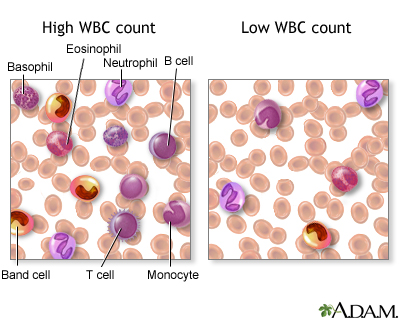
There are various types of white blood cells (WBCs) that normally appear in the blood: neutrophils (polymorphonuclear leukocytes; PMNs), band cells (slightly immature neutrophils), T-type lymphocytes (T cells), B-type lymphocytes (B cells), monocytes, eosinophils, and basophils. T and B-type lymphocytes are indistinguishable from each other in a normal slide preparation. Any infection or acute stress will result in an increased production of WBCs. This usually entails increased numbers of cells and an increase in the percentage of immature cells (mainly band cells) in the blood. This change is referred to as a “shift to the left” People who have had a splenectomy have a persistent mild elevation of WBCs. Drugs that may increase WBC counts include epinephrine, allopurinol, aspirin, chloroform, heparin, quinine, corticosteroids, and triamterene. Drugs that may decrease WBC counts include antibiotics, anticonvulsants, antihistamine, antithyroid drugs, arsenicals, barbiturates, chemotherapeutic agents, diuretics and sulfonamides.   (Updated by: David C. Dugdale, III, MD)

https://www.med-ed.virginia.edu/courses/path/innes/nh/wcbmaturation.cfm

Note that the mature forms of the myeloid series (neutrophils, eosinophils, basophils), all have lobed (segmented) nuclei. The degree of lobation increases as the cells mature.

The earliest recognizable myeloid cell is the myeloblast (10-20m dia) with a large round to oval nucleus. There is fine diffuse immature chromatin (without clumping) and a prominant nucleolus.

The cytoplasm is basophilic without granules. Although one may see a small golgi area adjacent to the nucleus, granules are not usually visible by light microscopy. One should not see blast cells in the peripheral blood.

myeloblast x100b

https://www.med-ed.virginia.edu/courses/path/innes/images/nhjpeg/nh%20myeloblast%20x100b.jpeg

The promyelocyte (10-20m) is slightly larger than a blast. Its nucleus, although similar to a myeloblast shows slight chromatin condensation and less prominent nucleoli. The cytoplasm contains striking azurophilic granules or primary granules. These granules contain myeloperoxidase, acid phosphatase, and esterase enzymes. Normally no promyelocytes are seen in the peripheral blood.

At the point in development when secondary granules can be recognized, the cell becomes a myelocyte.

promyelocyte x100

https://www.med-ed.virginia.edu/courses/path/innes/images/nhjpeg/nh%20promyelocyte%20×100%20a.jpeg

Myelocytes (10-18m) are not normally found in the peripheral blood. Nucleoli may not be seen in the late myelocyte. Primary azurophilic granules are still present, but secondary granules predominate. Secondary granules (neut, eos, or baso) first appear adjacent to the nucleus. In neutrophils this is the “dawn” of neutrophilia.

Metamyelocytes (10-18m) have kidney shaped indented nuclei and dense chromatin along the nuclear membrane. The cytoplasm is faintly pink, and they have secondary granules (neutro, eos, or baso). Zero to one percent of the peripheral blood white cells may be metamyelocytes (juveniles).

metamyelocyte x100

https://www.med-ed.virginia.edu/courses/path/innes/images/nhjpeg/nh%20metamyelocyte%20×100.jpeg

Bands, slightly smaller than juveniles, are marked by a U-shaped or deeply indented nucleus.

band neutrophilx100a

https://www.med-ed.virginia.edu/courses/path/innes/images/nhjpeg/nh%20band%20x100a.jpeg

Segmented (segs) or polymorphonuclear (PMN) leukocytes (average 14 m dia) are distinguished by definite lobation with thin thread-like filaments of chromatin joining the 2-5 lobes. 45-75% of the peripheral blood white cells are segmented neutrophils.

https://www.med-ed.virginia.edu/courses/path/innes/images/nhjpeg/nh%20neutrophil%20×100%20d.jpeg

Thrombocytogenesis

The incredible journey: From megakaryocyte development to platelet formation

Kellie R. Machlus1,2 and Joseph E. Italiano Jr
JCB 2013; 201(6): 785-796
http://dx.doi.org:/10.1083/jcb.201304054

Large progenitor cells in the bone marrow called megakaryocytes (MKs) are the source of platelets. MKs release platelets through a series of fascinating cell biological events. During maturation, they become polyploid and accumulate massive amounts of protein and membrane. Then, in a cytoskeletal-driven process, they extend long branching processes, designated proplatelets, into sinusoidal blood vessels where they undergo fission to release platelets.

megakaryocyte production of platelets

http://dm5migu4zj3pb.cloudfront.net/manuscripts/26000/26891/medium/JCI0526891.f4.jpg

platelets and the immune continuum nri2956-f3

http://www.nature.com/nri/journal/v11/n4/images/nri2956-f3.jpg

2.4.2 Classification of hematological malignancies
Practical Diagnosis of Hematologic Disoreders. 4th edition. Vol 2.
Kjeldsberg CR, Ed.  ASCP Press.  2006. Chicago, IL.

2.4.2.1 Primary Classification

Acute leukemias

Myelodysplastic syndromes

Acute myeloid leukemia

Acute lymphoblastic leukemia

Myeloproliferative Disorders

Chronic myeloproliferative disorders

Chronic myelogenous leukemia and related disorders

Myelofibrosis, including chronic idiopathic

Polycythemia, including polycythemia rubra vera

Thrombocytosis, including essential thrombocythemia

Chronic lymphoid leukemia and other lymphoid leukemias

Lymphomas

Non-Hodgkin Lymphoma

Hodgkin lymphoma

Lymphoproliferative disorders associated with immunodeficiency

Plasma Cell dyscrasias

Mast cell disease and Histiocytic neoplasms

2.4.2.2 Secondary Classification

2.4.2.3 Nuance – PathologyOutlines
Nat Pernick, Ed.

Leukemia – Acute

Primary referencesacute leukemia-generalAML generalAML classificationtransient abnormal myelopoiesis

Recurrent genetic abnormalities: AML with t(6;9)AML with t(8;21)AML with 11q23 abnormalitiesAML with inv(16) or t(16;16)AML with Down syndromeAML with FLT3 mutationsAML with myelodysplastic related changesAML therapy relatedAPL microgranular variantAPL with t(15;17)APL with t(V;17)APL therapy related

AML not otherwise categorized: minimally differentiated (M0)without maturation (M1)with maturation (M2)M3myelomonocyticmonoblastic and monocyticerythroidmegakaryoblasticCD13/CD33 negativebasophilicmyeloid sarcomaacute panmyelosis with myelofibrosiswith Philadelphia chromosomewith pseudo Chediak-Higashi anomalyhypocellular

ALL: generalWHO classificationwith eosinophilia

PreB ALL: generalt(9;22)t(v;11q23)t(1;19)t(5;14)t(12;21)hyperdiploidyhypodiploidymature B ALL/Burkitt

Other ALL: T ALLambiguous lineagemixed phenotype

AML and related malignancies

Acute myeloid leukemias with recurrent genetic abnormalities:

  • AML with t(8;21)(q22;q22); RUNX1-RUNX1T1
  • AML with inv(16)(p13.1;q22) or t(16;16)(p13.1;q22); CBF&beta-MYH11
  • Acute promyelocytic leukemia with t(15;17)(q22;q12); PML/RAR&alpha and variants
  • AML with t(9;11)(p22;q23); MLLT3-MLL
  • AML with t(6;9)(p23;q34); DEK-NUP214
  • AML with inv(3)(q21q26.2) or t(3;3)(q21;q26.2); RPN1-EVI1
  • AML (megakaryoblastic) with t(1;22)(p13;q13); RBM15-MKL1
  • AML with mutated NPM1*
  • AML with mutated CEBPA*

* provisional

Acute myeloid leukemia with myelodysplasia related changes

Therapy related acute myeloid leukemia

  • Alkylating agent related
  • Topoisomerase II inhibitor related (some maybe lymphoid)

Acute myeloid leukemia not otherwise categorized:

  • AML minimally differentiated (M0)
  • AML without maturation (M1)
  • AML with maturation (M2)
  • Acute myelomonocytic leukemia (M4)
  • Acute monoblastic and monocytic leukemia (M5a, M5b)
  • Acute erythroid leukemia (M6)
  • Acute megakaryoblastic leukemia (M7)
  • Acute basophilic leukemia
  • Acute panmyelosis with myelofibrosis

Myeloid Sarcoma

Myeloid proliferations related to Down syndrome:

  • Transient abnormal myelopoeisis
  • Myeloid leukemia associated with Down syndrome

Blastic plasmacytoid dentritic cell neoplasm:

Acute leukemia of ambiguous lineage:

  • Acute undifferentiated leukemia
  • Mixed phenotype acute leukemia with t(9;22)(q34;q11.2); BCR-ABL1
  • Mixed phenotype acute leukemia with t(v;11q23); MLL rearranged
  • Mixed phenotype acute leukemia, B/myeloid, NOS
  • Mixed phenotype acute leukemia, T/myeloid, NOS
  • Mixed phenotype acute leukemia, NOS, rare types
  • Other acute leukemia of ambiguous lineage
  • References: WHO Classification of Tumours of Haematopoietic and Lymphoid Tissue (IARC, 2008), Discovery Medicine 2010, eMedicine

Acute lymphocytic leukemia

General
=================================================================

  • WHO classification system includes former FAB classifications ALL-L1 and L2
    ● FAB L3 is now considered Burkitt lymphoma

WHO classification of acute lymphoblastic leukemia
=================================================================

Precursor B lymphoblastic leukemia / lymphoblastic lymphoma:
● ALL with t(9;22)(q34;q11.2); BCR-ABL (Philadelphia chromosome)
● ALL with t(v;11q23) (MLL rearranged)
● ALL with t(1;19)(q23;p13.3); TCF3-PBX1 (E2A-PBX1)
● ALL with t(12;21)(p13;q22); ETV6-RUNX1 (TEL-AML1)
● Hyperdiploid > 50
● Hypodiploid
● t(5;14)(q31;q32); IL3-IGH

Precursor T lymphoblastic leukemia / lymphoma

Additional references
=================================================================

Mixed phenotype acute leukemia (MPAL)

General
=================================================================

  • De novo acute leukemia containing separate populations of blasts of more than one lineage (bilineal or bilineage), or a single population of blasts co-expressing antigens of more than one lineage (biphenotypic)Excludes:
    ● Acute myeloid leukemia (AML) with recurrent translocations t(8;21), t(15;17) or inv(16)
    ● Leukemias with FGFR1 mutations
    ● Chronic myelogenous leukemia (CML) in blast crisis
    ● Myelodysplastic syndrome (MDS)-related AML and therapy-related AML, even if they have MPAL immunophenotypeCriteria for biphenotypic leukemia:
    ● Score of 2 or more for each of two separate lineages:The European Group for the Immunological Classification of Leukemias (EGIL) scoring system2008 WHO classification of acute leukemias of ambiguous lineage 

Prognosis
=================================================================

  • Poor, overall survival of 18 months
    ● Young age, normal karyotype and ALL induction therapy are associated with favorable survival
    ● Ph+ is a predictor for poor prognosis
    ● Bone marrow transplantation should be considered in first remission

Major Categories

MPAL with t(9;22)(q34;q11.2); BCR-ABL1
=================================================================

  • 20% of all MPAL
    ● Blasts with t(9;22)(q34;q11.2) translocation or BCR-ABL1 rearrangement (Ph+) without history of CML
    ● Majority in adults
    ● High WBC counts● Most of the cases B/myeloid phenotype
    ● Rare T/myeloid, B and T lineage, or trilineage leukemiasMorphology:
    ● Many cases show a dimorphic blast population, one resembling myeloblasts and the other lymphoblastsCytogenetic abnormalities:
    ● Conventional karyotyping for t(9;22), FISH or PCR for BCR-ABL1 translocation
    ● Additional complex karyotypes
    ● Ph+ is a poor prognostic factor for MPAL, with a reported median survival of 8 months
    ● Worse than patients of all other types of MPAL

MPAL with t(v;11q23); MLL rearranged
=================================================================

  • Meeting the diagnostic criteria for MPAL with blasts bearing a translocation involving the 11q23 breakpoint (MLL gene)
    ● MPAL with MLL rearranged rare
    ● More often seen in children and relatively common in infancy
    ● High WBC counts
    ● Poor prognosis
    ● Dimorphic blast population, with one resembling monoblasts and the other resembling lymphoblasts
    ● Lymphoblast population often shows a CD19+, CD10- B precursor immunophenotype, frequently CD15+
    ● Expression of other B markers usually weak
    ● Translocations involving MLL gene include t(4;11)(q21;q23), t(11;19)(q23;p13), and t(9;11)(p22;q23)
    ● Cases with chromosome 11q23 deletion should not be classified in this category

B cell acute lymphoblastic leukemia (ALL) / lymphoblastic lymphoma (LBL)

General

=================================================================

  • Current 2008 WHO classification: B lymphoblastic leukemia / lymphoma, NOS or B lymphoblastic leukemia / lymphoma with recurrent genetic abnormalities
  • See also lymphomas: B cell chapter
  • Also called B cell acute lymphoblastic leukemia / lymphoblastic lymphoma, pre B ALL / LBL
  • Usually children
  • B acute lymphoblastic leukemia presents with pancytopenia due to extensive marrow involvement, stormy onset of symptoms, bone pain due to marrow expansion, hepatosplenomegaly due to neoplastic infiltration, CNS symptoms due to meningeal spread and testicular involvement
  • B acute lymphoblastic lymphoma often presents with cutaneous nodules, bone or nodal involvement, < 25% lymphoblasts in bone marrow and peripheral blood; aleukemic cases are usually asymptomatic
  • Depending on specific leukemia, arises in either hematopoietic stem cell or B-cell progenitor
  • Tumors are derived from pre-germinal center naive B cells with unmutated VH region genes
  • Have multiple immunophenotyping aberrancies relative to normal B cell precursors (hematogones); at relapse, 73% show loss of 1+ aberrance and 60% show new aberrancies (Am J Clin Pathol 2007;127:39)

Prognostic features

=================================================================

  • Favorable prognosis: age 1-10 years, female, white; preB phenotype, hyperdiploidy>50, t(12,21), WBC count at presentation <50×108/L, non-traumatic tap with no blasts in CNS, rapid response to chemotherapy < 5% blasts on morphology on day 15, remission status after induction <5% blasts on morphology and <0.01% blast on flow or PCR, CD10+
  • Intermediate prognosis: hyperdiploidy 47-50, diploid, 6q- and rearrangements of 8q24
  • Unfavorable prognosis: under age 1 (usually have 11q23 translocations) or over age 10; t(9;22) (but not if age 59+ years, Am J Clin Pathol 2002;117:716); male, > 50×108/L WBC at presentation, hypodiploidy, near tetraploidy, 17p- and MLL rearrangements t(v;11q23); CD10-; non-traumatic tap with > 5% blasts or traumatic tap (7%); also increased microvessel staining using CD105 in children (Leuk Res 2007;31:1741), MDR1 expression in children (Oncol Rep 2004;12:1201) and adults (Blood 2002;100:974), 25%+ blasts on morphology on day 15, remission status after induction ≥ 5% blasts on morphology and ≥ 0.1% blasts on flow or PCR

Case reports

=================================================================

  • 12 month old girl and 13 month old boy with mature phenotype but no translocations (Arch Pathol Lab Med 2003;127:1340)
  • 56 year old man with ALL arising from follicular lymphoma (Arch Pathol Lab Med 2002;126:997)
  • 76 year old man with basal cell carcinoma (Diagn Pathol 2007;2:32)
  • With hemophagocytic lymphohistiocytosis (Pediatr Blood Cancer 2008;50:381)

Treatment

================================================================

  • Chemotherapy cures more children than adults; adolescents benefit from intensive regimens (Hematology Am Soc Hematol Educ Program 2005:123)

Micro description

=================================================================

  • Bone marrow smears: small to intermediate blast-like cells with scant, variably basophilic cytoplasm, round / oval or convoluted nuclei, fine chromatin and indistinct nucleoli; frequent mitotic figures; may have “starry sky” appearance similar to Burkitt lymphoma; may have large lymphoblasts with 1-4 prominent nucleoli resembling myeloblasts; usually no sclerosis
  • Bone marrow biopsy: usually markedly hypercellular with reduction of trilinear maturation; cells have minimal cytoplasm, medium sized nuclei that are often convoluted, moderately dense chromatin and indistinct nucleoli, brisk mitotic activity
  • Other tissues: may have “starry sky” appearance similar to Burkitt lymphoma; collagen dissection, periadipocyte growth pattern and single cell linear filing

Chronic Leukemia

Chronic Myeloid Neoplasms

Myelodysplastic syndromes (MDS): general, WHO classification, childhood, refractory anemia, refractory anemia with ringed sideroblasts, refractory cytopenia with multilineage dysplasia, refractory anemia with excess blasts, 5q-syndrome, therapy related, unclassified, arsenic toxicity

Myeloproliferative neoplasms (MPN): general, WHO classification, chronic eosinophilic leukemia, chronic myelogenous leukemia, chronic neutrophilic leukemia, essential thrombocythemia, hypereosinophilic syndrome, mast cell disease, polycythemia vera, primary myelofibrosis, unclassifiable

MDS/MPN: general, WHO classification, atypical CML, chronic myelomonocytic leukemia (CMML), chronic myelomonocytic leukemia with eosinophilia, juvenile myelomonocytic leukemia, unclassifiable

Myeloid neoplasms associated with eosinophilia and abnormalities of PDGFRA, PDGFRB, or FGFR1: PDGFRA, PDGFRB, FGFR1

Miscellaneous: transient myeloproliferative disorder of Downís syndrome

Lymphoma and plasma cell neoplasms

Lymph nodes: normal development-generalB cellsT cellsNK cellsnormal histologygrossing lymph nodesfeatures to report

Molecular testing: theoryFISHnorthern blotPCRsouthern blot

Non-Hodgkin lymphoma: generalcytogeneticsstagingstaging-pediatricmorphologic clueshemophagocytic syndromechemotherapeutic atypia

B cell disorders: generalpost-rituximabbone marrow biopsyclassification-historicalWHO classification

B cell lymphoma subtypes: age-related EBV-associatedALK positive large cellBurkittunclassifiable-intermediate between Burkitt and diffuse large B cell lymphomaCLL
diffuse large B cell: 
diffuse-NOSCD5+T cell / histiocyte richprimary cutaneous-generalprimary cutaneous-legprimary sites-other
follicular: 
generalchildhoodcutaneousGI
hairy cell leukemiaHCL variantintravascular large B celllymphomatoid granulomatosislymphoplasmacyticmantle cell-classicmantle cell-blastoidmarginal zone-generalmarginal zone-MALTMALT-primary sitesmarginal zone-nodalmediastinal (thymic)plasmablasticpre B lymphoblastic leukemia/lymphomaprimary effusionprolymphocytic leukemiapyothorax associatedSLLsplenic marginal zonesplenic lymphoma with villous lymphocytes

Plasma cell neoplasms: generalmyelomaplasmacytomaheavy chain diseaseprimary amyloidosisMGUSOsteosclerotic myeloma (POEMS)cryoglobulinemia

T/NK cell disorders: generalWHO classificationadult T cellaggressive NK cell leukemiaanaplastic large cell ALK+ALK-angioimmunoblastic T cellblastic plasmacytoidchronic lymphoproliferative disorders of NK cellscutaneous CD4+ small/medium sized T cell lymphomacutaneous CD30 positive T cell lymphoproliferative disorderscutaneous gamma delta T cell lymphomaenteropathyepidermotropic CD8+ T cell lymphomahepatosplenicindolent T cell proliferationsmycosis fungoidesNK/T cell lymphoma-nasal typenodal CD8+ cytotoxic T cellnonB nonT lymphoblasticperipheral T cell lymphoma, NOSprimary effusion lymphomaSezary syndromestagingsubcutaneous panniculitis-likeT cell large granular lymphocytic leukemiaT cell lymphoblastic leukemia/lymphomaT cell prolymphocytic leukemia

Hodgkin lymphoma: general/stagingclassiclymphocyte depletedlymphocyte rich classicalmixed cellularitynodular lymphocyte predominantnodular sclerosis

Post-transplantation: generalWHO classificationplasmacytic hyperplasia/IM-like lesionspolymorphic B cell lymphoproliferative disordersmonomorphic B cell lymphoproliferative disordersothergraft versus host disease

Other: AIDS associated-generalAIDS associated-examplesEBV+ T cell lymphoproliferative disorders of childhoodprimary immune disorders related

Myeloproliferative neoplasms (MPN)

WHO 2008 – Myeloproliferative neoplasms (MPN) 

General
=================================================================

  • Chronic myelogenous leukemia
    ● Polycythemia vera
    ● Essential thrombocythemia
    ● Primary myelofibrosis
    ● Chronic neutrophilic leukemia
    ● Chronic eosinophilic leukemia, not otherwise categorized
    ● Mast cell disease
    ● MPNs, unclassifiable

WHO 2001 – Chronic myeloproliferative diseases 

Definition
=================================================================

  • Chronic myelogenous leukemia (Philadelphia chromosome, t(9;22)(q34;q11), BCR-ABL positive)
    ● Chronic neutrophilic leukemia
    ● Chronic eosinophilic leukemia (and the hypereosinophilic syndrome)
    ● Polycythemia vera
    ● Chronic idiopathic myelofibrosis (with extramedullary hematopoiesis)
    ● Essential thrombocythemia
    ● Chronic myeloproliferative disease, unclassifiable

Additional references
=================================================================

The World Health Organization (WHO) classification of the myeloid neoplasms  James W. Vardiman, Nancy Lee Harris, and Richard D. Brunning
Blood 2002; 100(7)  http://dx.doi.org/10.1182/blood-2002-04-1199

Lymphoma – Non B cell neoplasms

T/NK cell disorders/WHO classification (2008)

Principles of classification
=================================================================

  • Based on all available information (morphology, immunophenotype, genetics, clinical)
    ● No one antigenic marker is specific for any neoplasm (except ALK1)
    ● Immune profiling less helpful in subclassification of T cell lymphomas then B cell lymphomas
    ● Certain antigens commonly associated with specific disease entities but not entirely disease specific
    ● CD30: common in anaplastic large cell lymphoma but also classic Hodgkin lymphoma and other B and T cell lymphomas
    ● CD56: characteristic for nasal NK/T cell lymphoma, but also other T cell neoplasms and plasma cell disorders
    ● Variation of immunophenotype within a given disease (hepatosplenic T cell lymphoma: usually γδ but some are αβ)
    ● Recurrent genetic alterations have been identified for many B cell lymphomas but not for most T cell lymphomas
    ● No attempt to stratify lymphoid malignancies by grade
    ● Recognize the existence of grey zone lymphomas
    ● This multiparameter approach has been validated in international studies as highly reproducible

WHO 2008 classification of tumors of hematopoietic and lymphoid tissues (T/NK)
=================================================================

Precursor T-lymphoid neoplasms
● T lymphoblastic leukemia/lymphoma, 9837/3

Mature T cell and NK cell neoplasms
● T cell prolymphocytic leukemia, 9834/3
● T cell large granular lymphocytic leukemia, 9831/3
● Chronic lymphoproliferative disorder of NK cells, 9831/3
● Aggressive NK cell leukemia, 9948/3
● Systemic EBV-positive T cell lymphoproliferative disease of childhood, 9724/3
● Hydroa vacciniforme-like lymphoma, 9725/3
● Adult T cell leukemia/lymphoma, 9827/3
● Extranodal NK/T cell lymphoma, nasal type, 9719/3
● Enteropathy-associated T cell lymphoma, 9717/3
● Hepatosplenic T cell lymphoma, 9716/3
● Subcutaneous panniculitis-like T cell lymphoma, 9708/3
● Mycosis fungoides, 9700/3
● Sézary syndrome, 9701/3
● Primary cutaneous CD30-positive T cell lymphoproliferative disorders
● Lymphomatoid papulosis, 9718/1
● Primary cutaneous anaplastic large cell lymphoma, 9718/3
● Primary cutaneous gamma-delta T cell lymphoma, 9726/3
● Primary cutaneous CD8-positive aggressive epidermotropic cytotoxic T cell lymphoma, 9709/3
● Primary cutaneous CD4-positive small/medium T cell lymphoma, 9709/3
● Peripheral T cell lymphoma, NOS, 9702/3
● Angioimmunoblastic T cell lymphoma, 9705/3
● Anaplastic large cell lymphoma, ALK-positive, 9714/3
● Anaplastic large cell lymphoma, ALK-negative, 9702/3

Chronic Lymphocytic Leukemia

Chronic Lymphocytic Leukemia Staging
Author: Sandy D Kotiah, MD; Chief Editor: Jules E Harris, MD
Medscape Sep 6, 2013
http://emedicine.medscape.com/article/2006578-overview

General considerations in the staging of chronic lymphocytic leukemia (CLL) and the revised Rai (United States) and Binet (Europe) staging systems for CLL are provided below.[1, 2, 3]

See Chronic Leukemias: 4 Cancers to Differentiate, a Critical Images slideshow, to help detect chronic leukemias and determine the specific type present.

General considerations

  • CLL and small lymphocytic lymphoma (SLL) are different manifestations of the same disease; SLL is diagnosed when the disease is mainly nodal, and CLL is diagnosed when the disease is seen in the blood and bone marrow
  • CLL is diagnosed by > 5000 monoclonal lymphocytes/mm3 for longer than 3mo; the bone marrow usually has more than 30% monoclonal lymphocytes and is either normocellular or hypercellular
  • Monoclonal B lymphocytosis is a precursor form of CLL that is defined by a monoclonal B cell lymphocytosis < 5000 monoclonal lymphocytes/mm3; all lymph nodes smaller than 1.5 cm; no anemia; and no thrombocytopenia

Revised Rai staging system (United States)

Low risk (formerly stage 0)[1] :

  • Lymphocytosis, lymphocytes in blood > 15000/mcL, and > 40% lymphocytes in the bone marrow

Intermediate risk (formerly stages I and II):

  • Lymphocytosis as in low risk with enlarged node(s) in any site, or splenomegaly or hepatomegaly or both

High risk (formerly stages III and IV):

  • Lymphocytosis as in low risk and intermediate risk with disease-related anemia (hemoglobin level < 11.0 g/dL or hematocrit < 33%) or platelets < 100,000/mcL

Binet staging system (Europe)

Stage A:

  • Hemoglobin ≥ 10 g/dL, platelets ≥ 100,000/mm3, and < 3 enlarged areas

Stage B:

  • Hemoglobin ≥ 10 g/dL, platelets ≥ 100,000/mm3, and ≥ 3 enlarged areas

Stage C:

  • Hemoglobin < 10 g/dL, platelets < 100,000/mm3, and any number of enlarged areas

Read Full Post »

Therapeutic Implications for Targeted Therapy from the Resurgence of Warburg ‘Hypothesis’

Writer and Curator: Larry H. Bernstein, MD, FCAP 

(Note that each portion of the discussion is followed by a reference)

It is now a time to pause after almost a century of a biological scientific discoveries that have transformed the practice of medicine and impacted the lives of several generations of young minds determined to probe the limits of our knowledge.  In the century that we have entered into the scientific framework of medicine has brought together a difficult to grasp evolution of the emergence of human existence from wars, famine, droughts, storms, infectious diseases, and insect born pestilence with betterment of human lives, only unevenly divided among societal classes that have existed since time immemorial. In this short time span there have emerged several generations of physicians who have benefited from a far better medical education that their forebears could have known. In this expansive volume on cancer, we follow an incomplete and continuing challenge to understand cancer, a disease that has become associated with longer life spans in developed nations.

While there are significant improvements in the diagnosis and treatment of cancers, there is still a personal as well as locality factor in the occurrence of this group of diseases, which has been viewed incorrectly as a “dedifferentiation” of mature tissue types and the emergence of a cell phenotype that is dependent on glucose, reverts to a cancer “stem cell type” (loss of stemness), loses cell to cell adhesion, loses orderly maturation, and metastasizes to distant sites. At the same time, physician and nurses are stressed in the care of patients by balancing their daily lives and maintaining a perspective.

The conceptual challenge of cancer diagnosis and management has seemed insurmountable, but owes much to the post World War I activities of Otto Heinrich Warburg. It was Warburg who made the observation that cancer cells metabolize glucose by fermentation in much the way Pasteur 60 years earlier observed fermentation of yeast cells. This metabolic phenomenon occurs even in the presence of an oxygen supply, which would provide a huge deficit in ATP production compared with respiration. The cancer cell is “addicted to glucose” and produced lactic acid. Warburg was awarded the Nobel Prize in Medicine for this work in 1931.

In the last 15 years there has been a resurgence of work on the Warburg effect that sheds much new light on the process that was not previously possible, with significant therapeutic implications.  In the first place, the metabolic mechanism for the Warburg effect was incomplete even at the beginning of the 21st century.  This has been partly rectified with the enlightening elucidation of genome modifications, cellular metabolic regulation, and signaling pathways.

The following developments have become central to furthering our understanding of malignant transformation.

  1. There is usually an identifiable risk factor, such as, H. pylori, or of a chronic inflammatory state, as in the case of Barrett’s esophagus.
  2. There are certain changes in glucose metabolism that have been unquestionably been found in the evolution of this disease. The changes are associated with major changes in metabolic pathways, miRN signaling, and the metabolism geared to synthesis of cells with an impairment of the cell death cycle. In these changes, mitochondrial function is central to both the impaired respiration and the autophagy geared to the synthesis of cancer cells.

The emergence of this cell prototype is characterized by the following, again related to the Warburg effect:

  1. Cancer cells oxidize a decreased fraction of the pyruvate generated from glycolysis
  2. The mitochondrial pyruvate carrier (MPC), composed of the products of the MPC1 and MPC2 genes, modulates fractional pyruvate oxidation. MPC1 is deleted or underexpressed in multiple cancers and correlates with poor prognosis.
  3. Cancer cells tend to express a partially inhibited splice variant of pyruvate kinase (PK-M2), leading to decreased pyruvate production.
  4. The two proteins that mediate pyruvate conversion to lactate and its export, M-type lactate dehydrogenase and the monocarboxylate transporter MCT-4, are commonly upregulated in cancer cells leading to decreased pyruvate oxidation.
  5. The enzymatic step following mitochondrial entry is the conversion of pyruvate to acetyl-CoA by the pyruvate dehydrogenase (PDH) complex. Cancer cells frequently exhibit increased expression of the PDH kinase PDK1, which phosphorylates and inactivates PDH. This PDH regulatory mechanism is required for oncogene induced transformation and reversed in oncogene-induced senescence.
  6. The PDK inhibitor dichloroacetate has shown some clinical efficacy, which correlates with increased pyruvate oxidation. One of the simplest mechanisms to explain decreased mitochondrial pyruvate oxidation in cancer cells, a loss of mitochondrial pyruvate import, has been observed repeatedly over the past 40 years. This process has been impossible to study at a molecular level until recently, however, as the identities of the protein(s) that mediate mitochondrial pyruvate uptake were unknown.
  7. The mitochondrial pyruvate carrier (MPC) as a multimeric complex that is necessary for efficient mitochondrial pyruvate uptake. The MPC contains two distinct proteins, MPC1 and MPC2; the absence of either leads to a loss of mitochondrial pyruvate uptake and utilization in yeast, flies, and mammalian cells.

A Role for the Mitochondrial Pyruvate Carrier as a Repressor of the Warburg Effect and Colon Cancer Cell Growth

John C. Schell, Kristofor A. Olson, Lei Jiang, Amy J. Hawkins, et al.
Molecular Cell Nov 6, 2014; 56: 400–413.
http://dx.doi.org/10.1016/j.molcel.2014.09.026

In addition to the above, the following study has therapeutic importance:

Glycolysis has become a target of anticancer strategies. Glucose deprivation is sufficient to induce growth inhibition and cell death in cancer cells. The increased glucose transport in cancer cells has been attributed primarily to the upregulation of glucose transporter 1 (Glut1),  1 of the more than 10 glucose transporters that are responsible for basal glucose transport in almost all cell types. Glut1 has not been targeted until very recently due to the lack of potent and selective inhibitors.

First, Glut1 antibodies were shown to inhibit cancer cell growth. Other Glut1 inhibitors and glucose transport inhibitors, such as fasentin and phloretin, were also shown to be effective in reducing cancer cell growth. A group of inhibitors of glucose transporters has been recently identified with IC50 values lower than 20mmol/L for inhibiting cancer cell growth. However, no animal or detailed mechanism studies have been reported with these inhibitors.

Recently, a small molecule named STF-31 was identified that selectively targets the von Hippel-Lindau (VHL) deficient kidney cancer cells. STF-31 inhibits VHL deficient cancer cells by inhibiting Glut1. It was further shown that daily intraperitoneal injection of a soluble analogue of STF-31 effectively reduced the growth of tumors of VHL-deficient cancer cells grafted on nude mice. On the other hand, STF-31 appears to be an inhibitor with a narrow cell target spectrum.

These investigators recently reported the identification of a group of novel small compounds that inhibit basal glucose transport and reduce cancer cell growth by a glucose deprivation–like mechanism. These compounds target Glut1 and are efficacious in vivo as anticancer agents. A novel representative compound WZB117 not only inhibited cell growth in cancer cell lines but also inhibited cancer growth in a nude mouse model. Daily intraperitoneal injection of WZB117 resulted in a more than 70% reduction in the size of human lung cancer of A549 cell origin. Mechanism studies showed that WZB117 inhibited glucose transport in human red blood cells (RBC), which express Glut1 as their sole glucose transporter. Cancer cell treatment with WZB117 led to decreases in levels of Glut1 protein, intracellular ATP, and glycolytic enzymes. All these changes were followed by increase in ATP sensing enzyme AMP-activated protein kinase (AMPK) and declines in cyclin E2 as well as phosphorylated retinoblastoma, resulting in cell-cycle arrest, senescence, and necrosis. Addition of extracellular ATP rescued compound-treated cancer cells, suggesting that the reduction of intracellular ATP plays an important role in the anticancer mechanism of the molecule.

A Small-Molecule Inhibitor of Glucose Transporter 1 Downregulates Glycolysis, Induces Cell-Cycle Arrest, and Inhibits Cancer Cell Growth In Vitro and In Vivo

Yi Liu, Yanyan Cao, Weihe Zhang, Stephen Bergmeier, et al.
Mol Cancer Ther Aug 2012; 11(8): 1672–82
http://dx.doi.org://10.1158/1535-7163.MCT-12-0131

Alterations in cellular metabolism are among the most consistent hallmarks of cancer. These investigators have studied the relationship between increased aerobic lactate production and mitochondrial physiology in tumor cells. To diminish the ability of malignant cells to metabolize pyruvate to lactate, M-type lactate dehydrogenase levels were knocked down by means of LDH-A short hairpin RNAs. Reduction in LDH-A activity resulted in stimulation of mitochondrial respiration and decrease of mitochondrial membrane potential. It also compromised the ability of these tumor cells to proliferate under hypoxia. The tumorigenicity of the LDH-A-deficient cells was severely diminished, and this phenotype was reversed by complementation with the human ortholog LDH-A protein. These results demonstrate that LDH-A plays a key role in tumor maintenance.

The results are consistent with a functional connection between alterations in glucose metabolism and mitochondrial physiology in cancer. The data also reflect that the dependency of tumor cells on glucose metabolism is a liability for these cells under limited-oxygen conditions. Interfering with LDH-A activity as a means of blocking pyruvate to lactate conversion could be exploited therapeutically. Because individuals with complete deficiency of LDH-A do not show any symptoms under ordinary circumstances, the genetic data suggest that inhibition of LDH-A activity may represent a relatively nontoxic approach to interfere with tumor growth.

Attenuation of LDH-A expression uncovers a link between glycolysis, mitochondrial physiology, and tumor maintenance

Valeria R. Fantin Julie St-Pierre and Philip Leder
Cancer Cell Jun 2006; 9: 425–434.
http://dx.doi.org:/10.1016/j.ccr.2006.04.02

The widespread clinical use of positron-emission tomography (PET) for the detection of aerobic glycolysis in tumors and recent findings have rekindled interest in Warburg’s theory. Studies on the physiological changes in malignant conversion provided a metabolic signature for the different stages of tumorigenesis; during tumorigenesis, an increase in glucose uptake and lactate production have been detected. The fully transformed state is most dependent on aerobic glycolysis and least dependent on the mitochondrial machinery for ATP synthesis.

Tumors ferment glucose to lactate even in the presence of oxygen (aerobic glycolysis; Warburg effect). The pentose phosphate pathway (PPP) allows glucose conversion to ribose for nucleic acid synthesis and glucose degradation to lactate. The nonoxidative part of the PPP is controlled by transketolase enzyme reactions. We have detected upregulation of a mutated transketolase transcript (TKTL1) in human malignancies, whereas transketolase (TKT) and transketolase-like-2 (TKTL2) transcripts were not upregulated. Strong TKTL1 protein expression was correlated to invasive colon and urothelial tumors and to poor patients outcome. TKTL1 encodes a transketolase with unusual enzymatic properties, which are likely to be caused by the internal deletion of conserved residues. We propose that TKTL1 upregulation in tumors leads to enhanced, oxygen-independent glucose usage and a lactate based matrix degradation. As inhibition of transketolase enzyme reactions suppresses tumor growth and metastasis, TKTL1 could be the relevant target for novel anti-transketolase cancer therapies. We suggest an individualized cancer therapy based on the determination of metabolic changes in tumors that might enable the targeted inhibition of invasion and metastasis.

Other important links between cancer-causing genes and glucose metabolism have been already identified. Activation of the oncogenic kinase Akt has been shown to stimulate glucose uptake and metabolism in cancer cells and renders these cells susceptible to death in response to glucose withdrawal. Such tumor cells have been shown to be dependent on glucose because the ability to induce fatty acid oxidation in response to glucose deprivation is impaired by activated Akt. In addition, AMP-activated protein kinase (AMPK) has been identified as a link between glucose metabolism and the cell cycle, thereby implicating p53 as an essential component of metabolic cell-cycle control.

Expression of transketolase TKTL1 predicts colon and urothelial cancer patient survival: Warburg effect reinterpreted

S Langbein, M Zerilli, A zur Hausen, W Staiger, et al.
British Journal of Cancer (2006) 94, 578–585.
http://dx.doi.org:/10.1038/sj.bjc.6602962

The unique metabolic profile of cancer (aerobic glycolysis) might confer apoptosis resistance and be therapeutically targeted. Compared to normal cells, several human cancers have high mitochondrial membrane potential (DJm) and low expression of the K+ channel Kv1.5, both contributing toapoptosis resistance. Dichloroacetate (DCA) inhibits mitochondrial pyruvate dehydrogenase kinase (PDK), shifts metabolism from glycolysis to glucose oxidation, decreases DJm, increases mitochondrial H2O2, and activates Kv channels in all cancer, but not normal, cells; DCA upregulates Kv1.5 by an NFAT1-dependent mechanism. DCA induces apoptosis, decreases proliferation, and inhibits tumor growth, without apparent toxicity. Molecular inhibition of PDK2 by siRNA mimics DCA. The mitochondria-NFAT-Kv axis and PDK are important therapeutic targets in cancer; the orally available DCA is a promising selective anticancer agent.

Cancer progression and its resistance to treatment depend, at least in part, on suppression of apoptosis. Although mitochondria are recognized as regulators of apoptosis, their importance as targets for cancer therapy has not been adequately explored or clinically exploited. In 1930, Warburg suggested that mitochondrial dysfunction in cancer results in a characteristic metabolic phenotype, that is, aerobic glycolysis (Warburg, 1930). Positron emission tomography (PET) imaging has now confirmed that most malignant tumors have increased glucose uptake and metabolism. This bioenergetic feature is a good marker of cancer but has not been therapeutically pursued..

The small molecule DCA is a metabolic modulator that has been used in humans for decades in the treatment of lactic acidosis and inherited mitochondrial diseases. Without affecting normal cells, DCA reverses the metabolic electrical remodeling that we describe in several cancer lines (hyperpolarized mitochondria, activated NFAT1, downregulated Kv1.5), inducing apoptosis and decreasing tumor growth. DCA in the drinking water at clinically relevant doses for up to 3 months prevents and reverses tumor growth in vivo, without apparent toxicity and without affecting hemoglobin, transaminases, or creatinine levels. The ease of delivery, selectivity, and effectiveness  make DCA an attractive candidate for proapoptotic cancer therapy which can be rapidly translated into phase II–III clinical trials.

A Mitochondria-K+ Channel Axis Is Suppressed in Cancer and Its Normalization Promotes Apoptosis and Inhibits Cancer Growth

Sebastien Bonnet, Stephen L. Archer, Joan Allalunis-Turner, et al.

Cancer Cell Jan 2007; 11: 37–51.
http://dx.doi.org:/10.1016/j.ccr.2006.10.020

Tumor cells, just as other living cells, possess the potential for proliferation, differentiation, cell cycle arrest, and apoptosis. There is a specific metabolic phenotype associated with each of these conditions, characterized by the production of both energy and special substrates necessary for the cells to function in that particular state. Unlike that of normal living cells, the metabolic phenotype of tumor cells supports the proliferative state. Aim: To present the metabolic hypothesis that (1) cell transformation and tumor growth are associated with the activation of metabolic enzymes that increase glucose carbon utilization for nucleic acid synthesis, while enzymes of the lipid and amino acid synthesis pathways are activated in tumor growth inhibition, and (2) phosphorylation and allosteric and transcriptional regulation of intermediary metabolic enzymes and their substrate availability together mediate and sustain cell transformation from one condition to another. Conclusion: Evidence is presented that demonstrates opposite changes in metabolic phenotypes induced by TGF-β, a cell transforming agent, and tumor growth-inhibiting phytochemicals such as genistein and Avemar, or novel synthetic antileukemic drugs such as STI571 (Gleevec).  Intermediary metabolic enzymes that mediate the growth signaling pathways and promote malignant cell transformation may serve as high efficacy nongenetic novel targets for cancer therapies.

A Metabolic Hypothesis of Cell Growth and Death in Pancreatic Cancer

Laszlo G. Boros, Wai-Nang Paul Lee, and Vay Liang W. Go
Pancreas 2002; 24(1):26–33

Clear cell renal cell carcinoma (ccRCC) is the most common pathological subtype of kidney cancer. Here, we integrated an unbiased genome-wide RNA interference screen for ccRCC survival regulators with an analysis of recurrently overexpressed genes in ccRCC to identify new therapeutic targets in this disease. One of the most potent survival regulators, the monocarboxylate transporter MCT4 (SLC16A3), impaired ccRCC viability in all eight ccRCC lines tested and was the seventh most overexpressed gene in a meta-analysis of five ccRCC expression datasets.

MCT4 silencing impaired secretion of lactate generated through glycolysis and induced cell cycle arrest and apoptosis. Silencing MCT4 resulted in intracellular acidosis, and reduction in intracellular ATP production together with partial reversion of the Warburg effect in ccRCC cell lines. Intra-tumoral heterogeneity in the intensity of MCT4 protein expression was observed in primary ccRCCs.

MCT4 protein expression analysis based on the highest intensity of expression in primary ccRCCs was associated with poorer relapse-free survival, whereas modal intensity correlated with Fuhrman nuclear grade. Consistent with the potential selection of subclones enriched for MCT4 expression during disease progression, MCT4 expression was greater at sites of metastatic disease. These data suggest that MCT4 may serve as a novel metabolic target to reverse the Warburg effect and limit disease progression in ccRCC.

Clear cell carcinoma (ccRCC) is the commonest subtype of renal cell carcinoma, accounting for 80% of cases. These tumors are highly resistant to cytotoxic chemotherapy and until recently, systemic treatment options for advanced ccRCC were limited to cytokine based therapies, such as interleukin-2 and interferon-α. Recently, anti-angiogenic drugs and mTOR inhibitors, all targeting the HIF–VEGF axis which is activated in up to 91% of ccRCCs through loss of the VHL tumor suppressor gene [1], have been shown to be effective in metastatic ccRCC [2–5]. Although these drugs increase overall survival to more than 2 years [6], resistance invariably occurs, making the identification of new molecular targets a major clinical need to improve outcomes in patients with metastatic ccRCC.

Genome-wide RNA interference analysis of renal carcinoma survival regulators identifies MCT4 as a Warburg effect metabolic target

Marco Gerlinger, Claudio R Santos, Bradley Spencer-Dene, et al.
J Pathol 2012; 227: 146–156
http://dx.doi.org:/10.1002/path.4006

Hypoxia-inducible factor 1 (HIF-1) plays a key role in the reprogramming of cancer metabolism by activating transcription of genes encoding glucose transporters and glycolytic enzymes, which take up glucose and convert it to lactate; pyruvate dehydrogenase kinase 1, which shunts pyruvate away from the mitochondria; and BNIP3, which triggers selective mitochondrial autophagy. The shift from oxidative to glycolytic metabolism allows maintenance of redox homeostasis and cell survival under conditions of prolonged hypoxia. Many metabolic abnormalities in cancer cells increase HIF-1 activity. As a result, a feed-forward mechanism can be activated that drives HIF-1 activation and may promote tumor progression.

Metastatic cancer is characterized by reprogramming of cellular metabolism leading to increased uptake of glucose for use as both an anabolic and a catabolic substrate. Increased glucose uptake is such a reliable feature that it is utilized clinically to detect metastases by positron emission tomography using 18F-fluorodeoxyglucose (FDG-PET) with a sensitivity of >90% [1]. As with all aspects of cancer biology, the details of metabolic reprogramming differ widely among individual tumors. However, the role of specific signaling pathways and transcription factors in this process is now understood in considerable detail. This review will focus on the involvement of hypoxia-inducible factor 1 (HIF-1) in both mediating metabolic reprogramming and responding to metabolic alterations. The placement of HIF-1 both upstream and downstream of cancer metabolism results in a feed-forward mechanism that may play a major role in the development of the invasive, metastatic, and lethal cancer phenotype.

O2 concentrations are significantly reduced in many human cancers compared with the surrounding normal tissue. The median PO2 in breast cancers is 10 mmHg, as compared with65 mmHg in normal breast tissue. Reduced O2 availability induces HIF-1, which regulates the transcription of hundreds of genes that encode proteins involved in every aspect of cancer biology, including: cell immortalization and stem cell maintenance; genetic instability; glucose and energy metabolism; vascularization; autocrine growth factor signaling; invasion and metastasis; immune evasion; and resistance to chemotherapy and radiation therapy.

HIF-1 is a transcription factor that consists of an O2 regulated HIF-1a and a constitutively expressed HIF-1b subunit. In well-oxygenated cells, HIF-1a is hydroxylated on proline residue 402 (Pro-402) and/or Pro-564 by prolyl hydroxylase domain protein 2 (PHD2), which uses O2 and a-ketoglutarate as substrates in a reaction that generates CO2 and succinate as byproducts. Prolylhydroxylated HIF-1a is bound by the von Hippel–Lindau tumor suppressor protein (VHL), which recruits an E3-ubiquitin ligase that targets HIF-1a for proteasomal degradation (Figure 1a). Asparagine 803 in the transactivation domain is hydroxylated in well-oxygenated cells by factor inhibiting HIF-1 (FIH-1), which blocks the binding of the coactivators p300 and CBP. Under hypoxic conditions, the prolyl and asparaginyl hydroxylation reactions are inhibited by substrate (O2) deprivation and/or the mitochondrial generation of reactive oxygen species (ROS), which may oxidize Fe(II) present in the catalytic center of the hydroxylases.

The finding that acute changes in PO2 increase mitochondrial ROS production suggests that cellular respiration is optimized at physiological PO2 to limit ROS generation and that any deviation in PO2 – up or down – results in increased ROS generation. If hypoxia persists, induction of HIF-1 leads to adaptive mechanisms to reduce ROS and re-establish homeostasis, as described below. Prolyl and asparaginyl hydroxylation provide a molecular mechanism by which changes in cellular oxygenation can be transduced to the nucleus as changes in HIF-1 activity.

HIF-1: upstream and downstream of cancer metabolism

Gregg L Semenza
Current Opinion in Genetics & Development 2010, 20:51–56

This review comes from a themed issue on Genetic and cellular mechanisms of oncogenesis Edited by Tony Hunter and Richard Marais

http://dx.doi.org:/10.1016/j.gde.2009.10.009

Hypoxia-inducible factor 1 (HIF-1) regulates the transcription of many genes involved in key aspects of cancer biology, including immortalization, maintenance of stem cell pools, cellular dedifferentiation, genetic instability, vascularization, metabolic reprogramming, autocrine growth factor signaling, invasion/metastasis, and treatment failure. In animal models, HIF-1 overexpression is associated with increased tumor growth, vascularization, and metastasis, whereas HIF-1 loss-of-function has the opposite effect, thus validating HIF-1 as a target. In further support of this conclusion, immunohistochemical detection of HIF-1a overexpression in biopsy sections is a prognostic factor in many cancers. A growing number of novel anticancer agents have been shown to inhibit HIF-1 through a  variety of molecular mechanisms. Determining which combination of drugs to administer to any given patient remains a major obstacle to improving cancer treatment outcomes.

Intratumoral hypoxia The majority of locally advanced solid tumors contain regions of reduced oxygen availability. Intratumoral hypoxia results when cells are located too far from a functional blood vessel for diffusion of adequate amounts of O2 as a result of rapid cancer cell proliferation and the formation of blood vessels that are structurally and functionally abnormal. In the most extreme case, O2 concentrations are below those required for survival, resulting in cell death and establishing a selection for cancer cells in which apoptotic pathways are inactivated, anti-apoptotic pathways are activated, or invasion/metastasis pathways that promote escape from the hypoxic microenvironment are activated. This hypoxic adaptation may arise by alterations in gene expression or by mutations in the genome or both and is associated with reduced patient survival.

Hypoxia-inducible factor 1 (HIF-1) The expression of hundreds of genes is altered in each cell exposed to hypoxia. Many of these genes are regulated by HIF-1. HIF-1 is a heterodimer formed by the association of an O2-regulated HIF1a subunit with a constitutively expressed HIF-1b subunit. The structurally and functionally related HIF-2a protein also dimerizes with HIF-1b and regulates an overlapping battery of target genes. Under nonhypoxic conditions, HIF-1a (as well as HIF-2a) is subject to O2-dependent prolyl hydroxylation and this modification is required for binding of the von Hippel–Lindau tumor suppressor protein (VHL), which also binds to Elongin C and thereby recruits a ubiquitin ligase complex that targets HIF-1a for ubiquitination and proteasomal degradation. Under hypoxic conditions, the rate of hydroxylation and ubiquitination declines, resulting in accumulation of HIF-1a. Immunohistochemical analysis of tumor biopsies has revealed high levels of HIF-1a in hypoxic but viable tumor cells surrounding areas of necrosis.

Genetic alterations in cancer cells increase HIF-1 activity In the majority of clear-cell renal carcinomas, VHL function is lost, resulting in constitutive activation of HIF-1. After re-introduction of functional VHL, renal carcinoma cell lines are no longer tumorigenic, but can be made tumorigenic by expression of HIF2a in which the prolyl residues that are subject to hydroxylation have been mutated. In addition to VHL loss-of-function, many other genetic alterations that inactivate tumor suppressors

Evaluation of HIF-1 inhibitors as anticancer agents

Gregg L. Semenza
Drug Discovery Today Oct 2007; 12(19/20).
http://dx.doi.org:/10.1016/j.drudis.2007.08.006

Hypoxia-inducible factor-1 (HIF-1), which is present at high levels in human tumors, plays crucial roles in tumor promotion by upregulating its target genes, which are involved in anaerobic energy metabolism, angiogenesis, cell survival, cell invasion, and drug resistance. Therefore, it is apparent that the inhibition of HIF-1 activity may be a strategy for treating cancer. Recently, many efforts to develop new HIF-1-targeting agents have been made by both academic and pharmaceutical industry laboratories. The future success of these efforts will be a new class of HIF-1-targeting anticancer agents, which would improve the prognoses of many cancer patients. This review focuses on the potential of HIF-1 as a target molecule for anticancer therapy, and on possible strategies to inhibit HIF-1 activity. In addition, we introduce YC-1 as a new anti-HIF-1, anticancer agent. Although YC-1 was originally developed as a potential therapeutic agent for thrombosis and hypertension, recent studies demonstrated that YC-1 suppressed HIF-1 activity and vascular endothelial growth factor expression in cancer cells. Moreover, it halted tumor growth in immunodeficient mice without serious toxicity during the treatment period. Thus, we propose that YC-1 is a good lead compound for the development of new anti-HIF-1, anticancer agents.

Although many anticancer regimens have been introduced to date, their survival benefits are negligible, which is the reason that a more innovative treatment is required. Basically, the identification of the specific molecular features of tumor promotion has allowed for rational drug discovery in cancer treatment, and drugs have been screened based upon the modulation of specific molecular targets in tumor cells. Target-based drugs should satisfy the following two conditions.

First, they must act by a described mechanism.

Second, they must reduce tumor growth in vivo, associated with this mechanism.

Many key factors have been found to be involved in the multiple steps of cell growth signal-transduction pathways. Targeting these factors offers a strategy for preventing tumor growth; for example, competitors or antibodies blocking ligand–receptor interaction, and receptor tyrosine kinase inhibitors, downstream pathway inhibitors (i.e., RAS farnesyl transferase inhibitors, mitogen-activated protein kinase and mTOR inhibitors), and cell-cycle arresters (i.e., cyclin-dependent kinase inhibitors) could all be used to inhibit tumor growth.

In addition to the intracellular events, tumor environmental factors should be considered to treat solid tumors. Of these, hypoxia is an important cancer-aggravating factor because it contributes to the progression of a more malignant phenotype, and to the acquisition of resistance to radiotherapy and chemotherapy. Thus, transcription factors that regulate these hypoxic events are good targets for anticancer therapy and in particular HIF-1 is one of most compelling targets. In this paper, we introduce the roles of HIF-1 in tumor promotion and provide a summary of new anticancer strategies designed to inhibit HIF-1 activity.

New anticancer strategies targeting HIF-1

Eun-Jin Yeo, Yang-Sook Chun, Jong-Wan Park
Biochemical Pharmacology 68 (2004) 1061–1069
http://dx.doi.org:/10.1016/j.bcp.2004.02.040

Classical work in tumor cell metabolism focused on bioenergetics, particularly enhanced glycolysis and suppressed oxidative phosphorylation (the ‘Warburg effect’). But the biosynthetic activities required to create daughter cells are equally important for tumor growth, and recent studies are now bringing these pathways into focus. In this review, we discuss how tumor cells achieve high rates of nucleotide and fatty acid synthesis, how oncogenes and tumor suppressors influence these activities, and how glutamine metabolism enables macromolecular synthesis in proliferating cells.

Otto Warburg’s demonstration that tumor cells rapidly use glucose and convert the majority of it to lactate is still the most fundamental and enduring observation in tumor metabolism. His work, which ushered in an era of study on tumor metabolism focused on the relationship between glycolysis and cellular bioenergetics, has been revisited and expanded by generations of tumor biologists. It is now accepted that a high rate of glucose metabolism, exploited clinically by 18FDGPET scanning, is a metabolic hallmark of rapidly dividing cells, correlates closely with transformation, and accounts for a significant percentage of ATP generated during cell proliferation. A ‘metabolic transformation’ is required for tumorigenesis. Research over the past few years has reinforced this idea, revealing the conservation of metabolic activities among diverse tumor types, and proving that oncogenic mutations can promote metabolic autonomy by driving nutrient uptake to levels that often exceed those required for cell growth and proliferation.

In order to engage in replicative division, a cell must duplicate its genome, proteins, and lipids and assemble the components into daughter cells; in short, it must become a factory for macromolecular biosynthesis. These activities require that cells take up extracellular nutrients like glucose and glutamine and allocate them into metabolic pathways that convert them into biosynthetic precursors (Figure 1). Tumor cells can achieve this phenotype through changes in the expression of enzymes that determine metabolic flux rates, including nutrient transporters and enzymes [8– 10]. Current studies in tumor metabolism are revealing novel mechanisms for metabolic control, establishing which enzyme isoforms facilitate the tumor metabolic phenotype, and suggesting new targets for cancer therapy.

The ongoing challenge in tumor cell metabolism is to understand how individual pathways fit together into the global metabolic phenotype of cell growth. Here we discuss two biosynthetic activities required by proliferating tumor cells: production of ribose-5 phosphate for nucleotide biosynthesis and production of fatty acids for lipid biosynthesis. Nucleotide and lipid biosynthesis share three important characteristics.

  • First, both use glucose as a carbon source.
  • Second, both consume TCA cycle intermediates, imposing the need for a mechanism to replenish the cycle.
  • Third, both require reductive power in the form of NADPH.

In this Essay, we discuss the possible drivers, advantages, and potential liabilities of the altered metabolism of cancer cells (Figure 1, not shown). Although our emphasis on the Warburg effect reflects the focus of the field, we would also like to encourage a broader approach to the study of cancer metabolism that takes into account the contributions of all interconnected small molecule pathways of the cell.

The Tumor Microenvironment Selects for Altered Metabolism One compelling idea to explain the Warburg effect is that the altered metabolism of cancer cells confers a selective advantage for survival and proliferation in the unique tumor microenvironment. As the early tumor expands, it outgrows the diffusion limits of its local blood supply, leading to hypoxia and stabilization of the hypoxia-inducible transcription factor, HIF. HIF initiates a transcriptional program that provides multiple solutions to hypoxic stress (reviewed in Kaelin and Ratcliffe, 2008). Because a decreased dependence on aerobic respiration becomes advantageous, cell metabolism is shifted toward glycolysis by the increased expression of glycolytic enzymes, glucose transporters, and inhibitors of mitochondrial metabolism. In addition, HIF stimulates angiogenesis (the formation of new blood vessels) by upregulating several factors, including most prominently vascular endothelial growth factor (VEGF).

Blood vessels recruited to the tumor microenvironment, however, are disorganized, may not deliver blood effectively, and therefore do not completely alleviate hypoxia (reviewed in Gatenby and Gillies, 2004). The oxygen levels within a tumor vary both spatially and temporally, and the resulting rounds of fluctuating oxygen levels potentially select for tumors that constitutively upregulate glycolysis. Interestingly, with the possible exception of tumors that have lost the von Hippel-Lindau protein (VHL), which normally mediates degradation of HIF, HIF is still coupled to oxygen levels, as evident from the heterogeneity of HIF expression within the tumor microenvironment. Therefore, the Warburg effect—that is, an uncoupling of glycolysis from oxygen levels—cannot be explained solely by upregulation of HIF. Other molecular mechanisms are likely to be important, such as the metabolic changes induced by oncogene activation and tumor suppressor loss.

Oncogene Activation Drives Changes in Metabolism Not only may the tumor microenvironment select for a deranged metabolism, but oncogene status can also drive metabolic changes. Since Warburg’s time, the biochemical study of cancer metabolism has been overshadowed by efforts to identify the mutations that contribute to cancer initiation and progression. Recent work, however, has demonstrated that the key components of the Warburg effect—

  • increased glucose consumption,
  • decreased oxidative phosphorylation, and
  • accompanying lactate production—
  • are also distinguishing features of oncogene activation.

The signaling molecule Ras, a powerful oncogene when mutated, promotes glycolysis (reviewed in Dang and Semenza, 1999; Ramanathan et al., 2005). Akt kinase, a well-characterized downstream effector of insulin signaling, reprises its role in glucose uptake and utilization in the cancer setting (reviewed in Manning and Cantley, 2007), whereas the Myc transcription factor upregulates the expression of various metabolic genes (reviewed in Gordan et al., 2007). The most parsimonious route to tumorigenesis may be activation of key oncogenic nodes that execute a proliferative program, of which metabolism may be one important arm. Moreover, regulation of metabolism is not exclusive to oncogenes.

Cancer Cell Metabolism: Warburg & Beyond

Hsu PP & Sabatini DM
Cell  Sep 5, 2008; 134, 703-705
http://dx.doi.org:/10.1016/j.cell.2008.08.021

Tumor cells respond to growth signals by the activation of protein kinases, altered gene expression and significant modifications in substrate flow and redistribution among biosynthetic pathways. This results in a proliferating phenotype with altered cellular function. These transformed cells exhibit unique anabolic characteristics, which includes increased and preferential utilization of glucose through the non-oxidative steps of the pentose cycle for nucleic acid synthesis but limited de novo fatty  acid   synthesis   and   TCA   cycle   glucose   oxidation. This  primarily nonoxidative anabolic profile reflects an undifferentiated highly proliferative aneuploid cell phenotype and serves as a reliable metabolic biomarker to determine cell proliferation rate and the level of cell transformation/differentiation in response to drug treatment.

Novel drugs effective in particular cancers exert their anti-proliferative effects by inducing significant reversions of a few specific non-oxidative anabolic pathways. Here we present evidence that cell transformation of various mechanisms is sustained by a unique disproportional substrate distribution between the two branches of the pentose cycle for nucleic acid synthesis, glycolysis and the TCA cycle for fatty acid synthesis and glucose oxidation. This can be demonstrated by the broad labeling and unique specificity of [1,2-13C2]glucose to trace a large number of metabolites in the metabolome. Stable isotope-based dynamic metabolic profiles (SIDMAP) serve the drug discovery process by providing a powerful new tool that integrates the metabolome into a functional genomics approach to developing new drugs. It can be used in screening kinases and their metabolic targets, which can therefore be more efficiently characterized, speeding up and improving drug testing, approval and labeling processes by saving trial and error type study costs in drug testing.

Metabolic Biomarker and Kinase Drug Target Discovery in Cancer Using Stable Isotope-Based Dynamic Metabolic Profiling (SIDMAP)

László G. Boros, Daniel J. Brackett and George G. Harrigan
Current Cancer Drug Targets, 2003, 3, 447-455 447

Pyruvate constitutes a critical branch point in cellular carbon metabolism. We have identified two proteins, Mpc1 and Mpc2, as essential for mitochondrial pyruvate transport in yeast, Drosophila, and humans. Mpc1 and Mpc2 associate to form an ~150 kilodalton complex in the inner mitochondrial membrane. Yeast and Drosophila mutants lacking MPC1 display impaired pyruvate metabolism, with an accumulation of upstream metabolites and a depletion of tricarboxylic acid cycle intermediates. Loss of yeast Mpc1 results in defective mitochondrial pyruvate uptake, while silencing of MPC1 or MPC2 in mammalian cells impairs pyruvate oxidation. A point mutation in MPC1 provides resistance to a known inhibitor of the mitochondrial pyruvate carrier. Human genetic studies of three families with children suffering from lactic acidosis and hyperpyruvatemia revealed a causal locus that mapped to MPC1, changing single amino acids that are conserved throughout eukaryotes. These data demonstrate that Mpc1 and Mpc2 form an essential part of the mitochondrial pyruvate carrier.

A Mitochondrial Pyruvate Carrier Required for Pyruvate Uptake in Yeast, Drosophila , and Humans

Daniel K. Bricker, Eric B. Taylor, John C. Schell, Thomas Orsak, et al.
Science Express 24 May 2012
http://dx.doi.org:/10.1126/science.1218099

Adenosine deaminase acting on RNA (ADAR) enzymes convert adenosine (A) to inosine (I) in double-stranded (ds) RNAs. Since Inosine is read as Guanosine, the biological consequence of ADAR enzyme activity is an A/G conversion within RNA molecules. A-to-I editing events can occur on both coding and non-coding RNAs, including microRNAs (miRNAs), which are small regulatory RNAs of ~20–23 nucleotides that regulate several cell processes by annealing to target mRNAs and inhibiting their translation. Both miRNA precursors and mature miRNAs undergo A-to-I RNA editing, affecting the miRNA maturation process and activity. ADARs can also edit 3′ UTR of mRNAs, further increasing the interplay between mRNA targets and miRNAs. In this review, we provide a general overview of the ADAR enzymes and their mechanisms of action as well as miRNA processing and function. We then review the more recent findings about the impact of ADAR-mediated activity on the miRNA pathway in terms of biogenesis, target recognition, and gene expression regulation.

Review ADAR Enzyme and miRNA Story: A Nucleotide that Can Make the Difference 

Sara Tomaselli, Barbara Bonamassa, Anna Alisi, Valerio Nobili, Franco Locatelli and Angela Gallo
Int. J. Mol. Sci. 19 Nov 2013; 14, 22796-22816 http://dx.doi.org:/10.3390/ijms141122796

The fermented wheat germ extract (FWGE) nutraceutical (Avemar™), manufactured under “good manufacturing practice” conditions and, fulfilling the self-affirmed “generally recognized as safe” status in the United States, has been approved as a “dietary food for special medical purposes for cancer patients” in Europe. In this paper, we report the adjuvant use of this nutraceutical in the treatment of high-risk skin melanoma patients. Methods: In a randomized, pilot, phase II clinical trial, the efficacy of dacarbazine (DTIC)-based adjuvant chemotherapy on survival parameters of melanoma patients was compared to that of the same treatment supplemented with a 1-year long administration of FWGE. Results: At the end of an additional 7-year-long follow-up period, log-rank analyses (Kaplan-Meier estimates) showed significant differences in both progression-free (PFS) and overall survival (OS) in favor of the FWGE group. Mean PFS: 55.8 months (FWGE group) versus 29.9 months (control group), p  0.0137. Mean OS: 66.2 months (FWGE group) versus 44.7 months (control group), p < 0.0298. Conclusions: The inclusion of Avemar into the adjuvant protocols of high-risk skin melanoma patients is highly recommended.

Adjuvant Fermented Wheat Germ Extract (Avemar™) Nutraceutical Improves Survival of High-Risk Skin Melanoma Patients: A Randomized, Pilot, Phase II Clinical Study with a 7-Year Follow-Up

LV Demidov, LV Manziuk, GY Kharkevitch, NA Pirogova, and EV Artamonova
Cancer Biotherapy & Radiopharmaceuticals 2008; 23(4)
http://dx.doi.org:/10.1089/cbr.2008.0486

Cancer cells possess unique metabolic signatures compared to normal cells, including shifts in aerobic glycolysis, glutaminolysis, and de novo biosynthesis of macromolecules. Targeting these changes with agents (drugs and dietary components) has been employed as strategies to reduce the complications associated with tumorigenesis. This paper highlights the ability of several food components to suppress tumor-specific metabolic pathways, including increased expression of glucose transporters, oncogenic tyrosine kinase, tumor-specific M2-type pyruvate kinase, and fatty acid synthase, and the detection of such effects using various metabonomic technologies, including liquid chromatography/mass spectrometry (LC/MS) and stable isotope-labeled MS. Stable isotope-mediated tracing technologies offer exciting opportunities for defining specific target(s) for food components. Exposures, especially during the early transition phase from normal to cancer, are critical for the translation of knowledge about food components into effective prevention strategies. Although appropriate dietary exposures needed to alter cellular metabolism remain inconsistent and/or ill-defined, validated metabonomic biomarkers for dietary components hold promise for establishing effective strategies for cancer prevention.

Bioactive Food Components and Cancer-Specific Metabonomic Profiles

Young S. Kim and John A. Milner
Journal of Biomedicine and Biotechnology 2011, Art ID 721213, 9 pages
http://dx.doi.org:/10.1155/2011/721213

This reviewer poses the following observation.  The importance of the pyridine nucleotide reduced/oxidized ratio has not been alluded to here, but the importance cannot be understated. It has relevance to the metabolic functions of anabolism and catabolism of the visceral organs.  The importance of this has ties to the pentose monophosphate pathway. The importance of the pyridine nucleotide transhydrogenase reaction remains largely unexplored.  In reference to the NAD-redox state, the observation was made by Nathan O. Kaplan that the organs may be viewed with respect to their primary functions in anabolic or high energy catabolic activities. Thus we find that the endocrine organs are largely tied to anabolic functioning, and to NADP, whereas cardiac and skeletal muscle are highly dependent on NAD. The consequence of this observed phenomenon appears to be related to a difference in the susceptibility to malignant transformation.  In the case of the gastrointestinal tract, the rate of turnover of the epithelium is very high. However, with the exception of the liver, there is no major activity other than cell turnover. In the case of the liver, there is a major commitment to synthesis of lipids, storage of fuel, and synthesis of proteins, which is largely anabolic, but there is also a major activity in detoxification, which is not.  In addition, the liver has a double circulation. As a result, a Zahn infarct is uncommon.  Now we might also consider the heart.  The heart is a muscle syncytium with a high need for oxygen.  Cutting of the oxygen supply makes the myocytes vulnerable to ischemic insult and abberant rhythm abnormalities.  In addition, the cardiomyocyte can take up lactic acid from the circulation for fuel, which is tied to the utilization of lactate from vigorous skeletal muscle activity.  The skeletal muscle is tied to glycolysis in normal function, which has a poor generation of ATP, so that the recycling of excess lactic acid is required by cardiac muscle and hepatocytes.  This has not been a part of the discussion, but this reviewer considers it important to remember in considering the organ-specific tendencies to malignant transformation.

Comment (Aurelian Udristioiu):

Otto Warburg observed that many cancers lose their capacity for mitochondrial respiration, limiting ATP production to anaerobic glycolytic pathways. The phenomenon is particularly prevalent in aggressive malignancies, most of which are also hypoxic [1].
Hypoxia induces a stochastic imbalance between the numbers of reduced mitochondrial species vs. available oxygen, resulting in increased reactive oxygen species (ROS) whose toxicity can lead to apoptotic cell death.
Mechanism involves inhibition of glycolytic ATP production via a Randle-like cycle while increased uncoupling renders cancers unable to produce compensatory ATP from respiration-.generation in the presence of intact tricarboxylic acid (TCA) enzyme.
One mitochondrial adaptation to increased ROS is over-expression of the uncoupling protein 2 (UCP2) that has been reported in multiple human cancer cell lines [2-3]. Increased UCP2 expression was also associated with reduced ATP production in malignant oxyphilic mouse leukemia and human lymphoma cell lines [4].
Hypoxia reduces the ability of cells to maintain their energy levels, because less ATP is obtained from glycolysis than from oxidative phosphorylation. Cells adapt to hypoxia by activating the expression of mutant genes in glycolysis.
-Severe hypoxia causes a high mutation rate, resulting in point mutations that may be explained by reduced DNA mismatch repairing activity.
The most direct induction of apoptosis caused by hypoxia is determined by the inhibition of the electron carrier chain from the inner membrane of the mitochondria. The lack of oxygen inhibits the transport of protons and thereby causes a decrease in membrane potential. Cell survival under conditions of mild hypoxia is mediated by phosphoinositide-3 kinase (PIK3) using severe hypoxia or anoxia, and then cells initiate a cascade of events that lead to apoptosis [5].
After DNA damage, a very important regulator of apoptosis is the p53 protein. This tumor suppressor gene has mutations in over 60% of human tumors and acts as a suppressor of cell division. The growth-suppressive effects of p53 are considered to be mediated through the transcriptional trans-activation activity of the protein. In addition to the maturational state of the clonal tumor, the prognosis of patients with CLL is dependent of genetic changes within the neoplastic cell population.

1.Warburg O. On the origin of cancer cells. Science 1956; 123 (3191):309-314
PubMed Abstract ; Publisher Full Text

2.Giardina TM, Steer JH, Lo SZ, Joyce DA. Uncoupling protein-2 accumulates rapidly in the inner mitochondrial membrane during mitochondrial reactive oxygen stress in macrophages. Biochim Biophys Acta 2008, 1777(2):118-129. PubMed Abstract | Publisher Full Text

3. Horimoto M, Resnick MB, Konkin TA, Routhier J, Wands JR, Baffy G. Expression of uncoupling protein-2 in human colon cancer. Clin Cancer Res 2004; 10 (18 Pt1):6203-6207. PubMed Abstract | Publisher Full Text

4. Randle PJ, England PJ, Denton RM. Control of the tricarboxylate cycle and it interactions with glycolysis during acetate utilization in rat heart. Biochem J 1970; 117(4):677-695. PubMed Abstract | PubMed Central Full Text

5. Gillies RJ, Robey I, Gatenby RA. Causes and consequences of increased glucose metabolism of cancers. J Nucl Med 2008; 49(Suppl 2):24S-42S. PubMed Abstract | Publisher Full Text

Shortened version of Comment –

Hypoxia induces a stochastic imbalance between the numbers of reduced mitochondrial species vs. available oxygen, resulting in increased reactive oxygen species (ROS) whose toxicity can lead to apoptotic cell death.
Mechanism involves inhibition of glycolytic ATP production via a Randle-like cycle while increased uncoupling renders cancers unable to produce compensatory ATP from respiration-.generation in the presence of intact tricarboxylic acid (TCA) enzyme.
One mitochondrial adaptation to increased ROS is over-expression of the uncoupling protein 2 (UCP2) that has been reported in multiple human cancer cell lines. Increased UCP2 expression was also associated with reduced ATP production in malignant oxyphilic mouse leukemia and human lymphoma cell lines.
Severe hypoxia causes a high mutation rate, resulting in point mutations that may be explained by reduced DNA mismatch repairing activity.

Read Full Post »

Angiogenesis Inhibitors [9.5]

Writer and Curator: Larry H Bernstein, MD, FCAP

This article has the following structure:

9.5.1 Motesanib (AMG 706)

9.5.2 Drugs that block cancer blood vessel growth (anti angiogenics)

9.5.3 Recent Advances in Anti-Angiogenic Therapy of Cancer

9.5.4 Angiogenesis inhibitors in cancer therapy: mechanistic perspective on classification and treatment rationales

9.5.5 LUCITANIB a VEGFR/FGFR dual kinase inhibitor in Phase 2 trials

9.5.1 Motesanib (AMG 706)

by DR ANTHONY MELVIN CRASTO Ph.D

http://newdrugapprovals.org/2015/05/15/motesanib-amg-706/

Motesanib (AMG 706) is an experimental drug candidate originally developed by Amgen[1] but is now being investigated by theTakeda Pharmaceutical Company. It is an orally administered small molecule belonging to angiokinase inhibitor class which acts as an antagonist of VEGF receptorsplatelet-derived growth factor receptors, and stem cell factor receptors.[2] It is used as the phosphate salt motesanib diphosphate.

Motesanib, also known as AMG-706, is an orally administered multikinase inhibitor that selectively targets VEGF receptors, platelet-derived growth factor receptors, and Kit receptors.

N-(3,3-Dimethylindolin-6-yl){2-[(4-pyridylmethyl)amino](3-pyridyl)}carboxamide

motesanib-amg-706-a10608

motesanib-amg-706-a10608

http://www.adooq.com/media/catalog/product/cache/1/image/9df78eab33525d08d6e5fb8d27136e95/m/o/motesanib-amg-706-a10608.gif

http://www.chemblink.com/products/453562-69-1.htm

9.5.2 Drugs that block cancer blood vessel growth (anti angiogenics)

http://www.cancerresearchuk.org/about-cancer/cancers-in-general/treatment/biological/types/drugs-that-block-cancer-blood-vessel-growth

When it has reached 1 to 2mm across, a tumor needs to grow its own blood vessels in order to continue to get bigger. Some cancer cells make a protein called vascular endothelial growth factor (VEGF). The VEGF protein attaches to receptors on cells that line the walls of blood vessels within the tumour.

Drugs that block blood vessel growth factor

Some drugs block vascular endothelial growth factor (VEGF) from attaching to the receptors on the cells that line the blood vessels. This stops the blood vessels from growing.

A drug that blocks VEGF is bevacizumab (Avastin). It is also a monoclonal antibody.

Drugs that block signalling within the cell

Some drugs stop the VEGF receptors from sending growth signals into the blood vessel cells. These treatments are also called cancer growth blockers or tyrosine kinase inhibitors (TKIs).

Sunitinib (Sutent) is a type of TKI that blocks the growth signals inside blood vessel cells. It is used to treat kidney cancer and a rare type of stomach cancer called gastrointestinal stromal tumour (GIST).

Drugs that affect signals between cells

Some drugs act on the chemicals that cells use to signal to each other to grow. This can block the formation of blood vessels. Drugs that works in this way include thalidomide and lenalidomide (Revlimid).

Each drug has different side effects. You can look up the name of your drug in our cancer drug section to find out about the side effects you may have.

To find trials using anti angiogenesis treatment go to our clinical trials database and type ‘angiogenesis’ into the search box.

http://www.cancer.gov/about-cancer/treatment/types/immunotherapy/angiogenesis-inhibitors-fact-sheet

Tumors can cause their blood supply to form by giving off chemical signals that stimulate angiogenesis. Tumors can also stimulate nearby normal cells to produce angiogenesis signaling molecules. The resulting new blood vessels “feed” growing tumors with oxygen and nutrients, allowing the cancer cells to invade nearby tissue, to move throughout the body, and to form colonies of cancer cells, called metastases. Because tumors cannot grow beyond a certain size or spread without a blood supply, scientists are trying to find ways to block tumor angiogenesis.

Angiogenesis requires the binding of signaling molecules, such as vascular endothelial growth factor (VEGF), to receptors on the surface of normal endothelial cells. When VEGF and other endothelial growth factors bind to their receptors on endothelial cells, signals within these cells are initiated that promote the growth and survival of new blood vessels.

Angiogenesis inhibitors interfere with various steps in this process. For example, bevacizumab (Avastin®) is a monoclonal antibody that specifically recognizes and binds to VEGF (1). When VEGF is attached to bevacizumab, it is unable to activate the VEGF receptor. Other angiogenesis inhibitors, including sorafenib and sunitinib, bind to receptors on the surface of endothelial cells or to other proteins in the downstream signaling pathways, blocking their activities (2).

The U.S. Food and Drug Administration (FDA) has approved bevacizumab to be used alone forglioblastoma that has not improved with other treatments and to be used in combination with other drugs to treat metastatic colorectal cancer, some non-small cell lung cancers, and metastatic renal cell cancer. Bevacizumab was the first angiogenesis inhibitor that was shown to slow tumor growth and, more important, to extend the lives of patients with some cancers.

The FDA has approved other drugs that have antiangiogenic activity, including sorafenib (Nexavar®), sunitinib(Sutent®), pazopanib (Votrient®), and everolimus (Afinitor®). Sorafenib is approved for hepatocellular carcinoma and kidney cancer, sunitinib and everolimus for both kidney cancer and neuroendocrine tumors, and pazopanib for kidney cancer.

Angiogenesis inhibitors are unique cancer-fighting agents because they tend to inhibit the growth of blood vessels rather than tumor cells. In some cancers, angiogenesis inhibitors are most effective when combined with additional therapies, especially chemotherapy. It has been hypothesized that these drugs help normalize the blood vessels that supply the tumor, facilitating the delivery of other anticancer agents, but this possibility is still being investigated.

Angiogenesis inhibitor therapy does not necessarily kill tumors but instead may prevent tumors from growing. Therefore, this type of therapy may need to be administered over a long period.

Initially, it was thought that angiogenesis inhibitors would have mild side effects, but more recent studies have revealed the potential for complications that reflect the importance of angiogenesis in many normal body processes, such as wound healing, heart and kidney function, fetal development, and reproduction. Side effects of treatment with angiogenesis inhibitors can include problems with bleeding, clots in the arteries (with resultant stroke or heart attack), hypertension, and protein in the urine (35). Gastrointestinal perforation and fistulas also appear to be rare side effects of some angiogenesis inhibitors.

In addition to the angiogenesis inhibitors that have already been approved by the FDA, others that target VEGF or other angiogenesis pathways are currently being tested in clinical trials (research studies involving patients). If these angiogenesis inhibitors prove to be both safe and effective in treating human cancer, they may be approved by the FDA and made available for widespread use.

In addition, phase I and II clinical trials are testing the possibility of combining angiogenesis inhibitor therapy with other treatments that target blood vessels, such as tumor-vascular disrupting agents, which damage existing tumor blood vessels (6).

9.5.3 Recent Advances in Anti-Angiogenic Therapy of Cancer

Rajeev S. Samant and Lalita A. Shevde
Oncotarget. 2011 Mar; 2(3): 122–134.
http://www.ncbi.nlm.nih.gov/pmc/articles/PMC3260813/

More than forty anti-angiogenic drugs are being tested in clinical trials all over the world. This review discusses agents that have approved by the FDA and are currently in use for treating patients either as single-agents or in combination with other chemotherapeutic agents.

Tumor angiogenesis is generation of a network of blood vessels within the cancerous growth. This process can occur two ways: The more accepted model involves the release of signaling molecules by the tumor cells; these molecules activate the surrounding tissue to promote growth of new blood vessels. This stimulates vascular endothelial cells to divide rapidly [910]. The other model proposes the generation of new vasculature by vasculogenic mimicry. This model argues that the tumor cells trans-differentiate in endothelial-like cells and create structures from inside of the tumor tapping into a nearby blood vessel [4].

Escape of the tumor cell from the confines of the primary tumor to distant body parts is the pre-requisite for hematogenous metastasis. This escape route is provided by the tumor vasculature. Thus, it was envisioned that inhibition of angiogenesis will also lead to inhibition of metastasis. This phenomenon was demonstrated by very elegant mouse model studies using angiostatin [1112]. Angiostatin was also demonstrated to be secreted by some primary tumors leading to restricted growth of the metastasis leading to “dormancy” of the metastasis. Mice deficient in angiogenesis (Id1 & Id3 deficient) showed significantly less tumor take rates [13]. Independent studies showed absence of metastasis in angiogenesis deficient mice [1415]. Defective angiogenesis was attributed to impaired VEGF-dependent recruitment of precursor endothelial cells from the bone marrow to the newly developing tumor vasculature [16].

Metastasis of malignant tumors to regional lymph nodes is one of the early signs of cancer spread in patients, and it occurs at least as frequently as hematogenous metastasis [17]. Particularly, in cancers, such as breast cancer, lymphatic metastasis is a predominant route for tumor spread. The contribution of lymphatic system to the tumor growth is an area that is relatively less studied. However, lymphatic vessels are speculated to contribute to tumor growth and metastasis in a variety of ways. The VEGF, FGF2 and PDGF produced by vascular endothelial cells are proposed to be involved in the activation of lymphatic endothelial cells, which in turn produce matrix metalloproteases and urokinase plasminogen activator (uPA) that can promote malignant tumor growth. Thus, there exists a synergistic crosstalk between the tumor and the lymphatic vessels and blood vessels.

Angiogenesis is a complex and intricately regulated process. Like all other regulated biological phenomena, angiogenesis has activators or pro-angiogenic factors and inhibitors or anti-angiogenic factors [9].

The Activators

Tumor cells activate signaling pathways that promote uncontrolled proliferation and survival. These include the PI3K/AKT/mTOR pathway, Hedgehog pathway and, Wnt pathway [1824] that produce pro-angiogenic signaling intermediates [2526]. Among the several reported activators of angiogenesis present in cells two proteins appear to be the most important for sustaining tumor growth: vascular endothelial growth factor (VEGF) and basic fibroblast growth factor (bFGF). VEGF and bFGF are secreted by the tumor into the surrounding tissue. They bind to their cognate receptors on endothelial cells. This activates a signaling cascade that transmits a nuclear signal prompting target genes to activate endothelial cell growth. Activated endothelial cells also produce matrix metalloproteinases (MMPs). These MMPs break down the extracellular matrix and allow the migration of endothelial cells. The division and migration of the endothelial cells leads to formation of new blood vessels [2728].

The Inhibitors

If angiogenesis is so critical for the tumor growth, then agents that inhibit angiogenesis would have great therapeutic value. With the discovery of endostatin, the concept of anti-angiogenic therapy was launched and popularized by Dr. Folkman [29]. Angiogenesis inhibitors have been discovered from a variety of sources. Some are naturally present in the human body e.g. specific fragments of structural proteins such as collagen or plasminogen (angiostatin, endostatin, tumstatin) [30]. Others are natural products in green tea, soy beans, fungi, mushrooms, tree bark, shark tissues, snake venom etc. [31]. A plethora of synthetic compounds are also characterized to have anti-angiogenic properties [32].

ANTI-ANGIOGENIC TREATMENT OF CANCER

Since angiogenesis is an event critical to primary tumor growth as well as metastasis, anti-angiogenic treatment of tumors is a highly promising therapeutic avenue [33]. Thus, for over last couple of decades, there has been a robust activity aimed towards the discovery of angiogenesis inhibitors [3435]. More than forty anti-angiogenic drugs are being tested in human cancer patients in clinical trials all over the world. From the several anti-angiogenic agents reported, we have focused this review on discussing those agents that have received FDA approval in the United States and are currently in use for treating patients either as a single-agent or in combination with other chemotherapeutic agents (Figure ​(Figure1).1). Based on functionality, the anti-angiogenic drugs can be sub-divided into three main groups:

angiogenesis inhibitors oncotarget-02-122-g001

angiogenesis inhibitors oncotarget-02-122-g001

Figure 1

http://www.ncbi.nlm.nih.gov/pmc/articles/PMC3260813/bin/oncotarget-02-122-g001.jpg

Targets of FDA-approved angiogenesis inhibitors: Angiogenesis inhibitors impact both, the tumor as well as the endothelial cells resulting in the disruption of the effects of the microenvironment in promoting tumor growth and angiogenesis

Drugs that inhibit growth of endothelial cells

e.g. Endostatin and combretastatin A4, cause apoptosis of the endothelial cells [36]. Thalidomide is also a potent inhibitor of endothelial cell growth [37].

Drugs that block angiogenesis signaling

e.g. anti-VEGF antibodies (Avastin, FDA approved for colorectal cancer), Interferon-alpha (inhibits the production of bFGF and VEGF) [36].

Drugs that block extracellular matrix breakdown

e.g. inhibitors of MMPs [38].

ANTI-ANGIOGENIC THERAPIES THAT HAVE RECEIVED USA-FDA APPROVAL

Conventional chemotherapy is usually a systemic therapy that tries to capture a narrow therapeutic window offered by rapid proliferation of tumor cells compared to the normal cells. Chemotherapy has significant side effects such as hair loss, diarrhea, mouth ulcer, infection, and low blood counts. Anti-angiogenic therapy has several advantages over chemotherapy as it is mostly not directed towards directly killing cells but stopping the blood vessel formation, an event that is rare in tissues other than growing tumor. Hence it is well tolerated by the patients and has fewer side effects [29]. There are currently seven approved anti-cancer therapies in two primary categories:

  1. Monoclonal antibodies directed against specific pro-angiogenic growth factors and/or their receptors
  2. Small molecule tyrosine kinase inhibitors (TKIs) of multiple pro-angiogenic growth factor receptors.

Besides these, inhibitors of mTOR (mammalian target of rapamycin), proteasome inhibitors and thalidomide have also been reported to indirectly inhibit angiogenesis through mechanisms that are not completely understood.

MONOCLONAL ANTIBODY THERAPIES

Four monoclonal antibody therapies are approved to treat several tumor types:

Bevacizumab (Avastin®)

The first FDA approved angiogenesis inhibitor, Avastin is a humanized monoclonal antibody that binds biologically active forms of vascular endothelial growth factor (VEGF) and prevents its interaction with VEGF receptors (VEGFR-1 and VEGFR-2), thereby inhibiting endothelial cell proliferation and angiogenesis. Bevacizumab has been tested in phase I studies in combination with chemotherapy with a good safety profile [39]. This treatment is approved for metastatic colorectal cancer and non-small cell lung cancer [4043]. Bevacizumab has also evolved as a first line of treatment in combination with paclitaxel in breast cancer patients by virtue of its ability to double median progression-free survival (PFS) [44]. In combination with chemoendocrine therapy (including capecitabine and vinorelbine, and letrozole) bevacizumab treatment significantly decreased the percentage of viable circulating endothelial cells and prevented the chemotherapy-induced mobilization of circulating progenitors [45]. In combination with irinotecan, bevacizumab significantly increased PFS in glioma patients [4647]. VEGF has emerged as a compelling therapeutic target for leukemias. Inhibition of angiogenesis in hematological malignancies interdicts the angiogenesis within the bone marrow ecosystem comprised of multiple cell types, including fibroblasts, endothelial progenitor cells, endothelial cells, dendritic cells and, malignant cells, blocking the availability of nutrients to cancer cells and disrupting crosstalk between the various cell types to curtail the malignant phenotype [48].

Cetuximab (Erbitux®)

This is a monoclonal antibody that binds the extracellular domain of epidermal growth factor receptor (EGFR), preventing ligand binding and activation of the receptor resulting in internalization and degradation of the receptor culminating in inhibition of cell proliferation and angiogenesis. Cetuximab downregulated VEGF expression in a dose-dependent manner in a human colorectal carcinoma (CRC) cell line and in human CRC mouse xenografts [49]. The xenografts also showed a significant reduction in blood vessel counts following several rounds of cetuximab treatment [49], indicating that the tumor-promoting effects of EGFR overexpression may be mediated through VEGF stimulation and tumor angiogenesis. This treatment is approved for metastatic CRC and head and neck cancer [50] in patients who are refractory to irinotecan-based chemotherapy. In combination with irinotecan (an inhibitor of topoisomerase I), cetuximab is the first monoclonal antibody that has been approved by the FDA as second-line treatment for metastatic colorectal cancer [5152]. In Phase I and Phase III trials [5354] cetuximab significantly improved the effects of radiotherapy in patients with unresectable (cannot be removed by surgery) squamous cell carcinoma of the head and neck (SCCHN). Cetuximab has also been shown to sensitize cells to radiation and chemotherapy, potentially through blocking EGFR nuclear import and the associated activation of DNA protein kinase enzymes necessary for repairing radiation- and chemotherapy-induced DNA damage [55]. Compared to radiation alone, cetuximab plus radiation therapy can nearly double the median survival in patients with a certain kind of head and neck cancer that has not spread to other parts of the body [54] making cetuximab the only drug achieving interesting response rate in second line treatment of advanced SCCHN [56]. Cetuximab was also found to be tolerated well in combination with cisplatin, or carboplatin, and fluorouracil [5758].

Panitumumab (Vectibix™)

It is a fully humanized anti-EGFR monoclonal antibody that binds specifically to the human EGFR. Panitumumab is a recombinant human monoclonal antibody [59]; therefore, the risk of an infusion reaction is minimized. Vectibix® is indicated as a single agent for the treatment of EGFR-expressing, metastatic colorectal carcinoma with disease progression on or following fluoropyrimidine-, oxaliplatin-, and irinotecan-containing chemotherapy regimens [6062]. The effectiveness of Vectibix® as a single agent for the treatment of EGFR-expressing, metastatic CRC is based on progression-free survival [6364]. Panitumumab is used in patients who are not responding to regimens containing fluorouracil, oxaliplatin, and irinotecan [60]. Patients often receive panitumumab after receiving bevacizumab or cetuximab. Panitumumab can be given with FOLFOX (oxaliplatin, leucovorin, and fluorouracil) or FOLFIRI (irinotecan, leucovorin, and fluorouracil) regimens, or as a single agent. Currently no data are available that demonstrate an improvement in disease-related symptoms or increased survival with Vectibix® in colon cancer [65]. This drug is also being tested for aerodigestive track and head and neck cancer [6667].

Trastuzumab (Herceptin®)

Is a humanized monoclonal antibody that binds the extracellular domain of HER-2, which is overexpressed in 25-30% of invasive breast cancer tumors [68]. HER2-positive breast cancer is highly aggressive disease with high recurrence rate, poorer prognosis with decreased survival compared with HER2-negative breast cancer [69]. Herceptin® is designed to target and block the function of HER2 protein overexpression. This is the first humanized antibody is approved for Breast cancer [70]. Herceptin® is approved by the FDA to treat HER2 positive breast cancer that has metastasized after treatment with other anticancer drugs [71]. It is also approved to be used with other drugs to treat HER2-positive breast cancer that has spread to the lymph nodes to be used after surgery. The FDA first approved Herceptin in September 1998 [7173]. In November 2006, the FDA approved Herceptin as part of a treatment regimen containing doxorubicin, cyclophosphamide and paclitaxel, for the adjuvant treatment of patients with HER2-positive, node-positive breast cancer (http://www.fda.gov/NewsEvents/Newsroom/PressAnnouncements/default.htm). In January 2008, the FDA approved Herceptin as a single agent for the adjuvant treatment of HER2-overexpressing node-negative (ER/PR-negative or with one high-risk feature) or node-positive breast cancer, following multi-modality anthracycline-based therapy (http://biopharminternational.findpharma.com/biopharm/News/FDA-Approves-Expanded-Adjuvant-Indications-for-Her/ArticleStandard/Article/detail/518867). Trastuzumab is also being studied in the treatment of other types of cancers such as pancreatic [74], endometrial [75], lung [76], cervical [77] and ovarian cancer [78]

SMALL MOLECULE TYROSINE KINASE INHIBITORS (TKIs)

Protein tyrosine kinases have emerged as crucial targets for therapeutic intervention in cancer especially because they play an important role in the modulation of growth factor signaling. As per ClinicalTrials.gov (www.clinicaltrials.gov), there are 43 ongoing studies on tyrosine kinase inhibitors in angiogenesis. Since discussing all of them is beyond the scope of this article, we have focused our discussion on the three TKIs that are currently approved as anti-cancer therapies:

Erlotinib (Tarceva®)

Erlotinib hydrochloride (originally coded as OSI-774) is an orally available, potent, reversible, and selective inhibitor of the EGFR (ErbB1) tyrosine kinase activity. Erlotinib hydrochloride has been approved by FDA for treatment of patients with locally advanced or metastatic NSCLC after failure of at least one prior chemotherapy regimen [7980]. Interesting recent studies have demonstrated that since Erlotinib and Bevacizumab act on two different pathways critical to tumor growth and dissemination, administering these drugs concomitantly may confer additional clinical benefits to cancer patients with advanced disease. This combination therapy may prove to be a viable second-line alternative to chemotherapy in patients with NSCLC [81]. Also, for patients with locally advanced, unresectable or metastatic pancreatic carcinoma, Erlotinib has received FDA approval for the treatment in combination with gemcitabine [8283]. Erlotinib is also being studied in the treatment of other types of cancers. For example combination of Erlotinib with Bevacizumab has been evaluated in metastatic breast cancer [84], hepatocellular carcinoma [85] and in metastatic renal cancer [86] as phase II trials. Outcomes for prostate, cervical and colorectal cancers treated with Erlotinib are cautiously optimistic [8789].

Sorafenib (Nexavar®)

Sorafenib is an orally active inhibitor of VEGFR-1, VEGFR-2, VEGFR-3, PDGFR-β, and Raf-1 tyrosine kinase activity [90]. It has received the approval of FDA for the treatment of patients with unresectable hepatocellular carcinoma [91] and advanced renal cell carcinoma [92]. However, not all advanced hepatocellular carcinoma patients were able to tolerate sorafenib and some patients experienced tumor progression [91]. Sorafenib has shown improvements in PFS in patients with renal cell carcinoma [93]. It is one of the aggressively studied drugs. According to the NCI clinical trials search results, there are about 168 active clinical trials involving sorafenib in a variety of cancers.

Sunitinib (Sutent®)

Sunitinib targets activity of multiple tyrosine kinases such as VEGFR-1, VEGFR-2, VEGFR-3, PDGFR- β, and RET [94]. It is approved by FDA as Sunitinib malate for treating advanced (metastatic) renal cell carcinoma [95]. It is also approved by FDA for gastrointestinal stromal tumor (GIST) in patients whose disease has progressed or who are unable to tolerate treatment with imatinib (Gleevec), the current treatment for GIST patients [9596]. Sunitinib has shown early evidence of anti-tumor activity in Phase II trials in US, European and Asian patients with locally advanced, unresectable and metastatic hepatocellular carcinoma. A Phase III trial of sunitinib in hepatocellular carcinoma is ongoing [97]. According to the NCI clinical trials search results, Sunitinib is currently evaluated in about 150 active clinical trials. It is evaluated for ovarian [98], breast [99] and non small cell lung cancer [100] among others [101].

Inhibitors of mTOR

mTOR plays a part in the PI3 kinase/AKT pathway involved in tumor cell proliferation and angiogenesis [102]. Rapamycin and related mTOR inhibitors inhibit endothelial cell VEGF expression, as well as VEGF-induced endothelial cell proliferation [103]. Inhibitors of mTOR are an important class of anti-angiogenic agents. These include: deforolimus, everolimus, rapamycin (sirolimus), and temsirolimus [104105]. Temsirolimus (Toricel™) is a small molecule inhibitor of mTOR, approved for treating advanced renal cell carcinoma [106]. It is a type of rapamycin analog and a type of serine/threonine kinase inhibitor, it is also called CCI-779. In pre-clinical models combination therapy for treating breast cancer using anti-estrogen, ERA-923, and temsirolimus has been successfully tested [107]. It is found to be highly effective against human melanoma when tested in combination with cisplatin and DTIC (in independent studies) in a SCID mouse xenotranplantation model [108109]. There are over 41 active studies of Temsirolimus for a variety of solid tumors [110]. mTOR inhibition has also been strongly advocated in as a putative cancer therapeutic strategy for urologic malignancies [111]. In a pilot study (6 patients) with imatinib-resistant CML, rapamycin induced major and minor leukocyte responses, with an observed decrease in the mRNA levels of VEGFA in circulating leukaemic cells [112]. Combination treatments for breast cancer with aromatase inhibitor [113] and letrozol [114] are also being evaluated. Rapamycin treatment brought partial responses (>50% reduction in the absolute number of blood blasts) and stable disease in adult refractory/relapsed AML [115]. In a recent report, Deforolimus was studied in a Phase 2 trial in pretreated patients with various hematological malignancies, including ALL, AML, CLL, CML, MDS, agnogenic myeloid metaplasia, mantle cell lymphoma and T-cell leukemia/lymphoma [116]. Overall, 40% of deforolimus-treated patients experienced hematological improvement or stable disease.

OTHER ANGIOGENIC AGENTS

Bortezomib (Velcade®)

Is a proteasome inhibitor that disrupts signaling of cancer cells, leading to cell death and tumor regression. It is the first compound in its class to be used in clinical practice. It has indirect anti-angiogenic properties [117]. While its exact mechanism is not understood, it induces the pro-apoptotic BH3-only family member NOXA in a p53 independent fashion triggering of a caspase cascade culminating in apoptosis in melanoma and myeloma cells [118]. It is FDA-approved for the treatment of myeloma that has relapsed after two prior treatments (or where resistance has developed following the last treatment). It was also found to induce high quality responses as third line salvage therapy with acceptable toxicity in a significant proportion of homogeneously pre-treated myeloma patients with progressive disease after autologous transplantation and thalidomide. [119]. In a Phase 3 trial involving 669 myeloma patients treated with at least one prior therapy, bortezomib increased median, improved overall survival, and increased response rate, compared with high-dose dexamethasone [120]. In combination with doxorubicin and gemcitabine, bortezomib was also found to be effective in heavily pretreated, advanced Cutaneous T cell Lymphomas (CTCL) [121]. Bortezomib was also reported to be active as a single agent for patients with relapsed/refractory CTCL and Peripheral T Cell Lymphoma (PTCL) with skin involvement [122]. On the contrary, the use of bortezomib was discouraged after a phase II study revealed that found in combination with dexamethasone, bortezomib is not active in heavily pre-treated patients with relapsed Hodgkin’s lymphoma [123124].

Thalidomide (Thalomid®)

Possesses immunomodulatory, anti-inflammatory, and anti-angiogenic properties, although the precise mechanisms of action are not fully understood. Thalidomide was the first angiogenesis inhibitor to demonstrate clinical efficacy in multiple myeloma [37125]. Specifically in myeloma, thalidomide down-regulated VEGF secretion from bone marrow endothelial cells obtained from patients with active disease. In a landmark Phase 2 clinical trial, 169 previously treated patients with refractory myeloma received thalidomide monotherapy [126]. Partial response, was achieved in 30% of patients, and 14% achieved a complete or nearly complete remission. The survival rate at 2 years was 48%. These results led to many subsequent clinical studies of thalidomide in myeloma, leading ultimately to FDA approval of the drug in 2006, for the treatment of newly diagnosed multiple myeloma, in combination with dexamethasone. In the pivotal Phase 3 trial, the response rate in patients receiving thalidomide plus dexamethasone was 63% compared to 41% with dexamethasone alone [127]. Long-term outcome measures, including time-to-progression (TTP) and PFS, were recently reported for a 470 patient randomized, placebo-controlled Phase 3 clinical trial of a similar protocol in newly diagnosed multiple myeloma, with comparable overall response rates [128]. Significant increases resulted in both median TTP and median PFS for the thalidomide plus dexamethasone group versus dexamethasone alone.

Thalidomide was found to be moderately tolerated and minimally effective in patients with histologically proven advanced hepatocellular carcinoma [129]. Thalidomide provided no survival benefit for patients with multiple, large, or midbrain metastases when combined with WBRT (whole-brain radiation therapy) [130]. On the contrary, thalidomide did not significantly add to the efficacy of the fludarabine, carboplatin, and topotecan (FCT) regimen in poor prognosis AML patients [131] and was also ineffective in improving prognosis or decreasing plasma VEGF levels in patients with persistent or recurrent leiomyosarcoma of the uterus [132].

METRONOMIC THERAPY

While conventional anti-angiogenic therapy is based on Maximum Tolerated Doses (MTD), the cells involved in angiogenesis may regenerate during the three- to four-week interval between cycles of the chemotherapy. Taking advantage of the fact that endothelial cells are about 10–100 times more susceptible to chemotherapeutic agents than cancer cells, therapy based on daily, oral, low-dose chemotherapeutic drugs was designed. Metronomic chemotherapy refers to the close, rhythmic administration of low doses of cytotoxic drugs, with minimal or no drug-free breaks, over prolonged periods. Metronomic therapy appears promising mainly due to the fact that its anti-angiogenic and anti-tumorigenic effects are accompanied by low toxicity, limited side effects, no need for hospitalization and allowing for feasible combinations with selective inhibitors of angiogenesis. There are several foreseeable advantages and opportunities for metronomic chemotherapy: activity against the parenchymal and stromal components, pro-apoptotic activity, reduction of the likelihood of emergence of acquired resistance, feasibility of long term administration and acceptable systemic side effects [133]. In a pilot phase II study conducted by Correale et al [134] to investigate the toxicity and activity of the novel metronomic regimen of weekly cisplatin and oral etoposide in high-risk patients with NSCLC, the objective response rate was 45.2%, disease control was 58.1%, meantime to progression and survival were 9 and 13 months, respectively. Pharmacokinetic analysis showed that this regimen allowed a greater median monthly area under the curve of the drugs than conventional schedules. In a Phase I trial of metronomic dosing of docetaxel and thalidomide, of the 26 patients with advanced tumors enrolled, prolonged freedom from disease progression was observed in 44.4% of the evaluable patients [135].

Circulating endothelial progenitor cells (EPCs) also participate in tumor angiogenesis. In a study comparing the effects of metronomic chemotherapy over conventional dose-dense chemotherapy, it was found that the numbers of circulating EPCs and the plasma levels of VEGF increased sharply, doubling pre-therapeutic levels at day 21 after conventional chemotherapy, whereas under low-dose metronomic chemotherapy, the numbers of circulating EPCs decreased significantly and VEGF plasma concentrations remained unchanged. These observations provide evidence that conventional dose-dense chemotherapy leads to rebound EPC mobilization even when given with adjuvant intention, while low-dose metronomic scheduling of cytotoxic substances such as trofosfamide may sharply reduce EPC release into the circulation. [136].

Combined bevacizumab and metronomic oral cyclophosphamide was also discovered to be a safe and effective regimen for heavily pre-treated ovarian cancer patients [137]. Treatment with metronomic capecitabine and cyclophosphamide in combination with bevacizumab was shown to be effective in advanced breast cancer and additionally was minimally toxic [138]. Metronomic treatment with carboplatin and vincristine associated with fluvastatin and thalidomide significantly increased survival of pediatric brain stem tumor patients. Tumor volume showed a significant reduction accompanied by increased quality of life [139]. Thus, given the fact that the most evident effect of selective anti-angiogenic agents (i.e. bevacizumab) is the significant prolonging of the duration of response obtainable by chemotherapy alone, with minimal possible side effects of cytotoxic agents given in association metronomic chemotherapy should be considered both as novel up-front or maintenance treatment in patients with biologically poorly aggressive advanced cancer diseases [140].

Overall, metronomic chemotherapy was able to induce tumor stabilization and prolong the duration of clinical benefit, without much associated toxicity. Emerging evidence suggests that metronomic chemotherapy could also activate the host immune system and potentially induce tumor dormancy [141143].

CONCLUSIONS AND FUTURE PERSPECTIVES

While angiogenesis as a hallmark of tumor development and metastasis is now a validated target for cancer treatment, the overall benefits of anti-angiogenic drugs from the perspective of impacting survival have left much to desire, endorsing a need for developing more effective therapeutic regimens e.g., combining anti-angiogenic drugs with established chemotherapeutic drugs [144145]. There are now several agents that target the tumor vasculature through different pathways, either by inhibiting formation of the tumor neovasculature or by directly targeting the mature tumor vessels. The main body of evolving evidence suggests that their effects are compounded by their synergistic use with conventional chemotherapy rather than individual agents. Anti-angiogenic drugs such as bevacizumab can bring about a transient functional normalization of the tumor vasculature. This can have an additive effect when co-administered with chemo/radiotherapy. But long term inhibition of angiogenesis reduces tumor uptake of co-administered chemotherapeutic agents. This underscores the need for discovering new targets for anti-angiogenic therapy in order to effectively prohibit angiogenesis and circumvent mechanisms that contribute to resistance mechanisms that emerge with long term use of anti-angiogenic therapies. It also warrants a need to define reliable surrogate indicators of effectiveness of the anti-angiogenic therapy as well as dependable markers for identifying the patients who are most likely to benefit from the combination of anti-angiogenic therapy and conventional chemotherapy.

Several new frontiers are emerging. New advances in understanding endothelial cells, which constitute the tumor vasculature, towards developing antiangiogenic strategies are one of the important ones [146147]. Novel cellular targets such as integrins and microRNAs and novel treatment options such as possible use of pharmaconutrients to modulate angiogenic pathways need careful testing and evaluation [148151]. Finally, the administration of these drugs in a metronomic schedule is likely to improve the overall response to anti-angiogenic drugs making it feasible to administer them with conventionally toxic chemotherapeutic drugs, thus increasing the armamentarium of drug combinations that can be employed for treatment.

9.5.4 Angiogenesis inhibitors in cancer therapy: mechanistic perspective on classification and treatment rationales

El-Kenawi AE1, El-Remessy AB.
Br J Pharmacol. 2013 Oct; 170(4):712-29.
http://dx.doi.org:/10.1111/bph.12344

Angiogenesis, a process of new blood vessel formation, is a prerequisite for tumor growth to supply the proliferating tumor with oxygen and nutrients. The angiogenic process may contribute to tumour progression, invasion and metastasis, and is generally accepted as an indicator of tumor prognosis. Therefore, targeting tumor angiogenesis has become of high clinical relevance. The current review aimed to highlight mechanistic details of anti-angiogenic therapies and how they relate to classification and treatment rationales. Angiogenesis inhibitors are classified into either direct inhibitors that target endothelial cells in the growing vasculature or indirect inhibitors that prevent the expression or block the activity of angiogenesis inducers. The latter class extends to include targeted therapy against oncogenes, conventional chemotherapeutic agents and drugs targeting other cells of the tumor micro-environment. Angiogenesis inhibitors may be used as either monotherapy or in combination with other anticancer drugs. In this context, many preclinical and clinical studies revealed higher therapeutic effectiveness of the combined treatments compared with individual treatments. The proper understanding of synergistic treatment modalities of angiogenesis inhibitors as well as their wide range of cellular targets could provide effective tools for future therapies of many types of cancer.

Two major processes of blood vessel formation are implicated in the development of vascular system: vasculogenesis and angiogenesis. Vasculogenesis prevails in the embryo and refers to the formation ofde novo blood vessels by in situ differentiation of the mesoderm-derived angioblasts and endothelial precursors. Angiogenesis is the formation of new capillaries from pre-existing vessels and circulating endothelial precursors (Polverini, 2002; Chung et al., 2010; Ribatti and Djonov, 2012). Angiogenesis is a tightly controlled dynamic process that can occur physiologically in those tissues that undergo active remodeling in response to stress and hypoxia (Carmeliet, 2003; Folkman, 2007). However, it can be aberrantly activated during many pathological conditions such as cancer, diabetic retinopathy as well as numerous ischemic, inflammatory, infectious and immune disorders (Carmeliet, 2003; Ali and El-Remessy, 2009; Willis et al., 2011). Although the concept of proposing angiogenesis inhibitors as anticancer drugs received considerable skepticism when first presented by Dr. Folkman in the early 1970s (Folkman, 1971), active research in the field and subsequent clinical trials eventually resulted in US Food and Drug Administration (FDA) approval of bevacizumab for colorectal cancer in 2004 (Cohen et al., 2007). Since then, several angiogenic inhibitors have been identified. This review will provide an overview of the key mechanisms involved in tumor angiogenesis, classification of angiogenesis inhibitors as well as treatment rationales from the mechanistic point of view.

Sustained angiogenesis as a hallmark of cancer

Proliferating tumours tend to activate an angiogenic phenotype to fulfil their increased demand of oxygen and nutrients (Hanahan and Folkman, 1996; Carmeliet, 2005). Additionally, paracrine release of anti-apoptotic factors from activated endothelial cells in the newly formed vasculature supplies tumour cells with a survival privilege (Folkman, 2003). Consequently, in order to progress, tumors tend to activate an event called ‘angiogenic switch’ by shifting the balance of endogenous angiogenesis inducers and inhibitors towards a pro-angiogenic outcome. As a result, dormant lesion progresses into outgrowing vascularized tumor and eventually into a malignant phenotype (Hanahan and Folkman, 1996; Baeriswyl and Christofori, 2009). Hypoxia drives such imbalance through up-regulation of the transcription factor hypoxia inducible factor-1α (HIF-1α), which in turn increases the expression of many angiogenesis inducers as well as suppresses the expression of endogenous angiogenesis inhibitors (Pugh and Ratcliffe, 2003). In spite of that, accumulating evidence indicates that angiogenic cascade can be also driven by alternative HIF-1-independent pathways (Mizukami et al., 2007; Arany et al., 2008; Lee, 2013).

As summarized in Table 1, the angiogenesis inducers are a wide range of mediators that include many growth factors, a plethora of cytokines, bioactive lipids, matrix-degrading enzymes and a number of small molecules (Folkman, 1995; Folkman, 2003; Lopez-Lopez et al., 2004; Bouis et al., 2006; El-Remessy et al., 2007; Bid et al., 2011; MacLauchlan et al., 2011; Murakami, 2011; Fagiani and Christofori, 2013; Qin et al., 2013). Pro-angiogenic growth factors mostly activate a series of surface receptors in a series of paracrine and autocrine loops with the VEGF-A signaling representing the critical rate-limiting step, physiologically and pathologically. VEGF-A (traditionally known as VEGF) is the most potent VEGF isoform that acts mainly on VEGF receptor 2 (VEGFR2) to mediate vascular permeability, endothelial proliferation, migration and survival (Takahashi and Shibuya, 2005; Bouis et al., 2006). In spite of the well-established master roles of VEGF signaling in literature, those processes are probably accomplished through a highly regulated interplay between VEGF and other pro-angiogenic factors. In this context, basic fibroblast growth factor (bFGF) activation of the endothelium is required for maintenance of VEGFR2 expression and the ability to respond to VEGF stimulation (Murakami et al., 2011). Similarly, sphingosine-1-phosphate (S1P), a pleiotropic bioactive lipid that can directly contribute to tumor angiogenesis (reviewed in Sabbadini, 2011), is needed for VEGF-induced blood vessel formation, indicating the cooperation between S1P and VEGF in tumor angiogenesis (Visentin et al., 2006). As a net result, the pro-angiogenic interplay of those ligands and others dominates over the activities of two dozen endogenous angiogenesis inhibitors that can be either matrix-derived inhibitors or non–matrix-derived inhibitors (Nyberg et al., 2005).

Table 1. Pro-angiogenic mediators implicated in tumor angiogenesis

Category Examples References
Growth factors VEGFs Bouis et al., 2006
FGFs Ibid
TGFs Ibid
PDGFs Ibid
Insulin-like growth factors Lopez-Lopez et al., 2004; Bid et al., 2011
ANGs Fagiani and Christofori, 2013
Cytokines IL-8 Strieter et al., 2004
CSF-1 Lin et al., 2006
Bioactive lipids PGE2 Wang and Dubois, 2010
S1P Murakami, 2011
Matrix-degrading enzymes MMPs Bourboulia and Stetler-Stevenson, 2010
Heparanases Vlodavsky and Friedmann, 2001
Small mediators NO MacLauchlan et al., 2011
Peroxynitrite El-Remessy et al., 2007
Serotonin Qin et al., 2013
Histamine Qin et al., 2013

The multistep angiogenic process starts with vasodilation and increased permeability of existing vessels in response to tumor cell-secreted VEGF. This is accompanied by loosening of pericytes covering mediated by angiopoietin-2 (ANG2), a ligand of tyrosine kinase with immunoglobulin-like and EGF-like domains 2 (TIE2) receptor (Bergers and Benjamin, 2003; Jain, 2003; Fagiani and Christofori, 2013). Meanwhile, many secreted matrix-degrading enzymes, such as MMPs and heparanases, function in concert to dissolve the basement membrane and to remodel the extracellular matrix (ECM) as well as to liberate more pro-angiogenic growth factors (bFGF and VEGF) from matrix heparan sulfate proteoglycans (HSPGs) respectively (Houck et al., 1992; Whitelock et al., 1996; Vlodavsky and Friedmann, 2001; Tang et al., 2005; van Hinsbergh and Koolwijk, 2008). The overall chemotactic angiogenic stimuli guide endothelial cells to migrate, to align into tube-like structures and to eventually form new blood vessels. However, such blood vessels are characterized by being disorganized, chaotic, hemorrhagic and poorly functioning (Bergers and Benjamin, 2003).

The angiogenic phenotype in tumor micro-environment can further be sustained and extravagated by the recruitment of other types of stromal cells. Stromal cells such as fibroblasts, mesenchymal stem cells and various bone marrow-derived myeloid cells including macrophages, TIE2-expressing monocytes, neutrophils and mast cells contribute to tumor angiogenesis through their production of growth factors, cytokines and proteases (Murdoch et al., 2008; Joyce and Pollard, 2009; Cirri and Chiarugi, 2011). For example, in response to cancer cell-derived TGF-β, PDGF or bFGF, fibroblasts are transformed to an activated phenotype with a higher proliferative activity and myofibroblastic characteristics (Kalluri and Zeisberg, 2006; Cirri and Chiarugi, 2011). Such carcinoma-associated fibroblasts (CAFs) were shown to promote angiogenesis and metastasis by secreting large amounts of MMP-2 and MMP-9 as well as by expressing many cytokines and chemokines that resulted in immune cell infiltration (Gerber et al., 2009; Giannoni et al., 2010). Furthermore, it has been shown that PDGF-C produced by CAFs is able to elicit VEGF production from tumor cells, thereby sustaining the angiogenic shift (Crawford et al., 2009). Similarly, tumor-associated macrophages (TAMs), one of the bone marrow myeloid-derived cells, are induced to develop into polarized type II (alternatively activated or M2 macrophages), upon exposure to tumor hypoxia and tumor cell-derived cytokines (Leek et al., 2002; Rogers and Holen, 2011). M2 macrophages tend to produce many pro-angiogenic growth factors, cytokines and matrix-degrading enzymes such as VEGF, PDGF, bFGF, TNF-α, COX-2, MMP-9, MMP-7 and MMP-12 (Lewis and Pollard, 2006).

From another perspective, angiogenesis may be dispensable for progression of some malignancies. For example, some tumours may co-opt pre-existent vessels as an alternative way to obtain blood supply. Vessel co-option was first described in the brain, one of the most densely vascularized organs, in which tumours may develop in earlier stages without the activation of angiogenic response (Holashet al., 1999; Leenders et al., 2002; Bergers and Benjamin, 2003; Hillen and Griffioen, 2007). In another example, hypovascularized tumors such as pancreatic ductal adenocarcinoma may involve certain adaptation to flourish in the absence of prominent angiogenesis (Bergers and Hanahan, 2008). Obviously, in both cases, tumors may be intrinsically indifferent to angiogenesis inhibitors. However, in most other cases, therapy directed towards the vasculature of solid tumors is being considered as an important direction in cancer treatment.

Classification of angiogenesis inhibitors

Growth of newly formed vessels in tumor micro-environment can be inhibited directly by targeting endothelial cells in the growing vasculature or indirectly by targeting either tumor cells or the other tumor-associated stromal cells. Therefore, angiogenesis inhibitors can be classified into direct and indirect inhibitors (Kerbel and Folkman, 2002; Folkman, 2007).

Direct endogenous inhibitors of angiogenesis

Direct endogenous inhibitors of angiogenesis, such as angiostatin, endostatin, arrestin, canstatin, tumstatin and others, are fragments released on proteolysis of distinct ECM molecules. Endogenous inhibitors prevent vascular endothelial cells from proliferating, migrating in response to a spectrum of angiogenesis inducers, including VEGF, bFGF, IL-8 and PDGF (Kerbel and Folkman, 2002; Abdollahi et al., 2004; Mundel and Kalluri, 2007; Ribatti, 2009). This direct anti-angiogenic effect may be mediated by interference with endothelial integrins along with several intracellular signaling pathways (Mundel and Kalluri, 2007). For example, the ability of tumstatin-derived active peptide to inhibit angiogenesis and tumour growth is associated with the expression of the adhesion receptor, αvβ3 integrin, on tumor endothelial cells (Eikesdal et al., 2008). Through binding αvβ3 integrin, full tumstatin was found to inhibit endothelial cell activation of focal adhesion kinase, PI3K, Akt, mammalian target of rapamycin (mTOR) and others (Maeshima et al., 2002). Direct targeting of those signaling pathways by endogenous inhibitors was thought to be the least likely to induce acquired drug resistance because they target endothelial cells with assumed genetic stability rather than unstable mutating tumour cells (Kerbel and Folkman, 2002). However, endostatin has not yet led to any documented benefit to patients in randomized phase III trials, or even modest activity in phase II trials (Ellis and Hicklin, 2008).

Indirect inhibitors of angiogenesis

Indirect inhibitors of angiogenesis classically prevent the expression or block the activity of pro-angiogenic proteins (Folkman, 2007). For example, Iressa, an EGF receptor (EGFR) TK inhibitor (TKI), blocks tumour expression of many pro-angiogenic factors; bevacizumab, a monoclonal antibody, neutralizes VEGF after its secretion from tumour cells whereas sunitinib, a multiple receptor TKI, blocks the endothelial cell receptors (VEGFR1, VEGFR2 and VEGFR3), preventing their response to the secreted VEGF (Folkman, 2007; Roskoski, 2007). In addition, this class extends to include conventional chemotherapeutic agents, targeted therapy against oncogenes and drugs targeting other cells of the tumor micro-environment (Kerbel et al., 2000; Ferrara and Kerbel, 2005).

Conventional chemotherapeutic agents

Conventional chemotherapeutic agents have been shown to have anti-angiogenic properties in addition to the ability to induce direct cancer cell death. Such chemotherapeutic agents can affect the endothelial cell population in the tumour bed during treatment cycles because they have significantly higher proliferation rates than resting endothelium outside a tumor, making them more susceptible to cytotoxic effect (Kerbel et al., 2000; Folkman, 2003). However, the cyclic treatment rationale of cytotoxic drugs allows the potential damage to the tumour vasculature to be repaired during the long breaks. Thus, continuous low doses of chemotherapeutic agents were suggested as a way to reduce side effects and drug resistance (Drevs et al., 2004). This modality is termed metronomic therapy, and clinically, it refers to the daily administration of 5–10% of the phase II-recommended dose of the chemotherapeutic agent (Penel et al., 2012). The extended use of such low doses of cytotoxic agents elicits an anti-angiogenic activity through induction of endothelial cell apoptosis and decreasing the level of circulating endothelial precursors (Hamano et al., 2004; Shahrzad et al., 2008). In clinical investigations, metronomic dosing of cyclophosphamide and others showed promising efficacy in patients with advanced, multiple metastasized and/or multiple pretreated solid tumours (Lord et al., 2007; Fontana et al., 2010; Nelius et al., 2011; Gebbia et al., 2012; Briasoulis et al., 2013; Navid et al., 2013).

VEGF-targeted therapy

VEGF-targeted therapy includes neutralizing antibodies to VEGF (e.g. bevacizumab) or VEGFRs (e.g. ramucirumab), soluble VEGFR/VEGFR hybrids (e.g. VEGF-Trap) and TKIs with selectivity for VEGFRs (e.g. sunitinib and sorafenib; Baka et al., 2006; Ellis and Hicklin, 2008; Hsu and Wakelee, 2009). Bevacizumab, a humanized monoclonal antibody against all isoforms of VEGF-A, has been approved for the treatment of colorectal, lung, glioblastoma and renal cell carcinoma (Hsu and Wakelee, 2009). Many other clinical trials with promising efficacy were also conducted in other cancers such as head and neck cancer, hepatocellular carcinoma, ovarian cancer, metastatic melanoma and gastric cancer (Argiris et al., 2011; 2013; Burger et al., 2011; Ohtsu et al., 2011; Fang et al., 2012; Minor, 2012; Schuster et al., 2012; Van Cutsem et al., 2012). However, for metastatic breast cancer, bevacizumab had been initially granted an accelerated FDA approval, which was later withdrawn due to lack of improvement evidence in disease-related symptoms or overall survival (Burstein, 2011; Montero et al., 2012). Similarly, clinical trials showed that the addition of bevacizumab to the treatment regimens of advanced pancreatic cancer did not extend overall survival (Chiu and Yau, 2012). The neutralization of VEGF-A can also be achieved by soluble receptor construct (VEGF-Trap) that monomerically ‘traps’ the different isoforms of VEGF-A, in addition to VEGF-B and placental growth factor (Rudge et al., 2007). VEGF-Trap showed clinical benefit in a phase III trial of oxaliplatin pretreated metastatic patients with colorectal cancer, and is currently being investigated in a prostate cancer phase III trial (Gaya and Tse, 2012). TKIs are small molecules with different chemical structures that have the ability to interact physically with the highly conserved kinase domain shared by different VEGFRs as well as PDGF receptors (PDGFRs), FGF receptors (FGFRs), EGFR, Raf kinases and c-Kit (a receptor of the pluripotent cell growth factor, stem cell factor). Such interaction directly inhibits tyrosine phosphorylation and the subsequent many downstream pro-angiogenic signaling networks (Baka et al., 2006; Ivy et al., 2009). Those multi-targeted TKIs demonstrated efficacy against various solid malignancies in different clinical trials, some of which have lead eventually to FDA approval of sunitinib and sorafenib. Sunitinib, known to inhibit several receptor TKs (RTKs) including VEGFR1–3, PDGFR-α, PDGFR-β, c-Kit, colony-stimulating factor-1 receptor (CSF-1R) and Flt-3, was approved for the treatment of renal cell carcinoma and gastrointestinal stromal cell tumours. Sorafenib that acts also by inhibiting VEGFR1–3 and PDGFR-β in addition to the serine–threonine kinases Raf-1, B-Raf, was approved for hepatocellular carcinoma in addition to renal cell carcinoma (Llovet et al., 2008; Ivy et al., 2009; Huang et al., 2010).

FGF-targeted therapies

FGF-targeted therapies were recently reconsidered as promising anti-angiogenic and anti-tumor agents after a long period of little attention for drug development, partly due to redundancy (Bono et al., 2013). The FGFR superfamily with its 18 ligands and four receptors has been involved in endothelial cell migration, proliferation and differentiation (Presta et al., 2005). Therapeutic targeting of FGF/FGFR signalling was accomplished by either monoclonal antibodies that inhibit FGFs binding, small molecules that inhibit FGFR TK activity or allosteric modulators that bind the extracellular FGFR domain. Monoclonal antibodies against bFGF displayed potent anti-tumor and anti-angiogenic effects in different preclinical cancer models, which warrant further clinical evaluation (Zhao et al., 2010; Wang et al., 2012). Pan inhibitors of the FGFR TKs such as AZD4547 (blocks the activity of FGFR1–3) and ponatinib (blocks all the FGFR isoforms) elicited potent anti-tumor activities in preclinical investigations so they are currently being evaluated in clinical trials. Those inhibitors displayed the greatest potency in FGFR-driven cancer models, which may be attributed to the interference with the oncogenic functions of either amplified or constitutively active FGFR (Dutt et al., 2011; Zhao et al., 2011; Gavine et al., 2012; Gozgit et al., 2012). Accordingly, further studies are needed to evaluate the relative contribution of angiogenic versus oncogenic inhibitory mechanisms towards the overall anti-tumor activity. The allosteric antagonist of the FGFR, SSR128129E, showed a strong anti-angiogenic activity in addition to tumour growth and metastasis inhibitory effects in animal models of arthritis and cancer respectively. Because allosteric modulators leave a residual level of baseline signalling, they have the ability to fine-tune target biological responses. As a result, allosteric multi-FGFR inhibitors may have an improved benefit/risk ratio that is not attainable with the other TKIs (Bonoet al., 2013; Herbert et al., 2013). However, preclinical findings suggest that long-term clinical outcomes may improve with blockade of additional pro-angiogenic RTKs that may also reduce the risk of drug resistance (Hilberg et al., 2008). For example, dual inhibition of VEGFRs and FGFRs using brivanib produced enduring tumour stasis and angiogenic blockade following the failure of VEGF-targeted therapies (Allen et al., 2011). Furthermore, triple inhibition of FGFRs, VEGFRs and PDGFR(s) using dovitinib (TKI258) or nintedanib (BIBF 1120) displayed broad-spectrum anti-tumour activities in several tumour xenograft models as well as promising data in clinical trials. Combined inhibition of FGFR/VEGFR/PDGFR targets not only tumour cells, but also endothelial cells, pericytes and smooth muscle cells, resulting in an effective inhibition of tumour growth, angiogenesis and metastasis even in advanced tumour stages (Hilberg et al., 2008; Ledermann et al., 2011; Taeger et al., 2011; Chenet al., 2012; Angevin et al., 2013).

Oncogene-targeted therapy

Oncogenes, genes that cause the transformation of normal cells into cancerous cells, are thought to up-regulate many pro-angiogenic proteins. Therefore, anticancer drugs that were developed for their capacity to block an oncogene also have an indirect anti-angiogenic activity (Kerbel et al., 2000; Bergers and Benjamin, 2003; Folkman, 2003). For example, dasatinib and other inhibitors of sarcoma (Src), an aberrantly activated non-RTK associated with many human malignancies, showed potent anti-angiogenic effects through the down-regulation of VEGF and IL-8 (Summy et al., 2005; Han et al., 2006; Haura et al., 2010). Another example is to target the oncogenic Ras using farnesyl transferase (FT) inhibitors, which inhibit post-translational farnesylation of Ras that governs the latter’s activity (Awada et al., 2002). FT inhibitors were found to inhibit tumor VEGF expression and block FTase-dependent Ras activation, which is critically involved in VEGF-elicited angiogenic signal transduction and angiogenesis (Han et al., 2005; Izbicka et al., 2005; Kim et al., 2010). In addition to classical oncogenes inhibition, interference with other tumor-deregulated signaling pathways would offer another approach in targeting angiogenesis. For example, inhibitors of heat shock protein 90 (HSP90), a chaperone molecule known to protect oncoproteins from misfolding and degradation in the protein-rich intracellular environment, were found to prevent VEGF production and to disrupt multiple pro-angiogenic signalling pathways in numerous cancer cells. They were also shown to inhibit tumour growth and vascularity of different human tumor xenografts (Sanderson et al., 2006; Langet al., 2007; Eccles et al., 2008; Trepel et al., 2010; Moser et al., 2012). Proteasome inhibitors, such as bortezomib (PS-341) or MG-132, were also shown to reduce tumour growth and vascularity of squamous cell carcinoma and pancreatic cancer xenograft probably through inhibition of NF–κB-dependent release of pro-angiogenic gene products, VEGF and IL-8 (Sunwoo et al., 2001; Nawrocki et al., 2002; Matsuo et al., 2009). Similarly, inhibition of B-cell lymphoma 2 (Bcl-2), a prosurvival protein that regulates apoptosis by preventing the mitochondrial release of pro-apoptogenic factors, was shown to prevent NF-κB-mediated release of the pro-angiogenic factors IL-8 and CXC chemokine ligand 1 (CXCL1) as well as VEGF in tumor-associated endothelial cells and pancreatic cell lines respectively (Karl et al., 2005; Wang et al., 2008). Moreover, (−)-gossypol, a natural BH3 mimetic that inhibits BH3 domain of Bcl-2 as well as related prosurvival proteins (Bcl-xL and Mcl-1), was shown to remarkably decrease microvessel density in human prostate tumour PC-3 xenografts through decrease of VEGF and IL-8 release as well as blocking multiple steps in VEGF-activated biological events (Karaca et al., 2008; Pang et al., 2011).

Matrix degrading and remodelling-targeted therapy

Matrix degrading and remodelling are activated by tumors to modify local micro-environment, which in turn promote their angiogenic potential (Bergers et al., 2000; Vlodavsky and Friedmann, 2001). Up-regulation of expression and activity of several endogenous MMPs including MMP-2, MMP-9 as well as MMP-3 and MMP-7 have been identified in invasive tumors (for a review, see Bourboulia and Stetler-Stevenson, 2010). Consequently, inhibitors of MMPs were extensively pursued as a therapeutic strategy for treating cancer. Unfortunately, MMPs intervention strategies had met with limited clinical success because of severe toxicities and associated metastasis-promoting effect (Coussens et al., 2002; Devy et al., 2009). Furthermore, the paradoxical roles of tissue inhibitors of metalloproteinases (TIMPs) may contribute to such failure depending on the net balance of TIMPs and MMPs in tumour stroma (Jiang et al., 2002). As a result, efforts were directed at therapies exploiting endogenous MMP inhibitors, TIMPs or monoclonal antibodies against individual MMPs (Martens et al., 2007; Jarvelainen et al., 2009). For example, DX-2400, a highly selective fully human MMP-14 inhibitory antibody, was found to block pro-MMP-2 processing on tumor and endothelial cells, inhibited angiogenesis, and slowed tumor progression and formation of metastatic lesions (Devy et al., 2009). Alternatively, in order to reduce toxicity and enhance drug delivery, polymeric nanoparticulate delivery systems could be used to target individual components of ECM. For example, targeted delivery of antisense inhibitors of laminin-8, a vascular basement membrane component, by conjugation to the natural drug carrier β-poly(L-malic acid) significantly reduced tumour microvessel density and increased animal survival in an experimental model of glioblastoma (Fujita et al., 2006). Similarly, a nano delivery system that incorporate peptides against proteolytically processed type IV collagen significantly accumulated in tumors and blocked angiogenesis in experimental models (Mueller et al., 2009). However, the highly sulfated oligosaccharides, Heparan (HS) mimetics highly sulfated oligosaccharides, were shown to have a heparanase-inhibiting effect sequestering, in turn, many heparan sulfate proteoglycan (HSPG)-binding factors (Johnstone et al., 2010; Dredge et al., 2011). In preclinical studies, HS mimetics have effectively targeted multiple HSPG-dependent functions and have resulted in decreased in vivo tumor growth, tumor invasion, tumor metastasis and angiogenesis (Johnstone et al., 2010; Dredge et al., 2011; Zhou et al., 2011). Clinically, the heparanase inhibitor PI-88 showed preliminary efficacy as an adjunct therapy for post-operative hepatocellular carcinoma (Liu et al., 2009).

Tumour-associated stromal cell-targeted therapy

Tumour-associated stromal cells crosstalk is a perquisite for the formation of a tumour vasculature, an essential step for tumour progression (Lorusso and Ruegg, 2008). Interference with those crosstalk circuits through intervention of cellular adhesion (highlighted in next paragraph) or tumor-induced recruitment of different stromal cells may be considered as an indirect way of anti-angiogenic therapy (Ferrara and Kerbel, 2005). The latter can be supported by studies in which inhibition of macrophage infiltration, for example, by either genetic ablation of the macrophage CSF-1 or liposomal clodronate-induced macrophage depletion, was shown to delay the angiogenic switch and malignant transition (Giraudo et al., 2004; Lin et al., 2006). Furthermore, CSF-1R kinase inhibitors were found to reduce tumor-associated vascularity in two different tumor mouse models (Kubota et al., 2009; Mantheyet al., 2009). In addition, clodronate and other related bisphosphonates, originally used to treat skeletal complications in patients with tumour-induced osteolysis, were shown to exert potent anti-tumour and anti-angiogenic effects in many other studies (Fournier et al., 2002; Santini et al., 2003; Stathopoulos et al., 2008). Zoledronic acid, a third-generation bisphosphonate, was also found to reduce a number of tumour-associated macrophages and shift their phenotype from M2 to M1, resulting in a reduction in TAM-associated production of VEGF in murine models of spontaneous mammary carcinogenesis and mesothelioma (Coscia et al., 2010; Veltman et al., 2010). Clinically, repeated low-dose therapy with zoledronic acid, which maintains active drug plasma concentration, was able to induce an early remarkable and long-lasting decrease of VEGF levels in patients with cancer (Santini et al., 2007). In another example, inhibition of mobilization of neutrophils, from bone marrow and their infiltration into tumour, using neutralizing anti–prokineticin-2, an antibody against a secreted protein known also as BV8, was shown to impair the initial angiogenic switch in a multistage pancreatic beta cell tumorigenesis model (Shojaei et al., 2008). Furthermore, the neutralizing anti-BV8 was found to prevent myeloid cell-dependent tumour angiogenesis in several xenograft models (Shojaei et al., 2007). Cancer-associated fibroblasts (CAF) can also be targeted with thapsigargin analogue coupled with peptides specific for fibroblast activation protein (FAP), a CAF membrane-bound protease whose catalytic site has access to the peritumoural fluid of the tumor micro-environment. This extracellular activation results in the death of CAFs as well as pericytes and endothelial cells within milieu of different human tumor xenografts (Brennen et al., 2012).

Cell adhesion molecules (CAMs)-targeted therapy

CAMs are cell surface proteins known to be involved in binding with other counter-receptors on adjacent cells or surrounding ECM macromolecules (Aplin et al., 1998). Many CAMs, such as αv-integrins, E-selectin, N-cadherin and VE-cadherin, have been implicated in tumour angiogenesis (Bischoff, 1997; Tei et al., 2002; Nakashima et al., 2003; Weis and Cheresh, 2011). For example, αv-integrins are expressed on surface of endothelial cells and can determine whether cells can adhere to and survive in a particular micro-environment. A number of matrix-derived fragments have the ability to act as endogenous angiogenesis inhibitors through binding to integrins on endothelial cells, disrupting physical connections and suppressing signalling events associated with cell survival, migration and proliferation (Nyberg et al., 2005). Consequently, integrins antagonism using peptidomimetics (e.g. cilengitide), monoclonal antibodies (e.g. volociximab) or oral small-molecule compounds have been investigated in a wide range of malignancies (Huveneers et al., 2007). Cilengitide is a cyclized pentapeptide peptidomimetic designed to compete for the arginine-glycine-aspartic acid (RGD) peptide sequence, thereby blocking the ligation of the αvβ3 and αvβ5 integrins to matrix proteins (Hariharan et al., 2007). Cilengitide is mainly under clinical development for glioblastoma; however, clinical trials of other malignancies such as head and neck cancer as well as lung cancer were also initiated (Reardon and Cheresh, 2011; Vermorken et al., 2012; Manegold et al., 2013). Alternatively, cyclic peptides containing RGD motif could guide nanoparticulate delivery system, which incorporates anti-angiogenic cytotoxic agents such as doxorubicin, paclitaxel or combretastatin A4, to accumulate specifically in tumor vasculature with no overt systemic toxicity (Murphy et al., 2008; Ruoslahti et al., 2010; Wang et al., 2011). Volociximab, a chimeric humanized monoclonal antibody that selectively inhibits the αvβ1 integrin interaction with fibronectin, has been evaluated also in clinical trials for solid tumours such as renal cell carcinoma, recurrent ovarian cancer, advanced non–small-cell lung cancer and metastatic pancreatic cancer (Figlin et al., 2006; Evans et al., 2007; Jarvelainen et al., 2009; Vergote et al., 2009; Besse et al., 2013). Cadherins constitute a superfamily of molecules that mediate calcium-dependent cell–cell adhesions. The intracellular domains of cadherins directly bind to β-catenin and link with cytoskeletal components, providing the molecular basis for stable cell–cell adhesion (Zhang et al., 2010). Targeting cadherin signalling may also represent another way for tumor angiogenesis intervention. For example, ADH-1, a cyclic pentapeptide containing the cell adhesion recognition site (His-Ala-Val) required for N-cadherin adhesion, was shown to possess anti-angiogenic and anti-tumour activity (Blaschuk et al., 2005; Blaschuk, 2012). Similarly, monoclonal antibody directed against specific region of VE-cadherin was able to inhibit tumor angiogenesis and growth with no side effects on normal vasculature (Corada et al., 2002; May et al., 2005).

Inflammatory angiogenesis-targeted therapy

Targeting inflammatory angiogenesis, responsible for a substantial part of tumour vascularization initiated by infiltrating leukocytes, may be considered as another indirect anti-angiogenic strategy (Albini et al., 2005). Moreover, as mentioned before, tumour-infiltrating leukocytes contribute into malignant progression through production of many pro-inflammatory cytokines, chemokines and enzymes that can mostly induce angiogenic cascade (Balkwill et al., 2005). Such vital roles have been supported by the early observation that nonsteroidal anti-inflammatory drugs can inhibit tumour angiogenesis and, in turn, tumor progression (Albini et al., 2005). For example, ibuprofen was found to decrease tumor growth and metastatic potential in mice models through modulation of angiogenesis (Yao et al., 2005). Moreover, selective inhibitors of COX-2, an inducible enzyme that catalyses the production of prostanoids from arachidonic acid, were also shown to inhibit angiogenesis (Tsujii et al., 1998; Wei et al., 2004). The anti-angiogenic effect of COX-2 inhibitors may be contributed, in part, by decreasing the COX-2 metabolic product PGE2, the predominant PG in solid tumors known to stimulate cancer cells to produce pro-angiogenic factors such as VEGF and bFGF as well as many other factors belonging to CXC chemokines family (Strieter et al., 2004; Wang et al., 2006; Wang and Dubois, 2010). Members of the CXC chemokine family are heparin-binding proteins that possess disparate regulative roles in angiogenesis. For example, the ELR+ CXC chemokines, characterized by highly conserved three amino acid motifs (Glu-Leu-Arg; ‘ELR’ motif), are potent promoters of angiogenesis, whereas the IFN-inducible (ELR−) CXC chemokines are inhibitors of angiogenesis (Strieter et al., 2004). The use of repertaxin, originally designed to target the ELR+ CXC chemokine receptors CXCR1 and CXCR2 on neutrophils to prevent their migration to sites of inflammation, was found to inhibit tumor angiogenesis, thereby suppressing tumour progression in a genetic model of pancreatic ductal adenocarcinoma (Ijichi et al., 2011). It would be beneficial to explore other small-molecule CXCR2 antagonists that have already been developed for the treatment of inflammatory diseases in different preclinical models of cancer, especially inflammation-associated cancers (refer to Chapman et al., 2009 for a list of newly developed CXCR2 antagonists used in the treatment of inflammatory diseases of the lung).

Mechanisms of enhanced therapeutic efficacy

  • Dual targeting of tumor vasculature
  • Targeting different cell types of tumor micro-environment
  • Normalization of tumor vasculature
  • Chemosensitization of tumor cells
  • Interference with the repair of cytotoxic drug-induced damage and resistance mechanisms

Consequences of anti-angiogenic therapy with other anticancer therapy

  • Contrary to initial expectations, treatment with angiogenesis inhibitors was associated with unexpected toxicities. The toxicity profiles of those inhibitors reflect the systemic disturbance of growth factor signalling pathways that mediate their anti-angiogenic activity (Elice and Rodeghiero, 20102012). In this context, disturbance of the tight endothelial cell-platelet interaction that maintains vascular integrity results in bleeding complications, gastrointestinal perforations, and disturbed wound and ulcer healing (Verheul and Pinedo, 2007). In general, the incidence of those adverse effects increases when anti-angiogenic agent is combined with chemotherapy. For example, bleeding complications have been observed in patients with colorectal cancer treated with chemotherapy in combination with bevacizumab (Kabbinavar et al., 2003; Giantonio et al., 2006). In non–small-cell lung cancer, some patients treated with bevacizumab in combination with carboplatin and paclitaxel experienced severe or fatal pulmonary haemorrhage (Johnson et al., 2004). Furthermore, a higher incidence of gastrointestinal perforation was observed in patients with colorectal cancer given bevacizumab in combination with chemotherapy compared with chemotherapy alone (Hurwitz et al., 2004). Similarly, thrombotic events have been observed in patients treated with angiogenesis inhibitors, especially when these agents are given in combination with chemotherapy (Verheul and Pinedo, 2007). Treatment of patients with cancer with angiogenesis inhibitors is frequently associated with hypertension, which may require the addition of regular anti-hypertensive agent (Izzedine et al., 2009).

Summary and future directions

  • Angiogenesis is a critical process that occurs pathologically in many malignancies due to changing balance of endogenous angiogenesis inducers and inhibitors, leading to the activation of nearby endothelial cells to form new vasculature. Consequently, angiogenesis can be targeted to restrict initiation, growth and progression of most of angiogenesis-dependent malignancies. Numerous angiogenic inhibitors have been identified, some of which are currently being investigated in clinical trials and some others were even approved for cancer therapies. These angiogenesis inhibitors were classified based on their target into two main classes: direct and indirect inhibitors. Indirect angiogenesis inhibitors can be further subclassified based on their interference mechanisms with the angiogenic cascade. A list of major categories and molecular targets for angiogenesis inhibitors is shown in Table 2.
  • Most angiogenesis inhibitors conferred clinical benefits mainly when combined with other chemotherapeutic/targeted therapies rather than being used as monotherapy. Unfortunately, many anti-angiogenic agents were shown to be associated with overt systemic toxicity as well as resistance emergence and disease recurrence. Drug resistance in anti-angiogenic therapy may result from a plethora of pro-angiogenic factors released by inappropriately functioning host cells in the tumor micro-environment as a compensatory mechanism. Therefore, the strategy of targeting endothelial cells alone may not be enough as explained in the previous texts, requiring the proposal of different rationales in which other cellular compartments of tumor micro-environment are targeted to attain proper anti-angiogenic and anti-tumor response. That highlights the importance of considering tumor micro-environment as a dynamic system, as depicted in Figure 1 in which interference with any of its components may be an approach to interfere with cancer hallmarks, including angiogenesis.

9.5.5 LUCITANIB a VEGFR/FGFR dual kinase inhibitor in Phase 2 trials

Dr.  Anthony Melvin Crasto

source: http://medcheminternational.blogspot.com/2015/01/lucitanib-vegfrfgfr-dual-kinase.html

Lucitanib.png
LUCITANIB
6-[7-[(1-aminocyclopropyl)methoxy]-6-methoxyquinolin-4-yl]oxy-N-methylnaphthalene-1-carboxamide
6-(7-((l-aminocyclopropyl)methoxy)-6-methoxyquinolin-4-yloxy)- N-methyl- 1 -naphthamide
1058137-23-7 (E-3810 free base); 1058137-84-0  (E-3810 HCl salt)
E-3810, E-3810 amine, UNII-PP449XA4BH, E3810, Lucitanib [INN], AL3810
Molecular Formula:C26H25N3O4
Molecular Weight:443.4944 g/mol
PATENT SUBMITTED GRANTED
Spiro Substituted Compounds As Angiogenesis Inhibitors [US8163923] 2008-09-18 2012-04-24
A 4-(3-methoxypropoxy)-3-methylpyridinyl derivative of timoprazole that is used in the therapy of STOMACH ULCERS and ZOLLINGER-ELLISON SYNDROME. The drug inhibits H(+)-K(+)-EXCHANGING ATPASE which is found in GASTRIC PARIETAL CELLS.
For in advanced solid tumors.
Lucitanib (E-3810): Lucitanib, also known as E-3810,  is a novel dual inhibitor targeting human vascular endothelial growth factor receptors (VEGFRs) and fibroblast growth factor receptors (FGFRs) with antiangiogenic activity. VEGFR/FGFR dual kinase inhibitor E-3810 inhibits VEGFR-1, -2, -3 and FGFR-1, -2 kinases in the nM range, which may result in the inhibition of tumor angiogenesis and tumor cell proliferation, and the induction of tumor cell death. Both VEGFRs and FGFRs belong to the family of receptor tyrosine kinases that may be upregulated in various tumor cell type
Lucitanib (E-3810) Structure

Overview

Lucitanib is an oral, potent inhibitor of the tyrosine kinase activity of fibroblast growth factor receptors 1 through 3 (FGFR1-3), vascular endothelial growth factor receptors 1 through 3 (VEGFR1-3) and platelet-derived growth factor receptors alpha and beta (PDGFR α-ß). We own exclusive development and commercial rights to lucitanib on a global basis, excluding China. Lucitanib rights to markets outside of the U.S. and Japan have been sublicensed to Les Laboratoires Servier (Servier). We are collaborating with Servier on the global clinical development of lucitanib.

Read Full Post »

Allogeneic Stem Cell Transplantation

Writer and Curator: Larry H. Bernstein, MD, FCAP

This article has the following structure:

9.3.1  Cell based immunotherapy

9.3.2  Photodynamic therapy (PDT)

9.3.3  Small molecules targeted therapy drugs; Tyrosine kinase inhibitors; imatinib (Gleevec/Glivec) and gefitinib (Iressa).

9.3.4 Graft versus Host Disease

9.3.5 Aspergillus Complicating Allogeneic Transplantation

Introduction

9.3.1 Allogeneic Stem Cell Treatment

http://www.lls.org/treatment/types-of-treatment/stem-cell-transplantation/allogeneic-stem-cell-transplantation

Allogeneic stem cell transplantation involves transferring the stem cells from a healthy person (the donor) to your body after high-intensity chemotherapy or radiation.

Allogeneic stem cell transplantation is used to cure some patients who:

  • Are at high risk of relapse
  • Don’t respond fully to treatment
  • Relapse after prior successful treatment

Allogeneic stem cell transplantation can be a high-risk procedure. The high-conditioning regimens are meant to severely or completely impair your ability to make stem cells and you will likely experience side effects during the days you receive high-dose conditioning radiation or chemotherapy. The goals of high-conditioning therapy are to:

treat the remaining cancer cells intensively, thereby making a cancer recurrence less likely
inactivate the immune system to reduce the chance of stem cell graft rejection
enable donor cells to travel to the marrow (engraftment), produce blood cells and bring about graft versus tumor effect

Possible Adverse Effects

The immune system and the blood system are closely linked and can’t be separated from each other. Because of this, allogeneic transplantation means that not only the donor’s blood system but also his or her immune system is transferred. As a result, these adverse effects are possible:

  • Immune rejection of the donated stem cells by the recipient (host-versus-graft effect)
  • Immune reaction by the donor cells against the recipient’s tissues (graft-versus-host disease [GVHD])

The immune reaction, or GVHD, is treated by administering drugs to the patient after the transplant that reduce the ability of the donated immune cells to attack and injure the patient’s tissues. See Graft Versus Host Disease.

Allogeneic stem cell transplants for patients who are older or have overall poor health are relatively uncommon. This is because the pre-transplant conditioning therapy is generally not well tolerated by such patients, especially those with poorly functioning internal organs. However, reduced intensity allogeneic stem cell transplants may be an appropriate treatment for some older or sicker patients.

T-Lymphocyte Depletion

One goal of allogeneic stem cell transplant is to cause the T lymphocytes in the donor’s blood or marrow to take hold (engraft) and grow in the patient’s marrow. Sometimes the T lymphocytes attack the cancer cells. When this happens, it’s called graft versus tumor (GVT) effect (also called graft versus cancer effect). The attack makes it less likely that the disease will return. This effect is more common in myeloid leukemias than it is in other blood cancers.

Unfortunately, T lymphocytes are the same cells that cause graft versus host disease (GVHD). Because of this serious and sometimes life-threatening side effect, doctors in certain cases want to decrease the number of T lymphocytes to be infused with the stem cells. This procedure, called T-lymphocyte depletion, is currently being studied by researchers. The technique involves treating the stem cells collected for transplant with agents that reduce the number of T lymphocytes.

The aim of T-lymphocyte depletion is to lessen GVHD’s incidence and severity. However, it can also cause increased rates of graft rejection, a decreased GVT effect and a slower immune recovery. Doctors must be careful about the number of T lymphocytes removed when using this technique.

Stem Cell Selection

Stem cell selection is another technique being studied in clinical trials that can reduce the number of T lymphocytes that a patient receives. Because of specific features on the outer coat of stem cells, doctors can selectively remove stem cells from a cell mixture. This technique produces a large number of stem cells and fewer other cells, including T lymphocytes.

9.3.2 Defining Characteristics of  Stem Cells

http://stemcells.nih.gov/info/basics/pages/basics1.aspx

Stem cells have the remarkable potential to develop into many different cell types in the body during early life and growth. In addition, in many tissues they serve as a sort of internal repair system, dividing essentially without limit to replenish other cells as long as the person or animal is still alive. When a stem cell divides, each new cell has the potential either to remain a stem cell or become another type of cell with a more specialized function, such as a muscle cell, a red blood cell, or a brain cell.

Stem cells are distinguished from other cell types by two important characteristics. First, they are unspecialized cells capable of renewing themselves through cell division, sometimes after long periods of inactivity. Second, under certain physiologic or experimental conditions, they can be induced to become tissue- or organ-specific cells with special functions. In some organs, such as the gut and bone marrow, stem cells regularly divide to repair and replace worn out or damaged tissues. In other organs, however, such as the pancreas and the heart, stem cells only divide under special conditions.

Until recently, scientists primarily worked with two kinds of stem cells from animals and humans: embryonic stem cells and non-embryonic “somatic” or “adult” stem cells. The functions and characteristics of these cells will be explained in this document. Scientists discovered ways to derive embryonic stem cells from early mouse embryos more than 30 years ago, in 1981. The detailed study of the biology of mouse stem cells led to the discovery, in 1998, of a method to derive stem cells from human embryos and grow the cells in the laboratory. These cells are called human embryonic stem cells. The embryos used in these studies were created for reproductive purposes through in vitro fertilization procedures.

When they were no longer needed for that purpose, they were donated for research with the informed consent of the donor. In 2006, researchers made another breakthrough by identifying conditions that would allow some specialized adult cells to be “reprogrammed” genetically to assume a stem cell-like state. This new type of stem cell is called induced pluripotent stem cells (iPSCs).

Stem cells differ from other kinds of cells in the body. All stem cells—regardless of their source—have three general properties: they are capable of dividing and renewing themselves for long periods; they are unspecialized; and they can give rise to specialized cell types.

Stem cells are capable of dividing and renewing themselves for long periods. Unlike muscle cells, blood cells, or nerve cells—which do not normally replicate themselves—stem cells may replicate many times, or proliferate. A starting population of stem cells that proliferates for many months in the laboratory can yield millions of cells. If the resulting cells continue to be unspecialized, like the parent stem cells, the cells are said to be capable of long-term self-renewal.

Scientists are trying to understand two fundamental properties of stem cells that relate to their long-term self-renewal:

  1. Why can embryonic stem cells proliferate for a year or more in the laboratory without differentiating, but most adult stem cells cannot; and
  2. What are the factors in living organisms that normally regulate stem cell proliferation and self-renewal?

Discovering the answers to these questions may make it possible to understand how cell proliferation is regulated during normal embryonic development or during the abnormal cell division that leads to cancer.

Stem cells are unspecialized. One of the fundamental properties of a stem cell is that it does not have any tissue-specific structures that allow it to perform specialized functions. For example, a stem cell cannot work with its neighbors to pump blood through the body (like a heart muscle cell), and it cannot carry oxygen molecules through the bloodstream (like a red blood cell). However, unspecialized stem cells can give rise to specialized cells, including heart muscle cells, blood cells, or nerve cells.

Stem cells can give rise to specialized cells. When unspecialized stem cells give rise to specialized cells, the process is called differentiation. While differentiating, the cell usually goes through several stages, becoming more specialized at each step. Scientists are just beginning to understand the signals inside and outside cells that trigger each step of the differentiation process. The internal signals are controlled by a cell’s genes, which are interspersed across long strands of DNA and carry coded instructions for all cellular structures and functions. The external signals for cell differentiation include chemicals secreted by other cells, physical contact with neighboring cells, and certain molecules in the microenvironment. The interaction of signals during differentiation causes the cell’s DNA to acquire epigenetic marks that restrict DNA expression in the cell and can be passed on through cell division.

Adult stem cells typically generate the cell types of the tissue in which they reside. For example, a blood-forming adult stem cell in the bone marrow normally gives rise to the many types of blood cells. It is generally accepted that a blood-forming cell in the bone marrow—which is called a hematopoietic stem cell—cannot give rise to the cells of a very different tissue, such as nerve cells in the brain.

Through years of experimentation, scientists have established some basic protocols or “recipes” for the directed differentiation of embryonic stem cells into some specific cell types (Figure 1). (For additional examples of directed differentiation of embryonic stem cells, refer to the NIH stem cell report available at

http://stemcells.nih.gov/info/scireport/pages/2006report.aspx.)

stem cell differentiation figure1_sm

stem cell differentiation figure1_sm

http://stemcells.nih.gov/StaticResources/images/figure1_sm.jpg

9.3.3 Types of Stem Cell Transplants for Treating Cancer

http://www.cancer.org/treatment/treatmentsandsideeffects/treatmenttypes/bonemarrowandperipheralbloodstemcelltransplant/stem-cell-transplant-types-of-transplant

In a typical stem cell transplant for cancer very high doses of chemo are used, often along with radiation therapy, to try to destroy all the cancer cells. This treatment also kills the stem cells in the bone marrow. Soon after treatment, stem cells are given to replace those that were destroyed. These stem cells are given into a vein, much like a blood transfusion. Over time they settle in the bone marrow and begin to grow and make healthy blood cells. This process is called engraftment.

There are 3 basic types of transplants. They are named based on who gives the stem cells.

  • Autologous (aw-tahl-uh-gus)—the cells come from you
  • Allogeneic (al-o-jen-NEE-ick or al-o-jen-NAY-ick)—the cells come from a matched related or unrelated donor
  • Syngeneic (sin-jen-NEE-ick or sin-jen-NAY-ick)—the cells come from your identical twin or triplet
hematopoietic stem cell transplant

hematopoietic stem cell transplant

Autologous stem cell transplants

These stem cells come from you alone. In this type of transplant, your stem cells are taken before you get cancer treatment that destroys them. Your stem cells are removed, or harvested, from either your bone marrow or your blood and then frozen. To find out more about that process, please see the section “What’s it like to donate stem cells?” After you get high doses of chemo and/or radiation the stem cells are thawed and given back to you.

One advantage of autologous stem cell transplant is that you are getting your own cells back. When you donate your own stem cells you don’t have to worry about the graft attacking your body (graft-versus-host disease) or about getting a new infection from another person. But there can still be graft failure, and autologous transplants can’t produce the “graft-versus-cancer” effect.

This kind of transplant is mainly used to treat certain leukemias, lymphomas, and multiple myeloma. It’s sometimes used for other cancers, like testicular cancer and neuroblastoma, and certain cancers in children.

Getting rid of cancer cells in autologous transplants

A possible disadvantage of an autologous transplant is that cancer cells may be picked up along with the stem cells and then put back into your body later. Another disadvantage is that your immune system is still the same as before when your stem cells engraft. The cancer cells were able to grow despite your immune cells before, and may be able to do so again. The need to remove cancer cells from transplants or transplant patients and the best way to do it is being researched.

Doing 2 autologous transplants in a row is known as a tandem transplant or a double autologous transplant. In this type of transplant, the patient gets 2 courses of high-dose chemo, each followed by a transplant of their own stem cells. All of the stem cells needed are collected before the first high-dose chemo treatment, and half of them are used for each transplant. Most often both courses of chemo are given within 6 months, with the second one given after the patient recovers from the first one.

Allogeneic stem cell transplants

In the most common type of allogeneic transplant, the stem cells come from a donor whose tissue type closely matches the patient’s. (This is discussed later under “HLA matching” in the section called “ Donor matching for allogeneic transplant.”) The best donor is a close family member, usually a brother or sister. If you do not have a good match in your family, a donor might be found in the general public through a national registry. This is sometimes called a MUD (matched unrelated donortransplant. Transplants with a MUD are usually riskier than those with a relative who is a good match.

Blood taken from the placenta and umbilical cord of newborns is a newer source of stem cells for allogeneic transplant. Called cord blood, this small volume of blood has a high number of stem cells that tend to multiply quickly. But the number of stem cells in a unit of cord blood is often too low for large adults, so this source of stem cells is limited to small adults and children. Doctors are now looking at different ways to use cord blood for transplant in larger adults, such as using cord blood from 2 donors.

Pros of allogeneic stem cell transplant: The donor stem cells make their own immune cells, which could help destroy any cancer cells that remain after high-dose treatment. This is called the graft-versus-cancer effect. Other advantages are that the donor can often be asked to donate more stem cells or even white blood cells if needed, and stem cells from healthy donors are free of cancer cells.

Cons to allogeneic stem cell transplants: The transplant, also known as the graft, might not take — that is, the donor cells could die or be destroyed by the patient’s body before settling in the bone marrow. Another risk is that the immune cells from the donor may not just attack the cancer cells – they could attack healthy cells in the patient’s body. This is called graft-versus-host disease (described in the section called “Problems that may come up shortly after transplant”). There is also a very small risk of certain infections from the donor cells, even though donors are tested before they donate. A higher risk comes from infections you have had, and which your immune system has under control. These infections often surface after allogeneic transplant because your immune system is held in check (suppressed) by medicines called immunosuppressive drugs. These infections can cause serious problems and even death.

Allogeneic transplant is most often used to treat certain types of leukemia, lymphomas, multiple myeloma,myelodysplastic syndrome, and other bone marrow disorders such as aplastic anemia.

Mini transplants (non-myeloablative transplants)

For some people, age or certain health conditions make it more risky to wipe out all of their bone marrow before a transplant. For those people, doctors can use a type of allogeneic transplant that’s sometimes called a mini-transplant. Compared with a standard allogeneic transplant, this one uses less chemo and/or radiation to get the patient ready for the transplant. Your doctor might refer to it as a non-myeloablative transplant or mention reduced-intensity conditioning (RIC). The idea here is to kill some of the cancer cells along with some of the bone marrow, and suppress the immune system just enough to allow donor stem cells to settle in the bone marrow.

Unlike the standard allogeneic transplant, cells from both the donor and the patient exist together in the patient’s body for some time after a mini-transplant. But slowly, over the course of months, the donor cells take over the bone marrow and replace the patient’s own bone marrow cells. These new cells can then develop an immune response to the cancer and help kill off the patient’s cancer cells — the graft-versus-cancer effect.

Syngeneic stem cell transplants – for those with an identical sibling

This is a special kind of allogeneic transplant that can only be used when the recipient has an identical sibling (twin or triplet) who can donate — someone who will have the same tissue type. An advantage of syngeneic stem cell transplant is that graft-versus-host disease will not be a problem. There are no cancer cells in the transplant, either, as there would be in an autologous transplant.

A disadvantage is that because the new immune system is so much like the recipient’s immune system, there is no graft-versus-cancer effect, either. Every effort must be made to destroy all the cancer cells before the transplant is done to help keep the cancer from relapsing (coming back).

9.3.4 Graft versus Host Disease

http://bethematch.org/For-Patients-and-Families/Life-after-transplant/Graft-versus-host-disease–GVHD-/

Graft-versus-host disease(GVHD) occurs because of differences between the cells of your body and the donated cells and is a common side effect of an allogeneic bone marrow transplant.

An allogeneic transplant uses blood cells from a family member, unrelated donor or cord blood unit. GVHD can affect many different parts of the body including the skin, eyes, mouth, stomach, and intestines.

There are two types of GVHD:

  • Acute GVHD: Develops in the first 100 days or so after transplant but can occur later. This primarily affects the skin, stomach, intestines, and liver.
  • Chronic GVHD: Usually develops 3-6 months after transplant, but signs can appear earlier or later. If you have had or currently have acute GVHD, you are more likely to have chronic GVHD.

The severity of acute and chronic GVHD can range from mild to life-threatening.

Doctors often see mild GVHD as a good thing after an allogeneic transplant when the transplant was done for a blood cancer. It is a sign that the donor’s immune system is working to destroy any remaining cancer cells. Patients who experience some GVHD have a lower risk of the cancer returning after transplant than patients who do not develop GVHD. If the transplant was to treat a disease other than cancer disease, like aplastic anemia, then the doctor may want to treat even mild GVHD.

Graft-versus-Host Disease

JLM FerraraJE LevineP Reddy, and E Holler
Lancet. 2009 May 2; 373(9674): 1550–1561.
http://dx.doi.org:/10.1016/S0140-6736(09)60237-3

The number of allogeneic hematopoietic cell transplantations (HCT) continues to increase with more than 25,000 allogeneic transplantations performed annually. The graft-versus-leukemia / tumor (GVL) effect during allogeneic HCT effectively eradicates many hematological malignancies.1 The development of novel strategies that use donor leukocyte infusions, non-myeloablative conditioning and umbilical cord blood (UCB) transplantation have helped expand the indications for allogeneic HCT over the last several years, especially among older patients.2 Improvements in infectious prophylaxis, immunosuppressive medications, supportive care and DNA-based tissue typing have also contributed to improved outcomes after allogeneic HCT.1 Yet the major complication of allogeneic HCT, graft-versus-host disease (GVHD), remains lethal and limits the use of this important therapy.2 Given current trends, the number of transplants from unrelated donors is expected to double within the next five years, significantly increasing the population of patients with GVHD. In this seminar we review advances made in identifying the genetic risk factors and pathophysiology of this major HCT complication, as well as its prevention, diagnosis and treatment.

Etiology and Clinical Features

Fifty years ago Billingham formulated three requirements for the development of GVHD: the graft must contain immunologically competent cells; the recipient must express tissue antigens that are not present in the transplant donor; and the recipient must be incapable of mounting an effective response to eliminate the transplanted cells.3 We know now that the immunologically competent cells are T cells, and that GVHD can develop in various clinical settings when tissues containing T cells (blood products, bone marrow, and solid organs) are transferred from one person to another who is not able to eliminate those cells.45 Patients, whose immune systems are suppressed, and who receive white blood cells from another individual, are at particularly high risk for GVHD.

GVHD occurs when donor T cells respond to genetically defined proteins on host cells. The most important proteins are Human Leukocyte Antigens (HLA)267, which are highly polymorphic and are encoded by the major histocompatibility complex (MHC). Class I HLA (A, B, and C) proteins are expressed on almost all nucleated cells of the body at varying densities. Class II proteins (DR, DQ, and DP) are primarily expressed on hematopoietic cells (B cells, dendritic cells, monocytes), but their expression can be induced on many other cell types following inflammation or injury. High-resolution DNA typing of HLA genes with polymerase chain reaction (PCR)-based techniques have now largely replaced earlier methods. The incidence of acute GVHD is directly related to the degree of mismatch between HLA proteins89 and thus ideally, donors and recipients are matched at HLA-A, -B, -C, and -DRB1, (“8/8 matches”), but mismatches may be tolerated for UCB grafts (see below).1012

Non-HLA Genetics

Despite HLA identity between a patient and donor, approximately 40% of patients receiving HLA-identical grafts develop acute GVHD due to genetic differences that lie outside the HLA loci, or “minor” histocompatibility antigens (HA). Some minor HAs, such as HY and HA-3, are expressed on all tissues and are targets for both GVHD and GVL.13 Other minor HAs, such as HA-1 and HA-2, are expressed most abundantly on hematopoietic cells (including leukemic cells) and may therefore induce a greater GVL effect with less GVHD.1314

Polymorphisms in both donors and recipients for cytokines that are involved in the classical `cytokine storm’ of GVHD (discussed below) have been implicated as risk factors for GVHD.15 Tumor Necrosis Factor (TNF)-α, Interleukin 10 (IL-10), Interferon-γ (IFNγ) variants have correlated with GVHD in some, but not all, studies.1618 Genetic polymorphisms of proteins involved in innate immunity, such as nucleotide oligomerization domain 2 and Keratin 18 receptors, have also been associated with GVHD.1922 Future strategies to identify the best possible transplant donor will probably incorporate both HLA and non-HLA genetic factors.

Clinical Features of Acute GVHD

Based on an early Seattle experience, acute GVHD was defined to occur prior to day 100, whereas chronic GVHD occurred after that time.2325 This definition is far from satisfactory, and a recent National Institutes of Health classification includes late-onset acute GVHD (after day 100) and an overlap syndrome with features of both acute and chronic GVHD.26 Late-onset acute GVHD and the overlap syndrome occur with greater frequency after reduced-intensity conditioning (RIC), an increasingly widespread technique (see below). As shown in Table 1, the clinical manifestations of acute GVHD occur in the skin, gastrointestinal tract and liver.27 In a comprehensive review, Martin et al found that at the onset of acute GVHD, 81% of patients had skin involvement, 54% had GI involvement, and 50% had liver involvement.23 Recent data suggest that lungs might also be targets of experimental GVHD.28

Acute GVHD Symptoms

Table 1

Pathophysiology of Acute GVHD

Two important principles are important to consider regarding the pathophysiology of acute GVHD. First, acute GVHD reflects exaggerated but normal inflammatory mechanisms mediated by donor lymphocytes infused into the recipient where they function appropriately, given the foreign environment they encounter. Second, the recipient tissues that stimulate donor lymphocytes have usually been damaged by underlying disease, prior infections, and the transplant conditioning regimen.29 As a result, these tissues produce molecules (sometimes referred to as “danger” signals) that promote the activation and proliferation of donor immune cells.4245 Mouse models havebeen central to our identification and understanding of the pathophysiologic mechanisms of GVHD, and canine models have been critical to the development of clinically useful strategies for GVHD prophylaxis and treatment and to the development of donor leukocyte infusions.364647 Based largely on these experimental models, the development of acute GVHD can be conceptualized in three sequential steps or phases: (1) activation of the APCs; (2) donor T cell activation, proliferation, differentiation and migration; and (3) target tissue destruction (Figure 3).

Figure 3

GVHD Pathophysiology

In Phase I, the recipient conditioning regimen damages host tissues and causes release of inflammatory cytokines such as TNFα, IL-1 and IL-6. Increased levels of these cytokines leads to activation of host antigen presenting cells (APCs). In Phase II, host APCs activate mature donor cells. The subsequent proliferation and differentiation of these activated T cells produces additional effectors that mediate the tissue damage, including Cytotoxic T Lymphocytes, Natural Killer (NK) cells, TNFα and IL-1. Lipopolysaccharide (LPS) that has leaked through the damaged intestinal mucosa triggers additional TNFα production. TNFα can damage tissue directly by inducing necrosis and apoptosis in the skin and GI tract through either TNF receptors or the Fas pathway. TNFα plays a direct role in intestinal GVHD damage which further amplifies damage in the skin, liver and lung in a “cytokine storm.”

GVHD pathophysiology nihms-115970-f0003

GVHD pathophysiology nihms-115970-f0003

http://www.ncbi.nlm.nih.gov/pmc/articles/PMC2735047/bin/nihms-115970-f0003.jpg

Phase I: Activation of Antigen Presenting Cells (APCs)

The first step involves the activation of APCs by the underlying disease and the HCT conditioning regimen. Damaged host tissues respond by producing “danger” signals, including proinflammatory cytokines (e.g., TNF-α), chemokines, and increased expression of adhesion molecules, MHC antigens and costimulatory molecules on host APCs.424850 A recent report demonstrated that at one week after HCT, increased levels of TNF-α receptor I, a surrogate marker for TNF-α, strongly correlated with the later development of GVHD.51 Damage to the GI tract from the conditioning is particularly important because it allows for systemic translocation of additional inflammatory stimuli such as microbial products including lipopolysaccaride (LPS) or other pathogen-associated molecular patterns that further enhance the activation of host APCs.49 The secondary lymphoid tissue in the GI tract is likely the initial site of interaction between activated APCs and donor T cells.52 These observations have led an important clinical strategy to reduce acute GVHD by reducing the intensity of the conditioning regimen. Experimental GVHD can also be reduced by manipulating distinct subsets of APCs.53,54 In addition, non-hematopoietic stem cells, such as mesenchymal stem cells or stromal cells, can reduce allogeneic T cell responses, although the mechanism for such inhibition remains unclear.2

The concept that enhanced activation of host APCs increases the risk for acute GVHD unifies a number of seemingly disparate clinical associations with that risk, such as advanced stages of malignancy, more intense transplant conditioning regimens and histories of viral infections. APCs detect infections by recognizing conserved molecular patterns that are unique to microbes, called pathogen-associated molecular patterns (PAMPs). Among the classes of receptors that recognize such patterns, the Toll-like receptors (TLR) are the best characterized.55 For example, TLR4 recognizes LPS55 and mice with mutant TLR4 receptors that do not respond to LPS cause less GVHD when used as donors.56 Other TLRs that recognize viral DNA or RNA also activate APCs and may enhance GVHD, providing a potential mechanistic basis for increased GVHD associated with viral infections such as cytomegalovirus (CMV).57

Phase II: Donor T Cell Activation

The core of the GVH reaction is Step 2, where donor T cells proliferate and differentiate in response to host APCs. The “danger” signals generated in Phase I augment this activation at least in part by increasing the expression of costimulatory molecules.58 Blockade of co-stimulatory pathways to prevent GVHD is successful in animal models, but this approach has not yet been tested in large clinical trials.2

In mouse models, where genetic differences between donor and recipient strains can be tightly controlled, CD4+ cells induce acute GVHD to MHC class II differences, and CD8+ cells induce acute GVHD to MHC class I differences.5961 In the majority of HLA-identical HCTs, both CD4+ and CD8+ subsets respond to minor histocompatibility antigens and can cause GVHD in HLA-identical HCT.

Regulatory T cells can suppress the proliferation of conventional T cells and prevent GVHD in animal models when added to donor grafts containing conventional T cells.62 In mice, the Foxp3 protein functions as a master switch in the development of regulatory T cells, which normally constitute 5% of the CD4+ T cell population.62 Regulatory T cells secrete anti-inflammatory cytokines IL-10 and Transforming Growth Factor(TGF)-β and can also act through contact-dependent inhibition of APCs.62 It is likely that the use of regulatory T cells in clinical acute GVHD will require improved techniques to identify and expand them.

Natural Killer T cell (NKT) 1.1+ subsets of both the host and donors that have been shown to modulate acute GVHD.63 Host NKT cells have been shown to suppress acute GVHD in an IL-4 dependent manner.64 A recent clinical trial of total lymphoid irradiation used as conditioning significantly reduced GVHD and enhanced host NKT cell function.65 By contrast, donor NKT cells can reduce GVHD and enhance perforin mediated GVL in an experimental model.66

Activation of immune cells results in rapid intracellular biochemical cascades that induce transcription of genes for many proteins including cytokines and their receptors. Th1 cytokines (IFN-γ, IL-2 and TNF-α) are produced in large amounts during acute GVHD. IL-2 production by donor T cells remains the principal target of many current clinical therapeutic and prophylactic approaches to GVHD, such as cyclosporine, tacrolimus and monoclonal antibodies (mAbs) directed against IL-2 and its receptor.9 But emerging data indicate an important role for IL-2 in the generation and maintenance of CD4+ CD25+ T regs, suggesting that prolonged interference with IL-2 may have an unintended consequence of preventing the development of long term tolerance after allogeneic HCT.67 IFN-γ has multiple functions and can either amplify or reduce GVHD.68,69 IFN-γ may amplify GVHD by increasing the expression of molecules such as chemokines receptors, MHC proteins, and adhesion molecules; it also increases the sensitivity of monocytes and macrophages to stimuli such as LPS and accelerates intracellular cascades in response to these stimuli.70Early polarization of donor T cells so that they secrete less IFN-γ and more IL-4 can also attenuate experimental acute GVHD.71 IFN-γ may amplify GVHD by directly damaging epithelium in the GI tract and skin and inducing immnosuppression through the induction of nitric oxide.72 By contrast, IFN-γ may suppress GVHD by hastening the apoptosis of activated donor T cells.6973. This complexity means the manipulation of IFN-γ may have diverse effects in vivo, making it a challenging target with respect to therapeutic intervention. IL-10 plays a key role in suppression of immune responses, and clinical data suggest it may regulate acute GVHD.17 TGF-β, another suppressive cytokine can suppress acute GVHD but exacerbate chronic GVHD.74 Thus the timing and duration of the secretion of any given cytokine may determine the specific effects of that cytokine on GVHD severity.

Phase III: Cellular and Inflammatory Effector Phase

The effector phase of this process is a complex cascade of both cellular mediators such as cytotoxic T lymphocytes(CTLs) and NK cells and soluble inflammatory mediators such as TNF-α, IFN-γ, IL-1 and nitric oxide.229 These soluble and cellular mediators synergize to amplify local tissue injury and further promote inflammation and target tissue destruction.

Cellular Effectors

The cellular effectors of acute GVHD are primarily CTLs and NK cells.49 CTLs that preferentially use the Fas/FasL pathway of target lysis and appear to predominate in GVHD liver damage (hepatocytes express large amounts of Fas) whereas GVHD CTLs that use the perforin /granzyme pathways are more important in the GI tract and skin.275 Chemokines direct the migration of donor T cells from lymphoid tissues to the target organs where they cause damage. Macrophage inflammatory protein-1alpha (MIP-1α) and other chemokines such as CCL2-5, CXCL2, CXCL9-11, CCL17 and CCL27 are over-expressed and enhance the homing of cellular effectors to target organs during experimental GVHD.76Expression of integrins, such as α4β7 and its ligand MadCAM-1, are also important for homing of donor T cells to Peyer’s patches during intestinal GVHD.527778

Prevention of GVHD

Based on the evidence from animal models regarding the central role of T cells in initiating GVHD, numerous clinical studies evaluating T cell depletion (TCD) as prophylaxis for GVHD were performed in the 1980’s and 1990’s. There were three principal TCD strategies: (1) negative selection of T cells ex vivo, (2) positive selection of CD34+ stem cells ex vivo; and (3) anti-T cell antibodies in vivo.83Most strategies showed a significant limitation in both acute and chronic GVHD.8488 Unfortunately, the lower incidence of severe GVHD was offset by high rates of graft failure, relapse of malignancy, infections, and Epstein-Barr virus-associated lymphoproliferative disorders. Negative selection purging strategies using various anti-T cell antibodies achieved similar long-term results regardless of the breadth of antibody specificity.8993 One large registry study demonstrated that purging strategies using antibodies with broad specificities produced inferior leukemia-free survival than standard immunosuppression in patients receiving unrelated donor transplants.94 Several studies have investigated partial T cell depletion, either by eliminating specific T cell subsets (e.g., CD8+) or by titrating the dose of T cells present in the inoculum.9597 None of these approaches, however, has convincingly demonstrated an optimal strategy that improves long-term survival.

Alemtuzumab is a monoclonal antibody that binds CD52, a protein expressed on a broad spectrum of leukocytes including lymphocytes, monocytes, and dendritic cells. Its use in GVHD prophylaxis in a Phase II trial decreased the incidence of acute and chronic GVHD following reduced intensity transplant.98 In two prospective studies, patients who received alemtuzumab rather than methotrexate showed significantly lower rates of acute and chronic GVHD,99 but experienced more infectious complications and higher rates of relapse, so that there was no overall survival benefit. Alemtuzumab may also contribute to graft failure when used with minimal intensity conditioning regimens.100

An alternative strategy to TCD attempted to induce anergy in donor T cells by ex vivo antibody blockade of co-stimulatory pathways prior to transplantation. A small study using this approach in haploidentical HCT recipients was quite encouraging, but has not yet been replicated.101 Thus the focus of most prevention strategies remains pharmacological manipulation of T cells after transplant.

Administration of anti-T cell antibodies in vivo as GVHD prophylaxis has also been extensively tested. The best studied drugs are anti-thymocyte globulin (ATG) or antilymphocyte globulin (ALG) preparations. These sera, which have high titers of polyclonal antibodies, are made by immunizing animals (horses or rabbits) to thymocytes or lymphocytes, respectively. A complicating factor in determining the role of these polyclonal sera in transplantation is the observation that even different brands of the same class of sera exert different biologic effects.102 However, the side effects of ATG/ALG infusions are common across different preparations and include fever, chills, headache, thrombocytopenia (from cross-reactivity to platelets), and, infrequently, anaphylaxis. In retrospective studies, rabbit ATG reduced the incidence of GVHD in related donor HSCT recipients without appearing to improve survival.103104 In recipients of unrelated donor HSCT, addition of ALG to standard GVHD prophylaxis effectively prevented severe GVHD, but did not result in improved survival because of increased infections.105 In a long term follow-up study, however, pretransplant ATG provided significant protection against extensive chronic GVHD and chronic lung dysfunction.106

The primary pharmacologic strategy to prevent GVHD is the inhibition of the cytoplasmic enzyme, calcineurin, that is critical for in the activation of T cells. The calcineurin inhibitors, cyclosporine and tacrolimus, have similar mechanisms of action, clinical effectiveness and toxicity profiles, including hypomagnesemia, hyperkalemia, hypertension, and nephrotoxicity.9107 Serious side effects include transplant-associated thrombotic microangiopathy (TAM) and neurotoxicity that can lead to premature discontinuation. Although clinically similar to thrombotic thrombocytopenic purpura, TAM does not reliably respond to therapeutic plasmapheresis, carries a high mortality rate, and removal of the offending agent does not always result in improvement.108 Posterior reversible encephalopathy syndrome includes mental status changes, seizures, neurological deficits and characteristic magnetic resonance imaging findings; this syndrome has been seen in 1-2% of HCT recipients receiving and calcineurin inhibitors.109 Side effects of these drugs decrease as the dose is tapered, usually two to four months after HCT.

Calcineurin inhibitors are often administered in combination with other immunosuppressants, such as methotrexate, which is given at low doses in the early post-transplant period.9107 The toxicities of methotrexate (neutropenia and mucositis) have led some investigators to replace it with mycophenolate mofetil (MMF). In one prospective randomized trial, patients who received MMF as part of GVHD prophylaxis experienced significantly less severe mucositis and more rapid neutrophil engraftment than those who received methotrexate.110 The incidence and severity of acute GVHD was similar between the two groups, but the study closed early due to superiority of the MMF arm with respect to reduced mucositis and the speed of hematopoietic engraftment. A desire for faster neutrophil engraftment has led to the use of MMF in UCB blood transplants where graft failure is a major concern.111 MMF is also often used after RIC regimens for similar reasons.112113

Sirolimus is an immunosuppressant that is structurally similar to tacrolimus but does not inhibit calcineurin. In a small Phase II trial, it showed excellent efficacy in combination with tacrolimus;114 the drug damages endothelial cells, however, and it may enhance TAM that is associated with calcineurin inhibitors.115 The combination of tacrolimus and sirolimus is currently being compared in a large randomized multi-center trial.

RIC regimens attempt to suppress the host immune system sufficiently so that donor T cells can engraft and then ablate the lympho-hematopoietic compartment of the recipient. The term “non-myeloablative” is therefore somewhat misleading. RIC regimens produce less tissue damage and lower levels of the inflammatory cytokines that are important in the initiation of GVHD pathophysiology; this effect may explain the reduced incidence of severe GVHD following RIC compared to the full intensity conditioning used in historical controls.98116 The onset of acute GVHD may be delayed after RIC until after day 100, however, and it may present simultaneously with elements of chronic GVHD (“overlap syndrome”).116120

Treatment of Acute GVHD

GVHD generally first develops in the second month after HCT, during continued treatment with calcineurin-based prophylaxis.23121 Steroids, with their potent antilymphocyte and anti-inflammatory activity, are the gold standard for treatment of GVHD. Many centers treat mild GVHD of the skin (Grade I) with topical steroids alone, but for more severe skin GVHD and any degree of visceral GVHD involvement, high-dose systemic steroids are usually initiated. Steroid therapy results in complete remission in less than half of the patients,122 and more severe GVHD is less likely to respond to treatment.123124 In a prospective randomized study, the addition of ATG to steroids as primary therapy did not increase the response rate.124 In a retrospective study, the use of ATG in patients who showed early signs of steroid-resistance was beneficial,122 but not all studies show such benefit and ATG is not standardly used because of increased infection risks.106125126.

An increasingly common treatment for GVHD is extracorporeal photopheresis (ECP). During ECP, the patient’s white blood cells are collected by apheresis, incubated with the DNA-intercalating agent, 8-methoxypsoralen, exposed to ultraviolet light (UVA), and returned to the patient. ECP is known to induce cellular apoptosis, which has strong anti-inflammatory effects in a number of systems, including prevention of rejection of solid organ grafts.127 Animal studies show that ECP reverses acute GVHD by increasing the number of regulatory T cells.128 A Phase II clinical study of steroid-dependent or steroid refractory GVHD showed resolution of GVHD in a large majority of patients, with 50% long-term survival in this very high risk group.129 Randomized multi-center studies of this approach are needed to determine its place in the management of acute GVHD.

Another interesting strategy to treat GVHD is the blockade of the inflammatory cytokine TNF-α. TNF-α can activate APCs, recruit effector cells and cause direct tissue damage.130 In animal models, TNF-α plays a central role in GVHD of the GI tract, which is central to the “cytokine storm” and plasma levels of TNFR I (a surrogate marker for TNF-α) rise in patients before the clinical manifestations of GVHD appear. 51 A recent Phase II trial of etanercept, a solubilized TNFR II, showed significant efficacy when added to systemic steroids as primary therapy for acute GVHD. Seventy percent of patients had complete resolution of all GVHD symptoms within one month, with 80% complete responses in the GI tract and the skin. The authors also showed that plasma levels of TNFR I were a significant biomarker for clinical GVHD.131

Treatment of Chronic GVHD

In contrast to acute GVHD, the pathophysiology of chronic GVHD remains poorly understood, and it is treated with a variety of immunosuppressive agents. The response of chronic GVHD to treatment is unpredictable, and mixed responses in different organs can occur in the same patient. Confounding variables such as infection and co-morbidities also make responses hard to measure. The use of corticosteroids (with or without a calcineurin inhibitor) is the standard of care, but a randomized trial of more than 300 patients with chronic GVHD found no difference between cyclosporine plus prednisone versus prednisone alone.132 Chronic immunosuppressants, especially those containing steroids, are highly toxic and result in infectious deaths. Many second line therapies have been studied, but none has achieved widespread acceptance. As mentioned above, ECP shows some promise, with significant response rates in high-risk patients. The best responses were observed in skin, liver, oral mucosa, eye, and lung.133 This observation is particularly relevant because lung GVHD has the potential to be a particularly devastating complication necessitating lung transplant as the only therapeutic option.134135

Essential Supportive Care in GVHD Patients

Meticulous supportive care is critical for patients with both acute and chronic GVHD because of the extended duration of immunosuppressive treatments and because the multiple medications required may have synergistic toxicities. Such care includes extensive infectious prophylaxis, early interventions in cases of suspected infections, and prophylaxis against non-infectious side effects of medications (See Table 3). These complications often require rapid responses to prevent serious or irreversible damage, and are best handled in close collaboration between the primary physician and the transplant specialist.

Table 3

Recommendations for Supportive Care

All patients should receive at least fluconazole as prophylaxis against fungal infections. Invasive molds, especially aspergillus, are common in patients with prolonged steroid use.136 Prophylaxis with voriconazole or posaconazole should be considered for these patients. Usual sites of infection are the lungs, sinuses, brain, skin,137 and serial galactomannan assays may aid in the early detection.138 Candida can cause lesions in the lung and spleen, which may need screening with ultrasonography. Pneumocystis is another opportunistic infection that should receive cotrimoxazol (bactrim) prophylaxis.139

Viral infections are frequent in these patients with GVHD. Cytomegalovirus causes interstitial pneumonia and gastritis. Patients who are at risk should have their blood monitored several times monthly. Techniques that directly detect virus should be performed, such as CMV PCR or pp65 antigen, and evidence of increased viral load should prompt preemptive treatment with ganciclovir or foscarnet prior to clinical manifestations of disease. Shingles is not uncommon and acyclovir prophylaxis may be beneficial.140 Patients and caregivers should receive vaccinations against influenza, and treatment with neuraminidase inhibitors is recommended in the event of influenza infection.141142

Patients with GVHD often have IgG2 and IgG4 subclass deficiencies despite normal lgG levels, making them susceptible to infections with encapsulated organisms. Treatment of severe hypogammaglobulinemia with intravenous immunoglobulin is standard in many centers,143 but the level that triggers replacement varies considerably among transplant specialists. There is little supporting evidence for the routine use of intravenous immunoglobulin as prophylaxis144 but patients should receive routine prophylaxis (penicillin or its equivalent) due to the increased risk of streptococcal sepsis.145 Pneumococcal conjugate and hemophilus influenza vaccine may provide additional protection and are also recommended for all patients, including those with chronic GVHD.139146147 The sites of any indwelling catheters should be assessed regularly and early treatment of a suspected infection initiated. Early signs or symptoms of septic shock such as shaking chills or low blood pressure requires prompt evaluation with chest X-ray and/or CT scan, blood culture and broad spectrum antibiotics because shock may progress rapidly in these patients.

9.3.5 Aspergillus Complicating Allogeneic Transplantation

Aspergillus infections in allogeneic stem cell transplant recipients: have we made any progress?

E Jantunen, V-J Anttila and T Ruutu
BMT 2002; 30(12):925-929
http://www.nature.com/bmt/journal/v30/n12/full/1703738a.html
http://dx.doi.org:/10.1038/sj.bmt.1703738

Invasive aspergillosis (IA) is common in allogeneic SCT recipients, with an incidence of 4-10%. The majority of these infections are diagnosed several months after SCT and they are frequently associated with GVHD. The diagnosis is difficult and often delayed. Established IA is notoriously difficult to treat with a death rate of 80-90%. This review summarises recent data on this problem to assess whether there has been any progress. Effective prophylactic measures are still lacking. Severe immunosuppression is the main obstacle to the success of therapy. Recent and ongoing developments in diagnostic measures and new antifungal agents may improve treatment results to some extent, but Aspergillus infections still remain a formidable problem in allogeneic transplantation. Further studies in this field will focus on the role of various cytokines and combinations of antifungal agents.

Summary

Read Full Post »

Vaccines, Small Peptides, aptamers and Immunotherapy [9]

Writer and Curator: Larry H. Bernstein, MD, FCAP

This contribution has the following structure:

9.1.1 Viruses in carcinogenesis

9.1.2   Simultaneous Humoral and Cellular Immune Response against Cancer–Testis Antigen NY-ESO-1: Definition of Human Histocompatibility Leukocyte Antigen (HLA)-A2–binding Peptide Epitopes

9.1.3 Monoclonal Antibodies in Cancer Therapy

9.1.4 Aptamers

9.1.5 Tumor Suppressors

9.1 Vaccines

9.1.1  Viruses in carcinogenesis

  • HPV-associated cervical cancer
  • HPV-associated head and neck cancer: a virus-related cancer epidemic

The contributions of hepatitis B virus and hepatitis C virus infections to cirrhosis and primary liver cancer worldwide

Risk of pancreatic cancer among individuals with hepatitis C or hepatitis B virus infection: a nationwide study in Sweden.

HIV Infection and Cancer Risk

HIV and cancer of the cervix

Anal cancer: an HIV-associated cancer

The therapeutic potential of CXCR4 antagonists in the treatment of HIV infection, cancer metastasis and rheumatoid arthritis

Types of Cancer: AIDS/HIV related malignancies

Cytokines in cancer pathogenesis and cancer therapy

Dendritic Cells as Therapeutic Vaccines against Cancer

9.1.2   Simultaneous Humoral and Cellular Immune Response against Cancer–Testis Antigen NY-ESO-1: Definition of Human Histocompatibility Leukocyte Antigen (HLA)-A2–binding Peptide Epitopes

9.1.3 Monoclonal antibodies

Monoclonal antibodies in cancer therapy

Monoclonal Antibodies in Cancer Therapy: 25 Years of Progress

9.1.4 Aptamers

Nanocarriers as an emerging platform for cancer therapy

Quantum Dot−Aptamer Conjugates for Synchronous Cancer Imaging, Therapy, and Sensing of Drug Delivery Based on Bi-Fluorescence Resonance Energy Transfer

Oligonucleotide Aptamers: New Tools for Targeted Cancer Therapy

9.1 Vaccines

9.1.1  Viruses in carcinogenesis

HPV-associated cervical cancer

http://www.cancer.net/navigating-cancer-care/prevention-and-healthy-living/hpv-and-cancer

Human papillomavirus (HPV) is a virus that is usually passed on during direct skin-to-skin contact, most commonly sex. In fact, HPV is the most common sexually transmitted disease in the United States. Most men and women are not aware they have an HPV infection because they do not develop any symptoms or health problems. Certain HPV types can cause precancerous lesions (areas of abnormal tissue) or cancer.

More than 40 of the viruses are called “genital type” HPVs. These viruses are spread from person to person when their genitals come into contact, usually during vaginal or anal sex. They can also be passed on through oral sex.

Genital HPV types can infect the genital area of women, including the vulva (outer portion of the vagina), the vagina, and the cervix (the lower, narrow part of a woman’s uterus), as well as the genital area of men, including the penis. In both men and women, genital HPV can infect the anus and some areas of the head and neck.

Nearly all cervical cancers are caused by HPV infection. Strong scientific evidence shows that a lasting HPV infection is required for cervical cancer to begin developing. Whether a woman who is infected with HPV will develop cervical cancer depends on a number of factors, including the type of HPV infection she has. Of the cervical cancers related to HPV, about 70% are caused by two strains, HPV-16 or HPV-18. In women who have HPV, smoking may increase the risk of cervical cancer.

Warts and precancerous lesions can be removed through cryotherapy (freezing); loop electrosurgical excision procedure (LEEP), which uses electric current to remove abnormal tissue; or surgery.

Receiving an HPV vaccine reduces your risk of infection. The U.S. Food and Drug Administration (FDA) approved two vaccines that help prevent HPV infection: Gardasil and Cervarix. It is important to note that the vaccines cannot cure an existing HPV infection.

Purpose of the vaccines. The goal of HPV vaccination is to prevent a lasting HPV infection after a person is exposed to the virus. Gardasil, introduced in 2006, helps prevent infection from the two HPVs known to cause most cervical cancers and precancerous lesions in the cervix. The vaccine also prevents against the two low-risk HPVs known to cause 90% of genital warts. Gardasil is approved for the prevention of cervical, vaginal, and vulvar cancers in girls and women ages nine to 26. It is also approved to prevent anal cancer in women and men and genital warts in men and boys in the same age range. Cervarix, introduced in 2009, is approved for the prevention of cervical cancer in girls and women ages 10 to 25.

Effectiveness and safety of the vaccines. Data show the HPV vaccinations are safe and highly effective in preventing a lasting infection of the HPV types they target. Because it takes many years before a precancerous lesion develops into an invasive cancer, it will likely take several more years before there is evidence that the number of cancer cases in vaccinated individuals has been reduced.

HPV-associated head and neck cancer: a virus-related cancer epidemic
Shanthi Marur, Gypsyamber D’Souza, William H Westra, Arlene A Forastiere
Lancet Oncol 2010; 11: 781–89
http://dx.doi.org:/10.1016/S1470-2045(10)70017-6

A rise in incidence of oropharyngeal squamous cell cancer—specifically of the lingual and palatine tonsils—in white men younger than age 50 years who have no history of alcohol or tobacco use has been recorded over the past decade. This malignant disease is associated with human papillomavirus (HPV) 16 infection. The biology of HPV-positive oropharyngeal cancer is distinct with P53 degradation, retinoblastoma RB pathway inactivation, and P16 upregulation. By contrast, tobacco-related oropharyngeal cancer is characterized by TP53 mutation and downregulation of CDKN2A (encoding P16). The best method to detect virus in tumor is controversial, and both in-situ hybridization and PCR are commonly used; P16 immunohistochemistry could serve as a potential surrogate marker. HPV-positive oropharyngeal cancer seems to be more responsive to chemotherapy and radiation than HPV-negative disease. HPV 16 is a prognostic marker for enhanced overall and disease-free survival, but its use as a predictive marker has not yet been proven. Many questions about the natural history of oral HPV infection remain under investigation. For example, why does the increase in HPV-related oropharyngeal cancer dominate in men? What is the potential of HPV vaccines for primary prevention? Could an accurate method to detect HPV in tumor be developed? Which treatment strategies reduce toxic effects without compromising survival? Our aim with this review is to highlight current understanding of the epidemiology, biology, detection, and management of HPV-related oropharyngeal head and neck squamous cell carcinoma, and to describe unresolved issues.

Cancers of the head and neck arise from mucosa lining the oral cavity, oropharynx, hypopharynx, larynx, sinonasal tract, and nasophaynx. By far the most common histological type is squamous cell carcinoma, and grade can vary from well-differentiated keratinizing to undifferentiated non-keratinizing. An increase in incidence of oropharyngeal squamous cell carcinoma—specifically in the tonsil and tongue base—has been seen in the USA, most notably in individuals aged 40–55 years. Patients with oropharyngeal cancer are mainly white men. Unlike most tobacco-related head and neck tumors, patients with oropharyngeal carcinoma usually do not have a history of tobacco or alcohol use. Instead, their tumors are positive for oncogenic forms of the human papillomavirus (HPV), particularly 16 type. About 60% of oropharyngeal squamous cell cancers in the USA are positive for HPV 16. HPV-associated head and neck squamous cell carcinoma seems to be a distinct clinical entity, and this malignant disease has a better prognosis than HPV-negative tumors, due in part to increased sensitivity of cancers to chemotherapy and radiation therapy. Although HPV is now recognized as a causative agent for a subset of oropharyngeal squamous cell carcinomas, the biology and natural history of oropharyngeal HPV infection and the best clinical management of patients with HPV-related head and neck squamous cell tumors is not well understood.

Head and neck cancer is the sixth most common cancer worldwide, with an estimated annual burden of 563 826 incident cases (including 274 850 oral cavity cancers, 159 363 laryngeal cancers, and 52 100 oropharyngeal cancers) and 301 408 deaths.1 Although HPV has been long known to be an important cause of anogenital cancer, only in recent times has it been recognized as a cause of a subset of head and neck squamous cell carcinomas.2 More than 100 different types of HPV exist,3 and at least 15 types are thought to have oncogenic potential.4 However, most (>90%) HPV-associated head and neck squamous cell cancers are caused by one virus type, HPV 16, the same type that leads to HPV-associated anogenital cancers. The proportion of head and neck squamous cell carcinomas caused by HPV varies widely (figure 1),5–16 largely because of the burden of tobacco-associated disease in this population of tumors. Tobacco, alcohol, poor oral hygiene, and genetics remain important risk factors for head and neck tumors overall, but HPV is now recognized as one of the primary causes of oropharyngeal squamous cell cancers. In the USA, about 40–80% of oropharyngeal cancers are caused by HPV, whereas in Europe the proportion varies from around 90% in Sweden to less than 20% in communities with the highest rates of tobacco use (figure 1).

The incidence of head and neck cancers overall in the USA has fallen in recent years, consistent with the decrease in tobacco use in this region. By contrast, incidence of HPV-associated oropharyngeal cancer seems to be rising, highlighting the increasing importance of this causal association.17–19 In a US study in which data of the Surveillance, Epidemiology, and End Results (SEER) program were used, incidence of oropharyngeal tumors (which are most likely to be HPV-associated) rose by 1·3% for base of tongue cancers and by 0·6% for tonsillar cancers every year between 1973 and 2004. By contrast, incidence of oral cavity cancers (not associated with HPV) declined by 1·9% every year during the same period.17 The age-adjusted incidence of tonsillar cancer increased 3·5-fold in women and 2·6-fold in men between 1970 and 2002.24 Augmented incidence of HPV-associated oropharyngeal cancers represents an emerging viral epidemic of cancer.

Why is increased incidence of HPV-associated oropharyngeal cancer most pronounced in young individuals? This effect could be attributable to changes in sexual norms (i.e., more oral sex partners or oral sex at an earlier age in recent than past generations) combined with fewer tobacco-associated cancers in young cohorts, making the outcomes of HPV-positive cancers more visible. Can the higher rates of HPV-associated oropharyngeal cancers in men compared with women be accounted for solely by differences in sexual behavior, or are biological differences in viral clearance present that could contribute to the higher burden of these cancers in men? HPV prevalence in cervical rather than penile tissue might boost the chances of HPV infection when performing oral sex on a woman, contributing to the higher rate of HPV-associated oropharyngeal cancer in men.

Tobacco use has fallen in past decades, and the corresponding rise in proportion of head and neck cancers that are oropharyngeal in origin has been striking, both in the USA and internationally. SEER data suggest that about 18% of all head and neck carcinomas in the USA were located in the oropharynx in 1973, compared with 31% of such squamous cell tumors in 2004.19 Similarly, in Sweden, the proportion of oropharyngeal cancers caused by HPV has steadily increased, from 23% in the 1970s to 57% in the 1990s, and as high as 93% in 2007.13,25 These data indicate that HPV is now the primary cause of tonsillar malignant disease in North America and Europe.

Findings of initial studies suggest that oral HPV frequency increases with age. Prevalent oral HPV infection is detected in 3–5% of adolescents26–28 and 5–10% of adults.14,29 We do not yet know whether the natural history of oral HPV or risk factors for persistent HPV infection in the oropharynx differ from those known for anogenital HPV infection (table 1). Data suggest oral HPV prevalence is amplified with number of sexual partners and is more typical in men, in HIV-infected individuals, and in current tobacco users.26–28,30,31

In view of the importance of tobacco use in head and neck squamous cell carcinoma, most cases of this malignant disease seen in non-smokers are unsurprisingly HPV-related. However, oral HPV infection is common in smokers and non-smokers and is an important cause of oropharyngeal cancer in both groups. For example, in case series, only 13–16% of individuals with HPV-positive head and neck squamous cell cancer did not smoke or drink alcohol.32,33 Although a higher proportion of individuals with HPV-positive compared with HPV-negative tumors are non-smokers or neither smoke nor drink alcohol, many with HPV-positive disease have a history of alcohol and tobacco use. In fact, 10–30% of HPV-positive head and neck squamous cell carcinomas were recorded in heavy tobacco and alcohol users.32,33 This finding underscores that HPV-associated malignant disease not only arises in people who do not smoke or drink alcohol but also occurs in people with the traditional risk factors of tobacco and alcohol use.

HPV detection may ultimately serve a more comprehensive role than mere prognostication. Detection of HPV is emerging as a valid biomarker for discerning the presence and progress of disease encompassing all aspects of patients’ care, from early cancer detection,41 to more accurate tumor staging (e.g., localization of tumor origin),42,43 to selection of patients most likely to benefit from specific treatments,44 to post-treatment tumor surveillance.45,46 Consequently, there is a pressing need for a method of HPV detection that is highly accurate, reproducible from one diagnostic laboratory to the next, and practical for universal application in the clinical arena. Despite growing calls for routine HPV testing of all oropharyngeal carcinomas, the best method for HPV detection is not established. Various techniques are currently in use, ranging from consensus and type-specific PCR methods, real-time PCR assays to quantify viral load, type-specific DNA in-situ hybridization, detection of serum antibodies directed against HPV epitopes, and immunohistochemical detection of surrogate biomarkers (e.g., P16 protein). Although PCR-based detection of HPV E6 oncogene expression in frozen tissue samples is generally regarded as the gold standard for establishing the presence of HPV, selection of assays for clinical use will ultimately be influenced by concerns relating to sensitivity, specificity, reproducibility, cost, and feasibility. Development of non-fluorescent chromogens has enabled visualization of DNA hybridization by conventional light microscope; furthermore, adaptation of in-situ hybridization to formalin-fixed and paraffin-embedded tissues has made this technique compatible with standard tissue-processing procedures and amenable to retrospective analysis of archival tissue blocks. Most PCR-based methods, on the other hand, need a high level of technical skill and are best used with fresh-frozen samples.

Limitations of any one detection assay can be offset by algorithms that combine the strengths of complementary assays.50 A highly feasible strategy incorporates P16 immunohistochemistry and HPV in-situ hybridization. In view of sensitivity that approaches 100%, P16 immunostaining is a good first-line assay for elimination of HPV-negative cases from any additional analysis. Since specificity is almost 100%, a finding positive for HPV 16 on in-situ hybridization reduces the number of false-positive cases by P16 staining alone. A P16-positive, HPV 16-negative result singles out a subset of tumors that qualifies for rigorous analysis for other (i.e., non-HPV 16) oncogenic virus types.

HPV in-situ hybridisation and P16 immunostaining as a practical diagnostic approach to discernment of HPV status can be applied readily to cytological preparations, including fi ne-needle aspirates from patients with cervical lymph-node metastases.41,52 Further expansion of HPV testing to blood and other body fl uids would advance the role of HPV as a clinically relevant biomarker, but these specimens would need other detection platforms. PCR-based detection of HPV DNA in blood (53) and saliva (54) of patients after treatment of their HPV-positive cancers suggests a future role in tumour surveillance. Detection of serum antibodies to HPV-related epitopes can predict the HPV status of head and neck cancers, and this method has been advocated as a way to project clinical outcomes and guide treatment without the constraints of tissue acquisition.53,55

The increasing prevalence of oropharyngeal cancer in young populations and substantially amplified survival rates with current treatment approaches stands in contrast to survival achieved in older individuals with comorbid disorders associated with tobacco and alcohol history. Several characteristics of patients with head and neck cancer have been linked with favorable prognosis, including non-smoker, minimum exposure to alcohol, good performance status, and no comorbid disorders, all of which are related to HPV-positive tumor status. Findings of retrospective analyses suggest that individuals with HPV-positive oropharyngeal cancer have higher response rates to chemotherapy and radiation and increased survival62–65 compared with those with HPV-negative tumors. Augmented sensitivity to chemotherapy and radiotherapy has been attributed to absence of exposure to tobacco and presence of functional unmutated TP53.63,64,66 Increased survival of patients with HPV-positive cancer is also possibly attributable in part to absence of field cancerization related to tobacco and alcohol exposure.67

Survival outcomes for individuals with HPV 16-positive and P16-positive oropharyngeal tumors were similar. Failure data indicated significantly diminished rates of locoregional failure and second primary tumour in patients with HPV-positive oropharyngeal cancer compared with those with HPV-negative tumors; distant metastases did not differ between the two groups. When survival was assessed after adjustment for tobacco exposure, in individuals who smoked, those with HPV-positive oropharyngeal tumors and fewer than 20 pack-years had 2-year overall survival of 95%, compared with 80% in those with HPV-positive cancers and 20 pack-years or more, and 63% in HPV-negative cancers and 20 pack-years or more. By comparison with people with HPV-positive oropharyngeal tumors who smoked and had fewer than 20 pack-years, the hazard of death was raised for those with HPV-negative tumors and 20 pack-years or more (hazard ratio 4·33) and those with HPV-positive cancers and 20 pack-years or more (1·79). These data indicate clearly that tobacco exposure alters the biology of HPV-positive oropharyngeal tumors and is an important prognostic factor.

An association between HPV-positive, P16-positive oropharyngeal tumors and survival outcomes was reported in another retrospective analysis of a large phase 3 trial of chemoradiation, which included more than 800 patients enrolled from international sites.72 This substudy analysis looked at 195 available tumor samples in patients with an oropharyngeal primary cancer, of which 28% were HPV-positive and 58% were P16-positive. Individuals with HPV-positive cancers had 2-year overall survival of 94% and 2-year failure-free survival of 86% compared with 77% (p=0·007) and 75% (p=0·035), respectively, in those with HPV-negative tumors. When co-expression of HPV and P16 was correlated with survival outcomes, individuals with HPV-positive, P16-positive tumors had 2-year overall survival of 95% compared with 88% in those with HPV-negative, P16-positive cancers and 71% (p=0·003) in those with HPV-negative, P16-negative tumors. Similar results were noted for 2-year failure-free survival (89%, 86%, and 69%, respectively; p=0·002) and time to locoregional failure (93%, 95%, and 84%, respectively; p=0·051). By multivariable analysis, HPV 16 and P16 were identified as independent prognostic factors.

ECOG proposes induction chemotherapy with a triple drug regimen to reduce tumor burden to subclinical disease (clinical complete response at primary site) followed by lower dose radiation (total dose 54 Gy) and concurrent cetuximab. Overall survival and progression-free survival outcomes will be assessed and compared with results of the 2008 ECOG study.70 The main aim of this planned study is to assess potential for a lower dose of radiation to control disease and to investigate toxic effects and quality-of-life variables.

In summary, tumor HPV status is a prognostic factor for overall survival and progression-free survival and might also be a predictive marker of response to treatment. The method of in-situ hybridization provides a feasible approach for implementation in most diagnostic pathology laboratories, and immunohistochemical staining for P16 could be useful as a surrogate marker for HPV status. Seemingly, locoregional recurrence—but not the rate of distant disease—is diminished in patients with HPV-positive tumors. Smoking and tobacco exposure might modify survival and recurrence of HPV-positive tumors and should be considered in future trials for risk stratification of patients with HPV-positive malignant disease.

HCV and cancer

The contributions of hepatitis B virus and hepatitis C virus infections to cirrhosis and primary liver cancer worldwide
Joseph F. Perz, Armstrong GL, Farrington LA,  Hutin YJF, Bell BP
J Hepatol 2006; 45:529-538
http://dx.doi.org:/10.1016/j.jhep.2006.05.013

End-stage liver disease accounts for one in forty deaths worldwide. Chronic infections with hepatitis B virus (HBV) and hepatitis C virus (HCV) are well-recognized risk factors for cirrhosis and liver cancer, but estimates of their contributions to worldwide disease burden have been lacking. Methods: The prevalence of serologic markers of HBV and HCV infections among patients diagnosed with cirrhosis or hepatocellular carcinoma (HCC) was obtained from representative samples of published reports. Attributable fractions of cirrhosis and HCC due to these infections were estimated for 11 WHO-based regions. Results: Globally, 57% of cirrhosis was attributable to either HBV (30%) or HCV (27%) and 78% of HCC was attributable to HBV (53%) or HCV (25%). Regionally, these infections usually accounted for >50% of HCC and cirrhosis. Applied to 2002 worldwide mortality estimates, these fractions represent 929,000 deaths due to chronic HBV and HCV infections, including 446,000 cirrhosis deaths (HBV: n = 235,000; HCV: n = 211,000) and 483,000 liver cancer deaths (HBV: n = 328,000; HCV: n = 155,000). Conclusions: HBV and HCV infections account for the majority of cirrhosis and primary liver cancer throughout most of the world, highlighting the need for programs to prevent new infections and provide medical management and treatment for those already infected.

Among primary liver cancers occurring worldwide, hepatocellular carcinoma (HCC) represents the major histologic type and likely accounts for 70% to 85% of cases [2]. Cirrhosis precedes most cases of HCC, and may exert a promotional effect via hepatocyte regeneration [3,4]. Compared with other causes of cirrhosis, chronic infection with hepatitis B virus (HBV) or hepatitis C virus (HCV) is associated with a higher risk of developing HCC [3,5]. Alcohol abuse represents a leading cause of cirrhosis and is also a major contributor. dietary aflatoxin exposure in parts of Africa and Asia has been associated with primary liver cancer, especially in hosts with chronic HBV infection [8].

An understanding of the relative contribution of various etiologies to disease burden is important for setting public health priorities and guiding prevention programs [10,11]. The World Health Organization’s Global Burden of Disease (GBD) 2000 project aims to quantify the burden of premature morbidity and mortality from over 130 major causes [1,12]. Liver cancer and cirrhosis are included in the analysis, but with the exception of alcohol, the etiologies underlying these diseases have not been well accounted for [1,11,13]. In particular, HBV and HCV infections have been poorly characterized in previous WHO estimates since these were based primarily on the acute effects of infection and omitted the associated burdens of chronic liver disease [10,11].

The attributable fraction represents the proportion of disease occurrence that potentially would be prevented by eliminating a given risk factor. For cirrhosis, a systematic analysis of attributable fractions has been lacking altogether. For HCC, previous estimates of the attributable fractions due to HBV and HCV are available but are not comprehensive and do not correspond to the regional designations and related conventions of the current GBD project [14].

The prevalence of HBV and HCV infection among cirrhosis and HCC patients varied considerably within and between regions (Tables 2 and 3). These variations tended to reflect known patterns of HBV and HCV infection endemicity [99,100]. For example, in countries where HCV infection has long been endemic, such as Japan and Egypt, there were high prevalences of HCV infection among cirrhosis and HCC patients. The same held true for China and most of the African nations in our sample regarding HBV infection. Areas such as these, where HBV infection predominated, appeared to have a younger population of HCC cases, which is thought to reflect the preponderance of infections acquired early in life (e.g., perinatal HBV transmission) [8]. Patterns of HBV and HCV co-infection were also notable.

When we applied the HBV- and HCV-attributable fractions we derived to 2002 worldwide mortality estimates [1], we found that approximately 929,000 deaths from cirrhosis (n = 446,000) and primary liver cancer (n = 483,000) were likely due to chronic viral hepatitis infections. HBV infection accounted for 563,000 deaths (235,000 from cirrhosis and 328,000 from liver cancer) and HCV infection accounted for 366,000 deaths (211,000 from cirrhosis and 155,000 from liver cancer).

We showed that chronic viral hepatitis infections likely account for the majority of both cirrhosis and HCC globally and in nearly all regions of the world. One of the strengths of our analysis was that it employed simple and transparent methods. Our estimates of attributable fractions were derived from reviews of published studies reporting the prevalence of HBV and HCV infections in patients with cirrhosis or HCC in all regions of the world. Alternate approaches rely on estimates of the prevalence of risk factors and corresponding relative risks in the source populations. However, errors associated with extrapolating exposure or hazard from one population to another are a major source of uncertainty in efforts to characterize international health risks [12]. Given the lack of representative data regarding HBV and HCV infection prevalences worldwide along with uncertainties in deriving region specific risk estimates, we believe ours is the preferred approach.

Our findings help illustrate the great need for programs aimed at preventing HBV or HCV transmission. In 1992, WHO recommended that all countries include hepatitis B vaccine in their routine infant immunization programs. As of 2003, WHO/UNICEF estimated 42% hepatitis B vaccination coverage among the global birth cohort [106]. Therefore, implementation of this strategy, which represents the most effective way of preventing chronic HBV infection and related end stage liver disease, is far from complete [107,108]. Other key primary prevention strategies include screening blood donors and maintaining infection control practices to prevent the transmission of healthcare-related HBV and HCV infections [105,109,110]. In countries where these activities have not been fully implemented, they should be given a high priority. In most developed countries, injection drug use and high-risk sexual behaviors represent the major risk factors for HCV infection and HBV infection, respectively, indicating the importance of related prevention efforts (e.g., reducing the numbers of new initiates to injection drug use).

The role of programs to identify, counsel, and provide medical management for the many persons already infected with HBV or HCV requires careful consideration [105,110]. Counseling that includes advice regarding avoidance of alcohol and education regarding modes of transmission can help reduce the risks for developing chronic disease or spreading infection to susceptible persons. The widespread application of therapeutic interventions also has the potential to accelerate the declines in end-stage liver disease that will eventually follow from hepatitis B vaccination and other primary prevention efforts [104,107]. Recent advances have occurred in the therapeutic management of chronic hepatitis B and chronic hepatitis C, but treatments are long and involve substantial costs and side effects [111–113]. Countries will need to consider the potential benefits of treatment while insuring that scarce healthcare resources are allocated in a manner that does not undermine primary prevention efforts [114].

Risk of pancreatic cancer among individuals with hepatitis C or hepatitis B virus infection: a nationwide study in Sweden.

Huang J1Magnusson MTörner AYe WDuberg AS.
Br J Cancer. 2013 Nov 26; 109(11):2917-23.
http://dx.doi.org:/10.1038/bjc.2013.689

A few studies indicated that hepatitis C and hepatitis B virus (HCV/HBV) might be associated with pancreatic cancer risk. The aim of this nationwide cohort study was to examine this possible association. Methods: Hepatitis C virus-
and hepatitis B virus-infected individuals were identified from the national surveillance database from 1990 to 2006, and followed to the end of 2008. The pancreatic cancer risk in the study population was compared with the general population by calculation of Standardized Incidence Ratios (SIRs), and with a matched reference population using a Cox proportional hazards regression model to calculate hazard ratios (HRs). Results: In total 340 819 person-years in the HCV cohort and 102 295 in the HBV cohort were accumulated, with 34 and 5 pancreatic cancers identified, respectively. The SIRHCV was 2.1 (95% confidence interval, CI: 1.4, 2.9) and the SIRHBV was 1.4 (0.5, 3.3). In the Cox model analysis, the HR for HCV infection was 1.9 (95% CI: 1.3, 2.7), diminishing to 1.6 (1.04, 2.4) after adjustment for potential confounders.
Conclusion: Our results indicated that HCV infection might be associated with an increased risk of pancreatic cancer but further studies are needed to verify such association. The results in the HBV cohort indicated an excess risk, however, without statistical significance due to lack of power.

Pancreatic cancer is one of the most rapidly fatal malignancies with a 5-year survival rate below 5%. The long-term survival is poor also for early diagnosed patients treated with resection surgery (Jemal et al, 2010). In Europe, it was estimated in a prediction model that in the year 2012 there would be 75 000–80 000 deaths from pancreatic cancer, which is the fourth most common cause of cancer-associated death for both men and women (Malvezzi et al, 2012). The incidence of pancreatic cancer is higher in the Nordic countries and Central Europe than in other parts of the world (Bosetti et al, 2012).

Tobacco smoking is a well-established risk factor for pancreatic cancer (Iodice et al, 2008), and a similar magnitude of excess risk as smoking was found among the users of Scandinavian snus (moist snuff) (Boffettaet al, 2005Luo et al, 2007). Besides, accumulating evidence consistently shows that old age, male sex, diabetes mellitus, hereditary pancreatitis, chronic pancreatitis and family history are positively associated with this carcinoma (Pandol et al, 2012). Albeit the biological mechanism is unclear, recent epidemiological studies indicated that some infections, such as exposure to Helicobacter pylori (Trikudanathan et al, 2011), poor oral health (Michaud et al, 2007), hepatitis C virus (HCV) (Hassan et al, 2008El-Serag et al, 2009) or hepatitis B virus (HBV) (Hassan et al, 2008Iloeje et al, 2010Wang et al, 2012a2012b) might be associated with pancreatic cancer risk.

Globally, ∼170 million people are chronically infected with HCV (World Health Organization, 1997) and an estimated 350 million with HBV (Custer et al, 2004). The prevalence rates of HCV and HBV infection vary widely in the world, and Sweden is a low endemic country with an estimated 0.5% of the population infected with HCV (Duberg et al, 2008a) and even lower rate for HBV infection. Both chronic HCV and HBV infections are main causes of hepatocellular carcinoma (HCC). Previous findings demonstrated that HBV may replicate within the pancreas (Shimoda et al, 1981Yoshimura et al, 1981) and that HCV could be associated with pancreatitis (Alvares-Da-Silva et al, 2000Torbenson et al, 2007). Some studies support that HCV and HBV may have a role in the development of pancreatic cancer, but the evidence is far from conclusive (Hassan et al, 2008El-Serag et al, 2009Iloeje et al, 2010Wang et al, 2012a2012b), and more studies are needed. Towards this end, we utilised Swedish population-based nationwide registers, with documentation of all diagnosed HCV- and HBV-infected individuals in Sweden, to explore the association of HCV or HBV infection and the risk of pancreatic cancer.

Baseline characteristics of the HCV and HBV cohorts are presented in Table 1. In the HCV and chronic HBV cohorts the mean follow-up time were 9.1 and 9.4 years, with a total of 360 154 and 107 986 person-years at risk, respectively. There was a clear male dominance in the HCV cohort, and median age at entry into the HCV or HBV cohorts (notification date) was 38 and 31 years, respectively. A marked difference between cohorts was observed regarding the aspect of country of origin; HCV-infected individuals were more likely from Nordic countries, but persons with chronic HBV infection were often immigrants from non-Nordic countries.

Hepatitis C virus cohort

In the HCV cohort, there were 34 pancreatic cancer cases observed during 340 819 person-years of follow-up (first 6 months of follow-up excluded), whereas 16.5 were expected, yielding a statistically significant increased risk of pancreatic cancer (SIR: 2.1; 95% CI: 1.4, 2.9). The SIR did not alter substantially across sex or estimated duration of HCV infection (Table 2). The majority of cases were among the patients who were born before 1960.

From the Cox regression model, an ∼90% excessive risk for pancreatic cancer (HR 1.9; 95% CI: 1.3, 2.7) was observed after adjustment for age, sex and county of residence, which is similar to the result from the SIR analysis. This excess risk diminished somewhat but remained statistically significant after further adjustment for potential confounders (HR 1.6; 95% CI: 1.04, 2.4). The results did not vary markedly when stratified by sex (Table 3). In the additional analyses, excluding all individuals ever hospitalized with acute and/or chronic pancreatitis, the results did not alter notably (data not shown).

In the HCV cohort, the Standardized Incidence Ratio (SIR) for lung cancer was 2.3 (95% CI: 1.9, 2.7) and the Hazard Ratio (HR) for lung cancer was 2.2 (95% CI: 1.8, 2.7), decreasing to 1.6 (95% CI: 1.3, 2.1) after adjustment for the potential confounders used in the pancreatic cancer analyses.

Chronic HBV cohort

A total of five pancreatic cancer cases were found during 102 295 person-years of follow-up (first 6 months excluded), whereas 3.5 were expected. Compared with the age- and sex-matched Swedish general population, a 40% excess risk of pancreatic cancer was found in the chronic HBV cohort (SIR: 1.4; 95% CI: 0.5, 3.3), but without statistical significance. Because of the small number of pancreatic cancer cases, there was not enough power for additional stratified analyses (Table 4).

The Cox regression model revealed similar results as the SIR analysis. The point estimates were somewhat higher (HR=2.0 from the model adjusted for only matching factors and HR=1.8 from the fully adjusted model), but still statistically non-significant (Table 5). The SIR for lung cancer in the chronic HBV infection cohort was 1.7 (95% CI: 1.1, 2.5).

This population-based large cohort study revealed a doubled risk of pancreatic cancer among HCV-infected patients compared with the Swedish general population. The excess risk was persistent across strata by sex or duration of infection. Although further adjustment for potential confounders, i.e., chronic obstructive pulmonary disease (related to smoking), diabetes mellitus, chronic pancreatitis and alcohol-related disease, resulted in an attenuated relative risk, this finding still supports the hypothesis that HCV infection might be associated with an increased risk of pancreatic cancer. Besides, the result indicated a moderate excessive risk of pancreatic cancer among HBV-infected patients according to different statistical approaches, but the size of the study cohort and the observed number of cancers were too small to draw a sound conclusion. Pancreatic cancer is more common in older age groups, and the small number of pancreatic cancers among the HBV cohort was probably an effect of the relatively young cohort, concordant with the epidemiology of chronic hepatitis B in Sweden.

The strengths of this register-based study include population-based cohort design, relatively large sample size, independently collected data on documentation of HCV/HBV notifications and pancreatic cancer occurrence and high completeness of follow-up.

The parallel (laboratory and clinician) notification system of HCV/HBV infections in Sweden has a high coverage of those with a diagnosed infection; it is estimated that about 75–80% of HCV infections are diagnosed, but there still remain unknown infections, not yet diagnosed or documented. In addition, a small portion of the reported patients could have a resolved infection, spontaneously or by treatment, this could (probably insignificant) lower the risk in the HCV and HBV cohort.

The number of unidentified HCV/HBV-coinfected individuals is probably low in the studied cohorts. However, in the HCV cohort there could be some patients who were never diagnosed with hepatitis B but have serologic markers of a past HBV infection. In these patients we cannot exclude the possibility of occult hepatitis B.

The biological mechanism of the association between HCV and pancreatic cancer is unclear. However, virtually, the pancreas and liver share the common blood vessels and ducts, and prior evidence demonstrated that the pancreas is a remote location for hepatitis virus inhabitation and replication (Hassan et al, 2008). HCV infection is associated with type 2 diabetes, which is both a risk factor and might be a consequence of pancreatic cancer (Mehta et al, 2000Sangiorgio et al, 2000). Besides, previous studies reported that subclinical/acute pancreatitis (Katakura et al, 2005) and hyperlipasemia (Yoffe et al, 2003) may be extrahepatic manifestations of HCV infection. In addition, pancreatic involvement was observed among patients who suffered from chronic hepatitis infection, resulting in mild pancreatic damage accompanied with increased serum levels of pancreatic enzyme (Taranto et al, 1989Katakura et al, 2005). Immune response may lead to chronic inflammation in the targeted organs after long time persistent infection with HCV. Therefore, hepatitis C virus conceivably serves as a biological agent that may indirectly have a role in inflammation-associated pancreatic carcinogenesis. Although still unclear to what extent chronic inflammation contributes to pancreatic cancer development, it is postulated that HCV can induce inflammatory microenvironment with high concentration of growth factors and cytokines. This may exert effects by accumulating alterations in driver genes and promoting cancer cell growth and proliferation.

HIV AIDS and Cancer

http://www.cancer.gov/cancertopics/causes-prevention/risk/infectious-agents/hiv-fact-sheet

Key Points

  • People infected with human immunodeficiency virus (HIV) have a higher risk of some types of cancer than uninfected people.
  • A weakened immune system caused by infection with HIV, infection with other viruses, and traditional risk factors such as smoking all contribute to this higher cancer risk.
  • Highly active antiretroviral therapy and lifestyle changes may reduce the risk of some types of cancer in people infected with HIV.
  • The National Cancer Institute (NCI) conducts and supports a number of research programs aimed at understanding, preventing, and treating HIV infection, acquired immunodeficiency syndrome-related cancers, and cancer-associated viral diseases.
  1. Do people infected with human immunodeficiency virus (HIV) have an increased risk of cancer?

Yes. People infected with HIV have a substantially higher risk of some types of cancer compared with uninfected people of the same age (1). Three of these cancers are known as “acquired immunodeficiency syndrome (AIDS)-defining cancers” or “AIDS-defining malignancies”: Kaposi sarcomanon-Hodgkin lymphoma, and cervical cancer. A diagnosis of any one of these cancers marks the point at which HIV infection has progressed to AIDS.

People infected with HIV are several thousand times more likely than uninfected people to be diagnosed with Kaposi sarcoma, at least 70 times more likely to be diagnosed with non-Hodgkin lymphoma, and, among women, at least 5 times more likely to be diagnosed with cervical cancer (1).

In addition, people infected with HIV are at higher risk of several other types of cancer (1). These other malignancies include analliver, and lung cancer, and Hodgkin lymphoma.

People infected with HIV are at least 25 times more likely to be diagnosed with anal cancer than uninfected people, 5 times as likely to be diagnosed with liver cancer, 3 times as likely to be diagnosed with lung cancer, and at least 10 times more likely to be diagnosed with Hodgkin lymphoma (1).

People infected with HIV do not have increased risks of breastcolorectalprostate, or many other common types of cancer (1). Screening for these cancers in HIV-infected people should follow current guidelines for the general population

HIV and cancer of the cervix

Z.M. Chirenje
bestpracticeobgyn April 2005; 19(2):269–276
http://dx.doi.org/10.1016/j.bpobgyn.2004.10.002

Cancer of the cervix is the second most common cause of cancer-related death in women worldwide, and in some low resource countries accounts for the highest cancer mortality in women. The highest burden of the HIV/AIDS epidemic is currently in sub-Saharan Africa, where more than half of the people infected are women who have no access to cervical cancer screening. The association between HIV and invasive cervical cancer is complex, with several studies now clearly demonstrating an increased risk of pre-invasive cervical lesions among HIV-infected women. However, there have not been significantly higher incidence rates of invasive cervical cancer associated with the HIV epidemic. The highest numbers of HIV-infected women are in poorly-resourced countries, where the natural progression of HIV disease in the absence of highly active antiretroviral treatment sometimes results in deaths from opportunistic infections before the onset of invasive cervical cancer. This chapter will discuss the association of HIV and cervical intraepithelial neoplasia, the treatment of pre-invasive lesions, and invasive cervical cancer in HIV-infected women. The role of screening and the impact of antiretroviral treatment on the progression of pre-invasive and invasive cancer will also be discussed.

Anal cancer: an HIV-associated cancer

Klencke BJPalefsky JM
Hematology/oncology Clinics of North America [2003, 17(3):859-872]
http://dx.doi.org:/1016/S0889-8588(03)00039-X

Although not yet included in the Centers for Disease Control definition of AIDS, anal cancer clearly occurs more commonly in HIV-infected patients. An effective screening program for those groups who are at highest risk might be expected to impact rates of anal cancer just as significantly as did cervical Pap screening programs for the incidence of cervical cancer. Despite a relatively low rate of progression from AIN to invasive cancer, the scope of the problem is enormous based on the prevalence of anal HPV infection and the size of the HIV-infected, at-risk population. Thus, the potential benefits of screening, detection, and the development of more effective therapy also are enormous. Currently, therapeutic HPV vaccines for AIN represent an exciting avenue of research in HPV-related anogenital disease. Invasive anal cancer and HSIL (which is believed to be the precursor lesion) are expected to become increasingly important health problems for both HIV-infected men and women as their life expectancy lengthens. Although HAART may have improved the ability of many to tolerate CMT, it appears that toxicity of this therapy continues to be a problem for a proportion of HIV-infected subjects. The acute side effects present specific challenges to the clinician and patient, have an immediate impact on the patient’s plan of care and dose intensity of the treatment, and ultimately may impact the outcome of the planned treatment. Late toxicity may influence the long-term quality of life. Small patient numbers, variable radiation therapy doses, limited information about viral load, and a potential confounding effect of higher CD4+ levels make it difficult to draw any conclusions about the effect of HAART on anal cancer outcome. Large, prospective studies will be required before solid conclusions about the impact of various factors on anal cancer prognosis and outcome can be drawn.

The therapeutic potential of CXCR4 antagonists in the treatment of HIV infection, cancer metastasis and rheumatoid arthritis

Hirokazu Tamamura, and Nobutaka Fujii
Exp Opin on Ther Targets Dec 2005; 9(6): 1267-1282 http://dx.doi.org:/10.1517/14728222.9.6.1267

CXCR4 is the receptor of the chemokine CXCL12, which is involved in progression and metastasis of several types of cancer cells, HIV infection and rheumatoid arthritis. The authors developed selective CXCR4 antagonists, T22 and T140, initially as anti-HIV agents, which inhibit T cell line-tropic (X4-) HIV-1 infection through their specific binding to CXCR4. Recently, T140 analogues have also been shown to inhibit CXCL12-induced migration of breast cancer cells, leukaemia T cells, pancreatic cancer cells, small cell lung cancer cells, chronic lymphocytic leukaemia B cells, pre-B acute lymphoblastic leukaemia cells and so on in vitro. Biostable T140 analogues significantly suppressed pulmonary metastasis of breast cancer cells and melanoma cells in mice. Furthermore, these compounds significantly suppressed the delayed-type hypersensitivity response induced by sheep red blood cells and collagen-induced arthritis, which represent in vivo mouse models of arthritis. Thus, T140 analogues proved to be attractive lead compounds for chemotherapy of these problematic diseases. This article reviews recent research on T140 analogues, referring to several other CXCR4 antagonists.

Types of Cancer: AIDS/HIV related malignancies

http://cancer.northwestern.edu/cancertypes/cancer_type.cfm?category=1

People with HIV/AIDS are at high risk for developing certain cancers, such as Kaposi’s sarcoma, non-Hodgkin lymphoma, and cervical cancer. For people with HIV, these three cancers are often called “AIDS-defining conditions,” meaning that if a person with HIV has one of these cancers it can signify the development of AIDS. The connection between HIV/AIDS and certain cancers is not completely understood, but the link likely depends on a weakened immune system. Most types of cancer begin when normal cells begin to change and grow uncontrollably, forming a mass called a tumor. A tumor can be benign (noncancerous) or malignant (cancerous, meaning it can spread to other parts of the body). The types of cancer most common for people with HIV/AIDS are described in more detail below.

Kaposi’s sarcoma

Kaposi’s sarcoma is a type of skin cancer, which has traditionally occurred in older men of Jewish or Mediterranean descent, young men in Africa, or people who have received organ transplantation. Today, Kaposi’s sarcoma is found most often in homosexual men with HIV/AIDS and related to an infection with the human herpesvirus 8 (HHV-8). Kaposi’s sarcoma in people with HIV is often called epidemic Kaposi’s sarcoma. HIV/AIDS-related Kaposi’s sarcoma causes lesions to arise in multiple sites in the body, including the skin, lymph nodes, and organs such as the liver, spleen, lungs, and digestive tract.

Non-Hodgkin lymphoma

HIV/AIDS-related NHL is the second most common cancer associated with HIV/AIDS, after Kaposi’s sarcoma. There are many different subtypes of NHL. The most common subtypes of NHL in people with HIV/AIDS are primary central nervous system lymphoma (affecting the brain and spinal fluid), found in 20% of all NHL cases in people with HIV/AIDS, primary effusion lymphoma (causing fluid to accumulate around the lungs or in the abdomen), or intermediate and high-grade lymphoma. More than 80% of lymphomas in people with HIV/AIDS are high-grade B-cell lymphoma, while 10% to 15% of lymphomas among people with cancer who do not have HIV/AIDS are of this type. It is estimated that between 4% and 10% of people with HIV/AIDS develop NHL.

Other types of cancer

Other, less common types of cancer that may develop in people with HIV/AIDS are Hodgkin’s lymphoma, angiosarcoma (a type of cancer that begins in the lining of the blood vessels), anal cancer, liver cancer, mouth cancer, throat cancer, lung cancer, testicular cancer, colorectal cancer, and multiple types of skin cancer including basal cell carcinoma, squamous cell carcinoma, and melanoma.

Treatment options for the most common treatments for HIV/AIDS-related cancers are listed by the specific type of cancer. Treatment options and recommendations depend on several factors, including the type and stage of cancer, possible side effects, and the patient’s preferences and overall health.

Palliative care can help a person at any stage of illness. People often receive treatment for the cancer and treatment to ease side effects at the same time. In fact, patients who receive both often have less severe symptoms, better quality of life, and report they are more satisfied with treatment.

Palliative treatments vary widely and often include medication, nutritional changes, relaxation techniques, and other therapies. You may also receive palliative treatments similar to those meant to eliminate the cancer, such as chemotherapy, surgery, and radiation therapy.

It is extremely important that all patients with HIV/AIDS and an associated cancer receive treatment with highly active antiretroviral treatment (HAART) both during the cancer treatments and afterwards. HAART can effectively control the virus in most patients. Better control of the HIV infection decreases the side effects of many of the treatments, may decrease the chance of a recurrence, and can improve a patient’s chance of recovery from the cancer.

The treatment of HIV/AIDS-related Kaposi sarcoma usually cannot cure the cancer, but it can help relieve pain or other symptoms. This can be followed by palliative care for Kaposi sarcoma. Antiviral treatment for HIV/AIDS helps reduce a person’s chance of getting Kaposi sarcoma and can reduce the severity of Kaposi sarcoma. HAART helps treat the tumor and reduce the symptoms associated with Kaposi sarcoma for people with HIV/AIDS. It is usually used before other treatments, such as chemotherapy.

Curettage and electrodesiccation. In this procedure, the cancer is removed with a curette, a sharp, spoon-shaped instrument. The area can then be treated with electrodesiccation, which uses an electric current to control bleeding and kill any remaining cancer cells. Many patients have a flat, pale scar from this procedure.

Cryosurgery. Cryosurgery, also called cryotherapy or cryoablation, uses liquid nitrogen to freeze and kill cells. The skin will later blister and shed off. This procedure will sometimes leave a pale scar. More than one freezing may be needed.

In photodynamic therapy, a light-sensitive substance is injected into the lesion that stays longer in cancer cells than in normal cells. A laser is directed at the lesion to destroy the cancer cells.

Radiation therapy is the use of high-energy x-rays or other particles to destroy cancer cells. A doctor who specializes in giving radiation therapy to treat cancer is called a radiation oncologist. The most common type of radiation treatment is called external-beam radiation therapy, which is radiation given from a machine outside the body. When radiation therapy is given using implants, it is called internal radiation therapy or brachytherapy. External-beam radiation therapy may be given as a palliative treatment. A radiation therapy regimen (schedule) usually consists of a specific number of treatments given over a set period of time.

Side effects from radiation therapy may include fatigue, mild skin reactions, upset stomach, and loose bowel movements. Most side effects go away soon after treatment is finished. Learn more about radiation therapy.

Chemotherapy may help control advanced disease, although curing HIV/AIDS-related Kaposi sarcoma with chemotherapy is extremely rare. Usually, for HIV/AIDS-related Kaposi sarcoma, chemotherapy is used to help relieve symptoms and to lengthen a patient’s life. Common drugs for Kaposi sarcoma include: liposomal doxorubicin (Doxil), paclitaxel (Taxol, LEP-ETU, Abraxane), and vinorelbine (Navelbine, Alocrest).

The side effects of chemotherapy depend on the individual and the dose used, but they can include fatigue, risk of infection, nausea and vomiting, hair loss, loss of appetite, and diarrhea. These side effects usually go away once treatment is finished.

HIV/AIDS-related Kaposi sarcoma may receive alpha-interferon (Roferon-A, Intron A, Alferon), which appears to work by changing the surface proteins of cancer cells and by slowing their growth. Immunotherapy is generally used for people who are in the good-risk category in the immune system (I) factor of the TIS staging system (see Stages). The most common side effects of alpha-interferon are low levels of white blood cells and flu-like symptoms.

The main treatments for HIV/AIDS-related non-Hodgkin lymphoma are chemotherapy, targeted therapy, and radiation therapy.

Treatments for women with the precancerous condition called CIN (see   Overview) are generally not as effective for women with HIV/AIDS because of a weakened immune system. Often, the standard treatment for HIV/AIDS can lower the symptoms of CIN.

Women with invasive cervical cancer and HIV/AIDS that is well-controlled with medication, generally receive the same treatments as women who do not have HIV/AIDS. Common treatment options include surgery, radiation therapy, and chemotherapy.

Cytokines in cancer pathogenesis and cancer therapy

Glenn Dranoff
Nature Reviews Cancer Jan 2004; 4(11-22) http://dx.doi.org:/10.1038/nrc1252

The mixture of cytokines that is produced in the tumor microenvironment has an important role in cancer pathogenesis. Cytokines that are released in response to infection, inflammation and immunity can function to inhibit tumor development and progression. Alternatively, cancer cells can respond to host-derived cytokines that promote growth, attenuate apoptosis and facilitate invasion and metastasis. A more detailed understanding of cytokine–tumor-cell interactions provides new opportunities for improving cancer immunotherapy.

Dendritic Cells as Therapeutic Vaccines against Cancer
Jacques Banchereau and A. Karolina Palucka
Nature Reviews Immunology APR 2005; 5:296-306
http://cnc.cj.uc.pt/BEB/private/pdfs/2007-2008/Immunology/E/Rev_paper_E4.pdf

Mouse studies have shown that the immune system can reject tumours, and the identification of tumor antigens that can be recognized by human T cells has facilitated the development of immunotherapy protocols. Vaccines against cancer aim to induce tumor-specific effector T cells that can reduce the tumor mass, as well as tumor-specific memory T cells that can control tumor relapse. Owing to their capacity to regulate T-cell immunity, dendritic cells are increasingly used as adjuvants for vaccination, and the immunogenicity of antigens delivered by dendritic cells has now been shown in patients with cancer. A better understanding of how dendritic cells regulate immune responses will allow us to better exploit these cells to induce effective anti-tumor immunity.

Vaccines against infectious agents are one success of immunology and have spared countless individuals from diseases such as polio, measles, hepatitis B and tetanus8 . However, progress in the development of vaccines against infectious agents has been largely empirical and not always successful, as many infectious diseases still evade the immune system, particularly chronic infections such as tuberculosis, malaria and HIV infection. Further progress will be made through rational design based on our increased understanding of how the immune system works and how the induction of protective immunity is regulated. The same principle applies to vaccines against cancer, particularly as cancer is a chronic disease, and when it becomes clinically visible, tumor cells and their products have already been interacting with and affecting host cells for a considerable time to ensure the survival of the tumor. Ex vivo-generated, antigen-loaded DCs have now been used as vaccines to improve immunity9 . Numerous studies in mice have shown that DCs loaded with tumor antigens can induce therapeutic and protective antitumor immunity10. The immunogenicity of antigens delivered by DCs has been shown in patients with cancer9 or chronic HIV infection11, thereby providing proof of principle that using DCs as vaccines can work. Despite this, the efficacy of therapeutic vaccination against cancer has recently been questioned12 because of the undeniably limited rate of objective tumor regressions that has been observed in clinical studies so far. However, the question is not whether DC vaccines work but how to orient further studies to refine the immunological and clinical parameters of vaccination with DCs to improve its efficacy.

Vaccines against cancer Early studies in mice showed that the immune system can recognize and reject tumours13 and that immunodeficient mice (lacking interferon-γ (IFN-γ) and recombination-activating gene 2) have an increased incidence of cancer14 (BOX 1). In humans, the incidence of some cancers is increased in immunodeficient patients15 and is increased with age, owing to Immunosenescence16. These observations support the scientific rationale for immunotherapy for cancer. The term immunotherapy refers to any approach that seeks to mobilize or manipulate the immune system of a patient for therapeutic benefit17. In this regard, there are numerous strategies for improving the resistance of a patient to cancer. These include non-specific activation of the immune system with microbial components or cytokines, antigen-specific adoptive immunotherapy with antibodies and/or T cells, and antigen-specific active immunotherapy (that is, vaccination). The main limitation of using antibodies is that target proteins need to be expressed at the cell surface. By contrast, targets for T cells are usually peptides derived from intracellular proteins, which are presented at the cell surface in complexes with MHC molecules18. The identification of defined tumor antigens in humans19,20 prompted the development of adoptive T-cell therapy. Yet, the most attractive strategy is vaccination, which is expected to induce both therapeutic T-cell immunity (in the form of tumor-specific effector T cells) and protective T-cell immunity (in the form of tumor-specific memory T cells that can control tumor relapse)21–23. Numerous approaches for the therapeutic vaccination of individuals who have cancer have been developed, including the use of the following: autologous and allogeneic tumor cells (which are often modified to express various cytokines), peptides, proteins and DNA vaccines9,23–26. The observed results are variable; however, in many cases, a tumour-specific immune response has been induced, and tumor regressions, albeit limited, have occurred. These approaches rely on random encounter of the vaccine with host DCs. A lack of encounter of the vaccine antigen with DCs might result in the absence of an immune response. Alternatively, an inappropriate encounter — for example, with unactivated DCs or with the ‘wrong’ subset of DCs — might lead to silencing of the immune response27. Both of these situations could explain some of the shortcomings of current cancer vaccines. Furthermore, we do not know how tumor antigens need to be delivered to DCs in vivo to elicit an appropriate immune response.

Immature and mature dendritic cells have different functions. A | Immature dendritic cells (DCs) induce tolerance. Tissue DCs constantly sample their environment, capture antigens and migrate in small numbers to draining lymph nodes. In the absence of inflammation, the DCs remain in an immature state, and antigens are presented to T cells in the lymph node without costimulation, leading to either the deletion of T cells or the generation of inducible regulatory T cells. B | Mature DCs induce immunity. Tissue inflammation induces the maturation of DCs and the migration of large numbers of mature DCs to draining lymph nodes. The mature DCs express peptide–MHC complexes at the cell surface, as well as appropriate co-stimulatory molecules. This allows the priming of CD4+ T helper cells and CD8+ cytotoxic T lymphocytes (CTLs), the activation of B cells and the initiation of an adaptive immune response. To control the immune response, CD4+CD25+ regulatory T (TReg)-cell populations are also expanded. [ADCC, antibody-dependent  cell-mediated cytotoxicity; NK, natural killer; TCR, T-cell receptor].

Box 1 |

Mice

  • The immune system can reject tumors
  • Immune-mediated rejection of chemically induced tumours13
  • Increased cancer incidence in immunodeficient mice14

Humans

  • Increased cancer incidence in immunodeficient patients15
  • Increased cancer incidence with age (immunosenescence)16
  • Cancer regression in patients with paraneoplastic neurological disorders that are mediated by onconeuronal antibodies and specific CD8+ T cells136

Dendritic cells DC subsets. There are thought to be two main pathways of differentiation into DCs2,31 (FIG. 2). The myeloid pathway generates two subsets: Langerhans cells, which are found in stratified epithelia such as the skin; and interstitial DCs, which are found in all other tissues32. The lymphoid pathway generates plasmacytoid DCs (pDCs), which secrete large amounts of type I IFNs (IFN-α and IFN-β) after viral infection33,34. DCs and their precursors show remarkable functional plasticity. For example, pDCs form one of the first barriers to the expansion of intruding viruses, thereby functioning, through the release of type I IFNs, as part of the innate immune response. Subsequently, these cells differentiate into DCs that can present antigens to T cells, thereby functioning as members of the adaptive immune system35,36. Monocytes can differentiate into either macrophages, which function as scavengers, or DCs that induce specific immune responses37,38. Different cytokines skew the in vitro differentiation of monocytes into DCs with different phenotypes and functions (FIG. 3). So, after activation (for example, by granulocyte/ macrophage colony-stimulating factor, GM-CSF), monocytes that encounter interleukin-4 (IL-4) become DCs known as IL-4-DCs29,30,39. By contrast, after encounter with IFN-α, tumour-necrosis factor (TNF) or IL-15, activated monocytes differentiate into IFN-α-DCs40–43, TNF-DCs44 or IL-15-DCs45, respectively. Whether, in vivo, all interstitial DCs are derived from monocytes remains to be established, but myeloid DCs that are isolated from human peripheral blood also give rise to different DC types after exposure to different cytokines. Each of these DC subsets has both common and unique biological functions, which are determined by a unique combination of cell-surface molecule expression and cytokine secretion. For example, whereas IL-4-DCs are a homologous population of immature cells that is devoid of Langerhans cells, TNFDCs are heterogeneous and include both CD1a+ Langerhans cells and CD14+ interstitial DCs44.In vitro experiments showed that Langerhans cells and interstitial DCs that were generated from cultures of CD34+ hematopoietic progenitors differ in their capacity to activate lymphocytes: interstitial DCs induce the differentiation of naive B cells into immunoglobulin-secreting plasma cells4,32, whereas Langerhans cells seem to be particularly efficient activators of cytotoxic CD8+ T cells. They also differ in their cytokine-secretion pattern (only interstitial DCs produce IL-10) and their enzymatic activity4,32, which might be fundamental for the selection of peptides that are presented to T cells. Indeed, different enzymes are likely to degrade a given antigen into different sets of peptides, as has recently been shown for the HIV protein Nef 46. This then leads to different sets of peptide–MHC complexes being presented and thereby to distinct repertoires of antigen-specific T cells. So, these unique DCs are likely to yield unique immune effectors, thereby allowing the broad immune response that is required to combat permanently evolving microorganisms and tumors.

Distinct DC subsets induce distinct types of immune response. DCs have a crucial role in determining the type of response that is induced. There is evidence that either polarized DCs or distinct DC subsets might provide T cells with different signals that determine the class of immune response31. So, in mice, splenic CD8α+ DCs prime naive CD4+ T cells to produce TH1 cytokines in a process that involves IL-12, whereas splenic CD8α– DCs prime naive CD4+ T cells to produce TH2 cytokines47,48. Furthermore, this polarization into different T-cell subsets also depends on the signal received by a DC, as shown by the induction of IL-12 production and polarization towards TH1 cells when DCs are activated with Escherichia coli lipopolysaccharide (LPS), but the absence of IL-12 production and polarization towards TH2 cells when the same type of DC is exposed to LPS from Porphyromonas gingivalis 49. In humans, CD40 ligand (CD40L)-activated monocyte-derived DCs prime TH1-cell responses through an IL-12-dependent mechanism, whereas pDCs activated with IL-3 and CD40L have been shown to secrete negligible amounts of IL-12 and to prime TH2-cell responses50. So, both the type of DC subset and the activation signals to which DCs are exposed are important for polarization of T cells.

Mouse proof-of-principle in vivo studies

  • Ex vivo-generated, antigen-loaded dendritic cells (DCs) induce antigen-specific T-cell immunity137
  • Ex vivo gene-loaded DCs can induce humoral immunity138
  • Ex vivo-generated, antigen-loaded DCs induce tumor-specific immunity139,140
  • Ex vivo-generated DCs are superior to other types of vaccine141
  • Ex vivo-generated immature DCs induce tolerance142
  • Combination therapy with ex vivo-generated DCs improves vaccine efficacy112,113

This is an important parameter in vaccination against cancer, as type 1 immunity (including IFN-γ secretion) is desirable, whereas type 2 immunity (including IL-4 or IL-10 secretion) is considered deleterious. DCs and immune tolerance. DCs can induce and maintain immune tolerance27, both central and peripheral.

Central Tolerance depends on mature thymic DCs, which are essential for the deletion of newly generated T cells that have a receptor that recognizes self-components51. However, central tolerance might not be effective for all antigens. Furthermore, many self-antigens might not have access to the thymus, and others are only expressed later in life. So, there is a requirement for Peripheral Tolerance, which occurs in lymphoid organs and is mediated by immature DCs (FIG. 1a). Immature DCs present tissue antigens to T cells in the absence of appropriate co-stimulation, leading to T-cell Anergy or deletion27 or to the development of IL-10-secreting Inducible Regulatory T Cells52,53. The research groups of Nussenzweig and Steinman54 have elegantly shown that fusion proteins targeted to immature DCs lead to the induction of antigen-specific tolerance. By contrast, concomitant activation of these DCs with CD40- specific antibody results in a potent immune response, because the DCs are induced to express a large number of co-stimulatory molecules55. However, mature DCs might also contribute to peripheral tolerance by promoting the clonal expansion of naturally occurring CD4+CD25+ REGULATORY T (TReg) CELLS56, as discussed later. Therefore, the biology of DCs offers several targets for the control of cellular immunity. The parameters that need to be considered include DC-related factors, host-related factors and combining DC vaccines with other therapies.

Subsets of human dendritic cells. (Fig not shown). The population of dendritic cells (DCs) in the peripheral blood, which can be mobilized by treatment with FLT3L (fms-related tyrosine kinase 3 ligand), contains both CD11c+ myeloid DCs and CD11c– plasmacytoid DCs. So far, most studies of DCs have been carried out with DCs generated by culturing monocytes with granulocyte/macrophage colony-stimulating factor (GM-CSF) and interleukin-4 (IL-4); this simple procedure yields a homogenous population of DCs that resemble interstitial DCs, and the population is devoid of Langerhans cells. These DCs are immature and require exogenous factors for maturation. DCs can also be generated by culturing CD34+ haematopoietic progenitor cells (HPCs) or peripheral-blood monocytes with GM-CSF and tumour-necrosis factor (TNF). In this way, two DC subsets can be obtained: Langerhans cells, which might have improved efficacy for eliciting cytotoxic T lymphocytes; and interstitial DCs, which resemble monocyte-derived DCs. Adding IL-4 to CD34+ HPC cultures in the presence of GM-CSF and TNF inhibits the differentiation of Langerhans cells. [Green boxes indicate cell types that can be induced by culture with GM-CSF and TNF. Yellow boxes indicate cell types that can be induced by culture or mobilization with FLT3L].

Plasticity of monocyte-derived dendritic cells. (Fig not shown). Activated monocytes can differentiate into different types of dendritic cell (DC) after encounter with different cytokines. These distinct DCs will influence the differentiation of lymphocytes into immune effectors with different functions, leading to varied immune responses. For example, interleukin-15-DCs (IL-15- DCs) are remarkably more efficient at priming and maturation of rare antigen-specific cytotoxic T lymphocytes (CTLs) than are IL-4-DCs. Thymic stromal lymphopoietin-DCs (TSLP-DCs) induce CD4+ T cells to differentiate into pro-inflammatory T helper 2 (TH2) cells, which secrete large amounts of IL-13 and tumor-necrosis factor (TNF)143, whereas interferon-α-DCs (IFN-α-DCs) induce CD4+ T cells to differentiate into TH1 cells, which secrete IFN-γ and IL-10. The properties and function of TNF-DCs remain to be determined. [FLT3L, fms-related tyrosine kinase 3 ligand; GM-CSF, granulocyte/macrophage colony-stimulating factor].

Antigen loading. Loading MHC class I and class II molecules at the cell surface of DCs with peptides derived from defined antigens is the most commonly used strategy for DC-based vaccination22,87. Although this technique is important for proof-of-principle studies, the use of peptides has limitations: the restriction of a peptide to a given HLA type; the limited number of well-characterized Tumor-Associated Antigens; the relatively rapid turnover of exogenous peptide– MHC complexes, resulting in comparatively low antigen presentation by the time that the DC arrives in the draining lymph node after injection; and the induction of a restricted repertoire of T-cell clones, thereby limiting the ability of the immune system to control tumor-antigen variation. Yet another level of complexity is brought about by the use of MODIFIED HETEROCLITIC PEPTIDES. Some synthetic peptides, even those derived from immune-dominant antigens, do not bind MHC class I molecules with high affinity, possibly explaining their limited immunogenicity in vivo88. Therefore, the generation of peptide analogues with increased affinity for MHC class I molecules (known as heteroclitic peptides) could be used to improve peptide immunogenicity89,90. However, recent elegant studies in patients with malignant melanoma show that T cells elicited in vivo by vaccination with heteroclitic MART1 (melanoma antigen recognized by autologous T cells) or glycoprotein 100 (gp100) peptide show poor recognition of the endogenous melanoma-derived peptide and less efficient tumor-cell lysis compared with T cells specific for the native peptide91.

Immunoregulatory mechanisms

Naturally occurring CD4+CD25+ regulatory T cells

Cell-mediated suppression independent of interleukin-10 (IL-10) and/or transforming growth factor-β (TGF-β);
clonal expansion is regulated by mature dendritic cells (DCs)

Inducible regulatory T cells

Cytokine-mediated suppression through IL-10 and/or TGF-β; induction and clonal expansion is regulated by immature DCs

Natural killer T cells

Cytokine-mediated suppression through IL-13

Vaccine-induced B cells?

Cytokine-mediated regulation through IL-4, IL-6 and IL-10; competition with DCs for antigen uptake

Tumor-specific interferon-γ-secreting T cells?

Immunoediting and selection of escape variants (not discussed in main text)

Immune correlates of efficacy of dendritic-cell-based vaccines

  • Induction of broad tumour-specific T-cell immunity: T cells specific for several tumour antigens
  • Induction of effector T cells: T cells with immediate capacity to recognize tumour antigens and secrete cytokines such as tumour-necrosis factor and interferon-γ
  • Induction of memory T cells: T cells that secrete interleukin-2 and proliferate on re-exposure to tumour antigen
  • Induction of T cells that kill tumour cells
  • Decreased number of T cells with regulatory function

DCs are an attractive target for therapeutic manipulation of the immune system to increase otherwise insufficient immune responses to tumour antigens. However, the complexity of the DC system requires rational manipulation of DCs to achieve protective or therapeutic immunity. So, further research is needed to analyse the immune responses induced in patients by distinct ex vivo-generated DC subsets that are activated through different pathways. The ultimate ex vivo-generated DC vaccine will be heterogeneous and composed of several subsets, each of which will target a specific immune effector. These ex vivo strategies should help to identify the parameters for in vivo targeting of DCs, which is the next step in the development of DC-based vaccination. Indeed, distinct DC subsets express unique cell-surface molecules, such as different lectins131: Langerhans cells express langerin, which is crucial for the formation of Birbeck granules132,133; interstitial DCs express DCSIGN (dendritic-cell-specific intercellular-adhesionmolecule-3-grabbing non-integrin), which is involved in interactions with T cells and in DC migration but is also used by pathogens (such as HIV) to hijack the immune system; and pDCs express yet another lectin, BDCA2 (blood DC antigen 2)134,135. Such differential expression of cell-surface molecules might allow specific in vivo targeting of DC subsets for induction of the desired type of immune response.

9.1.2   Simultaneous Humoral and Cellular Immune Response against Cancer–Testis Antigen NY-ESO-1: Definition of Human Histocompatibility Leukocyte Antigen (HLA)-A2–binding Peptide Epitopes

Elke JägerYao-Tseng ChenJan W. Drijfhout, Julia Karbach, et al.
J Exp Med. 1998 Jan 19; 187(2): 265–270.
A growing number of human tumor antigens have been described that can be recognized by cytotoxic T lymphocytes (CTLs) in a major histocompatibility complex (MHC) class I–restricted fashion. Serological screening of cDNA expression libraries, SEREX, has recently been shown to provide another route for defining immunogenic human tumor antigens. The detection of antibody responses against known CTL-defined tumor antigens, e.g., MAGE-1 and tyrosinase, raised the question whether antibody and CTL responses against a defined tumor antigen can occur simultaneously in a single patient. In this paper, we report on a melanoma patient with a high-titer antibody response against the “cancer–testis” antigen NY-ESO-1. Concurrently, a strong MHC class I–restricted CTL reactivity against the autologous NY-ESO-1–positive tumor cell line was found. A stable CTL line (NW38-IVS-1) was established from this patient that reacted with autologous melanoma cells and with allogeneic human histocompatibility leukocyte antigen (HLA)-A2, NY-ESO-1–positive, but not NY-ESO-1–negative, melanoma cells. Screening of NY-ESO-1 transfectants with NW38-IVS-1 revealed NY-ESO-1 as the relevant CTL target presented by HLA-A2. Computer calculation identified 26 peptides with HLA-A2–binding motifs encoded by NY-ESO-1. Of these, three peptides were efficiently recognized by NW38-IVS-1. Thus, we show that antigen-specific humoral and cellular immune responses against human tumor antigens may occur simultaneously. In addition, our analysis provides a general strategy for identifying the CTL-recognizing peptides of tumor antigens initially defined by autologous antibody.

There is growing evidence for humoral and cellular immune recognition of cancer by the autologous human host (16). Based on CTL-dependent lysis of cultured melanoma cell lines, several categories of autoimmunogenic tumor antigens have been characterized, including differentiation antigens of specific cell lineages (79), individual antigens caused by point mutations (1011), and tumor antigens, such as MAGE, which are expressed in a variable proportion of different tumor types, but are silent in most normal tissues except the testis (12). CTL responses against melanoma antigens induced by peptide vaccines in vivo have been associated with a favorable development of advanced melanoma in some patients (613). As immunoselection of antigen-negative tumor cell variants has been observed during peptide vaccination (14), the molecular characterization of additional CTL-defined tumor antigens is needed to develop polyvalent vaccines with broader immunotherapeutic effects.

Sahin et al. have recently introduced a powerful new methodology for identifying human tumor antigens eliciting humoral immune response (5). The method has been called SEREX, for serological expression cloning of recombinant cDNA libraries of human tumors. Novel and previously defined tumor antigens have been identified by the SEREX method, including MAGE-1 and tyrosinase, both originally identified by cloning the epitopes recognized by CTLs. Thus, antibody screening of cDNA libraries prepared from human tumors can be used to identify antigens eliciting a cellular immune response, including CTLs, circumventing the need for established cultured autologous cell lines and stable CTL lines.

We have recently identified a novel human tumor antigen by SEREX analysis of a human esophageal cancer (15). The antigen, NY-ESO-1, belongs to a growing number of human tumor antigens we have called “cancer–testis” antigens that include MAGE, GAGE, BAGE (1), and SSX2 (HOM-MEL-40) (516). These antigens have the following characteristics: (a) they are expressed in a variable portion of a wide range of cancers, (b) their normal tissue expression is generally restricted to the testis, and (c) they are generally coded for by genes on the X chromosome. In a recent survey of sera from normal individuals and cancer patients, antibodies against NY-ESO-1 were found in ∼10% of patients with melanoma, ovarian cancer, and other cancers, but not in normal individuals (Stockert, E., manuscript in preparation). One patient with a high NY-ESO-1 antibody response was found to have specific CTL reactivity against cultured autologous melanoma cells. In the present study, we report that NY-ESO-1 encodes the CTL target in this patient and identify the NY-ESO-1 peptides that are recognized.

High-titer Antibody Reactivity against NY-ESO-1.

Melanoma patient NW38 presented with extensive metastases to inguinal lymph nodes having large areas of necrosis. Reverse transcriptase PCR of tumor RNA showed that this tumor expressed NY-ESO-1. Based on the hypothesis that exposure of the immune system to large amounts of intracellular tumor proteins released from the necrotic tumor might elicit a strong humoral immune response, the serum of patient NW38 was tested for specific reactivity against recombinant NY-ESO-1 protein. Fig. ​Fig.11 shows the reactivity of NW38 serum with the recombinant NY-ESO-1 protein, with a lysate of NY-ESO-1–transfected COS-7 cells, and with a lysate of the autologous NY-ESO-1 messenger RNA–positive tumor cell line NW-MEL-38. A 22-kD protein species was identified in both cell lysates, and comigrated with the purified recombinant NY-ESO-1 protein. The identity of this protein species as NY-ESO-1 was further confirmed by using an anti–NY-ESO-1 mouse monoclonal antibody. Reactivity against recombinant NY-ESO-1 protein was still detectable at a serum dilution of 1:100,000. No reactivity was detected against a lysate of untransfected COS-7 cells.
The correlation between NY-ESO-1 expression and NW38-IVS-1 reactivity suggested NY-ESO-1 as the antigenic target. To prove this, COS-7 cells were transfected with NY-ESO-1 cDNA and different MHC class I molecules and used as targets for NW38-IVS-1. Reactivity was measured in a standard TNF-α release assay. TNF release was found after stimulation of NW38-IVS-1 with COS-7 cells cotransfected with HLA-A2 and NY-ESO-1 cDNA. No reactivity was detected after stimulation with cotransfectants of pcDNA3.1(−)-NY-ESO-1 and pcDNA1Amp-HLA-A1 cDNA, COS-7 cells transfected with pcDNA3.1(−), or untransfected COS-7 cells (Fig. ​(Fig.3).3).

Peptide-specific CTLs.

26 different peptides encoded by NY-ESO-1 with theoretical binding motifs to the HLA-A2.1 molecule were tested for specific recognition by NW38-IVS-1. The target cells were peptide-pulsed T2 cells. Of these 26 peptides, three were recognized by NW38-IVS-1 as determined by a standard51Cr–release assay (Table ​(Table1).1). The peptide sequences SLLMWITQCFL, SLLMWITQC, and QLSLLMWIT are located between positions 155 and 167 of the NY-ESO-1 protein (15), and show overlapping sequences. The 11-mer SLLMWITQCFL (2 in Table ​Table1)1) and the 9-mer SLLMWITQC (12 in Table ​Table1)1) consist of identical amino acids at positions 1–9.

To provide additional confirmation of the peptide specificity, the 26 synthetic peptides were individually incubated with HLA-A2–transfected COS-7 cells and tested in the TNF release assay. Consistent with the results of 51Cr–release assay, specific TNF-α release was detected in tests with peptides SLLMWITQCFL, SLLMWITQC, and QLSLLMWIT. NY-ESO-1/HLA-A2 transfectants were used as a positive control in these assays (Fig. ​(Fig.4).4).

The search for tumor antigens that induce specific immune responses in cancer patients is the ongoing challenge in tumor immunology. Evidence for a specific humoral response to human cancer came from serological analysis of cell surface reactivity of sera from cancer patients for autologous cancer cells, an approach called autologous typing (4). However, with only a few exceptions, this approach did not allow for the structural definition of the antigenic target. An autologous typing system also provided the first evidence for the development of CTLs with specificity for human melanoma cells (3172124). Using specific antitumor CTLs as probes, a number of CTL targets have been cloned on the basis of MHC class I–restricted recognition (16). However, this approach involves cultured cancer cell lines and stable CTL lines from the same patient, two requirements that cannot easily be met with many tumor types. With the demonstration that genes coding for CTL-recognized tumor antigens elicit humoral immunity and can be cloned by SEREX methodology, a technically less demanding approach defining immunogenic tumor antigens is now available, one that extends the range of analysis to tumor types that are not easily adaptable to in vitro growth and are not sensitive targets for CTLs. A number of novel tumor antigens have been defined by SEREX, including two new members of the cancer–testis antigenic family, SSX2 (HOM-MEL-40) (516), and NY-ESO-1 (15).

In this study, we identified a melanoma patient, NW38, with high-titered antibody against NY-ESO-1. This patient had a large and highly necrotic tumor, and the sustained release of intracellular antigens that are usually inaccessible to the immune system may account for the high NY-ESO-1 titer. The establishment of an autologous cell line that typed NY-ESO-1 positive provided target cells for assessing CTL reactivity in this patient. A CTL line was established from this patient that lysed the autologous melanoma cell line in an HLA-A2–restricted fashion. Using target cells transfected with NY-ESO-1 and HLA-A2, the specificity of CTL reactivity was found to be coded by NY-ESO-1. Computer analysis of the NY-ESO-1 sequence identified 26 peptides with HLA-A2–binding motifs. Screening of these peptides presented by T2 cells identified three sequences that were confirmed to be specifically recognized by NW38-IVS-1. This is the first conclusive demonstration of simultaneous antibody and CTL responses against a cancer–testis antigen in a single patient.

The strategy used in this study to generate and analyze CTL reactivity to a SEREX-defined antigen can be used as a model for investigating cellular immune responses to the growing list of other SEREX antigens. Identification of clones in SEREX requires high-titered IgG antibody, and the development of such antibodies requires the help of CD4+ T cells. In this sense, SEREX can be thought of as a method to define the CD4+ T cell repertoire to human tumor antigens. Also, the presence of both NY-ESO-1 antibody and CTLs in patient NW38 suggests that screening for an antibody response may be a simple and effective way to identify patients with concomitant CTL reactivity, and this possibility is now being tested in other patients with NY-ESO-1 antibody. In the absence of autologous tumor cell lines, CD8+ T cells can be stimulated with autologous antigen-presenting cells that have been transfected with the coding gene or fed purified protein antigens. A similar strategy can be used to identify peptide targets for CD4+ T cells.

A major objective in defining immunogenic human tumor targets is to explore their use in the development of cancer vaccines, and a number of clinical trials with various vaccine constructs are currently underway. Although tumor regression is the desired goal of a therapeutic vaccine, this end point cannot be expected to be an effective way to develop maximally immunogenic tumor vaccines. For this purpose, reliable immunological assays are needed to monitor the specificity and strength of specific immune reactions generated by the vaccine. With the exception of vaccines aimed at inducing a humoral immune response such as GM2 ganglioside vaccines, most vaccine trials are designed to stimulate cellular immunity, particularly the development of CTLs and CD4+ T cells. These have been difficult to detect in vaccine trials with MAGE peptides (25), and difficult to interpret in trials with vaccines containing melanocyte differentiation antigens, since CTLs against these antigens can be generated in vitro from nonvaccinated melanoma patients as well as normal individuals (2627). However, de novo induction and increase of preexisting CTL reactivity have been detected after vaccination with melanocyte differentiation antigens and observed to be associated with cancer regressions in a limited number of patients (13). The demonstration of a simultaneous antibody and CTL response to NY-ESO-1 in the same patient suggests that serological methods may be useful in monitoring vaccine trials with NY-ESO-1 and other tumor antigens eliciting a humoral immune response.

9.1.3 Monoclonal Antibodies in Cancer Therapy

R K Oldham
JCO September 1983; 1(9): 582-590
http://jco.ascopubs.org/content/1/9/582.short


The need for improved specificity in cancer therapy is apparent. With the advent of monoclonal antibodies, the possibility of specifically targeted therapy is being considered. Early trials of monoclonal antibody in experimental animals and humans have indicated its ability to traffic to specific tumor sites and to localize on or around the tumor cells displaying antigens to which the antibody is directed. This evidence of specific targeting, along with preliminary evidence of therapeutic efficacy for monoclonal antibodies and immunoconjugates with drugs, toxins, and isotopes is encouraging. The current status of clinical trials with monoclonal antibodies is reviewed and an example of the experimental approach for the development of immunoconjugates in animal models is presented.

Monoclonal Antibodies in Cancer Therapy: 25 Years of Progress

Robert K. Oldham, Robert O. Dillman
JCO Apr 10, 200826(11): 1774-1777
http://dx.doi.org:/10.1200/JCO.2007.15.7438

In 1983, it was apparent that a major problem with current modalities of cancer treatment was the lack of specificity for the cancer cell.1 It was predicted that a major advancement in treatment of cancer would be the development of a class of agents that would have a greater degree of specificity for the tumor cell. Based on many animal studies and the treatment of fewer than 100 patients, it was evident in 1983 that monoclonal antibodies would be that major advance.

The first patient treated in the United States with monoclonal antibody therapy was a patient with non-Hodgkin’s lymphoma.2 Nadler et al2 described the treatment using a murine monoclonal antibody designated AB 89. Although treatment was not successful in inducing a significant clinical response, it did represent the first proof of principle in humans that a monoclonal antibody could induce transient decreases in the number of circulating tumor cells, induce circulating dead cells, and form complexes with circulating antigen, all with minimal toxicity to the patient. Antibody could be detected on the surface of circulating lymphoma cells, and free antigen in the serum decreased with each infusion of antibody. After two courses of milligram doses of AB 89, a final and third course with 1.5 g of antibody was administered during a 6-hour period. A marked reduction in circulating antigen was noted, but these studies suggested to the authors that the quantity of circulating antigen was too great to effectively deliver AB 89 to the patient’s tumor cells in a therapeutically effective manner.2

In the Journal of Clinical Oncology review article cited earlier,1 evidence was reviewed from animal tumor models that clearly demonstrated both specificity and therapeutic efficacy with little serious toxicity. Whereas passive serotherapy of human cancer had shown little success,3 it was apparent in the earlier review that monoclonal antibodies could be used in the treatment of leukemia and lymphoma.4,5 In 1983, a review of the literature revealed approximately 10 published studies and one in-press article of therapeutic trials of monoclonal antibody therapy in humans. All of these studies used murine monoclonal antibodies and were phase I/II studies. Most were in leukemia or lymphoma, but the earliest solid tumor studies were also underway in melanoma6 and GI cancer.1

By 1983, the pioneers in monoclonal antibody research believed that a new era of cancer therapy had begun, and for the first time, true specific and targeted therapy was underway using hybridoma technology to produce monoclonal antibodies with exquisite specificity. It was also apparent, based on animal model studies, that monoclonal antibodies could be a vehicle to bring immunoconjugate therapy to the clinic by conjugating monoclonal antibodies to drugs, toxins, and radioisotopes using the specificity of the monoclonal antibody to carry enhanced killing capacity directly to the tumor cells. Thus, the era of monoclonal antibody therapy, as well as immunoconjugate therapy, had begun.

Although there was much excitement (and skepticism) about this new treatment modality (the use of a form of biologic therapy with great specificity in patients with advanced cancer) there were also problems and limitations. As presented in Table 1, there were clinical toxicities with murine monoclonal antibodies, most of which were secondary to the interaction with the target antigen.7 However, the major limitation was their immunogenicity. Murine proteins are highly immunogenic, and it was soon found that only a few infusions of these foreign proteins could be given to patients with cancer because of the development of human antimouse antibody.8 Another problem quickly became apparent, in that some of the antigens on cancer cell surfaces modulated off the surface and into the circulation when antibody attached. Modulation could also cause internalization of the complex. It was recognized that this could represent a therapeutic advantage by using the antibody as carrier to internalize the toxic component of an immunoconjugate, potentially making it more therapeutically active.

In 1983, few specific antigens found only in cancer cells had been identified, and there was much debate about the specificity of these antigens. Many of the antigens to which monoclonal antibodies were made were embryonic antigens or shared antigens found on cancer cells and some normal cells. Therefore, although the specificity of the antibody was exquisite for the antigen, the specificity for the antibody or immunoconjugate for cancer was not absolute. One fairly clear exception occurred early in the 1980s when Levy et al9 developed monoclonal antibodies to the idiotype of B-lymphoma cells. The first patient given this anti-idiotypic antibody had a complete response to therapy, and his lymphoma went into a sustained remission that lasted for years. As a direct result of these early studies with anti-idiotypic antibodies, there is now a series of idiotype vaccines that are in phase III trials in patients with low-grade follicular lymphomas.10 These anti-idiotype vaccines will likely be the first truly custom-tailored, personalized anticancer vaccines to be approved for therapeutic use.

The major limitation of murine monoclonal antibody therapy was the immunogenicity of the mouse protein; a variety of investigators postulated that for monoclonal antibody therapy to be truly successful, human or humanized antibodies would be necessary. It was also known 25 years ago that the half-life of murine antibodies in the circulation was brief, and because of human antimouse antibody, became briefer with each infusion of murine monoclonal antibody. Previous studies of human immunoglobulin in clinical trials had demonstrated a much longer half-life for human immunoglobulin, which predicted that once human or humanized antibodies were available, the therapeutic efficacy of monoclonal antibodies and their immunoconjugates might be considerably enhanced.1
How has the field of monoclonal antibody and immunoconjugate therapy fared since the predictions of the early 1980s? Twenty-five years later, considerable progress has been made in this field.11,12 The US Food and Drug Administration has approved 21 monoclonal antibody products, with six of these biologic drugs approved specifically for cancer (Table 2). It was a landmark date in November 1997 when rituximab became the first monoclonal antibody approved specifically for cancer therapy.13 In addition to these six unconjugated monoclonal antibody therapies, one drug immunoconjugate, gemtuzumab ozogamicin (Mylotarg; Wyeth-Ayerst, Madison, NJ), has been approved. This humanized monoclonal antibody to CD33 is approved for use in acute myelogenous leukemia and uses the antibody conjugated to calicheamicin, a potent enediyene antibiotic originally isolated from aMicromonospora echoinospora.14 Two radioisotope-antibody conjugates, ytrrium-90 ibritumomab tiuxetan (Zevalin; Cell Therapeutics Inc, Seattle, WA) and iodine-131 tositumomab (Bexxar; GlaxoSmithKline, Middlesex, United Kingdom) have been approved.15 The murine form of these antibodies was retained in order to expedite clearance from the circulation. Both radiolabeled antibodies target the CD20 antigen on lymphoma cells.

Unlike the immunoconjugates, which are currently infrequently used, each of the six unconjugated antibodies approved for cancer therapy is currently frequently used in the treatment of humans with cancer. The use of techniques to humanize or chimarize monoclonal antibodies to decrease their murine components has been an important advance in the field. These molecules have a long half-life in the blood stream, and can interact with human complement or effector cells of the patient’s immune system. They behave in a manner similar to naturally occurring immunoglobulin and work along the lines of our normal antibody-based immune response as effective agents in treating patients with cancer.16

Rituximab has become the largest-selling biologic drug in clinical oncology, and is active in a variety of human lymphomas and chronic lymphocytic leukemia.17,18 This is a chimeric monoclonal antibody targeting the CD20 antigen found on both normal B cells and on most low-grade and some higher grade B-cell lymphomas. It is effective as a single agent in induction and maintenance therapy. It is primarily used, however, in combination with standard chemotherapies in the treatment of patients with non-Hodgkin’s B-cell lymphomas and chronic lymphocytic leukemia.19-22

A second monoclonal antibody that has proven highly effective in the clinic is trastuzumab, a humanized antibody that reacts with the second part of the human epidermal growth factor receptor 2.23 Like rituximab, it is effective as a single agent in induction and maintenance therapy, but is used primarily in conjunction with chemotherapy for patients with human epidermal growth factor receptor 2/neu–positive breast cancer.24,25

Alemtuzumab is a humanized monoclonal antibody targeting the CD52 antigen found on B lymphocytes and is used primarily for chronic lymphocytic leukemia.26 Like the two previously cited monoclonal antibody therapies, alemtuzumab is effective as induction and maintenance therapy. Alemtuzumab is also reactive with T lymphocytes, and unlike the other two antibodies, it is typically not combined with chemotherapy because of the increased risk of infection.(26)

Another humanized monoclonal antibody, bevacizumab, has been applied more broadly in human solid tumors because it targets vascular endothelial growth factor, which is the ligand for a receptor found on blood vessels.(27) Because this receptor is on endothelial cells, bevacizumab seems to be effective by reducing the blood supply to tumor nodules, thereby slowing or interrupting growth. Initially approved for advanced colorectal cancer,(28) it is now used in a variety of human solid tumors including cancers of the lung, kidney, and breast.(29-31)

The last two antibodies approved for clinical use were cetuximab (a chimeric antibody), and panitumumab (a completely human antibody). Both target the epidermal growth factor receptors found on a variety of human tumors.(32,33) Cetuximab was originally approved for use in combination with chemotherapy in metastatic colorectal cancer.(34) It also enhances chemotherapy and radiation therapy of squamous cell cancers of the head and neck.(35) Panitumumab was approved based on its single-agent activity in refractory colorectal cancer and is being combined with chemotherapy as well.

At the end of 2007, 25 years of clinical studies have resulted in the approval of six unconjugated, humanized, or chimeric monoclonal antibodies for cancer therapy along with one drug immunoconjugate and two radioisotope immunoconjugates. Although few in number, these monoclonal antibodies are changing the face of cancer therapy, bringing us closer to more specific and more effective biologic therapy of cancer as opposed to nonspecific cytotoxic chemicals.

Modern recombinant techniques have made it possible to rapidly produce both chimeric antibodies and humanized antibodies, and totally human antibodies are also being produced. Identification of surface receptors that are integral to proliferation and apoptosis has provided more targets for monoclonal antibodies beyond those originally identified by the murine immune system. In 2008, there are more than 100 monoclonal antibody–based biologic drugs in hundreds of clinical trials. Many of these are in phase II and phase III and will be coming before the US Food and Drug Administration for approval in the next few months and years. At long last, immunoconjugates are proving efficacious with acceptable toxicity and will extend our diagnostic (36) and therapeutic armamentarium (37) from mainly unconjugated monoclonal antibodies to a broad array of highly active and specific immunoconjugates.

On this silver anniversary for our 1983 review, “Monoclonal Antibodies in Cancer Therapy, ” we can confidently predict that progress toward more specific and less toxic therapy for human cancer is in our near future. The developments during the past 25 years in both biologic drugs and targeted small molecules place us on the verge of more cures with less toxicity for our patients with cancer.

9.1.4 Aptamers

Nanocarriers as an emerging platform for cancer therapy

Dan Peer1,7, Jeffrey M. Karp2,3,7, Seungpyo Hong, et al. 
Nature Nanotechnology
 2, 751 – 760 (2007)
http://dx.doi.org:/10.1038/nnano.2007.387

Nanotechnology has the potential to revolutionize cancer diagnosis and therapy. Advances in protein engineering and materials science have contributed to novel nanoscale targeting approaches that may bring new hope to cancer patients. Several therapeutic nanocarriers have been approved for clinical use. However, to date, there are only a few clinically approved nanocarriers that incorporate molecules to selectively bind and target cancer cells. This review examines some of the approved formulations and discusses the challenges in translating basic research to the clinic. We detail the arsenal of nanocarriers and molecules available for selective tumor targeting, and emphasize the challenges in cancer treatment.

Quantum Dot−Aptamer Conjugates for Synchronous Cancer Imaging, Therapy, and Sensing of Drug Delivery Based on Bi-Fluorescence Resonance Energy Transfer
Vaishali Bagalkot, L Zhang, E Levy-Nissenbaum, S Jon, PW Kantoff, et al.
Nano Letters 2007; 7(10):3065-3070
http://dx.doi.org:/10.1021/nl071546n

We report a novel quantum dot (QD)−aptamer(Apt)−doxorubicin (Dox) conjugate [QD−Apt(Dox)] as a targeted cancer imaging, therapy, and

sensing system. By functionalizing the surface of fluorescent QD with the A10 RNA aptamer, which recognizes the extracellular domain of the prostate specific membrane antigen (PSMA), we developed a targeted QD imaging system (QD−Apt) that is capable of differential uptake and imaging of prostate cancer cells that express the PSMA protein. The intercalation of Dox, a widely used antineoplastic anthracycline drug with fluorescent properties, in the double-stranded stem of the A10 aptamer results in a targeted QD−Apt(Dox) conjugate with reversible self-quenching properties based on a Bi-FRET mechanism. A donor−acceptor model fluorescence resonance energy transfer (FRET) between QD and Dox and a donor−quencher model FRET between Dox and aptamer result when Dox intercalated within the A10 aptamer. This simple multifunctional nanoparticle system can deliver Dox to the targeted prostate cancer cells and sense the delivery of Dox by activating the fluorescence of QD, which concurrently images the cancer cells. We demonstrate the specificity and sensitivity of this nanoparticle conjugate as a cancer imaging, therapy and sensing system in vitro.

Semiconductor nanocrystals known as quantum dots (QDs)

have been increasingly utilized as biological imaging and labeling probes because of their unique optical properties, including broad absorption with narrow photoluminescence spectra, high quantum yield, low photobleaching, and resistance to chemical degradation. In some cases, these unique properties have conferred advantages over traditional fluorophores such as organic dyes.1-4 The surface modification of QDs with antibodies, aptamers, peptides, or small

molecules that bind to antigens present on the target cells or tissues has resulted in the development of sensitive and specific targeted imaging and diagnostic modalities for in vitro and in vivo applications.5-7 More recently, QDs have been engineered to carry distinct classes of therapeutic agents for simultaneous imaging and therapeutic applications.8,9 While these combined imaging therapy nanoparticles represent an exciting advance in the field of nanomedicine, it would be ideal to engineer “smart” multifunctional nanoparticles that are capable of performing these tasks while sensing the delivery of drugs in a simple and easily detectable manner. One way to achieve this goal is to develop multifunctional nanoparticles capable of sensing the release of the therapeutic modality by a change in the fluorescence of the imaging modality.

Figure 1. (a) Schematic illustration of QD-Apt(Dox) Bi-FRET system. In the first step, the CdSe/ZnS core-shell QD are surface functionalized with the A10 PSMA aptamer. The intercalation of Dox within the A10 PSMA aptamer on the surface of QDs results in the formation of the QD-Apt(Dox) and quenching of both QD and Dox fluorescence through a Bi-FRET mechanism: the fluorescence of the QD is quenched by Dox while simultaneously the fluorescence of Dox is quenched by intercalation within the A10 PSMA aptamer resulting in the “OFF” state. (b)

Schematic illustration of specific uptake of QD-Apt(Dox) conjugates into target cancer cell through PSMA mediate endocytosis. The release of Dox from the QD-Apt(Dox) conjugates induces the recovery of fluorescence from both QD and Dox (“ON” state), thereby sensing the intracellular delivery of Dox and enabling the synchronous fluorescent localization and killing of cancer cells.

Figure 3. Fluorescence spectra. (a) QD-Apt conjugate (1 µM) with increasing molar ratio of Dox (from top to bottom: 0, 0.1, 0.3, 0.6, 1, 1.5, 2.1, 2.8, 3.5, 4.5, 5.5, 7, and 8) at an excitation of 350 nm. (b) Dox (10 µM) with increasing molar ratio of QD-Apt conjugate (from top to bottom: 0.02, 0.04, 0.07, 0.09, 0.12, 0.14, and 0.16) at an excitation of 480 nm.

In conclusion, herein we report to our knowledge the first example of a multifunctional nanoparticle that can detect cancer cells at a single cell level while intracellularly releasing a cytotoxic dose of a therapeutic agent in a reportable manner. We demonstrate the specificity and sensitivity of this cancer imaging, therapy and sensing nanoparticle conjugate system in vitro by using PCa cell lines. By functionalizing the surface of fluorescent QD with the A10 PSMA aptamer, and intercalating Dox into the double-stranded CG sequence of the A10 PSMA aptamer, we developed a targeted QD-Apt(Dox) conjugate with reversible Bi-FRET properties. The incorporation of multiple CG sequences within the stem of the aptamers may further increase the loading efficiency of Dox on these conjugates. The presence of additional Dox may enhance the selfquenching effect of QD-Apt(Dox) conjugates thereby improving their imaging sensitivity, while the higher dose of Dox may enhance the therapeutic efficacy of the conjugates. Furthermore, through the use of other disease-specific aptamers or other targeting molecules, similar multifunctional nanoparticles may potentially be developed for additional important medical applications

Oligonucleotide Aptamers: New Tools for Targeted Cancer Therapy

Hongguang Sun1, Xun Zhu2, Patrick Y Lu3, Roberto R Rosato, et al.
Molecular Therapy Nucleic Acids(2014) 3, e182;
http://dx.doi.org:/10.1038/mtna.2014.32

Aptamers are a class of small nucleic acid ligands that are composed of RNA or single-stranded DNA oligonucleotides and have high specificity and affinity for their targets. Similar to antibodies, aptamers interact with their targets by recognizing a specific three-dimensional structure and are thus termed “chemical antibodies.” In contrast to protein antibodies, aptamers offer unique chemical and biological characteristics based on their oligonucleotide properties. Hence, they are more suitable for the development of novel clinical applications. Aptamer technology has been widely investigated in various biomedical fields for biomarker discovery, in vitro diagnosis, in vivo imaging, and targeted therapy. This review will discuss the potential applications of aptamer technology as a new tool for targeted cancer therapy with emphasis on the development of aptamers that are able to specifically target cell surface biomarkers. Additionally, we will describe several approaches for the use of aptamers in targeted therapeutics, including aptamer-drug conjugation, aptamer-nanoparticle conjugation, aptamer-mediated targeted gene therapy, aptamer-mediated immunotherapy, and aptamer-mediated biotherapy.

The terms “aptamer” and “SELEX” were introduced by two independent groups in 1990.1,2 The term “aptamer” refers to small nucleic acid ligands that exhibit specific therapeutic functions and an unambiguous binding affinity for their targets. Conversely, Systematic Evolution of Ligands by EXponential enrichment (SELEX) technology is the method used for aptamer development. Although using small molecule nucleic acids as therapeutics has been explored for decades, development of SELEX and aptamer technology revolutionized this field.

The most important property of an aptamer, from the Latin aptus (to fit), is its high target selectivity. These short, chemically synthesized, single-stranded (ss) RNA or DNA oligonucleotides fold into specific three-dimensional (3D) structures with dissociation constants usually in the pico- to nano-molar range.3 Moreover, in contrast to other nucleic acid molecular probes, aptamers interact with and bind to their targets through structural recognition (Figure 1), a process similar to that of an antigen-antibody reaction. Thus, aptamers are also referred to as “chemical antibodies.”

Figure 1.

Schematic diagram of aptamer binding to its target.

Full figure (43K)

Due to their small size and oligonucleotide properties, aptamers offer several advantages over protein antibodies in both their extensive clinical applicability and a less challenging industrial synthesis process. Specifically, (i) aptamers can penetrate tissues faster and more efficiently due to their significantly lower molecular weight (8–25 kDa aptamers versus ~150 kDa of antibodies). Therefore, aptamers penetrate tissues barriers and reach their target sites in vivo more efficiently than the larger-sized protein antibodies. (ii) Aptamers are virtually nonimmunogenic in vivo. In principal, as aptamers are oligonucleotides they should not be recognized by the immune system. In practice, a recent clinical study showed that aptamers did not stimulate an immune response in vivo,4,5 as compared to protein antibodies that are highly immunogenic, especially following repeat injections. (iii) Aptamers are thermally stable. Based on the intrinsic property of oligonucleotides, even after a 95 °C denaturation, aptamers can refold into their correct 3D conformations once cooled to room temperature. In comparison, protein-based antibodies permanently lose their activity at high temperatures. More importantly, a well-established synthesis protocol and chemical modification technology lead to (iv) rapid, large-scale aptamer synthesis and modification capacity that includes a variety of functional moieties; (v) low structural variation during chemical synthesis; and (vi) have lower production costs. Moreover, aptamers specifically recognize a wide range of targets, such as ions, drugs, toxins, peptides, proteins, viruses, bacteria, cells, and even tissues.6,7,8,9,10,11,12 In the clinic, aptamer-based therapeutics are gaining momentum. For example, Macugen, a modified RNA aptamer, specifically targets vascular endothelial growth factor. It has been approved by the US Food and Drug Administration (FDA)13 for the treatment of wet age-related macular degeneration and is under evaluation for other conditions.14 In the cancer setting, AS1411 targets nucleolin, a protein over-expressed in a variety of tumors. It is currently being evaluated as a potential treatment option in solid tumors and acute myeloid leukemia.15 An updated list of therapeutic aptamers undergoing clinical trials is included in ref. 16 and Table 1. Taken together, these clinical studies highlight many possible uses that aptamers may have in a variety of biomedical fields, including therapeutics.17
Table 1 – A list of therapeutic aptamers undergoing clinical trials.

Since aptamer technology was first introduced, the RNA-based sequence library has been widely used for SELEX. Based on the existing evidence, it is believed that the presence of a 2′-OH group and non-Watson-Crick base pairing allows RNA aptamer oligonucleotides to fold into more diverse 3D structures than ssDNA molecules. Consequently, using the more flexible RNA sequences simplifies the development of high-affinity and -specificity aptamers. Despite their advantages, RNA sequences are very sensitive to nucleases present in biological environments and can be rapidly degraded.18 To increase nuclease resistance of RNA-based aptamers, several chemical modifications have been investigated. Evidence shows that 2′-OH group and phosphodiester linkages of RNA sequences are the sites of nuclease hydrolysis. Subsequently, substitutions of the 2′-OH functional group by 2′-fluoro, 2′-amino, or 2′-O-methoxy motifs, and/or changes to the phosphodiester backbone with boranophosphate or phosphorothioate are the most common modifications aimed at increasing nuclease resistance.19 More recently, Wu et al. developed a novel chemical modification method to increase siRNA stability, in which phosphorodithioate and 2′-O-Methyl were simultaneously substituted in the same nucleotide.20
This modification method significantly enhanced siRNA stability and represents a potential new direction for utilization of RNA-based therapies in complex biological systems. Other effective modifications recently reported utilize the locked nucleic acid technology16,21 or generate “mirror” RNA sequence structures, termed spiegelmers.22 These modifications result in structural changes to the RNA sequences, which cannot be digested by nucleases.

In addition to RNA aptamers, ssDNA-based aptamers have also been developed. Due to their lack of 2′-OH groups, DNA molecules are naturally resistant to 2′-endonucleases and are stable in biological environments. Recently, our group developed a biostable DNA-based aptamer specific for CD30, a protein biomarker that is over-expressed in Hodgkin and anaplastic large cell lymphomas. Functional analysis demonstrated that this ssDNA-based aptamer exhibited high CD30 binding affinity as low as 2 nmol/l and was stable in human serum for up to 8 hours. Conversely, an RNA-based CD30 aptamer was digested within 10 minutes under similar conditions.23
In summary, unique chemical features and biological functions have made aptamers a very attractive tool in biomedical research over the past two decades. Currently, there are over 4,000 published articles referenced in the PubMed database that include the term “aptamer.” Research areas that include aptamer technology cover bioassays, drug development, cell detection, tissue staining, in vitro and in vivo imaging, nanotechnology, and targeted therapy. As chemical antibodies, aptamers represent an excellent alternative to replace or supplement protein antibodies, which have been extensively used in the clinic.

Aptamers Specifically Targeting Cell Surface Biomarkers

Using SELEX technology to develop aptamers for cell surface biomarkers

SELEX, the methodology used to develop aptamers specific for a target of interest, is based on a repetitive amplification and enrichment process. The SELEX process follows several steps: first, a random ssDNA oligonucleotide library is chemically synthesized to contain between 1014–1015 unique random sequences flanked by conserved primer binding sites. This step utilizes the following universal scheme: 5′-sense primer sequence-(random sequence)-antisense primer sequence-3′, where the primer sequence ranges from 18 to 22 bases and the random sequence contains 20–40 nucleic acids. The general procedure consists of labeling the 5′-sense primer with a fluorochrome reporter for monitoring aptamer selection, while the 3′-antisense primer is labeled with an affinity molecule, such as biotin, that is used to separate single-stranded oligonucleotides generated in each amplification round. This random ssDNA library can be used directly to select an initial pool of DNA aptamers. Conversely, generation of RNA aptamers requires two extra steps. Specifically, a pool of random ssDNA oligonucleotides is generated, T7 RNA polymerase promoter sequence is added to the 5′-sense primer, and the DNA is then used as a template for T7 RNA polymerase-based transcription in the 5′ to 3′ direction. During the second SELEX step, the oligonucleotide library is heated and rapidly cooled to promote the formation of 3D structures. The library is then mixed with the target of interest for specific binding enrichment. In the third step, the unbound sequences are discarded through the use of membranes, columns, magnetic beads, and capillary electrophoresis.6,24,25 In the fourth step, the enriched sequences are amplified in vitro by either PCR (DNA aptamers) or RT-PCR (RNA aptamers) to generate a new sequence library for the next round of SELEX. The amplified sequence library may go through further negative-target selection, which eliminates the nonspecific sequences generated by binding of nontarget moieties. Lastly, aptamer selection goes through 4–20 rounds of amplification and enrichment. The exact number of required amplification and selection steps depends on the aptamer target being a purified protein or a living cell, and on the evolution of the aptamer sequence library, as that established by gel electrophoresis, flow cytometry (for target binding), classical cloning or sequencing methods, or by high throughput Next-Generation Sequencing (NGS). In recent years, the traditional SELEX method had also been modified to include the capillary electrophoresis (CE) SELEX, toggle selection, photo-SELEX, bead-based selection, X-Aptamers, and Slow Off-rate Modified Aptamers (SOMAmers) in order to maximize affinity and specificity, to improve the speed of selection and success rate, and to provide additional properties to the selected aptamers.26,27,28,29,30,31

Similar to protein antibody development, purified recombinant proteins or peptides expressed in prokaryotic or eukaryotic systems can be used as targets for aptamers selected by the SELEX method. However, because of the posttranslational modifications, especially in the case of highly glycosylated proteins, purified proteins or peptides often cannot fold into the correct 3D structure that is formed under physiologic conditions.32 Consequently, the newly synthesized aptamers may not be able to selectively recognize and interact with their corresponding targets, which would result in failure of the biomedical application. As this is a common problem, it is very important to choose biomarkers in their native conformation for aptamers selection. Taking this issue into an account, a modified SELEX technology that uses whole living cells, Cell-based SELEX (or Cell-SELEX), was recently established.33 To develop cell-specific aptamers, the Cell-SELEX method uses whole living cells that express surface biomarkers of interest. However, the presence of many different cell surface molecules in addition to the target biomarker(s) results in the synthesis of many unrelated/unwanted aptamers. Therefore, in addition to all the SELEX steps described above, Cell-SELEX technology also utilizes control cells that do not express the target biomarker(s) during the counter-selection step.33

Well-characterized biomarkers that are endogenously expressed at high levels, such as the ErbB superfamily, MUC1, EpCAM, and CD30, offer the best potential for cell-based aptamer development. Subsequently, cell lines that have high endogenous expression of cell-specific or cancer type-specific biomarker(s) are commonly used for Cell-SELEX. However, if such cell lines are unavailable, a biomarker of interest could be over-expressed in a particular cell line via gene transfection and the parental cells used for counter-selection. Using this approach, aptamers targeting the cancer stem cell (CSC) biomarker CD133 have been recently developed.34 In this study, CD133 cDNA was transfected into HEK293T cells that were then used for aptamer enrichment, with the parental HEK293T cells serving as a negative control. Similarly, an aptamer specific for the human receptor tyrosine kinase was recently developed.35

Figure 2.

Schematic diagram of our hybrid-SELEX method for selection of CD30-specific ssDNA aptamer. In our experiment, the hybrid-SELEX process is divided into (a) the cell-based SELEX selection and (b) CD30 protein-based SELEX enrichment. First, CD30-expressing lymphoma cells are used for positive selection and CD30-negative Jurkat cells are used in negative counter-selection. After 20 rounds of selection, the enriched aptamer pool is incubated with CD30 protein immobilized on magnetic beads for five additional rounds of enrichment. SELEX, Systematic Evolution of Ligands by EXponential enrichment.

Full figure and legend (183K)

Aptamers specific for cell surface biomarkers

Cell surface biomarkers are functionally important molecules involved in many biological processes, such as signal transduction, cell adhesion and migration, cell–cell interactions, and communication between the intra- and extra-cellular environments. An abnormal expression of cell surface biomarkers is often related to tumorigenesis.50 Clinically, it is estimated that about 60% of cancer-targeting drugs, including therapeutic antibodies and small molecule inhibitors, target cell surface biomarkers,51 making them attractive for disease treatment. In the last decade, many aptamers targeting cell surface biomarkers have been developed through the advancement of both the protein- and/or cell-based SELEX technologies (see Table 2 for detailed list). These aptamers have been extensively studied for diagnosis and/or treatment of hematological malignancies,7,23,49 lung,52,53,54 liver,55 breast,56,57 ovarian,58 brain,59,60colorectal,61 and pancreatic cancers,46 as well as for identification and characterization of CSCs.34,62

Aptamer-Mediated Targeted Therapies

Traditional cancer treatment approaches, such as chemotherapy, radiotherapy, photodynamic therapy, and photothermal therapy can cause serious side effects in patients due to their associated nonspecific toxicity. To minimize these side effects, a concept of personalized, targeted therapy has been gaining momentum. One of the main clinical approaches for targeted cancer therapy employs antibody-based drugs. Although antibody-mediated therapy is highly specific and results in fewer side effects, potential immunogenicity and high cost of production may limit its clinical applications. To overcome these obstacles, oligonucleotide aptamer-based targeted therapeutics and specific drug delivery systems have recently been explored. These studies revealed numerous advantages offered by the aptamer technology over protein-based antibody therapies, with some of these described in the section below.
Aptamer-drug conjugates

Aptamer-drug conjugation (ApDC) is a very simple yet effective model of noncovalently or covalently conjugating aptamer sequences directly with therapeutic agents (Figure 3). For example, aptamer-conjugated Doxorubicin (Dox), a chemotherapeutic agent extensively used in the treatment of various cancers, has recently been shown to have enhanced therapeutic efficacy over Dox alone. Mechanistically, Dox cytotoxicity is caused by its intercalation into the nucleic acid structure at the preferred paired CG or GC sites with subsequent inhibition of cancer cell proliferation. Taking advantage of its propensity for intercalation, Dox can be noncovalently conjugated to oligonucleotide aptamers containing CG/GC sequences through a simple incubation step. A recent report by Subramanian et al. describes the effectiveness of aptamer-Dox conjugates in the treatment of retinoblastoma.63 In their study, a 2′-fluoro modified RNA aptamer EpDT3 (specific for EpCAM, a CSC marker), was noncovalently conjugated with Dox. After binding to EpCAM molecules expressed at the cancer cell surface, the EpDT3-Dox conjugates were preferentially internalized by the cancer and not by the healthy cells, greatly enhancing therapeutic efficacy and reducing treatment-associated side effects. Several other studies also utilized aptamer-Dox conjugates for cancer therapy, such as HER2 aptamer-Dox conjugates targeting breast cancer,64 MUC1 aptamer-Dox conjugates targeting lung cancer,65 and PSMA aptamer-Dox conjugates targeting prostate cancer.66 Despite their obvious advantages, several concerns related to the use of aptamer-Dox conjugate have been raised. These include (i) instability of the aptamer-drug conjugate due to the reversible nature of noncovalent conjugation process; (ii) short circulating half-life of aptamer-drug conjugates in vivo due to their low molecular weight; and (iii) poor drug payload capacity due to a very simple structure of aptamers. These three disadvantages and technological approaches to improve them are described in greater detail below.

Figure 3.

Schematic diagram of noncovalent or covalent aptamer-drug conjugation.

Full figure (40K)

To enhance the stability of drug loading, Dox can be covalently conjugated to aptamer sequences via a functional linker moiety. For example, the DNA aptamer sgc8 possesses a strong affinity for PTK7 kinase that is abundantly expressed on the surface of CCRF-CEM T-cell acute lymphoblastic leukemia cells. To enhance its stability, this aptamer was covalently conjugated with Dox through an acid-labile linker.67 Once the sgc8 aptamer-Dox conjugate was preferentially bound and internalized by the target cells, the acid-labile linker was easily cleaved in the acidic lysosomal environment, releasing Dox and effectively killing target cells.67 On the other side of the spectrum, covalent conjugation is the most commonly used method of aptamer-drug conjugation, especially for agents that cannot intercalate into the nucleic acid structure or whose intercalation would disrupt aptamer structure.68 Evidence suggests that these covalently conjugated aptamer-drug compounds are significantly more stable than the corresponding noncovalently conjugated intercalations.69

Conjugation of aptamers with high molecular weight polymers, such as polyethylene glycol (PEG), has been examined in order to increase aptamer molecular weight. Specifically, PEG has been widely used in drug modifications, including synthesis of Macugen aptamers. This modification, resulting in PEGylated aptamers, not only increased the aptamer molecular weight and prolonged its circulating half-life, but also enhanced its stability and decreased its toxic accumulation in nontarget tissues.70,71

Finally, in order to increase aptamer-drug payload capacity, an innovative model named aptamer-tethered DNA nanotrains (aptNTrs) was recently introduced by Zhu et al. to deliver Dox to cancer cells.72 In this study, structure of the sgc8 aptamer that targets PTK7 was modified by adding a DNA trigger probe on the 5′-end. Consequently, the modified aptamer acted as a locomotive for targeting, while two hairpin monomers containing Dox intercalation sites acted as boxcars to deliver the drug. After self-assembly, the newly synthesized sgc8 aptamer-NTrs displayed high drug payload capacity, with the drug/sgc8 aptamer-NTr molar ratio of 50:1. Importantly, sgc8 aptamer-NTrs-Dox conjugates were preferentially internalized by the target cells, thereby inhibiting tumor cell growth in vitro and in vivo.72

Another strategy for increasing the aptamer payload capacity involves the construction of polyvalent aptamers. Polyvalent aptamers exhibit an increased target affinity and are more rapidly internalized by their target cells. To demonstrate this, Boyacioglu et al. developed a new DNA aptamer they termed SZTI01 against PSMA.69 First, a dimeric aptamer complex (DAC) was created for specific delivery of Dox to PSMA-expressing cancer cells. Then, the SZTI01aptamer was modified on the 3′-terminus with either a dA16 or dT16 single-stranded tail that contained CpG sites for loading Dox, and the two monomers were annealed in a 1:1 ratio to form the DAC structure. The results of the study showed that DACs have a high Dox payload capacity with the Dox/DAC molar ratio of about 4:1, and the DACs-Dox conjugates were stable under physiological conditions for up to 8 hours.69 In another study, a DNA aptamer targeting MUC1 was truncated and an aptamer containing three repeats of the active targeting region, termed L3, was synthesized. Although the Dox payload capacity was not specifically modified in the L3 aptamer, the L3-Dox conjugates showed a stronger affinity to target cells and lower cytotoxicity to off-target cells than the parental MUC1 aptamer.73 Finally, polyvalent aptamers can also be constructed through the rolling circle amplification (RCA) technology. Using the RCA method and the sgc8 aptamer sequence as a circular template, a polyvalent sgc8 aptamer, termed Poly-Aptamer-Drug, was synthesized.74 It was determined that the Dox payload capacity of the polyvalent sgc8 aptamer increased tenfold, as compared to the monovalent sgc8 aptamer. Moreover, because of their 40-fold greater binding affinity, the Poly-Aptamer-Drug conjugates were more effective than their monovalent counterparts in targeting and killing leukemia cells.74

Although Dox presents itself as a very attractive chemotherapeutic agent for use in aptamer conjugation, other drugs, such as Gemcitabine (Gem) and photosensitizers, can also be targeted to cancer cells through the aptamer technology. Gem is an FDA-approved deoxycytidine analog (dFdC) used for anticancer therapy. To deliver Gem specifically to pancreatic cancer cells, Ray et al. developed a novel aptamer-Gem polymer model. In this model, a single-stranded RNA polymer contained Gem that was enzymatically synthesized through a mutant T7 RNA polymerase-mediated transcription reaction and fused with a nuclease-resistant 2′-fluoro-modified RNA aptamer (E07) that selectively binds to EGFR on pancreatic cancer cells. The E07 aptamer structure was modified by introducing a 24-nucleotide sequence at the 3′ end and using it as an adaptor for Gem polymer binding. Following an annealing step, the Gem polymer complementary bound with the E07 aptamer and preferentially targeted the EGFR-expressing pancreatic cancer cells, inhibiting cell proliferation.75

Compared with the traditional chemotherapeutic agents, controlled conditional prodrug photosensitizers have also been extensively used for aptamer-mediated drug delivery. In this therapeutic approach, termed photodynamic therapy, or photodynamic therapy, photosensitizers are activated by light irradiation and induce production of intracellular reactive oxygen species, resulting in cytotoxicity. A study by Ferreira et al. describes the development of a DNA aptamer specific for MUC1 and covalently conjugated at the 5′ end with the photosensitizer chlorin e6.76 Upon light irradiation, MUC1-expressing epithelial cancer cells were preferentially killed with cytotoxicity about 500-fold higher than that of the control cells. Similar studies have reported using a necleolin aptamer (AS1411)-TMPyP4 for targeting breast cancer77 and the EGFR aptamer (R13)-TF70 for treatment of lung cancer.78

Finally, approaches to extend the scope of aptamer application have also been developed. Similar to bi-specific antibodies, bi-specific or even tri-specific aptamers can be constructed. A bi-specific aptamer for targeting different cells was recently described by Zhu et al. In their study, specific DNA aptamers sgc8 and sgd5a were conjugated through a dsDNA linker. Compared to each mono-aptamer, this bi-specific aptamer (named SD) could recognize its target cell simultaneously with equal specificity and affinity, while Dox intercalation into the dsDNA induced target cell cytotoxicity.79 In the same study, a Y-shape dsDNA linker was used to construct a tri-specific aptamer that also recognized its target cells with high specificity and affinity.79 Clinically, Min et al. proposed using a bi-specific aptamer for prostate cancer therapy. It is well established that prostate tumors may contain both PSMA-positive and -negative cell types. Thus, this study utilized two aptamers, a 2′-fluoro modified RNA aptamer targeting PSMA-expressing cells and a DUP-1 peptide aptamer specific to PSMA-negative cells, conjugated through streptavidin. Moreover, intercalating Dox into the PSMA aptamer of this bi-specific aptamer model could serve as a tool to target all prostate cancer cell types.80

Aptamer-nanoparticle therapeutics

Nanoparticles (NPs) are attractive vehicles to increase both the half-life and the drug payload capacity of aptamer-mediated drug delivery. In addition to their common features, such as biocompatibility for clinical applications, large surface for enhanced aptamer and drug loading, and uniform size and shape for excellent biodistribution, NPs have other individual physical and chemical properties defined by their materials. For example, copolymers and liposomes are biodegradable, while metal materials offer exceptional photothermal and magnetic performance.

Conclusion

Antibody-based targeted therapeutics provide high target specificity and affinity. However, their potential for immunogenicity is of a great concern, as is their high production cost, both of which have limited their clinical applicability. As discussed in this review, when compared to protein antibodies, oligonucleotide aptamers offer many advantages, including simple chemical synthesis, virtual nonimmunogenicity, smaller size, faster tissue penetration, ease of modification with different functional moieties, low cost of production, and high biological stability. Therefore, aptamers have become a promising new class of molecular ligands that could replace or supplement protein antibodies. In summary, aptamer technology has a strong market value and may be applied in various biomedical fields, including in vitro cancer cell detection, in vivo tumor imaging, and targeted cancer therapy (Figure 7).

Figure 7.

Summary of various aptamer applications.

Full figure (58K)

Although aptamer technology has a great potential in the biomedical field, several technical challenges remain and must be addressed. These include: (i) how can aptamers be rapidly adapted for specific targets by decreasing false-positive/-negative selection? Primarily dependent on the natural properties of targets of interest, such as proteins versus cells or tissues, the process of aptamer selection is usually time-consuming, and the success rate is sometimes low. To improve the speed and success rate, novel methods for aptamer selection have been recently described. They include bead-based selection, that can select aptamers as rapidly as a single round of selection,27,28 and the SOMAmer, which improves the aptamer production success rate from less than 30% to over 50%.29,30 More recently, a study by Cho et al. devised a Quantitative Parallel Aptamer Selection System (QPASS) method, which integrates microfluidic selection, NGS, and in situ-synthesized aptamer arrays. This approach allows for the simultaneous measurement of affinity and specificity for thousands of candidate aptamers in parallel.116 In addition to QPASS, evolving modifications to the Cell-SELEX approach are beginning to address difficulties with successful removal of the influence stemming from the presence of dead cells, slow enrichment aptamers recognizing targets of interest, and contamination with unwanted aptamer sequences. As described above, utilization of the above-mentioned FACS-mediated SELEX44,45 and hybrid-SELEX23 offers novel approaches that address these technical challenges.

(ii) How can we select cancer-relevant targets for aptamer development and clinical applications? Tumorigenesis is a dynamic process that includes multiple constantly changing factors. Therefore, a one-size-fits-all cancer-specific biomarker is unlikely to ever be identified. Yet, it has been established that certain biomarkers present in healthy tissues are highly expressed in cancer cells. Moreover, certain biomarkers are associated with particular cancer cell types making them to be considered as useful targets for development of targeted cancer therapy. However, while use of cancer cells to identify biomarkers and to develop therapeutic agents is a reasonable approach, cultured cells, especially immortalized cell lines, greatly differ from tumor tissues in vivo. To overcome these limitations and to select more reliable cancer-relevant biomarkers for aptamer development, several innovative SELEX methods have been recently described. Of particular interest are the tissue-based SELEX117 and the in vivo-SELEX,118 which offer target selection under more relevant pathologic conditions. This cell/tissue-specific biomarker selection can also be utilized for development of noncancer related therapies, as shown for aptamers targeting the adipose tissue in obesity119 and for aptamers designed to penetrate the blood-brain barrier in order to combat brain diseases.120 Hence, we believe that the careful selection of cancer-associated biomarkers and cell/tissue type-specific biomarkers will expand the scopes of aptamer applicability and improve the feasibility of clinical applications.

(iii) What methods could improve aptamer biostability in vivo? Unmodified RNA-based aptamers are very susceptible to the nuclease-mediated degradation in vivo. Although many chemical modifications aimed at increasing biostability of the RNA aptamers have been developed, including 2′-modifications, 3′-modifications, phosphodiester backbone modifications,19,20 and utilizations of novel nucleic acids (locked nucleic acid and Spiegelmers),16,21,22 their effectiveness is still limited. When it was first described, PEGylation was a very attractive strategy for prolonging aptamer circulation half-life and enhancing their biostability. However, a recent report showed that the in vivo use of PEGylated aptamers induced production of anti-PEG antibodies,121 emphasizing the need for the development of alternative approaches.

(iv) How can aptamer technology be modified to achieve a more effective drug delivery? Many drug delivery systems described in this review are tested in vitroor in animal models. Yet, as with any compound that is translated from the bench to the bedside, aptamer-drug conjugates may behave differently in a human patient than they do in laboratory animals. Therefore, aptamer-drug conjugation remains an important challenge that must be considered. Specifically, various coupling approaches lead to different pharmacokinetics, biodistribution, and tolerability in vivo, which in turn greatly affect treatment effectiveness. In the same vein, we must consider the effectiveness of aptamer-mediated target gene therapy. Gene therapy, including siRNA and miRNA aimed at silencing specific genes, is considered the next generation therapeutic approach. However, silencing a single pathogenic gene may not be a viable therapeutic option because tumorigenesis is a process regulated by multiple genes and signaling pathways. Therefore, combining targeted therapeutics with gene therapy may represent the most effective strategy. Such combinational therapy approaches can greatly improve the therapeutic efficacy while reducing the required dosages of both drugs and small molecule RNAs,122 and, more importantly, may offer new alternatives to combat chemotherapy-resistant cancers.110

(v) The last important point to consider is whether aptamer-mediated biotherapies can become effective, FDA-approved medications. Following Macugen approval by the FDA, many aptamer-mediated biotherapies have been evaluated in clinical trials. Of particular interest is AS1411, an antitumor aptamer that has completed several Phase I clinical trials.15 Trial results are promising and offer useful insights into further modifications that could be applied to therapeutic aptamer development.

Taken together, although some technical challenges remain to be addressed, oligonucleotide aptamers have become an attractive and promising tool for targeted cancer therapy. As more clinical data are accumulated, we and others will be better equipped to optimize aptamer formulations, leading to the expansion of aptamer use in the clinic.

9.1.5 Tumor Suppressors

Intrinsic Disorder in PTEN and its Interactome Confers Structural Plasticity and Functional Versatility
Prerna Malaney, Ravi R Pathak, Bin Xue, VN UverskyVrushank Davé
Scientific Reports 20 June 2013; 3(2035)
http://dx.doi.org:/10.1038/srep02035

IDPs, while structurally poor, are functionally rich by virtue of their flexibility and modularity. However, how mutations in IDPs elicit diseases, remain elusive. Herein, we have identified tumor suppressor PTEN as an intrinsically disordered protein (IDP) and elucidated the molecular principles by which its intrinsically disordered region (IDR) at the carboxyl-terminus (C-tail) executes its functions. Post-translational modifications, conserved eukaryotic linear motifs and molecular recognition features present in the C-tail IDR enhance PTEN’s protein-protein interactions that are required for its myriad cellular functions. PTEN primary and secondary interactomes are also enriched in IDPs, most being cancer related, revealing that PTEN functions emanate from and are nucleated by the C-tail IDR, which form pliable network-hubs. Together, PTEN higher order functional networks operate via multiple IDP-IDP interactions facilitated by its C-tail IDR. Targeting PTEN IDR and its interaction hubs emerges as a new paradigm for treatment of PTEN related pathologies.

The concept of “Intrinsic Disorder” in proteins has rapidly gained attention as the preponderance and functional roles of IDPs are increasingly being identified in eukaryotic proteomes12. Structured proteins adopt energetically stable three-dimensional conformations with minimum free energy. In contrast, IDPs, due to their unique amino acid sequence arrangements, cannot adopt energetically favorable conformations and, thus, lack stable tertiary structure in vitro3. This structural plasticity allows IDPs to operate within numerous functional pathways, conferring multiple regulatory functions456. Indeed, mutations in and dysregulation of IDPs are associated with many diseases including cancer167, signifying that IDPs play vital roles in functional pathways. Evidence suggests that ~80% of proteins participating in processes driving cancer contain IDRs6. For example, tumor suppressor p53 as an IDP, functions via its C-terminal IDR, which simultaneously exists in different conformations, each of which function differently1. Since PTEN is the second most frequently mutated tumor suppressor with versatile functions8, we hypothesized that PTEN may contain IDR(s) that can be exploited for therapeutic targeting in cancers and diseases associated with pathogenic PI3K/Akt/mTOR (Phosphoinositide 3-Kinase/Akt/ mammalian Target of Rapamycin) signaling91011.

PTEN (phosphatase and tensin homolog), a 403 amino acid dual protein/lipid phosphatase converts phosphatidylinositol(3,4,5)-triphosphate (PIP3) to phosphatidylinositol(4,5)-bisphosphate (PIP2), thereby regulating the PI3K/Akt/mTOR pathway involved in oncogenic signaling, cell proliferation, survival and apoptosis12. PTEN, as a protein phosphatase, autodephosphorylates itself13. Deficiency or dysregulation of PTEN drives endometrial, prostate, brain and lung cancers, and causes neurological defects1415. PTEN is activated after membrane association16, providing conformational accessibility to the catalytic phosphatase domain (PD) that converts PIP3 to PIP216(Figure 1a). Because PTEN reduces PIP3 levels and inhibits pathogenic PI3K signaling, therapeutically targeting PTEN to the membrane to enhance its activity is of significance in treating several pathologies including cancer.

Figure 1: PTEN: A newly identified IDP.

PTEN - A newly identified IDP. srep02035-f1

PTEN – A newly identified IDP. srep02035-f1

http://www.nature.com/srep/2013/130620/srep02035/images_article/srep02035-f1.jpg

(a) Diagrammatic representation of PTEN structure. PTEN, a 403 amino acid protein, comprises of PBM: PIP2 Binding Module (AA 1–13; in green), a phosphatase Domain (AA 14–185; in pink), C2 Domain (AA 190–350; in blue), C-terminal region or Tail (AA 351–400; in orange) and a PDZ binding domain (AA 401–403; in dark blue). The PDZ-binding motif is considered as a part of the C-terminal region. *Figure not to scale. (b) Crystal structure of PTEN. Only the phosphatase (in pink) and C2 domain (in blue) are amenable to crystallization. The first seven residues and the last 50 residues represent unstructured/loosely-folded regions that are yet to be crystallized. These regions represent the N- and C-termini of PTEN, respectively. (Source: RCSB Protein Data Bank). (c) Disorder analysis of PTEN. PONDR-VLXT and PONDR-FIT prediction tools were used to determine the disorder score of PTEN. Any value above 0.5 indicates intrinsic disorder. There are several disordered stretches within the PTEN protein, however, the most prominent of these disordered regions is a 50 amino-acid stretch located at the C-terminus of the PTEN protein. (d) IDPs are enriched in polar (R, Q, S, T, E, K, D, H) and structure breaking (G, P) amino acids and are depleted in hydrophobic (I, L, V, M, A), aromatic (Y, W, F) and cysteine (C) and asparagine (N) residues. The amino acid sequence of PTEN highlights these classes of residues with their relative distribution. (e) Composition profiling for full-length PTEN (in green), its ordered domain (in yellow) and its IDR (in red). The tool used is Composition Profiler (Vacic et al, 2007). As shown in the graph, the disordered region in PTEN is enriched in polar residues (specifically H, T, D, S and E), structure breaking residues (specifically P) and is depleted in all hydrophobic residues, cysteine and all aromatic residues. (f) Histogram representing the percentage of hydrophobic, polar, aromatic, structure breaking, cysteine and asparagines residues in ordered vs. disordered regions. The disordered region has an amino acid composition in line with the definition of IDPs.

PTEN crystal structure revealed that the PD and membrane-binding C2 domains are ordered (Figure 1b); however, the structures of the N-terminus, the CBR3 loop and the 50 amino-acid C-tail remain undetermined17. The C-tail is of particular significance due to its ability to regulate PTEN membrane association, activity, function, stability18192021. Herein, we identify PTEN as an IDP with its C-tail being intrinsically disordered. The PTEN C-tail IDR is heavily phosphorylated by a number of kinases and regulates the majority of PTEN functions, including a large number of PPIs that forms the PTEN primary and secondary interactomes, comprising critical functional protein hubs, most of which are related to cancer. Our analysis provides a mechanistic insight into the functioning of the PTEN C-tail IDR at the systems level, including inter- and intra-molecular interactions that will aid in designing drugs to enhance the lipid phosphatase activity of PTEN for the pharmacotherapy of cancers and pathological conditions driven by hyperactive PI3K-signaling.

PTEN is an IDP

Utilizing two disorder prediction software programs, PONDR-VLXT and PONDR-FIT2223, we have identified PTEN as a bona fide IDP. PTEN has a highly disordered, functionally versatile, C-tail encompassing amino acids 351–403 (Figure 1a and 1c). A PDZ-binding motif (amino acids 401–403) is part of the disordered region. Thus, the PTEN C-tail IDR facilitates interactions with a vast repertoire of PDZ domain-containing proteins (Figs. 1a and 2d). The unique amino acid composition of IDRs dictates their structural plasticity32324. IDRs are enriched in polar and structure-breaking amino acid residues, depleted in hydrophobic and aromatic residues and, rarely, contain Cys and Asn residues12324. The ordered region of PTEN (AA 1–350) has 25% hydrophobic, 43% polar, 9% structure breaking, 13% aromatic and 9% Cys and Asn residues. In contrast, the PTEN C-tail (AA 351–403) is enriched in polar (66%) and structure breaking (11%) residues and is depleted in hydrophobic (11%), aromatic (6%) and Cys and Asn residues (6%), indicating an ideal profile for the IDR (Figs. 1d and 1f ). Further, compositional analysis of PTEN using the Composition Profiler24 reveals that the disordered region in PTEN is enriched in polar residues (specifically H, T, D, S and E) and structure breaking residues (specifically P) but is depleted in all aromatic and hydrophobic residues in addition to cysteine. (Figure 1e), again exhibiting universal characteristics of IDPs. Taken together, we establish the PTEN C-tail as a functional IDR and classify PTEN as a new IDP.

Figure 2: The functional relevance of the PTEN IDR.

The functional relevance of the PTEN IDR. srep02035-f2

The functional relevance of the PTEN IDR. srep02035-f2

http://www.nature.com/srep/2013/130620/srep02035/images_article/srep02035-f2.jpg

(a) The number of mutations observed in PTEN over its 403 amino-acid stretch is plotted. Fewer mutations are observed in the tail region (in red) possibly indicating the deleterious nature of mutations in the functionally critical C-terminal region. [Source: Sanger Institute Catalogue of Somatic Mutations in Cancer (COSMIC), Human Gene Mutation Database (HGMD)]. (b) Number of mutations in every successive 50 amino-acid stretch of the PTEN protein. The last 50 amino-acid stretch, representing the tail region has at least one-eighth the number of mutations seen in any other 50 amino-acid stretch along PTEN, pointing to its critical function in cell homeostasis. (c) Correlation of mutations with the amino acid composition of PTEN. The ratio of mutations in specific residues in the disordered vs. ordered region are represented in this graph. The residues considered here are those used to define IDRs: hydrophobic, polar, aromatic, structure-breaking, cysteine and asparagine residues. Compared to the other classes of residues, mutations in aromatic residues are much higher in the disordered region when compared to the ordered region. (d) The PTEN primary interactome. Forty proteins interact with known regions of PTEN. There are approximately 340 more proteins that interact with PTEN at sites that are yet to be determined (see Supplementary Table S2). Proteins shown in pink interact with the phosphatase domain, those in blue interact with the C2 domain and those in orange interact with the disordered tail. (Visualization tool: Cytoscape). (e) The PTEN C-tail has a higher propensity for PPIs. Of the 40 mapped proteins, 60% interact with the disordered indicating a strong correlation between degree of disorder and the number of protein interactions. (f) Most proteins within the PTEN interactome are highly disordered. Approximately 80% of PTEN-interacting proteins within the primary interactome are disordered, as indicated in red. The proteins within the interactome that are ordered are indicated in blue.

Low mutability of PTEN IDR suggests critical biological functions

Mutations in PTEN are associated with several types of cancers14. To correlate PTEN mutations to its structure, we analyzed all human PTEN mutations deposited in the COSMIC Database (http://www.sanger.ac.uk/genetics/CGP/cosmic/). The disordered PTEN C-tail IDR shows unusually low mutability (~8-fold less) compared to any other 50 amino-acid stretch of PTEN (Figure 2a and 2b). To confirm our finding of the low mutability of the C-tail region, we also analyzed all human PTEN mutations deposited in the Human Gene Mutation Database (HGMD,http://www.hgmd.cf.ac.uk/ac/index.php)25 (Figure 2a), cBioPortal for Cancer Genomics2627(Supplementary Figure S1) and the Roche Cancer Genome Database28 (Supplementary Figure S1) which was consistent with the COSMIC database mutational data. It is likely that evolutionary pressure maintains a survival advantage and ipso facto abrogates progeny with mutations in highly functional protein sequences293031. Thus, the functionally versatile PTEN C-tail IDR cannot afford mutations, hence showing least number of mutations. It is equally likely that mutations in individual residues within the IDR are well tolerated, as the evolutionary pressure may have shifted to maintaining global biophysical properties and structural malleability of the IDR to safeguard the critical protein function29. In either case, on a global scale, the versatile structural pliability of the PTEN IDR dictates functional diversity and biological activities29. Thus, the slightest functional perturbation in the PTEN IDR due to mutations, either within the IDR or in domains interacting with it, could disrupt cellular homeostasis as seen in cancers and neurodegenerative disorders associated with PTEN mutations. This is supported by our data indicating that PTEN, as an IDP when mutated, causes several cancers14.

Moreover, the PTEN C-tail IDR exhibits preferential mutations in aromatic residues compared to the ordered region (Figure 2c). The ratio of mutations in aromatic residues in the disordered to ordered region is much higher than any other class of residues (structure breaking, hydrophobic, polar, Cys and Asn), likely attributed to the structure-imparting property of aromatic residue32. Specifically, aromatic residues within IDRs engage in stacking interactions, enhancing nucleation between distinct residues at functional protein-protein interaction interfaces32. Thus loss of this critical structural and functional property imparted by aromatic residues is associated with a disease phenotype. In summary, the disordered PTEN C-tail IDR has functionally evolved to contain a combination of peptides that cannot tolerate mutations.

Disorderliness in PTEN primary interactome drives functional networks

Protein-Protein Interactions (PPIs) typically occur between conserved, structurally rigid regions of two or more proteins, particularly ordered proteins that display energetically favorable, highly-folded conformations. Intriguingly, IDPs lack tertiary structure, yet engage in PPIs, albeit with lower affinities but high specificity1. The lack of structure within IDPs enhances their biophysical landscape, conferring them with the ability to attain structural complementarities required for PPIs. Since IDPs do not conform to a stable structure, they are less compact, providing a larger physical interface and energetic adaptability to interact with multiple proteins17. Thus, conditional folding within IDPs is effectively utilized for interaction with a multitude of binding partners, enabling them to shuttle between several signaling cascades as efficient “cogs”, mediating and regulating PPIs4,733343536. Indeed, we discovered that PTEN, being an IDP, interacted with more than 400 proteins (Supplementary Table S1) when a combination of online software, literature search and database mining tools were used. Proteins with known PTEN interaction domains were classified as “mapped” (Figure 2d and Supplementary Table S1), whereas those with uncharacterized/predicted interactions were designated as “unmapped” proteins (Supplementary Table S1). Derivation of PTEN primary interactome from the mapped proteins using Cytoscape (http://www.cytoscape.org/) indicated that PTEN disorderliness is efficiently used for interaction with 40 proteins, most existing in distinct functional pathways (Figure 2d, 2e and Supplementary Table S2).

Interestingly, within the PTEN primary interactome, 60% of interactions occurred within the disordered C-tail region. Furthermore, disorder analysis on the primary interactome revealed that 33 proteins (>82%) were IDPs, of which two-thirds interacted with the C-tail IDR (Figure 2e, 2f andSupplementary Table S3), indicating a high propensity for disorder-disorder (D-D)-type interactions.

In order to study evolutionary conservation of the PTEN C-tail and its interactions across species, several sequence alignments were performed (Figure 3a). Sequence alignment of the entire PTEN protein from different animal species shows a good conservation of the catalytic phosphatase domain between vertebrates and invertebrates with 100% sequence conservation for the dual specificity phosphatase catalytic motif HCKAGKGR8 (Supplementary Figure S2). The C-tail shows good conservation in the vertebrate species, likely indicating the recent emergence of the function of PTEN C-tail region in regulating PTEN activity and enriching its PPI potential, translating to its versatile functions. In order to examine the conservation across species for the PTEN C-tail interacting proteins, a literature search was conducted to identify experimentally verified domains/motifs involved in interaction with the C-tail. The domains involved in these interactions with the C-tail for 13 proteins with relevant literature sources for these interactions are part of Supplementary Figure S3. Subsequent sequence alignments for these thirteen proteins (Supplementary Figure S3) shows good sequence homology for the domains/motifs involved in interaction with the PTEN C-tail. These findings support the concept that the PTEN C-tail has evolved in vertebrates to incorporate features that allow it to interact with these proteins.

Figure 3: Sequence conservation in PTEN and its interacting partners reflects functionality.

Sequence conservation in PTEN and its interacting partners reflects functionality. srep02035-f3

Sequence conservation in PTEN and its interacting partners reflects functionality. srep02035-f3

http://www.nature.com/srep/2013/130620/srep02035/images_article/srep02035-f3.jpg

(a) Sequence alignment of the PTEN protein for vertebrate and invertebrate animals. Green color indicates sequence similarity while red indicates sequence dissimilar amino acid residues. All comparisons are made with respect to the human PTEN protein. (b) Network analysis for PTEN was performed to assess its potential as a network hub. The network shows multiple secondary interactions within the 40 mapped proteins, indicating their role in multiple signaling cascades mediated via PTEN. The proteins SMAD2/3, AR, PCAF, ANAPC7, B-arrestin 1 and p53 appear to be critical within these signaling cascades and also happen to be intrinsically disordered (Supplementary Table S3), reinforcing the concept of preferential interactions between disordered proteins. (Analysis Tool: Metacore by GeneGo).

Further, to assess whether PTEN acts as a functional hub protein and regulates pathways through its protein-binding partners, we performed functional network analysis using the Analyze Network option from MetaCore (GeneGo Inc, Thomson Reuters, 2011) (Figure 3b). The PTEN primary interactome was used as input with PTEN as the central node. We identified multiple interactions not only between PTEN (node) and SMAD2/3, AR, PCAF, ANAPC3, ANAPC4, Caveolin, β-arrestin 1 and p53 (edges), but also amongst the edge proteins themselves (Figure 3b). Interestingly, all the edge proteins are themselves highly disordered (Supplementary Table S3). Further supporting this finding, our functional enrichment revealed that 13 proteins (one-third) of the PTEN primary interactome were cancer-related and highly disordered (Figure 4a, Supplementary Table S3 and S4).

Figure 4: Derivation and disorder analysis of the PTEN cancer interactome.

Derivation and disorder analysis of the PTEN cancer interactome. srep02035-f4

Derivation and disorder analysis of the PTEN cancer interactome. srep02035-f4

http://www.nature.com/srep/2013/130620/srep02035/images_article/srep02035-f4.jpg

  • Derivation of the PTEN Cancer Interactome. Functional enrichment of the PTEN primary interactome identified 13 cancer-related proteins which are also intrinsically disordered. Subsequently, the PTEN secondary interactome was derived from the primary PTEN interacting proteins. A subset of the secondary interactome was designated as the PTEN Cancer Interactome and it represents the proteins that interact with the 13 cancer-related proteins of the primary interactome. (b) PTEN Cancer Interactome. PTEN is the primary node that interacts with the 13 cancer-related proteins representing the partial primary interactome. Proteins that interact with each of the 13 cancer-related proteins comprise the secondary interactome. Disordered proteins are represented in red while ordered proteins are shown in blue. Cancer-related proteins in the PTEN primary interactome were identified using IPA (Ingenuity® Systems, ingenuity.com). (c) We identified 40 proteins that are part of the PTEN primary interactome of which 13 are highly disordered (IDP) and identified as potential cancer network hubs based on functional network analysis. We further identify 299 IDPS from the secondary PTEN interactome. A filter for cancer-related proteins revealed that approximately two-thirds of the IDPs that form the secondary interactome (193 out of 299) are involved in oncogenesis, suggesting a high degree of functional enrichment. (Functional network analysis was performed using IPA (Ingenuity® Systems,www.ingenuity.com).Full size image (805 KB)

Pliant PTEN secondary interactome relays function of the primary network

The disorderliness of the PTEN primary interactome prompted us to investigate the possibility that PTEN radiates its function via a malleable network of IDPs that extends beyond the primary interactome. Therefore, we derived the PTEN secondary interactome (Supplementary Table S5) and ascertained the interaction of 13 cancer-related proteins identified in the primary interactome (Figure 4a). The entire PTEN secondary interactome consisted of 299 IDPs, of which 193 IDPs (two-thirds) were associated with the 13 cancer-related proteins, generating a “PTEN-Cancer Interactome” (Figure 4Supplementary Table S5 and S6). Thus, two-third of the IDPs within the PTEN secondary interactome associates with one-third of the cancer related IDPs within the PTEN primary interactome, indicating that cancer-related functions are driven by IDPs in the PTEN interactome and that the flexibility of IDP-IDP interactions modulates diverse functions; dysregulation of which causes cancers.

Functional network analysis of the 193 cancer-related IDPs identified 31 proteins that shared multiple nodes (Figure 5a and Supplementary Table S6). We overlaid this network with the cancer-related IDPs of the primary interactome to predict functionally critical protein hubs (indicated in yellow circles in Figure 5a and b). Our analysis revealed 16 proteins as highly populated hubs, most enriched in disordered regions, again demonstrating that a high degree of structural and functional association between the hubs required IDP-IDP interactions (Figure 5b). The involvement of these hubs in multiple, critical oncogenic signaling pathways make them attractive drug targets in the field of clinical oncology. Our bioinformatic analysis resonates well with observed biological phenomena as seen in the case of MDM2 protein, which is a major PPI hub regulating p53. Interaction of the human androgen receptor (AR) protein and MDM2 influences prostate cell growth and apoptosis37. Mdm2-Daxx interaction activates p53 following DNA damage38, and Daxx binds and inhibits AR function39. Conversely, the breast cancer susceptibility gene 1 (BRCA1) interacts directly with AR and enhances AR target genes, such as p21(WAF1/CIP1), that may result in the increase of androgen-induced cell death in prostate cancer cells40. Further, BRCA1 complexes with Smad3 and is inactivated, leading to early-onset familial breast and ovarian cancer41. Within the same network, MDM2 inhibits the transcriptional activity of SMAD proteins including SMAD342, thereby, emerging as a major player in prostrate, breast and ovarian cancer. Loss of PTEN, on the other hand, results in resistance to apoptosis by activating the MDM2-mediated antiapoptotic mechanism. We also identified proteins like NCL, DAXX and SUMO that play critical roles in mediating cancers as being a part of the PTEN centric cancer interactome (Figure 5b). Interestingly, all of the 16 predicted hubs can be traced back to PTEN (either directly or through other signaling adaptors) reinforcing our analysis (Figure 5c). These findings support the prevailing concept of preferential interaction between disordered regions of two distinct proteins; with PTEN being the common disordered interacting hub, giving functional centrality to PTEN in many critical cellular pathways.

Figure 5: Predicting functionally relevant network hubs in the PTEN cancer interactome.

Predicting functionally relevant network hubs in the PTEN cancer interactome. srep02035-f5

Predicting functionally relevant network hubs in the PTEN cancer interactome. srep02035-f5

http://www.nature.com/srep/2013/130620/srep02035/images/srep02035-f5.jpg

(a) Methodology to identify functional hubs within the PTEN Cancer Interactome. The PTEN Cancer Interactome contains 193 IDPs that are potential hubs. Over-represented IDPs (or IDPs with multiple occurrences) in the PTEN Cancer Interactome would have a greater propensity to function as hubs. Upon sorting for over-represented IDPs the list of 193 proteins is brought down to 31 proteins. In order to assess the possibility of these 31 proteins as functional hubs a network analysis is warranted. (b) We identified 31 potential hubs based on multiple associations from within the 193 cancer-associated IDPs of the PTEN secondary interactome. Regulatory networks derived from these 31 proteins were overlaid with a similar network from the 13 cancer-related proteins. Based on the number of associations within the network, we identify 16 potential functional hubs in the PTEN cancer interactome (indicated in yellow). Regulatory interactions were generated using the Transcriptome Browser tool (Lopez et al, 2008). (c) Functional network analysis of the 16 predicted hubs. In order to assess the functional association of the 16 predicted hubs with PTEN – a network analysis with PTEN as a central node was done. The analysis identifies MDM2 protein, a major regulator of p53, as one of the major PPI hubs in the PTEN cancer interactome. A number of other critical cancer-related proteins, such as AR, SMAD2/3 and PDGFRB that are part of the PTEN primary interactome, feature prominently in the PTEN cancer interactome. We also identified proteins like NCL, DAXX and SUMO that play critical roles in mediating cancers as being a part of the PTEN centric cancer interactome. Interestingly, all of the 16 predicted hubs can be traced back to PTEN (either directly or through other signaling adaptors) reinforcing our analysis. (Functional network analysis was performed using IPA (Ingenuity® Systems, www.ingenuity.com).

To further validate our methodology in using intrinsic disorder and cancer as filters to identify key signaling hubs, we compared our data sets with a previously published cancer signaling data set. We derived 7 common hubs (Supplementary Table S7), which were extended using the expansive human signaling network described previously43444546 to obtain the PTEN associated cancer interactome (Figure 6a). An extensive disease associated network analysis using IPA validated our predictions as all the seven predicted hubs had an extensive cross-talk across multiple cancer disease types (Figure 6b).

Figure 7: Biochemical features modulating PTEN PPIs.

Biochemical features modulating PTEN PPIs. srep02035-f7

Biochemical features modulating PTEN PPIs. srep02035-f7

http://www.nature.com/srep/2013/130620/srep02035/images_article/srep02035-f6.jpg

(a) A PTEN linked cancer network was derived using seven of the 16 predicted cancer hubs that were common with the human cancer associated gene set. The associated partners of the seven hubs were extracted from the human signaling network (Cui et al, 2007, Awan et al, 2007, Li et al, 2012 and Newman et al, 2013). Red color denotes the potential cancer hubs and blue color are their associated partners. Topological analysis identifies p53 as the most significant network hub in the PTEN linked cancer network (Supplementary Table S7). (b) Disease associated network of PTEN cancer hubs. A functional network was constructed with the seven topologically relevant hubs identified previously using the Core Analysis function from the IPA suite to derive the primary network (denoted as MP). A disease network was constructed using the Path Designer option and disease associated biological functions were overlaid on the primary network. Fx denotes the different functions associated with the members of the networks.

Modulation of PTEN PPIs by linear binding motifs

Recent evidence has shown that IDPs mediate PPIs via short linear amino acid sequences (~20 residues) called Molecular Recognition Elements (MoREs) or Molecular Recognition Features (MoRFs)3547. MoRFs undergo disorder-to-order transitions upon binding and adopt thermodynamically stable well-defined structures47, increasing the propensity of IDPs to interact with a vast repertoire of proteins. MoRFs also display molecular recognition elements that capture the binding partner proteins with high specificity. These partner-dependent conformational differences are critical to imparting versatile binding properties to IDRs35.

Since the PTEN IDR engages in multiple PPIs, we tested the possibility for the existence of MoRFs. The MORFP red algorithm48 revealed that PTEN contains major MoRF sites at amino acids 273–279 (part of the disordered CBR3 loop of the C2 domain), amino acids 339–347 (in close vicinity of the disordered C-tail) and amino acids 395–403 (part of the disordered C-tail) (Figure 7a and Supplementary Figure S4). The primary restriction of MoRFs to the PTEN C-tail IDR or adjacent regions indicates that these MoRFs directly participate in modulating PPI functions (Figure 7a). However, mutational analysis within MoRFs is required to establish their active role in functional PPIs.

Figure 7: Biochemical features modulating PTEN PPIs.

Biochemical features modulating PTEN PPIs. srep02035-f7

Biochemical features modulating PTEN PPIs. srep02035-f7

http://www.nature.com/srep/2013/130620/srep02035/images_article/srep02035-f7.jpg

(a) MoRFs in the PTEN C-tail IDR. MoRFpred (Disfani et al, 2012), a computational tool, was used to identify MoRF regions within the PTEN protein (Supplementary Figure S4). The MoRFs in the vicinity of the C-tail IDR are highlighted in red. Interestingly, all of the major MoRFs (with a length greater than 5 residues) are observed in the vicinity of disordered regions (either part of the disordered CBR3 loop of the C2 domain or the C-tail IDR) indicating a positive correlation between intrinsic disorder and PPIs. (b) ELMs in PTEN C-tail IDR. Eukaryotic Linear Motifs (or ELMs) are 3–11 amino acid long sequences that mediate PPIs. IDRs are particularly enriched in ELMs (Dinkel et al, 2012). The linear motifs occurring in the disordered segment of PTEN (tail + PDZ domain) have been highlighted. The motifs with a high conservation score (>0.75) are indicated in red. Interestingly, all of the motifs with a high conservation score are restricted to the C-tail IDR. (c) Phosphorylation sites in the C-tail IDR. Phosphorylation of PTEN, particularly on serine and threonine residues in the disordered region, regulates the function and stability of PTEN. Phosphorylation occurs at Ser 362, Thr 366, Ser 370, Ser 380, Thr 382, Thr 383, Ser 385 by various enzymes such as Casein Kinase II, Glycogen synthase kinase 3-B and Polo-like kinase 3. Each of these phosphorylation events helps regulate the availability and stability of the PTEN molecule within the cell.

Protein-protein interactions are also facilitated by very short motifs (3–10 amino acids) called Short Linear Motifs (SLiMs) or Eukaryotic Linear Motifs (ELMs)4950. Because of their short sequences, ELMs arise/disappear by simple point mutations, providing the evolutionary plasticity that the ordered protein domains lack. Thus, ELMs easily adapt to novel interactions in signaling pathways, where rapid assembly/disassembly of multi-protein complexes is a prerequisite. The frequent occurrence of ELMs in a typical proteome indicates their critical cellular functions. Consistent with this notion, a higher density of ELMs are observed in hub proteins and IDPs50. Since ELMs have short sequences, they interact with low-affinity, however, they engage in highly cooperative binding in protein complexes, triggering productive signaling50. Therefore, at increased intracellular local concentrations they competitively bind to mutually overlapping physiological targets of each other as seen with PDZ, SH2 and PTB interaction domains found in cancer-associated proteins and in IDRs4950. As PTEN contains a PDZ-binding motif within the IDR (Figure 1a and c), we probed for the existence and features of ELMs in PTEN using The Eukaryotic Linear Motif Resource (http://elm.eu.org). We identified 34 different classes of ELMs in PTEN that mediate PPIs (Supplementary Figure S5). Interestingly, the four ELMs that are most conserved (conservation score>0.75) occurred within the PTEN C-tail IDR, indicating its high level of functional/biological significance (Figure 7b). ELM functions are further modulated by post-translational modifications, mainly by phosphorylation50. Indeed, the PTEN IDR possesses nine phosphorylation sites5152(Figure 7c).

PTEN phosphorylation modulates intramolecular association and PPI function

Post-translational Modifications (PTMs) in IDPs facilitate PPIs5. Modifying enzymes readily dock on structurally flexible IDRs, making them a hot spot for PTMs475354. Consistent with this notion, regulatory cancer-associated proteins have twice as much disorder and undergo more frequent phosphorylation/dephosphorylation than other cellular proteins as predicted by DISPHOS (a DISorder-enhanced PHOSphorylation prediction software)54, implicating a tight interconnection between protein phosphorylation and disorder. Consistent with the function of PTM in IDRs, clustering of Ser and Thr phosphorylation sites (Figure 7c) in the C-tail IDR regulates PTEN stability, membrane association and activity1920. Phosphorylation in the PEST [proline (P), glutamic acid (E), serine (S) and threonine (T)] domain within the C-tail IDR (amino acids 352 to 399) inhibits degradation of PTEN51. Casein kinase II (CK II), Glycogen synthase kinase 3-beta (GSK3-β) and PLK3 (Polo-like kinase 3) phosphorylate Ser and Thr residues within the IDR, each providing a distinct function51 (Figure 7c). The microtubule-associated serine/threonine (MAST), serine/threonine kinase 11(STK11) or LKB1 and casein kinase I (CKI) kinases have also been implicated in PTEN phosphorylation. STK11/LKB1 modifies T383, while CKI modifies T366, S370 and S38552. Indeed, our DISPHOS prediction for C-tail IDRs supports these experimental observations (Supplementary Figure S6).

Substrate-kinase interactions are typically of the disordered-ordered (D-O) type and are stabilized by hydrogen bonding (Figure 7c), a hallmark of IDRs54. Indeed, computational analysis revealed that large ordered regions comprising the catalytic domains of CKII, GSK3B, PLK3, Rak, and Src kinases interact with the C-tail IDR (Supplementary Table S8), indicating that PTEN engages in D-O type intermolecular interactions with the modifying kinases.

At the intramolecular level, phosphorylation at C-tail residues triggers a conformational change in PTEN, inhibiting its membrane association and, therefore, its lipid phosphatase activity18192155. The phosphorylated C-tail IDR folds onto the PD and C2 domains giving rise to the “closed-closed” conformation of PTEN (Figure 8a) that is incapable of interaction with the membrane1820. The “closed- closed” form of PTEN is enzymatically inactive and cannot convert PIP3 to PIP2. The identification of the exact resides involved in this intramolecular interaction remains an active area of research182056.

Figure 8: Targeting PTEN C-tail IDR.
http://www.nature.com/srep/2013/130620/srep02035/images_article/srep02035-f8.jpg

Most PTEN functions emanate from the C-tail IDR, including aberrant PPIs that hyper-activate oncogenic pathways. (a) Phosphorylation mediates an intramolecular interaction in the PTEN molecule. Phosphorylation causes a conformational change in PTEN converting it to the enzymatically inactive “closed closed ” form wherein the flexible tail folds onto residues in the C2 and phosphatase domain, thereby making it incapable of interacting with the membrane. Dephosphorylation (by an unknown phosphatase or via auto-dephosphorylation) converts PTEN to the “open-closed” form. Electrostatic interactions, mediated by the PBM, further convert PTEN to the “open-open” form wherein it binds to the membrane and acts as a lipid phosphatase converting PIP3 to PIP2, thereby, abrogating signaling via the PI3K/Akt/mTOR pathways. Subsequent to membrane binding, several E3 ubiquitin ligases polyubiquitinate PTEN marking it for proteasomal degradation. Phosphorylation, by inducing the intramolecular interaction, masks the ubiquitination sites thereby increasing the half-life of the PTEN protein within the cell. Therefore, phosphorylation negatively regulates PTEN function but positively regulates its stability. (b) PTEN IDR engages in PPIs of the disorder:order type (D-O type). As revealed in the present study, this occurs via the use of a MoRF or SLiM region. Therefore, designing a peptidomimetic drug molecule that competes with the PTEN MoRF/SLiM binding to the ordered protein will abrogate PTEN binding, therefore PTEN function. PTEN IDR is highly accessible to multiple kinases that phosphorylate and modulate PTEN function, mainly its inhibition via intra-molecular interactions. PTEN inhibition hyper-activates the PI3K/AKT/mTOR pathway, which increase the oncogenic potential of the cell and drives cancer growth. Therefore, targeting the PTEN C-tail IDR with small molecules that bind and sterically hinder PTEN phosphorylation and/or intra-molecular interactions will be an ideally adjunctive therapy to multiple inhibitor therapy targeting of the PI3/AKT/mTOR pathway.

It was recently shown that the phosphorylation events of PTEN occur in two independent cascades of ordered events, with the S380–S385 cluster being modified prior to the S361–S70 cluster52. Even within the two clusters, the phosphorylation events follow a specific pattern with a distributive kinetic mechanism. Not surprisingly, distributive kinetics is energetically favorable on protein domains that are highly disordered with multiple ensembles of flexible structures52. Thus the dynamic nature of these phosphorylation events is contingent to the inherent flexibility in the PTEN structure driven by intrinsically disordered C-tail crucial for PTEN stability and localization within the cell (Figure 8a).

Targeting intrinsic disorder in PTEN and its interactome

Drug targeting to critical protein regions can mitigate aberrant cellular processes driving oncogenesis57. However, despite numerous clinical trials with molecularly targeted therapies, failure rates for cancer treatments remain high. Conventional therapies targeting pathway-specific kinases suffer from “off-target effects” and often fail due to the emergence of compensatory and alternative pathways58. As a novel approach, facile drug targeting to IDRs within critical signaling hub proteins is highly plausible596061. Moreover, as IDRs undergo extensive PTMs53 and engage in PPIs43436, the multitude of resulting protein interactions (normal and aberrant) can be targeted concomitantly with a cocktail of distinct inhibitors, which dampens oncogenic signaling60.

Indeed, targeting PPIs is a more selective treatment strategy over conventional enzyme inhibitors60. However, disruption of multiple ordered interfaces within PPIs by small molecule inhibitors remains challenging62. The advantage of targeting IDPs engaged in PPIs is that, unlike ordered proteins, they engage in PPIs via MoRFs or ELMs, which are small peptide regions that bind with low affinity and thus are susceptible to disruption by small molecule inhibitors59. Consistent with this notion, small molecules disrupted highly disordered complexes of p53-Mdm2 and c-Myc-Max interactions by inducing order upon binding6063. Likewise, targeting the PTEN C-tail IDR may reduce its intra- and inter-molecular interactions and limit accessibility to enzymes mediating PTMs (Figure 8b), providing a means to increase PTEN activity. Our analysis shows that since the C-tail IDR is rich in conserved MoRFs/SLiMS, targeting these regions will prove to be a rational therapeutic modality for a large number of cancers that show compromised PTEN activity or hyperactivation of the oncogenic PI3K/AKT/mTOR pathway91011. Since reductions in the levels and activity of PTEN are sufficient to drive oncogenesis111415, increasing PTEN activity is an ideal therapy for cancers associated with hyperactive PI3K-signaling.

Discussion

Recent studies on genome- and proteome-wide molecular alterations in diseases indicate that pathological conditions are caused by perturbations in complex, highly interconnected biological networks64. Thus, current reductionist approach of studying structure-function relationship in diseases has limited our abilities to discover effective targeted therapeutics. In an attempt to overcome these limitations, in the current study, we have undertaken a novel approach to drug discovery that exploits systems and network biology at the structural, topological and functional level. Using PTEN, a tumor suppressor, we have applied computational and systems biology approaches and integrated extensive data-mining and biochemical properties of IDP interactions to reach a finer understanding of PTEN function. These results have identified PTEN C-tail IDR and several hub proteins in PTEN-driven molecular network implicated in human diseases as therapeutic targets, enhancing the repertoire of clinically relevant biological targets for pharmacotherapy.

Our derivation and analysis of PTEN primary and secondary interactome indicates that altered levels or interactions of IDPs perturb myriad cellular signaling pathways, leading to pathological conditions including cancer. IDPs have the propensity to aggregate and cause cellular toxicity65. Therefore, PTEN as an IDP has evolved a mechanism, wherein, the level of active PTEN, its cellular localization and PTEN-PPIs are regulated via phosphorylation of the C-tail IDR. Furthermore, evolutionarily conserved ELMs and MoRFs that we have identified within the C-tail IDR may play a critical role in orchestrating the formation and function of the PTEN interactome.

Increase in complexity of PPIs is either directed by the number and type of proteins or by increasing the number of interactions required to execute cellular functions66. To delineate how PTEN executes myriad functions, we first derived the PTEN primary interactome. We found 40 proteins to directly interact on the PTEN molecule, out of which 25 were associated with the C-tail IDR, consistent with the concept that disorderliness within PTEN executes its myriad functions. To enhance our understanding of PTEN functions in the context of multiple distinct pathways at the systems-level, we delineated functional networks operating within the primary interactome. Our findings showed a high degree of cross-talk between edges, implying that shared regulatory modules, comprised of multiple signaling cascades, operate via PTEN-mediated interaction networks. When these networks are altered, diseases ensue with extreme functional penalties. We also found that the edge proteins were themselves highly disordered indicating that disorderliness within the PTEN primary interactome confers functional versatility. Supporting this notion, 13 proteins that were functionally classified as cancer-related were also highly disordered forming a pliable “PTEN-Cancer Interactome”. Thus, PTEN lesions influence the flexibility of IDP-IDP interactions modulating diverse functions, likely causing cancer.

Owing to the inherent ability of PPIs to be flexible while being complex, specific cellular functions are readily fine-tuned as per the biological demands. Emerging evidence suggests that certain features on the IDRs are recognized as a way of conferring plasticity to protein interaction networks. Consistent with this concept, our data suggest that PTEN, a hub protein containing an IDR, likely utilizes MoRFs and ELMs, gets differentially modified via PTMs, acquiring complementary structures to engage and modulate PPI activity by facilitating adaptive binding to multiple protein partners in many cellular pathways. Thus, our present work provide a novel entrée in targeting intrinsic disorder in PTEN and its interactome to dampen the aberrant PI3K-signaling that drives many cancers. First, imparting order to the PTEN structure may help dampen multiple oncogenic signaling pathways mediated via the 16 hub proteins identified in the present study, by limiting their affinity for PPIs. Second, targeting intrinsic disorder in PTEN and its interactome can become an adjunctive or alternative approach to the use of various kinase inhibitors, which are toxic and have many off-target effects when used to mitigate the aberrant hyperactivation of PI3K/AKT/mTOR oncogenic signaling pathway. Taken together, the present findings provide a novel entrée to design strategies for drug discovery and may become a logical intervention in the pharmacotherapy of cancer and other PTEN-associated disease treatment modalities.

Read Full Post »

Protein-binding, Protein-Protein interactions & Therapeutic Implications

Writer and Curator: Larry H. Bernstein, MD, FCAP 

7.3  Protein-binding, Protein-Protein interactions & Therapeutic Implications

7.3.1 Action at a Distance. Allostery_Delabarre_allostery review

7.3.2 Chemical proteomics approaches to examine novel histone modifications

7.3.3 Misfolded Proteins – from Little Villains to Little Helpers… Against Cancer

7.3.4 Endoplasmic reticulum protein 29 (ERp29) in epithelial cancer

7.3.5 Putting together structures of epidermal growth factor receptors

7.3.6 Complex Relationship between Ligand Binding and Dimerization in the Epidermal Growth Factor Receptor

7.3.7 IGFBP-2.PTEN- A critical interaction for tumors and for general physiology

7.3.8 Emerging-roles-for-the-Ph-sensing-G-protein-coupled-receptor

7.3.9 Protein amino-terminal modifications and proteomic approaches for N-terminal profiling

7.3.10 Protein homeostasis networks in physiology and disease

7.3.11 Proteome sequencing goes deep

7.3.1 Action at a Distance. Allostery_Delabarre_allostery review

DeLaBarre B1Hurov J1Cianchetta G1Murray S1Dang L2.
Chem Biol. 2014 Sep 18; 21(9):1143-61
http://dx.doi.org:/10.1016/j.chembiol.2014.08.007

Cancer cells must carefully regulate their metabolism to maintain growth and division under varying nutrient and oxygen levels. Compelling data support the investigation of numerous enzymes as therapeutic targets to exploit metabolic vulnerabilities common to several cancer types. We discuss the rationale for developing such drugs and review three targets with central roles in metabolic pathways crucial for cancer cell growth: pyruvate kinase muscle isozyme splice variant 2 (PKM2) in glycolysis, glutaminase in glutaminolysis, and mutations in isocitrate dehydrogenase 1 and 2 isozymes (IDH1/2) in the tricarboxylic acid cycle. These targets exemplify the drugging approach to cancer metabolism, with allosteric modulation being the common theme. The first glutaminase and mutant IDH1/2 inhibitors have entered clinical testing, and early data are promising. Cancer metabolism provides a wealth of novel targets, and targeting allosteric sites promises to yield selective drugs with the potential to transform clinical outcomes across many cancer types.

Based on knowledge acquired to date, there is no doubt that cancer metabolism provides a wealth of novel therapeutic targets and multiple innovative ways in which to exploit metabolic vulnerabilities for therapeutic benefit. More comprehensive reviews cover the breadth of metabolic targets that are currently under investigation (Stine and Dang, 2013; Vander Heiden, 2011). The following sections of this review focus on PKM2, glutaminase, and mutated IDH1/2 as exemplary metabolism targets under investigation for development of cancer therapies.
Drugging Glycolysis: Targeting Pyruvate Kinase Muscle Isozyme Alternative Splice Variant 2 PK catalyzes the last step of glycolysis, converting phosphoenolpyruvate (PEP) to pyruvate, while producing one molecule of ATP. The reaction encompasses two chemical steps: the first involves a phosphoryl transfer from PEP to ADP, forming an enolate intermediate and ATP, and the second involves protonation of the enolate intermediate, forming pyruvate (Robinson and Rose, 1972). PKM2 is one of four PK isoforms in humans. PKM1 and PKM2 result from the alternative splicing of exons 9 and 10 of the PKM gene, which encode a stretch of amino acids that differ at 23 positions between PKM1 and PKM2. PKM1 is constitutively active in skeletal muscle and brain tissue, but is not allosterically regulated. PKM2 is expressed in fetal and proliferating tissues, has low basal activity compared with PKM1, and is allosterically regulated. R-type pyruvate kinase (PKR) and L-type pyruvate kinase (PKL) are transcribed via different promoters from the PKLR gene. PKR is expressed in erythrocytes and PKL in the liver. PKR, PKL, and PKM1 exist as stable tetramers,whereas PKM2 forms tetramers (high activity form), dimers (low activity form), and monomers (Mazurek, 2011).

Figure 1. Central Metabolic Pathways Utilized by Cancer Cells *denotes mutated isoenzyme.

Pyruvate Kinase Muscle Isozyme Alternative Splice Variant 2 in Cancer Cell Metabolism Cancer cells predominantly express PKM2, which can be downregulated by tyrosine kinase growth factor signaling pathways, allowing metabolic flexibility. Phosphotyrosine peptides have been shown to suppress PKM2 activity by binding tightly to PKM2, thereby catalyzing the release of fructose 1,6-bisphosphate (FBP), resulting in a switch to the low activity dimer state (Christofk et al., 2008b; Hitosugi et al., 2009). This downregulation is thought to support tumor growth and proliferation by allowing for the shunting of glycolytic intermediates toward other biosynthetic pathways (i.e., pentose phosphate and serine pathways). In keeping with this model, the activation of PKM2 in cancer cells using small molecule agonists resulted in serine auxotrophy (Kung et al., 2012). Consistent with the hypothesis that PKM2 is a critical metabolic switch, there is growing evidence that, depending on the cellular stress environment, PKM2activity canberegulated byposttranslational modification such as acetylation (Lv et al., 2011), phosphorylation (Hitosugi et al., 2009), cysteine oxidation (Anastasiou et al., 2011), and proline hydroxylation (Luo et al., 2011). The utility of PKM2 activators in the clinic has yet to be determined, but recent work with tumor xenografts with a PKM2 activator suggests that this may be a viable approach (Parnell et al., 2013). As PKM2 tetramers show greater than 50-fold higher activity than PKM2 monomers (Anastasiou et al., 2012), one consideration when designing drugs to activate PKM2 for therapeutic means would be the need for small-molecule ligands capable of driving the enzyme toward its optimally active tetrameric form, thus forcing cancer cells into a less flexible metabolic state.

Structure of Pyruvate Kinase Muscle Isozyme Alternative Splice Variant 2 The structure of the PKM2 tetramer is summarized in Figure 2A. PKM2 is allosterically activated in a ‘‘feedforward’’ manner by the upstream glycolytic metabolite, FBP, which induces a shift to the active tetrameric conformation (Christofk et al., 2008b; Dombrauckas et al., 2005). PKM2 can be independently allosterically activated by serine (Chaneton et al., 2012), which binds in a distinct pocket that can also accommodate the inhibitor phenylalanine (Protein Data Bank [PDB] ID: 4FXJ). The binding of phenylalanine results in a tetrameric form distinct from the active conformer (Morgan et al., 2013). It is not clear how the change from serine to phenylalanine elicits such a dramatic change in protein behavior, or whether there is any biological interaction between serine activation and phenylalanine inhibition of PKM2 in cancer cells. Of note, PKM1 and PKL/R are not activated by serine, despite the conservation of the serine binding site in all PK isoforms.
Figure 2. Three Different Metabolic Enzymes and Their Allosteric Inhibitors Protomers are depicted as cartoon ribbons in blue, green, yellow, and cyan. Synthetic allostery is depicted in stick format with red highlight. (A) Structure of tetrameric PKM2:AGI-980 (4:2 complex) from PDB 4G1N. AGI-980 is shown in stick rendering near the center of tetramer. Each PK monomer consists of four domains, usually designated A, B, C, and N (Dombrauckas et al., 2005). The tetramer is a dimer-of-dimers with approximate D2 symmetry. The dimer is formed between the A domains of each monomer, while the tetramer is formed via dimerization along the C subunit interfaces of each dimer. The active site of PKM2 lies within a cleft between the A and B domain, illustrated by a PEP analog (red spheres). The FBP binding pocket is located entirely within the C domain (pink spheres). The natural allosteric site of serine is also shown (black spheres). (B)Tetrameric GAC:BPTES (4:2 complex) from PDB 3UO9. Glutamate molecules are shown as spheres. (C) Dimeric IDH2R140Q:AGI-6780 (2:1 complex) from PDB 4JA8 (Wang et al., 2013). NADP molecules are shown as spheres.
Discovery of Allosteric Activators of Pyruvate Kinase Muscle Isozyme Alternative Splice Variant 2 A number of small molecules that potently activate PKM2 have been discovered by various groups (Table 1). Interestingly, all seven X-rayco-complexescurrentlyavailableshowcompoundsbound at a novel binding pocket distinct from the FBP and serine binding sites, which would otherwise allow cells to overcome negative regulation by phosphotyrosines (Kung et al., 2012). The compounds found in structures 3GQY, 3GR4 (Boxer et al., 2010), 3H6O (Jiang et al., 2010), 3ME3, and 3U2Z (Anastasiou et al., 2012) were identified by screening the NIH Small Molecule Repository, and can be classified into two distinct chemical series, both of which establish very similar interactions with PKM2 (Table 1). Analogues in these two classes selectively activated PKM2 allosterically with good selectivity against PKM1, PKL, and PKR (Anastasiou et al., 2012; Boxer et al., 2010; Jiang et al., 2010). The molecule found in the structure 4JPG (Guo et al., 2013) is similar to the two series described above, where the pyrimidone ring is found between the two Phe26 residues (Table 1). Interestingly, the activator found in the 4G1N structure (Kung et al., 2012) sits in the same pocket as the NIH compounds. However, the interactions are quite different, with the side chains of the two Phe26 that line the pocket assuming distinct conformations. This activator wraps around the two aromatic residues, which pushes it closer to the walls of the pocket, allowing for a richer series of interactions with PKM2 (Table 1). There are two additional series of PKM2 activators that have been reported for which no structural information is available (Table 1)(Parnell et al., 2013; Xu et al., 2014; Yacovan et al., 2012). Members of this series were shown to have an activation level comparable to that of FBP, with selectivity for PKM2 over PKL, PKR, and PKM1. PKM2 offers a very interesting example of an allosterically regulated enzyme. Different allosteric sites have so far been identified for three different types of activator (FBP, serine, and small-molecule ligands) and all activate PKM2 by stabilizing the tetrameric form. It is remarkable that molecules as small as serine can dramatically alter this protein’s conformational landscape and aggregation state and lead to an active enzyme. This unusual allosteric site revealed by the small-molecule ligands is of particular curiosity, largely because neither its function nor its native ligands are known. All of the drug-like activators described above bind at the dimer–dimer interface and seem to act by displacing water from the mainly apolar pocket, thus contributing to the stabilization of the tetramer. While these PKM2 activators show promising preclinical data, none have yet entered clinical development.

Table 1. Biochemical Properties of Small Molecule PKM2 Inhibitors Series PDB ID Ligand Reference Binding Characteristics

Substituted N,N’diarylsulfonamide 3GQY (Boxer et al., 2010)

  •  All completely buried within A-A’ interface, 35A ˚ from FBP pocket
  •  Binding pocket lined with residues equivalent to those of PKM2 molecules forming A-A’ interface
  •  All sandwiched between phenyl rings of the two Phe26 from different monomers
  •  All additionally interact with side chain of Phe26 through slightly distorted T-shaped p-p interactions (two such interactions for substituted N,N0diarylsulfonamides and one for thieno[3,2-b]pyrrole[3,2-] pyridazinones)
  1. 3GR4 (Boxer et al., 2010) 3ME3 (Anastasiou et al., 2012)
  2. Thieno[3,2-b]pyrrole [3,2-d]pyridazinone 3H6O (Jiang et al., 2010)
  3. 3U2Z (Anastasiou et al., 2012)
  4. 2-((1H-benzo[d]imidazol1-yl)methyl)-4H-pyrido [1,2-a]pyrimidin-4-ones
  5. 4JPG (Guo et al., 2013)
  • Pyrimidone ring found between the two Phe26 residues forming p-p interactions with the aromatic rings
  • Carbonyl interacts with a bridging water molecule
  • Benzimidazole reaches a region of the activator pocket that is not occupied in any of the published crystal structures
  • One of the imidazole nitrogens forms an H-bond with Lys311, which is normally part of a salt bridge to Asp354

Quinolone sulfonamides 4G1N (Kung et al., 2012)

  •  Quinoline moiety sits on a flat, mainly apolar surface defined by Phe26, Leu27 and Met30 from chain A and Phe26, Tyr390 and Leu394 from chain A’
  •  One of the two oxygen atoms of the sulfonamide accepts an H bond from the backbone oxygen of Tyr390, the other interacts with a water molecule
  •  The oxygen of the amide moiety forms an H-bond with side-chain nitrogen of Lys311
  •  Terminal aromatic ring sits in the other copy of the quinoline pocket d Aromatic rings of the side chains of the two Phe26 lining the pocket almost perpendicular (not parallel); activator wrapped around the two aromatic residues

3-(trifluoromethyl)-1Hpyrazole-5-carboxamide (Parnell et al., 2013; Xu et al., 2014)

  • Cocrystal structure of one compound bound to tetrameric PKM2 obtained but file not available for download from PDB: described as bound to the allosteric site at the dimer–dimer interface

5-((2,3-dihydrobenzo[b] [1,4]dioxin-6-yl)sulfonyl)-2methyl-1-(methylsulfonyl) indoline scaffold (Yacovan et al., 2012)

  • Cocrystal structure of one compound bound to PKM2 obtained but not available for download from the PDB: described as bound to dimer interface
  • Interactions very similar to those established by thieno [3,2-b]pyrrole[3,2-d]pyridazinone series above

Drugging Glutaminolysis: Targeting the Glutaminase C Variant Glutaminase catalyzes the conversion of glutamine to glutamate and ammonia. Glutamate can be oxidized to a-ketoglutarate (aKG), which then anaplerotically feeds into the TCA cycle as a means of providing proliferating cells with biosynthetic intermediates and ATP (Figure 1); glutamate is also used as a substrate for the generation of glutathione, which provides protection from redox stress (Hensley et al., 2013; Shanware et al., 2011). The ammonia produced during the reaction can be used in certain tissues like the kidney to provide pH homeostasis, and nitrogen derived from glutamine is utilized in nucleotide biosynthetic and glycosylation pathways.

Table 2. Characteristics of Small Molecule Glutaminase Inhibitors

BPTES N-(5–[1,3,4]thiadiazol-2yl)-2-phenylacetamide 6 (Shukla et al., 2012)

  • Similar potency but better water solubility vs. BPTES d Attenuated growth of P493 human lymphoma B cells in vitro d Diminished tumor growth in P493 tumor xenograft SCID mice with no apparent toxicity

CB-839 (Calithera) (Gross et al., 2014)

  • Orally bioavailable d Binds at allosteric sites of GLS1 KGA and GAC d Potent, selective, time-dependent reversible inhibition with slow recovery time
  • Anti-proliferative activity (double-digit nM potency) in cellular proliferation assays in wide range of tumors
  • Currently in Phase I trials of locally-advanced/metastatic refractory solid tumors (triple negative breast cancer, NSCLC, RCC, mesothelioma) and hematological cancers [Clinicaltrials.gov: NCT02071927, NCT02071862, NCT02071888]

Dibenzophenanthridines Compound 968 (Katt et al., 2012; Wang et al., 2010)

  • Modest potency in the low mM concentrations d Loses all inhibitory activity against glutaminase activated by preincubation with inorganic phosphate (phosphate does not affect BPTES potency)
  • Anti-proliferative activity in breast cancer cell line at 10 mmol/L concentration

There are three isoforms of IDH. IDH1 is located in both the peroxisome and the cytosol, whereas IDH2 and IDH3 are located in mitochondria. It is unclear what the relative contributions of the IDH2 and IDH3 isoforms are to overall mitochondrial TCA function. IDH1 and IDH2 are both obligatory homodimeric proteins and use NADP+ as a cofactor, whereas IDH3 uses NAD+ as a cofactor and is a heterotrimeric protein comprising alpha, beta, and gamma subunits. All three isozymes require either Mg2+ or Mn2+ asdivalent metal cofactors for catalysis.The dimeric structure of IDH2 is shown in Figure 2C.

Mutant Isocitrate Dehydrogenase in Cancer Cell Metabolism The role of IDH mutations in cancer metabolism was recognized following the observation of frequent and recurrent mutations of IDH1 and IDH2 in patients with glioma and AML, initially identified by genomic deep sequencing and subsequent comparative genetic analyses (Parsons et al., 2008; Yan et al., 2009). These mutations were originally characterized as loss of function (Mardis etal.,2009; Parsonsetal.,2008; Yanet al.,2009), suggesting that mutated IDH acts as a tumor suppressor due to the loss of catalytic conversion of isocitrate to aKG (Zhaoetal., 2009). However, with the exception of cases of haploinsufficiency, the heterozygous mutation pattern of IDH is more consistent with an oncogene role. Subsequently, IDH mutations were shown to possess the neomorphic activity to generate the oncometabolite, 2-hydroxyglutarate (2HG) (Dang et al., 2009; Gross et al., 2010; Ward et al., 2010). With a single codon substitution, the kinetic properties of the mutant IDH isozyme are significantly altered, resulting in an obligatory sequential ordered reaction in the reverse direction (Rendina et al., 2013). Indeed, the critical kinetic observation of mutant IDH was not only the loss of affinity for isocitrate, but also a dramatic increase in NADPH affinity by three orders of magnitude (Dang et al.,2009), suggesting a substantial change in protein dynamics imparted by the mutation. The only known homeostatic 2HG clearance mechanism is the relatively inefficient reconversion of 2HG back to aKG by D-2hydroxyglutarate dehydrogenase. Therefore, 2HG accumulates when over-produced by mutant IDH. 2HG itself has been shown to be sufficient to drive the malignant phenotype (Rakheja et al., 2013). Abnormally high 2HG levels impair aKG-dependent dioxygenases through competitive inhibition, including those that modify DNA and histones (i.e., Jumonji domain-containing histone demethylases and the ten-eleven translocation (TET) family of 50-methylcytosine hydroxylases) (Chowdhury et al., 2011; Figueroa et al., 2010), as well as EglN prolyl hydroxylase in regulating hypoxia-inducible factor (Losman et al., 2013). This results in altered epigenetic status that blocks cell differentiation. These findings, combined with the inhibitory effects of fumarate and succinate on the same families of aKG-dependent enzymes, highlight a critical and fascinatingnetwork that ties together central metabolic pathways and epigenetic control. Remarkably, mutations in TET2 are mutually exclusive with IDH mutations in AML, strongly suggesting that, in this context, the tumorigenic effects of 2HG are at least in part driven by inhibition of TET2. The precise targets of IDH mutations with associated 2HG production (and TET2 mutations) that promote tumorigenesis are currentlyunknown;however,itisclearthatIDH1/2andTET2mutations lead to a block in hematopoietic cell differentiation (Figueroa et al., 2010; Lu et al., 2012; Moran-Crusio et al., 2011; Wang et al., 2013). To date, no IDH3 mutation associated with cancer has been reported (Krell et al., 2011; Reitman and Yan, 2010), suggesting that the role of IDH1/2 has a greater impact on tumorigenesis. Targeting mutated isoforms of IDH1/2 therefore presents a logical approach to cancer therapy. A consideration in designing suchdrugsistheheterozygoussomaticnatureoftheIDH1/2mutation, which likely yields a mixture of homo- and heterodimers; statistically, heterodimers should be the major species in vivo. Mutant homodimers and wild-type-mutant heterodimers both efficiently catalyze the production of 2HG from aKG (Dang et al., 2009; Rendina et al., 2013). However, the heterodimer is potentially more oncogenic, as it is more efficient at producing 2HG than homodimeric mutants (Pietrak et al., 2011) due to an increased local concentration of substrate while conserving NADPH. The heterodimer as a molecular target therefore becomes an important consideration in this scenario.

Structure of Isocitrate Dehydrogenase Structurally, both IDH1 and IDH2 comprise three main domains: the large domain, the small domain, and the clasp region (Yang et al., 2010). A simplified description of protein motion is provided in Figure 3 (Rendina et al., 2013; Xu et al., 2004). The dynamic of motion may differ slightly between IDH1 and IDH2 mutants. IDH1 mutants appear to open wider than IDH2 mutants to the point of unwinding a helix termed ‘‘seg2’’ (Yang et al., 2010). In contrast, the open form of IDH2 does not involve the melting of any secondary structure, and as a consequence has a much narrower range of motion (Taylor et al., 2008; Wang et al., 2013). This differential in protein dynamics could possibly explain the differential responses of IDH1 and IDH2 to inhibitors. X-ray structures of IDH3 have not yet been reported, but it appears to be distinct from IDH1 and IDH2 in terms of primary sequence and predicted quaternary organization (Kim et al., 1995; Ramachandran and Colman, 1980). There are three arginine residues in the enzyme active site that are predicted to play a central role in electrostatic stabilization and proper geometric orientation of isocitrate via its acidic moieties as the substrate binds in the active site. With the exception of the novel G97D or G97N codon mutation (Ward et al., 2012), virtually all confirmed IDH mutations that generate high levels of 2HG occur in one of these arginines (i.e., IDH1-R132 and IDH2-R172/R140) (Losman and Kaelin, 2013) and have in common a substitution of one of the diffuse positive charges of the respective arginine’s guanidinium moiety.
Discovery of Inhibitors against Mutated Isocitrate Dehydrogenase Several inhibitors of mutant IDH isoforms that block 2HG production in vitro and in vivo have been recently described. The first potent and specific IDH1 inhibitors reported were the phenylglycine series, specifically AGI-5198 (Popovici-Muller et al., 2012; Rohle et al., 2013) and subsequently ML309 (Davis et al., 2014)(Table 3), which were shown to be rapid-equilibrium inhibitors specific for IDH1-R132-codon mutations. These compounds inhibited IDH1-R132H competitively with respect to aKG and uncompetitively with respect to NADPH, suggesting that they preferably bind to the enzyme-NADPH ternary complex. Notably, they do not appreciably cross-react against the IDH2-R140Q mutant isozyme, suggesting a unique binding mode in IDH1-R132 that does not favorably exist in IDH2R140. Because no X-ray co-complex has been reported for this series, the exact mode of binding cannot be ascertained at this time. Preclinical data indicated 2HG inhibition and antitumor effects in vitro and in vivo (Table 3). These phenylglycine compounds appear to be excellent chemical tools for tumor biology investigation, but optimization of their properties is likely required for further therapeutic development. Co-complexes of IDH1-R132H with two different 1-hydroxypyridin-2-one inhibitors have been reported (Zheng et al., 2013), but the quality of the crystal structure data supporting the mechanism of inhibition is poor. AG-120, a selective, potent inhibitor of mutated IDH1, is currently in clinical development for the treatment of cancers with IDH1 mutations (Table 3), but there is currently no published information on this inhibitor. Another inhibitor of mutated IDH1 has been reported recently (Table 3) (Deng et al., 2014). Co-complex X-ray studies revealed that Compound1 binds mutated IDH1 allosterically at the dimer interface resulting in an asymmetric open conformation. Distinctively, Compound 1 displaces the conserved catalytic Tyr139 and further disrupts the Mg2+ binding network, consistent with kinetic results of competitive inhibition with respect to Mg2+, but not with aKG substrate. Others have reported modeling of inhibitors into the active site of IDH1, but experimental evidence is lacking (Chaturvedi et al., 2013; Davis et al., 2014). The first reported potent and selective IDH2 inhibitor was the urea-sulfonamide series, AGI-6780 (Wang et al., 2013), a timedependent slow-tight binder to IDH2-R140Q exhibiting noncompetitive inhibition with respect to substrate and uncompetitive inhibition with respect to NADPH, and nanomolar potency for 2HG inhibition (Table 3). This compound showed good inhibitory selectivity for IDH2-R140Q, with no effect on the closely related IDH1 and IDH1-R132H isozymes. At doses that effectively blocked 2HG to basal levels, AGI-6780 induced differentiation of TF-1 erythroleukemia and primary human AML cells in vitro, suggesting potential to reverse leukemic phenotype in AML tumors harboring the IDH2 mutation. Unlike the case of IDH1 above, the published structure of AGI-6780 co-complexed with IDH2-R140Q allows for detailed analysis of its inhibitory mechanism (Wang et al., 2013). In the X-ray structure, a single molecule
of AGI-6780 binds at the interface of two protomers (Figure 2C). The allosteric inhibition appears to arise from the ability of AGI6780 to keep the IDH2-R140Q mutant enzyme in an open orientation, thereby preventing the NADPH cofactor and substrate aKG from coming close to the catalytic Mg2+ binding site (see Figure 3). The highly symmetric AGI-6780 binding pocket extends deep into the protein interface and is closed over by loops composed of residues 152–167, which also fold over the binding pocket, providing anexplanation for the time-dependent inhibition kinetics. AGI-6780 makes several direct H-bond interactions from its urea group and amide nitrogen to Gln316, but a significant amount of binding energy arises from van der Waals contacts between the protein and hydrophobic surfaces of AGI-6780. The in vivo potential for this compound is not known, since its pharmacokinetic properties were not reported. Nevertheless, this effective mode of inhibition serves as an important molecular model for the design of bioisosteric compounds. OtherIDH2inhibitorsareunderdevelopment,notablyAG-221, a first-in-class, orally available inhibitor (Table 3) which demonstrated a survival advantage in a preclinical study of a primary human IDH2 mutant AML xenograft mouse model (Yen et al., 2013). Early phase I clinical trial data for AG-221 show promise, with meaningful clinical responses in evaluable AML patients harboring IDH2 mutations (Stein et al., 2014). To date, there is no published example of a molecule that inhibits both IDH1 and IDH2 mutant isoforms with equipotency.

Table 3.Characteristics of Small Molecule Inhibitors of Mutant IDH

PhenylglycineAGI-5198 (Popovici-Mulleretal., 2012; Rohleetal.,2013)
N-cyclohexyl-2-(N-(3-fluorophenyl)-2(2-methyl-1H-imidazol-1-yl)acetamido)2-(o-tolyl)acetamide IDH1-R132H

  • Good potency against enzyme and in U87cell line overexpressing R132H mutation (IC50= 70nM)
  • Good oral exposure in rodents at high doses (>300mg/kg), which were likely at levels saturating hepatic clearance mechanisms
  • Plasma 2HG inhibition > 90% (BID dosing) in xenograft model of U87-R132H tumors
  • Promoted differentiation of glioma cells via induced demethylation of histone H3K9me3 and expression of genes associated with gliogenic differentiation at near-complete 2HG inhibition
  • inhibited plasma 2HG and delayed growth of IDH1-mutant but not wild-type glioma xenografts in mice

ML309 (Davis et al.,2014)
2-(2-(1H-benzo[d]imidazol-1-yl)-N-(3fluorophenyl)acetamido)-N-cyclopentyl2-o-tolylacetamide IDH1-R132H IDH1-R132C dIC50=68nM(R132H)

  • Inhibited 2HG production in glioblastoma cell line (IC50 = 250 nM) with minimal cytotoxicity
  • 1-hydroxypyridin2-one Compounds2and3 (Zhengetal.,2013)
    6-substituted1-hydroxypyridin-2-oneIDH1-R132H IDH1-R132C
  • K i= 190 and 280 nM (forR132H)
  • Inhibited production of 2HG in IDH1 mutated cells

Undisclosed
AG-120 (Agios)
Undisclosed
IDH1

  • Orally available, selective, potent inhibitor
  • PhaseI studies ongoing in advanced solid tumors (NCT02073994; NCT02074839)

Allostery as an Approach to Drugging Metabolic Enzymes Is Important in Cancer All enzymes discussed in this article are allosterically targeted by small molecule modulators. With the exception of the enzymes of lipid metabolism, it is striking that there are very few examples of the regulation of metabolic enzymes by drug-like molecules at the catalytic site. We believe that this observation will hold true for the wider set of metabolic enzymes. Metabolic pathways are typically regulated by upstream and downstream metabolites through feedforward and feedback mechanisms. This regulation occurs typically through binding at allosteric sites, which have distinctly different properties relative to active sites. Therefore regulation can come from effectors that may have very different properties to the substrate. This review describes the potential therapeutic impact of specific allosteric regulators of PKM2, glutaminase, and IDH. Additionally, preclinical studies of tool compounds demonstrated that allosteric regulators of other enzymes involved in cancer cell metabolism could provide more therapeutic opportunities (Table 4). Substrates and products of metabolic enzymes tend to be small and very polar, and often include crucial metal ions and their ligands, so it is likely that targeting their catalytic pockets will yield molecules with similar properties. From a drug-discovery point of view, targeting allosteric sites is appealing as hydrophilic substrate-binding sites are generally not hospitable to strong interactions with small molecule drugs, which gain potency to a large extent through hydrophobic interactions. In addition, as activity of most metabolic enzymes is regulated by multimerization, the formation of multimers provides opportunity for binding sites to form at protein–protein interfaces.

Table 4. Examples of Allostery in Cancer Cell Metabolism

TH           Tyrosine hydroxylase         Haloperidol                                           Activator             Catecholamine metabolism               (Casu and Gale, 1981)
PDK1      Pyruvate dehydrogenase
kinase isozyme1                  3,5-diphenylpent-2-enoicacids                         Activator             TCAcycle                                                (Stroba et al., 2009)
BCKDK  Branched chain keto acid
dehydrogenase kinase   (S)-a-chloro-phenylpropionicacid[(S)-CPP]     Inhibitor              Branch-chain amino acid                   (Tso et al., 2013)
ACACA   Acetyl-CoA carboxylase
alpha                                 5-tetradecyloxy-2-furoicacid (TOFA)                  Inhibitor              Fatty acid  synthesis                            (Wang et al.,2009)

FBP1     Fructose-1,6
bisphosphatase1               Benzoxazole benzene sulfonamide1                    Inhibitor              Glycolysis                                        (von Geldern et al., 2006)
ALADA minolevulinate
dehydratase                     wALAD in1 benzimidazoles                                     Inhibitor              Haem synthesis                                    (Lentz et al., 2014)
TYR       Tyrosinase         2,3-dithiopropanol                                                   Inhibitor              Melanin metabolism                    (Wood and Schallreuter, 1991)
DBHD  opamine beta
hydroxylase-2H-phthalazinehydrazone (hydralazine;HYD)
2-1H-pyridinonehydrazone (2-hydrazinopyridine;HP)
2-quinoline-carboxylicacid (QCA)
1H-imidazole-4-aceticacid (imidazole-4-aceticacid;IAA)                             Inhibitor         Neurotransmitter synthesis                    (Townes et al.,1990)
DCTD   dCMP
deaminase        5-iodo-2’-deoxyuridine5’-triphosphate                                 Inhibitor          Nucleotide metabolism                      (Prusoff and Chang, 1968)
TYMP  Thymidine
phosphorylase     5’-O-tritylinosine (KIN59)                                                    Inhibitor          Nucleotide metabolism                         (Casanova et al.,2006)
TYMS Thymidylate
synthase         1,3-propanediphosphonicacid (PDPA)                                     Inhibitor          Nucleotide   metabolism                        (Lovelace et al.,2007)

Figure 3. Simplified Description of IDH Protein Motion The large domain (residues 1–103 and 286–414) forms nearly all of the NADPH cofactor binding residues and roughly half of the substrate binding residues.The small domain(residues 104–136 and 186–285) contains the remaining substrate binding residues and the metal binding residues. The interface between the two protomers is formed by both the small domain and the clasp region (residues 137–185). The large domain moves away from the small domain to facilitate NADPH cofactor exchange and substrate binding. The large domain then closes up against the small domain, thereby completing the substrate binding pocket and bringing the cofactor, substrate, and metal into close contact with each other and with the key catalytic residues to facilitate hydride transfer between substrate and cofactor and enzyme-assisted carboxylation/decarboxylation. Subsequent opening of the large domain from the small domain would enable product release and cofactor exchange to complete the catalytic cycle (Rendina et al., 2013; Xu et al., 2004).

7.3.2 Chemical proteomics approaches to examine novel histone modifications

Xin LiXiang David Li
Current Opinion in Chemical Biology Feb 2015; 24:80–90
http://dx.doi.org/10.1016/j.cbpa.2014.10.015

Highlights

  • A variety of novel histone PTMs have been identified by MS-based methods.
  • Regulatory mechanisms and cellular functions of most novel histone PTMs remain unknown, due to lack of knowledge about their readers, erasers and writers.
  • Chemical proteomics approaches provide valuable tools to characterize novel histone PTMs.
  • The application of photoaffinity probes helps the profiling of histone PTMs’ readers, erasers and writers.

Histone posttranslational modifications (PTMs) play key roles in the regulation of many fundamental cellular processes, such as gene transcription, DNA damage repair and chromosome segregation. Significant progress has been made on the detection of a large variety of PTMs on histones. However, the identification of these PTMs’ regulating enzymes (i.e. ‘writers’ and ‘erasers’) and functional binding partners (i.e. ‘readers’) have been a relatively slow-paced process. As a result, cellular functions and regulatory mechanisms of many histone PTMs, particularly the newly identified ones, remain poorly understood. This review focuses on the recent progress in developing chemical proteomics approaches to profile readers, erasers and writers of histone PTMs. One of such efforts involves the development of the Cross-Linking-Assisted and SILAC-based Protein Identification (CLASPI) approach to examine PTM-mediated protein–protein interactions.

Table 1    Novel histone PTMs                      functions
1             Lysine formylation             Arising from oxidative damage of DNA modification sites overlap with lysine acetylation and methylation, potentially interfere with normal regulation of these PTMs

2      Lysine propionylation  p300,c CREB-binding protein,c Sirt1,c Sirt2,c Sirt3c
Structurally similar with lysine acetylation, regulated by same set of enzymes, H3K23pr may be regulatory for cell metabolism
3    Lysine butyrylation       p300,c CREB-binding protein,c Sirt1,c Sirt2,c Sirt3c
Structurally similar with lysine acetylation, regulated by same set of enzymes
4    Lysine malonylation    Sirt5c
Changing the positively charged lysine to negatively charged residue, likely to affect the chromatin structure
5   Lysine succinylation    Sirt5c
A  mutation to mimic crotonyl lysine that changes lysine to glutamic acid of histone H4K31, reduces cell viability
6  Lysine crotonylation   Sirt1,c Sirt2,c Sirt3
Enriched at active gene promoters potential enhancers in mammalian genomes, male germ cell differentiation
7 Lysine 2-hydroxyiso
butyrylation                     HDAC1-3c
Associated with gene transcription
8  Lysine 4-oxononoylation    Modified by 4-oxo-2-nonenal, generated under oxidative stress, prevents nucleosome assembly in vitro
9 Lysine 5-hydroxylation   JMJD6
suppress lysine acetylation and methylation
10 Glutamine methylation   Nop1  (yeast), fibrillarin (huma)
human histone H2AQ105
11 Serine and
threonine GlcNAcylation  O-GlcNAc transferase
H2BS112 GlcNAcylation promotes K120 monoubiquitination, H3S10 GlcNAcylation suppresses phosphorylation of site
12 Serine and threonine acetylation
13 Serine palmitoylation   Lpcat1
catalyzed H4S47 palmitoylation, Ca2+-dependent, regulates global RNA synthesis
14  Cysteine glutathionylation
H3.2 and H3.3
conserved cysteine, but not H3.1, destabilize the nucleosomal structure
15 Cysteine fatty-acylation
H3.2 C110
16 Tyrosine hydroxylation

Fig. 1. Schematic description of a MS-based method for the identification of novel histone PTMs.

http://ars.els-cdn.com/content/image/1-s2.0-S1367593114001562-gr1.sml

Fig. 2. Chemical proteomics approaches to profile readers and erasers of histone PTMs.
(a) Photo-cross-linking strategy to capture proteins recognizing histone PTMs.
(b) Chemical structure of photoaffinity peptide probes.
Modifications of interest were labeled in green; photo-cross-linkers were labeled in red; chemical handles (alkyne) were labeled in blue; the sequence of probe C and probes 1–5 were derived from the
histone H3 1–15 amino acids residues, the sequence of probe 6 was derived from the histone H4 1–19 amino acids residues.
(c) Schematic for the CLASPI strategy to profile proteins that bind certain histone mark in whole-cell proteomes

http://ars.els-cdn.com/content/image/1-s2.0-S1367593114001562-gr2.sml

Consistent with our findings, Tate and coworkers [57] recently reported the development of a photoaffinity probe based on a succinylated glutamate dehydrogenase (GDH) peptide for capturing Sirt5
as the corresponding desuccinylase. In addition to the application of photo-cross-linking strategy for examining the histone PTMs with known erasers, we recently used CLASPI with a photoaffinity
probe (probe 5, Figure 2b) to profile proteins that recognize a novel histone mark, crotonylation at histone H3K4 (H3K4cr, Table 1, Entry 6) [25], whose erasers were unknown. This study revealed,
for the first time, that Sirt3 can recognize the H3K4cr mark and efficiently catalyze the removal of histone crotonylation marks. More importantly, Sirt3 was found to regulate histone Kcr level in
cells and may potentially modulate gene transcription through its decrotonylase activity [58]. By converting bisubstrate inhibitors of HATs (histone peptides with certain lysine residues covalently
attached to Ac-CoA) to clickable photoaffinity probes (for example, probe 6, Figure 2b), they carried out the first systematic profiling of HATs in whole-cell proteomes [59].  We  anticipate  that  similar methods can be used to search for writers of novel histone PTMs such as Kmal, Ksucc, Kcr and Khib (Table 1) since the corresponding acyl-CoAs are presumed to be the acyl donors.

We have shown, in this review, the applications and recent advances of chemical tools, in combination with MS-based proteomics approaches, for the detection and characterization of histone
PTMs and their readers, erasers and writers.

This article belongs to a special issue

Omics Edited By Benjamin F Cravatt and Thomas Kodadek

Editorial overview: Omics: Methods to monitor and manipulate biological systems: recent advances in ‘omics’

Benjamin F Cravatt, Thomas Kodadek
Current Opinion in Chemical Biology Feb 2015; 24:v–vii
http://dx.doi.org/10.1016/j.cbpa.2014.12.023

7.3.3 Misfolded Proteins – from Little Villains to Little Helpers… Against Cancer

Ansgar Brüning1,* and Julia Jückstock
Front Oncol. 2015; 5: 47
http://dx.doi.org/10.3389.2Ffonc.2015.00047

The application of cytostatic drugs targeting the high proliferation rates of cancer cells is currently the most commonly used treatment option in cancer chemotherapy. However, severe side effects and resistance mechanisms may occur as a result of such treatment, possibly limiting the therapeutic efficacy of these agents. In recent years, several therapeutic strategies have been developed that aim at targeting not the genomic integrity and replication machinery of cancer cells but instead their protein homeostasis. During malignant transformation, the cancer cell proteome develops vast aberrations in the expression of mutated proteins, oncoproteins, drug- and apoptosis-resistance proteins, etc. A complex network of protein quality-control mechanisms, including chaperoning by heat shock proteins (HSPs), not only is essential for maintaining the extravagant proteomic lifestyle of cancer cells but also represents an ideal cancer-specific target to be tackled. Furthermore, the high rate of protein synthesis and turnover in certain types of cancer cells can be specifically directed by interfering with the proteasomal and autophagosomal protein recycling and degradation machinery, as evidenced by the clinical application of proteasome inhibitors. Since proteins with loss of their native conformation are prone to unspecific aggregations and have proved to be detrimental to normal cellular function, specific induction of misfolded proteins by HSP inhibitors, proteasome inhibitors, hyperthermia, or inducers of endoplasmic reticulum stress represents a new method of cancer cell killing exploitable for therapeutic purposes. This review describes drugs – approved, repurposed, or under investigation – that can be used to accumulate misfolded proteins in cancer cells, and particularly focuses on the molecular aspects that lead to the cytotoxicity of misfolded proteins in cancer cells.

Introduction:

How Do Proteins Fold and What Makes Misfolded Proteins Dangerous?

For an understanding of misfolded proteins, it is necessary to understand how cellular proteins attain and then further maintain their native conformation and how mature proteins and unfolded proteins are generated and converted into each other.

The principles and mechanisms of protein folding were one of the major research topics and achievements of biochemical research in the last century. For decades, Anfinsen’s model, which explained protein structure by thermodynamic principles applying to the polypeptide’s inherent amino acid sequence (1), was to be found in the introductory sections of all textbooks in protein biochemistry. According to Anfinsen’s thermodynamic hypothesis, the structure with the lowest conformational Gibbs free energy was finally taken by each single polypeptide due to a thermodynamic and stereochemical selection for side chain relations that form most stable and effective enzymes or structural proteins (1). Beyond this individual selection for the energetically most optimized conformation, evolution also selected for amino acid sequences that energetically allowed the smoothest and most “frustration-free” folding processes via a thermodynamic “folding funnel” (1–3).

Whereas Anfinsen’s model preferred the side chain elements as preferential organizing structures, recent hypotheses have inversely proposed the backbone hydrogen bonds as the driving force behind protein folding (4). According to the former theory, the finally folded protein was assumed to attain a single defined structure and shape (1, 4), and the unfolded conditions were described as being represented by a structureless statistical coil with nearly indefinite conformations – a so-called “featureless energy landscape” (4). The latter model assumes that a protein selects during its folding process from a limited repertoire of stable scaffolds of backbone hydrogen bond-satisfied α-helices and β-strands (4). This also implies that unfolded proteins are not structureless, shoelace-like linear amino acid alignments as often depicted in cartoons for graphical reasons, but actually, at least in part, retain discrete and stable scaffolds.

Once the protein has attained its final conformation, the problem of stabilizing this structure arises. Hydrophobic interactions that press non-polar side chains into the center of the protein are assumed to be a major force in protein stabilization (5, 6). At the protein surface, polar interactions, mainly by hydrogen bonds of polar side chains and backbone structure, are assumed to be of similar importance (6). Salt bridges and covalent disulfide bonds were identified as further forces supporting the stability of proteins (6). Accordingly, all conditions that interfere with these stabilizing forces, including extreme temperature, salt concentrations, and redox conditions, may lead to protein misfolding.

Another aspect that must be taken into account when studying protein folding relates to the very different conditions found in viable cells when compared to test tube conditions. Considering the life-cycle of a protein, each protein begins as a growing polypeptide chain protruding from the ribosomal exit tunnel and with several of its future interacting amino acid binding partners not even yet attached to the growing chain of the nascent polymer. In these ribosomal exit tunnels, first molecular interactions and helical structures are formed, and evidence exists to support the notion that the speed of translation is regulated by slow translating codon sequences just to optimize these first folding processes (7). After leaving the ribosomal tunnel, nascent polypeptides are also directly welcomed by chaperoning protein complexes, which facilitate and further guide the folding process of newly synthesized proteins (8). It is believed that a high percentage of nascent proteins are subject to immediate degradation due to early folding errors (9). Since many nascent proteins are synthesized in parallel at polysomes, the temporal and spatial proximity of unfolded peptides brings the additional risk of protein aggregation (10). Moreover, as mentioned above, even incomplete folding intermediates and partially folded states may form energetically but not physiologically active metastable structures (11, 12). An immediate, perinatal guidance and chaperoning of newborn proteins is therefore essential to creating functional, integrative proteins and to avoiding misfolded, function-less polypeptides with potentially cytotoxic features.

Since protein structure and function are coupled, misfolded proteins are, at first, loss-of-function proteins that might reduce cell viability, in particular when generated in larger quantities. A more dangerous feature of misfolded proteins, however, lies in their strong tendency toward abnormal protein–protein interactions or aggregations, which is reflected by the involvement of misfolded proteins and their aggregates in several amyloidotic diseases, including neurodegenerative syndromes such as Alzheimer’s disease and Parkinson’s disease (13, 14). The fact that several of these intracellular and extracellular protein aggregates contain β-sheet-like structures and form filamentous structures also supports the notion that misfolded proteins are not necessarily structureless protein coils or unspecific aggregates, at least when they are formed by homogenous proteins as in the case of several neurodegenerative diseases (13). Paradoxically, these larger aggregates appear to reflect a cell protective mechanism so as to sequester or segregate smaller, but highly reactive, nucleation cores of condensing protein aggregates (13).

Unspecific hydrophobic interactions, in particular, have been held responsible for protein aggregations that form when terminally folded proteins lose their native conformation and expose buried hydrophobic side chains on their surface (15, 16). These hydrophobic interactions are also believed to be the most problematic issues with newly synthesized polypeptides on single ribosomes or polysomes (12). Once exposed to the surface, the hydrophobic structures will quickly find possible interaction partners. The intracellular milieu can be regarded as a “crowded environment” (17), fully packed with proteins in close contact and near to their solubility limit (8, 12). Thus, misfolded proteins not only aggregate among each other but may also attach to normal native proteins and inhibit their function and activity. Since such misfolding effects and interactions can also include nuclear DNA replication and repair enzymes (18), misfolded proteins may not only exert proteotoxic but also genotoxic effects, thereby endangering the entire cellular “interactome” (19) by interfering both with the integrity of the proteome (proteostasis) and the genome. Therefore, a misfolded protein is not simply a loss-of-function protein but also a promiscuous little villain that might act like a free radical, exerting uncontrolled danger to the cell.

The way in which cells deal with misfolded proteins strongly depends on the nature, strength, length, and location of the damage induced by the various insults. Management of misfolded proteins can be achieved by heat shock protein (HSP)-mediated protein renaturation (repair); proteasomal, lysosomal, or autophagosomal degradation (recycling); intracellular disposal (aggregation); or – in its last consequence if overwhelmed – by programed cell death (despair). In the following paragraphs, the cellular management of misfolded proteins is described and therapeutic options to induce misfolded proteins in cancer cells are presented.

Hsp90 and Hsp90 Inhibitors

The best-known and evolutionarily most-conserved mechanism to protect against protein misfolding is the binding and refolding process mediated by so-called heat shock proteins (HSPs). HSPs recognize unfolded or misfolded proteins and facilitate their restructuring in either an ATP-dependent (large HSPs) or energy-independent manner (low weight HSPs). HSP of 90 kDa (hsp90) is a constitutively expressed HSP and is regarded as the most common and abundantly expressed HSP in eukaryotic cells (20, 21). Although commonly referred to as hsp90, it consists of a variety of isoforms that are encoding for cytosolic (hsp90α1, α2, β), mitochondrial (TRAP1), or endoplasmic reticulum (ER)-resident (GRP94) forms. Its primary function is less that of a stress response protein and more to bind to a certain group of client proteins unable to maintain a stable configuration without being assisted by hsp90 (20, 22, 23). Steroid hormone receptors (estrogen receptor, glucocorticoid receptor), cell cycle regulatory proteins (CDK4, cyclin D, polo-like kinase), and growth factor receptors and their downstream targets (epidermal growth factor receptor 1, HER2, AKT) are among the best-studied client proteins of hsp90 (20–22). Also, several cancer-specific mutations generating otherwise instable oncoproteins, such as mutant p53 or bcr-abl, rely on hsp90 chaperoning to keep them in a soluble form, thereby facilitating the extravagant but vulnerable “malignant lifestyle” of hsp90-addicted cancer cells (21, 24). Accordingly, hsp90 has been assumed to be a prominent target, in particular for hormone-responsive and growth factor receptor amplification-dependent cancer types.

The microbial antibiotics geldanamycin and radicicol are the prototypes of hsp90 inhibitors. Based on intolerable toxicity, these molecules had to be chemically modified for application in humans, and most of the ongoing clinical studies with hsp90 inhibitors are aimed at identifying semi-synthetic derivatives of these lead compounds with an acceptable risk profile. Unfortunately, most recent studies using geldanamycin derivatives have provided disappointing results because of toxicities and insufficient efficacy (22, 25–27). Studies with radicicol (resorcinol) derivatives, in particular with ganetespib, appear to be more promising because of fewer adverse effects (22, 25–27). Liver and ocular (retinal) toxicities have been described as main adverse effects of hsp90 inhibition, and appeared to be experienced less with ganetespib than with most of the first generation hsp90 inhibitors (28).

Since both geldanamycin and radicicol target the highly conserved and unique ATP-binding domain of hsp90, new synthetic inhibitors have also been generated by rational drug design (22, 25–27). However, none of the various natural or synthetic hsp90 inhibitors under investigation have yet provided convincing clinical data, and future studies will show whether hsp90 can eventually be added to the list of effective cancer targets.

Hsp70, Hsp40, Hsp27, and HSF1

Hsp90 is assisted by several other HSPs and non-chaperoning co-factors, finally forming a large protein complex that recruits and releases client proteins in an energy-dependent manner (21, 22, 29). Client proteins for hsp90 are first bound to hsp70, which transfers the prospective client to hsp90 through the mediating help of an hsp70–hsp90 organizing protein (HOP). Binding of potential hsp90 client proteins to hsp70 is facilitated by its co-chaperone hsp40 (23, 30). Exposed hydrophobic amino acids, the typical feature of misfolded proteins, have been described as the main recognition signal for hsp70 proteins (15, 16, 31). Hsp70 proteins are not only supporter proteins for hsp90 but also represent a large chaperone family capable of acting independently of hsp90 and that can be found in all cellular compartments, including cytosol and nucleus (hsp70, hsp72, hsc70), mitochondria (GRP75 = mortalin), and the ER (GRP78 = BiP). Hsp70 chaperones may act on misfolded or nascent proteins either as “holders” or “folders” (31), which means that they prevent protein aggregation either by sheltering these aggregation-prone protein intermediates or by allowing these proteins to fold/refold into their native form in an assisted mechanism within a protected environment (31). Hsc70 (HSPA8) is a constitutively expressed major hsp70 isoform that is an essential factor for normal protein homeostasis even in unstressed cells (16). Misfolded proteins can also be destined by hsp70 proteins for their ultimate degradation. Proteins that expose KFERQ amino acid motifs on their surface during their unfolding process are preferentially bound by hsc70 and can be directed to lysosomes in a process called chaperone-mediated autophagy (CMA) (32, 33). In another mechanism of targeted protein degradation, interaction of hsc70 with the E3 ubiquitin ligase CHIP (carboxyl terminus of Hsc70-interacting protein) leads to ubiquitination of misfolded proteins and thus their destination of the ubiquitin-proteasome protein degradation pathway (34, 35). Since hsc70 is essential for normal protein homeostasis and its knock-out is lethal in mice (16, 36), hsc70 inhibition might not be an optimal target for cancer-specific induction of misfolded proteins. This contrasts with the inducible forms of hsp70 such as hsp72 (HSPA1), which are upregulated in a cell stress-specific manner and are often found to be constitutively overexpressed in cancer tissues (16, 36). Transcriptional activation of these inducible HSPs is mediated by the heat shock factor 1 (HSF1), which also regulates expression of hsp40 and the small HSP hsp27 by sharing a common promoter consensus sequence (heat shock response element) for HSF1 binding (37). HSF1 was also found to be constitutively activated in cancer tissues, modulating several cell cycle- and apoptosis-related pathways via its target genes (38–40). HSF1 itself is kept inactive in the cytosol by binding to hsp90, and the recruitment of hsp90 to misfolded proteins is considered a main activation mechanism to release monomeric HSF1 for its subsequent trimerization, post-translational activation, and nuclear translocation (24, 41). Also, since hsp90 inhibition causes hsp70 induction by HSF1 activation as a compensatory feed-back mechanism (24), combined inhibition of hsp90 and hsp70, or of hsp90 and HSF1 might be a more effective therapeutic approach for cancer treatment than single HSP targeting alone.

Indeed, several small-molecule inhibitors and aptamers for hsp70, hsp40, and hsp27 have been designed (16, 42–44), but most of them remain in pre-clinical development, or are either not applicable in humans or associated with intolerable side effects (16, 42–44). Notably, the natural bioflavonoid quercetin was shown to inhibit phosphorylation and transcriptional activity of the heat shock transcription factor HSF1, thus reducing HSP expression at its most basal level (45–48). This HSP and HSF1 inhibition may also contribute to the observed cancer-preventing effects of a flavonoid-rich diet, which includes fruits and vegetables. However, due to their low bioavailability, the concentrations of flavonoids needed to induce direct cytotoxic effects in cancer cells for (chemo-)therapeutic reasons are obviously not achievable in humans, even when applied as nutritional supplements (49). More effective and clinically more easily applicable inhibitors of HSF1 are therefore urgently sought. Promising HSF1 targeting strategies are currently under development, although are apparently not yet suited for clinical applications (24, 50, 51).

SP Williams Comment:

There is a new hsp90- inhibitor, ganetespib, which is active against ovarian cancer in vitro and in vivo. Clinical trials are looking at this in cisplatin refractory cases. This was identified by a network analysis from a previous siRNA screen on ovarian cancer cells for pathways related to growth inhibition in an effort to find possible targets against CP resistance. The reference ishttp://www.researchgate.net/publication/253647952_Network_analysis_identifies_an_HSP90-central_hub_susceptible_in_ovarian_cancer

Protein Ubiquitination and Proteasomal Degradation

Ubiquitin is a 76 amino acid polypeptide that can covalently be attached via its carboxy-terminus to free (lysyl) amino groups of proteins. Ubiquitination of proteins generates a cellular recognition motif that is involved in various functions ranging from transcription factor and protein kinase activation to DNA repair and protein degradation – depending on the extent and exact location of this post-translational modification (52, 53). Monoubiquitination of peptides of more than 20 amino acids was found to be a minimal requirement for protein degradation, but the canonical fourfold (poly-)ubiquitination with three further lysine (K48) side chain-linked ubiquitins appears to be most apt for an effective and rapid substrate recognition by the proteasome (54). This canonical polyubiquitin structure, as well as several other mixed polyubiquitin structures, can be recognized by the external 19S subunits of the 26S proteasome complex (54, 55). Prior to degradation of ubiquitinated proteins by the proteasomal 20S core subunit, the attached ubiquitin chains are released by the external 19S subunits for recycling, although they can also be co-degraded by the proteasome (56). After first passing the 19S subunit, the proteasomal target proteins are then unfolded in an energy-dependent manner and introduced into the narrow enzymatic cavity of proteasome for degradation. The barrel-shaped 20S proteasomal core complex contains three different proteolytic activities in duplicate (β1: caspase-like-, β2: tryptic-, and β5: chymotryptic activity), which initiate an efficient cleavage of the proteasomal target proteins into smaller peptides (57).

It is important to note that specific ubiquitination and ensuing proteasomal degradation is not an exclusive degradation mechanism of misfolded proteins but is also used to regulate the expression level of several native cell cycle regulatory proteins [cyclins, proliferating cell nuclear antigen (PCNA), p53], signaling pathway molecules (β-catenin, IκB), and survival factors (mcl-1) during the course of normal protein homeostasis and cell cycle progression (53, 55, 57, 58). Moreover, proteasomes are involved in protein maturation, including the processing and maturation of the NF-κB transcription factor subunit p50 and the drug-resistant protein MDR1 (57). Therefore, targeting proteasomal activity has not only been of interest for the generation of misfolded, cytotoxic proteins but also for interfering with the expression of proteins involved in several hallmarks of cancer, including cell cycle progression, signal transduction, and apoptosis.

Proteasome Inhibitors

Bortezomib (PS-341, Velcade ™) has long been known as a paragon of a clinically applicable proteasome inhibitor. Bortezomib has been approved for the treatment of multiple myeloma and mantle cell lymphoma (55, 59, 60). The great expectations of transferring the success of bortezomib to non-hematological solid cancer types have unfortunately not yet been fulfilled. It has been suggested that the high antibody-producing capacity of myeloma cells and thus the need for an efficient proteasomal degradation system to cope with the recycling process of misfolded ER-generated antibodies [ER-associated degradation process (ERAD); see below] might contribute to the high sensitivity of myeloma cells to bortezomib (9, 60, 61). Originally, bortezomib was developed to inhibit the proteasomal degradation of the NF-κB inhibitor IκB, thus targeting the pro-inflammatory, but also cancer-promoting, effect of the NF-κB transcription factor (55, 60, 62). Recent insights indicate that the anti-tumoral effect of bortezomib is not only mediated by its NF-κB inhibitory activity but also by its ability to induce accumulation of misfolded proteins in the cytosol and the ER (60, 62–65). However, the use of bortezomib, even for highly sensitive multiple myeloma, is limited by its strong tendency to induce a proteasome inhibition-independent peripheral neuropathy by acting on neuronal mitochondria (61). Since neurodegenerative diseases are associated with protein misfolding and aggregation, the neuropathological effects of bortezomib might also be assumed to be mediated by the possible proteotoxic effects of bortezomib in neuronal cells. However, although proteasome inhibitor-induced neurodegeneration and inclusion body formation have been described in animal models, similarities between proteasome inhibitor-induced neurodegeneration and Parkinson’s disease-like histopathological features could not be established (66).

Table 1 Drugs described in this review and their mechanism of action (MOA), status of approval, and main adverse effects.

Aggresome Formation and Re-Solubilization: Role of HDAC6

As depicted above, proteasome and HSP inhibition will eventually lead to the accumulation of misfolded and polyubiquitinated proteins. Based on their inherent cohesive properties mediated by their exposed hydrophobic surfaces, both ubiquitinated and non-ubiquitinated misfolded proteins tend to adhere as small aggregates (Figure ​(Figure1).1). Individual ubiquitinated proteins and small ubiquitinated aggregates can be recognized by specific ubiquitin-binding proteins such as HDAC6 via its zinc finger ubiquitin-binding domain. HDAC6 is an unusual histone deacetylase located in the cytosol that regulates microtubule acetylation and is also able to bind ubiquitinated proteins. Based on HDAC6’s additional ability to bind to microtubule motor protein dynein, these aggregates are actively transported along the microtubular system into perinuclear aggregates around the microtubule organizing center (MTOC) (108384). Recognition of small, scattered ubiquitinated aggregates by HDAC6 has been described as being mediated by unanchored ubiquitin chains, which are generated by aggregate-attached ubiquitin ligase ataxin-3 (85). Whereas proteasomal target proteins are primarily tagged by K-48 (lysine-48) linked ubiquitins; K-63 linked ubiquitin chains appear to be a preferential modification for aggresomal targeting by HDAC6 and were assumed to mediate a redirection from proteasomal degradation to aggresome formation in the case of proteasomal inhibition or overload (86). Accordingly, aggresome formation is not an unspecific protein aggregation but a specific, ubiquitin-controlled sorting process. Furthermore, these aggresomes consist not only of misfolded and deposited proteins but have also been shown to contain a large amount of associated HSPs and ubiquitin-binding proteins, including HDAC6 [Figure ​[Figure1;1; (108384)]. Aggresomes contain, and are also surrounded by, large numbers of proteasomes (108384), which help to resolubilize these aggregates not only through their intrinsic proteasomal digestion but also by generating unanchored K63-branched polyubiquitin chains, which then stimulate HDAC6-mediated autophagy, another cellular disposal mechanism in involving HDAC6 (87). Notably, HDAC6 has also been shown to control further maturation of autophagic vesicles by stimulating autophagosome–lysosome fusion (Figure ​(Figure1)1) in a manner different from the normal autophagosome–lysosome fusion process (88).

Figure 1

Drugs that inhibit folding or disposal of misfolded proteins. Native mature proteins, nascent proteins, or misfolded proteins can be prevented from folding or refolding by small and large heat shock protein inhibitors, of which the hsp90 inhibitors based 

The HDAC6 multitalent also exerts its deacetylase activity on hsp90 and modifies hsp90 client binding by facilitating its chaperoning of steroid hormone receptors and HSF1 (8991). Recruitment of HDAC6 to ubiquitinated proteins leads to the dissociation of the repressive HDAC6/hsp90/HSF1 complex (91) and allows the release of transcriptionally active HSF1 to the nucleus. The engagement of HDAC6 at the aggresome–autophagy pathway hence also indirectly facilitates HSF1 activity. p97/VCP (valosin-containing protein), another binding partner of HDAC6 and itself a multi-interactive, ATP-dependent chaperone (9294), is assumed to be involved not only in the specific separation of hsp90 and HSF1 by its “segregase” activity but also in the binding and remodeling of polyubiquitinated proteins before their delivery to the proteasome (9395). Additionally, p97/VCP dissociates polyubiquitinated proteins bound to HDAC6 (91). Accumulation of polyubiquitinated proteins thus leads to HDAC6-dependent HSF1 activation and HSP induction, p97/VCP-dependent recruitment and “preparation” of polyubiquitinated proteins to proteasomes, and, in the case of pharmacological proteasome inhibition or physiological overload, to an HDAC6-dependent detoxification of polyubiquitinated proteins by the aggresome/autophagy pathway.

Pharmacological Inhibition of Aggresome Formation: HDAC6 Inhibitors

The central involvement of HDAC6 in aggresome formation and clearance makes HDAC6 one of the most interesting druggable targets for the induction of proteotoxicity in cancer cells. Also, HDAC6 has been found to be overexpressed in various cancer tissues, associated with advanced cancer stages and increased neoplastic transformation (96). Several pan-histone deacetylase inhibitors have been developed and tested in clinical studies for a variety of diseases, including different types of cancer (9798). Although hematological malignancies responded best to most of the already clinically tested pan-histone deacetylase inhibitors, the efficacy on solid cancer types was disappointingly poor and also associated with intolerable side effects (98). The unforeseeable pleiotropic epigenetic mechanism caused by non-specific (nuclear) histone deacetylase inhibitors may also limit their application for use in cancer treatment or HDAC6 inhibition, and has led to the search for selective HDAC6 inhibitors with no inhibitory effects on transcription modifying histone deacetylases. Through screening of small molecules under the rationale of selecting for tubulin deacetylase inhibitors with no cross-reactive histone deacetylase activity, the HDAC6 inhibitor tubacin was identified, and suggested for use in the treatment of neurodegenerative diseases or to reduce cancer cell migration and angiogenesis (99). Hideshima et al. then proved the hypothesis that the combined use of bortezomib with tubacin leads to an accumulation of non-disposed cytotoxic proteins and aggregates in cancer cells (100). Indeed, a synergistic effect of these two drugs against multiple myeloma cells could be observed with no detectable toxic effect on peripheral blood mononuclear cells (100). This and follow-up studies also revealed the efficacy of tubacin as a single agent against leukemia cells (100101) and a chemo-sensitizing effect on cytotoxic drugs in breast- and prostate-cancer cells (102).

Endoplasmic Reticulum Stress

Besides the cytosol, the ER is a major site for protein synthesis, in particular for those proteins destined for extracellular secretion, the cell membrane, or their retention within the endomembrane system. At the rough ER, nascent proteins are co-translationally transported across the ER membrane into the ER lumen (107), where they immediately encounter ER-resident chaperones, most prominently represented by hsp70 family member BiP/GRP78 and hsp90 family member GRP94 to help proper protein folding (15108). Most of these proteins also undergo post-translational modifications, including N- or O-linked glycosylation or protein disulfide bridge-building (109110), thereby adding further mechanisms of protein stabilization but also challenges for proper protein folding.

Similar to the situation in cytosolic protein biosynthesis, a large proportion of nascent proteins in the ER are assumed to misfold and to go “off-pathway” even under normal physiological conditions. Furthermore, the ER lumen, narrowly sandwiched between two phospholipid membranes, has been described as an even more densely crowded environment than the cytosol, additionally facilitating unspecific protein attachments and aggregations (15). Since, with the exception of bulk reticulophagy, the lumen of the ER contains no endogenous protein degradation system, and the anterograde transport of ER proteins to the Golgi, lysosomes, endosomes, or the extracellular environment requires properly folded proteins, a retrograde transport of ER proteins into the cytosol remains the only possible mechanism of preventing misfolded protein accumulation within the ER. In this ERAD, misfolded proteins are re-exported across the ER membrane by a specific multi protein complex, ubiquitinated by ER membrane-integrated ubiquitin ligases, and finally become degraded by cytosolic proteasomes (111112). Notably, association of the cytosolic p97/VCP protein, an important interacting partner with HDAC6, has also been described as being an essential factor for driving the luminal proteins through the ER membrane pore complex into the cytosol (92,112).

Accordingly, all agents and conditions that interfere with these folding, maturation, and retranslocation processes can lead to protein misfolding and aggregation within this sensitive organelle. Chemicals that act as glycosylation inhibitors (tunicamycin), calcium ionophore inhibitors (A23187, thapsigargin), heavy metal ions (cadmium, lead), reducing agents (dithiothreitol), as well as conditions like hypoxia or oxidative stress, all lead to a phenomenon called ER stress (113116). In the ER-stress response, a triad of ER membrane-resident signaling receptors and transducers, IRE1, ATF6, and PERK1, become activated and lead to the transcriptional activation of cytosolic and ER-resident chaperones to cope with the increasing number of misfolded proteins. Induction of autophagy (reticulophagy; ER-phagy) may also occur and supports the removal of damaged regions of the ER (117). Under very intensive or even unmanageable ER-stress conditions, a variety of pro-apoptotic pathways ensue, including CHOP induction, c-JUN-kinase activation, and caspase cleavage (118120), which eventually prevails over the cytoprotective arm of the ER-stress response and may lead to apoptosis. Targeting of protein folding within the ER is therefore a very promising strategy to induce apoptosis in cancer cells, in particular in those cancer cells characterized by an unphysiologically high protein secretion rate, such as, for example, multiple myeloma cells. Whereas the above-mentioned drugs such as tunicamycin or thapsigargin are valuable tools for cell biology studies, they display unacceptable toxicities in humans and are not suited for therapeutic applications. Interestingly, several already established drugs used for non-cancerous diseases have been described as inducing ER stress at pharmacologically relevant concentrations in humans as an off-target effect (113116). The non-steroidal anti-inflammatory COX-2 inhibitor celecoxib is an approved drug to treat various forms of arthritis and pain, but has also been described as exerting ER stress by functioning as a SERCA (sarco/ER Ca2+ ATPase) inhibitor (113116). However, although well tolerated in humans, the ER-stress-inducing ability of celecoxib seems to be weaker than that of direct SERCA inhibitors such as thapsigargin, and the usefulness of celecoxib against advanced cancer has been questioned (116). Various HIV protease inhibitors have been described as inducing ER stress in human tissue cells as a side effect (121123). In particular the HIV drugs lopinavir, saquinavir, and nelfinavir appear to be potent inducers of the ER-stress reaction, leading to a focused interest in these drugs for the induction of ER stress and apoptosis in cancer cells (116124128). In fact, with currently over 27 clinical studies in cancer patients2, nelfinavir, either used as a single agent or in combination therapy, is on the list of the most promising prospective candidates to induce selective proteotoxicity in cancer cells at pharmacologically relevant concentrations. Although the exact mechanism by which nelfinavir induces ER stress is not yet clear, it was shown that nelfinavir causes the upregulation of cytosolic and ER-resident HSPs, and induces apoptosis in cancer cells associated with caspase activation and induction of the pro-apoptotic transcription factor CHOP (125126). Nelfinavir was also shown to be combinable with bortezomib to enhance its activity on cancer cells (129). Since the retrograde transport of misfolded ER proteins is inhibited by the p97/VCP inhibitor eeyarestatin (130131), we recently tested the combination of eeyarestatin with nelfinavir but found no synergistic effect between these two agents in cervical cancer cells (132). In contrast, eeyarestatin markedly sensitized cervical cancer cells to bortezomib treatment (132), which was also observed in preceding studies in which eeyarestatin was used to augment the ER-stress-inducing ability of bortezomib in leukemia cells (131).

Induction of proteotoxicity through the accumulation of misfolded proteins has evolved as a new treatment modality in the fight against cancer. Clinically approved drugs such as bortezomib and carfilzomib provide evidence of the functionality of this approach. Newly developed agents like the HDAC6 inhibitor ACY-1215 or repurposed drugs like nelfinavir or disulfiram are currently being tested in clinical trials with cancer patients and will hopefully further broaden our arsenal of anti-cancer drugs. Notably, most proteotoxic agents that have been approved or are in clinical trials target the ubiquitin-proteasome-system (UPS) and are mainly effective in multiple myeloma cells, which rely on a functional ER/ERAD/UPS for excessive and proper antibody production. Similarly, it can be assumed that other cancer cell types with a marked secretory phenotype may also be affected by ER/ERAD/UPS inhibitors. In accordance with this notion, a recent dose-escalating Phase Ia study with nelfinavir as a single agent, that covered a large variety of solid cancer entities, revealed response rates primarily in patients with neuroendocrine tumors (140). In most other solid cancer types, however, the chemo-sensitizing or combination effects of proteotoxic drugs may prevail, and have become the focus of an increasing number of very promising clinical and pre-clinical studies.

7.3.4 Endoplasmic reticulum protein 29 (ERp29) in epithelial cancer

Friend or Foe: Endoplasmic reticulum protein 29 (ERp29) in epithelial cancer

Chen S1Zhang D2

FEBS Open Bio. 2015 Jan 30; 5:91-8
http://dx.doi.org:/10.1016/j.fob.2015.01.004

The endoplasmic reticulum (ER) protein 29 (ERp29) is a molecular chaperone that plays a critical role in protein secretion from the ER in eukaryotic cells. Recent studies have also shown that ERp29 plays a role in cancer. It has been demonstrated that ERp29 is inversely associated with primary tumor development and functions as a tumor suppressor by inducing cell growth arrest in breast cancer. However, ERp29 has also been reported to promote epithelial cell morphogenesis, cell survival against genotoxic stress and distant metastasis. In this review, we summarize the current understanding on the biological and pathological functions of ERp29 in cancer and discuss the pivotal aspects of ERp29 as “friend or foe” in epithelial cancer.

The endoplasmic reticulum (ER) is found in all eukaryotic cells and is complex membrane system constituting of an extensively interlinked network of membranous tubules, sacs and cisternae. It is the main subcellular organelle that transports different molecules to their subcellular destinations or to the cell surface [10,85].

The ER contains a number of molecular chaperones involved in protein synthesis and maturation. Of the ER chaperones, protein disulfide isomerase (PDI)-like proteins are characterized by the presence of a thioredoxin domain and function as oxido-reductases, isomerases and chaperones [33]. ERp29 lacks the active-site double-cysteine (CxxC) motif and does not belong to the redox-active PDIs [5,47]. ERp29 is recognized as a characterized resident of the cellular ER, and it is expressed ubiquitously and abundantly in mammalian tissues [50]. Protein structural analysis showed that ERp29 consists of N-terminal and C-terminal domains [5]: N-terminal domain involves dimerization whereas the C-terminal domain is essential for substrate binding and secretion [78]. The biological function of ERp29 in protein secretion has been well established in cells [8,63,67].

ERp29 is proposed to be involved in the unfolded protein response (UPR) as a factor facilitating transport of synthesized secretory proteins from the ER to Golgi [83]. The expression of ERp29 was demonstrated to be increased in cells exposed to radiation [108], sperm cells undergoing maturation [42,107], and in certain cell types both under the pharmacologically induced UPR and under the physiological conditions (e.g., lactation, differentiation of thyroid cells) [66,82]. Under ER stress, ERp29 translocates the precursor protein p90ATF6 from the ER to Golgi where it is cleaved to be a mature and active form p50ATF by protease (S1P and S2P) [48]. In most cases, ERp29 interacts with BiP/GRP78 to exert its function under ER stress [65].

ERp29 is considered to be a key player in both viral unfolding and secretion [63,67,77,78] Recent studies have also demonstrated that ERp29 is involved in intercellular communication by stabilizing the monomeric gap junction protein connexin43 [27] and trafficking of cystic fibrosis transmembrane conductance regulator to the plasma membrane in cystic fibrosis and non-cystic fibrosis epithelial cells [90]. It was recently reported that ERp29 directs epithelial Na(+) channel (ENaC) toward the Golgi, where it undergoes cleavage during its biogenesis and trafficking to the apical membrane [40]. ERp29 expression protects axotomized neurons from apoptosis and promotes neuronal regeneration [111]. These studies indicate a broad biological function of ERp29 in cells.

Recent studies demonstrated a tumor suppressive function of ERp29 in cancer. It was found that ERp29 expression inhibited tumor formation in mice [4,87] and the level of ERp29 in primary tumors is inversely associated with tumor development in breast, lung and gallbladder cancer [4,29].

However, its expression is also responsible for cancer cell survival against genotoxic stress induced by doxorubicin and radiation [34,76,109]. The most recent studies demonstrate other important roles of ERp29 in cancer cells such as the induction of mesenchymal–epithelial transition (MET) and epithelial morphogenesis [3,4]. MET is considered as an important process of transdifferentiation and restoration of epithelial phenotype during distant metastasis [23,52]. These findings implicate ERp29 in promoting the survival of cancer cells and also metastasis. Hence, the current review focuses on the novel functions of ERp29 and discusses its pathological importance as a “friend or foe” in epithelial cancer.

2. ERp29 regulates mesenchymal–epithelial transition

2.1. Epithelial–mesenchymal transition (EMT) and MET

The EMT is an essential process during embryogenesis [6] and tumor development [43,96]. The pathological conditions such as inflammation, organ fibrosis and cancer progression facilitate EMT [16]. The epithelial cells after undergoing EMT show typical features characterized as: (1) loss of adherens junctions (AJs) and tight junctions (TJs) and apical–basal polarity; (2) cytoskeletal reorganization and distribution; and (3) gain of aggressive phenotype of migration and invasion [98]. Therefore, EMT has been considered to be an important process in cancer progression and its pathological activation during tumor development induces primary tumor cells to metastasize [95]. However, recent studies showed that the EMT status was not unanimously correlated with poorer survival in cancer patients examined [92].

In addition to EMT in epithelial cells, mesenchymal-like cells have capability to regain a fully differentiated epithelial phenotype via the MET [6,35]. The key feature of MET is defined as a process of transdifferentiation of mesenchymal-like cells to polarized epithelial-like cells [23,52] and mediates the establishment of distant metastatic tumors at secondary sites [22]. Recent studies demonstrated that distant metastases in breast cancer expressed an equal or stronger E-cadherin signal than the respective primary tumors and the re-expression of E-cadherin was independent of the E-cadherin status of the primary tumors [58]. Similarly, it was found that E-cadherin is re-expressed in bone metastasis or distant metastatic tumors arising from E-cadherin-negative poorly differentiated primary breast carcinoma [81], or from E-cadherin-low primary tumors [25]. In prostate and bladder cancer cells, the nonmetastatic mesenchymal-like cells were interacted with metastatic epithelial-like cells to accelerate their metastatic colonization [20]. It is, therefore, suggested that the EMT/MET work co-operatively in driving metastasis.

2.2. Molecular regulation of EMT/MET

E-cadherin is considered to be a key molecule that provides the physical structure for both cell–cell attachment and recruitment of signaling complexes [75]. Loss of E-cadherin is a hallmark of EMT [53]. Therefore, characterizing transcriptional regulators of E-cadherin expression during EMT/MET has provided important insights into the molecular mechanisms underlying the loss of cell–cell adhesion and the acquisition of migratory properties during carcinoma progression [73].

Several known signaling pathways, such as those involving transforming growth factor-β (TGF-β), Notch, fibroblast growth factor and Wnt signaling pathways, have been shown to trigger epithelial dedifferentiation and EMT [28,97,110]. These signals repress transcription of epithelial genes, such as those encoding E-cadherin and cytokeratins, or activate transcription programs that facilitate fibroblast-like motility and invasion [73,97].

The involvement of microRNAs (miRNAs) in controlling EMT has been emphasized [11,12,18]. MiRNAs are small non-coding RNAs (∼23 nt) that silence gene expression by pairing to the 3′UTR of target mRNAs to cause their posttranscriptional repression [7]. MiRNAs can be characterized as “mesenchymal miRNA” and “epithelial miRNA” [68]. The “mesenchymal miRNA” plays an oncogenic role by promoting EMT in cancer cells. For instance, the well-known miR-21, miR-103/107 are EMT inducer by repressing Dicer and PTEN [44].

The miR-200 family has been shown to be major “epithelial miRNA” that regulate MET through silencing the EMT-transcriptional inducers ZEB1 and ZEB2 [13,17]. MiRNAs from this family are considered to be predisposing factors for cancer cell metastasis. For instance, the elevated levels of the epithelial miR-200 family in primary breast tumors associate with poorer outcomes and metastasis [57]. These findings support a potential role of “epithelial miRNAs” in MET to promote metastatic colonization [15].

2.3. ERp29 promotes MET in breast cancer

The role of ERp29 in regulating MET has been established in basal-like MDA-MB-231 breast cancer cells. It is known that myosin light chain (MLC) phosphorylation initiates to myosin-driven contraction, leading to reorganization of the actin cytoskeleton and formation of stress fibers [55,56]. ERp29 expression in this type of cells markedly reduced the level of phosphorylated MLC [3]. These results indicate that ERp29 regulates cortical actin formation through a mechanism involved in MLC phosphorylation (Fig. 1). In addition to the phenotypic change, ERp29 expression leads to: expression and membranous localization of epithelial cell marker E-cadherin; expression of epithelial differentiation marker cytokeratin 19; and loss of the mesenchymal cell marker vimentin and fibronectin [3] (Fig. 1). In contrast, knockdown of ERp29 in epithelial MCF-7 cells promotes acquisition of EMT traits including fibroblast-like phenotype, enhanced cell spreading, decreased expression of E-cadherin and increased expression of vimentin [3,4]. These findings further substantiate a role of ERp29 in modulating MET in breast cancer cells.

Fig. 1  ERp29 triggers mesenchymal–epithelial transition. Exogenous expression of ERp29 in mesenchymal MDA-MB-231 breast cancer cells inhibits stress fiber formation by suppressing MLC phosphorylation. In addition, the overexpressed ERp29 decreases the 

http://www.ncbi.nlm.nih.gov/pmc/articles/PMC4329646/bin/gr1.gif

2.4. ERp29 targets E-cadherin transcription repressors

The transcription repressors such as Snai1, Slug, ZEB1/2 and Twist have been considered to be the main regulators for E-cadherin expression [19,26,32]. Mechanistic studies revealed that ERp29 expression significantly down-regulated transcription of these repressors, leading to their reduced nuclear expression in MDA-MB-231 cells [3,4] (Fig. 2). Consistent with this, the extracellular signal-regulated kinase (ERK) pathway which is an important up-stream regulator of Slug and Ets1 was highly inhibited [4]. Apparently, ERp29 up-regulates the expressions of E-cadherin transcription repressors through repressing ERK pathway. Interestingly, ERp29 over-expression in basal-like BT549 cells resulted in incomplete MET and did not significantly affect the mRNA or protein expression of Snai1, ZEB2 and Twist, but increased the protein expression of Slug [3]. The differential regulation of these transcriptional repressors of E-cadherin by ERp29 in these two cell-types may occur in a cell-context-dependent manner.

Fig. 2  ERp29 decreases the expression of EMT inducers to promote MET. Exogenous expression of ERp29 in mesenchymal MDA-MB-231 breast cancer cells suppresses transcription and protein expression of E-cadherin transcription repressors (e.g., ZEB2, SNAI1 and Twist), ..

http://www.ncbi.nlm.nih.gov/pmc/articles/PMC4329646/bin/gr2.gif

2.5. ERp29 antagonizes Wnt/ β-catenin signaling

Wnt proteins are a family of highly conserved secreted cysteine-rich glycoproteins. The Wnt pathway is activated via a binding of a family member to a frizzled receptor (Fzd) and the LDL-Receptor-related protein co-receptor (LRP5/6). There are three different cascades that are activated by Wnt proteins: namely canonical/β-catenin-dependent pathway and two non-canonical/β-catenin-independent pathways that include Wnt/Ca2+ and planar cell polarity [84]. Of note, the Wnt/β-catenin pathway has been extensively studied, due to its important role in cancer initiation and progression [79]. The presence of Wnt promotes formation of a Wnt–Fzd–LRP complex, recruitment of the cytoplasmic protein Disheveled (Dvl) to Fzd and the LRP phosphorylation-dependent recruitment of Axin to the membrane, thereby leading to release of β-catenin from membrane and accumulation in cytoplasm and nuclei. Nuclear β-catenin replaces TLE/Groucho co-repressors and recruits co-activators to activate expression of Wnt target genes. The most important genes regulated are those related to proliferation, such as Cyclin D1 and c-Myc [46,94], which are over-expressed in most β-catenin-dependent tumors. When β-catenin is absent in nucleus, the transcription factors T-cell factor/lymphoid enhancer factors (TCF/LEF) recruits co-repressors of the TLE/Groucho family and function as transcriptional repressors.

β-catenin is highly expressed in the nucleus of mesenchymal MDA-MB-231 cells. ERp29 over-expression in this type of cells led to translocation of nuclear β-catenin to membrane where it forms complex with E-cadherin [3] (Fig. 3). This causes a disruption of β-catenin/TCF/LEF complex and abolishes its transcription activity. Indeed, ERp29 significantly decreased the expression of cyclin D1/D2 [36], one of the downstream targets of activated Wnt/β-catenin signaling [94], indicating an inhibitory effect of ERp29 on this pathway. Meanwhile, expression of ERp29 in this cell type increased the nuclear expression of TCF3, a transcription factor regulating cancer cell differentiation while inhibiting self-renewal of cancer stem cells [102,106]. Hence, ERp29 may play dual functions in mesenchymal MDA-MB-231 breast cancer cells by: (1) suppressing activated Wnt/β-catenin signaling via β-catenin translocation; and (2) promoting cell differentiation via activating TCF3 (Fig. 3). Because β-catenin serves as a signaling hub for the Wnt pathway, it is particularly important to focus on β-catenin as the target of choice in Wnt-driven cancers. Though the mechanism by which ERp29 expression promotes the disassociation of β-catenin/TCF/LEF complex in MDA-MB-231 cells remains elusive, activating ERp29 expression may exert an inhibitory effect on the poorly differentiated, Wnt-driven tumors.

Fig. 3  ERp29 over-expression “turns-off” activated Wnt/β-catenin signaling. In mesenchymal MDA-MB-231 cells, high expression of nuclear β-catenin activates its downstream signaling involved in cell cycles and cancer stem cell 

http://www.ncbi.nlm.nih.gov/pmc/articles/PMC4329646/bin/gr3.gif

3. ERp29 regulates epithelial cell integrity

3.1. Cell adherens and tight junctions

Adherens junctions (AJs) and tight junctions (TJs) are composed of transmembrane proteins that adhere to similar proteins in the adjacent cell [69]. The transmembrane region of the TJs is composed mainly of claudins, tetraspan proteins with two extracellular loops [1]. AJs are mediated by Ca2+-dependent homophilic interactions of cadherins [71] which interact with cytoplasmic catenins that link the cadherin/catenin complex to the actin cytoskeleton [74].

The cytoplasmic domain of claudins in TJs interacts with occludin and several zona occludens proteins (ZO1-3) to form the plaque that associates with the cytoskeleton [99]. The AJs form and maintain intercellular adhesion, whereas the TJs serve as a diffusion barrier for solutes and define the boundary between apical and basolateral membrane domains [21]. The AJs and TJs are required for integrity of the epithelial phenotype, as well as for epithelial cells to function as a tissue [75].

The TJs are closely linked to the proper polarization of cells for the establishment of epithelial architecture[86]. During cancer development, epithelial cells lose the capability to form TJs and correct apico–basal polarity [59]. This subsequently causes the loss of contact inhibition of cell growth [91]. In addition, reduction of ZO-1 and occludin were found to be correlated with poorly defined differentiation, higher metastatic frequency and lower survival rates [49,64]. Hence, TJs proteins have a tumor suppressive function in cancer formation and progression.

3.2. Apical–basal cell polarity

The apical–basal polarity of epithelial cells in an epithelium is characterized by the presence of two specialized plasma membrane domains: namely, the apical surface and basolateral surface [30]. In general, the epithelial cell polarity is determined by three core complexes. These protein complexes include: (1) the partitioning-defective (PAR) complex; (2) the Crumbs (CRB) complex; and (3) the Scribble complex[2,30,45,51]. PAR complex is composed of two scaffold proteins (PAR6 and PAR3) and an atypical protein kinase C (aPKC) and is localized to the apical junction domain for the assembly of TJs [31,39]. The Crumbs complex is formed by the transmembrane protein Crumbs and the cytoplasmic scaffolding proteins such as the homologue of Drosophila Stardust (Pals1) and Pals-associated tight junction protein (Patj) and localizes to the apical [38]. The Scribble complex is comprised of three proteins, Scribble, Disc large (Dlg) and Lethal giant larvae (Lgl) and is localized in the basolateral domain of epithelial cells [100].

Fig. 4  ERp29 regulates epithelial cell morphogenesis. Over-expression of ERp29 in breast cancer cells induces the transition from a mesenchymal-like to epithelial-like phenotype and the restoration of tight junctions and cell polarity. Up-regulation and membrane 

http://www.ncbi.nlm.nih.gov/pmc/articles/PMC4329646/bin/gr4.gif

The current data from breast cancer cells supports the idea that ERp29 can function as a tumor suppressive protein, in terms of suppression of cell growth and primary tumor formation and inhibition of signaling pathways that facilitate EMT. Nevertheless, the significant role of ERp29 in cell survival against drugs, induction of cell differentiation and potential promotion of MET-related metastasis may lead us to re-assess its function in cancer progression, particularly in distant metastasis. Hence, it is important to explore in detail the ERp29’s role in cancer as a “friend or foe” and to elucidate its clinical significance in breast cancer and other epithelial cancers. Targeting ERp29 and/or its downstream molecules might be an alternative molecular therapeutic approach for chemo/radio-resistant metastatic cancer treatment

7.3.5 Putting together structures of epidermal growth factor receptors

Bessman NJ, Freed DM, Lemmon MA
Curr Opin Struct Biol. 2014 Dec; 29:95-101
http://dx.doi.org:/10.1016/j.sbi.2014.10.002

Highlights

  • Several studies suggest flexible linkage between extracellular and intracellular regions. • Others imply more rigid connections, required for allosteric regulation of dimers. • Interactions with membrane lipids play important roles in EGFR regulation. • Cellular studies suggest half-of-the-sites negative cooperativity for human EGFR.

Numerous crystal structures have been reported for the isolated extracellular region and tyrosine kinase domain of the epidermal growth factor receptor (EGFR) and its relatives, in different states of activation and bound to a variety of inhibitors used in cancer therapy. The next challenge is to put these structures together accurately in functional models of the intact receptor in its membrane environment. The intact EGFR has been studied using electron microscopy, chemical biology methods, biochemically, and computationally. The distinct approaches yield different impressions about the structural modes of communication between extracellular and intracellular regions. They highlight possible differences between ligands, and also underline the need to understand how the receptor interacts with the membrane itself.

http://ars.els-cdn.com/content/image/1-s2.0-S0959440X14001304-gr1.sml

http://ars.els-cdn.com/content/image/1-s2.0-S0959440X14001304-gr2.sml

Growth factor receptor tyrosine kinases (RTKs) such as the epidermal growth factor receptor (EGFR) have been the subjects of intense study for many years [1,2]. There are 58 RTKs in the deduced human
proteome, and all play key roles in regulating cellular processes such as proliferation, differentiation, cell survival and metabolism, cell migration, and cell cycle control [3].  Importantly, aberrant activation
of RTK signaling by mutation, gene amplification, gene translocation or other mechanisms has been causally linked to cancers, diabetes, inflammation, and other diseases. These observations have prompted
the development of many targeted therapies that inhibit RTKs such as EGFR [4], Kit, VEGFR, or their ligands — typically employing therapeutic antibodies [5] or small molecule tyrosine kinase inhibitors [6].
Following the initial discoveries for EGFR [7] and the platelet-derived growth factor receptor (PDGFR) [8] that ligand-stabilized dimers are essential for RTK signaling, structural studies over the past decade
or so have guided development of quite sophisticated mechanistic views[1]. Each RTK has a ligand-binding extracellular region (ECR) that is linked by a single transmembrane a-helix to an intracellular
tyrosine kinase domain (TKD). Structures of the isolated ECRs and TKDs from several RTKs point to surprising mechanistic diversity across the larger family [1]. Unliganded RTKs exist as an equilibrium
mixture of inactive monomers, inactive dimers and active dimers (Figure 1), except for the extreme case of the insulin receptor (IR), which is covalently dimerized [9]. Extracellular ligand can bind to monomers,
to inactive dimers, or to active dimers — in each case pushing the equilibria shown in Figure 1 towards the central ligand-bound active dimer. Thus, ligand binding can drive receptor dimerization (Figure 1,
upper), or can promote inactive-to-active conformational transitions in dimers (Figure 1, lower). Regardless of pathway, the intracellular TKD of the ligand-stabilized dimer becomes activated either through
trans-autophosphorylation or through induced allosteric changes [1,10]. Roles for other parts of the receptor in RTK activation, including the juxtamembrane (JM) and transmembrane (TM) segments, have
also become clearer. The key current challenge for the field is to assemble data from many studies of isolated RTK parts into coherent views of how the intact receptors are regulated in their native membranes.
We will focus here on recent efforts to do this for the EGFR (or ErbB receptor) family. The missing links in intact RTKs: flexible or rigid? A central goal in extrapolating to the intact RTKs from studies of
isolated soluble domains is to understand how the individual parts of the receptor communicate with one another. The methods that have been used to produce and study the isolated domains inevitably
yield the impression that inter-domain linkers are flexible and disordered. For example, extracellular juxtamembrane regions have typically only been observed as C-terminal extensions of  the soluble ECR.
Similarly, intracellular juxtamembrane regions have been encountered predominantly as N-terminal extensions of TKD constructs, or as short peptides. In each of these contexts, the JM regions are incomplete,
and may appear disordered and flexible simply because key structural restraints have been removed. Nonetheless, this possible artifact has strongly influenced thinking about linkages between the extracellular
and intracellular regions [11], and in turn about mechanisms of RTK signaling. Highly flexible linkages between extracellular and intracellular regions of RTKs are fully consistent with simpler ligand-induced
dimerization models for transmembrane signaling by RTKs. It is more difficult, however, to understand how subtle allosteric communication across the membrane could be achieved if the linkages are truly
flexible. For example, since flexible linkage implies structural independence of the extracellular and intracellular regions, it is difficult to envision how a transition from inactive to active dimer in Figure 1
could be controlled precisely by ligand without more rigid (or restricted) connections.

Recent experimental studies with intact — or nearly intact — EGFR differ in the impressions they provide about how flexibly or rigidly the extracellular and intracellular regions are linked. Springer’s laboratory used cysteine crosslinking and mutagenesis approaches to investigate this issue for EGFR expressed in Ba/F3 cells [12]. They were unable to identify any specific JM or TM region interfaces
that were required for EGFR signaling, leading them to argue that the linkage across the membrane is too flexible to transmit a specific orientation between the extracellular and intracellular regions.
Consistent with this, negative-stain electron microscopy studies of (nearly) full-length EGFR in dodecylmaltoside micelles showed that a given extracellular dimer can be linked to several different
arrangements of the intracellular kinase domain [13,14]. Similarly, dimers driven by inhibitor binding to the intracellular TKD could couple to multiple different ECR conformations [13]. Biochemical
studies are also consistent with such structural independence of the extracellular and intracellular  regions [15,16]. Contrasting with these observations, however, Schepartz and colleagues have
reported that different precise conformations within the EGFR intracellular region can be induced by distinct activating ligands [17]. They used a method called bipartite tetracysteine display that
reports on formation of a chemically detectable tetracysteine motif when two cysteine pairs come together at  the dimer  interface. EGF activation of the receptor led to formation of a  tetracysteine
motif that requires the intracellular JM helix  [18] shown in Figure 2a to form antiparallel coiled-coil dimers  (Figure 2b/c) as proposed by Kuriyan and colleagues [19,20]. Surprisingly, transforming
growth factor-a (TGFa),which also activates EGFR, did not bring these two cysteine pairs together in the same way — arguing that TGFa does not induce formation of the same intracellular antiparallel
coiled-coil. Instead, activation of EGFR with TGFa (but not EGF) stabilized an alternative tetracysteine motif, consistent with a different intracellular JM structure. Evidence for ‘inside-out’ signaling
in EGFR has also been reported, where alterations in the intracellular JM region directly influence allosteric EGF binding to the ECR of the intact receptor analyzed in CHO cells [21–23]. The contradictory
views of flexibility versus rigidity  in linkages between the domains leave the path to understanding the intact receptor unclear, although it seems  reasonable doubt that  the inactive dimers known to
form in the absence of ligand [24–26] could be regulated by extracellular ligand if all linkages are always highly flexible.
Does the membrane hold the key?
All of the studies that support direct conformational communication between the extracellular and intracellular regions of EGFR were performed in cells [17,21,22]. By contrast, most of those that
explicitly suggest otherwise were performed in detergent micelles [13,14,15] — where the potentially important influences of specific membrane lipids (or membrane geometry) are absent. Studies of intact  EGFR in liposomes with defined lipid compositions [27] have shown that the ganglioside GM3 inhibits ligand-independent activation (and dimerization) of the receptor, apparently through interactions with a  site in its extracellular JM region. McLaughlin and colleagues [28,29] also proposed a model in which interaction of the intracellular JM region (and TKD) with anionic phospholipids in the inner leaflet of  the plasma membrane (notably PtdIns(4,5)P2) exerts an inhibitory effect that must be overcome in order for EGFR to signal. Association of the JM and TM regions with specific membrane lipids is likely to  define specific structures in the linkages between the EGFR extracellular and intracellular regions that are more well-defined (and potentially rigid) than is typically appreciated. Recent studies have begun to  shed some structural light on how membrane interactions with the intracellular JM region of EGFR might influence the signaling mechanism. Endres et al. [20] found that simply tethering the complete  intracellular region of EGFR to the inner leaflet of the plasma membrane maintains the TKD in a largely monomeric state and inhibits its kinase activity. Parallel computational studies [30] suggest that this  results from the previously proposed [29] inhibitory interaction of the JM and TKD regions of EGFR with the negatively charged membrane surface. The data of Endres et al. [20] further indicated that TM-mediated dimerization reverses this inhibitory effect. Moreover, NMR studies of a 60-residue peptide containing the TM and part of  the JM region solubilized in lipid bicelles led them to conclude that specific  TM dimerization through an N terminal GxxxG motif stabilizes formation of an antiparallel coiled-coil between the two JM fragments in the dimer — the same JM coiled-coil shown in Figure 2b/c that was  investigated in the bipartite tetracysteine display studies of  intact EGF-bound EGFR described above [17,19]. Independent solid-state NMR studies of a similar TM-JM peptide from the EGFR relative
ErbB2 in vesicles containing acidic phospholipids [31] further suggested that an activating mutation in the TM domain leads to release of  the JM region from the anionic membrane surface. Collectively,
these data suggest that ligand-induced dimerization of the receptor (or reorientation of receptors within a dimer) may engage the TM domain in a specific dimer that promotes both the formation of activating
interactions in the JM region and the disruption of inhibitory interactions between the JM region (and possibly TKD) and the membrane surface.

Negative cooperativity 
A key characteristic of ligand binding at the cell surface to EGFR [36], IR [37], and other receptors [38] is negative cooperativity — which is lost when soluble forms of the ECR from human EGFR [39]
or IR [40] are studied in isolation. Several studies have shown that intracellular and/or transmembrane regions are required for this negative cooperativity to be manifest [21,22,40,41], implying that
these parts of the receptor contribute to breaking the symmetry of the dimer — as required for the two sites to have distinct binding properties [42]. Such propagation of dimer asymmetry across the
membrane would surely require defined structures in the regions that connect extracellular and intracellular regions, and is difficult to reconcile with highly flexible JM linkers.
In brief, binding of one ligand stabilizes a singly-liganded asymmetric dimer in which the unoccupied ligand-binding site is compromised [43]. The binding affinity of the second ligand is thus reduced,
constituting a half-of-the-sites mode of negative cooperativity [44]. Leahy’s group has provided important evidence consistent with a similar mechanism in the cases of human EGFR and ErbB4 [16].
By comparing human ErbB receptor ECR dimer crystal structures with different bound ligands, Leahy and colleagues went on to identify two types of dimer interface [16], a ‘flush’ interface that resembles
the asymmetric (singly-liganded) dimer seen for the Drosophila EGFR [43] and a ‘staggered’ interface seen in the ECRs from EGFR (with bound EGF [12]) and ErbB4 (with bound neuregulin1b[16]).
These observations suggest that the ‘flush’ interface drives the most  stable dimers, which are singly liganded (Figure 2b). Binding of the second ligand is weaker, and also forces the dimer interface
into the less stable ‘staggered’ conformation (Figure 2c). Taken together, these findings suggest both a structural basis for negative cooperativity and a possible structural distinction between singly-liganded
and doubly-liganded ErbB receptor dimers.

A model for EGFR activation
The model shown in Figure 2 summarizes key proposed steps in the activation of human EGFR. In the absence of ligand, the ECR exists in a tethered conformation with the domain II ‘dimerization
arm’ engaged in an intramolecular interaction with domain IV that occludes the dimer interface [49]. The TKDs and the N-terminal portions of each intracellular JM region are thought to be engaged
in autoinhibitory interactions with the membrane surface [20,28,29,30].

Figure 2. More detailed view of EGF-induced activation of EGFR, as described in the text.
In the absence of ligand (a), the ECR adopts a tethered conformation, with an autoinhibitory tether interaction between domains II and IV. The TKD and JM regions lie against the membrane, making what
are believed to be additional autoinhibitory interactions. Domains I and III of the ECR are colored red, and domains II and IV are green. The JM helix is shown as a short cylinder and labeled in magenta.
The N-lobes and C-lobes of the kinase are also labeled, and both helix aC (blue) and the short helix in the activation loop (green) that interacts with aC to inhibit the TKD [50] are shown. The C-tail is
also depicted as a curve bearing 5 tyrosines. As described in the text, binding of a single ligand (b) induces formation of a singly-liganded dimer with a ‘flush’ (presumed asymmetric) ECR dimer interface.
The JM region forms an anti-parallel helix, as labeled in magenta, and the TKDs form an asymmetric dimer in which the activator (grey) allosterically activates the receiver (shown with an amber N-lobe).
It is not clear how the extracellular and intracellular asymmetry is structurally related, if at all. Finally, a second ligand binds to yield a more symmetric dimer with the ‘staggered’ ECR interface (c) described
in the text.

Conclusions Our mechanistic understanding of EGFR and its relatives has advanced dramatically in recent years, and the past year or two has seen substantial progress in putting the results of studies
with isolated domains together into initial views of how the intact receptor works. New insights into the origin of allosteric regulation of EGFR have been gained through a combination of innovative
structural, biochemical, cellular, and computational studies. A self-consistent picture is beginning to emerge. Two key issues remain unclear, however, and represent the current frontiers in studies of EGFR.
The first — for which we describe progress in this review — centers on the influence of specific interactions of the receptor with membrane lipids, which seem likely to define the structural ‘connections’
between extracellular and intracellular regions of the receptor. The second centers on the role of the carboxy-terminal 230 amino acids, which is believed to play a regulatory role for which little detail has
so far been defined [55].
(10PRE4140108).
DMF
is
supported
by

7.3.6 Complex Relationship between Ligand Binding and Dimerization in the Epidermal Growth Factor Receptor

Bessman NJ1Bagchi A2Ferguson KM2Lemmon MA3.
Cell Rep. 2014 Nov 20; 9(4):1306-17.
http://dx.doi.org/10.1016/j.celrep.2014.10.010

Highlights

  • Preformed extracellular dimers of human EGFR are structurally heterogeneous • EGFR dimerization does not stabilize ligand binding
    • Extracellular mutations found in glioblastoma do not stabilize EGFR dimerization • Glioblastoma mutations in EGFR increase ligand-binding affinity

The epidermal growth factor receptor (EGFR) plays pivotal roles in development and is mutated or overexpressed in several cancers. Despite recent advances, the complex allosteric regulation of EGFR remains incompletely understood. Through efforts to understand why the negative cooperativity observed for intact EGFR is lost in studies of its isolated extracellular region (ECR), we uncovered unexpected relationships between ligand binding and receptor dimerization. The two processes appear to compete. Surprisingly, dimerization does not enhance ligand binding (although ligand binding promotes dimerization). We further show that simply forcing EGFR ECRs into preformed dimers without ligand yields ill-defined, heterogeneous structures. Finally, we demonstrate that extracellular EGFR-activating mutations in glioblastoma enhance ligand-binding affinity without directly promoting EGFR dimerization, suggesting that these oncogenic mutations alter the allosteric linkage between dimerization and ligand binding. Our findings have important implications for understanding how EGFR and its relatives are activated by specific ligands and pathological mutations.

http://www.cell.com/cms/attachment/2020816777/2040986303/fx1.jpg

X-ray crystal structures from 2002 and 2003 (Burgess et al., 2003) yielded the scheme for ligand-induced epidermal growth factor receptor (EGFR) dimerization shown in Figure 1. Binding of a single ligand to domains I and III within the same extracellular region (ECR) stabilizes an “extended” conformation and exposes a dimerization interface in domain II, promoting self-association with a KD in the micromolar range (Burgess et al., 2003, Dawson et al., 2005, Dawson et al., 2007). Although this model satisfyingly explains ligand-induced EGFR dimerization, it fails to capture the complex ligand-binding characteristics seen for cell-surface EGFR, with concave-up Scatchard plots indicating either negative cooperativity (De Meyts, 2008, Macdonald and Pike, 2008) or distinct affinity classes of EGF-binding site with high-affinity sites responsible for EGFR signaling (Defize et al., 1989). This cooperativity or heterogeneity is lost when the ECR from EGFR is studied in isolation, as also described for the insulin receptor (De Meyts, 2008).

Figure 1

Structural View of Ligand-Induced Dimerization of the hEGFR ECR

(A) Surface representation of tethered, unliganded, sEGFR from Protein Data Bank entry 1NQL (Ferguson et al., 2003). Ligand-binding domains I and III are green and cysteine-rich domains II and IV are cyan. The intramolecular domain II/IV tether is circled in red.

(B) Hypothetical model for an extended EGF-bound sEGFR monomer based on SAXS studies of an EGF-bound dimerization-defective sEGFR variant (Dawson et al., 2007) from PDB entry 3NJP (Lu et al., 2012). EGF is blue, and the red boundary represents the primary dimerization interface.

(C) 2:2 (EGF/sEGFR) dimer, from PDB entry 3NJP (Lu et al., 2012), colored as in (B). Dimerization arm contacts are circled in red.

http://www.cell.com/cms/attachment/2020816777/2040986313/gr1.sml

Here, we describe studies of an artificially dimerized ECR from hEGFR that yield useful insight into the heterogeneous nature of preformed ECR dimers and into the origins of negative cooperativity. Our data also argue that extracellular structures induced by ligand binding are not “optimized” for dimerization and conversely that dimerization does not optimize the ligand-binding sites. We also analyzed the effects of oncogenic mutations found in glioblastoma patients (Lee et al., 2006), revealing that they affect allosteric linkage between ligand binding and dimerization rather than simply promoting EGFR dimerization. These studies have important implications for understanding extracellular activating mutations found in EGFR/ErbB family receptors in glioblastoma and other cancers and also for understanding specificity of ligand-induced ErbB receptor heterodimerization

Predimerizing the EGFR ECR Has Modest Effects on EGF Binding

To access preformed dimers of the hEGFR ECR (sEGFR) experimentally, we C-terminally fused (to residue 621 of the mature protein) either a dimerizing Fc domain (creating sEGFR-Fc) or the dimeric leucine zipper from S. cerevisiae GCN4 (creating sEGFR-Zip). Size exclusion chromatography (SEC) and/or sedimentation equilibrium analytical ultracentrifugation (AUC) confirmed that the resulting purified sEGFR fusion proteins are dimeric (Figure S1). To measure KD values for ligand binding to sEGFR-Fc and sEGFR-Zip, we labeled EGF with Alexa-488 and monitored binding in fluorescence anisotropy (FA) assays. As shown in Figure 2A, EGF binds approximately 10-fold more tightly to the dimeric sEGFR-Fc or sEGFR-Zip proteins than to monomeric sEGFR (Table 1). The curves obtained for EGF binding to sEGFR-Fc and sEGFR-Zip showed no signs of negative cooperativity, with sEGFR-Zip actually requiring a Hill coefficient (nH) greater than 1 for a good fit (nH = 1 for both sEGFRWT and sEGFR-Fc). Thus, our initial studies argued that simply dimerizing human sEGFR fails to restore the negatively cooperative ligand binding seen for the intact receptor in cells.

One surprise from these data was that forced sEGFR dimerization has only a modest (≤10-fold) effect on EGF-binding affinity. Under the conditions of the FA experiments, isolated sEGFR (without zipper or Fc fusion) remains monomeric; the FA assay contains just 60 nM EGF, so the maximum concentration of EGF-bound sEGFR is also limited to 60 nM, which is over 20-fold lower than the KD for dimerization of the EGF/sEGFR complex (Dawson et al., 2005, Lemmon et al., 1997). This ≤10-fold difference in affinity for dimeric and monomeric sEGFR seems small in light of the strict dependence of sEGFR dimerization on ligand binding (Dawson et al., 2005,Lax et al., 1991, Lemmon et al., 1997). Unliganded sEGFR does not dimerize detectably even at millimolar concentrations, whereas liganded sEGFR dimerizes with KD ∼1 μM, suggesting that ligand enhances dimerization by at least 104– to 106-fold. Straightforward linkage of dimerization and binding equilibria should stabilize EGF binding to dimeric sEGFR similarly (by 5.5–8.0 kcal/mol). The modest difference in EGF-binding affinity for dimeric and monomeric sEGFR is also significantly smaller than the 40- to 100-fold difference typically reported between high-affinity and low-affinity EGF binding on the cell surface when data are fit to two affinity classes of binding site (Burgess et al., 2003, Magun et al., 1980).

Mutations that Prevent sEGFR Dimerization Do Not Significantly Reduce Ligand-Binding Affinity

The fact that predimerizing sEGFR only modestly increased ligand-binding affinity led us to question the extent to which domain II-mediated sEGFR dimerization is linked to ligand binding. It is typically assumed that the domain II conformation stabilized upon forming the sEGFR dimer in Figure 1C optimizes the domain I and III positions for EGF binding. To test this hypothesis, we introduced a well-characterized pair of domain II mutations into sEGFRs that block dimerization: one at the tip of the dimerization arm (Y251A) and one at its “docking site” on the adjacent molecule in a dimer (R285S). The resulting (Y251A/R285S) mutation abolishes sEGFR dimerization and EGFR signaling (Dawson et al., 2005, Ogiso et al., 2002). Importantly, we chose isothermal titration calorimetry (ITC) for these studies, where all interacting components are free in solution. Previous surface plasmon resonance (SPR) studies have indicated that dimerization-defective sEGFR variants bind immobilized EGF with reduced affinity (Dawson et al., 2005), and we were concerned that this reflects avidity artifacts, where dimeric sEGFR binds more avidly than monomeric sEGFR to sensor chip-immobilized EGF.

Surprisingly, our ITC studies showed that the Y251A/R285S mutation has no significant effect on ligand-binding affinity for sEGFR in solution (Table 1). These experiments employed sEGFR (with no Fc fusion) at 10 μM—ten times higher than KD for dimerization of ligand-saturated WT sEGFR (sEGFRWT) (KD ∼1 μM). Dimerization of sEGFRWT should therefore be complete under these conditions, whereas the Y251A/R285S-mutated variant (sEGFRY251A/R285S) does not dimerize at all (Dawson et al., 2005). The KD value for EGF binding to dimeric sEGFRWT was essentially the same (within 2-fold) as that for sEGFRY251A/R285S (Figures 2B and 2C; Table 1), arguing that the favorable Gibbs free energy (ΔG) of liganded sEGFR dimerization (−5.5 to −8 kcal/mol) does not contribute significantly (<0.4 kcal/mol) to enhanced ligand binding. …

Thermodynamics of EGF Binding to sEGFR-Fc

If there is no discernible positive linkage between sEGFR dimerization and EGF binding, why do sEGFR-Fc and sEGFR-Zip bind EGF ∼10-fold more strongly than wild-type sEGFR? To investigate this, we used ITC to compare EGF binding to sEGFR-Fc and sEGFR-Zip (Figures 3A and 3B ) with binding to isolated (nonfusion) sEGFRWT. As shown in Table 1, the positive (unfavorable) ΔH for EGF binding is further elevated in predimerized sEGFR compared with sEGFRWT, suggesting that enforced dimerization may actually impair ligand/receptor interactions such as hydrogen bonds and salt bridges. The increased ΔH is more than compensated for, however, by a favorable increase in TΔS. This favorable entropic effect may reflect an “ordering” imposed on unliganded sEGFR when it is predimerized, such that it exhibits fewer degrees of freedom compared with monomeric sEGFR. In particular, since EGF binding does induce sEGFR dimerization, it is clear that predimerization will reduce the entropic cost of bringing two sEGFR molecules into a dimer upon ligand binding, possibly underlying this effect.

Possible Heterogeneity of Binding Sites in sEGFR-Fc

Close inspection of EGF/sEGFR-Fc titrations such as that in Figure 3A suggested some heterogeneity of sites, as evidenced by the slope in the early part of the experiment. To investigate this possibility further, we repeated titrations over a range of temperatures. We reasoned that if there are two different types of EGF-binding sites in an sEGFR-Fc dimer, they might have different values for heat capacity change (ΔCp), with differences that might become more evident at higher (or lower) temperatures. Indeed, ΔCp values correlate with the nonpolar surface area buried upon binding (Livingstone et al., 1991), and we know that this differs for the two Spitz-binding sites in the asymmetric Drosophila EGFR dimer (Alvarado et al., 2010). As shown in Figure 3C, the heterogeneity was indeed clearer at higher temperatures for sEGFR-Fc—especially at 25°C and 30°C—suggesting the possible presence of distinct classes of binding sites in the sEGFR-Fc dimer. We were not able to fit the two KD values (or ΔH values) uniquely with any precision because the experiment has insufficient information for unique fitting to a model with four variables. Whereas binding to sEGFRWT could be fit confidently with a single-site binding model throughout the temperature range, enforced sEGFR dimerization (by Fc fusion) creates apparent heterogeneity in binding sites, which may reflect negative cooperativity of the sort seen with dEGFR. …

Ligand Binding Is Required for Well-Defined Dimerization of the EGFR ECR

To investigate the structural nature of the preformed sEGFR-Fc dimer, we used negative stain electron microscopy (EM). We hypothesized that enforced dimerization might cause the unliganded ECR to form the same type of loose domain II-mediated dimer seen in crystals of unliganded Drosophila sEGFR (Alvarado et al., 2009). When bound to ligand (Figure 4A), the Fc-fused ECR clearly formed the characteristic heart-shape dimer seen by crystallography and EM (Lu et al., 2010, Mi et al., 2011). Figure 4B presents a structural model of an Fc-fused liganded sEGFR dimer, and Figure 4C shows a calculated 12 Å resolution projection of this model. The class averages for sEGFR-Fc plus EGF (Figure 4A) closely resemble this model, yielding clear densities for all four receptor domains, arranged as expected for the EGF-induced domain II-mediated back-to-back extracellular dimer shown in Figure 1 (Garrett et al., 2002, Lu et al., 2010). In a subset of classes, the Fc domain also appeared well resolved, indicating that these particular arrangements of the Fc domain relative to the ECR represent highly populated states, with the Fc domains occupying similar positions to those of the kinase domain in detergent-solubilized intact receptors (Mi et al., 2011). …

Our results and those of Lu et al. (2012)) argue that preformed extracellular dimers of hEGFR do not contain a well-defined domain II-mediated interface. Rather, the ECRs in these dimers likely sample a broad range of positions (and possibly conformations). This conclusion argues against recent suggestions that stable unliganded extracellular dimers “disfavor activation in preformed dimers by assuming conformations inconsistent with” productive dimerization of the rest of the receptor (Arkhipov et al., 2013). The ligand-free inactive dimeric ECR species modeled by Arkhipov et al. (2013) in their computational studies of the intact receptor do not appear to be stable. The isolated ECR from EGFR has a very low propensity for self-association without ligand, with KD in the millimolar range (or higher). Moreover, sEGFR does not form a defined structure even when forced to dimerize by Fc fusion. It is therefore difficult to envision how it might assume any particular autoinhibitory dimeric conformation in preformed dimers. …

Extracellular Oncogenic Mutations Observed in Glioblastoma May Alter Linkage between Ligand Binding and sEGFR Dimerization

Missense mutations in the hEGFR ECR were discovered in several human glioblastoma multiforme samples or cell lines and occur in 10%–15% of glioblastoma cases (Brennan et al., 2013, Lee et al., 2006). Several elevate basal receptor phosphorylation and cause EGFR to transform NIH 3T3 cells in the absence of EGF (Lee et al., 2006). Thus, these are constitutively activating oncogenic mutations, although the mutated receptors can be activated further by ligand (Lee et al., 2006, Vivanco et al., 2012). Two of the most commonly mutated sites in glioblastoma, R84 and A265 (R108 and A289 in pro-EGFR), are in domains I and II of the ECR, respectively, and contribute directly in inactive sEGFR to intramolecular interactions between these domains that are thought to be autoinhibitory (Figure 5). Domains I and II become separated from one another in this region upon ligand binding to EGFR (Alvarado et al., 2009), as illustrated in the lower part of Figure 5. Interestingly, analogous mutations in the EGFR relative ErbB3 were also found in colon and gastric cancers (Jaiswal et al., 2013).

We hypothesized that domain I/II interface mutations might activate EGFR by disrupting autoinhibitory interactions between these two domains, possibly promoting a domain II conformation that drives dimerization even in the absence of ligand. In contrast, however, sedimentation equilibrium AUC showed that sEGFR variants harboring R84K, A265D, or A265V mutations all remained completely monomeric in the absence of ligand (Figure 6A) at a concentration of 10 μM, which is similar to that experienced at the cell surface (Lemmon et al., 1997). As with WT sEGFR, however, addition of ligand promoted dimerization of each mutated sEGFR variant, with KD values that were indistinguishable from those of WT. Thus, extracellular EGFR mutations seen in glioblastoma do not simply promote ligand-independent ECR dimerization, consistent with our finding that even dimerized sEGFR-Fc requires ligand binding in order to form the characteristic heart-shaped dimer. …

We suggest that domain I is normally restrained by domain I/II interactions so that its orientation with respect to the ligand is compromised. When the domain I/II interface is weakened with mutations, this effect is mitigated. If this results simply in increased ligand-binding affinity of the monomeric receptor, the biological consequence might be to sensitize cells to lower concentrations of EGF or TGF-α (or other agonists). However, cellular studies of EGFR with glioblastoma-derived mutations (Lee et al., 2006, Vivanco et al., 2012) clearly show ligand-independent activation, arguing that this is not the key mechanism. The domain I/II interface mutations may also reduce restraints on domain II so as to permit dimerization of a small proportion of intact receptor, driven by the documented interactions that promote self-association of the transmembrane, juxtamembrane, and intracellular regions of EGFR (Endres et al., 2013, Lemmon et al., 2014, Red Brewer et al., 2009).

Setting out to test the hypothesis that simply dimerizing the EGFR ECR is sufficient to recover the negative cooperativity lost when it is removed from the intact receptor, we were led to revisit several central assumptions about this receptor. Our findings suggest three main conclusions. First, we find that enforcing dimerization of the hEGFR ECR does not drive formation of a well-defined domain II-mediated dimer that resembles ligand-bound ECRs or the unliganded ECR from Drosophila EGFR. Our EM and SAXS data show that ligand binding is necessary for formation of well-defined heart-shaped domain II-mediated dimers. This result argues that the unliganded extracellular dimers modeled by Arkhipov et al. (2013)) are not stable and that it is improbable that stable conformations of preformed extracellular dimers disfavor receptor activation by assuming conformations that counter activating dimerization of the rest of the receptor. Recent work from the Springer laboratory employing kinase inhibitors to drive dimerization of hEGFR (Lu et al., 2012) also showed that EGF binding is required to form heart-shaped ECR dimers. These findings leave open the question of the nature of the ECR in preformed EGFR dimers but certainly argue that it is unlikely to resemble the crystallographic dimer seen for unligandedDrosophila EGFR (Alvarado et al., 2009) or that suggested by computational studies (Arkhipov et al., 2013).

This result argues that ligand binding is required to permit dimerization but that domain II-mediated dimerization may compromise, rather than enhance, ligand binding. Assuming flexibility in domain II, we suggest that this domain serves to link dimerization and ligand binding allosterically. Optimal ligand binding may stabilize one conformation of domain II in the scheme shown in Figure 1 that is then distorted upon dimerization of the ECR, in turn reducing the strength of interactions with the ligand. Such a mechanism would give the appearance of a lack of positive linkage between ligand binding and ECR dimerization, and a good test of this model would be to determine the high-resolution structure of a liganded sEGFR monomer (which we expect to differ from a half dimer). This model also suggests a mechanism for selective heterodimerization over homodimerization of certain ErbB receptors. If a ligand-bound EGFR monomer has a domain II conformation that heterodimerizes with ErbB2 in preference to forming EGFR homodimers, this could explain several important observations. It could explain reports that ErbB2 is a preferred heterodimerization partner of EGFR (Graus-Porta et al., 1997) and might also explain why EGF binds more tightly to EGFR in cells where it can form heterodimers with ErbB2 than in cells lacking ErbB2, where only EGFR homodimers can form (Li et al., 2012).

7.3.7 IGFBP-2/PTEN: A critical interaction for tumours and for general physiology?

IGFBP-2
The insulin-like growth factor family of proteins, together with insulin, form an evolutionarily conserved system that helps to coordinate the metabolic status and activity of organisms with their nutritional environment. When food is abundant, the IGF/insulin signalling pathway is switched on and cell proliferation and other activities are enhanced; while when food is limited, such activities are suppressed to conserve energy and resources [1,2]. The IGF axis consists of two ligands IGF-I and -II, a series of heterotetrameric tyrosine kinase receptors and six high affinity binding proteins IGFBP-1 to-6. These IGFBPs not only regulate the reservoir, availability and functions of IGFs but also have direct actions upon cell behaviour that are independent of IGF-binding [3]. The six IGFBPs are conserved in all placental mammals having evolved from serial duplication of genes that were present throughout vertebrate evolution [4]. Each of the six IGFBPs has evolved unique functions that presumably have conferred some evolutionary advantage and hence have been conserved across mammalian evolution. After IGFBP-3, IGFBP-2 is the second most abundant binding protein in the circulation throughout adult life in humans. While circulating IGFBP-3 levels peak during puberty and decrease thereafter, IGFBP-2 levels are highest in infancy and old age. Together with the other five IGFBPs, IGFBP-2 regulates IGF availability and actions and has pleiotropic effects on normal and neoplastic tissues [3]. One of the clear distinctive structural features of IGFBP-2 is that it contains an Arg-Gly-Asp (RGD) sequence that enables functional interactions with integrin receptors [4]. This structural element is only present in one of the other IGFBPs, IGFBP-1. Although the RGD sequence was only acquired in IGFBP-1 during mammalian evolution it was present within IGFBP-2 from early vertebrate evolution indicating that it has been a long retained functional characteristic of IGFBP-2 [4]. The integrin receptors are critical for the anchorage of cells to the extracellular matrix (ECM) within tissues and hence for maintaining tissue architecture [5,6]. In solid tissue an important safeguard is imposed by linking normal cell functions and proliferation to appropriate cues from the ECM that are mediated by signals from attachment receptors such as the integrin receptors. Anchoragedependent growth is a common feature of normal cells and loss of attachment results in a form of apoptosis called anoikis. The integrin receptors interact with growth factor receptors in an ancillary and permissive manner to ensure that the signals for growth and survival occur in the appropriate setting and not inappropriately in detached cells. It has also become clear that integrin receptors serve many other roles in regulating cell functions and integrating cues from the surrounding ECM [5,6]. Over the last few decades, as the role of IGFBPs as extracellular modulators of IGF-availability and actions has emerged, there has also been a gradual characterization of the intracellular counter-regulatory components that modulate the signals initiated by IGF-receptor activation. There has been considerable progress in charting the signalling cascades initiated from these receptors but it is evident that the reason needs to be mechanisms for inactivating the pathways in intervening periods in preparation for subsequent activation. Throughout the canonical kinase cascades, activated by receptor ligation, at each node there is a corresponding phosphatase that returns the pathway to the inactive state and modulates the signal. The extracellular regulators of these phosphatases have however received much less attention than the activating kinases. That the extracellular counter-regulators may act in synchrony and be linked to the intracellular counter-regulators has only recently started to be revealed. Transgenic over-expression of IGFBP-2 at supra-physiological levels in mice results in reduced somatic growth [7] and this growth deficit is more pronounced when these mice were crossed with mice with raised growth hormone/IGF-I [8] implying that the growth inhibitory effect was due to sequestration of IGF-I. As with most of the IGFBP-family [3], there are also however multiple lines of evidence that IGFBP-2 has cellular actions that are independent of its ability to bind IGFs. There is evidence that IGFBP-2 initiates intrinsic cellular signalling through specific binding of its RGD-motif to integrin receptors, particularly the α5β1 integrin.In addition IGFBP-2 appears to modulate IGF and epidermal growth factor signalling through interactions with α5β3 integrins [9]. A heparin binding domain also exists in IGFBP-2 and it has been shown to bind to glycosaminoglycans [10], heparin [11], and other proteoglycans such as the receptor protein tyrosine phosphatase-β (RPTPβ) [12,13]. In addition,IGFBP-2has been reported to be localized on the cell surface, in the cytoplasm and on the nuclear membrane[14]. Several groups have now reported nuclear localization of IGFBP-2 [15–17]. A functional nuclear localization sequence in the central domain of IGFBP-2 has been reported that appears to interact with importin-α [18]. In the nucleus IGFBP-2 has been reported to regulate the expression of vascular endothelial growth factor [19].
IGFBP-2 and metabolic regulation
Epidemiological studies of human populations have indicated that IGFBP-2 levels are reduced in obesity, metabolic syndrome and type 2 diabetes and are inversely correlated with insulin sensitivity [20]. That these associations were due to a metabolic role for IGFBP-2, rather thanitjustbeingamarkerofdisturbance,hasbeenconfirmedinanumber of animal models. Using a transgenic IGFBP-2 over-expressing mouse model, Wheatcroft and coworkers found that IGFBP-2 was able to protect mice from high-fat/high-energy induced obesity and insulin resistance, and also protected the mice from the age-related development of glucose intolerance and hypertension [21]. Over-expression of IGFBP-2 induced by Leptin in wild type or obese mice similarly resulted in reduced plasma glucose and insulin levels [22]. All these data indicate a metabolic role for IGFBP-2 in glucose homeostasis.
IGFBP-2 and cancer
As indicated above, the early reports had implied that IGFBP-2 was generally a negative regulator of IGF-activity; the systemic growth restriction observed in transgenic mice over-expressing IGFBP-2 was followed by observations that chemically induced colorectal cancers were inhibited in this model [23]. Despite this there has been an accumulation of evidence indicating that IGFBP-2 is positively associated with the malignant progression of a wide range of cancers, as has been reviewed previously [24]. Raised serum levels of IGFBP-2 have been reported and positive associations between tumor IGFBP-2 expression and malignancy or metastasis have been observed for a variety of cancers, including glioma [25], breast [26], prostate [27], lung [28], colon [29] and lymphoid tumor [30]. Subsequent work has generally been consistent with this association between IGFBP-2 and cancer progression. In view of the majority of evidence, indicating that IGFBP-2 interacting with IGFs generally inhibited cell growth, it was suggested thatIGF-independentactionswereprobablyresponsibleforpositiveassociations between IGFBP-2 and tumourgrowth and progression [24]. The explanation for the increased expression of IGFBP-2 that has beenreportedformanydifferentcancersappearstocomefromthefactorsthat have been shown to regulate IGFBP-2 expression.The tumor suppressor gene p53, which is the most mutated gene in many human cancers, has been reported to transcriptionally regulate IGFBP-2 [31].

There also appears to again be reciprocal feedback as p53 mRNA in the breast cancer cell line Hs578T increased significantly after treatment with human recombinant IGFBP-2, suggesting a close interaction between IGFBP-2 and p53 [14]. A number of hormonal regulators of IGFBP-2 expression have been described including hCG, FSH, TGF-β, IL1, estradiol, glucocorticoids, EGF, IGF-I, IGF-II and insulin [24]. The stimulation of IGFBP-2 expression by EGF, IGF-I, IGF-II and insulin has been shown to be via the PI3K/AKT/mTOR pathway in breast cancer cells [32] and in adipocytes [33]. This is one of the most well characterisedsignallingpathwaysactivatedbyinsulinandIGFs.Inaddition the critical counter-regulatory phosphatase that deactivates this pathway the phosphatase and tensin homologue PTEN has been shown to downregulate the expression of IGFBP-2 [34]. This suggests another autoregulatory loop in which activation of the PI3K/AKT/mTOR pathway by IGFs induces the expression of IGFBP-2 that then sequesters the IGFs and modulates the signal. As activating mutations in the PI3K pathway or loss of PTEN are very common across a variety of human cancers, this plus the effect of p53, probably accounts for the common dysregulation of IGFBP-2 observed across many cancers. Using prostate cancer cell lines it has also been shown that local IGFBP-2 expression is metabolically regulated; IGFBP-2 expression was increased in hyperglycemic conditions through acetylation of histones H3 and H4 associated with the IGFBP-2 promoter, furthermore this up-regulation of IGFBP-2 mediated hyperglycemia-induced chemo-resistance [35].

PI3K
The signaling kinase PI3K plays a fundamental role that has been maintained throughout most of evolution. The ability to control growth and development according to the availability of nutrients provides a survival advantage and therefore has been selectively retained throughout evolution. Evidence has accumulated to indicate that the PI3K pathway provides this control in all species from yeast to mammals.Various forms of the PI3K enzyme exist that are classified into three groups (classes I, II, and III). Only one of these forms is present in yeast and is equivalent to mammalian class III PI3K: this acts as a nutrient sensor and is directly activated by the availability of amino acids and then itself activates mTOR/S6K1 to regulate cell growth and development [36]. In mammals class 1API3K has evolved: this form is not directly activated by nutrients but consists of heterodimers comprising a catalytic p110 subunit and a regulatory p85 subunit that enables the enzyme to be controlled by receptor tyrosine kinases, classically the insulin and insulin-like growth factor receptors (IR and IGF-IR) [37]. This enables the regulation of PI3K by social nutritionally dependent signals rather than by nutrients directly. It is not by chance that the insulin/IGF/PI3K pathway plays a fundamental role in regulating both metabolism and growth as it clearly is an advantage to synchronize the set processes and this synchronized control has been maintained throughout evolution.

Phosphatase and tensin homolog (PTEN)
Of all the intracellular counter-regulators of the IGF-pathway the one that has received the most attention in relation to cancer is PTEN. PTEN is a lipid tyrosine phosphatase that negatively regulates the Akt/ PKB signaling pathway by specifically dephosphorylating phosphatidylinositol (3,4,5)-trisphosphate and thereby reduces AKT activation to reduce signals for cell metabolism, proliferation and survival [37]. PTEN is the second most often mutated tumor suppressor in human cancers, after p53[38]. Aberrant PTEN activity occurs due to mutation, homozygous deletion, loss of heterozygosity, or epigenetic silencing. Lost or reduced activity of PTEN has been observed in a great variety of cancers, including breast [39], prostate [40,41], colorectal [42], lung[43], glioblastoma [44], endometrial [45], etc. It has been demonstrated that deregulation of PTEN is involved in tumorigenesis, tumor progression and also the predisposition of many cancers [46]. AsPI3K/Akt signaling is critical for the metabolic effects of insulin. It is clear that PTEN will also play a role in modulating the metabolic actions of insulin. Consistent with this mice genetically modified to have haploinsufficiency of PTEN were observed to be hypersensitive to insulin [47]. Similarly humans with haplo-insufficiency due to mutations in PTEN were found to have enhanced insulin sensitivity [48]. Recently an increase in insulin sensitivity due to suppression of PTEN has been described in grizzly bears in preparation for hibernation, indicating that this is a mechanism for physiological adaptation [49]. Although the genetic defects resulting in PTEN loss in cancers and the intrinsic mechanisms for regulation of PTEN have been well characterised; there have been relatively few reports of external cell regulators. Of interest one of the few extrinsic regulators that has been described is IGF-II [50]. IGF-II is the most abundant growth factor present in most human tissues and activates the PI3K/AKT/mTOR pathway. Just as the induction of IGFBP-2 by activation of the PI3K pathway suggests an autoregulatory feedback loop extrinsic to the cell;the induction of PTEN by IGF-II via PI3K suggests an additional feedback loop that is intrinsic within the cell (Fig. 1). Activation of the pathway by IGF-II induces expression of PTEN that then attenuates the signal; conversely when the pathway is not activated then PTEN expression is reduced making the cell more responsive for when an activation signal is next received.One of the mechanisms that has emerged,to explain this feedback loop, indicates that the signaling output of the PI3K/PTEN pathway is balanced by asynchronous regulation of the activity of both PI3K and PTEN. The p85α regulatory subunit of PI3K that binds to and represses the activity of the p110 catalytic subunit also binds directly to PTEN at a regulatory site within PTEN where serine/threonine phosphorylation occurs to inactivatePTEN.The p85α subunit binds to unphosphorylated PTEN at this site and enhances its lipid phosphatase activity 3-fold [51]. The nature of this feedback loop has been further extended by reports that PTEN can suppress the expression of IGF-II [52,53]. As IGF-II induces PTEN, the ability of PTEN to subsequently reduce IGF-II expression may enable the cell to protect itself from over-stimulation. In contrast loss of PTEN may increase the expression of IGF-II resulting inactivation of the PI3K/AKT/mTOR pathway that is then unopposed.

PTEN/IGFBP-2 interactions
In view of the recognized importance of loss of PTEN for a variety of cancers there has been considerable interest in identifying biomarkers that could be used clinically to indicate loss of PTEN within tumors. An unbiased screen of human prostate cancer xenografts and human glioblastoma samples using microarray-based expression profiling found that the most significant gene was IGFBP-2 and it was confirmed in experimental models that IGFBP-2 was inversely regulated by PTEN [54]. This was consistent with all of the subsequent studies indicating that the expression of IGFBP-2 was regulated by the PI3K/AKT/mTOR pathway. An increase in tumor IGFBP-2 has also been associated with loss of PTEN in human breast cancer samples[55]. In the same year that a screen revealed IGFBP-2 as the best marker for loss of PTEN; the nature of the interaction between these two proteins was extended by the demonstration that at the cellular level IGFBP-2 can inversely regulate PTEN. With human breast cancer cells it was confirmed that IGF-II stimulated PTEN expression and that this was modulated by the binding of IGF-II to IGFBP-2, but when IGFBP-2 was not bound to IGF-II it was able to suppress PTEN via an interaction with cell surface integrin receptors (Fig. 1) [56]. Subsequent work with human prostate cancer cells indicated that the interaction of IGFBP-2 with integrin receptors could also result in PTEN inactivation via increasing its phosphorylation [57].

Fig.1. A proposed autoregulatory feedback loop of IGFBP-2/PTEN interaction. Binding of IGF-II to the IGF-IR activates the PI3K pathway. Induction of PI3K activates Akt and mTOR signaling and leads to cell proliferation and cell survival. The regulatory subunit of PI3K,p85, also binds and activates PTEN through dephosphorylation. This increased PTEN subsequently blocks IGFII production to avoid overstimulation. On the other hand, activated PI3K pathway induces IGFBP-2 expression, which when unbound to IGF-II, suppresses PTEN via an interaction with integrin receptors and/or the receptor protein tyrosine phosphatase β(RPTPβ). Thus the negative control of PTEN on PI3K signaling is counteracted. These feedback loops enable the extrinsic balance between IGF-II and IGFBP-2 to be tightly integrated to the intrinsic balance between PI3K and PTEN.

The ability of IGFBP-2 to regulate PTEN, originally observed in human cancer cell lines has subsequently been confirmed in a variety of normal cell types from different tissues. In IGFBP-2 knock-out mice a decrease in hematopoietic stem cell survival and cycling has been associated with an increase in PTEN and this appeared to be mediated by the heparin binding domain (HBD) within IGFBP-2 as the administration of a peptide analogue could restore the deficit [58]. Similarly a decrease in bone mass in the IGFBP-2 knock-out mice has been attributed to an increase in PTEN and again the use of a peptide analogue appeared to implicate the IGFBP-2HBD [59]. It was subsequently reported that the IGFBP-2HBD mediated an interaction with the RPTPβ resulting in dimerization and consequent inactivation of RPTPβ and that this reduction in phosphatase activity cooperated with IGF-I activation of the IGF-IR to enhance the phosphorylation and inactivation of PTEN [12]. Recently IGFBP-2 has been reported to also suppress PTEN in human skeletal muscle cells [60] and human visceral adipocytes [61] by interacting with integrin receptors. A similar association between IGFBP-2 and PTEN has been implicated as playing a role in murine skeletal muscle cell differentiation, although the functional regulation was not directly investigated in that study [62].

Summary
Evidence from a variety of different sources have indicated a close regulatory feedback loop between IGFBP-2 and PTEN. Work using a variety of different cell types from different tissues and different species has indicated that IGFBP-2 inversely regulates PTEN. There are reports that this is mediated via the IGFBP-2 RGD domain interacting with integrin receptors and by the IGFBP-2 HBD interacting with proteoglycans; the relative involvement of each of these domains and their functional interactions will require further work to elucidate. These studies however suggest a general mechanism that plays a role in a variety of normal physiological processes in addition to having important implications for the progression of many different cancers. The phosphatase PTEN has an important role in determining insulin sensitivity and the extent that IGFBP-2 exerts a metabolic role in regulating PTEN to determine insulin-sensitivity is yet to be examined. The extracellular balance between IGF-II and IGFBP-2 seems tightly linked with the intracellular balance between PI3K and PTEN (Fig. 1). When driving, in order to move forward there is a synchronous application of the accelerator and a removal of the brake. It appears that the cell also synchronizes activation of an essential regulatory pathway with the removal of the tightly linked inactivation pathway.

References
[1] B.C. Melnik, S.M. John, G. Schmitz, Over-stimulation of insulin/IGF-1 signaling by western diet may promote diseases of civilization: lessons learnt from Laron syndrome, Nutr. Metab. (Lond.) 8 (2011) 41. [2] J.M. Holly, C.M. Perks, Insulin-like growth factor physiology: what we have learned from human studies, Endocrinol. Metab. Clin. North. Am. 41 (2012) 249–263.
[3] J.Holly,C.Perks, The role ofinsulin-like growth factor binding proteins, Neuroendocrinology 83 (3–4) (2006) 154–160.
[4] D.O.Daza, etal.,Evolution of the insulin-like growth factor binding protein (IGFBP) family, Endocrinology 152 (6) (2011) 2278–2289.
[5] A.R. Ferreira, J.Felgueiras, M. Fardilha, Signaling pathways inanchoringjunctionsof epithelial cells: cell-to-cell and cell-to-extracellular matrix interactions, J. Recept. Signal Transduct. Res. (2014) 1–9.
[6] S.H. Kim, J. Turnbull, S. Guimond, Extracellular matrix and cell signalling: the dynamic cooperation of integrin, proteoglycan and growth factor receptor, J. Endocrinol. 209 (2) (2011) 139–151.
[7] A.Hoeflich,etal.,Overexpression ofinsulin-like growth factor-bindingprotein-2 in transgenic mice reduces postnatal body weight gain, Endocrinology 140 (12) (1999) 5488–5496.
[8] A. Hoeflich, et al., Growth inhibition in giant growth hormone transgenic mice by overexpression of insulin-like growth factor-binding protein-2, Endocrinology 142 (5) (2001) 1889–1898.
[9] G.K.Wang,etal., Aninteraction betweeninsulin-likegrowthfactor-bindingprotein 2 (IGFBP2) and integrin alpha5 is essential for IGFBP2-induced cell mobility, J. Biol. Chem. 281 (20) (2006) 14085–14091. [10] T.Arai,W.BusbyJr.,D.R.Clemmons,Bindingofinsulin-likegrowthfactor(IGF)IorII to IGF-binding protein-2 enables it to bind to heparin and extracellular matrix, Endocrinology 137 (11) (1996) 4571–4575. [11] J. Lund, et al., Heparin-binding mechanism of the IGF2/IGF-binding protein 2 complex, J. Mol. Endocrinol. 52 (3) (2014) 345–355.
[12] X. Shen, et al., Insulin-like growth factor (IGF) binding protein 2 functions coordinately with receptor protein tyrosinephosphatase βandtheIGF-Ireceptorto regulate IGF-I-stimulated signaling, Mol. Cell. Biol. 32 (20) (2012) 4116–4130.
[13] V.C.Russo, etal.,Insulin-like growth factor binding protein-2 bindingto extracellularmatrixplaysacriticalroleinneuroblastomacellproliferation,migration,andinvasion, Endocrinology 146 (10) (2005) 4445–4455.
[14] K.W. Frommer, etal., IGF-independent effects of IGFBP-2 on the human breast cancer cell line Hs578T, J. Mol. Endocrinol. 37 (1) (2006) 13–23.
[15] K. Miyako, et al., PAPA-1 Is a nuclear binding partner of IGFBP-2 and modulates its growth-promoting actions, Mol. Endocrinol. 23 (2) (2009) 169–175.
[16] X.Terrien,etal.,IntracellularcolocalizationandinteractionofIGF-bindingprotein-2 with the cyclin-dependent kinase inhibitor p21CIP1/WAF1 during growth inhibition, Biochem. J. 392 (Pt 3) (2005) 457–465.
[17] R.M. Villani, et al., Patched1 inhibits epidermal progenitor cell expansion and basal cell carcinoma formation by limiting Igfbp2 activity, Cancer Prev. Res. (Phila.) 3 (10) (2010) 1222–1234.
[18] W.J. Azar, et al., IGFBP-2 nuclear translocation is mediated by a functional NLS sequence and is essential for its pro-tumorigenic actions in cancer cells, Oncogene 33 (5) (2014) 578–588.
[19] W.J.Azar,etal.,IGFBP-2enhancesVEGFgenepromoteractivityandconsequentpromotion of angiogenesis by neuroblastoma cells, Endocrinology 152 (9) (2011) 3332–3342.
[20] S.B. Wheatcroft, M.T. Kearney, IGF-dependent and IGF-independent actions of IGFbinding protein-1 and -2: implications for metabolic homeostasis, Trends Endocrinol. Metab. 20 (4) (2009) 153–162. [21] S.B. Wheatcroft, et al., IGF-binding protein-2 protects against the development of obesity and insulin resistance, Diabetes 56 (2) (2007) 285–294.

7.3.8 Emerging roles for the pH-sensing G protein-coupled receptors in response to acidotic stress

Edward J Sanderlin, Calvin R Justus, Elizabeth A Krewson, Li V Yang
Cell Health & Cytoskel Mar 2015; 2015(7): 99—109
http://www.dovepress.com/emerging-roles-for-the-ph-sensing-g-protein-coupled-receptors-in-respo-peer-reviewed-article-CHC#

Protons (hydrogen ions) are the simplest form of ions universally produced by cellular metabolism including aerobic respiration and glycolysis. Export of protons out of cells by a number of acid transporters is essential to maintain a stable intracellular pH that is critical for normal cell function. Acid products in the tissue interstitium are removed by blood perfusion and excreted from the body through the respiratory and renal systems. However, the pH homeostasis in tissues is frequently disrupted in many pathophysiologic conditions such as in ischemic tissues and tumors where protons are overproduced and blood perfusion is compromised. Consequently, accumulation of protons causes acidosis in the affected tissue. Although acidosis has profound effects on cell function and disease progression, little is known about the molecular mechanisms by which cells sense and respond to acidotic stress. Recently a family of pH-sensing G protein-coupled receptors (GPCRs), including GPR4, GPR65 (TDAG8), and GPR68 (OGR1), has been identified and characterized. These GPCRs can be activated by extracellular acidic pH through the protonation of histidine residues of the receptors. Upon activation by acidosis the pH-sensing GPCRs can transduce several downstream G protein pathways such as the Gs, Gq/11, and G12/13 pathways to regulate cell behavior. Studies have revealed the biological roles of the pH-sensing GPCRs in the immune, cardiovascular, respiratory, renal, skeletal, endocrine, and nervous systems, as well as the involvement of these receptors in a variety of pathological conditions such as cancer, inflammation, pain, and cardiovascular disease. As GPCRs are important drug targets, small molecule modulators of the pH-sensing GPCRs are being developed and evaluated for potential therapeutic applications in disease treatment.

Cellular metabolism produces acid as a byproduct. Metabolism of each glucose molecule by glycolysis generates two pyruvate molecules. Under anaerobic conditions the metabolism of pyruvate results in the production of the glycolytic end product lactic acid, which has a pKa of 3.9. Lactic acid is deprotonated at the carboxyl group and results in one lactate ion and one proton at the physiological pH. Under aerobic conditions pyruvate is converted into acetyl-CoA and CO2 in the mitochondria. CO2in water forms a chemical equilibrium of carbonic acid and bicarbonate, an important physiological pH buffering system. The body must maintain suitable pH for proper physiological functions. Some regulatory mechanisms to control systemic pH are respiration, renal excretion, bone buffering, and metabolism.14 The respiratory system can buffer the blood by excreting carbonic acid as CO2 while the kidney responds to decreased circulatory pH by excreting protons and electrolytes to stabilize the physiological pH. Bone buffering helps maintain systemic pH by Ca2+ reabsorption and mineral dissolution. Collectively, it is clear that several biological systems require tight regulation to maintain pH for normal physiological functions. Cells utilize vast varieties of acid-base transporters for proper pH homeostasis within each biological context.58 Some such transporters are H+-ATPase, Na+/H+exchanger, Na+-dependent HCO3/C1 exchanger, Na+-independent anion exchanger, and monocarboxylate transporters. Cells can also maintain short-term pH homeostasis of the intracellular pH by rapid H+ consuming mechanisms. Some such mechanisms utilize metabolic conversions that move acids from the cytosol into organelles. Despite these cellular mechanisms that tightly maintain proper pH homeostasis, there are many diseases whereby pH homeostasis is disrupted. These pathological conditions are characterized by either local or systemic acidosis. Systemic acidosis can occur from respiratory, renal, and metabolic diseases and septic shock.14,9 Additionally, local acidosis is characterized in ischemic tissues, tumors, and chronically inflamed conditions such as in asthma and arthritis caused by deregulated metabolism and hypoxia.1015

Acidosis is a stress for the cell. The ability of the cell to sense and modulate activity for adaptation to the stressful environment is critical. There are several mechanisms whereby cells sense acidosis and modulate cellular functions to facilitate adaptation. Cells can detect extracellular pH changes by acid sensing ion channels (ASICs) and transient receptor potential (TRP) channels.16 Apart from ASIC and TRP channels, extracellular acidic pH was shown to stimulate inositol polyphosphate formation and calcium efflux.17,18 This suggested the presence of an unknown cell surface receptor that may be activated by a certain functional group, namely the imidazole of a histidine residue. The identity of the acid-activated receptor was later unmasked by Ludwig et al as a family of proton-sensing G protein-coupled receptors (GPCRs). This group identified human ovarian cancer GPCR 1 (OGR1) which upon activation will produce inositol phosphate and calcium efflux through the Gq pathway.19 These pH-sensing GPCR family members, including GPR4, GPR65 (TDAG8), and GPR68 (OGR1), will be discussed in this review (Figure 1). The proton-sensing GPCRs sense extracellular pH by protonation of several histidine residues on their extracellular domain. The activation of these proton-sensing GPCRs facilitates the downstream signaling through the Gq/11, Gs, and G12/13 pathways. Their expression varies in different cell types and play critical roles in sensing extracellular acidity and modulating cellular functions in several biological systems.

Figure 1 Biological roles and G protein coupling of the pH-sensing GPCRs.
Abbreviation: GPCRs, G protein-coupled receptors.

Role for the pH-sensing GPCRs in the immune system and inflammation

Acidic pH is a main characteristic of the inflammatory loci.14,20,21 The acidic microenvironment in inflamed tissue is predominately due to the increased metabolic demand from infiltrating immune cells, such as the neutrophil. These immune cells increase oxygen consumption and glucose uptake for glycolysis and oxidative phosphorylation. When oxygen availability is limited, cells often undergo anaerobic glycolysis. This process generates increasing amounts of lactic acid, thereby creating a local acidic microenvironment within the inflammatory loci.22 This presents a role for the pH-sensing GPCR GPR65 (TDAG8) in inflammation and immune cell function.23 TDAG8 was originally identified by cloning as an orphan GPCR which was observed to be upregulated during thymocyte apoptosis.24,25GPR65 (TDAG8) is predominately expressed in lymphoid tissues such as the spleen, lymph nodes, thymus, and leukocytes.2426 It was demonstrated that GPR65 inhibited pro-inflammatory cytokine secretion, which includes IL-6 and TNF-α, in mouse peritoneal macrophages upon activation by extracellular acidification. This cytokine inhibition was shown to occur through the Gs-cAMP-protein kinase A (PKA) signaling pathway.23,27 Treatment with dexamethasone, a potent glucocorticoid, increased GPR65 expression in peritoneal macrophages. Following dexamethasone treatment, there was an inhibition of TNF-α secretion in a manner dependent on increased expression of GPR65.28Another report provides an anti-inflammatory role for GPR65 in arthritis.29 Type II collagen-induced arthritis was increased in GPR65-null mice in comparison to wild-type mice. These studies taken together suggest GPR65 serves as a negative regulator in inflammation.30 However, one study provided a function for GPR65 as a positive modulator in inflammation.31 GPR65 was reported to increase eosinophil viability in the acidic microenvironment by reducing apoptosis through the cAMP pathway. As eosinophils are central in asthmatic inflammation and allergic airway disease, GPR65 may play a role in increasing asthmatic inflammation.31 On the other hand, GPR65 has shown little involvement in immune cell development. One report indicates that GPR65 knockout mice had normal immune development and function.26 Modulation of inflammation by GPR65 is complex and must be examined within each specific pathology.23

In addition to GPR65, GPR4 is also involved in the inflammatory response. Endothelial cells compose blood vessels that often penetrate acidic tissue microenvironments such as the inflammatory loci. Among the pH-sensing GPCR family, GPR4 has the highest expression in endothelial cells. Response to inflammation by vascular endothelial cells facilitates the induction of inflammatory cytokines that are involved in the recruitment of leukocytes for adherence and transmigration into inflamed tissues. Activation of GPR4 by acidosis in human umbilical vein endothelial cells, among other endothelial cell types, increased the expression of a broad range of pro-inflammatory genes including chemokines, cytokines, PTGS2, NF-κB pathway genes, and adhesion molecules.32 Moreover, human umbilical vein endothelial cells, when treated with acidic pH, increased GPR4-mediated endothelial adhesion to leukocytes.32,33 Altogether, GPR65 and GPR4 provide differential regulation of the inflammatory response through their acid sensing capabilities. GPR65 predominately demonstrates function in the inhibition of the inflammatory response whereas GPR4 activation exacerbates inflammation.

Role for the pH-sensing GPCRs in the cardiovascular system

Taken together, both GPR4 and GPR68 play roles in regulating the function of the cardiovascular system. GPR4 regulates blood vessel stability and endothelial cell function and GPR68 increases cardiomyogenic and pro-survival gene expression while also mediating aortic smooth muscle cell gene expression.

Role for the pH-sensing GPCRs in the renal system

GPR4 is expressed in the kidney cortex, isolated kidney collecting ducts, inner and outer medulla, and in cultured inner and outer medullary collecting duct cells.59 In mice deficient for GPR4, renal acid excretion and the ability to respond to metabolic acidosis was reduced.59 In response to acidosis, inner and outer medullary collecting duct cells produced cAMP, a second messenger for the Gs G-protein pathway, through the GPR4 receptor.59 In renal HEK293 epithelial cells GPR4 overexpression was found to increase the activity of PKA.60 In addition, the protein expression of H+-K+-ATPase α-subunit (HKα2) was increased following GPR4 overexpression dependent on increased PKA activity.60

GPR68 has also been reported to alter proton export of HEK293 cells by stimulating the Na+/H+exchanger and H+-ATPase.58 The activation of GPR68 by acidosis was found to stimulate this effect through a cluster of extracellular histidine residues and the Gq/PKC signaling pathway.58 In GPR68-null mice the expression of the pH-sensitive kinase Pyk2 in the kidney proximal tubules was upregulated which might compensate for GPR68 deficiency.58 Taken together, GPR4 and GPR68 may both be necessary for successful systemic pH buffering by controlling renal acid excretion.

Role for the pH-sensing GPCRs in the respiratory system

Aoki et al demonstrated that GPR68-deficient mice were resistant to asthma along with inhibiting Th2 cytokine and immunoglobulin E production.68 This study concludes that GPR68 in dendritic cells is crucial for the onset of asthmatic responses.68 Moreover, GPR65 has been implicated as having a role in respiratory disorders as it is highly expressed in eosinophils, hallmark cells for asthmatic inflammation.69 Kottyan et al showed that GPR65 increased the viability of eosinophils within an acidic environment through the cAMP pathway in murine asthma models.31 In summary, GPR68 and GPR65 play important roles in the respiratory system and asthma. GPR68 regulates gene expression in airway epithelial, smooth muscle and immune cells while GPR65 enhances the survival of airway eosinophils in response to acidosis.

Role for the pH-sensing GPCRs in the skeletal system

GPR65 has also been reported as a pH sensor in bone. GPR65 is expressed in osteoclasts and its activity may inhibit Ca2+ resorption.81 Disruption of GPR65 gene exacerbated osteoclastic bone resorption in ovariectomized mice.81 The relative bone density of GPR65-null mice was less than control mice.81 In cultured osteoclast cells from mice deficient for GPR65, the normal inhibition of osteoclast formation in response to acidosis was abrogated.81 Taken together, this data suggest that the activation of GPR65 may enhance bone density, thus the GPR65 signaling may be important for disease processes such as osteoporosis and other bone density disorders.

Role for the pH-sensing GPCRs in the endocrine system

GPR68 has also been found to modify insulin production and secretion. In GPR68 knockout mice insulin secretion in response to glucose administration was reduced when compared to wild-type mice although blood glucose was not significantly altered.84 GPR68 deficiency in this respect may reduce insulin secretion but at the same time increase insulin sensitivity. In addition, stimulation of GPR68 in islet cells by acidosis increased the secretion of insulin through the Gq/11 G-protein signaling.84

Role for the pH-sensing GPCRs in the nervous system and nociception

Acidosis causes pain by exciting nociceptors located in sensory neurons. Several types of ion channels and receptors, such as ASICs, TRPV1, and proton-sensing GPCRs, have been identified as nociceptors in response to acidosis. ASICs and TRPV act as proton-gated membrane-bound channels, which are activated by acidic pH and mediate multimodal sensory perception including nociception.8688  GPR65 activation sensitized the response of TRPV1 to capsaicin. The results suggest high accumulation of protons post inflammation may not only stimulate nociceptive ion channels such as TRPV1 to trigger pain, but also activate proton-sensing GPCRs to regulate heightened sensitivity to pain.89 Furthermore, Hang et al demonstrated GPR65 activation elicited cancer-related bone pain through the PKA and phosphorylated CREB (pCREB) signaling pathway in the rat model.90 Collectively, GPR4, GPR65, and GPR68 are all expressed in the dorsal root ganglia; GPR65 is a functional receptor involved in nociception and the nervous system by sensitizing inflammatory pain and the evocation of cancer-related bone pain.

Role for the pH-sensing GPCRs in tumor biology

The tumor microenvironment is highly heterogeneous. Hypoxia, acidosis, inflammation, defective vasculature, poor blood perfusion, and deregulated cancer cell metabolism are hallmarks of the tumor microenvironment.9193 The acidity in the tumor microenvironment is owing to the altered cancer cell metabolism termed the “Warburg Effect”. This metabolic phenotype allows the cancer cells to preferentially utilize glycolysis over oxidative phosphorylation as a primary means of energy production.94 This process occurs even in normoxic tissue environments where sufficient oxygen is available. Due to this phenomenon, the Warburg Effect is often termed “aerobic glycolysis”. This unique metabolic phenotype produces vast quantities of lactic acid, which serve as a proton source for acidification. Upon disassociation of lactic acid to one lactate molecule and one proton, the monocarboxylate transporter and proton transporters export lactate and protons into the extracellular tumor microenvironment.95 The proton-sensing GPCRs are activated by acidic pH and facilitate tumor cell modulation in response to extracellular acidification. GPR4, GPR65, and GPR68 play roles in tumor cell apoptosis, proliferation, metastasis, angiogenesis, and immune cell function.19,27,32,33,44,45,96,97

GPR4 has had conflicting reports in terms of tumor suppressing or promoting activities. One study demonstrated that GPR4 could act as a tumor metastasis suppressor, when overexpressed and activated by acidic pH in B16F10 melanoma cells, by impeding migration and invasion of tumor cells.45 GPR4 overexpression also significantly inhibited the lung metastasis of B16F10 melanoma cells in mice.45 Another study utilizing the B16F10 melanoma cell line which overexpressed GPR4 showed an increase in mitochondrial surface area and a significant reduction in membrane protrusions by quantification of 3D morphology.98 These data point to a decrease in cancer cell migration when GPR4 is overexpressed and provides another example of GPR4 as exhibiting tumor metastasis suppressor function.98 However, in another report GPR4 malignantly transformed immortalized NIH3T3 fibroblasts.99 This presents GPR4 with tumor-promoting capabilities. The conflicting reports seem to indicate the functional ability of GPR4 to act as a tumor promoter and a tumor suppressor depending on the context of certain cell types and biological systems.

Reports with GPR65 involvement in cancer cells provide evidence in favor for cancer cell survival; however, opposing evidences suggest GPR65 functions as a tumor suppressor. In the same report suggesting GPR4 is oncogenic due to GPR4 transforming immortalized NIH3T3 fibroblasts, GPR65 overexpression was able to transform the mouse NMuMG mammary epithelial cell line.99 Another group demonstrated in NCI-H460 human non-small cell lung cancer cells that GPR65 promotes cancer cell survival in an acidic microenvironment.100 Conversely, a recent study showed that GPR65 inhibited c-Myc oncogene expression in human lymphoma cells.101 Furthermore, GPR65 messenger ribonucleic acid expression was reduced by more than 50% in a variety of human lymphoma samples when compared to normal lymphoid tissues, therefore implying GPR65 has a tumor suppressor function in lymphoma.101 GPR65 has also been shown to increase glucocorticoid-induced apoptosis in murine lymphoma cells.102 These reports highlight cell type dependency and biological context for GPR65 activity as a tumor suppressor or promoter.

GPR68 also has roles in tumor biology as a potential tumor suppressor or a tumor promoter. Reports have shown that GPR68 can inhibit cancer metastasis, reduce cancer cell proliferation, and inhibit migration. One study showed that when GPR68 was overexpressed in prostate cancer cells, metastasis to the lungs, diaphragm, and spleen was inhibited.97 When GPR68 was overexpressed in ovarian cancer (HEY) cells, cellular proliferation and migration were significantly reduced, and cell adhesion to the extracellular matrix was increased.96 Another study reported GPR68 expression was critical for the tumor cell induced immunosuppression in myeloid-derived cells. This study proposed that GPR68 promotes M2 macrophage development and inhibits T-cell infiltration, and thereby facilitates tumor development.103 In summary, the biological roles of GPR4, GPR65, and GPR68 in tumor biology are complex and both tumor-suppressing and tumor-promoting functions have been reported, primarily dependent on cell type and biological milieu.

Development of small molecule modulators of the pH-sensing GPCRs

GPCRs are critical receptors for the regulation of many physiological operations. It is of little surprise that GPCRs have become a central focus of pharmaceutical development. In fact, 30%–50% of therapeutics focuses on modulating GPCR activity.104,105 In view of the diverse roles of the pH-sensing GPCRs in the context of multiple biological systems, targeting these receptors with small molecules and other modulators could serve as potential therapeutics for diseases associated with deregulated pH homeostasis. There have been recent developments in the characterization of GPR4 antagonists along with agonists for GPR65 and GPR68.29,32,50,106 The GPR4 antagonist demonstrated effectiveness in vitro to reduce the GPR4-mediated inflammatory response to acidosis in endothelial cells.32 The GPR65 agonist, BTB09089, showed in vitro effects in GPR65 activation of immune cells to inhibit inflammatory response; however, the activity of BTB09089 was not strong enough for the use in animal models in vivo.29 The GPR68 agonist, lsx, exhibited pro-neurogenic activity and induced hippocampal neurogenesis in young mice.107 It was also demonstrated that lsx suppressed the proliferation of malignant astrocytes.108 To date, however, much advancement needs to be done in development of efficacious agonists and antagonists of the pH-sensing GPCRs coupled with a capacity to target specific tissue dysfunction in the midst of systemic drug administration to optimize therapeutic effects and minimize potential adverse effects.

Concluding remarks

Cells encounter acidotic stress in many pathophysiologic conditions such as inflammation, cancer, and ischemia. Intricate molecular mechanisms, including a large array of acid/base transporters and acid sensors, have evolved for cells to sense and respond to acidotic stress. Emerging evidence has demonstrated that a family of the pH-sensing GPCRs can be activated by extracellular acidotic stress and regulate the function of multiple physiological systems (Table 1). The pH-sensing GPCRs also play important roles in various pathological disorders. Agonists, antagonists and other modulators of the pH-sensing GPCRs are being actively developed and evaluated as potential novel treatment for acidosis-related diseases.

Table 1 The main biological functions of the pH-sensing GPCRs

7.3.9 Protein amino-terminal modifications and proteomic approaches for N-terminal profiling

Lai ZW1, Petrera A2, Schilling O3.
Curr Opin Chem Biol. 2015 Feb; 24:71-9
http://dx.doi.org:/10.1016/j.cbpa.2014.10.026

Amino-/N-terminal processing is a crucial post-translational modification affecting almost all proteins. In addition to altering the chemical properties of the N-terminus, these modifications affect protein activation, conversion, and degradation, which subsequently lead to diversified biological functions. The study of N-terminal modifications is of increasing interest; especially since modifications such as proteolytic truncation or pyroglutamate formation have been linked to disease processes. During the past decade, mass spectrometry has played an important role in facilitating the investigation of N-terminal modifications. Continuous progress is being made in the development and application of robust methods for the dedicated analysis of native and modified protein N-termini in a proteome-wide manner. Here we highlight recent progress in our understanding of protein N-terminal biology as well as outlining present enrichment strategies for mass spectrometry-based studies of protein N-termini.

Highlights

    • N-terminal acetylation, pyroglutamate formation, N-degrons and proteolysis are reviewed.• N-terminomics provide comprehensive profiling of modification at protein N-termini in a proteome-wide manner.• We outline a number of established methodologies for the enrichment of protein N-termini through positive and negative selection strategies.• Peptidomics-based approach is beneficial for the study of post-translational processing of protein N-termini.

 Introduction The life of every protein begins at the amino-terminus, also known as the N-terminus. During the initiation of mRNA translation into proteins or polypeptides, newly synthesized amino
acid chains form the N-termini and are the first to exit the ribosomes into the cytosol or the endoplasmic reticulum. The N-termini of these proteins or protein precursors often contain a signaling peptide
sequence proximal to the N-terminus, which may function as a ‘zip-code’ to direct the delivery of a protein to a cellular compartment as well as orchestrating protein maturation via different post-translational
modifications (PTMs) such as acetylation or proteolysis. These modifications often determine protein activity or stability; thus being crucial for the tight regulation of cellular homeostasis (Figure 1).
Mass spectrometry (MS) based analyses of protein N-termini, termed N-terminomics, is a promising tool to tackle these problems. In the past decade, we have witnessed significant progress in the
area of mass spectrometric investigation of post-translational modifications such as phosphorylation or glycosylation [1].  Similarly, MS-based studies of protein N-termini are gaining momentum.
Recent progress in positional proteomics using advanced MS platforms combined with a number of effective enrichment strategies has reinforced significant interest in N-terminomics.
Here we outline some of the most current highlights on proteomics-based studies on N-terminal modifications, including N-acetylation, pyroglutamate formation, proteolysis, and N-terminal degrons
(Figure 2). We also present a number of recent N-terminomic methodologies for the study of protein N-termini.

Acetylation of protein N-termini represents an abundant post-translational modification in eukaryotes, affecting nearly all cytoplasmic proteins. This  modification is catalyzed by the N-terminal
acetyltransferase (Nat) enzyme complex, which transfers an acetyl group to the N-termini of newly synthesized proteins during translation (Figure 2). Initial findings highlighted that N-terminal
acetylation protects proteins from degradation [2–4]. Recent studies however yield a more diverse picture. N-terminal acetylation may also play a role in protein delivery and localization [5–7],
protein complex formation and generation of specific degradation signals in cellular proteins via the N-degron pathway [9,10]. Loss of N-terminal acetylation through inactive acetyltransferases leads to
smaller aggregates of prion proteins [11]. In addition, N-terminal acetyltransferases have been described to also function as N-terminal proprionyltransferases [12].  Genetic mutation in the Naa10 gene,
encoding the NatA catalytic subunit, is known to cause N-terminal acetyltransferase deficient phenotypes. This genetic mutation has also been linked to X-linked disorder of infancy, causing lethality in
male infants[13]. The multifunctional roles of N-acetyltransferases as well as the importance of  N-terminal acetylation have been previously reviewed in [14]. Few MS-based studies have emerged that
specifically investigate acetylated N-termini in a proteome wide manner. The structural and functional integrity of actomyosin fibers depends on active NatB. A novel methodology determines the
extent of N-terminal acetylation in vivo through chemical, stable-isotope coded acetylation of proteins before their mass spectrometric analysis [16].

Pyroglutamate conversion of N-terminal glutamate and glutamine Many proteins and biologically active peptides exhibit an N-terminal pyroglutamic acid (pGlu) residue. This post
translational modification originates from the conversion of N-terminal glutamate and glutamine into pyroglutamic acid by glutaminyl cyclase or isoglutaminyl cyclase (Figure 2). N-terminal
pGlu influences structural stability as well as biological activity of peptides and proteins [17]. pGlu protects proteins from degradation by aminopeptidases [18] as well as regulating the
biological activity of peptide hormones, neuropeptides or chemokines [19]. Examples include thyrotropin releasing hormone (TRH), gonadotropin-releasing hormone, and the human
chemokines MCP-1 and 2. The presence of N-terminal pGlu in some amyloidogenic peptides, such as amyloid-b peptides, increases their hydrophobicity, resulting in an accelerated
aggregation [20]. Modulating the extent of N-terminal pGlu formation through pharmaceutical inhibition of glutaminyl cyclase is considered a promising strategy, for example, to
increase the degradation of inflammatory and neurotoxic peptides. Inhibition of glutaminyl cyclase has alleviated liver inflammation by destabilizing the chemokine MCP1 (CCL2) [21].
Proteolytic degradation of this promigratory chemokine by inhibiting glutaminyl cyclase was also proposed as an attractive novel strategy in preventing thyroid cancer metastasis [22].
Given the functional relevance of N-terminal pGlu in pathological conditions, an MS-based approach to profile this modification may be particularly useful.

N-terminal degrons N-terminal residues have a strong impact on protein stability and half-life. Firstly described in 1986 by Varshavsky and colleagues [25], the N-end rule pathway
has been identified in a broad range of species, from mammals to bacteria, and from yeast to plants [26]. This control of protein degradation in eukaryotes and bacteria is governed
by the formation and recognition of specific sequences at protein N-termini, called N-degrons. The main determinant of an N-degron is an N-terminal destabilizing residue. In eukaryotes,
two N-end rule pathways are being distinguished: the Ac/N-end rule pathway targets proteins through their N-terminally acetylated residues while the Arg/N-rule pathway targets
unacetylated N-terminal residues and involves N-terminal arginylation [26]. Proteolytic processing leading to new protein N-termini is increasingly recognized to play an important
role in the formation of N-degrons. In eukaryotes, N-degron mediated protein degradation occurs through the  ubiquitin–proteasome system. N degrons are recognized by E3
ubiquitin ligases called N-recognins, which induce protein ubiquitylation. Recent studies showed that the N-end rule pathway can be regulated by various mechanisms [26].
Hemin, the ferric (Fe3+) counterpart of heme, and short peptides can bind to components of the N-end rule pathway and impede their functionality [26]. Although the N-end rule
pathway has been molecularly dissected in great detail, numbers of identified physiological substrates undergoing N-end rule degradation have remained limited. A recent study
has expanded the range of substrates targeted by the Arg/N-end rule. Kim and colleagues have shown that N terminal Met followed by a hydrophobic residue functions as an N-degron
[27]. N-terminal Met followed by a small residue is typically removed by aminopeptidases in a cotranslational manner (Figure 2). However, approximately 15% of the genes in mammals
or yeast encode for an N-terminal Met followed by a larger hydrophobic residue. This specific N-degron is targeted by the Ac/N-end rule pathway when the N-terminal Met is acetylated.
The Arg/N-end rule acts instead on the non-acetylated N-terminal Met. As previously mentioned, novel N-degrons can be generated by preceding proteolysis. Piatkov and colleagues
investigated this concept for proteolytic cleavage products that occur during apoptosis [28]. They find that numerous proapoptotic fragments are short lived substrates of Arg/N-end
rule pathway, attributing to this pathway an anti-apoptotic role. Notably, the corresponding N-degron sequences are evolutionary conserved.

Figure 1 Protein N-termini are susceptible to various post-translational modification.
For a more comprehensive overview of all possible N terminal modification, see [60].

Figure 2 Examples of N-terminal mofications: acetylation, pyroglutamate conversion, proteolysis and N-degron processing via deamidation and amino acid conjugation.

Proteolytic processing of N-termini Proteolysis has long been regarded a degradation process. It is now increasingly recognized as an important posttranslational modification
with an array of proteases mediating cellular signaling via the precise processing of bioactive proteins and peptides. The study of cleavage events using N-terminomics is particularly
useful for the identification of proteolytic substrates. Proteolytic cleavage of proteins and polypeptides results in the generation of cleavage fragments with new N-termini and
C-termini. Numerous recent proteomic studies highlighted differential regulation of proteases in different disease settings. MALDI-TOF in combination with enzymatic assays
established reduced levels of dipeptidyl-peptidase (DPP)4 in the serum of patients suffering from metastatic prostate cancer [31]. Another proteomic based study,  using isotope
coded affinity tag (ICAT) labeling showed bacterial leucine aminopeptidase from Plasmodium chabaudi to be significantly upregulated in periodontal disease [32]. Mass spectrometry
was also used for the functional characterization of proteases.

7.3.10 Protein homeostasis networks in physiology and disease

Although most text books of biochemistry describe the process of protein folding to a three dimensional native state as an intrinsic property of the primary sequence, it is becoming increasingly clear that this process can go wrong in an almost infinite number of ways. In fact, many different diseases are caused by the misfolding and aggregation of certain proteins without genetic mutations in the primary sequence. An integrative view of the mechanisms that maintain protein folding homeostasis is emerging, which could be thought as a balanced and dynamic network of interconnected processes tightly regulated by a series of quality control mechanisms. This protein homeostasis network involves families of folding catalysts, co-factors under specific environmental and metabolic conditions. Maintaining protein homeostasis is particularly challenging in specialized secretory cells where the high demand for protein synthesis generates a constant source of stress that could lead to proteotoxicity.

Protein folding is assisted and monitored by diverse interconnected processes that follow a sequential pattern over time. The calnexin/calreticulin cycle ensures the proper folding of glycosylated proteins through the secretory pathway, which establishes the final pattern of disulfide bond formation through interactions with the disulfide isomerase ERp57. Coupled to this cycle is the ER-associated degradation (ERAD) pathway, which translocates terminally misfolded proteins to the cytosol for degradation by proteasomes. In addition, macroautophagy is becoming a relevant mechanism for the clearance of damaged proteins and abnormal protein aggregates through lysosomal hydrolysis, a process also referred to as ERAD-II. The folding status at the ER is constantly monitored by the Unfolded Protein Response (UPR), a specialized signaling pathway initiated by the activation of three types of stress sensors. The process underlying the surveillance of protein folding stress by the UPR is not fully understood, but it may require coupling to key folding mediators such as BiP or the direct recognition of the misfolded peptides by stress sensors. The UPR regulates genes and processs related to almost every folding step in the secretory pathway to reduce the load of misfolded proteins, including protein translation into the ER, translocation, folding, quality control, ERAD, the redox status, and many other related functions. Protein folding stress is observed in many disease conditions such as cancer, diabetes, and neurodegeneration. For example, abnormal protein aggregation and the accumulation of protein inclusions is associated with Parkinson’s and Alzheimer’s Disease, and amyotrophic lateral sclerosis. In those diseases and many others, neuronal dysfunction and disease progression correlates with the presence of a strong ER stress response; however, the direct in vivo role of the UPR in the disease process has been experimentally defined in only a few cases. Therapeutic strategies are currently being developed to increase protein folding and clearance of misfolded proteins, with the goal of alleviating ER stress.

In this issue of Current Opinion in Cell Biology we present a series of focused reviews from recognized experts in the field, that provide an overview of mechanisms underlying protein folding and quality control, and how balance of protein homeostasis is maintained in physiology and deregulated in diseases. Daniela Roth and William Balch integrate the concept of protein homeostasis networks into an interesting model termed FoldFx, showing how the interconnection between different pathways in the context of the cellular proteome determines the energetic barrier required to generate a functional folded peptide. The authors have previously proposed the term Proteostasis to refer to the set of interacting activities that maintain the health of the proteome and the organism (protein homeostasis). The ER is a central subcellular compartment for protein synthesis and quality control in the secretory pathway. Yukio Kimata and Kenji Kohno give an overview of the signaling pathways that control adaptation to ER stress and maintenance of protein folding homeostasis. The authors summarize the models proposed so far for the activation of UPR stress sensors, and discuss how this directly or indirectly relates to the accumulation of unfolded proteins in the ER lumen. Chronic or irreversible ER stress triggers cell death by apoptosis. Gordon Shore, Feroz Papa, and Scott Oakes summarize the complex signaling pathways initiating apoptosis by ER stress, where cross talk between the ER and the mitochondria play a central role. The authors focus on addressing the role of the BCL-2 protein family on the activation of intrinsic mitochondrial apoptosis pathways, highlighting different cytosolic and transcriptional events that determine the transition between adaptive responses to apoptosis programmed by the UPR to eliminate irreversibly injured cells.

Although diverse families of chaperones, foldases and co-factors are expressed at the ER, only a few protein folding networks have been well defined. However, molecular explanations for specific substrate recognition and quality control mechanisms are poorly defined. Here we present a series of reviews covering different aspects of protein maturation. Amy Lee summarizes what is known about the biology of the key ER folding chaperone BiP/Grp78, and its emerging role in diverse pathological conditions including cancer. In two reviews, David B. Williams and Linda M. Hendershot describe the best characterized mechanism of protein quality control at the ER, the calnexin cycle. In addition, they give an overview of the function of a family of ER foldases, the protein disulfide isomerases (PDIs), in folding, quality control and degradation of abnormally folded proteins. PDIs are also becoming key factors in establishing the redox tone of the ER. Riccardo Bernasconi and Maurizio Molinari overview the ERAD process and how this pathway affects the efficiency of the protein folding process at the ER and its relation to pathological conditions.

Lysosomal-mediated degradation is becoming a fundamental process for the control of the haft-life of proteins and the degradation of misfolded, aggregate prone proteins. Ana Maria Cuervo reviews the relevance of Chaperone-mediated autophagy in the selective degradation of soluble cytosolic proteins in lysosomes, and also points out a key role for Chaperone-mediated autophagy in the cellular defense against proteotoxicity. David Rubinsztein and Guido Kroemer present two reviews highlighting the emerging relevance of macroautophagy in maintaining the homeostasis of the nervous system. They also discuss the actual impact of macroautophagy in the clearance of protein aggregates related to neurodegenerative diseases, including Parkinson’s disease, amyotrophic lateral sclerosis, Huntington’s disease among others. In addition, recent evidence suggesting an actual impairment of macroautophagy as a causative factor in aging-related disorders is also discussed.

Alterations in protein homeostasis underlie the etiology of many diseases affecting the nervous system, in addition to cancer and diabetes. Fumiko Urano summarizes the impact of ER stress in β cell dysfunction and death during the progression of type 1 and type 2 diabetes, as well as in genetic forms of diabetes such as Wolfram syndrome. The occurrence of basal ER stress is observed in specialized secretory cells and organs, including plasma B cells. Roberto Sitia covers several aspects of how proteotoxic stresses physiologically contribute to regulate the biogenesis, function and lifespan of B cells, and speculates about the possible impact of ER stress in the treatment of multiple myeloma. Claudio Soto describes the specific role of calcineurin, a key phosphatase in the brain, in the occurrence of synaptic dysfunction and neuronal death in prion-related disorders. We also present provide a review summarizing the emerging role of ER stress and the UPR in most neurodegenerative diseases related to protein misfolding. We also discuss the particular mechanisms currently proposed to be involved in the generation of protein folding stress at the ER in these pathologies, and speculate about possible therapeutic interventions to treat neurodegenerative diseases.

Strategies to increase the efficiency of quality control mechanisms, to reduce protein aggregation and to enhance folding are suggested to be beneficial in the setting of diseases associated with the disruption of protein homeostasis. Finally, Jeffery Kelly overviews recent chemical and biological therapeutic strategies to restore protein homeostasis, which could be achieved by enhancing the biological capacity of the proteostasis network or through small molecule to stabilize misfolding-prone proteins. In summary, this volume ofCurrent Opinion in Cell Biology compiles the most recent advances in understanding the impact of protein folding stress in physiology and disease, and integrates a variety of complex mechanisms that evolved to maintain protein homeostasis in a dynamic way in the context of a changing environment. The biomedical applications of developing strategies to cope with protein folding stress have profound implications for the treatment of the most prevalent diseases in the human population.

7.3.11 Proteome sequencing goes deep
Advances in mass spectrometry (MS) have transformed the scope and impact of protein characterization efforts. Identifying hundreds of proteins from rather simple biological matrices, such as yeast, was a daunting task just a few decades ago. Now, expression of more than half of the estimated ∼20,000 human protein coding genes can be confirmed in record time and from minute sample quantities. Access to proteomic information at such unprecedented depths has been fueled by strides in every stage of the shotgun proteomics workflow-from sample processing to data analysis-and promises to revolutionize our understanding of the causes and consequences of proteome variation.
Highlights
    • Recent MS advances have transformed the depth of coverage of the human proteome.• Expression of half the estimated human protein coding genes can be verified by MS.• MS sample preparation, instrumentation, and data analysis techniques are highlighted.

http://ars.els-cdn.com/content/image/1-s2.0-S1367593114001586-gr1.sml

Mammalian proteomes  are complex [3]. The human proteome contains ~20,300 protein-coding genes; however, non-synonymous single nucleotide polymorphisms (nsSNPs), alternative
splicing events, and post-translational modifications (PTMs) all occur and exponentially increase the number of distinct proteoforms [4–6]. Detection of 5000 proteins in a proteomic
experiment was a considerable achievement just a few years ago [7–9]. More recently, two groups identified over 10,000 protein groups in a single experiment. Through extensive protein
and peptide fractionation (72 fractions) and digestion with multiple enzymes, Nagaraj et al. identified 10,255 protein groups from HeLa cells over 288 hours of instrument analysis [10].
A comparison with paired RNA-Seq data revealed nearly complete overlap between the detected proteins and the expressed transcripts. In that same year, a similar strategy enabled
the identification of 10,006 proteins from the U2OS cell line [11]. Kim and co-workers analyzed 30 human tissues and primary cells over 2000 LC–MS/MS experiments, resulting
in the detection of 293,000 peptides with unique amino acid sequences and evidence for 17,294 gene products [16]. Wilhelm et al. amassed a total of 16,857 LC–MS/MS experiments
from human cell lines, tissues, and body fluids. These experiments produced 946,000 unique peptides, which map to 18,097 protein coding genes [17]. Together, these two studies
provide direct evidence for protein translation of over 90% of  human genes (Figure 2). New developments in mass spectrometer technology have increased the rate at which proteomes
can be analyzed. We describe developments in sample preparation, MS instrumentation, and bioinformatics that have been key to obtaining comprehensive proteomic coverage.
Further, we consider how access to such proteomic detail will impact genomic  research.

Aurelian Udristioiu

Aurelian

Aurelian Udristioiu

Lab Director at Emergency County Hospital Targu Jiu

Mg²+ is critical for maintaining the positional integrity of closely clustered phosphate groups. These clusters appear in numerous and distinct parts of the cell nucleus and cytoplasm. The Mg²+ ion maintains the integrity of nucleic acids, ribosomes and proteins. In addition, this ion acts as an oligo-element with role in energy catalysis. Biological cell membranes and cell walls exhibit poly-anionic charges on the surface. This finding has important implications for the transport of ions, particularly because different membranes preferentially bind different ions. Both Mg²+ and Ca²+ regularly stabilize membranes by cross-linking the carboxylated and phosphorylated head groups of lipids.

Notable document –

Theor Biol Med Model. 2010 Jun 9;7:19.
Native aggregation as a cause of origin of temporary cellular structures needed for all forms of cellular activity, signaling and transformations.
Matveev VV1.
Cell physiologist at Institute of Cytology, Russian Academy of Sciences

According to the hypothesis explored in this paper, native aggregation is genetically controlled (programmed) reversible aggregation that occurs when interacting proteins form new temporary structures through highly specific interactions. It is assumed that Anfinsen’s dogma may be extended to protein aggregation: composition and amino acid sequence determine not only the secondary and tertiary structure of single protein, but also the structure of protein aggregates (associates). Cell function is considered as a transition between two states (two states model), the resting state and state of activity (this applies to the cell as a whole and to its individual structures). In the resting state, the key proteins are found in the following inactive forms: natively unfolded and globular. When the cell is activated, secondary structures appear in natively unfolded proteins (including unfolded regions in other proteins), and globular proteins begin to melt and their secondary structures become available for interaction with the secondary structures of other proteins. These temporary secondary structures provide a means for highly specific interactions between proteins. As a result, native aggregation creates temporary structures necessary for cell activity.”One of the principal objects of theoretical research in any department of knowledge is to find the point of view from which the subject appears in its greatest simplicity.”Josiah Willard Gibbs (1839-1903).

http://www.ncbi.nlm.nih.gov/pmc/articles/instance/2901313/bin/1742-4682-7-19-1.gif

http://www.ncbi.nlm.nih.gov/pmc/articles/instance/2901313/bin/1742-4682-7-19-2.gif

To date, numerous mechanisms, signal pathways, and different factors have been found in the cell. Researchers are naturally eager to find commonalities in the mechanisms of cellular regulation. I would like to propose a substantial approach to problems of cell physiology – the structural ground that produces signals and underlies the diversity of cellular mechanisms.

The methodological basis for the proposed hypothesis results from studies by the scientific schools of Dmitrii Nasonov [1] and Gilbert Ling [26], which have gained new appreciation over the last 20-30 years owing to advances in protein physics [7] in the study of properties of globular proteins, their unfolding and folding, as well as the discovery of novel states of the protein molecule: the natively unfolded and the molten globule. The key statement for the rationale of the present paper is that the specificity of interactions of polypeptide chains with each other (at the intra- and inter-molecular levels) can be provided only by their secondary structures, primarily α-helices and β-sheets.

Nasonov’s school discovered and studied a fundamental phenomenon — the nonspecific reaction of the cell to external actions [1], while works by Ling [5] and his followers allow the mechanisms of this phenomenon to be understood.

The above-mentioned cell reaction has been called nonspecific because diverse physical and chemical factors produce the same complex of structural changes in the cell: an increase in the turbidity and macroscopic viscosity of the cytoplasm and in the adsorption of hydrophobic substances by cytoplasmic proteins. It is of primary importance that the same changes also occur in the cell during its transition into the active state: muscle contraction, action potential, enhancement of secretory activity (for details, see [8]). Hence, from the point of view of structural changes, there is no fundamental difference between the result of action on the cell of hydrostatic pressure and, for instance, muscle contraction. In both cases, proteins are aggregated.

Nasonov called the cause of these changes the stages of cell protein denaturation, as the changes of properties of isolated proteins during denaturation are very similar to the changes in the cytoplasm during the nonspecific reaction. As a result, the denaturational theory of cell excitation and damage was created [1]. The structural changes of protein denaturation were unclear in Nasonov’s time. Nowadays, it is assumed that the denaturation is the destruction of the tertiary and secondary structure of a protein. Below I give two definitions, for the denaturation of natively folded (globular) proteins and for natively unfolded proteins.

A key notion in physiology is the resting state of the cell. This is implicit in the concept of the threshold character of the action of stimuli on the cell, which has played a historical role in the development of physiological science. It is the threshold that is the boundary between two states — rest and activity. But in effect, all our knowledge about cells concerns active cells, not cells in the resting state. It is in the active cell that variable changes occur that can be recorded. Nothing happens in the resting cell, so there is nothing to be recorded in it. Nevertheless, it is obvious that the resting state is the initial cell state, the starting point for all changes occurring in the cell.

What characterizes the structural aspect of the cell in the state of rest? It is only in Ling’s work [5] that I have found a clear answer to this question. The answer can be interpreted as follows: if all resting cell proteins were arranged in one line, it would turn out that most of the peptide bonds in this superpolypeptide would be accessible to solvent (water), while only a few would be included in secondary structures. When the cell is activated, the ratio between the unfolded and folded areas is changed sharply to the opposite: the proportion of peptide bonds accessible to solvent decreases markedly, whereas the proportion included in secondary structures rises significantly. These two extreme states of cell proteins, suggested by Ling, provide a basis for further consideration.

If Ling’s approach is combined with Nasonov’s theory, we obtain several interesting consequences. First of all, it is clear that proteins with maximally unfolded structures form the structural basis of resting cells because they are inactive, i.e., do not interact with other proteins or other macromolecules. The situation changes when an action on the cell exceeds the threshold: completely or partially unfolded key proteins begin to fold when new secondary protein structures are formed. Owing to these new secondary structures, the proteins become capable of reacting, i.e., intramolecular aggregation (folding of individual polypeptides into globules) and intermolecular aggregation (interaction of some proteins with others) begin. A distinguishing feature of these aggregational processes is their absolutely specific character, which is ensured by the amino acid composition, shape, and size of the secondary structures. The structures appearing have physiological meaning, so such aggregation is native and the secondary structures causing it are centers of native aggregation. Another source of secondary structures necessary for native aggregation is the molten globule.

The ability of cells to return to the initial state, the state of rest, means that native aggregation is completely reversible, and the structures appearing in the course of native aggregation are temporary and are disassembled as soon as they cease to be necessary. Native aggregation can involve both the whole cell and individual organelles, compartments, and structures, and activation of proteins is of a threshold rather than a spontaneous character.

The meaning of the proposed hypothesis of native aggregation is that the primary cause of any functional changes in cell is the appearance, as a result of native aggregation, of temporary structures, continually appearing and disintegrating during the life of the cell. Since native aggregation is initiated by external stimuli or regulatory processes and the structures appearing have a temporary character, these structures can be called signal structures.

Signal structures can have different properties: (i) they can be centers of binding of ions, molecules (solutes), and proteins; (ii) they can have enzymatic activity; (iii) they can form channels and intercellular contacts; (iv) they can serve as matrices organizing the interactions of molecules in synthetic and transport processes; (iv) they can serve as receptors for signal molecules; (v) they can serve as the basis for constructing even more complex supramolecular structures. These structures “flash” in the cell space like signal lights, perform their role, and disappear, to appear in another place and at another time. The meaning of the existence of the structural “flashes” is that during transition into the active state the cell needs new resources, functions, mechanisms, regulators, and signals. As soon as the cell changes to the resting state, the need for these structures disappears, and they are disassembled. Extreme examples of native aggregation are muscle contraction, condensation of chromosomes, the appearance of the division spindle, and interactions of ligands with receptors.

Thus, the present paper will consider the meaning and significance of native aggregation as the universal structural basis of the active cell. The basis of pathological states is the inability of the cell to return to the resting state and errors in the formation of signal structures. The presentation of native aggregation is based on three pillars: (i) reversible protein aggregation is a structural basis of cell activity (Nasonov’s School); (ii) the operation of the living cell or its individual structures can be regarded as a repetitive sequence of transitions between two states (active and resting), a key role in which belongs to natively unfolded proteins (Ling’s approach); (iii) the specificity of interactions of separate parts of a single polypeptide chain with each other (folding) or the interaction of separate polypeptide chains among themselves (self-assembly, aggregation) can be provided only by protein secondary structures.

The goal of this paper is the enunciation of principles, rather than a review of facts corresponding to these principles.

Read Full Post »

Quantum dots

Writer and Curator: Larry H. Bernstein, MD, FCAP

7.1  Quantum dots

7.1.1 Bioconjugated quantum dots for cancer research: present status, prospects and remaining issues.

7.1.2 Bioconjugated quantum dots for in vivo molecular and cellular imaging

7.1.3 In vivo molecular and cellular imaging with quantum dots

7.1.4 Luminescent quantum dots for multiplexed biological detection and imaging

7.1.5 Multifunctional quantum dots

7.1.6 Potentials and pitfalls of fluorescent quantum dots for biological imaging

7.1.1 Bioconjugated quantum dots for cancer research: present status, prospects and remaining issues.

Biju VMundayoor SOmkumar RVAnas AIshikawa M.
Biotechnol Adv. 2010 Mar-Apr;28(2):199-213
http://dx.doi.org:/10.1016/j.biotechadv.2009.11.007

Semiconductor quantum dots (QDs) are nanoparticles in which charge carriers are three dimensionally confined or quantum confined. The quantum confinement provides size-tunable absorption bands and emission color to QDs. Also, the photoluminescence (PL) of QDs is exceptionally bright and stable, making them potential candidates for biomedical imaging and therapeutic interventions. Although fluorescence imaging and photodynamic therapy (PDT) of cancer have many advantages over imaging using ionizing radiations and chemo and radiation therapies, advancement of PDT is limited due to the poor availability of photostable and NIR fluorophores and photosensitizing (PS) drugs. With the introduction of biocompatible and NIR QDs, fluorescence imaging and PDT of cancer have received new dimensions and drive. In this review, we summarize the prospects of QDs for imaging and PDT of cancer. Specifically, synthesis of visible and NIR QDs, targeting cancer cells with QDs, in vitro and in vivo cancer imaging, multimodality, preparation of QD-PS conjugates and their energy transfer, photosensitized production of reactive oxygen intermediates (ROI), and the prospects and remaining issues in the advancement of QD probes for imaging and PDT of cancer are summarized.

Fluorescence imaging and photodynamic therapy (PDT) are advancing clinical trials for efficient detection and curing of cancers. Fluorescence imaging of cancer is facilitated by targeting tumor milieus using fluorescent dyes conjugated with anticancer antibodies followed by exciting the dyes with visible or NIR light sources.In PDT, cancers are treated by applying a photosensitizing (PS) drug followed by light.The principle underlying PDT is that a photoactivated PS drug transfers energy or electron to oxygen or other molecules, and creates reactive oxygen intermediates (ROI), which immediately react with and damage vital biomolecules in cell organelles resulting in cell death. The main advantage of fluorescence imaging over other biomedical imaging techniques such as X-rays, CT and PET is that visible and NIR excitation in fluorescence imaging is non-ionizing and less hazardous. The main advantage of PDT over chemotherapy and radiation therapy is that site-specific photoactivation of targeted PS drugs using visible or NIR light offers selective therapy, leaving the immune system and normal cells intact. However, fluorescence imaging and PDT of cancer are challenging due to the limited availability of photostable and NIR dyes as PS drugs. The center of fluorescence imaging and PDT of cancer is the selective delivery of fluorescent dyes and PS drugs in tumor milieu.The basic principle underlying PDT is that photoactivation of a PS drug results in the formation of ROI such as singlet oxygen (1O2), hydroxyl radical (UOH), superoxide anion(−∙O2) and hydrogen peroxide (H2O2) through a series of energy and electron transfer reactions initiated between PS and dissolved oxygen (3O2) [(Ochsner, 1997) and (Oleinick and Evans, 1998)].

Fig. 1 shows various photophysical and photochemical processes involved in PDT. Briefly, photoactivation of a PS drug places it at the excited singlet (S1) and triplet (T1) states.The lifetime of the T1 states for most PS drugs ranges from several hundred nanoseconds to milliseconds, much longer than the S1 lifetime. A PS drug in the T1 state either relaxesto the groundstate (S0) by transferring excess energy to molecular oxygen or transfers an electron (also, at S1 state) to oxygen, water or a proximal molecule and enters into a series of photochemical reactions [(Ochsner, 1997) and (Oleinick and Evans, 1998)]. By the energy transfer from a PS to 3O2, an electron in the πx */πy * orbital in 3O2 changes its spin quantum number and forms 1O2, for which the energy required is only 94.3 kJ/ mol. 1O2 is an unstable species and it reacts with water, generating a sequence of ROI such as UOH, −∙O2 and H2O2. On the other hand, electron transfer from a PS drug directly produces ROI. However, electron transfer creates the cation radical of a PS, which irreversibly reactswithothermoleculeandresultsinthechemicaltransformation of PS (Lachheb et al., 2002). On the other hand, photosensitized production of ROI through energy transfer is a renewable process. Thus, energy transfer is preferred over electron transfer for the durability of PS drugs. In both the mechanisms, cell death is initiated by the photochemical reactions of ROI with biomolecules and cell organelles such as amino acids, endoplasmic reticulum, mitochondrion, lysosomes and Golgi apparatus. Examples of standard PS drugs for PDT are porphyrins, phthalocyanines, and chlorine derivatives. In the earlier days, a mixture of porphyrins, called the first generation PS drugs was used for PDT. For example, Dougherty etal. (1975) successfully cured breast cancer in a mouse model by applying hematoporphyrin derivatives as the PS drug. Later, with the introduction of purified PS drugs, also called the second generation PS drugs, such as porphyrins, phthalocyanines and chlorine derivatives, research on PDT has infiltrated into clinical trials. For example, superficial bladder cancer was treated by non-specific administration of photofrin as the PS drug followed by illuminating the bladder with red light (Nseyoetal.,1998). However,this approach suffered from severe side effects due to non-specific drug delivery and photoactivation. Recently,with the advancements such as synthesis of new generation PS drugs, targeted drug delivery, image-guided PDT, and introduction of tunable and fiber-optic laser light sources, imaging and PDT of cancer have become more popular methods for skin cancers, Barrett’s esophagus, bronchial cancers, head and neck cancer, lung cancer, prostate cancer, and bladder cancer. Recently, metal, semiconductor, polymer and ceramic nanoparticles have gained much attraction in the imaging and PDT of cancer (Brigger et al. 2002). Polymer and ceramic nanoparticles have been widely employed as drug carriers, whereas metal and semiconductor nanoparticles act as probes for imaging and therapy. Among various nanoparticles, semiconductor quantum dots (QDs) attracted much attention as probes for bioimaging [(Chan and Nie, 1998), (Bruchez et al.,1998),(Alivisatosetal.,2005),(Gaoetal.,2005),(Paraketal.,2005), (Medintz et al., 2005), (Michalet et al., 2005), (Klostranec and Chan, 2006), (Bijuetal.,2007a), (Hoshinoetal.,2007), (Jamiesonetal.,2007), (Hild et al., 2008), (Biju et al., 2008), (Smith et al., 2008), (Anas et al., 2009), (Delehanty et al., 2009), and (Walling et al., 2009)] and PDT [(Samiaetal.,2003), (Lovricetal.,2005), (Shietal.,2006), (Hsiehetal., 2006), (Tsayetal.,2007), (Bagalkotetal.,2007),(Anasetal.,2008), (Ma etal.,2008), (Juzenasetal.,2008a), (Wallingetal.,2009), and (Yaghini et al., 2009)]. QDs are nanoparticles in which electrons and holes are three dimensionally confined within the exciton Bohr radius of the material,providinguniqueopticalproperties,suchasbroadabsorption and sharp emission bands and size-tunable photoluminescence color [(Brus,1984),(Murrayetal.,1993),(Alivisatos,1996),(Dabbousietal., 1997) and (Biju et al., 2008)]. Also, bright emission, exceptional photostability, large-surface area, large two-photon absorption crosssection, availability in multicolor and with NIR photoluminescence are the most attractive properties of QDs for imaging and PDT of cancer.

Fig. 1. Photophysical and photochemical processes involved in PDT.

http://ars.els-cdn.com/content/image/1-s2.0-S073497500900192X-gr1.sml

Surface functionalization of quantum dots
High quality core-only and core/shell QDs with absorption and photoluminescence in the visible and NIR regions can be prepared by the methods described above. However, surface of such QDs is covered by hydrophobic molecules such as TOPO, TOP and TBP. On the other hand, QDs with hydrophilic surface-molecules and reactive functional groups are necessary for biological applications. Thus, conversion of hydrophobic-capped core and core/shell QDs from organic phase into an aqueous phase was extensively investigated. The conversion was carried out by coating or conjugating hydrophilic and amphiphilic molecules such as mercapto acids, hydrophilic dendrimers, silica-shells, amphiphilic polymers, proteins, and sugars on the surface of core and core/shell QDs. These methods are gracefully summarized by Medintz et al. (2005). For example, Chan and Nie (1998) successfully converted CdSe QDs from an organic to aqueous phase by exchanging hydrophobic molecules on the surface of QDs with mercaptoacetic acid. By a similar approach, Uyeda et al. (2005) tethered bidentate dihydrolipoic acid (DHLA) on the surface of CdSe/ZnS QDs and prepared water-soluble QDs. Now, surface modification of QDs using DHLA has become a popular method. The formation of disulfide bond with ZnS shell is the key in these preparations. Conjugation of biomolecules on the surface of QDs dispersed in water is another important requirement for biological applications. For this purpose, antibodies, nucleic acids, peptides, etc. can be attached either covalently or non-covalently on the surface of QDs. In particular, conjugation of anticancer antibodies, peptides and PS drugs on the surface of QDs is required for imaging and PDT of cancer. QDs bearing surface functional groups such as carboxylic acids, primary amine and thiol can be conjugated with antibodies and peptides by exploiting cross-linking chemistry of carbodiimide, maleimide and succinimide. Also, avidin–biotin cross-linking is one of the most popular methods for conjugating biomolecules on the surface of QDs. These methods are summarized in Fig. 2.

Fig. 2. Schematic presentation of steps involved in the bioconjugation of QDs.

http://ars.els-cdn.com/content/image/1-s2.0-S073497500900192X-gr2.sml
Absorption and photoluminescence properties of quantum dots

Broad absorption bands, sharp and symmetrical photoluminescence bands, large two-photon absorption cross-section, size-tunable absorption and photoluminescence spectra, and exceptional photostability are the optical properties of QDs attractive for biological applications. These properties, in particular, the size-tunable absorption and photoluminescence spectra of QDs originate from the large surface to volume ratios and the quantum confinement effect [(Brus, 1984)]. Due to the broad absorption band and the large two-photon absorption cross-section, QDs can be photoactivated using one- or multi-photon excitation. Also, the sharp and size-tunable photoluminescence of QDs is beneficial for multiplexed bioimaging. The absorption spectra of semiconductor QDs are broad due to a combined effect of a distribution of electronic transitions in the bulk semiconductoranddiscreteelectronictransitionssuchass–s,p–pand d–d transitionsdueto the quantumconfinement effect. However,the sharp photoluminescence bands of QDs are contributed by carrier recombination in the band-edge states. The band-edge states are quantum confined or size-dependent, and are 8-fold degenerate in CdSe QDs due to asymmetric and crystal-filed splitting, and mixing of carrier exchange perturbations with angular momentum of the charge carriers [(Norris and Bawendi, 1995), (Nirmal et al., 1995), (Efros et al.,1996) and (Nirmal and Brus,1999)]. Thus, for example, in the case of CdSe QDs the photoluminescence color shifts from near visible to NIR region with an increase in the size of QDs. In CdSeQDs, the highest occupied states are contributed by the 4p orbitals of selenium and the lowest unoccupied states are contributed by the 5s orbitals of cadmium. Similar to the size-dependent absorption and photoluminescence spectra for a given QD, the absorption and photoluminescence spectra can be tuned from UV to NIR regions by varying the core material.Forexample,2.5 nmdiameterCdS,CdSe,InP,CdTe,PbS,PbSe and PbTe QDs show near visible to NIR band-edge absorption and photoluminescence.Thus,QDs with suitable absorption spectrum and photoluminescence color for bioimaging and PDT can be easily selected based on either the core size or the core material. The merits of the broad absorption and sharp photoluminescence bands of QDs for cancer imaging and PDT are many. For example, QDs can be photoactivated at any wavelength below the band-edge absorption.
Fig. 3. (A) Schematic presentation of an immunoliposome internalized with doxorubicin and conjugated with QDs and anti-Her2 antibody. (B) Fluorescence images of human pancreatic cancer cells incubated with (a) InP QD-anti-Claudin-4 antibody conjugate and (b) InP QD without antibody. Reprinted with permission from (A) Weng et al. (2008) and (B) Yong et al. (2009). Copyright (2008, 2009) American Chemical Society.

http://ars.els-cdn.com/content/image/1-s2.0-S073497500900192X-gr3.sml

Targeted imaging of cancer cells using quantum dot-ligand conjugates

Anticancer antibodies are specific but expensive agents for targeting certain over-expressed receptors in cancer cells. Thus, alternative bioconjugates of QDs for targeted imaging of cancer cells were investigated by many researchers. For example, biomolecules such as arginine–glycine–aspartic acid (RGD peptide), folic acid, epidermal growth factor, transferrin and a few aptamers were investigated for targeting particular cancer cells. Like in the case of antibodies, these biomolecules target specific receptors over-expressed in cancer cells. For example, Cai et al. (2006) targeted MDA-MB-435 human breast cancer cells and U87MG human glioblastoma cells using QD conjugated with RGD peptide. The advantage of QD-RGD peptide conjugate is that the peptide selectively labels over-expressed αvβ3 integrin in the above cell lines. They also found that RGD peptide effectively distinguishes MCF-7 human breast cancer cells, in which αvβ3 integrin is not upregulated, from other cancer cells such as MDA-MB-435 and U87MG cells. Bharali et al. (2005) successfully labeled human nasopharyngeal epidermal carcinoma cells (KB cells) using InPQDs conjugated with folic acid. The advantages of InPQD-folic acid conjugate are twofold: InPQD is less toxic than QDs derived from heavy metals such as Cd, Pb, and Hg, and folic acid selectively recognizes over-expressed folate receptor in KB cells.Onthe other hand, human lung carcinoma cells (A549), in which folate receptor is not up-regulated, were not labeled by QD-folic acid conjugates.Bagalkotetal.(2007)foundthatQDslabeledwithaptamers were selectively delivered in prostate cancer cells. They labeled PSMA positive LNCaP prostate cells using QDs conjugated with an A10 RNA aptamer, but not PSMA-negative PC3 prostate adenocarcinoma cells. The QD-aptamer conjugate was found to be equally efficient as QDPSMA antibody conjugate for selectively labeling and imaging prostate cancer cells. Thus, the aptamer-based targeting is cost effective than antibody-based targeting. Like antibodies, ligands for membrane receptors are ideal candidates for targeting cancer cells. For example, Lidke et al. (2004) and Kawashima et al. (2010) found that CHO and A431 cells were efficiently labeled by QD-epidermal growth factor(EGF) conjugates due to the specific binding of EGF to EGFR. The advantage of QD-EGF conjugate is that it can be utilized for labeling various cancer cells because EGFR is over-expressed in many cancers. Although the QD-conjugates discussed above efficiently label over-expressed receptors in various cancer cells, the receptors are signaling proteins important for the regular growth and functioning of normal cells as well.

In vivo targeted imaging of cancer using quantum dots

In vivo targeted imaging of cancer cells using quantum dot-antibody conjugates

The basic principles underlying in vitro targeting of cancer cells can be applied in vivo. However, the main challenges for in vivo targeting and imaging of cancers using QDs are biodistribution of QD bioconjugates, penetration depths of excitation light and photoluminescence, tissue autofluorescence, toxicity and pharmacokinetics. Bioconjugated QDs were applied in vivo either systemically for deep cancers or subcutaneously for peripheral cancers. However,compared with local administration, systemic administration needs more attention owing to possible interactions of QD-conjugates with blood components and stimulation of immune response. Although it was found that QDs conjugated with various anticancer antibodies were selectively and uniformly distributed in tumor milieu, little evidence supports that QDs have the ability to extravasate to reach tumor cells in vivo. Indeed, biodistribution of QDs and non-specific uptake in the reticulo endothelial system that includes the liver, spleen and lymphatic system is an important issue remaining in the in vivo applications of QDs. InvivoapplicationofQDswas firsttestedbyAkermanetal.(2002). They injected CdSe/ZnS QDs coated with peptides into the tail vein in mouse, and found that the injected QDs preferentially distribute in endothelial cells in the lung blood vessels. Also, based on ex vivo fluorescence microscopic imaging of tissue sections, they found that the QD-peptide conjugates were preferentially bound to tumors. Subsequently, QDs conjugated with various cancer markers such as PSMA antibody (Gao et al., 2004), RGD peptide (Cai et al., 2006), alpha-fetoprotein (Yu et al., 2007) and anti-Her2 antibody (Weng et al.,2008) were tested in vivo in mouse models.Gao etal.(2004) were the first to apply QD-antibody conjugates in vivo and perform whole animal cancer imaging. They systemically administered QD-PSMA antibody conjugates in mouse bearing subcutaneous human prostate cancer. The QD-antibody conjugate was efficiently and uniformly distributed in prostate tumor due to the specific binding between PSMA antigen in prostate cancer cells and PSMA antibody on QDs (Fig. 4A). By using RGD peptide conjugated NIR QDs, Cai et al. (2006) investigated in vivo targeting and imaging of cancers. They targeted glioblastoma with NIR QD-RGD peptide conjugate and investigated the selective targeting by in vivo whole animal imaging and ex vivo tumor imaging. As described in the previous section, the key factor underlying in this targeting is the selective binding of RGD peptide to over-expressed αvβ3 integrin in U87MG glioblastoma cells and MDAMB-435 human breast cancer cells. Fig. 4B shows the signal to background ratio for NIR QD-RGD peptide conjugates in the cancer. More recently, Yu et al. (2007) found that QDs conjugated with an antibody to alpha-fetoprotein (anti-AFP) is an ideal candidate for in vivotargetedimagingofHCCLM6humanhepatacarcinomacells.They subcutaneously implanted HCCLM6 cancer cells in mice, and intravenously injected the QD-anti-AFP antibody conjugates. AFP, a main component in mammalian serum, is an important marker protein for liver cancer. Thus, the systemically administered QD-antiAFP conjugate was effectively accumulated in human hepatocarcinoma cells. Weng et al. (2008) developed multifunctional immunoliposomes for in vivo targeted imaging of cancers, drug delivery, and chemotherapy. As discussed in the previous section, they conjugated NIR QDs and anti-Her2 antibody on the surface of a liposome, and encompassed the liposome with doxorubicin, ananticancerdrug. The immunoliposome was applied to MCF-7/Her2 Xenografts implanted
in nude mouse. This multimodal approach of targeted imaging of cancersand drug deliveryhas great potentialsfor imaging and PDT of cancer.
4.2.2. Non-specific imaging of tumor vasculature and lymph nodes using quantum dots Withtheclassicalworkonmulti-photoninvivo fluorescenceimaging using QDs by Larson et al. (2003), targeted and two-photon imaging of tumor vasculature and lymph node using bioconjugated QDs attracted much attention in cancer research. Larson et al. (2003) systemically administeredwater-solubleCdSe/ZnSQDsinlivingmice,andvisualized capillaries in the adipose tissue and skin using NIR excited two-photon fluorescence.Thelargetwo-photonabsorptioncross-sectionofQDsisthe keyforNIRexcitationofvisibleQDs.Soonafterthisreport,non-specificin vivoimagingoftumorvasculature,lymphnodes,andlymphaticdrainage using bioconjugated QDs emerged into active research topics. For example, Stroh et al. (2005) targeted and imaged tumor vasculature associatedwithMCaIVisogenicmouseadenocarcinomatumorimplants in C3H mice using PEG-phosphatidylethanolamine-labeled core/shell CdS/ZnS and CdSe/ZnCdS QDs and two-photon excitation. Kim et al. (2004) applied QDs for in vivo lymph node mapping. They subcutaneously injected oligo-phosphine coated NIR CdTe/CdSe QDs in a mouse and a pig, and found that the QDs were drained within a few minutes after the injection into the sentinel lymph node (SLN) 1cm below the skin. The NIR photoluminescence of QDs enabled them not only to visualize the drainage of QDs towards SLN, but image-guided resection of samples as well. More recently, Ballou et al. (2007) successfully imaged lymph nodes in mice model using QDs without any specific surface functional group.
Fig. 4. (A) Fluorescence image of human prostate cancer implanted in a mouse. The tumor is targeted with anti-PSMA antigen conjugated CdSe/ZnS QDs. Reprinted by permission from Mcmillan publishers Ltd: [Nature Biotechnology], Ref. Gao et al. (2004).(B)Histogramof fluorescencesignalfromU87MGtumor-bearingmiceinjected with an NIR QD-RGD peptide conjugate. Reprinted with permission from Ref. Cai et al. (2006). Copyright (2006) American Chemical Society.

http://ars.els-cdn.com/content/image/1-s2.0-S073497500900192X-gr4.sml

Quantum dots for multimodal imaging

Magnetic resonance imaging (MRI), radiography, and fluorescence imaging are powerful biomedical imaging modalities. Each imaging modality has its merits and demerits and hence cannot achieve comprehensive imaging. Quality imaging requires high spatial and temporal resolutions, 3D tomography, excellent signal-to-noise ratio, and noninvasiveness. Individual modalities lack one or more of these qualities and therefore, multimodality has been sought as active imaging technology in basic research and biomedical applications. Independent implementation of imaging probes for different modalities cannot be an ideal solution to achieve multimodal imaging because different probes very often differ in their biodistribution and other pharmacodynamic properties. Thus, grouping the properties for different imaging modalities in the same chemical entity has been sought after. Multimodal imaging probes have components that function synergistically, complementing and enhancing the functionality of each other. Notably, QDs are promising multimodal probes as it is possible to combine multiple probe characteristics in QDs. For example, fluorescence imaging using QDs can be combined with MRI and radiography imaging if interfaced with molecules/materials having paramagnetism and radioactivity on the surface of QDs [(Cheon and Lee, 2008) and (Jennings and Long, 2009)]. Examples of bimodal imaging using QD probes are MRI-fluorescence imaging and scintigraphy-fluorescence imaging.The main advantage of QDs for multimodal imaging is the durability of the probe.On the other hand, fluorescence imaging using multimodal probes based on organic dyes such as FITC and rhodamine is less promising due to photobleaching. Typical example for MR-fluorescence bimodal imaging using QDs was investigated by Mulder et al. (2006) using multifunctional CdSe/ ZnSQDprobes.They coated QDs with pegylated phospholipid micelle, a Gd-diethylene triamine pentaacetic acid (DTPA) conjugate as MRI probe, and an RGD peptide for targeting cancer cells. By using this multifunctional probe, they successfully targeted endothelial cells and detected both by fluorescence and MRI imaging. This approach was extended to QD-based bimoda lprobes contained in a silica nanoparticle which is known to improve biocompatibility (Koole et al., 2008). AnotherexampleforQD-basedMR-fluorescencebimodalimagingisthe detection of apoptosis in a culture of Jurkat cells as well as in a murine carotid artery injury model by using QDs conjugated with annexin A5 andaGd-DTPAconjugate(Prinzenetal.,2007).Similarly,bycombining fluorescence and radioactivity in a single nanoprobe, Kobayashi et al. (2007)demonstrated dualmodalinvivolymphatic imaging in mice. In another report, Duconge et al. (2008) successfully demonstrated the utility of CdSe/ZnS QDs encapsulated in Fluorine-18 labeled phospholipids micelle as bimodal imaging probes for combined positron emission tomography (PET) and in vivo fibered confocal fluorescence imaging in mice. In short, as individual imaging technologies are now well-developed, biomedical imaging of cancer should receive a new dimension and momentum with the design and synthesis of suitable multimodal probes based on QDs. This appears achievable in the context of the rapid growth in the field of QDs and the wealth of information on the molecular mechanisms of cancer and other diseases.

Quantum dots for photodynamic therapy of cancer

The quality of a PS drug for PDT depends on its efficiency for energy and or electron transfer to molecular oxygen and the subsequent production of ROI. Compared with electron transfer, energy transfer is desirable for PDT because electron transfer products such as cation and anion radicals undergo irreversible chemical transformations, which prevent subsequent photoactivation of a PS drug and continuous generation of ROI. The concept “QDs for PDT” was proposed and investigated first by Samia et al. (2003). Exceptional photostability of QDs is the most promising property for PDT. Additionally, broad absorption band and large two-photon absorption cross-section of QDs are advantages for photoactivation using various visible and NIR light sources. Despite these advantages, photosensitized production of ROI at high efficiency is the primary requirement for a standard PS drug. Although targeted delivery of QDs in cancer cells and tumor milieu by using anticancer antibodies and other biomolecules have became possible recently, compared with conventional PS drugs such as porphyrins and phthalocyanines, the efficiency of QDs to produce ROI under direct photoactivation is low. Thus, preparation of conjugates between QDs and conventional PS drugs, investigation of energy transfer efficiencies from QDs to PS drugs and ROI production by the conjugates are being widely investigated.

Quantum dots vs conventional PS drugs for PDT

Samia et al. (2003) found that direct photoactivation of QDs produces 1O2 due to energy transfer from the dark exciton state of QDs to 3O2.

Fig. 5. Nude mouse bearing M21 melanoma, dorsal view 3 min after injection into the tumor using 655nmPEG5k-COOH quantum dots. Left, visible light; right, fluorescence at 655nm. Reprinted with permission from Ballouetal. (2007). Copyright (2007) AmericanChemical Society.

http://ars.els-cdn.com/content/image/1-s2.0-S073497500900192X-gr5.sml

Despite the low efficiency for 1O2, QDs offer prolonged photoactivation and persistent production of 1O2 and other ROI owing to the incredible photostability. Thus, in contrast to conventional PS drugs that are less photostable, QDs offer cumulative effects in PDT. For example,Anasetal.(2008)foundthatprolongedphotoactivationofa QD-plasmid DNA conjugate at 512 nm results in the breakage and damage of DNA. The breakage and damage of DNA were due to the photosensitized production of ROI, which was determined using nitroblue tetrazolium (NBT) chloride as the ROI scavenger. Also, the strand breakage of DNA was characterized by atomic force microscopy imaging and nucleobase damage was characterized by gel electrophoresis and base excision repair enzyme assays. ROI such as hydroxyl radical abstract hydrogen atoms from the bases or pyranose ring and create radical centers in DNA. Subsequent rearrangement of free radicals in DNA results in the strand breakage and nucleobase damage in DNA. Fig. 6 shows the photoactivation of a QD, various relaxation processes in a photoactivated QD, ROI production and subsequent breakage and damage of DNA. The photosensitized strand breakage and nucleobase damage of DNA suggest that QDs are promising PS drugs for nucleus targeted PDT if combined with intranuclear delivery of QDs in cancer cells. Also, Liang et al. (2007) reported that UV illumination of a mixture of calf thymus DNA and CdSe QDs results in DNA nicking, which was attributed to the reactions of DNA with ROI. Similarly, Clarke et al. (2006) reported that photoactivation of QD dopamine complex internalized in A9 cells results in DNA damage due to the production of 1O2. However, the production of 1O2 was due to electron transfer from QD to dopamine followed by the oxidation of dopamine. More recently, the potential of QDs as PS drugs for PDT was investigated by Juzenas et al. (2008b). They found that NIR photoactivation of QDs in cancer cells results in the production of ROI and reactive nitrogen species (RNS) such as superoxide and peroxynitrite. They employed dihydrorhodamine 123 as a sensor for the oxidation, and found that RONS generated by QDs results in the breakage of lysosomes. In contrast to the reports by Samia et al. (2003) and Anas et al. (2008), specific tests made by Juzenas et al. (2008a,b) using 9,10-dimethylanthracene, a 1O2 scavenger, and 1O2 sensorgreenindicatedthat 1O2 wasnotproducedbyQDsunderdirect photoactivation. The properties of QDs such as photostability, photosensitized production of ROI and RNS, and damage and breakage of DNA and lysosomes show the potentials of QDs for PDT. However, cytotoxicity of QDs due to photo-oxidation and chemical degradation should be resolved. For example, Derfus et al. (2004) found that CdSe QDs release toxic levels of cadmium ions inside cells and result in cell death. Similarly, Cho et al. (2007) found that human breast cancer cells MCF-7 treated with cysteine or mercaptoacetic acid capped CdTe QDs results in severe mitochondrial impairment and cell death due to both the release of cadmium ions through surface-etching and the production of superoxide through electron transfer.
Fig. 6. Schematic presentation of ROI production by a QD (center part) and reactions of a DNA molecule with hydroxyl radical and subsequent nucleobase damage and strand breakage (peripheral part). Reprinted with permission from Anas et al. (2008). Copyright (2008) American Chemical Society.

http://ars.els-cdn.com/content/image/1-s2.0-S073497500900192X-gr6.sml

Quantum dot-PS hybrids as drugs for PDT

There are several advantages and limitations for both conventional PS drugs and QDs when individually applied for PDT. For example, the properties of QDs such as NIR absorption, large two-photon absorption cross-section,broad absorption band and photostability are promising for PDT. In contrast to these unique optical properties of QDs, narrow absorption band, poor photostability, visible light absorption and small two-photon absorption cross-section of conventional PS drugs are less attractive for PDT. However, the efficiency (N75%) for ROI production by PS drugs is superior to that by QDs (∼5%). In other words, the advantages and limitations of QDs and PS drugs complement each other. Thus, in order to utilize the photostability of QDs and improve the production of 1O2, several conjugates/hybrids of QDs and conventional PS drugs were investigated as new generation drugs for PDT.In such hybrid QD-PS systems, the excited singlet (1PS*) and triplet (3PS*) states of PS drugs are indirectly generated by nonradiative energy transfer, also called Förster resonance energy transfer (FRET) from photoactivated QDs (QD*). Due to the indirect photoactivation, photobleaching of PS drugs was minimized. Also, due to the large surface area and biocompatibility of QDs multiple PS drug molecules, which are hydrophobic, can be conjugated to QDs. The indirectly excited PS drugs form collision-complexes (QD-3PS*-3O2) with oxygen, transfer energy to 3O2, and generate 1O2 and other ROI. Fig.7  shows steps involved in the photoactivation of a QD-PS conjugate and the production of ROI. The concept of FRET-based production of 1O2 by QD-PS hybrid systems was first envisaged and demonstrated by Samia et al. (2003) by preparing a non-covalent mixture composed of CdSe QDs and a silicon phthalocyanine (Pc4). They selected Pc4 due to its high 1O2 efficiency (43%) under direct photoactivation. In the QD-Pc4 hybrid system, QD acts as the energy donor to Pc4, and Pc4 acts as both an energy acceptor from QD and an energy donor to 3O2. Thus, high quantum efficiency for 1O2 and stability for the hybrid system were anticipated. However,according to the principle underlyingFRET,the energy transfer efficiencyinversely varies withthe sixth powerof the distance between a donor and an acceptor [(Lakowicz, 1986), (Medintz and Mattoussi, 2009), (Biju et al., 2006), and (Kanemoto et al., 2008)]. Thus, close conjugation, typically within 10 nm, of PS drugs to QDs is necessary for efficient energy transfer and ROI production. Simply, the construction of energy donor–acceptor QD-PS systems should follow the standards described by Medintz and Mattoussi (2009) and in the reference therein. Following the first investigation of QD-PS system by Samia et al. (2003), many researchers were attracted to the energy transfer properties of covalent and non-covalent QD-PS systems composed of CdSe, CdSe/ CdS/ZnS, CdSe/ZnS, and CdTe QDs as energy donors and various chromophores such as porphyrins, phthalocyanines, inorganic complexes and other organic dyes as energy acceptors. Depending on the energy acceptor, the QD-PS systems can be classified into QDphthalocyanines, QD-porphines, QD-organic dyes, and QD-inorganic dyes.

Quantum dot-phthalocyanine conjugates for FRET and single oxygen production

Phthalocynaine-conjugated QDs (QD-Pc) were widely investigated for energy transfer and 1O2 production due to the high triplet quantum efficiency and long-living triplet state for Pc. Burda and coworkers extended investigations of energy transfer and 1O2 production into a large number of QD-Pc conjugates as functions of donor–acceptor distance, relative numbers of QDs and Pcs, terminal functional group in Pc, bulkiness of spacers between donors and acceptors, the mode of binding between QD and Pc, and the size and surface states of QDs [(Dayal et al., 2006), (Samia et al., 2006), (Dayal and Burda, 2007), and (Dayal et al., 2008)]. For example, they employed fluorescence up-conversion and transient absorption measurements, which are valuable methods for characterizing the energy transfer kinetics from various exciton-states in photoactivated QDs, and investigated energy transfer from CdSe QDs to silicon Pc molecules bearing one or two axial functional groups such as thiol, hydroxyl, tertiary alkyl and tertiary amine [(Dayal et al., 2006), and (Dayal et al., 2008)]. Examples of Pc molecules that were used as energy acceptors in QD-Pc systems are shown in Fig. 8. For these molecules, the energy transfer efficiency decreased with increase in both the length and the bulkiness of spacers between QD and Pc [(Dayal et al. (2006), and (Dayal et al., 2008)]. Also, they found that functional groups such as amine and thiol in Pc played important roles on both QD to Pc bonding and quenching of the excited state of QDs.In particular, the energy transfer efficiency was found higher when Pc molecules were linked to QDs through two axial amine or thiol groups. Dayal et al. (2006) detected up to 70% efficiency for energy transferfrom QDsto aprimary amine-terminatedPc. Also,quenching of QD’s photoluminescence was effective for 1:1 and 1:2 conjugates between QD and Pc, but the energy transfer efficiency has decreased with increase in the number of Pc per QD due to self absorbance (Dayaletal.,2006),indicatingthatalargenumberofPSonthesurface of a QD will be less attractive for PDT. One of the reasons for different energy transfer efficiencies for QD-Pc systems linked through bulky or amine/thiol/alkyl functional groups was different electronic coupling between the donor and acceptor.
Fig. 7. Energy transfer processes in a photoactivated QD-PS system, and the production of ROI.

http://ars.els-cdn.com/content/image/1-s2.0-S073497500900192X-gr7.sml

Another important factor involved in the energy transfer efficiency is the surface states of QDs, which was identified by Dayal et al.(2008) from non-linear relationship between spectral overlap integral and energy transfer efficiency for QD-Pc systems. In short, Burda and coworkers have concluded that 1:1 or 1:2 complexes between QDs and PS molecules bearing two axial amine or thiol functional groups and non-bulky and short spacers would be ideal QD-PS donor–acceptor systems for efficient energy transfer and 1O2 production. Investigations such as preparation of QD-Pc systems, energy transfer from QD to Pc and the generation of 1O2 were further extended into complexes between CdTe QDs and tetrasulfonated aluminum Pc (AlTSPc) systems [(Idowu et al., 2008), (Moeno and Nyokong, 2008), and (Moeno and Nyokong, 2009)]. Here, Nyokong and coworkers prepared CdTe–AlTSPc mixtures by adding solutions of AlTSPc having varying concentrations to solutions of CdTe QDs tethered with mercaptocarboxylic acids such as thioglycolic acid (TDA), 3-mercaptopropionic acid (MPA) and L-lysine (Idowu et al., 2008). In this mixture, the excited state of QDs was quenched and resulted in an increase in the triplet yield for AlTSPc along with fluorescence emission from AlTSPc. Among the CdTe QDs with three different capping ligands stated above, MPA capped CdTe QDs provided long-living triplet state of AlTSPc, which was attributed to the strong binding between AlTSPc and MPA. Later, they found that the CdTe–AlTSPc complex produces 1O2 at 9.5–15% yield that was determined using phosphorescence decay of 1O2 in the presence and absence of sodium azide, a 1O2 scavenger (Moeno and Nyokong, 2008). Recently, they extended energy transfer investigations to various metallophthalocyanines (TSPc) linked to CdTe QDs through sulfonic acid, carboxylic acid, and pyridinium group (Moeno and Nyokong, 2009). By varying the metal ion and the functional groups in Pc, they obtained QD-Pc systems with exceptionally high triplet yields and energy transfer efficiencies (up to 80%). The most important properties of the CdTe-TSPc systems are their water solubility and photosensitized production of 1O2. However, the mode of binding between CdTe QDs and sulfonated Pcs, correlation between the quenching of QD’s excited state and the formation of both the triplet and singlet states of TSPcs, toxicity due to cadmium, and potentials of QD-Pc systems for in vitro and in vivo PDT need further attention.
Quantum dot-porphine conjugates for FRET and singlet oxygen production

Porphines are classical photosensitizers clinically applied for PDT of various cancers due to their high triplet yields and high efficiencies for ROI production. However, as with most phthalocyanines, poor water solubility, inadequate mechanism for selective delivery in tumor milieu and lack of NIR absorption are major drawbacks of porphines for PDT. Recently, Tsay et al. (2007) lifted most of these drawbacks by coating Chlorin e6 on the surface of CdSe/CdS/ZnS QDs either non-covalently using an alkylamine linker or covalently using a lysine-terminated peptide linker (Fig. 9). They found that the photoluminescence lifetime of QDs was decreased as a result of energy transfer from QDs to Chlorin e6. Also, in contrast to the previousreportbyDayaletal.2006),Tsayetal.(2007)foundthatthe energy transfer efficiency from QD to Chlorin e6 has increased with increase in the number of Chlorin e6 molecules attached to a single QD. The QD-Chlorin e6 conjugate provided 1O2 at 31% efficiency. Another example for water-soluble QD-porphine system for 1O2 production is CdTe QDs electrostatically coated by a meso-tetra(4sulfonatophenyl)porphine (TSPP), investigated by Shi et al. (2006). The CdTe-TSPP composite produced 1O2 at 43% efficiency when photoactivated at 355 nm. At this wavelength, both the donor and acceptor were directly photoactivated. Thus, the quantum efficiency for FRET-based 1O2 production was probably overrated. However, based on an assumption that QDs quench the directly-excited triplet stateofanacceptor,Tsayet al.(2007)ruledoutthe productionof 1O2 throughdirectphotoactivationofanacceptorintheproximityofaQD. Also,incontrasttotheproductionof1O2 andotherROIbyCdSeQDsas reportedbySamiaetal.(2003)andAnasetal.(2008), 1O2 production was not detected for CdTe QDs alone, indicating that QD-PS systems are ideal candidates for PDT compared with QDs alone. Despite the above two reports on QD-porphine systems for energy transfer and 1O2 production, systematic investigations of the relations among energy transfer, donor–acceptor distance, size of QDs, dielectric constant of the medium and the efficiency for 1O2 production remain.
Fig. 8. Examples of Pc molecules having different bridging units and terminal functional groups. With kind permission from Springer Science+Business Media; Dayal et al. (2006).

http://ars.els-cdn.com/content/image/1-s2.0-S073497500900192X-gr8.sml

Quantum dot-organic/inorganic dye systems for FRET and singlet oxygen production

Organic and inorganic dyes having high triplet quantum efficiencies are potential energy acceptors for the construction of QD-PS systems for 1O2 and other ROI production and PDT. Typical example for QD-dye conjugates was investigated by Tsay et al. (2007) by conjugating Rose Bengal on the surface of CdSe/CdS/ZnSQDs through alysine-terminated peptide linker (Fig. 9). As a result of the conjugation of Rose Bengal the photoluminescence lifetime of QD was considerably decreased, indicating efficient FRET from QD to Rose Bengal. Furthermore, they investigated the production of 1O2 by recording the steady-state absorption spectrum of anthracene dipropionic acid, a well-known 1O2 scavenger, and the phosphorescence spectrum of 1O2 at 1270nm. The 1O2 quantum efficiency for QD-Rose Bengal conjugate excited at 355nm was 17%. Here,the production of 1O2 through direct excitation of the acceptor was ruled as stated in the previous section. The low quantum efficiency for 1O2 production was attributed to inefficient energy transfer because of poor donor–acceptor spectral overlap integral.Interestingly,by selecting Chlorine6 as the energy acceptor, they achieved 31% quantum efficiency for 1O2 owing to better overlap between the photoluminescence spectrum of QDs and the absorption spectrum of Chlorin e6. Other examples of organic dyes for the preparation of QD-PS systems are Merocyanine 540 (MC540) and Toluidine Blue O (TBO) [(Narayanan et al., 2008), and (Narband et al., 2008)]. From steady-state and timeresolved fluorescence measurements, Narayanan et al. (2008) detected efficient FRET from CdSe/ZnS QDs to MC540, a chemotherapeutic drug. Here,FRET efficiency was determined from the quenching of the steady state and time-resolved photoluminescence of QDs. Narband et al.(2008) utilized the advantages of QD-PS systems for photodynamic killing of bacteria by applying a mixture of NIR QD and TBO. Photoactivation of QDs resulted in FRET from QD to TBO and the production of 1O2.Here,the high molar extinction coefficient of QDs in the short wavelength region and efficient overlap between the photoluminescence spectrum of QDs and the absorption spectrum of TBO were advantageous for the generation of various cytotoxic species including 1O2. Energy transfer, 1O2 production and bactericidal action for TBO:QD mixtures were discussed in terms of ionic interactions between QD andTBO.
Covalent conjugates and physical mixtures between QDs and inorganic dyes are another class of donor–acceptor systems with potentials for PDT. For example, Hsieh et al. (2006) conjugated iridium complexes with CdSe/ZnS QDs and prepared covalent donor– acceptor systems. Photoactivation of a de-oxygenated solution of the conjugate resulted in a weak phosphorescence emission with a 2.1 μs decay component from the Ir complex, which disappeared when the solution was aerated. Here, the excited state of the Ir complex was generated through FRET from QDs. The disappearance of the phosphorescence during aeration was due to the quenching of the excited state of Ir complex by 3O2 and the formation of 1O2. Although high quantum efficiency (97%) for 1O2 production was estimated for the QD-Ir complex system, the roles of non-radiative relaxations of QDs and the Ir complex, spectral overlap integral, anddonor–acceptor distance are yet to be addressed. Another example for QD-inorganic dye systems was investigated by Neuman et al.(2008) by preparing a physical mixture between CdSe/ZnS QDs and trans-Cr(cyclam)Cl2. Here, the excited state of QD was quenched by the Cr complex, evidenced from a non-linear Stern–Volmer quenching kinetics and a decrease in the photoluminescence lifetime of QDs with increase in the concentration of Cr complex. The spectral overlap integral for the QD-Cr complex was ideal for efficient FRET. Preparation of QD-PS systems such as non-covalent and covalent assemblies between QDs and organic chromophores as well as investigation of energy transfer and 1O2 production are emerging research topics with great potentials for environment and health management. The significance of QD-PS systems compared to conventional PS is that the exceptional photostability of QDs offers durability. Despite the reports discussed above, systematic investigationsofthedonor–acceptordistance,donor–acceptorspectraloverlap integral, donor–acceptor orientation, efficiency of 1O2 production, toxicity of the donor–acceptor systems and in vitro andi n vivo PDT are important issues remaining. Inparticular, QD-PS systems composed of QDs with small size and without heavy metals would bring radical changes to PDT of cancer.

Fig. 9. QD-Chlorin e6 (top) and QD-Rose Bengal (bottom) FRET pairs conjugated using peptide linkers. Reproduced with permission from Tsay et al. (2007). Copyright (2007) American Chemical Society

http://ars.els-cdn.com/content/image/1-s2.0-S073497500900192X-gr9.sml

7.1.2 Bioconjugated quantum dots for in vivo molecular and cellular imaging

Smith AMDuan HMohs AMNie S.
Adv Drug Deliv Rev. 2008 Aug 17;60(11):1226-40
http://dx.doi.org:/10.1016/j.addr.2008.03.015

http://www.ncbi.nlm.nih.gov/pmc/articles/instance/2649798/bin/nihms62165f2.gif

http://www.ncbi.nlm.nih.gov/pmc/articles/instance/2649798/bin/nihms62165f3.gif

http://www.ncbi.nlm.nih.gov/pmc/articles/instance/2649798/bin/nihms62165f5.gif

Semiconductor quantum dots (QDs) are tiny light-emitting particles on the nanometer scale, and are emerging as a new class of fluorescent labels for biology and medicine. In comparison with organic dyes and fluorescent proteins, they have unique optical and electronic properties, with size-tunable light emission, superior signal brightness, resistance to photobleaching, and broad absorption spectra for simultaneous excitation of multiple fluorescence colors. QDs also provide a versatile nanoscale scaffold for designing multifunctional nanoparticles with both imaging and therapeutic functions. When linked with targeting ligands such as antibodies, peptides or small molecules, QDs can be used to target tumor biomarkers as well as tumor vasculatures with high affinity and specificity. Here we discuss the synthesis and development of state-of-the-art QD probes and their use for molecular and cellular imaging. We also examine key issues for in vivo imaging and therapy, such as nanoparticle biodistribution, pharmacokinetics, and toxicology.

http://www.ncbi.nlm.nih.gov/pmc/articles/PMC2649798/   FREE PMC Article

The development of biocompatible nanoparticles for molecular imaging and targeted therapy is an area of considerable current interest [19]. The basic rationale is that nanometer-sized particles have functional and structural properties that are not available from either discrete molecules or bulk materials [13]. When conjugated with biomolecular affinity ligands, such as antibodies, peptides or small molecules, these nanoparticles can be used to target malignant tumors with high specificity [1013]. Structurally, nanoparticles also have large surface areas for the attachment of multiple diagnostic (e.g., optical, radioisotopic, or magnetic) and therapeutic (e.g., anticancer) agents. Recent advances have led to the development of biodegradable nanostructures for drug delivery [1418], iron oxide nanocrystals for magnetic resonance imaging (MRI) [19, 20], luminescent quantum dots (QDs) for multiplexed molecular diagnosis and in vivoimaging [2125], as well as nanoscale carriers for siRNA delivery [26, 27].

Due to their novel optical and electronic properties, semiconductor QDs are being intensely studied as a new class of nanoparticle probe for molecular, cellular, and in vivo imaging [1024]. Over the past decade, researchers have generated highly monodispersed QDs encapsulated in stable polymers with versatile surface chemistries. These nanocrystals are brightly fluorescent, enabling their use as imaging probes both in vitroand in vivo. In this article, we discuss recent developments in the synthesis and modification of QD nanocrystals, and their use as imaging probes for living cells and animals. We also discuss the use of QDs as a nanoscale carrier to develop multifunctional nanoparticles for integrated imaging and therapy. In addition, we describe QD biodistribution, pharmacokinetics, toxicology, as well as the challenges and opportunities in developing nanoparticle agents for in vivo imaging and therapy.

QD Chemistry and Probe Development

QDs are nearly spherical semiconductor particles with diameters on the order of 2–10 nanometers, containing roughly 200–10,000 atoms. The semiconducting nature and the size-dependent fluorescence of these nanocrystals have made them very attractive for use in optoelectronic devices, biological detection, and also as fundamental prototypes for the study of colloids and the size-dependent properties of nanomaterials [28]. Bulk semiconductors are characterized by a composition-dependent bandgap energy, which is the minimum energy required to excite an electron to an energy level above its ground state, commonly through the absorption of a photon of energy greater than the bandgap energy. Relaxation of the excited electron back to its ground state may be accompanied by the fluorescent emission of a photon. Small nanocrystals of semiconductors are characterized by a bandgap energy that is dependent on the particle size, allowing the optical characteristics of a QD to be tuned by adjusting its size. Figure 1 shows the optical properties of CdSe QDs at four different sizes (2.2 nm, 2.9 nm, 4.1 nm, and 7.3 nm). In comparison with organic dyes and fluorescent proteins, QDs are about 10–100 times brighter, mainly due to their large absorption cross sections, 100–1000 times more stable against photobleaching, and show narrower and more symmetric emission spectra. In addition, a single light source can be used to excite QDs with different emission wavelengths, which can be tuned from the ultraviolet [29], throughout the visible and near-infrared spectra [3033], and even into the mid-infrared [34]. However QDs are macromolecules that are an order of magnitude larger than organic dyes, which may limit their use in applications in which the size of the fluorescent label must be minimized. Yet, this macromolecular structure allows the QD surface chemistry and biological functionality to be modified independently from its optical properties.

Figure 1

Size-dependent optical properties of cadmium selenide QDs dispersed in chloroform, illustrating quantum confinement and size tunable fluorescence emission. (a) Fluorescence image of four vials of monodisperse QDs with sizes ranging from 2.2 nm to 7.3

2.1. QD Synthesis

QD synthesis was first described in 1982 by Efros and Ekimov [35, 36], who grew nanocrystals and microcrystals of semiconductors in glass matrices. Since this work, a wide variety of synthetic methods have been devised for the preparation of QDs in different media, including aqueous solution, high-temperature organic solvents, and solid substrates [28, 37, 38]. Colloidal suspensions of QDs are commonly synthesized through the introduction of semiconductor precursors under conditions that thermodynamically favor crystal growth, in the presence of semiconductor-binding agents, which function to kinetically control crystal growth and maintain their size within the quantum-confinement size regime.

The size-dependent optical properties of QDs can only be harnessed if the nanoparticles are prepared with narrow size distributions. Major progress toward this goal was made in 1993 by Bawendi and coworkers [39], with the introduction of a synthetic method for monodisperse QDs made from cadmium sulfide (CdS), cadmium selenide (CdSe), or cadmium telluride (CdTe). Following this report, the synthetic chemistry of CdSe QDs quickly advanced, generating brightly fluorescent QDs that can span the visible spectrum. As a result, CdSe has become the most common chemical composition for QD synthesis, especially for biological applications. Many techniques have been implemented to post-synthetically modify QDs for various purposes, such as coating with a protective inorganic shell [40, 41], surface modification to render colloidal stability [42, 43], and direct linkage to biologically active molecules [44, 45]. QD production has now become an elaborate molecular engineering process, best exemplified in the synthesis of polymer-encapsulated (CdSe)ZnS (core)shell QDs. In this method, CdSe cores are prepared in a nonpolar solvent, and a shell of zinc sulfide (ZnS) is grown on their surfaces. The QDs are then transferred to aqueous solution through encapsulation with an amphiphilic polymer, which can then be cross-linked to biomolecules to yield targeted molecular imaging agents.

In the design of a QD imaging probe, the selection of a QD core composition is determined by the desired wavelength of emission. For example, CdSe QDs may be size-tuned to emit in the 450–650 nm range, whereas CdTe can emit in the 500–750 nm range. QDs of this composition are then grown to the appropriate wavelength-dependent size. In a typical synthesis of CdSe, a room-temperature selenium precursor (commonly trioctylphosphine-selenide or tributylphosphine-selenide) is swiftly injected into a hot (~300°C) solution containing both a cadmium precursor (dimethylcadmium or cadmium oleate) and a coordinating ligand (trioctylphosphine oxide or hexadecylamine) under inert conditions (nitrogen or argon atmosphere). The cadmium and selenium precursors react quickly at this high temperature, forming CdSe nanocrystal nuclei. The coordinating ligands bind to metal atoms on the surfaces of the growing nanocrystals, stabilizing them colloidally in solution, and controlling their rate of growth. This injection of a cool solution quickly reduces the temperature of the reaction mixture, causing nucleation to cease. The remaining cadmium and selenium precursors then can grow on the existing nuclei at a slower rate at lower temperature (240–270°C). Once the QDs have reached the desired size and emission wavelength, the reaction mixture may be cooled to room temperature to arrest growth. The resulting QDs are coated in aliphatic coordinating ligands and are highly hydrophobic, allowing them to be purified through liquid-liquid extractions or via precipitation from a polar solvent.

Because QDs have high surface area to volume ratios, a large fraction of the constituent atoms are exposed to the surface, and therefore have atomic or molecular orbitals that are not completely bonded. These “dangling” orbitals serve as defect sites that quench QD fluorescence. For this reason, it is advantageous to grow a shell of another semiconductor with a wider bandgap on the core surface after synthesis to provide electronic insulation. The growth of a shell of ZnS on the surface of CdSe cores has been found to dramatically enhance photoluminescence efficiency [40, 41]. ZnS is also less prone to oxidation than CdSe, increasing the chemical stability of the QDs, and greatly decreasing their rate of oxidative photobleaching [46]. As well, the Zn2+ atoms on the surface of the QD bind more strongly than Cd2+ to most basic ligands, such as alkyl phosphines and alkylamines, increasing the colloidal stability of the nanoparticles [47]. In a typical shell growth of ZnS on CdSe, the purified cores are again mixed with coordinating ligands, and heated to an elevated temperature (140–240°C). Molecular precursors of the shell, usually diethylzinc and hexamethyldisilathiane dissolved in TOP, are then slowly added [40]. The (CdSe)ZnS nanocrystals may then be purified just like the cores.

More recently, it has become possible to widely engineer the fluorescence of QDs by changing the material composition while maintaining the same size. The technological advances that made this possible were the development of alloyed QDs [29, 30] and type-II heterostructures [32]. For example, homogeneously alloying the semiconductors CdTe and CdSe in different ratios allows one to prepare QDs of 5 nm diameter with emission wavelengths of 620 nm for CdSe, 700 nm for CdTe, and 800 nm for the CdSe0.34Te0.67 alloy [30]. Alternatively, type-II QDs allow one to physically separate the charge carriers (the electron and its cationic counterpart, known as the hole) into different regions of a QD by growing an appropriately chosen material on the QD as a shell [32]. For example, both the valence and conduction band energy levels of CdSe are lower in energy than those of CdTe. This means that in a heterostructure composed of CdTe and CdSe domains, electrons will segregate to the CdSe region to the lowest energy of the conduction band, whereas the hole will segregate to the CdTe region, where the valence band is highest in energy. This will effectively decrease the bandgap due to the smaller energy separating the two charge carriers, and emission will occur at a longer wavelength. By using different sizes of the core and different shell thicknesses, one can engineer QDs with the same size but different wavelengths of emission.

Surface Modification

QDs produced in nonpolar solutions using aliphatic coordinating ligands are only soluble in nonpolar organic solvents, making phase transfer an essential and nontrivial step for the QDs to be useful as biological reporters. Alternatively, QD syntheses have been performed directly in aqueous solution, generating QDs ready to use in biological environments [48], but these protocols rarely achieve the level of monodispersity, crystallinity, stability, and fluorescent efficiency as the QDs produced in high-temperature coordinating solvents. Two general strategies have been developed to render hydrophobic QDs soluble in aqueous solution: ligand exchange, and encapsulation by an amphiphilic polymer. For ligand exchange, a suspension of TOPO-coated QDs are mixed with a solution containing an excess of a heterobifunctional ligand, which has one functional group that binds to the QD surface, and another functional group that is hydrophilic. Thereby, hydrophobic TOPO ligands are displaced from the QD through mass action, as the new bifunctional ligand adsorbs to render water solubility. Using this method, (CdSe)ZnS QDs have been coated with mercaptoacetic acid and (3-mercaptopropyl) trimethoxysilane, both of which contain basic thiol groups to bind to the QD surface atoms, yielding QDs displaying carboxylic acids or silane monomers, respectively [44, 45]. These methods generate QDs that are useful for biological assays, but ligand exchange is commonly associated with decreased fluorescence efficiency and a propensity to aggregate and precipitate in biological buffers. More recently it has been shown that these problems can be alleviated by retaining the native coordinating ligands on the surface, and covering the hydrophobic QDs with amphiphilic polymers [10, 23,49]. This encapsulation method yields QDs that can be dispersed in aqueous solution and remain stable for long periods of time due to a protective hydrophobic bilayer surrounding each QD through hydrophobic interactions. No matter what method is used to suspend the QDs in aqueous buffers, they should be purified from residual ligands and excess amphiphiles before use in biological assays, using ultracentrifugation, dialysis, or filtration. Also, when choosing a water solubilization method, it should be noted that many biological and physical properties of the QDs may be affected by the surface coating, and the overall physical dimensions of the QDs are dependent on the coating thickness. Typically the QDs are much larger when coated with amphiphiles, compared to those coated with a monolayer of ligand.

Bioconjugation

Water-soluble QDs may be cross-linked to biomolecules such antibodies, oligonucleotides, or small molecule ligands to render them specific to biological targets. This may be accomplished using standard bioconjugation protocols, such as the coupling of maleimide-activated QDs to the thiols of reduced antibodies [22]. The reactivities of many types of biomolecules have been found to remain after conjugation to nanoparticles surfaces, although possibly at a decreased binding strength. The optimization of surface immobilization of biomolecules is currently an active area of research [50, 51]. The surfaces of QDs may also be modified with bio-inert, hydrophilic molecules such as polyethylene glycol, to eliminate possible nonspecific binding, or to decrease the rate of clearance from the bloodstream following intravenous injection. QDs have also emerged as a new class of sensor, mediated by energy transfer to organic dyes (fluorescence resonance energy transfer, FRET) [5254]. It has also recently been reported that QDs can emit fluorescence without an external source of excitation when conjugated to enzymes that catalyze bioluminescent reactions, due to bioluminescence resonance energy transfer (BRET) [55].

Figure 2 depicts the most commonly used and technologically advanced QD probes. Biologically nonfunctional QDs may be prepared by using a variety of methods. As shown from left to right (top), QDs coated with a monolayer of hydrophilic thiols (e.g. mercaptoacetic acid) are generally stabilized ionically in solution [45]; QDs coated with a cross-linked silica shell can be readily modified with a variety of organic functionalities using well developed silane chemistry [44]; QDs encapsulated in amphiphilic polymers form highly stable, micelle-like structures [23, 49]; and any of these QDs may be modified to contain polyethylene glycol (PEG) to decrease surface charge and increase colloidal stability [56]. Also, water-soluble QDs may be covalently or electrostatically bound to a wide range of biologically active molecules to render specificity to a biological target. As shown in Figure 2 (middle), QDs conjugated to streptavidin may be readily bound to many biotinylated molecules of interest with high affinity [23]; QDs conjugated to antibodies can yield specificity for a variety of antigens, and are often prepared through the reaction between reduced antibody fragments with maleimide-PEG-activated QDs [22, 57]; QDs cross-linked to small molecule ligands, inhibitors, peptides, or aptamers can bind with high specificity to many different cellular receptors and targets [58, 59]; and QDs conjugated to cationic peptides, such as the HIV Tat peptide, can quickly associate with cells and become internalized via endocytosis [60]. Further, QDs have been used to detect the presence of biomolecules using intricate probe designs incorporating energy donors or acceptors. For example, QDs can be adapted to sense the presence of the sugar maltose by conjugating the maltose binding protein to the nanocrystal surface (Figure 2, bottom) [53]. By initially incubating the QDs with an energy-accepting dye that is conjugated to a sugar recognized by the receptor, excitation of the QD (blue) yields little fluorescence, as the energy is nonradiatively transferred (grey) to the dye. Upon addition of maltose, the quencher-sugar conjugate is displaced, restoring fluorescence (green) in a concentration-dependent manner. QDs can also be sensors for specific DNA sequences [52]. By mixing the ssDNA to be detected with (a) an acceptor fluorophores conjugated to a DNA fragment complementary to one end of the target DNA and (b) a biotinylated DNA fragment complementary to the opposite end of the target DNA, these nucleotides hybridize to yield a biotin-DNA-fluorophore conjugate. Upon mixing this conjugate with QDs, QD fluorescence (green) is quenched via nonradiative energy transfer (grey) to the fluorophore conjugate. This dye acceptor then becomes fluorescent (red), specifically and quantitatively indicating the presence of the target DNA. Finally, QDs conjugated to the luciferase enzyme can nonradiatively accept energy from the enzymatic bioluminescent oxidation of luciferins on the QD surface, exciting the QDs without the need for external illumination [55].

nonfunctionalized and bioconjugated QD probes  nihms62165f2

nonfunctionalized and bioconjugated QD probes nihms62165f2

Schematic diagrams of nonfunctionalized and bioconjugated QD probes for imaging and sensing applications. See text for detailed discussion.
Live-Cell Imaging

Researchers have achieved considerable success in using QDs for in vitro bioassays [61, 62], labeling fixed cells [23] and tissue specimens [63, 64], and for imaging membrane proteins on living cells [58, 65]. However, only limited progress has been made in developing QD probes for imaging inside living cells. A major problem is the lack of efficient methods for delivering monodispersed (that is, single) QDs into the cytoplasms of living cells. A common observation is that QDs tend to aggregate inside cells, and are often trapped in endocytotic vesicles such as endosomes and lysosomes.

Imaging and Tracking of Membrane Receptors

QD bioconjugates have been found to be powerful imaging agents for specific recognition and tracking of plasma membrane antigens on living cells. In 2002 Lidke et al. coupled red-light emitting (CdSe)ZnS QDs to epidermal growth factor, a small protein with a specific affinity for the erbB/HER membrane receptor [58]. After addition of these conjugates to cultured human cancer cells, receptor-bound QDs could be identified at the single-molecule level (single QDs may be distinguished from aggregates because the fluorescent intensity from discrete dots is intermittent, or “blinking”). The bright, stable fluorescence emitted from these QDs allowed the continuous observation of protein diffusion on the cellular membrane, and could even be visualized after the proteins were internalized. Dahan et al. similarly reported that QDs conjugated to an antibody fragment specific for glycine receptors on the membranes of living neurons allowed tracking of single receptors [65]. These conjugates showed superior photostability, lateral resolution, and sensitivity relative to organic dyes. These applications have inspired the use QDs for monitoring other plasma membrane proteins such as integrins [50, 66], tyrosine kinases [67, 68], G-protein coupled receptors [69], and membrane lipids associated with apoptosis [70, 71]. As well, detailed procedures for receptor labeling and visualization of receptor dynamics with QDs have recently been published [72, 73], and new techniques to label plasma membrane proteins using versatile molecular biology methods have been developed [74, 75].

Intracellular Delivery of QDs

A variety of techniques have been explored to label cells internally with QDs, using passive uptake, receptor-mediated internalization, chemical transfection, and mechanical delivery. QDs have been loaded passively into cells by exploiting the innate capacity of many cell types to uptake their extracellular space through endocytosis [7678]. It has been found that the efficiency of this process may be dramatically enhanced by coupling the QDs to membrane receptors. This is likely due to the avidity-induced increase in local concentration of QDs at the surface of the cell, as well as an active enhancement caused by receptor-induced internalization [58, 77, 79]. However, these methods lead to sequestration of aggregated QDs in vesicles, showing strong colocalization with membrane dyes. Although these QDs cannot diffuse to specific intracellular targets, this is a simple way to label cells with QDs, and an easy method to fluorescently image the process of endocytosis. Nonspecific endocytosis was also utilized by Parak et al. to fluorescently monitor the motility of cells on a QD-coated substrate [78]. The path traversed by each cell became dark, and the cells increased in fluorescence as they took up more QDs. Chemically-mediated delivery enhances plasma membrane translocation with the use of cationic lipids or peptides, and was originally developed for the intracellular delivery of a wide variety of drugs and biomolecules [60, 8083]. The efficacy of these carriers for the intracellular deliver of QDs is discussed below (Section 3.3 and Section 3.4). Mechanical delivery methods include microinjection of QDs into individual cells, and electroporation of cells in the presence of QDs. Microinjection has been reported to deliver QDs homogeneously into the cytoplasms of cells [49, 83], however this method is of low statistical value, as careful manipulation of single cells prevents the use of large sample sizes. Electroporation makes use of the increased permeability of cellular membranes under pulsed electric fields to deliver QDs, but this method was reported to result in aggregation of QDs in the cytoplasm [83], and generally results in widespread cell death.

Despite the current technical challenges, QDs are garnering interest as intracellular probes due to their intense, stable fluorescence, and recent reports have demonstrated that intracellular targeting is not far off. In 2004, Derfus et al. demonstrated that QDs conjugated to organelle-targeting peptides could specifically stain either cellular mitochondria or nuclei, following microinjection into fibroblast cytoplasms [83]. Similarly, Chen et al. targeted peptide-QD conjugates to cellular nuclei, using electroporation to overcome the plasma membrane barrier [60]. These schemes have resulted in organelle-level resolution of intracellular targets for living cells, yielding fluorescent contrast of vesicles, mitochondria, and nuclei, but not the ability to visualize single molecules. Recently Courty et al. demonstrated the capacity to image individual kinesin motors in HeLa cells using QDs delivered into the cytoplasm via osmotic lysis of pinocytotic vesicles [84]. By incubating the cells in a hypertonic solution containing QDs, water efflux resulted in membrane invagination and pinocytosis, trapping extracellular QDs in endosomal vesicles. Then a brief incubation in hypotonic medium induced intracellular water influx, rupturing the newly formed vesicles, and releasing single QDs into the cytosol. All of the QDs were observed to undergo random Brownian motion in the cytoplasm. However if these QDs were first conjugated to kinesin motor proteins, a significant population of the QDs exhibited directional motion. The velocity of the directed motion and its processivity (average time before cessation of directed motion) were remarkably close to those observed for the motion of these conjugates on purified microtubules in vitro. Although this work managed to overcome the plasma membrane diffusion barrier, it highlighted a different problem fundamental to intracellular imaging of living cells, which is the impossibility of removing probes that have not found their target. In this report, the behavior of the QDs was sufficient to distinguish bound QDs from those that were not bound, but this will not be the case for the majority of other protein targets. Without the ability to wash away unbound probes, which is a crucial step for intracellular labeling of fixed, permeabilized cells, the need for activateable probes that are ‘off’ until they reach their intended target is apparent. However QDs have already found a niche for quantitative monitoring of motor protein transport and for tracking the fate of internalized receptors, allowing the study of downstream signaling pathways in real time with high signal-to-noise and high temporal and spatial resolution [58, 67, 68, 85, 86].

Tat-QD Conjugates

Cell-penetrating peptides are a class of chemical transfectants that have garnered widespread interest due to the high transfection efficiency of their conjugated cargo, versatility of conjugation, and low toxicity. For this reason, cell-penetrating peptides such as polyarginine and Tat have been investigated for their capacity to deliver QDs into living cells [81, 85, 87], but the delivery mechanism and the behavior of intracellular QDs are still a matter of debate. Considerable effort has been devoted to understanding the delivery mechanism of these cationic carrier, especially the HIV-1-derived Tat peptide, which has emerged as a widely used cellular delivery vector [8893]. The delivery process was initially thought to be independent of endocytosis because of its apparent temperature-independence [8993]. However, later research showed that the earlier work failed to exclude the Tat peptide conjugated cargos bound to plasma membranes, and was largely an artifact caused by cellular fixation. More recent studies based on improved experimental methods indicate that Tat peptide-mediated delivery occurs via macropinocytosis [94], a fluid-phase endocytosis process that is initiated by the binding of Tat-QD to the cell surface [90]. These new results, however, did not shed any light on the downstream events or the intracellular behavior of the internalized cargo. This kind of detailed and mechanistic investigation would be possible with QDs, which are sufficiently bright and photostable for extended imaging and tracking of intracellular events. In addition, most previous studies on Tat peptide-mediated delivery are based on the use of small dye molecules and proteins as cargo [8993], so it is not clear whether larger nanoparticles would undergo the same processes of cellular uptake and transport. This understanding is needed for the design and development of imaging and therapeutic nanoparticles for biology and medicine.

Ruan et al. have recently used Tat peptide-conjugated QDs (Tat-QDs) as a model system to examine the cellular uptake and intracellular transport of nanoparticles in live cells [95]. The authors used a spinning-disk confocal microscope for dynamic fluorescence imaging of quantum dots in living cells at 10 frames per second. The results indicate that the peptide-conjugated QDs are internalized by macropinocytosis, in agreement with the recent work of Dowdy and coworkers [90]. It is interesting, however, that the internalized Tat-QDs are tethered to the inner surface of vesicles, and are trapped in intracellular organelles. An important finding is that the QD-loaded vesicles are actively transported by molecular machines (such as dyneins) along microtubule tracks to an asymmetric perinuclear region called the microtubule organizing center (MTOC) [96]. Furthermore, it was found that Tat-QDs strongly bind to cellular membrane structures such as filopodia, and that large QD-containing vesicles are able to pinch off from the tips of filopodia. These results not only provide new insight into the mechanisms of Tat peptide-mediated delivery, but also are important for the development of nanoparticle probes for intracellular targeting and imaging.

QDs with Endosome-Disrupting Coatings

Duan and Nie [97] developed a new class of cell-penetrating quantum dots (QDs) based on the use of multivalent and endosome-disrupting (endosomolytic) surface coatings (Figure 3). Hyperbranched copolymer ligands such as PEG-grafted polyethylenimine (PEI-g-PEG) were found to encapsulate and stabilize luminescent quantum dots in aqueous solution through direct ligand binding to the QD surface. Due to the cationic charges and a “proton sponge effect” [98100] associated with multivalent amine groups, these QDs could penetrate cell membranes and disrupt endosomal organelles in living cells. This mechanism arises from the presence of a large number of weak bases (with buffering capabilities at pH 5–6), which lead to proton absorption in acidic organelles, and an osmotic pressure buildup across the organelle membrane [100]. This osmotic pressure causes swelling and/or rupture of the acidic endosomes and a release of the trapped materials into the cytoplasm. PEI and other polycations are known to be cytotoxic, however the grafted PEG segment was found to significantly reduce the toxicity and improve the overall nanoparticle stability and biocompatibility. In comparison with previous QDs encapsulated with amphiphilic polymers, the cell-penetrating QDs were smaller in size and exceedingly stable in acidic environments [56]. Cellular uptake and imaging studies revealed that these dots were rapidly internalized by endocytosis, and the pathways of the QDs inside the cells showed dependence on the number of PEG grafts of the polymer ligands. While higher PEG content led to QD sequestration in vesicles, the QDs coated by PEI-g-PEG with fewer PEG grafts are able to escape from endosomes and release into the cytoplasm.

Encapsulation and solubilization of core-shell CdSe-CdS-ZnS quantum dots  nihms62165f3

Encapsulation and solubilization of core-shell CdSe-CdS-ZnS quantum dots nihms62165f3

Encapsulation and solubilization of core-shell CdSe/CdS/ZnS quantum dots by using multivalent and hyperbranched copolymer ligands. (a) and (b) Chemical structures of PEI and 19 PEI-g-PEG copolymers consisting of two or four PEG chains per PEI polymer

Lovric et al. [101] recently reported that very small QDs (2.2 nm) coated with small molecule ligands (cysteamine) spontaneously translocated to the nuclei of murine microglial cells following cellular uptake through passive endocytosis. In contrast, larger QDs (5.5 nm) and small QDs bound to albumin remained in the cytosol only. This is fascinating because these QDs could not only escape from endocytotic vesicles, but were also subjected to an unknown type of active machinery that attracted the QDs to the nucleus. Nabiev et al. [102] studied a similar trend of size-dependent QD segregation in human macrophages, and found that small QDs may target nuclear histones and nucleoli after active transport across the nuclear membrane. They found that the size cut-off for this effect was around 3.0 nm. Larger QDs eventually ended up in vesicles in the MTOC region, although some QDs were found to be free in the cytoplasm. This group proposed that the proton sponge effect was also responsible for endosomal escape, as small carboxyl-coated QDs could buffer in the pH 5–7 range. These insights are important for the design and development of nanoparticle agents for intracellular imaging and therapeutic applications.

In Vivo Animal Imaging

Compared to the study of living cells in culture, different challenges arise with the increase in complexity to a multicellular organism, and with the accompanying increase in size. Unlike monolayers of cultured cells and thin tissue sections, tissue thickness becomes a major concern because biological tissue attenuates most signals used for imaging. Optical imaging, especially fluorescence imaging, has been used in living animal models, but it is still limited by the poor transmission of visible light through biological tissue. It has been suggested that there is a near-infrared optical window in most biological tissue that is the key to deep-tissue optical imaging [103]. The rationale is that Rayleigh scattering decreases with increasing wavelength, and that the major chromophores in mammals, hemoglobin and water, have local minima in absorption in this window. Few organic dyes are available that emit brightly in this spectral region, and they suffer from the same photobleaching problems as their visible counterparts, although this has not prevented their successful use as contrast agents for living organisms [104]. One of the greatest advantages of QDs for imaging in living tissue is that their emission wavelengths can be tuned throughout the near-infrared spectrum by adjusting their composition and size, resulting in photostable fluorophores that are stable in biological buffers [24].

Biodistribution of QDs

For most in vivo imaging applications using QDs and other nanoparticle contrast agents, systemic intravenous delivery into the bloodstream will be the main mode of administration. For this reason, the interaction of the nanoparticles with the components of plasma, the specific and nonspecific adsorption to blood cells and the vascular endothelium, and the eventual biodistribution in various organs are of great interest. Immediately upon exposure to blood, QDs may be quickly adsorbed by opsonins, in turn flagging them for phagocytosis. In addition, platelet coagulation may occur, the complement system may be activated, or the immune system can be stimulated or repressed (Figure 4). Although it is important for each of these potential biological effects to be addressed in detail, so far there are no studies that directly examine blood or immune system biocompatibility of QDs in vivo or ex vivo. However, a recent review article by Dobrovolskaia and McNeil addresses the immunological properties of polymeric, liposomal, carbon-based, and magnetic nanoparticles [105]. Considering the many factors that may affect systemically administered QDs, such as size, shape, charge, targeting ligands, etc., the two most important parameters that affect biodistribution are likely size and the propensity for serum protein adsorption.

QD interactions with blood immune cells and plasma proteins  nihms62165f4

QD interactions with blood immune cells and plasma proteins nihms62165f4

Schematic diagram showing QD interactions with blood immune cells and plasma proteins. The probable modes of interactions include (a) QD opsonization and phagocytosis by leucocytes (e.g., monocytes), (b) non-specific QD-cell membrane interactions (electrostatic

The number of papers published on quantum dot pharmacokinetics and biodistribution is limited, but several common trends can be identified. It has been consistently reported that QDs are taken up nonspecifically by the reticuloendothelial system (RES), including the liver and spleen, and the lymphatic system [106108]. These findings are not necessarily intrinsic to QDs, but are strictly predicated upon the size of the QDs and their surface coatings. Ballou and coworkers reported that (CdSe)ZnS QDs were rapidly removed from the bloodstream into organs of the RES, and remained there for at least 4 months with detectable fluorescence [107]. TEM of these tissues revealed that these QDs retained their morphology, suggesting that given the proper coating, QDs are stable in vivo for very long periods of time without degradation into their potentially toxic elemental components. A complimentary work by Fischer, et al. showed that nearly 100% of albumin-coated QDs were removed from circulation and sequestered in the liver within hours after a tail vein injection, much faster than QDs that were not bound to albumin [108]. Within the liver, QDs conjugated to albumin were primarily associated with Kupffer cells (resident macrophages). From a clinical perspective, it may be possible to completely inhibit the accumulation of QDs and avoid potential toxic effects if they are within the size range of renal excretion. Recent publications have focused on this insight. Frangioni and coworkers demonstrated that the renal clearance of quantum dots is closely related to the hydrodynamic diameter of the nanoparticle and the renal filtration threshold (~5–6 nm) [109]. Of equal importance to the QD size, is that the surface does not promote protein adsorption, which could significantly increase QD size above that of the renal threshold, and promote phagocytosis. However, it is unlikely that even small QDs could be entirely eliminated from the kidneys, as it has also been found that small QDs (~9 nm) may directly extravasate out of blood vessels, into interstitial fluid [110].

For targeted imaging, specific modulation of the biodistribution of QD contrast agents is the main goal. One way to increase the probability of bioaffinity ligand-specific distribution is to increase the circulation time of the contrast agent in the bloodstream. QD structure and surface properties have been found to strongly impact the plasma half-life. It was demonstrated by Ballou et al. [107] that the lifetime of anionic, carboxylated QDs in the bloodstream of mice (4.6 minutes half-life) is significantly increased if the QDs are coated with PEG polymer chains (71 minutes half-life). This effect has also been documented for other types of nanoparticles and small molecules, in part due to decreased nonspecific adsorption of the nanoparticles, an increase in size, and decreased antigenicity [111]. In a more recent study using perfused porcine skin in vitro, Lee, et al.demonstrated that carboxylated QDs were extracted more rapidly from circulation, and had greater tissue deposition than PEG coated QDs [112]. It is important to note that a bioaffinity molecule may also be prone to RES uptake, despite a strong affinity for its intended target. For example, Jayagopal et al. reported that QD-antibody conjugates have a significantly longer circulation time if the Fc antibody regions (non-antigen binding domains) are immunologically shielded to reduce nonspecific interactions [113].

In Vivo Vascular Imaging

One of the most immediately successful applications of QDs in vivo has been their use as contrast agents for the two major circulatory systems of mammals, the cardiovascular system and the lymphatic system. In 2003, Larson et. al demonstrated that green-light emitting QDs remained fluorescent and detectable in capillaries of adipose tissue and skin of a living mouse following intravenous injection [114]. This work was aided by the use of near-infrared two-photon excitation for deeper penetration of excitation light, and by the extremely large two-photon cross-sections of QDs, 100–20,000 times that of organic dyes [115]. In other work, Lim et al. used near-infrared QDs to image the coronary vasculature of a rat heart [116], and Smith et al. imaged the blood vessels of chicken embryos with a variety of near-infrared and visible QDs [117]. The later report showed that QDs could be detected with higher sensitivity than traditionally used fluorescein-dextran conjugates, and resulted in a higher uniformity in image contrast across vessel lumena. Jayagopal et al. [113] recently demonstrated the potential for QDs to serve as molecular imaging agents for vascular imaging. Spectrally distinct QDs were conjugated to three different cell adhesion molecules (CAMs), and intravenously injected in a diabetic rat model. Fluorescence angiography of the retinal vasculature revealed CAM-specific increases in fluorescence, and allowed imaging of the inflammation-specific behavior of individual leukocytes, as they freely floated in the vessels, rolled along the endothelium, and underwent leukostasis. The unique spectral properties of QDs allowed the authors to simultaneously image up to four spectrally distinct QD tags.

For imaging of the lymphatic system, the overall size of the probe is an important parameter for determining biodistribution and clearance. For example, Kim et al. [24] intradermally injected ~16–19 nm near-infrared QDs in mice and pigs. QDs translocated to sentinel lymph nodes, likely due to a combination of passive flow in lymphatic vessels, and active migration of dendritic cells that engulfed the nanoparticles. Fluorescence contrast of these nodes could be observed up to 1 cm beneath the skin surface. It was found that if these QDs were formulated to have a smaller overall hydrodynamic size (~9 nm), they could migrate further into the lymphatic system, with up to 5 nodes showing fluorescence [110]. This technique could have great clinical impact due to the quick speed of lymphatic drainage and the ease of identification of lymph nodes, enabling surgeons to fluorescently identify and excise nodes draining from primary metastatic tumors for the staging of cancer. This technique has been used to identify lymph nodes downstream from the lungs [106, 118], esophagus [119], and from subcutaneous tumors [120]. Recently the multiplexing capabilities of QDs have been exploited for mapping lymphatic drainage networks. By injection of QDs of different color at different intradermal locations, these QDs could be fluorescently observed to drain to common nodes [121], or up to 5 different nodes in real time [122]. A current problem is that a major fraction of the QDs remain at the site of injection for an unknown length of time [123].

In Vivo Tracking of QD-Loaded Cells

Cells can also be loaded with QDs in vitro, and then administered to an organism, providing a means to identify the original cells and their progeny within the organism. This was first demonstrated on a small organism scale by microinjecting QDs into the cytoplasms of single frog embryos [49]. As the embryos grew, the cells divided, and each cell that descended from the original labeled cell retained a portion of the fluorescent cytoplasm, which could be fluorescently imaged in real time under continuous illumination. In reports by Hoshino et al. [124] and Voura et al. [82], cells loaded with QDs were injected intravenously into mice, and their distributions in the animals were later determined through tissue dissection, followed by fluorescence imaging. Also Gao et al. loaded human cancer cells with QDs, and injected these cells subcutaneously in an immune-compromised mouse [10]. The cancer cells divided to form a solid tumor, which could be visualized fluorescently through the skin of the mouse. Rosen et al. recently reported that human mesenchymal stem cells loaded with QDs could be implanted into an extracellular matrix patch for use as a regenerative implant for canine hearts with a surgically-induced defect [125]. Eight weeks following implantation, it was found that the QDs remained fluorescent within the cells, and could be used to track the locations and fates of these cells. This group also directly injected QD-labeled stem cells into the canine myocardium, and used the fluorescence signals in cardiac tissue sections to elaborately reconstruct the locations of these cells in the heart. With reports that cells may be labeled with QDs at a high degree of specificity [80, 81], it is foreseeable that multiple types of cells may be simultaneously monitored in living organisms, and also identified using their distinct optical codes.

In Vivo Tumor Imaging

Imaging of tumors presents a unique challenge not only because of the urgent need for sensitive and specific imaging agents of cancer, but also because of the unique biological attributes inherent to cancerous tissue. Blood vessels are abnormally formed during tumorinduced angiogenesis, having erratic architectures and wide endothelial pores. These pores are large enough to allow the extravasation of large macromolecules up to ~400 nm in size, which accumulate in the tumor microenvironment due to a lack of effective lymphatic drainage [126129]. This “enhanced permeability and retention” effect (EPR effect) has inspired the development of a variety of nanotherapeutics and nanoparticulates for the treatment and imaging of cancer (Figure 5). Because cancerous cells are effectively exposed to the constituents of the bloodstream, their surface receptors may also be used as active targets of bioaffinity molecules. In the case of imaging probes, active targeting of cancer antigens (molecular imaging) has become an area of tremendous interest to the field of medicine because of the potential to detect early stage cancers and their metastases. QDs hold great promise for these applications mainly due to their intense fluorescent signals and multiplexing capabilities, which could allow a high degree of sensitivity and selectivity in cancer imaging with multiple antigens.

QDs involved in both active and passive tumor targeting  nihms62165f5

Schematic diagram showing QDs involved in both active and passive tumor targeting. In the passive mode, nanometer-sized particles such as quantum dots accumulate at tumor sites through an enhanced permeability and retention (EPR) effect [126

The first steps toward this goal were undertaken in 2002 by Akerman et al., who conjugated QDs to peptides with affinity for various tumor cells and their vasculatures [130]. After intravenous injection of these probes into tumor-bearing mice, microscopic fluorescence imaging of tissue sections demonstrated that the QDs specifically homed to the tumor vasculature. In 2004 Gao et al. demonstrated that tumor targeting with QDs could generate tumor contrast on the scale of whole-animal imaging [10]. QDs were conjugated to an antibody against the prostate-specific membrane antigen (PSMA), and intravenously injected into mice bearing subcutaneous human prostate cancers. Tumor fluorescence was significantly greater for the actively targeted conjugates compared to nonconjugated QDs, which also accumulated passively though the EPR effect. Using similar methods, Yu et al. were able to actively target and image mouse models of human liver cancer with QDs conjugated to an antibody against alpha-fetoprotein [131], and Cai et al. showed that labeling QDs with RGD peptide significantly increased their uptake in human glioblastoma tumors [132].

The development of clinically relevant QD contrast agents for in vivo imaging is certain to encounter many roadblocks in the near future (see Section 5), however QDs can currently be used as powerful imaging agents for the study of the complex anatomy and pathophysiology of cancer in animal models. Stroh et al.[133] demonstrated that QDs greatly enhance current intravital microscopy techniques for the imaging of tumor microenvironment. The authors used QDs as fluorescent contrast agents for blood vessels using two-photon excitation, and simultaneously captured images of extracellular matrix from autofluorescent collagen, and perivascular cell contrast from fluorescent protein expression. The use of QDs allowed stark contrast between the tumor constituents due to their intense brightness, tunable wavelengths, and reduced propensity to extravasate into the tumor, compared to organic dye conjugates. In this work, the authors also used QD-tagged beads with variable sizes to model the size-dependent distribution of various nanotherapeutics in tumors. As well, the authors demonstrated that bone marrow lineage-negative cells, which are thought to be progenitors for neovascular endothelium, were labeled ex vivo with QDs and imaged in vivo as they flowed and adhered to tumor blood vessels following intravenous administration. More recently, Tada et al. used QDs to study the biological processes involved in active targeting of nanoparticles. The authors used QDs labeled with an antibody against human epidermal growth factor receptor 2 (HER2) to target human breast cancer in a mouse model [134]. Through intravital fluorescence microscopy of the tumor following systemic QD administration, the authors could distinctly observe individual QDs as they circulated in the bloodstream, extravasated into the tumor, diffused in extracellular matrix, bound to their receptors on tumor cells, and then translocated into the perinuclear region of the cells. The combination of sensitive QD probes with powerful techniques like intravital microscopy and in vivo animal imaging could soon lead to major breakthroughs in the current understanding of tumor biology, improve early detection schemes, and guide new therapeutic designs.

Nanoparticle Toxicity

Great concern has been raised over the use of quantum dots in living cells and animals due to their chemical composition of toxic heavy metal atoms (e.g. Cd, Hg, Pb, As, Pb). Presently the most commonly used QDs contain divalent cadmium, a nephrotoxin in its ionic form. Although this element is incorporated into a nanocrystalline core, surrounded by biologically inert zinc sulfide, and encapsulated within a stable polymer, it is still unclear if these toxic ions will impact the use of QDs as clinical contrast agents. It may be of greater concern that QDs, and many other types of nanoparticles, have been found to aggregate, bind nonspecifically to cellular membranes and intracellular proteins, and induce the formation of reactive oxygen species. As previously stated, QDs larger than the renal filtration threshold quickly accumulate in the reticuloendothelial system following intravenous administration. The eventual fate of these nanoparticles is of vital importance, but so far has yet to be elucidated.

Cadmium Toxicity

In the only long-term, quantitative study on QD biodistribution to date, Yang, et al. showed that after intravenous administration of cadmium-based QDs, the concentration of cadmium in the liver and kidneys gradually increased over the course of 28 days, as determined via ICP-MS [135]. The cadmium levels in the kidneys eventually reached nearly 10% of the injected dose, compared to 40% in the liver. Although it was not apparent if the cadmium was in the form of a free ion, or remained in the nanocrystalline form, fluorescence microscopy revealed the presence of intact QDs in both the liver and kidneys. However the redistribution of the cadmium over time may signify the degradation of QDs in vivo, since the natural accumulation sites of Cd2+ ions are the liver and kidneys [79, 136, 137]. In acute exposures, free cadmium also may be redistributed to the kidneys via hepatic production of metallothionein [138]. Whether or not this is the specific mechanism observed in this report should be the focus of detailed in vivo validation studies. Nevertheless, these findings stress that (a) QD size and nonspecific protein interaction should be minimized to allow renal filtration, or else QDs will inevitably accumulate in organs and tissues of the RES, lung, and kidney, and (b) the potential release of the elements of the QD and their distribution in specific organs, tissues, cell types, and subcellular locations must be well understood.

In general, most in vitro studies on the exposure of cells to QDs have attempted to relate cytotoxic events to the release of potentially toxic elements and/or to the size, shape, surface, and cellular uptake of QDs. Because the toxicity of Cd2+ ions is well documented, a significant body of work has focused on the intracellular release of free cadmium from the QDs. Cd2+ ions can be released through oxidative degradation of the QD, and may then bind to sulfhydryl groups on a variety of intracellular proteins, causing decreased functionality in many subcellular organelles [139]. Several groups have investigated methods to quantify the amount of free Cd2+ ions released from QDs, either intracellularly or into culture media, by ICP-MS or fluorometric assays, leading to the conclusion that Cd2+ release correlates with cytotoxic manifestations [79,140, 141]. Derfus, et al. facilitated oxidative release of cadmium ions from the surface of CdSe QDs by exposure to air or ultraviolet irradiation [79]. Under these conditions, CdSe QD cores coated with small thiolate ligands were toxic. Capping these QDs with ZnS shells or coating with BSA rendered the QD cores less susceptible to oxidative degradation and less toxic to primary rat hepatocytes, implicating the potential role of cadmium in QDs cytotoxicity. The decrease in QD cytotoxicity of CdSe QDs with the overgrowth of a ZnS shell has since been verified in several reports [139, 142]. If it is revealed in the future that Cd2+release is a major hindrance for the use of QDs in cells and in animals, several new types of QDs that have no heavy metals atoms may be useful for advancing this field [143, 144].

Toxicity Induced by Colloidal Instability

Presently it is nearly impossible to drawing firm conclusions about the toxicity of QDs in cultured cells due to (a) the immense variety of QDs and variations of surface coatings used by different labs and (b) a technical disparity in experimental conditions, such as the duration of the nanoparticle exposure, use of relevant cell lines, media choice (e.g. with or without serum), and even the units of concentration (e.g. mg/ml versus nM). Nonetheless, the cytotoxicity of QDs reported in the literature has strongly correlated with the stability and surface coatings of these nanoparticles, which can be separated into three categories. (1) Core CdTe QDs that are synthesized in aqueous solution and stabilized by small thiolate ligands (e.g. mercaptopropionic acid or mercaptoacetic acid). These QDs have been widely used due to their ease of synthesis, low cost, and immediate utility in biological buffers. However, because these QDs are protected only by a weakly bound ligand, they are highly prone to degradation and aggregation, and their cytotoxicity toward cells in culture has been widely reported [140, 145]. (2) Core/shell CdSe/ZnS QDs synthesized in nonpolar solvents and transferred to water using thiolate ligands. CdSe is less prone to oxidation than CdTe, and ZnS is even more inert, and therefore these QDs are much more chemically stable. With direct comparison to CdTe QDs, these nanocrystals are significantly less cytotoxic, although high concentrations have been found to illicit toxic responses from cells [140]. Because these QDs are coated with a ZnS shell, the origin of this cytotoxicity is still unclear, whether it is from degradation of the shell, leading to cadmium release, or if it is caused by other effects. When coated with small ligands, these QDs have similar surface chemistries compared to aqueous CdTe QDs, burdened by significant dissociation of ligands from the QDs, rendering the nanoparticles colloidally unstable [146]. This propensity for aggregation may contribute to their cytotoxicity, even if free cadmium is not released. Importantly for the comparison between CdSe/ZnS QDs and their cadmium-only counterparts (CdSe or CdTe core QDs), thiolate ligands bind more strongly to zinc than to cadmium, which may contribute colloidal stability. (3) Core/shell CdSe/ZnS QDs synthesized in nonpolar solvents and transferred to water via encapsulation in amphiphilic polymers or cross-linked silica. These QDs have been found to be significantly more stable colloidally, chemically, and optically when compared to their counterparts coated in small ligands [56]. For this reason, they have been found to be nearly biologically inert in both living cells and living animals [10, 24, 49, 60, 79, 107, 114, 147]. Only when exposed to extreme conditions or when directly injected into cells at immensely high concentrations have these QDs been found to elicit toxic or inflammatory responses [49, 142].

It is feasible that a significant amount of toxicological data obtained for QDs thus far has been considerably influenced by the colloidal nature of these nanoparticles. The tendency for nanoparticles to aggregate, precipitate on cells in culture, nonspecifically adsorb to biomolecules, and catalyze the formation of reactive oxygen species (ROS) may be just as important as heavy metal toxicity contributions to toxicity. For example, Kircher et al. found that CdSe/ZnS QDs coated with an amphiphilic polymer shell induced the detachment of human breast cancer cells from their cell culture substrate [139]. This effect was found to also occur for biologically inert gold nanoparticles coated with the same polymer, thus ruling out the possibility of heavy metal atom poisoning. Microscopic examination of the cells revealed that the nanoparticles precipitated on the cells, causing physical harm. Indeed, carbon nanotubes, which are entirely composed of harmless carbon, have been found to be capable of impaling cells and causing major problems in the lungs of mammals [148]. Nonspecific adsorption to intracellular proteins may also impair cellular function, especially for very small QDs (3 nm and below), which can invade the cellular nucleus [101], binding to histones and nucleosomes [102], and damage DNA in vitro [149, 150]. QDs are also known to catalyze the formation of ROS [145, 151], especially when exposed to ultraviolet radiation. In fact, Cho et al. exposed cells to CdTe QDs in cell culture and determined that their cytotoxicity could only be accounted for with the effects of ROS generation, as there was no dose-dependent relationship with intracellular Cd2+ release, as determined with a cadmium-reactive dye [140]. However, protection of the surface of QDs with a thick ZnS shell may greatly reduce ROS production [152, 153]. Despite a significant surge of interest in the cytotoxicity of nanoparticles, there is still much to learn about the cytological and physiological mediators of nanoparticle toxicology. If it is determined that heavy metal composition plays a negligible role in QD toxicity, QDs will have as good of a chance as any other nanoparticle at being used as clinical contrast agents.

Dual-Modality QDs for Imaging and Therapy

In comparison with small organic fluorophores, QDs have large surfaces that can be modified through versatile chemistry. This makes QDs convenient scaffolds to accommodate multiple imaging (e.g., radionuclide-based or paramagnetic probes) and therapeutic agents (e.g. anticancer drugs), through chemical linkage or by simple physical immobilization. This may enable the development of a nearly limitless library of multifunctional nanostructures for multimodality imaging, as well as for integrated imaging and therapy.

Dual-Modality Imaging

The applications of QDs described above for in vivo imaging are limited by tissue penetration depth, quantification problems, and a lack of anatomic resolution and spatial information. To address these limitations, several research groups have led efforts to couple QD-based optical imaging with other imaging modalities that are not limited by penetration depth, such as MRI, positron emission tomography (PET) and single photon emission computed tomography (SPECT) [154158]. For example, Mulder et al. [154] developed a dual-modality imaging probe for both optical imaging and MRI by chemically incorporating paramagnetic gadolinium complexes in the lipid coating layer of QDs [154, 155]. In vitro experiments showed that labeling of cultured cells with these QDs led to significant T1 contrast enhancement with a brightening effect in MRI, as well as an easily detectable fluorescence signal from QDs. However, the in vivoimaging potential of this specific dual-modality contrast agent is uncertain due to the unstable nature of the lipid coating that was used. More recently, Chen and coworkers used a similar approach to attach the PET-detectable radionuclide 64Cu to the polymeric coating of QDs through a covalently bound chelation compound [158]. The use of this probe for targeted in vivo imaging of a subcutaneous mouse tumor model was achieved by also attaching αvβ3 integrin-binding RGD peptides on the QD surface. The quantification ability and ultrahigh sensitivity of PET imaging enabled the quantitative analysis of the biodistribution and targeting efficacy of this dual-modality imaging probe. However, the full potential of in vivo dual-modality imaging was not realized in this study, as fluorescence was only used as an ex vivo imaging tool to validate the in vivo results of PET imaging, primarily due to the lower sensitivity of optical imaging in comparison with PET. This imbalance in sensitivity is fundamental to the differences in the physics of these imaging modalities, and points to an inherent difficulty in designing useful multimodal imaging probes. The majority of these probes are still at an early stage of development. The clinical relevance of these nanoplatforms still needs further improvement in sensitivity and better integration of different imaging modalities, as well as validation of their biocompatibility and safety.

It is also noteworthy that recent advances in the synthesis of QDs containing paramagnetic dopants, such as manganese, have led to a new class of QDs that are intrinsically fluorescent and magnetic [159, 160]. However the utility of these new probes for bioimaging application is unclear because they are currently limited to the ultraviolet and visible emission windows, and their stability (e.g., photochemical and colloidal) and biocompatibility have yet to be systematically investigated [144]. As well, inorganic heterodimers of QDs and magnetic nanoparticles have generated dual-functional nanoparticles [161, 162]. Although these new materials are of great interest, they are still in development and have only recently shown applicability in cell culture, but not yet in living animals [160, 163].

Integration of Imaging and Therapy

Drug-containing nanoparticles have shown great promise for treating tumors in animal models and even in clinical trials [157]. Both passive and active targeting of nanotherapeutics have been used to increase the local concentration of chemotherapeutics in the tumor. Due to the size and structural similarities between imaging and therapeutic nanoparticles, it is possible that their functions can be integrated to directly monitor therapeutic biodistribution, to improve treatment specificity, and to reduce side effects. This synergy has become the principle foundation for the development of multi-functional nanoparticles for integrated imaging and cancer treatment. Most studies are still at a proof-of-concept stage using cultured cancer cells, and are not immediately relevant to in vivo imaging and treatment of solid tumors. However, these studies will guide the future design and optimization of multifunctional nanoparticle agents for in vivo imaging and therapy [164167].

In one example, Farokhzad et al. reported a ternary system composed of a QD, an aptamer, and the small molecular anticancer drug doxorubicin (Dox) for in vitro targeted imaging, therapy and sensing of drug release [165]. As illustrated in Figure 6, aptamers were conjugated to QDs to serve as targeting units, and Dox was attached to the stem region of the aptamers, taking advantage of the nucleic acid binding ability of doxorubicin. Two donor-quencher pairs of fluorescence resonance energy transfer occurred in this construct, as the QD fluorescence were quenched by Dox, and Dox was quenched by the double-stranded RNA aptamers. As a result, gradual release of Dox from the conjugate was found to “turn on” the fluorescence of both QDs and Dox, providing a means to sense the release of the drug. However it is clear that the current design of this conjugate will not be sufficient for in vivo use unless the drug loading capacity can be greatly increased (currently 7–8 Dox molecules per QD).

QD-Aptamer-Dox FRET system and its targeted delivery  nihms62165f6

QD-Aptamer-Dox FRET system and its targeted delivery nihms62165f6

Schematic illustration of QD-Aptamer-Dox FRET system and its targeted delivery through receptor-mediated endocytosis. (a) QDs-aptamer conjugates (QD-Apt) are fluorescent until they are mixed with the fluorescent drug doxorubicin (Dox), which intercalates
http://www.ncbi.nlm.nih.gov/pmc/articles/PMC2649798/bin/nihms62165f6.jpg
QDs for siRNA Delivery and Imaging

QDs also provide a versatile nanoscale scaffold to develop multifunctional nanoparticles for siRNA delivery and imaging. RNA interference (RNAi) is a powerful technology for sequence-specific suppression of genes, and has broad applications ranging from functional gene analysis to targeted therapy [168172]. However, these applications are limited by the same delivery problems that hinder intracellular imaging with QDs (Section 3.2), namely intracellular delivery and endosomal escape, in addition to dissociation from the delivery vehicle (i.e. unpacking), and coupling with cellular machines (such as the RNA-induced silencing complex or RISC). For cellular and in vivo siRNA delivery, a number of approaches have been developed (see ref. [168] for a review), but these methods have various shortcomings and do not allow a balanced optimization of gene silencing efficacy and toxicity. For example, previous work has used QDs and iron oxide nanoparticles for siRNA delivery and imaging [27, 166, 167, 173], but the QD probes were either mixed with conventional siRNA delivery agents [166] or an exogenous compound, such as the antimalaria drug chloroquine, was needed for endosomal rupture and gene silencing activity [173].

Gao et al. have recently fine-tuned the colloidal and chemical properties of QDs for use as delivery vehicles for siRNA, resulting in highly effective and safe RNA interference, as well as fluorescence contrast [174]. The authors balanced the proton-absorbing capacity of the QD surface in order to induce endosomal release of the siRNA through the proton sponge effect (see Section 3.4). A major finding is that this effect can be precisely controlled by partially converting the carboxylic acid groups on a QD into tertiary amines. When both are linked to the surface of nanometer-sized particles, these two functional groups provide steric and electrostatic interactions that are highly responsive to the acidic organelles, and are also well suited for siRNA binding and cellular entry. As a result, these conjugates can improve gene silencing activity by 10–20 fold, and reduce cellular toxicity by 5–6 fold, compared with current siRNA delivery agents (lipofectamine, JetPEI, and TransIT). In addition, QDs are inherently dual-modality optical and electron microscopy probes, allowing real-time tracking and ultrastructural localization of QDs during transfection.

Concluding Remarks

Quantum dots have been received as technological marvels with characteristics that could greatly improve biological imaging and detection. In the near future, there are a number of areas of research that are particularly promising but will require concerted effort for success:

(1) Design and development of nanoparticles with multiple functions

For cancer and other medical applications, important functions include imaging (single or dual-modality), therapy (single drug or combination of two or more drugs), and targeting (one or more ligands). With each added function, nanoparticles could be designed to have novel properties and applications. For example, binary nanoparticles with two functions could be developed for molecular imaging, targeted therapy, or for simultaneous imaging and therapy. Ternary nanoparticles with three functions could be designed for simultaneous imaging and therapy with targeting, targeted dual-modality imaging, or for targeted dual-drug therapy. Quaternary nanoparticles with four functions can be conceptualized in the future to have the capabilities of tumor targeting, dual-drug therapy and imaging.

(2) Use of multiplexed QD bioconjugates for analyzing a panel of biomarkers and for correlation with disease behavior, clinical outcome, and treatment response

This application should begin with retrospective studies of archived specimens in which the patient outcome is already known. A key hypothesis to be tested is that the analysis of a panel of tumor markers will allow more accurate correlations than single tumor markers. As well, the analysis of the relationship between gene expression from cancer cells and the host stroma may help to define important cancer subclasses, identify aggressive phenotypes of cancer, and determine the response of early stage disease to treatment (chemotherapy, radiation, or surgery).

(3) Design and development of biocompatible nanoparticles to overcome nonspecific organ uptake and RES scavenging

There is an urgent need to develop nanoparticles that are capable of escaping RES uptake, and able to target tumors by active binding mechanisms. This in vivo biodistribution barrier might be mitigated or overcome by systematically optimizing the size, shape, and surface chemistry of imaging and therapeutic nanoparticles.

(4) Penetration of imaging and therapeutic nanoparticles into solid tumors beyond the vascular endothelium

This task will likely require active pumping mechanisms such as caveolin transcytosis and receptor-mediated endocytosis, or cell-based strategies such as nanoparticle-loaded macrophages.

(5) Release of drug payloads inside targeted cells or organs

This task will likely require the development of biodegradable nanoparticle carriers that are responsive to pH, temperature, or enzymatic reactions.

(6) Nanotoxicology studies including nanoparticle distribution, excretion, metabolism, pharmacokinetics, and pharmacodynamics in animal models in vivo

These investigations will be vital for the development of nanoparticles beyond their current use as research tools, toward clinical applications in cancer imaging and therapy.

7.1.3 In vivo molecular and cellular imaging with quantum dots

Gao XYang LPetros JAMarshall FFSimons JWNie S.
Curr Opin Biotechnol. 2005 Feb;16(1):63-72.
http://dx.doi.org:/10.1016/j.copbio.2004.11.003

http://ars.els-cdn.com/content/image/1-s2.0-S0958166904001648-gr1.sml

The structure of a multifunctional QD probe. Schematic illustration showing the capping ligand TOPO, an encapsulating copolymer layer, tumor-targeting ligands (such as peptides, antibodies or small-molecule inhibitors), and polyethylene glycol (PEG).

http://ars.els-cdn.com/content/image/1-s2.0-S0958166904001648-gr2.sml

Methods for conjugating QDs to biomolecules. (a) Traditional covalent cross-linking chemistry using EDAC (ethyl-3-dimethyl amino propyl carbodiimide) as a catalyst. (b) Conjugation of antibody fragments to QDs via reduced sulfhydryl-amine coupling. SMCC, succinimidyl-4-Nmaleimidomethyl-cyclohexane carboxylate. (c) Conjugation of antibodies to QDs via an adaptor protein. (d) Conjugation of histidine-tagged peptides and proteins to Ni-NTA-modified QDs, with potential control of the attachment site and QD:ligand molar ratios.

http://ars.els-cdn.com/content/image/1-s2.0-S0958166904001648-gr4.sml

Quantum dots (QDs), tiny light-emitting particles on the nanometer scale, are emerging as a new class of fluorescent probe for in vivo biomolecular and cellular imaging. In comparison with organic dyes and fluorescent proteins, QDs have unique optical and electronic properties: size-tunable light emission, improved signal brightness, resistance against photobleaching, and simultaneous excitation of multiple fluorescence colors. Recent advances have led to the development of multifunctional nanoparticle probes that are very bright and stable under complex in vivo conditions. A new structural design involves encapsulating luminescent QDs with amphiphilic block copolymers and linking the polymer coating to tumor-targeting ligands and drug delivery functionalities. Polymer-encapsulated QDs are essentially nontoxic to cells and animals, but their long-term in vivo toxicity and degradation need more careful study. Bioconjugated QDs have raised new possibilities for ultrasensitive and multiplexed imaging of molecular targets in living cells, animal models and possibly in humans.

7.1.4 Luminescent quantum dots for multiplexed biological detection and imaging

Chan WC1Maxwell DJGao XBailey REHan MNie S.
Curr Opin Biotechnol. 2002 Feb;13(1):40-6.


http://dx.doi.org/10.1016/S0958-1669(02)00282-3

http://ars.els-cdn.com/content/image/1-s2.0-S0958166902002823-gr2.sml

http://ars.els-cdn.com/content/image/1-s2.0-S0958166902002823-gr3.sml

http://ars.els-cdn.com/content/image/1-s2.0-S0958166902002823-gr5.sml

Recent advances in nanomaterials have produced a new class of fluorescent labels by conjugating semiconductor quantum dots with biorecognition molecules. These nanometer-sized conjugates are water-soluble and biocompatible, and provide important advantages over organic dyes and lanthanide probes. In particular, the emission wavelength of quantum-dot nanocrystals can be continuously tuned by changing the particle size, and a single light source can be used for simultaneous excitation of all different-sized dots. High-quality dots are also highly stable against photobleaching and have narrow, symmetric emission spectra. These novel optical properties render quantum dots ideal fluorophores for ultrasensitive, multicolor, and multiplexing applications in molecular biotechnology and bioengineering.

7.1.5 Multifunctional quantum dots for Personalized Medicine

Pavel Zrazhevskiy and Xiaohu Gao
Nano Today. 2009 Oct 5; 4(5): 414–428.
http://dx.doi.org:/10.1016/j.nantod.2009.07.004

Successes in biomedical research and state-of-the-art medicine have undoubtedly improved the quality of life. However, a number of diseases, such as cancer, immunodeficiencies, and neurological disorders, still evade conventional diagnostic and therapeutic approaches. A transformation towards personalized medicine may help to combat these diseases. For this, identification of disease molecular fingerprints and their association with prognosis and targeted therapy must become available. Quantum dots (QDs), semiconductor nanocrystals with unique photo-physical properties, represent a novel class of fluorescence probes to address many of the needs of personalized medicine. This review outlines the properties of QDs that make them a suitable platform for advancing personalized medicine, examines several proof-of-concept studies showing utility of QDs for clinically relevant applications, and discusses current challenges in introducing QDs into clinical practice.

State-of-the-art medicine is an indispensable part of the human society. Wealth of medical knowledge accumulated over centuries of observation and experimentation, advanced diagnostic techniques made possible by the technological revolution, and innovative biomedical research done on the cellular and molecular levels provide a formidable weapon against nearly any threat to human health. However, the most devastating diseases, such as cancer, immunodeficiencies and neurological disorders to name a few, are notorious for their ability to evade current diagnostic methods and resist therapy. It is not easy to pinpoint the main reasons for poor success in combating these diseases, as they might range from a lack of understanding of patho-physiology to the absence of appropriate diagnostic techniques capable of addressing the complexity of these diseases. One potential issue is that utilization of generalized diagnostic and treatment approaches based on identifying and targeting disease symptoms (often with limited information about the underlying cause) is inefficient in addressing the great genetic and phenotypic variability of cancer and immune system disorders. Significant heterogeneity on molecular level, complex interlinking of subcellular mechanisms along with integrated pathophysiological effects on organs and systems of the human body, and an often unclear origin and cause of the disease represent major challenges for current biomedical research and clinical practice.

Personalized medicine, a practice of addressing individual diseases in a pathology-specific and patient-specific manner spanning all levels from whole-body symptoms down to molecular signatures of the disease, is an emerging field of medicine promising to provide efficient tools against cancer and other challenging diseases. A personalized approach offers unique opportunities to accurate diagnosis (i.e. pinpoint exact changes that occurred within healthy cells and tissues), prognosis (i.e. predict progression of a disease based on these changes), and treatment (i.e. specifically reverse the changes or, if not possible, target and kill the diseased cells without affecting healthy ones). Such an approach relies on advances in basic research as well as integration of novel diagnostic and therapeutic techniques into clinical practice.

Currently, attempts of introducing personalized approach in medicine rely on screening for genetic alterations in diseased cells; yet diagnostic and predictive power of genetic screening alone is questionable due to insufficient knowledge of how certain alterations on the DNA level propagate along the DNA-RNA-protein chain [1, 2] and the requirement of performing analysis on a homogenized mixture of different cell types, including a variety of healthy cells [3]. Therefore, complementary analysis of phenotypic changes (i.e. changes in protein expression) as well as assessment of the effect of diseased cells on the healthy tissues (e.g. activation of angiogenesis in tumors) is necessary for comprehensive analysis of a pathological process. Compilation of a database of genetic and phenotypic signatures of individual diseases will provide an access to a more accurate prognosis and personalized treatment targeted directly against the biomarkers expressed. Realizing this, significant research effort is being focused at understanding the physiology of normal cellular processes as well as patho-physiology of diseases in order to determine specific disease-causing changes in individual cells, organs, and systems.

A key challenge is presented by the complexity of inter- and intracellular networks with multiple inputs, controllers, and feedback loops, which is hard to assess using conventional biomedical techniques (such as immunohistochemistry, Western blot, ELISA, etc) that suffer from a limitation in the number of biomarkers that can be analyzed simultaneously, lack real-time monitoring capacity for intracellular processes, provide limited single-cell information resulting from the need to analyze signals averaged over many cells, and utilize qualitative rather than quantitative analytical techniques [46]. Consequently, diagnosis and prognosis are limited by the lack of knowledge about the predictive biomarkers that would unambiguously discriminate between disease and normal function as well as distinguish different disease types and provide information about possible progression of the pathological process.

Advances in nanotechnology have enabled the design of nanoparticle-based tools for improved diagnosis and personalized treatment of many complex diseases. In particular, semiconductor QDs have emerged as a new platform for high-throughput quantitative characterization of multiple biomarkers in cells and clinical tissue specimens ex vivo, detection of diseased cells in vivo, and potentially targeted and traceable drug delivery [3,7, 8].

Properties of quantum dots for addressing the needs of personalized medicine

QDs are semiconductor nanoparticles with size ranging between 2 and 10 nm in diameter (hydrodynamic size often larger). Restricting the mobility of charge carriers (electrons and holes) within the nanoscale dimensions generates the quantum confinement effect responsible for unique size-dependent photo-physical properties of QDs [911]. Additionally, nanometer-scale size of QDs comparable with the size of large proteins enables integration of nanoparticles and biomolecules yielding biologically functional nanomaterials suitable for probing physiological processes on a molecular level [1214]. While a relatively large size (compared to small drug molecules or organic fluorescent dyes) might be associated with slower diffusion, limited permeability, complex bio-distribution, and possible interference with intracellular processes [15], QDs possess a wide range of features essential for addressing the most urgent needs of personalized medicine. Among such features are size-tunable and spectrally narrow light emission, simultaneous excitation of multiple colors, improved brightness, resistance to photobleaching, and an extremely large Stokes shift.

The cornerstone of personalized medicine is the ability to uniquely identify the disease by its “molecular fingerprint” (i.e. pattern of biomarker expression), associate the fingerprint with possible progression of the disease, and assign a treatment which targets diseased cells with the identified fingerprint. Achieving this goal is not a trivial task – many diseased cells look very much like the healthy ones (especially in case of cancer), and screening for a large panel of biomarkers is required. It is quite possible that certain diseases have one or few biomarkers specific enough for unique identification, yet finding these biomarkers de novo using low-throughput conventional approaches is like looking for a needle in a haystack. QDs open access to a multi-parameter biomarker screening on intact specimens via multiplexed detection [16]. This feature is based on two properties of QDs: spectrally narrow size-tunable light emission [1719] and effective light absorption throughout a wide spectrum [12] (Fig. 1). Excitation of multiple QD probes with a single light source (e.g. laser) significantly reduces the complexity and cost of imaging instrumentation and simplifies data analysis. Utilization of hyperspectral imaging, a technique that allows deconvolution of an image into spectral components, further improves the multiplexing capabilities of QD technology (Fig. 2) [20]. It is worth mentioning that highly multiplexed molecular analysis would be limited if hyperspectral imaging or QDs are used separately. Combination of these two complementary technologies enhances each other’s capability.

Figure 1

Quantum dots possess unique photo-physical properties suitable for addressing the needs of personalized medicine. The ability to utilize multicolor QD probes (A) and tune the emission color by the particle size allows multiplexed biomarker detection.

Figure 2

Hyperspectral imaging represents a powerful technique for analysis of multiple QD-labeled biomarkers within a single specimen. While standard RGB camera cannot distinguish spectrally overlapping probes and is limited to analysis of few biomarkers, hyperspectral

An indispensable part of disease molecular profiling is the ability to quantify biomarker expression in an accurate and consistent manner. So far, this requirement has been only partially fulfilled. The problem lies in the fact that colorimetric assays usually rely on amplification mechanisms, which are difficult to control, thus providing inconsistent and mostly qualitative information about the biomarker expression. Quantitative analysis with fluorescence imaging using organic fluorophores is often compromised by the quick photobleaching of the dyes and unstable signal intensity. Destructive techniques, while allowing protein quantification (e.g. Western blot, RT-PCR, protein chips), do not preserve tissue morphology and cannot properly address the heterogeneity of specimens. QD probes, on the other hand, are well-suited for addressing these issues. First of all, QDs are highly resistant to photobleaching and photodegradation: in one example QDs retained constant signal intensity for over 30 minutes of illumination, while organic dyes faded by more than 90% in less than one minute under identical experimental conditions [21]. Second, QDs do not rely on chemical amplification (in contrast to assays such as horse radish peroxidase mediated color development and Au catalyzed Ag-enhancement) and have a promise of providing imaging probes with a 1:1 stoichiometry. It is necessary to note, though, that the intensity of different color QDs under identical illumination conditions differ significantly, showing enhancement of red QD signal over green/blue QDs. Such discordance has been observed by Ghazani and coworkers in a three-color staining of lung carcinoma xenografts for epidermal growth factor receptor, E-cadherin, and cytokeratin using QDs emitting at 655, 605, and 565 nm [22]. While quantitative analysis of individual QD signals was readily achievable, comparison between different QD signals was not possible through this study. The discordance in fluorescence intensity of individual probes directly relates to light absorption properties and the quantum yield of QDs (i.e. red particles having larger cross-section absorb light more efficiently) and can be accounted for in signal analysis algorithm. For example, Yezhelyev et al used bulk fluorescence measurement of equal concentrations of QDs and determined that QD655 were 8 times as bright and QD605 4 times as bright as QD565 [23]. However, other effects associated with high QD concentration, such as steric hindrance between the probes, self-quenching, and fluorescence resonance energy transfer (FRET) from smaller to larger particles [22], might be possible in cases of high biomarker density and deserves further investigation for achieving accurate quantitative analysis.

Studying patho-physiology with QD probes

A variety of nanomaterials have already shown utility in addressing tough questions posed by unmet clinical needs. In particular, QDs have proven to be well suited for sensitive quantitative molecular profiling of cells and tissues, holding tremendous promise for unraveling the complex gene expression profiles of diseases, accurate clinical diagnosis and personalized treatment of patients [3, 24]. Possessing advantageous photo-physical properties and being compatible with conventional biomedical assays, QDs have found use in most techniques where fluorescence or colorimetric imaging of target biomarker is utilized (e.g. cell and tissue staining, Western blot, ELISA, etc.) and have launched many novel applications (e.g. targeted in vivoimaging, single-molecule tracking, traceable drug delivery, etc.). The number of biomedical applications of QDs continues growing, ranging from ultrasensitive detection in vitro to targeted drug delivery and imagingin vivo.

Identification of molecular fingerprints of diseases

Molecular fingerprinting of diseases implies characterization of biomarker expression schemes in diseased cells in comparison to healthy ones. QD-based probes are uniquely suited for this task when employed by both multi-parameter flow-cytometry analysis of cell populations and quantitative multiplexed analysis of biomarker expression in intact tissue specimens. For example, Chattopadhyay et al, by utilizing a 17-parameter flow-cytometry (based on 8 QD probes and 9 organic fluorophores), revealed significant phenotypic differences between T-cells specific to distinct epitopes of the same pathogen (Fig. 3) [25]. Access to molecular profiles of individual cell populations not only improves our understanding of immune response, but also enables analysis of changes occurring during immune system disorders, sensitive detection of metastasizing cancer cells in a bloodstream, and accurate phenotyping of heterogeneous cell populations.

Figure 3

Seventeen-parameter flow-cytometry analysis of antigen-specific T-cell populations was achieved using 8 QD probes and 9 organic fluorophores. Significant heterogeneity in biomarker expression within a CD8+ T-cell population (shown in gray) emphasizes

Moving towards introducing QD technology into clinical diagnostics, five-parameter characterization of breast cancer tissue specimens obtained from biopsies has been demonstrated [23]. Comparison of the three specimens revealed distinct molecular profiles, where one tumor over-expressed such biomarkers as ER and PR, another tumor primarily expressed EGFR, and third tumor showed abundance of ER and HER2 (Fig. 4). Besides diagnostic and prognostic value of such analysis, potential targets for anti-cancer treatment can also be identified, thus enabling a “personalized” approach in therapy.

Figure 4

Five-parameter quantitative analysis of the three tissue specimens obtained from tumor biopsies clearly identified the differences in biomarker expression profiles between different types of breast cancers. Molecular fingerprinting might not only provide

Accuracy of molecular fingerprinting based on protein expression can be further improved by analysis of gene expression via quantification of mRNA using fluorescent in situ hybridization (FISH). Relying on binding of oligonucleotide probes to complimentary mRNA molecules in 1:1 probe-to-target ratio, this technique offers high level of specificity, yields direct quantitative correlation between gene amplification (i.e. number of mRNA molecules present) and signal intensity, and provides accurate information about mRNA localization within the cell. Similar to protein-based staining, quantitative potential and sensitivity of FISH might be significantly improved by utilization of QD probes [14]. In early proof-of-concept studies Xiao and Barker have used highly stable QD-Streptavidin bioconjugates for monochromatic visualization of biotinylated oligonucleotide probes in FISH analysis of amplification of clinically important erbB2 gene [26]. Using a slightly modified procedure, Tholouli et al have achieved multiplexed staining of 3 mRNA targets within one specimen [27]. In order to reduce the size of imaging probe and improve binding stoichiometry, Chan et al have developed a monovalent FISH probe by blocking extra streptavidin sites with biocytin (water-soluble biotin derivative) [28]. High-resolution multiplexed FISH has been demonstrated in simultaneous detection of four mRNA targets using two different QD probes and two different organic fluorophore probes within a single mouse midbrain neuron (Fig. 5). Notably, reduced size of FISH probes enabled staining in milder, protein-compatible specimen permeabilization conditions, which is essential for combined QD-based FISH and QD-based immunohistochemistry (IHC), thus offering the possibility of correlating gene expression at the mRNA level with the number of corresponding protein copies in diseased cells or tissue specimens [14].

Figure 5

Multi-parameter FISH using QD probes and organic fluorophores enables high-resolution imaging of different mRNA molecular within single cells, thus providing information about relative gene expression levels, localization of mRNA within cellular compartments,
Probing intracellular pathways

While molecular fingerprinting of diseases holds tremendous diagnostic and therapeutic value, uncovering intracellular pathways leading to disorder is essential for understanding the patho-physiology of a disease, identification of an underlying cause of the pathologic changes, and design of therapies targeting dysfunctional pathways on a molecular level. Study of patho-physiology on sub-cellular level involves the characterization of intracellular distribution and relative expression of biomarkers (proteins, mRNA, etc.), analysis of phenotypic changes in cells upon certain stimulation, and real-time monitoring of changes in intracellular processes (e.g. phagocytosis, intracellular trafficking, and cell motility) in live cells.

One interesting study of intracellular morphology was demonstrated by Matsuno et al who combined QD-based FISH and IHC along with confocal laser scanning microscopy for three-dimensional imaging of the intracellular localization of growth hormone (GH), prolactin (PRL), and of their mRNAs within tissue specimens [29]. With further improvements in design of QD probes suitable for multiplexed FISH and IHC, this technology will allow three-dimensional mapping of the relative position of biomarkers and corresponding mRNAs inside cells and tissues with high resolution and sensitivity, thus providing access to studies of intricate signaling pathways and mechanisms of pathogenesis.

Further improvement in imaging resolution can be achieved by utilization of transmission electron microscopy (TEM). For example, relatively high electron density of QDs was successfully employed by Giepmans et al for high-resolution study of intracellular biomarker distribution [30]. In this study initial optimization of staining conditions was achieved using fluorescence imaging, while further examination with TEM revealed intracellular localization of QD probes (and corresponding biomarkers) with respect to sub-cellular structures. Due to direct correlation between fluorescence emission color and QD size, detection of three QD-labeled biomarkers distinguishable at both fluorescence (by color) and TEM (by size) levels was achieved [30]. Enhancement in multiplexing functionality of this technique can be obtained from discrimination of QDs based on their elemental composition. Nisman et al have proposed the use of electron spectroscopic imaging (ESI, a technique for generating elemental maps of materials with high resolution and detection sensitivity) for mapping the distribution of QDs in cells and tissues based on QD internal chemistry in addition to discriminating probes by size [31].

Monitoring of intracellular processes in live cells, although more difficult and less flexible in terms of multiplexing, provides information about dynamics of cellular functioning and real-time cellular response to applied stimuli. Design of biocompatible coatings and unprecedented photostability render QDs well-suited for this task, as long exposure to excitation source and constant signal intensity are often not achievable with conventional techniques. The relatively large size of QD probes creates a barrier for intracellular targeting, yet biomarkers expressed on the cell membrane are readily accessible. As a result the majority of reports on real-time tracking describe dynamics of membrane proteins rather than intracellular targets. For example, Lidke et al used QDs conjugated to epidermal growth factor (EGF) to study erbB/HER receptor-mediated cellular response to EGF in living human epidermoid carcinoma A431 cells, assigning the mechanism of EGF-induced signaling to heterodimerization of erbB1 and erbB2 monomers and uncovering retrograde transport of endocytosed QD probes (Fig. 6) [32]. Murcia et al utilized QD-lipid bioconjugates for high-speed tracking of single-probe movement on cell surface and accurate measurement of diffusion coefficient [33], while Roullier et al labeled two subunits of type I interferon receptor with QD probes and monitored diffusion and interaction of these subunits in real-time [34].

Figure 6

Outstanding photostability and high brightness of QD probes enable long-term real-time monitoring of erbB receptor activation by QD-EGF and study the retrograde transport of these probes along the filopodia towards the cell body. Scale bars 5 um [32].

One highly informative method of intracellular tracking involves endocytosis of QD probes with consequent monitoring of endosome dynamics. Cui et al utilized pseudo-TIRF (total internal reflection fluorescence) microscopy for long-term real-time tracking of intracellular transport of QD-labeled nerve growth factor (NGF) along axons of rat dorsal root ganglion neurons and described the dynamics of axonal internalization and neuronal retrograde transport of QD-NGF [35]. In another example, Zhang et al induced single QD uptake into synaptic vesicles and monitored fluorescence of each QD probe to discriminate between complete vesicle fusion (full-collapse fusion) and transient fusion (so-called kiss-and-run behavior), thus characterizing dynamics of neuronal transmission with respect to time and frequency of impulse firing [36].

The challenge that is yet to be overcome is labeling of intracellular components in live cells. Integrity of cellular membrane and crowded intracellular environment have proven to be an obstacle for QD entry into live cells. While endosomal uptake of bare QDs is readily achievable, escape from endosomal compartments and labeling of specific components is challenging. Further, elimination of unbound probes from intracellular compartments to avoid false positive detection is often hampered, because, unlike fixed cells, unbound nanoparticles cannot be washed away. Recently a few reports on delivery of nanoparticles within live cells have been published. In mechano-chemical approach, Yum et al utilized gold-coated boron nitride nanotubes (with a diameter of 50 nm) to deliver QDs within the cytoplasm or nucleus of live HeLa cells with consequent 30-minute monitoring of QD diffusion within those compartments (Fig. 7A) [37]. Park et alengineered arrays of vertically aligned carbon nanosyringes for intracellular delivery of QDs and therapeutic agents (Fig. 7B) [38]. While efficiently delivering nanoparticles within cells, both techniques are quite labor-intensive and low-throughput. Design of nanoparticles capable of escaping endosomes or entering cells without inducing endocytosis remains the most promising approach for intracellular delivery [3942]. For example, Kim et al encapsulated multiple QDs within the biodegradable polymer poly(D,L-lactide-co-glycolide) (PLGA) that induced cellular uptake, endosomal escape, and release of QD load within the cytoplasm (Fig. 7C), providing efficient high-throughput method for intracellular delivery of multicolor QDs and enabling multiplexed staining within live cells [40]. In a single-particle approach, Qi and Gao coated individual QDs with a pH-responsive amphyphilic polymer [42]. Besides achieving efficient cellular uptake and endosomal escape facilitated by a proton sponge effect, polymer-coated QDs allowed delivery of intact siRNA inside the cells and monitoring of siRNA release within the cytoplasm.

delivery-of-qd-probes-inside-cells-represents-a-challenge-for-labeling-intracellular-target-nihms137729f7

delivery-of-qd-probes-inside-cells-represents-a-challenge-for-labeling-intracellular-target-nihms137729f7

Delivery of QD probes inside cells represents a challenge for labeling intracellular targets. Different modes of delivery are being developed to overcome this issue. A) Mechano-chemical modes of QD delivery involve utilization of mechanically strong materials
In vivo molecular imaging and profiling using quantum dots

In vivo imaging of diseased cells and tissues provides many benefits for personalized medicine, including high-throughput screening and potential for diagnosis at early stages of disease, obtaining patient-specific information about the localization and size of the disease core, assessment of adverse effects on healthy tissues, and monitoring of disease progression and response to therapy. Therefore, non-invasive in vivoimaging represents one of the major goals of current biomedical research. Conventional medical imaging techniques, such as ultrasound imaging, magnetic resonance imaging (MRI), and positron emission tomography (PET), in most cases do not offer sensitivity and resolution simultaneously for early-stage diagnosis (e.g. MRI provides high resolution, yet poor sensitivity; while PET offers high sensitivity with low resolution) as well as specificity for conveying disease molecular information.

Fluorescence microscopy remains the most potent technique for molecular profiling of diseased cells. However, presence of tissue barriers between disease sites and imaging equipment complicates the utilization of fluorescence microscopy for in vivo imaging, as biological tissues efficiently absorb and scatter visible light along with producing intense autofluorescence over a broad spectrum. Unlike organic fluorophores, QDs possess high brightness and multiplexing capabilities along with large Stokes shifts, thus representing a promising tool for in vivo molecular imaging and profiling [16, 22, 2931, 4345]. In particular, the spectral gap between excitation and emission for QDs is significantly larger than that of organic fluorophores and can be as large as 300–400 nm, depending on the wavelength of the excitation light [46, 47], thus moving QD signal into a region with reduced tissue autofluorescence. For example, in early studies Akerman et aldemonstrated targeted imaging of tumor vasculature using QD-peptide bioconjugates [48]. However, utilization of green and red QDs limited deep-tissue imaging in live animals, and post-mortem histological examination of tissue specimens was used to evaluate QD biodistribution. Taking advantage of large stokes shift, Gao et al have demonstrated the utility of PEG-coated red QDs (emission peak around 640 nm) conjugated to antibodies against prostate-specific membrane antigen (PSMA) for in vivo tumor imaging in mice [49]. Further signal processing with spectral unmixing algorithm allowed clear separation of QD signal from the background fluorescence (Fig. 8).

Figure 8

Utilization of large Stokes shift produced by red and NIR QD probes enables targeted in vivo imaging of subcutaneous tumors. Further image processing with spectral demixing allows efficient removal of tissue autofluorescence [49].

Utilization of near-infrared imaging probes might further reduce interference from tissue autofluorescence and enable in vivo imaging with deeper penetration and better resolution. Modeling studies performed by Limet al have identified two spectral windows in far-red (700–900 nm) and infrared (1200–1600 nm) regions suitable for nearly background-free deep-tissue imaging [50]. Kim et al utilized model predictions on practice in mapping sentinel lymph nodes (SLN) with NIR QDs, providing accurate identification and image-guided resection of SLN – an indispensable tool in surgical treatment of metastatic cancers [51]. Targeted in vivoimaging of human glioblastoma vasculature in mouse model was demonstrated by Cai et al, who used NIR CdTe/ZnS QDs conjugated to targeting peptide against integrin αvβ3, which is significantly up-regulated in tumors [52]. Recently, Diagaradjane et al reported on in vivo imaging and quantitative analysis of EGFR with NIR QDs (emission peak at 800 nm), showing QD capability to distinguish EGFR over-expression in tumor site compared to normal expression levels in surrounding tissues [53]. Meanwhile Shi et al used NIR QDs to achieve a deep-tissue high-sensitivity detection of prostate cancer xenografts grown in mouse tibia [54].

An alternative NIR QD probe was developed by So et al, who conjugated luciferase to QD surface to yield self-illuminating fluorescent probes via bioluminescence resonance energy transfer process (Fig. 9) [55]. By making external excitation unnecessary, bioluminescent QDs completely eliminated the tissue autofluorescence and provided higher sensitivity of detection. Increased size of luciferase-QD bioconjugates and requirement for supplying the substrate coelenterazine put certain limitations on in vivo imaging applications. Therefore, development of compact self-illuminating QDs utilizing naturally occurring biomolecules as a substrate might further advance this technology and provide high-sensitivity in vivoimaging probes.

shallow-depth-of-in-vivo-imaging-with-qd-probes-imposes-significant-limits-nihms137729f9

shallow-depth-of-in-vivo-imaging-with-qd-probes-imposes-significant-limits-nihms137729f9

Shallow depth of in vivo imaging with QD probes imposes significant limits on utilization of this technology for deep-tissue imaging. One way to improve the depth and sensitivity of imaging is to use self-illuminating QDs. QD probes conjugated with luciferase

Two-photon microscopy represents another promising alternative to standard in vivo fluorescence imaging. Despite some technical limitations, two-photon microscopy represents a powerful tool for multiplexed and highly sensitive in vivo imaging. This technique uses low-energy photons (in red and infrared regions) for excitation of QDs emitting in visible range, achieving dramatically reduced attenuation of excitation light by tissues along with reducing the autofluorescense, while allowing utilization of QDs emitting over a full visible spectrum. Moreover, the high two-photon cross-section of QDs enables deeper-tissue imaging with higher sensitivity. The first study of QD-based multiphoton fluorescence in vivo imaging was reported by Larson et al, when green CdSe/ZnS QDs were used for imaging of capillaries under the dermis layer of skin [56]. Levene et al have combined needle-like gradient index lens imaging setup together with multiphoton microscopy to obtain high-resolution microangiographs of deep brain blood vessels labeled with QDs [57]. In a recent in vivo study of tumor morphology Stroh et al utilized two-photon microscopy for simultaneous imaging of tumor vessels (stained with blue QDs) and perivascular cells (expressing GFP) [58]. Further incorporation of second harmonic generation signal emanating from collagen provided information about the distribution and morphology of extracellular matrix (Fig. 10).

Figure 10

Multi-photon microscopy represents a powerful tool for multiplexed in vivo imaging. By utilizing low-energy photons (minimally absorbed by tissues) for excitation of multicolor QD probes, this technique provides deeper tissue penetration and higher sensitivity

Overall, NIR QDs have already proven to be a great tool for characterization of disease models in small animals and post-mortem evaluation of tissue specimens. Moving towards in vivo imaging in human subjects, mapping of lymph nodes and image-guided resection of tumors represent most promising clinical applications of QD probes. Additionally, recent reports on decorating QD probes with TAT peptide [59] and wheat germ agglutinin [60] for improving QD transport over a blood-brain barrier and targeting cells of the central nervous system might enable highly accurate and conservative image-guided surgeries on brain tissue.

Targeted and traceable drug delivery

Accurate identification of key molecular targets distinguishing diseased cells from healthy ones enables targeted drug delivery with minimal side-effects. Nanoparticle-based drug carriers show great potential for efficient targeted delivery applications, as they can provide sufficiently long blood circulation, protect the cargo from degradation, possess large drug loading capacity and controlled drug release profile, and integrate multiple targeting ligands on their surface. Additionally, QD probes provide unique functionality of traceable drug delivery, as biodistribution of carriers and intracellular uptake can be monitored via fluorescence.

Several drug delivery applications employing tracing functionality of QDs have been developed recently. For example, Chen et al co-transfected QDs and siRNA using Lipofectamine 2000 and monitored transfection efficiency via QD fluorescence [61]. Mixing QDs with transfection reagent in 1:1 mass ratio provided correlation between the QD signal intensity and the degree of gene silencing. Such an approach enabled the collection of uniformly silenced cell population by fluorescence-activated cell sorting, while introducing minimal modifications into standard siRNA transfection protocol and requiring no chemical modifications of siRNA. Interestingly, additional co-transfection of different siRNA molecules with different QD colors might allow multiplexed monitoring of gene silencing. Yet, indirect link between siRNA and QD transfection imposes certain limitations on this technology, as there is a possibility of interference between QD probes and siRNA transfection resulting in inaccurate correlation of fluorescence signal with the degree of gene silencing. More reliable quantitative information about the number of siRNA molecules delivered into cells can be achieved by using QD-doped chitosan nanobeads developed by Tan et al [62]. In such an approach siRNA molecules are deposited on the surface of nanobeads, and intracellular delivery can be directly monitored by the nanobead fluorescence. Further improvement can be gained from a direct labeling approach demonstrated by Jia et al, who used carbon nanotubes for intracellular delivery of antisense oligonucleotides tagged with QDs [63]. This technology might not only enable a reliable method of quantification of intracellular oligonucleotide concentration, but also provide spatial information about the localization of oligonucleotides within the cell. For example, direct labeling of plasmid DNA with QDs followed by Lipofectamine-mediated transfection enabled long-term study of intracellular and intranuclear localization and transport of plasmid DNA, while preserving the ability of expressing reporter protein encoded by the plasmid [64].

Initial success of highly efficient and traceable intracellular drug delivery utilizing supplementary transfection reagents inspired the design of compact single-QD based carriers with integrated functionalities. Utilization of single-QD drug delivery vehicles for in vivo applications is desirable, as intermediate size of such carriers (~10–20 nm in diameter) reduces the renal clearance as well as uptake by reticulo-endothelial system (RES), thus increasing the blood circulation time and improving the delivery efficiency. Further, QD core can serve as a structural scaffold for loading of various types of drug molecules. For example, small-molecule hydrophobic drugs can be embedded between the inorganic core and the amphiphilic polymer coating layer [65], while hydrophilic therapeutic agents (such as siRNA and antisense oligonucleotides) can be deposited onto the hydrophilic exterior of the polymeric shell (Fig. 11) [41]. Flexibility of the shell design enables engineering of drug carriers with different physical properties (e.g. size, charge, biodegradability, etc), thus providing a large platform for a variety of specific applications.

Figure 11

QD-based drug carriers integrate drug delivery tracing, loading of various types of drugs (e.g. hydrophobic small-molecule drugs between the QD core and polymer coating or hydrophilic drugs on the exterior surface of the polymeric shell), and targeting

Integration of functionality for enhanced cellular uptake and endosomal escape within single-QD probes was demonstrated by Qi and Gao [42]. Encapsulation of QDs with zwitterionic amphipols enabled non-covalent deposition of up to 10 siRNA molecules on the surface of each particle via electrostatic interaction. Efficient endosomal uptake of such particles followed by decrease in pH and shift in particle surface charge resulted in endosomal escape and release of intact siRNA within the cells. While outperforming transfection efficiency of common reagents (such as PEI and Lipofectamine), QD carriers showed substantially lower toxicity in cell cultures. Further, real-time monitoring of particle uptake (via QD fluorescence) and release of siRNA (via labeling of individual siRNA molecules with FITC) was achieved. Targeted siRNA transfection to tumor cells was demonstrated by Defrus et al, who used PEG-coated QDs as a platform for deposition of siRNA and tumor-homing peptide [66]. Attachment of siRNA molecules via cleavable chemical bonds ensured efficient intracellular release of active siRNAs. However, deposition of targeting ligands and cargo molecules in a “parallel” manner introduced competition between the loading capacity and targeting capabilities of the delivery vehicles. In light of successful RNAi experiments with aptamer-siRNA chimeras performed by McNamara et al [67] it is reasonable to expect higher efficiency from vehicles with “serial” attachment of therapeutic molecule and targeting ligand. For small-molecule drug delivery, Bagalkot et al functionalized the QDs with targeting RNA aptamers and loaded anti-cancer drug Doxorubicin via intercalation within the aptamer [68]. Notably, bi-FRET from QD core to Doxorubicin and then to aptamer enabled monitoring of the vehicle disintegration and drug release within the cells via restoration of QD fluorescence.

In vivo drug delivery with QD carriers was demonstrated by Manabe et al [69]. Conjugation of an antihypertensive drug captopril to the QD surface provided the therapeutic effect similar to that of the free drug, while also enabling the monitoring of QD-drug biodistribution over a 96-hour period. With advancements in design of biocompatible QD surface coatings and identification of suitable molecular targets for therapy, QD-based drug delivery vehicles promise to provide an indispensable tool for modeling of pharmacokinetics and pharmacodynamics of nanoparticle-drug carriers.

Challenges of integrating QD technology into clinical practice

Nanotechnology represents a highly dynamic field of research developing novel platforms for a variety of applications. Unique properties of nanomaterials inspire enthusiasm for overcoming limitations of current technology and hold promise of advancing the field of personalized medicine. An increasing number of proof-of-concept studies along with more applied and clinically relevant QD-based tools appearing in a variety of fields ranging from ex vivo molecular fingerprinting of individual cells to in vivo diagnostics and image-guided therapy will undoubtedly make their way into clinical practice. However, there are still a number of challenges on the way of integrating QD technology into biomedical applications.

Unique behavior of nanomaterials compared with small molecules and lack of clinical experience of utilizing nanoparticle-based assays often raise concerns of result reproducibility, reliability, and comparability between each other and conventional techniques. However, increasing numbers of proof-of-concept studies are actively exploring a wide range of possible areas of QD applications. A forthcoming leap towards technologies working in clinical settings along with wide-scale “test-drives” of QD tools and training of technical personnel should encourage interest in QD-based tools, increase familiarity and hands-on experience working with QD probes, and establish confidence in this technology within scientific and medical communities. Among first steps towards this goal, standardization of QD-based assays will be beneficial for making data from different research centers comparable and enabling large-scale clinical studies.

Increasing efforts are focused on the study of the effect of QDs on human health and environment. Partially due to the novelty of nanotechnology, there is not much information about these effects available yet. Short-term and long-term toxicity and immunogenicity of nanoparticles as well as disposal of nanoparticle-containing waste remain a highly debatable area of research and deserve thorough investigation to ensure safety of QD technology in clinical practice [7072]. While early studies of QD toxicity by Derfus et alindicated significant cytotoxicity of unprotected CdSe QDs due to nanoparticle photo-oxidation upon exposure to UV light and release of toxic Cd2+ ions [73, 74], capping of CdSe core with ZnS layer and deposition of a stable coating seemed to dramatically reduce QD toxicity in cell cultures. In a more adequate model based on 3D cell culture (liver tissue spheroids) Lee et al observed substantially decreased nanoparticle-induced toxicity compared to 2D cell cultures, emphasizing the impact of tissue morphology on toxicity [75]. Sometimes conflicting toxicity data might also result from significant over- or under-estimation of cell toxicity determined with standard cell viability assays [76]. In addition to in vitro assays, greater complexity of live organisms with plethora of mechanisms for QD accumulation, degradation, and excretion might require more thorough in vivo toxicity studies. For example, Mancini et al suggested that hypochlorous acid together with hydrogen peroxide produced by phagocytes can diffuse through an otherwise stable secondary coating, causing solubilization of the QD core and release of toxic ions [77]. Additionally, the QD surface coating and particle size play important role in the particle biodistribution and toxicity [71, 78, 79]. Pharmacokinetics studies performed on rat models by Fischer et al have shown that QDs coated with bovine serum albumin (BSA) are efficiently eliminated from the bloodstream by liver uptake, while QDs lacking BSA on their surface are cleared at slower rate [80]. As each QD probe appears to be unique, development of comprehensive assays for QD toxicity assessment should improve our understanding of potential risks of this technology, provide guidance for design of QD probes with minimized adverse effects, and increase the public confidence in QD-based diagnostics and therapeutics.

As promising benefits of QD technology might be hampered by potential adverse effects, design of biocompatible and non-toxic QD probes has become an active area of research. One way of resolving an issue of heavy metal toxicity involves utilization of QD probes made of benign materials. For example, Yonget al recently prepared Cd-free InP/ZnS QDs and utilized these probes for targeting of pancreatic cancer cell lines [81]; however, low quantum yield (~30%) and large size (~30 nm in diameter) might limit utility of such probes for in vivo imaging. Higher-quality probes with quantum yield of up to ~60% and hydrodynamic diameter of 17 nm were developed by Li et al on the basis of CuInS2/ZnS QDs [82]. Further, engineering of low-cost, non-toxic, and potentially biodegradable in vivo imaging probes might become available through utilization of recently developed technology for preparation of water-soluble QDs made of silicon [83, 84] – intert, biocompatible, and abundant material.

While being an attractive approach, Cd-free QDs still suffer from poor stability and inferior photo-physical properties compared to high-quality QDs made of toxic materials (such as CdSe). Therefore, improving biocompatibility of potentially toxic QD probes remains a sound and highly promising alternative, and elimination or reduction of cadmium interaction with live cells seem to be the cornerstone of such approach. There are several feasible strategies to achieving this goal. The toxicity associated with cadmium poisoning comes from a quick release of large amounts of this metal into a bloodstream, its preferential accumulation in kidneys, and consequent nephrotoxicity. However, up to 30 ug/day of dietary Cd (coming from fish, vegetables, and other sources) can be consumed by a healthy adult without adverse effects on kidney function [85]. Therefore, slow degradation of QD probes within a human body followed by urinary excretion might offer a way of safe and efficient elimination of QDs. Adapting technology developed for controlled drug release and coating nanoparticles with biodegradable polymers might provide one strategy for gaining control over QD degradation and Cd release in vivo.

Complete and quick elimination of intact QD probes from the body via renal excretion represents another approach to overcoming possible toxicity. This approach seems especially favorable in light of sparse information on in vivo QD degradation mechanisms and long-term effect of QD accumulation in organs. Systematic investigation of the renal clearance of QDs on rat and mice models done by Choi et al has defined the renal clearance threshold of 5.5 nm and emphasized the role of zwitterionic surface coatings in preventing protein absorption and retaining the original nanoparticles size [79]. Working along this direction, Law et alprepared ultrasmall (3–5 nm in diameter) cysteine-coated CdTe/ZnTe QDs and tested biodistribution of these probes in mice, finding no QDs in liver and spleen 2 weeks post-injection [86]. However, bio-functionalization of QDs, required for targeted imaging and therapy, increases the QD size, thus making renal clearance of functional QD probes difficult. Further, quick renal clearance is often undesirable, as prolonged QD circulation is required for specific targeting, high-sensitivity imaging, and therapeutic efficiency. Therefore, high molecular weight coatings are routinely applied to QD probes to increase their circulation time and improve bioavailability. Ballou et al emphasized the importance of coating with high molecular weight PEG to reduce accumulation of QDs in liver and bone marrow [87], and Prencipe et alachieved remarkably long blood circulation of nanomaterials encapsulated with branched PEG [88]. Utilization of biodegradable ligands that would detach from QD probes after prolonged circulation in blood or due to degradation in target cells, thus releasing single nanoparticles with original size below 5.5 nm, might render renal excretion of functional QD probes feasible.

In some cases complete elimination of QD probes from the body via renal excretion or other means might prove challenging or undesirable. Engineering of ultra-stable QDs encapsulated with inert biocompatible materials might provide an alternative strategy for addressing Cd toxicity issue. If QD integrity within a human body can be retained for many years, biological systems might never be exposed to heavy metal components of the QD core. For example, Ballou et al indicating that intact PEG-coated QDs remained in bone marrow and lymph nodes of mice for several months after injection [87]. While organic coatings, such as polymers and lipids, might still degrade due to exposure to biological environment, utilization of more stable inorganic materials should protect the cores of QD probes for extended periods of time.

Summary

Advancement of personalized medicine is essential for making progress towards combating such complex diseases as cancer and immune system disorders, and incorporation of novel QD-based tools will undoubtedly play a major role in this process. Design of compact, stable, and biocompatible coatings functionalized with targeting agents have already converted QDs into multifunctional nanodevices suitable for in vitro as well as in vivo applications. While certain challenges and concerns regarding QD incorporation into clinical practice remain, and cautiously enthusiastic attitude towards QD-based tools prevails in scientific community, the benefits of this technology will ensure the increasing interest in QDs as more practical and clinically relevant applications are demonstrated and comprehensive toxicity data is made available. With further advances in design and engineering of biocompatible QD probes such applications as image-guided surgery, molecular fingerprinting of diseases, and personalized diagnosis and therapy will become widely available.

7.1.6 Potentials and pitfalls of fluorescent quantum dots for biological imaging

Jaiswal JKSimon SM.
Trends Cell Biol. 2004 Sep; 14(9):497-504.
http://dx.doi.org/10.1016/j.tcb.2004.07.012

Fluorescent semiconductor nanocrystals, known as quantum dots (QDs), have several unique optical and chemical features. These features make them desirable fluorescent tags for cell and developmental biological applications that require long-term, multi-target and highly sensitive imaging. The improved synthesis of water-stable QDs, the development of approaches to label cells efficiently with QDs, and improvements in conjugating QDs to specific biomolecules have triggered the recent explosion in their use in biological imaging. Although there have been many successes in using QDs for biological applications, limitations remain that must be overcome before these powerful tools can be used routinely by biologists.

Glossary
Fluorescence blinking: a property of a single fluorophore to transit between a fluorescent (on) and non-fluorescent (off) phase, which is caused by its transition between a singlet (fluorescent) and a triplet (non fluorescent) state. Blinking occurs in quantum dots because a specific process causes them to switch between their ionized and neutralized states.

Multiphoton microscopy: a process in which more than one photon, each with a fraction of the energy needed to excite fluorescent molecules, is simultaneously absorbed by the fluorophore, resulting in fluoresce emission. This process facilitates the use of infrared light (which, owing to its longer wavelength, penetrates deeper into the tissue) for animal imaging.

Quantum yield: the ratio of photons absorbed to photons emitted by a fluorescent molecule. The quantum yield quantifies the probability that a molecule in an excited state will relax by emitting fluorescence rather than by decaying non-radiatively.

Semiconductor: a material that is an insulator at very low temperature but has considerable electrical conductivity at room temperature. Stoke’s shift: the separation in energy (and thus wavelength) between the excitation and emission spectra.

Box 1. History of biocompatible quantum dots

Ekimov and Onuschenko [46] carried out the first controlled synthesis of semiconductor crystals of nanometer size by heating glass containers with supersaturated solutions of copper and chlorine compounds at high temperatures to cause the controlled precipitation of copper chloride (CuCl). They used additional heating to create, systematically, collections of small crystalline CuCl particles ranging from tens to hundreds of A ˚ ngstroms, which were initially called quantum droplets and later given other names including nanoparticles, nanocrystals, nanocrystallites and Q-dots. This approach provided particles that remained trapped in the glass and thus could not be easily manipulated after synthesis. In 1993, Bawendi’s group [47] developed an approach for quantum dot (QD) synthesis that facilitated the production of high-quality (see Ref. [2]) monodisperse nanoparticle QDs. Their approach allowed the synthesis of QDs that could be dispersed in various solvents and whose surface could be derivatized. These QDs still had poor fluorescence quantum yields (w10%). A subsequent approach led to the large-scale synthesis of more uniform and monodisperse QDs with higher quantum yields (O20%) [48]. It was, however, the approach of coating the QDs with a few layers of zinc sulfide (ZnS) that provided the greatest enhancement of quantum yield (Figure 1a) [3,49]. Because ZnS-coated QDs are hydrophobic, several methods have been used to stabilize them in aqueous solution and to facilitate their conjugation to biomolecules to make them useful for biological imaging. These include (i) embedding them in a silica or siloxane shell with a thickness of 1–5 nm and with amine, thiol or carboxyl functional groups on its surface [17,50]; (ii) derivatizing their surface with mercaptoacetic acid [18]; (iii) encapsulating them in phospholipid micelles [16]; (iv) derivatizing their surface with dihydroxylipoic acid [2]; and (v) coating them with an amine-modified polyacrylic acid [13].

http://ars.els-cdn.com/content/image/1-s2.0-S0962892404001916-gr1.sml

Figure 1. Properties of bioconjugatable quantum dots (QDs). (a) QDs are inorganic fluorophores and consist of a cadmium selenide (CdSe) core with several layers of a thick zinc sulfide (ZnS) shell to improve quantum yield and photostability. (b) The excitation spectrum (broken lines) of a QD (green) is very broad, whereas that of an organic dye (rhodamine, orange) is narrow. The emission spectrum (unbroken lines) is narrower for a QD (green) than for organic dyes (rhodamine, orange). Values indicate the full spectral width at half-maximum intensity (FWHM value). (c) The emission of the QDs can be tuned by controlling the size of the CdSe core: an increase in the size of the core shifts the emission to the red end of the spectrum. The combined size of the core and the shell of QDs emitting in the visible region of spectra are in the size range of commonly used fluorescent proteins such as green fluorescent protein (GFP) and DsRed. (d,e) To provide specificity of binding, QDs are conjugated with antibody molecules (blue) by using avidin (purple) or protein A (green) as linkers. Between 10 and 15 linker molecules can be attached covalently or electrostatically to a single QD, which facilitates the binding of many or a few (note the presence offree linker molecules) antibody molecules on each QD. Note that, although the QDs and molecules are drawn to size, their binding sites and relative topologies are shown hypothetically

http://ars.els-cdn.com/content/image/1-s2.0-S0962892404001916-gr2.sml

Figure 2. Specific labeling of live cells with quantum dots (QDs). (a) Positively charged avidin and maltose-binding protein containing a positively charged tail (MBPzb) selfassemble on the negatively charged surface of QDs capped with dihydrolipoic acid (DHLA) and can bind to biotinylated molecules such as antibodies specific for Pgp. (b) Transient transfection of HeLa cells with Pgp–GFP (green fluorescent protein) results in its expression in a subset of cells (not marked with arrows). The subsequent incubation of all cells with biotin-conjugated antibodies specific for Pgp, followed by avidin-conjugated QDs, leads to labeling of the cell membrane with the QD bioconjugates: only cells that express detectable levels of Pgp–GFP, and not those that do not express Pgp–GFP (marked with arrows), are labeled [48]. Yellow coloring in the fluorescence image indicates an overlap of green (Pgp–GFP) and red (QD bioconjugate) fluorescence emission. (See Ref. [2] for further details).

Box 2. Specific labeling of biomolecules in vitro

Quantum dots (QDs) have been used to tag molecules of interest both selectively and stably. One approach involves capping the surface of QDs with dihydroxylipoic acid (DHLA), which makes the QD surface negatively charged [2]; this enables QDs to bind to linker molecules, such as protein G engineered to carry a positively charged tail (PGzb) or avidin, which is innately positively charged. These linker molecules provide the specificity to bind the molecule of interest through interactions between either PGzb and antibody or avidin andbiotin (Figure2a). Such QDbioconjugateshave beenused to detect simultaneously as little as 10K9 g of single or multiple toxins and small molecules in vitro [6,20]. Specific biomolecules can be detected despite an excess of other nonspecific biomolecules; the specificity is limited only by the specificity of the antibody used [6]. Collectively, theseresults haveprovedthatQDscanbe conjugatedto biomolecules without compromising their biological activity. Because QDs are brighter than most conventional fluorophores, their use should increase the sensitivity of all fluorescence-based assays. In addition, QDs have been shown to be inert when conjugated via other approaches and when used to detect other molecules such as protein ligands [11,51]. For example, QDs have found a major application in the area of nucleic acid detection [52–54], where QD-tagged probes are being used for the simultaneous detection of multiple nucleic acids [52,53]. The ability to identify simultaneously (not sequentially) and specifically different molecules in a single solution significantly expedites high-throughput chemical screening and holds the potential to revolutionize microarray-based approaches for large-scale studies of the gene expression profiles of organisms.

Box 3. How to get quantum dots into cells

Owing to their size and chemical nature, quantum dots (QDs) cannot diffuse through the cell membrane. To use QDs for labeling and imaging cytoplasmic proteins, the QDs must be delivered by invasive approaches such as microinjection [16], cationic lipidbased reagents [7] or conjugation to membrane-permeable peptides [30]. However, these approaches can cause the intracellular QDs to aggregate in punctae or to end up in endosomes [26,55], instead of being dispersed in the cytosol. Crucial challenges to using QDs for intracellular imaging are (i) the development of non-invasive approaches for the efficient intracellular deliveryanddispersalofQDs;(ii)thedevelopmentofmethodstolabel intracellularproteinsthatarelocatedinanenvironmentvastlydifferent from the extracellular space; and (iii) the development of QDs that eitherareinerttothecytoplasmicenvironmentorrespondinadefined manner to selective changes of the cytoplasmic environment.

Read Full Post »

Pathway Specific Targeting in Anticancer Therapies

Writer and Curator: Larry H. Bernstein, MD, FCAP 


7.7 Pathway specific targeting in anticancer therapies

7.7.1 Structural basis for the allosteric inhibitory mechanism of human kidney-type glutaminase (KGA) and its regulation by Raf-Mek-Erk signaling in cancer cell metabolism

7.7.2 Sonic hedgehog (Shh) signaling promotes tumorigenicity and stemness via activation of epithelial-to-mesenchymal transition (EMT) in bladder cancer.

7.7.3 Differential activation of NF-κB signaling is associated with platinum and taxane resistance in MyD88 deficient epithelial ovarian cancer cells

7.7.4 Activation of apoptosis by caspase-3-dependent specific RelB cleavage in anticancer agent-treated cancer cells

7.7.5 Identification of Liver Cancer Progenitors Whose Malignant Progression Depends on Autocrine IL-6 Signaling

7.7.6 Acetylation Stabilizes ATP-Citrate Lyase to Promote Lipid Biosynthesis and Tumor Growth

7.7.7 Monoacylglycerol Lipase Regulates a Fatty Acid Network that Promotes Cancer Pathogenesis

7.7.8 Pirin regulates epithelial to mesenchymal transition and down-regulates EAF/U19 signaling in prostate cancer cells

7.7.9 O-GlcNAcylation at promoters, nutrient sensors, and transcriptional regulation


7.7.1 Structural basis for the allosteric inhibitory mechanism of human kidney-type glutaminase (KGA) and its regulation by Raf-Mek-Erk signaling in cancer cell metabolism

Thangavelua, CQ Pana, …, BC Lowa, and J. Sivaramana
Proc Nat Acad Sci 2012; 109(20):7705–7710
http://dx.doi.org:/10.1073/pnas.1116573109

Besides thriving on altered glucose metabolism, cancer cells undergo glutaminolysis to meet their energy demands. As the first enzyme in catalyzing glutaminolysis, human kidney-type glutaminase isoform (KGA) is becoming an attractive target for small molecules such as BPTES [bis-2-(5 phenylacetamido-1, 2, 4-thiadiazol-2-yl) ethyl sulfide], although the regulatory mechanism of KGA remains unknown. On the basis of crystal structures, we reveal that BPTES binds to an allosteric pocket at the dimer interface of KGA, triggering a dramatic conformational change of the key loop (Glu312-Pro329) near the catalytic site and rendering it inactive. The binding mode of BPTES on the hydrophobic pocket explains its specificity to KGA. Interestingly, KGA activity in cells is stimulated by EGF, and KGA associates with all three kinase components of the Raf-1/Mek2/Erk signaling module. However, the enhanced activity is abrogated by kinase-dead, dominant negative mutants of Raf-1 (Raf-1-K375M) and Mek2 (Mek2-K101A), protein phosphatase PP2A, and Mek-inhibitor U0126, indicative of phosphorylation-dependent regulation. Furthermore, treating cells that coexpressed Mek2-K101A and KGA with suboptimal level of BPTES leads to synergistic inhibition on cell proliferation. Consequently, mutating the crucial hydrophobic residues at this key loop abrogates KGA activity and cell proliferation, despite the binding of constitutive active Mek2-S222/226D. These studies therefore offer insights into (i) allosteric inhibition of KGA by BPTES, revealing the dynamic nature of KGA’s active and inhibitory sites, and (ii) cross-talk and regulation of KGA activities by EGF-mediated Raf-Mek-Erk signaling. These findings will help in the design of better inhibitors and strategies for the treatment of cancers addicted with glutamine metabolism.

The Warburg effect in cancer biology describes the tendency of cancer cells to take up more glucose than most normal cells, despite the availability of oxygen (12). In addition to altered glucose metabolism, glutaminolysis (catabolism of glutamine to ATP and lactate) is another hallmark of cancer cells (23). In glutaminolysis, mitochondrial glutaminase catalyzes the conversion of glutamine to glutamate (4), which is further catabolized in the Krebs cycle for the production of ATP, nucleotides, certain amino acids, lipids, and glutathione (25).

Humans express two glutaminase isoforms: KGA (kidney-type) and LGA (liver-type) from two closely related genes (6). Although KGA is important for promoting growth, nothing is known about the precise mechanism of its activation or inhibition and how its functions are regulated under physiological or pathophysiological conditions. Inhibition of rat KGA activity by antisense mRNA results in decreased growth and tumorigenicity of Ehrlich ascites tumor cells (7), reduced level of glutathione, and induced apoptosis (8), whereas Myc, an oncogenic transcription factor, stimulates KGA expression and glutamine metabolism (5). Interestingly, direct suppression of miR23a and miR23b (9) or activation of TGF-β (10) enhances KGA expression. Similarly, Rho GTPase that controls cytoskeleton and cell division also up-regulates KGA expression in an NF-κB–dependent manner (11). In addition, KGA is a substrate for the ubiquitin ligase anaphase-promoting complex/cyclosome (APC/C)-Cdh1, linking glutaminolysis to cell cycle progression (12). In comparison, function and regulation of LGA is not well studied, although it was recently shown to be linked to p53 pathway (1314). Although intense efforts are being made to develop a specific KGA inhibitor such as BPTES [bis-2-(5-phenylacetamido-1, 2, 4-thiadiazol-2-yl) ethyl sulfide] (15), its mechanism of inhibition and selectivity is not yet understood. Equally important is to understand how KGA function is regulated in normal and cancer cells so that a better treatment strategy can be considered.

The previous crystal structures of microbial (Mglu) and Escherichia coli glutaminases show a conserved catalytic domain of KGA (1617). However, detailed structural information and regulation are not available for human glutaminases especially the KGA, and this has hindered our strategies to develop inhibitors. Here we report the crystal structure of the catalytic domain of human apo KGA and its complexes with substrate (L-glutamine), product (L-glutamate), BPTES, and its derived inhibitors. Further, Raf-Mek-Erk module is identified as the regulator of KGA activity. Although BPTES is not recognized in the active site, its binding confers a drastic conformational change of a key loop (Glu312-Pro329), which is essential in stabilizing the catalytic pocket. Significantly, EGF activates KGA activity, which can be abolished by the kinase-dead, dominant negative mutants of Mek2 (Mek2-K101A) or its upstream activator Raf-1 (Raf-1-K375M), which are the kinase components of the growth-promoting Raf-Mek2-Erk signaling node. Furthermore, coexpression of phosphatase PP2A and treatment with Mek-specific inhibitor or alkaline phosphatase all abolished enhanced KGA activity inside the cells and in vitro, indicating that stimulation of KGA is phosphorylation dependent. Our results therefore provide mechanistic insights into KGA inhibition by BPTES and its regulation by EGF-mediated Raf-Mek-Erk module in cell growth and possibly cancer manifestation.

Structures of cKGA and Its Complexes with L-Glutamine and L-Glutamate.
The human KGA consists of 669 amino acids. We refer to Ile221-Leu533 as the catalytic domain of KGA (cKGA) (Fig. 1A). The crystal structures of the apo cKGA and in complex with L-glutamine or L-glutamate were determined (Table S1). The structure of cKGA has two domains with the active site located at the interface. Domain I comprises (Ile221-Pro281 and Cys424 -Leu533) of a five-stranded anti-parallel β-sheet (β2↓β1↑β5↓β4↑β3↓) surrounded by six α-helices and several loops. The domain II (Phe282-Thr423) mainly consists of seven α-helices. L-Glutamine/L-glutamate is bound in the active site cleft (Fig. 1B and Fig. S1B). Overall the active site is highly basic, and the bound ligand makes several hydrogen-bonding contacts to Gln285, Ser286, Asn335, Glu381, Asn388, Tyr414, Tyr466, and Val484 (Fig. 1C and Fig. S1C), and these residues are highly conserved among KGA homologs (Fig. S1D). Notably, the putative serine-lysine catalytic dyad (286-SCVK-289), corresponding to the SXXK motif of class D β-lactamase (17), is located in close proximity to the bound ligand. In the apo structure, two water molecules were located in the active site, one of them being displaced by glutamine in the substrate complex. The substrate side chain is within hydrogen-bonding distance (2.9 Å) to the active site Ser286. Other key residues involved in catalysis, such as Lys289, Tyr414, and Tyr466, are in the vicinity of the active site. Lys289 is within hydrogen-bonding distance to Ser286 (3.1 Å) and acts as a general base for the nucleophilic attack by accepting the proton from Ser286. Tyr466, which is close to Ser286 and in hydrogen-bonding contact (3.2 Å) with glutamine, is involved in proton transfer during catalysis. Moreover, the carbonyl oxygen of the glutamine is hydrogen-bonded with the main chain amino groups of Ser286 and Val484, forming the oxyanion hole. Thus, we propose that in addition to the putative catalytic dyad (Ser286 XX Lys289), Tyr466 could play an important role in the catalysis (Fig. 1Cand Fig. S2).

structure of the cKGA-L-glutamine complex

structure of the cKGA-L-glutamine complex

http://www.pnas.org/content/109/20/7705/F1.medium.gif

Fig. 1.  Schematic view and structure of the cKGA-L-glutamine complex. (A) Human KGA domains and signature motifs (refer to Fig. S1A for details). (B) Structure of the of cKGA and bound substrate (L-glutamine) is shown as a cyan stick. (C) Fourier 2Fo-Fc electron density map (contoured at 1 σ) for L-glutamine, that makes hydrogen bonds with active site residues are shown.

Allosteric Binding Pocket for BPTES. The chemical structure of BPTES has an internal symmetry, with two exactly equivalent parts including a thiadiazole, amide, and a phenyl group (Fig. S3A), and it equally interacts with each monomer. The thiadiazole group and the aliphatic linker are well buried in a hydrophobic cluster that consists of Leu321, Phe322, Leu323, and Tyr394 from both monomers, which forms the allosteric pocket (Fig. 2 B–E). The side chain of Phe322 is found at the bottom of the allosteric pocket. The phenyl-acetamido moiety of BPTES is partially exposed on the loop (Asn324-Glu325), where it interacts with Phe318, Asn324, and the aliphatic part of the Glu325 side chain. On the basis of our observations we synthesized a series of BPTES-derived inhibitors (compounds2–5) (Fig. S3 AF and SI Results) and solved their cocrystal structure of compounds 2–4. Similar to BPTES, compounds 24 all resides within the hydrophobic cluster of the allosteric pocket (Fig. S3 CF).

Fig. 2. Structure of cKGA: BPTES complex and the allosteric binding mode of BPTES.

Allosteric Binding of BPTES Triggers Major Conformational Change in the Key Loop Near the Active Site.  The overall structure of these inhibitor complexes superimposes well with apo cKGA. However, a major conformational change at the Glu312 to Pro329 loop was observed in the BPTES complex (Fig. 2F). The most conformational changes of the backbone atoms that moved away from the active site region are found at the center of the loop (Leu316-Lys320). The backbone of the residues Phe318 and Asn319 is moved ≈9 Å and ≈7 Å, respectively, compared with the apo structure, whereas the side chain of these residues moved ≈14 Å and ≈12 Å, respectively. This loop rearrangement in turn brings Phe318 closer to the phenyl group of the inhibitor and forms the inhibitor binding pocket, whereas in the apo structure the same loop region (Leu316-Lys320) was found to be adjacent to the active site and forms a closed conformation of the active site.

Binding of BPTES Stabilizes the Inactive Tetramers of cKGA.  To understand the role of oligomerization in KGA function, dimers and tetramers of cKGA were generated using the symmetry-related monomers (Fig. 2 A–E and Fig. S4 D and E). The dimer interface in the cKGA: BPTES complex is formed by residues from the helix Asp386-Lys398 of both monomers and involves hydrogen bonding, salt bridges, and hydrophobic interactions (Phe389, Ala390, Tyr393, and Tyr394), besides two sulfate ions located in the interface (Fig. 2E). The dimers are further stabilized by binding of BPTES, where it binds to loop residues (Glu312-Pro329) and Tyr394 from both monomers (Fig. 2 D and E). Similarly, residues from Lys311-Asn319 loop and Arg454, His461, Gln471, and Asn529-Leu533 are involved in the interface with neighboring monomers to form the tetramer in the BPTES complex.

BPTES Induces Allosteric Conformational Changes That Destabilize Catalytic Function of KGA

Fig. 3A shows that 293T cells overexpressing KGA produced higher level of glutamate compared with the vector control cells. Most significantly, all of these mutants, except Phe322Ala, greatly diminished the KGA activity.

Fig. 3. Mutations at allosteric loop and BPTES binding pocket abrogate KGA activity and BPTES sensitivity.

Raf-Mek-Erk Signaling Module Regulates KGA Activity. Because KGA supports cell growth and proliferation, we first validated that treatment of cells with BPTES indeed inhibits KGA activity and cell proliferation (Fig. S5 A–D and SI Results). Next, as cells respond to various physiological stimuli to regulate their metabolism, with many of the metabolic enzymes being the primary targets of modulation (18), we examined whether KGA activity can be regulated by physiological stimuli, in particular EGF, which is important for cell growth and proliferation. Cells overexpressing KGA were made quiescent and then stimulated with EGF for various time points. Fig. 4A shows that the basal KGA activity remained unchanged 30 min after EGF stimulation, but the activity was substantially enhanced after 1 h and then gradually returned to the basal level after 4 h. Because EGF activates the Raf-Mek-Erk signaling module (19), treatment of cells with Mek-specific inhibitor U0126 could block the enhanced KGA activity with parallel inhibition of Erk phosphorylation (Fig. 4A). Interestingly, such Mek-induced KGA activity is specific to EGF and lysophosphatidic acid (LPA) but not with other growth factors, such as PDGF, TGF-β, and basic FGF (bFGF), despite activation of Mek-Erk by bFGF (Fig. S6A).

The results show that KGA could interact equally well with the wild-type or mutant forms of Raf-1 and Mek2 (Fig. 4C). Importantly, endogenous Raf-1 or Erk1/2, including the phosphorylated Erk1/2 (Fig. 4 C and D), could be detected in the KGA complex. Taken together, these results indicate that the activity of KGA is directly regulated by Raf-Mek-Erk downstream of EGF receptor. To further show that Mek2-enhanced KGA activity requires both the kinase activity of Mek2 and the core residues for KGA catalysis, wild-type or triple mutant (Leu321Ala/Phe322Ala/Leu323Ala) of KGA was coexpressed with dominant negative Mek2-KA or the constitutive active Mek2-SD and their KGA activities measured. The result shows that the presence of Mek2-KA blocks KGA activity, whereas the triple mutant still remains inert even in the presence of the constitutively active Mek2 (Fig. 4E), and despite Mek2 binding to the KGA triple mutant (Fig. S7B). Consequently, expressing triple mutant did not support cell proliferation as well as the wild-type control (Fig. S7C).

Fig. 4. EGFR-Raf-Mek-Erk signaling stimulates KGA activity.

When cells expressing both KGA and Mek2-K101A were treated with subthreshold levels of BPTES, there was a synergistic reduction in cell proliferation (Fig. S6C and SI Results). Lastly, to determine whether regulation of KGA by Raf-Mek-Erk depends on its phosphorylation status, cells were transfected with KGA with or without the protein phosphatase PP2A and assayed for the KGA activity. PP2A is a ubiquitous and conserved serine/threonine phosphatase with broad substrate specificity. The results indicate that KGA activity was reduced down to the basal level in the presence of PP2A (Fig. 5A). Coimmunoprecipitation study also revealed that KGA interacts with PP2A (Fig. 5B), suggesting a negative feedback regulation by this protein phosphatase. Furthermore, treatment of immunoprecipitated and purified KGA with calf-intestine alkaline phosphatase (CIAP) almost completely abolished the KGA activity in vitro (Fig. S6D). Taken together, these results indicate that KGA activity is regulated by Raf-Mek2, and KGA activation by EGF could be part of the EGF-stimulated Raf-Mek-Erk signaling program in controlling cell growth and proliferation (Fig. 5C).

KGA activity is regulated by phosphorylation

KGA activity is regulated by phosphorylation

http://www.pnas.org/content/109/20/7705/F5.medium.gif

Fig. 5. KGA activity is regulated by phosphorylation. (C) Schematic model depicting the synergistic cross-talk between KGA-mediated glutaminolysis and EGF-activated Raf-Mek-Erk signaling. Exogenous glutamine can be transported across the membrane and converted to glutamate by glutaminase (KGA), thus feeding the metabolite to the ATP-producing tricarboxylic acid (TCA) cycle. This process can be stimulated by EGF receptor-mediated Raf-Mek-Erk signaling via their phosphorylation-dependent pathway, as evidenced by the inhibition of KGA activity by the kinase-dead and dominant negative mutants of Raf-1 (Raf-1-K375M) and Mek2 (Mek2-K101A), protein phosphatase PP2A, and Mek-specific inhibitor U0126. Consequently, inhibiting KGA with BPTES and blocking Raf-Mek pathway with Mek2-K101A provide a synergistic inhibition on cell proliferation.

Small-molecule inhibitors that target glutaminase activity in cancer cells are under development. Earlier efforts targeting glutaminase using glutamine analogs have been unsuccessful owing to their toxicities (2). BPTES has attracted much attention as a selective, nontoxic inhibitor of KGA (15), and preclinical testing of BPTES toward human cancers has just begun (20). BPTES selectively suppresses the growth of glioma cells (21) and inhibits the growth of lymphoma tumor growth in animal model studies (22). Wang et al. (11) reported a small molecule that targets glutaminase activity and oncogenic transformation. Despite extensive studies, nothing is known about the structural and molecular basis for KGA inhibitory mechanisms and how their function is regulated during normal and cancer cell metabolism. Such limited information impedes our effort in producing better generations of inhibitors for better treatment regimens.

Comparison of the complex structures with apo cKGA structure, which has well-defined electron density for the key loop, we provide the atomic view of an allosteric binding pocket for BPTES and elucidate the inhibitory mechanism of KGA by BPTES. The key residues of the loop (Glu312-Pro329) undergo major conformational changes upon binding of BPTES. In addition, structure-based mutagenesis studies suggest that this loop is essential for stabilizing the active site. Therefore, by binding in an allosteric pocket, BPTES inhibits the enzymatic activity of KGA through (i) triggering a major conformational change on the key residues that would normally be involved in stabilizing the active sites and regulating its enzymatic activity; and (ii) forming a stable inactive tetrameric KGA form. Our findings are further supported by two very recent reports on KGA isoform (GAC) (2324), although these studies lack full details owing to limitation of their electron density maps. BPTES is specific to KGA but not to LGA (15). Sequence comparison of KGA with LGA (Fig. S8A) reveals two unique residues on KGA, Phe318 and Phe322, which upon mutation to LGA counterparts, become resistant to BPTES. Thus, our study provides the molecular basis of BPTES specificity.

7.7.2 Sonic hedgehog (Shh) signaling promotes tumorigenicity and stemness via activation of epithelial-to-mesenchymal transition (EMT) in bladder cancer.

Islam SS, Mokhtari RB, Noman AS, …, van der Kwast T, Yeger H, Farhat WA.
Molec Carcinogenesis mar 2015; 54(5). http://dx.doi.org:/10.1002/mc.22300

shh sonic hedgehog signaling pathway nri2151-f1

shh sonic hedgehog signaling pathway nri2151-f1

Activation of the sonic hedgehog (Shh) signaling pathway controls tumorigenesis in a variety of cancers. Here, we show a role for Shh signaling in the promotion of epithelial-to-mesenchymal transition (EMT), tumorigenicity, and stemness in the bladder cancer. EMT induction was assessed by the decreased expression of E-cadherin and ZO-1 and increased expression of N-cadherin. The induced EMT was associated with increased cell motility, invasiveness, and clonogenicity. These progression relevant behaviors were attenuated by treatment with Hh inhibitors cyclopamine and GDC-0449, and after knockdown by Shh-siRNA, and led to reversal of the EMT phenotype. The results with HTB-9 were confirmed using a second bladder cancer cell line, BFTC905 (DM). In a xenograft mouse model TGF-β1 treated HTB-9 cells exhibited enhanced tumor growth. Although normal bladder epithelial cells could also undergo EMT and upregulate Shh with TGF-β1 they did not exhibit tumorigenicity. The TGF-β1 treated HTB-9 xenografts showed strong evidence for a switch to a more stem cell like phenotype, with functional activation of CD133, Sox2, Nanog, and Oct4. The bladder cancer specific stem cell markers CK5 and CK14 were upregulated in the TGF-β1 treated xenograft tumor samples, while CD44 remained unchanged in both treated and untreated tumors. Immunohistochemical analysis of 22 primary human bladder tumors indicated that Shh expression was positively correlated with tumor grade and stage. Elevated expression of Ki-67, Shh, Gli2, and N-cadherin were observed in the high grade and stage human bladder tumor samples, and conversely, the downregulation of these genes were observed in the low grade and stage tumor samples. Collectively, this study indicates that TGF-β1-induced Shh may regulate EMT and tumorigenicity in bladder cancer. Our studies reveal that the TGF-β1 induction of EMT and Shh is cell type context dependent. Thus, targeting the Shh pathway could be clinically beneficial in the ability to reverse the EMT phenotype of tumor cells and potentially inhibit bladder cancer progression and metastasis

Sonic_hedgehog_pathway

Sonic_hedgehog_pathway

7.7.3 Differential activation of NF-κB signaling is associated with platinum and taxane resistance in MyD88 deficient epithelial ovarian cancer cells

Gaikwad SM, Thakur B, Sakpal A, Singh RK, Ray P.
Int J Biochem Cell Biol. 2015 Apr; 61:90-102
http://dx.doi.org:/10.1016/j.biocel.2015.02.001

Development of chemoresistance is a major impediment to successful treatment of patients suffering from epithelial ovarian carcinoma (EOC). Among various molecular factors, presence of MyD88, a component of TLR-4/MyD88 mediated NF-κB signaling in EOC tumors is reported to cause intrinsic paclitaxel resistance and poor survival. However, 50-60% of EOC patients do not express MyD88 and one-third of these patients finally relapses and dies due to disease burden. The status and role of NF-κB signaling in this chemoresistant MyD88(negative) population has not been investigated so far. Using isogenic cellular matrices of cisplatin, paclitaxel and platinum-taxol resistant MyD88(negative) A2780 ovarian cancer cells expressing a NF-κB reporter sensor, we showed that enhanced NF-κB activity was required for cisplatin but not for paclitaxel resistance. Immunofluorescence and gel mobility shift assay demonstrated enhanced nuclear localization of NF-κB and subsequent binding to NF-κB response element in cisplatin resistant cells. The enhanced NF-κB activity was measurable from in vivo tumor xenografts by dual bioluminescence imaging. In contrast, paclitaxel and the platinum-taxol resistant cells showed down regulation in NF-κB activity. Intriguingly, silencing of MyD88 in cisplatin resistant and MyD88(positive) TOV21G and SKOV3 cells showed enhanced NF-κB activity after cisplatin but not after paclitaxel or platinum-taxol treatments. Our data thus suggest that NF-κB signaling is important for maintenance of cisplatin resistance but not for taxol or platinum-taxol resistance in absence of an active TLR-4/MyD88 receptor mediated cell survival pathway in epithelial ovarian carcinoma.

7.7.4 Activation of apoptosis by caspase-3-dependent specific RelB cleavage in anticancer agent-treated cancer cells

Kuboki MIto ASimizu SUmezawa K.
Biochem Biophys Res Commun. 2015 Jan 16; 456(3):810-4
http://dx.doi.org:/10.1016/j.bbrc.2014.12.024

Activation of caspase 3 and caspase-dependent apoptosis  nrmicro2071-f1

Activation of caspase 3 and caspase-dependent apoptosis nrmicro2071-f1

Highlights

  • We have prepared RelB mutants that are resistant to caspase 3-induced scission.
  • Vinblastine induced caspase 3-dependent site-specific RelB cleavage in cancer cells.
  • Cancer cells expressing cleavage-resistant RelB showed less sensitivity to vinblastine.
  • Caspase 3-induced RelB cleavage may provide positive feedback mechanism in apoptosis.

DTCM-glutarimide (DTCM-G) is a newly found anti-inflammatory agent. In the course of experiments with lymphoma cells, we found that DTCM-G induced specific RelB cleavage. Anticancer agent vinblastine also induced the specific RelB cleavage in human fibrosarcoma HT1080 cells. The site-directed mutagenesis analysis revealed that the Asp205 site in RelB was specifically cleaved possibly by caspase-3 in vinblastine-treated HT1080 cells. Moreover, the cells stably overexpressing RelB Asp205Ala were resistant to vinblastine-induced apoptosis. Thus, the specific Asp205 cleavage of RelB by caspase-3 would be involved in the apoptosis induction by anticancer agents, which would provide the positive feedback mechanism.

apoptotic-caspases-control-microglia-activation-cdd2011107f3

apoptotic-caspases-control-microglia-activation-cdd2011107f3


7.7.5 Identification of Liver Cancer Progenitors Whose Malignant Progression Depends on Autocrine IL-6 Signaling

He GDhar DNakagawa HFont-Burgada JOgata HJiang Y, et al.
Cell. 2013 Oct 10; 155(2):384-96
http://dx.doi.org/10.1016%2Fj.cell.2013.09.031

Il-6 signaling in cancer cells

Il-6 signaling in cancer cells

Hepatocellular carcinoma (HCC) is a slowly developing malignancy postulated to evolve from pre-malignant lesions in chronically damaged livers. However, it was never established that premalignant lesions actually contain tumor progenitors that give rise to cancer. Here, we describe isolation and characterization of HCC progenitor cells (HcPCs) from different mouse HCC models. Unlike fully malignant HCC, HcPCs give rise to cancer only when introduced into a liver undergoing chronic damage and compensatory proliferation. Although HcPCs exhibit a similar transcriptomic profile to bipotential hepatobiliary progenitors, the latter do not give rise to tumors. Cells resembling HcPCs reside within dysplastic lesions that appear several months before HCC nodules. Unlike early hepatocarcinogenesis, which depends on paracrine IL-6 production by inflammatory cells, due to upregulation of LIN28 expression, HcPCs had acquired autocrine IL-6 signaling that stimulates their in vivo growth and malignant progression. This may be a general mechanism that drives other IL-6-producing malignancies.

Clonal evolution and selective pressure may cause some descendants of the initial progenitor to cross the bridge of no return and form a premalignant lesion. Cancer genome sequencing indicates that most cancers require at least five genetic changes to evolve (Wood et al., 2007). It has been difficult to isolate and propagate cancer progenitors prior to detection of tumor masses. Further, it is not clear whether cancer progenitors are the precursors for the  cancer stem cells (CSCs)isolated from cancers. An answer to these critical questions depends on identification and isolation of cancer progenitors, which may also enable definition of molecular markers and signaling pathways suitable for early detection and treatment.

Hepatocellular carcinoma (HCC), the end product of chronic liver diseases, requires several decades to evolve (El-Serag, 2011). It is the third most deadly and fifth most common cancer worldwide, and in the United States its incidence has doubled in the past two decades. Furthermore, 8% of the world’s population are chronically infected with hepatitis B or C viruses (HBV and HCV) and are at a high risk of new HCC development (El-Serag, 2011). Up to 5% of HCV patients will develop HCC in their lifetime, and the yearly HCC incidence in patients with cirrhosis is 3%–5%. These tumors may arise from premalignant lesions, ranging from dysplastic foci to dysplastic hepatocyte nodules that are often seen in damaged and cirrhotic livers and are more proliferative than the surrounding parenchyma (Hytiroglou et al., 2007). There is no effective treatment for HCC and, upon diagnosis, most patients with advanced disease have a remaining lifespan of 4–6 months. Premalignant lesions, called foci of altered hepatocytes (FAH), were described in chemically induced HCC models (Pitot, 1990), but it was questioned whether these lesions harbor tumor progenitors or result from compensatory proliferation (Sell and Leffert, 2008). The aim of this study was to determine whether HCC progenitor cells (HcPCs) exist and if so, to isolate these cells and identify some of the signaling networks that are involved in their maintenance and progression.

We now describe HcPC isolation from mice treated with the procarcinogen diethyl nitrosamine (DEN), which induces poorly differentiated HCC nodules within 8 to 9 months (Verna et al., 1996). The use of a chemical carcinogen is justified because the finding of up to 121 mutations per HCC genome suggests that carcinogens may be responsible for human HCC induction (Guichard et al., 2012). Furthermore, 20%–30% of HCC, especially in HBV-infected individuals, evolve in noncirrhotic livers (El-Serag, 2011). Nonetheless, we also isolated HcPCs fromTak1Δhep mice, which develop spontaneous HCC as a result of progressive liver damage, inflammation, and fibrosis caused by ablation of TAK1 (Inokuchi et al., 2010). Although the etiology of each model is distinct, both contain HcPCs that express marker genes and signaling pathways previously identified in human HCC stem cells (Marquardt and Thorgeirsson, 2010) long before visible tumors are detected. Furthermore, DEN-induced premalignant lesions and HcPCs exhibit autocrine IL-6 production that is critical for tumorigenic progression. Circulating IL-6 is a risk indicator in several human pathologies and is strongly correlated with adverse prognosis in HCC and cholangiocarcinoma (Porta et al., 2008Soresi et al., 2006). IL-6 produced by in-vitro-induced CSCs was suggested to be important for their maintenance (Iliopoulos et al., 2009). Little is known about the source of IL-6 in HCC.

DEN-Induced Collagenase-Resistant Aggregates of HCC Progenitors

A single intraperitoneal (i.p.) injection of DEN into 15-day-old BL/6 mice induces HCC nodules first detected 8 to 9 months later. However, hepatocytes prepared from macroscopically normal livers 3 months after DEN administration already contain cells that progress to HCC when transplanted into the permissive liver environment of MUP-uPA mice (He et al., 2010), which express urokinase plasminogen activator (uPA) from a mouse liver-specific major urinary protein (MUP) promoter and undergo chronic liver damage and compensatory proliferation (Rhim et al., 1994). HCC markers such as α fetoprotein (AFP), glypican 3 (Gpc3), and Ly6D, whose expression in mouse liver cancer was reported (Meyer et al., 2003), were upregulated in aggregates from DEN-treated livers, but not in nonaggregated hepatocytes or aggregates from control livers (Figure S1A). Using 70 μm and 40 μm sieves, we separated aggregated from nonaggregated hepatocytes (Figure 1A) and tested their tumorigenic potential by transplantation into MUP-uPA mice (Figure 1B). To facilitate transplantation, the aggregates were mechanically dispersed and suspended in Dulbecco’s modified Eagle’s medium (DMEM). Five months after intrasplenic (i.s.) injection of 104 viable cells, mice receiving cells from aggregates developed about 18 liver tumors per mouse, whereas mice receiving nonaggregated hepatocytes developed less than 1 tumor each (Figure 1B). The tumors exhibited typical trabecular HCC morphology and contained cells that abundantly express AFP (Figure S1B).

Only liver tumors were formed by the transplanted cells. Other organs, including the spleen into which the cells were injected, remained tumor free (Figure 1B), suggesting that HcPCs progress to cancer only in the proper microenvironment. Indeed, no tumors appeared after HcPC transplantation into normal BL/6 mice. But, if BL/6 mice were first treated with retrorsine (a chemical that permanently inhibits hepatocyte proliferation [Laconi et al., 1998]), intrasplenically transplanted with HcPC-containing aggregates, and challenged with CCl4 to induce liver injury and compensatory proliferation (Guo et al., 2002), HCCs readily appeared (Figure 1C). CCl4 omission prevented tumor development. Notably, MUP-uPA or CCl4-treated livers are fragile, rendering direct intrahepatic transplantation difficult. CCl4-induced liver damage, especially within a male liver, generates a microenvironment that drives HcPC proliferation and malignant progression. To examine this point, we transplanted GFP-labeled HcPC-containing aggregates into retrorsine-treated BL/6 mice and examined their ability to proliferate with or without subsequent CCl4 treatment. Indeed, the GFP+ cells formed clusters that grew in size only in CCl4-treated host livers (Figure S1E). Omission of CC14 prevented their expansion.

Because CD44 is expressed by HCC stem cells (Yang et al., 2008Zhu et al., 2010), we dispersed the aggregates and separated CD44+ from CD44 cells and transplanted both into MUP-uPA mice. Whereas as few as 103 CD44+ cells gave rise to HCCs in 100% of recipients, no tumors were detected after transplantation of CD44 cells (Figure 1E). Remarkably, 50% of recipients developed at least one HCC after receiving as few as 102 CD44+ cells.

HcPC-Containing Aggregates in Tak1Δhep Mice

We applied the same HcPC isolation protocol to Tak1Δhep mice, which develop HCC of different etiology from DEN-induced HCC. Importantly, Tak1Δhep mice develop HCC as a consequence of chronic liver injury and fibrosis without carcinogen or toxicant exposure (Inokuchi et al., 2010). Indeed, whole-tumor exome sequencing revealed that DEN-induced HCC contained about 24 mutations per 106 bases (Mb) sequenced, with B-RafV637E being the most recurrent, whereas 1.4 mutations per Mb were detected inTak1Δhep HCC’s exome (Table S1). By contrast, Tak1Δhep HCC exhibited gene copy number changes. HCC developed in 75% of MUP-uPA mice that received dispersed Tak1Δhep aggregates, but no tumors appeared in mice receiving nonaggregated Tak1Δhep or totalTak1f/f hepatocytes (Figure 2B). bile duct ligation (BDL) or feeding with 3,5-dicarbethoxy-1,4-dihydrocollidine (DDC), treatments that cause cholestatic liver injuries and oval cell expansion (Dorrell et al., 2011), did increase the number of small hepatocytic cell aggregates (Figure S2A). Nonetheless, no tumors were observed 5 months after injection of such aggregates into MUP-uPA mice (Figure S2B). Thus, not all hepatocytic aggregates contain HcPCs, and HcPCs only appear under tumorigenic conditions.

The HcPC Transcriptome Is Similar to that of HCC and Oval Cells

To determine the relationship between DEN-induced HcPCs, normal hepatocytes, and fully transformed HCC cells, we analyzed the transcriptomes of aggregated and nonaggregated hepatocytes from male littermates 5 months after DEN administration, HCC epithelial cells from DEN-induced tumors, and normal hepatocytes from age- and gender-matched littermate controls. Clustering analysis distinguished the HCC samples from other samples and revealed that the aggregated hepatocyte samples did not cluster with each other but rather with nonaggregated hepatocytes derived from the same mouse (Figure S3A). 57% (583/1,020) of genes differentially expressed in aggregated relative to nonaggregated hepatocytes are also differentially expressed in HCC relative to normal hepatocytes (Figure 3B, top), a value that is highly significant (p < 7.13 × 10−243). More specifically, 85% (494/583) of these genes are overexpressed in both HCC and HcPC-containing aggregates (Figure 3B, bottom table). Thus, hepatocyte aggregates isolated 5 months after DEN injection contain cells that are related in their gene expression profile to HCC cells isolated from fully developed tumor nodules.

Figure 3 Aggregated Hepatocytes Exhibit an Altered Transcriptome Similar to that of HCC Cells

We examined which biological processes or cellular compartments were significantly overrepresented in the induced or repressed genes in both pairwise comparisons (Gene Ontology Analysis). As expected, processes and compartments that were enriched in aggregated hepatocytes relative to nonaggregated hepatocytes were almost identical to those that were enriched in HCC relative to normal hepatocytes (Figure 3C). Several human HCC markers, including AFP, Gpc3 and H19, were upregulated in aggregated hepatocytes (Figures 3D and 3E). Aggregated hepatocytes also expressed more Tetraspanin 8 (Tspan8), a cell-surface glycoprotein that complexes with integrins and is overexpressed in human carcinomas (Zöller, 2009). Another cell-surface molecule highly expressed in aggregated cells is Ly6D (Figures 3D and 3E). Immunofluorescence (IF) analysis revealed that Ly6D was undetectable in normal liver but was elevated in FAH and ubiquitously expressed in most HCC cells (Figure S3C). A fluorescent-labeled Ly6D antibody injected into HCC-bearing mice specifically stained tumor nodules (Figure S3D). Other cell-surface molecules that were upregulated in aggregated cells included syndecan 3 (Sdc3), integrin α 9 (Itga9), claudin 5 (Cldn5), and cadherin 5 (Cdh5) (Figure 3D). Aggregated hepatocytes also exhibited elevated expression of extracellular matrix proteins (TIF3 and Reln1) and a serine protease inhibitor (Spink3). Elevated expression of such proteins may explain aggregate formation. Aggregated hepatocytes also expressed progenitor cell markers, including the epithelial cell adhesion molecule (EpCAM) (Figure 3E) and Dlk1 (Figure 3D). We compared the HcPC and HCC (Figure 3A) to the transcriptome of DDC-induced oval cells (Shin et al., 2011). This analysis revealed a striking similarity between the HCC, HcPC, and the oval cell transcriptomes (Figure S3B). Despite these similarities, some genes that were upregulated in HcPC-containing aggregates and HCC were not upregulated in oval cells. Such genes may account for the tumorigenic properties of HcPC and HCC.

Figure 4  DEN-Induced HcPC Aggregates Express Pathways and Markers Characteristic of HCC and Hepatobiliary Stem Cells

We examined the aggregates for signaling pathways and transcription factors involved in hepatocarcinogenesis. Many aggregated cells were positive for phosphorylated c-Jun and STAT3 (Figure 4A), transcription factors involved in DEN-induced hepatocarcinogenesis (Eferl et al., 2003He et al., 2010). Sox9, a transcription factor that marks hepatobiliary progenitors (Dorrell et al., 2011), was also expressed by many of the aggregated cells, which were also positive for phosphorylated c-Met (Figure 4A), a receptor tyrosine kinase that is activated by hepatocyte growth factor (HGF) and is essential for liver development (Bladt et al., 1995) and hepatocarcinogenesis (Wang et al., 2001). Few of the nonaggregated hepatocytes exhibited activation of these signaling pathways. Despite different etiology, HcPC-containing aggregates from Tak1Δhep mice exhibit upregulation of many of the same markers and pathways that are upregulated in DEN-induced HcPC-containing aggregates. Flow cytometry confirmed enrichment of CD44+ cells as well as CD44+/CD90+ and CD44+/EpCAM+ double-positive cells in the HcPC-containing aggregates from either DEN-treated or Tak1Δhep livers (Figure S4B).

HcPC-Containing Aggregates Originate from Premalignant Dysplastic Lesions

FAH are dysplastic lesions occurring in rodent livers exposed to hepatic carcinogens (Su et al., 1990). Similar lesions are present in premalignant human livers (Su et al., 1997). Yet, it is still debated whether FAH correspond to premalignant lesions or are a reaction to liver injury that does not lead to cancer (Sell and Leffert, 2008). In DEN-treated males, FAH were detected as early as 3 months after DEN administration (Figure 5A), concomitant with the time at which HcPC-containing aggregates were detected. In females, FAH development was delayed. FAH contained cells positive for the same progenitor cell markers and activated signaling pathways present in HcPC-containing aggregates, including AFP, CD44, and EpCAM (Figure 5C). FAH also contained cells positive for activated STAT3, c-Jun, and PCNA (Figure 5C).

HcPCs Exhibit Autocrine IL-6 Expression Necessary for HCC Progression

In situ hybridization (ISH) and immunohistochemistry (IHC) revealed that DEN-induced FAH contained IL-6-expressing cells (Figures 6A, 6B, and S5), and freshly isolated DEN-induced aggregates contained more IL-6 messenger RNA (mRNA) than nonaggregated hepatocytes (Figure 6C). We examined several factors that control IL-6 expression and found that LIN28A and B were significantly upregulated in HcPCs and HCC (Figures 6D and 6E). LIN28-expressing cells were also detected within FAH (Figure 6F). As reported (Iliopoulos et al., 2009), knockdown of LIN28B in cultured HcPC or HCC cell lines decreased IL-6 expression (Figure 6G). LIN28 exerts its effects through downregulation of the microRNA (miRNA) Let-7 (Iliopoulos et al., 2009).

Figure 6  Liver Premalignant Lesions and HcPCs Exhibit Elevated IL-6 and LIN28 Expression

Figure 7  HCC Growth Depends on Autocrine IL-6 Production

The isolation and characterization of cells that can give rise to HCC only after transplantation into an appropriate host liver undergoing chronic injury demonstrates that cancer arises from progenitor cells that are yet to become fully malignant. Importantly, unlike fully malignant HCC cells, the HcPCs we isolated cannot form s.c. tumors or even liver tumors when introduced into a nondamaged liver. Liver damage induced by uPA expression or CCl4 treatment provides HcPCs with the proper cytokine and growth factor milieu needed for their proliferation. Although HcPCs produce IL-6, they may also depend on other cytokines such as TNF, which is produced by macrophages that are recruited to the damaged liver. In addition, uPA expression and CCl4 treatment may enhance HcPC growth and progression through their fibrogenic effect on hepatic stellate cells. Although HCC and other cancers have been suspected to arise from premalignant/dysplastic lesions (Hruban et al., 2007Hytiroglou et al., 2007), a direct demonstration that such lesions progress into malignant tumors has been lacking. Based on expression of common markers—EpCAM, CD44, AFP, activated STAT3, and IL-6—that are not expressed in normal hepatocytes, we postulate that HcPCs originate from FAH or dysplastic foci, which are first observed in male mice within 3 months of DEN exposure.

7.7.6 Acetylation Stabilizes ATP-Citrate Lyase to Promote Lipid Biosynthesis and Tumor Growth

Lin R1Tao RGao XLi TZhou XGuan KLXiong YLei QY.
Mol Cell. 2013 Aug 22; 51(4):506-18
http://dx.doi.org:/10.1016/j.molcel.2013.07.002

Increased fatty acid synthesis is required to meet the demand for membrane expansion of rapidly growing cells. ATP-citrate lyase (ACLY) is upregulated or activated in several types of cancer, and inhibition of ACLY arrests proliferation of cancer cells. Here we show that ACLY is acetylated at lysine residues 540, 546, and 554 (3K). Acetylation at these three lysine residues is stimulated by P300/calcium-binding protein (CBP)-associated factor (PCAF) acetyltransferase under high glucose and increases ACLY stability by blocking its ubiquitylation and degradation. Conversely, the protein deacetylase sirtuin 2 (SIRT2) deacetylates and destabilizes ACLY. Substitution of 3K abolishes ACLY ubiquitylation and promotes de novo lipid synthesis, cell proliferation, and tumor growth. Importantly, 3K acetylation of ACLY is increased in human lung cancers. Our study reveals a crosstalk between acetylation and ubiquitylation by competing for the same lysine residues in the regulation of fatty acid synthesis and cell growth in response to glucose.

Fatty acid synthesis occurs at low rates in most nondividing cells of normal tissues that primarily uptake lipids from circulation. In contrast, increased lipogenesis, especially de novo lipid synthesis, is a key characteristic of cancer cells. Many studies have demonstrated that in cancer cells, fatty acids are preferred to be derived from de novo synthesis instead of extracellular lipid supply (Medes et al., 1953Menendez and Lupu, 2007;Ookhtens et al., 1984Sabine et al., 1967). Fatty acids are key building blocks for membrane biogenesis, and glucose serves as a major carbon source for de novo fatty acid synthesis (Kuhajda, 2000McAndrew, 1986;Swinnen et al., 2006). In rapidly proliferating cells, citrate generated by the tricarboxylic acid (TCA) cycle, either from glucose by glycolysis or glutamine by anaplerosis, is preferentially exported from mitochondria to cytosol and then cleaved by ATP citrate lyase (ACLY) (Icard et al., 2012) to produce cytosolic acetyl coenzyme A (acetyl-CoA), which is the building block for de novo lipid synthesis. As such, ACLY couples energy metabolism with fatty acids synthesis and plays a critical role in supporting cell growth. The function of ACLY in cell growth is supported by the observation that inhibition of ACLY by chemical inhibitors or RNAi dramatically suppresses tumor cell proliferation and induces differentiation in vitro and in vivo (Bauer et al., 2005Hatzivassiliou et al., 2005). In addition, ACLY activity may link metabolic status to histone acetylation by providing acetyl-CoA and, therefore, gene expression (Wellen et al., 2009).

While ACLY is transcriptionally regulated by sterol regulatory element-binding protein 1 (SREBP-1) (Kim et al., 2010), ACLY activity is regulated by the phosphatidylinositol 3-kinase (PI3K)/Akt pathway (Berwick et al., 2002Migita et al., 2008Pierce et al., 1982). Akt can directly phosphorylate and activate ACLY (Bauer et al., 2005Berwick et al., 2002Migita et al., 2008Potapova et al., 2000). Covalent lysine acetylation has recently been found to play a broad and critical role in the regulation of multiple metabolic enzymes (Choudhary et al., 2009Zhao et al., 2010). In this study, we demonstrate that ACLY protein is acetylated on multiple lysine residues in response to high glucose. Acetylation of ACLY blocks its ubiquitinylation and degradation, thus leading to ACLY accumulation and increased fatty acid synthesis. Our observations reveal a crosstalk between protein acetylation and ubiquitylation in the regulation of fatty acid synthesis and cell growth.

Acetylation of ACLY at Lysines 540, 546, and 554

Recent mass spectrometry-based proteomic analyses have potentially identified a large number of acetylated proteins, including ACLY (Figure S1A available online; Choudhary et al., 2009Zhao et al., 2010). We detected the acetylation level of ectopically expressed ACLY followed by western blot using pan-specific anti-acetylated lysine antibody. ACLY was indeed acetylated, and its acetylation was increased by nearly 3-fold after treatment with nicotinamide (NAM), an inhibitor of the SIRT family deacetylases, and trichostatin A (TSA), an inhibitor of histone deacetylase (HDAC) class I and class II (Figure 1A). Experiments with endogenous ACLY also showed that TSA and NAM treatment enhanced ACLY acetylation (Figure 1B).

Figure 1  ACLY Is Acetylated at Lysines 540, 546, and 554

Ten putative acetylation sites were identified by mass spectrometry analyses (Table S1). We singly mutated each lysine to either a glutamine (Q) or an arginine (R) and found that no single mutation resulted in a significant reduction of ACLY acetylation (data not shown), indicating that ACLY may be acetylated at multiple lysine residues. Three lysine residues, K540, K546, and K554, received high scores in the acetylation proteomic screen and are evolutionarily conserved from C. elegans to mammals (Figure S1A). We generated triple Q and R mutants of K540, K546, and K554 (3KQ and 3KR) and found that both 3KQ and 3KR mutations resulted in a significant (~60%) decrease in ACLY acetylation (Figure 1C), indicating that 3K are the major acetylation sites of ACLY.  Further, we found that the acetylation of endogenous ACLY is clearly increased after treatment of cells with NAM and TSA (Figure 1D). These results demonstrate that ACLY is acetylated at K540, K546, and K554.

Glucose Promotes ACLY Acetylation to Stabilize ACLY

In mammalian cells, glucose is the main carbon source for de novo lipid synthesis. We found that ACLY levels increased with increasing glucose concentration, which also correlated with increased ACLY 3K acetylation (Figure 1E). Furthermore, to confirm whether the glucose level affects ACLY protein stability in vivo, we intraperitoneally injected glucose in BALB/c mice and found that high glucose resulted in a significant increase of ACLY protein levels (Figure 1F).

To determine whether ACLY acetylation affects its protein levels, we treated HeLa and Chang liver cells with NAM and TSA and found an increase in ACLY protein levels (Figure S1G, upper panel). ACLY mRNA levels were not significantly changed by the treatment of NAM and TSA (Figure S1G, lower panel), indicating that this upregulation of ACLY is mostly achieved at the posttranscriptional level. Indeed, ACLY protein was also accumulated in cells treated with the proteasome inhibitor MG132, indicating that ACLY stability could be regulated by the ubiquitin-proteasome pathway (Figure 1G). Blocking deacetylase activity stabilized ACLY (Figure S1H). The stabilization of ACLY induced by high glucose was associated with an increase of ACLY acetylation at K540, K546, and K554. Together, these data support a notion that high glucose induces both ACLY acetylation and protein stabilization and prompted us to ask whether acetylation directly regulates ACLY stability. We then generated ACLYWT, ACLY3KQ, and ACLY3KRstable cells after knocking down the endogenous ACLY. We found that the ACLY3KR or ACLY3KQmutant was more stable than the ACLYWT (Figures 1I and S1I). Collectively, our results suggest that glucose induces acetylation at K540, 546, and 554 to stabilize ACLY.

Acetylation Stabilizes ACLY by Inhibiting Ubiquitylation

To determine the mechanism underlying the acetylation and ACLY protein stability, we first examined ACLY ubiquitylation and found that it was actively ubiquitylated (Figure 2A). Previous proteomic analyses have identified K546 in ACLY as a ubiquitylation site (Wagner et al., 2011). In order to identify the ubiquitylation sites, we tested the ubiquitylation levels of double mutants 540R–546R and 546–554R (Figure S2A). We found that the ubiquitylation of the 540R-546R and 546R-554R mutants is partially decreased, while mutation of K540, K546, and K554 (3KR), which changes all three putative acetylation lysine residues of ACLY to arginine residues, dramatically reduced the ACLY ubiquitylation level (Figures 2B and S2A), indicating that 3K lysines might also be the ubiquitylation target residues. Moreover, inhibition of deacetylases by NAM and TSA decreased ubiquitylation of WT but not 3KQ or 3KR mutant ACLY (Figure 2C). These results implicate an antagonizing role of the acetylation towards the ubiquitylation of ACLY at these three lysine residues.

Figure 2  Acetylation Protects ACLY from Proteasome Degradation by Inhibiting Ubiquitylation

We found that ACLY acetylation was only detected in the nonubiquitylated, but not the ubiquitylated (high-molecular-weight), ACLY species. This result indicates that ACLY acetylation and ubiquitylation are mutually exclusive and is consistent with the model that K540, K546, and K554 are the sites of both ubiquitylation and acetylation. Therefore, acetylation of these lysines would block ubiquitylation.

We also found that glucose upregulates ACLY acetylation at 3K and decreases its ubiquitylation (Figure S2B). High glucose (25 mM) effectively decreased ACLY ubiquitylation, while inhibition of deacetylases clearly diminished its ubiquitylation (Figure 2E). We conclude that acetylation and ubiquitylation occur mutually exclusively at K540, K546, and K554 and that high-glucose-induced acetylation at these three sites blocks ACLY ubiquitylation and degradation.

UBR4 Targets ACLY for Degradation

UBR4 was identified as a putative ACLY-interacting protein by affinity purification coupled with mass spectrometry analysis (data not shown). To address if UBR4 is a potential ACLY E3 ligase, we determined the interaction between ACLY and UBR4 and found that ACLY interacted with the E3 ligase domain of UBR4; this interaction was enhanced by MG132 treatment (Figure 3A). UBR4 knockdown in A549 cells resulted in an increase of endogenous ACLY protein level (Figure 3C). Moreover, UBR4 knockdown significantly stabilized ACLY (Figure 3D) and decreased ACLY ubiquitylation (Figure 3E). Taken together, these results indicate that UBR4 is an ACLY E3 ligase that responds to glucose regulation.

Figure 3  UBR4 Is the E3 Ligase of ACLY

PCAF Acetylates ACLY

PCAF knockdown significantly reduced acetylation of 3K, indicating that PCAF is a potential 3K acetyltransferase in vivo (Figure 4C, upper panel). Furthermore, PCAF knockdown decreased the steady-state level of endogenous ACLY, but not ACLY mRNA (Figure 4C, middle and lower panels). Moreover, we found that PCAF knockdown destabilized ACLY (Figure 4D). In addition, overexpression of PCAF decreases ACLY ubiquitylation (Figure 4E), while PCAF inhibition increases the interaction between UBR4 E3 ligase domain and wild-type ACLY, but not 3KR (Figure 4F). Together, our results indicate that PCAF increases ACLY protein level, possibly via acetylating ACLY at 3K.

Figure 4  PCAF Is the Acetylase of ACLY

SIRT2 Deacetylates ACLY

Figure 5  SIRT2 Decreases ACLY Acetylation and Increases Its Protein Levels In Vivo

Acetylation of ACLY Promotes Cell Proliferation and De Novo Lipid Synthesis

The protein levels of ACLY 3KQ and 3KR were accumulated to a level higher than the wild-type cells upon extended culture in low-glucose medium (Figure S6A, right panel), indicating a growth advantage conferred by ACLY stabilization resulting from the disruption of both acetylation and ubiquitylation at K540, K546, and K554. Cellular acetyl-CoA assay showed that cells expressing 3KQ or 3KR mutant ACLY produce more acetyl-CoA than cells expressing the wild-type ACLY under low glucose (Figures 6B and S6B), further supporting the conclusion that 3KQ or 3KR mutation stabilizes ACLY.

Figure 6  Acetylation of ACLY at 3K Promotes Lipogenesis and Tumor Cell Proliferation

ACLY is a key enzyme in de novo lipid synthesis. Silencing ACLY inhibited the proliferation of multiple cancer cell lines, and this inhibition can be partially rescued by adding extra fatty acids or cholesterol into the culture media (Zaidi et al., 2012). This prompted us to measure extracellular lipid incorporation in A549 cells after knockdown and ectopic expression of ACLY. We found that when cultured in low glucose (2.5 mM), cells expressing wild-type ACLY uptake significantly more phospholipids compared to cells expressing 3KQ or 3KR mutant ACLY (Figures 6C, 6D, and S6D). When cultured in the presence of high glucose (25 mM), however, cells expressing either the wild-type, 3KQ, or 3KR mutant ACLY all have reduced, but similar, uptake of extracellular phospholipids (Figures 6C, 6D, and S6D). The above results are consistent with a model that acetylation of ACLY induced by high glucose increases its stability and stimulates de novo lipid synthesis.

3K Acetylation of ACLY Is Increased in Lung Cancer

ACLY is reported to be upregulated in human lung cancer (Migita et al., 2008). Many small chemicals targeting ACLY have been designed for cancer treatment (Zu et al., 2012). The finding that 3KQ or 3KR mutant increased the ability of ACLY to support A549 lung cancer cell proliferation prompted us to examine 3K acetylation in human lung cancers. We collected a total of 54 pairs of primary human lung cancer samples with adjacent normal lung tissues and performed immunoblotting for ACLY protein levels. This analysis revealed that, when compared to the matched normal lung tissues, 29 pairs showed a significant increase of total ACLY protein using b-actin as a loading control (Figures 7A and S7A). The tumor sample analyses demonstrate that ACLY protein levels are elevated in lung cancers, and 3K acetylation positively correlates with the elevated ACLY protein. These data also indicate that ACLY with 3K acetylation may be potential biomarker for lung cancer diagnosis.

Figure 7
  Acetylation of ACLY at 3K Is Upregulated in Human Lung Carcinoma

Dysregulation of cellular metabolism is a hallmark of cancer (Hanahan and Weinberg, 2011Vander Heiden et al., 2009). Besides elevated glycolysis, increased lipogenesis, especially de novo lipid synthesis, also plays an important role in tumor growth. Because most carbon sources for fatty acid synthesis are from glucose in mammalian cells (Wellen et al., 2009), the channeling of carbon into de novo lipid synthesis as building blocks for tumor cell growth is primarily linked to acetyl-CoA production by ACLY. Moreover, the ACLY-catalyzed reaction consumes ATP. Therefore, as the key cellular energy and carbon source, one may expect a role for glucose in ACLY regulation. In the present study, we have uncovered a mechanism of ACLY regulation by glucose that increases ACLY protein level to meet the enhanced demand of lipogenesis in growing cells, such as tumor cells (Figure 7C). Glucose increases ACLY protein levels by stimulating its acetylation.

Upregulation of ACLY is common in many cancers (Kuhajda, 2000Milgraum et al., 1997Swinnen et al., 2004Yahagi et al., 2005). This is in part due to the transcriptional activation by SREBP-1 resulting from the activation of the PI3K/AKT pathway in cancers (Kim et al., 2010Nadler et al., 2001Wang and Dey, 2006). In this study, we report a mechanism of ACLY regulation at the posttranscriptional level. We propose that acetylation modulated by glucose status plays a crucial role in coordinating the intracellular level of ACLY, hence fatty acid synthesis, and glucose availability. When glucose is sufficient, lipogenesis is enhanced. This can be achieved, at least in part, by the glucose-induced stabilization of ACLY. High glucose increases ACLY acetylation, which inhibits its ubiquitylation and degradation, leading to the accumulation of ACLY and enhanced lipogenesis. In contrast, when glucose is limited, ACLY is not acetylated and thus can be ubiquitylated, leading to ACLY degradation and reduced lipogenesis. Moreover, our data indicate that acetylation and ubiquitylation in ACLY may compete with each other by targeting the same lysine residues at K540, K546, and K554. Consistently, previous proteomic analyses have identified K546 in ACLY as a ubiquitylation site (Wagner et al., 2011). Similar models of different modifications on the same lysine residues have been reported in the regulation of other proteins (Grönroos et al., 2002Li et al., 20022012). We propose that acetylation and ubiquitylation have opposing effects in the regulation of ACLY by competitively modifying the same lysine residues. The acetylation-mimetic 3KQ and the acetylation-deficient 3KR mutants behaved indistinguishably in most biochemical and functional assays, mainly due to the fact that these mutations disrupt lysine ubiquitylation that primarily occurs on these three residues.

ACLY is increased in lung cancer tissues compared to adjacent tissues. Consistently, ACLY acetylation at 3K is also significantly increased in lung cancer tissues. These observations not only confirm ACLY acetylation in vivo, but also suggest that ACLY 3K acetylation may play a role in lung cancer development. Our study reveals a mechanism of ACLY regulation in response to glucose signals.


7.7.7 Monoacylglycerol Lipase Regulates a Fatty Acid Network that Promotes Cancer Pathogenesis

Nomura DK1Long JZNiessen SHoover HSNg SWCravatt BF.
Cell. 2010 Jan 8; 140(1):49-61
http://dx.doi.org/10.1016.2Fj.cell.2009.11.027

Highlights

  • Monoacylglycerol lipase (MAGL) is elevated in aggressive human cancer cells
  • Loss of MAGL lowers fatty acid levels in cancer cells and impairs pathogenicity
  • MAGL controls a signaling network enriched in protumorigenic lipids
  • A high-fat diet can restore the growth of tumors lacking MAGL in vivo
monoacylglycerol-lipase-magl-is-highly-expressed-in-aggressive-human-cancer-cells-and-primary-tumors

monoacylglycerol-lipase-magl-is-highly-expressed-in-aggressive-human-cancer-cells-and-primary-tumors

http://www.cell.com/cms/attachment/1082768/7977146/fx1.jpg

Tumor cells display progressive changes in metabolism that correlate with malignancy, including development of a lipogenic phenotype. How stored fats are liberated and remodeled to support cancer pathogenesis, however, remains unknown. Here, we show that the enzyme monoacylglycerol lipase (MAGL) is highly expressed in aggressive human cancer cells and primary tumors, where it regulates a fatty acid network enriched in oncogenic signaling lipids that promotes migration, invasion, survival, and in vivo tumor growth. Overexpression of MAGL in nonaggressive cancer cells recapitulates this fatty acid network and increases their pathogenicity—phenotypes that are reversed by an MAGL inhibitor. Impairments in MAGL-dependent tumor growth are rescued by a high-fat diet, indicating that exogenous sources of fatty acids can contribute to malignancy in cancers lacking MAGL activity. Together, these findings reveal how cancer cells can co-opt a lipolytic enzyme to translate their lipogenic state into an array of protumorigenic signals.

We show that the enzyme monoacylglycerol lipase (MAGL) is highly expressed in aggressive human cancer cells and primary tumors, where it regulates a fatty acid network enriched in oncogenic signaling lipids that promotes migration, invasion, survival, and in vivo tumor growth. Overexpression of MAGL in non-aggressive cancer cells recapitulates this fatty acid network and increases their pathogenicity — phenotypes that are reversed by an MAGL inhibitor. Interestingly, impairments in MAGL-dependent tumor growth are rescued by a high-fat diet, indicating that exogenous sources of fatty acids can contribute to malignancy in cancers lacking MAGL activity. Together, these findings reveal how cancer cells can co-opt a lipolytic enzyme to translate their lipogenic state into an array of pro-tumorigenic signals.

The conversion of cells from a normal to cancerous state is accompanied by reprogramming of metabolic pathways (Deberardinis et al., 2008Jones and Thompson, 2009Kroemer and Pouyssegur, 2008), including those that regulate glycolysis (Christofk et al., 2008Gatenby and Gillies, 2004), glutamine-dependent anaplerosis (DeBerardinis et al., 2008DeBerardinis et al., 2007Wise et al., 2008), and the production of lipids (DeBerardinis et al., 2008Menendez and Lupu, 2007). Despite a growing appreciation that dysregulated metabolism is a defining feature of cancer, it remains unclear, in many instances, how such biochemical changes occur and whether they play crucial roles in disease progression and malignancy.

Among dysregulated metabolic pathways, heightened de novo lipid biosynthesis, or the development a “lipogenic” phenotype (Menendez and Lupu, 2007), has been posited to play a major role in cancer. For instance, elevated levels of fatty acid synthase (FAS), the enzyme responsible for fatty acid biosynthesis from acetate and malonyl CoA, are correlated with poor prognosis in breast cancer patients, and inhibition of FAS results in decreased cell proliferation, loss of cell viability, and decreased tumor growth in vivo (Kuhajda et al., 2000Menendez and Lupu, 2007Zhou et al., 2007). FAS may support cancer growth, at least in part, by providing metabolic substrates for energy production (via fatty acid oxidation) (Buzzai et al., 2005Buzzai et al., 2007Liu, 2006). Many other features of lipid biochemistry, however, are also critical for supporting the malignancy of cancer cells, including:

Prominent examples of lipid messengers that contribute to cancer include:

Here, we use functional proteomic methods to discover a lipolytic enzyme, monoacylglycerol lipase (MAGL), that is highly elevated in aggressive cancer cells from multiple tissues of origin. We show that MAGL, through hydrolysis of monoacylglycerols (MAGs), controls free fatty acid (FFA) levels in cancer cells. The resulting MAGL-FFA pathway feeds into a diverse lipid network enriched in pro-tumorigenic signaling molecules and promotes migration, survival, and in vivo tumor growth. Aggressive cancer cells thus pair lipogenesis with high lipolytic activity to generate an array of pro-tumorigenic signals that support their malignant behavior.

Activity-Based Proteomic Analysis of Hydrolytic Enzymes in Human Cancer Cells

To identify enzyme activities that contribute to cancer pathogenesis, we conducted a functional proteomic analysis of a panel of aggressive and non-aggressive human cancer cell lines from multiple tumors of origin, including melanoma [aggressive (C8161, MUM2B), non-aggressive (MUM2C)], ovarian [aggressive (SKOV3), non-aggressive (OVCAR3)], and breast [aggressive (231MFP), non-aggressive (MCF7)] cancer. Aggressive cancer lines were confirmed to display much greater in vitro migration and in vivo tumor-growth rates compared to their non-aggressive counterparts (Figure S1), as previously shown (Jessani et al., 2004;Jessani et al., 2002Seftor et al., 2002Welch et al., 1991). Proteomes from these cancer lines were screened by activity-based protein profiling (ABPP) using serine hydrolase-directed fluorophosphonate (FP) activity-based probes (Jessani et al., 2002Patricelli et al., 2001). Serine hydrolases are one of the largest and most diverse enzyme classes in the human proteome (representing ~ 1–1.5% of all human proteins) and play important roles in many biochemical processes of potential relevance to cancer, such as proteolysis (McMahon and Kwaan, 2008Puustinen et al., 2009), signal transduction (Puustinen et al., 2009), and lipid metabolism (Menendez and Lupu, 2007Zechner et al., 2005). The goal of this study was to identify hydrolytic enzyme activities that were consistently altered in aggressive versus non-aggressive cancer lines, working under the hypothesis that these conserved enzymatic changes would have a high probability of contributing to the pathogenic state of cancer cells.

Among the more than 50 serine hydrolases detected in this analysis (Tables S13), two enzymes, KIAA1363 and MAGL, were found to be consistently elevated in aggressive cancer cells relative to their non-aggressive counterparts, as judged by spectral counting (Jessani et al., 2005Liu et al., 2004). We confirmed elevations in KIAA1363 and MAGL in aggressive cancer cells by gel-based ABPP, where proteomes are treated with a rhodamine-tagged FP probe and resolved by 1D-SDS-PAGE and in-gel fluorescence scanning (Figure 1A). In both cases, two forms of each enzyme were detected (Figure 1A), due to differential glycoslyation for KIAA1363 (Jessani et al., 2002), and possibly alternative splicing for MAGL (Karlsson et al., 2001). We have previously shown that KIAA1363 plays a role in regulating ether lipid signaling pathways in aggressive cancer cells (Chiang et al., 2006). On the other hand, very little was known about the function of MAGL in cancer.

Figure 1  MAGL is elevated in aggressive cancer cells, where the enzyme regulates monoacylgycerol (MAG) and free fatty acid (FFA) levels

The heightened activity of MAGL in aggressive cancer cells was confirmed using the substrate C20:4 MAG (Figure 1B). Since several enzymes have been shown to display MAG hydrolytic activity (Blankman et al., 2007), we confirmed the contribution that MAGL makes to this process in cancer cells using the potent and selective MAGL inhibitor JZL184 (Long et al., 2009a).

MAGL Regulates Free Fatty Acid Levels in Aggressive Cancer Cells

MAGL is perhaps best recognized for its role in degrading the endogenous cannabinoid 2-arachidonoylglycerol (2-AG, C20:4 MAG), as well as other MAGs, in brain and peripheral tissues (Dinh et al., 2002Long et al., 2009aLong et al., 2009bNomura et al., 2008). Consistent with this established function, blockade of MAGL by JZL184 (1 μM, 4 hr) produced significant elevations in the levels of several MAGs, including 2-AG, in each of the aggressive cancer cell lines (Figure 1C and Figure S2). Interestingly, however, MAGL inhibition also caused significant reductions in the levels of FFAs in aggressive cancer cells (Figure 1D and Figure S2). This surprising finding contrasts with the function of MAGL in normal tissues, where the enzyme does not, in general, control the levels of FFAs (Long et al., 2009aLong et al., 2009b;Nomura et al., 2008).

Metabolic labeling studies using the non-natural C17:0-MAG confirmed that MAGs are converted to LPC and LPE by aggressive cancer cells, and that this metabolic transformation is significantly enhanced by treatment with JZL184 (Figure S1). Finally, JZL184 treatment did not affect the levels of MAGs and FFAs in non-aggressive cancer lines (Figure 1C, D), consistent with the negligible expression of MAGL in these cells (Figure 1A, B).

We next stably knocked down MAGL expression by RNA interference technology using two independent shRNA probes (shMAGL1, shMAGL2), both of which reduced MAGL activity by 70–80% in aggressive cancer lines (Figure 2A, D and Figure S2). Other serine hydrolase activities were unaffected by shMAGL probes (Figure 2A, D and Figures S2), confirming the specificity of these reagents. Both shMAGL probes caused significant elevations in MAGs and corresponding reductions in FFAs in aggressive melanoma (Figure 2B, C), ovarian (Figure 2E, F), and breast cancer cells (Figure S2).

Figure 2  Stable shRNA-mediated knockdown of MAGL lowers FFA levels in aggressive cancer cells.

Together, these data demonstrate that both acute (pharmacological) and stable (shRNA) blockade of MAGL cause elevations in MAGs and reductions in FFAs in aggressive cancer cells. These intriguing findings indicate that MAGL is the principal regulator of FFA levels in aggressive cancer cells. Finally, we confirmed that MAGL activity (Figure 3A, B) and FFA levels (Figure 3C) are also elevated in high-grade primary human ovarian tumors compared to benign or low-grade tumors. Thus, heightened expression of the MAGL-FFA pathway is a prominent feature of both aggressive human cancer cell lines and primary tumors.

Figure 3  High-grade primary human ovarian tumors possess elevated MAGL activity and FFAs compared to benign tumors.

Disruption of MAGL Expression and Activity Impairs Cancer Pathogenicity

shMAGL cancer lines were next examined for alterations in pathogenicity using a set of in vitro and in vivo assays. shMAGL-melanoma (C8161), ovarian (SKOV3), and breast (231MFP) cancer cells exhibited significantly reduced in vitro migration (Figure 4A, F and Figure S2), invasion (Figure 4B, G and Figure S2), and cell survival under serum-starvation conditions (Figure 4C, H and Figure S2). Acute pharmacological blockade of MAGL by JZL184 also decreased cancer cell migration (Figure S2), but not survival, possibly indicating that maximal impairments in cancer aggressiveness require sustained inhibition of MAGL.

Figure 4  shRNA-mediated knockdown and pharmacological inhibition of MAGL impair cancer aggressiveness.

MAGL Overexpression Increases FFAs and the Aggressiveness of Cancer Cells

Stable MAGL-overexpressing (MAGL-OE) and control [expressing an empty vector or a catalytically inactive version of MAGL, where the serine nucleophile was mutated to alanine (S122A)] variants of MUM2C and OVCAR3 cells were generated by retroviral infection and evaluated for their respective MAGL activities by ABPP and C20:4 MAG substrate assays. Both assays confirmed that MAGL-OE cells possess greater than 10-fold elevations in MAGL activity compared to control cells (Figure 5A and Figure S4). MAGL-OE cells also showed significant reductions in MAGs (Figure 5B andFigure S4) and elevated FFAs (Figure 5C and Figure S4). This altered metabolic profile was accompanied by increased migration (Figure 5D and Figure S4), invasion (Figure 5E and Figure S4), and survival (Figure S4) in MAGL-OE cells. None of these effects were observed in cancer cells expressing the S122A MAGL mutant, indicating that they require MAGL activity.  MAGL-OE MUM2C cells also showed enhanced tumor growth in vivo compared to control cells (Figure 5F). Notably, the increased tumor growth rate of MAGL-OE MUM2C cells nearly matched that of aggressive C8161 cells (Figure S4). These data indicate that the ectopic expression of MAGL in non-aggressive cancer cells is sufficient to elevate their FFA levels and promote pathogenicity both in vitro and in vivo.

Figure 5 Ectopic expression of MAGL elevates FFA levels and enhances the in vitro and in vivo pathogenicity of MUM2C melanoma cells.

Metabolic Rescue of Impaired Pathogenicity in MAGL-Disrupted Cancer Cells

MAGL could support the aggressiveness of cancer cells by either reducing the levels of its MAG substrates, elevating the levels of its FFA products, or both. Among MAGs, the principal signaling molecule is the endocannabinoid 2-AG, which activates the CB1 and CB2 receptors (Ahn et al., 2008Mackie and Stella, 2006). The endocannabinoid system has been implicated previously in cancer progression and, depending on the specific study, shown to promote (Sarnataro et al., 2006Zhao et al., 2005) or suppress (Endsley et al., 2007Wang et al., 2008) cancer pathogenesis. Neither a CB1 or CB2 antagonist rescued the migratory defects of shMAGL cancer cells (Figure S5). CB1 and CB2 antagonists also did not affect the levels of MAGs or FFAs in cancer cells (Figure S5).

We then determined whether increased FFA delivery could rectify the tumor growth defect observed for shMAGL cells in vivo. Immune-deficient mice were fed either a normal chow or high-fat diet throughout the duration of a xenograft tumor growth experiment. Notably, the impaired tumor growth rate of shMAGL-C8161 cells was completely rescued in mice fed a high-fat diet. In contrast, shControl-C8161 cells showed equivalent tumor growth rates on a normal versus high-fat diet. The recovery in tumor growth for shMAGL-C8161 cells in the high-fat diet group correlated with significantly increases levels of FFAs in excised tumors (Figure 6D). Collectively, these results indicate that MAGL supports the pathogenic properties of cancer cells by maintaining tonically elevated levels of FFAs.

Figure 6  Recovery of the pathogenic properties of shMAGL cancer cells by treatment with exogenous fatty acids.

MAGL Regulates a Fatty Acid Network Enriched in Pro-Tumorigenic Signals

Studies revealed that neither

  • the MAGL-FFA pathway might serve as a means to regenerate NAD+ (via continual fatty acyl glyceride/FFA recycling) to fuel glycolysis, or
  • increased lipolysis could be to generate FFA substrates for β-oxidation, which may serve as an important energy source for cancer cells (Buzzai et al., 2005), or
  • CPT1 blockade (reduced expression of CPT1 in aggressive cancer cells (data not shown) has been reported previously (Deberardinis et al., 2006))

providing evidence against a role for β-oxidation as a downstream mediator of the pathogenic effects of the MAGL-fatty acid pathway.

Considering that FFAs are fundamental building blocks for the production and remodeling of membrane structures and signaling molecules, perturbations in MAGL might be expected to affect several lipid-dependent biochemical networks important for malignancy. To test this hypothesis, we performed lipidomic analyses of cancer cell models with altered MAGL activity, including comparisons of:

  1. MAGL-OE versus control cancer cells (OVCAR3, MUM2C), and
  2. shMAGL versus shControl cancer cells (SKOV3, C8161).

Complementing these global profiles, we also conducted targeted measurements of specific bioactive lipids (e.g., prostaglandins) that are too low in abundance for detection by standard lipidomic methods. The resulting data sets were then mined to identify a common signature of lipid metabolites regulated by MAGL, which we defined as metabolites that were significantly increased or reduced in MAGL–OE cells and showed the opposite change in shMAGL cells relative to their respective control groups (Figure 7A, B and Table S4).

Figure 7  MAGL regulates a lipid network enriched in pro-tumorigenic signaling molecules.

Most of the lipids in the MAGL-fatty acid network, including several lysophospholipids (LPC, LPA, LPE), ether lipids (MAGE, alkyl LPE), phosphatidic acid (PA), and prostaglandin E2 (PGE2), displayed similar profiles to FFAs, being consistently elevated and reduced in MAGL-OE and shMAGL cells, respectively. Only MAGs were found to show the opposite profile (elevated and reduced in shMAGL and MAGL-OE cells, respectively). Interestingly, virtually this entire lipidomic signature was also observed in aggressive cancer cells when compared to their non-aggressive counterparts (e.g., C8161 versus MUM2C and SKOV3 versus OVCAR3, respectively; Table S4). These findings demonstrate that MAGL regulates a lipid network in aggressive cancer cells that consists of not only FFAs and MAGs, but also a host of secondary lipid metabolites. Increases (rather than decreases) in LPCs and LPEs were observed in JZL184-treated cells (Figure S1 and Table S4). These data indicate that acute and chronic blockade of MAGL generate distinct metabolomic effects in cancer cells, likely reflecting the differential outcomes of short- versus long-term depletion of FFAs.

Within the MAGL-fatty acid network are several pro-tumorigenic lipid messengers, including LPA and PGE2, that have been reported to promote the aggressiveness of cancer cells (Gupta et al., 2007Mills and Moolenaar, 2003). Metabolic labeling studies confirmed that aggressive cancer cells can convert both MAGs and FFAs (Figure S1) to LPA and PGE2 and, for MAGs, this conversion was blocked by JZL184 (Figure S1). Interestingly, treatment with either LPA or PGE2 (100 nM, 4 hr) rescued the impaired migration of shMAGL cancer cells at concentrations that did not affect the migration of shControl cells (Figure 7E).

Heightened lipogenesis is an established early hallmark of dysregulated metabolism and pathogenicity in cancer (Menendez and Lupu, 2007). Cancer lipogenesis appears to be driven principally by FAS, which is elevated in most transformed cells and important for survival and proliferation (De Schrijver et al., 2003;Kuhajda et al., 2000Vazquez-Martin et al., 2008). It is not yet clear how FAS supports cancer growth, but most of the proposed mechanisms invoke pro-tumorigenic functions for the enzyme s fatty acid products and their lipid derivatives (Menendez and Lupu, 2007). This creates a conundrum, since the fatty acid molecules produced by FAS are thought to be rapidly incorporated into neutral- and phospho-lipids, pointing to the need for complementary lipolytic pathways in cancer cells to release stored fatty acids for metabolic and signaling purposes (Prentki and Madiraju, 2008Przybytkowski et al., 2007). Consistent with this hypothesis, we found that acute treatment with the FAS inhibitor C75 (40 μM, 4 h) did not reduce FFA levels in cancer cells (data not shown). Furthermore, aggressive and non-aggressive cancer cells exhibited similar levels of FAS (data not shown), indicating that lipogenesis in the absence of paired lipolysis may be insufficient to confer high levels of malignancy.

Here we show that aggressive cancer cells do indeed acquire the ability to liberate FFAs from neutral lipid stores as a consequence of heightened expression of MAGL. MAGL and its FFA products were found to be elevated in aggressive human cancer cell lines from multiple tissues of origin, as well as in high-grade primary human ovarian tumors. These data suggest that the MAGL-FFA pathway may be a conserved feature of advanced forms of many types of cancer. Further evidence in support of this premise originates from gene expression profiling studies, which have identified increased levels of MAGL in primary human ductal breast tumors compared to less malignant medullary breast tumors (Gjerstorff et al., 2006). The key role that MAGL plays in regulating FFA levels in aggressive cancer cells contrasts with the function of this enzyme in normal tissues, where it mainly controls the levels of MAGs, but not FFAs (Long et al., 2009b). These data thus provide a striking example of the co-opting of an enzyme by cancer cells to serve a distinct metabolic purpose that supports their pathogenic behavior.

Taken together, our results indicate that MAGL serves as key metabolic hub in aggressive cancer cells, where the enzyme regulates a fatty acid network that feeds into a number of pro-tumorigenic signaling pathways.


7.7.8 Pirin regulates epithelial to mesenchymal transition and down-regulates EAF/U19 signaling in prostate cancer cells

7.7.8.1  Pirin regulates epithelial to mesenchymal transition independently of Bcl3-Slug signaling

Komai K1Niwa Y1Sasazawa Y1Simizu S2.
FEBS Lett. 2015 Mar 12; 589(6):738-43
http://dx.doi.org:/10.1016/j.febslet.2015.01.040

Highlights

  • Pirin decreases E-cadherin expression and induces EMT.
  • The induction of EMT by Pirin is achieved through a Bcl3 independent pathway.
  • Pirin may be a novel target for cancer therapy.

Epithelial to mesenchymal transition (EMT) is an important mechanism for the initial step of metastasis. Proteomic analysis indicates that Pirin is involved in metastasis. However, there are no reports demonstrating its direct contribution. Here we investigated the involvement of Pirin in EMT. In HeLa cells, Pirin suppressed E-cadherin expression and regulated the expression of other EMT markers. Furthermore, cells expressing Pirin exhibited a spindle-like morphology, which is reminiscent of EMT. A Pirin mutant defective for Bcl3 binding decreased E-cadherin expression similar to wild-type, suggesting that Pirin regulates E-cadherin independently of Bcl3-Slug signaling. These data provide direct evidence that Pirin contributes to cancer metastasis.

Pirin regulates the expression of E-cadherin and EMT markers

In melanoma, Pirin enhances NF-jB activity and increases Slug expression by binding Bcl3 [31], and it may also be involved in adenoid cystic tumor metastasis [23]. Since Slug suppresses E-cadherin transcription and is recognized as a major EMT inducer, we hypothesized that Pirin may regulate EMT through inducing Slug expression. To investigate whether Pirin regulates EMT, we measured E-cadherin expression following Pirin knockdown. As shown in Fig. 1A and B, E-cadherin expression was significantly increased following Pirin knockdown indicating that it may promote EMT. To confirm this, we established Pirin-expressing HeLa cells (Fig. 1C), which inhibited the expression of E-cadherin (Fig. 1D). Additionally, the expression of Occludin, an epithelial marker, was decreased, and several mesenchymal markers, including Fibronectin, N-cadherin, and Vimentin, were increased by Pirin expression (Fig. 1D). These data suggest that Pirin promotes EMT.

Pirin induces EMT-associated cell morphological changes

As mentioned above, cells undergo morphological changes during EMT. Therefore, we next analyzed whether Pirin expression affects cell morphology. Quantitative analysis of morphological changes was based on cell circularity, {4p(area)/(perimeter)2}100, which decreases during EMT-associated morphological changes [34–36]. Indeed, TGF-b or TNF-a exposure induced EMTassociated cell morphological changes in HeLa cells (data not shown). Employing this parameter of circularity, we compared the morphology of our established HeLa/Pirin-GFP cells with control HeLa/GFP cells. Although the control HeLa/GFP cells displayed a cobblestone-like morphology, HeLa/Pirin-GFP cells were elongated in shape (Fig. 2A). Indeed, compared with control cells, the circularity of HeLa/Pirin-GFP cells was significantly decreased (Fig. 2B). To confirm that these observations were dependent on Pirin expression, HeLa/Pirin-GFP cells were treated with an siRNA targeting Pirin. HeLa/Pirin-GFP cells recovered a cobblestone-like morphology (Fig. 2C) and circularity (Fig. 2D) when treated with Pirin siRNA indicating that Pirin expression induces EMT.

Pirin induces cell migration

During EMT cells acquire migratory capabilities. Therefore, we analyzed whether Pirin affects cell migration. HeLa cells were treated with an siRNA targeting Pirin and migration was assessed using a wound healing assay. Although Pirin knockdown had no effect on cell proliferation (data not shown), wound repair was inhibited in Pirin-depleted HeLa cells (Fig. 3A and B) suggesting that Pirin promoted cell migration. Furthermore, camptothecin treatment of HeLa/GFP cells caused decreased cell viability in a dose-dependent manner, whereas HeLa/Pirin-GFP cells were more resistantto drugtreatment (datanot shown).These results suggest that Pirin induces EMT-like phenotypes, such as cell migration and anticancer drug resistance.
Pirin regulates EMT independently of Bcl3-Slug signaling

To investigate whether Pirin controls E-cadherin expression at the transcriptional level, we measured E-cadherin promoter activity with a reporter assay. Indeed, the luciferase reporter analysis indicated that Pirin inhibited E-cadherin promoter activity (Fig. 4A and B). To determine if Bcl3 is involved in Pirin-induced EMT, we tested whether a Pirin mutant defective in Bcl3 binding could inhibit E-cadherin expression. We generated a mutation in the metal-binding cavity of Pirin(E103A) and confirmed that it disrupted Bcl3 binding. In vitro GST pull-down analysis using recombinant Pirin and Bcl3/ARD demonstrated that the Pirin mutant was defective for Bcl3 binding compared to wild-type (Fig. 5A). Interestingly, expression of both wild-type Pirin and the mutant defective in Bcl3 binding reduced E-cadherin gene and protein expression (Fig. 5B and C). Taken together these results indicate that Pirin decreases E-cadherin expression without binding Bcl3, and suggest that Pirin regulates EMT independently of Bcl3-Slug signaling.

Discussion

A characteristic feature of EMT is the disruption of epithelial cell–cell contact, which is achieved by reduced E-cadherin expression. Therefore, revealing the regulatory pathways controlling E-cadherin expression may elucidate the mechanisms of EMT. Several transcription factors regulate E-cadherin transcription. For instance,Snail,Slug,Twist,and Zebact as mastertranscriptional regulators that bind the consensus E-box sequence in the E-cadherin gene promoter and decrease the transcriptional activity [38]. Since Pirin regulates the transcription of Slug [31], we hypothesized that Pirin may also regulate EMT. In this study we demonstrated that Pirin decreases E-cadherin expression, and induces EMT and cancer malignant phenotypes. Since EMT is an initial step of metastasis, Pirin may contribute to cancer progression. We next examined whether the regulation of EMT by Pirin is attributed to Bcl3 binding and the induction of Slug. To this end, we generated a Pirin mutant (E103A) defective for Bcl3 binding (Fig. 5A). Single Fe2+ ion chelating is coordinated by His56, His58, His101, and Glu103 of Pirin, and the N-terminal domain containing these residues is highly conserved between mammals, plants, fungi, and prokaryotic organisms [15,27]. Therefore, it has been predicted that this N-terminal domain containing the metal-binding cavity is important for Pirin function [20,26,31]. Indeed, TPh A inserts into the metal-binding cavity and inhibits binding to Bcl3 suggesting that the interaction occurs with the metal-binding cavity of Pirin [31]. In contrast, Hai Pang suggests that a Pirin–Bcl3– (p50)2 complex forms between acidic regions of the N-terminal Pirin domain at residues 77–82, 97–103 and 124–128 with a basic patch of Bcl3 [27]. In this study, we mutated Glutamic acid 103, a residue common between Hai Pang’s model and Pirin’s metalbinding cavity. Pull-down analysis indicated that an E103A mutant is defectiveinfor Bcl3binding(Fig.5A). Thisis the firstexperimental demonstration showing that Glu103 of Pirin is important Bcl3 binding. However, expression of the E103A mutant suppressed Ecadherin gene expression similarly to wild-type Pirin (Fig. 5B and C). Although the Bcl3–(p50)2 complex participates in oncogene addiction in cervical cells [39,40], expression of Pirin in HeLa cells did not increase Slug expression (data not shown). Therefore, we concludethatPirindecreasesE-cadherinexpressionindependently of Bcl3-Slug signaling. To understand how Pirin suppresses E-cadherin gene expression, we analyzed E-cadherin promoter activity (Fig. 4). Since Pirin decreased the activity of the E-cadherin promoter (995+1), we constructed a series of promoter deletion mutants (795+1, 565+1, 365+1, 175+1) to identify a region important for Pirin-mediated regulation. Expression of Pirin decreased the transcriptional activity of all constructs (Supplementary Fig. S1A), suggesting that Pirin may suppress E-cadherin expression through element(s) in region 175+1. Yan-Nan Liu and colleagues proposed that this region contains four Sp1-binding sites and two E-boxes that regulate E-cadherin expression.

Fig. 1. Pirin regulates E-cadherin gene expression. (A, B) HeLa cells were transfected with siRNA targeting Pirin (siPirin#1 or #2) or control siRNA (siCTRL). Forty-eight hours after transfection, cDNA was used for PCR using primer sets specific against Pirin, E-cadherin and GAPDH (A). Forty-eight hours after transfection, HeLa cells were lysed and the lysates were analyzed by Western blot with the indicated antibodies (B). (C) Lysates from HeLa/Pirin-GFP and HeLa/GFP cells were analyzed by Western blot with the indicated antibodies. (D) cDNA from HeLa/GFP or HeLa/Pirin-GFP cells was used for PCR to determine the effect of Pirin on the expression of EMT marker genes.

Fig. 2. Pirin induces cell morphological changes associated with EMT. (A) Phase contrast and fluorescence microscopic images were taken of HeLa/GFP and HeLa/Pirin-GFP cells. (B) Cell circularity was defined as form factor, {4p(area)/(perimeter)2}100 [%], and calculated using Image J software. A random selection of 100 cells from each condition was measured. (C, D) Phase contrast and fluorescence microscopic images were taken of siRNA-treated HeLa/GFP and HeLa/Pirin-GFP cells. Each cell line was transfected with siPirin#2 or siCTRL. Cells were observed by microscopy 48 h after transfection (C) and circularity was measured (D). Data shown are means ± s.d. ⁄P <0.05, bars 100lm.

Fig. 3. Pirin knockdown suppresses cell migration. (A, B) HeLa cells were transfected with siPirin#2 or siCTRL. An artificial wound was created with a tip 24h after transfection and cells were cultured for an additional 12 h. For quantification, the cells were photographed after 12h of incubation (A) and the area covered by cells was measured using Image J and normalized to control cells (B).

Fig. 4. Pirin regulates E-cadherin promoter activity.(A). HeLacells were transfected with siPirin#2 or siGFP (control) and cultured for 24 h. The E-cadherin promoter construct (995+1) and phRL-TK vectorwere transfected and cellswere cultured for an additional 24 h. Luciferase activities were measured and normalized to Renilla luciferase activity. (B) HeLa cells were transfected with the promoter construct (995+1), phRL-TK vector, and a Pirin expression vector. After 24 h, luciferase activities were measured and normalized to Renilla luciferase activity. Data are the mean ± s.d. ⁄P < 0.05.

Fig. 5. Pirin decreases E-cadherin expression in a Bcl3-independent manner. (A) Purified His6-Pirin and His6-Pirin(E103A) were incubated with Glutathione-Sepharose beads conjugated to GST or GST-Bcl3/ARD. The samples were analyzed by Western blot. (B, C) HeLa cells were transfected with vectors encoding GFP, Pirin-GFP, or Pirin(E103A)GFP. Cells were lysed 48 h after transfection and lysates were analyzed by Western blot (B). RNA collected at 48h was used for RT-PCR with the specified primer sets for each gene (C).

7.7.8.2 1324 PIRIN DOWN-REGULATES THE EAF2/U19 SIGNALING AND RETARDS THE GROWTH INHIBITION INDUCED BY EAF2/U19 IN PROSTATE CANCER CELLS

Zhongjie Qiao, Dan Wang, Zhou Wang
The Journal of Urology Apr 2013; 189(4), Supplement: e541
http://dx.doi.org/10.1016/j.juro.2013.02.2678
EAF2/U19, as the tumor suppressor, has been reported to induce apoptosis of LNCaP cells and suppress AT6.1 xenograft prostate tumor growth in vivo, and its expression level is down-regulated in advanced human prostate cancer. EAF2/U19 is also a putative transcription factor with a transactivation domain and capability of sequence-specific DNA binding. Identification and characterization of the binding partners and regulators of EAF2/U19 is essential to understand its function in regulating apoptosis/survival of prostate cancer cells.

7.7.8.3 Pirin Inhibits Cellular Senescence in Melanocytic Cells

Cellular senescence has been widely recognized as a tumor suppressing mechanism that acts as a barrier to cancer development after oncogenic stimuli. A prominent in vivo model of the senescence barrier is represented by nevi, which are composed of melanocytes that, after an initial phase of proliferation induced by activated oncogenes (most commonly BRAF), are blocked in a state of cellular senescence. Transformation to melanoma occurs when genes involved in controlling senescence are mutated or silenced and cells reacquire the capacity to proliferate. Pirin (PIR) is a highly conserved nuclear protein that likely functions as a transcriptional regulator whose expression levels are altered in different types of tumors. We analyzed the expression pattern of PIR in adult human tissues and found that it is expressed in melanocytes and has a complex pattern of regulation in nevi and melanoma: it is rarely detected in mature nevi, but is expressed at high levels in a subset of melanomas. Loss of function and overexpression experiments in normal and transformed melanocytic cells revealed that PIR is involved in the negative control of cellular senescence and that its expression is necessary to overcome the senescence barrier. Our results suggest that PIR may have a relevant role in melanoma progression

Cellular senescence is a physiological process through which normal somatic cells lose their ability to divide and enter an irreversible state of cell cycle arrest, although they remain viable and metabolically active.1,2The specific molecular circuitry underlying the onset of cellular senescence is dependent on the type of stimulus and on the cellular context. A central role is held by the activation of the tumor suppressor proteins p53 and retinoblastoma susceptibility protein (pRB),3–5 which act by interfering with the transcriptional program of the cell and ultimately arresting cell cycle progression.

In the last decade, senescence has been recognized as a major barrier against the development of tumors in mammals.6–8 One of the most prominent in vivo examples is represented by nevi, in which cells proliferate after oncogene activation and then become senescent. Melanoma is a highly aggressive form of neoplasm often observed to derive from nevi, and the transition implies suppression of the mechanisms that sustain the onset and maintenance of senescence.9 In fact, many of the melanoma-associated tumor suppressor genes identified to date are themselves involved in control of senescence, including BRAF (encoding serine/threonine-protein kinase B-raf), CKD4 (cyclin-dependent kinase 4), and CDKN2A (encoding cyclin-dependent kinase inhibitor 2A isoforms p16INK4a and p19ARF).3,10

Nevi frequently harbor oncogenic mutations of the tyrosine kinase BRAF gene, particularly V600E,11 andBRAFV600E is also found in approximately 70% of cutaneous melanomas.12 Expression of BRAFV600E in human melanocytes leads to oncogene-induced senescence,8 which can be considered as a mechanism that protects from malignant progression. In time, some cells may eventually escape senescence, probably through the acquisition of additional genetic abnormalities, thus favoring transformation to melanoma.13

Pirin (PIR) is a highly conserved nuclear protein belonging to the Cupin superfamily14 whose function is, to date, poorly characterized. It has been described as a putative transcriptional regulator on the basis of its physical association with the nuclear I/CCAAT box transcription factor NFI/CTF115 and with the B-cell lymphoma protein, BCL-3, a regulator of NF-κB/Rel activity. A recent report shows that PIR controls melanoma cell migration through the transcriptional regulation of snail homolog 2, SNAI2 (previously SLUG).16 Other reports described quercetinase enzymatic activity,17 and regulation of apoptosis18,19 and stress response, unveiling a high degree of cell-type and species specificity in PIR function.

There is evidence of variations in PIR expression levels in different types of malignancies, but a systematic analysis of PIR expression in human tumors has been lacking. We analyzed PIR expression pattern in a collection of normal and neoplastic human tissues and found that it is expressed in scattered melanocytes, virtually absent in more mature regions of nevi, and present at high levels in a subset of melanomas. Functional studies performed in normal and transformed melanocytic cells revealed that PIR ablation results in cellular senescence, and that PIR levels decrease in response to senescence stimuli. Our results suggest that PIR may be a relevant player in the negative control of cellular senescence in PIR-expressing melanomas.

PIR overexpression in melanoma

Figure 3  PIR overexpression in PIR melanoma cells has no effect on proliferation.
PIR Expression Is Down-Regulated by BRAF Activation and Camptothecin Treatment

BRAF mutations are frequent in nevi, and are directly linked to the induction of oncogene-induced senescence. Variations in PIR expression levels were therefore investigated in an experimental model of senescence induced by oncogenic BRAF. Human diploid fibroblasts (TIG3–hTERT) expressing a conditional form of constitutively activated BRAF fused to the ligand-binding domain of the estrogen receptor (ER) rapidly undergo oncogene-induced senescence on treatment with 4-hydroxytamoxifen (OHT).28,29 PIR protein and mRNA levels were measured in TIG3-BRAF-ER cells at different time points of treatment with 800 nmol/L OHT. PIR expression was significantly repressed both at the mRNA and at the protein level after BRAF activation (Figure 6A), and remained at low levels after 120 hours, suggesting that a significant reduction of PIR expression is associated with the establishment of oncogene-induced senescence in different cell types.

7.7.9 O-GlcNAcylation at promoters, nutrient sensors, and transcriptional regulation

Brian A. Lewis
Biochim et Biophys Acta (BBA) – Gene Regulatory Mechanisms Nov 2013; 1829(11): 1202–1206
http://dx.doi.org/10.1016/j.bbagrm.2013.09.003

Highlights

  • This review article discusses recent advances in the links between O-GlcNAc and transcriptional regulation.
  • Discusses several systems to illustrate O-GlcNAc dynamics: Tet proteins, MLL complexes, circadian clock proteins and RNA pol II.
  • Suggests that promoters are nutrient sensors.

Post-translational modifications play important roles in transcriptional regulation. Among the less understood PTMs is O-GlcNAcylation. Nevertheless, O-GlcNAcylation in the nucleus is found on hundreds of transcription factors and coactivators and is often found in a mutually exclusive ying–yang relationship with phosphorylation. O-GlcNAcylation also links cellular metabolism directly to the proteome, serving as a conduit of metabolic information to the nucleus. This review serves as a brief introduction to O-GlcNAcylation, emphasizing its important thematic roles in transcriptional regulation, and highlights several recent and important additions to the literature that illustrate the connections between O-GlcNAc and transcription.

links between O-GlcNAc and transcriptional regulation.

links between O-GlcNAc and transcriptional regulation.

http://ars.els-cdn.com/content/image/1-s2.0-S1874939913001351-gr1.sml
links between O-GlcNAc and transcriptional regulation.

systems to illustrate O-GlcNAc dynamics

systems to illustrate O-GlcNAc dynamics

http://ars.els-cdn.com/content/image/1-s2.0-S1874939913001351-gr2.sml
systems to illustrate O-GlcNAc dynamics

7.7.10 O-GlcNAcylation in cellular functions and human diseases

Yang YR1Suh PG2.
Adv Biol Regul. 2014 Jan; 54:68-73
http://dx.doi.org:/10.1016/j.jbior.2013.09.007

O-GlcNAcylation is dynamic and a ubiquitous post-translational modification. O-GlcNAcylated proteins influence fundamental functions of proteins such as protein-protein interactions, altering protein stability, and changing protein activity. Thus, aberrant regulation of O-GlcNAcylation contributes to the etiology of chronic diseases of aging, including cancer, cardiovascular disease, metabolic disorders, and Alzheimer’s disease. Diverse cellular signaling systems are involved in pathogenesis of these diseases. O-GlcNAcylated proteins occur in many different tissues and cellular compartments and affect specific cell signaling. This review focuses on the O-GlcNAcylation in basic cellular functions and human diseases.

O-GlcNAcylated proteins influence protein phosphorylation and protein-protein interactions

O-GlcNAcylated proteins influence protein phosphorylation and protein-protein interactions

http://ars.els-cdn.com/content/image/1-s2.0-S2212492613000717-gr2.sml
O-GlcNAcylated proteins influence protein phosphorylation and protein-protein interactions

aberrant regulation of O-GlcNAcylation in disease

aberrant regulation of O-GlcNAcylation in disease

http://ars.els-cdn.com/content/image/1-s2.0-S2212492613000717-gr3.sml
aberrant regulation of O-GlcNAcylation in disease

 Comment:

Body of review in energetic metabolic pathways in malignant T cells

Antigen stimulation of T cell receptor (TCR) signaling to nuclear factor (NF)-B is required for T cell proliferation and differentiation of effector cells.
The TCR-to-NF-B pathway is generally viewed as a linear sequence of events in which TCR engagement triggers a cytoplasmic cascade of protein-protein interactions and post-translational modifications, ultimately culminating in the nuclear translocation of NF-B.
Activation of effect or T cells leads to increased glucose uptake, glycolysis, and lipid synthesis to support growth and proliferation.
Activated T cells were identified with CD7, CD5, CD3, CD2, CD4, CD8 and CD45RO. Simultaneously, the expression of CD95 and its ligand causes apoptotic cells death by paracrine or autocrine mechanism, and during inflammation, IL1-β and interferon-1α. The receptor glucose, Glut 1, is expressed at a low level in naive T cells, and rapidly induced by Myc following T cell receptor (TCR) activation. Glut1 trafficking is also highly regulated, with Glut1 protein remaining in intracellular vesicles until T cell activation.

Dr. Aurel,
Targu Jiu

Read Full Post »

« Newer Posts - Older Posts »