Feeds:
Posts
Comments

Archive for the ‘Oxidative phosphorylation’ Category

Biochemistry and Dysmetabolism of Aging and Serious Illness, Volume 2 (Volume Two: Latest in Genomics Methodologies for Therapeutics: Gene Editing, NGS and BioInformatics, Simulations and the Genome Ontology), Part 1: Next Generation Sequencing (NGS)

Biochemistry and Dysmetabolism of Aging and Serious Illness

Curator: Larry H. Bernstein, MD, FCAP


White Matter Lipids as a Ketogenic Fuel Supply in Aging Female Brain: Implications for Alzheimer’s Disease

Lauren P. Klosinski, Jia Yao, Fei Yin, Alfred N. Fonteh, Michael G. Harrington, Trace A. Christensen, Eugenia Trushina, Roberta Diaz Brinton
http://www.ebiomedicine.com/article/S2352-3964(15)30192-4/abstract      DOI: http://dx.doi.org/10.1016/j.ebiom.2015.11.002
Highlights
  • Mitochondrial dysfunction activates mechanisms for catabolism of myelin lipids to generate ketone bodies for ATP production.
  • Mechanisms leading to ketone body driven energy production in brain coincide with stages of reproductive aging in females.
  • Sequential activation of myelin catabolism pathway during aging provides multiple therapeutic targets and windows of efficacy.

The mechanisms underlying white matter degeneration, a hallmark of multiple neurodegenerative diseases including Alzheimer’s, remain unclear. Herein we provide a mechanistic pathway, spanning multiple transitions of aging, that links mitochondrial dysfunction early in aging with later age white matter degeneration. Catabolism of myelin lipids to generate ketone bodies can be viewed as an adaptive survival response to address brain fuel and energy demand. Women are at greatest risk of late-onset-AD, thus, our analyses in female brain address mechanisms of AD pathology and therapeutic targets to prevent, delay and treat AD in the sex most affected with potential relevance to men.


White matter degeneration is a pathological hallmark of neurodegenerative diseases including Alzheimer’s. Age remains the greatest risk factor for Alzheimer’s and the prevalence of age-related late onset Alzheimer’s is greatest in females. We investigated mechanisms underlying white matter degeneration in an animal model consistent with the sex at greatest Alzheimer’s risk. Results of these analyses demonstrated decline in mitochondrial respiration, increased mitochondrial hydrogen peroxide production and cytosolic-phospholipase-A2 sphingomyelinase pathway activation during female brain aging. Electron microscopic and lipidomic analyses confirmed myelin degeneration. An increase in fatty acids and mitochondrial fatty acid metabolism machinery was coincident with a rise in brain ketone bodies and decline in plasma ketone bodies. This mechanistic pathway and its chronologically phased activation, links mitochondrial dysfunction early in aging with later age development of white matter degeneration. The catabolism of myelin lipids to generate ketone bodies can be viewed as a systems level adaptive response to address brain fuel and energy demand. Elucidation of the initiating factors and the mechanistic pathway leading to white matter catabolism in the aging female brain provides potential therapeutic targets to prevent and treat demyelinating diseases such as Alzheimer’s and multiple sclerosis. Targeting stages of disease and associated mechanisms will be critical.

3. Results

  1. 3.1. Pathway of Mitochondrial Deficits, H2O2 Production and cPLA2 Activation in the Aging Female Brain
  2. 3.2. cPLA2-sphingomyelinase Pathway Activation in White Matter Astrocytes During Reproductive Senescence
  3. 3.3. Investigation of White Matter Gene Expression Profile During Reproductive Senescence
  4. 3.4. Ultra Structural Analysis of Myelin Sheath During Reproductive Senescence
  5. 3.5. Analysis of the Lipid Profile of Brain During the Transition to Reproductive Senescence
  6. 3.6. Fatty Acid Metabolism and Ketone Generation Following the Transition to Reproductive Senescence


4. Discussion

Age remains the greatest risk factor for developing AD (Hansson et al., 2006, Alzheimer’s, 2015). Thus, investigation of transitions in the aging brain is a reasoned strategy for elucidating mechanisms and pathways of vulnerability for developing AD. Aging, while typically perceived as a linear process, is likely composed of dynamic transition states, which can protect against or exacerbate vulnerability to AD (Brinton et al., 2015). An aging transition unique to the female is the perimenopausal to menopausal conversion (Brinton et al., 2015). The bioenergetic similarities between the menopausal transition in women and the early appearance of hypometabolism in persons at risk for AD make the aging female a rational model to investigate mechanisms underlying risk of late onset AD.

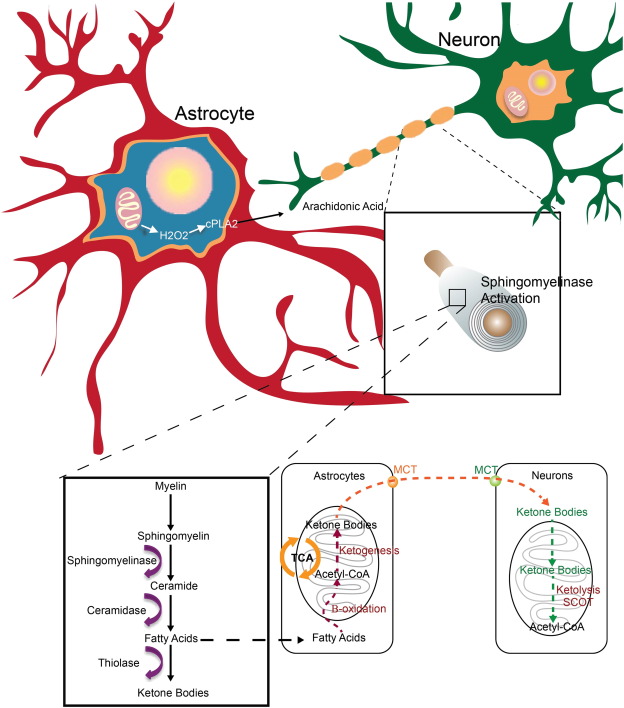
Findings from this study replicate our earlier findings that age of reproductive senescence is associated with decline in mitochondrial respiration, increased H2O2 production and shift to ketogenic metabolism in brain (Yao et al., 2010, Ding et al., 2013, Yin et al., 2015). These well established early age-related changes in mitochondrial function and shift to ketone body utilization in brain, are now linked to a mechanistic pathway that connects early decline in mitochondrial respiration and H2O2 production to activation of the cPLA2-sphingomyelinase pathway to catabolize myelin lipids resulting in WM degeneration (Fig. 12). These lipids are sequestered in lipid droplets for subsequent use as a local source of ketone body generation via astrocyte mediated beta-oxidation of fatty acids. Astrocyte derived ketone bodies can then be transported to neurons where they undergo ketolysis to generate acetyl-CoA for TCA derived ATP generation required for synaptic and cell function (Fig. 12).

Thumbnail image of Fig. 12. Opens large image

http://www.ebiomedicine.com/cms/attachment/2040395791/2053874721/gr12.sml

Fig. 12

Schematic model of mitochondrial H2O2 activation of cPLA2-sphingomyelinase pathway as an adaptive response to provide myelin derived fatty acids as a substrate for ketone body generation: The cPLA2-sphingomyelinase pathway is proposed as a mechanistic pathway that links an early event, mitochondrial dysfunction and H2O2, in the prodromal/preclinical phase of Alzheimer’s with later stage development of pathology, white matter degeneration. Our findings demonstrate that an age dependent deficit in mitochondrial respiration and a concomitant rise in oxidative stress activate an adaptive cPLA2-sphingomyelinase pathway to provide myelin derived fatty acids as a substrate for ketone body generation to fuel an energetically compromised brain.

Biochemical evidence obtained from isolated whole brain mitochondria confirms that during reproductive senescence and in response to estrogen deprivation brain mitochondria decline in respiratory capacity (Yao et al., 2009, Yao et al., 2010, Brinton, 2008a, Brinton, 2008b, Swerdlow and Khan, 2009). A well-documented consequence of mitochondrial dysfunction is increased production of reactive oxygen species (ROS), specifically H2O2 (Boveris and Chance, 1973, Beal, 2005, Yin et al., 2014, Yap et al., 2009). While most research focuses on the damage generated by free radicals, in this case H2O2 functions as a signaling molecule to activate cPLA2, the initiating enzyme in the cPLA2-sphingomyelinase pathway (Farooqui and Horrocks, 2006, Han et al., 2003, Sun et al., 2004). In AD brain, increased cPLA2 immunoreactivity is detected almost exclusively in astrocytes suggesting that activation of the cPLA2-sphingomyelinase pathway is localized to astrocytes in AD, as opposed to the neuronal or oligodendroglial localization that is observed during apoptosis (Sun et al., 2004, Malaplate-Armand et al., 2006, Di Paolo and Kim, 2011, Stephenson et al., 1996,Stephenson et al., 1999). In our analysis, cPLA2 (Sanchez-Mejia and Mucke, 2010) activation followed the age-dependent rise in H2O2 production and was sustained at an elevated level.

Direct and robust activation of astrocytic cPLA2 by physiologically relevant concentrations of H2O2 was confirmed in vitro. Astrocytic involvement in the cPLA2-sphingomyelinase pathway was also indicated by an increase in cPLA2 positive astrocyte reactivity in WM tracts of reproductively incompetent mice. These data are consistent with findings from brains of persons with AD that demonstrate the same striking localization of cPLA2immunoreactivity within astrocytes, specifically in the hippocampal formation (Farooqui and Horrocks, 2004). While neurons and astrocytes contain endogenous levels of cPLA2, neuronal cPLA2 is activated by an influx of intracellular calcium, whereas astrocytic cPLA2 is directly activated by excessive generation of H2O2 (Sun et al., 2004, Xu et al., 2003, Tournier et al., 1997). Evidence of this cell type specific activation was confirmed by the activation of cPLA2 in astrocytes by H2O2 and the lack of activation in neurons. These data support that astrocytic, not neuronal, cPLA2 is the cellular mediator of the H2O2 dependent cPLA2-sphingomyelinase pathway activation and provide associative evidence supporting a role of astrocytic mitochondrial H2O2 in age-related WM catabolism.

The pattern of gene expression during the shift to reproductive senescence in the female mouse hippocampus recapitulates key observations in human AD brain tissue, specifically elevation in cPLA2, sphingomyelinase and ceramidase (Schaeffer et al., 2010, He et al., 2010, Li et al., 2014). Further, up-regulation of myelin synthesis, lipid metabolism and inflammatory genes in reproductively incompetent female mice is consistent with the gene expression pattern previously reported from aged male rodent hippocampus, aged female non-human primate hippocampus and human AD hippocampus (Blalock et al., 2003, Blalock et al., 2004, Blalock et al., 2010, Blalock et al., 2011, Kadish et al., 2009, Rowe et al., 2007). In these analyses of gene expression in aged male rodent hippocampus, aged female non-human primate hippocampus and human AD hippocampus down regulation of genes related to mitochondrial function, and up-regulation in multiple genes encoding for enzymes involved in ketone body metabolism occurred (Blalock et al., 2003, Blalock et al., 2004, Blalock et al., 2010, Blalock et al., 2011, Kadish et al., 2009, Rowe et al., 2007). The comparability across data derived from aging female mouse hippocampus reported herein and those derived from male rodent brain, female nonhuman brain and human AD brain strongly suggest that cPLA2-sphingomyelinase pathway activation, myelin sheath degeneration and fatty acid metabolism leading to ketone body generation is a metabolic adaptation that is generalizable across these naturally aging models and are evident in aged human AD brain. Collectively, these data support the translational relevance of findings reported herein.

Data obtained via immunohistochemistry, electron microscopy and MBP protein analyses demonstrated an age-related loss in myelin sheath integrity. Evidence for a loss of myelin structural integrity emerged in reproductively incompetent mice following activation of the cPLA2-sphingomyelinase pathway. The unraveling myelin phenotype observed following reproductive senescence and aging reported herein is consistent with the degenerative phenotype that emerges following exposure to the chemotherapy drug bortezomib which induces mitochondrial dysfunction and increased ROS generation (Carozzi et al., 2010, Cavaletti et al., 2007,Ling et al., 2003). In parallel to the decline in myelin integrity, lipid droplet density increased. In aged mice, accumulation of lipid droplets declined in parallel to the rise in ketone bodies consistent with the utilization of myelin-derived fatty acids to generate ketone bodies. Due to the sequential relationship between WM degeneration and lipid droplet formation, we posit that lipid droplets serve as a temporary storage site for myelin-derived fatty acids prior to undergoing β-oxidation in astrocytes to generate ketone bodies.

Microstructural alterations in myelin integrity were associated with alterations in the lipid profile of brain, indicative of WM degeneration resulting in release of myelin lipids. Sphingomyelin and galactocerebroside are two main lipids that compose the myelin sheath (Baumann and Pham-Dinh, 2001). Ceramide is common to both galactocerebroside and sphingomyelin and is composed of sphingosine coupled to a fatty acid. Ceramide levels increase in aging, in states of ketosis and in neurodegeneration (Filippov et al., 2012, Blazquez et al., 1999, Costantini et al., 2005). Specifically, ceramide levels are elevated at the earliest clinically recognizable stage of AD, indicating a degree of WM degeneration early in disease progression (Di Paolo and Kim, 2011,Han et al., 2002, Costantini et al., 2005). Sphingosine is statistically significantly elevated in the brains of AD patients compared to healthy controls; a rise that was significantly correlated with acid sphingomyelinase activity, Aβ levels and tau hyperphosphorylation (He et al., 2010). In our analyses, a rise in ceramides was first observed early in the aging process in reproductively incompetent mice. The rise in ceramides was coincident with the emergence of loss of myelin integrity consistent with the release of myelin ceramides from sphingomyelin via sphingomyelinase activation. Following the rise in ceramides, sphingosine and fatty acid levels increased. The temporal sequence of the lipid profile was consistent with gene expression indicating activation of ceramidase for catabolism of ceramide into sphingosine and fatty acid during reproductive senescence. Once released from ceramide, fatty acids can be transported into the mitochondrial matrix of astrocytes via CPT-1, where β-oxidation of fatty acids leads to the generation of acetyl-CoA (Glatz et al., 2010). It is well documented that acetyl-CoA cannot cross the inner mitochondrial membrane, thus posing a barrier to direct transport of acetyl-CoA generated by β-oxidation into neurons. In response, the newly generated acetyl-CoA undergoes ketogenesis to generate ketone bodies to fuel energy demands of neurons (Morris, 2005,Guzman and Blazquez, 2004, Stacpoole, 2012). Because astrocytes serve as the primary location of β-oxidation in brain they are critical to maintaining neuronal metabolic viability during periods of reduced glucose utilization (Panov et al., 2014, Ebert et al., 2003, Guzman and Blazquez, 2004).

Once fatty acids are released from myelin ceramides, they are transported into astrocytic mitochondria by CPT1 to undergo β-oxidation. The mitochondrial trifunctional protein HADHA catalyzes the last three steps of mitochondrial β-oxidation of long chain fatty acids, while mitochondrial ABAD (aka SCHAD—short chain fatty acid dehydrogenase) metabolizes short chain fatty acids. Concurrent with the release of myelin fatty acids in aged female mice, CPT1, HADHA and ABAD protein expression as well as ketone body generation increased significantly. These findings indicate that astrocytes play a pivotal role in the response to bioenergetic crisis in brain to activate an adaptive compensatory system that activates catabolism of myelin lipids and the metabolism of those lipids into fatty acids to generate ketone bodies necessary to fuel neuronal demand for acetyl-CoA and ATP.

Collectively, these findings provide a mechanistic pathway that links mitochondrial dysfunction and H2O2generation in brain early in the aging process to later stage white matter degeneration. Astrocytes play a pivotal role in providing a mechanistic strategy to address the bioenergetic demand of neurons in the aging female brain. While this pathway is coincident with reproductive aging in the female brain, it is likely to have mechanistic translatability to the aging male brain. Further, the mechanistic link between bioenergetic decline and WM degeneration has potential relevance to other neurological diseases involving white matter in which postmenopausal women are at greater risk, such as multiple sclerosis. The mechanistic pathway reported herein spans time and is characterized by a progression of early adaptive changes in the bioenergetic system of the brain leading to WM degeneration and ketone body production. Translationally, effective therapeutics to prevent, delay and treat WM degeneration during aging and Alzheimer’s disease will need to specifically target stages within the mechanistic pathway described herein. The fundamental initiating event is a bioenergetic switch from being a glucose dependent brain to a glucose and ketone body dependent brain. It remains to be determined whether it is possible to prevent conversion to or reversal of a ketone dependent brain. Effective therapeutic strategies to intervene in this process require biomarkers of bioenergetic phenotype of the brain and stage of mechanistic progression. The mechanistic pathway reported herein may have relevance to other age-related neurodegenerative diseases characterized by white matter degeneration such as multiple sclerosis.

Blood. 2015 Oct 15;126(16):1925-9.    http://dx.doi.org:/10.1182/blood-2014-12-617498. Epub 2015 Aug 14.
Targeting the leukemia cell metabolism by the CPT1a inhibition: functional preclinical effects in leukemias.
Cancer cells are characterized by perturbations of their metabolic processes. Recent observations demonstrated that the fatty acid oxidation (FAO) pathway may represent an alternative carbon source for anabolic processes in different tumors, therefore appearing particularly promising for therapeutic purposes. Because the carnitine palmitoyl transferase 1a (CPT1a) is a protein that catalyzes the rate-limiting step of FAO, here we investigated the in vitro antileukemic activity of the novel CPT1a inhibitor ST1326 on leukemia cell lines and primary cells obtained from patients with hematologic malignancies. By real-time metabolic analysis, we documented that ST1326 inhibited FAO in leukemia cell lines associated with a dose- and time-dependent cell growth arrest, mitochondrial damage, and apoptosis induction. Data obtained on primary hematopoietic malignant cells confirmed the FAO inhibition and cytotoxic activity of ST1326, particularly on acute myeloid leukemia cells. These data suggest that leukemia treatment may be carried out by targeting metabolic processes.
Oncogene. 2015 Oct 12.   http://dx.doi.org:/10.1038/onc.2015.394. [Epub ahead of print]
Tumour-suppression function of KLF12 through regulation of anoikis.
Suppression of detachment-induced cell death, known as anoikis, is an essential step for cancer metastasis to occur. We report here that expression of KLF12, a member of the Kruppel-like family of transcription factors, is downregulated in lung cancer cell lines that have been selected to grow in the absence of cell adhesion. Knockdown of KLF12 in parental cells results in decreased apoptosis following cell detachment from matrix. KLF12 regulates anoikis by promoting the cell cycle transition through S phase and therefore cell proliferation. Reduced expression levels of KLF12 results in increased ability of lung cancer cells to form tumours in vivo and is associated with poorer survival in lung cancer patients. We therefore identify KLF12 as a novel metastasis-suppressor gene whose loss of function is associated with anoikis resistance through control of the cell cycle.
Mol Cell. 2015 Oct 14. pii: S1097-2765(15)00764-9. doi: 10.1016/j.molcel.2015.09.025. [Epub ahead of print]
PEPCK Coordinates the Regulation of Central Carbon Metabolism to Promote Cancer Cell Growth.
Phosphoenolpyruvate carboxykinase (PEPCK) is well known for its role in gluconeogenesis. However, PEPCK is also a key regulator of TCA cycle flux. The TCA cycle integrates glucose, amino acid, and lipid metabolism depending on cellular needs. In addition, biosynthetic pathways crucial to tumor growth require the TCA cycle for the processing of glucose and glutamine derived carbons. We show here an unexpected role for PEPCK in promoting cancer cell proliferation in vitro and in vivo by increasing glucose and glutamine utilization toward anabolic metabolism. Unexpectedly, PEPCK also increased the synthesis of ribose from non-carbohydrate sources, such as glutamine, a phenomenon not previously described. Finally, we show that the effects of PEPCK on glucose metabolism and cell proliferation are in part mediated via activation of mTORC1. Taken together, these data demonstrate a role for PEPCK that links metabolic flux and anabolic pathways to cancer cell proliferation.
Mol Cancer Res. 2015 Oct;13(10):1408-20.   http://dx.doi.org:/10.1158/1541-7786.MCR-15-0048. Epub 2015 Jun 16.
Disruption of Proline Synthesis in Melanoma Inhibits Protein Production Mediated by the GCN2 Pathway.
Many processes are deregulated in melanoma cells and one of those is protein production. Although much is known about protein synthesis in cancer cells, effective ways of therapeutically targeting this process remain an understudied area of research. A process that is upregulated in melanoma compared with normal melanocytes is proline biosynthesis, which has been linked to both oncogene and tumor suppressor pathways, suggesting an important convergent point for therapeutic intervention. Therefore, an RNAi screen of a kinase library was undertaken, identifying aldehyde dehydrogenase 18 family, member A1 (ALDH18A1) as a critically important gene in regulating melanoma cell growth through proline biosynthesis. Inhibition of ALDH18A1, the gene encoding pyrroline-5-carboxylate synthase (P5CS), significantly decreased cultured melanoma cell viability and tumor growth. Knockdown of P5CS using siRNA had no effect on apoptosis, autophagy, or the cell cycle but cell-doubling time increased dramatically suggesting that there was a general slowdown in cellular metabolism. Mechanistically, targeting ALDH18A1 activated the serine/threonine protein kinase GCN2 (general control nonderepressible 2) to inhibit protein synthesis, which could be reversed with proline supplementation. Thus, targeting ALDH18A1 in melanoma can be used to disrupt proline biosynthesis to limit cell metabolism thereby increasing the cellular doubling time mediated through the GCN2 pathway.  This study demonstrates that melanoma cells are sensitive to disruption of proline synthesis and provides a proof-of-concept that the proline synthesis pathway can be therapeutically targeted in melanoma tumors for tumor inhibitory efficacy. Mol Cancer Res; 13(10); 1408-20. ©2015 AACR.
SDHB-Deficient Cancers: The Role of Mutations That Impair Iron Sulfur Cluster Delivery.
BACKGROUND:  Mutations in the Fe-S cluster-containing SDHB subunit of succinate dehydrogenase cause familial cancer syndromes. Recently the tripeptide motif L(I)YR was identified in the Fe-S recipient protein SDHB, to which the cochaperone HSC20 binds.
METHODS:   In order to characterize the metabolic basis of SDH-deficient cancers we performed stable isotope-resolved metabolomics in a novel SDHB-deficient renal cell carcinoma cell line and conducted bioinformatics and biochemical screening to analyze Fe-S cluster acquisition and assembly of SDH in the presence of other cancer-causing SDHB mutations.

RESULTS:

We found that the SDHB(R46Q) mutation in UOK269 cells disrupted binding of HSC20, causing rapid degradation of SDHB. In the absence of SDHB, respiration was undetectable in UOK269 cells, succinate was elevated to 351.4±63.2 nmol/mg cellular protein, and glutamine became the main source of TCA cycle metabolites through reductive carboxylation. Furthermore, HIF1α, but not HIF2α, increased markedly and the cells showed a strong DNA CpG island methylator phenotype (CIMP). Biochemical and bioinformatic screening revealed that 37% of disease-causing missense mutations in SDHB were located in either the L(I)YR Fe-S transfer motifs or in the 11 Fe-S cluster-ligating cysteines.

CONCLUSIONS:

These findings provide a conceptual framework for understanding how particular mutations disproportionately cause the loss of SDH activity, resulting in accumulation of succinate and metabolic remodeling in SDHB cancer syndromes.


SR4 Uncouples Mitochondrial Oxidative Phosphorylation, Modulates AMPK-mTOR Signaling, and Inhibits Proliferation of HepG2 Hepatocarcinoma Cells

  1. L. Figarola, J. Singhal, J. D. Tompkins, G. W. Rogers, C. Warden, D. Horne, A. D. Riggs, S. Awasthi and S. S. Singhal.

J Biol Chem. 2015 Nov 3, [epub ahead of print]


CD47 Receptor Globally Regulates Metabolic Pathways That Control Resistance to Ionizing Radiation

  1. W. Miller, D. R. Soto-Pantoja, A. L. Schwartz, J. M. Sipes, W. G. DeGraff, L. A. Ridnour, D. A. Wink and D. D. Roberts.

J Biol Chem. 2015 Oct 9, 290 (41): 24858-74.


Knockdown of PKM2 Suppresses Tumor Growth and Invasion in Lung Adenocarcinoma

  1. Sun, A. Zhu, L. Zhang, J. Zhang, Z. Zhong and F. Wang.

Int J Mol Sci. 2015 Oct 15, 16 (10): 24574-87.


EglN2 associates with the NRF1-PGC1alpha complex and controls mitochondrial function in breast cancer

  1. Zhang, C. Wang, X. Chen, M. Takada, C. Fan, X. Zheng, H. Wen, Y. Liu, C. Wang, R. G. Pestell, K. M. Aird, W. G. Kaelin, Jr., X. S. Liu and Q. Zhang.

EMBO J. 2015 Oct 22, [epub ahead of print]


Mitochondrial Genetics Regulate Breast Cancer Tumorigenicity and Metastatic Potential.

Current paradigms of carcinogenic risk suggest that genetic, hormonal, and environmental factors influence an individual’s predilection for developing metastatic breast cancer. Investigations of tumor latency and metastasis in mice have illustrated differences between inbred strains, but the possibility that mitochondrial genetic inheritance may contribute to such differences in vivo has not been directly tested. In this study, we tested this hypothesis in mitochondrial-nuclear exchange mice we generated, where cohorts shared identical nuclear backgrounds but different mtDNA genomes on the background of the PyMT transgenic mouse model of spontaneous mammary carcinoma. In this setting, we found that primary tumor latency and metastasis segregated with mtDNA, suggesting that mtDNA influences disease progression to a far greater extent than previously appreciated. Our findings prompt further investigation into metabolic differences controlled by mitochondrial process as a basis for understanding tumor development and metastasis in individual subjects. Importantly, differences in mitochondrial DNA are sufficient to fundamentally alter disease course in the PyMT mouse mammary tumor model, suggesting that functional metabolic differences direct early tumor growth and metastatic efficiency. Cancer Res; 75(20); 4429-36. ©2015 AACR.


Cancer Lett. 2015 Oct 29. pii: S0304-3835(15)00656-4.    http://dx.doi.org:/10.1016/j.canlet.2015.10.025. [Epub ahead of print]
Carboxyamidotriazole inhibits oxidative phosphorylation in cancer cells and exerts synergistic anti-cancer effect with glycolysis inhibition.

Targeting cancer cell metabolism is a promising strategy against cancer. Here, we confirmed that the anti-cancer drug carboxyamidotriazole (CAI) inhibited mitochondrial respiration in cancer cells for the first time and found a way to enhance its anti-cancer activity by further disturbing the energy metabolism. CAI promoted glucose uptake and lactate production when incubated with cancer cells. The oxidative phosphorylation (OXPHOS) in cancer cells was inhibited by CAI, and the decrease in the activity of the respiratory chain complex I could be one explanation. The anti-cancer effect of CAI was greatly potentiated when being combined with 2-deoxyglucose (2-DG). The cancer cells treated with the combination of CAI and 2-DG were arrested in G2/M phase. The apoptosis and necrosis rates were also increased. In a mouse xenograft model, this combination was well tolerated and retarded the tumor growth. The impairment of cancer cell survival was associated with significant cellular ATP decrease, suggesting that the combination of CAI and 2-DG could be one of the strategies to cause dual inhibition of energy pathways, which might be an effective therapeutic approach for a broad spectrum of tumors.


Cancer Immunol Res. 2015 Nov;3(11):1236-47.    http://dx.doi.org:/10.1158/2326-6066.CIR-15-0036. Epub 2015 May 29.
Inhibition of Fatty Acid Oxidation Modulates Immunosuppressive Functions of Myeloid-Derived Suppressor Cells and Enhances Cancer Therapies.

Myeloid-derived suppressor cells (MDSC) promote tumor growth by inhibiting T-cell immunity and promoting malignant cell proliferation and migration. The therapeutic potential of blocking MDSC in tumors has been limited by their heterogeneity, plasticity, and resistance to various chemotherapy agents. Recent studies have highlighted the role of energy metabolic pathways in the differentiation and function of immune cells; however, the metabolic characteristics regulating MDSC remain unclear. We aimed to determine the energy metabolic pathway(s) used by MDSC, establish its impact on their immunosuppressive function, and test whether its inhibition blocks MDSC and enhances antitumor therapies. Using several murine tumor models, we found that tumor-infiltrating MDSC (T-MDSC) increased fatty acid uptake and activated fatty acid oxidation (FAO). This was accompanied by an increased mitochondrial mass, upregulation of key FAO enzymes, and increased oxygen consumption rate. Pharmacologic inhibition of FAO blocked immune inhibitory pathways and functions in T-MDSC and decreased their production of inhibitory cytokines. FAO inhibition alone significantly delayed tumor growth in a T-cell-dependent manner and enhanced the antitumor effect of adoptive T-cell therapy. Furthermore, FAO inhibition combined with low-dose chemotherapy completely inhibited T-MDSC immunosuppressive effects and induced a significant antitumor effect. Interestingly, a similar increase in fatty acid uptake and expression of FAO-related enzymes was found in human MDSC in peripheral blood and tumors. These results support the possibility of testing FAO inhibition as a novel approach to block MDSC and enhance various cancer therapies. Cancer Immunol Res; 3(11); 1236-47. ©2015 AACR.


Ionizing radiation induces myofibroblast differentiation via lactate dehydrogenase

  1. L. Judge, K. M. Owens, S. J. Pollock, C. F. Woeller, T. H. Thatcher, J. P. Williams, R. P. Phipps, P. J. Sime and R. M. Kottmann.

Am J Physiol Lung Cell Mol Physiol. 2015 Oct 15, 309 (8): L879-87.


Vitamin C selectively kills KRAS and BRAF mutant colorectal cancer cells by targeting GAPDH

  1. Yun, E. Mullarky, C. Lu, K. N. Bosch, A. Kavalier, K. Rivera, J. Roper, Chio, II, E. G. Giannopoulou, C. Rago, A. Muley, J. M. Asara, J. Paik, O. Elemento, Z. Chen, D. J. Pappin, L. E. Dow, N. Papadopoulos, S. S. Gross and L. C. Cantley.

Science. 2015 Nov 5, [epub ahead of print]


Down-regulation of FBP1 by ZEB1-mediated repression confers to growth and invasion in lung cancer cells

  1. Zhang, J. Wang, H. Xing, Q. Li, Q. Zhao and J. Li.

Mol Cell Biochem. 2015 Nov 6, [epub ahead of print]


J Mol Cell Cardiol. 2015 Oct 23. pii: S0022-2828(15)30073-0.     http://dx.doi.org:/10.1016/j.yjmcc.2015.10.002. [Epub ahead of print]
GRK2 compromises cardiomyocyte mitochondrial function by diminishing fatty acid-mediated oxygen consumption and increasing superoxide levels.

The G protein-coupled receptor kinase-2 (GRK2) is upregulated in the injured heart and contributes to heart failure pathogenesis. GRK2 was recently shown to associate with mitochondria but its functional impact in myocytes due to this localization is unclear. This study was undertaken to determine the effect of elevated GRK2 on mitochondrial respiration in cardiomyocytes. Sub-fractionation of purified cardiac mitochondria revealed that basally GRK2 is found in multiple compartments. Overexpression of GRK2 in mouse cardiomyocytes resulted in an increased amount of mitochondrial-based superoxide. Inhibition of GRK2 increased oxygen consumption rates and ATP production. Moreover, fatty acid oxidation was found to be significantly impaired when GRK2 was elevated and was dependent on the catalytic activity and mitochondrial localization of this kinase. Our study shows that independent of cardiac injury, GRK2 is localized in the mitochondria and its kinase activity negatively impacts the function of this organelle by increasing superoxide levels and altering substrate utilization for energy production.


Br J Pharmacol. 2015 Oct 27. doi: 10.1111/bph.13377. [Epub ahead of print]
All-trans retinoic acid protects against doxorubicin-induced cardiotoxicity by activating the Erk2 signalling pathway.
BACKGROUND AND PURPOSE:

Doxorubicin (Dox) is a powerful antineoplastic agent for treating a wide range of cancers. However, doxorubicin cardiotoxicity of the heart has largely limited its clinical use. It is known that all-trans retinoic acid (ATRA) plays important roles in many cardiac biological processes, however, the protective effects of ATRA on doxorubicin cardiotoxicity remain unknown. Here, we studied the effect of ATRA on doxorubicin cardiotoxicity and underlying mechanisms.

EXPERIMENTAL APPROACHES:

Cellular viability assays, western blotting and mitochondrial respiration analyses were employed to evaluate the cellular response to ATRA in H9c2 cells and primary cardiomyocytes. Quantitative PCR (Polymerase Chain Reaction) and gene knockdown were performed to investigate the underlying molecular mechanisms of ATRA’s effects on doxorubicin cardiotoxicity.

KEY RESULTS:

ATRA significantly inhibited doxorubicin-induced apoptosis in H9c2 cells and primary cardiomyocytes. ATRA was more effective against doxorubicin cardiotoxicity than resveratrol and dexrazoxane. ATRA also suppressed reactive oxygen species (ROS) generation, and restored the expression level of mRNA and proteins in phase II detoxifying enzyme system: Nrf2 (nuclear factor-E2-related factor 2), MnSOD (manganese superoxide dismutase), HO-1 (heme oxygenase1) as well as mitochondrial function (mitochondrial membrane integrity, mitochondrial DNA copy numbers, mitochondrial respiration capacity, biogenesis and dynamics). Both Erk1/2 (extracellular signal-regulated kinase1/2) inhibitor (U0126) and Erk2 siRNA, but not Erk1 siRNA, abolished the protective effect of ATRA against doxorubicin-induced toxicity in H9c2 cells. Remarkably, ATRA did not compromise the anticancer efficacy of doxorubicin in gastric carcinoma cells.

CONCLUSION AND IMPLICATION:

ATRA protected cardiomyocytes against doxorubicin-induced toxicity by activating the Erk2 pathway without compromising the anticancer efficacy of doxorubicin. Therefore, ATRA may be a promising candidate as a cardioprotective agent against doxorubicin cardiotoxicity.


Proteomic and Biochemical Studies of Lysine Malonylation Suggest Its Malonic Aciduria-associated Regulatory Role in Mitochondrial Function and Fatty Acid Oxidation

  1. Colak, O. Pougovkina, L. Dai, M. Tan, H. Te Brinke, H. Huang, Z. Cheng, J. Park, X. Wan, X. Liu, W. W. Yue, R. J. Wanders, J. W. Locasale, D. B. Lombard, V. C. de Boer and Y. Zhao.

Mol Cell Proteomics. 2015 Nov 1, 14 (11): 3056-71.


Foxg1 localizes to mitochondria and coordinates cell differentiation and bioenergetics

  1. Pancrazi, G. Di Benedetto, L. Colombaioni, G. Della Sala, G. Testa, F. Olimpico, A. Reyes, M. Zeviani, T. Pozzan and M. Costa.

Proc Natl Acad Sci U S A. 2015 Oct 27, 112(45): 13910-5.


Evidence of Mitochondrial Dysfunction within the Complex Genetic Etiology of Schizophrenia

  1. E. Hjelm, B. Rollins, F. Mamdani, J. C. Lauterborn, G. Kirov, G. Lynch, C. M. Gall, A. Sequeira and M. P. Vawter.

Mol Neuropsychiatry. 2015 Nov 1, 1 (4): 201-219.


Metabolic Reprogramming Is Required for Myofibroblast Contractility and Differentiation

  1. Bernard, N. J. Logsdon, S. Ravi, N. Xie, B. P. Persons, S. Rangarajan, J. W. Zmijewski, K. Mitra, G. Liu, V. M. Darley-Usmar and V. J. Thannickal.

J Biol Chem. 2015 Oct 16, 290 (42): 25427-38.


J Biol Chem. 2015 Oct 23;290(43):25834-46.    http://dx.doi.org:/10.1074/jbc.M115.658815. Epub 2015 Sep 4.
Kinome Screen Identifies PFKFB3 and Glucose Metabolism as Important Regulators of the Insulin/Insulin-like Growth Factor (IGF)-1 Signaling Pathway.

The insulin/insulin-like growth factor (IGF)-1 signaling pathway (ISP) plays a fundamental role in long term health in a range of organisms. Protein kinases including Akt and ERK are intimately involved in the ISP. To identify other kinases that may participate in this pathway or intersect with it in a regulatory manner, we performed a whole kinome (779 kinases) siRNA screen for positive or negative regulators of the ISP, using GLUT4 translocation to the cell surface as an output for pathway activity. We identified PFKFB3, a positive regulator of glycolysis that is highly expressed in cancer cells and adipocytes, as a positive ISP regulator. Pharmacological inhibition of PFKFB3 suppressed insulin-stimulated glucose uptake, GLUT4 translocation, and Akt signaling in 3T3-L1 adipocytes. In contrast, overexpression of PFKFB3 in HEK293 cells potentiated insulin-dependent phosphorylation of Akt and Akt substrates. Furthermore, pharmacological modulation of glycolysis in 3T3-L1 adipocytes affected Akt phosphorylation. These data add to an emerging body of evidence that metabolism plays a central role in regulating numerous biological processes including the ISP. Our findings have important implications for diseases such as type 2 diabetes and cancer that are characterized by marked disruption of both metabolism and growth factor signaling.


FASEB J. 2015 Oct 19.    http://dx.doi.org:/pii: fj.15-276360. [Epub ahead of print]
Perm1 enhances mitochondrial biogenesis, oxidative capacity, and fatigue resistance in adult skeletal muscle.

Skeletal muscle mitochondrial content and oxidative capacity are important determinants of muscle function and whole-body health. Mitochondrial content and function are enhanced by endurance exercise and impaired in states or diseases where muscle function is compromised, such as myopathies, muscular dystrophies, neuromuscular diseases, and age-related muscle atrophy. Hence, elucidating the mechanisms that control muscle mitochondrial content and oxidative function can provide new insights into states and diseases that affect muscle health. In past studies, we identified Perm1 (PPARGC1- and ESRR-induced regulator, muscle 1) as a gene induced by endurance exercise in skeletal muscle, and regulating mitochondrial oxidative function in cultured myotubes. The capacity of Perm1 to regulate muscle mitochondrial content and function in vivo is not yet known. In this study, we use adeno-associated viral (AAV) vectors to increase Perm1 expression in skeletal muscles of 4-wk-old mice. Compared to control vector, AAV1-Perm1 leads to significant increases in mitochondrial content and oxidative capacity (by 40-80%). Moreover, AAV1-Perm1-transduced muscles show increased capillary density and resistance to fatigue (by 33 and 31%, respectively), without prominent changes in fiber-type composition. These findings suggest that Perm1 selectively regulates mitochondrial biogenesis and oxidative function, and implicate Perm1 in muscle adaptations that also occur in response to endurance exercise.-Cho, Y., Hazen, B. C., Gandra, P. G., Ward, S. R., Schenk, S., Russell, A. P., Kralli, A. Perm1 enhances mitochondrial biogenesis, oxidative capacity, and fatigue resistance in adult skeletal muscle.


A conserved MADS-box phosphorylation motif regulates differentiation and mitochondrial function in skeletal, cardiac, and smooth muscle cells.
Exposure to metabolic disease during fetal development alters cellular differentiation and perturbs metabolic homeostasis, but the underlying molecular regulators of this phenomenon in muscle cells are not completely understood. To address this, we undertook a computational approach to identify cooperating partners of the myocyte enhancer factor-2 (MEF2) family of transcription factors, known regulators of muscle differentiation and metabolic function. We demonstrate that MEF2 and the serum response factor (SRF) collaboratively regulate the expression of numerous muscle-specific genes, including microRNA-133a (miR-133a). Using tandem mass spectrometry techniques, we identify a conserved phosphorylation motif within the MEF2 and SRF Mcm1 Agamous Deficiens SRF (MADS)-box that regulates miR-133a expression and mitochondrial function in response to a lipotoxic signal. Furthermore, reconstitution of MEF2 function by expression of a neutralizing mutation in this identified phosphorylation motif restores miR-133a expression and mitochondrial membrane potential during lipotoxicity. Mechanistically, we demonstrate that miR-133a regulates mitochondrial function through translational inhibition of a mitophagy and cell death modulating protein, called Nix. Finally, we show that rodents exposed to gestational diabetes during fetal development display muscle diacylglycerol accumulation, concurrent with insulin resistance, reduced miR-133a, and elevated Nix expression, as young adult rats. Given the diverse roles of miR-133a and Nix in regulating mitochondrial function, and proliferation in certain cancers, dysregulation of this genetic pathway may have broad implications involving insulin resistance, cardiovascular disease, and cancer biology.


Read Full Post »

Irreconciliable Dissonance in Physical Space and Cellular Metabolic Conception

Irreconciliable Dissonance in Physical Space and Cellular Metabolic Conception

Curator: Larry H. Bernstein, MD, FCAP

Pasteur Effect – Warburg Effect – What its history can teach us today. 

José Eduardo de Salles Roselino

The Warburg effect, in reality the “Pasteur-effect” was the first example of metabolic regulation described. A decrease in the carbon flux originated at the sugar molecule towards the end of the catabolic pathway, with ethanol and carbon dioxide observed when yeast cells were transferred from an anaerobic environmental condition to an aerobic one. In Pasteur´s studies, sugar metabolism was measured mainly by the decrease of sugar concentration in the yeast growth media observed after a measured period of time. The decrease of the sugar concentration in the media occurs at great speed in yeast grown in anaerobiosis (oxygen deficient) and its speed was greatly reduced by the transfer of the yeast culture to an aerobic condition. This finding was very important for the wine industry of France in Pasteur’s time, since most of the undesirable outcomes in the industrial use of yeast were perceived when yeasts cells took a very long time to create, a rather selective anaerobic condition. This selective culture media was characterized by the higher carbon dioxide levels produced by fast growing yeast cells and by a higher alcohol content in the yeast culture media.

However, in biochemical terms, this finding was required to understand Lavoisier’s results indicating that chemical and biological oxidation of sugars produced the same calorimetric (heat generation) results. This observation requires a control mechanism (metabolic regulation) to avoid burning living cells by fast heat released by the sugar biological oxidative processes (metabolism). In addition, Lavoisier´s results were the first indications that both processes happened inside similar thermodynamics limits. In much resumed form, these observations indicate the major reasons that led Warburg to test failure in control mechanisms in cancer cells in comparison with the ones observed in normal cells.

[It might be added that the availability of O2 and CO2 and climatic conditions over 750 million years that included volcanic activity, tectonic movements of the earth crust, and glaciation, and more recently the use of carbon fuels and the extensive deforestation of our land masses have had a large role in determining the biological speciation over time, in sea and on land. O2 is generated by plants utilizing energy from the sun and conversion of CO2. Remove the plants and we tip the balance. A large source of CO2 is from beneath the earth’s surface.]

Biology inside classical thermodynamics places some challenges to scientists. For instance, all classical thermodynamics must be measured in reversible thermodynamic conditions. In an isolated system, increase in P (pressure) leads to increase in V (volume), all this occurring in a condition in which infinitesimal changes in one affects in the same way the other, a continuum response. Not even a quantic amount of energy will stand beyond those parameters.

In a reversible system, a decrease in V, under same condition, will led to an increase in P. In biochemistry, reversible usually indicates a reaction that easily goes either from A to B or B to A. For instance, when it was required to search for an anti-ischemic effect of Chlorpromazine in an extra hepatic obstructed liver, it was necessary to use an adequate system of increased biliary system pressure in a reversible manner to exclude a direct effect of this drug over the biological system pressure inducer (bile secretion) in Braz. J. Med. Biol. Res 1989; 22: 889-893. Frequently, these details are jumped over by those who read biology in ATGC letters.

Very important observations can be made in this regard, when neutral mutations are taken into consideration since, after several mutations (not affecting previous activity and function), a last mutant may provide a new transcript RNA for a protein and elicit a new function. For an example, consider a Prion C from lamb getting similar to bovine Prion C while preserving  its normal role in the lamb when its ability to change Human Prion C is considered (Stanley Prusiner).

This observation is good enough, to confirm one of the most important contributions of Erwin Schrodinger in his What is Life:

“This little book arose from a course of public lectures, delivered by a theoretical physicist to an audience of about four hundred which did not substantially dwindle, though warned at the outset that the subject matter was a difficult one and that the lectures could not be termed popular, even though the physicist’s most dreaded weapon, mathematical deduction, would hardly be utilized. The reason for this was not that the subject was simple enough to be explained without mathematics, but rather that it was much too involved to be fully accessible to mathematics.”

After Hans Krebs, description of the cyclic nature of the citrate metabolism and after its followers described its requirement for aerobic catabolism two major lines of research started the search for the understanding of the mechanism of energy transfer that explains how ADP is converted into ATP. One followed the organic chemistry line of reasoning and therefore, searched for a mechanism that could explain how the breakdown of carbon-carbon link could have its energy transferred to ATP synthesis. One of the major leaders of this research line was Britton Chance. He took into account that relatively earlier in the series of Krebs cycle reactions, two carbon atoms of acetyl were released as carbon dioxide ( In fact, not the real acetyl carbons but those on the opposite side of citrate molecule). In stoichiometric terms, it was not important whether the released carbons were or were not exactly those originated from glucose carbons. His research aimed at to find out an intermediate proteinaceous intermediary that could act as an energy reservoir. The intermediary could store in a phosphorylated amino acid the energy of carbon-carbon bond breakdown. This activated amino acid could transfer its phosphate group to ADP producing ATP. A key intermediate involved in the transfer was identified by Kaplan and Lipmann at John Hopkins as acetyl coenzyme A, for which Fritz Lipmann received a Nobel Prize.

Alternatively, under possible influence of the excellent results of Hodgkin and Huxley a second line of research appears. The work of Hodgkin & Huxley indicated that the storage of electrical potential energy in transmembrane ionic asymmetries and presented the explanation for the change from resting to action potential in excitable cells. This second line of research, under the leadership of Peter Mitchell postulated a mechanism for the transfer of oxide/reductive power of organic molecules oxidation through electron transfer as the key for the energetic transfer mechanism required for ATP synthesis.
This diverted the attention from high energy (~P) phosphate bond to the transfer of electrons. During most of the time the harsh period of the two confronting points of view, Paul Boyer and followers attempted to act as a conciliatory third party, without getting good results, according to personal accounts (in L. A. or Latin America) heard from those few of our scientists who were able to follow the major scientific events held in USA, and who could present to us later. Paul  Boyer could present how the energy was transduced by a molecular machine that changes in conformation in a series of 3 steps while rotating in one direction in order to produce ATP and in opposite direction in order to produce ADP plus Pi from ATP (reversibility).

However, earlier, a victorious Peter Mitchell obtained the result in the conceptual dispute, over the Britton Chance point of view, after he used E. Coli mutants to show H+ gradients in the cell membrane and its use as energy source, for which he received a Nobel Prize. Somehow, this outcome represents such a blow to Chance’s previous work that somehow it seems to have cast a shadow over very important findings obtained during his earlier career that should not be affected by one or another form of energy transfer mechanism.  For instance, Britton Chance got the simple and rapid polarographic assay method of oxidative phosphorylation and the idea of control of energy metabolism that brings us back to Pasteur.

This metabolic alternative result seems to have been neglected in the recent years of obesity epidemics, which led to a search for a single molecular mechanism required for the understanding of the accumulation of chemical (adipose tissue) reserve in our body. It does not mean that here the role of central nervous system is neglected. In short, in respiring mitochondria the rate of electron transport linked to the rate of ATP production is determined primarily by the relative concentrations of ADP, ATP and phosphate in the external media (cytosol) and not by the concentration of respiratory substrate as pyruvate. Therefore, when the yield of ATP is high as it is in aerobiosis and the cellular use of ATP is not changed, the oxidation of pyruvate and therefore of glycolysis is quickly (without change in gene expression), throttled down to the resting state. The dependence of respiratory rate on ADP concentration is also seen in intact cells. A muscle at rest and using no ATP has a very low respiratory rate.   [When skeletal muscle is stressed by high exertion, lactic acid produced is released into the circulation and is metabolized aerobically by the heart at the end of the activity].

This respiratory control of metabolism will lead to preservation of body carbon reserves and in case of high caloric intake in a diet, also shows increase in fat reserves essential for our biological ancestors survival (Today for our obesity epidemics). No matter how important this observation is, it is only one focal point of metabolic control. We cannot reduce the problem of obesity to the existence of metabolic control. There are numerous other factors but on the other hand, we cannot neglect or remove this vital process in order to correct obesity. However, we cannot explain obesity ignoring this metabolic control. This topic is so neglected in modern times that we cannot follow major research lines of the past that were interrupted by the emerging molecular biology techniques and the vain belief that a dogmatic vision of biology could replace all previous knowledge by a new one based upon ATGC readings. For instance, in order to display bad consequences derived from the ignorance of these old scientific facts, we can take into account, for instance, how ion movements across membranes affects membrane protein conformation and therefore contradicts the wrong central dogma of molecular biology. This change in protein conformation (with unchanged amino acid sequence) and/or the lack of change in protein conformation is linked to the factors that affect vital processes as the heart beats. This modern ignorance could also explain some major pitfalls seen in new drugs clinical trials and in a small scale on bad medical practices.

The work of Britton Chance and of Peter Mitchell have deep and sound scientific roots that were made with excellent scientific techniques, supported by excellent scientific reasoning and that were produced in a large series of very important intermediary scientific results. Their sole difference was to aim at very different scientific explanations as their goals (They have different Teleology in their minds made by their previous experiences). When, with the use of mutants obtained in microorganisms P Mitchell´s goal was found to survive and B Chance to succumb to the experimental evidence, all those excellent findings of B Chance and followers were directed to the dustbin of scientific history as an example of lack of scientific consideration.  [On the one hand, the Mitchell model used a unicellular organism; on the other, Chance’s work was with eukaryotic cells, quite relevant to the discussion.]

We can resume the challenge faced by these two great scientists in the following form: The first conceptual unification in bioenergetics, achieved in the 1940s, is inextricably bound up with the name of Fritz Lipmann. Its central feature was the recognition that adenosine triphosphate, ATP, serves as a universal energy  “currency” much as money serves as economic currency. In a nutshell, the purpose of metabolism is to support the synthesis of ATP. In microorganisms, this is perfect! In humans or mammals, or vertebrates, by the same reason that we cannot consider that gene expression is equivalent to protein function (an acceptable error in the case of microorganisms) this oversimplifies the metabolic requirement with a huge error. However, in case our concern is ATP chemistry only, the metabolism produces ATP and the hydrolysis of ATP pays for the performance of almost, all kinds of works. It is possible to presume that to find out how the flow of metabolism (carbon flow) led to ATP production must be considered a major focal point of research of the two contenders. Consequently, what could be a minor fall of one of the contenders, in case we take into account all that was found during their entire life of research, the real failure in B Chance’s final goal was amplified far beyond what may be considered by reason!

Another aspect that must be taken into account: Both contenders have in the scientific past a very sound root. Metabolism may produce two forms of energy currency (I personally don´t like this expression*) and I use it here because it was used by both groups in order to express their findings. Together with simplistic thermodynamics, this expression conveys wrong ideas): The second kind of energy currency is the current of ions passing from one side of a membrane to the other. The P. Mitchell scientific root undoubtedly have the work of Hodgkin & Huxley, Huxley &  Huxley, Huxley & Simmons

*ATP is produced under the guidance of cell needs and not by its yield. When glucose yields only 2 ATPs per molecule it is oxidized at very high speed (anaerobiosis) as is required to match cellular needs. On the other hand, when it may yield (thermodynamic terms) 38 ATP the same molecule is oxidized at low speed. It would be similar to an investor choice its least money yield form for its investment (1940s to 1972) as a solid support. B. Chance had the enzymologists involved in clarifying how ATP could be produced directly from NADH + H+ oxidative reductive metabolic reactions or from the hydrolysis of an enolpyruvate intermediary. Both competitors had their work supported by different but, sound scientific roots and have produced very important scientific results while trying to present their hypothetical point of view.

Before the winning results of P. Mitchell were displayed, one line of defense used by B. Chance followers was to create a conflict between what would be expected by a restrictive role of proteins through its specificity ionic interactions and the general ability of ionic asymmetries that could be associated with mitochondrial ATP production. Chemical catalyzed protein activities do not have perfect specificity but an outstanding degree of selective interaction was presented by the lock and key model of enzyme interaction. A large group of outstanding “mitochondriologists” were able to show ATP synthesis associated with Na+, K+, Ca2+… asymmetries on mitochondrial membranes and any time they did this, P. Mitchell have to display the existence of antiporters that exchange X for hydrogen as the final common source of chemiosmotic energy used by mitochondria for ATP synthesis.

This conceptual battle has generated an enormous knowledge that was laid to rest, somehow discontinued in the form of scientific research, when the final E. Coli mutant studies presented the convincing final evidence in favor of P. Mitchell point of view.

Not surprisingly, a “wise anonymous” later, pointed out: “No matter what you are doing, you will always be better off in case you have a mutant”

(Principles of Medical Genetics T D Gelehrter & F.S. Collins chapter 7, 1990).

However, let’s take the example of a mechanical wristwatch. It clearly indicates when the watch is working in an acceptable way, that its normal functioning condition is not the result of one of its isolated components – or something that can be shown by a reductionist molecular view.  Usually it will be considered that it is working in an acceptable way, in case it is found that its accuracy falls inside a normal functional range, for instance, one or two standard deviations bellow or above the mean value for normal function, what depends upon the rigor wisely adopted. While, only when it has a faulty component (a genetic inborn error) we can indicate a single isolated piece as the cause of its failure (a reductionist molecular view).

We need to teach in medicine, first the major reasons why the watch works fine (not saying it is “automatic”). The functions may cross the reversible to irreversible regulatory limit change, faster than what we can imagine. Latter, when these ideas about normal are held very clear in the mind set of medical doctors (not medical technicians) we may address the inborn errors and what we may have learn from it. A modern medical technician may cause admiration when he uses an “innocent” virus to correct for a faulty gene (a rather impressive technological advance). However, in case the virus, later shows signals that indicate that it was not so innocent, a real medical doctor will be called upon to put things in correct place again.

Among the missing parts of normal evolution in biochemistry a lot about ion fluxes can be found. Even those oscillatory changes in Ca2+ that were shown to affect gene expression (C. De Duve) were laid to rest since, they clearly indicate a source of biological information that despite the fact that it does not change nucleotides order in the DNA, it shows an opposing flux of biological information against the dogma (DNA to RNA to proteins). Another, line has shown a hierarchy, on the use of mitochondrial membrane potential: First the potential is used for Ca2+ uptake and only afterwards, the potential is used for ADP conversion into ATP (A. L. Lehninger). In fact, the real idea of A. L. Lehninger was by far, more complex since according to him, mitochondria works like a buffer for intracellular calcium releasing it to outside in case of a deep decrease in cytosol levels or capturing it from cytosol when facing transient increase in Ca2+ load. As some of Krebs cycle dehydrogenases were activated by Ca2+, this finding was used to propose a new control factor in addition to the one of ADP (B. Chance). All this was discontinued with the wrong use of calculus (today we could indicate bioinformatics in a similar role) in biochemistry that has established less importance to a mitochondrial role after comparative kinetics that today are seen as faulty.

It is important to combat dogmatic reasoning and restore sound scientific foundations in basic medical courses that must urgently reverse the faulty trend that tries to impose a view that goes from the detail towards generalization instead of the correct form that goes from the general finding well understood towards its molecular details. The view that led to curious subjects as bioinformatics in medical courses as training in sequence finding activities can only be explained by its commercial value. The usual form of scientific thinking respects the limits of our ability to grasp new knowledge and relies on reproducibility of scientific results as a form to surpass lack of mathematical equation that defines relationship of variables and the determination of its functional domains. It also uses old scientific roots, as its sound support never replaces existing knowledge by dogmatic and/or wishful thinking. When the sequence of DNA was found as a technical advance to find amino acid sequence in proteins it was just a technical advance. This technical advance by no means could be considered a scientific result presented as an indication that DNA sequences alone have replaced the need to study protein chemistry, its responses to microenvironmental changes in order to understand its multiple conformations, changes in activities and function. As E. Schrodinger correctly describes the chemical structure responsible for the coded form stored of genetic information must have minimal interaction with its microenvironment in order to endure hundreds and hundreds years as seen in Hapsburg’s lips. Only magical reasoning assumes that it is possible to find out in non-reactive chemical structures the properties of the reactive ones.

For instance, knowledge of the reactions of the Krebs cycle clearly indicate a role for solvent that no longer could be considered to be an inert bath for catalytic activity of the enzymes when the transfer of energy include a role for hydrogen transport. The great increase in understanding this change on chemical reaction arrived from conformational energy.

Again, even a rather simplistic view of this atomic property (Conformational energy) is enough to confirm once more, one of the most important contribution of E. Schrodinger in his What is Life:

“This little book arose from a course of public lectures, delivered by a theoretical physicist to an audience of about four hundred which did not substantially dwindle, though warned at the outset that the subject matter was a difficult one and that the lectures could not be termed popular, even though the physicist’s most dreaded weapon, mathematical deduction, would hardly be utilized. The reason for this was not that the subject was simple enough to be explained without mathematics, but rather that it was much too involved to be fully accessible to mathematics.”

In a very simplistic view, while energy manifests itself by the ability to perform work conformational energy as a property derived from our atomic structure can be neutral, positive or negative (no effect, increased or decreased reactivity upon any chemistry reactivity measured as work)

Also:

“I mean the fact that we, whose total being is entirely based on a marvelous interplay of this very kind, yet if all possess the power of acquiring considerable knowledge about it. I think it possible that this knowledge may advance to little just a short of a complete understanding -of the first marvel. The second may well be beyond human understanding.”

In fact, scientific knowledge allows us to understand how biological evolution may have occurred or have not occurred and yet does not present a proof about how it would have being occurred. It will be always be an indication of possible against highly unlike and never a scientific proven fact about the real form of its occurrence.

As was the case of B. Chance in its bioenergetics findings, we may get very important findings that indicates wrong directions in the future as was his case, or directed toward our past.

The Skeleton of Physical Time – Quantum Energies in Relative Space of S-labs

By Radoslav S. Bozov  Independent Researcher

WSEAS, Biology and BioSystems of Biomedicine

Space does not equate to distance, displacement of an object by classically defined forces – electromagnetic, gravity or inertia. In perceiving quantum open systems, a quanta, a package of energy, displaces properties of wave interference and statistical outcomes of sums of paths of particles detected by a design of S-labs.

The notion of S-labs, space labs, deals with inherent problems of operational module, R(i+1), where an imagination number ‘struggles’ to work under roots of a negative sign, a reflection of an observable set of sums reaching out of the limits of the human being organ, an eye or other foundational signal processing system.

While heavenly bodies, planets, star systems, and other exotic forms of light reflecting and/or emitting objects, observable via naked eye have been deduced to operate under numerical systems that calculate a periodic displacement of one relative to another, atomic clocks of nanospace open our eyes to ever expanding energy spaces, where matrices of interactive variables point to the problem of infinity of variations in scalar spaces, however, defining properties of minute universes as a mirror image of an astronomical system. The first and furthermost problem is essentially the same as those mathematical methodologies deduced by Isaac Newton and Albert Einstein for processing a surface. I will introduce you to a surface interference method by describing undetermined objective space in terms of determined subjective time.

Therefore, the moment will be an outcome of statistical sums of a numerical system extending from near zero to near one. Three strings hold down a dual system entangled via interference of two waves, where a single wave is a product of three particles (today named accordingly to either weak or strong interactions) momentum.

The above described system emerges from duality into trinity the objective space value of physical realities. The triangle of physical observables – charge, gravity and electromagnetism, is an outcome of interference of particles, strings and waves, where particles are not particles, or are strings strings, or  are waves waves of an infinite character in an open system which we attempt to define to predict outcomes of tomorrow’s parameters, either dependent or independent as well as both subjective to time simulations.

We now know that aging of a biological organism cannot be defined within singularity. Thereafter, clocks are subjective to apparatuses measuring oscillation of defined parameters which enable us to calculate both amplitude and a period, which we know to be dependent on phase transitions.

The problem of phase was solved by the applicability of carbon relative systems. A piece of diamond does not get wet, yet it holds water’s light entangled property. Water is the dark force of light. To formulate such statement, we have been searching truth by examining cooling objects where the Maxwell demon is translated into information, a data complex system.

Modern perspectives in computing quantum based matrices, 0+1 =1 and/or 0+0=1, and/or 1+1 =0, will be reduced by applying a conceptual frame of Aladdin’s flying anti-gravity carpet, unwrapping both past and future by sending a photon to both, placing present always near zero. Thus, each parallel quantum computation of a natural system approaching the limit of a vibration of a string defining 0 does not equal 0, and 1 does not equal 1. In any case, if our method 1+1 = 1, yet, 1 is not 1 at time i+1. This will set the fundamentals of an operational module, called labris operator or in simplicity S-labs. Note, that 1 as a result is an event predictable to future, while interacting parameters of addition 1+1 may be both, 1 as an observable past, and 1 as an imaginary system, or 1+1 displaced interactive parameters of past observable events. This is the foundation of Future Quantum Relative Systems Interference (QRSI), taking analytical technologies of future as a result of data matrices compressing principle relative to carbon as a reference matter rational to water based properties.

Goedel’s concept of loops exist therefore only upon discrete relative space uniting to parallel absolute continuity of time ‘lags’. ( Goedel, Escher and Bach: An Eternal Golden Braid. A Metaphorical Fugue on Minds and Machines in the Spirit of Lewis Carroll. D Hofstadter.  Chapter XX: Strange Loops, Or Tangled Hierarchies. A grand windup of many of the ideas about hierarchical systems and self-reference. It is concerned with the snarls which arise when systems turn back on themselves-for example, science probing science, government investigating governmental wrongdoing, art violating the rules of art, and finally, humans thinking about their own brains and minds. Does Gödel’s Theorem have anything to say about this last “snarl”? Are free will and the sensation of consciousness connected to Gödel’s Theorem? The Chapter ends by tying Gödel, Escher, and Bach together once again.)  The fight struggle in-between time creates dark spaces within which strings manage to obey light properties – entangled bozons of information carrying future outcomes of a systems processing consciousness. Therefore, Albert Einstein was correct in his quantum time realities by rejecting a resolving cube of sugar within a cup of tea (Henri Bergson 19th century philosopher. Bergson’s concept of multiplicity attempts to unify in a consistent way two contradictory features: heterogeneity and continuity. Many philosophers today think that this concept of multiplicity, despite its difficulty, is revolutionary.) However, the unity of time and space could not be achieved by deducing time to charge, gravity and electromagnetic properties of energy and mass.

Charge is further deduced to interference of particles/strings/waves, contrary to the Hawking idea of irreducibility of chemical energy carrying ‘units’, and gravity is accounted for by intrinsic properties of   anti-gravity carbon systems processing light, an electromagnetic force, that I have deduced towards ever expanding discrete energy space-energies rational to compressing mass/time. The role of loops seems to operate to control formalities where boundaries of space fluctuate as a result of what we called above – dark time-spaces.

Indeed, the concept of horizon is a constant due to ever expanding observables. Thus, it fails to acquire a rational approach towards space-time issues.

Richard Feynman has touched on issues of touching of space, sums of paths of particle traveling through time. In a way he has resolved an important paradigm, storing information and possibly studying it by opening a black box. Schroedinger’s cat is alive again, but incapable of climbing a tree when chased by a dog. Every time a cat climbs a garden tree, a fruit falls on hedgehogs carried away parallel to living wormholes whose purpose of generating information lies upon carbon units resolving light.

In order to deal with such a paradigm, we will introduce i+1 under square root in relativity, therefore taking negative one ( -1 = sqrt (i+1), an operational module R dealing with Wheelers foam squeezed by light, releasing water – dark spaces. Thousand words down!

What is a number? Is that a name or some kind of language or both? Is the issue of number theory possibly accountable to the value of the concept of entropic timing? Light penetrating a pyramid holding bean seeds on a piece of paper and a piece of slice of bread, a triple set, where a church mouse has taken a drop of tear, but a blood drop. What an amazing physics! The magic of biology lies above egoism, above pride, and below Saints.

We will set up the twelve parameters seen through 3+1 in classic realities:

–              discrete absolute energies/forces – no contradiction for now between Newtonian and Albert Einstein mechanics

–              mass absolute continuity – conservational law of physics in accordance to weak and strong forces

–              quantum relative spaces – issuing a paradox of Albert Einstein’s space-time resolved by the uncertainty principle

–              parallel continuity of multiple time/universes – resolving uncertainty of united space and energy through evolving statistical concepts of scalar relative space expansion and vector quantum energies by compressing relative continuity of matter in it, ever compressing flat surfaces – finding the inverse link between deterministic mechanics of displacement and imaginary space, where spheres fit within surface of triangles as time unwraps past by pulling strings from future.

To us, common human beings, with an extra curiosity overloaded by real dreams, value happens to play in the intricate foundation of life – the garden of love, its carbon management in mind, collecting pieces of squeezed cooling time.

The infinite interference of each operational module to another composing ever emerging time constrains unified by the Solar system, objective to humanity, perhaps answers that a drop of blood and a drop of tear is united by a droplet of a substance separating negative entropy to time courses of a physical realities as defined by an open algorithm where chasing power subdue to space becomes an issue of time.

Jose Eduardo de Salles Roselino

Some small errors: For intance an increase i P leads to a decrease in V ( not an increase in V)..


Radoslav S. Bozov  Independent Researcher

If we were to use a preventative measures of medical science, instruments of medical science must predict future outcomes based on observable parameters of history….. There are several key issues arising: 1. Despite pinning a difference on genomic scale , say pieces of information, we do not know how to have changed that – that is shift methylome occupying genome surfaces , in a precise manner.. 2. Living systems operational quo DO NOT work as by vector gravity physics of ‘building blocks. That is projecting a delusional concept of a masonry trick, who has not worked by corner stones and ever shifting momenta … Assuming genomic assembling worked, that is dealing with inferences through data mining and annotation, we are not in a position to read future in real time, and we will never be, because of the rtPCR technology self restriction into data -time processing .. We know of existing post translational modalities… 3. We don’t know what we don’t know, and that foundational to future medicine – that is dealing with biological clocks, behavior, and various daily life inputs ranging from radiation to water systems, food quality, drugs…

Read Full Post »

Metabolic Genomics and Pharmaceutics, Vol. 1 of BioMed Series D available on Amazon Kindle

Metabolic Genomics and Pharmaceutics, Vol. 1 of BioMed Series D available on Amazon Kindle

Reporter: Stephen S Williams, PhD

Article ID #180: Metabolic Genomics and Pharmaceutics, Vol. 1 of BioMed Series D available on Amazon Kindle. Published on 8/15/2015

WordCloud Image Produced by Adam Tubman

Leaders in Pharmaceutical Business Intelligence would like to announce the First volume of their BioMedical E-Book Series D:

Metabolic Genomics & Pharmaceutics, Vol. I

SACHS FLYER 2014 Metabolomics SeriesDindividualred-page2

which is now available on Amazon Kindle at

http://www.amazon.com/dp/B012BB0ZF0.

This e-Book is a comprehensive review of recent Original Research on  METABOLOMICS and related opportunities for Targeted Therapy written by Experts, Authors, Writers. This is the first volume of the Series D: e-Books on BioMedicine – Metabolomics, Immunology, Infectious Diseases.  It is written for comprehension at the third year medical student level, or as a reference for licensing board exams, but it is also written for the education of a first time baccalaureate degree reader in the biological sciences.  Hopefully, it can be read with great interest by the undergraduate student who is undecided in the choice of a career. The results of Original Research are gaining value added for the e-Reader by the Methodology of Curation. The e-Book’s articles have been published on the Open Access Online Scientific Journal, since April 2012.  All new articles on this subject, will continue to be incorporated, as published with periodical updates.

We invite e-Readers to write an Article Reviews on Amazon for this e-Book on Amazon.

All forthcoming BioMed e-Book Titles can be viewed at:

http://pharmaceuticalintelligence.com/biomed-e-books/

Leaders in Pharmaceutical Business Intelligence, launched in April 2012 an Open Access Online Scientific Journal is a scientific, medical and business multi expert authoring environment in several domains of  life sciences, pharmaceutical, healthcare & medicine industries. The venture operates as an online scientific intellectual exchange at their website http://pharmaceuticalintelligence.com and for curation and reporting on frontiers in biomedical, biological sciences, healthcare economics, pharmacology, pharmaceuticals & medicine. In addition the venture publishes a Medical E-book Series available on Amazon’s Kindle platform.

Analyzing and sharing the vast and rapidly expanding volume of scientific knowledge has never been so crucial to innovation in the medical field. WE are addressing need of overcoming this scientific information overload by:

  • delivering curation and summary interpretations of latest findings and innovations on an open-access, Web 2.0 platform with future goals of providing primarily concept-driven search in the near future
  • providing a social platform for scientists and clinicians to enter into discussion using social media
  • compiling recent discoveries and issues in yearly-updated Medical E-book Series on Amazon’s mobile Kindle platform

This curation offers better organization and visibility to the critical information useful for the next innovations in academic, clinical, and industrial research by providing these hybrid networks.

Table of Contents for Metabolic Genomics & Pharmaceutics, Vol. I

Chapter 1: Metabolic Pathways

Chapter 2: Lipid Metabolism

Chapter 3: Cell Signaling

Chapter 4: Protein Synthesis and Degradation

Chapter 5: Sub-cellular Structure

Chapter 6: Proteomics

Chapter 7: Metabolomics

Chapter 8:  Impairments in Pathological States: Endocrine Disorders; Stress

                   Hypermetabolism and Cancer

Chapter 9: Genomic Expression in Health and Disease 


Summary 

Epilogue


Read Full Post »

New Insights on the Warburg Effect [2.2]

Larry H. Bernstein, MD, FCAP, Curator, Writer

UPDATED on 7/18/2021

It is the 100 year anniversary of Warburg. He was nominated for the Nobel Prize 34 times.

There is a big resurgence of work related to his work in the last two decades!

Protein networks linking Warburg and Reverse Warburg effects to cancer cell metabolism


Dina Johar1*, Ahmed O. Elmehrath2, Rania M. Khalil3, Mostafa H. Elberry4, Samy Zaky5, Samy A. Shalabi6, Larry H. Bernstein7

1Biochemistry and Nutrition Department, Faculty of Women for Arts, Sciences and Education, Heliopolis, Cairo, Egypt  

2Faculty of Medicine, Cairo University, Cairo, Egypt

3Department of Biochemistry, Faculty of Pharmacy, Delta University for Science and Technology, Gamasa city, Mansoura, Dakahleya, Egypt

4Virology and Immunology Unit, Cancer Biology Department, National Cancer Institute, Cairo University, Egypt

5Hepatogastroenterology and infectious diseases, Faculty of Medicine, Al-Azhar University, Cairo, Egypt

6Clinical Pathology Department, Faculty of Medicine, Cairo University, Giza, Egypt, & consultant pathologist, Kuwait

7Triplex Consulting Pharmaceuticals, MA, USA

*Dina Johar, MSc., PhD.

Department of Biochemistry and Nutrition, Faculty of Women for Arts, Sciences and Education, Ain Shams University, Heliopolis, Cairo, Egypt  

dinajohar@gu.edu.eg

Ahmed O. Elmehrath

Faculty of Medicine, Cairo university, Cairo, Egypt

Ahmedo.elmehrath@gmail.com

Rania M. Khalil, PhD

Department of Biochemistry, Faculty of Pharmacy, Delta University for Science and Technology, Gamasa city, Mansoura, Dakahleya, Egypt

Rania.khalil@deltauniv.edu.eg

Mostafa H. Elberry, MSc., MD.

Virology and Immunology Unit, Cancer Biology Department, National Cancer Institute, Cairo University, Egypt

mostafa.elberry@nci.cu.edu.eg

Samy Zaky, MD

Hepatogastroenterology and infectious diseases, Faculty of Medicine, Al-Azhar University, Cairo, Egypt

samyzs55@azhar.edu.eg   |    samyzs55@yahoo.com

Samy A. Shalabi, MD

Emeritus Prof. of Surgical, anatomical and oncopatholoy, Faculty of Medicine, Cairo University, Cairo Egypt, and consultant pathologist, Kuwait

dr.samypath@gmail.com

Larry H. Bernstein, MD

Emeritus Prof. Department of Pathology, Yale University, USA

Triplex Consulting Pharmaceuticals, MA, USA

larry.bernstein@gmail.com

*To whom correspondence should be addressed   

 Abstract


Background: It was 80 years after the Otto Warburg discovery of aerobic glycolysis, a major hallmark in the understanding of cancer. The Warburg effect is the preference of cancer cell for glycolysis that produce lactate even when sufficient oxygen is provided. “Reverse Warburg effect” refers to the interstitial tissue communications with adjacent epithelium, that in the process of carcinogenesis, is needed to be explored. Among these cell-cell communications, the contact between epithelial cells, between epithelial cells and matrix, and between fibroblasts and inflammatory cells in the underlying matrix. Cancer involves dysregulation of Warburg and Reverse Warburg cellular metabolic pathways. Aim: How these gene and protein-based regulatory mechanisms have functioned has been the basis for this review. Method: the importance of the Warburg in oxidative phosphorylation suppression, with increased glycolysis in cancer growth and proliferation are emphasized. Studies that are directed at pathways that would be expected to shift cell metabolism to an increased oxidation and to a decrease in glycolysis are emphasized. Key enzymes required for oxidative phosphorylation, and affect the inhibition of fatty acid metabolism and glutamine dependence are conferred. Discussion: The findings are of special interest to cancer pharmacotherapy. Studies described in this review are concerned with the effects of therapeutic modalities that are intimately related to the Warburg effect. These interactions described may be helpful as adjuvant therapy in controlling the process of proliferation and metastasis.

Keywords: Warburg, tumorigenesis, aerobic, anaerobic, glycolysis, cancer, proliferation, metastasis

Published on 7/13/2021 in:

Cancer therapeutic modalities based on Warburg effect

New Insights on the Warburg Effect [2.2]

Defective Mitochondria Transform Normal Cells into Tumors

GEN News Jul 9, 2015

Ninety-one years ago Otto Warburg demonstrated that cancer cells have impaired respiration, which became known as the Warburg Effect. The interest in this and related work was superceded in the last quarter of the twentieth century by work on the genetic code. Now there is renewed interest.

An international research team reports that a specific defect in mitochondria plays a key role in the transition from normal cells to cancerous ones. The scientists disrupted a key component of mitochondria of otherwise normal cells and the cells took on characteristics of malignant cells.

Their study (“Disruption of cytochrome c oxidase function induces the Warburg effect and metabolic reprogramming”) is published Oncogene and was led by members of the lab of Narayan G. Avadhani, Ph.D., the Harriet Ellison Woodward Professor of Biochemistry in the department of biomedical sciences in the school of veterinary medicine at the University of Pennsylvania. Satish Srinivasan, Ph.D., a research investigator in Dr. Avadhani’s lab, was the lead author.

This is consistent with the 1924 observation by Warburg that cancerous cells consumed glucose at a higher rate than normal cells (Meyerhof ratio) and had defects in their grana, the organelles that are now known as mitochondria. He postulated that these defects led to problems in the process by which the cell produces energy. But the process called oxidative phosphorylation was not yet known. Further work in his laboratory was carried out by Hans Krebs and by Albert Szent Gyorgyi elucidating the tricarboxylic acid cycle.  The discovery of the importance of cytochrome c and adenosine triphosphate in oxidative phosphorylation was made in the post World War II period by Fritz Lippman, with an important contribution by Nathan Kaplan. All of the name scientists, except Kaplan, received Nobel Prizes. The last piece of the puzzle became the demonstation of a sequence of hydrogen transfers on the electron transport chain. The researchers above have now shown that mitochondrial defects indeed contributed to the cells becoming cancerous.

“The first part of the Warburg hypothesis has held up solidly in that most proliferating tumors show high dependence on glucose as an energy source and they release large amounts of lactic acid,” said Dr. Avadhani. “But the second part, about the defective mitochondrial function causing cells to be tumorigenic, has been highly contentious.”

To see whether the second part of Warburg’s postulation was correct, the researchers took cell lines from the skeleton, kidney, breast, and esophagus and used RNA molecules to silence the expression of select components of mitochondrial cytochrome oxidase C, or CcO, a critical enzyme involved in oxidative phosphorylation. CcO uses oxygen to make water and set up a transmembrane potential that is used to synthesize ATP, the molecule used for energy by the body’s cells.

The biologists observed that disrupting only a single protein subunit of cytochrome oxidase C led to major changes in the mitochondria and in the cells themselves. “These cells showed all the characteristics of cancer cells,” noted Dr. Avadhani.

The normal cells that converted to cancerous cells displayed changes in their metabolism, becoming more reliant on glucose by utilization of the glycolytic pathway. They reduced their synthesis of ATP.  Oxidative phosphorylation was reduced in concert with the ATP reduction. The large switch to glycolysis as primary energy source is a less efficient means of making ATP that is common in cancer cells.

The cells lost contact inhibition and gained an increased ability to invade distant tissues, both hallmarks of cancer cells. When they were grown in a 3D medium, which closely mimics the natural environment in which tumors grow in the body, the cells with disrupted mitochondria formed large, long-lived colonies, akin to tumors.

The researchers also silenced cytochrome oxidase C subunits in breast and esophageal cancer cell lines. They found that the cells became even more invasive, according to Dr. Srinivasan. The team then looked at actual tumors from human patients and found that the most oxygen-starved regions, which are common in tumors, contained defective versions of CcO.

“That result alone couldn’t tell us whether that was the cause or effect of tumors, but our cell system clearly says that mitochondrial dysfunction is a driving force in tumorigenesis,” explained Dr. Avadhani.

The researchers observed that disrupting CcO triggered the mitochondria to activate a stress signal to the nucleus, akin to an SOS alerting the cell that something was wrong. Dr. Avadhani and his colleagues had previously seen a similar pathway activated in cells with depleted mitochondrial DNA, which is also linked to cancer.

Building on these findings, Dr. Avadhani and members of his lab will examine whether inhibiting components of this mitochondrial stress signaling pathway might be a strategy for preventing cancer progression.

“We are targeting the signaling pathway, developing a lot of small molecules and antibodies,” said Dr. Avadhani. “Hopefully if you block the signaling the cells will not go into the so called oncogenic mode and instead would simply die.”

In addition, they noted that looking for defects in CcO could be a biomarker for cancer screening.

Who controls the ATP supply in cancer cells? Biochemistry lessons to understand cancer energy metabolism

Rafael Moreno-Sánchez, Alvaro Marín-Hernández, Emma Saavedra, Juan P. Pardo, Stephen J. Ralph, Sara Rodríguez-Enríquez
Intl J Biochem Cell Biol 7 Feb 2014; 50:10-23
http://dx.doi.org/10.1016/j.biocel.2014.01.025

The supply of ATP in mammalian and human cells is provided by glycolysis and oxidative phosphorylation (OxPhos). There are no other pathways or processes able to synthesize ATP at sufficient rates to meet the energy demands of cells. Acetate thiokinase or acetyl-CoA synthetase, a ubiquitous enzyme catalyzing the synthesis of ATP and acetate from acetyl-CoA, PPi and AMP, might represent an exception under hypoxia in cancer cells, although the flux through this branch is negligible (≤10%) when compared to the glycolytic flux (Yoshii et al., 2009).

Glycolysis in human cells can be defined as the metabolic process that transforms 1 mol of glucose (or other hexoses) into 2 moles of lactate plus 2 moles of ATP. These stoichiometric values represent a maximum and due to the several reactions branching off glycolysis, they will be usually lower under physiological conditions, closer to 1.3–1.9 for the lactate/glucose ratio (Travis et al., 1971; Jablonska and Bishop, 1975; Suter and Weidemann, 1975; Hanson and Parsons, 1976; Wu and Davis, 1981; Pick-Kober and Schneider, 1984; Sun et al., 2012). OxPhos is the metabolic process that oxidizes several substrates through the Krebs cycle to produce reducing equivalents (NADH, FADH2), which feed the respiratory chain to generate an H+.

Applying basic biochemical principles, this review analyzes data that contrasts with the Warburg hypothesis that glycolysis is the exclusive ATP provider in cancer cells. Although disregarded for many years, there is increasing experimental evidence demonstrating that oxidative phosphorylation (OxPhos) makes a significant contribution to ATP supply in many cancer cell types and under a variety of conditions.

Substrates oxidized by normal mitochondria such as amino acids and fatty acids are also avidly consumed by cancer cells. In this regard, the proposal that cancer cells metabolize glutamine for anabolic purposes without the need for a functional respiratory chain and OxPhos is analyzed considering thermodynamic and kinetic aspects for the reductive carboxylation of 2-oxoglutarate catalyzed by isocitrate dehydrogenase.

In addition, metabolic control analysis (MCA) studies applied to energy metabolism of cancer cells are reevaluated. Regardless of the experimental/environmental conditions and the rate of lactate production, the flux-control of cancer glycolysis is robust in the sense that it involves the same steps:

  • glucose transport,
  • hexokinase,
  • hexosephosphate isomerase, and
  • glycogen degradation,

all at the beginning of the pathway; these steps together with phosphofructokinase 1 also control glycolysis in normal cells.

The respiratory chain complexes exert significantly higher flux-control on OxPhos in cancer cells than in normal cells. Thus, determination of the contribution of each pathway to ATP supply and/or the flux-control distribution of both pathways in cancer cells is necessary in order to identify differences from normal cells which may lead to the design of rational alternative therapies that selectively target cancer energy metabolism.

Fig. 1. Labeling patterns of 13C-glutamate or 13C-glutamine mitochondrial metabolism in cancer cells.

Fig. 2. Survey in PubMed of papers published in the field of tumor mitochondrial metabolism from 1951 to September 2013.

Emerging concepts in bioenergetics and cancer research: Metabolic flexibility, coupling, symbiosis, switch, oxidative tumors, metabolic remodeling, signaling and bioenergetic therapy

Emilie Obre, Rodrigue Rossignol
Intl J Biochem Cell Biol 2015; 59:167-181
http://dx.doi.org/10.1016/j.biocel.2014.12.008

The field of energy metabolism dramatically progressed in the last decade, owing to a large number of cancer studies, as well as fundamental investigations on related transcriptional networks and cellular interactions with the microenvironment. The concept of metabolic flexibility was clarified in studies showing the ability of cancer cells to remodel the biochemical pathways of energy transduction and linked anabolism in response to glucose, glutamine or oxygen deprivation.

A clearer understanding of the large scale bioenergetic impact of C-MYC, MYCN, KRAS and P53 was obtained, along with its modification during the course of tumor development. The metabolic dialog between different types of cancer cells, but also with the stroma, also complexified the understanding of bioenergetics and raised the concepts of metabolic symbiosis and reverse Warburg effect.

Signaling studies revealed the role of respiratory chain derived reactive oxygen species for metabolic remodeling and metastasis development. The discovery of oxidative tumors in human and mice models related to chemoresistance also changed the prevalent view of dysfunctional mitochondria in cancer cells. Likewise, the influence of energy metabolism-derived oncometabolites emerged as a new means of tumor genetic regulation. The knowledge obtained on the multi-site regulation of energy metabolism in tumors was translated to cancer preclinical studies, supported by genetic proof of concept studies targeting LDHA, HK2, PGAM1, or ACLY.

Here, we review those different facets of metabolic remodeling in cancer, from its diversity in physiology and pathology, to the search of the genetic determinants, the microenvironmental regulators and pharmacological modulators.

Pyruvate kinase M2: A key enzyme of the tumor metabolome and its medical relevance

Mazurek, S.
Biomedical Research 2012; 23(SPEC. ISSUE): Pages 133-142

Tumor cells are characterized by an over expression of the glycolytic pyruvate kinase isoenzyme
type M2 (abbreviations: M2-PK or PKM2). In tumor metabolism the quaternary structure of M2-PK (tetramer/dimer ratio) determines whether glucose is used for glycolytic energy regeneration (highly active tetrameric form, Warburg effect) or synthesis of cell building blocks (nearly inactive dimeric form) which are both prerequisites for cells with a high proliferation rate. In tumor cells the nearly inactive dimeric form of M2- PK is predominant due to direct interactions with different oncoproteins. Besides its key functions in tumor metabolism recent studies revealed that M2-PK may also react as protein kinase as well as co activator of transcription factors. Of medical relevance is the quantification of the dimeric form of M2-PK with either an ELISA or point of care rapid test in plasma and stool that is used for follow-up studies during therapy (plasma M2-PK) and colorectal cancer (CRC) screening (fecal M2-PK; mean sensitivity for CRC in 12 independent studies with altogether 704 samples: 80% ± 7%). An intervention in the regulation mechanisms of the expression, activity and tetramer: dimer ratio of M2-PK has significant consequences for the proliferation rate and tumorigenic capacity of the tumor cells, making this enzyme an intensively

Read Full Post »

Therapeutic Implications for Targeted Therapy from the Resurgence of Warburg ‘Hypothesis’

Writer and Curator: Larry H. Bernstein, MD, FCAP 

(Note that each portion of the discussion is followed by a reference)

It is now a time to pause after almost a century of a biological scientific discoveries that have transformed the practice of medicine and impacted the lives of several generations of young minds determined to probe the limits of our knowledge.  In the century that we have entered into the scientific framework of medicine has brought together a difficult to grasp evolution of the emergence of human existence from wars, famine, droughts, storms, infectious diseases, and insect born pestilence with betterment of human lives, only unevenly divided among societal classes that have existed since time immemorial. In this short time span there have emerged several generations of physicians who have benefited from a far better medical education that their forebears could have known. In this expansive volume on cancer, we follow an incomplete and continuing challenge to understand cancer, a disease that has become associated with longer life spans in developed nations.

While there are significant improvements in the diagnosis and treatment of cancers, there is still a personal as well as locality factor in the occurrence of this group of diseases, which has been viewed incorrectly as a “dedifferentiation” of mature tissue types and the emergence of a cell phenotype that is dependent on glucose, reverts to a cancer “stem cell type” (loss of stemness), loses cell to cell adhesion, loses orderly maturation, and metastasizes to distant sites. At the same time, physician and nurses are stressed in the care of patients by balancing their daily lives and maintaining a perspective.

The conceptual challenge of cancer diagnosis and management has seemed insurmountable, but owes much to the post World War I activities of Otto Heinrich Warburg. It was Warburg who made the observation that cancer cells metabolize glucose by fermentation in much the way Pasteur 60 years earlier observed fermentation of yeast cells. This metabolic phenomenon occurs even in the presence of an oxygen supply, which would provide a huge deficit in ATP production compared with respiration. The cancer cell is “addicted to glucose” and produced lactic acid. Warburg was awarded the Nobel Prize in Medicine for this work in 1931.

In the last 15 years there has been a resurgence of work on the Warburg effect that sheds much new light on the process that was not previously possible, with significant therapeutic implications.  In the first place, the metabolic mechanism for the Warburg effect was incomplete even at the beginning of the 21st century.  This has been partly rectified with the enlightening elucidation of genome modifications, cellular metabolic regulation, and signaling pathways.

The following developments have become central to furthering our understanding of malignant transformation.

  1. There is usually an identifiable risk factor, such as, H. pylori, or of a chronic inflammatory state, as in the case of Barrett’s esophagus.
  2. There are certain changes in glucose metabolism that have been unquestionably been found in the evolution of this disease. The changes are associated with major changes in metabolic pathways, miRN signaling, and the metabolism geared to synthesis of cells with an impairment of the cell death cycle. In these changes, mitochondrial function is central to both the impaired respiration and the autophagy geared to the synthesis of cancer cells.

The emergence of this cell prototype is characterized by the following, again related to the Warburg effect:

  1. Cancer cells oxidize a decreased fraction of the pyruvate generated from glycolysis
  2. The mitochondrial pyruvate carrier (MPC), composed of the products of the MPC1 and MPC2 genes, modulates fractional pyruvate oxidation. MPC1 is deleted or underexpressed in multiple cancers and correlates with poor prognosis.
  3. Cancer cells tend to express a partially inhibited splice variant of pyruvate kinase (PK-M2), leading to decreased pyruvate production.
  4. The two proteins that mediate pyruvate conversion to lactate and its export, M-type lactate dehydrogenase and the monocarboxylate transporter MCT-4, are commonly upregulated in cancer cells leading to decreased pyruvate oxidation.
  5. The enzymatic step following mitochondrial entry is the conversion of pyruvate to acetyl-CoA by the pyruvate dehydrogenase (PDH) complex. Cancer cells frequently exhibit increased expression of the PDH kinase PDK1, which phosphorylates and inactivates PDH. This PDH regulatory mechanism is required for oncogene induced transformation and reversed in oncogene-induced senescence.
  6. The PDK inhibitor dichloroacetate has shown some clinical efficacy, which correlates with increased pyruvate oxidation. One of the simplest mechanisms to explain decreased mitochondrial pyruvate oxidation in cancer cells, a loss of mitochondrial pyruvate import, has been observed repeatedly over the past 40 years. This process has been impossible to study at a molecular level until recently, however, as the identities of the protein(s) that mediate mitochondrial pyruvate uptake were unknown.
  7. The mitochondrial pyruvate carrier (MPC) as a multimeric complex that is necessary for efficient mitochondrial pyruvate uptake. The MPC contains two distinct proteins, MPC1 and MPC2; the absence of either leads to a loss of mitochondrial pyruvate uptake and utilization in yeast, flies, and mammalian cells.

A Role for the Mitochondrial Pyruvate Carrier as a Repressor of the Warburg Effect and Colon Cancer Cell Growth

John C. Schell, Kristofor A. Olson, Lei Jiang, Amy J. Hawkins, et al.
Molecular Cell Nov 6, 2014; 56: 400–413.
http://dx.doi.org/10.1016/j.molcel.2014.09.026

In addition to the above, the following study has therapeutic importance:

Glycolysis has become a target of anticancer strategies. Glucose deprivation is sufficient to induce growth inhibition and cell death in cancer cells. The increased glucose transport in cancer cells has been attributed primarily to the upregulation of glucose transporter 1 (Glut1),  1 of the more than 10 glucose transporters that are responsible for basal glucose transport in almost all cell types. Glut1 has not been targeted until very recently due to the lack of potent and selective inhibitors.

First, Glut1 antibodies were shown to inhibit cancer cell growth. Other Glut1 inhibitors and glucose transport inhibitors, such as fasentin and phloretin, were also shown to be effective in reducing cancer cell growth. A group of inhibitors of glucose transporters has been recently identified with IC50 values lower than 20mmol/L for inhibiting cancer cell growth. However, no animal or detailed mechanism studies have been reported with these inhibitors.

Recently, a small molecule named STF-31 was identified that selectively targets the von Hippel-Lindau (VHL) deficient kidney cancer cells. STF-31 inhibits VHL deficient cancer cells by inhibiting Glut1. It was further shown that daily intraperitoneal injection of a soluble analogue of STF-31 effectively reduced the growth of tumors of VHL-deficient cancer cells grafted on nude mice. On the other hand, STF-31 appears to be an inhibitor with a narrow cell target spectrum.

These investigators recently reported the identification of a group of novel small compounds that inhibit basal glucose transport and reduce cancer cell growth by a glucose deprivation–like mechanism. These compounds target Glut1 and are efficacious in vivo as anticancer agents. A novel representative compound WZB117 not only inhibited cell growth in cancer cell lines but also inhibited cancer growth in a nude mouse model. Daily intraperitoneal injection of WZB117 resulted in a more than 70% reduction in the size of human lung cancer of A549 cell origin. Mechanism studies showed that WZB117 inhibited glucose transport in human red blood cells (RBC), which express Glut1 as their sole glucose transporter. Cancer cell treatment with WZB117 led to decreases in levels of Glut1 protein, intracellular ATP, and glycolytic enzymes. All these changes were followed by increase in ATP sensing enzyme AMP-activated protein kinase (AMPK) and declines in cyclin E2 as well as phosphorylated retinoblastoma, resulting in cell-cycle arrest, senescence, and necrosis. Addition of extracellular ATP rescued compound-treated cancer cells, suggesting that the reduction of intracellular ATP plays an important role in the anticancer mechanism of the molecule.

A Small-Molecule Inhibitor of Glucose Transporter 1 Downregulates Glycolysis, Induces Cell-Cycle Arrest, and Inhibits Cancer Cell Growth In Vitro and In Vivo

Yi Liu, Yanyan Cao, Weihe Zhang, Stephen Bergmeier, et al.
Mol Cancer Ther Aug 2012; 11(8): 1672–82
http://dx.doi.org://10.1158/1535-7163.MCT-12-0131

Alterations in cellular metabolism are among the most consistent hallmarks of cancer. These investigators have studied the relationship between increased aerobic lactate production and mitochondrial physiology in tumor cells. To diminish the ability of malignant cells to metabolize pyruvate to lactate, M-type lactate dehydrogenase levels were knocked down by means of LDH-A short hairpin RNAs. Reduction in LDH-A activity resulted in stimulation of mitochondrial respiration and decrease of mitochondrial membrane potential. It also compromised the ability of these tumor cells to proliferate under hypoxia. The tumorigenicity of the LDH-A-deficient cells was severely diminished, and this phenotype was reversed by complementation with the human ortholog LDH-A protein. These results demonstrate that LDH-A plays a key role in tumor maintenance.

The results are consistent with a functional connection between alterations in glucose metabolism and mitochondrial physiology in cancer. The data also reflect that the dependency of tumor cells on glucose metabolism is a liability for these cells under limited-oxygen conditions. Interfering with LDH-A activity as a means of blocking pyruvate to lactate conversion could be exploited therapeutically. Because individuals with complete deficiency of LDH-A do not show any symptoms under ordinary circumstances, the genetic data suggest that inhibition of LDH-A activity may represent a relatively nontoxic approach to interfere with tumor growth.

Attenuation of LDH-A expression uncovers a link between glycolysis, mitochondrial physiology, and tumor maintenance

Valeria R. Fantin Julie St-Pierre and Philip Leder
Cancer Cell Jun 2006; 9: 425–434.
http://dx.doi.org:/10.1016/j.ccr.2006.04.02

The widespread clinical use of positron-emission tomography (PET) for the detection of aerobic glycolysis in tumors and recent findings have rekindled interest in Warburg’s theory. Studies on the physiological changes in malignant conversion provided a metabolic signature for the different stages of tumorigenesis; during tumorigenesis, an increase in glucose uptake and lactate production have been detected. The fully transformed state is most dependent on aerobic glycolysis and least dependent on the mitochondrial machinery for ATP synthesis.

Tumors ferment glucose to lactate even in the presence of oxygen (aerobic glycolysis; Warburg effect). The pentose phosphate pathway (PPP) allows glucose conversion to ribose for nucleic acid synthesis and glucose degradation to lactate. The nonoxidative part of the PPP is controlled by transketolase enzyme reactions. We have detected upregulation of a mutated transketolase transcript (TKTL1) in human malignancies, whereas transketolase (TKT) and transketolase-like-2 (TKTL2) transcripts were not upregulated. Strong TKTL1 protein expression was correlated to invasive colon and urothelial tumors and to poor patients outcome. TKTL1 encodes a transketolase with unusual enzymatic properties, which are likely to be caused by the internal deletion of conserved residues. We propose that TKTL1 upregulation in tumors leads to enhanced, oxygen-independent glucose usage and a lactate based matrix degradation. As inhibition of transketolase enzyme reactions suppresses tumor growth and metastasis, TKTL1 could be the relevant target for novel anti-transketolase cancer therapies. We suggest an individualized cancer therapy based on the determination of metabolic changes in tumors that might enable the targeted inhibition of invasion and metastasis.

Other important links between cancer-causing genes and glucose metabolism have been already identified. Activation of the oncogenic kinase Akt has been shown to stimulate glucose uptake and metabolism in cancer cells and renders these cells susceptible to death in response to glucose withdrawal. Such tumor cells have been shown to be dependent on glucose because the ability to induce fatty acid oxidation in response to glucose deprivation is impaired by activated Akt. In addition, AMP-activated protein kinase (AMPK) has been identified as a link between glucose metabolism and the cell cycle, thereby implicating p53 as an essential component of metabolic cell-cycle control.

Expression of transketolase TKTL1 predicts colon and urothelial cancer patient survival: Warburg effect reinterpreted

S Langbein, M Zerilli, A zur Hausen, W Staiger, et al.
British Journal of Cancer (2006) 94, 578–585.
http://dx.doi.org:/10.1038/sj.bjc.6602962

The unique metabolic profile of cancer (aerobic glycolysis) might confer apoptosis resistance and be therapeutically targeted. Compared to normal cells, several human cancers have high mitochondrial membrane potential (DJm) and low expression of the K+ channel Kv1.5, both contributing toapoptosis resistance. Dichloroacetate (DCA) inhibits mitochondrial pyruvate dehydrogenase kinase (PDK), shifts metabolism from glycolysis to glucose oxidation, decreases DJm, increases mitochondrial H2O2, and activates Kv channels in all cancer, but not normal, cells; DCA upregulates Kv1.5 by an NFAT1-dependent mechanism. DCA induces apoptosis, decreases proliferation, and inhibits tumor growth, without apparent toxicity. Molecular inhibition of PDK2 by siRNA mimics DCA. The mitochondria-NFAT-Kv axis and PDK are important therapeutic targets in cancer; the orally available DCA is a promising selective anticancer agent.

Cancer progression and its resistance to treatment depend, at least in part, on suppression of apoptosis. Although mitochondria are recognized as regulators of apoptosis, their importance as targets for cancer therapy has not been adequately explored or clinically exploited. In 1930, Warburg suggested that mitochondrial dysfunction in cancer results in a characteristic metabolic phenotype, that is, aerobic glycolysis (Warburg, 1930). Positron emission tomography (PET) imaging has now confirmed that most malignant tumors have increased glucose uptake and metabolism. This bioenergetic feature is a good marker of cancer but has not been therapeutically pursued..

The small molecule DCA is a metabolic modulator that has been used in humans for decades in the treatment of lactic acidosis and inherited mitochondrial diseases. Without affecting normal cells, DCA reverses the metabolic electrical remodeling that we describe in several cancer lines (hyperpolarized mitochondria, activated NFAT1, downregulated Kv1.5), inducing apoptosis and decreasing tumor growth. DCA in the drinking water at clinically relevant doses for up to 3 months prevents and reverses tumor growth in vivo, without apparent toxicity and without affecting hemoglobin, transaminases, or creatinine levels. The ease of delivery, selectivity, and effectiveness  make DCA an attractive candidate for proapoptotic cancer therapy which can be rapidly translated into phase II–III clinical trials.

A Mitochondria-K+ Channel Axis Is Suppressed in Cancer and Its Normalization Promotes Apoptosis and Inhibits Cancer Growth

Sebastien Bonnet, Stephen L. Archer, Joan Allalunis-Turner, et al.

Cancer Cell Jan 2007; 11: 37–51.
http://dx.doi.org:/10.1016/j.ccr.2006.10.020

Tumor cells, just as other living cells, possess the potential for proliferation, differentiation, cell cycle arrest, and apoptosis. There is a specific metabolic phenotype associated with each of these conditions, characterized by the production of both energy and special substrates necessary for the cells to function in that particular state. Unlike that of normal living cells, the metabolic phenotype of tumor cells supports the proliferative state. Aim: To present the metabolic hypothesis that (1) cell transformation and tumor growth are associated with the activation of metabolic enzymes that increase glucose carbon utilization for nucleic acid synthesis, while enzymes of the lipid and amino acid synthesis pathways are activated in tumor growth inhibition, and (2) phosphorylation and allosteric and transcriptional regulation of intermediary metabolic enzymes and their substrate availability together mediate and sustain cell transformation from one condition to another. Conclusion: Evidence is presented that demonstrates opposite changes in metabolic phenotypes induced by TGF-β, a cell transforming agent, and tumor growth-inhibiting phytochemicals such as genistein and Avemar, or novel synthetic antileukemic drugs such as STI571 (Gleevec).  Intermediary metabolic enzymes that mediate the growth signaling pathways and promote malignant cell transformation may serve as high efficacy nongenetic novel targets for cancer therapies.

A Metabolic Hypothesis of Cell Growth and Death in Pancreatic Cancer

Laszlo G. Boros, Wai-Nang Paul Lee, and Vay Liang W. Go
Pancreas 2002; 24(1):26–33

Clear cell renal cell carcinoma (ccRCC) is the most common pathological subtype of kidney cancer. Here, we integrated an unbiased genome-wide RNA interference screen for ccRCC survival regulators with an analysis of recurrently overexpressed genes in ccRCC to identify new therapeutic targets in this disease. One of the most potent survival regulators, the monocarboxylate transporter MCT4 (SLC16A3), impaired ccRCC viability in all eight ccRCC lines tested and was the seventh most overexpressed gene in a meta-analysis of five ccRCC expression datasets.

MCT4 silencing impaired secretion of lactate generated through glycolysis and induced cell cycle arrest and apoptosis. Silencing MCT4 resulted in intracellular acidosis, and reduction in intracellular ATP production together with partial reversion of the Warburg effect in ccRCC cell lines. Intra-tumoral heterogeneity in the intensity of MCT4 protein expression was observed in primary ccRCCs.

MCT4 protein expression analysis based on the highest intensity of expression in primary ccRCCs was associated with poorer relapse-free survival, whereas modal intensity correlated with Fuhrman nuclear grade. Consistent with the potential selection of subclones enriched for MCT4 expression during disease progression, MCT4 expression was greater at sites of metastatic disease. These data suggest that MCT4 may serve as a novel metabolic target to reverse the Warburg effect and limit disease progression in ccRCC.

Clear cell carcinoma (ccRCC) is the commonest subtype of renal cell carcinoma, accounting for 80% of cases. These tumors are highly resistant to cytotoxic chemotherapy and until recently, systemic treatment options for advanced ccRCC were limited to cytokine based therapies, such as interleukin-2 and interferon-α. Recently, anti-angiogenic drugs and mTOR inhibitors, all targeting the HIF–VEGF axis which is activated in up to 91% of ccRCCs through loss of the VHL tumor suppressor gene [1], have been shown to be effective in metastatic ccRCC [2–5]. Although these drugs increase overall survival to more than 2 years [6], resistance invariably occurs, making the identification of new molecular targets a major clinical need to improve outcomes in patients with metastatic ccRCC.

Genome-wide RNA interference analysis of renal carcinoma survival regulators identifies MCT4 as a Warburg effect metabolic target

Marco Gerlinger, Claudio R Santos, Bradley Spencer-Dene, et al.
J Pathol 2012; 227: 146–156
http://dx.doi.org:/10.1002/path.4006

Hypoxia-inducible factor 1 (HIF-1) plays a key role in the reprogramming of cancer metabolism by activating transcription of genes encoding glucose transporters and glycolytic enzymes, which take up glucose and convert it to lactate; pyruvate dehydrogenase kinase 1, which shunts pyruvate away from the mitochondria; and BNIP3, which triggers selective mitochondrial autophagy. The shift from oxidative to glycolytic metabolism allows maintenance of redox homeostasis and cell survival under conditions of prolonged hypoxia. Many metabolic abnormalities in cancer cells increase HIF-1 activity. As a result, a feed-forward mechanism can be activated that drives HIF-1 activation and may promote tumor progression.

Metastatic cancer is characterized by reprogramming of cellular metabolism leading to increased uptake of glucose for use as both an anabolic and a catabolic substrate. Increased glucose uptake is such a reliable feature that it is utilized clinically to detect metastases by positron emission tomography using 18F-fluorodeoxyglucose (FDG-PET) with a sensitivity of >90% [1]. As with all aspects of cancer biology, the details of metabolic reprogramming differ widely among individual tumors. However, the role of specific signaling pathways and transcription factors in this process is now understood in considerable detail. This review will focus on the involvement of hypoxia-inducible factor 1 (HIF-1) in both mediating metabolic reprogramming and responding to metabolic alterations. The placement of HIF-1 both upstream and downstream of cancer metabolism results in a feed-forward mechanism that may play a major role in the development of the invasive, metastatic, and lethal cancer phenotype.

O2 concentrations are significantly reduced in many human cancers compared with the surrounding normal tissue. The median PO2 in breast cancers is 10 mmHg, as compared with65 mmHg in normal breast tissue. Reduced O2 availability induces HIF-1, which regulates the transcription of hundreds of genes that encode proteins involved in every aspect of cancer biology, including: cell immortalization and stem cell maintenance; genetic instability; glucose and energy metabolism; vascularization; autocrine growth factor signaling; invasion and metastasis; immune evasion; and resistance to chemotherapy and radiation therapy.

HIF-1 is a transcription factor that consists of an O2 regulated HIF-1a and a constitutively expressed HIF-1b subunit. In well-oxygenated cells, HIF-1a is hydroxylated on proline residue 402 (Pro-402) and/or Pro-564 by prolyl hydroxylase domain protein 2 (PHD2), which uses O2 and a-ketoglutarate as substrates in a reaction that generates CO2 and succinate as byproducts. Prolylhydroxylated HIF-1a is bound by the von Hippel–Lindau tumor suppressor protein (VHL), which recruits an E3-ubiquitin ligase that targets HIF-1a for proteasomal degradation (Figure 1a). Asparagine 803 in the transactivation domain is hydroxylated in well-oxygenated cells by factor inhibiting HIF-1 (FIH-1), which blocks the binding of the coactivators p300 and CBP. Under hypoxic conditions, the prolyl and asparaginyl hydroxylation reactions are inhibited by substrate (O2) deprivation and/or the mitochondrial generation of reactive oxygen species (ROS), which may oxidize Fe(II) present in the catalytic center of the hydroxylases.

The finding that acute changes in PO2 increase mitochondrial ROS production suggests that cellular respiration is optimized at physiological PO2 to limit ROS generation and that any deviation in PO2 – up or down – results in increased ROS generation. If hypoxia persists, induction of HIF-1 leads to adaptive mechanisms to reduce ROS and re-establish homeostasis, as described below. Prolyl and asparaginyl hydroxylation provide a molecular mechanism by which changes in cellular oxygenation can be transduced to the nucleus as changes in HIF-1 activity.

HIF-1: upstream and downstream of cancer metabolism

Gregg L Semenza
Current Opinion in Genetics & Development 2010, 20:51–56

This review comes from a themed issue on Genetic and cellular mechanisms of oncogenesis Edited by Tony Hunter and Richard Marais

http://dx.doi.org:/10.1016/j.gde.2009.10.009

Hypoxia-inducible factor 1 (HIF-1) regulates the transcription of many genes involved in key aspects of cancer biology, including immortalization, maintenance of stem cell pools, cellular dedifferentiation, genetic instability, vascularization, metabolic reprogramming, autocrine growth factor signaling, invasion/metastasis, and treatment failure. In animal models, HIF-1 overexpression is associated with increased tumor growth, vascularization, and metastasis, whereas HIF-1 loss-of-function has the opposite effect, thus validating HIF-1 as a target. In further support of this conclusion, immunohistochemical detection of HIF-1a overexpression in biopsy sections is a prognostic factor in many cancers. A growing number of novel anticancer agents have been shown to inhibit HIF-1 through a  variety of molecular mechanisms. Determining which combination of drugs to administer to any given patient remains a major obstacle to improving cancer treatment outcomes.

Intratumoral hypoxia The majority of locally advanced solid tumors contain regions of reduced oxygen availability. Intratumoral hypoxia results when cells are located too far from a functional blood vessel for diffusion of adequate amounts of O2 as a result of rapid cancer cell proliferation and the formation of blood vessels that are structurally and functionally abnormal. In the most extreme case, O2 concentrations are below those required for survival, resulting in cell death and establishing a selection for cancer cells in which apoptotic pathways are inactivated, anti-apoptotic pathways are activated, or invasion/metastasis pathways that promote escape from the hypoxic microenvironment are activated. This hypoxic adaptation may arise by alterations in gene expression or by mutations in the genome or both and is associated with reduced patient survival.

Hypoxia-inducible factor 1 (HIF-1) The expression of hundreds of genes is altered in each cell exposed to hypoxia. Many of these genes are regulated by HIF-1. HIF-1 is a heterodimer formed by the association of an O2-regulated HIF1a subunit with a constitutively expressed HIF-1b subunit. The structurally and functionally related HIF-2a protein also dimerizes with HIF-1b and regulates an overlapping battery of target genes. Under nonhypoxic conditions, HIF-1a (as well as HIF-2a) is subject to O2-dependent prolyl hydroxylation and this modification is required for binding of the von Hippel–Lindau tumor suppressor protein (VHL), which also binds to Elongin C and thereby recruits a ubiquitin ligase complex that targets HIF-1a for ubiquitination and proteasomal degradation. Under hypoxic conditions, the rate of hydroxylation and ubiquitination declines, resulting in accumulation of HIF-1a. Immunohistochemical analysis of tumor biopsies has revealed high levels of HIF-1a in hypoxic but viable tumor cells surrounding areas of necrosis.

Genetic alterations in cancer cells increase HIF-1 activity In the majority of clear-cell renal carcinomas, VHL function is lost, resulting in constitutive activation of HIF-1. After re-introduction of functional VHL, renal carcinoma cell lines are no longer tumorigenic, but can be made tumorigenic by expression of HIF2a in which the prolyl residues that are subject to hydroxylation have been mutated. In addition to VHL loss-of-function, many other genetic alterations that inactivate tumor suppressors

Evaluation of HIF-1 inhibitors as anticancer agents

Gregg L. Semenza
Drug Discovery Today Oct 2007; 12(19/20).
http://dx.doi.org:/10.1016/j.drudis.2007.08.006

Hypoxia-inducible factor-1 (HIF-1), which is present at high levels in human tumors, plays crucial roles in tumor promotion by upregulating its target genes, which are involved in anaerobic energy metabolism, angiogenesis, cell survival, cell invasion, and drug resistance. Therefore, it is apparent that the inhibition of HIF-1 activity may be a strategy for treating cancer. Recently, many efforts to develop new HIF-1-targeting agents have been made by both academic and pharmaceutical industry laboratories. The future success of these efforts will be a new class of HIF-1-targeting anticancer agents, which would improve the prognoses of many cancer patients. This review focuses on the potential of HIF-1 as a target molecule for anticancer therapy, and on possible strategies to inhibit HIF-1 activity. In addition, we introduce YC-1 as a new anti-HIF-1, anticancer agent. Although YC-1 was originally developed as a potential therapeutic agent for thrombosis and hypertension, recent studies demonstrated that YC-1 suppressed HIF-1 activity and vascular endothelial growth factor expression in cancer cells. Moreover, it halted tumor growth in immunodeficient mice without serious toxicity during the treatment period. Thus, we propose that YC-1 is a good lead compound for the development of new anti-HIF-1, anticancer agents.

Although many anticancer regimens have been introduced to date, their survival benefits are negligible, which is the reason that a more innovative treatment is required. Basically, the identification of the specific molecular features of tumor promotion has allowed for rational drug discovery in cancer treatment, and drugs have been screened based upon the modulation of specific molecular targets in tumor cells. Target-based drugs should satisfy the following two conditions.

First, they must act by a described mechanism.

Second, they must reduce tumor growth in vivo, associated with this mechanism.

Many key factors have been found to be involved in the multiple steps of cell growth signal-transduction pathways. Targeting these factors offers a strategy for preventing tumor growth; for example, competitors or antibodies blocking ligand–receptor interaction, and receptor tyrosine kinase inhibitors, downstream pathway inhibitors (i.e., RAS farnesyl transferase inhibitors, mitogen-activated protein kinase and mTOR inhibitors), and cell-cycle arresters (i.e., cyclin-dependent kinase inhibitors) could all be used to inhibit tumor growth.

In addition to the intracellular events, tumor environmental factors should be considered to treat solid tumors. Of these, hypoxia is an important cancer-aggravating factor because it contributes to the progression of a more malignant phenotype, and to the acquisition of resistance to radiotherapy and chemotherapy. Thus, transcription factors that regulate these hypoxic events are good targets for anticancer therapy and in particular HIF-1 is one of most compelling targets. In this paper, we introduce the roles of HIF-1 in tumor promotion and provide a summary of new anticancer strategies designed to inhibit HIF-1 activity.

New anticancer strategies targeting HIF-1

Eun-Jin Yeo, Yang-Sook Chun, Jong-Wan Park
Biochemical Pharmacology 68 (2004) 1061–1069
http://dx.doi.org:/10.1016/j.bcp.2004.02.040

Classical work in tumor cell metabolism focused on bioenergetics, particularly enhanced glycolysis and suppressed oxidative phosphorylation (the ‘Warburg effect’). But the biosynthetic activities required to create daughter cells are equally important for tumor growth, and recent studies are now bringing these pathways into focus. In this review, we discuss how tumor cells achieve high rates of nucleotide and fatty acid synthesis, how oncogenes and tumor suppressors influence these activities, and how glutamine metabolism enables macromolecular synthesis in proliferating cells.

Otto Warburg’s demonstration that tumor cells rapidly use glucose and convert the majority of it to lactate is still the most fundamental and enduring observation in tumor metabolism. His work, which ushered in an era of study on tumor metabolism focused on the relationship between glycolysis and cellular bioenergetics, has been revisited and expanded by generations of tumor biologists. It is now accepted that a high rate of glucose metabolism, exploited clinically by 18FDGPET scanning, is a metabolic hallmark of rapidly dividing cells, correlates closely with transformation, and accounts for a significant percentage of ATP generated during cell proliferation. A ‘metabolic transformation’ is required for tumorigenesis. Research over the past few years has reinforced this idea, revealing the conservation of metabolic activities among diverse tumor types, and proving that oncogenic mutations can promote metabolic autonomy by driving nutrient uptake to levels that often exceed those required for cell growth and proliferation.

In order to engage in replicative division, a cell must duplicate its genome, proteins, and lipids and assemble the components into daughter cells; in short, it must become a factory for macromolecular biosynthesis. These activities require that cells take up extracellular nutrients like glucose and glutamine and allocate them into metabolic pathways that convert them into biosynthetic precursors (Figure 1). Tumor cells can achieve this phenotype through changes in the expression of enzymes that determine metabolic flux rates, including nutrient transporters and enzymes [8– 10]. Current studies in tumor metabolism are revealing novel mechanisms for metabolic control, establishing which enzyme isoforms facilitate the tumor metabolic phenotype, and suggesting new targets for cancer therapy.

The ongoing challenge in tumor cell metabolism is to understand how individual pathways fit together into the global metabolic phenotype of cell growth. Here we discuss two biosynthetic activities required by proliferating tumor cells: production of ribose-5 phosphate for nucleotide biosynthesis and production of fatty acids for lipid biosynthesis. Nucleotide and lipid biosynthesis share three important characteristics.

  • First, both use glucose as a carbon source.
  • Second, both consume TCA cycle intermediates, imposing the need for a mechanism to replenish the cycle.
  • Third, both require reductive power in the form of NADPH.

In this Essay, we discuss the possible drivers, advantages, and potential liabilities of the altered metabolism of cancer cells (Figure 1, not shown). Although our emphasis on the Warburg effect reflects the focus of the field, we would also like to encourage a broader approach to the study of cancer metabolism that takes into account the contributions of all interconnected small molecule pathways of the cell.

The Tumor Microenvironment Selects for Altered Metabolism One compelling idea to explain the Warburg effect is that the altered metabolism of cancer cells confers a selective advantage for survival and proliferation in the unique tumor microenvironment. As the early tumor expands, it outgrows the diffusion limits of its local blood supply, leading to hypoxia and stabilization of the hypoxia-inducible transcription factor, HIF. HIF initiates a transcriptional program that provides multiple solutions to hypoxic stress (reviewed in Kaelin and Ratcliffe, 2008). Because a decreased dependence on aerobic respiration becomes advantageous, cell metabolism is shifted toward glycolysis by the increased expression of glycolytic enzymes, glucose transporters, and inhibitors of mitochondrial metabolism. In addition, HIF stimulates angiogenesis (the formation of new blood vessels) by upregulating several factors, including most prominently vascular endothelial growth factor (VEGF).

Blood vessels recruited to the tumor microenvironment, however, are disorganized, may not deliver blood effectively, and therefore do not completely alleviate hypoxia (reviewed in Gatenby and Gillies, 2004). The oxygen levels within a tumor vary both spatially and temporally, and the resulting rounds of fluctuating oxygen levels potentially select for tumors that constitutively upregulate glycolysis. Interestingly, with the possible exception of tumors that have lost the von Hippel-Lindau protein (VHL), which normally mediates degradation of HIF, HIF is still coupled to oxygen levels, as evident from the heterogeneity of HIF expression within the tumor microenvironment. Therefore, the Warburg effect—that is, an uncoupling of glycolysis from oxygen levels—cannot be explained solely by upregulation of HIF. Other molecular mechanisms are likely to be important, such as the metabolic changes induced by oncogene activation and tumor suppressor loss.

Oncogene Activation Drives Changes in Metabolism Not only may the tumor microenvironment select for a deranged metabolism, but oncogene status can also drive metabolic changes. Since Warburg’s time, the biochemical study of cancer metabolism has been overshadowed by efforts to identify the mutations that contribute to cancer initiation and progression. Recent work, however, has demonstrated that the key components of the Warburg effect—

  • increased glucose consumption,
  • decreased oxidative phosphorylation, and
  • accompanying lactate production—
  • are also distinguishing features of oncogene activation.

The signaling molecule Ras, a powerful oncogene when mutated, promotes glycolysis (reviewed in Dang and Semenza, 1999; Ramanathan et al., 2005). Akt kinase, a well-characterized downstream effector of insulin signaling, reprises its role in glucose uptake and utilization in the cancer setting (reviewed in Manning and Cantley, 2007), whereas the Myc transcription factor upregulates the expression of various metabolic genes (reviewed in Gordan et al., 2007). The most parsimonious route to tumorigenesis may be activation of key oncogenic nodes that execute a proliferative program, of which metabolism may be one important arm. Moreover, regulation of metabolism is not exclusive to oncogenes.

Cancer Cell Metabolism: Warburg & Beyond

Hsu PP & Sabatini DM
Cell  Sep 5, 2008; 134, 703-705
http://dx.doi.org:/10.1016/j.cell.2008.08.021

Tumor cells respond to growth signals by the activation of protein kinases, altered gene expression and significant modifications in substrate flow and redistribution among biosynthetic pathways. This results in a proliferating phenotype with altered cellular function. These transformed cells exhibit unique anabolic characteristics, which includes increased and preferential utilization of glucose through the non-oxidative steps of the pentose cycle for nucleic acid synthesis but limited de novo fatty  acid   synthesis   and   TCA   cycle   glucose   oxidation. This  primarily nonoxidative anabolic profile reflects an undifferentiated highly proliferative aneuploid cell phenotype and serves as a reliable metabolic biomarker to determine cell proliferation rate and the level of cell transformation/differentiation in response to drug treatment.

Novel drugs effective in particular cancers exert their anti-proliferative effects by inducing significant reversions of a few specific non-oxidative anabolic pathways. Here we present evidence that cell transformation of various mechanisms is sustained by a unique disproportional substrate distribution between the two branches of the pentose cycle for nucleic acid synthesis, glycolysis and the TCA cycle for fatty acid synthesis and glucose oxidation. This can be demonstrated by the broad labeling and unique specificity of [1,2-13C2]glucose to trace a large number of metabolites in the metabolome. Stable isotope-based dynamic metabolic profiles (SIDMAP) serve the drug discovery process by providing a powerful new tool that integrates the metabolome into a functional genomics approach to developing new drugs. It can be used in screening kinases and their metabolic targets, which can therefore be more efficiently characterized, speeding up and improving drug testing, approval and labeling processes by saving trial and error type study costs in drug testing.

Metabolic Biomarker and Kinase Drug Target Discovery in Cancer Using Stable Isotope-Based Dynamic Metabolic Profiling (SIDMAP)

László G. Boros, Daniel J. Brackett and George G. Harrigan
Current Cancer Drug Targets, 2003, 3, 447-455 447

Pyruvate constitutes a critical branch point in cellular carbon metabolism. We have identified two proteins, Mpc1 and Mpc2, as essential for mitochondrial pyruvate transport in yeast, Drosophila, and humans. Mpc1 and Mpc2 associate to form an ~150 kilodalton complex in the inner mitochondrial membrane. Yeast and Drosophila mutants lacking MPC1 display impaired pyruvate metabolism, with an accumulation of upstream metabolites and a depletion of tricarboxylic acid cycle intermediates. Loss of yeast Mpc1 results in defective mitochondrial pyruvate uptake, while silencing of MPC1 or MPC2 in mammalian cells impairs pyruvate oxidation. A point mutation in MPC1 provides resistance to a known inhibitor of the mitochondrial pyruvate carrier. Human genetic studies of three families with children suffering from lactic acidosis and hyperpyruvatemia revealed a causal locus that mapped to MPC1, changing single amino acids that are conserved throughout eukaryotes. These data demonstrate that Mpc1 and Mpc2 form an essential part of the mitochondrial pyruvate carrier.

A Mitochondrial Pyruvate Carrier Required for Pyruvate Uptake in Yeast, Drosophila , and Humans

Daniel K. Bricker, Eric B. Taylor, John C. Schell, Thomas Orsak, et al.
Science Express 24 May 2012
http://dx.doi.org:/10.1126/science.1218099

Adenosine deaminase acting on RNA (ADAR) enzymes convert adenosine (A) to inosine (I) in double-stranded (ds) RNAs. Since Inosine is read as Guanosine, the biological consequence of ADAR enzyme activity is an A/G conversion within RNA molecules. A-to-I editing events can occur on both coding and non-coding RNAs, including microRNAs (miRNAs), which are small regulatory RNAs of ~20–23 nucleotides that regulate several cell processes by annealing to target mRNAs and inhibiting their translation. Both miRNA precursors and mature miRNAs undergo A-to-I RNA editing, affecting the miRNA maturation process and activity. ADARs can also edit 3′ UTR of mRNAs, further increasing the interplay between mRNA targets and miRNAs. In this review, we provide a general overview of the ADAR enzymes and their mechanisms of action as well as miRNA processing and function. We then review the more recent findings about the impact of ADAR-mediated activity on the miRNA pathway in terms of biogenesis, target recognition, and gene expression regulation.

Review ADAR Enzyme and miRNA Story: A Nucleotide that Can Make the Difference 

Sara Tomaselli, Barbara Bonamassa, Anna Alisi, Valerio Nobili, Franco Locatelli and Angela Gallo
Int. J. Mol. Sci. 19 Nov 2013; 14, 22796-22816 http://dx.doi.org:/10.3390/ijms141122796

The fermented wheat germ extract (FWGE) nutraceutical (Avemar™), manufactured under “good manufacturing practice” conditions and, fulfilling the self-affirmed “generally recognized as safe” status in the United States, has been approved as a “dietary food for special medical purposes for cancer patients” in Europe. In this paper, we report the adjuvant use of this nutraceutical in the treatment of high-risk skin melanoma patients. Methods: In a randomized, pilot, phase II clinical trial, the efficacy of dacarbazine (DTIC)-based adjuvant chemotherapy on survival parameters of melanoma patients was compared to that of the same treatment supplemented with a 1-year long administration of FWGE. Results: At the end of an additional 7-year-long follow-up period, log-rank analyses (Kaplan-Meier estimates) showed significant differences in both progression-free (PFS) and overall survival (OS) in favor of the FWGE group. Mean PFS: 55.8 months (FWGE group) versus 29.9 months (control group), p  0.0137. Mean OS: 66.2 months (FWGE group) versus 44.7 months (control group), p < 0.0298. Conclusions: The inclusion of Avemar into the adjuvant protocols of high-risk skin melanoma patients is highly recommended.

Adjuvant Fermented Wheat Germ Extract (Avemar™) Nutraceutical Improves Survival of High-Risk Skin Melanoma Patients: A Randomized, Pilot, Phase II Clinical Study with a 7-Year Follow-Up

LV Demidov, LV Manziuk, GY Kharkevitch, NA Pirogova, and EV Artamonova
Cancer Biotherapy & Radiopharmaceuticals 2008; 23(4)
http://dx.doi.org:/10.1089/cbr.2008.0486

Cancer cells possess unique metabolic signatures compared to normal cells, including shifts in aerobic glycolysis, glutaminolysis, and de novo biosynthesis of macromolecules. Targeting these changes with agents (drugs and dietary components) has been employed as strategies to reduce the complications associated with tumorigenesis. This paper highlights the ability of several food components to suppress tumor-specific metabolic pathways, including increased expression of glucose transporters, oncogenic tyrosine kinase, tumor-specific M2-type pyruvate kinase, and fatty acid synthase, and the detection of such effects using various metabonomic technologies, including liquid chromatography/mass spectrometry (LC/MS) and stable isotope-labeled MS. Stable isotope-mediated tracing technologies offer exciting opportunities for defining specific target(s) for food components. Exposures, especially during the early transition phase from normal to cancer, are critical for the translation of knowledge about food components into effective prevention strategies. Although appropriate dietary exposures needed to alter cellular metabolism remain inconsistent and/or ill-defined, validated metabonomic biomarkers for dietary components hold promise for establishing effective strategies for cancer prevention.

Bioactive Food Components and Cancer-Specific Metabonomic Profiles

Young S. Kim and John A. Milner
Journal of Biomedicine and Biotechnology 2011, Art ID 721213, 9 pages
http://dx.doi.org:/10.1155/2011/721213

This reviewer poses the following observation.  The importance of the pyridine nucleotide reduced/oxidized ratio has not been alluded to here, but the importance cannot be understated. It has relevance to the metabolic functions of anabolism and catabolism of the visceral organs.  The importance of this has ties to the pentose monophosphate pathway. The importance of the pyridine nucleotide transhydrogenase reaction remains largely unexplored.  In reference to the NAD-redox state, the observation was made by Nathan O. Kaplan that the organs may be viewed with respect to their primary functions in anabolic or high energy catabolic activities. Thus we find that the endocrine organs are largely tied to anabolic functioning, and to NADP, whereas cardiac and skeletal muscle are highly dependent on NAD. The consequence of this observed phenomenon appears to be related to a difference in the susceptibility to malignant transformation.  In the case of the gastrointestinal tract, the rate of turnover of the epithelium is very high. However, with the exception of the liver, there is no major activity other than cell turnover. In the case of the liver, there is a major commitment to synthesis of lipids, storage of fuel, and synthesis of proteins, which is largely anabolic, but there is also a major activity in detoxification, which is not.  In addition, the liver has a double circulation. As a result, a Zahn infarct is uncommon.  Now we might also consider the heart.  The heart is a muscle syncytium with a high need for oxygen.  Cutting of the oxygen supply makes the myocytes vulnerable to ischemic insult and abberant rhythm abnormalities.  In addition, the cardiomyocyte can take up lactic acid from the circulation for fuel, which is tied to the utilization of lactate from vigorous skeletal muscle activity.  The skeletal muscle is tied to glycolysis in normal function, which has a poor generation of ATP, so that the recycling of excess lactic acid is required by cardiac muscle and hepatocytes.  This has not been a part of the discussion, but this reviewer considers it important to remember in considering the organ-specific tendencies to malignant transformation.

Comment (Aurelian Udristioiu):

Otto Warburg observed that many cancers lose their capacity for mitochondrial respiration, limiting ATP production to anaerobic glycolytic pathways. The phenomenon is particularly prevalent in aggressive malignancies, most of which are also hypoxic [1].
Hypoxia induces a stochastic imbalance between the numbers of reduced mitochondrial species vs. available oxygen, resulting in increased reactive oxygen species (ROS) whose toxicity can lead to apoptotic cell death.
Mechanism involves inhibition of glycolytic ATP production via a Randle-like cycle while increased uncoupling renders cancers unable to produce compensatory ATP from respiration-.generation in the presence of intact tricarboxylic acid (TCA) enzyme.
One mitochondrial adaptation to increased ROS is over-expression of the uncoupling protein 2 (UCP2) that has been reported in multiple human cancer cell lines [2-3]. Increased UCP2 expression was also associated with reduced ATP production in malignant oxyphilic mouse leukemia and human lymphoma cell lines [4].
Hypoxia reduces the ability of cells to maintain their energy levels, because less ATP is obtained from glycolysis than from oxidative phosphorylation. Cells adapt to hypoxia by activating the expression of mutant genes in glycolysis.
-Severe hypoxia causes a high mutation rate, resulting in point mutations that may be explained by reduced DNA mismatch repairing activity.
The most direct induction of apoptosis caused by hypoxia is determined by the inhibition of the electron carrier chain from the inner membrane of the mitochondria. The lack of oxygen inhibits the transport of protons and thereby causes a decrease in membrane potential. Cell survival under conditions of mild hypoxia is mediated by phosphoinositide-3 kinase (PIK3) using severe hypoxia or anoxia, and then cells initiate a cascade of events that lead to apoptosis [5].
After DNA damage, a very important regulator of apoptosis is the p53 protein. This tumor suppressor gene has mutations in over 60% of human tumors and acts as a suppressor of cell division. The growth-suppressive effects of p53 are considered to be mediated through the transcriptional trans-activation activity of the protein. In addition to the maturational state of the clonal tumor, the prognosis of patients with CLL is dependent of genetic changes within the neoplastic cell population.

1.Warburg O. On the origin of cancer cells. Science 1956; 123 (3191):309-314
PubMed Abstract ; Publisher Full Text

2.Giardina TM, Steer JH, Lo SZ, Joyce DA. Uncoupling protein-2 accumulates rapidly in the inner mitochondrial membrane during mitochondrial reactive oxygen stress in macrophages. Biochim Biophys Acta 2008, 1777(2):118-129. PubMed Abstract | Publisher Full Text

3. Horimoto M, Resnick MB, Konkin TA, Routhier J, Wands JR, Baffy G. Expression of uncoupling protein-2 in human colon cancer. Clin Cancer Res 2004; 10 (18 Pt1):6203-6207. PubMed Abstract | Publisher Full Text

4. Randle PJ, England PJ, Denton RM. Control of the tricarboxylate cycle and it interactions with glycolysis during acetate utilization in rat heart. Biochem J 1970; 117(4):677-695. PubMed Abstract | PubMed Central Full Text

5. Gillies RJ, Robey I, Gatenby RA. Causes and consequences of increased glucose metabolism of cancers. J Nucl Med 2008; 49(Suppl 2):24S-42S. PubMed Abstract | Publisher Full Text

Shortened version of Comment –

Hypoxia induces a stochastic imbalance between the numbers of reduced mitochondrial species vs. available oxygen, resulting in increased reactive oxygen species (ROS) whose toxicity can lead to apoptotic cell death.
Mechanism involves inhibition of glycolytic ATP production via a Randle-like cycle while increased uncoupling renders cancers unable to produce compensatory ATP from respiration-.generation in the presence of intact tricarboxylic acid (TCA) enzyme.
One mitochondrial adaptation to increased ROS is over-expression of the uncoupling protein 2 (UCP2) that has been reported in multiple human cancer cell lines. Increased UCP2 expression was also associated with reduced ATP production in malignant oxyphilic mouse leukemia and human lymphoma cell lines.
Severe hypoxia causes a high mutation rate, resulting in point mutations that may be explained by reduced DNA mismatch repairing activity.

Read Full Post »

Innovation in Cancer Biopharmaceutical Intelligence [11.5]

Writer and Curator: Larry H. Bernstein, MD, FCAP

The content of this article, with several interesting features is as follows:

11.5.1 Carmen Drahl..A Great Organic Chemist and Science Writer

11.5.2 Anthony Melvin Crasto

11.5.3 Amgen files ‘breakthrough’ leukemia drug in the US

11.5.4 Ginseng fights fatigue in cancer patients, Mayo Clinic-led study finds

11.5.5 The 10-Hydroxy-2-Decenoic Acid (10-2-HDA) content in Royal Jelly, is said to possess strong inhibition of malignant cell growth, namely transferable AKR leukemia, TA3 breast malignancy

11.5.6 A Microcapillary Flow Disc (MFD) Reactor for Organic Synthesis

11.5.7 Pauline Lau. Biochemist, Instrumental Analysis, Molecular and Clinical Diagnostics, and Pharmaceuticals

11.5.8  Kinetic and perfusion modeling of hyperpolarized 13C pyruvate and urea in cancer with arbitrary RF flip angles

11.5.9 ZSTK 474

11.5.10 Marrow-Infiltrating Lymphocytes Safely Shrink Multiple Myelomas

Introduction

The following content is a series of discussions that identify innovation in therapeutics and individuals who are leaders in pharmaceutical innovation.

11.5.1 Carmen Drahl. A Great Organic Chemist and Science Writer

Her eyes fit a stellar career path. She is a talent in organic and medicinal chemistry, and an informed reporter.

Extract from Dr. Anthony Melvin Castro,  Organic Chemistry

Carmen Drahl

Carmen Drahl

CARMEN DRAHL

Award-winning science communicator and social media power user based in Washington, DC.

Carmen Drahl is a multimedia science journalist and chemistry communicator based in Washington, DC.

ScienceAlum

ScienceAlum

A social media evangelist, Carmen started her first chemistry blog in 2006. Today, she regularly leverages Twitter, Facebook, and Google Plus Hangouts in her reporting.

Carmen has written about how life may have originated on Earth, explained how new medications get their names, and covered the ongoing issues plaguing the forensic science community. Her video on the food science behind 3D printed cocktail garnishes won the 2014 Folio Eddie Award for Best Association Video.

Until December 2014, Carmen worked at Chemical & Engineering News magazine. Her work has also been featured at Scientific American’s blog network, SiriusXM’s Doctor Radio, and elsewhere.

Carmen holds a Ph.D. in chemistry from Princeton University.

Ph.D. with Erik J. Sorensen.  She was on a team that completed the first total synthesis of abyssomicin C, a molecule found in small quantities in nature that showed hints of promise as a potential antibiotic. I constructed molecular probes from abyssomicin for proteomics studies of its biological activity.

M.A. with George L. McLendon worked toward developing a drug conjugate as a potential treatment for cancer. I synthesized a photosensitizer dye-peptide conjugate for targeting the cell death pathway called apoptosis.

Jacobus Fellowship Recipients - Carmen Drahl - Princeton

Jacobus Fellowship Recipients – Carmen Drahl – Princeton

Jacobus Fellowship Recipients – Carmen Drahl – Princeton

At a reception before the Alumni Day luncheon, President Tilghman (third from left) congratulated the winners of the University’s highest awards for students: (from left) Pyne Prize winners Lester Mackey and Alisha Holland; and Jacobus Fellowship recipients Sarah Pourciau, Egemen Kolemen and Carmen Drahl.

Specialties:

interviewing, science writing, social media, Twitter, Storify, YouTube, public speaking, hosting, video production, iPhone videography, non-linear video editing, blogging (WordPress and Blogger), HTML website coding

Carmen Drahl

By the time I discovered science blogs I knew my career goals were changing. I’d already been lucky enough to audit a science writing course at Princeton taught by Mike Lemonick from TIME, and thought that maybe science writing was a good choice for me. After reading chemistry blogs for a while I realized “Hey, I can do this!” and started my own blog, She Blinded Me with Science, in July 2006. It was the typical grad student blog, a mix of posts about papers I liked and life in the lab.

Carmen Drahl pic1

Carmen Drahl

At C&E News I’ve contributed to its C&ENtral Science blog, which premiered in spring 2008. I’ve experimented with a few different kinds of posts- observations and on-the-street interviews when

I run into something chemistry-related in DC, in-depth posts from meetings, and video demos of iPod apps. One of my favorite things to do is toy with new audio/video/etc technology for the blog.

Meant to treat: tumors with loss-of-function in the tumor suppressor protein PTEN (phosphatase and tensin homolog)- 2nd most inactivated tumor suppressor after p53- cancers where this is often the case include prostate and endometrial

Mode of action: inhibitor of phosphoinositide 3-kinase-beta (PI3K-beta). Several lines of evidence suggest that proliferation in certain PTEN-deficient tumor cell lines is driven primarily by PI3K-beta.

Medicinal chemistry tidbits: The GSK team seemed boxed in because in 3 out of 4 animals used in preclinical testing, promising drug candidates had high clearance. It turned out that a carbonyl group that they thought was critical for interacting with the back pocket of the PI3K-beta enzyme wasn’t so critical after all. When they realized they could replace the carbonyl with a variety of functional groups, GSK2636771 eventually emerged. GSK2636771B (shown)

GSK2636771B-300x224

GSK2636771B-300×224

11.5.2 Anthony Melvin Crasto

Principal Scientist, Process research

Glenmark Generics Ltd.

Anthony Melvin Crasto Ph.D

Worlddrugtracker, Principal scientist, Process research, Glenmark-Generics Ltd & Founder of Several Linkedin Gps

IndiaPharmaceuticals
Glenmark Generics Ltd., Glenmark Pharmaceuticals

Previous
Glenmark Pharmaceuticals, Innovassynth, RPG Life Sciences

Education
Institute of Chemical Technology (UDCT)

December 2005 – Present (9 years 6 months) Mahape, Navimumbai, India,
email  amcrasto@gmail.com

Currently working with GLENMARK GENERICS LTD research centre as Principal Scientist, process research (bulk actives) at Mahape ,Navi Mumbai,and leading a team of scientists in developing APIs for regulated markets, this involves visualization and execution of novel routes, polymorphs, and developing intellectual property to protect the invention. This involves all aspects of synthesis in lab and commercialization on plant , support for DMF filing.

Currently involved in development of several targets for regulated markets. Provide support to US/European marketing team for developing and execution of new projects

Process Development :-

  • Providing guidance and support for process development for challenging of patents in regulated market.
  • Design patent non-infringing scalable synthetic routes/process and scale-up of API’s
  • Bench and Pilot scale synthesis transformations in hands on
  • Optimization of the process, ie,developing industrially feasible process.
  • Preparation of PDR, filing of patent and DMF
  • Lead a group of Scientists and Group Leaders(for docs).

Skill sets:- Technical skills:

Synthesis:

  • Development of novel synthetic routes/process for pharmaceuticals and successful implementation of the technology in pilot plant
  • Conducted various reactions at laboratory and production scales.
  • Synthesized various classes of compounds.
  • Experienced to work under cGMP condition

EX Hoechst Marion Roussel(SANOFI AVENTIS), RPG Life Sciences,Innovassynth, SEARLE,AGREVO,IOC

Glenmark Generics Ltd.

Research Activities Covered in Entire Career

1) Extensive range of chemistry and scale of manufacture from laboratory, scale up laboratory, pilot plant, plant scale including third party activity.

Applied intellectual and synthetic skills to the process development of pharmaceutical drugs/their intermediates, and natural products, neutraceuticals, mettalocenes, speciality chemicals, flavours and fragrances in the laboratory and monitor them during plant trials.

Act as a technology transfer man and provide all data required for transfer from lab to commercialization.

Use of Internet and manual literature search methods to decide on non-infringing route

Write DHR for API before implementation of novel route in the plant and assist for all batches for the DMF purposes, very well versed with IPR issues

Ability to develop novel routes for API,s and draft patents,well versed with polymorphism issues.

Several patents filed in US/EU

Total experience 23+ in industry.

Currently working as principal scientist and leading a team of scientists in developing APIs for regulated markets, this involves novel routes, polymorphs, and developing intellectual property to protect the invention. This involves all aspects of synthesis and commercialization and assist in providing support for DMF filing.

11.5.3 Amgen files ‘breakthrough’ leukemia drug in the US

Daily News | Sept 22, 2014

Selina Mckee

Biotechnology giant Amgen has filed its investigational cancer immunotherapy blinatumomab in the US for the treatment of certain forms of acute lymphoblastic leukaemia (ALL).

Specifically, the Biologic License Application seeks approval to market the drug for patients with Philadelphia-negative (Ph-) relapsed/refractory B-precursor forms of the aggressive blood/bone marrow cancer.

Blinatumomab is the first of Amgen’s BiTE antibody constructs, a novel immunotherapy approach under which antibodies are modified to engage two different targets simultaneously. The drug has already been awarded both ‘Orphan’ and ‘Breakthrough’ status by the Food and Drug Administration, indicating that it could offer a significant advance over available therapies on at least one clinically significant endpoint.

The submission includes data from a Phase II which successfully met its primary endpoint, showing a complete response (no leukaemia cells detectable with microscopy) rate of 43% in patients with relapsed/refractory ALL, including those with resistance to previous treatment approaches.

“Currently, there is no broadly accepted standard treatment regimen for adult patients with relapsed or refractory ALL,” noted Anthony Stein, clinical professor, Haematology/Oncology at City of Hope, adding that “blinatumomab has the potential to significantly advance treatment options for patients living with this difficult-to-treat disease”.

In the US, it is estimated that more than 6,000 cases of ALL will be diagnosed in 2014. In adult patients with relapsed or refractory ALL, median overall survival is just three to five months, further highlighting the urgent need for new treatment options.

Read more at: http://www.pharmatimes.com/Article/14-09-22/Amgen_files_breakthrough_leukaemia_drug_in_the_US.aspx#ixzz3aL5d1ZnJ

Follow us: @PharmaTimes on Twitter

11.5.4 Ginseng fights fatigue in cancer patients, Mayo Clinic-led study finds

By Ralph Turchiano on Aug 5, 2014 •

High doses of the herb American ginseng (Panax quinquefolius) over two months reduced cancer-related fatigue in patients more effectively than a placebo, a Mayo Clinic-led study found. Sixty percent of patients studied had breast cancer. The findings are being presented at the American Society of Clinical Oncology’s annual meeting.

Researchers studied 340 patients who had completed cancer treatment or were being treated for cancer at one of 40 community medical centers. Each day, participants received a placebo or 2,000 milligrams of ginseng administered in capsules containing pure, ground American ginseng root.

“Off-the-shelf ginseng is sometimes processed using ethanol, which can give it estrogen-like properties that may be harmful to breast cancer patients,” says researcher Debra Barton, Ph.D., of the Mayo Clinic Cancer Center.

At four weeks, the pure ginseng provided only a slight improvement in fatigue symptoms. However, at eight weeks, ginseng offered cancer patients significant improvement in general exhaustion — feelings of being “pooped,” “worn out,” “fatigued,” “sluggish,” “run-down,” or “tired” — compared to the placebo group.

11.5.5 The 10-Hydroxy-2-Decenoic Acid (10-2-HDA) content in Royal Jelly, is said to possess strong inhibition of malignant cell growth, namely transferable AKR leukemia, TA3 breast malignancy

Royal Jelly - queen larvae

Royal Jelly – queen larvae

Royal Jelly – queen larvae

Royal jelly is a honey bee secretion that is used in the nutrition of larvae, as well as adult queens.[1] It is secreted from the glands in the hypopharynx of worker bees, and fed to all larvae in the colony, regardless of sex or caste.[2]

When worker bees decide to make a new queen, because the old one is either weakening or dead, they choose several small larvae and feed them with copious amounts of royal jelly in specially constructed queen cells. This type of feeding triggers the development of queen morphology, including the fully developed ovaries needed to lay eggs.[3]

Other Common Names:  Apilak, Gelée Royale, Queen Bee Jelly

Royal Jelly has been called the “Crown Jewel” of the beehive that has become extremely popular since the 1950s as a wonderful source of energy and natural way to increase stamina; perhaps that is the reason why the Queen Bee is so strong and enduring.  It is also thought to be a great nutritional source of enzymes, proteins, sugars and amino acids, but there is no scientific proof to verify the supplement’s efficacy for its use as an overall health tonic.

Royal Jelly is a thick, milky material that is secreted from the hypopharyngea- salivary glands in the heads of the young nurse bees between the sixth and twelfth days of life, and when honey and pollen are combined and refined within the nurse bee, Royal Jelly is naturally created.  While all larvæ in a colony are fed Royal Jelly, it is the only food that is fed to the Queen Bee throughout her life; other adult bees do not consume it at all.  All female eggs may produce a Queen Bee, but this occurs only when – during the whole development of the larvæ – she is cared for and fed by this material – in large quantities.

As a result of this special nutrition, the Queen develops reproductive organs (while the worker bee develops traits that relate only to work, i.e., stronger mandibles, brood food, wax glands and pollen baskets).  The Queen develops in about fifteen days, while the workers require twenty-one; and finally, the Queen endures for several years, while workers survive only a few months. “10-2 HDA,” thought to be the principle active substance in Royal Jelly, makes the Queen Bee fifty percent larger than the other female worker bees and gives her incredible stamina, ovulation ability and longevity, living four to five years longer than worker bees who only live forty or more days.  Perhaps this is the reason why so many positive qualities have been attributed to Royal Jelly as a truly rare gift of nature, but it should be noted that there is no clinical evidence to support the claims.

There is even great controversy as to the constituents included in the supplement.  Most researchers claim that it includes all the B-vitamins and vitamins A, C, D and E; some disagree.  It does contain proteins, sugars, lipids (essential fatty acids), many essential amino acids, collagen, lecithin, enzymes and minerals, in addition to the very valuable 10-2-HDA (10-Hydroxy-2-Decenoic Acid).  It is said that Royal Jelly may be most effective when combined with honey.

The 10-Hydroxy-2-Decenoic Acid (10-2-HDA) content in Royal Jelly, is said to possess strong inhibition of malignant cell growth, namely transferable AKR leukemia, TA3 breast malignancy, etc., and recent studies indicated immuno-regulation and anti-malignancy activities.  It can promote the growth of T-lymphocyte subsets, Interleukin-2 and the generation of tumor necrosis factor.  Much research is being conducted on this valuable active constituent, which has exhibited positive physiological and pharmacological effects including vasodilative and hypotensive activities, antihypercholesterolemic activity and anti-inflammatory functions.

10-2-HDA (10-Hydroxy-2-Decenoic Acid)

10-2-HDA (10-Hydroxy-2-Decenoic Acid)

11.5.6  A Microcapillary Flow Disc (MFD) Reactor for Organic Synthesis
OCT 28, 2014

A Microcapillary Flow Disc (MFD) Reactor for Organic Synthesis,
C.H. Hornung, M.R. Mackley, I.R. Baxendale and S.V. Ley and, Org. Proc. Res. Dev., 2007, 11, 399-405.

http://pubs.acs.org/doi/abs/10.1021/op700015f

This paper reports proof of concept, development, and trials for a novel plastic microcapillary flow disc (MFD) reactor. The MFD was constructed from a flexible, plastic microcapillary film (MCF), comprising parallel capillary channels with diameters in the range of 80−250 μm. MCFs were wound into spirals and heat treated to form solid discs, which were then capable of carrying out continuous flow reactions at elevated temperatures and pressures and with a controlled residence time. Three reaction schemes were conducted in the system, namely the synthesis of oxazoles, the formation of an allyl-ether, and a Diels−Alder reaction. Reaction scales of up to four kilograms per day could be achieved. The potential benefits of the MFD technology are compared against those of other reactor geometries including both conventional lab-scale and other microscale devices.

11.5.7 Pauline Lau. Biochemist, Instrumental Analysis, Molecular and Clinical Diagnostics, and Pharmaceuticals.

She was born on the China-Russian border, near the end of the rail line.  When they came to US her mother saw bagels and said, look – they have round bread.

At the meetings she always took us to the best Chinese restaurant, and said not to ask what’s in the food.  They always brought out a fish fresh from the tank and showed it to us.  When she went to Roche, where she became a legend. she got a house on the lake. They had to remove the roof to put a round banquet table in her house. At a meeting in Mexico, we saw the amazing too good to be true Monarch butterflies filling the trees.  Her photographic skills are suberb.  She’ll live to 100.

Carl Garber just retired and gave me the address.  I just found your photo calender!

Yes, I have been hiding in Taiwan for the past almost 10 years.  I moved from diagnostic to pharma and selling mostly biosimilar products to pharmaceutical emerging countries which has strong market growth comparing to US/EU.

Pauline Lau Group

Pauline Lau Group

Pauline Lau Group

Pauline Lau Group
http://www.gbimonthly.com/v9_2014/v9spreport_2014_2.html

I do not go back to US often now.  We have an office in Taipei.  Here is a recent magazine article about our company.  You will see few of my employees and I in front of our 28th floor office window.

I am rushing out for Singapore and will be meeting there for a few days.

11.5.8  Kinetic and perfusion modeling of hyperpolarized 13C pyruvate and urea in cancer with arbitrary RF flip angles

Naeim Bahrami, Christine Leon Swisher, Cornelius Von Morze, Daniel B. Vigneron, Peder E. Z. Larson
Department of Radiology and Biomedical Imaging, University of California – San Francisco, San Francisco, CA, USA
Quant Imaging MedSurg 2014; 4(1):24-32
http://dx.doi.org:/10.3978/j.issn.2223-4292.2014.02.02

Abstract: The accurate detection and characterization of cancerous tissue is still a major problem for the clinical management of individual cancer patients and for monitoring their response to therapy. MRI with hyperpolarized agents is a promising technique for cancer characterization because it can non-invasively provide a local assessment of the tissue metabolic profile. In this work, we measured the kinetics of hyperpolarized [1-13C] pyruvate and 13C-urea in prostate and liver tumor models using a compressed sensing dynamic MRSI method. A kinetic model fitting method was developed that incorporated arbitrary RF flip angle excitation and measured a pyruvate to lactate conversion rate, Kpl, of 0.050 and 0.052 (1/s) in prostate and liver tumors, respectively, which was significantly higher than Kpl in healthy tissues [Kpl =0.028 (1/s), P<0.001]. Kpl was highly correlated to the total lactate to total pyruvate signal ratio (correlation coefficient =0.95). We additionally characterized the total pyruvate and urea perfusion, as in cancerous tissue there is both existing vasculature and neovascularization as different kinds of lesions surpass the normal blood supply, including small circulation disturbance in some of the abnormal vessels. A significantly higher perfusion of pyruvate (accounting for conversion to lactate and alanine) relative to urea perfusion was seen in cancerous tissues (liver cancer and prostate cancer) compared to healthy tissues (P<0.001), presumably due to high pyruvate uptake in tumors. Keywords: Hyperpolarized carbon-13; metabolic imaging; cancer; perfusion; kinetic modeling; dynamic MRSI

Hyperpolarization is the nuclear spin polarization of a material far beyond thermal equilibrium conditions. The accurate and correct diagnosis and characterization of cancer is still a major problem for the clinical management of every kind of cancer patients, including individual prostate or liver cancer patients, and also in order to monitor their response to therapy (1-3). Magnetic resonance spectroscopic imaging (MRSI) with hyperpolarized 13C labeled substrates is a new method to study any cancers that may be able to simultaneously and noninvasively assess changes in metabolic intermediates from multiple biochemical pathways of interest. Recent studies have shown a large amount of potential applications of hyperpolarized (HP) 13C MRSI for the in vivo monitoring of cellular metabolism and the characterization of disease. The low natural abundance and sensitivity of 13C compared to protons poses a technical challenge using conventional approaches (4,5). Dynamic nuclear polarization (DNP) of 13C labeled pyruvate and subsequent rapid dissolution generates a contrast agent with a four order-of-magnitude sensitivity enhancement that is injected and gives the ability to monitor the spatial distribution of pyruvate and its conversion to lactate, alanine, and bicarbonate. The conversion of pyruvate to lactate catalyzed by the enzyme lactate dehydrogenase is of particular interest, as the kinetics of this process have been shown to be sensitive to the presence and severity of disease in preclinical models (6,7). HP MRSI can also be used to measure perfusion that in cancer can reflect spatially heterogeneous changes to existing vasculature and neovascularization as tumors surpass the normal blood supply, including microcirculatory disturbance in abnormal vessels. Tumor perfusion data in addition to the metabolic data available from spectroscopic imaging of 13C pyruvate would be of important value in exploring the complex relationship between perfusion and metabolism in cancer at both preclinical and clinical research levels (8-11). The primary purpose of this research was to study the dynamics of simultaneously injected HP [1-13C]-pyruvate and 13C-urea to provide improved characterization of cancerous tissues. To achieve rapid, 2 s temporal resolution, whole mouse MRSI we used a 18-fold accelerated compressed sensing acquisition and reconstruction with smaller flip angles for pyruvate and urea compared to lactate and alanine for efficient usage of the hyperpolarized magnetization by preserving the substrate. This flip angle scheme required using a modified kinetic model that accounts for arbitrary RF flip angles (12-15). Data was acquired in mice with prostate and liver cancer and comparisons were made to normal tissues such as kidney and healthy liver of the metabolite concentrations, including Urea, Pyruvate, and Lactate, the conversion constant (Kpl) between pyruvate to lactate, and the conversion constant (Kpa) between pyruvate to alanine. We also created novel parameterizations of the total pyruvate and urea perfusions in order to assess vascular delivery and tissue uptake. A key new feature of our modeling is the ability to detect metabolic conversion, magnetization exchange between compounds, and perfusion when using arbitrary RF flip angles for different compounds.

We observed a strong correlation between Kpl and the total lactate to total pyruvate ratio, as others have also shown. The ratio is a simpler calculation and easier to implement than the kinetic modeling. However, we have determined through simulation that the total lactate to total pyruvate ratio is highly influenced by the delivery time of pyruvate, so care should be taken when using this ratio if variable vascular delivery rates are expected. Both the kinetic modeling and metabolite ratio are highly influenced by the actual RF flip angles, and precise B1 calibration is important for quantitative measurements. Measurement of urea perfusion can be a marker vascular delivery since urea primarily stays in the vasculature. Liver is a very vascular organ and the opened capillary shape of liver vasculature likely caused high urea perfusion in liver. The kidneys are highly vascularized and are also responsible for concentrating urea for removal in the urine. In tumors, the tissue request for blood is high but in a more uncontrolled way because of the abnormality of blood vasculature and circulation inside most tumors. Thus the urea perfusion in tumors is likely more sporadic and random. Urea cannot perfuse well in some parts of tumor particularly in suspected necrotic regions. On the other hand, some parts of tumor have more metabolic activity and, therefore, these parts need more blood and more vessels, and consequently should have more urea perfusion. Our total pyruvate and urea perfusion parameterizations are different from conventional perfusion modeling, and were designed as a simple representation of the total amount of these compounds that are present in the tissue. In particular, the total pyruvate perfusion also includes any pyruvate or metabolic products that remain in the tissue, in addition to those present in the vasculature. The urea perfusion should primarily represent the vasculature delivery since it primarily stays in the vessels, while the total pyruvate perfusion can also be a marker for vascular delivery but also includes tissue uptake. We hypothesize that when the pyruvate perfusion is higher relative to urea perfusion it represents a higher amount of uptake of the pyruvate that is flowing into the tissue.

Conclusions In this study we fit metabolite T1 values, conversion rates, Kpa, and Kpl, and measured novel pyruvate and urea perfusion parameterizations across cancerous and normal tissues from data acquired with a multiband RF excitation, compressed sensing dynamic MRSI pulse sequence. Our modeling allowed for use of arbitrary RF flip angles between metabolites, which in turn allows for efficient usage of the hyperpolarized magnetization. We observed a high correlation between our Kpl fits and the total lactate to pyruvate signal ratio, suggesting either could be used to characterize pyruvate-lactate metabolism. Through the novel pyruvate and urea perfusion parameterizations we were able to quantify the increased uptake of pyruvate in cancerous tissues, which correlated with increased metabolic conversion to lactate. These provided a more complete characterization of cancerous tissue metabolism and perfusion.

11.5.9  ZSTK474

(Dr. Anthony Melvin Castro)

zstk474

zstk474

ZSTK474 is a cell permeable and reversible P13K inhibitor with an IC₅₀ at 6nm. It was identified as part of a screening library, selected for its ability to block tumor cell growth. ZSTK474 has shown strong antitumor activities against human cancer xenographs when administered orally to mice without a significant toxic effect.

Phosphatidylinositol 3-kinase (PI3K) has been implicated in a variety of diseases including cancer. A number of PI3K inhibitors have recently been developed for use in cancer therapy. ZSTK474 is a highly promising antitumor agent targeting PI3K. We previously reported that ZSTK474 showed potent inhibition against four class I PI3K isoforms but not against 140 protein kinases.

However, whether ZSTK474 inhibits DNA-dependent protein kinase (DNA-PK), which is structurally similar to PI3K, remains unknown. To investigate the inhibition of DNA-PK, we developed a new DNA-PK assay method using Kinase-Glo. The inhibition activity of ZSTK474 against DNA-PK was determined, and shown to be far weaker compared with that observed against PI3K. The inhibition selectivity of ZSTK474 for PI3K over DNA-PK was significantly higher than other PI3K inhibitors, namely NVP-BEZ235, PI-103 and LY294002.

PATENT                                                                                                          SUBMITTED GRANTED

Heterocyclic compound and antitumor agent containing the same as active ingredient [US7071189]                                                                                                                                                               2004-06-17   2006-07-04

Treatment of prostate cancer, melanoma or hepatic cancer [US2007244110]                                                                                                                                                                                                   2007-10-18

Heterocyclic compound and antitumor agent containing the same as effective ingredient [US7307077]                                                                                                                                                           2006-11-02   2007-12-11

Immunosuppressive agent and anti-tumor agent comprising heterocyclic compound as active ingredient [us7750001]                                                                                                                                   2008-05-15   2010-07-06

Pyrimidinyl and 1,3,5-triazinyl benzimidazoles and their use in cancer therapy [us2011009405]                                                                                                                                                                       2011-01-13

Substituted pyrimidines and triazines and their use in cancer therapy [us2011053907]                                                                                                                                                                                     2011-03-03

Immunosuppressive agent and anti-tumor agent comprising heterocyclic compound as active ingredient [us2010267700]                                                                                                                             2010-10-21

Amorphous body composed of heterocyclic compound, solid dispersion and pharmaceutical preparation each comprising the same, and process for production of the same [us8227463]                                                                                                                                                                                                                                                                                                                                                                                                                           2010-09-30    2012-07-24

Pyrazolo[1,5-a]pyridines and their use in cancer therapy
[us2010226881]                                                                                                                                                                                                                                                                                                 2010-09-09

Pyrimidinyl and 1,3,5-triazinyl benzimidazole sulfonamides and their use in cancer therapy [us2010249099]                                                                                                                                                   2010-09-30

11.5.10 Marrow-Infiltrating Lymphocytes Safely Shrink Multiple Myelomas

 Medical researchers at the Johns Hopkins Kimmel Cancer Center have published a report that appeared in the journal Science Translational Medicine in which they describe, for the first time, the safe use of a patient’s own immune cells to treat the white blood cell cancer multiple myeloma. There are more than 20,000 new cases of multiple myeloma and more than 10,000 deaths each year in United States. It is the second most common cancer originating in the blood.

The procedure under investigation in this study is called utilizes a specific type of tumor-targeting T cells, known as marrow-infiltrating lymphocytes (MILs). “What we learned in this small trial is that large numbers of activated MILs can selectively target and kill myeloma cells,” says Johns Hopkins immunologist Ivan Borrello, M.D., who led the clinical trial.

According to Borrello, MILs are the foot soldiers of the immune system that attack invading bacteria or viruses. Unfortunately, they are typically inactive and too few in number to have a measurable effect on cancers.

Experiments conducted is Borrello’s laboratory and in the laboratory of competing and collaborating scientists have shown that when myeloma cells are exposed to activated MILs in culture, these cells could not only selectively target the tumor cells, but they could also effectively destroy them.

To move this procedure from the laboratory into the clinic, Borrello and his collaborators enrolled 25 patients with newly diagnosed or relapsed multiple myeloma. Only 22 were able to receive this new treatment, however.

The Hopkins team extracted and purified MILs from the bone marrow of each patient and grew them in the laboratory to increase their numbers. Then they activated the MILs by exposing them to microscopic beads coated with immune activating antibodies. These antibodies bind to specific cell surface proteins on the MILs that induce profound changes in the cells. This induction step wakes the MILs up and readies them to sniff out tumor cells. These laboratory-manipulated MILs were then intravenously injected back into each patient (each of the 22 patients with their own cells). Three days before these injections of expanded MILs, all patients received high doses of chemotherapy and a stem cell transplant, which are standard treatments for multiple myeloma.

One year after receiving the MILs therapy, 13 of the 22 patients had at least a partial response to the therapy (their cancers had shrunk by at least 50 percent) Seven patients experienced at least a 90 percent reduction in tumor cell volume and lived and average of 25.1 months without cancer progression. The remaining 15 patients had an average of 11.8 progression-free months following their MIL therapy. None of the participants experienced serious side effects from the MIL therapy.

According to Borrello, several U.S. cancer centers have conducted similar experimental treatments (adoptive T cell therapy). However, only this Johns Hopkins team has used MILs. Other types of tumor-infiltrating cells can be used for such treatments, but Borrello noted that these cells are usually less plentiful in patients’ tumors and may not grow as well outside the body.

In nonblood-based tumors, such as melanoma, only about half of those patients have T cells in their tumors that can be harvested, and only about one-half of those harvested cells can be grown. “Typically, immune cells from solid tumors, called tumor-infiltrating lymphocytes, can be harvested and grown in only about 25 percent of patients who could potentially be eligible for the therapy. But in our clinical trial, we were able to harvest and grow MILs from all 22 patients,” says Kimberly Noonan, Ph.D., a research associate at the Johns Hopkins Universithttp://www.fiercevaccines.com/special-reports/gvax-pancreasy School of Medicine.

This small trial helped Noonan and her colleagues learn more about which patients may benefit from MILs therapy. As an example, they were able to determine how many of the MILs grown in the lab were specifically targeted to the patient’s tumor and whether they continued to target the tumor after being infused. They also found that patients whose bone marrow before treatment contained a high number of certain immune cells, known as central memory cells, also had better response to MILs therapy. Patients who began treatment with signs of an overactive immune response did not respond as well.

Noonan says the research team has used these data to guide two other ongoing MILs clinical trials. Those studies, she says, are trying to extend anti-tumor response and tumor specificity by combining the MILs transplant with a Johns Hopkins-developed cancer vaccine called GVAX and the myeloma druglenalidomide, which stimulates T cell responses.

These trials also have elucidated new ways to grow the MILs. “In most of these trials, you see that the more cells you get, the better response you get in patients. Learning how to improve cell growth may therefore improve the therapy,” says Noonan.

Kimmel Cancer Center scientists are also developing MILs treatments to address solid tumors such as lung, esophageal and gastric cancers, as well as the pediatric cancers neuroblastoma and Ewing’s sarcoma.

Read Full Post »

Novel Approaches to Cancer Therapy

Writer sand Curator: Larry H. Bernstein, MD, FCAP

11.1       Novel Approaches to Cancer Therapy

11.1.1 Electrically-driven modulation of surface-grafted RGD peptides for .. cell adhesion

11.1.2 The metabolic state of cancer stem cells—a target for cancer therapy

11.1.3 Regulation of tissue morphogenesis by endothelial cell-derived signals

11.1.4 Novel approach to bis(indolyl)methanes. De novo synthesis of 1-hydroxyimino-methyl derivatives with anti-cancer properties

11.1.5 Synthesis and Biological Evaluation of New 1,3-Thiazolidine-4-one Derivatives of 2-(4-Isobutylphenyl)propionic Acid molecules

11.1.6 Targeting pyruvate kinase M2 contributes to radiosensitivity of NSCLC cells

11.1.7 The tyrosine kinase inhibitor nilotinib has antineoplastic activity in prostate cancer cells but up-regulates the ERK survival signal—Implications for targeted therapies

11.1.8 PAF and EZH2 Induce Wnt.β-Catenin Signaling Hyperactivation

11.1.9 PAF Makes It EZ(H2) for β-Catenin Transactivation

11.1.10 PI3K.AKT.mTOR pathway as a therapeutic target in ovarian cancer

11.1.11 Endogenous, hyperactive Rac3 controls proliferation of breast cancer cells by a p21-activated kinase-dependent pathway

11.1.12 Curcumin-could-reduce-the-monomer-of-ttr-with-tyr114cys-mutation via autophagy in cell model of familial amyloid polyneuropathy.

11.1.1 Electrically-driven modulation of surface-grafted RGD peptides for .. cell adhesion

Lashkor M1Rawson FJStephenson-Brown APreece JAMendes PM.
Chem Commun (Camb). 2014 Dec 21; 50(98):15589-92
http://dx.doi.org/10.1039%2Fc4cc06649a

Reported herein is a switchable surface that relies on electrically-induced conformational changes within surface-grafted arginine–glycine–aspartate (RGD) oligopeptides as the means of modulating cell adhesion

Stimuli-responsive surfaces that are capable of modulating their biological properties in response to an external stimuli, including temperature,1,2 light,3 magnetic field4 and electrical potential,59 are of growing interest for a variety of biological and medical applications.10,11 Switchable surfaces that can be controlled on-demand are playing an increasingly important part in the development of highly sensitive biosensors,1215novel drug delivery systems1618 and functional microfluidic, bioanalysis, and bioseparation systems.1922Additionally, dynamic, synthetic surfaces that can control the presentation of regulatory signals to a cell are expected to have a significant impact in the field of tissue engineering and regenerative medicine, and to provide unprecedented opportunities in fundamental studies of cell biology.23,24 The availability of sophisticated and functional switchable surfaces is expected to emulate more complex in vivo like extracellular environments, and provide a powerful means to probe and control the dynamic interactions between the cell and its external environments.

The majority of studies on stimuli-responsive surfaces reported to date either rely2529 on controlling non-specific interactions (i.e., hydrophobic/hydrophilic and electrostatic) of the biomolecules with the active surface, or have focused3032 on demonstrating modulation of specific biomolecular interactions using relatively simple biological systems (e.g. biotin–streptavidin) and conditions (i.e. water or buffer solutions). For example, Zareie et al. 30 fabricated a mixed self-assembled monolayer (SAM) on gold comprising oligo(ethylene glycol) (OEG) thiol molecules and shorter disulfides carrying biotin end-groups that regulated the interaction between biotin and streptavidin in water. The OEG thiols were able to switch in response to a change in temperature below and above their lower critical solution temperature (LCST = 37 °C). At 23 °C the structure of the OEG molecules was fully extended hindering the shorter biotin disulfide components. On the contrary, at 45 °C the OEG backbone collapsed, thus allowing the specific interaction between the biotin molecule on the surface and the protein streptavidin in solution. In our previous work,79 electrically controlled switching has been applied to regulate the conformational changes of modified positively charged oligolysine peptides tethered to a gold surface, such that biotin moieties incorporated into the oligolysines could be reversibly exposed or concealed on demand, as a function of surface potential. Switchable SAMs used to control biomolecular interactions via an electrical stimulus are particularly appealing because of their fast response times, ease of creating multiple individually addressable switchable regions on the same surface, as well as low-drive voltage and electric fields, which are compatible with biological systems.33 Our previous reported electrically switchable surface was able to control directly the biomolecular interactions between biotin and neutravidin in phosphate buffer saline (PBS) solution.

However, switchable surfaces have been scarcely used, thus far, to control biomolecular interactions on more complex systems such as those involving modulation of cell responsiveness.3437 Jonkheijm and co-workers35 have reported a cucurbit[8]uril-based SAM system to electrochemically control the release of cells. Charged end groups on SAM surfaces have been exploited to electrically control the early stages of bacterial cell adhesion37 and form patterned surfaces with two independent dynamic functions for inducing cell migration.36 In spite of these efforts, given cellular complexity and diversity, such studies are very limited in number, as are the opportunities to further understand and control the complex interplay of events and interactions occurring within living cells.

Herein, we report on a stimuli-responsive surface that relies on electrically-induced conformational changes within surface-grafted arginine–glycine–aspartate (RGD) oligopeptides as the means of modulating cell adhesion. RGD, which is present in most of the adhesive ECM proteins (e.g. fibronectin, vitronectin, laminin and collagen), is specific for integrin-mediated cell adhesion.38 The RGD modified electrode is used here to dynamically regulate the adhesion of immune macrophage cells. The stimuli-responsive surface is fabricated on a gold surface and comprises a mixed SAM consisting of two components (Fig. 1): (i) an oligopeptide containing a terminal cysteine for attachment to the gold surface, three lysine residues as the main switching unit, and a glycine–arginine–glycine–aspartate–serine (GRGDS) as the recognition motif for cell adhesion –C3K-GRGDS, and (ii) an ethylene glycol-terminated thiol (C11TEG) to space out the oligopeptides. Since the charged backbone of the oligopeptide can be potentially harnessed79 to induce its folding on the surface upon an application of an electrical potential, we reasoned that such conformational changes can be employed to selectively expose under open circuit (OC) conditions (bio-active state) or conceal under negative potential (bio-inactive state) the RGD to the cell and dynamically regulate cell adhesion.

 rdg-oligopeptide-sam-utilised-for-controlling-specific-cellular-interactions-c4cc06649a


rdg-oligopeptide-sam-utilised-for-controlling-specific-cellular-interactions-c4cc06649a

RDG oligopeptide SAM utilised for controlling specific cellular interactions

http://www.ncbi.nlm.nih.gov/pmc/articles/PMC4230383/bin/c4cc06649a-f1.jpg

Fig. 1 Schematic of the dynamic RDG oligopeptide SAM utilised for controlling specific cellular interactions. The electrically switchable SAM exposes the RGD peptide and supports cell adhesion under open circuit (OC) conditions (no applied potential), while …

Mixed SAMs of C3K-GRGDS : C11TEG were formed from a solution ratio of 1 : 40 and characterised by X-ray photoelectron spectroscopy (XPS) (Fig. S2, ESI). XPS analysis confirmed the formation of the C3K-GRGDS:C11TEG mixed monolayer and displayed signals from S, N, C and O. The chemical state of the sulphur atom was probed using the XPS spectra of the S 2p emission (Fig. S2, ESI). The S 2p spectrum (Fig. S2a, ESI) consists of two doublet peaks, with one doublet peak at 162.0 eV (S 2p3/2) and 163.2 eV (S 2p1/2), indicating that the sulphur is chemisorbed on the gold surface.39 A second small doublet peak can be observed at 163.8 eV and 165.0 eV, which can be attributed to the S–H bond, indicating a small presence of unbound sulphur. No sulphur peaks above 166 eV were observed, indicating that no oxidised sulphur is present at the surface. The N 1s spectrum (Fig. S2b, ESI) can be de-convoluted into two peaks, which support the presence of the peptide on the surface. The first peak centred at 400.5 eV is attributed to amino (NH2) and amide (CONH) moieties. The second peak centred at 402.8 eV is ascribed to protonated amino groups.40 Note that no nitrogen peak was observed for pure C11TEG SAMs. The C 1s spectrum (Fig. S2c, ESI) can be de-convoluted into three peaks, which are attributed to five different binding environments. The peak at 285.0 eV is attributed to C–C bonds,41 while the peak at 286.7 eV corresponds to C 1s of the three binding environments of C–S, C–N and C–O.41 The third and smaller peak (288.6 eV) is assigned to the C 1s photoelectron of the carbonyl moiety, C O.41 The O 1s spectrum (Fig. S2d, ESI) is de-convoluted into two different peaks, corresponding to two different binding environments, arising from the C–O (533.3 eV) and C O (532.0 eV) bonds.41 From integrating the area of the S 2 p and N 1s peaks and taking into consideration that the C3K-GRGDS oligopeptide consists of 15 N atoms and 1 S atom and C11TEG has no N and 1 S atom only, it was possible to infer that the ratio of C3K-GRGDS:C11TEG on the surface is 1 : 10 ± 2. The presence of C11TEG was utilised not only to ensure sufficient spatial freedom for molecular reorientation of the surface bound oligopeptide, but also to stop non-specific binding to the surface.

The C3K-GRGDS:C11TEG mixed SAMs were shown to support adhesion of immune macrophage cells as determined by cell counting42,43 (Fig. 2). When RAW 264.7 mouse macrophages were cultured on theC3K-GRGDS:C11TEG mixed SAM in supplemented Dulbecco’s Modified Eagle Medium (DMEM), the number of cells adhered to the surface increased with incubation time, reaching 1792 ± 157 cells per mm2after 24 hours. This is in contrast with the weak cell adhesion observed in two control surfaces, pureC11TEG SAMs and clean gold, in which the number of cells that adhere was 60% and 50% lower, respectively, after 24 hours (Fig. 2).

microscopic-images-and-density-of-adhered-cells-on-c3k-grgds-c11teg-mixed-sam-pure-c11teg-sam-and-bare-gold-surfaces

microscopic-images-and-density-of-adhered-cells-on-c3k-grgds-c11teg-mixed-sam-pure-c11teg-sam-and-bare-gold-surfaces

Microscopic images and density of adhered cells on C3K-GRGDS:C11TEG mixed SAM, pure C11TEG SAM and bare gold surfaces

http://www.ncbi.nlm.nih.gov/pmc/articles/PMC4230383/bin/c4cc06649a-f2.jpg

Fig. 2 Microscopic images and density of adhered cells on C3K-GRGDS:C11TEG mixed SAM, pure C11TEG SAM and bare gold surfaces that were normalized against the density of cells adherent onto the C3K-GRGDS:C11TEG mixed SAM. The surfaces were cultured in RAW 264.7 mouse macrophage cells under OC conditions for 24 hours.

In order to demonstrate that the C3K-GRGDS:C11TEG mixed SAMs can support or resist cell adhesion on demand, the macrophage cells were cultured on the C3K-GRGDS:C11TEG mixed SAM in DMEM medium under OC conditions and applied negative potential (–0.4 V) for a period of 1 h. Note that DMEM contains a mixture of inorganic salts, amino acids, glucose and vitamins. On application of the applied potential of –0.4 V the number of adherent cells was 70% less compared to the C3K-GRGDS:C11TEGmixed SAMs under OC conditions, Fig. 3. Similar switching efficiencies have been observed in another oligopeptide system using different DMEM solutions.44 These findings suggest that the negative potential induces the conformational changes in the C3K moiety of C3K-GRGDS in the SAM which in turn leads to the RGD moiety being concealed and hence reducing the binding of the cells.

density-of-adhered-cells-on-c3k-grgds-c11teg-c11teg-c6eg-grgds-c11teg-mixed-sams-c4cc06649a-f3

density-of-adhered-cells-on-c3k-grgds-c11teg-c11teg-c6eg-grgds-c11teg-mixed-sams-c4cc06649a-f3

Density of adhered cells on C3K-GRGDS:C11TEG, C11TEG, C6EG-GRGDS:C11TEG mixed SAMs

http://www.ncbi.nlm.nih.gov/pmc/articles/PMC4230383/bin/c4cc06649a-f3.jpg

Fig. 3 Density of adhered cells on C3K-GRGDS:C11TEG, C11TEG, C6EG-GRGDS:C11TEG mixed SAMs that were normalized against the density of cells adherent onto the C3K-GRGDS:C11TEG mixed SAM. The surfaces were cultured in RAW 264.7 for 1 h under OC conditions or while applying –0.4 V.

Previous studies have shown that small conformational and orientational changes in proteins and peptides modulate the availability and potency of the active sites for cell surface receptors.4547 Thus, in a similar manner, small changes in the conformation/orientation of the RGD peptide on the surface induced by application of an electrical potential are able to affect the binding activity of the peptide. Recently, we have conducted detailed theoretical8 and experimental9 studies aimed at understanding the switching mechanism of oligopeptide-based switchable surfaces, that similarly as in the case of the C3K-GRGDS:C11TEG mixed SAMs, use lysine residues to act as the switching unit. These previous studies unraveled that the surface-appended oligolysines undergo conformational changes between fully extended, partially extended and collapsed conformer structures in response to an applied positive potential, open circuit conditions and negative electrical potential, respectively. Thus, these previous findings allow us to propose that when a negative potential is applied to the GRGDS:C11TEG mixed SAM surface, the oligopeptide chain adopts a collapsed conformation on the surface and the RGD binding motif is partially embedded on the C11TEGmatrix, thus showing no bioactivity (“OFF” state).

In order to verify that the changes in adhesion upon application of a negative surface potential occur due to changes in the conformational orientation of the RGD instead of cell repulsion or cell damage due to the presence of an electrical potential, control mixed SAMs were also prepared using C11TEG and a peptide where the 3 lysine residues as the switching unit were replaced by 6 non-switchable ethylene glycol units –C6EG-GRGDS (Fig. S1, ESI). Fig. 3 demonstrates that cells adhered in similar numbers to the C11TEGand C6EG-GRGDS:C11TEG mixed SAMs under OC conditions and an applied negative potential. These results provide strong evidence that control over cell adhesion using the C3K-GRGDS:C11TEG mixed SAM is due to a conformational behaviour of the lysine-containing oligopeptide that can either expose or conceal the RGD moiety.

Cell viability was checked following application of –0.4 V for 1 h by performing a trypan blue assay. Cells that were dead were stained blue due to a break down in membrane integrity. Incubation of the cells under a negative potential had negligible effect on cell viability, which was greater than 98%. Cyclic voltammetric studies (outlined in detail in the Fig. S3, ESI) were also performed to demonstrate that no significant faradaic process occur over the potential range studied, and thus ions are not participating in redox reactions and consequently redox chemistry is not being significantly affected by application of the potential used. In agreement with other studies,35,36,48 we conclude that the electrical modulation of the surface neither affected cell viability nor induced any redox process in the medium that could have had an effect on cells.

We then addressed the question of whether the C3K-GRGDS:C11TEG surfaces could be switched between different cell adhesive states (cell-resistant and cell-adhesive states). To begin with, we investigated the switching from a cell-adhesive state to a cell-resistant state, and the possibility to detach the cells from the substrate upon the application of a negative potential. Cells were incubated in the C3K-GRGDS:C11TEGmixed SAMs for 1 h under OC conditions, thereby exposing the RGD moiety and allowing for cell attachment. This step was followed by the application of a potential of –0.4 V for 1 h in order to detach the cells from the surface, by concealing the RGD moieties. Cell counts showed no significant differences between the pre and post application of the –0.4 V, suggesting that the electrostatic force generated by the applied negative electrical potential might not be sufficient to disrupt the RGD–integrin interaction. These results were to a certain extent expected since adherent cells are able to withstand strong detachment forces due to the adhesion being mediated by multiple RGD–integrin bonds in parallel.49

In contrast, a reversal of the switching sequence demonstrated that our surfaces can be dynamically switched from a non-adhesive to cell-adhesive state. Cells were incubated in the C3K-GRGDS:C11TEG mixed SAMs for 1 h while holding the potential at –0.4 V for 1 h making the RGD peptide inaccessible for recognition by the corresponding integrin. As above, the number of adherent cells when a negative potential of –0.4 V was applied was 70% of the number that adhered to the C3K-GRGDS:C11TEG mixed SAMs under OC conditions, Fig. 4. The potential was then shifted to open circuit conditions for 1 h on those exposed to a potential of –0.4 V, which resulted in a significant increase in the number of cells as a result of the exposure of the RGD moiety to the cells (Fig. 4). These values were similar to those obtained for the samples that were only incubated for 1 hour under OC conditions (Fig. 4), indicating that the surfaces were highly effective at switching from a non-adhesive to cell-adhesive state.

microscopic-images-and-density-of-adhered-cells-on-c3k-grgds-c11teg-mixed-sams-c4cc06649a-f4

microscopic-images-and-density-of-adhered-cells-on-c3k-grgds-c11teg-mixed-sams-c4cc06649a-f4

Microscopic images and density of adhered cells on C3K-GRGDS:C11TEG mixed SAMs

http://www.ncbi.nlm.nih.gov/pmc/articles/PMC4230383/bin/c4cc06649a-f4.jpg

Fig. 4  Microscopic images and density of adhered cells on C3K-GRGDS:C11TEG mixed SAMs that were incubated with cells for 1 h while applying –0.4 V and subsequently in OC conditions for 1 h. The density was normalized against the density of cells adherent onto C3K-GRGDS:C11TEG mixed SAMs that were incubated with cells in OC conditions for 1 h.

In summary, an electrically switchable surface has been devised and fabricated that is capable of efficiently exposing and concealing the RGD cell adhesion motif and dynamically regulate the adhesion of immune macrophage cells. This study will no doubt be useful in developing more realistic dynamic extracellular matrix models and is certainly applicable in a wide variety of biological and medical applications. For instance, macrophage cell adhesion to surfaces plays a key role in mediating immune response to foreign materials.50 Thus, development of such dynamic in vitro model systems that can control macrophage cell adhesion on demand are likely to provide new opportunities to understand adhesion signaling in macrophages51 and develop effective approaches for prolonging the life-span of implantable medical devices and other biomaterials.52

11.1.2 The metabolic state of cancer stem cells—a target for cancer therapy

Vlashi E1Pajonk F2.
Free Radic Biol Med. 2015 Feb; 79:264-8
http://dx.doi.org:/10.1016/j.freeradbiomed.2014.10.732

Highlights

  • Bulk tumor cell populations rely on aerobic glycolysis.
  • Cancer stem cells are in a specific metabolic state.
  • Cancer stem cells in breast cancer, glioblastoma, and leukemia rely on oxidative phosphorylation of glucose.

In the 1920s Otto Warburg first described high glucose uptake, aerobic glycolysis, and high lactate production in tumors. Since then high glucose uptake has been utilized in the development of PET imaging for cancer. However, despite a deepened understanding of the molecular underpinnings of glucose metabolism in cancer, this fundamental difference between normal and malignant tissue has yet to be employed in targeted cancer therapy in the clinic. In this review, we highlight attempts in the recent literature to target cancer cell metabolism and elaborate on the challenges and controversies of these strategies in general and in the context of tumor cell heterogeneity in cancer.


11.1.3 Regulation of tissue morphogenesis by endothelial cell-derived signals

Saravana K. RamasamyAnjali P. KusumbeRalf H. Adams
Trends Cell Biol  Mar 2015; 25(3):148–157
http://dx.doi.org/10.1016/j.tcb.2014.11.007

Highlights

  • Endothelial cells lining blood vessels induce organ formation and other morphogenetic processes in the embryo.
  • Blood vessels are also an important source of paracrine (angiocrine) signals acting on other cell types in organ regeneration.
  • Vascular niches and endothelial cell-derived signals generate microenvironments for stem and progenitor cells.

Endothelial cells (ECs) form an extensive network of blood vessels that has numerous essential functions in the vertebrate body. In addition to their well-established role as a versatile transport network, blood vessels can induce organ formation or direct growth and differentiation processes by providing signals in a paracrine (angiocrine) fashion. Tissue repair also requires the local restoration of vasculature. ECs are emerging as important signaling centers that coordinate regeneration and help to prevent deregulated, disease-promoting processes. Vascular cells are also part of stem cell niches and have key roles in hematopoiesis, bone formation, and neurogenesis. Here, we review these newly identified roles of ECs in the regulation of organ morphogenesis, maintenance, and regeneration.

http://ars.els-cdn.com/content/image/1-s2.0-S0962892414002104-gr1.sml

Figure 1. Role of endothelial cells (ECs) during organogenesis

http://ars.els-cdn.com/content/image/1-s2.0-S0962892414002104-gr2.sml

Figure 2. Endothelial cells (ECs) in lung regeneration

http://ars.els-cdn.com/content/image/1-s2.0-S0962892414002104-gr3.sml

Figure 3. Liver endothelium in regeneration and fibrosis.

Vascular cells have key roles in morphogenesis and regeneration

Vascular cells have key roles in morphogenesis and regeneration

http://ars.els-cdn.com/content/image/1-s2.0-S0962892414002104-gr4.sml

Figure 4. Functional roles of the bone vasculature

http://ars.els-cdn.com/content/image/1-s2.0-S0962892414002104-gr5.sml

Figure 5. Vascular niche for neurogenesis.

Concluding remarks

The examples provided in this review highlight the important roles of ECs in tissue development, patterning, homeostasis, and regeneration. The endothelium often takes a central position in these processes and there are many reasons why ECs are ideally positioned as the source of important instructive, angiocrine signals. The vascular transport network extends into every organ system and needs to be embedded in those tissues in a certain spacing or pattern, which places ECs in central and, therefore, strategic positions for the regulation of morphogenesis and organ homeostasis.

Given that ECs and other cell types frequently form functional units, such as kidney glomeruli, liver lobules, or lung alveoli, the assembly, differentiation, and function of the different cellular components needs to be tightly coordinated. In addition, because circulating blood cells extensively rely on the vascular conduit system and frequently interact with the endothelium, it is perhaps not surprising that ECs contribute to niche microenvironments. During tissue repair, proliferative cell expansion processes are sometimes temporally separated from cell differentiation and tissue patterning events. The latter has to involve the restoration of a fully functional vascular network so that ECs appear ideally suited as the source of molecular signals that can trigger or suppress processes in the surrounding tissue.


11.1.4 Novel approach to bis(indolyl)methanes. De novo synthesis of 1-hydroxyimino-methyl derivatives with anti-cancer properties

Grasso C, et al.
Eur J Medicinal Chem 01/2015; 93:9-15.
http://dx.doi.org:/10.1016/j.ejmech.2015.01.050

A versatile and broad range approach to previously unknown bis(indolyl)methane oximes based on two consecutive hetero Diels-Alder cycloaddition reactions of electrophilic conjugated nitrosoalkenes with indoles is disclosed. The cytotoxic properties and selectivity of some adducts against several human cancer cell lines pointing to a promising role in the development of anti-tumoural drugs, in particular for leukemia and lymphoma.

Novel approach to bis(indolyl)methanes: De novo synthesis of 1-hydroxyiminomethyl derivatives with anti-cancer properties. Available from:
https://www.researchgate.net/publication/271525370

_Novel_approach_to_bis-28indolyl-29methanes_De_novo_synthesis_of_1-hydroxyiminomethyl_ derivatives_with_anti-cancer_properties [accessed Apr 11, 2015].

The one-pot synthetic strategy to bis(indolyl)methanes is outlined in Scheme 3. The starting a,a 0-dihalogenooximes 3 were efficiently prepared from the respective ketones by known procedures [58,61]. These compounds, in the presence of base, were converted, in situ, into the corresponding transient and reactive nitrosoalkenes 4, which were intercepted bya first molecule of the appropriate indole 5 originating the intermediate indole oximes 6. The initially formed tetrahydroxazines undergo ring-opening to the corresponding oximes, under the driving force of the energy gain on rearomatisation. Subsequent dehydro-halogenation of 6 produces nitrosoalkenes 7 which reacted with a second molecule of indole, producing the target bis(indolyl)methanes 8. The results obtained are summarised in Table 1.

The reaction yields may be considered generally good, taking into account that the synthetic process involves a sequence of reactions. On the other hand, no other products could be obtained, which indicates that the reactions were regioselective. The results have shown also that both alkyl and aryl oximes can be used in the synthesis of bis(indolyl)methanes. Starting from aryl oximes 3aef the expected (E) oximes 9 were obtained as single or major products (Entries 1e11) whereas alkyl oxime 3g reacted with indole to give the (Z)-oxime 10g as the major product (Entries 12e13). The stereochemistry assignment of oximes 9 and 10 was confirmed by analysis of the NOESY spectra of 9d, 9g, 10d and 10g. In the spectra of 10d and 10g, connectivity was observed between the hydroxyl proton and the phenyl protons and the methyl protons, respectively, whereas in the case of 9d and 9g no connectivity was observed. Moreover, oximes 9 and 10 are also characterized by 1H NMR spectra with different features. The chemical shift of the methylenic proton appears at higher value for (E)-oximes 9 (9b: δ  6.81 ppm; 9d: δ  = 6.82 ppm; 9g: δ = 6.39 ppm) than for the corresponding (Z) oximes 10 (10b: δ = 5.74 ppm; 10d: δ = 5.77 ppm; 10g: δ = 5.41 ppm).

The synthesis of two isomeric oximes from the reaction of arylnitrosoethylenes with pyrrole and dipyrromethanes has been previously observed [62]. The process was rationalized considering the conjugate addition of the heterocycle to the nitrosoalkene, at the s-cis or s-trans conformation, followed by rearomatization of the pyrrole unit leading to (E)- and (Z)-oxime, respectively. Thus, the synthesis of the BIM oximes via 1,4-conjugate addition of indole to the nitrosoelkene cannot be ruled out.

The use of water as solvent in Diels- Alder reactions has been shown to be advantageous, not only in environmental terms but also inducing critical improvements in reaction times, yields and selectivity [51,63]. We observed that carrying out the synthesis of bis(indolyl)methanes in water using dichloromethane as co-solvent is a valuable alternative to the use of dichloromethane as the only solvent. Generally the yields were better or comparable to those obtained in dichloromethane and reaction time significantly shorter (the reaction time was reduced from 36 h to 3 h). Clearly the efficiency of the reaction, using H2O/CH2Cl2 system, amongst the nitrosoalkenes bearing halogenated aryl substituents increases in the order F > Cl > Br > H the order of electron withdrawing ability and consequently the order of the expected effectiveness for an inverse electron demand Diels-Alder reaction (entries 2, 5, 7 and 9). However, the isolated yields from the reaction carried out in CH2Cl2 do not reflect the expected reactivity, which can be explained considering differences in the efficiency of the purification process.

The cytotoxicity of compounds 9a, 9e and 9d was evaluated in different tumorl cell lines, namely HepG2 (hepatocellular carcinoma), MDA-MB-468 (human breast carcinoma), RAW 264.7 (murine leukemic monocyte macrophages), THP1 (human acute monocytic leukaemia), U937 (human leukaemic monocytic lymphoma) and EL4 cells (murine T-lymphoma). The compounds’ selectivity towards tumoural cells was assessed determining their cytotoxicity with respect to two non-tumoural derived cell lines S17 (murine bone marrow) and N9 cells (murine microglial). Results of the half maximal concentrations (IC50) are shown in Table 2 together with the toxicity of etoposide, a known antitumoural drug. Compound 9e was considerably less cytotoxic on tumor cell lines than the other two compounds, with IC50 values ranging from 35.7 (HepG2) to 124 mM (THP1) and was not selective. Compounds 9a and 9d, however, were considerably cytotoxic to all cells tested, with IC50 values ranging from 1.62 (THP1) to 23.9 mM (RAW) and from 10.7 (MDA) to 34.1 mM (U937), respectively. Compound 9a was particularly active against non-adherent cell lines with IC50 values ranging from 1.62 in THP1 to 1.65 mM in EL4.

Some conclusions regarding structure activity relationships can be redrawn based on the biological evaluation of these bis(indolyl)methanes. There is a dramatic difference in anticancer activitybetweenN-unsubstituted bis(indolyl)methanes 9a and the Nmethyl substituted derivative 9e, the latter characterized by high IC50 values. On the other hand, the significantly lower IC50 values observed for 9a for non-adherent cell lines in comparisonwith the ones obtained for 9d demonstrates that the presence of the bromo substituent leads to higher cytotoxic activity.

The observed high cytotoxicity of compound 9a against THP1, EL4 and U937 cell lines led us to extend the study to BIMs 9c, 9g and 10g (Table 3). Compound 9c, bearing a 4-fluorophenyl substituent, showed moderate anti-cancer activity which reinforces the observation that the 4-bromophenyl group is crucial to ensure low IC50 values. On the other hand, alkyl oximes 9g and 10g were even less cytotoxic against THP1, EL4 and U937 cell lines. None of these compounds were selective towards the tumor cell lines (selectivity index calculated for non-tumour cell line S17). In addition to having displayed higher toxicity towards the nontumor cell lines than all the studied compounds, compound 9a demonstrated the highest selectivity indexes: 9.86-14.2. Further studies using 9a as scaffold in the development of anti-tumoural drugs for leukaemia and lymphoma is worth pursuing since it presents lower IC50 and higher selectivity than etoposide.

Conclusions

The reliable preparation of a variety of unknown BIMs bearing different oxime substituents at the methylene bridge was presented. This strategy, supported on the robust and proved methodology of Diels-Alder cyclo addition reactions of electrophilic nitrosoalkenes with electron rich indoles, may pave the way for the synthesis of a vast library of new compounds.

Table 1 Preparation of bis(indolyl)methane oxime

Scheme 1. Selected biological active bis(indolyl)methanes.

Scheme 2. Common methods for BIMs’ preparation [27e44].

Scheme 3. Synthetic strategy towards BIM oximes.

Synthesis of a new bis(indolyl)methane that inhibits growth and induces apoptosis in human prostate cancer cells

Marrelli M., et al.
Natural product research 08/2013; 27(21).
http://dx.doi.org:/10.1080/14786419.2013.824440

The synthesis and the antiproliferative activity against the human breast MCF-7, SkBr3 and the prostate LNCaP cancer cell lines of a series of bis(indolyl)methane derivatives are reported. The synthesis of new compounds was first accomplished by the reaction of different indoles with trimethoxyacetophenone in the presence of catalytic amounts of hydrochloric acid. A second procedure involving the use of oxalic acid dihydrate [(CO2H)2·2H2O] and N-cetyl-N,N,N-trimethylammonium bromide in water was carried out and led to better yields. Compound 5b significantly reduced LNCaP prostate cancer cell viability in a dose-dependent manner, with an IC50 of 0.64 ± 0.09 μM. To determine whether the growth inhibition was associated with the induction of apoptosis, treated cells were stained using DAPI. LNCaP cells treated with 1 μM of 5b showed the morphological changes characteristic of apoptosis after 24 h of incubation.

11.1.5 Synthesis and Biological Evaluation of New 1,3-Thiazolidine-4-one Derivatives of 2-(4-Isobutylphenyl)propionic Acid molecules

Vasincu IM1Apotrosoaei M2Panzariu AT3Buron F4Routier S5Profire L6
Molecules. 2014 Sep 18; 19(9):15005-25
http://dx.doi.org/10.3390/molecules190915005

New thiazolidine-4-one derivatives of 2-(4-isobutylphenyl)propionic acid (ibuprofen) have been synthesized as potential anti-inflammatory drugs. The structure of the new compounds was proved using spectral methods (FR-IR, 1H-NMR, 13C-NMR, MS). The in vitro antioxidant potential of the synthesized compounds was evaluated according to the total antioxidant activity, the DPPH and ABTS radical scavenging assays. Reactive oxygen species (ROS) and free radicals are considered to be involved in many pathological events like diabetes mellitus, neurodegenerative diseases, cancer, infections and more recently, in inflammation. It is known that overproduction of free radicals may initiate and amplify the inflammatory process via upregulation of genes involved in the production of proinflammatory cytokines and adhesion molecules. The chemical modulation of acyl hydrazones of ibuprofen 3a–l through cyclization to the corresponding thiazolidine-4-ones 4a–n led to increased antioxidant potential, as all thiazolidine-4-ones were more active than their parent acyl hydrazones and also ibuprofen. The most active compounds are the thiazolidine-4-ones 4e, m, which showed the highest DPPH radical scavenging ability, their activity being comparable with vitamin E.

In order to improve the anti-inflammatory effect and safety profile of representative NSAIDs, one research strategy is derivatization of the carboxylic acid group with various heterocyclic systems (oxazole, izoxazole, pyrazole, oxadiazole, thiazole, thiadiazole, triazole, etc.) [9,10]. In the past two decades there has been considerable interest in the role of reactive oxygen species (ROS) in inflammation [11]. ROS mediate the oxidative degradation of cellular components and alteration of protease/antiprotease balance with damage to the corresponding tissue. In the early stages of the inflammatory process, ROS exert their actions through activation of nuclear factors, such as NFkB or AP-1, that induce the synthesis of cytokines. In later stages, endothelial cells are activated due to the synergy between free radicals and cytokines, promoting the synthesis of inflammatory mediators and adhesion of molecules. In the last step free radicals react with different cellular components (trypsin, collagen, LDL, DNA, lipids) inducing the death of cells [12,13].

The thiazolidine-4-one moiety is a heterocycle that has received more attention in the last years due its important biological properties [14]. Many effects have been found, including anti-inflammatory and analgesic [15], antitubercular [16], antimicrobial and antifungal [17], antiviral, especially as anti-HIV agents [18], anticancer, antioxidants [19], anticonvulsants [20] and antidiabetic activity [21]. In the present study, some new derivatives of ibuprofen that contain thiazolidine-4-one scaffolds were synthesized in order to obtain compounds with double effect—antioxidant and anti-inflammatory properties. The structures of the compounds were assigned based on their spectral data (FT-IR, 1H-NMR, 13C-NMR, MS) and the compounds were screened for their in vitro antioxidant potential.

The 1,3-thiazolidine-4-one derivatives 4am were synthesized in several steps using the method summarized in Scheme 1 and Table 1. First 2-(4-isobutylphenyl)propionic acid (ibuprofen, 1) was reacted with thionyl chloride, followed by treatment with dry ethanol to get 2-(4-isobutylphenyl)propionic acid ethyl ester, which was turned in 2-(4-isobutylphenyl)propionic acid hydrazide (2) by reaction with 66% hydrazine hydrate [22]. The condensation of compound 2 with various aromatic aldehydes allowed the preparation of the corresponding hydrazone derivatives 3al in satisfactory yields. Finally, the hydrazone derivatives of ibuprofen upon reaction with mercaptoacetic acid led to the thiazolidine-4-one derivatives 4al in moderate to good yields. By reduction of compound 4g in presence of tin chloride and few drops of acetic acid in ethanol, the thiazolidine-4-one 4m was obtained in 90% yield. Acetylation of 4m with acetyl chloride gave thiazolidine-4-one 4n in moderate yield.

In the acyl hydrazone series most of the the tested compounds showed a radical scavenging ability comparable with ibuprofen (Table 4). The most active compounds were 3e and 3f which are about three times and two times more active than their parent compound, respectively. The scavenging ability of the acyl hydrazones was improved by cyclization to the corresponding thiazolidine-4-one derivatives, these compounds all being more active than ibuprofen, except for compound 4j which contains a CF3 group in the metaposition of phenyl ring (Table 5). The most active compounds were 4e and 4m which contain NO2 and NH2 groups in ortho and paraposition of the phenyl ring, respectively. For these compounds the radical scavenging ability (%) was 94.42 ± 0.43 and 94.88 ± 0.57, which means that the compounds are about 23 times more active than ibuprofen (4.15 ± 0.22). The activity of these compounds is comparable with that of vitamin E used as positive control. Important radical scavenging ability was also shown by compound 4b(81.31 ± 0.55), which contains a Cl group in the para position of the phenyl ring, the compound being 20 times more active than ibuprofen.

The acyl hydrazone derivatives showed an antioxidant activity comparable with ibuprofen. The most active compound in this series was 3h, with radical scavenging activity of 13.31 ± 0.81, which means that this compound is three times more active than ibuprofen (4.42 ± 0.18). In the thiazolidine-4-one series the most active compounds were 4b4e and 4k, which contain Cl(4), NO2(2) and CN(4), respectively, as substituents on the phenyl ring. These compounds, which showed a scavenging ability of around 50%, are 12 times more active than ibuprofen. In comparison with the corresponding acyl hydrazones 3b3e and 3k the thiazolidine-4-ones were 10 times (4b), seven times (4e) and 13 times (3k) more active. The improved antiradical activity of acyl hydrazones by cyclization to form thiazolidine-4-ones was also observed for compounds 3d3f and 3g. The most favorable influence was observed for acyl hydrazone 4g, which contains a NO2 in the para position of the phenyl ring. The corresponding thiazolidine-4-one (4g, 37.14 ± 1.10) is 22 times more active than 3g (1.67 ± 0.35). These data strongly support the favorable influence of the thiazolidine-4-one ring on the antioxidant potential of these compounds. The tested compounds were less active than vitamin E.

In this study new heterocyclic compounds that combine the thiazolidine-4-one structure with the arylpropionic acid one have been synthesized. The structure of the new compounds was proved using spectral methods (IR, 1H-NMR, 13C-NMR, MS). The compounds were evaluated for their antioxidant effects using in vitro assays: total antioxidant activity, DPPH and ABTS radical scavenging ability. All thiazolidin-4-one derivatives 4an showed improved antioxidant effects in comparison with the corresponding acyl hydrazones 3al and ibuprofen, the parent compound. The encouraging preliminary results illustrate the antioxidant potential of the synthesized compounds and motivate our next research focused on their anti-inflammatory effects in chronic and acute inflammation models.

11.1.6 Targeting pyruvate kinase M2 contributes to radiosensitivity of NSCLC cells

Meng MB1Wang HH2Guo WH3Wu ZQ2Zeng XL2Zaorsky NG4, et al.
Cancer Lett. 2015 Jan 28; 356(2 Pt B):985-93
http://dx.doi.org:/10.1016/j.canlet.2014.11.016

Aerobic glycolysis, a metabolic hallmark of cancer, is associated with radioresistance in non-small cell lung cancer (NSCLC). Pyruvate kinase M2 isoform (PKM2), a key regulator of glycolysis, is expressed exclusively in cancers. However, the impact of PKM2 silencing on the radiosensitivity of NSCLC has not been explored. Here, we show a plasmid of shRNA-PKM2 for expressing a short hairpin RNA targeting PKM2 (pshRNA-PKM2) and demonstrate that treatment with pshRNA-PKM2 effectively inhibits PKM2 expression in NSCLC cell lines and xenografts. Silencing of PKM2 expression enhanced ionizing radiation (IR)-induced apoptosis and autophagy in vitro and in vivo, accompanied by inhibiting AKT and PDK1 phosphorylation, but enhanced ERK and GSK3β phosphorylation. These results demonstrated that knockdown of PKM2 expression enhances the radiosensitivity of NSCLC cell lines and xenografts as well as may aid in the design of new therapies for the treatment of NSCLC.

Knockdown of PKM2 expression increases the sensitivity of NSCLC cells to radiotherapy in vitro

To examine PKM2 expressions levels in the normal lung epithelial cell and the NSCLC cell lines, we evaluated the expression levels of PKM2 in normal lung bronchial epithelial cell BEAS-2B and five NSCLC cell lines including A549, H460, H1299, H292, and H520 by Western blotting assays, and our results demonstrated that PKM2 expression was elevated in almost five NSCLC cell lines examined compared to autologous normal lung bronchial epithelial cell, although the expression levels fluctuated slightly depending on the different cell lines (Fig.1A). To test the role of PKM2 in the sensitivity of NSCLC to radiotherapy, we generated plasmids of pshRNA-PKM2 and control pshRNA-Con by inserting the DNA fragment for a pshRNA specifically targeting the PKM2 or control into the pGenesil2 vector. After demonstrating the authenticity, A549 and H460 cells were transfected with the plasmid for 48h and the levels of PKM2 expression were tested by Western blot assays. Obviously, transfection with control plasmid did not significantly modulate PKM2 expression; while transfection with pshRNA-PKM2 reduced the levels of PKM2 expression (Fig.1B and Appendix: Supplementary Fig.S1A). Quantitative analysis revealed that transfection with pshRNA-PKM2 significantly reduced PKM2 expressions as compared with that in the mock-treated and control pshRNA-Con plasmid-transfected cells, respectively (p<0.05, Fig.1C). Mock-treated and pshRNA-PKM2-trasnfected A549 and H460 cells were subjected to IR (4Gy), and 12 and 24h after IR, these cells, together with un-irradiated mock-treated, pshRNA-Con-transfected, and pshRNA-PKM2-trasnfected cells, were tested for cell viability by trypan blue staining. Knockdown of PKM2 reduced the percentage of A549 viable cells by 12.6–20% and IR treatment decreased the frequency of viable cells by 17.1–28.2%. However, the percentages of viable cells in the PKM2-silencing and irradiated cells were reduced by 27.7–48.7%, which were significantly lower than that in other groups (Fig.1D, p<0.05). Furthermore, it was consistent with the above results of A549 cells that knockdown of PKM2 significantly reduced the percentage of H460 viable cells (Appendix: Supplementary Fig.S1B). In addition, to further validate PKM2 silencing on their radiosensitivity,unirradiated control, mock-treated, and pshRNA-PKM2 transfected A549 cells were subjected to IR (0, 2, 4, 6, and 8Gy), and two weeks after IR, these cells were tested for the capacity for colony formation. The results showed that the numbers of colonies formed by pshRNA-PKM2 cells were significantly decreased compared with that of mock-treated and control cells; however, there was no significant change in mock-treated cells compared with control cells. These results suggested that pshRNA-PKM2 cells were more sensitive to IR than mock-treated and control cells (Fig.1E and F). Given that IR usually causes DNA double-strand breaks [28], we characterized the frequency of γ-H2AX nuclear foci positive cells by immunofluorescent assays. While IR treatment dramatically increased the frequency of γ-H2AX+ cells, the same dose of IR further significantly increased the percentages of γ-H2AX+ cells when combined with PKM2 silencing at 12 and 24h after IR, and there was a significant difference in γ-H2AX+ cells between these two groups at 12 and 24 h after IR (Fig. 1G and H, p < 0.05).

Fig. 1. The PKM2 expression levels in the normal lung epithelial cell and the NSCLC cell lines and knockdown of PKM2 expression enhance the radiosensitivity of A549 cells in vitro. The expression levels of PKM2 in normal lung bronchial epithelial cell BEAS-2B and five NSCLC cell lines including A549, H460, H1299, H292, and H520 were determined by Western blotting assay (A). A549 cells were transfected with pshRNA-PKM2 or pshRNA-Con plasmid for 48h, and the levels of PKM2 expression were determined by Western blot assays using a PKM2-specific antibody and β-actin as an internal control (B and C). Data are representative images or expressed as mean±SD of the relative levels of PKM2 to control β-actin in individual groups of cells from three separate experiments. # p

Knockdown of PKM2 enhances IR-induced apoptosis in NSCLC cells

Next, we tested the impact of PKM2-silencing on IR-induced cell death types. One day after IR, the apoptotic cells in the irradiatedmock-treated,pshRNA-PKM2-trasnfected cells, and one group of cells that had been pre-treated with 30μM Z-VAD for 1h prior to IR, together with mock-treated, unirradiated pshRNA-Contransfected, and pshRNA-PKM2-trasnfected groups of cells were characterized by TUNEL assays and/or FACS analysis (Fig.2A and C). In comparison with that in mock-treated and control plasmid transfected cells, the frequency of apoptotic cells in the PKM2 silencing or IR-treated cells increased moderately, while the percentages of apoptotic cells in the cells receiving combined treatment with IR and PKM2-silencing were significantly greater. However, the frequency of apoptotic cells in the Z-VAD-pretreated cells was partially reduced. Apparently, knockdown of PKM2 and IR induced apoptosis in NSCLC cells in vitro (Fig. 2B and D, and Appendix: Supplementary Fig.S1C).

Fig. 2. Knockdown of PKM2 expression enhances IR-induced apoptosis in A549 cells. A549 cells were transfected with, or without, pshRNA-Con or pshRNA-PKM2 for 48h and treated with, or without, Z-VAD for 1h. Subsequently, the cells were subjected to IR, and 24h later, the frequency of apoptotic cells was determined by TUNEL assays and FACS. (A and C) TUNEL and FACS analyses of apoptotic cells. (B and D) Quantitative analysis of the percentage of apoptotic cells. Data are representative images or expressed as mean%±SD of individual groups of cells from three independent experiments. * p

Knockdown of PKM2 enhances IR-induced autophagy in NSCLC cells

The cell autophagy is characterized by the formation of numerous autophagic vacuoles, autophagosome, in the cytoplasm and elevated levels of the microtubule-associated protein 1 light chain 3 (LC3)-II [29]. To test the impact of PKM2 silencing on IR-induced autophagy, the presence of autophagosome in mock-treated, pshRNACon-transfected, pshRNA-PKM2-transfected, IR-treated alone, IR + pshRNA-PKM2-transfected, and 1 mM 3-MA-pretreated IR + pshRNA-PKM2-transfected cells was characterized by electronic microphotography (EM). Intriguingly and importantly, numerous autophagosomes were detected in the IR + pshRNAPKM2-transfected cells, and only a few were detected in the sensitivity of the NSCLC cells to radiotherapy in vitro. It was noted that pshRNA-Con had almost no effect on A549 cells, therefore, some subsequently experiments did not set this group.

Fig. 3. Knockdown of PKM2 and IR induce A549 cell autophagy. A549 cells were transfected with, or without, pshRNA-Con or pshRNA-PKM2 for 48h and treated with, or without, 3-MA for 1h. Subsequently, the cells were subjected to IR, and 2h later, the presence of autophagic vacuoles and autolysosomes in A549 cells was determined by EM and the relative levels of LC3-I, LC3-II, AKT, ERK1/2, and control β-actin expression and AKT, ERK1/2, GSK3β, PDK1 phosphorylation were determined by Western blot assays using specific antibodies. Data are representative images and expressed as mean values of the relative levels of target protein to control in individual groups of cells from three separate experiments. The relative levels of target protein to control in mock-treated cells were designated as 1. (A) EM analysis of autophagic vacuoles and autophagosomes. Black arrows point to autophagic vacuoles and autophagosomes in the cytoplasma of A549 cells. (B) Western blot analysis of LC3-I and LC3-II expression. The values indicate the ratios of the relative levels of LC3-II to LC3-I in individual groups. (C) Western blotting analysis of individual signal events. The values indicate the relative levels of target protein to control β-actin in individual groups of cell

Fig. 4. The impact of 3-MA or/and V-ZAD on cell viability, colony formation, apoptosis and autophagy in A549 cells. A549 cells were transfected with, or without, pshRNACon or pshRNA-PKM2 for 48h and pre-treated with, or without, 3-MA or V-ZAD for 1h, respectively. Subsequently, the cells were subjected to IR. Twenty-four hours later and two weeks, the viability, apoptosis, and colony formation were determined. Two hours after treatment, autophagy and the relative levels of LC3-I and LC3-II expression in different groups of cells were determined. Data are representative images and expressed as mean%±SD of individual groups of cells from three separate experiments. (A) The percentages of viable cells. (B) The capacity of cell colony formation. (C) Quantitative analysis of apoptotic cells. (D) Western blot analysis of LC3-I and LC3-II expression. The values indicate the ratios of LC3-II to LC3-I in individual groups of cells. * p

Fig. 5. Treatment with pshRNA-PKM2 enhances the IR-inhibited growth of implanted tumors in mice. The nude mice were inoculated with A549 cells and when the tumor grew at 50mm3 in one dimension, the mice were randomized and treated with vehicle (PS), plasmid of pshRNA-Con or pshRNA-PKM2 alone or IR (4Gy×7f) alone or in combination with pshRNA-PKM2 and IR, respectively. The body weights and tumor growths of individual mice were monitored longitudinally. At the end of the in vivo experiment, the tumor tissues were dissected out and the frequency of apoptotic cells, the presence of autophagosomes and the expression of PKM2 were determined by TUNEL, EM and immunohistochemistry, respectively. Data are representative images or expressed as mean±SD of individual groups of mice (n=6 per group). (A) The body weights of mice. (B and C) The tumor growth curve of implanted tumors and the log-transformed tumor growth curve of implanted tumors in mice. (D) Quantitative analysis of the frequency of apoptotic cells.(E) EM analysis of autophagy. (F)The expression of PKM2.(G) Quantitative analysis of PKM2 expression.The cells with brown cytoplasma were considered as positive anti-PKM2 staining and the percentage of PKM2-positive cells was obtained by dividing the numbers of the PKM2-positive cells by the total number of cancer cells in the same field.

11.1.7 The tyrosine kinase inhibitor nilotinib has antineoplastic activity in prostate cancer cells but up-regulates the ERK survival signal—Implications for targeted therapies

Schneider M1Korzeniewski N2Merkle K2Schüler J, et al.
Urol Oncol. 2015 Feb; 33(2):72.e1-7
http://dx.doi.org:/10.1016/j.urolonc.2014.06.001

Background: Novel therapeutic options beyond hormone ablation and chemotherapy are urgently needed for patients with advanced prostate cancer. Tyrosine kinase inhibitors (TKIs) are an attractive option as advanced prostate cancers show a highly altered phosphotyrosine proteome. However, despite favorable initial clinical results, the combination of the TKI dasatinib with docetaxel did not result in improved patient survival for reasons that are not known in detail. Methods: The National Cancer Institute-Approved Oncology Drug Set II was used in a phenotypic drug screen to identify novel compounds with antineoplastic activity in prostate cancer cells. Validation experiments were carried out in vitro and in vivo. Results: We identified the TKI nilotinib as a novel compound with antineoplastic activity in hormone-refractory prostate cancer cells. However, further analyses revealed that treatment with nilotinib was associated with a significant up-regulation of the phospho-extracellular-signal-regulated kinases (ERK) survival signal. ERK blockade alone led to a significant antitumoral effect and enhanced the cytotoxicity of nilotinib when used in combination. Conclusions: Our findings underscore that TKIs, such as nilotinib, have antitumoral activity in prostate cancer cells but that survival signals, such as ERK up-regulation, may mitigate their effectiveness. ERK blockade alone or in combination with TKIs may represent a promising therapeutic strategy in advanced prostate cancer.

Identification of nilotinib as a novel antineoplastic compound in prostate cancer cells

Using the NCI-Approved Oncology Drug Panel II for a phenotypic drug screen of normal prostate epithelial cells and prostate cancer cell lines (Fig. 1) [7], we identified the TKI nilotinib as a positive hit in hormone-refractory DU-145 prostate cancer cells.

Fig. 1. Discovery of nilotinib as a novel antineoplastic agent in prostate cancer cells using a phenotypic drug screen. Overview of the drug screen procedure (see text for details).

Results were confirmed using annexin V staining, which showed a significant induction of apoptosis beginning at 24 hours (Fig. 2A). The IC50 of nilotinib against DU-145 cells was determined at 10 μM using an MTT cell viability assay (Fig. 2B). Immunoblot experiments confirmed an induction of apoptosis using PARP cleavage in DU-145 cells and in hormonerefractory PC-3 prostate cancer cells at this drug concentration (Fig. 2C). An onset of apoptosis at 24 hours was likewise confirmed using PARP cleavage at a nilotinib concentration of 10 μM(Fig. 2D). PWR-1E prostate epithelial cells and hormone-sensitive prostate LNCaP prostate cancer cells were not found to undergo enhanced apoptosis when treated with nilotinib (not shown).

Fig. 2. Antitumoral effects of nilotinib in prostate cancer cells: (A) flow cytometric analysis of DU-145 prostate cancer cells for annexin V to detect apoptotic cells after treatment with 10 μM of nilotinib for the indicated intervals; (B) cell viability (MTT) assay to determine the IC50 of nilotinib in DU-145 cells (24-h treatment); (C and D) immunoblot analysis of DU-145 and PC-3 prostate cancer cells for PARP cleavage (arrow) at nilotinib concentrations and time intervals as indicated. GAPDH is shown for protein loading; and (E) colony growth assay of DU-145 cells after drug treatment and washout as shown. Cells grown in 60-mm dishes were stained with crystal violet to visualize viable cells at the time points indicated. (Color version of figure is available online.

To further confirm the effect of nilotinib on prostate cancer cell growth, we performed a colony growth assay in which DU-145 cells were treated with nilotinib for 72 hours followed by a washout of the drug and continued culture for additional 9 days (Fig. 2E). We found that nilotinib induced significant cytotoxicity after 72 hours and that a minor regrowth of cancer cells did not occur until 6 to 9 days after the washout, which is comparable to other TKIs [8]. Next, we sought to identify the targets of nilotinib in DU-145 prostate cancer cells. Overall, 5 well-established targets, including ABL1, KIT, PDGFRA, DDR1, and NQO2, were analyzed for their role in the drug response. We found that protein expression of 3 of these targets (ABL1, KIT, and PDGFRA) was not detectable in DU-145 cells and that small interfering RNA–mediated knockdown of the remaining 2 targets, DDR1 and NQO2, did not result in apoptosis (not shown). Collectively, these results show a significant antitumoral activity of nilotinib in prostate cancer cells. However, this effect was associated with a relatively high IC50 and was independent of known nilotinib targets.

Nilotinib up-regulates the ERK survival signal in prostate cancer cells

To further investigate why relatively high concentrations of nilotinib were required to induce cytotoxicity, we analyzed 40,6-diamidino-2-phenylindole–stained DU-145 cells treated with 10 μM of nilotinib for 24 hours using fluorescence microscopy (Fig. 3A).

Fig. 3. Nilotinib up-regulates the ERK survival signal in prostate cancer cells. (A) Fluorescence microscopic analysis of DAPI-stained DU-145 cells. (B and C) Immunoblot analyses of DU-145 cells (B) or DU-145 cells in comparison with LNCaP and PC-3 cells (C) treated with nilotinib for the expression of phospho-ERK1/2 T202/Y204 and total ERK. Immunoblot for GAPDH is shown as a loading control. (D) Immunohistochemical staining of xenografted DU-145 cells after 21 days of treatment with 75 mg/kg/d of nilotinib for phospho-ERK1/2 T202/Y204 expression. It can be noted that tumors explanted from vehicle-treated mice showed mostly positivity at the tumor periphery, whereas tumors explanted from nilotinib-treated mice showed a more evenly distributed phospho-ERK immunostaining (left panels). Quantification of phospho-ERK–positive DU-145 xenografts explanted after 21 days of treatment. Mean and standard errors of positive cells per high-power field (HPF; [1]40) from at least 3 tumors are given (right panel). (E) Immunoblot analysis of DU-145 cells treated with U0126 alone or in combination with nilotinib shows abrogation of phospho-ERK1/2 T202/Y204 expression by U0126. (F) Quantification of viable cells compared with that of controls using the MTT assay after treatment with U0126 (10 μM) or nilotinib (10 μM) or both and after either pretreatment (24 h) or simultaneous treatment (72 h). DAPI ¼ 40,6-diamidino-2-phenylindole. (Color version of figure is available online.)

We found that, despite the presence of apoptotic cells, there was also a population of actively dividing tumor cells in the presence of nilotinib as well as a population of viable but multinucleated cells (Fig. 3A). We interpreted these results as evidence that a subset of tumor cells has the ability to resist TKI treatment. To reconcile these results, we analyzed the activation of ERK1/2, which is known to function as a prosurvival signal in TKI-treated tumor cells [9,10]. We detected a robust overexpression of phospho-ERK1/2 T202/Y204 in nilotinib-treated DU-145 cells (Fig. 3B). An up-regulation of phospho-ERK1/2 T202/Y204 was also detectable in nilotinib-treated LNCaP cells, albeit at a lower level, and was not found in PC-3 cells (Fig. 3C). To further corroborate the evidence of phospho-ERK upregulation in vivo, we analyzed explanted DU-145 xenografts from a representative experiment in which nilotinib was used at a 75-mg/kg/d concentration. This initial dosage was based on published animal experiments [11] but yielded no or incomplete tumor control in our experiment (data not shown).

In vivo antitumoral activity of nilotinib and ERK blockade

Our results raised 2 important questions First, can a higher dose of nilotinib induce improved tumor control, and second, is a combination of nilotinib with the MEK inhibitor U0126 to block ERK activity superior to nilotinib alone?

Fig. 4. In vivo antitumoral activity of nilotinib and ERK blockade in prostate cancer cells: (A) tumor growth curves of DU-145 xenografts in NMRI-nude mice and (B) analysis of tumor volumes on day 21. Asterisks indicate statistical significance (**P r 0.01 and ***P r 0.001). (Color version of figure is available online.)

11.1.8 PAF and EZH2 Induce Wnt.β-Catenin Signaling Hyperactivation

Jung HY1Jun SLee MKim HCWang XJi HMcCrea PDPark JI
Mol Cell. 2013 Oct 24; 52(2):193-205
http://dx.doi.org/10.1016%2Fj.molcel.2013.08.028

Fine-control of Wnt signaling is essential for various cellular and developmental decision making processes. However, deregulation of Wnt signaling leads to pathological consequences including cancer. Here, we identify a novel function of PAF, a component of translesion DNA synthesis, in modulating Wnt signaling. PAF is specifically overexpressed in colon cancer cells and intestinal stem cells, and required for colon cancer cell proliferation. In Xenopus laevis, ventrovegetal expression of PAF hyperactivates Wnt signaling, developing secondary axis with β-catenin target gene upregulation. Upon Wnt signaling activation, PAF is dissociated from PCNA, and directly binds to β-catenin. Then, PAF recruits EZH2 to β-catenin transcriptional complex, and specifically enhances Wnt target gene transactivation, independently of EZH2’s methyltransferase activity. In mouse, conditional expression of PAF induces intestinal neoplasia via Wnt signaling hyperactivation. Our studies reveal an unexpected role of PAF in regulating Wnt signaling, and propose a novel regulatory mechanism of Wnt signaling during tumorigenesis. Fine-control of Wnt signaling is essential for various cellular and developmental decision making processes. However, deregulation of Wnt signaling leads to pathological consequences including cancer. Here, we identify a novel function of PAF, a component of translesion DNA synthesis, in modulating Wnt signaling. PAF is specifically overexpressed in colon cancer cells and intestinal stem cells, and required for colon cancer cell proliferation. In Xenopus laevis, ventrovegetal expression of PAF hyperactivates Wnt signaling, developing secondary axis with β-catenin target gene upregulation. Upon Wnt signaling activation, PAF is dissociated from PCNA, and directly binds to β-catenin. Then, PAF recruits EZH2 to β-catenin transcriptional complex, and specifically enhances Wnt target gene transactivation, independently of EZH2’s methyltransferase activity. In mouse, conditional expression of PAF induces intestinal neoplasia via Wnt signaling hyperactivation. Our studies reveal an unexpected role of PAF in regulating Wnt signaling, and propose a novel regulatory mechanism of Wnt signaling during tumorigenesis.

Keywords: Wnt, β-catenin, PAF, KIAA0101, EZH2

Strict regulation of stem cell proliferation and differentiation is required for mammalian tissue homeostasis, and its repair in the setting of tissue damage. These processes are precisely orchestrated by various developmental signaling pathways, with dysregulation contributing to disease and genetic disorders, including cancer (Beachy et al., 2004). Cancer is initiated by the inactivation of tumor suppressor genes and activation of oncogenes. For instance, colon cancer cells harbor genetic mutations in Wnt/β-catenin pathway constituents such as adenomatous polyposis coli (APC), Axin, and β-catenin (Polakis, 2007). In mouse models, inactivation of APC or activation of β-catenin results in the development of intestinal hyperplasia and adenocarcinoma (Moser et al., 1990), indicating that hyperactivation of Wnt signaling promotes intestinal tumorigenesis.

In canonical Wnt signaling, Wnt ligand induces stabilization of β-catenin protein via inhibition of the protein destruction complex (glycogen synthase kinase 3, APC, casein kinase I, and Axin). Then, activated β-catenin is translocated into the nucleus and binds to its nuclear interacting partners, TCF/LEF. Finally, β-catenin-TCF/LEF transactivates the expression of its target genes (Clevers and Nusse, 2012).

Although various Wnt/β-catenin modulators have been identified (Wnt homepage; wnt.stanford.edu), the pathological relevance of these modulators to tumorigenesis remains elusive. Also, many reports have suggested that mutation-driven Wnt signaling activation can be enhanced further (Goentoro and Kirschner, 2009He et al., 2005Suzuki et al., 2004Vermeulen et al., 2010), which implies the presence of an additional layer of Wnt-signaling regulation in cancer beyond genetic mutations in APC or β-catenin. Here, we unraveled a novel function of the DNA repair gene, PAF (PCNA-associated factor) /KIAA0101). PAF was shown to be involved in translesion DNA synthesis (TLS), an error-prone DNA repair process that permits DNA replication machinery to replicate DNA lesions with specialized translesion DNA polymerase (Emanuele et al., 2011Povlsen et al., 2012Sale et al., 2012). Our comprehensive approaches uncover that cancer-specifically expressed PAF hyperactivates Wnt/β-catenin signaling and induces intestinal tumorigenesis.

Mitogenic role of PAF via Wnt signaling

To identify colon cancer-specific Wnt signaling regulators, we analyzed multiple sets of human colon cancer tissue samples using the publicly available database (www.oncomine.org), and selected genes that are highly expressed in colon cancer cells (fold change > 2; P < 0.0001; top 10% ranked). Among several genes, we investigated the biological role of PAF, based on its significant overexpression in human colon adenocarcinoma with correlated expression of Axin2, a well-established specific target gene of β-catenin (Jho et al., 2002Lustig et al., 2002)(Figure 1A). To validate our in silico analysis, we performed immunostaining of colon cancer tissue microarray, and confirmed that PAF was highly expressed in colon cancer cells, whereas its expression was barely detectable in normal intestine (Figure 1B). Consistently, PAF was strongly expressed and mainly localized in the nucleus of colon cancer cell lines (Figure 1C). Additionally, we found that PAF was not expressed in non-transformed cells such as NIH3T3, mouse embryonic fibroblasts, and mammary epithelial cells (data not shown). Next, to assess the relevance of PAF upregulation in colon cancer cell proliferation, we depleted endogenous PAF using short hairpin RNAs (shRNAs) in these cell lines. Intriguingly, PAF knockdown (sh-PAF) inhibited colon cancer cell proliferation (Figures 1D and 1E). Given that PAF was shown to interact with PCNA via PIP box (Yu et al., 2001), we also examined whether PAF-PCNA interaction is required for mitogenic effects of PAF. In reconstitution experiments, sh-PAF-induced cell growth inhibition was rescued by ectopic expression of both shRNA non-targetable wild-type PAF (nt-PAF) and PIP mutant PAF (mutPIP-PAF) (Figure 1F), indicating that the PAF-PCNA interaction is not necessary for PAF-mediated colon cancer cell proliferation. Interestingly, PAF knockdown downregulated cell proliferation–related genes (Cyclin D1 and c-Myc) (Figure 1G). Given that Cyclin D1 and c-Myc are β-catenin direct target genes (He et al., 1998Tetsu and McCormick, 1999), PAF likely participates in regulating Wnt/β-catenin signaling. Interestingly, PAF depletion-induced downregulation of Cyclin D1 andc-Myc was only observed in SW620 colon cancer cells, but not in Panc-1 and MDA-MB-231 cells (Figure 1G), indicating the specific effects of PAF on Cyclin D1 and c-Myc expression in colon cancer cells. We also assessed the effects of PAF knockdown on Axin2. Indeed, PAF knockdown suppressed Axin2transcription in colon cancer cells (Figure 1H). Moreover, as nt-PAF did, β-catenin ectopic expression reverted sh-PAF–induced cell growth arrest (Figure 1I), implying that PAF might be functionally associated with Wnt/β-catenin. We also examined whether other mitogenic signaling pathways mediate PAF’s mitogenic role. Of note, except HT29, other colon cancer cell lines (SW620, HCT116, HCC2998, and HCT15) harbor oncogenic mutations in K-Ras gene. Nonetheless, PAF depletion induced the suppression of cell growth on all five colon cancer cells (Figure 1D), indicating that PAF’s mitogenic function is independent of Ras/MAPK signaling activation. Additionally, overexpression of wild-type Akt or constitutively active form of Akt (myristoylated form of Akt [Myr-Akt]) did not rescue sh-PAF-induced inhibition of cell proliferation (Figure 1I). Moreover, β-catenin activation did not revert cell proliferation suppression resulted from MAPK or PI3K inhibition (Figure 1J), indicating that β-catenin-mediated mitogenic function is independent of MAPK and PI3K signaling pathways. These results suggest that PAF contributes to colon cancer cell proliferation, possibly via Wnt/β-catenin signaling.

http://www.ncbi.nlm.nih.gov/pmc/articles/PMC4040269/bin/nihms573362f1.gif

Figure 1 Mitogenic role of PAF in colon cancer cells

PAF positively modulates Wnt signaling

Given that many cancers develop as a result of deregulation of developmental signalings (Beachy et al., 2004), analyzing PAF expression during development may provide insights into the mechanisms of PAF-mediated signaling regulation. Whole mount immunostaining of mouse embryos, showed that PAF was specifically enriched in the apical ectodermal ridge (AER) of the limb bud, midbrain, hindbrain, and somites (Figure 2A and data not shown). During limb development, AER induction is specifically coordinated by active Wnt signaling (Figure 2B)(Kengaku et al., 1998). Using, Axin2-LacZ, a β-catenin reporter (Lustig et al., 2002), mouse embryos, we confirmed the specific activation of Wnt signaling in AER (Figure 2C). Intriguingly, Wnt signaling activity as exhibited in the AER, overlapped with the pattern of PAF expression (Figures 2A and 2C). Given that (1) Wnt signaling is deregulated in most colon cancer, (2) PAF is highly overexpressed in colon cancer cells, (3) PAF is required for colon cancer cell proliferation (Figure 1D), and (4) PAF is enriched in AER where Wnt signaling is active (Figure 2A), we hypothesized that PAF modulates the Wnt signaling pathway. To test this, we first examined the impact of PAF on β-catenin transcriptional activity using TOPFLASH reporter assays. In HeLa cells, PAF knockdown decreased β-catenin reporter activation by 6-bromoindirubin-3′-oxime, a GSK3 inhibitor (Figure 2D). Similarly, Wnt3A-induced transcriptional activation of Axin2 was also inhibited by PAF depletion (Figure 2E). These data suggest that PAF might be required for Wnt target gene expression.

http://www.ncbi.nlm.nih.gov/pmc/articles/PMC4040269/bin/nihms573362f2.gif

Figure 2 Activation of Wnt signaling by PAF

To gain better insight of PAF’s role in Wnt signaling regulation, we utilized Xenopus laevis embryos for axis duplication assays (Funayama et al., 1995), as previously performed (Park et al., 2009). Because of Wnt signaling’s pivotal role in vertebrate anterior-posterior axis development, the effects of Xenopus PAF (xPAF) on Wnt signaling can be monitored and quantified on the basis of secondary axis formation following injection of in vitro transcribed mRNAs. xβ-catenin mRNA, titrated to a subphenotypic level when expressed in isolation, was co-injected with xPAF mRNA into ventrovegetal blastomeres. Unlike the controls (β-catenin and β-galactosidase mRNA), the experimental group (β-catenin and xPAF mRNA) displayed axis-duplications (Figures 2F-H). Of note, the ventrovegetal injection of xPAF mRNA alone failed to induce secondary axes (data not shown), showing that PAF hyperactivates Wnt/β-catenin signaling only in the presence of active β-catenin. Consistent with the results of axis duplication assays, qRT-PCR assays showed that xPAF expression upregulated expression of Siamois and Xnr3, β-catenin targets in frogs (Figure 2I). Furthermore, we examined the specificity of PAF on Wnt/β-catenin signaling activity, using various luciferase assays. Ectopic expression of PAF hyperactivates Wnt3A or LiCl, a GSK3 inhibitor, -induced activation of β-catenin target gene reporter activity (MegaTOPFLASH, Siamoisc-Myc, and Cyclin D1). Of note, BMP/Smad pathway also plays an essential role in the developing limb AER (Ahn et al., 2001). However, PAF knockdown or overexpression did not affect BMP/Smad or FoxO signalings, respectively, (Figure 2J) indicating the specificity of PAF in regulating Wnt signaling. These results suggest that PAF positively modulates Wnt/β-catenin signaling in vitro and in vivo.

PAF-EZH2-β-catenin transcriptional complex formation

Next, we investigated the molecular mechanism underlying PAF hyperactivation of Wnt signaling. Given that stabilization of β-catenin protein is a key process in transducing Wnt signaling, we asked whether PAF affects β-catenin protein level. However, we found that the level of β-catenin protein was not altered by PAF knockdown or overexpression (Figures 2E and ​and3A),3A), leading us to test whether PAF controls the β-catenin/TCF transcriptional complex activity. Owing to the nuclear specific localization of PAF in colon cancer cells (Figure 1C), we tested whether PAF interacts with β-catenin transcriptional complex. Using a glutathione S-transferase (GST) pull-down assay, we found that PAF bound to β-catenin and TCF proteins (Figure 3B). Also, endogenous PAF interacted with β-catenin and TCF3 in SW620 cells that display constitutive hyperactivation of Wnt signaling by APC mutation (Figure 3C). Moreover, binding domain mapping assays showed that the Armadillo repeat domain of β-catenin was essential for its interaction with PAF (Figure 3D). Although PAF is a cell cycle-regulated anaphase-promoting complex substrate (Emanuele et al., 2011), PAF-β-catenin interaction was not affected (Figure S1). These data suggest that PAF directly binds to β-catenin transcriptional complex and this interaction is independent of cell cycle. Next, due to interaction of PAF with β-catenin and TCF, we tested whether PAF is also associated with Wnt/β-catenin target genes. First, we analyzed the subnuclear localization of PAF by chromatin fractionation. We found that PAF was only detected in the chromatin fraction of HCT116 cells (Figure 3E). Additionally, chromatin immunoprecipitation (ChIP) assays showed that both ectopically expressed and endogenous PAF occupied the TCF-binding element (TBE)-containing proximal promoter of the β-catenin targets (c-Myc and Cyclin D1) in HCT116 cells (Figures 3F and 3G). These data show that PAF is specifically associated with the promoters of Wnt/β-catenin target genes.

http://www.ncbi.nlm.nih.gov/pmc/articles/PMC4040269/bin/nihms573362f3.gif

Figure 3 PAF-EZH2-β-catenin transcriptional complex at target gene promoters

In intestine, Wnt/β-catenin signaling constitutively activates intestinal stem cells (ISCs) to give rise to progenitor cells, which replenishes intestinal epithelium (Figure 3H). Given the involvement of PAF on Wnt/β-catenin signaling regulation (Figure 2), we analyzed the spatial expression of PAF in intestinal epithelium. Immunostaining showed that PAF was specifically expressed in B lymphoma Mo-MLV insertion region 1 homolog (Bmi1) positive intestinal stem cells (ISCs)(Figures 3I and 3J). Bmi1 and its associated components in Polycomb-repressive complex 1 (PRC1) and 2 (PRC2) are shown to epigenetically regulate gene expression (Sparmann and van Lohuizen, 2006). Due to (1) specific association of PAF with TBEs of β-catenin target promoters (Figures 3F and 3G) and (2) co-localization with Bmi1 positive ISCs (Figure 3J), we asked whether PAF is associated with components of PRC1 and PRC2, using co-immunoprecipitation (co-IP) assays. Intriguingly, PAF interacted with both Bmi1 and enhancer of zeste homolog 2 (EZH2) in SW620 cells (Figure 3K), which led us to test whether either Bmi1 or EZH2 is functionally associated with PAF-mediated Wnt signaling hyperactivation. To do this, we assessed the effects of Bmi1 and EZH2 on β-catenin transcriptional activity, using β-catenin reporter assays. We observed that ectopic expression of EZH2 upregulated β-catenin transcriptional activity, but Bmi1 overexpression did not (data not shown), implying that EZH2 might be associated with Wnt signaling activation. Binding domain mapping analysis showed that EZH2 bound to PAF via the middle region of EZH2 including the CXC cysteine-rich domain (Figure 3L). In conjunction with the Bmi1-containing PRC1, EZH2-containing PRC2 catalyzes histone H3 lysine 27 trimethylation (H3K27me3) via histone methyltransferase domain. Despite the crucial role of EZH2 in H3K27me3-meidated gene regulation, we found that other core components of PRC2, EED, and Suz12 were not associated with PAF (Figure 3K). Moreover, although EZH2 overexpression in cancer induces PRC4 formation in association with the NAD+-dependent histone deacetylase Sirt1 (Kuzmichev et al., 2005), the PAF-EZH2 complex did not contain Sirt1 (Figure 3K). These data indicate that PAF-EZH2 complex is distinct from the conventional PRCs in cancer cells. Also, we questioned whether PCNA is required for PAF’s interaction with either PAF or β-catenin. Interestingly, β-catenin-PAF and EZH2-PAF complexes existed only in PCNA-free fractions (Figure 3M, compare lanes 1 and 2), which is consistent with PCNA-independent mitogenic role of PAF in colon cancer cell proliferation (Figure 1I). Due to exclusive interaction of PAF with either PCNA or β-catenin, we asked whether Wnt signaling activation affects either PAF-β-catenin or PAF-PCNA interaction. Co-IP assays showed that, in HeLa cells, PAF-β-catenin interaction was only detected upon LiCl treatment, while PAF-EZH2 interaction remained constant. Moreover, PAF-PCNA association was decreased by LiCl or Wnt3A treatment (Figures 3N and 3O, compare lanes 3 and 4). These data suggest that Wnt signaling activation is required for PAF-β-catenin interaction. Due to absence of endogenous Wnt signaling activity in HeLa cells, we also assessed the effects of active Wnt/β-catenin signaling on PAF-PCNA binding in colon cancer cell lines that exhibit hyperactivation of Wnt signaling by genetic mutations in APC or β-catenin alleles. Surprisingly, PAF-PCNA interaction was barely detectable in colon cancer cell lines, whereas 293T and HeLa cells displayed strong PAF-PCNA association (Figure 3P), implying that active β-catenin may sequester PAF from PCNA. In binding domain mapping analysis, we also found that N-terminal and PIP regions are required for β-catenin interaction (Figure S2), suggesting that β-catenin competes with PCNA for PAF interaction. These results suggest that, upon Wnt signaling activation, PAF is conditionally associated with β-catenin transcriptional complex.

PAF activates β-catenin target genes by recruiting EZH2 to promoters

Previous studies showed that EZH2 interacts with β-catenin (Li et al., 2009Shi et al., 2007). Also, we found that PAF is physically associated with EZH2, independently of PRC2 complex (Figure 3). These evidences prompted us to ask whether EZH2 mediates PAF-induced Wnt signaling hyperactivation. Given PAF-EZH2-β-catenin complex formation, we tested whether EZH2 is also associated with the promoters of β-catenin target genes. Intriguingly, PAF, EZH2, and β-catenin steadily co-occupied the promoters of c-Myc,Cyclin D1, and Axin2 in HCT116 cells carrying β-catenin mutation, whereas PCNA, EED, and Suz12 did not (Figure 4A), which recapitulates PRC2 complex-independent association of EZH2 with PAF (see Figures 3K and 3N). Next, we asked whether PAF, EZH2, and β-catenin are recruited to β-catenin target gene promoter upon Wnt signaling activation, as PAF-β-catenin interaction was dependent of Wnt signaling activation (Figure 3N). In HeLa cells, we found that PAF, EZH2, and β-catenin conditionally bound to TBEs in the c-Myc and Axin2 promoters, only upon LiCl treatment (Figure 4B), indicating that Wnt signaling activation is a prerequisite for PAF-β-catenin-EZH2’s promoter association. To further confirm the specificity of PAF-EZH2-β-catenin’s recruitment to β-catenin target promoters, we performed ChIP promoter scanning of 10 kb of the c-Myc promoter, and found that PAF, EZH2, and β-catenin specifically co-occupied the proximal promoter containing TBEs of the c-Myc gene (at -1037 and -459 bp) (He et al., 1998) in HCT116 cells (Figure 4C). Also, the analysis of EZH2 ChIP-sequencing data from mouse embryonic stem cells showed that EZH2 was specifically enriched in the proximal promoters of β-catenin targets (Lef1Lgr5c-Myc, and Axin2) (Figure 4D).

http://www.ncbi.nlm.nih.gov/pmc/articles/PMC4040269/bin/nihms573362f4.gif

Figure 4 PAF promotes EZH2-β-catenin interaction

Next, we asked whether EZH2 promoter recruitment is necessary for activation of β-catenin target gene transcription. Previously, depletion of EZH2 was shown to inhibit c-Myc expression in DLD-1 colon cancer cells (Fussbroich et al., 2011). Consistently, EZH2 knockdown downregulated β-catenin target genes, Axin2and Cyclin D1 in HCT116 cells (Figure 4E), and decreased LiCl-induced β-catenin reporter activation (Figure 4F), suggesting that EZH2 is required for PAF-mediated Wnt target gene hyperactivation. These results are also supported by previous finding that EZH2 enhances β-catenin transcriptional activity by connecting β-catenin with the Med1/RNA polymerase II (Pol II) complex (Shi et al., 2007). Indeed, Med1/TRAAP220 and Pol II conditionally binds to c-Myc and Axin2 promoters in LiCl-treated HeLa cells (Figure 4G). Given that PRC2-indepednent interaction between EZH2 and PAF (Figures 3K and 3N), we asked whether EZH2’s histone methyltransferase activity is dispensable in β-catenin regulation. We utilized an EZH2 point mutant (F681I) that disrupts the contact between the EZH2 hydrophobic pocket and histone lysine residue H3K27 (Joshi et al., 2008). Ectopic expression of either EZH2 or EZH2-F681I enhanced β-catenin reporter activity (Figure 4H). Also, PAF knockdown did not change the H3K27 methylation status (H3K27me3) of proximal promoters of c-MycAxin2Cyclin D1, and DCC in HCT116 cells (Figure 4I). These results indicate a methyltransferase-independent role of EZH2 in transactivating β-catenin targets.

Due to PAF’s (1) small size (111 amino acids, one α-helix), (2) lack of a specific catalytic domain, and (3) binding to both β-catenin and EZH2, PAF may facilitate the interaction between EZH2 and β-catenin through recruiting EZH2 to the promoter. We tested this using ChIP assays for EZH2 in the setting of PAF depletion. Indeed, PAF-depleted HCT116 cells displayed decreased EZH2-association at the c-Myc promoter (Figure 4J), suggesting that PAF assists or is needed to recruit EZH2 to β-catenin transcriptional complex. Also, β-catenin knockdown decreased recruitment of PAF and EZH2 to promoters (Figure 4K), showing that PAF and EZH2 occupy target promoters via β-catenin. We then asked whether PAF promotes β-catenin-EZH2 binding. In vitro binding assays showed that the addition of GST-PAF protein increased EZH2-β-catenin association (Figure 4L). Moreover, ectopic expression of PAF promoted the EZH2-β-catenin interaction in HeLa cells treated with LiCl (Figure 4M). Additionally, we tested whether Wnt signaling-induced post-translational modification of either β-catenin or PAF is required for EZH2 interaction. However, in GST pull-down assays, we found that bacterially expressed either GST-β-catenin or –PAF bound to EZH2 (Figure S3). Due to the lack of post-translational modification in GST protein expression system, these data indicate that post-translation modification of either β-catenin or PAF is not necessary for EZH2 interaction. Together, these results suggest that PAF acts as a molecular adaptor to facilitate EZH2-β-catenin complex, and subsequently enhances the transcriptional activity of the β-catenin transcriptional complex at Wnt target promoters (Figure 4N).

Intestinal tumorigenesis following PAF conditional expression

Having determined that PAF is overexpressed in colon cancer cells and hyperactivates Wnt/β-catenin signaling, we aimed to determine whether mimicking PAF overexpression drives intestinal tumorigenesis, using genetically engineered mouse models. To conditionally express PAF, we generated doxycycline (doxy)-inducible PAF transgenic mice (TetO-PAF-IRES-emGFP [iPAF]). For intestine-specific expression of PAF, we used iPAF:Villin-Cre:Rosa26-LSL-rtTA mouse strains. Villin-Cre is specifically expressed in intestinal epithelial cells (IECs), including ISCs and progenitor cells. Cre removes a floxed stop cassette (loxP-STOP-loxP [LSL]) from the Rosa26 allele and induces rtTA expression. Upon doxy treatment, rtTA drives the transcriptional activation of the tetracycline-responsive element promoter, resulting in conditional transactivation of PAF selectively in IECs. We also utilized the Rosa26-rtTA strain for ubiquitous expression of PAF (Figure 5A and Figure S4). First, we examined the effects of PAF induction on IEC proliferation using a crypt organoid culture system (Figure S5A). Intriguingly, PAF conditional expression (2 weeks) induced expansion of the crypt organoids (Figures 5B and 5C), which recapitulates the mitogenic function of PAF (Figure 1). In mouse, IEC-specific PAF expression (iPAF:Villin-Cre:Rosa26-LSL-rtTA; 2 months) developed adenoma in both small intestine and colon (Figure 5D). Also, microscopic analysis using hematoxylin and eosin (H&E) staining showed aberrant IEC growth and crypt foci formation (Figures 5E and 5F), with disorganized epithelial cell arrangements (Figure S5B). Consistently, PAF-induced IEC hyperproliferation was manifested by increased Ki67 expression, a mitotic marker (Figure 5G). Importantly, these lesions exhibited the upregulation of CD44, a β-catenin target gene, whereas CD44 was expressed strictly in the crypts of normal intestine (Figure 5H). Next, we examined whether PAF directly hyperactivates Wnt/β-catenin in vivo using BAT-gal, a β-catenin reporter transgenic mouse carrying multiple TBEs followed by a LacZ reporter. To quantify the early effects of PAF on β-catenin activity, we treated mice with doxy for 1 week, and found that short-term induction of PAF increased β-catenin transcriptional activity as represented by enhanced X-gal staining (Figure 5I). Moreover, conditional PAF expression upregulated the β-catenin target genes, Axin2Lgr5CD44Cyclin D1, and c-Myc in crypt organoids (Figure 5J). Additionally, mice ubiquitously expressing PAF exhibited intestinal hypertrophy (Figure S5C), which is similar to that induced by R-Spondin1, a secreted Wnt agonist (Kim et al., 2005). These data strongly suggest that PAF expression is sufficient to initiate intestinal tumorigenesis via Wnt signaling hyperactivation.

http://www.ncbi.nlm.nih.gov/pmc/articles/PMC4040269/bin/nihms573362f5.gif

Figure 5 Induction of intestinal neoplasia by PAF expression

Herein we reveal the unexpected role of PAF in modulating Wnt/β-catenin signaling. PAF enhances the transcription of Wnt targets by recruiting EZH2 to the β-catenin transcriptional complex. This is similar to the mechanism by which Lgl/BCL9 binds to β-catenin and thereby recruits the PHD-finger protein Pygopus, to bridge the β-catenin/TCF complex to Med12 and Med13 (Carrera et al., 2008). Importantly, due to specific overexpression of PAF in cancer cells, our studies identified an additional layer of the regulatory mechanism of β-catenin target gene transactivation.

In cancer cells, the upregulation of EZH2 contributes to tumorigenesis through the epigenetic repression of various genes including tumor suppressor genes, Wnt antagonists, and DNA repair genes (Chang et al., 2011Cheng et al., 2011Kondo et al., 2008). Our results propose a noncanonical function of EZH2 in activating β-catenin target genes in conjunction with PAF. Consistently, recent study also suggests methyltransferase activity-independent function of EZH2 in gene activation (Xu et al., 2012). Moreover, this non-canonical role of EZH2 is supported by several lines of evidence: (a) EZH2 transactivates β-catenin target genes (Li et al., 2009Shi et al., 2007) (Figures 4E and 4F); (b) EZH2 overexpression in murine mammary epithelium induces ductal hyperplasia (Li et al., 2009), which phenocopies that in a ∆Nβ-catenin (constitutively active form of β-catenin) mouse model (Imbert et al., 2001); (c) EZH2 occupies β-catenin target promoters (Figures 4A-D); and (d) EZH2’s methyltransferase activity is dispensable for β-catenin target activation (Figures 4H and 4I). Moreover, similar to PAF expression in the AER (Figure 2A), EZH2 is also specifically expressed there to maintain of Hox cluster gene transcription (Wyngaarden et al., 2011). Thus, it is plausible that EZH2 and PAF cooperatively control Hox gene activation in the developing limb. Interestingly, despite the presence of a physical and functional connection between Bmi1 and EZH2 in H3K27me3-mediated gene repression, EZH2 is expressed only in crypt IECs including ISCs (Figure S6), whereas Bmi1 is expressed in ISCs at position 4 (Figure 3J), implying a Bmi1-independent role for EZH2 in gene regulation. These results demonstrate the novel function of EZH2 in β-catenin target gene activation, independent of the histone methyltransferase activity of EZH2.

Previously, we found that TERT, a catalytic subunit of telomerase, positively modulates Wnt signaling (Park et al., 2009), elucidating a non-telomeric function of telomerase in development and cancer. Here our results propose that one component of DNA damage bypass process also functions in regulating Wnt signaling, dependent of context. In cancer, PAF overexpression may play a dual role in inducing (a) cell hyperproliferation (via Wnt signaling hyperactivation) and (b) the accumulation of mutations arising from DNA lesion bypass (by PAF-mediated TLS) (Povlsen et al., 2012). Importantly, PAF is only expressed in cancer cells, but not in normal epithelial cells. Thus, upon DNA damage, instead of cell growth arrest to permit high-fidelity DNA repair, the PAF overexpression in cancer cells is likely to induce DNA lesion bypass by facilitating TLS. However, in the setting of Wnt signaling deregulation, nuclear β-catenin sequesters PAF from PCNA and utilize PAF as a co-factor of transcriptional complex, which induces Wnt signaling hyperactivation and possibly lead to increased mutagenesis.

We observed that PAF marked the stemness of ISCs and mouse embryonic stem cells (Figure S7), implicating its roles in stem cell regulation under physiological conditions. In a previous study, a PAFgermline knockout mouse model displayed defects in hematopoietic stem cell self-renewal (Amrani et al., 2011), suggesting a crucial role of PAF in stem cell maintenance and activation. In the intestine, β-catenin activation in Lgr5-positive or Bmi1-positive cells is sufficient to develop intestinal adenoma (Barker et al., 2009Sangiorgi and Capecchi, 2008), suggesting an essential role of tissue stem cells in tumor initiation. Considering PAF expression in Bmi1-positive ISCs, PAF upregulation in ISCs likely hyperactivates the Wnt/β-catenin signaling and contributes to intestinal tumor initiation.

Despite the critical role of Wnt signaling in early vertebrate, development PAF germline knockout mice are viable (Amrani et al., 2011). It is noteworthy that, whereas deletion of any core component in the Wnt signaling pathway causes embryonic lethality, mice with germline knockout of Wnt signaling modulators, including Nkd1/2Pygo1/2, and BCL9/9-2, exhibit no lethal phenotypes (Deka et al., 2010Schwab et al., 2007Zhang et al., 2007). This may result from the robustness of Wnt signaling during embryogenesis because of functional compensation not only via the presence of multiple Wnt signaling regulators per se but also via other types of signaling crosstalk. Therefore, as described previously in pRb studies (Sage et al., 2003), acute deletion of PAF in a conditional knockout mouse model may disrupt the developmental balance or tissue homeostasis, and then reveal the full spectrum of the physiological and pathological roles of PAF in tumorigenesis. Taken together, our findings reveal unexpected function of PAF and EZH2 in modulating Wnt signaling, and highlight the impacts of PAF-induced Wnt signaling deregulation on tumorigenesis.

11.1.9 PAF Makes It EZ(H2) for β-Catenin Transactivation

Xinjun Zhang1 and Xi He1
Mol Cell. 2013 Oct 24; 52(2)
http://dx.doi.org:/10.1016/j.molcel.2013.10.008.

In this issue of Molecular Cell, Park and colleagues (Jung et al., 2013) show that PAF (PCNA-associatedfactor) binds to and hyperactivates transcriptional function of β-catenin in colon cancer cells by recruiting EZH2 to the coactivator complex. PAF-β-catenin and PAF-PCNA interactions are competitive, raising the question of whether β-catenin might regulate PCNA-dependent DNA replication and repair.

Wnt signaling through stabilization of transcription co-activator β-catenin plays critical roles in animal development and tissue homeostasis, and its deregulation is involved in myriad human diseases including cancer (Clevers and Nusse, 2012). Notably, most colorectal cancers (CRCs) have elevated β-catenin signaling caused by mutations of Wnt pathway components such as the tumor suppressor APC (Adenomatosis polyposis coli) and β-catenin itself (Clevers and Nusse, 2012). Much effort has focused on studying β-catenin-dependent transactivation in CRCs, including the current study by Park and colleagues that identifies PAF as an unexpected β-catenin co-activator (Jung et al., 2013).

PAF, for PCNA (proliferating cell nuclear antigen)-associated factor (also known as KIAA0101 or p15PAF), is an interacting partner of PCNA (Yu et al., 2001). PCNA has a key role in DNA replication and repair by assembling various DNA polymerase and repair complexes at the replication fork (Mailand et al., 2013). Dynamic regulation of PAF abundance and/or interaction with PCNA appears to be important for engaging DNA damage repair and bypass pathways (Emanuele et al., 2011Povlsen et al., 2012). PAF is overexpressed in many types of cancers and required for cell proliferation (e.g., Yu et al., 2001).

In the current study (Jung et al., 2013), Jung et al. show that PAF is overexpressed in CRCs in a manner that parallels expression of Axin2, an established Wnt/β-catenin target gene. PAF knockdown inhibits CRC proliferation, and this effect is independent of PAF-PCNA interaction and can be rescued by a PAF mutant that does not binds to PCNA or by β-catenin overexpression. PAF knockdown downregulates the expression of Wnt/β-catenin target genes Cyclin D1c-Myc, and Axin2 in a CRC line, leading the authors to hypothesize that PAF participates in Wnt/β-catenin signaling. Indeed PAF knockdown reduces, and its overexpression augments, Wnt/β-catenin responsive TOPFLASH reporter and target gene expression induced by Wnt3a or by pharmacological agents that stabilize β-catenin. In Xenopus embryos, PAF synergizes with β-catenin to induce Wnt target gene expression and axis duplication (a hallmark of Wnt/β-catenin activation). In mouse embryos, PAF is highly expressed in regions known for Wnt/β-catenin signaling such as the apical ectodermal ridge of the limb bud. Therefore PAF appears to be a positive regulator of Wnt/β-catenin signaling in CRCs and vertebrate embryos.

PAF does not affect β-catenin protein levels and is localized in the nucleus. Protein binding assays show that PAF interacts, directly or indirectly, with β-catenin (via the Armadillo-repeat domain) and its DNA-bound partner TCF (T Cell factor). Indeed PAF is associated with promoters of Wnt/β-catenin target genes in chromatin in CRC cells. Interestingly in the mouse intestine, the PAF protein is enriched in Bmi (B lymphoma Mo-MLV insertion region 1 homolog)-positive stem cells (at the “+4” position) (Sangiorgi and Capecchi, 2008). Bmi1 is a component of Polycomb Repressive Complex 1 (PRC1), which, together with the PRC2 complex that modifies Histone H3, has critical functions in transcriptional epigenetic silencing. Previous studies have suggested that a core PRC2 component, EZH2 (enhancer of zeste homolog 2), is a partner and paradoxically a co-activator of β-catenin, acting in a manner that is independent of EZH2’s methyltransferase activity (Li et al., 2009Shi et al., 2007). Jung et al. found that PAF indeed interacts with both Bmi1 and EZH2, but not other PRC2 components, and EZH2 overexpression augments β-catenin transcriptional activity. PAF, EZH2, and β-catenin are found to co-occupy promoters of several Wnt/β-catenin target genes in CRC and mouse ES cells, and PAF depletion decreases EZH2 association with the c-Myc promoter, and β-catenin depletion decreases the association of both PAF and EZH2 with the promoter. Thus the β-catenin-PAF-EZH2 complex appears to constitute a chain of co-activators (Figure 1), and indeed PAF, which binds to both β-catenin and EZH2, enhances β-catenin-EZH2 co-immunoprecipitation. Together with an earlier study (Shi et al., 2007), these results suggest a model that PAF brings EZH2 and the associated RNA polymerase II Mediator complex to β-catenin target genes for transactivation in CRCs (Figure 1). Consistent with this model, transgenic overexpression of PAF in the mouse intestine induces β-catenin-dependent target and reporter gene expression, intestinal overgrowth, and adenoma formation in vivo and crypt organoid expansion in vitro, resembling Wnt/β-catenin signaling activation in the gastrointestinal tract.

ceb2-catenin-transactivation-nihms532034f1

ceb2-catenin-transactivation-nihms532034f1

β-catenin transactivation

http://www.ncbi.nlm.nih.gov/pmc/articles/PMC3848709/bin/nihms532034f1.jpg

Figure 1 β-catenin transactivation mediated by PAF and EZH2 in the G1 phase and a speculative role of β-catenin in modulating PAF-PCNA-dependent DNA replication and repair/bypass pathways in the S phase.

PAF and EZH2 represent newer additions to β-catenin’s plethora of co-activators (Mosimann et al., 2009), which offer multiple routes to engage the basal transcription apparatus. These co-activators may have partially redundant and/or context-dependent functions for numerous Wnt/β-catenin-dependent gene programs. Mouse mutants that lack an individual β-catenin co-activator are often viable (MacDonald et al., 2009Mosimann et al., 2009). Paf−/− mice are viable but exhibit defects in hematopoietic stem cell properties (Amrani et al., 2011). PAF is also expressed in self-renewing mouse ES cells but the expression is downregulated upon ES cell differentiation (Jung et al., 2013). Whether PAF has a general role in self-renewal of embryonic and adult stem cells through its role in β-catenin signaling or DNA replication and repair pathways remains to be investigated.

PAF-β-catenin interaction is observed under Wnt stimulation, likely as a consequence of β-catenin accumulation (Jung et al., 2013). In some cell types PAF is ubiquitinated and degraded by the anaphase promoting complex and thus exhibits the lowest level in the G1 phase of the cell cycle (Emanuele et al., 2011). In these cells PAF may have a limited role as a co-activator for β-catenin-dependent transcription, which primarily occurs in G1. But in CRC and other cancers where PAF is overexpressed, PAF may have a prominent role as a β-catenin co-activator.

PAF-PCNA interaction is well documented (e.g., Yu et al., 2001). Surprisingly however, in CRCs with high levels of β-catenin, PAF-PCNA interaction is barely detectable (Jung et al., 2013). Conversely, in cells where the basal level of Wnt/β-catenin signaling is low, PAF-PCNA interaction is detected but is diminished by Wnt3a or pharmacological agents that stabilize β-catenin (Jung et al., 2013). PAF seems to interact with β-catenin and PCNA via an overlapping domain (although this remains to be better defined), offering a possible explanation why PAF-β-catenin and PAF-PCNA complexes appear to be mutually exclusive (Jung et al., 2013). This may simply reflect the fact that PAF-β-catenin (for RNA transcription) and PAF-PCNA (for DNA replication/repair) complexes act in G1 and S, respectively (Figure 1). However, when β-catenin levels are high in Wnt-stimulated cells or in CRCs, one may speculate that β-catenin accumulation could inhibit PAF-PCNA complex formation in the S phase, thereby enabling Wnt/β-catenin signaling to modulate PAF-PCNA-dependent DNA replication and repair/bypass pathways (Figure 1). This would constitute an unsuspected role for Wnt/β-catenin signaling in genomic stability beyond its established transcriptional function and could have implications to tumorigenesis.

  1. Amrani YM, Gill J, Matevossian A, Alonzo ES, Yang C, Shieh JH, Moore MA, Park CY, Sant’Angelo DB, Denzin LK. J Exp Med. 2011;208:1757–1765. [PMC free article] [PubMed]
  2. Clevers H, Nusse R. Cell. 2012;149:1192–1205. [PubMed]
  3. Emanuele MJ, Ciccia A, Elia AE, Elledge SJ. Proc Natl Acad Sci USA. 2011;108:9845–9850.[PMC free article] [PubMed]
  4. Jung H-Y, Jun S, Lee M, Kim H-C, Wang X, Ji H, McCrea PD, Park J-I. Molecular Cell. 2013 this issue, *bxs. [PMC free article] [PubMed]
  5. Li X, Gonzalez ME, Toy K, Filzen T, Merajver SD, Kleer CG. Am J Pathol. 2009;175:1246–1254.[PMC free article] [PubMed]
  6. MacDonald BT, Tamai K, He X. Dev Cell. 2009;17:9–26. [PMC free article] [PubMed]
  7. Mailand N, Gibbs-Seymour I, Bekker-Jensen S. Nat Rev Mol Cell Biol. 2013;14:269–282.[PubMed]

11.1.10 PI3K.AKT.mTOR pathway as a therapeutic target in ovarian cancer

Li H1Zeng JShen K.
Arch Gynecol Obstet. 2014 Dec; 290(6):1067-78
http://dx.doi.org:/10.1007/s00404-014-3377-3

Background: Ovarian cancer is one of the major causes of death in women worldwide. Despite improvements in conventional treatment approaches, such as surgery and chemotherapy, a majority of patients with advanced ovarian cancer experience relapse and eventually succumb to the disease; the outcome of patients remains poor. Hence, new therapeutic strategies are urgently required. The phosphatidylinositol 3-kinase (PI3K)/AKT/mammalian target of rapamycin (mTOR) is activated in approximately 70 % of ovarian cancers, resulting in hyperactive signaling cascades that relate to cellular growth, proliferation, survival, metabolism, and angiogenesis. Consistent with this, a number of clinical studies are focusing on PI3K pathway as an attractive target in the treatment of ovarian cancer. In this review, we present an overview of PI3K pathway as well as its pathological aberrations reported in ovarian cancer. We also discuss inhibitors of PI3K pathway that are currently under clinical investigations and the challenges these inhibitors face in future clinical utility.Methods: PubMed was searched for articles of relevance to ovarian cancer and the PI3K pathway. In addition, the ClinicalTrials.gov was also scanned for data on novel therapeutic inhibitors targeting the PI3K pathway. Results: Genetic aberrations at different levels of PI3K pathway are frequently observed in ovarian cancer, resulting in hyperactivation of this pathway. The alterations of this pathway make the PI3K pathway an attractive therapeutic target in ovarian cancer. Currently, several inhibitors of PI3K pathway, such as PI3K/AKT inhibitors, rapamycin analogs for mTOR inhibition, and dual PI3K/mTOR inhibitors are in clinical testing in patients with ovarian cancer. Conclusions: PI3K pathway inhibitors have shown great promise in the treatment of ovarian cancer. However, further researches on selection patients that respond to PI3K inhibitors and exploration of effective combinatorial therapies are required to improve the management of ovarian cancer.

Fig.1. Inputs from receptor tyrosine kinases (RTKs) and G protein-coupled receptors (GPCR) to class I PI3K.

Fig. 2. Schematic representation of the PI3K/AKT/mTOR signaling pathway.

Fig.3. PI3K/AKT/mTOR inhibitors.

AKT inhibitors

AKT inhibitors can be grouped into three classes including lipid based phosphatidylinositol (PI) analogs, ATP-competitive inhibitors, and allosteric inhibitors. Perifosine, which is the most clinically studied AKT inhibitor, is a lipid-based PIanalog that targets the pleckstrin homology domain of AKT, preventing its translocation to the cell membrane. Amongthe three classes of AKT inhibitors, allosteric AKT inhibitors display highly specific selectivity for AKT isoforms. Considering the genetic background of ovarian cancer, allosteric AKT inhibitors such as MK2206 that can target both AKT1 and AKT2 might be the best agents for treating ovarian cancer.In clinical trials, AKT inhibitors have shown similar toxicities to those caused by PI3K inhibitors, such as hyperglycemia, rashes, stomatitis, and gastrointestinal side effects [25].

mTOR inhibitors

Rapamycin and its analogs Rapamycin (sirolimus), a potent inhibitor of mTORC1, was first isolated in 1975 from the bacterium Streptomyces hygroscopicus. Rapamycin inhibits mTORC1 by first binding to the intracellular protein FK506 binding protein 12 (FKBP12). The resultant rapamycin–FKBP12 complex then binds to the FKBP12–rapamycin-binding domain (FRB) of mTORC1 and inhibits the serine/threonine kinase activity of mTORC1 via an allosteric mechanism. In contrast to mTORC1, the rapamycin–FKBP12 complex cannot interact with the FRB domain of mTORC2, and thus,mTORC2 is generally resistant to rapamycin treatment [12]. As rapamycin displays very poor water solubility, which limits its clinical use, several soluble ester analogs of rapamycin (rapalogs) have been developed [12]. Currently, these analogs include temsirolimus, everolimus, and ridaforolimus. Temsirolimus and everolimus are formulated for intravenous and oral administration, respectively. Ridaforolimus was initially developed as an intravenous formulation, but an oral formulation was subsequently produced [12,28]. Clinically, rapalogs are generally well tolerated, with the most common side effects including stomatitis, rashes, fatigue, hyperglycemia, hyperlipidemia, hypercholesterolemia, and myelosuppression [3,12,25].

ATP-competitive inhibitors

Different from rapalogs, ATP-competitive inhibitors do not require co-factors such as FKBP12 to bind to mTOR. By competingwith ATP for theATP-binding sites of mTOR, this class of mTOR inhibitors can inhibit the kinase activity of both mTORC1 and mTORC2. Although there is a concern that the simultaneous inhibition of mTORC1 and mTORC2 might result in greater toxicities in normal tissues, ATP-competitive mTOR inhibitors have been shown to display stronger anti-proliferative activity than rapalogs across a broad range of cancers includingovarian cancer [12,15].

Metformin

Metformin,the most commonly prescribed oral anti-diabetic agent, has been shown to reduce the incidence of malignancies in patients with diabetes. The activation of 5′ adenosine monophosphateactivated protein kinase (AMPK) by metformin plays an important role in mediating the drug’s effects. AMPK activation results in the phosphorylation and activation of TSC2, which exerts inhibitory effects on mTORC1. Metformin-induced AMPK activation also reduces AKT activity by inhibiting insulin receptor substrate 1 (IRS-1). Ultimately, AMPK activation results in the inhibition of the PI3K/AKT/mTOR signaling pathway, making metformin an effective treatment for cancer [28].

mTORC1 inhibitors              mTORC1                      Dual PI3K/mTOR inhibitors

PI3K inhibitors                     Class I PI3K                   mTORC2

AKT inhibitors                        AKT                              mTORC ½  inhibitors

PI3K inhibitors

Pan-class I PI3K inhibitors Pan-class IPI3K inhibitors can inhibit the kinase activity ofall 4 isoforms of classI PI3K.The main advantage of pan-class IPI3K inhibitors is that most cancer cells express multiple PI3K isoforms with redundant oncogenic signaling functions. Early clinical trials have suggested that the most common toxicitiesof pan-class IPI3K inhibitors are hyperglycemia, skin toxicities, stomatitis, and gastrointestinal side effects. Of these, hyperglycemia is likely to be a mechanism-based toxicity given the well described role of PI3K in insulin receptor signaling [3,25].

Isoform-selective PI3K inhibitors

This class of agents target the specific PI3K p110 isoforms involved in particular types of cancer. The p110α isoform (which is encoded by the PIK3CA gene) is a frequent genetic driver (PIK3CA mutations) of ovarian cancer, whereas p110β activity is known to be essential in cancer cells lacking PTEN. As for the p110δ isoform, it plays a fundamental role in the survival of normal B cells and is implicated in malignancies affecting this lineage. Thus, the main theoretical advantage of these inhibitors is that they have the potential to completely block the relevant target whilst causing limited toxicities compared with pan-PI3K inhibitors. Consistent withthese findings, preclinical studies have detected significant activities of PI3Kα inhibitor in tumors exhibiting PIK3CA mutations, PI3Kβ inhibitors in tumors with PTEN loss, and PI3Kδ inhibitors in hematologic malignancies. In addition, PI3Kδ inhibitors have already shown very promising activity in patients with chronic lymphocytic leukemia [26].

Dual PI3K/mTOR inhibitors

Structural similarities between the ATP-binding domain of p110 and the catalytic domain of mTOR have led to the development of a class of agents that inhibit both class I PI3K and mTORC1/2. Theoretically, dual mTOR/PI3K inhibitors should lead to more complete suppression of the PI3K/AKT/mTOR pathway than targeting either component independently.In agreement with this, in preclinical studies of ovarian cancer dual PI3K/mTOR inhibitors were found to exhibit greater in vitro and in vivo anti-tumor activity than mTOR inhibitors alone [27]. The safety profile of these inhibitors is similar to that of pan-PI3K inhibitors, with common adverse events including nausea, diarrhea, fatigue, and vomiting [3,25]. 


11.1.11 Endogenous, hyperactive Rac3 controls proliferation of breast cancer cells by a p21-activated kinase-dependent pathway

Mira JP1Benard VGroffen JSanders LCKnaus UG.
Proc Natl Acad Sci U S A. 2000 Jan 4; 97(1):185-9.

Uncontrolled cell proliferation is a major feature of cancer. Experimental cellular models have implicated some members of the Rho GTPase family in this process. However, direct evidence for active Rho GTPases in tumors or cancer cell lines has never been provided. In this paper, we show that endogenous, hyperactive Rac3 is present in highly proliferative human breast cancer-derived cell lines and tumor tissues. Rac3 activity results from both its distinct subcellular localization at the membrane and altered regulatory factors affecting the guanine nucleotide state of Rac3. Associated with active Rac3 was deregulated, persistent kinase activity of two isoforms of the Rac effector p21-activated kinase (Pak) and of c-Jun N-terminal kinase (JNK). Introducing dominant-negative Rac3 and Pak1 fragments into a breast cancer cell line revealed that active Rac3 drives Pak and JNK kinase activities by two separate pathways. Only the Rac3-Pak pathway was critical for DNA synthesis, independently of JNK. These findings identify Rac3 as a consistently active Rho GTPase in human cancer cells and suggest an important role for Rac3 and Pak in tumor growth.

Uncontrolled cell proliferation is a major feature of cancer. Experimental cellular models have implicated some members of the Rho GTPase family in this process. However, direct evidence for active Rho GTPases in tumors or cancer cell lines has never been provided. In this paper, we show that endogenous, hyperactive Rac3 is present in highly proliferative human breast cancer-derived cell lines and tumor tissues. Rac3 activity results from both its distinct subcellular localization at the membrane and altered regulatory factors affecting the guanine nucleotide state of Rac3. Associated with active Rac3 was deregulated, persistent kinase activity of two isoforms of the Rac effector p21-activated kinase (Pak) and of c-Jun N-terminal kinase (JNK). Introducing dominant-negative Rac3 and Pak1 fragments into a breast cancer cell line revealed that active Rac3 drives Pak and JNK kinase activities by two separate pathways. Only the Rac3–Pak pathway was critical for DNA synthesis, independently of JNK. These findings identify Rac3 as a consistently active Rho GTPase in human cancer cells and suggest an important role for Rac3 and Pak in tumor growth.

Rac proteins are members of the Rho GTPase family and act as molecular switches in regulating a variety of biological response pathways, including cell motility, gene transcription, cell transformation, and cell-cycle progression (1). The Rac family includes Rac1, the myeloid-lineage-specific Rac2, and the recently cloned Rac3 proteins (2). Rac3 differs from Rac1 and Rac2 in two domains, the insert region and the C terminus, which influence transformation (34), interaction with guanine nucleotide exchange factors (GEFs) (56), and subcellular localization (78). Small GTPases, including Rac, cycle between an inactive GDP-bound state and an active GTP-bound state. Two classes of regulatory factors, GTPase-activating proteins (GAPs) and GEFs, determine by their opposing effects the ratio of GDP versus GTP, which is bound to the GTPase (1). GAP proteins increase the intrinsic rate of GTP hydrolysis, rendering the GTPase inactive, whereas GEFs enhance the exchange of bound GDP for GTP, thereby activating the protein. Active Rac regulates distinct downstream signaling pathways by interacting with specific effector proteins, including a family of serine-threonine protein kinases termed Paks (p21-activated kinases) (911).

Apart from its well documented role in cytoskeletal rearrangements in growth factor-stimulated cells (12), Rac1 is required for Ras-induced malignant transformation and is involved in transcription and growth control (11314). Recently, the importance of the Rac effector Pak in cell transformation has been highlighted by inhibiting RasV12- and Rac1V12-induced transformation of Rat-1 fibroblasts with a catalytically inactive form of Pak (1516). The involvement of Rac1 in driving cell-cycle progression through the G1 phase and stimulating DNA synthesis has been shown by introducing dominant-active and -negative Rac1 mutants into fibroblasts (1718). However, the signaling pathways used by Rac to control mitogenesis and proliferation still remain poorly understood. Overexpression of constitutively active Rac-effector-domain mutants in fibroblasts indicated that although Rac1 mediated cyclin D1 transcription by Pak in NIH 3T3 cells (19), Pak was not involved in the DNA synthesis of Swiss 3T3 cells (20). Accumulating evidence, however, suggests higher complexity where Pak-binding proteins, such as the GEF Pix, contribute to the Rac–Pak interaction in vivo and influence subsequent cellular functions (2123).

All biological functions listed above have been attributed to Rac1 in experimental cell systems using overexpression or microinjection of mutant forms. Endogenously active Rho GTPases, including Rac, have not yet been observed. In this paper, we describe a consistently active Rac3 GTPase leading to hyperactivity of its effector protein kinase, Pak, in human breast cancer-derived epithelial cell lines. Analysis of growth properties and DNA synthesis revealed that both proteins are required to convey the highly proliferative phenotype displayed by these cells.

Highly Proliferating Cancer Cells Contain Hyperactive Rac3.

Comparison of growth rates among several breast cancer cell lines showed that three lines (MDA-MB 435, T47D, and MCF 7) grew faster under normal and low-serum conditions (Fig. ​(Fig.1).1). Interestingly, in contrast to MDA-MD 231 and Hs578T cells, these three highly proliferative cell lines do not possess mutated Ras (2829). To assess whether Rho GTPases drive this cellular phenotype, we determined whether these cell lines contained active GTP-bound Rac or Cdc42. We used a recently described assay, the PBD-pulldown assay (24), which is based on the specific binding of the GTP-bound forms of Rac and Cdc42 to the PBD of Pak (10). Neither active Rac1 (Fig. ​(Fig.22A) nor active Cdc42 (data not shown) could be detected in any of the cell lysates obtained from serum-starved cells. However, both proteins were detected if the PBD-pulldown assay was performed with in vitro guanosine 5′-[γ-thio]triphosphate (GTP[γS])-loaded cell lysates, confirming that Rac1 and Cdc42 were present in their inactive GDP-bound forms in these cells (Fig. ​(Fig.22A for Rac1). Next we wanted to determine whether active Rac3 was present in breast cancer cell lines. Because Rac3 effectors have not yet been characterized, we demonstrated by overlay binding and kinase assays that Rac3 bound to and activated Pak as efficiently as Rac1 (data not shown). We verified that the PBD-pulldown assay specifically detected the active GTP-bound form of Rac3 (GTP[γS]-loaded Rac3wt or Rac3V12, Fig. ​Fig.22B) and not the inactive form. To probe for Rac3 protein in breast cell lysates, a Rac3-specific antibody was used. GST-PBD-pulldown experiments from cell lysates revealed the presence of hyperactive Rac3 in highly proliferative cell lines (MDA-MB 435, T47D, and MCF 7), but not in normal breast cell lines or in less proliferative breast cancer cells (Fig. ​(Fig.22C). Additionally, as indicated by the virtual absence of Rac3 in the supernatant of the PBD pulldown, all the Rac3 protein present in these cell lines was active (Fig. ​(Fig.22C). To demonstrate that consistent Rac3 activation is not limited to cell lines, we performed an initial screening of human metastatic breast cancer tissues and found active Rac3 in one of three samples, underlining the potential clinical relevance of the cellular findings (Fig. ​(Fig.22D).

Differential growth rates of human breast cell lines.  pq0104939001

Differential growth rates of human breast cell lines. pq0104939001

Differential growth rates of human breast cell lines.
http://www.ncbi.nlm.nih.gov/pmc/articles/PMC26637/bin/pq0104939001.jpg

Figure 1 Differential growth rates of human breast cell lines. Human breast cell lines, including HMEC 184 (○), MDA-MB 231 (▵), Hs578T (□), MDA-MB 435 (●), T47D (▴), and MCF 7 (♦), were grown in 10% serum (A) or 0.5% serum (B) conditions. The cells were split in duplicate over 6-well plates at 5 × 10⁵ cells per well and counted daily with a hemocytometer for 4 days. Data shown in A and B are representative of three independent experiments.

http://www.ncbi.nlm.nih.gov/pmc/articles/PMC26637/bin/pq0104939002.jpg

Figure 2 Active Rac3 is present in highly proliferative cell lines and in human breast cancer tissue. (A and C) Cell lysates from serum-starved breast cancer cell lines without (A and C) or after (+) GTP[γS] loading (A) were incubated with 10 μg of GST-PBD. Active Rac proteins (PBD pulldown) were detected by immunoblot with anti-Rac1 (A) or anti-Rac3 antibodies (C). Blotting of PBD supernatants revealed the GDP-bound form of Rac3 in lysates. Equal amounts of Rac3 protein were detected by immunoblot (IB) in all cell lines. (B) A PBD-pulldown assay of extracts from HeLa cells expressing Myc-Rac3wt or -Rac3 mutants, followed by an anti-Myc immunoblot, detected only active Rac3 (GTP[γS] loading or Rac3V12). (D) PBD pulldown of lysates obtained from three different human metastatic breast cancer tissues, followed by anti-Rac1 and anti-Rac3 immunoblots, revealed active Rac3 in tissue 1. (E) PBD pulldown of lysates derived from MDA-MB 435 and MDA-MB 231 cells expressing LacZ control or Myc-Rac3wt without or after in vitro GTP[γS] loading. Consistent activation of Myc-Rac3wt occurred only in MDA-MB 435 cells. (F) Subcellular localization of Rac1 and Rac3. Cytosol (c) and membranes (m) were obtained after nitrogen cavitation and fractionation of breast cancer cell lines and immunoblotted with anti-Rac1 and anti-Rac3 antibodies. All blots are representative of at least three experiments.

Subcellular Localization and GTPase-Regulatory Factors Influence Rac3 Activity.

Constitutive activation of Ras proteins in cancer cells is often caused by activating point mutations at the switch I or II regions (29). cDNA cloning and complete sequence analysis of full-length Rac3 did not reveal any mutations in the breast cell lines studied and did not explain the observed Rac3 activation. GTPase-regulatory proteins such as GEFs and GAPs, which are usually regulated by upstream stimuli, control cycling between the active and inactive forms of Rac. To confirm the presence of an altered regulatory mechanism involved in Rac3 activation, we used the PBD-pulldown assay to analyze the activation state of Myc-tagged Rac3wt transfected into either MDA-MB 231, a cell line harboring only GDP-Rac3, or MDA-MB 435, a cell line that contains endogenous, active GTP-Rac3. Fig. ​Fig.22E shows that activated Myc-Rac3 was detected only in the MDA-MB 435 cell line, confirming that the regulation of the GDP/GTP state of Rac3 was altered in these cells. We then investigated several upstream stimuli that have been shown to affect GTPase-regulatory proteins (283032). We excluded the possibility of an autocrine growth-stimulatory loop by culturing MDA-MB 231 cells with the conditioned medium from MDA-MB 435, which did not affect the Rac3 activation state (data not shown). Treatment of cell cultures with phosphatidylinositol 3-kinase or tyrosine kinase inhibitors, including wortmannin, LY294002, and genistein, did not decrease Rac3 activation (data not shown). At this point, we speculated that an oncogenic, Rac3-specific GEF is present in certain breast cancer cells. GEFs possess a pleckstrin homology domain that is essential for membrane localization and for their oncogenic properties (533). Analysis of the subcellular localization of the Rac family members revealed that Rac3 is located in the membranes of breast epithelial cell lines, independently of its activation state (Fig. ​(Fig.22F). In contrast, endogenous Rac1 in its inactive GDP-bound state was essentially cytosolic (Fig. ​(Fig.22F). Thus, the distinct localization of Rac3 and Rac1 may contribute to their different activation states in certain breast cancer cell lines. It is conceivable that the highly proliferative cell lines (Fig. ​(Fig.1)1) express a constitutively active, membrane-bound Rho GEF that activates adjacent Rac3 protein. This hypothesis was further supported by using an hydroxymethylglutaryl-CoA reductase inhibitor, lovastatin, that interferes with isoprenoid synthesis and thereby with posttranslational processing of GTPases. Unprocessed Rac3 from lovastatin-treated MDA-MB 435 cells was predominantly cytosolic and inactive (GDP-Rac3) (data not shown). The requirement of membrane localization for consistent Rac3 activity was further supported by using a Rac3S189 mutant. Replacing cysteine-189 of the CAAX box with serine abolishes isoprenoid incorporation, rendering the GTPase cytosolic. This Rac3 mutant remained in its inactive GDP-bound state when transfected into MDA-MB 435 cells (data not shown).

Several Rho GTPase-regulating GEFs have been identified (5), including the Rac1-specific GEF Tiam-1, which has been linked to tumors such as invasive T-lymphomas (34). Although Tiam-1 is expressed in virtually all tissues, no evidence of oncogenic truncations or alternative splicing of Tiam-1 transcripts has been found (35). A variation of Tiam-1 transcript levels in certain cancer cell lines might lead to overexpression and possibly activation of Tiam-1 protein. However, the activation state of Rac3 protein in the cell lines used in this study does not seem to correlate with Tiam-1 expression levels as reported by Habets et al. (35). Hyperactivity of Rac3 in cancer cells could also result from an absent or dysfunctional Rac3-specific GAP protein. By accelerating the intrinsic GTP hydrolysis rate, GAPs render the GTPase inactive and act as tumor suppressors. Deletion or mutations in the RasGAP gene NF1 and the RhoGAP homologs bcr and DLC-1 have been reported in cancer cells (3637).

Active Rac3 Drives Epithelial Cell Proliferation.

To study whether active Rac3 could account for the high proliferation rate of certain breast cancer cells, we expressed a constitutively active Rac3 mutant (Rac3V12) in normal mammary epithelial cells (HMEC 184) that contain only GDP-Rac3 (Fig. ​(Fig.22C). Rac3V12 expression significantly increased the incorporation of BrdUrd into nascent DNA (Fig. ​(Fig.3),3), emphasizing that transfection of active Rac3 drives epithelial cell proliferation.

Rac3V12 induces DNA synthesis in human mammary epithelial cells pq0104939003

Rac3V12 induces DNA synthesis in human mammary epithelial cells pq0104939003

http://www.ncbi.nlm.nih.gov/pmc/articles/PMC26637/bin/pq0104939003.jpg

Rac3V12 induces DNA synthesis in human mammary epithelial cells

Figure 3 Rac3V12 induces DNA synthesis in human mammary epithelial cells. HMEC 184 cells, infected with recombinant LacZ or Rac3V12 Semliki Forest virus, were allowed to express protein for 14 h in serum-free medium containing 10 μM BrdUrd. Cells were fixed and stained with anti-Myc antibody for Myc-Rac3V12 expression level (Upper) or with FITC-conjugated anti-BrdUrd antibody for BrdUrd incorporation (Lower). The presence of bright fluorescent nuclei indicates BrdUrd-positive cells. The percentage was calculated after counting 400 cells in each of three independent experiments.

Hyperactive Pak and c-Jun Kinases in Cancer Cells.

The signaling cascade utilized by Rac proteins to control cell proliferation still remains to be identified (19), but might involve Paks. We analyzed Pak activity in cell lysates derived from serum-starved breast cancer cell lines by using in-gel kinase assays and by usingin vitro kinase assays after immunoprecipitation with Pak-specific antibodies. Pak activity was increased 4- to 6-fold in the three cell lines containing active Rac3 (Fig. ​(Fig.44A). This increased kinase activity was mainly associated with the Pak2 isoform, which can phosphorylate and positively regulate Raf-1 activity, another key component in cell proliferation (3840).

http://www.ncbi.nlm.nih.gov/pmc/articles/PMC26637/bin/pq0104939004.jpg

Figure 4 Rac3 activates Pak and JNK by two different pathways. (A) Breast cancer cell lysates from serum-starved cells were analyzed for Pak and JNK activities. Pak activities in cell lysates were analyzed by in-gel kinase assays. JNK activity was determined by 

Intracellular Rac-regulated signaling pathways impinge on distinct mitogen-activated protein kinase cascades. Constitutively active Rac has been shown to positively regulate the activity of the stress-activated kinases JNK and p38 (1). Moreover, ERK activity can be indirectly stimulated by Rac or mediated by crosstalk between the distinct mitogen-activated protein kinase cascades (141). Determination of distinct mitogen-activated protein and stress-activated protein kinase activities in the breast cell lines studied here showed that consistent Rac3 and Pak kinase activities were associated with enhanced JNK activity (Fig. ​(Fig.44A). In contrast, no correlation existed between p38 or ERK kinase activities and active Rac3 or Pak (data not shown).

Rac3 Triggers Pak and JNK Activities by Separate Pathways.

To determine whether the highly proliferative phenotype of breast cancer cells depends directly on a consistently active Rac3-Pak-JNK cascade, we used virus-mediated protein expression in MDA-MB 435 cells to examine the ability of Rac3 and Paks to control JNK activation and cellular proliferation. The importance of Pak as an effector protein in Rac-mediated activation of JNK is still controversial and seems to be cell-type-dependent (42). Expression of the PBD domain, which controls the activity of both Rac and Pak (21), completely inhibited Pak and JNK stimulation (Fig. ​(Fig.44B). The mutation of leucine to phenylalanine at position 107 of the PBD domain suppresses the autoinhibitory function of the PBD (21). Thus, PBD F107 will act only to sequester active Rac3 and blocks its ability to bind and activate endogenous effectors. Expression of either dominant-negative Rac3N17 or PBD F107 almost completely blocked Pak and JNK activities, demonstrating that Rac3 is upstream of these proteins (Fig. ​(Fig.44B). Moreover, Pak kinase activity can be inhibited independently of Rac3 by overexpressing the kinase autoinhibitory domain, PID, which does not interact with Rac (2143). Transfection of PID into MDA-MB 435 cells dramatically inhibited Pak activity as expected, but did not decrease JNK activation (Fig. ​(Fig.44B). Our results indicate that in MDA-MB 435 cells, consistent stimulation of JNK by Rac3 is independent of PAK activity and that Rac3 initiates two different pathways involving Pak and JNK, respectively.

Rac3 and Pak Are Both Required for Breast Cancer Cell Proliferation.

We subsequently determined which of these two Rac3 pathways promoted the increased cell proliferation in breast cancer cell lines with hyperactive Rac3. We studied the consequence of expressing inhibitory Rac mutants or Pak fragments on DNA synthesis. LacZ-expressing MDA-MB 435 cells still proliferated in low-serum conditions and 35% incorporated BrdUrd (Fig. ​(Fig.5).5). This percentage increased to 50% when Rac3wt, which will be partially activated in these cells (Fig. ​(Fig.22E), is expressed (Fig. ​(Fig.55 Bottom Right). In contrast, expression of inhibitory proteins, including Rac3N17 or the PBD that suppressed Pak and JNK activation (Fig. ​(Fig.44B), almost completely blocked S-phase entry, as indicated by the absence of BrdUrd incorporation (Fig. ​(Fig.5).5). Expression of the PID that inhibited Pak kinase activity without affecting JNK stimulation (Fig. ​(Fig.44B) also arrested proliferation in MDA-MB 435 cells (Fig. ​(Fig.5).5). These experiments emphasize the crucial role of active Rac3 for DNA synthesis in breast cancer cell lines and demonstrate that Pak kinase activity is necessary for Rac3-induced proliferation.

Rac3 mediates proliferation in MDA-MB 435 cells  pq0104939005

Rac3 mediates proliferation in MDA-MB 435 cells pq0104939005

Rac3 mediates proliferation in MDA-MB 435 cells

http://www.ncbi.nlm.nih.gov/pmc/articles/PMC26637/bin/pq0104939005.jpg

Figure 5 Rac3 mediates proliferation in MDA-MB 435 cells by a Pak-dependent pathway. MDA-MB 435 cells growing in 0.5% FBS were infected with Semliki Forest virus encoding for LacZ, Rac3N17, Pak1-PBD, Pak1-PBD F107, Pak1-PID, or Rac3wt. After 12 to14 h of protein expression in serum-free medium, 20 μM BrdUrd was added for 20 min before the cells were fixed and stained with anti-Myc antibody and phalloidin for expression (Top) or with FITC-conjugated anti-BrdUrd antibody for BrdUrd incorporation (Lower five micrographs). The presence of bright fluorescent nuclei indicates BrdUrd-positive cells. The percentage was calculated after counting 400 cells in each of four independent experiments.

Our results establish the persistent activation of a small Rho GTPase, Rac3, and the effector kinase Pak in human breast cancer cells. In contrast to Rac1, endogenous Rac3 is localized at the plasma membrane in both guanine nucleotide states. It seems likely that a Rac3 regulatory protein is altered or deleted in highly proliferating cancer cells, and that its specificity toward Rac3 results from the adjacent location of both proteins at the membrane and/or from discrete Rac3 domains, which convey a specific interaction. The cytoskeletal phenotypes of serum-starved breast cancer cells, such as ruffles or lamellipodia typical of Rac1 protein activation, did not seem to correlate with the GDP versus GTP state of endogenous Rac3. This may suggest that Rac family members are specialized in certain cellular functions, as already reported for Rac2 in leukocyte phagocytosis (44) and now demonstrated by us for Rac3 in cancer cell proliferation. Our studies establish further that endogenous, active Rac3 is essential for breast cancer cell proliferation via a Pak-dependent pathway. Paks have been shown to directly phosphorylate Raf kinase, which binds to retinoblastoma protein and regulates its function (45), and to interact with cyclin-dependent kinases to up-regulate cyclin D1 expression (46). Initial screening of various human cancer-derived cell lines revealed the presence of hyperactive Rac3 and Pak kinase in other types of highly proliferating tumors (data not shown). Further investigations, primarily in animal models and clinical settings, will be necessary to assess whether loss of Rac3 and Pak regulation correlates with certain breast tumor stages and is accompanied by specific alterations in cell-cycle regulators. Approaches to inhibit Rac3 or Pak activity would then open a new avenue for cancer therapeutics.

11.1.12 Curcumin-could-reduce-the-monomer-of-ttr-with-tyr114cys-mutation via autophagy in cell model of familial amyloid polyneuropathy.

Li H1Zhang Y1Cao L1Xiong R1Zhang B1Wu L1Zhao Z1Chen SD2
Drug Des Devel Ther. 2014 Oct 31; 8:2121-8
http://dx.doi.org:/10.2147/DDDT.S70866.

Transthyretin (TTR) familial amyloid polyneuropathy (FAP) is an autosomal dominant inherited neurodegenerative disorder caused by various mutations in the transthyretin gene. We aimed to identify the mechanisms underlying TTR FAP with Tyr114Cys (Y114C) mutation. Our study showed that TTR Y114C mutation led to an increase in monomeric TTR and impaired autophagy. Treatment with curcumin resulted in a significant decrease of monomeric TTR by recovering autophagy. Our research suggests that impairment of autophagy might be involved in the pathogenesis of TTR FAP with Y114C mutation, and curcumin might be a potential therapeutic approach for TTR FAP.

Transthyretin (TTR) familial amyloid polyneuropathy (FAP) is an autosomal dominant inherited disease, characterized clinically by progressive sensory, motor, and autonomic impairment, which typically lead to death around a decade after diagnosis.1 Since the first identification of TTR with Val30Met mutation (TTR V30M), the most common gene mutation in FAP patients, more than 100 TTR mutations have been found to cause FAP.2 However, the detailed pathogenesis underlying TTR FAP remains undefined. Previous studies of the TTR V30M mutant have shown that misfolding and self-aggregation of TTR are implicated in the pathogenesis of TTR FAP involving abnormal endoplasmic reticulum (ER) stress.3

Corresponding to the various TTR gene mutations and a wide range of geographical distributions, FAP presents diverse characteristics in genotype-phenotype in different regions. We have recently published the first report of a TTR Tyr114Cys (TTR Y114C) mutation in a Chinese family with TTR FAP.4 Compared with TTR V30M, the TTR Y114C mutation showed different clinical manifestations, and was also observed in a Japanese family.5,6 This suggests that the pathogenesis of the TTR Y114C and TTR V30M mutations might be different. Studies focused on monomer generation and tetramer depolymerization have been performed.1,2 However, the mechanisms underlying the clearing of the abnormally increased monomer are unknown.

Autophagy is the major lysosomal pathway via which cells degrade intracytoplasmic protein. It is widely accepted that autophagy plays a key role in the process of amyloid deposition in certain neurodegenerative diseases, including alpha-synuclein, beta peptides, tau oligomers, and misfolded prion protein.7 Therefore, autophagy may be involved in degradation of the TTR monomer in TTR FAP.

Curcumin and its analogs have demonstrated a protective effect in many diseases involving antimicrobial, antitubercular,8 and anticancer mechanisms,9 and they can also modulate innate immunity.10 Of note, curcumin has been shown to promote autophagy.11 Therefore, we hypothesized that autophagy might be involved in the pathogenetic mechanism of the TTR Y114C mutation in TTR FAP and curcumin might have potential therapeutic role in this disease. In this study, we aimed to identify the role of autophagy in the pathogenetic mechanism of TTR FAP and to assess the therapeutic effect of curcumin in the disease.

TTR Y114C mutation led to increased monomeric TTR and impaired autophagy in vitro

To investigate the alteration of monomeric TTR with different mutations, we generated HEK293T cell lines with wild-type TTR, TTR Y114C, and stable overexpression of TTR V30M. Wild-type TTR represented the normal control and TTR V30M represented the positive control. Western blotting analysis of the TTR level in the cells when cultured for 24 hours showed that the monomer of TTR Y114C and TTR V30M was increased by approximately 2.3 times and 2.78 times, respectively, compared with wild-type TTR (Figure 1A and B). Mutation of TTR Y114C was related to the increase in monomeric TTR, as well as the mutation of TTR V30M.

Changes in autophagy and endoplasmic reticulum stress related to wild-type TTR, TTR V30M, and TTR Y114C dddt-8-2121Fig1

Changes in autophagy and endoplasmic reticulum stress related to wild-type TTR, TTR V30M, and TTR Y114C dddt-8-2121Fig1

Changes in autophagy and endoplasmic reticulum stress related to wild-type TTR, TTR V30M, and TTR Y114C

http://www.ncbi.nlm.nih.gov/pmc/articles/PMC4222630/bin/dddt-8-2121Fig1.jpg

Figure 1 Changes in autophagy and endoplasmic reticulum stress related to wild-type TTR, TTR V30M, and TTR Y114C.

Next we investigated the activation of several markers associated with ER stress, including ER-resident chaperone BiP and p-eIF2α. Our results showed the levels of BiP and p-eIF2α is higher in TTR V30M than those in wild-type TTR. In contrast, BiP and p-eIF2α levels in TTR Y114C were similar to those in wild-type TTR (Figure 1A and C), indicating ER stress might not be the main pathogenetic mechanism for the TTR Y114C mutation. We then investigated whether autophagy plays a role in the mechanism of TTR Y114C mutation. LC3-II is well known to be a robust marker of autophagosomes, and immunofluorescent staining of LC3-II can be used to assay for autophagosome formation. A high ratio of LC3-II to LC3-I would indicate induction of autophagy. Our results revealed that the ratio of LC3-II/I was markedly decreased for TTR Y114C, but less suppressed for TTR V30M (Figure 1A and D). Likewise, a significant decrease in LC3-II immunoreactivity was detected in TTR Y114C (Figure 1E). The results of Western blotting and immunofluorescence indicated that autophagy in TTR Y114C was significantly downregulated. Therefore, impaired autophagy might be responsible for the pathogenesis of TTR Y114C mutation.

Curcumin decreased monomeric TTR by promoting autophagy

The effects of curcumin were investigated in TTR Y114C and wild-type TTR stable overexpressed HEK293T cells. Curcumin did not show toxic effects in the stable overexpressed cell lines at curcumin concentrations below 10 µM (Figure 2A and B). We chose 5 µM as the experimental concentration, because it is the minimal effective concentration of curcumin in these cell lines. Further, we wanted to determine whether curcumin could decrease monomeric TTR by promoting autophagy at the minimal effective concentration. Therefore, we used curcumin (2.5 µM and 5 µM) as a protective agent to assess whether it could decrease monomeric TTR with mutation by promoting autophagy. Quantification of LC3-II and LC3-I indicated markedly higher activation of LC3 in TTR Y114C treated with curcumin 5 µM for 24 hours (Figure 2D). In contrast, treatment with curcumin at different concentrations could not activate LC3 in wild-type TTR (Figure 2C, E). We next examined the ratio of monomers to tetramers in TTR Y114C, which was significantly decreased after 24 hours of treatment with 5 µM curcumin compared with no treatment with curcumin (Figure 2D and F). However, for wild-type TTR, the ratio of monomers to tetramers was unchanged after treatment with curcumin (Figure 2C and E). These results indicate that treatment with curcumin 5 µM for 24 hours was able to decrease the monomer in the TTR Y114C mutation by promoting autophagy.

Curcumin decreased monomeric TTR by promoting autophagy dddt-8-2121Fig2

Curcumin decreased monomeric TTR by promoting autophagy dddt-8-2121Fig2

Curcumin decreased monomeric TTR by promoting autophagy

http://www.ncbi.nlm.nih.gov/pmc/articles/PMC4222630/bin/dddt-8-2121Fig2.jpg

Figure 2 Curcumin decreased monomeric TTR by promoting autophagy.

Protective effect of curcumin on TTR Y114C could be partially blocked by 3-MA

To further validate whether the decrease in monomer by curcumin in our experiments was mediated by autophagy, 3-MA, an inhibitor of autophagosome formation, was implied to negatively regulate autophagy. 3-MA (1 mM) was added to the cell culture medium 2 hours before curcumin and incubated for 24 hours. Analysis of LC3, tetrameric TTR, and monomeric TTR from TTR Y114C revealed that 3-MA partly reversed the LC3 II activation induced by curcumin and increased the monomer of TTR Y114C (Figure 3). These results confirm that curcumin induced the decrease in the TTR Y114C monomer by promoting the autophagy pathway.

http://www.ncbi.nlm.nih.gov/pmc/articles/PMC4222630/bin/dddt-8-2121Fig3.jpg

Figure 3 Protective effect of curcumin on TTR Y114C could be partially blocked by 3-MA.

Discussion

TTR FAP is a severe autosomal dominant inherited disease, for which the treatment options are limited. Liver transplantation performed early in the course of the disease is the only therapeutic strategy known to stabilize this neuropathy.1,13 More recently, tafamidis meglumine, a potent inhibitor of misfolding and deposition of mutated TTR, has completed an 18-month, placebo-controlled Phase II/III clinical trial for the treatment of FAP.14 However, in June 2012, the US Food and Drug Administration Peripheral and Central Nervous System Drugs Advisory Committee rejected this drug, stating a lack of convincing data supporting its efficacy.15 Hence, it is important to identify the pathogenetic mechanism of FAP to find an alternative effective treatment strategy.

Accumulating studies focused on the TTR mutation gene and protein have provided insights into the pathogenesis of TTR FAP, including decreased stability of TTR tetramers, conformational change in the crystal structure of variant TTR, altered kinetics of denaturation, and disturbing endoplasmic ER quality control system.1,1618 Previous studies have demonstrated that increased levels of ER stress are correlated with extracellular TTR deposition. Two ER stress markers, BiP and p-eIF2α, have been observed to be present and upregulated in the salivary gland tissue of FAP patients.3 However, the precise molecular mechanisms underlying TTR FAP and its phenotypic heterogeneity are not yet fully understood.

Our current study investigated whether the two mutations, TTR Y114C and TTR V30M, share the same pathogenesis and evaluated the effect of pathogenic mutations on the clearance of the monomer. Our results show that the ratio of LC3-II/I was markedly decreased, while BiP and p-eIF2α levels remained constant in TTR Y114C when compared with wild-type TTR and TTR 30M. The results of our research indicate the impaired autophagy contributed to the TTR Y114C mutation, but not ER stress. This observation indicates that abnormal accumulation of TTR caused by a different mutation might be cleared by different pathways, and more studies are necessary to confirm whether this difference applies to other TTR mutations.

Curcumin is known to have neuroprotective properties through a variety of mechanisms.811 Our research indicates that curcumin decreased the monomeric TTR by promoting autophagy, and without toxic effects. Moreover, this protective effect of curcumin on TTR Y114C could be partially blocked by 3-MA. Pullakhandam et al showed that curcumin binds to wild-type TTR and prevents urea-induced perturbations in the tertiary structure of TTR in vitro.19 Recently, Ferreira et al reported that dietary curcumin modulated TTR amyloidogenicity.20 Therefore, curcumin might be an effective therapy for FAP involving multiple molecular pathways.

Overall, our findings show that abnormal accumulation of TTR caused by different mutations might be cleared in different ways, and curcumin might be an effective therapy for FAP by promoting autophagy. Further studies are necessary to determine whether this phenomenon exists in other TTR mutations.

Stephen Williams, PhD

For PI3K and related inhibitors of PI3K/AKT/mTOR i would refer you to two people who should be in the discussion of this signaling pathway and PI3K/AKT inhibitors used for chemotherapy. The first is Dr. Mien-Chie Hung and the second is Dr. Gordon Mills. They both had been at MD Anderson and developed some of the first inhibitors as well as the earliest discoveries of overactivity of PI3K/AKT in ovarian cancer.
Next the field had never progressed any inhibitors past Stage II as there has been some serious toxicities seen in preclinical phases (most long term tox studies are done after patients are enrolled in phase I).

I would refer to three papers

Discovery of GSK2126458, a Highly Potent Inhibitor of PI3K and the Mammalian Target of Rapamycin http://pubs.acs.org/doi/abs/10.1021/ml900028r

A new mutational AKTivation in the PI3K pathwayhttp://www.researchgate.net/publication/6146395_A_new_mutational_AKTivation_in_the_PI3K_pathway

These will show how inhibitors of certain isoforms of PI3K (namely delta) had to be developed to circumvent some of the severe toxicity seen with the earliest inhibitors (wortmanin and LY294002.

Also
Take your PIK: phosphatidylinositol 3-kinase inhibitors race through the clinic and toward cancer therapy http://mct.aacrjournals.org/content/8/1/1.full

Targeting the phosphoinositide 3-kinase (PI3K) pathway in cancerhttp://www.ncbi.nlm.nih.gov/pmc/articles/PMC3142564/

Development of PI3K Inhibitors in Breast Cancer http://www.onclive.com/publications/contemporary-oncology/2014/November-2014/Development-of-PI3K-Inhibitors-in-Breast-Cancer by Aggerwal nice review

Phosphatidylinositol 3-kinase (PI3K) inhibitors as cancer therapeuticshttp://www.ncbi.nlm.nih.gov/pmc/articles/PMC3843585/ will explain about some of the toxicities and describes the one PI3K that has made it to phase II

Most of them have failed and I believe now are being thought as an adjuvant not front line therapy

Aurelian Udristioiu

Aurelian

Aurelian Udristioiu

Lab Director at Emergency County Hospital Targu Jiu

In experimental models, disrupting the MDM2–p53
interaction restored p53 function and sensitized tumors to
chemotherapy or radiotherapy. (Kojima et al., 2005). This
strategy could be particularly beneficial in treating
cancers that do not harbor TP53 mutations. For example
in hematologic malignancies, such as multiple myeloma,
chronic lymphocytic leukemia (CLL), acute lymphoblastic
leukemia (ALL), acute myeloid leukemia (AML), and
Hodgkin’s disease, the induction of p53 – using a small
MDM2-inhibitor molecule, nutlin-3 – can induce the
apoptosis of malignant cells. Nutlins are a group of cisimidazoline
analogs, first identified by Vassilev et al.
(2004), which have a high binding potency and selectivity
for MDM2. Crystallization data have shown that nutlin-3
mimics the three residues of the helical region of the
trans-activation domain of p53 (Phe19, Trp23 and
Leu26), which are conserved across species and critical
for binding to MDM2 (Wade et al., 2010). Nutlin-3
displaces p53 by competing for MDM2 binding. It has
also been found that nutlin-3 potently induces apoptosis
in cell lines derived from hematologic malignancies,
including AML, myeloma, ALL, and B-cell CLL (Secchiero
et al., 2010).

Stephen J Williams, PhD

Now as far as PKM2 you would want to look at a company called Synta Pharmaceuticals and their inhibitor Elesclomal. elesclomol binds copper ions causing a change in conformation that enables its uptake through membranes and into cells. Elesclomol binds copper in an oxidative, positively charged state called Cu(II). Once inside mitochondria, the elesclomol-Cu(II) complex interacts with the energy production mechanism of the cell, or the electron transport chain. This interaction reduces the copper from Cu(II) to Cu(I), resulting in a cascade of reduction-oxidation, or redox, reactions, that causes a rapid increase of oxidative stress, disruption of mitochondrial energy production, and ultimately, triggering of the mitochondrial apoptosis pathway.

The important part is that it seemed, to prefer tumors which had lower LDH activity, meaning that these tumor cells actually did have a more active electron transport chain than tumors with high LDH (Warburg) and therefore in clinical trials the tumors with lower LDH activity responded more favorably.

http://www.drugs.com/clinical_trials/synta-pharmaceuticals-announces-updated-elesclomol-symmetry-data-presented-melanoma-xiii-8223.html for press release and study results

Read Full Post »

Hypoxia Inducible Factor 1 (HIF-1)

Writer and Curator: Larry H Bernstein, MD, FCAP

7.9  Hypoxia Inducible Factor 1 (HIF-1)

7.9.1 Hypoxia and mitochondrial oxidative metabolism

7.9.2 Hypoxia promotes isocitrate dehydrogenase-dependent carboxylation of α-ketoglutarate to citrate to support cell growth and viability

7.9.3 Hypoxia-Inducible Factors in Physiology and Medicine

7.9.4 Hypoxia-inducible factor 1. Regulator of mitochondrial metabolism and mediator of ischemic preconditioning

7.9.5 Regulation of cancer cell metabolism by hypoxia-inducible factor 1

7.9.6 Coming up for air. HIF-1 and mitochondrial oxygen consumption

7.9.7 HIF-1 mediates adaptation to hypoxia by actively downregulating mitochondrial oxygen consumption

7.9.8 HIF-1. upstream and downstream of cancer metabolism

7.9.9 In Vivo HIF-Mediated Reductive Carboxylation

7.9.10 Evaluation of HIF-1 inhibitors as anticancer agents


7.9.1 Hypoxia and mitochondrial oxidative metabolism

Solaini G1Baracca ALenaz GSgarbi G.
Biochim Biophys Acta. 2010 Jun-Jul; 1797(6-7):1171-7
http://dx.doi.org/10.1016/j.bbabio.2010.02.011

It is now clear that mitochondrial defects are associated with a large variety of clinical phenotypes. This is the result of the mitochondria’s central role in energy production, reactive oxygen species homeostasis, and cell death. These processes are interdependent and may occur under various stressing conditions, among which low oxygen levels (hypoxia) are certainly prominent. Cells exposed to hypoxia respond acutely with endogenous metabolites and proteins promptly regulating metabolic pathways, but if low oxygen levels are prolonged, cells activate adapting mechanisms, the master switch being the hypoxia-inducible factor 1 (HIF-1). Activation of this factor is strictly bound to the mitochondrial function, which in turn is related with the oxygen level. Therefore in hypoxia, mitochondria act as [O2] sensors, convey signals to HIF-1directly or indirectly, and contribute to the cell redox potential, ion homeostasis, and energy production. Although over the last two decades cellular responses to low oxygen tension have been studied extensively, mechanisms underlying these functions are still indefinite. Here we review current knowledge of the mitochondrial role in hypoxia, focusing mainly on their role in cellular energy and reactive oxygen species homeostasis in relation with HIF-1 stabilization. In addition, we address the involvement of HIF-1 and the inhibitor protein of F1F0 ATPase in the hypoxia-induced mitochondrial autophagy.

Over the last two decades a defective mitochondrial function associated with hypoxia has been invoked in many diverse complex disorders, such as type 2 diabetes [1] and [2], Alzheimer’s disease [3] and [4], cardiac ischemia/reperfusion injury [5] and [6], tissue inflammation [7], and cancer [8][9][10],[11] and [12].

The [O2] in air-saturated aqueous buffer at 37 °C is approx. 200 μM [13]; however, mitochondria in vivo are exposed to a considerably lower [O2] that varies with tissue and physiological state. Under physiological conditions, most human resting cells experience some 5% oxygen tension, however the [O2] gradient occurring between the extracellular environment and mitochondria, where oxygen is consumed by cytochrome c oxidase, results in a significantly lower [O2] exposition of mitochondria. Below this oxygen level, most mammalian tissues are exposed to hypoxic conditions  [14]. These may arise in normal development, or as a consequence of pathophysiological conditions where there is a reduced oxygen supply due to a respiratory insufficiency or to a defective vasculature. Such conditions include inflammatory diseases, diabetes, ischemic disorders (cerebral or cardiovascular), and solid tumors. Mitochondria consume the greatest amount (some 85–90%) of oxygen in cells to allow oxidative phosphorylation (OXPHOS), which is the primary metabolic pathway for ATP production. Therefore hypoxia will hamper this metabolic pathway, and if the oxygen level is very low, insufficient ATP availability might result in cell death [15].

When cells are exposed to an atmosphere with reduced oxygen concentration, cells readily “respond” by inducing adaptive reactions for their survival through the AMP-activated protein kinase (AMPK) pathway (see for a recent review [16]) which inter alia increases glycolysis driven by enhanced catalytic efficiency of some enzymes, including phosphofructokinase-1 and pyruvate kinase (of note, this oxidative flux is thermodynamically allowed due to both reduced phosphorylation potential [ATP]/([ADP][Pi]) and the physiological redox state of the cell). However, this is particularly efficient only in the short term, therefore cells respond to prolonged hypoxia also by stimulation of hypoxia-inducible factors (HIFs: HIF-1 being the mostly studied), which are heterodimeric transcription factors composed of α and β subunits, first described by Semenza and Wang [17]. These HIFs in the presence of hypoxic oxygen levels are activated through a complex mechanism in which the oxygen tension is critical (see below). Afterwards HIFs bind to hypoxia-responsive elements, activating the transcription of more than two hundred genes that allow cells to adapt to the hypoxic environment [18] and [19].

Several excellent reviews appeared in the last few years describing the array of changes induced by oxygen deficiency in both isolated cells and animal tissues. In in vivo models, a coordinated regulation of tissue perfusion through vasoactive molecules such as nitric oxide and the action of carotid bodies rapidly respond to changes in oxygen demand [20][21][22][23] and [24]. Within isolated cells, hypoxia induces significant metabolic changes due to both variation of metabolites level and activation/inhibition of enzymes and transporters; the most important intracellular effects induced by different pathways are expertly described elsewhere (for recent reviews, see [25][26] and [27]). It is reasonable to suppose that the type of cells and both the severity and duration of hypoxia may determine which pathways are activated/depressed and their timing of onset [3][6][10][12][23] and [28]. These pathways will eventually lead to preferential translation of key proteins required for adaptation and survival to hypoxic stress. Although in the past two decades, the discovery of HIF-1 by Gregg Semenza et al. provided a molecular platform to investigate the mechanism underlying responses to oxygen deprivation, the molecular and cellular biology of hypoxia has still to be completely elucidated. This review summarizes recent experimental data concerned with mitochondrial structure and function adaptation to hypoxia and evaluates it in light of the main structural and functional parameters defining the mitochondrial bioenergetics. Since mitochondria contain an inhibitor protein, IF1, whose action on the F1F0 ATPase has been considered for decades of critical importance in hypoxia/ischemia, particular notice will be dedicated to analyze molecular aspects of IF1 regulation of the enzyme and its possible role in the metabolic changes induced by low oxygen levels in cells.

Mechanism(s) of HIF-1 activation

HIF-1 consists of an oxygen-sensitive HIF-1α subunit that heterodimerizes with the HIF-1β subunit to bind DNA. In high O2 tension, HIF-1α is oxidized (hydroxylated) by prolyl hydroxylases (PHDs) using α-ketoglutarate derived from the tricarboxylic acid (TCA) cycle. The hydroxylated HIF-1α subunit interacts with the von Hippel–Lindau protein, a critical member of an E3 ubiquitin ligase complex that polyubiquitylates HIF. This is then catabolized by proteasomes, such that HIF-1α is continuously synthesized and degraded under normoxic conditions [18]. Under hypoxia, HIF-1α hydroxylation does not occur, thereby stabilizing HIF-1 (Fig. 1). The active HIF-1 complex in turn binds to a core hypoxia response element in a wide array of genes involved in a diversity of biological processes, and directly transactivates glycolytic enzyme genes [29]. Notably, O2 concentration, multiple mitochondrial products, including the TCA cycle intermediates and reactive oxygen species, can coordinate PHD activity, HIF stabilization, hence the cellular responses to O2 depletion [30] and [31]. Incidentally, impaired TCA cycle flux, particularly if it is caused by succinate dehydrogenase dysfunction, results in decreased or loss of energy production from both the electron-transport chain and the Krebs cycle, and also in overproduction of free radicals [32]. This leads to severe early-onset neurodegeneration or, as it occurs in individuals carrying mutations in the non-catalytic subunits of the same enzyme, to tumors such as phaeochromocytoma and paraganglioma. However, impairment of the TCA cycle may be relevant also for the metabolic changes occurring in mitochondria exposed to hypoxia, since accumulation of succinate has been reported to inhibit PHDs [33]. It has to be noticed that some authors believe reactive oxygen species (ROS) to be essential to activate HIF-1 [34], but others challenge this idea [35], therefore the role of mitochondrial ROS in the regulation of HIF-1 under hypoxia is still controversial [36]. Moreover, the contribution of functional mitochondria to HIF-1 regulation has also been questioned by others [37][38] and [39].

http://ars.els-cdn.com/content/image/1-s2.0-S0005272810000575-gr1.jpg

Major mitochondrial changes in hypoxia

Major mitochondrial changes in hypoxia

Fig. 1. Major mitochondrial changes in hypoxia. Hypoxia could decrease electron-transport rate determining Δψm reduction, increased ROS generation, and enhanced NO synthase. One (or more) of these factors likely contributes to HIF stabilization, that in turn induces metabolic adaptation of both hypoxic cells and mitophagy. The decreased Δψm could also induce an active binding of IF1, which might change mitochondrial morphology and/or dynamics, and inhibit mitophagy. Solid lines indicate well established hypoxic changes in cells, whilst dotted lines indicate changes not yet stated. Inset, relationships between extracellular O2concentration and oxygen tension.

Oxygen is a major determinant of cell metabolism and gene expression, and as cellular O2 levels decrease, either during isolated hypoxia or ischemia-associated hypoxia, metabolism and gene expression profiles in the cells are significantly altered. Low oxygen reduces OXPHOS and Krebs cycle rates, and participates in the generation of nitric oxide (NO), which also contributes to decrease respiration rate [23] and [40]. However, oxygen is also central in the generation of reactive oxygen species, which can participate in cell signaling processes or can induce irreversible cellular damage and death [41].

As specified above, cells adapt to oxygen reduction by inducing active HIF, whose major effect on cells energy homeostasis is the inactivation of anabolism, activation of anaerobic glycolysis, and inhibition of the mitochondrial aerobic metabolism: the TCA cycle, and OXPHOS. Since OXPHOS supplies the majority of ATP required for cellular processes, low oxygen tension will severely reduce cell energy availability. This occurs through several mechanisms: first, reduced oxygen tension decreases the respiration rate, due first to nonsaturating substrate for cytochrome c oxidase (COX), secondarily, to allosteric modulation of COX[42]. As a consequence, the phosphorylation potential decreases, with enhancement of the glycolysis rate primarily due to allosteric increase of phosphofructokinase activity; glycolysis however is poorly efficient and produces lactate in proportion of 0.5 mol/mol ATP, which eventually drops cellular pH if cells are not well perfused, as it occurs under defective vasculature or ischemic conditions  [6]. Besides this “spontaneous” (thermodynamically-driven) shift from aerobic to anaerobic metabolism which is mediated by the kinetic changes of most enzymes, the HIF-1 factor activates transcription of genes encoding glucose transporters and glycolytic enzymes to further increase flux of reducing equivalents from glucose to lactate[43] and [44]. Second, HIF-1 coordinates two different actions on the mitochondrial phase of glucose oxidation: it activates transcription of the PDK1 gene encoding a kinase that phosphorylates and inactivates pyruvate dehydrogenase, thereby shunting away pyruvate from the mitochondria by preventing its oxidative decarboxylation to acetyl-CoA [45] and [46]. Moreover, HIF-1 induces a switch in the composition of cytochrome c oxidase from COX4-1 to COX4-2 isoform, which enhances the specific activity of the enzyme. As a result, both respiration rate and ATP level of hypoxic cells carrying the COX4-2 isoform of cytochrome c oxidase were found significantly increased with respect to the same cells carrying the COX4-1 isoform [47]. Incidentally, HIF-1 can also increase the expression of carbonic anhydrase 9, which catalyses the reversible hydration of CO2 to HCO3 and H+, therefore contributing to pH regulation.

Effects of hypoxia on mitochondrial structure and dynamics

Mitochondria form a highly dynamic tubular network, the morphology of which is regulated by frequent fission and fusion events. The fusion/fission machineries are modulated in response to changes in the metabolic conditions of the cell, therefore one should expect that hypoxia affect mitochondrial dynamics. Oxygen availability to cells decreases glucose oxidation, whereas oxygen shortage consumes glucose faster in an attempt to produce ATP via the less efficient anaerobic glycolysis to lactate (Pasteur effect). Under these conditions, mitochondria are not fueled with substrates (acetyl-CoA and O2), inducing major changes of structure, function, and dynamics (for a recent review see [48]). Concerning structure and dynamics, one of the first correlates that emerge is that impairment of mitochondrial fusion leads to mitochondrial depolarization, loss of mtDNA that may be accompanied by altered respiration rate, and impaired distribution of the mitochondria within cells [49][50] and [51]. Indeed, exposure of cortical neurons to moderate hypoxic conditions for several hours, significantly altered mitochondrial morphology, decreased mitochondrial size and reduced mitochondrial mean velocity. Since these effects were either prevented by exposing the neurons to inhibitors of nitric oxide synthase or mimicked by NO donors in normoxia, the involvement of an NO-mediated pathway was suggested [52]. Mitochondrial motility was also found inhibited and controlled locally by the [ADP]/[ATP] ratio [53]. Interestingly, the author used an original approach in which mitochondria were visualized using tetramethylrhodamineethylester and their movements were followed by applying single-particle tracking.

Of notice in this chapter is that enzymes controlling mitochondrial morphology regulators provide a platform through which cellular signals are transduced within the cell in order to affect mitochondrial function [54]. Accordingly, one might expect that besides other mitochondrial factors [30] and [55] playing roles in HIF stabilization, also mitochondrial morphology might reasonably be associated with HIF stabilization. In order to better define the mechanisms involved in the morphology changes of mitochondria and in their dynamics when cells experience hypoxic conditions, these pioneering studies should be corroborated by and extended to observations on other types of cells focusing also on single proteins involved in both mitochondrial fusion/fission and motion.

Effects of hypoxia on the respiratory chain complexes

O2 is the terminal acceptor of electrons from cytochrome c oxidase (Complex IV), which has a very high affinity for it, being the oxygen concentration for half-maximal respiratory rate at pH 7.4 approximately 0.7 µM [56]. Measurements of mitochondrial oxidative phosphorylation indicated that it is not dependent on oxygen concentration up to at least 20 µM at pH 7.0 and the oxygen dependence becomes markedly greater as the pH is more alkaline [56]. Similarly, Moncada et al. [57] found that the rate of O2 consumption remained constant until [O2] fell below 15 µM. Accordingly, most reports in the literature consider hypoxic conditions occurring in cells at 5–0.5% O2, a range corresponding to 46–4.6 µM O2 in the cells culture medium (see Fig. 1 inset). Since between the extracellular environment and mitochondria an oxygen pressure gradient is established [58], the O2 concentration experienced by Complex IV falls in the range affecting its kinetics, as reported above.

Under these conditions, a number of changes on the OXPHOS machinery components, mostly mediated by HIF-1 have been found. Thus, Semenza et al. [59] and others thereafter [46] reported that activation of HIF-1α induces pyruvate dehydrogenase kinase, which inhibits pyruvate dehydrogenase, suggesting that respiration is decreased by substrate limitation. Besides, other HIF-1 dependent mechanisms capable to affect respiration rate have been reported. First, the subunit composition of COX is altered in hypoxic cells by increased degradation of the COX4-1 subunit, which optimizes COX activity under aerobic conditions, and increased expression of the COX4-2 subunit, which optimizes COX activity under hypoxic conditions [29]. On the other hand, direct assay of respiration rate in cells exposed to hypoxia resulted in a significant reduction of respiration [60]. According with the evidence of Zhang et al., the respiration rate decrease has to be ascribed to mitochondrial autophagy, due to HIF-1-mediated expression of BNIP3. This interpretation is in line with preliminary results obtained in our laboratory where the assay of the citrate synthase activity of cells exposed to different oxygen tensions was performed. Fig. 2 shows the citrate synthase activity, which is taken as an index of the mitochondrial mass [11], with respect to oxygen tension: [O2] and mitochondrial mass are directly linked.

Citrate synthase activity

Citrate synthase activity

http://ars.els-cdn.com/content/image/1-s2.0-S0005272810000575-gr2.jpg

Fig. 2. Citrate synthase activity. Human primary fibroblasts, obtained from skin biopsies of 5 healthy donors, were seeded at a density of 8,000 cells/cm2 in high glucose Dulbecco’s Modified Eagle Medium, DMEM (25 mM glucose, 110 mg/l pyruvate, and 4 mM glutamine) supplemented with 15% Foetal Bovine Serum (FBS). 18 h later, cell culture dishes were washed once with Hank’s Balanced Salt Solution (HBSS) and the medium was replaced with DMEM containing 5 mM glucose, 110 mg/l pyruvate, and 4 mM glutamine supplemented with 15% FBS. Cell culture dishes were then placed into an INVIVO2 humidified hypoxia workstation (Ruskinn Technologies, Bridgend, UK) for 72 h changing the medium at 48 h, and oxygen partial pressure (tension) conditions were: 20%, 4%, 2%, 1% and 0.5%. Cells were subsequently collected within the workstation with trypsin-EDTA (0.25%), washed with PBS and resuspended in a buffer containing 10 mM Tris/HCl, 0.1 M KCl, 5 mM KH2PO4, 1 mM EGTA, 3 mM EDTA, and 2 mM MgCl2 pH 7.4 (all the solutions were preconditioned to the appropriate oxygen tension condition). The citrate synthase activity was assayed essentially by incubating 40 µg of cells with 0.02% Triton X-100, and monitoring the reaction by measuring spectrophotometrically the rate of free coenzyme A released, as described in [90]. Enzymatic activity was expressed as nmol/min/mg of protein. Three independent experiments were carried out and assays were performed in either duplicate or triplicate.

However, the observations of Semenza et al. must be seen in relation with data reported by Moncada et al.[57] and confirmed by others [61] in which it is clearly shown that when cells (various cell lines) experience hypoxic conditions, nitric oxide synthases (NOSs) are activated, therefore NO is released. As already mentioned above, NO is a strong competitor of O2 for cytochrome c oxidase, whose apparent Km results increased, hence reduction of mitochondrial cytochromes and all the other redox centres of the respiratory chain occurs. In addition, very recent data indicate a potential de-activation of Complex I when oxygen is lacking, as it occurs in prolonged hypoxia [62]. According to Hagen et al. [63] the NO-dependent inhibition of cytochrome c oxidase should allow “saved” O2 to redistribute within the cell to be used by other enzymes, including PHDs which inactivate HIF. Therefore, unless NO inhibition of cytochrome c oxidase occurs only when [O2] is very low, inhibition of mitochondrial oxygen consumption creates the paradox of a situation in which the cell may fail to register hypoxia. It has been tempted to solve this paradox, but to date only hypotheses have been proposed [23] and [26]. Interestingly, recent observations on yeast cells exposed to hypoxia revealed abnormal protein carbonylation and protein tyrosine nitration that were ascribed to increased mitochondrially generated superoxide radicals and NO, two species typically produced at low oxygen levels, that combine to form ONOO [64]. Based on these studies a possible explanation has been proposed for the above paradox.

Finally, it has to be noticed that the mitochondrial respiratory deficiency observed in cardiomyocytes of dogs in which experimental heart failure had been induced lies in the supermolecular assembly rather than in the individual components of the electron-transport chain [65]. This observation is particularly intriguing since loss of respirasomes is thought to facilitate ROS generation in mitochondria [66], therefore supercomplexes disassembly might explain the paradox of reduced [O2] and the enhanced ROS found in hypoxic cells. Specifically, hypoxia could reduce mitochondrial fusion by impairing mitochondrial membrane potential, which in turn could induce supercomplexes disassembly, increasing ROS production[11].

Complex III and ROS production

It has been estimated that, under normoxic physiological conditions, 1–2% of electron flow through the mitochondrial respiratory chain gives rise to ROS [67] and [68]. It is now recognized that the major sites of ROS production are within Complexes I and III, being prevalent the contribution of Complex I [69] (Fig. 3). It might be expected that hypoxia would decrease ROS production, due to the low level of O2 and to the diminished mitochondrial respiration [6] and [46], but ROS level is paradoxically increased. Indeed, about a decade ago, Chandel et al. [70] provided good evidence that mitochondrial reactive oxygen species trigger hypoxia-induced transcription, and a few years later the same group [71] showed that ROS generated at Complex III of the mitochondrial respiratory chain stabilize HIF-1α during hypoxia (Fig. 1 and Fig. 3). Although others have proposed mechanisms indicating a key role of mitochondria in HIF-1α regulation during hypoxia (for reviews see [64] and [72]), the contribution of mitochondria to HIF-1 regulation has been questioned by others [35][36] and [37]. Results of Gong and Agani [35] for instance show that inhibition of electron-transport Complexes I, III, and IV, as well as inhibition of mitochondrial F0F1 ATPase, prevents HIF-1α expression and that mitochondrial reactive oxygen species are not involved in HIF-1α regulation during hypoxia. Concurrently, Tuttle et al. [73], by means of a non invasive, spectroscopic approach, could find no evidence to suggest that ROS, produced by mitochondria, are needed to stabilize HIF-1α under moderate hypoxia. The same authors found the levels of HIF-1α comparable in both normal and ρ0 cells (i.e. cells lacking mitochondrial DNA). On the contrary, experiments carried out on genetic models consisting of either cells lacking cytochrome c or ρ0 cells both could evidence the essential role of mitochondrial respiration to stabilize HIF-1α [74]. Thus, cytochrome c null cells, being incapable to respire, exposed to moderate hypoxia (1.5% O2) prevented oxidation of ubiquinol and generation of the ubisemiquinone radical, thus eliminating superoxide formation at Complex III [71]. Concurrently, ρ0 cells lacking electron transport, exposed 4 h to moderate hypoxia failed to stabilize HIF-1α, suggesting the essential role of the respiratory chain for the cellular sensing of low O2 levels. In addition, recent evidence obtained on genetic manipulated cells (i.e. cytochrome b deficient cybrids) showed increased ROS levels and stabilized HIF-1α protein during hypoxia [75]. Moreover, RNA interference of the Complex III subunit Rieske iron sulfur protein in the cytochrome b deficient cells, abolished ROS generation at the Qo site of Complex III, preventing HIF-1α stabilization. These observations, substantiated by experiments with MitoQ, an efficient mitochondria-targeted antioxidant, strongly support the involvement of mitochondrial ROS in regulating HIF-1α. Nonetheless, collectively, the available data do not allow to definitely state the precise role of mitochondrial ROS in regulating HIF-1α, but the pathway stabilizing HIF-1α appears undoubtedly mitochondria-dependent [30].

Overview of mitochondrial electron and proton flux in hypoxia

Overview of mitochondrial electron and proton flux in hypoxia

Overview of mitochondrial electron and proton flux in hypoxia

http://ars.els-cdn.com/content/image/1-s2.0-S0005272810000575-gr3.jpg

Fig. 3. Overview of mitochondrial electron and proton flux in hypoxia. Electrons released from reduced cofactors (NADH and FADH2) under normoxia flow through the redox centres of the respiratory chain (r.c.) to molecular oxygen (blue dotted line), to which a proton flux from the mitochondrial matrix to the intermembrane space is coupled (blue arrows). Protons then flow back to the matrix through the F0 sector of the ATP synthase complex, driving ATP synthesis. ATP is carried to the cell cytosol by the adenine nucleotide translocator (blue arrows). Under moderate to severe hypoxia, electrons escape the r.c. redox centres and reduce molecular oxygen to the superoxide anion radical before reaching the cytochrome c (red arrow). Under these conditions, to maintain an appropriate Δψm, ATP produced by cytosolic glycolysis enters the mitochondria where it is hydrolyzed by the F1F0ATPase with extrusion of protons from the mitochondrial matrix (red arrows).

Hypoxia and ATP synthase

The F1F0 ATPase (ATP synthase) is the enzyme responsible of catalysing ADP phosphorylation as the last step of OXPHOS. It is a rotary motor using the proton motive force across the mitochondrial inner membrane to drive the synthesis of ATP [76]. It is a reversible enzyme with ATP synthesis or hydrolysis taking place in the F1 sector at the matrix side of the membrane, chemical catalysis being coupled to H+transport through the transmembrane F0 sector.

Under normoxia the enzyme synthesizes ATP, but when mitochondria experience hypoxic conditions the mitochondrial membrane potential (Δψm) decreases below its endogenous steady-state level (some 140 mV, negative inside the matrix [77]) and the F1F0 ATPase may work in the reversal mode: it hydrolyses ATP (produced by anaerobic glycolysis) and uses the energy released to pump protons from the mitochondrial matrix to the intermembrane space, concurring with the adenine nucleotide translocator (i.e. in hypoxia it exchanges cytosolic ATP4− for matrix ADP3−) to maintain the physiological Δψm ( Fig. 3). Since under conditions of limited oxygen availability the decline in cytoplasmic high energy phosphates is mainly due to hydrolysis by the ATP synthase working in reverse [6] and [78], the enzyme must be strictly regulated in order to avoid ATP dissipation. This is achieved by a natural protein, the H+ψm-dependent IF1, that binds to the catalytic F1 sector at low pH and low Δψm (such as it occurs in hypoxia/ischemia) [79]. IF1 binding to the ATP synthase results in a rapid and reversible inhibition of the enzyme [80], which could reach about 50% of maximal activity (for recent reviews see [6] and [81]).

Besides this widely studied effect, IF1 appears to be associated with ROS production and mitochondrial autophagy (mitophagy). This is a mechanism involving the catabolic degradation of macromolecules and organelles via the lysosomal pathway that contributes to housekeeping and regenerate metabolites. Autophagic degradation is involved in the regulation of the ageing process and in several human diseases, such as myocardial ischemia/reperfusion [82], Alzheimer’s Disease, Huntington diseases, and inflammatory diseases (for recent reviews see [83] and [84], and, as mentioned above, it promotes cell survival by reducing ROS and mtDNA damage under hypoxic conditions.

Campanella et al. [81] reported that, in HeLa cells under normoxic conditions, basal autophagic activity varies in relation to the expression levels of IF1. Accordingly, cells overexpressing IF1 result in ROS production similar to controls, conversely cells in which IF1 expression is suppressed show an enhanced ROS production. In parallel, the latter cells show activation of the mitophagy pathway (Fig. 1), therefore suggesting that variations in IF1 expression level may play a significant role in defining two particularly important parameters in the context of the current review: rates of ROS generation and mitophagy. Thus, the hypoxia-induced enhanced expression level of IF1[81] should be associated with a decrease of both ROS production and autophagy, which is in apparent conflict with the hypoxia-induced ROS increase and with the HIF-1-dependent mitochondrial autophagy shown by Zhang et al. [60] as an adaptive metabolic response to hypoxia. However, in the experiments of Zhang et al. the cells were exposed to hypoxia for 48 h, whereas the F1F0-ATPase inhibitor exerts a prompt action on the enzyme and to our knowledge, it has never been reported whether its action persists during prolonged hypoxic expositions. Pertinent with this problem is the very recent observation that IEX-1 (immediate early response gene X-1), a stress-inducible gene that suppresses production of ROS and protects cells from apoptosis [85], targets the mitochondrial F1F0-ATPase inhibitor for degradation, reducing ROS by decreasing Δψm. It has to be noticed that the experiments described were carried out under normal oxygen availability, but it does not seem reasonable to rule out IEX-1 from playing a role under stress conditions as those induced by hypoxia in cells, therefore this issue might deserve an investigation also at low oxygen levels.

In conclusion, data are still emerging regarding the regulation of mitochondrial function by the F1F0 ATPase within hypoxic responses in different cellular and physiological contexts. Given the broad pathophysiological role of hypoxic cellular modulation, an understanding of the subtle tuning among different effectors of the ATP synthase is desirable to eventually target future therapeutics most effectively. Our laboratory is actually involved in carrying out investigations to clarify this context.

Conclusions and perspectives

The mitochondria are important cellular platforms that both propagate and initiate intracellular signals that lead to overall cellular and metabolic responses. During the last decades, a significant amount of relevant data has been obtained on the identification of mechanisms of cellular adaptation to hypoxia. In hypoxic cells there is an enhanced transcription and synthesis of several glycolytic pathway enzymes/transporters and reduction of synthesis of proteins involved in mitochondrial catabolism. Although well defined kinetic parameters of reactions in hypoxia are lacking, it is usually assumed that these transcriptional changes lead to metabolic flux modification. The required biochemical experimentation has been scarcely addressed until now and only in few of the molecular and cellular biology studies the transporter and enzyme kinetic parameters and flux rate have been determined, leaving some uncertainties.

Central to mitochondrial function and ROS generation is an electrochemical proton gradient across the mitochondrial inner membrane that is established by the proton pumping activity of the respiratory chain, and that is strictly linked to the F1F0-ATPase function. Evaluation of the mitochondrial membrane potential in hypoxia has only been studied using semiquantitative methods based on measurements of the fluorescence intensity of probes taken up by cells experiencing normal or hypoxic conditions. However, this approach is intrinsically incorrect due to the different capability that molecular oxygen has to quench fluorescence [86] and [87] and to the uncertain concentration the probe attains within mitochondria, whose mass may be reduced by a half in hypoxia [60]. In addition, the uncertainty about measurement of mitochondrial superoxide radical and H2O2 formation in vivo [88] hampers studies on the role of mitochondrial ROS in hypoxic oxidative damage, redox signaling, and HIF-1 stabilization.

The duration and severity of hypoxic stress differentially activate the responses discussed throughout and lead to substantial phenotypic variations amongst tissues and cell models, which are not consistently and definitely known. Certainly, understanding whether a hierarchy among hypoxia response mechanisms exists and which are the precise timing and conditions of each mechanism to activate, will improve our knowledge of the biochemical mechanisms underlying hypoxia in cells, which eventually may contribute to define therapeutic targets in hypoxia-associated diseases. To this aim it might be worth investigating the hypoxia-induced structural organization of both the respiratory chain enzymes in supramolecular complexes and the assembly of the ATP synthase to form oligomers affecting ROS production [65] and inner mitochondrial membrane structure [89], respectively.

7.9.2 Hypoxia promotes isocitrate dehydrogenase-dependent carboxylation of α-ketoglutarate to citrate to support cell growth and viability

DR WisePS WardJES ShayJR CrossJJ Gruber, UM Sachdeva, et al.
Proc Nat Acad Sci Oct 27, 2011; 108(49):19611–19616
http://dx.doi.org:/10.1073/pnas.1117773108

Citrate is a critical metabolite required to support both mitochondrial bioenergetics and cytosolic macromolecular synthesis. When cells proliferate under normoxic conditions, glucose provides the acetyl-CoA that condenses with oxaloacetate to support citrate production. Tricarboxylic acid (TCA) cycle anaplerosis is maintained primarily by glutamine. Here we report that some hypoxic cells are able to maintain cell proliferation despite a profound reduction in glucose-dependent citrate production. In these hypoxic cells, glutamine becomes a major source of citrate. Glutamine-derived α-ketoglutarate is reductively carboxylated by the NADPH-linked mitochondrial isocitrate dehydrogenase (IDH2) to form isocitrate, which can then be isomerized to citrate. The increased IDH2-dependent carboxylation of glutamine-derived α-ketoglutarate in hypoxia is associated with a concomitant increased synthesis of 2-hydroxyglutarate (2HG) in cells with wild-type IDH1 and IDH2. When either starved of glutamine or rendered IDH2-deficient by RNAi, hypoxic cells are unable to proliferate. The reductive carboxylation of glutamine is part of the metabolic reprogramming associated with hypoxia-inducible factor 1 (HIF1), as constitutive activation of HIF1 recapitulates the preferential reductive metabolism of glutamine-derived α-ketoglutarate even in normoxic conditions. These data support a role for glutamine carboxylation in maintaining citrate synthesis and cell growth under hypoxic conditions.

Citrate plays a critical role at the center of cancer cell metabolism. It provides the cell with a source of carbon for fatty acid and cholesterol synthesis (1). The breakdown of citrate by ATP-citrate lyase is a primary source of acetyl-CoA for protein acetylation (2). Metabolism of cytosolic citrate by aconitase and IDH1 can also provide the cell with a source of NADPH for redox regulation and anabolic synthesis. Mammalian cells depend on the catabolism of glucose and glutamine to fuel proliferation (3). In cancer cells cultured at atmospheric oxygen tension (21% O2), glucose and glutamine have both been shown to contribute to the cellular citrate pool, with glutamine providing the major source of the four-carbon molecule oxaloacetate and glucose providing the major source of the two-carbon molecule acetyl-CoA (45). The condensation of oxaloacetate and acetyl-CoA via citrate synthase generates the 6 carbon citrate molecule. However, both the conversion of glucose-derived pyruvate to acetyl-CoA by pyruvate dehydrogenase (PDH) and the conversion of glutamine to oxaloacetate through the TCA cycle depend on NAD+, which can be compromised under hypoxic conditions. This raises the question of how cells that can proliferate in hypoxia continue to synthesize the citrate required for macromolecular synthesis.

This question is particularly important given that many cancers and stem/progenitor cells can continue proliferating in the setting of limited oxygen availability (67). Louis Pasteur first highlighted the impact of hypoxia on nutrient metabolism based on his observation that hypoxic yeast cells preferred to convert glucose into lactic acid rather than burning it in an oxidative fashion. The molecular basis for this shift in mammalian cells has been linked to the activity of the transcription factor HIF1 (810). Stabilization of the labile HIF1α subunit occurs in hypoxia. It can also occur in normoxia through several mechanisms including loss of the von Hippel-Lindau tumor suppressor (VHL), a common occurrence in renal carcinoma (11). Although hypoxia and/or HIF1α stabilization is a common feature of multiple cancers, to date the source of citrate in the setting of hypoxia or HIF activation has not been determined.

Here, we study the sources of hypoxic citrate synthesis in a glioblastoma cell line that proliferates in profound hypoxia (0.5% O2). Glucose uptake and conversion to lactic acid increased in hypoxia. However, glucose conversion into citrate dramatically declined. Glutamine consumption remained constant in hypoxia, and hypoxic cells were addicted to the use of glutamine in hypoxia as a source of α-ketoglutarate. Glutamine provided the major carbon source for citrate synthesis during hypoxia. However, the TCA cycle-dependent conversion of glutamine into citric acid was significantly suppressed. In contrast, there was a relative increase in glutamine-dependent citrate production in hypoxia that resulted from carboxylation of α-ketoglutarate. This reductive synthesis required the presence of mitochondrial isocitrate dehydrogenase 2 (IDH2). In confirmation of the reverse flux through IDH2, the increased reductive metabolism of glutamine-derived α-ketoglutarate in hypoxia was associated with increased synthesis of 2HG. Finally, constitutive HIF1α-expressing cells also demonstrated significant reductive-carboxylation-dependent synthesis of citrate in normoxia and a relative defect in the oxidative conversion of glutamine into citrate. Collectively, the data demonstrate that mitochondrial glutamine metabolism can be rerouted through IDH2-dependent citrate synthesis in support of hypoxic cell growth.

Some Cancer Cells Can Proliferate at 0.5% O2 Despite a Sharp Decline in Glucose-Dependent Citrate Synthesis.

At 21% O2, cancer cells have been shown to synthesize citrate by condensing glucose-derived acetyl-CoA with glutamine-derived oxaloacetate through the activity of the canonical TCA cycle enzyme citrate synthase (4). In contrast, less is known regarding the synthesis of citrate by cells that can continue proliferating in hypoxia. The glioblastoma cell line SF188 is able to proliferate at 0.5% O2 (Fig. 1A), a level of hypoxia that is sufficient to stabilize HIF1α (Fig. 1B) and predicted to limit respiration (1213). Consistent with previous observations in hypoxic cells, we found that SF188 cells demonstrated increased lactate production when incubated in hypoxia (Fig. 1C), and the ratio of lactate produced to glucose consumed increased demonstrating an increase in the rate of anaerobic glycolysis. When glucose-derived carbon in the form of pyruvate is converted to lactate, it is diverted away from subsequent metabolism that can contribute to citrate production. However, we observed that SF188 cells incubated in hypoxia maintain their intracellular citrate to ∼75% of the level maintained under normoxia (Fig. 1D). This prompted an investigation of how proliferating cells maintain citrate production under hypoxia.

SF188 glioblastoma cells proliferate at 0.5% O2 despite a profound reduction in glucose-dependent citrate synthesis.

SF188 glioblastoma cells proliferate at 0.5% O2 despite a profound reduction in glucose-dependent citrate synthesis.

http://www.pnas.org/content/108/49/19611/F1.medium.gif

Fig. 1. SF188 glioblastoma cells proliferate at 0.5% O2 despite a profound reduction in glucose-dependent citrate synthesis. (A) SF188 cells were plated in complete medium equilibrated with 21% O2 (Normoxia) or 0.5% O2 (Hypoxia), total viable cells were counted 24 h and 48 h later (Day 1 and Day 2), and population doublings were calculated. Data are the mean ± SEM of four independent experiments. (B) Western blot demonstrates stabilized HIF1α protein in cells cultured in hypoxia compared with normoxia. (C) Cells were grown in normoxia or hypoxia for 24 h, after which culture medium was collected. Medium glucose and lactate levels were measured and compared with the levels in fresh medium. (D) Cells were cultured for 24 h as in C. Intracellular metabolism was then quenched with 80% MeOH prechilled to −80 °C that was spiked with a 13C-labeled citrate as an internal standard. Metabolites were then extracted, and intracellular citrate levels were analyzed with GC-MS and normalized to cell number. Data for C and D are the mean ± SEM of three independent experiments. (E) Model depicting the pathway for cit+2 production from [U-13C]glucose. Glucose uniformly 13C-labeled will generate pyruvate+3. Pyruvate+3 can be oxidatively decarboxylated by PDH to produce acetyl-CoA+2, which can condense with unlabeled oxaloacetate to produce cit+2. (F) Cells were cultured for 24 h as in C and D, followed by an additional 4 h of culture in glucose-deficient medium supplemented with 10 mM [U-13C]glucose. Intracellular metabolites were then extracted, and 13C-enrichment in cellular citrate was analyzed by GC-MS and normalized to the total citrate pool size. Data are the mean ± SD of three independent cultures from a representative of two independent experiments. *P < 0.05, ***P < 0.001.

Increased glucose uptake and glycolytic metabolism are critical elements of the metabolic response to hypoxia. To evaluate the contributions made by glucose to the citrate pool under normoxia or hypoxia, SF188 cells incubated in normoxia or hypoxia were cultured in medium containing 10 mM [U-13C]glucose. Following a 4-h labeling period, cellular metabolites were extracted and analyzed for isotopic enrichment by gas chromatography-mass spectrometry (GC-MS). In normoxia, the major 13C-enriched citrate species found was citrate enriched with two 13C atoms (cit+2), which can arise from the NAD+-dependent decarboxylation of pyruvate+3 to acetyl-CoA+2 by PDH, followed by the condensation of acetyl-CoA+2 with unenriched oxaloacetate (Fig. 1 E and F). Compared with the accumulation of cit+2, we observed minimal accumulation of cit+3 and cit+5 under normoxia. Cit+3 arises from pyruvate carboxylase (PC)-dependent conversion of pyruvate+3 to oxaloacetate+3, followed by the condensation of oxaloacetate+3 with unenriched acetyl-CoA. Cit+5 arises when PC-generated oxaloacetate+3 condenses with PDH-generated acetyl-CoA+2. The lack of cit+3 and cit+5 accumulation is consistent with PC activity not playing a major role in citrate production in normoxic SF188 cells, as reported (4).

In hypoxic cells, the major citrate species observed was unenriched. Cit+2, cit+3, and cit+5 all constituted minor fractions of the total citrate pool, consistent with glucose carbon not being incorporated into citrate through either PDH or PC-mediated metabolism under hypoxic conditions (Fig. 1F). These data demonstrate that in contrast to normoxic cells, where a large percentage of citrate production depends on glucose-derived carbon, hypoxic cells significantly reduce their rate of citrate production from glucose.

Glutamine Carbon Metabolism Is Required for Viability in Hypoxia.

In addition to glucose, we have previously reported that glutamine can contribute to citrate production during cell growth under normoxic conditions (4). Surprisingly, under hypoxic conditions, we observed that SF188 cells retained their high rate of glutamine consumption (Fig. 2A). Moreover, hypoxic cells cultured in glutamine-deficient medium displayed a significant loss of viability (Fig. 2B). In normoxia, the requirement for glutamine to maintain viability of SF188 cells can be satisfied by α-ketoglutarate, the downstream metabolite of glutamine that is devoid of nitrogenous groups (14). α-ketoglutarate cannot fulfill glutamine’s roles as a nitrogen source for nonessential amino acid synthesis or as an amide donor for nucleotide or hexosamine synthesis, but can be metabolized through the oxidative TCA cycle to regenerate oxaloacetate, and subsequently condense with glucose-derived acetyl-CoA to produce citrate. To test whether the restoration of carbon from glutamine metabolism in the form of α-ketoglutarate could rescue the viability defect of glutamine-starved SF188 cells even under hypoxia, SF188 cells incubated in hypoxia were cultured in glutamine-deficient medium supplemented with a cell-penetrant form of α-ketoglutarate (dimethyl α-ketoglutarate). The addition of dimethyl α-ketoglutarate rescued the defect in cell viability observed upon glutamine withdrawal (Fig. 2B). These data demonstrate that, even under hypoxic conditions, when the ability of glutamine to replenish oxaloacetate through oxidative TCA cycle metabolism is diminished, SF188 cells retain their requirement for glutamine as the carbon backbone for α-ketoglutarate. This result raised the possibility that glutamine could be the carbon source for citrate production through an alternative, nonoxidative, pathway in hypoxia.

Glutamine carbon is required for hypoxic cell viability

Glutamine carbon is required for hypoxic cell viability

Glutamine carbon is required for hypoxic cell viability

http://www.pnas.org/content/108/49/19611/F2.medium.gif

Fig. 2. Glutamine carbon is required for hypoxic cell viability and contributes to increased citrate production through reductive carboxylation relative to oxidative metabolism in hypoxia. (A) SF188 cells were cultured for 24 h in complete medium equilibrated with either 21% O2 (Normoxia) or 0.5% O2(Hypoxia). Culture medium was then removed from cells and analyzed for glutamine levels which were compared with the glutamine levels in fresh medium. Data are the mean ± SEM of three independent experiments. (B) The requirement for glutamine to maintain hypoxic cell viability can be satisfied by α-ketoglutarate. Cells were cultured in complete medium equilibrated with 0.5% O2 for 24 h, followed by an additional 48 h at 0.5% O2 in either complete medium (+Gln), glutamine-deficient medium (−Gln), or glutamine-deficient medium supplemented with 7 mM dimethyl α-ketoglutarate (−Gln +αKG). All medium was preconditioned in 0.5% O2. Cell viability was determined by trypan blue dye exclusion. Data are the mean and range from two independent experiments. (C) Model depicting the pathways for cit+4 and cit+5 production from [U-13C]glutamine (glutamine+5). Glutamine+5 is catabolized to α-ketoglutarate+5, which can then contribute to citrate production by two divergent pathways. Oxidative metabolism produces oxaloacetate+4, which can condense with unlabeled acetyl-CoA to produce cit+4. Alternatively, reductive carboxylation produces isocitrate+5, which can isomerize to cit+5. (D) Glutamine contributes to citrate production through increased reductive carboxylation relative to oxidative metabolism in hypoxic proliferating cancer cells. Cells were cultured for 24 h as in A, followed by 4 h of culture in glutamine-deficient medium supplemented with 4 mM [U-13C]glutamine. 13C enrichment in cellular citrate was quantitated with GC-MS. Data are the mean ± SD of three independent cultures from a representative of three independent experiments. **P < 0.01.

Cells Proliferating in Hypoxia Maintain Levels of Additional Metabolites Through Reductive Carboxylation.

Previous work has documented that, in normoxic conditions, SF188 cells use glutamine as the primary anaplerotic substrate, maintaining the pool sizes of TCA cycle intermediates through oxidative metabolism (4). Surprisingly, we found that, when incubated in hypoxia, SF188 cells largely maintained their levels of aspartate (in equilibrium with oxaloacetate), malate, and fumarate (Fig. 3A). To distinguish how glutamine carbon contributes to these metabolites in normoxia and hypoxia, SF188 cells incubated in normoxia or hypoxia were cultured in medium containing 4 mM [U-13C]glutamine. After a 4-h labeling period, metabolites were extracted and the intracellular pools of aspartate, malate, and fumarate were analyzed by GC-MS.

In normoxia, the majority of the enriched intracellular asparatate, malate, and fumarate were the +4 species, which arise through oxidative metabolism of glutamine-derived α-ketoglutarate (Fig. 3 B and C). The +3 species, which can be derived from the citrate generated by the reductive carboxylation of glutamine-derived α-ketoglutarate, constituted a significantly lower percentage of the total aspartate, malate, and fumarate pools. By contrast, in hypoxia, the +3 species constituted a larger percentage of the total aspartate, malate, and fumarate pools than they did in normoxia. These data demonstrate that, in addition to citrate, hypoxic cells preferentially synthesize oxaloacetate, malate, and fumarate through the pathway of reductive carboxylation rather than the oxidative TCA cycle.

IDH2 Is Critical in Hypoxia for Reductive Metabolism of Glutamine and for Cell Proliferation.

We hypothesized that the relative increase in reductive carboxylation we observed in hypoxia could arise from the suppression of α-ketoglutarate oxidation through the TCA cycle. Consistent with this, we found that α-ketoglutarate levels increased in SF188 cells following 24 h in hypoxia (Fig. 4A). Surprisingly, we also found that levels of the closely related metabolite 2-hydroxyglutarate (2HG) increased in hypoxia, concomitant with the increase in α-ketoglutarate under these conditions. 2HG can arise from the noncarboxylating reduction of α-ketoglutarate (Fig. 4B). Recent work has found that specific cancer-associated mutations in the active sites of either IDH1 or IDH2 lead to a 10- to 100-fold enhancement in this activity facilitating 2HG production (1517), but SF188 cells lack IDH1/2 mutations. However, 2HG levels are also substantially elevated in the inborn error of metabolism 2HG aciduria, and the majority of patients with this disease lack IDH1/2 mutations. As 2HG has been demonstrated to arise in these patients from mitochondrial α-ketoglutarate (18), we hypothesized that both the increased reductive carboxylation of glutamine-derived α-ketoglutarate to citrate and the increased 2HG accumulation we observed in hypoxia could arise from increased reductive metabolism by wild-type IDH2 in the mitochondria.

Reductive carboxylation of glutamine-derived α-ketoglutarate to citrate in hypoxic cancer cells is dependent on mitochondrial IDH2

Reductive carboxylation of glutamine-derived α-ketoglutarate to citrate in hypoxic cancer cells is dependent on mitochondrial IDH2

Reductive carboxylation of glutamine-derived α-ketoglutarate to citrate in hypoxic cancer cells is dependent on mitochondrial IDH2

http://www.pnas.org/content/108/49/19611/F4.medium.gif

Fig. 4. Reductive carboxylation of glutamine-derived α-ketoglutarate to citrate in hypoxic cancer cells is dependent on mitochondrial IDH2. (A) α-ketoglutarate and 2HG increase in hypoxia. SF188 cells were cultured in complete medium equilibrated with either 21% O2 (Normoxia) or 0.5% O2 (Hypoxia) for 24 h. Intracellular metabolites were then extracted, cell extracts spiked with a 13C-labeled citrate as an internal standard, and intracellular α-ketoglutarate and 2HG levels were analyzed with GC-MS. Data shown are the mean ± SEM of three independent experiments. (B) Model for reductive metabolism from glutamine-derived α-ketoglutarate. Glutamine+5 is catabolized to α-ketoglutarate+5. Carboxylation of α-ketoglutarate+5 followed by reduction of the carboxylated intermediate (reductive carboxylation) will produce isocitrate+5, which can then isomerize to cit+5. In contrast, reductive activity on α-ketoglutarate+5 that is uncoupled from carboxylation will produce 2HG+5. (C) IDH2 is required for reductive metabolism of glutamine-derived α-ketoglutarate in hypoxia. SF188 cells transfected with a siRNA against IDH2 (siIDH2) or nontargeting negative control (siCTRL) were cultured for 2 d in complete medium equilibrated with 0.5% O2. (Upper) Cells were then cultured at 0.5% O2 for an additional 4 h in glutamine-deficient medium supplemented with 4 mM [U-13C]glutamine. 13C enrichment in intracellular citrate and 2HG was determined and normalized to the relevant metabolite total pool size. (Lower) Cells transfected and cultured in parallel at 0.5% O2 were counted by hemacytometer (excluding nonviable cells with trypan blue staining) or harvested for protein to assess IDH2 expression by Western blot. Data shown for GC-MS and cell counts are the mean ± SD of three independent cultures from a representative experiment. **P < 0.01, ***P < 0.001.

In an experiment to test this hypothesis, SF188 cells were transfected with either siRNA directed against mitochondrial IDH2 (siIDH2) or nontargeting control, incubated in hypoxia for 2 d, and then cultured for another 4 h in hypoxia in media containing 4 mM [U-13C]glutamine. After the labeling period, metabolites were extracted and analyzed by GC-MS (Fig. 4C). Hypoxic SF188 cells transfected with siIDH2 displayed a decreased contribution of cit+5 to the total citrate pool, supporting an important role for IDH2 in the reductive carboxylation of glutamine-derived α-ketoglutarate in hypoxic conditions. The contribution of cit+4 to the total citrate pool did not decrease with siIDH2 treatment, consistent with IDH2 knockdown specifically affecting the pathway of reductive carboxylation and not other fundamental TCA cycle-regulating processes. In confirmation of reverse flux occurring through IDH2, the contribution of 2HG+5 to the total 2HG pool decreased in siIDH2-treated cells. Supporting the importance of citrate production by IDH2-mediated reductive carboxylation for hypoxic cell proliferation, siIDH2-transfected SF188 cells displayed a defect in cellular accumulation in hypoxia. Decreased expression of IDH2 protein following siIDH2 transfection was confirmed by Western blot. Collectively, these data point to the importance of mitochondrial IDH2 for the increase in reductive carboxylation flux of glutamine-derived α-ketoglutarate to maintain citrate levels in hypoxia, and to the importance of this reductive pathway for hypoxic cell proliferation.

Reprogramming of Metabolism by HIF1 in the Absence of Hypoxia Is Sufficient to Induce Increased Citrate Synthesis by Reductive Carboxylation Relative to Oxidative Metabolism.

The relative increase in the reductive metabolism of glutamine-derived α-ketoglutarate at 0.5% O2 may be explained by the decreased ability to carry out oxidative NAD+-dependent reactions as respiration is inhibited (1213). However, a shift to preferential reductive glutamine metabolism could also result from the active reprogramming of cellular metabolism by HIF1 (810), which inhibits the generation of mitochondrial acetyl-CoA necessary for the synthesis of citrate by oxidative glucose and glutamine metabolism (Fig. 5A). To better understand the role of HIF1 in reductive glutamine metabolism, we used VHL-deficient RCC4 cells, which display constitutive expression of HIF1α under normoxia (Fig. 5B). RCC4 cells expressing either a nontargeting control shRNA (shCTRL) or an shRNA directed at HIF1α (shHIF1α) were incubated in normoxia and cultured in medium with 4 mM [U-13C]glutamine. Following a 4-h labeling period, metabolites were extracted and the cellular citrate pool was analyzed by GC-MS. In shCTRL cells, which have constitutive HIF1α expression despite incubation in normoxia, the majority of the total citrate pool was constituted by the cit+5 species, with low levels of all other species including cit+4 (Fig. 5C). By contrast, in HIF1α-deficient cells the contribution of cit+5 to the total citrate pool was greatly decreased, whereas the contribution of cit+4 to the total citrate pool increased and was the most abundant citrate species. These data demonstrate that the relative enhancement of the reductive carboxylation pathway for citrate synthesis can be recapitulated by constitutive HIF1 activation in normoxia.

Reprogramming of metabolism by HIF1 in the absence of hypoxia

Reprogramming of metabolism by HIF1 in the absence of hypoxia

http://www.pnas.org/content/108/49/19611/F5.medium.gif

Reprogramming of metabolism by HIF1 in the absence of hypoxia is sufficient to induce reductive carboxylation of glutamine-derived α-ketoglutarate.

Fig. 5. Reprogramming of metabolism by HIF1 in the absence of hypoxia is sufficient to induce reductive carboxylation of glutamine-derived α-ketoglutarate. (A) Model depicting how HIF1 signaling’s inhibition of pyruvate dehydrogenase (PDH) activity and promotion of lactate dehydrogenase-A (LDH-A) activity can block the generation of mitochondrial acetyl-CoA from glucose-derived pyruvate, thereby favoring citrate synthesis from reductive carboxylation of glutamine-derived α-ketoglutarate. (B) Western blot demonstrating HIF1α protein in RCC4 VHL−/− cells in normoxia with a nontargeting shRNA (shCTRL), and the decrease in HIF1α protein in RCC4 VHL−/− cells stably expressing HIF1α shRNA (shHIF1α). (C) HIF1-induced reprogramming of glutamine metabolism. Cells from B at 21% O2 were cultured for 4 h in glutamine-deficient medium supplemented with 4 mM [U-13C]glutamine. Intracellular metabolites were then extracted, and 13C enrichment in cellular citrate was determined by GC-MS. Data shown are the mean ± SD of three independent cultures from a representative of three independent experiments. ***P < 0.001.

Compared with glucose metabolism, much less is known regarding how glutamine metabolism is altered under hypoxia. It has also remained unclear how hypoxic cells can maintain the citrate production necessary for macromolecular biosynthesis. In this report, we demonstrate that in contrast to cells at 21% O2, where citrate is predominantly synthesized through oxidative metabolism of both glucose and glutamine, reductive carboxylation of glutamine carbon becomes the major pathway of citrate synthesis in cells that can effectively proliferate at 0.5% O2. Moreover, we show that in these hypoxic cells, reductive carboxylation of glutamine-derived α-ketoglutarate is dependent on mitochondrial IDH2. Although others have previously suggested the existence of reductive carboxylation in cancer cells (1920), these studies failed to demonstrate the intracellular localization or specific IDH isoform responsible for the reductive carboxylation flux. Recently, we identified IDH2 as an isoform that contributes to reductive carboxylation in cancer cells incubated at 21% O2 (16), but remaining unclear were the physiological importance and regulation of this pathway relative to oxidative metabolism, as well as the conditions where this reductive pathway might be advantageous for proliferating cells.

Here we report that IDH2-mediated reductive carboxylation of glutamine-derived α-ketoglutarate to citrate is an important feature of cells proliferating in hypoxia. Moreover, the reliance on reductive glutamine metabolism can be recapitulated in normoxia by constitutive HIF1 activation in cells with loss of VHL. The mitochondrial NADPH/NADP+ ratio required to fuel the reductive reaction through IDH2 can arise from the increased NADH/NAD+ ratio existing in the mitochondria under hypoxic conditions (2122), with the transfer of electrons from NADH to NADP+ to generate NADPH occurring through the activity of the mitochondrial transhydrogenase (23). Our data do not exclude a complementary role for cytosolic IDH1 in impacting reductive glutamine metabolism, potentially through its oxidative function in an IDH2/IDH1 shuttle that transfers high energy electrons in the form of NADPH from mitochondria to cytosol (1624).

In further support of the increased mitochondrial reductive glutamine metabolism that we observe in hypoxia, we report here that incubation in hypoxia can lead to elevated 2HG levels in cells lacking IDH1/2 mutations. 2HG production from glutamine-derived α-ketoglutarate significantly decreased with knockdown of IDH2, supporting the conclusion that 2HG is produced in hypoxia by enhanced reverse flux of α-ketoglutarate through IDH2 in a truncated, noncarboxylating reductive reaction. However, other mechanisms may also contribute to 2HG elevation in hypoxia. These include diminished oxidative activity and/or enhanced reductive activity of the 2HG dehydrogenase, a mitochondrial enzyme that normally functions to oxidize 2HG back to α-ketoglutarate (25). The level of 2HG elevation we observe in hypoxic cells is associated with a concomitant increase in α-ketoglutarate, and is modest relative to that observed in cancers with IDH1/2 gain-of-function mutations. Nonetheless, 2HG elevation resulting from hypoxia in cells with wild-type IDH1/2 may hold promise as a cellular or serum biomarker for tissues undergoing chronic hypoxia and/or excessive glutamine metabolism.

The IDH2-dependent reductive carboxylation pathway that we propose in this report allows for continued citrate production from glutamine carbon when hypoxia and/or HIF1 activation prevents glucose carbon from contributing to citrate synthesis. Moreover, as opposed to continued oxidative TCA cycle functioning in hypoxia which can increase reactive oxygen species (ROS), reductive carboxylation of α-ketoglutarate in the mitochondria may serve as an electron sink that decreases the generation of ROS. HIF1 activity is not limited to the setting of hypoxia, as a common feature of several cancers is the normoxic stabilization of HIF1α through loss of the VHL tumor suppressor or other mechanisms. We demonstrate here that altered glutamine metabolism through a mitochondrial reductive pathway is a central aspect of hypoxic proliferating cell metabolism and HIF1-induced metabolic reprogramming. These findings are relevant for the understanding of numerous constitutive HIF1-expressing malignancies, as well as for populations, such as stem progenitor cells, which frequently proliferate in hypoxic conditions.

7.9.3 Hypoxia-Inducible Factors in Physiology and Medicine

Gregg L. Semenza
Cell. 2012 Feb 3; 148(3): 399–408.
http://dx.doi.org/10.1016%2Fj.cell.2012.01.021

Oxygen homeostasis represents an organizing principle for understanding metazoan evolution, development, physiology, and pathobiology. The hypoxia-inducible factors (HIFs) are transcriptional activators that function as master regulators of oxygen homeostasis in all metazoan species. Rapid progress is being made in elucidating homeostatic roles of HIFs in many physiological systems, determining pathological consequences of HIF dysregulation in chronic diseases, and investigating potential targeting of HIFs for therapeutic purposes. Oxygen homeostasis represents an organizing principle for understanding metazoan evolution, development, physiology, and pathobiology. The hypoxia-inducible factors (HIFs) are transcriptional activators that function as master regulators of oxygen homeostasis in all metazoan species. Rapid progress is being made in elucidating homeostatic roles of HIFs in many physiological systems, determining pathological consequences of HIF dysregulation in chronic diseases, and investigating potential targeting of HIFs for therapeutic purposes.


Oxygen is central to biology because of its utilization in the process of respiration. O2 serves as the final electron acceptor in oxidative phosphorylation, which carries with it the risk of generating reactive oxygen species (ROS) that react with cellular macromolecules and alter their biochemical or physical properties, resulting in cell dysfunction or death. As a consequence, metazoan organisms have evolved elaborate cellular metabolic and systemic physiological systems that are designed to maintain oxygen homeostasis. This review will focus on the role of hypoxia-inducible factors (HIFs) as master regulators of oxygen homeostasis and, in particular, on recent advances in understanding their roles in physiology and medicine. Due to space limitations and the remarkably pleiotropic effects of HIFs, the description of such roles will be illustrative rather than comprehensive.

O2 and Evolution, Part 1

Accumulation of O2 in Earth’s atmosphere starting ~2.5 billion years ago led to evolution of the extraordinarily efficient system of oxidative phosphorylation that transfers chemical energy stored in carbon bonds of organic molecules to the high-energy phosphate bond in ATP, which is used to power physicochemical reactions in living cells. Energy produced by mitochondrial respiration is sufficient to power the development and maintenance of multicellular organisms, which could not be sustained by energy produced by glycolysis alone (Lane and Martin, 2010). The modest dimensions of primitive metazoan species were such that O2 could diffuse from the atmosphere to all of the organism’s thousand cells, as is the case for the worm Caenorhabditis elegans. To escape the constraints placed on organismal growth by diffusion, systems designed to conduct air to cells deep within the body evolved and were sufficient for O2delivery to organisms with hundreds of thousands of cells, such as the fly Drosophila melanogaster. The final leap in body scale occurred in vertebrates and was associated with the evolution of complex respiratory, circulatory, and nervous systems designed to efficiently capture and distribute O2 to hundreds of millions of millions of cells in the case of the adult Homo sapiens.

Hypoxia-Inducible Factors

Hypoxia-inducible factor 1 (HIF-1) is expressed by all extant metazoan species analyzed (Loenarz et al., 2011). HIF-1 consists of HIF-1α and HIF-1β subunits, which each contain basic helix-loop-helix-PAS (bHLH-PAS) domains (Wang et al., 1995) that mediate heterodimerization and DNA binding (Jiang et al., 1996a). HIF-1β heterodimerizes with other bHLH-PAS proteins and is present in excess, such that HIF-1α protein levels determine HIF-1 transcriptional activity (Semenza et al., 1996).

Under well-oxygenated conditions, HIF-1α is bound by the von Hippel-Lindau (VHL) protein, which recruits an ubiquitin ligase that targets HIF-1α for proteasomal degradation (Kaelin and Ratcliffe, 2008). VHL binding is dependent upon hydroxylation of a specific proline residue in HIF-1α by the prolyl hydroxylase PHD2, which uses O2 as a substrate such that its activity is inhibited under hypoxic conditions (Epstein et al., 2001). In the reaction, one oxygen atom is inserted into the prolyl residue and the other atom is inserted into the co-substrate α-ketoglutarate, splitting it into CO2 and succinate (Kaelin and Ratcliffe, 2008). Factor inhibiting HIF-1 (FIH-1) represses HIF-1α transactivation function (Mahon et al., 2001) by hydroxylating an asparaginyl residue, using O2 and α-ketoglutarate as substrates, thereby blocking the association of HIF-1α with the p300 coactivator protein (Lando et al., 2002). Dimethyloxalylglycine (DMOG), a competitive antagonist of α-ketoglutarate, inhibits the hydroxylases and induces HIF-1-dependent transcription (Epstein et al., 2001). HIF-1 activity is also induced by iron chelators (such as desferrioxamine) and cobalt chloride, which inhibit hydroxylases by displacing Fe(II) from the catalytic center (Epstein et al., 2001).

Studies in cultured cells (Jiang et al., 1996b) and isolated, perfused, and ventilated lung preparations (Yu et al., 1998) revealed an exponential increase in HIF-1α levels at O2 concentrations less than 6% (~40 mm Hg), which is not explained by known biochemical properties of the hydroxylases. In most adult tissues, O2concentrations are in the range of 3-5% and any decrease occurs along the steep portion of the dose-response curve, allowing a graded response to hypoxia. Analyses of cultured human cells have revealed that expression of hundreds of genes was increased in response to hypoxia in a HIF-1-dependent manner (as determined by RNA interference) with direct binding of HIF-1 to the gene (as determined by chromatin immunoprecipitation [ChIP] assays); in addition, the expression of hundreds of genes was decreased in response to hypoxia in a HIF-1-dependent manner but binding of HIF-1 to these genes was not detected (Mole et al., 2009), indicating that HIF-dependent repression occurs via indirect mechanisms, which include HIF-1-dependent expression of transcriptional repressors (Yun et al., 2002) and microRNAs (Kulshreshtha et al., 2007). ChIP-seq studies have revealed that only 40% of HIF-1 binding sites are located within 2.5 kb of the transcription start site (Schödel et al., 2011).

In vertebrates, HIF-2α is a HIF-1α paralog that is also regulated by prolyl and asparaginyl hydroxylation and dimerizes with HIF-1β, but is expressed in a cell-restricted manner and plays important roles in erythropoiesis, vascularization, and pulmonary development, as described below. In D. melanogaster, the gene encoding the HIF-1α ortholog is designated similar and its paralog is designated trachealess because inactivating mutations result in defective development of the tracheal tubes (Wilk et al., 1996). In contrast, C. elegans has only a single HIF-1α homolog (Epstein et al., 2001). Thus, in both invertebrates and vertebrates, evolution of specialized systems for O2 delivery was associated with the appearance of a HIF-1α paralog.

O2 and Metabolism

The regulation of metabolism is a principal and primordial function of HIF-1. Under hypoxic conditions, HIF-1 mediates a transition from oxidative to glycolytic metabolism through its regulation of: PDK1, encoding pyruvate dehydrogenase (PDH) kinase 1, which phosphorylates and inactivates PDH, thereby inhibiting the conversion of pyruvate to acetyl coenzyme A for entry into the tricarboxylic acid cycle (Kim et al., 2006Papandreou et al., 2006); LDHA, encoding lactate dehydrogenase A, which converts pyruvate to lactate (Semenza et al. 1996); and BNIP3 (Zhang et al. 2008) and BNIP3L (Bellot et al., 2009), which mediate selective mitochondrial autophagy (Figure 1). HIF-1 also mediates a subunit switch in cytochrome coxidase that improves the efficiency of electron transfer under hypoxic conditions (Fukuda et al., 2007). An analogous subunit switch is also observed in Saccharomyces cerevisiae, although it is mediated by a completely different mechanism (yeast lack HIF-1), suggesting that it may represent a fundamental response of eukaryotic cells to hypoxia.

Regulation of Glucose Metabolism nihms-350382-f0001

Regulation of Glucose Metabolism nihms-350382-f0001

Regulation of Glucose Metabolism

http://www.ncbi.nlm.nih.gov/pmc/articles/PMC3437543/bin/nihms-350382-f0001.gif
Figure 1
Regulation of Glucose Metabolism

It is conventional wisdom that cells switch to glycolysis when O2 becomes limiting for mitochondrial ATP production. Yet, HIF-1α-null mouse embryo fibroblasts, which do not down-regulate respiration under hypoxic conditions, have higher ATP levels at 1% O2 than wild-type cells at 20% O2, demonstrating that under these conditions O2 is not limiting for ATP production (Zhang et al., 2008). However, the HIF-1α-null cells die under prolonged hypoxic conditions due to ROS toxicity (Kim et al. 2006Zhang et al., 2008). These studies have led to a paradigm shift with regard to our understanding of the regulation of cellular metabolism (Semenza, 2011): the purpose of this switch is to prevent excess mitochondrial generation of ROS that would otherwise occur due to the reduced efficiency of electron transfer under hypoxic conditions (Chandel et al., 1998). This may be particularly important in stem cells, in which avoidance of DNA damage is critical (Suda et al., 2011).

Role of HIFs in Development

Much of mammalian embryogenesis occurs at O2 concentrations of 1-5% and O2 functions as a morphogen (through HIFs) in many developmental systems (Dunwoodie, 2009). Mice that are homozygous for a null allele at the locus encoding HIF-1α die by embryonic day 10.5 with cardiac malformations, vascular defects, and impaired erythropoiesis, indicating that all three components of the circulatory system are dependent upon HIF-1 for normal development (Iyer et al., 1998Yoon et al., 2011). Depending on the genetic background, mice lacking HIF-2α: die by embryonic day 12.5 with vascular defects (Peng et al., 2000) or bradycardia due to deficient catecholamine production (Tian et al., 1998); die as neonates due to impaired lung maturation (Compernolle et al., 2002); or die several months after birth due to ROS-mediated multi-organ failure (Scortegagna et al., 2003). Thus, while vertebrate evolution was associated with concomitant appearance of the circulatory system and HIF-2α, both HIF-1 and HIF-2 have important roles in circulatory system development. Conditional knockout of HIF-1α in specific cell types has demonstrated important roles in chondrogenesis (Schipani et al., 2001), adipogenesis (Yun et al., 2002), B-lymphocyte development (Kojima et al., 2002), osteogenesis (Wang et al., 2007), hematopoiesis (Takubo et al., 2010), T-lymphocyte differentiation (Dang et al., 2011), and innate immunity (Zinkernagel et al., 2007). While knockout mouse experiments point to the adverse effects of HIF-1 loss-of-function on development, it is also possible that increased HIF-1 activity, induced by hypoxia in embryonic tissues as a result of abnormalities in placental blood flow, may also dysregulate development and result in congenital malformations. For example, HIF-1α has been shown to interact with, and stimulate the transcriptional activity of, Notch, which plays a key role in many developmental pathways (Gustafsson et al., 2005).

Translational Prospects

Drug discovery programs have been initiated at many pharmaceutical and biotech companies to develop prolyl hydroxylase inhibitors (PHIs) that, as described above for DMOG, induce HIF activity for treatment of disorders in which HIF mediates protective physiological responses. Local and/or short term induction of HIF activity by PHIs, gene therapy, or other means are likely to be useful novel therapies for many of the diseases described above. In the case of ischemic cardiovascular disease, local therapy is needed to provide homing signals for the recruitment of BMDACs. Chronic systemic use of PHIs must be approached with great caution: individuals with genetic mutations that constitutively activate the HIF pathway (described below) have increased incidence of cardiovascular disease and mortality (Yoon et al., 2011). On the other hand, the profound inhibition of HIF activity and vascular responses to ischemia that are associated with aging suggest that systemic replacement therapy might be contemplated as a preventive measure for subjects in whom impaired HIF responses to hypoxia can be documented. In C. elegans, VHL loss-of-function increases lifespan in a HIF-1-dependent manner (Mehta et al., 2009), providing further evidence for a mutually antagonistic relationship between HIF-1 and aging.

Cancer

Cancers contain hypoxic regions as a result of high rates of cell proliferation coupled with the formation of vasculature that is structurally and functionally abnormal. Increased HIF-1α and/or HIF-2α levels in diagnostic tumor biopsies are associated with increased risk of mortality in cancers of the bladder, brain, breast, colon, cervix, endometrium, head/neck, lung, ovary, pancreas, prostate, rectum, and stomach; these results are complemented by experimental studies, which demonstrate that genetic manipulations that increase HIF-1α expression result in increased tumor growth, whereas loss of HIF activity results in decreased tumor growth (Semenza, 2010). HIFs are also activated by genetic alterations, most notably, VHL loss of function in clear cell renal carcinoma (Majmunder et al., 2010). HIFs activate transcription of genes that play key roles in critical aspects of cancer biology, including stem cell maintenance (Wang et al., 2011), cell immortalization, epithelial-mesenchymal transition (Mak et al., 2010), genetic instability (Huang et al., 2007), vascularization (Liao and Johnson, 2007), glucose metabolism (Luo et al., 2011), pH regulation (Swietach et al., 2007), immune evasion (Lukashev et al., 2007), invasion and metastasis (Chan and Giaccia, 2007), and radiation resistance (Moeller et al., 2007). Given the extensive validation of HIF-1 as a potential therapeutic target, drugs that inhibit HIF-1 have been identified and shown to have anti-cancer effects in xenograft models (Table 1Semenza, 2010).

Table 1  Drugs that Inhibit HIF-1

Process Inhibited Drug Class Prototype
HIF-1 α synthesis Cardiac glycosidemTOR inhibitorMicrotubule targeting agent

Topoisomerase I inhibitor

DigoxinRapamycin2-Methoxyestradiol

Topotecan

HIF-1 α protein stability HDAC inhibitorHSP90 inhibitorCalcineurin inhibitor

Guanylate cyclase activator

LAQ82417-AAGCyclosporine

YC-1

Heterodimerization Antimicrobial agent Acriflavine
DNA binding AnthracyclineQuinoxaline antibiotic DoxorubicinEchinomycin
Transactivation Proteasome inhibitorAntifungal agent BortezomibAmphotericin B
Signal transduction BCR-ABL inhibitorCyclooxygenase inhibitorEGFR inhibitor

HER2 inhibitor

ImatinibIbuprofenErlotinib, Gefitinib

Trastuzumab

Over 100 women die every day of breast cancer in the U.S. The mean PO2 is 10 mm Hg in breast cancer as compared to > 60 mm Hg in normal breast tissue and cancers with PO2 < 10 mm Hg are associated with increased risk of metastasis and patient mortality (Vaupel et al., 2004). Increased HIF-1α protein levels, as identified by immunohistochemical analysis of tumor biopsies, are associated with increased risk of metastasis and/or patient mortality in unselected breast cancer patients and in lymph node-positive, lymph node-negative, HER2+, or estrogen receptor+ subpopulations (Semenza, 2011). Metastasis is responsible for > 90% of breast cancer mortality. The requirement for HIF-1 in breast cancer metastasis has been demonstrated for both autochthonous tumors in transgenic mice (Liao et al., 2007) and orthotopic transplants in immunodeficient mice (Zhang et al., 2011Wong et al., 2011). Primary tumors direct the recruitment of bone marrow-derived cells to the lungs and other sites of metastasis (Kaplan et al., 2005). In breast cancer, hypoxia induces the expression of lysyl oxidase (LOX), a secreted protein that remodels collagen at sites of metastatic niche formation (Erler et al., 2009). In addition to LOX, breast cancers also express LOX-like proteins 2 and 4. LOX, LOXL2, and LOXL4 are all HIF-1-regulated genes and HIF-1 inhibition blocks metastatic niche formation regardless of which LOX/LOXL protein is expressed, whereas available LOX inhibitors are not effective against all LOXL proteins (Wong et al., 2011), again illustrating the role of HIF-1 as a master regulator that controls the expression of multiple genes involved in a single (patho)physiological process.

Translational Prospects

Small molecule inhibitors of HIF activity that have anti-cancer effects in mouse models have been identified (Table 1). Inhibition of HIF impairs both vascular and metabolic adaptations to hypoxia, which may decrease O2 delivery and increase O2 utilization. These drugs are likely to be useful (as components of multidrug regimens) in the treatment of a subset of cancer patients in whom high HIF activity is driving progression. As with all novel cancer therapeutics, successful translation will require the development of methods for identifying the appropriate patient cohort. Effects of combination drug therapy also need to be considered. VEGF receptor tyrosine kinase inhibitors, which induce tumor hypoxia by blocking vascularization, have been reported to increase metastasis in mouse models (Ebos et al., 2009), which may be mediated by HIF-1; if so, combined use of HIF-1 inhibitors with these drugs may prevent unintended counter-therapeutic effects.

HIF inhibitors may also be useful in the treatment of other diseases in which dysregulated HIF activity is pathogenic. Proof of principle has been established in mouse models of ocular neovascularization, a major cause of blindness in the developed world, in which systemic or intraocular injection of the HIF-1 inhibitor digoxin is therapeutic (Yoshida et al., 2010). Systemic administration of HIF inhibitors for cancer therapy would be contraindicated in patients who also have ischemic cardiovascular disease, in which HIF activity is protective. The analysis of SNPs at the HIF1A locus described above suggests that the population may include HIF hypo-responders, who are at increased risk of severe ischemic cardiovascular disease. It is also possible that HIF hyper-responders, such as individuals with hereditary erythrocytosis, are at increased risk of particularly aggressive cancer.

O2 and Evolution, Part 2

When lowlanders sojourn to high altitude, hypobaric hypoxia induces erythropoiesis, which is a relatively ineffective response because the problem is not insufficient red cells, but rather insufficient ambient O2. Chronic erythrocytosis increases the risk of heart attack, stroke, and fetal loss during pregnancy. Many high-altitude Tibetans maintain the same hemoglobin concentration as lowlanders and yet, despite severe hypoxemia, they also maintain aerobic metabolism. The basis for this remarkable evolutionary adaptation appears to have involved the selection of genetic variants at multiple loci encoding components of the oxygen sensing system, particularly HIF-2α (Beall et al., 2010Simonson et al., 2010Yi et al., 2010). Given that hereditary erythrocytosis is associated with modest HIF-2α gain-of-function, the Tibetan genotype associated with absence of an erythrocytotic response to hypoxia may encode reduced HIF-2α activity along with other alterations that increase metabolic efficiency. Delineating the molecular mechanisms underlying these metabolic adaptations may lead to novel therapies for ischemic disorders, illustrating the importance of oxygen homeostasis as a nexus where evolution, biology, and medicine converge.

7.9.4 Hypoxia-inducible factor 1. Regulator of mitochondrial metabolism and mediator of ischemic preconditioning

Semenza GL1.
Biochim Biophys Acta. 2011 Jul; 1813(7):1263-8.
http://dx.doi.org/10.1016%2Fj.bbamcr.2010.08.006

Hypoxia-inducible factor 1 (HIF-1) mediates adaptive responses to reduced oxygen availability by regulating gene expression. A critical cell-autonomous adaptive response to chronic hypoxia controlled by HIF-1 is reduced mitochondrial mass and/or metabolism. Exposure of HIF-1-deficient fibroblasts to chronic hypoxia results in cell death due to excessive levels of reactive oxygen species (ROS). HIF-1 reduces ROS production under hypoxic conditions by multiple mechanisms including: a subunit switch in cytochrome c oxidase from the COX4-1 to COX4-2 regulatory subunit that increases the efficiency of complex IV; induction of pyruvate dehydrogenase kinase 1, which shunts pyruvate away from the mitochondria; induction of BNIP3, which triggers mitochondrial selective autophagy; and induction of microRNA-210, which blocks assembly of Fe/S clusters that are required for oxidative phosphorylation. HIF-1 is also required for ischemic preconditioning and this effect may be due in part to its induction of CD73, the enzyme that produces adenosine. HIF-1-dependent regulation of mitochondrial metabolism may also contribute to the protective effects of ischemic preconditioning.

The story of life on Earth is a tale of oxygen production and utilization. Approximately 3 billion years ago, primitive single-celled organisms evolved the capacity for photosynthesis, a biochemical process in which photons of solar energy are captured by chlorophyll and used to power the reaction of CO2 and H2O to form glucose and O2. The subsequent rise in the atmospheric O2 concentration over the next billion years set the stage for the ascendance of organisms with the capacity for respiration, a process that consumes glucose and O2 and generates CO2, H2O, and energy in the form of ATP. Some of these single-celled organisms eventually took up residence within the cytoplasm of other cells and devoted all of their effort to energy production as mitochondria. Compared to the conversion of glucose to lactate by glycolysis, the complete oxidation of glucose by respiration provided such a large increase in energy production that it made possible the evolution of multicellular organisms. Among metazoan organisms, the progressive increase in body size during evolution was accompanied by progressively more complex anatomic structures that function to ensure the adequate delivery of O2 to all cells, ultimately resulting in the sophisticated circulatory and respiratory systems of vertebrates.

All metazoan cells can sense and respond to reduced O2 availability (hypoxia). Adaptive responses to hypoxia can be cell autonomous, such as the alterations in mitochondrial metabolism that are described below, or non-cell-autonomous, such as changes in tissue vascularization (reviewed in ref. 1). Primary responses to hypoxia need to be distinguished from secondary responses to sequelae of hypoxia, such as the adaptive responses to ATP depletion that are mediated by AMP kinase (reviewed in ref 2). In contrast, recent data suggest that O2 and redox homeostasis are inextricably linked and that changes in oxygenation are inevitably associated with changes in the levels of reactive oxygen species (ROS), as will be discussed below.

HIF-1 Regulates Oxygen Homeostasis in All Metazoan Species

A key regulator of the developmental and physiological networks required for the maintenance of O2homeostasis is hypoxia-inducible factor 1 (HIF-1). HIF-1 is a heterodimeric transcription factor that is composed of an O2-regulated HIF-1α subunit and a constitutively expressed HIF-1β subunit [3,4]. HIF-1 regulates the expression of hundreds of genes through several major mechanisms. First, HIF-1 binds directly to hypoxia response elements, which are cis-acting DNA sequences located within target genes [5]. The binding of HIF-1 results in the recruitment of co-activator proteins that activate gene transcription (Fig. 1A). Only rarely does HIF-1 binding result in transcriptional repression [6]. Instead, HIF-1 represses gene expression by indirect mechanisms, which are described below. Second, among the genes activated by HIF-1 are many that encode transcription factors [7], which when synthesized can bind to and regulate (either positively or negatively) secondary batteries of target genes (Fig. 1B). Third, another group of HIF-1 target genes encode members of the Jumonji domain family of histone demethylases [8,9], which regulate gene expression by modifying chromatin structure (Fig. 1C). Fourth, HIF-1 can activate the transcription of genes encoding microRNAs [10], which bind to specific mRNA molecules and either block their translation or mediate their degradation (Fig. 1D). Fifth, the isolated HIF-1α subunit can bind to other transcription factors [11,12] and inhibit (Fig. 1E) or potentiate (Fig. 1F) their activity.

Mechanisms by which HIF-1 regulates gene expression. nihms232046f1

Mechanisms by which HIF-1 regulates gene expression. nihms232046f1

Mechanisms by which HIF-1 regulates gene expression.

http://www.ncbi.nlm.nih.gov/pmc/articles/PMC3010308/bin/nihms232046f1.gif

Fig. 1 Mechanisms by which HIF-1 regulates gene expression. (A) Top: HIF-1 binds directly to target genes at a cis-acting hypoxia response element (HRE) and recruits coactivator proteins such as p300 to increase gene transcription.

HIF-1α and HIF-1β are present in all metazoan species, including the simple roundworm Caenorhabitis elegans [13], which consists of ~103 cells and has no specialized systems for O2 delivery. The fruit flyDrosophila melanogaster evolved tracheal tubes, which conduct air into the interior of the body from which it diffuses to surrounding cells. In vertebrates, the development of the circulatory and respiratory systems was accompanied by the appearance of HIF-2α, which is also O2-regulated and heterodimerizes with HIF-1β [14] but is only expressed in a restricted number of cell types [15], whereas HIF-1α and HIF-1β are expressed in all human and mouse tissues [16]. In Drosophila, the ubiquitiously expressed HIF-1α ortholog is designatedSimilar [17] and the paralogous gene that is expressed specifically in tracheal tubes is designated Trachealess[18].

HIF-1 Activity is Regulated by Oxygen

In the presence of O2, HIF-1α and HIF-2α are subjected to hydroxylation by prolyl-4-hydroxylase domain proteins (PHDs) that use O2 and α-ketoglutarate as substrates and generate CO2 and succinate as by-products [19]. Prolyl hydroxylation is required for binding of the von Hipple-Lindau protein, which recruits a ubiquitin-protein ligase that targets HIF-1α and HIF-2α for proteasomal degradation (Fig. 2). Under hypoxic conditions, the rate of hydroxylation declines and the non-hydroxylated proteins accumulate. HIF-1α transactivation domain function is also O2-regulated [20,21]. Factor inhibiting HIF-1 (FIH-1) represses transactivation domain function [22] by hydroxylating asparagine residue 803 in HIF-1α, thereby blocking the binding of the co-activators p300 and CBP [23].

Negative regulation of HIF-1 activity by oxygen nihms232046f2

Negative regulation of HIF-1 activity by oxygen nihms232046f2

Negative regulation of HIF-1 activity by oxygen

http://www.ncbi.nlm.nih.gov/pmc/articles/PMC3010308/bin/nihms232046f2.gif

Fig. 2 Negative regulation of HIF-1 activity by oxygen. Top: In the presence of O2: prolyl hydroxylation of HIF-1a leads to binding of the von Hippel-Lindau protein (VHL), which recruits a ubiquitin protein-ligase that targets HIF-1a for proteasomal degradation;

When cells are acutely exposed to hypoxic conditions, the generation of ROS at complex III of the mitochondrial electron transport chain (ETC) increases and is required for the induction of HIF-1α protein levels [24]. More than a decade after these observations were first made, the precise mechanism by which hypoxia increases ROS generation and by which ROS induces HIF-1α accumulation remain unknown. However, the prolyl and asparaginyl hydroxylases contain Fe2+ in their active site and oxidation to Fe3+would block their catalytic activity. Since O2 is a substrate for the hydroxylation reaction, anoxia also results in a loss of enzyme activity. However, the concentration at which O2 becomes limiting for prolyl or asparaginyl hydroxylase activity in vivo is not known.

HIF-1 Regulates the Balance Between Oxidative and Glycolytic Metabolism

All metazoan organisms depend on mitochondrial respiration as the primary mechanism for generating sufficient amounts of ATP to maintain cellular and systemic homeostasis. Respiration, in turn, is dependent on an adequate supply of O2 to serve as the final electron acceptor in the ETC. In this process, electrons are transferred from complex I (or complex II) to complex III, then to complex IV, and finally to O2, which is reduced to water. This orderly transfer of electrons generates a proton gradient across the inner mitochondrial membrane that is used to drive the synthesis of ATP. At each step of this process, some electrons combine with O2 prematurely, resulting in the production of superoxide anion, which is reduced to hydrogen peroxide through the activity of mitochondrial superoxide dismutase. The efficiency of electron transport appears to be optimized to the physiological range of O2 concentrations, such that ATP is produced without the production of excess superoxide, hydrogen peroxide, and other ROS at levels that would result in the increased oxidation of cellular macromolecules and subsequent cellular dysfunction or death. In contrast, when O2levels are acutely increased or decreased, an imbalance between O2 and electron flow occurs, which results in increased ROS production.

MEFs require HIF-1 activity to make two critical metabolic adaptations to chronic hypoxia. First, HIF-1 activates the gene encoding pyruvate dehydrogenase (PDH) kinase 1 (PDK1), which phosphorylates and inactivates the catalytic subunit of PDH, the enzyme that converts pyruvate to acetyl coenzyme A (AcCoA) for entry into the mitochondrial tricarboxylic acid (TCA) cycle [25]. Second, HIF-1 activates the gene encoding BNIP3, a member of the Bcl-2 family of mitochondrial proteins, which triggers selective mitochondrial autophagy [26]. Interference with the induction of either of these proteins in hypoxic cells results in increased ROS production and increased cell death. Overexpression of either PDK1 or BNIP3 rescues HIF-1α-null MEFs. By shunting pyruvate away from the mitochondria, PDK1 decreases flux through the ETC and thereby counteracts the reduced efficiency of electron transport under hypoxic conditions, which would otherwise increase ROS production. PDK1 functions cooperatively with the product of another HIF-1 target gene, LDHA [27], which converts pyruvate to lactate, thereby further reducing available substrate for the PDH reaction.

PDK1 effectively reduces flux through the TCA cycle and thereby reduces flux through the ETC in cells that primarily utilize glucose as a substrate for oxidative phosphorylation. However, PDK1 is predicted to have little effect on ROS generation in cells that utilize fatty acid oxidation as their source of AcCoA. Hence another strategy to reduce ROS generation under hypoxic conditions is selective mitochondrial autophagy [26]. MEFs reduce their mitochondrial mass and O2 consumption by >50% after only two days at 1% O2. BNIP3 competes with Beclin-1 for binding to Bcl-2, thereby freeing Beclin-1 to activate autophagy. Using short hairpin RNAs to knockdown expression of BNIP3, Beclin-1, or Atg5 (another component of the autophagy machinery) phenocopied HIF-1α-null cells by preventing hypoxia-induced reductions in mitochondrial mass and O2 consumption as a result of failure to induce autophagy [26]. HIF-1-regulated expression of BNIP3L also contributes to hypoxia-induced autophagy [28]. Remarkably, mice heterozygous for the HIF-1α KO allele have a significantly increased ratio of mitochondrial:nuclear DNA in their lungs (even though this is the organ that is exposed to the highest O2 concentrations), indicating that HIF-1 regulates mitochondrial mass under physiological conditions in vivo [26]. In contrast to the selective mitochondrial autophagy that is induced in response to hypoxia as described above, autophagy (of unspecified cellular components) induced by anoxia does not require HIF-1, BNIP3, or BNIP3L, but is instead regulated by AMP kinase [29].

The multiplicity of HIF-1-mediated mechanisms identified so far by which cells regulate mitochondrial metabolism in response to changes in cellular O2 concentration (Fig. 3) suggests that this is a critical adaptive response to hypoxia. The fundamental nature of this physiological response is underscored by the fact that yeast also switch COX4 subunits in an O2-dependent manner but do so by an entirely different molecular mechanism [33], since yeast do not have a HIF-1α homologue. Thus, it appears that by convergent evolution both unicellular and multicellular eukaryotes possess mechanisms by which they modulate mitochondrial metabolism to maintain redox homeostasis despite changes in O2 availability. Indeed, it is the balance between energy, oxygen, and redox homeostasis that represents the key to life with oxygen.

Regulation of mitochondrial metabolism by HIF-1  nihms232046f3

Regulation of mitochondrial metabolism by HIF-1 nihms232046f3

Regulation of mitochondrial metabolism by HIF-1α

http://www.ncbi.nlm.nih.gov/pmc/articles/PMC3010308/bin/nihms232046f3.gif

Fig. 3 Regulation of mitochondrial metabolism by HIF-1α. Acute hypoxia leads to increased mitochondrial generation of reactive oxygen species (ROS). Decreased O2 and increased ROS levels lead to decreased HIF-1α hydroxylation (see Fig. 2) and increased HIF-1-dependent 


7.9.5 Regulation of cancer cell metabolism by hypoxia-inducible factor 1

Semenza GL1.
Semin Cancer Biol. 2009 Feb; 19(1):12-6.

The Warburg Effect: The Re-discovery of the Importance of Aerobic Glycolysis in Tumor Cells
http://dx.doi.org:/10.1016/j.semcancer.2008.11.009

The induction of hypoxia-inducible factor 1 (HIF-1) activity, either as a result of intratumoral hypoxia or loss-of-function mutations in the VHL gene, leads to a dramatic reprogramming of cancer cell metabolism involving increased glucose transport into the cell, increased conversion of glucose to pyruvate, and a concomitant decrease in mitochondrial metabolism and mitochondrial mass. Blocking these adaptive metabolic responses to hypoxia leads to cell death due to toxic levels of reactive oxygen species. Targeting HIF-1 or metabolic enzymes encoded by HIF-1 target genes may represent a novel therapeutic approach to cancer.

http://ars.els-cdn.com/content/image/1-s2.0-S1044579X08001065-gr1.sml

http://ars.els-cdn.com/content/image/1-s2.0-S1044579X08001065-gr2.sml

7.9.6 Coming up for air. HIF-1 and mitochondrial oxygen consumption

Simon MC1.
Cell Metab. 2006 Mar;3(3):150-1.
http://dx.doi.org/10.1016/j.cmet.2006.02.007

Hypoxic cells induce glycolytic enzymes; this HIF-1-mediated metabolic adaptation increases glucose flux to pyruvate and produces glycolytic ATP. Two papers in this issue of Cell Metabolism (Kim et al., 2006; Papandreou et al., 2006) demonstrate that HIF-1 also influences mitochondrial function, suppressing both the TCA cycle and respiration by inducing pyruvate dehydrogenase kinase 1 (PDK1). PDK1 regulation in hypoxic cells promotes cell survival.

Comment on

Oxygen deprivation (hypoxia) occurs in tissues when O2 supply via the cardiovascular system fails to meet the demand of O2-consuming cells. Hypoxia occurs naturally in physiological settings (e.g., embryonic development and exercising muscle), as well as in pathophysiological conditions (e.g., myocardial infarction, inflammation, and solid tumor formation). For over a century, it has been appreciated that O2-deprived cells exhibit increased conversion of glucose to lactate (the “Pasteur effect”). Activation of the Pasteur effect during hypoxia in mammalian cells is facilitated by HIF-1, which mediates the upregulation of glycolytic enzymes that support an increase in glycolytic ATP production as mitochondria become starved for O2, the substrate for oxidative phosphorylation (Seagroves et al., 2001). Thus, mitochondrial respiration passively decreases due to O2 depletion in hypoxic tissues. However, reports by Kim et al. (2006) and Papandreou et al. (2006) in this issue of Cell Metabolism demonstrate that this critical metabolic adaptation is more complex and includes an active suppression of mitochondrial pyruvate catabolism and O2consumption by HIF-1.

Mitochondrial oxidative phosphorylation is regulated by multiple mechanisms, including substrate availability. Major substrates include O2 (the terminal electron acceptor) and pyruvate (the primary carbon source). Pyruvate, as the end product of glycolysis, is converted to acetyl-CoA by the pyruvate dehydrogenase enzymatic complex and enters the tricarboxylic acid (TCA) cycle. Pyruvate conversion into acetyl-CoA is irreversible; this therefore represents an important regulatory point in cellular energy metabolism. Pyruvate dehydrogenase kinase (PDK) inhibits pyruvate dehydrogenase activity by phosphorylating its E1 subunit (Sugden and Holness, 2003). In the manuscripts by Kim et al. (2006) and Papandreou et al. (2006), the authors find that PDK1 is a HIF-1 target gene that actively regulates mitochondrial respiration by limiting pyruvate entry into the TCA cycle. By excluding pyruvate from mitochondrial metabolism, hypoxic cells accumulate pyruvate, which is then converted into lactate via lactate dehydrogenase (LDH), another HIF-1-regulated enzyme. Lactate in turn is released into the extracellular space, regenerating NAD+ for continued glycolysis by O2-starved cells (see Figure 1). This HIF-1-dependent block to mitochondrial O2 consumption promotes cell survival, especially when O2 deprivation is severe and prolonged.

multiple-hypoxia-induced-cellular-metabolic-changes-are-regulated-by-hif-1

multiple-hypoxia-induced-cellular-metabolic-changes-are-regulated-by-hif-1

http://ars.els-cdn.com/content/image/1-s2.0-S1550413106000672-gr1.jpg

Figure 1. Multiple hypoxia-induced cellular metabolic changes are regulated by HIF-1

By stimulating the expression of glucose transporters and glycolytic enzymes, HIF-1 promotes glycolysis to generate increased levels of pyruvate. In addition, HIF-1 promotes pyruvate reduction to lactate by activating lactate dehydrogenase (LDH). Pyruvate reduction to lactate regenerates NAD+, which permits continued glycolysis and ATP production by hypoxic cells. Furthermore, HIF-1 induces pyruvate dehydrogenase kinase 1 (PDK1), which inhibits pyruvate dehydrogenase and blocks conversion of pyruvate to acetyl CoA, resulting in decreased flux through the tricarboxylic acid (TCA) cycle. Decreased TCA cycle activity results in attenuation of oxidative phosphorylation and excessive mitochondrial reactive oxygen species (ROS) production. Because hypoxic cells already exhibit increased ROS, which have been shown to promote HIF-1 accumulation, the induction of PDK1 prevents the persistence of potentially harmful ROS levels.

Papandreou et al. demonstrate that hypoxic regulation of PDK has important implications for antitumor therapies. Recent interest has focused on cytotoxins that target hypoxic cells in tumor microenvironments, such as the drug tirapazamine (TPZ). Because intracellular O2 concentrations are decreased by mitochondrial O2 consumption, HIF-1 could protect tumor cells from TPZ-mediated cell death by maintaining intracellular O2 levels. Indeed, Papandreou et al. show that HIF-1-deficient cells grown at 2% O2 exhibit increased sensitivity to TPZ relative to wild-type cells, presumably due to higher rates of mitochondrial O2 consumption. HIF-1 inhibition in hypoxic tumor cells should have multiple therapeutic benefits, but the use of HIF-1 inhibitors in conjunction with other treatments has to be carefully evaluated for the most effective combination and sequence of drug delivery. One result of HIF-1 inhibition would be a relative decrease in intracellular O2 levels, making hypoxic cytotoxins such as TPZ more potent antitumor agents. Because PDK expression has been detected in multiple human tumor samples and appears to be induced by hypoxia (Koukourakis et al., 2005), small molecule inhibitors of HIF-1 combined with TPZ represent an attractive therapeutic approach for future clinical studies.

Hypoxic regulation of PDK1 has other important implications for cell survival during O2 depletion. Because the TCA cycle is coupled to electron transport, Kim et al. suggest that induction of the pyruvate dehydrogenase complex by PDK1 attenuates not only mitochondrial respiration but also the production of mitochondrial reactive oxygen species (ROS) in hypoxic cells. ROS are a byproduct of electron transfer to O2, and cells cultured at 1 to 5% O2 generate increased mitochondrial ROS relative to those cultured at 21% O2 (Chandel et al., 1998 and Guzy et al., 2005). In fact, hypoxia-induced mitochondrial ROS have also been shown to be necessary for the stabilization of HIF-1 in hypoxic cells (Brunelle et al., 2005Guzy et al., 2005 and Mansfield et al., 2005). However, the persistence of ROS could ultimately be lethal to tissues during chronic O2 deprivation, and PDK1 induction by HIF-1 should promote cell viability during long-term hypoxia. Kim et al. present evidence that HIF-1-deficient cells exhibit increased apoptosis after 72 hr of culture at 0.5% O2 compared to wild-type cells and that cell survival is rescued by enforced expression of exogenous PDK1. Furthermore, PDK1 reduces ROS production by the HIF-1 null cells. These findings support a novel prosurvival dimension of cellular hypoxic adaptation where PDK1 inhibits the TCA cycle, mitochondrial respiration, and chronic ROS production.

The HIF-1-mediated block to mitochondrial O2 consumption via PDK1 regulation also has implications for O2-sensing pathways by hypoxic cells. One school of thought suggests that perturbing mitochondrial O2consumption increases intracellular O2 concentrations and suppresses HIF-1 induction by promoting the activity of HIF prolyl hydroxylases, the O2-dependent enzymes that regulate HIF-1 stability (Hagen et al., 2003 and Doege et al., 2005). This model suggests that mitochondria function as “O2 sinks.” Although Papandreou et al. demonstrate that increased mitochondrial respiration due to PDK1 depletion results in decreased intracellular O2 levels (based on pimonidazole staining), these changes failed to reduce HIF-1 levels in hypoxic cells. Another model for hypoxic activation of HIF-1 describes a critical role for mitochondrial ROS in prolyl hydroxylase inhibition and HIF-1 stabilization in O2-starved cells (Brunelle et al., 2005Guzy et al., 2005 and Mansfield et al., 2005) (see Figure 1). The mitochondrial “O2 sink” hypothesis can account for some observations in the literature but fails to explain the inhibition of HIF-1 stabilization by ROS scavengers (Chandel et al., 1998Brunelle et al., 2005Guzy et al., 2005 and Sanjuán-Pla et al., 2005). While the relationship between HIF-1 stability, mitochondrial metabolism, ROS, and intracellular O2 redistribution will continue to be debated for some time, these most recent findings shed new light on findings by Louis Pasteur over a century ago.

Selected reading

Brunelle et al., 2005

J.K. Brunelle, E.L. Bell, N.M. Quesada, K. Vercauteren, V. Tiranti, M. Zeviani, R.C. Scarpulla, N.S. Chandel

Cell Metab., 1 (2005), pp. 409–414

Article  PDF (324 K) View Record in Scopus Citing articles (357)

Chandel et al., 1998

N.S. Chandel, E. Maltepe, E. Goldwasser, C.E. Mathieu, M.C. Simon, P.T. Schumacker

Proc. Natl. Acad. Sci. USA, 95 (1998), pp. 11715–11720

View Record in Scopus Full Text via CrossRef Citing articles (973)

Doege et al., 2005Doege, S. Heine, I. Jensen, W. Jelkmann, E. Metzen

Blood, 106 (2005), pp. 2311–2317

View Record in Scopus Full Text via CrossRef Citing articles (84)

Guzy et al., 2005

R.D. Guzy, B. Hoyos, E. Robin, H. Chen, L. Liu, K.D. Mansfield, M.C. Simon, U. Hammerling, P.T. Schumacker

Cell Metab., 1 (2005), pp. 401–408

Article  PDF (510 K) View Record in Scopus Citing articles (593)

Hagen et al., 2003

Hagen, C.T. Taylor, F. Lam, S. Moncada

Science, 302 (2003), pp. 1975–1978

View Record in Scopus Full Text via CrossRef Citing articles (450)

7.9.7 HIF-1 mediates adaptation to hypoxia by actively downregulating mitochondrial oxygen consumption

Papandreou I1Cairns RAFontana LLim ALDenko NC.
Cell Metab. 2006 Mar; 3(3):187-97.
http://dx.doi.org/10.1016/j.cmet.2006.01.012

The HIF-1 transcription factor drives hypoxic gene expression changes that are thought to be adaptive for cells exposed to a reduced-oxygen environment. For example, HIF-1 induces the expression of glycolytic genes. It is presumed that increased glycolysis is necessary to produce energy when low oxygen will not support oxidative phosphorylation at the mitochondria. However, we find that while HIF-1 stimulates glycolysis, it also actively represses mitochondrial function and oxygen consumption by inducing pyruvate dehydrogenase kinase 1 (PDK1). PDK1 phosphorylates and inhibits pyruvate dehydrogenase from using pyruvate to fuel the mitochondrial TCA cycle. This causes a drop in mitochondrial oxygen consumption and results in a relative increase in intracellular oxygen tension. We show by genetic means that HIF-1-dependent block to oxygen utilization results in increased oxygen availability, decreased cell death when total oxygen is limiting, and reduced cell death in response to the hypoxic cytotoxin tirapazamine.

Comment in

Tissue hypoxia results when supply of oxygen from the bloodstream does not meet demand from the cells in the tissue. Such a supply-demand mismatch can occur in physiologic conditions such as the exercising muscle, in the pathologic condition such as the ischemic heart, or in the tumor microenvironment (Hockel and Vaupel, 2001 and Semenza, 2004). In either the physiologic circumstance or pathologic conditions, there is a molecular response from the cell in which a program of gene expression changes is initiated by the hypoxia-inducible factor-1 (HIF-1) transcription factor. This program of gene expression changes is thought to help the cells adapt to the stressful environment. For example, HIF-1-dependent expression of erythropoietin and angiogenic compounds results in increased blood vessel formation for delivery of a richer supply of oxygenated blood to the hypoxic tissue. Additionally, HIF-1 induction of glycolytic enzymes allows for production of energy when the mitochondria are starved of oxygen as a substrate for oxidative phosphorylation. We now find that this metabolic adaptation is more complex, with HIF-1 not only regulating the supply of oxygen from the bloodstream, but also actively regulating the oxygen demand of the tissue by reducing the activity of the major cellular consumer of oxygen, the mitochondria.

Perhaps the best-studied example of chronic hypoxia is the hypoxia associated with the tumor microenvironment (Brown and Giaccia, 1998). The tumor suffers from poor oxygen supply through a chaotic jumble of blood vessels that are unable to adequately perfuse the tumor cells. The oxygen tension within the tumor is also a function of the demand within the tissue, with oxygen consumption influencing the extent of tumor hypoxia (Gulledge and Dewhirst, 1996 and Papandreou et al., 2005b). The net result is that a large fraction of the tumor cells are hypoxic. Oxygen tensions within the tumor range from near normal at the capillary wall, to near zero in the perinecrotic regions. This perfusion-limited hypoxia is a potent microenvironmental stress during tumor evolution (Graeber et al., 1996 and Hockel and Vaupel, 2001) and an important variable capable of predicting for poor patient outcome. (Brizel et al., 1996Cairns and Hill, 2004Hockel et al., 1996 and Nordsmark and Overgaard, 2004).

The HIF-1 transcription factor was first identified based on its ability to activate the erythropoetin gene in response to hypoxia (Wang and Semenza, 1993). Since then, it is has been shown to be activated by hypoxia in many cells and tissues, where it can induce hypoxia-responsive target genes such as VEGF and Glut1 (Airley et al., 2001 and Kimura et al., 2004). The connection between HIF-regulation and human cancer was directly linked when it was discovered that the VHL tumor suppressor gene was part of the molecular complex responsible for the oxic degradation of HIF-1α (Maxwell et al., 1999). In normoxia, a family of prolyl hydroxylase enzymes uses molecular oxygen as a substrate and modifies HIF-1α and HIF2α by hydroxylation of prolines 564 and 402 (Bruick and McKnight, 2001 and Epstein et al., 2001). VHL then recognizes the modified HIF-α proteins, acts as an E3-type of ubiquitin ligase, and along with elongins B and C is responsible for the polyubiquitination of HIF-αs and their proteosomal degradation (Bruick and McKnight, 2001Chan et al., 2002Ivan et al., 2001 and Jaakkola et al., 2001). Mutations in VHL lead to constitutive HIF-1 gene expression, and predispose humans to cancer. The ability to recognize modified HIF-αs is at least partly responsible for VHL activity as a tumor suppressor, as introduction of nondegradable HIF-2α is capable of overcoming the growth–inhibitory activity of wild-type (wt) VHL in renal cancer cells (Kondo et al., 2003).

Mitochondrial function can be regulated by PDK1 expression. Mitochondrial oxidative phosphorylation (OXPHOS) is regulated by several mechanisms, including substrate availability (Brown, 1992). The major substrates for OXPHOS are oxygen, which is the terminal electron acceptor, and pyruvate, which is the primary carbon source. Pyruvate is the end product of glycolysis and is converted to acetyl-CoA through the activity of the pyruvate dehydrogenase complex of enzymes. The acetyl-CoA then directly enters the TCA cycle at citrate synthase where it is combined with oxaloacetate to generate citrate. In metazoans, the conversion of pyruvate to acetyl-CoA is irreversible and therefore represents a critical regulatory point in cellular energy metabolism. Pyruvate dehydrogenase is regulated by three known mechanisms: it is inhibited by acetyl-CoA and NADH, it is stimulated by reduced energy in the cell, and it is inhibited by regulatory phosphorylation of its E1 subunit by pyruvate dehydrogenase kinase (PDK) (Holness and Sugden, 2003 and Sugden and Holness, 2003). There are four members of the PDK family in vertebrates, each with specific tissue distributions (Roche et al., 2001). PDK expression has been observed in human tumor biopsies (Koukourakis et al., 2005), and we have reported that PDK3 is hypoxia-inducible in some cell types (Denko et al., 2003). In this manuscript, we find that PDK1 is also a hypoxia-responsive protein that actively regulates the function of the mitochondria under hypoxic conditions by reducing pyruvate entry into the TCA cycle. By excluding pyruvate from mitochondrial consumption, PDK1 induction may increase the conversion of pyruvate to lactate, which is in turn shunted to the extracellular space, regenerating NAD for continued glycolysis.

Identification of HIF-dependent mitochondrial proteins through genomic and bioinformatics approaches

In order to help elucidate the role of HIF-1α in regulating metabolism, we undertook a genomic search for genes that were regulated by HIF-1 in tumor cells exposed to hypoxia in vitro. We used genetically matched human RCC4 cells that had lost VHL during tumorigenesis and displayed constitutive HIF-1 activity, and a cell line engineered to re-express VHL to establish hypoxia-dependent HIF activation. These cells were treated with 18 hr of stringent hypoxia (<0.01% oxygen), and microarray analysis performed. Using a strict 2.5-fold elevation as our cutoff, we identified 173 genes that were regulated by hypoxia and/or VHL status (Table S1 in the Supplemental Data available with this article online). We used the pattern of expression in these experiments to identify putative HIF-regulated genes—ones that were constitutively elevated in the parent RCC4s independent of hypoxia, downregulated in the RCC4VHL cells under normoxia, and elevated in response to hypoxia. Of the 173 hypoxia and VHL-regulated genes, 74 fit the putative HIF-1 target pattern. The open reading frames of these genes were run through a pair of bioinformatics engines in order to predict subcellular localization, and 10 proteins scored as mitochondrial on at least one engine. The genes, fold induction, and mitochondrial scores are listed in Table 1.

HIF-1 downregulates mitochondrial oxygen consumption

Having identified several putative HIF-1 responsive gene products that had the potential to regulate mitochondrial function, we then directly measured mitochondrial oxygen consumption in cells exposed to long-term hypoxia. While other groups have studied mitochondrial function under acute hypoxia (Chandel et al., 1997), this is one of the first descriptions of mitochondrial function after long-term hypoxia where there have been extensive hypoxia-induced gene expression changes. Figure 1A is an example of the primary oxygen trace from a Clark electrode showing a drop in oxygen concentration in cell suspensions of primary fibroblasts taken from normoxic and hypoxic cultures. The slope of the curve is a direct measure of the total cellular oxygen consumption rate. Exposure of either primary human or immortalized mouse fibroblasts to 24 hr of hypoxia resulted in a reduction of this rate by approximately 50% (Figures 1A and 1B). In these experiments, the oxygen consumption can be stimulated with the mitochondrial uncoupling agent CCCP (carbonyl cyanide 3-chloro phenylhydrazone) and was completely inhibited by 2 mM potassium cyanide. We determined that the change in total cellular oxygen consumption was due to changes in mitochondrial activity by the use of the cell-permeable poison of mitochondrial complex 3, Antimycin A. Figure 1C shows that the difference in the normoxic and hypoxic oxygen consumption in murine fibroblasts is entirely due to the Antimycin-sensitive mitochondrial consumption. The kinetics with which mitochondrial function slows in hypoxic tumor cells also suggests that it is due to gene expression changes because it takes over 6 hr to achieve maximal reduction, and the reversal of this repression requires at least another 6 hr of reoxygenation (Figure 1D). These effects are not likely due to proliferation or toxicity of the treatments as these conditions are not growth inhibitory or toxic to the cells (Papandreou et al., 2005a).

Since we had predicted from the gene expression data that the mitochondrial oxygen consumption changes were due to HIF-1-mediated expression changes, we tested several genetically matched systems to determine what role HIF-1 played in the process (Figure 2). We first tested the cell lines that had been used for microarray analysis and found that the parental RCC4 cells had reduced mitochondrial oxygen consumption when compared to the VHL-reintroduced cells. Oxygen consumption in the parental cells was insensitive to hypoxia, while it was reduced by hypoxia in the wild-type VHL-transfected cell lines. Interestingly, stable introduction of a tumor-derived mutant VHL (Y98H) that cannot degrade HIF was also unable to restore oxygen consumption. These results indicate that increased expression of HIF-1 is sufficient to reduce oxygen consumption (Figure 2A). We also investigated whether HIF-1 induction was required for the observed reduction in oxygen consumption in hypoxia using two genetically matched systems. We measured normoxic and hypoxic oxygen consumption in murine fibroblasts derived from wild-type or HIF-1α null embryos (Figure 2B) and from human RKO tumor cells and RKO cells constitutively expressing ShRNAs directed against the HIF-1α gene (Figures 2C and 4C). Neither of the HIF-deficient cell systems was able to reduce oxygen consumption in response to hypoxia. These data from the HIF-overexpressing RCC cells and the HIF-deficient cells indicate that HIF-1 is both necessary and sufficient for reducing mitochondrial oxygen consumption in hypoxia.

HIF-dependent mitochondrial changes are functional, not structural

Because addition of CCCP could increase oxygen consumption even in the hypoxia-treated cells, we hypothesized that the hypoxic inhibition was a regulated activity, not a structural change in the mitochondria in response to hypoxic stress. We confirmed this interpretation by examining several additional mitochondrial characteristics in hypoxic cells such as mitochondrial morphology, quantity, and membrane potential. We examined morphology by visual inspection of both the transiently transfected mitochondrially localized DsRed protein and the endogenous mitochondrial protein cytochrome C. Both markers were indistinguishable in the parental RCC4 and the RCC4VHL cells (Figure 3A). Likewise, we measured the mitochondrial membrane potential with the functional dye rhodamine 123 and found that it was identical in the matched RCC4 cells and the matched HIF wt and knockout (KO) cells when cultured in normoxia or hypoxia (Figure 3B). Finally, we determined that the quantity of mitochondria per cell was not altered in response to HIF or hypoxia by showing that the amount of the mitochondrial marker protein HSP60 was identical in the RCC4 and HIF cell lines (Figure 3C)

PDK1 is a HIF-1 inducible target protein

After examination of the list of putative HIF-regulated mitochondrial target genes, we hypothesized that PDK1 could mediate the functional changes that we observed in hypoxia. We therefore investigated PDK1 protein expression in response to HIF and hypoxia in the genetically matched cell systems. Figure 4A shows that in the RCC4 cells PDK1 and the HIF-target gene BNip3 (Greijer et al., 2005 and Papandreou et al., 2005a) were both induced by hypoxia in a VHL-dependent manner, with the expression of PDK1 inversely matching the oxygen consumption measured in Figure 1 above. Likewise, the HIF wt MEFs show oxygen-dependent induction of PDK1 and BNip3, while the HIF KO MEFs did not show any expression of either of these proteins under any oxygen conditions (Figure 4B). Finally, the parental RKO cells were able to induce PDK1 and the HIF target gene BNip3L in response to hypoxia, while the HIF-depleted ShRNA RKO cells could not induce either protein (Figure 4C). Therefore, in all three cell types, the HIF-1-dependent regulation of oxygen consumption seen in Figure 2, corresponds to the HIF-1-dependent induction of PDK1 seen in Figure 4.

In order to determine if PDK1 was a direct HIF-1 target gene, we analyzed the genomic sequence flanking the 5′ end of the gene for possible HIF-1 binding sites based on the consensus core HRE element (A/G)CGTG (Caro, 2001). Several such sites exist within the first 400 bases upstream, so we generated reporter constructs by fusing the genomic sequence from −400 to +30 of the start site of transcription to the firefly luciferase gene. In transfection experiments, the chimeric construct showed significant induction by either cotransfection with a constitutively active HIF proline mutant (P402A/P564G) (Chan et al., 2002) or exposure of the transfected cells to 0.5% oxygen (Figure 4D). Most noteworthy, when the reporter gene was transfected into the HIF-1α null cells, it did not show induction when the cells were cultured in hypoxia, but it did show induction when cotransfected with expression HIF-1α plasmid. We then generated deletions down to the first 36 bases upstream of transcription and found that even this short sequence was responsive to HIF-1 (Figure 4D). Analysis of this small fragment showed only one consensus HRE site located in an inverted orientation in the 5′ untranslated region. We synthesized and cloned a mutant promoter fragment in which the core element ACGTG was replaced with AAAAG, and this construct lost over 90% of its hypoxic induction. These experiments suggest that it is this HRE within the proximal 5′ UTR that HIF-1 uses to transactivate the endogenous PDK1 gene in response to hypoxia.

PDK1 is responsible for the HIF-dependent mitochondrial oxygen consumption changes

In order to directly test if PDK1 was the HIF-1 target gene responsible for the hypoxic reduction in mitochondrial oxygen consumption, we generated RKO cell lines with either knockdown or overexpression of PDK1 and measured the oxygen consumption in these derivatives. The PDK1 ShRNA stable knockdown line was generated as a pool of clones cotransfected with pSUPER ShPDK1 and pTK-hygro resistance gene. After selection for growth in hygromycin, the cells were tested by Western blot for the level of PDK1 protein expression. We found that normoxic PDK1 is reduced by 75%, however, there was measurable expression of PDK1 in these cells in response to hypoxia (Figure 5A). When we measured the corresponding oxygen consumption in these cells, we found a change commensurate with the level of PDK1. The knockdown cells show elevated baseline oxygen consumption, and partial reduction in this activity in response to hypoxia. Therefore, reduction of PDK1 expression by genetic means increased mitochondrial oxygen consumption in both normoxic and hypoxic conditions. Interestingly, these cells still induced HIF-1α (Figure 5A) and HIF-1 target genes such as BNip3L in response to hypoxia (data not shown), suggesting that altered PDK1 levels do not alter HIF-1α function.

pdk1-expression-directly-regulates-cellular-oxygen-consumption-rate

pdk1-expression-directly-regulates-cellular-oxygen-consumption-rate

PDK1 expression directly regulates cellular oxygen consumption rate

http://ars.els-cdn.com/content/image/1-s2.0-S155041310600060X-gr5.jpg

Figure 5. PDK1 expression directly regulates cellular oxygen consumption rate

  1. A)Western blot of RKO cell and ShRNAPDK1RKO cell lysates after exposure to 24 hr of normoxia or 0.5% O2. Blots were probed for HIF 1α, PDK1, and tubulin as a loading control.
  2. B)Oxygen consumption rate in RKO and ShRNAPDK1RKO cells after exposure to 24 hr of normoxia or 0.5% O2.
  3. C)Western blot of RKOiresGUS cell and RKOiresPDK1 cell lysates after exposure to 24 hr of normoxia or 0.5% O2. Blots were probed for HIF 1α, PDK1, and tubulin as a loading control.
  4. D)Oxygen consumption rate in RKOiresGUS and RKOiresPDK1 cells after exposure to 24 hr of normoxia or 0.5% O2.
  5. E)Model describing the interconnected effects of HIF-1 target gene activation on hypoxic cell metabolism. Reduced oxygen conditions causes HIF-1 to coordinately induce the enzymes shown in boxes. HIF-1 activation results in increased glucose transporter expression to increase intracellular glucose flux, induction of glycolytic enzymes increases the conversion of glucose to pyruvate generating energy and NADH, induction of PDK1 decreases mitochondrial utilization of pyruvate and oxygen, and induction of LDH increases the removal of excess pyruvate as lactate and also regenerates NAD+ for increased glycolysis.

For all graphs, the error bars represent the standard error of the mean.

We also determined if overexpression of PDK1 could lead to reduced mitochondrial oxygen consumption. A separate culture of RKO cells was transfected with a PDK1-IRES-puro expression plasmid and selected for resistance to puromycin. The pool of puromycin resistant cells was tested for PDK1 expression by Western blot. These cells showed a modest increase in PDK1 expression under control conditions when compared to the cells transfected with GUS-IRES-puro, with an additional increase in PDK1 protein in response to hypoxia (Figure 5C). The corresponding oxygen consumption measurements showed that the mitochondria is very sensitive to changes in the levels of PDK1, as even this slight increase was able to significantly reduce oxygen consumption in the normoxic PDK1-puro cultures. Further increase in PDK1 levels with hypoxia further reduced oxygen consumption in both cultures (Figure 5D). The model describing the relationship between hypoxia, HIF-1, PDK1, and intermediate metabolism is described inFigure 5E.

Altering oxygen consumption alters intracellular oxygen tension and sensitivity to hypoxia-dependent cell killing

The intracellular concentration of oxygen is a net result of the rate at which oxygen diffuses into the cell and the rate at which it is consumed. We hypothesized that the rate at which oxygen was consumed within the cell would significantly affect its steady-state intracellular concentrations. We tested this hypothesis in vitro using the hypoxic marker drug pimonidazole (Bennewith and Durand, 2004). We plated high density cultures of HIF wild-type and HIF knockout cells and placed these cultures in normoxic, 2% oxygen, and anoxic incubators for overnight treatment. The overnight treatment gives the cells time to adapt to the hypoxic conditions and establish altered oxygen consumption profiles. Pimonidozole was then added for the last 4 hr of the growth of the culture. Pimonidazole binding was detected after fixation of the cells using an FITC labeled anti-pimonidazole antibody and it was quantitated by flow cytometry. The quantity of the bound drug is a direct indication of the oxygen concentration within the cell (Bennewith and Durand, 2004). The histograms in Figure 6A show that the HIF-1 knockout and wild-type cells show similar staining in the cells grown in 0% oxygen. However, the cells treated with 2% oxygen show the consequence of the genetic removal of HIF-1. The HIF-proficient cells showed relatively less pimonidazole binding at 2% when compared to the 0% culture, while the HIF-deficient cells showed identical binding between the cells at 2% and those at 0%. We interpret these results to mean that the HIF-deficient cells have greater oxygen consumption, and this has lowered the intracellular oxygenation from the ambient 2% to close to zero intracellularly. The HIF-proficient cells reduced their oxygen consumption rate so that the rate of diffusion into the cell is greater than the rate of consumption.

Figure 6. HIF-dependent decrease in oxygen consumption raises intracellular oxygen concentration, protects when oxygen is limiting, and decreases sensitivity to tirapazamine in vitro

  1. A)Pimonidazole was used to determine the intracellular oxygen concentration of cells in culture. HIF wt and HIF KO MEFs were grown at high density and exposed to 2% O2or anoxia for 24 hr in glass dishes. For the last 4 hr of treatment, cells were exposed to 60 μg/ml pimonidazole. Pimonidazole binding was quantitated by flow cytometry after binding of an FITC conjugated anti-pimo mAb. Results are representative of two independent experiments.
  2. B)HIF1α reduces oxygen consumption and protects cells when total oxygen is limited. HIF wt and HIF KO cells were plated at high density and sealed in aluminum jigs at <0.02% oxygen. At the indicated times, cells were harvested, and dead cells were quantitated by trypan blue exclusion. Note both cell lines are equally sensitive to anoxia-induced apoptosis, so the death of the HIF null cells indicates that the increased oxygen consumption removed any residual oxygen in the jig and resulted in anoxia-induced death.
  3. C)PDK1 is responsible for HIF-1’s adaptive response when oxygen is limiting. A similar jig experiment was performed to measure survival in the parental RKO, the RKO ShRNAHIF1α, and the RKOShPDK1 cells. Cell death by trypan blue uptake was measured 48 hr after the jigs were sealed.
  4. D)HIF status alters sensitivity to TPZ in vitro. HIF wt and HIF KO MEFs were grown at high density in glass dishes and exposed to 21%, 2%, and <0.01% O2conditions for 18 hr in the presence of varying concentrations of Tirapazamine. After exposure, cells were harvested and replated under normoxia to determine clonogenic viability. Survival is calculated relative to the plating efficiency of cells exposed to 0 μM TPZ for each oxygen concentration.
  5. E)Cell density alters sensitivity to TPZ. HIF wt and HIF KO MEFs were grown at varying cell densities in glass dishes and exposed to 2% O2in the presence of 10 μM TPZ for 18 hr. After the exposure, survival was determined as described in (C).

For all graphs, the error bars represent the standard error of the mean.

HIF-induced PDK1 can reduce the total amount of oxygen consumed per cell. The reduction in the amount of oxygen consumed could be significant if there is a finite amount of oxygen available, as would be the case in the hours following a blood vessel occlusion. The tissue that is fed by the vessel would benefit from being economical with the oxygen that is present. We experimentally modeled such an event using aluminum jigs that could be sealed with defined amounts of cells and oxygen present (Siim et al., 1996). We placed 10 × 106 wild-type or HIF null cells in the sealed jig at 0.02% oxygen, waited for the cells to consume the remaining oxygen, and measured cell viability. We have previously shown that these two cell types are resistant to mild hypoxia and equally sensitive to anoxia-induced apoptosis (Papandreou et al., 2005a). Therefore, any death in this experiment would be the result of the cells consuming the small amount of remaining oxygen and dying in response to anoxia. We found that in sealed jigs, the wild-type cells are more able to adapt to the limited oxygen supply by reducing consumption. The HIF null cells continued to consume oxygen, reached anoxic levels, and started to lose viability within 36 hr (Figure 6B). This is a secondary adaptive effect of HIF1. We confirmed that PDK1 was responsible for this difference by performing a similar experiment using the parental RKO cells, the RKOShRNAHIF1α and the RKOShRNAPDK1 cells. We found similar results in which both the cells with HIF1α knockdown and PDK1 knockdown were sensitive to the long-term effects of being sealed in a jig with a defined amount of oxygen (Figure 6c). Note that the RKOShPDK1 cells are even more sensitive than the RKOShHIF1α cells, presumably because they have higher basal oxygen consumption rates (Figure 5B).

Because HIF-1 can help cells adapt to hypoxia and maintain some intracellular oxygen level, it may also protect tumor cells from killing by the hypoxic cytotoxin tirapazamine (TPZ). TPZ toxicity is very oxygen dependent, especially at oxygen levels between 1%–4% (Koch, 1993). We therefore tested the relative sensitivity of the HIF wt and HIF KO cells to TPZ killing in high density cultures (Figure 6D). We exposed the cells to the indicated concentrations of drug and oxygen concentrations overnight. The cells were then harvested and replated to determine reproductive viability by colony formation. Both cell types were equally resistant to TPZ at 21% oxygen, while both cell types are equally sensitive to TPZ in anoxic conditions where intracellular oxygen levels are equivalent (Figure 6A). The identical sensitivity of both cell types in anoxia indicates that both cell types are equally competent in repairing the TPZ-induced DNA damage that is presumed to be responsible for its toxicity. However, in 2% oxygen cultures, the HIF null cells displayed a significantly greater sensitivity to the drug than the wild-type cells. This suggests that the increased oxygen consumption rate in the HIF-deficient cells is sufficient to lower the intracellular oxygen concentration relative to that in the HIF-proficient cells. The lower oxygen level is significant enough to dramatically sensitize these cells to killing by TPZ.

If the increased sensitivity to TPZ in the HIF ko cells is determined by intracellular oxygen consumption differences, then this effect should also be cell-density dependent. We showed that this is indeed the case in Figure 6E where oxygen and TPZ concentrations were held constant, and increased cell density lead to increased TPZ toxicity. The effect was much more pronounced in the HIF KO cells, although the HIF wt cells showed some increased toxicity in the highest density cultures, consistent with the fact they were still consuming some oxygen, even with HIF present (Figure 1). The in vitro TPZ survival data is therefore consistent with our hypothesis that control of oxygen consumption can regulate intracellular oxygen concentration, and suggests that increased oxygen consumption could sensitize cells to hypoxia-dependent therapy.

Discussion

The findings presented here show that HIF-1 is actively responsible for regulating energy production in hypoxic cells by an additional, previously unrecognized mechanism. It has been shown that HIF-1 induces the enzymes responsible for glycolysis when it was presumed that low oxygen did not support efficient oxidative phosphorylation (Iyer et al., 1998 and Seagroves et al., 2001). The use of glucose to generate ATP is capable of satisfying the energy requirements of a cell if glucose is in excess (Papandreou et al., 2005a). We now find that at the same time that glycolysis is increasing, mitochondrial respiration is decreasing. However, the decreased respiration is not because there is not enough oxygen present to act as a substrate for oxidative phosphorylation, but because the flow of pyruvate into the TCA cycle has been reduced by the activity of pyruvate dehydrogenase kinase. Other reports have suggested that oxygen utilization is shifted in cells exposed to hypoxia, but these reports have focused on other regulators such as nitric oxide synthase (Hagen et al., 2003). NO can reduce oxygen consumption through direct inhibition of cytochrome oxidase, but this effect seems to be more significant at physiologic oxygen concentrations, not at severe levels seen in the tumor (Palacios-Callender et al., 2004).

7.9.8 HIF-1. upstream and downstream of cancer metabolism

Semenza GL1.
Curr Opin Genet Dev. 2010 Feb; 20(1):51-6
http://dx.doi.org/10.1016%2Fj.gde.2009.10.009

Hypoxia-inducible factor 1 (HIF-1) plays a key role in the reprogramming of cancer metabolism by activating transcription of genes encoding glucose transporters and glycolytic enzymes, which take up glucose and convert it to lactate; pyruvate dehydrogenase kinase 1, which shunts pyruvate away from the mitochondria; and BNIP3, which triggers selective mitochondrial autophagy. The shift from oxidative to glycolytic metabolism allows maintenance of redox homeostasis and cell survival under conditions of prolonged hypoxia. Many metabolic abnormalities in cancer cells increase HIF-1 activity. As a result, a feed-forward mechanism can be activated that drives HIF-1 activation and may promote tumor progression. Hypoxia-inducible factor 1 (HIF-1) plays a key role in the reprogramming of cancer metabolism by activating transcription of genes encoding glucose transporters and glycolytic enzymes, which take up glucose and convert it to lactate; pyruvate dehydrogenase kinase 1, which shunts pyruvate away from the mitochondria; and BNIP3, which triggers selective mitochondrial autophagy. The shift from oxidative to glycolytic metabolism allows maintenance of redox homeostasis and cell survival under conditions of prolonged hypoxia. Many metabolic abnormalities in cancer cells increase HIF-1 activity. As a result, a feed-forward mechanism can be activated that drives HIF-1 activation and may promote tumor progression.

Metastatic cancer is characterized by reprogramming of cellular metabolism leading to increased uptake of glucose for use as both an anabolic and catabolic substrate. Increased glucose uptake is such a reliable feature that it is utilized clinically to detect metastases by positron emission tomography using 18F-fluorodeoxyglucose (FDG-PET) with a sensitivity of ~90% [1]. As with all aspects of cancer biology, the details of metabolic reprogramming differ widely among individual tumors. However, the role of specific signaling pathways and transcription factors in this process is now understood in considerable detail. This review will focus on the involvement of hypoxia-inducible factor 1 (HIF-1) in both mediating metabolic reprogramming and responding to metabolic alterations. The placement of HIF-1 both upstream and downstream of cancer metabolism results in a feed-forward mechanism that may play a major role in the development of the invasive, metastatic, and lethal cancer phenotype.

O2 concentrations are significantly reduced in many human cancers compared to the surrounding normal tissue. The median PO2 in breast cancers is ~10 mm Hg, as compared to ~65 mm Hg in normal breast tissue [2]. Reduced O2 availability induces HIF-1, which regulates the transcription of hundreds of genes [3*,4*] that encode proteins involved in every aspect of cancer biology, including: cell immortalization and stem cell maintenance; genetic instability; glucose and energy metabolism; vascularization; autocrine growth factor signaling; invasion and metastasis; immune evasion; and resistance to chemotherapy and radiation therapy [5].

HIF-1 is a transcription factor that consists of an O2-regulated HIF-1α and a constitutively expressed HIF-1β subunit [6]. In well-oxygenated cells, HIF-1α is hydroxylated on proline residue 402 (Pro-402) and/or Pro-564 by prolyl hydroxylase domain protein 2 (PHD2), which uses O2 and α-ketoglutarate as substrates in a reaction that generates CO2 and succinate as byproducts [7]. Prolyl-hydroxylated HIF-1α is bound by the von Hippel-Lindau tumor suppressor protein (VHL), which recruits an E3-ubiquitin ligase that targets HIF-1α for proteasomal degradation (Figure 1A). Asparagine 803 in the transactivation domain is hydroxylated in well-oxygenated cells by factor inhibiting HIF-1 (FIH-1), which blocks the binding of the coactivators p300 and CBP [7]. Under hypoxic conditions, the prolyl and asparaginyl hydroxylation reactions are inhibited by substrate (O2) deprivation and/or the mitochondrial generation of reactive oxygen species (ROS), which may oxidize Fe(II) present in the catalytic center of the hydroxylases [8].

HIF-1 and metabolism  nihms156580f1

HIF-1 and metabolism nihms156580f1

HIF-1 and metabolism

http://www.ncbi.nlm.nih.gov/pmc/articles/PMC2822127/bin/nihms156580f1.gif

Figure 1 HIF-1 and metabolism. (A) Regulation of HIF-1α protein synthesis and stability and HIF-1-dependent metabolic reprogramming. The rate of translation of HIF-1α mRNA into protein in cancer cells is dependent upon the activity of the mammalian 

The finding that acute changes in PO2 increase mitochondrial ROS production suggests that cellular respiration is optimized at physiological PO2 to limit ROS generation and that any deviation in PO2 — up or down — results in increased ROS generation. If hypoxia persists, induction of HIF-1 leads to adaptive mechanisms to reduce ROS and re-establish homeostasis, as described below. Prolyl and asparaginyl hydroxylation provide a molecular mechanism by which changes in cellular oxygenation can be transduced to the nucleus as changes in HIF-1 activity. This review will focus on recent advances in our understanding of the role of HIF-1 in controlling glucose and energy metabolism, but it should be appreciated that any increase in HIF-1 activity that leads to changes in cell metabolism will also affect many other critical aspects of cancer biology [5] that will not be addressed here.

HIF-1 target genes involved in glucose and energy metabolism

HIF-1 activates the transcription of SLC2A1 and SLC2A3, which encode the glucose transporters GLUT1 and GLUT3, respectively, as well as HK1 and HK2, which encode hexokinase, the first enzyme of the Embden-Meyerhoff (glycolytic) pathway [9]. Once taken up by GLUT and phosphorylated by HK, FDG cannot be metabolized further; thus, FDG-PET signal is determined by FDG delivery to tissue (i.e. perfusion) and GLUT/HK expression/activity. Unlike FDG, glucose is further metabolized to pyruvate by the action of the glycolytic enzymes, which are all encoded by HIF-1 target genes (Figure 1A). Glycolytic intermediates are also utilized for nucleotide and lipid synthesis [10]. Lactate dehydrogenase A (LDHA), which converts pyruvate to lactate, and monocarboxylate transporter 4 (MCT4), which transports lactate out of the cell (Figure 1B), are also regulated by HIF-1 [9,11]. Remarkably, lactate produced by hypoxic cancer cells can be taken up by non-hypoxic cells and used as a respiratory substrate [12**].

Pyruvate represents a critical metabolic control point, as it can be converted to acetyl coenzyme A (AcCoA) by pyruvate dehydrogenase (PDH) for entry into the tricarboxylic acid (TCA) cycle or it can be converted to lactate by LDHA (Figure 1B). Pyruvate dehydrogenase kinase (PDK), which phosphorylates and inactivates the catalytic domain of PDH, is encoded by four genes and PDK1 is activated by HIF-1 [13,14]. (Further studies are required to determine whether PDK2PDK3, or PDK4 is regulated by HIF-1.) As a result of PDK1 activation, pyruvate is actively shunted away from the mitochondria, which reduces flux through the TCA cycle, thereby reducing delivery of NADH and FADH2 to the electron transport chain. This is a critical adaptive response to hypoxia, because in HIF-1α–null mouse embryo fibroblasts (MEFs), PDK1 expression is not induced by hypoxia and the cells die due to excess ROS production, which can be ameliorated by forced expression of PDK1 [13]. MYC, which is activated in ~40% of human cancers, cooperates with HIF-1 to activate transcription of PDK1, thereby amplifying the hypoxic response [15]. Pharmacological inhibition of HIF-1 or PDK1 activity increases O2 consumption by cancer cells and increases the efficacy of a hypoxia-specific cytotoxin [16].

Hypoxia also induces mitochondrial autophagy in many human cancer cell lines through HIF-1-dependent expression of BNIP3 and a related BH3 domain protein, BNIP3L [19**]. Autocrine signaling through the platelet-derived growth factor receptor in cancer cells increases HIF-1 activity and thereby increases autophagy and cell survival under hypoxic conditions [21]. Autophagy may also occur in a HIF-1-independent manner in response to other physiological stimuli that are associated with hypoxic conditions, such as a decrease in the cellular ATP:AMP ratio, which activates AMP kinase signaling [22].

In clear cell renal carcinoma, VHL loss of function (LoF) results in constitutive HIF-1 activation, which is associated with impaired mitochondrial biogenesis that results from HIF-1-dependent expression of MXI1, which blocks MYC-dependent expression of PGC-1β, a coactivator that is required for mitochondrial biogenesis [23]. Inhibition of wild type MYC activity in renal cell carcinoma contrasts with the synergistic effect of HIF-1 and oncogenic MYC in activating PDK1 transcription [24].

Genetic and metabolic activators of HIF-1

Hypoxia plays a critical role in cancer progression [2,5] but not all cancer cells are hypoxic and a growing number of O2-independent mechanisms have been identified by which HIF-1 is induced [5]. Several mechanisms that are particularly relevant to cancer metabolism are described below.

Activation of mTOR

Alterations in mitochondrial metabolism

NAD+ levels

It is of interest that the NAD+-dependent deacetylase sirtuin 1 (SIRT1) was found to bind to, deacetylate, and increase transcriptional activation by HIF-2α but not HIF-1α [42**]. Another NAD+-dependent enzyme is poly(ADP-ribose) polymerase 1 (PARP1), which was recently shown to bind to HIF-1α and promote transactivation through a mechanism that required the enzymatic activity of PARP1 [43]. Thus, transactivation mediated by both HIF-1α and HIF-2α can be modulated according to NAD+ levels.

Nitric oxide

Increased expression of nitric oxide (NO) synthase isoforms and increased levels of NO have been shown to increase HIF-1α protein stability in human oral squamous cell carcinoma [44]. In prostate cancer, nuclear co-localization of endothelial NO synthase, estrogen receptor β, HIF-1α, and HIF-2α was associated with aggressive disease and the proteins were found to form chromatin complexes on the promoter of TERT gene encoding telomerase [45**]. The NOS2 gene encoding inducible NO synthase is HIF-1 regulated [5], suggesting another possible feed-forward mechanism.

7.9.9 In Vivo HIF-Mediated Reductive Carboxylation

Gameiro PA1Yang JMetelo AMPérez-Carro R, et al.
Cell Metab. 2013 Mar 5; 17(3):372-85.
http://dx.doi.org/10.1016%2Fj.cmet.2013.02.002

Hypoxic and VHL-deficient cells use glutamine to generate citrate and lipids through reductive carboxylation (RC) of α-ketoglutarate. To gain insights into the role of HIF and the molecular mechanisms underlying RC, we took advantage of a panel of disease-associated VHL mutants and showed that HIF expression is necessary and sufficient for the induction of RC in human renal cell carcinoma (RCC) cells. HIF expression drastically reduced intracellular citrate levels. Feeding VHL-deficient RCC cells with acetate or citrate or knocking down PDK-1 and ACLY restored citrate levels and suppressed RC. These data suggest that HIF-induced low intracellular citrate levels promote the reductive flux by mass action to maintain lipogenesis. Using [1–13C] glutamine, we demonstrated in vivo RC activity in VHL-deficient tumors growing as xenografts in mice. Lastly, HIF rendered VHL-deficient cells sensitive to glutamine deprivation in vitro, and systemic administration of glutaminase inhibitors suppressed the growth of RCC cells as mice xenografts.

Cancer cells undergo fundamental changes in their metabolism to support rapid growth, adapt to limited nutrient resources, and compete for these supplies with surrounding normal cells. One of the metabolic hallmarks of cancer is the activation of glycolysis and lactate production even in the presence of adequate oxygen. This is termed the Warburg effect, and efforts in cancer biology have revealed some of the molecular mechanisms responsible for this phenotype (Cairns et al., 2011). More recently, 13C isotopic studies have elucidated the complementary switch of glutamine metabolism that supports efficient carbon utilization for anabolism and growth (DeBerardinis and Cheng, 2010). Acetyl-CoA is a central biosynthetic precursor for lipid synthesis, being generated from glucose-derived citrate in well-oxygenated cells (Hatzivassiliou et al., 2005). Warburg-like cells, and those exposed to hypoxia, divert glucose to lactate, raising the question of how the tricarboxylic acid (TCA) cycle is supplied with acetyl-CoA to support lipogenesis. We and others demonstrated, using 13C isotopic tracers, that cells under hypoxic conditions or defective mitochondria primarily utilize glutamine to generate citrate and lipids through reductive carboxylation (RC) of α-ketoglutarate by isocitrate dehydrogenase 1 (IDH1) or 2 (IDH2) (Filipp et al., 2012Metallo et al., 2012;Mullen et al., 2012Wise et al., 2011).

The transcription factors hypoxia inducible factors 1α and 2α (HIF-1α, HIF-2α) have been established as master regulators of the hypoxic program and tumor phenotype (Gordan and Simon, 2007Semenza, 2010). In addition to tumor-associated hypoxia, HIF can be directly activated by cancer-associated mutations. The von Hippel-Lindau (VHL) tumor suppressor is inactivated in the majority of sporadic clear-cell renal carcinomas (RCC), with VHL-deficient RCC cells exhibiting constitutive HIF-1α and/or HIF-2α activity irrespective of oxygen availability (Kim and Kaelin, 2003). Previously, we showed that VHL-deficient cells also relied on RC for lipid synthesis even under normoxia. Moreover, metabolic profiling of two isogenic clones that differ in pVHL expression (WT8 and PRC3) suggested that reintroduction of wild-type VHL can restore glucose utilization for lipogenesis (Metallo et al., 2012). The VHL tumor suppressor protein (pVHL) has been reported to have several functions other than the well-studied targeting of HIF. Specifically, it has been reported that pVHL regulates the large subunit of RNA polymerase (Pol) II (Mikhaylova et al., 2008), p53 (Roe et al., 2006), and the Wnt signaling regulator Jade-1. VHL has also been implicated in regulation of NF-κB signaling, tubulin polymerization, cilia biogenesis, and proper assembly of extracellular fibronectin (Chitalia et al., 2008Kim and Kaelin, 2003Ohh et al., 1998Thoma et al., 2007Yang et al., 2007). Hypoxia inactivates the α-ketoglutarate-dependent HIF prolyl hydroxylases, leading to stabilization of HIF. In addition to this well-established function, oxygen tension regulates a larger family of α-ketoglutarate-dependent cellular oxygenases, leading to posttranslational modification of several substrates, among which are chromatin modifiers (Melvin and Rocha, 2012). It is therefore conceivable that the effect of hypoxia on RC that was reported previously may be mediated by signaling mechanisms independent of the disruption of the pVHL-HIF interaction. Here we (1) demonstrate that HIF is necessary and sufficient for RC, (2) provide insights into the molecular mechanisms that link HIF to RC, (3) detected RC activity in vivo in human VHL-deficient RCC cells growing as tumors in nude mice, (4) provide evidence that the reductive phenotype ofVHL-deficient cells renders them sensitive to glutamine restriction in vitro, and (5) show that inhibition of glutaminase suppresses growth of VHL-deficient cells in nude mice. These observations lay the ground for metabolism-based therapeutic strategies for targeting HIF-driven tumors (such as RCC) and possibly the hypoxic compartment of solid tumors in general.

Functional Interaction between pVHL and HIF Is Necessary to Inhibit RC

Figure 1  HIF Inactivation Is Necessary for Downregulation of Reductive Carboxylation by pVHL

We observed a concurrent regulation in glucose metabolism in the different VHL mutants. Reintroduction of wild-type or type 2C pVHL mutant, which can meditate HIF-α destruction, stimulated glucose oxidation via pyruvate dehydrogenase (PDH), as determined by the degree of 13C-labeled TCA cycle metabolites (M2 enrichment) (Figures 1D and 1E). In contrast, reintroduction of an HIF nonbinding Type 2B pVHL mutant failed to stimulate glucose oxidation, resembling the phenotype observed in VHL-deficient cells (Figures 1D and 1E). Additional evidence for the overall glucose utilization was obtained from the enrichment of M3 isotopomers using [U13-C6]glucose (Figure S1A), which shows a lower contribution of glucose-derived carbons to the TCA cycle in VHL-deficient RCC cells (via pyruvate carboxylase and/or continued TCA cycling).

To test the effect of HIF activation on the overall glutamine incorporation in the TCA cycle, we labeled an isogenic pair of VHL-deficient and VHL-reconstituted UMRC2 cells with [U-13C5]glutamine, which generates M4 fumarate, M4 malate, M4 aspartate, and M4 citrate isotopomers through glutamine oxidation. As seen in Figure S1BVHL-deficient/VHL-positive UMRC2 cells exhibit similar enrichment of M4 fumarate, M4 malate, and M4 asparate (but not citrate) showing that VHL-deficient cells upregulate reductive carboxylation without compromising oxidative metabolism from glutamine. …  Labeled carbon derived from [5-13C1]glutamine can be incorporated into fatty acids exclusively through RC, and the labeled carbon cannot be transferred to palmitate through the oxidative TCA cycle (Figure 1B, red carbons). Tracer incorporation from [5-13C1]glutamine occurs in the one carbon (C1) of acetyl-CoA, which results in labeling of palmitate at M1, M2, M3, M4, M5, M6, M7, and M8 mass isotopomers. In contrast, lipogenic acetyl-CoA molecules originating from [U-13C6]glucose are fully labeled, and the labeled palmitate is represented by M2, M4, M6, M8, M10, M12, M14, and M16 mass isotopomers.

Figure 2 HIF Inactivation Is Necessary for Downregulation of Reductive Lipogenesis by pVHL

To determine the specific contribution from glucose oxidation or glutamine reduction to lipogenic acetyl-CoA, we performed isotopomer spectral analysis (ISA) of palmitate labeling patterns. ISA indicates that wild-type pVHL or pVHL L188V mutant-reconstituted UMRC2 cells relied mainly on glucose oxidation to produce lipogenic acetyl-CoA, while UMRC2 cells reconstituted with a pVHL mutant defective in HIF inactivation (Y112N or Y98N) primarily employed RC. Upon disruption of the pVHL-HIF interaction, glutamine becomes the preferred substrate for lipogenesis, supplying 70%–80% of the lipogenic acetyl-CoA (Figure 2C). This is not a cell-line-specific phenomenon, but it applies to VHL-deficient human RCC cells in general; the same changes are observed in 786-O cells reconstituted with wild-type pVHL or mutant pVHL or infected with vector only as control (Figure S2).

HIF Is Sufficient to Induce RC (reductive carboxylation) from Glutamine in RCC Cells

As shown in Figure 3C, reintroduction of wild-type VHLinto 786-O cells suppressed RC, whereas the expression of the constitutively active HIF-2α mutant was sufficient to stimulate this reaction, restoring the M1 enrichment of TCA cycle metabolites observed in VHL-deficient 786-O cells. Expression of HIF-2α P-A also led to a concomitant decrease in glucose oxidation, corroborating the metabolic alterations observed in glutamine metabolism (Figures 3D and 3E).

Figure 3 Expression of HIF-2α Is Sufficient to Induce Reductive Carboxylation and Lipogenesis from Glutamine in RCC Cells

Expression of HIF-2α P-A in 786-O cells phenocopied the loss-of-VHL with regards to glutamine reduction for lipogenesis (Figure 3G), suggesting that HIF-2α can induce the glutamine-to-lipid pathway in RCC cells per se. Although reintroduction of wild-type VHL restored glucose oxidation in UMRC2 and UMRC3 cells (Figures S3B–S3I), HIF-2α P-A expression did not measurably affect the contribution of each substrate to the TCA cycle or lipid synthesis in these RCC cells (data not shown). UMRC2 and UMRC3 cells endogenously express both HIF-1α and HIF-2α, whereas 786-O cells exclusively express HIF-2α. There is compelling evidence suggesting, at least in RCC cells, that HIF-α isoforms have overlapping—but also distinct—functions and their roles in regulating bioenergetic processes remain an area of active investigation. Overall, HIF-1α has an antiproliferative effect, and its expression in vitro leads to rapid death of RCC cells while HIF-2α promotes tumor growth (Keith et al., 2011Raval et al., 2005).

Metabolic Flux Analysis Shows Net Reversion of the IDH Flux upon HIF Activation

To determine absolute fluxes in RCC cells, we employed 13C metabolic flux analysis (MFA) as previously described (Metallo et al., 2012). Herein, we performed MFA using a combined model of [U-13C6]glucose and [1-13C1]glutamine tracer data sets from the 786-O derived isogenic clones PRC3 (VHL−/ −)/WT8 (VHL+) cells, which show a robust metabolic regulation by reintroduction of pVHL. To this end, we first determined specific glucose/glutamine consumption and lactate/glutamate secretion rates. As expected, PRC3 exhibited increased glucose consumption and lactate production when compared to WT8 counterparts (Figure 4A). While PRC3 exhibited both higher glutamine consumption and glutamate production rates than WT8 (Figure 4A), the net carbon influx was higher in PRC3 cells (Figure 4B). Importantly, the fitted data show that the flux of citrate to α-ketoglutarate was negative in PRC3 cells (Figure 4C). This indicates that the net (forward plus reverse) flux of isocitrate dehydrogenase and aconitase (IDH + ACO) is toward citrate production. The exchange flux was also higher in PRC3 than WT8 cells, whereas the PDH flux was lower in PRC3 cells. In agreement with the tracer data, these MFA results strongly suggest that the reverse IDH + ACO fluxes surpass the forward flux in VHL-deficient cells. The estimated ATP citrate lyase (ACLY) flux was also lower in PRC3 than in WT8 cells. Furthermore, the malate dehydrogenase (MDH) flux was negative, reflecting a net conversion of oxaloacetate into malate in VHL-deficient cells (Figure 4C). This indicates an increased flux through the reductive pathway downstream of IDH, ACO, and ACLY. Additionally, some TCA cycle flux estimates downstream of α-ketoglutarate were not significantly different between PRC and WT8 (Table S1). This shows that VHL-deficient cells maintain glutamine oxidation while upregulating reductive carboxylation (Figure S1B). This finding is in agreement with the higher glutamine uptake observed in VHL-deficient cells. Table S1 shows the metabolic network and complete MFA results. …

Addition of citrate in the medium, in contrast to acetate, led to an increase in the citrate-to-α-ketoglutarate ratio (Figure 5L) and absolute citrate levels (Figure S4H) not only in VHL-deficient but alsoVHL-reconstituted cells. The ability of exogenous citrate, but not acetate, to also affect RC in VHL-reconstituted cells may be explained by compartmentalization differences or by allosteric inhibition of citrate synthase (Lehninger, 2005); that is, the ability of acetate to raise the intracellular levels of citrate may be limited in (VHL-reconstituted) cells that exhibit high endogenous levels of citrate. Whatever the mechanism, the results imply that increasing the pools of intracellular citrate has a direct biochemical effect in cells with regards to their reliance on RC. Finally, we assayed the transcript and protein levels of enzymes involved in the reductive utilization of glutamine and did not observe significant differences between VHL-deficient andVHL-reconstituted UMRC2 cells (Figures S4I and S4J), suggesting that HIF does not promote RC by direct transactivation of these enzymes. The IDH1/IDH2 equilibrium is defined as follows:

[α−ketoglutrate][NADPH][CO2]/[Isocitrate][NADP+]=K(IDH)

Figure 5 Regulation of HIF-Mediated Reductive Carboxylation by Citrate Levels

We sought to investigate whether HIF could affect the driving force of the IDH reaction by also enhancing NADPH production. We did not observe a significant alteration of the NADP+/NADPH ratio between VHL-deficient and VHL-positive cells in the cell lysate (Figure S4I). Yet, we determined the ratio of the free dinucleotides using the measured ratios of suitable oxidized (α-ketoglutarate) and reduced (isocitrate/citrate) metabolites that are linked to the NADP-dependent IDH enzymes. The determined ratios (Figure S4J) are in close agreement with the values initially reported by the Krebs lab (Veech et al., 1969) and showed that HIF-expressing UMRC2 cells exhibit a higher NADP+/NADPH ratio. Collectively, these data strongly suggest that HIF-regulated citrate levels modulate the reductive flux to maintain adequate lipogenesis.

Reductive Carboxylation from Glutamine Is Detectable In Vivo

Figure 6 Evidence for Reductive Carboxylation Activity In Vivo

Loss of VHL Renders RCC Cells Sensitive to Glutamine Deprivation

We hypothesized that VHL deficiency results in cell addiction to glutamine for proliferation. We treated the isogenic clones PRC3 (VHL-deficient cells) and WT8 (VHL-reconstituted cells) with the glutaminase inhibitor 968 (Wang et al., 2010a). VHL-deficient PRC3 cells were more sensitive to treatment with 968, compared to the VHL-reconstituted WT8 cells (Figure 7A). To confirm that this is not only a cell-line-specific phenomenon, we also cultured UMRC2 cells in the presence of 968 or diluent control and showed selective sensitivity of VHL-deficient cells (Figure 7B).

Figure 7 VHL-Deficient Cells and Tumors Are Sensitive to Glutamine Deprivation

(A–E) Cell proliferation is normalized to the corresponding cell type grown in 1 mM glutamine-containing medium. Effect of treatment with glutaminase (GLS) inhibitor 968 in PRC3/WT8 (A) and UMRC2 cells (B). Rescue of GLS inhibition with dimethyl alpha-ketoglutarate (DM-Akg; 4 mM) or acetate (4 mM) in PRC3/WT8 clonal cells (C) and polyclonal 786-O cells (D). Effect of GLS inhibitor BPTES in UMRC2 cells (E). Student’s t test compares VHL-reconstituted cells to control cells in (A), (B), and (E) and DM-Akg or acetate-rescued cells to correspondent control cells treated with 968 only in (C) and (D) (asterisk in parenthesis indicates comparison between VHL-reconstituted to control cells). Error bars represent SEM.

(F) GLS inhibitor BPTES suppresses growth of human UMRC3 RCC cells as xenografts in nu/nu mice. When the tumors reached 100mm3, injections with BPTES or vehicle control were carried out daily for 14 days (n = 12). BPTES treatment decreases tumor size and mass (see insert). Student’s t test compares control to BPTES-treated mice (F). Error bars represent SEM.

(G) Diagram showing the regulation of reductive carboxylation by HIF.

http://www.ncbi.nlm.nih.gov/pmc/articles/PMC4003458/bin/nihms449661f7.jpg

In summary, our findings show that HIF is necessary and sufficient to promote RC from glutamine. By inhibiting glucose oxidation in the TCA cycle and reducing citrate levels, HIF shifts the IDH reaction toward RC to support citrate production and lipogenesis (Figure 7G). The reductive flux is active in vivo, fuels tumor growth, and can potentially be targeted pharmacologically. Understanding the significance of reductive glutamine metabolism in tumors may lead to metabolism-based therapeutic strategies.

Along with others, we reported that hypoxia and loss of VHL engage cells in reductive carboxylation (RC) from glutamine to support citrate and lipid synthesis (Filipp et al., 2012Metallo et al., 2012Wise et al., 2011). Wise et al. (2011) suggested that inactivation of HIF in VHL-deficient cells leads to reduction of RC. These observations raise the hypothesis that HIF, which is induced by hypoxia and is constitutively active inVHL-deficient cells, mediates RC. In our current work, we provide mechanistic insights that link HIF to RC. First, we demonstrate that polyclonal reconstitution of VHL in several human VHL-deficient RCC cell lines inhibits RC and restores glucose oxidation. Second, the VHL mutational analysis demonstrates that the ability of pVHL to mitigate reductive lipogenesis is mediated by HIF and is not the outcome of previously reported, HIF-independent pVHL function(s). Third, to prove our hypothesis we showed that constitutive expression of a VHL-independent HIF mutant is sufficient to phenocopy the reductive phenotype observed in VHL-deficient cells. In addition, we showed that RC is not a mere in vitro phenomenon, but it can be detected in vivo in human tumors growing as mouse xenografts. Lastly, treatment of VHL-deficient human xenografts with glutaminase inhibitors led to suppression of their growth as tumors.

7.9.10 Evaluation of HIF-1 inhibitors as anticancer agents

Semenza GL1.
Drug Discov Today. 2007 Oct; 12(19-20):853-9
http://dx.doi.org/10.1016/j.drudis.2007.08.006

Hypoxia-inducible factor 1 (HIF-1) regulates the transcription of many genes involved in key aspects of cancer biology, including immortalization, maintenance of stem cell pools, cellular dedifferentiation, genetic instability, vascularization, metabolic reprogramming, autocrine growth factor signaling, invasion/metastasis, and treatment failure. In animal models, HIF-1 overexpression is associated with increased tumor growth, vascularization, and metastasis, whereas HIF-1 loss-of-function has the opposite effect, thus validating HIF-1 as a target. In further support of this conclusion, immunohistochemical detection of HIF-1α overexpression in biopsy sections is a prognostic factor in many cancers. A growing number of novel anticancer agents have been shown to inhibit HIF-1 through a variety of molecular mechanisms. Determining which combination of drugs to administer to any given patient remains a major obstacle to improving cancer treatment outcomes.

Aurelian Udristioiu

Aurelian

Aurelian Udristioiu

Lab Director at Emergency County Hospital Targu Jiu

Mechanisms that control T cell metabolic reprogramming are now coming to light, and many of the same oncogenes importance in cancer metabolism are also crucial to drive T cell metabolic transformations, most notably Myc, hypoxia inducible factor (HIF)1a, estrogen-related receptor (ERR) a, and the mTOR pathway.
The proto-oncogenic transcription factor, Myc, is known to promote transcription of genes for the cell cycle, as well as aerobic glycolysis and glutamine metabolism. Recently, Myc has been shown to play an essential role in inducing the expression of glycolytic and glutamine metabolism genes in the initial hours of T cell activation. In a similar fashion, the transcription factor (HIF)1a can up-regulate glycolytic genes to allow cancer cells to survive under hypoxic conditions

Read Full Post »

Pathway Specific Targeting in Anticancer Therapies

Writer and Curator: Larry H. Bernstein, MD, FCAP 


7.7 Pathway specific targeting in anticancer therapies

7.7.1 Structural basis for the allosteric inhibitory mechanism of human kidney-type glutaminase (KGA) and its regulation by Raf-Mek-Erk signaling in cancer cell metabolism

7.7.2 Sonic hedgehog (Shh) signaling promotes tumorigenicity and stemness via activation of epithelial-to-mesenchymal transition (EMT) in bladder cancer.

7.7.3 Differential activation of NF-κB signaling is associated with platinum and taxane resistance in MyD88 deficient epithelial ovarian cancer cells

7.7.4 Activation of apoptosis by caspase-3-dependent specific RelB cleavage in anticancer agent-treated cancer cells

7.7.5 Identification of Liver Cancer Progenitors Whose Malignant Progression Depends on Autocrine IL-6 Signaling

7.7.6 Acetylation Stabilizes ATP-Citrate Lyase to Promote Lipid Biosynthesis and Tumor Growth

7.7.7 Monoacylglycerol Lipase Regulates a Fatty Acid Network that Promotes Cancer Pathogenesis

7.7.8 Pirin regulates epithelial to mesenchymal transition and down-regulates EAF/U19 signaling in prostate cancer cells

7.7.9 O-GlcNAcylation at promoters, nutrient sensors, and transcriptional regulation


7.7.1 Structural basis for the allosteric inhibitory mechanism of human kidney-type glutaminase (KGA) and its regulation by Raf-Mek-Erk signaling in cancer cell metabolism

Thangavelua, CQ Pana, …, BC Lowa, and J. Sivaramana
Proc Nat Acad Sci 2012; 109(20):7705–7710
http://dx.doi.org:/10.1073/pnas.1116573109

Besides thriving on altered glucose metabolism, cancer cells undergo glutaminolysis to meet their energy demands. As the first enzyme in catalyzing glutaminolysis, human kidney-type glutaminase isoform (KGA) is becoming an attractive target for small molecules such as BPTES [bis-2-(5 phenylacetamido-1, 2, 4-thiadiazol-2-yl) ethyl sulfide], although the regulatory mechanism of KGA remains unknown. On the basis of crystal structures, we reveal that BPTES binds to an allosteric pocket at the dimer interface of KGA, triggering a dramatic conformational change of the key loop (Glu312-Pro329) near the catalytic site and rendering it inactive. The binding mode of BPTES on the hydrophobic pocket explains its specificity to KGA. Interestingly, KGA activity in cells is stimulated by EGF, and KGA associates with all three kinase components of the Raf-1/Mek2/Erk signaling module. However, the enhanced activity is abrogated by kinase-dead, dominant negative mutants of Raf-1 (Raf-1-K375M) and Mek2 (Mek2-K101A), protein phosphatase PP2A, and Mek-inhibitor U0126, indicative of phosphorylation-dependent regulation. Furthermore, treating cells that coexpressed Mek2-K101A and KGA with suboptimal level of BPTES leads to synergistic inhibition on cell proliferation. Consequently, mutating the crucial hydrophobic residues at this key loop abrogates KGA activity and cell proliferation, despite the binding of constitutive active Mek2-S222/226D. These studies therefore offer insights into (i) allosteric inhibition of KGA by BPTES, revealing the dynamic nature of KGA’s active and inhibitory sites, and (ii) cross-talk and regulation of KGA activities by EGF-mediated Raf-Mek-Erk signaling. These findings will help in the design of better inhibitors and strategies for the treatment of cancers addicted with glutamine metabolism.

The Warburg effect in cancer biology describes the tendency of cancer cells to take up more glucose than most normal cells, despite the availability of oxygen (12). In addition to altered glucose metabolism, glutaminolysis (catabolism of glutamine to ATP and lactate) is another hallmark of cancer cells (23). In glutaminolysis, mitochondrial glutaminase catalyzes the conversion of glutamine to glutamate (4), which is further catabolized in the Krebs cycle for the production of ATP, nucleotides, certain amino acids, lipids, and glutathione (25).

Humans express two glutaminase isoforms: KGA (kidney-type) and LGA (liver-type) from two closely related genes (6). Although KGA is important for promoting growth, nothing is known about the precise mechanism of its activation or inhibition and how its functions are regulated under physiological or pathophysiological conditions. Inhibition of rat KGA activity by antisense mRNA results in decreased growth and tumorigenicity of Ehrlich ascites tumor cells (7), reduced level of glutathione, and induced apoptosis (8), whereas Myc, an oncogenic transcription factor, stimulates KGA expression and glutamine metabolism (5). Interestingly, direct suppression of miR23a and miR23b (9) or activation of TGF-β (10) enhances KGA expression. Similarly, Rho GTPase that controls cytoskeleton and cell division also up-regulates KGA expression in an NF-κB–dependent manner (11). In addition, KGA is a substrate for the ubiquitin ligase anaphase-promoting complex/cyclosome (APC/C)-Cdh1, linking glutaminolysis to cell cycle progression (12). In comparison, function and regulation of LGA is not well studied, although it was recently shown to be linked to p53 pathway (1314). Although intense efforts are being made to develop a specific KGA inhibitor such as BPTES [bis-2-(5-phenylacetamido-1, 2, 4-thiadiazol-2-yl) ethyl sulfide] (15), its mechanism of inhibition and selectivity is not yet understood. Equally important is to understand how KGA function is regulated in normal and cancer cells so that a better treatment strategy can be considered.

The previous crystal structures of microbial (Mglu) and Escherichia coli glutaminases show a conserved catalytic domain of KGA (1617). However, detailed structural information and regulation are not available for human glutaminases especially the KGA, and this has hindered our strategies to develop inhibitors. Here we report the crystal structure of the catalytic domain of human apo KGA and its complexes with substrate (L-glutamine), product (L-glutamate), BPTES, and its derived inhibitors. Further, Raf-Mek-Erk module is identified as the regulator of KGA activity. Although BPTES is not recognized in the active site, its binding confers a drastic conformational change of a key loop (Glu312-Pro329), which is essential in stabilizing the catalytic pocket. Significantly, EGF activates KGA activity, which can be abolished by the kinase-dead, dominant negative mutants of Mek2 (Mek2-K101A) or its upstream activator Raf-1 (Raf-1-K375M), which are the kinase components of the growth-promoting Raf-Mek2-Erk signaling node. Furthermore, coexpression of phosphatase PP2A and treatment with Mek-specific inhibitor or alkaline phosphatase all abolished enhanced KGA activity inside the cells and in vitro, indicating that stimulation of KGA is phosphorylation dependent. Our results therefore provide mechanistic insights into KGA inhibition by BPTES and its regulation by EGF-mediated Raf-Mek-Erk module in cell growth and possibly cancer manifestation.

Structures of cKGA and Its Complexes with L-Glutamine and L-Glutamate.
The human KGA consists of 669 amino acids. We refer to Ile221-Leu533 as the catalytic domain of KGA (cKGA) (Fig. 1A). The crystal structures of the apo cKGA and in complex with L-glutamine or L-glutamate were determined (Table S1). The structure of cKGA has two domains with the active site located at the interface. Domain I comprises (Ile221-Pro281 and Cys424 -Leu533) of a five-stranded anti-parallel β-sheet (β2↓β1↑β5↓β4↑β3↓) surrounded by six α-helices and several loops. The domain II (Phe282-Thr423) mainly consists of seven α-helices. L-Glutamine/L-glutamate is bound in the active site cleft (Fig. 1B and Fig. S1B). Overall the active site is highly basic, and the bound ligand makes several hydrogen-bonding contacts to Gln285, Ser286, Asn335, Glu381, Asn388, Tyr414, Tyr466, and Val484 (Fig. 1C and Fig. S1C), and these residues are highly conserved among KGA homologs (Fig. S1D). Notably, the putative serine-lysine catalytic dyad (286-SCVK-289), corresponding to the SXXK motif of class D β-lactamase (17), is located in close proximity to the bound ligand. In the apo structure, two water molecules were located in the active site, one of them being displaced by glutamine in the substrate complex. The substrate side chain is within hydrogen-bonding distance (2.9 Å) to the active site Ser286. Other key residues involved in catalysis, such as Lys289, Tyr414, and Tyr466, are in the vicinity of the active site. Lys289 is within hydrogen-bonding distance to Ser286 (3.1 Å) and acts as a general base for the nucleophilic attack by accepting the proton from Ser286. Tyr466, which is close to Ser286 and in hydrogen-bonding contact (3.2 Å) with glutamine, is involved in proton transfer during catalysis. Moreover, the carbonyl oxygen of the glutamine is hydrogen-bonded with the main chain amino groups of Ser286 and Val484, forming the oxyanion hole. Thus, we propose that in addition to the putative catalytic dyad (Ser286 XX Lys289), Tyr466 could play an important role in the catalysis (Fig. 1Cand Fig. S2).

structure of the cKGA-L-glutamine complex

structure of the cKGA-L-glutamine complex

http://www.pnas.org/content/109/20/7705/F1.medium.gif

Fig. 1.  Schematic view and structure of the cKGA-L-glutamine complex. (A) Human KGA domains and signature motifs (refer to Fig. S1A for details). (B) Structure of the of cKGA and bound substrate (L-glutamine) is shown as a cyan stick. (C) Fourier 2Fo-Fc electron density map (contoured at 1 σ) for L-glutamine, that makes hydrogen bonds with active site residues are shown.

Allosteric Binding Pocket for BPTES. The chemical structure of BPTES has an internal symmetry, with two exactly equivalent parts including a thiadiazole, amide, and a phenyl group (Fig. S3A), and it equally interacts with each monomer. The thiadiazole group and the aliphatic linker are well buried in a hydrophobic cluster that consists of Leu321, Phe322, Leu323, and Tyr394 from both monomers, which forms the allosteric pocket (Fig. 2 B–E). The side chain of Phe322 is found at the bottom of the allosteric pocket. The phenyl-acetamido moiety of BPTES is partially exposed on the loop (Asn324-Glu325), where it interacts with Phe318, Asn324, and the aliphatic part of the Glu325 side chain. On the basis of our observations we synthesized a series of BPTES-derived inhibitors (compounds2–5) (Fig. S3 AF and SI Results) and solved their cocrystal structure of compounds 2–4. Similar to BPTES, compounds 24 all resides within the hydrophobic cluster of the allosteric pocket (Fig. S3 CF).

Fig. 2. Structure of cKGA: BPTES complex and the allosteric binding mode of BPTES.

Allosteric Binding of BPTES Triggers Major Conformational Change in the Key Loop Near the Active Site.  The overall structure of these inhibitor complexes superimposes well with apo cKGA. However, a major conformational change at the Glu312 to Pro329 loop was observed in the BPTES complex (Fig. 2F). The most conformational changes of the backbone atoms that moved away from the active site region are found at the center of the loop (Leu316-Lys320). The backbone of the residues Phe318 and Asn319 is moved ≈9 Å and ≈7 Å, respectively, compared with the apo structure, whereas the side chain of these residues moved ≈14 Å and ≈12 Å, respectively. This loop rearrangement in turn brings Phe318 closer to the phenyl group of the inhibitor and forms the inhibitor binding pocket, whereas in the apo structure the same loop region (Leu316-Lys320) was found to be adjacent to the active site and forms a closed conformation of the active site.

Binding of BPTES Stabilizes the Inactive Tetramers of cKGA.  To understand the role of oligomerization in KGA function, dimers and tetramers of cKGA were generated using the symmetry-related monomers (Fig. 2 A–E and Fig. S4 D and E). The dimer interface in the cKGA: BPTES complex is formed by residues from the helix Asp386-Lys398 of both monomers and involves hydrogen bonding, salt bridges, and hydrophobic interactions (Phe389, Ala390, Tyr393, and Tyr394), besides two sulfate ions located in the interface (Fig. 2E). The dimers are further stabilized by binding of BPTES, where it binds to loop residues (Glu312-Pro329) and Tyr394 from both monomers (Fig. 2 D and E). Similarly, residues from Lys311-Asn319 loop and Arg454, His461, Gln471, and Asn529-Leu533 are involved in the interface with neighboring monomers to form the tetramer in the BPTES complex.

BPTES Induces Allosteric Conformational Changes That Destabilize Catalytic Function of KGA

Fig. 3A shows that 293T cells overexpressing KGA produced higher level of glutamate compared with the vector control cells. Most significantly, all of these mutants, except Phe322Ala, greatly diminished the KGA activity.

Fig. 3. Mutations at allosteric loop and BPTES binding pocket abrogate KGA activity and BPTES sensitivity.

Raf-Mek-Erk Signaling Module Regulates KGA Activity. Because KGA supports cell growth and proliferation, we first validated that treatment of cells with BPTES indeed inhibits KGA activity and cell proliferation (Fig. S5 A–D and SI Results). Next, as cells respond to various physiological stimuli to regulate their metabolism, with many of the metabolic enzymes being the primary targets of modulation (18), we examined whether KGA activity can be regulated by physiological stimuli, in particular EGF, which is important for cell growth and proliferation. Cells overexpressing KGA were made quiescent and then stimulated with EGF for various time points. Fig. 4A shows that the basal KGA activity remained unchanged 30 min after EGF stimulation, but the activity was substantially enhanced after 1 h and then gradually returned to the basal level after 4 h. Because EGF activates the Raf-Mek-Erk signaling module (19), treatment of cells with Mek-specific inhibitor U0126 could block the enhanced KGA activity with parallel inhibition of Erk phosphorylation (Fig. 4A). Interestingly, such Mek-induced KGA activity is specific to EGF and lysophosphatidic acid (LPA) but not with other growth factors, such as PDGF, TGF-β, and basic FGF (bFGF), despite activation of Mek-Erk by bFGF (Fig. S6A).

The results show that KGA could interact equally well with the wild-type or mutant forms of Raf-1 and Mek2 (Fig. 4C). Importantly, endogenous Raf-1 or Erk1/2, including the phosphorylated Erk1/2 (Fig. 4 C and D), could be detected in the KGA complex. Taken together, these results indicate that the activity of KGA is directly regulated by Raf-Mek-Erk downstream of EGF receptor. To further show that Mek2-enhanced KGA activity requires both the kinase activity of Mek2 and the core residues for KGA catalysis, wild-type or triple mutant (Leu321Ala/Phe322Ala/Leu323Ala) of KGA was coexpressed with dominant negative Mek2-KA or the constitutive active Mek2-SD and their KGA activities measured. The result shows that the presence of Mek2-KA blocks KGA activity, whereas the triple mutant still remains inert even in the presence of the constitutively active Mek2 (Fig. 4E), and despite Mek2 binding to the KGA triple mutant (Fig. S7B). Consequently, expressing triple mutant did not support cell proliferation as well as the wild-type control (Fig. S7C).

Fig. 4. EGFR-Raf-Mek-Erk signaling stimulates KGA activity.

When cells expressing both KGA and Mek2-K101A were treated with subthreshold levels of BPTES, there was a synergistic reduction in cell proliferation (Fig. S6C and SI Results). Lastly, to determine whether regulation of KGA by Raf-Mek-Erk depends on its phosphorylation status, cells were transfected with KGA with or without the protein phosphatase PP2A and assayed for the KGA activity. PP2A is a ubiquitous and conserved serine/threonine phosphatase with broad substrate specificity. The results indicate that KGA activity was reduced down to the basal level in the presence of PP2A (Fig. 5A). Coimmunoprecipitation study also revealed that KGA interacts with PP2A (Fig. 5B), suggesting a negative feedback regulation by this protein phosphatase. Furthermore, treatment of immunoprecipitated and purified KGA with calf-intestine alkaline phosphatase (CIAP) almost completely abolished the KGA activity in vitro (Fig. S6D). Taken together, these results indicate that KGA activity is regulated by Raf-Mek2, and KGA activation by EGF could be part of the EGF-stimulated Raf-Mek-Erk signaling program in controlling cell growth and proliferation (Fig. 5C).

KGA activity is regulated by phosphorylation

KGA activity is regulated by phosphorylation

http://www.pnas.org/content/109/20/7705/F5.medium.gif

Fig. 5. KGA activity is regulated by phosphorylation. (C) Schematic model depicting the synergistic cross-talk between KGA-mediated glutaminolysis and EGF-activated Raf-Mek-Erk signaling. Exogenous glutamine can be transported across the membrane and converted to glutamate by glutaminase (KGA), thus feeding the metabolite to the ATP-producing tricarboxylic acid (TCA) cycle. This process can be stimulated by EGF receptor-mediated Raf-Mek-Erk signaling via their phosphorylation-dependent pathway, as evidenced by the inhibition of KGA activity by the kinase-dead and dominant negative mutants of Raf-1 (Raf-1-K375M) and Mek2 (Mek2-K101A), protein phosphatase PP2A, and Mek-specific inhibitor U0126. Consequently, inhibiting KGA with BPTES and blocking Raf-Mek pathway with Mek2-K101A provide a synergistic inhibition on cell proliferation.

Small-molecule inhibitors that target glutaminase activity in cancer cells are under development. Earlier efforts targeting glutaminase using glutamine analogs have been unsuccessful owing to their toxicities (2). BPTES has attracted much attention as a selective, nontoxic inhibitor of KGA (15), and preclinical testing of BPTES toward human cancers has just begun (20). BPTES selectively suppresses the growth of glioma cells (21) and inhibits the growth of lymphoma tumor growth in animal model studies (22). Wang et al. (11) reported a small molecule that targets glutaminase activity and oncogenic transformation. Despite extensive studies, nothing is known about the structural and molecular basis for KGA inhibitory mechanisms and how their function is regulated during normal and cancer cell metabolism. Such limited information impedes our effort in producing better generations of inhibitors for better treatment regimens.

Comparison of the complex structures with apo cKGA structure, which has well-defined electron density for the key loop, we provide the atomic view of an allosteric binding pocket for BPTES and elucidate the inhibitory mechanism of KGA by BPTES. The key residues of the loop (Glu312-Pro329) undergo major conformational changes upon binding of BPTES. In addition, structure-based mutagenesis studies suggest that this loop is essential for stabilizing the active site. Therefore, by binding in an allosteric pocket, BPTES inhibits the enzymatic activity of KGA through (i) triggering a major conformational change on the key residues that would normally be involved in stabilizing the active sites and regulating its enzymatic activity; and (ii) forming a stable inactive tetrameric KGA form. Our findings are further supported by two very recent reports on KGA isoform (GAC) (2324), although these studies lack full details owing to limitation of their electron density maps. BPTES is specific to KGA but not to LGA (15). Sequence comparison of KGA with LGA (Fig. S8A) reveals two unique residues on KGA, Phe318 and Phe322, which upon mutation to LGA counterparts, become resistant to BPTES. Thus, our study provides the molecular basis of BPTES specificity.

7.7.2 Sonic hedgehog (Shh) signaling promotes tumorigenicity and stemness via activation of epithelial-to-mesenchymal transition (EMT) in bladder cancer.

Islam SS, Mokhtari RB, Noman AS, …, van der Kwast T, Yeger H, Farhat WA.
Molec Carcinogenesis mar 2015; 54(5). http://dx.doi.org:/10.1002/mc.22300

shh sonic hedgehog signaling pathway nri2151-f1

shh sonic hedgehog signaling pathway nri2151-f1

Activation of the sonic hedgehog (Shh) signaling pathway controls tumorigenesis in a variety of cancers. Here, we show a role for Shh signaling in the promotion of epithelial-to-mesenchymal transition (EMT), tumorigenicity, and stemness in the bladder cancer. EMT induction was assessed by the decreased expression of E-cadherin and ZO-1 and increased expression of N-cadherin. The induced EMT was associated with increased cell motility, invasiveness, and clonogenicity. These progression relevant behaviors were attenuated by treatment with Hh inhibitors cyclopamine and GDC-0449, and after knockdown by Shh-siRNA, and led to reversal of the EMT phenotype. The results with HTB-9 were confirmed using a second bladder cancer cell line, BFTC905 (DM). In a xenograft mouse model TGF-β1 treated HTB-9 cells exhibited enhanced tumor growth. Although normal bladder epithelial cells could also undergo EMT and upregulate Shh with TGF-β1 they did not exhibit tumorigenicity. The TGF-β1 treated HTB-9 xenografts showed strong evidence for a switch to a more stem cell like phenotype, with functional activation of CD133, Sox2, Nanog, and Oct4. The bladder cancer specific stem cell markers CK5 and CK14 were upregulated in the TGF-β1 treated xenograft tumor samples, while CD44 remained unchanged in both treated and untreated tumors. Immunohistochemical analysis of 22 primary human bladder tumors indicated that Shh expression was positively correlated with tumor grade and stage. Elevated expression of Ki-67, Shh, Gli2, and N-cadherin were observed in the high grade and stage human bladder tumor samples, and conversely, the downregulation of these genes were observed in the low grade and stage tumor samples. Collectively, this study indicates that TGF-β1-induced Shh may regulate EMT and tumorigenicity in bladder cancer. Our studies reveal that the TGF-β1 induction of EMT and Shh is cell type context dependent. Thus, targeting the Shh pathway could be clinically beneficial in the ability to reverse the EMT phenotype of tumor cells and potentially inhibit bladder cancer progression and metastasis

Sonic_hedgehog_pathway

Sonic_hedgehog_pathway

7.7.3 Differential activation of NF-κB signaling is associated with platinum and taxane resistance in MyD88 deficient epithelial ovarian cancer cells

Gaikwad SM, Thakur B, Sakpal A, Singh RK, Ray P.
Int J Biochem Cell Biol. 2015 Apr; 61:90-102
http://dx.doi.org:/10.1016/j.biocel.2015.02.001

Development of chemoresistance is a major impediment to successful treatment of patients suffering from epithelial ovarian carcinoma (EOC). Among various molecular factors, presence of MyD88, a component of TLR-4/MyD88 mediated NF-κB signaling in EOC tumors is reported to cause intrinsic paclitaxel resistance and poor survival. However, 50-60% of EOC patients do not express MyD88 and one-third of these patients finally relapses and dies due to disease burden. The status and role of NF-κB signaling in this chemoresistant MyD88(negative) population has not been investigated so far. Using isogenic cellular matrices of cisplatin, paclitaxel and platinum-taxol resistant MyD88(negative) A2780 ovarian cancer cells expressing a NF-κB reporter sensor, we showed that enhanced NF-κB activity was required for cisplatin but not for paclitaxel resistance. Immunofluorescence and gel mobility shift assay demonstrated enhanced nuclear localization of NF-κB and subsequent binding to NF-κB response element in cisplatin resistant cells. The enhanced NF-κB activity was measurable from in vivo tumor xenografts by dual bioluminescence imaging. In contrast, paclitaxel and the platinum-taxol resistant cells showed down regulation in NF-κB activity. Intriguingly, silencing of MyD88 in cisplatin resistant and MyD88(positive) TOV21G and SKOV3 cells showed enhanced NF-κB activity after cisplatin but not after paclitaxel or platinum-taxol treatments. Our data thus suggest that NF-κB signaling is important for maintenance of cisplatin resistance but not for taxol or platinum-taxol resistance in absence of an active TLR-4/MyD88 receptor mediated cell survival pathway in epithelial ovarian carcinoma.

7.7.4 Activation of apoptosis by caspase-3-dependent specific RelB cleavage in anticancer agent-treated cancer cells

Kuboki MIto ASimizu SUmezawa K.
Biochem Biophys Res Commun. 2015 Jan 16; 456(3):810-4
http://dx.doi.org:/10.1016/j.bbrc.2014.12.024

Activation of caspase 3 and caspase-dependent apoptosis  nrmicro2071-f1

Activation of caspase 3 and caspase-dependent apoptosis nrmicro2071-f1

Highlights

  • We have prepared RelB mutants that are resistant to caspase 3-induced scission.
  • Vinblastine induced caspase 3-dependent site-specific RelB cleavage in cancer cells.
  • Cancer cells expressing cleavage-resistant RelB showed less sensitivity to vinblastine.
  • Caspase 3-induced RelB cleavage may provide positive feedback mechanism in apoptosis.

DTCM-glutarimide (DTCM-G) is a newly found anti-inflammatory agent. In the course of experiments with lymphoma cells, we found that DTCM-G induced specific RelB cleavage. Anticancer agent vinblastine also induced the specific RelB cleavage in human fibrosarcoma HT1080 cells. The site-directed mutagenesis analysis revealed that the Asp205 site in RelB was specifically cleaved possibly by caspase-3 in vinblastine-treated HT1080 cells. Moreover, the cells stably overexpressing RelB Asp205Ala were resistant to vinblastine-induced apoptosis. Thus, the specific Asp205 cleavage of RelB by caspase-3 would be involved in the apoptosis induction by anticancer agents, which would provide the positive feedback mechanism.

apoptotic-caspases-control-microglia-activation-cdd2011107f3

apoptotic-caspases-control-microglia-activation-cdd2011107f3


7.7.5 Identification of Liver Cancer Progenitors Whose Malignant Progression Depends on Autocrine IL-6 Signaling

He GDhar DNakagawa HFont-Burgada JOgata HJiang Y, et al.
Cell. 2013 Oct 10; 155(2):384-96
http://dx.doi.org/10.1016%2Fj.cell.2013.09.031

Il-6 signaling in cancer cells

Il-6 signaling in cancer cells

Hepatocellular carcinoma (HCC) is a slowly developing malignancy postulated to evolve from pre-malignant lesions in chronically damaged livers. However, it was never established that premalignant lesions actually contain tumor progenitors that give rise to cancer. Here, we describe isolation and characterization of HCC progenitor cells (HcPCs) from different mouse HCC models. Unlike fully malignant HCC, HcPCs give rise to cancer only when introduced into a liver undergoing chronic damage and compensatory proliferation. Although HcPCs exhibit a similar transcriptomic profile to bipotential hepatobiliary progenitors, the latter do not give rise to tumors. Cells resembling HcPCs reside within dysplastic lesions that appear several months before HCC nodules. Unlike early hepatocarcinogenesis, which depends on paracrine IL-6 production by inflammatory cells, due to upregulation of LIN28 expression, HcPCs had acquired autocrine IL-6 signaling that stimulates their in vivo growth and malignant progression. This may be a general mechanism that drives other IL-6-producing malignancies.

Clonal evolution and selective pressure may cause some descendants of the initial progenitor to cross the bridge of no return and form a premalignant lesion. Cancer genome sequencing indicates that most cancers require at least five genetic changes to evolve (Wood et al., 2007). It has been difficult to isolate and propagate cancer progenitors prior to detection of tumor masses. Further, it is not clear whether cancer progenitors are the precursors for the  cancer stem cells (CSCs)isolated from cancers. An answer to these critical questions depends on identification and isolation of cancer progenitors, which may also enable definition of molecular markers and signaling pathways suitable for early detection and treatment.

Hepatocellular carcinoma (HCC), the end product of chronic liver diseases, requires several decades to evolve (El-Serag, 2011). It is the third most deadly and fifth most common cancer worldwide, and in the United States its incidence has doubled in the past two decades. Furthermore, 8% of the world’s population are chronically infected with hepatitis B or C viruses (HBV and HCV) and are at a high risk of new HCC development (El-Serag, 2011). Up to 5% of HCV patients will develop HCC in their lifetime, and the yearly HCC incidence in patients with cirrhosis is 3%–5%. These tumors may arise from premalignant lesions, ranging from dysplastic foci to dysplastic hepatocyte nodules that are often seen in damaged and cirrhotic livers and are more proliferative than the surrounding parenchyma (Hytiroglou et al., 2007). There is no effective treatment for HCC and, upon diagnosis, most patients with advanced disease have a remaining lifespan of 4–6 months. Premalignant lesions, called foci of altered hepatocytes (FAH), were described in chemically induced HCC models (Pitot, 1990), but it was questioned whether these lesions harbor tumor progenitors or result from compensatory proliferation (Sell and Leffert, 2008). The aim of this study was to determine whether HCC progenitor cells (HcPCs) exist and if so, to isolate these cells and identify some of the signaling networks that are involved in their maintenance and progression.

We now describe HcPC isolation from mice treated with the procarcinogen diethyl nitrosamine (DEN), which induces poorly differentiated HCC nodules within 8 to 9 months (Verna et al., 1996). The use of a chemical carcinogen is justified because the finding of up to 121 mutations per HCC genome suggests that carcinogens may be responsible for human HCC induction (Guichard et al., 2012). Furthermore, 20%–30% of HCC, especially in HBV-infected individuals, evolve in noncirrhotic livers (El-Serag, 2011). Nonetheless, we also isolated HcPCs fromTak1Δhep mice, which develop spontaneous HCC as a result of progressive liver damage, inflammation, and fibrosis caused by ablation of TAK1 (Inokuchi et al., 2010). Although the etiology of each model is distinct, both contain HcPCs that express marker genes and signaling pathways previously identified in human HCC stem cells (Marquardt and Thorgeirsson, 2010) long before visible tumors are detected. Furthermore, DEN-induced premalignant lesions and HcPCs exhibit autocrine IL-6 production that is critical for tumorigenic progression. Circulating IL-6 is a risk indicator in several human pathologies and is strongly correlated with adverse prognosis in HCC and cholangiocarcinoma (Porta et al., 2008Soresi et al., 2006). IL-6 produced by in-vitro-induced CSCs was suggested to be important for their maintenance (Iliopoulos et al., 2009). Little is known about the source of IL-6 in HCC.

DEN-Induced Collagenase-Resistant Aggregates of HCC Progenitors

A single intraperitoneal (i.p.) injection of DEN into 15-day-old BL/6 mice induces HCC nodules first detected 8 to 9 months later. However, hepatocytes prepared from macroscopically normal livers 3 months after DEN administration already contain cells that progress to HCC when transplanted into the permissive liver environment of MUP-uPA mice (He et al., 2010), which express urokinase plasminogen activator (uPA) from a mouse liver-specific major urinary protein (MUP) promoter and undergo chronic liver damage and compensatory proliferation (Rhim et al., 1994). HCC markers such as α fetoprotein (AFP), glypican 3 (Gpc3), and Ly6D, whose expression in mouse liver cancer was reported (Meyer et al., 2003), were upregulated in aggregates from DEN-treated livers, but not in nonaggregated hepatocytes or aggregates from control livers (Figure S1A). Using 70 μm and 40 μm sieves, we separated aggregated from nonaggregated hepatocytes (Figure 1A) and tested their tumorigenic potential by transplantation into MUP-uPA mice (Figure 1B). To facilitate transplantation, the aggregates were mechanically dispersed and suspended in Dulbecco’s modified Eagle’s medium (DMEM). Five months after intrasplenic (i.s.) injection of 104 viable cells, mice receiving cells from aggregates developed about 18 liver tumors per mouse, whereas mice receiving nonaggregated hepatocytes developed less than 1 tumor each (Figure 1B). The tumors exhibited typical trabecular HCC morphology and contained cells that abundantly express AFP (Figure S1B).

Only liver tumors were formed by the transplanted cells. Other organs, including the spleen into which the cells were injected, remained tumor free (Figure 1B), suggesting that HcPCs progress to cancer only in the proper microenvironment. Indeed, no tumors appeared after HcPC transplantation into normal BL/6 mice. But, if BL/6 mice were first treated with retrorsine (a chemical that permanently inhibits hepatocyte proliferation [Laconi et al., 1998]), intrasplenically transplanted with HcPC-containing aggregates, and challenged with CCl4 to induce liver injury and compensatory proliferation (Guo et al., 2002), HCCs readily appeared (Figure 1C). CCl4 omission prevented tumor development. Notably, MUP-uPA or CCl4-treated livers are fragile, rendering direct intrahepatic transplantation difficult. CCl4-induced liver damage, especially within a male liver, generates a microenvironment that drives HcPC proliferation and malignant progression. To examine this point, we transplanted GFP-labeled HcPC-containing aggregates into retrorsine-treated BL/6 mice and examined their ability to proliferate with or without subsequent CCl4 treatment. Indeed, the GFP+ cells formed clusters that grew in size only in CCl4-treated host livers (Figure S1E). Omission of CC14 prevented their expansion.

Because CD44 is expressed by HCC stem cells (Yang et al., 2008Zhu et al., 2010), we dispersed the aggregates and separated CD44+ from CD44 cells and transplanted both into MUP-uPA mice. Whereas as few as 103 CD44+ cells gave rise to HCCs in 100% of recipients, no tumors were detected after transplantation of CD44 cells (Figure 1E). Remarkably, 50% of recipients developed at least one HCC after receiving as few as 102 CD44+ cells.

HcPC-Containing Aggregates in Tak1Δhep Mice

We applied the same HcPC isolation protocol to Tak1Δhep mice, which develop HCC of different etiology from DEN-induced HCC. Importantly, Tak1Δhep mice develop HCC as a consequence of chronic liver injury and fibrosis without carcinogen or toxicant exposure (Inokuchi et al., 2010). Indeed, whole-tumor exome sequencing revealed that DEN-induced HCC contained about 24 mutations per 106 bases (Mb) sequenced, with B-RafV637E being the most recurrent, whereas 1.4 mutations per Mb were detected inTak1Δhep HCC’s exome (Table S1). By contrast, Tak1Δhep HCC exhibited gene copy number changes. HCC developed in 75% of MUP-uPA mice that received dispersed Tak1Δhep aggregates, but no tumors appeared in mice receiving nonaggregated Tak1Δhep or totalTak1f/f hepatocytes (Figure 2B). bile duct ligation (BDL) or feeding with 3,5-dicarbethoxy-1,4-dihydrocollidine (DDC), treatments that cause cholestatic liver injuries and oval cell expansion (Dorrell et al., 2011), did increase the number of small hepatocytic cell aggregates (Figure S2A). Nonetheless, no tumors were observed 5 months after injection of such aggregates into MUP-uPA mice (Figure S2B). Thus, not all hepatocytic aggregates contain HcPCs, and HcPCs only appear under tumorigenic conditions.

The HcPC Transcriptome Is Similar to that of HCC and Oval Cells

To determine the relationship between DEN-induced HcPCs, normal hepatocytes, and fully transformed HCC cells, we analyzed the transcriptomes of aggregated and nonaggregated hepatocytes from male littermates 5 months after DEN administration, HCC epithelial cells from DEN-induced tumors, and normal hepatocytes from age- and gender-matched littermate controls. Clustering analysis distinguished the HCC samples from other samples and revealed that the aggregated hepatocyte samples did not cluster with each other but rather with nonaggregated hepatocytes derived from the same mouse (Figure S3A). 57% (583/1,020) of genes differentially expressed in aggregated relative to nonaggregated hepatocytes are also differentially expressed in HCC relative to normal hepatocytes (Figure 3B, top), a value that is highly significant (p < 7.13 × 10−243). More specifically, 85% (494/583) of these genes are overexpressed in both HCC and HcPC-containing aggregates (Figure 3B, bottom table). Thus, hepatocyte aggregates isolated 5 months after DEN injection contain cells that are related in their gene expression profile to HCC cells isolated from fully developed tumor nodules.

Figure 3 Aggregated Hepatocytes Exhibit an Altered Transcriptome Similar to that of HCC Cells

We examined which biological processes or cellular compartments were significantly overrepresented in the induced or repressed genes in both pairwise comparisons (Gene Ontology Analysis). As expected, processes and compartments that were enriched in aggregated hepatocytes relative to nonaggregated hepatocytes were almost identical to those that were enriched in HCC relative to normal hepatocytes (Figure 3C). Several human HCC markers, including AFP, Gpc3 and H19, were upregulated in aggregated hepatocytes (Figures 3D and 3E). Aggregated hepatocytes also expressed more Tetraspanin 8 (Tspan8), a cell-surface glycoprotein that complexes with integrins and is overexpressed in human carcinomas (Zöller, 2009). Another cell-surface molecule highly expressed in aggregated cells is Ly6D (Figures 3D and 3E). Immunofluorescence (IF) analysis revealed that Ly6D was undetectable in normal liver but was elevated in FAH and ubiquitously expressed in most HCC cells (Figure S3C). A fluorescent-labeled Ly6D antibody injected into HCC-bearing mice specifically stained tumor nodules (Figure S3D). Other cell-surface molecules that were upregulated in aggregated cells included syndecan 3 (Sdc3), integrin α 9 (Itga9), claudin 5 (Cldn5), and cadherin 5 (Cdh5) (Figure 3D). Aggregated hepatocytes also exhibited elevated expression of extracellular matrix proteins (TIF3 and Reln1) and a serine protease inhibitor (Spink3). Elevated expression of such proteins may explain aggregate formation. Aggregated hepatocytes also expressed progenitor cell markers, including the epithelial cell adhesion molecule (EpCAM) (Figure 3E) and Dlk1 (Figure 3D). We compared the HcPC and HCC (Figure 3A) to the transcriptome of DDC-induced oval cells (Shin et al., 2011). This analysis revealed a striking similarity between the HCC, HcPC, and the oval cell transcriptomes (Figure S3B). Despite these similarities, some genes that were upregulated in HcPC-containing aggregates and HCC were not upregulated in oval cells. Such genes may account for the tumorigenic properties of HcPC and HCC.

Figure 4  DEN-Induced HcPC Aggregates Express Pathways and Markers Characteristic of HCC and Hepatobiliary Stem Cells

We examined the aggregates for signaling pathways and transcription factors involved in hepatocarcinogenesis. Many aggregated cells were positive for phosphorylated c-Jun and STAT3 (Figure 4A), transcription factors involved in DEN-induced hepatocarcinogenesis (Eferl et al., 2003He et al., 2010). Sox9, a transcription factor that marks hepatobiliary progenitors (Dorrell et al., 2011), was also expressed by many of the aggregated cells, which were also positive for phosphorylated c-Met (Figure 4A), a receptor tyrosine kinase that is activated by hepatocyte growth factor (HGF) and is essential for liver development (Bladt et al., 1995) and hepatocarcinogenesis (Wang et al., 2001). Few of the nonaggregated hepatocytes exhibited activation of these signaling pathways. Despite different etiology, HcPC-containing aggregates from Tak1Δhep mice exhibit upregulation of many of the same markers and pathways that are upregulated in DEN-induced HcPC-containing aggregates. Flow cytometry confirmed enrichment of CD44+ cells as well as CD44+/CD90+ and CD44+/EpCAM+ double-positive cells in the HcPC-containing aggregates from either DEN-treated or Tak1Δhep livers (Figure S4B).

HcPC-Containing Aggregates Originate from Premalignant Dysplastic Lesions

FAH are dysplastic lesions occurring in rodent livers exposed to hepatic carcinogens (Su et al., 1990). Similar lesions are present in premalignant human livers (Su et al., 1997). Yet, it is still debated whether FAH correspond to premalignant lesions or are a reaction to liver injury that does not lead to cancer (Sell and Leffert, 2008). In DEN-treated males, FAH were detected as early as 3 months after DEN administration (Figure 5A), concomitant with the time at which HcPC-containing aggregates were detected. In females, FAH development was delayed. FAH contained cells positive for the same progenitor cell markers and activated signaling pathways present in HcPC-containing aggregates, including AFP, CD44, and EpCAM (Figure 5C). FAH also contained cells positive for activated STAT3, c-Jun, and PCNA (Figure 5C).

HcPCs Exhibit Autocrine IL-6 Expression Necessary for HCC Progression

In situ hybridization (ISH) and immunohistochemistry (IHC) revealed that DEN-induced FAH contained IL-6-expressing cells (Figures 6A, 6B, and S5), and freshly isolated DEN-induced aggregates contained more IL-6 messenger RNA (mRNA) than nonaggregated hepatocytes (Figure 6C). We examined several factors that control IL-6 expression and found that LIN28A and B were significantly upregulated in HcPCs and HCC (Figures 6D and 6E). LIN28-expressing cells were also detected within FAH (Figure 6F). As reported (Iliopoulos et al., 2009), knockdown of LIN28B in cultured HcPC or HCC cell lines decreased IL-6 expression (Figure 6G). LIN28 exerts its effects through downregulation of the microRNA (miRNA) Let-7 (Iliopoulos et al., 2009).

Figure 6  Liver Premalignant Lesions and HcPCs Exhibit Elevated IL-6 and LIN28 Expression

Figure 7  HCC Growth Depends on Autocrine IL-6 Production

The isolation and characterization of cells that can give rise to HCC only after transplantation into an appropriate host liver undergoing chronic injury demonstrates that cancer arises from progenitor cells that are yet to become fully malignant. Importantly, unlike fully malignant HCC cells, the HcPCs we isolated cannot form s.c. tumors or even liver tumors when introduced into a nondamaged liver. Liver damage induced by uPA expression or CCl4 treatment provides HcPCs with the proper cytokine and growth factor milieu needed for their proliferation. Although HcPCs produce IL-6, they may also depend on other cytokines such as TNF, which is produced by macrophages that are recruited to the damaged liver. In addition, uPA expression and CCl4 treatment may enhance HcPC growth and progression through their fibrogenic effect on hepatic stellate cells. Although HCC and other cancers have been suspected to arise from premalignant/dysplastic lesions (Hruban et al., 2007Hytiroglou et al., 2007), a direct demonstration that such lesions progress into malignant tumors has been lacking. Based on expression of common markers—EpCAM, CD44, AFP, activated STAT3, and IL-6—that are not expressed in normal hepatocytes, we postulate that HcPCs originate from FAH or dysplastic foci, which are first observed in male mice within 3 months of DEN exposure.

7.7.6 Acetylation Stabilizes ATP-Citrate Lyase to Promote Lipid Biosynthesis and Tumor Growth

Lin R1Tao RGao XLi TZhou XGuan KLXiong YLei QY.
Mol Cell. 2013 Aug 22; 51(4):506-18
http://dx.doi.org:/10.1016/j.molcel.2013.07.002

Increased fatty acid synthesis is required to meet the demand for membrane expansion of rapidly growing cells. ATP-citrate lyase (ACLY) is upregulated or activated in several types of cancer, and inhibition of ACLY arrests proliferation of cancer cells. Here we show that ACLY is acetylated at lysine residues 540, 546, and 554 (3K). Acetylation at these three lysine residues is stimulated by P300/calcium-binding protein (CBP)-associated factor (PCAF) acetyltransferase under high glucose and increases ACLY stability by blocking its ubiquitylation and degradation. Conversely, the protein deacetylase sirtuin 2 (SIRT2) deacetylates and destabilizes ACLY. Substitution of 3K abolishes ACLY ubiquitylation and promotes de novo lipid synthesis, cell proliferation, and tumor growth. Importantly, 3K acetylation of ACLY is increased in human lung cancers. Our study reveals a crosstalk between acetylation and ubiquitylation by competing for the same lysine residues in the regulation of fatty acid synthesis and cell growth in response to glucose.

Fatty acid synthesis occurs at low rates in most nondividing cells of normal tissues that primarily uptake lipids from circulation. In contrast, increased lipogenesis, especially de novo lipid synthesis, is a key characteristic of cancer cells. Many studies have demonstrated that in cancer cells, fatty acids are preferred to be derived from de novo synthesis instead of extracellular lipid supply (Medes et al., 1953Menendez and Lupu, 2007;Ookhtens et al., 1984Sabine et al., 1967). Fatty acids are key building blocks for membrane biogenesis, and glucose serves as a major carbon source for de novo fatty acid synthesis (Kuhajda, 2000McAndrew, 1986;Swinnen et al., 2006). In rapidly proliferating cells, citrate generated by the tricarboxylic acid (TCA) cycle, either from glucose by glycolysis or glutamine by anaplerosis, is preferentially exported from mitochondria to cytosol and then cleaved by ATP citrate lyase (ACLY) (Icard et al., 2012) to produce cytosolic acetyl coenzyme A (acetyl-CoA), which is the building block for de novo lipid synthesis. As such, ACLY couples energy metabolism with fatty acids synthesis and plays a critical role in supporting cell growth. The function of ACLY in cell growth is supported by the observation that inhibition of ACLY by chemical inhibitors or RNAi dramatically suppresses tumor cell proliferation and induces differentiation in vitro and in vivo (Bauer et al., 2005Hatzivassiliou et al., 2005). In addition, ACLY activity may link metabolic status to histone acetylation by providing acetyl-CoA and, therefore, gene expression (Wellen et al., 2009).

While ACLY is transcriptionally regulated by sterol regulatory element-binding protein 1 (SREBP-1) (Kim et al., 2010), ACLY activity is regulated by the phosphatidylinositol 3-kinase (PI3K)/Akt pathway (Berwick et al., 2002Migita et al., 2008Pierce et al., 1982). Akt can directly phosphorylate and activate ACLY (Bauer et al., 2005Berwick et al., 2002Migita et al., 2008Potapova et al., 2000). Covalent lysine acetylation has recently been found to play a broad and critical role in the regulation of multiple metabolic enzymes (Choudhary et al., 2009Zhao et al., 2010). In this study, we demonstrate that ACLY protein is acetylated on multiple lysine residues in response to high glucose. Acetylation of ACLY blocks its ubiquitinylation and degradation, thus leading to ACLY accumulation and increased fatty acid synthesis. Our observations reveal a crosstalk between protein acetylation and ubiquitylation in the regulation of fatty acid synthesis and cell growth.

Acetylation of ACLY at Lysines 540, 546, and 554

Recent mass spectrometry-based proteomic analyses have potentially identified a large number of acetylated proteins, including ACLY (Figure S1A available online; Choudhary et al., 2009Zhao et al., 2010). We detected the acetylation level of ectopically expressed ACLY followed by western blot using pan-specific anti-acetylated lysine antibody. ACLY was indeed acetylated, and its acetylation was increased by nearly 3-fold after treatment with nicotinamide (NAM), an inhibitor of the SIRT family deacetylases, and trichostatin A (TSA), an inhibitor of histone deacetylase (HDAC) class I and class II (Figure 1A). Experiments with endogenous ACLY also showed that TSA and NAM treatment enhanced ACLY acetylation (Figure 1B).

Figure 1  ACLY Is Acetylated at Lysines 540, 546, and 554

Ten putative acetylation sites were identified by mass spectrometry analyses (Table S1). We singly mutated each lysine to either a glutamine (Q) or an arginine (R) and found that no single mutation resulted in a significant reduction of ACLY acetylation (data not shown), indicating that ACLY may be acetylated at multiple lysine residues. Three lysine residues, K540, K546, and K554, received high scores in the acetylation proteomic screen and are evolutionarily conserved from C. elegans to mammals (Figure S1A). We generated triple Q and R mutants of K540, K546, and K554 (3KQ and 3KR) and found that both 3KQ and 3KR mutations resulted in a significant (~60%) decrease in ACLY acetylation (Figure 1C), indicating that 3K are the major acetylation sites of ACLY.  Further, we found that the acetylation of endogenous ACLY is clearly increased after treatment of cells with NAM and TSA (Figure 1D). These results demonstrate that ACLY is acetylated at K540, K546, and K554.

Glucose Promotes ACLY Acetylation to Stabilize ACLY

In mammalian cells, glucose is the main carbon source for de novo lipid synthesis. We found that ACLY levels increased with increasing glucose concentration, which also correlated with increased ACLY 3K acetylation (Figure 1E). Furthermore, to confirm whether the glucose level affects ACLY protein stability in vivo, we intraperitoneally injected glucose in BALB/c mice and found that high glucose resulted in a significant increase of ACLY protein levels (Figure 1F).

To determine whether ACLY acetylation affects its protein levels, we treated HeLa and Chang liver cells with NAM and TSA and found an increase in ACLY protein levels (Figure S1G, upper panel). ACLY mRNA levels were not significantly changed by the treatment of NAM and TSA (Figure S1G, lower panel), indicating that this upregulation of ACLY is mostly achieved at the posttranscriptional level. Indeed, ACLY protein was also accumulated in cells treated with the proteasome inhibitor MG132, indicating that ACLY stability could be regulated by the ubiquitin-proteasome pathway (Figure 1G). Blocking deacetylase activity stabilized ACLY (Figure S1H). The stabilization of ACLY induced by high glucose was associated with an increase of ACLY acetylation at K540, K546, and K554. Together, these data support a notion that high glucose induces both ACLY acetylation and protein stabilization and prompted us to ask whether acetylation directly regulates ACLY stability. We then generated ACLYWT, ACLY3KQ, and ACLY3KRstable cells after knocking down the endogenous ACLY. We found that the ACLY3KR or ACLY3KQmutant was more stable than the ACLYWT (Figures 1I and S1I). Collectively, our results suggest that glucose induces acetylation at K540, 546, and 554 to stabilize ACLY.

Acetylation Stabilizes ACLY by Inhibiting Ubiquitylation

To determine the mechanism underlying the acetylation and ACLY protein stability, we first examined ACLY ubiquitylation and found that it was actively ubiquitylated (Figure 2A). Previous proteomic analyses have identified K546 in ACLY as a ubiquitylation site (Wagner et al., 2011). In order to identify the ubiquitylation sites, we tested the ubiquitylation levels of double mutants 540R–546R and 546–554R (Figure S2A). We found that the ubiquitylation of the 540R-546R and 546R-554R mutants is partially decreased, while mutation of K540, K546, and K554 (3KR), which changes all three putative acetylation lysine residues of ACLY to arginine residues, dramatically reduced the ACLY ubiquitylation level (Figures 2B and S2A), indicating that 3K lysines might also be the ubiquitylation target residues. Moreover, inhibition of deacetylases by NAM and TSA decreased ubiquitylation of WT but not 3KQ or 3KR mutant ACLY (Figure 2C). These results implicate an antagonizing role of the acetylation towards the ubiquitylation of ACLY at these three lysine residues.

Figure 2  Acetylation Protects ACLY from Proteasome Degradation by Inhibiting Ubiquitylation

We found that ACLY acetylation was only detected in the nonubiquitylated, but not the ubiquitylated (high-molecular-weight), ACLY species. This result indicates that ACLY acetylation and ubiquitylation are mutually exclusive and is consistent with the model that K540, K546, and K554 are the sites of both ubiquitylation and acetylation. Therefore, acetylation of these lysines would block ubiquitylation.

We also found that glucose upregulates ACLY acetylation at 3K and decreases its ubiquitylation (Figure S2B). High glucose (25 mM) effectively decreased ACLY ubiquitylation, while inhibition of deacetylases clearly diminished its ubiquitylation (Figure 2E). We conclude that acetylation and ubiquitylation occur mutually exclusively at K540, K546, and K554 and that high-glucose-induced acetylation at these three sites blocks ACLY ubiquitylation and degradation.

UBR4 Targets ACLY for Degradation

UBR4 was identified as a putative ACLY-interacting protein by affinity purification coupled with mass spectrometry analysis (data not shown). To address if UBR4 is a potential ACLY E3 ligase, we determined the interaction between ACLY and UBR4 and found that ACLY interacted with the E3 ligase domain of UBR4; this interaction was enhanced by MG132 treatment (Figure 3A). UBR4 knockdown in A549 cells resulted in an increase of endogenous ACLY protein level (Figure 3C). Moreover, UBR4 knockdown significantly stabilized ACLY (Figure 3D) and decreased ACLY ubiquitylation (Figure 3E). Taken together, these results indicate that UBR4 is an ACLY E3 ligase that responds to glucose regulation.

Figure 3  UBR4 Is the E3 Ligase of ACLY

PCAF Acetylates ACLY

PCAF knockdown significantly reduced acetylation of 3K, indicating that PCAF is a potential 3K acetyltransferase in vivo (Figure 4C, upper panel). Furthermore, PCAF knockdown decreased the steady-state level of endogenous ACLY, but not ACLY mRNA (Figure 4C, middle and lower panels). Moreover, we found that PCAF knockdown destabilized ACLY (Figure 4D). In addition, overexpression of PCAF decreases ACLY ubiquitylation (Figure 4E), while PCAF inhibition increases the interaction between UBR4 E3 ligase domain and wild-type ACLY, but not 3KR (Figure 4F). Together, our results indicate that PCAF increases ACLY protein level, possibly via acetylating ACLY at 3K.

Figure 4  PCAF Is the Acetylase of ACLY

SIRT2 Deacetylates ACLY

Figure 5  SIRT2 Decreases ACLY Acetylation and Increases Its Protein Levels In Vivo

Acetylation of ACLY Promotes Cell Proliferation and De Novo Lipid Synthesis

The protein levels of ACLY 3KQ and 3KR were accumulated to a level higher than the wild-type cells upon extended culture in low-glucose medium (Figure S6A, right panel), indicating a growth advantage conferred by ACLY stabilization resulting from the disruption of both acetylation and ubiquitylation at K540, K546, and K554. Cellular acetyl-CoA assay showed that cells expressing 3KQ or 3KR mutant ACLY produce more acetyl-CoA than cells expressing the wild-type ACLY under low glucose (Figures 6B and S6B), further supporting the conclusion that 3KQ or 3KR mutation stabilizes ACLY.

Figure 6  Acetylation of ACLY at 3K Promotes Lipogenesis and Tumor Cell Proliferation

ACLY is a key enzyme in de novo lipid synthesis. Silencing ACLY inhibited the proliferation of multiple cancer cell lines, and this inhibition can be partially rescued by adding extra fatty acids or cholesterol into the culture media (Zaidi et al., 2012). This prompted us to measure extracellular lipid incorporation in A549 cells after knockdown and ectopic expression of ACLY. We found that when cultured in low glucose (2.5 mM), cells expressing wild-type ACLY uptake significantly more phospholipids compared to cells expressing 3KQ or 3KR mutant ACLY (Figures 6C, 6D, and S6D). When cultured in the presence of high glucose (25 mM), however, cells expressing either the wild-type, 3KQ, or 3KR mutant ACLY all have reduced, but similar, uptake of extracellular phospholipids (Figures 6C, 6D, and S6D). The above results are consistent with a model that acetylation of ACLY induced by high glucose increases its stability and stimulates de novo lipid synthesis.

3K Acetylation of ACLY Is Increased in Lung Cancer

ACLY is reported to be upregulated in human lung cancer (Migita et al., 2008). Many small chemicals targeting ACLY have been designed for cancer treatment (Zu et al., 2012). The finding that 3KQ or 3KR mutant increased the ability of ACLY to support A549 lung cancer cell proliferation prompted us to examine 3K acetylation in human lung cancers. We collected a total of 54 pairs of primary human lung cancer samples with adjacent normal lung tissues and performed immunoblotting for ACLY protein levels. This analysis revealed that, when compared to the matched normal lung tissues, 29 pairs showed a significant increase of total ACLY protein using b-actin as a loading control (Figures 7A and S7A). The tumor sample analyses demonstrate that ACLY protein levels are elevated in lung cancers, and 3K acetylation positively correlates with the elevated ACLY protein. These data also indicate that ACLY with 3K acetylation may be potential biomarker for lung cancer diagnosis.

Figure 7
  Acetylation of ACLY at 3K Is Upregulated in Human Lung Carcinoma

Dysregulation of cellular metabolism is a hallmark of cancer (Hanahan and Weinberg, 2011Vander Heiden et al., 2009). Besides elevated glycolysis, increased lipogenesis, especially de novo lipid synthesis, also plays an important role in tumor growth. Because most carbon sources for fatty acid synthesis are from glucose in mammalian cells (Wellen et al., 2009), the channeling of carbon into de novo lipid synthesis as building blocks for tumor cell growth is primarily linked to acetyl-CoA production by ACLY. Moreover, the ACLY-catalyzed reaction consumes ATP. Therefore, as the key cellular energy and carbon source, one may expect a role for glucose in ACLY regulation. In the present study, we have uncovered a mechanism of ACLY regulation by glucose that increases ACLY protein level to meet the enhanced demand of lipogenesis in growing cells, such as tumor cells (Figure 7C). Glucose increases ACLY protein levels by stimulating its acetylation.

Upregulation of ACLY is common in many cancers (Kuhajda, 2000Milgraum et al., 1997Swinnen et al., 2004Yahagi et al., 2005). This is in part due to the transcriptional activation by SREBP-1 resulting from the activation of the PI3K/AKT pathway in cancers (Kim et al., 2010Nadler et al., 2001Wang and Dey, 2006). In this study, we report a mechanism of ACLY regulation at the posttranscriptional level. We propose that acetylation modulated by glucose status plays a crucial role in coordinating the intracellular level of ACLY, hence fatty acid synthesis, and glucose availability. When glucose is sufficient, lipogenesis is enhanced. This can be achieved, at least in part, by the glucose-induced stabilization of ACLY. High glucose increases ACLY acetylation, which inhibits its ubiquitylation and degradation, leading to the accumulation of ACLY and enhanced lipogenesis. In contrast, when glucose is limited, ACLY is not acetylated and thus can be ubiquitylated, leading to ACLY degradation and reduced lipogenesis. Moreover, our data indicate that acetylation and ubiquitylation in ACLY may compete with each other by targeting the same lysine residues at K540, K546, and K554. Consistently, previous proteomic analyses have identified K546 in ACLY as a ubiquitylation site (Wagner et al., 2011). Similar models of different modifications on the same lysine residues have been reported in the regulation of other proteins (Grönroos et al., 2002Li et al., 20022012). We propose that acetylation and ubiquitylation have opposing effects in the regulation of ACLY by competitively modifying the same lysine residues. The acetylation-mimetic 3KQ and the acetylation-deficient 3KR mutants behaved indistinguishably in most biochemical and functional assays, mainly due to the fact that these mutations disrupt lysine ubiquitylation that primarily occurs on these three residues.

ACLY is increased in lung cancer tissues compared to adjacent tissues. Consistently, ACLY acetylation at 3K is also significantly increased in lung cancer tissues. These observations not only confirm ACLY acetylation in vivo, but also suggest that ACLY 3K acetylation may play a role in lung cancer development. Our study reveals a mechanism of ACLY regulation in response to glucose signals.


7.7.7 Monoacylglycerol Lipase Regulates a Fatty Acid Network that Promotes Cancer Pathogenesis

Nomura DK1Long JZNiessen SHoover HSNg SWCravatt BF.
Cell. 2010 Jan 8; 140(1):49-61
http://dx.doi.org/10.1016.2Fj.cell.2009.11.027

Highlights

  • Monoacylglycerol lipase (MAGL) is elevated in aggressive human cancer cells
  • Loss of MAGL lowers fatty acid levels in cancer cells and impairs pathogenicity
  • MAGL controls a signaling network enriched in protumorigenic lipids
  • A high-fat diet can restore the growth of tumors lacking MAGL in vivo

monoacylglycerol-lipase-magl-is-highly-expressed-in-aggressive-human-cancer-cells-and-primary-tumors

monoacylglycerol-lipase-magl-is-highly-expressed-in-aggressive-human-cancer-cells-and-primary-tumors

http://www.cell.com/cms/attachment/1082768/7977146/fx1.jpg

Tumor cells display progressive changes in metabolism that correlate with malignancy, including development of a lipogenic phenotype. How stored fats are liberated and remodeled to support cancer pathogenesis, however, remains unknown. Here, we show that the enzyme monoacylglycerol lipase (MAGL) is highly expressed in aggressive human cancer cells and primary tumors, where it regulates a fatty acid network enriched in oncogenic signaling lipids that promotes migration, invasion, survival, and in vivo tumor growth. Overexpression of MAGL in nonaggressive cancer cells recapitulates this fatty acid network and increases their pathogenicity—phenotypes that are reversed by an MAGL inhibitor. Impairments in MAGL-dependent tumor growth are rescued by a high-fat diet, indicating that exogenous sources of fatty acids can contribute to malignancy in cancers lacking MAGL activity. Together, these findings reveal how cancer cells can co-opt a lipolytic enzyme to translate their lipogenic state into an array of protumorigenic signals.

We show that the enzyme monoacylglycerol lipase (MAGL) is highly expressed in aggressive human cancer cells and primary tumors, where it regulates a fatty acid network enriched in oncogenic signaling lipids that promotes migration, invasion, survival, and in vivo tumor growth. Overexpression of MAGL in non-aggressive cancer cells recapitulates this fatty acid network and increases their pathogenicity — phenotypes that are reversed by an MAGL inhibitor. Interestingly, impairments in MAGL-dependent tumor growth are rescued by a high-fat diet, indicating that exogenous sources of fatty acids can contribute to malignancy in cancers lacking MAGL activity. Together, these findings reveal how cancer cells can co-opt a lipolytic enzyme to translate their lipogenic state into an array of pro-tumorigenic signals.

The conversion of cells from a normal to cancerous state is accompanied by reprogramming of metabolic pathways (Deberardinis et al., 2008Jones and Thompson, 2009Kroemer and Pouyssegur, 2008), including those that regulate glycolysis (Christofk et al., 2008Gatenby and Gillies, 2004), glutamine-dependent anaplerosis (DeBerardinis et al., 2008DeBerardinis et al., 2007Wise et al., 2008), and the production of lipids (DeBerardinis et al., 2008Menendez and Lupu, 2007). Despite a growing appreciation that dysregulated metabolism is a defining feature of cancer, it remains unclear, in many instances, how such biochemical changes occur and whether they play crucial roles in disease progression and malignancy.

Among dysregulated metabolic pathways, heightened de novo lipid biosynthesis, or the development a “lipogenic” phenotype (Menendez and Lupu, 2007), has been posited to play a major role in cancer. For instance, elevated levels of fatty acid synthase (FAS), the enzyme responsible for fatty acid biosynthesis from acetate and malonyl CoA, are correlated with poor prognosis in breast cancer patients, and inhibition of FAS results in decreased cell proliferation, loss of cell viability, and decreased tumor growth in vivo (Kuhajda et al., 2000Menendez and Lupu, 2007Zhou et al., 2007). FAS may support cancer growth, at least in part, by providing metabolic substrates for energy production (via fatty acid oxidation) (Buzzai et al., 2005Buzzai et al., 2007Liu, 2006). Many other features of lipid biochemistry, however, are also critical for supporting the malignancy of cancer cells, including:

Prominent examples of lipid messengers that contribute to cancer include:

Here, we use functional proteomic methods to discover a lipolytic enzyme, monoacylglycerol lipase (MAGL), that is highly elevated in aggressive cancer cells from multiple tissues of origin. We show that MAGL, through hydrolysis of monoacylglycerols (MAGs), controls free fatty acid (FFA) levels in cancer cells. The resulting MAGL-FFA pathway feeds into a diverse lipid network enriched in pro-tumorigenic signaling molecules and promotes migration, survival, and in vivo tumor growth. Aggressive cancer cells thus pair lipogenesis with high lipolytic activity to generate an array of pro-tumorigenic signals that support their malignant behavior.

Activity-Based Proteomic Analysis of Hydrolytic Enzymes in Human Cancer Cells

To identify enzyme activities that contribute to cancer pathogenesis, we conducted a functional proteomic analysis of a panel of aggressive and non-aggressive human cancer cell lines from multiple tumors of origin, including melanoma [aggressive (C8161, MUM2B), non-aggressive (MUM2C)], ovarian [aggressive (SKOV3), non-aggressive (OVCAR3)], and breast [aggressive (231MFP), non-aggressive (MCF7)] cancer. Aggressive cancer lines were confirmed to display much greater in vitro migration and in vivo tumor-growth rates compared to their non-aggressive counterparts (Figure S1), as previously shown (Jessani et al., 2004;Jessani et al., 2002Seftor et al., 2002Welch et al., 1991). Proteomes from these cancer lines were screened by activity-based protein profiling (ABPP) using serine hydrolase-directed fluorophosphonate (FP) activity-based probes (Jessani et al., 2002Patricelli et al., 2001). Serine hydrolases are one of the largest and most diverse enzyme classes in the human proteome (representing ~ 1–1.5% of all human proteins) and play important roles in many biochemical processes of potential relevance to cancer, such as proteolysis (McMahon and Kwaan, 2008Puustinen et al., 2009), signal transduction (Puustinen et al., 2009), and lipid metabolism (Menendez and Lupu, 2007Zechner et al., 2005). The goal of this study was to identify hydrolytic enzyme activities that were consistently altered in aggressive versus non-aggressive cancer lines, working under the hypothesis that these conserved enzymatic changes would have a high probability of contributing to the pathogenic state of cancer cells.

Among the more than 50 serine hydrolases detected in this analysis (Tables S13), two enzymes, KIAA1363 and MAGL, were found to be consistently elevated in aggressive cancer cells relative to their non-aggressive counterparts, as judged by spectral counting (Jessani et al., 2005Liu et al., 2004). We confirmed elevations in KIAA1363 and MAGL in aggressive cancer cells by gel-based ABPP, where proteomes are treated with a rhodamine-tagged FP probe and resolved by 1D-SDS-PAGE and in-gel fluorescence scanning (Figure 1A). In both cases, two forms of each enzyme were detected (Figure 1A), due to differential glycoslyation for KIAA1363 (Jessani et al., 2002), and possibly alternative splicing for MAGL (Karlsson et al., 2001). We have previously shown that KIAA1363 plays a role in regulating ether lipid signaling pathways in aggressive cancer cells (Chiang et al., 2006). On the other hand, very little was known about the function of MAGL in cancer.

Figure 1  MAGL is elevated in aggressive cancer cells, where the enzyme regulates monoacylgycerol (MAG) and free fatty acid (FFA) levels

The heightened activity of MAGL in aggressive cancer cells was confirmed using the substrate C20:4 MAG (Figure 1B). Since several enzymes have been shown to display MAG hydrolytic activity (Blankman et al., 2007), we confirmed the contribution that MAGL makes to this process in cancer cells using the potent and selective MAGL inhibitor JZL184 (Long et al., 2009a).

MAGL Regulates Free Fatty Acid Levels in Aggressive Cancer Cells

MAGL is perhaps best recognized for its role in degrading the endogenous cannabinoid 2-arachidonoylglycerol (2-AG, C20:4 MAG), as well as other MAGs, in brain and peripheral tissues (Dinh et al., 2002Long et al., 2009aLong et al., 2009bNomura et al., 2008). Consistent with this established function, blockade of MAGL by JZL184 (1 μM, 4 hr) produced significant elevations in the levels of several MAGs, including 2-AG, in each of the aggressive cancer cell lines (Figure 1C and Figure S2). Interestingly, however, MAGL inhibition also caused significant reductions in the levels of FFAs in aggressive cancer cells (Figure 1D and Figure S2). This surprising finding contrasts with the function of MAGL in normal tissues, where the enzyme does not, in general, control the levels of FFAs (Long et al., 2009aLong et al., 2009b;Nomura et al., 2008).

Metabolic labeling studies using the non-natural C17:0-MAG confirmed that MAGs are converted to LPC and LPE by aggressive cancer cells, and that this metabolic transformation is significantly enhanced by treatment with JZL184 (Figure S1). Finally, JZL184 treatment did not affect the levels of MAGs and FFAs in non-aggressive cancer lines (Figure 1C, D), consistent with the negligible expression of MAGL in these cells (Figure 1A, B).

We next stably knocked down MAGL expression by RNA interference technology using two independent shRNA probes (shMAGL1, shMAGL2), both of which reduced MAGL activity by 70–80% in aggressive cancer lines (Figure 2A, D and Figure S2). Other serine hydrolase activities were unaffected by shMAGL probes (Figure 2A, D and Figures S2), confirming the specificity of these reagents. Both shMAGL probes caused significant elevations in MAGs and corresponding reductions in FFAs in aggressive melanoma (Figure 2B, C), ovarian (Figure 2E, F), and breast cancer cells (Figure S2).

Figure 2  Stable shRNA-mediated knockdown of MAGL lowers FFA levels in aggressive cancer cells.

Together, these data demonstrate that both acute (pharmacological) and stable (shRNA) blockade of MAGL cause elevations in MAGs and reductions in FFAs in aggressive cancer cells. These intriguing findings indicate that MAGL is the principal regulator of FFA levels in aggressive cancer cells. Finally, we confirmed that MAGL activity (Figure 3A, B) and FFA levels (Figure 3C) are also elevated in high-grade primary human ovarian tumors compared to benign or low-grade tumors. Thus, heightened expression of the MAGL-FFA pathway is a prominent feature of both aggressive human cancer cell lines and primary tumors.

Figure 3  High-grade primary human ovarian tumors possess elevated MAGL activity and FFAs compared to benign tumors.

Disruption of MAGL Expression and Activity Impairs Cancer Pathogenicity

shMAGL cancer lines were next examined for alterations in pathogenicity using a set of in vitro and in vivo assays. shMAGL-melanoma (C8161), ovarian (SKOV3), and breast (231MFP) cancer cells exhibited significantly reduced in vitro migration (Figure 4A, F and Figure S2), invasion (Figure 4B, G and Figure S2), and cell survival under serum-starvation conditions (Figure 4C, H and Figure S2). Acute pharmacological blockade of MAGL by JZL184 also decreased cancer cell migration (Figure S2), but not survival, possibly indicating that maximal impairments in cancer aggressiveness require sustained inhibition of MAGL.

Figure 4  shRNA-mediated knockdown and pharmacological inhibition of MAGL impair cancer aggressiveness.

MAGL Overexpression Increases FFAs and the Aggressiveness of Cancer Cells

Stable MAGL-overexpressing (MAGL-OE) and control [expressing an empty vector or a catalytically inactive version of MAGL, where the serine nucleophile was mutated to alanine (S122A)] variants of MUM2C and OVCAR3 cells were generated by retroviral infection and evaluated for their respective MAGL activities by ABPP and C20:4 MAG substrate assays. Both assays confirmed that MAGL-OE cells possess greater than 10-fold elevations in MAGL activity compared to control cells (Figure 5A and Figure S4). MAGL-OE cells also showed significant reductions in MAGs (Figure 5B andFigure S4) and elevated FFAs (Figure 5C and Figure S4). This altered metabolic profile was accompanied by increased migration (Figure 5D and Figure S4), invasion (Figure 5E and Figure S4), and survival (Figure S4) in MAGL-OE cells. None of these effects were observed in cancer cells expressing the S122A MAGL mutant, indicating that they require MAGL activity.  MAGL-OE MUM2C cells also showed enhanced tumor growth in vivo compared to control cells (Figure 5F). Notably, the increased tumor growth rate of MAGL-OE MUM2C cells nearly matched that of aggressive C8161 cells (Figure S4). These data indicate that the ectopic expression of MAGL in non-aggressive cancer cells is sufficient to elevate their FFA levels and promote pathogenicity both in vitro and in vivo.

Figure 5 Ectopic expression of MAGL elevates FFA levels and enhances the in vitro and in vivo pathogenicity of MUM2C melanoma cells.

Metabolic Rescue of Impaired Pathogenicity in MAGL-Disrupted Cancer Cells

MAGL could support the aggressiveness of cancer cells by either reducing the levels of its MAG substrates, elevating the levels of its FFA products, or both. Among MAGs, the principal signaling molecule is the endocannabinoid 2-AG, which activates the CB1 and CB2 receptors (Ahn et al., 2008Mackie and Stella, 2006). The endocannabinoid system has been implicated previously in cancer progression and, depending on the specific study, shown to promote (Sarnataro et al., 2006Zhao et al., 2005) or suppress (Endsley et al., 2007Wang et al., 2008) cancer pathogenesis. Neither a CB1 or CB2 antagonist rescued the migratory defects of shMAGL cancer cells (Figure S5). CB1 and CB2 antagonists also did not affect the levels of MAGs or FFAs in cancer cells (Figure S5).

We then determined whether increased FFA delivery could rectify the tumor growth defect observed for shMAGL cells in vivo. Immune-deficient mice were fed either a normal chow or high-fat diet throughout the duration of a xenograft tumor growth experiment. Notably, the impaired tumor growth rate of shMAGL-C8161 cells was completely rescued in mice fed a high-fat diet. In contrast, shControl-C8161 cells showed equivalent tumor growth rates on a normal versus high-fat diet. The recovery in tumor growth for shMAGL-C8161 cells in the high-fat diet group correlated with significantly increases levels of FFAs in excised tumors (Figure 6D). Collectively, these results indicate that MAGL supports the pathogenic properties of cancer cells by maintaining tonically elevated levels of FFAs.

Figure 6  Recovery of the pathogenic properties of shMAGL cancer cells by treatment with exogenous fatty acids.

MAGL Regulates a Fatty Acid Network Enriched in Pro-Tumorigenic Signals

Studies revealed that neither

  • the MAGL-FFA pathway might serve as a means to regenerate NAD+ (via continual fatty acyl glyceride/FFA recycling) to fuel glycolysis, or
  • increased lipolysis could be to generate FFA substrates for β-oxidation, which may serve as an important energy source for cancer cells (Buzzai et al., 2005), or
  • CPT1 blockade (reduced expression of CPT1 in aggressive cancer cells (data not shown) has been reported previously (Deberardinis et al., 2006))

providing evidence against a role for β-oxidation as a downstream mediator of the pathogenic effects of the MAGL-fatty acid pathway.

Considering that FFAs are fundamental building blocks for the production and remodeling of membrane structures and signaling molecules, perturbations in MAGL might be expected to affect several lipid-dependent biochemical networks important for malignancy. To test this hypothesis, we performed lipidomic analyses of cancer cell models with altered MAGL activity, including comparisons of:

  1. MAGL-OE versus control cancer cells (OVCAR3, MUM2C), and
  2. shMAGL versus shControl cancer cells (SKOV3, C8161).

Complementing these global profiles, we also conducted targeted measurements of specific bioactive lipids (e.g., prostaglandins) that are too low in abundance for detection by standard lipidomic methods. The resulting data sets were then mined to identify a common signature of lipid metabolites regulated by MAGL, which we defined as metabolites that were significantly increased or reduced in MAGL–OE cells and showed the opposite change in shMAGL cells relative to their respective control groups (Figure 7A, B and Table S4).

Figure 7  MAGL regulates a lipid network enriched in pro-tumorigenic signaling molecules.

Most of the lipids in the MAGL-fatty acid network, including several lysophospholipids (LPC, LPA, LPE), ether lipids (MAGE, alkyl LPE), phosphatidic acid (PA), and prostaglandin E2 (PGE2), displayed similar profiles to FFAs, being consistently elevated and reduced in MAGL-OE and shMAGL cells, respectively. Only MAGs were found to show the opposite profile (elevated and reduced in shMAGL and MAGL-OE cells, respectively). Interestingly, virtually this entire lipidomic signature was also observed in aggressive cancer cells when compared to their non-aggressive counterparts (e.g., C8161 versus MUM2C and SKOV3 versus OVCAR3, respectively; Table S4). These findings demonstrate that MAGL regulates a lipid network in aggressive cancer cells that consists of not only FFAs and MAGs, but also a host of secondary lipid metabolites. Increases (rather than decreases) in LPCs and LPEs were observed in JZL184-treated cells (Figure S1 and Table S4). These data indicate that acute and chronic blockade of MAGL generate distinct metabolomic effects in cancer cells, likely reflecting the differential outcomes of short- versus long-term depletion of FFAs.

Within the MAGL-fatty acid network are several pro-tumorigenic lipid messengers, including LPA and PGE2, that have been reported to promote the aggressiveness of cancer cells (Gupta et al., 2007Mills and Moolenaar, 2003). Metabolic labeling studies confirmed that aggressive cancer cells can convert both MAGs and FFAs (Figure S1) to LPA and PGE2 and, for MAGs, this conversion was blocked by JZL184 (Figure S1). Interestingly, treatment with either LPA or PGE2 (100 nM, 4 hr) rescued the impaired migration of shMAGL cancer cells at concentrations that did not affect the migration of shControl cells (Figure 7E).

Heightened lipogenesis is an established early hallmark of dysregulated metabolism and pathogenicity in cancer (Menendez and Lupu, 2007). Cancer lipogenesis appears to be driven principally by FAS, which is elevated in most transformed cells and important for survival and proliferation (De Schrijver et al., 2003;Kuhajda et al., 2000Vazquez-Martin et al., 2008). It is not yet clear how FAS supports cancer growth, but most of the proposed mechanisms invoke pro-tumorigenic functions for the enzyme s fatty acid products and their lipid derivatives (Menendez and Lupu, 2007). This creates a conundrum, since the fatty acid molecules produced by FAS are thought to be rapidly incorporated into neutral- and phospho-lipids, pointing to the need for complementary lipolytic pathways in cancer cells to release stored fatty acids for metabolic and signaling purposes (Prentki and Madiraju, 2008Przybytkowski et al., 2007). Consistent with this hypothesis, we found that acute treatment with the FAS inhibitor C75 (40 μM, 4 h) did not reduce FFA levels in cancer cells (data not shown). Furthermore, aggressive and non-aggressive cancer cells exhibited similar levels of FAS (data not shown), indicating that lipogenesis in the absence of paired lipolysis may be insufficient to confer high levels of malignancy.

Here we show that aggressive cancer cells do indeed acquire the ability to liberate FFAs from neutral lipid stores as a consequence of heightened expression of MAGL. MAGL and its FFA products were found to be elevated in aggressive human cancer cell lines from multiple tissues of origin, as well as in high-grade primary human ovarian tumors. These data suggest that the MAGL-FFA pathway may be a conserved feature of advanced forms of many types of cancer. Further evidence in support of this premise originates from gene expression profiling studies, which have identified increased levels of MAGL in primary human ductal breast tumors compared to less malignant medullary breast tumors (Gjerstorff et al., 2006). The key role that MAGL plays in regulating FFA levels in aggressive cancer cells contrasts with the function of this enzyme in normal tissues, where it mainly controls the levels of MAGs, but not FFAs (Long et al., 2009b). These data thus provide a striking example of the co-opting of an enzyme by cancer cells to serve a distinct metabolic purpose that supports their pathogenic behavior.

Taken together, our results indicate that MAGL serves as key metabolic hub in aggressive cancer cells, where the enzyme regulates a fatty acid network that feeds into a number of pro-tumorigenic signaling pathways.


7.7.8 Pirin regulates epithelial to mesenchymal transition and down-regulates EAF/U19 signaling in prostate cancer cells

7.7.8.1  Pirin regulates epithelial to mesenchymal transition independently of Bcl3-Slug signaling

Komai K1Niwa Y1Sasazawa Y1Simizu S2.
FEBS Lett. 2015 Mar 12; 589(6):738-43
http://dx.doi.org:/10.1016/j.febslet.2015.01.040

Highlights

  • Pirin decreases E-cadherin expression and induces EMT.
  • The induction of EMT by Pirin is achieved through a Bcl3 independent pathway.
  • Pirin may be a novel target for cancer therapy.

Epithelial to mesenchymal transition (EMT) is an important mechanism for the initial step of metastasis. Proteomic analysis indicates that Pirin is involved in metastasis. However, there are no reports demonstrating its direct contribution. Here we investigated the involvement of Pirin in EMT. In HeLa cells, Pirin suppressed E-cadherin expression and regulated the expression of other EMT markers. Furthermore, cells expressing Pirin exhibited a spindle-like morphology, which is reminiscent of EMT. A Pirin mutant defective for Bcl3 binding decreased E-cadherin expression similar to wild-type, suggesting that Pirin regulates E-cadherin independently of Bcl3-Slug signaling. These data provide direct evidence that Pirin contributes to cancer metastasis.

Pirin regulates the expression of E-cadherin and EMT markers

In melanoma, Pirin enhances NF-jB activity and increases Slug expression by binding Bcl3 [31], and it may also be involved in adenoid cystic tumor metastasis [23]. Since Slug suppresses E-cadherin transcription and is recognized as a major EMT inducer, we hypothesized that Pirin may regulate EMT through inducing Slug expression. To investigate whether Pirin regulates EMT, we measured E-cadherin expression following Pirin knockdown. As shown in Fig. 1A and B, E-cadherin expression was significantly increased following Pirin knockdown indicating that it may promote EMT. To confirm this, we established Pirin-expressing HeLa cells (Fig. 1C), which inhibited the expression of E-cadherin (Fig. 1D). Additionally, the expression of Occludin, an epithelial marker, was decreased, and several mesenchymal markers, including Fibronectin, N-cadherin, and Vimentin, were increased by Pirin expression (Fig. 1D). These data suggest that Pirin promotes EMT.

Pirin induces EMT-associated cell morphological changes

As mentioned above, cells undergo morphological changes during EMT. Therefore, we next analyzed whether Pirin expression affects cell morphology. Quantitative analysis of morphological changes was based on cell circularity, {4p(area)/(perimeter)2}100, which decreases during EMT-associated morphological changes [34–36]. Indeed, TGF-b or TNF-a exposure induced EMTassociated cell morphological changes in HeLa cells (data not shown). Employing this parameter of circularity, we compared the morphology of our established HeLa/Pirin-GFP cells with control HeLa/GFP cells. Although the control HeLa/GFP cells displayed a cobblestone-like morphology, HeLa/Pirin-GFP cells were elongated in shape (Fig. 2A). Indeed, compared with control cells, the circularity of HeLa/Pirin-GFP cells was significantly decreased (Fig. 2B). To confirm that these observations were dependent on Pirin expression, HeLa/Pirin-GFP cells were treated with an siRNA targeting Pirin. HeLa/Pirin-GFP cells recovered a cobblestone-like morphology (Fig. 2C) and circularity (Fig. 2D) when treated with Pirin siRNA indicating that Pirin expression induces EMT.

Pirin induces cell migration

During EMT cells acquire migratory capabilities. Therefore, we analyzed whether Pirin affects cell migration. HeLa cells were treated with an siRNA targeting Pirin and migration was assessed using a wound healing assay. Although Pirin knockdown had no effect on cell proliferation (data not shown), wound repair was inhibited in Pirin-depleted HeLa cells (Fig. 3A and B) suggesting that Pirin promoted cell migration. Furthermore, camptothecin treatment of HeLa/GFP cells caused decreased cell viability in a dose-dependent manner, whereas HeLa/Pirin-GFP cells were more resistantto drugtreatment (datanot shown).These results suggest that Pirin induces EMT-like phenotypes, such as cell migration and anticancer drug resistance.
Pirin regulates EMT independently of Bcl3-Slug signaling

To investigate whether Pirin controls E-cadherin expression at the transcriptional level, we measured E-cadherin promoter activity with a reporter assay. Indeed, the luciferase reporter analysis indicated that Pirin inhibited E-cadherin promoter activity (Fig. 4A and B). To determine if Bcl3 is involved in Pirin-induced EMT, we tested whether a Pirin mutant defective in Bcl3 binding could inhibit E-cadherin expression. We generated a mutation in the metal-binding cavity of Pirin(E103A) and confirmed that it disrupted Bcl3 binding. In vitro GST pull-down analysis using recombinant Pirin and Bcl3/ARD demonstrated that the Pirin mutant was defective for Bcl3 binding compared to wild-type (Fig. 5A). Interestingly, expression of both wild-type Pirin and the mutant defective in Bcl3 binding reduced E-cadherin gene and protein expression (Fig. 5B and C). Taken together these results indicate that Pirin decreases E-cadherin expression without binding Bcl3, and suggest that Pirin regulates EMT independently of Bcl3-Slug signaling.

Discussion

A characteristic feature of EMT is the disruption of epithelial cell–cell contact, which is achieved by reduced E-cadherin expression. Therefore, revealing the regulatory pathways controlling E-cadherin expression may elucidate the mechanisms of EMT. Several transcription factors regulate E-cadherin transcription. For instance,Snail,Slug,Twist,and Zebact as mastertranscriptional regulators that bind the consensus E-box sequence in the E-cadherin gene promoter and decrease the transcriptional activity [38]. Since Pirin regulates the transcription of Slug [31], we hypothesized that Pirin may also regulate EMT. In this study we demonstrated that Pirin decreases E-cadherin expression, and induces EMT and cancer malignant phenotypes. Since EMT is an initial step of metastasis, Pirin may contribute to cancer progression. We next examined whether the regulation of EMT by Pirin is attributed to Bcl3 binding and the induction of Slug. To this end, we generated a Pirin mutant (E103A) defective for Bcl3 binding (Fig. 5A). Single Fe2+ ion chelating is coordinated by His56, His58, His101, and Glu103 of Pirin, and the N-terminal domain containing these residues is highly conserved between mammals, plants, fungi, and prokaryotic organisms [15,27]. Therefore, it has been predicted that this N-terminal domain containing the metal-binding cavity is important for Pirin function [20,26,31]. Indeed, TPh A inserts into the metal-binding cavity and inhibits binding to Bcl3 suggesting that the interaction occurs with the metal-binding cavity of Pirin [31]. In contrast, Hai Pang suggests that a Pirin–Bcl3– (p50)2 complex forms between acidic regions of the N-terminal Pirin domain at residues 77–82, 97–103 and 124–128 with a basic patch of Bcl3 [27]. In this study, we mutated Glutamic acid 103, a residue common between Hai Pang’s model and Pirin’s metalbinding cavity. Pull-down analysis indicated that an E103A mutant is defectiveinfor Bcl3binding(Fig.5A). Thisis the firstexperimental demonstration showing that Glu103 of Pirin is important Bcl3 binding. However, expression of the E103A mutant suppressed Ecadherin gene expression similarly to wild-type Pirin (Fig. 5B and C). Although the Bcl3–(p50)2 complex participates in oncogene addiction in cervical cells [39,40], expression of Pirin in HeLa cells did not increase Slug expression (data not shown). Therefore, we concludethatPirindecreasesE-cadherinexpressionindependently of Bcl3-Slug signaling. To understand how Pirin suppresses E-cadherin gene expression, we analyzed E-cadherin promoter activity (Fig. 4). Since Pirin decreased the activity of the E-cadherin promoter (995+1), we constructed a series of promoter deletion mutants (795+1, 565+1, 365+1, 175+1) to identify a region important for Pirin-mediated regulation. Expression of Pirin decreased the transcriptional activity of all constructs (Supplementary Fig. S1A), suggesting that Pirin may suppress E-cadherin expression through element(s) in region 175+1. Yan-Nan Liu and colleagues proposed that this region contains four Sp1-binding sites and two E-boxes that regulate E-cadherin expression.

Fig. 1. Pirin regulates E-cadherin gene expression. (A, B) HeLa cells were transfected with siRNA targeting Pirin (siPirin#1 or #2) or control siRNA (siCTRL). Forty-eight hours after transfection, cDNA was used for PCR using primer sets specific against Pirin, E-cadherin and GAPDH (A). Forty-eight hours after transfection, HeLa cells were lysed and the lysates were analyzed by Western blot with the indicated antibodies (B). (C) Lysates from HeLa/Pirin-GFP and HeLa/GFP cells were analyzed by Western blot with the indicated antibodies. (D) cDNA from HeLa/GFP or HeLa/Pirin-GFP cells was used for PCR to determine the effect of Pirin on the expression of EMT marker genes.

Fig. 2. Pirin induces cell morphological changes associated with EMT. (A) Phase contrast and fluorescence microscopic images were taken of HeLa/GFP and HeLa/Pirin-GFP cells. (B) Cell circularity was defined as form factor, {4p(area)/(perimeter)2}100 [%], and calculated using Image J software. A random selection of 100 cells from each condition was measured. (C, D) Phase contrast and fluorescence microscopic images were taken of siRNA-treated HeLa/GFP and HeLa/Pirin-GFP cells. Each cell line was transfected with siPirin#2 or siCTRL. Cells were observed by microscopy 48 h after transfection (C) and circularity was measured (D). Data shown are means ± s.d. ⁄P <0.05, bars 100lm.

Fig. 3. Pirin knockdown suppresses cell migration. (A, B) HeLa cells were transfected with siPirin#2 or siCTRL. An artificial wound was created with a tip 24h after transfection and cells were cultured for an additional 12 h. For quantification, the cells were photographed after 12h of incubation (A) and the area covered by cells was measured using Image J and normalized to control cells (B).

Fig. 4. Pirin regulates E-cadherin promoter activity.(A). HeLacells were transfected with siPirin#2 or siGFP (control) and cultured for 24 h. The E-cadherin promoter construct (995+1) and phRL-TK vectorwere transfected and cellswere cultured for an additional 24 h. Luciferase activities were measured and normalized to Renilla luciferase activity. (B) HeLa cells were transfected with the promoter construct (995+1), phRL-TK vector, and a Pirin expression vector. After 24 h, luciferase activities were measured and normalized to Renilla luciferase activity. Data are the mean ± s.d. ⁄P < 0.05.

Fig. 5. Pirin decreases E-cadherin expression in a Bcl3-independent manner. (A) Purified His6-Pirin and His6-Pirin(E103A) were incubated with Glutathione-Sepharose beads conjugated to GST or GST-Bcl3/ARD. The samples were analyzed by Western blot. (B, C) HeLa cells were transfected with vectors encoding GFP, Pirin-GFP, or Pirin(E103A)GFP. Cells were lysed 48 h after transfection and lysates were analyzed by Western blot (B). RNA collected at 48h was used for RT-PCR with the specified primer sets for each gene (C).

7.7.8.2 1324 PIRIN DOWN-REGULATES THE EAF2/U19 SIGNALING AND RETARDS THE GROWTH INHIBITION INDUCED BY EAF2/U19 IN PROSTATE CANCER CELLS

Zhongjie Qiao, Dan Wang, Zhou Wang
The Journal of Urology Apr 2013; 189(4), Supplement: e541
http://dx.doi.org/10.1016/j.juro.2013.02.2678
EAF2/U19, as the tumor suppressor, has been reported to induce apoptosis of LNCaP cells and suppress AT6.1 xenograft prostate tumor growth in vivo, and its expression level is down-regulated in advanced human prostate cancer. EAF2/U19 is also a putative transcription factor with a transactivation domain and capability of sequence-specific DNA binding. Identification and characterization of the binding partners and regulators of EAF2/U19 is essential to understand its function in regulating apoptosis/survival of prostate cancer cells.

7.7.8.3 Pirin Inhibits Cellular Senescence in Melanocytic Cells

Cellular senescence has been widely recognized as a tumor suppressing mechanism that acts as a barrier to cancer development after oncogenic stimuli. A prominent in vivo model of the senescence barrier is represented by nevi, which are composed of melanocytes that, after an initial phase of proliferation induced by activated oncogenes (most commonly BRAF), are blocked in a state of cellular senescence. Transformation to melanoma occurs when genes involved in controlling senescence are mutated or silenced and cells reacquire the capacity to proliferate. Pirin (PIR) is a highly conserved nuclear protein that likely functions as a transcriptional regulator whose expression levels are altered in different types of tumors. We analyzed the expression pattern of PIR in adult human tissues and found that it is expressed in melanocytes and has a complex pattern of regulation in nevi and melanoma: it is rarely detected in mature nevi, but is expressed at high levels in a subset of melanomas. Loss of function and overexpression experiments in normal and transformed melanocytic cells revealed that PIR is involved in the negative control of cellular senescence and that its expression is necessary to overcome the senescence barrier. Our results suggest that PIR may have a relevant role in melanoma progression

Cellular senescence is a physiological process through which normal somatic cells lose their ability to divide and enter an irreversible state of cell cycle arrest, although they remain viable and metabolically active.1,2The specific molecular circuitry underlying the onset of cellular senescence is dependent on the type of stimulus and on the cellular context. A central role is held by the activation of the tumor suppressor proteins p53 and retinoblastoma susceptibility protein (pRB),3–5 which act by interfering with the transcriptional program of the cell and ultimately arresting cell cycle progression.

In the last decade, senescence has been recognized as a major barrier against the development of tumors in mammals.6–8 One of the most prominent in vivo examples is represented by nevi, in which cells proliferate after oncogene activation and then become senescent. Melanoma is a highly aggressive form of neoplasm often observed to derive from nevi, and the transition implies suppression of the mechanisms that sustain the onset and maintenance of senescence.9 In fact, many of the melanoma-associated tumor suppressor genes identified to date are themselves involved in control of senescence, including BRAF (encoding serine/threonine-protein kinase B-raf), CKD4 (cyclin-dependent kinase 4), and CDKN2A (encoding cyclin-dependent kinase inhibitor 2A isoforms p16INK4a and p19ARF).3,10

Nevi frequently harbor oncogenic mutations of the tyrosine kinase BRAF gene, particularly V600E,11 andBRAFV600E is also found in approximately 70% of cutaneous melanomas.12 Expression of BRAFV600E in human melanocytes leads to oncogene-induced senescence,8 which can be considered as a mechanism that protects from malignant progression. In time, some cells may eventually escape senescence, probably through the acquisition of additional genetic abnormalities, thus favoring transformation to melanoma.13

Pirin (PIR) is a highly conserved nuclear protein belonging to the Cupin superfamily14 whose function is, to date, poorly characterized. It has been described as a putative transcriptional regulator on the basis of its physical association with the nuclear I/CCAAT box transcription factor NFI/CTF115 and with the B-cell lymphoma protein, BCL-3, a regulator of NF-κB/Rel activity. A recent report shows that PIR controls melanoma cell migration through the transcriptional regulation of snail homolog 2, SNAI2 (previously SLUG).16 Other reports described quercetinase enzymatic activity,17 and regulation of apoptosis18,19 and stress response, unveiling a high degree of cell-type and species specificity in PIR function.

There is evidence of variations in PIR expression levels in different types of malignancies, but a systematic analysis of PIR expression in human tumors has been lacking. We analyzed PIR expression pattern in a collection of normal and neoplastic human tissues and found that it is expressed in scattered melanocytes, virtually absent in more mature regions of nevi, and present at high levels in a subset of melanomas. Functional studies performed in normal and transformed melanocytic cells revealed that PIR ablation results in cellular senescence, and that PIR levels decrease in response to senescence stimuli. Our results suggest that PIR may be a relevant player in the negative control of cellular senescence in PIR-expressing melanomas.

PIR overexpression in melanoma

Figure 3  PIR overexpression in PIR melanoma cells has no effect on proliferation.
PIR Expression Is Down-Regulated by BRAF Activation and Camptothecin Treatment

BRAF mutations are frequent in nevi, and are directly linked to the induction of oncogene-induced senescence. Variations in PIR expression levels were therefore investigated in an experimental model of senescence induced by oncogenic BRAF. Human diploid fibroblasts (TIG3–hTERT) expressing a conditional form of constitutively activated BRAF fused to the ligand-binding domain of the estrogen receptor (ER) rapidly undergo oncogene-induced senescence on treatment with 4-hydroxytamoxifen (OHT).28,29 PIR protein and mRNA levels were measured in TIG3-BRAF-ER cells at different time points of treatment with 800 nmol/L OHT. PIR expression was significantly repressed both at the mRNA and at the protein level after BRAF activation (Figure 6A), and remained at low levels after 120 hours, suggesting that a significant reduction of PIR expression is associated with the establishment of oncogene-induced senescence in different cell types.

7.7.9 O-GlcNAcylation at promoters, nutrient sensors, and transcriptional regulation

Brian A. Lewis
Biochim et Biophys Acta (BBA) – Gene Regulatory Mechanisms Nov 2013; 1829(11): 1202–1206
http://dx.doi.org/10.1016/j.bbagrm.2013.09.003

Highlights

  • This review article discusses recent advances in the links between O-GlcNAc and transcriptional regulation.
  • Discusses several systems to illustrate O-GlcNAc dynamics: Tet proteins, MLL complexes, circadian clock proteins and RNA pol II.
  • Suggests that promoters are nutrient sensors.

Post-translational modifications play important roles in transcriptional regulation. Among the less understood PTMs is O-GlcNAcylation. Nevertheless, O-GlcNAcylation in the nucleus is found on hundreds of transcription factors and coactivators and is often found in a mutually exclusive ying–yang relationship with phosphorylation. O-GlcNAcylation also links cellular metabolism directly to the proteome, serving as a conduit of metabolic information to the nucleus. This review serves as a brief introduction to O-GlcNAcylation, emphasizing its important thematic roles in transcriptional regulation, and highlights several recent and important additions to the literature that illustrate the connections between O-GlcNAc and transcription.

links between O-GlcNAc and transcriptional regulation.

links between O-GlcNAc and transcriptional regulation.

http://ars.els-cdn.com/content/image/1-s2.0-S1874939913001351-gr1.sml
links between O-GlcNAc and transcriptional regulation.

systems to illustrate O-GlcNAc dynamics

systems to illustrate O-GlcNAc dynamics

http://ars.els-cdn.com/content/image/1-s2.0-S1874939913001351-gr2.sml
systems to illustrate O-GlcNAc dynamics

7.7.10 O-GlcNAcylation in cellular functions and human diseases

Yang YR1Suh PG2.
Adv Biol Regul. 2014 Jan; 54:68-73
http://dx.doi.org:/10.1016/j.jbior.2013.09.007

O-GlcNAcylation is dynamic and a ubiquitous post-translational modification. O-GlcNAcylated proteins influence fundamental functions of proteins such as protein-protein interactions, altering protein stability, and changing protein activity. Thus, aberrant regulation of O-GlcNAcylation contributes to the etiology of chronic diseases of aging, including cancer, cardiovascular disease, metabolic disorders, and Alzheimer’s disease. Diverse cellular signaling systems are involved in pathogenesis of these diseases. O-GlcNAcylated proteins occur in many different tissues and cellular compartments and affect specific cell signaling. This review focuses on the O-GlcNAcylation in basic cellular functions and human diseases.

O-GlcNAcylated proteins influence protein phosphorylation and protein-protein interactions

O-GlcNAcylated proteins influence protein phosphorylation and protein-protein interactions

http://ars.els-cdn.com/content/image/1-s2.0-S2212492613000717-gr2.sml
O-GlcNAcylated proteins influence protein phosphorylation and protein-protein interactions

aberrant regulation of O-GlcNAcylation in disease

aberrant regulation of O-GlcNAcylation in disease

http://ars.els-cdn.com/content/image/1-s2.0-S2212492613000717-gr3.sml
aberrant regulation of O-GlcNAcylation in disease

 Comment:

Body of review in energetic metabolic pathways in malignant T cells

Antigen stimulation of T cell receptor (TCR) signaling to nuclear factor (NF)-B is required for T cell proliferation and differentiation of effector cells.
The TCR-to-NF-B pathway is generally viewed as a linear sequence of events in which TCR engagement triggers a cytoplasmic cascade of protein-protein interactions and post-translational modifications, ultimately culminating in the nuclear translocation of NF-B.
Activation of effect or T cells leads to increased glucose uptake, glycolysis, and lipid synthesis to support growth and proliferation.
Activated T cells were identified with CD7, CD5, CD3, CD2, CD4, CD8 and CD45RO. Simultaneously, the expression of CD95 and its ligand causes apoptotic cells death by paracrine or autocrine mechanism, and during inflammation, IL1-β and interferon-1α. The receptor glucose, Glut 1, is expressed at a low level in naive T cells, and rapidly induced by Myc following T cell receptor (TCR) activation. Glut1 trafficking is also highly regulated, with Glut1 protein remaining in intracellular vesicles until T cell activation.

Dr. Aurel,
Targu Jiu

Read Full Post »

Mitochondrial Pyridine Nucleotides and Electron Transport Chain

Larry H Bernstein, MD, FCAP, writer and curator

http://pharmaceuticalinnovation.com/2015/04/03/larryhbern/Mitochondrial_Pyridine_Nucleotides_and_Electron_Transport_Chain

2.1.5 Mitochondrial Pyridine Nucleotides and Electron Transport Chain

2.1.5.1 Mitochondrial function in vivo evaluated by NADH fluorescence

Mayevsky A1, Rogatsky GG.
Am J Physiol Cell Physiol. 2007 Feb; 292(2):C615-40
http://dx.doi.org:/10.1152/ajpcell.00249.2006

Normal mitochondrial function is a critical factor in maintaining cellular homeostasis in various organs of the body. Due to the involvement of mitochondrial dysfunction in many pathological states, the real-time in vivo monitoring of the mitochondrial metabolic state is crucially important. This type of monitoring in animal models as well as in patients provides real-time data that can help interpret experimental results or optimize patient treatment. The goals of the present review are the following: 1) to provide an historical overview of NADH fluorescence monitoring and its physiological significance; 2) to present the solid scientific ground underlying NADH fluorescence measurements based on published materials; 3) to provide the reader with basic information on the methodologies used in the past and the current state of the art fluorometers; and 4) to clarify the various factors affecting monitored signals, including artifacts. The large numbers of publications by different groups testify to the valuable information gathered in various experimental conditions. The monitoring of NADH levels in the tissue provides the most important information on the metabolic state of the mitochondria in terms of energy production and intracellular oxygen levels. Although NADH signals are not calibrated in absolute units, their trend monitoring is important for the interpretation of physiological or pathological situations. To understand tissue function better, the multiparametric approach has been developed where NADH serves as the key parameter. The development of new light sources in UV and visible spectra has led to the development of small compact units applicable in clinical conditions for better diagnosis of patients.

UNDERSTANDING THE MITOCHONDRIAL function has been a challenge for many investigators, including cytologists, biochemists, and physiologists, since its discovery more than 120 years ago. In addition to many books regarding the mitochondria, Ernster and Schatz (79) reviewed the history of mitochondrial structure and function studies. In the past two decades, several studies have reported mitochondrial involvement in pathological processes such as stroke (225) or cytoprotection (77). Most of the information on the mitochondrial function has been accumulated from in vitro studies. A relatively small portion of published papers dealt with the monitoring of mitochondrial function in vivo and in real time. Presently, examination of the involvement of the mitochondrial function in many pathological states, such as sepsis, requires monitoring of patients treated in intensive care units. Unfortunately, real-time monitoring of the mitochondrial function in patients has rarely been performed. The current study presents a review of this issue. To evaluate the activity of the respiratory chain in vivo, it is possible to monitor the mitochondrial NADH, FAD, or the cytochrome oxidase oxidation-reduction state. The interference of blood with the monitoring of FAD and cytochrome oxidase is much higher than with NADH (48); therefore, we invest our effort into the monitoring of the mitochondrial NADH redox state. We do not know of any publication showing clearly that Fp fluorescence could be monitored in vivo in blood-perfused organs. In our preliminary report, we showed that in specific brain areas, one can see the fluorescence of Fp but we were not sure how to validate the results. During the past 33 years, we have published >140 papers in this very significant area, including the largest number of studies using NADH redox state monitoring in patients.

Since the discovery of pyridine nucleotides by Harden and Young (94), >1,000 papers have been published on the use of NADH (Fig. 1A) as a marker for mitochondrial function. In 2000, Schleffler et al. (217) reviewed mitochondrial research methods over the past century. A major aspect of mitochondrial function, namely monitoring the energy state of tissues in vivo, was not discussed in that review. Therefore, the present review will summarize 50 years of research, started in 1955 by Chance and Williams (5657), by defining the mitochondrial metabolic state in vitro. To understand mitochondrial function in vivo and under various pathophysiological conditions, it is important to monitor the redox state of the respiratory chain in real time. The present review will discuss the monitoring principles for one of the electron carriers, namely, nicotinamide adenine dinucleotide (NADH). It is well known that mitochondrial dysfunction is involved in many diseases, such as ischemia, hypoxemia, Parkinson’s disease, Alzheimer’s disease, and in the apoptotic process. Therefore, the possibility of monitoring the mitochondrial NADH redox state in experimental animals and patients is of great importance.

inter-conversion of NAD+ and NADH & difference in the absorption spectra of NAD+ and NADH

inter-conversion of NAD+ and NADH & difference in the absorption spectra of NAD+ and NADH

http://dtch1d7nhw92g.cloudfront.net/content/292/2/C615/F1.medium.gif

Fig. 1. A: molecular structure of NAD+ and the inter-conversion of NAD+ and NADH. B: difference in the absorption spectra of NAD+ and NADH. C: emission spectra of brain NADH excited by 366 nm light (A1, A2, B1, B2, C1) or 324 nm laser light (C2). C1 and C2 show measurements from a dead brain, for comparison of NADH spectra using two different light sources.

To assess the energy demand, it is necessary to measure different organ-specific parameters. In the brain, the energy demand can be evaluated by measuring the extracellular levels of K+ that reflect the activity of the major ATP consumer: Na+-K+-ATPase (152161). In the heart, most of the energy is consumed by the muscle contraction activity. On the other hand, the energy supply mechanism is the same in all tissues: oxygenated blood reaching the capillary bed releases O2that diffuses into the cells. Therefore, it is possible to evaluate tissue energy supply by monitoring the same four different parameters in all tissues.

The main function of the mitochondria is to convert the potential energy stored in various substrates (e.g., glucose) into ATP. The inner membrane of the mitochondria contains 5 complexes of integral membrane proteins, including NADH dehydrogenase (complex 1). Three of those proteins are involved in the respiratory chain activity. The main function of the respiratory chain is to gradually transfer electrons from NADH and FADH2 (originating from the TCA cycle) to O2. With the addition of protons (H+), H2O is generated in complex 4. NADH (Fig. 1Aright side) is a substrate or a coenzyme for the enzymatic activity of dehydrogenases that form part of the respiratory chain and reside in the inner membrane of the mitochondria.

Spectroscopic Monitoring of NADH: An Historical Overview

The discovery of the optical properties of reduced nicotinamide adenine dinucleotide (NADH; previously known as diphosphopyridine nucleotide or pyridine nucleotide) has led to a very intensive research since the early 1950s. The reduced form of this molecule, NADH, absorbs light at 320–380 nm (Fig. 1B) and emits fluorescent light at the 420–480 nm range (Fig. 1C).

Because the oxidized form NAD+ does not absorb light in this range, it was possible to evaluate the redox state of the mitochondria by monitoring the UV absorbance (see Monitoring UV absorbance by NADH) or blue fluorescence of NADH (see Monitoring NADH fluorescence).

Undoubtedly, the pioneering work of Britton Chance of the Johnson Research Foundation at the University of Pennsylvania in Philadelphia led to the establishment and development of the unique measurement technology and theoretical conceptualization of the mitochondrial function based on NADH redox state monitoring in vitro as well as in vivo.

The foundations for future NADH monitoring in vitro and in vivo were established mainly in the 1950s; thus this period will be discussed in this section.

Monitoring of NADH UV absorbance

In 1951, Theorell and Bonnichsen found a shift in the absorption spectrum of DPNH upon addition of alcohol dehydrogenase (238). In the same year, Theorell and Chance described a new spectrophotometric technique for measuring the formation and disappearance of the compound of alcohol dehydrogenase and NADH (239). In 1952, Chance showed the applicability of this new technique to the measurements of pyridine nucleotide enzymes of muscle homogenate or intact cells (25). In 1954, Chance and Williams briefly described new sensitive differential spectrophotometric methods applied to the study of reduced NADH in isolated rat liver mitochondria and the same approach was used by Connelly and Chance (61) in monitoring NADH in stimulated frog nerve and muscle preparations. The oxidation of NADH in the muscle was similar to its oxidation in isolated mitochondria upon addition of ADP. In a comprehensive paper, “Enzyme mechanisms in living cells,” Chance described in detail the measurements of the respiratory enzymes, including NADH (26).

A major milestone in NADH monitoring was the technique presented in 1954 by Chance (27) using a double beam spectrophotometer to determine the appropriate wavelengths in measurements of respiratory enzymes.

The detailed descriptions of the respiratory chain and oxidative phosphorylation in the mitochondria (published in 1955 by Chance and Williams) established our basic knowledge of the mitochondrial function (57). Chance and Williams defined, for the first time, the metabolic states of isolated mitochondria in vitro, depending on the substrate, oxygen, and ADP levels. In addition, they correlated those metabolic states to the oxidation-reduction levels of the respiratory enzymes. The physiological significance of those metabolic states was discussed in 1956 by Chance and Williams (58).

Monitoring NADH fluorescence

The fact that NADH was monitored by the difference in the absorption spectrum of its reduced form, limited the use of that technique to the study of mitochondria in vitro, and in very thin tissue samples (e.g., muscle) or in cell suspension. To provide a method more specific than absorption spectroscopy, fluorescence spectrophotometry in the near-ultraviolet range was applied for NADH measurement. The initial model of fluorescence recorder was described by Theorell and Nygaard in 1954 (240). The first detailed study using fluorescence spectrophotometry of NADH in intact Baker’s yeast cells and algae cells was published in 1957 by Duysens and Amesz (75).

In the next 5 years (1958–1962), the monitoring of NADH fluorescence was significantly expanded, led by Chance and collaborators. In a first preliminary study, Chance et al. (37) performed simultaneous fluorometric and spectrophotometric measurements of the reaction kinetics of bound pyridine nucleotides (PN) in the mitochondria. In the same year (1958), Chance and Baltscheffsky presented preliminary results of measuring the fluorescence of intramitochondrial PN (34). In this study, they proved the connection between the mitochondrial metabolic state and the redox state of NADH as measured by spectral fluorometry in mitochondria isolated from rat liver (57). The correlation between the enzymatic assay of PN and sensitive spectrophotometry was investigated by Klingeberger et al. (120) by using the rat liver, heart, kidney, and brain.

In 1959, Chance and collaborators were able to expand the use of NADH fluorometry to various experimental models, from isolated mitochondria to intact tissue. To monitor NADH localization in intact cells, Chance and Legallais (42) developed a unique differential microfluorimeter with a very high spatial resolution. This approach was used in various cells to identify the intracellular localization of NADH fluorescence signals (54201). The next step was to apply the fluorometric technique to the higher organization level of animal tissues. Together with Jobsis, Chance measured in vitro changes in muscle NADH fluorescence following stimulation (41). In another paper published by Chance and Theorell (55) the authors came to the very significant conclusion that “The oxidation and reduction state of mitochondrial pyridine nucleotide without a measurable change of cytoplasmic fluorescence suggest that compartmentalization of mitochondrial and cytoplasmic pyridine nucleotide occurs in vivo, at least in the grasshopper spermatid.”

An intensive use of the in vivo NADH monitoring approach started in 1962. The “classic” paper on in vivo monitoring of NADH was published in 1962 by Chance et al. (36). They were able to simultaneously monitor the brain and kidney of anesthetized rats using two microfluorometers. In 1962, Chance and collaborators elaborated on this kind of in vivo monitoring and used it in other rat organs (4350).

Scientific Background And Technological Aspects

The absorption and fluorescence spectra of NADH (the reduced form) have been well characterized at different levels of organization, i.e., in solution, mitochondria and cell suspensions, tissue slices, and organs in vitro and in vivo. NADH has an optical absorption band at about 300 to 380 nm and a fluorescence emission band at 420 to 480 nm (Fig. 1B and C). The spectra are considered the same, although there are small differences in the shape and maxima of the spectra for different environments and measurement conditions. However, there is a universal agreement that the intensity of the fluorescence band, independent of the organization level of the environment, is proportional to the concentration of mitochondrial NADH (the reduced form), particularly when measured in vivo from a tissue.

The biochemical and physiological significance of these spectral qualities is also universally accepted, that is, an increase in the fluorescence intensity indicates a more reduced state of NADH and of the rest of the mitochondrial electron transfer chain. Under various circumstances, changes in the redox state of the electron transport chain can be associated with various conditions.

To monitor NADH fluorescence, it is possible to use one of the two principles available. At the early stage, it was necessary to measure and identify the fluorescence spectrum of NADH. Fluorescence spectra were compared in different in vitro and in vivo preparations. In parallel, the second approach was adopted, namely, measuring the total fluorescence signal accumulated and integrated into a single intensity using appropriate filters. This approach was necessary to measure NADH fluorescence continuously. The following parts of this section describe the fluorescence spectra of NADH measured in various in vitro and in vivo models by different investigators. We present this review of the reported spectra to describe the foundations for the second monitoring approach, namely, the continuous monitoring of integrated spectra.

Fluorescence Emission Spectra of NADH

NADH in solution.

Several investigators have measured NADH fluorescence in solution. Very recently, Alfano’s group (62) performed a calibration test of pure β-NADH in solution, compared it to porcine myocutaneous flap, and found a very significant correlation. The NADH solution spectrum and mitochondrial spectrum were also compared by Chance and Baltscheffsky (34).

Similar spectra of NADH in solution were recorded by Schomacker et al. (219) using 337-nm excitation light for colonic tissue diagnosis.

NADH spectra in isolated mitochondria.

The excitation and emission spectra of NADH (PN) and flavoprotein were measured in frozen samples of pigeon heart mitochondria (52). Using rat liver mitochondria, Chance and Baltscheffsky (34) measured the fluorescence spectra in the three metabolic states defined by Chance and Williams (58). The 330-nm light excitation resulted in a fluorescence peak at 440–450 nm. The same kind of spectra was obtained by other investigators using different fluorometers or mitochondria isolated from various organs. Galeotti et al. (87) measured similar spectra from rat liver mitochondria. Using Rhodamine B as an internal standard for system calibration, Koretsky and Balaban (125) found the same spectra emitted from isolated rat liver mitochondria. Koretsky et al. (126) compared the emitted spectrum from heart homogenates (similar to isolated mitochondria) with that of dissolved heart homogenates (126).

Intact cells.

The use of microfluorimetry to study intact cell metabolism was described in several publications by Kohen and collaborators (see, for example, Ref. 123).

The typical NADH fluorescence spectrum was measured in suspension of ascite tumor cells (87). This study demonstrated that the spectrum of intact cells was similar to that of NADH solution.

Using isolated myocytes, Eng et al. (78) compared the spectra measured under various conditions of the mitochondria. They found that cyanide induced an increase in the spectrum difference, whereas FCCP, used as a typical uncoupler of oxidative phosphorylation, produced a marked decrease in the spectrum.

….

Principles of NADH monitoring.

As described in the introductory section, NADH can be measured by utilizing its absorption spectrum in the UV range, as well as by the blue fluorescence spectrum under UV illumination. In the early stages, NADH monitoring was based on the difference in the absorption of NADH and NAD+. At the range of 320 to 380 nm, only the reduced form; NADH absorbs light, while NAD+does not (Fig. 1B). Therefore, when a mixture of NADH and NAD+ is illuminated in a cuvette by 320–380 nm, only NADH will affect the absorption spectrum peak at 340 nm. This property of NADH was used in the early 1950s by several investigators, as reviewed in Spectroscopic Monitoring of NADH–Historical Overview. Chance and collaborators utilized this technique to measure NADH in muscle homogenates or intact cells (25) and published many papers concerning the unique absorption spectrum of NADH.

The absorption approach is not practical for measuring NADH in a thick tissue; hence, another property of NADH was used. Since the early 1950s, fluorescence spectrophotometry of NADH has been employed in various in vitro and in vivo models. The emission of NADH fluorescence, under illumination at 320–380 nm, has a very wide spectrum (420–480) with a peak at 450–460 nm (Fig. 1C). NADH fluorescence has been identified by Chance and his collaborators as a good indicator of the intramitochondrial oxidation-reduction state (48).

The review article on in vivo NADH fluorescence monitoring, published in 1992 by Ince et al. (102) included many other technical aspects of the methodology. Nevertheless, here we will elaborate on the historical development of the various models of NADH fluorometers. We recently (155) reported on a new type of NADH fluorometer based on a very small and stable UV light source: a 375-nm light-emitting diode.

….

In 1959, Chance and Legallais (42) described a differential fluorometer that heralded a new era in monitoring NADH fluorescence in vivo as an indicator of mitochondrial function. They used a microscope, serving as the fluorometer basis, with two light sources: tungsten and mercury lamps with appropriate filters. In 1959, Chance and Jobsis (41) proved that mechanical muscle activity is associated with NADH oxidation measured in excised muscle. This study was the bridge from the subcellular (mitochondria) and cellular (intact cell) monitoring approaches toward actual in vivo applications.

The first in vivo NADH monitoring device was presented in the early 1960s. At that stage, the effects of scattered light and tissue absorption due to blood were not taken into consideration when monitoring NADH fluorescence. The first detailed results of in vivo NADH fluorescence measurements were published in 1962 (36).

These classic papers described two microfluorometers that were modifications of previous designs (4254). This microfluorimeter type employed Leitz “Ultrapack” illumination, which had been used for many years by various groups until the appearance of UV transmitting optical fibers. To avoid movement artifacts, rats were anesthetized deeply and their heads were fixated in a special holder attached to the operation table. Numerous studies utilized the principles of the “Ultrapack” illumination system. The same instrumentation was used in other in vivo studies, including those of Chance’s group (38434459), Dora and Kovach’s group (7192), Rievich’s group (93), Jobsis and collaborators (108110111213), Gosalvez et al. (89), and Anderson and Sundt (5232). This is only a partial list.

Monitoring NADH fluorescence and reflectance.

The effect of blood on NADH fluorescence was discussed early by Chance et al. (36). To monitor NADH in vivo, Chance’s group had to avoid areas containing large blood vessels, which interfere with the emission and excitation light. The monitoring of a second channel in tissue fluorometry in vivo was reported by Chance and Legallais in 1963 (44). They showed that “changes due to the deoxygenation of oxyhemaglobin do not interfere with measurement of the time course of fluorescence changes in the tissue studies.”

The addition of a second monitoring signal, namely, tissue reflectance at the excitation wavelength was reported in 1968 by Jobsis and Stansby (112). It was based on a previous model described by Jobsis et al. in 1966 (107). In two more papers by Jobsis and collaborators (110,111), the measurement of 366-nm reflectance was used for the correction of the NADH fluorescence signal from the brain. The reflectance signal was subtracted from the fluorescence signal. The same type of instrumentation was used by various groups for the measurement of NADH in single cells (124) or in vitro preparations (1319).

Fiber optic fluorometer/reflectometer.

To enable the monitoring of NADH fluorescence in unanesthetized animals or other in vivo preparations, a flexible means was needed to connect the fluorometer with the tested organ, for example the brain. This was achieved in 1972, when UV transmitting quartz fibers became available (Schott Jena Glass). We have used the light guide-based fluorometer for in vivo monitoring of the brain (48157) subjected to anoxia or cortical spreading depression. The historical development of light guide-based fluorometery-reflectometry is shown in Fig. 2. The original device functioned on the time-sharing principle (Fig. 2A), where four filters were placed in front of a two-arms light guide. Filters 1 and 3 enabled the measurement of NADH fluorescence, while filters 2 and 4 were used to measure tissue reflectance at the excitation wavelength. The reflectance trace was used to correct the NADH signal for hemodynamic artifacts, and to indicate changes in the blood volume of the sampled tissue.

Fig. 2. The three stages in the development of the fiber optic fluorometer/reflectometer (started in the early 1970s).


development of the fiber optic fluorometer_reflectometer

development of the fiber optic fluorometer_reflectometer

http://dtch1d7nhw92g.cloudfront.net/content/292/2/C615/F2.medium.gif

Factors Affecting NADH Fluorescence and Reflectance Signals

The excitation and emission spectra of NADH are affected by the redox state of this fluorochrome and by other factors, leading to artifacts in the fluorescence measurements. This section will discuss various NADH-unrelated factors, affecting the measured signal. Since most fluorometers involve the measurement of the total backscattered light at the excitation wavelength (i.e., 366 nm), the discussion will concern changes in NADH fluorescence as well as in tissue reflectance.

The following factors may affect the two measured signals, 366-nm reflectance and 450-nm fluorescence: 1) tissue movement due to mechanical or intracranial pressure changes; 2) extracellular space events, such as volume changes or ion shifts between intra- and extracellular space; 3) vascular and intravascular events, for example, oxy-deoxy Hb changes, and blood volume changes due to autoregulatory vasoconstriction under pathological conditions; and 4) intracellular space factors, such as O2 level, ATP turnover rate, substrate availability, and mitochondrial redox state.

Fig. 3. Comparison between the mitochondrial metabolic state, defined by Chance and Williams (56, 57) and responses of the in vivo brain to changes in O2 supply and brain activation.

mitochondrial metabolic state, defined by Chance and Williams (56, 57) and responses of the in vivo brain to changes in O2 supply

mitochondrial metabolic state, defined by Chance and Williams (56, 57) and responses of the in vivo brain to changes in O2 supply

http://dtch1d7nhw92g.cloudfront.net/content/292/2/C615/F3.medium.gif

Changes in mitochondrial NADH and tissue metabolic state

The pioneering work of Chance and Williams in the 1950s, led to the definition of the metabolic state of isolated mitochondria in vitro. The foundations for the use of NADH fluorescence as a marker of mitochondrial activity have been posited in detail by Chance and Williams (5657). The left portion of Fig. 6 is a modification of a published table, while the right hand segment demonstrates the responses of NADH fluorescence measured in the brain in vivo under various perturbations. The “resting state” of the mitochondria in vitro was defined as state 4, where NADH was 99% in the reduced form, and ADP was the rate limiting substance. If ADP is added to a suspension of mitochondria, ATP synthesis will be stimulated, O2 consumption will increase, and the rate limit will be determined by the activity of the respiratory chain. During this state 3, or the “active state,” the NADH redox state will decrease or become more oxidized (∼50%). When the resting mitochondria are deprived of O2, the activity of the mitochondria will stop and NADH will reach its maximum redox state (state 5).

A definitive description of the mitochondrial metabolic state has never been given for in vivo conditions. Therefore, we described the in vivo mitochondria conditions as recorded by NADH fluorescence in a representative tissue or organ; e.g., the brain. While the range between minimal NADH (∼0) and its maximal level was determined in vitro, it is almost impossible to determine in the intact brain or other organs in vivo. For example, state 2, with a substrate free medium, could not be achieved in vivo since the tissue would die. On the other hand, the maximal level of NADH (state 5) could be monitored in vivo under complete deprivation of O2 by anoxia or complete ischemia.

We used changes in NADH levels monitored in vivo to create a new scale ranging from a maximal definite point to the minimal level recorded in vivo. Details of this approach have been published (152). As shown in Fig. 3, the maximal NADH level is achieved under complete O2 deprivation that can be induced both under in vitro and in vivo conditions. This signifies that this definitive point can be used to determine state 5 in vivo as well. The problem is to determine the metabolic state of a tissue in an in vivo situation. If we adopt the in vitro value of a resting state (state 4), this would signify that the increase in NADH during state 5, induced by anoxia (0% O2), would be only 1%. According to all in vivo studies, this is not the case, and during anoxia the increase in NADH is lager than the decrease under state 4 to 3 transition. Figure 3right, illustrates that the observed level of NADH increase is indeed larger than the decrease. Therefore, we concluded that, under in vivo conditions, the “resting” metabolic state of the brain is found between states 4 and 3 rather than in state 4 as defined in vitro (152). To determine the maximal and minimal levels of NADH in vivo it is almost impossible to use cyanide or uncoupler (FCCP). Nevertheless, we were able to determine the maximal level by anoxia and the “minimal” level by nonfluorescing uncoupler. We injected the uncoupler pentachlorophenol into the ventricles of the rat’s brain while monitoring the NADH responses to anoxia and spreading depression (146). To perform a reliable study with cyanide, the animal would have to die and the results will not be helpful; therefore, we used the anoxia response to measure the maximal level of NADH. Using fiber optic fluorometry, we were able to monitor both anesthetized and awake rats. This figure will be discussed later on in this review. It is important to note that most of the published data on NADH monitoring, have been accumulated in brain studies. Therefore, we will present our data mainly relating to the brain, though results on other organs will be presented as well. Table 1 lists studies published by various investigators as well as our publications. The papers are classified according to the organ monitored and the type of perturbation used. This table does not include rarely studied types of organs or perturbations. Such studies are cited individually in the text.

Table 1. Effect of O2 delivery and consumption on NADH redox state measured in various intact organs by various investigators

Table 2. Historical milestones in monitoring NADH fluorescence in vivo

….

Anoxia and Hypoxia.

The responses to hypoxia and anoxia are very similar; therefore, they will be discussed together. According to the definition of Chance and Williams (5657), a shift toward state 5 involves an increase in NADH proportional to a decrease in O2 supply.

It is assumed that the response of NADH fluorescence to hypoxia or anoxia, induced in vivo, should be very similar to the response of isolated mitochondria. As shown in Fig. 4B, when the blood-free brain was exposed to N2, the fluorescence showed a clear increase-decrease cycle depending on the availability of O2. The reflectance trace was not affected at all. In autoregulated blood-perfused organs, it is expected that the lack of O2 will trigger compensation mechanisms that may lead to an increase in the blood flow and volume, or a decrease in thereflectancesignal. We tested, in the same rats, the response to anoxia of the normoxic blood-perfused brain. The results are shown in Fig. 4A. Indeed, reflectance exhibited a large decrease due to the increase in blood volume (vasodilatation of brain vessels). Figure 4C and D, presents the responses to anoxia measured via 2 mm and 1 mm light guides. A small variation can be seen in the reflectance response between the two light guides.

Ischemia, Or Decreased Blood Flow.

Under partial or complete ischemia, blood flow to the monitored organ is decreased and, as a result, O2 delivery is limited or even abolished. The use of ischemia in animal models provides information relevant to critical clinical situations such as brain stroke or heart attack. The primary factor starting the pathological state is the decrease in O2 supply, making the tissue energy balance negative, and preventing the tissue from performing its function. Figure 7 illustrates the effects of ischemia and anoxia on the NADH level in the brain of an anesthetized gerbil. The measurements of NADH in the cerebral hemispheres were correlated to the brain electrical activity (ECoG; electrocorticogram). To test and compare the measurements done in the two hemispheres, we exposed the gerbil to short-term anoxia. As shown, the two responses are very similar and correlate to the depression of the ECoG signal measured in the two hemispheres.

….

After the introduction of the light guide-based fluorometry, we were able to expose the awake brain to hyperbaric conditions. A clear decrease in NADH (oxidation) was recorded during the shift from 21% to 100% O2, as well as during compression of up to 10 atmospheres 100% O2 (150,152153167177). A similar oxidation was found upon CO2 addition to the gas mixture (94–99% O2) (149). We also found a correlation between the elevated brain PO2 and the oxidation of NADH in awake rats (151). The oxidation of NADH was also recorded under normobaric hyperoxia (113). Furthermore, we tested the effects of hyperbaric oxygenation on carbon monoxide intoxication (212) or cyanide exposure (235).

….

Responses to energy consumption changes

As shown by Chance and Williams (57, 58), the activation of the mitochondria by increased ADP is coupled with oxidation of NADH (decreased NADH levels) and is known as the state 4 to state 3 transition in isolated mitochondria. Most of the investigations in this field of tissue activation were made on neuronal tissue in vivo. However, studies of other organs, such as the heart or skeletal muscle, were conducted as well. The demand for energy (ATP) by various tissues is dependent on the specific tasks of each organ or tissue. Nevertheless, the stimulation of mitochondrial function is common in all tissues in the body. We will describe the effects of tissue activation on NADH fluorescence under normoxic conditions as well as during limitation of O2 supply in the tissue (hypoxia, ischemia).

….

Responses to energy consumption changes

As shown by Chance and Williams (5758), the activation of the mitochondria by increased ADP is coupled with oxidation of NADH (decreased NADH levels) and is known as the state 4 to state 3 transition in isolated mitochondria. Most of the investigations in this field of tissue activation were made on neuronal tissue in vivo. However, studies of other organs, such as the heart or skeletal muscle, were conducted as well. The demand for energy (ATP) by various tissues is dependent on the specific tasks of each organ or tissue. Nevertheless, the stimulation of mitochondrial function is common in all tissues in the body. We will describe the effects of tissue activation on NADH fluorescence under normoxic conditions as well as during limitation of O2 supply in the tissue (hypoxia, ischemia).

….

The effects of pharmacological agents on NADH redox state in various organs were published as well. Kedem et al. researched the influence of various inotropic agents (1) as well as nitroprusside (2), nitroglycerin (76), and propranolol (86).

Osbakken and collaborators (194195) also monitored NADH under various drug exposures. Baron et al. (17) described the effects of lidocaine on NADH, during ischemia in the dog heart. The effects of blood substitute emulsion on NADH in the kidney were reported (260). The influence of radioprotective chemicals on NADH in rat tissue was described in the 1960s (103). The action of various drugs (e.g., the uncoupler Amytal) was studied in the liver exposed to hyperbaric oxygenation (3140).

Monitoring Human Body Organs

The first attempt to apply NADH fluorometry to human tissues in vivo was made in 1971 by Jobsis et al. (111). Using NADH fluorescence microfluorometry, they monitored the exposed brain of neurosurgical patients undergoing treatments for focal cerebral seizures. They correlated the electrocorticographic data to the NADH redox state under direct cortical stimulation of the monitored area. The clear decrease in the NADH signal was interpreted as a change in oxidation. The recorded changes were very similar to those obtained in analogous procedures in the cat brain (213). A few years later, the collaboration between Austin and Chance (8) led to the recording of NADH in the brain of patients subjected to microanastomosis of the superficial temporal artery to the middle cerebral artery. The same group found an improvement of cerebral oxidative metabolism after the anastomosis, which was correlated to the elevated blood flow and increased tissue PO2 (9).

The next step was taken by Barlow et al. (16), who expanded this technique to monitor the heart and the brain. Using a different type of fluorometer, Van Buren et al. showed a decrease in NADH (oxidation) due to cortical stimulation in epileptic patients (251). In 1979, Fein and Jobsis (81) studied the changes in brain energetics in patients undergoing superficial temporal arterial-middle cerebral artery microanastomosis. Fein and Olinger (8283) monitored patients after transient ischemic attacks. The brain of these patients, who had undergone an extracranial-intracranial bypass, was stimulated, and changes in NADH were recorded.

….

The laser-based fluorimeter developed by Renault (207) was used to monitor NADH redox state in the heart muscle during pharmacological treatments (207), as well as in skeletal muscle (91). Attempts to apply NADH fluorometry in clinical practice (reported in a dozen short publications) did not lead to the development of a proper medical device applicable on a daily basis.

In 1990, our team started developing a unique multiparametric monitoring system that included the measurement of NADH fluorescence, using a light guide-based device. This system was initially applied to monitor neurosurgical patients undergoing brain surgery or those treated in the intensive care unit. In the first paper on the subject (published in 1991), we showed the feasibility of our approach. After a transient short occlusion of one common carotid artery, the increase in NADH was correlated to a decrease in cerebral blood flow (164). It took another 5 years to restart organized clinical testing of our monitoring system.

Monitoring Nadh And The Multiparametric Approach

The need for multiparametric monitoring of other parameters, additional to NADH, results from the basic understanding that NADH is affected by two major factors. The redox state of NADH reflects not only the availability of O2 inside the mitochondria but also the turnover rate of the ATP-ADP cycling activity (state 4 to state 3 transition). The interaction between these two factors affects the nature of NADH response to various conditions. For example, an increase in energy consumption (e.g., cortical spreading depression) under O2 restriction will be manifested as an increase in NADH rather than a decrease (oxidation) measured in normal well-oxygenated tissue. According to Chance and Williams, an increase in ATP production is always recorded as a decrease in NADH (5758). Therefore, the “reduction cycle” measured by the NADH signal in response to CSD can be interpreted as an artifact of some kind. This phenomenon and the fact that the mitochondrial NADH signal cannot yet be calibrated in absolute values prompted us to develop a multiparametric monitoring approach and a probe that could be used in various tissues exposed to different pathophysiological conditions. By this approach, two major advantages were gained. First, it provided the possibility of a better interpretation of the recorded results; second, nonphysiological responses could also be more easily detected. To elaborate on these points, we will consider the following typical example. In the early stage of NADH monitoring using a time sharing fluorometer, we found that a few minutes after complete ischemia was induced by decapitation in a rat model, a large increase in the reflectance signal was recorded in parallel to a clear NADH decrease in the dead monitored brain, apparently indicative of NADH oxidation. We termed this event “the Secondary Reflectance Increase-SRI” (147). It was clear to us that this late “oxidation” of NADH in the dead animal was an artifact of the monitoring system. The same response was recorded also when partial ischemia was induced in a gerbil’s brain. The “oxidation” of NADH in a dead or partially ischemic brain did not have any physiological or biochemical interpretation, so we suspected that this “oxidation” is due to the large increase in the reflectance signal, and to a failure of the fluorescence signal’s correction method. We speculated that the large increase in the reflectance trace (SRI) after ischemia or brain death, resulted from a spasm of blood vessels. Such spasms are known to occur in this type of conditions, namely during cortex depolarization. Only when monitoring other parameters, in addition to NADH, such as extracellular K+ and DC steady potential, were we able to give a substantial explanation for the SRI event (85). On the basis of these experiments, we concluded that the SRI phenomenon is always associated with a negative shift in the DC potential and a large increase in extracellular potassium when energy is not available.

….

NADH and electrical activity

The first attempt to combine NADH and electrical measurements was made by Chance and Schoener in 1962 (50). They showed the time relationship between the increase in NADH due to anoxia or hypoxia, and the disappearance of electrical activity (ECoG) in rat cerebral cortex. The same type of correlation was reported later by Jobsis et al. (110) for epileptic activity, and by Rosenthal and Somjen (163) and Mayevsky and Chance (157) for CSD. The accumulated results have made it clear that under limited energy or O2 supply, NADH becomes elevated in the brain, while the spontaneous ECoG activity is depressed. The ECoG begins to decelerate when NADH reaches 70%-80% of its maximal increase upon death (157159) or decapitation (160259). The recovery of ECoG after anoxia is completed much later than NADH oxidation, suggesting that energy availability is a prerequisite condition but not the only condition needed for a complete ECoG recovery. Depression of the ECoG is also recorded when the brain is exposed to depolarization due to CSD; however, it is not caused by a lack of O2. Similar correlations between NADH and ECoG were described in cat cerebral cortex exposed to seizures and hemorrhagic hypotension (100).

NADH and respiratory chain components

Since the activities of various respiratory chain components are strongly coupled, the tissue respiratory rate can be better evaluated by monitoring several such components. Very few attempts have been made to correlate NADH responses in vivo, with other components of the respiratory chain. The main reason for this was the stronger interference of blood with Fp or cytochrome oxidase measurements, compared with NADH. The effects of hypotension and anoxia on NADH and cytochrome aa3, were measured in the brain in vivo (99). LaManna et al. showed the effects of Ethanol on brain NADH and cytochrome aa3 in rats and cats (137). Therefore, almost all correlations between Fp and NADH were studied in blood-free organs (49). In 1976, we presented preliminary results indicating that in certain morphological areas of the brain, containing less blood vessels, a good correlation is recorded between NADH and Fp responses to anoxia in vivo (146). The only practical way to measure these two signals together was to freeze the tissue and then analyze the two parameters in the frozen state (168183). Another approach to correlating NADH and Fp redox state was suggested by Paddle et al. (198). They used a NADH/Fp scanning fluorometer to monitor the muscle (198) or rat diaphragm (197). A few papers have been published on the use of flying spot fluorometer to monitor the two fluorescent signals in the brain and other organs (35). Most of the data published in this field have been acquired in vitro (3349) or in blood-free organs such as the liver (218).

In this review, we tried to summarize the scientific background and technological aspects of in vivo NADH fluometry approach for the monitoring of mitochondrial functions. This technology still has some limitations including the need for better correction technique for hemodynamic artefacts as well as a new approach for quantitative calibration of the signals. During the past decade, the preliminary application of the NADH fluorometry to clinical environment was very promising. This stimulates us to improve the technology to provide a practical medical device that will be used by many clinicians after approval by the regulatory agencies around the world.

2.1.5.2 A microscale mathematical model for metabolic symbiosis: Investigating the effects of metabolic inhibition on ATP turnover in tumors

Colin Phipps, Hamid Molavian, Mohammad Kohandel
J Theoret Biol 2015; 366: 103-114
http://dx.doi.org/10.1016/j.jtbi.2014.11.016

Cancer cells are notorious for their metabolic adaptations to hypoxic and acidic conditions, and especially for highly elevated glycolytic rates in tumor tissues. An end product of glycolysis is lactate, a molecule that cells can utilize instead of glucose to fuel respiration in the presence of oxygen. This could be beneficial to those cells that do not have sufficient oxygen as it conserves glucose for glycolysis. To better quantify this phenomenon we develop a diffusion-reaction mathematical model for nutrient concentrations in cancerous tissue surrounding a single cylindrical microvessel. We use our model to analyze the interdependence between cell populations’ metabolic behaviors on a microscopic scale, specifically the emerging paradigm of metabolic symbiosis that exists between aerobic and glycolytic cells. The ATP turnover rates are calculated as a function of distance from the blood vessel, which exhibit a lactate-consuming population at intermediate distances from the vessel. We also consider the ramifications of the Warburg effect where cells utilize aerobic glycolysis along with this lactate consuming respiration. We also investigate the effect of inhibiting metabolic pathways on cancer cells since insufficient ATP can trigger cell apoptosis. Effects that could be induced by metabolic inhibitors are analyzed by calculating the total ATP turnover in a unit tissue annulus in various parameter regimes that correspond to treatment conditions where specific metabolic pathways are knocked out. We conclude that therapies that target glycolysis, e.g. lactate dehydrogenase inhibitors or glycolytic enzyme inhibition, are the keys to successful metabolic repression.

The extensive metabolic requirements for cancer cell proliferation coupled with the harsh microenvironment in solid tumors culminate in a highly adaptive and complex network for cellular energy production. The genetically altered metabolic behavior of cancer cells has led to a number of emerging metabolic paradigms, in addition to those that are universally exhibited in both cancerous and normal cells. We will investigate this complex metabolic behavior by formulating a minimal mathematical model that includes the essential metabolites of glucose, lactate and oxygen in the tissue surrounding a microvessel. The cylindrical geometry used here has been used in a similar context to consider interactions between metabolites and tumor cells with treatment effects in a simplified setting (e.g. Bertuzzi et al., 2000, 2007a). The model presented here will enable the quantification of various behaviors, such as the symbiotic relationship that exists between lactate producing glycolytic cells and lactate-consuming respiratory cells, and the analysis of metabolic dependence on various physiological conditions such as hypoxia and induced metabolic inhibition. Metabolic inhibition including glycolytic inhibitors among many others targets could be very important for cancer treatment since an ATP deficit can induce apoptosis (Izyumov et al., 2004). The key consideration for addressing this problem with mathematics is the formulation of nutrient consumption rates that encompass the various primary facets of cancer cell metabolism and their corresponding ATP yields. In normal well-oxygenated tissues the primary source of ATP is the process of cellular respiration. The complete conversion of glucose to carbon dioxide and water has an ideal yield of about 29 ATP, although realistically the yield is substantially lower (Brand, 2005). The preliminary stage of cellular respiration is glycolysis, the conversion of glucose to pyruvate; this process directly produces 2 ATP. In hypoxic conditions this pyruvate is preferentially converted into lactate via the enzyme lactate dehydrogenase (LDH) to regenerate the essential cofactor NAD+. In oxygenated conditions this pyruvate is transported across the inner mitochondrial matrix where it is decarboxylated and enters the citric acid cycle; the citric acid cycle directly generates 2 more ATP per glucose. The primary energy payoff is a result of cofactor oxidization that enables the electron transport chain to establish a proton gradient across the inner mitochondrial matrix. ATP synthase utilizes this electrochemical gradient to drive the phosphorylation of approximately 25 additional ATP per glucose molecule.

The aforementioned universal traits that cancer cells and normal cells share include cellular responses to various levels of oxygen, lactate or glucose. Examples include a Crabtree-like effect and a Pasteur-like effect (Casciari et al., 1992a). The Crabtree-like effect is when oxygen consumption decreases as glucose concentration increases. This can be explained by an increasing reliance on glycolysis for ATP when hyperglycemic conditions are encountered. The Pasteur-like effect is decreased glucose consumption as oxygen increases. This is due primarily to the inhibition of various metabolic steps by the presence of elevated ATP and other intermediaries. However, cancer cells are unique in that they preferentially utilize glycolysis, even in the presence of oxygen, coined aerobic glycolysis. This phenomenon is generally referred to as the Warburg effect whereby cells rely primarily on glycolysis even in the presence of sufficient oxygen to perform respiration (Warburg, 1956). There is a perceived inefficiency of this metabolic strategy, namely the dramatically reduced ATP yield, just 2 per glucose instead of 29, however, it has the benefits of faster ATP production and it is likely that much of this glucose is being consumed for proliferative (Vander Heiden et al., 2009) (e.g. by the pentose phosphate pathway) purposes. In addition to the typical glycolytic phenotype exhibited in many cancers, there is also a developing story of a co-operative relationship existing between aerobic and anaerobic  cancer cells. The lactate necessarily produced by glycolytic cells is being pushed back into the respiratory cycle by being converted into pyruvate (summarized in Feron, 2009; Nakajima and Van Houten, 2012); this spatial relationship is shown in Fig. 1. Lactate consumption has been observed in vitro in various models (Bouzier et al.,1998; Katz et al., 1974) as well as in vivo as early as the early 1980s (Sauer et al., 1982). However, a renewed interest in the topic was piqued when Sonveaux et al. (2008) showed that reducing lactate uptake by cancer cells led to hypoxic cell death, a particularly difficult subpopulation to target using traditional methods.

Metabolic phenomena have been studied in great detail by mathematical models, but models of tumor metabolism rarely include the interaction of the transport mechanisms of microvessels with the localized metabolic behavior of cells (with one recent exception McGillen et al., 2013). In the section to follow, we will develop a mathematical model that describes the concentrations of molecules that are important to cellular metabolism in the tissue around a single three-dimensional vessel that exhibits diffusion dominated interstitial transport. We will then use this model to demonstrate how the properties of the tumor cell population, such as glucose, lactate and oxygen consumption rates, affect tumor hypoxia and ATP production around a single vessel. The effects of metabolic inhibitors will be investigated by parameter changes that could be elicited by the application of glycolysis inhibitors, lactate dehydrogenase (LDH) inhibitors or respiratory inhibitors. We are interested in those metabolic inhibitors that could cripple the cells’ ability to produce ATP.

Fig.1. The spatial relationship between the cell populations in the model indicating dominant metabolism as we move away from the vessel. When the glucose and oxygen concentrations are highest near the vessel wall, the cells preferentially utilize glucose-fuelled respiration. When the oxygen supply is depleted far from the vessel, the cells rely on glycolysis. The glycolytic cells produce large quantities of lactate which are consumed by cells at intermediary distances and hypoxic oxygen concentrations. These cells are participating in a behavior that we will refer to as metabolic symbiosis.

A model to describe the concentrations of the major players in the metabolic pathways of respiration and glycolysis, will be outlined here. Its origins lie in a metabolic model developed by Casciari et al. (1992b) that was subsequently applied on the microscale by Molavian et al. (2009). The functional forms for the production rates are similar to those proposed by MendozaJuez et al. (2012) and subsequently extended to a spatial model by McGillen et al. (2013). In hypoxic and anoxic conditions, cells must partially or exclusively rely on metabolic pathways, such as glycolysis, that do not require oxygen for ATP production. In glycolysis, the preliminary stage of respiration, a single glucose molecule (C6H12O6) yields 2 ATP, which we will denote under the reaction arrow with a boxed ATP yield number, with the byproducts of lactate and a proton. Denoting glucose by G and lactate by L C3H5O3, the net reaction is G kG> 2L + 2H+; [2]

where kG (mM/s) is the rate of glucose consumption by glycolysis that results in lactate formation. The accumulation of these hydrogen ions in a solid tumor is a primary contributor to tumor acidosis. In the presence of oxygen (O2), glycolysis is typically followed by the rest of the respiratory process with an ideal energy yield of approximately 29 ATP molecules with carbon dioxide (CO2) and water (H2O) as the only byproducts. The simplified summary reaction is given by G kO à 6O2 6CO2 + 6H2O; [29]

where kO is the rate of glucose consumption that results in cellular respiration. To represent the metabolic symbiosis between cells primarily producing energy via glycolysis and those consuming lactate in well-oxygenated areas, we will link the above two reactions with the lactate-consuming net reaction: L+ H+ + 3O2 kLà  3CO2 + 3H2O; [13.5]

where kL is the rate of lactate consumption. This summarizes the re-entry of lactate, via conversion to pyruvate, into aerobic respiration that yields 13.5 ATP per lactate molecule. The relationships between the summary reactions included in the model are given in Fig. 2.

Fig. 2. The summary reactions included in the metabolism model. Glycolysis proceeds at rate kG and produces 2 ATP from the conversion of glucose to pyruvate. Glucose-fuelled respiration occurs at rate kO in the presence of oxygen, while lactate-fuelled respiration occurs at rate kL (2 kL is present in the diagram to remain consistent with the glycolytic yield of 2 lactate molecules).

Fig. 3. Solution to base case boundary value problem. Nondimensional oxygen o and glucose g concentrations decrease due to metabolic consumption. Lactate  ℓ  increases to almost double its vessel concentration since it is produced by glycolysis at a higher rate than it is consumed by respiration due to a limiting oxygen concentration. This image has been spatially truncated to 300 μm since the concentrations are approximately constant after this point.

Fig. 4. Consumption rates of oxygen, lactate and glucose (QO, QL and QG for the concentrations given in Fig. 3). The glucose and oxygen consumption rates are strictly positive while the consumption rate of lactate is predominantly negative. This indicates that even in regions where lactate is being consumed, it is being produced at a higher rate by glycolysis.

Fig. 5. The base case for ATP turnover (consumption/production) rates corresponding to consumption rates given in Fig. 4. The contributions of the pathways are bounded by the total ATP turnover rate  PATP . Glycolysis dominates in hypoxic/ anoxic regions while glucose-fuelled respiration occurs sparingly near the blood vessel. Lactate-fuelled cells are consuming the byproduct of the glycolytic cells where there is oxygen present.

Warburg effect

In the base case considered above glycolysis is inhibited until the oxygen consumption drops to values that prevent the production of sufficient ATP to maintain cell survival. However, cancer cells will commonly utilize glycolysis as a primary energy source even when there is enough oxygen to ensure cell survival. In the model we characterize the cell’s ability to hold off on utilizing glycolysis in oxygenated areas by the parameter ΛO. Reducing it 400-fold from the base case above (from 4000 to 100) results in spatial ATP turnover rate as given in Fig. 6. Cells near the vessel greedily consume the available resources leaving cells further from the vessel to die from insufficient ATP supply. The ATP production breakdown corresponds to the second bar in Fig. 8 and is slightly higher than the whole tissue considered in the base case above.

Fig. 6. ATP turnover (consumption/production) rates for cells exhibiting the Warburg effect (differs from base case because ΛO = 100 instead of 4000). The contributions of the pathways are bounded by the total ATP turnover rate PATP. Glycolysis is dominant in all regions of the tumor, however, glucose and lactate fueled respiration occur sparingly near the blood vessel where there is oxygen present.

Fig. 7. The optimal metabolic behavior on the microscale given an ATP turnover maximum of X mM=s. This shows glucose-fuelled respiration near the vessel, glycolysis far from the vessel and a lactate-consuming population in between these two

Instead of fixing all of the parameters to the values given in Table 1, we could leave some of the parameters free and optimize the amount of ATP generated from the given metabolites by imposing a maximum constraint on ATP production. For instance, setting all of the parameters initially to those given in Table 1, and then minimizing some function of Z¼PATP θ where θ is the maximum allowed ATP turnover rate would theoretically ensure that the available resources were not being selfishly consumed by oxidative cells near the vessel. Allowing cells to alter their glycolytic parameters: βg, δ and κg along with their lactate–glucose switch parameter λ yields the results shown in Fig. 7. While there was still enough constraint that the system still exhibited a non-constant ATP turnover where it could, this reinforces the suggested optimal strategy of glucose-fuelled respiration near the vessel, glycolysis far from the vessel and a lactate-consuming population in between these two. This optimization procedure most notably resulted in a reduced δ enabling the switch to glycolysis to happen closer to the vessel and a lower κg enabling a later and more drastic shut off of glycolysis; the parameter results of this simulation are presented in Table C1.

The mathematical model presented here can give insight into the effects of blocking various metabolic pathways. The three metabolic pathways that we have considered, namely (i) glucosefuelled respiration, (ii) lactate-fuelled respiration and (iii) glycolysis, could be inhibited by various agents, and the effects on local ATP production will be outlined below. For illustrative purposes we will consider complete inhibition of these pathways, but this will be followed by consideration of the more realistic scenario where these pathways are only partially inhibited. Entirely knocking out lactate metabolism could be achieved by inhibiting lactate dehydrogenase (LDH) which is responsible for the reentry of lactate into respiratory pathways by converting lactate into pyruvate. Successful inhibition would concurrently prevent the conversion of pyruvate to lactate as well, a crucial step for regenerating NAD+ in glycolytic cells. This has been shown to reduce ATP levels and consequently induce cell death in tumors (Le et al., 2010). The complete inhibition of lactate dehydrogenase would eliminate two of the three pathways considered here: lactate-fuelled respiration and glycolysis. Complete inhibition can be reflected in the model by setting BL¼0 and BG¼0, leaving only glucose-fuelled respiration to produce ATP, a physiologically normal condition. However, the hypoxic and hypoglycaemic conditions considered here do not leave enough fuel for cell survival. This scenario corresponds to the third bar in Fig. 8. We could also target glucose transport into the cell, an intermediary of glycolysis or one of the critical enzymes responsible for converting glucose to pyruvate. This is distinct from the strategy noted above of inhibiting LDH which prevents the conversion of lactate to pyruvate and vice versa. This has also been noted as a prime target for cancer therapy (Pelicano et al., 2006; Gatenby and Gillies, 2007) and there are currently many potential targets (Granchi and Minutolo, 2012). Here we will consider the shutdown of glycolysis as preventing both glucose-fuelled respiration and glycolysis since both of these require glucose to be converted into pyruvate. However, it leaves the lactate-fuelled respiratory pathway intact. This could be considered in the model by taking BO¼0 and BG¼0.Similar tothe caseof LDH inhibition this leads to a significant decrease in ATP production as shown in the fourth bar of Fig. 8. The final scenario that we consider corresponds to full inhibition of respiration somewhere along the chain between pyruvate transport into the mitochondria and the electron transport chain. There are numerous potential targets in the mitochondria (Costantini et al., 2000) and we will consider the complete shutdown of respiration by setting BL¼0 and BO¼0. This would result in negligible oxygen consumption and with our base case of ΛO 100-4000 this would lead to repressed glycolysis in the tissue.

Fig. 9. The effects of metabolic repression on total ATP production in a unit annulus of tumor tissue ðΦÞ. Cell metabolism is fully functioning when the relative rate is 1, while the cell metabolism is fully inhibited when the relative rateis 0. Intermediary values correspond to partial inhibition of both affected metabolic rates, e.g. for LDH half-inhibition: BG and BL are half the base case value, and BO remains at its base case value. The legend abbreviations are the same as those used in bars 3–6 in Fig. 8: LDH inhibition (LDH), glycolytic inhibition (Glyc), respiratory inhibition (Resp), and respiratory inhibition with Warburg effect (R-W). The total ATP production begins to significantly decrease for LDH and glycolytic inhibition only once more than half inhibition is reached. For respiratory inhibition, significant decreases are not detected until metabolic rates drop to one-tenth of the base case value.

The functional form for glycolysis given in (8) is similar to that used in McGillen et al. (2013), except where our form uses oxygen as the inhibitory molecule, they use lactate. McGillen et al. (2013) do not include glucose-fuelled respiration at all (as it was deemed to occur at negligible rates), and they use a similar lactate-fuelled respiratory term as used here, that was originally formulated by Mendoza-Juez et al. (2012). Instead of including a Michaelis– Menten oxygen dependence, they introduce a switch parameter that turns oxygen-fuelled metabolism on and off at a threshold oxygen concentration. However, they did enable the cells to use combinations of respiration and glycolysis as opposed to the strict switching between these two pathways modelled by Mendoza Juez et al. (2012). The novel aspects of our model include the introduction of a glycolytic inhibition parameter that can prevent or enable the Warburg effect, an explicit and smoothly defined oxygen dependence for the respiratory pathways, and the inclusion of an accurate ATP yield formula. While our results focus on the energetic consequences of metabolic inhibition, McGillen et al. (2013) focus on the interaction between metabolite consumption and tumor growth.

Conclusions

The mathematical model formulated and analyzed above can give insight into the metabolic behaviors of cancer cells on the microscale. The tumor microenvironment characterized by hypoxia and nutrient deprivation leads to the utilization of highly unregulated glycolytic pathways and the consumption by respiring cells of the lactate produced by these cells. These metabolic scenarios are encompassed by the functional forms proposed for glucose, lactate and oxygen consumption. To consider the effect of altering parameters in the model to the efficiency of energy production we must also consider the rate of ATP turnover in the tissue. To this end a detailed biochemical summary was performed in order to calculate estimates for ATP yields. These energetic landscapes were considered in tissues that utilize anaerobic glycolysis, thus keeping more cells alive, and those that experience the Warburg effect, performing glycolysis in oxygenated areas. The analysis shows that the latter does confer a proliferative advantage by producing more ATP. The effects of metabolic inhibition were taken into account by knocking out the pathways considered in our model. Glycolytic inhibition blocked glycolysis and glucose-fuelled respiration, LDH inhibition blocked glycolysis and lactate-fuelled respiration while respiration inhibition blocked both forms of respiration. Both strategies that block glycolysis lead to appreciable decreases in total ATP production, while those that block respiration are only effective in the base case where the cells are unable to elevate glycolytic rates due to the repressive effect of oxygen in the model. However, when considering a more realistic scenario where cells can adapt to blocked respiratory pathways by upregulating glycolysis via the Warburg effect, we observe that this treatment strategy allows sufficient ATP for cell survival. The work presented here should lead to a reconsideration of the importance of the spatial relationships between cells performing under specific metabolic regimes and provides a minimally parameterized and straightforward basis for future phenomenological metabolite consumption models.

2.1.5.3 Localization and Kinetics of Reduced Pyridine Nucleotide in Living Cells by Microfluorometry J. Biol. Chem.-1959-Chance-3044-50

Britton Chance and Bo Thorell

J Biological Chemistry Nov 1959; 234(11)
On the basis of early studies of the blue fluorescence of living cells and tissues before chemical treatment, l Sjiistrand (1) suggested its association with the mitochondrial bodies. Microspectroscopic observations of prepared tissue sections revealed emission bands of the fluorescent material of axons (1) and acid treated groups of kidney cells; (2) critical evaluations of available spectrograms of purified materials lead to the identification of thiamin and riboflavin, respectively. Although some of the  of the kidney sections, before acid treatment, showed fluorescence bands in the spectrograms that are now regarded as suggestive of reduced pyridine nucleotide, the fluorescence of which was first observed by Warburg (2), insufficient data were available at that time to consider reduced pyridine nucleotide as a possible cause of the tissue fluorescence. Recent studies by Boyer and Theorell (3) and Duysens and Kronenberg (4) on alcohol dehydrogenase show clearly the great enhancement of DPNH fluorescence that is caused by a binding of the coenzyme to the enzyme surface. Furthermore, Duysens and Amesz (5) demonstrate that the intact yeast cell shows a fluorescence characteristic of bound reduced pyridine nucleotide. In more recent experiments, it has been found that intramitochondrial reduced pyridine nucleotide also exhibits the same characteristic fluorescence, calling attention to the possibility of a close relationship between this effect and the blue fluorescence of living cells and tissues (6). The fluorometric result agrees with the spectrophotometrically determined large RPN3 content of mitochondria (7). Furthermore, its binding to a mitochondrial component has been suggested by kinetic studies (7). More recent data show that the fluorescence of intact muscle diminishes upon electrically induced contraction, in agreement with the spectrophotometrically observed oxidation of RPN (8). Thus, there is good evidence that a considerable amount of tissue fluorescence is due to this component. To study the fluorescence of mitochondrial RPN independently of that of the cytoplasm, it has been desirable to develop a microfluorometric method, which, in conjunction with suitable biological materials showing isolation of the mitochondrial bodies, could be used to investigate cytoplasmic-mitochondrial interactions and also to permit the assay of RPN localized in different
1 The term “autofluorescence” is used by Sjostrand and other workers to indicate the fluorescence of a tissue before its treatment with stains, acids, and so forth.
2 F. S. Sjiistrand, unpublished experiments.
* The abbreviation used is: RPN, reduced pyridine nucleotide.

This paper describes such an instrument and its application to the observation of mitochondrial RPN, particularly in highly localized mitochondrial bodies such as the nebenkern4 of the grasshopper spermatid (11). It is now possible to investigate in viva the independent changes of mitochondrial and cytoplasmic pyridine nucleotide in the aerobic-anaerobic transition. In other cells, where mitochondrial localization is not sufficient for independent characterization of cytoplasmic and mitochondrial components of the fluorescence, assays of the oxidation-reduction state of the total pyridine nucleotide in individual cells in different states of metabolism and growth are possible. The combination of this differential fluorometer with the spectrophotometer described elsewhere (12, 13) for the localization of activities of respiratory and glycolytic enzymes in cells affords a new approach to the dynamic aspects of metabolic reactions.

The closure of the switch contacts and the wave form of the photocurrent and light intensity for an AC-operated light source (see below) are indicated in Fig. 1. The fluctuations of the light intensity (~100 per cent modulation) indicated on the top line cause synchronous variations which result in an asymmetrical wave form for the photocurrent, provided the fluorescent object coincides with the extremes of the excursions of the vibrating diaphragm. To measure the fluorescence intensity of the object (M) and that of a nearby “free space” (R), the switch circuit is adjusted so that it closes for a brief interval at the peaks of the photocurrent wave form (Fig. 1). The portions of the photocurrent selected by this switch are used to charge a condenser so that its potential represents the difference of the photocurrents at the two times. This potential is amplified by a “Millivac,” type 17C, and by an Esterline-Angus l-ma. recorder.

FIQ. 1. Wave forms of light intensity and photocurrent relative to the times of switch closure (alternating current operated by lamp). The vibrating diaphragm operates synchronously with the fluctuations in light intensity so that the extremes of its vibration correspond to maxima of light intensity

Fig. 2. Relative fluorescence maxima for suspensions of diploid bakers’ yeast, pentaploid yeast, and ascites tumor cells. These fluorescence emission spectra are obtained with excitation of the cell suspensions by the 366-rnr mercury line passed through the same filter used in the microfluorometer. The energy obtained through the Wratten 2A filter is analyzed by means of a grating monochromator and is plotted as a function of wave length. Significant features of the record are that no measurable energy at 366, 436, or 546 mp is received by the photocell. The cell suspensions are relatively concentrated (60 mg. per cc. for the yeast cell suspensions). The close correspondence of the amplitudes of the peaks is a consequence of adjusting the photocell dynode voltage appropriately (928).

Studies of mitochondria treated with ADP to cause the disappearance of RPN fluorescence show that a relatively small contribution of the flavoprotein of the respiratory chain remains and that flavoprotein fluorescence does not measurably change with its oxidation-reduction state. Thus, it is felt justified in these preliminary studies to attribute the major portion of the fluorescence observed to RPN. Evidence in favor of this view is indicated below, where chemical transitions affecting the oxidation-reduction state and hence the fluorescence of reduced pyridine nucleotide show that most of the fluorescence localized in the mitochondria is affected by this transition and hence is not a “fixed” background fluorescence.

Relative Intensities of Signals-A survey of various biological materials has been made to determine the relative intensities of the signals obtained and to demonstrate the feasibility of studies of their fluorescence. This study is largely incomplete, but the preliminary results summarized in Table I are rather encouraging. These fluorescence intensities range from a small value for the aerobic nebenkern of the grasshopper spermatid to a large value for the anaerobic pentaploid yeast cell. The larger currents give a signal-to-noise ratio of such magnitude that delicate indications are given, not only of the magnitude of the fluorescence, but also of changes that may occur in different metabolic states or in different parts of the cells. At higher currents, accuracies > 100 : 1 are possible. Localization of Fluorescence-The inadequate resolution of the optical microscope and the uniform distribution of the mitochondria throughout the cytoplasm of such cells as bakers’ or pentaploid yeast or ascites tumor cells offer little possibility for localizing the mitochondrial fluorescence as opposed to the cytoplasmic fluorescence.

Table I Summary of fluorescence intensities for various cell types and metabolic states

FIG. 7. Time course of the fluorescence changes of the nebenkern and of the cytoplasm in the aerobic-anaerobic transition. A, the ratio of nebenkern to cytoplasmic fluorescence, plotted as determined by records similar to those of Fig. 6. The numbers in the diagram refer to the cell studied. The abrupt upward discontinuity of the record at approximately 45 minutes occurs when anaerobiosis is expected. B, the individual measurements of the cytoplasmic (0-O) and nebenkern (0-C) fluorescence. The number of the cell used for measurement is also indicated along the scale of the abscissa (922a, b).

A fluorescence with spectral characteristics that are similar to those of reduced pyridine nucleotide of isolated mitochondria has been demonstrated to be localized in three cell configurations which cytologically show mitochondrial aggregation. The oxidation and reduction of mitochondrial pyridine nucleotide without a measurable change of cytoplasmic fluorescence suggest that compartmentalization of mitochondrial and cytoplasmic pyridine nucleotide occurs in viva, at least in the grasshopper spermatid. Studies of other material, particularly pentaploid yeast cells and ascites tumor cells, indicate that similar changes of fluorescence of the single cell are observed in the aerobic-anaerobic transition. In such cells, optical resolution does not permit localization of mitochondrial bodies. Nevertheless, the state of pyridine nucleotide in the individual cell can be investigated.

Discussion:

Radoslav S. Bozov (@Radobozov)

Your interpretations approximates wrong conclusions: 1. Oxygen is processed via mitochondrial Cu2+/3+ metalloproteins , H2O2 (King’s water) electro-negativity processing). 2. Lactate formation is an effect of cancerogenesis, a Lewis base., you lack fundamental understanding pKa issues in science and more accurately in moderns science. Such thing as protons have never been observed directly, that is a concept for explaining pH. All organic acids in bio systems are deprotonated carboxyl functional groups entering resonance state , which allows interpretation of spectra: There i s no way in real chemical science to have measured pH of a compartment and especially nano space! The physiological charge is -1: http://www.hmdb.ca/metabolites/HMDB00190
Biophysical concepts might be applied in a wrong direction! which is the case of perceiving NADH/Pyruavte/Lactate triangle , you lack conceptual frames of systems applicability in expanded biological space/energies – proteins, nucleotides, and meta states! Pyridines have nothing to do with energy states, pyridines are nitrogen capacitors , they have nothing to do with origin and implications of mutation/evolution, regulation! You lack fundamental understanding of physical implications today!
Lactate is a compensatory mechanism of the genome for copying with disregulated supply of pyruvate for synthesizing negative methyl groups, energy processed in biospaces via compression/decompressing bio systems! Remember, quantum chemistry and implications of quantum physics is not one and the same! General Relativity is applied only towards statistical cloud delocalization, that implicates induction vs deductive reasoning! Classic mechanics of optics is a neat way to do math, nothing more than that of accepting reality of none observable parameters! Lactic acid was considered an end product of metabolism and physiological fatigue for a long time! Now, we know that is not true! To contrary lactic acid is used to have healthy pluripotecy differentiation of bone marrow derived cell lines. LDH proteins demonstrate high similarity motif selection with a range of transcriprion factors via blast studies. In general DATA IS MESSED UP and likely WRONGLY INTERPRETED!

Larry H Bernstein,

I am quite sure that what I presented is the best that science has produced.  Whether there is a theoretical issue in physical interpretation is another matter.  Two key papers are by Mayekovsky and by Britton Chance.  Britton Chance only died recently at nearly 100, but he was a giant in biochemistry, and my final exam question in freshman biochemistry was – should B Chance get the Nobel Prize.  His conception was then controversial, and the ETC won out.  Nevertheless, his contributions went far beyond the explanation for the H+ transfer role in ETC.  When I was a resident in pathology, my mentor (who identified the difference between myokinase and liver AK) commented that  the only reason that Chance had not been awarded was because his work was so technologically focused. I had studied the malate dehydrogenase reaction in Nate Kaplan’s lab, and I carried out stop-flow studies of the inhibition of the mitochondrial isoenzyme by oxaloacetate.  When I went to Washington, DC at the end of the Vietnam War and the time of Watergate, I had the good fortune to be introduced to Chance in a visit to Philadelphia.  I think that I do understand acidemia, cationic and anionic balance, which is not a simple matter – after some 35 years in pathology, with a main focus on clinical pathology.   If you could step back and give a point by point elucidation of where the experimental interpretation is in error, and a point by point highlight of your explanation, it would be very helpful. I know that I am quite knowledgable about the mechanism of reactions of the pyridine nucleotide linked dehydrogenases, and the isoenzymes, and the abortive ternary complexes.  I also published in the Brit J Cancer in the 1970’s on an abnormality in the cytoplasmic MDH in fast growing murine hepatomas, and in human cancer.  I spent many months purifying the heart mitochondrial MDH to purity, and established that there was no histidine residue at the active site.

Read Full Post »

« Newer Posts - Older Posts »