Feeds:
Posts
Comments

Archive for the ‘Explanatory’ Category

Hematological Malignancy Diagnostics

Author and Curator: Larry H. Bernstein, MD, FCAP


2.4.3 Diagnostics

2.4.3.1 Computer-aided diagnostics

Back-to-Front Design

Robert Didner
Bell Laboratories

Decision-making in the clinical setting
Didner, R  Mar 1999  Amer Clin Lab

Mr. Didner is an Independent Consultant in Systems Analysis, Information Architecture (Informatics) Operations Research, and Human Factors Engineering (Cognitive Psychology),  Decision Information Designs, 29 Skyline Dr., Morristown, NJ07960, U.S.A.; tel.: 973-455-0489; fax/e-mail: bdidner@hotmail.com

A common problem in the medical profession is the level of effort dedicated to administration and paperwork necessitated by various agencies, which contributes to the high cost of medical care. Costs would be reduced and accuracy improved if the clinical data could be captured directly at the point they are generated in a form suitable for transmission to insurers or machine transformable into other formats. Such a capability could also be used to improve the form and the structure of information presented to physicians and support a more comprehensive database linking clinical protocols to outcomes, with the prospect of improving clinical outcomes. Although the problem centers on the physician’s process of determining the diagnosis and treatment of patients and the timely and accurate recording of that process in the medical system, it substantially involves the pathologist and laboratorian, who interact significantly throughout the in-formation-gathering process. Each of the currently predominant ways of collecting information from diagnostic protocols has drawbacks. Using blank paper to collect free-form notes from the physician is not amenable to computerization; such free-form data are also poorly formulated, formatted, and organized for the clinical decision-making they support. The alternative of preprinted forms listing the possible tests, results, and other in-formation gathered during the diagnostic process facilitates the desired computerization, but the fixed sequence of tests and questions they present impede the physician from using an optimal decision-making sequence. This follows because:

  • People tend to make decisions and consider information in a step-by-step manner in which intermediate decisions are intermixed with data acquisition steps.
  • The sequence in which components of decisions are made may alter the decision outcome.
  • People tend to consider information in the sequence it is requested or displayed.
  • Since there is a separate optimum sequence of tests and questions for each cluster of history and presenting symptoms, there is no one sequence of tests and questions that can be optimal for all presenting clusters.
  • As additional data and test results are acquired, the optimal sequence of further testing and data acquisition changes, depending on the already acquired information.

Therefore, promoting an arbitrary sequence of information requests with preprinted forms may detract from outcomes by contributing to a non-optimal decision-making sequence. Unlike the decisions resulting from theoretical or normative processes, decisions made by humans are path dependent; that is, the out-come of a decision process may be different if the same components are considered in a different sequence.

Proposed solution

This paper proposes a general approach to gathering data at their source in computer-based form so as to improve the expected outcomes. Such a means must be interactive and dynamic, so that at any point in the clinical process the patient’s presenting symptoms, history, and the data already collected are used to determine the next data or tests requested. That de-termination must derive from a decision-making strategy designed to produce outcomes with the greatest value and supported by appropriate data collection and display techniques. The strategy must be based on the knowledge of the possible outcomes at any given stage of testing and information gathering, coupled with a metric, or hierarchy of values for assessing the relative desirability of the possible outcomes.

A value hierarchy

  • The numbered list below illustrates a value hierarchy. In any particular instance, the higher-numbered values should only be considered once the lower- numbered values have been satisfied. Thus, a diagnostic sequence that is very time or cost efficient should only be considered if it does not increase the likelihood (relative to some other diagnostic sequence) that a life-threatening disorder may be missed, or that one of the diagnostic procedures may cause discomfort.
  • Minimize the likelihood that a treatable, life-threatening disorder is not treated.
  • Minimize the likelihood that a treatable, discomfort-causing disorder is not treated.
  • Minimize the likelihood that a risky procedure(treatment or diagnostic procedure) is inappropriately administered.
  • Minimize the likelihood that a discomfort-causing procedure is inappropriately administered.
  • Minimize the likelihood that a costly procedure is inappropriately administered.
  • Minimize the time of diagnosing and treating thepatient.8.Minimize the cost of diagnosing and treating the patient.

The above hierarchy is relative, not absolute; for many patients, a little bit of testing discomfort may be worth a lot of time. There are also some factors and graduations intentionally left out for expository simplicity (e.g., acute versus chronic disorders).This value hierarchy is based on a hypothetical patient. Clearly, the hierarchy of a health insurance carrier might be different, as might that of another patient (e.g., a geriatric patient). If the approach outlined herein were to be followed, a value hierarchy agreed to by a majority of stakeholders should be adopted.

Efficiency

Once the higher values are satisfied, the time and cost of diagnosis and treatment should be minimized. One way to do so would be to optimize the sequence in which tests are performed, so as to minimize the number, cost, and time of tests that need to be per-formed to reach a definitive decision regarding treatment. Such an optimum sequence could be constructed using Claude Shannon’s information theory.

According to this theory, the best next question to ask under any given situation (assuming the question has two possible outcomes) is that question that divides the possible outcomes into two equally likely sets. In the real world, all tests or questions are not equally valuable, costly, or time consuming; therefore, value(risk factors), cost, and time should be used as weighting factors to optimize the test sequence, but this is a complicating detail at this point.

A value scale

For dynamic computation of outcome values, the hierarchy could be converted into a weighted value scale so differing outcomes at more than one level of the hierarchy could be readily compared. An example of such a weighted value scale is Quality Adjusted Life Years (QALY).

Although QALY does not incorporate all of the factors in this example, it is a good conceptual starting place.

The display, request, decision-making relationship

For each clinical determination, the pertinent information should be gathered, organized, formatted, and formulated in a way that facilitates the accuracy, reliability, and efficiency with which that determination is made. A physician treating a patient with high cholesterol and blood pressure (BP), for example, may need to know whether or not the patient’s cholesterol and BP respond to weight changes to determine an appropriate treatment (e.g., weight control versus medication). This requires searching records for BP, certain blood chemicals (e.g., HDLs, LDLs, triglycerides, etc.), and weight from several

sources, then attempting to track them against each other over time. Manually reorganizing this clinical information each time it is used is extremely inefficient. More important, the current organization and formatting defies principles of human factors for optimally displaying information to enhance human information-processing characteristics, particularly for decision support.

While a discussion of human factors and cognitive psychology principles is beyond the scope of this paper, following are a few of the system design principles of concern:

  • Minimize the load on short-term memory.
  • Provide information pertinent to a given decision or component of a decision in a compact, contiguous space.
  • Take advantage of basic human perceptual and pat-tern recognition facilities.
  • Design the form of an information display to com-plement the decision-making task it supports.

F i g u re 1 shows fictitious, quasi-random data from a hypothetical patient with moderately elevated cholesterol. This one-page display pulls together all the pertinent data from six years of blood tests and related clinical measurements. At a glance, the physician’s innate pattern recognition, color, and shape perception facilities recognize the patient’s steadily increasing weight, cholesterol, BP, and triglycerides as well as the declining high-density lipoproteins. It would have taken considerably more time and effort to grasp this information from the raw data collection and blood test reports as they are currently presented in independent, tabular time slices.

Design the formulation of an information display to complement the decision-making task.

The physician may wish to know only the relationship between weight and cardiac risk factors rather than whether these measures are increasing or decreasing, or are within acceptable or marginal ranges. If so, Table 1 shows the correlations between weight and the other factors in a much more direct and simple way using the same data as in Figure 1. One can readily see the same conclusions about relations that were drawn from Figure 1.This type of abstract, symbolic display of derived information also makes it easier to spot relationships when the individual variables are bouncing up and down, unlike the more or less steady rise of most values in Figure 1. This increase in precision of relationship information is gained at the expense of other types of information (e.g., trends). To display information in an optimum form then, the system designer must know what the information demands of the task are at the point in the task when the display is to be used.

Present the sequence of information display clusters to complement an optimum decision-making strategy.

Just as a fixed sequence of gathering clinical, diagnostic information may lead to a far from optimum outcome, there exists an optimum sequence of testing, considering information, and gathering data that will lead to an optimum outcome (as defined by the value hierarchy) with a minimum of time and expense. The task of the information system designer, then, is to provide or request the right information, in the best form, at each stage of the procedure. For ex-ample, Figure 1 is suitable for the diagnostic phase since it shows the current state of the risk factors and their trends. Table 1, on the other hand, might be more appropriate in determining treatment, where there may be a choice of first trying a strict dietary treatment, or going straight to a combination of diet plus medication. The fact that Figure 1 and Table 1 have somewhat redundant information is not a problem, since they are intended to optimally provide information for different decision-making tasks. The critical need, at this point, is for a model of how to determine what information should be requested, what tests to order, what information to request and display, and in what form at each step of the decision-making process. Commitment to a collaborative relationship between physicians and laboratorians and other information providers would be an essential requirement for such an undertaking. The ideal diagnostic data-collection instrument is a flexible, computer-based device, such as a notebook computer or Personal Digital Assistant (PDA) sized device.

Barriers to interactive, computer-driven data collection at the source

As with any major change, it may be difficult to induce many physicians to change their behavior by interacting directly with a computer instead of with paper and pen. Unlike office workers, who have had to make this transition over the past three decades, most physicians’ livelihoods will not depend on converting to computer interaction. Therefore, the transition must be made attractive and the changes less onerous. Some suggestions follow:

  1. Make the data collection a natural part of the clinical process.
  2. Ensure that the user interface is extremely friendly, easy to learn, and easy to use.
  3. Use a small, portable device.
  4. Use the same device for collection and display of existing information (e.g., test results and his-tory).
  5. Minimize the need for free-form written data entry (use check boxes, forms, etc.).
  6. Allow the entry of notes in pen-based free-form (with the option of automated conversion of numeric data to machine-manipulable form).
  7. Give the physicians a more direct benefit for collecting data, not just a means of helping a clerk at an HMO second-guess the physician’s judgment.
  8. Improve administrative efficiency in the office.
  9. Make the data collection complement the clinical decision-making process.
  10. Improve information displays, leading to better outcomes.
  11. Make better use of the physician’s time and mental effort.

Conclusion

The medical profession is facing a crisis of information. Gathering information is costing a typical practice more and more while fees are being restricted by third parties, and the process of gathering this in-formation may be detrimental to current outcomes. Gathered properly, in machine-manipulable form, these data could be reformatted so as to greatly improve their value immediately in the clinical setting by leading to decisions with better outcomes and, in the long run, by contributing to a clinical data warehouse that could greatly improve medical knowledge. The challenge is to create a mechanism for data collection that facilitates, hastens, and improves the outcomes of clinical activity while minimizing the inconvenience and resistance to change on the part of clinical practitioners. This paper is intended to provide a high-level overview of how this may be accomplished, and start a dialogue along these lines.

References

  1. Tversky A. Elimination by aspects: a theory of choice. Psych Rev 1972; 79:281–99.
  2. Didner RS. Back-to-front design: a guns and butter approach. Ergonomics 1982; 25(6):2564–5.
  3. Shannon CE. A mathematical theory of communication. Bell System Technical J 1948; 27:379–423 (July), 623–56 (Oct).
  4. Feeny DH, Torrance GW. Incorporating utility-based quality-of-life assessment measures in clinical trials: two examples. Med Care 1989; 27:S190–204.
  5. Smith S, Mosier J. Guidelines for designing user interface soft-ware. ESD-TR-86-278, Aug 1986.
  6. Miller GA. The magical number seven plus or minus two. Psych Rev 1956; 65(2):81–97.
  7. Sternberg S. High-speed scanning in human memory. Science 1966; 153: 652–4.

Table 1

Correlation of weight with other cardiac risk factors

Cholesterol 0.759384
HDL 0.53908
LDL 0.177297
BP-syst. 0.424728
BP-dia. 0.516167
Triglycerides 0.637817

Figure 1  Hypothetical patient data.

(not shown)

Realtime Clinical Expert Support

http://pharmaceuticalintelligence.com/2015/05/10/realtime-clinical-expert-support/

Regression: A richly textured method for comparison and classification of predictor variables

http://pharmaceuticalintelligence.com/2012/08/14/regression-a-richly-textured-method-for-comparison-and-classification-of-predictor-variables/

Converting Hematology Based Data into an Inferential Interpretation

Larry H. Bernstein, Gil David, James Rucinski and Ronald R. Coifman
In Hematology – Science and Practice
Lawrie CH, Ch 22. Pp541-552.
InTech Feb 2012, ISBN 978-953-51-0174-1
https://www.researchgate.net/profile/Larry_Bernstein/publication/221927033_Converting_Hematology_Based_Data_into_an_Inferential_Interpretation/links/0fcfd507f28c14c8a2000000.pdf

A model for Thalassemia Screening using Hematology Measurements

https://www.researchgate.net/profile/Larry_Bernstein/publication/258848064_A_model_for_Thalassemia_Screening_using_Hematology_Measurements/links/0c9605293c3048060b000000.pdf

2.4.3.2 A model for automated screening of thalassemia in hematology (math study).

Kneifati-Hayek J, Fleischman W, Bernstein LH, Riccioli A, Bellevue R.
Lab Hematol. 2007; 13(4):119-23. http://dx.doi.org:/10.1532/LH96.07003.

The results of 398 patient screens were collected. Data from the set were divided into training and validation subsets. The Mentzer ratio was determined through a receiver operating characteristic (ROC) curve on the first subset, and screened for thalassemia using the second subset. HgbA2 levels were used to confirm beta-thalassemia.

RESULTS: We determined the correct decision point of the Mentzer index to be a ratio of 20. Physicians can screen patients using this index before further evaluation for beta-thalassemia (P < .05).

CONCLUSION: The proposed method can be implemented by hospitals and laboratories to flag positive matches for further definitive evaluation, and will enable beta-thalassemia screening of a much larger population at little to no additional cost.

Measurement of granulocyte maturation may improve the early diagnosis of the septic state.

2.4.3.3 Bernstein LH, Rucinski J. Clin Chem Lab Med. 2011 Sep 21;49(12):2089-95.
http://dx.doi.org:/10.1515/CCLM.2011.688.

2.4.3.4 The automated malnutrition assessment.

David G, Bernstein LH, Coifman RR. Nutrition. 2013 Jan; 29(1):113-21.
http://dx.doi.org:/10.1016/j.nut.2012.04.017

2.4.3.5 Molecular Diagnostics

Genomic Analysis of Hematological Malignancies

Acute lymphoblastic leukemia (ALL) is the most common hematologic malignancy that occurs in children. Although more than 90% of children with ALL now survive to adulthood, those with the rarest and high-risk forms of the disease continue to have poor prognoses. Through the Pediatric Cancer Genome Project (PCGP), investigators in the Hematological Malignancies Program are identifying the genetic aberrations that cause these aggressive forms of leukemias. Here we present two studies on the genetic bases of early T-cell precursor ALL and acute megakaryoblastic leukemia.

  • Early T-Cell Precursor ALL Is Characterized by Activating Mutations
  • The CBFA2T3-GLIS2Fusion Gene Defines an Aggressive Subtype of Acute Megakaryoblastic Leukemia in Children

Early T-cell precursor ALL (ETP-ALL), which comprises 15% of all pediatric T-cell leukemias, is an aggressive disease that is typically resistant to contemporary therapies. Children with ETP-ALL have a high rate of relapse and an extremely poor prognosis (i.e., 5-year survival is approximately 20%). The genetic basis of ETP-ALL has remained elusive. Although ETP-ALL is associated with a high burden of DNA copy number aberrations, none are consistently found or suggest a unifying genetic alteration that drives this disease.

Through the efforts of the PCGP, Jinghui Zhang, PhD (Computational Biology), James R. Downing, MD (Pathology), Charles G. Mullighan, MBBS(Hons), MSc, MD (Pathology), and colleagues analyzed the whole-genome sequences of leukemic cells and matched normal DNA from 12 pediatric patients with ETP-ALL. The identified genetic mutations were confirmed in a validation cohort of 52 ETP-ALL specimens and 42 non-ETP T-lineage ALLs (T-ALL).

In the journal Nature, the investigators reported that each ETP-ALL sample carried an average of 1140 sequence mutations and 12 structural variations. Of the structural variations, 51% were breakpoints in genes with well-established roles in hematopoiesis or leukemogenesis (e.g., MLH2,SUZ12, and RUNX1). Eighty-four percent of the structural variations either caused loss of function of the gene in question or resulted in the formation of a fusion gene such as ETV6-INO80D. The ETV6 gene, which encodes a protein that is essential for hematopoiesis, is frequently mutated in leukemia. Among the DNA samples sequenced in this study, ETV6 was altered in 33% of ETP-ALL but only 10% of T-ALL cases.

Next-generation sequencing in hematologic malignancies: what will be the dividends?

Jason D. MerkerAnton Valouev, and Jason Gotlib
Ther Adv Hematol. 2012 Dec; 3(6): 333–339.
http://dx.doi.org:/10.1177/2040620712458948

The application of high-throughput, massively parallel sequencing technologies to hematologic malignancies over the past several years has provided novel insights into disease initiation, progression, and response to therapy. Here, we describe how these new DNA sequencing technologies have been applied to hematolymphoid malignancies. With further improvements in the sequencing and analysis methods as well as integration of the resulting data with clinical information, we expect these technologies will facilitate more precise and tailored treatment for patients with hematologic neoplasms.

Leveraging cancer genome information in hematologic malignancies.

Rampal R1Levine RL.
J Clin Oncol. 2013 May 20; 31(15):1885-92.
http://dx.doi.org:/10.1200/JCO.2013.48.7447

The use of candidate gene and genome-wide discovery studies in the last several years has led to an expansion of our knowledge of the spectrum of recurrent, somatic disease alleles, which contribute to the pathogenesis of hematologic malignancies. Notably, these studies have also begun to fundamentally change our ability to develop informative prognostic schema that inform outcome and therapeutic response, yielding substantive insights into mechanisms of hematopoietic transformation in different tissue compartments. Although these studies have already had important biologic and translational impact, significant challenges remain in systematically applying these findings to clinical decision making and in implementing new technologies for genetic analysis into clinical practice to inform real-time decision making. Here, we review recent major genetic advances in myeloid and lymphoid malignancies, the impact of these findings on prognostic models, our understanding of disease initiation and evolution, and the implication of genomic discoveries on clinical decision making. Finally, we discuss general concepts in genetic modeling and the current state-of-the-art technology used in genetic investigation.

p53 mutations are associated with resistance to chemotherapy and short survival in hematologic malignancies

E Wattel, C Preudhomme, B Hecquet, M Vanrumbeke, et AL.
Blood, (Nov 1), 1994; 84(9): pp 3148-3157
http://www.bloodjournal.org/content/bloodjournal/84/9/3148.full.pdf

We analyzed the prognostic value of p53 mutations for response to chemotherapy and survival in acute myeloid leukemia (AML), myelodysplastic syndrome (MDS), and chronic lymphocytic leukemia (CLL). Mutations were detected by single-stranded conformation polymorphism (SSCP) analysis of exons 4 to 10 of the P53 gene, and confirmed by direct sequencing. A p53 mutation was found in 16 of 107 (15%) AML, 20 of 182 (11%) MDS, and 9 of 81 (11%) CLL tested. In AML, three of nine (33%) mutated cases and 66 of 81 (81%) nonmutated cases treated with intensive chemotherapy achieved complete remission (CR) (P = .005) and none of five mutated cases and three of six nonmutated cases treated by low-dose Ara C achieved CR or partial remission (PR) (P = .06). Median actuarial survival was 2.5 months in mutated cases, and 15 months in nonmutated cases (P < lo-‘). In the MDS patients who received chemotherapy (intensive chemotherapy or low-dose Ara C), 1 of 13 (8%) mutated cases and 23 of 38 (60%) nonmutated cases achieved CR or PR (P = .004), and median actuarial survival was 2.5 and 13.5 months, respectively (P C lo-’). In all MDS cases (treated and untreated), the survival difference between mutated cases and nonmutated cases was also highly significant. In CLL, 1 of 8 (12.5%) mutated cases treated by chemotherapy (chlorambucil andlor CHOP andlor fludarabine) responded, as compared with 29 of 36 (80%) nonmutated cases (P = .02). In all CLL cases, survival from p53 analysis was significantly shorter in mutated cases (median 7 months) than in nonmutated cases (median not reached) (P < IO-’). In 35 of the 45 mutated cases of AML, MDS, and CLL, cytogenetic analysis or SSCP and sequence findings showed loss of the nonmutated P53 allele. Our findings show that p53 mutations are a strong prognostic indicator of response to chemotherapy and survival in AML, MDS, and CLL. The usual association of p53 mutations to loss of the nonmutated P53 allele, in those disorders, ie, to absence of normal p53 in tumor cells, suggests that p53 mutations could induce drug resistance, at least in part, by interfering with normal apoptotic pathways in tumor cells.

Genomic approaches to hematologic malignancies

Benjamin L. Ebert and Todd R. Golub
Blood. 2004; 104:923-932
https://www.broadinstitute.org/mpr/publications/projects/genomics/Review%20Genomics%20of%20Heme%20Malig,%20Blood%202004.pdf

In the past several years, experiments using DNA microarrays have contributed to an increasingly refined molecular taxonomy of hematologic malignancies. In addition to the characterization of molecular profiles for known diagnostic classifications, studies have defined patterns of gene expression corresponding to specific molecular abnormalities, oncologic phenotypes, and clinical outcomes. Furthermore, novel subclasses with distinct molecular profiles and clinical behaviors have been identified. In some cases, specific cellular pathways have been highlighted that can be therapeutically targeted. The findings of microarray studies are beginning to enter clinical practice as novel diagnostic tests, and clinical trials are ongoing in which therapeutic agents are being used to target pathways that were identified by gene expression profiling. While the technology of DNA microarrays is becoming well established, genome-wide surveys of gene expression generate large data sets that can easily lead to spurious conclusions. Many challenges remain in the statistical interpretation of gene expression data and the biologic validation of findings. As data accumulate and analyses become more sophisticated, genomic technologies offer the potential to generate increasingly sophisticated insights into the complex molecular circuitry of hematologic malignancies. This review summarizes the current state of discovery and addresses key areas for future research.

2.4.3.6 Flow cytometry

Introduction to Flow Cytometry: Blood Cell Identification

Dana L. Van Laeys
https://www.labce.com/flow_cytometry.aspx

No other laboratory method provides as rapid and detailed analysis of cellular populations as flow cytometry, making it a valuable tool for diagnosis and management of several hematologic and immunologic diseases. Understanding this relevant methodology is important for any medical laboratory scientist.

Whether you have no previous experience with flow cytometry or just need a refresher, this course will help you to understand the basic principles, with the help of video tutorials and interactive case studies.

Basic principles include:

  1. Immunophenotypic features of various types of hematologic cells
  2. Labeling cellular elements with fluorochromes
  3. Blood cell identification, specifically B and T lymphocyte identification and analysis
  4. Cell sorting to isolate select cell population for further analysis
  5. Analyzing and interpreting result reports and printouts

Read Full Post »

Hematologic Malignancies , Table of Contents

Writer and Curator:  Larry H. Bernstein, MD, FCAP

Hematologic Malignancies 

Not excluding lymphomas [solid tumors]

The following series of articles are discussions of current identifications, classification, and treatments of leukemias, myelodysplastic syndromes and myelomas.

2.4 Hematological Malignancies

2.4.1 Ontogenesis of blood elements

Erythropoiesis

White blood cell series: myelopoiesis

Thrombocytogenesis

2.4.2 Classification of hematopoietic cancers

Primary Classification

Acute leukemias

Myelodysplastic syndromes

Acute myeloid leukemia

Acute lymphoblastic leukemia

Myeloproliferative Disorders

Chronic myeloproliferative disorders

Chronic myelogenous leukemia and related disorders

Myelofibrosis, including chronic idiopathic

Polycythemia, including polycythemia rubra vera

Thrombocytosis, including essential thrombocythemia

Chronic lymphoid leukemia and other lymphoid leukemias

Lymphomas

Non-Hodgkin Lymphoma

Hodgkin lymphoma

Lymphoproliferative disorders associated with immunodeficiency

Plasma Cell dyscrasias

Mast cell disease and Histiocytic neoplasms

Secondary Classification

Nuance – PathologyOutlines

2.4.3 Diagnostics

Computer-aided diagnostics

Back-to-Front Design

Realtime Clinical Expert Support

Regression: A richly textured method for comparison and classification of predictor variables

Converting Hematology Based Data into an Inferential Interpretation

A model for Thalassemia Screening using Hematology Measurements

Measurement of granulocyte maturation may improve the early diagnosis of the septic state.

The automated malnutrition assessment.

Molecular Diagnostics

Genomic Analysis of Hematological Malignancies

Next-generation sequencing in hematologic malignancies: what will be the dividends?

Leveraging cancer genome information in hematologic malignancies.

p53 mutations are associated with resistance to chemotherapy and short survival in hematologic malignancies

Genomic approaches to hematologic malignancies

2.4.4 Treatment of hematopoietic cancers

2.4.4.1 Treatments for leukemia by type

2.4.4..2 Acute lymphocytic leukemias

2.4..4.3 Treatment of Acute Lymphoblastic Leukemia

Acute Lymphoblastic Leukemia

Gene-Expression Patterns in Drug-Resistant Acute Lymphoblastic Leukemia Cells and Response to Treatment

Leukemias Treatment & Management

Treatments and drugs

2.4.5 Acute Myeloid Leukemia

New treatment approaches in acute myeloid leukemia: review of recent clinical studies

Novel approaches to the treatment of acute myeloid leukemia.

Current treatment of acute myeloid leukemia

Adult Acute Myeloid Leukemia Treatment (PDQ®)

2.4.6 Treatment for CML

Chronic Myelogenous Leukemia Treatment (PDQ®)

What`s new in chronic myeloid leukemia research and treatment?

4.2.7 Chronic Lymphocytic Leukemia

Chronic Lymphocytic Leukemia Treatment (PDQ®)

Results from the Phase 3 Resonate™ Trial

Typical treatment of chronic lymphocytic leukemia

4.2.8 Lymphoma treatment

4.2.8.1 Overview

4.2.8.2 Chemotherapy

………………………………..

Chapter 6

Total body irradiation (TBI)

Bone marrow (BM) transplantation

Autologous stem cell transplantation

Hematopoietic stem cell transplantation

Supportive Therapies

Blood transfusions

Erythropoietin

G-CSF (granulocyte-colony stimulating factor)

Plasma exchange (plasmapheresis)

Platelet transfusions

Steroids

Read Full Post »

Hematological Cancer Classification

Author and Curator: Larry H. Bernstein, MD, FCAP


Introduction to leukemias and lymphomas


2.4.1 Ontogenesis of the blood elements: hematopoiesis

http://www.britannica.com/EBchecked/topic/69747/blood-cell-formation

Blood cells are divided into three groups: the red blood cells (erythrocytes), the white blood cells (leukocytes), and the blood platelets (thrombocytes). The white blood cells are subdivided into three broad groups: granulocytes, lymphocytes, and monocytes.

Blood cells do not originate in the bloodstream itself but in specific blood-forming organs, notably the marrow of certain bones. In the human adult, the bone marrow produces all of the red blood cells, 60–70 percent of the white cells (i.e., the granulocytes), and all of the platelets. The lymphatic tissues, particularly the thymus, the spleen, and the lymph nodes, produce the lymphocytes (comprising 20–30 percent of the white cells). The reticuloendothelial tissues of the spleen, liver, lymph nodes, and other organs produce the monocytes (4–8 percent of the white cells). The platelets, which are small cellular fragments rather than complete cells, are formed from bits of the cytoplasm of the giant cells (megakaryocytes) of the bone marrow.

In the human embryo, the first site of blood formation is the yolk sac. Later in embryonic life, the liver becomes the most important red blood cell-forming organ, but it is soon succeeded by the bone marrow, which in adult life is the only source of both red blood cells and the granulocytes. Both the red and white blood cells arise through a series of complex, gradual, and successive transformations from primitive stem cells, which have the ability to form any of the precursors of a blood cell. Precursor cells are stem cells that have developed to the stage where they are committed to forming a particular kind of new blood cell.

In a normal adult the red cells of about half a liter (almost one pint) of blood are produced by the bone marrow every week. Almost 1 percent of the body’s red cells are generated each day, and the balance between red cell production and the removal of aging red cells from the circulation is precisely maintained.

Cells-in-the-Bone-Marrow-1024x747

http://interactive-biology.com/wp-content/uploads/2012/07/Cells-in-the-Bone-Marrow-1024×747.png

Erythropoiesis

http://www.interactive-biology.com/3969/erythropoiesis-formation-of-red-blood-cells/

Erythropoiesis – Formation of Red Blood Cells

Because of the inability of erythrocytes (red blood cells) to divide to replenish their own numbers, the old ruptured cells must be replaced by totally new cells. They meet their demise because they don’t have the usual specialized intracellular machinery, which controls cell growth and repair, leading to a short life span of 120 days.

This short life span necessitates the process erythropoiesis, which is the formation of red blood cells. All blood cells are formed in the bone marrow. This is the erythrocyte factory, which is soft, highly cellar tissue that fills the internal cavities of bones.

Erythrocyte differentiation takes place in 8 stages. It is the pathway through which an erythrocyte matures from a hemocytoblast into a full-blown erythrocyte. The first seven all take place within the bone marrow. After stage 7 the cell is then released into the bloodstream as a reticulocyte, where it then matures 1-2 days later into an erythrocyte. The stages are as follows:

  1. Hemocytoblast, which is a pluripotent hematopoietic stem cell
  2. Common myeloid progenitor, a multipotent stem cell
  3. Unipotent stem cell
  4. Pronormoblast
  5. Basophilic normoblast also called an erythroblast.
  6. Polychromatophilic normoblast
  7. Orthochromatic normoblast
  8. Reticulocyte

These characteristics can be seen during the course of erythrocyte maturation:

  • The size of the cell decreases
  • The cytoplasm volume increases
  • Initially there is a nucleus and as the cell matures the size of the nucleus decreases until it vanishes with the condensation of the chromatin material.

Low oxygen tension stimulates the kidneys to secrete the hormone erythropoietin into the blood, and this hormone stimulates the bone marrow to produce erythrocytes.

Rarely, a malignancy or cancer of erythropoiesis occurs. It is referred to as erythroleukemia. This most likely arises from a common myeloid precursor, and it may occur associated with a myelodysplastic syndrome.

Summary of erythrocyte maturation

White blood cell series: myelopoiesis

http://www.nlm.nih.gov/medlineplus/ency/presentations/100151_3.htm

http://www.nlm.nih.gov/medlineplus/ency/images/ency/fullsize/15220.jpg

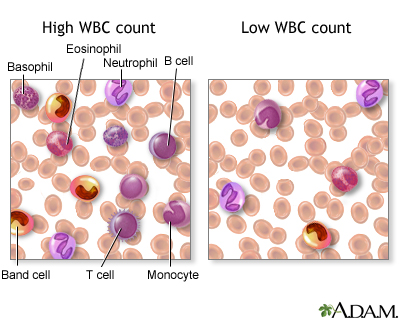
There are various types of white blood cells (WBCs) that normally appear in the blood: neutrophils (polymorphonuclear leukocytes; PMNs), band cells (slightly immature neutrophils), T-type lymphocytes (T cells), B-type lymphocytes (B cells), monocytes, eosinophils, and basophils. T and B-type lymphocytes are indistinguishable from each other in a normal slide preparation. Any infection or acute stress will result in an increased production of WBCs. This usually entails increased numbers of cells and an increase in the percentage of immature cells (mainly band cells) in the blood. This change is referred to as a “shift to the left” People who have had a splenectomy have a persistent mild elevation of WBCs. Drugs that may increase WBC counts include epinephrine, allopurinol, aspirin, chloroform, heparin, quinine, corticosteroids, and triamterene. Drugs that may decrease WBC counts include antibiotics, anticonvulsants, antihistamine, antithyroid drugs, arsenicals, barbiturates, chemotherapeutic agents, diuretics and sulfonamides.   (Updated by: David C. Dugdale, III, MD)

https://www.med-ed.virginia.edu/courses/path/innes/nh/wcbmaturation.cfm

Note that the mature forms of the myeloid series (neutrophils, eosinophils, basophils), all have lobed (segmented) nuclei. The degree of lobation increases as the cells mature.

The earliest recognizable myeloid cell is the myeloblast (10-20m dia) with a large round to oval nucleus. There is fine diffuse immature chromatin (without clumping) and a prominant nucleolus.

The cytoplasm is basophilic without granules. Although one may see a small golgi area adjacent to the nucleus, granules are not usually visible by light microscopy. One should not see blast cells in the peripheral blood.

myeloblast x100b

https://www.med-ed.virginia.edu/courses/path/innes/images/nhjpeg/nh%20myeloblast%20x100b.jpeg

The promyelocyte (10-20m) is slightly larger than a blast. Its nucleus, although similar to a myeloblast shows slight chromatin condensation and less prominent nucleoli. The cytoplasm contains striking azurophilic granules or primary granules. These granules contain myeloperoxidase, acid phosphatase, and esterase enzymes. Normally no promyelocytes are seen in the peripheral blood.

At the point in development when secondary granules can be recognized, the cell becomes a myelocyte.

promyelocyte x100

https://www.med-ed.virginia.edu/courses/path/innes/images/nhjpeg/nh%20promyelocyte%20×100%20a.jpeg

Myelocytes (10-18m) are not normally found in the peripheral blood. Nucleoli may not be seen in the late myelocyte. Primary azurophilic granules are still present, but secondary granules predominate. Secondary granules (neut, eos, or baso) first appear adjacent to the nucleus. In neutrophils this is the “dawn” of neutrophilia.

Metamyelocytes (10-18m) have kidney shaped indented nuclei and dense chromatin along the nuclear membrane. The cytoplasm is faintly pink, and they have secondary granules (neutro, eos, or baso). Zero to one percent of the peripheral blood white cells may be metamyelocytes (juveniles).

metamyelocyte x100

https://www.med-ed.virginia.edu/courses/path/innes/images/nhjpeg/nh%20metamyelocyte%20×100.jpeg

Bands, slightly smaller than juveniles, are marked by a U-shaped or deeply indented nucleus.

band neutrophilx100a

https://www.med-ed.virginia.edu/courses/path/innes/images/nhjpeg/nh%20band%20x100a.jpeg

Segmented (segs) or polymorphonuclear (PMN) leukocytes (average 14 m dia) are distinguished by definite lobation with thin thread-like filaments of chromatin joining the 2-5 lobes. 45-75% of the peripheral blood white cells are segmented neutrophils.

https://www.med-ed.virginia.edu/courses/path/innes/images/nhjpeg/nh%20neutrophil%20×100%20d.jpeg

Thrombocytogenesis

The incredible journey: From megakaryocyte development to platelet formation

Kellie R. Machlus1,2 and Joseph E. Italiano Jr
JCB 2013; 201(6): 785-796
http://dx.doi.org:/10.1083/jcb.201304054

Large progenitor cells in the bone marrow called megakaryocytes (MKs) are the source of platelets. MKs release platelets through a series of fascinating cell biological events. During maturation, they become polyploid and accumulate massive amounts of protein and membrane. Then, in a cytoskeletal-driven process, they extend long branching processes, designated proplatelets, into sinusoidal blood vessels where they undergo fission to release platelets.

megakaryocyte production of platelets

http://dm5migu4zj3pb.cloudfront.net/manuscripts/26000/26891/medium/JCI0526891.f4.jpg

platelets and the immune continuum nri2956-f3

http://www.nature.com/nri/journal/v11/n4/images/nri2956-f3.jpg

2.4.2 Classification of hematological malignancies
Practical Diagnosis of Hematologic Disoreders. 4th edition. Vol 2.
Kjeldsberg CR, Ed.  ASCP Press.  2006. Chicago, IL.

2.4.2.1 Primary Classification

Acute leukemias

Myelodysplastic syndromes

Acute myeloid leukemia

Acute lymphoblastic leukemia

Myeloproliferative Disorders

Chronic myeloproliferative disorders

Chronic myelogenous leukemia and related disorders

Myelofibrosis, including chronic idiopathic

Polycythemia, including polycythemia rubra vera

Thrombocytosis, including essential thrombocythemia

Chronic lymphoid leukemia and other lymphoid leukemias

Lymphomas

Non-Hodgkin Lymphoma

Hodgkin lymphoma

Lymphoproliferative disorders associated with immunodeficiency

Plasma Cell dyscrasias

Mast cell disease and Histiocytic neoplasms

2.4.2.2 Secondary Classification

2.4.2.3 Nuance – PathologyOutlines
Nat Pernick, Ed.

Leukemia – Acute

Primary referencesacute leukemia-generalAML generalAML classificationtransient abnormal myelopoiesis

Recurrent genetic abnormalities: AML with t(6;9)AML with t(8;21)AML with 11q23 abnormalitiesAML with inv(16) or t(16;16)AML with Down syndromeAML with FLT3 mutationsAML with myelodysplastic related changesAML therapy relatedAPL microgranular variantAPL with t(15;17)APL with t(V;17)APL therapy related

AML not otherwise categorized: minimally differentiated (M0)without maturation (M1)with maturation (M2)M3myelomonocyticmonoblastic and monocyticerythroidmegakaryoblasticCD13/CD33 negativebasophilicmyeloid sarcomaacute panmyelosis with myelofibrosiswith Philadelphia chromosomewith pseudo Chediak-Higashi anomalyhypocellular

ALL: generalWHO classificationwith eosinophilia

PreB ALL: generalt(9;22)t(v;11q23)t(1;19)t(5;14)t(12;21)hyperdiploidyhypodiploidymature B ALL/Burkitt

Other ALL: T ALLambiguous lineagemixed phenotype

AML and related malignancies

Acute myeloid leukemias with recurrent genetic abnormalities:

  • AML with t(8;21)(q22;q22); RUNX1-RUNX1T1
  • AML with inv(16)(p13.1;q22) or t(16;16)(p13.1;q22); CBF&beta-MYH11
  • Acute promyelocytic leukemia with t(15;17)(q22;q12); PML/RAR&alpha and variants
  • AML with t(9;11)(p22;q23); MLLT3-MLL
  • AML with t(6;9)(p23;q34); DEK-NUP214
  • AML with inv(3)(q21q26.2) or t(3;3)(q21;q26.2); RPN1-EVI1
  • AML (megakaryoblastic) with t(1;22)(p13;q13); RBM15-MKL1
  • AML with mutated NPM1*
  • AML with mutated CEBPA*

* provisional

Acute myeloid leukemia with myelodysplasia related changes

Therapy related acute myeloid leukemia

  • Alkylating agent related
  • Topoisomerase II inhibitor related (some maybe lymphoid)

Acute myeloid leukemia not otherwise categorized:

  • AML minimally differentiated (M0)
  • AML without maturation (M1)
  • AML with maturation (M2)
  • Acute myelomonocytic leukemia (M4)
  • Acute monoblastic and monocytic leukemia (M5a, M5b)
  • Acute erythroid leukemia (M6)
  • Acute megakaryoblastic leukemia (M7)
  • Acute basophilic leukemia
  • Acute panmyelosis with myelofibrosis

Myeloid Sarcoma

Myeloid proliferations related to Down syndrome:

  • Transient abnormal myelopoeisis
  • Myeloid leukemia associated with Down syndrome

Blastic plasmacytoid dentritic cell neoplasm:

Acute leukemia of ambiguous lineage:

  • Acute undifferentiated leukemia
  • Mixed phenotype acute leukemia with t(9;22)(q34;q11.2); BCR-ABL1
  • Mixed phenotype acute leukemia with t(v;11q23); MLL rearranged
  • Mixed phenotype acute leukemia, B/myeloid, NOS
  • Mixed phenotype acute leukemia, T/myeloid, NOS
  • Mixed phenotype acute leukemia, NOS, rare types
  • Other acute leukemia of ambiguous lineage
  • References: WHO Classification of Tumours of Haematopoietic and Lymphoid Tissue (IARC, 2008), Discovery Medicine 2010, eMedicine

Acute lymphocytic leukemia

General
=================================================================

  • WHO classification system includes former FAB classifications ALL-L1 and L2
    ● FAB L3 is now considered Burkitt lymphoma

WHO classification of acute lymphoblastic leukemia
=================================================================

Precursor B lymphoblastic leukemia / lymphoblastic lymphoma:
● ALL with t(9;22)(q34;q11.2); BCR-ABL (Philadelphia chromosome)
● ALL with t(v;11q23) (MLL rearranged)
● ALL with t(1;19)(q23;p13.3); TCF3-PBX1 (E2A-PBX1)
● ALL with t(12;21)(p13;q22); ETV6-RUNX1 (TEL-AML1)
● Hyperdiploid > 50
● Hypodiploid
● t(5;14)(q31;q32); IL3-IGH

Precursor T lymphoblastic leukemia / lymphoma

Additional references
=================================================================

Mixed phenotype acute leukemia (MPAL)

General
=================================================================

  • De novo acute leukemia containing separate populations of blasts of more than one lineage (bilineal or bilineage), or a single population of blasts co-expressing antigens of more than one lineage (biphenotypic)Excludes:
    ● Acute myeloid leukemia (AML) with recurrent translocations t(8;21), t(15;17) or inv(16)
    ● Leukemias with FGFR1 mutations
    ● Chronic myelogenous leukemia (CML) in blast crisis
    ● Myelodysplastic syndrome (MDS)-related AML and therapy-related AML, even if they have MPAL immunophenotypeCriteria for biphenotypic leukemia:
    ● Score of 2 or more for each of two separate lineages:The European Group for the Immunological Classification of Leukemias (EGIL) scoring system2008 WHO classification of acute leukemias of ambiguous lineage 

Prognosis
=================================================================

  • Poor, overall survival of 18 months
    ● Young age, normal karyotype and ALL induction therapy are associated with favorable survival
    ● Ph+ is a predictor for poor prognosis
    ● Bone marrow transplantation should be considered in first remission

Major Categories

MPAL with t(9;22)(q34;q11.2); BCR-ABL1
=================================================================

  • 20% of all MPAL
    ● Blasts with t(9;22)(q34;q11.2) translocation or BCR-ABL1 rearrangement (Ph+) without history of CML
    ● Majority in adults
    ● High WBC counts● Most of the cases B/myeloid phenotype
    ● Rare T/myeloid, B and T lineage, or trilineage leukemiasMorphology:
    ● Many cases show a dimorphic blast population, one resembling myeloblasts and the other lymphoblastsCytogenetic abnormalities:
    ● Conventional karyotyping for t(9;22), FISH or PCR for BCR-ABL1 translocation
    ● Additional complex karyotypes
    ● Ph+ is a poor prognostic factor for MPAL, with a reported median survival of 8 months
    ● Worse than patients of all other types of MPAL

MPAL with t(v;11q23); MLL rearranged
=================================================================

  • Meeting the diagnostic criteria for MPAL with blasts bearing a translocation involving the 11q23 breakpoint (MLL gene)
    ● MPAL with MLL rearranged rare
    ● More often seen in children and relatively common in infancy
    ● High WBC counts
    ● Poor prognosis
    ● Dimorphic blast population, with one resembling monoblasts and the other resembling lymphoblasts
    ● Lymphoblast population often shows a CD19+, CD10- B precursor immunophenotype, frequently CD15+
    ● Expression of other B markers usually weak
    ● Translocations involving MLL gene include t(4;11)(q21;q23), t(11;19)(q23;p13), and t(9;11)(p22;q23)
    ● Cases with chromosome 11q23 deletion should not be classified in this category

B cell acute lymphoblastic leukemia (ALL) / lymphoblastic lymphoma (LBL)

General

=================================================================

  • Current 2008 WHO classification: B lymphoblastic leukemia / lymphoma, NOS or B lymphoblastic leukemia / lymphoma with recurrent genetic abnormalities
  • See also lymphomas: B cell chapter
  • Also called B cell acute lymphoblastic leukemia / lymphoblastic lymphoma, pre B ALL / LBL
  • Usually children
  • B acute lymphoblastic leukemia presents with pancytopenia due to extensive marrow involvement, stormy onset of symptoms, bone pain due to marrow expansion, hepatosplenomegaly due to neoplastic infiltration, CNS symptoms due to meningeal spread and testicular involvement
  • B acute lymphoblastic lymphoma often presents with cutaneous nodules, bone or nodal involvement, < 25% lymphoblasts in bone marrow and peripheral blood; aleukemic cases are usually asymptomatic
  • Depending on specific leukemia, arises in either hematopoietic stem cell or B-cell progenitor
  • Tumors are derived from pre-germinal center naive B cells with unmutated VH region genes
  • Have multiple immunophenotyping aberrancies relative to normal B cell precursors (hematogones); at relapse, 73% show loss of 1+ aberrance and 60% show new aberrancies (Am J Clin Pathol 2007;127:39)

Prognostic features

=================================================================

  • Favorable prognosis: age 1-10 years, female, white; preB phenotype, hyperdiploidy>50, t(12,21), WBC count at presentation <50×108/L, non-traumatic tap with no blasts in CNS, rapid response to chemotherapy < 5% blasts on morphology on day 15, remission status after induction <5% blasts on morphology and <0.01% blast on flow or PCR, CD10+
  • Intermediate prognosis: hyperdiploidy 47-50, diploid, 6q- and rearrangements of 8q24
  • Unfavorable prognosis: under age 1 (usually have 11q23 translocations) or over age 10; t(9;22) (but not if age 59+ years, Am J Clin Pathol 2002;117:716); male, > 50×108/L WBC at presentation, hypodiploidy, near tetraploidy, 17p- and MLL rearrangements t(v;11q23); CD10-; non-traumatic tap with > 5% blasts or traumatic tap (7%); also increased microvessel staining using CD105 in children (Leuk Res 2007;31:1741), MDR1 expression in children (Oncol Rep 2004;12:1201) and adults (Blood 2002;100:974), 25%+ blasts on morphology on day 15, remission status after induction ≥ 5% blasts on morphology and ≥ 0.1% blasts on flow or PCR

Case reports

=================================================================

  • 12 month old girl and 13 month old boy with mature phenotype but no translocations (Arch Pathol Lab Med 2003;127:1340)
  • 56 year old man with ALL arising from follicular lymphoma (Arch Pathol Lab Med 2002;126:997)
  • 76 year old man with basal cell carcinoma (Diagn Pathol 2007;2:32)
  • With hemophagocytic lymphohistiocytosis (Pediatr Blood Cancer 2008;50:381)

Treatment

================================================================

  • Chemotherapy cures more children than adults; adolescents benefit from intensive regimens (Hematology Am Soc Hematol Educ Program 2005:123)

Micro description

=================================================================

  • Bone marrow smears: small to intermediate blast-like cells with scant, variably basophilic cytoplasm, round / oval or convoluted nuclei, fine chromatin and indistinct nucleoli; frequent mitotic figures; may have “starry sky” appearance similar to Burkitt lymphoma; may have large lymphoblasts with 1-4 prominent nucleoli resembling myeloblasts; usually no sclerosis
  • Bone marrow biopsy: usually markedly hypercellular with reduction of trilinear maturation; cells have minimal cytoplasm, medium sized nuclei that are often convoluted, moderately dense chromatin and indistinct nucleoli, brisk mitotic activity
  • Other tissues: may have “starry sky” appearance similar to Burkitt lymphoma; collagen dissection, periadipocyte growth pattern and single cell linear filing

Chronic Leukemia

Chronic Myeloid Neoplasms

Myelodysplastic syndromes (MDS): general, WHO classification, childhood, refractory anemia, refractory anemia with ringed sideroblasts, refractory cytopenia with multilineage dysplasia, refractory anemia with excess blasts, 5q-syndrome, therapy related, unclassified, arsenic toxicity

Myeloproliferative neoplasms (MPN): general, WHO classification, chronic eosinophilic leukemia, chronic myelogenous leukemia, chronic neutrophilic leukemia, essential thrombocythemia, hypereosinophilic syndrome, mast cell disease, polycythemia vera, primary myelofibrosis, unclassifiable

MDS/MPN: general, WHO classification, atypical CML, chronic myelomonocytic leukemia (CMML), chronic myelomonocytic leukemia with eosinophilia, juvenile myelomonocytic leukemia, unclassifiable

Myeloid neoplasms associated with eosinophilia and abnormalities of PDGFRA, PDGFRB, or FGFR1: PDGFRA, PDGFRB, FGFR1

Miscellaneous: transient myeloproliferative disorder of Downís syndrome

Lymphoma and plasma cell neoplasms

Lymph nodes: normal development-generalB cellsT cellsNK cellsnormal histologygrossing lymph nodesfeatures to report

Molecular testing: theoryFISHnorthern blotPCRsouthern blot

Non-Hodgkin lymphoma: generalcytogeneticsstagingstaging-pediatricmorphologic clueshemophagocytic syndromechemotherapeutic atypia

B cell disorders: generalpost-rituximabbone marrow biopsyclassification-historicalWHO classification

B cell lymphoma subtypes: age-related EBV-associatedALK positive large cellBurkittunclassifiable-intermediate between Burkitt and diffuse large B cell lymphomaCLL
diffuse large B cell: 
diffuse-NOSCD5+T cell / histiocyte richprimary cutaneous-generalprimary cutaneous-legprimary sites-other
follicular: 
generalchildhoodcutaneousGI
hairy cell leukemiaHCL variantintravascular large B celllymphomatoid granulomatosislymphoplasmacyticmantle cell-classicmantle cell-blastoidmarginal zone-generalmarginal zone-MALTMALT-primary sitesmarginal zone-nodalmediastinal (thymic)plasmablasticpre B lymphoblastic leukemia/lymphomaprimary effusionprolymphocytic leukemiapyothorax associatedSLLsplenic marginal zonesplenic lymphoma with villous lymphocytes

Plasma cell neoplasms: generalmyelomaplasmacytomaheavy chain diseaseprimary amyloidosisMGUSOsteosclerotic myeloma (POEMS)cryoglobulinemia

T/NK cell disorders: generalWHO classificationadult T cellaggressive NK cell leukemiaanaplastic large cell ALK+ALK-angioimmunoblastic T cellblastic plasmacytoidchronic lymphoproliferative disorders of NK cellscutaneous CD4+ small/medium sized T cell lymphomacutaneous CD30 positive T cell lymphoproliferative disorderscutaneous gamma delta T cell lymphomaenteropathyepidermotropic CD8+ T cell lymphomahepatosplenicindolent T cell proliferationsmycosis fungoidesNK/T cell lymphoma-nasal typenodal CD8+ cytotoxic T cellnonB nonT lymphoblasticperipheral T cell lymphoma, NOSprimary effusion lymphomaSezary syndromestagingsubcutaneous panniculitis-likeT cell large granular lymphocytic leukemiaT cell lymphoblastic leukemia/lymphomaT cell prolymphocytic leukemia

Hodgkin lymphoma: general/stagingclassiclymphocyte depletedlymphocyte rich classicalmixed cellularitynodular lymphocyte predominantnodular sclerosis

Post-transplantation: generalWHO classificationplasmacytic hyperplasia/IM-like lesionspolymorphic B cell lymphoproliferative disordersmonomorphic B cell lymphoproliferative disordersothergraft versus host disease

Other: AIDS associated-generalAIDS associated-examplesEBV+ T cell lymphoproliferative disorders of childhoodprimary immune disorders related

Myeloproliferative neoplasms (MPN)

WHO 2008 – Myeloproliferative neoplasms (MPN) 

General
=================================================================

  • Chronic myelogenous leukemia
    ● Polycythemia vera
    ● Essential thrombocythemia
    ● Primary myelofibrosis
    ● Chronic neutrophilic leukemia
    ● Chronic eosinophilic leukemia, not otherwise categorized
    ● Mast cell disease
    ● MPNs, unclassifiable

WHO 2001 – Chronic myeloproliferative diseases 

Definition
=================================================================

  • Chronic myelogenous leukemia (Philadelphia chromosome, t(9;22)(q34;q11), BCR-ABL positive)
    ● Chronic neutrophilic leukemia
    ● Chronic eosinophilic leukemia (and the hypereosinophilic syndrome)
    ● Polycythemia vera
    ● Chronic idiopathic myelofibrosis (with extramedullary hematopoiesis)
    ● Essential thrombocythemia
    ● Chronic myeloproliferative disease, unclassifiable

Additional references
=================================================================

The World Health Organization (WHO) classification of the myeloid neoplasms  James W. Vardiman, Nancy Lee Harris, and Richard D. Brunning
Blood 2002; 100(7)  http://dx.doi.org/10.1182/blood-2002-04-1199

Lymphoma – Non B cell neoplasms

T/NK cell disorders/WHO classification (2008)

Principles of classification
=================================================================

  • Based on all available information (morphology, immunophenotype, genetics, clinical)
    ● No one antigenic marker is specific for any neoplasm (except ALK1)
    ● Immune profiling less helpful in subclassification of T cell lymphomas then B cell lymphomas
    ● Certain antigens commonly associated with specific disease entities but not entirely disease specific
    ● CD30: common in anaplastic large cell lymphoma but also classic Hodgkin lymphoma and other B and T cell lymphomas
    ● CD56: characteristic for nasal NK/T cell lymphoma, but also other T cell neoplasms and plasma cell disorders
    ● Variation of immunophenotype within a given disease (hepatosplenic T cell lymphoma: usually γδ but some are αβ)
    ● Recurrent genetic alterations have been identified for many B cell lymphomas but not for most T cell lymphomas
    ● No attempt to stratify lymphoid malignancies by grade
    ● Recognize the existence of grey zone lymphomas
    ● This multiparameter approach has been validated in international studies as highly reproducible

WHO 2008 classification of tumors of hematopoietic and lymphoid tissues (T/NK)
=================================================================

Precursor T-lymphoid neoplasms
● T lymphoblastic leukemia/lymphoma, 9837/3

Mature T cell and NK cell neoplasms
● T cell prolymphocytic leukemia, 9834/3
● T cell large granular lymphocytic leukemia, 9831/3
● Chronic lymphoproliferative disorder of NK cells, 9831/3
● Aggressive NK cell leukemia, 9948/3
● Systemic EBV-positive T cell lymphoproliferative disease of childhood, 9724/3
● Hydroa vacciniforme-like lymphoma, 9725/3
● Adult T cell leukemia/lymphoma, 9827/3
● Extranodal NK/T cell lymphoma, nasal type, 9719/3
● Enteropathy-associated T cell lymphoma, 9717/3
● Hepatosplenic T cell lymphoma, 9716/3
● Subcutaneous panniculitis-like T cell lymphoma, 9708/3
● Mycosis fungoides, 9700/3
● Sézary syndrome, 9701/3
● Primary cutaneous CD30-positive T cell lymphoproliferative disorders
● Lymphomatoid papulosis, 9718/1
● Primary cutaneous anaplastic large cell lymphoma, 9718/3
● Primary cutaneous gamma-delta T cell lymphoma, 9726/3
● Primary cutaneous CD8-positive aggressive epidermotropic cytotoxic T cell lymphoma, 9709/3
● Primary cutaneous CD4-positive small/medium T cell lymphoma, 9709/3
● Peripheral T cell lymphoma, NOS, 9702/3
● Angioimmunoblastic T cell lymphoma, 9705/3
● Anaplastic large cell lymphoma, ALK-positive, 9714/3
● Anaplastic large cell lymphoma, ALK-negative, 9702/3

Chronic Lymphocytic Leukemia

Chronic Lymphocytic Leukemia Staging
Author: Sandy D Kotiah, MD; Chief Editor: Jules E Harris, MD
Medscape Sep 6, 2013
http://emedicine.medscape.com/article/2006578-overview

General considerations in the staging of chronic lymphocytic leukemia (CLL) and the revised Rai (United States) and Binet (Europe) staging systems for CLL are provided below.[1, 2, 3]

See Chronic Leukemias: 4 Cancers to Differentiate, a Critical Images slideshow, to help detect chronic leukemias and determine the specific type present.

General considerations

  • CLL and small lymphocytic lymphoma (SLL) are different manifestations of the same disease; SLL is diagnosed when the disease is mainly nodal, and CLL is diagnosed when the disease is seen in the blood and bone marrow
  • CLL is diagnosed by > 5000 monoclonal lymphocytes/mm3 for longer than 3mo; the bone marrow usually has more than 30% monoclonal lymphocytes and is either normocellular or hypercellular
  • Monoclonal B lymphocytosis is a precursor form of CLL that is defined by a monoclonal B cell lymphocytosis < 5000 monoclonal lymphocytes/mm3; all lymph nodes smaller than 1.5 cm; no anemia; and no thrombocytopenia

Revised Rai staging system (United States)

Low risk (formerly stage 0)[1] :

  • Lymphocytosis, lymphocytes in blood > 15000/mcL, and > 40% lymphocytes in the bone marrow

Intermediate risk (formerly stages I and II):

  • Lymphocytosis as in low risk with enlarged node(s) in any site, or splenomegaly or hepatomegaly or both

High risk (formerly stages III and IV):

  • Lymphocytosis as in low risk and intermediate risk with disease-related anemia (hemoglobin level < 11.0 g/dL or hematocrit < 33%) or platelets < 100,000/mcL

Binet staging system (Europe)

Stage A:

  • Hemoglobin ≥ 10 g/dL, platelets ≥ 100,000/mm3, and < 3 enlarged areas

Stage B:

  • Hemoglobin ≥ 10 g/dL, platelets ≥ 100,000/mm3, and ≥ 3 enlarged areas

Stage C:

  • Hemoglobin < 10 g/dL, platelets < 100,000/mm3, and any number of enlarged areas

Read Full Post »

Addendum to LPBI’s Vision

Curators:

Stephen J Williams, PhD,

Adam Sonnenberg, BSc and

Aviva Lev-Ari, PhD, RN


Our Logo

Pharma_BI-background0238

Our Team

Our Open Access Online Journal

http://www.pharmaceuticalIntelligence.com

is a scientific, medical and business, multi-expert authoring environment for information syndication in several domains of Life Sciences, Medicine, Pharmaceutical and Healthcare Industries, BioMedicine, Medical Technologies & Devices. Scientific critical interpretations and original articles are written by PhDs, MDs, MD/PhDs, PharmDs, Technical MBAs as Experts, Authors, Writers (EAWs) on an Equity Sharing basis.

Journal Content Descriptors on 6/29/2015

3,037 Posts

348 Categories of Research

6,948 Tags

676,420 Views – All Times

NIH Clicks 2,571

Nature Clicks 1,542

Our Competencies

  • Deals, Partnerships and Funding for Early Stage Biologics and Medical Devices Start Ups

http://pharmaceuticalintelligence.com/joint-ventures/

  • Scientific Curations in Medicine and Life Sciences

http://www.pharmaceuticalIntelligence.com

  • HealthCare Investor’s Corner

http://pharmaceuticalintelligence.com/options/

  • BioMed e-Series of e-Books

http://pharmaceuticalintelligence.com/biomed-e-books/

  • Scientific Delegations of US Patent Holders

http://pharmaceuticalintelligence.com/options/scientific-delegation/

  • Real Time Coverage of Scientific and Biotech Conferences

http://pharmaceuticalintelligence.com/press-coverage/

MultiMedia Presence

@pharma_BI

  • FaceBook Page

http://www.facebook.com/LeadersInPharmaceuticalBusinessIntelligence

  • Launchers of a Professional Group on LinkedIn

http://www.linkedin.com/groups?gid=4346921&trk=hb_side_g

  • Company Page on LinkedIn

https://www.linkedin.com/company/9325543?trk=vsrp_companies_res_name&trkInfo=VSRPsearchId%3A875971435604472931%2CVSRPtargetId%3A9325543%2CVSRPcmpt%3Aprimary

social-media-free-vector_23-2147491559

Slide2

For more information about our Team please see our site at http://pharmaceuticalintelligence.com/contributors-biographies/

Slide5

For more information of LPBI Deals and Partnerships please see our site at http://pharmaceuticalintelligence.com/joint-ventures/

Slide4

For more information about our BioMed E-Series please see our site at http://pharmaceuticalintelligence.com/biomed-e-books/

E-Book Titles by LPBI

LPBI book titles slide

Slide8Slide3

Slide6

For more information on Real-Time Conference Coverage including a full list of Conferences Covered by LPBI please go to http://pharmaceuticalintelligence.com/press-coverage/

For more information on Real-Time Conference Coverage and a full listing of Conferences Covered by LPBI please go to:

http://pharmaceuticalintelligence.com/press-coverage/

Slide7


Read Full Post »

Leaders in Pharmaceutical Intelligence Presentation at The Life Sciences Collaborative

Curator: Stephen J. Williams, Ph.D. Website Analytics: Adam Sonnenberg, BSc Leaders in Pharmaceutical Intelligence presented their ongoing efforts to develop an open-access scientific and medical publishing and curation platform to The Life Science Collaborative, an executive pharmaceutical and biopharma networking group in the Philadelphia/New Jersey area.

Our Team

Slide1

For more information on the Vision, Funding Deals and Partnerships please see our site at http://pharmaceuticalintelligence.com/vision/

Slide2

For more information about our Team please see our site at http://pharmaceuticalintelligence.com/contributors-biographies/

Slide5

For more information of LPBI Deals and Partnerships please see our site at http://pharmaceuticalintelligence.com/joint-ventures/

Slide4

For more information about our BioMed E-Series please see our site at http://pharmaceuticalintelligence.com/biomed-e-books/

E-Book Titles by LPBI

LPBI book titles slide Slide8Slide3

Slide6

For more information on Real-Time Conference Coverage including a full list of Conferences Covered by LPBI please go to http://pharmaceuticalintelligence.com/press-coverage/

For more information on Real-Time Conference Coverage and a full listing of Conferences Covered by LPBI please go to:

http://pharmaceuticalintelligence.com/press-coverage/ Slide7

Slide10

The Pennsylvania (PA) and New Jersey (NJ) Biotech environment had been hit hard by the recession and loss of anchor big pharma companies however as highlighted by our interviews in “The Vibrant Philly Biotech Scene” and other news outlets, additional issues are preventing the PA/NJ area from achieving its full potential (discussions also with LSC)

Slide9Download the PowerPoint slides here: Presentationlsc

Read Full Post »

Therapeutic Implications for Targeted Therapy from the Resurgence of Warburg ‘Hypothesis’

Writer and Curator: Larry H. Bernstein, MD, FCAP 

(Note that each portion of the discussion is followed by a reference)

It is now a time to pause after almost a century of a biological scientific discoveries that have transformed the practice of medicine and impacted the lives of several generations of young minds determined to probe the limits of our knowledge.  In the century that we have entered into the scientific framework of medicine has brought together a difficult to grasp evolution of the emergence of human existence from wars, famine, droughts, storms, infectious diseases, and insect born pestilence with betterment of human lives, only unevenly divided among societal classes that have existed since time immemorial. In this short time span there have emerged several generations of physicians who have benefited from a far better medical education that their forebears could have known. In this expansive volume on cancer, we follow an incomplete and continuing challenge to understand cancer, a disease that has become associated with longer life spans in developed nations.

While there are significant improvements in the diagnosis and treatment of cancers, there is still a personal as well as locality factor in the occurrence of this group of diseases, which has been viewed incorrectly as a “dedifferentiation” of mature tissue types and the emergence of a cell phenotype that is dependent on glucose, reverts to a cancer “stem cell type” (loss of stemness), loses cell to cell adhesion, loses orderly maturation, and metastasizes to distant sites. At the same time, physician and nurses are stressed in the care of patients by balancing their daily lives and maintaining a perspective.

The conceptual challenge of cancer diagnosis and management has seemed insurmountable, but owes much to the post World War I activities of Otto Heinrich Warburg. It was Warburg who made the observation that cancer cells metabolize glucose by fermentation in much the way Pasteur 60 years earlier observed fermentation of yeast cells. This metabolic phenomenon occurs even in the presence of an oxygen supply, which would provide a huge deficit in ATP production compared with respiration. The cancer cell is “addicted to glucose” and produced lactic acid. Warburg was awarded the Nobel Prize in Medicine for this work in 1931.

In the last 15 years there has been a resurgence of work on the Warburg effect that sheds much new light on the process that was not previously possible, with significant therapeutic implications.  In the first place, the metabolic mechanism for the Warburg effect was incomplete even at the beginning of the 21st century.  This has been partly rectified with the enlightening elucidation of genome modifications, cellular metabolic regulation, and signaling pathways.

The following developments have become central to furthering our understanding of malignant transformation.

  1. There is usually an identifiable risk factor, such as, H. pylori, or of a chronic inflammatory state, as in the case of Barrett’s esophagus.
  2. There are certain changes in glucose metabolism that have been unquestionably been found in the evolution of this disease. The changes are associated with major changes in metabolic pathways, miRN signaling, and the metabolism geared to synthesis of cells with an impairment of the cell death cycle. In these changes, mitochondrial function is central to both the impaired respiration and the autophagy geared to the synthesis of cancer cells.

The emergence of this cell prototype is characterized by the following, again related to the Warburg effect:

  1. Cancer cells oxidize a decreased fraction of the pyruvate generated from glycolysis
  2. The mitochondrial pyruvate carrier (MPC), composed of the products of the MPC1 and MPC2 genes, modulates fractional pyruvate oxidation. MPC1 is deleted or underexpressed in multiple cancers and correlates with poor prognosis.
  3. Cancer cells tend to express a partially inhibited splice variant of pyruvate kinase (PK-M2), leading to decreased pyruvate production.
  4. The two proteins that mediate pyruvate conversion to lactate and its export, M-type lactate dehydrogenase and the monocarboxylate transporter MCT-4, are commonly upregulated in cancer cells leading to decreased pyruvate oxidation.
  5. The enzymatic step following mitochondrial entry is the conversion of pyruvate to acetyl-CoA by the pyruvate dehydrogenase (PDH) complex. Cancer cells frequently exhibit increased expression of the PDH kinase PDK1, which phosphorylates and inactivates PDH. This PDH regulatory mechanism is required for oncogene induced transformation and reversed in oncogene-induced senescence.
  6. The PDK inhibitor dichloroacetate has shown some clinical efficacy, which correlates with increased pyruvate oxidation. One of the simplest mechanisms to explain decreased mitochondrial pyruvate oxidation in cancer cells, a loss of mitochondrial pyruvate import, has been observed repeatedly over the past 40 years. This process has been impossible to study at a molecular level until recently, however, as the identities of the protein(s) that mediate mitochondrial pyruvate uptake were unknown.
  7. The mitochondrial pyruvate carrier (MPC) as a multimeric complex that is necessary for efficient mitochondrial pyruvate uptake. The MPC contains two distinct proteins, MPC1 and MPC2; the absence of either leads to a loss of mitochondrial pyruvate uptake and utilization in yeast, flies, and mammalian cells.

A Role for the Mitochondrial Pyruvate Carrier as a Repressor of the Warburg Effect and Colon Cancer Cell Growth

John C. Schell, Kristofor A. Olson, Lei Jiang, Amy J. Hawkins, et al.
Molecular Cell Nov 6, 2014; 56: 400–413.
http://dx.doi.org/10.1016/j.molcel.2014.09.026

In addition to the above, the following study has therapeutic importance:

Glycolysis has become a target of anticancer strategies. Glucose deprivation is sufficient to induce growth inhibition and cell death in cancer cells. The increased glucose transport in cancer cells has been attributed primarily to the upregulation of glucose transporter 1 (Glut1),  1 of the more than 10 glucose transporters that are responsible for basal glucose transport in almost all cell types. Glut1 has not been targeted until very recently due to the lack of potent and selective inhibitors.

First, Glut1 antibodies were shown to inhibit cancer cell growth. Other Glut1 inhibitors and glucose transport inhibitors, such as fasentin and phloretin, were also shown to be effective in reducing cancer cell growth. A group of inhibitors of glucose transporters has been recently identified with IC50 values lower than 20mmol/L for inhibiting cancer cell growth. However, no animal or detailed mechanism studies have been reported with these inhibitors.

Recently, a small molecule named STF-31 was identified that selectively targets the von Hippel-Lindau (VHL) deficient kidney cancer cells. STF-31 inhibits VHL deficient cancer cells by inhibiting Glut1. It was further shown that daily intraperitoneal injection of a soluble analogue of STF-31 effectively reduced the growth of tumors of VHL-deficient cancer cells grafted on nude mice. On the other hand, STF-31 appears to be an inhibitor with a narrow cell target spectrum.

These investigators recently reported the identification of a group of novel small compounds that inhibit basal glucose transport and reduce cancer cell growth by a glucose deprivation–like mechanism. These compounds target Glut1 and are efficacious in vivo as anticancer agents. A novel representative compound WZB117 not only inhibited cell growth in cancer cell lines but also inhibited cancer growth in a nude mouse model. Daily intraperitoneal injection of WZB117 resulted in a more than 70% reduction in the size of human lung cancer of A549 cell origin. Mechanism studies showed that WZB117 inhibited glucose transport in human red blood cells (RBC), which express Glut1 as their sole glucose transporter. Cancer cell treatment with WZB117 led to decreases in levels of Glut1 protein, intracellular ATP, and glycolytic enzymes. All these changes were followed by increase in ATP sensing enzyme AMP-activated protein kinase (AMPK) and declines in cyclin E2 as well as phosphorylated retinoblastoma, resulting in cell-cycle arrest, senescence, and necrosis. Addition of extracellular ATP rescued compound-treated cancer cells, suggesting that the reduction of intracellular ATP plays an important role in the anticancer mechanism of the molecule.

A Small-Molecule Inhibitor of Glucose Transporter 1 Downregulates Glycolysis, Induces Cell-Cycle Arrest, and Inhibits Cancer Cell Growth In Vitro and In Vivo

Yi Liu, Yanyan Cao, Weihe Zhang, Stephen Bergmeier, et al.
Mol Cancer Ther Aug 2012; 11(8): 1672–82
http://dx.doi.org://10.1158/1535-7163.MCT-12-0131

Alterations in cellular metabolism are among the most consistent hallmarks of cancer. These investigators have studied the relationship between increased aerobic lactate production and mitochondrial physiology in tumor cells. To diminish the ability of malignant cells to metabolize pyruvate to lactate, M-type lactate dehydrogenase levels were knocked down by means of LDH-A short hairpin RNAs. Reduction in LDH-A activity resulted in stimulation of mitochondrial respiration and decrease of mitochondrial membrane potential. It also compromised the ability of these tumor cells to proliferate under hypoxia. The tumorigenicity of the LDH-A-deficient cells was severely diminished, and this phenotype was reversed by complementation with the human ortholog LDH-A protein. These results demonstrate that LDH-A plays a key role in tumor maintenance.

The results are consistent with a functional connection between alterations in glucose metabolism and mitochondrial physiology in cancer. The data also reflect that the dependency of tumor cells on glucose metabolism is a liability for these cells under limited-oxygen conditions. Interfering with LDH-A activity as a means of blocking pyruvate to lactate conversion could be exploited therapeutically. Because individuals with complete deficiency of LDH-A do not show any symptoms under ordinary circumstances, the genetic data suggest that inhibition of LDH-A activity may represent a relatively nontoxic approach to interfere with tumor growth.

Attenuation of LDH-A expression uncovers a link between glycolysis, mitochondrial physiology, and tumor maintenance

Valeria R. Fantin Julie St-Pierre and Philip Leder
Cancer Cell Jun 2006; 9: 425–434.
http://dx.doi.org:/10.1016/j.ccr.2006.04.02

The widespread clinical use of positron-emission tomography (PET) for the detection of aerobic glycolysis in tumors and recent findings have rekindled interest in Warburg’s theory. Studies on the physiological changes in malignant conversion provided a metabolic signature for the different stages of tumorigenesis; during tumorigenesis, an increase in glucose uptake and lactate production have been detected. The fully transformed state is most dependent on aerobic glycolysis and least dependent on the mitochondrial machinery for ATP synthesis.

Tumors ferment glucose to lactate even in the presence of oxygen (aerobic glycolysis; Warburg effect). The pentose phosphate pathway (PPP) allows glucose conversion to ribose for nucleic acid synthesis and glucose degradation to lactate. The nonoxidative part of the PPP is controlled by transketolase enzyme reactions. We have detected upregulation of a mutated transketolase transcript (TKTL1) in human malignancies, whereas transketolase (TKT) and transketolase-like-2 (TKTL2) transcripts were not upregulated. Strong TKTL1 protein expression was correlated to invasive colon and urothelial tumors and to poor patients outcome. TKTL1 encodes a transketolase with unusual enzymatic properties, which are likely to be caused by the internal deletion of conserved residues. We propose that TKTL1 upregulation in tumors leads to enhanced, oxygen-independent glucose usage and a lactate based matrix degradation. As inhibition of transketolase enzyme reactions suppresses tumor growth and metastasis, TKTL1 could be the relevant target for novel anti-transketolase cancer therapies. We suggest an individualized cancer therapy based on the determination of metabolic changes in tumors that might enable the targeted inhibition of invasion and metastasis.

Other important links between cancer-causing genes and glucose metabolism have been already identified. Activation of the oncogenic kinase Akt has been shown to stimulate glucose uptake and metabolism in cancer cells and renders these cells susceptible to death in response to glucose withdrawal. Such tumor cells have been shown to be dependent on glucose because the ability to induce fatty acid oxidation in response to glucose deprivation is impaired by activated Akt. In addition, AMP-activated protein kinase (AMPK) has been identified as a link between glucose metabolism and the cell cycle, thereby implicating p53 as an essential component of metabolic cell-cycle control.

Expression of transketolase TKTL1 predicts colon and urothelial cancer patient survival: Warburg effect reinterpreted

S Langbein, M Zerilli, A zur Hausen, W Staiger, et al.
British Journal of Cancer (2006) 94, 578–585.
http://dx.doi.org:/10.1038/sj.bjc.6602962

The unique metabolic profile of cancer (aerobic glycolysis) might confer apoptosis resistance and be therapeutically targeted. Compared to normal cells, several human cancers have high mitochondrial membrane potential (DJm) and low expression of the K+ channel Kv1.5, both contributing toapoptosis resistance. Dichloroacetate (DCA) inhibits mitochondrial pyruvate dehydrogenase kinase (PDK), shifts metabolism from glycolysis to glucose oxidation, decreases DJm, increases mitochondrial H2O2, and activates Kv channels in all cancer, but not normal, cells; DCA upregulates Kv1.5 by an NFAT1-dependent mechanism. DCA induces apoptosis, decreases proliferation, and inhibits tumor growth, without apparent toxicity. Molecular inhibition of PDK2 by siRNA mimics DCA. The mitochondria-NFAT-Kv axis and PDK are important therapeutic targets in cancer; the orally available DCA is a promising selective anticancer agent.

Cancer progression and its resistance to treatment depend, at least in part, on suppression of apoptosis. Although mitochondria are recognized as regulators of apoptosis, their importance as targets for cancer therapy has not been adequately explored or clinically exploited. In 1930, Warburg suggested that mitochondrial dysfunction in cancer results in a characteristic metabolic phenotype, that is, aerobic glycolysis (Warburg, 1930). Positron emission tomography (PET) imaging has now confirmed that most malignant tumors have increased glucose uptake and metabolism. This bioenergetic feature is a good marker of cancer but has not been therapeutically pursued..

The small molecule DCA is a metabolic modulator that has been used in humans for decades in the treatment of lactic acidosis and inherited mitochondrial diseases. Without affecting normal cells, DCA reverses the metabolic electrical remodeling that we describe in several cancer lines (hyperpolarized mitochondria, activated NFAT1, downregulated Kv1.5), inducing apoptosis and decreasing tumor growth. DCA in the drinking water at clinically relevant doses for up to 3 months prevents and reverses tumor growth in vivo, without apparent toxicity and without affecting hemoglobin, transaminases, or creatinine levels. The ease of delivery, selectivity, and effectiveness  make DCA an attractive candidate for proapoptotic cancer therapy which can be rapidly translated into phase II–III clinical trials.

A Mitochondria-K+ Channel Axis Is Suppressed in Cancer and Its Normalization Promotes Apoptosis and Inhibits Cancer Growth

Sebastien Bonnet, Stephen L. Archer, Joan Allalunis-Turner, et al.

Cancer Cell Jan 2007; 11: 37–51.
http://dx.doi.org:/10.1016/j.ccr.2006.10.020

Tumor cells, just as other living cells, possess the potential for proliferation, differentiation, cell cycle arrest, and apoptosis. There is a specific metabolic phenotype associated with each of these conditions, characterized by the production of both energy and special substrates necessary for the cells to function in that particular state. Unlike that of normal living cells, the metabolic phenotype of tumor cells supports the proliferative state. Aim: To present the metabolic hypothesis that (1) cell transformation and tumor growth are associated with the activation of metabolic enzymes that increase glucose carbon utilization for nucleic acid synthesis, while enzymes of the lipid and amino acid synthesis pathways are activated in tumor growth inhibition, and (2) phosphorylation and allosteric and transcriptional regulation of intermediary metabolic enzymes and their substrate availability together mediate and sustain cell transformation from one condition to another. Conclusion: Evidence is presented that demonstrates opposite changes in metabolic phenotypes induced by TGF-β, a cell transforming agent, and tumor growth-inhibiting phytochemicals such as genistein and Avemar, or novel synthetic antileukemic drugs such as STI571 (Gleevec).  Intermediary metabolic enzymes that mediate the growth signaling pathways and promote malignant cell transformation may serve as high efficacy nongenetic novel targets for cancer therapies.

A Metabolic Hypothesis of Cell Growth and Death in Pancreatic Cancer

Laszlo G. Boros, Wai-Nang Paul Lee, and Vay Liang W. Go
Pancreas 2002; 24(1):26–33

Clear cell renal cell carcinoma (ccRCC) is the most common pathological subtype of kidney cancer. Here, we integrated an unbiased genome-wide RNA interference screen for ccRCC survival regulators with an analysis of recurrently overexpressed genes in ccRCC to identify new therapeutic targets in this disease. One of the most potent survival regulators, the monocarboxylate transporter MCT4 (SLC16A3), impaired ccRCC viability in all eight ccRCC lines tested and was the seventh most overexpressed gene in a meta-analysis of five ccRCC expression datasets.

MCT4 silencing impaired secretion of lactate generated through glycolysis and induced cell cycle arrest and apoptosis. Silencing MCT4 resulted in intracellular acidosis, and reduction in intracellular ATP production together with partial reversion of the Warburg effect in ccRCC cell lines. Intra-tumoral heterogeneity in the intensity of MCT4 protein expression was observed in primary ccRCCs.

MCT4 protein expression analysis based on the highest intensity of expression in primary ccRCCs was associated with poorer relapse-free survival, whereas modal intensity correlated with Fuhrman nuclear grade. Consistent with the potential selection of subclones enriched for MCT4 expression during disease progression, MCT4 expression was greater at sites of metastatic disease. These data suggest that MCT4 may serve as a novel metabolic target to reverse the Warburg effect and limit disease progression in ccRCC.

Clear cell carcinoma (ccRCC) is the commonest subtype of renal cell carcinoma, accounting for 80% of cases. These tumors are highly resistant to cytotoxic chemotherapy and until recently, systemic treatment options for advanced ccRCC were limited to cytokine based therapies, such as interleukin-2 and interferon-α. Recently, anti-angiogenic drugs and mTOR inhibitors, all targeting the HIF–VEGF axis which is activated in up to 91% of ccRCCs through loss of the VHL tumor suppressor gene [1], have been shown to be effective in metastatic ccRCC [2–5]. Although these drugs increase overall survival to more than 2 years [6], resistance invariably occurs, making the identification of new molecular targets a major clinical need to improve outcomes in patients with metastatic ccRCC.

Genome-wide RNA interference analysis of renal carcinoma survival regulators identifies MCT4 as a Warburg effect metabolic target

Marco Gerlinger, Claudio R Santos, Bradley Spencer-Dene, et al.
J Pathol 2012; 227: 146–156
http://dx.doi.org:/10.1002/path.4006

Hypoxia-inducible factor 1 (HIF-1) plays a key role in the reprogramming of cancer metabolism by activating transcription of genes encoding glucose transporters and glycolytic enzymes, which take up glucose and convert it to lactate; pyruvate dehydrogenase kinase 1, which shunts pyruvate away from the mitochondria; and BNIP3, which triggers selective mitochondrial autophagy. The shift from oxidative to glycolytic metabolism allows maintenance of redox homeostasis and cell survival under conditions of prolonged hypoxia. Many metabolic abnormalities in cancer cells increase HIF-1 activity. As a result, a feed-forward mechanism can be activated that drives HIF-1 activation and may promote tumor progression.

Metastatic cancer is characterized by reprogramming of cellular metabolism leading to increased uptake of glucose for use as both an anabolic and a catabolic substrate. Increased glucose uptake is such a reliable feature that it is utilized clinically to detect metastases by positron emission tomography using 18F-fluorodeoxyglucose (FDG-PET) with a sensitivity of >90% [1]. As with all aspects of cancer biology, the details of metabolic reprogramming differ widely among individual tumors. However, the role of specific signaling pathways and transcription factors in this process is now understood in considerable detail. This review will focus on the involvement of hypoxia-inducible factor 1 (HIF-1) in both mediating metabolic reprogramming and responding to metabolic alterations. The placement of HIF-1 both upstream and downstream of cancer metabolism results in a feed-forward mechanism that may play a major role in the development of the invasive, metastatic, and lethal cancer phenotype.

O2 concentrations are significantly reduced in many human cancers compared with the surrounding normal tissue. The median PO2 in breast cancers is 10 mmHg, as compared with65 mmHg in normal breast tissue. Reduced O2 availability induces HIF-1, which regulates the transcription of hundreds of genes that encode proteins involved in every aspect of cancer biology, including: cell immortalization and stem cell maintenance; genetic instability; glucose and energy metabolism; vascularization; autocrine growth factor signaling; invasion and metastasis; immune evasion; and resistance to chemotherapy and radiation therapy.

HIF-1 is a transcription factor that consists of an O2 regulated HIF-1a and a constitutively expressed HIF-1b subunit. In well-oxygenated cells, HIF-1a is hydroxylated on proline residue 402 (Pro-402) and/or Pro-564 by prolyl hydroxylase domain protein 2 (PHD2), which uses O2 and a-ketoglutarate as substrates in a reaction that generates CO2 and succinate as byproducts. Prolylhydroxylated HIF-1a is bound by the von Hippel–Lindau tumor suppressor protein (VHL), which recruits an E3-ubiquitin ligase that targets HIF-1a for proteasomal degradation (Figure 1a). Asparagine 803 in the transactivation domain is hydroxylated in well-oxygenated cells by factor inhibiting HIF-1 (FIH-1), which blocks the binding of the coactivators p300 and CBP. Under hypoxic conditions, the prolyl and asparaginyl hydroxylation reactions are inhibited by substrate (O2) deprivation and/or the mitochondrial generation of reactive oxygen species (ROS), which may oxidize Fe(II) present in the catalytic center of the hydroxylases.

The finding that acute changes in PO2 increase mitochondrial ROS production suggests that cellular respiration is optimized at physiological PO2 to limit ROS generation and that any deviation in PO2 – up or down – results in increased ROS generation. If hypoxia persists, induction of HIF-1 leads to adaptive mechanisms to reduce ROS and re-establish homeostasis, as described below. Prolyl and asparaginyl hydroxylation provide a molecular mechanism by which changes in cellular oxygenation can be transduced to the nucleus as changes in HIF-1 activity.

HIF-1: upstream and downstream of cancer metabolism

Gregg L Semenza
Current Opinion in Genetics & Development 2010, 20:51–56

This review comes from a themed issue on Genetic and cellular mechanisms of oncogenesis Edited by Tony Hunter and Richard Marais

http://dx.doi.org:/10.1016/j.gde.2009.10.009

Hypoxia-inducible factor 1 (HIF-1) regulates the transcription of many genes involved in key aspects of cancer biology, including immortalization, maintenance of stem cell pools, cellular dedifferentiation, genetic instability, vascularization, metabolic reprogramming, autocrine growth factor signaling, invasion/metastasis, and treatment failure. In animal models, HIF-1 overexpression is associated with increased tumor growth, vascularization, and metastasis, whereas HIF-1 loss-of-function has the opposite effect, thus validating HIF-1 as a target. In further support of this conclusion, immunohistochemical detection of HIF-1a overexpression in biopsy sections is a prognostic factor in many cancers. A growing number of novel anticancer agents have been shown to inhibit HIF-1 through a  variety of molecular mechanisms. Determining which combination of drugs to administer to any given patient remains a major obstacle to improving cancer treatment outcomes.

Intratumoral hypoxia The majority of locally advanced solid tumors contain regions of reduced oxygen availability. Intratumoral hypoxia results when cells are located too far from a functional blood vessel for diffusion of adequate amounts of O2 as a result of rapid cancer cell proliferation and the formation of blood vessels that are structurally and functionally abnormal. In the most extreme case, O2 concentrations are below those required for survival, resulting in cell death and establishing a selection for cancer cells in which apoptotic pathways are inactivated, anti-apoptotic pathways are activated, or invasion/metastasis pathways that promote escape from the hypoxic microenvironment are activated. This hypoxic adaptation may arise by alterations in gene expression or by mutations in the genome or both and is associated with reduced patient survival.

Hypoxia-inducible factor 1 (HIF-1) The expression of hundreds of genes is altered in each cell exposed to hypoxia. Many of these genes are regulated by HIF-1. HIF-1 is a heterodimer formed by the association of an O2-regulated HIF1a subunit with a constitutively expressed HIF-1b subunit. The structurally and functionally related HIF-2a protein also dimerizes with HIF-1b and regulates an overlapping battery of target genes. Under nonhypoxic conditions, HIF-1a (as well as HIF-2a) is subject to O2-dependent prolyl hydroxylation and this modification is required for binding of the von Hippel–Lindau tumor suppressor protein (VHL), which also binds to Elongin C and thereby recruits a ubiquitin ligase complex that targets HIF-1a for ubiquitination and proteasomal degradation. Under hypoxic conditions, the rate of hydroxylation and ubiquitination declines, resulting in accumulation of HIF-1a. Immunohistochemical analysis of tumor biopsies has revealed high levels of HIF-1a in hypoxic but viable tumor cells surrounding areas of necrosis.

Genetic alterations in cancer cells increase HIF-1 activity In the majority of clear-cell renal carcinomas, VHL function is lost, resulting in constitutive activation of HIF-1. After re-introduction of functional VHL, renal carcinoma cell lines are no longer tumorigenic, but can be made tumorigenic by expression of HIF2a in which the prolyl residues that are subject to hydroxylation have been mutated. In addition to VHL loss-of-function, many other genetic alterations that inactivate tumor suppressors

Evaluation of HIF-1 inhibitors as anticancer agents

Gregg L. Semenza
Drug Discovery Today Oct 2007; 12(19/20).
http://dx.doi.org:/10.1016/j.drudis.2007.08.006

Hypoxia-inducible factor-1 (HIF-1), which is present at high levels in human tumors, plays crucial roles in tumor promotion by upregulating its target genes, which are involved in anaerobic energy metabolism, angiogenesis, cell survival, cell invasion, and drug resistance. Therefore, it is apparent that the inhibition of HIF-1 activity may be a strategy for treating cancer. Recently, many efforts to develop new HIF-1-targeting agents have been made by both academic and pharmaceutical industry laboratories. The future success of these efforts will be a new class of HIF-1-targeting anticancer agents, which would improve the prognoses of many cancer patients. This review focuses on the potential of HIF-1 as a target molecule for anticancer therapy, and on possible strategies to inhibit HIF-1 activity. In addition, we introduce YC-1 as a new anti-HIF-1, anticancer agent. Although YC-1 was originally developed as a potential therapeutic agent for thrombosis and hypertension, recent studies demonstrated that YC-1 suppressed HIF-1 activity and vascular endothelial growth factor expression in cancer cells. Moreover, it halted tumor growth in immunodeficient mice without serious toxicity during the treatment period. Thus, we propose that YC-1 is a good lead compound for the development of new anti-HIF-1, anticancer agents.

Although many anticancer regimens have been introduced to date, their survival benefits are negligible, which is the reason that a more innovative treatment is required. Basically, the identification of the specific molecular features of tumor promotion has allowed for rational drug discovery in cancer treatment, and drugs have been screened based upon the modulation of specific molecular targets in tumor cells. Target-based drugs should satisfy the following two conditions.

First, they must act by a described mechanism.

Second, they must reduce tumor growth in vivo, associated with this mechanism.

Many key factors have been found to be involved in the multiple steps of cell growth signal-transduction pathways. Targeting these factors offers a strategy for preventing tumor growth; for example, competitors or antibodies blocking ligand–receptor interaction, and receptor tyrosine kinase inhibitors, downstream pathway inhibitors (i.e., RAS farnesyl transferase inhibitors, mitogen-activated protein kinase and mTOR inhibitors), and cell-cycle arresters (i.e., cyclin-dependent kinase inhibitors) could all be used to inhibit tumor growth.

In addition to the intracellular events, tumor environmental factors should be considered to treat solid tumors. Of these, hypoxia is an important cancer-aggravating factor because it contributes to the progression of a more malignant phenotype, and to the acquisition of resistance to radiotherapy and chemotherapy. Thus, transcription factors that regulate these hypoxic events are good targets for anticancer therapy and in particular HIF-1 is one of most compelling targets. In this paper, we introduce the roles of HIF-1 in tumor promotion and provide a summary of new anticancer strategies designed to inhibit HIF-1 activity.

New anticancer strategies targeting HIF-1

Eun-Jin Yeo, Yang-Sook Chun, Jong-Wan Park
Biochemical Pharmacology 68 (2004) 1061–1069
http://dx.doi.org:/10.1016/j.bcp.2004.02.040

Classical work in tumor cell metabolism focused on bioenergetics, particularly enhanced glycolysis and suppressed oxidative phosphorylation (the ‘Warburg effect’). But the biosynthetic activities required to create daughter cells are equally important for tumor growth, and recent studies are now bringing these pathways into focus. In this review, we discuss how tumor cells achieve high rates of nucleotide and fatty acid synthesis, how oncogenes and tumor suppressors influence these activities, and how glutamine metabolism enables macromolecular synthesis in proliferating cells.

Otto Warburg’s demonstration that tumor cells rapidly use glucose and convert the majority of it to lactate is still the most fundamental and enduring observation in tumor metabolism. His work, which ushered in an era of study on tumor metabolism focused on the relationship between glycolysis and cellular bioenergetics, has been revisited and expanded by generations of tumor biologists. It is now accepted that a high rate of glucose metabolism, exploited clinically by 18FDGPET scanning, is a metabolic hallmark of rapidly dividing cells, correlates closely with transformation, and accounts for a significant percentage of ATP generated during cell proliferation. A ‘metabolic transformation’ is required for tumorigenesis. Research over the past few years has reinforced this idea, revealing the conservation of metabolic activities among diverse tumor types, and proving that oncogenic mutations can promote metabolic autonomy by driving nutrient uptake to levels that often exceed those required for cell growth and proliferation.

In order to engage in replicative division, a cell must duplicate its genome, proteins, and lipids and assemble the components into daughter cells; in short, it must become a factory for macromolecular biosynthesis. These activities require that cells take up extracellular nutrients like glucose and glutamine and allocate them into metabolic pathways that convert them into biosynthetic precursors (Figure 1). Tumor cells can achieve this phenotype through changes in the expression of enzymes that determine metabolic flux rates, including nutrient transporters and enzymes [8– 10]. Current studies in tumor metabolism are revealing novel mechanisms for metabolic control, establishing which enzyme isoforms facilitate the tumor metabolic phenotype, and suggesting new targets for cancer therapy.

The ongoing challenge in tumor cell metabolism is to understand how individual pathways fit together into the global metabolic phenotype of cell growth. Here we discuss two biosynthetic activities required by proliferating tumor cells: production of ribose-5 phosphate for nucleotide biosynthesis and production of fatty acids for lipid biosynthesis. Nucleotide and lipid biosynthesis share three important characteristics.

  • First, both use glucose as a carbon source.
  • Second, both consume TCA cycle intermediates, imposing the need for a mechanism to replenish the cycle.
  • Third, both require reductive power in the form of NADPH.

In this Essay, we discuss the possible drivers, advantages, and potential liabilities of the altered metabolism of cancer cells (Figure 1, not shown). Although our emphasis on the Warburg effect reflects the focus of the field, we would also like to encourage a broader approach to the study of cancer metabolism that takes into account the contributions of all interconnected small molecule pathways of the cell.

The Tumor Microenvironment Selects for Altered Metabolism One compelling idea to explain the Warburg effect is that the altered metabolism of cancer cells confers a selective advantage for survival and proliferation in the unique tumor microenvironment. As the early tumor expands, it outgrows the diffusion limits of its local blood supply, leading to hypoxia and stabilization of the hypoxia-inducible transcription factor, HIF. HIF initiates a transcriptional program that provides multiple solutions to hypoxic stress (reviewed in Kaelin and Ratcliffe, 2008). Because a decreased dependence on aerobic respiration becomes advantageous, cell metabolism is shifted toward glycolysis by the increased expression of glycolytic enzymes, glucose transporters, and inhibitors of mitochondrial metabolism. In addition, HIF stimulates angiogenesis (the formation of new blood vessels) by upregulating several factors, including most prominently vascular endothelial growth factor (VEGF).

Blood vessels recruited to the tumor microenvironment, however, are disorganized, may not deliver blood effectively, and therefore do not completely alleviate hypoxia (reviewed in Gatenby and Gillies, 2004). The oxygen levels within a tumor vary both spatially and temporally, and the resulting rounds of fluctuating oxygen levels potentially select for tumors that constitutively upregulate glycolysis. Interestingly, with the possible exception of tumors that have lost the von Hippel-Lindau protein (VHL), which normally mediates degradation of HIF, HIF is still coupled to oxygen levels, as evident from the heterogeneity of HIF expression within the tumor microenvironment. Therefore, the Warburg effect—that is, an uncoupling of glycolysis from oxygen levels—cannot be explained solely by upregulation of HIF. Other molecular mechanisms are likely to be important, such as the metabolic changes induced by oncogene activation and tumor suppressor loss.

Oncogene Activation Drives Changes in Metabolism Not only may the tumor microenvironment select for a deranged metabolism, but oncogene status can also drive metabolic changes. Since Warburg’s time, the biochemical study of cancer metabolism has been overshadowed by efforts to identify the mutations that contribute to cancer initiation and progression. Recent work, however, has demonstrated that the key components of the Warburg effect—

  • increased glucose consumption,
  • decreased oxidative phosphorylation, and
  • accompanying lactate production—
  • are also distinguishing features of oncogene activation.

The signaling molecule Ras, a powerful oncogene when mutated, promotes glycolysis (reviewed in Dang and Semenza, 1999; Ramanathan et al., 2005). Akt kinase, a well-characterized downstream effector of insulin signaling, reprises its role in glucose uptake and utilization in the cancer setting (reviewed in Manning and Cantley, 2007), whereas the Myc transcription factor upregulates the expression of various metabolic genes (reviewed in Gordan et al., 2007). The most parsimonious route to tumorigenesis may be activation of key oncogenic nodes that execute a proliferative program, of which metabolism may be one important arm. Moreover, regulation of metabolism is not exclusive to oncogenes.

Cancer Cell Metabolism: Warburg & Beyond

Hsu PP & Sabatini DM
Cell  Sep 5, 2008; 134, 703-705
http://dx.doi.org:/10.1016/j.cell.2008.08.021

Tumor cells respond to growth signals by the activation of protein kinases, altered gene expression and significant modifications in substrate flow and redistribution among biosynthetic pathways. This results in a proliferating phenotype with altered cellular function. These transformed cells exhibit unique anabolic characteristics, which includes increased and preferential utilization of glucose through the non-oxidative steps of the pentose cycle for nucleic acid synthesis but limited de novo fatty  acid   synthesis   and   TCA   cycle   glucose   oxidation. This  primarily nonoxidative anabolic profile reflects an undifferentiated highly proliferative aneuploid cell phenotype and serves as a reliable metabolic biomarker to determine cell proliferation rate and the level of cell transformation/differentiation in response to drug treatment.

Novel drugs effective in particular cancers exert their anti-proliferative effects by inducing significant reversions of a few specific non-oxidative anabolic pathways. Here we present evidence that cell transformation of various mechanisms is sustained by a unique disproportional substrate distribution between the two branches of the pentose cycle for nucleic acid synthesis, glycolysis and the TCA cycle for fatty acid synthesis and glucose oxidation. This can be demonstrated by the broad labeling and unique specificity of [1,2-13C2]glucose to trace a large number of metabolites in the metabolome. Stable isotope-based dynamic metabolic profiles (SIDMAP) serve the drug discovery process by providing a powerful new tool that integrates the metabolome into a functional genomics approach to developing new drugs. It can be used in screening kinases and their metabolic targets, which can therefore be more efficiently characterized, speeding up and improving drug testing, approval and labeling processes by saving trial and error type study costs in drug testing.

Metabolic Biomarker and Kinase Drug Target Discovery in Cancer Using Stable Isotope-Based Dynamic Metabolic Profiling (SIDMAP)

László G. Boros, Daniel J. Brackett and George G. Harrigan
Current Cancer Drug Targets, 2003, 3, 447-455 447

Pyruvate constitutes a critical branch point in cellular carbon metabolism. We have identified two proteins, Mpc1 and Mpc2, as essential for mitochondrial pyruvate transport in yeast, Drosophila, and humans. Mpc1 and Mpc2 associate to form an ~150 kilodalton complex in the inner mitochondrial membrane. Yeast and Drosophila mutants lacking MPC1 display impaired pyruvate metabolism, with an accumulation of upstream metabolites and a depletion of tricarboxylic acid cycle intermediates. Loss of yeast Mpc1 results in defective mitochondrial pyruvate uptake, while silencing of MPC1 or MPC2 in mammalian cells impairs pyruvate oxidation. A point mutation in MPC1 provides resistance to a known inhibitor of the mitochondrial pyruvate carrier. Human genetic studies of three families with children suffering from lactic acidosis and hyperpyruvatemia revealed a causal locus that mapped to MPC1, changing single amino acids that are conserved throughout eukaryotes. These data demonstrate that Mpc1 and Mpc2 form an essential part of the mitochondrial pyruvate carrier.

A Mitochondrial Pyruvate Carrier Required for Pyruvate Uptake in Yeast, Drosophila , and Humans

Daniel K. Bricker, Eric B. Taylor, John C. Schell, Thomas Orsak, et al.
Science Express 24 May 2012
http://dx.doi.org:/10.1126/science.1218099

Adenosine deaminase acting on RNA (ADAR) enzymes convert adenosine (A) to inosine (I) in double-stranded (ds) RNAs. Since Inosine is read as Guanosine, the biological consequence of ADAR enzyme activity is an A/G conversion within RNA molecules. A-to-I editing events can occur on both coding and non-coding RNAs, including microRNAs (miRNAs), which are small regulatory RNAs of ~20–23 nucleotides that regulate several cell processes by annealing to target mRNAs and inhibiting their translation. Both miRNA precursors and mature miRNAs undergo A-to-I RNA editing, affecting the miRNA maturation process and activity. ADARs can also edit 3′ UTR of mRNAs, further increasing the interplay between mRNA targets and miRNAs. In this review, we provide a general overview of the ADAR enzymes and their mechanisms of action as well as miRNA processing and function. We then review the more recent findings about the impact of ADAR-mediated activity on the miRNA pathway in terms of biogenesis, target recognition, and gene expression regulation.

Review ADAR Enzyme and miRNA Story: A Nucleotide that Can Make the Difference 

Sara Tomaselli, Barbara Bonamassa, Anna Alisi, Valerio Nobili, Franco Locatelli and Angela Gallo
Int. J. Mol. Sci. 19 Nov 2013; 14, 22796-22816 http://dx.doi.org:/10.3390/ijms141122796

The fermented wheat germ extract (FWGE) nutraceutical (Avemar™), manufactured under “good manufacturing practice” conditions and, fulfilling the self-affirmed “generally recognized as safe” status in the United States, has been approved as a “dietary food for special medical purposes for cancer patients” in Europe. In this paper, we report the adjuvant use of this nutraceutical in the treatment of high-risk skin melanoma patients. Methods: In a randomized, pilot, phase II clinical trial, the efficacy of dacarbazine (DTIC)-based adjuvant chemotherapy on survival parameters of melanoma patients was compared to that of the same treatment supplemented with a 1-year long administration of FWGE. Results: At the end of an additional 7-year-long follow-up period, log-rank analyses (Kaplan-Meier estimates) showed significant differences in both progression-free (PFS) and overall survival (OS) in favor of the FWGE group. Mean PFS: 55.8 months (FWGE group) versus 29.9 months (control group), p  0.0137. Mean OS: 66.2 months (FWGE group) versus 44.7 months (control group), p < 0.0298. Conclusions: The inclusion of Avemar into the adjuvant protocols of high-risk skin melanoma patients is highly recommended.

Adjuvant Fermented Wheat Germ Extract (Avemar™) Nutraceutical Improves Survival of High-Risk Skin Melanoma Patients: A Randomized, Pilot, Phase II Clinical Study with a 7-Year Follow-Up

LV Demidov, LV Manziuk, GY Kharkevitch, NA Pirogova, and EV Artamonova
Cancer Biotherapy & Radiopharmaceuticals 2008; 23(4)
http://dx.doi.org:/10.1089/cbr.2008.0486

Cancer cells possess unique metabolic signatures compared to normal cells, including shifts in aerobic glycolysis, glutaminolysis, and de novo biosynthesis of macromolecules. Targeting these changes with agents (drugs and dietary components) has been employed as strategies to reduce the complications associated with tumorigenesis. This paper highlights the ability of several food components to suppress tumor-specific metabolic pathways, including increased expression of glucose transporters, oncogenic tyrosine kinase, tumor-specific M2-type pyruvate kinase, and fatty acid synthase, and the detection of such effects using various metabonomic technologies, including liquid chromatography/mass spectrometry (LC/MS) and stable isotope-labeled MS. Stable isotope-mediated tracing technologies offer exciting opportunities for defining specific target(s) for food components. Exposures, especially during the early transition phase from normal to cancer, are critical for the translation of knowledge about food components into effective prevention strategies. Although appropriate dietary exposures needed to alter cellular metabolism remain inconsistent and/or ill-defined, validated metabonomic biomarkers for dietary components hold promise for establishing effective strategies for cancer prevention.

Bioactive Food Components and Cancer-Specific Metabonomic Profiles

Young S. Kim and John A. Milner
Journal of Biomedicine and Biotechnology 2011, Art ID 721213, 9 pages
http://dx.doi.org:/10.1155/2011/721213

This reviewer poses the following observation.  The importance of the pyridine nucleotide reduced/oxidized ratio has not been alluded to here, but the importance cannot be understated. It has relevance to the metabolic functions of anabolism and catabolism of the visceral organs.  The importance of this has ties to the pentose monophosphate pathway. The importance of the pyridine nucleotide transhydrogenase reaction remains largely unexplored.  In reference to the NAD-redox state, the observation was made by Nathan O. Kaplan that the organs may be viewed with respect to their primary functions in anabolic or high energy catabolic activities. Thus we find that the endocrine organs are largely tied to anabolic functioning, and to NADP, whereas cardiac and skeletal muscle are highly dependent on NAD. The consequence of this observed phenomenon appears to be related to a difference in the susceptibility to malignant transformation.  In the case of the gastrointestinal tract, the rate of turnover of the epithelium is very high. However, with the exception of the liver, there is no major activity other than cell turnover. In the case of the liver, there is a major commitment to synthesis of lipids, storage of fuel, and synthesis of proteins, which is largely anabolic, but there is also a major activity in detoxification, which is not.  In addition, the liver has a double circulation. As a result, a Zahn infarct is uncommon.  Now we might also consider the heart.  The heart is a muscle syncytium with a high need for oxygen.  Cutting of the oxygen supply makes the myocytes vulnerable to ischemic insult and abberant rhythm abnormalities.  In addition, the cardiomyocyte can take up lactic acid from the circulation for fuel, which is tied to the utilization of lactate from vigorous skeletal muscle activity.  The skeletal muscle is tied to glycolysis in normal function, which has a poor generation of ATP, so that the recycling of excess lactic acid is required by cardiac muscle and hepatocytes.  This has not been a part of the discussion, but this reviewer considers it important to remember in considering the organ-specific tendencies to malignant transformation.

Comment (Aurelian Udristioiu):

Otto Warburg observed that many cancers lose their capacity for mitochondrial respiration, limiting ATP production to anaerobic glycolytic pathways. The phenomenon is particularly prevalent in aggressive malignancies, most of which are also hypoxic [1].
Hypoxia induces a stochastic imbalance between the numbers of reduced mitochondrial species vs. available oxygen, resulting in increased reactive oxygen species (ROS) whose toxicity can lead to apoptotic cell death.
Mechanism involves inhibition of glycolytic ATP production via a Randle-like cycle while increased uncoupling renders cancers unable to produce compensatory ATP from respiration-.generation in the presence of intact tricarboxylic acid (TCA) enzyme.
One mitochondrial adaptation to increased ROS is over-expression of the uncoupling protein 2 (UCP2) that has been reported in multiple human cancer cell lines [2-3]. Increased UCP2 expression was also associated with reduced ATP production in malignant oxyphilic mouse leukemia and human lymphoma cell lines [4].
Hypoxia reduces the ability of cells to maintain their energy levels, because less ATP is obtained from glycolysis than from oxidative phosphorylation. Cells adapt to hypoxia by activating the expression of mutant genes in glycolysis.
-Severe hypoxia causes a high mutation rate, resulting in point mutations that may be explained by reduced DNA mismatch repairing activity.
The most direct induction of apoptosis caused by hypoxia is determined by the inhibition of the electron carrier chain from the inner membrane of the mitochondria. The lack of oxygen inhibits the transport of protons and thereby causes a decrease in membrane potential. Cell survival under conditions of mild hypoxia is mediated by phosphoinositide-3 kinase (PIK3) using severe hypoxia or anoxia, and then cells initiate a cascade of events that lead to apoptosis [5].
After DNA damage, a very important regulator of apoptosis is the p53 protein. This tumor suppressor gene has mutations in over 60% of human tumors and acts as a suppressor of cell division. The growth-suppressive effects of p53 are considered to be mediated through the transcriptional trans-activation activity of the protein. In addition to the maturational state of the clonal tumor, the prognosis of patients with CLL is dependent of genetic changes within the neoplastic cell population.

1.Warburg O. On the origin of cancer cells. Science 1956; 123 (3191):309-314
PubMed Abstract ; Publisher Full Text

2.Giardina TM, Steer JH, Lo SZ, Joyce DA. Uncoupling protein-2 accumulates rapidly in the inner mitochondrial membrane during mitochondrial reactive oxygen stress in macrophages. Biochim Biophys Acta 2008, 1777(2):118-129. PubMed Abstract | Publisher Full Text

3. Horimoto M, Resnick MB, Konkin TA, Routhier J, Wands JR, Baffy G. Expression of uncoupling protein-2 in human colon cancer. Clin Cancer Res 2004; 10 (18 Pt1):6203-6207. PubMed Abstract | Publisher Full Text

4. Randle PJ, England PJ, Denton RM. Control of the tricarboxylate cycle and it interactions with glycolysis during acetate utilization in rat heart. Biochem J 1970; 117(4):677-695. PubMed Abstract | PubMed Central Full Text

5. Gillies RJ, Robey I, Gatenby RA. Causes and consequences of increased glucose metabolism of cancers. J Nucl Med 2008; 49(Suppl 2):24S-42S. PubMed Abstract | Publisher Full Text

Shortened version of Comment –

Hypoxia induces a stochastic imbalance between the numbers of reduced mitochondrial species vs. available oxygen, resulting in increased reactive oxygen species (ROS) whose toxicity can lead to apoptotic cell death.
Mechanism involves inhibition of glycolytic ATP production via a Randle-like cycle while increased uncoupling renders cancers unable to produce compensatory ATP from respiration-.generation in the presence of intact tricarboxylic acid (TCA) enzyme.
One mitochondrial adaptation to increased ROS is over-expression of the uncoupling protein 2 (UCP2) that has been reported in multiple human cancer cell lines. Increased UCP2 expression was also associated with reduced ATP production in malignant oxyphilic mouse leukemia and human lymphoma cell lines.
Severe hypoxia causes a high mutation rate, resulting in point mutations that may be explained by reduced DNA mismatch repairing activity.

Read Full Post »

Artificial Intelligence Versus the Scientist: Who Will Win?

Will DARPA Replace the Human Scientist: Not So Fast, My Friend!

Writer, Curator: Stephen J. Williams, Ph.D.

Article ID #168: Artificial Intelligence Versus the Scientist: Who Will Win?. Published on 3/2/2015

WordCloud Image Produced by Adam Tubman

scientistboxingwithcomputer

Last month’s issue of Science article by Jia You “DARPA Sets Out to Automate Research”[1] gave a glimpse of how science could be conducted in the future: without scientists. The article focused on the U.S. Defense Advanced Research Projects Agency (DARPA) program called ‘Big Mechanism”, a $45 million effort to develop computer algorithms which read scientific journal papers with ultimate goal of extracting enough information to design hypotheses and the next set of experiments,

all without human input.

The head of the project, artificial intelligence expert Paul Cohen, says the overall goal is to help scientists cope with the complexity with massive amounts of information. As Paul Cohen stated for the article:

“‘

Just when we need to understand highly connected systems as systems,

our research methods force us to focus on little parts.

                                                                                                                                                                                                               ”

The Big Mechanisms project aims to design computer algorithms to critically read journal articles, much as scientists will, to determine what and how the information contributes to the knowledge base.

As a proof of concept DARPA is attempting to model Ras-mutation driven cancers using previously published literature in three main steps:

  1. Natural Language Processing: Machines read literature on cancer pathways and convert information to computational semantics and meaning

One team is focused on extracting details on experimental procedures, using the mining of certain phraseology to determine the paper’s worth (for example using phrases like ‘we suggest’ or ‘suggests a role in’ might be considered weak versus ‘we prove’ or ‘provide evidence’ might be identified by the program as worthwhile articles to curate). Another team led by a computational linguistics expert will design systems to map the meanings of sentences.

  1. Integrate each piece of knowledge into a computational model to represent the Ras pathway on oncogenesis.
  2. Produce hypotheses and propose experiments based on knowledge base which can be experimentally verified in the laboratory.

The Human no Longer Needed?: Not So Fast, my Friend!

The problems the DARPA research teams are encountering namely:

  • Need for data verification
  • Text mining and curation strategies
  • Incomplete knowledge base (past, current and future)
  • Molecular biology not necessarily “requires casual inference” as other fields do

Verification

Notice this verification step (step 3) requires physical lab work as does all other ‘omics strategies and other computational biology projects. As with high-throughput microarray screens, a verification is needed usually in the form of conducting qPCR or interesting genes are validated in a phenotypical (expression) system. In addition, there has been an ongoing issue surrounding the validity and reproducibility of some research studies and data.

See Importance of Funding Replication Studies: NIH on Credibility of Basic Biomedical Studies

Therefore as DARPA attempts to recreate the Ras pathway from published literature and suggest new pathways/interactions, it will be necessary to experimentally validate certain points (protein interactions or modification events, signaling events) in order to validate their computer model.

Text-Mining and Curation Strategies

The Big Mechanism Project is starting very small; this reflects some of the challenges in scale of this project. Researchers were only given six paragraph long passages and a rudimentary model of the Ras pathway in cancer and then asked to automate a text mining strategy to extract as much useful information. Unfortunately this strategy could be fraught with issues frequently occurred in the biocuration community namely:

Manual or automated curation of scientific literature?

Biocurators, the scientists who painstakingly sort through the voluminous scientific journal to extract and then organize relevant data into accessible databases, have debated whether manual, automated, or a combination of both curation methods [2] achieves the highest accuracy for extracting the information needed to enter in a database. Abigail Cabunoc, a lead developer for Ontario Institute for Cancer Research’s WormBase (a database of nematode genetics and biology) and Lead Developer at Mozilla Science Lab, noted, on her blog, on the lively debate on biocuration methodology at the Seventh International Biocuration Conference (#ISB2014) that the massive amounts of information will require a Herculaneum effort regardless of the methodology.

Although I will have a future post on the advantages/disadvantages and tools/methodologies of manual vs. automated curation, there is a great article on researchinformation.infoExtracting More Information from Scientific Literature” and also see “The Methodology of Curation for Scientific Research Findings” and “Power of Analogy: Curation in Music, Music Critique as a Curation and Curation of Medical Research Findings – A Comparison” for manual curation methodologies and A MOD(ern) perspective on literature curation for a nice workflow paper on the International Society for Biocuration site.

The Big Mechanism team decided on a full automated approach to text-mine their limited literature set for relevant information however was able to extract only 40% of relevant information from these six paragraphs to the given model. Although the investigators were happy with this percentage most biocurators, whether using a manual or automated method to extract information, would consider 40% a low success rate. Biocurators, regardless of method, have reported ability to extract 70-90% of relevant information from the whole literature (for example for Comparative Toxicogenomics Database)[3-5].

Incomplete Knowledge Base

In an earlier posting (actually was a press release for our first e-book) I had discussed the problem with the “data deluge” we are experiencing in scientific literature as well as the plethora of ‘omics experimental data which needs to be curated.

Tackling the problem of scientific and medical information overload

pubmedpapersoveryears

Figure. The number of papers listed in PubMed (disregarding reviews) during ten year periods have steadily increased from 1970.

Analyzing and sharing the vast amounts of scientific knowledge has never been so crucial to innovation in the medical field. The publication rate has steadily increased from the 70’s, with a 50% increase in the number of original research articles published from the 1990’s to the previous decade. This massive amount of biomedical and scientific information has presented the unique problem of an information overload, and the critical need for methodology and expertise to organize, curate, and disseminate this diverse information for scientists and clinicians. Dr. Larry Bernstein, President of Triplex Consulting and previously chief of pathology at New York’s Methodist Hospital, concurs that “the academic pressures to publish, and the breakdown of knowledge into “silos”, has contributed to this knowledge explosion and although the literature is now online and edited, much of this information is out of reach to the very brightest clinicians.”

Traditionally, organization of biomedical information has been the realm of the literature review, but most reviews are performed years after discoveries are made and, given the rapid pace of new discoveries, this is appearing to be an outdated model. In addition, most medical searches are dependent on keywords, hence adding more complexity to the investigator in finding the material they require. Third, medical researchers and professionals are recognizing the need to converse with each other, in real-time, on the impact new discoveries may have on their research and clinical practice.

These issues require a people-based strategy, having expertise in a diverse and cross-integrative number of medical topics to provide the in-depth understanding of the current research and challenges in each field as well as providing a more conceptual-based search platform. To address this need, human intermediaries, known as scientific curators, are needed to narrow down the information and provide critical context and analysis of medical and scientific information in an interactive manner powered by web 2.0 with curators referred to as the “researcher 2.0”. This curation offers better organization and visibility to the critical information useful for the next innovations in academic, clinical, and industrial research by providing these hybrid networks.

Yaneer Bar-Yam of the New England Complex Systems Institute was not confident that using details from past knowledge could produce adequate roadmaps for future experimentation and noted for the article, “ “The expectation that the accumulation of details will tell us what we want to know is not well justified.”

In a recent post I had curated findings from four lung cancer omics studies and presented some graphic on bioinformatic analysis of the novel genetic mutations resulting from these studies (see link below)

Multiple Lung Cancer Genomic Projects Suggest New Targets, Research Directions for

Non-Small Cell Lung Cancer

which showed, that while multiple genetic mutations and related pathway ontologies were well documented in the lung cancer literature there existed many significant genetic mutations and pathways identified in the genomic studies but little literature attributed to these lung cancer-relevant mutations.

KEGGinliteroanalysislungcancer

  This ‘literomics’ analysis reveals a large gap between our knowledge base and the data resulting from large translational ‘omic’ studies.

Different Literature Analyses Approach Yeilding

A ‘literomics’ approach focuses on what we don NOT know about genes, proteins, and their associated pathways while a text-mining machine learning algorithm focuses on building a knowledge base to determine the next line of research or what needs to be measured. Using each approach can give us different perspectives on ‘omics data.

Deriving Casual Inference

Ras is one of the best studied and characterized oncogenes and the mechanisms behind Ras-driven oncogenenis is highly understood.   This, according to computational biologist Larry Hunt of Smart Information Flow Technologies makes Ras a great starting point for the Big Mechanism project. As he states,” Molecular biology is a good place to try (developing a machine learning algorithm) because it’s an area in which common sense plays a minor role”.

Even though some may think the project wouldn’t be able to tackle on other mechanisms which involve epigenetic factors UCLA’s expert in causality Judea Pearl, Ph.D. (head of UCLA Cognitive Systems Lab) feels it is possible for machine learning to bridge this gap. As summarized from his lecture at Microsoft:

“The development of graphical models and the logic of counterfactuals have had a marked effect on the way scientists treat problems involving cause-effect relationships. Practical problems requiring causal information, which long were regarded as either metaphysical or unmanageable can now be solved using elementary mathematics. Moreover, problems that were thought to be purely statistical, are beginning to benefit from analyzing their causal roots.”

According to him first

1) articulate assumptions

2) define research question in counter-inference terms

Then it is possible to design an inference system using calculus that tells the investigator what they need to measure.

To watch a video of Dr. Judea Pearl’s April 2013 lecture at Microsoft Research Machine Learning Summit 2013 (“The Mathematics of Causal Inference: with Reflections on Machine Learning”), click here.

The key for the Big Mechansism Project may me be in correcting for the variables among studies, in essence building a models system which may not rely on fully controlled conditions. Dr. Peter Spirtes from Carnegie Mellon University in Pittsburgh, PA is developing a project called the TETRAD project with two goals: 1) to specify and prove under what conditions it is possible to reliably infer causal relationships from background knowledge and statistical data not obtained under fully controlled conditions 2) develop, analyze, implement, test and apply practical, provably correct computer programs for inferring causal structure under conditions where this is possible.

In summary such projects and algorithms will provide investigators the what, and possibly the how should be measured.

So for now it seems we are still needed.

References

  1. You J: Artificial intelligence. DARPA sets out to automate research. Science 2015, 347(6221):465.
  2. Biocuration 2014: Battle of the New Curation Methods [http://blog.abigailcabunoc.com/biocuration-2014-battle-of-the-new-curation-methods]
  3. Davis AP, Johnson RJ, Lennon-Hopkins K, Sciaky D, Rosenstein MC, Wiegers TC, Mattingly CJ: Targeted journal curation as a method to improve data currency at the Comparative Toxicogenomics Database. Database : the journal of biological databases and curation 2012, 2012:bas051.
  4. Wu CH, Arighi CN, Cohen KB, Hirschman L, Krallinger M, Lu Z, Mattingly C, Valencia A, Wiegers TC, John Wilbur W: BioCreative-2012 virtual issue. Database : the journal of biological databases and curation 2012, 2012:bas049.
  5. Wiegers TC, Davis AP, Mattingly CJ: Collaborative biocuration–text-mining development task for document prioritization for curation. Database : the journal of biological databases and curation 2012, 2012:bas037.

Other posts on this site on include: Artificial Intelligence, Curation Methodology, Philosophy of Science

Inevitability of Curation: Scientific Publishing moves to embrace Open Data, Libraries and Researchers are trying to keep up

A Brief Curation of Proteomics, Metabolomics, and Metabolism

The Methodology of Curation for Scientific Research Findings

Scientific Curation Fostering Expert Networks and Open Innovation: Lessons from Clive Thompson and others

The growing importance of content curation

Data Curation is for Big Data what Data Integration is for Small Data

Cardiovascular Original Research: Cases in Methodology Design for Content Co-Curation The Art of Scientific & Medical Curation

Exploring the Impact of Content Curation on Business Goals in 2013

Power of Analogy: Curation in Music, Music Critique as a Curation and Curation of Medical Research Findings – A Comparison

conceived: NEW Definition for Co-Curation in Medical Research

Reconstructed Science Communication for Open Access Online Scientific Curation

Search Results for ‘artificial intelligence’

 The Simple Pictures Artificial Intelligence Still Can’t Recognize

Data Scientist on a Quest to Turn Computers Into Doctors

Vinod Khosla: “20% doctor included”: speculations & musings of a technology optimist or “Technology will replace 80% of what doctors do”

Where has reason gone?

Read Full Post »

The Reconstruction of Life Processes requires both Genomics and Metabolomics to explain Phenotypes and Phylogenetics

Writer and Curator: Larry H. Bernstein, MD, FCAP 


phylogenetics

phylogenetics

http://upload.wikimedia.org/wikipedia/commons/thumb/1/12/CollapsedtreeLabels-simplified.svg/200px-CollapsedtreeLabels-simplified.svg.png


This discussion that completes and is an epicrisis (summary and critical evaluation) of the series of discussions that preceded it.

  1. Innervation of Heart and Heart Rate
  2. Action of hormones on the circulation
  3. Allogeneic Transfusion Reactions
  4. Graft-versus Host reaction
  5. Unique problems of perinatal period
  6. High altitude sickness
  7. Deep water adaptation
  8. Heart-Lung-and Kidney
  9. Acute Lung Injury

The concept inherent in this series is that the genetic code is an imprint that is translated into a message.  It is much the same as a blueprint, or a darkroom photographic image that has to be converted to a print. It is biologically an innovation of evolutionary nature because it establishes a simple and reproducible standard for the transcription of the message through the transcription of the message using strings of nucleotides (oligonucleotides) that systematically transfer the message through ribonucleotides that communicate in the cytoplasm with the cytoskeleton based endoplasmic reticulum (ER), composing a primary amino acid sequence.  This process is a quite simple and convenient method of biological activity.  However, the simplicity ends at this step.  The metabolic components of the cell are organelles consisting of lipoprotein membranes and a cytosol which have particularly aligned active proteins, as in the inner membrane of the mitochondrion, or as in the liposome or phagosome, or the structure of the  ER, each of which is critical for energy transduction and respiration, in particular, for the mitochondria, cellular remodeling or cell death, with respect to the phagosome, and construction of proteins with respect to the ER, and anaerobic glycolysis and the hexose monophosphate shunt in the cytoplasmic domain.  All of this refers to structure and function, not to leave out the membrane assigned transport of inorganic, and organic ions (electrolytes and metabolites).

I have identified a specific role of the ER, the organelles, and cellular transactions within and between cells that is orchestrated.  But what I have outlined is a somewhat limited and rigid model that does not reach into the dynamics of cellular transactions.  The DNA has expression that may be old, no longer used messages, and this is perhaps only part of a significant portion of “dark matter”.  There is also nuclear DNA that is enmeshed with protein, mRNA that is a copy of DNA, and mDNA  is copied to ribosomal RNA (rRNA).  There is also rDNA. The classic model is DNA to RNA to protein.  However, there is also noncoding RNA, which plays an important role in regulation of transcription.

This has been discussed in other articles.  But the important point is that proteins have secondary structure through disulfide bonds, which is determined by position of sulfur amino acids, and by van der Waal forces, attraction and repulsion. They have tertiary structure, which is critical for 3-D structure.  When like subunits associate, or dissimilar oligomers, then you have heterodimers and oligomers.  These constructs that have emerged over time interact with metabolites within the cell, and also have an important interaction with the extracellular environment.

When you take this into consideration then a more complete picture emerges. The primitive cell or the multicellular organism lives in an environment that has the following characteristics – air composition, water and salinity, natural habitat, temperature, exposure to radiation, availability of nutrients, and exposure to chemical toxins or to predators.  In addition, there is a time dimension that proceeds from embryonic stage to birth in mammals, a rapid growth phase, a tapering, and a decline.  The time span is determined by body size, fluidity of adaptation, and environmental factors.  This is covered in great detail in this work.  The last two pieces are in the writing stage that completes the series. Much content has already be presented in previous articles.

The function of the heart, kidneys and metabolism of stressful conditions have already been extensively covered in http://pharmaceuticalintelligence.com  in the following and more:

The Amazing Structure and Adaptive Functioning of the Kidneys: Nitric Oxide – Part I

http://pharmaceuticalintelligence.com/2012/11/26/the-amazing-structure-and-adaptive-functioning-of-the-kidneys/

Nitric Oxide and iNOS have Key Roles in Kidney Diseases – Part II

http://pharmaceuticalintelligence.com/2012/11/26/nitric-oxide-and-inos-have-key-roles-in-kidney-diseases/

The pathological role of IL-18Rα in renal ischemia/reperfusion injury – Nature.com

http://pharmaceuticalintelligence.com/2014/10/24/the-pathological-role-of-il-18r%CE%B1-in-renal-ischemiareperfusion-injury-nature-com/

Summary, Metabolic Pathways

http://pharmaceuticalintelligence.com/2014/10/23/summary-metabolic-pathways/


Read Full Post »

Depth Underwater and Underground

Writer and Curator: Larry H. Bernstein, MD, FCAP 


Introduction

Deep diving for mammals is dangerous for humans and land based animals for too long, and it has dangerous consequences, most notable in nitrogen emboli  with very deep underwater diving. Other mammals live in water and have adapted to a water habitat.  This is another topic that needs further exploration.

Deep diving has different meanings depending on the context. Even in recreational diving the meaning may vary:

In recreational diving, a depth below about 30 metres (98 ft), where nitrogen narcosis becomes a significant hazard for most divers, may be considered a “deep dive”

In technical diving, a depth below about 60 metres (200 ft) where hypoxic breathing gas becomes necessary to avoid oxygen toxicity may be considered a “deep dive”.

Early experiments carried out by Comex S.A. (Compagnie maritime d’expertises) using hydrox and trimix attained far greater depths than any recreational technical diving. One example being the Comex Janus IV open-sea dive to 501 metres (1,644 ft) in 1977. The open-sea diving depth record was achieved in 1988 by a team of Comex divers who performed pipe line connection exercises at a depth of 534 metres (1,752 ft) in the Mediterranean Sea as part of the Hydra 8 program. These divers needed to breathe special gas mixtures because they were exposed to very high ambient pressure (more than 50 times atmospheric pressure).

Then there is the adaptation to the water habitat as a living environment. The two main types of aquatic ecosystems are marine ecosystems and freshwater ecosystems.

http://en.wikipedia.org/wiki/Deep_diving

Marine ecosystems are part of the earth’s aquatic ecosystem. The habitats that make up this vast system range from the productive nearshore regions to the barren ocean floor. The marine waters may be fully saline, brackish or nearly fresh. The saline waters have a salinity of 35-50 ppt (= parts per thousand). The freshwater has a salinity of less than 0.5 ppt. The brackish water lies in between these 2. Marine habitats are situated from the coasts, over the continental shelf to the open ocean and deep sea. The ecosystems are sometimes linked with each other and are sometimes replacing each other in other geographical regions. The reason why habitats differ from another is because of the physical factors that influence the functioning and diversity of the habitats. These factors are temperature, salinity, tides, currents, wind, wave action, light and substrate.

Marine ecosystems are home to a host of different species ranging from planktonic organisms that form the base of the marine food web to large marine mammals. Many species rely on marine ecosystems for both food and shelter from predators. They are very important to the overall health of both marine and terrestrial environments. Coastal habitats are those above the spring high tide limit or above the mean water level in non-tidal waters.  They are close to the sea and include habitats such as coastal dunes and sandy shores, beaches , cliffs and supralittoral habitats. Coastal habitats alone account for approximately 30% of all marine biological productivity.

http://www.marbef.org/wiki/marine_habitats_and_ecosystems

All plant and animal life forms are included from the microscopic picoplankton all the way to the majestic blue whale, the largest creature in the sea—and for that matter in the world. It wasn’t until the writings of Aristotle from 384-322 BC that specific references to marine life were recorded. Aristotle identified a variety of species including crustaceans, echinoderms, mollusks, and fish.
Today’s classification system was developed by Carl Linnaeus external link as an important tool for use in the study of biology and for use in the protection of biodiversity. Without very specific classification information and a naming system to identify species’ relationships, scientists would be limited in attempts to accurately describe the relationships among species. Understanding these relationships helps predict how ecosystems can be altered by human or natural factors.

Preserving biodiversity is facilitated by taxonomy. Species data can be better analyzed to determine the number of different species in a community and to determine how they might be affected by environmental stresses. Family, or phylogenetic, trees for species help predict environmental impacts on individual species and their relatives.

http://marinebio.org/oceans/marine-taxonomy/

For generations, whales and other marine mammals have intrigued humans. 2,400 years ago, Aristotle, a Greek scientist and philosopher, recognized that whales are mammals, not fish, because they nurse their young and breathe air like other mammals. There are numerous myths and legends surrounding marine mammals. The Greeks believed that killing a dolphin was as bad as murdering a human. An Amazon legend said that river dolphins came to shore dressed as men to woo pretty girls during fiestas. During the Middle Ages, there were numerous legends surrounding the narwhals’ amazing tusk, which was thought to have come from the unicorn.

Insert movie

Marine mammals evolved from their land dwelling ancestors over time by developing adaptations to life in the water. To aid swimming, the body has become streamlined and the number of body projections has been reduced. The ears have shrunk to small holes in size and shape. Mammary glands and sex organs are not part of the external physiology, and posterior (hind) limbs are no longer present.

Mechanisms to prevent heat loss have also been developed. The cylindrical body shape with small appendages reduces the surface area to volume ratio of the body, which reduces heat loss. Marine mammals also have a counter current heat exchange mechanism created by convergent evolution external link where the heat from the arteries is transferred to the veins as they pass each other before getting to extremities, thus reducing heat loss. Some marine mammals also have a thick layer of fur with a water repellent undercoat and/or a thick layer of blubber that can’t be compressed. The blubber provides insulation, a food reserve, and aids with buoyancy. These heat loss adaptations can also lead to overheating for animals that spend time out of the water. To prevent overheating, seals or sea lions will swim close to the surface with their front flippers waving in the air. They also flick sand onto themselves to keep the sun from directly hitting their skin. Blood vessels can also be expanded to act as a sort of radiator.

One of the major behavioral adaptations of marine mammals is their ability to swim and dive. Pinnipeds swim by paddling their flippers while sirenians and cetaceans move their tails or flukes up and down.

Some marine mammals can swim at relatively high speeds. Sea lions swim up to 35 kph and orcas can reach 50 kph. The fastest marine mammal, however, is the common dolphin, which reaches speeds up to 64 kph. While swimming, these animals take very quick breaths. For example, fin whales can empty and refill their huge lungs in less than 2 seconds. Marine mammals’ larynx and esophagus close automatically when they open their mouths to catch prey during dives. Oxygen is stored in hemoglobin in the blood and in myoglobin in the muscles. The lungs are also collapsible so that air is pushed into the windpipe preventing excess nitrogen from being absorbed into the tissues. Decreasing pressure can cause excess nitrogen to expand in the tissues as animals ascend to shallower depths, which can lead to decompression sickness,  aka “the bends.” Bradycardia, the reduction of heart rate by 10 to 20%, also takes place to aid with slowing respiration during dives and the blood flow to non-essential body parts. These adaptations allow sea otters to stay submerged for 4 to 5 minutes and dive to depths up to 55 m. Pinnipeds can often stay down for 30 minutes and reach average depths of 150-250 m. One marine mammal with exceptional diving skills is the Weddell seal, which can stay submerged for at least 73 minutes at a time at depths up to 600 m. The length and depth of whale dives depends on the species. Baleen whales feed on plankton near the surface of the water and have no need to dive deeply so they are rarely seen diving deeper than 100 m external link. Toothed whales seek larger prey at deeper depths and some can stay down for hours at depths of up to 2,250 m external link.

http://marinebio.org/oceans/marine-mammals/

Human Experience

Albert Behnke: Nitrogen Narcosis

Casey A. Grover and David H. Grover
The Journal of Emergency Medicine, 2014; 46(2):225–227
http://dx.doi.org/10.1016/j.jemermed.2013.08.080

As early as 1826, divers diving to great depths noted that descent often resulted in a phenomenon of intoxication and euphoria. In 1935, Albert Behnke discovered nitrogen as the cause of this clinical syndrome, a condition now known as nitrogen narcosis. Nitrogen narcosis consists of the development of euphoria, a false sense of security, and impaired judgment upon underwater descent using compressed air below 34 atmospheres (99 to 132 feet). At greater depths, symptoms can progress to loss of consciousness. The syndrome remains relatively unchanged in modern diving when compressed air is used. Behnke’s use of non-nitrogencontaining gas mixtures subsequent to his discovery during the 1939 rescue of the wrecked submarine USS Squalus pioneered the use of non-nitrogencontaining gas mixtures, which are used by modern divers when working at great depth to avoid the effects of nitrogen narcosis.

Behnke’s first duty station as a licensed physician was as assistant medical officer for Submarine Division 20 in San Diego, which was then commanded by one of the Navy’s rising stars, Captain Chester W. Nimitz of World War II fame.
In this setting, Dr. Behnke spent his free time constructively by learning to dive, using the traditional ‘‘hard-hat’’ gear aboard the USS Ortalon, a submarine rescue vessel to which he also rotated. Diving was not a notable specialty of the Navy at the time, and the service was slow in developing the infrastructure for it. Dr. Behnke devoted his efforts to research on the topic of diving medicine, as well as developing a more sound understanding of the biophysics of diving. In 1932, he wrote a letter to the Surgeon General describing some of his observations on arterial gas embolism, which earned him some accolades from the Navy and resulted in his transfer to Harvard’s School of Public Health as a graduate fellow. After 2 years at Harvard, the Navy assigned duty to Dr. Behnke at the Navy’s submarine escape training tower at Pearl Harbor. He worked extensively here on developing techniques for rescuing personnel from disabled submarines on the sea floor. In 1937, he was one of three Navy physicians assigned to the Navy’s Experimental Diving Unit. This team worked on improving the rescue system, plus updating the diving recompression tables originally developed by the British in 1908.

The intoxicating effects of diving were first described by a French physician named Colladon in 1826, who reported that descent in a diving bell resulted in his feeling a ‘‘state of excitement as though I had drunk some alcoholic liquor’’.
The etiology of this phenomenon remained largely unknown until the 1930s, when the British military researcher Damant again highlighted the issue, and reported very unpredictable behavior in his divers during descents as deep as 320 feet during the British Admiralty Deep Sea diving trials. Two initial theories arose as to the etiology for this effect, the first being from psychological causes by Hill and Phillip in 1932, and the second being from oxygen toxicity by Haldane in 1935.

Dr. Behnke and his colleagues at the Harvard School of Public Health had another idea as to the etiology of this phenomenon. In 1935, based on observation of individuals in experiments with a pressure chamber, Dr. Behnke published an article in the American Journal of Physiology in which he posited that nitrogen was the etiology of the intoxicating effects of diving.

Nitrogen narcosis, described as ‘‘rapture of the deep’’ by Jacques Cousteau, still remains a relatively common occurrence in modern diving, despite major advances in diving technology since Behnke’s initial description of the pathophysiologic cause of the condition in 1935. The development of symptoms of this condition varies from diver to diver, but usually begins when a depth of 4 atmospheres (132 feet) is reached in divers using compressed air. More sensitive divers can develop symptoms at only 3 atmospheres (99 feet), and other divers may not be affected up to depths as high as 6 atmospheres (198 feet). Interestingly, tolerance to nitrogen narcosis can be developed by frequent diving and exposure to the effects of compressed air at depth.

  1. Acott C. A brief history of diving and decompression illness. SPUMS J 1999;29:98–109.
    2. Bornmann R. Dr. Behnke, founder of UHMS, dies. Pressure 1992; 21:14.
    3. Behnke AR, Thomson RM, Motley P. The psychologic effects from breathing air at 4 atmospheric pressures. Am J Physiol 1935; 112:554–8.
    4. Behnke AR, Johnson FS, Poppen JR, Motley P. The effect of oxygen on man at pressures from 1 to 4 atmospheres. AmJ Physiol 1934; 110:565–72.

Exhaled nitric oxide concentration and decompression-induced bubble formation: An index of decompression severity in humans?

J.-M. Pontier, Buzzacott, J. Nastorg, A.T. Dinh-Xuan, K. Lambrechts
Nitric Oxide 39 (2014) 29–34
http://dx.doi.org/10.1016/j.niox.2014.04.005

Introduction: Previous studies have highlighted a decreased exhaled nitric oxide concentration (FE NO) in divers after hyperbaric exposure in a dry chamber or following a wet dive. The underlying mechanisms of this decrease remain however unknown. The aim of this study was to quantify the separate effects of submersion, hyperbaric hyperoxia exposure and decompression-induced bubble formation on FE NO after a wet dive.
Methods: Healthy experienced divers (n = 31) were assigned to either

  • a group making a scuba-air dive (Air dive),
  • a group with a shallow oxygen dive protocol (Oxygen dive) or

a group making a deep dive breathing a trimix gas mixture (deep-dive).
Bubble signals were graded with the KISS score. Before and after each dive FE NO values were measured using a hand-held electrochemical analyzer.
Results: There was no change in post-dive values of FE NO values (expressed in ppb = parts per billion) in the Air dive group (15.1 ± 3.6 ppb vs. 14.3 ± 4.7 ppb, n = 9, p = 0.32). There was a significant decrease in post-dive values of FE NO in the Oxygen dive group (15.6 ± 6 ppb vs. 11.7 ± 4.7 ppb, n = 9, p = 0.009). There was an even more pronounced decrease in the deep dive group (16.4 ± 6.6 ppb vs. 9.4 ± 3.5 ppb, n = 13, p < 0.001) and a significant correlation between KISS bubble score >0 (n = 13) and percentage decrease in post-dive FE NO values (r = -0.53, p = 0.03). Discussion: Submersion and hyperbaric hyperoxia exposure cannot account entirely for these results suggesting the possibility that, in combination, one effect magnifies the other. A main finding of the present study is a significant relationship between reduction in exhaled NO concentration and dive-induced bubble formation. We postulate that exhaled NO concentration could be a useful index of decompression severity in healthy human divers.

Brain Damage in Commercial Breath-Hold Divers

Kiyotaka Kohshi, H Tamaki, F Lemaıtre, T Okudera, T Ishitake, PJ Denoble
PLoS ONE 9(8): e105006 http://dx.doi.org:/10.1371/journal.pone.0105006

Background: Acute decompression illness (DCI) involving the brain (Cerebral DCI) is one of the most serious forms of diving related injuries which may leave residual brain damage. Cerebral DCI occurs in compressed air and in breath-hold divers, likewise. We conducted this study to investigate whether long-term breath-hold divers who may be exposed to repeated symptomatic and asymptomatic brain injuries, show brain damage on magnetic resonance imaging (MRI).
Subjects and Methods: Our study subjects were 12 commercial breath-hold divers (Ama) with long histories of diving work in a district of Japan. We obtained information on their diving practices and the presence or absence of medical problems, especially DCI events. All participants were examined with MRI to determine the prevalence of brain lesions.
Results: Out of 12 Ama divers (mean age: 54.965.1 years), four had histories of cerebral DCI events, and 11 divers demonstrated ischemic lesions of the brain on MRI studies. The lesions were situated in the cortical and/or subcortical area (9 cases), white matters (4 cases), the basal ganglia (4 cases), and the thalamus (1 case). Subdural fluid collections were seen in 2 cases. Conclusion: These results suggest that commercial breath-hold divers are at a risk of clinical or subclinical brain injury which may affect the long-term neuropsychological health of divers.

Decompression illness

Richard D Vann, Frank K Butler, Simon J Mitchell, Richard E Moon
Lancet 2010; 377: 153–64

Decompression illness is caused by intravascular or extravascular bubbles that are formed as a result of reduction in environmental pressure (decompression). The term covers both arterial gas embolism, in which alveolar gas or venous gas emboli (via cardiac shunts or via pulmonary vessels) are introduced into the arterial circulation, and decompression sickness, which is caused by in-situ bubble formation from dissolved inert gas. Both syndromes can occur in divers, compressed air workers, aviators, and astronauts, but arterial gas embolism also arises from iatrogenic causes unrelated to decompression. Risk of decompression illness is
affected by immersion, exercise, and heat or cold. Manifestations range from itching and minor pain to neurological symptoms, cardiac collapse, and death. First aid treatment is 100% oxygen and definitive treatment is recompression to increased pressure, breathing 100% oxygen. Adjunctive treatment, including fluid administration and prophylaxis against venous thromboembolism in paralyzed patients, is also recommended. Treatment is, in most cases, effective although residual deficits can remain in serious cases, even after several recompressions.

Bubbles can have mechanical, embolic, and biochemical effects with manifestations ranging from trivial to fatal. Clinical manifestations can be caused by direct effects from extravascular (autochthonous) bubbles such as mechanical distortion of tissues causing pain, or vascular obstruction causing stroke-like signs and symptoms. Secondary effects can cause delayed symptom onset up to 24 h after surfacing. Endothelial damage by intravascular bubbles can cause capillary leak, extravasation of plasma, and haemoconcentration. Impaired endothelial function, as measured by decreased effects of vasoactive compounds, has been reported in animals and might occur in man. Hypotension can occur in severe cases. Other effects include platelet activation and deposition, leucocyte-endothelial adhesion, and possibly consequences of vascular occlusion believed to occur in thromboembolic stroke such as ischaemia-reperfusion injury, and apoptosis.

Classification of initial and of all eventual manifestations of decompression illness in 2346 recreational diving accidents reported to the Divers Alert Network from 1998 to 2004 For all instances of pain, 58% consisted of joint pain, 35% muscle pain, and 7% girdle pain. Girdle pain often portends spinal cord involvement. Constitutional symptoms included headache, lightheadedness, inappropriate fatigue, malaise, nausea or vomiting, and anorexia. Muscular discomfort included stiffness, pressure, cramps, and spasm but excluded pain. Pulmonary manifestations included dyspnoea and cough.

Other than depth and time, risk of decompression sickness is affected by other factors that affect inert gas exchange and bubble formation, such as immersion (vs dry hyperbaric chamber exposure), exercise, and temperature. Immersion decreases venous pooling and increases venous return and cardiac output. Warm environments improve peripheral perfusion by promoting vasodilation, whereas cool temperatures decrease perfusion through vasoconstriction. Exercise increases both peripheral perfusion and temperature. The effect of environmental conditions on risk of decompression sickness is dependent on the phase of the pressure exposure. Pressure, exercise, immersion, or a hot environment increase inert gas uptake and risk of decompression sickness. During decom-pression these factors increase inert gas elimination and therefore decrease the risk of decompression sickness. Conversely, uptake is reduced during rest or in a cold environment, hence a diver resting in a cold environment on the bottom has decreased risk of decompression sickness. Rest or low temperatures during decompression increase the risk. If exercise occurs after decompression when super-saturation is present, bubble formation increases and risk of decompression sickness rises.

Exercise at specific times before a dive can decrease the risk of serious decompression sickness in animals and incidence of venous gas emboli in both animals and man. The mechanisms of these effects are unknown but might involve modulation of nitric oxide production and effects on endothelium. Venous gas emboli and risk of decompression sickness increase slightly with age and body-mass index.

Arterial gas embolism should be suspected if a diver has a new onset of altered consciousness, confusion, focal cortical signs, or seizure during ascent or within a few minutes after surfacing from a compressed gas dive.

If the diver spends much time at depth and might have absorbed substantial inert gas before surfacing, arterial gas embolism and serious decompression sickness can coexist, and in such cases, spinal cord manifestations can predominate. Other organ systems, such as the heart, can also be affected, but the clinical diagnosis of gas embolism is not reliable without CNS manifestations. Arterial gas embolism is rare in altitude exposure; if cerebral symptoms occur after altitude exposure, the cause is usually decompression sickness.

Nondermatomal hypoaesthesia and truncal ataxia are common in neurological decompression sickness and can be missed by cursory examination. Pertinent information includes level of consciousness and mental status, cranial nerve function, and motor strength. Coordination can be affected disproportionately, and abnormalities can be detected by assessment of finger-nose movement, and, with eyes open and closed, ability to stand and walk and do heel-toe walking backwards and forwards. Many of these simple tests can be done on the scene by untrained companions.

Panel: Differential diagnosis of decompression illness
Inner-ear barotrauma
Middle-ear or maxillary sinus overinfl ation
Contaminated diving gas and oxygen toxic effects
Musculoskeletal strains or trauma sustained before, during, or after diving
Seafood toxin ingestion (ciguatera, pufferfish, paralytic shellfish poisoning)
Immersion pulmonary edema
Water aspiration
Decompression chamber

Decompression chamber

Decompression chamber. fluidic or pneumatic ventilator is shown at the left. The infusion pump is contained within a plastic cover, in which 100% nitrogen is used to decrease the fi re risk in the event of an electrical problem. The monitor screen is outside the chamber and can be seen through the viewing port. Photo from Duke University Medical Center, with permission.

Long-term outcomes of 69 divers with spinal cord decompressionsickness, by manifestation
n %
No residual symptoms 34 49·3
Any residual symptom 35 50·7
Mild paraesthesias, weakness, or pain 14 20·3
Some impairment of daily activities 21 30·4
Difficulty walking 11 15·9
Impaired micturition 13 18·8
Impaired defecation 15 21·7
Impaired sexual function 15 21·7

Decompression illness occurs in a small population but is an international problem that few physicians are trained to recognise or manage. Although its manifestations are often mild, the potential for permanent injury exists in severe cases, especially if unrecognised or inadequately treated. Emergency medical personnel should be aware of manifestations of decompression illness in the setting of a patient with a history of recent diving or other exposure to substantial pressure change, and should contact an appropriate consultation service for advice.

Diving Medicine: Contemporary Topics and Their Controversies

Michael B. Strauss and Robert C. Borer, Jr
Am J Emerg Med 2001; 19:232-238
http://dx.doi.org:/10.1053/ajem.2001.22654

SCUBA diving is a popular recreational sport. Although serious injuries occur infrequently, when they do knowledge of diving medicine and/or where to obtain appropriate consultation is essential. The emergency physician is likely to be the first physician contact the injured diver has. We discuss 8 subjects
in diving medicine which are contemporary, yet may have controversies associated with them. From this information the physician dealing primarily with the injured diver will have a basis for understanding and managing, as
well as where to find additional help, for his/her patients’ diving injuries.

Over the past 10 years, new knowledge and equipment improvements have made diving safer and more enjoyable. Estimates of actively participating sports divers show a striking increase over this time interval while the number of SCUBA diving deaths annually has remained nearly level at approximately 100. A further indicator of recreational diving safety is that reflected in the nearly constant number of diving injuries (1000 per annum) over the most recent 5 reported years, or approximately 0.53 to 3.4 incidents/10,000 dives.

Divers Alert Network.
The Divers Alert Network (DAN) is a nonprofit organization directed and staffed by experts in the specialty of diving medicine.6 DAN provides immediate consultation for both divers and physicians in the diagnosis and initial management of diving injuries. This 24-hour service is available free world-wide through a dedicated emergency telephone line: 1-919-684-4326. The DAN staff will also identify the nearest appropriate recompression treatment facility and knowledgeable physicians for an expedient referral. General diving medical inquiries can be answered during normal weekday hours either through an information telephone line: 1-919-684-2948 or through an interactive web site http://www.diversalertnetwork.org.

Use of 100% Oxygen for Initial, on the Scene, Management of Diving Accidents
The breathing of pure oxygen is crucial for the initial management of the diving related problems of arterial gas embolism (AGE), decompression sickness (DCS), pulmonary barotrauma (thoracic squeeze), aspiration pneumonitis, and hypoxic encephalopathy associated with near drowning. In 1985, Dick reported that in many cases the neurologic symptoms of AGE and DCS were resolved with the immediate breathing of pure oxygen on the surface. The breathing of pure oxygen reduces bubble size by increasing the differential pressure for the inert gas to diffuse out of the bubble and it also speeds the washout of inert gas from body tissues. The early elimination of the bubble prevents hypoxia and the interaction of the bubble with the blood vessel lining. This interaction leads to secondary problems of capillary leak, bleeding, inflammation, ischemia, and cell death. These secondary problems are the reasons not all DCS symptoms resolve with recompression chamber treatment. The immediate use of pure oxygen for the medical management of these diving problems is analogous to the use of cardiopulmonary resuscitation for the witnessed cardiac arrest; the sooner initiated the better the results.

Diving Education

Medical Fitness for Diving

Asthma has the potential risk for AGE. Neuman reviewed the subject of asthma and diving. He and his coauthors recommend that asthmatics who are asymptomatic, not on medications and have no exercised induced abnormality on pulmonary function studies be allowed to dive.

Conditions leading to loss of consciousness, such as insulin dependent diabetes and epilepsy, can result in drowning. Carefully controlled diving studies in diabetics, who are free from complications, are now defining the safe requirements for diving. Epilepsy remains as a disqualification except in individuals with a history of febrile seizures ending prior to 5 years of age.

Availability of Hyperbaric Oxygen Treatment Facilities

The availability of these chambers makes it possible for divers who become symptomatic after SCUBA diving to readily receive recompression treatment. This is important because the closer the initiation of recompression treatment to the onset of DCS (and AGE) signs and symptoms, the greater the likelihood of full recovery.

Improved Diving Equipment

Mixed and Rebreather Gas Diving
Mixed gas diving involves changing the breathing gas from air which has 20% oxygen to higher oxygen percentages (nitrox). As the amount of oxygen is increased in the gas mixture, the amount of the inert gas (nitrogen) is reduced. With oxygen enriched air there is less tissue deposition of inert gas per unit of time under water for any given depth. However, because of increased oxygen partial pressures, the seizure threshold for oxygen toxicity is lowered. For normal sports diving activities, oxygen toxicity with mixed gas diving is only a theoretical concern.

Decompression Illness is More Than Bubbles

When AGE occurs, DCS symptoms may be concurrent or appear during or after recompression treatment even though the decompression tables were not violated on the dive. When DCS occurs in this situation it appears resistant to recompression treatment (Neuman) perhaps because of the inflammatory reaction generated by the bubble-blood vessel interaction from the AGE. In cases of DCI where components of both DCS and AGE are suspected, the diver should be observed for a minimum of 24 hours after the recompression treatment is completed for the delayed onset of DCS.

No theory of DCS discounts the primary role of bubbles in this condition. However, new information suggests that there are precursors to bubble formation and post-bubbling events that occur as a consequence of the bubbles. As mentioned earlier, venous gas emboli are a common occurrence diving ascent and ordinarily are filtered out harmlessly by the lungs. Precursors to DCS include stasis, dehydration and too rapid of ascents. These conditions allow the ubiquitous VGE to enlarge, coalesce and occlude the venous side of the circulation. Massive venous bubbling to the lungs can cause pulmonary vessel obstruction described as the chokes. If right to left shunts occur in the heart, VGE can become AGE to the brain. If the arterial flow is slow enough and/or the gradients large enough, autochthonus (ie, spontaneous) bubbles can form in the arterial circulation and lead to any of the consequences of AGE. In such situations it could be difficult to determine whether the DCI event was from AGE or DCS even after careful analysis of the dive profile. Hollenbeck’s model for diving paraplegia includes the setting of venous stasis (Batson’s plexus of veins) in the spinal canal, bubble formation, bubble enlargement possibly from off gassing of the spinal cord, blood vessel occlusion, and venous side infarctions of the spinal cord.
Contemporary Management of DCS

Problem Intervention Effect
Bubble Recompression
with HBO
Reduce bubble size
1. Washout inert gas.
2. Change bubble composition by diffusion.
Stasis and dehydration Hydration: oral fluids if alert, IV fluids otherwise. Improve blood flow.
InflammationCell Ischemia ? Anti-inflammatory medicationsHBO Reduce interaction between bubble and blood vessel endothelium.
Improve oxygen availability to hypoxic tissues, reduce edema and also reduces the interaction between bubble and blood vessel endothelium.

.

Conclusions

We anticipate that in the future there will be further improvements for the safety and enjoyment of the recreational SCUBA diver. For example, the dive computer of the future will be able to individualize dive profiles for different personal medical parameters such as age, body composition and fitness level. Diver locators could quickly target a missing diver and save time and gas consumption as well as prevent serious diving mishaps. Drugs may be developed that would minimize the effect of bubbles interacting with body tissues and prevent DCS and AGE.

Extracorporeal membrane oxygenation therapy for pulmonary decompression illness

Yutaka Kondo, Masataka Fukami and Ichiro Kukita
Kondo et al. Critical Care 2014; 18:438 http://ccforum.com/content/18/3/438/10.1186/cc13935

Pulmonary decompression illness is rarely observed in clinical settings, and most patients die prior to hospitalization. We administered ECMO therapy to rescue a patient, even though this therapy has rarely been reported with good outcome in patients with decompression illness. In addition, we had to select venovenous ECMO even with the patient showing right ventricular failure. A lot of physicians may select venoarterial ECMO if the patient shows right ventricular failure, but the important physiological mechanism of pulmonary decompression illness is massive air embolism in the pulmonary arteries, and the bubbles diminish within the first 24 hours. The management of decompression illness therefore differs substantially from the usual right-sided heart failure.

Extremes of barometric pressure

Jane E Risdall, David P Gradwell
Anaesthesia and Intensive Care Medicine 16:2
Ascent to elevated altitude, commonly achieved through flight, by climbing or by residence in highland regions, exposes the individual to reduced ambient pressure. Although there are physical manifestations of this exposure as a consequence of Boyle’s law, the primary physiological challenge is of hypobaric hypoxia. The acute physiological and longer-term adaptive responses of the cardiovascular, respiratory, hematological and neurological systems to altitude are described, together with an outline of the presentation and management of acute mountain sickness, high-altitude pulmonary edema and high-altitude cerebral edema. While many millions experience modest exposure to altitude as a result of flight in pressurized aircraft, fewer individuals are exposed to increased ambient pressure. The pressure changes during diving and hyperbaric exposures result in greater changes in gas load and gas toxicity. Physiological effects include the consequences of increased work of breathing and redistribution of circulating volume. Neurological manifestations may be the direct result of pressure or a consequence of gas toxicity at depth. Increased tissue gas loads may result in decompression illness on return to surface or subsequent ascent in flight.

  • understand the physical effects of changes in ambient pressure and the physiological consequences on the cardiovascular respiratory and neurological systems
  • gain an awareness that exposure to reduced ambient pressure produces both acute and more chronic effects, with differing signs, symptoms and time to onset at various altitudes
  • develop an awareness of the toxic effects of ‘inert’ gases at increased ambient pressures and the pathogenesis and management of decompression illness

Decompression illness According to Henry’s law, at a constant temperature the amount of gas which dissolves in a liquid is proportional to the pressure of that gas or its partial pressure, if it is part of a mixture of gases. Breathing gases at increased ambient pressure will increase the amount of each gas dissolved in the fluid phases of body tissues. On ascent this excess gas has to be given up. If the ascent is controlled at a sufficiently slow rate, elimination will be via the respiratory system. If the ascent is too fast, excess gas may come out of solution and form free bubbles in the tissues or circulation. Bubbles may contain any of the gases in the breathing mixture, but it is the presence of inert gas bubbles (nitrogen or helium) that are thought most likely to give rise to problems, since the elimination of excess oxygen is achieved by metabolism as well as ventilation. These bubbles may act as venous emboli or may trigger inflammatory tissue responses giving rise to symptoms of decompression illness (DCI). Signs and symptoms of DCI may appear up to 48 hours after exposure to increased ambient pressure and include joint pains, motor and sensory deficits, dyspnoea, cough and skin rashes.

Neurological effects of deep diving

Marit Grønning, Johan A. Aarli
Journal of the Neurological Sciences 304 (2011) 17–21
http://dx.doi.org:/10.1016/j.jns.2011.01.021

Deep diving is defined as diving to depths more than 50 m of seawater (msw), and is mainly used for occupational and military purposes. A deep dive is characterized by the compression phase, the bottom time and the decompression phase. Neurological and neurophysiologic effects are demonstrated in divers during the compression phase and the bottom time. Immediate and transient neurological effects after deep dives have been shown in some divers. However, the results from the epidemiological studies regarding long term neurological effects from deep diving are conflicting and still not conclusive.

Possible immediate neurological effects of deep diving
Syndrome Pressure
Hyperoxia/oxygen seizures >152 kPa (5 msw)
HypoxiaHypercapnia
Nitrogen narcosis >354 kPa (25 msw)
High pressure nervous syndrome >1.6 MPa (150 msw)
Neurological decompression sickness

Neurological effects have been demonstrated, both clinically and neurophysiologically in divers during the compression phase and the bottom time. Studies of divers before and after deep dives have shown immediate and transient neurological effects in some divers. However, the results from the epidemiological and clinical studies regarding long term neurological effects from deep diving are conflicting and still not conclusive. Prospective clinical studies with sufficient power and sensitivity are needed to solve this important issue.

Today deep diving to more than 100 msw is routinely performed globally in the oil- and gas industry. In the North Sea remote underwater intervention and maintenance is performed by the use of remotely operated vehicles (ROV), both in conjunction to and as an alternative to manned underwater operations. There will, however, always be a need for human divers in the technically more advanced underwater operations and for contingency repair operations.

P300 latency indexes nitrogen narcosis

Barry Fowler, Janice Pogue and Gerry Porlier
Electroencephalography, and clinical Neurophysiology, 1990, 75:221-229

This experiment investigated the effects of nitrogen narcosis on reaction time (RT) and P300 latency and amplitude, Ten subjects breathed either air or a non-narcotic 20% oxygen-80% helium (heliox) mixture in a hyperbaric chamber at 6.5, 8.3 and 10 atmospheres absolute (ATA), The subjects responded under controlled accuracy conditions to visually presented male or female names in an oddball paradigm. Single-trial analysis revealed a strong relationship between RT and P300 latency, both of which were slowed in a dose-related manner by hyperbaric air but not by heliox. A clear-cut dose-response relationship could not be established for P300 amplitude. These results indicate that P300 latency indexes nitrogen narcosis and are interpreted as support for the slowed processing model of inert gas narcosis.

Adaptation to Deep Water Habitat

Effects of hypoxia on ionic regulation, glycogen utilization and antioxidative ability in the gills and liver of the aquatic air-breathing fish Trichogaster microlepis

Chun-Yen Huang, Hui-Chen Lina, Cheng-Huang Lin
Comparative Biochemistry and Physiology, Part A 179 (2015) 25–34
http://dx.doi.org/10.1016/j.cbpa.2014.09.001

We examined the hypothesis that Trichogaster microlepis, a fish with an accessory air-breathing organ, uses a compensatory strategy involving changes in both behavior and protein levels to enhance its gas exchange ability. This compensatory strategy enables the gill ion-regulatory metabolism to maintain homeostasis during exposure to hypoxia. The present study aimed to determinewhether ionic regulation, glycogen utilization and antioxidant activity differ in terms of expression under hypoxic stresses; fish were sampled after being subjected to 3 or 12 h of hypoxia and 12 h of recovery under normoxia. The air-breathing behavior of the fish increased under hypoxia. No morphological modification of the gills was observed. The expression of carbonic anhydrase II did not vary among the treatments. The Na+/K+-ATPase enzyme activity did not decrease, but increases in Na+/K+-ATPase protein expression and ionocyte levels were observed. The glycogen utilization increased under hypoxia as measured by glycogen phosphorylase protein expression and blood glucose level, whereas the glycogen content decreased. The enzyme activity of several components of the antioxidant system in the gills, including catalase, glutathione peroxidase, and superoxidase dismutase, increased in enzyme activity. Based on the above data, we concluded that T. microlepis is a hypoxia-tolerant species that does not exhibit ion-regulatory suppression but uses glycogen to maintain energy utilization in the gills under hypoxic stress. Components of the antioxidant system showed increased expression under the applied experimental treatments.

Divergence date estimation and a comprehensive molecular tree of extant cetaceans

Michael R. McGowen , Michelle Spaulding, John Gatesy
Molecular Phylogenetics and Evolution 53 (2009) 891–906
http://dx.doi.org/10.1016/j.ympev.2009.08.018

Cetaceans are remarkable among mammals for their numerous adaptations to an entirely aquatic existence, yet many aspects of their phylogeny remain unresolved. Here we merged 37 new sequences from the nuclear genes RAG1 and PRM1 with most published molecular data for the group (45 nuclear loci, transposons, mitochondrial genomes), and generated a supermatrix consisting of 42,335 characters. The great majority of these data have never been combined. Model-based analyses of the supermatrix produced a solid, consistent phylogenetic hypothesis for 87 cetacean species. Bayesian analyses corroborated odontocete (toothed whale) monophyly, stabilized basal odontocete relationships, and completely resolved branching events within Mysticeti (baleen whales) as well as the problematic speciose clade Delphinidae (oceanic dolphins). Only limited conflicts relative to maximum likelihood results were recorded, and discrepancies found in parsimony trees were very weakly supported. We utilized the Bayesian supermatrix tree to estimate divergence dates among lineages using relaxed-clock methods. Divergence estimates revealed rapid branching of basal odontocete lineages near the Eocene–Oligocene boundary, the antiquity of river dolphin lineages, a Late Miocene radiation of balaenopteroid mysticetes, and a recent rapid radiation of Delphinidae beginning [1]10 million years ago. Our comprehensive,  time calibrated tree provides a powerful evolutionary tool for broad-scale comparative studies of Cetacea.

Mitogenomic analyses provide new insights into cetacean origin and evolution

Ulfur Arnason, Anette Gullberg, Axel Janke
Gene 333 (2004) 27–34
http://dx.doi.org:/10.1016/j.gene.2004.02.010

The evolution of the order Cetacea (whales, dolphins, porpoises) has, for a long time, attracted the attention of evolutionary biologists. Here we examine cetacean phylogenetic relationships on the basis of analyses of complete mitochondrial genomes that represent all extant cetacean families. The results suggest that the ancestors of recent cetaceans had an explosive evolutionary radiation 30–35 million years before present. During this period, extant cetaceans divided into the two primary groups, Mysticeti (baleen whales) and Odontoceti (toothed whales). Soon after this basal split, the Odontoceti diverged into the four extant lineages, sperm whales, beaked whales, Indian river dolphins and delphinoids (iniid river dolphins, narwhals/belugas, porpoises and true dolphins). The current data set has allowed test of two recent morphological hypotheses on cetacean origin. One of these hypotheses posits that Artiodactyla and Cetacea originated from the extinct group Mesonychia, and the other that Mesonychia/Cetacea constitutes a sister group to Artiodactyla. The current results are inconsistent with both these hypotheses. The findings suggest that the claimed morphological similarities between Mesonychia and Cetacea are the result of evolutionary convergence rather than common ancestry.

The order Cetacea traditionally includes three suborders: the extinct Archaeoceti and the recent Odontoceti and Mysticeti. It is commonly believed that the evolution of ancestral cetaceans from terrestrial to marine (aquatic) life was accompanied by a fast and radical morphological adaptation. Such a scenario may explain why it was, for a long time, difficult to morphologically establish the position of Cetacea in the mammalian tree and even to settle whether Cetacea constituted a monophyletic group.

Biochemical analyses in the 1950s  and 1960s had shown a closer relationship between cetaceans and artiodactyls (even-toed hoofed mammals) than between cetaceans and any other eutherian order and karyological studies in the late 1960s and early 1970s unequivocally supported cetacean monophyly (Arnason, 1969, 1974). The nature of the relationship between cetaceans and artiodactyls was resolved in phylogenetic studies of mitochondrial (mt) cytochrome b (cytb) genes (Irwin and Arnason, 1994; Arnason and Gullberg, 1996) that placed Cetacea within the order Artiodactyla itself as the sister group of the Hippopotamidae (see also Sarich, 1993). The Hippopotamidae/ Cetacea relationship was subsequently supported in studies of nuclear data (Gatesy et al., 1996; Gatesy, 1997) and statistically established in analysis of complete mt genomes (Ursing and Arnason, 1998). The relationship has also been confirmed in analyses of combined nuclear and mt sequences (Gatesy et al., 1999; Cassens et al., 2000) and in studies of short interspersed repetitive elements (SINEs). Artiodactyla and Cetacea are now commonly referred to as Cetartiodactyla.

Previous analyses of the complete cytb gene of more than 30 cetacean species (Arnason and Gullberg, 1996) identified five primary lineages of recent cetaceans, viz., Mysticeti and the four odontocete lineages Physeteridae (sperm whales), Platanistidae (Indian river dolphins), Ziphiidae (beaked whales) and Delphinoidea (iniid river dolphins, porpoises, narwhals and dolphins). However, these studies left unresolved the relationships of the five lineages as well as those between the three delphinoid families Monodontidae (narwhals, belugas), Phocoenidae (porpoises) and Delphinidae (dolphins). Similarly, the relationships between the four mysticete families Balaenidae (right whales), Neobalaenidae (pygmy right whales), Eschrichtiidae (gray whales) and Balaenopteridae (rorquals) were not conclusively resolved in analyses of cytb genes.

Fig. (not shown). Cetartiodactyl relationships and the estimated times of their divergences. The tree was established on the basis of maximum likelihood analysis of the concatenated amino acid (aa) sequences of 12 mt protein-coding genes. Length of alignment 3610 aa. Support values for branches A–H are shown in the insert.
Cetruminantia (branch A) receives moderate support and Cetancodonta (B) strong support. Cetacea (C) splits into monophyletic Mysticeti (baleen whales) and monophyletic Odontoceti (toothed whales). Odontoceti has four basal lineages, Physeteridae (sperm whales: represented by the sperm and pygmy sperm whales), Ziphiidae (beaked whales: bottlenose and Baird’s beaked whales), Platanistidae (Indian river dolphins: Indian river dolphin) and Delphinoidea. Delphinoidea encompasses the families Iniidae (iniid river dolphins: Amazon river dolphin, La Plata dolphin), Monodontidae (narwhals/belugas: narwhal), Phocoenidae (porpoises: harbour porpoise) and Delphinidae (dolphins: white-beaked dolphin). The common odontocete branch and the branches separating the four cetacean lineages are short. These relationships are therefore somewhat unstable (cf. Section 3.1 and Table 1). Iniid river dolphins (F) are solidly nested within the Delphinoidea (E). Thus, traditional river dolphins (Platanistidae + Iniidae) do not form a monophyletic unit. Molecular estimates of divergence times (Sanderson 2002) were based on two calibration points, A/C-60 and O/M-35 (cf. Section 3.2). Due to the short lengths of internal branches, some estimates for these divergences overlap. NJ: neighbor joining; MP: maximum parsimony; LBP: local bootstrap probability; QP: quartet puzzling. The bar shows the number of aa substitutions per site.

The limited molecular resolution among basal cetacean lineages has been known for some time. Studies of hemoglobin and myoglobin (Goodman, 1989; Czelusniak et al., 1990) have either joined Physeteridae and Mysticeti to the exclusion of Delphinoidea (myoglobin data) or Mysticeti and Delphinoidea to the exclusion of Physeteridae (hemoglobin data). Thus, neither of the data sets identified monophyletic Odontoceti by joining the two odontocete lineages (Physeteridae and Delphinoidea) to the exclusion of Mysticeti. A similar instability was recognized and cautioned against in analyses of some mt data, notably, sequences of rRNA genes (Arnason et al., 1993b). The suggestion (Milinkovitch et al., 1993) of a sister group relationship between Physeteridae and the mysticete family Balaenopteridae (rorquals) was based on a myoglobin data set (which joins Physeteridae and Mysticeti to the exclusion of Delphinoidea) that was complemented with partial data of the mt 16S rRNA gene.

The cetancodont divergence times calculated using A/C-60 and O/M-35 as references have been included in Fig. 1. As a result of the short branches separating several cetacean lineages, the estimates of these divergences overlap. The same observation has been made in calculations based on SINE flanking sequences (Nikaido et al., 2001). There is a general consistency between the current and the flanking sequence datings, except for those involving the Balaenopteridae, which are somewhat younger in our analysis than in the SINEs study. The currently estimated age of the divergence between Hippopotamus and Cetacea (c53.5 MYBP) is consistent with the age (>50 MY) of the oldest archaeocete fossils identified so far (Bajpai and Gingerich, 1998). This suggests that the ages allocated to the two references, A/C-60 (the divergence between ruminant artiodactyls and cetancodonts) and O/M-35 (the divergence between odontocetes and mysticetes) are reasonably accurate.

The dating of the divergence between the blue and fin whales is of interest regarding hybridization between closely related mammalian species. Previous molecular analyses (Arnason et al., 1991b; Spilliaert et al., 1991) demonstrated the occurrence of hybridization between these two species. These studies, which were based on three hybrids (one female and two males), showed that either species could be the mother or father in these hybridizations. The two male hybrids had rudimentary testes, whereas the female hybrid was in her second pregnancy. This suggests that the blue and fin whales may be close to the limit for permissible species hybridization among mammals.

The current data set has allowed examination of the coherence between the molecular results and two prevalent morphological hypotheses related to cetacean evolution. The first hypothesis, which in essence originates from Van Valen (1966, 1968), postulates that monophyletic Artiodactyla and monophyletic Cetacea evolved separately from the extinct Palaeocene group Mesonychia. This hypothesis was recently reinforced in a morphological study (Thewissen et al., 2001) that included mesonychians, two archaeocete taxa (Ambuloocetus and Pakicetus) and some extant and fossil artiodactyls. The study of Thewissen et al. (2001) showed a sister group relationship between monophyletic Artiodactyla and monophyletic Cetacea, with Mesonychia as the basal sister group of Artiodactyla/Cetacea, a conclusion consistent with the palaeontological age of Mesonychia relative to that of Artiodactyla and Cetacea. The second hypothesis favours a sister group relationship between Mesonychia and Cetacea with the Mesonychia/Cetacea clade as the sister group of monophyletic Artiodactyla (O’Leary and Geisler, 1999; see also Gatesy and O’Leary, 2001).

Although the position of Mesonychia differs in the two morphological hypotheses, both correspond to a sister group relationship between Cetacea and monophyletic Artiodactyla among extant cetartiodactyls. Thus, both hypotheses can be tested against the current data set. The result of such a test has been included in Table 1, topology (m)(not shown). As evident, both these morphological hypotheses are incongruent with the mitogenomic findings.

Morphological studies have not provided an answer to the question whether mysticetes and odontocetes had separate origins among the archaeocetes (Fordyce and de Muizon, 2001). However, the long common cetacean branch and the short branches separating the five extant cetacean lineages strongly suggest an origin of modern cetaceans from the same archaeocete group (probably the Dorudontidae).

The limbs of Ambulocetus constitute somewhat of an evolutionary enigma. As evident in Thewissen et al.’s (1994) paper, Ambulocetus has very large hind limbs compared to its forelimbs, a difference that is less pronounced in later silhouette drawings of the animal. It is nevertheless evident that evolution from the powerful hindlimbs of Ambulocetus to their rudimentation in archaeocetes constitutes a remarkable morphological reversal if Ambulocetus is connected to the cetacean branch after the separation of the hippopotamid and cetacean lineages.

For natural reasons, systematic schemes have traditionally been based on external morphological characteristics. The rates of morphological and molecular evolution are rarely (if ever) strictly correlated, however, and this may give rise to inconsistency between traditional systematics and molecular findings. The emerging consensus that the order Cetacea resides within another traditional order, Artiodactyla, makes apparent the incongruity in cetartiodactyl nomenclature (Graur and Higgins, 1994). In this instance, a possible solution for maintaining reasonable consistency between nomenclature and phylogeny would be to recognize Cetartiodactyla as an order with three suborders: Suina, Tylopoda and Cetruminantia. According to such a scheme, Cetacea would (together with the Hippopotamidae) constitute a parvorder within the infraorder Cetancodonta.

Cytochrome b and Bayesian inference of whale phylogeny

Laura May-Collado, Ingi Agnarsson
Molecular Phylogenetics and Evolution 38 (2006) 344–354
http://dx.doi.org//10.1016/j.ympev.2005.09.019

In the mid 1990s cytochrome b and other mitochondrial DNA data reinvigorated cetacean phylogenetics by proposing many novel

and provocative hypotheses of cetacean relationships. These results sparked a revision and reanalysis of morphological datasets, and the collection of new nuclear DNA data from numerous loci. Some of the most controversial mitochondrial hypotheses have now become benchmark clades, corroborated with nuclear DNA and morphological data; others have been resolved in favor of more traditional views. That major conflicts in cetacean phylogeny are disappearing is encouraging. However, most recent papers aim specifically to resolve higher-level conflicts by adding characters, at the cost of densely sampling taxa to resolve lower-level relationships. No molecular study to date has included more than 33 cetaceans. More detailed molecular phylogenies will provide better tools for evolutionary studies. Until more genes are available for a high number of taxa, can we rely on readily available single gene mitochondrial data? Here, we estimate the phylogeny of 66 cetacean taxa and 24 outgroups based on Cytb sequences. We judge the reliability of our phylogeny based on the recovery of several deep-level benchmark clades. A Bayesian phylogenetic analysis recovered all benchmark clades and for the Wrst time supported Odontoceti monophyly based exclusively on analysis of a single mitochondrial gene. The results recover the monophyly, with the exception of only one taxa within Cetacea, and the most recently proposed super- and subfamilies. In contrast, parsimony never recovered all benchmark clades and was sensitive to a priori weighting decisions. These results provide the most detailed phylogeny of Cetacea to date and highlight the utility of both Bayesian methodology in general, and of Cytb in cetacean phylogenetics. They furthermore suggest that dense taxon sampling, like dense character sampling, can overcome problems in phylogenetic reconstruction.

Some long standing debates are all but resolved: our understanding of deeper level cetacean phylogeny has grown strong. However, the strong focus of most recent studies, aiming specifically to resolve these higher level conflicts by adding mostly characters rather than taxa, has left our understanding of lower level relationships among whale species lagging behind. Mitogenomic data, for example, is available only for 16 cetacean species, and no molecular study to date has included more than 33 cetaceans. It seems timely to focus on more detailed (genus, and species level) molecular phylogenies. These will provide better tools for detailed evolutionary studies, and are necessary to test existing morphological phylogenetic hypotheses, and current cetacean classification.

We judge the reliability of our phylogeny based on the recovery of the previously mentioned benchmark clades, in addition to the less controversial clades Perissodactyla, Euungulata (sensu Waddell et al., 2001; Perissodactyla+ Cetartiodactyla), Cetacea, and Mysticeti. Because Cytb is thought to be most reliable at lower taxonomic levels (due to high substitution rates), recovering ‘known’ deeper clades gives credibility to these new findings which have not been addressed by studies using few taxa. We compare the performance of Bayesian analyses versus parsimony under four different models, and briefly examine the sensitivity of the results to taxon sampling. We use our results to discuss agreement and remaining conflict in cetacean phylogenetics, and provide comments on current classification.

The Bayesian analysis recovered all seven benchmark clades. Support for five of the benchmark clades is high (100 posterior probabilities) but rather low for Cetancodonta (79) and marginal for the monophyly of Odontoceti. The analysis also recovered all but one family level, and most sub- and superfamily level cetacean taxa. The results broadly corroborate current cetacean classiffcation, while also pointing to some lower-level groups that may need redefinition.

Many recent cetacean phylogenetic studies include relatively few taxa, in part due to a focus on generating more characters to resolve higher level phylogenetics. While addressing crucial questions and providing the backbone for lower level phylogenies, such studies have limited utility for classification, and for comparative evolutionary studies. In some cases sparse taxon sampling may also confound the results. Of course, taxon sampling is usually simply constrained by the availability of character data, but for some reason many studies have opted to include only one, or a few outgroup taxa, even if many are available.

We find that as long as outgroup taxon sampling was extensive, Bayesian analyses of Cytb recovered all the a priori identified benchmark clades. When only a few outgroups were chosen, however, the Bayesian analysis negated Odontoceti monophyly, as have many previous parsimony analyses of mitochondrial DNA. Furthermore, in almost every detailed comparison possible our results mirror the findings O’Leary et al. (2004), the most ‘character-complete’ (but including relatively few cetacean taxa) analysis to date (37,000 characters from morphology, SINE, and 51 gene fragments). This result gives credibility to our findings, including previously untested lower level clades.

  • Monophyly and placement of Mysticeti (baleen whales).
  • Monophyly of Odontoceti (toothed whales)
  • Delphinoids
  • River Dolphins
  • Beaked and sperm whales

A major goal of phylogenetics is a phylogeny of life (i.e., many taxa), based on multiple lines of evidence (many characters of many types). However, when phylogenies based on relatively few characters can be judged reliable based on external evidence (taxonomic congruence with other phylogenies using many characters, but few taxa), they seem like very promising and useful ‘first guess’ hypotheses. The evolution of sexual dimorphism, echolocation, social behavior, and whistles and other communicative signals, and major ecological shifts (e.g., transition to fresh water) are among the numerous interesting questions in cetacean biology that this phylogeny can help answer.

Deep-diving sea lions exhibit extreme bradycardia in long duration dives

Birgitte I. McDonald1, and Paul J. Ponganis
The Journal of Experimental Biology (2014) 217, 1525-1534 http://dx.doi.org:/10.1242/jeb.098558

Heart rate and peripheral blood flow distribution are the primary determinants of the rate and pattern of oxygen store utilization and ultimately breath-hold duration in marine endotherms. Despite this, little is known about how otariids (sea lions and fur seals) regulate heart rate (fH) while diving. We investigated dive fH in five adult female California sea lions (Zalophus californianus) during foraging trips by instrumenting them with digital electrocardiogram (ECG) loggers and time depth recorders. In all dives, dive fH (number of beats/duration; 50±9 beats min−1) decreased compared with surface rates (113±5 beats min−1), with all dives exhibiting an instantaneous fH below resting (<54 beats min−1) at some point during the dive. Both dive fH and minimum instantaneous fH significantly decreased with increasing dive duration. Typical instantaneous fH profiles of deep dives (>100 m) consisted of:

(1) an initial rapid decline in fH resulting in the lowest instantaneous fH of the dive at the end of descent, often below 10 beats min−1 in dives longer than 6 min in duration;
(2) a slight increase in fH to ~10–40 beats min−1 during the bottom portion of the dive; and
(3) a gradual increase in fH during ascent with a rapid increase prior to surfacing.

Thus, fH regulation in deep-diving sea lions is not simply a progressive bradycardia. Extreme bradycardia and the presumed associated reductions in pulmonary and peripheral blood flow during late descent of deep dives should

(a) contribute to preservation of the lung oxygen store,
(b) increase dependence of muscle on the myoglobin-bound oxygen store,
(c) conserve the blood oxygen store and
(d) help limit the absorption of nitrogen at depth.

This fH profile during deep dives of sea lions may be characteristic of deep-diving marine endotherms that dive on inspiration as similar fH profiles have been recently documented in the emperor penguin, another deep diver that dives on inspiration.

The resting ƒH measured in this study (54±6 beats min−1) was lower than predicted for an animal of similar size (~80 beats min−1 for an 80 kg mammal). In part, this may be due to the fact that the sea lions were probably sleeping. The resting ƒH in our study was also lower than previous measurements in captive juvenile California sea lions (87±17 beats min−1, average mass 30 kg)  and wild Antarctic fur seals (78±5 beats min−1, body mass 30–50 kg). However, we found a significant negative relationship between mass and resting ƒH even with our small sample size of five sea lions (resting ƒH = –0.58 Mb +100.26, r2=0.81, F1,3=12.37, P=0.039). For a 30 kg sea lion, this equation predicts a resting ƒH of 83 beats min−1, which is similar to what was measured previously in juvenile sea lions, suggesting this equation may be useful in estimating resting ƒH in sea lions.

The sea lions exhibited a distinct sinus arrhythmia fluctuating between a minimum of 42±9 and a maximum of 87±12 beats min−1, comparable to the sinus arrhythmias described in other diving birds and mammals, including sea lions. The minimum instantaneous ƒH during the sinus arrhythmia was similar to the mean minimum ƒH in dives less than 3 min (37±7 beats min−1), indicating that in dives less than 3 min (estimated cADL), ƒH only decreased to levels observed during exhalation at rest. This is consistent with observations in emperor penguins and elephant seals, where it was proposed that in dives shorter than the aerobic dive limit (ADL) the reduction in ƒH is regulated by a mechanism of cardiorespiratory control similar to that governing the respiratory sinus arrhythmia, with a further reduction only occurring in dives longer than the ADL.

Fig. 3. (not shown) Instantaneous fH and dive depth profiles of a California sea lion (CSL12_2). Data are from (A) a short, shallow dive (1.3 min, 45 m), (B) a mid-duration dive (4.8 min, 239 m) and (C) a long-duration dive (8.5 min, 305 m). Minimum instantaneous fH reached 37 beats min−1 in the short dive
(A) 19 beats min−1 in the mid-duration dive
(B) and 7 beats min−1 in the long duration dive
(C) Prominent features typical of mid- and long-duration dives include

  • a surface interval tachycardia (pre- and post-dive);
  • a steady rapid decrease in fH during initial descent;
  • a gradual decline in fH towards the end of descent with the lowest fH of the dive at the end of descent;
  • a slight increase and sometimes variable fH during the bottom portion of the dive; and
  • a slow increase in fH during ascent,
  • often ending in a rapid increase just before surfacing.

We obtained the first diving ƒH data from wild sea lions on natural foraging trips, demonstrating how they regulate ƒH over a range of dive durations. Sea lions always decreased dive ƒH from surface ƒH values; however, individual sea lions exhibited different dive ƒH, accounting for a significant amount of the variation in the relationship between dive duration and ƒH (intra-individual correlation: 75–81%)). The individual differences in dive ƒH exhibited in this study suggest that different dive capacities of individual sea lions may partially account for the range of dive strategies exhibited in a previous study (Villegas-Amtmann et al., 2011). Despite the individual differences in ƒH, the pattern of the dive ƒH response was similar in all the sea lions. As predicted, sea lions only consistently displayed a true bradycardia on mid- to long- duration dives (>4 min) (Fig. 5A). Additionally, as seen in freely diving phocids, dive ƒH and minimum ƒH were negatively related to dive duration, with the longest duration dives having the lowest dive ƒH and displaying the most intense bradycardia, often below 10 beats min−1 (Fig. 5A,B).

Profiles of mean fH at 10 s intervals of dives

Profiles of mean fH at 10 s intervals of dives

Fig 4.  Profiles of mean fH at 10 s intervals of dives for (A) six duration categories and (B) five depth categories. Standard error bars are shown. Data were pooled from 461 dives performed by five sea lions. The number of dives in each category and the number of sea lions performing the dives in each category are provided in the keys.

The mild bradycardia and the dive ƒH profiles observed in the shorter duration dives (<3 min) were similar to those observed in trained juvenile California sea lions and adult Stellar sea lions, but much more intense than ƒH observed in freely diving Antarctic fur seals. Surprisingly, although dive ƒH of trained Steller sea lions was similar, Steller sea lions regularly exhibited lower minimum ƒH, with minimum ƒH almost always less than 20 beats min−1 in dives less than 2 min in duration. In the wild, California sea lions rarely exhibited a minimum ƒH less than 20 beats min−1 in similar duration dives (Fig. 5B), suggesting greater blood oxygen transport during these natural short-duration dives.

Fig. 5. (not shown)  fH decreases with increasing dive duration. Dive duration versus (A) dive fH (total number of beats/dive duration), (B) minimum instantaneous fH and (C) bottom fH (total beats at bottom of dive/bottom time) for California sea lions (461 dives from five sea lions).

Although California sea lions are not usually considered exceptional divers, they exhibited extreme bradycardia, comparable to that of the best diving phocids, during their deep dives. In dives greater than 6 min in duration, minimum ƒH was usually less than 10 beats min−1 and sometimes as low as 6 beats mins−1 (Fig. 5B), which is similar to extreme divers such as emperor penguins (3 beats min−1), elephant seals (3 beats min−1), grey seals (2 beats min−1) and Weddell seals (<10 beats min−1), and even as low as what was observed in forced submersion studies. Thus, similar to phocids, the extreme bradycardia exhibited during forced submersions is also a routine component of the sea lion’s physiological repertoire, allowing them to perform long-duration dives.

While the degree of bradycardia observed in long dives of California sea lions was similar to the extreme bradycardia observed in phocids, the ƒH profiles were quite different. In general, phocid ƒH decreases abruptly upon submergence. The intensity of the initial phocid bradycardia either remains relatively stable or intensifies as the dive progresses, and does not start to increase until the seal begins its ascent. In contrast, the ƒH profiles of sea lions were more complex, showing a more gradual decrease during descent, with the minimum ƒH of the dive usually towards the end of descent (Figs 3, 6). There was often a slight increase in ƒH during the bottom portion of the dive, and as soon as the sea lions started to ascend, the ƒH slowly started to increase, often becoming irregular during the middle of ascent, before increasing rapidly as the sea lion approached the surface.

Fig. 6. (not shown) Instantaneous fH and dive depth profiles of the longest dive (10.0 min, 385 m) from a California sea lion (CSL12_1). During this dive, instantaneous fH reached 7 beats min−1 and was less than 20 beats min−1 for over 5.5 min. Post-dive fH was high in the first 0.5–1 min after surfacing, but then declined to ~100 beats min−1 towards the end of the surface interval.

Implications for pulmonary gas exchange

The moderate dive ƒH in short, shallow dives compared with the much slower ƒH of deep long-duration dives suggests more pulmonary blood flow and greater potential for reliance on lung O2. Most of these dives were to depths of less than 100 m (well below the estimated depth of lung collapse near 200 m), so maintenance of a moderate ƒH during these dives may allow sea lions to maximise use of the potentially significant lung O2 stores (~16% of total body O2 stores) throughout the dive. This is supported by venous blood O2 profiles, where, occasionally, there was no decrease in venous blood O2 between the beginning and end of the dive; this can only occur if pulmonary gas exchange continues throughout the dive. Greater utilization of the lung O2 store in sea lions is consistent with higher dive ƒH in other species that both dive on inspiration and typically perform shallow dives (dolphins, porpoises, some penguin species), and in deeper diving species when they perform shallow dives (emperor penguins).

In deeper dives of sea lions, although ƒH was lower and bradycardia more extreme, the diving ƒH profiles suggest that pulmonary gas exchange is also important. In long-duration dives, even though ƒH started to decrease upon or shortly after submergence, the decrease was not as abrupt as in phocids. Additionally, in long deep dives, despite having overall low dive ƒH, there were more heart beats before resting ƒH was reached compared with short, shallow dives. In dives less than 3 min in duration, there were ~10–15 beats until instantaneous ƒH reached resting values. In longer duration dives (>3 min), there were usually ~30–40 beats before instantaneous ƒH reached resting values. We suggest the greater number of heart beats early in these deeper dives enables more gas exchange and blood O2 uptake at shallow depths, thus allowing utilisation of the postulated larger respiratory O2 stores in deeper dives The less abrupt decline in ƒH we observed in sea lions is similar to the more gradual declines documented in emperor penguins and porpoises, where it has also been proposed that the gradual decrease in ƒH allows them to maximise pulmonary gas exchange at shallower depths. However, as sea lions swam deeper, ƒH decreased further (Figs 3, 6), and by 200 m depth (the approximate depth of lung collapse, instantaneous ƒH was 14 beats min−1. Such an extreme decline in ƒH in conjunction with increased pulmonary shunting due to lung compression at greater depths will result in minimization of both O2 and N2 uptake by blood, even before the depth of full lung collapse (100% pulmonary shunt) is reached.

Implications for blood flow

ƒH is often used as a proxy to estimate blood flow and perfusion during diving because of the relative ease of its measurement. This is based on the assumption that stroke volume does not change during diving in sea lions, and, hence, changes in ƒH directly reflect changes in cardiac output. As breath-hold divers maintain arterial pressure while diving, changes in cardiac output should be associated with changes in peripheral vascular resistance and changes in blood flow to tissues. In Weddell seals, a decrease in cardiac output of ~85% during forced submersions resulted in an 80–100% decrease in tissue perfusion in all tissues excluding the brain, adrenal glands and lung. Sea lions exhibited extremely low instantaneous ƒH values that often remained low for significant portions of the dive (Figs 4, 6), suggesting severe decreases in tissue perfusion in dives greater than 5 min in duration. In almost all dives greater than 6 min in duration, instantaneous ƒH reached 10 beats min−1, and stayed below 20 beats min−1 for more than a minute. At a ƒH of 20 beats min−1, cardiac output will be ~36% of resting cardiac output and only about 18% of average surface cardiac output. At these levels of cardiac suppression, most of this flow should be directed towards the brain and heart.

Conclusions

We successfully obtained diving ƒH profiles from a deep-diving otariid during natural foraging trips. We found that

(1) ƒH decreases during all dives, but true and more intense bradycardia only occurred in longer duration dives and
(2) in the longest duration dives, ƒH and presumed cardiac output were as low as 20% of resting values.

We conclude that, although initial high ƒH promotes gas exchange early in deep dives, the extremely low ƒH in late descent of deep dives (a) preserves lung O2, (b) conserves blood O2, (c) increases the dependence of muscle on myoglobin-bound O2 and (d) limits N2 absorption at depth. This ƒH profile, especially during the late descent/early bottom phase of deep dives is similar to that of deep-diving emperor penguins, and may be characteristic of deep diving endotherms that dive on inspiration.

Dive duration was the fixed effect in all models, and to account for the lack of independence caused by having many dives from the same individual, individual (sea lion ID) was included as a random effect. Covariance and random effect structures of the full models were evaluated using Akaike’s information criterion (AIC) and examination of residual plots. AICs from all the tested models are presented with the best model in bold.

Additionally, dives were classified as short-duration (less than 3 min, minimum cADL), mid-duration (3–5 min, range of cADLs) or long-duration (>5 min) dives. Differences in pre-dive ƒH, dive ƒH, minimum ƒH, post-dive ƒH, and heart beats to resting between the categories were investigated using mixed effects ANOVA, followed by post hoc Tukey tests. In all models, dive duration category was the fixed effect and individual (sea lion ID) was included as a random effect. Model fit was accessed by examination of the residuals. All means are expressed ±s.d. and results of the Tukey tests were considered significant at P<0.05. Statistical analysis was performed in R.

Investigating Annual Diving Behaviour by Hooded Seals (Cystophora cristata) within the Northwest Atlantic Ocean

Julie M. Andersen, Mette Skern-Mauritzen, Lars Boehme
PLoS ONE 8(11): e80438. http://dx.doi.org:/10.1371/journal.pone.0080438

With the exception of relatively brief periods when they reproduce and molt, hooded seals, Cystophora cristata, spend most of the year in the open ocean where they undergo feeding migrations to either recover or prepare for the next fasting period. Valuable insights into habitat use and diving behavior during these periods have been obtained by attaching Satellite Relay Data Loggers (SRDLs) to 51 Northwest (NW) Atlantic hooded seals (33 females and 18 males) during icebound fasting periods (200422008). Using General Additive Models (GAMs) we describe habitat use in terms of First Passage Time (FPT) and analyze how bathymetry, seasonality and FPT influence the hooded seals’ diving behavior described by maximum dive depth, dive duration and surface duration. Adult NW Atlantic hooded seals exhibit a change in diving activity in areas where they spend .20 h by increasing maximum dive depth, dive duration and surface duration, indicating a restricted search behavior. We found that male and female hooded seals are spatially segregated and that diving behavior varies between sexes in relation to habitat properties and seasonality. Migration periods are described by increased dive duration for both sexes with a peak in May, October and January. Males demonstrated an increase in dive depth and dive duration towards May (post-breeding/pre-molt) and August–October (post-molt/pre-breeding) but did not show any pronounced increase in surface duration. Females dived deepest and had the highest surface duration between December and January (post-molt/pre-breeding). Our results suggest that the smaller females may have a greater need to recover from dives than that of the larger males. Horizontal segregation could have evolved as a result of a resource partitioning strategy to avoid sexual competition or that the energy requirements of males and females are different due to different energy expenditure during fasting periods.

Novel locomotor muscle design in extreme deep-diving whales

P. Velten, R. M. Dillaman, S. T. Kinsey, W. A. McLellan and D. A. Pabst
The Journal of Experimental Biology 216, 1862-1871
http://dx.doi.org:/10.1242/jeb.081323

Most marine mammals are hypothesized to routinely dive within their aerobic dive limit (ADL). Mammals that regularly perform deep, long-duration dives have locomotor muscles with elevated myoglobin concentrations that are composed of predominantly large, slow-twitch (Type I) fibers with low mitochondrial volume densities (Vmt). These features contribute to extending ADL by increasing oxygen stores and decreasing metabolic rate. Recent tagging studies, however, have challenged the view that two groups of extreme deep-diving cetaceans dive within their ADLs. Beaked whales (including Ziphius cavirostris and Mesoplodon densirostris) routinely perform the deepest and longest average dives of any air-breathing vertebrate, and short-finned pilot whales (Globicephala macrorhynchus) perform high-speed sprints at depth. We investigated the locomotor muscle morphology and estimated total body oxygen stores of several species within these two groups of cetaceans to determine whether they

(1) shared muscle design features with other deep divers and
(2) performed dives within their calculated ADLs.

Muscle of both cetaceans displayed high myoglobin concentrations and large fibers, as predicted, but novel fiber profiles for diving mammals. Beaked whales possessed a sprinterʼs fiber-type profile, composed of ~80% fast-twitch (Type II) fibers with low Vmt. Approximately one-third of the muscle fibers of short-finned pilot whales were slow-twitch, oxidative, glycolytic fibers, a rare fiber type for any mammal. The muscle morphology of beaked whales likely decreases the energetic cost of diving, while that of short-finned pilot whales supports high activity events. Calculated ADLs indicate that, at low metabolic rates, both beaked and short-finned pilot whales carry sufficient onboard oxygen to aerobically support their dives.

Serial cross-sections of the m. longissimus dorsi of Mesoplodon densirostris

Serial cross-sections of the m. longissimus dorsi of Mesoplodon densirostris

Fig. Serial cross-sections of the m. longissimus dorsi of Mesoplodon densirostris (A–D) and Globicephala macrorhynchus (E–H). Scale bars, 50μm. Muscle sections stained for the alkaline (A,E) and acidic (B,F) preincubations of myosin ATPase were used to distinguish Type I and II fibers. Muscle sections stained for succinate dehydrogenase (C,G) and α-glycerophosphate dehydrogenase (D,H) were used to distinguish glycolytic (gl), oxidative (o) and intermediate (i) fibers.

Previous studies of the locomotor muscles of deep-diving marine mammals have demonstrated that these species share a suite of adaptations that increase onboard oxygen stores while slowing the rate at which these stores are utilized, thus extending ADL. Their locomotor muscles display elevated myoglobin concentrations and are composed predominantly of large Type I fibers. Vmt are also lower in deep divers than in shallow divers or athletic terrestrial species. The results of this study indicate that beaked whales and short-finned pilot whales do not uniformly display these characteristics and that each possesses a novel fiber profile compared with those of other deep divers.

The phylogeny of Cetartiodactyla: The importance of dense taxon sampling, missing data, and the remarkable promise of cytochrome b to provide reliable species-level phylogenies

Ingi Agnarsson, Laura J. May-Collado
Molecular Phylogenetics and Evolution 48 (2008) 964–985
http://dx.doi.org:/10.1016/j.ympev.2008.05.046

We perform Bayesian phylogenetic analyses on cytochrome b sequences from 264 of the 290 extant cetartiodactyl mammals (whales plus even-toed ungulates) and two recently extinct species, the ‘Mouse Goat’ and the ‘Irish Elk’. Previous primary analyses have included only a small portion of the species diversity within Cetartiodactyla, while a complete supertree analysis lacks resolution and branch lengths limiting its utility for comparative studies. The benefits of using a single-gene approach include rapid phylogenetic estimates for a large number of species. However, single-gene phylogenies often differ dramatically from studies involving multiple datasets suggesting that they often are unreliable. However, based on recovery of benchmark clades—clades supported in prior studies based on multiple independent datasets—and recovery of undisputed traditional taxonomic groups, Cytb performs extraordinarily well in resolving cetartiodactyl phylogeny when taxon sampling is dense. Missing data, however, (taxa with partial sequences) can compromise phylogenetic accuracy, suggesting a tradeoff between the benefits of adding taxa and introducing question marks. In the full data, a few species with a short sequences appear misplaced, however, sequence length alone seems a poor predictor of this phenomenon as other taxa.

The mammalian superorder Cetartiodactyla (whales and eventoed ungulates) contains nearly 300 species including many of immense commercial importance (cow, pig, and sheep) and of conservation interest and aesthetic value (antelopes, deer, giraffe, dolphins, and whales) (MacDonald, 2006). Certain members of this superorder count among the best studied organisms on earth, whether speaking morphologically, behaviorally, physiologically or genetically. Understanding the interrelationships among cetartiodactyl species, therefore, is of obvious importance with equally short sequences were not conspicuously misplaced. Although we recommend awaiting a better supported phylogeny based on more character data to reconsider classification and taxonomy within Cetartiodactyla, the new phylogenetic hypotheses provided here represent the currently best available tool for comparative species-level studies within this group. Cytb has been sequenced for a large percentage of mammals and appears to be a reliable phylogenetic marker as long as taxon sampling is dense. Therefore, an opportunity exists now to reconstruct detailed phylogenies of most of the major mammalian clades to rapidly provide much needed tools for species-level comparative studies.

Our results support the following relationship among the four major cetartiodactylan lineages (((Tylopoda ((Cetancodonta (Ruminantia + Suina))), with variable support. This arrangement has not been suggested previously, to our knowledge (see review in O’Leary and Gatesy, 2008 and discussion).

Relationships among clades within Cetancodonta are identical to those found by May-Collado and Agnarsson (2006).

Within Ruminantia all our analyzes suggest the following relationships among families: (((((Tragulidae((((Antilocapridae(((Giraffidae(( Cervidae(Moschidae + Bovidae))))) with relatively high support, supporting the subdivision of Ruminantia into Tragulina and Pecora.
In the rare cases where our results are inconsistent with benchmark clades, ad hoc explanations seem reasonable. The placement of M. meminna (Tragulidae) within Bovidae is likely an artifact of missing data, although remarkably it is the only conspicuous misplacement of a species across the whole phylogeny at the family level (while three species appear to be misplaced at the subfamily level within Cervidae in the full analysis, see Fig. 5a). This is supported by the fact that the placement of Moschiola receives low support, and the removal of Moschiola prior to analysis increases dramatically the support for clades close to where it nested (not shown, analysis available from authors), suggesting it had a tendency to ‘jump around’. Two other possibilities cannot be ruled out, however. One, that possibly the available sequence in Genbank may be mislabeled. And second, it should be kept in mind that the validity of Tragulidae has never been tested with molecular data including more than two species.

Oxygen and carbon dioxide fluctuations in burrows of subterranean blind mole rats indicate tolerance to hypoxic–hypercapnic stresses

Imad Shams, Aaron Avivi, Eviatar Nevo
Comparative Biochemistry and Physiology, Part A 142 (2005) 376 – 382
http://dx.doi.org:/10.1016/j.cbpa.2005.09.003

The composition of oxygen (O2), carbon dioxide (CO2), and soil humidity in the underground burrows from three species of the Israeli subterranean mole rat Spalax ehrenbergi superspecies were studied in their natural habitat. Two geographically close populations of each species from contrasting soil types were probed. Maximal CO2 levels (6.1%) and minimal O2 levels (7.2%) were recorded in northern Israel in the breeding mounds of S. carmeli in a flooded, poor drained field of heavy clay soil with very high volumetric water content. The patterns of gas fluctuations during the measurement period among the different Spalax species studied were similar. The more significant differentiation in gas levels was not among species, but between neighboring populations inhabiting heavy soils or light soils: O2 was lower and CO2 was higher in the heavy soils (clay and basaltic) compared to the relatively light soils (terra rossa and rendzina). The extreme values of gas concentration, which occurred during the rainy season, seemed to fluctuate with partial flooding of the tunnels, animal digging activity, and over-crowded breeding mounds inhabited by a nursing female and her offspring. The gas composition and soil water content in neighboring sites with different soil types indicated large differences in the levels of hypoxic–hypercapnic stress in different populations of the same species. A growing number of genes associated with hypoxic stress have been shown to exhibit structural and functional differences between the subterranean Spalax and the aboveground rat (Rattus norvegicus), probably reflecting the molecular adaptations that Spalax went through during 40 million years of evolution to survive efficiently in the severe fluctuations in gas composition in the underground habitat.

map of the studied sites

map of the studied sites

Schematic map of the studied sites: S. galili (2n =52): 1— Rehania (chalk); 2— Dalton (basaltic); S. golani (2n =54): 3— Majdal Shams (terra tossa); 4—Masa’ada (basaltic soils); S. carmeli (2n =58): 5— Al-Maker (heavy clay); 6— Muhraqa (terra rossa).

Comparison of gas composition (O2 and CO2) and water content between light and heavy soils inhabited by S. carmeli

Comparison of gas composition (O2 and CO2) and water content between light and heavy soils inhabited by S. carmeli

Comparison of gas composition (O2 and CO2) and water content between light and heavy soils inhabited by S. carmeli, Al-Maker (heavy soil) and Muhraqa (light soil). AverageTSD of measurements in the burrows of approximately 10 animals at a given date is presented. **p <0.01, T-test and Mann– Whitney test).

Subterranean mammals, which live in closed underground burrow systems, experience an atmosphere that is different from the atmosphere above-ground. Gas exchange between these two atmospheres depends on diffusion through the soil, which in turn, depends on soil particle size, water content, and burrow depth. Heavy soils (clay and basaltic), hold water and have little air space for gas diffusion. A large deviation from external gas composition is found in the burrows of Spalax living in these soil types. The maximal measured concentration of CO2 was 6.1% in Spalax breeding mounds, which is one of the highest concentrations among studied mammals in natural conditions. At the same time 7.2% O2 was measured in water saturated heavy clay soil

seasonal variation from August to March in mean O2, CO2, and soil water content

seasonal variation from August to March in mean O2, CO2, and soil water content

Example of seasonal variation from August to March in mean O2, CO2, and soil water content (VWC) in the Al-Maker population (2n =58, heavy soil). Values are presented as mean TSD.

In this study new data were presented for a wild mammal that survives in an extreme hypoxic–hypercapnic environment. Interestingly, the very low concentrations of O2 experienced by Spalax are correlated with the expression pattern of hypoxia related genes.  So far, we have shown higher and longer-term mRNA expression of erythropoietin, the main factor that regulates the level of circulating red blood cells, in subterranean Spalax compared to the above-ground rat in response to hypoxic stress, as well as differences in the response of erythropoietin to hypoxia in different populations of Spalax experiencing different hypoxic stress in nature. We also demonstrated that erythropoietin pattern of expression is different in Spalax than in Rattus throughout development, a pattern suggesting more efficient hypoxic tolerance in Spalax starting as early as in the embryonic stages. Furthermore, vascular endothelial growth factor (VEGF), which is a critical angiogenic factor that responds to hypoxia, is constitutively expressed at maximal levels in Spalax muscles, the most energy consuming tissue during digging. This level is 1.6-fold higher than in Rattus muscles and is correlated with significantly higher blood vessel concentration in the Spalax muscles compared to the Rattus muscles. Likewise, myoglobin the globin involved in oxygen homeostasis in skeletal muscles, exhibits different expression pattern under normoxia and in response to hypoxia in Spalax muscles compared to rat muscles as well as between different populations of Spalax exposed to different hypoxic stress in nature (unpublished results). Similarly, neuroglobin, a brain-specific globin involved in reversible oxygen binding, i.e., presumably in cellular homeostasis, is expressed differently in the Spalax brain compared to Rattus brain. Like erythropoietin and myoglobin also neuroglobin is expressed differently in Spalax populations experiencing different oxygen supply (unpublished results). Furthermore, Spalax p53 harbors two amino acid substitutions in its binding domain, which are identical to mutations found in p53 of human cancer cells. These substitutions endow Spalax p53 with several-fold higher activation of cell arrest and DNA repair genes compared to human p53 and favor activation of DNA repair genes over apoptotic genes. The study of specific tumoral variants indicates that such preference of growth arrest over apoptosis possibly results as a response to the hypoxic environmental stress known in tumors. Differences in the structure of other molecules related to homeostasis, namely, hemoglobin, haptoglobin (Nevo, 1999), and cytoglobin (unpublished) were also observed in Spalax.

Stress, adaptation, and speciation in the evolution of the blind mole rat, Spalax, in Israel

Eviatar Nevo
Molecular Phylogenetics and Evolution 66 (2013) 515–525
http://dx.doi.org/10.1016/j.ympev.2012.09.008

Environmental stress played a major role in the evolution of the blind mole rat superspecies Spalax ehrenbergi, affecting its adaptive evolution and ecological speciation underground. Spalax is safeguarded all of its life underground from aboveground climatic fluctuations and predators. However, it encounters multiple stresses in its underground burrows including darkness, energetics, hypoxia, hypercapnia, food scarcity, and pathogenicity. Consequently, it evolved adaptive genomic, proteomic, and phenomic complexes to cope with those stresses. Here I describe some of these adaptive complexes, and their theoretical and applied perspectives. Spalax mosaic molecular and organismal evolution involves reductions or regressions coupled with expansions or progressions caused by evolutionary tinkering and natural genetic engineering. Speciation of Spalax in Israel occurred in the Pleistocene, during the last 2.00–2.35 Mya, generating four species associated intimately with four climatic regimes with increasing aridity stress southwards and eastwards representing an ecological speciational adaptive trend: (Spalax golani, 2n = 54?S. galili, 2n = 52?S. carmeli, 2n = 58?S. judaei, 2n = 60). Darwinian ecological speciation occurred gradually with relatively little genetic change by Robertsonian chromosomal and genic mutations. Spalax genome sequencing has just been completed. It involves multiple adaptive complexes to life underground and is an evolutionary model to a few hundred underground mammals. It involves great promise in the future for medicine, space flight, and deep-sea diving.

Stress is a major driving force of evolution (Parsons, 2005; Nevo, 2011). Parsons defined stress as the ‘‘environmental factor causing potential injurious changes to biological systems with a potential for impacts on evolutionary processes’’. The global climatic transition from the middle Eocene to the early Oligocene (45–35 Ma = Million years ago) led to extensive convergent evolution underground of small subterranean mammals across the planet (Nevo, 1999; Lacey et al., 2000; Bennett and Faulkes, 2000; Begall et al., 2007). The subterranean ecotope provided small mammals with shelter from predators and extreme aboveground climatic stressful fluctuations of temperature and humidity. However, they had to evolve genomic adaptive complexes for the immense underground stresses of darkness, energy for burrowing in solid soil, low productivity and food scarcity, hypoxia, hypercapnia, and high infectivity. These stresses have been described in Nevo (1999, 2011) and Nevo et al. (2001); and Nevo list of Spalax publication at http://evolution.haifa.ac.il with many cited references relevant to these stresses).

blind subterranean mole rat of the Spalax ehrenbergi superspecies

blind subterranean mole rat of the Spalax ehrenbergi superspecies

The blind subterranean mole rat of the Spalax ehrenbergi superspecies in Israel. An extreme example of adaptation to life underground

Circadian rhythm and genes

adaptive circadian genes. We identified the circadian rhythm of Spalax
(Nevo et al., 1982) and described, cloned, sequenced, and expressed several circadian genes in Spalax. These include Clock, MOP3, three Period (Per), and cryptochromes (Avivi et al., 2001, 2002, 2003). The Spalax circadian genes are differentially conserved, yet characterized by a significant number of amino acid substitutions. The glutamine-rich area of Clock, which is assumed to function in circadian rhythmicity, is expanded in Spalax compared with that of mice and humans and is different in amino acid composition from that of rats. All three Per genes of Spalax oscillate with a periodicity of 24 h in the suprachaismatic nucleus, eye, and Harderian gland and are expressed in peripheral organs. Per genes are involved in clock resetting. Spalax Per 3 is unique in mammals though its function is still unresolved. The Spalax Per genes contribute to the unique adaptive circadian rhythm to life underground. The cryptochrome (Cry) genes, found in animals and plants, act both as photoreceptors and as ingredients of the negative feedback mechanism of the biological Clock. The CRY 1 protein is significantly closer to the human homolog than to that of mice, as was also shown in parts of the immunogenetic system. Both Cry 1 and Cry 2 mRNAs were found in the SCN, eye, harderian gland, and in peripheral tissues. Remarkably, the distinctly hypertrophied harderian gland is central in Spalax’s unique underground circadian rhythmicity (Pevet et al., 1984).

  • Spalax eye mosaic evolution
  • Gene expression in the eye of Spalax
  • Brain evolution in Spalax to underground stresses
  • Spalax: four species in Israel

The morphological, physiological, and behavioral Spalax eye patterns are underlain by gene expression representing regressive and progressive associated transcripts. Regressive transcripts involve B-2 microglobulin, transketolase, four keratins, alpha enolase, and different heat shock proteins. Several proteins may be involved in eye degeneration. These include heat shock protein 90alpha (hsp90alpha), found also in the blind fish Astyanax mexicanus, two transcripts of programmed cell death proteins, oculospanin, and peripherin 2, both belonging to the Tetraspanin family, in which 60 different mutations cause eye degeneration in humans. Several progressive transcripts in the Spalax eye are found in the retina of many mammals involving gluthatione, peroxidase 4, B spectrin, and Ankyrin; the last two characterize rod cells in the retina. Some transcripts are involved in metabolic processing of retinal, a vertebrate key component in phototransduction, and a relative of vitamin A.

cross section of the developing eye of the mole rat

cross section of the developing eye of the mole rat

Light micrographs showing cross section of the developing eye of the mole rat Spalax ehrenbergi. (A) Optic cup and lens vesicle initially develop normally (x100). (B) Eye at a later embryonic stage. Note appearance of iris-ciliary body rudiment (arrows), and development of the lens nucleus (L). ON, optic nerve (x100). (C) Eye at a still later fetal stage. Note massive growth of the iris-ciliary body complex colobomatous opening (arrow) (x100). (D) Early postnatal stage. The iris-ciliary body complex completely fills the chamber. The lens is vascularized and vacuolated (x100). (E) Adult eye. Eyelids are completely closed and pupil is absent. Note atrophic appearance of the optic disc region (arrow) (x65). (F) Higher magnification of the adult retina. The different retinal layers are retained: PE, pigment epithelium: RE, receptor layer; ON, outer nuclear layer: IN, inner nuclear layer; GC, ganglion cell layer (x500) (from Sanyal et al., 1990, Fig. 1).

The brains of subterranean mammals underwent dramatic evolution in accordance with underground stresses for digging and photoperiodic perception associated with vibrational, tactile, vocal, olfactory, and magnetic communication systems replacing sight, as is seen in Spalax. The brain of Spalax is twice as large as that of the laboratory rat of the same body size. The somatosensory region in the isocortex of Spalax is 1.7 times, the thalamic nuclei 1.3 times, and the motor cortex 3.1 times larger than in the sighted laboratory rat Rattus norvegicus matched to body size.

The ecological stress determinant in Spalax brain evolution is highlighted by the four species of the Spalax ehrenbergi superspecies in Israel. They differentiated chromosomally (by means of Robertsonian mutations and fission), allopatrically, and clinally southwards into four species associated with different climatic regimes, following the gradient of increasing aridity stress and decreasing predictability southwards towards the desert: Spalax galili (2n = 52) ->S. golani (2n = 54)->S. carmeli (2n = 58)->S. judaei (2n = 60), and eastwards S. galili ->S. golani (2n = 52–>54) (Fig. 2). This chromosomal speciation trend southwards is associated with the regional aridity stress southwards (and eastwards) in Israel, budding new species adapted genomically, proteomically, and phenomically (i.e., in morphology, physiology, and behavior) to increasing stresses of higher solar radiation, temperature, and drought southwards (Nevo, 1999; Nevo et al., 2001; Nevo
list of Spalax at http://evolution.haifa.ac.il). A uniquely recent discovery of incipient sympatric ecological speciation at a microscale in Spalax triggered by local stresses occurs within Spalax galili.

retinal input to primary visual structures in Spalax

retinal input to primary visual structures in Spalax

Relative degree of retinal input to primary visual structures in Spalax, hamster, rat, and Spalacopus cyanus (South American Octodontidae, ‘‘coruro’’). These rodents are of similar body size (120–140 g). B. Relative degree of change in the proportions of retinal input to different primary visual structures in Spalax compared with measures obtained in other rodents. A relative progressive development in Spalax is seen in structures involved in photoperiodic and neuroendocrine functions (SCN, BNST).The main regressive feature is the drastic relative reduction of retinal input to the superior colliculus. The main regressive feature is the drastic reduction of retinal input to the superior colliculus. The relative size of other visual structures in Spalax is modified compared to that of the other species. c. Comparison of the absolute size (volume, mm3 x 10-4) of visual structures in Spalax and other rodents. The size of the SCN is equivalent in all species. The vLGN and dLGN are reduced by 87–93% in Spalax. The retino-recipient layers of the superior colliculus are reduced by 97%. Abbreviations: SCN: suprachiasmatic nucleus; BNST: bed nucleus of the stria terminalis; dLGN: dorsal lateral geniculate nucleus; SC: superior colliculus [From Cooper et al., 1993 (Fig 3)].

Subterranean life has a high energetic cost if an animal has to burrow in order to obtain its food. For a 150 g Thomomys bottae, burrowing 1 m may be 360–3400 times more expensive energetically than moving the same distance on the surface (Vleck, 1979). Mean rates of oxygen consumption during burrowing at 22 oC are from 2.8 to 7.1 times the RMR. Vleck developed a model examining the energetics of foraging by burrowing and found that, in the desert, Thomomys adjusts the burrow segment length to minimize the cost of burrowing. Since burrowing becomes less economic as body size increases, Vleck (1981) predicted that the maximum possible body size that a subterranean mammal can attain depends on a balance between habitat productivity and the cost of burrowing in local soils. Vleck’s cost of burrowing hypothesis has been verified in multiple cases. Heth (1989) demonstrated longer burrows in the rendzina soil and shorter ones in the terra rossa soil, associating lower productivity in the former for Spalax.

Food is a limiting factor for subterranean mammals. The abundance and distribution of food explain some of the ecological, physiological, and behavioral characteristics of subterranean mammals. In a field test of Spalax foraging strategy, we concluded that Spalax was a generalist due to the constraints of the subterranean ecotope. Restricted foraging time primarily during the winter when soil is wet, and the high energetic investment of tunneling to get to food items is significantly reduced than in summertime.
We also identified a decrease in the basic metabolic rate towards the desert, i.e., economizing energetics. The maintenance of adequate O2 transport in a subterranean mammal confronting hypoxia requires adaptation along the O2 transport system, achieved by increasing the flow of O2 in the convection systems (ventilation and perfusion) and by reduction of oxygen pressure (PO2) gradients at the diffusion barriers (lung blood, blood-tissue (Arieli, 1990). The PO2 gradient between blood capillaries and respiring mitochondria capillaries is large, and any adaptation at this level could be significant for O2 transport. Reduction of diffusion distance in a muscle can be achieved, like in Spalax, by increasing the number of capillaries that surround muscle fiber or by reducing fiber areas.

Geographic distribution in Israel of the four chromosomal species belonging to the S. ehrenbergi superspecies

Geographic distribution in Israel of the four chromosomal species belonging to the S. ehrenbergi superspecies

Geographic distribution in Israel of the four chromosomal species belonging to the S. ehrenbergi superspecies that are separated by narrow hybrid zones (2n = 52, 54, 58, and 60, now named as S. galili, S. golani, S. carmeli, and S. judaei, respectively; see Nevo et al., 2001).

Spalacid evolution, based on mtDNA, is driven by climatic oscillations and stresses. The underground ecotope provided subterranean mammals with shelter from extreme climate (temperature and humidity) fluctuations, and predators. However, they had to extensively and intensively adapt to the multiple underground stresses (darkness, energetic, low productivity and
food scarcity, hypoxia, hypercapnia, and high infectivity). All subterranean mammals, including spalacids as an extreme case, share convergent molecular and organismal adaptations to their shared unique underground ecotope. Evolution underground, as exemplified here in spalacids, led to mosaic molecular and organismal evolutionary syndromes to cope with multiple stresses.

Speciation involves all rates – from gradual to rapid. Subterranean mammals, with the spalacid example discussed above, provide uniquely rich evolutionary global tests of speciation and adaptation, convergence, regression, progression, and mosaic evolutionary processes. Adaptation and speciation underground was one of the most dramatic natural experiments verifying Darwinian evolution.

The Spalax genome sequencing has just been completed. It is being analyzed and will soon be published in 2012. This will be a milestone in understanding how numerous mammals across the globe, who found underground shelter from climatic fluctuations and stresses above ground, cope with the new suite of stresses they encountered underground, demanding a new engineering overhaul on all organizational levels, selecting for adaptive complexes to cope with the new underground stresses. The main current and future challenges are to compare and contrast genome sequences and identify the genomic basis of adaptation and speciation.

This global Cenozoic experiment could answer the following open questions: How heterozygous is the whole genome? How prevalent are retrotransposons and what is their functional role? How many genes are involved in the Spalax genome and how are they regulated? What are the genic and regulatory networks resisting the multiple stresses underground? How much of the Spalax genome is conserved and how much is reorganized to cope with the underground stresses? How is the solitary blind mole rat, Spalax, different from the social naked mole rat Heterocephalus? How are the processes of reduction, expansion, and genetic tinkering and engineering reflected across the genome? How effective is copy number variation in regulation? Is there similarity in the transcriptomes of subterranean mammals? How could we harness the rich genome repertoire of Spalax to revolutionize medicine, especially in the realm of hypoxia tolerance and the related major diseases of the western world, e.g., cancer, stroke, and cardiovascular diseases? What is the phylogenetic origin of Spalax? How much of the Spalax genome represents its phylogenetic roots and how much of coding and noncoding genomic regions are shared with other subterranean mammals across the globe in adapting to life underground?

The Atmospheric Environment of the Fossorial Mole Rat (Spalax Ehrenbergi): Effects of Season, Soil Texture, Rain, Temperature and Activity

  1. Arieli
    Comp Biochen Physiol. 1978; 63A:569-5151. The fossorial mole rat (Spalax ehrenbergi) may inhabit heavy soil with low gas permeability.
  2. Air composition in burrows in heavy soil deviates from atmospheric air more than that of burrows in light soil.
  3. In winter and spring O2 and CO2 concentrations in breeding mounds were 16.5% O2 and 2.5-3x CO2 and the extreme values measured were 14.0% O2 and 4.8% Cot.
  4. Hypoxia and hypercapnia in the burrow develop shortly after rain and when ambient temperature drops.
  5. Composition of the burrows air is influenced by the solubility of CO2 in soil water and by faster penetration of oxygen than outflowing of CO2.

Hypo-osmotic stress-induced physiological and ion-osmoregulatory responses in European sea bass (Dicentrarchus labrax) are modulated differentially by nutritional status

Amit Kumar Sinha, AF Dasan, R Rasoloniriana, N Pipralia, R Blust, G De Boeck
Comparative Biochemistry and Physiology, Part A 181 (2015) 87–99
http://dx.doi.org/10.1016/j.cbpa.2014.11.024

We investigated the impact of nutritional status on the physiological, metabolic and ion-osmoregulatory performance of European sea bass (Dicentrarchus labrax)when acclimated to seawater (32 ppt), brackishwater (20 and 10 ppt) and hyposaline water (2.5 ppt) for 2 weeks. Following acclimation to different salinities, fish were either fed or fasted (unfed for 14 days). Plasma osmolality, [Na+], [Cl−] and muscle water contentwere severely altered in fasted fish acclimated to 10 and 2.5 ppt in comparison to normal seawater-acclimated fish, suggesting ion regulation and acid–base balance disturbances. In contrast to feed-deprived fish, fed fish were able to avoid osmotic perturbation more effectively. This was accompanied by an increase in Na+/K+-ATPase expression and activity, transitory activation of H+-ATPase (only at 2.5 ppt) and down-regulation of Na+/K+/2Cl− gene expression. Ammonia excretion rate was inhibited to a larger extent in fasted fish acclimated to low salinities while fed fish were able to excrete efficiently. Consequently, the build-up of ammonia in the plasma of fed fish was relatively lower. Energy stores, especially glycogen and lipid, dropped in the fasted fish at low salinities and progression towards the anaerobic metabolic pathway became evident by an increase in plasma lactate level. Overall, the results indicate no osmotic stress in both feeding treatments within the salinity range of 32 to 20 ppt. However, at lower salinities (10–2.5 ppt) feed deprivation tends to reduce physiological, metabolic, ion-osmo-regulatory and molecular compensatory mechanisms and thus limits the fish’s abilities to adapt to a hypo-osmotic environment.

The absence of ion-regulatory suppression in the gills of the aquatic air-breathing fish Trichogaster lalius during oxygen stress

Chun-Yen Huang, Hsueh-Hsi Lin, Cheng-Huang Lin, Hui-Chen Lin
Comparative Biochemistry and Physiology, Part A 179 (2015) 7–16
http://dx.doi.org/10.1016/j.cbpa.2014.08.017

The strategy for most teleost to survive in hypoxic or anoxic conditions is to conserve energy expenditure, which can be achieved by suppressing energy-consuming activities such as ion regulation. However, an air-breathing fish can cope with hypoxic stress using a similar adjustment or by enhancing gas exchange ability, both behaviorally and physiologically. This study examined Trichogaster lalius, an air-breathing fish without apparent gill modification, for their gill ion-regulatory abilities and glycogen utilization under a hypoxic  treatment. We recorded air-breathing frequency, branchial morphology, and the expression of ion-regulatory proteins (Na+/K+-ATPase and vacuolar-type H+-ATPase) in the 1st and 4th gills and labyrinth organ (LO), and the expression of glycogen utilization (GP, glycogen phosphorylase protein expression and glycogen content) and other protein responses (catalase, CAT; carbonic anhydrase II, CAII; heat shock protein 70, HSP70; hypoxia-inducible factor-1α, HIF-1α; proliferating cell nuclear antigen, PCNA; superoxidase dismutase, SOD) in the gills of T. lalius after 3 days in hypoxic and restricted conditions. No morphological modification of the 1st and 4th gills was observed. The air breathing behavior of the fish and CAII protein expression both increased under hypoxia. Ion-regulatory abilities were not suppressed in the hypoxic or restricted groups, but glycogen utilization was enhanced within the groups. The expression of HIF-1α, HSP70 and PCNA did not vary among the treatments. Regarding the antioxidant system, decreased CAT enzyme activity was observed among the groups. In conclusion, during hypoxic stress, T. lalius did not significantly reduce energy consumption but enhanced gas exchange ability and glycogen expenditure.

The combined effect of hypoxia and nutritional status on metabolic and ionoregulatory responses of common carp (Cyprinus carpio)

Sofie Moyson, HJ Liew, M Diricx, AK Sinha, R Blusta, G De Boeck
Comparative Biochemistry and Physiology, Part A 179 (2015) 133–143
http://dx.doi.org/10.1016/j.cbpa.2014.09.017

In the present study, the combined effects of hypoxia and nutritional status were examined in common carp (Cyprinus carpio), a relatively hypoxia tolerant cyprinid. Fish were either fed or fasted and were exposed to hypoxia (1.5–1.8mgO2 L−1) at or slightly above their critical oxygen concentration during 1, 3 or 7 days followed by a 7 day recovery period. Ventilation initially increased during hypoxia, but fasted fish had lower ventilation frequencies than fed fish. In fed fish, ventilation returned to control levels during hypoxia, while in fasted fish recovery only occurred after reoxygenation. Due to this, C. carpio managed, at least in part, to maintain aerobic metabolism during hypoxia: muscle and plasma lactate levels remained relatively stable although they tended to be higher in fed fish (despite higher ventilation rates). However, during recovery, compensatory responses differed greatly between both feeding regimes: plasma lactate in fed fish increased with a simultaneous breakdown of liver glycogen indicating increased energy use, while fasted fish seemed to economize energy and recycle decreasing plasma lactate levels into increasing liver glycogen levels. Protein was used under both feeding regimes during hypoxia and subsequent recovery: protein levels reduced mainly in liver for fed fish and in muscle for fasted fish. Overall, nutritional status had a greater impact on energy reserves than the lack of oxygen with a lower hepatosomatic index and lower glycogen stores in fasted fish. Fasted fish transiently increased Na+/K+-ATPase activity under hypoxia, but in general ionoregulatory balance proved to be only slightly disturbed, showing that sufficient energy was left for ion regulation.

The effect of temperature and body size on metabolic scope of activity in juvenile Atlantic cod Gadus morhua L.

Bjørn Tirsgaard, Jane W. Behrens, John F. Steffensen
Comparative Biochemistry and Physiology, Part A 179 (2015) 89–94
http://dx.doi.org/10.1016/j.cbpa.2014.09.033

Changes in ambient temperature affect the physiology and metabolism and thus the distribution of fish. In this study we used intermittent flow respirometry to determine the effect of temperature (2, 5, 10, 15 and 20 °C) and wet body mass (BM) (~30–460 g) on standard metabolic rate (SMR, mg O2 h−1), maximum metabolic rate (MMR, mg O2 h−1) and metabolic scope (MS, mg O2 h−1) of juvenile Atlantic cod. SMR increased with BM irrespectively of temperature, resulting in an average scaling exponent of 0.87 (0.82–0.92). Q10 values were 1.8–2.1 at temperatures between 5 and 15 °C but higher (2.6–4.3) between 2 and 5 °C and lower (1.6–1.4) between 15 and 20 °C in 200 and 450 g cod. MMR increased with temperature in the smallest cod (50 g) but in the larger cod MMR plateaued between 10, 15 and 20 °C. This resulted in a negative correlation between the optimal temperature for MS (Topt) and BM, Topt being respectively 14.5, 11.8 and 10.9 °C in a 50, 200 and 450 g cod. Irrespective of BM cold water temperatures resulted in a reduction (30–35%) of MS whereas the reduction of MS at warm temperatures was only evident for larger fish (200 and 450 g), caused by plateauing of MMR at 10 °C and above. Warm temperatures thus seem favorable for smaller (50 g) juvenile cod, but not for larger conspecifics (200 and 450 g).

Read Full Post »

Neonatal Pathophysiology

Neonatal Pathophysiology

Writer and Curator: Larry H. Bernstein, MD, FCAP 


Introduction

This curation deals with a large and specialized branch of medicine that grew since the mid 20th century in concert with the developments in genetics and as a result of a growing population, with large urban populations, increasing problems of premature deliveries.  The problems of prematurity grew very preterm to very low birth weight babies with special problems.  While there were nurseries, the need for intensive care nurseries became evident in the 1960s, and the need for perinatal care of pregnant mothers also grew as a result of metabolic problems of the mother, intrauterine positioning of the fetus, and increasing numbers of teen age pregnancies as well as nutritional problems of the mother.  There was also a period when the manufacturers of nutritional products displaced the customary use of breast feeding, which was consequential.  This discussion is quite comprehensive, as it involves a consideration of the heart, the lungs, the brain, and the liver, to a large extent, and also the kidneys and skeletal development.

It is possible to outline, with a proportionate emphasis based on frequency and severity, this as follows:

  1. Genetic and metabolic diseases
  2. Nervous system
  3. Cardiovascular
  4. Pulmonary
  5. Skeletal – bone and muscle
  6. Hematological
  7. Liver
  8. Esophagus, stomach, and intestines
  9. Kidneys
  10. Immune system

Fetal Development

Gestation is the period of time between conception and birth when a baby grows and develops inside the mother’s womb. Because it’s impossible to know exactly when conception occurs, gestational age is measured from the first day of the mother’s last menstrual cycle to the current date. It is measured in weeks. A normal gestation lasts anywhere from 37 to 41 weeks.

Week 5 is the start of the “embryonic period.” This is when all the baby’s major systems and structures develop. The embryo’s cells multiply and start to take on specific functions. This is called differentiation. Blood cells, kidney cells, and nerve cells all develop. The embryo grows rapidly, and the baby’s external features begin to form.

Week 6-9:   Brain forms into five different areas. Some cranial nerves are visible. Eyes and ears begin to form. Tissue grows that will the baby’s spine and other bones. Baby’s heart continues to grow and now beats at a regular rhythm. Blood pumps through the main vessels. Your baby’s brain continues to grow. The lungs start to form. Limbs look like paddles. Essential organs begin to grow.

Weeks 11-18: Limbs extended. Baby makes sucking motion. Movement of limbs. Liver and pancreas produce secretions. Muscle and bones developing.

Week 19-21: Baby can hear. Mom feels baby – and quickening.

http://www.nlm.nih.gov/medlineplus/ency/article/002398.htm

fetal-development

fetal-development

https://polination.files.wordpress.com/2014/02/abortion-new-research-into-fetal-development.jpg

Inherited Metabolic Disorders

The original cause of most genetic metabolic disorders is a gene mutation that occurred many, many generations ago. The gene mutation is passed along through the generations, ensuring its preservation.

Each inherited metabolic disorder is quite rare in the general population. Considered all together, inherited metabolic disorders may affect about 1 in 1,000 to 2,500 newborns. In certain ethnic populations, such as Ashkenazi Jews (Jews of central and eastern European ancestry), the rate of inherited metabolic disorders is higher.

Hundreds of inherited metabolic disorders have been identified, and new ones continue to be discovered. Some of the more common and important genetic metabolic disorders include:

Lysosomal storage disorders : Lysosomes are spaces inside cells that break down waste products of metabolism. Various enzyme deficiencies inside lysosomes can result in buildup of toxic substances, causing metabolic disorders including:

  • Hurler syndrome (abnormal bone structure and developmental delay)
  • Niemann-Pick disease (babies develop liver enlargement, difficulty feeding, and nerve damage)
  • Tay-Sachs disease (progressive weakness in a months-old child, progressing to severe nerve damage; the child usually lives only until age 4 or 5)
  • Gauchers disease and others

Galactosemia: Impaired breakdown of the sugar galactose leads to jaundice, vomiting, and liver enlargement after breast or formula feeding by a newborn.

Maple syrup urine disease: Deficiency of an enzyme called BCKD causes buildup of amino acids in the body. Nerve damage results, and the urine smells like syrup.

Phenylketonuria (PKU): Deficiency of the enzyme PAH results in high levels of phenylalanine in the blood. Mental retardation results if the condition is not recognized.

Glycogen storage diseases: Problems with sugar storage lead to low blood sugar levels, muscle pain, and weakness.

Metal metabolism disorders: Levels of trace metals in the blood are controlled by special proteins. Inherited metabolic disorders can result in protein malfunction and toxic accumulation of metal in the body:

Wilson disease (toxic copper levels accumulate in the liver, brain, and other organs)

Hemochromatosis (the intestines absorb excessive iron, which builds up in the liver, pancreas, joints, and heart, causing damage)

Organic acidemias: methylmalonic acidemia and propionic acidemia.

Urea cycle disorders: ornithine transcarbamylase deficiency and citrullinemia

Hemoglobinopathies – thalassemias, sickle cell disease

Red cell enzyme disorders – glucose-6-phosphate dehydrogenase, pyruvate kinase

This list is by no means complete.

http://www.webmd.com/a-to-z-guides/inherited-metabolic-disorder-types-and-treatments

New variations in the galactose-1-phosphate uridyltransferase (GALT) gene

Clinical and molecular spectra in galactosemic patients from neonatal screening in northeastern Italy: Structural and functional characterization of new variations in the galactose-1-phosphate uridyltransferase (GALT) gene

E Viggiano, A Marabotti, AP Burlina, C Cazzorla, MR D’Apice, et al.
Gene 559 (2015) 112–118
http://dx.doi.org/10.1016/j.gene.2015.01.013
Galactosemia (OMIM 230400) is a rare autosomal recessive inherited disorder caused by deficiency of galactose-1-phosphate uridyltransferase (GALT; OMIM 606999) activity. The incidence of galactosemia is 1 in 30,000–60,000, with a prevalence of 1 in 47,000 in the white population. Neonates with galactosemia can present acute symptoms, such as severe hepatic and renal failure, cataract and sepsis after milk introduction. Dietary restriction of galactose determines the clinical improvement in these patients. However, despite early diagnosis by neonatal screening and dietary treatment, a high percentage of patients develop long-term complications such as cognitive disability, speech problems, neurological and/or movement disorders and, in females, ovarian dysfunction.

With the benefit of early diagnosis by neonatal screening and early therapy, the acute presentation of classical galactosemia can be prevented. The objectives of the current study were to report our experience with a group of galactosemic patients identified through the neonatal screening programs in northeastern Italy during the last 30 years.

No neonatal deaths due to galactosemia complications occurred after the introduction of the neonatal screening program. However, despite the early diagnosis and dietary treatment, the patients with classical galactosemia showed one or more long-term complications.

A total of 18 different variations in the GALT gene were found in the patient cohort: 12 missense, 2 frameshift, 1 nonsense, 1 deletion, 1 silent variation, and 1 intronic. Six (p.R33P, p.G83V, p.P244S, p.L267R, p.L267V, p.E271D) were new variations. The most common variation was p.Q188R (12 alleles, 31.5%), followed by p.K285N (6 alleles, 15.7%) and p.N314D (6 alleles, 15.7%). The other variations comprised 1 or 2 alleles. In the patients carrying a new mutation, the biochemical analysis of GALT activity in erythrocytes showed an activity of < 1%. In silico analysis (SIFT, PolyPhen-2 and the computational analysis on the static protein structure) showed potentially damaging effects of the six new variations on the GALT protein, thus expanding the genetic spectrum of GALT variations in Italy. The study emphasizes the difficulty in establishing a genotype–phenotype correlation in classical galactosemia and underlines the importance of molecular diagnostic testing prior to making any treatment.

Diagnosis and Management of Hereditary Hemochromatosis

Reena J. Salgia, Kimberly Brown
Clin Liver Dis 19 (2015) 187–198
http://dx.doi.org/10.1016/j.cld.2014.09.011

Hereditary hemochromatosis (HH) is a diagnosis most commonly made in patients with elevated iron indices (transferrin saturation and ferritin), and HFE genetic mutation testing showing C282Y homozygosity.

The HFE mutation is believed to result in clinical iron overload through altering hepcidin levels resulting in increased iron absorption.

The most common clinical complications of HH include cirrhosis, diabetes, nonischemic cardiomyopathy, and hepatocellular carcinoma.

Liver biopsy should be performed in patients with HH if the liver enzymes are elevated or serum ferritin is greater than 1000 mg/L. This is useful to determine the degree of iron overload and stage the fibrosis.

Treatment of HH with clinical iron overload involves a combination of phlebotomy and/or chelation therapy. Liver transplantation should be considered for patients with HH-related decompensated cirrhosis.

Health economic evaluation of plasma oxysterol screening in the diagnosis of Niemann–Pick Type C disease among intellectually disabled using discrete event simulation

CDM van Karnebeek, Tima Mohammadi, Nicole Tsaod, Graham Sinclair, et al.
Molecular Genetics and Metabolism 114 (2015) 226–232
http://dx.doi.org/10.1016/j.ymgme.2014.07.004

Background: Recently a less invasive method of screening and diagnosing Niemann–Pick C (NP-C) disease has emerged. This approach involves the use of a metabolic screening test (oxysterol assay) instead of the current practice of clinical assessment of patients suspected of NP-C (review of medical history, family history and clinical examination for the signs and symptoms). Our objective is to compare costs and outcomes of plasma oxysterol screening versus current practice in diagnosis of NP-C disease among intellectually disabled (ID) patients using decision-analytic methods.
Methods: A discrete event simulation model was conducted to follow ID patients through the diagnosis and treatment of NP-C, forecast the costs and effectiveness for a cohort of ID patients and compare the outcomes and costs in two different arms of the model: plasma oxysterol screening and routine diagnosis procedure (anno 2013) over 5 years of follow up. Data from published sources and clinical trials were used in simulation model. Unit costs and quality-adjusted life-years (QALYs) were discounted at a 3% annual rate in the base case analysis. Deterministic and probabilistic sensitivity analyses were conducted.
Results: The outcomes of the base case model showed that using plasma oxysterol screening for diagnosis of NP-C disease among ID patients is a dominant strategy. It would result in lower total cost and would slightly improve patients’ quality of life. The average amount of cost saving was $3642 CAD and the incremental QALYs per each individual ID patient in oxysterol screening arm versus current practice of diagnosis NP-C was 0.0022 QALYs. Results of sensitivity analysis demonstrated robustness of the outcomes over the wide range of changes in model inputs.
Conclusion: Whilst acknowledging the limitations of this study, we conclude that screening ID children and adolescents with oxysterol tests compared to current practice for the diagnosis of NP-C is a dominant strategy with clinical and economic benefits. The less costly, more sensitive and specific oxysterol test has potential to save costs to the healthcare system while improving patients’ quality of life and may be considered as a routine tool in the NP-C diagnosis armamentarium for ID. Further research is needed to elucidate its effectiveness in patients presenting characteristics other than ID in childhood and adolescence.

Neurological and Behavioral Disorders

Estrogen receptor signaling during vertebrate development

Maria Bondesson, Ruixin Hao, Chin-Yo Lin, Cecilia Williams, Jan-Åke Gustafsson
Biochimica et Biophysica Acta 1849 (2015) 142–151
http://dx.doi.org/10.1016/j.bbagrm.2014.06.005

Estrogen receptors are expressed and their cognate ligands produced in all vertebrates, indicative of important and conserved functions. Through evolution estrogen has been involved in controlling reproduction, affectingboth the development of reproductive organs and reproductive behavior. This review broadly describes the synthesis of estrogens and the expression patterns of aromatase and the estrogen receptors, in relation to estrogen functions in the developing fetus and child. We focus on the role of estrogens for the development of reproductive tissues, as well as non-reproductive effects on the developing brain. We collate data from human, rodent, bird and fish studies and highlight common and species-specific effects of estrogen signaling on fetal development. Morphological malformations originating from perturbed estrogen signaling in estrogen receptor and aromatase knockout mice are discussed, as well as the clinical manifestations of rare estrogen receptor alpha and aromatase gene mutations in humans. This article is part of a Special Issue entitled: Nuclear receptors in animal development.


Memory function and hippocampal volumes in preterm born very-low-birth-weight (VLBW) young adults

Synne Aanes, Knut Jørgen Bjuland, Jon Skranes, Gro C.C. Løhaugen
NeuroImage 105 (2015) 76–83
http://dx.doi.org/10.1016/j.neuroimage.2014.10.023

The hippocampi are regarded as core structures for learning and memory functions, which is important for daily functioning and educational achievements. Previous studies have linked reduction in hippocampal volume to working memory problems in very low birth weight (VLBW; ≤1500 g) children and reduced general cognitive ability in VLBW adolescents. However, the relationship between memory function and hippocampal volume has not been described in VLBW subjects reaching adulthood. The aim of the study was to investigate memory function and hippocampal volume in VLBW young adults, both in relation to perinatal risk factors and compared to term born controls, and to look for structure–function relationships. Using Wechsler Memory Scale-III and MRI, we included 42 non-disabled VLBW and 61 control individuals at age 19–20 years, and related our findings to perinatal risk factors in the VLBW-group. The VLBW young adults achieved lower scores on several subtests of the Wechsler Memory Scale-III, resulting in lower results in the immediate memory indices (visual and auditory), the working memory index, and in the visual delayed and general memory delayed indices, but not in the auditory delayed and auditory recognition delayed indices. The VLBW group had smaller absolute and relative hippocampal volumes than the controls. In the VLBW group inferior memory function, especially for the working memory index, was related to smaller hippocampal volume, and both correlated with lower birth weight and more days in the neonatal intensive care unit (NICU). Our results may indicate a structural–functional relationship in the VLBW group due to aberrant hippocampal development and functioning after preterm birth.

The relation of infant attachment to attachment and cognitive and behavioural outcomes in early childhood

Yan-hua Ding, Xiu Xua, Zheng-yan Wang, Hui-rong Li, Wei-ping Wang
Early Human Development 90 (2014) 459–464
http://dx.doi.org/10.1016/j.earlhumdev.2014.06.004

Background: In China, research on the relation of mother–infant attachment to children’s development is scarce.
Aims: This study sought to investigate the relation of mother–infant attachment to attachment, cognitive and behavioral development in young children.                                                                                                                            Study design: This study used a longitudinal study design.
Subjects: The subjects included healthy infants (n=160) aged 12 to 18 months.
Outcome measures: Ainsworth’s “Strange Situation Procedure” was used to evaluate mother–infant attachment types. The attachment Q-set (AQS) was used to evaluate the attachment between young children and their mothers. The Bayley scale of infant development-second edition (BSID-II) was used to evaluate cognitive developmental level in early childhood. Achenbach’s child behavior checklist (CBCL) for 2- to 3-year-oldswas used to investigate behavioral problems.
Results: In total, 118 young children (73.8%) completed the follow-up; 89.7% of infants with secure attachment and 85.0% of infants with insecure attachment still demonstrated this type of attachment in early childhood (κ = 0.738, p b 0.05). Infants with insecure attachment collectively exhibited a significantly lower mental development index (MDI) in early childhood than did infants with secure attachment, especially the resistant type. In addition, resistant infants were reported to have greater social withdrawal, sleep problems and aggressive behavior in early childhood.
Conclusion: There is a high consistency in attachment development from infancy to early childhood. Secure mother–infant attachment predicts a better cognitive and behavioral outcome; whereas insecure attachment, especially the resistant attachment, may lead to a lower cognitive level and greater behavioral problems in early childhood.

representations of the HPA axis

representations of the HPA axis

representations of limbic stress-integrative pathways from the prefrontal cortex, amygdala and hippocampus

representations of limbic stress-integrative pathways from the prefrontal cortex, amygdala and hippocampus

Fetal programming of schizophrenia: Select mechanisms

Monojit Debnatha, Ganesan Venkatasubramanian, Michael Berk
Neuroscience and Biobehavioral Reviews 49 (2015) 90–104
http://dx.doi.org/10.1016/j.neubiorev.2014.12.003

Mounting evidence indicates that schizophrenia is associated with adverse intrauterine experiences. An adverse or suboptimal fetal environment can cause irreversible changes in brain that can subsequently exert long-lasting effects through resetting a diverse array of biological systems including endocrine, immune and nervous. It is evident from animal and imaging studies that subtle variations in the intrauterine environment can cause recognizable differences in brain structure and cognitive functions in the offspring. A wide variety of environmental factors may play a role in precipitating the emergent developmental dysregulation and the consequent evolution of psychiatric traits in early adulthood by inducing inflammatory, oxidative and nitrosative stress (IO&NS) pathways, mitochondrial dysfunction, apoptosis, and epigenetic dysregulation. However, the precise mechanisms behind such relationships and the specificity of the risk factors for schizophrenia remain exploratory. Considering the paucity of knowledge on fetal programming of schizophrenia, it is timely to consolidate the recent advances in the field and put forward an integrated overview of the mechanisms associated with fetal origin of schizophrenia.

NMDA receptor dysfunction in autism spectrum disorders

Eun-Jae Lee, Su Yeon Choi and Eunjoon Kim
Current Opinion in Pharmacology 2015, 20:8–13
http://dx.doi.org/10.1016/j.coph.2014.10.007

Autism spectrum disorders (ASDs) represent neurodevelopmental disorders characterized by two core symptoms;

(1)  impaired social interaction and communication, and
(2)  restricted and repetitive behaviors, interests, and activities.

ASDs affect ~ 1% of the population, and are considered to be highly genetic in nature. A large number (~600) of ASD-related genetic variations have been identified (sfari.org), and target gene functions are apparently quite diverse. However, some fall onto common pathways, including synaptic function and chromosome remodeling, suggesting that core mechanisms may exist.

Abnormalities and imbalances in neuronal excitatory and inhibitory synapses have been implicated in diverse neuropsychiatric disorders including autism spectrum disorders (ASDs). Increasing evidence indicates that dysfunction of NMDA receptors (NMDARs) at excitatory synapses is associated with ASDs. In support of this, human ASD-associated genetic variations are found in genes encoding NMDAR subunits. Pharmacological enhancement or suppression of NMDAR function ameliorates ASD symptoms in humans. Animal models of ASD display bidirectional NMDAR dysfunction, and correcting this deficit rescues ASD-like behaviors. These findings suggest that deviation of NMDAR function in either direction contributes to the development of ASDs, and that correcting NMDAR dysfunction has therapeutic potential for ASDs.

Among known synaptic proteins implicated in ASD are metabotropic glutamate receptors (mGluRs). Functional enhancement and suppression of mGluR5 are associated with fragile X syndrome and tuberous sclerosis, respectively, which share autism as a common phenotype. More recently, ionotropic glutamate receptors, namely NMDA receptors (NMDARs) and AMPA receptors (AMPARs), have also been implicated in ASDs. In this review, we will focus on NMDA receptors and summarize evidence supporting the hypothesis that NMDAR dysfunction contributes to ASDs, and, by extension, that correcting NMDAR dysfunction has therapeutic potential for ASDs. ASD-related human NMDAR genetic variants.

Chemokines roles within the hippocampus

Chemokines roles within the hippocampus

IL-1 mediates stress-induced activation of the HPA axis

IL-1 mediates stress-induced activation of the HPA axis

A systemic model of the beneficial role of immune processes in behavioral and neural plasticity

A systemic model of the beneficial role of immune processes in behavioral and neural plasticity

Three Classes of Glutamate Receptors

Three Classes of Glutamate Receptors

Clinical studies on ASDs have identified genetic variants of NMDAR subunit genes. Specifically, de novo mutations have been identified in the GRIN2B gene, encoding the GluN2B subunit. In addition, SNP analyses have linked both GRIN2A (GluN2A subunit) and GRIN2B with ASDs. Because assembled NMDARs contain four subunits, each with distinct properties, ASD-related GRIN2A/ GRIN2B variants likely alter the functional properties of NMDARs and/or NMDAR-dependent plasticity.

Pharmacological modulation of NMDAR function can improve ASD symptoms. D-cycloserine (DCS), an NMDAR agonist, significantly ameliorates social withdrawal and repetitive behavior in individuals with ASD. These results suggest that reduced NMDAR function may contribute to the development of ASDs in humans.

We can divide animal studies into two groups. The first group consists of animals in which NMDAR modulators were shown to normalize both NMDAR dysfunction and ASD-like behaviors, establishing strong association between NMDARs and ASD phenotypes (Fig.). In the second group, NMDAR modulators were shown to rescue ASD-like behaviors, but NMDAR dysfunction and its correction have not been demonstrated.

ASD models with data showing rescue of both NMDAR dysfunction and ASD like behaviors Mice lacking neuroligin-1, an excitatory postsynaptic adhesion molecule, show reduced NMDAR function in the hippocampus and striatum, as evidenced by a decrease in NMDA/AMPA ratio and long-term potentiation (LTP). Neuroligin-1 is thought to enhance synaptic NMDAR function, by directly interacting with and promoting synaptic localization of NMDARs.

Fig not shown.

Bidirectional NMDAR dysfunction in animal models of ASD. Animal models of ASD with bidirectional NMDAR dysfunction can be positioned on either side of an NMDAR function curve. Model animals were divided into two groups.

Group 1: NMDAR modulators normalize both NMDAR dysfunction and ASD-like behaviors (green).

Group 2: NMDAR modulators rescue ASD-like behaviors, but NMDAR dysfunction and its rescue have not been demonstrated (orange). Note that Group 2 animals are tentatively placed on the left-hand side of the slope based on the observed DCS rescue of their ASD-like phenotypes, but the directions of their NMDAR dysfunctions remain to be experimentally determined.

ASD models with data showing rescue of ASD-like behaviors but no demonstrated NMDAR dysfunction

Tbr1 is a transcriptional regulator, one of whose targets is the gene encoding the GluN2B subunit of NMDARs. Mice haploinsufficient for Tbr1 (Tbr1+/-) show structural abnormalities in the amygdala and limited GluN2B induction upon behavioral stimulation. Both systemic injection and local amygdalar infusion of DCS rescue social deficits and impaired associative memory in Tbr1+/- mice. However, reduced NMDAR function and its DCS-dependent correction have not been demonstrated.

Spatial working memory and attention skills are predicted by maternal stress during pregnancy

André Plamondon, Emis Akbari, Leslie Atkinson, Meir Steiner
Early Human Development 91 (2015) 23–29
http://dx.doi.org/10.1016/j.earlhumdev.2014.11.004

Introduction: Experimental evidence in rodents shows that maternal stress during pregnancy (MSDP) negatively impacts spatial learning and memory in the offspring. We aim to investigate the association between MSDP (i.e., life events) and spatial working memory, as well as attention skills (attention shifting and attention focusing), in humans. The moderating roles of child sex, maternal anxiety during pregnancy and postnatal care are also investigated.  Methods: Participants were 236mother–child dyads that were followed from the second trimester of pregnancy until 4 years postpartum. Measurements included questionnaires and independent observations.
Results: MSDP was negatively associated with attention shifting at 18monthswhen concurrent maternal anxiety was low. MSDP was associated with poorer spatial working memory at 4 years of age, but only for boys who experienced poorer postnatal care.
Conclusion: Consistent with results observed in rodents, MSDP was found to be associated with spatial working memory and attention skills. These results point to postnatal care and maternal anxiety during pregnancy as potential targets for interventions that aim to buffer children from the detrimental effects of MSDP.

Acute and massive bleeding from placenta previa and infants’ brain damage

Ken Furuta, Shuichi Tokunaga, Seishi Furukawa, Hiroshi Sameshima
Early Human Development 90 (2014) 455–458
http://dx.doi.org/10.1016/j.earlhumdev.2014.06.002

Background: Among the causes of third trimester bleeding, the impact of placenta previa on cerebral palsy is not well known.
Aims: To clarify the effect ofmaternal bleeding fromplacenta previa on cerebral palsy, and in particular when and how it occurs.
Study design: A descriptive study.
Subjects: Sixty infants born to mothers with placenta previa in our regional population-based study of 160,000 deliveries from 1998 to 2012. Premature deliveries occurring atb26 weeks of gestation and placenta accrete were excluded.
Outcome measures: Prevalence of cystic periventricular leukomalacia (PVL) and cerebral palsy (CP).
Results: Five infants had PVL and 4 of these infants developed CP (1/40,000 deliveries). Acute and massive bleeding (>500 g) within 8 h) occurred at around 30–31 weeks of gestation, and was severe enough to deliver the fetus. None of the 5 infants with PVL underwent antenatal corticosteroid treatment, and 1 infant had mild neonatal hypocapnia with a PaCO2 < 25 mm Hg. However, none of the 5 PVL infants showed umbilical arterial academia with pH < 7.2, an abnormal fetal heart rate monitoring pattern, or neonatal hypotension.
Conclusions: Our descriptive study showed that acute and massive bleeding from placenta previa at around 30 weeks of gestation may be a risk factor for CP, and requires careful neonatal follow-up. The underlying process connecting massive placental bleeding and PVL requires further investigation.

Impact of bilirubin-induced neurologic dysfunction on neurodevelopmental outcomes

Courtney J. Wusthoff, Irene M. Loe
Seminars in Fetal & Neonatal Medicine 20 (2015) 52e57
http://dx.doi.org/10.1016/j.siny.2014.12.003

Extreme neonatal hyperbilirubinemia has long been known to cause the clinical syndrome of kernicterus, or chronic bilirubin encephalopathy (CBE). Kernicterus most usually is characterized by choreoathetoid cerebral palsy (CP), impaired upward gaze, and sensorineural hearing loss, whereas cognition is relatively spared. The chronic condition of kernicterus may be, but is not always, preceded in the acute stage by acute bilirubin encephalopathy (ABE). This acute neonatal condition is also due to hyperbilirubinemia, and is characterized by lethargy and abnormal behavior, evolving to frank neonatal encephalopathy, opisthotonus, and seizures. Less completely defined is the syndrome of bilirubin-induced neurologic dysfunction (BIND).

Bilirubin-induced neurologic dysfunction (BIND) is the constellation of neurologic sequelae following milder degrees of neonatal hyperbilirubinemia than are associated with kernicterus. Clinically, BIND may manifest after the neonatal period as developmental delay, cognitive impairment, disordered executive function, and behavioral and psychiatric disorders. However, there is controversy regarding the relative contribution of neonatal hyperbilirubinemia versus other risk factors to the development of later neurodevelopmental disorders in children with BIND. In this review, we focus on the empiric data from the past 25 years regarding neurodevelopmental outcomes and BIND, including specific effects on developmental delay, cognition, speech and language development, executive function, and the neurobehavioral disorders, such as attention deficit/hyperactivity disorder and autism.

As noted in a technical report by the American Academy of Pediatrics Subcommittee on Hyperbilirubinemia, “it is apparent that the use of a single total serum bilirubin level to predict long-term outcomes is inadequate and will lead to conflicting results”. As described above, this has certainly been the case in research to date. To clarify how hyperbilirubinemia influences neurodevelopmental outcome, more sophisticated consideration is needed both of how to assess bilirubin exposure leading to neurotoxicity, and of those comorbid conditions which may lower the threshold for brain injury.

For example, premature infants are known to be especially susceptible to bilirubin neurotoxicity, with kernicterus reported following TB levels far lower than the threshold expected in term neonates. Similarly, among extremely preterm neonates, BBC is proportional to gestational age, meaning that the most premature infants have the highest UB, even for similar TB levels. Thus, future studies must be adequately powered to examine preterm infants separately from term infants, and should consider not just peak TB, but also BBC, as independent variables in neonates with hyperbilirubinemia. Similarly, an analysis by the NICHD NRN found that, among ELBW infants, higher UB levels were associated with a higher risk of death or NDI. However, increased TB levels were only associated with death or NDI in unstable infants. Again, UB or BBC appeared to be more useful than TB.

Are the neuromotor disabilities of bilirubin-induced neurologic dysfunction disorders related to the cerebellum and its connections?

Jon F. Watchko, Michael J. Painter, Ashok Panigrahy
Seminars in Fetal & Neonatal Medicine 20 (2015) 47e51
http://dx.doi.org/10.1016/j.siny.2014.12.004

Investigators have hypothesized a range of subcortical neuropathology in the genesis of bilirubin induced neurologic dysfunction (BIND). The current review builds on this speculation with a specific focus on the cerebellum and its connections in the development of the subtle neuromotor disabilities of BIND. The focus on the cerebellum derives from the following observations:
(i) the cerebellum is vulnerable to bilirubin-induced injury; perhaps the most vulnerable region within the central nervous system;
(ii) infants with cerebellar injury exhibit a neuromotor phenotype similar to BIND; and                                                       (iii) the cerebellum has extensive bidirectional circuitry projections to motor and non-motor regions of the brain-stem and cerebral cortex that impact a variety of neurobehaviors.
Future study using advanced magnetic resonance neuroimaging techniques have the potential to shed new insights into bilirubin’s effect on neural network topology via both structural and functional brain connectivity measurements.

Bilirubin-induced neurologic damage is most often thought of in terms of severe adverse neuromotor (dystonia with or without athetosis) and auditory (hearing impairment or deafness) sequelae. Observed together, they comprise the classic neurodevelopmental phenotype of chronic bilirubin encephalopathy or kernicterus, and may also be seen individually as motor or auditory predominant subtypes. These injuries reflect both a predilection of bilirubin toxicity for neurons (relative to glial cells) and the regional topography of bilirubin-induced neuronal damage characterized by prominent involvement of the globus pallidus, subthalamic nucleus, VIII cranial nerve, and cochlear nucleus.

It is also asserted that bilirubin neurotoxicity may be associated with other less severe neurodevelopmental disabilities, a condition termed “subtle kernicterus” or “bilirubin-induced neurologic dysfunction” (BIND). BIND is defined by a constellation of “subtle neurodevelopmental disabilities without the classical findings of kernicterus that, after careful evaluation and exclusion of other possible etiologies, appear to be due to bilirubin neurotoxicity”. These purportedly include:

(i) mild-to-moderate disorders of movement (e.g., incoordination, clumsiness, gait abnormalities, disturbances in static and dynamic balance, impaired fine motor skills, and ataxia);                                                                                             (ii) disturbances in muscle tone; and
(iii) altered sensorimotor integration. Isolated disturbances of central auditory processing are also included in the spectrum of BIND.

  • Cerebellar vulnerability to bilirubin-induced injury
  • Cerebellar injury phenotypes and BIND
  • Cerebellar projections
Transverse section of cerebellum and brainstem

Transverse section of cerebellum and brainstem

Transverse section of cerebellum and brain-stem from a 34 gestational-week premature kernicteric infant formalin-fixed for two weeks. Yellow staining is evident in the cerebellar dentate nuclei (upper arrow) and vestibular nuclei at the pontomedullary junction (lower arrowhead). Photo is courtesy of Mahmdouha Ahdab-Barmada and reprinted with permission from Taylor-Francis Group (Ahdab Barmada M. The neuropathology of kernicterus: definitions and debate. In: Maisel MJ, Watchko JF editors. Neonatal jaundice. Amsterdam: Harwood Academic Publishers; 2000. p. 75e88

Whether cerebellar injury is primal or an integral part of disturbed neural circuitry in bilirubin-induced CNS damage is unclear. Movement disorders, however, are increasingly recognized to arise from abnormalities of neuronal circuitry rather than localized, circumscribed lesions. The cerebellum has extensive bidirectional circuitry projections to an array of brainstem nuclei and the cerebral cortex that modulate and refine motor activities. In this regard, the cerebellum is characteristically subdivided into three lobes based on neuroanatomic and phylogenetic criteria as well as by their primary afferent and efferent connections. They include:
(i) flocculonodular lobe (archicerebellum);
(ii) anterior lobe (paleocerebellum); and
(iii) posterior lobe (neocerebellum).

The archicerebellum, the oldest division phylogenically, receives extensive input from the vestibular system and is therefore also known as the vestibulocerebellum and is important for equilibrium control. The paleocerebellum, also a primitive region, receives extensive somatosensory input from the spinal cord, including the anterior and posterior spinocerebellar pathways that convey unconscious proprioception, and is therefore also known as the spinocerebellum. The neocerebellum is the most recently evolved region, receives most of the input from the cerebral cortex, and is thus termed the cerebrocerebellum. This area has greatly expanded in association with the extensive development of the cerebral cortex in mammals and especially primates. To cause serious longstanding dysfunction, cerebellar injury must typically involve the deep cerebellar nuclei and their projections.

Schematic of the bidirectional connectivity between the cerebellum and other

Schematic of the bidirectional connectivity between the cerebellum and other

Schematic of the bidirectional connectivity between the cerebellum and other brain regions including the cerebral cortex. Most cerebro-cerebellar afferent projections pass through the basal (anterior or ventral) pontine nuclei and intermediate cerebellar peduncle, whereas most cerebello-cerebral efferent projections pass through the dentate and ventrolateral thalamic nuclei. DCN, deep cerebellar nuclei; RN, red nucleus; ATN, anterior thalamic nucleus; PFC, prefrontal cortex; MC, motor cortex; PC, parietal cortex; TC, temporal cortex; STN, subthalamic nucleus; APN, anterior pontine nuclei. Reprinted under the terms of the Creative Commons Attribution License from D’Angelo E, Casali S. Seeking a unified framework for cerebellar function and dysfunction: from circuit to cognition. Front Neural Circuits 2013; 6:116.

Given the vulnerability of the cerebellum to bilirubin-induced injury, cerebellar involvement should also be evident in classic kernicterus, contributing to neuromotor deficits observed therein. It is of interest, therefore, that cerebellar damage may play a role in the genesis of bilirubin-induced dystonia, a prominent neuromotor feature of chronic bilirubin encephalopathy in preterm and term neonates alike. This complex movement disorder is characterized by involuntary sustained muscle contractions that result in abnormal position and posture. Moreover, dystonia that is brief in duration results in chorea, and, if brief and repetitive, leads to athetosis ‒ conditions also classically observed in kernicterus. Recent evidence suggests that dystonic movements may depend on disruption of both basal ganglia and cerebellar neuronal networks, rather than isolated dysfunction of only one motor system.

Dystonia is also a prominent feature in Gunn rat pups and neonatal Ugt1‒/‒-deficient mice both robust models of kernicterus. The former is used as an experimental model of dystonia. Although these models show basal ganglia injury, the sine qua non of bilirubin-induced murine neuropathology is cerebellar damage and resultant cerebellar hypoplasia.

Studies are needed to define more precisely the motor network abnormalities in kernicterus and BIND. Magnetic resonance imaging (MRI) has been widely used in evaluating infants at risk for bilirubin-induced brain injury using conventional structural T1-and T2-weighted imaging. Infants with chronic bilirubin encephalopathy often demonstrate abnormal bilateral, symmetric, high-signal intensity on T2-weighted MRI of the globus pallidus and subthalamic nucleus, consistent with the neuropathology of kernicterus. Early postnatal MRI of at-risk infants, although frequently showing increased T1-signal in these regions, may give false-positive findings due to the presence of myelin in these structures.

Diffusion tensor imaging and tractography could be used to delineate long-term changes involving specific white matter pathways, further elucidating the neural basis of long-term disability in infants and children with chronic bilirubin encephalopathy and BIND. It will be equally valuable to use blood oxygen level-dependent (BOLD) “resting state” functional MRI to study intrinsic connectivity in order to identify vulnerable brain networks in neonates with kernicterus and BIND. Structural networks of the CNS (connectome) and functional network topology can be characterized in infants with kernicterus and BIND to determine disease-related pattern(s) with respect to both long- and short-range connectivity. These findings have the potential to shed novel insights into the pathogenesis of these disorders and their impact on complex anatomical connections and resultant functional deficits.

Audiologic impairment associated with bilirubin-induced neurologic damage

Cristen Olds, John S. Oghalai
Seminars in Fetal & Neonatal Medicine 20 (2015) 42e46
http://dx.doi.org/10.1016/j.siny.2014.12.006

Hyperbilirubinemia affects up to 84% of term and late preterm infants in the first week of life. The elevation of total serum/plasma bilirubin (TB) levels is generally mild, transitory, and, for most children, inconsequential. However, a subset of infants experiences lifelong neurological sequelae. Although the prevalence of classic kernicterus has fallen steadily in the USA in recent years, the incidence of jaundice in term and premature infants has increased, and kernicterus remains a significant problem in the global arena. Bilirubin-induced neurologic dysfunction (BIND) is a spectrum of neurological injury due to acute or sustained exposure of the central nervous system(CNS) to bilirubin. The BIND spectrum includes kernicterus, acute bilirubin encephalopathy, and isolated neural pathway dysfunction.

Animal studies have shown that unconjugated bilirubin passively diffuses across cell membranes and the blood‒brain barrier (BBB), and bilirubin not removed by organic anion efflux pumps accumulates within the cytoplasm and becomes toxic. Exposure of neurons to bilirubin results in increased oxidative stress and decreased neuronal proliferation and presynaptic neuro-degeneration at central glutaminergic synapses. Furthermore, bilirubin administration results in smaller spiral ganglion cell bodies, with decreased cellular density and selective loss of large cranial nerve VIII myelinated fibers. When exposed to bilirubin, neuronal supporting cells have been found to secrete inflammatory markers, which contribute to increased BBB permeability and bilirubin loading.

The jaundiced Gunn rat is the classic animal model of bilirubin toxicity. It is homozygous for a premature stop codon within the gene for UDP-glucuronosyltransferase family 1 (UGT1). The resultant gene product has reduced bilirubin-conjugating activity, leading to a state of hyperbilirubinemia. Studies with this rat model have led to the concept that impaired calcium homeostasis is an important mechanism of neuronal toxicity, with reduced expression of calcium-binding proteins in affected cells being a sensitive index of bilirubin-induced neurotoxicity. Similarly, application of bilirubin to cultured auditory neurons from brainstem cochlear nuclei results in hyperexcitability and excitotoxicity.

The auditory pathway and normal auditory brainstem response (ABR).

The auditory pathway and normal auditory brainstem response (ABR).

The auditory pathway and normal auditory brain-stem response (ABR). The ipsilateral (green) and contralateral (blue) auditory pathways are shown, with structures that are known to be affected by hyperbilirubinemia highlighted in red. Roman numerals in parentheses indicate corresponding waves in the normal human ABR (inset). Illustration adapted from the “Ear Anatomy” series by Robert Jackler and Christine Gralapp, with permission.

Bilirubin-induced neurologic dysfunction (BIND)

Vinod K. Bhutani, Ronald Wong
Seminars in Fetal & Neonatal Medicine 20 (2015) 1
http://dx.doi.org/10.1016/j.siny.2014.12.010

Beyond the traditional recognized areas of fulminant injury to the globus pallidus as seen in infants with kernicterus, other vulnerable areas include the cerebellum, hippocampus, and subthalamic nuclear bodies as well as certain cranial nerves. The hippocampus is a brain region that is particularly affected by age related morphological changes. It is generally assumed that a loss in hippocampal volume results in functional deficits that contribute to age-related cognitive deficits. Lower grey matter volumes within the limbic-striato-thalamic circuitry are common to other etiological mechanisms of subtle neurologic injury. Lower grey matter volumes in the amygdala, caudate, frontal and medial gyrus are found in schizophrenia and in the putamen in autism. Thus, in terms of brain volumetrics, schizophrenia and autism spectrum disorders have a clear degree of overlap that may reflect shared etiological mechanisms. Overlap with injuries observed in infants with BIND raises the question about how these lesions are arrived at in the context of the impact of common etiologies.

Stress-induced perinatal and transgenerational epigenetic programming of brain development and mental health

Olena Babenko, Igor Kovalchuk, Gerlinde A.S. Metz
Neuroscience and Biobehavioral Reviews 48 (2015) 70–91
http://dx.doi.org/10.1016/j.neubiorev.2014.11.013

Research efforts during the past decades have provided intriguing evidence suggesting that stressful experiences during pregnancy exert long-term consequences on the future mental wellbeing of both the mother and her baby. Recent human epidemiological and animal studies indicate that stressful experiences in utero or during early life may increase the risk of neurological and psychiatric disorders, arguably via altered epigenetic regulation. Epigenetic mechanisms, such as miRNA expression, DNA methylation, and histone modifications are prone to changes in response to stressful experiences and hostile environmental factors. Altered epigenetic regulation may potentially influence fetal endocrine programming and brain development across several generations. Only recently, however, more attention has been paid to possible transgenerational effects of stress. In this review we discuss the evidence of transgenerational epigenetic inheritance of stress exposure in human studies and animal models. We highlight the complex interplay between prenatal stress exposure, associated changes in miRNA expression and DNA methylation in placenta and brain and possible links to greater risks of schizophrenia, attention deficit hyperactivity disorder, autism, anxiety- or depression-related disorders later in life. Based on existing evidence, we propose that prenatal stress, through the generation of epigenetic alterations, becomes one of the most powerful influences on mental health in later life. The consideration of ancestral and prenatal stress effects on lifetime health trajectories is critical for improving strategies that support healthy development and successful aging.

Sensitive time-windows for susceptibility in neurodevelopmental disorders

Rhiannon M. Meredith, Julia Dawitz and Ioannis Kramvis
Trends in Neurosciences, June 2012; 35(6): 335-344
http://dx.doi.org:/10.1016/j.tins.2012.03.005

Many neurodevelopmental disorders (NDDs) are characterized by age-dependent symptom onset and regression, particularly during early postnatal periods of life. The neurobiological mechanisms preceding and underlying these developmental cognitive and behavioral impairments are, however, not clearly understood. Recent evidence using animal models for monogenic NDDs demonstrates the existence of time-regulated windows of neuronal and synaptic impairments. We propose that these developmentally-dependent impairments can be unified into a key concept: namely, time-restricted windows for impaired synaptic phenotypes exist in NDDs, akin to critical periods during normal sensory development in the brain. Existence of sensitive time-windows has significant implications for our understanding of early brain development underlying NDDs and may indicate vulnerable periods when the brain is more susceptible to current therapeutic treatments.

Fig (not shown)

Misregulated mechanisms underlying spine morphology in NDDs. Several proteins implicated in monogenic NDDs (highlighted in red) are linked to the regulation of the synaptic cytoskeleton via F-actin through different Rho-mediated signaling pathways (highlighted in green). Mutations in OPHN1, TSC1/2, FMRP, p21-activated kinase (PAK) are directly linked to human NDDs of intellectual disability. For instance, point mutations in OPHN1 and a PAK isoform are linked to non-syndromic mental retardation, whereas mutations or altered expression of TSC1/2 and FMRP are linked to TSC and FXS, respectively. Cytoplasmic interacting protein (CYFIP) and LIM-domain kinase 1 (LIMK1) are known to interact with FMRP and PAK, respectively [105]. LIMK1 is one of many dysregulated proteins contributing to the NDD Williams syndrome. Mouse models are available for all highlighted (red) proteins and reveal specific synaptic and behavioral deficits. Local protein synthesis in synapses, dendrites and glia is also regulated by proteins such as TSC1/2 and the FMRP/CYFIP complex. Abbreviations: 4EBP, 4E binding protein; eIF4E, eukaryotic translation initiation factor 4E.

Fig (not shown)

Sensitive time-windows, synaptic phenotypes and NDD gene targets. Sensitive time-windows exist in neural circuits, during which gene targets implicated in NDDs are normally expressed. Misregulation of these genes can affect multiple synaptic phenotypes during a restricted developmental period. The effect upon synaptic phenotypes is dependent upon the temporal expression of these NDD genes and their targets. (a) Expression outside a critical period of development will have no effect upon synaptic phenotypes. (b,c) A temporal expression pattern that overlaps with the onset (b) or closure (c) of a known critical period can alter the synaptic phenotype during that developmental time-window.

Outstanding questions

(1) Can treatment at early presymptomatic stages in animal models for NDDs prevent or ease the later synaptic, neuronal, and behavioral impairments?

(2) Are all sensory critical periods equally misregulated in mouse models for a specific NDD? Are there different susceptibilities for auditory, visual and somatosensory neurocircuits that reflect the degree of impairments observed in patients?

(3) If one critical period is missed or delayed during formation of a layer-specific connection in a network, does the network overcome this misregulated connectivity or plasticity window?

(4) In monogenic NDDs, does the severity of misregulating one particular time-window for synaptic establishment during development correlate with the importance of that gene for that synaptic circuit?

(5) Why do critical periods close in brain development?

(6) What underlies the regression of some altered synaptic phenotypes in Fmr1-KO mice?

(7) Can the concept of susceptible time-windows be applied to other NDDs, including schizophrenia and Tourette’s syndrome?

Cardiovascular

Cardiac output monitoring in newborns

Willem-Pieter de Boode
Early Human Development 86 (2010) 143–148
http://dx.doi.org:/10.1016/j.earlhumdev.2010.01.032

There is an increased interest in methods of objective cardiac output measurement in critically ill patients. Several techniques are available for measurement of cardiac output in children, although this remains very complex in newborns. Cardiac output monitoring could provide essential information to guide hemodynamic management. An overview is given of various methods of cardiac output monitoring with advantages and major limitations of each technology together with a short explanation of the basic principles.

Fick principle

According to the Fick principle the volume of blood flow in a given period equals the amount of substance entering the blood stream in the same period divided by the difference in concentrations of the substrate upstream respectively downstream to the point of entry in the circulation. This substance can be oxygen (O2-Fick) or carbon dioxide (CO2-FICK), so cardiac output can be calculated by dividing measured pulmonary oxygen uptake by the arteriovenous oxygen concentration difference. The direct O2-Fick method is regarded as gold standard in cardiac output monitoring in a research setting, despite its limitations. When the Fick principle is applied for carbon dioxide (CO2 Fick), the pulmonary carbon dioxide exchange is divided by the venoarterial CO2 concentration difference to calculate cardiac output.

In the modified CO2 Fick method pulmonary CO2 exchange is measured at the endotracheal tube. Measurement of total CO2 concentration in blood is more complex and simultaneous sampling of arterial and central venous blood is required. However, frequent blood sampling will result in an unacceptable blood loss in the neonatal population.

Blood flow can be calculated if the change in concentration of a known quantity of injected indicator is measured in time distal to the point of injection, so an indicator dilution curve can be obtained. Cardiac output can then be calculated with the use of the Stewart–Hamilton equation. Several indicators are used, such as indocyanine green, Evans blue and brilliant red in dye dilution, cold solutions in thermodilution, lithium in lithium dilution, and isotonic saline in ultrasound dilution.

Cardiovascular adaptation to extra uterine life

Alice Lawford, Robert MR Tulloh
Paediatrics And Child Health 2014; 25(1): 1-6.

The adaptation to extra uterine life is of interest because of its complexity and the ability to cause significant health concerns. In this article we describe the normal changes that occur and the commoner abnormalities that are due to failure of normal development and the effect of congenital cardiac disease. Abnormal development may occur as a result of problems with the mother, or with the fetus before birth. After birth it is essential to determine whether there is an underlying abnormality of the fetal pulmonary or cardiac development and to determine the best course of management of pulmonary hypertension or congenital cardiac disease. Causes of underdevelopment, maldevelopment and maladaptation are described as are the causes of critical congenital heart disease. The methods of diagnosis and management are described to allow the neonatologist to successfully manage such newborns.

Fetal vascular structures that exist to direct blood flow

Fetal structure Function
Arterial duct Connects pulmonary artery to the aorta and shunts blood right to left; diverting flow away from fetal lungs
Foramen ovale Opening between the two atria thatdirects blood flow returning to right

atrium through the septal wall into the left atrium bypassing lungs

Ductus venosus Receives oxygenated blood fromumbilical vein and directs it to the

inferior vena cava and right atrium

Umbilical arteries Carrying deoxygenated blood fromthe fetus to the placenta
Umbilical vein Carrying oxygenated blood from theplacenta to the fetus

Maternal causes of congenital heart disease

Maternal disorders rubella, SLE, diabetes mellitus
Maternal drug use Warfarin, alcohol
Chromosomal abnormality Down, Edward, Patau, Turner, William, Noonan


Fetal and Neonatal Circulation  The fetal circulation is specifically adapted to efficiently exchange gases, nutrients, and wastes through placental circulation. Upon birth, the shunts (foramen ovale, ductus arteriosus, and ductus venosus) close and the placental circulation is disrupted, producing the series circulation of blood through the lungs, left atrium, left ventricle, systemic circulation, right heart, and back to the lungs.

Clinical monitoring of systemic hemodynamics in critically ill newborns

Willem-Pieter de Boode
Early Human Development 86 (2010) 137–141
http://dx.doi.org:/10.1016/j.earlhumdev.2010.01.031

Circulatory failure is a major cause of mortality and morbidity in critically ill newborn infants. Since objective measurement of systemic blood flow remains very challenging, neonatal hemodynamics is usually assessed by the interpretation of various clinical and biochemical parameters. An overview is given about the predictive value of the most used indicators of circulatory failure, which are blood pressure, heart rate, urine output, capillary refill time, serum lactate concentration, central–peripheral temperature difference, pH, standard base excess, central venous oxygen saturation and color.

Key guidelines

➢ The clinical assessment of cardiac output by the interpretation of indirect parameters of systemic blood flow is inaccurate, irrespective of the level of experience of the clinician

➢ Using blood pressure to diagnose low systemic blood flow will consequently mean that too many patients will potentially be undertreated or overtreated, both with substantial risk of adverse effects and iatrogenic damage.

➢ Combining different clinical hemodynamic parameters enhances the predictive value in the detection of circulatory failure, although accuracy is still limited.

➢ Variation in time (trend monitoring) might possibly be more informative than individual, static values of clinical and biochemical parameters to evaluate the adequacy of neonatal circulation.

Monitoring oxygen saturation and heart rate in the early neonatal period

J.A. Dawson, C.J. Morley
Seminars in Fetal & Neonatal Medicine 15 (2010) 203e207
http://dx.doi.org:/10.1016/j.siny.2010.03.004

Pulse oximetry is commonly used to assist clinicians in assessment and management of newly born infants in the delivery room (DR). In many DRs, pulse oximetry is now the standard of care for managing high risk infants, enabling immediate and dynamic assessment of oxygenation and heart rate. However, there is little evidence that using pulse oximetry in the DR improves short and long term outcomes. We review the current literature on using pulse oximetry to measure oxygen saturation and heart rate and how to apply current evidence to management in the DR.

Practice points

  • Understand how SpO2 changes in the first minutes after birth.
  • Apply a sensor to an infant’s right wrist as soon as possible after birth.
  • Attach sensor to infant then to oximeter cable.
  • Use two second averaging and maximum sensitivity.

Using pulse oximetry assists clinicians:

  1. Assess changes in HR in real time during transition.
  2. Assess oxygenation and titrate the administration of oxygen to maintain oxygenation within the appropriate range for SpO2 during the first minutes after birth.

Research directions

  • What are the appropriate centiles to target during the minutes after birth to prevent hypoxia and hyperoxia: 25th to 75th, or 10th to 90th, or just the 50th (median)?
  • Can the inspired oxygen be titrated against the SpO2 to keep the SpO2 in the ‘normal range’?
  • Does the use of centile charts in the DR for HR and oxygen saturation reduce the rate of hyperoxia when infants are treated with oxygen.
  • Does the use of pulse oximetry immediately after birth improve short term outcomes, e.g. efficacy of immediate respiratory support, intubation rates in the DR, percentage of inspired oxygen, rate of use of adrenalin or chest compressions, duration of hypoxia/hyperoxia and bradycardia.
  • Does the use of pulse oximetry in the DR improve short term respiratory and long term neurodevelopmental outcomes for preterm infants, e.g. rate of intubation, use of surfactant, and duration of ventilation, continuous positive airway pressure, or supplemental oxygen?
  • Can all modern pulse oximeters be used effectively in the DR or do some have a longer delay before giving an accurate signal and more movement artefact?
  • Would a longer averaging time result in more stable data?

Peripheral haemodynamics in newborns: Best practice guidelines

Michael Weindling, Fauzia Paize
Early Human Development 86 (2010) 159–165
http://dx.doi.org:/10.1016/j.earlhumdev.2010.01.033

Peripheral hemodynamics refers to blood flow, which determines oxygen and nutrient delivery to the tissues. Peripheral blood flow is affected by vascular resistance and blood pressure, which in turn varies with cardiac function. Arterial oxygen content depends on the blood hemoglobin concentration (Hb) and arterial pO2; tissue oxygen delivery depends on the position of the oxygen-dissociation curve, which is determined by temperature and the amount of adult or fetal hemoglobin. Methods available to study tissue perfusion include near-infrared spectroscopy, Doppler flowmetry, orthogonal polarization spectral imaging and the peripheral perfusion index. Cardiac function, blood gases, Hb, and peripheral temperature all affect blood flow and oxygen extraction. Blood pressure appears to be less important. Other factors likely to play a role are the administration of vasoactive medications and ventilation strategies, which affect blood gases and cardiac output by changing the intrathoracic pressure.

graphic

NIRS with partial venous occlusion to measure venous oxygen saturation

NIRS with partial venous occlusion to measure venous oxygen saturation

NIRS with partial venous occlusion to measure venous oxygen saturation. Taken from Yoxall and Weindling

Schematic representation of the biphasic relationship between oxygen delivery and oxygen consumption in tissue

Schematic representation of the biphasic relationship between oxygen delivery and oxygen consumption in tissue

graphic

Schematic representation of the biphasic relationship between oxygen delivery and oxygen consumption in tissue.  (a) oxygen delivery (DO2). (b) As DO2 decreases, VO2 is dependent on DO2. The slope of the line indicates the FOE, which in this case is about 0.50. (c) The slope of the line indicates the FOE in the normal situation where oxygenation is DO2 independent, usually < 0.35

The oxygen-dissociation curve

The oxygen-dissociation curve

graphic

The oxygen-dissociation curve

Considerable information about the response of the peripheral circulation has been obtained using NIRS with venous occlusion. Although these measurements were validated against blood co-oximetry in human adults and infants, they can only be made intermittently by a trained operator and are thus not appropriate for general clinical use. Further research is needed to find other better measures of peripheral perfusion and oxygenation which may be easily and continuously monitored, and which could be useful in a clinical setting.

Peripheral oxygenation and management in the perinatal period

Michael Weindling
Seminars in Fetal & Neonatal Medicine 15 (2010) 208e215
http://dx.doi.org:/10.1016/j.siny.2010.03.005

The mechanisms for the adequate provision of oxygen to the peripheral tissues are complex. They involve control of the microcirculation and peripheral blood flow, the position of the oxygen dissociation curve including the proportion of fetal and adult hemoglobin, blood gases and viscosity. Systemic blood pressure appears to have little effect, at least in the non-shocked state. The adequate delivery of oxygen (DO2) depends on consumption (VO2), which is variable. The balance between VO2 and DO2 is given by fractional oxygen extraction (FOE ¼ VO2/DO2). FOE varies from organ to organ and with levels of activity. Measurements of FOE for the whole body produce a range of about 0.15-0.33, i.e. the body consumes 15-33% of oxygen transported.

Fig (not shown)

Biphasic relationship between oxygen delivery (DO2) and oxygen consumption (VO2) in tissue. Dotted lines show fractional oxygen extraction (FOE). ‘A’ indicates the normal situation when VO2 is independent ofDO2 and FOE is about 0.30. AsDO2 decreases in the direction of the arrow, VO2 remains independent of DO2 until the critical point is reached at ‘B’; in this illustration, FOE is about 0.50. The slope of the dotted line indicates the FOE (¼ VO2/DO2), which increases progressively as DO2 decreases.

Relationship between haemoglobin F fraction (HbF) and peripheral fractional oxygen extraction

Relationship between haemoglobin F fraction (HbF) and peripheral fractional oxygen extraction

Graphic
(A)Relationship between haemoglobin F fraction (HbF) and peripheral fractional oxygen extraction in anaemic and control infants. (From Wardle et al.)  (B) HbF synthesis and concentration. (From Bard and Widness.) (C) Oxygen dissociation curve.

Peripheral fractional oxygen extraction in babies

Peripheral fractional oxygen extraction in babies

graphic

Peripheral fractional oxygen extraction in babies with asymptomatic or symptomatic anemia compared to controls. Bars represent the median for each group. (From Wardle et al.)

Practice points

  • Peripheral tissue DO2 is complex: cardiac function, blood gases, Hb concentration and the proportion of HbF, and peripheral temperature all play a part in determining blood flow and oxygen extraction in the sick, preterm infant. Blood pressure appears to be less important.
  • Other factors likely to play a role are the administration of vasoactive medications and ventilation strategies, which affect blood gases and cardiac output by changing intrathoracic pressure.
  • Central blood pressure is a poor surrogate measurement for the adequacy of DO2 to the periphery. Direct measurement, using NIRS, laser Doppler flowmetry or other means, may give more useful information.
  • Reasons for total hemoglobin concentration (Hb) being a relatively poor indicator of the adequacy of the provision of oxygen to the tissues:
  1. Hb is only indirectly related to red blood cell volume, which may be a better indicator of the body’s oxygen delivering capacity.
  2. Hb-dependent oxygen availability depends on the position of the oxygen-hemoglobin dissociation curve.
  3. An individual’s oxygen requirements vary with time and from organ to organ. This means that DO2 also needs to vary.
  4. It is possible to compensate for a low Hb by increasing cardiac output and ventilation, and so the ability to compensate for anemia depends on an individual’s cardio-respiratory reserve as well as Hb.
  5. The normal decrease of Hb during the first few weeks of life in both full-term and preterm babies usually occurs without symptoms or signs of anemia or clinical consequences.

The relationship between VO2 and DO2 is complex and various factors need to be taken into account, including the position of the oxygen dissociation curve, determined by the proportion of HbA and HbF, temperature and pH. Furthermore, diffusion of oxygen from capillaries to the cell depends on the oxygen tension gradient between erythrocytes and the mitochondria, which depends on microcirculatory conditions, e.g. capillary PO2, distance of the cell from the capillary (characterized by intercapillary distances) and the surface area of open capillaries. The latter can change rapidly, for example, in septic shock where arteriovenous shunting occurs associated with tissue hypoxia in spite of high DO2 and a low FOE.

Changes in local temperature deserve particular consideration. When the blood pressure is low, there may be peripheral vasoconstriction with decreased local perfusion and DO2. However, the fall in local tissue temperature would also be expected to be associated with a decreased metabolic rate and a consequent decrease in VO2. Thus a decreased DO2 may still be appropriate for tissue needs.

Pulmonary

Accurate Measurements of Oxygen Saturation in Neonates: Paired Arterial and Venous Blood Analyses

Shyang-Yun Pamela K. Shiao
Newborn and Infant Nurs Rev,  2005; 5(4): 170–178
http://dx.doi.org:/10.1053/j.nainr.2005.09.001

Oxygen saturation (So2) measurements (functional measurement, So2; and fractional measurement, oxyhemoglobin [Hbo2]) and monitoring are commonly investigated as a method of assessing oxygenation in neonates. Differences exist between the So2 and Hbo2 when blood tests are performed, and clinical monitors indicate So2 values. Oxyhemoglobin will decrease with the increased levels of carbon monoxide hemoglobin (Hbco) and methemo-globin (MetHb), and it is the most accurate measurements of oxygen (O2) association of hemoglobin (Hb). Pulse oximeter (for pulse oximetry saturation [Spo2] measurement) is commonly used in neonates. However, it will not detect the changes of Hb variations in the blood for accurate So2 measurements. Thus, the measurements from clinical oximeters should be used with caution. In neonates, fetal hemoglobin (HbF) accounts for most of the circulating Hb in their blood. Fetal hemoglobin has a high O2 affinity, thus releases less O2 to the body tissues, presenting a left-shifted Hbo2 dissociation curve.5,6 To date, however, limited data are available with HbF correction, for accurate arterial and venous (AV) So2 measurements (arterial oxygen saturation [Sao2] and venous oxygen saturation [Svo2]) in neonates, using paired AV blood samples.

In a study of critically ill adult patients, increased pulmonary CO production and elevation in arterial Hbco but not venous Hbco were documented by inflammatory stimuli inducing pulmonary heme oxygenase–1. In normal adults, venous Hbco level might be slightly higher than or equal to arterial Hbco because of production of CO by enzyme heme oxygenase–2, which is predominantly produced in the liver and spleen. However, hypoxia or pulmonary inflammation could induce heme oxygenase–1 to increase endogenous CO, thus elevating pulmonary arterial and systemic arterial Hbco levels in adults. Both endogenous and exogenous CO can suppress proliferation of pulmonary smooth muscles, a significant consideration for the prevention of chronic lung diseases in newborns. Despite these considerations, a later study in healthy adults indicated that the AV differences in Hbco were from technical artifacts and perhaps from inadequate control of different instruments. Thus, further studies are needed to provide more definitive answers for the AV differences of Hbco for adults and neonates with acute and chronic lung diseases.

Methemoglobin is an indicator of Hb oxidation and is essential for accurate measurement of Hbo2, So2, and oxygenation status. No evidence exists to show the AV MetHb difference, although this difference was elucidated with the potential changes of MetHb with different O2 levels.  Methemoglobin can be increased with nitric oxide (NO) therapy, used in respiratory distress syndrome (RDS) to reduce pulmonary hypertension and during heart surgery. Nitric oxide, in vitro, is an oxidant of Hb, with increased O2 during ischemia reperfusion. In hypoxemic conditions in vivo, nitrohemoglobin is a product generated by vessel responsiveness to nitrovasodilators. Nitro-hemoglobin can be spontaneously reversible in vivo, requiring no chemical agents or reductase. However, when O2 levels were increased experimentally in vitro following acidic conditions (pH 6.5) to simulate reperfusion conditions, MetHb levels were increased for the hemolysates (broken red cells). Nitrite-induced oxidation of Hb was associated with an increase in red blood cell membrane rigidity, thus contributing to Hb breakdown. A newer in vitro study of whole blood cells, however, concluded that MetHb formation is not dependent on increased O2 levels. Additional studies are needed to examine in vivo reperfusion of O2 and MetHb effects.

Purpose: The aim of this study was to examine the accuracy of arterial oxygen saturation (Sao2) and venous oxygen saturation (Svo2) with paired arterial and venous (AV) blood in relation to pulse oximetry saturation (Spo2) and oxyhemoglobin (Hbo2) with fetal hemoglobin determination, and their Hbo2 dissociation curves. Method: Twelve preterm neonates with gestational ages ranging from 27 to 34 weeks at birth, who had umbilical AV lines inserted, were investigated. Analyses were performed with 37 pairs of AV blood samples by using a blood volume safety protocol. Results: The mean differences between Sao2 and Svo2, and AV Hbo2 were both 6 percent (F6.9 and F6.7 percent, respectively), with higher Svo2 than those reported for adults. Biases were 2.1 – 0.49 for Sao2, 2.0 – 0.44 for Svo2, and 3.1 – 0.45 for Spo2, compared against Hbo2. With left-shifted Hbo2 dissociation curves in neonates, for the critical values of oxygen tension values between 50 and 75 millimeters of mercury, Hbo2 ranged from 92 to 93.4 percent; Sao2 ranged from 94.5 to 95.7 percent; and Spo2 ranged from 93.7 to 96.3 percent (compared to 85–94 percent in healthy adults). Conclusions: In neonates, both left-shifted Hbo2 dissociation curve and lower AV differences of oxygen saturation measurements indicated low flow of oxygen to the body tissues. These findings demonstrate the importance of accurate assessment of oxygenation statues in neonates.

In these neonates, the mean AV blood differences for both So2 and Hbo2 were about 6 percent, which was much lower than those reported for healthy adults (23 percent) for O2 supply and demand. In addition, with very high levels of HbF releasing less O2 to the body tissue, the results of blood analyses are worrisome for these critically ill neonates for low systemic oxygen states.  O’Connor and Hall determined AV So2 in neonates without HbF determination. Much of the AV So2 difference is dependent on Svo2 measurement. The ranges of Svo2 spanned for 35 percent, and the ranges of Sao2 spanned 6 percent in these neonates. The greater intervals for Svo2 measurements contribute to greater sensitivity for the measurements (than Sao2 measurements) in responding to nursing care and changes of O2 demand. Thus, Svo2 measurement is essential for better assessment of oxygenation status in neonates.

The findings of this study on AV differences of So2 were limited with very small number of paired AV blood samples. However, critically ill neonates need accurate assessment of oxygenation status because of HbF, which releases less O2 to the tissues. Decreased differences of AV So2 measurements added further possibilities of lower flow of O2 to the body tissues and demonstrated the greater need to accurately assess the proper oxygenation in the neonates. The findings of this study continued to clarify the accuracy of So2 measurements for neonates. Additional studies are needed to examine So2 levels in neonates to further validate these findings by using larger sample sizes.

Neonatal ventilation strategies and long-term respiratory outcomes

Sandeep Shetty, Anne Greenough
Early Human Development 90 (2014) 735–739
http://dx.doi.org/10.1016/j.earlhumdev.2014.08.020

Long-term respiratory morbidity is common, particularly in those born very prematurely and who have developed bronchopulmonary dysplasia (BPD), but it does occur in those without BPD and in infants born at term. A variety of neonatal strategies have been developed, all with short-term advantages, but meta-analyses of randomized controlled trials (RCTs) have demonstrated that only volume-targeted ventilation and prophylactic high-frequency oscillatory ventilation (HFOV) may reduce BPD. Few RCTs have incorporated long-term follow-up, but one has demonstrated that prophylactic HFOV improves respiratory and functional outcomes at school age, despite not reducing BPD. Results from other neonatal interventions have demonstrated that any impact on BPD may not translate into changes in long-term outcomes. All future neonatal  ventilation RCTs should have long-term outcomes rather than BPD as their primary outcome if they are to impact on clinical practice.

A Model Analysis of Arterial Oxygen Desaturation during Apnea in Preterm Infants

Scott A. Sands, BA Edwards, VJ Kelly, MR Davidson, MH Wilkinson, PJ Berger
PLoS Comput Biol 5(12): e1000588
http://dx.doi.org:/10.1371/journal.pcbi.1000588

Rapid arterial O2 desaturation during apnea in the preterm infant has obvious clinical implications but to date no adequate explanation for why it exists. Understanding the factors influencing the rate of arterial O2 desaturation during apnea (_SSaO2 ) is complicated by the non-linear O2 dissociation curve, falling pulmonary O2 uptake, and by the fact that O2 desaturation is biphasic, exhibiting a rapid phase (stage 1) followed by a slower phase when severe desaturation develops (stage 2). Using a mathematical model incorporating pulmonary uptake dynamics, we found that elevated metabolic O2 consumption accelerates _SSaO2 throughout the entire desaturation process. By contrast, the remaining factors have a restricted temporal influence: low pre-apneic alveolar PO2 causes an early onset of desaturation, but thereafter has little impact; reduced lung volume, hemoglobin content or cardiac output, accelerates _SSaO2 during stage 1, and finally, total blood O2 capacity (blood volume and hemoglobin content) alone determines _SSaO2 during stage 2. Preterm infants with elevated metabolic rate, respiratory depression, low lung volume, impaired cardiac reserve, anemia, or hypovolemia, are at risk for rapid and profound apneic hypoxemia. Our insights provide a basic physiological framework that may guide clinical interpretation and design of interventions for preventing sudden apneic hypoxemia.

A novel approach to study oxidative stress in neonatal respiratory distress syndrome

Reena Negi, D Pande, K Karki, A Kumar, RS Khanna, HD Khanna
BBA Clinical 3 (2015) 65–69
http://dx.doi.org/10.1016/j.bbacli.2014.12.001

Oxidative stress is an imbalance between the systemic manifestation of reactive oxygen species and a biological system’s ability to readily detoxify the reactive intermediates or to repair the resulting damage. It is a physiological event in the fetal-to-neonatal transition, which is actually a great stress to the fetus. These physiological changes and processes greatly increase the production of free radicals, which must be controlled by the antioxidant defense system, the maturation of which follows the course of the gestation. This could lead to several functional alterations with important repercussions for the infants. Adequately mature and healthy infants are able to tolerate this drastic change in the oxygen concentration. A problem occurs when the intrauterine development is incomplete or abnormal. Preterm or intrauterine growth retarded (IUGR) and low birth weight neonates are typically of this kind. An oxidant/antioxidant imbalance in infants is implicated in the pathogenesis of the major complications of prematurity including respiratory distress syndrome (RDS), necrotizing enterocolitis (NEC), chronic lung disease, retinopathy of prematurity and intraventricular hemorrhage (IVH).

Background: Respiratory distress syndrome of the neonate (neonatal RDS) is still an important problem in treatment of preterm infants. It is accompanied by inflammatory processes with free radical generation and oxidative stress. The aim of study was to determine the role of oxidative stress in the development of neonatal RDS. Methods: Markers of oxidative stress and antioxidant activity in umbilical cord blood were studied in infants with neonatal respiratory distress syndrome with reference to healthy newborns. Results: Status of markers of oxidative stress (malondialdehyde, protein carbonyl and 8-hydroxy-2-deoxy guanosine) showed a significant increase with depleted levels of total antioxidant capacity in neonatal RDS when compared to healthy newborns. Conclusion: The study provides convincing evidence of oxidative damage and diminished antioxidant defenses in newborns with RDS. Neonatal RDS is characterized by damage of lipid, protein and DNA, which indicates the augmentation of oxidative stress. General significance: The identification of the potential biomarker of oxidative stress consists of a promising strategy to study the pathophysiology of neonatal RDS.

Neonatal respiratory distress syndrome represents the major lung complications of newborn babies. Preterm neonates suffer from respiratory distress syndrome (RDS) due to immature lungs and require assisted ventilation with high concentrations of oxygen. The pathogenesis of this disorder is based on the rapid formation of the oxygen reactive species, which surpasses the detoxification capacity of antioxidative defense system. The high chemical reactivity of free radical leads to damage to a variety of cellular macro molecules including proteins, lipids and nucleic acid. This results in cell injury and may induce respiratory cell death.

Malondialdehyde (MDA) is one of the final products of polyunsaturated fatty acids peroxidation. The present study showed increased concentration of MDA in neonates with respiratory disorders than that of control in consonance with the reported study.

Anemia, Apnea of Prematurity, and Blood Transfusions

Kelley Zagol, Douglas E. Lake, Brooke Vergales, Marion E. Moorman, et al
J Pediatr 2012;161:417-21
http://dx.doi.org:/10.1016/j.jpeds.2012.02.044

The etiology of apnea of prematurity is multifactorial; however, decreased oxygen carrying capacity may play a role. The respiratory neuronal network in neonates is immature, particularly in those born preterm, as demonstrated by their paradoxical response to hypoxemia. Although adults increase the minute ventilation in response to hypoxemia, newborns have a brief increase in ventilation followed by periodic breathing, respiratory depression, and occasionally cessation of respiratory effort. This phenomenon may be exacerbated by anemia in preterm newborns, where a decreased oxygen carrying capacity may result in decreased oxygen delivery to the central nervous system, a decreased efferent output of the respiratory neuronal network, and an increase in apnea.

Objective Compare the frequency and severity of apneic events in very low birth weight (VLBW) infants before and after blood transfusions using continuous electronic waveform analysis. Study design We continuously collected waveform, heart rate, and oxygen saturation data from patients in all 45 neonatal intensive care unit beds at the University of Virginia for 120 weeks. Central apneas were detected using continuous computer processing of chest impedance, electrocardiographic, and oximetry signals. Apnea was defined as respiratory pauses of >10, >20, and >30 seconds when accompanied by bradycardia (<100 beats per minute) and hypoxemia (<80% oxyhemoglobin saturation as detected by pulse oximetry). Times of packed red blood cell transfusions were determined from bedside charts. Two cohorts were analyzed. In the transfusion cohort, waveforms were analyzed for 3 days before and after the transfusion for all VLBW infants who received a blood transfusion while also breathing spontaneously. Mean apnea rates for the previous 12 hours were quantified and differences for 12 hours before and after transfusion were compared. In the hematocrit cohort, 1453 hematocrit values from all VLBW infants admitted and breathing spontaneously during the time period were retrieved, and the association of hematocrit and apnea in the next 12 hours was tested using logistic regression. Results Sixty-seven infants had 110 blood transfusions during times when complete monitoring data were available. Transfusion was associated with fewer computer-detected apneic events (P < .01). Probability of future apnea occurring within 12 hours increased with decreasing hematocrit values (P < .001). Conclusions Blood transfusions are associated with decreased apnea in VLBW infants, and apneas are less frequent at higher hematocrits.

Bronchopulmonary dysplasia: The earliest and perhaps the longest lasting obstructive lung disease in humans

Silvia Carraro, M Filippone, L Da Dalt, V Ferraro, M Maretti, S Bressan, et al.
Early Human Development 89 (2013) S3–S5
http://dx.doi.org/10.1016/j.earlhumdev.2013.07.015

Bronchopulmonary dysplasia (BPD) is one of the most important sequelae of premature birth and the most common form of chronic lung disease of infancy, an umbrella term for a number of different diseases that evolve as a consequence of a neonatal respiratory disorder. BPD is defined as the need for supplemental oxygen for at least 28 days after birth, and its severity is graded according to the respiratory support required at 36 post-menstrual weeks.

BPD was initially described as a chronic respiratory disease occurring in premature infants exposed to mechanical ventilation and oxygen supplementation. This respiratory disease (later named “old BPD”) occurred in relatively large premature newborn and, from a pathological standpoint, it was characterized by intense airway inflammation, disruption of normal pulmonary structures and lung fibrosis.

Bronchopulmonary dysplasia (BPD) is one of the most important sequelae of premature birth and the most common form of chronic lung disease of infancy. From a clinical standpoint BPD subjects are characterized by recurrent respiratory symptoms, which are very frequent during the first years of life and, although becoming less severe as children grow up, they remain more common than in term-born controls throughout childhood, adolescence and into adulthood. From a functional point of view BPD subjects show a significant airflow limitation that persists during adolescence and adulthood and they may experience an earlier and steeper decline in lung function during adulthood. Interestingly, patients born prematurely but not developing BPD usually fare better, but they too have airflow limitations during childhood and later on, suggesting that also prematurity per se has life-long detrimental effects on pulmonary function. For the time being, little is known about the presence and nature of pathological mechanisms underlying the clinical and functional picture presented by BPD survivors. Nonetheless, recent data suggest the presence of persistent neutrophilic airway inflammation and oxidative stress and it has been suggested that BPD may be sustained in the long term by inflammatory pathogenic mechanisms similar to those underlying COPD. This hypothesis is intriguing but more pathological data are needed.  A better understanding of these pathogenetic mechanisms, in fact, may be able to orient the development of novel targeted therapies or prevention strategies to improve the overall respiratory health of BPD patients.

We have a limited understanding of the presence and nature of pathological mechanisms in the lung of BPD survivors. The possible role of asthma-like inflammation has been investigated because BPD subjects often present with recurrent wheezing and other symptoms resembling asthma during their childhood and adolescence. But BPD subjects have normal or lower than normal exhaled nitric oxide levels and exhaled air temperatures, whereas they are higher than normal in asthmatic patients.

Of all obstructive lung diseases in humans, BPD has the earliest onset and is possibly the longest lasting. Given its frequent association with other conditions related to preterm birth (e.g. growth retardation, pulmonary hypertension, neurodevelopmental delay, hearing defects, and retinopathy of prematurity), it often warrants a multidisciplinary management.

Effects of Sustained Lung Inflation, a lung recruitment maneuver in primary acute respiratory distress syndrome, in respiratory and cerebral outcomes in preterm infants

Chiara Grasso, Pietro Sciacca, Valentina Giacchi, Caterina Carpinato, et al.
Early Human Development 91 (2015) 71–75
http://dx.doi.org/10.1016/j.earlhumdev.2014.12.002

Background: Sustained Lung Inflation (SLI) is a maneuver of lung recruitment in preterm newborns at birth that can facilitate the achieving of larger inflation volumes, leading to the clearance of lung fluid and formation of functional residual capacity (FRC). Aim: To investigate if Sustained Lung Inflation (SLI) reduces the need of invasive procedures and iatrogenic risks. Study design: 78 newborns (gestational age ≤ 34 weeks, weighing ≤ 2000 g) who didn’t breathe adequately at birth and needed to receive SLI in addition to other resuscitation maneuvers (2010 guidelines). Subjects: 78 preterm infants born one after the other in our department of Neonatology of Catania University from 2010 to 2012. Outcome measures: The need of intubation and surfactant, the ventilation required, radiological signs, the incidence of intraventricular hemorrhage (IVH), periventricular leukomalacia, retinopathy in prematurity from III to IV plus grades, bronchopulmonary dysplasia, patent ductus arteriosus, pneumothorax and necrotizing enterocolitis. Results: In the SLI group infants needed less intubation in the delivery room (6% vs 21%; p b 0.01), less invasive mechanical ventilation (14% vs 55%; p ≤ 0.001) and shorter duration of ventilation (9.1 days vs 13.8 days; p ≤ 0.001). There wasn’t any difference for nasal continuous positive airway pressure (82% vs 77%; p = 0.43); but there was less surfactant administration (54% vs 85%; p ≤ 0.001) and more infants received INSURE (40% vs 29%; p=0.17). We didn’t found any differences in the outcomes, except for more mild intraventricular hemorrhage in the SLI group (23% vs 14%; p = 0.15; OR= 1.83). Conclusion: SLI is easier to perform even with a single operator, it reduces the necessity of more complicated maneuvers and surfactant without statistically evident adverse effects.

Long-term respiratory consequences of premature birth at less than 32 weeks of gestation

Anne Greenough
Early Human Development 89 (2013) S25–S27
http://dx.doi.org/10.1016/j.earlhumdev.2013.07.004

Chronic respiratory morbidity is a common adverse outcome of very premature birth, particularly in infants who had developed bronchopulmonary dysplasia (BPD). Prematurely born infants who had BPD may require supplementary oxygen at home for many months and affected infants have increased healthcare utilization until school age. Chest radiograph abnormalities are common; computed tomography of the chest gives predictive information in children with ongoing respiratory problems. Readmission to hospital is common, particularly for those who have BPD and suffer respiratory syncytial virus lower respiratory infections (RSV LRTIs). Recurrent respiratory symptoms requiring treatment are common and are associated with evidence of airways obstruction and gas trapping. Pulmonary function improves with increasing age, but children with BPD may have ongoing airflow limitation. Lung function abnormalities may be more severe in those who had RSV LRTIs, although this may partly be explained by worse premorbid lung function. Worryingly, lung function may deteriorate during the first year. Longitudinal studies are required to determine if there is catch up growth.

Long-term pulmonary outcomes of patients with bronchopulmonary dysplasia

Anita Bhandari and Sharon McGrath-Morrow
Seminars in Perinatology 37 (2013)132–137
http://dx.doi.org/10.1053/j.semperi.2013.01.010

Bronchopulmonary dysplasia (BPD) is the commonest cause of chronic lung disease in infancy. The incidence of BPD has remained unchanged despite many advances in neonatal care. BPD starts in the neonatal period but its effects can persist long term. Premature infants with BPD have a greater incidence of hospitalization, and continue to have a greater respiratory morbidity and need for respiratory medications, compared to those without BPD. Lung function abnormalities, especially small airway abnormalities, often persist. Even in the absence of clinical symptoms, BPD survivors have persistent radiological abnormalities and presence of emphysema has been reported on chest computed tomography scans. Concern regarding their exercise tolerance remains. Long-term effects of BPD are still unknown, but given reports of a more rapid decline in lung function and their susceptibility to develop chronic obstructive pulmonary disease phenotype with aging, it is imperative that lung function of survivors of BPD be closely monitored.

Neonatal ventilation strategies and long-term respiratory outcomes

Sandeep Shetty, Anne Greenough
Early Human Development 90 (2014) 735–739
http://dx.doi.org/10.1016/j.earlhumdev.2014.08.020

Long-term respiratory morbidity is common, particularly in those born very prematurely and who have developed bronchopulmonary dysplasia (BPD), but it does occur in those without BPD and in infants born at term. A variety of neonatal strategies have been developed, all with short-term advantages, but meta-analyses of randomized controlled trials (RCTs) have demonstrated that only volume-targeted ventilation and prophylactic high-frequency oscillatory ventilation (HFOV) may reduce BPD. Few RCTs have incorporated long-term follow-up, but one has demonstrated that prophylactic HFOV improves respiratory and functional outcomes at school age, despite not reducing BPD. Results from other neonatal interventions have demonstrated that any impact on BPD may not translate into changes in long-term outcomes. All future neonatal ventilation RCTs should have long-term outcomes rather than BPD as their primary outcome if they are to impact on clinical practice.

Prediction of neonatal respiratory distress syndrome in term pregnancies by assessment of fetal lung volume and pulmonary artery resistance index

Mohamed Laban, GM Mansour, MSE Elsafty, AS Hassanin, SS EzzElarab
International Journal of Gynecology and Obstetrics 128 (2015) 246–250
http://dx.doi.org/10.1016/j.ijgo.2014.09.018

Objective: To develop reference cutoff values for mean fetal lung volume (FLV) and pulmonary artery resistance index (PA-RI) for prediction of neonatal respiratory distress syndrome (RDS) in low-risk term pregnancies. Methods: As part of a cross-sectional study, women aged 20–35 years were enrolled and admitted to a tertiary hospital in Cairo, Egypt, for elective repeat cesarean at 37–40 weeks of pregnancy between January 1, 2012, and July 31, 2013. FLV was calculated by virtual organ computer-aided analysis, and PA-RI was measured by Doppler ultrasonography before delivery. Results: A total of 80 women were enrolled. Neonatal RDS developed in 11 (13.8%) of the 80 newborns. Compared with neonates with RDS, healthy neonates had significantly higher FLVs (P b 0.001) and lower PA-RIs (P b 0.001). Neonatal RDS is less likely with FLV of at least 32 cm3 or PA-RI less than or equal to 0.74. Combining these two measures improved the accuracy of prediction. Conclusion: The use of either FLV or PA-RI predicted neonatal RDS. The predictive value increased when these two measures were combined

Pulmonary surfactant - a front line of lung host defense, 2003 JCI0318650.f2

Pulmonary surfactant – a front line of lung host defense, 2003 JCI0318650.f2

Pulmonary hypertension in bronchopulmonary dysplasia

Sara K.Berkelhamer, Karen K.Mestan, and Robin H. Steinhorn
Seminars In  Perinatology 37 (2013)124–131
http://dx.doi.org/10.1053/j.semperi.2013.01.009

Pulmonary hypertension (PH) is a common complication of neonatal respiratory diseases, including bronchopulmonary dysplasia (BPD), and recent studies have increased aware- ness that PH worsens the clinical course, morbidity and mortality of BPD. Recent evidence indicates that up to 18% of all extremely low-birth-weight infants will develop some degree of PH during their hospitalization, and the incidence rises to 25–40% of the infants with established BPD. Risk factors are not yet well understood, but new evidence shows that fetal growth restriction is a significant predictor of PH. Echocardiography remains the primary method for evaluation of BPD-associated PH, and the development of standardized screening timelines and techniques for identification of infants with BPD-associated PH remains an important ongoing topic of investigation. The use of pulmonary vasodilator medications, such as nitric oxide, sildenafil, and others, in the BPD population is steadily growing, but additional studies are needed regarding their long-term safety and efficacy.
An update on pharmacologic approaches to bronchopulmonary dysplasia

Sailaja Ghanta, Kristen Tropea Leeman, and Helen Christou
Seminars In Perinatology 37 (2013)115–123
http://dx.doi.org/10.1053/j.semperi.2013.01.008

Bronchopulmonary dysplasia (BPD) is the most prevalent long-term morbidity in surviving extremely preterm infants and is linked to increased risk of reactive airways disease, pulmonary hypertension, post-neonatal mortality, and adverse neurodevelopmental outcomes. BPD affects approximately 20% of premature newborns, and up to 60% of premature infants born before completing 26 weeks of gestation. It is characterized by the need for assisted ventilation and/or supplemental oxygen at 36 weeks postmenstrual age. Approaches to prevention and treatment of BPD have evolved with improved understanding of its pathogenesis. This review will focus on recent advancements and detail current research in pharmacotherapy for BPD. The evidence for both current and potential future experimental therapies will be reviewed in detail. As our understanding of the complex and multifactorial pathophysiology of BPD changes, research into these current and future approaches must continue to evolve.

Methylxanthines
Diuretics and bronchodilators
Corticosteroids
Macrolide antibiotics
Recombinant human Clara cell 10-kilodalton protein(rhCC10)
Vitamin A
Surfactant
Leukotriene receptor antagonist
Pulmonary vasodilators

Skeletal and Muscle

Skeletal Stem Cells in Space and Time

Moustapha Kassem and Paolo Bianco
Cell  Jan 15, 2015; 160: 17-19
http://dx.doi.org/10.1016/j.cell.2014.12.034

The nature, biological characteristics, and contribution to organ physiology of skeletal stem cells are not completely determined. Chan et al. and Worthley et al. demonstrate that a stem cell for skeletal tissues, and a system of more restricted, downstream progenitors, can be identified in mice and demonstrate its role in skeletal tissue maintenance and regeneration.

The groundbreaking concept that bone, cartilage, marrow adipocytes, and hematopoiesis-supporting stroma could originate from a common progenitor and putative stem cell was surprising at the time when it was formulated (Owen and Friedenstein, 1988). The putative stem cell, nonhematopoietic in nature, would be found in the postnatal bone marrow stroma, generate tissues previously thought of as foreign to each other, and support the turnover of tissues and organs that self-renew at a much slower rate compared to other tissues associated with stem cells (blood, epithelia). This concept also connected bone and bone marrow as parts of a single-organ system, implying their functional interplay. For many years, the evidence underpinning the concept has been incomplete.

While multipotency of stromal progenitors has been demonstrated by in vivo transplantation experiments, self-renewal, the defining property of a stem cell, has not been easily demonstrated until recently in humans (Sacchetti et al., 2007) and mice (Mendez-Ferrer et al., 2010). Meanwhile, a confusing and plethoric terminology has been introduced into the literature, which diverted and confounded the search for a skeletal stem cell and its physiological significance (Bianco et al., 2013).

Two studies in this issue of Cell (Chan et al., 2015; Worthley et al., 2015), using a combination of rigorous single-cell analyses and lineage tracing technologies, mark significant steps toward rectifying the course of skeletal stem cell discovery by making several important points, within and beyond skeletal physiology.

First, a stem cell for skeletal tissues, and a system of more restricted, downstream progenitors can in fact be identified and linked to defined phenotype(s) in the mouse. The system is framed conceptually, and approached experimentally, similar to the hematopoietic system.

Second, based on its assayable functions and potential, the stem cell at the top of the hierarchy is defined as a skeletal stem cell (SSC). As noted earlier (Sacchetti et al., 2007) (Bianco et al., 2013), this term clarifies, well beyond semantics, that the range of tissues that the self-renewing stromal progenitor (originally referred to as an ‘‘osteogenic’’ or ‘‘stromal’’ stem cell) (Owen and Friedenstein, 1988) can actually generate in vivo, overlaps with the range of tissues that make up the skeleton.

Third, these cells are spatially restricted, local residents of the bone/bone marrow organ. The systemic circulation is not a sizable contributor to their recruitment to locally deployed functions.

Fourth, a native skeletogenic potential is inherent to the system of progenitor/ stem cells found in the skeleton, and internally regulated by bone morphogenetic protein (BMP) signaling. This is reflected in the expression of regulators and antagonists of BMP signaling within the system, highlighting potential feedback mechanisms modulating expansion or quiescence of specific cell compartments.

Fifth, in cells isolated from other tissues, an assayable skeletogenic potential is not inherent: it can only be induced de novo by BMP reprogramming. These two studies (Chan et al., 2015, Worthley et al., 2015) corroborate the classical concept of ‘‘determined’’ and ‘‘inducible’’ skeletal progenitors (Owen and Friedenstein, 1988): the former residing in the skeleton, the latter found in nonskeletal tissues; the former capable of generating skeletal tissues, in vivo and spontaneously, the latter requiring reprogramming signals in order to acquire a skeletogenic capacity; the former operating in physiological bone formation, the latter in unwanted, ectopic bone formation in diseases such as fibrodysplasia ossificans progressiva.

To optimize our ability to obtain specific skeletal tissues for medical application, the study by Chan et al. offers a glimpse of another facet of the biology of SSC lineages and progenitors. Chan et al. show that a homogeneous cell population inherently committed to chondrogenesis can alter its output to generate bone if cotransplanted with multipotent progenitors. Conversely, osteogenic cells can be shifted to a chondrogenic fate by blockade of vascular endothelial growth factor receptor, consistent with the avascular and hypoxic milieu of cartilage. This has two important implications:

  • commitment is flexible in the system;
  • the choir is as important as the soloist and can modulate the solo tune.

Reversibility and population behavior thus emerge as two features that may be characteristic, albeit not unique, of the stromal system, resonating with conceptually comparable evidence in the human system.

The two studies by Chan et al. and Worthely et al. emphasize the relevance not only of their new data, but also of a proper concept of a skeletal stem cell per se, for proper clinical use. Confusion arising from improper conceptualization of skeletal stem cells has markedly limited clinical development of skeletal stem cell biology.

Gremlin 1 Identifies a Skeletal Stem Cell with Bone, Cartilage, and Reticular Stromal Potential

Daniel L. Worthley, Michael Churchill, Jocelyn T. Compton, Yagnesh Tailor, et al.
Cell, Jan 15, 2015; 160: 269–284
http://dx.doi.org/10.1016/j.cell.2014.11.042

The stem cells that maintain and repair the postnatal skeleton remain undefined. One model suggests that perisinusoidal mesenchymal stem cells (MSCs) give rise to osteoblasts, chondrocytes, marrow stromal cells, and adipocytes, although the existence of these cells has not been proven through fate-mapping experiments. We demonstrate here that expression of the bone morphogenetic protein (BMP) antagonist gremlin 1 defines a population of osteochondroreticular (OCR) stem cells in the bone marrow. OCR stem cells self-renew and generate osteoblasts, chondrocytes, and reticular marrow stromal cells, but not adipocytes. OCR stem cells are concentrated within the metaphysis of long bones not in the perisinusoidal space and are needed for bone development, bone remodeling, and fracture repair. Grem1 expression also identifies intestinal reticular stem cells (iRSCs) that are cells of origin for the periepithelial intestinal mesenchymal sheath. Grem1 expression identifies distinct connective tissue stem cells in both the bone (OCR stem cells) and the intestine (iRSCs).

Identification and Specification of the Mouse Skeletal Stem Cell

Charles K.F. Chan, Eun Young Seo, James Y. Chen, David Lo, A McArdle, et al.
Cell, Jan 15, 2015; 160: 285–298
http://dx.doi.org/10.1016/j.cell.2014.12.002

How are skeletal tissues derived from skeletal stem cells? Here, we map bone, cartilage, and stromal development from a population of highly pure, postnatal skeletal stem cells (mouse skeletal stem cells, mSSCs) to their downstream progenitors of bone, cartilage, and stromal tissue. We then investigated the transcriptome of the stem/progenitor cells for unique gene-expression patterns that would indicate potential regulators of mSSC lineage commitment. We demonstrate that mSSC niche factors can be potent inducers of osteogenesis, and several specific combinations of recombinant mSSC niche factors can activate mSSC genetic programs in situ, even in nonskeletal tissues, resulting in de novo formation of cartilage or bone and bone marrow stroma. Inducing mSSC formation with soluble factors and subsequently regulating the mSSC niche to specify its differentiation toward bone, cartilage, or stromal cells could represent a paradigm shift in the therapeutic regeneration of skeletal tissues.

Bone mesenchymal development

Bone mesenchymal development

Bone mesenchymal development

The bone-remodeling cycle

The bone-remodeling cycle

Nuclear receptor modulation – Role of coregulators in selective estrogen receptor modulator (SERM) actions

Qin Feng, Bert W. O’Malley
Steroids 90 (2014) 39–43
http://dx.doi.org/10.1016/j.steroids.2014.06.008

Selective estrogen receptor modulators (SERMs) are a class of small-molecule chemical compounds that bind to estrogen receptor (ER) ligand binding domain (LBD) with high affinity and selectively modulate ER transcriptional activity in a cell- and tissue-dependent manner. The prototype of SERMs is tamoxifen, which has agonist activity in bone, but has antagonist activity in breast. Tamoxifen can reduce the risk of breast cancer and, at same time, prevent osteoporosis in postmenopausal women. Tamoxifen is widely prescribed for treatment and prevention of breast cancer. Mechanistically the activity of SERMs is determined by the selective recruitment of coactivators and corepressors in different cell types and tissues. Therefore, understanding the coregulator function is the key to understanding the tissue selective activity of SERMs.

Hematopoietic

Hematopoietic Stem Cell Arrival Triggers Dynamic Remodeling of the Perivascular Niche

Owen J. Tamplin, Ellen M. Durand, Logan A. Carr, Sarah J. Childs, et al.
Cell, Jan 15, 2015; 160: 241–252
http://dx.doi.org/10.1016/j.cell.2014.12.032

Hematopoietic stem and progenitor cells (HSPCs) can reconstitute and sustain the entire blood system. We generated a highly specific transgenic reporter of HSPCs in zebrafish. This allowed us to perform high resolution live imaging on endogenous HSPCs not currently possible in mammalian bone marrow. Using this system, we have uncovered distinct interactions between single HSPCs and their niche. When an HSPC arrives in the perivascular niche, a group of endothelial cells remodel to form a surrounding pocket. This structure appears conserved in mouse fetal liver. Correlative light and electron microscopy revealed that endothelial cells surround a single HSPC attached to a single mesenchymal stromal cell. Live imaging showed that mesenchymal stromal cells anchor HSPCs and orient their divisions. A chemical genetic screen found that the compound lycorine promotes HSPC-niche interactions during development and ultimately expands the stem cell pool into adulthood. Our studies provide evidence for dynamic niche interactions upon stem cell colonization.

Neonatal anemia

Sanjay Aher, Kedar Malwatkar, Sandeep Kadam
Seminars in Fetal & Neonatal Medicine (2008) 13, 239e247
http://dx.doi.org:/10.1016/j.siny.2008.02.009

Neonatal anemia and the need for red blood cell (RBC) transfusions are very common in neonatal intensive care units. Neonatal anemia can be due to blood loss, decreased RBC production, or increased destruction of erythrocytes. Physiologic anemia of the newborn and anemia of prematurity are the two most common causes of anemia in neonates. Phlebotomy losses result in much of the anemia seen in extremely low birthweight infants (ELBW). Accepting a lower threshold level for transfusion in ELBW infants can prevent these infants being exposed to multiple donors.

Management of anemia in the newborn

Naomi L.C. Luban
Early Human Development (2008) 84, 493–498
http://dx.doi.org:/10.1016/j.earlhumdev.2008.06.007

Red blood cell (RBC) transfusions are administered to neonates and premature infants using poorly defined indications that may result in unintentional adverse consequences. Blood products are often manipulated to limit potential adverse events, and meet the unique needs of neonates with specific diagnoses. Selection of RBCs for small volume (5–20 mL/kg) transfusions and for massive transfusion, defined as extracorporeal bypass and exchange transfusions, are of particular concern to neonatologists. Mechanisms and therapeutic treatments to avoid transfusion are another area of significant investigation. RBCs collected in anticoagulant additive solutions and administered in small aliquots to neonates over the shelf life of the product can decrease donor exposure and has supplanted the use of fresh RBCs where each transfusion resulted in a donor exposure. The safety of this practice has been documented and procedures established to aid transfusion services in ensuring that these products are available. Less well established are the indications for transfusion in this population; hemoglobin or hematocrit alone are insufficient indications unless clinical criteria (e.g. oxygen desaturation, apnea and bradycardia, poor weight gain) also augment the justification to transfuse. Comorbidities increase oxygen consumption demands in these infants and include bronchopulmonary dysplasia, rapid growth and cardiac dysfunction. Noninvasive methods or assays have been developed to measure tissue oxygenation; however, a true measure of peripheral oxygen offloading is needed to improve transfusion practice and determine the value of recombinant products that stimulate erythropoiesis. The development of such noninvasive methods is especially important since randomized, controlled clinical trials to support specific practices are often lacking, due at least in part, to the difficulty of performing such studies in tiny infants.
The Effect of Blood Transfusion on the Hemoglobin Oxygen Dissociation Curve of Very Early Preterm Infants During the First Week of Life

Virginie De HaUeux, Anita Truttmann, Carmen Gagnon, and Harry Bard
Seminars in Perinatology, 2002; 26(6): 411-415
http://dx.doi.org:/10.1053/sper.2002.37313

This study was conducted during the first week of life to determine the changes in Ps0 (PO2 required to achieve a saturation of 50% at pH 7.4 and 37~ and the proportions of fetal hemoglobin (I-IbF) and adult hemoglobin (HbA) prior to and after transfusion in very early preterm infants. Eleven infants with a gestational age <–27 weeks have been included in study. The hemoglobin dissociation curve and the Ps0 was determined by Hemox-analyser. Liquid chromatography was also performed to determine the proportions of HbF and HbA. The mean gestational age of the 11 infants was 25.1 weeks (-+1 weeks) and their mean birth weight was 736 g (-+125 g). They received 26.9 mL/kg of packed red cells. The mean Ps0 prior and after transfusion was 18.5 +- 0.8 and 21.0 + 1 mm Hg (P = .0003) while the mean percentage of HbF was 92.9 -+ 1.1 and 42.6 -+ 5.7%, respectively. The data of this study show a decrease of hemoglobin oxygen affinity as a result of blood transfusion in very early preterm infants prone to O 2 toxicity. The shift in HbO 2 curve after transfusion should be taken into consideration when oxygen therapy is being regulated for these infants.

Effect of neonatal hemoglobin concentration on long-term outcome of infants affected by fetomaternal hemorrhage

Mizuho Kadooka, H Katob, A Kato, S Ibara, H Minakami, Yuko Maruyama
Early Human Development 90 (2014) 431–434
http://dx.doi.org/10.1016/j.earlhumdev.2014.05.010

Background: Fetomaternal hemorrhage (FMH) can cause severe morbidity. However, perinatal risk factors for long-term poor outcome due to FMH have not been extensively studied.                                                                                 Aims: To determine which FMH infants are likely to have neurological sequelae.
Study design: A single-center retrospective observational study. Perinatal factors, including demographic characteristics, Kleihauer–Betke test, blood gas analysis, and neonatal blood hemoglobin concentration ([Hb]), were analyzed in association with long-term outcomes.
Subjects: All 18 neonates referred to a Neonatal Intensive Care Unit of Kagoshima City Hospital and diagnosed with FMH during a 15-year study period. All had a neonatal [Hb] b7.5 g/dL and 15 of 17 neonates tested had Kleihauer–Betke test result N4.0%.
Outcome measures: Poor long-term outcome was defined as any of the following determined at 12 month old or more: cerebral palsy, mental retardation, attention deficit/hyperactivity disorder, and epilepsy.
Results: Nine of the 18 neonates exhibited poor outcomes. Among demographic characteristics and blood variables compared between two groups with poor and favorable outcomes, significant differences were observed in [Hb] (3.6 ± 1.4 vs. 5.4 ± 1.1 g/dL, P = 0.01), pH (7.09 ± 0.11 vs. 7.25 ± 0.13, P = 0.02) and base deficits (17.5 ± 5.4 vs. 10.4 ± 6.0 mmol/L, P = 0.02) in neonatal blood, and a number of infants with [Hb] ≤ 4.5 g/dL (78%[7/9] vs. 22%[2/9], P= 0.03), respectively. The base deficit in neonatal arterial blood increased significantly with decreasing neonatal [Hb].
Conclusions: Severe anemia causing severe base deficit is associated with neurological sequelae in FMH infants

Clinical and hematological presentation among Indian patients with common hemoglobin variants

Khushnooma Italia, Dipti Upadhye, Pooja Dabke, Harshada Kangane, et al.
Clinica Chimica Acta 431 (2014) 46–51
http://dx.doi.org/10.1016/j.cca.2014.01.028

Background: Co-inheritance of structural hemoglobin variants like HbS, HbD Punjab and HbE can lead to a variable clinical presentation and only few cases have been described so far in the Indian population.
Methods: We present the varied clinical and hematological presentation of 22 cases (HbSD Punjab disease-15, HbSE disease-4, HbD Punjab E disease-3) referred to us for diagnosis.
Results: Two of the 15 HbSDPunjab disease patients had moderate crisis, one presented with mild hemolytic anemia; however, the other 12 patients had a severe clinical presentation with frequent blood transfusion requirements, vaso occlusive crisis, avascular necrosis of the femur and febrile illness. The 4 HbSE disease patients had a mild to moderate presentation. Two of the 3 HbD Punjab E patients were asymptomatic with one patient’s sibling having a mild presentation. The hemoglobin levels of the HbSD Punjab disease patients ranged from 2.3 to 8.5 g/dl and MCV from 76.3 to 111.6 fl. The hemoglobin levels of the HbD Punjab E and HbSE patients ranged from 10.8 to 11.9 and 9.8 to 10.0 g/dl whereas MCV ranged from 67.1 to 78.2 and 74.5 to 76.0 fl respectively.
Conclusions: HbSD Punjab disease patients should be identified during newborn screening programs and managed in a way similar to sickle cell disease. Couple at risk of having HbSD Punjab disease children may be given the option of prenatal diagnosis in subsequent pregnancies.

Sickle cell anemia is the most common hemoglobinopathy seen across the world. It is caused by a point mutation in the 6th codon of the beta (β) globin gene leading to the substitution of the amino acid glutamic acid to valine. The sickle gene is frequently seen in Africa, some Mediterranean countries, India, Middle East—Saudi Arabia and North America. In India the prevalence of hemoglobin S (HbS) carriers varies from 2 to 40% among different population groups and HbS is mainly seen among the scheduled tribe, scheduled caste and other backward class populations in the western, central and parts of eastern and southern India. Sickle cell anemia has a variable clinical presentation in India with the most severe clinical presentation seen in central India whereas patients in the western region show a mild to moderate clinical presentation.

Hemoglobin D Punjab (HbD Punjab) (also known as HbD Los-Angeles, HbD Portugal, HbD North Carolina, D Oak Ridge and D Chicago) is another hemoglobin variant due to a point mutation in codon 121 of the β globin gene resulting in the substitution of the amino acid glutamic acid to glycine. It is a widely distributed hemoglobin with a relatively low prevalence of 0.86% in the Indo-Pak subcontinent, 1–3% in north-western India, 1–3% in the Black population in the Caribbean and North America and has also been reported among the English. It accounts for 55.6% of all the Hb variants seen in the Xenjiang province of China.

Hemoglobin E (HbE) is the most common abnormal hemoglobin in Southeast Asia. In India, the frequency ranges from 4% to 51% in the north eastern region and 3% to 4% in West Bengal in the east. The HbE mutation (β26 GAG→AAG) creates an alternative splice site and the βE chain is insufficiently synthesized, hence the phenotype of this disorder is that of a mild form of β thalassemia.

Though these 3 structural variants are prevalent in different regions of India, their interaction is increasingly seen in all states of the country due to migration of people to different regions for a better livelihood. There are very few reports on interaction of these commonly seen Hb variants and the phenotypic–genotypic presentation of these cases is important for genetic counseling and management.

HbF of patients with HbSD Punjab disease with variable clinical severity. The HbF values of 4 patients are not included as they were post blood transfusion

The genotypes of the patients were confirmed by restriction enzyme digestion and ARMS (Fig). Patients 1 to 15 were characterized as compound heterozygous for HbS and HbD Punjab whereas patients 16 to 19 were characterized as compound heterozygous for HbS and HbE. Patient nos. 20 to 22 were characterized as compound heterozygous for HbE and HbD Punjab.

Molecular characterization of HbS and HbDPunjab by restriction enzyme digestion and of HbE by ARMS.

Molecular characterization of HbS and HbDPunjab by restriction enzyme digestion and of HbE by ARMS.

Molecular characterization of HbS and HbDPunjab by restriction enzyme digestion and of HbE by ARMS.

The 3 common β globin gene variants of hemoglobin, HbS, HbE and HbD Punjab are commonly seen in India, with HbS having a high prevalence in the central belt and some parts of western, eastern and southern India, HbE in the eastern and north eastern region whereas HbD is mostly seen in the north western part of India. These hemoglobin variants have been reported in different population groups. However, with migration and intermixing of the different populations from different geographic regions, occasional cases of HbSD Punjab and HbSE are being reported. There are several HbD variants like HbD Punjab, HbD Iran, HbD Ibadan. However, of these only HbD Punjab interacts with HbS to form a clinically significant condition as the glutamine residue facilitates polymerization of HbS. HbD Iran and HbD Ibadan are non-interacting and produce benign conditions like the sickle cell trait. The first case of HbSD Punjab disease was a brother and sister considered to have atypical sickle cell disease in 1934. This family was further reinvestigated and reported as the first case of HbD Los Angeles which has the same mutation as the HbD Punjab. Serjeant et al. reported HbD Punjab in an English parent in 6 out of 11 HbSD-Punjab disease cases. This has been suggested to be due to the stationing of nearly 50,000 British troops on the Indian continent for a period of 200 y and the introduction into Britain of their Anglo-Indian children.

HbSD Punjab disease shows a similar pattern to HbS homozygous on alkaline hemoglobin electrophoresis but can be differentiated on acid agar gel electrophoresis and on HPLC. In HbSD Punjab disease cases, the peripheral blood films show anisocytosis, poikilocytosis, target cells and irreversibly sickled cells. Values of HbF and HbA2 are similar to those in sickle homozygous cases. HbSD Punjab disease is characterized by a moderately severe hemolytic anemia.

Twenty-one cases of HbSDPunjab were reported by Serjeant of which 16 were reported by different workers among patients originating from Caucasian, Spanish, Australian, Irish, English, Portuguese, Black, American, Venezuelan, Caribbean, Mexican, Turkish and Jamaican backgrounds. Yavarian et al. 2009 reported a multi centric origin of HbD Punjab which in combination with HbS results in sickle cell disease. Patel et al. 2010 have also reported 12 cases of HbSD Punjab from the Orissa state of eastern India. Majority of these cases were symptomatic, presenting with chronic hemolytic anemia and frequent painful crises.

HbF levels >20% were seen in 4 out of our 11 clinically severe patients of HbSD-Punjab disease with the mean HbF levels of 16.8% in 8 clinically severe patients, while 3 clinically severe patients were post transfused. However, the 3 patients with a mild to moderate clinical presentation showed a mean HbF level of 8.6%. This is in contrast to the relatively milder clinical presentation associated with high HbF seen in patients with sickle cell anemia. This was also reported by Adekile et al. 2010 in 5 cases of HbS-DLos Angeles where high HbF did not ameliorate the severe clinical presentation seen in these patients.

These 15 cases of HbSDPunjab disease give us an overall idea of the severe clinical presentation of the disease in different regions of India. However the HbDPunjabE cases were milder or asymptomatic and the HbSE cases were moderately symptomatic. Since most of the cases of HbSDPunjab disease were clinically severe, it is important to pick up these cases during newborn screening and enroll them into a comprehensive care program with the other sickle cell disease patients with introduction of therapeutic interventions such as penicillin prophylaxis if required and pneumococcal immunization. In fact, 2 of our cases (No. 6 and 7) were identified during newborn screening for sickle cell disorders. The parents can be given information on home care and educated to detect symptoms that may lead to serious medical emergencies. The parents of these patients as well as the couples who are at risk of having a child with HbSDPunjab disease could also be counseled about the option of prenatal diagnosis in subsequent pregnancies. It is thus important to document the clinical and hematological presentation of compound heterozygotes with these common β globin chain variants.

Common Hematologic Problems in the Newborn Nursery

Jon F. Watchko
Pediatr Clin N Am – (2015) xxx-xxx
http://dx.doi.org/10.1016/j.pcl.2014.11.011

Common RBC disorders include hemolytic disease of the newborn, anemia, and polycythemia. Another clinically relevant hematologic issue in neonates to be covered herein is thrombocytopenia. Disorders of white blood cells will not be reviewed.

KEY POINTS

(1)               Early clinical jaundice or rapidly developing hyperbilirubinemia are often signs of hemolysis, the differential diagnosis of which commonly includes immune-mediated disorders, red-cell enzyme deficiencies, and red-cell membrane defects.

(2)             Knowledge of the maternal blood type and antibody screen is critical in identifying non-ABO alloantibodies in the maternal serum that may pose a risk for severe hemolytic disease in the newborn.

(3)             Moderate to severe thrombocytopenia in an otherwise well-appearing newborn strongly suggests immune-mediated (alloimmune or autoimmune) thrombocytopenia.

Hemolytic conditions in the neonate

1. Immune-mediated (positive direct Coombs test)  a. Rhesus blood group: Anti-D, -c, -C, -e, -E, CW, and several others

  b. Non-Rhesus blood groups: Kell, Duffy, Kidd, Xg, Lewis, MNS, and others

  c. ABO blood group: Anti-A, -B

2. Red blood cell (RBC) enzyme defects

  a. Glucose-6-phosphate dehydrogenase (G6PD) deficiency

  b. Pyruvate kinase deficiency

  c. Others

3. RBC membrane defects

  a. Hereditary spherocytosis

  b. Elliptocytosis

  c. Stomatocytosis

  d. Pyknocytosis

  e. Others

4. Hemoglobinopathies

  a. alpha-thalassemia

  b. gamma-thalassemia

Standard maternal antibody screeningAlloantibody                                 Blood Group

D, C, c, E, e, f, CW, V                     Rhesus

K, k, Kpa, Jsa                                  Kell

Fya, Fyb                                          Duffy

Jka, Jkb                                           Kidd

Xga                                                  Xg

Lea, Leb                                          Lewis

S, s, M, N                                        MNS

P1                                                    P

Lub                                                  Lutheran

Non-ABO alloantibodies reported to cause moderate to severe hemolytic disease of the newbornWithin Rh system: Anti-D, -c, -C, -Cw, -Cx, -e, -E, -Ew, -ce, -Ces, -Rh29, -Rh32, -Rh42, -f, -G, -Goa, -Bea, -Evans, -Rh17, -Hro, -Hr, -Tar, -Sec, -JAL, -STEM

Outside Rh system:  Anti-LW, -K, -k, -Kpa, -Kpb, -Jka, -Jsa, -Jsb, -Ku, -K11, -K22, -Fya, -M, -N, -S, -s, -U, -PP1 pk, -Dib, -Far, -MUT, -En3, -Hut, -Hil, -Vel, -MAM, -JONES, -HJK, -REIT


Red Blood Cell Enzymopathies

G6PD9 and pyruvate kinase (PK) deficiency are the 2 most common red-cell enzyme disorders associated with marked neonatal hyperbilirubinemia. Of these, G6PD deficiency is the more frequently encountered and it remains an important cause of kernicterus worldwide, including the United States, Canada, and the United Kingdom, the prevalence in Western countries a reflection in part of immigration patterns and intermarriage. The risk of kernicterus in G6PD deficiency also relates to the potential for unexpected rapidly developing extreme hyperbilirubinemia in this disorder associated with acute severe hemolysis.

Red Blood Cell Membrane Defects

Establishing a diagnosis of RBC membrane defects is classically based on the development of Coombs-negative hyperbilirubinemia, a positive family history, and abnormal RBC smear, albeit it is often difficult because newborns normally exhibit a marked variation in red-cell membrane size and shape. Spherocytes, however, are not often seen on RBC smears of hematologically normal newborns and this morphologic abnormality, when prominent, may yield a diagnosis of hereditary spherocytosis (HS) in the immediate neonatal period. Given that approximately 75% of families affected with hereditary spherocytosis manifest an autosomal dominant phenotype, a positive family history can often be elicited and provide further support for this diagnosis. More recently, Christensen and Henry highlighted the use of an elevated mean corpuscular hemoglobin concentration (MCHC) (>36.0 g/dL) and/or elevated ratio of MCHC to mean corpuscular volume, the latter they term the “neonatal HS index” (>0.36, likely >0.40) as screening tools for HS. An index of greater than 0.36 had 97% sensitivity, greater than 99% specificity, and greater than 99% negative predictive value for identifying HS in neonates. Christensen and colleagues also provided a concise update of morphologic RBC features that may be helpful in diagnosing this and other underlying hemolytic conditions in newborns.

The diagnosis of HS can be confirmed using the incubated osmotic fragility test when coupled with fetal red-cell controls or eosin-5-maleimide flow cytometry. One must rule out symptomatic ABO hemolytic disease by performing a direct Coombs test, as infants so affected also may manifest prominent micro-spherocytosis. Moreover, HS and symptomatic ABO hemolytic disease can occur in the same infant and result in severe hyperbilirubinemia and anemia.  Of other red-cell membrane defects, only hereditary elliptocytosis,  stomato-cytosis, and infantile pyknocytosis have been reported to exhibit significant hemolysis in the newborn period. Hereditary elliptocytosis and stomatocytosis are both rare. Infantile pyknocytosis, a transient red-cell membrane abnormality manifesting itself during the first few months of life, is more common.

Risk factors for bilirubin neurotoxicityIsoimmune hemolytic disease

G6PD deficiency

Asphyxia

Sepsis

Acidosis

Albumin less than 3.0 g/dL
Data from Maisels MJ, Bhutani VK, Bogen D, et al. Hyperbilirubinemia in the newborn infant > or 535 weeks’ gestation: an update with clarifications. Pediatrics 2009; 124:1193–8.

Polycythemia

Polycythemia (venous hematocrit 65%) in seen in infants across a range of conditions associated with active erythropoiesis or passive transfusion.76,77 They include, among others, placental insufficiency, the infant of a diabetic mother, recipient in twin-twin transfusion syndrome, and several aneuploidies, including trisomy. The clinical concern related to polycythemia is the risk for microcirculatory complications of hyperviscosity. However, determining which polycythemic infants are hyperviscous and when to intervene is a challenge.


Liver

Metabolic disorders presenting as liver disease

Germaine Pierre, Efstathia Chronopoulou
Paediatrics and Child Health 2013; 23(12): 509-514
The liver is a highly metabolically active organ and many inherited metabolic disorders have hepatic manifestations. The clinical presentation in these patients cannot usually be distinguished from liver disease due to acquired causes like infection, drugs or hematological disorders. Manifestations include acute and chronic liver failure, cholestasis and hepatomegaly. Metabolic causes of acute liver failure in childhood can be as high as 35%. Certain disorders like citrin deficiency and Niemann-Pick C disease may present in infancy with self-limiting cholestasis before presenting in later childhood or adulthood with irreversible disease. This article reviews important details from the history and clinical examination when evaluating the pediatric patient with suspected metabolic disease, the specialist and genetic tests when investigating, and also discusses specific disorders, their clinical course and treatment. The role of liver transplantation is also briefly discussed. Increased awareness of this group of disorders is important as in many cases, early diagnosis leads to early intervention with improved outcome. Diagnosis also allows genetic counselling and future family planning.

Adult liver disorders caused by inborn errors of metabolism: Review and update

Sirisak Chanprasert, Fernando Scaglia
Molecular Genetics and Metabolism 114 (2015) 1–10
http://dx.doi.org/10.1016/j.ymgme.2014.10.011

Inborn errors of metabolism (IEMs) are a group of genetic diseases that have protean clinical manifestations and can involve several organ systems. The age of onset is highly variable but IEMs afflict mostly the pediatric population. However, in the past decades, the advancement in management and new therapeutic approaches have led to the improvement in IEM patient care. As a result, many patients with IEMs are surviving into adulthood and developing their own set of complications. In addition, some IEMs will present in adulthood. It is important for internists to have the knowledge and be familiar with these conditions because it is predicted that more and more adult patients with IEMs will need continuity of care in the near future. The review will focus on Wilson disease, alpha-1 antitrypsin deficiency, citrin deficiency, and HFE-associated hemochromatosis which are typically found in the adult population. Clinical manifestations and pathophysiology, particularly those that relate to hepatic disease as well as diagnosis and management will be discussed in detail.

Inborn errors of metabolism (IEMs) are a group of genetic diseases characterized by abnormal processing of biochemical reactions, resulting in accumulation of toxic substances that could interfere with normal organ functions, and failure to synthesize essential compounds. IEMs are individually rare, but collectively numerous. The clinical presentations cover a broad spectrum and can involve almost any organ system. The age of onset is highly variable but IEMs afflict mostly the pediatric population.

Wilson disease is an autosomal recessive genetic disorder of copper metabolism. It is characterized by an abnormal accumulation of inorganic copper in various tissues, most notably in the liver and the brain, especially in the basal ganglia. The disease was first described in 1912 by Kinnier Wilson, and affects between 1 in 30,000 and 1 in 100,000 individuals. Clinical features are variable and depend on the extent  and the severity of copper deposition. Typically, patients tend to develop hepatic disease at a younger age than the neuropsychiatric manifestations. Individuals withWilson disease eventually succumb to complications of end stage liver disease or become debilitated from neurological problems, if they are left untreated.

The clinical presentations of Wilson disease are varied affecting many organ systems. However, the overwhelming majority of cases display hepatic and neurologic symptoms. In general, patients with hepatic disease present between the first and second decades of life although patients as young as 3 years old or over 50 years old have also been reported. The most common modes of presentations are acute self-limited hepatitis and chronic active hepatitis that are indistinguishable from other hepatic disorders although liver aminotransferases are generally much lower than in autoimmune or viral hepatitis. Acute fulminant hepatic failure is less common but is observed in approximately 3% of all cases of acute liver failure. Symptoms of acute liver failure include jaundice, coagulopathy, and hepatic encephalopathy. Cirrhosis can develop over time and may be clinically silent. Hepatocellular carcinoma (HCC) is rarely associated with Wilson disease, but may occur in the setting of cirrhosis and chronic inflammation.

Copper is an essential element, and is required for the proper functioning of various proteins and enzymes. The total body content of copper in a healthy adult individual is approximately 70–100 mg, while the daily requirements are estimated to be between 1 and 5 mg. Absorption occurs in the small intestine. Copper is taken up to the hepatocytes via the copper transporter hTR1. Once inside the cell, copper is bound to various proteins including metallothionein and glutathione, however, it is the metal chaperone, ATOX1 that helps direct copper to the ATP7B protein for intracellular transport and excretion. At the steady state, copper will be bound to ATP7B and is then incorporated to ceruloplasmin and secreted into the systemic circulation. When the cellular copper concentration arises, ATP7B protein will be redistributed from the trans-Golgi network to the prelysosomal vesicles facilitating copper excretion into the bile. The molecular defects in ATP7B lead to a reduction of copper excretion. Excess copper is accumulated in the liver causing tissue injury. The rate of accumulation of copper varies among individuals, and it may depend on other factors such as alcohol consumption, or viral hepatitis infections. If the liver damage is not severe, patients will accumulate copper in various tissues including the brain, the kidney, the eyes, and the musculoskeletal system leading to clinical disease. A failure of copper to incorporate into ceruloplasmin leads to secretion of the unsteady protein that has a shorter half-life, resulting in the reduced concentrations of ceruloplasmin seen in most patients with Wilson disease.

Wilson disease used to be a progressive fatal condition during the first half of the 20th century because there was no effective treatment available at that time. Penicillamine was the first pharmacologic agent introduced in 1956 for treating this condition. Penicillamine is a sulfhydryl-bearing amino acid cysteine doubly substituted with methyl groups. This drug acts as a chelating agent that promotes the urinary excretion of copper. It is rapidly absorbed in the gastrointestinal track, and over 80% of circulating penicillamine is excreted via the kidneys. Although it is very effective, approximately 10%–50% of Wilson disease patients with neuropsychiatric presentations may experience worsening of their symptoms, and often times the worsening symptoms may not be reversible.

Alpha1-antitrypsin deficiency

Alpha1-antitrypsin deficiency (AATD) is one of the most common genetic liver diseases in children and adults, affecting 1 in 2000 to 1 in 3000 live births worldwide. It is transmitted in an autosomal co-dominant fashion with variable expressivity. Alpha1 antitrypsin (A1AT) is a member of the serine protease inhibitor (SERPIN) family. Its function is to counteract the proteolytic effect of neutrophil elastase and other neutrophil proteases. Mutations in the SERPINA1, the gene encoding A1AT, result in changes in the protein structure with the PiZZ phenotype being the most common cause of liver and lung disease-associated AATDs. Although, it classically causes early onset chronic obstructive pulmonary disease (COPD) in adults, liver disease characterized by chronic inflammation, hepatic fibrosis, and cirrhosis is not uncommon in the adult population. Decreased plasma concentration of A1AT predisposes lung tissue to be more susceptible to injury from protease enzymes. However, the underlying mechanism of liver injury is different, and is believed to be caused by accumulation of polymerized mutant A1AT in the hepatocyte endoplasmic reticulum (ER). Currently, there is no specific treatment for liver disease-associated AATD, but A1AT augmentation therapy is available for patients affected with pulmonary involvement.

A1AT is a single-chain, 52-kDa polypeptide of approximately 394 amino acids [56]. It is synthesized in the liver, circulates in the plasma, and functions as an inhibitor of neutrophil elastase and other proteases such as cathepsin G, and proteinase 3. A1AT has a globular shape composed of two central β sheets surrounded by a small β sheet and nine α helices. The pathophysiology underlying liver disease is thought to be a toxic gain-of-function mutation associated with the PiZZ phenotypes. This hypothesis has been supported by the fact that null alleles which produce no detectable plasma A1AT, are not associated with liver disease. In addition, the transgenic mouse model of AATD PiZZ developed periodic acid-Schiff-positive diastase-resistant intrahepatic globule early in life similar to AATD patients. The PiZZ phenotype results in the blockade of the final processing of A1AT in the liver, as only 15% of the A1AT reaches the circulation whereas 85% of non-secreted protein is accumulated in the hepatocytes.

Citrin deficiency

Citrin deficiency is a relatively newly-defined autosomal recessive disease. It encompasses two different sub-groups of patients, neonatal intrahepatic cholestasis caused by citrin deficiency (NICCD), and adult onset citrullinemia type 2 (CTLN 2).

AGC2 exports aspartate out of the mitochondrial matrix in exchange for glutamate and a proton. Thus, this protein has an important role in ureagenesis and gluconeogenesis. In CTLN2, a defect in this protein is believed to limit the supply of aspartate for the formation of argininosuccinate in the cytosol resulting in impairment of ureagenesis. Interestingly, the mouse model of citrin deficiency (Ctrn−/−) fails to develop symptoms of CTLN2 suggesting that the mitochondrial aspartate is not the only source of ureagenesis. However, it should be noted that the rodent liver expresses higher glycerol-phosphate shuttle activity than the human counterpart. With the intact glycerol-phosphate dehydrogenase, it can compensate for the deficiency of AGC2, as demonstrated by the AGC2 and glycerol-phosphate dehydrogenase double knock-out mice that exhibit similar features to those observed in human CTLN2.

HFE-associated hemochromatosis

HFE-associated hemochromatosis is an inborn error of iron metabolism characterized by excessive iron storage resulting in tissue and organ damage. It is the most common autosomal recessive disorder in the Caucasian population, affecting 0.3%–0.5% of individuals of Northern European descent. The term “hemochromatosis” was coined in 1889 by the German pathologist Friedrich Daniel Von Recklinghausen, who described it as bronze stain of organs caused by a blood borne pigment.

The classic clinical triad of cirrhosis, diabetes, and bronze skin pigmentation is rarely observed nowadays given the early recognition, diagnosis, and treatment of this condition. The most common presenting symptoms are nonspecific including weakness, lethargy, and arthralgia.

The liver is a major site of iron storage in healthy individuals and as such it is the organ that is universally affected in HFE-associated hemochromatosis. Elevation of liver aminotransferases indicative of hepatocyte injury is the most common mode of presentation and it can be indistinguishable from other causes of hepatitis. Approximately 15%–40% of patients with HFE-associated hemochromatosis have other liver conditions, including chronic viral hepatitis B or C infection, nonalcoholic fatty liver disease, and alcoholic liver disease.


The liver in haemochromatosis

Rune J. Ulvik
Journal of Trace Elements in Medicine and Biology xxx (2014) xxx–xxx
http://dx.doi.org/10.1016/j.jtemb.2014.08.005

The review deals with genetic, regulatory and clinical aspects of iron homeostasis and hereditary hemochromatosis. Hemochromatosis was first described in the second half of the 19th century as a clinical entity characterized by excessive iron overload in the liver. Later, increased absorption of iron from the diet was identified as the pathophysiological hallmark. In the 1970s genetic evidence emerged supporting the apparent inheritable feature of the disease. And finally in 1996 a new “hemochromato-sis gene” called HFE was described which was mutated in about 85% of the patients. From the year2000 onward remarkable progress was made in revealing the complex molecular regulation of iron trafficking in the human body and its disturbance in hemochromatosis. The discovery of hepcidin and ferroportin and their interaction in regulating the release of iron from enterocytes and macrophages to plasma were important milestones. The discovery of new, rare variants of non-HFE-hemochromatosis was explained by mutations in the multicomponent signal transduction pathway controlling hepcidin transcription. Inhibited transcription induced by the altered function of mutated gene products, results in low plasma levels of hepcidin which facilitate entry of iron from enterocytes into plasma. In time this leads to progressive accumulation of iron and subsequently development of disease in the liver and other parenchymatous organs. Being the major site of excess iron storage and hepcidin synthesis the liver is a cornerstone in maintaining normal systemic iron homeostasis. Its central pathophysiological role in HFE-hemochromatosis with downgraded hepcidin synthesis, was recently shown by the finding that liver transplantation normalized the hepcidin levels in plasma and there was no sign of iron accumulation in the new liver.

Gastrointestinal

Decoding the enigma of necrotizing enterocolitis in premature infants

Roberto Murgas TorrazzaNan Li, Josef Neu
Pathophysiology 21 (2014) 21–27
http://dx.doi.org/10.1016/j.pathophys.2013.11.011

Necrotizing enterocolitis (NEC) is an enigmatic disease that affects primarily premature infants. It often occurs suddenly and when it occurs, treatment attempts at treatment often fail and results in death. If the infant survives, there is a significant risk of long term sequelae including neurodevelopmental delays. The pathophysiology of NEC is poorly understood and thus prevention has been difficult. In this review, we will provide an overview of why progress may be slow in our understanding of this disease, provide a brief review diagnosis, treatment and some of the current concepts about the pathophysiology of this disease.

Necrotizing enterocolitis (NEC) has been reported since special care units began to house preterm infants .With the advent of modern neonatal intensive care approximately 40 years ago, the occurrence and recognition of the disease markedly increased. It is currently the most common and deadly gastro-intestinal illness seen in preterm infants. Despite major efforts to better understand, treat and prevent this devastating disease, little if any progress has been made during these 4 decades. Underlying this lack of progress is the fact that what is termed “NEC” is likely more than one disease, or mimicked by other diseases, each with a different etiopathogenesis.

Human gut microbiome

Human gut microbiome

Term or near term infants with “NEC” when compared to matched controls usually have occurrence of their disease in the first week after birth, have a significantly higher frequency of prolonged rupture of membranes, chorio-amnionitis, Apgar score <7 at 1 and 5 min, respiratory problems, congenital heart disease, hypoglycemia, and exchange transfusions. When a “NEC” like illness presents in term or near term infants, it should be noted that these are likely to be distinct in pathogenesis than the most common form of NEC and should be differentiated as such.

The infants who suffer primary ischemic necrosis are term or near term infants (although this can occur in preterms) who have concomitant congenital heart disease, often related to poor left ventricular output or obstruction. Other factors that have been associated with primary ischemia are maternal cocaine use, hyperviscosity caused by polycythemia or a severe antecedent hypoxic–ischemic event. Whether the dis-ease entity that results from this should be termed NEC can be debated on historical grounds, but the etiology is clearly different from the NEC seen in most preterm infants.

The pathogenesis of NEC is uncertain, and the etiology seems to be multifactorial. The “classic” form of NEC is highly associated with prematurity; intestinal barrier immaturity, immature immune response, and an immature regulation of intestinal blood flow (Fig.). Although genetics appears to play a role, the environment, especially a dysbiotic intestinal microbiota acting in concert with host immaturities predisposes the preterm infant to disruption of the intestinal epithelia, increased permeability of tight junctions, and release of inflammatory mediators that leads to intestinal mucosa injury and therefore development of necrotizing enterocolitis.

NEC is a multifactorial disease

NEC is a multifactorial disease

What causes NEC? NEC is a multifactorial disease with an interaction of several etiophathologies

It is clear from this review that there are several entities that have been described as NEC. What is also clear is that despite having some overlap in the final parts of the pathophysiologic cascade that lead to necrosis, the disease that is most commonly seen in the preterm infant is likely to have an origin that differs markedly from that seen in term infants with congenital heart disease or severe hypoxic–ischemic injury. Thus, epidemiologic studies will need to differentiate these entities, if the aim is to dissect common features that are most highly associated with development of the disease. At this juncture, we areleft with more of a population based preventative approach, where the use of human milk, evidence based feeding guide-lines, considerations for microbial therapy once these are proved safe and effective and approved as such by regulatory authorities, and perhaps even measures that prevent prematurity will have a major impact on this devastating disease.

Influenced by the microbiota, intestinal epithelial cells (IECs) elaborate cytokines

Influenced by the microbiota, intestinal epithelial cells (IECs) elaborate cytokines

Influenced by the microbiota, intestinal epithelial cells (IECs) elaborate cytokines, including thymic stromal lymphoprotein (TSLP), transforming growthfactor (TGF), and interleukin-10 (IL-10), that can influence pro-inflammatory cytokine production by dendritic cells (DC) and macrophages present in the laminapropria (GALT) and Peyer’s patches. Signals from commensal organisms may influence tissue-specific functions, resulting in T-cell expansion and regulation of the numbers of Th-1,
Th-2, and Th-3 cells. Also modulated by the microbiota, other IEC derived factors, including APRIL (a proliferation-inducing ligand),B-cell activating factor (BAFF), secretory leukocyte peptidase inhibitor (SLPI), prostaglandin E2(PGE2), and other metabolites, directly regulate functions ofboth antigen presenting cells and lymphocytes in the intestinal ecosystem. NK: natural killer cell; LN: lymph node; DC: dendritic cells.Modified from R. Sharma, C. Young, M. Mshvildadze, J. Neu, Intestinal microbiota does it play a role in diseases of the neonate? NeoReviews 10 (4) (2009)e166, with permission

Cross-talk between monocyte.macrophage cells and T.NK lymphocytes

Cross-talk between monocyte.macrophage cells and T.NK lymphocytes

Current Issues in the Management of Necrotizing Enterocolitis

Marion C. W. Henry and R. Lawrence Moss
Seminars in Perinatology, 2004; 28(3): 221-233
http://dx.doi.org:/10.1053/j.semperi.2004.03.010

Necrotizing enterocolitis is almost exclusively a disease of prematurity, with 90% of all cases occurring in premature infants and 90% of those infants weighing less than 2000 g. Prematurity is the only risk factor for necrotizing enterocolitis consistently identified in case control studies and the disease is rare in countries where prematurity is uncommon such as Japan and Sweden. When necrotizing enterocolitis does occur in full-term infants, it appears to by a somewhat different disease, typically associated with some predisposing condition.

NEC occurs in one to three in 1,000 live births and most commonly affects babies born between 30-32 weeks. It is most often diagnosed during the second week of life and occurs more often in previously fed infants. The mortality from NEC has been cited as 10% to 50% of all NEC cases. Surgical mortality has decreased over the last several decades from 70% to between 20 and 50%. The incremental cost per case of acute hospital care is estimated at $74 to 186 thousand compared to age matched controls, not including additional costs of long term care for the infants’ with lifelong morbidity. Survivors may develop short bowel syndrome, recurrent bouts of catheter-related sepsis, malabsorption, malnutrition, and TPN induced liver failure.

Although extensive research concerning the pathophysiology of necrotizing enterocolitis has occurred, a complete understanding has not been fully elucidated. The classic histologic finding is coagulation necrosis; present in over 90% of specimens. This finding suggests the importance of ischemia in the pathogenesis of NEC. Inflammation and bacterial overgrowth also are present. These findings support the assumptions by Kosloske that NEC occurs by the interaction of 3 events:

  • intestinal ischemia,
  • colonization by pathogenic bacteria and
  • excess protein substrate in the intestinal lumen.

Additionally, the immunologic immaturity of the neonatal gut has been implicated in the development of NEC. Reparative tissue changes including epithelial regeneration, formation of granulation tissue and fibrosis, and mixed areas of acute and chronic inflammatory changes suggest that the pathogenesis of NEC may involve a chronic process of injury and repair.

Premature newborns born prior to the 32nd week of gestational age may have compromised intestinal peristalsis and decreased motility. These motility problems may lead to poor clearance of bacteria, and subsequent bacterial overgrowth. Premature infants also have an immature intestinal tract in terms of immunologic immunity.

There are fewer functional B lymphocytes present and the ability to produce sufficient secretory IgA is reduced. Pepsin, gastric acid and mucus are also not produced as well in prematurity. All of these factors may contribute to the limited proliferation of intestinal flora and the decreased binding of these flora to mucosal cells (Fig).

Role of nitric oxide in the pathogenesis of NEC

Role of nitric oxide in the pathogenesis of NEC

Role of nitric oxide in the pathogenesis of NEC.

Characteristics of the immature gut leading to increased risk of necrotizing enterocolitis

Characteristics of the immature gut leading to increased risk of necrotizing enterocolitis

Characteristics of the immature gut leading to increased risk of necrotizing enterocolitis.

As understanding of the pathophysiology of necrotizing enterocolitis continues to evolve, a unifying concept is emerging. Initially, there is likely a subclinical insult leading to NEC. This may arise from a brief episode of hypoxia or infection. With colonization of the intestines, bacteria bind to the injured mucosa eliciting an inflammatory response which leads to further inflammation.

Intestinal Microbiota Development in Preterm Neonates and Effect of Perinatal Antibiotics

Silvia Arboleya, Borja Sanchez,, Christian Milani, Sabrina Duranti, et al.
Pediatr 2014;-:—).  http://dx.doi.org/10.1016/j.jpeds.2014.09.041

Objectives Assess the establishment of the intestinal microbiota in very low birth-weight preterm infants and to evaluate the impact of perinatal factors, such as delivery mode and perinatal antibiotics.
Study design We used 16S ribosomal RNA gene sequence-based microbiota analysis and quantitative polymerase chain reaction to evaluate the establishment of the intestinal microbiota. We also evaluated factors affecting the microbiota, during the first 3 months of life in preterm infants (n = 27) compared with full-term babies (n = 13).
Results Immaturity affects the microbiota as indicated by a reduced percentage of the family Bacteroidaceae during the first months of life and by a higher initial percentage of Lactobacillaceae in preterm infants compared with full term infants. Perinatal antibiotics, including intrapartum antimicrobial prophylaxis, affects the gut microbiota, as indicated by increased Enterobacteriaceae family organisms in the infants.

Human gut microbiome

Human gut microbiome

Conclusions Prematurity and perinatal antibiotic administration strongly affect the initial establishment of microbiota with potential consequences for later health.

Ischemia and necrotizing enterocolitis: where, when, and how

Philip T. Nowicki
Seminars in Pediatric Surgery (2005) 14, 152-158
http://dx.doi.org:/10.1053/j.sempedsurg.2005.05.003

While it is accepted that ischemia contributes to the pathogenesis of necrotizing enterocolitis (NEC), three important questions regarding this role subsist. First, where within the intestinal circulation does the vascular pathophysiology occur? It is most likely that this event begins within the intramural microcirculation, particularly the small arteries that pierce the gut wall and the submucosal arteriolar plexus insofar as these represent the principal sites of resistance regulation in the gut. Mucosal damage might also disrupt the integrity or function of downstream villous arterioles leading to damage thereto; thereafter, noxious stimuli might ascend into the submucosal vessels via downstream venules and lymphatics. Second, when during the course of pathogenesis does ischemia occur? Ischemia is unlikely to the sole initiating factor of NEC; instead, it is more likely that ischemia is triggered by other events, such as inflammation at the mucosal surface. In this context, it is likely that ischemia plays a secondary, albeit critical role in disease extension. Third, how does the ischemia occur? Regulation of vascular resistance within newborn intestine is principally determined by a balance between the endothelial production of the vasoconstrictor peptide endothelin-1 (ET-1) and endothelial production of the vasodilator free radical nitric oxide (NO). Under normal conditions, the balance heavily favors NO-induced vasodilation, leading to a low resting resistance and high rate of flow. However, factors that disrupt endothelial cell function, eg, ischemia-reperfusion, sustained low-flow perfusion, or proinflammatory mediators, alter the ET-1:NO balance in favor of constriction. The unique ET-1–NO interaction thereafter might facilitate rapid extension of this constriction, generating a viscous cascade wherein ischemia rapidly extends into larger portions of the intestine.

Schematic representation of the intestinal microcirculation

Schematic representation of the intestinal microcirculation

Schematic representation of the intestinal microcirculation. Small mesenteric arteries pierce the muscularis layers and terminate in the submucosa where they give rise to 1A (1st order) arterioles. 2A (2nd order) arterioles arise from the 1A. Although not shown here, these 2A arterioles connect merge with several 1A arterioles, thus generating an arteriolar plexus, or manifold that serves to pressurize the terminal downstream microvasculature. 3A (3rd order) arterioles arise from the 2A and proceed to the mucosa, giving off a 4A branch just before descent into the mucosa. This 4A vessel travels to the muscularis layers. Each 3A vessel becomes the single arteriole perfusing each villus.

Collectively, these studies indicate that disruption of endothelial cell function has the potential to disrupt the normal balance between NO and ET-1 within the newborn intestinal circulation, and that such an event can generate significant ischemia. In this context, it is important to note that NO and ET-1 each regulate the expression and activity of the other. An increased [NO] within the microvascular environment reduces ET-1 expression and compromises ligand binding to the ETA receptor (thus decreasing its contractile efficacy), while ET-1 compromises eNOS expression. Thus, factors that upset the balance between NO and ET-1 will have an immediate and direct effect on vascular tone, but also exert an additional indirect effect by extenuating the disruption of balance between these two factors.

It is not difficult to construct a hypothesis that links the perturbations of I/R and sustained low-flow perfusion with an initial inflammatory insult. Initiation of an inflammatory process at the mucosal–luminal interface could have a direct impact on villus and mucosal 3A arterioles, damaging arteriolar integrity and disrupting villus hemodynamics. Ascent of proinflammatory mediators to the submucosal 1A–2A arteriolar plexus could occur via draining venules and lymphatics, generating damage to vascular effector systems therein; these mediators might include cytokines and platelet activating factor, as these elements have been recovered from human infants with NEC. This event, coupled with a generalized loss of 3A flow throughout a large portion of the mucosal surface, could compromise flow rate within the submucosal arteriolar plexus.

Necrotizing enterocolitis: An update

Loren Berman, R. Lawrence Moss
Seminars in Fetal & Neonatal Medicine 16 (2011) 145e150
http://dx.doi.org:/10.1016/j.siny.2011.02.002

Necrotizing enterocolitis (NEC) is a leading cause of death among patients in the neonatal intensive care unit, carrying a mortality rate of 15e30%. Its pathogenesis is multifactorial and involves an over reactive response of the immune system to an insult. This leads to increased intestinal permeability, bacterial translocation, and sepsis. There are many inflammatory mediators involved in this process, but thus far none has been shown to be a suitable target for preventive or therapeutic measures. NEC usually occurs in the second week of life after the initiation of enteral feeds, and the diagnosis is made based on physical examination findings, laboratory studies, and abdominal radiographs. Neonates with NEC are followed with serial abdominal examinations and radiographs, and may require surgery or primary peritoneal drainage for perforation or necrosis. Many survivors are plagued with long term complications including short bowel syndrome, abnormal growth, and neurodevelopmental delay. Several evidence-based strategies exist that may decrease the incidence of NEC including promotion of human breast milk feeding, careful feeding advancement, and prophylactic probiotic administration in at-risk patients. Prevention is likely to have the greatest impact on decreasing mortality and morbidity related to NEC, as little progress has been made with regard to improving outcomes for neonates once the disease process is underway.

Immune Deficiencies

Primary immunodeficiencies: A rapidly evolving story

Nima Parvaneh, Jean-Laurent Casanova,  LD Notarangelo, ME Conley
J Allergy Clin Immunol 2013;131:314-23.
http://dx.doi.org/10.1016/j.jaci.2012.11.051

The characterization of primary immunodeficiencies (PIDs) in human subjects is crucial for a better understanding of the biology of the immune response. New achievements in this field have been possible in light of collaborative studies; attention paid to new phenotypes, infectious and otherwise; improved immunologic techniques; and use of exome sequencing technology. The International Union of Immunological Societies Expert Committee on PIDs recently reported on the updated classification of PIDs. However, new PIDs are being discovered at an ever-increasing rate. A series of 19 novel primary defects of immunity that have been discovered after release of the International Union of Immunological Societies report are discussed here. These new findings highlight the molecular pathways that are associated with clinical phenotypes and suggest potential therapies for affected patients.

Combined Immunodeficiencies

  • T-cell receptor a gene mutation: T-cell receptor ab1 T-cell depletion

T cells comprise 2 distinct lineages that express either ab or gd T-cell receptor (TCR) complexes that perform different tasks in immune responses. During T-cell maturation, the precise order and efficacy of TCR gene rearrangements determine the fate of the cells. Productive β-chain gene rearrangement produces a pre-TCR on the cell surface in association with pre-Tα invariant peptide (β-selection). Pre-TCR signals promote α-chain recombination and transition to a double-positive stage (CD41CD81). This is the prerequisite for central tolerance achieved through positive and negative selection of thymocytes.

  • Ras homolog gene family member H deficiency: Loss of naive T cells and persistent human papilloma virus infections
  • MST1 deficiency: Loss of naive T cells

New insight into the role of MST1 as a critical regulator of T-cell homing and function was provided by the characterization of 8 patients from 4 unrelated families who had homozygous nonsense mutations in STK4, the gene encoding MST1. MST1 was originally identified as an ubiquitously expressed kinase with structural homology to yeast Ste. MST1 is the mammalian homolog of the Drosophila Hippo protein, controlling cell growth, apoptosis, and tumorigenesis. It has both proapoptotic and antiapoptotic functions.

  • Lymphocyte-specific protein tyrosine kinase deficiency: T-cell deficiency with CD41 lymphopenia

Defects in pre-TCR– and TCR-mediated signaling lead to aberrant T-cell development and function (Fig). One of the earliest biochemical events occurring after engagement of the (pre)-TCR is the activation of lymphocyte-specific protein tyrosine kinase (LCK), a member of the SRC family of protein tyrosine kinases. This kinase then phosphorylates immunoreceptor tyrosine-based activation motifs of intracellular domains of CD3 subunits. Phosphorylated immunoreceptor tyrosine-based activation motifs recruit z-chain associated protein kinase of 70 kDa, which, after being phosphorylated by LCK, is responsible for activation of critical downstream events. Major consequences include activation of the membrane-associated enzyme phospholipase Cg1, activation of the mitogen-activated protein kinase, nuclear translocation of nuclear factor kB (NFkB), and Ca21/Mg21 mobilization. Through these pathways, LCK controls T-cell development and activation. In mice lacking LCK, T-cell development in the thymus is profoundly blocked at an early double-negative stage.

TCR signaling

TCR signaling

TCR signaling. Multiple signal transduction pathways are stimulated through the TCR. These pathways collectively activate transcription factors that organize T-cell survival, proliferation, differentiation, homeostasis, and migration. Mutant molecules in patients with TCR-related defects are indicated in red.

  • Uncoordinated 119 deficiency: Idiopathic CD41 lymphopenia

Idiopathic CD41 lymphopenia (ICL) is a very heterogeneous clinical entity that is defined, by default, by persistent CD41 T-cell lymphopenia (<300 cells/mL or <20% of total T cells) in the absence of HIV infection or any other known cause of immunodeficiency.

Well-Defined Syndromes with Immunodeficiency

  • Wiskott-Aldrich syndrome protein–interacting protein deficiency: Wiskott-Aldrich syndrome-like phenotype

In hematopoietic cells Wiskott-Aldrich syndrome protein (WASP) is stabilized through forming a complex with WASP interacting protein (WIP).

  • Phospholipase Cg2 gain-of-function mutations: Cold urticaria, immunodeficiency, and autoimmunity/autoinflammatory

This is a unique phenotype, sharing features of antibody deficiency, autoinflammatory diseases, and immune dysregulatory disorders, making its classification difficult. Two recent studies validated the pleiotropy of genetic alterations in the same gene.

Predominantly Antibody Defects

  • Defect in the p85a subunit of phosphoinositide 3-kinase: Agammaglobulinemia and absent B cells
  • CD21 deficiency: Hypogammaglobulinemia
  • LPS-responsive beige-like anchor deficiency:
  • Hypogammaglobulinemia with autoimmunity and

early colitis

Defects Of Immune Dysregulation

  • Pallidin deficiency: Hermansky-Pudlak syndrome type 9
  • CD27 deficiency: Immune dysregulation and
  • persistent EBV infection

Congenital Defects Of Phagocyte Number, Function, Or Both

  • Interferon-stimulated gene 15 deficiency: Mendelian susceptibility to mycobacterial diseases

Defects In Innate Immunity

  • NKX2-5 deficiency: Isolated congenital asplenia
  • Toll/IL-1 receptor domain–containing adaptor inducing IFN-b and TANK-binding kinase 1 deficiencies: Herpes simplex encephalitis
  • Minichromosome maintenance complex component 4 deficiency: NK cell deficiency associated with growth retardation and adrenal insufficiency

Autoinflammatory Disorders

  • A disintegrin and metalloproteinase 17 deficiency: Inflammatory skin and bowel disease


Cross-talk between monocyte.macrophage cells and T.NK lymphocytes

Cross-talk between monocyte.macrophage cells and T.NK lymphocytes

Cross-talk between monocyte/macrophage cells and T/NK lymphocytes. Genes in the IL-12/IFN-g pathway are particularly important for protection against mycobacterial disease. IRF8 is an IFN-g–inducible transcription factor required for the induction of various target genes, including IL-12. The NF-kB essential modulator (NEMO) mutations in the LZ domain impair CD40-NEMO–dependent pathways. Some gp91phox mutations specifically abolish the respiratory burst in monocyte-derived macrophages. ISG15 is secreted by neutrophils and potentiates IFN-g production by NK/T cells. Genetic defects that preclude monocyte development (eg, GATA2) can also predispose to mycobacterial infections (not shown). Mutant molecules in patients with unusual susceptibility to infection are indicated in red.

The field of PIDs is advancing at full speed in 2 directions. New genetic causes of known PIDs are being discovered (eg, CD21 and TRIF). Moreover, new phenotypes qualify as PIDs with the identification of a first genetic cause (eg, generalized pustular psoriasis). Recent findings contribute fundamental knowledge about immune system biology and its perturbation in disease. They are also of considerable clinical benefit for the patients and their families. A priority is to further translate these new discoveries into improved diagnostic methods and more effective therapeutic strategies, promoting the well-being of patients with PIDs.

Primary immunodeficiencies

Luigi D. Notarangelo
J Allergy Clin Immunol 2010; 125(2): S182-194
http://dx.doi.org:/10.1016/j.jaci.2009.07.053

In the last years, advances in molecular genetics and immunology have resulted in the identification of a growing number of genes causing primary immunodeficiencies (PIDs) in human subjects and a better understanding of the pathophysiology of these disorders. Characterization of the molecular mechanisms of PIDs has also facilitated the development of novel diagnostic assays based on analysis of the expression of the protein encoded by the PID-specific gene. Pilot newborn screening programs for the identification of infants with severe combined immunodeficiency have been initiated. Finally, significant advances have been made in the treatment of PIDs based on the use of subcutaneous immunoglobulins, hematopoietic cell transplantation from unrelated donors and cord blood, and gene therapy. In this review we will discuss the pathogenesis, diagnosis, and treatment of PIDs, with special attention to recent advances in the field.


Read Full Post »

« Newer Posts - Older Posts »