Feeds:
Posts
Comments

Archive for the ‘Human Immune System in Health and in Disease’ Category

Endometrial Cancer: Mutations, Molecular Types and Immune Responses Evoked by Mutation-prone Endometrial, Ovarian Cancer Subtypes

Curator: Aviva Lev-Ari, PhD, RN


This Open Access Online Scientific Journal represents a repository of curated scientific literature on the following types of cancer of relevance to the subject matter of this article. See below the FRONTIER of Research on:

Breast Cancer

http://pharmaceuticalintelligence.com/?s=Breast+Cancer

Ovarian Cancer

http://pharmaceuticalintelligence.com/?s=Ovarian+Cancer

Genomics of Endometriosis

http://pharmaceuticalintelligence.com/?s=Endometriosis+

Reproductive Genomics

http://pharmaceuticalintelligence.com/?s=Reproductive+Genomics

Genomic Endocrinology

http://pharmaceuticalintelligence.com/?s=Endocrinology+Genomic


Endometrial Cancer: Mutations, Molecular Types and Immune Responses Evoked by Mutation-prone Endometrial, Ovarian Cancer Subtypes – New Findings


CONCLUSIONS

  • the team saw an apparent jump in PD-1 representation in the lymphocytes that were infiltrating neighboring tumors in the BRCA1/2-mutated tumors relative to the other ovarian cancers, though staining for the immune checkpoint contributors within tumors themselves appeared similar regardless of the subtype considered.
  • Strickland and his colleagues reasoned that such a feature may partly explain the relatively high progression-free survival and overall survival rates reported in BRCA1/2-mutated ovarian cancers, though they are continuing to study the relationship between BRCA mutations and tumor features.
  • Memorial Sloan Kettering medical oncologist Alexandra Snyder Charen discussed potential implications of the endometrial and ovarian cancer studies, noting that distinct mutation signatures in different tumor types could also affect immune response.
  • While she expressed enthusiasm about potential treatment clues provided by more-or-less mutated endometrial and ovarian cancers, Snyder Charen noted that additional research is needed on additional forms of the disease, since the work described was done using primary tumors.


Recurrent somatic mutations in chromatin-remodeling and ubiquitin ligase complex genes in serous endometrial tumors

http://pharmaceuticalintelligence.com/2012/11/19/recurrent-somatic-mutations-in-chromatin-remodeling-and-ubiquitin-ligase-complex-genes-in-serous-endometrial-tumors/

Testing for Multiple Genetic Mutations via NGS for Patients: Very Strong Family History of Breast & Ovarian Cancer, Diagnosed at Young Ages, & Negative on BRCA Test

http://pharmaceuticalintelligence.com/2013/05/20/testing-for-multiple-genetic-mutations-via-ngs-for-patients-very-strong-family-history-of-breast-ovarian-cancer-diagnosed-at-young-ages-negative-on-brca-test/

TCGA Analysis Uncovers Four Molecular Subtypes for Endometrial Cancer

For tumors from the high-risk serous subtype, meanwhile, they saw genetic and genomic features that resemble those found in serous ovarian cancer and basal-like breast cancer, albeit with more frequent mutations to genes such as PIK3CA, FBXW7, PPP2R1A, and ARID1A.

These and other molecular features identified in the current study could have prognostic and treatment implications, they noted. For instance, survival patterns in the POLE subtype seem to be favorable, despite the rampant mutations present in the genomes of those tumors.

In contrast, individuals with serous or serous-like tumors appear to do much worse, Levine noted.

That, in turn, suggests that there could be a benefit to offering more aggressive treatment to individuals with endometrioid cases falling in the new serous-like category, which is characterized by a higher-than-usual burden of copy number changes coupled with frequent mutations in the TP53 gene, a common cancer culprit.

“Clinicians should carefully consider treating copy-number-altered endometrioid patients with chemotherapy rather than adjuvant radiation,” Levine and his co-authors wrote, “and formally test such hypotheses in prospective clinical trials.”

For their part, researchers involved in the current study recently completed the accrual process for a clinical trial that will involve a little more than 300 endometrial cancer patients being treated with various chemotherapy regimens.

By prospectively collecting and tumors and determining their molecular subtypes, Levine said, it should be possible to track outcomes in relation to the four subtypes identified in the current study and, eventually, to get a better sense of treatment response and survival patterns in each group.

https://www.genomeweb.com/clinical-genomics/tcga-analysis-uncovers-four-molecular-subtypes-endometrial-cancer


Immune Responses Evoked by Mutation-prone Endometrial, Ovarian Cancer Subtypes

researchers from Brigham and Women’s Hospital, Harvard Medical School, and the Dana-Farber Cancer Institute characterized tumor-infiltrating immune cell activity and immune checkpoint contributor expression in dozens of archival endometrial tumors samples from mutation-heavy polymerase epsilon (POLE) mutations and microsatellite instability subtypes, comparing them with patterns in more mutation-light microsatellite stable tumors.

The results suggest endometrial cancers from subtypes prone to more widespread mutation also trigger stronger immune responses that might be further enhanced by drugs that inhibit cancer cells’ immune checkpoints, explained Brooke Howitt, a pathologist at the Brigham and Women’s Hospital, who presented the research at ASCO.

Howitt and her colleagues used immunohistochemistry to profile tumor infiltrating lymphocyte and expression of the immune checkpoint players PD-1 and PD-L1 in four POLE-mutated endometrial cancers, 28 endometrial cancers with microsatellite instability, and 32 microsatellite stable endometrial cancers.

Indeed, their results pointed to more pronounced tumor infiltration by CD3+ , CD4+, and CD8+ lymphocytes in the group of POLE-mutated and microsatellite unstable tumors than in the microsatellite stable subtype, consistent with T-cell activity against the mutation-rich tumors.

When they compared the more mutated endometrial cancer subtypes to the microsatellite stable group, the researchers saw signs of enhanced PD-L1 and PD-1 expression in both infiltrating lymphocytes and in the tumors themselves, hinting that the oft-mutated subtypes may respond to immune-targeting PD-1 inhibitor drugs.

Dana-Farber Cancer Institute researcher Kyle Strickland provided evidence for a similar pattern of bolstered immune activity against extensively mutated tumors.

For their part, though, Strickland and his team focused on BRCA1- and/or BRCA2-mutated, high-grade serous ovarian cancers, using immunohistochemistry to see if the high mutational load found in tumors with hampered BRCA-mediated DNA repair activity might also be a flag for the immune system.

There, researchers compared tumor infiltrating lymphocyte patterns in 37 BRCA1/2-mutated tumor samples and in samples from 16 tumors lacking germline or somatic mutations in BRCA1, BRCA2, or related mutations or expression changes — features verified by high-throughput sequencing.

Results from that comparison suggested that all of the ovarian cancers had comparable levels of certain tumor infiltrating lymphocytes, such as the CD3+ or CD20+ lymphocytes.

But compared with the “homologous recombination intact” tumors, the BRCA1/2-mutated ovarian cancers appeared to be marked by higher CD8+ tumor infiltrating lymphocytes and lower CD4+ tumor infiltrating lymphocytes, Strickland explained.

https://www.genomeweb.com/cancer/asco-session-explores-immune-responses-evoked-mutation-prone-endometrial-ovarian-cancer


Read Full Post »

Allogeneic Stem Cell Transplantation

Writer and Curator: Larry H. Bernstein, MD, FCAP

This article has the following structure:

9.3.1  Cell based immunotherapy

9.3.2  Photodynamic therapy (PDT)

9.3.3  Small molecules targeted therapy drugs; Tyrosine kinase inhibitors; imatinib (Gleevec/Glivec) and gefitinib (Iressa).

9.3.4 Graft versus Host Disease

9.3.5 Aspergillus Complicating Allogeneic Transplantation

Introduction

9.3.1 Allogeneic Stem Cell Treatment

http://www.lls.org/treatment/types-of-treatment/stem-cell-transplantation/allogeneic-stem-cell-transplantation

Allogeneic stem cell transplantation involves transferring the stem cells from a healthy person (the donor) to your body after high-intensity chemotherapy or radiation.

Allogeneic stem cell transplantation is used to cure some patients who:

  • Are at high risk of relapse
  • Don’t respond fully to treatment
  • Relapse after prior successful treatment

Allogeneic stem cell transplantation can be a high-risk procedure. The high-conditioning regimens are meant to severely or completely impair your ability to make stem cells and you will likely experience side effects during the days you receive high-dose conditioning radiation or chemotherapy. The goals of high-conditioning therapy are to:

treat the remaining cancer cells intensively, thereby making a cancer recurrence less likely
inactivate the immune system to reduce the chance of stem cell graft rejection
enable donor cells to travel to the marrow (engraftment), produce blood cells and bring about graft versus tumor effect

Possible Adverse Effects

The immune system and the blood system are closely linked and can’t be separated from each other. Because of this, allogeneic transplantation means that not only the donor’s blood system but also his or her immune system is transferred. As a result, these adverse effects are possible:

  • Immune rejection of the donated stem cells by the recipient (host-versus-graft effect)
  • Immune reaction by the donor cells against the recipient’s tissues (graft-versus-host disease [GVHD])

The immune reaction, or GVHD, is treated by administering drugs to the patient after the transplant that reduce the ability of the donated immune cells to attack and injure the patient’s tissues. See Graft Versus Host Disease.

Allogeneic stem cell transplants for patients who are older or have overall poor health are relatively uncommon. This is because the pre-transplant conditioning therapy is generally not well tolerated by such patients, especially those with poorly functioning internal organs. However, reduced intensity allogeneic stem cell transplants may be an appropriate treatment for some older or sicker patients.

T-Lymphocyte Depletion

One goal of allogeneic stem cell transplant is to cause the T lymphocytes in the donor’s blood or marrow to take hold (engraft) and grow in the patient’s marrow. Sometimes the T lymphocytes attack the cancer cells. When this happens, it’s called graft versus tumor (GVT) effect (also called graft versus cancer effect). The attack makes it less likely that the disease will return. This effect is more common in myeloid leukemias than it is in other blood cancers.

Unfortunately, T lymphocytes are the same cells that cause graft versus host disease (GVHD). Because of this serious and sometimes life-threatening side effect, doctors in certain cases want to decrease the number of T lymphocytes to be infused with the stem cells. This procedure, called T-lymphocyte depletion, is currently being studied by researchers. The technique involves treating the stem cells collected for transplant with agents that reduce the number of T lymphocytes.

The aim of T-lymphocyte depletion is to lessen GVHD’s incidence and severity. However, it can also cause increased rates of graft rejection, a decreased GVT effect and a slower immune recovery. Doctors must be careful about the number of T lymphocytes removed when using this technique.

Stem Cell Selection

Stem cell selection is another technique being studied in clinical trials that can reduce the number of T lymphocytes that a patient receives. Because of specific features on the outer coat of stem cells, doctors can selectively remove stem cells from a cell mixture. This technique produces a large number of stem cells and fewer other cells, including T lymphocytes.

9.3.2 Defining Characteristics of  Stem Cells

http://stemcells.nih.gov/info/basics/pages/basics1.aspx

Stem cells have the remarkable potential to develop into many different cell types in the body during early life and growth. In addition, in many tissues they serve as a sort of internal repair system, dividing essentially without limit to replenish other cells as long as the person or animal is still alive. When a stem cell divides, each new cell has the potential either to remain a stem cell or become another type of cell with a more specialized function, such as a muscle cell, a red blood cell, or a brain cell.

Stem cells are distinguished from other cell types by two important characteristics. First, they are unspecialized cells capable of renewing themselves through cell division, sometimes after long periods of inactivity. Second, under certain physiologic or experimental conditions, they can be induced to become tissue- or organ-specific cells with special functions. In some organs, such as the gut and bone marrow, stem cells regularly divide to repair and replace worn out or damaged tissues. In other organs, however, such as the pancreas and the heart, stem cells only divide under special conditions.

Until recently, scientists primarily worked with two kinds of stem cells from animals and humans: embryonic stem cells and non-embryonic “somatic” or “adult” stem cells. The functions and characteristics of these cells will be explained in this document. Scientists discovered ways to derive embryonic stem cells from early mouse embryos more than 30 years ago, in 1981. The detailed study of the biology of mouse stem cells led to the discovery, in 1998, of a method to derive stem cells from human embryos and grow the cells in the laboratory. These cells are called human embryonic stem cells. The embryos used in these studies were created for reproductive purposes through in vitro fertilization procedures.

When they were no longer needed for that purpose, they were donated for research with the informed consent of the donor. In 2006, researchers made another breakthrough by identifying conditions that would allow some specialized adult cells to be “reprogrammed” genetically to assume a stem cell-like state. This new type of stem cell is called induced pluripotent stem cells (iPSCs).

Stem cells differ from other kinds of cells in the body. All stem cells—regardless of their source—have three general properties: they are capable of dividing and renewing themselves for long periods; they are unspecialized; and they can give rise to specialized cell types.

Stem cells are capable of dividing and renewing themselves for long periods. Unlike muscle cells, blood cells, or nerve cells—which do not normally replicate themselves—stem cells may replicate many times, or proliferate. A starting population of stem cells that proliferates for many months in the laboratory can yield millions of cells. If the resulting cells continue to be unspecialized, like the parent stem cells, the cells are said to be capable of long-term self-renewal.

Scientists are trying to understand two fundamental properties of stem cells that relate to their long-term self-renewal:

  1. Why can embryonic stem cells proliferate for a year or more in the laboratory without differentiating, but most adult stem cells cannot; and
  2. What are the factors in living organisms that normally regulate stem cell proliferation and self-renewal?

Discovering the answers to these questions may make it possible to understand how cell proliferation is regulated during normal embryonic development or during the abnormal cell division that leads to cancer.

Stem cells are unspecialized. One of the fundamental properties of a stem cell is that it does not have any tissue-specific structures that allow it to perform specialized functions. For example, a stem cell cannot work with its neighbors to pump blood through the body (like a heart muscle cell), and it cannot carry oxygen molecules through the bloodstream (like a red blood cell). However, unspecialized stem cells can give rise to specialized cells, including heart muscle cells, blood cells, or nerve cells.

Stem cells can give rise to specialized cells. When unspecialized stem cells give rise to specialized cells, the process is called differentiation. While differentiating, the cell usually goes through several stages, becoming more specialized at each step. Scientists are just beginning to understand the signals inside and outside cells that trigger each step of the differentiation process. The internal signals are controlled by a cell’s genes, which are interspersed across long strands of DNA and carry coded instructions for all cellular structures and functions. The external signals for cell differentiation include chemicals secreted by other cells, physical contact with neighboring cells, and certain molecules in the microenvironment. The interaction of signals during differentiation causes the cell’s DNA to acquire epigenetic marks that restrict DNA expression in the cell and can be passed on through cell division.

Adult stem cells typically generate the cell types of the tissue in which they reside. For example, a blood-forming adult stem cell in the bone marrow normally gives rise to the many types of blood cells. It is generally accepted that a blood-forming cell in the bone marrow—which is called a hematopoietic stem cell—cannot give rise to the cells of a very different tissue, such as nerve cells in the brain.

Through years of experimentation, scientists have established some basic protocols or “recipes” for the directed differentiation of embryonic stem cells into some specific cell types (Figure 1). (For additional examples of directed differentiation of embryonic stem cells, refer to the NIH stem cell report available at

http://stemcells.nih.gov/info/scireport/pages/2006report.aspx.)

stem cell differentiation figure1_sm

stem cell differentiation figure1_sm

http://stemcells.nih.gov/StaticResources/images/figure1_sm.jpg

9.3.3 Types of Stem Cell Transplants for Treating Cancer

http://www.cancer.org/treatment/treatmentsandsideeffects/treatmenttypes/bonemarrowandperipheralbloodstemcelltransplant/stem-cell-transplant-types-of-transplant

In a typical stem cell transplant for cancer very high doses of chemo are used, often along with radiation therapy, to try to destroy all the cancer cells. This treatment also kills the stem cells in the bone marrow. Soon after treatment, stem cells are given to replace those that were destroyed. These stem cells are given into a vein, much like a blood transfusion. Over time they settle in the bone marrow and begin to grow and make healthy blood cells. This process is called engraftment.

There are 3 basic types of transplants. They are named based on who gives the stem cells.

  • Autologous (aw-tahl-uh-gus)—the cells come from you
  • Allogeneic (al-o-jen-NEE-ick or al-o-jen-NAY-ick)—the cells come from a matched related or unrelated donor
  • Syngeneic (sin-jen-NEE-ick or sin-jen-NAY-ick)—the cells come from your identical twin or triplet
hematopoietic stem cell transplant

hematopoietic stem cell transplant

Autologous stem cell transplants

These stem cells come from you alone. In this type of transplant, your stem cells are taken before you get cancer treatment that destroys them. Your stem cells are removed, or harvested, from either your bone marrow or your blood and then frozen. To find out more about that process, please see the section “What’s it like to donate stem cells?” After you get high doses of chemo and/or radiation the stem cells are thawed and given back to you.

One advantage of autologous stem cell transplant is that you are getting your own cells back. When you donate your own stem cells you don’t have to worry about the graft attacking your body (graft-versus-host disease) or about getting a new infection from another person. But there can still be graft failure, and autologous transplants can’t produce the “graft-versus-cancer” effect.

This kind of transplant is mainly used to treat certain leukemias, lymphomas, and multiple myeloma. It’s sometimes used for other cancers, like testicular cancer and neuroblastoma, and certain cancers in children.

Getting rid of cancer cells in autologous transplants

A possible disadvantage of an autologous transplant is that cancer cells may be picked up along with the stem cells and then put back into your body later. Another disadvantage is that your immune system is still the same as before when your stem cells engraft. The cancer cells were able to grow despite your immune cells before, and may be able to do so again. The need to remove cancer cells from transplants or transplant patients and the best way to do it is being researched.

Doing 2 autologous transplants in a row is known as a tandem transplant or a double autologous transplant. In this type of transplant, the patient gets 2 courses of high-dose chemo, each followed by a transplant of their own stem cells. All of the stem cells needed are collected before the first high-dose chemo treatment, and half of them are used for each transplant. Most often both courses of chemo are given within 6 months, with the second one given after the patient recovers from the first one.

Allogeneic stem cell transplants

In the most common type of allogeneic transplant, the stem cells come from a donor whose tissue type closely matches the patient’s. (This is discussed later under “HLA matching” in the section called “ Donor matching for allogeneic transplant.”) The best donor is a close family member, usually a brother or sister. If you do not have a good match in your family, a donor might be found in the general public through a national registry. This is sometimes called a MUD (matched unrelated donortransplant. Transplants with a MUD are usually riskier than those with a relative who is a good match.

Blood taken from the placenta and umbilical cord of newborns is a newer source of stem cells for allogeneic transplant. Called cord blood, this small volume of blood has a high number of stem cells that tend to multiply quickly. But the number of stem cells in a unit of cord blood is often too low for large adults, so this source of stem cells is limited to small adults and children. Doctors are now looking at different ways to use cord blood for transplant in larger adults, such as using cord blood from 2 donors.

Pros of allogeneic stem cell transplant: The donor stem cells make their own immune cells, which could help destroy any cancer cells that remain after high-dose treatment. This is called the graft-versus-cancer effect. Other advantages are that the donor can often be asked to donate more stem cells or even white blood cells if needed, and stem cells from healthy donors are free of cancer cells.

Cons to allogeneic stem cell transplants: The transplant, also known as the graft, might not take — that is, the donor cells could die or be destroyed by the patient’s body before settling in the bone marrow. Another risk is that the immune cells from the donor may not just attack the cancer cells – they could attack healthy cells in the patient’s body. This is called graft-versus-host disease (described in the section called “Problems that may come up shortly after transplant”). There is also a very small risk of certain infections from the donor cells, even though donors are tested before they donate. A higher risk comes from infections you have had, and which your immune system has under control. These infections often surface after allogeneic transplant because your immune system is held in check (suppressed) by medicines called immunosuppressive drugs. These infections can cause serious problems and even death.

Allogeneic transplant is most often used to treat certain types of leukemia, lymphomas, multiple myeloma,myelodysplastic syndrome, and other bone marrow disorders such as aplastic anemia.

Mini transplants (non-myeloablative transplants)

For some people, age or certain health conditions make it more risky to wipe out all of their bone marrow before a transplant. For those people, doctors can use a type of allogeneic transplant that’s sometimes called a mini-transplant. Compared with a standard allogeneic transplant, this one uses less chemo and/or radiation to get the patient ready for the transplant. Your doctor might refer to it as a non-myeloablative transplant or mention reduced-intensity conditioning (RIC). The idea here is to kill some of the cancer cells along with some of the bone marrow, and suppress the immune system just enough to allow donor stem cells to settle in the bone marrow.

Unlike the standard allogeneic transplant, cells from both the donor and the patient exist together in the patient’s body for some time after a mini-transplant. But slowly, over the course of months, the donor cells take over the bone marrow and replace the patient’s own bone marrow cells. These new cells can then develop an immune response to the cancer and help kill off the patient’s cancer cells — the graft-versus-cancer effect.

Syngeneic stem cell transplants – for those with an identical sibling

This is a special kind of allogeneic transplant that can only be used when the recipient has an identical sibling (twin or triplet) who can donate — someone who will have the same tissue type. An advantage of syngeneic stem cell transplant is that graft-versus-host disease will not be a problem. There are no cancer cells in the transplant, either, as there would be in an autologous transplant.

A disadvantage is that because the new immune system is so much like the recipient’s immune system, there is no graft-versus-cancer effect, either. Every effort must be made to destroy all the cancer cells before the transplant is done to help keep the cancer from relapsing (coming back).

9.3.4 Graft versus Host Disease

http://bethematch.org/For-Patients-and-Families/Life-after-transplant/Graft-versus-host-disease–GVHD-/

Graft-versus-host disease(GVHD) occurs because of differences between the cells of your body and the donated cells and is a common side effect of an allogeneic bone marrow transplant.

An allogeneic transplant uses blood cells from a family member, unrelated donor or cord blood unit. GVHD can affect many different parts of the body including the skin, eyes, mouth, stomach, and intestines.

There are two types of GVHD:

  • Acute GVHD: Develops in the first 100 days or so after transplant but can occur later. This primarily affects the skin, stomach, intestines, and liver.
  • Chronic GVHD: Usually develops 3-6 months after transplant, but signs can appear earlier or later. If you have had or currently have acute GVHD, you are more likely to have chronic GVHD.

The severity of acute and chronic GVHD can range from mild to life-threatening.

Doctors often see mild GVHD as a good thing after an allogeneic transplant when the transplant was done for a blood cancer. It is a sign that the donor’s immune system is working to destroy any remaining cancer cells. Patients who experience some GVHD have a lower risk of the cancer returning after transplant than patients who do not develop GVHD. If the transplant was to treat a disease other than cancer disease, like aplastic anemia, then the doctor may want to treat even mild GVHD.

Graft-versus-Host Disease

JLM FerraraJE LevineP Reddy, and E Holler
Lancet. 2009 May 2; 373(9674): 1550–1561.
http://dx.doi.org:/10.1016/S0140-6736(09)60237-3

The number of allogeneic hematopoietic cell transplantations (HCT) continues to increase with more than 25,000 allogeneic transplantations performed annually. The graft-versus-leukemia / tumor (GVL) effect during allogeneic HCT effectively eradicates many hematological malignancies.1 The development of novel strategies that use donor leukocyte infusions, non-myeloablative conditioning and umbilical cord blood (UCB) transplantation have helped expand the indications for allogeneic HCT over the last several years, especially among older patients.2 Improvements in infectious prophylaxis, immunosuppressive medications, supportive care and DNA-based tissue typing have also contributed to improved outcomes after allogeneic HCT.1 Yet the major complication of allogeneic HCT, graft-versus-host disease (GVHD), remains lethal and limits the use of this important therapy.2 Given current trends, the number of transplants from unrelated donors is expected to double within the next five years, significantly increasing the population of patients with GVHD. In this seminar we review advances made in identifying the genetic risk factors and pathophysiology of this major HCT complication, as well as its prevention, diagnosis and treatment.

Etiology and Clinical Features

Fifty years ago Billingham formulated three requirements for the development of GVHD: the graft must contain immunologically competent cells; the recipient must express tissue antigens that are not present in the transplant donor; and the recipient must be incapable of mounting an effective response to eliminate the transplanted cells.3 We know now that the immunologically competent cells are T cells, and that GVHD can develop in various clinical settings when tissues containing T cells (blood products, bone marrow, and solid organs) are transferred from one person to another who is not able to eliminate those cells.45 Patients, whose immune systems are suppressed, and who receive white blood cells from another individual, are at particularly high risk for GVHD.

GVHD occurs when donor T cells respond to genetically defined proteins on host cells. The most important proteins are Human Leukocyte Antigens (HLA)267, which are highly polymorphic and are encoded by the major histocompatibility complex (MHC). Class I HLA (A, B, and C) proteins are expressed on almost all nucleated cells of the body at varying densities. Class II proteins (DR, DQ, and DP) are primarily expressed on hematopoietic cells (B cells, dendritic cells, monocytes), but their expression can be induced on many other cell types following inflammation or injury. High-resolution DNA typing of HLA genes with polymerase chain reaction (PCR)-based techniques have now largely replaced earlier methods. The incidence of acute GVHD is directly related to the degree of mismatch between HLA proteins89 and thus ideally, donors and recipients are matched at HLA-A, -B, -C, and -DRB1, (“8/8 matches”), but mismatches may be tolerated for UCB grafts (see below).1012

Non-HLA Genetics

Despite HLA identity between a patient and donor, approximately 40% of patients receiving HLA-identical grafts develop acute GVHD due to genetic differences that lie outside the HLA loci, or “minor” histocompatibility antigens (HA). Some minor HAs, such as HY and HA-3, are expressed on all tissues and are targets for both GVHD and GVL.13 Other minor HAs, such as HA-1 and HA-2, are expressed most abundantly on hematopoietic cells (including leukemic cells) and may therefore induce a greater GVL effect with less GVHD.1314

Polymorphisms in both donors and recipients for cytokines that are involved in the classical `cytokine storm’ of GVHD (discussed below) have been implicated as risk factors for GVHD.15 Tumor Necrosis Factor (TNF)-α, Interleukin 10 (IL-10), Interferon-γ (IFNγ) variants have correlated with GVHD in some, but not all, studies.1618 Genetic polymorphisms of proteins involved in innate immunity, such as nucleotide oligomerization domain 2 and Keratin 18 receptors, have also been associated with GVHD.1922 Future strategies to identify the best possible transplant donor will probably incorporate both HLA and non-HLA genetic factors.

Clinical Features of Acute GVHD

Based on an early Seattle experience, acute GVHD was defined to occur prior to day 100, whereas chronic GVHD occurred after that time.2325 This definition is far from satisfactory, and a recent National Institutes of Health classification includes late-onset acute GVHD (after day 100) and an overlap syndrome with features of both acute and chronic GVHD.26 Late-onset acute GVHD and the overlap syndrome occur with greater frequency after reduced-intensity conditioning (RIC), an increasingly widespread technique (see below). As shown in Table 1, the clinical manifestations of acute GVHD occur in the skin, gastrointestinal tract and liver.27 In a comprehensive review, Martin et al found that at the onset of acute GVHD, 81% of patients had skin involvement, 54% had GI involvement, and 50% had liver involvement.23 Recent data suggest that lungs might also be targets of experimental GVHD.28

Acute GVHD Symptoms

Table 1

Pathophysiology of Acute GVHD

Two important principles are important to consider regarding the pathophysiology of acute GVHD. First, acute GVHD reflects exaggerated but normal inflammatory mechanisms mediated by donor lymphocytes infused into the recipient where they function appropriately, given the foreign environment they encounter. Second, the recipient tissues that stimulate donor lymphocytes have usually been damaged by underlying disease, prior infections, and the transplant conditioning regimen.29 As a result, these tissues produce molecules (sometimes referred to as “danger” signals) that promote the activation and proliferation of donor immune cells.4245 Mouse models havebeen central to our identification and understanding of the pathophysiologic mechanisms of GVHD, and canine models have been critical to the development of clinically useful strategies for GVHD prophylaxis and treatment and to the development of donor leukocyte infusions.364647 Based largely on these experimental models, the development of acute GVHD can be conceptualized in three sequential steps or phases: (1) activation of the APCs; (2) donor T cell activation, proliferation, differentiation and migration; and (3) target tissue destruction (Figure 3).

Figure 3

GVHD Pathophysiology

In Phase I, the recipient conditioning regimen damages host tissues and causes release of inflammatory cytokines such as TNFα, IL-1 and IL-6. Increased levels of these cytokines leads to activation of host antigen presenting cells (APCs). In Phase II, host APCs activate mature donor cells. The subsequent proliferation and differentiation of these activated T cells produces additional effectors that mediate the tissue damage, including Cytotoxic T Lymphocytes, Natural Killer (NK) cells, TNFα and IL-1. Lipopolysaccharide (LPS) that has leaked through the damaged intestinal mucosa triggers additional TNFα production. TNFα can damage tissue directly by inducing necrosis and apoptosis in the skin and GI tract through either TNF receptors or the Fas pathway. TNFα plays a direct role in intestinal GVHD damage which further amplifies damage in the skin, liver and lung in a “cytokine storm.”

GVHD pathophysiology nihms-115970-f0003

GVHD pathophysiology nihms-115970-f0003

http://www.ncbi.nlm.nih.gov/pmc/articles/PMC2735047/bin/nihms-115970-f0003.jpg

Phase I: Activation of Antigen Presenting Cells (APCs)

The first step involves the activation of APCs by the underlying disease and the HCT conditioning regimen. Damaged host tissues respond by producing “danger” signals, including proinflammatory cytokines (e.g., TNF-α), chemokines, and increased expression of adhesion molecules, MHC antigens and costimulatory molecules on host APCs.424850 A recent report demonstrated that at one week after HCT, increased levels of TNF-α receptor I, a surrogate marker for TNF-α, strongly correlated with the later development of GVHD.51 Damage to the GI tract from the conditioning is particularly important because it allows for systemic translocation of additional inflammatory stimuli such as microbial products including lipopolysaccaride (LPS) or other pathogen-associated molecular patterns that further enhance the activation of host APCs.49 The secondary lymphoid tissue in the GI tract is likely the initial site of interaction between activated APCs and donor T cells.52 These observations have led an important clinical strategy to reduce acute GVHD by reducing the intensity of the conditioning regimen. Experimental GVHD can also be reduced by manipulating distinct subsets of APCs.53,54 In addition, non-hematopoietic stem cells, such as mesenchymal stem cells or stromal cells, can reduce allogeneic T cell responses, although the mechanism for such inhibition remains unclear.2

The concept that enhanced activation of host APCs increases the risk for acute GVHD unifies a number of seemingly disparate clinical associations with that risk, such as advanced stages of malignancy, more intense transplant conditioning regimens and histories of viral infections. APCs detect infections by recognizing conserved molecular patterns that are unique to microbes, called pathogen-associated molecular patterns (PAMPs). Among the classes of receptors that recognize such patterns, the Toll-like receptors (TLR) are the best characterized.55 For example, TLR4 recognizes LPS55 and mice with mutant TLR4 receptors that do not respond to LPS cause less GVHD when used as donors.56 Other TLRs that recognize viral DNA or RNA also activate APCs and may enhance GVHD, providing a potential mechanistic basis for increased GVHD associated with viral infections such as cytomegalovirus (CMV).57

Phase II: Donor T Cell Activation

The core of the GVH reaction is Step 2, where donor T cells proliferate and differentiate in response to host APCs. The “danger” signals generated in Phase I augment this activation at least in part by increasing the expression of costimulatory molecules.58 Blockade of co-stimulatory pathways to prevent GVHD is successful in animal models, but this approach has not yet been tested in large clinical trials.2

In mouse models, where genetic differences between donor and recipient strains can be tightly controlled, CD4+ cells induce acute GVHD to MHC class II differences, and CD8+ cells induce acute GVHD to MHC class I differences.5961 In the majority of HLA-identical HCTs, both CD4+ and CD8+ subsets respond to minor histocompatibility antigens and can cause GVHD in HLA-identical HCT.

Regulatory T cells can suppress the proliferation of conventional T cells and prevent GVHD in animal models when added to donor grafts containing conventional T cells.62 In mice, the Foxp3 protein functions as a master switch in the development of regulatory T cells, which normally constitute 5% of the CD4+ T cell population.62 Regulatory T cells secrete anti-inflammatory cytokines IL-10 and Transforming Growth Factor(TGF)-β and can also act through contact-dependent inhibition of APCs.62 It is likely that the use of regulatory T cells in clinical acute GVHD will require improved techniques to identify and expand them.

Natural Killer T cell (NKT) 1.1+ subsets of both the host and donors that have been shown to modulate acute GVHD.63 Host NKT cells have been shown to suppress acute GVHD in an IL-4 dependent manner.64 A recent clinical trial of total lymphoid irradiation used as conditioning significantly reduced GVHD and enhanced host NKT cell function.65 By contrast, donor NKT cells can reduce GVHD and enhance perforin mediated GVL in an experimental model.66

Activation of immune cells results in rapid intracellular biochemical cascades that induce transcription of genes for many proteins including cytokines and their receptors. Th1 cytokines (IFN-γ, IL-2 and TNF-α) are produced in large amounts during acute GVHD. IL-2 production by donor T cells remains the principal target of many current clinical therapeutic and prophylactic approaches to GVHD, such as cyclosporine, tacrolimus and monoclonal antibodies (mAbs) directed against IL-2 and its receptor.9 But emerging data indicate an important role for IL-2 in the generation and maintenance of CD4+ CD25+ T regs, suggesting that prolonged interference with IL-2 may have an unintended consequence of preventing the development of long term tolerance after allogeneic HCT.67 IFN-γ has multiple functions and can either amplify or reduce GVHD.68,69 IFN-γ may amplify GVHD by increasing the expression of molecules such as chemokines receptors, MHC proteins, and adhesion molecules; it also increases the sensitivity of monocytes and macrophages to stimuli such as LPS and accelerates intracellular cascades in response to these stimuli.70Early polarization of donor T cells so that they secrete less IFN-γ and more IL-4 can also attenuate experimental acute GVHD.71 IFN-γ may amplify GVHD by directly damaging epithelium in the GI tract and skin and inducing immnosuppression through the induction of nitric oxide.72 By contrast, IFN-γ may suppress GVHD by hastening the apoptosis of activated donor T cells.6973. This complexity means the manipulation of IFN-γ may have diverse effects in vivo, making it a challenging target with respect to therapeutic intervention. IL-10 plays a key role in suppression of immune responses, and clinical data suggest it may regulate acute GVHD.17 TGF-β, another suppressive cytokine can suppress acute GVHD but exacerbate chronic GVHD.74 Thus the timing and duration of the secretion of any given cytokine may determine the specific effects of that cytokine on GVHD severity.

Phase III: Cellular and Inflammatory Effector Phase

The effector phase of this process is a complex cascade of both cellular mediators such as cytotoxic T lymphocytes(CTLs) and NK cells and soluble inflammatory mediators such as TNF-α, IFN-γ, IL-1 and nitric oxide.229 These soluble and cellular mediators synergize to amplify local tissue injury and further promote inflammation and target tissue destruction.

Cellular Effectors

The cellular effectors of acute GVHD are primarily CTLs and NK cells.49 CTLs that preferentially use the Fas/FasL pathway of target lysis and appear to predominate in GVHD liver damage (hepatocytes express large amounts of Fas) whereas GVHD CTLs that use the perforin /granzyme pathways are more important in the GI tract and skin.275 Chemokines direct the migration of donor T cells from lymphoid tissues to the target organs where they cause damage. Macrophage inflammatory protein-1alpha (MIP-1α) and other chemokines such as CCL2-5, CXCL2, CXCL9-11, CCL17 and CCL27 are over-expressed and enhance the homing of cellular effectors to target organs during experimental GVHD.76Expression of integrins, such as α4β7 and its ligand MadCAM-1, are also important for homing of donor T cells to Peyer’s patches during intestinal GVHD.527778

Prevention of GVHD

Based on the evidence from animal models regarding the central role of T cells in initiating GVHD, numerous clinical studies evaluating T cell depletion (TCD) as prophylaxis for GVHD were performed in the 1980’s and 1990’s. There were three principal TCD strategies: (1) negative selection of T cells ex vivo, (2) positive selection of CD34+ stem cells ex vivo; and (3) anti-T cell antibodies in vivo.83Most strategies showed a significant limitation in both acute and chronic GVHD.8488 Unfortunately, the lower incidence of severe GVHD was offset by high rates of graft failure, relapse of malignancy, infections, and Epstein-Barr virus-associated lymphoproliferative disorders. Negative selection purging strategies using various anti-T cell antibodies achieved similar long-term results regardless of the breadth of antibody specificity.8993 One large registry study demonstrated that purging strategies using antibodies with broad specificities produced inferior leukemia-free survival than standard immunosuppression in patients receiving unrelated donor transplants.94 Several studies have investigated partial T cell depletion, either by eliminating specific T cell subsets (e.g., CD8+) or by titrating the dose of T cells present in the inoculum.9597 None of these approaches, however, has convincingly demonstrated an optimal strategy that improves long-term survival.

Alemtuzumab is a monoclonal antibody that binds CD52, a protein expressed on a broad spectrum of leukocytes including lymphocytes, monocytes, and dendritic cells. Its use in GVHD prophylaxis in a Phase II trial decreased the incidence of acute and chronic GVHD following reduced intensity transplant.98 In two prospective studies, patients who received alemtuzumab rather than methotrexate showed significantly lower rates of acute and chronic GVHD,99 but experienced more infectious complications and higher rates of relapse, so that there was no overall survival benefit. Alemtuzumab may also contribute to graft failure when used with minimal intensity conditioning regimens.100

An alternative strategy to TCD attempted to induce anergy in donor T cells by ex vivo antibody blockade of co-stimulatory pathways prior to transplantation. A small study using this approach in haploidentical HCT recipients was quite encouraging, but has not yet been replicated.101 Thus the focus of most prevention strategies remains pharmacological manipulation of T cells after transplant.

Administration of anti-T cell antibodies in vivo as GVHD prophylaxis has also been extensively tested. The best studied drugs are anti-thymocyte globulin (ATG) or antilymphocyte globulin (ALG) preparations. These sera, which have high titers of polyclonal antibodies, are made by immunizing animals (horses or rabbits) to thymocytes or lymphocytes, respectively. A complicating factor in determining the role of these polyclonal sera in transplantation is the observation that even different brands of the same class of sera exert different biologic effects.102 However, the side effects of ATG/ALG infusions are common across different preparations and include fever, chills, headache, thrombocytopenia (from cross-reactivity to platelets), and, infrequently, anaphylaxis. In retrospective studies, rabbit ATG reduced the incidence of GVHD in related donor HSCT recipients without appearing to improve survival.103104 In recipients of unrelated donor HSCT, addition of ALG to standard GVHD prophylaxis effectively prevented severe GVHD, but did not result in improved survival because of increased infections.105 In a long term follow-up study, however, pretransplant ATG provided significant protection against extensive chronic GVHD and chronic lung dysfunction.106

The primary pharmacologic strategy to prevent GVHD is the inhibition of the cytoplasmic enzyme, calcineurin, that is critical for in the activation of T cells. The calcineurin inhibitors, cyclosporine and tacrolimus, have similar mechanisms of action, clinical effectiveness and toxicity profiles, including hypomagnesemia, hyperkalemia, hypertension, and nephrotoxicity.9107 Serious side effects include transplant-associated thrombotic microangiopathy (TAM) and neurotoxicity that can lead to premature discontinuation. Although clinically similar to thrombotic thrombocytopenic purpura, TAM does not reliably respond to therapeutic plasmapheresis, carries a high mortality rate, and removal of the offending agent does not always result in improvement.108 Posterior reversible encephalopathy syndrome includes mental status changes, seizures, neurological deficits and characteristic magnetic resonance imaging findings; this syndrome has been seen in 1-2% of HCT recipients receiving and calcineurin inhibitors.109 Side effects of these drugs decrease as the dose is tapered, usually two to four months after HCT.

Calcineurin inhibitors are often administered in combination with other immunosuppressants, such as methotrexate, which is given at low doses in the early post-transplant period.9107 The toxicities of methotrexate (neutropenia and mucositis) have led some investigators to replace it with mycophenolate mofetil (MMF). In one prospective randomized trial, patients who received MMF as part of GVHD prophylaxis experienced significantly less severe mucositis and more rapid neutrophil engraftment than those who received methotrexate.110 The incidence and severity of acute GVHD was similar between the two groups, but the study closed early due to superiority of the MMF arm with respect to reduced mucositis and the speed of hematopoietic engraftment. A desire for faster neutrophil engraftment has led to the use of MMF in UCB blood transplants where graft failure is a major concern.111 MMF is also often used after RIC regimens for similar reasons.112113

Sirolimus is an immunosuppressant that is structurally similar to tacrolimus but does not inhibit calcineurin. In a small Phase II trial, it showed excellent efficacy in combination with tacrolimus;114 the drug damages endothelial cells, however, and it may enhance TAM that is associated with calcineurin inhibitors.115 The combination of tacrolimus and sirolimus is currently being compared in a large randomized multi-center trial.

RIC regimens attempt to suppress the host immune system sufficiently so that donor T cells can engraft and then ablate the lympho-hematopoietic compartment of the recipient. The term “non-myeloablative” is therefore somewhat misleading. RIC regimens produce less tissue damage and lower levels of the inflammatory cytokines that are important in the initiation of GVHD pathophysiology; this effect may explain the reduced incidence of severe GVHD following RIC compared to the full intensity conditioning used in historical controls.98116 The onset of acute GVHD may be delayed after RIC until after day 100, however, and it may present simultaneously with elements of chronic GVHD (“overlap syndrome”).116120

Treatment of Acute GVHD

GVHD generally first develops in the second month after HCT, during continued treatment with calcineurin-based prophylaxis.23121 Steroids, with their potent antilymphocyte and anti-inflammatory activity, are the gold standard for treatment of GVHD. Many centers treat mild GVHD of the skin (Grade I) with topical steroids alone, but for more severe skin GVHD and any degree of visceral GVHD involvement, high-dose systemic steroids are usually initiated. Steroid therapy results in complete remission in less than half of the patients,122 and more severe GVHD is less likely to respond to treatment.123124 In a prospective randomized study, the addition of ATG to steroids as primary therapy did not increase the response rate.124 In a retrospective study, the use of ATG in patients who showed early signs of steroid-resistance was beneficial,122 but not all studies show such benefit and ATG is not standardly used because of increased infection risks.106125126.

An increasingly common treatment for GVHD is extracorporeal photopheresis (ECP). During ECP, the patient’s white blood cells are collected by apheresis, incubated with the DNA-intercalating agent, 8-methoxypsoralen, exposed to ultraviolet light (UVA), and returned to the patient. ECP is known to induce cellular apoptosis, which has strong anti-inflammatory effects in a number of systems, including prevention of rejection of solid organ grafts.127 Animal studies show that ECP reverses acute GVHD by increasing the number of regulatory T cells.128 A Phase II clinical study of steroid-dependent or steroid refractory GVHD showed resolution of GVHD in a large majority of patients, with 50% long-term survival in this very high risk group.129 Randomized multi-center studies of this approach are needed to determine its place in the management of acute GVHD.

Another interesting strategy to treat GVHD is the blockade of the inflammatory cytokine TNF-α. TNF-α can activate APCs, recruit effector cells and cause direct tissue damage.130 In animal models, TNF-α plays a central role in GVHD of the GI tract, which is central to the “cytokine storm” and plasma levels of TNFR I (a surrogate marker for TNF-α) rise in patients before the clinical manifestations of GVHD appear. 51 A recent Phase II trial of etanercept, a solubilized TNFR II, showed significant efficacy when added to systemic steroids as primary therapy for acute GVHD. Seventy percent of patients had complete resolution of all GVHD symptoms within one month, with 80% complete responses in the GI tract and the skin. The authors also showed that plasma levels of TNFR I were a significant biomarker for clinical GVHD.131

Treatment of Chronic GVHD

In contrast to acute GVHD, the pathophysiology of chronic GVHD remains poorly understood, and it is treated with a variety of immunosuppressive agents. The response of chronic GVHD to treatment is unpredictable, and mixed responses in different organs can occur in the same patient. Confounding variables such as infection and co-morbidities also make responses hard to measure. The use of corticosteroids (with or without a calcineurin inhibitor) is the standard of care, but a randomized trial of more than 300 patients with chronic GVHD found no difference between cyclosporine plus prednisone versus prednisone alone.132 Chronic immunosuppressants, especially those containing steroids, are highly toxic and result in infectious deaths. Many second line therapies have been studied, but none has achieved widespread acceptance. As mentioned above, ECP shows some promise, with significant response rates in high-risk patients. The best responses were observed in skin, liver, oral mucosa, eye, and lung.133 This observation is particularly relevant because lung GVHD has the potential to be a particularly devastating complication necessitating lung transplant as the only therapeutic option.134135

Essential Supportive Care in GVHD Patients

Meticulous supportive care is critical for patients with both acute and chronic GVHD because of the extended duration of immunosuppressive treatments and because the multiple medications required may have synergistic toxicities. Such care includes extensive infectious prophylaxis, early interventions in cases of suspected infections, and prophylaxis against non-infectious side effects of medications (See Table 3). These complications often require rapid responses to prevent serious or irreversible damage, and are best handled in close collaboration between the primary physician and the transplant specialist.

Table 3

Recommendations for Supportive Care

All patients should receive at least fluconazole as prophylaxis against fungal infections. Invasive molds, especially aspergillus, are common in patients with prolonged steroid use.136 Prophylaxis with voriconazole or posaconazole should be considered for these patients. Usual sites of infection are the lungs, sinuses, brain, skin,137 and serial galactomannan assays may aid in the early detection.138 Candida can cause lesions in the lung and spleen, which may need screening with ultrasonography. Pneumocystis is another opportunistic infection that should receive cotrimoxazol (bactrim) prophylaxis.139

Viral infections are frequent in these patients with GVHD. Cytomegalovirus causes interstitial pneumonia and gastritis. Patients who are at risk should have their blood monitored several times monthly. Techniques that directly detect virus should be performed, such as CMV PCR or pp65 antigen, and evidence of increased viral load should prompt preemptive treatment with ganciclovir or foscarnet prior to clinical manifestations of disease. Shingles is not uncommon and acyclovir prophylaxis may be beneficial.140 Patients and caregivers should receive vaccinations against influenza, and treatment with neuraminidase inhibitors is recommended in the event of influenza infection.141142

Patients with GVHD often have IgG2 and IgG4 subclass deficiencies despite normal lgG levels, making them susceptible to infections with encapsulated organisms. Treatment of severe hypogammaglobulinemia with intravenous immunoglobulin is standard in many centers,143 but the level that triggers replacement varies considerably among transplant specialists. There is little supporting evidence for the routine use of intravenous immunoglobulin as prophylaxis144 but patients should receive routine prophylaxis (penicillin or its equivalent) due to the increased risk of streptococcal sepsis.145 Pneumococcal conjugate and hemophilus influenza vaccine may provide additional protection and are also recommended for all patients, including those with chronic GVHD.139146147 The sites of any indwelling catheters should be assessed regularly and early treatment of a suspected infection initiated. Early signs or symptoms of septic shock such as shaking chills or low blood pressure requires prompt evaluation with chest X-ray and/or CT scan, blood culture and broad spectrum antibiotics because shock may progress rapidly in these patients.

9.3.5 Aspergillus Complicating Allogeneic Transplantation

Aspergillus infections in allogeneic stem cell transplant recipients: have we made any progress?

E Jantunen, V-J Anttila and T Ruutu
BMT 2002; 30(12):925-929
http://www.nature.com/bmt/journal/v30/n12/full/1703738a.html
http://dx.doi.org:/10.1038/sj.bmt.1703738

Invasive aspergillosis (IA) is common in allogeneic SCT recipients, with an incidence of 4-10%. The majority of these infections are diagnosed several months after SCT and they are frequently associated with GVHD. The diagnosis is difficult and often delayed. Established IA is notoriously difficult to treat with a death rate of 80-90%. This review summarises recent data on this problem to assess whether there has been any progress. Effective prophylactic measures are still lacking. Severe immunosuppression is the main obstacle to the success of therapy. Recent and ongoing developments in diagnostic measures and new antifungal agents may improve treatment results to some extent, but Aspergillus infections still remain a formidable problem in allogeneic transplantation. Further studies in this field will focus on the role of various cytokines and combinations of antifungal agents.

Summary

Read Full Post »

Hematologic Malignancies [2.4.3]

Writer and Curator:  Larry H. Bernstein, MD, FCAP

Updated on 4/14/2016

Hematologic Malignancies 

Not excluding lymphomas [solid tumors]

The following series of articles are discussions of current identifications, classification, and treatments of leukemias, myelodysplastic syndromes and myelomas.

6.2 Hematological Malignancies

6.2.1 Ontogenesis of blood elements

6.2.1.1 Erythropoiesis

6.2.1.2 White blood cell series: myelopoiesis

6.2.1.3 Thrombocytogenesis

6.2.2 Classification of hematopoietic cancers

6.2.2.1 Primary Classification

6.2.2.1.1 Acute leukemias

6.2.2.1.1 Myelodysplastic syndromes

6.2.2.1.2 Acute myeloid leukemia

6.2.2.1.3 Acute lymphoblastic leukemia

6.2.2.2 Myeloproliferative Disorders

6.2.2.2.1 Chronic myeloproliferative disorders

6.2.2.2.2 Chronic myelogenous leukemia and related disorders

6.2.2.2.3 Myelofibrosis, including chronic idiopathic

6.2.2.2.4 Polycythemia, including polycythemia rubra vera

6.2.2.2.5 Thrombocytosis, including essential thrombocythemia

6.2.2.3 Chronic lymphoid leukemia and other lymphoid leukemias

6.2.2.4 Lymphomas

6.2.2.4.1 Non-Hodgkin Lymphoma

6.2.2.4.2 Hodgkin lymphoma

6.2.2.5 Lymphoproliferative disorders associated with immunodeficiency

6.2.2.6 Plasma Cell dyscrasias

6.2.2.7 Mast cell disease and Histiocytic neoplasms

6.2.3 Secondary Classification

6.2.3.1 Nuance – PathologyOutlines

6.2.3.1..1-8

6.2.4 Diagnostics

6.2.4.1 Computer-aided diagnostics

6.2.4.1.1 Back-to-Front Design

6.2.4.1.2 Realtime Clinical Expert Support

6.2.4.1.3 Regression: A richly textured method for comparison and classification of predictor variables

6.2.4.1.4 Converting Hematology Based Data into an Inferential Interpretation

6.2.4.1.5 A model for Thalassemia Screening using Hematology Measurements

6.2.4.1.6 Measurement of granulocyte maturation may improve the early diagnosis of the septic state.

6.2.4.1.7 The automated malnutrition assessment.

6.2.4.2 Molecular Diagnostics

6.2.4.2.1 Genomic Analysis of Hematological Malignancies

6.2.4.2.2 Next-generation sequencing in hematologic malignancies: what will be the dividends?

6.2.4.2.3 Leveraging cancer genome information in hematologic malignancies.

6.2.4.2.4 p53 mutations are associated with resistance to chemotherapy and short survival in hematologic malignancies

6.2.4.2.5 Genomic approaches to hematologic malignancies

6.2.5  Treatment of hematopoietic cancers

6.2.5.1 Treatments for leukemia by type

6.2.5.1.1 Acute lymphocytic leukemias

6.2.5.1.2 Treatment of Acute Lymphoblastic Leukemia

6.2.5.1.3 Acute Lymphoblastic Leukemia

6.2.5.1.4 Gene-Expression Patterns in Drug-Resistant Acute Lymphoblastic Leukemia Cells and Response to Treatment

6.2.5.1.5 Leukemias Treatment & Management

6.2.5.1.6 Treatments and drugs

6.2.5.2 Acute Myeloid Leukemia

6.2.5.2.1 New treatment approaches in acute myeloid leukemia: review of recent clinical studies

6.2.5.2.2 Novel approaches to the treatment of acute myeloid leukemia.

6.2.5.2.3 Current treatment of acute myeloid leukemia

6.2.5.2.4 Adult Acute Myeloid Leukemia Treatment (PDQ®)

6.2.5.3 Treatment for CML

6.2.5.3.1 Chronic Myelogenous Leukemia Treatment (PDQ®)

6.2.5.3.2 What`s new in chronic myeloid leukemia research and treatment?

6.2.5.4 Chronic Lymphocytic Leukemia

6.2.5.4.1 Chronic Lymphocytic Leukemia Treatment (PDQ®)

6.2.5.4.2 Results from the Phase 3 Resonate™ Trial

6.2.5.4.3 Typical treatment of chronic lymphocytic leukemia

6.2.5.5 Lymphoma treatment

6.2.5.5.1 Overview

6.2.5.5.2 Chemotherapy

6.2.6 Primary treatments

6.2.6.1 Total body irradiation (TBI)

6.2.6.2 Bone marrow (BM) transplantation

6.2.6.2.1 Autologous stem cell transplantation

6.2.6.2.2  Hematopoietic stem cell transplantation

6.2.7 Supportive Therapies

6.2.7.1  Blood transfusions

6.2.7.2  Erythropoietin

6.2.7.3  G-CSF (granulocyte-colony stimulating factor)

6.2.7.4  Plasma exchange (plasmapheresis)

6.2.7.5  Platelet transfusions

6.2.7.6  Steroids

6.2.1 Ontogenesis of the blood elements: hematopoiesis

http://www.britannica.com/EBchecked/topic/69747/blood-cell-formation

Blood cells are divided into three groups: the red blood cells (erythrocytes), the white blood cells (leukocytes), and the blood platelets (thrombocytes). The white blood cells are subdivided into three broad groups: granulocytes, lymphocytes, and monocytes.

Blood cells do not originate in the bloodstream itself but in specific blood-forming organs, notably the marrow of certain bones. In the human adult, the bone marrow produces all of the red blood cells, 60–70 percent of the white cells (i.e., the granulocytes), and all of the platelets. The lymphatic tissues, particularly the thymus, the spleen, and the lymph nodes, produce the lymphocytes (comprising 20–30 percent of the white cells). The reticuloendothelial tissues of the spleen, liver, lymph nodes, and other organs produce the monocytes (4–8 percent of the white cells). The platelets, which are small cellular fragments rather than complete cells, are formed from bits of the cytoplasm of the giant cells (megakaryocytes) of the bone marrow.

In the human embryo, the first site of blood formation is the yolk sac. Later in embryonic life, the liver becomes the most important red blood cell-forming organ, but it is soon succeeded by the bone marrow, which in adult life is the only source of both red blood cells and the granulocytes. Both the red and white blood cells arise through a series of complex, gradual, and successive transformations from primitive stem cells, which have the ability to form any of the precursors of a blood cell. Precursor cells are stem cells that have developed to the stage where they are committed to forming a particular kind of new blood cell.

In a normal adult the red cells of about half a liter (almost one pint) of blood are produced by the bone marrow every week. Almost 1 percent of the body’s red cells are generated each day, and the balance between red cell production and the removal of aging red cells from the circulation is precisely maintained.

Cells-in-the-Bone-Marrow-1024x747

Cells-in-the-Bone-Marrow-1024×747

http://interactive-biology.com/wp-content/uploads/2012/07/Cells-in-the-Bone-Marrow-1024×747.png

6.2.1.1 Erythropoiesis

http://www.interactive-biology.com/3969/erythropoiesis-formation-of-red-blood-cells/

Erythropoiesis – Formation of Red Blood Cells

Because of the inability of erythrocytes (red blood cells) to divide to replenish their own numbers, the old ruptured cells must be replaced by totally new cells. They meet their demise because they don’t have the usual specialized intracellular machinery, which controls cell growth and repair, leading to a short life span of 120 days.

This short life span necessitates the process erythropoiesis, which is the formation of red blood cells. All blood cells are formed in the bone marrow. This is the erythrocyte factory, which is soft, highly cellar tissue that fills the internal cavities of bones.

Erythrocyte differentiation takes place in 8 stages. It is the pathway through which an erythrocyte matures from a hemocytoblast into a full-blown erythrocyte. The first seven all take place within the bone marrow. After stage 7 the cell is then released into the bloodstream as a reticulocyte, where it then matures 1-2 days later into an erythrocyte. The stages are as follows:

  1. Hemocytoblast, which is a pluripotent hematopoietic stem cell
  2. Common myeloid progenitor, a multipotent stem cell
  3. Unipotent stem cell
  4. Pronormoblast
  5. Basophilic normoblast also called an erythroblast.
  6. Polychromatophilic normoblast
  7. Orthochromatic normoblast
  8. Reticulocyte

These characteristics can be seen during the course of erythrocyte maturation:

  • The size of the cell decreases
  • The cytoplasm volume increases
  • Initially there is a nucleus and as the cell matures the size of the nucleus decreases until it vanishes with the condensation of the chromatin material.

Low oxygen tension stimulates the kidneys to secrete the hormone erythropoietin into the blood, and this hormone stimulates the bone marrow to produce erythrocytes.

Rarely, a malignancy or cancer of erythropoiesis occurs. It is referred to as erythroleukemia. This most likely arises from a common myeloid precursor, and it may occur associated with a myelodysplastic syndrome.

Summary of erythrocyte maturation

6.2.1.2 White blood cell series: myelopoiesis

http://www.nlm.nih.gov/medlineplus/ency/presentations/100151_3.htm

http://www.nlm.nih.gov/medlineplus/ency/images/ency/fullsize/15220.jpg

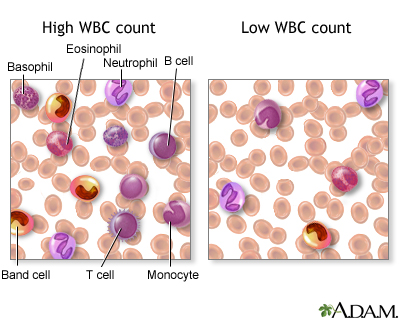
There are various types of white blood cells (WBCs) that normally appear in the blood: neutrophils (polymorphonuclear leukocytes; PMNs), band cells (slightly immature neutrophils), T-type lymphocytes (T cells), B-type lymphocytes (B cells), monocytes, eosinophils, and basophils. T and B-type lymphocytes are indistinguishable from each other in a normal slide preparation. Any infection or acute stress will result in an increased production of WBCs. This usually entails increased numbers of cells and an increase in the percentage of immature cells (mainly band cells) in the blood. This change is referred to as a “shift to the left” People who have had a splenectomy have a persistent mild elevation of WBCs. Drugs that may increase WBC counts include epinephrine, allopurinol, aspirin, chloroform, heparin, quinine, corticosteroids, and triamterene. Drugs that may decrease WBC counts include antibiotics, anticonvulsants, antihistamine, antithyroid drugs, arsenicals, barbiturates, chemotherapeutic agents, diuretics and sulfonamides.   (Updated by: David C. Dugdale, III, MD)

https://www.med-ed.virginia.edu/courses/path/innes/nh/wcbmaturation.cfm

Note that the mature forms of the myeloid series (neutrophils, eosinophils, basophils), all have lobed (segmented) nuclei. The degree of lobation increases as the cells mature.

The earliest recognizable myeloid cell is the myeloblast (10-20m dia) with a large round to oval nucleus. There is fine diffuse immature chromatin (without clumping) and a prominant nucleolus.

The cytoplasm is basophilic without granules. Although one may see a small golgi area adjacent to the nucleus, granules are not usually visible by light microscopy. One should not see blast cells in the peripheral blood.

myeloblast x100b

myeloblast x100b

https://www.med-ed.virginia.edu/courses/path/innes/images/nhjpeg/nh%20myeloblast%20x100b.jpeg

The promyelocyte (10-20m) is slightly larger than a blast. Its nucleus, although similar to a myeloblast shows slight chromatin condensation and less prominent nucleoli. The cytoplasm contains striking azurophilic granules or primary granules. These granules contain myeloperoxidase, acid phosphatase, and esterase enzymes. Normally no promyelocytes are seen in the peripheral blood.

At the point in development when secondary granules can be recognized, the cell becomes a myelocyte.

promyelocyte x100

promyelocyte x100

https://www.med-ed.virginia.edu/courses/path/innes/images/nhjpeg/nh%20promyelocyte%20×100%20a.jpeg

Myelocytes (10-18m) are not normally found in the peripheral blood. Nucleoli may not be seen in the late myelocyte. Primary azurophilic granules are still present, but secondary granules predominate. Secondary granules (neut, eos, or baso) first appear adjacent to the nucleus. In neutrophils this is the “dawn” of neutrophilia.

Metamyelocytes (10-18m) have kidney shaped indented nuclei and dense chromatin along the nuclear membrane. The cytoplasm is faintly pink, and they have secondary granules (neutro, eos, or baso). Zero to one percent of the peripheral blood white cells may be metamyelocytes (juveniles).

metamyelocyte x100

metamyelocyte x100

https://www.med-ed.virginia.edu/courses/path/innes/images/nhjpeg/nh%20metamyelocyte%20×100.jpeg

Bands, slightly smaller than juveniles, are marked by a U-shaped or deeply indented nucleus.

band neutrophilx100a

band neutrophilx100a

https://www.med-ed.virginia.edu/courses/path/innes/images/nhjpeg/nh%20band%20x100a.jpeg

Segmented (segs) or polymorphonuclear (PMN) leukocytes (average 14 m dia) are distinguished by definite lobation with thin thread-like filaments of chromatin joining the 2-5 lobes. 45-75% of the peripheral blood white cells are segmented neutrophils.

https://www.med-ed.virginia.edu/courses/path/innes/images/nhjpeg/nh%20neutrophil%20×100%20d.jpeg

6.2.1.3 Thrombocytogenesis

The incredible journey: From megakaryocyte development to platelet formation

Kellie R. Machlus1,2 and Joseph E. Italiano Jr
JCB 2013; 201(6): 785-796
http://dx.doi.org:/10.1083/jcb.201304054

Large progenitor cells in the bone marrow called megakaryocytes (MKs) are the source of platelets. MKs release platelets through a series of fascinating cell biological events. During maturation, they become polyploid and accumulate massive amounts of protein and membrane. Then, in a cytoskeletal-driven process, they extend long branching processes, designated proplatelets, into sinusoidal blood vessels where they undergo fission to release platelets.

megakaryocyte production of platelets

megakaryocyte production of platelets

http://dm5migu4zj3pb.cloudfront.net/manuscripts/26000/26891/medium/JCI0526891.f4.jpg

platelets and the immune continuum nri2956-f3

platelets and the immune continuum nri2956-f3

http://www.nature.com/nri/journal/v11/n4/images/nri2956-f3.jpg

6.2.2 Classification of hematological malignancies
Practical Diagnosis of Hematologic Disoreders. 4th edition. Vol 2.
Kjeldsberg CR, Ed.  ASCP Press.  2006. Chicago, IL.

6.2.2.1 Primary Classification

6.2.2.1.1 Acute leukemias

6.2.2.1.1 Myelodysplastic syndromes

6.2.2.1.2 Acute myeloid leukemia

6.2.2.1.3 Acute lymphoblastic leukemia

6.2.2.2 Myeloproliferative Disorders

6.2.2.2.1 Chronic myeloproliferative disorders

6.2.2.2.2 Chronic myelogenous leukemia and related disorders

6.2.2.2.3 Myelofibrosis, including chronic idiopathic

6.2.2.2.4 Polycythemia, including polycythemia rubra vera

6.2.2.2.5 Thrombocytosis, including essential thrombocythemia

6.2.2.3 Chronic lymphoid leukemia and other lymphoid leukemias

6.2.2.4 Lymphomas

6.2.2.4.1 Non-Hodgkin Lymphoma

6.2.2.4.2 Hodgkin lymphoma

6.2.2.5 Lymphoproliferative disorders associated with immunodeficiency

6.2.2.6 Plasma Cell dyscrasias

6.2.2.7 Mast cell disease and Histiocytic neoplasms

6.2.3 Secondary Classification

6.2.3.1 Nuance – PathologyOutlines
Nat Pernick, Ed.

http://www.pathologyoutlines.com/leukemia.html

This site is up-to-date and revised periodically. It is the best site for pathology information.

6.2.4 Diagnostics

6.2.4.1 Computer-aided diagnostics

6.2.4.1.1 Back-to-Front Design

Robert Didner
Bell Laboratories

Decision-making in the clinical setting
Didner, R  Mar 1999  Amer Clin Lab

Mr. Didner is an Independent Consultant in Systems Analysis, Information Architecture (Informatics) Operations Research, and Human Factors Engineering (Cognitive Psychology),  Decision Information Designs, 29 Skyline Dr., Morristown, NJ07960, U.S.A.; tel.: 973-455-0489; fax/e-mail: bdidner@hotmail.com

A common problem in the medical profession is the level of effort dedicated to administration and paperwork necessitated by various agencies, which contributes to the high cost of medical care. Costs would be reduced and accuracy improved if the clinical data could be captured directly at the point they are generated in a form suitable for transmission to insurers or machine transformable into other formats. Such a capability could also be used to improve the form and the structure of information presented to physicians and support a more comprehensive database linking clinical protocols to outcomes, with the prospect of improving clinical outcomes. Although the problem centers on the physician’s process of determining the diagnosis and treatment of patients and the timely and accurate recording of that process in the medical system, it substantially involves the pathologist and laboratorian, who interact significantly throughout the in-formation-gathering process. Each of the currently predominant ways of collecting information from diagnostic protocols has drawbacks. Using blank paper to collect free-form notes from the physician is not amenable to computerization; such free-form data are also poorly formulated, formatted, and organized for the clinical decision-making they support. The alternative of preprinted forms listing the possible tests, results, and other in-formation gathered during the diagnostic process facilitates the desired computerization, but the fixed sequence of tests and questions they present impede the physician from using an optimal decision-making sequence. This follows because:

  • People tend to make decisions and consider information in a step-by-step manner in which intermediate decisions are intermixed with data acquisition steps.
  • The sequence in which components of decisions are made may alter the decision outcome.
  • People tend to consider information in the sequence it is requested or displayed.
  • Since there is a separate optimum sequence of tests and questions for each cluster of history and presenting symptoms, there is no one sequence of tests and questions that can be optimal for all presenting clusters.
  • As additional data and test results are acquired, the optimal sequence of further testing and data acquisition changes, depending on the already acquired information.

Therefore, promoting an arbitrary sequence of information requests with preprinted forms may detract from outcomes by contributing to a non-optimal decision-making sequence. Unlike the decisions resulting from theoretical or normative processes, decisions made by humans are path dependent; that is, the out-come of a decision process may be different if the same components are considered in a different sequence.

Proposed solution

This paper proposes a general approach to gathering data at their source in computer-based form so as to improve the expected outcomes. Such a means must be interactive and dynamic, so that at any point in the clinical process the patient’s presenting symptoms, history, and the data already collected are used to determine the next data or tests requested. That de-termination must derive from a decision-making strategy designed to produce outcomes with the greatest value and supported by appropriate data collection and display techniques. The strategy must be based on the knowledge of the possible outcomes at any given stage of testing and information gathering, coupled with a metric, or hierarchy of values for assessing the relative desirability of the possible outcomes.

A value hierarchy

  • The numbered list below illustrates a value hierarchy. In any particular instance, the higher-numbered values should only be considered once the lower- numbered values have been satisfied. Thus, a diagnostic sequence that is very time or cost efficient should only be considered if it does not increase the likelihood (relative to some other diagnostic sequence) that a life-threatening disorder may be missed, or that one of the diagnostic procedures may cause discomfort.
  • Minimize the likelihood that a treatable, life-threatening disorder is not treated.
  • Minimize the likelihood that a treatable, discomfort-causing disorder is not treated.
  • Minimize the likelihood that a risky procedure(treatment or diagnostic procedure) is inappropriately administered.
  • Minimize the likelihood that a discomfort-causing procedure is inappropriately administered.
  • Minimize the likelihood that a costly procedure is inappropriately administered.
  • Minimize the time of diagnosing and treating thepatient.8.Minimize the cost of diagnosing and treating the patient.

The above hierarchy is relative, not absolute; for many patients, a little bit of testing discomfort may be worth a lot of time. There are also some factors and graduations intentionally left out for expository simplicity (e.g., acute versus chronic disorders).This value hierarchy is based on a hypothetical patient. Clearly, the hierarchy of a health insurance carrier might be different, as might that of another patient (e.g., a geriatric patient). If the approach outlined herein were to be followed, a value hierarchy agreed to by a majority of stakeholders should be adopted.

Efficiency

Once the higher values are satisfied, the time and cost of diagnosis and treatment should be minimized. One way to do so would be to optimize the sequence in which tests are performed, so as to minimize the number, cost, and time of tests that need to be per-formed to reach a definitive decision regarding treatment. Such an optimum sequence could be constructed using Claude Shannon’s information theory.

According to this theory, the best next question to ask under any given situation (assuming the question has two possible outcomes) is that question that divides the possible outcomes into two equally likely sets. In the real world, all tests or questions are not equally valuable, costly, or time consuming; therefore, value(risk factors), cost, and time should be used as weighting factors to optimize the test sequence, but this is a complicating detail at this point.

A value scale

For dynamic computation of outcome values, the hierarchy could be converted into a weighted value scale so differing outcomes at more than one level of the hierarchy could be readily compared. An example of such a weighted value scale is Quality Adjusted Life Years (QALY).

Although QALY does not incorporate all of the factors in this example, it is a good conceptual starting place.

The display, request, decision-making relationship

For each clinical determination, the pertinent information should be gathered, organized, formatted, and formulated in a way that facilitates the accuracy, reliability, and efficiency with which that determination is made. A physician treating a patient with high cholesterol and blood pressure (BP), for example, may need to know whether or not the patient’s cholesterol and BP respond to weight changes to determine an appropriate treatment (e.g., weight control versus medication). This requires searching records for BP, certain blood chemicals (e.g., HDLs, LDLs, triglycerides, etc.), and weight from several

sources, then attempting to track them against each other over time. Manually reorganizing this clinical information each time it is used is extremely inefficient. More important, the current organization and formatting defies principles of human factors for optimally displaying information to enhance human information-processing characteristics, particularly for decision support.

While a discussion of human factors and cognitive psychology principles is beyond the scope of this paper, following are a few of the system design principles of concern:

  • Minimize the load on short-term memory.
  • Provide information pertinent to a given decision or component of a decision in a compact, contiguous space.
  • Take advantage of basic human perceptual and pat-tern recognition facilities.
  • Design the form of an information display to com-plement the decision-making task it supports.

F i g u re 1 shows fictitious, quasi-random data from a hypothetical patient with moderately elevated cholesterol. This one-page display pulls together all the pertinent data from six years of blood tests and related clinical measurements. At a glance, the physician’s innate pattern recognition, color, and shape perception facilities recognize the patient’s steadily increasing weight, cholesterol, BP, and triglycerides as well as the declining high-density lipoproteins. It would have taken considerably more time and effort to grasp this information from the raw data collection and blood test reports as they are currently presented in independent, tabular time slices.

Design the formulation of an information display to complement the decision-making task.

The physician may wish to know only the relationship between weight and cardiac risk factors rather than whether these measures are increasing or decreasing, or are within acceptable or marginal ranges. If so, Table 1 shows the correlations between weight and the other factors in a much more direct and simple way using the same data as in Figure 1. One can readily see the same conclusions about relations that were drawn from Figure 1.This type of abstract, symbolic display of derived information also makes it easier to spot relationships when the individual variables are bouncing up and down, unlike the more or less steady rise of most values in Figure 1. This increase in precision of relationship information is gained at the expense of other types of information (e.g., trends). To display information in an optimum form then, the system designer must know what the information demands of the task are at the point in the task when the display is to be used.

Present the sequence of information display clusters to complement an optimum decision-making strategy.

Just as a fixed sequence of gathering clinical, diagnostic information may lead to a far from optimum outcome, there exists an optimum sequence of testing, considering information, and gathering data that will lead to an optimum outcome (as defined by the value hierarchy) with a minimum of time and expense. The task of the information system designer, then, is to provide or request the right information, in the best form, at each stage of the procedure. For ex-ample, Figure 1 is suitable for the diagnostic phase since it shows the current state of the risk factors and their trends. Table 1, on the other hand, might be more appropriate in determining treatment, where there may be a choice of first trying a strict dietary treatment, or going straight to a combination of diet plus medication. The fact that Figure 1 and Table 1 have somewhat redundant information is not a problem, since they are intended to optimally provide information for different decision-making tasks. The critical need, at this point, is for a model of how to determine what information should be requested, what tests to order, what information to request and display, and in what form at each step of the decision-making process. Commitment to a collaborative relationship between physicians and laboratorians and other information providers would be an essential requirement for such an undertaking. The ideal diagnostic data-collection instrument is a flexible, computer-based device, such as a notebook computer or Personal Digital Assistant (PDA) sized device.

Barriers to interactive, computer-driven data collection at the source

As with any major change, it may be difficult to induce many physicians to change their behavior by interacting directly with a computer instead of with paper and pen. Unlike office workers, who have had to make this transition over the past three decades, most physicians’ livelihoods will not depend on converting to computer interaction. Therefore, the transition must be made attractive and the changes less onerous. Some suggestions follow:

  1. Make the data collection a natural part of the clinical process.
  2. Ensure that the user interface is extremely friendly, easy to learn, and easy to use.
  3. Use a small, portable device.
  4. Use the same device for collection and display of existing information (e.g., test results and his-tory).
  5. Minimize the need for free-form written data entry (use check boxes, forms, etc.).
  6. Allow the entry of notes in pen-based free-form (with the option of automated conversion of numeric data to machine-manipulable form).
  7. Give the physicians a more direct benefit for collecting data, not just a means of helping a clerk at an HMO second-guess the physician’s judgment.
  8. Improve administrative efficiency in the office.
  9. Make the data collection complement the clinical decision-making process.
  10. Improve information displays, leading to better outcomes.
  11. Make better use of the physician’s time and mental effort.

Conclusion

The medical profession is facing a crisis of information. Gathering information is costing a typical practice more and more while fees are being restricted by third parties, and the process of gathering this in-formation may be detrimental to current outcomes. Gathered properly, in machine-manipulable form, these data could be reformatted so as to greatly improve their value immediately in the clinical setting by leading to decisions with better outcomes and, in the long run, by contributing to a clinical data warehouse that could greatly improve medical knowledge. The challenge is to create a mechanism for data collection that facilitates, hastens, and improves the outcomes of clinical activity while minimizing the inconvenience and resistance to change on the part of clinical practitioners. This paper is intended to provide a high-level overview of how this may be accomplished, and start a dialogue along these lines.

References

  1. Tversky A. Elimination by aspects: a theory of choice. Psych Rev 1972; 79:281–99.
  2. Didner RS. Back-to-front design: a guns and butter approach. Ergonomics 1982; 25(6):2564–5.
  3. Shannon CE. A mathematical theory of communication. Bell System Technical J 1948; 27:379–423 (July), 623–56 (Oct).
  4. Feeny DH, Torrance GW. Incorporating utility-based quality-of-life assessment measures in clinical trials: two examples. Med Care 1989; 27:S190–204.
  5. Smith S, Mosier J. Guidelines for designing user interface soft-ware. ESD-TR-86-278, Aug 1986.
  6. Miller GA. The magical number seven plus or minus two. Psych Rev 1956; 65(2):81–97.
  7. Sternberg S. High-speed scanning in human memory. Science 1966; 153: 652–4.

Table 1

Correlation of weight with other cardiac risk factors

Cholesterol 0.759384
HDL 0.53908
LDL 0.177297
BP-syst. 0.424728
BP-dia. 0.516167
Triglycerides 0.637817

Figure 1  Hypothetical patient data.

(not shown)

6.2.4.1.2 Realtime Clinical Expert Support

http://pharmaceuticalintelligence.com/2015/05/10/realtime-clinical-expert-support/

6.2.4.1.3 Regression: A richly textured method for comparison and classification of predictor variables

http://pharmaceuticalintelligence.com/2012/08/14/regression-a-richly-textured-method-for-comparison-and-classification-of-predictor-variables/

6.2.4.1.4 Converting Hematology Based Data into an Inferential Interpretation

Larry H. Bernstein, Gil David, James Rucinski and Ronald R. Coifman
In Hematology – Science and Practice
Lawrie CH, Ch 22. Pp541-552.
InTech Feb 2012, ISBN 978-953-51-0174-1
https://www.researchgate.net/profile/Larry_Bernstein/publication/221927033_Converting_Hematology_Based_Data_into_an_Inferential_Interpretation/links/0fcfd507f28c14c8a2000000.pdf

6.2.4.1.5 A model for Thalassemia Screening using Hematology Measurements

https://www.researchgate.net/profile/Larry_Bernstein/publication/258848064_A_model_for_Thalassemia_Screening_using_Hematology_Measurements/links/0c9605293c3048060b000000.pdf

A model for automated screening of thalassemia in hematology (math study).

Kneifati-Hayek J, Fleischman W, Bernstein LH, Riccioli A, Bellevue R.
Lab Hematol. 2007; 13(4):119-23. http://dx.doi.org:/10.1532/LH96.07003.

The results of 398 patient screens were collected. Data from the set were divided into training and validation subsets. The Mentzer ratio was determined through a receiver operating characteristic (ROC) curve on the first subset, and screened for thalassemia using the second subset. HgbA2 levels were used to confirm beta-thalassemia.

RESULTS: We determined the correct decision point of the Mentzer index to be a ratio of 20. Physicians can screen patients using this index before further evaluation for beta-thalassemia (P < .05).

CONCLUSION: The proposed method can be implemented by hospitals and laboratories to flag positive matches for further definitive evaluation, and will enable beta-thalassemia screening of a much larger population at little to no additional cost.

6.2.4.1.6 Measurement of granulocyte maturation may improve the early diagnosis of the septic state.

Bernstein LH, Rucinski J. Clin Chem Lab Med. 2011 Sep 21;49(12):2089-95.
http://dx.doi.org:/10.1515/CCLM.2011.688.

6.2.4.1.7 The automated malnutrition assessment.

David G, Bernstein LH, Coifman RR. Nutrition. 2013 Jan; 29(1):113-21.
http://dx.doi.org:/10.1016/j.nut.2012.04.017

6.2.4.2 Molecular Diagnostics

6.2.4.2.1 Genomic Analysis of Hematological Malignancies

Acute lymphoblastic leukemia (ALL) is the most common hematologic malignancy that occurs in children. Although more than 90% of children with ALL now survive to adulthood, those with the rarest and high-risk forms of the disease continue to have poor prognoses. Through the Pediatric Cancer Genome Project (PCGP), investigators in the Hematological Malignancies Program are identifying the genetic aberrations that cause these aggressive forms of leukemias. Here we present two studies on the genetic bases of early T-cell precursor ALL and acute megakaryoblastic leukemia.

  • Early T-Cell Precursor ALL Is Characterized by Activating Mutations
  • The CBFA2T3-GLIS2Fusion Gene Defines an Aggressive Subtype of Acute Megakaryoblastic Leukemia in Children

Early T-cell precursor ALL (ETP-ALL), which comprises 15% of all pediatric T-cell leukemias, is an aggressive disease that is typically resistant to contemporary therapies. Children with ETP-ALL have a high rate of relapse and an extremely poor prognosis (i.e., 5-year survival is approximately 20%). The genetic basis of ETP-ALL has remained elusive. Although ETP-ALL is associated with a high burden of DNA copy number aberrations, none are consistently found or suggest a unifying genetic alteration that drives this disease.

Through the efforts of the PCGP, Jinghui Zhang, PhD (Computational Biology), James R. Downing, MD (Pathology), Charles G. Mullighan, MBBS(Hons), MSc, MD (Pathology), and colleagues analyzed the whole-genome sequences of leukemic cells and matched normal DNA from 12 pediatric patients with ETP-ALL. The identified genetic mutations were confirmed in a validation cohort of 52 ETP-ALL specimens and 42 non-ETP T-lineage ALLs (T-ALL).

In the journal Nature, the investigators reported that each ETP-ALL sample carried an average of 1140 sequence mutations and 12 structural variations. Of the structural variations, 51% were breakpoints in genes with well-established roles in hematopoiesis or leukemogenesis (e.g., MLH2,SUZ12, and RUNX1). Eighty-four percent of the structural variations either caused loss of function of the gene in question or resulted in the formation of a fusion gene such as ETV6-INO80D. The ETV6 gene, which encodes a protein that is essential for hematopoiesis, is frequently mutated in leukemia. Among the DNA samples sequenced in this study, ETV6 was altered in 33% of ETP-ALL but only 10% of T-ALL cases.

6.2.4.2.2 Next-generation sequencing in hematologic malignancies: what will be the dividends?

Jason D. MerkerAnton Valouev, and Jason Gotlib
Ther Adv Hematol. 2012 Dec; 3(6): 333–339.
http://dx.doi.org:/10.1177/2040620712458948

The application of high-throughput, massively parallel sequencing technologies to hematologic malignancies over the past several years has provided novel insights into disease initiation, progression, and response to therapy. Here, we describe how these new DNA sequencing technologies have been applied to hematolymphoid malignancies. With further improvements in the sequencing and analysis methods as well as integration of the resulting data with clinical information, we expect these technologies will facilitate more precise and tailored treatment for patients with hematologic neoplasms.

6.2.4.2.3 Leveraging cancer genome information in hematologic malignancies.

Rampal R1Levine RL.
J Clin Oncol. 2013 May 20; 31(15):1885-92.
http://dx.doi.org:/10.1200/JCO.2013.48.7447

The use of candidate gene and genome-wide discovery studies in the last several years has led to an expansion of our knowledge of the spectrum of recurrent, somatic disease alleles, which contribute to the pathogenesis of hematologic malignancies. Notably, these studies have also begun to fundamentally change our ability to develop informative prognostic schema that inform outcome and therapeutic response, yielding substantive insights into mechanisms of hematopoietic transformation in different tissue compartments. Although these studies have already had important biologic and translational impact, significant challenges remain in systematically applying these findings to clinical decision making and in implementing new technologies for genetic analysis into clinical practice to inform real-time decision making. Here, we review recent major genetic advances in myeloid and lymphoid malignancies, the impact of these findings on prognostic models, our understanding of disease initiation and evolution, and the implication of genomic discoveries on clinical decision making. Finally, we discuss general concepts in genetic modeling and the current state-of-the-art technology used in genetic investigation.

6.2.4.2.4 p53 mutations are associated with resistance to chemotherapy and short survival in hematologic malignancies

E Wattel, C Preudhomme, B Hecquet, M Vanrumbeke, et AL.
Blood, (Nov 1), 1994; 84(9): pp 3148-3157
http://www.bloodjournal.org/content/bloodjournal/84/9/3148.full.pdf

We analyzed the prognostic value of p53 mutations for response to chemotherapy and survival in acute myeloid leukemia (AML), myelodysplastic syndrome (MDS), and chronic lymphocytic leukemia (CLL). Mutations were detected by single-stranded conformation polymorphism (SSCP) analysis of exons 4 to 10 of the P53 gene, and confirmed by direct sequencing. A p53 mutation was found in 16 of 107 (15%) AML, 20 of 182 (11%) MDS, and 9 of 81 (11%) CLL tested. In AML, three of nine (33%) mutated cases and 66 of 81 (81%) nonmutated cases treated with intensive chemotherapy achieved complete remission (CR) (P = .005) and none of five mutated cases and three of six nonmutated cases treated by low-dose Ara C achieved CR or partial remission (PR) (P = .06). Median actuarial survival was 2.5 months in mutated cases, and 15 months in nonmutated cases (P < lo-‘). In the MDS patients who received chemotherapy (intensive chemotherapy or low-dose Ara C), 1 of 13 (8%) mutated cases and 23 of 38 (60%) nonmutated cases achieved CR or PR (P = .004), and median actuarial survival was 2.5 and 13.5 months, respectively (P C lo-’). In all MDS cases (treated and untreated), the survival difference between mutated cases and nonmutated cases was also highly significant. In CLL, 1 of 8 (12.5%) mutated cases treated by chemotherapy (chlorambucil andlor CHOP andlor fludarabine) responded, as compared with 29 of 36 (80%) nonmutated cases (P = .02). In all CLL cases, survival from p53 analysis was significantly shorter in mutated cases (median 7 months) than in nonmutated cases (median not reached) (P < IO-’). In 35 of the 45 mutated cases of AML, MDS, and CLL, cytogenetic analysis or SSCP and sequence findings showed loss of the nonmutated P53 allele. Our findings show that p53 mutations are a strong prognostic indicator of response to chemotherapy and survival in AML, MDS, and CLL. The usual association of p53 mutations to loss of the nonmutated P53 allele, in those disorders, ie, to absence of normal p53 in tumor cells, suggests that p53 mutations could induce drug resistance, at least in part, by interfering with normal apoptotic pathways in tumor cells.

6.2.4.2.5 Genomic approaches to hematologic malignancies

Benjamin L. Ebert and Todd R. Golub
Blood. 2004; 104:923-932
https://www.broadinstitute.org/mpr/publications/projects/genomics/Review%20Genomics%20of%20Heme%20Malig,%20Blood%202004.pdf

In the past several years, experiments using DNA microarrays have contributed to an increasingly refined molecular taxonomy of hematologic malignancies. In addition to the characterization of molecular profiles for known diagnostic classifications, studies have defined patterns of gene expression corresponding to specific molecular abnormalities, oncologic phenotypes, and clinical outcomes. Furthermore, novel subclasses with distinct molecular profiles and clinical behaviors have been identified. In some cases, specific cellular pathways have been highlighted that can be therapeutically targeted. The findings of microarray studies are beginning to enter clinical practice as novel diagnostic tests, and clinical trials are ongoing in which therapeutic agents are being used to target pathways that were identified by gene expression profiling. While the technology of DNA microarrays is becoming well established, genome-wide surveys of gene expression generate large data sets that can easily lead to spurious conclusions. Many challenges remain in the statistical interpretation of gene expression data and the biologic validation of findings. As data accumulate and analyses become more sophisticated, genomic technologies offer the potential to generate increasingly sophisticated insights into the complex molecular circuitry of hematologic malignancies. This review summarizes the current state of discovery and addresses key areas for future research.

6.2.4.3 Flow cytometry

Introduction to Flow Cytometry: Blood Cell Identification

Dana L. Van Laeys
https://www.labce.com/flow_cytometry.aspx

No other laboratory method provides as rapid and detailed analysis of cellular populations as flow cytometry, making it a valuable tool for diagnosis and management of several hematologic and immunologic diseases. Understanding this relevant methodology is important for any medical laboratory scientist.

Whether you have no previous experience with flow cytometry or just need a refresher, this course will help you to understand the basic principles, with the help of video tutorials and interactive case studies.

Basic principles include:

  1. Immunophenotypic features of various types of hematologic cells
  2. Labeling cellular elements with fluorochromes
  3. Blood cell identification, specifically B and T lymphocyte identification and analysis
  4. Cell sorting to isolate select cell population for further analysis
  5. Analyzing and interpreting result reports and printouts

6.2.5 Treatments

6.2.5.1 Treatments for leukemia by type

6.2.5.1.1 Acute lymphocytic leukemias

6.2.5.1.1.1 Treatment of Acute Lymphoblastic Leukemia

Ching-Hon Pu, and William E. Evans
N Engl J Med Jan 12, 2006; 354:166-178
http://dx.doi.org:/10.1056/NEJMra052603

Although the overall cure rate of acute lymphoblastic leukemia (ALL) in children is about 80 percent, affected adults fare less well. This review considers recent advances in the treatment of ALL, emphasizing issues that need to be addressed if treatment outcome is to improve further.

6.2.5.1.1.2 Acute Lymphoblastic Leukemia

Ching-Hon Pui, Mary V. Relling, and James R. Downing
N Engl J Med Apr 8, 2004; 350:1535-1548
http://dx.doi.org:/10.1056/NEJMra023001

This comprehensive survey emphasizes how recent advances in the knowledge of molecular mechanisms involved in acute lymphoblastic leukemia have influenced diagnosis, prognosis, and treatment.

6.2.5.1.1.3 Gene-Expression Patterns in Drug-Resistant Acute Lymphoblastic Leukemia Cells and Response to Treatment

Amy Holleman, Meyling H. Cheok, Monique L. den Boer, et al.
N Engl J Med 2004; 351:533-42

Childhood acute lymphoblastic leukemia (ALL) is curable with chemotherapy in approximately 80 percent of patients. However, the cause of treatment failure in the remaining 20 percent of patients is largely unknown.

Methods We tested leukemia cells from 173 children for sensitivity in vitro to prednisolone, vincristine, asparaginase, and daunorubicin. The cells were then subjected to an assessment of gene expression with the use of 14,500 probe sets to identify differentially expressed genes in drug-sensitive and drug-resistant ALL. Gene-expression patterns that differed according to sensitivity or resistance to the four drugs were compared with treatment outcome in the original 173 patients and an independent cohort of 98 children treated with the same drugs at another institution.

Results We identified sets of differentially expressed genes in B-lineage ALL that were sensitive or resistant to prednisolone (33 genes), vincristine (40 genes), asparaginase (35 genes), or daunorubicin (20 genes). A combined gene-expression score of resistance to the four drugs, as compared with sensitivity to the four, was significantly and independently related to treatment outcome in a multivariate analysis (hazard ratio for relapse, 3.0; P=0.027). Results were confirmed in an independent population of patients treated with the same medications (hazard ratio for relapse, 11.85; P=0.019). Of the 124 genes identified, 121 have not previously been associated with resistance to the four drugs we tested.

Conclusions  Differential expression of a relatively small number of genes is associated with drug resistance and treatment outcome in childhood ALL.

6.2.5.1.1.4 Leukemias Treatment & Management

Author: Lihteh Wu, MD; Chief Editor: Hampton Roy Sr
http://emedicine.medscape.com/article/1201870-treatment

The treatment of leukemia is in constant flux, evolving and changing rapidly over the past few years. Most treatment protocols use systemic chemotherapy with or without radiotherapy. The basic strategy is to eliminate all detectable disease by using cytotoxic agents. To attain this goal, 3 phases are typically used, as follows: remission induction phase, consolidation phase, and maintenance therapy phase.

Chemotherapeutic agents are chosen that interfere with cell division. Tumor cells usually divide more rapidly than host cells, making them more vulnerable to the effects of chemotherapy. Primary treatment will be under the direction of a medical oncologist, radiation oncologist, and primary care physician. Although a general treatment plan will be outlined, the ophthalmologist does not prescribe or manage such treatment.

  • The initial treatment of ALL uses various combinations of vincristine, prednisone, and L-asparaginase until a complete remission is obtained.
  • Maintenance therapy with mercaptopurine is continued for 2-3 years following remission.
  • Use of intrathecal methotrexate with or without cranial irradiation to cover the CNS varies from facility to facility.
  • Daunorubicin, cytarabine, and thioguanine currently are used to obtain induction and remission of AML.
  • Maintenance therapy for 8 months may lengthen remission. Once relapse has occurred, AML generally is curable only by bone marrow transplantation.
  • Presently, treatment of CLL is palliative.
  • CML is characterized by a leukocytosis greater than 100,000 cells. Emergent treatment with leukopheresis sometimes is necessary when leukostastic complications are present. Otherwise, busulfan or hydroxyurea may control WBC counts. During the chronic phase, treatment is palliative.
  • When CML converts to the blastic phase, approximately one third of cases behave as ALL and respond to treatment with vincristine and prednisone. The remaining two thirds resemble AML but respond poorly to AML therapy.
  • Allogeneic bone marrow transplant is the only curative therapy for CML. However, it carries a high early mortality rate.
  • Leukemic retinopathy usually is not treated directly. As the hematological parameters normalize with systemic treatment, many of the ophthalmic signs resolve. There are reports that leukopheresis for hyperviscosity also may alleviate intraocular manifestations.
  • When definite intraocular leukemic infiltrates fail to respond to systemic chemotherapy, direct radiation therapy is recommended.
  • Relapse, manifested by anterior segment involvement, should be treated by radiation. In certain cases, subconjunctival chemotherapeutic agents have been injected.
  • Optic nerve head infiltration in patients with ALL is an emergency and requires prompt radiation therapy to try to salvage some vision.

6.2.5.1.1.5 Treatments and drugs

http://www.mayoclinic.org/diseases-conditions/leukemia/basics/
treatment/con-20024914

Common treatments used to fight leukemia include:

  • Chemotherapy. Chemotherapy is the major form of treatment for leukemia. This drug treatment uses chemicals to kill leukemia cells.

Depending on the type of leukemia you have, you may receive a single drug or a combination of drugs. These drugs may come in a pill form, or they may be injected directly into a vein.

  • Biological therapy. Biological therapy works by using treatments that help your immune system recognize and attack leukemia cells.
  • Targeted therapy. Targeted therapy uses drugs that attack specific vulnerabilities within your cancer cells.

For example, the drug imatinib (Gleevec) stops the action of a protein within the leukemia cells of people with chronic myelogenous leukemia. This can help control the disease.

  • Radiation therapy. Radiation therapy uses X-rays or other high-energy beams to damage leukemia cells and stop their growth. During radiation therapy, you lie on a table while a large machine moves around you, directing the radiation to precise points on your body.

You may receive radiation in one specific area of your body where there is a collection of leukemia cells, or you may receive radiation over your whole body. Radiation therapy may be used to prepare for a stem cell transplant.

  • Stem cell transplant. A stem cell transplant is a procedure to replace your diseased bone marrow with healthy bone marrow.

Before a stem cell transplant, you receive high doses of chemotherapy or radiation therapy to destroy your diseased bone marrow. Then you receive an infusion of blood-forming stem cells that help to rebuild your bone marrow.

You may receive stem cells from a donor, or in some cases you may be able to use your own stem cells. A stem cell transplant is very similar to a bone marrow transplant.

6.2.5.1.2 Acute Myeloid Leukemia

6.2.5.1.2.1 New treatment approaches in acute myeloid leukemia: review of recent clinical studies.

Norsworthy K1Luznik LGojo I.
Rev Recent Clin Trials. 2012 Aug; 7(3):224-37.
http://www.ncbi.nlm.nih.gov/pubmed/22540908

Standard chemotherapy can cure only a fraction (30-40%) of younger and very few older patients with acute myeloid leukemia (AML). While conventional allografting can extend the cure rates, its application remains limited mostly to younger patients and those in remission. Limited efficacy of current therapies and improved understanding of the disease biology provided a spur for clinical trials examining novel agents and therapeutic strategies in AML. Clinical studies with novel chemotherapeutics, antibodies, different signal transduction inhibitors, and epigenetic modulators demonstrated their clinical activity; however, it remains unclear how to successfully integrate novel agents either alone or in combination with chemotherapy into the overall therapeutic schema for AML. Further studies are needed to examine their role in relation to standard chemotherapy and their applicability to select patient populations based on recognition of unique disease and patient characteristics, including the development of predictive biomarkers of response. With increasing use of nonmyeloablative or reduced intensity conditioning and alternative graft sources such as haploidentical donors and cord blood transplants, the benefits of allografting may extend to a broader patient population, including older AML patients and those lacking a HLA-matched donor. We will review here recent clinical studies that examined novel pharmacologic and immunologic approaches to AML therapy.

6.2.5.1.2.2 Novel approaches to the treatment of acute myeloid leukemia.

Roboz GJ1
Hematology Am Soc Hematol Educ Program. 2011:43-50.
http://dx.doi.org:/10.1182/asheducation-2011.1.43.

Approximately 12 000 adults are diagnosed with acute myeloid leukemia (AML) in the United States annually, the majority of whom die from their disease. The mainstay of initial treatment, cytosine arabinoside (ara-C) combined with an anthracycline, was developed nearly 40 years ago and remains the worldwide standard of care. Advances in genomics technologies have identified AML as a genetically heterogeneous disease, and many patients can now be categorized into clinicopathologic subgroups on the basis of their underlying molecular genetic defects. It is hoped that enhanced specificity of diagnostic classification will result in more effective application of targeted agents and the ability to create individualized treatment strategies. This review describes the current treatment standards for induction, consolidation, and stem cell transplantation; special considerations in the management of older AML patients; novel agents; emerging data on the detection and management of minimal residual disease (MRD); and strategies to improve the design and implementation of AML clinical trials.

Age ≥ 60 years has consistently been identified as an independent adverse prognostic factor in AML, and there are very few long-term survivors in this age group.5 Poor outcomes in elderly AML patients have been attributed to both host- and disease-related factors, including medical comorbidities, physical frailty, increased incidence of antecedent myelodysplastic syndrome and myeloproliferative disorders, and higher frequency of adverse cytogenetics.28 Older patients with multiple poor-risk factors have a high probability of early death and little chance of long-term disease-free survival with standard chemotherapy. In a retrospective analysis of 998 older patients treated with intensive induction at the M.D. Anderson Cancer Center, multivariate analysis identified age ≥ 75 years, unfavorable karyotype, poor performance status, creatinine > 1.3 mg/dL, duration of antecedent hematologic disorder > 6 months, and treatment outside a laminar airflow room as adverse prognostic indicators.29 Patients with 3 or more of these factors had expected complete remission rates of < 20%, 8-week mortality > 50%, and 1-year survival < 10%. The Medical Research Council (MRC) identified cytogenetics, WBC count at diagnosis, age, and de novo versus secondary disease as critical factors influencing survival in > 2000 older patients with AML, but cautioned in their conclusions that less objective factors, such as clinical assessment of “fitness” for chemotherapy, may be equally important in making treatment decisions in this patient population.30 It is hoped that data from comprehensive geriatric assessments of functional status, cognition, mood, quality of life, and other measures obtained during ongoing cooperative group trials will improve our ability to predict how older patients will tolerate treatment.

6.5.1.2.3 Current treatment of acute myeloid leukemia.

Roboz GJ1.
Curr Opin Oncol. 2012 Nov; 24(6):711-9.
http://dx.doi.org:/10.1097/CCO.0b013e328358f62d.

The objectives of this review are to discuss standard and investigational nontransplant treatment strategies for acute myeloid leukemia (AML), excluding acute promyelocytic leukemia.

RECENT FINDINGS: Most adults with AML die from their disease. The standard treatment paradigm for AML is remission induction chemotherapy with an anthracycline/cytarabine combination, followed by either consolidation chemotherapy or allogeneic stem cell transplantation, depending on the patient’s ability to tolerate intensive treatment and the likelihood of cure with chemotherapy alone. Although this approach has changed little in the last three decades, increased understanding of the pathogenesis of AML and improvements in molecular genomic technologies are leading to novel drug targets and the development of personalized, risk-adapted treatment strategies. Recent findings related to prognostically relevant and potentially ‘druggable’ molecular targets are reviewed.

SUMMARY: At the present time, AML remains a devastating and mostly incurable disease, but the combination of optimized chemotherapeutics and molecularly targeted agents holds significant promise for the future.

6.5.1.2.4  Adult Acute Myeloid Leukemia Treatment (PDQ®)
http://www.cancer.gov/cancertopics/pdq/treatment/adultAML/healthprofessional/page9

About This PDQ Summary

This summary is reviewed regularly and updated as necessary by the PDQ Adult Treatment Editorial Board, which is editorially independent of the National Cancer Institute (NCI). The summary reflects an independent review of the literature and does not represent a policy statement of NCI or the National Institutes of Health (NIH).

Board members review recently published articles each month to determine whether an article should:

  • be discussed at a meeting,
  • be cited with text, or
  • replace or update an existing article that is already cited.

Treatment Option Overview for AML

Successful treatment of acute myeloid leukemia (AML) requires the control of bone marrow and systemic disease and specific treatment of central nervous system (CNS) disease, if present. The cornerstone of this strategy includes systemically administered combination chemotherapy. Because only 5% of patients with AML develop CNS disease, prophylactic treatment is not indicated.[13]

Treatment is divided into two phases: remission induction (to attain remission) and postremission (to maintain remission). Maintenance therapy for AML was previously administered for several years but is not included in most current treatment clinical trials in the United States, other than for acute promyelocytic leukemia. (Refer to the Adult Acute Myeloid Leukemia in Remission section of this summary for more information.) Other studies have used more intensive postremission therapy administered for a shorter duration of time after which treatment is discontinued.[4] Postremission therapy appears to be effective when given immediately after remission is achieved.[4]

Since myelosuppression is an anticipated consequence of both the leukemia and its treatment with chemotherapy, patients must be closely monitored during therapy. Facilities must be available for hematologic support with multiple blood fractions including platelet transfusions and for the treatment of related infectious complications.[5] Randomized trials have shown similar outcomes for patients who received prophylactic platelet transfusions at a level of 10,000/mm3 rather than 20,000/mm3.[6] The incidence of platelet alloimmunization was similar among groups randomly assigned to receive pooled platelet concentrates from random donors; filtered, pooled platelet concentrates from random donors; ultraviolet B-irradiated, pooled platelet concentrates from random donors; or filtered platelets obtained by apheresis from single random donors.[7] Colony-stimulating factors, for example, granulocyte colony–stimulating factor (G-CSF) and granulocyte-macrophage colony–stimulating factor (GM-CSF), have been studied in an effort to shorten the period of granulocytopenia associated with leukemia treatment.[8] If used, these agents are administered after completion of induction therapy. GM-CSF was shown to improve survival in a randomized trial of AML in patients aged 55 to 70 years (median survival was 10.6 months vs. 4.8 months). In this Eastern Cooperative Oncology Group (ECOG) (EST-1490) trial, patients were randomly assigned to receive GM-CSF or placebo following demonstration of leukemic clearance of the bone marrow;[9] however, GM-CSF did not show benefit in a separate similar randomized trial in patients older than 60 years.[10] In the latter study, clearance of the marrow was not required before initiating cytokine therapy. In a Southwest Oncology Group (NCT00023777) randomized trial of G-CSF given following induction therapy to patients older than 65 years, complete response was higher in patients who received G-CSF because of a decreased incidence of primary leukemic resistance. Growth factor administration did not impact on mortality or on survival.[11,12] Because the majority of randomized clinical trials have not shown an impact of growth factors on survival, their use is not routinely recommended in the remission induction setting.

The administration of GM-CSF or other myeloid growth factors before and during induction therapy, to augment the effects of cytotoxic therapy through the recruitment of leukemic blasts into cell cycle (growth factor priming), has been an area of active clinical research. Evidence from randomized studies of GM-CSF priming have come to opposite conclusions. A randomized study of GM-CSF priming during conventional induction and postremission therapy showed no difference in outcomes between patients who received GM-CSF and those who did not receive growth factor priming.[13,14][Level of evidence: 1iiA] In contrast, a similar randomized placebo-controlled study of GM-CSF priming in patients with AML aged 55 to 75 years showed improved disease-free survival (DFS) in the group receiving GM-CSF (median DFS for patients who achieved complete remission was 23 months vs. 11 months; 2-year DFS was 48% vs. 21%), with a trend towards improvement in overall survival (2-year survival was 39% vs. 27%, = .082) for patients aged 55 to 64 years.[15][Level of evidence: 1iiDii]

References

  1. Kebriaei P, Champlin R, deLima M, et al.: Management of acute leukemias. In: DeVita VT Jr, Lawrence TS, Rosenberg SA: Cancer: Principles and Practice of Oncology. 9th ed. Philadelphia, Pa: Lippincott Williams & Wilkins, 2011, pp 1928-54.
  2. Wiernik PH: Diagnosis and treatment of acute nonlymphocytic leukemia. In: Wiernik PH, Canellos GP, Dutcher JP, et al., eds.: Neoplastic Diseases of the Blood. 3rd ed. New York, NY: Churchill Livingstone, 1996, pp 283-302.
  3. Morrison FS, Kopecky KJ, Head DR, et al.: Late intensification with POMP chemotherapy prolongs survival in acute myelogenous leukemia–results of a Southwest Oncology Group study of rubidazone versus adriamycin for remission induction, prophylactic intrathecal therapy, late intensification, and levamisole maintenance. Leukemia 6 (7): 708-14, 1992. [PUBMED Abstract]
  4. Cassileth PA, Lynch E, Hines JD, et al.: Varying intensity of postremission therapy in acute myeloid leukemia. Blood 79 (8): 1924-30, 1992. [PUBMED Abstract]
  5. Supportive Care. In: Wiernik PH, Canellos GP, Dutcher JP, et al., eds.: Neoplastic Diseases of the Blood. 3rd ed. New York, NY: Churchill Livingstone, 1996, pp 779-967.
  6. Rebulla P, Finazzi G, Marangoni F, et al.: The threshold for prophylactic platelet transfusions in adults with acute myeloid leukemia. Gruppo Italiano Malattie Ematologiche Maligne dell’Adulto. N Engl J Med 337 (26): 1870-5, 1997. [PUBMED Abstract]
  7. Leukocyte reduction and ultraviolet B irradiation of platelets to prevent alloimmunization and refractoriness to platelet transfusions. The Trial to Reduce Alloimmunization to Platelets Study Group. N Engl J Med 337 (26): 1861-9, 1997. [PUBMED Abstract]
  8. Geller RB: Use of cytokines in the treatment of acute myelocytic leukemia: a critical review. J Clin Oncol 14 (4): 1371-82, 1996. [PUBMED Abstract]
  9. Rowe JM, Andersen JW, Mazza JJ, et al.: A randomized placebo-controlled phase III study of granulocyte-macrophage colony-stimulating factor in adult patients (> 55 to 70 years of age) with acute myelogenous leukemia: a study of the Eastern Cooperative Oncology Group (E1490). Blood 86 (2): 457-62, 1995. [PUBMED Abstract]
  10. Stone RM, Berg DT, George SL, et al.: Granulocyte-macrophage colony-stimulating factor after initial chemotherapy for elderly patients with primary acute myelogenous leukemia. Cancer and Leukemia Group B. N Engl J Med 332 (25): 1671-7, 1995. [PUBMED Abstract]
  11. Dombret H, Chastang C, Fenaux P, et al.: A controlled study of recombinant human granulocyte colony-stimulating factor in elderly patients after treatment for acute myelogenous leukemia. AML Cooperative Study Group. N Engl J Med 332 (25): 1678-83, 1995. [PUBMED Abstract]
  12. Godwin JE, Kopecky KJ, Head DR, et al.: A double-blind placebo-controlled trial of granulocyte colony-stimulating factor in elderly patients with previously untreated acute myeloid leukemia: a Southwest oncology group study (9031). Blood 91 (10): 3607-15, 1998. [PUBMED Abstract]
  13. Buchner T, Hiddemann W, Wormann B, et al.: GM-CSF multiple course priming and long-term administration in newly diagnosed AML: hematologic and therapeutic effects. [Abstract] Blood 84 (10 Suppl 1): A-95, 27a, 1994.
  14. Löwenberg B, Boogaerts MA, Daenen SM, et al.: Value of different modalities of granulocyte-macrophage colony-stimulating factor applied during or after induction therapy of acute myeloid leukemia. J Clin Oncol 15 (12): 3496-506, 1997. [PUBMED Abstract]
  15. Witz F, Sadoun A, Perrin MC, et al.: A placebo-controlled study of recombinant human granulocyte-macrophage colony-stimulating factor administered during and after induction treatment for de novo acute myelogenous leukemia in elderly patients. Groupe Ouest Est Leucémies Aiguës Myéloblastiques (GOELAM). Blood 91 (8): 2722-30, 1998. [PUBMED Abstract]

6.2.5.1.3 Treatment for CML

6.2.5.1.3.1 Chronic Myelogenous Leukemia Treatment (PDQ®)

http://www.cancer.gov/cancertopics/pdq/treatment/CML/Patient/page4

Treatment Option Overview

Key Points for This Section

There are different types of treatment for patients with chronic myelogenous leukemia.

Six types of standard treatment are used:

  1. Targeted therapy
  2. Chemotherapy
  3. Biologic therapy
  4. High-dose chemotherapy with stem cell transplant
  5. Donor lymphocyte infusion (DLI)
  6. Surgery

New types of treatment are being tested in clinical trials.

Patients may want to think about taking part in a clinical trial.

Patients can enter clinical trials before, during, or after starting their cancer treatment.

Follow-up tests may be needed.

There are different types of treatment for patients with chronic myelogenous leukemia.

Different types of treatment are available for patients with chronic myelogenous leukemia (CML). Some treatments are standard (the currently used treatment), and some are being tested in clinical trials. A treatment clinical trial is a research study meant to help improve current treatments or obtain information about new treatments for patients with cancer. When clinical trials show that a new treatment is better than the standard treatment, the new treatment may become the standard treatment. Patients may want to think about taking part in a clinical trial. Some clinical trials are open only to patients who have not started treatment.

Six types of standard treatment are used:

Targeted therapy

Targeted therapy is a type of treatment that uses drugs or other substances to identify and attack specific cancer cells without harming normal cells. Tyrosine kinase inhibitors are targeted therapy drugs used to treat chronic myelogenous leukemia.

Imatinib mesylate, nilotinib, dasatinib, and ponatinib are tyrosine kinase inhibitors that are used to treat CML.

See Drugs Approved for Chronic Myelogenous Leukemia for more information.

Chemotherapy

Chemotherapy is a cancer treatment that uses drugs to stop the growth of cancer cells, either by killing the cells or by stopping them from dividing. When chemotherapy is taken by mouth or injected into a vein or muscle, the drugs enter the bloodstream and can reach cancer cells throughout the body (systemic chemotherapy). When chemotherapy is placed directly into the cerebrospinal fluid, an organ, or a body cavity such as the abdomen, the drugs mainly affect cancer cells in those areas (regional chemotherapy). The way the chemotherapy is given depends on the type and stage of the cancer being treated.

See Drugs Approved for Chronic Myelogenous Leukemia for more information.

Biologic therapy

Biologic therapy is a treatment that uses the patient’s immune system to fight cancer. Substances made by the body or made in a laboratory are used to boost, direct, or restore the body’s natural defenses against cancer. This type of cancer treatment is also called biotherapy or immunotherapy.

See Drugs Approved for Chronic Myelogenous Leukemia for more information.

High-dose chemotherapy with stem cell transplant

High-dose chemotherapy with stem cell transplant is a method of giving high doses of chemotherapy and replacing blood-forming cells destroyed by the cancer treatment. Stem cells (immature blood cells) are removed from the blood or bone marrow of the patient or a donor and are frozen and stored. After the chemotherapy is completed, the stored stem cells are thawed and given back to the patient through an infusion. These reinfused stem cells grow into (and restore) the body’s blood cells.

See Drugs Approved for Chronic Myelogenous Leukemia for more information.

Donor lymphocyte infusion (DLI)

Donor lymphocyte infusion (DLI) is a cancer treatment that may be used after stem cell transplant.Lymphocytes (a type of white blood cell) from the stem cell transplant donor are removed from the donor’s blood and may be frozen for storage. The donor’s lymphocytes are thawed if they were frozen and then given to the patient through one or more infusions. The lymphocytes see the patient’s cancer cells as not belonging to the body and attack them.

Surgery

Splenectomy

6.2.5.1.3.2 What`s new in chronic myeloid leukemia research and treatment?

http://www.cancer.org/cancer/leukemia-chronicmyeloidcml/detailedguide/leukemia-chronic-myeloid-myelogenous-new-research

Combining the targeted drugs with other treatments

Imatinib and other drugs that target the BCR-ABL protein have proven to be very effective, but by themselves these drugs don’t help everyone. Studies are now in progress to see if combining these drugs with other treatments, such as chemotherapy, interferon, or cancer vaccines (see below) might be better than either one alone. One study showed that giving interferon with imatinib worked better than giving imatinib alone. The 2 drugs together had more side effects, though. It is also not clear if this combination is better than treatment with other tyrosine kinase inhibitors (TKIs), such as dasatinib and nilotinib. A study going on now is looking at combing interferon with nilotinib.

Other studies are looking at combining other drugs, such as cyclosporine or hydroxychloroquine, with a TKI.

New drugs for CML

Because researchers now know the main cause of CML (the BCR-ABL gene and its protein), they have been able to develop many new drugs that might work against it.

In some cases, CML cells develop a change in the BCR-ABL oncogene known as a T315I mutation, which makes them resistant to many of the current targeted therapies (imatinib, dasatinib, and nilotinib). Ponatinib is the only TKI that can work against T315I mutant cells. More drugs aimed at this mutation are now being tested.

Other drugs called farnesyl transferase inhibitors, such as lonafarnib and tipifarnib, seem to have some activity against CML and patients may respond when these drugs are combined with imatinib. These drugs are being studied further.

Other drugs being studied in CML include the histone deacetylase inhibitor panobinostat and the proteasome inhibitor bortezomib (Velcade).

Several vaccines are now being studied for use against CML.

6.2.5.1.4. Chronic Lymphocytic Leukemia

6.2.5.1.4.1 Chronic Lymphocytic Leukemia Treatment (PDQ®)

General Information About Chronic Lymphocytic Leukemia

Key Points for This Section

  1. Chronic lymphocytic leukemia is a type of cancer in which the bone marrow makes too many lymphocytes (a type of white blood cell).
  2. Leukemia may affect red blood cells, white blood cells, and platelets.
  3. Older age can affect the risk of developing chronic lymphocytic leukemia.
  4. Signs and symptoms of chronic lymphocytic leukemia include swollen lymph nodes and tiredness.
  5. Tests that examine the blood, bone marrow, and lymph nodes are used to detect (find) and diagnose chronic lymphocytic leukemia.
  6. Certain factors affect treatment options and prognosis (chance of recovery).
  7. Chronic lymphocytic leukemia is a type of cancer in which the bone marrow makes too many lymphocytes (a type of white blood cell).

Chronic lymphocytic leukemia (also called CLL) is a blood and bone marrow disease that usually gets worse slowly. CLL is one of the most common types of leukemia in adults. It often occurs during or after middle age; it rarely occurs in children.

http://www.cancer.gov/images/cdr/live/CDR755927-750.jpg

Anatomy of the bone; drawing shows spongy bone, red marrow, and yellow marrow. A cross section of the bone shows compact bone and blood vessels in the bone marrow. Also shown are red blood cells, white blood cells, platelets, and a blood stem cell.

Anatomy of the bone. The bone is made up of compact bone, spongy bone, and bone marrow. Compact bone makes up the outer layer of the bone. Spongy bone is found mostly at the ends of bones and contains red marrow. Bone marrow is found in the center of most bones and has many blood vessels. There are two types of bone marrow: red and yellow. Red marrow contains blood stem cells that can become red blood cells, white blood cells, or platelets. Yellow marrow is made mostly of fat.

Leukemia may affect red blood cells, white blood cells, and platelets.

Normally, the body makes blood stem cells (immature cells) that become mature blood cells over time. A blood stem cell may become a myeloid stem cell or a lymphoid stem cell.

A myeloid stem cell becomes one of three types of mature blood cells:

  1. Red blood cells that carry oxygen and other substances to all tissues of the body.
  2. White blood cells that fight infection and disease.
  3. Platelets that form blood clots to stop bleeding.

A lymphoid stem cell becomes a lymphoblast cell and then one of three types of lymphocytes (white blood cells):

  1. B lymphocytes that make antibodies to help fight infection.
  2. T lymphocytes that help B lymphocytes make antibodies to fight infection.
  3. Natural killer cells that attack cancer cells and viruses.
Blood cell development. CDR526538-750

Blood cell development. CDR526538-750

http://www.cancer.gov/images/cdr/live/CDR526538-750.jpg

Blood cell development; drawing shows the steps a blood stem cell goes through to become a red blood cell, platelet, or white blood cell. A myeloid stem cell becomes a red blood cell, a platelet, or a myeloblast, which then becomes a granulocyte (the types of granulocytes are eosinophils, basophils, and neutrophils). A lymphoid stem cell becomes a lymphoblast and then becomes a B-lymphocyte, T-lymphocyte, or natural killer cell.

Blood cell development. A blood stem cell goes through several steps to become a red blood cell, platelet, or white blood cell.

In CLL, too many blood stem cells become abnormal lymphocytes and do not become healthy white blood cells. The abnormal lymphocytes may also be called leukemia cells. The lymphocytes are not able to fight infection very well. Also, as the number of lymphocytes increases in the blood and bone marrow, there is less room for healthy white blood cells, red blood cells, and platelets. This may cause infection, anemia, and easy bleeding.

This summary is about chronic lymphocytic leukemia. See the following PDQ summaries for more information about leukemia:

  • Adult Acute Lymphoblastic Leukemia Treatment.
  • Childhood Acute Lymphoblastic Leukemia Treatment.
  • Adult Acute Myeloid Leukemia Treatment.
  • Childhood Acute Myeloid Leukemia/Other Myeloid Malignancies Treatment.
  • Chronic Myelogenous Leukemia Treatment.
  • Hairy Cell Leukemia Treatment

Older age can affect the risk of developing chronic lymphocytic leukemia.

Anything that increases your risk of getting a disease is called a risk factor. Having a risk factor does not mean that you will get cancer; not having risk factors doesn’t mean that you will not get cancer. Talk with your doctor if you think you may be at risk. Risk factors for CLL include the following:

  • Being middle-aged or older, male, or white.
  • A family history of CLL or cancer of the lymph system.
  • Having relatives who are Russian Jews or Eastern European Jews.

Signs and symptoms of chronic lymphocytic leukemia include swollen lymph nodes and tiredness.

Usually CLL does not cause any signs or symptoms and is found during a routine blood test. Signs and symptoms may be caused by CLL or by other conditions. Check with your doctor if you have any of the following:

  • Painless swelling of the lymph nodes in the neck, underarm, stomach, or groin.
  • Feeling very tired.
  • Pain or fullness below the ribs.
  • Fever and infection.
  • Weight loss for no known reason.

Tests that examine the blood, bone marrow, and lymph nodes are used to detect (find) and diagnose chronic lymphocytic leukemia.

The following tests and procedures may be used:

Physical exam and history : An exam of the body to check general signs of health, including checking for signs of disease, such as lumps or anything else that seems unusual. A history of the patient’s health habits and past illnesses and treatments will also be taken.

Complete blood count (CBC) with differential : A procedure in which a sample of blood is drawn and checked for the following:

The number of red blood cells and platelets.

The number and type of white blood cells.

The amount of hemoglobin (the protein that carries oxygen) in the red blood cells.

The portion of the blood sample made up of red blood cells.

6.2.5.1.4.2 Results from the Phase 3 Resonate™ Trial

Significantly improved progression free survival (PFS) vs ofatumumab in patients with previously treated CLL

  • Patients taking IMBRUVICA® had a 78% statistically significant reduction in the risk of disease progression or death compared with patients who received ofatumumab1
  • In patients with previously treated del 17p CLL, median PFS was not yet reached with IMBRUVICA® vs 5.8 months with ofatumumab (HR 0.25; 95% CI: 0.14, 0.45)1

Significantly prolonged overall survival (OS) with IMBRUVICA® vs ofatumumab in patients with previously treated CLL

  • In patients with previously treated CLL, those taking IMBRUVICA® had a 57% statistically significant reduction in the risk of death compared with those who received ofatumumab (HR 0.43; 95% CI: 0.24, 0.79; P<0.05)1

6.2.5.1.4.3 Typical treatment of chronic lymphocytic leukemia

http://www.cancer.org/cancer/leukemia-chroniclymphocyticcll/detailedguide/leukemia-chronic-lymphocytic-treating-treatment-by-risk-group

Treatment options for chronic lymphocytic leukemia (CLL) vary greatly, depending on the person’s age, the disease risk group, and the reason for treating (for example, which symptoms it is causing). Many people live a long time with CLL, but in general it is very difficult to cure, and early treatment hasn’t been shown to help people live longer. Because of this and because treatment can cause side effects, doctors often advise waiting until the disease is progressing or bothersome symptoms appear, before starting treatment.

If treatment is needed, factors that should be taken into account include the patient’s age, general health, and prognostic factors such as the presence of chromosome 17 or chromosome 11 deletions or high levels of ZAP-70 and CD38.

Initial treatment

Patients who might not be able to tolerate the side effects of strong chemotherapy (chemo), are often treated with chlorambucil alone or with a monoclonal antibody targeting CD20 like rituximab (Rituxan) or obinutuzumab (Gazyva). Other options include rituximab alone or a corticosteroid like prednisione.

In stronger and healthier patients, there are many options for treatment. Commonly used treatments include:

  • FCR: fludarabine (Fludara), cyclophosphamide (Cytoxan), and rituximab
  • Bendamustine (sometimes with rituximab)
  • FR: fludarabine and rituximab
  • CVP: cyclophosphamide, vincristine, and prednisone (sometimes with rituximab)
  • CHOP: cyclophosphamide, doxorubicin, vincristine (Oncovin), and prednisone
  • Chlorambucil combined with prednisone, rituximab, obinutuzumab, or ofatumumab
  • PCR: pentostatin (Nipent), cyclophosphamide, and rituximab
  • Alemtuzumab (Campath)
  • Fludarabine (alone)

Other drugs or combinations of drugs may also be also used.

If the only problem is an enlarged spleen or swollen lymph nodes in one region of the body, localized treatment with low-dose radiation therapy may be used. Splenectomy (surgery to remove the spleen) is another option if the enlarged spleen is causing symptoms.

Sometimes very high numbers of leukemia cells in the blood cause problems with normal circulation. This is calledleukostasis. Chemo may not lower the number of cells until a few days after the first dose, so before the chemo is given, some of the cells may be removed from the blood with a procedure called leukapheresis. This treatment lowers blood counts right away. The effect lasts only for a short time, but it may help until the chemo has a chance to work. Leukapheresis is also sometimes used before chemo if there are very high numbers of leukemia cells (even when they aren’t causing problems) to prevent tumor lysis syndrome (this was discussed in the chemotherapy section).

Some people who have very high-risk disease (based on prognostic factors) may be referred for possible stem cell transplant (SCT) early in treatment.

Second-line treatment of CLL

If the initial treatment is no longer working or the disease comes back, another type of treatment may help. If the initial response to the treatment lasted a long time (usually at least a few years), the same treatment can often be used again. If the initial response wasn’t long-lasting, using the same treatment again isn’t as likely to be helpful. The options will depend on what the first-line treatment was and how well it worked, as well as the person’s health.

Many of the drugs and combinations listed above may be options as second-line treatments. For many people who have already had fludarabine, alemtuzumab seems to be helpful as second-line treatment, but it carries an increased risk of infections. Other purine analog drugs, such as pentostatin or cladribine (2-CdA), may also be tried. Newer drugs such as ofatumumab, ibrutinib (Imbruvica), and idelalisib (Zydelig) may be other options.

If the leukemia responds, stem cell transplant may be an option for some patients.

Some people may have a good response to first-line treatment (such as fludarabine) but may still have some evidence of a small number of leukemia cells in the blood, bone marrow, or lymph nodes. This is known as minimal residual disease. CLL can’t be cured, so doctors aren’t sure if further treatment right away will be helpful. Some small studies have shown that alemtuzumab can sometimes help get rid of these remaining cells, but it’s not yet clear if this improves survival.

Treating complications of CLL

One of the most serious complications of CLL is a change (transformation) of the leukemia to a high-grade or aggressive type of non-Hodgkin lymphoma called diffuse large cell lymphoma. This happens in about 5% of CLL cases, and is known as Richter syndrome. Treatment is often the same as it would be for lymphoma (see our document called Non-Hodgkin Lymphoma for more information), and may include stem cell transplant, as these cases are often hard to treat.

Less often, CLL may transform to prolymphocytic leukemia. As with Richter syndrome, these cases can be hard to treat. Some studies have suggested that certain drugs such as cladribine (2-CdA) and alemtuzumab may be helpful.

In rare cases, patients with CLL may have their leukemia transform into acute lymphocytic leukemia (ALL). If this happens, treatment is likely to be similar to that used for patients with ALL (see our document called Leukemia: Acute Lymphocytic).

Acute myeloid leukemia (AML) is another rare complication in patients who have been treated for CLL. Drugs such as chlorambucil and cyclophosphamide can damage the DNA of blood-forming cells. These damaged cells may go on to become cancerous, leading to AML, which is very aggressive and often hard to treat (see our document calledLeukemia: Acute Myeloid).

CLL can cause problems with low blood counts and infections. Treatment of these problems were discussed in the section “Supportive care in chronic lymphocytic leukemia.”

6.2.5.1.5 Lymphoma treatment

 6.2.5.1.5.1 Overview

http://www.emedicinehealth.com/lymphoma/page8_em.htm#lymphoma_treatment

The most widely used therapies are combinations of chemotherapyand radiation therapy.

  • Biological therapy, which targets key features of the lymphoma cells, is used in many cases nowadays.

The goal of medical therapy in lymphoma is complete remission. This means that all signs of the disease have disappeared after treatment. Remission is not the same as cure. In remission, one may still have lymphoma cells in the body, but they are undetectable and cause no symptoms.

  • When in remission, the lymphoma may come back. This is called recurrence.
  • The duration of remission depends on the type, stage, and grade of the lymphoma. A remission may last a few months, a few years, or may continue throughout one’s life.
  • Remission that lasts a long time is called durable remission, and this is the goal of therapy.
  • The duration of remission is a good indicator of the aggressiveness of the lymphoma and of the prognosis. A longer remission generally indicates a better prognosis.

Remission can also be partial. This means that the tumor shrinks after treatment to less than half its size before treatment.

The following terms are used to describe the lymphoma’s response to treatment:

  • Improvement: The lymphoma shrinks but is still greater than half its original size.
  • Stable disease: The lymphoma stays the same.
  • Progression: The lymphoma worsens during treatment.
  • Refractory disease: The lymphoma is resistant to treatment.

The following terms to refer to therapy:

  • Induction therapy is designed to induce a remission.
  • If this treatment does not induce a complete remission, new or different therapy will be initiated. This is usually referred to as salvage therapy.
  • Once in remission, one may be given yet another treatment to prevent recurrence. This is called maintenance therapy.

6.2.5.1.5.2 Chemotherapy

Many different types of chemotherapy may be used for Hodgkin lymphoma. The most commonly used combination of drugs in the United States is called ABVD. Another combination of drugs, known as BEACOPP, is now widely used in Europe and is being used more often in the United States. There are other combinations that are less commonly used and not listed here. The drugs that make up these two more common combinations of chemotherapy are listed below.

ABVD: Doxorubicin (Adriamycin), bleomycin (Blenoxane), vinblastine (Velban, Velsar), and dacarbazine (DTIC-Dome). ABVD chemotherapy is usually given every two weeks for two to eight months.

BEACOPP: Bleomycin, etoposide (Toposar, VePesid), doxorubicin, cyclophosphamide (Cytoxan, Neosar), vincristine (Vincasar PFS, Oncovin), procarbazine (Matulane), and prednisone (multiple brand names). There are several different treatment schedules, but different drugs are usually given every two weeks.

The type of chemotherapy, number of cycles of chemotherapy, and the additional use of radiation therapy are based on the stage of the Hodgkin lymphoma and the type and number of prognostic factors.

6.2.5.1.5.3 Adult Non-Hodgkin Lymphoma Treatment (PDQ®)

http://www.cancer.gov/cancertopics/pdq/treatment/adult-non-hodgkins/Patient/page1

Key Points for This Section

Adult non-Hodgkin lymphoma is a disease in which malignant (cancer) cells form in the lymph system.

Because lymph tissue is found throughout the body, adult non-Hodgkin lymphoma can begin in almost any part of the body. Cancer can spread to the liver and many other organs and tissues.

Non-Hodgkin lymphoma in pregnant women is the same as the disease in nonpregnant women of childbearing age. However, treatment is different for pregnant women. This summary includes information on the treatment of non-Hodgkin lymphoma during pregnancy

Non-Hodgkin lymphoma can occur in both adults and children. Treatment for children, however, is different than treatment for adults. (See the PDQ summary on Childhood Non-Hodgkin Lymphoma Treatment for more information.)

There are many different types of lymphoma.

Lymphomas are divided into two general types: Hodgkin lymphoma and non-Hodgkin lymphoma. This summary is about the treatment of adult non-Hodgkin lymphoma. For information about other types of lymphoma, see the following PDQ summaries:

Age, gender, and a weakened immune system can affect the risk of adult non-Hodgkin lymphoma.

If cancer is found, the following tests may be done to study the cancer cells:

  • Immunohistochemistry : A test that uses antibodies to check for certain antigens in a sample of tissue. The antibody is usually linked to a radioactive substance or a dye that causes the tissue to light up under a microscope. This type of test may be used to tell the difference between different types of cancer.
  • Cytogenetic analysis : A laboratory test in which cells in a sample of tissue are viewed under a microscope to look for certain changes in the chromosomes.
  • Immunophenotyping : A process used to identify cells, based on the types of antigens ormarkers on the surface of the cell. This process is used to diagnose specific types of leukemia and lymphoma by comparing the cancer cells to normal cells of the immune system.

Certain factors affect prognosis (chance of recovery) and treatment options.

The prognosis (chance of recovery) and treatment options depend on the following:

  • The stage of the cancer.
  • The type of non-Hodgkin lymphoma.
  • The amount of lactate dehydrogenase (LDH) in the blood.
  • The amount of beta-2-microglobulin in the blood (for Waldenström macroglobulinemia).
  • The patient’s age and general health.
  • Whether the lymphoma has just been diagnosed or has recurred (come back).

Stages of adult non-Hodgkin lymphoma may include E and S.

Adult non-Hodgkin lymphoma may be described as follows:

E: “E” stands for extranodal and means the cancer is found in an area or organ other than the lymph nodes or has spread to tissues beyond, but near, the major lymphatic areas.

S: “S” stands for spleen and means the cancer is found in the spleen.

Stage I adult non-Hodgkin lymphoma is divided into stage I and stage IE.

  • Stage I: Cancer is found in one lymphatic area (lymph node group, tonsils and nearby tissue, thymus, or spleen).
  • Stage IE: Cancer is found in one organ or area outside the lymph nodes.

Stage II adult non-Hodgkin lymphoma is divided into stage II and stage IIE.

  • Stage II: Cancer is found in two or more lymph node groups either above or below the diaphragm (the thin muscle below the lungs that helps breathing and separates the chest from the abdomen).
  • Stage IIE: Cancer is found in one or more lymph node groups either above or below the diaphragm. Cancer is also found outside the lymph nodes in one organ or area on the same side of the diaphragm as the affected lymph nodes.

Stage III adult non-Hodgkin lymphoma is divided into stage III, stage IIIE, stage IIIS, and stage IIIE+S.

  • Stage III: Cancer is found in lymph node groups above and below the diaphragm (the thin muscle below the lungs that helps breathing and separates the chest from the abdomen).
  • Stage IIIE: Cancer is found in lymph node groups above and below the diaphragm and outside the lymph nodes in a nearby organ or area.
  • Stage IIIS: Cancer is found in lymph node groups above and below the diaphragm, and in the spleen.
  • Stage IIIE+S: Cancer is found in lymph node groups above and below the diaphragm, outside the lymph nodes in a nearby organ or area, and in the spleen.

In stage IV adult non-Hodgkin lymphoma, the cancer:

  • is found throughout one or more organs that are not part of a lymphatic area (lymph node group, tonsils and nearby tissue, thymus, or spleen), and may be in lymph nodes near those organs; or
  • is found in one organ that is not part of a lymphatic area and has spread to organs or lymph nodes far away from that organ; or
  • is found in the liver, bone marrow, cerebrospinal fluid (CSF), or lungs (other than cancer that has spread to the lungs from nearby areas).

Adult non-Hodgkin lymphomas are also described based on how fast they grow and where the affected lymph nodes are in the body.  Indolent & aggressive.

The treatment plan depends mainly on the following:

  • The type of non-Hodgkin’s lymphoma
  • Its stage (where the lymphoma is found)
  • How quickly the cancer is growing
  • The patient’s age
  • Whether the patient has other health problems
  • If there are symptoms present such as fever and night sweats (see above)

6.2.5.1.6 Primary treatments

6.2.5.1.6.1 Radiation Therapy for leukemias and lymphomas

http://www.lls.org/treatment/types-of-treatment/radiation-therapy

Radiation therapy, also called radiotherapy or irradiation, can be used to treat leukemia, lymphoma, myeloma and myelodysplastic syndromes. The type of radiation used for radiotherapy (ionizing radiation) is the same that’s used for diagnostic x-rays. Radiotherapy, however, is given in higher doses.

Radiotherapy works by damaging the genetic material (DNA) within cells, which prevents them from growing and reproducing. Although the radiotherapy is directed at cancer cells, it can also damage nearby healthy cells. However, current methods of radiotherapy have been improved upon, minimizing “scatter” to nearby tissues. Therefore its benefit (destroying the cancer cells) outweighs its risk (harming healthy cells).

When radiotherapy is used for blood cancer treatment, it’s usually part of a treatment plan that includes drug therapy. Radiotherapy can also be used to relieve pain or discomfort caused by an enlarged liver, lymph node(s) or spleen.

Radiotherapy, either alone or with chemotherapy, is sometimes given as conditioning treatment to prepare a patient for a blood or marrow stem cell transplant. The most common types used to treat blood cancer are external beam radiation (see below) and radioimmunotherapy.
External Beam Radiation

External beam radiation is the type of radiotherapy used most often for people with blood cancers. A focused radiation beam is delivered outside the body by a machine called a linear accelerator, or linac for short. The linear accelerator moves around the body to deliver radiation from various angles. Linear accelerators make it possible to decrease or avoid skin reactions and deliver targeted radiation to lessen “scatter” of radiation to nearby tissues.

The dose (total amount) of radiation used during treatment depends on various factors regarding the patient, disease and reason for treatment, and is established by a radiation oncologist. You may receive radiotherapy during a series of visits, spread over several weeks (from two to 10 weeks, on average). This approach, called dose fractionation, lessens side effects. External beam radiation does not make you radioactive.

6.2.5.1.6.2 bone marrow (BM) transplantation

http://www.nlm.nih.gov/medlineplus/ency/article/003009.htm

There are three kinds of bone marrow transplants:

Autologous bone marrow transplant: The term auto means self. Stem cells are removed from you before you receive high-dose chemotherapy or radiation treatment. The stem cells are stored in a freezer (cryopreservation). After high-dose chemotherapy or radiation treatments, your stems cells are put back in your body to make (regenerate) normal blood cells. This is called a rescue transplant.

Allogeneic bone marrow transplant: The term allo means other. Stem cells are removed from another person, called a donor. Most times, the donor’s genes must at least partly match your genes. Special blood tests are done to see if a donor is a good match for you. A brother or sister is most likely to be a good match. Sometimes parents, children, and other relatives are good matches. Donors who are not related to you may be found through national bone marrow registries.

Umbilical cord blood transplant: This is a type of allogeneic transplant. Stem cells are removed from a newborn baby’s umbilical cord right after birth. The stem cells are frozen and stored until they are needed for a transplant. Umbilical cord blood cells are very immature so there is less of a need for matching. But blood counts take much longer to recover.

Before the transplant, chemotherapy, radiation, or both may be given. This may be done in two ways:

Ablative (myeloablative) treatment: High-dose chemotherapy, radiation, or both are given to kill any cancer cells. This also kills all healthy bone marrow that remains, and allows new stem cells to grow in the bone marrow.

Reduced intensity treatment, also called a mini transplant: Patients receive lower doses of chemotherapy and radiation before a transplant. This allows older patients, and those with other health problems to have a transplant.

A stem cell transplant is usually done after chemotherapy and radiation is complete. The stem cells are delivered into your bloodstream usually through a tube called a central venous catheter. The process is similar to getting a blood transfusion. The stem cells travel through the blood into the bone marrow. Most times, no surgery is needed.

Donor stem cells can be collected in two ways:

Bone marrow harvest. This minor surgery is done under general anesthesia. This means the donor will be asleep and pain-free during the procedure. The bone marrow is removed from the back of both hip bones. The amount of marrow removed depends on the weight of the person who is receiving it.

Leukapheresis. First, the donor is given 5 days of shots to help stem cells move from the bone marrow into the blood. During leukapheresis, blood is removed from the donor through an IV line in a vein. The part of white blood cells that contains stem cells is then separated in a machine and removed to be later given to the recipient. The red blood cells are returned to the donor.

Why the Procedure is Performed

A bone marrow transplant replaces bone marrow that either is not working properly or has been destroyed (ablated) by chemotherapy or radiation. Doctors believe that for many cancers, the donor’s white blood cells can attach to any remaining cancer cells, similar to when white cells attach to bacteria or viruses when fighting an infection.

Your doctor may recommend a bone marrow transplant if you have:

Certain cancers, such as leukemia, lymphoma, and multiple myeloma

A disease that affects the production of bone marrow cells, such as aplastic anemia, congenital neutropenia, severe immunodeficiency syndromes, sickle cell anemia, thalassemia

Had chemotherapy that destroyed your bone

6.2.5.1.6.2.1 Autologous stem cell transplantation

6.2.5.1.6.2.1.1 Phase II trial of 131I-B1 (anti-CD20) antibody therapy with autologous stem cell transplantation for relapsed B cell lymphomas

O.W Press,  F Appelbaum,  P.J Martin, et al.
http://www.thelancet.com/journals/lancet/article/PIIS0140-6736(95)92225-3/abstract

25 patients with relapsed B-cell lymphomas were evaluated with trace-labelled doses (2·5 mg/kg, 185-370 MBq [5-10 mCi]) of 131I-labelled anti-CD20 (B1) antibody in a phase II trial. 22 patients achieved 131I-B1 biodistributions delivering higher doses of radiation to tumor sites than to normal organs and 21 of these were treated with therapeutic infusions of 131I-B1 (12·765-29·045 GBq) followed by autologous hemopoietic stem cell reinfusion. 18 of the 21 treated patients had objective responses, including 16 complete remissions. One patient died of progressive lymphoma and one died of sepsis. Analysis of our phase I and II trials with 131I-labelled B1 reveal a progression-free survival of 62% and an overall survival of 93% with a median follow-up of 2 years. 131I-anti-CD20 (B1) antibody therapy produces complete responses of long duration in most patients with relapsed B-cell lymphomas when given at maximally tolerated doses with autologous stem cell rescue.

6.2.5.2.6.2.1.2 Autologous (Self) Transplants

http://www.leukaemia.org.au/treatments/stem-cell-transplants/autologous-self-transplants

An autologous transplant (or rescue) is a type of transplant that uses the person’s own stem cells. These cells are collected in advance and returned at a later stage. They are used to replace stem cells that have been damaged by high doses of chemotherapy, used to treat the person’s underlying disease.

In most cases, stem cells are collected directly from the bloodstream. While stem cells normally live in your marrow, a combination of chemotherapy and a growth factor (a drug that stimulates stem cells) called Granulocyte Colony Stimulating Factor (G-CSF) is used to expand the number of stem cells in the marrow and cause them to spill out into the circulating blood. From here they can be collected from a vein by passing the blood through a special machine called a cell separator, in a process similar to dialysis.

Most of the side effects of an autologous transplant are caused by the conditioning therapy used. Although they can be very unpleasant at times it is important to remember that most of them are temporary and reversible.

6.2.5.2.6.2.1.3  Hematopoietic stem cell transplantation

Hematopoietic stem cell transplantation (HSCT) is the transplantation of multipotent hematopoietic stem cells, usually derived from bone marrow, peripheral blood, or umbilical cord blood. It may be autologous (the patient’s own stem cells are used) or allogeneic (the stem cells come from a donor).

Hematopoietic Stem Cell Transplantation

Author: Ajay Perumbeti, MD, FAAP; Chief Editor: Emmanuel C Besa, MD
http://emedicine.medscape.com/article/208954-overview

Hematopoietic stem cell transplantation (HSCT) involves the intravenous (IV) infusion of autologous or allogeneic stem cells to reestablish hematopoietic function in patients whose bone marrow or immune system is damaged or defective.

The image below illustrates an algorithm for typically preferred hematopoietic stem cell transplantation cell source for treatment of malignancy.

An algorithm for typically preferred hematopoietic stem cell transplantation cell source for treatment of malignancy: If a matched sibling donor is not available, then a MUD is selected; if a MUD is not available, then choices include a mismatched unrelated donor, umbilical cord donor(s), and a haploidentical donor.

6.2.5.3 Supportive Therapies

6.2.5.3.1  Blood transfusions – risks and complications of a blood transfusion

  • Allogeneic transfusion reaction (acute or delayed hemolytic reaction)
  • Allergic reaction
  • Viruses Infectious Diseases

The risk of catching a virus from a blood transfusion is very low.

HIV. Your risk of getting HIV from a blood transfusion is lower than your risk of getting killed by lightning. Only about 1 in 2 million donations might carry HIV and transmit HIV if given to a patient.

Hepatitis B and C. The risk of having a donation that carries hepatitis B is about 1 in 205,000. The risk for hepatitis C is 1 in 2 million. If you receive blood during a transfusion that contains hepatitis, you’ll likely develop the virus.

Variant Creutzfeldt-Jakob disease (vCJD). This disease is the human version of Mad Cow Disease. It’s a very rare, yet fatal brain disorder. There is a possible risk of getting vCJD from a blood transfusion, although the risk is very low. Because of this, people who may have been exposed to vCJD aren’t eligible blood donors.

  • Fever
  • Iron Overload
  • Lung Injury
  • Graft-Versus-Host Disease

Graft-versus-host disease (GVHD) is a condition in which white blood cells in the new blood attack your tissues.

6.2.5.3.2  Erythropoietin

Erythropoietin, (/ɨˌrɪθrɵˈpɔɪ.ɨtɨn/UK /ɛˌrɪθr.pˈtɪn/) also known as EPO, is a glycoprotein hormone that controls erythropoiesis, or red blood cell production. It is a cytokine (protein signaling molecule) for erythrocyte (red blood cell) precursors in the bone marrow. Human EPO has a molecular weight of 34 kDa.

Also called hematopoietin or hemopoietin, it is produced by interstitial fibroblasts in the kidney in close association with peritubular capillary and proximal convoluted tubule. It is also produced in perisinusoidal cells in the liver. While liver production predominates in the fetal and perinatal period, renal production is predominant during adulthood. In addition to erythropoiesis, erythropoietin also has other known biological functions. For example, it plays an important role in the brain’s response to neuronal injury.[1] EPO is also involved in the wound healing process.[2]

Exogenous erythropoietin is produced by recombinant DNA technology in cell culture. Several different pharmaceutical agents are available with a variety ofglycosylation patterns, and are collectively called erythropoiesis-stimulating agents (ESA). The specific details for labelled use vary between the package inserts, but ESAs have been used in the treatment of anemia in chronic kidney disease, anemia in myelodysplasia, and in anemia from cancer chemotherapy. Boxed warnings include a risk of death, myocardial infarction, stroke, venous thromboembolism, and tumor recurrence.[3]

6.2.5.3.4  G-CSF (granulocyte-colony stimulating factor)

Granulocyte-colony stimulating factor (G-CSF or GCSF), also known as colony-stimulating factor 3 (CSF 3), is a glycoprotein that stimulates the bone marrow to produce granulocytes and stem cells and release them into the bloodstream.

There are different types, including

  • Lenograstim (Granocyte)
  • Filgrastim (Neupogen, Zarzio, Nivestim, Ratiograstim)
  • Long acting (pegylated) filgrastim (pegfilgrastim, Neulasta) and lipegfilgrastim (Longquex)

Pegylated G-CSF stays in the body for longer so you have treatment less often than with the other types of G-CSF.

6.2.5.3.5  Plasma exchange (plasmapheresis)

http://emedicine.medscape.com/article/1895577-overview

Plasmapheresis is a term used to refer to a broad range of procedures in which extracorporeal separation of blood components results in a filtered plasma product.[1, 2] The filtering of plasma from whole blood can be accomplished via centrifugation or semipermeable membranes.[3] Centrifugation takes advantage of the different specific gravities inherent to various blood products such as red cells, white cells, platelets, and plasma.[4] Membrane plasma separation uses differences in particle size to filter plasma from the cellular components of blood.[3]

Traditionally, in the United States, most plasmapheresis takes place using automated centrifuge-based technology.[5] In certain instances, in particular in patients already undergoing hemodialysis, plasmapheresis can be carried out using semipermeable membranes to filter plasma.[4]

In therapeutic plasma exchange, using an automated centrifuge, filtered plasma is discarded and red blood cells along with replacement colloid such as donor plasma or albumin is returned to the patient. In membrane plasma filtration, secondary membrane plasma fractionation can selectively remove undesired macromolecules, which then allows for return of the processed plasma to the patient instead of donor plasma or albumin. Examples of secondary membrane plasma fractionation include cascade filtration,[6] thermofiltration, cryofiltration,[7] and low-density lipoprotein pheresis.

The Apheresis Applications Committee of the American Society for Apheresis periodically evaluates potential indications for apheresis and categorizes them from I to IV based on the available medical literature. The following are some of the indications, and their categorization, from the society’s 2010 guidelines.[2]

  • The only Category I indication for hemopoietic malignancy is Hyperviscosity in monoclonal gammopathies

6.2.5.3.6  Platelet transfusions

6.2.5.3.6.1 Indications for platelet transfusion in children with acute leukemia

Scott Murphy, Samuel Litwin, Leonard M. Herring, Penelope Koch, et al.
Am J Hematol Jun 1982; 12(4): 347–356
http://onlinelibrary.wiley.com/doi/10.1002/ajh.2830120406/abstract;jsessionid=A6001D9D865EA1EBC667EF98382EF20C.f03t01
http://dx.doi.org:/10.1002/ajh.2830120406

In an attempt to determine the indications for platelet transfusion in thrombocytopenic patients, we randomized 56 children with acute leukemia to one of two regimens of platelet transfusion. The prophylactic group received platelets when the platelet count fell below 20,000 per mm3 irrespective of clinical events. The therapeutic group was transfused only when significant bleeding occurred and not for thrombocytopenia alone. The time to first bleeding episode was significantly longer and the number of bleeding episodes were significantly reduced in the prophylactic group. The survival curves of the two groups could not be distinguished from each other. Prior to the last month of life, the total number of days on which bleeding was present was significantly reduced by prophylactic therapy. However, in the terminal phase (last month of life), the duration of bleeding episodes was significantly longer in the prophylactic group. This may have been due to a higher incidence of immunologic refractoriness to platelet transfusion. Because of this terminal bleeding, comparison of the two groups for total number of days on which bleeding was present did not show a significant difference over the entire study period.

6.2.5.3.6.2 Clinical and laboratory aspects of platelet transfusion therapy
Yuan S, Goldfinger D
http://www.uptodate.com/contents/clinical-and-laboratory-aspects-of-platelet-transfusion-therapy

INTRODUCTION — Hemostasis depends on an adequate number of functional platelets, together with an intact coagulation (clotting factor) system. This topic covers the logistics of platelet use and the indications for platelet transfusion in adults. The approach to the bleeding patient, refractoriness to platelet transfusion, and platelet transfusion in neonates are discussed elsewhere.

Pooled platelets – A single unit of platelets can be isolated from every unit of donated blood, by centrifuging the blood within the closed collection system to separate the platelets from the red blood cells (RBC). The number of platelets per unit varies according to the platelet count of the donor; a yield of 7 x 10¹⁰ platelets is typical [1]. Since this number is inadequate to raise the platelet count in an adult recipient, four to six units are pooled to allow transfusion of 3 to 4 x 10¹¹ platelets per transfusion [2]. These are called whole blood-derived or random donor pooled platelets.

Advantages of pooled platelets include lower cost and ease of collection and processing (a separate donation procedure and pheresis equipment are not required). The major disadvantage is recipient exposure to multiple donors in a single transfusion and logistic issues related to bacterial testing.

Apheresis (single donor) platelets – Platelets can also be collected from volunteer donors in the blood bank, in a one- to two-hour pheresis procedure. Platelets and some white blood cells are removed, and red blood cells and plasma are returned to the donor. A typical apheresis platelet unit provides the equivalent of six or more units of platelets from whole blood (ie, 3 to 6 x 10¹¹ platelets) [2]. In larger donors with high platelet counts, up to three units can be collected in one session. These are called apheresis or single donor platelets.

Advantages of single donor platelets are exposure of the recipient to a single donor rather than multiple donors, and the ability to match donor and recipient characteristics such as HLA type, cytomegalovirus (CMV) status, and blood type for certain recipients.

Both pooled and apheresis platelets contain some white blood cells (WBC) that were collected along with the platelets. These WBC can cause febrile non-hemolytic transfusion reactions (FNHTR), alloimmunization, and transfusion-associated graft-versus-host disease (ta-GVHD) in some patients.

Platelet products also contain plasma, which can be implicated in adverse reactions including transfusion-related acute lung injury (TRALI) and anaphylaxis. (See ‘Complications of platelet transfusion’ .)

6.2. +  Steroids

Read Full Post »

Protein-binding, Protein-Protein interactions & Therapeutic Implications

Writer and Curator: Larry H. Bernstein, MD, FCAP 

7.3  Protein-binding, Protein-Protein interactions & Therapeutic Implications

7.3.1 Action at a Distance. Allostery_Delabarre_allostery review

7.3.2 Chemical proteomics approaches to examine novel histone modifications

7.3.3 Misfolded Proteins – from Little Villains to Little Helpers… Against Cancer

7.3.4 Endoplasmic reticulum protein 29 (ERp29) in epithelial cancer

7.3.5 Putting together structures of epidermal growth factor receptors

7.3.6 Complex Relationship between Ligand Binding and Dimerization in the Epidermal Growth Factor Receptor

7.3.7 IGFBP-2.PTEN- A critical interaction for tumors and for general physiology

7.3.8 Emerging-roles-for-the-Ph-sensing-G-protein-coupled-receptor

7.3.9 Protein amino-terminal modifications and proteomic approaches for N-terminal profiling

7.3.10 Protein homeostasis networks in physiology and disease

7.3.11 Proteome sequencing goes deep

7.3.1 Action at a Distance. Allostery_Delabarre_allostery review

DeLaBarre B1Hurov J1Cianchetta G1Murray S1Dang L2.
Chem Biol. 2014 Sep 18; 21(9):1143-61
http://dx.doi.org:/10.1016/j.chembiol.2014.08.007

Cancer cells must carefully regulate their metabolism to maintain growth and division under varying nutrient and oxygen levels. Compelling data support the investigation of numerous enzymes as therapeutic targets to exploit metabolic vulnerabilities common to several cancer types. We discuss the rationale for developing such drugs and review three targets with central roles in metabolic pathways crucial for cancer cell growth: pyruvate kinase muscle isozyme splice variant 2 (PKM2) in glycolysis, glutaminase in glutaminolysis, and mutations in isocitrate dehydrogenase 1 and 2 isozymes (IDH1/2) in the tricarboxylic acid cycle. These targets exemplify the drugging approach to cancer metabolism, with allosteric modulation being the common theme. The first glutaminase and mutant IDH1/2 inhibitors have entered clinical testing, and early data are promising. Cancer metabolism provides a wealth of novel targets, and targeting allosteric sites promises to yield selective drugs with the potential to transform clinical outcomes across many cancer types.

Based on knowledge acquired to date, there is no doubt that cancer metabolism provides a wealth of novel therapeutic targets and multiple innovative ways in which to exploit metabolic vulnerabilities for therapeutic benefit. More comprehensive reviews cover the breadth of metabolic targets that are currently under investigation (Stine and Dang, 2013; Vander Heiden, 2011). The following sections of this review focus on PKM2, glutaminase, and mutated IDH1/2 as exemplary metabolism targets under investigation for development of cancer therapies.
Drugging Glycolysis: Targeting Pyruvate Kinase Muscle Isozyme Alternative Splice Variant 2 PK catalyzes the last step of glycolysis, converting phosphoenolpyruvate (PEP) to pyruvate, while producing one molecule of ATP. The reaction encompasses two chemical steps: the first involves a phosphoryl transfer from PEP to ADP, forming an enolate intermediate and ATP, and the second involves protonation of the enolate intermediate, forming pyruvate (Robinson and Rose, 1972). PKM2 is one of four PK isoforms in humans. PKM1 and PKM2 result from the alternative splicing of exons 9 and 10 of the PKM gene, which encode a stretch of amino acids that differ at 23 positions between PKM1 and PKM2. PKM1 is constitutively active in skeletal muscle and brain tissue, but is not allosterically regulated. PKM2 is expressed in fetal and proliferating tissues, has low basal activity compared with PKM1, and is allosterically regulated. R-type pyruvate kinase (PKR) and L-type pyruvate kinase (PKL) are transcribed via different promoters from the PKLR gene. PKR is expressed in erythrocytes and PKL in the liver. PKR, PKL, and PKM1 exist as stable tetramers,whereas PKM2 forms tetramers (high activity form), dimers (low activity form), and monomers (Mazurek, 2011).

Figure 1. Central Metabolic Pathways Utilized by Cancer Cells *denotes mutated isoenzyme.

Pyruvate Kinase Muscle Isozyme Alternative Splice Variant 2 in Cancer Cell Metabolism Cancer cells predominantly express PKM2, which can be downregulated by tyrosine kinase growth factor signaling pathways, allowing metabolic flexibility. Phosphotyrosine peptides have been shown to suppress PKM2 activity by binding tightly to PKM2, thereby catalyzing the release of fructose 1,6-bisphosphate (FBP), resulting in a switch to the low activity dimer state (Christofk et al., 2008b; Hitosugi et al., 2009). This downregulation is thought to support tumor growth and proliferation by allowing for the shunting of glycolytic intermediates toward other biosynthetic pathways (i.e., pentose phosphate and serine pathways). In keeping with this model, the activation of PKM2 in cancer cells using small molecule agonists resulted in serine auxotrophy (Kung et al., 2012). Consistent with the hypothesis that PKM2 is a critical metabolic switch, there is growing evidence that, depending on the cellular stress environment, PKM2activity canberegulated byposttranslational modification such as acetylation (Lv et al., 2011), phosphorylation (Hitosugi et al., 2009), cysteine oxidation (Anastasiou et al., 2011), and proline hydroxylation (Luo et al., 2011). The utility of PKM2 activators in the clinic has yet to be determined, but recent work with tumor xenografts with a PKM2 activator suggests that this may be a viable approach (Parnell et al., 2013). As PKM2 tetramers show greater than 50-fold higher activity than PKM2 monomers (Anastasiou et al., 2012), one consideration when designing drugs to activate PKM2 for therapeutic means would be the need for small-molecule ligands capable of driving the enzyme toward its optimally active tetrameric form, thus forcing cancer cells into a less flexible metabolic state.

Structure of Pyruvate Kinase Muscle Isozyme Alternative Splice Variant 2 The structure of the PKM2 tetramer is summarized in Figure 2A. PKM2 is allosterically activated in a ‘‘feedforward’’ manner by the upstream glycolytic metabolite, FBP, which induces a shift to the active tetrameric conformation (Christofk et al., 2008b; Dombrauckas et al., 2005). PKM2 can be independently allosterically activated by serine (Chaneton et al., 2012), which binds in a distinct pocket that can also accommodate the inhibitor phenylalanine (Protein Data Bank [PDB] ID: 4FXJ). The binding of phenylalanine results in a tetrameric form distinct from the active conformer (Morgan et al., 2013). It is not clear how the change from serine to phenylalanine elicits such a dramatic change in protein behavior, or whether there is any biological interaction between serine activation and phenylalanine inhibition of PKM2 in cancer cells. Of note, PKM1 and PKL/R are not activated by serine, despite the conservation of the serine binding site in all PK isoforms.
Figure 2. Three Different Metabolic Enzymes and Their Allosteric Inhibitors Protomers are depicted as cartoon ribbons in blue, green, yellow, and cyan. Synthetic allostery is depicted in stick format with red highlight. (A) Structure of tetrameric PKM2:AGI-980 (4:2 complex) from PDB 4G1N. AGI-980 is shown in stick rendering near the center of tetramer. Each PK monomer consists of four domains, usually designated A, B, C, and N (Dombrauckas et al., 2005). The tetramer is a dimer-of-dimers with approximate D2 symmetry. The dimer is formed between the A domains of each monomer, while the tetramer is formed via dimerization along the C subunit interfaces of each dimer. The active site of PKM2 lies within a cleft between the A and B domain, illustrated by a PEP analog (red spheres). The FBP binding pocket is located entirely within the C domain (pink spheres). The natural allosteric site of serine is also shown (black spheres). (B)Tetrameric GAC:BPTES (4:2 complex) from PDB 3UO9. Glutamate molecules are shown as spheres. (C) Dimeric IDH2R140Q:AGI-6780 (2:1 complex) from PDB 4JA8 (Wang et al., 2013). NADP molecules are shown as spheres.
Discovery of Allosteric Activators of Pyruvate Kinase Muscle Isozyme Alternative Splice Variant 2 A number of small molecules that potently activate PKM2 have been discovered by various groups (Table 1). Interestingly, all seven X-rayco-complexescurrentlyavailableshowcompoundsbound at a novel binding pocket distinct from the FBP and serine binding sites, which would otherwise allow cells to overcome negative regulation by phosphotyrosines (Kung et al., 2012). The compounds found in structures 3GQY, 3GR4 (Boxer et al., 2010), 3H6O (Jiang et al., 2010), 3ME3, and 3U2Z (Anastasiou et al., 2012) were identified by screening the NIH Small Molecule Repository, and can be classified into two distinct chemical series, both of which establish very similar interactions with PKM2 (Table 1). Analogues in these two classes selectively activated PKM2 allosterically with good selectivity against PKM1, PKL, and PKR (Anastasiou et al., 2012; Boxer et al., 2010; Jiang et al., 2010). The molecule found in the structure 4JPG (Guo et al., 2013) is similar to the two series described above, where the pyrimidone ring is found between the two Phe26 residues (Table 1). Interestingly, the activator found in the 4G1N structure (Kung et al., 2012) sits in the same pocket as the NIH compounds. However, the interactions are quite different, with the side chains of the two Phe26 that line the pocket assuming distinct conformations. This activator wraps around the two aromatic residues, which pushes it closer to the walls of the pocket, allowing for a richer series of interactions with PKM2 (Table 1). There are two additional series of PKM2 activators that have been reported for which no structural information is available (Table 1)(Parnell et al., 2013; Xu et al., 2014; Yacovan et al., 2012). Members of this series were shown to have an activation level comparable to that of FBP, with selectivity for PKM2 over PKL, PKR, and PKM1. PKM2 offers a very interesting example of an allosterically regulated enzyme. Different allosteric sites have so far been identified for three different types of activator (FBP, serine, and small-molecule ligands) and all activate PKM2 by stabilizing the tetrameric form. It is remarkable that molecules as small as serine can dramatically alter this protein’s conformational landscape and aggregation state and lead to an active enzyme. This unusual allosteric site revealed by the small-molecule ligands is of particular curiosity, largely because neither its function nor its native ligands are known. All of the drug-like activators described above bind at the dimer–dimer interface and seem to act by displacing water from the mainly apolar pocket, thus contributing to the stabilization of the tetramer. While these PKM2 activators show promising preclinical data, none have yet entered clinical development.

Table 1. Biochemical Properties of Small Molecule PKM2 Inhibitors Series PDB ID Ligand Reference Binding Characteristics

Substituted N,N’diarylsulfonamide 3GQY (Boxer et al., 2010)

  •  All completely buried within A-A’ interface, 35A ˚ from FBP pocket
  •  Binding pocket lined with residues equivalent to those of PKM2 molecules forming A-A’ interface
  •  All sandwiched between phenyl rings of the two Phe26 from different monomers
  •  All additionally interact with side chain of Phe26 through slightly distorted T-shaped p-p interactions (two such interactions for substituted N,N0diarylsulfonamides and one for thieno[3,2-b]pyrrole[3,2-] pyridazinones)
  1. 3GR4 (Boxer et al., 2010) 3ME3 (Anastasiou et al., 2012)
  2. Thieno[3,2-b]pyrrole [3,2-d]pyridazinone 3H6O (Jiang et al., 2010)
  3. 3U2Z (Anastasiou et al., 2012)
  4. 2-((1H-benzo[d]imidazol1-yl)methyl)-4H-pyrido [1,2-a]pyrimidin-4-ones
  5. 4JPG (Guo et al., 2013)
  • Pyrimidone ring found between the two Phe26 residues forming p-p interactions with the aromatic rings
  • Carbonyl interacts with a bridging water molecule
  • Benzimidazole reaches a region of the activator pocket that is not occupied in any of the published crystal structures
  • One of the imidazole nitrogens forms an H-bond with Lys311, which is normally part of a salt bridge to Asp354

Quinolone sulfonamides 4G1N (Kung et al., 2012)

  •  Quinoline moiety sits on a flat, mainly apolar surface defined by Phe26, Leu27 and Met30 from chain A and Phe26, Tyr390 and Leu394 from chain A’
  •  One of the two oxygen atoms of the sulfonamide accepts an H bond from the backbone oxygen of Tyr390, the other interacts with a water molecule
  •  The oxygen of the amide moiety forms an H-bond with side-chain nitrogen of Lys311
  •  Terminal aromatic ring sits in the other copy of the quinoline pocket d Aromatic rings of the side chains of the two Phe26 lining the pocket almost perpendicular (not parallel); activator wrapped around the two aromatic residues

3-(trifluoromethyl)-1Hpyrazole-5-carboxamide (Parnell et al., 2013; Xu et al., 2014)

  • Cocrystal structure of one compound bound to tetrameric PKM2 obtained but file not available for download from PDB: described as bound to the allosteric site at the dimer–dimer interface

5-((2,3-dihydrobenzo[b] [1,4]dioxin-6-yl)sulfonyl)-2methyl-1-(methylsulfonyl) indoline scaffold (Yacovan et al., 2012)

  • Cocrystal structure of one compound bound to PKM2 obtained but not available for download from the PDB: described as bound to dimer interface
  • Interactions very similar to those established by thieno [3,2-b]pyrrole[3,2-d]pyridazinone series above

Drugging Glutaminolysis: Targeting the Glutaminase C Variant Glutaminase catalyzes the conversion of glutamine to glutamate and ammonia. Glutamate can be oxidized to a-ketoglutarate (aKG), which then anaplerotically feeds into the TCA cycle as a means of providing proliferating cells with biosynthetic intermediates and ATP (Figure 1); glutamate is also used as a substrate for the generation of glutathione, which provides protection from redox stress (Hensley et al., 2013; Shanware et al., 2011). The ammonia produced during the reaction can be used in certain tissues like the kidney to provide pH homeostasis, and nitrogen derived from glutamine is utilized in nucleotide biosynthetic and glycosylation pathways.

Table 2. Characteristics of Small Molecule Glutaminase Inhibitors

BPTES N-(5–[1,3,4]thiadiazol-2yl)-2-phenylacetamide 6 (Shukla et al., 2012)

  • Similar potency but better water solubility vs. BPTES d Attenuated growth of P493 human lymphoma B cells in vitro d Diminished tumor growth in P493 tumor xenograft SCID mice with no apparent toxicity

CB-839 (Calithera) (Gross et al., 2014)

  • Orally bioavailable d Binds at allosteric sites of GLS1 KGA and GAC d Potent, selective, time-dependent reversible inhibition with slow recovery time
  • Anti-proliferative activity (double-digit nM potency) in cellular proliferation assays in wide range of tumors
  • Currently in Phase I trials of locally-advanced/metastatic refractory solid tumors (triple negative breast cancer, NSCLC, RCC, mesothelioma) and hematological cancers [Clinicaltrials.gov: NCT02071927, NCT02071862, NCT02071888]

Dibenzophenanthridines Compound 968 (Katt et al., 2012; Wang et al., 2010)

  • Modest potency in the low mM concentrations d Loses all inhibitory activity against glutaminase activated by preincubation with inorganic phosphate (phosphate does not affect BPTES potency)
  • Anti-proliferative activity in breast cancer cell line at 10 mmol/L concentration

There are three isoforms of IDH. IDH1 is located in both the peroxisome and the cytosol, whereas IDH2 and IDH3 are located in mitochondria. It is unclear what the relative contributions of the IDH2 and IDH3 isoforms are to overall mitochondrial TCA function. IDH1 and IDH2 are both obligatory homodimeric proteins and use NADP+ as a cofactor, whereas IDH3 uses NAD+ as a cofactor and is a heterotrimeric protein comprising alpha, beta, and gamma subunits. All three isozymes require either Mg2+ or Mn2+ asdivalent metal cofactors for catalysis.The dimeric structure of IDH2 is shown in Figure 2C.

Mutant Isocitrate Dehydrogenase in Cancer Cell Metabolism The role of IDH mutations in cancer metabolism was recognized following the observation of frequent and recurrent mutations of IDH1 and IDH2 in patients with glioma and AML, initially identified by genomic deep sequencing and subsequent comparative genetic analyses (Parsons et al., 2008; Yan et al., 2009). These mutations were originally characterized as loss of function (Mardis etal.,2009; Parsonsetal.,2008; Yanet al.,2009), suggesting that mutated IDH acts as a tumor suppressor due to the loss of catalytic conversion of isocitrate to aKG (Zhaoetal., 2009). However, with the exception of cases of haploinsufficiency, the heterozygous mutation pattern of IDH is more consistent with an oncogene role. Subsequently, IDH mutations were shown to possess the neomorphic activity to generate the oncometabolite, 2-hydroxyglutarate (2HG) (Dang et al., 2009; Gross et al., 2010; Ward et al., 2010). With a single codon substitution, the kinetic properties of the mutant IDH isozyme are significantly altered, resulting in an obligatory sequential ordered reaction in the reverse direction (Rendina et al., 2013). Indeed, the critical kinetic observation of mutant IDH was not only the loss of affinity for isocitrate, but also a dramatic increase in NADPH affinity by three orders of magnitude (Dang et al.,2009), suggesting a substantial change in protein dynamics imparted by the mutation. The only known homeostatic 2HG clearance mechanism is the relatively inefficient reconversion of 2HG back to aKG by D-2hydroxyglutarate dehydrogenase. Therefore, 2HG accumulates when over-produced by mutant IDH. 2HG itself has been shown to be sufficient to drive the malignant phenotype (Rakheja et al., 2013). Abnormally high 2HG levels impair aKG-dependent dioxygenases through competitive inhibition, including those that modify DNA and histones (i.e., Jumonji domain-containing histone demethylases and the ten-eleven translocation (TET) family of 50-methylcytosine hydroxylases) (Chowdhury et al., 2011; Figueroa et al., 2010), as well as EglN prolyl hydroxylase in regulating hypoxia-inducible factor (Losman et al., 2013). This results in altered epigenetic status that blocks cell differentiation. These findings, combined with the inhibitory effects of fumarate and succinate on the same families of aKG-dependent enzymes, highlight a critical and fascinatingnetwork that ties together central metabolic pathways and epigenetic control. Remarkably, mutations in TET2 are mutually exclusive with IDH mutations in AML, strongly suggesting that, in this context, the tumorigenic effects of 2HG are at least in part driven by inhibition of TET2. The precise targets of IDH mutations with associated 2HG production (and TET2 mutations) that promote tumorigenesis are currentlyunknown;however,itisclearthatIDH1/2andTET2mutations lead to a block in hematopoietic cell differentiation (Figueroa et al., 2010; Lu et al., 2012; Moran-Crusio et al., 2011; Wang et al., 2013). To date, no IDH3 mutation associated with cancer has been reported (Krell et al., 2011; Reitman and Yan, 2010), suggesting that the role of IDH1/2 has a greater impact on tumorigenesis. Targeting mutated isoforms of IDH1/2 therefore presents a logical approach to cancer therapy. A consideration in designing suchdrugsistheheterozygoussomaticnatureoftheIDH1/2mutation, which likely yields a mixture of homo- and heterodimers; statistically, heterodimers should be the major species in vivo. Mutant homodimers and wild-type-mutant heterodimers both efficiently catalyze the production of 2HG from aKG (Dang et al., 2009; Rendina et al., 2013). However, the heterodimer is potentially more oncogenic, as it is more efficient at producing 2HG than homodimeric mutants (Pietrak et al., 2011) due to an increased local concentration of substrate while conserving NADPH. The heterodimer as a molecular target therefore becomes an important consideration in this scenario.

Structure of Isocitrate Dehydrogenase Structurally, both IDH1 and IDH2 comprise three main domains: the large domain, the small domain, and the clasp region (Yang et al., 2010). A simplified description of protein motion is provided in Figure 3 (Rendina et al., 2013; Xu et al., 2004). The dynamic of motion may differ slightly between IDH1 and IDH2 mutants. IDH1 mutants appear to open wider than IDH2 mutants to the point of unwinding a helix termed ‘‘seg2’’ (Yang et al., 2010). In contrast, the open form of IDH2 does not involve the melting of any secondary structure, and as a consequence has a much narrower range of motion (Taylor et al., 2008; Wang et al., 2013). This differential in protein dynamics could possibly explain the differential responses of IDH1 and IDH2 to inhibitors. X-ray structures of IDH3 have not yet been reported, but it appears to be distinct from IDH1 and IDH2 in terms of primary sequence and predicted quaternary organization (Kim et al., 1995; Ramachandran and Colman, 1980). There are three arginine residues in the enzyme active site that are predicted to play a central role in electrostatic stabilization and proper geometric orientation of isocitrate via its acidic moieties as the substrate binds in the active site. With the exception of the novel G97D or G97N codon mutation (Ward et al., 2012), virtually all confirmed IDH mutations that generate high levels of 2HG occur in one of these arginines (i.e., IDH1-R132 and IDH2-R172/R140) (Losman and Kaelin, 2013) and have in common a substitution of one of the diffuse positive charges of the respective arginine’s guanidinium moiety.
Discovery of Inhibitors against Mutated Isocitrate Dehydrogenase Several inhibitors of mutant IDH isoforms that block 2HG production in vitro and in vivo have been recently described. The first potent and specific IDH1 inhibitors reported were the phenylglycine series, specifically AGI-5198 (Popovici-Muller et al., 2012; Rohle et al., 2013) and subsequently ML309 (Davis et al., 2014)(Table 3), which were shown to be rapid-equilibrium inhibitors specific for IDH1-R132-codon mutations. These compounds inhibited IDH1-R132H competitively with respect to aKG and uncompetitively with respect to NADPH, suggesting that they preferably bind to the enzyme-NADPH ternary complex. Notably, they do not appreciably cross-react against the IDH2-R140Q mutant isozyme, suggesting a unique binding mode in IDH1-R132 that does not favorably exist in IDH2R140. Because no X-ray co-complex has been reported for this series, the exact mode of binding cannot be ascertained at this time. Preclinical data indicated 2HG inhibition and antitumor effects in vitro and in vivo (Table 3). These phenylglycine compounds appear to be excellent chemical tools for tumor biology investigation, but optimization of their properties is likely required for further therapeutic development. Co-complexes of IDH1-R132H with two different 1-hydroxypyridin-2-one inhibitors have been reported (Zheng et al., 2013), but the quality of the crystal structure data supporting the mechanism of inhibition is poor. AG-120, a selective, potent inhibitor of mutated IDH1, is currently in clinical development for the treatment of cancers with IDH1 mutations (Table 3), but there is currently no published information on this inhibitor. Another inhibitor of mutated IDH1 has been reported recently (Table 3) (Deng et al., 2014). Co-complex X-ray studies revealed that Compound1 binds mutated IDH1 allosterically at the dimer interface resulting in an asymmetric open conformation. Distinctively, Compound 1 displaces the conserved catalytic Tyr139 and further disrupts the Mg2+ binding network, consistent with kinetic results of competitive inhibition with respect to Mg2+, but not with aKG substrate. Others have reported modeling of inhibitors into the active site of IDH1, but experimental evidence is lacking (Chaturvedi et al., 2013; Davis et al., 2014). The first reported potent and selective IDH2 inhibitor was the urea-sulfonamide series, AGI-6780 (Wang et al., 2013), a timedependent slow-tight binder to IDH2-R140Q exhibiting noncompetitive inhibition with respect to substrate and uncompetitive inhibition with respect to NADPH, and nanomolar potency for 2HG inhibition (Table 3). This compound showed good inhibitory selectivity for IDH2-R140Q, with no effect on the closely related IDH1 and IDH1-R132H isozymes. At doses that effectively blocked 2HG to basal levels, AGI-6780 induced differentiation of TF-1 erythroleukemia and primary human AML cells in vitro, suggesting potential to reverse leukemic phenotype in AML tumors harboring the IDH2 mutation. Unlike the case of IDH1 above, the published structure of AGI-6780 co-complexed with IDH2-R140Q allows for detailed analysis of its inhibitory mechanism (Wang et al., 2013). In the X-ray structure, a single molecule
of AGI-6780 binds at the interface of two protomers (Figure 2C). The allosteric inhibition appears to arise from the ability of AGI6780 to keep the IDH2-R140Q mutant enzyme in an open orientation, thereby preventing the NADPH cofactor and substrate aKG from coming close to the catalytic Mg2+ binding site (see Figure 3). The highly symmetric AGI-6780 binding pocket extends deep into the protein interface and is closed over by loops composed of residues 152–167, which also fold over the binding pocket, providing anexplanation for the time-dependent inhibition kinetics. AGI-6780 makes several direct H-bond interactions from its urea group and amide nitrogen to Gln316, but a significant amount of binding energy arises from van der Waals contacts between the protein and hydrophobic surfaces of AGI-6780. The in vivo potential for this compound is not known, since its pharmacokinetic properties were not reported. Nevertheless, this effective mode of inhibition serves as an important molecular model for the design of bioisosteric compounds. OtherIDH2inhibitorsareunderdevelopment,notablyAG-221, a first-in-class, orally available inhibitor (Table 3) which demonstrated a survival advantage in a preclinical study of a primary human IDH2 mutant AML xenograft mouse model (Yen et al., 2013). Early phase I clinical trial data for AG-221 show promise, with meaningful clinical responses in evaluable AML patients harboring IDH2 mutations (Stein et al., 2014). To date, there is no published example of a molecule that inhibits both IDH1 and IDH2 mutant isoforms with equipotency.

Table 3.Characteristics of Small Molecule Inhibitors of Mutant IDH

PhenylglycineAGI-5198 (Popovici-Mulleretal., 2012; Rohleetal.,2013)
N-cyclohexyl-2-(N-(3-fluorophenyl)-2(2-methyl-1H-imidazol-1-yl)acetamido)2-(o-tolyl)acetamide IDH1-R132H

  • Good potency against enzyme and in U87cell line overexpressing R132H mutation (IC50= 70nM)
  • Good oral exposure in rodents at high doses (>300mg/kg), which were likely at levels saturating hepatic clearance mechanisms
  • Plasma 2HG inhibition > 90% (BID dosing) in xenograft model of U87-R132H tumors
  • Promoted differentiation of glioma cells via induced demethylation of histone H3K9me3 and expression of genes associated with gliogenic differentiation at near-complete 2HG inhibition
  • inhibited plasma 2HG and delayed growth of IDH1-mutant but not wild-type glioma xenografts in mice

ML309 (Davis et al.,2014)
2-(2-(1H-benzo[d]imidazol-1-yl)-N-(3fluorophenyl)acetamido)-N-cyclopentyl2-o-tolylacetamide IDH1-R132H IDH1-R132C dIC50=68nM(R132H)

  • Inhibited 2HG production in glioblastoma cell line (IC50 = 250 nM) with minimal cytotoxicity
  • 1-hydroxypyridin2-one Compounds2and3 (Zhengetal.,2013)
    6-substituted1-hydroxypyridin-2-oneIDH1-R132H IDH1-R132C
  • K i= 190 and 280 nM (forR132H)
  • Inhibited production of 2HG in IDH1 mutated cells

Undisclosed
AG-120 (Agios)
Undisclosed
IDH1

  • Orally available, selective, potent inhibitor
  • PhaseI studies ongoing in advanced solid tumors (NCT02073994; NCT02074839)

Allostery as an Approach to Drugging Metabolic Enzymes Is Important in Cancer All enzymes discussed in this article are allosterically targeted by small molecule modulators. With the exception of the enzymes of lipid metabolism, it is striking that there are very few examples of the regulation of metabolic enzymes by drug-like molecules at the catalytic site. We believe that this observation will hold true for the wider set of metabolic enzymes. Metabolic pathways are typically regulated by upstream and downstream metabolites through feedforward and feedback mechanisms. This regulation occurs typically through binding at allosteric sites, which have distinctly different properties relative to active sites. Therefore regulation can come from effectors that may have very different properties to the substrate. This review describes the potential therapeutic impact of specific allosteric regulators of PKM2, glutaminase, and IDH. Additionally, preclinical studies of tool compounds demonstrated that allosteric regulators of other enzymes involved in cancer cell metabolism could provide more therapeutic opportunities (Table 4). Substrates and products of metabolic enzymes tend to be small and very polar, and often include crucial metal ions and their ligands, so it is likely that targeting their catalytic pockets will yield molecules with similar properties. From a drug-discovery point of view, targeting allosteric sites is appealing as hydrophilic substrate-binding sites are generally not hospitable to strong interactions with small molecule drugs, which gain potency to a large extent through hydrophobic interactions. In addition, as activity of most metabolic enzymes is regulated by multimerization, the formation of multimers provides opportunity for binding sites to form at protein–protein interfaces.

Table 4. Examples of Allostery in Cancer Cell Metabolism

TH           Tyrosine hydroxylase         Haloperidol                                           Activator             Catecholamine metabolism               (Casu and Gale, 1981)
PDK1      Pyruvate dehydrogenase
kinase isozyme1                  3,5-diphenylpent-2-enoicacids                         Activator             TCAcycle                                                (Stroba et al., 2009)
BCKDK  Branched chain keto acid
dehydrogenase kinase   (S)-a-chloro-phenylpropionicacid[(S)-CPP]     Inhibitor              Branch-chain amino acid                   (Tso et al., 2013)
ACACA   Acetyl-CoA carboxylase
alpha                                 5-tetradecyloxy-2-furoicacid (TOFA)                  Inhibitor              Fatty acid  synthesis                            (Wang et al.,2009)

FBP1     Fructose-1,6
bisphosphatase1               Benzoxazole benzene sulfonamide1                    Inhibitor              Glycolysis                                        (von Geldern et al., 2006)
ALADA minolevulinate
dehydratase                     wALAD in1 benzimidazoles                                     Inhibitor              Haem synthesis                                    (Lentz et al., 2014)
TYR       Tyrosinase         2,3-dithiopropanol                                                   Inhibitor              Melanin metabolism                    (Wood and Schallreuter, 1991)
DBHD  opamine beta
hydroxylase-2H-phthalazinehydrazone (hydralazine;HYD)
2-1H-pyridinonehydrazone (2-hydrazinopyridine;HP)
2-quinoline-carboxylicacid (QCA)
1H-imidazole-4-aceticacid (imidazole-4-aceticacid;IAA)                             Inhibitor         Neurotransmitter synthesis                    (Townes et al.,1990)
DCTD   dCMP
deaminase        5-iodo-2’-deoxyuridine5’-triphosphate                                 Inhibitor          Nucleotide metabolism                      (Prusoff and Chang, 1968)
TYMP  Thymidine
phosphorylase     5’-O-tritylinosine (KIN59)                                                    Inhibitor          Nucleotide metabolism                         (Casanova et al.,2006)
TYMS Thymidylate
synthase         1,3-propanediphosphonicacid (PDPA)                                     Inhibitor          Nucleotide   metabolism                        (Lovelace et al.,2007)

Figure 3. Simplified Description of IDH Protein Motion The large domain (residues 1–103 and 286–414) forms nearly all of the NADPH cofactor binding residues and roughly half of the substrate binding residues.The small domain(residues 104–136 and 186–285) contains the remaining substrate binding residues and the metal binding residues. The interface between the two protomers is formed by both the small domain and the clasp region (residues 137–185). The large domain moves away from the small domain to facilitate NADPH cofactor exchange and substrate binding. The large domain then closes up against the small domain, thereby completing the substrate binding pocket and bringing the cofactor, substrate, and metal into close contact with each other and with the key catalytic residues to facilitate hydride transfer between substrate and cofactor and enzyme-assisted carboxylation/decarboxylation. Subsequent opening of the large domain from the small domain would enable product release and cofactor exchange to complete the catalytic cycle (Rendina et al., 2013; Xu et al., 2004).

7.3.2 Chemical proteomics approaches to examine novel histone modifications

Xin LiXiang David Li
Current Opinion in Chemical Biology Feb 2015; 24:80–90
http://dx.doi.org/10.1016/j.cbpa.2014.10.015

Highlights

  • A variety of novel histone PTMs have been identified by MS-based methods.
  • Regulatory mechanisms and cellular functions of most novel histone PTMs remain unknown, due to lack of knowledge about their readers, erasers and writers.
  • Chemical proteomics approaches provide valuable tools to characterize novel histone PTMs.
  • The application of photoaffinity probes helps the profiling of histone PTMs’ readers, erasers and writers.

Histone posttranslational modifications (PTMs) play key roles in the regulation of many fundamental cellular processes, such as gene transcription, DNA damage repair and chromosome segregation. Significant progress has been made on the detection of a large variety of PTMs on histones. However, the identification of these PTMs’ regulating enzymes (i.e. ‘writers’ and ‘erasers’) and functional binding partners (i.e. ‘readers’) have been a relatively slow-paced process. As a result, cellular functions and regulatory mechanisms of many histone PTMs, particularly the newly identified ones, remain poorly understood. This review focuses on the recent progress in developing chemical proteomics approaches to profile readers, erasers and writers of histone PTMs. One of such efforts involves the development of the Cross-Linking-Assisted and SILAC-based Protein Identification (CLASPI) approach to examine PTM-mediated protein–protein interactions.

Table 1    Novel histone PTMs                      functions
1             Lysine formylation             Arising from oxidative damage of DNA modification sites overlap with lysine acetylation and methylation, potentially interfere with normal regulation of these PTMs

2      Lysine propionylation  p300,c CREB-binding protein,c Sirt1,c Sirt2,c Sirt3c
Structurally similar with lysine acetylation, regulated by same set of enzymes, H3K23pr may be regulatory for cell metabolism
3    Lysine butyrylation       p300,c CREB-binding protein,c Sirt1,c Sirt2,c Sirt3c
Structurally similar with lysine acetylation, regulated by same set of enzymes
4    Lysine malonylation    Sirt5c
Changing the positively charged lysine to negatively charged residue, likely to affect the chromatin structure
5   Lysine succinylation    Sirt5c
A  mutation to mimic crotonyl lysine that changes lysine to glutamic acid of histone H4K31, reduces cell viability
6  Lysine crotonylation   Sirt1,c Sirt2,c Sirt3
Enriched at active gene promoters potential enhancers in mammalian genomes, male germ cell differentiation
7 Lysine 2-hydroxyiso
butyrylation                     HDAC1-3c
Associated with gene transcription
8  Lysine 4-oxononoylation    Modified by 4-oxo-2-nonenal, generated under oxidative stress, prevents nucleosome assembly in vitro
9 Lysine 5-hydroxylation   JMJD6
suppress lysine acetylation and methylation
10 Glutamine methylation   Nop1  (yeast), fibrillarin (huma)
human histone H2AQ105
11 Serine and
threonine GlcNAcylation  O-GlcNAc transferase
H2BS112 GlcNAcylation promotes K120 monoubiquitination, H3S10 GlcNAcylation suppresses phosphorylation of site
12 Serine and threonine acetylation
13 Serine palmitoylation   Lpcat1
catalyzed H4S47 palmitoylation, Ca2+-dependent, regulates global RNA synthesis
14  Cysteine glutathionylation
H3.2 and H3.3
conserved cysteine, but not H3.1, destabilize the nucleosomal structure
15 Cysteine fatty-acylation
H3.2 C110
16 Tyrosine hydroxylation

Fig. 1. Schematic description of a MS-based method for the identification of novel histone PTMs.

http://ars.els-cdn.com/content/image/1-s2.0-S1367593114001562-gr1.sml

Fig. 2. Chemical proteomics approaches to profile readers and erasers of histone PTMs.
(a) Photo-cross-linking strategy to capture proteins recognizing histone PTMs.
(b) Chemical structure of photoaffinity peptide probes.
Modifications of interest were labeled in green; photo-cross-linkers were labeled in red; chemical handles (alkyne) were labeled in blue; the sequence of probe C and probes 1–5 were derived from the
histone H3 1–15 amino acids residues, the sequence of probe 6 was derived from the histone H4 1–19 amino acids residues.
(c) Schematic for the CLASPI strategy to profile proteins that bind certain histone mark in whole-cell proteomes

http://ars.els-cdn.com/content/image/1-s2.0-S1367593114001562-gr2.sml

Consistent with our findings, Tate and coworkers [57] recently reported the development of a photoaffinity probe based on a succinylated glutamate dehydrogenase (GDH) peptide for capturing Sirt5
as the corresponding desuccinylase. In addition to the application of photo-cross-linking strategy for examining the histone PTMs with known erasers, we recently used CLASPI with a photoaffinity
probe (probe 5, Figure 2b) to profile proteins that recognize a novel histone mark, crotonylation at histone H3K4 (H3K4cr, Table 1, Entry 6) [25], whose erasers were unknown. This study revealed,
for the first time, that Sirt3 can recognize the H3K4cr mark and efficiently catalyze the removal of histone crotonylation marks. More importantly, Sirt3 was found to regulate histone Kcr level in
cells and may potentially modulate gene transcription through its decrotonylase activity [58]. By converting bisubstrate inhibitors of HATs (histone peptides with certain lysine residues covalently
attached to Ac-CoA) to clickable photoaffinity probes (for example, probe 6, Figure 2b), they carried out the first systematic profiling of HATs in whole-cell proteomes [59].  We  anticipate  that  similar methods can be used to search for writers of novel histone PTMs such as Kmal, Ksucc, Kcr and Khib (Table 1) since the corresponding acyl-CoAs are presumed to be the acyl donors.

We have shown, in this review, the applications and recent advances of chemical tools, in combination with MS-based proteomics approaches, for the detection and characterization of histone
PTMs and their readers, erasers and writers.

This article belongs to a special issue

Omics Edited By Benjamin F Cravatt and Thomas Kodadek

Editorial overview: Omics: Methods to monitor and manipulate biological systems: recent advances in ‘omics’

Benjamin F Cravatt, Thomas Kodadek
Current Opinion in Chemical Biology Feb 2015; 24:v–vii
http://dx.doi.org/10.1016/j.cbpa.2014.12.023

7.3.3 Misfolded Proteins – from Little Villains to Little Helpers… Against Cancer

Ansgar Brüning1,* and Julia Jückstock
Front Oncol. 2015; 5: 47
http://dx.doi.org/10.3389.2Ffonc.2015.00047

The application of cytostatic drugs targeting the high proliferation rates of cancer cells is currently the most commonly used treatment option in cancer chemotherapy. However, severe side effects and resistance mechanisms may occur as a result of such treatment, possibly limiting the therapeutic efficacy of these agents. In recent years, several therapeutic strategies have been developed that aim at targeting not the genomic integrity and replication machinery of cancer cells but instead their protein homeostasis. During malignant transformation, the cancer cell proteome develops vast aberrations in the expression of mutated proteins, oncoproteins, drug- and apoptosis-resistance proteins, etc. A complex network of protein quality-control mechanisms, including chaperoning by heat shock proteins (HSPs), not only is essential for maintaining the extravagant proteomic lifestyle of cancer cells but also represents an ideal cancer-specific target to be tackled. Furthermore, the high rate of protein synthesis and turnover in certain types of cancer cells can be specifically directed by interfering with the proteasomal and autophagosomal protein recycling and degradation machinery, as evidenced by the clinical application of proteasome inhibitors. Since proteins with loss of their native conformation are prone to unspecific aggregations and have proved to be detrimental to normal cellular function, specific induction of misfolded proteins by HSP inhibitors, proteasome inhibitors, hyperthermia, or inducers of endoplasmic reticulum stress represents a new method of cancer cell killing exploitable for therapeutic purposes. This review describes drugs – approved, repurposed, or under investigation – that can be used to accumulate misfolded proteins in cancer cells, and particularly focuses on the molecular aspects that lead to the cytotoxicity of misfolded proteins in cancer cells.

Introduction:

How Do Proteins Fold and What Makes Misfolded Proteins Dangerous?

For an understanding of misfolded proteins, it is necessary to understand how cellular proteins attain and then further maintain their native conformation and how mature proteins and unfolded proteins are generated and converted into each other.

The principles and mechanisms of protein folding were one of the major research topics and achievements of biochemical research in the last century. For decades, Anfinsen’s model, which explained protein structure by thermodynamic principles applying to the polypeptide’s inherent amino acid sequence (1), was to be found in the introductory sections of all textbooks in protein biochemistry. According to Anfinsen’s thermodynamic hypothesis, the structure with the lowest conformational Gibbs free energy was finally taken by each single polypeptide due to a thermodynamic and stereochemical selection for side chain relations that form most stable and effective enzymes or structural proteins (1). Beyond this individual selection for the energetically most optimized conformation, evolution also selected for amino acid sequences that energetically allowed the smoothest and most “frustration-free” folding processes via a thermodynamic “folding funnel” (1–3).

Whereas Anfinsen’s model preferred the side chain elements as preferential organizing structures, recent hypotheses have inversely proposed the backbone hydrogen bonds as the driving force behind protein folding (4). According to the former theory, the finally folded protein was assumed to attain a single defined structure and shape (1, 4), and the unfolded conditions were described as being represented by a structureless statistical coil with nearly indefinite conformations – a so-called “featureless energy landscape” (4). The latter model assumes that a protein selects during its folding process from a limited repertoire of stable scaffolds of backbone hydrogen bond-satisfied α-helices and β-strands (4). This also implies that unfolded proteins are not structureless, shoelace-like linear amino acid alignments as often depicted in cartoons for graphical reasons, but actually, at least in part, retain discrete and stable scaffolds.

Once the protein has attained its final conformation, the problem of stabilizing this structure arises. Hydrophobic interactions that press non-polar side chains into the center of the protein are assumed to be a major force in protein stabilization (5, 6). At the protein surface, polar interactions, mainly by hydrogen bonds of polar side chains and backbone structure, are assumed to be of similar importance (6). Salt bridges and covalent disulfide bonds were identified as further forces supporting the stability of proteins (6). Accordingly, all conditions that interfere with these stabilizing forces, including extreme temperature, salt concentrations, and redox conditions, may lead to protein misfolding.

Another aspect that must be taken into account when studying protein folding relates to the very different conditions found in viable cells when compared to test tube conditions. Considering the life-cycle of a protein, each protein begins as a growing polypeptide chain protruding from the ribosomal exit tunnel and with several of its future interacting amino acid binding partners not even yet attached to the growing chain of the nascent polymer. In these ribosomal exit tunnels, first molecular interactions and helical structures are formed, and evidence exists to support the notion that the speed of translation is regulated by slow translating codon sequences just to optimize these first folding processes (7). After leaving the ribosomal tunnel, nascent polypeptides are also directly welcomed by chaperoning protein complexes, which facilitate and further guide the folding process of newly synthesized proteins (8). It is believed that a high percentage of nascent proteins are subject to immediate degradation due to early folding errors (9). Since many nascent proteins are synthesized in parallel at polysomes, the temporal and spatial proximity of unfolded peptides brings the additional risk of protein aggregation (10). Moreover, as mentioned above, even incomplete folding intermediates and partially folded states may form energetically but not physiologically active metastable structures (11, 12). An immediate, perinatal guidance and chaperoning of newborn proteins is therefore essential to creating functional, integrative proteins and to avoiding misfolded, function-less polypeptides with potentially cytotoxic features.

Since protein structure and function are coupled, misfolded proteins are, at first, loss-of-function proteins that might reduce cell viability, in particular when generated in larger quantities. A more dangerous feature of misfolded proteins, however, lies in their strong tendency toward abnormal protein–protein interactions or aggregations, which is reflected by the involvement of misfolded proteins and their aggregates in several amyloidotic diseases, including neurodegenerative syndromes such as Alzheimer’s disease and Parkinson’s disease (13, 14). The fact that several of these intracellular and extracellular protein aggregates contain β-sheet-like structures and form filamentous structures also supports the notion that misfolded proteins are not necessarily structureless protein coils or unspecific aggregates, at least when they are formed by homogenous proteins as in the case of several neurodegenerative diseases (13). Paradoxically, these larger aggregates appear to reflect a cell protective mechanism so as to sequester or segregate smaller, but highly reactive, nucleation cores of condensing protein aggregates (13).

Unspecific hydrophobic interactions, in particular, have been held responsible for protein aggregations that form when terminally folded proteins lose their native conformation and expose buried hydrophobic side chains on their surface (15, 16). These hydrophobic interactions are also believed to be the most problematic issues with newly synthesized polypeptides on single ribosomes or polysomes (12). Once exposed to the surface, the hydrophobic structures will quickly find possible interaction partners. The intracellular milieu can be regarded as a “crowded environment” (17), fully packed with proteins in close contact and near to their solubility limit (8, 12). Thus, misfolded proteins not only aggregate among each other but may also attach to normal native proteins and inhibit their function and activity. Since such misfolding effects and interactions can also include nuclear DNA replication and repair enzymes (18), misfolded proteins may not only exert proteotoxic but also genotoxic effects, thereby endangering the entire cellular “interactome” (19) by interfering both with the integrity of the proteome (proteostasis) and the genome. Therefore, a misfolded protein is not simply a loss-of-function protein but also a promiscuous little villain that might act like a free radical, exerting uncontrolled danger to the cell.

The way in which cells deal with misfolded proteins strongly depends on the nature, strength, length, and location of the damage induced by the various insults. Management of misfolded proteins can be achieved by heat shock protein (HSP)-mediated protein renaturation (repair); proteasomal, lysosomal, or autophagosomal degradation (recycling); intracellular disposal (aggregation); or – in its last consequence if overwhelmed – by programed cell death (despair). In the following paragraphs, the cellular management of misfolded proteins is described and therapeutic options to induce misfolded proteins in cancer cells are presented.

Hsp90 and Hsp90 Inhibitors

The best-known and evolutionarily most-conserved mechanism to protect against protein misfolding is the binding and refolding process mediated by so-called heat shock proteins (HSPs). HSPs recognize unfolded or misfolded proteins and facilitate their restructuring in either an ATP-dependent (large HSPs) or energy-independent manner (low weight HSPs). HSP of 90 kDa (hsp90) is a constitutively expressed HSP and is regarded as the most common and abundantly expressed HSP in eukaryotic cells (20, 21). Although commonly referred to as hsp90, it consists of a variety of isoforms that are encoding for cytosolic (hsp90α1, α2, β), mitochondrial (TRAP1), or endoplasmic reticulum (ER)-resident (GRP94) forms. Its primary function is less that of a stress response protein and more to bind to a certain group of client proteins unable to maintain a stable configuration without being assisted by hsp90 (20, 22, 23). Steroid hormone receptors (estrogen receptor, glucocorticoid receptor), cell cycle regulatory proteins (CDK4, cyclin D, polo-like kinase), and growth factor receptors and their downstream targets (epidermal growth factor receptor 1, HER2, AKT) are among the best-studied client proteins of hsp90 (20–22). Also, several cancer-specific mutations generating otherwise instable oncoproteins, such as mutant p53 or bcr-abl, rely on hsp90 chaperoning to keep them in a soluble form, thereby facilitating the extravagant but vulnerable “malignant lifestyle” of hsp90-addicted cancer cells (21, 24). Accordingly, hsp90 has been assumed to be a prominent target, in particular for hormone-responsive and growth factor receptor amplification-dependent cancer types.

The microbial antibiotics geldanamycin and radicicol are the prototypes of hsp90 inhibitors. Based on intolerable toxicity, these molecules had to be chemically modified for application in humans, and most of the ongoing clinical studies with hsp90 inhibitors are aimed at identifying semi-synthetic derivatives of these lead compounds with an acceptable risk profile. Unfortunately, most recent studies using geldanamycin derivatives have provided disappointing results because of toxicities and insufficient efficacy (22, 25–27). Studies with radicicol (resorcinol) derivatives, in particular with ganetespib, appear to be more promising because of fewer adverse effects (22, 25–27). Liver and ocular (retinal) toxicities have been described as main adverse effects of hsp90 inhibition, and appeared to be experienced less with ganetespib than with most of the first generation hsp90 inhibitors (28).

Since both geldanamycin and radicicol target the highly conserved and unique ATP-binding domain of hsp90, new synthetic inhibitors have also been generated by rational drug design (22, 25–27). However, none of the various natural or synthetic hsp90 inhibitors under investigation have yet provided convincing clinical data, and future studies will show whether hsp90 can eventually be added to the list of effective cancer targets.

Hsp70, Hsp40, Hsp27, and HSF1

Hsp90 is assisted by several other HSPs and non-chaperoning co-factors, finally forming a large protein complex that recruits and releases client proteins in an energy-dependent manner (21, 22, 29). Client proteins for hsp90 are first bound to hsp70, which transfers the prospective client to hsp90 through the mediating help of an hsp70–hsp90 organizing protein (HOP). Binding of potential hsp90 client proteins to hsp70 is facilitated by its co-chaperone hsp40 (23, 30). Exposed hydrophobic amino acids, the typical feature of misfolded proteins, have been described as the main recognition signal for hsp70 proteins (15, 16, 31). Hsp70 proteins are not only supporter proteins for hsp90 but also represent a large chaperone family capable of acting independently of hsp90 and that can be found in all cellular compartments, including cytosol and nucleus (hsp70, hsp72, hsc70), mitochondria (GRP75 = mortalin), and the ER (GRP78 = BiP). Hsp70 chaperones may act on misfolded or nascent proteins either as “holders” or “folders” (31), which means that they prevent protein aggregation either by sheltering these aggregation-prone protein intermediates or by allowing these proteins to fold/refold into their native form in an assisted mechanism within a protected environment (31). Hsc70 (HSPA8) is a constitutively expressed major hsp70 isoform that is an essential factor for normal protein homeostasis even in unstressed cells (16). Misfolded proteins can also be destined by hsp70 proteins for their ultimate degradation. Proteins that expose KFERQ amino acid motifs on their surface during their unfolding process are preferentially bound by hsc70 and can be directed to lysosomes in a process called chaperone-mediated autophagy (CMA) (32, 33). In another mechanism of targeted protein degradation, interaction of hsc70 with the E3 ubiquitin ligase CHIP (carboxyl terminus of Hsc70-interacting protein) leads to ubiquitination of misfolded proteins and thus their destination of the ubiquitin-proteasome protein degradation pathway (34, 35). Since hsc70 is essential for normal protein homeostasis and its knock-out is lethal in mice (16, 36), hsc70 inhibition might not be an optimal target for cancer-specific induction of misfolded proteins. This contrasts with the inducible forms of hsp70 such as hsp72 (HSPA1), which are upregulated in a cell stress-specific manner and are often found to be constitutively overexpressed in cancer tissues (16, 36). Transcriptional activation of these inducible HSPs is mediated by the heat shock factor 1 (HSF1), which also regulates expression of hsp40 and the small HSP hsp27 by sharing a common promoter consensus sequence (heat shock response element) for HSF1 binding (37). HSF1 was also found to be constitutively activated in cancer tissues, modulating several cell cycle- and apoptosis-related pathways via its target genes (38–40). HSF1 itself is kept inactive in the cytosol by binding to hsp90, and the recruitment of hsp90 to misfolded proteins is considered a main activation mechanism to release monomeric HSF1 for its subsequent trimerization, post-translational activation, and nuclear translocation (24, 41). Also, since hsp90 inhibition causes hsp70 induction by HSF1 activation as a compensatory feed-back mechanism (24), combined inhibition of hsp90 and hsp70, or of hsp90 and HSF1 might be a more effective therapeutic approach for cancer treatment than single HSP targeting alone.

Indeed, several small-molecule inhibitors and aptamers for hsp70, hsp40, and hsp27 have been designed (16, 42–44), but most of them remain in pre-clinical development, or are either not applicable in humans or associated with intolerable side effects (16, 42–44). Notably, the natural bioflavonoid quercetin was shown to inhibit phosphorylation and transcriptional activity of the heat shock transcription factor HSF1, thus reducing HSP expression at its most basal level (45–48). This HSP and HSF1 inhibition may also contribute to the observed cancer-preventing effects of a flavonoid-rich diet, which includes fruits and vegetables. However, due to their low bioavailability, the concentrations of flavonoids needed to induce direct cytotoxic effects in cancer cells for (chemo-)therapeutic reasons are obviously not achievable in humans, even when applied as nutritional supplements (49). More effective and clinically more easily applicable inhibitors of HSF1 are therefore urgently sought. Promising HSF1 targeting strategies are currently under development, although are apparently not yet suited for clinical applications (24, 50, 51).

SP Williams Comment:

There is a new hsp90- inhibitor, ganetespib, which is active against ovarian cancer in vitro and in vivo. Clinical trials are looking at this in cisplatin refractory cases. This was identified by a network analysis from a previous siRNA screen on ovarian cancer cells for pathways related to growth inhibition in an effort to find possible targets against CP resistance. The reference ishttp://www.researchgate.net/publication/253647952_Network_analysis_identifies_an_HSP90-central_hub_susceptible_in_ovarian_cancer

Protein Ubiquitination and Proteasomal Degradation

Ubiquitin is a 76 amino acid polypeptide that can covalently be attached via its carboxy-terminus to free (lysyl) amino groups of proteins. Ubiquitination of proteins generates a cellular recognition motif that is involved in various functions ranging from transcription factor and protein kinase activation to DNA repair and protein degradation – depending on the extent and exact location of this post-translational modification (52, 53). Monoubiquitination of peptides of more than 20 amino acids was found to be a minimal requirement for protein degradation, but the canonical fourfold (poly-)ubiquitination with three further lysine (K48) side chain-linked ubiquitins appears to be most apt for an effective and rapid substrate recognition by the proteasome (54). This canonical polyubiquitin structure, as well as several other mixed polyubiquitin structures, can be recognized by the external 19S subunits of the 26S proteasome complex (54, 55). Prior to degradation of ubiquitinated proteins by the proteasomal 20S core subunit, the attached ubiquitin chains are released by the external 19S subunits for recycling, although they can also be co-degraded by the proteasome (56). After first passing the 19S subunit, the proteasomal target proteins are then unfolded in an energy-dependent manner and introduced into the narrow enzymatic cavity of proteasome for degradation. The barrel-shaped 20S proteasomal core complex contains three different proteolytic activities in duplicate (β1: caspase-like-, β2: tryptic-, and β5: chymotryptic activity), which initiate an efficient cleavage of the proteasomal target proteins into smaller peptides (57).

It is important to note that specific ubiquitination and ensuing proteasomal degradation is not an exclusive degradation mechanism of misfolded proteins but is also used to regulate the expression level of several native cell cycle regulatory proteins [cyclins, proliferating cell nuclear antigen (PCNA), p53], signaling pathway molecules (β-catenin, IκB), and survival factors (mcl-1) during the course of normal protein homeostasis and cell cycle progression (53, 55, 57, 58). Moreover, proteasomes are involved in protein maturation, including the processing and maturation of the NF-κB transcription factor subunit p50 and the drug-resistant protein MDR1 (57). Therefore, targeting proteasomal activity has not only been of interest for the generation of misfolded, cytotoxic proteins but also for interfering with the expression of proteins involved in several hallmarks of cancer, including cell cycle progression, signal transduction, and apoptosis.

Proteasome Inhibitors

Bortezomib (PS-341, Velcade ™) has long been known as a paragon of a clinically applicable proteasome inhibitor. Bortezomib has been approved for the treatment of multiple myeloma and mantle cell lymphoma (55, 59, 60). The great expectations of transferring the success of bortezomib to non-hematological solid cancer types have unfortunately not yet been fulfilled. It has been suggested that the high antibody-producing capacity of myeloma cells and thus the need for an efficient proteasomal degradation system to cope with the recycling process of misfolded ER-generated antibodies [ER-associated degradation process (ERAD); see below] might contribute to the high sensitivity of myeloma cells to bortezomib (9, 60, 61). Originally, bortezomib was developed to inhibit the proteasomal degradation of the NF-κB inhibitor IκB, thus targeting the pro-inflammatory, but also cancer-promoting, effect of the NF-κB transcription factor (55, 60, 62). Recent insights indicate that the anti-tumoral effect of bortezomib is not only mediated by its NF-κB inhibitory activity but also by its ability to induce accumulation of misfolded proteins in the cytosol and the ER (60, 62–65). However, the use of bortezomib, even for highly sensitive multiple myeloma, is limited by its strong tendency to induce a proteasome inhibition-independent peripheral neuropathy by acting on neuronal mitochondria (61). Since neurodegenerative diseases are associated with protein misfolding and aggregation, the neuropathological effects of bortezomib might also be assumed to be mediated by the possible proteotoxic effects of bortezomib in neuronal cells. However, although proteasome inhibitor-induced neurodegeneration and inclusion body formation have been described in animal models, similarities between proteasome inhibitor-induced neurodegeneration and Parkinson’s disease-like histopathological features could not be established (66).

Table 1 Drugs described in this review and their mechanism of action (MOA), status of approval, and main adverse effects.

Aggresome Formation and Re-Solubilization: Role of HDAC6

As depicted above, proteasome and HSP inhibition will eventually lead to the accumulation of misfolded and polyubiquitinated proteins. Based on their inherent cohesive properties mediated by their exposed hydrophobic surfaces, both ubiquitinated and non-ubiquitinated misfolded proteins tend to adhere as small aggregates (Figure ​(Figure1).1). Individual ubiquitinated proteins and small ubiquitinated aggregates can be recognized by specific ubiquitin-binding proteins such as HDAC6 via its zinc finger ubiquitin-binding domain. HDAC6 is an unusual histone deacetylase located in the cytosol that regulates microtubule acetylation and is also able to bind ubiquitinated proteins. Based on HDAC6’s additional ability to bind to microtubule motor protein dynein, these aggregates are actively transported along the microtubular system into perinuclear aggregates around the microtubule organizing center (MTOC) (108384). Recognition of small, scattered ubiquitinated aggregates by HDAC6 has been described as being mediated by unanchored ubiquitin chains, which are generated by aggregate-attached ubiquitin ligase ataxin-3 (85). Whereas proteasomal target proteins are primarily tagged by K-48 (lysine-48) linked ubiquitins; K-63 linked ubiquitin chains appear to be a preferential modification for aggresomal targeting by HDAC6 and were assumed to mediate a redirection from proteasomal degradation to aggresome formation in the case of proteasomal inhibition or overload (86). Accordingly, aggresome formation is not an unspecific protein aggregation but a specific, ubiquitin-controlled sorting process. Furthermore, these aggresomes consist not only of misfolded and deposited proteins but have also been shown to contain a large amount of associated HSPs and ubiquitin-binding proteins, including HDAC6 [Figure ​[Figure1;1; (108384)]. Aggresomes contain, and are also surrounded by, large numbers of proteasomes (108384), which help to resolubilize these aggregates not only through their intrinsic proteasomal digestion but also by generating unanchored K63-branched polyubiquitin chains, which then stimulate HDAC6-mediated autophagy, another cellular disposal mechanism in involving HDAC6 (87). Notably, HDAC6 has also been shown to control further maturation of autophagic vesicles by stimulating autophagosome–lysosome fusion (Figure ​(Figure1)1) in a manner different from the normal autophagosome–lysosome fusion process (88).

Figure 1

Drugs that inhibit folding or disposal of misfolded proteins. Native mature proteins, nascent proteins, or misfolded proteins can be prevented from folding or refolding by small and large heat shock protein inhibitors, of which the hsp90 inhibitors based 

The HDAC6 multitalent also exerts its deacetylase activity on hsp90 and modifies hsp90 client binding by facilitating its chaperoning of steroid hormone receptors and HSF1 (8991). Recruitment of HDAC6 to ubiquitinated proteins leads to the dissociation of the repressive HDAC6/hsp90/HSF1 complex (91) and allows the release of transcriptionally active HSF1 to the nucleus. The engagement of HDAC6 at the aggresome–autophagy pathway hence also indirectly facilitates HSF1 activity. p97/VCP (valosin-containing protein), another binding partner of HDAC6 and itself a multi-interactive, ATP-dependent chaperone (9294), is assumed to be involved not only in the specific separation of hsp90 and HSF1 by its “segregase” activity but also in the binding and remodeling of polyubiquitinated proteins before their delivery to the proteasome (9395). Additionally, p97/VCP dissociates polyubiquitinated proteins bound to HDAC6 (91). Accumulation of polyubiquitinated proteins thus leads to HDAC6-dependent HSF1 activation and HSP induction, p97/VCP-dependent recruitment and “preparation” of polyubiquitinated proteins to proteasomes, and, in the case of pharmacological proteasome inhibition or physiological overload, to an HDAC6-dependent detoxification of polyubiquitinated proteins by the aggresome/autophagy pathway.

Pharmacological Inhibition of Aggresome Formation: HDAC6 Inhibitors

The central involvement of HDAC6 in aggresome formation and clearance makes HDAC6 one of the most interesting druggable targets for the induction of proteotoxicity in cancer cells. Also, HDAC6 has been found to be overexpressed in various cancer tissues, associated with advanced cancer stages and increased neoplastic transformation (96). Several pan-histone deacetylase inhibitors have been developed and tested in clinical studies for a variety of diseases, including different types of cancer (9798). Although hematological malignancies responded best to most of the already clinically tested pan-histone deacetylase inhibitors, the efficacy on solid cancer types was disappointingly poor and also associated with intolerable side effects (98). The unforeseeable pleiotropic epigenetic mechanism caused by non-specific (nuclear) histone deacetylase inhibitors may also limit their application for use in cancer treatment or HDAC6 inhibition, and has led to the search for selective HDAC6 inhibitors with no inhibitory effects on transcription modifying histone deacetylases. Through screening of small molecules under the rationale of selecting for tubulin deacetylase inhibitors with no cross-reactive histone deacetylase activity, the HDAC6 inhibitor tubacin was identified, and suggested for use in the treatment of neurodegenerative diseases or to reduce cancer cell migration and angiogenesis (99). Hideshima et al. then proved the hypothesis that the combined use of bortezomib with tubacin leads to an accumulation of non-disposed cytotoxic proteins and aggregates in cancer cells (100). Indeed, a synergistic effect of these two drugs against multiple myeloma cells could be observed with no detectable toxic effect on peripheral blood mononuclear cells (100). This and follow-up studies also revealed the efficacy of tubacin as a single agent against leukemia cells (100101) and a chemo-sensitizing effect on cytotoxic drugs in breast- and prostate-cancer cells (102).

Endoplasmic Reticulum Stress

Besides the cytosol, the ER is a major site for protein synthesis, in particular for those proteins destined for extracellular secretion, the cell membrane, or their retention within the endomembrane system. At the rough ER, nascent proteins are co-translationally transported across the ER membrane into the ER lumen (107), where they immediately encounter ER-resident chaperones, most prominently represented by hsp70 family member BiP/GRP78 and hsp90 family member GRP94 to help proper protein folding (15108). Most of these proteins also undergo post-translational modifications, including N- or O-linked glycosylation or protein disulfide bridge-building (109110), thereby adding further mechanisms of protein stabilization but also challenges for proper protein folding.

Similar to the situation in cytosolic protein biosynthesis, a large proportion of nascent proteins in the ER are assumed to misfold and to go “off-pathway” even under normal physiological conditions. Furthermore, the ER lumen, narrowly sandwiched between two phospholipid membranes, has been described as an even more densely crowded environment than the cytosol, additionally facilitating unspecific protein attachments and aggregations (15). Since, with the exception of bulk reticulophagy, the lumen of the ER contains no endogenous protein degradation system, and the anterograde transport of ER proteins to the Golgi, lysosomes, endosomes, or the extracellular environment requires properly folded proteins, a retrograde transport of ER proteins into the cytosol remains the only possible mechanism of preventing misfolded protein accumulation within the ER. In this ERAD, misfolded proteins are re-exported across the ER membrane by a specific multi protein complex, ubiquitinated by ER membrane-integrated ubiquitin ligases, and finally become degraded by cytosolic proteasomes (111112). Notably, association of the cytosolic p97/VCP protein, an important interacting partner with HDAC6, has also been described as being an essential factor for driving the luminal proteins through the ER membrane pore complex into the cytosol (92,112).

Accordingly, all agents and conditions that interfere with these folding, maturation, and retranslocation processes can lead to protein misfolding and aggregation within this sensitive organelle. Chemicals that act as glycosylation inhibitors (tunicamycin), calcium ionophore inhibitors (A23187, thapsigargin), heavy metal ions (cadmium, lead), reducing agents (dithiothreitol), as well as conditions like hypoxia or oxidative stress, all lead to a phenomenon called ER stress (113116). In the ER-stress response, a triad of ER membrane-resident signaling receptors and transducers, IRE1, ATF6, and PERK1, become activated and lead to the transcriptional activation of cytosolic and ER-resident chaperones to cope with the increasing number of misfolded proteins. Induction of autophagy (reticulophagy; ER-phagy) may also occur and supports the removal of damaged regions of the ER (117). Under very intensive or even unmanageable ER-stress conditions, a variety of pro-apoptotic pathways ensue, including CHOP induction, c-JUN-kinase activation, and caspase cleavage (118120), which eventually prevails over the cytoprotective arm of the ER-stress response and may lead to apoptosis. Targeting of protein folding within the ER is therefore a very promising strategy to induce apoptosis in cancer cells, in particular in those cancer cells characterized by an unphysiologically high protein secretion rate, such as, for example, multiple myeloma cells. Whereas the above-mentioned drugs such as tunicamycin or thapsigargin are valuable tools for cell biology studies, they display unacceptable toxicities in humans and are not suited for therapeutic applications. Interestingly, several already established drugs used for non-cancerous diseases have been described as inducing ER stress at pharmacologically relevant concentrations in humans as an off-target effect (113116). The non-steroidal anti-inflammatory COX-2 inhibitor celecoxib is an approved drug to treat various forms of arthritis and pain, but has also been described as exerting ER stress by functioning as a SERCA (sarco/ER Ca2+ ATPase) inhibitor (113116). However, although well tolerated in humans, the ER-stress-inducing ability of celecoxib seems to be weaker than that of direct SERCA inhibitors such as thapsigargin, and the usefulness of celecoxib against advanced cancer has been questioned (116). Various HIV protease inhibitors have been described as inducing ER stress in human tissue cells as a side effect (121123). In particular the HIV drugs lopinavir, saquinavir, and nelfinavir appear to be potent inducers of the ER-stress reaction, leading to a focused interest in these drugs for the induction of ER stress and apoptosis in cancer cells (116124128). In fact, with currently over 27 clinical studies in cancer patients2, nelfinavir, either used as a single agent or in combination therapy, is on the list of the most promising prospective candidates to induce selective proteotoxicity in cancer cells at pharmacologically relevant concentrations. Although the exact mechanism by which nelfinavir induces ER stress is not yet clear, it was shown that nelfinavir causes the upregulation of cytosolic and ER-resident HSPs, and induces apoptosis in cancer cells associated with caspase activation and induction of the pro-apoptotic transcription factor CHOP (125126). Nelfinavir was also shown to be combinable with bortezomib to enhance its activity on cancer cells (129). Since the retrograde transport of misfolded ER proteins is inhibited by the p97/VCP inhibitor eeyarestatin (130131), we recently tested the combination of eeyarestatin with nelfinavir but found no synergistic effect between these two agents in cervical cancer cells (132). In contrast, eeyarestatin markedly sensitized cervical cancer cells to bortezomib treatment (132), which was also observed in preceding studies in which eeyarestatin was used to augment the ER-stress-inducing ability of bortezomib in leukemia cells (131).

Induction of proteotoxicity through the accumulation of misfolded proteins has evolved as a new treatment modality in the fight against cancer. Clinically approved drugs such as bortezomib and carfilzomib provide evidence of the functionality of this approach. Newly developed agents like the HDAC6 inhibitor ACY-1215 or repurposed drugs like nelfinavir or disulfiram are currently being tested in clinical trials with cancer patients and will hopefully further broaden our arsenal of anti-cancer drugs. Notably, most proteotoxic agents that have been approved or are in clinical trials target the ubiquitin-proteasome-system (UPS) and are mainly effective in multiple myeloma cells, which rely on a functional ER/ERAD/UPS for excessive and proper antibody production. Similarly, it can be assumed that other cancer cell types with a marked secretory phenotype may also be affected by ER/ERAD/UPS inhibitors. In accordance with this notion, a recent dose-escalating Phase Ia study with nelfinavir as a single agent, that covered a large variety of solid cancer entities, revealed response rates primarily in patients with neuroendocrine tumors (140). In most other solid cancer types, however, the chemo-sensitizing or combination effects of proteotoxic drugs may prevail, and have become the focus of an increasing number of very promising clinical and pre-clinical studies.

7.3.4 Endoplasmic reticulum protein 29 (ERp29) in epithelial cancer

Friend or Foe: Endoplasmic reticulum protein 29 (ERp29) in epithelial cancer

Chen S1Zhang D2

FEBS Open Bio. 2015 Jan 30; 5:91-8
http://dx.doi.org:/10.1016/j.fob.2015.01.004

The endoplasmic reticulum (ER) protein 29 (ERp29) is a molecular chaperone that plays a critical role in protein secretion from the ER in eukaryotic cells. Recent studies have also shown that ERp29 plays a role in cancer. It has been demonstrated that ERp29 is inversely associated with primary tumor development and functions as a tumor suppressor by inducing cell growth arrest in breast cancer. However, ERp29 has also been reported to promote epithelial cell morphogenesis, cell survival against genotoxic stress and distant metastasis. In this review, we summarize the current understanding on the biological and pathological functions of ERp29 in cancer and discuss the pivotal aspects of ERp29 as “friend or foe” in epithelial cancer.

The endoplasmic reticulum (ER) is found in all eukaryotic cells and is complex membrane system constituting of an extensively interlinked network of membranous tubules, sacs and cisternae. It is the main subcellular organelle that transports different molecules to their subcellular destinations or to the cell surface [10,85].

The ER contains a number of molecular chaperones involved in protein synthesis and maturation. Of the ER chaperones, protein disulfide isomerase (PDI)-like proteins are characterized by the presence of a thioredoxin domain and function as oxido-reductases, isomerases and chaperones [33]. ERp29 lacks the active-site double-cysteine (CxxC) motif and does not belong to the redox-active PDIs [5,47]. ERp29 is recognized as a characterized resident of the cellular ER, and it is expressed ubiquitously and abundantly in mammalian tissues [50]. Protein structural analysis showed that ERp29 consists of N-terminal and C-terminal domains [5]: N-terminal domain involves dimerization whereas the C-terminal domain is essential for substrate binding and secretion [78]. The biological function of ERp29 in protein secretion has been well established in cells [8,63,67].

ERp29 is proposed to be involved in the unfolded protein response (UPR) as a factor facilitating transport of synthesized secretory proteins from the ER to Golgi [83]. The expression of ERp29 was demonstrated to be increased in cells exposed to radiation [108], sperm cells undergoing maturation [42,107], and in certain cell types both under the pharmacologically induced UPR and under the physiological conditions (e.g., lactation, differentiation of thyroid cells) [66,82]. Under ER stress, ERp29 translocates the precursor protein p90ATF6 from the ER to Golgi where it is cleaved to be a mature and active form p50ATF by protease (S1P and S2P) [48]. In most cases, ERp29 interacts with BiP/GRP78 to exert its function under ER stress [65].

ERp29 is considered to be a key player in both viral unfolding and secretion [63,67,77,78] Recent studies have also demonstrated that ERp29 is involved in intercellular communication by stabilizing the monomeric gap junction protein connexin43 [27] and trafficking of cystic fibrosis transmembrane conductance regulator to the plasma membrane in cystic fibrosis and non-cystic fibrosis epithelial cells [90]. It was recently reported that ERp29 directs epithelial Na(+) channel (ENaC) toward the Golgi, where it undergoes cleavage during its biogenesis and trafficking to the apical membrane [40]. ERp29 expression protects axotomized neurons from apoptosis and promotes neuronal regeneration [111]. These studies indicate a broad biological function of ERp29 in cells.

Recent studies demonstrated a tumor suppressive function of ERp29 in cancer. It was found that ERp29 expression inhibited tumor formation in mice [4,87] and the level of ERp29 in primary tumors is inversely associated with tumor development in breast, lung and gallbladder cancer [4,29].

However, its expression is also responsible for cancer cell survival against genotoxic stress induced by doxorubicin and radiation [34,76,109]. The most recent studies demonstrate other important roles of ERp29 in cancer cells such as the induction of mesenchymal–epithelial transition (MET) and epithelial morphogenesis [3,4]. MET is considered as an important process of transdifferentiation and restoration of epithelial phenotype during distant metastasis [23,52]. These findings implicate ERp29 in promoting the survival of cancer cells and also metastasis. Hence, the current review focuses on the novel functions of ERp29 and discusses its pathological importance as a “friend or foe” in epithelial cancer.

2. ERp29 regulates mesenchymal–epithelial transition

2.1. Epithelial–mesenchymal transition (EMT) and MET

The EMT is an essential process during embryogenesis [6] and tumor development [43,96]. The pathological conditions such as inflammation, organ fibrosis and cancer progression facilitate EMT [16]. The epithelial cells after undergoing EMT show typical features characterized as: (1) loss of adherens junctions (AJs) and tight junctions (TJs) and apical–basal polarity; (2) cytoskeletal reorganization and distribution; and (3) gain of aggressive phenotype of migration and invasion [98]. Therefore, EMT has been considered to be an important process in cancer progression and its pathological activation during tumor development induces primary tumor cells to metastasize [95]. However, recent studies showed that the EMT status was not unanimously correlated with poorer survival in cancer patients examined [92].

In addition to EMT in epithelial cells, mesenchymal-like cells have capability to regain a fully differentiated epithelial phenotype via the MET [6,35]. The key feature of MET is defined as a process of transdifferentiation of mesenchymal-like cells to polarized epithelial-like cells [23,52] and mediates the establishment of distant metastatic tumors at secondary sites [22]. Recent studies demonstrated that distant metastases in breast cancer expressed an equal or stronger E-cadherin signal than the respective primary tumors and the re-expression of E-cadherin was independent of the E-cadherin status of the primary tumors [58]. Similarly, it was found that E-cadherin is re-expressed in bone metastasis or distant metastatic tumors arising from E-cadherin-negative poorly differentiated primary breast carcinoma [81], or from E-cadherin-low primary tumors [25]. In prostate and bladder cancer cells, the nonmetastatic mesenchymal-like cells were interacted with metastatic epithelial-like cells to accelerate their metastatic colonization [20]. It is, therefore, suggested that the EMT/MET work co-operatively in driving metastasis.

2.2. Molecular regulation of EMT/MET

E-cadherin is considered to be a key molecule that provides the physical structure for both cell–cell attachment and recruitment of signaling complexes [75]. Loss of E-cadherin is a hallmark of EMT [53]. Therefore, characterizing transcriptional regulators of E-cadherin expression during EMT/MET has provided important insights into the molecular mechanisms underlying the loss of cell–cell adhesion and the acquisition of migratory properties during carcinoma progression [73].

Several known signaling pathways, such as those involving transforming growth factor-β (TGF-β), Notch, fibroblast growth factor and Wnt signaling pathways, have been shown to trigger epithelial dedifferentiation and EMT [28,97,110]. These signals repress transcription of epithelial genes, such as those encoding E-cadherin and cytokeratins, or activate transcription programs that facilitate fibroblast-like motility and invasion [73,97].

The involvement of microRNAs (miRNAs) in controlling EMT has been emphasized [11,12,18]. MiRNAs are small non-coding RNAs (∼23 nt) that silence gene expression by pairing to the 3′UTR of target mRNAs to cause their posttranscriptional repression [7]. MiRNAs can be characterized as “mesenchymal miRNA” and “epithelial miRNA” [68]. The “mesenchymal miRNA” plays an oncogenic role by promoting EMT in cancer cells. For instance, the well-known miR-21, miR-103/107 are EMT inducer by repressing Dicer and PTEN [44].

The miR-200 family has been shown to be major “epithelial miRNA” that regulate MET through silencing the EMT-transcriptional inducers ZEB1 and ZEB2 [13,17]. MiRNAs from this family are considered to be predisposing factors for cancer cell metastasis. For instance, the elevated levels of the epithelial miR-200 family in primary breast tumors associate with poorer outcomes and metastasis [57]. These findings support a potential role of “epithelial miRNAs” in MET to promote metastatic colonization [15].

2.3. ERp29 promotes MET in breast cancer

The role of ERp29 in regulating MET has been established in basal-like MDA-MB-231 breast cancer cells. It is known that myosin light chain (MLC) phosphorylation initiates to myosin-driven contraction, leading to reorganization of the actin cytoskeleton and formation of stress fibers [55,56]. ERp29 expression in this type of cells markedly reduced the level of phosphorylated MLC [3]. These results indicate that ERp29 regulates cortical actin formation through a mechanism involved in MLC phosphorylation (Fig. 1). In addition to the phenotypic change, ERp29 expression leads to: expression and membranous localization of epithelial cell marker E-cadherin; expression of epithelial differentiation marker cytokeratin 19; and loss of the mesenchymal cell marker vimentin and fibronectin [3] (Fig. 1). In contrast, knockdown of ERp29 in epithelial MCF-7 cells promotes acquisition of EMT traits including fibroblast-like phenotype, enhanced cell spreading, decreased expression of E-cadherin and increased expression of vimentin [3,4]. These findings further substantiate a role of ERp29 in modulating MET in breast cancer cells.

Fig. 1  ERp29 triggers mesenchymal–epithelial transition. Exogenous expression of ERp29 in mesenchymal MDA-MB-231 breast cancer cells inhibits stress fiber formation by suppressing MLC phosphorylation. In addition, the overexpressed ERp29 decreases the 

http://www.ncbi.nlm.nih.gov/pmc/articles/PMC4329646/bin/gr1.gif

2.4. ERp29 targets E-cadherin transcription repressors

The transcription repressors such as Snai1, Slug, ZEB1/2 and Twist have been considered to be the main regulators for E-cadherin expression [19,26,32]. Mechanistic studies revealed that ERp29 expression significantly down-regulated transcription of these repressors, leading to their reduced nuclear expression in MDA-MB-231 cells [3,4] (Fig. 2). Consistent with this, the extracellular signal-regulated kinase (ERK) pathway which is an important up-stream regulator of Slug and Ets1 was highly inhibited [4]. Apparently, ERp29 up-regulates the expressions of E-cadherin transcription repressors through repressing ERK pathway. Interestingly, ERp29 over-expression in basal-like BT549 cells resulted in incomplete MET and did not significantly affect the mRNA or protein expression of Snai1, ZEB2 and Twist, but increased the protein expression of Slug [3]. The differential regulation of these transcriptional repressors of E-cadherin by ERp29 in these two cell-types may occur in a cell-context-dependent manner.

Fig. 2  ERp29 decreases the expression of EMT inducers to promote MET. Exogenous expression of ERp29 in mesenchymal MDA-MB-231 breast cancer cells suppresses transcription and protein expression of E-cadherin transcription repressors (e.g., ZEB2, SNAI1 and Twist), ..

http://www.ncbi.nlm.nih.gov/pmc/articles/PMC4329646/bin/gr2.gif

2.5. ERp29 antagonizes Wnt/ β-catenin signaling

Wnt proteins are a family of highly conserved secreted cysteine-rich glycoproteins. The Wnt pathway is activated via a binding of a family member to a frizzled receptor (Fzd) and the LDL-Receptor-related protein co-receptor (LRP5/6). There are three different cascades that are activated by Wnt proteins: namely canonical/β-catenin-dependent pathway and two non-canonical/β-catenin-independent pathways that include Wnt/Ca2+ and planar cell polarity [84]. Of note, the Wnt/β-catenin pathway has been extensively studied, due to its important role in cancer initiation and progression [79]. The presence of Wnt promotes formation of a Wnt–Fzd–LRP complex, recruitment of the cytoplasmic protein Disheveled (Dvl) to Fzd and the LRP phosphorylation-dependent recruitment of Axin to the membrane, thereby leading to release of β-catenin from membrane and accumulation in cytoplasm and nuclei. Nuclear β-catenin replaces TLE/Groucho co-repressors and recruits co-activators to activate expression of Wnt target genes. The most important genes regulated are those related to proliferation, such as Cyclin D1 and c-Myc [46,94], which are over-expressed in most β-catenin-dependent tumors. When β-catenin is absent in nucleus, the transcription factors T-cell factor/lymphoid enhancer factors (TCF/LEF) recruits co-repressors of the TLE/Groucho family and function as transcriptional repressors.

β-catenin is highly expressed in the nucleus of mesenchymal MDA-MB-231 cells. ERp29 over-expression in this type of cells led to translocation of nuclear β-catenin to membrane where it forms complex with E-cadherin [3] (Fig. 3). This causes a disruption of β-catenin/TCF/LEF complex and abolishes its transcription activity. Indeed, ERp29 significantly decreased the expression of cyclin D1/D2 [36], one of the downstream targets of activated Wnt/β-catenin signaling [94], indicating an inhibitory effect of ERp29 on this pathway. Meanwhile, expression of ERp29 in this cell type increased the nuclear expression of TCF3, a transcription factor regulating cancer cell differentiation while inhibiting self-renewal of cancer stem cells [102,106]. Hence, ERp29 may play dual functions in mesenchymal MDA-MB-231 breast cancer cells by: (1) suppressing activated Wnt/β-catenin signaling via β-catenin translocation; and (2) promoting cell differentiation via activating TCF3 (Fig. 3). Because β-catenin serves as a signaling hub for the Wnt pathway, it is particularly important to focus on β-catenin as the target of choice in Wnt-driven cancers. Though the mechanism by which ERp29 expression promotes the disassociation of β-catenin/TCF/LEF complex in MDA-MB-231 cells remains elusive, activating ERp29 expression may exert an inhibitory effect on the poorly differentiated, Wnt-driven tumors.

Fig. 3  ERp29 over-expression “turns-off” activated Wnt/β-catenin signaling. In mesenchymal MDA-MB-231 cells, high expression of nuclear β-catenin activates its downstream signaling involved in cell cycles and cancer stem cell 

http://www.ncbi.nlm.nih.gov/pmc/articles/PMC4329646/bin/gr3.gif

3. ERp29 regulates epithelial cell integrity

3.1. Cell adherens and tight junctions

Adherens junctions (AJs) and tight junctions (TJs) are composed of transmembrane proteins that adhere to similar proteins in the adjacent cell [69]. The transmembrane region of the TJs is composed mainly of claudins, tetraspan proteins with two extracellular loops [1]. AJs are mediated by Ca2+-dependent homophilic interactions of cadherins [71] which interact with cytoplasmic catenins that link the cadherin/catenin complex to the actin cytoskeleton [74].

The cytoplasmic domain of claudins in TJs interacts with occludin and several zona occludens proteins (ZO1-3) to form the plaque that associates with the cytoskeleton [99]. The AJs form and maintain intercellular adhesion, whereas the TJs serve as a diffusion barrier for solutes and define the boundary between apical and basolateral membrane domains [21]. The AJs and TJs are required for integrity of the epithelial phenotype, as well as for epithelial cells to function as a tissue [75].

The TJs are closely linked to the proper polarization of cells for the establishment of epithelial architecture[86]. During cancer development, epithelial cells lose the capability to form TJs and correct apico–basal polarity [59]. This subsequently causes the loss of contact inhibition of cell growth [91]. In addition, reduction of ZO-1 and occludin were found to be correlated with poorly defined differentiation, higher metastatic frequency and lower survival rates [49,64]. Hence, TJs proteins have a tumor suppressive function in cancer formation and progression.

3.2. Apical–basal cell polarity

The apical–basal polarity of epithelial cells in an epithelium is characterized by the presence of two specialized plasma membrane domains: namely, the apical surface and basolateral surface [30]. In general, the epithelial cell polarity is determined by three core complexes. These protein complexes include: (1) the partitioning-defective (PAR) complex; (2) the Crumbs (CRB) complex; and (3) the Scribble complex[2,30,45,51]. PAR complex is composed of two scaffold proteins (PAR6 and PAR3) and an atypical protein kinase C (aPKC) and is localized to the apical junction domain for the assembly of TJs [31,39]. The Crumbs complex is formed by the transmembrane protein Crumbs and the cytoplasmic scaffolding proteins such as the homologue of Drosophila Stardust (Pals1) and Pals-associated tight junction protein (Patj) and localizes to the apical [38]. The Scribble complex is comprised of three proteins, Scribble, Disc large (Dlg) and Lethal giant larvae (Lgl) and is localized in the basolateral domain of epithelial cells [100].

Fig. 4  ERp29 regulates epithelial cell morphogenesis. Over-expression of ERp29 in breast cancer cells induces the transition from a mesenchymal-like to epithelial-like phenotype and the restoration of tight junctions and cell polarity. Up-regulation and membrane 

http://www.ncbi.nlm.nih.gov/pmc/articles/PMC4329646/bin/gr4.gif

The current data from breast cancer cells supports the idea that ERp29 can function as a tumor suppressive protein, in terms of suppression of cell growth and primary tumor formation and inhibition of signaling pathways that facilitate EMT. Nevertheless, the significant role of ERp29 in cell survival against drugs, induction of cell differentiation and potential promotion of MET-related metastasis may lead us to re-assess its function in cancer progression, particularly in distant metastasis. Hence, it is important to explore in detail the ERp29’s role in cancer as a “friend or foe” and to elucidate its clinical significance in breast cancer and other epithelial cancers. Targeting ERp29 and/or its downstream molecules might be an alternative molecular therapeutic approach for chemo/radio-resistant metastatic cancer treatment

7.3.5 Putting together structures of epidermal growth factor receptors

Bessman NJ, Freed DM, Lemmon MA
Curr Opin Struct Biol. 2014 Dec; 29:95-101
http://dx.doi.org:/10.1016/j.sbi.2014.10.002

Highlights

  • Several studies suggest flexible linkage between extracellular and intracellular regions. • Others imply more rigid connections, required for allosteric regulation of dimers. • Interactions with membrane lipids play important roles in EGFR regulation. • Cellular studies suggest half-of-the-sites negative cooperativity for human EGFR.

Numerous crystal structures have been reported for the isolated extracellular region and tyrosine kinase domain of the epidermal growth factor receptor (EGFR) and its relatives, in different states of activation and bound to a variety of inhibitors used in cancer therapy. The next challenge is to put these structures together accurately in functional models of the intact receptor in its membrane environment. The intact EGFR has been studied using electron microscopy, chemical biology methods, biochemically, and computationally. The distinct approaches yield different impressions about the structural modes of communication between extracellular and intracellular regions. They highlight possible differences between ligands, and also underline the need to understand how the receptor interacts with the membrane itself.

http://ars.els-cdn.com/content/image/1-s2.0-S0959440X14001304-gr1.sml

http://ars.els-cdn.com/content/image/1-s2.0-S0959440X14001304-gr2.sml

Growth factor receptor tyrosine kinases (RTKs) such as the epidermal growth factor receptor (EGFR) have been the subjects of intense study for many years [1,2]. There are 58 RTKs in the deduced human
proteome, and all play key roles in regulating cellular processes such as proliferation, differentiation, cell survival and metabolism, cell migration, and cell cycle control [3].  Importantly, aberrant activation
of RTK signaling by mutation, gene amplification, gene translocation or other mechanisms has been causally linked to cancers, diabetes, inflammation, and other diseases. These observations have prompted
the development of many targeted therapies that inhibit RTKs such as EGFR [4], Kit, VEGFR, or their ligands — typically employing therapeutic antibodies [5] or small molecule tyrosine kinase inhibitors [6].
Following the initial discoveries for EGFR [7] and the platelet-derived growth factor receptor (PDGFR) [8] that ligand-stabilized dimers are essential for RTK signaling, structural studies over the past decade
or so have guided development of quite sophisticated mechanistic views[1]. Each RTK has a ligand-binding extracellular region (ECR) that is linked by a single transmembrane a-helix to an intracellular
tyrosine kinase domain (TKD). Structures of the isolated ECRs and TKDs from several RTKs point to surprising mechanistic diversity across the larger family [1]. Unliganded RTKs exist as an equilibrium
mixture of inactive monomers, inactive dimers and active dimers (Figure 1), except for the extreme case of the insulin receptor (IR), which is covalently dimerized [9]. Extracellular ligand can bind to monomers,
to inactive dimers, or to active dimers — in each case pushing the equilibria shown in Figure 1 towards the central ligand-bound active dimer. Thus, ligand binding can drive receptor dimerization (Figure 1,
upper), or can promote inactive-to-active conformational transitions in dimers (Figure 1, lower). Regardless of pathway, the intracellular TKD of the ligand-stabilized dimer becomes activated either through
trans-autophosphorylation or through induced allosteric changes [1,10]. Roles for other parts of the receptor in RTK activation, including the juxtamembrane (JM) and transmembrane (TM) segments, have
also become clearer. The key current challenge for the field is to assemble data from many studies of isolated RTK parts into coherent views of how the intact receptors are regulated in their native membranes.
We will focus here on recent efforts to do this for the EGFR (or ErbB receptor) family. The missing links in intact RTKs: flexible or rigid? A central goal in extrapolating to the intact RTKs from studies of
isolated soluble domains is to understand how the individual parts of the receptor communicate with one another. The methods that have been used to produce and study the isolated domains inevitably
yield the impression that inter-domain linkers are flexible and disordered. For example, extracellular juxtamembrane regions have typically only been observed as C-terminal extensions of  the soluble ECR.
Similarly, intracellular juxtamembrane regions have been encountered predominantly as N-terminal extensions of TKD constructs, or as short peptides. In each of these contexts, the JM regions are incomplete,
and may appear disordered and flexible simply because key structural restraints have been removed. Nonetheless, this possible artifact has strongly influenced thinking about linkages between the extracellular
and intracellular regions [11], and in turn about mechanisms of RTK signaling. Highly flexible linkages between extracellular and intracellular regions of RTKs are fully consistent with simpler ligand-induced
dimerization models for transmembrane signaling by RTKs. It is more difficult, however, to understand how subtle allosteric communication across the membrane could be achieved if the linkages are truly
flexible. For example, since flexible linkage implies structural independence of the extracellular and intracellular regions, it is difficult to envision how a transition from inactive to active dimer in Figure 1
could be controlled precisely by ligand without more rigid (or restricted) connections.

Recent experimental studies with intact — or nearly intact — EGFR differ in the impressions they provide about how flexibly or rigidly the extracellular and intracellular regions are linked. Springer’s laboratory used cysteine crosslinking and mutagenesis approaches to investigate this issue for EGFR expressed in Ba/F3 cells [12]. They were unable to identify any specific JM or TM region interfaces
that were required for EGFR signaling, leading them to argue that the linkage across the membrane is too flexible to transmit a specific orientation between the extracellular and intracellular regions.
Consistent with this, negative-stain electron microscopy studies of (nearly) full-length EGFR in dodecylmaltoside micelles showed that a given extracellular dimer can be linked to several different
arrangements of the intracellular kinase domain [13,14]. Similarly, dimers driven by inhibitor binding to the intracellular TKD could couple to multiple different ECR conformations [13]. Biochemical
studies are also consistent with such structural independence of the extracellular and intracellular  regions [15,16]. Contrasting with these observations, however, Schepartz and colleagues have
reported that different precise conformations within the EGFR intracellular region can be induced by distinct activating ligands [17]. They used a method called bipartite tetracysteine display that
reports on formation of a chemically detectable tetracysteine motif when two cysteine pairs come together at  the dimer  interface. EGF activation of the receptor led to formation of a  tetracysteine
motif that requires the intracellular JM helix  [18] shown in Figure 2a to form antiparallel coiled-coil dimers  (Figure 2b/c) as proposed by Kuriyan and colleagues [19,20]. Surprisingly, transforming
growth factor-a (TGFa),which also activates EGFR, did not bring these two cysteine pairs together in the same way — arguing that TGFa does not induce formation of the same intracellular antiparallel
coiled-coil. Instead, activation of EGFR with TGFa (but not EGF) stabilized an alternative tetracysteine motif, consistent with a different intracellular JM structure. Evidence for ‘inside-out’ signaling
in EGFR has also been reported, where alterations in the intracellular JM region directly influence allosteric EGF binding to the ECR of the intact receptor analyzed in CHO cells [21–23]. The contradictory
views of flexibility versus rigidity  in linkages between the domains leave the path to understanding the intact receptor unclear, although it seems  reasonable doubt that  the inactive dimers known to
form in the absence of ligand [24–26] could be regulated by extracellular ligand if all linkages are always highly flexible.
Does the membrane hold the key?
All of the studies that support direct conformational communication between the extracellular and intracellular regions of EGFR were performed in cells [17,21,22]. By contrast, most of those that
explicitly suggest otherwise were performed in detergent micelles [13,14,15] — where the potentially important influences of specific membrane lipids (or membrane geometry) are absent. Studies of intact  EGFR in liposomes with defined lipid compositions [27] have shown that the ganglioside GM3 inhibits ligand-independent activation (and dimerization) of the receptor, apparently through interactions with a  site in its extracellular JM region. McLaughlin and colleagues [28,29] also proposed a model in which interaction of the intracellular JM region (and TKD) with anionic phospholipids in the inner leaflet of  the plasma membrane (notably PtdIns(4,5)P2) exerts an inhibitory effect that must be overcome in order for EGFR to signal. Association of the JM and TM regions with specific membrane lipids is likely to  define specific structures in the linkages between the EGFR extracellular and intracellular regions that are more well-defined (and potentially rigid) than is typically appreciated. Recent studies have begun to  shed some structural light on how membrane interactions with the intracellular JM region of EGFR might influence the signaling mechanism. Endres et al. [20] found that simply tethering the complete  intracellular region of EGFR to the inner leaflet of the plasma membrane maintains the TKD in a largely monomeric state and inhibits its kinase activity. Parallel computational studies [30] suggest that this  results from the previously proposed [29] inhibitory interaction of the JM and TKD regions of EGFR with the negatively charged membrane surface. The data of Endres et al. [20] further indicated that TM-mediated dimerization reverses this inhibitory effect. Moreover, NMR studies of a 60-residue peptide containing the TM and part of  the JM region solubilized in lipid bicelles led them to conclude that specific  TM dimerization through an N terminal GxxxG motif stabilizes formation of an antiparallel coiled-coil between the two JM fragments in the dimer — the same JM coiled-coil shown in Figure 2b/c that was  investigated in the bipartite tetracysteine display studies of  intact EGF-bound EGFR described above [17,19]. Independent solid-state NMR studies of a similar TM-JM peptide from the EGFR relative
ErbB2 in vesicles containing acidic phospholipids [31] further suggested that an activating mutation in the TM domain leads to release of  the JM region from the anionic membrane surface. Collectively,
these data suggest that ligand-induced dimerization of the receptor (or reorientation of receptors within a dimer) may engage the TM domain in a specific dimer that promotes both the formation of activating
interactions in the JM region and the disruption of inhibitory interactions between the JM region (and possibly TKD) and the membrane surface.

Negative cooperativity 
A key characteristic of ligand binding at the cell surface to EGFR [36], IR [37], and other receptors [38] is negative cooperativity — which is lost when soluble forms of the ECR from human EGFR [39]
or IR [40] are studied in isolation. Several studies have shown that intracellular and/or transmembrane regions are required for this negative cooperativity to be manifest [21,22,40,41], implying that
these parts of the receptor contribute to breaking the symmetry of the dimer — as required for the two sites to have distinct binding properties [42]. Such propagation of dimer asymmetry across the
membrane would surely require defined structures in the regions that connect extracellular and intracellular regions, and is difficult to reconcile with highly flexible JM linkers.
In brief, binding of one ligand stabilizes a singly-liganded asymmetric dimer in which the unoccupied ligand-binding site is compromised [43]. The binding affinity of the second ligand is thus reduced,
constituting a half-of-the-sites mode of negative cooperativity [44]. Leahy’s group has provided important evidence consistent with a similar mechanism in the cases of human EGFR and ErbB4 [16].
By comparing human ErbB receptor ECR dimer crystal structures with different bound ligands, Leahy and colleagues went on to identify two types of dimer interface [16], a ‘flush’ interface that resembles
the asymmetric (singly-liganded) dimer seen for the Drosophila EGFR [43] and a ‘staggered’ interface seen in the ECRs from EGFR (with bound EGF [12]) and ErbB4 (with bound neuregulin1b[16]).
These observations suggest that the ‘flush’ interface drives the most  stable dimers, which are singly liganded (Figure 2b). Binding of the second ligand is weaker, and also forces the dimer interface
into the less stable ‘staggered’ conformation (Figure 2c). Taken together, these findings suggest both a structural basis for negative cooperativity and a possible structural distinction between singly-liganded
and doubly-liganded ErbB receptor dimers.

A model for EGFR activation
The model shown in Figure 2 summarizes key proposed steps in the activation of human EGFR. In the absence of ligand, the ECR exists in a tethered conformation with the domain II ‘dimerization
arm’ engaged in an intramolecular interaction with domain IV that occludes the dimer interface [49]. The TKDs and the N-terminal portions of each intracellular JM region are thought to be engaged
in autoinhibitory interactions with the membrane surface [20,28,29,30].

Figure 2. More detailed view of EGF-induced activation of EGFR, as described in the text.
In the absence of ligand (a), the ECR adopts a tethered conformation, with an autoinhibitory tether interaction between domains II and IV. The TKD and JM regions lie against the membrane, making what
are believed to be additional autoinhibitory interactions. Domains I and III of the ECR are colored red, and domains II and IV are green. The JM helix is shown as a short cylinder and labeled in magenta.
The N-lobes and C-lobes of the kinase are also labeled, and both helix aC (blue) and the short helix in the activation loop (green) that interacts with aC to inhibit the TKD [50] are shown. The C-tail is
also depicted as a curve bearing 5 tyrosines. As described in the text, binding of a single ligand (b) induces formation of a singly-liganded dimer with a ‘flush’ (presumed asymmetric) ECR dimer interface.
The JM region forms an anti-parallel helix, as labeled in magenta, and the TKDs form an asymmetric dimer in which the activator (grey) allosterically activates the receiver (shown with an amber N-lobe).
It is not clear how the extracellular and intracellular asymmetry is structurally related, if at all. Finally, a second ligand binds to yield a more symmetric dimer with the ‘staggered’ ECR interface (c) described
in the text.

Conclusions Our mechanistic understanding of EGFR and its relatives has advanced dramatically in recent years, and the past year or two has seen substantial progress in putting the results of studies
with isolated domains together into initial views of how the intact receptor works. New insights into the origin of allosteric regulation of EGFR have been gained through a combination of innovative
structural, biochemical, cellular, and computational studies. A self-consistent picture is beginning to emerge. Two key issues remain unclear, however, and represent the current frontiers in studies of EGFR.
The first — for which we describe progress in this review — centers on the influence of specific interactions of the receptor with membrane lipids, which seem likely to define the structural ‘connections’
between extracellular and intracellular regions of the receptor. The second centers on the role of the carboxy-terminal 230 amino acids, which is believed to play a regulatory role for which little detail has
so far been defined [55].
(10PRE4140108).
DMF
is
supported
by

7.3.6 Complex Relationship between Ligand Binding and Dimerization in the Epidermal Growth Factor Receptor

Bessman NJ1Bagchi A2Ferguson KM2Lemmon MA3.
Cell Rep. 2014 Nov 20; 9(4):1306-17.
http://dx.doi.org/10.1016/j.celrep.2014.10.010

Highlights

  • Preformed extracellular dimers of human EGFR are structurally heterogeneous • EGFR dimerization does not stabilize ligand binding
    • Extracellular mutations found in glioblastoma do not stabilize EGFR dimerization • Glioblastoma mutations in EGFR increase ligand-binding affinity

The epidermal growth factor receptor (EGFR) plays pivotal roles in development and is mutated or overexpressed in several cancers. Despite recent advances, the complex allosteric regulation of EGFR remains incompletely understood. Through efforts to understand why the negative cooperativity observed for intact EGFR is lost in studies of its isolated extracellular region (ECR), we uncovered unexpected relationships between ligand binding and receptor dimerization. The two processes appear to compete. Surprisingly, dimerization does not enhance ligand binding (although ligand binding promotes dimerization). We further show that simply forcing EGFR ECRs into preformed dimers without ligand yields ill-defined, heterogeneous structures. Finally, we demonstrate that extracellular EGFR-activating mutations in glioblastoma enhance ligand-binding affinity without directly promoting EGFR dimerization, suggesting that these oncogenic mutations alter the allosteric linkage between dimerization and ligand binding. Our findings have important implications for understanding how EGFR and its relatives are activated by specific ligands and pathological mutations.

http://www.cell.com/cms/attachment/2020816777/2040986303/fx1.jpg

X-ray crystal structures from 2002 and 2003 (Burgess et al., 2003) yielded the scheme for ligand-induced epidermal growth factor receptor (EGFR) dimerization shown in Figure 1. Binding of a single ligand to domains I and III within the same extracellular region (ECR) stabilizes an “extended” conformation and exposes a dimerization interface in domain II, promoting self-association with a KD in the micromolar range (Burgess et al., 2003, Dawson et al., 2005, Dawson et al., 2007). Although this model satisfyingly explains ligand-induced EGFR dimerization, it fails to capture the complex ligand-binding characteristics seen for cell-surface EGFR, with concave-up Scatchard plots indicating either negative cooperativity (De Meyts, 2008, Macdonald and Pike, 2008) or distinct affinity classes of EGF-binding site with high-affinity sites responsible for EGFR signaling (Defize et al., 1989). This cooperativity or heterogeneity is lost when the ECR from EGFR is studied in isolation, as also described for the insulin receptor (De Meyts, 2008).

Figure 1

Structural View of Ligand-Induced Dimerization of the hEGFR ECR

(A) Surface representation of tethered, unliganded, sEGFR from Protein Data Bank entry 1NQL (Ferguson et al., 2003). Ligand-binding domains I and III are green and cysteine-rich domains II and IV are cyan. The intramolecular domain II/IV tether is circled in red.

(B) Hypothetical model for an extended EGF-bound sEGFR monomer based on SAXS studies of an EGF-bound dimerization-defective sEGFR variant (Dawson et al., 2007) from PDB entry 3NJP (Lu et al., 2012). EGF is blue, and the red boundary represents the primary dimerization interface.

(C) 2:2 (EGF/sEGFR) dimer, from PDB entry 3NJP (Lu et al., 2012), colored as in (B). Dimerization arm contacts are circled in red.

http://www.cell.com/cms/attachment/2020816777/2040986313/gr1.sml

Here, we describe studies of an artificially dimerized ECR from hEGFR that yield useful insight into the heterogeneous nature of preformed ECR dimers and into the origins of negative cooperativity. Our data also argue that extracellular structures induced by ligand binding are not “optimized” for dimerization and conversely that dimerization does not optimize the ligand-binding sites. We also analyzed the effects of oncogenic mutations found in glioblastoma patients (Lee et al., 2006), revealing that they affect allosteric linkage between ligand binding and dimerization rather than simply promoting EGFR dimerization. These studies have important implications for understanding extracellular activating mutations found in EGFR/ErbB family receptors in glioblastoma and other cancers and also for understanding specificity of ligand-induced ErbB receptor heterodimerization

Predimerizing the EGFR ECR Has Modest Effects on EGF Binding

To access preformed dimers of the hEGFR ECR (sEGFR) experimentally, we C-terminally fused (to residue 621 of the mature protein) either a dimerizing Fc domain (creating sEGFR-Fc) or the dimeric leucine zipper from S. cerevisiae GCN4 (creating sEGFR-Zip). Size exclusion chromatography (SEC) and/or sedimentation equilibrium analytical ultracentrifugation (AUC) confirmed that the resulting purified sEGFR fusion proteins are dimeric (Figure S1). To measure KD values for ligand binding to sEGFR-Fc and sEGFR-Zip, we labeled EGF with Alexa-488 and monitored binding in fluorescence anisotropy (FA) assays. As shown in Figure 2A, EGF binds approximately 10-fold more tightly to the dimeric sEGFR-Fc or sEGFR-Zip proteins than to monomeric sEGFR (Table 1). The curves obtained for EGF binding to sEGFR-Fc and sEGFR-Zip showed no signs of negative cooperativity, with sEGFR-Zip actually requiring a Hill coefficient (nH) greater than 1 for a good fit (nH = 1 for both sEGFRWT and sEGFR-Fc). Thus, our initial studies argued that simply dimerizing human sEGFR fails to restore the negatively cooperative ligand binding seen for the intact receptor in cells.

One surprise from these data was that forced sEGFR dimerization has only a modest (≤10-fold) effect on EGF-binding affinity. Under the conditions of the FA experiments, isolated sEGFR (without zipper or Fc fusion) remains monomeric; the FA assay contains just 60 nM EGF, so the maximum concentration of EGF-bound sEGFR is also limited to 60 nM, which is over 20-fold lower than the KD for dimerization of the EGF/sEGFR complex (Dawson et al., 2005, Lemmon et al., 1997). This ≤10-fold difference in affinity for dimeric and monomeric sEGFR seems small in light of the strict dependence of sEGFR dimerization on ligand binding (Dawson et al., 2005,Lax et al., 1991, Lemmon et al., 1997). Unliganded sEGFR does not dimerize detectably even at millimolar concentrations, whereas liganded sEGFR dimerizes with KD ∼1 μM, suggesting that ligand enhances dimerization by at least 104– to 106-fold. Straightforward linkage of dimerization and binding equilibria should stabilize EGF binding to dimeric sEGFR similarly (by 5.5–8.0 kcal/mol). The modest difference in EGF-binding affinity for dimeric and monomeric sEGFR is also significantly smaller than the 40- to 100-fold difference typically reported between high-affinity and low-affinity EGF binding on the cell surface when data are fit to two affinity classes of binding site (Burgess et al., 2003, Magun et al., 1980).

Mutations that Prevent sEGFR Dimerization Do Not Significantly Reduce Ligand-Binding Affinity

The fact that predimerizing sEGFR only modestly increased ligand-binding affinity led us to question the extent to which domain II-mediated sEGFR dimerization is linked to ligand binding. It is typically assumed that the domain II conformation stabilized upon forming the sEGFR dimer in Figure 1C optimizes the domain I and III positions for EGF binding. To test this hypothesis, we introduced a well-characterized pair of domain II mutations into sEGFRs that block dimerization: one at the tip of the dimerization arm (Y251A) and one at its “docking site” on the adjacent molecule in a dimer (R285S). The resulting (Y251A/R285S) mutation abolishes sEGFR dimerization and EGFR signaling (Dawson et al., 2005, Ogiso et al., 2002). Importantly, we chose isothermal titration calorimetry (ITC) for these studies, where all interacting components are free in solution. Previous surface plasmon resonance (SPR) studies have indicated that dimerization-defective sEGFR variants bind immobilized EGF with reduced affinity (Dawson et al., 2005), and we were concerned that this reflects avidity artifacts, where dimeric sEGFR binds more avidly than monomeric sEGFR to sensor chip-immobilized EGF.

Surprisingly, our ITC studies showed that the Y251A/R285S mutation has no significant effect on ligand-binding affinity for sEGFR in solution (Table 1). These experiments employed sEGFR (with no Fc fusion) at 10 μM—ten times higher than KD for dimerization of ligand-saturated WT sEGFR (sEGFRWT) (KD ∼1 μM). Dimerization of sEGFRWT should therefore be complete under these conditions, whereas the Y251A/R285S-mutated variant (sEGFRY251A/R285S) does not dimerize at all (Dawson et al., 2005). The KD value for EGF binding to dimeric sEGFRWT was essentially the same (within 2-fold) as that for sEGFRY251A/R285S (Figures 2B and 2C; Table 1), arguing that the favorable Gibbs free energy (ΔG) of liganded sEGFR dimerization (−5.5 to −8 kcal/mol) does not contribute significantly (<0.4 kcal/mol) to enhanced ligand binding. …

Thermodynamics of EGF Binding to sEGFR-Fc

If there is no discernible positive linkage between sEGFR dimerization and EGF binding, why do sEGFR-Fc and sEGFR-Zip bind EGF ∼10-fold more strongly than wild-type sEGFR? To investigate this, we used ITC to compare EGF binding to sEGFR-Fc and sEGFR-Zip (Figures 3A and 3B ) with binding to isolated (nonfusion) sEGFRWT. As shown in Table 1, the positive (unfavorable) ΔH for EGF binding is further elevated in predimerized sEGFR compared with sEGFRWT, suggesting that enforced dimerization may actually impair ligand/receptor interactions such as hydrogen bonds and salt bridges. The increased ΔH is more than compensated for, however, by a favorable increase in TΔS. This favorable entropic effect may reflect an “ordering” imposed on unliganded sEGFR when it is predimerized, such that it exhibits fewer degrees of freedom compared with monomeric sEGFR. In particular, since EGF binding does induce sEGFR dimerization, it is clear that predimerization will reduce the entropic cost of bringing two sEGFR molecules into a dimer upon ligand binding, possibly underlying this effect.

Possible Heterogeneity of Binding Sites in sEGFR-Fc

Close inspection of EGF/sEGFR-Fc titrations such as that in Figure 3A suggested some heterogeneity of sites, as evidenced by the slope in the early part of the experiment. To investigate this possibility further, we repeated titrations over a range of temperatures. We reasoned that if there are two different types of EGF-binding sites in an sEGFR-Fc dimer, they might have different values for heat capacity change (ΔCp), with differences that might become more evident at higher (or lower) temperatures. Indeed, ΔCp values correlate with the nonpolar surface area buried upon binding (Livingstone et al., 1991), and we know that this differs for the two Spitz-binding sites in the asymmetric Drosophila EGFR dimer (Alvarado et al., 2010). As shown in Figure 3C, the heterogeneity was indeed clearer at higher temperatures for sEGFR-Fc—especially at 25°C and 30°C—suggesting the possible presence of distinct classes of binding sites in the sEGFR-Fc dimer. We were not able to fit the two KD values (or ΔH values) uniquely with any precision because the experiment has insufficient information for unique fitting to a model with four variables. Whereas binding to sEGFRWT could be fit confidently with a single-site binding model throughout the temperature range, enforced sEGFR dimerization (by Fc fusion) creates apparent heterogeneity in binding sites, which may reflect negative cooperativity of the sort seen with dEGFR. …

Ligand Binding Is Required for Well-Defined Dimerization of the EGFR ECR

To investigate the structural nature of the preformed sEGFR-Fc dimer, we used negative stain electron microscopy (EM). We hypothesized that enforced dimerization might cause the unliganded ECR to form the same type of loose domain II-mediated dimer seen in crystals of unliganded Drosophila sEGFR (Alvarado et al., 2009). When bound to ligand (Figure 4A), the Fc-fused ECR clearly formed the characteristic heart-shape dimer seen by crystallography and EM (Lu et al., 2010, Mi et al., 2011). Figure 4B presents a structural model of an Fc-fused liganded sEGFR dimer, and Figure 4C shows a calculated 12 Å resolution projection of this model. The class averages for sEGFR-Fc plus EGF (Figure 4A) closely resemble this model, yielding clear densities for all four receptor domains, arranged as expected for the EGF-induced domain II-mediated back-to-back extracellular dimer shown in Figure 1 (Garrett et al., 2002, Lu et al., 2010). In a subset of classes, the Fc domain also appeared well resolved, indicating that these particular arrangements of the Fc domain relative to the ECR represent highly populated states, with the Fc domains occupying similar positions to those of the kinase domain in detergent-solubilized intact receptors (Mi et al., 2011). …

Our results and those of Lu et al. (2012)) argue that preformed extracellular dimers of hEGFR do not contain a well-defined domain II-mediated interface. Rather, the ECRs in these dimers likely sample a broad range of positions (and possibly conformations). This conclusion argues against recent suggestions that stable unliganded extracellular dimers “disfavor activation in preformed dimers by assuming conformations inconsistent with” productive dimerization of the rest of the receptor (Arkhipov et al., 2013). The ligand-free inactive dimeric ECR species modeled by Arkhipov et al. (2013) in their computational studies of the intact receptor do not appear to be stable. The isolated ECR from EGFR has a very low propensity for self-association without ligand, with KD in the millimolar range (or higher). Moreover, sEGFR does not form a defined structure even when forced to dimerize by Fc fusion. It is therefore difficult to envision how it might assume any particular autoinhibitory dimeric conformation in preformed dimers. …

Extracellular Oncogenic Mutations Observed in Glioblastoma May Alter Linkage between Ligand Binding and sEGFR Dimerization

Missense mutations in the hEGFR ECR were discovered in several human glioblastoma multiforme samples or cell lines and occur in 10%–15% of glioblastoma cases (Brennan et al., 2013, Lee et al., 2006). Several elevate basal receptor phosphorylation and cause EGFR to transform NIH 3T3 cells in the absence of EGF (Lee et al., 2006). Thus, these are constitutively activating oncogenic mutations, although the mutated receptors can be activated further by ligand (Lee et al., 2006, Vivanco et al., 2012). Two of the most commonly mutated sites in glioblastoma, R84 and A265 (R108 and A289 in pro-EGFR), are in domains I and II of the ECR, respectively, and contribute directly in inactive sEGFR to intramolecular interactions between these domains that are thought to be autoinhibitory (Figure 5). Domains I and II become separated from one another in this region upon ligand binding to EGFR (Alvarado et al., 2009), as illustrated in the lower part of Figure 5. Interestingly, analogous mutations in the EGFR relative ErbB3 were also found in colon and gastric cancers (Jaiswal et al., 2013).

We hypothesized that domain I/II interface mutations might activate EGFR by disrupting autoinhibitory interactions between these two domains, possibly promoting a domain II conformation that drives dimerization even in the absence of ligand. In contrast, however, sedimentation equilibrium AUC showed that sEGFR variants harboring R84K, A265D, or A265V mutations all remained completely monomeric in the absence of ligand (Figure 6A) at a concentration of 10 μM, which is similar to that experienced at the cell surface (Lemmon et al., 1997). As with WT sEGFR, however, addition of ligand promoted dimerization of each mutated sEGFR variant, with KD values that were indistinguishable from those of WT. Thus, extracellular EGFR mutations seen in glioblastoma do not simply promote ligand-independent ECR dimerization, consistent with our finding that even dimerized sEGFR-Fc requires ligand binding in order to form the characteristic heart-shaped dimer. …

We suggest that domain I is normally restrained by domain I/II interactions so that its orientation with respect to the ligand is compromised. When the domain I/II interface is weakened with mutations, this effect is mitigated. If this results simply in increased ligand-binding affinity of the monomeric receptor, the biological consequence might be to sensitize cells to lower concentrations of EGF or TGF-α (or other agonists). However, cellular studies of EGFR with glioblastoma-derived mutations (Lee et al., 2006, Vivanco et al., 2012) clearly show ligand-independent activation, arguing that this is not the key mechanism. The domain I/II interface mutations may also reduce restraints on domain II so as to permit dimerization of a small proportion of intact receptor, driven by the documented interactions that promote self-association of the transmembrane, juxtamembrane, and intracellular regions of EGFR (Endres et al., 2013, Lemmon et al., 2014, Red Brewer et al., 2009).

Setting out to test the hypothesis that simply dimerizing the EGFR ECR is sufficient to recover the negative cooperativity lost when it is removed from the intact receptor, we were led to revisit several central assumptions about this receptor. Our findings suggest three main conclusions. First, we find that enforcing dimerization of the hEGFR ECR does not drive formation of a well-defined domain II-mediated dimer that resembles ligand-bound ECRs or the unliganded ECR from Drosophila EGFR. Our EM and SAXS data show that ligand binding is necessary for formation of well-defined heart-shaped domain II-mediated dimers. This result argues that the unliganded extracellular dimers modeled by Arkhipov et al. (2013)) are not stable and that it is improbable that stable conformations of preformed extracellular dimers disfavor receptor activation by assuming conformations that counter activating dimerization of the rest of the receptor. Recent work from the Springer laboratory employing kinase inhibitors to drive dimerization of hEGFR (Lu et al., 2012) also showed that EGF binding is required to form heart-shaped ECR dimers. These findings leave open the question of the nature of the ECR in preformed EGFR dimers but certainly argue that it is unlikely to resemble the crystallographic dimer seen for unligandedDrosophila EGFR (Alvarado et al., 2009) or that suggested by computational studies (Arkhipov et al., 2013).

This result argues that ligand binding is required to permit dimerization but that domain II-mediated dimerization may compromise, rather than enhance, ligand binding. Assuming flexibility in domain II, we suggest that this domain serves to link dimerization and ligand binding allosterically. Optimal ligand binding may stabilize one conformation of domain II in the scheme shown in Figure 1 that is then distorted upon dimerization of the ECR, in turn reducing the strength of interactions with the ligand. Such a mechanism would give the appearance of a lack of positive linkage between ligand binding and ECR dimerization, and a good test of this model would be to determine the high-resolution structure of a liganded sEGFR monomer (which we expect to differ from a half dimer). This model also suggests a mechanism for selective heterodimerization over homodimerization of certain ErbB receptors. If a ligand-bound EGFR monomer has a domain II conformation that heterodimerizes with ErbB2 in preference to forming EGFR homodimers, this could explain several important observations. It could explain reports that ErbB2 is a preferred heterodimerization partner of EGFR (Graus-Porta et al., 1997) and might also explain why EGF binds more tightly to EGFR in cells where it can form heterodimers with ErbB2 than in cells lacking ErbB2, where only EGFR homodimers can form (Li et al., 2012).

7.3.7 IGFBP-2/PTEN: A critical interaction for tumours and for general physiology?

IGFBP-2
The insulin-like growth factor family of proteins, together with insulin, form an evolutionarily conserved system that helps to coordinate the metabolic status and activity of organisms with their nutritional environment. When food is abundant, the IGF/insulin signalling pathway is switched on and cell proliferation and other activities are enhanced; while when food is limited, such activities are suppressed to conserve energy and resources [1,2]. The IGF axis consists of two ligands IGF-I and -II, a series of heterotetrameric tyrosine kinase receptors and six high affinity binding proteins IGFBP-1 to-6. These IGFBPs not only regulate the reservoir, availability and functions of IGFs but also have direct actions upon cell behaviour that are independent of IGF-binding [3]. The six IGFBPs are conserved in all placental mammals having evolved from serial duplication of genes that were present throughout vertebrate evolution [4]. Each of the six IGFBPs has evolved unique functions that presumably have conferred some evolutionary advantage and hence have been conserved across mammalian evolution. After IGFBP-3, IGFBP-2 is the second most abundant binding protein in the circulation throughout adult life in humans. While circulating IGFBP-3 levels peak during puberty and decrease thereafter, IGFBP-2 levels are highest in infancy and old age. Together with the other five IGFBPs, IGFBP-2 regulates IGF availability and actions and has pleiotropic effects on normal and neoplastic tissues [3]. One of the clear distinctive structural features of IGFBP-2 is that it contains an Arg-Gly-Asp (RGD) sequence that enables functional interactions with integrin receptors [4]. This structural element is only present in one of the other IGFBPs, IGFBP-1. Although the RGD sequence was only acquired in IGFBP-1 during mammalian evolution it was present within IGFBP-2 from early vertebrate evolution indicating that it has been a long retained functional characteristic of IGFBP-2 [4]. The integrin receptors are critical for the anchorage of cells to the extracellular matrix (ECM) within tissues and hence for maintaining tissue architecture [5,6]. In solid tissue an important safeguard is imposed by linking normal cell functions and proliferation to appropriate cues from the ECM that are mediated by signals from attachment receptors such as the integrin receptors. Anchoragedependent growth is a common feature of normal cells and loss of attachment results in a form of apoptosis called anoikis. The integrin receptors interact with growth factor receptors in an ancillary and permissive manner to ensure that the signals for growth and survival occur in the appropriate setting and not inappropriately in detached cells. It has also become clear that integrin receptors serve many other roles in regulating cell functions and integrating cues from the surrounding ECM [5,6]. Over the last few decades, as the role of IGFBPs as extracellular modulators of IGF-availability and actions has emerged, there has also been a gradual characterization of the intracellular counter-regulatory components that modulate the signals initiated by IGF-receptor activation. There has been considerable progress in charting the signalling cascades initiated from these receptors but it is evident that the reason needs to be mechanisms for inactivating the pathways in intervening periods in preparation for subsequent activation. Throughout the canonical kinase cascades, activated by receptor ligation, at each node there is a corresponding phosphatase that returns the pathway to the inactive state and modulates the signal. The extracellular regulators of these phosphatases have however received much less attention than the activating kinases. That the extracellular counter-regulators may act in synchrony and be linked to the intracellular counter-regulators has only recently started to be revealed. Transgenic over-expression of IGFBP-2 at supra-physiological levels in mice results in reduced somatic growth [7] and this growth deficit is more pronounced when these mice were crossed with mice with raised growth hormone/IGF-I [8] implying that the growth inhibitory effect was due to sequestration of IGF-I. As with most of the IGFBP-family [3], there are also however multiple lines of evidence that IGFBP-2 has cellular actions that are independent of its ability to bind IGFs. There is evidence that IGFBP-2 initiates intrinsic cellular signalling through specific binding of its RGD-motif to integrin receptors, particularly the α5β1 integrin.In addition IGFBP-2 appears to modulate IGF and epidermal growth factor signalling through interactions with α5β3 integrins [9]. A heparin binding domain also exists in IGFBP-2 and it has been shown to bind to glycosaminoglycans [10], heparin [11], and other proteoglycans such as the receptor protein tyrosine phosphatase-β (RPTPβ) [12,13]. In addition,IGFBP-2has been reported to be localized on the cell surface, in the cytoplasm and on the nuclear membrane[14]. Several groups have now reported nuclear localization of IGFBP-2 [15–17]. A functional nuclear localization sequence in the central domain of IGFBP-2 has been reported that appears to interact with importin-α [18]. In the nucleus IGFBP-2 has been reported to regulate the expression of vascular endothelial growth factor [19].
IGFBP-2 and metabolic regulation
Epidemiological studies of human populations have indicated that IGFBP-2 levels are reduced in obesity, metabolic syndrome and type 2 diabetes and are inversely correlated with insulin sensitivity [20]. That these associations were due to a metabolic role for IGFBP-2, rather thanitjustbeingamarkerofdisturbance,hasbeenconfirmedinanumber of animal models. Using a transgenic IGFBP-2 over-expressing mouse model, Wheatcroft and coworkers found that IGFBP-2 was able to protect mice from high-fat/high-energy induced obesity and insulin resistance, and also protected the mice from the age-related development of glucose intolerance and hypertension [21]. Over-expression of IGFBP-2 induced by Leptin in wild type or obese mice similarly resulted in reduced plasma glucose and insulin levels [22]. All these data indicate a metabolic role for IGFBP-2 in glucose homeostasis.
IGFBP-2 and cancer
As indicated above, the early reports had implied that IGFBP-2 was generally a negative regulator of IGF-activity; the systemic growth restriction observed in transgenic mice over-expressing IGFBP-2 was followed by observations that chemically induced colorectal cancers were inhibited in this model [23]. Despite this there has been an accumulation of evidence indicating that IGFBP-2 is positively associated with the malignant progression of a wide range of cancers, as has been reviewed previously [24]. Raised serum levels of IGFBP-2 have been reported and positive associations between tumor IGFBP-2 expression and malignancy or metastasis have been observed for a variety of cancers, including glioma [25], breast [26], prostate [27], lung [28], colon [29] and lymphoid tumor [30]. Subsequent work has generally been consistent with this association between IGFBP-2 and cancer progression. In view of the majority of evidence, indicating that IGFBP-2 interacting with IGFs generally inhibited cell growth, it was suggested thatIGF-independentactionswereprobablyresponsibleforpositiveassociations between IGFBP-2 and tumourgrowth and progression [24]. The explanation for the increased expression of IGFBP-2 that has beenreportedformanydifferentcancersappearstocomefromthefactorsthat have been shown to regulate IGFBP-2 expression.The tumor suppressor gene p53, which is the most mutated gene in many human cancers, has been reported to transcriptionally regulate IGFBP-2 [31].

There also appears to again be reciprocal feedback as p53 mRNA in the breast cancer cell line Hs578T increased significantly after treatment with human recombinant IGFBP-2, suggesting a close interaction between IGFBP-2 and p53 [14]. A number of hormonal regulators of IGFBP-2 expression have been described including hCG, FSH, TGF-β, IL1, estradiol, glucocorticoids, EGF, IGF-I, IGF-II and insulin [24]. The stimulation of IGFBP-2 expression by EGF, IGF-I, IGF-II and insulin has been shown to be via the PI3K/AKT/mTOR pathway in breast cancer cells [32] and in adipocytes [33]. This is one of the most well characterisedsignallingpathwaysactivatedbyinsulinandIGFs.Inaddition the critical counter-regulatory phosphatase that deactivates this pathway the phosphatase and tensin homologue PTEN has been shown to downregulate the expression of IGFBP-2 [34]. This suggests another autoregulatory loop in which activation of the PI3K/AKT/mTOR pathway by IGFs induces the expression of IGFBP-2 that then sequesters the IGFs and modulates the signal. As activating mutations in the PI3K pathway or loss of PTEN are very common across a variety of human cancers, this plus the effect of p53, probably accounts for the common dysregulation of IGFBP-2 observed across many cancers. Using prostate cancer cell lines it has also been shown that local IGFBP-2 expression is metabolically regulated; IGFBP-2 expression was increased in hyperglycemic conditions through acetylation of histones H3 and H4 associated with the IGFBP-2 promoter, furthermore this up-regulation of IGFBP-2 mediated hyperglycemia-induced chemo-resistance [35].

PI3K
The signaling kinase PI3K plays a fundamental role that has been maintained throughout most of evolution. The ability to control growth and development according to the availability of nutrients provides a survival advantage and therefore has been selectively retained throughout evolution. Evidence has accumulated to indicate that the PI3K pathway provides this control in all species from yeast to mammals.Various forms of the PI3K enzyme exist that are classified into three groups (classes I, II, and III). Only one of these forms is present in yeast and is equivalent to mammalian class III PI3K: this acts as a nutrient sensor and is directly activated by the availability of amino acids and then itself activates mTOR/S6K1 to regulate cell growth and development [36]. In mammals class 1API3K has evolved: this form is not directly activated by nutrients but consists of heterodimers comprising a catalytic p110 subunit and a regulatory p85 subunit that enables the enzyme to be controlled by receptor tyrosine kinases, classically the insulin and insulin-like growth factor receptors (IR and IGF-IR) [37]. This enables the regulation of PI3K by social nutritionally dependent signals rather than by nutrients directly. It is not by chance that the insulin/IGF/PI3K pathway plays a fundamental role in regulating both metabolism and growth as it clearly is an advantage to synchronize the set processes and this synchronized control has been maintained throughout evolution.

Phosphatase and tensin homolog (PTEN)
Of all the intracellular counter-regulators of the IGF-pathway the one that has received the most attention in relation to cancer is PTEN. PTEN is a lipid tyrosine phosphatase that negatively regulates the Akt/ PKB signaling pathway by specifically dephosphorylating phosphatidylinositol (3,4,5)-trisphosphate and thereby reduces AKT activation to reduce signals for cell metabolism, proliferation and survival [37]. PTEN is the second most often mutated tumor suppressor in human cancers, after p53[38]. Aberrant PTEN activity occurs due to mutation, homozygous deletion, loss of heterozygosity, or epigenetic silencing. Lost or reduced activity of PTEN has been observed in a great variety of cancers, including breast [39], prostate [40,41], colorectal [42], lung[43], glioblastoma [44], endometrial [45], etc. It has been demonstrated that deregulation of PTEN is involved in tumorigenesis, tumor progression and also the predisposition of many cancers [46]. AsPI3K/Akt signaling is critical for the metabolic effects of insulin. It is clear that PTEN will also play a role in modulating the metabolic actions of insulin. Consistent with this mice genetically modified to have haploinsufficiency of PTEN were observed to be hypersensitive to insulin [47]. Similarly humans with haplo-insufficiency due to mutations in PTEN were found to have enhanced insulin sensitivity [48]. Recently an increase in insulin sensitivity due to suppression of PTEN has been described in grizzly bears in preparation for hibernation, indicating that this is a mechanism for physiological adaptation [49]. Although the genetic defects resulting in PTEN loss in cancers and the intrinsic mechanisms for regulation of PTEN have been well characterised; there have been relatively few reports of external cell regulators. Of interest one of the few extrinsic regulators that has been described is IGF-II [50]. IGF-II is the most abundant growth factor present in most human tissues and activates the PI3K/AKT/mTOR pathway. Just as the induction of IGFBP-2 by activation of the PI3K pathway suggests an autoregulatory feedback loop extrinsic to the cell;the induction of PTEN by IGF-II via PI3K suggests an additional feedback loop that is intrinsic within the cell (Fig. 1). Activation of the pathway by IGF-II induces expression of PTEN that then attenuates the signal; conversely when the pathway is not activated then PTEN expression is reduced making the cell more responsive for when an activation signal is next received.One of the mechanisms that has emerged,to explain this feedback loop, indicates that the signaling output of the PI3K/PTEN pathway is balanced by asynchronous regulation of the activity of both PI3K and PTEN. The p85α regulatory subunit of PI3K that binds to and represses the activity of the p110 catalytic subunit also binds directly to PTEN at a regulatory site within PTEN where serine/threonine phosphorylation occurs to inactivatePTEN.The p85α subunit binds to unphosphorylated PTEN at this site and enhances its lipid phosphatase activity 3-fold [51]. The nature of this feedback loop has been further extended by reports that PTEN can suppress the expression of IGF-II [52,53]. As IGF-II induces PTEN, the ability of PTEN to subsequently reduce IGF-II expression may enable the cell to protect itself from over-stimulation. In contrast loss of PTEN may increase the expression of IGF-II resulting inactivation of the PI3K/AKT/mTOR pathway that is then unopposed.

PTEN/IGFBP-2 interactions
In view of the recognized importance of loss of PTEN for a variety of cancers there has been considerable interest in identifying biomarkers that could be used clinically to indicate loss of PTEN within tumors. An unbiased screen of human prostate cancer xenografts and human glioblastoma samples using microarray-based expression profiling found that the most significant gene was IGFBP-2 and it was confirmed in experimental models that IGFBP-2 was inversely regulated by PTEN [54]. This was consistent with all of the subsequent studies indicating that the expression of IGFBP-2 was regulated by the PI3K/AKT/mTOR pathway. An increase in tumor IGFBP-2 has also been associated with loss of PTEN in human breast cancer samples[55]. In the same year that a screen revealed IGFBP-2 as the best marker for loss of PTEN; the nature of the interaction between these two proteins was extended by the demonstration that at the cellular level IGFBP-2 can inversely regulate PTEN. With human breast cancer cells it was confirmed that IGF-II stimulated PTEN expression and that this was modulated by the binding of IGF-II to IGFBP-2, but when IGFBP-2 was not bound to IGF-II it was able to suppress PTEN via an interaction with cell surface integrin receptors (Fig. 1) [56]. Subsequent work with human prostate cancer cells indicated that the interaction of IGFBP-2 with integrin receptors could also result in PTEN inactivation via increasing its phosphorylation [57].

Fig.1. A proposed autoregulatory feedback loop of IGFBP-2/PTEN interaction. Binding of IGF-II to the IGF-IR activates the PI3K pathway. Induction of PI3K activates Akt and mTOR signaling and leads to cell proliferation and cell survival. The regulatory subunit of PI3K,p85, also binds and activates PTEN through dephosphorylation. This increased PTEN subsequently blocks IGFII production to avoid overstimulation. On the other hand, activated PI3K pathway induces IGFBP-2 expression, which when unbound to IGF-II, suppresses PTEN via an interaction with integrin receptors and/or the receptor protein tyrosine phosphatase β(RPTPβ). Thus the negative control of PTEN on PI3K signaling is counteracted. These feedback loops enable the extrinsic balance between IGF-II and IGFBP-2 to be tightly integrated to the intrinsic balance between PI3K and PTEN.

The ability of IGFBP-2 to regulate PTEN, originally observed in human cancer cell lines has subsequently been confirmed in a variety of normal cell types from different tissues. In IGFBP-2 knock-out mice a decrease in hematopoietic stem cell survival and cycling has been associated with an increase in PTEN and this appeared to be mediated by the heparin binding domain (HBD) within IGFBP-2 as the administration of a peptide analogue could restore the deficit [58]. Similarly a decrease in bone mass in the IGFBP-2 knock-out mice has been attributed to an increase in PTEN and again the use of a peptide analogue appeared to implicate the IGFBP-2HBD [59]. It was subsequently reported that the IGFBP-2HBD mediated an interaction with the RPTPβ resulting in dimerization and consequent inactivation of RPTPβ and that this reduction in phosphatase activity cooperated with IGF-I activation of the IGF-IR to enhance the phosphorylation and inactivation of PTEN [12]. Recently IGFBP-2 has been reported to also suppress PTEN in human skeletal muscle cells [60] and human visceral adipocytes [61] by interacting with integrin receptors. A similar association between IGFBP-2 and PTEN has been implicated as playing a role in murine skeletal muscle cell differentiation, although the functional regulation was not directly investigated in that study [62].

Summary
Evidence from a variety of different sources have indicated a close regulatory feedback loop between IGFBP-2 and PTEN. Work using a variety of different cell types from different tissues and different species has indicated that IGFBP-2 inversely regulates PTEN. There are reports that this is mediated via the IGFBP-2 RGD domain interacting with integrin receptors and by the IGFBP-2 HBD interacting with proteoglycans; the relative involvement of each of these domains and their functional interactions will require further work to elucidate. These studies however suggest a general mechanism that plays a role in a variety of normal physiological processes in addition to having important implications for the progression of many different cancers. The phosphatase PTEN has an important role in determining insulin sensitivity and the extent that IGFBP-2 exerts a metabolic role in regulating PTEN to determine insulin-sensitivity is yet to be examined. The extracellular balance between IGF-II and IGFBP-2 seems tightly linked with the intracellular balance between PI3K and PTEN (Fig. 1). When driving, in order to move forward there is a synchronous application of the accelerator and a removal of the brake. It appears that the cell also synchronizes activation of an essential regulatory pathway with the removal of the tightly linked inactivation pathway.

References
[1] B.C. Melnik, S.M. John, G. Schmitz, Over-stimulation of insulin/IGF-1 signaling by western diet may promote diseases of civilization: lessons learnt from Laron syndrome, Nutr. Metab. (Lond.) 8 (2011) 41. [2] J.M. Holly, C.M. Perks, Insulin-like growth factor physiology: what we have learned from human studies, Endocrinol. Metab. Clin. North. Am. 41 (2012) 249–263.
[3] J.Holly,C.Perks, The role ofinsulin-like growth factor binding proteins, Neuroendocrinology 83 (3–4) (2006) 154–160.
[4] D.O.Daza, etal.,Evolution of the insulin-like growth factor binding protein (IGFBP) family, Endocrinology 152 (6) (2011) 2278–2289.
[5] A.R. Ferreira, J.Felgueiras, M. Fardilha, Signaling pathways inanchoringjunctionsof epithelial cells: cell-to-cell and cell-to-extracellular matrix interactions, J. Recept. Signal Transduct. Res. (2014) 1–9.
[6] S.H. Kim, J. Turnbull, S. Guimond, Extracellular matrix and cell signalling: the dynamic cooperation of integrin, proteoglycan and growth factor receptor, J. Endocrinol. 209 (2) (2011) 139–151.
[7] A.Hoeflich,etal.,Overexpression ofinsulin-like growth factor-bindingprotein-2 in transgenic mice reduces postnatal body weight gain, Endocrinology 140 (12) (1999) 5488–5496.
[8] A. Hoeflich, et al., Growth inhibition in giant growth hormone transgenic mice by overexpression of insulin-like growth factor-binding protein-2, Endocrinology 142 (5) (2001) 1889–1898.
[9] G.K.Wang,etal., Aninteraction betweeninsulin-likegrowthfactor-bindingprotein 2 (IGFBP2) and integrin alpha5 is essential for IGFBP2-induced cell mobility, J. Biol. Chem. 281 (20) (2006) 14085–14091. [10] T.Arai,W.BusbyJr.,D.R.Clemmons,Bindingofinsulin-likegrowthfactor(IGF)IorII to IGF-binding protein-2 enables it to bind to heparin and extracellular matrix, Endocrinology 137 (11) (1996) 4571–4575. [11] J. Lund, et al., Heparin-binding mechanism of the IGF2/IGF-binding protein 2 complex, J. Mol. Endocrinol. 52 (3) (2014) 345–355.
[12] X. Shen, et al., Insulin-like growth factor (IGF) binding protein 2 functions coordinately with receptor protein tyrosinephosphatase βandtheIGF-Ireceptorto regulate IGF-I-stimulated signaling, Mol. Cell. Biol. 32 (20) (2012) 4116–4130.
[13] V.C.Russo, etal.,Insulin-like growth factor binding protein-2 bindingto extracellularmatrixplaysacriticalroleinneuroblastomacellproliferation,migration,andinvasion, Endocrinology 146 (10) (2005) 4445–4455.
[14] K.W. Frommer, etal., IGF-independent effects of IGFBP-2 on the human breast cancer cell line Hs578T, J. Mol. Endocrinol. 37 (1) (2006) 13–23.
[15] K. Miyako, et al., PAPA-1 Is a nuclear binding partner of IGFBP-2 and modulates its growth-promoting actions, Mol. Endocrinol. 23 (2) (2009) 169–175.
[16] X.Terrien,etal.,IntracellularcolocalizationandinteractionofIGF-bindingprotein-2 with the cyclin-dependent kinase inhibitor p21CIP1/WAF1 during growth inhibition, Biochem. J. 392 (Pt 3) (2005) 457–465.
[17] R.M. Villani, et al., Patched1 inhibits epidermal progenitor cell expansion and basal cell carcinoma formation by limiting Igfbp2 activity, Cancer Prev. Res. (Phila.) 3 (10) (2010) 1222–1234.
[18] W.J. Azar, et al., IGFBP-2 nuclear translocation is mediated by a functional NLS sequence and is essential for its pro-tumorigenic actions in cancer cells, Oncogene 33 (5) (2014) 578–588.
[19] W.J.Azar,etal.,IGFBP-2enhancesVEGFgenepromoteractivityandconsequentpromotion of angiogenesis by neuroblastoma cells, Endocrinology 152 (9) (2011) 3332–3342.
[20] S.B. Wheatcroft, M.T. Kearney, IGF-dependent and IGF-independent actions of IGFbinding protein-1 and -2: implications for metabolic homeostasis, Trends Endocrinol. Metab. 20 (4) (2009) 153–162. [21] S.B. Wheatcroft, et al., IGF-binding protein-2 protects against the development of obesity and insulin resistance, Diabetes 56 (2) (2007) 285–294.

7.3.8 Emerging roles for the pH-sensing G protein-coupled receptors in response to acidotic stress

Edward J Sanderlin, Calvin R Justus, Elizabeth A Krewson, Li V Yang
Cell Health & Cytoskel Mar 2015; 2015(7): 99—109
http://www.dovepress.com/emerging-roles-for-the-ph-sensing-g-protein-coupled-receptors-in-respo-peer-reviewed-article-CHC#

Protons (hydrogen ions) are the simplest form of ions universally produced by cellular metabolism including aerobic respiration and glycolysis. Export of protons out of cells by a number of acid transporters is essential to maintain a stable intracellular pH that is critical for normal cell function. Acid products in the tissue interstitium are removed by blood perfusion and excreted from the body through the respiratory and renal systems. However, the pH homeostasis in tissues is frequently disrupted in many pathophysiologic conditions such as in ischemic tissues and tumors where protons are overproduced and blood perfusion is compromised. Consequently, accumulation of protons causes acidosis in the affected tissue. Although acidosis has profound effects on cell function and disease progression, little is known about the molecular mechanisms by which cells sense and respond to acidotic stress. Recently a family of pH-sensing G protein-coupled receptors (GPCRs), including GPR4, GPR65 (TDAG8), and GPR68 (OGR1), has been identified and characterized. These GPCRs can be activated by extracellular acidic pH through the protonation of histidine residues of the receptors. Upon activation by acidosis the pH-sensing GPCRs can transduce several downstream G protein pathways such as the Gs, Gq/11, and G12/13 pathways to regulate cell behavior. Studies have revealed the biological roles of the pH-sensing GPCRs in the immune, cardiovascular, respiratory, renal, skeletal, endocrine, and nervous systems, as well as the involvement of these receptors in a variety of pathological conditions such as cancer, inflammation, pain, and cardiovascular disease. As GPCRs are important drug targets, small molecule modulators of the pH-sensing GPCRs are being developed and evaluated for potential therapeutic applications in disease treatment.

Cellular metabolism produces acid as a byproduct. Metabolism of each glucose molecule by glycolysis generates two pyruvate molecules. Under anaerobic conditions the metabolism of pyruvate results in the production of the glycolytic end product lactic acid, which has a pKa of 3.9. Lactic acid is deprotonated at the carboxyl group and results in one lactate ion and one proton at the physiological pH. Under aerobic conditions pyruvate is converted into acetyl-CoA and CO2 in the mitochondria. CO2in water forms a chemical equilibrium of carbonic acid and bicarbonate, an important physiological pH buffering system. The body must maintain suitable pH for proper physiological functions. Some regulatory mechanisms to control systemic pH are respiration, renal excretion, bone buffering, and metabolism.14 The respiratory system can buffer the blood by excreting carbonic acid as CO2 while the kidney responds to decreased circulatory pH by excreting protons and electrolytes to stabilize the physiological pH. Bone buffering helps maintain systemic pH by Ca2+ reabsorption and mineral dissolution. Collectively, it is clear that several biological systems require tight regulation to maintain pH for normal physiological functions. Cells utilize vast varieties of acid-base transporters for proper pH homeostasis within each biological context.58 Some such transporters are H+-ATPase, Na+/H+exchanger, Na+-dependent HCO3/C1 exchanger, Na+-independent anion exchanger, and monocarboxylate transporters. Cells can also maintain short-term pH homeostasis of the intracellular pH by rapid H+ consuming mechanisms. Some such mechanisms utilize metabolic conversions that move acids from the cytosol into organelles. Despite these cellular mechanisms that tightly maintain proper pH homeostasis, there are many diseases whereby pH homeostasis is disrupted. These pathological conditions are characterized by either local or systemic acidosis. Systemic acidosis can occur from respiratory, renal, and metabolic diseases and septic shock.14,9 Additionally, local acidosis is characterized in ischemic tissues, tumors, and chronically inflamed conditions such as in asthma and arthritis caused by deregulated metabolism and hypoxia.1015

Acidosis is a stress for the cell. The ability of the cell to sense and modulate activity for adaptation to the stressful environment is critical. There are several mechanisms whereby cells sense acidosis and modulate cellular functions to facilitate adaptation. Cells can detect extracellular pH changes by acid sensing ion channels (ASICs) and transient receptor potential (TRP) channels.16 Apart from ASIC and TRP channels, extracellular acidic pH was shown to stimulate inositol polyphosphate formation and calcium efflux.17,18 This suggested the presence of an unknown cell surface receptor that may be activated by a certain functional group, namely the imidazole of a histidine residue. The identity of the acid-activated receptor was later unmasked by Ludwig et al as a family of proton-sensing G protein-coupled receptors (GPCRs). This group identified human ovarian cancer GPCR 1 (OGR1) which upon activation will produce inositol phosphate and calcium efflux through the Gq pathway.19 These pH-sensing GPCR family members, including GPR4, GPR65 (TDAG8), and GPR68 (OGR1), will be discussed in this review (Figure 1). The proton-sensing GPCRs sense extracellular pH by protonation of several histidine residues on their extracellular domain. The activation of these proton-sensing GPCRs facilitates the downstream signaling through the Gq/11, Gs, and G12/13 pathways. Their expression varies in different cell types and play critical roles in sensing extracellular acidity and modulating cellular functions in several biological systems.

Figure 1 Biological roles and G protein coupling of the pH-sensing GPCRs.
Abbreviation: GPCRs, G protein-coupled receptors.

Role for the pH-sensing GPCRs in the immune system and inflammation

Acidic pH is a main characteristic of the inflammatory loci.14,20,21 The acidic microenvironment in inflamed tissue is predominately due to the increased metabolic demand from infiltrating immune cells, such as the neutrophil. These immune cells increase oxygen consumption and glucose uptake for glycolysis and oxidative phosphorylation. When oxygen availability is limited, cells often undergo anaerobic glycolysis. This process generates increasing amounts of lactic acid, thereby creating a local acidic microenvironment within the inflammatory loci.22 This presents a role for the pH-sensing GPCR GPR65 (TDAG8) in inflammation and immune cell function.23 TDAG8 was originally identified by cloning as an orphan GPCR which was observed to be upregulated during thymocyte apoptosis.24,25GPR65 (TDAG8) is predominately expressed in lymphoid tissues such as the spleen, lymph nodes, thymus, and leukocytes.2426 It was demonstrated that GPR65 inhibited pro-inflammatory cytokine secretion, which includes IL-6 and TNF-α, in mouse peritoneal macrophages upon activation by extracellular acidification. This cytokine inhibition was shown to occur through the Gs-cAMP-protein kinase A (PKA) signaling pathway.23,27 Treatment with dexamethasone, a potent glucocorticoid, increased GPR65 expression in peritoneal macrophages. Following dexamethasone treatment, there was an inhibition of TNF-α secretion in a manner dependent on increased expression of GPR65.28Another report provides an anti-inflammatory role for GPR65 in arthritis.29 Type II collagen-induced arthritis was increased in GPR65-null mice in comparison to wild-type mice. These studies taken together suggest GPR65 serves as a negative regulator in inflammation.30 However, one study provided a function for GPR65 as a positive modulator in inflammation.31 GPR65 was reported to increase eosinophil viability in the acidic microenvironment by reducing apoptosis through the cAMP pathway. As eosinophils are central in asthmatic inflammation and allergic airway disease, GPR65 may play a role in increasing asthmatic inflammation.31 On the other hand, GPR65 has shown little involvement in immune cell development. One report indicates that GPR65 knockout mice had normal immune development and function.26 Modulation of inflammation by GPR65 is complex and must be examined within each specific pathology.23

In addition to GPR65, GPR4 is also involved in the inflammatory response. Endothelial cells compose blood vessels that often penetrate acidic tissue microenvironments such as the inflammatory loci. Among the pH-sensing GPCR family, GPR4 has the highest expression in endothelial cells. Response to inflammation by vascular endothelial cells facilitates the induction of inflammatory cytokines that are involved in the recruitment of leukocytes for adherence and transmigration into inflamed tissues. Activation of GPR4 by acidosis in human umbilical vein endothelial cells, among other endothelial cell types, increased the expression of a broad range of pro-inflammatory genes including chemokines, cytokines, PTGS2, NF-κB pathway genes, and adhesion molecules.32 Moreover, human umbilical vein endothelial cells, when treated with acidic pH, increased GPR4-mediated endothelial adhesion to leukocytes.32,33 Altogether, GPR65 and GPR4 provide differential regulation of the inflammatory response through their acid sensing capabilities. GPR65 predominately demonstrates function in the inhibition of the inflammatory response whereas GPR4 activation exacerbates inflammation.

Role for the pH-sensing GPCRs in the cardiovascular system

Taken together, both GPR4 and GPR68 play roles in regulating the function of the cardiovascular system. GPR4 regulates blood vessel stability and endothelial cell function and GPR68 increases cardiomyogenic and pro-survival gene expression while also mediating aortic smooth muscle cell gene expression.

Role for the pH-sensing GPCRs in the renal system

GPR4 is expressed in the kidney cortex, isolated kidney collecting ducts, inner and outer medulla, and in cultured inner and outer medullary collecting duct cells.59 In mice deficient for GPR4, renal acid excretion and the ability to respond to metabolic acidosis was reduced.59 In response to acidosis, inner and outer medullary collecting duct cells produced cAMP, a second messenger for the Gs G-protein pathway, through the GPR4 receptor.59 In renal HEK293 epithelial cells GPR4 overexpression was found to increase the activity of PKA.60 In addition, the protein expression of H+-K+-ATPase α-subunit (HKα2) was increased following GPR4 overexpression dependent on increased PKA activity.60

GPR68 has also been reported to alter proton export of HEK293 cells by stimulating the Na+/H+exchanger and H+-ATPase.58 The activation of GPR68 by acidosis was found to stimulate this effect through a cluster of extracellular histidine residues and the Gq/PKC signaling pathway.58 In GPR68-null mice the expression of the pH-sensitive kinase Pyk2 in the kidney proximal tubules was upregulated which might compensate for GPR68 deficiency.58 Taken together, GPR4 and GPR68 may both be necessary for successful systemic pH buffering by controlling renal acid excretion.

Role for the pH-sensing GPCRs in the respiratory system

Aoki et al demonstrated that GPR68-deficient mice were resistant to asthma along with inhibiting Th2 cytokine and immunoglobulin E production.68 This study concludes that GPR68 in dendritic cells is crucial for the onset of asthmatic responses.68 Moreover, GPR65 has been implicated as having a role in respiratory disorders as it is highly expressed in eosinophils, hallmark cells for asthmatic inflammation.69 Kottyan et al showed that GPR65 increased the viability of eosinophils within an acidic environment through the cAMP pathway in murine asthma models.31 In summary, GPR68 and GPR65 play important roles in the respiratory system and asthma. GPR68 regulates gene expression in airway epithelial, smooth muscle and immune cells while GPR65 enhances the survival of airway eosinophils in response to acidosis.

Role for the pH-sensing GPCRs in the skeletal system

GPR65 has also been reported as a pH sensor in bone. GPR65 is expressed in osteoclasts and its activity may inhibit Ca2+ resorption.81 Disruption of GPR65 gene exacerbated osteoclastic bone resorption in ovariectomized mice.81 The relative bone density of GPR65-null mice was less than control mice.81 In cultured osteoclast cells from mice deficient for GPR65, the normal inhibition of osteoclast formation in response to acidosis was abrogated.81 Taken together, this data suggest that the activation of GPR65 may enhance bone density, thus the GPR65 signaling may be important for disease processes such as osteoporosis and other bone density disorders.

Role for the pH-sensing GPCRs in the endocrine system

GPR68 has also been found to modify insulin production and secretion. In GPR68 knockout mice insulin secretion in response to glucose administration was reduced when compared to wild-type mice although blood glucose was not significantly altered.84 GPR68 deficiency in this respect may reduce insulin secretion but at the same time increase insulin sensitivity. In addition, stimulation of GPR68 in islet cells by acidosis increased the secretion of insulin through the Gq/11 G-protein signaling.84

Role for the pH-sensing GPCRs in the nervous system and nociception

Acidosis causes pain by exciting nociceptors located in sensory neurons. Several types of ion channels and receptors, such as ASICs, TRPV1, and proton-sensing GPCRs, have been identified as nociceptors in response to acidosis. ASICs and TRPV act as proton-gated membrane-bound channels, which are activated by acidic pH and mediate multimodal sensory perception including nociception.8688  GPR65 activation sensitized the response of TRPV1 to capsaicin. The results suggest high accumulation of protons post inflammation may not only stimulate nociceptive ion channels such as TRPV1 to trigger pain, but also activate proton-sensing GPCRs to regulate heightened sensitivity to pain.89 Furthermore, Hang et al demonstrated GPR65 activation elicited cancer-related bone pain through the PKA and phosphorylated CREB (pCREB) signaling pathway in the rat model.90 Collectively, GPR4, GPR65, and GPR68 are all expressed in the dorsal root ganglia; GPR65 is a functional receptor involved in nociception and the nervous system by sensitizing inflammatory pain and the evocation of cancer-related bone pain.

Role for the pH-sensing GPCRs in tumor biology

The tumor microenvironment is highly heterogeneous. Hypoxia, acidosis, inflammation, defective vasculature, poor blood perfusion, and deregulated cancer cell metabolism are hallmarks of the tumor microenvironment.9193 The acidity in the tumor microenvironment is owing to the altered cancer cell metabolism termed the “Warburg Effect”. This metabolic phenotype allows the cancer cells to preferentially utilize glycolysis over oxidative phosphorylation as a primary means of energy production.94 This process occurs even in normoxic tissue environments where sufficient oxygen is available. Due to this phenomenon, the Warburg Effect is often termed “aerobic glycolysis”. This unique metabolic phenotype produces vast quantities of lactic acid, which serve as a proton source for acidification. Upon disassociation of lactic acid to one lactate molecule and one proton, the monocarboxylate transporter and proton transporters export lactate and protons into the extracellular tumor microenvironment.95 The proton-sensing GPCRs are activated by acidic pH and facilitate tumor cell modulation in response to extracellular acidification. GPR4, GPR65, and GPR68 play roles in tumor cell apoptosis, proliferation, metastasis, angiogenesis, and immune cell function.19,27,32,33,44,45,96,97

GPR4 has had conflicting reports in terms of tumor suppressing or promoting activities. One study demonstrated that GPR4 could act as a tumor metastasis suppressor, when overexpressed and activated by acidic pH in B16F10 melanoma cells, by impeding migration and invasion of tumor cells.45 GPR4 overexpression also significantly inhibited the lung metastasis of B16F10 melanoma cells in mice.45 Another study utilizing the B16F10 melanoma cell line which overexpressed GPR4 showed an increase in mitochondrial surface area and a significant reduction in membrane protrusions by quantification of 3D morphology.98 These data point to a decrease in cancer cell migration when GPR4 is overexpressed and provides another example of GPR4 as exhibiting tumor metastasis suppressor function.98 However, in another report GPR4 malignantly transformed immortalized NIH3T3 fibroblasts.99 This presents GPR4 with tumor-promoting capabilities. The conflicting reports seem to indicate the functional ability of GPR4 to act as a tumor promoter and a tumor suppressor depending on the context of certain cell types and biological systems.

Reports with GPR65 involvement in cancer cells provide evidence in favor for cancer cell survival; however, opposing evidences suggest GPR65 functions as a tumor suppressor. In the same report suggesting GPR4 is oncogenic due to GPR4 transforming immortalized NIH3T3 fibroblasts, GPR65 overexpression was able to transform the mouse NMuMG mammary epithelial cell line.99 Another group demonstrated in NCI-H460 human non-small cell lung cancer cells that GPR65 promotes cancer cell survival in an acidic microenvironment.100 Conversely, a recent study showed that GPR65 inhibited c-Myc oncogene expression in human lymphoma cells.101 Furthermore, GPR65 messenger ribonucleic acid expression was reduced by more than 50% in a variety of human lymphoma samples when compared to normal lymphoid tissues, therefore implying GPR65 has a tumor suppressor function in lymphoma.101 GPR65 has also been shown to increase glucocorticoid-induced apoptosis in murine lymphoma cells.102 These reports highlight cell type dependency and biological context for GPR65 activity as a tumor suppressor or promoter.

GPR68 also has roles in tumor biology as a potential tumor suppressor or a tumor promoter. Reports have shown that GPR68 can inhibit cancer metastasis, reduce cancer cell proliferation, and inhibit migration. One study showed that when GPR68 was overexpressed in prostate cancer cells, metastasis to the lungs, diaphragm, and spleen was inhibited.97 When GPR68 was overexpressed in ovarian cancer (HEY) cells, cellular proliferation and migration were significantly reduced, and cell adhesion to the extracellular matrix was increased.96 Another study reported GPR68 expression was critical for the tumor cell induced immunosuppression in myeloid-derived cells. This study proposed that GPR68 promotes M2 macrophage development and inhibits T-cell infiltration, and thereby facilitates tumor development.103 In summary, the biological roles of GPR4, GPR65, and GPR68 in tumor biology are complex and both tumor-suppressing and tumor-promoting functions have been reported, primarily dependent on cell type and biological milieu.

Development of small molecule modulators of the pH-sensing GPCRs

GPCRs are critical receptors for the regulation of many physiological operations. It is of little surprise that GPCRs have become a central focus of pharmaceutical development. In fact, 30%–50% of therapeutics focuses on modulating GPCR activity.104,105 In view of the diverse roles of the pH-sensing GPCRs in the context of multiple biological systems, targeting these receptors with small molecules and other modulators could serve as potential therapeutics for diseases associated with deregulated pH homeostasis. There have been recent developments in the characterization of GPR4 antagonists along with agonists for GPR65 and GPR68.29,32,50,106 The GPR4 antagonist demonstrated effectiveness in vitro to reduce the GPR4-mediated inflammatory response to acidosis in endothelial cells.32 The GPR65 agonist, BTB09089, showed in vitro effects in GPR65 activation of immune cells to inhibit inflammatory response; however, the activity of BTB09089 was not strong enough for the use in animal models in vivo.29 The GPR68 agonist, lsx, exhibited pro-neurogenic activity and induced hippocampal neurogenesis in young mice.107 It was also demonstrated that lsx suppressed the proliferation of malignant astrocytes.108 To date, however, much advancement needs to be done in development of efficacious agonists and antagonists of the pH-sensing GPCRs coupled with a capacity to target specific tissue dysfunction in the midst of systemic drug administration to optimize therapeutic effects and minimize potential adverse effects.

Concluding remarks

Cells encounter acidotic stress in many pathophysiologic conditions such as inflammation, cancer, and ischemia. Intricate molecular mechanisms, including a large array of acid/base transporters and acid sensors, have evolved for cells to sense and respond to acidotic stress. Emerging evidence has demonstrated that a family of the pH-sensing GPCRs can be activated by extracellular acidotic stress and regulate the function of multiple physiological systems (Table 1). The pH-sensing GPCRs also play important roles in various pathological disorders. Agonists, antagonists and other modulators of the pH-sensing GPCRs are being actively developed and evaluated as potential novel treatment for acidosis-related diseases.

Table 1 The main biological functions of the pH-sensing GPCRs

7.3.9 Protein amino-terminal modifications and proteomic approaches for N-terminal profiling

Lai ZW1, Petrera A2, Schilling O3.
Curr Opin Chem Biol. 2015 Feb; 24:71-9
http://dx.doi.org:/10.1016/j.cbpa.2014.10.026

Amino-/N-terminal processing is a crucial post-translational modification affecting almost all proteins. In addition to altering the chemical properties of the N-terminus, these modifications affect protein activation, conversion, and degradation, which subsequently lead to diversified biological functions. The study of N-terminal modifications is of increasing interest; especially since modifications such as proteolytic truncation or pyroglutamate formation have been linked to disease processes. During the past decade, mass spectrometry has played an important role in facilitating the investigation of N-terminal modifications. Continuous progress is being made in the development and application of robust methods for the dedicated analysis of native and modified protein N-termini in a proteome-wide manner. Here we highlight recent progress in our understanding of protein N-terminal biology as well as outlining present enrichment strategies for mass spectrometry-based studies of protein N-termini.

Highlights

    • N-terminal acetylation, pyroglutamate formation, N-degrons and proteolysis are reviewed.• N-terminomics provide comprehensive profiling of modification at protein N-termini in a proteome-wide manner.• We outline a number of established methodologies for the enrichment of protein N-termini through positive and negative selection strategies.• Peptidomics-based approach is beneficial for the study of post-translational processing of protein N-termini.

 Introduction The life of every protein begins at the amino-terminus, also known as the N-terminus. During the initiation of mRNA translation into proteins or polypeptides, newly synthesized amino
acid chains form the N-termini and are the first to exit the ribosomes into the cytosol or the endoplasmic reticulum. The N-termini of these proteins or protein precursors often contain a signaling peptide
sequence proximal to the N-terminus, which may function as a ‘zip-code’ to direct the delivery of a protein to a cellular compartment as well as orchestrating protein maturation via different post-translational
modifications (PTMs) such as acetylation or proteolysis. These modifications often determine protein activity or stability; thus being crucial for the tight regulation of cellular homeostasis (Figure 1).
Mass spectrometry (MS) based analyses of protein N-termini, termed N-terminomics, is a promising tool to tackle these problems. In the past decade, we have witnessed significant progress in the
area of mass spectrometric investigation of post-translational modifications such as phosphorylation or glycosylation [1].  Similarly, MS-based studies of protein N-termini are gaining momentum.
Recent progress in positional proteomics using advanced MS platforms combined with a number of effective enrichment strategies has reinforced significant interest in N-terminomics.
Here we outline some of the most current highlights on proteomics-based studies on N-terminal modifications, including N-acetylation, pyroglutamate formation, proteolysis, and N-terminal degrons
(Figure 2). We also present a number of recent N-terminomic methodologies for the study of protein N-termini.

Acetylation of protein N-termini represents an abundant post-translational modification in eukaryotes, affecting nearly all cytoplasmic proteins. This  modification is catalyzed by the N-terminal
acetyltransferase (Nat) enzyme complex, which transfers an acetyl group to the N-termini of newly synthesized proteins during translation (Figure 2). Initial findings highlighted that N-terminal
acetylation protects proteins from degradation [2–4]. Recent studies however yield a more diverse picture. N-terminal acetylation may also play a role in protein delivery and localization [5–7],
protein complex formation and generation of specific degradation signals in cellular proteins via the N-degron pathway [9,10]. Loss of N-terminal acetylation through inactive acetyltransferases leads to
smaller aggregates of prion proteins [11]. In addition, N-terminal acetyltransferases have been described to also function as N-terminal proprionyltransferases [12].  Genetic mutation in the Naa10 gene,
encoding the NatA catalytic subunit, is known to cause N-terminal acetyltransferase deficient phenotypes. This genetic mutation has also been linked to X-linked disorder of infancy, causing lethality in
male infants[13]. The multifunctional roles of N-acetyltransferases as well as the importance of  N-terminal acetylation have been previously reviewed in [14]. Few MS-based studies have emerged that
specifically investigate acetylated N-termini in a proteome wide manner. The structural and functional integrity of actomyosin fibers depends on active NatB. A novel methodology determines the
extent of N-terminal acetylation in vivo through chemical, stable-isotope coded acetylation of proteins before their mass spectrometric analysis [16].

Pyroglutamate conversion of N-terminal glutamate and glutamine Many proteins and biologically active peptides exhibit an N-terminal pyroglutamic acid (pGlu) residue. This post
translational modification originates from the conversion of N-terminal glutamate and glutamine into pyroglutamic acid by glutaminyl cyclase or isoglutaminyl cyclase (Figure 2). N-terminal
pGlu influences structural stability as well as biological activity of peptides and proteins [17]. pGlu protects proteins from degradation by aminopeptidases [18] as well as regulating the
biological activity of peptide hormones, neuropeptides or chemokines [19]. Examples include thyrotropin releasing hormone (TRH), gonadotropin-releasing hormone, and the human
chemokines MCP-1 and 2. The presence of N-terminal pGlu in some amyloidogenic peptides, such as amyloid-b peptides, increases their hydrophobicity, resulting in an accelerated
aggregation [20]. Modulating the extent of N-terminal pGlu formation through pharmaceutical inhibition of glutaminyl cyclase is considered a promising strategy, for example, to
increase the degradation of inflammatory and neurotoxic peptides. Inhibition of glutaminyl cyclase has alleviated liver inflammation by destabilizing the chemokine MCP1 (CCL2) [21].
Proteolytic degradation of this promigratory chemokine by inhibiting glutaminyl cyclase was also proposed as an attractive novel strategy in preventing thyroid cancer metastasis [22].
Given the functional relevance of N-terminal pGlu in pathological conditions, an MS-based approach to profile this modification may be particularly useful.

N-terminal degrons N-terminal residues have a strong impact on protein stability and half-life. Firstly described in 1986 by Varshavsky and colleagues [25], the N-end rule pathway
has been identified in a broad range of species, from mammals to bacteria, and from yeast to plants [26]. This control of protein degradation in eukaryotes and bacteria is governed
by the formation and recognition of specific sequences at protein N-termini, called N-degrons. The main determinant of an N-degron is an N-terminal destabilizing residue. In eukaryotes,
two N-end rule pathways are being distinguished: the Ac/N-end rule pathway targets proteins through their N-terminally acetylated residues while the Arg/N-rule pathway targets
unacetylated N-terminal residues and involves N-terminal arginylation [26]. Proteolytic processing leading to new protein N-termini is increasingly recognized to play an important
role in the formation of N-degrons. In eukaryotes, N-degron mediated protein degradation occurs through the  ubiquitin–proteasome system. N degrons are recognized by E3
ubiquitin ligases called N-recognins, which induce protein ubiquitylation. Recent studies showed that the N-end rule pathway can be regulated by various mechanisms [26].
Hemin, the ferric (Fe3+) counterpart of heme, and short peptides can bind to components of the N-end rule pathway and impede their functionality [26]. Although the N-end rule
pathway has been molecularly dissected in great detail, numbers of identified physiological substrates undergoing N-end rule degradation have remained limited. A recent study
has expanded the range of substrates targeted by the Arg/N-end rule. Kim and colleagues have shown that N terminal Met followed by a hydrophobic residue functions as an N-degron
[27]. N-terminal Met followed by a small residue is typically removed by aminopeptidases in a cotranslational manner (Figure 2). However, approximately 15% of the genes in mammals
or yeast encode for an N-terminal Met followed by a larger hydrophobic residue. This specific N-degron is targeted by the Ac/N-end rule pathway when the N-terminal Met is acetylated.
The Arg/N-end rule acts instead on the non-acetylated N-terminal Met. As previously mentioned, novel N-degrons can be generated by preceding proteolysis. Piatkov and colleagues
investigated this concept for proteolytic cleavage products that occur during apoptosis [28]. They find that numerous proapoptotic fragments are short lived substrates of Arg/N-end
rule pathway, attributing to this pathway an anti-apoptotic role. Notably, the corresponding N-degron sequences are evolutionary conserved.

Figure 1 Protein N-termini are susceptible to various post-translational modification.
For a more comprehensive overview of all possible N terminal modification, see [60].

Figure 2 Examples of N-terminal mofications: acetylation, pyroglutamate conversion, proteolysis and N-degron processing via deamidation and amino acid conjugation.

Proteolytic processing of N-termini Proteolysis has long been regarded a degradation process. It is now increasingly recognized as an important posttranslational modification
with an array of proteases mediating cellular signaling via the precise processing of bioactive proteins and peptides. The study of cleavage events using N-terminomics is particularly
useful for the identification of proteolytic substrates. Proteolytic cleavage of proteins and polypeptides results in the generation of cleavage fragments with new N-termini and
C-termini. Numerous recent proteomic studies highlighted differential regulation of proteases in different disease settings. MALDI-TOF in combination with enzymatic assays
established reduced levels of dipeptidyl-peptidase (DPP)4 in the serum of patients suffering from metastatic prostate cancer [31]. Another proteomic based study,  using isotope
coded affinity tag (ICAT) labeling showed bacterial leucine aminopeptidase from Plasmodium chabaudi to be significantly upregulated in periodontal disease [32]. Mass spectrometry
was also used for the functional characterization of proteases.

7.3.10 Protein homeostasis networks in physiology and disease

Although most text books of biochemistry describe the process of protein folding to a three dimensional native state as an intrinsic property of the primary sequence, it is becoming increasingly clear that this process can go wrong in an almost infinite number of ways. In fact, many different diseases are caused by the misfolding and aggregation of certain proteins without genetic mutations in the primary sequence. An integrative view of the mechanisms that maintain protein folding homeostasis is emerging, which could be thought as a balanced and dynamic network of interconnected processes tightly regulated by a series of quality control mechanisms. This protein homeostasis network involves families of folding catalysts, co-factors under specific environmental and metabolic conditions. Maintaining protein homeostasis is particularly challenging in specialized secretory cells where the high demand for protein synthesis generates a constant source of stress that could lead to proteotoxicity.

Protein folding is assisted and monitored by diverse interconnected processes that follow a sequential pattern over time. The calnexin/calreticulin cycle ensures the proper folding of glycosylated proteins through the secretory pathway, which establishes the final pattern of disulfide bond formation through interactions with the disulfide isomerase ERp57. Coupled to this cycle is the ER-associated degradation (ERAD) pathway, which translocates terminally misfolded proteins to the cytosol for degradation by proteasomes. In addition, macroautophagy is becoming a relevant mechanism for the clearance of damaged proteins and abnormal protein aggregates through lysosomal hydrolysis, a process also referred to as ERAD-II. The folding status at the ER is constantly monitored by the Unfolded Protein Response (UPR), a specialized signaling pathway initiated by the activation of three types of stress sensors. The process underlying the surveillance of protein folding stress by the UPR is not fully understood, but it may require coupling to key folding mediators such as BiP or the direct recognition of the misfolded peptides by stress sensors. The UPR regulates genes and processs related to almost every folding step in the secretory pathway to reduce the load of misfolded proteins, including protein translation into the ER, translocation, folding, quality control, ERAD, the redox status, and many other related functions. Protein folding stress is observed in many disease conditions such as cancer, diabetes, and neurodegeneration. For example, abnormal protein aggregation and the accumulation of protein inclusions is associated with Parkinson’s and Alzheimer’s Disease, and amyotrophic lateral sclerosis. In those diseases and many others, neuronal dysfunction and disease progression correlates with the presence of a strong ER stress response; however, the direct in vivo role of the UPR in the disease process has been experimentally defined in only a few cases. Therapeutic strategies are currently being developed to increase protein folding and clearance of misfolded proteins, with the goal of alleviating ER stress.

In this issue of Current Opinion in Cell Biology we present a series of focused reviews from recognized experts in the field, that provide an overview of mechanisms underlying protein folding and quality control, and how balance of protein homeostasis is maintained in physiology and deregulated in diseases. Daniela Roth and William Balch integrate the concept of protein homeostasis networks into an interesting model termed FoldFx, showing how the interconnection between different pathways in the context of the cellular proteome determines the energetic barrier required to generate a functional folded peptide. The authors have previously proposed the term Proteostasis to refer to the set of interacting activities that maintain the health of the proteome and the organism (protein homeostasis). The ER is a central subcellular compartment for protein synthesis and quality control in the secretory pathway. Yukio Kimata and Kenji Kohno give an overview of the signaling pathways that control adaptation to ER stress and maintenance of protein folding homeostasis. The authors summarize the models proposed so far for the activation of UPR stress sensors, and discuss how this directly or indirectly relates to the accumulation of unfolded proteins in the ER lumen. Chronic or irreversible ER stress triggers cell death by apoptosis. Gordon Shore, Feroz Papa, and Scott Oakes summarize the complex signaling pathways initiating apoptosis by ER stress, where cross talk between the ER and the mitochondria play a central role. The authors focus on addressing the role of the BCL-2 protein family on the activation of intrinsic mitochondrial apoptosis pathways, highlighting different cytosolic and transcriptional events that determine the transition between adaptive responses to apoptosis programmed by the UPR to eliminate irreversibly injured cells.

Although diverse families of chaperones, foldases and co-factors are expressed at the ER, only a few protein folding networks have been well defined. However, molecular explanations for specific substrate recognition and quality control mechanisms are poorly defined. Here we present a series of reviews covering different aspects of protein maturation. Amy Lee summarizes what is known about the biology of the key ER folding chaperone BiP/Grp78, and its emerging role in diverse pathological conditions including cancer. In two reviews, David B. Williams and Linda M. Hendershot describe the best characterized mechanism of protein quality control at the ER, the calnexin cycle. In addition, they give an overview of the function of a family of ER foldases, the protein disulfide isomerases (PDIs), in folding, quality control and degradation of abnormally folded proteins. PDIs are also becoming key factors in establishing the redox tone of the ER. Riccardo Bernasconi and Maurizio Molinari overview the ERAD process and how this pathway affects the efficiency of the protein folding process at the ER and its relation to pathological conditions.

Lysosomal-mediated degradation is becoming a fundamental process for the control of the haft-life of proteins and the degradation of misfolded, aggregate prone proteins. Ana Maria Cuervo reviews the relevance of Chaperone-mediated autophagy in the selective degradation of soluble cytosolic proteins in lysosomes, and also points out a key role for Chaperone-mediated autophagy in the cellular defense against proteotoxicity. David Rubinsztein and Guido Kroemer present two reviews highlighting the emerging relevance of macroautophagy in maintaining the homeostasis of the nervous system. They also discuss the actual impact of macroautophagy in the clearance of protein aggregates related to neurodegenerative diseases, including Parkinson’s disease, amyotrophic lateral sclerosis, Huntington’s disease among others. In addition, recent evidence suggesting an actual impairment of macroautophagy as a causative factor in aging-related disorders is also discussed.

Alterations in protein homeostasis underlie the etiology of many diseases affecting the nervous system, in addition to cancer and diabetes. Fumiko Urano summarizes the impact of ER stress in β cell dysfunction and death during the progression of type 1 and type 2 diabetes, as well as in genetic forms of diabetes such as Wolfram syndrome. The occurrence of basal ER stress is observed in specialized secretory cells and organs, including plasma B cells. Roberto Sitia covers several aspects of how proteotoxic stresses physiologically contribute to regulate the biogenesis, function and lifespan of B cells, and speculates about the possible impact of ER stress in the treatment of multiple myeloma. Claudio Soto describes the specific role of calcineurin, a key phosphatase in the brain, in the occurrence of synaptic dysfunction and neuronal death in prion-related disorders. We also present provide a review summarizing the emerging role of ER stress and the UPR in most neurodegenerative diseases related to protein misfolding. We also discuss the particular mechanisms currently proposed to be involved in the generation of protein folding stress at the ER in these pathologies, and speculate about possible therapeutic interventions to treat neurodegenerative diseases.

Strategies to increase the efficiency of quality control mechanisms, to reduce protein aggregation and to enhance folding are suggested to be beneficial in the setting of diseases associated with the disruption of protein homeostasis. Finally, Jeffery Kelly overviews recent chemical and biological therapeutic strategies to restore protein homeostasis, which could be achieved by enhancing the biological capacity of the proteostasis network or through small molecule to stabilize misfolding-prone proteins. In summary, this volume ofCurrent Opinion in Cell Biology compiles the most recent advances in understanding the impact of protein folding stress in physiology and disease, and integrates a variety of complex mechanisms that evolved to maintain protein homeostasis in a dynamic way in the context of a changing environment. The biomedical applications of developing strategies to cope with protein folding stress have profound implications for the treatment of the most prevalent diseases in the human population.

7.3.11 Proteome sequencing goes deep
Advances in mass spectrometry (MS) have transformed the scope and impact of protein characterization efforts. Identifying hundreds of proteins from rather simple biological matrices, such as yeast, was a daunting task just a few decades ago. Now, expression of more than half of the estimated ∼20,000 human protein coding genes can be confirmed in record time and from minute sample quantities. Access to proteomic information at such unprecedented depths has been fueled by strides in every stage of the shotgun proteomics workflow-from sample processing to data analysis-and promises to revolutionize our understanding of the causes and consequences of proteome variation.
Highlights
    • Recent MS advances have transformed the depth of coverage of the human proteome.• Expression of half the estimated human protein coding genes can be verified by MS.• MS sample preparation, instrumentation, and data analysis techniques are highlighted.

http://ars.els-cdn.com/content/image/1-s2.0-S1367593114001586-gr1.sml

Mammalian proteomes  are complex [3]. The human proteome contains ~20,300 protein-coding genes; however, non-synonymous single nucleotide polymorphisms (nsSNPs), alternative
splicing events, and post-translational modifications (PTMs) all occur and exponentially increase the number of distinct proteoforms [4–6]. Detection of 5000 proteins in a proteomic
experiment was a considerable achievement just a few years ago [7–9]. More recently, two groups identified over 10,000 protein groups in a single experiment. Through extensive protein
and peptide fractionation (72 fractions) and digestion with multiple enzymes, Nagaraj et al. identified 10,255 protein groups from HeLa cells over 288 hours of instrument analysis [10].
A comparison with paired RNA-Seq data revealed nearly complete overlap between the detected proteins and the expressed transcripts. In that same year, a similar strategy enabled
the identification of 10,006 proteins from the U2OS cell line [11]. Kim and co-workers analyzed 30 human tissues and primary cells over 2000 LC–MS/MS experiments, resulting
in the detection of 293,000 peptides with unique amino acid sequences and evidence for 17,294 gene products [16]. Wilhelm et al. amassed a total of 16,857 LC–MS/MS experiments
from human cell lines, tissues, and body fluids. These experiments produced 946,000 unique peptides, which map to 18,097 protein coding genes [17]. Together, these two studies
provide direct evidence for protein translation of over 90% of  human genes (Figure 2). New developments in mass spectrometer technology have increased the rate at which proteomes
can be analyzed. We describe developments in sample preparation, MS instrumentation, and bioinformatics that have been key to obtaining comprehensive proteomic coverage.
Further, we consider how access to such proteomic detail will impact genomic  research.

Aurelian Udristioiu

Aurelian

Aurelian Udristioiu

Lab Director at Emergency County Hospital Targu Jiu

Mg²+ is critical for maintaining the positional integrity of closely clustered phosphate groups. These clusters appear in numerous and distinct parts of the cell nucleus and cytoplasm. The Mg²+ ion maintains the integrity of nucleic acids, ribosomes and proteins. In addition, this ion acts as an oligo-element with role in energy catalysis. Biological cell membranes and cell walls exhibit poly-anionic charges on the surface. This finding has important implications for the transport of ions, particularly because different membranes preferentially bind different ions. Both Mg²+ and Ca²+ regularly stabilize membranes by cross-linking the carboxylated and phosphorylated head groups of lipids.

Notable document –

Theor Biol Med Model. 2010 Jun 9;7:19.
Native aggregation as a cause of origin of temporary cellular structures needed for all forms of cellular activity, signaling and transformations.
Matveev VV1.
Cell physiologist at Institute of Cytology, Russian Academy of Sciences

According to the hypothesis explored in this paper, native aggregation is genetically controlled (programmed) reversible aggregation that occurs when interacting proteins form new temporary structures through highly specific interactions. It is assumed that Anfinsen’s dogma may be extended to protein aggregation: composition and amino acid sequence determine not only the secondary and tertiary structure of single protein, but also the structure of protein aggregates (associates). Cell function is considered as a transition between two states (two states model), the resting state and state of activity (this applies to the cell as a whole and to its individual structures). In the resting state, the key proteins are found in the following inactive forms: natively unfolded and globular. When the cell is activated, secondary structures appear in natively unfolded proteins (including unfolded regions in other proteins), and globular proteins begin to melt and their secondary structures become available for interaction with the secondary structures of other proteins. These temporary secondary structures provide a means for highly specific interactions between proteins. As a result, native aggregation creates temporary structures necessary for cell activity.”One of the principal objects of theoretical research in any department of knowledge is to find the point of view from which the subject appears in its greatest simplicity.”Josiah Willard Gibbs (1839-1903).

http://www.ncbi.nlm.nih.gov/pmc/articles/instance/2901313/bin/1742-4682-7-19-1.gif

http://www.ncbi.nlm.nih.gov/pmc/articles/instance/2901313/bin/1742-4682-7-19-2.gif

To date, numerous mechanisms, signal pathways, and different factors have been found in the cell. Researchers are naturally eager to find commonalities in the mechanisms of cellular regulation. I would like to propose a substantial approach to problems of cell physiology – the structural ground that produces signals and underlies the diversity of cellular mechanisms.

The methodological basis for the proposed hypothesis results from studies by the scientific schools of Dmitrii Nasonov [1] and Gilbert Ling [26], which have gained new appreciation over the last 20-30 years owing to advances in protein physics [7] in the study of properties of globular proteins, their unfolding and folding, as well as the discovery of novel states of the protein molecule: the natively unfolded and the molten globule. The key statement for the rationale of the present paper is that the specificity of interactions of polypeptide chains with each other (at the intra- and inter-molecular levels) can be provided only by their secondary structures, primarily α-helices and β-sheets.

Nasonov’s school discovered and studied a fundamental phenomenon — the nonspecific reaction of the cell to external actions [1], while works by Ling [5] and his followers allow the mechanisms of this phenomenon to be understood.

The above-mentioned cell reaction has been called nonspecific because diverse physical and chemical factors produce the same complex of structural changes in the cell: an increase in the turbidity and macroscopic viscosity of the cytoplasm and in the adsorption of hydrophobic substances by cytoplasmic proteins. It is of primary importance that the same changes also occur in the cell during its transition into the active state: muscle contraction, action potential, enhancement of secretory activity (for details, see [8]). Hence, from the point of view of structural changes, there is no fundamental difference between the result of action on the cell of hydrostatic pressure and, for instance, muscle contraction. In both cases, proteins are aggregated.

Nasonov called the cause of these changes the stages of cell protein denaturation, as the changes of properties of isolated proteins during denaturation are very similar to the changes in the cytoplasm during the nonspecific reaction. As a result, the denaturational theory of cell excitation and damage was created [1]. The structural changes of protein denaturation were unclear in Nasonov’s time. Nowadays, it is assumed that the denaturation is the destruction of the tertiary and secondary structure of a protein. Below I give two definitions, for the denaturation of natively folded (globular) proteins and for natively unfolded proteins.

A key notion in physiology is the resting state of the cell. This is implicit in the concept of the threshold character of the action of stimuli on the cell, which has played a historical role in the development of physiological science. It is the threshold that is the boundary between two states — rest and activity. But in effect, all our knowledge about cells concerns active cells, not cells in the resting state. It is in the active cell that variable changes occur that can be recorded. Nothing happens in the resting cell, so there is nothing to be recorded in it. Nevertheless, it is obvious that the resting state is the initial cell state, the starting point for all changes occurring in the cell.

What characterizes the structural aspect of the cell in the state of rest? It is only in Ling’s work [5] that I have found a clear answer to this question. The answer can be interpreted as follows: if all resting cell proteins were arranged in one line, it would turn out that most of the peptide bonds in this superpolypeptide would be accessible to solvent (water), while only a few would be included in secondary structures. When the cell is activated, the ratio between the unfolded and folded areas is changed sharply to the opposite: the proportion of peptide bonds accessible to solvent decreases markedly, whereas the proportion included in secondary structures rises significantly. These two extreme states of cell proteins, suggested by Ling, provide a basis for further consideration.

If Ling’s approach is combined with Nasonov’s theory, we obtain several interesting consequences. First of all, it is clear that proteins with maximally unfolded structures form the structural basis of resting cells because they are inactive, i.e., do not interact with other proteins or other macromolecules. The situation changes when an action on the cell exceeds the threshold: completely or partially unfolded key proteins begin to fold when new secondary protein structures are formed. Owing to these new secondary structures, the proteins become capable of reacting, i.e., intramolecular aggregation (folding of individual polypeptides into globules) and intermolecular aggregation (interaction of some proteins with others) begin. A distinguishing feature of these aggregational processes is their absolutely specific character, which is ensured by the amino acid composition, shape, and size of the secondary structures. The structures appearing have physiological meaning, so such aggregation is native and the secondary structures causing it are centers of native aggregation. Another source of secondary structures necessary for native aggregation is the molten globule.

The ability of cells to return to the initial state, the state of rest, means that native aggregation is completely reversible, and the structures appearing in the course of native aggregation are temporary and are disassembled as soon as they cease to be necessary. Native aggregation can involve both the whole cell and individual organelles, compartments, and structures, and activation of proteins is of a threshold rather than a spontaneous character.

The meaning of the proposed hypothesis of native aggregation is that the primary cause of any functional changes in cell is the appearance, as a result of native aggregation, of temporary structures, continually appearing and disintegrating during the life of the cell. Since native aggregation is initiated by external stimuli or regulatory processes and the structures appearing have a temporary character, these structures can be called signal structures.

Signal structures can have different properties: (i) they can be centers of binding of ions, molecules (solutes), and proteins; (ii) they can have enzymatic activity; (iii) they can form channels and intercellular contacts; (iv) they can serve as matrices organizing the interactions of molecules in synthetic and transport processes; (iv) they can serve as receptors for signal molecules; (v) they can serve as the basis for constructing even more complex supramolecular structures. These structures “flash” in the cell space like signal lights, perform their role, and disappear, to appear in another place and at another time. The meaning of the existence of the structural “flashes” is that during transition into the active state the cell needs new resources, functions, mechanisms, regulators, and signals. As soon as the cell changes to the resting state, the need for these structures disappears, and they are disassembled. Extreme examples of native aggregation are muscle contraction, condensation of chromosomes, the appearance of the division spindle, and interactions of ligands with receptors.

Thus, the present paper will consider the meaning and significance of native aggregation as the universal structural basis of the active cell. The basis of pathological states is the inability of the cell to return to the resting state and errors in the formation of signal structures. The presentation of native aggregation is based on three pillars: (i) reversible protein aggregation is a structural basis of cell activity (Nasonov’s School); (ii) the operation of the living cell or its individual structures can be regarded as a repetitive sequence of transitions between two states (active and resting), a key role in which belongs to natively unfolded proteins (Ling’s approach); (iii) the specificity of interactions of separate parts of a single polypeptide chain with each other (folding) or the interaction of separate polypeptide chains among themselves (self-assembly, aggregation) can be provided only by protein secondary structures.

The goal of this paper is the enunciation of principles, rather than a review of facts corresponding to these principles.

Read Full Post »

Tweeting by @pharma_BI and by @AVIVA1950 for #AM2015 and @MassBio LIVE from MassBio Annual Meeting 2015, Cambridge, MA, Sonesta Hotel, March 26 – March 27, 2015

Reporter: Aviva Lev-Ari, PhD, RN

Article ID #172: Tweeting by @pharma_BI and by @AVIVA1950 for #AM2015 and @MassBio LIVE from MassBio Annual Meeting 2015, Cambridge, MA, Sonesta Hotel, March 26 – March 27, 2015. Published on 3/28/2015

WordCloud Image Produced by Adam Tubman

by  @pharma_BI

Presentations Content for All Business Track Panels and the Scientific Panel on Immunotherapy @ MassBio Annual…

12:45 pm – 1:30 pm 3/27/2015 LIVE Keynote: Andrew Lo, Director of the MIT Laboratory for…

12:45 pm – 1:30 pm 3/27/2015 LIVE Keynote: Andrew Lo, Director of the MIT Laboratory for Financial Engineering @…

11:00 am – 12:00 pm, 3/27/2015 LIVE Defining Value @ MassBio Annual Meeting 2015, Cambridge,…

11:00 am – 12:00 pm, 3/27/2015 LIVE Defining Value @ MassBio Annual Meeting 2015, Cambridge, MA, Sonesta Hotel,…

9:40 am – 10:30 am 3/27/2015 LIVE Better Business Track: The Evolving Reimbursement Landscape…

9:40 am – 10:30 am 3/27/2015 LIVE Better Business Track: The Evolving Reimbursement Landscape @ MassBio Annual…

8:40 am – 9:30 am 3/27/2015 LIVE Better Business Track: Innovative Ways to Fund Your…

8:40 am – 9:30 am 3/27/2015 LIVE Better Business Track: Innovative Ways to Fund Your Early-Stage Company @ MassBio…

9:00 am – 9:30 am 3/26/2015 LIVE – Welcome Remarks & MassBio Board Elections @ MassBio Annual…

3:30 pm – 4:20 pm 3/26/2015 Trends in Science Track: Immunotherapy – Oncology and Beyond @…

3:30 pm – 4:20 pm 3/26/2015 Trends in Science Track: Immunotherapy – Oncology and Beyond @ MassBio Annual Meeting…

2:25 pm – 3:15 pm 3/26/2015 Better Business Track: Externalizing Pharma R&D @ MassBio Annual…

2:25 pm – 3:15 pm 3/26/2015 Better Business Track: Externalizing Pharma R&D @ MassBio Annual Meeting 2015,…

1:30 pm – 2:20 pm 3/26/2015, LIVE Precision Medicine: Who’s Paying? @ MassBio Annual Meeting…

1:30 pm – 2:20 pm 3/26/2015, LIVE Precision Medicine: Who’s Paying? @ MassBio Annual Meeting 2015, Cambridge, MA,…

11:45 am – 1:30 pm 3/26/2015, The MassBio Annual Awards Luncheon @ MassBio Annual Meeting 2015…

11:45 am – 1:30 pm 3/26/2015, The MassBio Annual Awards Luncheon @ MassBio Annual Meeting 2015, Cambridge, MA,…

10:30 am – 11:30 am, 3/26/2015 – Better Business Track: It’s Not Your Grandfather’s…

10:30 am – 11:30 am, 3/26/2015 – Better Business Track: It’s Not Your Grandfather’s…

10:30 am – 11:30 am, 3/26/2015 – Better Business Track: It’s Not Your Grandfather’s Manufacturing @ MassBio Annual…

9:30 am – 10:15 am 3/26/2015, LIVE — Keynote: Kathy Guisti, Founder & Executive Chairman of…

9:30 am – 10:15 am 3/26/2015, LIVE — Keynote: Kathy Guisti, Founder & Executive Chairman of the Multiple Myeloma…

9:00 am – 9:30 am 3/26/2015 LIVE – Welcome Remarks & MassBio Board Elections @ MassBio Annual…

9:00 am – 9:30 am 3/26/2015 LIVE – Welcome Remarks & MassBio Board Elections @ MassBio Annual Meeting 2015,…

by @AVIVA1950

LIVE Keynote: Andrew Lo, Director of the MIT Laboratory for Financia… via , , ,

LIVE Defining Value @ MassBio Annual Meeting 2015, Cambridge, MA, So… via , , ,

,, LIVE Better Business Track: The Evolving Reimbursement Landscape @ Mas… via

LIVE Better Business Track: Innovative Ways to Fund Your Early-Stage … via ,,,

Trends in Science Track: Immunotherapy – Oncology and Beyond @ MassBio … via , ,,

Better Business Track: Externalizing Pharma R&D @ MassBio Annual Meetin… via

LIVE Precision Medicine: Who’s Paying? @ MassBio Annual Meeting 2015, … via

LIVE The MassBio Annual Awards Luncheon @ MassBio Annual Meeting 2015, Cam… via @massbio

LIVE – Welcome Remarks & MassBio Board Elections @ MassBio Annual Meet… via

3/26/2015 – Better Business Track: It’s Not Your Grandfather’s Manufacturing … via , ,

Kathy Guisti, Founder & Executive Chairman of the Mu… via , ,

LIVE — Keynote: Kathy Guisti, Founder & Executive Chairman of the Mu… via ,

3/26/2015, LIVE — Keynote: Kathy Guisti, Founder & Executive Chairman of the Mu… via

LIVE – Welcome Remarks & MassBio Board Elections @ MassBio Annual Meet… via

Read Full Post »

Vaccine for Heart Disease

Writer and Curator: Larry, MD, FCAP 


Introduction

Research investigators at Wayne State University in collaboration with La Jolla Institute for Allergy and Immunology (LJAI) are developing a T-cell peptide-based vaccine for cardiovascular disease, specifically, to reduce immune-based inflammatory plaques in arteries.  The scientists published their findings in the December 2013 issue of Frontiers in Immunology, titled “Atheroprotective vaccination with MCH-II restricted peptides from Apo B-100.”  These experiments show proof of concept for the development of an autoantigen-specific vaccine for reducing the amount of atherosclerotic plaques in mice.
The published work was done in the laboratory of Klaus Ley, M.D., a prominent vascular biolist of LIAI based on the discovery by Harley Tse, Ph.D., Professor of immunology and microbiology at Wayne Stae University School of Medicine, and Wayne State’s Cardiovascular Research Institute with Michael Shae, Ph.D., adjunct assistant professor of immunology and microbiology.Shaw and Tse are the first to demonstrate that two T-cell epitopes of the autoantigen apoB100 are deeply involved in the development of the disease. The discovery is reported in J Immunol Clin Res Apr-Jun, 2014; 2: “Identification of two immunogenic T cell epitopes of ApoB100 and their Autoimmune Implications.”


Atheroprotective Vaccination with MHC-II Restricted Peptides from ApoB-100.

Tse K, Gonen A, Sidney J, Ouyang H, Witztum JL, Sette A, Tse H, Ley K
Front Immunol. 2013 Dec 27; 4:493.
http://dx.doi.org:/10.3389/fimmu.2013.00493 eCollection 2013.

BACKGROUND:  Subsets of CD4(+) T-cells have been proposed to serve differential roles in the development of atherosclerosis. Some T-cell types are atherogenic (T-helper type 1), while others are thought to be protective (regulatory T-cells). Lineage commitment toward one type of helper T-cell versus another is strongly influenced by the inflammatory context in which antigens are recognized. Immunization of atherosclerosis-prone mice with low-density lipoprotein (LDL) or its oxidized derivative (ox-LDL) is known to be atheroprotective. However, the antigen specificity of the T-cells induced by vaccination and the mechanism of protection are not known.

METHODS: Identification of two peptide fragments (ApoB3501-3516 and ApoB978-993) from murine ApoB-100 was facilitated using I-Ab prediction models, and their binding to I-Ab determined. Utilizing a vaccination scheme based on complete and incomplete Freund’s adjuvant (CFA and IFA) [1 × CFA + 4 × IFA], we immunized Apoe(-/-)mice with ApoB3501-3516 or ApoB978-993 emulsified in CFA once and subsequently boosted in IFA four times over 15 weeks. Spleens, lymph nodes, and aortas were harvested and evaluated by flow cytometry and real time RT-PCR. Total atherosclerotic plaque burden was determined by aortic pinning and by aortic root histology.

RESULTS:  Mice immunized with ApoB3501-3516 or ApoB978-993 demonstrated 40% reduction in overall plaque burden when compared to adjuvant-only control mice. Aortic root frozen sections from ApoB3501-3516 immunized mice showed a >60% reduction in aortic sinus plaque development. Aortas from both ApoB3501-3516 and ApoB978-993 immunized mice contained significantly more mRNA for IL-10. Both antigen-specific IgG1 and IgG2c titers were elevated in ApoB3501-3516 or ApoB978-993 immunized mice, suggesting helper T-cell immune activity after immunization.

CONCLUSION: Our data show that MHC Class II restricted ApoB-100 peptides can be atheroprotective, potentially through a mechanism involving elevated IL-10.

Atherosclerosis is decreased in ApoB3501–3516 and ApoB978–993

http://www.ncbi.nlm.nih.gov/pmc/articles/PMC3873602/bin/fimmu-04-00493-g001.jpg

Atherosclerosis is decreased in ApoB3501–3516 and ApoB978–993-treated mice compared to controls. (A) Vaccination schedule: 8-week-old female Apoe−/− mice were immunized once with either PBS or peptide in CFA, then boosted four more times with PBS or peptide in IFA. WD was maintained for 13 weeks. Mice were sacrificed and organs harvested at 23 weeks of age. (B,C) Results of aortic pinning analysis after Sudan IV staining are shown with representative photographs. N = 12–15 in each group, *p < 0.05 when compared to 1× CFA + 4× IFA group. (D) Representative aortic root staining sections after ORO staining, counter-stained with hematoxylin. (E) Plaque area from aortic roots stained from each group. Lesion sizes from 30 to 40 μm distal to start of the aortic valve were averaged per group. N = 5 in each group, *p < 0.05 when compared to 1× CFA + 1× IFA control group.


Inhibition of T cell response to native low density lipoprotein reduces atherosclerosis

Andreas Hermansson, DFJ Ketelhuth, D Strodthoff, M Wurm, E. Hansson, et al.
J. Exp. Med. Mar 2015; 207(5): 1081-1093
http://www.jem.org/cgi/doi/10.1084/jem.20092243

Atherosclerosis is a chronic inflammatory disease in which lipoproteins accumulate, eliciting an inflammatory response in the arterial wall. Adaptive immune responses that engage clonally expanded T cell populations contribute to this process, as do innate immune responses that are mounted by macrophages and other cells. Several studies have suggested that components of low-density lipoprotein (LDL) particles trigger vascular inflammation (Tabas et al., 2007; Hartvigsen et al., 2009).

As a consequence of oxidation, the double bonds of fatty acid residues in phospholipids, cholesteryl esters, and triglycerides are cleaved, thus generating reactive aldehydes and truncated lipids (Esterbauer et al., 1990). Among the latter, modified phospholipids, such as lysophosphatidylcholine and oxidized 1-palmitoyl-2-arachidonyl-sn-glycero-3-phosphocholine (ox-PAPC), induce endothelial cells, macrophages, and B1-type B cells to initiate innate immune responses, effecting adhesion molecule expression, chemokine production, and secretion of natural antibodies containing germline IgM sequences (Leitinger et al., 1997; Binder et al., 2004; Gharavi et al., 2007).

Immune responses to oxidized low-density lipoprotein (oxLDL) are proposed to be important in atherosclerosis. To identify the mechanisms of recognition that govern T cell responses to LDL particles, we generated T cell hybridomas from human ApoB100 transgenic (huB100tg) mice that were immunized with human oxLDL. Surprisingly, none of the hybridomas responded to oxidized LDL, only to native LDL and the purified LDL apolipoprotein ApoB100.

However, sera from immunized mice contained IgG antibodies to oxLDL, suggesting that T cell responses to native ApoB100 help B cells making antibodies to oxLDL. ApoB100 responding CD4+ T cell hybridomas were MHC class II–restricted and expressed a single T cell receptor (TCR) variable (V)  chain, TRBV31, with different V chains. Immunization of huB100tgxLdlr/ mice with a TRBV31-derived peptide induced anti-TRBV31 antibodies that blocked T cell recognition of ApoB100. This treatment significantly reduced atherosclerosis by 65%, with a concomitant reduction of macrophage infiltration and MHC class II expression in lesions. In conclusion, CD4+ T cells recognize epitopes on native ApoB100 protein, this response is associated with a limited set of clonotypic TCRs, and blocking TCR-dependent antigen recognition by these T cells protects against atherosclerosis.


Impact of multiple antigenic epitopes from ApoB100, hHSP60 and Chlamydophila pneumoniae on atherosclerotic lesion development in Apobtm2SgyLdlrtm1HerJ mice

Xinjie Lu, Min Xia, V Endresz, I Faludi, A Szabo, et al.
Atherosclerosis Nov 2012; 225(1): 56–68
http://www.sciencedirect.com.scopeesprx.elsevier.com/science/article/pii/S0021915012004935
http://dx.doi.org:/10.1016/j.atherosclerosis.2012.07.021

Highlights

► We produced 5 constructs using dendroaspin as a scaffold for immunization study. ► All constructs have the effect on lesion reduction. ► Modulation in atherosclerosis-related autoimmunity appears by Tregs.

Atherosclerosis is increasingly recognized as a complex chronic inflammatory disease of the arterial walls [1], [2] and [3], as evidenced by the presence of inflammatory cells, activated immune cells and cytokines in lesions, all of which indicate involvement of the immune system. Atherosclerotic plaques are known to contain macrophage-derived foam cells in which macrophages interact with T-cells to produce a wide array of cytokines that can exert both pro- and anti-inflammatory effects.


Antibodies against aldehyde-modified ApoB100, a major constituent of low-density lipoprotein, reduce atherosclerosis in mice expressing human ApoB100, suggesting an immunogenic role of ApoB100. Antibodies against epitopes of the human heat shock protein 60 (hHSP60) molecule (hHSP60153–163: AELKKQSKPVT and hHSP60303-312: PGFGDNRKNQ) are present in atherosclerotic patients and share considerable homology with human cytomegalovirus (HCMV)-derived protein (immediate early protein UL122) and Porphyromonas gingivalis microbial HSP60. Sequence homology between microbial HSP60 and hHSP60 has been suggested to result in immunological cross-reactivity, which may play a role in atherogenesis. Titers of Cpn antibodies are not always positively associated with the Cpn organism in atheroma; however, these antibodies might exert cross-reactivity to non-Cpn antigens.

Immunization of mice with a single construct containing multiple epitopes derived from ApoB100, hHSP60 and Cpn was more effective in reducing early atherosclerotic lesions through the induction of a specific Treg-cell response than was the construct containing either mono- or bi-epitopes. This approach offers attractive opportunities for the design of protein-based, multivalent vaccines against atherosclerosis.


Immunization with a combination of ApoB and HSP60 epitopes significantly reduces early atherosclerotic lesion in Apobtm2SgyLdlrtm1Her/J mice

Xinjie Lu, Daxin Chen, Valeria Endreszb, Min Xia, Ildiko Faludi, et. al.
Atherosclerosis 212 (2010) 472–480
http://dx.doi.org:/10.1016/j.atherosclerosis.2010.06.007

Objective: HSP60 is emerging as an immune-dominant target of autoantibodies in atherosclerosis and recent studies have revealed oxLDL as a key antigen in the development of atherosclerosis. In this study, we assay whether immunizing Apobtm2SgyLdlrtm1Her/J mice with a combination of ApoB and human HSP60 peptides has an additive effect on athero-protection compared to ApoB or HSP60 peptides applied alone by following atherosclerotic lesion development. Methods and results: In this study, 2 weeks after the first immunization, Apobtm2SgyLdlrtm1Her/J mice were placed on a high-fat diet for 8 weeks followed by 2 weeks on a normal diet allowing the mice to adapt to the environment before sacrifice. High levels of ApoB and HSP60 antibodies were detectable in week 2 and week 12 following the first immunization with KLH-conjugated ApoB and HSP60 peptides either individually or in combination. Histological analyses demonstrated that mice immunized with both, ApoB and HSP60 peptides, showed the most significant reduction in atherosclerotic lesions (41.3%; p < 0.001) compared to a reduction of 14.7% (p < 0.05) and 21.1% (p < 0.01) in mice immunized with ApoB or HSP60 peptides, respectively; control mice were immunized with either PBS or adjuvant alone. These results

were further supported by significant differences in the cellular and humoral immune responses between test animals. Conclusions: Immunization with a combination of ApoB and HSP60 peptide antigens significantly reduced early atherosclerotic lesions in the Apobtm2SgyLdlrtm1Her/J mouse model of atherosclerosis. This approach offers promise as a novel strategy for developing anti-atherosclerotic agents.


Chlamydophila (Chlamydia) pneumoniae infection promotes vascular smooth muscle cell adhesion and migration through IQ domain GTPase-activating protein 1

Lijun Zhang, Xiankui Li, Lijun Zhang, Beibei Wang, Tengteng Zhang, Jing Ye
Microb Pathogen 2012; 53(5–6): 207–213
http://dx.doi.org:/10.1016/j.micpath.2012.07.005

Highlights

► C. pneumoniae infection increases the adhesion of vascular smooth muscle cells. ► C. pneumoniae infection promotes the migration of vascular smooth muscle cells. ► IQGAP1 expression was increased in the infected vascular smooth muscle cells. ► Depletion of IQGAP1 inhibits the infection-induced cell adhesion and migration.

The mechanisms for Chlamydophila (Chlamydia) pneumoniae (C. pneumoniae) infection-induced atherosclerosis are still unclear. Cell adhesion has important roles in vascular smooth muscle cell (VSMC) migration required in the development of atherosclerosis. However, it is still unknown whether IQ domain GTPase-activating protein 1 (IQGAP1) plays pivotal roles in C. pneumoniae infection-induced the adhesion and migration of rat primary VSMCs. Accordingly, in this study, we demonstrated that rat primary VSMC adhesion (P < 0.001) and migration (P < 0.01) measured by cell adhesion assay and Transwell assay, respectively, were significantly enhanced after C. pneumoniae infection. Reverse transcription-polymerase chain reaction analysis revealed that the mRNA expression levels of IQGAP1 in the infected rat primary VSMCs were found to increase gradually to reach a peak and then decrease gradually to a level similar to the control. We further showed that the increases in rat primary VSMC adhesion to Matrigel (P < 0.001) and migration (P < 0.01) caused by C. pneumoniae infection were markedly inhibited after IQGAP1 knockdown by a pool of four short hairpin RNAs. Taken together, our results suggest that C. pneumoniae infection may promote the adhesion and migration of VSMCs possibly by upregulating the IQGAP1 expression.


Rosiglitazone negatively regulates c-Jun N-terminal kinase and toll-like receptor 4 proinflammatory signalling during initiation of experimental aortic aneurysms

Grisha Pirianov, Evelyn Torsney, Franklyn Howe, Gillian W. Cockerill
Atherosclerosis 2012; 225(1): 69–75
http://dx.doi.org:/10.1016/j.atherosclerosis.2012.07.034

Highlights

► Rosiglitazone has a marked effect on both aneurysm rupture and development. ► Rosiglitazone modulates inflammation by blocking TLR4/JNK signalling. ► Specific antagonists of JNK and TLR4 may be therapeutic for aneurysms.

Development and rupture of aortic aneurysms (AA) is a complex process involving inflammation, cell death, tissue and matrix remodelling. The thiazolidinediones (TZDs) including Rosiglitazone (RGZ) are a family of drugs which act as agonists of the nuclear peroxisome proliferator-activated receptors and have a broad spectrum of effects on a number of biological processes in the cardiovascular system. In our previous study we have demonstrated that RGZ has a marked effect on both aneurysm rupture and development, however, the precise mechanism of this is unknown.

Methods and results  In the present study, we examined possible targets of RGZ action in the early stages of Angiotensin II-induced AA in apolipoprotein E-deficient mice. For this purpose we employed immunoblotting, ELISA and antibody array approaches. We found that RGZ significantly inhibited c-Jun N-terminal kinase (JNK) phosphorylation and down-regulated toll-like receptor 4 (TLR4) expression at the site of lesion formation in response to Angiotensin II infusion in the initiation stage (6–72 h) of experimental AA development. Importantly, this effect was also associated with a decrease of CD4 antigen and reduction in production of TLR4/JNK-dependant proinflammatory chemokines MCP-1 and MIP-1α.  Conclusion These data suggest that RGZ can modulate inflammatory processes by blocking TLR4/JNK signalling in initiation stages of AA development.


Atheroprotective immunization with malondialdehyde-modified LDL is hapten specific and dependent on advanced MDA adducts: implications for development of an atheroprotective vaccine.

Gonen A, Hansen LF, Turner WW, Montano EN, Que X,…, Hartvigsen K.
J Lipid Res. 2014 Oct;55(10):2137-55.
http://dx.doi.org:/10.1194/jlr.M053256.  Epub 2014 Aug 20.

Immunization with homologous malondialdehyde (MDA)-modified LDL (MDA-LDL) leads to atheroprotection in experimental models supporting the concept that a vaccine to oxidation-specific epitopes (OSEs) of oxidized LDL could limit atherogenesis. However, modification of human LDL with OSE to use as an immunogen would be impractical for generalized use. Furthermore, when MDA is used to modify LDL, a wide variety of related MDA adducts are formed, both simple and more complex. To define the relevant epitopes that would reproduce the atheroprotective effects of immunization with MDA-LDL, we sought to determine the responsible immunodominant and atheroprotective adducts. We now demonstrate that fluorescent adducts of MDA involving the condensation of two or more MDA molecules with lysine to form malondialdehyde-acetaldehyde (MAA)-type adducts generate immunodominant epitopes that lead to atheroprotective responses. We further demonstrate that a T helper (Th) 2-biased hapten-specific humoral and cellular response is sufficient, and thus, MAA-modified homologous albumin is an equally effective immunogen. We further show that such Th2-biased humoral responses per se are not atheroprotective if they do not target relevant antigens. These data demonstrate the feasibility of development of a small-molecule immunogen that could stimulate MAA-specific immune responses, which could be used to develop a vaccine approach to retard or prevent atherogenesis.


Low density lipoprotein oxidation and atherogenesis: from experimental models to clinical studies.

Napoli C
G Ital Cardiol. 1997 Dec; 27(12):1302-14.

Oxidative modifications of low-density lipoproteins (LDL) (“oxidation hypothesis”) appears to be the pathophysiologic mechanism implicated in early atherogenesis. Oxidized LDL (ox-LDL) may also induce several pro-atherogenic mechanisms, such as the regulation of vascular tone, by interfering with nitric oxide, the stimulation of cytokines and chemotactic factors (MCP-1, M-CSF, VCAM-1, etc.) and transcription factors (AP1 and NFk beta). These phenomena complicate the spectrum of direct and indirect actions of ox-LDL. The immunogenicity of ox-LDL was used to generate monoclonal antibodies against many epitopes of ox-LDL, such as malondialdehyde-lysine (MDA-2) or 4-hydroxynonenal-lysine (NA59). These antibodies showed the occurrence of ox-LDL in vivo. Another issue is the role of the humoral and cellular immune system in atherogenesis, in particular whether the immune response to ox-LDL enhances or reduces early atherogenesis. Moreover, the induction of autoantibodies against ox-LDL and the recognition by “natural” antibodies, and the use of the antigens to screen human sera may serve as a marker of atherosclerosis. In this review, we have stressed the importance of methodologic approach in the assessment of LDL-oxidation and the fact that lipoprotein (a) may also undergo oxidative modifications. Several clinical conditions are associated with increased rate of LDL-oxidation. Recently, we have observed the presence of LDL oxidation-specific epitopes in human fetal aortas. Antioxidants studies in primary prevention of atherosclerosis have produced contradictory results. This may be explained in part by the selection of patients who had advanced lesions and were often smokers. New trails suggest that antioxidants be administered early in children. Lastly, antioxidant studies in the secondary prevention of coronary heart disease (CHAOS, WACS, and HOPE) show clear evidence of the benefits of antioxidants in reducing new cardiovascular events.


Summary:

Atheroprotective Vaccine

Tech ID: 19640 / UC Case 2006-250-0
http://www.ucop.edu//ncd/12343.html

Atherosclerosis is a chronic inflammatory disease and immunological mechanisms are of central importance. It is known that oxidized LDL and its oxidized moieties were a major class of immunodominant epitopes within the atherosclerotic plaque. Oxidation of LDL leads to the generation of a variety of oxidized lipids and oxidized lipid-apo-B adducts.

Technology Description

UC San Deigo researchers proposed that an immunization strategy could be used to inhibit the progression of atherosclerosis by showing that immunization of rabbits and/or mice (and ultimately humans) with MDA-LDL could inhibit atherosclerosis. To develop a safe vaccine for human use would require the identification of the specific immunogenic oxidation-specific epitope(s) that provides the atheroprotective immunity. Until now, the mechanism of the protection, that is, the immunodominant epitope(s) has not yet been determined.

UC San Diego researchers have been able to identify a small group of MDA-derived adducts which are immunodominant and atheroprotective in mice following immunization. The invention described here has the potential to provide an antigen to formulate a wholly synthetic vaccine to inhibit  the development of atherosclerosis in man. Furthermore, in vivo levels of the adducts, and the autoantibodies recognizing them, may be used as diagnostic tools in patients with cardiovascular and other inflammatory diseases.

State Of Development

Mice have been immunized with the adducts resulting in atheroprotection. Techniques are currently being developed for a totally synthetic immunogen suitable for human clinical studies. Assays are also being developed.

Intellectual Property Info

A patent application has been filed on this technology.

Read Full Post »

How blood group O protects against malaria

Reporter: Aviva Lev-Ari, PhD, RN


Malaria is a serious disease that is estimated by the WHO to infect 200 million people a year, 600,000 of whom, primarily children under five, fatally. Malaria, which is most endemic in sub-Saharan Africa, is caused by different kinds of parasites from the plasmodium family, and effectively all cases of severe or fatal malaria come from the species known as Plasmodium falciparum. In severe cases of the disease, the infected red blood cells adhere excessively in the microvasculature and block the blood flow, causing oxygen deficiency and tissue damage that can lead to coma, brain damage and, eventually death. Scientists have therefore been keen to learn more about how this species of parasite makes the infected red blood cells so sticky.

It has long been known that people with blood type O are protected against severe malaria, while those with other types, such as A, often fall into a coma and die. Unpacking the mechanisms behind this has been one of the main goals of malaria research.

A team of scientists led from Karolinska Institutet in Sweden have now identified a new and important piece of the puzzle by describing the key part played by the RIFIN protein. Using data from different kinds of experiment on cell cultures and animals, they show how the Plasmodium falciparum parasite secretes RIFIN, and how the protein makes its way to the surface of the blood cell, where it acts like glue. The team also demonstrates how it bonds strongly with the surface of type A blood cells, but only weakly to type O.

Principal investigator Mats Wahlgren, a Professor at Karolinska Institutet’s Department of Microbiology, Tumour and Cell Biology, describes the finding as “conceptually simple”. However, since RIFIN is found in many different variants, it has taken the research team a lot of time to isolate exactly which variant is responsible for this mechanism.

“Our study ties together previous findings”, said Professor Wahlgren. “We can explain the mechanism behind the protection that blood group O provides against severe malaria, which can, in turn, explain why the blood type is so common in the areas where malaria is common. In Nigeria, for instance, more than half of the population belongs to blood group O, which protects against malaria.”

Source: www.eurekalert.org

See on Scoop.itCardiovascular Disease: PHARMACO-THERAPY

Read Full Post »

Inhaling Supplemental Oxygen can Awaken Anti-​​tumor Cells – Discovered @Northeastern University – Sup­ple­mental Oxy­gena­tion inhibits the Hypoxia-​​​​driven accu­mu­la­tion of Adeno­sine in the Tumor Microen­vi­ron­ment and Weakens Immuno­sup­pres­sion

Reported: Aviva Lev-Ari, PhD, RN


North­eastern Uni­ver­sity researchers have found that inhaling sup­ple­mental oxygen—40 to 60 per­cent oxygen as opposed to the 21 per­cent oxygen in air—can weaken immuno­sup­pres­sion and awaken anti-​​tumor cells. The new approach, some 30 years in the making, could dra­mat­i­cally increase the sur­vival rate of patients with cancer, which kills some 8 mil­lion people each year. The break­through find­ings were pub­lished Wednesday in Sci­ence Trans­la­tional Med­i­cine.

Michail Sitkovsky, an immuno­phys­i­ology researcher at North­eastern Uni­ver­sity, and his team found that sup­ple­mental oxy­gena­tion inhibits the hypoxia-​​​​driven accu­mu­la­tion of adeno­sine in the tumor microen­vi­ron­ment and weakens immuno­sup­pres­sion. This, in turn, could improve cancer immunotherapy and shrink tumors by unleashing anti-​​​​tumor T lym­pho­cytes and nat­ural killer cells.

Breathing sup­ple­mental oxygen opens up the gates of the tumor fortress and wakes up ‘sleepy’ anti-​​​​tumor cells, enabling these sol­diers to enter the fortress and destroy it,” explained Sitkovsky, the Eleanor W. Black Chair and Pro­fessor of Immuno­phys­i­ology and Phar­ma­ceu­tical Biotech­nology in the Bouvé Col­lege of Health Sci­ences’ Depart­ment of Phar­ma­ceu­tical Sci­ences and the founding director of the university’s New Eng­land Inflam­ma­tion and Tissue Pro­tec­tion Insti­tute. “How­ever, if anti-​​​​tumor immune cells are not present, oxygen will have no impact.”

The find­ings build upon Sitkovsky’s pre­vious research and rep­re­sent the cul­mi­na­tion of his life’s work, which has been sup­ported by North­eastern and the National Insti­tutes of Health. In the early 2000s, Sitkovsky made an impor­tant dis­covery in immunology, which has come to inform his research in cancer biology. He found that a receptor on the sur­face of immune cells—the A2A adeno­sine receptor—is respon­sible for pre­venting T cells from invading tumors and for “putting to sleep” those killer cells that do manage to enter into the tumors.

His latest work shows that sup­ple­mental oxygen weak­ened tumor-​​​​protecting sig­naling through the A2A adeno­sine receptor and wakes up the T cells that were able to invade lung tumors.“This dis­covery shifts the par­a­digm of decades-​​​​long drug devel­op­ment, a process with a low suc­cess rate,” Sitkovsy said. “Indeed, it is promising that our method could be imple­mented rel­a­tively quickly by testing in clin­ical trials the effects of oxy­gena­tion in com­bi­na­tion with dif­ferent types of already existing immunother­a­pies of cancer.”

Sitkovsky noted that the effects of sup­ple­mental oxy­gena­tion might be even stronger in com­bi­na­tion with a syn­thetic agent that he calls “super-​​​​caffeine,” which is known to block the tumor-​​​​protecting effects of the adeno­sine receptor. He and Graham Jones, pro­fessor and chair of Northeastern’s Depart­ment of Chem­istry and Chem­ical Biology, are cur­rently col­lab­o­rating to design the next gen­er­a­tion of this drug, which was orig­i­nally devel­oped for patients with Parkinson’s disease.

The anti-​​​​tumor effects of sup­ple­mental oxygen can be fur­ther improved by the nat­ural antag­o­nist of the A2A adeno­sine receptor, which hap­pens to be the caf­feine in your coffee,” Sitkovsky said. “People drink coffee because caf­feine pre­vents the A2A adeno­sine receptor in the brain from putting us to sleep.”

The paper—titled “Immuno­log­ical mech­a­nisms of the anti­tumor effects of sup­ple­mental oxygenation”—was the result of a robust inter­dis­ci­pli­nary col­lab­o­ra­tion between doc­tors and researchers at some of the country’s most pres­ti­gious uni­ver­si­ties, hos­pi­tals, and med­ical schools. Co-​​​​authors com­prised 12 researchers from NEITPI, the Northeastern-​​​​based con­sor­tium aimed at under­standing the under­lying causes and mol­e­c­ular mech­a­nisms of inflam­ma­tion; Barry Karger, the director of Northeastern’s Bar­nett Insti­tute of Chem­ical and Bio­log­ical Analysis; and doc­tors from the Uni­ver­sity of Pitts­burgh School of Med­i­cine, the Uni­ver­sity of Miami Miller School of Med­i­cine, Brigham and Women’s Hos­pital, and the Dana-​​​​Farber Cancer Insti­tute, where Sitkovsy holds an appoint­ment as a presidential scholar.


SOURCE

http://www.northeastern.edu/news/2015/03/northeastern-researchers-find-inhaling-supplemental-oxygen-can-awaken-anti-tumor-cells/?elq=38da44df0b144067977158398a0a48c9&elqCampaignId=13&elqaid=12161&elqat=1&elqTrackId=ec7f58cd59f94482a12b6a8c16924cbf


“This discovery shifts the paradigm of decades-long drug development,” Sitkovsky said. Photo by Brooks Canaday/Northeastern University.

Michail Sitkovsky

Professor and Eleanor W. Black Chair of Immunophysiology and Pharmaceutical Biotechnology, Director of the New England Inflammation and Tissue Protection Institute

Department of Pharmaceutical Sciences

School of Pharmacy

Office: 113 Mugar Hall

Phone: 617-373-4157

Email: m.sitkovsky@neu.edu

Presidential Scholar

Dana-Farber Cancer Institute

Harvard Institutes of Medicine

Education:

MS, Biophysics and Physiology, Moscow State University

PhD, Molecular Biology, Moscow State University, Research Scientist, Immunology, MIT

Research:

Currently there are no cancer prevention treatments and for many cancers there is no effective therapy.   According to the International Agency for Research on Cancer World Cancer Report, more than 12 million new cancer patients were diagnosed worldwide in 2008. Cancer will be the leading cause of death in 2010.

Why is it important?   There is an acute need to prevent cancer and to improve tumor rejection, thereby improving patient survival. Using a patient’s own anti-tumor T lymphocytes represents an optimal complementary cancer treatment strategy since chemo- and radiation therapies often result in eventual resistance of tumors and resulting relapses. Advances in immunotherapy may also help prevent cancer stem cells that survive conventional therapy from evading the immune system and re-populating the tumor.

Although cancer immunotherapy represents a promising approach, it has been largely ineffective for reasons that are unclear. To address these major unsolved medical problems, we are developing conceptually novel strategies of cancer prevention and cancer immunotherapy.  Our aim is to eliminate the powerful hypoxia-adenosinergic mechanism  that protects tumors by inhibiting incoming anti-tumor T killer cells near or within tumors. This mechanism is now recognized as a major obstacle in the tumor microenvironment, and it negates recent promising advances in cancer immunotherapy.

Currently, no existing paradigm or feasible molecular mechanism-based cancer prevention strategy eliminates small, newly-formed tumors by anti-tumor T cells. By enabling anti-tumor T cells to eliminate these small tumors, “immunogenic” cancers such as melanoma, kidney, prostate, breast, ovarian, head and neck and others may be prevented. We plan to use a strategy of anti-hypoxia-adenosinergic drugs to both i) prevent cancer in humans by preventing the inhibition of anti-tumor T cells that are trying to keep small immunogenic tumors in check in “equilibrium lesions”, and ii) enable tumor rejection by anti-tumor T cells that were either cancer vaccine-induced or adoptively transferred to the patient.

Preventing tumor protection by eliminating the powerful physiological hypoxia-adenosinergic mechanism  is the unifying focus of our studies. The hypoxia-adenosinergic mechanism evolved to protect normal tissues from collateral damage by overactive immune cells. However, we have established that hypoxia-adenosinergic immunosuppression also inhibits anti-tumor T cells, thereby protecting cancerous tissue. Our strategy builds on promising insights from a previous paradigm shift which was to weaken the immunological negative regulators of T cells. In contrast, we will block both immunological and physiological inhibitors of anti-tumor T killer cells.

In contrast to the current paradigm of mainstream anticancer drug discovery, which is long and expensive, we propose using anti-hypoxia-adenosinergic drugs. These drugs are already available for other clinical indications and are known to be safe. Fortuitously, the most famous A2AR antagonist that prevents inhibition of anti-tumor T cells is 1,3,7 trimethylxanthine, a.k.a. caffeine. According to large, unbiased epidemiological studies, caffeine consumption is associated with a lower incidence of immunogenic tumors.

Putting science into clinical practice.  NEITPI is in a Consortium with the Cancer Vaccine Center at Dana-Farber Cancer Institute (DFCI).  Dr. Sitkovsky, who holds a joint appointment as a Presidential Scholar at DFCI, and his NEITPI scientific team are currently collaborating with scientists and clinicians at DFCI to plan clinical trials that will test anti hypoxia-adenosinergic drug therapies in conjunction with other cancer immunotherapies.

How broad is the potential impact?   We may improve survival from several major cancers. Because anti-hypoxia-adenosinergic drugs are immediately available and safe, the impact may be accelerated. This mechanism-based approach may also be considered as a cancer prevention strategy for all people after a certain age who have a genetic pre-disposition. In addition, validation of this cancer immunotherapy approach may provide a novel adjuvant to improve anti-pathogen vaccines and treatments of drug-resistant bacteria.

Publications:

Takayama H,  Sitkovsky MV. Antigen receptor regulated exocytosis in cytotoxic T-lymphocytes. J  Exp Med 1987;166:725-43.

Kincaid R, Takayama H, Billingsley M,  Sitkovsky M. Differential expression of calmodulin-binding proteins in B-, T-lymphocytes and thymocytes.  Nature 1987;330:176-8.

Sitkovsky MV, Paul WE. Immunology. Global or directed exocytosis? Nature 1988;332:306-7.

Ohta A,  Sitkovsky M. Role of G-protein-coupled adenosine receptors in downregulation of inflammation and protection from tissue damage.  Nature 2001;414:916-20. This paper was highlighted in 1) Putting the Brakes on Inflammation. Nat Rev Drug Discov 2002; 1,2: 99, and 2) Damping the Flames: Inflammation Control Mechanism Determined. NIH Press Release, NIH home page Dec 19 2001.

Lukashev D, Ohta A, Apasov S, Chen JF,  Sitkovsky M. Cutting edge: Physiologic attenuation of proinflammatory transcription by the Gs protein-coupled A2A adenosine receptor in vivo. J Immunol 2004;173:21-4.

Thiel M, Chouker A, Ohta A, Jackson E, Caldwell C, Smith P, Lukashev D, Bittmann I,  Sitkovsky MV. Oxygenation inhibits the physiological tissue-protecting mechanism and thereby exacerbates acute inflammatory lung injury. PLoS Biol 2005; 3(6):e174.

This paper was highlighted in 1) NIH Press Release 2005, Excess Oxygen Worsens Lung Inflammation in Mice,  http://www.nih.gov/news/pr/may2005/niaid-02.htm, 2) Science in the Death Zone, Science 2005; 308:1542 News Focus Section, and 3) Hooray for Hypoxia?, Commentary, PLoS Medicine 2005.

Sitkovsky M, Lukashev D. Regulation of immune cells by local tissue oxygen tension: HIF-1alpha and adenosine receptors. Nat Rev Immunol 2005;5(9):712-21.

Sitkovsky M, Ohta A. Caveats in promising therapeutic targeting of the anti-inflammatory A2 adenosine receptors: The notes of caution. Nat Rev Drug Discov 2006; Commentary/Opinion.

Ohta A, Gorelik E, Prasad SJ, Ronchese F, Lukashev D, Wong MK, Huang X, Caldwell S, Liu K, Smith P, Chen JF, Jackson EK, Apasov S, Abrams S,  Sitkovsky M.  A2A adenosine receptor protects tumors from anti-tumor T cells. Proc Natl Acad Sci USA  2006;103(35):13132-7.

Sitkovsky MV.   T regulatory cells: hypoxia-adenosinergic suppression and re-direction of the immune response.  Trends Immunol 2009;30:102-8


SOURCE

http://www.northeastern.edu/bouve/directory/michail-sitkovsky/

Read Full Post »

Acute Lung Injury

Writer and Curator: Larry H. Bernstein, MD, FCAP 


Introduction

Acute lung injury is a serious phenomenon only recognized as having significant relevance to allogeneic blood transfusion in the last 15 years.  It is not limited to transfusion events, and is also related to SIRS and sepsis.  It is simulated in experimental models by lipoprotein, such as endotoxin.  It occurs in the pretransfused surgical patient, or in the medical patient as well.  Why it was not recognized earlier is a matter of conjecture.  The significant reduction in immune modulated blood type incompatibility reactions in Western countries is a factor.  The other factor is that the lipoprotein antigenic fractions involved are associated with component transfusions other than stored red cells. The following discussion will elaborate on what is increasingly recognized as a relevant issue in medicine today.
Transfusion Related Reaction

In medicinetransfusion related acute lung injury (TRALI) is a serious blood transfusion complication characterized by the acute onset of non-cardiogenic pulmonary edema following transfusion of blood products.[1]

Although the incidence of TRALI has decreased with modified transfusion practices, it is still the leading cause of transfusion-related fatalities in the United States from fiscal year 2008 through fiscal year 2012.

Transfusion Related Acute Lung Injury

TRALI-Hyaline_membranes_-_very_high_mag

TRALI-Hyaline_membranes_-_very_high_mag

Micrograph of diffuse alveolar damage, the histologic correlate of TRALI. H&E stain. Very high magnification micrograph of hyaline membranes, as seen in diffuse alveolar damage (DAD), the histologic correlate of acute respiratory distress syndrome (ARDS), transfusion related acute lung injury (TRALI), acute interstitial pneumonia (AIP).
http://upload.wikimedia.org/wikipedia/commons/thumb/c/c8/Hyaline_membranes_-_very_high_mag.jpg/1024px-Hyaline_membranes_-_very_high_mag.jpg

TRALI is defined as an acute lung injury that is temporally related to a blood transfusion; specifically, it occurs within the first six hours following a transfusion.[3]

It is typically associated with plasma components such as platelets and Fresh Frozen Plasma, though cases have been reported with packed red blood cells since there is some residual plasma in the packed cells. The blood component transfused is not part of the case definition. Transfusion-related acute lung injury (TRALI) is an uncommon syndrome that is due to the presence of leukocyte antibodies in transfused plasma. TRALI is believed to occur in approximately one in every 5000 transfusions. Leukoagglutination and pooling of granulocytes in the recipient’s lungs may occur, with release of the contents of leukocyte granules, and resulting injury to cellular membranes, endothelial surfaces, and potentially to lung parenchyma. In most cases leukoagglutination results in mild dyspnea and pulmonary infiltrates within about 6 hours of transfusion, and spontaneously resolves;

Occasionally more severe lung injury occurs as a result of this phenomenon and Acute Respiratory Distress Syndrome (ARDS) results. Leukocyte filters may prevent TRALI for those patients whose lung injury is due to leukoagglutination of the donor white blood cells, but because most TRALI is due to donor antibodies to leukocytes, filters are not helpful in TRALI prevention. Transfused plasma (from any component source) may also contain antibodies that cross-react with platelets in the recipient, producing usually mild forms of posttransfusion purpura or platelet aggregation after transfusion.

Another nonspecific form of immunologic transfusion complication is mild to moderate immunosuppression consequent to transfusion. This effect of transfusion is not completely understood, but appears to be more common with cellular transfusion and may result in both desirable and undesirable effects. Mild immunosuppression may benefit organ transplant recipients and patients with autoimmune diseases; however, neonates and other already immunosuppressed hosts may be more vulnerable to infection, and cancer patients may possibly have worse outcomes postoperatively.

http://en.wikipedia.org/wiki/Transfusion-related_acute_lung_injury


Perioperative transfusion-related acute lung injury: The Canadian Blood Services experience

Asim Alam, Mary Huang, Qi-Long Yi, Yulia Lin, Barbara Hannach
Transfusion and Apheresis Science 50 (2014) 392–398
http://dx.doi.org/10.1016/j.transci.2014.04.008

Purpose: Transfusion-related acute lung injury (TRALI) is a devastating transfusion-associated adverse event. There is a paucity of data on the incidence and characteristics of TRALI cases that occur perioperatively. We classified suspected perioperative TRALI cases reported to Canadian Blood Services between 2001 and 2012, and compared them to non-perioperative cases to elucidate factors that may be associated with an increased risk of developing TRALI in the perioperative setting. Methods: All suspected TRALI cases reported to Canadian Blood Services (CBS) since 2001 were reviewed by two experts or, from 2006 to 2012, the CBS TRALI Medical Review Group (TMRG). These cases were classified based on the Canadian Consensus Conference (CCC) definitions and detailed in a database. Two additional reviewers further categorized them as occurring within 72 h from the onset of surgery (perioperative) or not in that period (non-perioperative). Various demographic and characteristic variables of each case were collected and compared between groups. Results: Between 2001 and 2012, a total of 469 suspected TRALI cases were reported to Canadian Blood Services; 303 were determined to be within the TRALI diagnosis spectrum. Of those, 112 (38%) were identified as occurring during the perioperative period. Patients who underwent cardiac surgery requiring cardiopulmonary bypass (25.0%), general surgery (18.0%) and orthopedics patients (12.5%) represented the three largest surgical groups. Perioperative TRALI cases comprised more men (53.6% vs. 41.4%, p = 0.04) than non-perioperative patients. Perioperative TRALI patients more often required supplemental O2 (14.3% vs. 3.1%, p = 0.0003), mechanical ventilation (18.8% vs. 3.1%), or were in the ICU (14.3% vs. 3.7%, p = 0.0043) prior to the onset of TRALI compared to non-perioperative TRALI patients. The surgical patients were transfused on average more components than non-perioperative patients (6.0 [SD = 8.3] vs. 3.6 [5.2] products per patient, p = 0.0002). Perioperative TRALI patients were transfused more plasma (152 vs. 105, p = 0.013) and cryoprecipitate (51 vs. 23, p < 0.01) than non-perioperative TRALI patients. There was no difference between donor antibody test results between the groups. Conclusion: CBS data has provided insight into the nature of TRALI cases that occur perioperatively; this  group represents a large proportion of TRALI cases.


Transfusion-related acute lung injury: a clinical review

Alexander P J Vlaar, Nicole P Juffermans
Lancet 2013; 382: 984–94
http://dx.doi.org/10.1016/S0140-6736(12)62197-7

Three decades ago, transfusion-related acute lung injury (TRALI) was considered a rare complication of transfusion medicine. Nowadays, the US Food and Drug Administration acknowledge the syndrome as the leading cause of transfusion-related mortality. Understanding of the pathogenesis of TRALI has resulted in the design of preventive strategies from a blood-bank perspective. A major breakthrough in efforts to reduce the incidence of TRALI has been to exclude female donors of products with high plasma volume, resulting in a decrease of roughly two-thirds in incidence. However, this strategy has not completely eradicated the complication. In the past few years, research has identified patient-related risk factors for the onset of TRALI, which have empowered physicians to take an individualized approach to patients who need transfusion.

Development of an international consensus definition has aided TRALI research, yielding a higher incidence in specific patient populations than previously acknowledged Patients suffering from a clinical disorder such as sepsis are increasingly recognized as being at risk for development of TRALI. Thereby, from a diagnosis by exclusion, TRALI has become the leading cause of transfusion-related mortality. However, the syndrome is still under diagnosed and under-reported in some countries.

Although blood transfusion can be life-saving, it can also be a life-threatening intervention. Physicians use blood transfusion on a daily basis. Increased awareness of the risks of this procedure is needed, because management of patient-tailored transfusion could reduce the risk of TRALI. Such an individualized approach is now possible as insight into TRALI risk factors evolves. Furthermore, proper reporting of TRALI could prevent recurrence.

Absence of an international definition for TRALI previously contributed to underdiagnosis. As such, a consensus panel, and the US National Heart, Lung and Blood Institute Working Group in 2004, formulated a case definition of TRALI based on clinical and radiological parameters. The definition is derived from the widely used definition of acute lung injury (panel 1). Suspected TRALI is defined as fulfilment of the definition of acute lung injury within 6 h of transfusion in the absence of another risk factor (panel 1).

Although this definition seems to be straightforward, the characteristics of TRALI are indistinguishable from acute lung injury due to other causes, such as sepsis or lung contusion. Therefore, this definition would rule out the possibility of diagnosing TRALI in a patient with an underlying risk factor for acute lung injury who has also received a transfusion. To identify such cases, the term possible TRALI was developed.

Although the TRALI definition is an international consensus definition, surveillance systems in some countries, including the USA, France and the Netherlands, use an alternative in which imputability is scored. Imputability aims to identify the likelihood that transfusion is the causal factor. Imputability scores mostly imply that other causes of acute lung injury can be ruled out, so that diagnosis of TRALI is by exclusion. However, observational and animal studies suggest that risk factors for TRALI include other disorders, such as sepsis. Therefore, an imputability definition would result in underdiagnosis of TRALI. The consensus definition accommodates the uncertainty of the association of acute lung injury to the transfusion in possible TRALI. The conventional definition of TRALI uses a timeframe of 6 h in which acute lung injury needs to develop after a blood transfusion. In critically ill patients, transfusion increases the risk (odds ratio 2·13, 95% CI 1·75–2·52) for development of acute lung injury 6–72 h after transfusion.  However, whether the pathogenesis of delayed TRALI is similar to that of TRALI is unclear.

A two-hit hypothesis has been proposed for TRALI. The first hit is underlying patient factors, resulting in adherence of primed neutrophils to the pulmonary endothelium. The second hit is caused by mediators in the blood transfusion that activate the endothelial cells and pulmonary neutrophils, resulting in capillary leakage and subsequent pulmonary edema. The second hit can be antibody-mediated or non-antibody-mediated.

Panel 1: Definition of transfusion-related acute lung injury (TRALI)

Suspected TRALI

  • Acute onset within 6 h of blood transfusion
    • PaO2/FIO2<300 mm Hg, or worsening of P to F ratio
    • Bilateral infi ltrative changes on chest radiograph
    • No sign of hydrostatic pulmonary oedema (pulmonary arterial occlusion
    pressure ≤18 mm Hg or central venous pressure ≤15 mm Hg)
    • No other risk factor for acute lung injury

Possible TRALI
Same as for suspected TRALI, but another risk factor present for acute lung injury

Delayed TRALI
Same as for (possible) TRALI and onset within 6–72 h of blood transfusion

Pathophysiology of two-hit mediated transfusion-related acute lung injury (TRALI).  The pre-phase of the syndrome consists of a fi rst hit, which is mainly systemic. This first hit is the underlying disorder of the patient (eg, sepsis or pneumonia) causing neutrophil attraction to the capillary of the lung. Neutrophils are attracted to the lung by release of cytokines and chemokines from upregulated lung endothelium. Loose binding by L-selectin takes place. Firm adhesion is mediated by E-selectin and platelet-derived P-selectin and intracellular adhesion molecules (ICAM-1). In the acute phase of the syndrome, a second hit caused by mediators in the blood transfusion takes place. This hit results in activation of inflammation and coagulation in the pulmonary compartment. Neutrophils adhere to the injured capillary endothelium and marginate through the interstitium into the air space, which is filled with protein-rich edema fluid. In the air space, cytokines interleukin-1, -6, and -8, (IL-1, IL-6, and IL-8, respectively) are secreted, which act locally to stimulate chemotaxis and activate neutrophils resulting in formation of the elastase-α1-antitrypsin (EA) complex. Neutrophils can release oxidants, proteases, and other proinflammatory molecules, such as platelet-activating factor (PAF), and form neutrophil extracellular traps (NETs). Furthermore, activation of the coagulation system happens, shown by an increase in thrombin-antithrombin complexes (TATc), as does a decrease in activity of the fibrinolysis system, shown by a reduction in plasminogen activator activity. The influx of protein-rich edema fluid into the alveolus leads to the inactivation of surfactant, which contributes to the clinical picture of acute respiratory distress in the onset of TRALI. PAI-1 = plasminogen activator inhibitor-1.

Antibody-mediated TRALI is caused by passive transfusion of HLA or human neutrophil antigen (HNA) and corresponding antibodies from the donor directed against antigens of the recipient. Neutrophil activation occurs directly by binding of the antibody to the neutrophil surface (HNA antibodies) or indirectly, mainly by binding to the endothelial cells with activation of the neutrophil (HLA class I antibodies) or to monocytes with subsequent activation of the neutrophil (HLA class II antibodies). The antibody titer and the volume of antibody containing plasma both increase the risk for onset of TRALI. Although the role of donor HLA and HNA antibodies from transfused blood is widely accepted, not all TRALI cases are antibody mediated. In many patients, antibodies cannot be detected. Furthermore, many blood products containing antibodies do not lead to TRALI. This finding has led to development of an alternative hypothesis for the onset of TRALI, termed non-antibody-mediated TRALI.

Non-antibody-mediated TRALI is caused by accumulation of proinflammatory mediators during storage of blood products, and possibly by ageing of the erythrocytes and platelets themselves. Although most preclinical studies have noted a positive correlation between storage time of cell-containing blood products and TRALI, the mechanism is controversial. Two mechanisms have been suggested, including either plasma or the aged cells. In a small-case study and animal experiments, accumulation of bioactive lipids and soluble CD40 ligand (sCD40L) in the plasma layer of cell-containing blood products has been associated with TRALI. Bioactive lipids are thought to cause neutrophil activation through the G-protein coupled receptor on the neutrophil.

The two-hit model suggests that patients in a poor clinical state are at risk for development of TRALI. However, cases have been described of antibody-mediated TRALI developing in fairly healthy recipients. To explain this discrepancy, a threshold model has been suggested in which a threshold must be overcome to induce a TRALI reaction. The threshold is dependent both on the predisposition of the patient (first hit) and the quantity of antibodies in the transfusion (second hit). A large quantity of antibody that matches the recipient’s antigen can cause severe TRALI in a recipient with no predisposition.

Threshold model of antibody-mediated transfusion-related acute lung injury (TRALI). A specific threshold must be overcome to induce a TRALI reaction. To overcome a threshold, several factors act together: the activation status of the pulmonary neutrophils at the time of transfusion, the strength of the neutrophil-priming activity of transfused mediators (A), and the clinical status of the patient (B).

Panel 2: Clinical characteristics of transfusion-related acute lung injury (TRALI) and transfusion-associated circulatory overload (TACO)

TRALI
• Dyspnea
• Fever
• Usually hypotension
• Hypoxia
• Leukopenia
• Thrombocytopenia
• Pulmonary edema on chest x-ray
• Normal left ventricular function*
• Normal pulmonary artery occlusion pressure

TACO
• Dyspnea
• Usually hypertension
• Hypoxia
• Pulmonary edema on chest radiographs
• Normal or decreased left ventricular function
• Increased pulmonary artery occlusion pressure
• Raised brain natriuretic peptide

Restrictive transfusion policy

The most effective prevention is a restrictive transfusion strategy. In a randomised clinical trial in critically ill patients, a restrictive transfusion policy for red blood cells was associated with a decrease in incidence of acute lung injury compared with a liberal strategy (7·7% vs 11·4%), suggesting that some of these patients might have had TRALI. The restrictive threshold was well tolerated and has greatly helped in guidance of red blood cell transfusion in the intensive-care unit.

Patient-tailored transfusion policy

Transfusion cannot be avoided altogether. A multivariate analysis in patients in intensive care showed that patient related risk factors contributed more to the onset of TRALI than did transfusion-related risk factors, suggesting that development of a TRALI reaction is dependent more on host factors then on factors in the blood product. Therefore, a patient-tailored approach aimed at reducing TRALI risk factors could be effective to alleviate the risk of TRALI.

Despite limitations of diagnostic tests, TRALI incidence seems to be high in at-risk patient populations. Therefore, TRALI is an underestimated health-care problem. Preventive measures, such as mainly male donor strategies, have been successful in reducing risk of TRALI. Identification of risk factors further improves the risk–benefit assessment of a blood transfusion. Efforts to further decrease the risk of TRALI needs increased awareness of this syndrome among physicians.


Transfusion-related acute lung injury: Current understanding and preventive strategies

A.P.J. Vlaar
Transfusion Clinique et Biologique 19 (2012) 117–124
http://dx.doi.org/10.1016/j.tracli.2012.03.001

Transfusion-related acute lung injury (TRALI) is the most serious complication of transfusion medicine. TRALI is defined as the onset of acute hypoxia within 6 hours of a blood transfusion in the absence of hydrostatic pulmonary edema. The past decades have resulted in a better understanding of the pathogenesis of this potentially life-threating syndrome. The present notion is that the onset of TRALI follows a threshold model in which both patient and transfusion factors are essential. The transfusion factors can be divided into immune and non-immune mediated TRALI. Immune-mediated TRALI is caused by the passive transfer of human neutrophil antibodies (HNA) or human leukocyte antibodies (HLA) present in the blood product reacting with a matching antigen in the recipient. Non-immune mediated TRALI is caused by the transfusion of stored cell-containing blood products. Although the mechanisms behind immune-mediated TRALI are reasonably well understood, this is not the case for non-immune mediated TRALI. The increased understanding of pathways involved in the onset of immune-mediated TRALI has led to the design of preventive strategies. Preventive strategies are aimed at reducing the risk to exposure of HLA and HNA to the recipient of the transfusion. These strategies include exclusion of “at risk” donors and pooling of high plasma volume products and have shown to reduce the TRALI incidence effectively.

Studies show that, in at risk patient populations, up to 8% of transfused patients may develop TRALI. Since the syndrome TRALI has been recognized, evidence on the pathogenesis of TRALI has been accumulating. The present notion is that the onset of TRALI follows a threshold model in which both patient and transfusion factors are essential in the development of TRALI. The transfusion factors can be divided into immune and non-immune mediated TRALI. Immune-mediated TRALI is caused by the passive transfer of human neutrophil antibodies (HNA) or human leukocyte antibodies (HLA) present in the blood product, reacting with a matching antigen in the recipient. Non-immune mediated TRALI is caused by the transfusion of stored cell-containing blood products. In recent years, many countries have successfully implemented preventive strategies resulting in a decrease of the incidence of TRALI.

Definition of transfusion-related acute lung injury (TRALI).

  • Acute onset within 6 hours after a blood transfusion
  • PaO2/FiO2 < 300 mmHg
  • Bilateral infiltrative changes on the chest X-ray
  • No sign of hydrostatic pulmonary edema (PAOP < 18 mmHg or CVP < 15 mmHg)
  • No other risk factor for acute lung injury present

Possible TRALI

  • Other risk factor for acute lung injury present

PAOP: pulmonary arterial occlusion pressure; CVP: central venous pressure

The first landmark report creating the basis for the understanding of the pathogenesis of TRALI was published by Popovsky et al. in 1983. They provided evidence on the association between the presence of leucocyte antibodies in the donor serum and onset of acute lung injury in the recipient of the transfusion. It was also recognized that multiparous blood donors whose plasma contained these antibodies represented a potential transfusion hazard. It was this research group that was the first to identify TRALI as a distinct clinical entity. Subsequently, many other authors reported on the association between the presence of HLA or HNA antibodies in donor blood and the onset of TRALI in the recipient.

Although the role of transfused blood donor HLA and HNA antibodies was widely accepted to be involved in the onset of TRALI, not all cases could be explained by this theory. A significant part of reported TRALI cases have no detectable antibodies. Also, many antibody-containing blood products fail to produce TRALI.

The alternative hypothesis proposed by the group of Silliman posed that TRALI is a “two hit” event. The “first hit” is the underlying condition of the patient, resulting in priming of the pulmonary neutrophil. The “second hit” is the transfusion of a blood product causing activation of the neutrophils in the pulmonary compartment, causing pulmonary edema finally resulting in TRALI. The transfusion factors causing the “second hit” are divided in two groups; immune and non-immune mediated TRALI.

The “second hit” is the transfusion itself and is either immune or non-immune mediated TRALI. The mechanisms behind immune-mediated TRALI are widely accepted and proven in both pre-clinical and clinical studies.  The mechanisms involved in non-immune mediated TRALI are less clear.

The role of stored cell-containing blood products in the onset of non-immune TRALI has extensively been studied in preclinical and clinical studies. Although most of the pre-clinical studies find a positive correlation between the transfusion of stored cell-containing blood products in the presence of a “first hit” and the onset of TRALI, the mechanism behind the onset is controversial.

TRALI management consists mainly of preventing future adverse reactions and providing proper incidence estimates. All suspected TRALI cases should be reported to the blood bank for immunologic work-up as it is impossible to distinguish immune-mediated TRALI from non-immune mediated TRALI at bedside. Immunologic work-up includes testing of incompatibility by cross-matching donor plasma against recipient’s leucocytes. A donor with antibodies which are incompatible with the patient is excluded from further donation of blood for transfusion products. Furthermore, it is important to stress that the absence of a positive serologic work-up does not exclude the diagnosis of TRALI. TRALI is a clinical diagnosis and the immunologic work-up can be supportive but is not part of the diagnosis of TRALI. the two-event hypothesis and threshold hypothesis do not exclude the role of antibodies in the occurrence of TRALI in the presence of an inflammatory condition. Thus any patient fulfilling the TRALI definition (including possible TRALI) should be reported to the blood bank for an immunologic work-up of the recipient and the implicated donors on the presence of HLA and HNA antibodies.

Prevention of immune-mediated TRALI is achieved by exclusion of donors proven to have HLA or HNA antibodies in their plasma present or donors “at risk” to have these antibodies present.

  1. Exclusion of HLA or HNA positive donors
  2. Exclusion of donors “at risk” of being HLA or HNA positive
    Female donors – more specifically, multiparous donors
  3. Testing donors for HLA or HNA antibodies
  4. Multiple plasma pooling
    solvent/detergent plasma is produced from multiple donations, leading to an at least 500-fold dilution of a single plasma unit;
    neither HNA nor HLA antibodies are detectable in solvent/detergent fresh frozen plasma.
  5. To prevent non-immune mediated TRALI, the use of fresh blood only has been suggested

Strategies to prevent the onset of TRALI include the exclusion of female plasma donors and the pooling of plasma products. These strategies have already been implemented in some countries resulting in a reduction of the incidence of TRALI.
Transfusion-related immunomodulation (TRIM): An update

Eleftherios C. Vamvakas, Morris A. Blajchman
Blood Reviews (2007) 21, 327–348
http://dx.doi.org:/10.1016/j.blre.2007.07.003

Allogeneic blood transfusion (ABT)-related immunomodulation (TRIM) encompasses the laboratory immune aberrations that occur after ABT and their established or purported clinical effects. TRIM is a real biologic phenomenon resulting in at least one established beneficial clinical effect in humans, but the existence of deleterious clinical TRIM effects has not yet been confirmed. Initially, TRIM encompassed effects attributable to ABT by immunomodulatory mechanisms (e.g., cancer recurrence, postoperative infection, or virus activation). More recently, TRIM has also included effects attributable to ABT by pro-inflammatory mechanisms (e.g., multiple-organ failure or mortality). TRIM effects may be mediated by: (1) allogeneic mononuclear cells; (2) white-blood-cell (WBC)-derived soluble mediators; and/or (3) soluble HLA peptides circulating in allogeneic plasma. This review categorizes the available randomized controlled trials based on the inference(s) that they permit about possible mediator(s) of TRIM, and examines the strength of the evidence available for relying on WBC reduction or autologous transfusion to prevent TRIM effects.

Allogeneic blood transfusion (ABT) may either cause alloimmunization or induce tolerance in recipients. ABTs introduce a multitude of foreign antigens into the recipient, including HLA-DR antigens found on the donor’s dendritic antigen presenting cells (APCs). The presence or absence of recipient HLA-DR antigens on the donor’s white blood cells (WBCs) plays a decisive role as to whether alloimmunization or immune suppression will ensue following ABT. In general, allogeneic transfusions sharing at least one HLA-DR antigen with the recipient induce tolerance, while fully HLA-DR-mismatched transfusions lead to alloimmunization.

In addition to the degree of HLA-DR compatibility between donor and recipient, the immunogenicity of cellular or soluble HLA antigens associated with transfused blood components depends on the viability of the donor dendritic APCs and the presence of co-stimulatory signals for the presentation of the donor antigens to the recipient’s T cells. Nonviable APCs and/or the absence of the requisite co-stimulatory signals result in T-cell unreponsiveness.  Thus, when a multitude of antigens is introduced into the host by an ABT, the host response to some of these antigens is often decreased, and immune tolerance ensues. ABT has been shown to cause decreased helper T-cell count, decreased helper/suppressor T-lymphocyte ratio, decreased lymphocyte response to mitogens, decreased natural killer (NK) cell function, reduction in delayed-type hypersensitivity, defective antigen presentation, suppression of lymphocyte blastogenesis, decreased cytokine (IL-2, interferon-c) production, decreased monocyte/macrophage phagocytic function, and increased production of antiidiotypic and anticlonotypic antibodies.

All these laboratory immune aberrations that indicate immune suppression and occur in transfused patients could potentially be associated with clinically-manifest ABT effects. Thus a variety of beneficial or deleterious clinical effects, potentially attributable to ABT-related immunosuppression, have been described over the last 30 years. The constellation of all such ABT-associated laboratory and clinical findings is known as ABT-related immunomodulation (TRIM). Initially, TRIM encompassed effects attributable to ABT by means of immunologic mechanisms only; however more recently, the term has been used more broadly, to encompass additional effects that could be related to ABT by means of ‘‘proinflammatory’’ rather than ‘‘immunomodulatory’’ mechanisms.

Over 30 years ago, it was reported that pre-transplant ABTs could improve renal-allograft survival in patients who had undergone renal transplantation.  This beneficial immunosuppressive effect of ABT has been confirmed by animal data, observational clinical studies, and clinical experience worldwide, although it has not been proven in randomized controlled trials (RCTs). Before the advent of the AIDS pandemic, it had become standard policy in many renal units to deliberately expose patients on transplant waiting lists to one or more red blood cell (RBC) transfusions.

All the available data considered together indicate that TRIM is most likely a real biologic phenomenon, which results in at least one established beneficial clinical effect in humans, although the available evidence has not yet confirmed  the existence and/or magnitude of the deleterious clinical TRIM effects. In fact, the debate over the existence of such deleterious clinical TRIM effects has been long and sometimes acrimonious.

Many studies tended to indicate that patients receiving perioperative transfusion (compared with those not needing transfusion) almost always had a higher risk of developing postoperative bacterial infection. The studies also indicated that patients receiving ABT differed from those not receiving a transfusion in several prognostic factors that predisposed to adverse clinical outcomes.

The specific constituent(s) of allogeneic blood that mediate(s) either or both the immunomodulatory and the pro-inflammatory effect(s) of ABT remain
(s) unknown, and the published literature suggests that these TRIM effects
may be mediated by: (1) allogeneic mononuclear cells; (2) soluble biologic response modifiers released in a time dependent manner from WBC granules or membranes into the supernatant fluid of RBC or platelet concentrates
during storage; and/or  (3) soluble HLA class I peptides that circulate in allogeneic plasma. If each of these mediators do cause TRIM effects, ABT effects mediated by allogeneic mononuclear cells would be expected to be preventable by WBC reduction (performed either before or after storage of cellular blood components), as well as by autologous transfusion. The ABT effects mediated by soluble HLA peptides circulating in allogeneic plasma would be expected to be preventable only by autologous transfusion.

BENEFICIAL TRIM EFFECTS

  1. Enhanced survival of renal allografts
  2. Reduced recurrence rate of Crohn’s disease

DELETERIOUS

  1. Increased recurrence rate of resected malignancies
  2. Increased incidence of postoperative bacterial infections
  3. Activation of endogenous CMV or HIV infection
  4. Increased short-term (up to 3-month) mortality

Possible mechanisms and mediators of TRIM effects

Although the mechanisms of TRIM have been debated extensively, the exact mechanism(s) of this phenomenon has yet to be elucidated. A number of putative mechanisms have been postulated. The three major mechanisms accounting for much of the experimental data include:

  • clonal deletion,
  • induction of anergy, and
  • immune suppression.

Conceptually, clonal deletion refers to the inactivation and removal of alloreactive lymphocytes that would, for example, cause the rejection of an allograft; anergy implies immunologic nonresponsiveness; and immune suppression suggests that the responding cell is being inhibited of doing so by a cellular mechanism or by a cytokine. Antiidiotypic antibodies, which are predominantly of the VH6 gene family, have also been demonstrated in the sera of ABT recipients and in patients with long-term functioning renal allografts.

To date, no RCT has enrolled patients with sarcomas—tumors whose growth is stimulated by TGF-β—or patients with tumors for which the immune response plays a major role. (These would include skin tumors—such as melanomas, keratoacanthomas, squamous and basal-cell carcinomas—and certain virus-induced tumors—notably Kaposi’s sarcoma and certain lymphomas.) Instead, the 3 available RCTs of ABT and cancer recurrence enrolled patients with colorectal cancer—a tumor that is not sufficiently antigenic to render an impairment of host immunity capable of facilitating tumor growth, and a tumor whose cells have not been shown to be stimulated by TGF-β.

Fig not shown. Randomized controlled trials (RCTs) investigating the association of WBC-containing allogeneic blood transfusion (ABT) with cancer recurrence. For each RCT, the figure shows the odds ratio (OR) of cancer recurrence in recipients of non-WBC-reduced allogeneic versus autologous or WBC-reduced allogeneic RBCs, as calculated from an intention-to-treat analysis. A deleterious effect of ABT (and thus a benefit from autologous transfusion or WBC reduction) exists when the OR is greater than 1 as well as statistically significant. (In the figure, each OR is surrounded by its 95% confidence interval [CI]; if the 95% CI of the OR includes the null value of 1, the TRIM effect is not statistically significant [p > 0.05]).

Fig not shown. Randomized controlled trials (RCTs) investigating the association of WBC-containing allogeneic blood transfusions with postoperative infection (n = 17). For each RCT, the figure shows the odds ratio (OR) of postoperative infection in recipients of non-WBC reduced allogeneic versus autologous or WBC-reduced allogeneic RBCs, as calculated from an intention-to-treat analysis. A deleterious effect of ABT (and thus a benefit from autologous transfusion or WBC reduction) exists when the OR is greater than 1 as well as statistically significant. (In the figure, each OR is surrounded by its 95% confidence interval [CI]; if the 95% CI of the OR includes the null value of 1, the TRIM effect is not statistically significant [p > 0.05]).

The totality of the evidence from RCTs does not demonstrate a TRIM effect manifest across all clinical settings and transfused RBC products. Instead, WBC-containing ABT is associated with an increased risk of short-term (up to 3-month post transfusion) mortality from all causes combined specifically in cardiac surgery. The additional deleterious TRIM effect detected by the latest meta-analysis (i.e., the effect on postoperative infection prevented by poststorage filtration) contradicts current theories about the pathogenesis of TRIM, because it is not accompanied by a similar or larger effect prevented by prestorage filtration.

Thus, only in cardiac surgery (Fig. 5 – not shown) are the findings of RCTs pertaining to a deleterious TRIM effect consistent. Even in this setting, however, the reasons for the excess deaths attributed to WBC containing ABT remain elusive. The initial hypothesis suggested that WBC-containing ABT may predispose to MOF which, in turn, may predispose to mortality. However, hitherto, no cardiac-surgery RCT has demonstrated an association between WBC-containing ABT and MOF, and no other cause of death specifically attributed to WBC-containing ABT has been proposed.

The TRIM effect seen in cardiac surgery deserves further study to pinpoint the cause(s) of the excess deaths, but-now that the majority of transfusions in Western Europe and North America are WBC reduced- the undertaking of further RCTs comparing recipients of non-WBC-reduced versus WBC reduced allogeneic RBCs in cardiac surgery is unlikely. For countries that have not yet converted to universal WBC reduction, whether to opt for WBC reduction of all cellular blood components transfused in cardiac surgery-in the absence of information on the specific cause(s) of death ascribed to WBC-containing ABT-is a policy decision that will have to be made based on the hitherto available data.


Regulation of alveolar fluid clearance and ENaC expression in lung by exogenous angiotensin II

Jia Denga, Dao-xin Wanga, Wang Deng, Chang-yi Li, Jin Tong, Hilary Ma
Respiratory Physiology & Neurobiology 181 (2012) 53– 61
http://dx.doi.org:/10.1016/j.resp.2011.11.009

Angiotensin II (Ang II) has been demonstrated as a pro-inflammatory effect in acute lung injury, but studies of the effect of Ang II on the formation of pulmonary edema and alveolar filling remains unclear. Therefore, in this study the regulation of alveolar fluid clearance (AFC) and the expression of epithelial sodium channel (ENaC) by exogenous Ang II was verified. SD rats were anesthetized and were given Ang II with increasing doses (1, 10 and 100 [1]g/kg per min) via osmotic minipumps, whereas control rats received only saline vehicle. AT1 receptor antagonist ZD7155 (10 mg/kg) and inhibitor of cAMP degeneration rolipram (1 mg/kg) were injected intraperitoneally 30 min before administration of Ang II. The lungs were isolated for measurement of alveolar fluid clearance. The mRNA and protein expression of ENaC were detected by RT-PCR and Western blot. Exposure to higher doses of Ang II reduced AFC in a dose-dependent manner and resulted in a non-coordinate regulation of α-ENaC vs the regulation of β- and ϒ-ENaC, however Ang II type 1 (AT1) receptor antagonist ZD7155 prevented the Ang II-induced inhibition of fluid clearance and dysregulation of ENaC expression. In addition, exposure to inhibitor of cAMP degradation rolipram blunted the Ang II-induced inhibition of fluid clearance. These results indicate that through activation of AT1 receptor, exogenous Ang II promotes pulmonary edema and alveolar filling by inhibition of alveolar fluid clearance via downregulation of cAMP level and dysregulation of ENaC expression.

Effects of angiotensin II (Ang II) receptor antagonists and rolipram  on AFC

Effects of angiotensin II (Ang II) receptor antagonists and rolipram on AFC

Effects of angiotensin II (Ang II) receptor antagonists and rolipram on rat alveolar fluid clearance (AFC). Then AFC was measured 1 h after fluid instillation (4 mL/kg). Amiloride (100 [1]M), Ang II (10−7 M), ZD7155 (10−6 M), and rolipram (10−5 M) were added to the instillate as indicated (n = 10 per group). Mean values ± SEM. p < 0.01 vs control. p < 0.01 vs Ang II + ZD7155.
p < 0.05 vs amiloride. p < 0.05 vs Ang II.

Effects of angiotensin II (Ang II) on cyclic adenosine monophosphate (cAMP)

Effects of angiotensin II (Ang II) on cyclic adenosine monophosphate (cAMP)

Effects of angiotensin II (Ang II) on cyclic adenosine monophosphate (cAMP) concentration in lung. Rats were given saline or Ang II (1, 10 and 100 µg/kg per min) for 6 h, and cAMP in lung was determined by RIA (n = 30 per group). Mean values ± SEM. p < 0.01 vs control. p < 0.05 vs 10 µg/kg Ang II.

Histological examination of lung

Histological examination of lung

Histological examination of lung. Rats were given saline or Ang II (10 µg/kg per min) by osmotic minipump for 6 h. ZD7155 (10 mg/kg) was injected intraperitoneally 30 min before administration of Ang II. Shown are representative lung specimens obtained from the control (A), Ang II (B) and Ang II + ZD7155 (C) groups. All photographs are at 100× magnification. Interstitial edema and inflammatory cell infiltration were seen in Ang II group, but reduced in Ang II + ZD7155 group.
The present results demonstrate that Ang II infusion is associated with pulmonary edema and alveolar filling. Three important findings were observed:

(1) high doses of Ang II led to reduction of alveolar fluid clearance, and this effect was blunted by an AT1 receptor antagonist.
(2) Ang II infusion increased the abundance of α-ENaC, whereas decreased the abundance ofβ and ϒ-ENaC, and these effects were reversed in response to an AT1 receptor antagonist.
(3) Ang II infusion decreased cAMP concentration in lung tissue, and an inhibitor of cAMP degradation prevented inhibition of alveolar fluid clearance by Ang II, but had no effect on the dysregulation of ENaC.

Our data indicate that Ang II results in pulmonary edema by inhibition of alveolar fluid clearance via down-regulation of cellular cAMP level and dysregulation of the abundance of ENaC, whereas these effects are prevented by an AT1 receptor antagonist.

The renin-angiotensin system is a major regulator of body fluid and sodium balance, predominantly through the actions of its main effector Ang II. Several previous experimental studies demonstrated that plasma Ang II levels vary in both physiological and pathological conditions. In the kidney, Ang II added to the peritubular perfusion has a biphasic action with stimulation of sodium reabsorption at low doses (10−12–10−10M) and inhibition at high doses (10−7–10−6M) (Harris and Young, 1977). In vitro, Ang II also exerts a dose-dependent dual action on intestinal absorption (Levens, 1985). The evidence shows that the effect of Ang II on sodium and water absorption is dose-dependent. Our results showed that low intravenous doses of Ang II (<1 µg/kg per min) had no effect on alveolar fluid clearance which represents the sodium and water reabsorption in alveoli. However, with high intravenous doses, Ang II decreased alveolar fluid clearance. This finding suggests that the effect of Ang II on fluid absorption in lung is also dose-dependent.


Rat models of acute lung injury: Exhaled nitric oxide as a sensitive,noninvasive real-time biomarker of prognosis and efficacy of intervention

Fangfang Liu, Wenli Lib, Jürgen Pauluhn, Hubert Trübel, Chen Wang
Toxicology 310 (2013) 104– 114
http://dx.doi.org/10.1016/j.tox.2013.05.016

Exhaled nitric oxide (eNO) has received increased attention in clinical settings because this technique is easy to use with instant readout. However, despite the simplicity of eNO in humans, this endpoint has not frequently been used in experimental rat models of septic (endotoxemia) or irritant acute lung injury (ALI). The focus of this study is to adapt this method to rats for studying ALI-related lung disease and whether it can serve as instant, non-invasive biomarker of ALI to study lung toxicity and pharmacological efficacy. Measurements were made in a dynamic flow of sheath air containing the exhaled breath from spontaneously breathing, conscious rats placed into a head-out volume plethysmograph. The quantity of eNO in exhaled breath was adjusted (normalized) to the physiological variables (breathing frequency, concentration of exhaled carbon dioxide) mirroring pulmonary perfusion and ventilation. eNO was examined on the instillation/inhalation exposure day and first post-exposure day in Wistar rats intratracheally instilled with lipopolysaccharide (LPS) or single inhalation exposure to chlorine or phosgene gas. eNO was also examined in a Brown Norway rat asthma model using the asthmagen toluene diisocyanate (TDI). The diagnostic sensitivity of adjusted eNO was superior to the measurements not accounting forthe normalization of physiological variables. In all bioassays – whether septic, airway or alveolar irritant or allergic, the adjusted eNO was significantly increased when compared to the concurrent control. The maximum increase of the adjusted eNO occurred following exposure to the airway irritant chlorine. The specificity of adjustment was experimentally verified by decreased eNO following inhalation dosing ofthe non-selective nitric oxide synthase inhibitor amoni-guanidine. In summary, the diagnostic sensitivity of eNO can readily be applied to spontaneously breathing, conscious rats without any intervention or anesthesia. Measurements are definitely improved by accounting for the disease-related changes inexhaled CO2and breathing frequency. Accordingly, adjusted eNO appears to be a promising methodological improvement for utilizing eNO in inhalation toxicology and pharmacological disease models
with fewer animals.


Role of p38 MAP Kinase in the Development of Acute Lung Injury

J Arcaroli, Ho-Kee Yum, J Kupfner, JS Park, Kuang-Yao Yang, and E Abraham
Clinical Immunology 2001; 101(2):211–219
http://dx.doi.org:/10.1006/clim.2001.5108

Acute lung injury (ALI) is characterized by an intense pulmonary inflammatory response, in which neutrophils play a central role. The p38 mitogen-activated protein kinase pathway is involved in the regulation of stress-induced cellular functions and appears to be important in modulating neutrophil activation, particularly in response to endotoxin. Although p38 has potent effects on neutrophil functions under in vitro conditions, there is relatively little information concerning the role of p38 in affecting neutrophil driven inflammatory responses in vivo. To examine this issue, we treated mice with the p38 inhibitor SB203580 and then examined parameters of neutrophil activation and acute lung injury after hemorrhage or endotoxemia. Although p38 was activated in lung neutrophils after hemorrhage or endotoxemia, inhibition of p38 did not decrease neutrophil accumulation in the lungs or the development of lung edema under these conditions. Similarly, the increased production of proinflammatory cytokines and activation of NF-kB in lung neutrophils induced by hemorrhage or endotoxemia was not diminished by p38 inhibition. These results indicate that p38 does not have a central role
in the development of ALI after either hemorrhage or endotoxemia.


The coagulation system and pulmonary endothelial function in acute lung injury

James H. Finigan
Microvascular Research 77 (2009) 35–38
http://dx.doi.org:/10.1016/j.mvr.2008.09.002

Acute lung injury (ALI) is a disease marked by diffuse endothelial injury and increased capillary permeability. The coagulation system is a major participant in ALI and activation of coagulation is both a consequence and contributor to ongoing lung injury. Increased coagulation and depressed fibrinolysis result in diffuse alveolar fibrin deposition which serves to amplify pulmonary inflammation. In addition, existing evidence demonstrates a direct role for different components of coagulation on vascular endothelial barrier function. In particular, the pro-coagulant protein thrombin disrupts the endothelial actin cytoskeleton resulting in increased endothelial leak. In contrast, the anti-coagulant activated protein C (APC) confers a barrier protective actin configuration and enhances the vascular barrier in vitro and in vivo. However, recent studies suggest a complex landscape with receptor cross-talk, temporal heterogeneity and pro-coagulant/anticoagulant protein interactions. In this article, the major signaling pathways governing endothelial permeability in lung injury are reviewed with a particular focus on the role that endothelial proteins, such as thrombin and APC, which play on the vascular barrier function.

Acute lung injury (ALI) is a devastating illness with an annual incidence of approximately 200,000 and a mortality of 40%. Most commonly seen in the setting of sepsis, ALI is a complex inflammatory syndrome marked by increased vascular permeability resulting in tissue edema and organ dysfunction. The vascular endothelium is a key target and critical participant in the pathogenesis of sepsis-induced organ dysfunction and disruption of the endothelial barrier is central to the pathophysiology of both sepsis and ALI. Sepsis and acute lung injury (ALI) are syndromes marked by diffuse inflammation with a key feature being endothelial cell barrier disruption and increased vascular permeability resulting in widespread organ dysfunction. The endothelial cytoskeleton has been identified as a critical regulator of vascular barrier integrity with a current model of endothelial barrier regulation suggesting a balance between barrier-disrupting cellular contractile forces and barrier-protective cell–cell and cell–matrix forces. These competing forces exert their opposing effects via manipulation of the actin-based endothelial cytoskeleton and associated endothelial regulatory proteins. Endothelial cells generate tension via an actomyosin motor, and focally distributed changes in tension/relaxation can be accomplished by spatially-defined regulation of the phosphorylation of the regulatory 20 kDa myosin light chain (MLC) catalyzed by the Ca2+/calmodulin (CaM)-dependent enzyme myosin light chain kinase (MLCK).

Thrombin is the proto-typical coagulation protein with direct effects on the endothelial barrier via alterations in the cytoskeleton. In the coagulation cascade, thrombin converts fibrinogen to fibrin in the final step of thrombus formation and also activated platelets. In addition, this multifunctional protease is present at sites of vascular inflammation and induces barrier dysfunction. Through its receptor, protease-activated receptor-1 (PAR1), thrombin initiates a series of events which includes MLC phosphorylation, dramatic cytoskeletal reorganization and stress fiber formation, increased cellular contractility, paracellular gap formation, and enhanced fluid and protein transport. Similarly, thrombin exposure results in increased pulmonary edema in vivo, a finding which is also seen after treatment with a PAR1 activating peptide and attenuated in PAR1 knockout mice.

Disruptions in the coagulation system have long been recognized to be an integral part of inflammation, sepsis and ALI. In 1969, Saldeen demonstrated that thrombin infusion produced canine respiratory insufficiency which was linked pathologically to emboli in the pulmonary microcirculation, a condition he labeled the “Microembolism Syndrome” (Saldeen, 1979). Elemental to the pathophysiology of sepsis and ALI is a shift towards a pro-coagulant state. Bronchoalveolar (BAL) fluid from patients with ALI reflects this increase in procoagulant activity with elevated levels of fibrinopeptide A, factor VII and d-dimer. Concomitantly, there is a decrease in fibrinolytic activity, as shown by depressed BAL levels of urokinase and increased levels of the fibrinolysis inhibitors plasminogen activator inhibitor (PAI) and α2-antiplasmin.

Given that APC is a vascular endothelial protein which interacts with other coagulation proteins such as thrombin, it seems logical that it might have an effect on endothelial integrity. In cultured human pulmonary endothelial cells, while thrombin results in decreased electrical resistance, a reflection of increased permeability, pre- or post-exposure to physiologic concentrations of APC significantly attenuates this thrombin-induced drop in resistance. These APC-mediated alterations in barrier function are associated with MLC phosphorylation as well as activation of the endothelial protein Rac, and cytoskeletal re-arrangement in a barrier protective configuration all findings very reminiscent of the barrier protective signaling induced by the bioactive lipid, S1P. Interestingly, APC appears to activate sphingosine kinase and mediate its barrier protective effects through PI3 kinase and AKT-dependent ligation of the S1P receptor, S1P1. Moreover, the endothelial barrier-protective effects of APC have been observed in other tissues including brain and kidney. The barrier protection in these beds appears independent of any anti-coagulant effect of APC and is associated with decreased endothelial apoptosis.

Recently, the endothelial protein C receptor (EPCR) has been identified as a crucial participant in the protein C pathway. Structurally similar to the major histocompatibility class I/CD1 family of molecules, EPCR binds protein C, presenting it to the thrombin/TM complex, thereby increasing the activation of protein C by ∼20 fold. Importantly, APC can also bind EPCR, and while the bound form of APC loses its extra-cellular anti-coagulant activity, increasing evidence indicates that much, if not all, of APC intra-cellular signaling requires EPCR. APC-mediated increases in endothelial phosphor-MLC and activated Rac are all EPCR-dependent and APC-induced endothelial barrier protection requires ligation of EPCR.

Sepsis and ALI are significant causes of morbidity and mortality in the intensive care unit and are marked by zealous activation of the coagulation system. While this could conceivably confer certain benefits, such as enclosing and spatially controlling an infection, it is clear that this pro-coagulant environment participates in the pathophysiology of ALI, particularly via exacerbating endothelial damage and augmenting endothelial permeability. However, the biology of coagulation in ALI is incompletely understood and trials of new therapies specifically targeting coagulation in patients with ALI have been disappointing. Despite this, recent advances in the knowledge of the dynamic interplay between inflammation and coagulation in ALI as well as endothelial receptor-ligand binding and receptor cross talk have stimulated promising research and identified novel therapeutic targets for patients with ALI.


Phosphatidylserine-expressing cell by-products in transfusion: A pro-inflammatory or an anti-inflammatory effect?

  1. Saas, F. Angelot, L. Bardiaux, E. Seilles, F. Garnache-Ottou, S. Perruche
    Transfusion Clinique et Biologique 19 (2012) 90–97
    http://dx.doi.org/10.1016/j.tracli.2012.02.002

Labile blood products contain phosphatidylserine-expressing cell dusts, including apoptotic cells and microparticles. These cell by-products are produced during blood product process or storage and derived from the cells of interest that exert a therapeutic effect (red blood cells or platelets). Alternatively, phosphatidylserine-expressing cell dusts may also derived from contaminating cells, such as leukocytes, or may be already present in plasma, such as platelet-derived microparticles. These cell by-products present in labile blood products can be responsible for transfusion induced immunomodulation leading to either transfusion-related acute lung injury (TRALI) or increased occurrence of post-transfusion infections or cancer relapse. In this review, we report data from the literature and our laboratory dealing with interactions between antigen-presenting cells and phosphatidylserine-expressing cell dusts, including apoptotic leukocytes and blood cell-derived microparticles. Then, we discuss how these phosphatidylserine-expressing cell by-products may influence transfusion.

Potential consequences of phosphatidylserine-expressing cell by-products in transfusion

Potential consequences of phosphatidylserine-expressing cell by-products in transfusion

Potential consequences of phosphatidylserine-expressing cell by-products in transfusion. Interactions of phosphatidylserine-expressing cell dusts (apoptotic cells or microparticles) may lead to antigen-presenting cell activation or inhibition. Antigen-presenting cell activation may trigger inflammation and be involved in transfusion-related acute lung injury (TRALI), while antigen-presenting cell inhibition may exert transient immunosuppression or tolerance. Blood product process or storage may influence the generation of phosphatidylserine-expressing cell dusts. PtdSer: phosphatidylserine; APC: antigen-presenting cell.

Several publications report the presence of phosphatidylserine-expressing cell by-products in blood products. These cell by-products may be generated during the blood product process, such as filtration, or during storage (either cold storage for red blood cells or between 20–24 ◦C for platelets). Alternatively, they may be limited by filtration. Phosphatidylserine-expressing cell by-products can be apoptotic cells. Apoptotic cells have been found in different blood products: red blood cell units and platelet concentrates. These apoptotic cells correspond to dying cells of interest: red blood cells or platelets, both enucleated cells that can undergo apoptosis.

Immunomodulatory effects of apoptotic leukocytes

Immunomodulatory effects of apoptotic leukocytes

Immunomodulatory effects of apoptotic leukocytes. Early during the apoptotic program, phosphatidylserine-exposure occurs leading to apoptotic cell removal by macrophages or conventional dendritic cells. This uptake by antigen-presenting cells induces the production of anti-inflammatory factors and concomitantly inhibits the synthesis of inflammatory cytokines. These antigen-presenting cells are refractory to TLR activation. This leads to a transient immunosuppressive microenvironment. If antigen-presenting cells from this microenvironment migrate to secondary lymphoid organs, naive T cells are converted into inducible regulatory T cells. This leads to tolerance against apoptotic cell-derived antigens. M[1]: macrophage; cDC: conventional dendritic cells; PtdSer: phosphatidylserine; Treg: regulatory T cells; Th1: helper T cells; HGF: hepatocyte growth factor; IL-: interleukin; NO: nitrite oxide; PGE-2: prostaglandin-E2; TGF: transforming growth factor; TNF: tumor necrosis factor; TLR: Toll-like receptor.

Implication of phosphatidylserine in the inhibition of both inflammation and specific immune responses has been further demonstrated using  phosphatidylserine-expressing liposomes and is sustained by the following observations:

  • phosphatidylserine-dependent ingestion of apoptotic cells induces TGF-β secretion and resolution of lung inflammation;
  • inhibition of phosphatidylserine recognition through annexin-V enhances the immunogenicity of irradiated tumor cells in vivo;
  • masking of phosphatidylserine inhibits apoptotic cell engulfment and induces autoantibody production in mice.

Based on data from our group and Peter Henson’s group, some authors have speculated that apoptotic leukocytes present in blood products may be responsible for transfusion-related immunosuppression.

The first consequences of phosphatidylserine-expressing apoptotic cells in blood products may be a transient immunosuppression−responsible for an increase in infection rate and of cancer relapse−or tolerance induction− as observed after donor-specific transfusion − when Treg have been generated. However, apoptotic leukocytes become secondarily necrotic in the absence of phagocytes. This may certainly occur in blood product bags. Necrotic cells, through the release of damage-associated molecular patterns, may become immunogenic. The same process may occur for platelets. Necrotic platelets may represent the procoagulant form of platelets. Thus, hemostatic activation of platelets or their by-products may link thrombosis and inflammation to amplify lung microvascular damage during nonimmune TRALI.

What are the next steps to answer the question on the role of phosphatidylserine-expressing cell dusts in the modulation of immune responses after transfusion?

The next steps are to characterize or identify factors involved in the triggering of inflammation or its inhibition and produced during blood product storage or process. Several factors influence the immune responses against dying cells. We can speculate on some factors, including:

  • the number of phosphatidylserine-expressing cell byproducts contained per blood product, as the immunogenicity of apoptotic cells may be proportional to their number;
  • the occurrence of secondary necrosis and so the passive release of intracellular damage-associated molecular patterns that overpasses the inhibitory signals delivered by phosphatidylserine. One of these damage associated molecular patterns can be the heme released from stored red blood cells which signals via TLR4;
  • the size of cell by-products and especially microparticles, since these latter exert different functions according to their size. Moreover, antigen-presenting cells, such as plasmacytoid dendritic cells, respond only to lower size synthetic particles. This may explain the different responses observed between “amateur” phagocytes (plasmacytoid dendritic cells) versus professional phagocytes (conventional dendritic cells/macrophages) after incubation with microparticles. The size of cell by-products diminishes during plasma filtration, as assessed by dynamic light scattering from 101 to 464 nm in unfiltered fresh-frozen plasma versus 21 to 182 nm after 0.2 µm filtration process;
  • expression of the recently described phosphatidylserine receptors on different antigen-presenting cell subsets may also explain the different responses between plasmacytoid dendritic cells versus conventional dendritic cells/macrophages and may impact on the overall immune response.


Peroxisome proliferator-activated receptors and inflammation

Leonardo A. Moraes, Laura Piqueras, David Bishop-Bailey
Pharmacology & Therapeutics 110 (2006) 371 – 385
http://dx.doi.org:/10.1016/j.pharmthera.2005.08.007

Peroxisome proliferator-activated receptors (PPARs) are members of the nuclear hormone receptors family. PPARs are a family of 3 ligand-activated transcription factors: PPARa (NR1C1), PPARh/y (NUC1; NR1C2), and PPARg (NR1C3). PPARα, -h/y, and -ϒ are encoded by different genes but show substantial amino acid similarity, especially within the DNA and ligand binding domains. All PPARs act as heterodimers with the 9-cis-retinoic acid receptors (retinoid X receptor; RXRs) and play important roles in the regulation of metabolic pathways, including those of lipid of biosynthesis and glucose metabolism, as well as in a variety of cell differentiation, proliferation, and apoptosis pathways. Recently, there has been a great deal of interest in the involvement of PPARs in inflammatory processes. PPAR ligands, in particular those of PPARα and PPARϒ, inhibit the activation of inflammatory gene expression and can negatively interfere with proinflammatory transcription factor signaling pathways in vascular and inflammatory cells. Furthermore, PPAR levels are differentially regulated in a variety of inflammatory disorders in man, where ligands appear to be promising new therapies.

Fig. not shown.  Structure and transcriptional activation of PPARs. (A) Generic schematic of the structure of the PPAR family of nuclear receptors. Indicated are the N–C terminal regions subdivided in to 4 domains: the A/B, N terminal domain [also called the activation function (AF)-1 domain]; C, the DNA binding domain; D, the F hinge_region; and E, the ligand binding domain (AF-2). (B) Generic scheme for the activation of a PPAR receptor as a transcription factor. PPAR activation leads to heterodimerization with RXR and an accumulation in the nucleus. Ligand activation of PPAR results in a change from a repressed binding protein complex which may contain histone deacetylases (HDAC), the nuclear receptor corepressor (NCo-R), and the silencing mediator of retinoid and thyroid signaling (SMRT) to an activation complex that may contain the histone acetylases, steroid receptor co-activator-1 (SRC-1), the PPAR binding protein (PBP), cAMP response element binding protein (CBP/p300), TATA box binding proteins, and RNA polymerase (RNA pol) III. The activated PPAR–RXR heterodimer complex binds to DNA sequences called PPAR response elements (PPRE) in target genes initiation their transcription.

Although the nature of true endogenous PPAR ligands are still not known (Bishop-Bailey & Wray, 2003), PPARs can be activated by a wide variety of F endogenous or pharmacological ligands. PPARα activators include a variety of endogenously present fatty acids, LTB4 and hydroxyeicosatetraenoic acids (HETEs), and clinically used drugs, such as the fibrates, a class of first-line drugs in the treatment of dyslipidemia. Similarly, PPARg can be activated by a number of ligands, including docosahexaenoic acid, linoleic acid, the anti-diabetic glitazones, used as insulin sensitizers, and a number of lipids, including oxidized LDL, azoyle-PAF, and eicosanoids, such as 5,8,11,14-eicosatetraynoic acid and the prostanoids PGA1, PGA2, PGD2, and its dehydration products of the PGJ series of cyclopentanones (e.g., 15 deoxy-D12,14-PGJ2). Dyslipidemia and insulin-dependent diabetes are commonly found existing together as part of the metabolic X syndrome.

Because PPARa and PPARg ligands independently are useful clinical drugs in the treatment of these respective disorders, synthetic dual PPARα/ϒ ligands have recently been developed and show a combined clinical efficacy. PPAR h/y activators include fatty acids and prostacyclin and synthetic compounds L-165,041, GW501516, compound F and L-783,483. Unlike PPARα or-ϒ, there are no PPAR h/y drugs in the clinic, although ligands are in phase II clinical trials for dyslipidemia (http://www.science.gsk.com/pipeline). Indeed, part of the challenge in determining the function of PPARh/y has been the identification and availability of new ligands with more potency and selectivity for use as pharmacological tools.

Fig. not shown. Mechanisms of the anti-inflammatory effects of PPARα. PPARα ligands inhibit the activities of NF-nB, AP-1, and T-bet within cells. In sites of local inflammation, tissue and endothelial cell activity is inhibited, and expressions of adhesion molecules (ICAM-1 and VCAM-1), pro-inflammatory cytokines (IL-1, -6, -8, -12, and TNFα), vasoactive mediators (inducible cyclo-oxygenase, inducible nitric oxide synthase, and endothelin-1; COX-2, iNOS, and ET-1), and proteases (MMP-9) are decreased. The inflammatory responses in leukocytes are also diminished. Monocyte/macrophage activity is decreased, and lipid metabolizing pathways increased, T- and B-lymphocyte proliferation and differentiation are inhibited, and T-lymphocyte and eosinophil chemotaxis reduced. Bold italic text indicates positive regulation by the PPAR, all other text indicates a negative regulation.

Fig. not shown. Mechanisms of the anti-inflammatory effects of PPAR h/y. PPAR h/y ligands inhibit the activities of NF-nB and release the suppressor BCL-6 from PPAR h/y. In sites of local inflammation, endothelial cell adhesion molecule (VCAM-1) and chemokine (MCP-1) are reduced. PPAR h/y and its endogenous ligand(s) are induced during the inflammatory response in keratinocytes, which then promotes cell survival (integrin-linked kinase—Akt pathway) and wound healing. The inflammatory responses in monocyte/ macrophages are modulated. In the absence of ligand, PPAR h/y sequesters BCL-6 and induces MCP-1, MCP-3, and IL-1h. When PPAR h/y ligand is given, BCL-6 is released and MCP-1, -3, and IL-1h levels are reduced. Bold italic text indicates positive regulation by the PPAR, all other text indicates a negative regulation.

Fig. not shown. Mechanisms of the anti-inflammatory effects of PPARg. PPARg ligands can inhibit the activities of NF-nB, AP-1, STAT-1, N-FAT, Erg-1, Jun, and GATA-3 within cells. In sites of local inflammation, tissue and endothelial cell activity is inhibited, and expression of adhesion molecules (ICAM-1), proinflammatory cytokines (IL-8, -12, and TNFα), chemokines (MCP-1, MCP-3, IP-10, Mig, and I-TAC), vasoactive mediators (inducible nitric oxide synthase and endothelin-1; iNOS and ET-1), and proteases (MMP-9) are decreased. The inflammatory responses in leukocytes are also diminished. Monocyte/ macrophage activity is decreased, T- and B-lymphocyte proliferation and differentiation are inhibited, and T-lymphocyte and eosinophil chemotaxis reduced. Platelet activity is inhibited and dendritic cell production of IL-12, and expression of CCL3, CCL5, and CD80 is reduced, so pro-inflammatory TH1 lymphocytes maturation is inhibited. Bold italic text indicates positive regulation by the PPAR, all other text indicates a negative regulation.

The PPARs are one of the most intensely studied members of the nuclear receptor gene family, and since their initial discovery just over decade ago, the PPARs have attracted an increasing amount of experimental and clinical research by investigators from different scientific areas. PPARs through their central roles in regulating energy homeostasis regulate physiological function in many cell types, tissues, and organ systems. Many disease states from carcinogenesis to inflammation have been linked to abnormalities in the function of PPAR-regulated transcription factors. PPARs are expressed or regulate pathophysiology of diverse human disorders including atherosclerosis, inflammation, obesity, diabetes, and the immune response. PPARs have beneficial effects in many inflammatory conditions, where they regulate cytokine production, adhesion molecule expression, fibrinolysis cell proliferation, apoptosis, and differentiation. Further studies and development of novel PPAR ligands and their selective modulators may lead to novel therapeutic agents in the many conditions associated with inflammatory processes.


Regulators of endothelial and epithelial barrier integrity and function in acute lung injury

Rudolf Lucas, Alexander D. Verin, Stephen M. Black, John D. Catravas
Biochemical Pharmacology 77 (2009) 1763–1772
http://dx.doi.org:/10.1016/j.bcp.2009.01.014

Pulmonary permeability edema is a major complication of acute lung injury (ALI), severe pneumonia and ARDS. This pathology can be accompanied by

(1) a reduction of alveolar liquid clearance capacity, caused by an inhibition of the expression of crucial sodium transporters, such as the epithelial sodium channel (ENaC) and the Na+-K+-ATPase,
(2) an epithelial and endothelial hyperpermeability and
(3) a disruption of the epithelial and endothelial barriers, caused by increased apoptosis or necrosis.

Since, apart from ventilation strategies, no standard treatment exists for permeability edema, the following chapters will review a selection of novel approaches aiming to improve these parameters in the capillary endothelium and the alveolar epithelium.

Apoptosis is an essential physiological process for the selective elimination of cells. However, the dysregulation of apoptotic pathways is thought to play an important role in the pathogenesis of ALI. Both delayed neutrophil apoptosis and enhanced endothelial/epithelial cell apoptosis have been identified in ALI/ARDS. In the case of neutrophils, which contribute significantly to ALI/ ARDS, studies in both animals and ARDS patients suggest that apoptosis is inhibited during the early stages (<2 h) of inflammation.

Peroxisome proliferator-activated receptors (PPARs) are ligand-activated transcription factors belonging to the nuclear hormone receptor superfamily, that includes receptors for steroid hormones, thyroid hormones, retinoic acid, and fat-soluble vitamins. Since their discovery in 1990, increasing data has been published on the role of PPARs in diverse processes, including lipid and glucose metabolism, diabetes and obesity, atherosclerosis, cellular proliferation and differentiation, neurological diseases, inflammation and immunity. PPARs have both gene-dependent and gene-independent effects. Gene-dependent functions involve the formation of heterodimers with the retinoid X-receptor. Activation by PPAR ligands results in the binding of the heterodimer to peroxisome proliferator response elements, located in the promoter regions of PPAR-regulated genes. Gene independent effects involve the direct binding of PPARs to transcription factors, such as NF-kB, which then alters their binding to DNA promoter elements. PPARs can also bind and sequester various cofactors for transcription factors, and thus further alter gene expression. Importantly, the precise effects of PPARs vary greatly between cell types. To date, three subtypes of PPAR have been identified: α, β, and ϒ. There is increasing data suggesting that PPAR signaling may play an important role in the pathobiology of systemic vascular disease. However, there is less data implicating PPAR signaling in diseases of the lung.

A role for PPARs in the control of inflammation was first evidenced for PPARα, where mice deficient in PPARα exhibited an increased duration of ear-swelling in response to the proinflammatory mediator, LTB4. More recently, a number of studies in mice and in humans have shown that PPAR agonists exhibit anti-inflammatory effects under a wide range of conditions. There are two main mechanisms by which PPARs exert their anti-inflammatory effect. The first involves complex formation, and the inhibition of transcription factors that positively regulate the transcription of pro-inflammatory genes. These include nuclear factor-kB (NF-kB), signal transducers and activators of transcription (STATs), nuclear factor of activated T cells (NF-AT), CAAT/enhancer binding protein (C/EBP) and activator protein 1 (AP-1). These transcription factors are the main mediators of the major proinflammatory cytokines, chemokines, and adhesion molecules involved in inflammation. The second PPAR-mediated anti-inflammatory pathway is mediated by the sequestration of rate limiting, but essential, co-activators or co-repressors.

Recent studies have shown that PPAR signaling can attenuate the airway inflammation induced by LPS in the mouse. It was shown that mice treated with the PPARα agonist, fenofibrate, had decreases in both inflammatory cell infiltration and inflammatory mediators. Conversely, PPARα -/- mice have been shown to have a greater number of neutrophils and macrophages, and increased levels of inflammatory mediators in bronchoalveolar lavage fluids (BALF). Other PPAR agonists, such as rosiglitazone or SB 21994 have also been shown to reduce LPS-mediated ALI in the mouse lung. PPARϒ signaling has also been shown to be protective in regulating pulmonary inflammation associated with fluorescein isothiocyanate (FITC)-induced lung injury, with the PPARϒ ligand pioglitazone decreasing neutrophil infiltration. Collectively, these data suggest that therapeutic agents that activate either or both PPARα and PPARϒ could be beneficial for the treatment of ALI.

Permeability edema is characterized by a reduced alveolar liquid clearance capacity, combined with an endothelial hyperpermeability. Various signaling pathways, such as those involving reactive oxygen species (ROS), Rho GTPases and tyrosine phosphorylation of junctional proteins, converge to regulate junctional permeability, either by affecting the stability of junctional proteins or by modulating their interactions. The regulation of junctional permeability is mainly mediated by dynamic interactions between the proteins of the adherens junctions and the actin cytoskeleton. Actin-mediated endothelial cell contraction is the result of myosin light chain (MLC) phosphorylation by MLC kinase (MLCK) in a Ca2+/calmodulin-dependent manner. RhoA additionally potentiates MLC phosphorylation, by inhibiting MLC phosphatase activity through its downstream effector Rho kinase (ROCK). As such, actin/myosin-driven contraction will generate a contractile force that pulls VE-cadherin inward. This contraction will force VE-cadherin to dissociate from its adjacent partner, as such producing interendothelial gaps.

Vascular endothelial cells can be regulated by nucleotides released from platelets. During vascular injury, broken cells are also the source of the extracellular nucleotides. Furthermore, endothelium may provide a local source of ATP within vascular beds. Primary cultures of human endothelial cells derived from multiple blood vessels release ATP constitutively and exclusively across the apical membrane under basal conditions. Hypotonic challenge or the calcium agonists (ionomycin and thapsigargin) stimulate ATP release in a reversible and regulated manner. Enhanced release of pharmacologically relevant amounts of ATP was observed in endothelial cells under such stimuli as shear stress, lipopolysaccharide (LPS), and ATP itself. Pearson and Gordon demonstrated that incubation of aortic endothelial and smooth muscle cells with thrombin resulted in the specific release of ATP, which was converted to ADP by vascular hydrolases. Yang et al. showed that endothelial cells isolated from guinea pig heart release nucleotides in response to bradykinin, acetylcholine, serotonin and ADP. Nucleotide action is mediated by cell surface purinoreceptors. Once released from endothelial cells, ATP may act in the blood vessel lumen at P2 receptors on nearby endothelium downstream from the site of release. ATP is also degraded rapidly and its metabolites have also been recognized as signaling molecules, which can initiate additional receptor-mediated functions. These include ADP and the final hydrolysis product adenosine.

Signal transduction pathways implicated in ATP-mediated endothelial barrier enhancement

Signal transduction pathways implicated in ATP-mediated endothelial barrier enhancement

Signal transduction pathways implicated in ATP-mediated endothelial barrier enhancement

During the course of ALI, the alveolar space, as well as the interstitium, are sites of intense inflammation, leading to the local production of pro-inflammatory cytokines, such as IL-1β, TGF-β and TNF. The latter pleiotropic cytokine is a 51 kDa homotrimeric protein, binding to two types of receptors, i.e. TNF-R1 and TNF-R2 and which is mainly produced by activated macrophages and T cells. Soluble TNF, as well as the soluble TNF receptors 1 and 2, are generated upon cleavage of membrane TNF or of the membrane associated receptors, respectively, by the enzyme TNF-α convertase (TACE). TNF-R1, but not TNF-R2, contains a death domain, which signals apoptosis upon the formation of the Death Inducing Signaling Complex (DISC). In spite of its lack of a death domain, TNF-R2 can nevertheless be implicated in apoptosis induction, since its activation causes degradation of TNF Receptor Associated Factor 2 (TRAF2), an inhibitor of the TNF-R1-induced DISC formation. Moreover, apoptosis induction of lung microvascular endothelial cells by TNF was shown to require activation of both TNF receptors. TNF-R2 was also shown to be important for ICAM-1 upregulation in endothelial cells in vitro and in vivo, an activity important in the sequestration of leukocytes in the microvessels. Moreover, lung microvascular endothelial cells isolated from ARDS patients express significantly higher levels of TNF-R2 and of ICAM-1 than cells isolated from patients who had undergone a lobectomy for lung carcinoma, used as controls. These findings therefore suggest that ICAM-1 and TNF-R2 may have a particular involvement in the pathogenesis of acute lung injury.

Dichotomous activity of TNF in alveolar liquid clearance and barrier protection

Dichotomous activity of TNF in alveolar liquid clearance and barrier protection

Dichotomous activity of TNF in alveolar liquid clearance and barrier protection during ALI. TNF, which is induced during ALI, causes a downregulation of ENaC expression in type II alveolar epithelial cells, upon activating TNF-R1. Moreover, TNF increases permeability, by means of interfering with tight junctions (TJ) in both alveolar epithelial (AEC) and capillary endothelial cells (MVEC). ROS, the generation of which is frequently increased during ALI, were also shown to downregulate ENaC and Na+-K+-ATPase expression and moreover also lead to decreased endothelial barrier integrity. The TIP peptide, mimicking the lectin-like domain of TNF, is able to increase sodium uptake in alveolar epithelial cells and to restore endothelial barrier integrity, as such providing a significant protection against the development of permeability edema (red lines: inhibition, green arrows: activation).

Proposed mechanism of action for the anti-inflammatory and barrier-protective actions of hsp90 inhibitors.

Proposed mechanism of action for the anti-inflammatory and barrier-protective actions of hsp90 inhibitors.

Proposed mechanism of action for the anti-inflammatory and barrier-protective actions of hsp90 inhibitors.

Permeability edema represents a life-threatening complication of acute lung injury, severe pneumonia and ARDS, characterized by a combined dysregulation of pulmonary epithelial and endothelial apoptosis, endothelial barrier integrity and alveolar liquid clearance capacity. As such, it is likely that several of these parameters have to be targeted in order to obtain a successful therapy. This review focuses on a selection of recently discovered substances and mechanisms that might improve ALI therapy. As such, we have discussed the inhibition of apoptosis and necrosis occurring during ALI, by means of the restoration of Zn2+ homeostasis. PPARα and ϒ agonists can represent therapeutically  promising molecules, since they inhibit transcription factors as well as essential co-activators involved in the activation of pro-inflammatory cytokines, chemokines and adhesion molecules, all of which are implicated in ALI. Apart from inducing a potent inhibition of inflammation upon interfering with NF-kB activation, hsp90 inhibitors were shown to prevent and restore endothelial barrier integrity. These agents are able to significantly improve survival and lung function during LPS-induced ALI. A restoration of endothelial barrier integrity during ALI can also be obtained upon increasing extracellular levels of ATP or adenosine, which activate the purinoreceptors P2Y and P1A2, respectively, leading to a decrease in myosin light chain phosphorylation and an increase in MLC phosphatase 1 activity. The pro-inflammatory cytokine TNF is involved in endothelial apoptosis and hyperpermeability, as well as in the reduction of alveolar liquid clearance, upon activating its receptors. However, apart from its receptor binding sites, TNF harbors a lectin-like domain, which can be mimicked by the TIP peptide. This peptide has been shown to increase alveolar liquid clearance and moreover induces endothelial barrier protection. As such, TNF can be considered as a moonlighting cytokine, combining both positive and negative activities for permeability edema generation within one molecule.


The protective effect of CDDO-Me on lipopolysaccharide-induced acute lung injury in mice

Tong Chen, Yi Moua, Jiani Tan, LinlinWei, Yixue Qiao, Tingting Wei, et al.
International Immunopharmacology 25 (2015) 55–64
http://dx.doi.org/10.1016/j.intimp.2015.01.011

ALI is a clinical syndrome characterized by a disruption of epithelial integrity, neutrophil accumulation, noncardiogenic pulmonary edema, severe hypoxemia and an intense pulmonary inflammatory response with a wide array of increasing severity of lung parenchymal injury. Previous studies have shown that lots of pathogenesis contribute to ALI, such as oxidant/antioxidant dysfunction, dysregulation of inflammatory/anti-inflammatory pathway, upregulation of chemokine production and adhesion molecules. However, to date there is no effective medicine to control ALI. Lipopolysaccharide (LPS) is a main component of the outer membrane of Gram negative bacteria. It has been reported to activate toll like receptors 4 (TLR4) and to stimulate the release of inflammatory mediators inducing ALI-like symptoms. Intratracheal administration of LPS has been used to construct animal models of ALI.

The biological importance of naturally occurring triterpenoids has long been recognized. Oleanolic acid, exhibiting modest biological activities, has been marketed in China as an oral drug for the treatment of liver disorders in humans. Among its derivatives, bardoxolonemethyl (2-cyano-3,12-dioxooleana-1,9(11)-dien-28-oic acid methylester) CDDO-Me, had completed a successful phase I clinical trial for the treatment of cancer and started a phase II trial for the treatment of patients with pulmonary arterial hypertension. For its broad spectrum antiproliferative and anti-tumorigenic activities, CDDO-Me has also been reported to possess a number of pharmacological activities such as antioxidant, anti-tumor and anti-inflammatory effects. However, the mechanisms by which CDDO-Me exerted its anti-inflammatory effects on macrophage were insufficiently elucidated. More importantly, there is no available report to evaluate its therapeutic effect on acute lung injury.

CDDO-Me, initiated in a phase II clinical trial, is a potential useful therapeutic agent for cancer and inflammatory dysfunctions, whereas the therapeutic efficacy of CDDO-Me on LPS-induced acute lung injury (ALI) has not been reported as yet. The purpose of the present study was to explore the protective effect of CDDO-Me on LPS-induced ALI in mice and to investigate its possible mechanism. BalB/c mice received CDDO-Me (0.5 mg/kg, 2 mg/kg) or dexamethasone (5 mg/kg) intraperitoneally 1 h before LPS stimulation and were sacrificed 6 h later. W/D ratio, lung MPO activity, number of total cells and neutrophils, pulmonary histopathology, IL-6, IL-1β, and TNF-α in the BALF were assessed. Furthermore, we estimated iNOS, IL-6, IL-1β, and TNF-α mRNA expression and NO production as well as the activation of the three main MAPKs, AkT, IκB-α and p65. Pretreatment with CDDO-Me significantly ameliorated W/D ratio, lung MPO activity, inflammatory cell infiltration, and inflammatory cytokine production in BALF from the in vivo study. Additionally, CDDO-Me had beneficial effects on the intervention for pathogenesis process at molecular, protein and transcriptional levels in vitro. These analytical results provided evidence that CDDO-Me could be a potential therapeutic candidate for treating LPS-induced ALI.

Effects of CDDO-Me on LPS-mediated lung changes

Effects of CDDO-Me on LPS-mediated lung histopathologic changes in lung tissues. (A) The lung section from the control mice; (B) the lung section from the mice administered with LPS (8 mg/kg); (C) the lung section from the mice administered with dexamethasone (5 mg/kg) and LPS (8 mg/kg); (D) the lung section from the mice administered with CDDO-Me (0.5mg/kg) and LPS (8mg/kg); (E) the lung section from the mice administered with CDDO-Me (2mg/kg) and LPS (8mg/kg); (hematoxylin and eosin staining, magnification 200×). Control group: the green arrow indicated alveolar wall, no hyperemia. All the other groups: The black arrow indicated the inflammatory cell infiltration; the green arrow indicated alveolar wall hyperemia.


The impact of cardiac dysfunction on acute respiratory distress syndrome and mortality in mechanically ventilated patients with severe sepsis and septic shock: An observational study

Brian M. Fuller, Nicholas M. Mohr, Thomas J. Graetz, et al.
Journal of Critical Care 30 (2015) 65–70
http://dx.doi.org/10.1016/j.jcrc.2014.07.027

Purpose: Acute respiratory distress syndrome (ARDS) is associated with significant mortality and morbidity in survivors. Treatment is only supportive, therefore elucidating modifiable factors that could prevent ARDS could have a profound impact on outcome. The impact that sepsis-associated cardiac dysfunction has on ARDS is not known. Materials and Methods: In this retrospective observational cohort study of mechanically ventilated patients with severe sepsis and septic shock, 122 patients were assessed for the impact of sepsis-associated cardiac dysfunction on incidence of ARDS (primary outcome) and mortality. Results: Sepsis-associated cardiac dysfunction occurred in 44 patients (36.1%). There was no association of sepsis-associated cardiac dysfunction with ARDS incidence (p= 0.59) or mortality, and no association with outcomes in patients that did progress to ARDS after admission. Multivariable logistic regression demonstrated that higher BMI was associated with progression to ARDS (adjusted OR 11.84, 95% CI 1.24 to 113.0, p= 0.02). Conclusions: Cardiac dysfunction in mechanically ventilated patients with sepsis did not impact ARDS incidence, clinical outcome in ARDS patients, or mortality. This contrasts against previous investigations demonstrating an influence of nonpulmonary organ dysfunction on outcome in ARDS. Given the frequency of ARDS as a sequela of sepsis, the impact of cardiac dysfunction on outcome should be further studied.


Suppression of NF-κβ pathway by crocetin contributes to attenuation of lipopolysaccharide-induced acute lung injury in mice

Ruhui Yang, Lina Yang, Xiangchun Shen, Wenyuan Cheng, et al.
European Journal of Pharmacology 674 (2012) 391–396
http://dx.doi.org:/10.1016/j.ejphar.2011.08.029

Crocetin, a carotenoid compound, has been shown to reduce expression of inflammation and inhibit the production of reactive oxygen species. In the present study, the effect of crocetin on acute lung injury induced by lipopolysaccharide (LPS) was investigated in vivo. In the mouse model, pretreatment with crocetin at dosages of 50 and 100 mg/kg reduced the LPS-induced lung edema and histological changes, increased LPS-impaired superoxide dismutase (SOD) activity, and decreased lung myeloperoxidase (MPO) activity. Furthermore, treatment with crocetin significantly attenuated LPS-induced mRNA and the protein expressions of interleukin-6 (IL-6), macrophage chemoattractant protein-1 (MCP-1), and tumour necrosis factor-α (TNF-α) in lung tissue. In addition, crocetin at different dosages reduced phospho-IκB expression and NF-κB activity in LPS-induced lung tissue alteration. These results indicate that crocetin can provide protection against LPS-induced acute lung injury in mice.


Sauchinone, a lignan from Saururus chinensis, attenuates neutrophil pro-inflammatory activity and acute lung injury

Hui-Jing Han, Mei Li, Jong-Keun Son, Chang-Seob Seo, et al.
International Immunopharmacology 17 (2013) 471–477
http://dx.doi.org/10.1016/j.intimp.2013.07.011

Previous studies have shown that sauchinone modulates the expression of inflammatory mediators through mitogen-activated protein kinase (MAPK) pathways in various cell types. However, little information exists about the effect of sauchinone on neutrophils, which play a crucial role in inflammatory process such as acute lung injury (ALI). We found that sauchinone decreased the phosphorylation of p38 MAPK in lipopolysaccharide (LPS)-stimulated murine bone marrow neutrophils, but not ERK1/2 and JNK. Exposure of LPS-stimulated neutrophils to sauchinone or SB203580, a p38 inhibitor, diminished production of tumor necrosis factor (TNF)-α and macrophage inflammatory protein (MIP)-2 compared to neutrophils cultured with LPS. Treatment with sauchinone decreased the level of phosphorylated ribosomal protein S6 (rpS6) in LPS-stimulated neutrophils. Systemic administration of sauchinone to mice led to reduced levels of phosphorylation of p38 and rpS6 in mice lungs given LPS, decreased TNF-α and MIP-2 production in bronchoalveolar lavage fluid, and also diminished the severity of LPS-induced lung injury, as determined by reduced neutrophil accumulation in the lungs, wet/dry weight ratio, and histological analysis. These results suggest that sauchinone diminishes LPS-induced neutrophil activation and ALI.

In the present study, the systemic administration of sauchinone decreased the phosphorylation of p38 MAPK and rpS6 in mice lungs subjected to LPS and diminished the severity of LPS-induced ALI. Neutrophils play an important role in acute inflammatory processes, such as ALI, which was demonstrated by various experimental models. Previous reports suggested that p38 MAPK inhibition of murine neutrophils could lead to the loss of chemotaxis toward MIP-2, as well as the loss of TNF-αandMIP-2 production in response to LPS, and also attenuated neutrophil accumulation in LPS-induced ALI models. Therefore, the beneficial effects of sauchinone on LPS-induced ALI are likely associated with decreases in the production of pro-inflammatory mediators by neutrophils, consistent with our in vitro experiments. However, we cannot exclude that the effects of sauchinone on reducing the release of TNF-α and MIP-2 in mice lungs subjected to LPS, with the resultant prevention of ALI, could be affected by various pulmonary cell populations, such as alveolar macrophages. Also, the inhibitory effects of sauchinone on NF-κB activation through various pulmonary cell populations (Supplemental Fig. S2), in addition to p38MAPK activity in mouse lungs given LPS, might enhance the anti-inflammatory action of sauchinone in mouse lungs subjected to LPS. In conclusion, we found that sauchinone significantly diminished the release of inflammatory mediators in isolated neutrophils and lungs subjected to LPS. The anti-inflammatory action of sauchinone was associated with the prevention of p38 MAPK and rpS6 activation. These findings suggest that sauchinone may be an appropriate pharmacological candidate for the treatment of ALI as well as other neutrophil driven acute inflammatory diseases.
Supplementary data to this article can be found online at
http://dx.doi.org/10.1016/j.intimp.2013.07.011


Protective effect of dexmedetomidine in a rat model of α-naphthylthiourea- induced acute lung injury

Volkan Hancı, Gamze Yurdakan, Serhan Yurtlu, et al.
J Surg Res 178 (2012):424-430
http://dx.doi.org:/10.1016/j.jss.2012.02.027

Background: We assessed the effects of dexmedetomidine in a rat model of a-naphthylthiourea (ANTU)einduced acute lung injury.  Methods: Forty Wistar Albino male rats weighing 200e240 g were divided into 5 groups (n = 8 each), including a control group. Thus, there were one ANTU group and three dexmedetomidine groups (10-, 50-, and 100-mg/kg treatment groups), plus a control group. The control group provided the normal base values. The rats in the ANTU group were given 10 mg/kg of ANTU intraperitoneally and the three treatment groups received 10, 50, or 100 mg/kg of dexmedetomidine intraperitoneally 30 min before ANTU application. The rat body weight (BW), pleural effusion (PE), and lung weight (LW) of each group were measured 4 h after ANTU administration. The histopathologic changes were evaluated using hematoxylin-eosin staining. Results: The mean PE, LW, LW/BW, and PE/BW measurements in the ANTU group were significantly greater than in the control groups and all dexmedeto-midine treatment groups (P < 0.05). There were also significant decreases in the mean PE, LW, LW/BW and PE/BW values in the dexmedetomidine 50-mg/kg group compared with those in the ANTU group (P < 0.01). The inflammation, hemorrhage, and edema scores in the ANTU group were significantly greater than those in the control or dexmedetomidine 50-mg/kg group (P < 0.01). Conclusion: Dexmedetomidine treatment has demonstrated  a potential benefit by preventing ANTU-induced acute lung injury in an experimental rat model. Dexmedetomidine could have a potential protective effect on acute lung injury in intensive care patients.


Protective effects of Isofraxidin against lipopolysaccharide-induced acute lung injury in mice

Xiaofeng Niu, YuWang, Weifeng Li, Qingli Mu, et al.
International Immunopharmacology 24 (2015) 432–439
http://dx.doi.org/10.1016/j.intimp.2014.12.041

Acute lung injury (ALI) is a life-threatening disease characterized by serious lung inflammation and increased capillary permeability, which presents a high mortality worldwide. Isofraxidin (IF), a Coumarin compound isolated from the natural medicinal plants such as Sarcandra glabra and Acanthopanax senticosus, has been reported to have definite anti-bacterial, anti-oxidant, and anti-inflammatory activities. However, the effects of IF against lipopoly-saccharide-induced ALI have not been clarified. The aim of the present study is to explore the protective effects and potential mechanism of IF against LPS-induced ALI in mice. In this study, We found that pretreatment with IF significantly lowered LPS-induced mortality and lung wet-to-dry weight (W/D) ratio and reduced the levels of tumor necrosis factor-α (TNF-α), interleukin-6 (IL-6), and prostaglandin E2 (PGE2) in serum and bronchoalveolar lavage fluid (BALF). We also found that total cells, neutrophils and macrophages in BALF,MPO activity in lung tissues were markedly decreased. Besides, IF obviously inhibited lung histopathological changes and cyclooxygenase-2 (COX-2) protein expression. These results suggest that IF has a protective effect against LPS induced ALI, and the protective effect of IF seems to result from the inhibition of COX-2 protein expression in the lung, which regulates the production of PGE2.

Ingestion of LPS stimulates vascular permeability, promotes inflammatory cytokines such as tumor necrosis factor-α (TNF-α) and interleukin-6 (IL-6) from blood into lung tissues and activates numerous inflammatory cells such as neutrophils and macrophages. In macrophages, LPS challenge induces the transcription of gene encoding pro-inflammatory protein, which leads to cytokine release and synthesis of enzymes, such as cyclo-oxygenase-2 (COX-2). COX-2 usually can’t be found in normal tissues, but widely induced by pro-inflammatory stimuli, such as cytokines, endotoxins, and growth factors. COX-2 plays a vital role in the regulation of inflammatory process by modulating the production of prostaglandin E2 (PGE2). PGE2, induced by cytokines and other initiator, is an inflammatory mediator which is produced in the regulation of COX-2. Previous researches demonstrated that inhibition of COX-2 produced a dramatically anti-inflammatory effect with little gastrointestinal toxicity. Therefore, inhibition of COX-2 protein expression has far-reaching significance in the treatment of ALI.

effects of IF on LPS-induced mortality in ALI mice

effects of IF on LPS-induced mortality in ALI mice

The effects of IF on LPS-induced mortality in ALI mice (n = 12/group). IF (5, 10, 15 mg/kg, i.p.) or DEX (5 mg/kg, i.p.) were given to mice 1 h prior to LPS challenge. The mortalities were observed at 0, 12, 24, 36, 48, 60, and 72 h. ###P = 0.001 when compared with the control group; *P = 0.05, **P = 0.01, and ***P = 0.001 when compared with the LPS group.


Protective effects of intranasal curcumin on paraquot induced acute lung injury (ALI) in mice

Namitosh Tyagi, Asha Kumaria, D. Dash, Rashmi Singh
Environment  Toxicol  & Pharmacol  38 (2014) 913–921
http://dx.doi.org/10.1016/j.etap.2014.10.003

Paraquot (PQ) is widely and commonly used as herbicide and has been reported to be hazardous as it causes lung injury. However, molecular mechanism underlying lung toxicity caused by PQ has not been elucidated. Curcumin, a known anti-inflammatory molecule derived from rhizomes of Curcuma longa has variety of pharmacological activities including free-radical scavenging properties but the protective effects of curcumin on PQ-induced acute lung injury (ALI) have not been studied. In this study, we aimed to study the effects of curcumin on ALI caused by PQ in male parke’s strain mice which were challenged acutely byPQ (50 mg/kg, i.p.) with or without curcumin an hour before (5 mg/kg, i.n.) PQ intoxication. Lung specimens and the bronchoalveolar lavage fluid (BALF) were isolated for pathological and biochemical analysis after 48 h of PQ exposure. Curcumin administration has significantly enhanced superoxide dismutase (SOD) and catalase activities. Lung wet/dry weight ratio, malondialdehyde (MDA) and lactate dehydrogenase (LDH) content, total cell number and myeloperoxidase (MPO) levels in BALF as well as neutrophil infiltration were attenuated by curcumin. Pathological studies also revealed that intranasal curcumin alleviate PQ-induced pulmonary damage and pro-inflammatory cytokine levels like tumor necrosis factor-α (TNF-α) and nitric oxide (NO). These results suggest that intranasal curcumin may directly target lungs and curcumin inhalers may prove to be effective in PQ-induced ALI treatment in near future.


Phillyrin attenuates LPS-induced pulmonary inflammation via suppression of MAPK and NF-κB activation in acute lung injury mice

Wei-ting Zhong, Yi-chun Wu, Xian-xing Xie, Xuan Zhou, et al.
Fitoterapia 90 (2013) 132–139
http://dx.doi.org/10.1016/j.fitote.2013.06.003

Phillyrin (Phil) is one of the main chemical constituents of Forsythia suspensa (Thunb.), which has shown to be an important traditional Chinese medicine. We tested the hypothesis that Phil modulates pulmonary inflammation in an ALI model induced by LPS. Male BALB/c mice were pretreated with or without Phil before respiratory administration with LPS, and pretreated with dexamethasone as a control. Cytokine release (TNF-α, IL-1β, and IL-6) and amounts of inflammatory cell in bronchoalveolar lavage fluid (BALF) were detected by ELISA and cell counting separately. Pathologic changes, including neutrophil infiltration, interstitial edema, hemorrhage, hyaline membrane formation, necrosis, and congestion during acute lung injury in mice were evaluated via pathological section with HE staining. To further investigate the mechanism of Phil anti-inflammatory effects, activation of MAPK and NF-κB pathways was tested by western blot assay. Phil pretreatment significantly attenuated LPS-induced pulmonary histopathologic changes, alveolar hemorrhage, and neutrophil infiltration. The lung wet-to-dry weight ratios, as the index of pulmonary edema, were markedly decreased by Phil retreatment. In addition, Phil decreased the production of the proinflammatory cytokines including (TNF-α, IL-1β, and IL-6) and the concentration of myeloperoxidase (MPO) in lung tissues. Phil pretreatment also significantly suppressed LPS-induced activation of MAPK and NF-κB pathways in lung tissues. Taken together, the results suggest that Phil may have a protective effect on LPS-induced ALI, and it potentially contributes to the suppression of the activation of MAPK and NF-κB pathways. Phil may be a new preventive agent of ALI in the clinical setting.

A mass of studies have been reported basically on alleviating LPS-induced acute lung injury in models. Phillyrin (Fig. 1), a lignin, is one of the main chemical constituents of Forsythia suspensa (Thunb.), which is an important traditional Chinese medicine (“Lianqiao” in Chinese), and has long been used for gonorrhea, erysipelas, inflammation, pyrexia and ulcer. Previous studies indicated that Phil significantly inhibited NO production in LPS-activated macrophage cells. But there is not much evidence showing the anti-inflammatory properties of phillyrin. In the present study, we sought to investigate the effects of phillyrin on LPS-induced pulmonary inflammation in mice.

Fig. not shown. A: Effects of Phil on histopathological changes in lung tissues in LPS-induced ALI mice. Mice were given an intragastric administration of Phil (10 and 20 mg/kg) or Dex (5 mg/kg) 1 h prior to an intranasal administration of LPS. Then mice were anesthetized and lung tissue samples were collected at 6 h after LPS challenge for histological evaluation. These representative histological changes of the lung were obtained from mice of different groups (hematoxylin and eosin staining, original magnification 200×, Scale bar: 50 μm). B: Effects of Phil on LPS-induced lung morphology. The slides were histopathologically evaluated using a semi-quantitative scoring method. Lung injury was graded from 0 (normal) to 4 (severe) in four categories: congestion, edema, interstitial inflammation and inflammatory cell infiltration. The total lung injury score was calculated by adding up the individual scores of each category. The values presented are the means ± S.E.M. (n = 4–6 in each group). ##P b 0.01 vs. the control group, **P b 0.01 vs. the LPS group. Cont: control group; LPS: LPS group; Phil + LPS: Phil + LPS group; Dex + LPS: Dex + LPS group.

In summary, the present study indicated that Phil has a protective effect on LPS-induced acute lung injury. Phil significantly attenuated histopathological changes initiated by LPS via reducing over inflammatory responses. We also demonstrated that MAPK and NF-κB signaling pathways are the important targets of Phil to perform its actions. Phil acts by preventing NF-κB translocation to the nucleus or inhibiting the activation of MAPKs directly or indirectly, which is to be investigated in further studies. All these results suggest that Phil may be a new therapeutic agent for the prevention of inflammation during acute lung injury.


Read Full Post »

Neonatal Pathophysiology

Neonatal Pathophysiology

Writer and Curator: Larry H. Bernstein, MD, FCAP 


Introduction

This curation deals with a large and specialized branch of medicine that grew since the mid 20th century in concert with the developments in genetics and as a result of a growing population, with large urban populations, increasing problems of premature deliveries.  The problems of prematurity grew very preterm to very low birth weight babies with special problems.  While there were nurseries, the need for intensive care nurseries became evident in the 1960s, and the need for perinatal care of pregnant mothers also grew as a result of metabolic problems of the mother, intrauterine positioning of the fetus, and increasing numbers of teen age pregnancies as well as nutritional problems of the mother.  There was also a period when the manufacturers of nutritional products displaced the customary use of breast feeding, which was consequential.  This discussion is quite comprehensive, as it involves a consideration of the heart, the lungs, the brain, and the liver, to a large extent, and also the kidneys and skeletal development.

It is possible to outline, with a proportionate emphasis based on frequency and severity, this as follows:

  1. Genetic and metabolic diseases
  2. Nervous system
  3. Cardiovascular
  4. Pulmonary
  5. Skeletal – bone and muscle
  6. Hematological
  7. Liver
  8. Esophagus, stomach, and intestines
  9. Kidneys
  10. Immune system

Fetal Development

Gestation is the period of time between conception and birth when a baby grows and develops inside the mother’s womb. Because it’s impossible to know exactly when conception occurs, gestational age is measured from the first day of the mother’s last menstrual cycle to the current date. It is measured in weeks. A normal gestation lasts anywhere from 37 to 41 weeks.

Week 5 is the start of the “embryonic period.” This is when all the baby’s major systems and structures develop. The embryo’s cells multiply and start to take on specific functions. This is called differentiation. Blood cells, kidney cells, and nerve cells all develop. The embryo grows rapidly, and the baby’s external features begin to form.

Week 6-9:   Brain forms into five different areas. Some cranial nerves are visible. Eyes and ears begin to form. Tissue grows that will the baby’s spine and other bones. Baby’s heart continues to grow and now beats at a regular rhythm. Blood pumps through the main vessels. Your baby’s brain continues to grow. The lungs start to form. Limbs look like paddles. Essential organs begin to grow.

Weeks 11-18: Limbs extended. Baby makes sucking motion. Movement of limbs. Liver and pancreas produce secretions. Muscle and bones developing.

Week 19-21: Baby can hear. Mom feels baby – and quickening.

http://www.nlm.nih.gov/medlineplus/ency/article/002398.htm

fetal-development

fetal-development

https://polination.files.wordpress.com/2014/02/abortion-new-research-into-fetal-development.jpg

Inherited Metabolic Disorders

The original cause of most genetic metabolic disorders is a gene mutation that occurred many, many generations ago. The gene mutation is passed along through the generations, ensuring its preservation.

Each inherited metabolic disorder is quite rare in the general population. Considered all together, inherited metabolic disorders may affect about 1 in 1,000 to 2,500 newborns. In certain ethnic populations, such as Ashkenazi Jews (Jews of central and eastern European ancestry), the rate of inherited metabolic disorders is higher.

Hundreds of inherited metabolic disorders have been identified, and new ones continue to be discovered. Some of the more common and important genetic metabolic disorders include:

Lysosomal storage disorders : Lysosomes are spaces inside cells that break down waste products of metabolism. Various enzyme deficiencies inside lysosomes can result in buildup of toxic substances, causing metabolic disorders including:

  • Hurler syndrome (abnormal bone structure and developmental delay)
  • Niemann-Pick disease (babies develop liver enlargement, difficulty feeding, and nerve damage)
  • Tay-Sachs disease (progressive weakness in a months-old child, progressing to severe nerve damage; the child usually lives only until age 4 or 5)
  • Gauchers disease and others

Galactosemia: Impaired breakdown of the sugar galactose leads to jaundice, vomiting, and liver enlargement after breast or formula feeding by a newborn.

Maple syrup urine disease: Deficiency of an enzyme called BCKD causes buildup of amino acids in the body. Nerve damage results, and the urine smells like syrup.

Phenylketonuria (PKU): Deficiency of the enzyme PAH results in high levels of phenylalanine in the blood. Mental retardation results if the condition is not recognized.

Glycogen storage diseases: Problems with sugar storage lead to low blood sugar levels, muscle pain, and weakness.

Metal metabolism disorders: Levels of trace metals in the blood are controlled by special proteins. Inherited metabolic disorders can result in protein malfunction and toxic accumulation of metal in the body:

Wilson disease (toxic copper levels accumulate in the liver, brain, and other organs)

Hemochromatosis (the intestines absorb excessive iron, which builds up in the liver, pancreas, joints, and heart, causing damage)

Organic acidemias: methylmalonic acidemia and propionic acidemia.

Urea cycle disorders: ornithine transcarbamylase deficiency and citrullinemia

Hemoglobinopathies – thalassemias, sickle cell disease

Red cell enzyme disorders – glucose-6-phosphate dehydrogenase, pyruvate kinase

This list is by no means complete.

http://www.webmd.com/a-to-z-guides/inherited-metabolic-disorder-types-and-treatments

New variations in the galactose-1-phosphate uridyltransferase (GALT) gene

Clinical and molecular spectra in galactosemic patients from neonatal screening in northeastern Italy: Structural and functional characterization of new variations in the galactose-1-phosphate uridyltransferase (GALT) gene

E Viggiano, A Marabotti, AP Burlina, C Cazzorla, MR D’Apice, et al.
Gene 559 (2015) 112–118
http://dx.doi.org/10.1016/j.gene.2015.01.013
Galactosemia (OMIM 230400) is a rare autosomal recessive inherited disorder caused by deficiency of galactose-1-phosphate uridyltransferase (GALT; OMIM 606999) activity. The incidence of galactosemia is 1 in 30,000–60,000, with a prevalence of 1 in 47,000 in the white population. Neonates with galactosemia can present acute symptoms, such as severe hepatic and renal failure, cataract and sepsis after milk introduction. Dietary restriction of galactose determines the clinical improvement in these patients. However, despite early diagnosis by neonatal screening and dietary treatment, a high percentage of patients develop long-term complications such as cognitive disability, speech problems, neurological and/or movement disorders and, in females, ovarian dysfunction.

With the benefit of early diagnosis by neonatal screening and early therapy, the acute presentation of classical galactosemia can be prevented. The objectives of the current study were to report our experience with a group of galactosemic patients identified through the neonatal screening programs in northeastern Italy during the last 30 years.

No neonatal deaths due to galactosemia complications occurred after the introduction of the neonatal screening program. However, despite the early diagnosis and dietary treatment, the patients with classical galactosemia showed one or more long-term complications.

A total of 18 different variations in the GALT gene were found in the patient cohort: 12 missense, 2 frameshift, 1 nonsense, 1 deletion, 1 silent variation, and 1 intronic. Six (p.R33P, p.G83V, p.P244S, p.L267R, p.L267V, p.E271D) were new variations. The most common variation was p.Q188R (12 alleles, 31.5%), followed by p.K285N (6 alleles, 15.7%) and p.N314D (6 alleles, 15.7%). The other variations comprised 1 or 2 alleles. In the patients carrying a new mutation, the biochemical analysis of GALT activity in erythrocytes showed an activity of < 1%. In silico analysis (SIFT, PolyPhen-2 and the computational analysis on the static protein structure) showed potentially damaging effects of the six new variations on the GALT protein, thus expanding the genetic spectrum of GALT variations in Italy. The study emphasizes the difficulty in establishing a genotype–phenotype correlation in classical galactosemia and underlines the importance of molecular diagnostic testing prior to making any treatment.

Diagnosis and Management of Hereditary Hemochromatosis

Reena J. Salgia, Kimberly Brown
Clin Liver Dis 19 (2015) 187–198
http://dx.doi.org/10.1016/j.cld.2014.09.011

Hereditary hemochromatosis (HH) is a diagnosis most commonly made in patients with elevated iron indices (transferrin saturation and ferritin), and HFE genetic mutation testing showing C282Y homozygosity.

The HFE mutation is believed to result in clinical iron overload through altering hepcidin levels resulting in increased iron absorption.

The most common clinical complications of HH include cirrhosis, diabetes, nonischemic cardiomyopathy, and hepatocellular carcinoma.

Liver biopsy should be performed in patients with HH if the liver enzymes are elevated or serum ferritin is greater than 1000 mg/L. This is useful to determine the degree of iron overload and stage the fibrosis.

Treatment of HH with clinical iron overload involves a combination of phlebotomy and/or chelation therapy. Liver transplantation should be considered for patients with HH-related decompensated cirrhosis.

Health economic evaluation of plasma oxysterol screening in the diagnosis of Niemann–Pick Type C disease among intellectually disabled using discrete event simulation

CDM van Karnebeek, Tima Mohammadi, Nicole Tsaod, Graham Sinclair, et al.
Molecular Genetics and Metabolism 114 (2015) 226–232
http://dx.doi.org/10.1016/j.ymgme.2014.07.004

Background: Recently a less invasive method of screening and diagnosing Niemann–Pick C (NP-C) disease has emerged. This approach involves the use of a metabolic screening test (oxysterol assay) instead of the current practice of clinical assessment of patients suspected of NP-C (review of medical history, family history and clinical examination for the signs and symptoms). Our objective is to compare costs and outcomes of plasma oxysterol screening versus current practice in diagnosis of NP-C disease among intellectually disabled (ID) patients using decision-analytic methods.
Methods: A discrete event simulation model was conducted to follow ID patients through the diagnosis and treatment of NP-C, forecast the costs and effectiveness for a cohort of ID patients and compare the outcomes and costs in two different arms of the model: plasma oxysterol screening and routine diagnosis procedure (anno 2013) over 5 years of follow up. Data from published sources and clinical trials were used in simulation model. Unit costs and quality-adjusted life-years (QALYs) were discounted at a 3% annual rate in the base case analysis. Deterministic and probabilistic sensitivity analyses were conducted.
Results: The outcomes of the base case model showed that using plasma oxysterol screening for diagnosis of NP-C disease among ID patients is a dominant strategy. It would result in lower total cost and would slightly improve patients’ quality of life. The average amount of cost saving was $3642 CAD and the incremental QALYs per each individual ID patient in oxysterol screening arm versus current practice of diagnosis NP-C was 0.0022 QALYs. Results of sensitivity analysis demonstrated robustness of the outcomes over the wide range of changes in model inputs.
Conclusion: Whilst acknowledging the limitations of this study, we conclude that screening ID children and adolescents with oxysterol tests compared to current practice for the diagnosis of NP-C is a dominant strategy with clinical and economic benefits. The less costly, more sensitive and specific oxysterol test has potential to save costs to the healthcare system while improving patients’ quality of life and may be considered as a routine tool in the NP-C diagnosis armamentarium for ID. Further research is needed to elucidate its effectiveness in patients presenting characteristics other than ID in childhood and adolescence.

Neurological and Behavioral Disorders

Estrogen receptor signaling during vertebrate development

Maria Bondesson, Ruixin Hao, Chin-Yo Lin, Cecilia Williams, Jan-Åke Gustafsson
Biochimica et Biophysica Acta 1849 (2015) 142–151
http://dx.doi.org/10.1016/j.bbagrm.2014.06.005

Estrogen receptors are expressed and their cognate ligands produced in all vertebrates, indicative of important and conserved functions. Through evolution estrogen has been involved in controlling reproduction, affectingboth the development of reproductive organs and reproductive behavior. This review broadly describes the synthesis of estrogens and the expression patterns of aromatase and the estrogen receptors, in relation to estrogen functions in the developing fetus and child. We focus on the role of estrogens for the development of reproductive tissues, as well as non-reproductive effects on the developing brain. We collate data from human, rodent, bird and fish studies and highlight common and species-specific effects of estrogen signaling on fetal development. Morphological malformations originating from perturbed estrogen signaling in estrogen receptor and aromatase knockout mice are discussed, as well as the clinical manifestations of rare estrogen receptor alpha and aromatase gene mutations in humans. This article is part of a Special Issue entitled: Nuclear receptors in animal development.


Memory function and hippocampal volumes in preterm born very-low-birth-weight (VLBW) young adults

Synne Aanes, Knut Jørgen Bjuland, Jon Skranes, Gro C.C. Løhaugen
NeuroImage 105 (2015) 76–83
http://dx.doi.org/10.1016/j.neuroimage.2014.10.023

The hippocampi are regarded as core structures for learning and memory functions, which is important for daily functioning and educational achievements. Previous studies have linked reduction in hippocampal volume to working memory problems in very low birth weight (VLBW; ≤1500 g) children and reduced general cognitive ability in VLBW adolescents. However, the relationship between memory function and hippocampal volume has not been described in VLBW subjects reaching adulthood. The aim of the study was to investigate memory function and hippocampal volume in VLBW young adults, both in relation to perinatal risk factors and compared to term born controls, and to look for structure–function relationships. Using Wechsler Memory Scale-III and MRI, we included 42 non-disabled VLBW and 61 control individuals at age 19–20 years, and related our findings to perinatal risk factors in the VLBW-group. The VLBW young adults achieved lower scores on several subtests of the Wechsler Memory Scale-III, resulting in lower results in the immediate memory indices (visual and auditory), the working memory index, and in the visual delayed and general memory delayed indices, but not in the auditory delayed and auditory recognition delayed indices. The VLBW group had smaller absolute and relative hippocampal volumes than the controls. In the VLBW group inferior memory function, especially for the working memory index, was related to smaller hippocampal volume, and both correlated with lower birth weight and more days in the neonatal intensive care unit (NICU). Our results may indicate a structural–functional relationship in the VLBW group due to aberrant hippocampal development and functioning after preterm birth.

The relation of infant attachment to attachment and cognitive and behavioural outcomes in early childhood

Yan-hua Ding, Xiu Xua, Zheng-yan Wang, Hui-rong Li, Wei-ping Wang
Early Human Development 90 (2014) 459–464
http://dx.doi.org/10.1016/j.earlhumdev.2014.06.004

Background: In China, research on the relation of mother–infant attachment to children’s development is scarce.
Aims: This study sought to investigate the relation of mother–infant attachment to attachment, cognitive and behavioral development in young children.                                                                                                                            Study design: This study used a longitudinal study design.
Subjects: The subjects included healthy infants (n=160) aged 12 to 18 months.
Outcome measures: Ainsworth’s “Strange Situation Procedure” was used to evaluate mother–infant attachment types. The attachment Q-set (AQS) was used to evaluate the attachment between young children and their mothers. The Bayley scale of infant development-second edition (BSID-II) was used to evaluate cognitive developmental level in early childhood. Achenbach’s child behavior checklist (CBCL) for 2- to 3-year-oldswas used to investigate behavioral problems.
Results: In total, 118 young children (73.8%) completed the follow-up; 89.7% of infants with secure attachment and 85.0% of infants with insecure attachment still demonstrated this type of attachment in early childhood (κ = 0.738, p b 0.05). Infants with insecure attachment collectively exhibited a significantly lower mental development index (MDI) in early childhood than did infants with secure attachment, especially the resistant type. In addition, resistant infants were reported to have greater social withdrawal, sleep problems and aggressive behavior in early childhood.
Conclusion: There is a high consistency in attachment development from infancy to early childhood. Secure mother–infant attachment predicts a better cognitive and behavioral outcome; whereas insecure attachment, especially the resistant attachment, may lead to a lower cognitive level and greater behavioral problems in early childhood.

representations of the HPA axis

representations of the HPA axis

representations of limbic stress-integrative pathways from the prefrontal cortex, amygdala and hippocampus

representations of limbic stress-integrative pathways from the prefrontal cortex, amygdala and hippocampus

Fetal programming of schizophrenia: Select mechanisms

Monojit Debnatha, Ganesan Venkatasubramanian, Michael Berk
Neuroscience and Biobehavioral Reviews 49 (2015) 90–104
http://dx.doi.org/10.1016/j.neubiorev.2014.12.003

Mounting evidence indicates that schizophrenia is associated with adverse intrauterine experiences. An adverse or suboptimal fetal environment can cause irreversible changes in brain that can subsequently exert long-lasting effects through resetting a diverse array of biological systems including endocrine, immune and nervous. It is evident from animal and imaging studies that subtle variations in the intrauterine environment can cause recognizable differences in brain structure and cognitive functions in the offspring. A wide variety of environmental factors may play a role in precipitating the emergent developmental dysregulation and the consequent evolution of psychiatric traits in early adulthood by inducing inflammatory, oxidative and nitrosative stress (IO&NS) pathways, mitochondrial dysfunction, apoptosis, and epigenetic dysregulation. However, the precise mechanisms behind such relationships and the specificity of the risk factors for schizophrenia remain exploratory. Considering the paucity of knowledge on fetal programming of schizophrenia, it is timely to consolidate the recent advances in the field and put forward an integrated overview of the mechanisms associated with fetal origin of schizophrenia.

NMDA receptor dysfunction in autism spectrum disorders

Eun-Jae Lee, Su Yeon Choi and Eunjoon Kim
Current Opinion in Pharmacology 2015, 20:8–13
http://dx.doi.org/10.1016/j.coph.2014.10.007

Autism spectrum disorders (ASDs) represent neurodevelopmental disorders characterized by two core symptoms;

(1)  impaired social interaction and communication, and
(2)  restricted and repetitive behaviors, interests, and activities.

ASDs affect ~ 1% of the population, and are considered to be highly genetic in nature. A large number (~600) of ASD-related genetic variations have been identified (sfari.org), and target gene functions are apparently quite diverse. However, some fall onto common pathways, including synaptic function and chromosome remodeling, suggesting that core mechanisms may exist.

Abnormalities and imbalances in neuronal excitatory and inhibitory synapses have been implicated in diverse neuropsychiatric disorders including autism spectrum disorders (ASDs). Increasing evidence indicates that dysfunction of NMDA receptors (NMDARs) at excitatory synapses is associated with ASDs. In support of this, human ASD-associated genetic variations are found in genes encoding NMDAR subunits. Pharmacological enhancement or suppression of NMDAR function ameliorates ASD symptoms in humans. Animal models of ASD display bidirectional NMDAR dysfunction, and correcting this deficit rescues ASD-like behaviors. These findings suggest that deviation of NMDAR function in either direction contributes to the development of ASDs, and that correcting NMDAR dysfunction has therapeutic potential for ASDs.

Among known synaptic proteins implicated in ASD are metabotropic glutamate receptors (mGluRs). Functional enhancement and suppression of mGluR5 are associated with fragile X syndrome and tuberous sclerosis, respectively, which share autism as a common phenotype. More recently, ionotropic glutamate receptors, namely NMDA receptors (NMDARs) and AMPA receptors (AMPARs), have also been implicated in ASDs. In this review, we will focus on NMDA receptors and summarize evidence supporting the hypothesis that NMDAR dysfunction contributes to ASDs, and, by extension, that correcting NMDAR dysfunction has therapeutic potential for ASDs. ASD-related human NMDAR genetic variants.

Chemokines roles within the hippocampus

Chemokines roles within the hippocampus

IL-1 mediates stress-induced activation of the HPA axis

IL-1 mediates stress-induced activation of the HPA axis

A systemic model of the beneficial role of immune processes in behavioral and neural plasticity

A systemic model of the beneficial role of immune processes in behavioral and neural plasticity

Three Classes of Glutamate Receptors

Three Classes of Glutamate Receptors

Clinical studies on ASDs have identified genetic variants of NMDAR subunit genes. Specifically, de novo mutations have been identified in the GRIN2B gene, encoding the GluN2B subunit. In addition, SNP analyses have linked both GRIN2A (GluN2A subunit) and GRIN2B with ASDs. Because assembled NMDARs contain four subunits, each with distinct properties, ASD-related GRIN2A/ GRIN2B variants likely alter the functional properties of NMDARs and/or NMDAR-dependent plasticity.

Pharmacological modulation of NMDAR function can improve ASD symptoms. D-cycloserine (DCS), an NMDAR agonist, significantly ameliorates social withdrawal and repetitive behavior in individuals with ASD. These results suggest that reduced NMDAR function may contribute to the development of ASDs in humans.

We can divide animal studies into two groups. The first group consists of animals in which NMDAR modulators were shown to normalize both NMDAR dysfunction and ASD-like behaviors, establishing strong association between NMDARs and ASD phenotypes (Fig.). In the second group, NMDAR modulators were shown to rescue ASD-like behaviors, but NMDAR dysfunction and its correction have not been demonstrated.

ASD models with data showing rescue of both NMDAR dysfunction and ASD like behaviors Mice lacking neuroligin-1, an excitatory postsynaptic adhesion molecule, show reduced NMDAR function in the hippocampus and striatum, as evidenced by a decrease in NMDA/AMPA ratio and long-term potentiation (LTP). Neuroligin-1 is thought to enhance synaptic NMDAR function, by directly interacting with and promoting synaptic localization of NMDARs.

Fig not shown.

Bidirectional NMDAR dysfunction in animal models of ASD. Animal models of ASD with bidirectional NMDAR dysfunction can be positioned on either side of an NMDAR function curve. Model animals were divided into two groups.

Group 1: NMDAR modulators normalize both NMDAR dysfunction and ASD-like behaviors (green).

Group 2: NMDAR modulators rescue ASD-like behaviors, but NMDAR dysfunction and its rescue have not been demonstrated (orange). Note that Group 2 animals are tentatively placed on the left-hand side of the slope based on the observed DCS rescue of their ASD-like phenotypes, but the directions of their NMDAR dysfunctions remain to be experimentally determined.

ASD models with data showing rescue of ASD-like behaviors but no demonstrated NMDAR dysfunction

Tbr1 is a transcriptional regulator, one of whose targets is the gene encoding the GluN2B subunit of NMDARs. Mice haploinsufficient for Tbr1 (Tbr1+/-) show structural abnormalities in the amygdala and limited GluN2B induction upon behavioral stimulation. Both systemic injection and local amygdalar infusion of DCS rescue social deficits and impaired associative memory in Tbr1+/- mice. However, reduced NMDAR function and its DCS-dependent correction have not been demonstrated.

Spatial working memory and attention skills are predicted by maternal stress during pregnancy

André Plamondon, Emis Akbari, Leslie Atkinson, Meir Steiner
Early Human Development 91 (2015) 23–29
http://dx.doi.org/10.1016/j.earlhumdev.2014.11.004

Introduction: Experimental evidence in rodents shows that maternal stress during pregnancy (MSDP) negatively impacts spatial learning and memory in the offspring. We aim to investigate the association between MSDP (i.e., life events) and spatial working memory, as well as attention skills (attention shifting and attention focusing), in humans. The moderating roles of child sex, maternal anxiety during pregnancy and postnatal care are also investigated.  Methods: Participants were 236mother–child dyads that were followed from the second trimester of pregnancy until 4 years postpartum. Measurements included questionnaires and independent observations.
Results: MSDP was negatively associated with attention shifting at 18monthswhen concurrent maternal anxiety was low. MSDP was associated with poorer spatial working memory at 4 years of age, but only for boys who experienced poorer postnatal care.
Conclusion: Consistent with results observed in rodents, MSDP was found to be associated with spatial working memory and attention skills. These results point to postnatal care and maternal anxiety during pregnancy as potential targets for interventions that aim to buffer children from the detrimental effects of MSDP.

Acute and massive bleeding from placenta previa and infants’ brain damage

Ken Furuta, Shuichi Tokunaga, Seishi Furukawa, Hiroshi Sameshima
Early Human Development 90 (2014) 455–458
http://dx.doi.org/10.1016/j.earlhumdev.2014.06.002

Background: Among the causes of third trimester bleeding, the impact of placenta previa on cerebral palsy is not well known.
Aims: To clarify the effect ofmaternal bleeding fromplacenta previa on cerebral palsy, and in particular when and how it occurs.
Study design: A descriptive study.
Subjects: Sixty infants born to mothers with placenta previa in our regional population-based study of 160,000 deliveries from 1998 to 2012. Premature deliveries occurring atb26 weeks of gestation and placenta accrete were excluded.
Outcome measures: Prevalence of cystic periventricular leukomalacia (PVL) and cerebral palsy (CP).
Results: Five infants had PVL and 4 of these infants developed CP (1/40,000 deliveries). Acute and massive bleeding (>500 g) within 8 h) occurred at around 30–31 weeks of gestation, and was severe enough to deliver the fetus. None of the 5 infants with PVL underwent antenatal corticosteroid treatment, and 1 infant had mild neonatal hypocapnia with a PaCO2 < 25 mm Hg. However, none of the 5 PVL infants showed umbilical arterial academia with pH < 7.2, an abnormal fetal heart rate monitoring pattern, or neonatal hypotension.
Conclusions: Our descriptive study showed that acute and massive bleeding from placenta previa at around 30 weeks of gestation may be a risk factor for CP, and requires careful neonatal follow-up. The underlying process connecting massive placental bleeding and PVL requires further investigation.

Impact of bilirubin-induced neurologic dysfunction on neurodevelopmental outcomes

Courtney J. Wusthoff, Irene M. Loe
Seminars in Fetal & Neonatal Medicine 20 (2015) 52e57
http://dx.doi.org/10.1016/j.siny.2014.12.003

Extreme neonatal hyperbilirubinemia has long been known to cause the clinical syndrome of kernicterus, or chronic bilirubin encephalopathy (CBE). Kernicterus most usually is characterized by choreoathetoid cerebral palsy (CP), impaired upward gaze, and sensorineural hearing loss, whereas cognition is relatively spared. The chronic condition of kernicterus may be, but is not always, preceded in the acute stage by acute bilirubin encephalopathy (ABE). This acute neonatal condition is also due to hyperbilirubinemia, and is characterized by lethargy and abnormal behavior, evolving to frank neonatal encephalopathy, opisthotonus, and seizures. Less completely defined is the syndrome of bilirubin-induced neurologic dysfunction (BIND).

Bilirubin-induced neurologic dysfunction (BIND) is the constellation of neurologic sequelae following milder degrees of neonatal hyperbilirubinemia than are associated with kernicterus. Clinically, BIND may manifest after the neonatal period as developmental delay, cognitive impairment, disordered executive function, and behavioral and psychiatric disorders. However, there is controversy regarding the relative contribution of neonatal hyperbilirubinemia versus other risk factors to the development of later neurodevelopmental disorders in children with BIND. In this review, we focus on the empiric data from the past 25 years regarding neurodevelopmental outcomes and BIND, including specific effects on developmental delay, cognition, speech and language development, executive function, and the neurobehavioral disorders, such as attention deficit/hyperactivity disorder and autism.

As noted in a technical report by the American Academy of Pediatrics Subcommittee on Hyperbilirubinemia, “it is apparent that the use of a single total serum bilirubin level to predict long-term outcomes is inadequate and will lead to conflicting results”. As described above, this has certainly been the case in research to date. To clarify how hyperbilirubinemia influences neurodevelopmental outcome, more sophisticated consideration is needed both of how to assess bilirubin exposure leading to neurotoxicity, and of those comorbid conditions which may lower the threshold for brain injury.

For example, premature infants are known to be especially susceptible to bilirubin neurotoxicity, with kernicterus reported following TB levels far lower than the threshold expected in term neonates. Similarly, among extremely preterm neonates, BBC is proportional to gestational age, meaning that the most premature infants have the highest UB, even for similar TB levels. Thus, future studies must be adequately powered to examine preterm infants separately from term infants, and should consider not just peak TB, but also BBC, as independent variables in neonates with hyperbilirubinemia. Similarly, an analysis by the NICHD NRN found that, among ELBW infants, higher UB levels were associated with a higher risk of death or NDI. However, increased TB levels were only associated with death or NDI in unstable infants. Again, UB or BBC appeared to be more useful than TB.

Are the neuromotor disabilities of bilirubin-induced neurologic dysfunction disorders related to the cerebellum and its connections?

Jon F. Watchko, Michael J. Painter, Ashok Panigrahy
Seminars in Fetal & Neonatal Medicine 20 (2015) 47e51
http://dx.doi.org/10.1016/j.siny.2014.12.004

Investigators have hypothesized a range of subcortical neuropathology in the genesis of bilirubin induced neurologic dysfunction (BIND). The current review builds on this speculation with a specific focus on the cerebellum and its connections in the development of the subtle neuromotor disabilities of BIND. The focus on the cerebellum derives from the following observations:
(i) the cerebellum is vulnerable to bilirubin-induced injury; perhaps the most vulnerable region within the central nervous system;
(ii) infants with cerebellar injury exhibit a neuromotor phenotype similar to BIND; and                                                       (iii) the cerebellum has extensive bidirectional circuitry projections to motor and non-motor regions of the brain-stem and cerebral cortex that impact a variety of neurobehaviors.
Future study using advanced magnetic resonance neuroimaging techniques have the potential to shed new insights into bilirubin’s effect on neural network topology via both structural and functional brain connectivity measurements.

Bilirubin-induced neurologic damage is most often thought of in terms of severe adverse neuromotor (dystonia with or without athetosis) and auditory (hearing impairment or deafness) sequelae. Observed together, they comprise the classic neurodevelopmental phenotype of chronic bilirubin encephalopathy or kernicterus, and may also be seen individually as motor or auditory predominant subtypes. These injuries reflect both a predilection of bilirubin toxicity for neurons (relative to glial cells) and the regional topography of bilirubin-induced neuronal damage characterized by prominent involvement of the globus pallidus, subthalamic nucleus, VIII cranial nerve, and cochlear nucleus.

It is also asserted that bilirubin neurotoxicity may be associated with other less severe neurodevelopmental disabilities, a condition termed “subtle kernicterus” or “bilirubin-induced neurologic dysfunction” (BIND). BIND is defined by a constellation of “subtle neurodevelopmental disabilities without the classical findings of kernicterus that, after careful evaluation and exclusion of other possible etiologies, appear to be due to bilirubin neurotoxicity”. These purportedly include:

(i) mild-to-moderate disorders of movement (e.g., incoordination, clumsiness, gait abnormalities, disturbances in static and dynamic balance, impaired fine motor skills, and ataxia);                                                                                             (ii) disturbances in muscle tone; and
(iii) altered sensorimotor integration. Isolated disturbances of central auditory processing are also included in the spectrum of BIND.

  • Cerebellar vulnerability to bilirubin-induced injury
  • Cerebellar injury phenotypes and BIND
  • Cerebellar projections
Transverse section of cerebellum and brainstem

Transverse section of cerebellum and brainstem

Transverse section of cerebellum and brain-stem from a 34 gestational-week premature kernicteric infant formalin-fixed for two weeks. Yellow staining is evident in the cerebellar dentate nuclei (upper arrow) and vestibular nuclei at the pontomedullary junction (lower arrowhead). Photo is courtesy of Mahmdouha Ahdab-Barmada and reprinted with permission from Taylor-Francis Group (Ahdab Barmada M. The neuropathology of kernicterus: definitions and debate. In: Maisel MJ, Watchko JF editors. Neonatal jaundice. Amsterdam: Harwood Academic Publishers; 2000. p. 75e88

Whether cerebellar injury is primal or an integral part of disturbed neural circuitry in bilirubin-induced CNS damage is unclear. Movement disorders, however, are increasingly recognized to arise from abnormalities of neuronal circuitry rather than localized, circumscribed lesions. The cerebellum has extensive bidirectional circuitry projections to an array of brainstem nuclei and the cerebral cortex that modulate and refine motor activities. In this regard, the cerebellum is characteristically subdivided into three lobes based on neuroanatomic and phylogenetic criteria as well as by their primary afferent and efferent connections. They include:
(i) flocculonodular lobe (archicerebellum);
(ii) anterior lobe (paleocerebellum); and
(iii) posterior lobe (neocerebellum).

The archicerebellum, the oldest division phylogenically, receives extensive input from the vestibular system and is therefore also known as the vestibulocerebellum and is important for equilibrium control. The paleocerebellum, also a primitive region, receives extensive somatosensory input from the spinal cord, including the anterior and posterior spinocerebellar pathways that convey unconscious proprioception, and is therefore also known as the spinocerebellum. The neocerebellum is the most recently evolved region, receives most of the input from the cerebral cortex, and is thus termed the cerebrocerebellum. This area has greatly expanded in association with the extensive development of the cerebral cortex in mammals and especially primates. To cause serious longstanding dysfunction, cerebellar injury must typically involve the deep cerebellar nuclei and their projections.

Schematic of the bidirectional connectivity between the cerebellum and other

Schematic of the bidirectional connectivity between the cerebellum and other

Schematic of the bidirectional connectivity between the cerebellum and other brain regions including the cerebral cortex. Most cerebro-cerebellar afferent projections pass through the basal (anterior or ventral) pontine nuclei and intermediate cerebellar peduncle, whereas most cerebello-cerebral efferent projections pass through the dentate and ventrolateral thalamic nuclei. DCN, deep cerebellar nuclei; RN, red nucleus; ATN, anterior thalamic nucleus; PFC, prefrontal cortex; MC, motor cortex; PC, parietal cortex; TC, temporal cortex; STN, subthalamic nucleus; APN, anterior pontine nuclei. Reprinted under the terms of the Creative Commons Attribution License from D’Angelo E, Casali S. Seeking a unified framework for cerebellar function and dysfunction: from circuit to cognition. Front Neural Circuits 2013; 6:116.

Given the vulnerability of the cerebellum to bilirubin-induced injury, cerebellar involvement should also be evident in classic kernicterus, contributing to neuromotor deficits observed therein. It is of interest, therefore, that cerebellar damage may play a role in the genesis of bilirubin-induced dystonia, a prominent neuromotor feature of chronic bilirubin encephalopathy in preterm and term neonates alike. This complex movement disorder is characterized by involuntary sustained muscle contractions that result in abnormal position and posture. Moreover, dystonia that is brief in duration results in chorea, and, if brief and repetitive, leads to athetosis ‒ conditions also classically observed in kernicterus. Recent evidence suggests that dystonic movements may depend on disruption of both basal ganglia and cerebellar neuronal networks, rather than isolated dysfunction of only one motor system.

Dystonia is also a prominent feature in Gunn rat pups and neonatal Ugt1‒/‒-deficient mice both robust models of kernicterus. The former is used as an experimental model of dystonia. Although these models show basal ganglia injury, the sine qua non of bilirubin-induced murine neuropathology is cerebellar damage and resultant cerebellar hypoplasia.

Studies are needed to define more precisely the motor network abnormalities in kernicterus and BIND. Magnetic resonance imaging (MRI) has been widely used in evaluating infants at risk for bilirubin-induced brain injury using conventional structural T1-and T2-weighted imaging. Infants with chronic bilirubin encephalopathy often demonstrate abnormal bilateral, symmetric, high-signal intensity on T2-weighted MRI of the globus pallidus and subthalamic nucleus, consistent with the neuropathology of kernicterus. Early postnatal MRI of at-risk infants, although frequently showing increased T1-signal in these regions, may give false-positive findings due to the presence of myelin in these structures.

Diffusion tensor imaging and tractography could be used to delineate long-term changes involving specific white matter pathways, further elucidating the neural basis of long-term disability in infants and children with chronic bilirubin encephalopathy and BIND. It will be equally valuable to use blood oxygen level-dependent (BOLD) “resting state” functional MRI to study intrinsic connectivity in order to identify vulnerable brain networks in neonates with kernicterus and BIND. Structural networks of the CNS (connectome) and functional network topology can be characterized in infants with kernicterus and BIND to determine disease-related pattern(s) with respect to both long- and short-range connectivity. These findings have the potential to shed novel insights into the pathogenesis of these disorders and their impact on complex anatomical connections and resultant functional deficits.

Audiologic impairment associated with bilirubin-induced neurologic damage

Cristen Olds, John S. Oghalai
Seminars in Fetal & Neonatal Medicine 20 (2015) 42e46
http://dx.doi.org/10.1016/j.siny.2014.12.006

Hyperbilirubinemia affects up to 84% of term and late preterm infants in the first week of life. The elevation of total serum/plasma bilirubin (TB) levels is generally mild, transitory, and, for most children, inconsequential. However, a subset of infants experiences lifelong neurological sequelae. Although the prevalence of classic kernicterus has fallen steadily in the USA in recent years, the incidence of jaundice in term and premature infants has increased, and kernicterus remains a significant problem in the global arena. Bilirubin-induced neurologic dysfunction (BIND) is a spectrum of neurological injury due to acute or sustained exposure of the central nervous system(CNS) to bilirubin. The BIND spectrum includes kernicterus, acute bilirubin encephalopathy, and isolated neural pathway dysfunction.

Animal studies have shown that unconjugated bilirubin passively diffuses across cell membranes and the blood‒brain barrier (BBB), and bilirubin not removed by organic anion efflux pumps accumulates within the cytoplasm and becomes toxic. Exposure of neurons to bilirubin results in increased oxidative stress and decreased neuronal proliferation and presynaptic neuro-degeneration at central glutaminergic synapses. Furthermore, bilirubin administration results in smaller spiral ganglion cell bodies, with decreased cellular density and selective loss of large cranial nerve VIII myelinated fibers. When exposed to bilirubin, neuronal supporting cells have been found to secrete inflammatory markers, which contribute to increased BBB permeability and bilirubin loading.

The jaundiced Gunn rat is the classic animal model of bilirubin toxicity. It is homozygous for a premature stop codon within the gene for UDP-glucuronosyltransferase family 1 (UGT1). The resultant gene product has reduced bilirubin-conjugating activity, leading to a state of hyperbilirubinemia. Studies with this rat model have led to the concept that impaired calcium homeostasis is an important mechanism of neuronal toxicity, with reduced expression of calcium-binding proteins in affected cells being a sensitive index of bilirubin-induced neurotoxicity. Similarly, application of bilirubin to cultured auditory neurons from brainstem cochlear nuclei results in hyperexcitability and excitotoxicity.

The auditory pathway and normal auditory brainstem response (ABR).

The auditory pathway and normal auditory brainstem response (ABR).

The auditory pathway and normal auditory brain-stem response (ABR). The ipsilateral (green) and contralateral (blue) auditory pathways are shown, with structures that are known to be affected by hyperbilirubinemia highlighted in red. Roman numerals in parentheses indicate corresponding waves in the normal human ABR (inset). Illustration adapted from the “Ear Anatomy” series by Robert Jackler and Christine Gralapp, with permission.

Bilirubin-induced neurologic dysfunction (BIND)

Vinod K. Bhutani, Ronald Wong
Seminars in Fetal & Neonatal Medicine 20 (2015) 1
http://dx.doi.org/10.1016/j.siny.2014.12.010

Beyond the traditional recognized areas of fulminant injury to the globus pallidus as seen in infants with kernicterus, other vulnerable areas include the cerebellum, hippocampus, and subthalamic nuclear bodies as well as certain cranial nerves. The hippocampus is a brain region that is particularly affected by age related morphological changes. It is generally assumed that a loss in hippocampal volume results in functional deficits that contribute to age-related cognitive deficits. Lower grey matter volumes within the limbic-striato-thalamic circuitry are common to other etiological mechanisms of subtle neurologic injury. Lower grey matter volumes in the amygdala, caudate, frontal and medial gyrus are found in schizophrenia and in the putamen in autism. Thus, in terms of brain volumetrics, schizophrenia and autism spectrum disorders have a clear degree of overlap that may reflect shared etiological mechanisms. Overlap with injuries observed in infants with BIND raises the question about how these lesions are arrived at in the context of the impact of common etiologies.

Stress-induced perinatal and transgenerational epigenetic programming of brain development and mental health

Olena Babenko, Igor Kovalchuk, Gerlinde A.S. Metz
Neuroscience and Biobehavioral Reviews 48 (2015) 70–91
http://dx.doi.org/10.1016/j.neubiorev.2014.11.013

Research efforts during the past decades have provided intriguing evidence suggesting that stressful experiences during pregnancy exert long-term consequences on the future mental wellbeing of both the mother and her baby. Recent human epidemiological and animal studies indicate that stressful experiences in utero or during early life may increase the risk of neurological and psychiatric disorders, arguably via altered epigenetic regulation. Epigenetic mechanisms, such as miRNA expression, DNA methylation, and histone modifications are prone to changes in response to stressful experiences and hostile environmental factors. Altered epigenetic regulation may potentially influence fetal endocrine programming and brain development across several generations. Only recently, however, more attention has been paid to possible transgenerational effects of stress. In this review we discuss the evidence of transgenerational epigenetic inheritance of stress exposure in human studies and animal models. We highlight the complex interplay between prenatal stress exposure, associated changes in miRNA expression and DNA methylation in placenta and brain and possible links to greater risks of schizophrenia, attention deficit hyperactivity disorder, autism, anxiety- or depression-related disorders later in life. Based on existing evidence, we propose that prenatal stress, through the generation of epigenetic alterations, becomes one of the most powerful influences on mental health in later life. The consideration of ancestral and prenatal stress effects on lifetime health trajectories is critical for improving strategies that support healthy development and successful aging.

Sensitive time-windows for susceptibility in neurodevelopmental disorders

Rhiannon M. Meredith, Julia Dawitz and Ioannis Kramvis
Trends in Neurosciences, June 2012; 35(6): 335-344
http://dx.doi.org:/10.1016/j.tins.2012.03.005

Many neurodevelopmental disorders (NDDs) are characterized by age-dependent symptom onset and regression, particularly during early postnatal periods of life. The neurobiological mechanisms preceding and underlying these developmental cognitive and behavioral impairments are, however, not clearly understood. Recent evidence using animal models for monogenic NDDs demonstrates the existence of time-regulated windows of neuronal and synaptic impairments. We propose that these developmentally-dependent impairments can be unified into a key concept: namely, time-restricted windows for impaired synaptic phenotypes exist in NDDs, akin to critical periods during normal sensory development in the brain. Existence of sensitive time-windows has significant implications for our understanding of early brain development underlying NDDs and may indicate vulnerable periods when the brain is more susceptible to current therapeutic treatments.

Fig (not shown)

Misregulated mechanisms underlying spine morphology in NDDs. Several proteins implicated in monogenic NDDs (highlighted in red) are linked to the regulation of the synaptic cytoskeleton via F-actin through different Rho-mediated signaling pathways (highlighted in green). Mutations in OPHN1, TSC1/2, FMRP, p21-activated kinase (PAK) are directly linked to human NDDs of intellectual disability. For instance, point mutations in OPHN1 and a PAK isoform are linked to non-syndromic mental retardation, whereas mutations or altered expression of TSC1/2 and FMRP are linked to TSC and FXS, respectively. Cytoplasmic interacting protein (CYFIP) and LIM-domain kinase 1 (LIMK1) are known to interact with FMRP and PAK, respectively [105]. LIMK1 is one of many dysregulated proteins contributing to the NDD Williams syndrome. Mouse models are available for all highlighted (red) proteins and reveal specific synaptic and behavioral deficits. Local protein synthesis in synapses, dendrites and glia is also regulated by proteins such as TSC1/2 and the FMRP/CYFIP complex. Abbreviations: 4EBP, 4E binding protein; eIF4E, eukaryotic translation initiation factor 4E.

Fig (not shown)

Sensitive time-windows, synaptic phenotypes and NDD gene targets. Sensitive time-windows exist in neural circuits, during which gene targets implicated in NDDs are normally expressed. Misregulation of these genes can affect multiple synaptic phenotypes during a restricted developmental period. The effect upon synaptic phenotypes is dependent upon the temporal expression of these NDD genes and their targets. (a) Expression outside a critical period of development will have no effect upon synaptic phenotypes. (b,c) A temporal expression pattern that overlaps with the onset (b) or closure (c) of a known critical period can alter the synaptic phenotype during that developmental time-window.

Outstanding questions

(1) Can treatment at early presymptomatic stages in animal models for NDDs prevent or ease the later synaptic, neuronal, and behavioral impairments?

(2) Are all sensory critical periods equally misregulated in mouse models for a specific NDD? Are there different susceptibilities for auditory, visual and somatosensory neurocircuits that reflect the degree of impairments observed in patients?

(3) If one critical period is missed or delayed during formation of a layer-specific connection in a network, does the network overcome this misregulated connectivity or plasticity window?

(4) In monogenic NDDs, does the severity of misregulating one particular time-window for synaptic establishment during development correlate with the importance of that gene for that synaptic circuit?

(5) Why do critical periods close in brain development?

(6) What underlies the regression of some altered synaptic phenotypes in Fmr1-KO mice?

(7) Can the concept of susceptible time-windows be applied to other NDDs, including schizophrenia and Tourette’s syndrome?

Cardiovascular

Cardiac output monitoring in newborns

Willem-Pieter de Boode
Early Human Development 86 (2010) 143–148
http://dx.doi.org:/10.1016/j.earlhumdev.2010.01.032

There is an increased interest in methods of objective cardiac output measurement in critically ill patients. Several techniques are available for measurement of cardiac output in children, although this remains very complex in newborns. Cardiac output monitoring could provide essential information to guide hemodynamic management. An overview is given of various methods of cardiac output monitoring with advantages and major limitations of each technology together with a short explanation of the basic principles.

Fick principle

According to the Fick principle the volume of blood flow in a given period equals the amount of substance entering the blood stream in the same period divided by the difference in concentrations of the substrate upstream respectively downstream to the point of entry in the circulation. This substance can be oxygen (O2-Fick) or carbon dioxide (CO2-FICK), so cardiac output can be calculated by dividing measured pulmonary oxygen uptake by the arteriovenous oxygen concentration difference. The direct O2-Fick method is regarded as gold standard in cardiac output monitoring in a research setting, despite its limitations. When the Fick principle is applied for carbon dioxide (CO2 Fick), the pulmonary carbon dioxide exchange is divided by the venoarterial CO2 concentration difference to calculate cardiac output.

In the modified CO2 Fick method pulmonary CO2 exchange is measured at the endotracheal tube. Measurement of total CO2 concentration in blood is more complex and simultaneous sampling of arterial and central venous blood is required. However, frequent blood sampling will result in an unacceptable blood loss in the neonatal population.

Blood flow can be calculated if the change in concentration of a known quantity of injected indicator is measured in time distal to the point of injection, so an indicator dilution curve can be obtained. Cardiac output can then be calculated with the use of the Stewart–Hamilton equation. Several indicators are used, such as indocyanine green, Evans blue and brilliant red in dye dilution, cold solutions in thermodilution, lithium in lithium dilution, and isotonic saline in ultrasound dilution.

Cardiovascular adaptation to extra uterine life

Alice Lawford, Robert MR Tulloh
Paediatrics And Child Health 2014; 25(1): 1-6.

The adaptation to extra uterine life is of interest because of its complexity and the ability to cause significant health concerns. In this article we describe the normal changes that occur and the commoner abnormalities that are due to failure of normal development and the effect of congenital cardiac disease. Abnormal development may occur as a result of problems with the mother, or with the fetus before birth. After birth it is essential to determine whether there is an underlying abnormality of the fetal pulmonary or cardiac development and to determine the best course of management of pulmonary hypertension or congenital cardiac disease. Causes of underdevelopment, maldevelopment and maladaptation are described as are the causes of critical congenital heart disease. The methods of diagnosis and management are described to allow the neonatologist to successfully manage such newborns.

Fetal vascular structures that exist to direct blood flow

Fetal structure Function
Arterial duct Connects pulmonary artery to the aorta and shunts blood right to left; diverting flow away from fetal lungs
Foramen ovale Opening between the two atria thatdirects blood flow returning to right

atrium through the septal wall into the left atrium bypassing lungs

Ductus venosus Receives oxygenated blood fromumbilical vein and directs it to the

inferior vena cava and right atrium

Umbilical arteries Carrying deoxygenated blood fromthe fetus to the placenta
Umbilical vein Carrying oxygenated blood from theplacenta to the fetus

Maternal causes of congenital heart disease

Maternal disorders rubella, SLE, diabetes mellitus
Maternal drug use Warfarin, alcohol
Chromosomal abnormality Down, Edward, Patau, Turner, William, Noonan


Fetal and Neonatal Circulation  The fetal circulation is specifically adapted to efficiently exchange gases, nutrients, and wastes through placental circulation. Upon birth, the shunts (foramen ovale, ductus arteriosus, and ductus venosus) close and the placental circulation is disrupted, producing the series circulation of blood through the lungs, left atrium, left ventricle, systemic circulation, right heart, and back to the lungs.

Clinical monitoring of systemic hemodynamics in critically ill newborns

Willem-Pieter de Boode
Early Human Development 86 (2010) 137–141
http://dx.doi.org:/10.1016/j.earlhumdev.2010.01.031

Circulatory failure is a major cause of mortality and morbidity in critically ill newborn infants. Since objective measurement of systemic blood flow remains very challenging, neonatal hemodynamics is usually assessed by the interpretation of various clinical and biochemical parameters. An overview is given about the predictive value of the most used indicators of circulatory failure, which are blood pressure, heart rate, urine output, capillary refill time, serum lactate concentration, central–peripheral temperature difference, pH, standard base excess, central venous oxygen saturation and color.

Key guidelines

➢ The clinical assessment of cardiac output by the interpretation of indirect parameters of systemic blood flow is inaccurate, irrespective of the level of experience of the clinician

➢ Using blood pressure to diagnose low systemic blood flow will consequently mean that too many patients will potentially be undertreated or overtreated, both with substantial risk of adverse effects and iatrogenic damage.

➢ Combining different clinical hemodynamic parameters enhances the predictive value in the detection of circulatory failure, although accuracy is still limited.

➢ Variation in time (trend monitoring) might possibly be more informative than individual, static values of clinical and biochemical parameters to evaluate the adequacy of neonatal circulation.

Monitoring oxygen saturation and heart rate in the early neonatal period

J.A. Dawson, C.J. Morley
Seminars in Fetal & Neonatal Medicine 15 (2010) 203e207
http://dx.doi.org:/10.1016/j.siny.2010.03.004

Pulse oximetry is commonly used to assist clinicians in assessment and management of newly born infants in the delivery room (DR). In many DRs, pulse oximetry is now the standard of care for managing high risk infants, enabling immediate and dynamic assessment of oxygenation and heart rate. However, there is little evidence that using pulse oximetry in the DR improves short and long term outcomes. We review the current literature on using pulse oximetry to measure oxygen saturation and heart rate and how to apply current evidence to management in the DR.

Practice points

  • Understand how SpO2 changes in the first minutes after birth.
  • Apply a sensor to an infant’s right wrist as soon as possible after birth.
  • Attach sensor to infant then to oximeter cable.
  • Use two second averaging and maximum sensitivity.

Using pulse oximetry assists clinicians:

  1. Assess changes in HR in real time during transition.
  2. Assess oxygenation and titrate the administration of oxygen to maintain oxygenation within the appropriate range for SpO2 during the first minutes after birth.

Research directions

  • What are the appropriate centiles to target during the minutes after birth to prevent hypoxia and hyperoxia: 25th to 75th, or 10th to 90th, or just the 50th (median)?
  • Can the inspired oxygen be titrated against the SpO2 to keep the SpO2 in the ‘normal range’?
  • Does the use of centile charts in the DR for HR and oxygen saturation reduce the rate of hyperoxia when infants are treated with oxygen.
  • Does the use of pulse oximetry immediately after birth improve short term outcomes, e.g. efficacy of immediate respiratory support, intubation rates in the DR, percentage of inspired oxygen, rate of use of adrenalin or chest compressions, duration of hypoxia/hyperoxia and bradycardia.
  • Does the use of pulse oximetry in the DR improve short term respiratory and long term neurodevelopmental outcomes for preterm infants, e.g. rate of intubation, use of surfactant, and duration of ventilation, continuous positive airway pressure, or supplemental oxygen?
  • Can all modern pulse oximeters be used effectively in the DR or do some have a longer delay before giving an accurate signal and more movement artefact?
  • Would a longer averaging time result in more stable data?

Peripheral haemodynamics in newborns: Best practice guidelines

Michael Weindling, Fauzia Paize
Early Human Development 86 (2010) 159–165
http://dx.doi.org:/10.1016/j.earlhumdev.2010.01.033

Peripheral hemodynamics refers to blood flow, which determines oxygen and nutrient delivery to the tissues. Peripheral blood flow is affected by vascular resistance and blood pressure, which in turn varies with cardiac function. Arterial oxygen content depends on the blood hemoglobin concentration (Hb) and arterial pO2; tissue oxygen delivery depends on the position of the oxygen-dissociation curve, which is determined by temperature and the amount of adult or fetal hemoglobin. Methods available to study tissue perfusion include near-infrared spectroscopy, Doppler flowmetry, orthogonal polarization spectral imaging and the peripheral perfusion index. Cardiac function, blood gases, Hb, and peripheral temperature all affect blood flow and oxygen extraction. Blood pressure appears to be less important. Other factors likely to play a role are the administration of vasoactive medications and ventilation strategies, which affect blood gases and cardiac output by changing the intrathoracic pressure.

graphic

NIRS with partial venous occlusion to measure venous oxygen saturation

NIRS with partial venous occlusion to measure venous oxygen saturation

NIRS with partial venous occlusion to measure venous oxygen saturation. Taken from Yoxall and Weindling

Schematic representation of the biphasic relationship between oxygen delivery and oxygen consumption in tissue

Schematic representation of the biphasic relationship between oxygen delivery and oxygen consumption in tissue

graphic

Schematic representation of the biphasic relationship between oxygen delivery and oxygen consumption in tissue.  (a) oxygen delivery (DO2). (b) As DO2 decreases, VO2 is dependent on DO2. The slope of the line indicates the FOE, which in this case is about 0.50. (c) The slope of the line indicates the FOE in the normal situation where oxygenation is DO2 independent, usually < 0.35

The oxygen-dissociation curve

The oxygen-dissociation curve

graphic

The oxygen-dissociation curve

Considerable information about the response of the peripheral circulation has been obtained using NIRS with venous occlusion. Although these measurements were validated against blood co-oximetry in human adults and infants, they can only be made intermittently by a trained operator and are thus not appropriate for general clinical use. Further research is needed to find other better measures of peripheral perfusion and oxygenation which may be easily and continuously monitored, and which could be useful in a clinical setting.

Peripheral oxygenation and management in the perinatal period

Michael Weindling
Seminars in Fetal & Neonatal Medicine 15 (2010) 208e215
http://dx.doi.org:/10.1016/j.siny.2010.03.005

The mechanisms for the adequate provision of oxygen to the peripheral tissues are complex. They involve control of the microcirculation and peripheral blood flow, the position of the oxygen dissociation curve including the proportion of fetal and adult hemoglobin, blood gases and viscosity. Systemic blood pressure appears to have little effect, at least in the non-shocked state. The adequate delivery of oxygen (DO2) depends on consumption (VO2), which is variable. The balance between VO2 and DO2 is given by fractional oxygen extraction (FOE ¼ VO2/DO2). FOE varies from organ to organ and with levels of activity. Measurements of FOE for the whole body produce a range of about 0.15-0.33, i.e. the body consumes 15-33% of oxygen transported.

Fig (not shown)

Biphasic relationship between oxygen delivery (DO2) and oxygen consumption (VO2) in tissue. Dotted lines show fractional oxygen extraction (FOE). ‘A’ indicates the normal situation when VO2 is independent ofDO2 and FOE is about 0.30. AsDO2 decreases in the direction of the arrow, VO2 remains independent of DO2 until the critical point is reached at ‘B’; in this illustration, FOE is about 0.50. The slope of the dotted line indicates the FOE (¼ VO2/DO2), which increases progressively as DO2 decreases.

Relationship between haemoglobin F fraction (HbF) and peripheral fractional oxygen extraction

Relationship between haemoglobin F fraction (HbF) and peripheral fractional oxygen extraction

Graphic
(A)Relationship between haemoglobin F fraction (HbF) and peripheral fractional oxygen extraction in anaemic and control infants. (From Wardle et al.)  (B) HbF synthesis and concentration. (From Bard and Widness.) (C) Oxygen dissociation curve.

Peripheral fractional oxygen extraction in babies

Peripheral fractional oxygen extraction in babies

graphic

Peripheral fractional oxygen extraction in babies with asymptomatic or symptomatic anemia compared to controls. Bars represent the median for each group. (From Wardle et al.)

Practice points

  • Peripheral tissue DO2 is complex: cardiac function, blood gases, Hb concentration and the proportion of HbF, and peripheral temperature all play a part in determining blood flow and oxygen extraction in the sick, preterm infant. Blood pressure appears to be less important.
  • Other factors likely to play a role are the administration of vasoactive medications and ventilation strategies, which affect blood gases and cardiac output by changing intrathoracic pressure.
  • Central blood pressure is a poor surrogate measurement for the adequacy of DO2 to the periphery. Direct measurement, using NIRS, laser Doppler flowmetry or other means, may give more useful information.
  • Reasons for total hemoglobin concentration (Hb) being a relatively poor indicator of the adequacy of the provision of oxygen to the tissues:
  1. Hb is only indirectly related to red blood cell volume, which may be a better indicator of the body’s oxygen delivering capacity.
  2. Hb-dependent oxygen availability depends on the position of the oxygen-hemoglobin dissociation curve.
  3. An individual’s oxygen requirements vary with time and from organ to organ. This means that DO2 also needs to vary.
  4. It is possible to compensate for a low Hb by increasing cardiac output and ventilation, and so the ability to compensate for anemia depends on an individual’s cardio-respiratory reserve as well as Hb.
  5. The normal decrease of Hb during the first few weeks of life in both full-term and preterm babies usually occurs without symptoms or signs of anemia or clinical consequences.

The relationship between VO2 and DO2 is complex and various factors need to be taken into account, including the position of the oxygen dissociation curve, determined by the proportion of HbA and HbF, temperature and pH. Furthermore, diffusion of oxygen from capillaries to the cell depends on the oxygen tension gradient between erythrocytes and the mitochondria, which depends on microcirculatory conditions, e.g. capillary PO2, distance of the cell from the capillary (characterized by intercapillary distances) and the surface area of open capillaries. The latter can change rapidly, for example, in septic shock where arteriovenous shunting occurs associated with tissue hypoxia in spite of high DO2 and a low FOE.

Changes in local temperature deserve particular consideration. When the blood pressure is low, there may be peripheral vasoconstriction with decreased local perfusion and DO2. However, the fall in local tissue temperature would also be expected to be associated with a decreased metabolic rate and a consequent decrease in VO2. Thus a decreased DO2 may still be appropriate for tissue needs.

Pulmonary

Accurate Measurements of Oxygen Saturation in Neonates: Paired Arterial and Venous Blood Analyses

Shyang-Yun Pamela K. Shiao
Newborn and Infant Nurs Rev,  2005; 5(4): 170–178
http://dx.doi.org:/10.1053/j.nainr.2005.09.001

Oxygen saturation (So2) measurements (functional measurement, So2; and fractional measurement, oxyhemoglobin [Hbo2]) and monitoring are commonly investigated as a method of assessing oxygenation in neonates. Differences exist between the So2 and Hbo2 when blood tests are performed, and clinical monitors indicate So2 values. Oxyhemoglobin will decrease with the increased levels of carbon monoxide hemoglobin (Hbco) and methemo-globin (MetHb), and it is the most accurate measurements of oxygen (O2) association of hemoglobin (Hb). Pulse oximeter (for pulse oximetry saturation [Spo2] measurement) is commonly used in neonates. However, it will not detect the changes of Hb variations in the blood for accurate So2 measurements. Thus, the measurements from clinical oximeters should be used with caution. In neonates, fetal hemoglobin (HbF) accounts for most of the circulating Hb in their blood. Fetal hemoglobin has a high O2 affinity, thus releases less O2 to the body tissues, presenting a left-shifted Hbo2 dissociation curve.5,6 To date, however, limited data are available with HbF correction, for accurate arterial and venous (AV) So2 measurements (arterial oxygen saturation [Sao2] and venous oxygen saturation [Svo2]) in neonates, using paired AV blood samples.

In a study of critically ill adult patients, increased pulmonary CO production and elevation in arterial Hbco but not venous Hbco were documented by inflammatory stimuli inducing pulmonary heme oxygenase–1. In normal adults, venous Hbco level might be slightly higher than or equal to arterial Hbco because of production of CO by enzyme heme oxygenase–2, which is predominantly produced in the liver and spleen. However, hypoxia or pulmonary inflammation could induce heme oxygenase–1 to increase endogenous CO, thus elevating pulmonary arterial and systemic arterial Hbco levels in adults. Both endogenous and exogenous CO can suppress proliferation of pulmonary smooth muscles, a significant consideration for the prevention of chronic lung diseases in newborns. Despite these considerations, a later study in healthy adults indicated that the AV differences in Hbco were from technical artifacts and perhaps from inadequate control of different instruments. Thus, further studies are needed to provide more definitive answers for the AV differences of Hbco for adults and neonates with acute and chronic lung diseases.

Methemoglobin is an indicator of Hb oxidation and is essential for accurate measurement of Hbo2, So2, and oxygenation status. No evidence exists to show the AV MetHb difference, although this difference was elucidated with the potential changes of MetHb with different O2 levels.  Methemoglobin can be increased with nitric oxide (NO) therapy, used in respiratory distress syndrome (RDS) to reduce pulmonary hypertension and during heart surgery. Nitric oxide, in vitro, is an oxidant of Hb, with increased O2 during ischemia reperfusion. In hypoxemic conditions in vivo, nitrohemoglobin is a product generated by vessel responsiveness to nitrovasodilators. Nitro-hemoglobin can be spontaneously reversible in vivo, requiring no chemical agents or reductase. However, when O2 levels were increased experimentally in vitro following acidic conditions (pH 6.5) to simulate reperfusion conditions, MetHb levels were increased for the hemolysates (broken red cells). Nitrite-induced oxidation of Hb was associated with an increase in red blood cell membrane rigidity, thus contributing to Hb breakdown. A newer in vitro study of whole blood cells, however, concluded that MetHb formation is not dependent on increased O2 levels. Additional studies are needed to examine in vivo reperfusion of O2 and MetHb effects.

Purpose: The aim of this study was to examine the accuracy of arterial oxygen saturation (Sao2) and venous oxygen saturation (Svo2) with paired arterial and venous (AV) blood in relation to pulse oximetry saturation (Spo2) and oxyhemoglobin (Hbo2) with fetal hemoglobin determination, and their Hbo2 dissociation curves. Method: Twelve preterm neonates with gestational ages ranging from 27 to 34 weeks at birth, who had umbilical AV lines inserted, were investigated. Analyses were performed with 37 pairs of AV blood samples by using a blood volume safety protocol. Results: The mean differences between Sao2 and Svo2, and AV Hbo2 were both 6 percent (F6.9 and F6.7 percent, respectively), with higher Svo2 than those reported for adults. Biases were 2.1 – 0.49 for Sao2, 2.0 – 0.44 for Svo2, and 3.1 – 0.45 for Spo2, compared against Hbo2. With left-shifted Hbo2 dissociation curves in neonates, for the critical values of oxygen tension values between 50 and 75 millimeters of mercury, Hbo2 ranged from 92 to 93.4 percent; Sao2 ranged from 94.5 to 95.7 percent; and Spo2 ranged from 93.7 to 96.3 percent (compared to 85–94 percent in healthy adults). Conclusions: In neonates, both left-shifted Hbo2 dissociation curve and lower AV differences of oxygen saturation measurements indicated low flow of oxygen to the body tissues. These findings demonstrate the importance of accurate assessment of oxygenation statues in neonates.

In these neonates, the mean AV blood differences for both So2 and Hbo2 were about 6 percent, which was much lower than those reported for healthy adults (23 percent) for O2 supply and demand. In addition, with very high levels of HbF releasing less O2 to the body tissue, the results of blood analyses are worrisome for these critically ill neonates for low systemic oxygen states.  O’Connor and Hall determined AV So2 in neonates without HbF determination. Much of the AV So2 difference is dependent on Svo2 measurement. The ranges of Svo2 spanned for 35 percent, and the ranges of Sao2 spanned 6 percent in these neonates. The greater intervals for Svo2 measurements contribute to greater sensitivity for the measurements (than Sao2 measurements) in responding to nursing care and changes of O2 demand. Thus, Svo2 measurement is essential for better assessment of oxygenation status in neonates.

The findings of this study on AV differences of So2 were limited with very small number of paired AV blood samples. However, critically ill neonates need accurate assessment of oxygenation status because of HbF, which releases less O2 to the tissues. Decreased differences of AV So2 measurements added further possibilities of lower flow of O2 to the body tissues and demonstrated the greater need to accurately assess the proper oxygenation in the neonates. The findings of this study continued to clarify the accuracy of So2 measurements for neonates. Additional studies are needed to examine So2 levels in neonates to further validate these findings by using larger sample sizes.

Neonatal ventilation strategies and long-term respiratory outcomes

Sandeep Shetty, Anne Greenough
Early Human Development 90 (2014) 735–739
http://dx.doi.org/10.1016/j.earlhumdev.2014.08.020

Long-term respiratory morbidity is common, particularly in those born very prematurely and who have developed bronchopulmonary dysplasia (BPD), but it does occur in those without BPD and in infants born at term. A variety of neonatal strategies have been developed, all with short-term advantages, but meta-analyses of randomized controlled trials (RCTs) have demonstrated that only volume-targeted ventilation and prophylactic high-frequency oscillatory ventilation (HFOV) may reduce BPD. Few RCTs have incorporated long-term follow-up, but one has demonstrated that prophylactic HFOV improves respiratory and functional outcomes at school age, despite not reducing BPD. Results from other neonatal interventions have demonstrated that any impact on BPD may not translate into changes in long-term outcomes. All future neonatal  ventilation RCTs should have long-term outcomes rather than BPD as their primary outcome if they are to impact on clinical practice.

A Model Analysis of Arterial Oxygen Desaturation during Apnea in Preterm Infants

Scott A. Sands, BA Edwards, VJ Kelly, MR Davidson, MH Wilkinson, PJ Berger
PLoS Comput Biol 5(12): e1000588
http://dx.doi.org:/10.1371/journal.pcbi.1000588

Rapid arterial O2 desaturation during apnea in the preterm infant has obvious clinical implications but to date no adequate explanation for why it exists. Understanding the factors influencing the rate of arterial O2 desaturation during apnea (_SSaO2 ) is complicated by the non-linear O2 dissociation curve, falling pulmonary O2 uptake, and by the fact that O2 desaturation is biphasic, exhibiting a rapid phase (stage 1) followed by a slower phase when severe desaturation develops (stage 2). Using a mathematical model incorporating pulmonary uptake dynamics, we found that elevated metabolic O2 consumption accelerates _SSaO2 throughout the entire desaturation process. By contrast, the remaining factors have a restricted temporal influence: low pre-apneic alveolar PO2 causes an early onset of desaturation, but thereafter has little impact; reduced lung volume, hemoglobin content or cardiac output, accelerates _SSaO2 during stage 1, and finally, total blood O2 capacity (blood volume and hemoglobin content) alone determines _SSaO2 during stage 2. Preterm infants with elevated metabolic rate, respiratory depression, low lung volume, impaired cardiac reserve, anemia, or hypovolemia, are at risk for rapid and profound apneic hypoxemia. Our insights provide a basic physiological framework that may guide clinical interpretation and design of interventions for preventing sudden apneic hypoxemia.

A novel approach to study oxidative stress in neonatal respiratory distress syndrome

Reena Negi, D Pande, K Karki, A Kumar, RS Khanna, HD Khanna
BBA Clinical 3 (2015) 65–69
http://dx.doi.org/10.1016/j.bbacli.2014.12.001

Oxidative stress is an imbalance between the systemic manifestation of reactive oxygen species and a biological system’s ability to readily detoxify the reactive intermediates or to repair the resulting damage. It is a physiological event in the fetal-to-neonatal transition, which is actually a great stress to the fetus. These physiological changes and processes greatly increase the production of free radicals, which must be controlled by the antioxidant defense system, the maturation of which follows the course of the gestation. This could lead to several functional alterations with important repercussions for the infants. Adequately mature and healthy infants are able to tolerate this drastic change in the oxygen concentration. A problem occurs when the intrauterine development is incomplete or abnormal. Preterm or intrauterine growth retarded (IUGR) and low birth weight neonates are typically of this kind. An oxidant/antioxidant imbalance in infants is implicated in the pathogenesis of the major complications of prematurity including respiratory distress syndrome (RDS), necrotizing enterocolitis (NEC), chronic lung disease, retinopathy of prematurity and intraventricular hemorrhage (IVH).

Background: Respiratory distress syndrome of the neonate (neonatal RDS) is still an important problem in treatment of preterm infants. It is accompanied by inflammatory processes with free radical generation and oxidative stress. The aim of study was to determine the role of oxidative stress in the development of neonatal RDS. Methods: Markers of oxidative stress and antioxidant activity in umbilical cord blood were studied in infants with neonatal respiratory distress syndrome with reference to healthy newborns. Results: Status of markers of oxidative stress (malondialdehyde, protein carbonyl and 8-hydroxy-2-deoxy guanosine) showed a significant increase with depleted levels of total antioxidant capacity in neonatal RDS when compared to healthy newborns. Conclusion: The study provides convincing evidence of oxidative damage and diminished antioxidant defenses in newborns with RDS. Neonatal RDS is characterized by damage of lipid, protein and DNA, which indicates the augmentation of oxidative stress. General significance: The identification of the potential biomarker of oxidative stress consists of a promising strategy to study the pathophysiology of neonatal RDS.

Neonatal respiratory distress syndrome represents the major lung complications of newborn babies. Preterm neonates suffer from respiratory distress syndrome (RDS) due to immature lungs and require assisted ventilation with high concentrations of oxygen. The pathogenesis of this disorder is based on the rapid formation of the oxygen reactive species, which surpasses the detoxification capacity of antioxidative defense system. The high chemical reactivity of free radical leads to damage to a variety of cellular macro molecules including proteins, lipids and nucleic acid. This results in cell injury and may induce respiratory cell death.

Malondialdehyde (MDA) is one of the final products of polyunsaturated fatty acids peroxidation. The present study showed increased concentration of MDA in neonates with respiratory disorders than that of control in consonance with the reported study.

Anemia, Apnea of Prematurity, and Blood Transfusions

Kelley Zagol, Douglas E. Lake, Brooke Vergales, Marion E. Moorman, et al
J Pediatr 2012;161:417-21
http://dx.doi.org:/10.1016/j.jpeds.2012.02.044

The etiology of apnea of prematurity is multifactorial; however, decreased oxygen carrying capacity may play a role. The respiratory neuronal network in neonates is immature, particularly in those born preterm, as demonstrated by their paradoxical response to hypoxemia. Although adults increase the minute ventilation in response to hypoxemia, newborns have a brief increase in ventilation followed by periodic breathing, respiratory depression, and occasionally cessation of respiratory effort. This phenomenon may be exacerbated by anemia in preterm newborns, where a decreased oxygen carrying capacity may result in decreased oxygen delivery to the central nervous system, a decreased efferent output of the respiratory neuronal network, and an increase in apnea.

Objective Compare the frequency and severity of apneic events in very low birth weight (VLBW) infants before and after blood transfusions using continuous electronic waveform analysis. Study design We continuously collected waveform, heart rate, and oxygen saturation data from patients in all 45 neonatal intensive care unit beds at the University of Virginia for 120 weeks. Central apneas were detected using continuous computer processing of chest impedance, electrocardiographic, and oximetry signals. Apnea was defined as respiratory pauses of >10, >20, and >30 seconds when accompanied by bradycardia (<100 beats per minute) and hypoxemia (<80% oxyhemoglobin saturation as detected by pulse oximetry). Times of packed red blood cell transfusions were determined from bedside charts. Two cohorts were analyzed. In the transfusion cohort, waveforms were analyzed for 3 days before and after the transfusion for all VLBW infants who received a blood transfusion while also breathing spontaneously. Mean apnea rates for the previous 12 hours were quantified and differences for 12 hours before and after transfusion were compared. In the hematocrit cohort, 1453 hematocrit values from all VLBW infants admitted and breathing spontaneously during the time period were retrieved, and the association of hematocrit and apnea in the next 12 hours was tested using logistic regression. Results Sixty-seven infants had 110 blood transfusions during times when complete monitoring data were available. Transfusion was associated with fewer computer-detected apneic events (P < .01). Probability of future apnea occurring within 12 hours increased with decreasing hematocrit values (P < .001). Conclusions Blood transfusions are associated with decreased apnea in VLBW infants, and apneas are less frequent at higher hematocrits.

Bronchopulmonary dysplasia: The earliest and perhaps the longest lasting obstructive lung disease in humans

Silvia Carraro, M Filippone, L Da Dalt, V Ferraro, M Maretti, S Bressan, et al.
Early Human Development 89 (2013) S3–S5
http://dx.doi.org/10.1016/j.earlhumdev.2013.07.015

Bronchopulmonary dysplasia (BPD) is one of the most important sequelae of premature birth and the most common form of chronic lung disease of infancy, an umbrella term for a number of different diseases that evolve as a consequence of a neonatal respiratory disorder. BPD is defined as the need for supplemental oxygen for at least 28 days after birth, and its severity is graded according to the respiratory support required at 36 post-menstrual weeks.

BPD was initially described as a chronic respiratory disease occurring in premature infants exposed to mechanical ventilation and oxygen supplementation. This respiratory disease (later named “old BPD”) occurred in relatively large premature newborn and, from a pathological standpoint, it was characterized by intense airway inflammation, disruption of normal pulmonary structures and lung fibrosis.

Bronchopulmonary dysplasia (BPD) is one of the most important sequelae of premature birth and the most common form of chronic lung disease of infancy. From a clinical standpoint BPD subjects are characterized by recurrent respiratory symptoms, which are very frequent during the first years of life and, although becoming less severe as children grow up, they remain more common than in term-born controls throughout childhood, adolescence and into adulthood. From a functional point of view BPD subjects show a significant airflow limitation that persists during adolescence and adulthood and they may experience an earlier and steeper decline in lung function during adulthood. Interestingly, patients born prematurely but not developing BPD usually fare better, but they too have airflow limitations during childhood and later on, suggesting that also prematurity per se has life-long detrimental effects on pulmonary function. For the time being, little is known about the presence and nature of pathological mechanisms underlying the clinical and functional picture presented by BPD survivors. Nonetheless, recent data suggest the presence of persistent neutrophilic airway inflammation and oxidative stress and it has been suggested that BPD may be sustained in the long term by inflammatory pathogenic mechanisms similar to those underlying COPD. This hypothesis is intriguing but more pathological data are needed.  A better understanding of these pathogenetic mechanisms, in fact, may be able to orient the development of novel targeted therapies or prevention strategies to improve the overall respiratory health of BPD patients.

We have a limited understanding of the presence and nature of pathological mechanisms in the lung of BPD survivors. The possible role of asthma-like inflammation has been investigated because BPD subjects often present with recurrent wheezing and other symptoms resembling asthma during their childhood and adolescence. But BPD subjects have normal or lower than normal exhaled nitric oxide levels and exhaled air temperatures, whereas they are higher than normal in asthmatic patients.

Of all obstructive lung diseases in humans, BPD has the earliest onset and is possibly the longest lasting. Given its frequent association with other conditions related to preterm birth (e.g. growth retardation, pulmonary hypertension, neurodevelopmental delay, hearing defects, and retinopathy of prematurity), it often warrants a multidisciplinary management.

Effects of Sustained Lung Inflation, a lung recruitment maneuver in primary acute respiratory distress syndrome, in respiratory and cerebral outcomes in preterm infants

Chiara Grasso, Pietro Sciacca, Valentina Giacchi, Caterina Carpinato, et al.
Early Human Development 91 (2015) 71–75
http://dx.doi.org/10.1016/j.earlhumdev.2014.12.002

Background: Sustained Lung Inflation (SLI) is a maneuver of lung recruitment in preterm newborns at birth that can facilitate the achieving of larger inflation volumes, leading to the clearance of lung fluid and formation of functional residual capacity (FRC). Aim: To investigate if Sustained Lung Inflation (SLI) reduces the need of invasive procedures and iatrogenic risks. Study design: 78 newborns (gestational age ≤ 34 weeks, weighing ≤ 2000 g) who didn’t breathe adequately at birth and needed to receive SLI in addition to other resuscitation maneuvers (2010 guidelines). Subjects: 78 preterm infants born one after the other in our department of Neonatology of Catania University from 2010 to 2012. Outcome measures: The need of intubation and surfactant, the ventilation required, radiological signs, the incidence of intraventricular hemorrhage (IVH), periventricular leukomalacia, retinopathy in prematurity from III to IV plus grades, bronchopulmonary dysplasia, patent ductus arteriosus, pneumothorax and necrotizing enterocolitis. Results: In the SLI group infants needed less intubation in the delivery room (6% vs 21%; p b 0.01), less invasive mechanical ventilation (14% vs 55%; p ≤ 0.001) and shorter duration of ventilation (9.1 days vs 13.8 days; p ≤ 0.001). There wasn’t any difference for nasal continuous positive airway pressure (82% vs 77%; p = 0.43); but there was less surfactant administration (54% vs 85%; p ≤ 0.001) and more infants received INSURE (40% vs 29%; p=0.17). We didn’t found any differences in the outcomes, except for more mild intraventricular hemorrhage in the SLI group (23% vs 14%; p = 0.15; OR= 1.83). Conclusion: SLI is easier to perform even with a single operator, it reduces the necessity of more complicated maneuvers and surfactant without statistically evident adverse effects.

Long-term respiratory consequences of premature birth at less than 32 weeks of gestation

Anne Greenough
Early Human Development 89 (2013) S25–S27
http://dx.doi.org/10.1016/j.earlhumdev.2013.07.004

Chronic respiratory morbidity is a common adverse outcome of very premature birth, particularly in infants who had developed bronchopulmonary dysplasia (BPD). Prematurely born infants who had BPD may require supplementary oxygen at home for many months and affected infants have increased healthcare utilization until school age. Chest radiograph abnormalities are common; computed tomography of the chest gives predictive information in children with ongoing respiratory problems. Readmission to hospital is common, particularly for those who have BPD and suffer respiratory syncytial virus lower respiratory infections (RSV LRTIs). Recurrent respiratory symptoms requiring treatment are common and are associated with evidence of airways obstruction and gas trapping. Pulmonary function improves with increasing age, but children with BPD may have ongoing airflow limitation. Lung function abnormalities may be more severe in those who had RSV LRTIs, although this may partly be explained by worse premorbid lung function. Worryingly, lung function may deteriorate during the first year. Longitudinal studies are required to determine if there is catch up growth.

Long-term pulmonary outcomes of patients with bronchopulmonary dysplasia

Anita Bhandari and Sharon McGrath-Morrow
Seminars in Perinatology 37 (2013)132–137
http://dx.doi.org/10.1053/j.semperi.2013.01.010

Bronchopulmonary dysplasia (BPD) is the commonest cause of chronic lung disease in infancy. The incidence of BPD has remained unchanged despite many advances in neonatal care. BPD starts in the neonatal period but its effects can persist long term. Premature infants with BPD have a greater incidence of hospitalization, and continue to have a greater respiratory morbidity and need for respiratory medications, compared to those without BPD. Lung function abnormalities, especially small airway abnormalities, often persist. Even in the absence of clinical symptoms, BPD survivors have persistent radiological abnormalities and presence of emphysema has been reported on chest computed tomography scans. Concern regarding their exercise tolerance remains. Long-term effects of BPD are still unknown, but given reports of a more rapid decline in lung function and their susceptibility to develop chronic obstructive pulmonary disease phenotype with aging, it is imperative that lung function of survivors of BPD be closely monitored.

Neonatal ventilation strategies and long-term respiratory outcomes

Sandeep Shetty, Anne Greenough
Early Human Development 90 (2014) 735–739
http://dx.doi.org/10.1016/j.earlhumdev.2014.08.020

Long-term respiratory morbidity is common, particularly in those born very prematurely and who have developed bronchopulmonary dysplasia (BPD), but it does occur in those without BPD and in infants born at term. A variety of neonatal strategies have been developed, all with short-term advantages, but meta-analyses of randomized controlled trials (RCTs) have demonstrated that only volume-targeted ventilation and prophylactic high-frequency oscillatory ventilation (HFOV) may reduce BPD. Few RCTs have incorporated long-term follow-up, but one has demonstrated that prophylactic HFOV improves respiratory and functional outcomes at school age, despite not reducing BPD. Results from other neonatal interventions have demonstrated that any impact on BPD may not translate into changes in long-term outcomes. All future neonatal ventilation RCTs should have long-term outcomes rather than BPD as their primary outcome if they are to impact on clinical practice.

Prediction of neonatal respiratory distress syndrome in term pregnancies by assessment of fetal lung volume and pulmonary artery resistance index

Mohamed Laban, GM Mansour, MSE Elsafty, AS Hassanin, SS EzzElarab
International Journal of Gynecology and Obstetrics 128 (2015) 246–250
http://dx.doi.org/10.1016/j.ijgo.2014.09.018

Objective: To develop reference cutoff values for mean fetal lung volume (FLV) and pulmonary artery resistance index (PA-RI) for prediction of neonatal respiratory distress syndrome (RDS) in low-risk term pregnancies. Methods: As part of a cross-sectional study, women aged 20–35 years were enrolled and admitted to a tertiary hospital in Cairo, Egypt, for elective repeat cesarean at 37–40 weeks of pregnancy between January 1, 2012, and July 31, 2013. FLV was calculated by virtual organ computer-aided analysis, and PA-RI was measured by Doppler ultrasonography before delivery. Results: A total of 80 women were enrolled. Neonatal RDS developed in 11 (13.8%) of the 80 newborns. Compared with neonates with RDS, healthy neonates had significantly higher FLVs (P b 0.001) and lower PA-RIs (P b 0.001). Neonatal RDS is less likely with FLV of at least 32 cm3 or PA-RI less than or equal to 0.74. Combining these two measures improved the accuracy of prediction. Conclusion: The use of either FLV or PA-RI predicted neonatal RDS. The predictive value increased when these two measures were combined

Pulmonary surfactant - a front line of lung host defense, 2003 JCI0318650.f2

Pulmonary surfactant – a front line of lung host defense, 2003 JCI0318650.f2

Pulmonary hypertension in bronchopulmonary dysplasia

Sara K.Berkelhamer, Karen K.Mestan, and Robin H. Steinhorn
Seminars In  Perinatology 37 (2013)124–131
http://dx.doi.org/10.1053/j.semperi.2013.01.009

Pulmonary hypertension (PH) is a common complication of neonatal respiratory diseases, including bronchopulmonary dysplasia (BPD), and recent studies have increased aware- ness that PH worsens the clinical course, morbidity and mortality of BPD. Recent evidence indicates that up to 18% of all extremely low-birth-weight infants will develop some degree of PH during their hospitalization, and the incidence rises to 25–40% of the infants with established BPD. Risk factors are not yet well understood, but new evidence shows that fetal growth restriction is a significant predictor of PH. Echocardiography remains the primary method for evaluation of BPD-associated PH, and the development of standardized screening timelines and techniques for identification of infants with BPD-associated PH remains an important ongoing topic of investigation. The use of pulmonary vasodilator medications, such as nitric oxide, sildenafil, and others, in the BPD population is steadily growing, but additional studies are needed regarding their long-term safety and efficacy.
An update on pharmacologic approaches to bronchopulmonary dysplasia

Sailaja Ghanta, Kristen Tropea Leeman, and Helen Christou
Seminars In Perinatology 37 (2013)115–123
http://dx.doi.org/10.1053/j.semperi.2013.01.008

Bronchopulmonary dysplasia (BPD) is the most prevalent long-term morbidity in surviving extremely preterm infants and is linked to increased risk of reactive airways disease, pulmonary hypertension, post-neonatal mortality, and adverse neurodevelopmental outcomes. BPD affects approximately 20% of premature newborns, and up to 60% of premature infants born before completing 26 weeks of gestation. It is characterized by the need for assisted ventilation and/or supplemental oxygen at 36 weeks postmenstrual age. Approaches to prevention and treatment of BPD have evolved with improved understanding of its pathogenesis. This review will focus on recent advancements and detail current research in pharmacotherapy for BPD. The evidence for both current and potential future experimental therapies will be reviewed in detail. As our understanding of the complex and multifactorial pathophysiology of BPD changes, research into these current and future approaches must continue to evolve.

Methylxanthines
Diuretics and bronchodilators
Corticosteroids
Macrolide antibiotics
Recombinant human Clara cell 10-kilodalton protein(rhCC10)
Vitamin A
Surfactant
Leukotriene receptor antagonist
Pulmonary vasodilators

Skeletal and Muscle

Skeletal Stem Cells in Space and Time

Moustapha Kassem and Paolo Bianco
Cell  Jan 15, 2015; 160: 17-19
http://dx.doi.org/10.1016/j.cell.2014.12.034

The nature, biological characteristics, and contribution to organ physiology of skeletal stem cells are not completely determined. Chan et al. and Worthley et al. demonstrate that a stem cell for skeletal tissues, and a system of more restricted, downstream progenitors, can be identified in mice and demonstrate its role in skeletal tissue maintenance and regeneration.

The groundbreaking concept that bone, cartilage, marrow adipocytes, and hematopoiesis-supporting stroma could originate from a common progenitor and putative stem cell was surprising at the time when it was formulated (Owen and Friedenstein, 1988). The putative stem cell, nonhematopoietic in nature, would be found in the postnatal bone marrow stroma, generate tissues previously thought of as foreign to each other, and support the turnover of tissues and organs that self-renew at a much slower rate compared to other tissues associated with stem cells (blood, epithelia). This concept also connected bone and bone marrow as parts of a single-organ system, implying their functional interplay. For many years, the evidence underpinning the concept has been incomplete.

While multipotency of stromal progenitors has been demonstrated by in vivo transplantation experiments, self-renewal, the defining property of a stem cell, has not been easily demonstrated until recently in humans (Sacchetti et al., 2007) and mice (Mendez-Ferrer et al., 2010). Meanwhile, a confusing and plethoric terminology has been introduced into the literature, which diverted and confounded the search for a skeletal stem cell and its physiological significance (Bianco et al., 2013).

Two studies in this issue of Cell (Chan et al., 2015; Worthley et al., 2015), using a combination of rigorous single-cell analyses and lineage tracing technologies, mark significant steps toward rectifying the course of skeletal stem cell discovery by making several important points, within and beyond skeletal physiology.

First, a stem cell for skeletal tissues, and a system of more restricted, downstream progenitors can in fact be identified and linked to defined phenotype(s) in the mouse. The system is framed conceptually, and approached experimentally, similar to the hematopoietic system.

Second, based on its assayable functions and potential, the stem cell at the top of the hierarchy is defined as a skeletal stem cell (SSC). As noted earlier (Sacchetti et al., 2007) (Bianco et al., 2013), this term clarifies, well beyond semantics, that the range of tissues that the self-renewing stromal progenitor (originally referred to as an ‘‘osteogenic’’ or ‘‘stromal’’ stem cell) (Owen and Friedenstein, 1988) can actually generate in vivo, overlaps with the range of tissues that make up the skeleton.

Third, these cells are spatially restricted, local residents of the bone/bone marrow organ. The systemic circulation is not a sizable contributor to their recruitment to locally deployed functions.

Fourth, a native skeletogenic potential is inherent to the system of progenitor/ stem cells found in the skeleton, and internally regulated by bone morphogenetic protein (BMP) signaling. This is reflected in the expression of regulators and antagonists of BMP signaling within the system, highlighting potential feedback mechanisms modulating expansion or quiescence of specific cell compartments.

Fifth, in cells isolated from other tissues, an assayable skeletogenic potential is not inherent: it can only be induced de novo by BMP reprogramming. These two studies (Chan et al., 2015, Worthley et al., 2015) corroborate the classical concept of ‘‘determined’’ and ‘‘inducible’’ skeletal progenitors (Owen and Friedenstein, 1988): the former residing in the skeleton, the latter found in nonskeletal tissues; the former capable of generating skeletal tissues, in vivo and spontaneously, the latter requiring reprogramming signals in order to acquire a skeletogenic capacity; the former operating in physiological bone formation, the latter in unwanted, ectopic bone formation in diseases such as fibrodysplasia ossificans progressiva.

To optimize our ability to obtain specific skeletal tissues for medical application, the study by Chan et al. offers a glimpse of another facet of the biology of SSC lineages and progenitors. Chan et al. show that a homogeneous cell population inherently committed to chondrogenesis can alter its output to generate bone if cotransplanted with multipotent progenitors. Conversely, osteogenic cells can be shifted to a chondrogenic fate by blockade of vascular endothelial growth factor receptor, consistent with the avascular and hypoxic milieu of cartilage. This has two important implications:

  • commitment is flexible in the system;
  • the choir is as important as the soloist and can modulate the solo tune.

Reversibility and population behavior thus emerge as two features that may be characteristic, albeit not unique, of the stromal system, resonating with conceptually comparable evidence in the human system.

The two studies by Chan et al. and Worthely et al. emphasize the relevance not only of their new data, but also of a proper concept of a skeletal stem cell per se, for proper clinical use. Confusion arising from improper conceptualization of skeletal stem cells has markedly limited clinical development of skeletal stem cell biology.

Gremlin 1 Identifies a Skeletal Stem Cell with Bone, Cartilage, and Reticular Stromal Potential

Daniel L. Worthley, Michael Churchill, Jocelyn T. Compton, Yagnesh Tailor, et al.
Cell, Jan 15, 2015; 160: 269–284
http://dx.doi.org/10.1016/j.cell.2014.11.042

The stem cells that maintain and repair the postnatal skeleton remain undefined. One model suggests that perisinusoidal mesenchymal stem cells (MSCs) give rise to osteoblasts, chondrocytes, marrow stromal cells, and adipocytes, although the existence of these cells has not been proven through fate-mapping experiments. We demonstrate here that expression of the bone morphogenetic protein (BMP) antagonist gremlin 1 defines a population of osteochondroreticular (OCR) stem cells in the bone marrow. OCR stem cells self-renew and generate osteoblasts, chondrocytes, and reticular marrow stromal cells, but not adipocytes. OCR stem cells are concentrated within the metaphysis of long bones not in the perisinusoidal space and are needed for bone development, bone remodeling, and fracture repair. Grem1 expression also identifies intestinal reticular stem cells (iRSCs) that are cells of origin for the periepithelial intestinal mesenchymal sheath. Grem1 expression identifies distinct connective tissue stem cells in both the bone (OCR stem cells) and the intestine (iRSCs).

Identification and Specification of the Mouse Skeletal Stem Cell

Charles K.F. Chan, Eun Young Seo, James Y. Chen, David Lo, A McArdle, et al.
Cell, Jan 15, 2015; 160: 285–298
http://dx.doi.org/10.1016/j.cell.2014.12.002

How are skeletal tissues derived from skeletal stem cells? Here, we map bone, cartilage, and stromal development from a population of highly pure, postnatal skeletal stem cells (mouse skeletal stem cells, mSSCs) to their downstream progenitors of bone, cartilage, and stromal tissue. We then investigated the transcriptome of the stem/progenitor cells for unique gene-expression patterns that would indicate potential regulators of mSSC lineage commitment. We demonstrate that mSSC niche factors can be potent inducers of osteogenesis, and several specific combinations of recombinant mSSC niche factors can activate mSSC genetic programs in situ, even in nonskeletal tissues, resulting in de novo formation of cartilage or bone and bone marrow stroma. Inducing mSSC formation with soluble factors and subsequently regulating the mSSC niche to specify its differentiation toward bone, cartilage, or stromal cells could represent a paradigm shift in the therapeutic regeneration of skeletal tissues.

Bone mesenchymal development

Bone mesenchymal development

Bone mesenchymal development

The bone-remodeling cycle

The bone-remodeling cycle

Nuclear receptor modulation – Role of coregulators in selective estrogen receptor modulator (SERM) actions

Qin Feng, Bert W. O’Malley
Steroids 90 (2014) 39–43
http://dx.doi.org/10.1016/j.steroids.2014.06.008

Selective estrogen receptor modulators (SERMs) are a class of small-molecule chemical compounds that bind to estrogen receptor (ER) ligand binding domain (LBD) with high affinity and selectively modulate ER transcriptional activity in a cell- and tissue-dependent manner. The prototype of SERMs is tamoxifen, which has agonist activity in bone, but has antagonist activity in breast. Tamoxifen can reduce the risk of breast cancer and, at same time, prevent osteoporosis in postmenopausal women. Tamoxifen is widely prescribed for treatment and prevention of breast cancer. Mechanistically the activity of SERMs is determined by the selective recruitment of coactivators and corepressors in different cell types and tissues. Therefore, understanding the coregulator function is the key to understanding the tissue selective activity of SERMs.

Hematopoietic

Hematopoietic Stem Cell Arrival Triggers Dynamic Remodeling of the Perivascular Niche

Owen J. Tamplin, Ellen M. Durand, Logan A. Carr, Sarah J. Childs, et al.
Cell, Jan 15, 2015; 160: 241–252
http://dx.doi.org/10.1016/j.cell.2014.12.032

Hematopoietic stem and progenitor cells (HSPCs) can reconstitute and sustain the entire blood system. We generated a highly specific transgenic reporter of HSPCs in zebrafish. This allowed us to perform high resolution live imaging on endogenous HSPCs not currently possible in mammalian bone marrow. Using this system, we have uncovered distinct interactions between single HSPCs and their niche. When an HSPC arrives in the perivascular niche, a group of endothelial cells remodel to form a surrounding pocket. This structure appears conserved in mouse fetal liver. Correlative light and electron microscopy revealed that endothelial cells surround a single HSPC attached to a single mesenchymal stromal cell. Live imaging showed that mesenchymal stromal cells anchor HSPCs and orient their divisions. A chemical genetic screen found that the compound lycorine promotes HSPC-niche interactions during development and ultimately expands the stem cell pool into adulthood. Our studies provide evidence for dynamic niche interactions upon stem cell colonization.

Neonatal anemia

Sanjay Aher, Kedar Malwatkar, Sandeep Kadam
Seminars in Fetal & Neonatal Medicine (2008) 13, 239e247
http://dx.doi.org:/10.1016/j.siny.2008.02.009

Neonatal anemia and the need for red blood cell (RBC) transfusions are very common in neonatal intensive care units. Neonatal anemia can be due to blood loss, decreased RBC production, or increased destruction of erythrocytes. Physiologic anemia of the newborn and anemia of prematurity are the two most common causes of anemia in neonates. Phlebotomy losses result in much of the anemia seen in extremely low birthweight infants (ELBW). Accepting a lower threshold level for transfusion in ELBW infants can prevent these infants being exposed to multiple donors.

Management of anemia in the newborn

Naomi L.C. Luban
Early Human Development (2008) 84, 493–498
http://dx.doi.org:/10.1016/j.earlhumdev.2008.06.007

Red blood cell (RBC) transfusions are administered to neonates and premature infants using poorly defined indications that may result in unintentional adverse consequences. Blood products are often manipulated to limit potential adverse events, and meet the unique needs of neonates with specific diagnoses. Selection of RBCs for small volume (5–20 mL/kg) transfusions and for massive transfusion, defined as extracorporeal bypass and exchange transfusions, are of particular concern to neonatologists. Mechanisms and therapeutic treatments to avoid transfusion are another area of significant investigation. RBCs collected in anticoagulant additive solutions and administered in small aliquots to neonates over the shelf life of the product can decrease donor exposure and has supplanted the use of fresh RBCs where each transfusion resulted in a donor exposure. The safety of this practice has been documented and procedures established to aid transfusion services in ensuring that these products are available. Less well established are the indications for transfusion in this population; hemoglobin or hematocrit alone are insufficient indications unless clinical criteria (e.g. oxygen desaturation, apnea and bradycardia, poor weight gain) also augment the justification to transfuse. Comorbidities increase oxygen consumption demands in these infants and include bronchopulmonary dysplasia, rapid growth and cardiac dysfunction. Noninvasive methods or assays have been developed to measure tissue oxygenation; however, a true measure of peripheral oxygen offloading is needed to improve transfusion practice and determine the value of recombinant products that stimulate erythropoiesis. The development of such noninvasive methods is especially important since randomized, controlled clinical trials to support specific practices are often lacking, due at least in part, to the difficulty of performing such studies in tiny infants.
The Effect of Blood Transfusion on the Hemoglobin Oxygen Dissociation Curve of Very Early Preterm Infants During the First Week of Life

Virginie De HaUeux, Anita Truttmann, Carmen Gagnon, and Harry Bard
Seminars in Perinatology, 2002; 26(6): 411-415
http://dx.doi.org:/10.1053/sper.2002.37313

This study was conducted during the first week of life to determine the changes in Ps0 (PO2 required to achieve a saturation of 50% at pH 7.4 and 37~ and the proportions of fetal hemoglobin (I-IbF) and adult hemoglobin (HbA) prior to and after transfusion in very early preterm infants. Eleven infants with a gestational age <–27 weeks have been included in study. The hemoglobin dissociation curve and the Ps0 was determined by Hemox-analyser. Liquid chromatography was also performed to determine the proportions of HbF and HbA. The mean gestational age of the 11 infants was 25.1 weeks (-+1 weeks) and their mean birth weight was 736 g (-+125 g). They received 26.9 mL/kg of packed red cells. The mean Ps0 prior and after transfusion was 18.5 +- 0.8 and 21.0 + 1 mm Hg (P = .0003) while the mean percentage of HbF was 92.9 -+ 1.1 and 42.6 -+ 5.7%, respectively. The data of this study show a decrease of hemoglobin oxygen affinity as a result of blood transfusion in very early preterm infants prone to O 2 toxicity. The shift in HbO 2 curve after transfusion should be taken into consideration when oxygen therapy is being regulated for these infants.

Effect of neonatal hemoglobin concentration on long-term outcome of infants affected by fetomaternal hemorrhage

Mizuho Kadooka, H Katob, A Kato, S Ibara, H Minakami, Yuko Maruyama
Early Human Development 90 (2014) 431–434
http://dx.doi.org/10.1016/j.earlhumdev.2014.05.010

Background: Fetomaternal hemorrhage (FMH) can cause severe morbidity. However, perinatal risk factors for long-term poor outcome due to FMH have not been extensively studied.                                                                                 Aims: To determine which FMH infants are likely to have neurological sequelae.
Study design: A single-center retrospective observational study. Perinatal factors, including demographic characteristics, Kleihauer–Betke test, blood gas analysis, and neonatal blood hemoglobin concentration ([Hb]), were analyzed in association with long-term outcomes.
Subjects: All 18 neonates referred to a Neonatal Intensive Care Unit of Kagoshima City Hospital and diagnosed with FMH during a 15-year study period. All had a neonatal [Hb] b7.5 g/dL and 15 of 17 neonates tested had Kleihauer–Betke test result N4.0%.
Outcome measures: Poor long-term outcome was defined as any of the following determined at 12 month old or more: cerebral palsy, mental retardation, attention deficit/hyperactivity disorder, and epilepsy.
Results: Nine of the 18 neonates exhibited poor outcomes. Among demographic characteristics and blood variables compared between two groups with poor and favorable outcomes, significant differences were observed in [Hb] (3.6 ± 1.4 vs. 5.4 ± 1.1 g/dL, P = 0.01), pH (7.09 ± 0.11 vs. 7.25 ± 0.13, P = 0.02) and base deficits (17.5 ± 5.4 vs. 10.4 ± 6.0 mmol/L, P = 0.02) in neonatal blood, and a number of infants with [Hb] ≤ 4.5 g/dL (78%[7/9] vs. 22%[2/9], P= 0.03), respectively. The base deficit in neonatal arterial blood increased significantly with decreasing neonatal [Hb].
Conclusions: Severe anemia causing severe base deficit is associated with neurological sequelae in FMH infants

Clinical and hematological presentation among Indian patients with common hemoglobin variants

Khushnooma Italia, Dipti Upadhye, Pooja Dabke, Harshada Kangane, et al.
Clinica Chimica Acta 431 (2014) 46–51
http://dx.doi.org/10.1016/j.cca.2014.01.028

Background: Co-inheritance of structural hemoglobin variants like HbS, HbD Punjab and HbE can lead to a variable clinical presentation and only few cases have been described so far in the Indian population.
Methods: We present the varied clinical and hematological presentation of 22 cases (HbSD Punjab disease-15, HbSE disease-4, HbD Punjab E disease-3) referred to us for diagnosis.
Results: Two of the 15 HbSDPunjab disease patients had moderate crisis, one presented with mild hemolytic anemia; however, the other 12 patients had a severe clinical presentation with frequent blood transfusion requirements, vaso occlusive crisis, avascular necrosis of the femur and febrile illness. The 4 HbSE disease patients had a mild to moderate presentation. Two of the 3 HbD Punjab E patients were asymptomatic with one patient’s sibling having a mild presentation. The hemoglobin levels of the HbSD Punjab disease patients ranged from 2.3 to 8.5 g/dl and MCV from 76.3 to 111.6 fl. The hemoglobin levels of the HbD Punjab E and HbSE patients ranged from 10.8 to 11.9 and 9.8 to 10.0 g/dl whereas MCV ranged from 67.1 to 78.2 and 74.5 to 76.0 fl respectively.
Conclusions: HbSD Punjab disease patients should be identified during newborn screening programs and managed in a way similar to sickle cell disease. Couple at risk of having HbSD Punjab disease children may be given the option of prenatal diagnosis in subsequent pregnancies.

Sickle cell anemia is the most common hemoglobinopathy seen across the world. It is caused by a point mutation in the 6th codon of the beta (β) globin gene leading to the substitution of the amino acid glutamic acid to valine. The sickle gene is frequently seen in Africa, some Mediterranean countries, India, Middle East—Saudi Arabia and North America. In India the prevalence of hemoglobin S (HbS) carriers varies from 2 to 40% among different population groups and HbS is mainly seen among the scheduled tribe, scheduled caste and other backward class populations in the western, central and parts of eastern and southern India. Sickle cell anemia has a variable clinical presentation in India with the most severe clinical presentation seen in central India whereas patients in the western region show a mild to moderate clinical presentation.

Hemoglobin D Punjab (HbD Punjab) (also known as HbD Los-Angeles, HbD Portugal, HbD North Carolina, D Oak Ridge and D Chicago) is another hemoglobin variant due to a point mutation in codon 121 of the β globin gene resulting in the substitution of the amino acid glutamic acid to glycine. It is a widely distributed hemoglobin with a relatively low prevalence of 0.86% in the Indo-Pak subcontinent, 1–3% in north-western India, 1–3% in the Black population in the Caribbean and North America and has also been reported among the English. It accounts for 55.6% of all the Hb variants seen in the Xenjiang province of China.

Hemoglobin E (HbE) is the most common abnormal hemoglobin in Southeast Asia. In India, the frequency ranges from 4% to 51% in the north eastern region and 3% to 4% in West Bengal in the east. The HbE mutation (β26 GAG→AAG) creates an alternative splice site and the βE chain is insufficiently synthesized, hence the phenotype of this disorder is that of a mild form of β thalassemia.

Though these 3 structural variants are prevalent in different regions of India, their interaction is increasingly seen in all states of the country due to migration of people to different regions for a better livelihood. There are very few reports on interaction of these commonly seen Hb variants and the phenotypic–genotypic presentation of these cases is important for genetic counseling and management.

HbF of patients with HbSD Punjab disease with variable clinical severity. The HbF values of 4 patients are not included as they were post blood transfusion

The genotypes of the patients were confirmed by restriction enzyme digestion and ARMS (Fig). Patients 1 to 15 were characterized as compound heterozygous for HbS and HbD Punjab whereas patients 16 to 19 were characterized as compound heterozygous for HbS and HbE. Patient nos. 20 to 22 were characterized as compound heterozygous for HbE and HbD Punjab.

Molecular characterization of HbS and HbDPunjab by restriction enzyme digestion and of HbE by ARMS.

Molecular characterization of HbS and HbDPunjab by restriction enzyme digestion and of HbE by ARMS.

Molecular characterization of HbS and HbDPunjab by restriction enzyme digestion and of HbE by ARMS.

The 3 common β globin gene variants of hemoglobin, HbS, HbE and HbD Punjab are commonly seen in India, with HbS having a high prevalence in the central belt and some parts of western, eastern and southern India, HbE in the eastern and north eastern region whereas HbD is mostly seen in the north western part of India. These hemoglobin variants have been reported in different population groups. However, with migration and intermixing of the different populations from different geographic regions, occasional cases of HbSD Punjab and HbSE are being reported. There are several HbD variants like HbD Punjab, HbD Iran, HbD Ibadan. However, of these only HbD Punjab interacts with HbS to form a clinically significant condition as the glutamine residue facilitates polymerization of HbS. HbD Iran and HbD Ibadan are non-interacting and produce benign conditions like the sickle cell trait. The first case of HbSD Punjab disease was a brother and sister considered to have atypical sickle cell disease in 1934. This family was further reinvestigated and reported as the first case of HbD Los Angeles which has the same mutation as the HbD Punjab. Serjeant et al. reported HbD Punjab in an English parent in 6 out of 11 HbSD-Punjab disease cases. This has been suggested to be due to the stationing of nearly 50,000 British troops on the Indian continent for a period of 200 y and the introduction into Britain of their Anglo-Indian children.

HbSD Punjab disease shows a similar pattern to HbS homozygous on alkaline hemoglobin electrophoresis but can be differentiated on acid agar gel electrophoresis and on HPLC. In HbSD Punjab disease cases, the peripheral blood films show anisocytosis, poikilocytosis, target cells and irreversibly sickled cells. Values of HbF and HbA2 are similar to those in sickle homozygous cases. HbSD Punjab disease is characterized by a moderately severe hemolytic anemia.

Twenty-one cases of HbSDPunjab were reported by Serjeant of which 16 were reported by different workers among patients originating from Caucasian, Spanish, Australian, Irish, English, Portuguese, Black, American, Venezuelan, Caribbean, Mexican, Turkish and Jamaican backgrounds. Yavarian et al. 2009 reported a multi centric origin of HbD Punjab which in combination with HbS results in sickle cell disease. Patel et al. 2010 have also reported 12 cases of HbSD Punjab from the Orissa state of eastern India. Majority of these cases were symptomatic, presenting with chronic hemolytic anemia and frequent painful crises.

HbF levels >20% were seen in 4 out of our 11 clinically severe patients of HbSD-Punjab disease with the mean HbF levels of 16.8% in 8 clinically severe patients, while 3 clinically severe patients were post transfused. However, the 3 patients with a mild to moderate clinical presentation showed a mean HbF level of 8.6%. This is in contrast to the relatively milder clinical presentation associated with high HbF seen in patients with sickle cell anemia. This was also reported by Adekile et al. 2010 in 5 cases of HbS-DLos Angeles where high HbF did not ameliorate the severe clinical presentation seen in these patients.

These 15 cases of HbSDPunjab disease give us an overall idea of the severe clinical presentation of the disease in different regions of India. However the HbDPunjabE cases were milder or asymptomatic and the HbSE cases were moderately symptomatic. Since most of the cases of HbSDPunjab disease were clinically severe, it is important to pick up these cases during newborn screening and enroll them into a comprehensive care program with the other sickle cell disease patients with introduction of therapeutic interventions such as penicillin prophylaxis if required and pneumococcal immunization. In fact, 2 of our cases (No. 6 and 7) were identified during newborn screening for sickle cell disorders. The parents can be given information on home care and educated to detect symptoms that may lead to serious medical emergencies. The parents of these patients as well as the couples who are at risk of having a child with HbSDPunjab disease could also be counseled about the option of prenatal diagnosis in subsequent pregnancies. It is thus important to document the clinical and hematological presentation of compound heterozygotes with these common β globin chain variants.

Common Hematologic Problems in the Newborn Nursery

Jon F. Watchko
Pediatr Clin N Am – (2015) xxx-xxx
http://dx.doi.org/10.1016/j.pcl.2014.11.011

Common RBC disorders include hemolytic disease of the newborn, anemia, and polycythemia. Another clinically relevant hematologic issue in neonates to be covered herein is thrombocytopenia. Disorders of white blood cells will not be reviewed.

KEY POINTS

(1)               Early clinical jaundice or rapidly developing hyperbilirubinemia are often signs of hemolysis, the differential diagnosis of which commonly includes immune-mediated disorders, red-cell enzyme deficiencies, and red-cell membrane defects.

(2)             Knowledge of the maternal blood type and antibody screen is critical in identifying non-ABO alloantibodies in the maternal serum that may pose a risk for severe hemolytic disease in the newborn.

(3)             Moderate to severe thrombocytopenia in an otherwise well-appearing newborn strongly suggests immune-mediated (alloimmune or autoimmune) thrombocytopenia.

Hemolytic conditions in the neonate

1. Immune-mediated (positive direct Coombs test)  a. Rhesus blood group: Anti-D, -c, -C, -e, -E, CW, and several others

  b. Non-Rhesus blood groups: Kell, Duffy, Kidd, Xg, Lewis, MNS, and others

  c. ABO blood group: Anti-A, -B

2. Red blood cell (RBC) enzyme defects

  a. Glucose-6-phosphate dehydrogenase (G6PD) deficiency

  b. Pyruvate kinase deficiency

  c. Others

3. RBC membrane defects

  a. Hereditary spherocytosis

  b. Elliptocytosis

  c. Stomatocytosis

  d. Pyknocytosis

  e. Others

4. Hemoglobinopathies

  a. alpha-thalassemia

  b. gamma-thalassemia

Standard maternal antibody screeningAlloantibody                                 Blood Group

D, C, c, E, e, f, CW, V                     Rhesus

K, k, Kpa, Jsa                                  Kell

Fya, Fyb                                          Duffy

Jka, Jkb                                           Kidd

Xga                                                  Xg

Lea, Leb                                          Lewis

S, s, M, N                                        MNS

P1                                                    P

Lub                                                  Lutheran

Non-ABO alloantibodies reported to cause moderate to severe hemolytic disease of the newbornWithin Rh system: Anti-D, -c, -C, -Cw, -Cx, -e, -E, -Ew, -ce, -Ces, -Rh29, -Rh32, -Rh42, -f, -G, -Goa, -Bea, -Evans, -Rh17, -Hro, -Hr, -Tar, -Sec, -JAL, -STEM

Outside Rh system:  Anti-LW, -K, -k, -Kpa, -Kpb, -Jka, -Jsa, -Jsb, -Ku, -K11, -K22, -Fya, -M, -N, -S, -s, -U, -PP1 pk, -Dib, -Far, -MUT, -En3, -Hut, -Hil, -Vel, -MAM, -JONES, -HJK, -REIT


Red Blood Cell Enzymopathies

G6PD9 and pyruvate kinase (PK) deficiency are the 2 most common red-cell enzyme disorders associated with marked neonatal hyperbilirubinemia. Of these, G6PD deficiency is the more frequently encountered and it remains an important cause of kernicterus worldwide, including the United States, Canada, and the United Kingdom, the prevalence in Western countries a reflection in part of immigration patterns and intermarriage. The risk of kernicterus in G6PD deficiency also relates to the potential for unexpected rapidly developing extreme hyperbilirubinemia in this disorder associated with acute severe hemolysis.

Red Blood Cell Membrane Defects

Establishing a diagnosis of RBC membrane defects is classically based on the development of Coombs-negative hyperbilirubinemia, a positive family history, and abnormal RBC smear, albeit it is often difficult because newborns normally exhibit a marked variation in red-cell membrane size and shape. Spherocytes, however, are not often seen on RBC smears of hematologically normal newborns and this morphologic abnormality, when prominent, may yield a diagnosis of hereditary spherocytosis (HS) in the immediate neonatal period. Given that approximately 75% of families affected with hereditary spherocytosis manifest an autosomal dominant phenotype, a positive family history can often be elicited and provide further support for this diagnosis. More recently, Christensen and Henry highlighted the use of an elevated mean corpuscular hemoglobin concentration (MCHC) (>36.0 g/dL) and/or elevated ratio of MCHC to mean corpuscular volume, the latter they term the “neonatal HS index” (>0.36, likely >0.40) as screening tools for HS. An index of greater than 0.36 had 97% sensitivity, greater than 99% specificity, and greater than 99% negative predictive value for identifying HS in neonates. Christensen and colleagues also provided a concise update of morphologic RBC features that may be helpful in diagnosing this and other underlying hemolytic conditions in newborns.

The diagnosis of HS can be confirmed using the incubated osmotic fragility test when coupled with fetal red-cell controls or eosin-5-maleimide flow cytometry. One must rule out symptomatic ABO hemolytic disease by performing a direct Coombs test, as infants so affected also may manifest prominent micro-spherocytosis. Moreover, HS and symptomatic ABO hemolytic disease can occur in the same infant and result in severe hyperbilirubinemia and anemia.  Of other red-cell membrane defects, only hereditary elliptocytosis,  stomato-cytosis, and infantile pyknocytosis have been reported to exhibit significant hemolysis in the newborn period. Hereditary elliptocytosis and stomatocytosis are both rare. Infantile pyknocytosis, a transient red-cell membrane abnormality manifesting itself during the first few months of life, is more common.

Risk factors for bilirubin neurotoxicityIsoimmune hemolytic disease

G6PD deficiency

Asphyxia

Sepsis

Acidosis

Albumin less than 3.0 g/dL
Data from Maisels MJ, Bhutani VK, Bogen D, et al. Hyperbilirubinemia in the newborn infant > or 535 weeks’ gestation: an update with clarifications. Pediatrics 2009; 124:1193–8.

Polycythemia

Polycythemia (venous hematocrit 65%) in seen in infants across a range of conditions associated with active erythropoiesis or passive transfusion.76,77 They include, among others, placental insufficiency, the infant of a diabetic mother, recipient in twin-twin transfusion syndrome, and several aneuploidies, including trisomy. The clinical concern related to polycythemia is the risk for microcirculatory complications of hyperviscosity. However, determining which polycythemic infants are hyperviscous and when to intervene is a challenge.


Liver

Metabolic disorders presenting as liver disease

Germaine Pierre, Efstathia Chronopoulou
Paediatrics and Child Health 2013; 23(12): 509-514
The liver is a highly metabolically active organ and many inherited metabolic disorders have hepatic manifestations. The clinical presentation in these patients cannot usually be distinguished from liver disease due to acquired causes like infection, drugs or hematological disorders. Manifestations include acute and chronic liver failure, cholestasis and hepatomegaly. Metabolic causes of acute liver failure in childhood can be as high as 35%. Certain disorders like citrin deficiency and Niemann-Pick C disease may present in infancy with self-limiting cholestasis before presenting in later childhood or adulthood with irreversible disease. This article reviews important details from the history and clinical examination when evaluating the pediatric patient with suspected metabolic disease, the specialist and genetic tests when investigating, and also discusses specific disorders, their clinical course and treatment. The role of liver transplantation is also briefly discussed. Increased awareness of this group of disorders is important as in many cases, early diagnosis leads to early intervention with improved outcome. Diagnosis also allows genetic counselling and future family planning.

Adult liver disorders caused by inborn errors of metabolism: Review and update

Sirisak Chanprasert, Fernando Scaglia
Molecular Genetics and Metabolism 114 (2015) 1–10
http://dx.doi.org/10.1016/j.ymgme.2014.10.011

Inborn errors of metabolism (IEMs) are a group of genetic diseases that have protean clinical manifestations and can involve several organ systems. The age of onset is highly variable but IEMs afflict mostly the pediatric population. However, in the past decades, the advancement in management and new therapeutic approaches have led to the improvement in IEM patient care. As a result, many patients with IEMs are surviving into adulthood and developing their own set of complications. In addition, some IEMs will present in adulthood. It is important for internists to have the knowledge and be familiar with these conditions because it is predicted that more and more adult patients with IEMs will need continuity of care in the near future. The review will focus on Wilson disease, alpha-1 antitrypsin deficiency, citrin deficiency, and HFE-associated hemochromatosis which are typically found in the adult population. Clinical manifestations and pathophysiology, particularly those that relate to hepatic disease as well as diagnosis and management will be discussed in detail.

Inborn errors of metabolism (IEMs) are a group of genetic diseases characterized by abnormal processing of biochemical reactions, resulting in accumulation of toxic substances that could interfere with normal organ functions, and failure to synthesize essential compounds. IEMs are individually rare, but collectively numerous. The clinical presentations cover a broad spectrum and can involve almost any organ system. The age of onset is highly variable but IEMs afflict mostly the pediatric population.

Wilson disease is an autosomal recessive genetic disorder of copper metabolism. It is characterized by an abnormal accumulation of inorganic copper in various tissues, most notably in the liver and the brain, especially in the basal ganglia. The disease was first described in 1912 by Kinnier Wilson, and affects between 1 in 30,000 and 1 in 100,000 individuals. Clinical features are variable and depend on the extent  and the severity of copper deposition. Typically, patients tend to develop hepatic disease at a younger age than the neuropsychiatric manifestations. Individuals withWilson disease eventually succumb to complications of end stage liver disease or become debilitated from neurological problems, if they are left untreated.

The clinical presentations of Wilson disease are varied affecting many organ systems. However, the overwhelming majority of cases display hepatic and neurologic symptoms. In general, patients with hepatic disease present between the first and second decades of life although patients as young as 3 years old or over 50 years old have also been reported. The most common modes of presentations are acute self-limited hepatitis and chronic active hepatitis that are indistinguishable from other hepatic disorders although liver aminotransferases are generally much lower than in autoimmune or viral hepatitis. Acute fulminant hepatic failure is less common but is observed in approximately 3% of all cases of acute liver failure. Symptoms of acute liver failure include jaundice, coagulopathy, and hepatic encephalopathy. Cirrhosis can develop over time and may be clinically silent. Hepatocellular carcinoma (HCC) is rarely associated with Wilson disease, but may occur in the setting of cirrhosis and chronic inflammation.

Copper is an essential element, and is required for the proper functioning of various proteins and enzymes. The total body content of copper in a healthy adult individual is approximately 70–100 mg, while the daily requirements are estimated to be between 1 and 5 mg. Absorption occurs in the small intestine. Copper is taken up to the hepatocytes via the copper transporter hTR1. Once inside the cell, copper is bound to various proteins including metallothionein and glutathione, however, it is the metal chaperone, ATOX1 that helps direct copper to the ATP7B protein for intracellular transport and excretion. At the steady state, copper will be bound to ATP7B and is then incorporated to ceruloplasmin and secreted into the systemic circulation. When the cellular copper concentration arises, ATP7B protein will be redistributed from the trans-Golgi network to the prelysosomal vesicles facilitating copper excretion into the bile. The molecular defects in ATP7B lead to a reduction of copper excretion. Excess copper is accumulated in the liver causing tissue injury. The rate of accumulation of copper varies among individuals, and it may depend on other factors such as alcohol consumption, or viral hepatitis infections. If the liver damage is not severe, patients will accumulate copper in various tissues including the brain, the kidney, the eyes, and the musculoskeletal system leading to clinical disease. A failure of copper to incorporate into ceruloplasmin leads to secretion of the unsteady protein that has a shorter half-life, resulting in the reduced concentrations of ceruloplasmin seen in most patients with Wilson disease.

Wilson disease used to be a progressive fatal condition during the first half of the 20th century because there was no effective treatment available at that time. Penicillamine was the first pharmacologic agent introduced in 1956 for treating this condition. Penicillamine is a sulfhydryl-bearing amino acid cysteine doubly substituted with methyl groups. This drug acts as a chelating agent that promotes the urinary excretion of copper. It is rapidly absorbed in the gastrointestinal track, and over 80% of circulating penicillamine is excreted via the kidneys. Although it is very effective, approximately 10%–50% of Wilson disease patients with neuropsychiatric presentations may experience worsening of their symptoms, and often times the worsening symptoms may not be reversible.

Alpha1-antitrypsin deficiency

Alpha1-antitrypsin deficiency (AATD) is one of the most common genetic liver diseases in children and adults, affecting 1 in 2000 to 1 in 3000 live births worldwide. It is transmitted in an autosomal co-dominant fashion with variable expressivity. Alpha1 antitrypsin (A1AT) is a member of the serine protease inhibitor (SERPIN) family. Its function is to counteract the proteolytic effect of neutrophil elastase and other neutrophil proteases. Mutations in the SERPINA1, the gene encoding A1AT, result in changes in the protein structure with the PiZZ phenotype being the most common cause of liver and lung disease-associated AATDs. Although, it classically causes early onset chronic obstructive pulmonary disease (COPD) in adults, liver disease characterized by chronic inflammation, hepatic fibrosis, and cirrhosis is not uncommon in the adult population. Decreased plasma concentration of A1AT predisposes lung tissue to be more susceptible to injury from protease enzymes. However, the underlying mechanism of liver injury is different, and is believed to be caused by accumulation of polymerized mutant A1AT in the hepatocyte endoplasmic reticulum (ER). Currently, there is no specific treatment for liver disease-associated AATD, but A1AT augmentation therapy is available for patients affected with pulmonary involvement.

A1AT is a single-chain, 52-kDa polypeptide of approximately 394 amino acids [56]. It is synthesized in the liver, circulates in the plasma, and functions as an inhibitor of neutrophil elastase and other proteases such as cathepsin G, and proteinase 3. A1AT has a globular shape composed of two central β sheets surrounded by a small β sheet and nine α helices. The pathophysiology underlying liver disease is thought to be a toxic gain-of-function mutation associated with the PiZZ phenotypes. This hypothesis has been supported by the fact that null alleles which produce no detectable plasma A1AT, are not associated with liver disease. In addition, the transgenic mouse model of AATD PiZZ developed periodic acid-Schiff-positive diastase-resistant intrahepatic globule early in life similar to AATD patients. The PiZZ phenotype results in the blockade of the final processing of A1AT in the liver, as only 15% of the A1AT reaches the circulation whereas 85% of non-secreted protein is accumulated in the hepatocytes.

Citrin deficiency

Citrin deficiency is a relatively newly-defined autosomal recessive disease. It encompasses two different sub-groups of patients, neonatal intrahepatic cholestasis caused by citrin deficiency (NICCD), and adult onset citrullinemia type 2 (CTLN 2).

AGC2 exports aspartate out of the mitochondrial matrix in exchange for glutamate and a proton. Thus, this protein has an important role in ureagenesis and gluconeogenesis. In CTLN2, a defect in this protein is believed to limit the supply of aspartate for the formation of argininosuccinate in the cytosol resulting in impairment of ureagenesis. Interestingly, the mouse model of citrin deficiency (Ctrn−/−) fails to develop symptoms of CTLN2 suggesting that the mitochondrial aspartate is not the only source of ureagenesis. However, it should be noted that the rodent liver expresses higher glycerol-phosphate shuttle activity than the human counterpart. With the intact glycerol-phosphate dehydrogenase, it can compensate for the deficiency of AGC2, as demonstrated by the AGC2 and glycerol-phosphate dehydrogenase double knock-out mice that exhibit similar features to those observed in human CTLN2.

HFE-associated hemochromatosis

HFE-associated hemochromatosis is an inborn error of iron metabolism characterized by excessive iron storage resulting in tissue and organ damage. It is the most common autosomal recessive disorder in the Caucasian population, affecting 0.3%–0.5% of individuals of Northern European descent. The term “hemochromatosis” was coined in 1889 by the German pathologist Friedrich Daniel Von Recklinghausen, who described it as bronze stain of organs caused by a blood borne pigment.

The classic clinical triad of cirrhosis, diabetes, and bronze skin pigmentation is rarely observed nowadays given the early recognition, diagnosis, and treatment of this condition. The most common presenting symptoms are nonspecific including weakness, lethargy, and arthralgia.

The liver is a major site of iron storage in healthy individuals and as such it is the organ that is universally affected in HFE-associated hemochromatosis. Elevation of liver aminotransferases indicative of hepatocyte injury is the most common mode of presentation and it can be indistinguishable from other causes of hepatitis. Approximately 15%–40% of patients with HFE-associated hemochromatosis have other liver conditions, including chronic viral hepatitis B or C infection, nonalcoholic fatty liver disease, and alcoholic liver disease.


The liver in haemochromatosis

Rune J. Ulvik
Journal of Trace Elements in Medicine and Biology xxx (2014) xxx–xxx
http://dx.doi.org/10.1016/j.jtemb.2014.08.005

The review deals with genetic, regulatory and clinical aspects of iron homeostasis and hereditary hemochromatosis. Hemochromatosis was first described in the second half of the 19th century as a clinical entity characterized by excessive iron overload in the liver. Later, increased absorption of iron from the diet was identified as the pathophysiological hallmark. In the 1970s genetic evidence emerged supporting the apparent inheritable feature of the disease. And finally in 1996 a new “hemochromato-sis gene” called HFE was described which was mutated in about 85% of the patients. From the year2000 onward remarkable progress was made in revealing the complex molecular regulation of iron trafficking in the human body and its disturbance in hemochromatosis. The discovery of hepcidin and ferroportin and their interaction in regulating the release of iron from enterocytes and macrophages to plasma were important milestones. The discovery of new, rare variants of non-HFE-hemochromatosis was explained by mutations in the multicomponent signal transduction pathway controlling hepcidin transcription. Inhibited transcription induced by the altered function of mutated gene products, results in low plasma levels of hepcidin which facilitate entry of iron from enterocytes into plasma. In time this leads to progressive accumulation of iron and subsequently development of disease in the liver and other parenchymatous organs. Being the major site of excess iron storage and hepcidin synthesis the liver is a cornerstone in maintaining normal systemic iron homeostasis. Its central pathophysiological role in HFE-hemochromatosis with downgraded hepcidin synthesis, was recently shown by the finding that liver transplantation normalized the hepcidin levels in plasma and there was no sign of iron accumulation in the new liver.

Gastrointestinal

Decoding the enigma of necrotizing enterocolitis in premature infants

Roberto Murgas TorrazzaNan Li, Josef Neu
Pathophysiology 21 (2014) 21–27
http://dx.doi.org/10.1016/j.pathophys.2013.11.011

Necrotizing enterocolitis (NEC) is an enigmatic disease that affects primarily premature infants. It often occurs suddenly and when it occurs, treatment attempts at treatment often fail and results in death. If the infant survives, there is a significant risk of long term sequelae including neurodevelopmental delays. The pathophysiology of NEC is poorly understood and thus prevention has been difficult. In this review, we will provide an overview of why progress may be slow in our understanding of this disease, provide a brief review diagnosis, treatment and some of the current concepts about the pathophysiology of this disease.

Necrotizing enterocolitis (NEC) has been reported since special care units began to house preterm infants .With the advent of modern neonatal intensive care approximately 40 years ago, the occurrence and recognition of the disease markedly increased. It is currently the most common and deadly gastro-intestinal illness seen in preterm infants. Despite major efforts to better understand, treat and prevent this devastating disease, little if any progress has been made during these 4 decades. Underlying this lack of progress is the fact that what is termed “NEC” is likely more than one disease, or mimicked by other diseases, each with a different etiopathogenesis.

Human gut microbiome

Human gut microbiome

Term or near term infants with “NEC” when compared to matched controls usually have occurrence of their disease in the first week after birth, have a significantly higher frequency of prolonged rupture of membranes, chorio-amnionitis, Apgar score <7 at 1 and 5 min, respiratory problems, congenital heart disease, hypoglycemia, and exchange transfusions. When a “NEC” like illness presents in term or near term infants, it should be noted that these are likely to be distinct in pathogenesis than the most common form of NEC and should be differentiated as such.

The infants who suffer primary ischemic necrosis are term or near term infants (although this can occur in preterms) who have concomitant congenital heart disease, often related to poor left ventricular output or obstruction. Other factors that have been associated with primary ischemia are maternal cocaine use, hyperviscosity caused by polycythemia or a severe antecedent hypoxic–ischemic event. Whether the dis-ease entity that results from this should be termed NEC can be debated on historical grounds, but the etiology is clearly different from the NEC seen in most preterm infants.

The pathogenesis of NEC is uncertain, and the etiology seems to be multifactorial. The “classic” form of NEC is highly associated with prematurity; intestinal barrier immaturity, immature immune response, and an immature regulation of intestinal blood flow (Fig.). Although genetics appears to play a role, the environment, especially a dysbiotic intestinal microbiota acting in concert with host immaturities predisposes the preterm infant to disruption of the intestinal epithelia, increased permeability of tight junctions, and release of inflammatory mediators that leads to intestinal mucosa injury and therefore development of necrotizing enterocolitis.

NEC is a multifactorial disease

NEC is a multifactorial disease

What causes NEC? NEC is a multifactorial disease with an interaction of several etiophathologies

It is clear from this review that there are several entities that have been described as NEC. What is also clear is that despite having some overlap in the final parts of the pathophysiologic cascade that lead to necrosis, the disease that is most commonly seen in the preterm infant is likely to have an origin that differs markedly from that seen in term infants with congenital heart disease or severe hypoxic–ischemic injury. Thus, epidemiologic studies will need to differentiate these entities, if the aim is to dissect common features that are most highly associated with development of the disease. At this juncture, we areleft with more of a population based preventative approach, where the use of human milk, evidence based feeding guide-lines, considerations for microbial therapy once these are proved safe and effective and approved as such by regulatory authorities, and perhaps even measures that prevent prematurity will have a major impact on this devastating disease.

Influenced by the microbiota, intestinal epithelial cells (IECs) elaborate cytokines

Influenced by the microbiota, intestinal epithelial cells (IECs) elaborate cytokines

Influenced by the microbiota, intestinal epithelial cells (IECs) elaborate cytokines, including thymic stromal lymphoprotein (TSLP), transforming growthfactor (TGF), and interleukin-10 (IL-10), that can influence pro-inflammatory cytokine production by dendritic cells (DC) and macrophages present in the laminapropria (GALT) and Peyer’s patches. Signals from commensal organisms may influence tissue-specific functions, resulting in T-cell expansion and regulation of the numbers of Th-1,
Th-2, and Th-3 cells. Also modulated by the microbiota, other IEC derived factors, including APRIL (a proliferation-inducing ligand),B-cell activating factor (BAFF), secretory leukocyte peptidase inhibitor (SLPI), prostaglandin E2(PGE2), and other metabolites, directly regulate functions ofboth antigen presenting cells and lymphocytes in the intestinal ecosystem. NK: natural killer cell; LN: lymph node; DC: dendritic cells.Modified from R. Sharma, C. Young, M. Mshvildadze, J. Neu, Intestinal microbiota does it play a role in diseases of the neonate? NeoReviews 10 (4) (2009)e166, with permission

Cross-talk between monocyte.macrophage cells and T.NK lymphocytes

Cross-talk between monocyte.macrophage cells and T.NK lymphocytes

Current Issues in the Management of Necrotizing Enterocolitis

Marion C. W. Henry and R. Lawrence Moss
Seminars in Perinatology, 2004; 28(3): 221-233
http://dx.doi.org:/10.1053/j.semperi.2004.03.010

Necrotizing enterocolitis is almost exclusively a disease of prematurity, with 90% of all cases occurring in premature infants and 90% of those infants weighing less than 2000 g. Prematurity is the only risk factor for necrotizing enterocolitis consistently identified in case control studies and the disease is rare in countries where prematurity is uncommon such as Japan and Sweden. When necrotizing enterocolitis does occur in full-term infants, it appears to by a somewhat different disease, typically associated with some predisposing condition.

NEC occurs in one to three in 1,000 live births and most commonly affects babies born between 30-32 weeks. It is most often diagnosed during the second week of life and occurs more often in previously fed infants. The mortality from NEC has been cited as 10% to 50% of all NEC cases. Surgical mortality has decreased over the last several decades from 70% to between 20 and 50%. The incremental cost per case of acute hospital care is estimated at $74 to 186 thousand compared to age matched controls, not including additional costs of long term care for the infants’ with lifelong morbidity. Survivors may develop short bowel syndrome, recurrent bouts of catheter-related sepsis, malabsorption, malnutrition, and TPN induced liver failure.

Although extensive research concerning the pathophysiology of necrotizing enterocolitis has occurred, a complete understanding has not been fully elucidated. The classic histologic finding is coagulation necrosis; present in over 90% of specimens. This finding suggests the importance of ischemia in the pathogenesis of NEC. Inflammation and bacterial overgrowth also are present. These findings support the assumptions by Kosloske that NEC occurs by the interaction of 3 events:

  • intestinal ischemia,
  • colonization by pathogenic bacteria and
  • excess protein substrate in the intestinal lumen.

Additionally, the immunologic immaturity of the neonatal gut has been implicated in the development of NEC. Reparative tissue changes including epithelial regeneration, formation of granulation tissue and fibrosis, and mixed areas of acute and chronic inflammatory changes suggest that the pathogenesis of NEC may involve a chronic process of injury and repair.

Premature newborns born prior to the 32nd week of gestational age may have compromised intestinal peristalsis and decreased motility. These motility problems may lead to poor clearance of bacteria, and subsequent bacterial overgrowth. Premature infants also have an immature intestinal tract in terms of immunologic immunity.

There are fewer functional B lymphocytes present and the ability to produce sufficient secretory IgA is reduced. Pepsin, gastric acid and mucus are also not produced as well in prematurity. All of these factors may contribute to the limited proliferation of intestinal flora and the decreased binding of these flora to mucosal cells (Fig).

Role of nitric oxide in the pathogenesis of NEC

Role of nitric oxide in the pathogenesis of NEC

Role of nitric oxide in the pathogenesis of NEC.

Characteristics of the immature gut leading to increased risk of necrotizing enterocolitis

Characteristics of the immature gut leading to increased risk of necrotizing enterocolitis

Characteristics of the immature gut leading to increased risk of necrotizing enterocolitis.

As understanding of the pathophysiology of necrotizing enterocolitis continues to evolve, a unifying concept is emerging. Initially, there is likely a subclinical insult leading to NEC. This may arise from a brief episode of hypoxia or infection. With colonization of the intestines, bacteria bind to the injured mucosa eliciting an inflammatory response which leads to further inflammation.

Intestinal Microbiota Development in Preterm Neonates and Effect of Perinatal Antibiotics

Silvia Arboleya, Borja Sanchez,, Christian Milani, Sabrina Duranti, et al.
Pediatr 2014;-:—).  http://dx.doi.org/10.1016/j.jpeds.2014.09.041

Objectives Assess the establishment of the intestinal microbiota in very low birth-weight preterm infants and to evaluate the impact of perinatal factors, such as delivery mode and perinatal antibiotics.
Study design We used 16S ribosomal RNA gene sequence-based microbiota analysis and quantitative polymerase chain reaction to evaluate the establishment of the intestinal microbiota. We also evaluated factors affecting the microbiota, during the first 3 months of life in preterm infants (n = 27) compared with full-term babies (n = 13).
Results Immaturity affects the microbiota as indicated by a reduced percentage of the family Bacteroidaceae during the first months of life and by a higher initial percentage of Lactobacillaceae in preterm infants compared with full term infants. Perinatal antibiotics, including intrapartum antimicrobial prophylaxis, affects the gut microbiota, as indicated by increased Enterobacteriaceae family organisms in the infants.

Human gut microbiome

Human gut microbiome

Conclusions Prematurity and perinatal antibiotic administration strongly affect the initial establishment of microbiota with potential consequences for later health.

Ischemia and necrotizing enterocolitis: where, when, and how

Philip T. Nowicki
Seminars in Pediatric Surgery (2005) 14, 152-158
http://dx.doi.org:/10.1053/j.sempedsurg.2005.05.003

While it is accepted that ischemia contributes to the pathogenesis of necrotizing enterocolitis (NEC), three important questions regarding this role subsist. First, where within the intestinal circulation does the vascular pathophysiology occur? It is most likely that this event begins within the intramural microcirculation, particularly the small arteries that pierce the gut wall and the submucosal arteriolar plexus insofar as these represent the principal sites of resistance regulation in the gut. Mucosal damage might also disrupt the integrity or function of downstream villous arterioles leading to damage thereto; thereafter, noxious stimuli might ascend into the submucosal vessels via downstream venules and lymphatics. Second, when during the course of pathogenesis does ischemia occur? Ischemia is unlikely to the sole initiating factor of NEC; instead, it is more likely that ischemia is triggered by other events, such as inflammation at the mucosal surface. In this context, it is likely that ischemia plays a secondary, albeit critical role in disease extension. Third, how does the ischemia occur? Regulation of vascular resistance within newborn intestine is principally determined by a balance between the endothelial production of the vasoconstrictor peptide endothelin-1 (ET-1) and endothelial production of the vasodilator free radical nitric oxide (NO). Under normal conditions, the balance heavily favors NO-induced vasodilation, leading to a low resting resistance and high rate of flow. However, factors that disrupt endothelial cell function, eg, ischemia-reperfusion, sustained low-flow perfusion, or proinflammatory mediators, alter the ET-1:NO balance in favor of constriction. The unique ET-1–NO interaction thereafter might facilitate rapid extension of this constriction, generating a viscous cascade wherein ischemia rapidly extends into larger portions of the intestine.

Schematic representation of the intestinal microcirculation

Schematic representation of the intestinal microcirculation

Schematic representation of the intestinal microcirculation. Small mesenteric arteries pierce the muscularis layers and terminate in the submucosa where they give rise to 1A (1st order) arterioles. 2A (2nd order) arterioles arise from the 1A. Although not shown here, these 2A arterioles connect merge with several 1A arterioles, thus generating an arteriolar plexus, or manifold that serves to pressurize the terminal downstream microvasculature. 3A (3rd order) arterioles arise from the 2A and proceed to the mucosa, giving off a 4A branch just before descent into the mucosa. This 4A vessel travels to the muscularis layers. Each 3A vessel becomes the single arteriole perfusing each villus.

Collectively, these studies indicate that disruption of endothelial cell function has the potential to disrupt the normal balance between NO and ET-1 within the newborn intestinal circulation, and that such an event can generate significant ischemia. In this context, it is important to note that NO and ET-1 each regulate the expression and activity of the other. An increased [NO] within the microvascular environment reduces ET-1 expression and compromises ligand binding to the ETA receptor (thus decreasing its contractile efficacy), while ET-1 compromises eNOS expression. Thus, factors that upset the balance between NO and ET-1 will have an immediate and direct effect on vascular tone, but also exert an additional indirect effect by extenuating the disruption of balance between these two factors.

It is not difficult to construct a hypothesis that links the perturbations of I/R and sustained low-flow perfusion with an initial inflammatory insult. Initiation of an inflammatory process at the mucosal–luminal interface could have a direct impact on villus and mucosal 3A arterioles, damaging arteriolar integrity and disrupting villus hemodynamics. Ascent of proinflammatory mediators to the submucosal 1A–2A arteriolar plexus could occur via draining venules and lymphatics, generating damage to vascular effector systems therein; these mediators might include cytokines and platelet activating factor, as these elements have been recovered from human infants with NEC. This event, coupled with a generalized loss of 3A flow throughout a large portion of the mucosal surface, could compromise flow rate within the submucosal arteriolar plexus.

Necrotizing enterocolitis: An update

Loren Berman, R. Lawrence Moss
Seminars in Fetal & Neonatal Medicine 16 (2011) 145e150
http://dx.doi.org:/10.1016/j.siny.2011.02.002

Necrotizing enterocolitis (NEC) is a leading cause of death among patients in the neonatal intensive care unit, carrying a mortality rate of 15e30%. Its pathogenesis is multifactorial and involves an over reactive response of the immune system to an insult. This leads to increased intestinal permeability, bacterial translocation, and sepsis. There are many inflammatory mediators involved in this process, but thus far none has been shown to be a suitable target for preventive or therapeutic measures. NEC usually occurs in the second week of life after the initiation of enteral feeds, and the diagnosis is made based on physical examination findings, laboratory studies, and abdominal radiographs. Neonates with NEC are followed with serial abdominal examinations and radiographs, and may require surgery or primary peritoneal drainage for perforation or necrosis. Many survivors are plagued with long term complications including short bowel syndrome, abnormal growth, and neurodevelopmental delay. Several evidence-based strategies exist that may decrease the incidence of NEC including promotion of human breast milk feeding, careful feeding advancement, and prophylactic probiotic administration in at-risk patients. Prevention is likely to have the greatest impact on decreasing mortality and morbidity related to NEC, as little progress has been made with regard to improving outcomes for neonates once the disease process is underway.

Immune Deficiencies

Primary immunodeficiencies: A rapidly evolving story

Nima Parvaneh, Jean-Laurent Casanova,  LD Notarangelo, ME Conley
J Allergy Clin Immunol 2013;131:314-23.
http://dx.doi.org/10.1016/j.jaci.2012.11.051

The characterization of primary immunodeficiencies (PIDs) in human subjects is crucial for a better understanding of the biology of the immune response. New achievements in this field have been possible in light of collaborative studies; attention paid to new phenotypes, infectious and otherwise; improved immunologic techniques; and use of exome sequencing technology. The International Union of Immunological Societies Expert Committee on PIDs recently reported on the updated classification of PIDs. However, new PIDs are being discovered at an ever-increasing rate. A series of 19 novel primary defects of immunity that have been discovered after release of the International Union of Immunological Societies report are discussed here. These new findings highlight the molecular pathways that are associated with clinical phenotypes and suggest potential therapies for affected patients.

Combined Immunodeficiencies

  • T-cell receptor a gene mutation: T-cell receptor ab1 T-cell depletion

T cells comprise 2 distinct lineages that express either ab or gd T-cell receptor (TCR) complexes that perform different tasks in immune responses. During T-cell maturation, the precise order and efficacy of TCR gene rearrangements determine the fate of the cells. Productive β-chain gene rearrangement produces a pre-TCR on the cell surface in association with pre-Tα invariant peptide (β-selection). Pre-TCR signals promote α-chain recombination and transition to a double-positive stage (CD41CD81). This is the prerequisite for central tolerance achieved through positive and negative selection of thymocytes.

  • Ras homolog gene family member H deficiency: Loss of naive T cells and persistent human papilloma virus infections
  • MST1 deficiency: Loss of naive T cells

New insight into the role of MST1 as a critical regulator of T-cell homing and function was provided by the characterization of 8 patients from 4 unrelated families who had homozygous nonsense mutations in STK4, the gene encoding MST1. MST1 was originally identified as an ubiquitously expressed kinase with structural homology to yeast Ste. MST1 is the mammalian homolog of the Drosophila Hippo protein, controlling cell growth, apoptosis, and tumorigenesis. It has both proapoptotic and antiapoptotic functions.

  • Lymphocyte-specific protein tyrosine kinase deficiency: T-cell deficiency with CD41 lymphopenia

Defects in pre-TCR– and TCR-mediated signaling lead to aberrant T-cell development and function (Fig). One of the earliest biochemical events occurring after engagement of the (pre)-TCR is the activation of lymphocyte-specific protein tyrosine kinase (LCK), a member of the SRC family of protein tyrosine kinases. This kinase then phosphorylates immunoreceptor tyrosine-based activation motifs of intracellular domains of CD3 subunits. Phosphorylated immunoreceptor tyrosine-based activation motifs recruit z-chain associated protein kinase of 70 kDa, which, after being phosphorylated by LCK, is responsible for activation of critical downstream events. Major consequences include activation of the membrane-associated enzyme phospholipase Cg1, activation of the mitogen-activated protein kinase, nuclear translocation of nuclear factor kB (NFkB), and Ca21/Mg21 mobilization. Through these pathways, LCK controls T-cell development and activation. In mice lacking LCK, T-cell development in the thymus is profoundly blocked at an early double-negative stage.

TCR signaling

TCR signaling

TCR signaling. Multiple signal transduction pathways are stimulated through the TCR. These pathways collectively activate transcription factors that organize T-cell survival, proliferation, differentiation, homeostasis, and migration. Mutant molecules in patients with TCR-related defects are indicated in red.

  • Uncoordinated 119 deficiency: Idiopathic CD41 lymphopenia

Idiopathic CD41 lymphopenia (ICL) is a very heterogeneous clinical entity that is defined, by default, by persistent CD41 T-cell lymphopenia (<300 cells/mL or <20% of total T cells) in the absence of HIV infection or any other known cause of immunodeficiency.

Well-Defined Syndromes with Immunodeficiency

  • Wiskott-Aldrich syndrome protein–interacting protein deficiency: Wiskott-Aldrich syndrome-like phenotype

In hematopoietic cells Wiskott-Aldrich syndrome protein (WASP) is stabilized through forming a complex with WASP interacting protein (WIP).

  • Phospholipase Cg2 gain-of-function mutations: Cold urticaria, immunodeficiency, and autoimmunity/autoinflammatory

This is a unique phenotype, sharing features of antibody deficiency, autoinflammatory diseases, and immune dysregulatory disorders, making its classification difficult. Two recent studies validated the pleiotropy of genetic alterations in the same gene.

Predominantly Antibody Defects

  • Defect in the p85a subunit of phosphoinositide 3-kinase: Agammaglobulinemia and absent B cells
  • CD21 deficiency: Hypogammaglobulinemia
  • LPS-responsive beige-like anchor deficiency:
  • Hypogammaglobulinemia with autoimmunity and

early colitis

Defects Of Immune Dysregulation

  • Pallidin deficiency: Hermansky-Pudlak syndrome type 9
  • CD27 deficiency: Immune dysregulation and
  • persistent EBV infection

Congenital Defects Of Phagocyte Number, Function, Or Both

  • Interferon-stimulated gene 15 deficiency: Mendelian susceptibility to mycobacterial diseases

Defects In Innate Immunity

  • NKX2-5 deficiency: Isolated congenital asplenia
  • Toll/IL-1 receptor domain–containing adaptor inducing IFN-b and TANK-binding kinase 1 deficiencies: Herpes simplex encephalitis
  • Minichromosome maintenance complex component 4 deficiency: NK cell deficiency associated with growth retardation and adrenal insufficiency

Autoinflammatory Disorders

  • A disintegrin and metalloproteinase 17 deficiency: Inflammatory skin and bowel disease


Cross-talk between monocyte.macrophage cells and T.NK lymphocytes

Cross-talk between monocyte.macrophage cells and T.NK lymphocytes

Cross-talk between monocyte/macrophage cells and T/NK lymphocytes. Genes in the IL-12/IFN-g pathway are particularly important for protection against mycobacterial disease. IRF8 is an IFN-g–inducible transcription factor required for the induction of various target genes, including IL-12. The NF-kB essential modulator (NEMO) mutations in the LZ domain impair CD40-NEMO–dependent pathways. Some gp91phox mutations specifically abolish the respiratory burst in monocyte-derived macrophages. ISG15 is secreted by neutrophils and potentiates IFN-g production by NK/T cells. Genetic defects that preclude monocyte development (eg, GATA2) can also predispose to mycobacterial infections (not shown). Mutant molecules in patients with unusual susceptibility to infection are indicated in red.

The field of PIDs is advancing at full speed in 2 directions. New genetic causes of known PIDs are being discovered (eg, CD21 and TRIF). Moreover, new phenotypes qualify as PIDs with the identification of a first genetic cause (eg, generalized pustular psoriasis). Recent findings contribute fundamental knowledge about immune system biology and its perturbation in disease. They are also of considerable clinical benefit for the patients and their families. A priority is to further translate these new discoveries into improved diagnostic methods and more effective therapeutic strategies, promoting the well-being of patients with PIDs.

Primary immunodeficiencies

Luigi D. Notarangelo
J Allergy Clin Immunol 2010; 125(2): S182-194
http://dx.doi.org:/10.1016/j.jaci.2009.07.053

In the last years, advances in molecular genetics and immunology have resulted in the identification of a growing number of genes causing primary immunodeficiencies (PIDs) in human subjects and a better understanding of the pathophysiology of these disorders. Characterization of the molecular mechanisms of PIDs has also facilitated the development of novel diagnostic assays based on analysis of the expression of the protein encoded by the PID-specific gene. Pilot newborn screening programs for the identification of infants with severe combined immunodeficiency have been initiated. Finally, significant advances have been made in the treatment of PIDs based on the use of subcutaneous immunoglobulins, hematopoietic cell transplantation from unrelated donors and cord blood, and gene therapy. In this review we will discuss the pathogenesis, diagnosis, and treatment of PIDs, with special attention to recent advances in the field.


Read Full Post »

« Newer Posts - Older Posts »