Feeds:
Posts
Comments

Archive for the ‘Chemical Biology and its relations to Metabolic Disease’ Category

BWH Researchers: Genetic Variations can Influence Immune Cell Function: Risk Factors for Alzheimer’s Disease,DM, and MS later in life


Reporter: Aviva Lev-Ari, PhD, RN


Polarization of the Effects of Autoimmune and Neurodegenerative Risk Alleles in Leukocytes

  1. Towfique Raj1,2,3,4,
  2. Katie Rothamel5,
  3. Sara Mostafavi6,
  4. Chun Ye4,
  5. Mark N. Lee3,4,
  6. Joseph M. Replogle1,4,
  7. Ting Feng5,
  8. Michelle Lee1,
  9. Natasha Asinovski5,
  10. Irene Frohlich1,
  11. Selina Imboywa1,
  12. Alina Von Korff1,
  13. Yukinori Okada2,3,4,7,8,
  14. Nikolaos A. Patsopoulos1,2,3,4,
  15. Scott Davis5,
  16. Cristin McCabe1,4,
  17. Hyun-il Paik5,
  18. Gyan P. Srivastava1,2,3,4,
  19. Soumya Raychaudhuri2,3,4,9,
  20. David A. Hafler4,10,
  21. Daphne Koller6,
  22. Aviv Regev4,11,
  23. Nir Hacohen4,12,
  24. Diane Mathis5,
  25. Christophe Benoist5,*,
  26. Barbara E. Stranger13,14,*,
  27. Philip L. De Jager1,2,3,4,*

+Author Affiliations


  1. 1Program in Translational NeuroPsychiatric Genomics, Institute for the Neurosciences, Departments of Neurology and Psychiatry, Brigham and Women’s Hospital, Boston, MA 02115, USA.

  2. 2Division of Genetics, Department of Medicine, Brigham and Women’s Hospital, Boston, MA 02115, USA.

  3. 3Harvard Medical School, Boston, MA 02115, USA.

  4. 4The Broad Institute of MIT and Harvard, Cambridge, MA 02142, USA.

  5. 5Department of Microbiology and Immunobiology, Division of Immunology, Harvard Medical School, Boston, MA 02115, USA.

  6. 6Department of Computer Science, Stanford University, Stanford, CA 94305, USA.

  7. 7Department of Human Genetics and Disease Diversity, Graduate School of Medical and Dental Sciences, Tokyo Medical and Dental University, Tokyo, Japan.

  8. 8Laboratory for Statistical Analysis, RIKEN Center for Integrative Medical Sciences, Yokohama, Japan.

  9. 9Division of Rheumatology, Immunology and Allergy, Department of Medicine, Brigham and Women’s Hospital, Boston, MA 02115, USA.

  10. 10Departments of Neurology and Immunobiology, Yale School of Medicine, New Haven, CT 06520, USA.

  11. 11Department of Biology, Massachusetts Institute of Technology, and Howard Hughes Medical Institute, Cambridge, MA 02139, USA.

  12. 12Center for Immunology and Inflammatory Diseases, Massachusetts General Hospital, Charlestown, MA 02129, USA.

  13. 13Section of Genetic Medicine, Department of Medicine, University of Chicago, IL 60637, USA.

  14. 14Institute for Genomics and Systems Biology, University of Chicago, Chicago, IL 60637, USA.
  1. *Corresponding author. E-mail: christophe_benoist@hms.harvard.edu (C.B.);bstranger@medicine.bsd.uchicago.edu (B.E.S.); pdejager@partners.org (P.L.D.J.)


Immunogenetic Variation

Many genetic variants have been implicated in disease but their effects in function across tissues and cell-types remain to be resolved. Raj et al. (p. 519) present an analysis of expression quantative trait loci (eQTL) measuring messenger RNA levels and examined correlations between genotypes and gene expression in purified monocytes and T cells in healthy individuals of European, African, and Asian descent. Most, but not all, of the eQTLs and their effects on expression were shared between the populations, as well as a substantial proportion between the cell types. Links were found with disease-associated variants and loci that previous genome-wide analyses have implicated in neurodegenerative and autoimmune diseases.

ABSTRACT

To extend our understanding of the genetic basis of human immune function and dysfunction, we performed an expression quantitative trait locus (eQTL) study of purified CD4+ T cells and monocytes, representing adaptive and innate immunity, in a multi-ethnic cohort of 461 healthy individuals. Context-specific cis- and trans-eQTLs were identified, and cross-population mapping allowed, in some cases, putative functional assignment of candidate causal regulatory variants for disease-associated loci. We note an over-representation of T cell–specific eQTLs among susceptibility alleles for autoimmune diseases and of monocyte-specific eQTLs among Alzheimer’s and Parkinson’s disease variants. This polarization implicates specific immune cell types in these diseases and points to the need to identify the cell-autonomous effects of disease susceptibility variants.

SOURCE

http://www.sciencemag.org/content/344/6183/519.abstract?elq=3d8c1a6f41594f318278412bc0df79a2&elqCampaignId=14


Read Full Post »

Summary of Translational Medicine – e-Series A: Cardiovascular Diseases, Volume Four – Part 1

Summary of Translational Medicine – e-Series A: Cardiovascular Diseases, Volume Four – Part 1

Author and Curator: Larry H Bernstein, MD, FCAP

and

Curator: Aviva Lev-Ari, PhD, RN

Article ID #135: Summary of Translational Medicine – e-Series A: Cardiovascular Diseases, Volume Four – Part 1. Published on 4/28/2014

WordCloud Image Produced by Adam Tubman


Part 1 of Volume 4 in the e-series A: Cardiovascular Diseases and Translational Medicine, provides a foundation for grasping a rapidly developing surging scientific endeavor that is transcending laboratory hypothesis testing and providing guidelines to:

  • Target genomes and multiple nucleotide sequences involved in either coding or in regulation that might have an impact on complex diseases, not necessarily genetic in nature.
  • Target signaling pathways that are demonstrably maladjusted, activated or suppressed in many common and complex diseases, or in their progression.
  • Enable a reduction in failure due to toxicities in the later stages of clinical drug trials as a result of this science-based understanding.
  • Enable a reduction in complications from the improvement of machanical devices that have already had an impact on the practice of interventional procedures in cardiology, cardiac surgery, and radiological imaging, as well as improving laboratory diagnostics at the molecular level.
  • Enable the discovery of new drugs in the continuing emergence of drug resistance.
  • Enable the construction of critical pathways and better guidelines for patient management based on population outcomes data, that will be critically dependent on computational methods and large data-bases.

What has been presented can be essentially viewed in the following Table:


Summary Table for TM - Part 1

Summary Table for TM – Part 1


There are some developments that deserve additional development:

1. The importance of mitochondrial function in the activity state of the mitochondria in cellular work (combustion) is understood, and impairments of function are identified in diseases of muscle, cardiac contraction, nerve conduction, ion transport, water balance, and the cytoskeleton – beyond the disordered metabolism in cancer.  A more detailed explanation of the energetics that was elucidated based on the electron transport chain might also be in order.

2. The processes that are enabling a more full application of technology to a host of problems in the environment we live in and in disease modification is growing rapidly, and will change the face of medicine and its allied health sciences.


Electron Transport and Bioenergetics

Deferred for metabolomics topic

Synthetic Biology

Introduction to Synthetic Biology and Metabolic Engineering

Kristala L. J. Prather: Part-1    <iBiology > iBioSeminars > Biophysics & Chemical Biology >

http://www.ibiology.org Lecturers generously donate their time to prepare these lectures. The project is funded by NSF and NIGMS, and is supported by the ASCB and HHMI.
Dr. Prather explains that synthetic biology involves applying engineering principles to biological systems to build “biological machines”.

Dr. Prather has received numerous awards both for her innovative research and for excellence in teaching.  Learn more about how Kris became a scientist at
Prather 1: Synthetic Biology and Metabolic Engineering  2/6/14IntroductionLecture Overview In the first part of her lecture, Dr. Prather explains that synthetic biology involves applying engineering principles to biological systems to build “biological machines”. The key material in building these machines is synthetic DNA. Synthetic DNA can be added in different combinations to biological hosts, such as bacteria, turning them into chemical factories that can produce small molecules of choice. In Part 2, Prather describes how her lab used design principles to engineer E. coli that produce glucaric acid from glucose. Glucaric acid is not naturally produced in bacteria, so Prather and her colleagues “bioprospected” enzymes from other organisms and expressed them in E. coli to build the needed enzymatic pathway. Prather walks us through the many steps of optimizing the timing, localization and levels of enzyme expression to produce the greatest yield. Speaker Bio: Kristala Jones Prather received her S.B. degree from the Massachusetts Institute of Technology and her PhD at the University of California, Berkeley both in chemical engineering. Upon graduation, Prather joined the Merck Research Labs for 4 years before returning to academia. Prather is now an Associate Professor of Chemical Engineering at MIT and an investigator with the multi-university Synthetic Biology Engineering Reseach Center (SynBERC). Her lab designs and constructs novel synthetic pathways in microorganisms converting them into tiny factories for the production of small molecules. Dr. Prather has received numerous awards both for her innovative research and for excellence in teaching.

VIEW VIDEOS

https://www.youtube.com/watch?feature=player_embedded&v=ndThuqVumAk#t=0

https://www.youtube.com/watch?feature=player_embedded&v=ndThuqVumAk#t=12

https://www.youtube.com/watch?feature=player_embedded&v=ndThuqVumAk#t=74

https://www.youtube.com/watch?feature=player_embedded&v=ndThuqVumAk#t=129

https://www.youtube.com/watch?feature=player_embedded&v=ndThuqVumAk#t=168

https://www.youtube.com/watch?feature=player_embedded&v=ndThuqVumAk


II. Regulatory Effects of Mammalian microRNAs

Calcium Cycling in Synthetic and Contractile Phasic or Tonic Vascular Smooth Muscle Cells

in INTECH
Current Basic and Pathological Approaches to
the Function of Muscle Cells and Tissues – From Molecules to HumansLarissa Lipskaia, Isabelle Limon, Regis Bobe and Roger Hajjar
Additional information is available at the end of the chapter
http://dx.doi.org/10.5772/48240
1. Introduction
Calcium ions (Ca ) are present in low concentrations in the cytosol (~100 nM) and in high concentrations (in mM range) in both the extracellular medium and intracellular stores (mainly sarco/endo/plasmic reticulum, SR). This differential allows the calcium ion messenger that carries information
as diverse as contraction, metabolism, apoptosis, proliferation and/or hypertrophic growth. The mechanisms responsible for generating a Ca signal greatly differ from one cell type to another.
In the different types of vascular smooth muscle cells (VSMC), enormous variations do exist with regard to the mechanisms responsible for generating Ca signal. In each VSMC phenotype (synthetic/proliferating and contractile [1], tonic or phasic), the Ca signaling system is adapted to its particular function and is due to the specific patterns of expression and regulation of Ca.
For instance, in contractile VSMCs, the initiation of contractile events is driven by mem- brane depolarization; and the principal entry-point for extracellular Ca is the voltage-operated L-type calcium channel (LTCC). In contrast, in synthetic/proliferating VSMCs, the principal way-in for extracellular Ca is the store-operated calcium (SOC) channel.
Whatever the cell type, the calcium signal consists of  limited elevations of cytosolic free calcium ions in time and space. The calcium pump, sarco/endoplasmic reticulum Ca ATPase (SERCA), has a critical role in determining the frequency of SR Ca release by upload into the sarcoplasmic
sensitivity of  SR calcium channels, Ryanodin Receptor, RyR and Inositol tri-Phosphate Receptor, IP3R.
Synthetic VSMCs have a fibroblast appearance, proliferate readily, and synthesize increased levels of various extracellular matrix components, particularly fibronectin, collagen types I and III, and tropoelastin [1].
Contractile VSMCs have a muscle-like or spindle-shaped appearance and well-developed contractile apparatus resulting from the expression and intracellular accumulation of thick and thin muscle filaments [1].
Schematic representation of Calcium Cycling in Contractile and Proliferating VSMCs

Schematic representation of Calcium Cycling in Contractile and Proliferating VSMCs


Figure 1. Schematic representation of Calcium Cycling in Contractile and Proliferating VSMCs.

Left panel: schematic representation of calcium cycling in quiescent /contractile VSMCs. Contractile re-sponse is initiated by extracellular Ca influx due to activation of Receptor Operated Ca (through phosphoinositol-coupled receptor) or to activation of L-Type Calcium channels (through an increase in luminal pressure). Small increase of cytosolic due IP3 binding to IP3R (puff) or RyR activation by LTCC or ROC-dependent Ca influx leads to large SR Ca IP3R or RyR clusters (“Ca -induced Ca SR calcium pumps (both SERCA2a and SERCA2b are expressed in quiescent VSMCs), maintaining high concentration of cytosolic Ca and setting the sensitivity of RyR or IP3R for the next spike.
Contraction of VSMCs occurs during oscillatory Ca transient.
Middle panel: schematic representa tion of atherosclerotic vessel wall. Contractile VSMC are located in the media layer, synthetic VSMC are located in sub-endothelial intima.
Right panel: schematic representation of calcium cycling in quiescent /contractile VSMCs. Agonist binding to phosphoinositol-coupled receptor leads to the activation of IP3R resulting in large increase in cytosolic Ca calcium pumps (only SERCA2b, having low turnover and low affinity to Ca depletion leads to translocation of SR Ca sensor STIM1 towards PM, resulting in extracellular Ca influx though opening of Store Operated Channel (CRAC). Resulted steady state Ca transient is critical for activation of proliferation-related transcription factors ‘NFAT).
Abbreviations: PLC – phospholipase C; PM – plasma membrane; PP2B – Ca /calmodulin-activated protein phosphatase 2B (calcineurin); ROC- receptor activated channel; IP3 – inositol-1,4,5-trisphosphate, IP3R – inositol-1,4,5- trisphosphate receptor; RyR – ryanodine receptor; NFAT – nuclear factor of activated T-lymphocytes; VSMC – vascular smooth muscle cells; SERCA – sarco(endo)plasmic reticulum Ca sarcoplasmic reticulum.


Time for New DNA Synthesis and Sequencing Cost Curves

By Rob Carlson

I’ll start with the productivity plot, as this one isn’t new. For a discussion of the substantial performance increase in sequencing compared to Moore’s Law, as well as the difficulty of finding this data, please see this post. If nothing else, keep two features of the plot in mind: 1) the consistency of the pace of Moore’s Law and 2) the inconsistency and pace of sequencing productivity. Illumina appears to be the primary driver, and beneficiary, of improvements in productivity at the moment, especially if you are looking at share prices. It looks like the recently announced NextSeq and Hiseq instruments will provide substantially higher productivities (hand waving, I would say the next datum will come in another order of magnitude higher), but I think I need a bit more data before officially putting another point on the plot.


cost-of-oligo-and-gene-synthesis

cost-of-oligo-and-gene-synthesis

Illumina’s instruments are now responsible for such a high percentage of sequencing output that the company is effectively setting prices for the entire industry. Illumina is being pushed by competition to increase performance, but this does not necessarily translate into lower prices. It doesn’t behoove Illumina to drop prices at this point, and we won’t see any substantial decrease until a serious competitor shows up and starts threatening Illumina’s market share. The absence of real competition is the primary reason sequencing prices have flattened out over the last couple of data points.

Note that the oligo prices above are for column-based synthesis, and that oligos synthesized on arrays are much less expensive. However, array synthesis comes with the usual caveat that the quality is generally lower, unless you are getting your DNA from Agilent, which probably means you are getting your dsDNA from Gen9.

Note also that the distinction between the price of oligos and the price of double-stranded sDNA is becoming less useful. Whether you are ordering from Life/Thermo or from your local academic facility, the cost of producing oligos is now, in most cases, independent of their length. That’s because the cost of capital (including rent, insurance, labor, etc) is now more significant than the cost of goods. Consequently, the price reflects the cost of capital rather than the cost of goods. Moreover, the cost of the columns, reagents, and shipping tubes is certainly more than the cost of the atoms in the sDNA you are ostensibly paying for. Once you get into longer oligos (substantially larger than 50-mers) this relationship breaks down and the sDNA is more expensive. But, at this point in time, most people aren’t going to use longer oligos to assemble genes unless they have a tricky job that doesn’t work using short oligos.

Looking forward, I suspect oligos aren’t going to get much cheaper unless someone sorts out how to either 1) replace the requisite human labor and thereby reduce the cost of capital, or 2) finally replace the phosphoramidite chemistry that the industry relies upon.

IDT’s gBlocks come at prices that are constant across quite substantial ranges in length. Moreover, part of the decrease in price for these products is embedded in the fact that you are buying smaller chunks of DNA that you then must assemble and integrate into your organism of choice.

Someone who has purchased and assembled an absolutely enormous amount of sDNA over the last decade, suggested that if prices fell by another order of magnitude, he could switch completely to outsourced assembly. This is a potentially interesting “tipping point”. However, what this person really needs is sDNA integrated in a particular way into a particular genome operating in a particular host. The integration and testing of the new genome in the host organism is where most of the cost is. Given the wide variety of emerging applications, and the growing array of hosts/chassis, it isn’t clear that any given technology or firm will be able to provide arbitrary synthetic sequences incorporated into arbitrary hosts.

 TrackBack URL: http://www.synthesis.cc/cgi-bin/mt/mt-t.cgi/397


Startup to Strengthen Synthetic Biology and Regenerative Medicine Industries with Cutting Edge Cell Products

28 Nov 2013 | PR Web

Dr. Jon Rowley and Dr. Uplaksh Kumar, Co-Founders of RoosterBio, Inc., a newly formed biotech startup located in Frederick, are paving the way for even more innovation in the rapidly growing fields of Synthetic Biology and Regenerative Medicine. Synthetic Biology combines engineering principles with basic science to build biological products, including regenerative medicines and cellular therapies. Regenerative medicine is a broad definition for innovative medical therapies that will enable the body to repair, replace, restore and regenerate damaged or diseased cells, tissues and organs. Regenerative therapies that are in clinical trials today may enable repair of damaged heart muscle following heart attack, replacement of skin for burn victims, restoration of movement after spinal cord injury, regeneration of pancreatic tissue for insulin production in diabetics and provide new treatments for Parkinson’s and Alzheimer’s diseases, to name just a few applications.

While the potential of the field is promising, the pace of development has been slow. One main reason for this is that the living cells required for these therapies are cost-prohibitive and not supplied at volumes that support many research and product development efforts. RoosterBio will manufacture large quantities of standardized primary cells at high quality and low cost, which will quicken the pace of scientific discovery and translation to the clinic. “Our goal is to accelerate the development of products that incorporate living cells by providing abundant, affordable and high quality materials to researchers that are developing and commercializing these regenerative technologies” says Dr. Rowley


Life at the Speed of Light

http://kcpw.org/?powerpress_pinw=92027-podcast

NHMU Lecture featuring – J. Craig Venter, Ph.D.
Founder, Chairman, and CEO – J. Craig Venter Institute; Co-Founder and CEO, Synthetic Genomics Inc.

J. Craig Venter, Ph.D., is Founder, Chairman, and CEO of the J. Craig Venter Institute (JVCI), a not-for-profit, research organization dedicated to human, microbial, plant, synthetic and environmental research. He is also Co-Founder and CEO of Synthetic Genomics Inc. (SGI), a privately-held company dedicated to commercializing genomic-driven solutions to address global needs.

In 1998, Dr. Venter founded Celera Genomics to sequence the human genome using new tools and techniques he and his team developed.  This research culminated with the February 2001 publication of the human genome in the journal, Science. Dr. Venter and his team at JVCI continue to blaze new trails in genomics.  They have sequenced and a created a bacterial cell constructed with synthetic DNA,  putting humankind at the threshold of a new phase of biological research.  Whereas, we could  previously read the genetic code (sequencing genomes), we can now write the genetic code for designing new species.

The science of synthetic genomics will have a profound impact on society, including new methods for chemical and energy production, human health and medical advances, clean water, and new food and nutritional products. One of the most prolific scientists of the 21st century for his numerous pioneering advances in genomics,  he  guides us through this emerging field, detailing its origins, current challenges, and the potential positive advances.

His work on synthetic biology truly embodies the theme of “pushing the boundaries of life.”  Essentially, Venter is seeking to “write the software of life” to create microbes designed by humans rather than only through evolution. The potential benefits and risks of this new technology are enormous. It also requires us to examine, both scientifically and philosophically, the question of “What is life?”

J Craig Venter wants to digitize DNA and transmit the signal to teleport organisms

http://pharmaceuticalintelligence.com/2013/11/01/j-craig-venter-wants-to-digitize-dna-and-transmit-the-signal-to-teleport-organisms/

2013 Genomics: The Era Beyond the Sequencing of the Human Genome: Francis Collins, Craig Venter, Eric Lander, et al.

http://pharmaceuticalintelligence.com/2013/02/11/2013-genomics-the-era-beyond-the-sequencing-human-genome-francis-collins-craig-venter-eric-lander-et-al/

Human Longevity Inc (HLI) – $70M in Financing of Venter’s New Integrative Omics and Clinical Bioinformatics

http://pharmaceuticalintelligence.com/2014/03/05/human-longevity-inc-hli-70m-in-financing-of-venters-new-integrative-omics-and-clinical-bioinformatics/


Where Will the Century of Biology Lead Us?

By Randall Mayes

A technology trend analyst offers an overview of synthetic biology, its potential applications, obstacles to its development, and prospects for public approval.

  • In addition to boosting the economy, synthetic biology projects currently in development could have profound implications for the future of manufacturing, sustainability, and medicine.
  • Before society can fully reap the benefits of synthetic biology, however, the field requires development and faces a series of hurdles in the process. Do researchers have the scientific know-how and technical capabilities to develop the field?

Biology + Engineering = Synthetic Biology

Bioengineers aim to build synthetic biological systems using compatible standardized parts that behave predictably. Bioengineers synthesize DNA parts—oligonucleotides composed of 50–100 base pairs—which make specialized components that ultimately make a biological system. As biology becomes a true engineering discipline, bioengineers will create genomes using mass-produced modular units similar to the microelectronics and computer industries.

Currently, bioengineering projects cost millions of dollars and take years to develop products. For synthetic biology to become a Schumpeterian revolution, smaller companies will need to be able to afford to use bioengineering concepts for industrial applications. This will require standardized and automated processes.

A major challenge to developing synthetic biology is the complexity of biological systems. When bioengineers assemble synthetic parts, they must prevent cross talk between signals in other biological pathways. Until researchers better understand these undesired interactions that nature has already worked out, applications such as gene therapy will have unwanted side effects. Scientists do not fully understand the effects of environmental and developmental interaction on gene expression. Currently, bioengineers must repeatedly use trial and error to create predictable systems.

Similar to physics, synthetic biology requires the ability to model systems and quantify relationships between variables in biological systems at the molecular level.

The second major challenge to ensuring the success of synthetic biology is the development of enabling technologies. With genomes having billions of nucleotides, this requires fast, powerful, and cost-efficient computers. Moore’s law, named for Intel co-founder Gordon Moore, posits that computing power progresses at a predictable rate and that the number of components in integrated circuits doubles each year until its limits are reached. Since Moore’s prediction, computer power has increased at an exponential rate while pricing has declined.

DNA sequencers and synthesizers are necessary to identify genes and make synthetic DNA sequences. Bioengineer Robert Carlson calculated that the capabilities of DNA sequencers and synthesizers have followed a pattern similar to computing. This pattern, referred to as the Carlson Curve, projects that scientists are approaching the ability to sequence a human genome for $1,000, perhaps in 2020. Carlson calculated that the costs of reading and writing new genes and genomes are falling by a factor of two every 18–24 months. (see recent Carlson comment on requirement to read and write for a variety of limiting  conditions).

Startup to Strengthen Synthetic Biology and Regenerative Medicine Industries with Cutting Edge Cell Products

http://pharmaceuticalintelligence.com/2013/11/28/startup-to-strengthen-synthetic-biology-and-regenerative-medicine-industries-with-cutting-edge-cell-products/

Synthetic Biology: On Advanced Genome Interpretation for Gene Variants and Pathways: What is the Genetic Base of Atherosclerosis and Loss of Arterial Elasticity with Aging

http://pharmaceuticalintelligence.com/2013/05/17/synthetic-biology-on-advanced-genome-interpretation-for-gene-variants-and-pathways-what-is-the-genetic-base-of-atherosclerosis-and-loss-of-arterial-elasticity-with-aging/

Synthesizing Synthetic Biology: PLOS Collections

http://pharmaceuticalintelligence.com/2012/08/17/synthesizing-synthetic-biology-plos-collections/

Capturing ten-color ultrasharp images of synthetic DNA structures resembling numerals 0 to 9

http://pharmaceuticalintelligence.com/2014/02/05/capturing-ten-color-ultrasharp-images-of-synthetic-dna-structures-resembling-numerals-0-to-9/

Silencing Cancers with Synthetic siRNAs

http://pharmaceuticalintelligence.com/2013/12/09/silencing-cancers-with-synthetic-sirnas/

Genomics Now—and Beyond the Bubble

Futurists have touted the twenty-first century as the century of biology based primarily on the promise of genomics. Medical researchers aim to use variations within genes as biomarkers for diseases, personalized treatments, and drug responses. Currently, we are experiencing a genomics bubble, but with advances in understanding biological complexity and the development of enabling technologies, synthetic biology is reviving optimism in many fields, particularly medicine.

BY MICHAEL BROOKS    17 APR, 2014     http://www.newstatesman.com/

Michael Brooks holds a PhD in quantum physics. He writes a weekly science column for the New Statesman, and his most recent book is The Secret Anarchy of Science.

The basic idea is that we take an organism – a bacterium, say – and re-engineer its genome so that it does something different. You might, for instance, make it ingest carbon dioxide from the atmosphere, process it and excrete crude oil.

That project is still under construction, but others, such as using synthesised DNA for data storage, have already been achieved. As evolution has proved, DNA is an extraordinarily stable medium that can preserve information for millions of years. In 2012, the Harvard geneticist George Church proved its potential by taking a book he had written, encoding it in a synthesised strand of DNA, and then making DNA sequencing machines read it back to him.

When we first started achieving such things it was costly and time-consuming and demanded extraordinary resources, such as those available to the millionaire biologist Craig Venter. Venter’s team spent most of the past two decades and tens of millions of dollars creating the first artificial organism, nicknamed “Synthia”. Using computer programs and robots that process the necessary chemicals, the team rebuilt the genome of the bacterium Mycoplasma mycoides from scratch. They also inserted a few watermarks and puzzles into the DNA sequence, partly as an identifying measure for safety’s sake, but mostly as a publicity stunt.

What they didn’t do was redesign the genome to do anything interesting. When the synthetic genome was inserted into an eviscerated bacterial cell, the new organism behaved exactly the same as its natural counterpart. Nevertheless, that Synthia, as Venter put it at the press conference to announce the research in 2010, was “the first self-replicating species we’ve had on the planet whose parent is a computer” made it a standout achievement.

Today, however, we have entered another era in synthetic biology and Venter faces stiff competition. The Steve Jobs to Venter’s Bill Gates is Jef Boeke, who researches yeast genetics at New York University.

Boeke wanted to redesign the yeast genome so that he could strip out various parts to see what they did. Because it took a private company a year to complete just a small part of the task, at a cost of $50,000, he realised he should go open-source. By teaching an undergraduate course on how to build a genome and teaming up with institutions all over the world, he has assembled a skilled workforce that, tinkering together, has made a synthetic chromosome for baker’s yeast.


Stepping into DIYbio and Synthetic Biology at ScienceHack

Posted April 22, 2014 by Heather McGaw and Kyrie Vala-Webb

We got a crash course on genetics and protein pathways, and then set out to design and build our own pathways using both the “Genomikon: Violacein Factory” kit and Synbiota platform. With Synbiota’s software, we dragged and dropped the enzymes to create the sequence that we were then going to build out. After a process of sketching ideas, mocking up pathways, and writing hypotheses, we were ready to start building!

The night stretched long, and at midnight we were forced to vacate the school. Not quite finished, we loaded our delicate bacteria, incubator, and boxes of gloves onto the bus and headed back to complete our bacterial transformation in one of our hotel rooms. Jammed in between the beds and the mini-fridge, we heat-shocked our bacteria in the hotel ice bucket. It was a surreal moment.

While waiting for our bacteria, we held an “unconference” where we explored bioethics, security and risk related to synthetic biology, 3D printing on Mars, patterns in juggling (with live demonstration!), and even did a Google Hangout with Rob Carlson. Every few hours, we would excitedly check in on our bacteria, looking for bacterial colonies and the purple hue characteristic of violacein.

Most impressive was the wildly successful and seamless integration of a diverse set of people: in a matter of hours, we were transformed from individual experts and practitioners in assorted fields into cohesive and passionate teams of DIY biologists and science hackers. The ability of everyone to connect and learn was a powerful experience, and over the course of just one weekend we were able to challenge each other and grow.

Returning to work on Monday, we were hungry for more. We wanted to find a way to bring the excitement and energy from the weekend into the studio and into the projects we’re working on. It struck us that there are strong parallels between design and DIYbio, and we knew there was an opportunity to bring some of the scientific approaches and curiosity into our studio.


Read Full Post »

Acetylation and Deacetylation of non-Histone Proteins

Author and Curator: Larry H Bernstein, MD, FCAP 


Acetylation and Deacetylation of non-histone proteins

MA Glozak, N Sengupta, X Zhang, E Seto
Gene 2005; 363(19): 15-23     http://dx.doi.org/10.1016/j.gene.2005.09.010

Since the first report of p53 as a non-histone target of a histone acetyltransferase (HAT), there has been a rapid proliferation in the description of new non-histone targets of HATs. Of these,

  • transcription factors comprise the largest class of new targets.

The substrates for HATs extend to

  1. cytoskeletal proteins,
  2. molecular chaperones and
  3. nuclear import factors.

Deacetylation of these non-histone proteins by histone deacetylases (HDACs) opens yet another exciting new field of discovery in

  • the role of the dynamic acetylation and deacetylation on cellular function.

This review will focus on these non-histone targets of HATs and HDACs and the consequences of their modification.

Abbreviations:

HAT, histone acetyltransferase; HDAC, histone deacetylase; TSA, trichostatin A; CtBP, C-terminal binding protein; YY1, yin yang 1; HMG, high mobility group; NR, nuclear receptor; AR, androgen receptor; ER α, estrogen receptor α; SHP, short heterodimer partner; EKLF, erythroid Kruppel like factor; Rb, retinoblastoma; GR, glucocorticoid receptor; HDV, hepatitis delta virus; L-HDAg, large delta antigen; S-HDAg, small delta antigen

Keywords  HATs; HDACs; Post-translational modification

Histone deacetylases (EC 3.5.1.98, HDAC) are a class of enzymes that

This is important because DNA is wrapped around histones, and

  • DNA expression is regulated by acetylation and de-acetylation.

Its action is opposite to that of histone acetyltransferase. HDAC proteins are now also called

  • lysine deacetylases (KDAC),
  • to describe their function rather than their target, which also
  • includes non-histone proteins

Histone modification

Histone tails are normally positively charged due to

These positive charges help the histone tails to

  • interact with and bind to the negatively charged phosphate groups on the DNA backbone.

Acetylation, which occurs normally in a cell,

  1. neutralizes the positive charges on the histone by changing amines into amides and
  2. decreases the ability of the histones to bind to DNA.

This decreased binding

Histone deacetylases

  1. remove those acetyl groups,
  2. increasing the positive charge of histone tails and
  3. encouraging high-affinity binding between the histones and DNA backbone.

The increased DNA binding

  1. condenses DNA structure,
  2. preventing transcription.

Histone deacetylase is involved in a series of pathways within the living system. According to the Kyoto Encyclopedia of Genes and Genomes (KEGG), these are:

Histone acetylation plays an important role in the regulation of gene expression.

Hyperacetylated chromatin is

  • transcriptionally active, and

hypoacetylated chromatin

  • is silent.

A study on mice found that a

  • specific subset of mouse genes (7%) was
    • deregulated in the absence of HDAC1.[10]

Their study also found a

  • regulatory crosstalk between HDAC1 and HDAC2 and suggest
    • a novel function for HDAC1 as a transcriptional coactivator.

HDAC1 expression was found to be

  1. increased in the prefrontal cortex of schizophrenia subjects,[11]
  2. negatively correlating with the expression of GAD67 mRNA.

Non-histone effects

It is a mistake to regard HDACs solely in the context of regulating gene transcription by modifying histones and chromatin structure, although

  • that appears to be the predominant function.

The function, activity, and stability of proteins can be controlled by

Protein phosphorylation is perhaps the most widely studied and understood modification in which

  1. certain amino acid residues are phosphorylated by the action of protein kinases or
  2. dephosphorylated by the action of phosphatases.

The acetylation of lysine residues is emerging as an analogous mechanism, in which

    • non-histone proteins are acted on by acetylases and deacetylases.[12]

It is in this context that HDACs are being found to interact with a variety of non-histone proteins

some of these are transcription factors and co-regulators, some are not. Note the following four examples:

  • HDAC6 is associated with aggresomes.Misfolded protein aggregates are
    • tagged by ubiquitination and removed from the cytoplasm by dynein motors via the microtubule network to an organelle termed the aggresome.
    • HDAC 6 binds polyubiquitinated misfolded proteins and links to dynein motors, thereby
    • allowing the misfolded protein cargo to be physically transported to chaperones and proteasomes for subsequent destruction.[13]
  • PTEN is an important phosphatase involved in cell signaling via phosphoinositols and the AKT/PI3 kinase pathway.
    • PTEN is subject to complex regulatory control via phosphorylation, ubiquitination, oxidation and acetylation.
    • Acetylation of  PTEN by the histone acetyltransferase p300/CBP-associated factor (PCAF) can repress its activity; on the converse,
    • deacetylation of  PTEN by SIRT1 deacetylase and, by HDAC1, can stimulate its activity.[14][15]
  • APE1/Ref-1 (APEX1) is a multifunctional protein possessing both
    • DNA repair activity (on abasic and single-strand break sites) and
    • transcriptional regulatory activity associated with oxidative stress.
    • APE1/Ref-1isacetylatedbyPCAF; on the converse,
      • it is stably associated with and deacetylated by Class I HDACs.
    • The acetylation state of APE1/Ref-1 does not appear to affect its DNA repair activity, but it does
      • regulate its transcriptional activity such as
      • its ability to bind to the PTH promoter and initiate transcription of the parathyroid hormone gene.[16][17]
  • NF-κB is a key transcription factor and
    • effector molecule involved in responses to cell stress, consisting of a p50/p65 heterodimer.
    • The p65 subunit is controlled by acetylation via PCAF and by deacetylation via HDAC3 and HDAC6.[18]

HDAC inhibitors

Main article: Histone deacetylase inhibitor

Histone deacetylase inhibitors (HDIs) have a long history of use in psychiatry and neurology as mood stabilizers and anti-epileptics,

In more recent times, HDIs are being studied as

  1. a mitigator or treatment for neurodegenerative diseases.[19][20]
  2. there has been an effort to develop HDIs for cancer therapy.[21][22]

The exact mechanisms by which the compounds may work are unclear, but

  • epigenetic pathways are proposed.[23] In addition, a clinical trial is studying valproic acid effects on the latent pools of HIV in infected persons.[24]

HDIs are currently being investigated as chemosensitizers for

  • cytotoxic chemotherapy or radiation therapy, or in association with DNA methylation inhibitors based on in vitro synergy.[25]

Recent research has focused on developing isoform selective HDIs which can aid in elucidating role of

  1. individual HDAC isoforms and device strategy for effective treatment of
  2. diseases related to relevant HDAC isoform.[26][27][28]

HDAC inhibitors have effects on non-histone proteins that are related to acetylation. HDIs can

  1. alter the degree of acetylation of these molecules and, therefore,
  2. increase or repress their activity.

For the four examples given above (see Function) on HDACs acting on non-histone proteins, in each of those instances

HDIs have been shown to alter the activity of many transcription factors, including

ACTR, cMyb, E2F1, EKLF, FEN 1, GATA, HNF-4, HSP90, Ku70, NFκB, PCNA, p53, RB, Runx, SF1 Sp3, STAT, TFIIE, TCF, YY1.[29][30]

To carry out gene expression, a cell must control the coiling and uncoiling of DNA around histones. This is accomplished with the assistance of histone acetyl transferases (HAT), which

  1. acetylate the lysine residues in core histones leading to
    • a less compact and more transcriptionally active chromatin, and, on the converse,
  2. the actions of histone deacetylases (HDAC), which
    • remove the acetyl groups from the lysine residues
    • leading to the formation of a condensed and transcriptionally silenced chromatin.

Reversible modification of the terminal tails of core histones constitutes

HDAC inhibitors (HDI) block this action and

  • can result in hyperacetylation of histones, thereby affecting gene expression.[5][6][7]

The histone deacetylase inhibitors are a new class of cytostatic agents that inhibit the proliferation of tumor cells in culture and in vivo

  1. by inducing cell cycle arrest,
  2. differentiation
  3. and/or apoptosis.

Histone deacetylase inhibitors exert their anti-tumour effects via

  1. the induction of expression changes of oncogenes or tumour suppressor, through
  2. modulating that the acetylation/deactylation of histones and/or non-histone proteins such as transcription factors[8].

Histone acetylation and deacetylation play important roles in the modulation of chromatin topology and the regulation of gene transcription.

Histone deacetylase inhibition induces

  • the accumulation of hyperacetylated nucleosome core histones in most regions of chromatin

but affects the expression of only a small subset of genes, leading to transcriptional activation of some genes, but repression of an equal or larger number of other genes.

Non-histone proteins such as transcription factors are also targets for acetylation with varying functional effects. Acetylation

  • enhances the activity of some transcription factors such as the tumor suppressor p53 and
  • the erythroid differentiation factor GATA-1
  • but may repress transcriptional activity of others including T cell factor and the co-activator ACTR.

Recent studies […] have shown that the estrogen receptor alpha (ERalpha) can be hyperacetylated

  1. in response to histone deacetylase inhibition,
  2. suppressing ligand sensitivity and regulating transcriptional activation by histone deacetylase inhibitors.[9]

Conservation of the acetylated ER-alpha motif in other nuclear receptors suggests that

  • acetylation may play an important regulatory role in diverse nuclear receptor signaling functions.

A number of structurally diverse histone deacetylase inhibitors have shown potent antitumor efficacy with little toxicity in vivo in animal models. Several compounds are currently in early phase clinical development as potential treatments for solid and hematological cancers both as monotherapy and in combination with cytotoxics and differentiation agents.”[10]

HDIs MI  ·  Granger, A.; Abdullah, I.; Huebner, F.; Stout, A.; Wang, T.; Huebner, T.; Epstein, J. A.; Gruber, P. J. (2008). “Histone deacetylase inhibition reduces myocardial ischemia-reperfusion injury in mice”. The FASEB Journal 22 (10): 3549–60. http://dx.doi.org/10.1096/fj.08-108548. PMC 2537432. PMID 18606865.


Protein Acetylation: Much More than Histone Acetylation

By Tom Brock, Ph.D.

Just last decade, everyone was excited about the Human Genome Project,  and the gene was king. Today, epigenetics is reminding us that

  • non-genetic factors are important in shaping gene expression and development.

Similarly, where phosphorylation once seemed the primary way to modulate proteins,

  • epigenetics has re-introduced us to acetylation as an important force in defining protein function.

In particular, the acetylation of histones has moved to center stage, even though it was described over 45 years ago. Research on histone acetylation has

  • led to a resurgence in the interest in enzymatically-mediated acetylation of other proteins.

This article examines acetylation as a post-translational modification of proteins that impacts gene expression and plays a role in epigenetics.

The Basics

Acetylation refers to the addition of an acetyl group (CH3CO) to organic compounds. Proteins can be acetylated by both enzymatic and non-enzymatic processes.

One group of acetyltransferases commonly catalyze the transfer of an acetyl group from acetyl-CoA to the terminal amine on the side chain of lysine residues (Figure 1).

These enzymes are commonly called HATs, because their best-known substrates have been histones.

However, the nomenclature is being revised to lysine acetyltransferases (KATs), reflecting their ability to acetylate lysine (denoted ‘K’) on many proteins.

1 The KATs are numerous, with many assigned, based on structural similarities, to either

  1. the GNAT (Gcn5-related N-acetyltransferases) superfamily or
  2. the MYST (MOZ, YBF2/Sas3, Sas2, Tip60) family.

Other important KATs include

  1. p300 (E1A-associated protein 300 kDa),
  2. CBP (cAMP response element binding (CREB)-binding protein), and
  3. TAFII 250 (TATA-binding protein associated factor II 250).

The conversion of the positively charged lysine to acetyl-lysine, like the addition of negative phosphates to uncharged amino acids during phosphorylation,

alters protein structure and interactions with other biomolecules. For example, acetylation of  histones typically

  1. promotes the recruitment of effector proteins,
  2. relaxation of chromatin conformation, and
  3. an increase in transcription.

Like phosphorylation,

  • acetylation is reversible.

Histone deacetylases (HDACs, a.k.a. KDACs) are a smaller group of evolutionarily conserved enzymes.

The human class I HDACs are

  • homologous to the yeast enzyme Rpd3 and include HDAC1, 2, 3, and 8.

Class II HDACs are

  • homologous to yeast HDA1 and are divided into class IIa (HDAC4, 5, 7, 9) and class IIb (HDAC6 and 10) based on structure.
  • The human class III HDACs include the sirtuin family of NAD+-dependent protein deacetylases.
  • The novel HDAC11 has a distinct structure and is a class IV HDAC.

The HDACs often participate in the formation of transcriptional repressor complexes, inducing

  • chromatin compaction through histone deacetylation, and silencing gene expression.

A Diversity of Partners

A great resource for the research scientist is the National Center for Biotechnology Information (NCBI), your tax dollars at work compiling information about everything molecular. This site should be your first stopping point when trying to learn authoritative information about a new protein or gene that you’re studying. Information at this site helps to underscore two points about KATs and deacetylases: they are social enzymes, always interacting with other proteins, and they are promiscuous, binding to an astounding array of partners. Take, for example, the KAT known commonly as p300. At the NCBI gene link, entering ‘human p300’ finds the gene EP300 (KAT3B), with a summary stating that it associates with the adenovirus protein E1A, acetylates histones, binds CREB, and is a co-activator of HIF-1α (hypoxia-inducible factor 1α). Further down, we find that it binds three different proteins produced by the lentivirus human immunodeficiency virus (HIV)-1. Then, impressively, is a list of over two hundred proteins that have been documented to directly interact with p300 (with links to references and other interactome datasets included). Similarly, the deacetylase HDAC1 is summarized as a histone deacetylase that also interacts with retinoblastoma tumor-suppressor to control cell growth and, together with metastasis-associated protein-2, deacetylates the tumor suppressor p53. Like p300, HDAC1 has an amazing list of partners: it interacts with some 300 proteins, with over 125 of these documented as direct binding partners.

The abundance of protein partners, for both KATs and HDACs, suggests that these enzymes tend to form multimeric complexes. In fact, such complexes serve the critical purpose of positioning the (de)acetylases at specific sites to perform their functions. Certainly, KATs can directly acetylate substrates in vitro. However, KAT activity in vivo is regulated, at least in part, by where it is positioned. For example, the classical model for activation of PPARs (peroxisome proliferator-activated receptors) posits that this receptor heterodimerizes at specific response elements with RXR (retinoid X receptor). In the absence of ligand, the unactivated heterodimer binds co-repressor proteins, such as nuclear receptor co-repressors (NCoR), G-protein pathways suppressor 2 (GPS2), and HDACs (Figure 2). The HDACs help prevent expression of PPAR-specific genes by keeping the neighboring histones deacetylated. The appearance of a ligand for PPAR causes dissociation of the co-repressor proteins followed by the recruitment of co-activators, including PPAR co-activator (PGC-1), CREB binding protein (CBP), and p300. Formation of the PPAR activation complex leads to histone acetylation by CBP and p300, giving rise to altered expression of genes involved in fatty acid metabolism, lipid homeostasis, and adipocyte differentiation. In this example, ligand binding to its receptor causes a large scale switch from a cluster of proteins serving various roles in preventing transcription to a different group designed to facilitate gene transcription.

Acetylation Patterns

In its simplest form acetylation is merely another form of post-translational modification of proteins. A good example is the acetylation of tubulin, which can be deacetylated by HDAC6 or SIRT2. Acetylation of this key microtubule component appears to alter its affinity for kinesin-1 and redirect motor-based trafficking of vesicles.2,3 In short, acetylation changes protein function by adjusting protein-protein interactions. The net ‘global’ acetylation, in this case, may be determined by the balance of overall KAT and HDAC activities.

More commonly, acetylation is targeted to specific proteins and, possibly, specific lysine residues on those protein targets. One way that this can be achieved is by the formation of protein complexes containing either KATs or HDACs, as in the PPAR case described above. The assembly of the complex serves to place the KATs/HDACs near histones, transcription factors, or other targets. Histones, assembled as an octamer core surrounded by DNA, have amino termini that are freely exposed (Figure 3). Positively-charged lysine residues on these tails interact electrostatically with negatively-charged phosphate groups along the DNA backbone. Acetylation reduces these interactions and loosens the DNA, facilitating transcription. Bear in mind that, while it is generally true that histone acetylation increases transcriptional activation, there are exceptions. For example, acetylation of estrogen receptor-α suppresses ligand sensitivity and reduces ligand-induced transcriptional activity.4,5

References

1. Glozak, M.A., Sengubpta, N., Zhang, X., et al. Gene 363, 15-23 (2005).

2. Hammond, J.W., Cai, D., and Verhey, K.J. Curr. Opin. Cell Biol. 20, 71-76 (2008).

3. Gao, Y., Hubber, C.C., and Yao, T.P. J. Biol. Chem. epub ahead of print (2010).

4. Wang, C., Fu, M., Angeletti, R.H., et al. J. Biol. Chem. 276, 18375-18383 (2001).

5. Popov, V.M., Wang, C., Shirley, L.A., et al. Steroids 72, 221-230 (2007).

6. Mellert, H.S. and McMahon, S.B. Trends Biochem. Sci. 34, 571-578 (2009).

7. Yang, X.J. and Seto, E. Mol. Cell 31, 49-461 (2008).

8. Wilson, A.J., Byun, D.S., Popova, N., et al. J. Biol. Chem. 281, 13548-13558 (2006).

9. Vincent, A. and Van Seuningen, I. Differentiation 78, 99-107 (2009).

10. Li, Z., Chen, L., Kabra, N., et al. J. Biol. Chem. 284, 10361-10366 (2009).

From Protein Acetylation: Much More than Histone Acetylation by Brock, T.G.

2 Figures saved


PTM modifications

PTM modifications

Basic CMYK


3-d-genome-map

3-d-genome-map


graphs_superdex-both-high-resolution-size-exclusion-gel-filtration-chromatography

graphs_superdex-both-high-resolution-size-exclusion-gel-filtration-chromatography


Read Full Post »

Analysis of S-nitrosylated Proteins

Author and Curator: Larry H Bernstein, MD, FCAP


The biotin switch method for the detection of S-nitrosylated proteins.

Jaffrey S. R. and Snyder S. H.
Sci STKE. 2001, pl1.


  • apoptosis thymocytes induced by GSNO.

Meanwhile, the level of the protein S-nitrosylation

  • was inhibited by the NOS inhibitor L-NMMA, which is consistent with
  • the protection of L-NMMA from apoptosis.

We also found that proteins with

  • moderate molecular weight (20-60 kDa)
  • are more sensitive to GSNO S-nitrosylation.

Thymocytes of 3-4 week-old inbred male/female Balb/c mice (11.5-13.0 g), were obtained by gently pressing the thymus against a nylon net  submerged in  SWIM’S S-77 medium without fetal calf serum (FCS) and sulphydryl from cysteine. The suspension was put in Ficoll and prepared by density gradient centrifugation  at 410 g.

Thymocytes were resuspended in S-77 medium (1×10  cells/ml) and cultured at 37°C, 5% CO2. The viability of untreated thymocytes were identified by trypan blue exclusion assay or/and MoFlo high performance cell sorter (MoFlo cell sorter) to be always greater than about 96% during the 3-hour real-time process (data not shown).

GSNO is the nitroso derivative of glutathione (GSH) and must be freshly synthesized right before the experiments. To prepare 30 mM GSNO, GSH was dissolved in 0.1 N HCl to the final concentration of 60 mM, and then mixed with equal molar amount of sodium nitrite. During the preparation, the mixture was protected from light. The final GSNO was characterized using ultraviolet-spectroscopy [7].

Thymocytes were treated with GSNO for 3 hrs in S-77 medium and then washed with PBS. The washed cells were stained by double labeled Hoechst 33342 (final concentration 10 µM) and PI (5 µg/ml) for 20 min, and subjected to MoFlo high-performance cell sorter (Dako, USA) using excitation /emission equal to 351/460 nm for Hoechst 33342 and 488/630 nm for PI respectively.

Biotin-switch method and western blotting-detected S-nitrosated proteins

The analysis of S-nitrosylated proteins was described previously [8, 9]. After the exposure to 0.3 mM GSNO for 3 h, cells were washed three times with ice-cold PBS, and lysed in HEN buffer (250 mM Hepes-NaOH pH 7.7, 1 mM EDTA, 0.1 mM Neocupeoine) containing 0.5% NP-40 for 30 min on ice and centrifuged at 10,000 g for 10 min. One volume of the supernatant was incubated with four volumes of blocking buffer (9 volumes of HEN buffer plus one volume 25% SDS, 20 mM MMTS) at 50 °C for 20 min with frequent vortexing. MMTS was then removed by protein precipitation with ten volumes of pre-chilled acetone. After SDS-PAGE sample buffer was added, the samples were resolved by SDS-PAGE and transferred for immunoblotting with streptravidin-HRP. S-nitrosated bovine serum albumin (BSA) was used as a positive control.

In order to gain reasonable data of PCR amplification, two controls were set up in parallel. One of them sets water as the template, the other of them sets un-reversed transcribed total RNA as the template. Every samples were serially diluted 10 times for a calibration curve. The housekeeping gene beta-actin was set in this study. The primers were used :

beta-actin-FP: 5’-GAG ACC TTC AAC ACC CCA GCC-3’,
beta-actin-RP: 5’-AAT GTC ACG CAC GAT TTC CC-3’;
p53-FP: 5’ACG TGC CCT GTG CAG TTG T-3’,
p53-RP: 5’GGA TAG GTC GGC GGT TCA T-3’;
ING1-FP: 5’-CTC CAG GGC TTT GTC CAT-3’,
ING1-RP 5’-GCA ACC AGG TCT CCT ACG-3’;
bax-FP: 5’-GTA GAA GAG GGC AAC CAC G-3’,
bax-RP :5’CCA GGA TGC GTC CAC CAA-3’,
All raw data of Real time PCR in this study were obtained from software of Gene Amp 5700 Sequence Detection System.


Reference

Nitric oxide: NO apoptosis or turning it ON? Cell Death Differ 2003, 10:864-869.

Hess DT, Matsumoto A, Kim SO, Marshall HE, Stamler JS: Protein S-nitrosylation: purview and parameters. Nat Rev Mol Cell Biol 2005,  6:150-166.

Messmer UK, Reed UK, Brune B: Bcl-2 protects macrophages from nitric oxide-induced apoptosis. J Biol Chem 1996, 271:20192-20197.

Brune B, Nicoletti I, Migliorati G, Pagliacci MC, Grignani F, Riccardi C: A rapid and simple method for measuring thymocyte apoptosis by propidium iodide staining and flow cytometry. J Immunol Methods 1991, 139:271-279.

Lin DY, Ma WY, Duan SJ, Zhang Y, Du LY: Real-time imaging of viable-apoptotic switch in GSNO-induced mouse thymocyte apoptosis. Apoptosis 2006, 11:1289-1298.

Fehsel K, Kroncke KD, Meyer KL, Huber H, Wahn V, Kolb-Bachofen V: Nitric oxide induces apoptosis in mouse thymocytes. J Immunol 1995, 155:2858-2865.

Gabor G, Allon N: Spectrofluorometric method for NO determination. Anal Biochem 1994, 220:16-19.

Jaffrey SR, Snyder SH: The biotin switch method for the detection of S-nitrosylated proteins. Sci STKE 2001, 2001:PL1.

Sumbayev VV, Budde A, Zhou J, Brune B: HIF-1 alpha protein as a target for S-nitrosation. FEBS Lett 2003, 535:106-112.


SJ Williams:

There are two very good volumes of Methods in Enzymology (Volumes 528 (2013) and Volume 437 (2008) which deal with methods to quantitate nitric oxide modifications in cells,(including whole cell imaging). These methods usually have delt with the reversible nitrosylation reaction however the irreversible covalent modification (highlighted in our Nitric oxide ebook) is quite difficult to measure yet is a very biologically relevant modification.

Read Full Post »

PostTranslational Modification of Proteins


Author and Curator: Larry H Bernstein, MD, FCAP 


Posttranslational modification of proteins: expanding nature’s inventory.

Walsh, Christopher T.
Roberts & Company Publishers   2006
Englewood, Colo.: xxi, 490

For students of protein structure, metabolism, and cellular signaling, Walsh (biological chemistry, molecular pharmacology, Harvard Medical School), a leading enzymologist, examines major classes of posttranslational modifications (PTMs) that account for the diversity of protein structure and function in living cells. He contributes to emerging knowledge,
relevant to pharmaceutical intervention,

of the enzymes involved in generating PTMs, i.e.,

changes that occur after messenger RNA code has been translated into the amino acid sequence code of nascent proteins.

The text contains numerous examples of the role PTMs play in signal transduction and metabolism, and crisp color illustrations.

The Quarterly Review of Biology, Vol. 83, No. 4. (1 December 2008), pp. 403-403,    http://dx.doi.org/10.1086/596250        Key: citeulike:3682226


Peptidylglycine alpha-amidating monooxygenase: A multifunctional protein with catalytic, processing, and routing domains

by Betty A. Eipper, Sharon L. Milgram, E. Jean Husten, Hye-Young Yun, Richard E. Mains

Protein Science 1993; 2(4): pp. 489-497,    http://dx.doi.org10.1002/pro.5560020401

Overview of Post-Translational Modifications (PTMs) Analysis:

PTMs(hereafter): Phosphorylation (pS/T, pY), Methylation, Deamidation, Oxidation, Nitration, N-glycosylation, Amino acid mutation, Unnatural amino acid, Chemical modifications, Palmitoylation, Glycosylation, Ubiquitination, SUMOylation, Dimethylation, Acetylation, Decarboxylation, etc..

Protein post-translational modification (PTM) increases the functional diversity of the proteome by the covalent addition of functional groups or proteins, proteolytic cleavage of regulatory subunits or degradation of entire proteins. These modifications include phosphorylation, glycosylation, ubiquitination, nitrosylation, methylation, acetylation, lipidation and proteolysis and influence almost all aspects of normal cell biology and pathogenesis. Therefore, identifying and understanding PTMs is critical in the study of cell biology and disease treatment and prevention.


1) Significance:

Protein post-translational modifications play a key role in many cellular processes such as cellular differentiation (Grotenbreg and Ploegh, 2007), protein degradation (Geiss-Friedlander and Melchior, 2007), signaling and regulatory processes (Morrison, et al 2002), regulation of gene expression, and protein-protein interactions. These modifications include phosphorylation, glycosylation, ubiquitination, nitrosylation, methylation, acetylation, lipidation and proteolysis and influence almost all aspects of normal cell biology and pathogenesis. Therefore, identifying and understanding PTMs is critical in the study of cell biology and disease treatment and prevention.

PTM modifications

PTM modifications


2) Post-translational modifications are key mechanisms to increase proteomic diversity

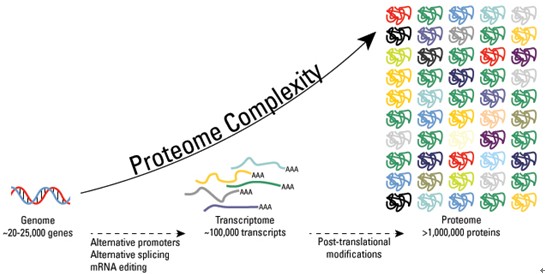
While the human genome comprises 20-25,000 genes, the proteome is estimated to encompass over 1 million proteins. Changes at the transcriptional and mRNA levels increase the size of the transcriptome relative to the genome, and the myriad of different post-translational modifications exponentially increases the complexity of the proteome relative to both the transcriptome and genome.

a)       Some Modifications (Phosphorylations, etc.) are easier to find than others. We can look for specific modifications or unknown modifications.

b)       As a general rule, any post-translational modification (PTM) could be searched for in your protein as long as we know the mass added by the modification and the potentially modified amino acid (e.g. in the case of phosphorylation: +80 Da on a Serine, Threonine or Tyrosine).

PTM (Post-Translational Modification) Analysis  http://www.creative-proteomics.com/protein-post-translational-modification-analysis.htm#1._Overview_of_Post-Translational_Modifications_%28PTMs%29_Analysis


Jose Eduardo de Salles Roselino:

The easy way to look at protein is to present it as a by-product of DNA. However, protein must be viewed as central macromolecule in biology since; even DNA is made from building blocks by protein activity. DNA are the reservoir of genetic information that establishes amino acid in proteins.
In normal living beings, normality defined by general health parameters whose values are inside an acceptable range of variation. Normal here is a statistical idea, as it must be and not as presented in recent years, as a living being that has a genome that does not have “glitches”, or a genome that would be defined as an ideal or a perfect genome.
In line with this idea, protein receives the information that determines its amino acid sequence from DNA but have its conformation, activity and function derived from its ability to change its conformation in response to changes in its microenvironment and environment. These changes in conformation are in a form adequate to keep those parameters mentioned above inside the range that define the idea of normality in accordance with the condition in which the living being is, both in time (development) as well as in space.
Therefore, post-translational must indicate a clear cut in the domain of DNA influence and not something, which is also derived from this DNA-centric view. This distortion of biochemistry has led to the never-ending genetics of non-genetic diseases. Genetics appears in inborn errors that are not acquired and show its effects in defects of proteins that could be established by a change in the DNA. Normality, or lack of abnormal genetic defect are perceived in all genomes that are able to maintain inside the normality range those parameters that define normal under defined circumstances. When this view is taken into account, DNA is take into account only when genetic diseases are considered. For the majority of the cases the scheme here presented must be made for each kind of cell, in each organ or system and the posttranslational changes thus, presented as function of development and/or a required fast regulatory change necessary to keep a cell and the organisms in general inside the normal range.

Read Full Post »

S-nitrosylation signaling

Author and Curator: Larry H Bernstein, MD, FCAP


S-nitrosylation signaling in cell biology.

Gaston BM1, Carver J, Doctor A, Palmer LA

Mol Interv. 2003 Aug; 3(5): 253-63  PMID: 14993439


S-Nitrosylated proteins form

  1. when a cysteine thiol reacts with nitric oxide (NO) in the presence of an electron acceptor to form an S-NO bond.
  2. Under physiological conditions, this posttranslational modification affects the function a wide array of cell proteins, ranging from ion channels to nuclear regulatory proteins.

Recent evidence suggests that

1) S-nitrosylated proteins can be synthesized by exposure of specific redox-active motifs to NO,

  • through transnitrosation/transfer reactions, or
  • through metalloprotein-catalyzed reactions;

2) S-nitrosothiols can be sequestered in

  • membranes,
  • lipophilic protein folds, or
  • in vesicles to preserve their activity; and

3) S-nitrosothiols can be degraded by a number of enzymes systems.

These recent insights regarding the

  1. bioactivities,
  2. molecular signaling pathways, and
  3. metabolism of endogenous S-nitrosothiols

have suggested several new therapies for disease ranging from cystic fibrosis to pulmonary hypertension.


Key pathways involving NO

Key pathways involving NO


Read Full Post »

Transcriptional Silencing and Longevity Protein Sir2

Author and Curator: Larry H Bernstein, MD, FCAP Author and Curator:


Transcriptional silencing and longevity protein Sir2 is an NAD-dependent histone deacetylase.

Imai S1, Armstrong CM, Kaeberlein M, Guarente L.
Nature.  Feb 17, 2000; 403(6771): 795-800.  PMID: 10693811

Yeast Sir2 is a heterochromatin component that

  • silences transcription at silent mating loci, telomeres and the ribosomal DNA, and
  • that also suppresses recombination in the rDNA and extends replicative life span.

Mutational studies indicate that

  • lysine 16 in the amino-terminal tail of histone H4 and
  • lysines 9, 14 and 18 in H3

are critically important in silencing, whereas

  • lysines 5, 8 and 12 of H4 have more redundant functions.
  • Lysines 9 and 14 of histone H3 and lysines 5, 8 and 16 of H4 are
  1. acetylated in active chromatin and
  2. hypoacetylated in silenced chromatin, and
  3. overexpression of Sir2 promotes global deacetylation of histones, indicating that

Sir2 may be a histone deacetylase.

Deacetylation of lysine 16 of H4 is necessary for binding the silencing protein, Sir3.

Here we show that yeast and mouse Sir2 proteins are nicotinamide adenine dinucleotide (NAD)-dependent histone deacetylases, which

  • deacetylate lysines 9 and 14 of H3 and
  • specifically lysine 16 of H4.

Our analysis of two SIR2 mutations supports the idea that this deacetylase activity accounts for

  1. silencing,
  2. recombination suppression and
  3. extension of life span in vivo.

These findings provide a molecular framework of NAD-dependent histone deacetylation that

  • connects metabolism,
  • genomic silencing and
  • ageing in yeast and, perhaps, in higher eukaryotes.Basic CMYK

Read Full Post »

Prologue to Cancer – e-book Volume One – Where are we in this journey?

Prologue to Cancer – e-book Volume One – Where are we in this journey?

Author and Curator: Larry H. Bernstein, MD, FCAP

Article ID #128: Prologue to Cancer – e-book Volume One – Where are we in this journey? Published on 4/13/2014

WordCloud Image Produced by Adam Tubman

Consulting Reviewer and Contributor:  Jose Eduardo de Salles Roselino, MD


LH Bernstein

LH Bernstein

Jose Eduardo de Salles Roselino

LES Roselino


This is a preface to the fourth in the ebook series of Leaders in Pharmaceutical Intelligence, a collaboration of experienced doctorate medical and pharmaceutical professionals.  The topic is of great current interest, and it entails a significant part of current medical expenditure by a group of neoplastic diseases that may develop at different periods in life, and have come to supercede infections or even eventuate in infectious disease as an end of life event.  The articles presented are a collection of the most up-to-date accounts of the state of a now rapidly emerging field of medical research that has benefitted enormously by progress in immunodiagnostics,  radiodiagnostics, imaging, predictive analytics, genomic and proteomic discovery subsequent to the completion of the Human Genome Project, advances in analytic methods in qPCR, gene sequencing, genome mapping, signaling pathways, exome identification, identification of therapeutic targets in inhibitors, activators, initiators in the progression of cell metabolism, carcinogenesis, cell movement, and metastatic potential.  This story is very complicated because we are engaged in trying to evoke from what we would like to be similar clinical events, dissimilar events in their expression and classification, whether they are within the same or different anatomic class.  Thus, we are faced with constructing an objective evidence-based understanding requiring integration of several disciplinary approaches to see a clear picture.  The failure to do so creates a high risk of failure in biopharmaceutical development.

The chapters that follow cover novel and important research and development in cancer related research, development, diagnostics and treatment, and in balance, present a substantial part of the tumor landscape, with some exceptions.  Will there ever be a unifying concept, as might be hoped for? I certainly can’t see any such prediction on the horizon.  Part of the problem is that disease classification is a human construct to guide us, and so are treatments that have existed and are reexamined for over 2,000 years.  In that time, we have changed, our afflictions have been modified, and our environment has changed with respect to the microorganisms within and around us, viruses, the soil, and radiation exposure, and the impacts of war and starvation, and access to food.  The outline has been given.  Organic and inorganic chemistry combined with physics has given us a new enterprise in biosynthetics that is and will change our world.  But let us keep in mind that this is a human construct, just as drug target development is such a construct, workable with limitations.

What Molecular Biology Gained from Physics

We need greater clarity and completeness in defining the carcinogenetic process.  It is the beginning, but not the end.  But we must first examine the evolution of the scientific structure that leads to our present understanding. This was preceded by the studies of anatomy, physiology, and embryology that had to occur as a first step, which was followed by the researches into bacteriology, fungi, sea urchins and the evolutionary creatures that could be studied having more primary development in scale.  They are still major objects of study, with the expectation that we can derive lessons about comparative mechanisms that have been passed on through the ages and have common features with man.  This became the serious intent of molecular biology, the discipline that turned to find an explanation for genetics, and to carry out controlled experiments modelled on the discipline that already had enormous success in physics, mathematics, and chemistry. In 1900, when Max Planck hypothesized that the frequency of light emitted by the black body depended on the frequency of the oscillator that emitted it, it had important ramifications for chemistry and biology (See Appendix II and Footnote 1, Planck equation, energy and oscillation).  The leading idea is to search below the large-scale observations of classical biology.

The central dogma of molecular biology where genetic material is transcribed into RNA and then translated into protein, provides a starting point, but the construct is undergoing revision in light of emerging novel roles for RNA and signaling pathways.   The term, coined by Warren Weaver (director of Natural Sciences for the Rockefeller Foundation), who observed an emergence of significant change given recent advances in fields such as X-ray crystallography. Molecular biology also plays important role in understanding formations, actions, regulations of various parts of cellswhich can be used efficiently for targeting new drugs, diagnosis of disease, physiology of the Cell. The Nobel Prize in Physiology or Medicine in 1969 was shared by Max Delbrück, Alfred D. Hershey, Salvador E. Luria, whose work with viral replication gave impetus to the field.  Delbruck was a physicist who trained in Copenhagen under Bohr, and specifically committed himself to a rigor in biology, as was in physics.

Dorothy Hodgkin protein crystallography

Dorothy Hodgkin protein crystallography

Rosalind Franlin crystallographer double helix

Rosalind Franlin
crystallographer
double helix

 Max Delbruck         molecular biology

Max Delbruck        
molecular biology

Max Planck

Max Planck Quantum Physics


We then stepped back from classical (descriptive) physiology, with the endless complexity, to molecular biology.  This led us to the genetic code, with a double helix model.  It has recently been found insufficiently explanatory, with the recent construction of triplex and quadruplex models. They have a potential to account for unaccounted for building blocks, such as inosine, and we don’t know whether more than one model holds validity under different conditions .  The other major field of development has been simply unaccounted for in the study of proteomics, especially in protein-protein interactions, and in the energetics of protein conformation, first called to our attention by the work of Jacob, Monod, and Changeux (See Footnote 2).  Proteins are not just rigid structures stamped out by the monotonously simple DNA to RNA to protein concept.  Nothing is ever quite so simple. Just as there are epigenetic events, there are posttranslational events, and yet more.

JPChangeux-150x170

JP Changeux


The Emergence of Molecular Biology

I now return the discussion to the topic of medicine, the emergence of molecular biology and the need for convergence with biochemistry in the mid-20th century. Jose Eduardo de Salles Roselino recalls “I was previously allowed to make of the conformational energy as made by R Marcus in his Nobel lecture revised (J. of Electroanalytical  Chemistry 438:(1997) p251-259. (See Footnote 1) His description of the energetic coordinates of a landscape of a chemical reaction is only a two-dimensional cut of what in fact is a volcano crater (in three dimensions) (each one varies but the sum of the two is constant. Solvational+vibrational=100% in ordinate) nuclear coordinates in abcissa. In case we could represent it by research methods that allow us to discriminate in one by one degree of different pairs of energy, we would most likely have 360 other similar representations of the same phenomenon. The real representation would take into account all those 360 representations together. In case our methodology was not that fine, for instance it discriminates only differences of minimal 10 degrees in 360 possible, will have 36 partial representations of something that to be perfectly represented will require all 36 being taken together. Can you reconcile it with ATGC?  Yet, when complete genome sequences were presented they were described as though we will know everything about this living being. The most important problems in biology will be viewed by limited vision always and the awareness of this limited is something we should acknowledge and teach it. Therefore, our knowledge is made up of partial representations. If we had the entire genome data for the most intricate biological problems, they are still not amenable to this level of reductionism. But going from general views of signals andsymptoms we could get to the most detailed molecular view and in this case genome provides an anchor.”

“Warburg Effect” describes the preference of glycolysis and lactic acid fermentation rather than oxidative phosphorylation for energy production in cancer cells. Mitochondrial metabolism is an important and necessary component in the functioning and maintenance of the cell, and accumulating evidence suggests that dysfunction of mitochondrial metabolism plays a role in cancer. Progress has demonstrated the mechanisms of the mitochondrial metabolism-to-glycolysis switch in cancer development and how to target this metabolic switch.


Glycolysis

glycolysis


Otto Heinrich Warburg (1883- )

Otto Warburg

435px-Louis_Pasteur,_foto_av_Félix_Nadar_Crisco_edit

Louis Pasteur


The expression “Pasteur effect” was coined by Warburg when inspired by Pasteur’s findings in yeast cells, when he investigated this metabolic observation (Pasteur effect) in cancer cells. In yeast cells, Pasteur had found that the velocity of sugar used was greatly reduced in presence of oxygen. Not to be confused, in the “Crabtree effect”, the velocity of sugar metabolism was greatly increased, a reversal, when yeast cells were transferred from the aerobic to an anaerobic condition. Thus, the velocity of sugar metabolism of yeast cells was shown to be under metabolic regulatory control in response to change in environmental oxygen conditions in growth. Warburg had to verify whether cancer cells and tissue related normal mammalian cells also have a similar control mechanism. He found that this control was also found in normal cells studied, but was absent in cancer cells. Strikingly, cancer cells continue to have higher anaerobic gycolysis despite the presence of oxygen in their culture media (See Footnote 3).

Taking this a step further, food is digested and supplied to cells In vertebrates mainly in the form of glucose, which is metabolized producing Adenosine Triphosphate (ATP) by two pathways. Glycolysis, occurs via anaerobic metabolism in the cytoplasm, and is of major significance for making ATP quickly, but in a minuscule amount (2 molecules).  In the presence of oxygen, the breakdown process continues in the mitochondria via the Krebs’s cycle coupled with oxidative phosphorylation, which is more efficient for ATP production (36 molecules). Cancer cells seem to depend on glycolysis. In the 1920s, Otto Warburg first proposed that cancer cells show increased levels of glucose consumption and lactate fermentation even in the presence of ample oxygen (known as “Warburg Effect”). Based on this theory, oxidative phosphorylation switches to glycolysis which promotes the proliferation of cancer cells. Many studies have demonstrated glycolysis as the main metabolic pathway in cancer cells.

Albert Szent Gyogy (Warburg’s student) and Otto Meyerhof both studied striated skeletal muscle metabolism invertebrates, and they found those changes observed in yeast by Pasteur. The description of the anaerobic pathway was largely credited to Emden and Meyerhof. Whenever there is increase in muscle work, energy need is above what can be provided by blood supply, the cell metabolism changes from aerobic (where  Acetyl CoA  provides the chemical energy for aerobic production of ATP) to anaerobic metabolism of glucose. In this condition, glucose is obtained directly from its muscle glycogen stores (not from hepatic glycogenolysis).  This is the sole source of chemical energy that is independent of oxygen supplied to the cell. It is a physiological change on muscle metabolism that favors autonomy. It does not depend upon the blood oxygen for aerobic metabolim or blood sources of carbon metabolites borne out from adipose tissue (free fatty acids) or muscle proteins (branched chain amino acids), or vascular delivery of glucose. On that condition, the muscle can perform contraction by its internal source of ATP and uses conversion of pyruvate to lactate in order to regenerate much-needed NAD (by hydride transfer from pyruvate) as a replacement for this mitochondrial function. This regulatory change, keeps glycolysis going at fast rate in order to meet ATP needs of the cell under low yield condition (only two or three ATP for each glucose converted into two lactate molecules). Therefore, it cannot last for long periods of time. This regulatory metabolic change is made in seconds, minutes and therefore happens with the proteins that are already presented in the cell. It does not requires the effect of transcription factors and/or changes in gene expression (See Footnote 1, 2).

In other types mammalian cells, like those from the lens of the eye (86% gycolysis + pentose shunt),  and red blood cells (RBC)[both lacking mitochondria], and also in the deep medullary layer of the kidneys, for lack of mitochondria in the first two cases and normally reduced blood perfusion in the third – A condition required for the counter current mechanism and our ability to concentrate urine also have, permanent higher anaerobic metabolism. In the case of RBC, it includes the ability to produce in a shunt of glycolytic pathway 2,3 diphospho- glycerate that is required to place the hemogloblin macromolecule in an unstable equilibrium between its two forms (R and T – Here presented as simplified accordingly to the model of Monod, Wyman and Changeux. The final model would be even much complex (see for instance, H-W and K review Nature 2007 vol 450: p 964-972 )

Any tissue under a condition of ischemia that is required for some medical procedures (open heart surgery, organ transplants, etc) displays this fast regulatory mechanism (See Footnote 1, 2). A display of these regulatory metabolic changes can be seen in: Cardioplegia: the protection of the myocardium during open heart surgery: a review. D. J. Hearse J. Physiol., Paris, 1980, 76, 751-756 (Fig 1).  The following points are made:

1-       It is a fast regulatory response. Therefore, no genetic mechanism can be taken into account.

2-       It moves from a reversible to an irreversible condition, while the cells are still alive. Death can be seen at the bottom end of the arrow. Therefore, it cannot be reconciled with some of the molecular biology assumptions:

A-       The gene and genes reside inside the heart muscle cells but, in order to preserve intact, the source of coded genetic information that the cell reads and transcribes, DNA must be kept to a minimal of chemical reactivity.

B-       In case sequence determines conformation, activity and function , elevated potassium blood levels could not cause cardiac arrest.

In comparison with those conditions here presented, cancer cells keep the two metabolic options for glucose metabolism at the same time. These cells can use glucose that our body provides to them or adopt temporarily, an independent metabolic form without the usual normal requirement of oxygen (one or another form for ATP generation).  ATP generation is here, an over-simplification of the metabolic status since the carbon flow for building blocks must also be considered and in this case oxidative metabolism of glucose in cancer cells may be viewed as a rich source of organic molecules or building blocks that dividing cells always need.

JES Roselino has conjectured that “most of the Krebs cycle reaction works as ideal reversible thermodynamic systems that can supply any organic molecule that by its absence could prevent cell duplication.” In the vision of Warburg, cancer cells have a defect in Pasteur-effect metabolic control. In case it was functioning normally, it will indicate which metabolic form of glucose metabolism is adequate for each condition. What more? Cancer cells lack differentiated cell function. Any role for transcription factors must be considered as the role of factors that led to the stable phenotypic change of cancer cells. The failure of Pasteur effect must be searched for among the fast regulatory mechanisms that aren’t dependent on gene expression (See Footnote 3).

Extending the thoughts of JES Roselino (Hepatology 1992;16: 1055-1060), reduced blood flow caused by increased hydrostatic pressure in extrahepatic cholestasis decreases mitochondrial function (quoted in Hepatology) and as part of Pasteur effect normal response, increased glycolysis in partial and/or functional anaerobiosis and therefore blocks the gluconeogenic activity of hepatocytes that requires inhibited glycolysis. In this case, a clear energetic link can be perceived between the reduced energetic supply and the ability to perform differentiated hepatic function (gluconeogenesis). In cancer cells, the action of transcription factors that can be viewed as different ensembles of kaleidoscopic pieces (with changing activities as cell conditions change) are clearly linked to the new stable phenotype. In relation to extrahepatic cholestasis mentioned above it must be reckoned that in case a persistent chronic condition is studied a secondary cirrhosis is installed as an example of persistent stable condition, difficult to be reversed and without the requirement for a genetic mutation. (See Footnote 4).

 The Rejection of Complexity

Most of our reasoning about genes was derived from scientific work in microorganisms. These works have provided great advances in biochemistry.

250px-DNA_labeled DNA diagram showing base pairing

double helix


hgp_hubris_220x288_72 genome cartoon

Dna triplex pic

Triple helix


formation of a triplex DNA structure

formation of triple helix


1-      The “Gelehrter idea”: No matter what you are doing you will always be better off, in case you have a gene (In chapter 7 Principles of Medical Genetics Gelehrter and Collins Williams & Wilkins 1990).

2-      The idea that everything could be found following one gene one enzyme relationship that works fine for our understanding of the metabolism, in all biological problems.

3-      The idea that everything that explains biochemistry in microorganisms explains also for every living being (J Nirenberg).

4-      The idea that biochemistry may not require that time should be also taken into account. Time must be considered only for genetic and biological evolution studies (S Luria. In Life- The unfinished experiment 1977 C Scribner´s sons NY).

5-      Finally, the idea that everything in biology, could be found in the genome. Since all information in biology goes from DNA through RNA to proteins. Alternatively, are in the DNA, in case the strict line that includes RNA is not included.

This last point can be accepted in case it is considered that ALL GENETIC information is in our DNA. Genetics as part of life and not as its total expression.

For example, when our body is informed that the ambient temperature is too low or alternatively is too high, our body is receiving an information that arrives from our environment. This external information will affect our proteins and eventually, in case of longer periods in a new condition will cause adaptive response that may include conformational changes in transcription factors (proteins) that will also, produce new readings on the DNA. However, it is an information that moves from outside, to proteins and not from DNA to proteins. The last pathway, when transcription factors change its conformation and change DNA reading will follow the dogmatic view as an adaptive response (See Footnotes 1-3).

However, in case, time is taken into account, the first reactions against cold or warmer temperatures will be the ones that happen through change in protein conformation, activities and function before any change in gene expression can be noticed at protein level. These fast changes, in seconds, minutes cannot be explained by changes in gene expression and are strongly linked to what is needed for the maintenance of life.

“It is possible”, says Roselino, “desirable, to explain all these fast biochemical responses to changes in a living being condition as the sound foundation of medical practices without a single mention to DNA. In case a failure in any mechanism necessary to life is found to be genetic in its origin, the genome in context with with this huge set of transcription factors must be taken into account. This is the biochemical line of reasoning that I have learned with Houssay and Leloir. It would be an honor to see it restored in modern terms.”

More on the Mechanism of Metabolic Control

It was important that genomics would play such a large role in medical research for the last 70 years. There is also good reason to rethink the objections of the Nobelists James Watson and Randy Schekman in the past year, whatever discomfort it brings.  Molecular biology has become a tautology, and as a result deranged scientific rigor inside biology.

Crick & Watson with their DNA model, 1953

Eatson and Crick

Randy-Schekman Berkeley

Randy-Schekman Berkeley


According to JES Roselino, “consider that glycolysis is oscillatory thanks to the kinetic behavior of Phosphofructokinase. Further, by its effect upon Pyruvate kinase through Fructose 1,6 diphosphate oscillatory levels, the inhibition of gluconeogenesis is also oscillatory. When the carbon flow through glycolysis is led to a maximal level gluconeogenesis will be almost completely blocked. The reversal of the Pyruvate kinase step in liver requires two enzymes (Pyruvate carboxylase (maintenance of oxaloacetic levels) + phosphoenolpyruvate carboxykinase (E.C. 4.1.1.32)) and energy requiring reactions that most likely could not as an ensemble, have a fast enough response against pyruvate kinase short period of inhibition during high frequency oscillatory periods of glycolytic flow. Only when glycolysis oscillates at low frequency the opposite reaction could enable gluconeogenic carbon flow.”

In case it can be shown in a rather convincing way, the same reasoning could be applied to understand how simple replicative signals inducing Go to G1 transition in cells, could easily overcome more complex signals required for cell differentiation and differentiated function.

Perhaps the problem of overextension of the equivalence of the DNA and what happens to the organism is also related to the initial reliance on a single cell model to relieve the complexity (which isn’t fully the case).

For instance, consider this fragment:
“Until only recently it was assumed that all proteins take on a clearly defined three-dimensional structure – i.e. they fold in order to be able to assume these functions.”
Cold Spring Harbour Symp. Quant. Biol. 1973  p 187-193 J.C Seidel and J Gergely – Investigation of conformational changes in Spin-Labeled Myosin Model for muscle contraction:
Huxley, A. F. 1971 Proc. Roy. Soc (London) (B) 178:1
Huxley, A.F and R. M. Simmons,1971. Nature 233:633
J.C Haselgrove X ray Evidence for a conformational Change in the Actin-containing filaments…Cold Spring Harbour Symp Quant Biol.1972 v 37: p 341-352

Only a very small sample indicating otherwise. Proteins were held as interacting macromolecules, changing their conformation in regulatory response to changes in the microenvironment (See Footnote 2). DNA was the opposite, non-interacting macromolecules to be as stable as a library must be.

The dogma held that the property of proteins could be read in DNA alone. Consequenly, the few examples quoted above, must be ignored and all people must believe that DNA alone, without environmental factors roles, controls protein amino acid sequence (OK), conformation (not true), activity (not true) and function (not true).

It appeared naively to be correct from the dogma to conclude from interpreting your genome: You have a 50% increased risk of developing the following disease (deterministic statement).  The correct form must be: You belong to a population that has a 50% increase in the risk of….followed by –  what you must do to avoid increase in your personal risk and the care you should take in case you want to have longer healthy life.  Thus, genetics and non-genetic diseases were treated as the same and medical foundations were reinforced by magical considerations (dogmas) in a very profitable way for those involved besides the patient.

 Footnotes:

  1. There is a link of electricity with ions in biology and the oscillatory behavior of some electrical discharges.  In addition, the oscillatory form of electrical discharged may have allowed Planck to relate high energy content with higher frequencies and conversely, low energy content in low frequency oscillatory events.  One may think of high density as an indication of great amount of matter inside a volume in space.  This helps the understanding of Planck’s idea as a high-density-energy in time for a high frequency phenomenon.
  1. Take into account a protein that may have its conformation restricted by an S-S bridge. This protein also, may move to another more flexible conformation in case it is in HS HS condition when the S-S bridge is broken. Consider also that, it takes some time for a protein to move from one conformation for instance, the restricted conformation (S-S) to other conformations. Also, it takes a few seconds or minutes to return to the S-S conformation (This is the Daniel Koshland´s concept of induced fit and relaxation time used by him in order to explain allosteric behavior of monomeric proteins- Monod, Wyman and Changeux requires tetramer or at least, dimer proteins).
  1. In case you have glycolysis oscillating in a frequency much higher than the relaxation time you could lead to the prevalence of high NADH effect leading to high HS /HS condition and at low glycolytic frequency, you could have predominance of S-S condition affecting protein conformation. In case you have predominance of NAD effect upon protein S-S you would get the opposite results.  The enormous effort to display the effect of citrate and over Phosphofructokinase conformation was made by others. Take into account that ATP action as an inhibitor in this case, is a rather unusual one. It is a substrate of the reaction, and together with its action as activator  F1,6 P (or its equivalent F2,6 P) is also unusual. However, it explains oscillatory behaviour of glycolysis. (Goldhammer , A.R, and Paradies: PFK structure and function, Curr. Top Cell Reg 1979; 15:109-141).
  1. The results presented in our Hepatology work must be viewed in the following way: In case the hepatic (oxygenated) blood flow is preserved, the bile secretory cells of liver receive well-oxygenated blood flow (the arterial branches bath secretory cells while the branches originated from portal vein irrigate the hepatocytes.  During extra hepatic cholestasis the low pressure, portal blood flow is reduced and the hepatocytes do not receive enough oxygen required to produce ATP that gluconeogenesis demands. Hepatic artery do not replace this flow since, its branches only join portal blood fluxes after the previous artery pressure  is reduced to a low pressure venous blood – at the point where the formation of hepatic vein is. Otherwise, the flow in the portal vein would be reversed or, from liver to the intestine. It is of no help to take into account possible valves for this reasoning since minimal arterial pressure is well above maximal venous pressure and this difference would keep this valve in permanent close condition. In low portal blood flow condition, the hepatocyte increases pyruvate kinase activity and with increased pyruvate kinase activity Gluconeogenesis is forbidden (See Walsh & Cooper revision quoted in the Hepatology as ref 23). For the hemodynamic considerations, role of artery and veins in hepatic portal system see references 44 and 45 Rappaport and Schneiderman and Rappapaport.


 Appendix I.

metabolic pathways

metabolic pathways

Signals Upstream and Targets Downstream of Lin28 in the Lin28 Pathway

Signals Upstream and Targets Downstream of Lin28 in the Lin28 Pathway


1.  Functional Proteomics Adds to Our Understanding

Ben Schuler’s research group from the Institute of Biochemistry of the University of Zurich has now established that an increase in temperature leads to folded proteins collapsing and becoming smaller. Other environmental factors can trigger the same effect. The crowded environments inside cells lead to the proteins shrinking. As these proteins interact with other molecules in the body and bring other proteins together, understanding of these processes is essential “as they play a major role in many processes in our body, for instance in the onset of cancer”, comments study coordinator Ben Schuler.

Measurements using the “molecular ruler”

“The fact that unfolded proteins shrink at higher temperatures is an indication that cell water does indeed play an important role as to the spatial organisation eventually adopted by the molecules”, comments Schuler with regard to the impact of temperature on protein structure. For their studies the biophysicists use what is known as single-molecule spectroscopy. Small colour probes in the protein enable the observation of changes with an accuracy of more than one millionth of a millimetre. With this “molecular yardstick” it is possible to measure how molecular forces impact protein structure.

With computer simulations the researchers have mimicked the behaviour of disordered proteins. They want to use them in future for more accurate predictions of their properties and functions.

Correcting test tube results

That’s why it’s important, according to Schuler, to monitor the proteins not only in the test tube but also in the organism. “This takes into account the fact that it is very crowded on the molecular level in our body as enormous numbers of biomolecules are crammed into a very small space in our cells”, says Schuler. The biochemists have mimicked this “molecular crowding” and observed that in this environment disordered proteins shrink, too.

Given these results many experiments may have to be revisited as the spatial organisation of the molecules in the organism could differ considerably from that in the test tube according to the biochemist from the University of Zurich. “We have, therefore, developed a theoretical analytical method to predict the effects of molecular crowding.” In a next step the researchers plan to apply these findings to measurements taken directly in living cells.

Explore further: Designer proteins provide new information about the body’s signal processesMore information: Andrea Soranno, Iwo Koenig, Madeleine B. Borgia, Hagen Hofmann, Franziska Zosel, Daniel Nettels, and Benjamin Schuler. Single-molecule spectroscopy reveals polymer effects of disordered proteins in crowded environments. PNAS, March 2014. DOI: 10.1073/pnas.1322611111


Effects of Hypoxia on Metabolic Flux

  1. Glucose-6-phosphate dehydrogenase regulation in the hepatopancreas of the anoxia-tolerantmarinemollusc, Littorina littorea

JL Lama , RAV Bell and KB Storey

Glucose-6-phosphate dehydrogenase (G6PDH) gates flux through the pentose phosphate pathway and is key to cellular antioxidant defense due to its role in producing NADPH. Good antioxidant defenses are crucial for anoxia-tolerant organisms that experience wide variations in oxygen availability. The marine mollusc, Littorina littorea, is an intertidal snail that experiences daily bouts of anoxia/hypoxia with the tide cycle and shows multiple metabolic and enzymatic adaptations that support anaerobiosis. This study investigated the kinetic, physical and regulatory properties of G6PDH from hepatopancreas of L. littorea to determine if the enzyme is differentially regulated in response to anoxia, thereby providing altered pentose phosphate pathway functionality under oxygen stress conditions.

Several kinetic properties of G6PDH differed significantly between aerobic and 24 h anoxic conditions; compared with the aerobic state, anoxic G6PDH (assayed at pH 8) showed a 38% decrease in K G6P and enhanced inhibition by urea, whereas in pH 6 assays Km NADP and maximal activity changed significantly.

All these data indicated that the aerobic and anoxic forms of G6PDH were the high and low phosphate forms, respectively, and that phosphorylation state was modulated in response to selected endogenous protein kinases (PKA or PKG) and protein phosphatases (PP1 or PP2C). Anoxia-induced changes in the phosphorylation state of G6PDH may facilitate sustained or increased production of NADPH to enhance antioxidant defense during long term anaerobiosis and/or during the transition back to aerobic conditions when the reintroduction of oxygen causes a rapid increase in oxidative stress.

Lama et al.  Peer J 2013.   http://dx.doi.org/10.7717/peerj.21


  1. Structural Basis for Isoform-Selective Inhibition in Nitric Oxide Synthase

    TL. Poulos and H Li

In the cardiovascular system, the important signaling molecule nitric oxide synthase (NOS) converts L-arginine into L-citrulline and releases nitric oxide (NO). NO produced by endothelial NOS (eNOS) relaxes smooth muscle which controls vascular tone and blood pressure. Neuronal NOS (nNOS) produces NO in the brain, where it influences a variety of neural functions such as neural transmitter release. NO can also support the immune system, serving as a cytotoxic agent during infections. Even with all of these important functions, NO is a free radical and, when overproduced, it can cause tissue damage. This mechanism can operate in many neurodegenerative diseases, and as a result the development of drugs targeting nNOS is a desirable therapeutic goal.

However, the active sites of all three human isoforms are very similar, and designing inhibitors specific for nNOS is a challenging problem. It is critically important, for example, not to inhibit eNOS owing to its central role in controlling blood pressure. In this Account, we summarize our efforts in collaboration with Rick Silverman at Northwestern University to develop drug candidates that specifically target NOS using crystallography, computational chemistry, and organic synthesis. As a result, we have developed aminopyridine compounds that are 3800-fold more selective for nNOS than eNOS, some of which show excellent neuroprotective effects in animal models. Our group has solved approximately 130 NOS-inhibitor crystal structures which have provided the structural basis for our design efforts. Initial crystal structures of nNOS and eNOS bound to selective dipeptide inhibitors showed that a single amino acid difference (Asp in nNOS and Asn in eNOS) results in much tighter binding to nNOS. The NOS active site is open and rigid, which produces few large structural changes when inhibitors bind. However, we have found that relatively small changes in the active site and inhibitor chirality can account for large differences in isoform-selectivity. For example, we expected that the aminopyridine group on our inhibitors would form a hydrogen bond with a conserved Glu inside the NOS active site. Instead, in one group of inhibitors, the aminopyridine group extends outside of the active site where it interacts with a heme propionate. For this orientation to occur, a conserved Tyr side chain must swing out of the way. This unanticipated observation taught us about the importance of inhibitor chirality and active site dynamics. We also successfully used computational methods to gain insights into the contribution of the state of protonation of the inhibitors to their selectivity. Employing the lessons learned from the aminopyridine inhibitors, the Silverman lab designed and synthesized symmetric double-headed inhibitors with an aminopyridine at each end, taking advantage of their ability to make contacts both inside and outside of the active site. Crystal structures provided yet another unexpected surprise. Two of the double-headed inhibitor molecules bound to each enzyme subunit, and one molecule participated in the generation of a novel Zn site that required some side chains to adopt alternate conformations. Therefore, in addition to achieving our specific goal, the development of nNOS selective compounds, we have learned how subtle differences in and structure can control proteinligand interactions and often in unexpected ways.


300px-Nitric_Oxide_Synthase

Nitric oxide synthase

arginine-NO-citulline cycle

arginine-NO-citulline cycle

active site of eNOS (PDB_1P6L) and nNOS (PDB_1P6H).

active site of eNOS (PDB_1P6L) and nNOS (PDB_1P6H).


NO - muscle, vasculature, mitochondria

NO – muscle, vasculature, mitochondria


Figure:  (A) Structure of one of the early dipeptide lead compounds, 1, that exhibits excellentisoform selectivity. (B, C) show the crystal structures of the dipeptide inhibitor 1 in the active site of eNOS (PDB: 1P6L) and nNOS (PDB: 1P6H). In nNOS, the inhibitor “curls” which enables the inhibitor R-amino group to interact with both Glu592 and Asp597. In eNOS, Asn368 is the homologue to nNOS Asp597.

Accounts in Chem Res 2013; 46(2): 390-98.

  1. Jamming a Protein Signal

Interfering with a single cancer-promoting protein and its receptor can open this resistance mechanism by initiating autophagy of the affected cells,  according to researchers at The University of Texas MD Anderson Cancer Center  in the journal Cell Reports.  According to Dr. Anil Sood and Yunfei Wen, lead and first authors, blocking  prolactin, a potent growth factor for ovarian cancer, sets off downstream events that result in cell by autophagy, the process  recycles damaged organelles and proteins for new use by the cell through the phagolysozome. This in turn, provides a clinical rationale for blocking prolactin and its receptor to initiate sustained autophagy as an alternative strategy for treating cancers.

Steep reductions in tumor weight

Prolactin (PRL) is a hormone previously implicated in ovarian, endometrial and other cancer development andprogression. When PRL binds to its cell membrane receptor, PRLR, activation of cancer-promoting cell signaling pathways follows.  A variant of normal prolactin called G129R blocks the reaction between prolactin and its receptor. Sood and colleagues treated mice that had two different lines of human ovarian cancer, both expressing the prolactin receptor, with G129R. Tumor weights fell by 50 percent for mice with either type of ovarian cancer after 28 days of treatment with G129R, and adding the taxane-based chemotherapy agent paclitaxel cut tumor weight by 90 percent. They surmise that higher doses of G129R may result in even greater therapeutic benefit.


3D experiments show death by autophagy


[video width=”1280″ height=”720″ mp4=”http://pharmaceuticalintelligence.com/wp-content/uploads/2014/04/1741-7007-11-65-s1-macromolecular-juggling-by-ubiquitylation-enzymes1.mp4″][/video]


Next the team used the prolactin-mimicking peptide to treat cultures of cancer spheroids which sharply reduced their numbers, and blocked the activation of JAK2 and STAT signaling pathways.

Protein analysis of the treated spheroids showed increased presence of autophagy factors and genomic analysis revealed increased expression of a number of genes involved in autophagy progression and cell death.  Then a series of experiments using fluorescence and electron microscopy showed that the cytosol of treated cells had large numbers of cavities caused by autophagy.

The team also connected the G129R-induced autophagy to the activity of PEA-15, a known cancer inhibitor. Analysis of tumor samples from 32 ovarian cancer patients showed that tumors express higher levels of the prolactin receptor and lower levels of phosphorylated PEA-15 than normal ovarian tissue. However, patients with low levels of the prolactin receptor and higher PEA-15 had longer overall survival than those with high PRLR and low PEA-15.

Source: MD Anderson Cancer Center


  1. Chemists’ Work with Small Peptide Chains of Enzymes

Korendovych and his team designed seven simple peptides, each containing seven amino acids. They then allowed the molecules of each peptide to self-assemble, or spontaneously clump together, to form amyloids. (Zinc, a metal with catalytic properties, was introduced to speed up the reaction.) What they found was that four of the seven peptides catalyzed the hydrolysis of molecules known as esters, compounds that react with water to produce water and acids—a feat not uncommon among certain enzymes.

“It was the first time that a peptide this small self-assembled to produce an enzyme-like catalyst,” says Korendovych. “Each enzyme has to be an exact fit for its respective substrate,” he says, referring to the molecule with which an enzyme reacts. “Even after millions of years, nature is still testing all the possible combinations of enzymes to determine which ones can catalyze metabolic reactions. Our results make an argument for the design of self-assembling nanostructured catalysts.”

Source: Syracuse University

Here are three articles emphasizing the value of combinatorial analysis, which can be formed from genomic, clinical, and proteomic data sets.


  1. Comparative analysis of differential network modularity in tissue specific normal and cancer protein interaction networks

    F Islam , M Hoque , RS Banik , S Roy , SS Sumi, et al.

As most biological networks show modular properties, the analysis of differential modularity between normal and cancer protein interaction networks can be a good way to understand cancer more significantly. Two aspects of biological network modularity e.g. detection of molecular complexes (potential modules or clusters) and identification of crucial nodes forming the overlapping modules have been considered in this regard.

The computational analysis of previously published protein interaction networks (PINs) has been conducted to identify the molecular complexes and crucial nodes of the networks. Protein molecules involved in ten major cancer signal transduction pathways were used to construct the networks based on expression data of five tissues e.g. bone, breast, colon, kidney and liver in both normal and cancer conditions.

Cancer PINs show higher level of clustering (formation of molecular complexes) than the normal ones. In contrast, lower level modular overlapping is found in cancer PINs than the normal ones. Thus a proposition can be made regarding the formation of some giant nodes in the cancer networks with very high degree and resulting in reduced overlapping among the network modules though the predicted molecular complex numbers are higher in cancer conditions.

Islam et al. Journal of Clinical Bioinformatics 2013, 3:19-32

  1. A new 12-gene diagnostic biomarker signature of melanoma revealed by integrated microarray analysis

    Wanting Liu , Yonghong Peng and Desmond J. Tobin
    PeerJ 1:e49;        http://dx.doi.org/10.7717/peerj.49

Here we present an integrated microarray analysis framework, based on a genome-wide relative significance (GWRS) and genome-wide global significance (GWGS) model. When applied to five microarray datasets on melanoma published between 2000 and 2011, this method revealed a new signature of 200 genes. When these were linked to so-called ‘melanoma driver’ genes involved in MAPK, Ca2+, and WNT signaling pathways we were able to produce a new 12-gene diagnostic biomarker signature for melanoma (i.e., EGFR, FGFR2, FGFR3, IL8, PTPRF, TNC, CXCL13, COL11A1, CHP2, SHC4, PPP2R2C, andWNT4).We have begun to experimentally validate a subset of these genes involved inMAPK signaling at the protein level, including CXCL13, COL11A1, PTPRF and SHC4 and found these to be overexpressed inmetastatic and primarymelanoma cells in vitro and in situ compared to melanocytes cultured from healthy skin epidermis and normal healthy human skin.


catalytic amyloid forming particle

catalytic amyloid forming particle


        8.    PanelomiX: A threshold-based algorithm to create panels of biomarkers

X Robin , N Turck , A Hainard , N Tiberti, et al.
               Translational Proteomics 2013.    http://dx.doi.org/10.1016/j.trprot.2013.04.003

The PanelomiX toolbox combines biomarkers and evaluates the performance of panels to classify patients better than singlemarkers or other classifiers. The ICBTalgorithm proved to be an efficient classifier, the results of which can easily be interpreted.

Here are two current examples of the immense role played by signaling pathways in carcinogenic mechanisms and in treatment targeting, which is also confounded by acquired resistance.


  1. Triple-Negative Breast Cancer

  1. epidermal growth factor receptor (EGFR or ErbB1) and
  2. high activity of the phosphatidylinositol 3-kinase (PI3K)–Akt pathway

are both targeted in triple-negative breast cancer (TNBC).

  • activation of another EGFR family member [human epidermal growth factor receptor 3 (HER3) (or ErbB3)] may limit the antitumor effects of these drugs.

This study found that TNBC cell lines cultured with the EGFR or HER3 ligand EGF or heregulin, respectively, and treated with either an Akt inhibitor (GDC-0068) or a PI3K inhibitor (GDC-0941) had increased abundance and phosphorylation of HER3.

The phosphorylation of HER3 and EGFR in response to these treatments

  1. was reduced by the addition of a dual EGFR and HER3 inhibitor (MEHD7945A).
  2. MEHD7945A also decreased the phosphorylation (and activation) of EGFR and HER3 and
  3. the phosphorylation of downstream targets that occurred in response to the combination of EGFR ligands and PI3K-Akt pathway inhibitors.

In culture, inhibition of the PI3K-Akt pathway combined with either MEHD7945A or knockdown of HER3

  1. decreased cell proliferation compared with inhibition of the PI3K-Akt pathway alone.
  2. Combining either GDC-0068 or GDC-0941 with MEHD7945A inhibited the growth of xenografts derived from TNBC cell lines or from TNBC patient tumors, and
  3. this combination treatment was also more effective than combining either GDC-0068 or GDC-0941 with cetuximab, an EGFR-targeted antibody.
  4. After therapy with EGFR-targeted antibodies, some patients had residual tumors with increased HER3 abundance and EGFR/HER3 dimerization (an activating interaction).

Thus, we propose that concomitant blockade of EGFR, HER3, and the PI3K-Akt pathway in TNBC should be investigated in the clinical setting.

Reference: Antagonism of EGFR and HER3 Enhances the Response to Inhibitors of the PI3K-Akt Pathway in Triple-Negative Breast Cancer. JJ Tao, P Castel, N Radosevic-Robin, M Elkabets, et al.  Sci. Signal., 25 March 2014;
7(318), p. ra29   http://dx.doi.org/10.1126/scisignal.2005125


                  10.   Metastasis in RAS Mutant or Inhibitor-Resistant Melanoma Cells

The protein kinase BRAF is mutated in about 40% of melanomas, and BRAF inhibitors improve progression-free and overall survival in these patients. However, after a relatively short period of disease control, most patients develop resistance because of reactivation of the RAF–ERK (extracellular signal–regulated kinase) pathway, mediated in many cases by mutations in RAS. We found that BRAF inhibition induces invasion and metastasis in RAS mutant melanoma cells through a mechanism mediated by the reactivation of the MEK (mitogen-activated protein kinase kinase)–ERK pathway.

Reference: BRAF Inhibitors Induce Metastasis in RAS Mutant or Inhibitor-Resistant Melanoma Cells by Reactivating MEK and ERK Signaling. B Sanchez-Laorden, A Viros, MR Girotti, M Pedersen, G Saturno, et al., Sci. Signal., 25 March 2014;  7(318), p. ra30  http://dx.doi.org/10.1126/scisignal.2004815

Appendix II.

The world of physics in the twentieth century saw the end of determinism established by Newton. This is characterized by discrete laws that describe natural observations. These are in gravity and in eletricity. In an early phase of investigation, an era of galvanic or voltaic electricity represented a revolutionary break from the historical focus on frictional electricity. Alessandro Voltadiscovered that chemical reactions could be used to create positively charged anodes and negatively charged cathodes.  In 1790, Prof. Luigi Alyisio Galvani of Bologna, while conducting experiments on “animal electricity“, noticed the twitching of a frog’s legs in the presence of an electric machine. He observed that a frog’s muscle, suspended on an iron balustrade by a copper hook passing through its dorsal column, underwent lively convulsions without any extraneous cause, the electric machine being at this time absent.  Volta communicated a description of his pile to the Royal Society of London and shortly thereafter Nicholson and Cavendish (1780) produced the decomposition of water by means of the electric current, using Volta’s pile as the source of electromotive force.

Siméon Denis Poisson attacked the difficult problem of induced magnetization, and his results provided  a first approximation. His innovation required the application of mathematics to physics.  His memoirs on the theory of electricity and magnetism created a new branch of mathematical physics.  The discovery of electromagnetic induction was made almost simultaneously and independently by Michael Faraday and Joseph Henry. Michael Faraday, the successor of Humphry Davy, began his epoch-making research relating to electric and electromagnetic induction in 1831. In his investigations of the peculiar manner in which iron filings arrange themselves on a cardboard or glass in proximity to the poles of a magnet, Faraday conceived the idea of magnetic “lines of force” extending from pole to pole of the magnet and along which the filings tend to place themselves. On the discovery being made that magnetic effects accompany the passage of an electric current in a wire, it was also assumed that similar magnetic lines of force whirled around the wire. He also posited that iron, nickel, cobalt, manganese, chromium, etc., are paramagnetic (attracted by magnetism), whilst other substances, such as bismuth, phosphorus, antimony, zinc, etc., are repelled by magnetism or are diamagnetic.

Around the mid-19th century, Fleeming Jenkin‘s work on ‘ Electricity and Magnetism ‘ and Clerk Maxwell’s ‘ Treatise on Electricity and Magnetism ‘ were published. About 1850 Kirchhoff published his laws relating to branched or divided circuits. He also showed mathematically that according to the then prevailing electrodynamic theory, electricity would be propagated along a perfectly conducting wire with the velocity of light. Herman Helmholtz investigated the effects of induction on the strength of a current and deduced mathematical equations, which experiment confirmed. In 1853 Sir William Thomson (later Lord Kelvin) predicted as a result of mathematical calculations the oscillatory nature of the electric discharge of a condenser circuit.  Joseph Henry, in 1842 discerned  the oscillatory nature of the Leyden jardischarge.

In 1864 James Clerk Maxwell announced his electromagnetic theory of light, which was perhaps the greatest single step in the world’s knowledge of electricity. Maxwell had studied and commented on the field of electricity and magnetism as early as 1855/6 when On Faraday’s lines of force was read to the Cambridge Philosophical Society. The paper presented a simplified model of Faraday’s work, and how the two phenomena were related. He reduced all of the current knowledge into a linked set of differential equations with 20 equations in 20 variables. This work was later published as On Physical Lines of Force in1861. In order to determine the force which is acting on any part of the machine we must find its momentum, and then calculate the rate at which this momentum is being changed. This rate of change will give us the force. The method of calculation which it is necessary to employ was first given by Lagrange, and afterwards developed, with some modifications, by Hamilton’s equations. Now Maxwell logically showed how these methods of calculation could be applied to the electro-magnetic field. The energy of a dynamical systemis partly kinetic, partly potential. Maxwell supposes that the magnetic energy of the field is kinetic energy, the electric energy potential.  Around 1862, while lecturing at King’s College, Maxwell calculated that the speed of propagation of an electromagnetic field is approximately that of the speed of light.   Maxwell’s electromagnetic theory of light obviously involved the existence of electric waves in free space, and his followers set themselves the task of experimentally demonstrating the truth of the theory. By 1871, he presented the Remarks on the mathematical classification of physical quantities.

A Wave-Particle Dilemma at the Century End

In 1896 J.J. Thomson performed experiments indicating that cathode rays really were particles, found an accurate value for their charge-to-mass ratio e/m, and found that e/m was independent of cathode material. He made good estimates of both the charge e and the mass m, finding that cathode ray particles, which he called “corpuscles”, had perhaps one thousandth of the mass of the least massive ion known (hydrogen). He further showed that the negatively charged particles produced by radioactive materials, by heated materials, and by illuminated materials, were universal.  In the late 19th century, the Michelson–Morley experiment was performed by Albert Michelson and Edward Morley at what is now Case Western Reserve University. It is generally considered to be the evidence against the theory of a luminiferous aether. The experiment has also been referred to as “the kicking-off point for the theoretical aspects of the Second Scientific Revolution.” Primarily for this work, Albert Michelson was awarded theNobel Prize in 1907.

Wave–particle duality is a theory that proposes that all matter exhibits the properties of not only particles, which have mass, but also waves, which transfer energy. A central concept of quantum mechanics, this duality addresses the inability of classical concepts like “particle” and “wave” to fully describe the behavior of quantum-scale objects. Standard interpretations of quantum mechanics explain this paradox as a fundamental property of the universe, while alternative interpretations explain the duality as an emergent, second-order consequence of various limitations of the observer. This treatment focuses on explaining the behavior from the perspective of the widely used Copenhagen interpretation, in which wave–particle duality serves as one aspect of the concept of complementarity, that one can view phenomena in one way or in another, but not both simultaneously.  Through the work of Max PlanckAlbert EinsteinLouis de BroglieArthur Compton, Niels Bohr, and many others, current scientific theory holds that all particles also have a wave nature (and vice versa).

Beginning in 1670 and progressing over three decades, Isaac Newton argued that the perfectly straight lines of reflection demonstrated light’s particle nature, but Newton’s contemporaries Robert Hooke and Christiaan Huygens—and later Augustin-Jean Fresnel—mathematically refined the wave viewpoint, showing that if light traveled at different speeds in different, refraction could be easily explained. The resulting Huygens–Fresnel principle was supported by Thomas Young‘s discovery of double-slit interference, the beginning of the end for the particle light camp.  The final blow against corpuscular theory came when James Clerk Maxwell discovered that he could combine four simple equations, along with a slight modification to describe self-propagating waves of oscillating electric and magnetic fields. When the propagation speed of these electromagnetic waves was calculated, the speed of light fell out. While the 19th century had seen the success of the wave theory at describing light, it had also witnessed the rise of the atomic theory at describing matter.

Matter and Light

In 1789, Antoine Lavoisier secured chemistry by introducing rigor and precision into his laboratory techniques. By discovering diatomic gases, Avogadro completed the basic atomic theory, allowing the correct molecular formulae of most known compounds—as well as the correct weights of atoms—to be deduced and categorized in a consistent manner. The final stroke in classical atomic theory came when Dimitri Mendeleev saw an order in recurring chemical properties, and created a table presenting the elements in unprecedented order and symmetry.   Chemistry was now an atomic science.

Black-body radiation, the emission of electromagnetic energy due to an object’s heat, could not be explained from classical arguments alone. The equipartition theorem of classical mechanics, the basis of all classical thermodynamic theories, stated that an object’s energy is partitioned equally among the object’s vibrational modes. This worked well when describing thermal objects, whose vibrational modes were defined as the speeds of their constituent atoms, and the speed distribution derived from egalitarian partitioning of these vibrational modes closely matched experimental results. Speeds much higher than the average speed were suppressed by the fact that kinetic energy is quadratic—doubling the speed requires four times the energy—thus the number of atoms occupying high energy modes (high speeds) quickly drops off. Since light was known to be waves of electromagnetism, physicists hoped to describe this emission via classical laws. This became known as the black body problem. The Rayleigh–Jeans law which, while correctly predicting the intensity of long wavelength emissions, predicted infinite total energy as the intensity diverges to infinity for short wavelengths.

The solution arrived in 1900 when Max Planck hypothesized that the frequency of light emitted by the black body depended on the frequency of the oscillator that emitted it, and the energy of these oscillators increased linearly with frequency (according to his constant h, where E = hν). By demanding that high-frequency light must be emitted by an oscillator of equal frequency, and further requiring that this oscillator occupy higher energy than one of a lesser frequency, Planck avoided any catastrophe; giving an equal partition to high-frequency oscillators produced successively fewer oscillators and less emitted light. And as in the Maxwell–Boltzmann distribution, the low-frequency, low-energy oscillators were suppressed by the onslaught of thermal jiggling from higher energy oscillators, which necessarily increased their energy and frequency. Planck had intentionally created an atomic theory of the black body, but had unintentionally generated an atomic theory of light, where the black body never generates quanta of light at a given frequency with energy less than .

In 1905 Albert Einstein took Planck’s black body model in itself and saw a wonderful solution to another outstanding problem of the day: the photoelectric effect, the phenomenon where electrons are emitted from atoms when they absorb energy from light.   Only by increasing the frequency of the light, and thus increasing the energy of the photons, can one eject electrons with higher energy. Thus, using Planck’s constant h to determine the energy of the photons based upon their frequency, the energy of ejected electrons should also increase linearly with frequency; the gradient of the line being Planck’s constant. These results were not confirmed until 1915, when Robert Andrews Millikan, produced experimental results in perfect accord with Einstein’s predictions. While  the energy of ejected electrons reflected Planck’s constant, the existence of photons was not explicitly proven until the discovery of the photon antibunching effect  When Einstein received his Nobel Prizein 1921, it was  for the photoelectric effect, the suggestion of quantized light. Einstein’s “light quanta” represented the quintessential example of wave–particle duality. Electromagnetic radiation propagates following  linear wave equations, but can only be emitted or absorbed as discrete elements, thus acting as a wave and a particle simultaneously.

Radioactivity Changes the Scientific Landscape

The turn of the century also features radioactivity, which later came to the forefront of the activities of World War II, the Manhattan Project, the discovery of the chain reaction, and later – Hiroshima and Nagasaki.

Marie Curie

Marie Curie


Marie Skłodowska-Curie was a Polish and naturalized-French physicist and chemist who conducted pioneering research on radioactivity. She was the first woman to win a Nobel Prize, the only woman to win in two fields, and the only person to win in multiple sciences. She was also the first woman to become a professor at the University of Paris, and in 1995 became the first woman to be entombed on her own merits in the Panthéon in Paris. She shared the 1903 Nobel Prize in Physics with her husband Pierre Curie and with physicist Henri Becquerel. She won the 1911 Nobel Prize in Chemistry.  Her achievements included a theory of radioactivity (a term that she coined, techniques for isolating radioactive isotopes, and the discovery of polonium and radium. She named the first chemical element that she discovered – polonium, which she first isolated in 1898 – after her native country. Under her direction, the world’s first studies were conducted into the treatment of neoplasms using radioactive isotopes. She founded the Curie Institutes in Paris and in Warsaw, which remain major centres of medical research today. During World War I, she established the first military field radiological centres.  Curie died in 1934 due to aplastic anemia brought on by exposure to radiation – mainly, it seems, during her World War I service in mobile X-ray units created by her.


Read Full Post »

Methodology for Conference Coverage using Social Media: 2014 MassBio Annual Meeting 4/3 – 4/4 2014, Royal Sonesta Hotel, Cambridge, MA

Methodology for Conference Coverage using Social Media:

2014 MassBio Annual Meeting 4/3 – 4/4 2014, Royal Sonesta Hotel, Cambridge, MA

Curator: Aviva Lev-Ari, PhD, RN

e-mail: avivalev-ari@alum.berkeley.edu

Article ID #126: Methodology for Conference Coverage using Social Media: 2014 MassBio Annual Meeting 4/3 – 4/4 2014, Royal Sonesta Hotel, Cambridge, MA. Published on 4/7/2014

WordCloud Image Produced by Adam Tubman


This article has three Parts:


Part One: Conference Agenda: Intellectual Property of MassBio

https://twitter.com/search?q=%40massbio&src=rela

https://twitter.com/search?q=%23Impact2020&src=hash

https://twitter.com/search?q=%23AM2014&src=hash

http://www.massbio.org/events/calendar/2534-around_the_world_in_120_days_europe_101-/event_detail

Part Two: Conference Content Acquisition in REALTIME 

  • Content: Spoken Words – IP of the Speakers
  • Electronic Recording of the Curation of the Spoken Words – IP of Leaders in Pharmaceutical Business Intelligence

Part Three: Social Media in Use of Information Dissemination

3.1 Our Tweets @ pharma_BI on www.twitter.com

3.2 REALTIME Posting to 53 LinkedIn BioTech Groups

3.3 FaceBook Coverage of the Event

https://www.facebook.com/LeadersInPharmaceuticalBusinessIntelligence

3.4 Our Open Access Online Scientific JOURNAL @ http://pharmaceuticalintelligence.com

3.5  GENOMICS related articles in the JOURNAL  @ http://pharmaceuticalintelligence.com

3.6  e-Books on Genomics  our BioMed e-Series


Part One

CONFERENCE AGENDA

MassBio Annual Meeting 2014
Thursday, April 3 – Friday, April 4 2014

Royal Sonesta Hotel, 40 Edwin Land Blvd, Cambridge, MA

FEATURING REMARKS FROM

  • Senator Elizabeth Warren
  • Margaret Hamburg, Commissioner, Food & Drug Administration
  • Dr. Flemming Ornskov, President & CEO, Shire
  • Dr. George Scangos, CEO, Biogen Idec
  • Brad Margus, CEO, Genome Bridge

Thursday, April 3

8:00 am – 9:00 am Breakfast and Poster Presentation

9:00 am – 9:30 am Welcome Remarks, Overview of Meeting, and MassBio Board Elections

9:30 am – 10:15 am Opening Keynote: Brad Margus, CEO of Genome Bridge

10:15 am – 10:30 am Coffee Break

10:30 am – 11:30 am Breakout Sessions

Business Track: The Image Problem of the BioPharma Industry

Panelists:

Lisa Adler, Vice President, Corporate Communications, Millennium: The Takeda Oncology Company
Maria Cantor, Senior Vice President, Corporate Affairs and Human Resources, ARIAD
Karen Carolonza, Principal, Strategy, Green Room Communications
Lori Gorski, Director, Corporate Communications, Genzyme

Moderator:

Luke Timmerman, Biotechnology Journalist

Science Track: Clinical Trial Trends

Panelists:

Neil Bodick, Chief Medical Officer & Co-Founder, Flexion Therapeutics
Marc Foster, Co-Founder & COO, Transparency Life Sciences
Amy O’Donnell, Executive Medical Director, Medical and Scientific Affairs, inVentiv Health Clinical
Richard Peters, Vice President & Division Medical Officer, Sanofi Oncology

Moderator:

Mark de Rosch, Vice President of Regulatory Drugs/Biologics and Head of US Operations, Voisin Consulting Life Sciences
11:45 am – 1:30 pm Awards Luncheon

11:45 am – 12:00 pm Awards Luncheon: Lunch is served

12:00 pm – 12:20 pm Leading Impact Award

12:20 pm – 12:45pm 2013 Joshua Boger Innovative School of the Year Award

12:45 pm – 1:30 pm Henri A. Termeer Innovative Leadership Award

1:30 pm – 2:15 pm Conference Wide Panel: Impact 2020 Overview

Panelists:

Glenn Batchelder, Founder & Board Member, Civitas Therapeutics
Katrine Bosley, Entrepreneur-in-residence, Broad Institute
Skip Irving, Partner and Managing Director, Health Advances
Terry McGuire, Co-Founder & General Partner, Polaris Partners

Moderator:

Rob Weisman, Healthcare Business Writer, The Boston Globe

2:15 pm – 3:15 pm Breakout Sessions

Business Track: Beg, Borrow & Crowdsource? Innovative Ways to Fund Your Early Stage Company

Panelists:

Alex Fair, Co-Founder and CEO, MedStartR
Barbara Fox, CEO & Founder, Avaxia Biologlics, Inc.
Dan Lilly, Government Sales Advisor, Massachusetts Small Business Development Center
Andrew Lo, Professor and Director, MIT Laboratory for Financial Engineering
Brock Reeve, Portfolio Manager, Poliwogg

Moderator:

Margaret Anderson, Executive Director, FasterCures

Science Track: Challenges to Managing Big Data

Panelists:

Bill Crown, Chief Scientific Officer, Optum Labs
Anil Jain, Chief Medical Information Officer, Explorys, Inc.
Iya Khalil, Executive Vice President and Co-Founder, GNS Healthcare
Peter Neumann, Director, Center for the Evaluation of Value and Risk in Health at the Institute for Clinical Research and Health Policy Studies at Tufts Medical Center

Moderator:

Jeff Elton, Managing Director of Life Sciences, Accenture

3:15 pm – 3:30 pm Afternoon Break

3:30 pm – 4:30 pm Breakout Sessions

Business Track: Winning Strategies in Business and Corporate Development:

What are They and How Can We Learn From Them?

Panelists:

Tariq Kassum, Vice President, Business Development and Strategy, Millennium: The Takeda Oncology Company
Tomas Landh, Director, Strategy and Innovation Sourcing, Diabetes, Novo Nordisk
Jason Rhodes, President & CFO, Epizyme

Moderator:

Jay Mohr, Managing Director and Co-Founder, Locust Walk Partners

Science Track: The Second Coming of Molecular Therapies

Panelists:

Philip Astley-Sparke, President US, uniQure
Stéphane Bancel, President and Founding Chief Executive Officer, Moderna
Kevin Bitterman, Interim CEO, Editas Medicine and Principal, Polaris Partners
Nick Leschly, chief bluebird, bluebird bio

Moderator:

Fred Ledley, Professor and Director at Center for Integration of Science and Industry, Bentley University

4:30 – 6:30 pm Reception


Friday, April 4

8:00am – 8:30 am Breakfast

8:30 – 9:30 am Breakout Sessions

Business Track: Addressing Opportunity Cost When We Focus on Rare Disease

Panelists:

Cristina Csimma, CEO, Cydan Development
Laurence Reid, Senior Vice President and Chief Business Officer, Alnylam
Rajeev Shah, Partner, RA Capital Management
Andre Turenne, Vice President & Head of Strategy and Business Development, Genzyme

Moderator:

Barry Werth, Author

Science Track: Mobile Technology and 3D Printing: Technologies Gaining Traction in Biotech and Pharma

Panelists:

Scott DeFelice, President, Oxford Performance Materials
David Kolesky, PhD Candidate, Lewis Research Group, Harvard University
Jacques Kpodonu, Cardiac Surgeon, Beth Israel Deaconess Medical Center
Ravi Kuppuraj, CTO & Co-Founder, InfoBionic

Moderator:

Navjot Singh, Director, McKinsey & Company
9:45 am – 10:45 am Breakout Sessions

Business Track: Converging Relationships Among Biotech, Pharma, Investors, and Academia

Panelists:

Jane Amara, Director (interim),Technology & Innovation Development Office, Boston Children’s Hospital
Kathy Bowdish, Vice President Global R&D and Head of Sunrise
Judith Dunn, Global Head of pRED Clinical Development, Hoffmann-La Roche
Ben Thorner, Associate Vice President, Head of Business Development and Licensing, Boston Innovation Hub, Merck Research Laboratories
James Tobin, Vice President, Cardiovascular and Scientific Innovation, Johnson & Johnson

Moderator:

Jonathan Gertler, Managing Partner and CEO, Back Bay Life Sciences Advisors

Science Track: New Approaches to Treatments for Neurological Disease

Panelists:

Zaven Kaprielian, Director of Neuroscience Research, Amgen
Jeffrey Nye, Vice President Neuroscience Innovation and Scientific Partnership Strategy, Janssen Research and Development, LLC, Johnson and Johnson Innovation
Mark Perrin, CEO, InVivo Therapeutics

Moderator:

Dennis Selkoe, Co-Director, Center for Neurologic Diseases, Brigham and Women’s Hospital at the Harvard Institutes of Medicine

10:45 am – 11:00 am Coffee Break

11:00 am – 12:00 pm Conference Wide Panel: Value Cost Effectiveness: Implications of the Changing Landscape in Reimbursement and Regulations

Panelists:

Chris Coburn, Vice President, Innovation, Partners HealthCare
Geoff MacKay,President & CEO, Organogenesis
Christina Severin, President & CEO, Beth Israel Deaconess Care Organization

12:00 pm – 12:30pm Remarks by FDA Commissioner Margaret Hamburg

Introduction by Senator Elizabeth Warren

12:30 pm – 12:45 pm Lunch is Served

12:45 pm – 1:30 pm Closing Keynote: Flemming Ornskov, CEO of Shire

1:30 pm – 2:00 pm Dessert Buffet in the Ballroom Foyer

 SOURCE

http://www.massbio.org/events/calendar/2302-massbio_annual_meeting_2014/event_detail/544

Part Two:

Conference Content Acquisition in REALTIME

  • Content: Spoken Words – IP of the Speakers

  • Electronic Recording of the Curation of the Spoken Words – IP of Leaders in Pharmaceutical Business Intelligence

TODAY – 9:30 am – 10:15 am Opening Keynote: Brad Margus, CEO of Genome Bridge – MassBio Annual Meeting 2014, Royal Sonesta Hotel, Cambridge, MA

http://pharmaceuticalintelligence.com/2014/04/03/today-930-am-1015-am-opening-keynote-brad-margus-ceo-of-genome-bridge-massbio-annual-meeting-2014-royal-sonesta-hotel-cambridge-ma/


TODAY – 10:30 am – 11:30 am Business Track: The Image Problem of the BioPharma Industry – MassBio Annual Meeting 2014, Royal Sonesta Hotel, Cambridge, MA

http://pharmaceuticalintelligence.com/2014/04/03/today-1030-am-1130-am-business-track-the-image-problem-of-the-biopharma-industry-bridge-massbio-annual-meeting-2014-royal-sonesta-hotel-cambridge-ma/


TODAY – 11:45 am – 1:30 pm Awards Luncheon – MassBio Annual Meeting 2014, Royal Sonesta Hotel, Cambridge, MA

http://pharmaceuticalintelligence.com/2014/04/03/today-1145-am-130-pm-awards-luncheon-massbio-annual-meeting-2014-royal-sonesta-hotel-cambridge-ma/


TODAY –1:30 pm –2:15 pm Conference Wide Panel: Impact 2020 Overview – MassBio Annual Meeting 2014, Royal Sonesta Hotel, Cambridge, MA

http://pharmaceuticalintelligence.com/2014/04/03/today-130-pm-215-pm-conference-wide-panel-impact-2020-overview-massbio-annual-meeting-2014-royal-sonesta-hotel-cambridge-ma/


TODAY – 2:15 pm –3:15 pm Science Track: Challenges to Managing Big Data – MassBio Annual Meeting 2014, Royal Sonesta Hotel, Cambridge, MA

http://pharmaceuticalintelligence.com/2014/04/03/today-215-pm-315-pm-science-track-challenges-to-managing-big-data-massbio-annual-meeting-2014-royal-sonesta-hotel-cambridge-ma/


TODAY – 3:30 pm –4:30 pm Business Track: Winning Strategies in Business and Corporate Development: What are They and How Can We Learn From Them? – MassBio Annual Meeting 2014, Royal Sonesta Hotel, Cambridge, MA

http://pharmaceuticalintelligence.com/2014/04/03/today-330-pm-430-pm-business-track-winning-strategies-in-business-and-corporate-development-what-are-they-and-how-can-we-learn-from-them-massbio-annual-meeting-2014-royal-so/


Friday, April 4 8:30 am – 9:30 am Science Track: Mobile Technology and 3D Printing: Technologies Gaining Traction in Biotech and Pharma – MassBio Annual Meeting 2014, Royal Sonesta Hotel, Cambridge, MA

http://pharmaceuticalintelligence.com/2014/04/04/friday-april-4-830-am-930-am-science-track-mobile-technology-and-3d-printing-technologies-gaining-traction-in-biotech-and-pharma-massbio-annual-meeting-2014-royal-sonesta-hotel-cambridge-ma/


Friday, April 4 9:45 am – 10:45 am Business Track: Converging Relationships Among Biotech, Pharma, Investors, and Academia- MassBio Annual Meeting 2014, Royal Sonesta Hotel, Cambridge, MA

http://pharmaceuticalintelligence.com/2014/04/04/friday-april-4-945-am-1045-am-business-track-converging-relationships-among-biotech-pharma-investors-and-academia-massbio-annual-meeting-2014-royal-sonesta-hotel-cambridge-ma/


Friday, 11:00 am – 12:00 pm Conference Wide Panel: Value Cost Effectiveness: Implications of the Changing Landscape in Reimbursement and Regulations – MassBio Annual Meeting 2014, Royal Sonesta Hotel, Cambridge, MA

http://pharmaceuticalintelligence.com/2014/04/04/friday-1100-am-1200-pm-conference-wide-panel-value-cost-effectiveness-implications-of-the-changing-landscape-in-reimbursement-and-regulations-massbio-annual-meeting-2014-royal-sonesta/


Friday, April 4, 12:45 pm – 1:30 pm Closing Keynote: Flemming Ornskov, CEO of Shire – MassBio Annual Meeting 2014, Royal Sonesta Hotel, Cambridge, MA

http://pharmaceuticalintelligence.com/2014/04/04/friday-april-4-1245-pm-130-pm-closing-keynote-flemming-ornskov-ceo-of-shire-massbio-annual-meeting-2014-royal-sonesta-hotel-cambridge-ma/


Part Three:

Social Media in Use of Information Dissemination

3.1 Our Tweets

  • Friday, April 4, 12:45 pm – 1:30 pm Closing Keynote: Flemming Ornskov, CEO of Shire – MassBio Annual Meeting 2014, R…

3.3 FaceBook Coverage of the Event

https://www.facebook.com/LeadersInPharmaceuticalBusinessIntelligence

3.4 Our Open Access Online Scientific Journal

http://pharmaceuticalintelligence.com


3.5  GENOMICS related articles in the JOURNAL

  • Cardiovascular Pharmacogenomics – 134 articles
  • Genomic Endocrinology, Preimplantation Genetic Diagnosis and Reproductive Genomics – 55 articles
  • Nutrigenomics – 43 articles
  • Pharmacogenomics – 88 articles
  • Genomic Testing: Methodology for Diagnosis – 241 articles
  • Personalized Medicine & Genomic Research – 390 articles
  • Genome Biology – 421 articles


Series B: Frontiers in Genomics Research

Content Consultant: Larry H Bernstein, MD, FCAP

Genomics Orientations for Individualized Medicine

Volume One

genomicsebook31
Image Collage by SJ WIlliams, PhD, Google Images in Assembly

Larry H Bernstein, MD, FCAP, Senior Editor

Triplex Medical Science, Trumbull, CT

Larry.bernstein@gmail.com

and
Stephen J. Williams, PhD, Editor

Leaders in Pharmaceutical Business Intelligence, Philadelphia

sjwilliamspa@comcast.net

and

Aviva Lev-Ari, PhD, RN, Editor

Editor-in-Chief BioMed E-Book Series

Leaders in Pharmaceutical Business Intelligence, Boston

avivalev-ari@alum.berkeley.edu

Volume Two:
Genomics Methodologies: NGS, BioInformatics & Simulations and the Genome Ontology

2015

Volume Three:
Five Leading Genomics Research Centers in the US

2015

Read Full Post »

Epilogue: Envisioning New Insights in Cancer Translational Biology

Author and Curator: Larry H Bernstein, MD, FCAP


The foregoing  summary leads to a beginning as it is a conclusion.  It concludes a body of work in the e-book series,

Series C: e-Books on Cancer & Oncology

Series C Content Consultant: Larry H. Bernstein, MD, FCAP


VOLUME ONE 

Cancer Biology and Genomics for Disease Diagnosis

2014

Stephen J. Williams, PhD, Senior Editor

sjwilliamspa@comcast.net

Tilda Barliya, PhD, Editor

tildabarliya@gmail.com

Ritu Saxena, PhD, Editor

ritu.uab@gmail.com

Leaders in Pharmaceutical Business Intelligence 

that has been presented by the cancer team of professional experts, e-Book concept was conceived by Aviva Lev-Ari, PhD, RN, e-Series Editor-in-Chief and Founder of Leaders in Pharmaceutical Business Intelligence 

and the Open Access Online Scientific Journal

http://pharmaceuticalintelligence.com

Stephen J. Williams, PhD, Senior Editor, and other notable contributors in  various aspects of cancer research in the emerging fields of targeted  pharmacology,  nanotechnology, cancer imaging, molecular pathology, transcriptional and regulatory ‘OMICS’, metabolism, medical and allied health related sciences, synthetic biology, pharmaceutical discovery, and translational medicine.

This  volume and its content have been conceived and organized to capture the organized events that emerge in embryological development, leading to the major organ systems that we recognize anatomically and physiologically as an integrated being.  We capture the dynamic interactions between the systems under stress  that are elicited by cytokine-driven hormonal responses, long thought to be circulatory and multisystem, that affect the major compartments of  fat and lean body mass, and are as much the drivers of metabolic pathway changes that emerge as epigenetics, without disregarding primary genetic diseases.

The greatest difficulty in organizing such a work is in whether it is to be merely a compilation of cancer expression organized by organ systems, or whether it is to capture developing concepts of underlying stem cell expressed changes that were once referred to as “dedifferentiation”.  In proceeding through the stages of neoplastic transformation, there occur adaptive local changes in cellular utilization of anabolic and catabolic pathways, and a retention or partial retention of functional specificities.

This  effectively results in the same cancer types not all fitting into the same “shoe”. There is a sequential loss of identity associated with cell migration, cell-cell interactions with underlying stroma, and metastasis., but cells may still retain identifying “signatures” in microRNA combinatorial patterns.  The story is still incomplete, with gaps in our knowledge that challenge the imagination.

What we have laid out is a map with substructural ordered concepts forming subsets within the structural maps.  There are the traditional energy pathways with terms aerobic and anaerobic glycolysis, gluconeogenesis, triose phosphate branch chains, pentose shunt, and TCA cycle vs the Lynen cycle, the Cori cycle, glycogenolysis, lipid peroxidation, oxidative stress, autosomy and mitosomy, and genetic transcription, cell degradation and repair, muscle contraction, nerve transmission, and their involved anatomic structures (cytoskeleton, cytoplasm, mitochondria, liposomes and phagosomes, contractile apparatus, synapse.

Then there is beneath this macro-domain the order of signaling pathways that regulate these domains and through mechanisms of cellular regulatory control have pleiotropic inhibitory or activation effects, that are driven by extracellular and intracellular energy modulating conditions through three recognized structures: the mitochondrial inner membrane, the intercellular matrix, and the ion-channels.

What remains to be done?

  1. There is still to be elucidated the differences in patterns within cancer types the distinct phenotypic and genotypic features  that mitigate anaplastic behavior. One leg of this problem lies in the density of mitochondria, that varies between organ types, but might vary also within cell type of a common function.  Another leg of this problem has also appeared to lie in the cell death mechanism that relates to the proeosomal activity acting on both the ribosome and mitochondrion in a coordinated manner.  This is an unsolved mystery of molecular biology.


  1. Then there is a need to elucidate the major differences between tumors of endocrine, sexual, and structural organs, which are distinguished by primarily a synthetic or primarily a catabolic function, and organs that are neither primarily one or the other.  For example, tumors of the thyroid and paratnhyroids, islet cells of pancreas, adrenal cortex, and pituitary glands have the longest 5 year survivals.  They and the sexual organs are in the visceral compartment.  The rest of the visceral compartment would be the liver, pancreas, salivary glands, gastrointestinal tract, and lungs (which are embryologically an outpouching of the gastrointestinal tract), kidneys and lower urinary tract.  Cancers of these organs have a much less favorable survival (brain, breast and prostate, lymphatic, blood forming organ, skin).  The case  is intermediate for breast and prostate between the endocrine organs and GI tract, based on natural history, irrespective of the available treatments.  Just consider the dilemma over what we do about screening for prostate cancer in men over the age of 60 years age who have a 70 percent incident silent carcinoma of the prostate that could be associated with unrelated cause of death.  The very rapid turnover of the gastric and colonic GI epithelium, and of the  subepithelial  B cell mucosal lymphocytic structures  is associated  with a greater aggressiveness of the tumor.


  1. However, we  have to reconsider the observation by NO Kaplan than the synthetic and catabolic functions are highlighted by differences in the expressions of the balance of  the two major pyridine nucleotides – DPN (NAD) and TPN (NADP) – which also might be related to the density of mitochondria  which is associated with both NADP and synthetic activity, and  with efficient aerobic function.  These are in an equilibrium through the “transhydrogenase reaction” co-discovered by Kaplan, in Fritz Lipmann’s laboratory. There does  arise a conundrum involving the regulation of mitochondria in these high turnover epithelial tissues  that rely on aerobic energy, and generate ATP through TPN linked activity, when they undergo carcinogenesis. The cells  replicate and they become utilizers of glycolysis, while at the same time, the cell death pathway is quiescent. The result becomes the introduction of peripheral muscle and liver synthesized protein cannabolization (cancer cachexia) to provide glucose  from proteolytic amino acid sources.


  1. There is also the structural compartment of the lean body mass. This is the heart, skeletal  structures (includes smooth muscle of GI tract, uterus, urinary bladder, brain, bone, bone marrow).  The contractile component is associated with sarcomas.  What is most striking is that the heart, skeletal muscle, and inflammatory cells are highly catabolic, not anabolic.  NO Kaplan referred tp them as DPN (NAD) tissues. This compartment requires high oxygen supply, and has a high mechanical function. But again, we return to the original observations of enrgy requirements at rest being different than at high demand.  At work, skeletal muscle generates lactic acid, but the heart can use lactic acid as fuel,.


  1. The liver is supplied by both the portal vein and the hepatic artery, so it is not prone to local ischemic injury (Zahn infarct). It is exceptional in that it carries out synthesis of all the circulating transport proteins, has a major function in lipid synthesis and in glycogenesis and glycogenolysis, with the added role of drug detoxification through the P450 system.  It is not only the largest organ (except for brain), but is highly active both anabolically and catabolically (by ubiquitilation).
  2. The expected cellular turnover rates for these tissues and their balance of catabolic and anabolic function would have to be taken into account to account for the occurrence and the activities of oncogenesis. This is by no means a static picture, but a dynamic organism constantly in flux imposed by internal and external challenges.  It is also important to note the the organs have a concentration of mitochondria, associated with energy synthetic and catabolic requirements provided by oxygen supply and the electron transport mechanism for oxidative phosphorylation.  For example, tissues that are primarily synthetic do not have intermitent states of resting and high demand, as seen in skeletal muscle, or perhaps myocardium (which is syncytial and uses lactic acid generated from skeletal muscle when there is high demand).
  3. The existence of  lncDNA has been discovered only as a result of the human genome project (HGP). This was previously known only as “dark DNA”.  It has become clear that lncDNA has an important role in cellular regulatory activities centered in the chromatin modeling.  Moreover, just as proteins exhibit functionality in their folding, related to tertiary structure and highly influenced by location of –S-S- bridges and amino acid residue distances (allosteric effects), there is a less studied effect as the chromatin becomes more compressed within the nucleus, that should have a bearing on cellular expression.

According to Jose Eduardo de Salles Roselino , when the Na/Glucose transport system (for a review Silvermann, M. in Annu. Rev. Biochem.60: 757-794(1991)) was  found in kidneys as well as in key absorptive cells of digestive tract, it should be stressed its functional relationship with “internal milieu” and real meaning, homeostasis. It is easy to understand how the major topic was presented as how to prevent diarrheal deaths in infants, while detected in early stages. However, from a biochemical point of view, as presented in Schrödinger´s What is life?, (biochemistry offering a molecular view for two legs of biology, physiology and genetics). Why should it be driven to the sole target of understanding genetics? Why the understanding of physiology in molecular terms should be so neglected?

From a biochemical point of view, here in a single protein. It is found the transport of the cation most directly related to water maintenance, the internal solvent that bath our cells and the hydrocarbon whose concentration is kept under homeostatic control on that solvent. Completely at variance with what is presented in microorganisms as previously mentioned in Moyed and Umbarger revision (Ann. Rev42: 444(1962)) that does not regulates the environment where they live and appears to influence it only as an incidental result of their metabolism.

In case any attempt is made in order to explain why the best leg that supports scientific reasoning from biology for medical purposes was led to atrophy, several possibilities can be raised. However, none of them could be placed strictly in scientific terms. Factors that bare little relationship with scientific progress in general terms must also be taken into account.

One simple possibility of explanation can be found in one review (G. Scatchard – Solutions of Electrolytes Ann. Rev. Physical Chemistry 14: 161-176 (1963)).  A simple reading of it and the sophisticated differences among researchers will discourage one hundred per cent of biologists to keep in touch with this line of research. Biochemists may keep on reading.  However, consider that first: Complexity is not amenable to reductionist vision in all cases. Second, as coupling between scalar flows such as chemical reactions and vector flows such as diffusion flows, heat flows, and electrical current can occur only in anisotropic system…let them with their problems of solvents, ions and etc. and let our biochemical reactions on another basket. At the interface, for instance, at membrane level, we will agree that ATP is converted to ADP because it is far from equilibrium and the continuous replenishment of ATP that maintain relatively constant ATP levels inside the cell and this requires some non-stationary flow.

Our major point must be to understand that our biological limits are far clearer present in our limited ability to regulate the information stored in the DNA than in the amount of information we have in the DNA as the master regulator of the cells.

The amazing revelation that Masahiro Chiga   (discovery of liver adenylate kinase  distinct from that of muscle) taught  me (LHB) is – draw 2 circles  that intersect, one of which represents what we know, the other – what we don’t know.  We don’t teach how much we don’t know!  Even today, as much as 40 years ago, there is a lot we need to get on top of this.


The observation is rather similar to the presentations I  (Jose Eduardo de Salles Rosalino) was previously allowed to make of the conformational energy as made by R Marcus in his Nobel lecture revised (J. of  Electroanalytical Chemistry 438:(1997) p251-259. His description of the energetic coordinates of a landscape of a chemical reaction is only a two-dimensional cut of what in fact is a volcano crater (in three dimensions) ( each one varie but the sum of the two is constant. Solvational+vibrational=100% in ordinate) nuclear coordinates in abcissa. In case we could represent it by research methods that allow us to discriminate in one by one degree of different pairs of energy, we would most likely have 360 other similar representations of the same phenomenon. The real representation would take into account all those 360 representation together. In case our methodology was not that fine, for instance it discriminate only differences of minimal 10 degrees in 360 possible, will have 36 partial representations of something that to be perfectly represented will require all 36 being taken together. Can you reconcile it with ATGC? Yet, when complete genome sequences were presented they were described as we will know everything about this living being. The most important problems in biology will be viewed by limited vision always and the awareness of this limited is something we should acknowledge and teach it. Therefore, our knowledge is made up of partial representations.


Even though we may have complete genome data for the most intricate biological problems, they are not so amenable to this level of reductionism. However, from general views of signals and symptoms we could get to the most detailed molecular view and in this case the genome provides an anchor. This is somehow, what Houssay was saying to me and to Leloir when he pointed out that only in very rare occasions biological phenomena could be described in three terms: Pacco, the dog and the anesthetic (previous e-mail). The non-coding region, to me will be important guiding places for protein interactions.

Read Full Post »

« Newer Posts - Older Posts »