Feeds:
Posts
Comments

Archive for the ‘Experimental validation’ Category

Treatment of Lymphomas [2.4.4C]

Larry H. Bernstein, MD, FCAP, Author, Curator, Editor

http://pharmaceuticalinnovation.com/2015/8/11/larryhbern/Treatment-of-Lymphomas-[2.4.4C]


Lymphoma treatment

Overview

http://www.emedicinehealth.com/lymphoma/page8_em.htm#lymphoma_treatment

The most widely used therapies are combinations of chemotherapyand radiation therapy.

  • Biological therapy, which targets key features of the lymphoma cells, is used in many cases nowadays.

The goal of medical therapy in lymphoma is complete remission. This means that all signs of the disease have disappeared after treatment. Remission is not the same as cure. In remission, one may still have lymphoma cells in the body, but they are undetectable and cause no symptoms.

  • When in remission, the lymphoma may come back. This is called recurrence.
  • The duration of remission depends on the type, stage, and grade of the lymphoma. A remission may last a few months, a few years, or may continue throughout one’s life.
  • Remission that lasts a long time is called durable remission, and this is the goal of therapy.
  • The duration of remission is a good indicator of the aggressiveness of the lymphoma and of the prognosis. A longer remission generally indicates a better prognosis.

Remission can also be partial. This means that the tumor shrinks after treatment to less than half its size before treatment.

The following terms are used to describe the lymphoma’s response to treatment:

  • Improvement: The lymphoma shrinks but is still greater than half its original size.
  • Stable disease: The lymphoma stays the same.
  • Progression: The lymphoma worsens during treatment.
  • Refractory disease: The lymphoma is resistant to treatment.

The following terms to refer to therapy:

  • Induction therapy is designed to induce a remission.
  • If this treatment does not induce a complete remission, new or different therapy will be initiated. This is usually referred to as salvage therapy.
  • Once in remission, one may be given yet another treatment to prevent recurrence. This is called maintenance therapy.

Chemotherapy

Many different types of chemotherapy may be used for Hodgkin lymphoma. The most commonly used combination of drugs in the United States is called ABVD. Another combination of drugs, known as BEACOPP, is now widely used in Europe and is being used more often in the United States. There are other combinations that are less commonly used and not listed here. The drugs that make up these two more common combinations of chemotherapy are listed below.

ABVD: Doxorubicin (Adriamycin), bleomycin (Blenoxane), vinblastine (Velban, Velsar), and dacarbazine (DTIC-Dome). ABVD chemotherapy is usually given every two weeks for two to eight months.

BEACOPP: Bleomycin, etoposide (Toposar, VePesid), doxorubicin, cyclophosphamide (Cytoxan, Neosar), vincristine (Vincasar PFS, Oncovin), procarbazine (Matulane), and prednisone (multiple brand names). There are several different treatment schedules, but different drugs are usually given every two weeks.

The type of chemotherapy, number of cycles of chemotherapy, and the additional use of radiation therapy are based on the stage of the Hodgkin lymphoma and the type and number of prognostic factors.

Adult Non-Hodgkin Lymphoma Treatment (PDQ®)

http://www.cancer.gov/cancertopics/pdq/treatment/adult-non-hodgkins/Patient/page1

Key Points for This Section

Adult non-Hodgkin lymphoma is a disease in which malignant (cancer) cells form in the lymph system.

Because lymph tissue is found throughout the body, adult non-Hodgkin lymphoma can begin in almost any part of the body. Cancer can spread to the liver and many other organs and tissues.

Non-Hodgkin lymphoma in pregnant women is the same as the disease in nonpregnant women of childbearing age. However, treatment is different for pregnant women. This summary includes information on the treatment of non-Hodgkin lymphoma during pregnancy

Non-Hodgkin lymphoma can occur in both adults and children. Treatment for children, however, is different than treatment for adults. (See the PDQ summary on Childhood Non-Hodgkin Lymphoma Treatment for more information.)

There are many different types of lymphoma.

Lymphomas are divided into two general types: Hodgkin lymphoma and non-Hodgkin lymphoma. This summary is about the treatment of adult non-Hodgkin lymphoma. For information about other types of lymphoma, see the following PDQ summaries:

Age, gender, and a weakened immune system can affect the risk of adult non-Hodgkin lymphoma.

If cancer is found, the following tests may be done to study the cancer cells:

  • Immunohistochemistry : A test that uses antibodies to check for certain antigens in a sample of tissue. The antibody is usually linked to a radioactive substance or a dye that causes the tissue to light up under a microscope. This type of test may be used to tell the difference between different types of cancer.
  • Cytogenetic analysis : A laboratory test in which cells in a sample of tissue are viewed under a microscope to look for certain changes in the chromosomes.
  • Immunophenotyping : A process used to identify cells, based on the types of antigens ormarkers on the surface of the cell. This process is used to diagnose specific types of leukemia and lymphoma by comparing the cancer cells to normal cells of the immune system.

Certain factors affect prognosis (chance of recovery) and treatment options.

The prognosis (chance of recovery) and treatment options depend on the following:

  • The stage of the cancer.
  • The type of non-Hodgkin lymphoma.
  • The amount of lactate dehydrogenase (LDH) in the blood.
  • The amount of beta-2-microglobulin in the blood (for Waldenström macroglobulinemia).
  • The patient’s age and general health.
  • Whether the lymphoma has just been diagnosed or has recurred (come back).

Stages of adult non-Hodgkin lymphoma may include E and S.

Adult non-Hodgkin lymphoma may be described as follows:

E: “E” stands for extranodal and means the cancer is found in an area or organ other than the lymph nodes or has spread to tissues beyond, but near, the major lymphatic areas.

S: “S” stands for spleen and means the cancer is found in the spleen.

Stage I adult non-Hodgkin lymphoma is divided into stage I and stage IE.

  • Stage I: Cancer is found in one lymphatic area (lymph node group, tonsils and nearby tissue, thymus, or spleen).
  • Stage IE: Cancer is found in one organ or area outside the lymph nodes.

Stage II adult non-Hodgkin lymphoma is divided into stage II and stage IIE.

  • Stage II: Cancer is found in two or more lymph node groups either above or below the diaphragm (the thin muscle below the lungs that helps breathing and separates the chest from the abdomen).
  • Stage IIE: Cancer is found in one or more lymph node groups either above or below the diaphragm. Cancer is also found outside the lymph nodes in one organ or area on the same side of the diaphragm as the affected lymph nodes.

Stage III adult non-Hodgkin lymphoma is divided into stage III, stage IIIE, stage IIIS, and stage IIIE+S.

  • Stage III: Cancer is found in lymph node groups above and below the diaphragm (the thin muscle below the lungs that helps breathing and separates the chest from the abdomen).
  • Stage IIIE: Cancer is found in lymph node groups above and below the diaphragm and outside the lymph nodes in a nearby organ or area.
  • Stage IIIS: Cancer is found in lymph node groups above and below the diaphragm, and in the spleen.
  • Stage IIIE+S: Cancer is found in lymph node groups above and below the diaphragm, outside the lymph nodes in a nearby organ or area, and in the spleen.

In stage IV adult non-Hodgkin lymphoma, the cancer:

  • is found throughout one or more organs that are not part of a lymphatic area (lymph node group, tonsils and nearby tissue, thymus, or spleen), and may be in lymph nodes near those organs; or
  • is found in one organ that is not part of a lymphatic area and has spread to organs or lymph nodes far away from that organ; or
  • is found in the liver, bone marrow, cerebrospinal fluid (CSF), or lungs (other than cancer that has spread to the lungs from nearby areas).

Adult non-Hodgkin lymphomas are also described based on how fast they grow and where the affected lymph nodes are in the body.  Indolent & aggressive.

The treatment plan depends mainly on the following:

  • The type of non-Hodgkin’s lymphoma
  • Its stage (where the lymphoma is found)
  • How quickly the cancer is growing
  • The patient’s age
  • Whether the patient has other health problems
  • If there are symptoms present such as fever and night sweats (see above)

Read Full Post »

Treatment for Chronic Leukemias [2.4.4B]

Larry H. Bernstein, MD, FCAP, Author, Curator, Editor

http://pharmaceuticalintelligence.com/2015/8/11/larryhbern/Treatment-for-Chronic-Leukemias-[2.4.4B]

2.4.4B1 Treatment for CML

Chronic Myelogenous Leukemia Treatment (PDQ®)

http://www.cancer.gov/cancertopics/pdq/treatment/CML/Patient/page4

Treatment Option Overview

Key Points for This Section

There are different types of treatment for patients with chronic myelogenous leukemia.

Six types of standard treatment are used:

  1. Targeted therapy
  2. Chemotherapy
  3. Biologic therapy
  4. High-dose chemotherapy with stem cell transplant
  5. Donor lymphocyte infusion (DLI)
  6. Surgery

New types of treatment are being tested in clinical trials.

Patients may want to think about taking part in a clinical trial.

Patients can enter clinical trials before, during, or after starting their cancer treatment.

Follow-up tests may be needed.

There are different types of treatment for patients with chronic myelogenous leukemia.

Different types of treatment are available for patients with chronic myelogenous leukemia (CML). Some treatments are standard (the currently used treatment), and some are being tested in clinical trials. A treatment clinical trial is a research study meant to help improve current treatments or obtain information about new treatments for patients with cancer. When clinical trials show that a new treatment is better than the standard treatment, the new treatment may become the standard treatment. Patients may want to think about taking part in a clinical trial. Some clinical trials are open only to patients who have not started treatment.

Six types of standard treatment are used:

Targeted therapy

Targeted therapy is a type of treatment that uses drugs or other substances to identify and attack specific cancer cells without harming normal cells. Tyrosine kinase inhibitors are targeted therapy drugs used to treat chronic myelogenous leukemia.

Imatinib mesylate, nilotinib, dasatinib, and ponatinib are tyrosine kinase inhibitors that are used to treat CML.

See Drugs Approved for Chronic Myelogenous Leukemia for more information.

Chemotherapy

Chemotherapy is a cancer treatment that uses drugs to stop the growth of cancer cells, either by killing the cells or by stopping them from dividing. When chemotherapy is taken by mouth or injected into a vein or muscle, the drugs enter the bloodstream and can reach cancer cells throughout the body (systemic chemotherapy). When chemotherapy is placed directly into the cerebrospinal fluid, an organ, or a body cavity such as the abdomen, the drugs mainly affect cancer cells in those areas (regional chemotherapy). The way the chemotherapy is given depends on the type and stage of the cancer being treated.

See Drugs Approved for Chronic Myelogenous Leukemia for more information.

Biologic therapy

Biologic therapy is a treatment that uses the patient’s immune system to fight cancer. Substances made by the body or made in a laboratory are used to boost, direct, or restore the body’s natural defenses against cancer. This type of cancer treatment is also called biotherapy or immunotherapy.

See Drugs Approved for Chronic Myelogenous Leukemia for more information.

High-dose chemotherapy with stem cell transplant

High-dose chemotherapy with stem cell transplant is a method of giving high doses of chemotherapy and replacing blood-forming cells destroyed by the cancer treatment. Stem cells (immature blood cells) are removed from the blood or bone marrow of the patient or a donor and are frozen and stored. After the chemotherapy is completed, the stored stem cells are thawed and given back to the patient through an infusion. These reinfused stem cells grow into (and restore) the body’s blood cells.

See Drugs Approved for Chronic Myelogenous Leukemia for more information.

Donor lymphocyte infusion (DLI)

Donor lymphocyte infusion (DLI) is a cancer treatment that may be used after stem cell transplant.Lymphocytes (a type of white blood cell) from the stem cell transplant donor are removed from the donor’s blood and may be frozen for storage. The donor’s lymphocytes are thawed if they were frozen and then given to the patient through one or more infusions. The lymphocytes see the patient’s cancer cells as not belonging to the body and attack them.

Surgery

Splenectomy

What`s new in chronic myeloid leukemia research and treatment?

http://www.cancer.org/cancer/leukemia-chronicmyeloidcml/detailedguide/leukemia-chronic-myeloid-myelogenous-new-research

Combining the targeted drugs with other treatments

Imatinib and other drugs that target the BCR-ABL protein have proven to be very effective, but by themselves these drugs don’t help everyone. Studies are now in progress to see if combining these drugs with other treatments, such as chemotherapy, interferon, or cancer vaccines (see below) might be better than either one alone. One study showed that giving interferon with imatinib worked better than giving imatinib alone. The 2 drugs together had more side effects, though. It is also not clear if this combination is better than treatment with other tyrosine kinase inhibitors (TKIs), such as dasatinib and nilotinib. A study going on now is looking at combing interferon with nilotinib.

Other studies are looking at combining other drugs, such as cyclosporine or hydroxychloroquine, with a TKI.

New drugs for CML

Because researchers now know the main cause of CML (the BCR-ABL gene and its protein), they have been able to develop many new drugs that might work against it.

In some cases, CML cells develop a change in the BCR-ABL oncogene known as a T315I mutation, which makes them resistant to many of the current targeted therapies (imatinib, dasatinib, and nilotinib). Ponatinib is the only TKI that can work against T315I mutant cells. More drugs aimed at this mutation are now being tested.

Other drugs called farnesyl transferase inhibitors, such as lonafarnib and tipifarnib, seem to have some activity against CML and patients may respond when these drugs are combined with imatinib. These drugs are being studied further.

Other drugs being studied in CML include the histone deacetylase inhibitor panobinostat and the proteasome inhibitor bortezomib (Velcade).

Several vaccines are now being studied for use against CML.

2.4.4.B2 Chronic Lymphocytic Leukemia

Chronic Lymphocytic Leukemia Treatment (PDQ®)

General Information About Chronic Lymphocytic Leukemia

Key Points for This Section

  1. Chronic lymphocytic leukemia is a type of cancer in which the bone marrow makes too many lymphocytes (a type of white blood cell).
  2. Leukemia may affect red blood cells, white blood cells, and platelets.
  3. Older age can affect the risk of developing chronic lymphocytic leukemia.
  4. Signs and symptoms of chronic lymphocytic leukemia include swollen lymph nodes and tiredness.
  5. Tests that examine the blood, bone marrow, and lymph nodes are used to detect (find) and diagnose chronic lymphocytic leukemia.
  6. Certain factors affect treatment options and prognosis (chance of recovery).
  7. Chronic lymphocytic leukemia is a type of cancer in which the bone marrow makes too many lymphocytes (a type of white blood cell).

Chronic lymphocytic leukemia (also called CLL) is a blood and bone marrow disease that usually gets worse slowly. CLL is one of the most common types of leukemia in adults. It often occurs during or after middle age; it rarely occurs in children.

http://www.cancer.gov/images/cdr/live/CDR755927-750.jpg

Anatomy of the bone; drawing shows spongy bone, red marrow, and yellow marrow. A cross section of the bone shows compact bone and blood vessels in the bone marrow. Also shown are red blood cells, white blood cells, platelets, and a blood stem cell.

Anatomy of the bone. The bone is made up of compact bone, spongy bone, and bone marrow. Compact bone makes up the outer layer of the bone. Spongy bone is found mostly at the ends of bones and contains red marrow. Bone marrow is found in the center of most bones and has many blood vessels. There are two types of bone marrow: red and yellow. Red marrow contains blood stem cells that can become red blood cells, white blood cells, or platelets. Yellow marrow is made mostly of fat.

Leukemia may affect red blood cells, white blood cells, and platelets.

Normally, the body makes blood stem cells (immature cells) that become mature blood cells over time. A blood stem cell may become a myeloid stem cell or a lymphoid stem cell.

A myeloid stem cell becomes one of three types of mature blood cells:

  1. Red blood cells that carry oxygen and other substances to all tissues of the body.
  2. White blood cells that fight infection and disease.
  3. Platelets that form blood clots to stop bleeding.

A lymphoid stem cell becomes a lymphoblast cell and then one of three types of lymphocytes (white blood cells):

  1. B lymphocytes that make antibodies to help fight infection.
  2. T lymphocytes that help B lymphocytes make antibodies to fight infection.
  3. Natural killer cells that attack cancer cells and viruses.
Blood cell development. CDR526538-750

Blood cell development. CDR526538-750

http://www.cancer.gov/images/cdr/live/CDR526538-750.jpg

Blood cell development; drawing shows the steps a blood stem cell goes through to become a red blood cell, platelet, or white blood cell. A myeloid stem cell becomes a red blood cell, a platelet, or a myeloblast, which then becomes a granulocyte (the types of granulocytes are eosinophils, basophils, and neutrophils). A lymphoid stem cell becomes a lymphoblast and then becomes a B-lymphocyte, T-lymphocyte, or natural killer cell.

Blood cell development. A blood stem cell goes through several steps to become a red blood cell, platelet, or white blood cell.

In CLL, too many blood stem cells become abnormal lymphocytes and do not become healthy white blood cells. The abnormal lymphocytes may also be called leukemia cells. The lymphocytes are not able to fight infection very well. Also, as the number of lymphocytes increases in the blood and bone marrow, there is less room for healthy white blood cells, red blood cells, and platelets. This may cause infection, anemia, and easy bleeding.

This summary is about chronic lymphocytic leukemia. See the following PDQ summaries for more information about leukemia:

  • Adult Acute Lymphoblastic Leukemia Treatment.
  • Childhood Acute Lymphoblastic Leukemia Treatment.
  • Adult Acute Myeloid Leukemia Treatment.
  • Childhood Acute Myeloid Leukemia/Other Myeloid Malignancies Treatment.
  • Chronic Myelogenous Leukemia Treatment.
  • Hairy Cell Leukemia Treatment

Older age can affect the risk of developing chronic lymphocytic leukemia.

Anything that increases your risk of getting a disease is called a risk factor. Having a risk factor does not mean that you will get cancer; not having risk factors doesn’t mean that you will not get cancer. Talk with your doctor if you think you may be at risk. Risk factors for CLL include the following:

  • Being middle-aged or older, male, or white.
  • A family history of CLL or cancer of the lymph system.
  • Having relatives who are Russian Jews or Eastern European Jews.

Signs and symptoms of chronic lymphocytic leukemia include swollen lymph nodes and tiredness.

Usually CLL does not cause any signs or symptoms and is found during a routine blood test. Signs and symptoms may be caused by CLL or by other conditions. Check with your doctor if you have any of the following:

  • Painless swelling of the lymph nodes in the neck, underarm, stomach, or groin.
  • Feeling very tired.
  • Pain or fullness below the ribs.
  • Fever and infection.
  • Weight loss for no known reason.

Tests that examine the blood, bone marrow, and lymph nodes are used to detect (find) and diagnose chronic lymphocytic leukemia.

The following tests and procedures may be used:

Physical exam and history : An exam of the body to check general signs of health, including checking for signs of disease, such as lumps or anything else that seems unusual. A history of the patient’s health habits and past illnesses and treatments will also be taken.

Complete blood count (CBC) with differential : A procedure in which a sample of blood is drawn and checked for the following:

The number of red blood cells and platelets.

The number and type of white blood cells.

The amount of hemoglobin (the protein that carries oxygen) in the red blood cells.

The portion of the blood sample made up of red blood cells.

Results from the Phase 3 Resonate™ Trial

Significantly improved progression free survival (PFS) vs ofatumumab in patients with previously treated CLL

  • Patients taking IMBRUVICA® had a 78% statistically significant reduction in the risk of disease progression or death compared with patients who received ofatumumab1
  • In patients with previously treated del 17p CLL, median PFS was not yet reached with IMBRUVICA® vs 5.8 months with ofatumumab (HR 0.25; 95% CI: 0.14, 0.45)1

Significantly prolonged overall survival (OS) with IMBRUVICA® vs ofatumumab in patients with previously treated CLL

  • In patients with previously treated CLL, those taking IMBRUVICA® had a 57% statistically significant reduction in the risk of death compared with those who received ofatumumab (HR 0.43; 95% CI: 0.24, 0.79; P<0.05)1

Typical treatment of chronic lymphocytic leukemia

http://www.cancer.org/cancer/leukemia-chroniclymphocyticcll/detailedguide/leukemia-chronic-lymphocytic-treating-treatment-by-risk-group

Treatment options for chronic lymphocytic leukemia (CLL) vary greatly, depending on the person’s age, the disease risk group, and the reason for treating (for example, which symptoms it is causing). Many people live a long time with CLL, but in general it is very difficult to cure, and early treatment hasn’t been shown to help people live longer. Because of this and because treatment can cause side effects, doctors often advise waiting until the disease is progressing or bothersome symptoms appear, before starting treatment.

If treatment is needed, factors that should be taken into account include the patient’s age, general health, and prognostic factors such as the presence of chromosome 17 or chromosome 11 deletions or high levels of ZAP-70 and CD38.

Initial treatment

Patients who might not be able to tolerate the side effects of strong chemotherapy (chemo), are often treated with chlorambucil alone or with a monoclonal antibody targeting CD20 like rituximab (Rituxan) or obinutuzumab (Gazyva). Other options include rituximab alone or a corticosteroid like prednisione.

In stronger and healthier patients, there are many options for treatment. Commonly used treatments include:

  • FCR: fludarabine (Fludara), cyclophosphamide (Cytoxan), and rituximab
  • Bendamustine (sometimes with rituximab)
  • FR: fludarabine and rituximab
  • CVP: cyclophosphamide, vincristine, and prednisone (sometimes with rituximab)
  • CHOP: cyclophosphamide, doxorubicin, vincristine (Oncovin), and prednisone
  • Chlorambucil combined with prednisone, rituximab, obinutuzumab, or ofatumumab
  • PCR: pentostatin (Nipent), cyclophosphamide, and rituximab
  • Alemtuzumab (Campath)
  • Fludarabine (alone)

Other drugs or combinations of drugs may also be also used.

If the only problem is an enlarged spleen or swollen lymph nodes in one region of the body, localized treatment with low-dose radiation therapy may be used. Splenectomy (surgery to remove the spleen) is another option if the enlarged spleen is causing symptoms.

Sometimes very high numbers of leukemia cells in the blood cause problems with normal circulation. This is calledleukostasis. Chemo may not lower the number of cells until a few days after the first dose, so before the chemo is given, some of the cells may be removed from the blood with a procedure called leukapheresis. This treatment lowers blood counts right away. The effect lasts only for a short time, but it may help until the chemo has a chance to work. Leukapheresis is also sometimes used before chemo if there are very high numbers of leukemia cells (even when they aren’t causing problems) to prevent tumor lysis syndrome (this was discussed in the chemotherapy section).

Some people who have very high-risk disease (based on prognostic factors) may be referred for possible stem cell transplant (SCT) early in treatment.

Second-line treatment of CLL

If the initial treatment is no longer working or the disease comes back, another type of treatment may help. If the initial response to the treatment lasted a long time (usually at least a few years), the same treatment can often be used again. If the initial response wasn’t long-lasting, using the same treatment again isn’t as likely to be helpful. The options will depend on what the first-line treatment was and how well it worked, as well as the person’s health.

Many of the drugs and combinations listed above may be options as second-line treatments. For many people who have already had fludarabine, alemtuzumab seems to be helpful as second-line treatment, but it carries an increased risk of infections. Other purine analog drugs, such as pentostatin or cladribine (2-CdA), may also be tried. Newer drugs such as ofatumumab, ibrutinib (Imbruvica), and idelalisib (Zydelig) may be other options.

If the leukemia responds, stem cell transplant may be an option for some patients.

Some people may have a good response to first-line treatment (such as fludarabine) but may still have some evidence of a small number of leukemia cells in the blood, bone marrow, or lymph nodes. This is known as minimal residual disease. CLL can’t be cured, so doctors aren’t sure if further treatment right away will be helpful. Some small studies have shown that alemtuzumab can sometimes help get rid of these remaining cells, but it’s not yet clear if this improves survival.

Treating complications of CLL

One of the most serious complications of CLL is a change (transformation) of the leukemia to a high-grade or aggressive type of non-Hodgkin lymphoma called diffuse large cell lymphoma. This happens in about 5% of CLL cases, and is known as Richter syndrome. Treatment is often the same as it would be for lymphoma (see our document called Non-Hodgkin Lymphoma for more information), and may include stem cell transplant, as these cases are often hard to treat.

Less often, CLL may transform to prolymphocytic leukemia. As with Richter syndrome, these cases can be hard to treat. Some studies have suggested that certain drugs such as cladribine (2-CdA) and alemtuzumab may be helpful.

In rare cases, patients with CLL may have their leukemia transform into acute lymphocytic leukemia (ALL). If this happens, treatment is likely to be similar to that used for patients with ALL (see our document called Leukemia: Acute Lymphocytic).

Acute myeloid leukemia (AML) is another rare complication in patients who have been treated for CLL. Drugs such as chlorambucil and cyclophosphamide can damage the DNA of blood-forming cells. These damaged cells may go on to become cancerous, leading to AML, which is very aggressive and often hard to treat (see our document calledLeukemia: Acute Myeloid).

CLL can cause problems with low blood counts and infections. Treatment of these problems were discussed in the section “Supportive care in chronic lymphocytic leukemia.”

Read Full Post »

Hematological Malignancy Diagnostics

Author and Curator: Larry H. Bernstein, MD, FCAP


2.4.3 Diagnostics

2.4.3.1 Computer-aided diagnostics

Back-to-Front Design

Robert Didner
Bell Laboratories

Decision-making in the clinical setting
Didner, R  Mar 1999  Amer Clin Lab

Mr. Didner is an Independent Consultant in Systems Analysis, Information Architecture (Informatics) Operations Research, and Human Factors Engineering (Cognitive Psychology),  Decision Information Designs, 29 Skyline Dr., Morristown, NJ07960, U.S.A.; tel.: 973-455-0489; fax/e-mail: bdidner@hotmail.com

A common problem in the medical profession is the level of effort dedicated to administration and paperwork necessitated by various agencies, which contributes to the high cost of medical care. Costs would be reduced and accuracy improved if the clinical data could be captured directly at the point they are generated in a form suitable for transmission to insurers or machine transformable into other formats. Such a capability could also be used to improve the form and the structure of information presented to physicians and support a more comprehensive database linking clinical protocols to outcomes, with the prospect of improving clinical outcomes. Although the problem centers on the physician’s process of determining the diagnosis and treatment of patients and the timely and accurate recording of that process in the medical system, it substantially involves the pathologist and laboratorian, who interact significantly throughout the in-formation-gathering process. Each of the currently predominant ways of collecting information from diagnostic protocols has drawbacks. Using blank paper to collect free-form notes from the physician is not amenable to computerization; such free-form data are also poorly formulated, formatted, and organized for the clinical decision-making they support. The alternative of preprinted forms listing the possible tests, results, and other in-formation gathered during the diagnostic process facilitates the desired computerization, but the fixed sequence of tests and questions they present impede the physician from using an optimal decision-making sequence. This follows because:

  • People tend to make decisions and consider information in a step-by-step manner in which intermediate decisions are intermixed with data acquisition steps.
  • The sequence in which components of decisions are made may alter the decision outcome.
  • People tend to consider information in the sequence it is requested or displayed.
  • Since there is a separate optimum sequence of tests and questions for each cluster of history and presenting symptoms, there is no one sequence of tests and questions that can be optimal for all presenting clusters.
  • As additional data and test results are acquired, the optimal sequence of further testing and data acquisition changes, depending on the already acquired information.

Therefore, promoting an arbitrary sequence of information requests with preprinted forms may detract from outcomes by contributing to a non-optimal decision-making sequence. Unlike the decisions resulting from theoretical or normative processes, decisions made by humans are path dependent; that is, the out-come of a decision process may be different if the same components are considered in a different sequence.

Proposed solution

This paper proposes a general approach to gathering data at their source in computer-based form so as to improve the expected outcomes. Such a means must be interactive and dynamic, so that at any point in the clinical process the patient’s presenting symptoms, history, and the data already collected are used to determine the next data or tests requested. That de-termination must derive from a decision-making strategy designed to produce outcomes with the greatest value and supported by appropriate data collection and display techniques. The strategy must be based on the knowledge of the possible outcomes at any given stage of testing and information gathering, coupled with a metric, or hierarchy of values for assessing the relative desirability of the possible outcomes.

A value hierarchy

  • The numbered list below illustrates a value hierarchy. In any particular instance, the higher-numbered values should only be considered once the lower- numbered values have been satisfied. Thus, a diagnostic sequence that is very time or cost efficient should only be considered if it does not increase the likelihood (relative to some other diagnostic sequence) that a life-threatening disorder may be missed, or that one of the diagnostic procedures may cause discomfort.
  • Minimize the likelihood that a treatable, life-threatening disorder is not treated.
  • Minimize the likelihood that a treatable, discomfort-causing disorder is not treated.
  • Minimize the likelihood that a risky procedure(treatment or diagnostic procedure) is inappropriately administered.
  • Minimize the likelihood that a discomfort-causing procedure is inappropriately administered.
  • Minimize the likelihood that a costly procedure is inappropriately administered.
  • Minimize the time of diagnosing and treating thepatient.8.Minimize the cost of diagnosing and treating the patient.

The above hierarchy is relative, not absolute; for many patients, a little bit of testing discomfort may be worth a lot of time. There are also some factors and graduations intentionally left out for expository simplicity (e.g., acute versus chronic disorders).This value hierarchy is based on a hypothetical patient. Clearly, the hierarchy of a health insurance carrier might be different, as might that of another patient (e.g., a geriatric patient). If the approach outlined herein were to be followed, a value hierarchy agreed to by a majority of stakeholders should be adopted.

Efficiency

Once the higher values are satisfied, the time and cost of diagnosis and treatment should be minimized. One way to do so would be to optimize the sequence in which tests are performed, so as to minimize the number, cost, and time of tests that need to be per-formed to reach a definitive decision regarding treatment. Such an optimum sequence could be constructed using Claude Shannon’s information theory.

According to this theory, the best next question to ask under any given situation (assuming the question has two possible outcomes) is that question that divides the possible outcomes into two equally likely sets. In the real world, all tests or questions are not equally valuable, costly, or time consuming; therefore, value(risk factors), cost, and time should be used as weighting factors to optimize the test sequence, but this is a complicating detail at this point.

A value scale

For dynamic computation of outcome values, the hierarchy could be converted into a weighted value scale so differing outcomes at more than one level of the hierarchy could be readily compared. An example of such a weighted value scale is Quality Adjusted Life Years (QALY).

Although QALY does not incorporate all of the factors in this example, it is a good conceptual starting place.

The display, request, decision-making relationship

For each clinical determination, the pertinent information should be gathered, organized, formatted, and formulated in a way that facilitates the accuracy, reliability, and efficiency with which that determination is made. A physician treating a patient with high cholesterol and blood pressure (BP), for example, may need to know whether or not the patient’s cholesterol and BP respond to weight changes to determine an appropriate treatment (e.g., weight control versus medication). This requires searching records for BP, certain blood chemicals (e.g., HDLs, LDLs, triglycerides, etc.), and weight from several

sources, then attempting to track them against each other over time. Manually reorganizing this clinical information each time it is used is extremely inefficient. More important, the current organization and formatting defies principles of human factors for optimally displaying information to enhance human information-processing characteristics, particularly for decision support.

While a discussion of human factors and cognitive psychology principles is beyond the scope of this paper, following are a few of the system design principles of concern:

  • Minimize the load on short-term memory.
  • Provide information pertinent to a given decision or component of a decision in a compact, contiguous space.
  • Take advantage of basic human perceptual and pat-tern recognition facilities.
  • Design the form of an information display to com-plement the decision-making task it supports.

F i g u re 1 shows fictitious, quasi-random data from a hypothetical patient with moderately elevated cholesterol. This one-page display pulls together all the pertinent data from six years of blood tests and related clinical measurements. At a glance, the physician’s innate pattern recognition, color, and shape perception facilities recognize the patient’s steadily increasing weight, cholesterol, BP, and triglycerides as well as the declining high-density lipoproteins. It would have taken considerably more time and effort to grasp this information from the raw data collection and blood test reports as they are currently presented in independent, tabular time slices.

Design the formulation of an information display to complement the decision-making task.

The physician may wish to know only the relationship between weight and cardiac risk factors rather than whether these measures are increasing or decreasing, or are within acceptable or marginal ranges. If so, Table 1 shows the correlations between weight and the other factors in a much more direct and simple way using the same data as in Figure 1. One can readily see the same conclusions about relations that were drawn from Figure 1.This type of abstract, symbolic display of derived information also makes it easier to spot relationships when the individual variables are bouncing up and down, unlike the more or less steady rise of most values in Figure 1. This increase in precision of relationship information is gained at the expense of other types of information (e.g., trends). To display information in an optimum form then, the system designer must know what the information demands of the task are at the point in the task when the display is to be used.

Present the sequence of information display clusters to complement an optimum decision-making strategy.

Just as a fixed sequence of gathering clinical, diagnostic information may lead to a far from optimum outcome, there exists an optimum sequence of testing, considering information, and gathering data that will lead to an optimum outcome (as defined by the value hierarchy) with a minimum of time and expense. The task of the information system designer, then, is to provide or request the right information, in the best form, at each stage of the procedure. For ex-ample, Figure 1 is suitable for the diagnostic phase since it shows the current state of the risk factors and their trends. Table 1, on the other hand, might be more appropriate in determining treatment, where there may be a choice of first trying a strict dietary treatment, or going straight to a combination of diet plus medication. The fact that Figure 1 and Table 1 have somewhat redundant information is not a problem, since they are intended to optimally provide information for different decision-making tasks. The critical need, at this point, is for a model of how to determine what information should be requested, what tests to order, what information to request and display, and in what form at each step of the decision-making process. Commitment to a collaborative relationship between physicians and laboratorians and other information providers would be an essential requirement for such an undertaking. The ideal diagnostic data-collection instrument is a flexible, computer-based device, such as a notebook computer or Personal Digital Assistant (PDA) sized device.

Barriers to interactive, computer-driven data collection at the source

As with any major change, it may be difficult to induce many physicians to change their behavior by interacting directly with a computer instead of with paper and pen. Unlike office workers, who have had to make this transition over the past three decades, most physicians’ livelihoods will not depend on converting to computer interaction. Therefore, the transition must be made attractive and the changes less onerous. Some suggestions follow:

  1. Make the data collection a natural part of the clinical process.
  2. Ensure that the user interface is extremely friendly, easy to learn, and easy to use.
  3. Use a small, portable device.
  4. Use the same device for collection and display of existing information (e.g., test results and his-tory).
  5. Minimize the need for free-form written data entry (use check boxes, forms, etc.).
  6. Allow the entry of notes in pen-based free-form (with the option of automated conversion of numeric data to machine-manipulable form).
  7. Give the physicians a more direct benefit for collecting data, not just a means of helping a clerk at an HMO second-guess the physician’s judgment.
  8. Improve administrative efficiency in the office.
  9. Make the data collection complement the clinical decision-making process.
  10. Improve information displays, leading to better outcomes.
  11. Make better use of the physician’s time and mental effort.

Conclusion

The medical profession is facing a crisis of information. Gathering information is costing a typical practice more and more while fees are being restricted by third parties, and the process of gathering this in-formation may be detrimental to current outcomes. Gathered properly, in machine-manipulable form, these data could be reformatted so as to greatly improve their value immediately in the clinical setting by leading to decisions with better outcomes and, in the long run, by contributing to a clinical data warehouse that could greatly improve medical knowledge. The challenge is to create a mechanism for data collection that facilitates, hastens, and improves the outcomes of clinical activity while minimizing the inconvenience and resistance to change on the part of clinical practitioners. This paper is intended to provide a high-level overview of how this may be accomplished, and start a dialogue along these lines.

References

  1. Tversky A. Elimination by aspects: a theory of choice. Psych Rev 1972; 79:281–99.
  2. Didner RS. Back-to-front design: a guns and butter approach. Ergonomics 1982; 25(6):2564–5.
  3. Shannon CE. A mathematical theory of communication. Bell System Technical J 1948; 27:379–423 (July), 623–56 (Oct).
  4. Feeny DH, Torrance GW. Incorporating utility-based quality-of-life assessment measures in clinical trials: two examples. Med Care 1989; 27:S190–204.
  5. Smith S, Mosier J. Guidelines for designing user interface soft-ware. ESD-TR-86-278, Aug 1986.
  6. Miller GA. The magical number seven plus or minus two. Psych Rev 1956; 65(2):81–97.
  7. Sternberg S. High-speed scanning in human memory. Science 1966; 153: 652–4.

Table 1

Correlation of weight with other cardiac risk factors

Cholesterol 0.759384
HDL 0.53908
LDL 0.177297
BP-syst. 0.424728
BP-dia. 0.516167
Triglycerides 0.637817

Figure 1  Hypothetical patient data.

(not shown)

Realtime Clinical Expert Support

http://pharmaceuticalintelligence.com/2015/05/10/realtime-clinical-expert-support/

Regression: A richly textured method for comparison and classification of predictor variables

http://pharmaceuticalintelligence.com/2012/08/14/regression-a-richly-textured-method-for-comparison-and-classification-of-predictor-variables/

Converting Hematology Based Data into an Inferential Interpretation

Larry H. Bernstein, Gil David, James Rucinski and Ronald R. Coifman
In Hematology – Science and Practice
Lawrie CH, Ch 22. Pp541-552.
InTech Feb 2012, ISBN 978-953-51-0174-1
https://www.researchgate.net/profile/Larry_Bernstein/publication/221927033_Converting_Hematology_Based_Data_into_an_Inferential_Interpretation/links/0fcfd507f28c14c8a2000000.pdf

A model for Thalassemia Screening using Hematology Measurements

https://www.researchgate.net/profile/Larry_Bernstein/publication/258848064_A_model_for_Thalassemia_Screening_using_Hematology_Measurements/links/0c9605293c3048060b000000.pdf

2.4.3.2 A model for automated screening of thalassemia in hematology (math study).

Kneifati-Hayek J, Fleischman W, Bernstein LH, Riccioli A, Bellevue R.
Lab Hematol. 2007; 13(4):119-23. http://dx.doi.org:/10.1532/LH96.07003.

The results of 398 patient screens were collected. Data from the set were divided into training and validation subsets. The Mentzer ratio was determined through a receiver operating characteristic (ROC) curve on the first subset, and screened for thalassemia using the second subset. HgbA2 levels were used to confirm beta-thalassemia.

RESULTS: We determined the correct decision point of the Mentzer index to be a ratio of 20. Physicians can screen patients using this index before further evaluation for beta-thalassemia (P < .05).

CONCLUSION: The proposed method can be implemented by hospitals and laboratories to flag positive matches for further definitive evaluation, and will enable beta-thalassemia screening of a much larger population at little to no additional cost.

Measurement of granulocyte maturation may improve the early diagnosis of the septic state.

2.4.3.3 Bernstein LH, Rucinski J. Clin Chem Lab Med. 2011 Sep 21;49(12):2089-95.
http://dx.doi.org:/10.1515/CCLM.2011.688.

2.4.3.4 The automated malnutrition assessment.

David G, Bernstein LH, Coifman RR. Nutrition. 2013 Jan; 29(1):113-21.
http://dx.doi.org:/10.1016/j.nut.2012.04.017

2.4.3.5 Molecular Diagnostics

Genomic Analysis of Hematological Malignancies

Acute lymphoblastic leukemia (ALL) is the most common hematologic malignancy that occurs in children. Although more than 90% of children with ALL now survive to adulthood, those with the rarest and high-risk forms of the disease continue to have poor prognoses. Through the Pediatric Cancer Genome Project (PCGP), investigators in the Hematological Malignancies Program are identifying the genetic aberrations that cause these aggressive forms of leukemias. Here we present two studies on the genetic bases of early T-cell precursor ALL and acute megakaryoblastic leukemia.

  • Early T-Cell Precursor ALL Is Characterized by Activating Mutations
  • The CBFA2T3-GLIS2Fusion Gene Defines an Aggressive Subtype of Acute Megakaryoblastic Leukemia in Children

Early T-cell precursor ALL (ETP-ALL), which comprises 15% of all pediatric T-cell leukemias, is an aggressive disease that is typically resistant to contemporary therapies. Children with ETP-ALL have a high rate of relapse and an extremely poor prognosis (i.e., 5-year survival is approximately 20%). The genetic basis of ETP-ALL has remained elusive. Although ETP-ALL is associated with a high burden of DNA copy number aberrations, none are consistently found or suggest a unifying genetic alteration that drives this disease.

Through the efforts of the PCGP, Jinghui Zhang, PhD (Computational Biology), James R. Downing, MD (Pathology), Charles G. Mullighan, MBBS(Hons), MSc, MD (Pathology), and colleagues analyzed the whole-genome sequences of leukemic cells and matched normal DNA from 12 pediatric patients with ETP-ALL. The identified genetic mutations were confirmed in a validation cohort of 52 ETP-ALL specimens and 42 non-ETP T-lineage ALLs (T-ALL).

In the journal Nature, the investigators reported that each ETP-ALL sample carried an average of 1140 sequence mutations and 12 structural variations. Of the structural variations, 51% were breakpoints in genes with well-established roles in hematopoiesis or leukemogenesis (e.g., MLH2,SUZ12, and RUNX1). Eighty-four percent of the structural variations either caused loss of function of the gene in question or resulted in the formation of a fusion gene such as ETV6-INO80D. The ETV6 gene, which encodes a protein that is essential for hematopoiesis, is frequently mutated in leukemia. Among the DNA samples sequenced in this study, ETV6 was altered in 33% of ETP-ALL but only 10% of T-ALL cases.

Next-generation sequencing in hematologic malignancies: what will be the dividends?

Jason D. MerkerAnton Valouev, and Jason Gotlib
Ther Adv Hematol. 2012 Dec; 3(6): 333–339.
http://dx.doi.org:/10.1177/2040620712458948

The application of high-throughput, massively parallel sequencing technologies to hematologic malignancies over the past several years has provided novel insights into disease initiation, progression, and response to therapy. Here, we describe how these new DNA sequencing technologies have been applied to hematolymphoid malignancies. With further improvements in the sequencing and analysis methods as well as integration of the resulting data with clinical information, we expect these technologies will facilitate more precise and tailored treatment for patients with hematologic neoplasms.

Leveraging cancer genome information in hematologic malignancies.

Rampal R1Levine RL.
J Clin Oncol. 2013 May 20; 31(15):1885-92.
http://dx.doi.org:/10.1200/JCO.2013.48.7447

The use of candidate gene and genome-wide discovery studies in the last several years has led to an expansion of our knowledge of the spectrum of recurrent, somatic disease alleles, which contribute to the pathogenesis of hematologic malignancies. Notably, these studies have also begun to fundamentally change our ability to develop informative prognostic schema that inform outcome and therapeutic response, yielding substantive insights into mechanisms of hematopoietic transformation in different tissue compartments. Although these studies have already had important biologic and translational impact, significant challenges remain in systematically applying these findings to clinical decision making and in implementing new technologies for genetic analysis into clinical practice to inform real-time decision making. Here, we review recent major genetic advances in myeloid and lymphoid malignancies, the impact of these findings on prognostic models, our understanding of disease initiation and evolution, and the implication of genomic discoveries on clinical decision making. Finally, we discuss general concepts in genetic modeling and the current state-of-the-art technology used in genetic investigation.

p53 mutations are associated with resistance to chemotherapy and short survival in hematologic malignancies

E Wattel, C Preudhomme, B Hecquet, M Vanrumbeke, et AL.
Blood, (Nov 1), 1994; 84(9): pp 3148-3157
http://www.bloodjournal.org/content/bloodjournal/84/9/3148.full.pdf

We analyzed the prognostic value of p53 mutations for response to chemotherapy and survival in acute myeloid leukemia (AML), myelodysplastic syndrome (MDS), and chronic lymphocytic leukemia (CLL). Mutations were detected by single-stranded conformation polymorphism (SSCP) analysis of exons 4 to 10 of the P53 gene, and confirmed by direct sequencing. A p53 mutation was found in 16 of 107 (15%) AML, 20 of 182 (11%) MDS, and 9 of 81 (11%) CLL tested. In AML, three of nine (33%) mutated cases and 66 of 81 (81%) nonmutated cases treated with intensive chemotherapy achieved complete remission (CR) (P = .005) and none of five mutated cases and three of six nonmutated cases treated by low-dose Ara C achieved CR or partial remission (PR) (P = .06). Median actuarial survival was 2.5 months in mutated cases, and 15 months in nonmutated cases (P < lo-‘). In the MDS patients who received chemotherapy (intensive chemotherapy or low-dose Ara C), 1 of 13 (8%) mutated cases and 23 of 38 (60%) nonmutated cases achieved CR or PR (P = .004), and median actuarial survival was 2.5 and 13.5 months, respectively (P C lo-’). In all MDS cases (treated and untreated), the survival difference between mutated cases and nonmutated cases was also highly significant. In CLL, 1 of 8 (12.5%) mutated cases treated by chemotherapy (chlorambucil andlor CHOP andlor fludarabine) responded, as compared with 29 of 36 (80%) nonmutated cases (P = .02). In all CLL cases, survival from p53 analysis was significantly shorter in mutated cases (median 7 months) than in nonmutated cases (median not reached) (P < IO-’). In 35 of the 45 mutated cases of AML, MDS, and CLL, cytogenetic analysis or SSCP and sequence findings showed loss of the nonmutated P53 allele. Our findings show that p53 mutations are a strong prognostic indicator of response to chemotherapy and survival in AML, MDS, and CLL. The usual association of p53 mutations to loss of the nonmutated P53 allele, in those disorders, ie, to absence of normal p53 in tumor cells, suggests that p53 mutations could induce drug resistance, at least in part, by interfering with normal apoptotic pathways in tumor cells.

Genomic approaches to hematologic malignancies

Benjamin L. Ebert and Todd R. Golub
Blood. 2004; 104:923-932
https://www.broadinstitute.org/mpr/publications/projects/genomics/Review%20Genomics%20of%20Heme%20Malig,%20Blood%202004.pdf

In the past several years, experiments using DNA microarrays have contributed to an increasingly refined molecular taxonomy of hematologic malignancies. In addition to the characterization of molecular profiles for known diagnostic classifications, studies have defined patterns of gene expression corresponding to specific molecular abnormalities, oncologic phenotypes, and clinical outcomes. Furthermore, novel subclasses with distinct molecular profiles and clinical behaviors have been identified. In some cases, specific cellular pathways have been highlighted that can be therapeutically targeted. The findings of microarray studies are beginning to enter clinical practice as novel diagnostic tests, and clinical trials are ongoing in which therapeutic agents are being used to target pathways that were identified by gene expression profiling. While the technology of DNA microarrays is becoming well established, genome-wide surveys of gene expression generate large data sets that can easily lead to spurious conclusions. Many challenges remain in the statistical interpretation of gene expression data and the biologic validation of findings. As data accumulate and analyses become more sophisticated, genomic technologies offer the potential to generate increasingly sophisticated insights into the complex molecular circuitry of hematologic malignancies. This review summarizes the current state of discovery and addresses key areas for future research.

2.4.3.6 Flow cytometry

Introduction to Flow Cytometry: Blood Cell Identification

Dana L. Van Laeys
https://www.labce.com/flow_cytometry.aspx

No other laboratory method provides as rapid and detailed analysis of cellular populations as flow cytometry, making it a valuable tool for diagnosis and management of several hematologic and immunologic diseases. Understanding this relevant methodology is important for any medical laboratory scientist.

Whether you have no previous experience with flow cytometry or just need a refresher, this course will help you to understand the basic principles, with the help of video tutorials and interactive case studies.

Basic principles include:

  1. Immunophenotypic features of various types of hematologic cells
  2. Labeling cellular elements with fluorochromes
  3. Blood cell identification, specifically B and T lymphocyte identification and analysis
  4. Cell sorting to isolate select cell population for further analysis
  5. Analyzing and interpreting result reports and printouts

Read Full Post »

Hematological Cancer Classification

Author and Curator: Larry H. Bernstein, MD, FCAP


Introduction to leukemias and lymphomas


2.4.1 Ontogenesis of the blood elements: hematopoiesis

http://www.britannica.com/EBchecked/topic/69747/blood-cell-formation

Blood cells are divided into three groups: the red blood cells (erythrocytes), the white blood cells (leukocytes), and the blood platelets (thrombocytes). The white blood cells are subdivided into three broad groups: granulocytes, lymphocytes, and monocytes.

Blood cells do not originate in the bloodstream itself but in specific blood-forming organs, notably the marrow of certain bones. In the human adult, the bone marrow produces all of the red blood cells, 60–70 percent of the white cells (i.e., the granulocytes), and all of the platelets. The lymphatic tissues, particularly the thymus, the spleen, and the lymph nodes, produce the lymphocytes (comprising 20–30 percent of the white cells). The reticuloendothelial tissues of the spleen, liver, lymph nodes, and other organs produce the monocytes (4–8 percent of the white cells). The platelets, which are small cellular fragments rather than complete cells, are formed from bits of the cytoplasm of the giant cells (megakaryocytes) of the bone marrow.

In the human embryo, the first site of blood formation is the yolk sac. Later in embryonic life, the liver becomes the most important red blood cell-forming organ, but it is soon succeeded by the bone marrow, which in adult life is the only source of both red blood cells and the granulocytes. Both the red and white blood cells arise through a series of complex, gradual, and successive transformations from primitive stem cells, which have the ability to form any of the precursors of a blood cell. Precursor cells are stem cells that have developed to the stage where they are committed to forming a particular kind of new blood cell.

In a normal adult the red cells of about half a liter (almost one pint) of blood are produced by the bone marrow every week. Almost 1 percent of the body’s red cells are generated each day, and the balance between red cell production and the removal of aging red cells from the circulation is precisely maintained.

Cells-in-the-Bone-Marrow-1024x747

http://interactive-biology.com/wp-content/uploads/2012/07/Cells-in-the-Bone-Marrow-1024×747.png

Erythropoiesis

http://www.interactive-biology.com/3969/erythropoiesis-formation-of-red-blood-cells/

Erythropoiesis – Formation of Red Blood Cells

Because of the inability of erythrocytes (red blood cells) to divide to replenish their own numbers, the old ruptured cells must be replaced by totally new cells. They meet their demise because they don’t have the usual specialized intracellular machinery, which controls cell growth and repair, leading to a short life span of 120 days.

This short life span necessitates the process erythropoiesis, which is the formation of red blood cells. All blood cells are formed in the bone marrow. This is the erythrocyte factory, which is soft, highly cellar tissue that fills the internal cavities of bones.

Erythrocyte differentiation takes place in 8 stages. It is the pathway through which an erythrocyte matures from a hemocytoblast into a full-blown erythrocyte. The first seven all take place within the bone marrow. After stage 7 the cell is then released into the bloodstream as a reticulocyte, where it then matures 1-2 days later into an erythrocyte. The stages are as follows:

  1. Hemocytoblast, which is a pluripotent hematopoietic stem cell
  2. Common myeloid progenitor, a multipotent stem cell
  3. Unipotent stem cell
  4. Pronormoblast
  5. Basophilic normoblast also called an erythroblast.
  6. Polychromatophilic normoblast
  7. Orthochromatic normoblast
  8. Reticulocyte

These characteristics can be seen during the course of erythrocyte maturation:

  • The size of the cell decreases
  • The cytoplasm volume increases
  • Initially there is a nucleus and as the cell matures the size of the nucleus decreases until it vanishes with the condensation of the chromatin material.

Low oxygen tension stimulates the kidneys to secrete the hormone erythropoietin into the blood, and this hormone stimulates the bone marrow to produce erythrocytes.

Rarely, a malignancy or cancer of erythropoiesis occurs. It is referred to as erythroleukemia. This most likely arises from a common myeloid precursor, and it may occur associated with a myelodysplastic syndrome.

Summary of erythrocyte maturation

White blood cell series: myelopoiesis

http://www.nlm.nih.gov/medlineplus/ency/presentations/100151_3.htm

http://www.nlm.nih.gov/medlineplus/ency/images/ency/fullsize/15220.jpg

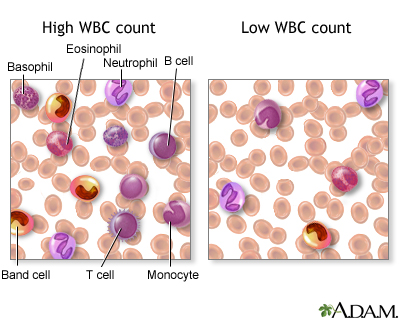
There are various types of white blood cells (WBCs) that normally appear in the blood: neutrophils (polymorphonuclear leukocytes; PMNs), band cells (slightly immature neutrophils), T-type lymphocytes (T cells), B-type lymphocytes (B cells), monocytes, eosinophils, and basophils. T and B-type lymphocytes are indistinguishable from each other in a normal slide preparation. Any infection or acute stress will result in an increased production of WBCs. This usually entails increased numbers of cells and an increase in the percentage of immature cells (mainly band cells) in the blood. This change is referred to as a “shift to the left” People who have had a splenectomy have a persistent mild elevation of WBCs. Drugs that may increase WBC counts include epinephrine, allopurinol, aspirin, chloroform, heparin, quinine, corticosteroids, and triamterene. Drugs that may decrease WBC counts include antibiotics, anticonvulsants, antihistamine, antithyroid drugs, arsenicals, barbiturates, chemotherapeutic agents, diuretics and sulfonamides.   (Updated by: David C. Dugdale, III, MD)

https://www.med-ed.virginia.edu/courses/path/innes/nh/wcbmaturation.cfm

Note that the mature forms of the myeloid series (neutrophils, eosinophils, basophils), all have lobed (segmented) nuclei. The degree of lobation increases as the cells mature.

The earliest recognizable myeloid cell is the myeloblast (10-20m dia) with a large round to oval nucleus. There is fine diffuse immature chromatin (without clumping) and a prominant nucleolus.

The cytoplasm is basophilic without granules. Although one may see a small golgi area adjacent to the nucleus, granules are not usually visible by light microscopy. One should not see blast cells in the peripheral blood.

myeloblast x100b

https://www.med-ed.virginia.edu/courses/path/innes/images/nhjpeg/nh%20myeloblast%20x100b.jpeg

The promyelocyte (10-20m) is slightly larger than a blast. Its nucleus, although similar to a myeloblast shows slight chromatin condensation and less prominent nucleoli. The cytoplasm contains striking azurophilic granules or primary granules. These granules contain myeloperoxidase, acid phosphatase, and esterase enzymes. Normally no promyelocytes are seen in the peripheral blood.

At the point in development when secondary granules can be recognized, the cell becomes a myelocyte.

promyelocyte x100

https://www.med-ed.virginia.edu/courses/path/innes/images/nhjpeg/nh%20promyelocyte%20×100%20a.jpeg

Myelocytes (10-18m) are not normally found in the peripheral blood. Nucleoli may not be seen in the late myelocyte. Primary azurophilic granules are still present, but secondary granules predominate. Secondary granules (neut, eos, or baso) first appear adjacent to the nucleus. In neutrophils this is the “dawn” of neutrophilia.

Metamyelocytes (10-18m) have kidney shaped indented nuclei and dense chromatin along the nuclear membrane. The cytoplasm is faintly pink, and they have secondary granules (neutro, eos, or baso). Zero to one percent of the peripheral blood white cells may be metamyelocytes (juveniles).

metamyelocyte x100

https://www.med-ed.virginia.edu/courses/path/innes/images/nhjpeg/nh%20metamyelocyte%20×100.jpeg

Bands, slightly smaller than juveniles, are marked by a U-shaped or deeply indented nucleus.

band neutrophilx100a

https://www.med-ed.virginia.edu/courses/path/innes/images/nhjpeg/nh%20band%20x100a.jpeg

Segmented (segs) or polymorphonuclear (PMN) leukocytes (average 14 m dia) are distinguished by definite lobation with thin thread-like filaments of chromatin joining the 2-5 lobes. 45-75% of the peripheral blood white cells are segmented neutrophils.

https://www.med-ed.virginia.edu/courses/path/innes/images/nhjpeg/nh%20neutrophil%20×100%20d.jpeg

Thrombocytogenesis

The incredible journey: From megakaryocyte development to platelet formation

Kellie R. Machlus1,2 and Joseph E. Italiano Jr
JCB 2013; 201(6): 785-796
http://dx.doi.org:/10.1083/jcb.201304054

Large progenitor cells in the bone marrow called megakaryocytes (MKs) are the source of platelets. MKs release platelets through a series of fascinating cell biological events. During maturation, they become polyploid and accumulate massive amounts of protein and membrane. Then, in a cytoskeletal-driven process, they extend long branching processes, designated proplatelets, into sinusoidal blood vessels where they undergo fission to release platelets.

megakaryocyte production of platelets

http://dm5migu4zj3pb.cloudfront.net/manuscripts/26000/26891/medium/JCI0526891.f4.jpg

platelets and the immune continuum nri2956-f3

http://www.nature.com/nri/journal/v11/n4/images/nri2956-f3.jpg

2.4.2 Classification of hematological malignancies
Practical Diagnosis of Hematologic Disoreders. 4th edition. Vol 2.
Kjeldsberg CR, Ed.  ASCP Press.  2006. Chicago, IL.

2.4.2.1 Primary Classification

Acute leukemias

Myelodysplastic syndromes

Acute myeloid leukemia

Acute lymphoblastic leukemia

Myeloproliferative Disorders

Chronic myeloproliferative disorders

Chronic myelogenous leukemia and related disorders

Myelofibrosis, including chronic idiopathic

Polycythemia, including polycythemia rubra vera

Thrombocytosis, including essential thrombocythemia

Chronic lymphoid leukemia and other lymphoid leukemias

Lymphomas

Non-Hodgkin Lymphoma

Hodgkin lymphoma

Lymphoproliferative disorders associated with immunodeficiency

Plasma Cell dyscrasias

Mast cell disease and Histiocytic neoplasms

2.4.2.2 Secondary Classification

2.4.2.3 Nuance – PathologyOutlines
Nat Pernick, Ed.

Leukemia – Acute

Primary referencesacute leukemia-generalAML generalAML classificationtransient abnormal myelopoiesis

Recurrent genetic abnormalities: AML with t(6;9)AML with t(8;21)AML with 11q23 abnormalitiesAML with inv(16) or t(16;16)AML with Down syndromeAML with FLT3 mutationsAML with myelodysplastic related changesAML therapy relatedAPL microgranular variantAPL with t(15;17)APL with t(V;17)APL therapy related

AML not otherwise categorized: minimally differentiated (M0)without maturation (M1)with maturation (M2)M3myelomonocyticmonoblastic and monocyticerythroidmegakaryoblasticCD13/CD33 negativebasophilicmyeloid sarcomaacute panmyelosis with myelofibrosiswith Philadelphia chromosomewith pseudo Chediak-Higashi anomalyhypocellular

ALL: generalWHO classificationwith eosinophilia

PreB ALL: generalt(9;22)t(v;11q23)t(1;19)t(5;14)t(12;21)hyperdiploidyhypodiploidymature B ALL/Burkitt

Other ALL: T ALLambiguous lineagemixed phenotype

AML and related malignancies

Acute myeloid leukemias with recurrent genetic abnormalities:

  • AML with t(8;21)(q22;q22); RUNX1-RUNX1T1
  • AML with inv(16)(p13.1;q22) or t(16;16)(p13.1;q22); CBF&beta-MYH11
  • Acute promyelocytic leukemia with t(15;17)(q22;q12); PML/RAR&alpha and variants
  • AML with t(9;11)(p22;q23); MLLT3-MLL
  • AML with t(6;9)(p23;q34); DEK-NUP214
  • AML with inv(3)(q21q26.2) or t(3;3)(q21;q26.2); RPN1-EVI1
  • AML (megakaryoblastic) with t(1;22)(p13;q13); RBM15-MKL1
  • AML with mutated NPM1*
  • AML with mutated CEBPA*

* provisional

Acute myeloid leukemia with myelodysplasia related changes

Therapy related acute myeloid leukemia

  • Alkylating agent related
  • Topoisomerase II inhibitor related (some maybe lymphoid)

Acute myeloid leukemia not otherwise categorized:

  • AML minimally differentiated (M0)
  • AML without maturation (M1)
  • AML with maturation (M2)
  • Acute myelomonocytic leukemia (M4)
  • Acute monoblastic and monocytic leukemia (M5a, M5b)
  • Acute erythroid leukemia (M6)
  • Acute megakaryoblastic leukemia (M7)
  • Acute basophilic leukemia
  • Acute panmyelosis with myelofibrosis

Myeloid Sarcoma

Myeloid proliferations related to Down syndrome:

  • Transient abnormal myelopoeisis
  • Myeloid leukemia associated with Down syndrome

Blastic plasmacytoid dentritic cell neoplasm:

Acute leukemia of ambiguous lineage:

  • Acute undifferentiated leukemia
  • Mixed phenotype acute leukemia with t(9;22)(q34;q11.2); BCR-ABL1
  • Mixed phenotype acute leukemia with t(v;11q23); MLL rearranged
  • Mixed phenotype acute leukemia, B/myeloid, NOS
  • Mixed phenotype acute leukemia, T/myeloid, NOS
  • Mixed phenotype acute leukemia, NOS, rare types
  • Other acute leukemia of ambiguous lineage
  • References: WHO Classification of Tumours of Haematopoietic and Lymphoid Tissue (IARC, 2008), Discovery Medicine 2010, eMedicine

Acute lymphocytic leukemia

General
=================================================================

  • WHO classification system includes former FAB classifications ALL-L1 and L2
    ● FAB L3 is now considered Burkitt lymphoma

WHO classification of acute lymphoblastic leukemia
=================================================================

Precursor B lymphoblastic leukemia / lymphoblastic lymphoma:
● ALL with t(9;22)(q34;q11.2); BCR-ABL (Philadelphia chromosome)
● ALL with t(v;11q23) (MLL rearranged)
● ALL with t(1;19)(q23;p13.3); TCF3-PBX1 (E2A-PBX1)
● ALL with t(12;21)(p13;q22); ETV6-RUNX1 (TEL-AML1)
● Hyperdiploid > 50
● Hypodiploid
● t(5;14)(q31;q32); IL3-IGH

Precursor T lymphoblastic leukemia / lymphoma

Additional references
=================================================================

Mixed phenotype acute leukemia (MPAL)

General
=================================================================

  • De novo acute leukemia containing separate populations of blasts of more than one lineage (bilineal or bilineage), or a single population of blasts co-expressing antigens of more than one lineage (biphenotypic)Excludes:
    ● Acute myeloid leukemia (AML) with recurrent translocations t(8;21), t(15;17) or inv(16)
    ● Leukemias with FGFR1 mutations
    ● Chronic myelogenous leukemia (CML) in blast crisis
    ● Myelodysplastic syndrome (MDS)-related AML and therapy-related AML, even if they have MPAL immunophenotypeCriteria for biphenotypic leukemia:
    ● Score of 2 or more for each of two separate lineages:The European Group for the Immunological Classification of Leukemias (EGIL) scoring system2008 WHO classification of acute leukemias of ambiguous lineage 

Prognosis
=================================================================

  • Poor, overall survival of 18 months
    ● Young age, normal karyotype and ALL induction therapy are associated with favorable survival
    ● Ph+ is a predictor for poor prognosis
    ● Bone marrow transplantation should be considered in first remission

Major Categories

MPAL with t(9;22)(q34;q11.2); BCR-ABL1
=================================================================

  • 20% of all MPAL
    ● Blasts with t(9;22)(q34;q11.2) translocation or BCR-ABL1 rearrangement (Ph+) without history of CML
    ● Majority in adults
    ● High WBC counts● Most of the cases B/myeloid phenotype
    ● Rare T/myeloid, B and T lineage, or trilineage leukemiasMorphology:
    ● Many cases show a dimorphic blast population, one resembling myeloblasts and the other lymphoblastsCytogenetic abnormalities:
    ● Conventional karyotyping for t(9;22), FISH or PCR for BCR-ABL1 translocation
    ● Additional complex karyotypes
    ● Ph+ is a poor prognostic factor for MPAL, with a reported median survival of 8 months
    ● Worse than patients of all other types of MPAL

MPAL with t(v;11q23); MLL rearranged
=================================================================

  • Meeting the diagnostic criteria for MPAL with blasts bearing a translocation involving the 11q23 breakpoint (MLL gene)
    ● MPAL with MLL rearranged rare
    ● More often seen in children and relatively common in infancy
    ● High WBC counts
    ● Poor prognosis
    ● Dimorphic blast population, with one resembling monoblasts and the other resembling lymphoblasts
    ● Lymphoblast population often shows a CD19+, CD10- B precursor immunophenotype, frequently CD15+
    ● Expression of other B markers usually weak
    ● Translocations involving MLL gene include t(4;11)(q21;q23), t(11;19)(q23;p13), and t(9;11)(p22;q23)
    ● Cases with chromosome 11q23 deletion should not be classified in this category

B cell acute lymphoblastic leukemia (ALL) / lymphoblastic lymphoma (LBL)

General

=================================================================

  • Current 2008 WHO classification: B lymphoblastic leukemia / lymphoma, NOS or B lymphoblastic leukemia / lymphoma with recurrent genetic abnormalities
  • See also lymphomas: B cell chapter
  • Also called B cell acute lymphoblastic leukemia / lymphoblastic lymphoma, pre B ALL / LBL
  • Usually children
  • B acute lymphoblastic leukemia presents with pancytopenia due to extensive marrow involvement, stormy onset of symptoms, bone pain due to marrow expansion, hepatosplenomegaly due to neoplastic infiltration, CNS symptoms due to meningeal spread and testicular involvement
  • B acute lymphoblastic lymphoma often presents with cutaneous nodules, bone or nodal involvement, < 25% lymphoblasts in bone marrow and peripheral blood; aleukemic cases are usually asymptomatic
  • Depending on specific leukemia, arises in either hematopoietic stem cell or B-cell progenitor
  • Tumors are derived from pre-germinal center naive B cells with unmutated VH region genes
  • Have multiple immunophenotyping aberrancies relative to normal B cell precursors (hematogones); at relapse, 73% show loss of 1+ aberrance and 60% show new aberrancies (Am J Clin Pathol 2007;127:39)

Prognostic features

=================================================================

  • Favorable prognosis: age 1-10 years, female, white; preB phenotype, hyperdiploidy>50, t(12,21), WBC count at presentation <50×108/L, non-traumatic tap with no blasts in CNS, rapid response to chemotherapy < 5% blasts on morphology on day 15, remission status after induction <5% blasts on morphology and <0.01% blast on flow or PCR, CD10+
  • Intermediate prognosis: hyperdiploidy 47-50, diploid, 6q- and rearrangements of 8q24
  • Unfavorable prognosis: under age 1 (usually have 11q23 translocations) or over age 10; t(9;22) (but not if age 59+ years, Am J Clin Pathol 2002;117:716); male, > 50×108/L WBC at presentation, hypodiploidy, near tetraploidy, 17p- and MLL rearrangements t(v;11q23); CD10-; non-traumatic tap with > 5% blasts or traumatic tap (7%); also increased microvessel staining using CD105 in children (Leuk Res 2007;31:1741), MDR1 expression in children (Oncol Rep 2004;12:1201) and adults (Blood 2002;100:974), 25%+ blasts on morphology on day 15, remission status after induction ≥ 5% blasts on morphology and ≥ 0.1% blasts on flow or PCR

Case reports

=================================================================

  • 12 month old girl and 13 month old boy with mature phenotype but no translocations (Arch Pathol Lab Med 2003;127:1340)
  • 56 year old man with ALL arising from follicular lymphoma (Arch Pathol Lab Med 2002;126:997)
  • 76 year old man with basal cell carcinoma (Diagn Pathol 2007;2:32)
  • With hemophagocytic lymphohistiocytosis (Pediatr Blood Cancer 2008;50:381)

Treatment

================================================================

  • Chemotherapy cures more children than adults; adolescents benefit from intensive regimens (Hematology Am Soc Hematol Educ Program 2005:123)

Micro description

=================================================================

  • Bone marrow smears: small to intermediate blast-like cells with scant, variably basophilic cytoplasm, round / oval or convoluted nuclei, fine chromatin and indistinct nucleoli; frequent mitotic figures; may have “starry sky” appearance similar to Burkitt lymphoma; may have large lymphoblasts with 1-4 prominent nucleoli resembling myeloblasts; usually no sclerosis
  • Bone marrow biopsy: usually markedly hypercellular with reduction of trilinear maturation; cells have minimal cytoplasm, medium sized nuclei that are often convoluted, moderately dense chromatin and indistinct nucleoli, brisk mitotic activity
  • Other tissues: may have “starry sky” appearance similar to Burkitt lymphoma; collagen dissection, periadipocyte growth pattern and single cell linear filing

Chronic Leukemia

Chronic Myeloid Neoplasms

Myelodysplastic syndromes (MDS): general, WHO classification, childhood, refractory anemia, refractory anemia with ringed sideroblasts, refractory cytopenia with multilineage dysplasia, refractory anemia with excess blasts, 5q-syndrome, therapy related, unclassified, arsenic toxicity

Myeloproliferative neoplasms (MPN): general, WHO classification, chronic eosinophilic leukemia, chronic myelogenous leukemia, chronic neutrophilic leukemia, essential thrombocythemia, hypereosinophilic syndrome, mast cell disease, polycythemia vera, primary myelofibrosis, unclassifiable

MDS/MPN: general, WHO classification, atypical CML, chronic myelomonocytic leukemia (CMML), chronic myelomonocytic leukemia with eosinophilia, juvenile myelomonocytic leukemia, unclassifiable

Myeloid neoplasms associated with eosinophilia and abnormalities of PDGFRA, PDGFRB, or FGFR1: PDGFRA, PDGFRB, FGFR1

Miscellaneous: transient myeloproliferative disorder of Downís syndrome

Lymphoma and plasma cell neoplasms

Lymph nodes: normal development-generalB cellsT cellsNK cellsnormal histologygrossing lymph nodesfeatures to report

Molecular testing: theoryFISHnorthern blotPCRsouthern blot

Non-Hodgkin lymphoma: generalcytogeneticsstagingstaging-pediatricmorphologic clueshemophagocytic syndromechemotherapeutic atypia

B cell disorders: generalpost-rituximabbone marrow biopsyclassification-historicalWHO classification

B cell lymphoma subtypes: age-related EBV-associatedALK positive large cellBurkittunclassifiable-intermediate between Burkitt and diffuse large B cell lymphomaCLL
diffuse large B cell: 
diffuse-NOSCD5+T cell / histiocyte richprimary cutaneous-generalprimary cutaneous-legprimary sites-other
follicular: 
generalchildhoodcutaneousGI
hairy cell leukemiaHCL variantintravascular large B celllymphomatoid granulomatosislymphoplasmacyticmantle cell-classicmantle cell-blastoidmarginal zone-generalmarginal zone-MALTMALT-primary sitesmarginal zone-nodalmediastinal (thymic)plasmablasticpre B lymphoblastic leukemia/lymphomaprimary effusionprolymphocytic leukemiapyothorax associatedSLLsplenic marginal zonesplenic lymphoma with villous lymphocytes

Plasma cell neoplasms: generalmyelomaplasmacytomaheavy chain diseaseprimary amyloidosisMGUSOsteosclerotic myeloma (POEMS)cryoglobulinemia

T/NK cell disorders: generalWHO classificationadult T cellaggressive NK cell leukemiaanaplastic large cell ALK+ALK-angioimmunoblastic T cellblastic plasmacytoidchronic lymphoproliferative disorders of NK cellscutaneous CD4+ small/medium sized T cell lymphomacutaneous CD30 positive T cell lymphoproliferative disorderscutaneous gamma delta T cell lymphomaenteropathyepidermotropic CD8+ T cell lymphomahepatosplenicindolent T cell proliferationsmycosis fungoidesNK/T cell lymphoma-nasal typenodal CD8+ cytotoxic T cellnonB nonT lymphoblasticperipheral T cell lymphoma, NOSprimary effusion lymphomaSezary syndromestagingsubcutaneous panniculitis-likeT cell large granular lymphocytic leukemiaT cell lymphoblastic leukemia/lymphomaT cell prolymphocytic leukemia

Hodgkin lymphoma: general/stagingclassiclymphocyte depletedlymphocyte rich classicalmixed cellularitynodular lymphocyte predominantnodular sclerosis

Post-transplantation: generalWHO classificationplasmacytic hyperplasia/IM-like lesionspolymorphic B cell lymphoproliferative disordersmonomorphic B cell lymphoproliferative disordersothergraft versus host disease

Other: AIDS associated-generalAIDS associated-examplesEBV+ T cell lymphoproliferative disorders of childhoodprimary immune disorders related

Myeloproliferative neoplasms (MPN)

WHO 2008 – Myeloproliferative neoplasms (MPN) 

General
=================================================================

  • Chronic myelogenous leukemia
    ● Polycythemia vera
    ● Essential thrombocythemia
    ● Primary myelofibrosis
    ● Chronic neutrophilic leukemia
    ● Chronic eosinophilic leukemia, not otherwise categorized
    ● Mast cell disease
    ● MPNs, unclassifiable

WHO 2001 – Chronic myeloproliferative diseases 

Definition
=================================================================

  • Chronic myelogenous leukemia (Philadelphia chromosome, t(9;22)(q34;q11), BCR-ABL positive)
    ● Chronic neutrophilic leukemia
    ● Chronic eosinophilic leukemia (and the hypereosinophilic syndrome)
    ● Polycythemia vera
    ● Chronic idiopathic myelofibrosis (with extramedullary hematopoiesis)
    ● Essential thrombocythemia
    ● Chronic myeloproliferative disease, unclassifiable

Additional references
=================================================================

The World Health Organization (WHO) classification of the myeloid neoplasms  James W. Vardiman, Nancy Lee Harris, and Richard D. Brunning
Blood 2002; 100(7)  http://dx.doi.org/10.1182/blood-2002-04-1199

Lymphoma – Non B cell neoplasms

T/NK cell disorders/WHO classification (2008)

Principles of classification
=================================================================

  • Based on all available information (morphology, immunophenotype, genetics, clinical)
    ● No one antigenic marker is specific for any neoplasm (except ALK1)
    ● Immune profiling less helpful in subclassification of T cell lymphomas then B cell lymphomas
    ● Certain antigens commonly associated with specific disease entities but not entirely disease specific
    ● CD30: common in anaplastic large cell lymphoma but also classic Hodgkin lymphoma and other B and T cell lymphomas
    ● CD56: characteristic for nasal NK/T cell lymphoma, but also other T cell neoplasms and plasma cell disorders
    ● Variation of immunophenotype within a given disease (hepatosplenic T cell lymphoma: usually γδ but some are αβ)
    ● Recurrent genetic alterations have been identified for many B cell lymphomas but not for most T cell lymphomas
    ● No attempt to stratify lymphoid malignancies by grade
    ● Recognize the existence of grey zone lymphomas
    ● This multiparameter approach has been validated in international studies as highly reproducible

WHO 2008 classification of tumors of hematopoietic and lymphoid tissues (T/NK)
=================================================================

Precursor T-lymphoid neoplasms
● T lymphoblastic leukemia/lymphoma, 9837/3

Mature T cell and NK cell neoplasms
● T cell prolymphocytic leukemia, 9834/3
● T cell large granular lymphocytic leukemia, 9831/3
● Chronic lymphoproliferative disorder of NK cells, 9831/3
● Aggressive NK cell leukemia, 9948/3
● Systemic EBV-positive T cell lymphoproliferative disease of childhood, 9724/3
● Hydroa vacciniforme-like lymphoma, 9725/3
● Adult T cell leukemia/lymphoma, 9827/3
● Extranodal NK/T cell lymphoma, nasal type, 9719/3
● Enteropathy-associated T cell lymphoma, 9717/3
● Hepatosplenic T cell lymphoma, 9716/3
● Subcutaneous panniculitis-like T cell lymphoma, 9708/3
● Mycosis fungoides, 9700/3
● Sézary syndrome, 9701/3
● Primary cutaneous CD30-positive T cell lymphoproliferative disorders
● Lymphomatoid papulosis, 9718/1
● Primary cutaneous anaplastic large cell lymphoma, 9718/3
● Primary cutaneous gamma-delta T cell lymphoma, 9726/3
● Primary cutaneous CD8-positive aggressive epidermotropic cytotoxic T cell lymphoma, 9709/3
● Primary cutaneous CD4-positive small/medium T cell lymphoma, 9709/3
● Peripheral T cell lymphoma, NOS, 9702/3
● Angioimmunoblastic T cell lymphoma, 9705/3
● Anaplastic large cell lymphoma, ALK-positive, 9714/3
● Anaplastic large cell lymphoma, ALK-negative, 9702/3

Chronic Lymphocytic Leukemia

Chronic Lymphocytic Leukemia Staging
Author: Sandy D Kotiah, MD; Chief Editor: Jules E Harris, MD
Medscape Sep 6, 2013
http://emedicine.medscape.com/article/2006578-overview

General considerations in the staging of chronic lymphocytic leukemia (CLL) and the revised Rai (United States) and Binet (Europe) staging systems for CLL are provided below.[1, 2, 3]

See Chronic Leukemias: 4 Cancers to Differentiate, a Critical Images slideshow, to help detect chronic leukemias and determine the specific type present.

General considerations

  • CLL and small lymphocytic lymphoma (SLL) are different manifestations of the same disease; SLL is diagnosed when the disease is mainly nodal, and CLL is diagnosed when the disease is seen in the blood and bone marrow
  • CLL is diagnosed by > 5000 monoclonal lymphocytes/mm3 for longer than 3mo; the bone marrow usually has more than 30% monoclonal lymphocytes and is either normocellular or hypercellular
  • Monoclonal B lymphocytosis is a precursor form of CLL that is defined by a monoclonal B cell lymphocytosis < 5000 monoclonal lymphocytes/mm3; all lymph nodes smaller than 1.5 cm; no anemia; and no thrombocytopenia

Revised Rai staging system (United States)

Low risk (formerly stage 0)[1] :

  • Lymphocytosis, lymphocytes in blood > 15000/mcL, and > 40% lymphocytes in the bone marrow

Intermediate risk (formerly stages I and II):

  • Lymphocytosis as in low risk with enlarged node(s) in any site, or splenomegaly or hepatomegaly or both

High risk (formerly stages III and IV):

  • Lymphocytosis as in low risk and intermediate risk with disease-related anemia (hemoglobin level < 11.0 g/dL or hematocrit < 33%) or platelets < 100,000/mcL

Binet staging system (Europe)

Stage A:

  • Hemoglobin ≥ 10 g/dL, platelets ≥ 100,000/mm3, and < 3 enlarged areas

Stage B:

  • Hemoglobin ≥ 10 g/dL, platelets ≥ 100,000/mm3, and ≥ 3 enlarged areas

Stage C:

  • Hemoglobin < 10 g/dL, platelets < 100,000/mm3, and any number of enlarged areas

Read Full Post »

Therapeutic Implications for Targeted Therapy from the Resurgence of Warburg ‘Hypothesis’

Writer and Curator: Larry H. Bernstein, MD, FCAP 

(Note that each portion of the discussion is followed by a reference)

It is now a time to pause after almost a century of a biological scientific discoveries that have transformed the practice of medicine and impacted the lives of several generations of young minds determined to probe the limits of our knowledge.  In the century that we have entered into the scientific framework of medicine has brought together a difficult to grasp evolution of the emergence of human existence from wars, famine, droughts, storms, infectious diseases, and insect born pestilence with betterment of human lives, only unevenly divided among societal classes that have existed since time immemorial. In this short time span there have emerged several generations of physicians who have benefited from a far better medical education that their forebears could have known. In this expansive volume on cancer, we follow an incomplete and continuing challenge to understand cancer, a disease that has become associated with longer life spans in developed nations.

While there are significant improvements in the diagnosis and treatment of cancers, there is still a personal as well as locality factor in the occurrence of this group of diseases, which has been viewed incorrectly as a “dedifferentiation” of mature tissue types and the emergence of a cell phenotype that is dependent on glucose, reverts to a cancer “stem cell type” (loss of stemness), loses cell to cell adhesion, loses orderly maturation, and metastasizes to distant sites. At the same time, physician and nurses are stressed in the care of patients by balancing their daily lives and maintaining a perspective.

The conceptual challenge of cancer diagnosis and management has seemed insurmountable, but owes much to the post World War I activities of Otto Heinrich Warburg. It was Warburg who made the observation that cancer cells metabolize glucose by fermentation in much the way Pasteur 60 years earlier observed fermentation of yeast cells. This metabolic phenomenon occurs even in the presence of an oxygen supply, which would provide a huge deficit in ATP production compared with respiration. The cancer cell is “addicted to glucose” and produced lactic acid. Warburg was awarded the Nobel Prize in Medicine for this work in 1931.

In the last 15 years there has been a resurgence of work on the Warburg effect that sheds much new light on the process that was not previously possible, with significant therapeutic implications.  In the first place, the metabolic mechanism for the Warburg effect was incomplete even at the beginning of the 21st century.  This has been partly rectified with the enlightening elucidation of genome modifications, cellular metabolic regulation, and signaling pathways.

The following developments have become central to furthering our understanding of malignant transformation.

  1. There is usually an identifiable risk factor, such as, H. pylori, or of a chronic inflammatory state, as in the case of Barrett’s esophagus.
  2. There are certain changes in glucose metabolism that have been unquestionably been found in the evolution of this disease. The changes are associated with major changes in metabolic pathways, miRN signaling, and the metabolism geared to synthesis of cells with an impairment of the cell death cycle. In these changes, mitochondrial function is central to both the impaired respiration and the autophagy geared to the synthesis of cancer cells.

The emergence of this cell prototype is characterized by the following, again related to the Warburg effect:

  1. Cancer cells oxidize a decreased fraction of the pyruvate generated from glycolysis
  2. The mitochondrial pyruvate carrier (MPC), composed of the products of the MPC1 and MPC2 genes, modulates fractional pyruvate oxidation. MPC1 is deleted or underexpressed in multiple cancers and correlates with poor prognosis.
  3. Cancer cells tend to express a partially inhibited splice variant of pyruvate kinase (PK-M2), leading to decreased pyruvate production.
  4. The two proteins that mediate pyruvate conversion to lactate and its export, M-type lactate dehydrogenase and the monocarboxylate transporter MCT-4, are commonly upregulated in cancer cells leading to decreased pyruvate oxidation.
  5. The enzymatic step following mitochondrial entry is the conversion of pyruvate to acetyl-CoA by the pyruvate dehydrogenase (PDH) complex. Cancer cells frequently exhibit increased expression of the PDH kinase PDK1, which phosphorylates and inactivates PDH. This PDH regulatory mechanism is required for oncogene induced transformation and reversed in oncogene-induced senescence.
  6. The PDK inhibitor dichloroacetate has shown some clinical efficacy, which correlates with increased pyruvate oxidation. One of the simplest mechanisms to explain decreased mitochondrial pyruvate oxidation in cancer cells, a loss of mitochondrial pyruvate import, has been observed repeatedly over the past 40 years. This process has been impossible to study at a molecular level until recently, however, as the identities of the protein(s) that mediate mitochondrial pyruvate uptake were unknown.
  7. The mitochondrial pyruvate carrier (MPC) as a multimeric complex that is necessary for efficient mitochondrial pyruvate uptake. The MPC contains two distinct proteins, MPC1 and MPC2; the absence of either leads to a loss of mitochondrial pyruvate uptake and utilization in yeast, flies, and mammalian cells.

A Role for the Mitochondrial Pyruvate Carrier as a Repressor of the Warburg Effect and Colon Cancer Cell Growth

John C. Schell, Kristofor A. Olson, Lei Jiang, Amy J. Hawkins, et al.
Molecular Cell Nov 6, 2014; 56: 400–413.
http://dx.doi.org/10.1016/j.molcel.2014.09.026

In addition to the above, the following study has therapeutic importance:

Glycolysis has become a target of anticancer strategies. Glucose deprivation is sufficient to induce growth inhibition and cell death in cancer cells. The increased glucose transport in cancer cells has been attributed primarily to the upregulation of glucose transporter 1 (Glut1),  1 of the more than 10 glucose transporters that are responsible for basal glucose transport in almost all cell types. Glut1 has not been targeted until very recently due to the lack of potent and selective inhibitors.

First, Glut1 antibodies were shown to inhibit cancer cell growth. Other Glut1 inhibitors and glucose transport inhibitors, such as fasentin and phloretin, were also shown to be effective in reducing cancer cell growth. A group of inhibitors of glucose transporters has been recently identified with IC50 values lower than 20mmol/L for inhibiting cancer cell growth. However, no animal or detailed mechanism studies have been reported with these inhibitors.

Recently, a small molecule named STF-31 was identified that selectively targets the von Hippel-Lindau (VHL) deficient kidney cancer cells. STF-31 inhibits VHL deficient cancer cells by inhibiting Glut1. It was further shown that daily intraperitoneal injection of a soluble analogue of STF-31 effectively reduced the growth of tumors of VHL-deficient cancer cells grafted on nude mice. On the other hand, STF-31 appears to be an inhibitor with a narrow cell target spectrum.

These investigators recently reported the identification of a group of novel small compounds that inhibit basal glucose transport and reduce cancer cell growth by a glucose deprivation–like mechanism. These compounds target Glut1 and are efficacious in vivo as anticancer agents. A novel representative compound WZB117 not only inhibited cell growth in cancer cell lines but also inhibited cancer growth in a nude mouse model. Daily intraperitoneal injection of WZB117 resulted in a more than 70% reduction in the size of human lung cancer of A549 cell origin. Mechanism studies showed that WZB117 inhibited glucose transport in human red blood cells (RBC), which express Glut1 as their sole glucose transporter. Cancer cell treatment with WZB117 led to decreases in levels of Glut1 protein, intracellular ATP, and glycolytic enzymes. All these changes were followed by increase in ATP sensing enzyme AMP-activated protein kinase (AMPK) and declines in cyclin E2 as well as phosphorylated retinoblastoma, resulting in cell-cycle arrest, senescence, and necrosis. Addition of extracellular ATP rescued compound-treated cancer cells, suggesting that the reduction of intracellular ATP plays an important role in the anticancer mechanism of the molecule.

A Small-Molecule Inhibitor of Glucose Transporter 1 Downregulates Glycolysis, Induces Cell-Cycle Arrest, and Inhibits Cancer Cell Growth In Vitro and In Vivo

Yi Liu, Yanyan Cao, Weihe Zhang, Stephen Bergmeier, et al.
Mol Cancer Ther Aug 2012; 11(8): 1672–82
http://dx.doi.org://10.1158/1535-7163.MCT-12-0131

Alterations in cellular metabolism are among the most consistent hallmarks of cancer. These investigators have studied the relationship between increased aerobic lactate production and mitochondrial physiology in tumor cells. To diminish the ability of malignant cells to metabolize pyruvate to lactate, M-type lactate dehydrogenase levels were knocked down by means of LDH-A short hairpin RNAs. Reduction in LDH-A activity resulted in stimulation of mitochondrial respiration and decrease of mitochondrial membrane potential. It also compromised the ability of these tumor cells to proliferate under hypoxia. The tumorigenicity of the LDH-A-deficient cells was severely diminished, and this phenotype was reversed by complementation with the human ortholog LDH-A protein. These results demonstrate that LDH-A plays a key role in tumor maintenance.

The results are consistent with a functional connection between alterations in glucose metabolism and mitochondrial physiology in cancer. The data also reflect that the dependency of tumor cells on glucose metabolism is a liability for these cells under limited-oxygen conditions. Interfering with LDH-A activity as a means of blocking pyruvate to lactate conversion could be exploited therapeutically. Because individuals with complete deficiency of LDH-A do not show any symptoms under ordinary circumstances, the genetic data suggest that inhibition of LDH-A activity may represent a relatively nontoxic approach to interfere with tumor growth.

Attenuation of LDH-A expression uncovers a link between glycolysis, mitochondrial physiology, and tumor maintenance

Valeria R. Fantin Julie St-Pierre and Philip Leder
Cancer Cell Jun 2006; 9: 425–434.
http://dx.doi.org:/10.1016/j.ccr.2006.04.02

The widespread clinical use of positron-emission tomography (PET) for the detection of aerobic glycolysis in tumors and recent findings have rekindled interest in Warburg’s theory. Studies on the physiological changes in malignant conversion provided a metabolic signature for the different stages of tumorigenesis; during tumorigenesis, an increase in glucose uptake and lactate production have been detected. The fully transformed state is most dependent on aerobic glycolysis and least dependent on the mitochondrial machinery for ATP synthesis.

Tumors ferment glucose to lactate even in the presence of oxygen (aerobic glycolysis; Warburg effect). The pentose phosphate pathway (PPP) allows glucose conversion to ribose for nucleic acid synthesis and glucose degradation to lactate. The nonoxidative part of the PPP is controlled by transketolase enzyme reactions. We have detected upregulation of a mutated transketolase transcript (TKTL1) in human malignancies, whereas transketolase (TKT) and transketolase-like-2 (TKTL2) transcripts were not upregulated. Strong TKTL1 protein expression was correlated to invasive colon and urothelial tumors and to poor patients outcome. TKTL1 encodes a transketolase with unusual enzymatic properties, which are likely to be caused by the internal deletion of conserved residues. We propose that TKTL1 upregulation in tumors leads to enhanced, oxygen-independent glucose usage and a lactate based matrix degradation. As inhibition of transketolase enzyme reactions suppresses tumor growth and metastasis, TKTL1 could be the relevant target for novel anti-transketolase cancer therapies. We suggest an individualized cancer therapy based on the determination of metabolic changes in tumors that might enable the targeted inhibition of invasion and metastasis.

Other important links between cancer-causing genes and glucose metabolism have been already identified. Activation of the oncogenic kinase Akt has been shown to stimulate glucose uptake and metabolism in cancer cells and renders these cells susceptible to death in response to glucose withdrawal. Such tumor cells have been shown to be dependent on glucose because the ability to induce fatty acid oxidation in response to glucose deprivation is impaired by activated Akt. In addition, AMP-activated protein kinase (AMPK) has been identified as a link between glucose metabolism and the cell cycle, thereby implicating p53 as an essential component of metabolic cell-cycle control.

Expression of transketolase TKTL1 predicts colon and urothelial cancer patient survival: Warburg effect reinterpreted

S Langbein, M Zerilli, A zur Hausen, W Staiger, et al.
British Journal of Cancer (2006) 94, 578–585.
http://dx.doi.org:/10.1038/sj.bjc.6602962

The unique metabolic profile of cancer (aerobic glycolysis) might confer apoptosis resistance and be therapeutically targeted. Compared to normal cells, several human cancers have high mitochondrial membrane potential (DJm) and low expression of the K+ channel Kv1.5, both contributing toapoptosis resistance. Dichloroacetate (DCA) inhibits mitochondrial pyruvate dehydrogenase kinase (PDK), shifts metabolism from glycolysis to glucose oxidation, decreases DJm, increases mitochondrial H2O2, and activates Kv channels in all cancer, but not normal, cells; DCA upregulates Kv1.5 by an NFAT1-dependent mechanism. DCA induces apoptosis, decreases proliferation, and inhibits tumor growth, without apparent toxicity. Molecular inhibition of PDK2 by siRNA mimics DCA. The mitochondria-NFAT-Kv axis and PDK are important therapeutic targets in cancer; the orally available DCA is a promising selective anticancer agent.

Cancer progression and its resistance to treatment depend, at least in part, on suppression of apoptosis. Although mitochondria are recognized as regulators of apoptosis, their importance as targets for cancer therapy has not been adequately explored or clinically exploited. In 1930, Warburg suggested that mitochondrial dysfunction in cancer results in a characteristic metabolic phenotype, that is, aerobic glycolysis (Warburg, 1930). Positron emission tomography (PET) imaging has now confirmed that most malignant tumors have increased glucose uptake and metabolism. This bioenergetic feature is a good marker of cancer but has not been therapeutically pursued..

The small molecule DCA is a metabolic modulator that has been used in humans for decades in the treatment of lactic acidosis and inherited mitochondrial diseases. Without affecting normal cells, DCA reverses the metabolic electrical remodeling that we describe in several cancer lines (hyperpolarized mitochondria, activated NFAT1, downregulated Kv1.5), inducing apoptosis and decreasing tumor growth. DCA in the drinking water at clinically relevant doses for up to 3 months prevents and reverses tumor growth in vivo, without apparent toxicity and without affecting hemoglobin, transaminases, or creatinine levels. The ease of delivery, selectivity, and effectiveness  make DCA an attractive candidate for proapoptotic cancer therapy which can be rapidly translated into phase II–III clinical trials.

A Mitochondria-K+ Channel Axis Is Suppressed in Cancer and Its Normalization Promotes Apoptosis and Inhibits Cancer Growth

Sebastien Bonnet, Stephen L. Archer, Joan Allalunis-Turner, et al.

Cancer Cell Jan 2007; 11: 37–51.
http://dx.doi.org:/10.1016/j.ccr.2006.10.020

Tumor cells, just as other living cells, possess the potential for proliferation, differentiation, cell cycle arrest, and apoptosis. There is a specific metabolic phenotype associated with each of these conditions, characterized by the production of both energy and special substrates necessary for the cells to function in that particular state. Unlike that of normal living cells, the metabolic phenotype of tumor cells supports the proliferative state. Aim: To present the metabolic hypothesis that (1) cell transformation and tumor growth are associated with the activation of metabolic enzymes that increase glucose carbon utilization for nucleic acid synthesis, while enzymes of the lipid and amino acid synthesis pathways are activated in tumor growth inhibition, and (2) phosphorylation and allosteric and transcriptional regulation of intermediary metabolic enzymes and their substrate availability together mediate and sustain cell transformation from one condition to another. Conclusion: Evidence is presented that demonstrates opposite changes in metabolic phenotypes induced by TGF-β, a cell transforming agent, and tumor growth-inhibiting phytochemicals such as genistein and Avemar, or novel synthetic antileukemic drugs such as STI571 (Gleevec).  Intermediary metabolic enzymes that mediate the growth signaling pathways and promote malignant cell transformation may serve as high efficacy nongenetic novel targets for cancer therapies.

A Metabolic Hypothesis of Cell Growth and Death in Pancreatic Cancer

Laszlo G. Boros, Wai-Nang Paul Lee, and Vay Liang W. Go
Pancreas 2002; 24(1):26–33

Clear cell renal cell carcinoma (ccRCC) is the most common pathological subtype of kidney cancer. Here, we integrated an unbiased genome-wide RNA interference screen for ccRCC survival regulators with an analysis of recurrently overexpressed genes in ccRCC to identify new therapeutic targets in this disease. One of the most potent survival regulators, the monocarboxylate transporter MCT4 (SLC16A3), impaired ccRCC viability in all eight ccRCC lines tested and was the seventh most overexpressed gene in a meta-analysis of five ccRCC expression datasets.

MCT4 silencing impaired secretion of lactate generated through glycolysis and induced cell cycle arrest and apoptosis. Silencing MCT4 resulted in intracellular acidosis, and reduction in intracellular ATP production together with partial reversion of the Warburg effect in ccRCC cell lines. Intra-tumoral heterogeneity in the intensity of MCT4 protein expression was observed in primary ccRCCs.

MCT4 protein expression analysis based on the highest intensity of expression in primary ccRCCs was associated with poorer relapse-free survival, whereas modal intensity correlated with Fuhrman nuclear grade. Consistent with the potential selection of subclones enriched for MCT4 expression during disease progression, MCT4 expression was greater at sites of metastatic disease. These data suggest that MCT4 may serve as a novel metabolic target to reverse the Warburg effect and limit disease progression in ccRCC.

Clear cell carcinoma (ccRCC) is the commonest subtype of renal cell carcinoma, accounting for 80% of cases. These tumors are highly resistant to cytotoxic chemotherapy and until recently, systemic treatment options for advanced ccRCC were limited to cytokine based therapies, such as interleukin-2 and interferon-α. Recently, anti-angiogenic drugs and mTOR inhibitors, all targeting the HIF–VEGF axis which is activated in up to 91% of ccRCCs through loss of the VHL tumor suppressor gene [1], have been shown to be effective in metastatic ccRCC [2–5]. Although these drugs increase overall survival to more than 2 years [6], resistance invariably occurs, making the identification of new molecular targets a major clinical need to improve outcomes in patients with metastatic ccRCC.

Genome-wide RNA interference analysis of renal carcinoma survival regulators identifies MCT4 as a Warburg effect metabolic target

Marco Gerlinger, Claudio R Santos, Bradley Spencer-Dene, et al.
J Pathol 2012; 227: 146–156
http://dx.doi.org:/10.1002/path.4006

Hypoxia-inducible factor 1 (HIF-1) plays a key role in the reprogramming of cancer metabolism by activating transcription of genes encoding glucose transporters and glycolytic enzymes, which take up glucose and convert it to lactate; pyruvate dehydrogenase kinase 1, which shunts pyruvate away from the mitochondria; and BNIP3, which triggers selective mitochondrial autophagy. The shift from oxidative to glycolytic metabolism allows maintenance of redox homeostasis and cell survival under conditions of prolonged hypoxia. Many metabolic abnormalities in cancer cells increase HIF-1 activity. As a result, a feed-forward mechanism can be activated that drives HIF-1 activation and may promote tumor progression.

Metastatic cancer is characterized by reprogramming of cellular metabolism leading to increased uptake of glucose for use as both an anabolic and a catabolic substrate. Increased glucose uptake is such a reliable feature that it is utilized clinically to detect metastases by positron emission tomography using 18F-fluorodeoxyglucose (FDG-PET) with a sensitivity of >90% [1]. As with all aspects of cancer biology, the details of metabolic reprogramming differ widely among individual tumors. However, the role of specific signaling pathways and transcription factors in this process is now understood in considerable detail. This review will focus on the involvement of hypoxia-inducible factor 1 (HIF-1) in both mediating metabolic reprogramming and responding to metabolic alterations. The placement of HIF-1 both upstream and downstream of cancer metabolism results in a feed-forward mechanism that may play a major role in the development of the invasive, metastatic, and lethal cancer phenotype.

O2 concentrations are significantly reduced in many human cancers compared with the surrounding normal tissue. The median PO2 in breast cancers is 10 mmHg, as compared with65 mmHg in normal breast tissue. Reduced O2 availability induces HIF-1, which regulates the transcription of hundreds of genes that encode proteins involved in every aspect of cancer biology, including: cell immortalization and stem cell maintenance; genetic instability; glucose and energy metabolism; vascularization; autocrine growth factor signaling; invasion and metastasis; immune evasion; and resistance to chemotherapy and radiation therapy.

HIF-1 is a transcription factor that consists of an O2 regulated HIF-1a and a constitutively expressed HIF-1b subunit. In well-oxygenated cells, HIF-1a is hydroxylated on proline residue 402 (Pro-402) and/or Pro-564 by prolyl hydroxylase domain protein 2 (PHD2), which uses O2 and a-ketoglutarate as substrates in a reaction that generates CO2 and succinate as byproducts. Prolylhydroxylated HIF-1a is bound by the von Hippel–Lindau tumor suppressor protein (VHL), which recruits an E3-ubiquitin ligase that targets HIF-1a for proteasomal degradation (Figure 1a). Asparagine 803 in the transactivation domain is hydroxylated in well-oxygenated cells by factor inhibiting HIF-1 (FIH-1), which blocks the binding of the coactivators p300 and CBP. Under hypoxic conditions, the prolyl and asparaginyl hydroxylation reactions are inhibited by substrate (O2) deprivation and/or the mitochondrial generation of reactive oxygen species (ROS), which may oxidize Fe(II) present in the catalytic center of the hydroxylases.

The finding that acute changes in PO2 increase mitochondrial ROS production suggests that cellular respiration is optimized at physiological PO2 to limit ROS generation and that any deviation in PO2 – up or down – results in increased ROS generation. If hypoxia persists, induction of HIF-1 leads to adaptive mechanisms to reduce ROS and re-establish homeostasis, as described below. Prolyl and asparaginyl hydroxylation provide a molecular mechanism by which changes in cellular oxygenation can be transduced to the nucleus as changes in HIF-1 activity.

HIF-1: upstream and downstream of cancer metabolism

Gregg L Semenza
Current Opinion in Genetics & Development 2010, 20:51–56

This review comes from a themed issue on Genetic and cellular mechanisms of oncogenesis Edited by Tony Hunter and Richard Marais

http://dx.doi.org:/10.1016/j.gde.2009.10.009

Hypoxia-inducible factor 1 (HIF-1) regulates the transcription of many genes involved in key aspects of cancer biology, including immortalization, maintenance of stem cell pools, cellular dedifferentiation, genetic instability, vascularization, metabolic reprogramming, autocrine growth factor signaling, invasion/metastasis, and treatment failure. In animal models, HIF-1 overexpression is associated with increased tumor growth, vascularization, and metastasis, whereas HIF-1 loss-of-function has the opposite effect, thus validating HIF-1 as a target. In further support of this conclusion, immunohistochemical detection of HIF-1a overexpression in biopsy sections is a prognostic factor in many cancers. A growing number of novel anticancer agents have been shown to inhibit HIF-1 through a  variety of molecular mechanisms. Determining which combination of drugs to administer to any given patient remains a major obstacle to improving cancer treatment outcomes.

Intratumoral hypoxia The majority of locally advanced solid tumors contain regions of reduced oxygen availability. Intratumoral hypoxia results when cells are located too far from a functional blood vessel for diffusion of adequate amounts of O2 as a result of rapid cancer cell proliferation and the formation of blood vessels that are structurally and functionally abnormal. In the most extreme case, O2 concentrations are below those required for survival, resulting in cell death and establishing a selection for cancer cells in which apoptotic pathways are inactivated, anti-apoptotic pathways are activated, or invasion/metastasis pathways that promote escape from the hypoxic microenvironment are activated. This hypoxic adaptation may arise by alterations in gene expression or by mutations in the genome or both and is associated with reduced patient survival.

Hypoxia-inducible factor 1 (HIF-1) The expression of hundreds of genes is altered in each cell exposed to hypoxia. Many of these genes are regulated by HIF-1. HIF-1 is a heterodimer formed by the association of an O2-regulated HIF1a subunit with a constitutively expressed HIF-1b subunit. The structurally and functionally related HIF-2a protein also dimerizes with HIF-1b and regulates an overlapping battery of target genes. Under nonhypoxic conditions, HIF-1a (as well as HIF-2a) is subject to O2-dependent prolyl hydroxylation and this modification is required for binding of the von Hippel–Lindau tumor suppressor protein (VHL), which also binds to Elongin C and thereby recruits a ubiquitin ligase complex that targets HIF-1a for ubiquitination and proteasomal degradation. Under hypoxic conditions, the rate of hydroxylation and ubiquitination declines, resulting in accumulation of HIF-1a. Immunohistochemical analysis of tumor biopsies has revealed high levels of HIF-1a in hypoxic but viable tumor cells surrounding areas of necrosis.

Genetic alterations in cancer cells increase HIF-1 activity In the majority of clear-cell renal carcinomas, VHL function is lost, resulting in constitutive activation of HIF-1. After re-introduction of functional VHL, renal carcinoma cell lines are no longer tumorigenic, but can be made tumorigenic by expression of HIF2a in which the prolyl residues that are subject to hydroxylation have been mutated. In addition to VHL loss-of-function, many other genetic alterations that inactivate tumor suppressors

Evaluation of HIF-1 inhibitors as anticancer agents

Gregg L. Semenza
Drug Discovery Today Oct 2007; 12(19/20).
http://dx.doi.org:/10.1016/j.drudis.2007.08.006

Hypoxia-inducible factor-1 (HIF-1), which is present at high levels in human tumors, plays crucial roles in tumor promotion by upregulating its target genes, which are involved in anaerobic energy metabolism, angiogenesis, cell survival, cell invasion, and drug resistance. Therefore, it is apparent that the inhibition of HIF-1 activity may be a strategy for treating cancer. Recently, many efforts to develop new HIF-1-targeting agents have been made by both academic and pharmaceutical industry laboratories. The future success of these efforts will be a new class of HIF-1-targeting anticancer agents, which would improve the prognoses of many cancer patients. This review focuses on the potential of HIF-1 as a target molecule for anticancer therapy, and on possible strategies to inhibit HIF-1 activity. In addition, we introduce YC-1 as a new anti-HIF-1, anticancer agent. Although YC-1 was originally developed as a potential therapeutic agent for thrombosis and hypertension, recent studies demonstrated that YC-1 suppressed HIF-1 activity and vascular endothelial growth factor expression in cancer cells. Moreover, it halted tumor growth in immunodeficient mice without serious toxicity during the treatment period. Thus, we propose that YC-1 is a good lead compound for the development of new anti-HIF-1, anticancer agents.

Although many anticancer regimens have been introduced to date, their survival benefits are negligible, which is the reason that a more innovative treatment is required. Basically, the identification of the specific molecular features of tumor promotion has allowed for rational drug discovery in cancer treatment, and drugs have been screened based upon the modulation of specific molecular targets in tumor cells. Target-based drugs should satisfy the following two conditions.

First, they must act by a described mechanism.

Second, they must reduce tumor growth in vivo, associated with this mechanism.

Many key factors have been found to be involved in the multiple steps of cell growth signal-transduction pathways. Targeting these factors offers a strategy for preventing tumor growth; for example, competitors or antibodies blocking ligand–receptor interaction, and receptor tyrosine kinase inhibitors, downstream pathway inhibitors (i.e., RAS farnesyl transferase inhibitors, mitogen-activated protein kinase and mTOR inhibitors), and cell-cycle arresters (i.e., cyclin-dependent kinase inhibitors) could all be used to inhibit tumor growth.

In addition to the intracellular events, tumor environmental factors should be considered to treat solid tumors. Of these, hypoxia is an important cancer-aggravating factor because it contributes to the progression of a more malignant phenotype, and to the acquisition of resistance to radiotherapy and chemotherapy. Thus, transcription factors that regulate these hypoxic events are good targets for anticancer therapy and in particular HIF-1 is one of most compelling targets. In this paper, we introduce the roles of HIF-1 in tumor promotion and provide a summary of new anticancer strategies designed to inhibit HIF-1 activity.

New anticancer strategies targeting HIF-1

Eun-Jin Yeo, Yang-Sook Chun, Jong-Wan Park
Biochemical Pharmacology 68 (2004) 1061–1069
http://dx.doi.org:/10.1016/j.bcp.2004.02.040

Classical work in tumor cell metabolism focused on bioenergetics, particularly enhanced glycolysis and suppressed oxidative phosphorylation (the ‘Warburg effect’). But the biosynthetic activities required to create daughter cells are equally important for tumor growth, and recent studies are now bringing these pathways into focus. In this review, we discuss how tumor cells achieve high rates of nucleotide and fatty acid synthesis, how oncogenes and tumor suppressors influence these activities, and how glutamine metabolism enables macromolecular synthesis in proliferating cells.

Otto Warburg’s demonstration that tumor cells rapidly use glucose and convert the majority of it to lactate is still the most fundamental and enduring observation in tumor metabolism. His work, which ushered in an era of study on tumor metabolism focused on the relationship between glycolysis and cellular bioenergetics, has been revisited and expanded by generations of tumor biologists. It is now accepted that a high rate of glucose metabolism, exploited clinically by 18FDGPET scanning, is a metabolic hallmark of rapidly dividing cells, correlates closely with transformation, and accounts for a significant percentage of ATP generated during cell proliferation. A ‘metabolic transformation’ is required for tumorigenesis. Research over the past few years has reinforced this idea, revealing the conservation of metabolic activities among diverse tumor types, and proving that oncogenic mutations can promote metabolic autonomy by driving nutrient uptake to levels that often exceed those required for cell growth and proliferation.

In order to engage in replicative division, a cell must duplicate its genome, proteins, and lipids and assemble the components into daughter cells; in short, it must become a factory for macromolecular biosynthesis. These activities require that cells take up extracellular nutrients like glucose and glutamine and allocate them into metabolic pathways that convert them into biosynthetic precursors (Figure 1). Tumor cells can achieve this phenotype through changes in the expression of enzymes that determine metabolic flux rates, including nutrient transporters and enzymes [8– 10]. Current studies in tumor metabolism are revealing novel mechanisms for metabolic control, establishing which enzyme isoforms facilitate the tumor metabolic phenotype, and suggesting new targets for cancer therapy.

The ongoing challenge in tumor cell metabolism is to understand how individual pathways fit together into the global metabolic phenotype of cell growth. Here we discuss two biosynthetic activities required by proliferating tumor cells: production of ribose-5 phosphate for nucleotide biosynthesis and production of fatty acids for lipid biosynthesis. Nucleotide and lipid biosynthesis share three important characteristics.

  • First, both use glucose as a carbon source.
  • Second, both consume TCA cycle intermediates, imposing the need for a mechanism to replenish the cycle.
  • Third, both require reductive power in the form of NADPH.

In this Essay, we discuss the possible drivers, advantages, and potential liabilities of the altered metabolism of cancer cells (Figure 1, not shown). Although our emphasis on the Warburg effect reflects the focus of the field, we would also like to encourage a broader approach to the study of cancer metabolism that takes into account the contributions of all interconnected small molecule pathways of the cell.

The Tumor Microenvironment Selects for Altered Metabolism One compelling idea to explain the Warburg effect is that the altered metabolism of cancer cells confers a selective advantage for survival and proliferation in the unique tumor microenvironment. As the early tumor expands, it outgrows the diffusion limits of its local blood supply, leading to hypoxia and stabilization of the hypoxia-inducible transcription factor, HIF. HIF initiates a transcriptional program that provides multiple solutions to hypoxic stress (reviewed in Kaelin and Ratcliffe, 2008). Because a decreased dependence on aerobic respiration becomes advantageous, cell metabolism is shifted toward glycolysis by the increased expression of glycolytic enzymes, glucose transporters, and inhibitors of mitochondrial metabolism. In addition, HIF stimulates angiogenesis (the formation of new blood vessels) by upregulating several factors, including most prominently vascular endothelial growth factor (VEGF).

Blood vessels recruited to the tumor microenvironment, however, are disorganized, may not deliver blood effectively, and therefore do not completely alleviate hypoxia (reviewed in Gatenby and Gillies, 2004). The oxygen levels within a tumor vary both spatially and temporally, and the resulting rounds of fluctuating oxygen levels potentially select for tumors that constitutively upregulate glycolysis. Interestingly, with the possible exception of tumors that have lost the von Hippel-Lindau protein (VHL), which normally mediates degradation of HIF, HIF is still coupled to oxygen levels, as evident from the heterogeneity of HIF expression within the tumor microenvironment. Therefore, the Warburg effect—that is, an uncoupling of glycolysis from oxygen levels—cannot be explained solely by upregulation of HIF. Other molecular mechanisms are likely to be important, such as the metabolic changes induced by oncogene activation and tumor suppressor loss.

Oncogene Activation Drives Changes in Metabolism Not only may the tumor microenvironment select for a deranged metabolism, but oncogene status can also drive metabolic changes. Since Warburg’s time, the biochemical study of cancer metabolism has been overshadowed by efforts to identify the mutations that contribute to cancer initiation and progression. Recent work, however, has demonstrated that the key components of the Warburg effect—

  • increased glucose consumption,
  • decreased oxidative phosphorylation, and
  • accompanying lactate production—
  • are also distinguishing features of oncogene activation.

The signaling molecule Ras, a powerful oncogene when mutated, promotes glycolysis (reviewed in Dang and Semenza, 1999; Ramanathan et al., 2005). Akt kinase, a well-characterized downstream effector of insulin signaling, reprises its role in glucose uptake and utilization in the cancer setting (reviewed in Manning and Cantley, 2007), whereas the Myc transcription factor upregulates the expression of various metabolic genes (reviewed in Gordan et al., 2007). The most parsimonious route to tumorigenesis may be activation of key oncogenic nodes that execute a proliferative program, of which metabolism may be one important arm. Moreover, regulation of metabolism is not exclusive to oncogenes.

Cancer Cell Metabolism: Warburg & Beyond

Hsu PP & Sabatini DM
Cell  Sep 5, 2008; 134, 703-705
http://dx.doi.org:/10.1016/j.cell.2008.08.021

Tumor cells respond to growth signals by the activation of protein kinases, altered gene expression and significant modifications in substrate flow and redistribution among biosynthetic pathways. This results in a proliferating phenotype with altered cellular function. These transformed cells exhibit unique anabolic characteristics, which includes increased and preferential utilization of glucose through the non-oxidative steps of the pentose cycle for nucleic acid synthesis but limited de novo fatty  acid   synthesis   and   TCA   cycle   glucose   oxidation. This  primarily nonoxidative anabolic profile reflects an undifferentiated highly proliferative aneuploid cell phenotype and serves as a reliable metabolic biomarker to determine cell proliferation rate and the level of cell transformation/differentiation in response to drug treatment.

Novel drugs effective in particular cancers exert their anti-proliferative effects by inducing significant reversions of a few specific non-oxidative anabolic pathways. Here we present evidence that cell transformation of various mechanisms is sustained by a unique disproportional substrate distribution between the two branches of the pentose cycle for nucleic acid synthesis, glycolysis and the TCA cycle for fatty acid synthesis and glucose oxidation. This can be demonstrated by the broad labeling and unique specificity of [1,2-13C2]glucose to trace a large number of metabolites in the metabolome. Stable isotope-based dynamic metabolic profiles (SIDMAP) serve the drug discovery process by providing a powerful new tool that integrates the metabolome into a functional genomics approach to developing new drugs. It can be used in screening kinases and their metabolic targets, which can therefore be more efficiently characterized, speeding up and improving drug testing, approval and labeling processes by saving trial and error type study costs in drug testing.

Metabolic Biomarker and Kinase Drug Target Discovery in Cancer Using Stable Isotope-Based Dynamic Metabolic Profiling (SIDMAP)

László G. Boros, Daniel J. Brackett and George G. Harrigan
Current Cancer Drug Targets, 2003, 3, 447-455 447

Pyruvate constitutes a critical branch point in cellular carbon metabolism. We have identified two proteins, Mpc1 and Mpc2, as essential for mitochondrial pyruvate transport in yeast, Drosophila, and humans. Mpc1 and Mpc2 associate to form an ~150 kilodalton complex in the inner mitochondrial membrane. Yeast and Drosophila mutants lacking MPC1 display impaired pyruvate metabolism, with an accumulation of upstream metabolites and a depletion of tricarboxylic acid cycle intermediates. Loss of yeast Mpc1 results in defective mitochondrial pyruvate uptake, while silencing of MPC1 or MPC2 in mammalian cells impairs pyruvate oxidation. A point mutation in MPC1 provides resistance to a known inhibitor of the mitochondrial pyruvate carrier. Human genetic studies of three families with children suffering from lactic acidosis and hyperpyruvatemia revealed a causal locus that mapped to MPC1, changing single amino acids that are conserved throughout eukaryotes. These data demonstrate that Mpc1 and Mpc2 form an essential part of the mitochondrial pyruvate carrier.

A Mitochondrial Pyruvate Carrier Required for Pyruvate Uptake in Yeast, Drosophila , and Humans

Daniel K. Bricker, Eric B. Taylor, John C. Schell, Thomas Orsak, et al.
Science Express 24 May 2012
http://dx.doi.org:/10.1126/science.1218099

Adenosine deaminase acting on RNA (ADAR) enzymes convert adenosine (A) to inosine (I) in double-stranded (ds) RNAs. Since Inosine is read as Guanosine, the biological consequence of ADAR enzyme activity is an A/G conversion within RNA molecules. A-to-I editing events can occur on both coding and non-coding RNAs, including microRNAs (miRNAs), which are small regulatory RNAs of ~20–23 nucleotides that regulate several cell processes by annealing to target mRNAs and inhibiting their translation. Both miRNA precursors and mature miRNAs undergo A-to-I RNA editing, affecting the miRNA maturation process and activity. ADARs can also edit 3′ UTR of mRNAs, further increasing the interplay between mRNA targets and miRNAs. In this review, we provide a general overview of the ADAR enzymes and their mechanisms of action as well as miRNA processing and function. We then review the more recent findings about the impact of ADAR-mediated activity on the miRNA pathway in terms of biogenesis, target recognition, and gene expression regulation.

Review ADAR Enzyme and miRNA Story: A Nucleotide that Can Make the Difference 

Sara Tomaselli, Barbara Bonamassa, Anna Alisi, Valerio Nobili, Franco Locatelli and Angela Gallo
Int. J. Mol. Sci. 19 Nov 2013; 14, 22796-22816 http://dx.doi.org:/10.3390/ijms141122796

The fermented wheat germ extract (FWGE) nutraceutical (Avemar™), manufactured under “good manufacturing practice” conditions and, fulfilling the self-affirmed “generally recognized as safe” status in the United States, has been approved as a “dietary food for special medical purposes for cancer patients” in Europe. In this paper, we report the adjuvant use of this nutraceutical in the treatment of high-risk skin melanoma patients. Methods: In a randomized, pilot, phase II clinical trial, the efficacy of dacarbazine (DTIC)-based adjuvant chemotherapy on survival parameters of melanoma patients was compared to that of the same treatment supplemented with a 1-year long administration of FWGE. Results: At the end of an additional 7-year-long follow-up period, log-rank analyses (Kaplan-Meier estimates) showed significant differences in both progression-free (PFS) and overall survival (OS) in favor of the FWGE group. Mean PFS: 55.8 months (FWGE group) versus 29.9 months (control group), p  0.0137. Mean OS: 66.2 months (FWGE group) versus 44.7 months (control group), p < 0.0298. Conclusions: The inclusion of Avemar into the adjuvant protocols of high-risk skin melanoma patients is highly recommended.

Adjuvant Fermented Wheat Germ Extract (Avemar™) Nutraceutical Improves Survival of High-Risk Skin Melanoma Patients: A Randomized, Pilot, Phase II Clinical Study with a 7-Year Follow-Up

LV Demidov, LV Manziuk, GY Kharkevitch, NA Pirogova, and EV Artamonova
Cancer Biotherapy & Radiopharmaceuticals 2008; 23(4)
http://dx.doi.org:/10.1089/cbr.2008.0486

Cancer cells possess unique metabolic signatures compared to normal cells, including shifts in aerobic glycolysis, glutaminolysis, and de novo biosynthesis of macromolecules. Targeting these changes with agents (drugs and dietary components) has been employed as strategies to reduce the complications associated with tumorigenesis. This paper highlights the ability of several food components to suppress tumor-specific metabolic pathways, including increased expression of glucose transporters, oncogenic tyrosine kinase, tumor-specific M2-type pyruvate kinase, and fatty acid synthase, and the detection of such effects using various metabonomic technologies, including liquid chromatography/mass spectrometry (LC/MS) and stable isotope-labeled MS. Stable isotope-mediated tracing technologies offer exciting opportunities for defining specific target(s) for food components. Exposures, especially during the early transition phase from normal to cancer, are critical for the translation of knowledge about food components into effective prevention strategies. Although appropriate dietary exposures needed to alter cellular metabolism remain inconsistent and/or ill-defined, validated metabonomic biomarkers for dietary components hold promise for establishing effective strategies for cancer prevention.

Bioactive Food Components and Cancer-Specific Metabonomic Profiles

Young S. Kim and John A. Milner
Journal of Biomedicine and Biotechnology 2011, Art ID 721213, 9 pages
http://dx.doi.org:/10.1155/2011/721213

This reviewer poses the following observation.  The importance of the pyridine nucleotide reduced/oxidized ratio has not been alluded to here, but the importance cannot be understated. It has relevance to the metabolic functions of anabolism and catabolism of the visceral organs.  The importance of this has ties to the pentose monophosphate pathway. The importance of the pyridine nucleotide transhydrogenase reaction remains largely unexplored.  In reference to the NAD-redox state, the observation was made by Nathan O. Kaplan that the organs may be viewed with respect to their primary functions in anabolic or high energy catabolic activities. Thus we find that the endocrine organs are largely tied to anabolic functioning, and to NADP, whereas cardiac and skeletal muscle are highly dependent on NAD. The consequence of this observed phenomenon appears to be related to a difference in the susceptibility to malignant transformation.  In the case of the gastrointestinal tract, the rate of turnover of the epithelium is very high. However, with the exception of the liver, there is no major activity other than cell turnover. In the case of the liver, there is a major commitment to synthesis of lipids, storage of fuel, and synthesis of proteins, which is largely anabolic, but there is also a major activity in detoxification, which is not.  In addition, the liver has a double circulation. As a result, a Zahn infarct is uncommon.  Now we might also consider the heart.  The heart is a muscle syncytium with a high need for oxygen.  Cutting of the oxygen supply makes the myocytes vulnerable to ischemic insult and abberant rhythm abnormalities.  In addition, the cardiomyocyte can take up lactic acid from the circulation for fuel, which is tied to the utilization of lactate from vigorous skeletal muscle activity.  The skeletal muscle is tied to glycolysis in normal function, which has a poor generation of ATP, so that the recycling of excess lactic acid is required by cardiac muscle and hepatocytes.  This has not been a part of the discussion, but this reviewer considers it important to remember in considering the organ-specific tendencies to malignant transformation.

Comment (Aurelian Udristioiu):

Otto Warburg observed that many cancers lose their capacity for mitochondrial respiration, limiting ATP production to anaerobic glycolytic pathways. The phenomenon is particularly prevalent in aggressive malignancies, most of which are also hypoxic [1].
Hypoxia induces a stochastic imbalance between the numbers of reduced mitochondrial species vs. available oxygen, resulting in increased reactive oxygen species (ROS) whose toxicity can lead to apoptotic cell death.
Mechanism involves inhibition of glycolytic ATP production via a Randle-like cycle while increased uncoupling renders cancers unable to produce compensatory ATP from respiration-.generation in the presence of intact tricarboxylic acid (TCA) enzyme.
One mitochondrial adaptation to increased ROS is over-expression of the uncoupling protein 2 (UCP2) that has been reported in multiple human cancer cell lines [2-3]. Increased UCP2 expression was also associated with reduced ATP production in malignant oxyphilic mouse leukemia and human lymphoma cell lines [4].
Hypoxia reduces the ability of cells to maintain their energy levels, because less ATP is obtained from glycolysis than from oxidative phosphorylation. Cells adapt to hypoxia by activating the expression of mutant genes in glycolysis.
-Severe hypoxia causes a high mutation rate, resulting in point mutations that may be explained by reduced DNA mismatch repairing activity.
The most direct induction of apoptosis caused by hypoxia is determined by the inhibition of the electron carrier chain from the inner membrane of the mitochondria. The lack of oxygen inhibits the transport of protons and thereby causes a decrease in membrane potential. Cell survival under conditions of mild hypoxia is mediated by phosphoinositide-3 kinase (PIK3) using severe hypoxia or anoxia, and then cells initiate a cascade of events that lead to apoptosis [5].
After DNA damage, a very important regulator of apoptosis is the p53 protein. This tumor suppressor gene has mutations in over 60% of human tumors and acts as a suppressor of cell division. The growth-suppressive effects of p53 are considered to be mediated through the transcriptional trans-activation activity of the protein. In addition to the maturational state of the clonal tumor, the prognosis of patients with CLL is dependent of genetic changes within the neoplastic cell population.

1.Warburg O. On the origin of cancer cells. Science 1956; 123 (3191):309-314
PubMed Abstract ; Publisher Full Text

2.Giardina TM, Steer JH, Lo SZ, Joyce DA. Uncoupling protein-2 accumulates rapidly in the inner mitochondrial membrane during mitochondrial reactive oxygen stress in macrophages. Biochim Biophys Acta 2008, 1777(2):118-129. PubMed Abstract | Publisher Full Text

3. Horimoto M, Resnick MB, Konkin TA, Routhier J, Wands JR, Baffy G. Expression of uncoupling protein-2 in human colon cancer. Clin Cancer Res 2004; 10 (18 Pt1):6203-6207. PubMed Abstract | Publisher Full Text

4. Randle PJ, England PJ, Denton RM. Control of the tricarboxylate cycle and it interactions with glycolysis during acetate utilization in rat heart. Biochem J 1970; 117(4):677-695. PubMed Abstract | PubMed Central Full Text

5. Gillies RJ, Robey I, Gatenby RA. Causes and consequences of increased glucose metabolism of cancers. J Nucl Med 2008; 49(Suppl 2):24S-42S. PubMed Abstract | Publisher Full Text

Shortened version of Comment –

Hypoxia induces a stochastic imbalance between the numbers of reduced mitochondrial species vs. available oxygen, resulting in increased reactive oxygen species (ROS) whose toxicity can lead to apoptotic cell death.
Mechanism involves inhibition of glycolytic ATP production via a Randle-like cycle while increased uncoupling renders cancers unable to produce compensatory ATP from respiration-.generation in the presence of intact tricarboxylic acid (TCA) enzyme.
One mitochondrial adaptation to increased ROS is over-expression of the uncoupling protein 2 (UCP2) that has been reported in multiple human cancer cell lines. Increased UCP2 expression was also associated with reduced ATP production in malignant oxyphilic mouse leukemia and human lymphoma cell lines.
Severe hypoxia causes a high mutation rate, resulting in point mutations that may be explained by reduced DNA mismatch repairing activity.

Read Full Post »

Artificial Intelligence Versus the Scientist: Who Will Win?

Will DARPA Replace the Human Scientist: Not So Fast, My Friend!

Writer, Curator: Stephen J. Williams, Ph.D.

Article ID #168: Artificial Intelligence Versus the Scientist: Who Will Win?. Published on 3/2/2015

WordCloud Image Produced by Adam Tubman

scientistboxingwithcomputer

Last month’s issue of Science article by Jia You “DARPA Sets Out to Automate Research”[1] gave a glimpse of how science could be conducted in the future: without scientists. The article focused on the U.S. Defense Advanced Research Projects Agency (DARPA) program called ‘Big Mechanism”, a $45 million effort to develop computer algorithms which read scientific journal papers with ultimate goal of extracting enough information to design hypotheses and the next set of experiments,

all without human input.

The head of the project, artificial intelligence expert Paul Cohen, says the overall goal is to help scientists cope with the complexity with massive amounts of information. As Paul Cohen stated for the article:

“‘

Just when we need to understand highly connected systems as systems,

our research methods force us to focus on little parts.

                                                                                                                                                                                                               ”

The Big Mechanisms project aims to design computer algorithms to critically read journal articles, much as scientists will, to determine what and how the information contributes to the knowledge base.

As a proof of concept DARPA is attempting to model Ras-mutation driven cancers using previously published literature in three main steps:

  1. Natural Language Processing: Machines read literature on cancer pathways and convert information to computational semantics and meaning

One team is focused on extracting details on experimental procedures, using the mining of certain phraseology to determine the paper’s worth (for example using phrases like ‘we suggest’ or ‘suggests a role in’ might be considered weak versus ‘we prove’ or ‘provide evidence’ might be identified by the program as worthwhile articles to curate). Another team led by a computational linguistics expert will design systems to map the meanings of sentences.

  1. Integrate each piece of knowledge into a computational model to represent the Ras pathway on oncogenesis.
  2. Produce hypotheses and propose experiments based on knowledge base which can be experimentally verified in the laboratory.

The Human no Longer Needed?: Not So Fast, my Friend!

The problems the DARPA research teams are encountering namely:

  • Need for data verification
  • Text mining and curation strategies
  • Incomplete knowledge base (past, current and future)
  • Molecular biology not necessarily “requires casual inference” as other fields do

Verification

Notice this verification step (step 3) requires physical lab work as does all other ‘omics strategies and other computational biology projects. As with high-throughput microarray screens, a verification is needed usually in the form of conducting qPCR or interesting genes are validated in a phenotypical (expression) system. In addition, there has been an ongoing issue surrounding the validity and reproducibility of some research studies and data.

See Importance of Funding Replication Studies: NIH on Credibility of Basic Biomedical Studies

Therefore as DARPA attempts to recreate the Ras pathway from published literature and suggest new pathways/interactions, it will be necessary to experimentally validate certain points (protein interactions or modification events, signaling events) in order to validate their computer model.

Text-Mining and Curation Strategies

The Big Mechanism Project is starting very small; this reflects some of the challenges in scale of this project. Researchers were only given six paragraph long passages and a rudimentary model of the Ras pathway in cancer and then asked to automate a text mining strategy to extract as much useful information. Unfortunately this strategy could be fraught with issues frequently occurred in the biocuration community namely:

Manual or automated curation of scientific literature?

Biocurators, the scientists who painstakingly sort through the voluminous scientific journal to extract and then organize relevant data into accessible databases, have debated whether manual, automated, or a combination of both curation methods [2] achieves the highest accuracy for extracting the information needed to enter in a database. Abigail Cabunoc, a lead developer for Ontario Institute for Cancer Research’s WormBase (a database of nematode genetics and biology) and Lead Developer at Mozilla Science Lab, noted, on her blog, on the lively debate on biocuration methodology at the Seventh International Biocuration Conference (#ISB2014) that the massive amounts of information will require a Herculaneum effort regardless of the methodology.

Although I will have a future post on the advantages/disadvantages and tools/methodologies of manual vs. automated curation, there is a great article on researchinformation.infoExtracting More Information from Scientific Literature” and also see “The Methodology of Curation for Scientific Research Findings” and “Power of Analogy: Curation in Music, Music Critique as a Curation and Curation of Medical Research Findings – A Comparison” for manual curation methodologies and A MOD(ern) perspective on literature curation for a nice workflow paper on the International Society for Biocuration site.

The Big Mechanism team decided on a full automated approach to text-mine their limited literature set for relevant information however was able to extract only 40% of relevant information from these six paragraphs to the given model. Although the investigators were happy with this percentage most biocurators, whether using a manual or automated method to extract information, would consider 40% a low success rate. Biocurators, regardless of method, have reported ability to extract 70-90% of relevant information from the whole literature (for example for Comparative Toxicogenomics Database)[3-5].

Incomplete Knowledge Base

In an earlier posting (actually was a press release for our first e-book) I had discussed the problem with the “data deluge” we are experiencing in scientific literature as well as the plethora of ‘omics experimental data which needs to be curated.

Tackling the problem of scientific and medical information overload

pubmedpapersoveryears

Figure. The number of papers listed in PubMed (disregarding reviews) during ten year periods have steadily increased from 1970.

Analyzing and sharing the vast amounts of scientific knowledge has never been so crucial to innovation in the medical field. The publication rate has steadily increased from the 70’s, with a 50% increase in the number of original research articles published from the 1990’s to the previous decade. This massive amount of biomedical and scientific information has presented the unique problem of an information overload, and the critical need for methodology and expertise to organize, curate, and disseminate this diverse information for scientists and clinicians. Dr. Larry Bernstein, President of Triplex Consulting and previously chief of pathology at New York’s Methodist Hospital, concurs that “the academic pressures to publish, and the breakdown of knowledge into “silos”, has contributed to this knowledge explosion and although the literature is now online and edited, much of this information is out of reach to the very brightest clinicians.”

Traditionally, organization of biomedical information has been the realm of the literature review, but most reviews are performed years after discoveries are made and, given the rapid pace of new discoveries, this is appearing to be an outdated model. In addition, most medical searches are dependent on keywords, hence adding more complexity to the investigator in finding the material they require. Third, medical researchers and professionals are recognizing the need to converse with each other, in real-time, on the impact new discoveries may have on their research and clinical practice.

These issues require a people-based strategy, having expertise in a diverse and cross-integrative number of medical topics to provide the in-depth understanding of the current research and challenges in each field as well as providing a more conceptual-based search platform. To address this need, human intermediaries, known as scientific curators, are needed to narrow down the information and provide critical context and analysis of medical and scientific information in an interactive manner powered by web 2.0 with curators referred to as the “researcher 2.0”. This curation offers better organization and visibility to the critical information useful for the next innovations in academic, clinical, and industrial research by providing these hybrid networks.

Yaneer Bar-Yam of the New England Complex Systems Institute was not confident that using details from past knowledge could produce adequate roadmaps for future experimentation and noted for the article, “ “The expectation that the accumulation of details will tell us what we want to know is not well justified.”

In a recent post I had curated findings from four lung cancer omics studies and presented some graphic on bioinformatic analysis of the novel genetic mutations resulting from these studies (see link below)

Multiple Lung Cancer Genomic Projects Suggest New Targets, Research Directions for

Non-Small Cell Lung Cancer

which showed, that while multiple genetic mutations and related pathway ontologies were well documented in the lung cancer literature there existed many significant genetic mutations and pathways identified in the genomic studies but little literature attributed to these lung cancer-relevant mutations.

KEGGinliteroanalysislungcancer

  This ‘literomics’ analysis reveals a large gap between our knowledge base and the data resulting from large translational ‘omic’ studies.

Different Literature Analyses Approach Yeilding

A ‘literomics’ approach focuses on what we don NOT know about genes, proteins, and their associated pathways while a text-mining machine learning algorithm focuses on building a knowledge base to determine the next line of research or what needs to be measured. Using each approach can give us different perspectives on ‘omics data.

Deriving Casual Inference

Ras is one of the best studied and characterized oncogenes and the mechanisms behind Ras-driven oncogenenis is highly understood.   This, according to computational biologist Larry Hunt of Smart Information Flow Technologies makes Ras a great starting point for the Big Mechanism project. As he states,” Molecular biology is a good place to try (developing a machine learning algorithm) because it’s an area in which common sense plays a minor role”.

Even though some may think the project wouldn’t be able to tackle on other mechanisms which involve epigenetic factors UCLA’s expert in causality Judea Pearl, Ph.D. (head of UCLA Cognitive Systems Lab) feels it is possible for machine learning to bridge this gap. As summarized from his lecture at Microsoft:

“The development of graphical models and the logic of counterfactuals have had a marked effect on the way scientists treat problems involving cause-effect relationships. Practical problems requiring causal information, which long were regarded as either metaphysical or unmanageable can now be solved using elementary mathematics. Moreover, problems that were thought to be purely statistical, are beginning to benefit from analyzing their causal roots.”

According to him first

1) articulate assumptions

2) define research question in counter-inference terms

Then it is possible to design an inference system using calculus that tells the investigator what they need to measure.

To watch a video of Dr. Judea Pearl’s April 2013 lecture at Microsoft Research Machine Learning Summit 2013 (“The Mathematics of Causal Inference: with Reflections on Machine Learning”), click here.

The key for the Big Mechansism Project may me be in correcting for the variables among studies, in essence building a models system which may not rely on fully controlled conditions. Dr. Peter Spirtes from Carnegie Mellon University in Pittsburgh, PA is developing a project called the TETRAD project with two goals: 1) to specify and prove under what conditions it is possible to reliably infer causal relationships from background knowledge and statistical data not obtained under fully controlled conditions 2) develop, analyze, implement, test and apply practical, provably correct computer programs for inferring causal structure under conditions where this is possible.

In summary such projects and algorithms will provide investigators the what, and possibly the how should be measured.

So for now it seems we are still needed.

References

  1. You J: Artificial intelligence. DARPA sets out to automate research. Science 2015, 347(6221):465.
  2. Biocuration 2014: Battle of the New Curation Methods [http://blog.abigailcabunoc.com/biocuration-2014-battle-of-the-new-curation-methods]
  3. Davis AP, Johnson RJ, Lennon-Hopkins K, Sciaky D, Rosenstein MC, Wiegers TC, Mattingly CJ: Targeted journal curation as a method to improve data currency at the Comparative Toxicogenomics Database. Database : the journal of biological databases and curation 2012, 2012:bas051.
  4. Wu CH, Arighi CN, Cohen KB, Hirschman L, Krallinger M, Lu Z, Mattingly C, Valencia A, Wiegers TC, John Wilbur W: BioCreative-2012 virtual issue. Database : the journal of biological databases and curation 2012, 2012:bas049.
  5. Wiegers TC, Davis AP, Mattingly CJ: Collaborative biocuration–text-mining development task for document prioritization for curation. Database : the journal of biological databases and curation 2012, 2012:bas037.

Other posts on this site on include: Artificial Intelligence, Curation Methodology, Philosophy of Science

Inevitability of Curation: Scientific Publishing moves to embrace Open Data, Libraries and Researchers are trying to keep up

A Brief Curation of Proteomics, Metabolomics, and Metabolism

The Methodology of Curation for Scientific Research Findings

Scientific Curation Fostering Expert Networks and Open Innovation: Lessons from Clive Thompson and others

The growing importance of content curation

Data Curation is for Big Data what Data Integration is for Small Data

Cardiovascular Original Research: Cases in Methodology Design for Content Co-Curation The Art of Scientific & Medical Curation

Exploring the Impact of Content Curation on Business Goals in 2013

Power of Analogy: Curation in Music, Music Critique as a Curation and Curation of Medical Research Findings – A Comparison

conceived: NEW Definition for Co-Curation in Medical Research

Reconstructed Science Communication for Open Access Online Scientific Curation

Search Results for ‘artificial intelligence’

 The Simple Pictures Artificial Intelligence Still Can’t Recognize

Data Scientist on a Quest to Turn Computers Into Doctors

Vinod Khosla: “20% doctor included”: speculations & musings of a technology optimist or “Technology will replace 80% of what doctors do”

Where has reason gone?

Read Full Post »

Highlights of a Green Evolution

Reporter and Curator: Larry H Bernstein, MD, FCAP 


Chlorophyll

chlorophyll coloration to leaves

chlorophyll coloration to leaves

Paul May
School of Chemistry, University of Bristol
VRML, Jmol, and Chime versions

Chlorophyll is the molecule that absorbs sunlight and uses its energy to
synthesize carbohydrates from CO2 and water. This process is known as
photosynthesis. Animals and humans obtain their food supply by eating plants.

In 1780, the famous English chemist Joseph Priestley found that plants could “restore air which has been injured by the burning of candles.” He placed a mint
plant into a vessel of water for several days, then found that “the air would neither extinguish a candle, nor was it all inconvenient to a mouse which I put into it”.
He discovered that plants produce oxygen. Then, in 1794,  Antoine Lavoisier
discovered oxidation.  It fell to a Dutchman, Jan Ingenhousz,  to make the next
major contribution to the mechanism of photosynthesis.
Having heard of Priestley’s experiments, he  spent a summer near London doing
over 500 experiments, to discover that light plays a major role in photosynthesis.
He noted that plants not only have the faculty to correct bad air in six to ten days,
but they perform this in a few hours; owing to the influence of light of the sun
upon the plant.

Very soon after, more pieces of the puzzle were found by two chemists working
in Geneva. Jean Senebier, found that “fixed air” (CO2) was taken up during photosynthesis, and Theodore de Saussure discovered that the other reactant
necessary was water. The final contribution came from a German surgeon,
Julius Robert Mayer ,

Julius Robert Mayer

Julius Robert Mayer

who recognised that plants convert solar energy into chemical energy. He said:
“Nature has put itself the problem of how to catch in flight light streaming to
the Earth and to store the most elusive of all powers in rigid form. The plants
take in one form of power, light; and produce another power, chemical
difference.” The actual chemical equation which takes place is the reaction
between carbon dioxide and water, catalyzed by sunlight, to produce glucose
and a waste product, oxygen. The glucose sugar is either directly used as an
energy source by the plant for metabolism or growth, or is polymerized to form
starch, so it can be stored until needed. The waste oxygen is excreted into the
atmosphere, where it is made use of by plants and animals for respiration.

http://www.chm.bris.ac.uk/motm/chlorophyll/photosth.gif

Chlorophyll as a Photoreceptor

Chlorophyll is the molecule that traps this ‘most elusive of all powers’ – and is
called a photoreceptor. It is found in the chloroplasts of green plants,
and is what makes green plants, green. The basic structure of a chlorophyll
molecule is a porphyrin ring, co-ordinated to a central atom. This is very
similar in structure to the heme group found in hemoglobin, except that in
heme the central atom is iron, whereas in chlorophyll it is magnesium.

chphyll

http://www.chm.bris.ac.uk/motm/chlorophyll/chphyll.gif

Click for 3D structure file

Click for 3D structure file

There are actually 2 main types of chlorophyll, named a and b. They differ only
slightly, in the composition of a sidechain (in a it is – H3, in b it is CHO). Both of these
two chlorophylls are very effective photoreceptors because they contain a network of
alternating single and double bonds, and the orbitals can delocalize stabilizing the
structure. Such delocalised polyenes have very strong absorption bands in the visible
regions of the spectrum, allowing the plant to absorb the energy from sunlight.

chloroabs

http://www.chm.bris.ac.uk/motm/chlorophyll/chloroabs.gif

The different side groups in the 2 chlorophylls ‘tune’ the absorption spectrum to
slightly different wavelengths, so that light that is not significantly absorbed by
chlorophyll a, at, say, 460nm, will instead be captured by chlorophyll b, which
absorbs strongly at that wavelength. Thus these two kinds of chlorophyll
complement each other in absorbing sunlight. Plants can obtain all their energy
requirements from the blue and red parts of the spectrum, however, there is still
a large spectral region, between 500-600nm, where very little light is absorbed.

This light is in the green region of the spectrum, and since it is reflected, this
is the reason plants appear green. Chlorophyll absorbs so strongly that it can
mask other less intense colours. Some of these more delicate colours (from
molecules such as carotene and quercetin) are revealed when the chlorophyll
molecule decays in the Autumn, and the woodlands turn red, orange,and
golden brown. Chlorophyll can also be damaged when vegetation is cooked,
since the central Mg atom is replaced by hydrogen ions. This affects the energy
levels within the molecule, causing its absorbance spectrum to alter. Thus cooked
leaves change colour – often becoming a paler, insipid yellowy green.

As the chlorophyll in leaves decays in the autumn, the green colour fades and is
replaced by the oranges and reds of carotenoids.

Chlorophyll in Plants

The chlorophyll molecule is the active part that absorbs the sunlight, but just as with
hemoglobin, in order to do its job (synthesising carbohydrates) it needs to be attached
to the backbone of a very complicated protein. This protein may look haphazard in
design, but it has exactly the correct structure to orient the chlorophyll molecules in
the optimal position to enable them to react with nearby CO2 and H2O molecules in
a very efficient manner. Several chlorophyll molecules are lurking inside this bacterial
photoreceptor protein (right).

References:

Introduction to Organic Chemistry, Streitweiser and Heathcock (MacMillan, New York,
1981).

Biochemistry, L. Stryer (W.H. Freeman and Co, San Francisco, 1975).

Wikipedia – Chlorophyll

Chlorophyll (also chlorophyl) is a green pigment found in cyanobacteria and the
chloroplasts of algae and plants.  Its name is derived from the Greek words χλωρός,
chloros (“green”) and φύλλον, phyllon (“leaf”).  Chlorophyll is an extremely important
biomolecule, critical in photosynthesis, which allows plants to absorb energy from light. Chlorophyll absorbs light most strongly in the blue portion of the
electromagnetic spectrum, followed by the red portion. Conversely, it is a poor
absorber of green and near-green portions of the spectrum, hence the green
color of chlorophyll-containing tissues. chlorophyll was first isolated by
Joseph Bienaimé Caventou and Pierre Joseph Pelletier in 1817.

Absorption maxima of chlorophylls against the spectrum of white light

Chlorofilab.svg

Chlorophyll is found in high concentrations in chloroplasts of plant cells.

Clorofila_3
http://upload.wikimedia.org/wikipedia/commons/thumb/0/05/Clorofila_3.jpg/
120px-Clorofila_3.jpg

These chlorophyll maps show milligrams of chlorophyll per cubic meter of seawater
each month. Places where chlorophyll amounts were very low, indicating very low
numbers of phytoplankton, are blue. Places where chlorophyll concentrations were
high, meaning many phytoplankton were growing, are yellow.

chlophyll world map

chlophyll world map

http://upload.wikimedia.org/wikipedia/commons/thumb/e/e3/
MY1DMM_CHLORA.ogv/220px–MY1DMM_CHLORA.ogv.jpg

Chlorophyll and photosynthesis

Chlorophyll is vital for photosynthesis, which allows plants to absorb energy from light.

Chlorophyll molecules are specifically arranged in and around photosystems that are
embedded in the thylakoid membranes of chloroplasts. In these complexes,
chlorophyll serves two primary functions. The function of the vast majority of
chlorophyll (up to several hundred molecules per photosystem) is to absorb light and
transfer that light energy by resonance energy transfer to a specific chlorophyll pair
in the reaction center of the photosystems.

The two currently accepted photosystem units are Photosystem II and Photosystem I,
which have their own distinct reaction center chlorophylls, named P680 and P700,
respectively. These pigments are named after the wavelength (in nanometers) of their
red-peak absorption maximum. The identity, function and spectral properties of the
types of chlorophyll in each photosystem are distinct and determined by each other
and the protein structure surrounding them. Once extracted from the protein into a
solvent (such as acetone or methanol), these chlorophyll pigments can be separated
in a simple paper chromatography experiment and, based on the number of polar
groups between chlorophyll a and chlorophyll b, will chemically separate out on the
paper.

The function of the reaction center chlorophyll is to use the energy absorbed by and
transferred to it from the other chlorophyll pigments in the photosystems to undergo
a charge separation, a specific redox reaction in which the chlorophyll donates an
electron into a series of molecular intermediates called an electron transport chain.
The charged reaction center chlorophyll (P680+) is then reduced back to its ground
state by accepting an electron. In Photosystem II, the electron that reduces P680+
ultimately comes from the oxidation of water into O2 and H+ through several
intermediates.

This reaction is how photosynthetic organisms such as plants produce O2 gas, and
is the source for practically all the O2 in Earth’s atmosphere. Photosystem I typically
works in series with Photosystem II; thus the P700+ of Photosystem I is usually
reduced, via many intermediates in the thylakoid membrane, by electrons ultimately
from Photosystem II. Electron transfer reactions in the thylakoid membranes are
complex, however, and the source of electrons used to reduce P700+ can vary.

The electron flow produced by the reaction center chlorophyll pigments is used to
shuttle H+ ions across the thylakoid membrane, setting up a chemiosmotic potential
used mainly to produce ATP chemical energy; and those electrons ultimately reduce
NADP+ to NADPH, a universal reductant used to reduce CO2 into sugars as well as
for other biosynthetic reductions.

Reaction center chlorophyll–protein complexes are capable of directly absorbing light
and performing charge separation events without other chlorophyll pigments, but the
absorption cross section (the likelihood of absorbing a photon under a given light
intensity) is small. Thus, the remaining chlorophylls in the photosystem and antenna
pigment protein complexes associated with the photosystems all cooperatively absorb
and funnel light energy to the reaction center. Besides chlorophyll a, there are other
pigments, called accessory pigments, which occur in these pigment–protein
antenna complexes.

Chemical structure

Chlorophyll is a chlorin pigment, which is structurally similar to and produced through the same metabolic pathway as other porphyrin pigments such as heme. At the center
of the chlorin ring is a magnesium ion. This was discovered in 1906, and was the first
time that magnesium had been detected in living tissue. or the structures depicted in

this article, some of the ligands attached to the Mg2+ center are omitted for clarity.
The chlorin ring can have several different side chains, usually including a long
phytol chain. There are a few different forms that occur naturally, but the most
widely distributed form in terrestrial plants is chlorophyll a.

Chlorophyll-a-3D

Chlorophyll-a-3D

http://upload.wikimedia.org/wikipedia/commons/thumb/9/92/
Chlorophyll-a-3D-vdW.png/220px-Chlorophyll-a-3D-vdW.png

Space-filling model of the chlorophyll a molecule

After initial work done by German chemist Richard Willstätter spanning from 1905 to
1915, the general structure of chlorophyll a was elucidated by Hans Fischer in 1940.
By 1960, when most of the stereochemistry of chlorophyll a was known, Robert Burns
Woodward published a total synthesis of the molecule. In 1967, the last remaining
stereochemical elucidation was completed by Ian Fleming, and in 1990 Woodward
and co-authors published an updated synthesis. Chlorophyll was announced to be
present in cyanobacteria and other oxygenic microorganisms that form stromatolites
in 2010; a molecular formula of C55H70O6N4Mg and a structure of (2-formyl)-chlorophyll a were deduced based on NMR, optical and mass spectra.

When leaves degreen in the process of plant senescence, chlorophyll is converted
to a group of colourless tetrapyrroles known as nonfluorescent chlorophyll catabolites
(NCC’s) with the general structure:

These compounds have also been identified in several ripening fruits

Nonfluorescentchlorophilcatabolites.svg

http://upload.wikimedia.org/wikipedia/commons/thumb/c/c7/Nonfluorescent
chlorophilcatabolites.svg/241px-Nonfluorescentchlorophilcatabolites.svg.png

Absorbance spectra of free chlorophyll a (blue) and b (red) in a solvent. The spectra
of chlorophyll molecules are slightly modified in vivo depending on specific pigment-
protein interactions.

Chlorophyll_ab_spectra

Chlorophyll_ab_spectra

http://upload.wikimedia.org/wikipedia/commons/thumb/2/23/Chlorophyll_ab_
spectra-en.svg/220px-Chlorophyll_ab_spectra-en.svg.png

Complementary light absorbance of anthocyanins with chlorophylls

Anthocyanins are other plant pigments. The absorbance pattern responsible for the
red color of anthocyanins may be complementary to that of green chlorophyll in
photosynthetically active tissues such as young Quercus coccifera leaves. It may
protect the leaves from attacks by plant eaters that may be attracted by green color.

Superposition of spectra of chlorophyll a and b with oenin (malvidin 3O glucoside),
a typical anthocyanidin, showing that, while chlorophylls absorb in the blue and
yellow/red parts of the visible spectrum, oenin absorbs mainly in the green part
of the spectrum, where chlorophylls don’t absorb at all.

Superposition of spectra of chlorophyll a and b with oenin

Superposition of spectra of chlorophyll a and b with oenin

http://upload.wikimedia.org/wikipedia/commons/thumb/f/f0/Spectra_Chlorophyll_
ab_oenin_%281%29.PNG/220px-Spectra_Chlorophyll_ab_oenin_%281%29.PNG

Many important natural substances are chelates. In chelates a central metal ion is
bonded to a large organic molecule, a molecule composed of carbon, hydrogen, and
other elements such as oxygen and nitrogen. One such chelate is chlorophyll, the
green pigment of plants. In chlorophyll the central ion is magnesium, and the large
organic molecule is a porphyrin. The porphyrin contains four nitrogen atoms that form
bonds to magnesium in a square planar arrangement. There are several forms of
chlorophyll. The structure of one form, chlorophyll a, is shown.

chlrphyl

http://scifun.chem.wisc.edu/chemweek/chlrphyl/chlrphyl.gif

(As you can see from the molecular structure, the “chloro” in chlorophyll does not
mean that it contains the element chlorine. The chloro portion of the word is from
the Greek chloros, which means yellowish green. The name of the element chlorine
comes from the same source. Chlorine is a yellowish green gas.)

Chlorophyll is one of the most important chelates in nature. It is capable of
channeling the energy of sunlight into chemical energy through the process of
photosynthesis. In photosynthesis, the energy absorbed by chlorophyll transforms
carbon dioxide and
water into carbohydrates and oxygen.

CO2 + H2O ——- (CH2O) + O2

(In this equation, (CH2O) is the empirical formula of carbohydrates.) The chemical
energy stored by photosynthesis in carbohydrates drives biochemical reactions in
nearly all living organisms.

In the photosynthetic reaction, carbon dioxide is reduced by water; in other words,
electrons are transferred from water to carbon dioxide. Chlorophyll assists this
transfer. When chlorophyll absorbs light energy, an electron in chlorophyll is excited
from a lower energy state to a higher energy state. In this higher energy state, this
electron is more readily transferred to another molecule. This starts a chain of
electron-transfer steps, which ends with an electron transferred to carbon dioxide.

Meanwhile, the chlorophyll which gave up an electron can accept an electron from
another molecule. This is the end of a process which starts with the removal of an
electron from water. Thus, chlorophyll is at the center of the photosynthetic
oxidation-reduction reaction between carbon dioxide and water.

Other molecules with structures similar to that of chlorophyll play important roles in
other biochemical electron-transfer (oxidation-reduction) reactions. Heme consists
of a porphyrin similar to that in chlorophyll and an iron(II) ion in the center of the
porphyrin. Heme is bright red. In the red blood cells of vertebrates, heme is bound
to proteins forming hemoglobin. Hemoglobin combines with oxygen in the lungs, gills,
or other respiratory surfaces and releases it in the tissues. In muscle cells, myoglobin,
the name given to hemoglobin in muscles, stores oxygen as an electron source for
energy-releasing oxidation-reduction reactions.

Another relative of chlorophyll is vitamin B12. Vitamin B12 contains a cobalt ion at
the center of the porphyrin. Like heme, vitamin B12 is bright red. It is essential to
digestion and nutritional absorption in animals. The exact way it functions is not
known. Because vitamin B12 is not produced by higher plants, a strictly vegetarian
diet can lead to vitamin B12 deficiency. However, it is produced by molds and
bacteria which grow on most foods.

The intense color of chlorophyll suggests that it may be useful as a commercial
pigment. In fact, chlorophyll a is a green dye (Natural Green 3) used in soaps and
cosmetics. The absorption spectrum of chlorophyll (below) shows that it absorbs
strongly in the red and blue-violet regions of the visible spectrum. Because it absorbs
red and blue-violet light, the light it reflects and transmits appears green. Commercial
pigments with structures similar to chlorophyll have been produced in a range of colors.
Some of these have slightly modified porphyrins, such as having hydrogen atoms
replaced with chlorine atoms. Others have different metal ions. For example, one
bright blue pigment has a copper(I) ion at the center of the porphyrin and is used
primarily in coloring fabrics.

http://scifun.chem.wisc.edu/chemweek/chlrphyl/clrphlsp.gif

Read Full Post »

The Colors of Respiration and Electron Transport

Reporter & Curator: Larry H. Bernstein, MD, FCAP 


Molecular Biology of the Cell. 4th edition

Electron-Transport Chains and Their Proton Pumps
http://www.ncbi.nlm.nih.gov/books/NBK26904/

Having considered in general terms how a mitochondrion uses electron
transport to create an electrochemical proton gradient, we need to
examine the mechanisms that underlie this membrane-based energy-conversion process. In doing so, we also accomplish a larger purpose.
As emphasized at the beginning of this chapter, very similar chemi-
osmotic mechanisms are used by mitochondria, chloroplasts, archea,
and bacteria. In fact, these mechanisms underlie the function of nearly
all living organisms— including anaerobes that derive all their energy
from electron transfers between two inorganic molecules. It is therefore
rather humbling for scientists to remind themselves that the existence
of chemiosmosis has been recognized for only about 40 years.

mitochondria

mitochondria


Overview of The Electron Transport Chain

Overview of The Electron Transport Chain

We begin with a look at some of the principles that underlie the electron-transport process, with the aim of explaining how it can pump protons
across a membrane.

Although protons resemble other positive ions such as Na+ and K+
in their movement across membranes, in some respects they are unique.
Hydrogen atoms are by far the most abundant type of atom in living
organisms; they are plentiful not only in all carbon-containing
biological molecules, but also in the water molecules that surround
them. The protons in water are highly mobile, flickering through the
hydrogen-bonded network of water molecules by rapidly
dissociating from one water molecule to associate with its neighbor,
as illustrated in Figure 14-20A. Protons are thought to move across a
protein pump embedded in a lipid bilayer in a similar way: they
transfer from one amino acid side chain to another, following a
special channel through the protein.

Protons are also special with respect to electron transport. Whenever
a molecule is reduced by acquiring an electron, the electron (e -) brings
with it a negative charge. In many cases, this charge is rapidly
neutralized by the addition of a proton (H+) from water, so that
the net effect of the reduction is to transfer an entire hydrogen atom,
H+ + e – (Figure 14-20B). Similarly, when a molecule is oxidized,
a hydrogen atom removed from it can be readily dissociated into
its constituent electron and proton—allowing the electron to
be transferred separately to a molecule that accepts electrons,
while the proton is passed to the water. Therefore, in a membrane
in which electrons are being passed along an electron-transport
chain, pumping protons from one side of the membrane to
another can be relatively simple. The electron carrier merely
needs to be arranged in the membrane in a way that causes it to
pick up a proton from one side of the membrane when it accepts
an electron, and to release the proton on the other side of the
membrane as the electron is passed to the next carrier molecule
in the chain (Figure 14-21).

protons pumped across membranes ch14f21

protons pumped across membranes ch14f21

http://www.ncbi.nlm.nih.gov/books/NBK26904/bin/ch14f21.gif

Figure 14-21

How protons can be pumped across membranes. As an electron
passes along an electron-transport chain embedded in a lipid-bilayer
membrane, it can bind and release a proton at each step.
In this diagram, electron carrier B picks up a proton (H+)
from one (more…)

e_transfer

e_transfer

The Redox Potential Is a Measure of Electron Affinities

In biochemical reactions, any electrons removed from one
molecule are always passed to another, so that whenever one
molecule is oxidized, another is reduced. Like any other chemical r
eaction, the tendency of such oxidation-reduction reactions, or
redox reactions, to proceed spontaneously depends on the free-
energy change (ΔG) for the electron transfer, which in turn
depends on the relative affinities of the two molecules for electrons.

Because electron transfers provide most of the energy for living
things, it is worth spending the time to understand them. Many
readers are already familiar with acids and bases, which donate
and accept protons (see Panel 2-2, pp. 112–113). Acids and bases
exist in conjugate acid-base pairs, in which the acid is readily
converted into the base by the loss of a proton. For example,
acetic acid (CH3COOH) is converted into its conjugate base
(CH3COO-) in the reaction:

Image ch14e3.jpg

In exactly the same way, pairs of compounds such as NADH and
NAD+ are called redox pairs, since NADH is converted to NAD+
by the loss of electrons in the reaction:

Image ch14e4.jpg

NAD+_NADH

NAD+_NADH

NADH is a strong electron donor: because its electrons are held
in a high-energy linkage, the free-energy change for passing its
electrons to many other molecules is favorable (see Figure 14-9).
It is difficult to form a high-energy linkage. Therefore its redox
partner, NAD+, is of necessity a weak electron acceptor.

The tendency to transfer electrons from any redox pair can be
measured experimentally. All that is required is the formation
of an electrical circuit linking a 1:1 (equimolar) mixture of the
redox pair to a second redox pair that has been arbitrarily selected
as a reference standard, so the voltage difference can be measured
between them (Panel 14-1, p. 784). This voltage difference is
defined as the redox potential; as defined, electrons move
spontaneously from a redox pair like NADH/NAD+ with a low
redox potential (a low affinity for electrons) to a redox pair like
O2/H2O with a high redox potential (a high affinity for electrons).
Thus, NADH is a good molecule for donating electrons to the
respiratory chain, while O2 is well suited to act as the “sink” for
electrons at the end of the pathway. As explained in Panel 14-1,
the difference in redox potential, ΔE0′, is a direct measure of
the standard free-energy change (ΔG°) for the transfer of an
electron from one molecule to another.

Proteins of inner space

Proteins of inner space

energetics-of-cellular-respiration

energetics-of-cellular-respiration

Box Icon

Panel 14-1

Redox Potentials.

Electron Transfers Release Large Amounts of Energy

As just discussed, those pairs of compounds that have the most negative
redox potentials have the weakest affinity for electrons and therefore
contain carriers with the strongest tendency to donate electrons.
Conversely, those pairs that have the most positive redox potentials
have the strongest affinity for electrons and therefore contain carriers
with the strongest tendency to accept electrons. A 1:1 mixture of NADH
and NAD+ has a redox potential of -320 mV, indicating that NADH has
a strong tendency to donate electrons; a 1:1 mixture of H2O and ½O2
has a redox potential of +820 mV, indicating that O2 has a strong
tendency to accept electrons. The difference in redox potential is
1.14 volts (1140 mV), which means that the transfer of each electron
from NADH to O2 under these standard conditions is enormously
favorable, where ΔG° = -26.2 kcal/mole (-52.4 kcal/mole for the two
electrons transferred per NADH molecule; see Panel 14-1). If we
compare this free-energy change with that for the formation of the
phosphoanhydride bonds in ATP (ΔG° = -7.3 kcal/mole, see Figure 2-75), we see that more than enough energy is released by the oxidization
of one NADH molecule to synthesize several molecules of ATP from
ADP and Pi.

 Phosphate dependence of pyruvate oxidation

Phosphate dependence of pyruvate oxidation

Living systems could certainly have evolved enzymes that would
allow NADH to donate electrons directly to O2 to make water in the reaction:

Image ch14e5.jpg

But because of the huge free-energy drop, this reaction would proceed
with almost explosive force and nearly all of the energy would be released
as heat. Cells do perform this reaction, but they make it proceed much
more gradually by passing the high-energy electrons from NADH to
O2 via the many electron carriers in the electron-transport chain.
Since each successive carrier in the chain holds its electrons more
tightly, the highly energetically favorable reaction 2H+ + 2e – + ½O2
→ H2O is made to occur in many small steps. This enables nearly half
of the released energy to be stored, instead of being lost to the
environment as heat.

Spectroscopic Methods Have Been Used to Identify Many Electron
Carriers in the Respiratory Chain

Many of the electron carriers in the respiratory chain absorb visible
light and change color when they are oxidized or reduced. In general,
each has an absorption spectrum and reactivity that are distinct enough
to allow its behavior to be traced spectroscopically, even in crude mixtures.
It was therefore possible to purify these components long before their
exact functions were known. Thus, the cytochromes were discovered
in 1925 as compounds that undergo rapid oxidation and reduction in
living organisms as disparate as bacteria, yeasts, and insects. By observing
cells and tissues with a spectroscope, three types of cytochromes were
identified by their distinctive absorption spectra and designated
cytochromes a, b, and c. This nomenclature has survived, even though
cells are now known to contain several cytochromes of each type and
the classification into types is not functionally important.

The cytochromes constitute a family of colored proteins that are
related by the presence of a bound heme group, whose iron atom
changes from the ferric oxidation state (Fe3+) to the ferrous oxidation
state (Fe2+) whenever it accepts an electron. The heme group consists
of a porphyrin ring with a tightly bound iron atom held by four nitrogen
atoms at the corners of a square (Figure 14-22). A similar porphyrin ring
is responsible for the red color of blood and for the green color of
leaves, being bound to iron in hemoglobin and to magnesium in
chlorophyll, respectively.

The structure of the heme group attached covalently to cytochrome c ch14f22

The structure of the heme group attached covalently to cytochrome c ch14f22

http://www.ncbi.nlm.nih.gov/books/NBK26904/bin/ch14f22.jpg

Figure 14-22. The structure of the heme group attached covalently
to cytochrome c.

Figure 14-22

The structure of the heme group attached covalently to cytochrome c.
The porphyrin ring is shown in blue. There are five different
cytochromes in the respiratory chain. Because the hemes in different
cytochromes have slightly different structures and (more…)

Iron-sulfur proteins are a second major family of electron carriers. In these
proteins, either two or four iron atoms are bound to an equal number of
sulfur atoms and to cysteine side chains, forming an iron-sulfur center
on the protein (Figure 14-23). There are more iron-sulfur centers than
cytochromes in the respiratory chain. But their spectroscopic detection
requires electron spin resonance (ESR) spectroscopy, and they are less
completely characterized. Like the cytochromes, these centers carry one
electron at a time.

structure of iron sulfur centers ch14f23

structure of iron sulfur centers ch14f23

http://www.ncbi.nlm.nih.gov/books/NBK26904/bin/ch14f23.jpg

Figure 14-23. The structures of two types of iron-sulfur centers.

Figure 14-23

The structures of two types of iron-sulfur centers. (A) A center of the
2Fe2S type. (B) A center of the 4Fe4S type. Although they contain
multiple iron atoms, each iron-sulfur center can carry only one
electron at a time. There are more than seven different (more…)

The simplest of the electron carriers in the respiratory chain—and
the only one that is not part of a protein—is a small hydrophobic
molecule that is freely mobile in the lipid bilayer known as ubiquinone,
or coenzyme Q. A quinone (Q) can pick up or donate either one or
two electrons; upon reduction, it picks up a proton from the medium
along with each electron it carries (Figure 14-24).

quinone electron carriers ch14f24

quinone electron carriers ch14f24

http://www.ncbi.nlm.nih.gov/books/NBK26904/bin/ch14f24.jpg

Figure 14-24. Quinone electron carriers.

Figure 14-24

Quinone electron carriers. Ubiquinone in the respiratory chain picks
up one H+ from the aqueous environment for every electron it accepts,
and it can carry either one or two electrons as part of a hydrogen atom
(yellow). When reduced ubiquinone donates (more…)

In addition to six different hemes linked to cytochromes, more than
seven iron-sulfur centers, and ubiquinone, there are also two copper
atoms and a flavin serving as electron carriers tightly bound to respiratory-chain proteins in the pathway from NADH to oxygen. This pathway
involves more than 60 different proteins in all.

As one would expect, the electron carriers have higher and higher
affinities for electrons (greater redox potentials) as one moves along
the respiratory chain. The redox potentials have been fine-tuned
during evolution by the binding of each electron carrier in a particular
protein context, which can alter its normal affinity for electrons. However,
because iron-sulfur centers have a relatively low affinity for electrons,
they predominate in the early part of the respiratory chain; in contrast,
the cytochromes predominate further down the chain, where a higher
affinity for electrons is required.

The order of the individual electron carriers in the chain was
determined by sophisticated spectroscopic measurements (Figure 14-25),
and many of the proteins were initially isolated and characterized as
individual polypeptides. A major advance in understanding the
respiratory chain, however, was the later realization that most of
the proteins are organized into three large enzyme complexes.

path of electrons ch14f25

path of electrons ch14f25

http://www.ncbi.nlm.nih.gov/books/NBK26904/bin/ch14f25.gif

Figure 14-25. The general methods used to determine the path of
electrons along an electron-transport chain.

Figure 14-25

The general methods used to determine the path of electrons along
an electron-transport chain. The extent of oxidation of electron
carriers a, b, c, and d is continuously monitored by following their
distinct spectra, which differ in their oxidized and (more…)

The Respiratory Chain Includes Three Large Enzyme Complexes
Embedded in the Inner Membrane

Membrane proteins are difficult to purify as intact complexes
because they are insoluble in aqueous solutions, and some of
the detergents required to solubilize them can destroy normal
protein-protein interactions. In the early 1960s, however, it
was found that relatively mild ionic detergents, such as deoxycholate,
can solubilize selected components of the inner mitochondrial
membrane in their native form. This permitted the identification
and purification of the three major membrane-bound respiratory
enzyme complexes in the pathway from NADH to oxygen (Figure 14-26).
As we shall see in this section, each of these complexes acts as an
electron-transport-driven H+ pump; however, they were
initially characterized in terms of the electron carriers that
they interact with and contain:

mitochondrial oxidative phosphorylation

mitochondrial oxidative phosphorylation

http://www.ncbi.nlm.nih.gov/books/NBK26904/bin/ch14f26.gif

Figure 14-26. The path of electrons through the three respiratory
enzyme complexes.

Figure 14-26

The path of electrons through the three respiratory enzyme complexes.
The relative size and shape of each complex are shown. During the
transfer of electrons from NADH to oxygen (red lines), ubiquinone
and cytochrome c serve as mobile carriers that ferry (more…)

The NADH dehydrogenase complex (generally known as complex I)
is the largest of the respiratory enzyme complexes, containing more
than 40 polypeptide chains. It accepts electrons from NADH and
passes them through a flavin and at least seven iron-sulfur centers
to ubiquinone. Ubiquinone then transfers its electrons to a second
respiratory enzyme complex, the cytochrome b-c1 complex.

The cytochrome b-c1 complex contains at least 11 different
polypeptide chains and functions as a dimer. Each monomer
contains three hemes bound to cytochromes and an iron-sulfur
protein. The complex accepts electrons from ubiquinone
and passes them on to cytochrome c, which carries its electron
to the cytochrome oxidase complex.

The cytochrome oxidase complex also functions as a dimer; each
monomer contains 13 different polypeptide chains, including two
cytochromes and two copper atoms. The complex accepts one electron
at a time from cytochrome c and passes them four at a time to oxygen.

The cytochromes, iron-sulfur centers, and copper atoms can carry
only one electron at a time. Yet each NADH donates two electrons,
and each O2 molecule must receive four electrons to produce water.
There are several electron-collecting and electron-dispersing points
along the electron-transport chain where these changes in electron
number are accommodated. The most obvious of these is cytochrome
oxidase.

An Iron-Copper Center in Cytochrome Oxidase Catalyzes Efficient
O2 Reduction

Because oxygen has a high affinity for electrons, it releases a
large amount of free energy when it is reduced to form water.
Thus, the evolution of cellular respiration, in which O2 is
converted to water, enabled organisms to harness much more
energy than can be derived from anaerobic metabolism. This
is presumably why all higher organisms respire. The ability of
biological systems to use O2 in this way, however, requires a
very sophisticated chemistry. We can tolerate O2 in the air we
breathe because it has trouble picking up its first electron; this
fact allows its initial reaction in cells to be controlled closely by
enzymatic catalysis. But once a molecule of O2 has picked up one
electron to form a superoxide radical (O2 -), it becomes dangerously
reactive and rapidly takes up an additional three electrons wherever
it can find them. The cell can use O2 for respiration only because
cytochrome oxidase holds onto oxygen at a special bimetallic
center, where it remains clamped between a heme-linked iron
atom and a copper atom until it has picked up a total of four electrons.
Only then can the two oxygen atoms of the oxygen molecule be
safely released as two molecules of water (Figure 14-27).

Figure 14-27. The reaction of O2 with electrons in cytochrome oxidase.

Figure 14-27

The reaction of O2 with electrons in cytochrome oxidase. As indicated,
the iron atom in heme a serves as an electron queuing point; this
heme feeds four electrons into an O2 molecule held at the bimetallic
center active site, which is formed by the other (more…)

The cytochrome oxidase reaction is estimated to account for 90%
of the total oxygen uptake in most cells. This protein complex is
therefore crucial for all aerobic life. Cyanide and azide are extremely
toxic because they bind tightly to the cell’s cytochrome oxidase
complexes to stop electron transport, thereby greatly reducing
ATP production.

Although the cytochrome oxidase in mammals contains 13
different protein subunits, most of these seem to have a subsidiary
role, helping to regulate either the activity or the assembly of the
three subunits that form the core of the enzyme. The complete
structure of this large enzyme complex has recently been determined
by x-ray crystallography, as illustrated in Figure 14-28. The atomic
resolution structures, combined with mechanistic studies of the effect
of precisely tailored mutations introduced into the enzyme by genetic
engineering of the yeast and bacterial proteins, are revealing the
detailed mechanisms of this finely tuned protein machine.

Figure 14-28. The molecular structure of cytochrome oxidase.

Figure 14-28

The molecular structure of cytochrome oxidase. This protein
is a dimer formed from a monomer with 13 different protein
subunits (monomer mass of 204,000 daltons). The three colored
subunits are encoded by the mitochondrial genome, and they
form the functional (more…)

Electron Transfers Are Mediated by Random Collisions in
the Inner Mitochondrial Membrane

The two components that carry electrons between the three
major enzyme complexes of the respiratory chain—ubiquinone
and cytochrome c—diffuse rapidly in the plane of the inner
mitochondrial membrane. The expected rate of random collisions
between these mobile carriers and the more slowly diffusing
enzyme complexes can account for the observed rates of electron
transfer (each complex donates and receives an electron about
once every 5–20 milliseconds). Thus, there is no need to postulate
a structurally ordered chain of electron-transfer proteins in the
lipid bilayer; indeed, the three enzyme complexes seem to exist as
independent entities in the plane of the inner membrane, being
present in different ratios in different mitochondria.

The ordered transfer of electrons along the respiratory chain
is due entirely to the specificity of the functional interactions
between the components of the chain: each electron carrier is
able to interact only with the carrier adjacent to it in the sequence
shown in Figure 14-26, with no short circuits.

Electrons move between the molecules that carry them in
biological systems not only by moving along covalent bonds
within a molecule, but also by jumping across a gap as large
as 2 nm. The jumps occur by electron “tunneling,” a quantum-
mechanical property that is critical for the processes we are
discussing. Insulation is needed to prevent short circuits that
would otherwise occur when an electron carrier with a low redox
potential collides with a carrier with a high redox potential. This
insulation seems to be provided by carrying an electron deep
enough inside a protein to prevent its tunneling interactions
with an inappropriate partner.

How the changes in redox potential from one electron carrier
to the next are harnessed to pump protons out of the mitochondrial
matrix is the topic we discuss next.

A Large Drop in Redox Potential Across Each of the Three Respiratory
Enzyme Complexes Provides the Energy for H+ Pumping

We have previously discussed how the redox potential reflects
electron affinities (see p. 783). An outline of the redox potentials
measured along the respiratory chain is shown in Figure 14-29.
These potentials drop in three large steps, one across each major
respiratory complex. The change in redox potential between any
two electron carriers is directly proportional to the free energy
released when an electron transfers between them. Each enzyme
complex acts as an energy-conversion device by harnessing some
of this free-energy change to pump H+ across the inner membrane,
thereby creating an electrochemical proton gradient as electrons
pass through that complex. This conversion can be demonstrated
by purifying each respiratory enzyme complex and incorporating
it separately into liposomes: when an appropriate electron donor
and acceptor are added so that electrons can pass through the complex,
H+ is translocated across the liposome membrane.

Figure 14-29. Redox potential changes along the mitochondrial
electron-transport chain.

Figure 14-29

Redox potential changes along the mitochondrial electron-transport
chain. The redox potential (designated E′0) increases as electrons
flow down the respiratory chain to oxygen. The standard free-energy
change, ΔG°, for the transfer (more…)

The Mechanism of H+ Pumping Will Soon Be Understood in
Atomic Detail

Some respiratory enzyme complexes pump one H+ per electron
across the inner mitochondrial membrane, whereas others pump
two. The detailed mechanism by which electron transport is coupled
to H+ pumping is different for the three different enzyme complexes.
In the cytochrome b-c1 complex, the quinones clearly have a role.
As mentioned previously, a quinone picks up a H+ from the aqueous
medium along with each electron it carries and liberates it when it
releases the electron (see Figure 14-24). Since ubiquinone is freely
mobile in the lipid bilayer, it could accept electrons near the inside
surface of the membrane and donate them to the cytochrome b-c1
complex near the outside surface, thereby transferring one H+
across the bilayer for every electron transported. Two protons are
pumped per electron in the cytochrome b-c1 complex, however, and
there is good evidence for a so-called Q-cycle, in which ubiquinone
is recycled through the complex in an ordered way that makes this
two-for-one transfer possible. Exactly how this occurs can now be
worked out at the atomic level, because the complete structure of
the cytochrome b-c1 complex has been determined by x-ray
crystallography (Figure 14-30).

Figure 14-30. The atomic structure of cytochrome b-c 1.

Figure 14-30

The atomic structure of cytochrome b-c 1. This protein is a dimer.
The 240,000-dalton monomer is composed of 11 different protein
molecules in mammals. The three colored proteins form the
functional core of the enzyme: cytochrome b (green), cytochrome (more…)

Allosteric changes in protein conformations driven by electron
transport can also pump H+, just as H+ is pumped when ATP
is hydrolyzed by the ATP synthase running in reverse. For both the
NADH dehydrogenase complex and the cytochrome oxidase complex,
it seems likely that electron transport drives sequential allosteric
changes in protein conformation that cause a portion of the protein
to pump H+ across the mitochondrial inner membrane. A general
mechanism for this type of H+ pumping is presented in Figure 14-31.

Figure 14-31. A general model for H+ pumping.

Figure 14-31

A general model for H+ pumping. This model for H+ pumping
by a transmembrane protein is based on mechanisms that are
thought to be used by both cytochrome oxidase and the light-driven
procaryotic proton pump, bacteriorhodopsin. The protein
is driven through (more…)

H+ Ionophores Uncouple Electron Transport from ATP Synthesis

Since the 1940s, several substances—such as 2,4-dinitrophenol—
have been known to act as uncoupling agents, uncoupling electron
transport from ATP synthesis. The addition of these low-molecular-weight organic compounds to cells stops ATP synthesis by mitochondria
without blocking their uptake of oxygen. In the presence of an
uncoupling agent, electron transport and H+ pumping continue at
a rapid rate, but no H+ gradient is generated. The explanation for
this effect is both simple and elegant: uncoupling agents are lipid-
soluble weak acids that act as H+ carriers (H+ ionophores), and
they provide a pathway for the flow of H+ across the inner mitochondrial
membrane that bypasses the ATP synthase. As a result of this short-
circuiting, the proton-motive force is dissipated completely, and
ATP can no longer be made.

Respiratory Control Normally Restrains Electron Flow
Through the Chain

When an uncoupler such as dinitrophenol is added to cells,
mitochondria increase their oxygen uptake substantially because
of an increased rate of electron transport. This increase reflects
the existence of respiratory control. The control is thought to
act via a direct inhibitory influence of the electrochemical proton
gradient on the rate of electron transport. When the gradient is
collapsed by an uncoupler, electron transport is free to run unchecked
at the maximal rate. As the gradient increases, electron transport
becomes more difficult, and the process slows. Moreover, if an
artificially large electrochemical proton gradient is experimentally
created across the inner membrane, normal electron transport
stops completely, and a reverse electron flow can be detected in
some sections of the respiratory chain. This observation suggests
that respiratory control reflects a simple balance between the
free-energy change for electron-transport-linked proton pumping
and the free-energy change for electron transport—that is, the
magnitude of the electrochemical proton gradient affects both
the rate and the direction of electron transport, just as it affects
the directionality of the ATP synthase (see Figure 14-19).

Respiratory control is just one part of an elaborate interlocking
system of feedback controls that coordinate the rates of glycolysis,
fatty acid breakdown, the citric acid cycle, and electron transport.
The rates of all of these processes are adjusted to the ATP:ADP ratio,
increasing whenever an increased utilization of ATP causes the ratio
to fall. The ATP synthase in the inner mitochondrial membrane,
for example, works faster as the concentrations of its substrates
ADP and Pi increase. As it speeds up, the enzyme lets more H+ flow
into the matrix and thereby dissipates the electrochemical proton
gradient more rapidly. The falling gradient, in turn, enhances the
rate of electron transport.

Similar controls, including feedback inhibition of several key enzymes
by ATP, act to adjust the rates of NADH production to the rate of
NADH utilization by the respiratory chain, and so on. As a result of
these many control mechanisms, the body oxidizes fats and sugars
5–10 times more rapidly during a period of strenuous exercise than
during a period of rest.

Natural Uncouplers Convert the Mitochondria in Brown Fat into
Heat-generating Machines

In some specialized fat cells, mitochondrial respiration is normally
uncoupled from ATP synthesis. In these cells, known as brown fat
cells, most of the energy of oxidation is dissipated as heat rather
than being converted into ATP. The inner membranes of the large
mitochondria in these cells contain a special transport protein that
allows protons to move down their electrochemical gradient, by-
passing ATP synthase. As a result, the cells oxidize their fat stores
at a rapid rate and produce more heat than ATP. Tissues containing
brown fat serve as “heating pads,” helping to revive hibernating animals
and to protect sensitive areas of newborn human babies from the cold.

Bacteria Also Exploit Chemiosmotic Mechanisms to Harness Energy

Bacteria use enormously diverse energy sources. Some, like animal
cells, are aerobic; they synthesize ATP from sugars they oxidize to
CO2 and H2O by glycolysis, the citric acid cycle, and a respiratory
chain in their plasma membrane that is similar to the one in the
inner mitochondrial membrane. Others are strict anaerobes, deriving
their energy either from glycolysis alone (by fermentation) or from an
electron-transport chain that employs a molecule other than oxygen
as the final electron acceptor. The alternative electron acceptor can
be a nitrogen compound (nitrate or nitrite), a sulfur compound
(sulfate or sulfite), or a carbon compound (fumarate or carbonate),
for example. The electrons are transferred to these acceptors by a
series of electron carriers in the plasma membrane that are comparable
to those in mitochondrial respiratory chains.

Despite this diversity, the plasma membrane of the vast majority of
bacteria contains an ATP synthase that is very similar to the one in
mitochondria. In bacteria that use an electron-transport chain to
harvest energy, the electron-transport pumps H+ out of the cell and
thereby establishes a proton-motive force across the plasma membrane
that drives the ATP synthase to make ATP. In other bacteria, the
ATP synthase works in reverse, using the ATP produced by glycolysis
to pump H+ and establish a proton gradient across the plasma
membrane. The ATP used for this process is generated by
fermentation processes (discussed in Chapter 2).

Thus, most bacteria, including the strict anaerobes, maintain a proton
gradient across their plasma membrane. It can be harnessed to drive
a flagellar motor, and it is used to pump Na+ out of the bacterium via
a Na+-H+ antiporter that takes the place of the Na+-K+ pump of
eucaryotic cells. This gradient is also used for the active inward transport
of nutrients, such as most amino acids and many sugars: each nutrient is
dragged into the cell along with one or more H+ through a specific symporter
(Figure 14-32). In animal cells, by contrast, most inward transport across
the plasma membrane is driven by the Na+ gradient that is established by the
Na+-K+ pump.

Figure 14-32. The importance of H+-driven transport in bacteria.

Figure 14-32

The importance of H+-driven transport in bacteria. A proton-motive force
generated across the plasma membrane pumps nutrients into the cell and
expels Na+. (A) In an aerobic bacterium, an electrochemical proton gradient
across the plasma membrane is produced (more…)

Some unusual bacteria have adapted to live in a very alkaline
environment and yet must maintain their cytoplasm at a physiological
pH. For these cells, any attempt to generate an electrochemical H+
gradient would be opposed by a large H+ concentration gradient in
the wrong direction (H+ higher inside than outside). Presumably for
this reason, some of these bacteria substitute Na+ for H+ in all of their
chemiosmotic mechanisms. The respiratory chain pumps Na+ out of
the cell, the transport systems and flagellar motor are driven by an
inward flux of Na+, and a Na+-driven ATP synthase synthesizes
ATP. The existence of such bacteria demonstrates that the principle
of chemiosmosis is more fundamental than the proton-motive force
on which it is normally based.

Summary

The respiratory chain in the inner mitochondrial membrane contains
three respiratory enzyme complexes through which electrons pass on
their way from NADH to O2.

Each of these can be purified, inserted into synthetic lipid vesicles,
and then shown to pump H+ when electrons are transported through it.
In the intact membrane, the mobile electron carriers ubiquinone and
cytochrome c complete the electron-transport chain by shuttling between
the enzyme complexes. The path of electron flow is NADH → NADH
dehydrogenase complex → ubiquinone → cytochrome b-c1 complex →
cytochrome c → cytochrome oxidase complex → molecular oxygen (O2).

The respiratory enzyme complexes couple the energetically favorable
transport of electrons to the pumping of H+ out of the matrix. The
resulting electrochemical proton gradient is harnessed to make ATP
by another transmembrane protein complex, ATP synthase, through
which H+ flows back into the matrix. The ATP synthase is a reversible
coupling device that normally converts a backflow of H+ into ATP
phosphate bond energy by catalyzing the reaction ADP + Pi → ATP,
but it can also work in the opposite direction and hydrolyze ATP to
pump H+ if the electrochemical proton gradient is sufficiently reduced.
Its universal presence in mitochondria, chloroplasts, and procaryotes
testifies to the central importance of chemiosmotic mechanisms in cells.

By agreement with the publisher, this book is accessible by the search
feature, but cannot be browsed.

Copyright © 2002, Bruce Alberts, Alexander Johnson, Julian Lewis,
Martin Raff, Keith Roberts, and Peter Walter; Copyright © 1983, 1989,
1994, Bruce Alberts, Dennis Bray, Julian Lewis, Martin Raff, Keith
Roberts, and James D. Watson .

Read Full Post »
The Colors of Life Function

Writer and Curator: Larry H. Bernstein, MD, FCAP 

2.5.1 Type 1 Copper Proteins

The Cu(II) state of this category has an intense blue color due to a thiolate ligand
to Cu(II) charge transfer, and unusual EPR properties arising from the asymmetrical
Cu site (distorted trigonal-pyramidal). The proteins all have a low molecular
mass and have, so far, rather arbitrarily been divided into sub-groups, such as
azurins, plastocyanins, pseudoazurins, amicyanins and various other blue
proteins. Of these the azurins, amicyanins, pseudo-azurins and plastocyanins
apparently have similar copper coordination by two histidine, one cysteine and
one methionine residue. Where the function of Type I copper proteins is known,
it is invariably electron transfer. As yet the names for these proteins are all trivial
and are often derived from source, function or color. The different classes are
usually discerned on the basis of their primary and tertiary structure.

The first bacterial blue proteins to be described were called azurins. Rusticyanin is
another example of a bacterial protein. It has unusual properties with a reduction
potential of 680 mV, and is functional at pH 2. The azurins have well-defined electron
-transfer functions.

The so-called pseudo-azurins differ from the azurins in the N-terminal amino acid
sequence and the optical spectra, which resemble those of plastocyanins.

The blue proteins known as plastocyanins occur in plants, blue-green and green
algae. Their electron transfer role is well defined, i.e. from the bc1 complex
(EC 1.10.2.2) to the photooxidized P-700.

Amicyanins are electron carriers between methylamine dehydrogenase and
cytochrome c, with a characteristic amino acid sequence.

Of the remaining blue proteins stellacyanin is a well- known example. Umecyanin,
plantacyanin and mavicyanin are also considered to belong to this group.
Although these proteins undergo redox reactions in vitro, their true biological
function remains unknown. Most of these proteins exhibit an unusual EPR signal
in which the copper hyperfine splitting pattern is poorly resolved. There is good
evidence that at least for stellacyanin, methionine does not function as a ligand
for copper.

2.5.2 Type 2 Copper Proteins

The copper centres in these proteins are spectroscopically consistent with square
planar or pyramidal coordination, containing oxygen and/or nitrogen ligation.
The Cu(II) is EPR active, with a ‘normal’ signal. There is no intense blue color.
This group includes the copper/zinc superoxide dismutase (EC 1.15.1.1),
dopamine b-monooxygenase (EC 1.14.17.1), galactose oxidase (EC 1.1.3.9)
and the various copper-containing amine oxidases. Some members of this last
group may also contain an organic prosthetic group, such as PQQ
(see section 10), or a modified amino-acid residue.

2.5.3 Type 3 Copper Proteins

In this group a pair of copper atoms comprise a dinuclear centre, with no EPR
activity as for single Cu’s. The best known example of an enzyme containing a
single Type 3 centre is tyrosinase (catechol oxidase, EC 1.10.3.1). This protein
contains a metal center which is a structural analogue of the dinuclear copper
center in hemocyanin (ref 31).

2.5.4 Multi-Copper Oxidases

In addition to the above, there are several proteins with catalytic activity that
contain Types 1, 2 and 3 centres in various stoichiometric ratios. These
include L-ascorbate oxidase (EC 1.10.3.3), laccase (EC 1.10.3.2) and
ceruloplasmin (ferro-oxidase, EC 1.16.3.1), the latter two having aromatic diamine
and diphenol oxidase activity. There is growing evidence that in these proteins
the Type 2 and Type 3 copper centres are juxtaposed. Recently it has been
shown that in L-ascorbate oxidase, a trinuclear copper site is present, consisting
of a type 3 copper site, very close (3.9 Å) and possibly bridged to a type 2 copper
site (ref 32). There is a view that ceruloplasmin functions as a ferro-oxidase
and the Fe(III) produced in this reaction can then oxidize the same substrates
as laccase.

2.5.5 Copper Centres in Cytochrome Oxidase

There are two copper centres that appear to be unique. Both are present in
cytochrome-c oxidase (EC 1.9.3.1). The first appears to be an isolated metal ion
and has been referred to as Cud and CuA. The second appears to be part
of a dinuclear centre with cytochrome a3. It has been referred to as Cuu,
Cua3 and CuB. At the moment the ascriptions CuA and CuB are most frequently
used; however, the recent discovery (ref 33) of a cytochrome oxidase in which
cytochrome a has been replaced by cytochrome b, leads to the recommendation
that CuB shall be referred to as Cua3.

There is a striking similarity between two of the Cu centres of N2O reductase
and CuA (ref 34, 35).

2.5.6 Molybdenum enzymes (general)

Molybdenum enzymes contain molybdenum at the catalytic center responsible
for reaction with substrate. They may be divided into those that contain
the iron-molybdenum cofactor and those that contain the pterin-molybdenum
cofactor.

2.5.7 Additional centers

If a molybdenum enzyme contains flavin, it may be called either a molybdenum
flavoprotein or a flavomolybdenum protein, as indicated above. Other centers
should be treated similarly, e.g. an iron-sulfur molybdenum protein.

2.5.8 Molybdenum enzymes containing the iron-molybdenum cofactor

The only enzymes at present known to belong to this group are the nitrogenases
(EC 1.18.6.1; and EC 1.19.6.1): see pp 89-116 in (ref 36) and pp 91-100 in (ref 37).

2.5.9 Molybdenum enzymes containing the pterin-molybdenum cofactor

These enzymes [see pp 411-415 in (ref 36) and (ref 38)] may be divided
into those in which the molybdenum bears a cyanide-labile sulfido (or thio
– see Note 1) ligand i.e. containing the S2- ligand as Mo=S) and those
lacking this ligand. The former group includes xanthine oxidase (EC 1.1.3.22),
xanthine dehydrogenase (EC 1.1.1.204), aldehyde oxidase (EC 1.2.3.1) and
purine hydroxylase (EC: see Note 2 and 3). These may be called ‘molybdenum-
containing hydroxylase’ as is widely done. Molybdenum enzymes lacking the
sulfide (thio) ligand include sulfite oxidase (EC 1.8.3.1), NAD(P)+-independent
aldehyde dehydrogenase and nitrate reductases (assimilatory and dissimilatory)
(EC 1.6.6.1-3).

2.5.10 Molybdenum enzymes containing the pterin-molybdenum cofactor

These enzymes [see pp 411-415 in (ref 36) and (ref 38)] may be divided into those
in which the molybdenum bears a cyanide-labile sulfido (or thio – see Note 1)
ligand i.e. containing the S2- ligand as Mo=S) and those lacking this ligand. The
former group includes xanthine oxidase (EC 1.1.3.22), xanthine dehydrogenase
(EC 1.1.1.204), aldehyde oxidase (EC 1.2.3.1) and purine hydroxylase. These
may be called ‘molybdenum-containing hydroxylase’ as is widely done.
Molybdenum enzymes lacking the sulfide (thio) ligand include sulfite oxidase
(EC 1.8.3.1), NAD(P)+-independent aldehyde dehydrogenase and nitrate
reductases (assimilatory and dissimilatory) (EC 1.6.6.1-3).

2.5.11 Metal-Substituted Metalloproteins

Scientists from several areas, dealing with spectroscopy and electron-transfer
mechanisms, often use metalloproteins in which a metal at the active site has
been substituted by another metal ion, like Co, Zn, Hg, Cd. Examples are zinc-
substituted cytochromes and cobalt-substituted ferredoxins.

The names for such modified proteins are easily given by using indications
like: ‘zinc-substituted ….’. In case of multi-metal proteins, where ambiguity might
arise about which metal has been substituted, one could easily add in parentheses
the name of the metal that has been replaced, such as: cobalt- substituted [Fe]
nitrogenase.

In formulae fragments or short names one could use the following notation:
[3Fe1Co-4S]2+, cytochrome c'[Fe[arrow right]CoFe], plastocyanin[Cu
[arrow right]Hg].

Ambler, R.P. (1980) in From Cyclotrons to Cytochromes (Kaplan, N.O. &
Robinson, A., eds) Academic Press, New York

Moore, G. & Pettigrew, F.(1987) Cytochromes c, Springer-Verlag, Berlin

Bartsch, R.G. (1963) in Bacterial Photosynthesis (Gest, H., San Pietro, A. &
Vernon, L.P., ed.) p. 315, Antioch Press, Yellow Springs, Ohio.

Stiefel, E.I. & Cramer, S.P. (1985) in Molybdenum Enzymes (Spiro, T.G., ed.),
Wiley-Interscience, New York, 89-116.

Smith B.E. et al. (1988), in Nitrogen Fixation Hundred Years After (Bothe,
H., de Bruijn, F.J. & Newton, W.E., ed.), Gustav Fischer, Stuttgart, New York,
91-100

Type-2 copper-containing enzymes.
MacPherson IS1, Murphy ME.
Cell Mol Life Sci. 2007 Nov;64(22):2887-99.

Type-2  Cu sites are found in all the major branches of life and are often
involved in the catalysis of oxygen species. Four type-2 Cu protein
families are selected as model systems for review: amine oxidases,
Cu monooxygenases, nitrite reductase/multicopper oxidase, and
CuZn superoxide dismutase. For each model protein, the availability
of multiple crystal structures and detailed enzymological studies provides
a detailed molecular view of the type-2 Cu site and delineation of the
mechanistic role of the Cu in biological function. Comparison of these
model proteins leads to the identification of common properties of the
Cu sites and insight into the evolution of the trinuclear active site found
in multicopper oxidases.

Copper proteins and copper enzymes.
Cass AE, Hill HA.
Ciba Found Symp. 1980;79:71-91.
http://www.chm.bris.ac.uk/motm/caeruloplasmin/copper_proteins/t1.htm

The copper proteins that function in homeostasis, electron transport, dioxygen
transport and oxidation are discussed. Particular emphasis is placed on the
role of the ligands, their type and disposition which, in conjunction with other
residues in the active site, determine the role of the copper ion. It is proposed that
copper proteins can be considered in four groups. Those in Group I contain a
single copper ion in an approximately tetrahedral environment with nitrogen and
sulphur-containing ligands. Group II proteins have a single copper ion in a square-
planar-like arrangement. Group III proteins have two copper ions in close
proximity. Group IV consists of multi-opper proteins, composed of sites
representative of the other three groups.

Such centers owe their name to the intense blue coloration of the corresponding
Cu(II) proteins. The color is particularly distinctive since the metal centers are
so optically diluted in these metalloenzymes that only intense absorption in the
visible region, resulting from symmetry allowed electronic transitions, can give
rise to conspicuous colors. In contrast, the comparatively pale blue color of normal
Cu(II)) is the result of forbidden electronic transitions between d-orbitals of
different symmetry; in Cu2+(aq) this gives a molar extinction coefficient of
10 M-1cm-1 from a broad absorption between 10,000 cm-1 and 15,000 cm-1
compared to about 3000 M-1cm-1 observed for blue Cu(II) centers.  For the
T1 centers the intense absorption is attributed to a ligand-to-metal charge
transfer between the Cu2+ and a bonded cysteinate ligand. Typically, as in
azurin or plastocyanin this occurs around 16,000 cm-1. Ceruloplasmin has
three T1 centers, and the blue absorption is at 16,400 cm-1 (610nm).

Plastocyanine geometry

around the copper Crystal structures show a very irregular ‘tetrahedral’ coordination
with two sulphurs from methionine and cysteinate, and two histidine nitrogens.
However a comparison of azurin with plastocyanin shows that the geometry
is in some ways closer to a trigonal bipyramid, with and without one extra apical
ligand, so that azurin has a weakly bound glutamine oxygen, and plastocyanine
does not. The T1 coppers in caruloplasmin are in plastocyanine-type domains.
Each of these are coordinated to two histidines and a cysteine, in two of the T1
domains there is also a methionine residue, the third T1 domain has a leucine
residue which may only have a van der Waals type contact with the copper.

T1 copper centers are functional in the reversible electron transfer:

Cu2+ + e-   =   Cu+

The strongly distorted geometry represents a compromise (entactic-state
situation) between d10 Cu(I), with its preferred tetrahedral or trigonal
coordination through soft sulfur ligands, and d9 Cu(II) with preferential
square planar or square pyramidal geometry and nitrogen ligand
coordination.   This irregular, high energy arrangement at the metal
center resembles the transition-state geometry between the tetrahedral
and square planar equilibrium configurations of the two oxidation states
involved and permits enhanced rates of electron transfer. The potential
range for proteins with T1 copper centers runs from 180 mV in
stellacyanin to 680 mV in rusticyanin.

Zinc proteins: enzymes, storage proteins, transcription factors, and replication
proteins.
Coleman JE.
Annu Rev Biochem. 1992;61:897-946.

In the past five years there has been a great expansion in our knowledge of
the role of zinc in the structure and function of proteins. Not only is zinc
required for essential catalytic functions in enzymes (more than 300 are known
at present), but also it stabilizes and even induces the folding of protein
subdomains. The latter functions have been most dramatically illustrated
by the discovery of the essential role of zinc in the folding of the DNA-binding
domains of eukaryotic transcription factors, including the zinc
finger transcription factors, the large family of hormone receptor proteins,
and the zinc cluster transcription factors from yeasts. Similar functions are
highly probable for the zinc found in the RNA polymerases and the zinc-
containing accessory proteins involved in nucleic acid replication. The rapid
increase in the number and nature of the proteins in which zinc functions
is not unexpected since zinc is the second most abundant trace metal found in
eukaryotic organisms, second only to iron. If one subtracts the amount of iron
found in hemoglobin, zinc becomes the most abundant trace metal found
in the human body.

Zinc Coordination Spheres in Protein Structures
ACS ChemWorx
Mikko Laitaoja , Jarkko Valjakka , and Janne Jänis
Inorg. Chem., 2013, 52 (19), pp 10983–10991
http://dx.doi.org:/10.1021/ic401072d
Sept 23, 2013

Synopsis
A statistical analysis in terms of zinc coordinating amino acids, metal-to-ligand
bond lengths, coordination number, and structural classification was performed,
revealing coordination spheres from classical tetrahedral cysteine/histidine binding
sites to more complex binuclear sites with carboxylated lysine residues. According
to the results, coordination spheres of hundreds of crystal structures in the PDB
could be misinterpreted due to symmetry-related molecules or missing electron
densities for ligands.

Protein-folding location can regulate manganese-binding versus copper- or
zinc-binding.
Tottey S, Waldron KJ, Firbank SJ, Reale B, Bessant C, Sato K, Cheek TR, et al.
Nature. 2008 Oct 23;455(7216):1138-42. http://dx.doi.org:/10.1038/nature07340

Metals are needed by at least one-quarter of all proteins. Although metallo-
chaperones insert the correct metal into some proteins, they have not been
found for the vast majority, and the view is that most metalloproteins acquire
their metals directly from cellular pools. However, some metals form more
stable complexes with proteins than do others. For instance, as described
in the Irving-Williams series, Cu(2+) and Zn(2+) typically form more stable
complexes than Mn(2+). Thus it is unclear what cellular mechanisms manage
metal acquisition by most nascent proteins. To investigate this question, we
identified the most abundant Cu(2+)-protein, CucA (Cu(2+)-cupin A), and the
most abundant Mn(2+)-protein, MncA (Mn(2+)-cupin A), in the periplasm of
the cyanobacterium Synechocystis PCC 6803. Each of these newly identified
proteins binds its respective metal via identical  ligands within a cupin fold.
Consistent with the Irving-Williams series, MncA only binds Mn(2+) after
folding in solutions containing at least a 10(4) times molar excess of Mn(2+)
over Cu(2+) or Zn(2+). However once MncA has bound Mn(2+), the metal
does not exchange with Cu(2+). MncA and CucA have signal peptides for
different export pathways into the periplasm, Tat and Sec respectively. Export
by the Tat pathway allows MncA to fold in the cytoplasm, which contains only
tightly bound copper or Zn(2+) (refs 10-12) but micromolar Mn(2+) (ref. 13). In
contrast, CucA folds in the periplasm to acquire Cu(2+). These results reveal
a mechanism whereby the compartment in which a protein folds overrides its
binding preference to control its metal content. They explain why the cytoplasm
must contain only tightly bound and buffered copper and Zn(2+).

Predicting copper-, iron-, and zinc-binding proteins in pathogenic species of the
Paracoccidioides genus
GB Tristão, L do Prado Assunção, LPA dos Santos, CL Borges, MG Silva-Bailão,
CM de Almeida Soares, G Cavallaro and AM Bailão*
Front. Microbiol., 9 Jan 2015 http://dx.doi.org:/10.3389/fmicb.2014.00761

Approximately one-third of all proteins have been estimated to contain at least
one metal cofactor, and these proteins are referred to as metalloproteins. These
represent one of the most diverse classes of proteins, containing metal ions that
bind to specific sites to perform catalytic, regulatory and structural functions.
Bioinformatic tools have been developed to predict metalloproteins encoded by
an organism based only on its genome sequence. Its function and the type of
metal binder can also be predicted via a bioinformatics approach.  Paracoccidioides
complex includes termodimorphic pathogenic fungi that are found as saprobic
mycelia in the environment and as yeast, the parasitic form, in host tissues. They
are the etiologic agents of Paracoccidioidomycosis, a prevalent systemic mycosis
in Latin America. Many metalloproteins are important for the virulence of several
pathogenic microorganisms. Accordingly, the present work aimed to predict the
copper, iron and zinc proteins encoded by the genomes of three phylogenetic species
of Paracoccidioides (Pb01, Pb03, andPb18). The metalloproteins were identified
using bioinformatics approaches based on structure, annotation and domains. Cu-,
Fe-, and Zn-binding proteins represent 7% of the total proteins encoded by
Paracoccidioides spp. genomes. Zinc proteins were the most abundant metallo-
proteins, representing 5.7% of the fungus proteome, whereas copper and iron
proteins represent 0.3 and 1.2%, respectively. Functional classification revealed that
metalloproteins are related to many cellular processes. Furthermore, it was observed
that many of these metalloproteins serve as virulence factors in the biology of the
fungus. Thus, it is concluded that the Cu, Fe, and Zn metalloproteomes of the
Paracoccidioides spp. are of the utmost importance for the biology and virulence
of these particular human pathogens.

Zinc finger proteins: new insights into structural and functional diversity
John H Laity, Brian M Lee, Peter E Wright
Current Opinion in Structural Biology Feb 2001; 11(1): 39–46
http://epigenie.com/key-epigenetic-players/chromatin-modifying-and-dna-
binding-proteins/zinc-finger-proteins/

Zinc finger proteins are among the most abundant proteins in eukaryotic genomes.
Their functions are extraordinarily diverse and include DNA recognition, RNA
packaging, transcriptional activation, regulation of apoptosis, protein folding
and assembly, and lipid binding. Zinc finger structures are as diverse as their
functions. Structures have recently been reported for many new zinc finger
domains with novel topologies, providing important insights into structure/function
relationships. In addition, new structural studies of proteins containing the
classical Cys2His2 zinc finger motif have led to novel insights into mechanisms
of DNA binding and to a better understanding of their broader functions in
transcriptional regulation.

Zinc Finger Proteins

Zinc finger (ZnF) proteins are a massive, diverse family of proteins that serve a
wide variety of biological functions. Due to their diversity, it is difficult to come up
with a simple definition of what unites all ZnF proteins; however, the most common
approach is to define them as all small, functional domains that require coordination
by at least one zinc ion (Laity et al., 2001). The zinc ion serves to stabilize the
integration of the protein itself, and is generally not involved in binding targets.
The “finger” refers to the secondary structures (α-helix and β-sheet) that are
held together by the Zn ion. Zinc finger containing domains typically serve
as interactors, binding DNA, RNA, proteins or small molecules (Laity et al., 2001).

ZnF Protein Families

Cys2His2 was the first domain discovered (also known as Krüppel-type). It was
initially discovered as a repeating domain in the IIIA transcription factor in
Xenopus laevis (Brown et al., 1985; Miller et al., 1985). IIIA has nine repeats
of the 30 amino acids that make up the Cys2His2 domain. Each domain forms
a left-handed ββα secondary structure, and coordinates a Zn ion between
two cysteines on the β-sheet hairpin and two histidines in the α-helix, hence
the name Cys2His2 (Lee et al., 1989). These resides are highly conserved,
as well as a general hydrophobic core that allows the helix to form. The other
residues can show great sequence diversity (Michael et al., 1992). Cys2His2
zinc fingers that bind DNA tend to have 2-4 tandem domains as part of a
larger protein. The residues of the alpha helices form specific contacts with a
specific DNA sequence motif by “reading” the nucleotides in major groove
of DNA (Elrod-Erickson et al., 1996; Pavletich and Pabo, 1991). Cys2His2
proteins are the biggest group of transcription factors in most species. Non-
DNA binding proteins can have much more flexible tertiary structure.
Examples of Cys2His2 proteins include the Inhibitor of Apoptosis (IAP) family
of proteins and the CTFC transcription factor.

Treble clef fingers are a very diverse group of ZnF protiens both in terms of
structure and function. What makes them a family is a shared fold at their core
that looks a little like a musical treble clef, especially if you squint (Grishin,
2001). Most treble clef finger motifs have a β hairpin, a variable loop region,
a β hairpin, and an α helix. The “knuckle” of the β hairpin and the α helix contain
the Cys-x-x-Cys sequence necessary to coordinate the Zn ion. Treble clef
fingers often form the core of protein structures, for example the L24E and
S14 ribosomal proteins and the RING finger family.

Zinc ribbons are a little less structurally complex than the other two major groups.
Zinc ribbons contain two zinc knuckles, often β hairpins, coordinating a zinc ion via
a two Cys residures separated by 2-4 other residues on one knuckle, and a Cys-x-x-
Cys on the other (Hahn and Roberts, 2000). Examples of zinc ribbon-containing
proteins include the basal transcription factors TFIIS and TFIIB that for a complex
with RNAPII to bind DNA, and the Npl4 nuclear core protein that uses a zinc ribbon
to bind ubiquitin (Alam et al., 2004). Cys2His2, treble clef fingers, and zinc ribbons
form the majority of zinc fingers, but there are several other smaller groups that
don’t fit neatly into these three. Green fluorescent protein as a marker for gene
expression.

Metallothionein proteins expression, copper and zinc concentrations, and lipid
peroxidation level in a rodent model for amyotrophic lateral sclerosis
E Tokuda, Shin-Ichi Ono,  K Ishige, A Naganuma, Y Ito, T Suzuki
Toxicology Jan 2007; 229(1–2): 33–41

It has been hypothesized that copper-mediated oxidative stress contributes to the
pathogenesis of familial amyotrophic lateral sclerosis (ALS), a fatal motor neuron
disease in humans. To verify this hypothesis, we examined the copper and zinc
concentrations and the amounts of lipid peroxides, together with that of the
expression of metallothionein (MT) isoforms in a mouse model [superoxide
dismutase1 transgenic (SOD1 Tg) mouse] of ALS. The expression of MT-I and
MT-II (MT-I/II) isoforms were measured together with Western blotting, copper
level, and lipid peroxides amounts increased in an age-dependent manner in the
spinal cord, the region responsible for motor paralysis. A significant increase was
already seen as early as 8-week-old SOD1 Tg mice, at which time the mice had not
yet exhibited motor paralysis, and showed a further increase at 16 weeks of age,
when paralysis was evident. Inversely, the spinal zinc level had significantly
decreased at both 8 and 16 weeks of age. The third isoform, the MT-III level,
remained at the same level as an 8-week-old wild-type mouse, finally increasing
to a significant level at 16 weeks of age. It has been believed that a mutant SOD1
protein, encoded by a mutant SOD1, gains a novel cytotoxic function while
maintaining its original enzymatic activity, and causes motor neuron death
(gain-of-toxic function). Copper-mediated oxidative stress seems to be a probable
underlying pathogenesis of gain-of-toxic function. Taking the above current
concepts and the classic functions of MT into account, MTs could have a disease
modifying property: the MT-I/II isoform for attenuating the gain-of-toxic function
at the early stage of the disease, and the MT-III isoform at an advanced stage.

Prion protein expression level alters regional copper, iron and zinc content in
the mouse brain
MJ Pushie,  IJ Pickering, GR Martin, S Tsutsui, FR Jirik and GN George
Metallomics, 2011,3, 206-214 http://dx.doi.org:/10.1039/C0MT00037J

The central role of the prion protein (PrP) in a family of fatal neurodegenerate
diseases has garnered considerable research interest over the past two decades.
Moreover, the role of PrP in neuronal development, as well as its apparent role
in metal homeostasis, is increasingly of interest. The host-encoded form of the
prion protein (PrPC) binds multiple copper atoms via its N-terminal domain
and can influence brain copper and iron levels. The importance of PrPC to the
regulation of brain metal homeostasis and metal distribution, however, is not
fully understood. We therefore employed synchrotron-based X-ray fluorescence
imaging to map the level and distributions of several key metals in the brains of
mice that express different levels of PrPC. Brain sections from wild-type, prion
gene knockout (Prnp−/−) and PrPC over-expressing mice revealed striking
variation in the levels of iron, copper, and even zinc in specific brain regions as
a function of PrPC expression. Our results indicate that one important function
of PrPC may be to regulate the amount and distribution of specific metals within
the central nervous system. This raises the possibility that PrPC levels, or its
activity, might regulate the progression of diseases in which altered metal
homeostasis is thought to play a pathogenic role such as Alzheimer’s,
Parkinson’s and Wilson’s diseases and disorders such as hemochromatosis.

Zinc & Copper Imbalances: Immense Biochemical Implications
Mar 27, 2013 by Michael McEvoy
http://metabolichealing.com/zinc-copper-imbalances-immense-biochemical-
implications/

The status of zinc and copper levels may have profound implications for
many people. Much has been written about the significance of these two
trace elements for many, many years. Many health conditions may be
directly caused by abnormal zinc and copper levels.

With all of the recent attention given to methylation status, gene mutations,
MTHFR, and the associated neurological and mental/behavioral disorders
that may ensue, zinc and copper status remains a pivotal ratio in these regards.

While zinc toxicity and copper deficiency are possible, the subject of this
article is on the more common imbalance: copper toxicity and zinc deficiency.

The Physiological Roles Of Zinc & Copper

Zinc and copper are antagonists. The balance between these two trace
elements is an example of the effects of biological dualism. While zinc
toxicity is possible, far more common is zinc deficiency and copper toxicity.
Both zinc and copper play essential roles in the body, and there can be a
number of causes for why imbalances ensue.

It may be easier to identify the roles that zinc doesn’t play in the body,
than the roles it does play. Zinc is an essential trace element that activates
several hundred enzymatic reactions. These reactions are fundamental
to life and biological activity. Some of the activities that zinc are involved in:

  • DNA & RNA synthesis
  • Gene expression
  • Nervous system function
  • Immune function & immune signaling such as cell
    apoptosis
  • Neuronal transmission
  • Brain function
  • Zinc possesses powerful anabolic activities in the cells
  • Formation of zinc proteins known as “zinc fingers”
  • Zinc is essential for blood clotting and platelet formation
  • Zinc is involved in Vitamin A synthesis
  • Folate is made available through zinc enzyme reactions
  • Along with copper, Zinc makes up the antioxidant
    enzyme
    system, ZnCu superoxide dismutase
  • Steroidal hormone synthesis
  • Growth & development of children
  • Testosterone and semen formation
  • The highest concentration of zinc is found in the
    male prostate gland

Copper is an essential trace element serving many important functions
as well. However, copper is well documented to induce several toxic effects
in the body, when elevated. Because copper is a pro-oxidant when free and
unbound, it can quickly generate free radicals.

The major sources for copper toxicity are: exposure to industrial forms
of copper such as copper pipes, copper cookware, birth control, exposure
to copper-based fungicides. Diets high in copper and low in zinc may play
a role in copper toxicity. Pyrrole disorder, which causes depletion of zinc,
may result in elevated levels of copper.

Some of the essential roles copper plays in the body:

  • Connective tissue formation
  • ATP synthesis
  • Iron metabolism
  • Brain health via neurotransmitter synthesis
  • Gene transcription
  • Synthesis of the antioxidant superoxide dismutase
  • Skin pigmentation
  • Nerve tissue: myelin sheath formation
  • Copper tends to rise when estrogen is dominant

Perhaps one of the first reports that zinc and copper imbalances play
a role in human health and disease was their detection in mental
disorders made by Carl Pfeiffer, MD, PhD. Dr. Pfeiffer identified a
condition known as pyrrole disorder, sometimes referred to as
pyrroluria or “mauve factor”.

As it turns out, pyrrole disorder is a major biochemical imbalance
in many people with chronic illnesses such as chronic Lyme disease,
autism, schizophrenia, depression, bi-polar, and chronic fatigue
syndrome. Pyrroles are a byproduct of hemoglobin synthesis.
Apparently, some individuals are more predisposed towards producing
higher amounts of pyrroles. When pyrroles are excessive, they irreversibly
bind to zinc and vitamin B6, causing their excretion. Consequently,
it is common that once zinc levels become depleted, copper levels tend to rise.

Copper Toxicity

Problems associated with copper toxicity include: pyrrole disorder,
estrogen dominance, schizophrenia, depression, anxiety disorder,
chronic fatigue, migraines, liver toxicity, thyroid conditions, chronic
candida yeast infections, PMS, to name a few. Some research has
even implicated copper toxicity with Alzheimer’s Disease and with
cardiovascular disease. Perhaps one of the primary mechanisms
through which copper toxicity can damage tissues is through its
initiation of oxidative stress and free radical formation. Free copper
ions that are not bound to copper proteins such as ceruloplasmin,
are pro-oxidants, and are highly reactive.

Empirical research from clinicians, indicates that there are different
types of copper imbalances. For example, if there is a lot of free,
unbound copper present, this may cause a situation of nutritive
copper deficiency. Another copper imbalance is when high pyrroles
depress zinc levels, and copper levels concomintantly rise. If high
pyrroles are present, B6 will also be lost in high amounts. In a general
but very real sense, all forms of copper excess will affect zinc status,
due to the dualistic nature of zinc and copper.

Copper & Estrogen

It has been known for many years that copper can cause a rise in
estrogen, and conversely estrogen may raise copper. Estrogen
dominance has been extensively studied in its role in breast
cancer development. One possible, critical role that can cause
estrogen to become carcinogenic, is through its oxidation induced by
copper. 
Once oxidized, estrogen forms volatile hydroxyl radicals and
the associated DNA damage and “mutagenesis”.

Zinc Deficiency

As mentioned previously, pyrrole disorder will directly depress
zinc status, causing high levels of its excretion. When zinc is
lost, copper rises. Because of their essential roles in neuro-
transmitter synthesis, low zinc and high copper levels can
directly effect cognition, behavior and thought processes.
Zinc has been studied in biochemical reactions involving
calcium-driven, synaptic neurotransmission, as well as in
glutamate/GABA balance and with limbic brain function.

Zinc & Reproduction

Zinc is essential for steroidal hormone synthesis, and is a
well known catalyst for testosterone synthesis, as well as
leutinizing hormone. Zinc has demonstrated its ability to
prevent miscarriage and toxicity during pregnancy. The male
prostate gland reportedly contains the highest concentration
of zinc in the body.

Zinc & Brain Function

Much attention has been given to excitotoxicity, such as the
effects induced by MSG (monosodium glutamtate). Excess
stimulation of the excitatory neurotransmitter glutamate,
may cause severe physical and psychological reactions in
certain individuals. Zinc has been studied for its ability to
enhance GABA 
(glutamate’s antagonistic neurotransmitter)
activity and to suppress excess glutamate.

Studies on mice demonstrated that when depleted of zinc
for two weeks, the mice developed seizures, most likely due
to GABA deficiencies and glutamate excess.

There is an emerging body of evidence that demonstrates
that Alzheimer’s disease may involve copper toxicity and
zinc deficiency. Not only can excess copper cause zinc
depletion, but so can excess lead.

The hippocampus, a major part of the limbic brain, records
memories and is responsible for processing meaningful
experiences. Numerous studies site that if hippocampal
cells are deprived of zinc, the hippocampal cells die. In
addition to hippocampus cell death induced by zinc
deprivation, the amygdala, the other major limbic gland
experiences cell death as well, when deprived of zinc.

Green Fluorescent Protein

Chalfie M, Tu Y, Euskirchen G, Ward WW, Prasher DC.
Science. 1994 Feb 11;263(5148):802-5.
http://www.ncbi.nlm.nih.gov/pubmed/8303295

A complementary DNA for the Aequorea victoria green fluorescent protein (GFP)
produces a fluorescent product when expressed in prokaryotic (Escherichia coli)
or eukaryotic (Caenorhabditis elegans) cells. Because exogenous substrates and
cofactors are not required for this fluorescence, GFP expression can be used
to monitor gene expression and protein localization in living organisms.

http://en.wikipedia.org/wiki/Green_fluorescent_protein

The green fluorescent protein (GFP) is a protein composed of 238 amino acid
residues (26.9 kDa) that exhibits bright green fluorescence when exposed
to light in the blue to ultraviolet range. Although many other marine organisms
have similar green fluorescent proteins, GFP traditionally refers to the protein
first isolated from the jellyfish Aequorea victoria. The GFP from A. victoria
has a major excitation peak at a wavelength of 395 nm and a minor one at
475 nm. Its emission peak is at 509 nm, which is in the lower green portion
of the visible spectrum. The fluorescence quantum yield (QY) of GFP is 0.79.
The GFP from the sea pansy (Renilla reniformis) has a single major excitation
peak at 498 nm.

In cell and molecular biology, the GFP gene is frequently used as a reporter of
expression. In modified forms it has been used to make biosensors, and many
animals have been created that express GFP as a proof-of-concept that a gene
can be expressed throughout a given organism. The GFP gene can be introduced
into organisms and maintained in their genome through breeding, injection with a
viral vector, or cell transformation. To date, the GFP gene has been introduced
and expressed in many Bacteria, Yeast and other Fungi, fish (such as zebrafish),
plant, fly, and mammalian cells, including human. Martin Chalfie, Osamu Shimomura,
and Roger Y. Tsien were awarded the 2008 Nobel Prize in Chemistry on 10 October
2008 for their discovery and development of the green fluorescent protein.

http://www.conncoll.edu/ccacad/zimmer/GFP-ww/GFP-1.htm

In Aequorea victoria a protein called aequorin releases blue light upon binding
with calcium. This blue light is then totally absorbed by the GFP, which in turn
gives off the green light as in the animation below.

In 1994 GFP was cloned. Now GFP is found in laboratories all over the world where
it is used in every conceivable plant and animal. Flatworms, algae, E. coli and pigs
have all been made to fluoresce with GFP.

The importance of GFP was recognized in 2008 when the Nobel Committee awarded
Osamu Shimomura, Marty Chalfie and Roger Tsien the Chemistry Nobel Prize ”
for the discovery and development of the green fluorescent protein, GFP.”

Why is it so popular? Well, I like to think of GFP as the microscope of the twenty-
first century. Using GFP we can see when proteins are made, and where they can go.
This is done by joining the GFP gene to the gene of the protein of interest so that
when the protein is made it will have GFP hanging off it. Since GFP fluoresces, one
can shine light at the cell and wait for the distinctive green fluorescence associated
with GFP to appear.

A variant of yellow fluorescent protein with fast and efficient maturation for
cell-biological applications
T Nagai, K Ibata, E Sun Park, M Kubota, K Mikoshiba & A Miyawaki
Nature Biotechnology 20, 87 – 90 (2002)  http://dx.doi.org:/10.1038/nbt0102-87

The green fluorescent protein (GFP) from the jellyfish Aequorea victoria
has provided a myriad of applications for biological systems. Over the last
several years, mutagenesis studies have improved folding properties of GFP.
However, slow maturation is still a big obstacle to the use of GFP variants for
visualization. These problems are exacerbated when GFP variants are expressed
at 37°C and/or targeted to certain organelles. Thus, obtaining GFP variants that
mature more efficiently is crucial for the development of expanded research
applications. Among Aequorea GFP variants, yellow fluorescent proteins (YFPs)
are relatively acid-sensitive,and uniquely quenched by chloride ion (Cl−)3. For
YFP to be fully and stably fluorescent, mutations that decrease the sensitivity
to both pH and Cl− are desired. Here we describe the development of an
improved version of YFP named “Venus”. Venus contains a novel mutation,
F46L, which at 37°C greatly accelerates oxidation of the chromophore, the rate-
limiting step of maturation. As a result of other mutations, F64L/M153T/
V163A/S175G, Venus folds well and is relatively tolerant of exposure
to acidosis and Cl−. We succeeded in efficiently targeting a neuropeptide
Y-Venus fusion protein to the dense-core granules of PC12 cells. Its secretion
was readily monitored by measuring release of fluorescence into the medium.
The use of Venus as an acceptor allowed early detection of reliable signals of
fluorescence resonance energy transfer (FRET) for Ca2+ measurements in brain
slices. With the improved speed and efficiency of maturation and the increased
resistance to environment, Venus will enable fluorescent labelings that were not
possible before.

Rhodopsin-like Protein from the Purple Membrane of Halobacterium halobium
DIETER OESTERHELT &  WALTHER STOECKENIUS
Nature New Biology 29 Sep 1971; 233, 149-152  | http://dx.doi.org:/10.1038/
newbio233149a0

HALOPHILIC bacteria require high concentrations of sodium chloride and lower
concentrations of KCl and MgCl2 for growth. The cell membrane dissociates into
fragments of varying size when the salt is removed1. One characteristic fragment—
termed the “purple membrane” because of its characteristic deep purple colour—
has been isolated in relatively pure form from Halobacterium halobium. We can
now show that the purple colour is due to retinal bound to an opsin-like protein,
the only protein present in this membrane fragment.

References

Stoeckenius, W. , and Rowen, R. , J. Cell Biol., 34, 365 (1967).

Stoeckenius, W. , and Kunau, W. H. , J. Cell Biol., 38, 337 (1968).

Blaurock, A. E. , and Stoeckenius, W. , Nature New Biology, 233, 152 (1971).

Sehgal, S. N. , and Gibbons, N. E. , Canad. J. Microbiol., 6, 165 (1960).

Kelly, M. , Norgård, S. , and Liaach-Jensen, S. , Acta Chem. Scand., 2A, 2169 (1970).

Shapiro, A. L. , Vinnela, E. , and Maizel, jun., J. V. , Biochem. Biophys. Res.
Commun., 28, 815 (1967).

The monomerization of the Purple protein, a member of the GFP-family
Corning, Brooke

Green fluorescent protein (GFP) has been used extensively since its discovery
in the 1960s to report and visualize gene expression. For years it has been the only
known naturally occurring fluorescent pigment that is encoded by a single gene,
making it extremely useful in various fields of biology, because the expression of
this gene directly leads to the appearance of the fluorescent green color. Recently,
however, many more proteins with similar properties to GFP, and available in a
variety of colors, have been isolated from the class of marine organisms called
Anthozoa, which includes the corals. This increase in the availability of colored
proteins in GFP family in turn has expanded the number of available biotech-
nology applications. However, some of these newly discovered GFP-like
proteins do not have wild-type forms that readily allow for the creation of
fusion proteins, particularly because of oligomerization. It is widely accepted
that almost all members of the GFP-family form dimers or tetramers in their
functional forms.

This study investigates a GFP-ike protein, Purple, isolated from two species,
Galaxea fascicularis and Montipora efflorescens. Purple protein forms oligomers
when expressed, which would then interfere with the normal expression of a  protein
to be tagged in gene fusion experiments. We selectively mutated 3 amino acids,
which we believed were responsible for oligomerization in Purple. These 3
residues were chosen based on sequence similarities to a very similar protein,
a mutant form of the Rtms5 chromoprotein from Montipora efflorescens. While
we had hoped that the resulting triple-mutant Purple protein would form
monomers in vivo while retaining its purple coloration, this turned out to
be incorrect. The resulting mutants had lost their ability to turn purple. However,
we also determined that we had successfully changed the oligomerization
state of Purple by examining the relative molecular mass of one our
mutant proteins, which turned out to be half the size of the original
purple protein. It is possible that by adding additional mutations in
the future, the original spectral properties could be recovered. If
successful, this would further expand the utility of the GFP family.

Rhodopsin, also known as visual purple, from Ancient Greek ῥόδον
(rhódon, “rose”), due to its pinkish color, and ὄψις (ópsis, “sight”), is
a light-sensitive receptor protein. It is a biological pigment in photo-
receptor cells of the retina. Rhodopsin is the primary pigment found
in rod photoreceptors. Rhodopsins belong to the G-protein-coupled
receptor (GPCR) family. They are extremely sensitive to light, enabling
vision in low-light conditions. Exposed to light, the pigment
immediately photobleaches, and it takes about 45 minutes to regenerate
fully in humans. Its discovery was reported by German physiologist
Franz Christian Boll in 1876.

Read Full Post »

The Life and Work of Allan Wilson

Curator: Larry H. Bernstein, MD, FCAP


Allan Charles Wilson (18 October 1934 – 21 July 1991) was a Professor of Biochemistry at the University of California, Berkeley, a pioneer in the use of molecular approaches to understand evolutionary change and reconstruct phylogenies, and a revolutionary contributor to the study of human evolution. He was one of the most controversial figures in post-war biology; his work attracted a great deal of attention both from within and outside the academic world. He is the only New Zealander to have won the MacArthur Fellowship.

He is best known for experimental demonstration of the concept of the molecular clock (with his doctoral student Vincent Sarich), which was theoretically postulated by Linus Pauling and Emile Zuckerkandl, revolutionary insights into the nature of the molecular anthropology of higher primates and human evolution, called Mitochondrial Eve hypothesis (with his doctoral students Rebecca L. Cann and Mark Stoneking).

Allan Wilson was born in Ngaruawahia, New Zealand, and raised on his family’s rural dairy farm at Helvetia, Pukekohe, about twenty miles south of Auckland. At his local Sunday School, the vicar’s wife was impressed by young Allan’s interest in evolution and encouraged Allan’s mother to enroll him at the elite King’s College secondary school in Auckland. There he excelled in mathematics, chemistry, and sports.

Wilson already had an interest in evolution and biochemistry, but intended to be the first in his family to attend university by pursuing studies in agriculture and animal science. Wilson met Professor Campbell Percy McMeekan, a New Zealand pioneer in animal science, who suggested that Wilson attend the University of Otago in southern New Zealand to further his study in biochemistry rather than veterinary science. Wilson gained a BSc from the University of Otago in 1955, majoring in both zoology and biochemistry.

The bird physiologist Donald S. Farner met Wilson as an undergraduate at Otago and invited him to Washington State University at Pullman as his graduate student. Wilson obliged and completed a master’s degree in zoology at WSU under Farner in 1957, where he worked on the effects of photoperiod on the physiology of birds.

Wilson then moved to the University of California, Berkeley, to pursue his doctoral research. At the time the family thought Allan would only be gone two years. Instead, Wilson remained in the United States, gaining his PhD at Berkeley in 1961 under the direction of biochemist Arthur Pardee for work on the regulation of flavin biosynthesis in bacteria. From 1961 to 1964, Wilson studied as a post-doc under biochemist Nathan O. Kaplan at Brandeis University in Waltham, Massachusetts. In Kaplan’s lab, working with lactate and malate dehydrogenases, Wilson was first introduced to the nascent field of molecular evolution. Nate Kaplan was one of the very earliest pioneers to address phylogenetic problems with evidence from protein molecules, an approach that Wilson later famously applied to human evolution and primate relationships. After Brandeis, Wilson returned to Berkeley where he set up his own lab in the Biochemistry department, remaining there for the rest of his life.

Wilson joined the UC Berkeley faculty of biochemistry in 1964, and was promoted to full professor in 1972. His first major scientific contribution was published as Immunological Time-Scale For Hominid Evolution in the journal Science in December 1967. With his student Vincent Sarich, he showed that evolutionary relationships of the human species with other primates, in particular the Great Apes (chimpanzees, gorillas, and orangutans), could be inferred from molecular evidence obtained from living species, rather than solely from fossils of extinct creatures.

Their microcomplement fixation method (see complement system) measured the strength of the immune reaction between an antigen (serum albumin) from one species and an antibody raised against the same antigen in another species. The strength of the antibody-antigen reaction was known to be stronger between more closely related species: their innovation was to measure it quantitatively among many species pairs as an “immunological distance”. When these distances were plotted against the divergence times of species pair with well-established evolutionary histories, the data showed that the molecular difference increased linearly with time, in what was termed a “molecular clock”. Given this calibration curve, the time of divergence between species pairs with unknown or uncertain fossil histories could be inferred. Most controversially, their data suggested that divergence times between humans, chimpanzees, and gorillas were on the order of 3~5 million years, far less than the estimates of 9~30 million years accepted by conventional paleoanthropologists from fossil hominids such as Ramapithecus. This ‘recent origin’ theory of human/ape divergence remained controversial until the discovery of the “Lucy” fossils in 1974.

Wilson and another PhD student Mary-Claire King subsequently compared several lines of genetic evidence (immunology, amino acid differences, and protein electrophoresis) on the divergence of humans and chimpanzees, and showed that all methods agreed that the two species were >99% similar.[4][19] Given the large organismal differences between the two species in the absence of large genetic differences, King and Wilson argued that it was not structural gene differences that were responsible for species differences, but gene regulation of those differences, that is, the timing and manner in which near-identical gene products are assembled during embryology and development. In combination with the “molecular clock” hypothesis, this contrasted sharply with the accepted view that larger or smaller organismal differences were due to large or smaller rates of genetic divergence.

In the early 1980s, Wilson further refined traditional anthropological thinking with his work with PhD students Rebecca Cann and Mark Stoneking on the so-called “Mitochondrial Eve” hypothesis.[20] In his efforts to identify informative genetic markers for tracking human evolutionary history, he focused on mitochondrial DNA (mtDNA) — genes that are found in mitochondria in the cytoplasm of the cell outside the nucleus. Because of its location in the cytoplasm, mtDNA is passed exclusively from mother to child, the father making no contribution, and in the absence of genetic recombination defines female lineages over evolutionary timescales. Because it also mutates rapidly, it is possible to measure the small genetic differences between individual within species by restriction endonuclease gene mapping. Wilson, Cann, and Stoneking measured differences among many individuals from different human continental groups, and found that humans from Africa showed the greatest inter-individual differences, consistent with an African origin of the human species (the so-called “Out of Africa” hypothesis). The data further indicated that all living humans shared a common maternal ancestor, who lived in Africa only a few hundreds of thousands of years ago.

This common ancestor became widely known in the media and popular culture as the Mitochondrial Eve. This had the unfortunate and erroneous implication that only a single female lived at that time, when in fact the occurrence of a coalescent ancestor is a necessary consequence of population genetic theory, and the Mitochondrial Eve would have been only one of many humans (male and female) alive at that time.[2][3] This finding was, like his earlier results, not readily accepted by anthropologists. Conventional hypothesis was that various human continental groups had evolved from diverse ancestors, over several million of years since divergence from chimpanzees. The mtDNA data, however, strongly suggested that all humans descended from a common, quite recent, African mother.

Wilson became ill with leukemia, and after a bone marrow transplant, died on Sunday, 21 July 1991, at the Fred Hutchinson Memorial Cancer Research Center in Seattle. He had been scheduled to give the keynote address at an international conference the same day. He was 56, at the height of his scientific recognition and powers.

Wilson’s success can be attributed to his strong interest and depth of knowledge in biochemistry and evolutionary biology, his insistence of quantification of evolutionary phenomena, and has early recognition of new molecular techniques that could shed light on questions of evolutionary biology. After development of quantitative immunological methods, his lab was the first to recognize restriction endonuclease mapping analysis as a quantitative evolutionary genetic method, which led to his early use of DNA sequencing, and the then-nascent technique of PCR to obtain large DNA sets for genetic analysis of populations. He trained scores of undergraduate, graduate (34 people, 17 each of men and women, received their doctoral degrees in his lab), and post-doctoral students in molecular evolutionary biology, including sabbatical visitors from six continents. His lab published more than 300 technical papers, and was recognized as a mecca for those wishing to enter the field of molecular evolution in the 1970s and 1980s.

The Allan Wilson Centre for Molecular Ecology and Evolution was established in 2002 in his honour to advance knowledge of the evolution and ecology of New Zealand and Pacific plant and animal life, and human history in the Pacific. The Centre is under the Massey University, at Palmerston North, New Zealand, and is a national collaboration involving the University of Auckland, Victoria University of Wellington, the University of Otago, University of Canterbury and the New Zealand Institute for Plant and Food Research.

A 41-minutes documentary film of his life entitled Allan Wilson, Evolutionary: Biochemist, Biologist, Giant of Molecular Biology was released by Films Media Group in 2008.


Allan Charles Wilson. 18 October 1934 — 21 July 1991

Rebecca L. Cann

Department of Cell and Molecular Biology, University of Hawaii at Manoa, Biomedical Sciences Building T514, 1960 East–West Rd, Honolulu, HI 96822, USA

Abstract

Allan Charles Wilson was born on 18 October 1934 at Ngaruawahia, New Zealand. He died in Seattle, Washington, on 21 July 1991 while undergoing treatment for leukemia.  Allan was known as a pioneering and highly innovative biochemist, helping to define the field of molecular evolution and establish the use of a molecular clock to measure evolutionary change between living species. The molecular clock, a method of measuring the timescale of evolutionary change between two organisms on the basis of the number of mutations that they have accumulated since last sharing a common genetic ancestor, was an idea initially championed by Émile Zuckerkandl and Linus Pauling (Zuckerkandl & Pauling 1962), on the basis of their observations that the number of changes in an amino acid sequence was roughly linear with time in the aligned hemoglobin proteins of animals. Although it is now not unusual to see the words ‘molecular evolution’ and ‘molecular phylogeny’ together, when Allan formed his own biochemistry laboratory in 1964 at the University of California, Berkeley, many scientists in the field of evolutionary biology considered these ideas complete heresy. Allan’s death at the relatively young age of 56 years left behind his wife, Leona (deceased in 2009), a daughter, Ruth (b. 1961), and a son, David (b. 1964), as well his as mother, Eunice (deceased in 2002), a younger brother, Gary Wilson, and a sister, Colleen Macmillan, along with numerous nieces, nephews and cousins in New Zealand, Australia and the USA. In this short span of time, he trained more than 55 doctoral students and helped launch the careers of numerous postdoctoral fellows.

Allan Charles Wilson, Biochemistry; Molecular Biology: Berkeley

1934-1991

Professor

The sudden death of Allan Wilson, of leukemia, on 21 July 1991, at the age of 56, and at the height of his powers, robbed the Berkeley campus and the international scientific community of one of its most active and respected leaders.

Read Full Post »

« Newer Posts - Older Posts »