Feeds:
Posts
Comments

Archive for the ‘Circulating Progenitor Cells’ Category

Hematological Cancer Classification

Author and Curator: Larry H. Bernstein, MD, FCAP


Introduction to leukemias and lymphomas


2.4.1 Ontogenesis of the blood elements: hematopoiesis

http://www.britannica.com/EBchecked/topic/69747/blood-cell-formation

Blood cells are divided into three groups: the red blood cells (erythrocytes), the white blood cells (leukocytes), and the blood platelets (thrombocytes). The white blood cells are subdivided into three broad groups: granulocytes, lymphocytes, and monocytes.

Blood cells do not originate in the bloodstream itself but in specific blood-forming organs, notably the marrow of certain bones. In the human adult, the bone marrow produces all of the red blood cells, 60–70 percent of the white cells (i.e., the granulocytes), and all of the platelets. The lymphatic tissues, particularly the thymus, the spleen, and the lymph nodes, produce the lymphocytes (comprising 20–30 percent of the white cells). The reticuloendothelial tissues of the spleen, liver, lymph nodes, and other organs produce the monocytes (4–8 percent of the white cells). The platelets, which are small cellular fragments rather than complete cells, are formed from bits of the cytoplasm of the giant cells (megakaryocytes) of the bone marrow.

In the human embryo, the first site of blood formation is the yolk sac. Later in embryonic life, the liver becomes the most important red blood cell-forming organ, but it is soon succeeded by the bone marrow, which in adult life is the only source of both red blood cells and the granulocytes. Both the red and white blood cells arise through a series of complex, gradual, and successive transformations from primitive stem cells, which have the ability to form any of the precursors of a blood cell. Precursor cells are stem cells that have developed to the stage where they are committed to forming a particular kind of new blood cell.

In a normal adult the red cells of about half a liter (almost one pint) of blood are produced by the bone marrow every week. Almost 1 percent of the body’s red cells are generated each day, and the balance between red cell production and the removal of aging red cells from the circulation is precisely maintained.

Cells-in-the-Bone-Marrow-1024x747

http://interactive-biology.com/wp-content/uploads/2012/07/Cells-in-the-Bone-Marrow-1024×747.png

Erythropoiesis

http://www.interactive-biology.com/3969/erythropoiesis-formation-of-red-blood-cells/

Erythropoiesis – Formation of Red Blood Cells

Because of the inability of erythrocytes (red blood cells) to divide to replenish their own numbers, the old ruptured cells must be replaced by totally new cells. They meet their demise because they don’t have the usual specialized intracellular machinery, which controls cell growth and repair, leading to a short life span of 120 days.

This short life span necessitates the process erythropoiesis, which is the formation of red blood cells. All blood cells are formed in the bone marrow. This is the erythrocyte factory, which is soft, highly cellar tissue that fills the internal cavities of bones.

Erythrocyte differentiation takes place in 8 stages. It is the pathway through which an erythrocyte matures from a hemocytoblast into a full-blown erythrocyte. The first seven all take place within the bone marrow. After stage 7 the cell is then released into the bloodstream as a reticulocyte, where it then matures 1-2 days later into an erythrocyte. The stages are as follows:

  1. Hemocytoblast, which is a pluripotent hematopoietic stem cell
  2. Common myeloid progenitor, a multipotent stem cell
  3. Unipotent stem cell
  4. Pronormoblast
  5. Basophilic normoblast also called an erythroblast.
  6. Polychromatophilic normoblast
  7. Orthochromatic normoblast
  8. Reticulocyte

These characteristics can be seen during the course of erythrocyte maturation:

  • The size of the cell decreases
  • The cytoplasm volume increases
  • Initially there is a nucleus and as the cell matures the size of the nucleus decreases until it vanishes with the condensation of the chromatin material.

Low oxygen tension stimulates the kidneys to secrete the hormone erythropoietin into the blood, and this hormone stimulates the bone marrow to produce erythrocytes.

Rarely, a malignancy or cancer of erythropoiesis occurs. It is referred to as erythroleukemia. This most likely arises from a common myeloid precursor, and it may occur associated with a myelodysplastic syndrome.

Summary of erythrocyte maturation

White blood cell series: myelopoiesis

http://www.nlm.nih.gov/medlineplus/ency/presentations/100151_3.htm

http://www.nlm.nih.gov/medlineplus/ency/images/ency/fullsize/15220.jpg

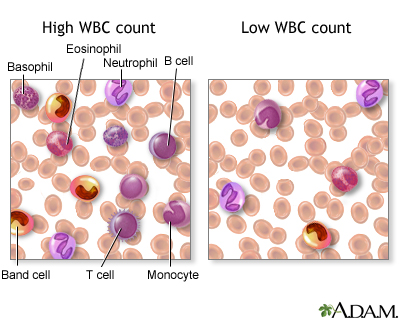
There are various types of white blood cells (WBCs) that normally appear in the blood: neutrophils (polymorphonuclear leukocytes; PMNs), band cells (slightly immature neutrophils), T-type lymphocytes (T cells), B-type lymphocytes (B cells), monocytes, eosinophils, and basophils. T and B-type lymphocytes are indistinguishable from each other in a normal slide preparation. Any infection or acute stress will result in an increased production of WBCs. This usually entails increased numbers of cells and an increase in the percentage of immature cells (mainly band cells) in the blood. This change is referred to as a “shift to the left” People who have had a splenectomy have a persistent mild elevation of WBCs. Drugs that may increase WBC counts include epinephrine, allopurinol, aspirin, chloroform, heparin, quinine, corticosteroids, and triamterene. Drugs that may decrease WBC counts include antibiotics, anticonvulsants, antihistamine, antithyroid drugs, arsenicals, barbiturates, chemotherapeutic agents, diuretics and sulfonamides.   (Updated by: David C. Dugdale, III, MD)

https://www.med-ed.virginia.edu/courses/path/innes/nh/wcbmaturation.cfm

Note that the mature forms of the myeloid series (neutrophils, eosinophils, basophils), all have lobed (segmented) nuclei. The degree of lobation increases as the cells mature.

The earliest recognizable myeloid cell is the myeloblast (10-20m dia) with a large round to oval nucleus. There is fine diffuse immature chromatin (without clumping) and a prominant nucleolus.

The cytoplasm is basophilic without granules. Although one may see a small golgi area adjacent to the nucleus, granules are not usually visible by light microscopy. One should not see blast cells in the peripheral blood.

myeloblast x100b

https://www.med-ed.virginia.edu/courses/path/innes/images/nhjpeg/nh%20myeloblast%20x100b.jpeg

The promyelocyte (10-20m) is slightly larger than a blast. Its nucleus, although similar to a myeloblast shows slight chromatin condensation and less prominent nucleoli. The cytoplasm contains striking azurophilic granules or primary granules. These granules contain myeloperoxidase, acid phosphatase, and esterase enzymes. Normally no promyelocytes are seen in the peripheral blood.

At the point in development when secondary granules can be recognized, the cell becomes a myelocyte.

promyelocyte x100

https://www.med-ed.virginia.edu/courses/path/innes/images/nhjpeg/nh%20promyelocyte%20×100%20a.jpeg

Myelocytes (10-18m) are not normally found in the peripheral blood. Nucleoli may not be seen in the late myelocyte. Primary azurophilic granules are still present, but secondary granules predominate. Secondary granules (neut, eos, or baso) first appear adjacent to the nucleus. In neutrophils this is the “dawn” of neutrophilia.

Metamyelocytes (10-18m) have kidney shaped indented nuclei and dense chromatin along the nuclear membrane. The cytoplasm is faintly pink, and they have secondary granules (neutro, eos, or baso). Zero to one percent of the peripheral blood white cells may be metamyelocytes (juveniles).

metamyelocyte x100

https://www.med-ed.virginia.edu/courses/path/innes/images/nhjpeg/nh%20metamyelocyte%20×100.jpeg

Bands, slightly smaller than juveniles, are marked by a U-shaped or deeply indented nucleus.

band neutrophilx100a

https://www.med-ed.virginia.edu/courses/path/innes/images/nhjpeg/nh%20band%20x100a.jpeg

Segmented (segs) or polymorphonuclear (PMN) leukocytes (average 14 m dia) are distinguished by definite lobation with thin thread-like filaments of chromatin joining the 2-5 lobes. 45-75% of the peripheral blood white cells are segmented neutrophils.

https://www.med-ed.virginia.edu/courses/path/innes/images/nhjpeg/nh%20neutrophil%20×100%20d.jpeg

Thrombocytogenesis

The incredible journey: From megakaryocyte development to platelet formation

Kellie R. Machlus1,2 and Joseph E. Italiano Jr
JCB 2013; 201(6): 785-796
http://dx.doi.org:/10.1083/jcb.201304054

Large progenitor cells in the bone marrow called megakaryocytes (MKs) are the source of platelets. MKs release platelets through a series of fascinating cell biological events. During maturation, they become polyploid and accumulate massive amounts of protein and membrane. Then, in a cytoskeletal-driven process, they extend long branching processes, designated proplatelets, into sinusoidal blood vessels where they undergo fission to release platelets.

megakaryocyte production of platelets

http://dm5migu4zj3pb.cloudfront.net/manuscripts/26000/26891/medium/JCI0526891.f4.jpg

platelets and the immune continuum nri2956-f3

http://www.nature.com/nri/journal/v11/n4/images/nri2956-f3.jpg

2.4.2 Classification of hematological malignancies
Practical Diagnosis of Hematologic Disoreders. 4th edition. Vol 2.
Kjeldsberg CR, Ed.  ASCP Press.  2006. Chicago, IL.

2.4.2.1 Primary Classification

Acute leukemias

Myelodysplastic syndromes

Acute myeloid leukemia

Acute lymphoblastic leukemia

Myeloproliferative Disorders

Chronic myeloproliferative disorders

Chronic myelogenous leukemia and related disorders

Myelofibrosis, including chronic idiopathic

Polycythemia, including polycythemia rubra vera

Thrombocytosis, including essential thrombocythemia

Chronic lymphoid leukemia and other lymphoid leukemias

Lymphomas

Non-Hodgkin Lymphoma

Hodgkin lymphoma

Lymphoproliferative disorders associated with immunodeficiency

Plasma Cell dyscrasias

Mast cell disease and Histiocytic neoplasms

2.4.2.2 Secondary Classification

2.4.2.3 Nuance – PathologyOutlines
Nat Pernick, Ed.

Leukemia – Acute

Primary referencesacute leukemia-generalAML generalAML classificationtransient abnormal myelopoiesis

Recurrent genetic abnormalities: AML with t(6;9)AML with t(8;21)AML with 11q23 abnormalitiesAML with inv(16) or t(16;16)AML with Down syndromeAML with FLT3 mutationsAML with myelodysplastic related changesAML therapy relatedAPL microgranular variantAPL with t(15;17)APL with t(V;17)APL therapy related

AML not otherwise categorized: minimally differentiated (M0)without maturation (M1)with maturation (M2)M3myelomonocyticmonoblastic and monocyticerythroidmegakaryoblasticCD13/CD33 negativebasophilicmyeloid sarcomaacute panmyelosis with myelofibrosiswith Philadelphia chromosomewith pseudo Chediak-Higashi anomalyhypocellular

ALL: generalWHO classificationwith eosinophilia

PreB ALL: generalt(9;22)t(v;11q23)t(1;19)t(5;14)t(12;21)hyperdiploidyhypodiploidymature B ALL/Burkitt

Other ALL: T ALLambiguous lineagemixed phenotype

AML and related malignancies

Acute myeloid leukemias with recurrent genetic abnormalities:

  • AML with t(8;21)(q22;q22); RUNX1-RUNX1T1
  • AML with inv(16)(p13.1;q22) or t(16;16)(p13.1;q22); CBF&beta-MYH11
  • Acute promyelocytic leukemia with t(15;17)(q22;q12); PML/RAR&alpha and variants
  • AML with t(9;11)(p22;q23); MLLT3-MLL
  • AML with t(6;9)(p23;q34); DEK-NUP214
  • AML with inv(3)(q21q26.2) or t(3;3)(q21;q26.2); RPN1-EVI1
  • AML (megakaryoblastic) with t(1;22)(p13;q13); RBM15-MKL1
  • AML with mutated NPM1*
  • AML with mutated CEBPA*

* provisional

Acute myeloid leukemia with myelodysplasia related changes

Therapy related acute myeloid leukemia

  • Alkylating agent related
  • Topoisomerase II inhibitor related (some maybe lymphoid)

Acute myeloid leukemia not otherwise categorized:

  • AML minimally differentiated (M0)
  • AML without maturation (M1)
  • AML with maturation (M2)
  • Acute myelomonocytic leukemia (M4)
  • Acute monoblastic and monocytic leukemia (M5a, M5b)
  • Acute erythroid leukemia (M6)
  • Acute megakaryoblastic leukemia (M7)
  • Acute basophilic leukemia
  • Acute panmyelosis with myelofibrosis

Myeloid Sarcoma

Myeloid proliferations related to Down syndrome:

  • Transient abnormal myelopoeisis
  • Myeloid leukemia associated with Down syndrome

Blastic plasmacytoid dentritic cell neoplasm:

Acute leukemia of ambiguous lineage:

  • Acute undifferentiated leukemia
  • Mixed phenotype acute leukemia with t(9;22)(q34;q11.2); BCR-ABL1
  • Mixed phenotype acute leukemia with t(v;11q23); MLL rearranged
  • Mixed phenotype acute leukemia, B/myeloid, NOS
  • Mixed phenotype acute leukemia, T/myeloid, NOS
  • Mixed phenotype acute leukemia, NOS, rare types
  • Other acute leukemia of ambiguous lineage
  • References: WHO Classification of Tumours of Haematopoietic and Lymphoid Tissue (IARC, 2008), Discovery Medicine 2010, eMedicine

Acute lymphocytic leukemia

General
=================================================================

  • WHO classification system includes former FAB classifications ALL-L1 and L2
    ● FAB L3 is now considered Burkitt lymphoma

WHO classification of acute lymphoblastic leukemia
=================================================================

Precursor B lymphoblastic leukemia / lymphoblastic lymphoma:
● ALL with t(9;22)(q34;q11.2); BCR-ABL (Philadelphia chromosome)
● ALL with t(v;11q23) (MLL rearranged)
● ALL with t(1;19)(q23;p13.3); TCF3-PBX1 (E2A-PBX1)
● ALL with t(12;21)(p13;q22); ETV6-RUNX1 (TEL-AML1)
● Hyperdiploid > 50
● Hypodiploid
● t(5;14)(q31;q32); IL3-IGH

Precursor T lymphoblastic leukemia / lymphoma

Additional references
=================================================================

Mixed phenotype acute leukemia (MPAL)

General
=================================================================

  • De novo acute leukemia containing separate populations of blasts of more than one lineage (bilineal or bilineage), or a single population of blasts co-expressing antigens of more than one lineage (biphenotypic)Excludes:
    ● Acute myeloid leukemia (AML) with recurrent translocations t(8;21), t(15;17) or inv(16)
    ● Leukemias with FGFR1 mutations
    ● Chronic myelogenous leukemia (CML) in blast crisis
    ● Myelodysplastic syndrome (MDS)-related AML and therapy-related AML, even if they have MPAL immunophenotypeCriteria for biphenotypic leukemia:
    ● Score of 2 or more for each of two separate lineages:The European Group for the Immunological Classification of Leukemias (EGIL) scoring system2008 WHO classification of acute leukemias of ambiguous lineage 

Prognosis
=================================================================

  • Poor, overall survival of 18 months
    ● Young age, normal karyotype and ALL induction therapy are associated with favorable survival
    ● Ph+ is a predictor for poor prognosis
    ● Bone marrow transplantation should be considered in first remission

Major Categories

MPAL with t(9;22)(q34;q11.2); BCR-ABL1
=================================================================

  • 20% of all MPAL
    ● Blasts with t(9;22)(q34;q11.2) translocation or BCR-ABL1 rearrangement (Ph+) without history of CML
    ● Majority in adults
    ● High WBC counts● Most of the cases B/myeloid phenotype
    ● Rare T/myeloid, B and T lineage, or trilineage leukemiasMorphology:
    ● Many cases show a dimorphic blast population, one resembling myeloblasts and the other lymphoblastsCytogenetic abnormalities:
    ● Conventional karyotyping for t(9;22), FISH or PCR for BCR-ABL1 translocation
    ● Additional complex karyotypes
    ● Ph+ is a poor prognostic factor for MPAL, with a reported median survival of 8 months
    ● Worse than patients of all other types of MPAL

MPAL with t(v;11q23); MLL rearranged
=================================================================

  • Meeting the diagnostic criteria for MPAL with blasts bearing a translocation involving the 11q23 breakpoint (MLL gene)
    ● MPAL with MLL rearranged rare
    ● More often seen in children and relatively common in infancy
    ● High WBC counts
    ● Poor prognosis
    ● Dimorphic blast population, with one resembling monoblasts and the other resembling lymphoblasts
    ● Lymphoblast population often shows a CD19+, CD10- B precursor immunophenotype, frequently CD15+
    ● Expression of other B markers usually weak
    ● Translocations involving MLL gene include t(4;11)(q21;q23), t(11;19)(q23;p13), and t(9;11)(p22;q23)
    ● Cases with chromosome 11q23 deletion should not be classified in this category

B cell acute lymphoblastic leukemia (ALL) / lymphoblastic lymphoma (LBL)

General

=================================================================

  • Current 2008 WHO classification: B lymphoblastic leukemia / lymphoma, NOS or B lymphoblastic leukemia / lymphoma with recurrent genetic abnormalities
  • See also lymphomas: B cell chapter
  • Also called B cell acute lymphoblastic leukemia / lymphoblastic lymphoma, pre B ALL / LBL
  • Usually children
  • B acute lymphoblastic leukemia presents with pancytopenia due to extensive marrow involvement, stormy onset of symptoms, bone pain due to marrow expansion, hepatosplenomegaly due to neoplastic infiltration, CNS symptoms due to meningeal spread and testicular involvement
  • B acute lymphoblastic lymphoma often presents with cutaneous nodules, bone or nodal involvement, < 25% lymphoblasts in bone marrow and peripheral blood; aleukemic cases are usually asymptomatic
  • Depending on specific leukemia, arises in either hematopoietic stem cell or B-cell progenitor
  • Tumors are derived from pre-germinal center naive B cells with unmutated VH region genes
  • Have multiple immunophenotyping aberrancies relative to normal B cell precursors (hematogones); at relapse, 73% show loss of 1+ aberrance and 60% show new aberrancies (Am J Clin Pathol 2007;127:39)

Prognostic features

=================================================================

  • Favorable prognosis: age 1-10 years, female, white; preB phenotype, hyperdiploidy>50, t(12,21), WBC count at presentation <50×108/L, non-traumatic tap with no blasts in CNS, rapid response to chemotherapy < 5% blasts on morphology on day 15, remission status after induction <5% blasts on morphology and <0.01% blast on flow or PCR, CD10+
  • Intermediate prognosis: hyperdiploidy 47-50, diploid, 6q- and rearrangements of 8q24
  • Unfavorable prognosis: under age 1 (usually have 11q23 translocations) or over age 10; t(9;22) (but not if age 59+ years, Am J Clin Pathol 2002;117:716); male, > 50×108/L WBC at presentation, hypodiploidy, near tetraploidy, 17p- and MLL rearrangements t(v;11q23); CD10-; non-traumatic tap with > 5% blasts or traumatic tap (7%); also increased microvessel staining using CD105 in children (Leuk Res 2007;31:1741), MDR1 expression in children (Oncol Rep 2004;12:1201) and adults (Blood 2002;100:974), 25%+ blasts on morphology on day 15, remission status after induction ≥ 5% blasts on morphology and ≥ 0.1% blasts on flow or PCR

Case reports

=================================================================

  • 12 month old girl and 13 month old boy with mature phenotype but no translocations (Arch Pathol Lab Med 2003;127:1340)
  • 56 year old man with ALL arising from follicular lymphoma (Arch Pathol Lab Med 2002;126:997)
  • 76 year old man with basal cell carcinoma (Diagn Pathol 2007;2:32)
  • With hemophagocytic lymphohistiocytosis (Pediatr Blood Cancer 2008;50:381)

Treatment

================================================================

  • Chemotherapy cures more children than adults; adolescents benefit from intensive regimens (Hematology Am Soc Hematol Educ Program 2005:123)

Micro description

=================================================================

  • Bone marrow smears: small to intermediate blast-like cells with scant, variably basophilic cytoplasm, round / oval or convoluted nuclei, fine chromatin and indistinct nucleoli; frequent mitotic figures; may have “starry sky” appearance similar to Burkitt lymphoma; may have large lymphoblasts with 1-4 prominent nucleoli resembling myeloblasts; usually no sclerosis
  • Bone marrow biopsy: usually markedly hypercellular with reduction of trilinear maturation; cells have minimal cytoplasm, medium sized nuclei that are often convoluted, moderately dense chromatin and indistinct nucleoli, brisk mitotic activity
  • Other tissues: may have “starry sky” appearance similar to Burkitt lymphoma; collagen dissection, periadipocyte growth pattern and single cell linear filing

Chronic Leukemia

Chronic Myeloid Neoplasms

Myelodysplastic syndromes (MDS): general, WHO classification, childhood, refractory anemia, refractory anemia with ringed sideroblasts, refractory cytopenia with multilineage dysplasia, refractory anemia with excess blasts, 5q-syndrome, therapy related, unclassified, arsenic toxicity

Myeloproliferative neoplasms (MPN): general, WHO classification, chronic eosinophilic leukemia, chronic myelogenous leukemia, chronic neutrophilic leukemia, essential thrombocythemia, hypereosinophilic syndrome, mast cell disease, polycythemia vera, primary myelofibrosis, unclassifiable

MDS/MPN: general, WHO classification, atypical CML, chronic myelomonocytic leukemia (CMML), chronic myelomonocytic leukemia with eosinophilia, juvenile myelomonocytic leukemia, unclassifiable

Myeloid neoplasms associated with eosinophilia and abnormalities of PDGFRA, PDGFRB, or FGFR1: PDGFRA, PDGFRB, FGFR1

Miscellaneous: transient myeloproliferative disorder of Downís syndrome

Lymphoma and plasma cell neoplasms

Lymph nodes: normal development-generalB cellsT cellsNK cellsnormal histologygrossing lymph nodesfeatures to report

Molecular testing: theoryFISHnorthern blotPCRsouthern blot

Non-Hodgkin lymphoma: generalcytogeneticsstagingstaging-pediatricmorphologic clueshemophagocytic syndromechemotherapeutic atypia

B cell disorders: generalpost-rituximabbone marrow biopsyclassification-historicalWHO classification

B cell lymphoma subtypes: age-related EBV-associatedALK positive large cellBurkittunclassifiable-intermediate between Burkitt and diffuse large B cell lymphomaCLL
diffuse large B cell: 
diffuse-NOSCD5+T cell / histiocyte richprimary cutaneous-generalprimary cutaneous-legprimary sites-other
follicular: 
generalchildhoodcutaneousGI
hairy cell leukemiaHCL variantintravascular large B celllymphomatoid granulomatosislymphoplasmacyticmantle cell-classicmantle cell-blastoidmarginal zone-generalmarginal zone-MALTMALT-primary sitesmarginal zone-nodalmediastinal (thymic)plasmablasticpre B lymphoblastic leukemia/lymphomaprimary effusionprolymphocytic leukemiapyothorax associatedSLLsplenic marginal zonesplenic lymphoma with villous lymphocytes

Plasma cell neoplasms: generalmyelomaplasmacytomaheavy chain diseaseprimary amyloidosisMGUSOsteosclerotic myeloma (POEMS)cryoglobulinemia

T/NK cell disorders: generalWHO classificationadult T cellaggressive NK cell leukemiaanaplastic large cell ALK+ALK-angioimmunoblastic T cellblastic plasmacytoidchronic lymphoproliferative disorders of NK cellscutaneous CD4+ small/medium sized T cell lymphomacutaneous CD30 positive T cell lymphoproliferative disorderscutaneous gamma delta T cell lymphomaenteropathyepidermotropic CD8+ T cell lymphomahepatosplenicindolent T cell proliferationsmycosis fungoidesNK/T cell lymphoma-nasal typenodal CD8+ cytotoxic T cellnonB nonT lymphoblasticperipheral T cell lymphoma, NOSprimary effusion lymphomaSezary syndromestagingsubcutaneous panniculitis-likeT cell large granular lymphocytic leukemiaT cell lymphoblastic leukemia/lymphomaT cell prolymphocytic leukemia

Hodgkin lymphoma: general/stagingclassiclymphocyte depletedlymphocyte rich classicalmixed cellularitynodular lymphocyte predominantnodular sclerosis

Post-transplantation: generalWHO classificationplasmacytic hyperplasia/IM-like lesionspolymorphic B cell lymphoproliferative disordersmonomorphic B cell lymphoproliferative disordersothergraft versus host disease

Other: AIDS associated-generalAIDS associated-examplesEBV+ T cell lymphoproliferative disorders of childhoodprimary immune disorders related

Myeloproliferative neoplasms (MPN)

WHO 2008 – Myeloproliferative neoplasms (MPN) 

General
=================================================================

  • Chronic myelogenous leukemia
    ● Polycythemia vera
    ● Essential thrombocythemia
    ● Primary myelofibrosis
    ● Chronic neutrophilic leukemia
    ● Chronic eosinophilic leukemia, not otherwise categorized
    ● Mast cell disease
    ● MPNs, unclassifiable

WHO 2001 – Chronic myeloproliferative diseases 

Definition
=================================================================

  • Chronic myelogenous leukemia (Philadelphia chromosome, t(9;22)(q34;q11), BCR-ABL positive)
    ● Chronic neutrophilic leukemia
    ● Chronic eosinophilic leukemia (and the hypereosinophilic syndrome)
    ● Polycythemia vera
    ● Chronic idiopathic myelofibrosis (with extramedullary hematopoiesis)
    ● Essential thrombocythemia
    ● Chronic myeloproliferative disease, unclassifiable

Additional references
=================================================================

The World Health Organization (WHO) classification of the myeloid neoplasms  James W. Vardiman, Nancy Lee Harris, and Richard D. Brunning
Blood 2002; 100(7)  http://dx.doi.org/10.1182/blood-2002-04-1199

Lymphoma – Non B cell neoplasms

T/NK cell disorders/WHO classification (2008)

Principles of classification
=================================================================

  • Based on all available information (morphology, immunophenotype, genetics, clinical)
    ● No one antigenic marker is specific for any neoplasm (except ALK1)
    ● Immune profiling less helpful in subclassification of T cell lymphomas then B cell lymphomas
    ● Certain antigens commonly associated with specific disease entities but not entirely disease specific
    ● CD30: common in anaplastic large cell lymphoma but also classic Hodgkin lymphoma and other B and T cell lymphomas
    ● CD56: characteristic for nasal NK/T cell lymphoma, but also other T cell neoplasms and plasma cell disorders
    ● Variation of immunophenotype within a given disease (hepatosplenic T cell lymphoma: usually γδ but some are αβ)
    ● Recurrent genetic alterations have been identified for many B cell lymphomas but not for most T cell lymphomas
    ● No attempt to stratify lymphoid malignancies by grade
    ● Recognize the existence of grey zone lymphomas
    ● This multiparameter approach has been validated in international studies as highly reproducible

WHO 2008 classification of tumors of hematopoietic and lymphoid tissues (T/NK)
=================================================================

Precursor T-lymphoid neoplasms
● T lymphoblastic leukemia/lymphoma, 9837/3

Mature T cell and NK cell neoplasms
● T cell prolymphocytic leukemia, 9834/3
● T cell large granular lymphocytic leukemia, 9831/3
● Chronic lymphoproliferative disorder of NK cells, 9831/3
● Aggressive NK cell leukemia, 9948/3
● Systemic EBV-positive T cell lymphoproliferative disease of childhood, 9724/3
● Hydroa vacciniforme-like lymphoma, 9725/3
● Adult T cell leukemia/lymphoma, 9827/3
● Extranodal NK/T cell lymphoma, nasal type, 9719/3
● Enteropathy-associated T cell lymphoma, 9717/3
● Hepatosplenic T cell lymphoma, 9716/3
● Subcutaneous panniculitis-like T cell lymphoma, 9708/3
● Mycosis fungoides, 9700/3
● Sézary syndrome, 9701/3
● Primary cutaneous CD30-positive T cell lymphoproliferative disorders
● Lymphomatoid papulosis, 9718/1
● Primary cutaneous anaplastic large cell lymphoma, 9718/3
● Primary cutaneous gamma-delta T cell lymphoma, 9726/3
● Primary cutaneous CD8-positive aggressive epidermotropic cytotoxic T cell lymphoma, 9709/3
● Primary cutaneous CD4-positive small/medium T cell lymphoma, 9709/3
● Peripheral T cell lymphoma, NOS, 9702/3
● Angioimmunoblastic T cell lymphoma, 9705/3
● Anaplastic large cell lymphoma, ALK-positive, 9714/3
● Anaplastic large cell lymphoma, ALK-negative, 9702/3

Chronic Lymphocytic Leukemia

Chronic Lymphocytic Leukemia Staging
Author: Sandy D Kotiah, MD; Chief Editor: Jules E Harris, MD
Medscape Sep 6, 2013
http://emedicine.medscape.com/article/2006578-overview

General considerations in the staging of chronic lymphocytic leukemia (CLL) and the revised Rai (United States) and Binet (Europe) staging systems for CLL are provided below.[1, 2, 3]

See Chronic Leukemias: 4 Cancers to Differentiate, a Critical Images slideshow, to help detect chronic leukemias and determine the specific type present.

General considerations

  • CLL and small lymphocytic lymphoma (SLL) are different manifestations of the same disease; SLL is diagnosed when the disease is mainly nodal, and CLL is diagnosed when the disease is seen in the blood and bone marrow
  • CLL is diagnosed by > 5000 monoclonal lymphocytes/mm3 for longer than 3mo; the bone marrow usually has more than 30% monoclonal lymphocytes and is either normocellular or hypercellular
  • Monoclonal B lymphocytosis is a precursor form of CLL that is defined by a monoclonal B cell lymphocytosis < 5000 monoclonal lymphocytes/mm3; all lymph nodes smaller than 1.5 cm; no anemia; and no thrombocytopenia

Revised Rai staging system (United States)

Low risk (formerly stage 0)[1] :

  • Lymphocytosis, lymphocytes in blood > 15000/mcL, and > 40% lymphocytes in the bone marrow

Intermediate risk (formerly stages I and II):

  • Lymphocytosis as in low risk with enlarged node(s) in any site, or splenomegaly or hepatomegaly or both

High risk (formerly stages III and IV):

  • Lymphocytosis as in low risk and intermediate risk with disease-related anemia (hemoglobin level < 11.0 g/dL or hematocrit < 33%) or platelets < 100,000/mcL

Binet staging system (Europe)

Stage A:

  • Hemoglobin ≥ 10 g/dL, platelets ≥ 100,000/mm3, and < 3 enlarged areas

Stage B:

  • Hemoglobin ≥ 10 g/dL, platelets ≥ 100,000/mm3, and ≥ 3 enlarged areas

Stage C:

  • Hemoglobin < 10 g/dL, platelets < 100,000/mm3, and any number of enlarged areas

Read Full Post »

Allogeneic Stem Cell Transplantation

Writer and Curator: Larry H. Bernstein, MD, FCAP

This article has the following structure:

9.3.1  Cell based immunotherapy

9.3.2  Photodynamic therapy (PDT)

9.3.3  Small molecules targeted therapy drugs; Tyrosine kinase inhibitors; imatinib (Gleevec/Glivec) and gefitinib (Iressa).

9.3.4 Graft versus Host Disease

9.3.5 Aspergillus Complicating Allogeneic Transplantation

Introduction

9.3.1 Allogeneic Stem Cell Treatment

http://www.lls.org/treatment/types-of-treatment/stem-cell-transplantation/allogeneic-stem-cell-transplantation

Allogeneic stem cell transplantation involves transferring the stem cells from a healthy person (the donor) to your body after high-intensity chemotherapy or radiation.

Allogeneic stem cell transplantation is used to cure some patients who:

  • Are at high risk of relapse
  • Don’t respond fully to treatment
  • Relapse after prior successful treatment

Allogeneic stem cell transplantation can be a high-risk procedure. The high-conditioning regimens are meant to severely or completely impair your ability to make stem cells and you will likely experience side effects during the days you receive high-dose conditioning radiation or chemotherapy. The goals of high-conditioning therapy are to:

treat the remaining cancer cells intensively, thereby making a cancer recurrence less likely
inactivate the immune system to reduce the chance of stem cell graft rejection
enable donor cells to travel to the marrow (engraftment), produce blood cells and bring about graft versus tumor effect

Possible Adverse Effects

The immune system and the blood system are closely linked and can’t be separated from each other. Because of this, allogeneic transplantation means that not only the donor’s blood system but also his or her immune system is transferred. As a result, these adverse effects are possible:

  • Immune rejection of the donated stem cells by the recipient (host-versus-graft effect)
  • Immune reaction by the donor cells against the recipient’s tissues (graft-versus-host disease [GVHD])

The immune reaction, or GVHD, is treated by administering drugs to the patient after the transplant that reduce the ability of the donated immune cells to attack and injure the patient’s tissues. See Graft Versus Host Disease.

Allogeneic stem cell transplants for patients who are older or have overall poor health are relatively uncommon. This is because the pre-transplant conditioning therapy is generally not well tolerated by such patients, especially those with poorly functioning internal organs. However, reduced intensity allogeneic stem cell transplants may be an appropriate treatment for some older or sicker patients.

T-Lymphocyte Depletion

One goal of allogeneic stem cell transplant is to cause the T lymphocytes in the donor’s blood or marrow to take hold (engraft) and grow in the patient’s marrow. Sometimes the T lymphocytes attack the cancer cells. When this happens, it’s called graft versus tumor (GVT) effect (also called graft versus cancer effect). The attack makes it less likely that the disease will return. This effect is more common in myeloid leukemias than it is in other blood cancers.

Unfortunately, T lymphocytes are the same cells that cause graft versus host disease (GVHD). Because of this serious and sometimes life-threatening side effect, doctors in certain cases want to decrease the number of T lymphocytes to be infused with the stem cells. This procedure, called T-lymphocyte depletion, is currently being studied by researchers. The technique involves treating the stem cells collected for transplant with agents that reduce the number of T lymphocytes.

The aim of T-lymphocyte depletion is to lessen GVHD’s incidence and severity. However, it can also cause increased rates of graft rejection, a decreased GVT effect and a slower immune recovery. Doctors must be careful about the number of T lymphocytes removed when using this technique.

Stem Cell Selection

Stem cell selection is another technique being studied in clinical trials that can reduce the number of T lymphocytes that a patient receives. Because of specific features on the outer coat of stem cells, doctors can selectively remove stem cells from a cell mixture. This technique produces a large number of stem cells and fewer other cells, including T lymphocytes.

9.3.2 Defining Characteristics of  Stem Cells

http://stemcells.nih.gov/info/basics/pages/basics1.aspx

Stem cells have the remarkable potential to develop into many different cell types in the body during early life and growth. In addition, in many tissues they serve as a sort of internal repair system, dividing essentially without limit to replenish other cells as long as the person or animal is still alive. When a stem cell divides, each new cell has the potential either to remain a stem cell or become another type of cell with a more specialized function, such as a muscle cell, a red blood cell, or a brain cell.

Stem cells are distinguished from other cell types by two important characteristics. First, they are unspecialized cells capable of renewing themselves through cell division, sometimes after long periods of inactivity. Second, under certain physiologic or experimental conditions, they can be induced to become tissue- or organ-specific cells with special functions. In some organs, such as the gut and bone marrow, stem cells regularly divide to repair and replace worn out or damaged tissues. In other organs, however, such as the pancreas and the heart, stem cells only divide under special conditions.

Until recently, scientists primarily worked with two kinds of stem cells from animals and humans: embryonic stem cells and non-embryonic “somatic” or “adult” stem cells. The functions and characteristics of these cells will be explained in this document. Scientists discovered ways to derive embryonic stem cells from early mouse embryos more than 30 years ago, in 1981. The detailed study of the biology of mouse stem cells led to the discovery, in 1998, of a method to derive stem cells from human embryos and grow the cells in the laboratory. These cells are called human embryonic stem cells. The embryos used in these studies were created for reproductive purposes through in vitro fertilization procedures.

When they were no longer needed for that purpose, they were donated for research with the informed consent of the donor. In 2006, researchers made another breakthrough by identifying conditions that would allow some specialized adult cells to be “reprogrammed” genetically to assume a stem cell-like state. This new type of stem cell is called induced pluripotent stem cells (iPSCs).

Stem cells differ from other kinds of cells in the body. All stem cells—regardless of their source—have three general properties: they are capable of dividing and renewing themselves for long periods; they are unspecialized; and they can give rise to specialized cell types.

Stem cells are capable of dividing and renewing themselves for long periods. Unlike muscle cells, blood cells, or nerve cells—which do not normally replicate themselves—stem cells may replicate many times, or proliferate. A starting population of stem cells that proliferates for many months in the laboratory can yield millions of cells. If the resulting cells continue to be unspecialized, like the parent stem cells, the cells are said to be capable of long-term self-renewal.

Scientists are trying to understand two fundamental properties of stem cells that relate to their long-term self-renewal:

  1. Why can embryonic stem cells proliferate for a year or more in the laboratory without differentiating, but most adult stem cells cannot; and
  2. What are the factors in living organisms that normally regulate stem cell proliferation and self-renewal?

Discovering the answers to these questions may make it possible to understand how cell proliferation is regulated during normal embryonic development or during the abnormal cell division that leads to cancer.

Stem cells are unspecialized. One of the fundamental properties of a stem cell is that it does not have any tissue-specific structures that allow it to perform specialized functions. For example, a stem cell cannot work with its neighbors to pump blood through the body (like a heart muscle cell), and it cannot carry oxygen molecules through the bloodstream (like a red blood cell). However, unspecialized stem cells can give rise to specialized cells, including heart muscle cells, blood cells, or nerve cells.

Stem cells can give rise to specialized cells. When unspecialized stem cells give rise to specialized cells, the process is called differentiation. While differentiating, the cell usually goes through several stages, becoming more specialized at each step. Scientists are just beginning to understand the signals inside and outside cells that trigger each step of the differentiation process. The internal signals are controlled by a cell’s genes, which are interspersed across long strands of DNA and carry coded instructions for all cellular structures and functions. The external signals for cell differentiation include chemicals secreted by other cells, physical contact with neighboring cells, and certain molecules in the microenvironment. The interaction of signals during differentiation causes the cell’s DNA to acquire epigenetic marks that restrict DNA expression in the cell and can be passed on through cell division.

Adult stem cells typically generate the cell types of the tissue in which they reside. For example, a blood-forming adult stem cell in the bone marrow normally gives rise to the many types of blood cells. It is generally accepted that a blood-forming cell in the bone marrow—which is called a hematopoietic stem cell—cannot give rise to the cells of a very different tissue, such as nerve cells in the brain.

Through years of experimentation, scientists have established some basic protocols or “recipes” for the directed differentiation of embryonic stem cells into some specific cell types (Figure 1). (For additional examples of directed differentiation of embryonic stem cells, refer to the NIH stem cell report available at

http://stemcells.nih.gov/info/scireport/pages/2006report.aspx.)

stem cell differentiation figure1_sm

stem cell differentiation figure1_sm

http://stemcells.nih.gov/StaticResources/images/figure1_sm.jpg

9.3.3 Types of Stem Cell Transplants for Treating Cancer

http://www.cancer.org/treatment/treatmentsandsideeffects/treatmenttypes/bonemarrowandperipheralbloodstemcelltransplant/stem-cell-transplant-types-of-transplant

In a typical stem cell transplant for cancer very high doses of chemo are used, often along with radiation therapy, to try to destroy all the cancer cells. This treatment also kills the stem cells in the bone marrow. Soon after treatment, stem cells are given to replace those that were destroyed. These stem cells are given into a vein, much like a blood transfusion. Over time they settle in the bone marrow and begin to grow and make healthy blood cells. This process is called engraftment.

There are 3 basic types of transplants. They are named based on who gives the stem cells.

  • Autologous (aw-tahl-uh-gus)—the cells come from you
  • Allogeneic (al-o-jen-NEE-ick or al-o-jen-NAY-ick)—the cells come from a matched related or unrelated donor
  • Syngeneic (sin-jen-NEE-ick or sin-jen-NAY-ick)—the cells come from your identical twin or triplet
hematopoietic stem cell transplant

hematopoietic stem cell transplant

Autologous stem cell transplants

These stem cells come from you alone. In this type of transplant, your stem cells are taken before you get cancer treatment that destroys them. Your stem cells are removed, or harvested, from either your bone marrow or your blood and then frozen. To find out more about that process, please see the section “What’s it like to donate stem cells?” After you get high doses of chemo and/or radiation the stem cells are thawed and given back to you.

One advantage of autologous stem cell transplant is that you are getting your own cells back. When you donate your own stem cells you don’t have to worry about the graft attacking your body (graft-versus-host disease) or about getting a new infection from another person. But there can still be graft failure, and autologous transplants can’t produce the “graft-versus-cancer” effect.

This kind of transplant is mainly used to treat certain leukemias, lymphomas, and multiple myeloma. It’s sometimes used for other cancers, like testicular cancer and neuroblastoma, and certain cancers in children.

Getting rid of cancer cells in autologous transplants

A possible disadvantage of an autologous transplant is that cancer cells may be picked up along with the stem cells and then put back into your body later. Another disadvantage is that your immune system is still the same as before when your stem cells engraft. The cancer cells were able to grow despite your immune cells before, and may be able to do so again. The need to remove cancer cells from transplants or transplant patients and the best way to do it is being researched.

Doing 2 autologous transplants in a row is known as a tandem transplant or a double autologous transplant. In this type of transplant, the patient gets 2 courses of high-dose chemo, each followed by a transplant of their own stem cells. All of the stem cells needed are collected before the first high-dose chemo treatment, and half of them are used for each transplant. Most often both courses of chemo are given within 6 months, with the second one given after the patient recovers from the first one.

Allogeneic stem cell transplants

In the most common type of allogeneic transplant, the stem cells come from a donor whose tissue type closely matches the patient’s. (This is discussed later under “HLA matching” in the section called “ Donor matching for allogeneic transplant.”) The best donor is a close family member, usually a brother or sister. If you do not have a good match in your family, a donor might be found in the general public through a national registry. This is sometimes called a MUD (matched unrelated donortransplant. Transplants with a MUD are usually riskier than those with a relative who is a good match.

Blood taken from the placenta and umbilical cord of newborns is a newer source of stem cells for allogeneic transplant. Called cord blood, this small volume of blood has a high number of stem cells that tend to multiply quickly. But the number of stem cells in a unit of cord blood is often too low for large adults, so this source of stem cells is limited to small adults and children. Doctors are now looking at different ways to use cord blood for transplant in larger adults, such as using cord blood from 2 donors.

Pros of allogeneic stem cell transplant: The donor stem cells make their own immune cells, which could help destroy any cancer cells that remain after high-dose treatment. This is called the graft-versus-cancer effect. Other advantages are that the donor can often be asked to donate more stem cells or even white blood cells if needed, and stem cells from healthy donors are free of cancer cells.

Cons to allogeneic stem cell transplants: The transplant, also known as the graft, might not take — that is, the donor cells could die or be destroyed by the patient’s body before settling in the bone marrow. Another risk is that the immune cells from the donor may not just attack the cancer cells – they could attack healthy cells in the patient’s body. This is called graft-versus-host disease (described in the section called “Problems that may come up shortly after transplant”). There is also a very small risk of certain infections from the donor cells, even though donors are tested before they donate. A higher risk comes from infections you have had, and which your immune system has under control. These infections often surface after allogeneic transplant because your immune system is held in check (suppressed) by medicines called immunosuppressive drugs. These infections can cause serious problems and even death.

Allogeneic transplant is most often used to treat certain types of leukemia, lymphomas, multiple myeloma,myelodysplastic syndrome, and other bone marrow disorders such as aplastic anemia.

Mini transplants (non-myeloablative transplants)

For some people, age or certain health conditions make it more risky to wipe out all of their bone marrow before a transplant. For those people, doctors can use a type of allogeneic transplant that’s sometimes called a mini-transplant. Compared with a standard allogeneic transplant, this one uses less chemo and/or radiation to get the patient ready for the transplant. Your doctor might refer to it as a non-myeloablative transplant or mention reduced-intensity conditioning (RIC). The idea here is to kill some of the cancer cells along with some of the bone marrow, and suppress the immune system just enough to allow donor stem cells to settle in the bone marrow.

Unlike the standard allogeneic transplant, cells from both the donor and the patient exist together in the patient’s body for some time after a mini-transplant. But slowly, over the course of months, the donor cells take over the bone marrow and replace the patient’s own bone marrow cells. These new cells can then develop an immune response to the cancer and help kill off the patient’s cancer cells — the graft-versus-cancer effect.

Syngeneic stem cell transplants – for those with an identical sibling

This is a special kind of allogeneic transplant that can only be used when the recipient has an identical sibling (twin or triplet) who can donate — someone who will have the same tissue type. An advantage of syngeneic stem cell transplant is that graft-versus-host disease will not be a problem. There are no cancer cells in the transplant, either, as there would be in an autologous transplant.

A disadvantage is that because the new immune system is so much like the recipient’s immune system, there is no graft-versus-cancer effect, either. Every effort must be made to destroy all the cancer cells before the transplant is done to help keep the cancer from relapsing (coming back).

9.3.4 Graft versus Host Disease

http://bethematch.org/For-Patients-and-Families/Life-after-transplant/Graft-versus-host-disease–GVHD-/

Graft-versus-host disease(GVHD) occurs because of differences between the cells of your body and the donated cells and is a common side effect of an allogeneic bone marrow transplant.

An allogeneic transplant uses blood cells from a family member, unrelated donor or cord blood unit. GVHD can affect many different parts of the body including the skin, eyes, mouth, stomach, and intestines.

There are two types of GVHD:

  • Acute GVHD: Develops in the first 100 days or so after transplant but can occur later. This primarily affects the skin, stomach, intestines, and liver.
  • Chronic GVHD: Usually develops 3-6 months after transplant, but signs can appear earlier or later. If you have had or currently have acute GVHD, you are more likely to have chronic GVHD.

The severity of acute and chronic GVHD can range from mild to life-threatening.

Doctors often see mild GVHD as a good thing after an allogeneic transplant when the transplant was done for a blood cancer. It is a sign that the donor’s immune system is working to destroy any remaining cancer cells. Patients who experience some GVHD have a lower risk of the cancer returning after transplant than patients who do not develop GVHD. If the transplant was to treat a disease other than cancer disease, like aplastic anemia, then the doctor may want to treat even mild GVHD.

Graft-versus-Host Disease

JLM FerraraJE LevineP Reddy, and E Holler
Lancet. 2009 May 2; 373(9674): 1550–1561.
http://dx.doi.org:/10.1016/S0140-6736(09)60237-3

The number of allogeneic hematopoietic cell transplantations (HCT) continues to increase with more than 25,000 allogeneic transplantations performed annually. The graft-versus-leukemia / tumor (GVL) effect during allogeneic HCT effectively eradicates many hematological malignancies.1 The development of novel strategies that use donor leukocyte infusions, non-myeloablative conditioning and umbilical cord blood (UCB) transplantation have helped expand the indications for allogeneic HCT over the last several years, especially among older patients.2 Improvements in infectious prophylaxis, immunosuppressive medications, supportive care and DNA-based tissue typing have also contributed to improved outcomes after allogeneic HCT.1 Yet the major complication of allogeneic HCT, graft-versus-host disease (GVHD), remains lethal and limits the use of this important therapy.2 Given current trends, the number of transplants from unrelated donors is expected to double within the next five years, significantly increasing the population of patients with GVHD. In this seminar we review advances made in identifying the genetic risk factors and pathophysiology of this major HCT complication, as well as its prevention, diagnosis and treatment.

Etiology and Clinical Features

Fifty years ago Billingham formulated three requirements for the development of GVHD: the graft must contain immunologically competent cells; the recipient must express tissue antigens that are not present in the transplant donor; and the recipient must be incapable of mounting an effective response to eliminate the transplanted cells.3 We know now that the immunologically competent cells are T cells, and that GVHD can develop in various clinical settings when tissues containing T cells (blood products, bone marrow, and solid organs) are transferred from one person to another who is not able to eliminate those cells.45 Patients, whose immune systems are suppressed, and who receive white blood cells from another individual, are at particularly high risk for GVHD.

GVHD occurs when donor T cells respond to genetically defined proteins on host cells. The most important proteins are Human Leukocyte Antigens (HLA)267, which are highly polymorphic and are encoded by the major histocompatibility complex (MHC). Class I HLA (A, B, and C) proteins are expressed on almost all nucleated cells of the body at varying densities. Class II proteins (DR, DQ, and DP) are primarily expressed on hematopoietic cells (B cells, dendritic cells, monocytes), but their expression can be induced on many other cell types following inflammation or injury. High-resolution DNA typing of HLA genes with polymerase chain reaction (PCR)-based techniques have now largely replaced earlier methods. The incidence of acute GVHD is directly related to the degree of mismatch between HLA proteins89 and thus ideally, donors and recipients are matched at HLA-A, -B, -C, and -DRB1, (“8/8 matches”), but mismatches may be tolerated for UCB grafts (see below).1012

Non-HLA Genetics

Despite HLA identity between a patient and donor, approximately 40% of patients receiving HLA-identical grafts develop acute GVHD due to genetic differences that lie outside the HLA loci, or “minor” histocompatibility antigens (HA). Some minor HAs, such as HY and HA-3, are expressed on all tissues and are targets for both GVHD and GVL.13 Other minor HAs, such as HA-1 and HA-2, are expressed most abundantly on hematopoietic cells (including leukemic cells) and may therefore induce a greater GVL effect with less GVHD.1314

Polymorphisms in both donors and recipients for cytokines that are involved in the classical `cytokine storm’ of GVHD (discussed below) have been implicated as risk factors for GVHD.15 Tumor Necrosis Factor (TNF)-α, Interleukin 10 (IL-10), Interferon-γ (IFNγ) variants have correlated with GVHD in some, but not all, studies.1618 Genetic polymorphisms of proteins involved in innate immunity, such as nucleotide oligomerization domain 2 and Keratin 18 receptors, have also been associated with GVHD.1922 Future strategies to identify the best possible transplant donor will probably incorporate both HLA and non-HLA genetic factors.

Clinical Features of Acute GVHD

Based on an early Seattle experience, acute GVHD was defined to occur prior to day 100, whereas chronic GVHD occurred after that time.2325 This definition is far from satisfactory, and a recent National Institutes of Health classification includes late-onset acute GVHD (after day 100) and an overlap syndrome with features of both acute and chronic GVHD.26 Late-onset acute GVHD and the overlap syndrome occur with greater frequency after reduced-intensity conditioning (RIC), an increasingly widespread technique (see below). As shown in Table 1, the clinical manifestations of acute GVHD occur in the skin, gastrointestinal tract and liver.27 In a comprehensive review, Martin et al found that at the onset of acute GVHD, 81% of patients had skin involvement, 54% had GI involvement, and 50% had liver involvement.23 Recent data suggest that lungs might also be targets of experimental GVHD.28

Acute GVHD Symptoms

Table 1

Pathophysiology of Acute GVHD

Two important principles are important to consider regarding the pathophysiology of acute GVHD. First, acute GVHD reflects exaggerated but normal inflammatory mechanisms mediated by donor lymphocytes infused into the recipient where they function appropriately, given the foreign environment they encounter. Second, the recipient tissues that stimulate donor lymphocytes have usually been damaged by underlying disease, prior infections, and the transplant conditioning regimen.29 As a result, these tissues produce molecules (sometimes referred to as “danger” signals) that promote the activation and proliferation of donor immune cells.4245 Mouse models havebeen central to our identification and understanding of the pathophysiologic mechanisms of GVHD, and canine models have been critical to the development of clinically useful strategies for GVHD prophylaxis and treatment and to the development of donor leukocyte infusions.364647 Based largely on these experimental models, the development of acute GVHD can be conceptualized in three sequential steps or phases: (1) activation of the APCs; (2) donor T cell activation, proliferation, differentiation and migration; and (3) target tissue destruction (Figure 3).

Figure 3

GVHD Pathophysiology

In Phase I, the recipient conditioning regimen damages host tissues and causes release of inflammatory cytokines such as TNFα, IL-1 and IL-6. Increased levels of these cytokines leads to activation of host antigen presenting cells (APCs). In Phase II, host APCs activate mature donor cells. The subsequent proliferation and differentiation of these activated T cells produces additional effectors that mediate the tissue damage, including Cytotoxic T Lymphocytes, Natural Killer (NK) cells, TNFα and IL-1. Lipopolysaccharide (LPS) that has leaked through the damaged intestinal mucosa triggers additional TNFα production. TNFα can damage tissue directly by inducing necrosis and apoptosis in the skin and GI tract through either TNF receptors or the Fas pathway. TNFα plays a direct role in intestinal GVHD damage which further amplifies damage in the skin, liver and lung in a “cytokine storm.”

GVHD pathophysiology nihms-115970-f0003

GVHD pathophysiology nihms-115970-f0003

http://www.ncbi.nlm.nih.gov/pmc/articles/PMC2735047/bin/nihms-115970-f0003.jpg

Phase I: Activation of Antigen Presenting Cells (APCs)

The first step involves the activation of APCs by the underlying disease and the HCT conditioning regimen. Damaged host tissues respond by producing “danger” signals, including proinflammatory cytokines (e.g., TNF-α), chemokines, and increased expression of adhesion molecules, MHC antigens and costimulatory molecules on host APCs.424850 A recent report demonstrated that at one week after HCT, increased levels of TNF-α receptor I, a surrogate marker for TNF-α, strongly correlated with the later development of GVHD.51 Damage to the GI tract from the conditioning is particularly important because it allows for systemic translocation of additional inflammatory stimuli such as microbial products including lipopolysaccaride (LPS) or other pathogen-associated molecular patterns that further enhance the activation of host APCs.49 The secondary lymphoid tissue in the GI tract is likely the initial site of interaction between activated APCs and donor T cells.52 These observations have led an important clinical strategy to reduce acute GVHD by reducing the intensity of the conditioning regimen. Experimental GVHD can also be reduced by manipulating distinct subsets of APCs.53,54 In addition, non-hematopoietic stem cells, such as mesenchymal stem cells or stromal cells, can reduce allogeneic T cell responses, although the mechanism for such inhibition remains unclear.2

The concept that enhanced activation of host APCs increases the risk for acute GVHD unifies a number of seemingly disparate clinical associations with that risk, such as advanced stages of malignancy, more intense transplant conditioning regimens and histories of viral infections. APCs detect infections by recognizing conserved molecular patterns that are unique to microbes, called pathogen-associated molecular patterns (PAMPs). Among the classes of receptors that recognize such patterns, the Toll-like receptors (TLR) are the best characterized.55 For example, TLR4 recognizes LPS55 and mice with mutant TLR4 receptors that do not respond to LPS cause less GVHD when used as donors.56 Other TLRs that recognize viral DNA or RNA also activate APCs and may enhance GVHD, providing a potential mechanistic basis for increased GVHD associated with viral infections such as cytomegalovirus (CMV).57

Phase II: Donor T Cell Activation

The core of the GVH reaction is Step 2, where donor T cells proliferate and differentiate in response to host APCs. The “danger” signals generated in Phase I augment this activation at least in part by increasing the expression of costimulatory molecules.58 Blockade of co-stimulatory pathways to prevent GVHD is successful in animal models, but this approach has not yet been tested in large clinical trials.2

In mouse models, where genetic differences between donor and recipient strains can be tightly controlled, CD4+ cells induce acute GVHD to MHC class II differences, and CD8+ cells induce acute GVHD to MHC class I differences.5961 In the majority of HLA-identical HCTs, both CD4+ and CD8+ subsets respond to minor histocompatibility antigens and can cause GVHD in HLA-identical HCT.

Regulatory T cells can suppress the proliferation of conventional T cells and prevent GVHD in animal models when added to donor grafts containing conventional T cells.62 In mice, the Foxp3 protein functions as a master switch in the development of regulatory T cells, which normally constitute 5% of the CD4+ T cell population.62 Regulatory T cells secrete anti-inflammatory cytokines IL-10 and Transforming Growth Factor(TGF)-β and can also act through contact-dependent inhibition of APCs.62 It is likely that the use of regulatory T cells in clinical acute GVHD will require improved techniques to identify and expand them.

Natural Killer T cell (NKT) 1.1+ subsets of both the host and donors that have been shown to modulate acute GVHD.63 Host NKT cells have been shown to suppress acute GVHD in an IL-4 dependent manner.64 A recent clinical trial of total lymphoid irradiation used as conditioning significantly reduced GVHD and enhanced host NKT cell function.65 By contrast, donor NKT cells can reduce GVHD and enhance perforin mediated GVL in an experimental model.66

Activation of immune cells results in rapid intracellular biochemical cascades that induce transcription of genes for many proteins including cytokines and their receptors. Th1 cytokines (IFN-γ, IL-2 and TNF-α) are produced in large amounts during acute GVHD. IL-2 production by donor T cells remains the principal target of many current clinical therapeutic and prophylactic approaches to GVHD, such as cyclosporine, tacrolimus and monoclonal antibodies (mAbs) directed against IL-2 and its receptor.9 But emerging data indicate an important role for IL-2 in the generation and maintenance of CD4+ CD25+ T regs, suggesting that prolonged interference with IL-2 may have an unintended consequence of preventing the development of long term tolerance after allogeneic HCT.67 IFN-γ has multiple functions and can either amplify or reduce GVHD.68,69 IFN-γ may amplify GVHD by increasing the expression of molecules such as chemokines receptors, MHC proteins, and adhesion molecules; it also increases the sensitivity of monocytes and macrophages to stimuli such as LPS and accelerates intracellular cascades in response to these stimuli.70Early polarization of donor T cells so that they secrete less IFN-γ and more IL-4 can also attenuate experimental acute GVHD.71 IFN-γ may amplify GVHD by directly damaging epithelium in the GI tract and skin and inducing immnosuppression through the induction of nitric oxide.72 By contrast, IFN-γ may suppress GVHD by hastening the apoptosis of activated donor T cells.6973. This complexity means the manipulation of IFN-γ may have diverse effects in vivo, making it a challenging target with respect to therapeutic intervention. IL-10 plays a key role in suppression of immune responses, and clinical data suggest it may regulate acute GVHD.17 TGF-β, another suppressive cytokine can suppress acute GVHD but exacerbate chronic GVHD.74 Thus the timing and duration of the secretion of any given cytokine may determine the specific effects of that cytokine on GVHD severity.

Phase III: Cellular and Inflammatory Effector Phase

The effector phase of this process is a complex cascade of both cellular mediators such as cytotoxic T lymphocytes(CTLs) and NK cells and soluble inflammatory mediators such as TNF-α, IFN-γ, IL-1 and nitric oxide.229 These soluble and cellular mediators synergize to amplify local tissue injury and further promote inflammation and target tissue destruction.

Cellular Effectors

The cellular effectors of acute GVHD are primarily CTLs and NK cells.49 CTLs that preferentially use the Fas/FasL pathway of target lysis and appear to predominate in GVHD liver damage (hepatocytes express large amounts of Fas) whereas GVHD CTLs that use the perforin /granzyme pathways are more important in the GI tract and skin.275 Chemokines direct the migration of donor T cells from lymphoid tissues to the target organs where they cause damage. Macrophage inflammatory protein-1alpha (MIP-1α) and other chemokines such as CCL2-5, CXCL2, CXCL9-11, CCL17 and CCL27 are over-expressed and enhance the homing of cellular effectors to target organs during experimental GVHD.76Expression of integrins, such as α4β7 and its ligand MadCAM-1, are also important for homing of donor T cells to Peyer’s patches during intestinal GVHD.527778

Prevention of GVHD

Based on the evidence from animal models regarding the central role of T cells in initiating GVHD, numerous clinical studies evaluating T cell depletion (TCD) as prophylaxis for GVHD were performed in the 1980’s and 1990’s. There were three principal TCD strategies: (1) negative selection of T cells ex vivo, (2) positive selection of CD34+ stem cells ex vivo; and (3) anti-T cell antibodies in vivo.83Most strategies showed a significant limitation in both acute and chronic GVHD.8488 Unfortunately, the lower incidence of severe GVHD was offset by high rates of graft failure, relapse of malignancy, infections, and Epstein-Barr virus-associated lymphoproliferative disorders. Negative selection purging strategies using various anti-T cell antibodies achieved similar long-term results regardless of the breadth of antibody specificity.8993 One large registry study demonstrated that purging strategies using antibodies with broad specificities produced inferior leukemia-free survival than standard immunosuppression in patients receiving unrelated donor transplants.94 Several studies have investigated partial T cell depletion, either by eliminating specific T cell subsets (e.g., CD8+) or by titrating the dose of T cells present in the inoculum.9597 None of these approaches, however, has convincingly demonstrated an optimal strategy that improves long-term survival.

Alemtuzumab is a monoclonal antibody that binds CD52, a protein expressed on a broad spectrum of leukocytes including lymphocytes, monocytes, and dendritic cells. Its use in GVHD prophylaxis in a Phase II trial decreased the incidence of acute and chronic GVHD following reduced intensity transplant.98 In two prospective studies, patients who received alemtuzumab rather than methotrexate showed significantly lower rates of acute and chronic GVHD,99 but experienced more infectious complications and higher rates of relapse, so that there was no overall survival benefit. Alemtuzumab may also contribute to graft failure when used with minimal intensity conditioning regimens.100

An alternative strategy to TCD attempted to induce anergy in donor T cells by ex vivo antibody blockade of co-stimulatory pathways prior to transplantation. A small study using this approach in haploidentical HCT recipients was quite encouraging, but has not yet been replicated.101 Thus the focus of most prevention strategies remains pharmacological manipulation of T cells after transplant.

Administration of anti-T cell antibodies in vivo as GVHD prophylaxis has also been extensively tested. The best studied drugs are anti-thymocyte globulin (ATG) or antilymphocyte globulin (ALG) preparations. These sera, which have high titers of polyclonal antibodies, are made by immunizing animals (horses or rabbits) to thymocytes or lymphocytes, respectively. A complicating factor in determining the role of these polyclonal sera in transplantation is the observation that even different brands of the same class of sera exert different biologic effects.102 However, the side effects of ATG/ALG infusions are common across different preparations and include fever, chills, headache, thrombocytopenia (from cross-reactivity to platelets), and, infrequently, anaphylaxis. In retrospective studies, rabbit ATG reduced the incidence of GVHD in related donor HSCT recipients without appearing to improve survival.103104 In recipients of unrelated donor HSCT, addition of ALG to standard GVHD prophylaxis effectively prevented severe GVHD, but did not result in improved survival because of increased infections.105 In a long term follow-up study, however, pretransplant ATG provided significant protection against extensive chronic GVHD and chronic lung dysfunction.106

The primary pharmacologic strategy to prevent GVHD is the inhibition of the cytoplasmic enzyme, calcineurin, that is critical for in the activation of T cells. The calcineurin inhibitors, cyclosporine and tacrolimus, have similar mechanisms of action, clinical effectiveness and toxicity profiles, including hypomagnesemia, hyperkalemia, hypertension, and nephrotoxicity.9107 Serious side effects include transplant-associated thrombotic microangiopathy (TAM) and neurotoxicity that can lead to premature discontinuation. Although clinically similar to thrombotic thrombocytopenic purpura, TAM does not reliably respond to therapeutic plasmapheresis, carries a high mortality rate, and removal of the offending agent does not always result in improvement.108 Posterior reversible encephalopathy syndrome includes mental status changes, seizures, neurological deficits and characteristic magnetic resonance imaging findings; this syndrome has been seen in 1-2% of HCT recipients receiving and calcineurin inhibitors.109 Side effects of these drugs decrease as the dose is tapered, usually two to four months after HCT.

Calcineurin inhibitors are often administered in combination with other immunosuppressants, such as methotrexate, which is given at low doses in the early post-transplant period.9107 The toxicities of methotrexate (neutropenia and mucositis) have led some investigators to replace it with mycophenolate mofetil (MMF). In one prospective randomized trial, patients who received MMF as part of GVHD prophylaxis experienced significantly less severe mucositis and more rapid neutrophil engraftment than those who received methotrexate.110 The incidence and severity of acute GVHD was similar between the two groups, but the study closed early due to superiority of the MMF arm with respect to reduced mucositis and the speed of hematopoietic engraftment. A desire for faster neutrophil engraftment has led to the use of MMF in UCB blood transplants where graft failure is a major concern.111 MMF is also often used after RIC regimens for similar reasons.112113

Sirolimus is an immunosuppressant that is structurally similar to tacrolimus but does not inhibit calcineurin. In a small Phase II trial, it showed excellent efficacy in combination with tacrolimus;114 the drug damages endothelial cells, however, and it may enhance TAM that is associated with calcineurin inhibitors.115 The combination of tacrolimus and sirolimus is currently being compared in a large randomized multi-center trial.

RIC regimens attempt to suppress the host immune system sufficiently so that donor T cells can engraft and then ablate the lympho-hematopoietic compartment of the recipient. The term “non-myeloablative” is therefore somewhat misleading. RIC regimens produce less tissue damage and lower levels of the inflammatory cytokines that are important in the initiation of GVHD pathophysiology; this effect may explain the reduced incidence of severe GVHD following RIC compared to the full intensity conditioning used in historical controls.98116 The onset of acute GVHD may be delayed after RIC until after day 100, however, and it may present simultaneously with elements of chronic GVHD (“overlap syndrome”).116120

Treatment of Acute GVHD

GVHD generally first develops in the second month after HCT, during continued treatment with calcineurin-based prophylaxis.23121 Steroids, with their potent antilymphocyte and anti-inflammatory activity, are the gold standard for treatment of GVHD. Many centers treat mild GVHD of the skin (Grade I) with topical steroids alone, but for more severe skin GVHD and any degree of visceral GVHD involvement, high-dose systemic steroids are usually initiated. Steroid therapy results in complete remission in less than half of the patients,122 and more severe GVHD is less likely to respond to treatment.123124 In a prospective randomized study, the addition of ATG to steroids as primary therapy did not increase the response rate.124 In a retrospective study, the use of ATG in patients who showed early signs of steroid-resistance was beneficial,122 but not all studies show such benefit and ATG is not standardly used because of increased infection risks.106125126.

An increasingly common treatment for GVHD is extracorporeal photopheresis (ECP). During ECP, the patient’s white blood cells are collected by apheresis, incubated with the DNA-intercalating agent, 8-methoxypsoralen, exposed to ultraviolet light (UVA), and returned to the patient. ECP is known to induce cellular apoptosis, which has strong anti-inflammatory effects in a number of systems, including prevention of rejection of solid organ grafts.127 Animal studies show that ECP reverses acute GVHD by increasing the number of regulatory T cells.128 A Phase II clinical study of steroid-dependent or steroid refractory GVHD showed resolution of GVHD in a large majority of patients, with 50% long-term survival in this very high risk group.129 Randomized multi-center studies of this approach are needed to determine its place in the management of acute GVHD.

Another interesting strategy to treat GVHD is the blockade of the inflammatory cytokine TNF-α. TNF-α can activate APCs, recruit effector cells and cause direct tissue damage.130 In animal models, TNF-α plays a central role in GVHD of the GI tract, which is central to the “cytokine storm” and plasma levels of TNFR I (a surrogate marker for TNF-α) rise in patients before the clinical manifestations of GVHD appear. 51 A recent Phase II trial of etanercept, a solubilized TNFR II, showed significant efficacy when added to systemic steroids as primary therapy for acute GVHD. Seventy percent of patients had complete resolution of all GVHD symptoms within one month, with 80% complete responses in the GI tract and the skin. The authors also showed that plasma levels of TNFR I were a significant biomarker for clinical GVHD.131

Treatment of Chronic GVHD

In contrast to acute GVHD, the pathophysiology of chronic GVHD remains poorly understood, and it is treated with a variety of immunosuppressive agents. The response of chronic GVHD to treatment is unpredictable, and mixed responses in different organs can occur in the same patient. Confounding variables such as infection and co-morbidities also make responses hard to measure. The use of corticosteroids (with or without a calcineurin inhibitor) is the standard of care, but a randomized trial of more than 300 patients with chronic GVHD found no difference between cyclosporine plus prednisone versus prednisone alone.132 Chronic immunosuppressants, especially those containing steroids, are highly toxic and result in infectious deaths. Many second line therapies have been studied, but none has achieved widespread acceptance. As mentioned above, ECP shows some promise, with significant response rates in high-risk patients. The best responses were observed in skin, liver, oral mucosa, eye, and lung.133 This observation is particularly relevant because lung GVHD has the potential to be a particularly devastating complication necessitating lung transplant as the only therapeutic option.134135

Essential Supportive Care in GVHD Patients

Meticulous supportive care is critical for patients with both acute and chronic GVHD because of the extended duration of immunosuppressive treatments and because the multiple medications required may have synergistic toxicities. Such care includes extensive infectious prophylaxis, early interventions in cases of suspected infections, and prophylaxis against non-infectious side effects of medications (See Table 3). These complications often require rapid responses to prevent serious or irreversible damage, and are best handled in close collaboration between the primary physician and the transplant specialist.

Table 3

Recommendations for Supportive Care

All patients should receive at least fluconazole as prophylaxis against fungal infections. Invasive molds, especially aspergillus, are common in patients with prolonged steroid use.136 Prophylaxis with voriconazole or posaconazole should be considered for these patients. Usual sites of infection are the lungs, sinuses, brain, skin,137 and serial galactomannan assays may aid in the early detection.138 Candida can cause lesions in the lung and spleen, which may need screening with ultrasonography. Pneumocystis is another opportunistic infection that should receive cotrimoxazol (bactrim) prophylaxis.139

Viral infections are frequent in these patients with GVHD. Cytomegalovirus causes interstitial pneumonia and gastritis. Patients who are at risk should have their blood monitored several times monthly. Techniques that directly detect virus should be performed, such as CMV PCR or pp65 antigen, and evidence of increased viral load should prompt preemptive treatment with ganciclovir or foscarnet prior to clinical manifestations of disease. Shingles is not uncommon and acyclovir prophylaxis may be beneficial.140 Patients and caregivers should receive vaccinations against influenza, and treatment with neuraminidase inhibitors is recommended in the event of influenza infection.141142

Patients with GVHD often have IgG2 and IgG4 subclass deficiencies despite normal lgG levels, making them susceptible to infections with encapsulated organisms. Treatment of severe hypogammaglobulinemia with intravenous immunoglobulin is standard in many centers,143 but the level that triggers replacement varies considerably among transplant specialists. There is little supporting evidence for the routine use of intravenous immunoglobulin as prophylaxis144 but patients should receive routine prophylaxis (penicillin or its equivalent) due to the increased risk of streptococcal sepsis.145 Pneumococcal conjugate and hemophilus influenza vaccine may provide additional protection and are also recommended for all patients, including those with chronic GVHD.139146147 The sites of any indwelling catheters should be assessed regularly and early treatment of a suspected infection initiated. Early signs or symptoms of septic shock such as shaking chills or low blood pressure requires prompt evaluation with chest X-ray and/or CT scan, blood culture and broad spectrum antibiotics because shock may progress rapidly in these patients.

9.3.5 Aspergillus Complicating Allogeneic Transplantation

Aspergillus infections in allogeneic stem cell transplant recipients: have we made any progress?

E Jantunen, V-J Anttila and T Ruutu
BMT 2002; 30(12):925-929
http://www.nature.com/bmt/journal/v30/n12/full/1703738a.html
http://dx.doi.org:/10.1038/sj.bmt.1703738

Invasive aspergillosis (IA) is common in allogeneic SCT recipients, with an incidence of 4-10%. The majority of these infections are diagnosed several months after SCT and they are frequently associated with GVHD. The diagnosis is difficult and often delayed. Established IA is notoriously difficult to treat with a death rate of 80-90%. This review summarises recent data on this problem to assess whether there has been any progress. Effective prophylactic measures are still lacking. Severe immunosuppression is the main obstacle to the success of therapy. Recent and ongoing developments in diagnostic measures and new antifungal agents may improve treatment results to some extent, but Aspergillus infections still remain a formidable problem in allogeneic transplantation. Further studies in this field will focus on the role of various cytokines and combinations of antifungal agents.

Summary

Read Full Post »

Medical Informatics View

Chapter 1 Statement of Inferential    Second Opinion

Realtime Clinical Expert Support

Gil David and Larry Bernstein have developed, in consultation with Prof. Ronald Coifman, in the Yale University Applied Mathematics Program, a software system that is the equivalent of an intelligent Electronic Health Records Dashboard that provides empirical medical reference and suggests quantitative diagnostics options.


Keywords: Entropy, Maximum Likelihood Function, separatory clustering, peripheral smear, automated hemogram, Anomaly, classification by anomaly, multivariable and multisyndromic, automated second opinion

Abbreviations: Akaike Information Criterion, AIC;  Bayes Information Criterion, BIC, Systemic Inflammatory Response Syndrome, SIRS.


Background: The current design of the Electronic Medical Record (EMR) is a linear presentation of portions of the record by services, by diagnostic method, and by date, to cite examples.  This allows perusal through a graphical user interface (GUI) that partitions the information or necessary reports in a workstation entered by keying to icons.  This requires that the medical practitioner finds the history, medications, laboratory reports, cardiac imaging and EKGs, and radiology in different workspaces.  The introduction of a DASHBOARD has allowed a presentation of drug reactions, allergies, primary and secondary diagnoses, and critical information about any patient the care giver needing access to the record.  The advantage of this innovation is obvious.  The startup problem is what information is presented and how it is displayed, which is a source of variability and a key to its success.

Intent: We are proposing an innovation that supercedes the main design elements of a DASHBOARD and utilizes the conjoined syndromic features of the disparate data elements.  So the important determinant of the success of this endeavor is that it facilitates both the workflow and the decision-making process with a reduction of medical error. Continuing work is in progress in extending the capabilities with model datasets, and sufficient data because the extraction of data from disparate sources will, in the long run, further improve this process.  For instance, the finding of  both ST depression on EKG coincident with an elevated cardiac biomarker (troponin), particularly in the absence of substantially reduced renal function. The conversion of hematology based data into useful clinical information requires the establishment of problem-solving constructs based on the measured data.

The most commonly ordered test used for managing patients worldwide is the hemogram that often incorporates the review of a peripheral smear.  While the hemogram has undergone progressive modification of the measured features over time the subsequent expansion of the panel of tests has provided a window into the cellular changes in the production, release or suppression of the formed elements from the blood-forming organ to the circulation.  In the hemogram one can view data reflecting the characteristics of a broad spectrum of medical conditions.

Progressive modification of the measured features of the hemogram has delineated characteristics expressed as measurements of size, density, and concentration, resulting in many characteristic features of classification. In the diagnosis of hematological disorders proliferation of marrow precursors, the domination of a cell line, and features of suppression of hematopoiesis provide a two dimensional model.  Other dimensions are created by considering the maturity of the circulating cells.  The application of rules-based, automated problem solving should provide a valid approach to the classification and interpretation of the data used to determine a knowledge-based clinical opinion. The exponential growth of knowledge since the mapping of the human genome enabled by parallel advances in applied mathematics that have not been a part of traditional clinical problem solving.  As the complexity of statistical models has increased the dependencies have become less clear to the individual.  Contemporary statistical modeling has a primary goal of finding an underlying structure in studied data sets.  The development of an evidence-based inference engine that can substantially interpret the data at hand and convert it in real time to a “knowledge-based opinion” could improve clinical decision-making by incorporating multiple complex clinical features as well as duration of onset into the model.

An example of a difficult area for clinical problem solving is found in the diagnosis of SIRS and associated sepsis.  SIRS (and associated sepsis) is a costly diagnosis in hospitalized patients.   Failure to diagnose sepsis in a timely manner creates a potential financial and safety hazard.  The early diagnosis of SIRS/sepsis is made by the application of defined criteria (temperature, heart rate, respiratory rate and WBC count) by the clinician.   The application of those clinical criteria, however, defines the condition after it has developed and has not provided a reliable method for the early diagnosis of SIRS.  The early diagnosis of SIRS may possibly be enhanced by the measurement of proteomic biomarkers, including transthyretin, C-reactive protein and procalcitonin.  Immature granulocyte (IG) measurement has been proposed as a more readily available indicator of the presence of granulocyte precursors (left shift).  The use of such markers, obtained by automated systems in conjunction with innovative statistical modeling, provides a promising approach to enhance workflow and decision making.   Such a system utilizes the conjoined syndromic features of disparate data elements with an anticipated reduction of medical error.  This study is only an extension of our approach to repairing a longstanding problem in the construction of the many-sided electronic medical record (EMR).  In a classic study carried out at Bell Laboratories, Didner found that information technologies reflect the view of the creators, not the users, and Front-to-Back Design (R Didner) is needed.

Costs would be reduced, and accuracy improved, if the clinical data could be captured directly at the point it is generated, in a form suitable for transmission to insurers, or machine transformable into other formats.  Such data capture, could also be used to improve the form and structure of how this information is viewed by physicians, and form a basis of a more comprehensive database linking clinical protocols to outcomes, that could improve the knowledge of this relationship, hence clinical outcomes.


How we frame our expectations is so important that it determines the data we collect to examine the process.   In the absence of data to support an assumed benefit, there is no proof of validity at whatever cost.   This has meaning for hospital operations, for nonhospital laboratory operations, for companies in the diagnostic business, and for planning of health systems.

In 1983, a vision for creating the EMR was introduced by Lawrence Weed,  expressed by McGowan and Winstead-Fry (J J McGowan and P Winstead-Fry. Problem Knowledge Couplers: reengineering evidence-based medicine through interdisciplinary development, decision support, and research. Bull Med Libr Assoc. 1999 October; 87(4): 462–470.)   PMCID: PMC226622    Copyright notice


They introduce Problem Knowledge Couplers as a clinical decision support software tool that  recognizes that functionality must be predicated upon combining unique patient information, but obtained through relevant structured question sets, with the appropriate knowledge found in the world’s peer-reviewed medical literature.  The premise of this is stated by LL WEED in “Idols of the Mind” (Dec 13, 2006): “ a root cause of a major defect in the health care system is that, while we falsely admire and extol the intellectual powers of highly educated physicians, we do not search for the external aids their minds require”.  HIT use has been focused on information retrieval, leaving the unaided mind burdened with information processing.


The data presented has to be comprehended in context with vital signs, key symptoms, and an accurate medical history.  Consequently, the limits of memory and cognition are tested in medical practice on a daily basis.  We deal with problems in the interpretation of data presented to the physician, and how through better design of the software that presents this data the situation could be improved.  The computer architecture that the physician uses to view the results is more often than not presented as the designer would prefer, and not as the end-user would like.  In order to optimize the interface for physician, the system would have a “front-to-back” design, with the call up for any patient ideally consisting of a dashboard design that presents the crucial information that the physician would likely act on in an easily accessible manner.  The key point is that each item used has to be closely related to a corresponding criterion needed for a decision.  Currently, improved design is heading in that direction.  In removing this limitation the output requirements have to be defined before the database is designed to produce the required output.  The ability to see any other information, or to see a sequential visualization of the patient’s course would be steps to home in on other views.  In addition, the amount of relevant information, even when presented well, is a cognitive challenge unless it is presented in a disease- or organ-system structure.  So the interaction between the user and the electronic medical record has a significant effect on practitioner time, ability to minimize errors of interpretation, facilitate treatment, and manage costs.  The reality is that clinicians are challenged by the need to view a large amount of data, with only a few resources available to know which of these values are relevant, or the need for action on a result, or its urgency. The challenge then becomes how fundamental measurement theory can lead to the creation at the point of care of more meaningful actionable presentations of results.  WP Fisher refers to the creation of a context in which computational resources for meeting the challenges will be incorporated into the electronic medical record.  The one which he chooses is a probabilistic conjoint (Rasch) measurement model, which uses scale-free standard measures and meets data quality standards. He illustrates this by fitting a set of data provided by Bernstein (19)(27 items for the diagnosis of acute myocardial infarction (AMI) to a Rasch multiple rating scale model testing the hypothesis that items work together to delineate a unidimensional measurement continuum. The results indicated that highly improbable observations could be discarded, data volume could be reduced based on internal, and increased ability of the care provider to interpret the data.


Classified data a separate issue from automation

 Feature Extraction. This further breakdown in the modern era is determined by genetically characteristic gene sequences that are transcribed into what we measure.  Eugene Rypka contributed greatly to clarifying the extraction of features in a series of articles, which set the groundwork for the methods used today in clinical microbiology.  The method he describes is termed S-clustering, and will have a significant bearing on how we can view hematology data.  He describes S-clustering as extracting features from endogenous data that amplify or maximize structural information to create distinctive classes.  The method classifies by taking the number of features with sufficient variety to map into a theoretic standard. The mapping is done by a truth table, and each variable is scaled to assign values for each: message choice.  The number of messages and the number of choices forms an N-by N table.  He points out that the message choice in an antibody titer would be converted from 0 + ++ +++ to 0 1 2 3.

Even though there may be a large number of measured values, the variety is reduced by this compression, even though there is risk of loss of information.  Yet the real issue is how a combination of variables falls into a table with meaningful information.  We are concerned with accurate assignment into uniquely variable groups by information in test relationships. One determines the effectiveness of each variable by its contribution to information gain in the system.  The reference or null set is the class having no information.  Uncertainty in assigning to a classification is only relieved by providing sufficient information.  One determines the effectiveness of each variable by its contribution to information gain in the system.  The possibility for realizing a good model for approximating the effects of factors supported by data used for inference owes much to the discovery of Kullback-Liebler distance or “information”, and Akaike found a simple relationship between K-L information and Fisher’s maximized log-likelihood function. A solid foundation in this work was elaborated by Eugene Rypka.  Of course, this was made far less complicated by the genetic complement that defines its function, which made  more accessible the study of biochemical pathways.  In addition, the genetic relationships in plant genetics were accessible to Ronald Fisher for the application of the linear discriminant function.    In the last 60 years the application of entropy comparable to the entropy of physics, information, noise, and signal processing, has been fully developed by Shannon, Kullback, and others,  and has been integrated with modern statistics, as a result of the seminal work of Akaike, Leo Goodman, Magidson and Vermunt, and unrelated work by Coifman. Dr. Magidson writes about Latent Class Model evolution:


The recent increase in interest in latent class models is due to the development of extended algorithms which allow today’s computers to perform LC analyses on data containing more than just a few variables, and the recent realization that the use of such models can yield powerful improvements over traditional approaches to segmentation, as well as to cluster, factor, regression and other kinds of analysis.

Perhaps the application to medical diagnostics had been slowed by limitations of data capture and computer architecture as well as lack of clarity in definition of what are the most distinguishing features needed for diagnostic clarification.  Bernstein and colleagues had a series of studies using Kullback-Liebler Distance  (effective information) for clustering to examine the latent structure of the elements commonly used for diagnosis of myocardial infarction (CK-MB, LD and the isoenzyme-1 of LD),  protein-energy malnutrition (serum albumin, serum transthyretin, condition associated with protein malnutrition (see Jeejeebhoy and subjective global assessment), prolonged period with no oral intake), prediction of respiratory distress syndrome of the newborn (RDS), and prediction of lymph nodal involvement of prostate cancer, among other studies.   The exploration of syndromic classification has made a substantial contribution to the diagnostic literature, but has only been made useful through publication on the web of calculators and nomograms (such as Epocrates and Medcalc) accessible to physicians through an iPhone.  These are not an integral part of the EMR, and the applications require an anticipation of the need for such processing.

Gil David et al. introduced an AUTOMATED processing of the data available to the ordering physician and can anticipate an enormous impact in diagnosis and treatment of perhaps half of the top 20 most common causes of hospital admission that carry a high cost and morbidity.  For example: anemias (iron deficiency, vitamin B12 and folate deficiency, and hemolytic anemia or myelodysplastic syndrome); pneumonia; systemic inflammatory response syndrome (SIRS) with or without bacteremia; multiple organ failure and hemodynamic shock; electrolyte/acid base balance disorders; acute and chronic liver disease; acute and chronic renal disease; diabetes mellitus; protein-energy malnutrition; acute respiratory distress of the newborn; acute coronary syndrome; congestive heart failure; disordered bone mineral metabolism; hemostatic disorders; leukemia and lymphoma; malabsorption syndromes; and cancer(s)[breast, prostate, colorectal, pancreas, stomach, liver, esophagus, thyroid, and parathyroid].

Extension of conditions and presentation to the electronic medical record (EMR)

We have published on the application of an automated inference engine to the Systemic Inflammatory Response (SIRS), a serious infection, or emerging sepsis.  We can report on this without going over previous ground.  Of considerable interest is the morbidity and mortality of sepsis, and the hospital costs from a late diagnosis.  If missed early, it could be problematic, and it could be seen as a hospital complication when it is not. Improving on previous work, we have the opportunity to look at the contribution of a fluorescence labeled flow cytometric measurement of the immature granulocytes (IG), which is now widely used, but has not been adequately evaluated from the perspective of diagnostic usage.  We have done considerable work on protein-energy malnutrition (PEM), to which the automated interpretation is currently in review.  Of course, the

cholesterol, lymphocyte count, serum albumin provide the weight of evidence with the primary diagnosis (emphysema, chronic renal disease, eating disorder), and serum transthyretin would be low and remain low for a week in critical care.  This could be a modifier with age in providing discriminatory power.


Chapter  3           References


The Cost Burden of Disease: U.S. and Michigan. CHRT Brief. January 2010. @www.chrt.org

The National Hospital Bill: The Most Expensive Conditions by Payer, 2006. HCUP Brief #59.


Rudolph RA, Bernstein LH, Babb J: Information-Induction for the diagnosis of

myocardial infarction. Clin Chem 1988;34:2031-2038.

Bernstein LH (Chairman). Prealbumin in Nutritional Care Consensus Group.

Measurement of visceral protein status in assessing protein and energy malnutrition: standard of care. Nutrition 1995; 11:169-171.

Bernstein LH, Qamar A, McPherson C, Zarich S, Rudolph R. Diagnosis of myocardial infarction: integration of serum markers and clinical descriptors using information theory. Yale J Biol Med 1999; 72: 5-13.


Kaplan L.A.; Chapman J.F.; Bock J.L.; Santa Maria E.; Clejan S.; Huddleston D.J.; Reed R.G.; Bernstein L.H.; Gillen-Goldstein J. Prediction of Respiratory Distress Syndrome using the Abbott FLM-II amniotic fluid assay. The National Academy of Clinical Biochemistry (NACB) Fetal Lung Maturity Assessment Project.  Clin Chim Acta 2002; 326(8): 61-68.


Bernstein LH, Qamar A, McPherson C, Zarich S. Evaluating a new graphical ordinal logit method (GOLDminer) in the diagnosis of myocardial infarction utilizing clinical features and laboratory data. Yale J Biol Med 1999; 72:259-268.


Bernstein L, Bradley K, Zarich SA. GOLDmineR: Improving models for classifying patients with chest pain. Yale J Biol Med 2002; 75, pp. 183-198.

Ronald Raphael Coifman and Mladen Victor Wickerhauser. Adapted Waveform Analysis as a Tool for Modeling, Feature Extraction, and Denoising. Optical Engineering, 33(7):2170–2174, July 1994.


R. Coifman and N. Saito. Constructions of local orthonormal bases for classification and regression. C. R. Acad. Sci. Paris, 319 Série I:191-196, 1994.


Chapter 4           Clinical Expert System

Realtime Clinical Expert Support and validation System

We have developed a software system that is the equivalent of an intelligent Electronic Health Records Dashboard that provides empirical medical reference and suggests quantitative diagnostics options. The primary purpose is to gather medical information, generate metrics, analyze them in realtime and provide a differential diagnosis, meeting the highest standard of accuracy. The system builds its unique characterization and provides a list of other patients that share this unique profile, therefore utilizing the vast aggregated knowledge (diagnosis, analysis, treatment, etc.) of the medical community. The main mathematical breakthroughs are provided by accurate patient profiling and inference methodologies in which anomalous subprofiles are extracted and compared to potentially relevant cases. As the model grows and its knowledge database is extended, the diagnostic and the prognostic become more accurate and precise. We anticipate that the effect of implementing this diagnostic amplifier would result in higher physician productivity at a time of great human resource limitations, safer prescribing practices, rapid identification of unusual patients, better assignment of patients to observation, inpatient beds, intensive care, or referral to clinic, shortened length of patients ICU and bed days.

The main benefit is a real time assessment as well as diagnostic options based on comparable cases, flags for risk and potential problems as illustrated in the following case acquired on 04/21/10. The patient was diagnosed by our system with severe SIRS at a grade of 0.61 .


The patient was treated for SIRS and the blood tests were repeated during the following week. The full combined record of our system’s assessment of the patient, as derived from the further Hematology tests, is illustrated below. The yellow line shows the diagnosis that corresponds to the first blood test (as also shown in the image above). The red line shows the next diagnosis that was performed a week later.


As we can see the following treatment, the SIRS risk as a major concern was eliminated and the system provides a positive feedback for the treatment of the physician.


Method for data organization and classification via characterization metrics.

Our database organized to enable linking a given profile to known profiles. This is achieved by associating a patient to a peer group of patients having an overall similar profile, where the similar profile is obtained through a randomized search for an appropriate weighting of variables. Given the selection of a patients’ peer group, we build a metric that measures the dissimilarity of the patient from its group. This is achieved through a local iterated statistical analysis in the peer group.

We then use this characteristic metric to locate other patients with similar unique profiles, for each of whom we repeat the procedure described above. This leads to a network of patients with similar risk condition. Then, the classification of the patient is inferred from the medical known condition of some of the patients in the linked network. Given a set of points (the database) and a newly arrived sample (point), we characterize the behavior of the newly arrived sample, according to the database. Then, we detect other points in the database that match this unique characterization. This collection of detected points defines the characteristic neighborhood of the newly arrived sample. We use the characteristic neighbor hood in order to classify the newly arrived sample. This process of differential diagnosis is repeated for every newly arrived point.   The medical colossus we have today has become a system out of control and beset by the elephant in the room – an uncharted complexity. We offer a method that addresses the complexity and enables rather than disables the practitioner.  The method identifies outliers and combines data according to commonality of features.


Read Full Post »

Novel Approaches to Cancer Therapy

Writer sand Curator: Larry H. Bernstein, MD, FCAP

11.1       Novel Approaches to Cancer Therapy

11.1.1 Electrically-driven modulation of surface-grafted RGD peptides for .. cell adhesion

11.1.2 The metabolic state of cancer stem cells—a target for cancer therapy

11.1.3 Regulation of tissue morphogenesis by endothelial cell-derived signals

11.1.4 Novel approach to bis(indolyl)methanes. De novo synthesis of 1-hydroxyimino-methyl derivatives with anti-cancer properties

11.1.5 Synthesis and Biological Evaluation of New 1,3-Thiazolidine-4-one Derivatives of 2-(4-Isobutylphenyl)propionic Acid molecules

11.1.6 Targeting pyruvate kinase M2 contributes to radiosensitivity of NSCLC cells

11.1.7 The tyrosine kinase inhibitor nilotinib has antineoplastic activity in prostate cancer cells but up-regulates the ERK survival signal—Implications for targeted therapies

11.1.8 PAF and EZH2 Induce Wnt.β-Catenin Signaling Hyperactivation

11.1.9 PAF Makes It EZ(H2) for β-Catenin Transactivation

11.1.10 PI3K.AKT.mTOR pathway as a therapeutic target in ovarian cancer

11.1.11 Endogenous, hyperactive Rac3 controls proliferation of breast cancer cells by a p21-activated kinase-dependent pathway

11.1.12 Curcumin-could-reduce-the-monomer-of-ttr-with-tyr114cys-mutation via autophagy in cell model of familial amyloid polyneuropathy.

11.1.1 Electrically-driven modulation of surface-grafted RGD peptides for .. cell adhesion

Lashkor M1Rawson FJStephenson-Brown APreece JAMendes PM.
Chem Commun (Camb). 2014 Dec 21; 50(98):15589-92
http://dx.doi.org/10.1039%2Fc4cc06649a

Reported herein is a switchable surface that relies on electrically-induced conformational changes within surface-grafted arginine–glycine–aspartate (RGD) oligopeptides as the means of modulating cell adhesion

Stimuli-responsive surfaces that are capable of modulating their biological properties in response to an external stimuli, including temperature,1,2 light,3 magnetic field4 and electrical potential,59 are of growing interest for a variety of biological and medical applications.10,11 Switchable surfaces that can be controlled on-demand are playing an increasingly important part in the development of highly sensitive biosensors,1215novel drug delivery systems1618 and functional microfluidic, bioanalysis, and bioseparation systems.1922Additionally, dynamic, synthetic surfaces that can control the presentation of regulatory signals to a cell are expected to have a significant impact in the field of tissue engineering and regenerative medicine, and to provide unprecedented opportunities in fundamental studies of cell biology.23,24 The availability of sophisticated and functional switchable surfaces is expected to emulate more complex in vivo like extracellular environments, and provide a powerful means to probe and control the dynamic interactions between the cell and its external environments.

The majority of studies on stimuli-responsive surfaces reported to date either rely2529 on controlling non-specific interactions (i.e., hydrophobic/hydrophilic and electrostatic) of the biomolecules with the active surface, or have focused3032 on demonstrating modulation of specific biomolecular interactions using relatively simple biological systems (e.g. biotin–streptavidin) and conditions (i.e. water or buffer solutions). For example, Zareie et al. 30 fabricated a mixed self-assembled monolayer (SAM) on gold comprising oligo(ethylene glycol) (OEG) thiol molecules and shorter disulfides carrying biotin end-groups that regulated the interaction between biotin and streptavidin in water. The OEG thiols were able to switch in response to a change in temperature below and above their lower critical solution temperature (LCST = 37 °C). At 23 °C the structure of the OEG molecules was fully extended hindering the shorter biotin disulfide components. On the contrary, at 45 °C the OEG backbone collapsed, thus allowing the specific interaction between the biotin molecule on the surface and the protein streptavidin in solution. In our previous work,79 electrically controlled switching has been applied to regulate the conformational changes of modified positively charged oligolysine peptides tethered to a gold surface, such that biotin moieties incorporated into the oligolysines could be reversibly exposed or concealed on demand, as a function of surface potential. Switchable SAMs used to control biomolecular interactions via an electrical stimulus are particularly appealing because of their fast response times, ease of creating multiple individually addressable switchable regions on the same surface, as well as low-drive voltage and electric fields, which are compatible with biological systems.33 Our previous reported electrically switchable surface was able to control directly the biomolecular interactions between biotin and neutravidin in phosphate buffer saline (PBS) solution.

However, switchable surfaces have been scarcely used, thus far, to control biomolecular interactions on more complex systems such as those involving modulation of cell responsiveness.3437 Jonkheijm and co-workers35 have reported a cucurbit[8]uril-based SAM system to electrochemically control the release of cells. Charged end groups on SAM surfaces have been exploited to electrically control the early stages of bacterial cell adhesion37 and form patterned surfaces with two independent dynamic functions for inducing cell migration.36 In spite of these efforts, given cellular complexity and diversity, such studies are very limited in number, as are the opportunities to further understand and control the complex interplay of events and interactions occurring within living cells.

Herein, we report on a stimuli-responsive surface that relies on electrically-induced conformational changes within surface-grafted arginine–glycine–aspartate (RGD) oligopeptides as the means of modulating cell adhesion. RGD, which is present in most of the adhesive ECM proteins (e.g. fibronectin, vitronectin, laminin and collagen), is specific for integrin-mediated cell adhesion.38 The RGD modified electrode is used here to dynamically regulate the adhesion of immune macrophage cells. The stimuli-responsive surface is fabricated on a gold surface and comprises a mixed SAM consisting of two components (Fig. 1): (i) an oligopeptide containing a terminal cysteine for attachment to the gold surface, three lysine residues as the main switching unit, and a glycine–arginine–glycine–aspartate–serine (GRGDS) as the recognition motif for cell adhesion –C3K-GRGDS, and (ii) an ethylene glycol-terminated thiol (C11TEG) to space out the oligopeptides. Since the charged backbone of the oligopeptide can be potentially harnessed79 to induce its folding on the surface upon an application of an electrical potential, we reasoned that such conformational changes can be employed to selectively expose under open circuit (OC) conditions (bio-active state) or conceal under negative potential (bio-inactive state) the RGD to the cell and dynamically regulate cell adhesion.

 rdg-oligopeptide-sam-utilised-for-controlling-specific-cellular-interactions-c4cc06649a


rdg-oligopeptide-sam-utilised-for-controlling-specific-cellular-interactions-c4cc06649a

RDG oligopeptide SAM utilised for controlling specific cellular interactions

http://www.ncbi.nlm.nih.gov/pmc/articles/PMC4230383/bin/c4cc06649a-f1.jpg

Fig. 1 Schematic of the dynamic RDG oligopeptide SAM utilised for controlling specific cellular interactions. The electrically switchable SAM exposes the RGD peptide and supports cell adhesion under open circuit (OC) conditions (no applied potential), while …

Mixed SAMs of C3K-GRGDS : C11TEG were formed from a solution ratio of 1 : 40 and characterised by X-ray photoelectron spectroscopy (XPS) (Fig. S2, ESI). XPS analysis confirmed the formation of the C3K-GRGDS:C11TEG mixed monolayer and displayed signals from S, N, C and O. The chemical state of the sulphur atom was probed using the XPS spectra of the S 2p emission (Fig. S2, ESI). The S 2p spectrum (Fig. S2a, ESI) consists of two doublet peaks, with one doublet peak at 162.0 eV (S 2p3/2) and 163.2 eV (S 2p1/2), indicating that the sulphur is chemisorbed on the gold surface.39 A second small doublet peak can be observed at 163.8 eV and 165.0 eV, which can be attributed to the S–H bond, indicating a small presence of unbound sulphur. No sulphur peaks above 166 eV were observed, indicating that no oxidised sulphur is present at the surface. The N 1s spectrum (Fig. S2b, ESI) can be de-convoluted into two peaks, which support the presence of the peptide on the surface. The first peak centred at 400.5 eV is attributed to amino (NH2) and amide (CONH) moieties. The second peak centred at 402.8 eV is ascribed to protonated amino groups.40 Note that no nitrogen peak was observed for pure C11TEG SAMs. The C 1s spectrum (Fig. S2c, ESI) can be de-convoluted into three peaks, which are attributed to five different binding environments. The peak at 285.0 eV is attributed to C–C bonds,41 while the peak at 286.7 eV corresponds to C 1s of the three binding environments of C–S, C–N and C–O.41 The third and smaller peak (288.6 eV) is assigned to the C 1s photoelectron of the carbonyl moiety, C O.41 The O 1s spectrum (Fig. S2d, ESI) is de-convoluted into two different peaks, corresponding to two different binding environments, arising from the C–O (533.3 eV) and C O (532.0 eV) bonds.41 From integrating the area of the S 2 p and N 1s peaks and taking into consideration that the C3K-GRGDS oligopeptide consists of 15 N atoms and 1 S atom and C11TEG has no N and 1 S atom only, it was possible to infer that the ratio of C3K-GRGDS:C11TEG on the surface is 1 : 10 ± 2. The presence of C11TEG was utilised not only to ensure sufficient spatial freedom for molecular reorientation of the surface bound oligopeptide, but also to stop non-specific binding to the surface.

The C3K-GRGDS:C11TEG mixed SAMs were shown to support adhesion of immune macrophage cells as determined by cell counting42,43 (Fig. 2). When RAW 264.7 mouse macrophages were cultured on theC3K-GRGDS:C11TEG mixed SAM in supplemented Dulbecco’s Modified Eagle Medium (DMEM), the number of cells adhered to the surface increased with incubation time, reaching 1792 ± 157 cells per mm2after 24 hours. This is in contrast with the weak cell adhesion observed in two control surfaces, pureC11TEG SAMs and clean gold, in which the number of cells that adhere was 60% and 50% lower, respectively, after 24 hours (Fig. 2).

microscopic-images-and-density-of-adhered-cells-on-c3k-grgds-c11teg-mixed-sam-pure-c11teg-sam-and-bare-gold-surfaces

microscopic-images-and-density-of-adhered-cells-on-c3k-grgds-c11teg-mixed-sam-pure-c11teg-sam-and-bare-gold-surfaces

Microscopic images and density of adhered cells on C3K-GRGDS:C11TEG mixed SAM, pure C11TEG SAM and bare gold surfaces

http://www.ncbi.nlm.nih.gov/pmc/articles/PMC4230383/bin/c4cc06649a-f2.jpg

Fig. 2 Microscopic images and density of adhered cells on C3K-GRGDS:C11TEG mixed SAM, pure C11TEG SAM and bare gold surfaces that were normalized against the density of cells adherent onto the C3K-GRGDS:C11TEG mixed SAM. The surfaces were cultured in RAW 264.7 mouse macrophage cells under OC conditions for 24 hours.

In order to demonstrate that the C3K-GRGDS:C11TEG mixed SAMs can support or resist cell adhesion on demand, the macrophage cells were cultured on the C3K-GRGDS:C11TEG mixed SAM in DMEM medium under OC conditions and applied negative potential (–0.4 V) for a period of 1 h. Note that DMEM contains a mixture of inorganic salts, amino acids, glucose and vitamins. On application of the applied potential of –0.4 V the number of adherent cells was 70% less compared to the C3K-GRGDS:C11TEGmixed SAMs under OC conditions, Fig. 3. Similar switching efficiencies have been observed in another oligopeptide system using different DMEM solutions.44 These findings suggest that the negative potential induces the conformational changes in the C3K moiety of C3K-GRGDS in the SAM which in turn leads to the RGD moiety being concealed and hence reducing the binding of the cells.

density-of-adhered-cells-on-c3k-grgds-c11teg-c11teg-c6eg-grgds-c11teg-mixed-sams-c4cc06649a-f3

density-of-adhered-cells-on-c3k-grgds-c11teg-c11teg-c6eg-grgds-c11teg-mixed-sams-c4cc06649a-f3

Density of adhered cells on C3K-GRGDS:C11TEG, C11TEG, C6EG-GRGDS:C11TEG mixed SAMs

http://www.ncbi.nlm.nih.gov/pmc/articles/PMC4230383/bin/c4cc06649a-f3.jpg

Fig. 3 Density of adhered cells on C3K-GRGDS:C11TEG, C11TEG, C6EG-GRGDS:C11TEG mixed SAMs that were normalized against the density of cells adherent onto the C3K-GRGDS:C11TEG mixed SAM. The surfaces were cultured in RAW 264.7 for 1 h under OC conditions or while applying –0.4 V.

Previous studies have shown that small conformational and orientational changes in proteins and peptides modulate the availability and potency of the active sites for cell surface receptors.4547 Thus, in a similar manner, small changes in the conformation/orientation of the RGD peptide on the surface induced by application of an electrical potential are able to affect the binding activity of the peptide. Recently, we have conducted detailed theoretical8 and experimental9 studies aimed at understanding the switching mechanism of oligopeptide-based switchable surfaces, that similarly as in the case of the C3K-GRGDS:C11TEG mixed SAMs, use lysine residues to act as the switching unit. These previous studies unraveled that the surface-appended oligolysines undergo conformational changes between fully extended, partially extended and collapsed conformer structures in response to an applied positive potential, open circuit conditions and negative electrical potential, respectively. Thus, these previous findings allow us to propose that when a negative potential is applied to the GRGDS:C11TEG mixed SAM surface, the oligopeptide chain adopts a collapsed conformation on the surface and the RGD binding motif is partially embedded on the C11TEGmatrix, thus showing no bioactivity (“OFF” state).

In order to verify that the changes in adhesion upon application of a negative surface potential occur due to changes in the conformational orientation of the RGD instead of cell repulsion or cell damage due to the presence of an electrical potential, control mixed SAMs were also prepared using C11TEG and a peptide where the 3 lysine residues as the switching unit were replaced by 6 non-switchable ethylene glycol units –C6EG-GRGDS (Fig. S1, ESI). Fig. 3 demonstrates that cells adhered in similar numbers to the C11TEGand C6EG-GRGDS:C11TEG mixed SAMs under OC conditions and an applied negative potential. These results provide strong evidence that control over cell adhesion using the C3K-GRGDS:C11TEG mixed SAM is due to a conformational behaviour of the lysine-containing oligopeptide that can either expose or conceal the RGD moiety.

Cell viability was checked following application of –0.4 V for 1 h by performing a trypan blue assay. Cells that were dead were stained blue due to a break down in membrane integrity. Incubation of the cells under a negative potential had negligible effect on cell viability, which was greater than 98%. Cyclic voltammetric studies (outlined in detail in the Fig. S3, ESI) were also performed to demonstrate that no significant faradaic process occur over the potential range studied, and thus ions are not participating in redox reactions and consequently redox chemistry is not being significantly affected by application of the potential used. In agreement with other studies,35,36,48 we conclude that the electrical modulation of the surface neither affected cell viability nor induced any redox process in the medium that could have had an effect on cells.

We then addressed the question of whether the C3K-GRGDS:C11TEG surfaces could be switched between different cell adhesive states (cell-resistant and cell-adhesive states). To begin with, we investigated the switching from a cell-adhesive state to a cell-resistant state, and the possibility to detach the cells from the substrate upon the application of a negative potential. Cells were incubated in the C3K-GRGDS:C11TEGmixed SAMs for 1 h under OC conditions, thereby exposing the RGD moiety and allowing for cell attachment. This step was followed by the application of a potential of –0.4 V for 1 h in order to detach the cells from the surface, by concealing the RGD moieties. Cell counts showed no significant differences between the pre and post application of the –0.4 V, suggesting that the electrostatic force generated by the applied negative electrical potential might not be sufficient to disrupt the RGD–integrin interaction. These results were to a certain extent expected since adherent cells are able to withstand strong detachment forces due to the adhesion being mediated by multiple RGD–integrin bonds in parallel.49

In contrast, a reversal of the switching sequence demonstrated that our surfaces can be dynamically switched from a non-adhesive to cell-adhesive state. Cells were incubated in the C3K-GRGDS:C11TEG mixed SAMs for 1 h while holding the potential at –0.4 V for 1 h making the RGD peptide inaccessible for recognition by the corresponding integrin. As above, the number of adherent cells when a negative potential of –0.4 V was applied was 70% of the number that adhered to the C3K-GRGDS:C11TEG mixed SAMs under OC conditions, Fig. 4. The potential was then shifted to open circuit conditions for 1 h on those exposed to a potential of –0.4 V, which resulted in a significant increase in the number of cells as a result of the exposure of the RGD moiety to the cells (Fig. 4). These values were similar to those obtained for the samples that were only incubated for 1 hour under OC conditions (Fig. 4), indicating that the surfaces were highly effective at switching from a non-adhesive to cell-adhesive state.

microscopic-images-and-density-of-adhered-cells-on-c3k-grgds-c11teg-mixed-sams-c4cc06649a-f4

microscopic-images-and-density-of-adhered-cells-on-c3k-grgds-c11teg-mixed-sams-c4cc06649a-f4

Microscopic images and density of adhered cells on C3K-GRGDS:C11TEG mixed SAMs

http://www.ncbi.nlm.nih.gov/pmc/articles/PMC4230383/bin/c4cc06649a-f4.jpg

Fig. 4  Microscopic images and density of adhered cells on C3K-GRGDS:C11TEG mixed SAMs that were incubated with cells for 1 h while applying –0.4 V and subsequently in OC conditions for 1 h. The density was normalized against the density of cells adherent onto C3K-GRGDS:C11TEG mixed SAMs that were incubated with cells in OC conditions for 1 h.

In summary, an electrically switchable surface has been devised and fabricated that is capable of efficiently exposing and concealing the RGD cell adhesion motif and dynamically regulate the adhesion of immune macrophage cells. This study will no doubt be useful in developing more realistic dynamic extracellular matrix models and is certainly applicable in a wide variety of biological and medical applications. For instance, macrophage cell adhesion to surfaces plays a key role in mediating immune response to foreign materials.50 Thus, development of such dynamic in vitro model systems that can control macrophage cell adhesion on demand are likely to provide new opportunities to understand adhesion signaling in macrophages51 and develop effective approaches for prolonging the life-span of implantable medical devices and other biomaterials.52

11.1.2 The metabolic state of cancer stem cells—a target for cancer therapy

Vlashi E1Pajonk F2.
Free Radic Biol Med. 2015 Feb; 79:264-8
http://dx.doi.org:/10.1016/j.freeradbiomed.2014.10.732

Highlights

  • Bulk tumor cell populations rely on aerobic glycolysis.
  • Cancer stem cells are in a specific metabolic state.
  • Cancer stem cells in breast cancer, glioblastoma, and leukemia rely on oxidative phosphorylation of glucose.

In the 1920s Otto Warburg first described high glucose uptake, aerobic glycolysis, and high lactate production in tumors. Since then high glucose uptake has been utilized in the development of PET imaging for cancer. However, despite a deepened understanding of the molecular underpinnings of glucose metabolism in cancer, this fundamental difference between normal and malignant tissue has yet to be employed in targeted cancer therapy in the clinic. In this review, we highlight attempts in the recent literature to target cancer cell metabolism and elaborate on the challenges and controversies of these strategies in general and in the context of tumor cell heterogeneity in cancer.


11.1.3 Regulation of tissue morphogenesis by endothelial cell-derived signals

Saravana K. RamasamyAnjali P. KusumbeRalf H. Adams
Trends Cell Biol  Mar 2015; 25(3):148–157
http://dx.doi.org/10.1016/j.tcb.2014.11.007

Highlights

  • Endothelial cells lining blood vessels induce organ formation and other morphogenetic processes in the embryo.
  • Blood vessels are also an important source of paracrine (angiocrine) signals acting on other cell types in organ regeneration.
  • Vascular niches and endothelial cell-derived signals generate microenvironments for stem and progenitor cells.

Endothelial cells (ECs) form an extensive network of blood vessels that has numerous essential functions in the vertebrate body. In addition to their well-established role as a versatile transport network, blood vessels can induce organ formation or direct growth and differentiation processes by providing signals in a paracrine (angiocrine) fashion. Tissue repair also requires the local restoration of vasculature. ECs are emerging as important signaling centers that coordinate regeneration and help to prevent deregulated, disease-promoting processes. Vascular cells are also part of stem cell niches and have key roles in hematopoiesis, bone formation, and neurogenesis. Here, we review these newly identified roles of ECs in the regulation of organ morphogenesis, maintenance, and regeneration.

http://ars.els-cdn.com/content/image/1-s2.0-S0962892414002104-gr1.sml

Figure 1. Role of endothelial cells (ECs) during organogenesis

http://ars.els-cdn.com/content/image/1-s2.0-S0962892414002104-gr2.sml

Figure 2. Endothelial cells (ECs) in lung regeneration

http://ars.els-cdn.com/content/image/1-s2.0-S0962892414002104-gr3.sml

Figure 3. Liver endothelium in regeneration and fibrosis.

Vascular cells have key roles in morphogenesis and regeneration

Vascular cells have key roles in morphogenesis and regeneration

http://ars.els-cdn.com/content/image/1-s2.0-S0962892414002104-gr4.sml

Figure 4. Functional roles of the bone vasculature

http://ars.els-cdn.com/content/image/1-s2.0-S0962892414002104-gr5.sml

Figure 5. Vascular niche for neurogenesis.

Concluding remarks

The examples provided in this review highlight the important roles of ECs in tissue development, patterning, homeostasis, and regeneration. The endothelium often takes a central position in these processes and there are many reasons why ECs are ideally positioned as the source of important instructive, angiocrine signals. The vascular transport network extends into every organ system and needs to be embedded in those tissues in a certain spacing or pattern, which places ECs in central and, therefore, strategic positions for the regulation of morphogenesis and organ homeostasis.

Given that ECs and other cell types frequently form functional units, such as kidney glomeruli, liver lobules, or lung alveoli, the assembly, differentiation, and function of the different cellular components needs to be tightly coordinated. In addition, because circulating blood cells extensively rely on the vascular conduit system and frequently interact with the endothelium, it is perhaps not surprising that ECs contribute to niche microenvironments. During tissue repair, proliferative cell expansion processes are sometimes temporally separated from cell differentiation and tissue patterning events. The latter has to involve the restoration of a fully functional vascular network so that ECs appear ideally suited as the source of molecular signals that can trigger or suppress processes in the surrounding tissue.


11.1.4 Novel approach to bis(indolyl)methanes. De novo synthesis of 1-hydroxyimino-methyl derivatives with anti-cancer properties

Grasso C, et al.
Eur J Medicinal Chem 01/2015; 93:9-15.
http://dx.doi.org:/10.1016/j.ejmech.2015.01.050

A versatile and broad range approach to previously unknown bis(indolyl)methane oximes based on two consecutive hetero Diels-Alder cycloaddition reactions of electrophilic conjugated nitrosoalkenes with indoles is disclosed. The cytotoxic properties and selectivity of some adducts against several human cancer cell lines pointing to a promising role in the development of anti-tumoural drugs, in particular for leukemia and lymphoma.

Novel approach to bis(indolyl)methanes: De novo synthesis of 1-hydroxyiminomethyl derivatives with anti-cancer properties. Available from:
https://www.researchgate.net/publication/271525370

_Novel_approach_to_bis-28indolyl-29methanes_De_novo_synthesis_of_1-hydroxyiminomethyl_ derivatives_with_anti-cancer_properties [accessed Apr 11, 2015].

The one-pot synthetic strategy to bis(indolyl)methanes is outlined in Scheme 3. The starting a,a 0-dihalogenooximes 3 were efficiently prepared from the respective ketones by known procedures [58,61]. These compounds, in the presence of base, were converted, in situ, into the corresponding transient and reactive nitrosoalkenes 4, which were intercepted bya first molecule of the appropriate indole 5 originating the intermediate indole oximes 6. The initially formed tetrahydroxazines undergo ring-opening to the corresponding oximes, under the driving force of the energy gain on rearomatisation. Subsequent dehydro-halogenation of 6 produces nitrosoalkenes 7 which reacted with a second molecule of indole, producing the target bis(indolyl)methanes 8. The results obtained are summarised in Table 1.

The reaction yields may be considered generally good, taking into account that the synthetic process involves a sequence of reactions. On the other hand, no other products could be obtained, which indicates that the reactions were regioselective. The results have shown also that both alkyl and aryl oximes can be used in the synthesis of bis(indolyl)methanes. Starting from aryl oximes 3aef the expected (E) oximes 9 were obtained as single or major products (Entries 1e11) whereas alkyl oxime 3g reacted with indole to give the (Z)-oxime 10g as the major product (Entries 12e13). The stereochemistry assignment of oximes 9 and 10 was confirmed by analysis of the NOESY spectra of 9d, 9g, 10d and 10g. In the spectra of 10d and 10g, connectivity was observed between the hydroxyl proton and the phenyl protons and the methyl protons, respectively, whereas in the case of 9d and 9g no connectivity was observed. Moreover, oximes 9 and 10 are also characterized by 1H NMR spectra with different features. The chemical shift of the methylenic proton appears at higher value for (E)-oximes 9 (9b: δ  6.81 ppm; 9d: δ  = 6.82 ppm; 9g: δ = 6.39 ppm) than for the corresponding (Z) oximes 10 (10b: δ = 5.74 ppm; 10d: δ = 5.77 ppm; 10g: δ = 5.41 ppm).

The synthesis of two isomeric oximes from the reaction of arylnitrosoethylenes with pyrrole and dipyrromethanes has been previously observed [62]. The process was rationalized considering the conjugate addition of the heterocycle to the nitrosoalkene, at the s-cis or s-trans conformation, followed by rearomatization of the pyrrole unit leading to (E)- and (Z)-oxime, respectively. Thus, the synthesis of the BIM oximes via 1,4-conjugate addition of indole to the nitrosoelkene cannot be ruled out.

The use of water as solvent in Diels- Alder reactions has been shown to be advantageous, not only in environmental terms but also inducing critical improvements in reaction times, yields and selectivity [51,63]. We observed that carrying out the synthesis of bis(indolyl)methanes in water using dichloromethane as co-solvent is a valuable alternative to the use of dichloromethane as the only solvent. Generally the yields were better or comparable to those obtained in dichloromethane and reaction time significantly shorter (the reaction time was reduced from 36 h to 3 h). Clearly the efficiency of the reaction, using H2O/CH2Cl2 system, amongst the nitrosoalkenes bearing halogenated aryl substituents increases in the order F > Cl > Br > H the order of electron withdrawing ability and consequently the order of the expected effectiveness for an inverse electron demand Diels-Alder reaction (entries 2, 5, 7 and 9). However, the isolated yields from the reaction carried out in CH2Cl2 do not reflect the expected reactivity, which can be explained considering differences in the efficiency of the purification process.

The cytotoxicity of compounds 9a, 9e and 9d was evaluated in different tumorl cell lines, namely HepG2 (hepatocellular carcinoma), MDA-MB-468 (human breast carcinoma), RAW 264.7 (murine leukemic monocyte macrophages), THP1 (human acute monocytic leukaemia), U937 (human leukaemic monocytic lymphoma) and EL4 cells (murine T-lymphoma). The compounds’ selectivity towards tumoural cells was assessed determining their cytotoxicity with respect to two non-tumoural derived cell lines S17 (murine bone marrow) and N9 cells (murine microglial). Results of the half maximal concentrations (IC50) are shown in Table 2 together with the toxicity of etoposide, a known antitumoural drug. Compound 9e was considerably less cytotoxic on tumor cell lines than the other two compounds, with IC50 values ranging from 35.7 (HepG2) to 124 mM (THP1) and was not selective. Compounds 9a and 9d, however, were considerably cytotoxic to all cells tested, with IC50 values ranging from 1.62 (THP1) to 23.9 mM (RAW) and from 10.7 (MDA) to 34.1 mM (U937), respectively. Compound 9a was particularly active against non-adherent cell lines with IC50 values ranging from 1.62 in THP1 to 1.65 mM in EL4.

Some conclusions regarding structure activity relationships can be redrawn based on the biological evaluation of these bis(indolyl)methanes. There is a dramatic difference in anticancer activitybetweenN-unsubstituted bis(indolyl)methanes 9a and the Nmethyl substituted derivative 9e, the latter characterized by high IC50 values. On the other hand, the significantly lower IC50 values observed for 9a for non-adherent cell lines in comparisonwith the ones obtained for 9d demonstrates that the presence of the bromo substituent leads to higher cytotoxic activity.

The observed high cytotoxicity of compound 9a against THP1, EL4 and U937 cell lines led us to extend the study to BIMs 9c, 9g and 10g (Table 3). Compound 9c, bearing a 4-fluorophenyl substituent, showed moderate anti-cancer activity which reinforces the observation that the 4-bromophenyl group is crucial to ensure low IC50 values. On the other hand, alkyl oximes 9g and 10g were even less cytotoxic against THP1, EL4 and U937 cell lines. None of these compounds were selective towards the tumor cell lines (selectivity index calculated for non-tumour cell line S17). In addition to having displayed higher toxicity towards the nontumor cell lines than all the studied compounds, compound 9a demonstrated the highest selectivity indexes: 9.86-14.2. Further studies using 9a as scaffold in the development of anti-tumoural drugs for leukaemia and lymphoma is worth pursuing since it presents lower IC50 and higher selectivity than etoposide.

Conclusions

The reliable preparation of a variety of unknown BIMs bearing different oxime substituents at the methylene bridge was presented. This strategy, supported on the robust and proved methodology of Diels-Alder cyclo addition reactions of electrophilic nitrosoalkenes with electron rich indoles, may pave the way for the synthesis of a vast library of new compounds.

Table 1 Preparation of bis(indolyl)methane oxime

Scheme 1. Selected biological active bis(indolyl)methanes.

Scheme 2. Common methods for BIMs’ preparation [27e44].

Scheme 3. Synthetic strategy towards BIM oximes.

Synthesis of a new bis(indolyl)methane that inhibits growth and induces apoptosis in human prostate cancer cells

Marrelli M., et al.
Natural product research 08/2013; 27(21).
http://dx.doi.org:/10.1080/14786419.2013.824440

The synthesis and the antiproliferative activity against the human breast MCF-7, SkBr3 and the prostate LNCaP cancer cell lines of a series of bis(indolyl)methane derivatives are reported. The synthesis of new compounds was first accomplished by the reaction of different indoles with trimethoxyacetophenone in the presence of catalytic amounts of hydrochloric acid. A second procedure involving the use of oxalic acid dihydrate [(CO2H)2·2H2O] and N-cetyl-N,N,N-trimethylammonium bromide in water was carried out and led to better yields. Compound 5b significantly reduced LNCaP prostate cancer cell viability in a dose-dependent manner, with an IC50 of 0.64 ± 0.09 μM. To determine whether the growth inhibition was associated with the induction of apoptosis, treated cells were stained using DAPI. LNCaP cells treated with 1 μM of 5b showed the morphological changes characteristic of apoptosis after 24 h of incubation.

11.1.5 Synthesis and Biological Evaluation of New 1,3-Thiazolidine-4-one Derivatives of 2-(4-Isobutylphenyl)propionic Acid molecules

Vasincu IM1Apotrosoaei M2Panzariu AT3Buron F4Routier S5Profire L6
Molecules. 2014 Sep 18; 19(9):15005-25
http://dx.doi.org/10.3390/molecules190915005

New thiazolidine-4-one derivatives of 2-(4-isobutylphenyl)propionic acid (ibuprofen) have been synthesized as potential anti-inflammatory drugs. The structure of the new compounds was proved using spectral methods (FR-IR, 1H-NMR, 13C-NMR, MS). The in vitro antioxidant potential of the synthesized compounds was evaluated according to the total antioxidant activity, the DPPH and ABTS radical scavenging assays. Reactive oxygen species (ROS) and free radicals are considered to be involved in many pathological events like diabetes mellitus, neurodegenerative diseases, cancer, infections and more recently, in inflammation. It is known that overproduction of free radicals may initiate and amplify the inflammatory process via upregulation of genes involved in the production of proinflammatory cytokines and adhesion molecules. The chemical modulation of acyl hydrazones of ibuprofen 3a–l through cyclization to the corresponding thiazolidine-4-ones 4a–n led to increased antioxidant potential, as all thiazolidine-4-ones were more active than their parent acyl hydrazones and also ibuprofen. The most active compounds are the thiazolidine-4-ones 4e, m, which showed the highest DPPH radical scavenging ability, their activity being comparable with vitamin E.

In order to improve the anti-inflammatory effect and safety profile of representative NSAIDs, one research strategy is derivatization of the carboxylic acid group with various heterocyclic systems (oxazole, izoxazole, pyrazole, oxadiazole, thiazole, thiadiazole, triazole, etc.) [9,10]. In the past two decades there has been considerable interest in the role of reactive oxygen species (ROS) in inflammation [11]. ROS mediate the oxidative degradation of cellular components and alteration of protease/antiprotease balance with damage to the corresponding tissue. In the early stages of the inflammatory process, ROS exert their actions through activation of nuclear factors, such as NFkB or AP-1, that induce the synthesis of cytokines. In later stages, endothelial cells are activated due to the synergy between free radicals and cytokines, promoting the synthesis of inflammatory mediators and adhesion of molecules. In the last step free radicals react with different cellular components (trypsin, collagen, LDL, DNA, lipids) inducing the death of cells [12,13].

The thiazolidine-4-one moiety is a heterocycle that has received more attention in the last years due its important biological properties [14]. Many effects have been found, including anti-inflammatory and analgesic [15], antitubercular [16], antimicrobial and antifungal [17], antiviral, especially as anti-HIV agents [18], anticancer, antioxidants [19], anticonvulsants [20] and antidiabetic activity [21]. In the present study, some new derivatives of ibuprofen that contain thiazolidine-4-one scaffolds were synthesized in order to obtain compounds with double effect—antioxidant and anti-inflammatory properties. The structures of the compounds were assigned based on their spectral data (FT-IR, 1H-NMR, 13C-NMR, MS) and the compounds were screened for their in vitro antioxidant potential.

The 1,3-thiazolidine-4-one derivatives 4am were synthesized in several steps using the method summarized in Scheme 1 and Table 1. First 2-(4-isobutylphenyl)propionic acid (ibuprofen, 1) was reacted with thionyl chloride, followed by treatment with dry ethanol to get 2-(4-isobutylphenyl)propionic acid ethyl ester, which was turned in 2-(4-isobutylphenyl)propionic acid hydrazide (2) by reaction with 66% hydrazine hydrate [22]. The condensation of compound 2 with various aromatic aldehydes allowed the preparation of the corresponding hydrazone derivatives 3al in satisfactory yields. Finally, the hydrazone derivatives of ibuprofen upon reaction with mercaptoacetic acid led to the thiazolidine-4-one derivatives 4al in moderate to good yields. By reduction of compound 4g in presence of tin chloride and few drops of acetic acid in ethanol, the thiazolidine-4-one 4m was obtained in 90% yield. Acetylation of 4m with acetyl chloride gave thiazolidine-4-one 4n in moderate yield.

In the acyl hydrazone series most of the the tested compounds showed a radical scavenging ability comparable with ibuprofen (Table 4). The most active compounds were 3e and 3f which are about three times and two times more active than their parent compound, respectively. The scavenging ability of the acyl hydrazones was improved by cyclization to the corresponding thiazolidine-4-one derivatives, these compounds all being more active than ibuprofen, except for compound 4j which contains a CF3 group in the metaposition of phenyl ring (Table 5). The most active compounds were 4e and 4m which contain NO2 and NH2 groups in ortho and paraposition of the phenyl ring, respectively. For these compounds the radical scavenging ability (%) was 94.42 ± 0.43 and 94.88 ± 0.57, which means that the compounds are about 23 times more active than ibuprofen (4.15 ± 0.22). The activity of these compounds is comparable with that of vitamin E used as positive control. Important radical scavenging ability was also shown by compound 4b(81.31 ± 0.55), which contains a Cl group in the para position of the phenyl ring, the compound being 20 times more active than ibuprofen.

The acyl hydrazone derivatives showed an antioxidant activity comparable with ibuprofen. The most active compound in this series was 3h, with radical scavenging activity of 13.31 ± 0.81, which means that this compound is three times more active than ibuprofen (4.42 ± 0.18). In the thiazolidine-4-one series the most active compounds were 4b4e and 4k, which contain Cl(4), NO2(2) and CN(4), respectively, as substituents on the phenyl ring. These compounds, which showed a scavenging ability of around 50%, are 12 times more active than ibuprofen. In comparison with the corresponding acyl hydrazones 3b3e and 3k the thiazolidine-4-ones were 10 times (4b), seven times (4e) and 13 times (3k) more active. The improved antiradical activity of acyl hydrazones by cyclization to form thiazolidine-4-ones was also observed for compounds 3d3f and 3g. The most favorable influence was observed for acyl hydrazone 4g, which contains a NO2 in the para position of the phenyl ring. The corresponding thiazolidine-4-one (4g, 37.14 ± 1.10) is 22 times more active than 3g (1.67 ± 0.35). These data strongly support the favorable influence of the thiazolidine-4-one ring on the antioxidant potential of these compounds. The tested compounds were less active than vitamin E.

In this study new heterocyclic compounds that combine the thiazolidine-4-one structure with the arylpropionic acid one have been synthesized. The structure of the new compounds was proved using spectral methods (IR, 1H-NMR, 13C-NMR, MS). The compounds were evaluated for their antioxidant effects using in vitro assays: total antioxidant activity, DPPH and ABTS radical scavenging ability. All thiazolidin-4-one derivatives 4an showed improved antioxidant effects in comparison with the corresponding acyl hydrazones 3al and ibuprofen, the parent compound. The encouraging preliminary results illustrate the antioxidant potential of the synthesized compounds and motivate our next research focused on their anti-inflammatory effects in chronic and acute inflammation models.

11.1.6 Targeting pyruvate kinase M2 contributes to radiosensitivity of NSCLC cells

Meng MB1Wang HH2Guo WH3Wu ZQ2Zeng XL2Zaorsky NG4, et al.
Cancer Lett. 2015 Jan 28; 356(2 Pt B):985-93
http://dx.doi.org:/10.1016/j.canlet.2014.11.016

Aerobic glycolysis, a metabolic hallmark of cancer, is associated with radioresistance in non-small cell lung cancer (NSCLC). Pyruvate kinase M2 isoform (PKM2), a key regulator of glycolysis, is expressed exclusively in cancers. However, the impact of PKM2 silencing on the radiosensitivity of NSCLC has not been explored. Here, we show a plasmid of shRNA-PKM2 for expressing a short hairpin RNA targeting PKM2 (pshRNA-PKM2) and demonstrate that treatment with pshRNA-PKM2 effectively inhibits PKM2 expression in NSCLC cell lines and xenografts. Silencing of PKM2 expression enhanced ionizing radiation (IR)-induced apoptosis and autophagy in vitro and in vivo, accompanied by inhibiting AKT and PDK1 phosphorylation, but enhanced ERK and GSK3β phosphorylation. These results demonstrated that knockdown of PKM2 expression enhances the radiosensitivity of NSCLC cell lines and xenografts as well as may aid in the design of new therapies for the treatment of NSCLC.

Knockdown of PKM2 expression increases the sensitivity of NSCLC cells to radiotherapy in vitro

To examine PKM2 expressions levels in the normal lung epithelial cell and the NSCLC cell lines, we evaluated the expression levels of PKM2 in normal lung bronchial epithelial cell BEAS-2B and five NSCLC cell lines including A549, H460, H1299, H292, and H520 by Western blotting assays, and our results demonstrated that PKM2 expression was elevated in almost five NSCLC cell lines examined compared to autologous normal lung bronchial epithelial cell, although the expression levels fluctuated slightly depending on the different cell lines (Fig.1A). To test the role of PKM2 in the sensitivity of NSCLC to radiotherapy, we generated plasmids of pshRNA-PKM2 and control pshRNA-Con by inserting the DNA fragment for a pshRNA specifically targeting the PKM2 or control into the pGenesil2 vector. After demonstrating the authenticity, A549 and H460 cells were transfected with the plasmid for 48h and the levels of PKM2 expression were tested by Western blot assays. Obviously, transfection with control plasmid did not significantly modulate PKM2 expression; while transfection with pshRNA-PKM2 reduced the levels of PKM2 expression (Fig.1B and Appendix: Supplementary Fig.S1A). Quantitative analysis revealed that transfection with pshRNA-PKM2 significantly reduced PKM2 expressions as compared with that in the mock-treated and control pshRNA-Con plasmid-transfected cells, respectively (p<0.05, Fig.1C). Mock-treated and pshRNA-PKM2-trasnfected A549 and H460 cells were subjected to IR (4Gy), and 12 and 24h after IR, these cells, together with un-irradiated mock-treated, pshRNA-Con-transfected, and pshRNA-PKM2-trasnfected cells, were tested for cell viability by trypan blue staining. Knockdown of PKM2 reduced the percentage of A549 viable cells by 12.6–20% and IR treatment decreased the frequency of viable cells by 17.1–28.2%. However, the percentages of viable cells in the PKM2-silencing and irradiated cells were reduced by 27.7–48.7%, which were significantly lower than that in other groups (Fig.1D, p<0.05). Furthermore, it was consistent with the above results of A549 cells that knockdown of PKM2 significantly reduced the percentage of H460 viable cells (Appendix: Supplementary Fig.S1B). In addition, to further validate PKM2 silencing on their radiosensitivity,unirradiated control, mock-treated, and pshRNA-PKM2 transfected A549 cells were subjected to IR (0, 2, 4, 6, and 8Gy), and two weeks after IR, these cells were tested for the capacity for colony formation. The results showed that the numbers of colonies formed by pshRNA-PKM2 cells were significantly decreased compared with that of mock-treated and control cells; however, there was no significant change in mock-treated cells compared with control cells. These results suggested that pshRNA-PKM2 cells were more sensitive to IR than mock-treated and control cells (Fig.1E and F). Given that IR usually causes DNA double-strand breaks [28], we characterized the frequency of γ-H2AX nuclear foci positive cells by immunofluorescent assays. While IR treatment dramatically increased the frequency of γ-H2AX+ cells, the same dose of IR further significantly increased the percentages of γ-H2AX+ cells when combined with PKM2 silencing at 12 and 24h after IR, and there was a significant difference in γ-H2AX+ cells between these two groups at 12 and 24 h after IR (Fig. 1G and H, p < 0.05).

Fig. 1. The PKM2 expression levels in the normal lung epithelial cell and the NSCLC cell lines and knockdown of PKM2 expression enhance the radiosensitivity of A549 cells in vitro. The expression levels of PKM2 in normal lung bronchial epithelial cell BEAS-2B and five NSCLC cell lines including A549, H460, H1299, H292, and H520 were determined by Western blotting assay (A). A549 cells were transfected with pshRNA-PKM2 or pshRNA-Con plasmid for 48h, and the levels of PKM2 expression were determined by Western blot assays using a PKM2-specific antibody and β-actin as an internal control (B and C). Data are representative images or expressed as mean±SD of the relative levels of PKM2 to control β-actin in individual groups of cells from three separate experiments. # p

Knockdown of PKM2 enhances IR-induced apoptosis in NSCLC cells

Next, we tested the impact of PKM2-silencing on IR-induced cell death types. One day after IR, the apoptotic cells in the irradiatedmock-treated,pshRNA-PKM2-trasnfected cells, and one group of cells that had been pre-treated with 30μM Z-VAD for 1h prior to IR, together with mock-treated, unirradiated pshRNA-Contransfected, and pshRNA-PKM2-trasnfected groups of cells were characterized by TUNEL assays and/or FACS analysis (Fig.2A and C). In comparison with that in mock-treated and control plasmid transfected cells, the frequency of apoptotic cells in the PKM2 silencing or IR-treated cells increased moderately, while the percentages of apoptotic cells in the cells receiving combined treatment with IR and PKM2-silencing were significantly greater. However, the frequency of apoptotic cells in the Z-VAD-pretreated cells was partially reduced. Apparently, knockdown of PKM2 and IR induced apoptosis in NSCLC cells in vitro (Fig. 2B and D, and Appendix: Supplementary Fig.S1C).

Fig. 2. Knockdown of PKM2 expression enhances IR-induced apoptosis in A549 cells. A549 cells were transfected with, or without, pshRNA-Con or pshRNA-PKM2 for 48h and treated with, or without, Z-VAD for 1h. Subsequently, the cells were subjected to IR, and 24h later, the frequency of apoptotic cells was determined by TUNEL assays and FACS. (A and C) TUNEL and FACS analyses of apoptotic cells. (B and D) Quantitative analysis of the percentage of apoptotic cells. Data are representative images or expressed as mean%±SD of individual groups of cells from three independent experiments. * p

Knockdown of PKM2 enhances IR-induced autophagy in NSCLC cells

The cell autophagy is characterized by the formation of numerous autophagic vacuoles, autophagosome, in the cytoplasm and elevated levels of the microtubule-associated protein 1 light chain 3 (LC3)-II [29]. To test the impact of PKM2 silencing on IR-induced autophagy, the presence of autophagosome in mock-treated, pshRNACon-transfected, pshRNA-PKM2-transfected, IR-treated alone, IR + pshRNA-PKM2-transfected, and 1 mM 3-MA-pretreated IR + pshRNA-PKM2-transfected cells was characterized by electronic microphotography (EM). Intriguingly and importantly, numerous autophagosomes were detected in the IR + pshRNAPKM2-transfected cells, and only a few were detected in the sensitivity of the NSCLC cells to radiotherapy in vitro. It was noted that pshRNA-Con had almost no effect on A549 cells, therefore, some subsequently experiments did not set this group.

Fig. 3. Knockdown of PKM2 and IR induce A549 cell autophagy. A549 cells were transfected with, or without, pshRNA-Con or pshRNA-PKM2 for 48h and treated with, or without, 3-MA for 1h. Subsequently, the cells were subjected to IR, and 2h later, the presence of autophagic vacuoles and autolysosomes in A549 cells was determined by EM and the relative levels of LC3-I, LC3-II, AKT, ERK1/2, and control β-actin expression and AKT, ERK1/2, GSK3β, PDK1 phosphorylation were determined by Western blot assays using specific antibodies. Data are representative images and expressed as mean values of the relative levels of target protein to control in individual groups of cells from three separate experiments. The relative levels of target protein to control in mock-treated cells were designated as 1. (A) EM analysis of autophagic vacuoles and autophagosomes. Black arrows point to autophagic vacuoles and autophagosomes in the cytoplasma of A549 cells. (B) Western blot analysis of LC3-I and LC3-II expression. The values indicate the ratios of the relative levels of LC3-II to LC3-I in individual groups. (C) Western blotting analysis of individual signal events. The values indicate the relative levels of target protein to control β-actin in individual groups of cell

Fig. 4. The impact of 3-MA or/and V-ZAD on cell viability, colony formation, apoptosis and autophagy in A549 cells. A549 cells were transfected with, or without, pshRNACon or pshRNA-PKM2 for 48h and pre-treated with, or without, 3-MA or V-ZAD for 1h, respectively. Subsequently, the cells were subjected to IR. Twenty-four hours later and two weeks, the viability, apoptosis, and colony formation were determined. Two hours after treatment, autophagy and the relative levels of LC3-I and LC3-II expression in different groups of cells were determined. Data are representative images and expressed as mean%±SD of individual groups of cells from three separate experiments. (A) The percentages of viable cells. (B) The capacity of cell colony formation. (C) Quantitative analysis of apoptotic cells. (D) Western blot analysis of LC3-I and LC3-II expression. The values indicate the ratios of LC3-II to LC3-I in individual groups of cells. * p

Fig. 5. Treatment with pshRNA-PKM2 enhances the IR-inhibited growth of implanted tumors in mice. The nude mice were inoculated with A549 cells and when the tumor grew at 50mm3 in one dimension, the mice were randomized and treated with vehicle (PS), plasmid of pshRNA-Con or pshRNA-PKM2 alone or IR (4Gy×7f) alone or in combination with pshRNA-PKM2 and IR, respectively. The body weights and tumor growths of individual mice were monitored longitudinally. At the end of the in vivo experiment, the tumor tissues were dissected out and the frequency of apoptotic cells, the presence of autophagosomes and the expression of PKM2 were determined by TUNEL, EM and immunohistochemistry, respectively. Data are representative images or expressed as mean±SD of individual groups of mice (n=6 per group). (A) The body weights of mice. (B and C) The tumor growth curve of implanted tumors and the log-transformed tumor growth curve of implanted tumors in mice. (D) Quantitative analysis of the frequency of apoptotic cells.(E) EM analysis of autophagy. (F)The expression of PKM2.(G) Quantitative analysis of PKM2 expression.The cells with brown cytoplasma were considered as positive anti-PKM2 staining and the percentage of PKM2-positive cells was obtained by dividing the numbers of the PKM2-positive cells by the total number of cancer cells in the same field.

11.1.7 The tyrosine kinase inhibitor nilotinib has antineoplastic activity in prostate cancer cells but up-regulates the ERK survival signal—Implications for targeted therapies

Schneider M1Korzeniewski N2Merkle K2Schüler J, et al.
Urol Oncol. 2015 Feb; 33(2):72.e1-7
http://dx.doi.org:/10.1016/j.urolonc.2014.06.001

Background: Novel therapeutic options beyond hormone ablation and chemotherapy are urgently needed for patients with advanced prostate cancer. Tyrosine kinase inhibitors (TKIs) are an attractive option as advanced prostate cancers show a highly altered phosphotyrosine proteome. However, despite favorable initial clinical results, the combination of the TKI dasatinib with docetaxel did not result in improved patient survival for reasons that are not known in detail. Methods: The National Cancer Institute-Approved Oncology Drug Set II was used in a phenotypic drug screen to identify novel compounds with antineoplastic activity in prostate cancer cells. Validation experiments were carried out in vitro and in vivo. Results: We identified the TKI nilotinib as a novel compound with antineoplastic activity in hormone-refractory prostate cancer cells. However, further analyses revealed that treatment with nilotinib was associated with a significant up-regulation of the phospho-extracellular-signal-regulated kinases (ERK) survival signal. ERK blockade alone led to a significant antitumoral effect and enhanced the cytotoxicity of nilotinib when used in combination. Conclusions: Our findings underscore that TKIs, such as nilotinib, have antitumoral activity in prostate cancer cells but that survival signals, such as ERK up-regulation, may mitigate their effectiveness. ERK blockade alone or in combination with TKIs may represent a promising therapeutic strategy in advanced prostate cancer.

Identification of nilotinib as a novel antineoplastic compound in prostate cancer cells

Using the NCI-Approved Oncology Drug Panel II for a phenotypic drug screen of normal prostate epithelial cells and prostate cancer cell lines (Fig. 1) [7], we identified the TKI nilotinib as a positive hit in hormone-refractory DU-145 prostate cancer cells.

Fig. 1. Discovery of nilotinib as a novel antineoplastic agent in prostate cancer cells using a phenotypic drug screen. Overview of the drug screen procedure (see text for details).

Results were confirmed using annexin V staining, which showed a significant induction of apoptosis beginning at 24 hours (Fig. 2A). The IC50 of nilotinib against DU-145 cells was determined at 10 μM using an MTT cell viability assay (Fig. 2B). Immunoblot experiments confirmed an induction of apoptosis using PARP cleavage in DU-145 cells and in hormonerefractory PC-3 prostate cancer cells at this drug concentration (Fig. 2C). An onset of apoptosis at 24 hours was likewise confirmed using PARP cleavage at a nilotinib concentration of 10 μM(Fig. 2D). PWR-1E prostate epithelial cells and hormone-sensitive prostate LNCaP prostate cancer cells were not found to undergo enhanced apoptosis when treated with nilotinib (not shown).

Fig. 2. Antitumoral effects of nilotinib in prostate cancer cells: (A) flow cytometric analysis of DU-145 prostate cancer cells for annexin V to detect apoptotic cells after treatment with 10 μM of nilotinib for the indicated intervals; (B) cell viability (MTT) assay to determine the IC50 of nilotinib in DU-145 cells (24-h treatment); (C and D) immunoblot analysis of DU-145 and PC-3 prostate cancer cells for PARP cleavage (arrow) at nilotinib concentrations and time intervals as indicated. GAPDH is shown for protein loading; and (E) colony growth assay of DU-145 cells after drug treatment and washout as shown. Cells grown in 60-mm dishes were stained with crystal violet to visualize viable cells at the time points indicated. (Color version of figure is available online.

To further confirm the effect of nilotinib on prostate cancer cell growth, we performed a colony growth assay in which DU-145 cells were treated with nilotinib for 72 hours followed by a washout of the drug and continued culture for additional 9 days (Fig. 2E). We found that nilotinib induced significant cytotoxicity after 72 hours and that a minor regrowth of cancer cells did not occur until 6 to 9 days after the washout, which is comparable to other TKIs [8]. Next, we sought to identify the targets of nilotinib in DU-145 prostate cancer cells. Overall, 5 well-established targets, including ABL1, KIT, PDGFRA, DDR1, and NQO2, were analyzed for their role in the drug response. We found that protein expression of 3 of these targets (ABL1, KIT, and PDGFRA) was not detectable in DU-145 cells and that small interfering RNA–mediated knockdown of the remaining 2 targets, DDR1 and NQO2, did not result in apoptosis (not shown). Collectively, these results show a significant antitumoral activity of nilotinib in prostate cancer cells. However, this effect was associated with a relatively high IC50 and was independent of known nilotinib targets.

Nilotinib up-regulates the ERK survival signal in prostate cancer cells

To further investigate why relatively high concentrations of nilotinib were required to induce cytotoxicity, we analyzed 40,6-diamidino-2-phenylindole–stained DU-145 cells treated with 10 μM of nilotinib for 24 hours using fluorescence microscopy (Fig. 3A).

Fig. 3. Nilotinib up-regulates the ERK survival signal in prostate cancer cells. (A) Fluorescence microscopic analysis of DAPI-stained DU-145 cells. (B and C) Immunoblot analyses of DU-145 cells (B) or DU-145 cells in comparison with LNCaP and PC-3 cells (C) treated with nilotinib for the expression of phospho-ERK1/2 T202/Y204 and total ERK. Immunoblot for GAPDH is shown as a loading control. (D) Immunohistochemical staining of xenografted DU-145 cells after 21 days of treatment with 75 mg/kg/d of nilotinib for phospho-ERK1/2 T202/Y204 expression. It can be noted that tumors explanted from vehicle-treated mice showed mostly positivity at the tumor periphery, whereas tumors explanted from nilotinib-treated mice showed a more evenly distributed phospho-ERK immunostaining (left panels). Quantification of phospho-ERK–positive DU-145 xenografts explanted after 21 days of treatment. Mean and standard errors of positive cells per high-power field (HPF; [1]40) from at least 3 tumors are given (right panel). (E) Immunoblot analysis of DU-145 cells treated with U0126 alone or in combination with nilotinib shows abrogation of phospho-ERK1/2 T202/Y204 expression by U0126. (F) Quantification of viable cells compared with that of controls using the MTT assay after treatment with U0126 (10 μM) or nilotinib (10 μM) or both and after either pretreatment (24 h) or simultaneous treatment (72 h). DAPI ¼ 40,6-diamidino-2-phenylindole. (Color version of figure is available online.)

We found that, despite the presence of apoptotic cells, there was also a population of actively dividing tumor cells in the presence of nilotinib as well as a population of viable but multinucleated cells (Fig. 3A). We interpreted these results as evidence that a subset of tumor cells has the ability to resist TKI treatment. To reconcile these results, we analyzed the activation of ERK1/2, which is known to function as a prosurvival signal in TKI-treated tumor cells [9,10]. We detected a robust overexpression of phospho-ERK1/2 T202/Y204 in nilotinib-treated DU-145 cells (Fig. 3B). An up-regulation of phospho-ERK1/2 T202/Y204 was also detectable in nilotinib-treated LNCaP cells, albeit at a lower level, and was not found in PC-3 cells (Fig. 3C). To further corroborate the evidence of phospho-ERK upregulation in vivo, we analyzed explanted DU-145 xenografts from a representative experiment in which nilotinib was used at a 75-mg/kg/d concentration. This initial dosage was based on published animal experiments [11] but yielded no or incomplete tumor control in our experiment (data not shown).

In vivo antitumoral activity of nilotinib and ERK blockade

Our results raised 2 important questions First, can a higher dose of nilotinib induce improved tumor control, and second, is a combination of nilotinib with the MEK inhibitor U0126 to block ERK activity superior to nilotinib alone?

Fig. 4. In vivo antitumoral activity of nilotinib and ERK blockade in prostate cancer cells: (A) tumor growth curves of DU-145 xenografts in NMRI-nude mice and (B) analysis of tumor volumes on day 21. Asterisks indicate statistical significance (**P r 0.01 and ***P r 0.001). (Color version of figure is available online.)

11.1.8 PAF and EZH2 Induce Wnt.β-Catenin Signaling Hyperactivation

Jung HY1Jun SLee MKim HCWang XJi HMcCrea PDPark JI
Mol Cell. 2013 Oct 24; 52(2):193-205
http://dx.doi.org/10.1016%2Fj.molcel.2013.08.028

Fine-control of Wnt signaling is essential for various cellular and developmental decision making processes. However, deregulation of Wnt signaling leads to pathological consequences including cancer. Here, we identify a novel function of PAF, a component of translesion DNA synthesis, in modulating Wnt signaling. PAF is specifically overexpressed in colon cancer cells and intestinal stem cells, and required for colon cancer cell proliferation. In Xenopus laevis, ventrovegetal expression of PAF hyperactivates Wnt signaling, developing secondary axis with β-catenin target gene upregulation. Upon Wnt signaling activation, PAF is dissociated from PCNA, and directly binds to β-catenin. Then, PAF recruits EZH2 to β-catenin transcriptional complex, and specifically enhances Wnt target gene transactivation, independently of EZH2’s methyltransferase activity. In mouse, conditional expression of PAF induces intestinal neoplasia via Wnt signaling hyperactivation. Our studies reveal an unexpected role of PAF in regulating Wnt signaling, and propose a novel regulatory mechanism of Wnt signaling during tumorigenesis. Fine-control of Wnt signaling is essential for various cellular and developmental decision making processes. However, deregulation of Wnt signaling leads to pathological consequences including cancer. Here, we identify a novel function of PAF, a component of translesion DNA synthesis, in modulating Wnt signaling. PAF is specifically overexpressed in colon cancer cells and intestinal stem cells, and required for colon cancer cell proliferation. In Xenopus laevis, ventrovegetal expression of PAF hyperactivates Wnt signaling, developing secondary axis with β-catenin target gene upregulation. Upon Wnt signaling activation, PAF is dissociated from PCNA, and directly binds to β-catenin. Then, PAF recruits EZH2 to β-catenin transcriptional complex, and specifically enhances Wnt target gene transactivation, independently of EZH2’s methyltransferase activity. In mouse, conditional expression of PAF induces intestinal neoplasia via Wnt signaling hyperactivation. Our studies reveal an unexpected role of PAF in regulating Wnt signaling, and propose a novel regulatory mechanism of Wnt signaling during tumorigenesis.

Keywords: Wnt, β-catenin, PAF, KIAA0101, EZH2

Strict regulation of stem cell proliferation and differentiation is required for mammalian tissue homeostasis, and its repair in the setting of tissue damage. These processes are precisely orchestrated by various developmental signaling pathways, with dysregulation contributing to disease and genetic disorders, including cancer (Beachy et al., 2004). Cancer is initiated by the inactivation of tumor suppressor genes and activation of oncogenes. For instance, colon cancer cells harbor genetic mutations in Wnt/β-catenin pathway constituents such as adenomatous polyposis coli (APC), Axin, and β-catenin (Polakis, 2007). In mouse models, inactivation of APC or activation of β-catenin results in the development of intestinal hyperplasia and adenocarcinoma (Moser et al., 1990), indicating that hyperactivation of Wnt signaling promotes intestinal tumorigenesis.

In canonical Wnt signaling, Wnt ligand induces stabilization of β-catenin protein via inhibition of the protein destruction complex (glycogen synthase kinase 3, APC, casein kinase I, and Axin). Then, activated β-catenin is translocated into the nucleus and binds to its nuclear interacting partners, TCF/LEF. Finally, β-catenin-TCF/LEF transactivates the expression of its target genes (Clevers and Nusse, 2012).

Although various Wnt/β-catenin modulators have been identified (Wnt homepage; wnt.stanford.edu), the pathological relevance of these modulators to tumorigenesis remains elusive. Also, many reports have suggested that mutation-driven Wnt signaling activation can be enhanced further (Goentoro and Kirschner, 2009He et al., 2005Suzuki et al., 2004Vermeulen et al., 2010), which implies the presence of an additional layer of Wnt-signaling regulation in cancer beyond genetic mutations in APC or β-catenin. Here, we unraveled a novel function of the DNA repair gene, PAF (PCNA-associated factor) /KIAA0101). PAF was shown to be involved in translesion DNA synthesis (TLS), an error-prone DNA repair process that permits DNA replication machinery to replicate DNA lesions with specialized translesion DNA polymerase (Emanuele et al., 2011Povlsen et al., 2012Sale et al., 2012). Our comprehensive approaches uncover that cancer-specifically expressed PAF hyperactivates Wnt/β-catenin signaling and induces intestinal tumorigenesis.

Mitogenic role of PAF via Wnt signaling

To identify colon cancer-specific Wnt signaling regulators, we analyzed multiple sets of human colon cancer tissue samples using the publicly available database (www.oncomine.org), and selected genes that are highly expressed in colon cancer cells (fold change > 2; P < 0.0001; top 10% ranked). Among several genes, we investigated the biological role of PAF, based on its significant overexpression in human colon adenocarcinoma with correlated expression of Axin2, a well-established specific target gene of β-catenin (Jho et al., 2002Lustig et al., 2002)(Figure 1A). To validate our in silico analysis, we performed immunostaining of colon cancer tissue microarray, and confirmed that PAF was highly expressed in colon cancer cells, whereas its expression was barely detectable in normal intestine (Figure 1B). Consistently, PAF was strongly expressed and mainly localized in the nucleus of colon cancer cell lines (Figure 1C). Additionally, we found that PAF was not expressed in non-transformed cells such as NIH3T3, mouse embryonic fibroblasts, and mammary epithelial cells (data not shown). Next, to assess the relevance of PAF upregulation in colon cancer cell proliferation, we depleted endogenous PAF using short hairpin RNAs (shRNAs) in these cell lines. Intriguingly, PAF knockdown (sh-PAF) inhibited colon cancer cell proliferation (Figures 1D and 1E). Given that PAF was shown to interact with PCNA via PIP box (Yu et al., 2001), we also examined whether PAF-PCNA interaction is required for mitogenic effects of PAF. In reconstitution experiments, sh-PAF-induced cell growth inhibition was rescued by ectopic expression of both shRNA non-targetable wild-type PAF (nt-PAF) and PIP mutant PAF (mutPIP-PAF) (Figure 1F), indicating that the PAF-PCNA interaction is not necessary for PAF-mediated colon cancer cell proliferation. Interestingly, PAF knockdown downregulated cell proliferation–related genes (Cyclin D1 and c-Myc) (Figure 1G). Given that Cyclin D1 and c-Myc are β-catenin direct target genes (He et al., 1998Tetsu and McCormick, 1999), PAF likely participates in regulating Wnt/β-catenin signaling. Interestingly, PAF depletion-induced downregulation of Cyclin D1 andc-Myc was only observed in SW620 colon cancer cells, but not in Panc-1 and MDA-MB-231 cells (Figure 1G), indicating the specific effects of PAF on Cyclin D1 and c-Myc expression in colon cancer cells. We also assessed the effects of PAF knockdown on Axin2. Indeed, PAF knockdown suppressed Axin2transcription in colon cancer cells (Figure 1H). Moreover, as nt-PAF did, β-catenin ectopic expression reverted sh-PAF–induced cell growth arrest (Figure 1I), implying that PAF might be functionally associated with Wnt/β-catenin. We also examined whether other mitogenic signaling pathways mediate PAF’s mitogenic role. Of note, except HT29, other colon cancer cell lines (SW620, HCT116, HCC2998, and HCT15) harbor oncogenic mutations in K-Ras gene. Nonetheless, PAF depletion induced the suppression of cell growth on all five colon cancer cells (Figure 1D), indicating that PAF’s mitogenic function is independent of Ras/MAPK signaling activation. Additionally, overexpression of wild-type Akt or constitutively active form of Akt (myristoylated form of Akt [Myr-Akt]) did not rescue sh-PAF-induced inhibition of cell proliferation (Figure 1I). Moreover, β-catenin activation did not revert cell proliferation suppression resulted from MAPK or PI3K inhibition (Figure 1J), indicating that β-catenin-mediated mitogenic function is independent of MAPK and PI3K signaling pathways. These results suggest that PAF contributes to colon cancer cell proliferation, possibly via Wnt/β-catenin signaling.

http://www.ncbi.nlm.nih.gov/pmc/articles/PMC4040269/bin/nihms573362f1.gif

Figure 1 Mitogenic role of PAF in colon cancer cells

PAF positively modulates Wnt signaling

Given that many cancers develop as a result of deregulation of developmental signalings (Beachy et al., 2004), analyzing PAF expression during development may provide insights into the mechanisms of PAF-mediated signaling regulation. Whole mount immunostaining of mouse embryos, showed that PAF was specifically enriched in the apical ectodermal ridge (AER) of the limb bud, midbrain, hindbrain, and somites (Figure 2A and data not shown). During limb development, AER induction is specifically coordinated by active Wnt signaling (Figure 2B)(Kengaku et al., 1998). Using, Axin2-LacZ, a β-catenin reporter (Lustig et al., 2002), mouse embryos, we confirmed the specific activation of Wnt signaling in AER (Figure 2C). Intriguingly, Wnt signaling activity as exhibited in the AER, overlapped with the pattern of PAF expression (Figures 2A and 2C). Given that (1) Wnt signaling is deregulated in most colon cancer, (2) PAF is highly overexpressed in colon cancer cells, (3) PAF is required for colon cancer cell proliferation (Figure 1D), and (4) PAF is enriched in AER where Wnt signaling is active (Figure 2A), we hypothesized that PAF modulates the Wnt signaling pathway. To test this, we first examined the impact of PAF on β-catenin transcriptional activity using TOPFLASH reporter assays. In HeLa cells, PAF knockdown decreased β-catenin reporter activation by 6-bromoindirubin-3′-oxime, a GSK3 inhibitor (Figure 2D). Similarly, Wnt3A-induced transcriptional activation of Axin2 was also inhibited by PAF depletion (Figure 2E). These data suggest that PAF might be required for Wnt target gene expression.

http://www.ncbi.nlm.nih.gov/pmc/articles/PMC4040269/bin/nihms573362f2.gif

Figure 2 Activation of Wnt signaling by PAF

To gain better insight of PAF’s role in Wnt signaling regulation, we utilized Xenopus laevis embryos for axis duplication assays (Funayama et al., 1995), as previously performed (Park et al., 2009). Because of Wnt signaling’s pivotal role in vertebrate anterior-posterior axis development, the effects of Xenopus PAF (xPAF) on Wnt signaling can be monitored and quantified on the basis of secondary axis formation following injection of in vitro transcribed mRNAs. xβ-catenin mRNA, titrated to a subphenotypic level when expressed in isolation, was co-injected with xPAF mRNA into ventrovegetal blastomeres. Unlike the controls (β-catenin and β-galactosidase mRNA), the experimental group (β-catenin and xPAF mRNA) displayed axis-duplications (Figures 2F-H). Of note, the ventrovegetal injection of xPAF mRNA alone failed to induce secondary axes (data not shown), showing that PAF hyperactivates Wnt/β-catenin signaling only in the presence of active β-catenin. Consistent with the results of axis duplication assays, qRT-PCR assays showed that xPAF expression upregulated expression of Siamois and Xnr3, β-catenin targets in frogs (Figure 2I). Furthermore, we examined the specificity of PAF on Wnt/β-catenin signaling activity, using various luciferase assays. Ectopic expression of PAF hyperactivates Wnt3A or LiCl, a GSK3 inhibitor, -induced activation of β-catenin target gene reporter activity (MegaTOPFLASH, Siamoisc-Myc, and Cyclin D1). Of note, BMP/Smad pathway also plays an essential role in the developing limb AER (Ahn et al., 2001). However, PAF knockdown or overexpression did not affect BMP/Smad or FoxO signalings, respectively, (Figure 2J) indicating the specificity of PAF in regulating Wnt signaling. These results suggest that PAF positively modulates Wnt/β-catenin signaling in vitro and in vivo.

PAF-EZH2-β-catenin transcriptional complex formation

Next, we investigated the molecular mechanism underlying PAF hyperactivation of Wnt signaling. Given that stabilization of β-catenin protein is a key process in transducing Wnt signaling, we asked whether PAF affects β-catenin protein level. However, we found that the level of β-catenin protein was not altered by PAF knockdown or overexpression (Figures 2E and ​and3A),3A), leading us to test whether PAF controls the β-catenin/TCF transcriptional complex activity. Owing to the nuclear specific localization of PAF in colon cancer cells (Figure 1C), we tested whether PAF interacts with β-catenin transcriptional complex. Using a glutathione S-transferase (GST) pull-down assay, we found that PAF bound to β-catenin and TCF proteins (Figure 3B). Also, endogenous PAF interacted with β-catenin and TCF3 in SW620 cells that display constitutive hyperactivation of Wnt signaling by APC mutation (Figure 3C). Moreover, binding domain mapping assays showed that the Armadillo repeat domain of β-catenin was essential for its interaction with PAF (Figure 3D). Although PAF is a cell cycle-regulated anaphase-promoting complex substrate (Emanuele et al., 2011), PAF-β-catenin interaction was not affected (Figure S1). These data suggest that PAF directly binds to β-catenin transcriptional complex and this interaction is independent of cell cycle. Next, due to interaction of PAF with β-catenin and TCF, we tested whether PAF is also associated with Wnt/β-catenin target genes. First, we analyzed the subnuclear localization of PAF by chromatin fractionation. We found that PAF was only detected in the chromatin fraction of HCT116 cells (Figure 3E). Additionally, chromatin immunoprecipitation (ChIP) assays showed that both ectopically expressed and endogenous PAF occupied the TCF-binding element (TBE)-containing proximal promoter of the β-catenin targets (c-Myc and Cyclin D1) in HCT116 cells (Figures 3F and 3G). These data show that PAF is specifically associated with the promoters of Wnt/β-catenin target genes.

http://www.ncbi.nlm.nih.gov/pmc/articles/PMC4040269/bin/nihms573362f3.gif

Figure 3 PAF-EZH2-β-catenin transcriptional complex at target gene promoters

In intestine, Wnt/β-catenin signaling constitutively activates intestinal stem cells (ISCs) to give rise to progenitor cells, which replenishes intestinal epithelium (Figure 3H). Given the involvement of PAF on Wnt/β-catenin signaling regulation (Figure 2), we analyzed the spatial expression of PAF in intestinal epithelium. Immunostaining showed that PAF was specifically expressed in B lymphoma Mo-MLV insertion region 1 homolog (Bmi1) positive intestinal stem cells (ISCs)(Figures 3I and 3J). Bmi1 and its associated components in Polycomb-repressive complex 1 (PRC1) and 2 (PRC2) are shown to epigenetically regulate gene expression (Sparmann and van Lohuizen, 2006). Due to (1) specific association of PAF with TBEs of β-catenin target promoters (Figures 3F and 3G) and (2) co-localization with Bmi1 positive ISCs (Figure 3J), we asked whether PAF is associated with components of PRC1 and PRC2, using co-immunoprecipitation (co-IP) assays. Intriguingly, PAF interacted with both Bmi1 and enhancer of zeste homolog 2 (EZH2) in SW620 cells (Figure 3K), which led us to test whether either Bmi1 or EZH2 is functionally associated with PAF-mediated Wnt signaling hyperactivation. To do this, we assessed the effects of Bmi1 and EZH2 on β-catenin transcriptional activity, using β-catenin reporter assays. We observed that ectopic expression of EZH2 upregulated β-catenin transcriptional activity, but Bmi1 overexpression did not (data not shown), implying that EZH2 might be associated with Wnt signaling activation. Binding domain mapping analysis showed that EZH2 bound to PAF via the middle region of EZH2 including the CXC cysteine-rich domain (Figure 3L). In conjunction with the Bmi1-containing PRC1, EZH2-containing PRC2 catalyzes histone H3 lysine 27 trimethylation (H3K27me3) via histone methyltransferase domain. Despite the crucial role of EZH2 in H3K27me3-meidated gene regulation, we found that other core components of PRC2, EED, and Suz12 were not associated with PAF (Figure 3K). Moreover, although EZH2 overexpression in cancer induces PRC4 formation in association with the NAD+-dependent histone deacetylase Sirt1 (Kuzmichev et al., 2005), the PAF-EZH2 complex did not contain Sirt1 (Figure 3K). These data indicate that PAF-EZH2 complex is distinct from the conventional PRCs in cancer cells. Also, we questioned whether PCNA is required for PAF’s interaction with either PAF or β-catenin. Interestingly, β-catenin-PAF and EZH2-PAF complexes existed only in PCNA-free fractions (Figure 3M, compare lanes 1 and 2), which is consistent with PCNA-independent mitogenic role of PAF in colon cancer cell proliferation (Figure 1I). Due to exclusive interaction of PAF with either PCNA or β-catenin, we asked whether Wnt signaling activation affects either PAF-β-catenin or PAF-PCNA interaction. Co-IP assays showed that, in HeLa cells, PAF-β-catenin interaction was only detected upon LiCl treatment, while PAF-EZH2 interaction remained constant. Moreover, PAF-PCNA association was decreased by LiCl or Wnt3A treatment (Figures 3N and 3O, compare lanes 3 and 4). These data suggest that Wnt signaling activation is required for PAF-β-catenin interaction. Due to absence of endogenous Wnt signaling activity in HeLa cells, we also assessed the effects of active Wnt/β-catenin signaling on PAF-PCNA binding in colon cancer cell lines that exhibit hyperactivation of Wnt signaling by genetic mutations in APC or β-catenin alleles. Surprisingly, PAF-PCNA interaction was barely detectable in colon cancer cell lines, whereas 293T and HeLa cells displayed strong PAF-PCNA association (Figure 3P), implying that active β-catenin may sequester PAF from PCNA. In binding domain mapping analysis, we also found that N-terminal and PIP regions are required for β-catenin interaction (Figure S2), suggesting that β-catenin competes with PCNA for PAF interaction. These results suggest that, upon Wnt signaling activation, PAF is conditionally associated with β-catenin transcriptional complex.

PAF activates β-catenin target genes by recruiting EZH2 to promoters

Previous studies showed that EZH2 interacts with β-catenin (Li et al., 2009Shi et al., 2007). Also, we found that PAF is physically associated with EZH2, independently of PRC2 complex (Figure 3). These evidences prompted us to ask whether EZH2 mediates PAF-induced Wnt signaling hyperactivation. Given PAF-EZH2-β-catenin complex formation, we tested whether EZH2 is also associated with the promoters of β-catenin target genes. Intriguingly, PAF, EZH2, and β-catenin steadily co-occupied the promoters of c-Myc,Cyclin D1, and Axin2 in HCT116 cells carrying β-catenin mutation, whereas PCNA, EED, and Suz12 did not (Figure 4A), which recapitulates PRC2 complex-independent association of EZH2 with PAF (see Figures 3K and 3N). Next, we asked whether PAF, EZH2, and β-catenin are recruited to β-catenin target gene promoter upon Wnt signaling activation, as PAF-β-catenin interaction was dependent of Wnt signaling activation (Figure 3N). In HeLa cells, we found that PAF, EZH2, and β-catenin conditionally bound to TBEs in the c-Myc and Axin2 promoters, only upon LiCl treatment (Figure 4B), indicating that Wnt signaling activation is a prerequisite for PAF-β-catenin-EZH2’s promoter association. To further confirm the specificity of PAF-EZH2-β-catenin’s recruitment to β-catenin target promoters, we performed ChIP promoter scanning of 10 kb of the c-Myc promoter, and found that PAF, EZH2, and β-catenin specifically co-occupied the proximal promoter containing TBEs of the c-Myc gene (at -1037 and -459 bp) (He et al., 1998) in HCT116 cells (Figure 4C). Also, the analysis of EZH2 ChIP-sequencing data from mouse embryonic stem cells showed that EZH2 was specifically enriched in the proximal promoters of β-catenin targets (Lef1Lgr5c-Myc, and Axin2) (Figure 4D).

http://www.ncbi.nlm.nih.gov/pmc/articles/PMC4040269/bin/nihms573362f4.gif

Figure 4 PAF promotes EZH2-β-catenin interaction

Next, we asked whether EZH2 promoter recruitment is necessary for activation of β-catenin target gene transcription. Previously, depletion of EZH2 was shown to inhibit c-Myc expression in DLD-1 colon cancer cells (Fussbroich et al., 2011). Consistently, EZH2 knockdown downregulated β-catenin target genes, Axin2and Cyclin D1 in HCT116 cells (Figure 4E), and decreased LiCl-induced β-catenin reporter activation (Figure 4F), suggesting that EZH2 is required for PAF-mediated Wnt target gene hyperactivation. These results are also supported by previous finding that EZH2 enhances β-catenin transcriptional activity by connecting β-catenin with the Med1/RNA polymerase II (Pol II) complex (Shi et al., 2007). Indeed, Med1/TRAAP220 and Pol II conditionally binds to c-Myc and Axin2 promoters in LiCl-treated HeLa cells (Figure 4G). Given that PRC2-indepednent interaction between EZH2 and PAF (Figures 3K and 3N), we asked whether EZH2’s histone methyltransferase activity is dispensable in β-catenin regulation. We utilized an EZH2 point mutant (F681I) that disrupts the contact between the EZH2 hydrophobic pocket and histone lysine residue H3K27 (Joshi et al., 2008). Ectopic expression of either EZH2 or EZH2-F681I enhanced β-catenin reporter activity (Figure 4H). Also, PAF knockdown did not change the H3K27 methylation status (H3K27me3) of proximal promoters of c-MycAxin2Cyclin D1, and DCC in HCT116 cells (Figure 4I). These results indicate a methyltransferase-independent role of EZH2 in transactivating β-catenin targets.

Due to PAF’s (1) small size (111 amino acids, one α-helix), (2) lack of a specific catalytic domain, and (3) binding to both β-catenin and EZH2, PAF may facilitate the interaction between EZH2 and β-catenin through recruiting EZH2 to the promoter. We tested this using ChIP assays for EZH2 in the setting of PAF depletion. Indeed, PAF-depleted HCT116 cells displayed decreased EZH2-association at the c-Myc promoter (Figure 4J), suggesting that PAF assists or is needed to recruit EZH2 to β-catenin transcriptional complex. Also, β-catenin knockdown decreased recruitment of PAF and EZH2 to promoters (Figure 4K), showing that PAF and EZH2 occupy target promoters via β-catenin. We then asked whether PAF promotes β-catenin-EZH2 binding. In vitro binding assays showed that the addition of GST-PAF protein increased EZH2-β-catenin association (Figure 4L). Moreover, ectopic expression of PAF promoted the EZH2-β-catenin interaction in HeLa cells treated with LiCl (Figure 4M). Additionally, we tested whether Wnt signaling-induced post-translational modification of either β-catenin or PAF is required for EZH2 interaction. However, in GST pull-down assays, we found that bacterially expressed either GST-β-catenin or –PAF bound to EZH2 (Figure S3). Due to the lack of post-translational modification in GST protein expression system, these data indicate that post-translation modification of either β-catenin or PAF is not necessary for EZH2 interaction. Together, these results suggest that PAF acts as a molecular adaptor to facilitate EZH2-β-catenin complex, and subsequently enhances the transcriptional activity of the β-catenin transcriptional complex at Wnt target promoters (Figure 4N).

Intestinal tumorigenesis following PAF conditional expression

Having determined that PAF is overexpressed in colon cancer cells and hyperactivates Wnt/β-catenin signaling, we aimed to determine whether mimicking PAF overexpression drives intestinal tumorigenesis, using genetically engineered mouse models. To conditionally express PAF, we generated doxycycline (doxy)-inducible PAF transgenic mice (TetO-PAF-IRES-emGFP [iPAF]). For intestine-specific expression of PAF, we used iPAF:Villin-Cre:Rosa26-LSL-rtTA mouse strains. Villin-Cre is specifically expressed in intestinal epithelial cells (IECs), including ISCs and progenitor cells. Cre removes a floxed stop cassette (loxP-STOP-loxP [LSL]) from the Rosa26 allele and induces rtTA expression. Upon doxy treatment, rtTA drives the transcriptional activation of the tetracycline-responsive element promoter, resulting in conditional transactivation of PAF selectively in IECs. We also utilized the Rosa26-rtTA strain for ubiquitous expression of PAF (Figure 5A and Figure S4). First, we examined the effects of PAF induction on IEC proliferation using a crypt organoid culture system (Figure S5A). Intriguingly, PAF conditional expression (2 weeks) induced expansion of the crypt organoids (Figures 5B and 5C), which recapitulates the mitogenic function of PAF (Figure 1). In mouse, IEC-specific PAF expression (iPAF:Villin-Cre:Rosa26-LSL-rtTA; 2 months) developed adenoma in both small intestine and colon (Figure 5D). Also, microscopic analysis using hematoxylin and eosin (H&E) staining showed aberrant IEC growth and crypt foci formation (Figures 5E and 5F), with disorganized epithelial cell arrangements (Figure S5B). Consistently, PAF-induced IEC hyperproliferation was manifested by increased Ki67 expression, a mitotic marker (Figure 5G). Importantly, these lesions exhibited the upregulation of CD44, a β-catenin target gene, whereas CD44 was expressed strictly in the crypts of normal intestine (Figure 5H). Next, we examined whether PAF directly hyperactivates Wnt/β-catenin in vivo using BAT-gal, a β-catenin reporter transgenic mouse carrying multiple TBEs followed by a LacZ reporter. To quantify the early effects of PAF on β-catenin activity, we treated mice with doxy for 1 week, and found that short-term induction of PAF increased β-catenin transcriptional activity as represented by enhanced X-gal staining (Figure 5I). Moreover, conditional PAF expression upregulated the β-catenin target genes, Axin2Lgr5CD44Cyclin D1, and c-Myc in crypt organoids (Figure 5J). Additionally, mice ubiquitously expressing PAF exhibited intestinal hypertrophy (Figure S5C), which is similar to that induced by R-Spondin1, a secreted Wnt agonist (Kim et al., 2005). These data strongly suggest that PAF expression is sufficient to initiate intestinal tumorigenesis via Wnt signaling hyperactivation.

http://www.ncbi.nlm.nih.gov/pmc/articles/PMC4040269/bin/nihms573362f5.gif

Figure 5 Induction of intestinal neoplasia by PAF expression

Herein we reveal the unexpected role of PAF in modulating Wnt/β-catenin signaling. PAF enhances the transcription of Wnt targets by recruiting EZH2 to the β-catenin transcriptional complex. This is similar to the mechanism by which Lgl/BCL9 binds to β-catenin and thereby recruits the PHD-finger protein Pygopus, to bridge the β-catenin/TCF complex to Med12 and Med13 (Carrera et al., 2008). Importantly, due to specific overexpression of PAF in cancer cells, our studies identified an additional layer of the regulatory mechanism of β-catenin target gene transactivation.

In cancer cells, the upregulation of EZH2 contributes to tumorigenesis through the epigenetic repression of various genes including tumor suppressor genes, Wnt antagonists, and DNA repair genes (Chang et al., 2011Cheng et al., 2011Kondo et al., 2008). Our results propose a noncanonical function of EZH2 in activating β-catenin target genes in conjunction with PAF. Consistently, recent study also suggests methyltransferase activity-independent function of EZH2 in gene activation (Xu et al., 2012). Moreover, this non-canonical role of EZH2 is supported by several lines of evidence: (a) EZH2 transactivates β-catenin target genes (Li et al., 2009Shi et al., 2007) (Figures 4E and 4F); (b) EZH2 overexpression in murine mammary epithelium induces ductal hyperplasia (Li et al., 2009), which phenocopies that in a ∆Nβ-catenin (constitutively active form of β-catenin) mouse model (Imbert et al., 2001); (c) EZH2 occupies β-catenin target promoters (Figures 4A-D); and (d) EZH2’s methyltransferase activity is dispensable for β-catenin target activation (Figures 4H and 4I). Moreover, similar to PAF expression in the AER (Figure 2A), EZH2 is also specifically expressed there to maintain of Hox cluster gene transcription (Wyngaarden et al., 2011). Thus, it is plausible that EZH2 and PAF cooperatively control Hox gene activation in the developing limb. Interestingly, despite the presence of a physical and functional connection between Bmi1 and EZH2 in H3K27me3-mediated gene repression, EZH2 is expressed only in crypt IECs including ISCs (Figure S6), whereas Bmi1 is expressed in ISCs at position 4 (Figure 3J), implying a Bmi1-independent role for EZH2 in gene regulation. These results demonstrate the novel function of EZH2 in β-catenin target gene activation, independent of the histone methyltransferase activity of EZH2.

Previously, we found that TERT, a catalytic subunit of telomerase, positively modulates Wnt signaling (Park et al., 2009), elucidating a non-telomeric function of telomerase in development and cancer. Here our results propose that one component of DNA damage bypass process also functions in regulating Wnt signaling, dependent of context. In cancer, PAF overexpression may play a dual role in inducing (a) cell hyperproliferation (via Wnt signaling hyperactivation) and (b) the accumulation of mutations arising from DNA lesion bypass (by PAF-mediated TLS) (Povlsen et al., 2012). Importantly, PAF is only expressed in cancer cells, but not in normal epithelial cells. Thus, upon DNA damage, instead of cell growth arrest to permit high-fidelity DNA repair, the PAF overexpression in cancer cells is likely to induce DNA lesion bypass by facilitating TLS. However, in the setting of Wnt signaling deregulation, nuclear β-catenin sequesters PAF from PCNA and utilize PAF as a co-factor of transcriptional complex, which induces Wnt signaling hyperactivation and possibly lead to increased mutagenesis.

We observed that PAF marked the stemness of ISCs and mouse embryonic stem cells (Figure S7), implicating its roles in stem cell regulation under physiological conditions. In a previous study, a PAFgermline knockout mouse model displayed defects in hematopoietic stem cell self-renewal (Amrani et al., 2011), suggesting a crucial role of PAF in stem cell maintenance and activation. In the intestine, β-catenin activation in Lgr5-positive or Bmi1-positive cells is sufficient to develop intestinal adenoma (Barker et al., 2009Sangiorgi and Capecchi, 2008), suggesting an essential role of tissue stem cells in tumor initiation. Considering PAF expression in Bmi1-positive ISCs, PAF upregulation in ISCs likely hyperactivates the Wnt/β-catenin signaling and contributes to intestinal tumor initiation.

Despite the critical role of Wnt signaling in early vertebrate, development PAF germline knockout mice are viable (Amrani et al., 2011). It is noteworthy that, whereas deletion of any core component in the Wnt signaling pathway causes embryonic lethality, mice with germline knockout of Wnt signaling modulators, including Nkd1/2Pygo1/2, and BCL9/9-2, exhibit no lethal phenotypes (Deka et al., 2010Schwab et al., 2007Zhang et al., 2007). This may result from the robustness of Wnt signaling during embryogenesis because of functional compensation not only via the presence of multiple Wnt signaling regulators per se but also via other types of signaling crosstalk. Therefore, as described previously in pRb studies (Sage et al., 2003), acute deletion of PAF in a conditional knockout mouse model may disrupt the developmental balance or tissue homeostasis, and then reveal the full spectrum of the physiological and pathological roles of PAF in tumorigenesis. Taken together, our findings reveal unexpected function of PAF and EZH2 in modulating Wnt signaling, and highlight the impacts of PAF-induced Wnt signaling deregulation on tumorigenesis.

11.1.9 PAF Makes It EZ(H2) for β-Catenin Transactivation

Xinjun Zhang1 and Xi He1
Mol Cell. 2013 Oct 24; 52(2)
http://dx.doi.org:/10.1016/j.molcel.2013.10.008.

In this issue of Molecular Cell, Park and colleagues (Jung et al., 2013) show that PAF (PCNA-associatedfactor) binds to and hyperactivates transcriptional function of β-catenin in colon cancer cells by recruiting EZH2 to the coactivator complex. PAF-β-catenin and PAF-PCNA interactions are competitive, raising the question of whether β-catenin might regulate PCNA-dependent DNA replication and repair.

Wnt signaling through stabilization of transcription co-activator β-catenin plays critical roles in animal development and tissue homeostasis, and its deregulation is involved in myriad human diseases including cancer (Clevers and Nusse, 2012). Notably, most colorectal cancers (CRCs) have elevated β-catenin signaling caused by mutations of Wnt pathway components such as the tumor suppressor APC (Adenomatosis polyposis coli) and β-catenin itself (Clevers and Nusse, 2012). Much effort has focused on studying β-catenin-dependent transactivation in CRCs, including the current study by Park and colleagues that identifies PAF as an unexpected β-catenin co-activator (Jung et al., 2013).

PAF, for PCNA (proliferating cell nuclear antigen)-associated factor (also known as KIAA0101 or p15PAF), is an interacting partner of PCNA (Yu et al., 2001). PCNA has a key role in DNA replication and repair by assembling various DNA polymerase and repair complexes at the replication fork (Mailand et al., 2013). Dynamic regulation of PAF abundance and/or interaction with PCNA appears to be important for engaging DNA damage repair and bypass pathways (Emanuele et al., 2011Povlsen et al., 2012). PAF is overexpressed in many types of cancers and required for cell proliferation (e.g., Yu et al., 2001).

In the current study (Jung et al., 2013), Jung et al. show that PAF is overexpressed in CRCs in a manner that parallels expression of Axin2, an established Wnt/β-catenin target gene. PAF knockdown inhibits CRC proliferation, and this effect is independent of PAF-PCNA interaction and can be rescued by a PAF mutant that does not binds to PCNA or by β-catenin overexpression. PAF knockdown downregulates the expression of Wnt/β-catenin target genes Cyclin D1c-Myc, and Axin2 in a CRC line, leading the authors to hypothesize that PAF participates in Wnt/β-catenin signaling. Indeed PAF knockdown reduces, and its overexpression augments, Wnt/β-catenin responsive TOPFLASH reporter and target gene expression induced by Wnt3a or by pharmacological agents that stabilize β-catenin. In Xenopus embryos, PAF synergizes with β-catenin to induce Wnt target gene expression and axis duplication (a hallmark of Wnt/β-catenin activation). In mouse embryos, PAF is highly expressed in regions known for Wnt/β-catenin signaling such as the apical ectodermal ridge of the limb bud. Therefore PAF appears to be a positive regulator of Wnt/β-catenin signaling in CRCs and vertebrate embryos.

PAF does not affect β-catenin protein levels and is localized in the nucleus. Protein binding assays show that PAF interacts, directly or indirectly, with β-catenin (via the Armadillo-repeat domain) and its DNA-bound partner TCF (T Cell factor). Indeed PAF is associated with promoters of Wnt/β-catenin target genes in chromatin in CRC cells. Interestingly in the mouse intestine, the PAF protein is enriched in Bmi (B lymphoma Mo-MLV insertion region 1 homolog)-positive stem cells (at the “+4” position) (Sangiorgi and Capecchi, 2008). Bmi1 is a component of Polycomb Repressive Complex 1 (PRC1), which, together with the PRC2 complex that modifies Histone H3, has critical functions in transcriptional epigenetic silencing. Previous studies have suggested that a core PRC2 component, EZH2 (enhancer of zeste homolog 2), is a partner and paradoxically a co-activator of β-catenin, acting in a manner that is independent of EZH2’s methyltransferase activity (Li et al., 2009Shi et al., 2007). Jung et al. found that PAF indeed interacts with both Bmi1 and EZH2, but not other PRC2 components, and EZH2 overexpression augments β-catenin transcriptional activity. PAF, EZH2, and β-catenin are found to co-occupy promoters of several Wnt/β-catenin target genes in CRC and mouse ES cells, and PAF depletion decreases EZH2 association with the c-Myc promoter, and β-catenin depletion decreases the association of both PAF and EZH2 with the promoter. Thus the β-catenin-PAF-EZH2 complex appears to constitute a chain of co-activators (Figure 1), and indeed PAF, which binds to both β-catenin and EZH2, enhances β-catenin-EZH2 co-immunoprecipitation. Together with an earlier study (Shi et al., 2007), these results suggest a model that PAF brings EZH2 and the associated RNA polymerase II Mediator complex to β-catenin target genes for transactivation in CRCs (Figure 1). Consistent with this model, transgenic overexpression of PAF in the mouse intestine induces β-catenin-dependent target and reporter gene expression, intestinal overgrowth, and adenoma formation in vivo and crypt organoid expansion in vitro, resembling Wnt/β-catenin signaling activation in the gastrointestinal tract.

ceb2-catenin-transactivation-nihms532034f1

ceb2-catenin-transactivation-nihms532034f1

β-catenin transactivation

http://www.ncbi.nlm.nih.gov/pmc/articles/PMC3848709/bin/nihms532034f1.jpg

Figure 1 β-catenin transactivation mediated by PAF and EZH2 in the G1 phase and a speculative role of β-catenin in modulating PAF-PCNA-dependent DNA replication and repair/bypass pathways in the S phase.

PAF and EZH2 represent newer additions to β-catenin’s plethora of co-activators (Mosimann et al., 2009), which offer multiple routes to engage the basal transcription apparatus. These co-activators may have partially redundant and/or context-dependent functions for numerous Wnt/β-catenin-dependent gene programs. Mouse mutants that lack an individual β-catenin co-activator are often viable (MacDonald et al., 2009Mosimann et al., 2009). Paf−/− mice are viable but exhibit defects in hematopoietic stem cell properties (Amrani et al., 2011). PAF is also expressed in self-renewing mouse ES cells but the expression is downregulated upon ES cell differentiation (Jung et al., 2013). Whether PAF has a general role in self-renewal of embryonic and adult stem cells through its role in β-catenin signaling or DNA replication and repair pathways remains to be investigated.

PAF-β-catenin interaction is observed under Wnt stimulation, likely as a consequence of β-catenin accumulation (Jung et al., 2013). In some cell types PAF is ubiquitinated and degraded by the anaphase promoting complex and thus exhibits the lowest level in the G1 phase of the cell cycle (Emanuele et al., 2011). In these cells PAF may have a limited role as a co-activator for β-catenin-dependent transcription, which primarily occurs in G1. But in CRC and other cancers where PAF is overexpressed, PAF may have a prominent role as a β-catenin co-activator.

PAF-PCNA interaction is well documented (e.g., Yu et al., 2001). Surprisingly however, in CRCs with high levels of β-catenin, PAF-PCNA interaction is barely detectable (Jung et al., 2013). Conversely, in cells where the basal level of Wnt/β-catenin signaling is low, PAF-PCNA interaction is detected but is diminished by Wnt3a or pharmacological agents that stabilize β-catenin (Jung et al., 2013). PAF seems to interact with β-catenin and PCNA via an overlapping domain (although this remains to be better defined), offering a possible explanation why PAF-β-catenin and PAF-PCNA complexes appear to be mutually exclusive (Jung et al., 2013). This may simply reflect the fact that PAF-β-catenin (for RNA transcription) and PAF-PCNA (for DNA replication/repair) complexes act in G1 and S, respectively (Figure 1). However, when β-catenin levels are high in Wnt-stimulated cells or in CRCs, one may speculate that β-catenin accumulation could inhibit PAF-PCNA complex formation in the S phase, thereby enabling Wnt/β-catenin signaling to modulate PAF-PCNA-dependent DNA replication and repair/bypass pathways (Figure 1). This would constitute an unsuspected role for Wnt/β-catenin signaling in genomic stability beyond its established transcriptional function and could have implications to tumorigenesis.

  1. Amrani YM, Gill J, Matevossian A, Alonzo ES, Yang C, Shieh JH, Moore MA, Park CY, Sant’Angelo DB, Denzin LK. J Exp Med. 2011;208:1757–1765. [PMC free article] [PubMed]
  2. Clevers H, Nusse R. Cell. 2012;149:1192–1205. [PubMed]
  3. Emanuele MJ, Ciccia A, Elia AE, Elledge SJ. Proc Natl Acad Sci USA. 2011;108:9845–9850.[PMC free article] [PubMed]
  4. Jung H-Y, Jun S, Lee M, Kim H-C, Wang X, Ji H, McCrea PD, Park J-I. Molecular Cell. 2013 this issue, *bxs. [PMC free article] [PubMed]
  5. Li X, Gonzalez ME, Toy K, Filzen T, Merajver SD, Kleer CG. Am J Pathol. 2009;175:1246–1254.[PMC free article] [PubMed]
  6. MacDonald BT, Tamai K, He X. Dev Cell. 2009;17:9–26. [PMC free article] [PubMed]
  7. Mailand N, Gibbs-Seymour I, Bekker-Jensen S. Nat Rev Mol Cell Biol. 2013;14:269–282.[PubMed]

11.1.10 PI3K.AKT.mTOR pathway as a therapeutic target in ovarian cancer

Li H1Zeng JShen K.
Arch Gynecol Obstet. 2014 Dec; 290(6):1067-78
http://dx.doi.org:/10.1007/s00404-014-3377-3

Background: Ovarian cancer is one of the major causes of death in women worldwide. Despite improvements in conventional treatment approaches, such as surgery and chemotherapy, a majority of patients with advanced ovarian cancer experience relapse and eventually succumb to the disease; the outcome of patients remains poor. Hence, new therapeutic strategies are urgently required. The phosphatidylinositol 3-kinase (PI3K)/AKT/mammalian target of rapamycin (mTOR) is activated in approximately 70 % of ovarian cancers, resulting in hyperactive signaling cascades that relate to cellular growth, proliferation, survival, metabolism, and angiogenesis. Consistent with this, a number of clinical studies are focusing on PI3K pathway as an attractive target in the treatment of ovarian cancer. In this review, we present an overview of PI3K pathway as well as its pathological aberrations reported in ovarian cancer. We also discuss inhibitors of PI3K pathway that are currently under clinical investigations and the challenges these inhibitors face in future clinical utility.Methods: PubMed was searched for articles of relevance to ovarian cancer and the PI3K pathway. In addition, the ClinicalTrials.gov was also scanned for data on novel therapeutic inhibitors targeting the PI3K pathway. Results: Genetic aberrations at different levels of PI3K pathway are frequently observed in ovarian cancer, resulting in hyperactivation of this pathway. The alterations of this pathway make the PI3K pathway an attractive therapeutic target in ovarian cancer. Currently, several inhibitors of PI3K pathway, such as PI3K/AKT inhibitors, rapamycin analogs for mTOR inhibition, and dual PI3K/mTOR inhibitors are in clinical testing in patients with ovarian cancer. Conclusions: PI3K pathway inhibitors have shown great promise in the treatment of ovarian cancer. However, further researches on selection patients that respond to PI3K inhibitors and exploration of effective combinatorial therapies are required to improve the management of ovarian cancer.

Fig.1. Inputs from receptor tyrosine kinases (RTKs) and G protein-coupled receptors (GPCR) to class I PI3K.

Fig. 2. Schematic representation of the PI3K/AKT/mTOR signaling pathway.

Fig.3. PI3K/AKT/mTOR inhibitors.

AKT inhibitors

AKT inhibitors can be grouped into three classes including lipid based phosphatidylinositol (PI) analogs, ATP-competitive inhibitors, and allosteric inhibitors. Perifosine, which is the most clinically studied AKT inhibitor, is a lipid-based PIanalog that targets the pleckstrin homology domain of AKT, preventing its translocation to the cell membrane. Amongthe three classes of AKT inhibitors, allosteric AKT inhibitors display highly specific selectivity for AKT isoforms. Considering the genetic background of ovarian cancer, allosteric AKT inhibitors such as MK2206 that can target both AKT1 and AKT2 might be the best agents for treating ovarian cancer.In clinical trials, AKT inhibitors have shown similar toxicities to those caused by PI3K inhibitors, such as hyperglycemia, rashes, stomatitis, and gastrointestinal side effects [25].

mTOR inhibitors

Rapamycin and its analogs Rapamycin (sirolimus), a potent inhibitor of mTORC1, was first isolated in 1975 from the bacterium Streptomyces hygroscopicus. Rapamycin inhibits mTORC1 by first binding to the intracellular protein FK506 binding protein 12 (FKBP12). The resultant rapamycin–FKBP12 complex then binds to the FKBP12–rapamycin-binding domain (FRB) of mTORC1 and inhibits the serine/threonine kinase activity of mTORC1 via an allosteric mechanism. In contrast to mTORC1, the rapamycin–FKBP12 complex cannot interact with the FRB domain of mTORC2, and thus,mTORC2 is generally resistant to rapamycin treatment [12]. As rapamycin displays very poor water solubility, which limits its clinical use, several soluble ester analogs of rapamycin (rapalogs) have been developed [12]. Currently, these analogs include temsirolimus, everolimus, and ridaforolimus. Temsirolimus and everolimus are formulated for intravenous and oral administration, respectively. Ridaforolimus was initially developed as an intravenous formulation, but an oral formulation was subsequently produced [12,28]. Clinically, rapalogs are generally well tolerated, with the most common side effects including stomatitis, rashes, fatigue, hyperglycemia, hyperlipidemia, hypercholesterolemia, and myelosuppression [3,12,25].

ATP-competitive inhibitors

Different from rapalogs, ATP-competitive inhibitors do not require co-factors such as FKBP12 to bind to mTOR. By competingwith ATP for theATP-binding sites of mTOR, this class of mTOR inhibitors can inhibit the kinase activity of both mTORC1 and mTORC2. Although there is a concern that the simultaneous inhibition of mTORC1 and mTORC2 might result in greater toxicities in normal tissues, ATP-competitive mTOR inhibitors have been shown to display stronger anti-proliferative activity than rapalogs across a broad range of cancers includingovarian cancer [12,15].

Metformin

Metformin,the most commonly prescribed oral anti-diabetic agent, has been shown to reduce the incidence of malignancies in patients with diabetes. The activation of 5′ adenosine monophosphateactivated protein kinase (AMPK) by metformin plays an important role in mediating the drug’s effects. AMPK activation results in the phosphorylation and activation of TSC2, which exerts inhibitory effects on mTORC1. Metformin-induced AMPK activation also reduces AKT activity by inhibiting insulin receptor substrate 1 (IRS-1). Ultimately, AMPK activation results in the inhibition of the PI3K/AKT/mTOR signaling pathway, making metformin an effective treatment for cancer [28].

mTORC1 inhibitors              mTORC1                      Dual PI3K/mTOR inhibitors

PI3K inhibitors                     Class I PI3K                   mTORC2

AKT inhibitors                        AKT                              mTORC ½  inhibitors

PI3K inhibitors

Pan-class I PI3K inhibitors Pan-class IPI3K inhibitors can inhibit the kinase activity ofall 4 isoforms of classI PI3K.The main advantage of pan-class IPI3K inhibitors is that most cancer cells express multiple PI3K isoforms with redundant oncogenic signaling functions. Early clinical trials have suggested that the most common toxicitiesof pan-class IPI3K inhibitors are hyperglycemia, skin toxicities, stomatitis, and gastrointestinal side effects. Of these, hyperglycemia is likely to be a mechanism-based toxicity given the well described role of PI3K in insulin receptor signaling [3,25].

Isoform-selective PI3K inhibitors

This class of agents target the specific PI3K p110 isoforms involved in particular types of cancer. The p110α isoform (which is encoded by the PIK3CA gene) is a frequent genetic driver (PIK3CA mutations) of ovarian cancer, whereas p110β activity is known to be essential in cancer cells lacking PTEN. As for the p110δ isoform, it plays a fundamental role in the survival of normal B cells and is implicated in malignancies affecting this lineage. Thus, the main theoretical advantage of these inhibitors is that they have the potential to completely block the relevant target whilst causing limited toxicities compared with pan-PI3K inhibitors. Consistent withthese findings, preclinical studies have detected significant activities of PI3Kα inhibitor in tumors exhibiting PIK3CA mutations, PI3Kβ inhibitors in tumors with PTEN loss, and PI3Kδ inhibitors in hematologic malignancies. In addition, PI3Kδ inhibitors have already shown very promising activity in patients with chronic lymphocytic leukemia [26].

Dual PI3K/mTOR inhibitors

Structural similarities between the ATP-binding domain of p110 and the catalytic domain of mTOR have led to the development of a class of agents that inhibit both class I PI3K and mTORC1/2. Theoretically, dual mTOR/PI3K inhibitors should lead to more complete suppression of the PI3K/AKT/mTOR pathway than targeting either component independently.In agreement with this, in preclinical studies of ovarian cancer dual PI3K/mTOR inhibitors were found to exhibit greater in vitro and in vivo anti-tumor activity than mTOR inhibitors alone [27]. The safety profile of these inhibitors is similar to that of pan-PI3K inhibitors, with common adverse events including nausea, diarrhea, fatigue, and vomiting [3,25]. 


11.1.11 Endogenous, hyperactive Rac3 controls proliferation of breast cancer cells by a p21-activated kinase-dependent pathway

Mira JP1Benard VGroffen JSanders LCKnaus UG.
Proc Natl Acad Sci U S A. 2000 Jan 4; 97(1):185-9.

Uncontrolled cell proliferation is a major feature of cancer. Experimental cellular models have implicated some members of the Rho GTPase family in this process. However, direct evidence for active Rho GTPases in tumors or cancer cell lines has never been provided. In this paper, we show that endogenous, hyperactive Rac3 is present in highly proliferative human breast cancer-derived cell lines and tumor tissues. Rac3 activity results from both its distinct subcellular localization at the membrane and altered regulatory factors affecting the guanine nucleotide state of Rac3. Associated with active Rac3 was deregulated, persistent kinase activity of two isoforms of the Rac effector p21-activated kinase (Pak) and of c-Jun N-terminal kinase (JNK). Introducing dominant-negative Rac3 and Pak1 fragments into a breast cancer cell line revealed that active Rac3 drives Pak and JNK kinase activities by two separate pathways. Only the Rac3-Pak pathway was critical for DNA synthesis, independently of JNK. These findings identify Rac3 as a consistently active Rho GTPase in human cancer cells and suggest an important role for Rac3 and Pak in tumor growth.

Uncontrolled cell proliferation is a major feature of cancer. Experimental cellular models have implicated some members of the Rho GTPase family in this process. However, direct evidence for active Rho GTPases in tumors or cancer cell lines has never been provided. In this paper, we show that endogenous, hyperactive Rac3 is present in highly proliferative human breast cancer-derived cell lines and tumor tissues. Rac3 activity results from both its distinct subcellular localization at the membrane and altered regulatory factors affecting the guanine nucleotide state of Rac3. Associated with active Rac3 was deregulated, persistent kinase activity of two isoforms of the Rac effector p21-activated kinase (Pak) and of c-Jun N-terminal kinase (JNK). Introducing dominant-negative Rac3 and Pak1 fragments into a breast cancer cell line revealed that active Rac3 drives Pak and JNK kinase activities by two separate pathways. Only the Rac3–Pak pathway was critical for DNA synthesis, independently of JNK. These findings identify Rac3 as a consistently active Rho GTPase in human cancer cells and suggest an important role for Rac3 and Pak in tumor growth.

Rac proteins are members of the Rho GTPase family and act as molecular switches in regulating a variety of biological response pathways, including cell motility, gene transcription, cell transformation, and cell-cycle progression (1). The Rac family includes Rac1, the myeloid-lineage-specific Rac2, and the recently cloned Rac3 proteins (2). Rac3 differs from Rac1 and Rac2 in two domains, the insert region and the C terminus, which influence transformation (34), interaction with guanine nucleotide exchange factors (GEFs) (56), and subcellular localization (78). Small GTPases, including Rac, cycle between an inactive GDP-bound state and an active GTP-bound state. Two classes of regulatory factors, GTPase-activating proteins (GAPs) and GEFs, determine by their opposing effects the ratio of GDP versus GTP, which is bound to the GTPase (1). GAP proteins increase the intrinsic rate of GTP hydrolysis, rendering the GTPase inactive, whereas GEFs enhance the exchange of bound GDP for GTP, thereby activating the protein. Active Rac regulates distinct downstream signaling pathways by interacting with specific effector proteins, including a family of serine-threonine protein kinases termed Paks (p21-activated kinases) (911).

Apart from its well documented role in cytoskeletal rearrangements in growth factor-stimulated cells (12), Rac1 is required for Ras-induced malignant transformation and is involved in transcription and growth control (11314). Recently, the importance of the Rac effector Pak in cell transformation has been highlighted by inhibiting RasV12- and Rac1V12-induced transformation of Rat-1 fibroblasts with a catalytically inactive form of Pak (1516). The involvement of Rac1 in driving cell-cycle progression through the G1 phase and stimulating DNA synthesis has been shown by introducing dominant-active and -negative Rac1 mutants into fibroblasts (1718). However, the signaling pathways used by Rac to control mitogenesis and proliferation still remain poorly understood. Overexpression of constitutively active Rac-effector-domain mutants in fibroblasts indicated that although Rac1 mediated cyclin D1 transcription by Pak in NIH 3T3 cells (19), Pak was not involved in the DNA synthesis of Swiss 3T3 cells (20). Accumulating evidence, however, suggests higher complexity where Pak-binding proteins, such as the GEF Pix, contribute to the Rac–Pak interaction in vivo and influence subsequent cellular functions (2123).

All biological functions listed above have been attributed to Rac1 in experimental cell systems using overexpression or microinjection of mutant forms. Endogenously active Rho GTPases, including Rac, have not yet been observed. In this paper, we describe a consistently active Rac3 GTPase leading to hyperactivity of its effector protein kinase, Pak, in human breast cancer-derived epithelial cell lines. Analysis of growth properties and DNA synthesis revealed that both proteins are required to convey the highly proliferative phenotype displayed by these cells.

Highly Proliferating Cancer Cells Contain Hyperactive Rac3.

Comparison of growth rates among several breast cancer cell lines showed that three lines (MDA-MB 435, T47D, and MCF 7) grew faster under normal and low-serum conditions (Fig. ​(Fig.1).1). Interestingly, in contrast to MDA-MD 231 and Hs578T cells, these three highly proliferative cell lines do not possess mutated Ras (2829). To assess whether Rho GTPases drive this cellular phenotype, we determined whether these cell lines contained active GTP-bound Rac or Cdc42. We used a recently described assay, the PBD-pulldown assay (24), which is based on the specific binding of the GTP-bound forms of Rac and Cdc42 to the PBD of Pak (10). Neither active Rac1 (Fig. ​(Fig.22A) nor active Cdc42 (data not shown) could be detected in any of the cell lysates obtained from serum-starved cells. However, both proteins were detected if the PBD-pulldown assay was performed with in vitro guanosine 5′-[γ-thio]triphosphate (GTP[γS])-loaded cell lysates, confirming that Rac1 and Cdc42 were present in their inactive GDP-bound forms in these cells (Fig. ​(Fig.22A for Rac1). Next we wanted to determine whether active Rac3 was present in breast cancer cell lines. Because Rac3 effectors have not yet been characterized, we demonstrated by overlay binding and kinase assays that Rac3 bound to and activated Pak as efficiently as Rac1 (data not shown). We verified that the PBD-pulldown assay specifically detected the active GTP-bound form of Rac3 (GTP[γS]-loaded Rac3wt or Rac3V12, Fig. ​Fig.22B) and not the inactive form. To probe for Rac3 protein in breast cell lysates, a Rac3-specific antibody was used. GST-PBD-pulldown experiments from cell lysates revealed the presence of hyperactive Rac3 in highly proliferative cell lines (MDA-MB 435, T47D, and MCF 7), but not in normal breast cell lines or in less proliferative breast cancer cells (Fig. ​(Fig.22C). Additionally, as indicated by the virtual absence of Rac3 in the supernatant of the PBD pulldown, all the Rac3 protein present in these cell lines was active (Fig. ​(Fig.22C). To demonstrate that consistent Rac3 activation is not limited to cell lines, we performed an initial screening of human metastatic breast cancer tissues and found active Rac3 in one of three samples, underlining the potential clinical relevance of the cellular findings (Fig. ​(Fig.22D).

Differential growth rates of human breast cell lines.  pq0104939001

Differential growth rates of human breast cell lines. pq0104939001

Differential growth rates of human breast cell lines.
http://www.ncbi.nlm.nih.gov/pmc/articles/PMC26637/bin/pq0104939001.jpg

Figure 1 Differential growth rates of human breast cell lines. Human breast cell lines, including HMEC 184 (○), MDA-MB 231 (▵), Hs578T (□), MDA-MB 435 (●), T47D (▴), and MCF 7 (♦), were grown in 10% serum (A) or 0.5% serum (B) conditions. The cells were split in duplicate over 6-well plates at 5 × 10⁵ cells per well and counted daily with a hemocytometer for 4 days. Data shown in A and B are representative of three independent experiments.

http://www.ncbi.nlm.nih.gov/pmc/articles/PMC26637/bin/pq0104939002.jpg

Figure 2 Active Rac3 is present in highly proliferative cell lines and in human breast cancer tissue. (A and C) Cell lysates from serum-starved breast cancer cell lines without (A and C) or after (+) GTP[γS] loading (A) were incubated with 10 μg of GST-PBD. Active Rac proteins (PBD pulldown) were detected by immunoblot with anti-Rac1 (A) or anti-Rac3 antibodies (C). Blotting of PBD supernatants revealed the GDP-bound form of Rac3 in lysates. Equal amounts of Rac3 protein were detected by immunoblot (IB) in all cell lines. (B) A PBD-pulldown assay of extracts from HeLa cells expressing Myc-Rac3wt or -Rac3 mutants, followed by an anti-Myc immunoblot, detected only active Rac3 (GTP[γS] loading or Rac3V12). (D) PBD pulldown of lysates obtained from three different human metastatic breast cancer tissues, followed by anti-Rac1 and anti-Rac3 immunoblots, revealed active Rac3 in tissue 1. (E) PBD pulldown of lysates derived from MDA-MB 435 and MDA-MB 231 cells expressing LacZ control or Myc-Rac3wt without or after in vitro GTP[γS] loading. Consistent activation of Myc-Rac3wt occurred only in MDA-MB 435 cells. (F) Subcellular localization of Rac1 and Rac3. Cytosol (c) and membranes (m) were obtained after nitrogen cavitation and fractionation of breast cancer cell lines and immunoblotted with anti-Rac1 and anti-Rac3 antibodies. All blots are representative of at least three experiments.

Subcellular Localization and GTPase-Regulatory Factors Influence Rac3 Activity.

Constitutive activation of Ras proteins in cancer cells is often caused by activating point mutations at the switch I or II regions (29). cDNA cloning and complete sequence analysis of full-length Rac3 did not reveal any mutations in the breast cell lines studied and did not explain the observed Rac3 activation. GTPase-regulatory proteins such as GEFs and GAPs, which are usually regulated by upstream stimuli, control cycling between the active and inactive forms of Rac. To confirm the presence of an altered regulatory mechanism involved in Rac3 activation, we used the PBD-pulldown assay to analyze the activation state of Myc-tagged Rac3wt transfected into either MDA-MB 231, a cell line harboring only GDP-Rac3, or MDA-MB 435, a cell line that contains endogenous, active GTP-Rac3. Fig. ​Fig.22E shows that activated Myc-Rac3 was detected only in the MDA-MB 435 cell line, confirming that the regulation of the GDP/GTP state of Rac3 was altered in these cells. We then investigated several upstream stimuli that have been shown to affect GTPase-regulatory proteins (283032). We excluded the possibility of an autocrine growth-stimulatory loop by culturing MDA-MB 231 cells with the conditioned medium from MDA-MB 435, which did not affect the Rac3 activation state (data not shown). Treatment of cell cultures with phosphatidylinositol 3-kinase or tyrosine kinase inhibitors, including wortmannin, LY294002, and genistein, did not decrease Rac3 activation (data not shown). At this point, we speculated that an oncogenic, Rac3-specific GEF is present in certain breast cancer cells. GEFs possess a pleckstrin homology domain that is essential for membrane localization and for their oncogenic properties (533). Analysis of the subcellular localization of the Rac family members revealed that Rac3 is located in the membranes of breast epithelial cell lines, independently of its activation state (Fig. ​(Fig.22F). In contrast, endogenous Rac1 in its inactive GDP-bound state was essentially cytosolic (Fig. ​(Fig.22F). Thus, the distinct localization of Rac3 and Rac1 may contribute to their different activation states in certain breast cancer cell lines. It is conceivable that the highly proliferative cell lines (Fig. ​(Fig.1)1) express a constitutively active, membrane-bound Rho GEF that activates adjacent Rac3 protein. This hypothesis was further supported by using an hydroxymethylglutaryl-CoA reductase inhibitor, lovastatin, that interferes with isoprenoid synthesis and thereby with posttranslational processing of GTPases. Unprocessed Rac3 from lovastatin-treated MDA-MB 435 cells was predominantly cytosolic and inactive (GDP-Rac3) (data not shown). The requirement of membrane localization for consistent Rac3 activity was further supported by using a Rac3S189 mutant. Replacing cysteine-189 of the CAAX box with serine abolishes isoprenoid incorporation, rendering the GTPase cytosolic. This Rac3 mutant remained in its inactive GDP-bound state when transfected into MDA-MB 435 cells (data not shown).

Several Rho GTPase-regulating GEFs have been identified (5), including the Rac1-specific GEF Tiam-1, which has been linked to tumors such as invasive T-lymphomas (34). Although Tiam-1 is expressed in virtually all tissues, no evidence of oncogenic truncations or alternative splicing of Tiam-1 transcripts has been found (35). A variation of Tiam-1 transcript levels in certain cancer cell lines might lead to overexpression and possibly activation of Tiam-1 protein. However, the activation state of Rac3 protein in the cell lines used in this study does not seem to correlate with Tiam-1 expression levels as reported by Habets et al. (35). Hyperactivity of Rac3 in cancer cells could also result from an absent or dysfunctional Rac3-specific GAP protein. By accelerating the intrinsic GTP hydrolysis rate, GAPs render the GTPase inactive and act as tumor suppressors. Deletion or mutations in the RasGAP gene NF1 and the RhoGAP homologs bcr and DLC-1 have been reported in cancer cells (3637).

Active Rac3 Drives Epithelial Cell Proliferation.

To study whether active Rac3 could account for the high proliferation rate of certain breast cancer cells, we expressed a constitutively active Rac3 mutant (Rac3V12) in normal mammary epithelial cells (HMEC 184) that contain only GDP-Rac3 (Fig. ​(Fig.22C). Rac3V12 expression significantly increased the incorporation of BrdUrd into nascent DNA (Fig. ​(Fig.3),3), emphasizing that transfection of active Rac3 drives epithelial cell proliferation.

Rac3V12 induces DNA synthesis in human mammary epithelial cells pq0104939003

Rac3V12 induces DNA synthesis in human mammary epithelial cells pq0104939003

http://www.ncbi.nlm.nih.gov/pmc/articles/PMC26637/bin/pq0104939003.jpg

Rac3V12 induces DNA synthesis in human mammary epithelial cells

Figure 3 Rac3V12 induces DNA synthesis in human mammary epithelial cells. HMEC 184 cells, infected with recombinant LacZ or Rac3V12 Semliki Forest virus, were allowed to express protein for 14 h in serum-free medium containing 10 μM BrdUrd. Cells were fixed and stained with anti-Myc antibody for Myc-Rac3V12 expression level (Upper) or with FITC-conjugated anti-BrdUrd antibody for BrdUrd incorporation (Lower). The presence of bright fluorescent nuclei indicates BrdUrd-positive cells. The percentage was calculated after counting 400 cells in each of three independent experiments.

Hyperactive Pak and c-Jun Kinases in Cancer Cells.

The signaling cascade utilized by Rac proteins to control cell proliferation still remains to be identified (19), but might involve Paks. We analyzed Pak activity in cell lysates derived from serum-starved breast cancer cell lines by using in-gel kinase assays and by usingin vitro kinase assays after immunoprecipitation with Pak-specific antibodies. Pak activity was increased 4- to 6-fold in the three cell lines containing active Rac3 (Fig. ​(Fig.44A). This increased kinase activity was mainly associated with the Pak2 isoform, which can phosphorylate and positively regulate Raf-1 activity, another key component in cell proliferation (3840).

http://www.ncbi.nlm.nih.gov/pmc/articles/PMC26637/bin/pq0104939004.jpg

Figure 4 Rac3 activates Pak and JNK by two different pathways. (A) Breast cancer cell lysates from serum-starved cells were analyzed for Pak and JNK activities. Pak activities in cell lysates were analyzed by in-gel kinase assays. JNK activity was determined by 

Intracellular Rac-regulated signaling pathways impinge on distinct mitogen-activated protein kinase cascades. Constitutively active Rac has been shown to positively regulate the activity of the stress-activated kinases JNK and p38 (1). Moreover, ERK activity can be indirectly stimulated by Rac or mediated by crosstalk between the distinct mitogen-activated protein kinase cascades (141). Determination of distinct mitogen-activated protein and stress-activated protein kinase activities in the breast cell lines studied here showed that consistent Rac3 and Pak kinase activities were associated with enhanced JNK activity (Fig. ​(Fig.44A). In contrast, no correlation existed between p38 or ERK kinase activities and active Rac3 or Pak (data not shown).

Rac3 Triggers Pak and JNK Activities by Separate Pathways.

To determine whether the highly proliferative phenotype of breast cancer cells depends directly on a consistently active Rac3-Pak-JNK cascade, we used virus-mediated protein expression in MDA-MB 435 cells to examine the ability of Rac3 and Paks to control JNK activation and cellular proliferation. The importance of Pak as an effector protein in Rac-mediated activation of JNK is still controversial and seems to be cell-type-dependent (42). Expression of the PBD domain, which controls the activity of both Rac and Pak (21), completely inhibited Pak and JNK stimulation (Fig. ​(Fig.44B). The mutation of leucine to phenylalanine at position 107 of the PBD domain suppresses the autoinhibitory function of the PBD (21). Thus, PBD F107 will act only to sequester active Rac3 and blocks its ability to bind and activate endogenous effectors. Expression of either dominant-negative Rac3N17 or PBD F107 almost completely blocked Pak and JNK activities, demonstrating that Rac3 is upstream of these proteins (Fig. ​(Fig.44B). Moreover, Pak kinase activity can be inhibited independently of Rac3 by overexpressing the kinase autoinhibitory domain, PID, which does not interact with Rac (2143). Transfection of PID into MDA-MB 435 cells dramatically inhibited Pak activity as expected, but did not decrease JNK activation (Fig. ​(Fig.44B). Our results indicate that in MDA-MB 435 cells, consistent stimulation of JNK by Rac3 is independent of PAK activity and that Rac3 initiates two different pathways involving Pak and JNK, respectively.

Rac3 and Pak Are Both Required for Breast Cancer Cell Proliferation.

We subsequently determined which of these two Rac3 pathways promoted the increased cell proliferation in breast cancer cell lines with hyperactive Rac3. We studied the consequence of expressing inhibitory Rac mutants or Pak fragments on DNA synthesis. LacZ-expressing MDA-MB 435 cells still proliferated in low-serum conditions and 35% incorporated BrdUrd (Fig. ​(Fig.5).5). This percentage increased to 50% when Rac3wt, which will be partially activated in these cells (Fig. ​(Fig.22E), is expressed (Fig. ​(Fig.55 Bottom Right). In contrast, expression of inhibitory proteins, including Rac3N17 or the PBD that suppressed Pak and JNK activation (Fig. ​(Fig.44B), almost completely blocked S-phase entry, as indicated by the absence of BrdUrd incorporation (Fig. ​(Fig.5).5). Expression of the PID that inhibited Pak kinase activity without affecting JNK stimulation (Fig. ​(Fig.44B) also arrested proliferation in MDA-MB 435 cells (Fig. ​(Fig.5).5). These experiments emphasize the crucial role of active Rac3 for DNA synthesis in breast cancer cell lines and demonstrate that Pak kinase activity is necessary for Rac3-induced proliferation.

Rac3 mediates proliferation in MDA-MB 435 cells  pq0104939005

Rac3 mediates proliferation in MDA-MB 435 cells pq0104939005

Rac3 mediates proliferation in MDA-MB 435 cells

http://www.ncbi.nlm.nih.gov/pmc/articles/PMC26637/bin/pq0104939005.jpg

Figure 5 Rac3 mediates proliferation in MDA-MB 435 cells by a Pak-dependent pathway. MDA-MB 435 cells growing in 0.5% FBS were infected with Semliki Forest virus encoding for LacZ, Rac3N17, Pak1-PBD, Pak1-PBD F107, Pak1-PID, or Rac3wt. After 12 to14 h of protein expression in serum-free medium, 20 μM BrdUrd was added for 20 min before the cells were fixed and stained with anti-Myc antibody and phalloidin for expression (Top) or with FITC-conjugated anti-BrdUrd antibody for BrdUrd incorporation (Lower five micrographs). The presence of bright fluorescent nuclei indicates BrdUrd-positive cells. The percentage was calculated after counting 400 cells in each of four independent experiments.

Our results establish the persistent activation of a small Rho GTPase, Rac3, and the effector kinase Pak in human breast cancer cells. In contrast to Rac1, endogenous Rac3 is localized at the plasma membrane in both guanine nucleotide states. It seems likely that a Rac3 regulatory protein is altered or deleted in highly proliferating cancer cells, and that its specificity toward Rac3 results from the adjacent location of both proteins at the membrane and/or from discrete Rac3 domains, which convey a specific interaction. The cytoskeletal phenotypes of serum-starved breast cancer cells, such as ruffles or lamellipodia typical of Rac1 protein activation, did not seem to correlate with the GDP versus GTP state of endogenous Rac3. This may suggest that Rac family members are specialized in certain cellular functions, as already reported for Rac2 in leukocyte phagocytosis (44) and now demonstrated by us for Rac3 in cancer cell proliferation. Our studies establish further that endogenous, active Rac3 is essential for breast cancer cell proliferation via a Pak-dependent pathway. Paks have been shown to directly phosphorylate Raf kinase, which binds to retinoblastoma protein and regulates its function (45), and to interact with cyclin-dependent kinases to up-regulate cyclin D1 expression (46). Initial screening of various human cancer-derived cell lines revealed the presence of hyperactive Rac3 and Pak kinase in other types of highly proliferating tumors (data not shown). Further investigations, primarily in animal models and clinical settings, will be necessary to assess whether loss of Rac3 and Pak regulation correlates with certain breast tumor stages and is accompanied by specific alterations in cell-cycle regulators. Approaches to inhibit Rac3 or Pak activity would then open a new avenue for cancer therapeutics.

11.1.12 Curcumin-could-reduce-the-monomer-of-ttr-with-tyr114cys-mutation via autophagy in cell model of familial amyloid polyneuropathy.

Li H1Zhang Y1Cao L1Xiong R1Zhang B1Wu L1Zhao Z1Chen SD2
Drug Des Devel Ther. 2014 Oct 31; 8:2121-8
http://dx.doi.org:/10.2147/DDDT.S70866.

Transthyretin (TTR) familial amyloid polyneuropathy (FAP) is an autosomal dominant inherited neurodegenerative disorder caused by various mutations in the transthyretin gene. We aimed to identify the mechanisms underlying TTR FAP with Tyr114Cys (Y114C) mutation. Our study showed that TTR Y114C mutation led to an increase in monomeric TTR and impaired autophagy. Treatment with curcumin resulted in a significant decrease of monomeric TTR by recovering autophagy. Our research suggests that impairment of autophagy might be involved in the pathogenesis of TTR FAP with Y114C mutation, and curcumin might be a potential therapeutic approach for TTR FAP.

Transthyretin (TTR) familial amyloid polyneuropathy (FAP) is an autosomal dominant inherited disease, characterized clinically by progressive sensory, motor, and autonomic impairment, which typically lead to death around a decade after diagnosis.1 Since the first identification of TTR with Val30Met mutation (TTR V30M), the most common gene mutation in FAP patients, more than 100 TTR mutations have been found to cause FAP.2 However, the detailed pathogenesis underlying TTR FAP remains undefined. Previous studies of the TTR V30M mutant have shown that misfolding and self-aggregation of TTR are implicated in the pathogenesis of TTR FAP involving abnormal endoplasmic reticulum (ER) stress.3

Corresponding to the various TTR gene mutations and a wide range of geographical distributions, FAP presents diverse characteristics in genotype-phenotype in different regions. We have recently published the first report of a TTR Tyr114Cys (TTR Y114C) mutation in a Chinese family with TTR FAP.4 Compared with TTR V30M, the TTR Y114C mutation showed different clinical manifestations, and was also observed in a Japanese family.5,6 This suggests that the pathogenesis of the TTR Y114C and TTR V30M mutations might be different. Studies focused on monomer generation and tetramer depolymerization have been performed.1,2 However, the mechanisms underlying the clearing of the abnormally increased monomer are unknown.

Autophagy is the major lysosomal pathway via which cells degrade intracytoplasmic protein. It is widely accepted that autophagy plays a key role in the process of amyloid deposition in certain neurodegenerative diseases, including alpha-synuclein, beta peptides, tau oligomers, and misfolded prion protein.7 Therefore, autophagy may be involved in degradation of the TTR monomer in TTR FAP.

Curcumin and its analogs have demonstrated a protective effect in many diseases involving antimicrobial, antitubercular,8 and anticancer mechanisms,9 and they can also modulate innate immunity.10 Of note, curcumin has been shown to promote autophagy.11 Therefore, we hypothesized that autophagy might be involved in the pathogenetic mechanism of the TTR Y114C mutation in TTR FAP and curcumin might have potential therapeutic role in this disease. In this study, we aimed to identify the role of autophagy in the pathogenetic mechanism of TTR FAP and to assess the therapeutic effect of curcumin in the disease.

TTR Y114C mutation led to increased monomeric TTR and impaired autophagy in vitro

To investigate the alteration of monomeric TTR with different mutations, we generated HEK293T cell lines with wild-type TTR, TTR Y114C, and stable overexpression of TTR V30M. Wild-type TTR represented the normal control and TTR V30M represented the positive control. Western blotting analysis of the TTR level in the cells when cultured for 24 hours showed that the monomer of TTR Y114C and TTR V30M was increased by approximately 2.3 times and 2.78 times, respectively, compared with wild-type TTR (Figure 1A and B). Mutation of TTR Y114C was related to the increase in monomeric TTR, as well as the mutation of TTR V30M.

Changes in autophagy and endoplasmic reticulum stress related to wild-type TTR, TTR V30M, and TTR Y114C dddt-8-2121Fig1

Changes in autophagy and endoplasmic reticulum stress related to wild-type TTR, TTR V30M, and TTR Y114C dddt-8-2121Fig1

Changes in autophagy and endoplasmic reticulum stress related to wild-type TTR, TTR V30M, and TTR Y114C

http://www.ncbi.nlm.nih.gov/pmc/articles/PMC4222630/bin/dddt-8-2121Fig1.jpg

Figure 1 Changes in autophagy and endoplasmic reticulum stress related to wild-type TTR, TTR V30M, and TTR Y114C.

Next we investigated the activation of several markers associated with ER stress, including ER-resident chaperone BiP and p-eIF2α. Our results showed the levels of BiP and p-eIF2α is higher in TTR V30M than those in wild-type TTR. In contrast, BiP and p-eIF2α levels in TTR Y114C were similar to those in wild-type TTR (Figure 1A and C), indicating ER stress might not be the main pathogenetic mechanism for the TTR Y114C mutation. We then investigated whether autophagy plays a role in the mechanism of TTR Y114C mutation. LC3-II is well known to be a robust marker of autophagosomes, and immunofluorescent staining of LC3-II can be used to assay for autophagosome formation. A high ratio of LC3-II to LC3-I would indicate induction of autophagy. Our results revealed that the ratio of LC3-II/I was markedly decreased for TTR Y114C, but less suppressed for TTR V30M (Figure 1A and D). Likewise, a significant decrease in LC3-II immunoreactivity was detected in TTR Y114C (Figure 1E). The results of Western blotting and immunofluorescence indicated that autophagy in TTR Y114C was significantly downregulated. Therefore, impaired autophagy might be responsible for the pathogenesis of TTR Y114C mutation.

Curcumin decreased monomeric TTR by promoting autophagy

The effects of curcumin were investigated in TTR Y114C and wild-type TTR stable overexpressed HEK293T cells. Curcumin did not show toxic effects in the stable overexpressed cell lines at curcumin concentrations below 10 µM (Figure 2A and B). We chose 5 µM as the experimental concentration, because it is the minimal effective concentration of curcumin in these cell lines. Further, we wanted to determine whether curcumin could decrease monomeric TTR by promoting autophagy at the minimal effective concentration. Therefore, we used curcumin (2.5 µM and 5 µM) as a protective agent to assess whether it could decrease monomeric TTR with mutation by promoting autophagy. Quantification of LC3-II and LC3-I indicated markedly higher activation of LC3 in TTR Y114C treated with curcumin 5 µM for 24 hours (Figure 2D). In contrast, treatment with curcumin at different concentrations could not activate LC3 in wild-type TTR (Figure 2C, E). We next examined the ratio of monomers to tetramers in TTR Y114C, which was significantly decreased after 24 hours of treatment with 5 µM curcumin compared with no treatment with curcumin (Figure 2D and F). However, for wild-type TTR, the ratio of monomers to tetramers was unchanged after treatment with curcumin (Figure 2C and E). These results indicate that treatment with curcumin 5 µM for 24 hours was able to decrease the monomer in the TTR Y114C mutation by promoting autophagy.

Curcumin decreased monomeric TTR by promoting autophagy dddt-8-2121Fig2

Curcumin decreased monomeric TTR by promoting autophagy dddt-8-2121Fig2

Curcumin decreased monomeric TTR by promoting autophagy

http://www.ncbi.nlm.nih.gov/pmc/articles/PMC4222630/bin/dddt-8-2121Fig2.jpg

Figure 2 Curcumin decreased monomeric TTR by promoting autophagy.

Protective effect of curcumin on TTR Y114C could be partially blocked by 3-MA

To further validate whether the decrease in monomer by curcumin in our experiments was mediated by autophagy, 3-MA, an inhibitor of autophagosome formation, was implied to negatively regulate autophagy. 3-MA (1 mM) was added to the cell culture medium 2 hours before curcumin and incubated for 24 hours. Analysis of LC3, tetrameric TTR, and monomeric TTR from TTR Y114C revealed that 3-MA partly reversed the LC3 II activation induced by curcumin and increased the monomer of TTR Y114C (Figure 3). These results confirm that curcumin induced the decrease in the TTR Y114C monomer by promoting the autophagy pathway.

http://www.ncbi.nlm.nih.gov/pmc/articles/PMC4222630/bin/dddt-8-2121Fig3.jpg

Figure 3 Protective effect of curcumin on TTR Y114C could be partially blocked by 3-MA.

Discussion

TTR FAP is a severe autosomal dominant inherited disease, for which the treatment options are limited. Liver transplantation performed early in the course of the disease is the only therapeutic strategy known to stabilize this neuropathy.1,13 More recently, tafamidis meglumine, a potent inhibitor of misfolding and deposition of mutated TTR, has completed an 18-month, placebo-controlled Phase II/III clinical trial for the treatment of FAP.14 However, in June 2012, the US Food and Drug Administration Peripheral and Central Nervous System Drugs Advisory Committee rejected this drug, stating a lack of convincing data supporting its efficacy.15 Hence, it is important to identify the pathogenetic mechanism of FAP to find an alternative effective treatment strategy.

Accumulating studies focused on the TTR mutation gene and protein have provided insights into the pathogenesis of TTR FAP, including decreased stability of TTR tetramers, conformational change in the crystal structure of variant TTR, altered kinetics of denaturation, and disturbing endoplasmic ER quality control system.1,1618 Previous studies have demonstrated that increased levels of ER stress are correlated with extracellular TTR deposition. Two ER stress markers, BiP and p-eIF2α, have been observed to be present and upregulated in the salivary gland tissue of FAP patients.3 However, the precise molecular mechanisms underlying TTR FAP and its phenotypic heterogeneity are not yet fully understood.

Our current study investigated whether the two mutations, TTR Y114C and TTR V30M, share the same pathogenesis and evaluated the effect of pathogenic mutations on the clearance of the monomer. Our results show that the ratio of LC3-II/I was markedly decreased, while BiP and p-eIF2α levels remained constant in TTR Y114C when compared with wild-type TTR and TTR 30M. The results of our research indicate the impaired autophagy contributed to the TTR Y114C mutation, but not ER stress. This observation indicates that abnormal accumulation of TTR caused by a different mutation might be cleared by different pathways, and more studies are necessary to confirm whether this difference applies to other TTR mutations.

Curcumin is known to have neuroprotective properties through a variety of mechanisms.811 Our research indicates that curcumin decreased the monomeric TTR by promoting autophagy, and without toxic effects. Moreover, this protective effect of curcumin on TTR Y114C could be partially blocked by 3-MA. Pullakhandam et al showed that curcumin binds to wild-type TTR and prevents urea-induced perturbations in the tertiary structure of TTR in vitro.19 Recently, Ferreira et al reported that dietary curcumin modulated TTR amyloidogenicity.20 Therefore, curcumin might be an effective therapy for FAP involving multiple molecular pathways.

Overall, our findings show that abnormal accumulation of TTR caused by different mutations might be cleared in different ways, and curcumin might be an effective therapy for FAP by promoting autophagy. Further studies are necessary to determine whether this phenomenon exists in other TTR mutations.

Stephen Williams, PhD

For PI3K and related inhibitors of PI3K/AKT/mTOR i would refer you to two people who should be in the discussion of this signaling pathway and PI3K/AKT inhibitors used for chemotherapy. The first is Dr. Mien-Chie Hung and the second is Dr. Gordon Mills. They both had been at MD Anderson and developed some of the first inhibitors as well as the earliest discoveries of overactivity of PI3K/AKT in ovarian cancer.
Next the field had never progressed any inhibitors past Stage II as there has been some serious toxicities seen in preclinical phases (most long term tox studies are done after patients are enrolled in phase I).

I would refer to three papers

Discovery of GSK2126458, a Highly Potent Inhibitor of PI3K and the Mammalian Target of Rapamycin http://pubs.acs.org/doi/abs/10.1021/ml900028r

A new mutational AKTivation in the PI3K pathwayhttp://www.researchgate.net/publication/6146395_A_new_mutational_AKTivation_in_the_PI3K_pathway

These will show how inhibitors of certain isoforms of PI3K (namely delta) had to be developed to circumvent some of the severe toxicity seen with the earliest inhibitors (wortmanin and LY294002.

Also
Take your PIK: phosphatidylinositol 3-kinase inhibitors race through the clinic and toward cancer therapy http://mct.aacrjournals.org/content/8/1/1.full

Targeting the phosphoinositide 3-kinase (PI3K) pathway in cancerhttp://www.ncbi.nlm.nih.gov/pmc/articles/PMC3142564/

Development of PI3K Inhibitors in Breast Cancer http://www.onclive.com/publications/contemporary-oncology/2014/November-2014/Development-of-PI3K-Inhibitors-in-Breast-Cancer by Aggerwal nice review

Phosphatidylinositol 3-kinase (PI3K) inhibitors as cancer therapeuticshttp://www.ncbi.nlm.nih.gov/pmc/articles/PMC3843585/ will explain about some of the toxicities and describes the one PI3K that has made it to phase II

Most of them have failed and I believe now are being thought as an adjuvant not front line therapy

Aurelian Udristioiu

Aurelian

Aurelian Udristioiu

Lab Director at Emergency County Hospital Targu Jiu

In experimental models, disrupting the MDM2–p53
interaction restored p53 function and sensitized tumors to
chemotherapy or radiotherapy. (Kojima et al., 2005). This
strategy could be particularly beneficial in treating
cancers that do not harbor TP53 mutations. For example
in hematologic malignancies, such as multiple myeloma,
chronic lymphocytic leukemia (CLL), acute lymphoblastic
leukemia (ALL), acute myeloid leukemia (AML), and
Hodgkin’s disease, the induction of p53 – using a small
MDM2-inhibitor molecule, nutlin-3 – can induce the
apoptosis of malignant cells. Nutlins are a group of cisimidazoline
analogs, first identified by Vassilev et al.
(2004), which have a high binding potency and selectivity
for MDM2. Crystallization data have shown that nutlin-3
mimics the three residues of the helical region of the
trans-activation domain of p53 (Phe19, Trp23 and
Leu26), which are conserved across species and critical
for binding to MDM2 (Wade et al., 2010). Nutlin-3
displaces p53 by competing for MDM2 binding. It has
also been found that nutlin-3 potently induces apoptosis
in cell lines derived from hematologic malignancies,
including AML, myeloma, ALL, and B-cell CLL (Secchiero
et al., 2010).

Stephen J Williams, PhD

Now as far as PKM2 you would want to look at a company called Synta Pharmaceuticals and their inhibitor Elesclomal. elesclomol binds copper ions causing a change in conformation that enables its uptake through membranes and into cells. Elesclomol binds copper in an oxidative, positively charged state called Cu(II). Once inside mitochondria, the elesclomol-Cu(II) complex interacts with the energy production mechanism of the cell, or the electron transport chain. This interaction reduces the copper from Cu(II) to Cu(I), resulting in a cascade of reduction-oxidation, or redox, reactions, that causes a rapid increase of oxidative stress, disruption of mitochondrial energy production, and ultimately, triggering of the mitochondrial apoptosis pathway.

The important part is that it seemed, to prefer tumors which had lower LDH activity, meaning that these tumor cells actually did have a more active electron transport chain than tumors with high LDH (Warburg) and therefore in clinical trials the tumors with lower LDH activity responded more favorably.

http://www.drugs.com/clinical_trials/synta-pharmaceuticals-announces-updated-elesclomol-symmetry-data-presented-melanoma-xiii-8223.html for press release and study results

Read Full Post »

Graft-versus-Host Disease

Writer and Curator: Larry H. Bernstein, MD, FCAP 


Introduction

This piece is a follow up to the article on allogeneic transfusion reactions, which extends into transplantation and transplantation outcomes for hematological diseases, both malignant and nonmalignant. The safety of transfusions in Western countries has improved substantially, and the causes for transfusion mishaps has been reduced to unexpected infectious sources, uncommon immune incompatibilities, and errors in processing the blood products.  The greatest risk is incurred in platelet transfusions because of the short shelf-life of the product, and the time needed for testing prior to release.  This portion of the review is concerned with Graft-versus-Host Disease, which is unique to transfusion and transplanting of blood. In other transplantation, there is graft failure because of host versus graft incompatibility or complications.  The reverse order applies to blood.  In this case, on the contrary, the transfused or grafted donor tissue becomes a pursuer after the recipients hematopoietic cells.

Peter Brian Medawar: Father of Transplantation

Thomas E. Starzl, M.D., PH.D., F.A.C.S.
J Am Coll Surg. 1995 Mar; 180(3): 332–336

Most of the surgical specialities can be tracked to the creative vision of a surgeon. Transplantation is an exception. Here, the father of the field is succinctly defined in the dictionary as: “Peter Brian Medawar: a Brazilian born British Zoologist who at the age of 45 shared a 1960 Nobel Prize for his work on acquired immunologic tolerance”. Medawar was mysteriously overwhelming to many colleagues and observers, even when he was young. He was the son of a Lebanese father and an English mother—tall, athletic, abnormally handsome, hypnotically articulate in public, and politely cordial in his personal relations. In September 1969, at the age of 54, he had the first of a series of strokes. These crippled him physically but not in spirit. Although I saw Medawar often professionally and privately over a 22 year period, before and after he was disabled, this sporadic exposure was not enough to understand him. My sense is that no one did, except perhaps Jean, his wife for nearly 50 years.

Medawar’s dazzling personality before and great courage after his strokes was inspirational, but his fame was based on the unique achievement in 1953 captured by the terse dictionary mention of “acquired immunologic tolerance.” The roots leading to this accomplishment had fed on the blood of war. More than 12 years earlier, the recently wed zoologist Medawar—24 years of age and fresh from graduate studies at Oxford University—was assigned to
the service of the British surgeon, Dr. Thomas Gibson, to determine if skin allografts could be used to treat casualties from the Battle of Britain. First,
in human studies with Gibson, and then with simple and logical rabbit experiments, Medawar showed that rejection of the skin was an immunologic phenomenon. This later was shown  to be analogous to the cell-mediated delayed hypersensitivity that confers immunity to diseases such as tuberculosis. The principal evidence in the early studies was that repetitive grafts from the same donor were rejected more rapidly with each successive attempt —the sensitization and donor specificity confirming an earlier clinical observations by Emil Holman of Stanford in skin-grafted burn victims. Once it was established that rejection was an immune reaction, strategies began to evolve to weaken the recipient immune system. By 1953, total body irradiation and adrenal cortical steroids had been shown to delay skin rejection. However, this immunosuppressive effect was either minor if the animals survived, or lethal to the recipient if the grafts were spared.

Bombshell

In the resulting atmosphere of nihilism about clinical applications, a three and one-half page article by Billingham, Brent, and Medawar in the October 3, 1953 issue of Nature describing acquired tolerance, came as a blinding beacon of hope. The three men had learned that donor splenocytes could be engrafted by their intravenous infusion into immunologically immature mice in utero or perinatally. When these inoculated recipients matured, they could accept skin and other tissues from the donor (but from no other) mouse strain. The immune system of the recipients had been populated by the immunocytes of the donor, meaning that they were now chimeras. The race was on to convert this principle to humans. However, the dark side of their accomplishment soon was revealed by the two younger members of Medawar’s team, Billingham and Brent and by the Dane, Simonsen. The engrafted donor cells could turn the tables and reject the defenseless recipient unless the tissue match was a good one. This was the dreaded graft versus host disease (GVHD) in which transplanted donor cells attacked the recipient skin, gastrointestinal tract, lungs, liver, and the bone marrow itself. Medawar’s dream of 1953 was suddenly a nightmare. Or was it?

On the contrary, the work took a straight line to clinical application, after the demonstration by Prehn and Main that similar tolerance could be induced in adult mice rendered immunologically defenseless by total body irradiation before splenocyte (or later bone marrow) infusion. The recipient conditioning, known as cytoablation, also could be accomplished with myelotoxic drugs. However, as Billingham, Brent, and Medawar had predicted, donor specific tolerance could be induced in humans without GVHD only if there was a good tissue (HLA) match. In 1968, 15 years after the epic Billingham, Brent and Medawar publication, Robert Good and Fritz Bach reported the first two successful human bone marrow transplants. Both recipients of well matched bone marrow from blood relatives are still alive. This was a triumph in which the principal clinicians were internists, as summarized 25 years later in the acceptance speech by the 1990 Nobel Laureate Donnall Thomas.

The growth of bone marrow and whole organ transplantation

The growth of bone marrow and whole organ transplantation

http://www.ncbi.nlm.nih.gov/pmc/articles/PMC2681237/bin/nihms-87975-f0001.gif

The growth of bone marrow (right) and whole organ transplantation (left) from the seed planted by Peter Medawar during World War II. GVHD, Graft versus host disease.

Immunological Tolerance: Medawar Nobel Acceptance Lecture

“Immunological tolerance” may be described as a state of indifference or non-reactivity towards a substance that would normally be expected to excite an immunological response. The term first came to be used in the context of tissue transplantation immunity, i.e. of the form of immunity that usually prohibits the grafting of tissues between individuals of different genetic make-up; and it was used to refer only to a non-reactivity caused by exposing animals to antigenic stimuli before they were old enough to undertake an immunological response. For example, if living cells from a mouse of strain CBA are injected into an adult mouse of strain A, the CBA cells will be destroyed by an immunological process, and the A-line mouse that received them will destroy any later graft of the same origin with the speed to be expected of an animal immunologically forearmed. But if the CBA cells are injected into a foetal or newborn A-line mouse, they are accepted; more than that, the A-line mouse, when it grows up, will accept any later graft from a CBA donor as if it were its own. I shall begin by using the term “immunological tolerance” in the rather restricted sense that is illustrated by this experiment, and shall discuss its more general usage later on.

The experiment I have just described can be thought of as an artificial reproduction of an astonishing natural curiosity, the phenomenon of red-cell chimerism in certain dizygotic twins. The blood systems of twin cattle before birth are not sharply distinct from each other, as they are in most other twins; instead, the blood systems make anastomoses with each other, with the effect that the twins can indulge in a prolonged exchange of blood before birth. In 1945, R.D. Owen2 made the remarkable discovery that most twin cattle are born with, and may retain throughout life, a stable mixture – not necessarily a fifty-fifty mixture – of each other’s red cells; it followed, then, that the twin cattle must have exchanged red-cell precursors and not merely red cells in their mutual transfusion before birth. This is the first example of the phenomenon we came to call immunological tolerance; the red cells could not have “adapted” themselves to their strange environment, because they were in fact identified as native or foreign by those very antigenie properties which, had an adaptation occurred, must necessarily have been transformed. A few years later R.E. Billingham and I3, with the help of three members of the scientific staff of the Agricultural Research Council, showed that most dizygotic cattle twins would accept skin grafts from each other, and that this mutual tolerance was specific, for skin transplanted from third parties was cast off in the expected fashion.

Some properties of the tolerant state

The main points that emerged from our analysis of the tolerant state were these. In the first place, tolerance must be due to an alteration of the host, not to an antigenic adaptation of the grafted cells, for grafts newly transplanted in adult life have no opportunity to adapt themselves, and the descendants of the cells injected into foetal or newborn animals can be shown by N.A. Mitcbison’s methods to retain their antigenic power10. Once established, the state of tolerance is systemic; if one part of the body will tolerate a foreign graft, so will another; we found no evidence that a tolerated graft builds up a privileged position for itself within its own lymphatic territory. The stimulus that is responsible for instating tolerance is an antigenic stimulus – one which, had it been applied to older animals, would have caused them to become sensitive or immune. A plural stimulus can induce plural tolerance; the donor will usually contain several important antigens that are lacking in the recipient, and long-lasting tolerance must imply tolerance of them all. The state of tolerance is specific in the sense that it will discriminate between one individual and another, for an animal made tolerant of grafts from one individual will not accept grafts from a second individual unrelated to the first; but it will not discriminate between one tissue and another from the same donor.

Tolerance and auto-immunity: 50 years after Burnet.

Martini A1, Burgio GR
Eur J Pediatr. 1999 Oct;158(10):769-75.

Fifty years ago Sir F. Macfarlane Burnet published his first fundamental contribution to the theory of immune tolerance he perfected 10 years later. Since then an impressive amount of new information on the function of the immune system has been gathered. As any original meaningful theory, Burnet’s hypothesis on the development of immune tolerance has undergone extensive modifications to take into account all these new findings. An improved understanding of the mechanisms of tolerance has led to new possibilities for the treatment of auto-immune diseases.

Clonal Selection
http://en.wikipedia.org/wiki/Clonal_selection

Clonal selection theory is a scientific theory in immunology that explains the functions of cells (lymphocytes) of the immune system in response to specific antigens invading the body. The concept was introduced by an Australian doctor Frank Macfarlane Burnet in 1957 in an attempt to explain the formation of a diversity of antibodies during initiation of the immune response. The theory has become a widely accepted model for how the immune system responds to infection and how certain types of B and T lymphocytes are selected for destruction of specific antigens.

The theory states that in a pre-existing group of lymphocytes (specifically B cells), a specific antigen only activates (i.e. selection) its counter-specific cell so that particular cell is induced to multiply (producing its clones) for antibody production. In short the theory is an explanation of the mechanism for the generation of diversity of antibody specificity. The first experimental evidence came in 1958, when Gustav Nossal and Joshua Lederberg showed that one B cell always produces only one antibody. The idea turned out to be the foundation of molecular immunology, especially in adaptive immunity.

The fundamental contribution of Robert A. Good to the discovery of the crucial role of thymus in mammalian immunity

Domenico Ribatti
Immunology. 2006 Nov; 119(3): 291–295.
http://dx.doi.org:/10.1111/j.1365-2567.2006.02484.x

Robert Alan Good was a pioneer in the field of immunodeficiency diseases. He and his colleagues defined the cellular basis and functional consequences of many of the inherited immunodeficiency diseases. His was one of the groups that discovered the pivotal role of the thymus in the immune system development and defined the separate development of the thymus-dependent and bursa-dependent lymphoid cell lineages and their responsibilities in cell-mediated and humoral immunity.  Keywords: bursa of Fabricius, history of medicine, immunology, thymus

Robert Alan Good (May 21, 1922 – June 13, 2003) was an American physician who performed the first successful human bone marrow transplant

Robert A. Good began his intellectual and experimental queries related to the thymus in 1952 at the University of Minnesota, initially with pediatric patients. However, his interest in the plasma cell, antibodies and the immune response began in 1944, while still in Medical School at the University of Minnesota in Minneapolis, with his first publication appearing in 1945.

Idiopathic Acquired Agammaglobulinemia Associated with Thymoma (1953)

  • a markedly deficient ability to produce antibodies and significant deficits of all or most of the cell-mediated immunities
  • in no instance did removal of the thymic tumour restore immunological function or correct the protein deficit

Good syndrome: thymoma with immunodeficiency

  • increased susceptibility to bacterial infections by encapsulated organisms and opportunistic viral and fungal infections
  • immunodeficiencies, leukopenia, lymphopenia and eosinophylopenia
  • severely hypogammaglobulinemic rather than agammaglobulinemic

Good and others found that the patients lacked all of the subsequently described immunoglobulins. These patients were found not to have plasma cells or germinal centers in their hematopoietic and lymphoid tissues. They possessed circulating lymphocytes in normal numbers.

Speculation on the reason for immunological failure following neonatal thymectomy has centered on the thymus as a source of cells or humoral factors essential to normal lymphoid development and immunological maturation.

The bursa of Fabricius and the thymus are ‘central lymphoid organs’ in the chicken, essential to the ontogenetic development of adaptive immunity in that species. Studies by Papermaster and co-workers in Good’s laboratory34,35 indicated that bursectomy in the newly hatched chicks did not completely abolish immunological potential in the adult animal but rather produced a striking quantitative reduction insufficient to eliminate the homograft reaction. The failure of thymectomy in newly hatched chicks to alter the immunological potential of the maturing animal probably only reflected the participation of the bursa of Fabricius in the development of full immunological capacity.

Bursectomized and irradiated birds were completely devoid of germinal centers, plasma cells and the capacity to make antibodies yet they had perfectly normal development of thymocytes and lymphocytes elsewhere in the body that mediated cellular immune reactions. On the other hand, thymectomized and irradiated animals were deficient in lymphocytes that mediated cellular immunity as assessed by skin graft rejection, delayed-type hypersensitivity and graft versus host assays, but they still produced germinal centers, plasma cells and circulating immunoglobulins.


Graft vs Host Disease

Graft-versus-host disease (GVHD) is a complication that can occur after a stem cell or bone marrow transplant. With GVHD, the newly transplanted donor cells attack the transplant recipient’s body.

Graft-versus-host disease (GVHD) is a common complication following an allogeneic tissue transplant. It is commonly associated with stem cell or bone marrow transplant but the term also applies to other forms of tissue graft. Immune cells (white blood cells) in the tissue (the graft) recognize the recipient (the host) as “foreign“. The transplanted immune cells then attack the host’s body cells. GVHD can also occur after a blood transfusion if the blood products used have not been irradiated or treated with an approved pathogen reduction system.

http://en.wikipedia.org/wiki/Graft-versus-host_disease

Causes

GVHD may occur after a bone marrow or stem cell transplant in which someone receives bone marrow tissue or cells from a donor. This type of transplant is called allogeneic. The new, transplanted cells regard the recipient’s body as foreign. When this happens, the newly transplanted cells attack the recipient’s body.

GVHD does not occur when someone receives his or her own cells during a transplant. This type of transplant is called autologous.

Before a transplant, tissue and cells from possible donors are checked to see how closely they match the person having the transplant. GVHD is less likely to occur, or symptoms will be milder, when the match is close. The chance of GVHD is:

  • Around 30 – 40% when the donor and recipient are related
  • Around 60 – 80% when the donor and recipient are not related

There are two types of GVHD: acute and chronic. Symptoms in both acute and chronic GVHD range from mild to severe.

  • Acute GVHD usually happens within the first 6 months after a transplant.
  • Chronic GVHD usually starts more than 3 months after a transplant, and can last a lifetime.

Bone marrow transplant

A bone marrow transplant is a procedure to replace damaged or destroyed bone marrow with healthy bone marrow stem cells.  Stem cells are immature cells in the bone marrow that give rise to all of your blood cells.

There are three kinds of bone marrow transplants:

  • Autologous bone marrow transplant: The term auto means self. Stem cells are removed from you before you receive high-dose chemotherapy or radiation treatment. The stem cells are stored in a freezer (cryopreservation). After high-dose chemotherapy or radiation treatments, your stems cells are put back in your body to make (regenerate) normal blood cells. This is called a rescue transplant.
  • Allogeneic bone marrow transplant: The term allo means other. Stem cells are removed from another person, called a donor. Most times, the donor’s genes must at least partly match your genes. Special blood tests are done to see if a donor is a good match for you. A brother or sister is most likely to be a good match. Sometimes parents, children, and other relatives are good matches. Donors who are not related to you may be found through national bone marrow registries.
  • Umbilical cord blood transplant: This is a type of allogeneic transplant. Stem cells are removed from a newborn baby’s umbilical cord right after birth. The stem cells are frozen and stored until they are needed for a transplant. Umbilical cord blood cells are very immature so there is less of a need for matching. But blood counts take much longer to recover.

Before the transplant, chemotherapy, radiation, or both may be given. This may be done in two ways:

  • Ablative (myeloablative) treatment: High-dose chemotherapy, radiation, or both are given to kill any cancer cells. This also kills all healthy bone marrow that remains, and allows new stem cells to grow in the bone marrow.
  • Reduced intensity treatment, also called a mini transplant: Patients receive lower doses of chemotherapy and radiation before a transplant. This allows older patients, and those with other health problems to have a transplant.

Histocompatibility antigen:

  • A histocompatibility antigen blood test looks at proteins called human leukocyte antigens (HLAs). These are found on the surface of almost all cells in the human body. HLAs are found in large amounts on the surface of white blood cells. They help the immune system tell the difference between body tissue and substances that are not from your own body.

http://www.nlm.nih.gov/medlineplus/ency/article/001309.htm

Induction of transplantation tolerance in haploidenical transplantation under reduced intensity conditioning: The role of ex-vivo generated donor CD8+ T cells with central memory phenotype

Eran Ophir, Y Eidelstein, E Bachar-Lustig, D Hagin, N Or-Geva, A Lask, , Y Reisner
Best Practice & Research Clinical Haematology 24 (2011) 393–401
http://dx.doi.org:/10.1016/j.beha.2011.05.007

Haploidentical hematopoietic stem cell transplantation (HSCT) offers the advantage of readily available family member donors for nearly all patients. A ‘megadose’ of purified CD34þ hematopoietic stem cells is used to overcome the host’s residual immunity surviving the myeloablative conditioning, while avoiding severe GVHD. However, the number of CD34+ cells that can be harvested is insufficient for overcoming the large numbers of host T cells remaining after reduced intensity conditioning (RIC). Therefore, combining a ‘megadose’ of CD34+ HSCT with other tolerizing cells could potentially support and promote successful engraftment of haploidentical purified stem cell transplantation under a safer RIC. One approach to address this challenge
could be afforded by using Donor CD8 T cells directed against 3rd-party stimulators, bearing an ex-vivo induced central memory phenotype (Tcm). These Tcm cells, depleted of GVH reactivity, were shown to be highly
efficient in overcoming host T cells mediated rejection and in promoting
fully mismatched bone-marrow (BM) engraftment, in HSCT murine models.
This is likely due to the marked lymph node homing of the Tcm, their strong proliferative capacity and prolonged persistence in BM transplant recipients. Thus, combining anti 3rd-party Tcm cell therapy with a ‘megadose’ of purified CD34+ stem cells, could offer a safer RIC protocol for attaining hematopoietic chimerism in patients with hematological diseases and as a platform for organ transplantation or cell therapy in cancer patients.

Induction of tolerance in organ recipients by hematopoietic stem cell transplantation

Eran Ophir, Yair Reisner
International Immunopharmacology 9 (2009) 694–700
http://dx.doi.org:/10.1016/j.intimp.2008.12.009

The use of hematopoietic stem cell transplantation (HSCT) for the establishment of mixed chimerism represents a viable and attractive approach for generating tolerance in transplantation biology, as it generally leads to durable immune tolerance, enabling the subsequent engraftment of organ transplants without the need for a deleterious continuous immunosuppressive therapy. However, in order to apply HSCT to patients in a manner that enables long term survival, transplant-related mortality must be minimized by eliminating the risk for graft-versus-host-disease (GVHD) and by reducing the toxicity of the conditioning protocol. T-cell depleted bone marrow transplants (TDBMT) have been shown to adequately eliminate GVHD. However, even in leukemia patients undergoing supralethal conditioning, mismatched TDBMT are vigorously rejected. This barrier can be overcome through the modulatory activity of CD34 cells, which are endowed with veto activity, by the use of megadose stem cell transplants. In mice, megadoses of Sca+linhematopoietic stem cells can induce mixed chimerism following sub-lethal conditioning. Nevertheless, the number of human CD34 cells that can be harvested is not likely to be sufficient to overcome rejection under reduced intensity conditioning (RIC), which might be acceptable in recipients of organ transplantation. To address this challenge, we investigated a novel source of veto cells, namely anti 3rd-party cytotoxic T cells (CTLs) which are depleted of GVH reactivity, combined with megadoses of purified stem cells and a RIC protocol. This approach might provide a safer modality for the induction of durable chimerism.

Intrinsic unresponsiveness of Mertk/B cells to chronic graft-versus-host disease is associated with unmodulated CD1d expression

Wen-Hai Shao, Y Zhen, FD Finkelman, RA Eisenberg, PL Cohen
Journal of Autoimmunity 39 (2012) 412e419
http://dx.doi.org/10.1016/j.jaut.2012.07.001

Activation and migration of marginal zone B (MZB) cells into follicular (FO) regions of the spleen has been proposed as one of the mechanisms that regulate the development of autoreactive B cells. The mer receptor tyrosine kinase (Mertk) mediates apoptotic cell clearance and regulates activation and cytokine secretion. In the well-studied class II chronic GVH model of bm12 cells into B6 hosts, we observed that Mertk deficient B6 mice did not generate autoantibodies in response to this allogeneic stimulus. We posited that Mertk is important in MHC-II-mediated B cell signaling. In the present study, we show that B cells from Mertk-/- mice but not WT B6 mice exhibited decreased calcium mobilization and tyrosine phosphorylation when stimulated by MHC-II cross-linking. The finding that Mertk was important for class II signaling in B cells was further supported by the preponderance of a-allotype autoantibodies in cGVH in RAG-KO mice reconstituted with a mixture of bone marrow from Mertk-/-mice (b-allotype) and C20 mice (a-allotype). MZB cells from Mertk-/-  mice were unable to down regulate surface CD1d expression and subsequent inclusion in the MZ, associated with significantly lower germinal center responses compared to MZB cells from WT. Moreover, Mertk-/- mice treated with an anti-CD1d down regulating antibody responded significantly to bm12 cells, while no response was observed in Mertk-/- mice treated with control antibodies. Taken together, these findings extend the role of Mertk to include CD1d down regulation on MZB cells, a potential mechanism limiting B cell activation in cGVH.

Galectin-9 ameliorates acute GVH disease through the induction of T-cell apoptosis

Kazuki Sakai, Eri Kawata, Eishi Ashihara, Yoko Nakagawa, et al.
Eur. J. Immunol. 2011. 41: 67–75 http://dx.doi.org:/10.1002/eji.200939931

Galectins comprise a family of animal lectins that differ in their affinity for β-galactosides. Galectin-9 (Gal-9) is a tandem-repeat-type galectin that was recently shown to function as a ligand for T-cell immunoglobin domain and mucin domain-3 (Tim-3) expressed on terminally differentiated CD41 Th1 cells. Gal-9 modulates immune reactions, including the induction of apoptosis in Th1 cells. In this study, we investigated the effects of Gal-9 in murine models of acute GVH disease (aGVHD). First, we demonstrated that recombinant human Gal-9 inhibit MLR in a dose-dependent manner, involving both Ca21 influx and apoptosis in T cells. Next, we revealed that recombinant human Gal-9 significantly inhibit the progression of aGVHD in murine BM transplantation models. In conclusion, Gal-9 ameliorates aGVHD, possibly by inducing T-cell apoptosis, suggesting that gal-9 may be an attractive candidate for the treatment of aGVHD.


GVHD Prevention: An Ounce Is Better Than a Pound

Pavan Reddy, Gerard Socie, Corey Cutler, Daniel Weisdorf
Biol Blood Marrow Transplant 18:S17-S26, 2012  http://dx.doi.org:/10.1016/j.bbmt.2011.10.034

The pathophysiology of acute graft-versus-host disease (aGVHD) is known to involve donor T cells responding to host histoincompatible allo-antigens presented by the host antigen presenting cells (APCs) and the subsequent induction of pro-inflammatory cytokines and cellular effectors that cause target organ damage. In a more general sense, GVHD can be considered as an immune response against foreign antigens that has gone awry. Similar to all immune responses, GVHD, can be understood as a process that consists of (A) triggers, (B) sensors, (C) mediators, and (D) effectors of GVHD.

Like all immune responses, certain triggers are critical for induction of acute graft-versus-host disease (aGVHD). These include: (1) Disparities between histocompatibility antigens: antigen disparity can be at the level of major histocompatibility complex (MHC), that is, MHC mismatched or at the level of minor histocompatibility antigens (miHA), that is, MHC matched but miHA mismatched. The severity of aGVHD is directly related to the degree of M HC mismatch. In bone marrow transplants (BMT) that are MHC matched but miHA disparate, donor T cells still recognize MHC-peptide derived from the products of recipient polymorphic genes, the miHAs.

Damage induced by conditioning regimens and underlying diseases: under most circumstances, the initiation of an adaptive immune response is triggered by the innate immune response. The innate immune system is triggered by certain exogenous and endogenous molecules. This is likely the case in the induction of aGVHD. Pattern recognition receptors such as Toll-like receptors (TLR), nucleotide-binding oligomerization domain containing 2 (NOD2) play an essential role in innate immunity and in initiating the cellular signaling pathways that activate cytokine secretion, such as NF-kB. Some of their ligands, such as lipopolysaccharide, CpG, and MDP2, which is recognized by TLR-4, TLR-9, and NOD2, respectively, are released by the preparative regimens and contribute to the induction and enhancement of allo-T cell responses. In this way, the conditioning regimens amplify the secretion of proinflammatory cytokines like interleukin (IL)-1, tumor necrosis factor (TNF)-α,  IL-6, and other interferon family members in a process described as a ‘‘cytokine storm.’’

The triggers that initiate an immune response have to be sensed and presented. APCs might be considered the sensors for aGVHD. The APCs sense the DAMPs, present the MHC disparate or miHA disparate protein, and provide the critical secondary (costimulatory) and tertiary (cytokine) signals for activation of the alloreactive T cells, the mediators of aGVHD. APCs sense allo-disparity through MHC and peptide complexes. Dendritic cells (DCs) are the most potent APCs and the primary sensors of allo-disparity.

APCs provide the critical costimulation signals for turning on the aGVHD process. The interaction between the MHC/allopeptide complex on APCs and the T cell receptor of donor T cells along with the signal via T cell costimulatory molecules and their ligands on APCs is required to achieve T cell activation, proliferation, differentiation, and survival and the in vivo blockade of positive costimulatory molecules (such as CD28, ICOS, CD40, CD30, etc.), or inhibitory signals (such as PD-1 and CTLA-4) mitigate or exacerbate aGVHD, respectively.

Evidence suggests that alloreactive donor T cells consist of several subsets with different stimuli responsiveness, activation thresholds, and effector functions.

The allo-antigen composition of the host determines which donor T cells subsets differentiate and proliferate. As mentioned previously, in the majority of HLA-matched HCT, aGVHD may be induced by either or both CD41 and CD81 subsets responses to miHAs. The repertoire and immunodominance of the GVHD-associated peptides presented by MHC class I and class II molecules has not been defined. Donor naive CD62L1 T cells are the primary alloreactive T cells that drive the GVHD reaction while the donor effector memory CD62L2 T cells do not. Interestingly, donor regulatory T cells (Tregs) expressing CD62L are also critical to the regulation of GVHD. We now know that it is possible to modulate the alloreactivity of na€ıve T cells by inducing anergy with costimulation blockade, deletion via cytokine modulation, or mixed chimerism. Donor effector memory T cells that are nonalloreactive do not induce GVHD, yet are able to transfer functional memory. In contrast, memory T cells that are alloreactive can cause severe GVHD.

The effector phase that leads to GVHD target organ damage is a complex cascade that involves cytolytic cellular effectors such as CD8 cytotoxic T lymphocytes (CTLs), CD4 T cells, natural killer cells, and inflammatory molecules such as IL-1β, TNF-α, IFN-ϒ, IL-6, and reactive oxygen species. The cellular effectors require cell-cell contact to kill the cells of the target tissues via activation of perforin granzyme, Fas-FasL (CD95-CD95L), or TNFR TRAIL pathways. Other CTLs killing mechanisms such as TWEAK, and LTβ/LIGHT pathways have also been implicated in GVHD. It is important to note that
CTL pathways are essential for GVL effects as well.

All of the above aspects of the biology of aGVHD have been summarized in the mold of a normal immune response. Although this allows for accessing the biology of GVHD, it is important to note that GVHD is a complicated systemic process with as yet still many unknowns and is not a simplified, linear, or cyclical process.

Kinetics of CD4+ and CD8+ T-cell subsets in graft-versus-host reaction (GVHR) in ginbuna crucian carp Carassius auratus langsdorfii

Yasuhiro Shibasakia, H Todaa, Isao kobayashib, T Moritomoa, T Nakanishia
Developmental and Comparative Immunology 34 (2010) 1075–1081
http://dx.doi.org:/10.1016/j.dci.2010.05.009

We have previously demonstrated the presence of graft-versus-host reaction (GVHR) in fish employing a model system of clonal triploid ginbuna and tetraploid ginbuna-goldfish hybrids. To elucidate the role of CD8+ T cells in the induction of GVHR, we investigate the kinetics of CD4+ and CD8+ T-cell subsets in GVHR along with the pathological changes associated with GVH disease (GVHD) in ginbuna. GVHR was not induced with a leukocyte fraction lacking CD8+ T cells separated by magnetic cell sorting. Ploidy and immunofluorescence analysis revealed that CD4+ and CD8+  T cells from sensitized donors greatly

increased in the host trunk kidney, constituting more than 80% of total cells 1–2 weeks after donor cell injection, while those from non-sensitized donors constituted less than 50% of cells present. The increase of CD4+ T cells was greater and more rapid than that of CD8+ T cells. The number of donor CD4+ and CD8+ T cells was highest in trunk kidney followed by spleen. Increases in donor CD4+ and CD8+ T cells were also found in liver and PBL, although the percentages were not as high. Pathologic changes similar to those in human and murine acute GVHD were observed in the lymphoid organs as well as target organs such as skin, liver and intestine, including the destruction of cells and tissues and massive leukocyte infiltration. The pathologic changes became more severe with the increase of CD8+ T cells. These results suggest that donor-derived CD8+ T cells play essential roles for the induction of acute GVHR/D in teleosts as in mammals.

Fludarabine and Exposure-Targeted Busulfan Compares Favorably with Busulfan/Cyclophosphamide-Based Regimens in Pediatric Hematopoietic
Cell Transplantation: Maintaining Efficacy with Less Toxicity

I.H. Bartelink, E.M.L. van Reij, C.E. Gerhardt, E.M. van Maarseveen, et al
Biol Blood Marrow Transplant 20 (2014) 345e353
http://dx.doi.org/10.1016/j.bbmt.2013.11.027

Busulfan (Bu) is used as a myeloablative agent in conditioning regimens before allogeneic hematopoietic cell transplantation (allo-HCT). In line with strategies explored in adults, patient outcomes may be optimized by replacing cyclophosphamide (Cy) with or without melphalan (Mel) with fludarabine (Flu). We compared outcomes in 2 consecutive cohorts of HCT recipients with a nonmalignant HCT indication, a myeloid malignancy, or a lymphoid malignancy with a contraindication for total body irradiation (TBI). Between 2009 and 2012, 64 children received Flu + Bu at a target dose of 80-95 mg-h/L, and between 2005 and 2008, 50 children received Bu targeted to 74-80 mg-h/L þ Cy. In the latter group, Mel was added for patients with myeloid malignancy (n = 12). Possible confounding effects of calendar time were studied in 69 patients receiving a myeloablative dose of TBI between 2005 and 2012. Estimated 2-year survival and event-free survival were 82% and 78%, respectively, in the FluBu arm and 78% and 72%, respectively, in the BuCy (Mel) arm (P,  not significant). Compared with the BuCy (Mel) arm, less toxicity was noted in the FluBu arm, with lower rates of acute (noninfectious) lung injury (16% versus 36%; P < .007), veno-occlusive disease (3% versus 28%; P < .003), chronic graft-versus-host disease (9% versus 26%; P < .047), adenovirus infection (3% versus 32%; P < .001), and human herpesvirus 6 infection reactivation (21% versus 44%; P < .005). Furthermore, the median duration of neutropenia was shorter in the FluBu arm (11 days versus 22 days; P < .001), and the patients in this arm required fewer transfusions. Our data indicate that Flu (160 mg/m2) with targeted myeloablative Bu (90 mg-h/L) is less toxic than and equally effective
as BuCy (Mel) in patients with similar indications for allo-HCT.

Fibrotic and Sclerotic Manifestations of Chronic Graft-versus-Host Disease

Carrie L. Kitko, Eric S. White, Kristin Baird
Biol Blood Marrow Transplant 18:S46-S52, 2012
http://dx.doi.org:/10.1016/j.bbmt.2011.10.021

Chronic graft-versus-host disease (cGVHD) is a common cause of morbidity
and mortality following allogeneic stem cell transplantation (HCT), with approximately 50% to 60% of long-term HCT survivors developing one or more manifestations of the disorder. Although acute GVHD is typically limited to skin, liver, and gastrointestinal involvement, virtually every organ is at risk for the development of cGVHD. Although the pathophysiology of cGVHD remains poorly understood, some of the most severe organ manifestations are linked by end-organ fibrosis. In particular, fibrotic cutaneous and bronchiolar changes, resulting in scleroderma-like changes and bronchiolitis obliterans syndrome (BOS), respectively, are two of the most devastating outcomes for these patients. Both sclerotic GVHD (ScGVHD) and BOS have been reported in 5% to 15% of patients with cGVHD.

Many of the manifestations of cGVHD share clinical characteristics seen in nontransplant conditions, including systemic sclerosis or pulmonary fibrosis. Thus, understanding the pathophysiology underlying these related conditions may help identify potential mechanisms and ultimately new therapeutic options for patients with cGVHD.

Tyrosine kinase inhibitors (TKIs) have been shown to inhibit two different profibrotic pathways (transforming growth factor β [TGF-β] and platelet-derived growth factor [PDGF]) in various mouse models of fibrotic disease and offer a possible novel treatment approach for cGVHD patients suffering from severe sclerosis. Likewise, overexpression of TNF-α has been shown to induce fibrogenesis in experimental hepatocellular disease and has been linked with human scleroderma-associated interstitial pulmonary fibrosis and profibrotic responses in human osteoarthritic hip joint fibroblasts. The use of TNF antagonists has been examined in some clinical situations associated with fibrosis, suggesting they may also be of some benefit to patients with cGVHD; however, this must first be prospectively tested.

Table. Proposed Modifications to NIH BOS Clinical Definition

  • Absence of infection (no change)
  • Another cGVHD manifestation in another organ (no change)
  • FEV1 <75% predicted (no change) or >10% decline from pre-HCT value (modification)
  • Signs of Obstruction
  • FEV1/SVC ratio <0.7 (modification), or
  • RV >120% predicted (no change), or
  • RV/TLC >120% (modification), and
  • HRCT with evidence of air trapping (no change)

SVC indicates slow vital capacity; RV, residual volume; TLC, total lung capacity; HRCT, high-resolution computed tomography

Figure (not shown)
Effect of etanercept on survival in post-HCT patients with subacute lung injury. (A) Overall 5-year survival by pulmonary function testing defect. Patients with an obstructive defect (solid line) had a 5-year survival of 67% compared with 44% in those with a restrictive lung defect (dashed line) (P 5 .19). (B) Overall 5-year survival by response to therapy. Patients who responded to etanercept therapy (solid line) had a 5-year survival of 90% compared with 55% in patients who failed to respond (dashed line) (P 5.07). (Figures reprinted with permission, Biol Blood and Marrow Trans).

Extensive, sclerotic skin changes with superficial or deep subcutaneous or fascial involvement are seen in approximately 4% to 13% of patients with cGVHD and can be a life-threatening manifestation. ScGVHD of the skin includes several cutaneous presentations characterized by inflammation and progressive fibrosis of the dermis and subcutaneous tissues. These changes can resemble morphea, systemic sclerosis, or eosinophilic fasciitis and may or may not occur in the setting of concurrent overlying epidermal GVHD. When severe, ScGVHD can result in contractures, severe wasting, and chest wall restriction.

Development of clinical trials for patients with cGVHD is difficult because of the complexity and heterogeneity of disease, variable approaches to treatment, and the lack of standardized assessments of disease. In particular, the study of ScGVHD lacks universally accepted measures of disease burden and response. Investigators have used several measures to assess ScGVHD involvement including body surface area, magnetic resonance imaging, ultrasound, and range-of-motion measurements. Additionally, investigators have tried to apply the Rodnan score, the standardmeasure for skin involvement in scleroderma. Thus far, none of these measures has proven
to be completely reliable in the setting of ScGVHD, and it is likely that multiple measures will need to be integrated into the assessment of ScGVHD.

Imatinib mesylate (Gleevec in the US; Glivec in Europe, Australia, and Latin America, marketed by Novartis) is a TKI that has biological activity against both PDGF and TGF-β signaling pathways. Both cytokines have been implicated in the pathogenesis of several fibrosing diseases, including hepatic, renal, and lung, as well as in scleroderma, a disease that closely resembles ScGVHD. In addition, stimulatory antibodies specific for the PDGF receptor (PDGFR) were identified in a series of 39 patients with extensive cGVHD with higher levels detected in those patients with skin involvement. Similar stimulatory antibodies targeting PDGFR have been reported in patients with scleroderma, suggesting an important therapeutic target for these fibrosing conditions. Imatinib mesylate has particularly potent activity against PDGF and is FDA approved in the United States for the treatment of several disorders associated with aberrant PDGFR signaling. The side effect profile of the drug is well established in non-HCT patients, which is helpful in the setting of a therapy for allogenic HCT patients, many of whom have multiorgan system symptoms and possible dysfunction and who will require ongoing immunosuppressive therapy.

Through the efforts of the Chronic GVHD Consortium, led by Stephanie Lee at the Fred Hutchinson Cancer Research Center, there is a multicenter, ongoing prospective evaluation of the NIH diagnostic and assessment tools. This effort has already resulted in several publications that have further refined essential criteria for cGVHD evaluation, including organ-specific manifestations such as BOS and ScGVHD. Currently, the Consortium is conducting a multicenter prospective clinical trial of fluticasone propionate, azithromycin, and montelukast for the treatment of BOS (ClinicalTrials.gov NCT01307462); a separate trial of imatinib versus rituximab for treatment of ScGVHD is also enrolling subjects (ClinicalTrials.gov NCT01309997).

Although cGVHD remains a significant problem for many long-term survivors of HCT, critical advances in cGVHD research and treatment can be achieved by cooperative group efforts such as those put forth by the Chronic GVHD Consortium and the Clinical Trials Network.

Hematopoietic stem cell transplantation (HSCT): An approach to autoimmunity

Carmen Alaez, Mariana Loyola, Andrea Murguıa, Hilario Flores, et al.
Autoimmunity Reviews 5 (2006) 167– 179
http://dx.doi.org:/10.1016/j.autrev.2005.06.003

HSCT provides the opportunity to replace a damaged tissue. It is the most important treatment for high risk hematologic malignant and nonmalignant disorders. An important challenge in the identification of matched donors/patients is the HLA diversity. The Mexican Bone Marrow Registry (DONORMO) has nowadays N5000 donors. The prevalent alleles are Amerindian, Mediterranean (Semitic and Spanish genes) and African. In theory, it is possible to find 11% of 6/6 A–B–DR low resolution matches for 70% of patients with Mexican ancestry. We contributed with 39 unrelated, cord blood and autologous HSCT for patients with malignant, genetic and autoimmune disorders. Overall disease survival was 50% (2–7 years) depending on the initial diagnosis, conditioning, disease evolution or other factors. Clinical studies using autologous and unrelated HSC are performed on patients with refractory autoimmune diseases producing mixed results: mainly, T1D, RA, MS, SLE. Improvement has been observed in skin damage and quality of life in SLE and systemic sclerosis. Disease stabilization in 2/3 of MS patients. However, in RA and T1D, initial benefits have been followed by eventual relapse. With growing clinical experience and protocol improvement, treatment-related mortality is decreasing. Proof efficacy will be achieved by comparing HSCT with standard therapy in autoimmunity.

Monoclonal Antibody-Mediated Targeting of CD123, IL-3 Receptor α Chain, Eliminates Human Acute Myeloid Leukemic Stem Cells

Liqing Jin, Erwin M. Lee, Hayley S. Ramshaw, Samantha J. Busfield, et al.
Cell: Stem Cell 5, 31–42, July 2, 2009
http://dx.doi.org:/10.1016/j.stem.2009.04.018

Leukemia stem cells (LSCs) initiate and sustain the acute myeloid leukemia (AML) clonal hierarchy and possess biological properties rendering them resistant to conventional chemotherapy. The poor survival of AML patients raises expectations that LSC-targeted therapies might achieve durable remissions. We report that an anti-interleukin-3 (IL-3) receptor α chain (CD123)-neutralizing antibody (7G3) targeted AML-LSCs, impairing homing
to bone marrow (BM) and activating innate immunity of nonobese diabetic/ severe-combined immunodeficient (NOD/SCID) mice. 7G3 treatment profoundly reduced AML-LSC engraftment and improved mouse survival.
Mice with preestablished disease showed reduced AML burden in the BM
and periphery and impaired secondary transplantation upon treatment, establishing that AMLLSCs were directly targeted. 7G3 inhibited IL-3-mediated intracellular signaling of isolated AML CD34+ CD38[1] cells in vitro and reduced their survival. These results provide clear validation for therapeutic monoclonal antibody (mAb) targeting of AML-LSCs and for translation of in vivo preclinical research findings toward a clinical application.

Many Days at Home during Neutropenia after Allogeneic Hematopoietic Stem Cell Transplantation Correlates with Low Incidence of Acute Graft-versus-Host Disease

Olle Ringdén, Mats Remberger, Katarina Holmberg, Charlotta Edeskog, et al.
Biol Blood Marrow Transplant 19 (2013) 314e320
http://dx.doi.org/10.1016/j.bbmt.2012.10.011

Patients are isolated in the hospital during the neutropenic phase after allogeneic hematopoietic stem cell transplantation. We challenged this by allowing patients to be treated at home. A nurse from the unit visited and checked the patient. One hundred forty-six patients treated at home were compared with matched hospital control subjects. Oral intake was intensified from September 2006 and improved (P < .002). We compared 4 groups: home care and control subjects before and after September 2006. The cumulative incidence of acute graft-versus-host disease (GVHD) of grades II to IV was 15% in the “old” home care group, which was significantly lower than that of 32% to 44% in the other groups (P <.03). Transplantation-related mortality, chronic GVHD, and relapse were similar in the groups. The “new” home care patients spent fewer days at home (P < .002). In multivariate analysis, GVHD of grades 0 to I was associated with home care (hazard ratio [HR], 2.46; P <.02) and with days spent at home (HR, .92; P < .005) but not with oral nutrition (HR, .98; P = .13). Five year survival was 61% in the home care group as compared with 49% in the control subjects (P < .07). Home care is safe. Home care and many days spent at home were correlated with a low risk of acute GVHD.

Impact on Outcomes of Human Leukocyte Antigen Matching by Allele-Level Typing in Adults with Acute Myeloid Leukemia Undergoing Umbilical Cord Blood Transplantation

Jaime Sanz, Francisco J. Jaramillo, Dolores Planelles, Pau Montesinos, et al.
Biol Blood Marrow Transplant 20 (2014) 106e110
http://dx.doi.org/10.1016/j.bbmt.2013.10.016

This retrospective study analyzed the impact of directional donor-recipient human leukocyte antigen (HLA) disparity using allele-level typing at HLA-A, -B, -C, and -DRB1 in 79 adults with acute myeloid leukemia (AML) who received single-unit umbilical cord blood (UCB) transplant at a single institution. With extended high resolution HLA typing, the donor-recipient compatibility ranged from 2/8 to 8/8. HLA disparity showed no negative impact on nonrelapse mortality (NRM), graft-versus-host (GVH) disease or engraftment. Considering disparities in the GVH direction, the 5-year cumulative incidence of relapse was 44% and 22% for patients receiving an UCB unit matched > 6/8 and < 6/8, respectively (P <.04). In multivariable analysis, a higher HLA disparity in the GVH direction using extended high-resolution typing (Risk ratio [RR] 2.8; 95% confidence interval [CI], 1.5 to 5.1; P ¼.0009) and first complete remission at time of transplantation (RR 2.1; 95% CI, 1.2 to 3.8; P < .01) were the only variables significantly associated with an improved disease-free survival. In conclusion, we found that in adults with AML undergoing single-unit UCBT, an increased number of HLA disparities at allele-level typing improved disease-free survival by decreasing the relapse rate without a negative effect on NRM.

HLA mismatch direction in cord blood transplantation: impact on outcome and implications for cord blood unit selection
Cladd E. Stevens, C Carrier, C Carpenter, D Sung, and A Scaradavou

Blood. 2011; 118(14):3969-3978
http://dx.doi.org:/10.1182/blood-2010-11-317271

Donor-recipient human leukocyte antigen mismatch level affects the outcome of unrelated cord blood (CB) transplantation. To identify possible “permissive” mismatches, we examined the relationship between  direction of human leukocyte antigen mismatch (“vector”) and transplantation outcomes in 1202 recipients of single CB units from the New York Blood Center National Cord Blood Program treated in United States Centers from 1993-2006. Altogether, 98 donor/patient pairs had only unidirectional mismatches: 58 in the graft-versus-host (GVH) direction only (GVH-O) and 40 in the host-versus-graft or rejection direction only (R-O). Engraftment was faster in patients with GVH-O mismatches compared with those with 1 bidirectional mismatch (hazard ratio [HR] = 1.6, P < .003). In addition, patients with hematologic malignancies given GVH-O grafts had lower transplantation-related mortality (HR = 0.5, P < .062), overall mortality (HR = 0.5, P < .019), and treatment failure (HR = 0.5, P < .016), resulting in outcomes similar to those of matched CB grafts. In contrast, R-O mismatches had slower engraftment, higher graft failure, and higher relapse rates (HR = 2.4, P < .010). Based on our findings, CB search algorithms should be modified to identify unidirectional mismatches. We recommend that transplant centers give priority to GVH-O-mismatched units over other mismatches and avoid selecting R-O mismatches, if possible.

Mutation of the NPM1 gene contributes to the development of donor cell–derived acute myeloid leukemia after unrelated cord blood transplantation
for acute lymphoblastic leukemia

G Rodríguez-Macías, C Martínez-Laperche, J Gayoso, V Noriega, .., Ismael Buño
Human Pathology (2013) 44, 1696–1699
http://dx.doi.org/10.1016/j.humpath.2013.01.001

Donor cell leukemia (DCL) is a rare but severe complication after allogeneic stem cell transplantation. Its true incidence is unknown because of a lack of correct recognition and reporting, although improvements in molecular analysis of donor-host chimerism are contributing to a better diagnosis of this complication. The mechanisms of leukemogenesis are unclear, and multiple factors can contribute to the development of DCL. In recent years, cord blood has emerged as an alternative source of hematopoietic progenitor cells, and at least 12 cases of DCL have been reported after unrelated cord blood transplantation. We report a new case of DCL after unrelated cord blood transplantation in a 44-year-old woman diagnosed as having acute lymphoblastic leukemia with t(1;19) that developed acute myeloid leukemia with normal karyotype and nucleophosmin (NPM1) mutation in donor cells. To our knowledge, this is the first report of NPM1 mutation contributing to DCL development.

Graft-versus-leukemia in the bone marrow
Blood, 23 JAN 2014; 123(4)
http://imagebank.hematology.org.

63-year-old female with relapsed acute myeloid leukemia (AML) after allogeneic stem cell transplantation reached CR2 after re-induction therapy followed by consolidation with donor lymphocyte infusions: 3 x 10⁷/kg and 3 x 10⁸/kg after 1 and 2.5 months, respectively. No signs of graft-versus-host disease were observed at this time. At 5 months follow-up, her blood count deteriorated: hemoglobin: 6.9 mmol/L, thrombocytes: 58 x 109/L and leukocytes: 1.37 x 10⁹/L. Bone marrow aspirate was not evaluable. Bone marrow trephine biopsy showed relapse AML with hypercellularity in the H&E staining (340 objective lens, panel A) and 20% CD341 blast cells without any signs of maturation (panel B). Also, a high number of CD3 positive T cells (panel C) was noted, intermingling with the CD34 positive blasts, both staining positively with CD43 (panel D). Only supportive care was given. However, normalization of the blood count was observed in the following months and she developed graft-versus-host disease of the lung, which was treated with ciclosporin and prednisone. A bone marrow aspirate performed 3 months after relapse showed a third remission with 0.8% myeloid blasts. In retrospect, one could therefore consider the picture of the bone marrow trephine biopsy at the second relapse as graft-versus-leukemia in the bone marrow.

GVL- panel A

GVL- panel A

GVL - panel B

GVL – panel B

GVL - panel C

GVL – panel C

GVL - panel D

Long-Term Outcomes of Alemtuzumab-Based Reduced-Intensity Conditioned Hematopoietic Stem Cell Transplantation for Myelodysplastic Syndrome and Acute Myelogenous Leukemia Secondary to Myelodysplastic Syndrome

Victoria T. Potter, Pramila Krishnamurthy, Linda D. Barber, ZiYi Lim, et al.
Biol Blood Marrow Transplant 20 (2014) 111e117
http://dx.doi.org/10.1016/j.bbmt.2013.10.021

Allogeneic hematopoietic stem cell transplantation (HSCT) with reduced-intensity conditioning (RIC) offers a potential cure for patients with myelodysplastic syndrome (MDS) who are ineligible for standard-intensity regimens. Previously published data from our institution suggest excellent outcomes at 1 yr using a uniform fludarabine, busulfan, and alemtuzumab-based regimen. Here we report long-term follow-up of 192 patients with MDS and acute myelogenous leukemia (AML) secondary to MDS (MDS-AML) transplanted with this protocol, using sibling (n = 45) or matched unrelated (n = 147) donors. The median age of the cohort was 57 yr (range, 21 to 72 yr), and median follow-up was 4.5 yr (range, 0.1 to 10.6 yr). The 5-yr overall survival (OS), event-free survival, and nonrelapse mortality were 44%, 33%, and 26% respectively. The incidence of de novo chronic graft-versus-host disease (GVHD) was low at 19%, illustrating the efficacy of alemtuzumab for GVHD prophylaxis. Conversely, the 5-yr relapse rate was 51%. For younger patients (age <50 yr), the 5-yr OS and relapse rates were 58% and 39%, respectively. On multivariate analysis, advanced age predicted significantly worse outcomes, with patients age >60 yr having a 5-yr OS of 15% and relapse rate of 66%. Patients receiving preemptive donor lymphocyte infusions had an impressive 5-yr OS of 67%, suggesting that this protocol may lend itself to the incorporation of immunotherapeutic strategies. Overall, these data demonstrate good 5-yr OS for patients with MDS and MDS-AML undergoing alemtuzumab-based RIC-HSCT. The low rate of chronic GVHD is encouraging, and comparative studies with other RIC protocols are warranted.

Natural killer cell activity influences outcome after T cell depleted stem cell transplantation from matched unrelated and haploidentical donors

Peter Lang, Matthias Pfeiffer,  Heiko-Manuel Teltschik, Patrick Schlegel, et al.
Best Practice & Research Clinical Haematology 24 (2011) 403–411
http://dx.doi.org:/10.1016/j.beha.2011.04.009

Lytic activity and recovery of natural killer (NK) cells was monitored in pediatric patients with leukemias (ALL, AML, CML, JMML) and myelodysplastic syndromes after transplantation of T cell depleted stem cells from matched unrelated (n = 18) and mismatched related (haploidentical, n = 29) donors. CD34+ selection with magnetic microbeads resulted in 8 x 10³/kg residual T cells. No post-transplant immune suppression was given. NK cells recovered rapidly after transplantation (300 CD56+/mL at day 30, median), whereas T cell recovery was delayed (median: 12 CD3+/mL at day 90). NK activity was measured as specific lysis of K 562 targets several times (mean: 3 assays per patient). Four temporal patterns of lytic activity could be differentiated: consistently low, consistently high, decreasing and increasing activity. Patients with consistently high or increasing activity had significantly lower relapse probability than patients with consistently low or decreasing levels (0.18 vs 0.73 at 2 years, p < 0.05). The subgroup of patients with ALL showed similar results (0.75 vs 0.14 at 2 years, p < 0.05). Speed of T cell recovery had no influence. These data suggest that both achieving and maintaining a high level of NK activity may contribute to prevent relapse. Since NK activity could be markedly increased by in vitro stimulation with Interleukin 2 (IL-2), in vivo administration should be considered.

Graft-versus-host disease: Pathogenesis and clinical manifestations of graft-versus-host disease

Sharon R. Hymes, Amin M. Alousi,  and Edward W. Cowen
J Am Acad Dermatol  2012; 66: 515.e1-18.

  • Graft-versus-host disease is the primary cause of morbidity and nonerelapse related mortality in patients who undergo allogeneic hematopoietic cell transplantation.
  • Acute graft-versus-host disease manifests as a skin exanthem, liver dysfunction, and gastrointestinal involvement.
  • Chronic graft-versus-host disease of the skin is remarkably variable in its clinical presentation.
  • Chronic graft-versus-host disease is a multisystem disorder that may affect nearly any organ; the most common sites are the skin, oral mucosa, and eyes.

Key points

  • Allogeneic transplantation is in widespread use for hematologic malignancies, but is also increasingly used for marrow failure syndromes, immunodeficiencies, and other life-threatening conditions
  • Graft-versus-host disease is the primary cause of morbidity and nonerelapse related mortality after allogeneic hematopoietic cell transplantation
  • Minimizing graft-versus-host disease without losing the graft-versus-tumor effect is an area of active research
  • The skin is the most common organ affected in patients with graft-versus-host disease

Outcomes of Thalassemia Patients Undergoing Hematopoietic Stem Cell Transplantation by Using a Standard Myeloablative versus a Novel Reduced-Toxicity Conditioning Regimen According to a New Risk Stratification

Usanarat Anurathapan, S Pakakasama, P Mekjaruskul, N Sirachainan, et al.
Biol Blood Marrow Transplant 20 (2014) 2056e2075
http://dx.doi.org/10.1016/j.bbmt.2014.07.016

Improving outcomes among class 3 thalassemia patients receiving allogeneic hematopoietic stem cell transplantations (HSCT) remains a challenge. Before HSCT, patients who were > 7 years old and had a liver size > 5 cm constitute what the Center for International Blood and Marrow Transplant Research defined as a very high risk subset of a conventional high-risk class 3 group (here referred to as class 3 HR). We performed HSCT in 98 patients with related and unrelated donor stem cells. Seventy-six of the patients with age < 10 years received the more conventional myeloablative conditioning (MAC) regimen (cyclophos-phamide, busulfan,  + fludarabine); the remaining 22 patients with age > 10 years and hepatomegaly (class 3 HR), and in several instances additional comorbidity problems, underwent HSCT with a novel reduced-toxicity conditioning (RTC) regimen (fludarabine and busulfan). We then compared the outcomes between these 2 groups (MAC versus RTC). Event-free survival (86% versus 90%) and overall survival (95% versus 90%) were not significantly different between the respective groups; however, there was a higher incidence of serious treatment-related complications in the MAC group, and although we experienced 6 graft failures in the MAC group (8%), there were none in the RTC group. Based on these results, we suggest that (1) class 3HRthalassemia patients can safely receive HSCT with our novel RTC regimen and achieve the same excellent outcome as low/standard-risk thalassemia patients who received the standard MAC regimen, and further, (2) that this novel RTC approach should be tested in the low/standard-risk patient population.

Pharmacological Immunosuppression Reduces But Does Not Eliminate the Need for Total-Body Irradiation in Nonmyeloablative Conditioning Regimens for Hematopoietic Cell Transplantation

Marco Mielcarek, Beverly Torok-Storb, Rainer Storb
Biol Blood Marrow Transplant 17: 1255-1260 (2011)
http://dx.doi.org:/10.1016/j.bbmt.2011.01.003

In the dog leukocyte antigen (DLA)-identical hematopoietic cell transplantation (HCT) model, stable marrow engraftment can be achieved with total-body irradiation (TBI) of 200 cGy when used in combination with postgrafting immunosuppression. The TBI dose can be reduced to 100 cGy without compromising engraftment rates if granulocyte colony-stimulating factor (G-CSF)-mobilized peripheral blood mononuclear cells (G-PBMC) are infused with the marrow. T cell-depleting the G-PBMC product abrogates this effect. These results were interpreted to suggest that the additional T cells provided with G-PBMC facilitated engraftment by overcoming host resistance.We therefore hypothesized that the TBI dose may be further reduced to 50 cGy by augmenting immunosupression either by (1) tolerizing or killing recipient T cells, or (2) enhancing the graft-versus-host (GVH) activity of donor T cells. To test the first hypothesis, recipient T cells were activated before HCT by repetitive donor-specific PBMC infusions followed by administration of methotrexate (MTX) (n 5 5), CTLA4-Ig (n = 4), denileukin diftitox (Ontak; n = 4), CTLA4-Ig 1 MTX (n = 8), or 5c8 antibody (anti-CD154) 1 MTX (n = 3). To test the second hypothesis, recipient dendritic cells were expanded in vivo by infusion of Flt3 ligand given either pre-HCT (n = 4) or pre- and post-HCT (n = 5) to augment GVH reactions. Although all dogs showed initial allogeneic engraftment, sustained engraftment was seen in only 6 of 42 dogs (14% of all dogs treated in 9 experimental groups). Hence, unless more innovative pharmacotherapy can be developed that more forcefully shifts the immunologic balance in favor of the donor, noncytotoxic immunosuppressive drug therapy as the sole component of HCT preparative regimens may not suffice to ensure sustained engraftment.

Pretransplant Immunosuppression followed by Reduced-Toxicity Conditioning and Stem Cell Transplantation in High-Risk Thalassemia: A Safe Approach to Disease Control

Usanarat Anurathapan, S Pakakasama, P Rujkijyanont, N Sirachainan, et al.
Biol Blood Marrow Transplant 19 (2013) 1254e1270
http://dx.doi.org/10.1016/j.bbmt.2013.04.023

Patients with class 3 thalassemia with high-risk features for adverse events after high-dose chemotherapy with hematopoietic stem cell transplantation (HSCT) are difficult to treat, tending to either suffer serious toxicity or fail to establish stable graft function. We performed HSCT in 18 such patients age 7 years and hepatomegaly using a novel approach with pretransplant immunosuppression followed by a myeloablative reduced-toxicity conditioning regimen (fludarabine and i.v. busulfan [Flu-IV Bu]) and then HSCT. The median patient age was 14 years (range, 10 to 18 years). Before the Flu-IV Bu þ antithymocyte globulin conditioning regimen, all patients received 1 to 2 cycles of pretransplant immunosuppression with fludarabine and dexamethasone. Thirteen patients received a related donor graft, and 5 received an unrelated donor graft. An initial prompt engraftment of donor cells with full donor chimerism was observed in all 18 patients, but 2 patients developed secondary mixed chimerism that necessitated withdrawal of immunosuppression to achieve full donor chimerism. Two patients (11%) had acute grade III-IV graft-versus-host disease, and 5 patients had limited chronic graft-versus-host disease. The only treatment-related mortality was from infection, and with a median follow-up of 42 months (range, 4 to 75), the 5-year overall survival and thalassemia-free survival were 89%. We conclude that this novel sequential immunoablative pretransplant-ation conditioning program is safe and effective for patients with high-risk class 3 thalassemia exhibiting additional comorbidities.

Profiling antibodies to class II HLA in transplant patient sera

Curtis McMurtrey, D Lowe, R Buchli, S Daga, D Royer, A Humphrey, et al.
Human Immunology 75 (2014) 261–270
http://dx.doi.org/10.1016/j.humimm.2013.11.015

Immunizing events including pregnancy, transfusions, and transplantation promote strong alloantibody responses to HLA. Such alloantibodies to HLA preclude organ transplantation, foster hyperacute rejection, and contribute to chronic transplant failure. Diagnostic antibody-screening assays detect alloreactive antibodies, yet key attributes including antibody concentration and isotype remain largely unexplored. The goal here was to provide a detailed profile of allogeneic antibodies to class II HLA. Methodologically, alloantibodies were purified from sensitized patient sera using an HLA-DR11 immunoaffinity column and subsequently categorized. Antibodies to DR11 were found to fix complement, exist at a median serum concentration of 2.3 lg/mL, consist of all isotypes, and isotypes IgG2, IgM, and IgE were elevated. Because multimeric isotypes can confound diagnostic determinations of antibody concentration, IgM and IgA isotypes were removed and DR11-IgG tested alone. Despite removal of multimeric isotypes, patient-to patient antibody concentra-tions did not correlate with MFI values. In conclusion, allogeneic antibody responses to DR11 are comprised of all antibody isotypes at differing proportions, these combined isotypes fix complement at nominal serum concentrations, and enhancements other than the removal of IgM and IgA multimeric isotypes may be required if MFI is to be used as a means of determining anti-HLA serum antibody concentrations in diagnostic clinical assays.

Reduced-intensity conditioning and HLA-matched hemopoietic stem-cell transplantation in patients with chronic granulomatous disease: a prospective multicenter study

Tayfun Güngör, P Teira, M Slatter, G Stussi, P Stepensky, D Moshous, et al.
Lancet 2014; 383: 436–48
http://dx.doi.org/10.1016/S0140-6736(13)62069-3

Background In chronic granulomatous disease allogeneic hemopoietic stem-cell transplantation (HSCT) in adolescents and young adults and patients with high-risk disease is complicated by graft-failure, graft-versus-host disease (GVHD), and transplant-related mortality. We examined the effect of a reduced-intensity conditioning regimen designed to enhance myeloid engraftment and reduce organ toxicity in these patients.       Methods This prospective study was done at 16 centers in ten countries worldwide. Patients aged 0–40 years with chronic granulomatous disease were assessed and enrolled at the discretion of individual centers. Reduced-intensity conditioning consisted of high-dose fludarabine (30 mg/m² [infants <9 kg 1∙2 mg/kg]; one dose per day on days –8 to –3), serotherapy (anti-thymocyte globulin [10 mg/kg, one dose per day on days –4 to –1; or thymoglobulin 2·5 mg/kg, one dose per day on days –5 to –3]; or low-dose alemtuzumab [<1 mg/kg on days –8 to –6]), and low-dose (50–72% of myeloablative dose) or targeted busulfan administration (recommended cumulative area under the curve: 45–65 mg/L × h). Busulfan was administered mainly intravenously and exceptionally orally from days –5 to –3. Intravenous busulfan was dosed according to weight-based recommendations and was administered in most centers (ten) twice daily over 4 h. Unmanipulated bone marrow or peripheral blood stem cells from HLA-matched related donors or HLA-9/10 or HLA-10/10 matched unrelated-donors were infused. The primary endpoints were overall survival and event-free survival (EFS), probabilities of overall survival and EFS at 2 years, incidence of acute and chronic GVHD, achievement of at least 90% myeloid donor chimerism, and incidence of graft failure after at least 6 months of follow-up. Findings 56 patients (median age 12∙7 years; IQR 6·8–17·3) with chronic granulomatous disease were enrolled from June 15, 2003, to Dec 15, 2012. 42 patients (75%) had high-risk features (ie, intractable infections and autoinflammation), 25 (45%) were adolescents and young adults (age 14–39 years). 21 HLA-matched related-donor and 35 HLA-matched unrelated-donor transplants were done. Median time to engraftment was 19 days (IQR 16–22) for neutrophils and 21 days (IQR 16–25) for platelets. At median follow-up of 21 months (IQR 13–35) overall survival was 93% (52 of 56) and EFS was 89% (50 of 56). The 2-year probability of overall survival was 96% (95% CI 86∙46–99∙09) and of EFS was 91% (79∙78–96∙17). Graft-failure occurred in 5% (three of 56) of patients. The cumulative incidence of acute GVHD of grade III–IV was 4% (two of 56) and of chronic graft-versus-host disease was 7% (four of 56). Stable (≥90%) myeloid donor chimerism was documented in 52 (93%) surviving patients. Interpretation This reduced-intensity conditioning regimen is safe and efficacious in high-risk patients with chronic granulomatous disease.

Refinement of the Definition of Permissible HLA-DPB1 Mismatches with Predicted Indirectly ReCognizable HLA-DPB1 Epitopes

Kirsten A. Thus, MTA Ruizendaal, TA de Hoop, Eric Borst, et al.
Biol Blood Marrow Transplant 20 (2014) 1705e1710
http://dx.doi.org/10.1016/j.bbmt.2014.06.026

Hematopoietic stem cell transplantation with HLA-DPB1emismatched donors leads to an increased risk of acute graft-versus-host disease (GVHD). Studies have indicated a prognostic value for classifying HLA-DPB1 mismatches based on T cell epitope (TCE) groups. The aim of this study was to determine the contribution of indirect recognition of HLA-DPe derived epitopes, as determined with the Predicted Indirectly ReCognizable HLA Epitopes (PIRCHE) method. We therefore conducted a retrospective single-center analysis on 80 patients transplanted with a 10/10 matched unrelated donor that was HLA-DPB1 mismatched. HLADPB1 mismatches that were classified as GVH nonpermissive by the TCE algorithm correlated to higher numbers of HLA class I as well as HLA class II presented PIRCHE (PIRCHE-I and -II) compared with permissive or host-versus-graft nonpermissive mismatches. Patients with acute GVHD grades II to IV presented significantly higher numbers of PIRCHE-I compared with patients without acute GVHD (P < .05). Patients were divided into 2 groups based on the presence or absence of PIRCHE. Patients with PIRCHE-I or -II have an increased hazard of acute GVHD when compared with patients without PIRCHE-I or -II (hazard ratio [HR], 3.19; 95% confidence interval [CI], 1.10 to 9.19; P <.05; and HR, 4.07; 95% CI, .97 to 17.19; P < .06, respectively). Patients classified as having an HLA-DPB1 permissive mismatch by the TCE model had an increased risk of acute GVHD when comparing presence of PIRCHE-I with absence of PIRCHE-I (HR, 2.96; 95% CI, .84 to 10.39; P < .09). We therefore conclude that the data presented in this study describe an attractive and feasible possibility to better select permissible HLA-DPB1 mismatches by including both a direct and an indirect recognition model.

Treosulfan-Thiotepa-FludarabineeBased Conditioning Regimen for
Allogeneic Transplantation in Patients with Thalassemia Major: A
Single-Center Experience from North India

Dharma Choudhary, SK Sharma, N Gupta,…, Satyendra Katewa
Biol Blood Marrow Transplant 19 (2013) 492e503
http://dx.doi.org/10.1016/j.bbmt.2012.11.007

Hematopoietic stem cell transplantation (HSCT) is the definite treatment
for patients with thalassemia major. A busulfan (Bu) and cyclophosphamide
(Cy)ebased regimen has been the standard myeloablative chemotherapy,
but it is associated with higher treatment-related toxicity, particularly in
patients classified as high risk by the Pesaro criteria. Treosulfan-based
conditioning regimens have been found to be equally effective and less
toxic. Consequently, we analyzed the safety and efficacy of treosulfan/
thiotepa/fludarabine (treo/thio/flu)-based conditioning regimens for
allogeneic HSCT in patients with thalassemia major between February
2010 and September 2012. We compared those results retrospectively
with results in patients who underwent previous HSCT with a Bu/Cy/
antithymocyte globulin (ATG)ebased conditioning regimen. A treo/thio/
flu-based conditioning regimen was used in 28 consecutive patients with
thalassemia major. The median patient age was 9.7 years (range, 2-18
years), and the mean CD34+ stem cell dose was 6.18 x 10⁶/kg. Neutrophil
and platelet engraftment occurred at a median of 15 days (range, 12-23
days) and 21 days (range, 14-34 days), respectively. Three patients
developed veno-occlusive disease, 4 patients developed acute graft
versus-host disease (GVHD), and 2 patients had chronic GVHD. Treatment-
related mortality (TRM) was 21.4%. Two patients experienced secondary
graft rejection. We compared these results with results in patients who
underwent previous HSCT using a Bu/Cy/ATG-based conditioning regimen.
Twelve patients were treated with this protocol, at a median age of 7.2
years (range, 2-11 years). One patient had moderate veno-occlusive disease,
2 patients developed acute GVHD, 2 patients had chronic GVHD, and 2
patients experienced graft rejection. There was no TRM in this group. We
found no significant differences between the 2 groups (treo/thio/flu vs Bu/
Cy/ATG) in terms of the incidence of acute GVHD, chronic GVHD, TRM,
and graft failure, although a trend toward higher TRM was seen with the
treo/thio/flu regimen.

Graft-versus-Host Disease
James L.M. Ferrara, John E. Levine, Pavan Reddy, and Ernst Holler
Lancet. 2009 May 2; 373(9674): 1550–1561
http:dx.doi.org:/10.1016/S0140-6736(09)60237-3

The number of allogeneic hematopoietic cell transplantations (HCT)
continues to increase with more than 25,000 allogeneic transplantations
performed annually. The graft-versus leukemia/ tumor (GVL) effect during
allogeneic HCT effectively eradicates many hematological malignancies.
The development of novel strategies that use donor leukocyte infusions,
non-myeloablative conditioning and umbilical cord blood (UCB)
transplantation have helped expand the indications for allogeneic HCT
over the last several years, especially among older patients. Improvements
in infectious prophylaxis, immunosuppressive medications, supportive care
and DNA-based tissue typing have also contributed to improved outcomes
after allogeneic HCT. Yet the major complication of allogeneic HCT, graft-
versus-host disease (GVHD), remains lethal and limits the use of this
important therapy. Given current trends, the number of transplants from
unrelated donors is expected to double within the next five years,
significantly increasing the population of patients with GVHD. In this
seminar we review advances made in identifying the genetic risk
factors and pathophysiology of this major HCT complication, as well
as its prevention, diagnosis and treatment.

Non-HLA Genetics—Despite HLA identity between a patient and donor,
approximately 40% of patients receiving HLA-identical grafts develop
acute GVHD due to genetic differences that lie outside the HLA loci,
or “minor” histocompatibility antigens (HA). Some minor HAs, such as HY
and HA-3, are expressed on all tissues and are targets for both GVHD
and GVL. Other minor HAs, such as HA-1 and HA-2, are expressed most
abundantly on hematopoietic cells (including leukemic cells) and may
therefore induce a greater GVL effect with less GVHD. Polymorphisms
in both donors and recipients for cytokines that are involved in the
classical `cytokine storm’ of GVHD have been implicated as risk factors
for GVHD. Tumor Necrosis Factor (TNF)-α, Interleukin 10 (IL-10),
Interferon-γ (IFNγ) variants have correlated with GVHD in some, but
not all, studies. Genetic polymorphisms of proteins involved in innate
immunity, such as nucleotide oligomerization domain 2 and Keratin 18
receptors, have also been associated with GVHD.

Future strategies to identify the best possible transplant donor will
probably incorporate both HLA and non-HLA genetic factors. Skin is most
commonly affected and is usually the first organ involved, often coinciding
with engraftment of donor cells. The characteristic maculopapular rash is
pruritic and can spread throughout the body, sparing the scalp. In severe
cases the skin may blister and ulcerate. Apoptosis at the base of epidermal
rete pegs is a characteristic pathologic finding. Other features include
dyskeratosis, exocytosis of lymphocytes, satellite lymphocytes adjacent
to dyskeratotic epidermal keratinocytes, and a perivascular lymphocytic
infiltration in the dermis.

Gastrointestinal tract involvement of acute GVHD usually presents as
diarrhea but may also include vomiting, anorexia, and/or abdominal pain
when severe. The diarrhea of GVHD is secretory and often voluminous
(greater than two liters per day). Bleeding, which carries a poor prognosis,
occurs as a result of mucosal ulceration but patchy involvement of the
mucosa often leads to a normal appearance on endoscopy.

The incidence of the severity of acute GVHD is determined by the extent
of involvement of  three principal target organs. The overall grades are
classified as I (mild), II (moderate), III (severe) and IV (very severe). Severe
GVHD carries a poor prognosis, with 25% long term survival for grade III and
5% for grade IV. The incidence of acute GVHD is directly related to the
degree of mismatch between HLA proteins and ranges from 35-45% in
recipients of full matched sibling donor grafts to 60-80% in recipients of
one-antigen HLA mismatched unrelated donor grafts. The same degree
of mismatch causes less GVHD using UCB grafts and incidence of acute
GVHD is lower following the transplant of partially matched UCB units
and ranges from 35-65%.

Two important principles are important to consider regarding the
pathophysiology of acute GVHD. First, acute GVHD reflects exaggerated
but normal inflammatory mechanisms mediated by donor lymphocytes infused
into the recipient where they function appropriately, given the foreign
environment they encounter. Second, the recipient tissues that stimulate
donor lymphocytes have usually been damaged by underlying disease,
prior infections, and the transplant conditioning regimen. As
a result, these tissues produce molecules (sometimes referred to as
“danger” signals) that promote the activation and proliferation of donor
immune cells.  Based largely on experimental models, the development
of acute GVHD can be conceptualized in three sequential steps or phases:
(1) activation of the APCs; (2) donor T cell activation, proliferation,
differentiation and migration; and (3) target tissue destruction.

Alemtuzumab is a monoclonal antibody that binds CD52, a protein
expressed on a broad spectrum of leukocytes including lymphocytes,
monocytes, and dendritic cells. Its use in GVHD prophylaxis in a
Phase II trial decreased the incidence of acute and chronic GVHD
following reduced intensity transplant.98 In two prospective studies,
patients who received alemtuzumab rather than methotrexate showed
significantly lower rates of acute and chronic GVHD, but experienced
more infectious complications and higher rates of relapse, so that there
was no overall survival benefit. Alemtuzumab may also contribute to
graft failure when used with minimal intensity conditioning regimens.

An alternative strategy to TCD attempted to induce anergy in donor
T cells by ex vivo antibody blockade of co-stimulatory pathways prior
to transplantation. A small study using this approach in haploidentical
HCT recipients was quite encouraging, but has not yet been replicated.
Thus the focus of most prevention strategies remains  pharmacological
manipulation of T cells after transplant.

Administration of anti-T cell antibodies in vivo as GVHD prophylaxis
has also been extensively tested. The best studied drugs are anti-
thymocyte globulin (ATG) or antilymphocyte globulin (ALG) preparations.
These sera, which have high titers of polyclonal antibodies, are made
by immunizing animals (horses or rabbits) to thymocytes or lymphocytes,
respectively. A complicating factor in determining the role of these
polyclonal sera in transplantation is the observation that even different
brands of the same class of sera exert different biologic effects. However,
the side effects of ATG/ALG infusions are common across different
preparations and include fever, chills, headache, thrombocytopenia
(from cross-reactivity to platelets), and, infrequently, anaphylaxis. In
retrospective studies, rabbit ATG reduced the incidence of GVHD in
related donor HSCT recipients without appearing to improve survival.
In recipients of unrelated donor HSCT, addition of ALG to standard
GVHD prophylaxis effectively prevented severe GVHD, but did not
result in improved survival because of increased infections. In a long
term follow-up study, however, pretransplant ATG provided significant
protection against extensive chronic GVHD and chronic lung dysfunction.

As allogeneic transplantation becomes an increasingly attractive therapeutic
option, the need for novel approaches to GVHD has accelerated. The
number of patients receiving transplants from unrelated donors is
expected to double in the next five years, significantly increasing
the population of patients with GVHD. The advent of RIC regimens
has reduced transplant-related mortality and lengthened the period
during which acute GVHD may develop (many new cases present up
to day 200) and the need for close monitoring of patients in this period
has increased. Patients have often returned to the care of their primary
hematologists by this time, increasing the need for these physicians to
collaborate with transplant specialists in the management of GVHD and
its complications.

Identification of biomarkers for GVHD with diagnostic (and possibly
prognostic) significance may eventually make the treatment of GVHD
preemptive rather than prophylactic. The use of cellular component therapy,
such as regulatory T cells that have been expanded ex vivo. will also
enter clinical trials in the near future, but the extensive infrastructure
required for such cellular approaches will likely limit their use initially.

Immunomodulatory Effects of Palifermin (Recombinant Human
Keratinocyte Growth Factor) in 
an SLE-Like Model of Chronic
Graft-Versus-Host Disease

C. A. Ellison, Y. V. Lissitsyn, I. Gheorghiu & J. G. Gartner
Scandinavian Journal of Immunology 2011; 75, 69–76
http://dx.doi.org:/10.1111/j.1365-3083.2011.02628.x

Keratinocyte growth factor (KGF) promotes epithelial cell proliferation
and survival. Recombinant human KGF, also known as palifermin, protects
epithelial cells from injury induced by chemicals, irradiation and acute murine
graft versus-host disease (GVHD). Findings from our studies and others
have shown that palifermin also has immunomodulatory properties. In a
model of acute GVHD, we showed that it shifts the immune response
from one in which Th1 cytokines dominate to mixed Th1 and Th2 cytokine
profile. Using the DBA⁄ 2 fi (C57BL ⁄ 6 · DBA⁄ 2)F1-hybrid model of chronic,
systemic lupus erythematosus-like GVHD, we showed that palifermin
treatment is associated with higher levels of Th2 cytokines, the production
of anti-nuclear antibodies, cryoglobulinemia and the development of more
severe pathological changes in the kidney. The aim of our current study
was to gain a better understanding of the immunobiology of KGF by
further characterizing the palifermin-mediated effects in this model of
chronic GVHD. Because the pathological changes we observed resemble
those seen in thymic stromal lymphopoietin (TSLP) transgenic mice, we
had originally hypothesized that palifermin might augment TSLP levels.
Surprisingly, we did not observe an increase in thymic

TSLP mRNA expression in palifermin-treated recipients. We did, however,
observe some differences in the percentages of CD4+CD25+Foxp3+
regulatory T cells in the spleen at some time points in palifermin-treated
recipients. Most importantly, we found that TGFβ levels were higher in
palifermin-treated recipients early in the GVH reaction, raising the
possibility that KGF might indirectly induce the development of fibrosis
and glomerulonephritis through a pathway involving TGFβ.

Keratinocyte growth factor (KGF) is an epithelial cell growth factor that is
produced by both mesenchymal cells and intraepithelial cdT cells. It is
also known as fibroblast growth factor 7. Its receptor, (KGFR⁄FGF7R), an
alternatively spliced form of FGFR2 ⁄ bek, is found on epithelial cells in
the intestine, mammary glands, ovaries and urinary tract, and on
hepatocytes, keratinocytes and alveolar type II cells. Previously, it
was shown that recombinant human KGF, also known as palifermin,
can protect the lung, bladder or intestine from chemical- or irradiation-
induced injury. This has been attributed to the ability of KGF to reduce
oxidative damage and enhance DNA repair.

Our own studies have provided a better understanding of the immuno-
biological properties of KGF in pathologically distinct models of systemic
disease driven by intense immunological and inflammatory responses.
The acute GVHD that develops in the C57BL ⁄ 6 fi (C57BL ⁄ 6 · DBA⁄ 2)F1-
hybrid model is characterized by the activation of alloreactive donor T cells,
the production of Th1 cytokines and tissue injury in the skin, gastrointestinal
tract, liver, thymus and lung, where epithelia are present. Injury to the
intestinal mucosa permits the translocation of endotoxin into the system,
which, if untreated, leads to the development of endotoxemic shock. We
showed that palifermin treatment protects recipients from epithelial
cell injury, endotoxemia and morbidity in GVH mice. Palifermin also
shifts the immune response away from one that is predominated by Th1
cytokines towards a profile of mixed Th1 and Th2 cytokines, with a
preponderance of Th2 cytokines. The DBA⁄ 2 fi (C57BL ⁄ 6 · DBA⁄ 2)F1-
hybrid model of chronic GVHD is characterized by pathological changes
resembling those seen in systemic lupus erythematosus (SLE). Using this
model, we showed that palifermin treatment augments the production of Th2
cytokines such as IL-4, IL-5 and IL-13 and obviates IFN-c production. Both
untreated and palifermin-treated recipients developed pathological changes
in the kidney, but these changes were more severe in palifermin-treated
recipients. Some of the changes that developed in the palifermin-treated
recipients resemble those seen in thymic stromal lymphopoietin (TSLP)
transgenic mice. These similarities include the presence of ANA in the
sera, the development of cryoglobulinemia and the development of
glomerulonephritis featuring the deposition of immune complexes
consisting of IgG, IgA, IgM and C3 in the mesangium and the glomerular
capillaries. This led us to hypothesize that treating the recipient mice with
palifermin might induce TSLP expression in this model.

In this study, we were interested in determining whether palifermin
treatment was indeed associated with increased TSLP expression.
We were also interested in knowing whether palifermin treatment
changes the percentage of CD4+CD25+FoxP3+ cells in the spleen,
because palifermin treatment has been associated with increased
percentages of CD4+CD25+FoxP3+ cells in other studies including
our own. Lastly, we wished to study the effect of palifermin treatment
on TGFb levels, because this cytokine is known to play a pivotal role
in the development of glomerulonephritis.

We studied the histopathological changes to confirm that the pathological
changes seen in the kidney in this study were the same as those reported
by us previously.We examined kidney sections from both untreated and
palifermin-treated recipients. In these experiments, we were able to
reproduce findings from an earlier study that showed that palifermin-
treated recipients mice in this model of chronic GVHD develop a severe,
extracapillary proliferative glomerular nephritis characterized by epithelial
crescents and hyaline thrombi. These changes were associated with higher
levels of protein in the urine and the development of ascites, presumably
related to the development of nephrotic syndrome, as a consequence
of glomerular injury.

Pathological changes in the kidney

Pathological changes in the kidney. (A) shows a section from a BDF1-hybrid control
mouse that did not receive a graft. (B) shows increased epithelial cellularity within a
glomerulus from an untreated recipient with chronic graft-versus-host disease, on
day 50. No crescents were observed in sections from this group of recipients.
(C and D) show examples of pathological changes observed in kidneys from
palifermin-treated recipients on day 50. Arrows indicate examples of crescentic
glomerulonephritis and the development of protein casts within tubular lumena.
(E and F) show examples of the hyaline thrombi (arrows) seen in the glomeruli
in kidney sections from palifermin-treated recipients on day 50. All sections
were stained with haematoxylin and eosin except for that shown in (F), which
was stained with Masson Trichrome. The concentration of protein measured in
the urine is shown in the lower left corner of each photomicrograph. Original
magnification: ·200 (B–E) and ·400 (A and F).

TGFβ is a highly pleiotropic cytokine with three isoforms, TGFβ1, TGFβ2 and
TGFβ3 . Nearly, all cells have receptors for at least one of these isoforms,
but cells of the immune system primarily express TGFβ1. This cytokine
was implicated in the development of experimental glomerulonephritis in
experiments in which rats were treated with antiserum directed against
TGFβ1. The ability of palifermin to induce TGFβ release and reverse
limited airflow was demonstrated in a mouse model of emphysema. The
authors further showed that palifermin induced the release of TGFβ1
from primary cultures of mouse alveolar type 2 cells. Our results show
that palifermin treatment is associated with a rise in splenic TGFβ levels
during the first month of the GVH reaction. It is possible that by inducing
TGFβ production shortly after transplantation, palifermin treatment is able
to promote the development of the severe, crescentic glomerulonephritis
that we observed at later time points. As such, our findings raise the
possibility that endogenous KGF might play a role in the development
of glomerulonephritis and ⁄ or other autoimmune phenomena associated
with chronic GVHD and ⁄ or SLE.

T cells, murine chronic graft-versus-host disease and autoimmunity

Robert A. Eisenberg, Charles S. Via
Journal of Autoimmunity 39 (2012) 240e247
http://dx.doi.org:/10.1016/j.jaut.2012.05.017

The chronic graft-versus-host disease (cGVHD) in mice is characterized by
the production of autoantibodies and immunopathology characteristic of
systemic lupus erythematosus (lupus). The basic pathogenesis involves
the cognate recognition of foreign MHC class II of host B cells by alloreactive
CD4 T cells from the donor. CD4 T cells of the host are also necessary for
the full maturation of host B cells before the transfer of donor T cells.
CD8 T cells play critical roles as well. Donor CD8 T cells that are highly
cytotoxic can ablate or prevent the lupus syndrome, in part by killing
recipient B cells. Host CD8 T cells can reciprocally downregulate donor
CD8 T cells, and thus prevent them from suppressing the autoimmune
process. Thus, when the donor inoculum contains both CD4 T cells and
CD8 T cells, the resultant syndrome depends on the balance of activities
of these various cell populations. For example, in one cGVHD model
(DBA/2 (C57BL/6xDBA/2)F1, the disease is more severe in females, as
it is in several of the spontaneous mouse models of lupus, as well as in
human disease. The mechanism of this female skewing of disease
appears to depend on the relative inability of CD8 cells of the female host
to downregulate the donor CD4 T cells that drive the autoantibody response.
In general, then, the abnormal CD4 T cell help and the modulating roles
of CD8 T cells seen in cGVHD parallel the participation of T cells in
genetic lupus in mice and human lupus, although these spontaneous
syndromes are presumably not driven by overt alloreactivity.

Systemic lupus erythematosus (SLE) is characterized by a spectrum of auto-
antibodies that targets multiple normal cellular components, particularly
nucleic acids or proteins that are physiologically bound to nucleic acids.
Although SLE is highly diverse in its manifestations, a common theme
is the loss of B cell tolerance to these cellular autoantigens. More than
for any other human condition, several spontaneously arising mouse
models for SLE have been described, beginning with the New Zealand
strains in 1959. These models are largely genetic. In some cases, an
individual gene such as fas or Yaa plays a major role in driving the loss
of tolerance. However, in general the genetic contribution is complex and
involves multiple loci, which are not yet fully defined.

Despite extensive investigations, the failures in immunoregulation that
underlie the genetic SLE models remain poorly understood. It is not known
for sure which B cell tolerance checkpoints are breached in a given model,
and why. The autoantibody response to DNA, Sm, and other autoantigens
resembles the normal response to exogenous antigens: it involves clonal
expansion, somatic mutation, and a pattern of isotype use characteristic of
a T-cell dependent immunization. Thus the cellular dynamics of the response
may be basically normal. Yet the B-cell repertoire is abnormally autoreactive.

In this review we wish to focus more on the role of the T cell in SLE. As
stated above, the loss of B cell tolerance in SLE does appear in general
to require the participation of T cells. Multiple T cells abnormalities have
been described in human and in murine SLE, although in most cases it is
not clear if these are primary or secondary manifestations. Nevertheless,
it is striking how difficult it has been to demonstrate definitively the specificity
of the T cells that provide help for autoantibody production.

The key cellular mechanism in the cGVHD that results in the loss of B cell
tolerance and the production of the autoantibodies typical of SLE is the
cognate interaction of CD4 T cells with an MHC class II determinant on
the B cell surface. A variety of protocols have achieved this interaction.
In general, either the donor/recipient strains are paired in such away
that they only differ at the MHC class II loci, or the CD4 cells are isolated
free of CD8 cells that would recognize MHC class I. If the allorecognition
involves both CD4 T cell interaction with MHC II and CD8 interaction with
MHC I, an acute GVHD occurs, which is immunosuppressive, rather than
immunostimulatory. The DBA/2 (C57BL/6 DBA/2)F1 (B6D2F1) and the
BALB/c (BALB/c A/J)F1 models are exceptions to this rule. The former
has been investigated extensively for a deficiency in CD8 cytotoxic
lymphocytes.

The MHC class II recognition may be at either the I-A or the I-E locus.
However, the autoantibody specificities seen and the degree of immuno-
pathology differ depending on the locus targeted. In one set of experiments,
F1 mice were bred between either B6 or coisogenic bm12 mice and
B10.A(2R) or B10.A(4R) MHC recombinant congenics. The MHC class II
of B6 is I-Ab, while that of bm12 is I-Abm12. These two alleles differ by
only three amino acids, which is sufficient for a full strength MLR (mixed
lymphocyte reaction) between the two strains. Otherwise B6 and bm12
are identical. B10.A(2R) and B10.A(4R) differ only by the expression of
I-E in the former strain, but not in the latter strain. Thus, donor/recipient
combinations could be employed that provided for allogeneic differs only
at I-A, only at I-E, or at both loci.

Results from Busser et al. delineate requirements for this MHC class II
recognition. Utilizing several transgenic mouse strains that express a
more or less constricted CD4 autoreactive repertoire, they showed that
a diverse repertoire was essential to the production of SLE autoantibodies
by MHC II recognition. On the other hand, the non-specific, early polyclonal
B cell activation phase of cGVHD occurred even with a limited CD4 repertoire.

Figure not shown. Chronic GVHD in bm12 C57BL/6 mice. The MHC of the
bm12 donor differs from the MHC of the C57BL/6 recipient just in three
amino acids in the I-A class II molecule. Thus donor CD4 T cells recognize
MHC IIþ B cells as foreign. Donor CD8 T cells see only self MHC I. All T
cells do not express MHC II. Polyclonal activation and specific lupus
autoantibody responses ensue..

Lupus can result from unchecked CD4 T cell cognate help to a polyclonal
population of B cells. CD8 T cells can downregulate this CD4 driven B-cell
hyperactivity through CD8 CTL effectors and can maintain remission,
possibly through memory CD8 T cells. Whether CD8 CTL actually prevent
lupus in normals and fail in lupus prone individuals is not known; however,
data from the P F1 model suggest that therapeutic induction of CD8 CTL
and possibly long term memory cells may be beneficial in preventing or
limiting disease expression. The potential major role played by either
IFNa and IL-21 in both lupus expression and CD8 CTL function remains
to be further defined, but already these cytokines are being targeted in
human or murine lupus.

It is not surprising that the T cells have been shown to have diverse roles in
the autoimmune cGVHD in mice. Donor CD4 T cells drive the host B cell
activation, while host CD4 T cells are required to mature these B cells prior
to their encounter with donor T cells. Donor CD4 T cells also help activate
donor CD8 T cells, which in turn can downregulate or even ablate the
autoimmune response. Donor CD4 T cells license host DC cells, which in
turn can interact with donor CD8 T cells. Host CD8 T cells can suppress
the activity of donor CD8 T cells, and thereby favor the development of
the lupus syndrome. Although the precise mechanisms of T cell participation
in spontaneous lupus are still being defined, it seems reasonable to probe
these syndromes in humans and in mice for T cell mechanism that have
been shown to participate in cGVHD, CD4-B cell interactions almost
certainly are central to the pathogenesis of spontaneous lupus, and they
have been a target of investigation for several decades. If we understood
the peptide specificity of the alloreactive CD4 T cells that drive the formation
of the characteristic lupus autoantibodies, we would have a much clearer
idea where to look for such epitopes in spontaneous disease. Much less
is known about the other T cell activities defined in cGVHD, particularly
those that involve CD8 T cells. This area should invite further detailed
investigation. For example, the striking role of CD8 T cells in the stronger
female disease in the DBA BDF1 model clearly demands that similar
mechanisms be sought for in spontaneous disease.

Understanding Chronic GVHD from Different Angles

Bruce Blazar, Eric S. White, Daniel Couriel
Biol Blood Marrow Transplant 18:S184-S188, 2012
http://dx.doi.org:/10.1016/j.bbmt.2011.10.025

Whereas acute graft-versus-host disease (aGVHD) rates have decreased
with more intensive GVHD preventive agents and use of single and double
umbilical cord blood units as a source of donor cells in adult recipients,
significant chronic GVHD (cGVHD) rates unexpectedly have remained high.
Moreover, granulocyte colony stimulating factor mobilized peripheral blood
stem cell grafts have been associated with an increased overall risk of
cGVHD. As such, cGVHD has emerged as a primary cause of morbidity
and mortality following allogeneic hematopoietic stem cell transplantation.
Progress in developing cGVHD interventional strategies has been hampered
by variable onset and clinical and pathological manifestations of cGVHD, now
better defined by the National Institutes of Health (NIH) consensus conference,
and a dearth of preclinical models that closely mimic the conditions in which
cGVHD is generated and manifested. Although the exact causes of cGVHD
remain unknown, higher antibody levels have been associated with auto-
immunity and implicated in cGVHD. Newly diagnosed patients with
extensive cGVHD had elevated soluble B cell activating factor levels and
anti-double-strand DNA antibodies were found, which was associated with
higher circulating levels of pregerminal center (GC) B cells and post-GC
plasmablasts. B cells from cGVHD patients were hyperresponsive to Toll-like
receptor-9 signaling and have up-regulated CD86 levels.

By using a Cy and low doses of donor T cells, aGVHD was avoided and
cGVHD with BO favored. Histologic changes were similar to the findings in
human cGVHD with peribronchiolar and perivascular cuffing and infiltration
of the airway epithelium. The liver had inflammation and lymphocytic
infiltration, along with collagen deposition. The parotid and submandibular
salivary glands displayed lymphocytic infiltrates in both the bone marrow
and cGVHD groups, likely because of transplantation conditioning.

Treatment of steroid refractory cGVHD patients with rituximab, a B cell–
depleting anti-CD20 monoclonal antibody, has shown a beneficial role in
resolution of the autoimmune disorders such as systemic lupus erythmatosus
and rheumatoid arthritis, andcGVHD, with overall response rates of 29%
to 36% for oral, hepatic, gastrointestinal, and lung cGVHD, and 60% for
cutaneous cGVHD in aggregate data from multiple trials. Thus, we recently
undertook studies to identify the presence of CD41 T helper cells and B2201
B cells in the airways of mice that had BO, tissue-specific antibodies from sera,
and alloantibody deposition in the lung and liver of cGVHD recipients. cGVHD
development was associated with IgG2c deposition in the lung and liver,
abrogated if the donor bone marrow was deficient in mature B cells or
incapable of producing antihost reactive IgG. Robust GC formation was
seen in mice with cGVHD. Alleviation of symptoms in mice that received
B cell–deficient bone marrow confirms the requirement of B cells for lung
dysfunction and inflammation and fibrosis in the lung and liver.

Given a role for IgG antibodies, allo- or auto-Ab binding to the cGVHD organs
could enable tissue destruction or the pathology could be defined by the
specific function of these secreted antibodies. Pathogenic antibody production
therefore is likely to be an important inducer of cGVHD, and targeting this
specific function of the B cells is an attractive strategy for cGVHD. Because
GC B cells display lower susceptibility to rituximab-mediated clearance, probably
because they reside in a nonoptimal environment for antibody-based depletion,
our observation that GC B cells are critical to the development of cGVHD
suggests that agents that are more effective at disrupting the GC might be
more clinically useful. Treatment with LTbR-Ig, a fusion protein that blocks
interactions between LTbR and its ligands, had a direct effect on the
symptoms of cGVHD, at least in part by blocking GC formation and suggest
that LTbR-Ig could be a potential clinical interventional strategy for prevention
and therapy of cGVHD.

Fibrosis is the end result of a number of inflammatory and other injurious events,
resulting in replacement of normal tissue with a dense extracellular matrix (ECM)
scar composed primarily of collagens. While some degree of tissue fibrosis is
considered protective (e.g. in the setting of cutaneous wound healing),
exaggerated or unrelenting ECM deposition with replacement of the normal
tissue architecture is considered pathologic. Fibroproliferative disorders as
a class involving multiple organs (e.g. cGVHD following hematopoietic stem
cell transplant [affecting up to 30% of recipients surviving more than 100 days,
scleroderma [estimated to affect 70,000 in the US], idiopathic pulmonary fibrosis
[estimated to affect 200,000 in the US], hepatic cirrhosis [estimated to affect
up to 400,000 in the US], and renal fibrosis due to diabetic nephropathy and
other causes [estimated to affect over 400,000 in the US]) are a major cause
of morbidity and mortality. Combined, these disorders alone are conservatively
estimated to affect approximately 1 in 300 persons in the United States. When
coupled with a host of other disorders in which tissue fibrosis contributes to
morbidity (e.g. fibroproliferative acute respiratory distress syndrome,
hypersensitivity pneumonitis, solid organ transplant rejection), that estimate
is likely to be much greater.

Wound healing occurs by a highly orchestrated, complex process that has
been well defined. In general, wound repair occurs in 4 stages which overlap
considerably: clotting/coagulation, inflammation, fibroproliferation, and tissue
remodeling. The initial injury leads to a local disruption of epithelial and
endothelial barriers resulting in the elaboration of inflammatory mediators and
extravasation of cells and plasma proteins that serve to achieve hemostasis
and provide a provisional fibrin-rich matrix for the influx of inflammatory and
other reparative cells. Simultaneously, platelet degranulation provides a local
“boost” of vasodilators, growth factors, and ECM proteins that aid in the wound
healing response. Inflammatory cell influx occurs next, with polymorphonuclear
leukocytes (PMNs) arriving first. Following PMN degranulation, mononuclear
cells (macrophages and lymphocytes) arrive next and, along with PMN derived
products, sterilize and remove foreign materials from the wound. This process
also results in the elaboration of cytokines and chemokines designed to
augment the inflammatory response, to promote angiogenesis (allowing for
enhanced nutrient and oxygen delivery to the wound bed), and to recruit
fibroblasts to the wound bed. Fibroblast recruitment and transdifferentiation to
myofibroblasts (or recruitment of already-differentiated myofibroblasts or
fibroblast precursors; this point is still controversial) marks the fibroproliferative
stage, with the result being the elaboration of ECM proteins (collagens,
fibronectins) to repair the tissue defect.

Vorinostat plus tacrolimus and mycophenolate to prevent graft-versus-host
disease after related-donor reduced-intensity conditioning allogeneic
hemopoietic 
stem-cell transplantation: a phase 1/2 trial

Sung Won Choi, T Braun, L Chang, JLM Ferrara, A Pawarode, et al.
Lancet Oncol 2014; 15: 87–95
http://dx.doi.org/10.1016/S1470-2045(13)70512-6

Background Acute graft-versus-host disease (GVHD) remains a barrier to more
widespread application of allogeneic hemopoietic stem-cell transplantation.
Vorinostat is an inhibitor of histone deacetylases and was shown to attenuate
GVHD in preclinical models. We aimed to study the safety and activity of
vorinostat, in combination with standard immunoprophylaxis, for prevention of
GVHD in patients undergoing related-donor reduced-intensity conditioning
hemopoietic stem-cell transplantation. Methods Between March 31, 2009,
and Feb 8, 2013, we did a prospective, single-arm, phase 1/2 study at two
centers in the USA. We recruited adults (aged ≥18 years) with high-risk
hematological malignant diseases who were candidates for reduced-intensity
conditioning hemopoietic stem-cell transplantation and had an available 8/8
or 7/8 HLA matched related donor. All patients received a conditioning regimen
of fl udarabine (40 mg/m² daily for 4 days) and busulfan (3·2 mg/kg daily for
2 days) and GVHD immunoprophylaxis of mycophenolate mofetil (1 g three
times a day, days 0–28) and tacrolimus (0·03 mg/kg a day, titrated to a goal
level of 8–12 ng/mL, starting day –3 until day 180). Vorinostat (either 100 mg
or 200 mg, twice a day) was initiated 10 days before haemopoietic stem-cell
transplantation until day 100. The primary endpoint was the cumulative
incidence of grade 2–4 acute GVHD by day 100. This trial is registered with
ClinicalTrials.gov, number NCT00810602.
Findings 50 patients were assessable for both toxic effects and response;
eight additional patients were included in the analysis of toxic effects. All
patients engrafted neutrophils and platelets at expected times after
hemopoietic stem-cell transplantation. The cumulative incidence of grade
2–4 acute GVHD by day 100 was 22% (95% CI 13–36). The most common
non-hematological adverse events included electrolyte disturbances (n=15),
hyperglycemia (11), infections (six), mucositis (four), and increased activity
of liver enzymes (three). Non-symptomatic thrombocytopenia after
engraftment was the most common hematological grade 3–4 adverse
event (nine) but was transient and all cases resolved swiftly.
Interpretation Administration of vorinostat in combination with standard
GVHD prophylaxis after related-donor reduced-intensity conditioning
hemopoietic stem-cell transplantation is safe and is associated with a
lower than expected incidence of severe acute GVHD. Future studies
are needed to assess the effect of vorinostat for prevention of GVHD in
broader settings of hemopoietic stem-cell transplantation.

Read Full Post »

Metformin, Thyroid-Pituitary Axis, Diabetes Mellitus, and Metabolism

Metformin, Thyroid-Pituitary Axis, Diabetes Mellitus, and Metabolism

Larry H, Bernstein, MD, FCAP, Author and Curator
and Aviva Lev-Ari, PhD, RN

http://pharmaceuticalintelligence.com/9/27/2014/Metformin,_thyroid-pituitary_ axis,_diabetes_mellitus,_and_metabolism

The following article is a review of the central relationship between the action of
metformin as a diabetic medication and its relationship to AMPK, the important and
essential regulator of glucose and lipid metabolism under normal activity, stress, with
its effects on skeletal muscle, the liver, the action of T3 and more.

We start with a case study and a publication in the J Can Med Assoc.  Then we shall look
into key literature on these metabolic relationships.

Part I.  Metformin , Diabetes Mellitus, and Thyroid Function

Hypothyroidism, Insulin resistance and Metformin
May 30, 2012   By Janie Bowthorpe
The following was written by a UK hypothyroid patient’s mother –
Sarah Wilson.

My daughter’s epilepsy is triggered by unstable blood sugars. And since taking
Metformin to control her blood sugar, she has significantly reduced the number of
seizures. I have been doing research and read numerous academic medical journals,
which got me thinking about natural thyroid hormone and Hypothyroidism. My hunch
was that when patients develop hypothyroid symptoms, they are actually becoming
insulin resistant (IR). There are many symptoms in common between women with
polycystic ovaries and hypothyroidism–the hair loss, the weight gain, etc.
(http://insulinhub.hubpages.com/hub/PCOS-and-Hypothyroidism).

A hypothyroid person’s body behaves as if it’s going into starvation mode and so, to
preserve resources and prolong life, the metabolism changes. If hypothyroid is prolonged
or pronounced, then perhaps, chemical preservation mode becomes permanent even
with the reintroduction of thyroid hormones. To get back to normal, they need
a “jump-start” reinitiate a higher rate of metabolism. The kick start is initiated through
AMPK, which is known as the “master metabolic regulating enzyme.”
(http://en.wikipedia.org/wiki/AMP-activated protein kinase).

Guess what? This is exactly what happens to Diabetes patients when Metformin is
introduced. http://en.wikipedia.org/wiki/Metformin
Suggested articles: http://www.springerlink.com/content/r81606gl3r603167/  and
http://onlinelibrary.wiley.com/doi/10.1111/j.1365-2265.2011.04029.x/pdf

Note the following comments/partial statements:
“Hypothyroidism is characterized by decreased insulin responsiveness”;
“the pivotal regulatory role of T3 in major metabolic pathways”.

The community knows that T3/NTH (natural thyroid hormone [Armour]) makes
hypothyroid patients feel better – but the medical establishment is averse to T3/NTH
(treating subclinical hypoT (T3/T4 euthyroid) with natural dessicated thyroid (NDT).
The medical establishment might find an alternative view about impaired metabolism
more if shown real proof that the old NDT **was/is** having the right result –i.e., the
T3 is jump-starting the metabolism by re-activating
 AMPK.

If NDT also can be used for hypothyroidism without the surmised “dangers” of NTH,
then they should consider it. [The reality in the choice is actually recombinant TH
(Synthroid)]. Metformin is cheap, stable and has very few serious side effects. I use the
car engine metaphor, and refer to glucose as our petrol, AMPK as the spark plug and
both T3 and Metformin as the ignition switches. Sometimes if you have flat batteries in
the car, it doesn’t matter how much you turn the ignition switch or pump the petrol
pedal, all it does is flatten the battery and flood the engine.

Dr. Skinner in the UK has been treating “pre-hypothyroidism” the way that some
doctors treat “pre-diabetes”. Those hypothyroid patients who get treated early
might not have had their AMPK pathways altered and the T4-T3 conversion still works.
There seems to be no reason why thyroid hormone replacement therapy shouldn’t
logically be given to ward off a greater problem down the line.

It’s my belief that there is clear and abundant academic evidence that the AMPK/
Metformin research should branch out to also look at thyroid disease.

Point – direct T3 is kicking the closed -down metabolic process back into life,
just like Metformin does for insulin resistance.
http://www.hotthyroidology.com/editorial_79.html
There is serotonin resistance! http://www.ncbi.nlm.nih.gov/pubmed/17250776

Metformin Linked to Risk of Low Levels of Thyroid Hormone

CMAJ (Canadian Medical Association Journal) 09/22/2014

Metformin, the drug commonly for treating type 2 diabetes,

  • is linked to an increased risk of low thyroid-stimulating hormone
    (TSH) levels
  • in patients with underactive thyroids (hypothyroidism),

according to a study in CMAJ (Canadian Medical Association Journal).

Metformin is used to lower blood glucose levels

  • by reducing glucose production in the liver.

previous studies have raised concerns that

  • metformin may lower thyroid-stimulating hormone levels.

Study characteristics:

  1. Retrospective  long-term
  2. 74 300 patient who received metformin and sulfonylurea
  3. 25-year study period.
  4. 5689 had treated hypothyroidism
  5. 59 937 had normal thyroid function.

Metformin and low levels of thyroid-stimulating hormone in
patients with type 2 diabetes mellitus

Jean-Pascal Fournier,  Hui Yin, Oriana Hoi Yun Yu, Laurent Azoulay  +
Centre for Clinical Epidemiology (Fournier, Yin, Yu, Azoulay), Lady Davis Institute,
Jewish General Hospital; Department of Epidemiology, Biostatistics and Occupational
Health (Fournier), McGill University; Division of Endocrinology (Yu), Jewish General
Hospital; Department of Oncology (Azoulay), McGill University, Montréal, Que., Cananda

CMAJ Sep 22, 2014,   http://dx.doi.org:/10.1503/cmaj.140688

Background:

  • metformin may lower thyroid-stimulating hormone (TSH) levels.

Objective:

  • determine whether the use of metformin monotherapy, when compared with
    sulfonylurea monotherapy,
  • is associated with an increased risk of low TSH levels(< 0.4 mIU/L)
  • in patients with type 2 diabetes mellitus.

Methods:

  • Used the Clinical Practice Research Datalink,
  • identified patients who began receiving metformin or sulfonylurea monotherapy
    between Jan. 1, 1988, and Dec. 31, 2012.
  • 2 subcohorts of patients with treated hypothyroidism or euthyroidism,

followed them until Mar. 31, 2013.

  • Used Cox proportional hazards models to evaluate the association of low TSH
    levels with metformin monotherapy, compared with sulfonylurea monotherapy,
    in each subcohort.

Results:

  • 5689 patients with treated hypothyroidism and 59 937 euthyroid patients were
    included in the subcohorts.

For patients with treated hypothyroidism:

  1. 495 events of low TSH levels were observed (incidence rate 0.1197/person-years).
  2. 322 events of low TSH levels were observed (incidence rate 0.0045/person-years)
    in the euthyroid group.
  • metformin monotherapy was associated with a 55% increased risk of low TSH
    levels 
    in patients with treated hypothyroidism (incidence rate 0.0795/person-years
    vs.0.1252/ person-years, adjusted hazard ratio [HR] 1.55, 95% confidence
    interval [CI] 1.09– 1.20), compared with sulfonylurea monotherapy,
  • the highest risk in the 90–180 days after initiation (adjusted HR 2.30, 95% CI
    1.00–5.29).
  • No association was observed in euthyroid patients (adjusted HR 0.97, 95% CI 0.69–1.36).

Interpretation: The clinical consequences of this needs further investigation.


Crude and adjusted hazard ratios for suppressed thyroid-stimulating hormone
levels (< 0.1 mIU/L) associated with the use metformin monotherapy, compared
with sulfonylurea monotherapy, in patients with treated hypothyroidism or
euthyroidism and type 2 diabetes
Variable No. events
suppressed
TSH levels
Person-years of
exposure
Incidence rate,
per 1000 person-years (95% CI)
Crude
HR
Adjusted HR*(95% CI)
Patients with treated hypothyroidism, = 5689
Sulfonylure,
= 762
18 503 35.8
(21.2–56.6)
1.00 1.00
(reference)
Metformin,
= 4927
130 3 633 35.8
(29.9–42.5)
1.05 0.99
(0.57–1.72)
Euthyroid patients, = 59 937
Sulfonylurea,
= 7980
12 8 576 1.4
(0.7–2.4)
1.00 1.00
(reference)
Metformin,
= 51 957
75 63 047 1.2
(0.9–1.5)
0.85 1.03
(0.52–2.03)


Part II. Metabolic Underpinning 
(Source: Wikipedia, AMPK and thyroid)

5′ AMP-activated protein kinase or AMPK or 5′ adenosine monophosphate-activated protein kinase
is an enzyme that plays a role in cellular energy homeostasis.
It consists of three proteins (subunits) that

  1. together make a functional enzyme, conserved from yeast to humans.
  2. It is expressed in a number of tissues, including the liver, brain, and skeletal
    muscle.
  3. The net effect of AMPK activation is stimulation of
    1. hepatic fatty acid oxidation and ketogenesis,
    2. inhibition of cholesterol synthesis,
    3. lipogenesis, and triglyceride synthesis,
    4. inhibition of adipocyte lipolysis and lipogenesis,
    5. stimulation of skeletal muscle fatty acid oxidation and muscle
      glucose uptake, and
    6. modulation of insulin secretion by pancreatic beta-cells.

The heterotrimeric protein AMPK is formed by α, β, and γ subunits. Each of these three
subunits takes on a specific role in both the stability and activity of AMPK.

  • the γ subunit includes four particular Cystathionine beta synthase (CBS) domains
    giving AMPK its ability to sensitively detect shifts in the AMP:ATP ratio.
  • The four CBS domains create two binding sites for AMP commonly referred to as
    Bateman domains. Binding of one AMP to a Bateman domain cooperatively
    increases the binding affinity of the second AMP to the other Bateman domain.
  • As AMP binds both Bateman domains the γ subunit undergoes a conformational
    change which exposes the catalytic domain found on the α subunit.
  • It is in this catalytic domain where AMPK becomes activated when
    phosphorylation takes place at threonine-172by an upstream AMPK kinase
    (AMPKK). The α, β, and γ subunits can also be found in different isoforms.

AMPK acts as a metabolic master switch regulating several intracellular systems

  1. the cellular uptake of glucose,
  2. the β-oxidation of fatty acids and
  3. the biogenesis of glucose transporter 4 (GLUT4) and
  4. mitochondria

The energy-sensing capability of AMPK can be attributed to

  • its ability to detect and react to fluctuations in the AMP:ATP ratio that take
    place during rest and exercise (muscle stimulation).

During muscle stimulation,

  • AMP increases while ATP decreases, which changes AMPK into a good substrate
    for activation.
  • AMPK activity increases while the muscle cell experiences metabolic stress
    brought about by an extreme cellular demand for ATP.
  • Upon activation, AMPK increases cellular energy levels by
    • inhibiting anabolic energy consuming pathways (fatty acid synthesis,
      protein synthesis, etc.) and
    • stimulating energy producing, catabolic pathways (fatty acid oxidation,
      glucose transport, etc.).

A recent JBC paper on mice at Johns Hopkins has shown that when the activity of brain
AMPK was pharmacologically inhibited,

  • the mice ate less and lost weight.

When AMPK activity was pharmacologically raised (AICAR see below)

  • the mice ate more and gained weight.

Research in Britain has shown that the appetite-stimulating hormone ghrelin also
affects AMPK levels.

The antidiabetic drug metformin (Glucophage) acts by stimulating AMPK, leading to

  1. reduced glucose production in the liver and
  2. reduced insulin resistance in the muscle.

(Metformin usually causes weight loss and reduced appetite, not weight gain and
increased appetite, ..opposite of expected from the Johns Hopkins mouse study results.)

Triggering the activation of AMPK can be carried out provided two conditions are met.

First, the γ subunit of AMPK

  • must undergo a conformational change so as to
  • expose the active site(Thr-172) on the α subunit.

The conformational change of the γ subunit of AMPK can be accomplished

  • under increased concentrations of AMP.

Increased concentrations of AMP will

  • give rise to the conformational change on the γ subunit of AMPK
  • as two AMP bind the two Bateman domains located on that subunit.
  • It is this conformational change brought about by increased concentrations
    of  AMP that exposes the active site (Thr-172) on the α subunit.

This critical role of AMP is further substantiated in experiments that demonstrate

  • AMPK activation via an AMP analogue 5-amino-4-imidazolecarboxamide
    ribotide (ZMP) which is derived fromthe familiar
  • 5-amino-4-imidazolecarboxamide riboside (AICAR)

AMPK is a good substrate for activation via an upstream kinase complex, AMPKK
AMPKK is a complex of three proteins,

  1. STE-related adaptor (STRAD),
  2. mouse protein 25 (MO25), and
  3. LKB1 (a serine/threonine kinase).

The second condition that must be met is

  • the phosphorylation/activation of AMPK on its activating loop at
    Thr-172of the α subunit
  • brought about by an upstream kinase (AMPKK).

The complex formed between LKB1 (STK 11), mouse protein 25 (MO25), and the
pseudokinase STE-related adaptor protein (STRAD) has been identified as

  • the major upstream kinase responsible for phosphorylation of AMPK
    on its activating loop at Thr-172

Although AMPK must be phosphorylated by the LKB1/MO25/STRAD complex,

  • it can also be regulated by allosteric modulators which
  • directly increase general AMPK activity and
  • modify AMPK to make it a better substrate for AMPKK
  • and a worse substrate for phosphatases.

It has recently been found that 3-phosphoglycerate (glycolysis intermediate)

  • acts to further pronounce AMPK activation via AMPKK

Muscle contraction is the main method carried out by the body that can provide
the conditions mentioned above needed for AMPK activation

  • As muscles contract, ATP is hydrolyzed, forming ADP.
  • ADP then helps to replenish cellular ATP by donating a phosphate group to
    another ADP,

    • forming an ATP and an AMP.
  • As more AMP is produced during muscle contraction,
    • the AMP:ATP ratio dramatically increases,
  • leading to the allosteric activation of AMPK

For over a decade it has been known that calmodulin-dependent protein kinase
kinase-beta (CaMKKbeta) can phosphorylate and thereby activate AMPK,

  • but it was not the main AMPKK in liver.

CaMKK inhibitors had no effect on 5-aminoimidazole-4-carboxamide-1-beta-4-
ribofuranoside (AICAR) phosphorylation and activation of AMPK.

  • AICAR is taken into the celland converted to ZMP,
  • an AMP analogthat has been shown to activate AMPK.

Recent LKB1 knockout studies have shown that without LKB1,

  • electrical and AICAR stimulation of muscleresults in very little
    phosphorylation of AMPK and of ACC, providing evidence that
  • LKB1-STRAD-MO25 is the major AMPKK in muscle.

Two particular adipokines, adiponectin and leptin, have even been demonstrated
to regulate AMPK. A main functions of leptin in skeletal muscle is

  • the upregulation of fatty acid oxidation.

Leptin works by way of the AMPK signaling pathway, and adiponectin also
stimulates the oxidation of fatty acids via the AMPK pathway, and

  • Adiponectin also stimulates the uptake of glucose in skeletal muscle.

An increase in enzymes which specialize in glucose uptake in cells such as GLUT4
and hexokinase II are thought to be mediated in part by AMPK when it is activated.
Increases in AMPK activity are brought about by increases in the AMP:ATP ratio
during single bouts of exercise and long-term training.

One of the key pathways in AMPK’s regulation of fatty acid oxidation is the

  • phosphorylation and inactivation of acetyl-CoA carboxylase.
  1. Acetyl-CoA carboxylase (ACC) converts acetyl-CoA (ACA) to malonyl-CoA
    (MCA), an inhibitor of carnitine palmitoyltransferase 1 (CPT-1).
  2. CPT-1 transports fatty acids into the mitochondria for oxidation.
  3. Inactivation of ACC results in increased fatty acid transport and oxidation.
  4. the AMPK induced ACC inactivation  and reduced conversion to MCA
    may occur as a result of malonyl-CoA decarboxylase (MCD)
  5. MCD as an antagonist to ACC, decarboxylatesmalonyl-CoA to acetyl-CoA
    (reversal of ACC conversion of ACA to MCA)
  6. This resultsin decreased malonyl-CoA and increased CPT-1 and fatty acid oxidation.

AMPK also plays an important role in lipid metabolism in the liver. It has long been
known that hepatic ACC has been regulated in the liver.

  1. It phosphorylates and inactivates 3-hydroxy-3-methylglutaryl-CoA reductase (HMGCR)
  2. acetyl-CoA(ACA) is converted to mevalonic acid (MVA) by ACC
    with inhibition of CPT-1
  3. HMGR converts 3-hydroxy-3-methylglutaryl-CoA, which is made from MVA
  4. which then travels down several more metabolic steps to become cholesterol.

Insulin facilitates the uptake of glucose into cells via increased expression and
translocation of glucose transporter GLUT-4. In addition, glucose is phosphorylated
by hexokinase wheni iot enters the cell. The phosphorylated form keeps glucose from
leaving the cell,

  • The decreasedthe concentration of glucose molecules creates a gradient for more
    glucose to be transported into the cell.
AMPK and thyroid hormone regulate some similar processes. Knowing these similarities,
Winder and Hardie et al. designed an experiment to see if AMPK was influenced by thyroid
hormone. They found that all of the subunits of AMPK were increased in skeletal muscle,
especially in the soleus and red quadriceps, with thyroid hormone treatment. There was
also an increase in phospho-ACC, a marker of AMPK activity.
  •  Winder WW, Hardie DG (July 1999). “AMP-activated protein kinase,
    a metabolic master switch: possible roles in type 2 diabetes”. J. Physiol. 277
    (1 Pt 1): E1–10. PMID 10409121.
  • Winder WW, Hardie DG (February 1996). “Inactivation of acetyl-CoA
    carboxylase and activation of AMP-activated protein kinase in muscle
    during exercise”. J. Physiol. 270 (2 Pt 1): E299–304. PMID 8779952.
  • Hutber CA, Hardie DG, Winder WW (February 1997). “Electrical stimulation
    inactivates muscle acetyl-CoA carboxylase and increases AMP-activated
    protein kinase”. Am. J. Physiol. 272 (2 Pt 1): E262–6. PMID 9124333
  • Durante PE, Mustard KJ, Park SH, Winder WW, Hardie DG (July 2002).
    “Effects of endurance training on activity and expression of AMP-activated
    protein kinase isoforms in rat muscles”. Am. J. Physiol. Endocrinol.
    Metab. 283 (1): E178–86. doi:10.1152/ajpendo.00404.2001. PMID 12067859
  • Corton JM, Gillespie JG, Hardie DG (April 1994). “Role of the AMP-activated
    protein kinase in the cellular stress response”. Curr. Biol. 4 (4):
    315–24. doi:10.1016/S0960-9822(00)00070-1. PMID 7922340
  • Winder WW (September 2001). “Energy-sensing and signaling by
    AMP-activated protein kinase in skeletal muscle”. J. Appl. Physiol. 91 (3):
    1017–28. PMID 11509493
  • Suter M, Riek U, Tuerk R, Schlattner U, Wallimann T, Neumann D (October
    2006). “Dissecting the role of 5′-AMP for allosteric stimulation, activation,
    and deactivation of AMP-activated protein kinase”.  J. Biol. Chem.
    281 (43): 32207–6. doi:10.1074/jbc.M606357200. PMID 16943194


Part III. Pituitary-thyroid axis and diabetes mellitus
The Interface Between Thyroid and Diabetes Mellitus

Leonidas H. Duntas, Jacques Orgiazzi, Georg Brabant   Clin Endocrinol. 2011;75(1):1-9.
Interaction of Metformin and Thyroid Function

Metformin acts primarily by

  • suppressing hepatic gluconeogenesis via activation of AMPK
  • It has the opposite effects on hypothalamic AMPK,
    • inhibiting activity of the enzyme.
  • the metformin effects on hypothalamic AMPK activity will
    • counteractT3 effects at the hypothalamic level.
  • AMPK therefore represents a direct target for dual regulation
    • in the hypothalamic partitioning of energy homeostasis.
  • metformin crossesthe blood–brain barrier and
    • levels in the pituitary gland are substantially increased.
  • It convincinglysuppresses TSH

A recent study recruiting 66 patients with benign thyroid nodules furthermore
demonstrated that metformin significantly decreases nodule size in patients with
insulin resistance.[76] The effect of metformin, which was produced over a
6-month treatment period, parallelled a fall in TSH concentrations and achieved a
shrinkage amounting to 30% of the initial nodule size when metformin was
administered alone and up to 55% when it was added to ongoing LT4 treatment.

These studies reveal a

  • suppressive effect of metformin on TSH secretion patterns in
    hypothyroid patients, an effect that is apparently
  • independent of T4 treatment and does not alter the TH profile.
  • A rebound of TSH secretion occurs at about 3 months following metformin
    withdrawal.

It appears that recommendations for more frequent testing, on an annual to
biannual basis, seems justified in higher risk groups like patients over 50 or 55,
particularly with suggestive symptoms, raised antibody titres or dylipidaemia.
We thus would support the suggestion of an initial TSH and TPO antibody testing
which, as discussed, will help to predict the development of hypothyroidism in
patients with diabetes.

Hypothalamic AMPK and fatty acid metabolism mediate thyroid
regulation of energy 
balance
M López,  L Varela,  MJ Vázquez,  S Rodríguez-Cuenca, CR González, …, & Vidal-Puig
Nature Medicine  29 Aug 2010; 16: 1001–1008 http://dx.doi.org:/10.1038/nm.2207

Thyroid hormones have widespread cellular effects; however it is unclear whether
their effects on the central nervous system (CNS) contribute to global energy balance.
Here we demonstrate that either

  • whole-body hyperthyroidism or central administration of triiodothyronine
    (T3) decreases

    • the activity of hypothalamic AMP-activated protein kinase (AMPK),
    • increases sympathetic nervous system (SNS) activity and
    • upregulates thermogenic markers in brown adipose tissue (BAT).

Inhibition of the lipogenic pathway in the ventromedial nucleus of the hypothalamus
(VMH) prevents CNS-mediated activation of BAT by thyroid hormone and reverses
the weight loss associated with hyperthyroidism. Similarly, inhibition of thyroid
hormone receptors in the VMH reverses the weight loss associated with hyperthyroidism.

This regulatory mechanism depends on AMPK inactivation, as genetic inhibition of this
enzyme in the VMH of euthyroid rats induces feeding-independent weight loss and
increases expression of thermogenic markers in BAT. These effects are reversed by
pharmacological blockade of the SNS. Thus, thyroid hormone–induced modulation
of AMPK activity and lipid metabolism in the hypothalamus is a major regulator of
whole-body energy homeostasis.

Metabolic Basis for Thyroid Hormone Liver Preconditioning:
Upregulation of AMP-Activated Protein Kinase Signaling
  
LA Videla,1 V Fernández, P Cornejo, and R Vargas
1Molecular and Clinical Pharmacology Program, Institute of Biomedical Sciences,
Faculty of Medicine, University of Chile, 2Faculty of Medicine, Diego Portales University,
Santiago, Chile
Academic Editors: H. M. Abu-Soud and D. Benke
The Scientific World Journal 2012; 2012, ID 475675, 10 pp
http://dx.doi.org/10.1100/2012/475675

The liver is a major organ responsible for most functions of cellular metabolism and

  • a mediator between dietary and endogenous sources of energy for extrahepatic tissues.
  • In this context, adenosine-monophosphate- (AMP-) activated protein kinase (AMPK)
    constitutes an intrahepatic energy sensor
  • regulating physiological energy dynamics by limiting anabolism and stimulating
    catabolism, thus increasing ATP availability.
  • This is achieved by mechanisms involving direct allosteric activation and
    reversible phosphorylation of AMPK, in response to signals such as

    • energy status,
    • serum insulin/glucagon ratio,
    • nutritional stresses,
    • pharmacological and natural compounds, and
    • oxidative stress status.

Reactive oxygen species (ROS) lead to cellular AMPK activation and

  • downstream signaling under several experimental conditions.

Thyroid hormone (L-3,3′,5-triiodothyronine, T3) administration, a condition
that enhances liver ROS generation,

  • triggers the redox upregulation of cytoprotective proteins
    • affording preconditioning against ischemia-reperfusion (IR) liver injury.

Data discussed in this work suggest that T3-induced liver activation of AMPK

  • may be of importance in the promotion of metabolic processes
  • favouring energy supply for the induction and operation of preconditioning
    mechanisms.

These include

  1. antioxidant,
  2. antiapoptotic, and
  3. anti-inflammatory mechanisms,
  4. repair or resynthesis of altered biomolecules,
  5. induction of the homeostatic acute-phase response, and
  6. stimulation of liver cell proliferation,

which are required to cope with the damaging processes set in by IR.

The liver functions as a mediator between dietary and endogenous sources
of energy and extrahepatic organs that continuously require energy, mainly
the brain and erythrocytes, under cycling conditions between fed and fasted states.

In the fed state, where insulin action predominates, digestion-derived glucose is
converted to pyruvate via glycolysis, which is oxidized to produce energy, whereas
fatty acid oxidation is suppressed. Excess glucose can be either stored as hepatic
glycogen or channelled into de novo lipogenesis.

In the fasted state, considerable liver fuel metabolism changes occur due to decreased
serum insulin/glucagon ratio, with higher glucose production as a consequence of
stimulated glycogenolysis and gluconeogenesis (from alanine, lactate, and glycerol).

Major enhancement in fatty acid oxidation also occurs to provide energy for liver
processes and ketogenesis to supply metabolic fuels for extrahepatic tissues. For these
reasons, the liver is considered as the metabolic processing organ of the body, and
alterations in liver functioning affect whole-body metabolism and energy homeostasis.

In this context, adenosine-monophosphate- (AMP-) activated protein kinase (AMPK)
is the downstream component of a protein kinase cascade acting as an

  • intracellular energy sensor regulating physiological energy dynamics by
  • limiting anabolic pathways, to prevent excessive adenosine triphosphate (ATP)
    utilization, and
  • by stimulating catabolic processes, to increase ATP production.

Thus, the understanding of the mechanisms by which liver AMPK coordinates hepatic
energy metabolism represents a crucial point of convergence of regulatory signals
monitoring systemic and cellular energy status

Liver AMPK: Structure and Regulation

AMPK, a serine/threonine kinase, is a heterotrimeric complex comprising

  1. a catalytic subunit α and
  2. two regulatory subunits β and γ .

The α subunit has a threonine residue (Thr172) within the activation loop of the kinase
domain, with the C-terminal region being required for association with β and γ subunits.
The β subunit associates with α and γ by means of its C-terminal region , whereas

  • the γ subunit has four cystathionine β-synthase (CBS) motifs, which
  • bind AMP or ATP in a competitive manner.

75675.fig.001 (not shown)

Figure 1: Regulation of AMP-activated protein kinase (AMPK) by
(A) direct allosteric activation and
(B) reversible phosphorylation and downstream responses maintaining
intracellular energy balance.

Regulation of liver AMPK activity involves both direct allosteric activation and
reversible phosphorylation. AMPK is allosterically activated by AMP through

  • binding to the regulatory subunit-γ, which induces a conformational change in
    the kinase domain of subunit α that protects AMPK from dephosphorylation
    of Thr172, probably by protein phosphatase-2C.

Activation of AMPK requires phosphorylation of Thr172 in its α subunit, which can be
attained by either

(i) tumor suppressor LKB1 kinase following enhancement in the AMP/ATP ratio, a
kinase that plays a crucial role in AMPK-dependent control of liver glucose and
lipid metabolism;

(ii) Ca2+-calmodulin-dependent protein kinase kinase-β (CaMKKβ) that
phosphorylates AMPK in an AMP-independent, Ca2+-dependent manner;

(iii) transforming growth-factor-β-activated kinase-1 (TAK1), an important
kinase in hepatic Toll-like receptor 4 signaling in response to lipopolysaccharide.

Among these kinases, the relevance of CaMKKβ and TAK1 in liver AMPK activation
remains to be established in metabolic stress conditions. Both allosteric and
phosphorylation mechanisms are able to elicit

  • over 1000-fold increase in AMPK activity, thus allowing
  • the liver to respond to small changes in energy status in a highly sensitive fashion.

In addition to rapid AMPK regulation through allosterism and reversible phosphorylation

  • long-term effects of AMPK activation induce changes in hepatic gene expression.

This was demonstrated for

(i) the transcription factor carbohydrate-response element-binding protein (ChREBP),

  • whose Ser568 phosphorylation by activated AMPK
  • blocks its DNA binding capacity and glucose-induced gene transcription
  • under hyperlipidemic conditions;(ii) liver sterol regulatory element-binding
    protein-1c (SREBP-1c), whose mRNA and protein expression and those of
    its target gene for fatty acid synthase (FAS)
  • are reduced by metformin-induced AMPK activation,
  • decreasing lipogenesis and increasing fatty acid oxidation due to
    malonyl-CoA depletion;

(iii) transcriptional coactivator transducer of regulated CREB activity-2 (TORC2),
a crucial component of the hepatic gluconeogenic program, was reported
to be phosphorylated by activated AMPK.

This modification leads to subsequent cytoplasmatic sequestration of TORC2 and
inhibition of gluconeogenic gene expression, a mechanism underlying

  • the plasma glucose-lowering effects of adiponectin and metformin
  • through AMPK activation by upstream LKB1.

Activation of AMPK in the liver is a key regulatory mechanism controlling glucose
and lipid metabolism,

  1. inhibiting anabolic processes, and
  2. enhancing catabolic pathways in response to different signals, including
    1. energy status,
    2. serum insulin/glucagon ratio,
    3. nutritional stresses,
    4. pharmacological and natural compounds, and
    5. oxidative stress status

Reactive Oxygen Species (ROS) and AMPK Activation

The high energy demands required to cope with all the metabolic functions
of the liver are met by

  • fatty acid oxidation under conditions of both normal blood glucose levels and
    hypoglycemia, whereas
  • glucose oxidation is favoured in hyperglycemic states, with consequent
    generation of ROS.

Under normal conditions, ROS occur at relatively low levels due to their fast processing
by antioxidant mechanisms, whereas at acute or prolonged high ROS levels, severe
oxidation of biomolecules and dysregulation of signal transduction and gene expression
is achieved, with consequent cell death through necrotic and/or apoptotic-signaling
pathways.

Thyroid Hormone (L-3,3′,5-Triiodothyronine, T3), Metabolic Regulation,
and ROS Production

T3 is important for the normal function of most mammalian tissues, with major actions
on O2 consumption and metabolic rate, thus

  • determining enhancement in fuel consumption for oxidation processes
  • and ATP repletion.

T3 acts predominantly through nuclear receptors (TR) α and β, forming

  • functional complexes with retinoic X receptor that
  • bind to thyroid hormone response elements (TRE) to activate gene expression.

T3 calorigenesis is primarily due to the

  • induction of enzymes related to mitochondrial electron transport and ATP
    synthesis, catabolism, and
  • some anabolic processes via upregulation of genomic mechanisms.

The net result of T3 action is the enhancement in the rate of O2 consumption of target
tissues such as liver, which may be effected by secondary processes induced by T3

(i) energy expenditure due to higher active cation transport,

(ii) energy loss due to futile cycles coupled to increase in catabolic and anabolic pathways, and

(iii) O2 equivalents used in hepatic ROS generation both in hepatocytes and Kupffer cells

In addition, T3-induced higher rates of mitochondrial oxidative phosphorylation are
likely to induce higher levels of ATP, which are partially balanced by intrinsic uncoupling
afforded by induction of uncoupling proteins by T3. In agreement with this view, the
cytosolic ATP/ADP ratio is decreased in hyperthyroid tissues, due to simultaneous
stimulation of ATP synthesis and consumption.

Regulation of fatty acid oxidation is mainly attained by carnitine palmitoyltransferase Iα (CPT-Iα),

  • catalyzing the transport of fatty acids from cytosol to mitochondria for β-oxidation,
    and acyl-CoA oxidase (ACO),
  • catalyzing the first rate-limiting reaction of peroxisomal β-oxidation, enzymes that are
    induced by both T3 and peroxisome proliferator-activated receptor α (PPAR-α).

Furthermore, PPAR-α-mediated upregulation of CPT-Iα mRNA is enhanced by PPAR-γ
coactivator 1α (PGC-1α), which in turn

  • augments T3 induction of CPT-Iα expression.

Interestingly, PGC-1α is induced by

  1. T3,
  2. AMPK activation, and
  3. ROS,

thus establishing potential links between

  • T3 action, ROS generation, and AMPK activation

with the onset of mitochondrial biogenesis and fatty acid β-oxidation.

Liver ROS generation leads to activation of the transcription factors

  1. nuclear factor-κB (NF-κB),
  2. activating protein 1 (AP-1), and
  3. signal transducer and activator of transcription 3 (STAT3)

at the Kupffer cell level, with upregulation of cytokine expression (TNF-α, IL-1, IL-6),
which upon interaction with specific receptors in hepatocytes trigger the expression of

  1. cytoprotective proteins (Figure 3(A)).

These responses and the promotion of hepatocyte and Kupffer-cell proliferation
represent hormetic effects reestablishing

  1. redox homeostasis,
  2. promoting cell survival, and
  3. protecting the liver against ischemia-reperfusion injury.

T3 liver preconditioning also involves the activation of the

  1. Nrf2-Keap1 defense pathway
  • upregulating antioxidant proteins,
  • phase-2 detoxifying enzymes, and
  • multidrug resistance proteins, members of the ATP binding cassette (ABC)
    superfamily of transporters (Figure 3(B))

In agreement with T3-induced liver preconditioning, T3 or L-thyroxin afford
preconditioning against IR injury in the heart, in association with

  • activation of protein kinase C and
  • attenuation of p38 and
  • c-Jun-N-terminal kinase activation ,

and in the kidney, in association with

  • heme oxygenase-1 upregulation.

475675.fig.002

http://www.hindawi.com/journals/tswj/2012/floats/475675/thumbnails/475675.fig.002_th.jpg

Figure 2: Calorigenic response of thyroid hormone (T3) and its relationship with O2
consumption, reactive oxygen species (ROS) generation, and antioxidant depletion in the liver.
Abbreviations: CYP2E1, cytochrome P450 isoform 2E1; GSH, reduced glutathione; QO2, rate
of O2 consumption; SOD, superoxide dismutase.

475675.fig.003

genomic signaling in T3 calorigenesis and ROS production 475675.fig.003

genomic signaling in T3 calorigenesis and ROS production 475675.fig.003

http://www.hindawi.com/journals/tswj/2012/floats/475675/thumbnails/475675.fig.003_th.jpg

Figure 3: Genomic signaling mechanisms in T3 calorigenesis and liver reactive oxygen
species (ROS) production leading to
(A) upregulation of cytokine expression in Kupffer cells and hepatocyte activation of genes
conferring cytoprotection,
(B) Nrf2 activation controling expression of antioxidant and detoxication proteins, and
(C) activation of the AMPK cascade regulating metabolic functions.Abbreviations: AP-1, activating protein 1; ARE, antioxidant responsive element; CaMKKβ,
Ca2+-calmodulin-dependent kinase kinase-β; CBP, CREB binding protein; CRC, chromatin
remodelling complex; EH, epoxide hydrolase; HO-1, hemoxygenase-1; GC-Ligase,
glutamate cysteine ligase; GPx, glutathione peroxidase; G-S-T, glutathione-S-transferase;
HAT, histone acetyltransferase; HMT, histone arginine methyltransferase; IL1,
interleukin 1; iNOS, inducible nitric oxide synthase; LKB1, tumor suppressor LKB1 kinase;
MnSOD, manganese superoxide dismutase; MRPs, multidrug resistance proteins; NF-κB,
nuclear factor-κB; NQO1, NADPH-quinone oxidoreductase-1; NRF-1, nuclear respiratory
factor-1; Nrf2, nuclear receptor-E2-related factor 2; PCAF, p300/CBP-associated
factor; RXR, retinoic acid receptor; PGC-1, peroxisome proliferator-activated receptor-γ
coactivator-1; QO2, rate of O2 consumption; STAT3, signal transducer and activator
of transcription 3; TAK1, transforming-growth-factor-β-activated kinase-1; TNF-α, tumor
necrosis factor-α; TR, T 3 receptor; TRAP, T3-receptor-associated protein; TRE,  T3 responsive element; UCP, uncoupling proteins; (—), reported mechanisms;
(- - - -), proposed mechanisms.


T3 is a key metabolic regulator coordinating short-term and long-term energy needs,
with major actions on liver metabolism. These include promotion of

(i) gluconeogenesis and hepatic glucose production, and

(ii) fatty acid oxidation coupled to enhanced adipose tissue lipolysis, with

  • higher fatty acid flux to the liver and
  • consequent ROS production (Figure 2) and
  • redox upregulation of cytoprotective proteins

affording liver preconditioning (Figure 3).

Thyroid Hormone and AMPK Activation: Skeletal Muscle and Heart

In skeletal muscle, T3 increases the levels of numerous proteins involved in

  1. glucose uptake (GLUT4),
  2. glycolysis (enolase, pyruvate kinase, triose phosphate isomerase),
  3. fatty acid oxidation (carnitine palmitoyl transferase-1, mitochondrial thioesterase I),
    and uncoupling protein-3,

effects that are achieved through enhanced transcription of TRE-containing genes

Skeletal muscle AMPK activation is characterized by

(i) being a rapid and transient response,

(ii) upstream activation by Ca2+-induced mobilization and CaMKKβ activation,

(iii) upstream upregulation of LKB1 expression, which requires association with STRAD
and MO25 for optimal phosphorylation/activation of AMPK, and

(iv) stimulation of mitochondrial fatty acid β-oxidation.

T3-induced muscle AMPK activation was found to trigger two major downstream

signaling pathways, namely,

(i) peroxisome proliferator-activated receptor-γ coactivator-1α (PGC-1α) mRNA
expression and phosphorylation, a transcriptional regulator for genes related to

  • mitochondrial biogenesis,
  • fatty acid oxidation, and
  • gluconeogenesis and

(ii) cyclic AMP response element binding protein (CREB) phosphorylation, which

  • in turn induces PGC-1α expression in liver tissue, thus
  • reinforcing mechanism (i).

These data indicate that AMPK phosphorylation of PGC-1α initiates many of the
important gene regulatory functions of AMPK in skeletal muscle.

In heart, hyperthyroidism increased glycolysis and sarcolemmal GLUT4 levels by the
combined effects of AMPK activation and insulin stimulation, with concomitant increase
in fatty acid oxidation proportional to enhanced cardiac mass and contractile function.

Thyroid Hormone, AMPK Activation, and Liver Preconditioning

Recent studies by our group revealed that administration of a single dose of 0.1 mg T3/kg
to rats activates liver AMPK (Figure 4; unpublished work).

  1. enhancement in phosphorylated AMPK/nonphosphorylated AMPK ratios in T3-
    treated rats over control values thatis significant in the time period of 1 to 48
    hours after hormone treatment
  2. Administration of a substantially higher dose (0.4 mg T3/kg) resulted in
    decreased liver AMPK activation at 4 h to return to control values at 6 h
    after treatment

Activation of liver AMPK by T3 may be of relevance in terms of

  • promotion of fatty acid oxidation for ATP supply,
  • supporting hepatoprotection against IR injury (Figure 3(C)).

This proposal is based on the high energy demands underlying effective liver
preconditioning for full operation of hepatic

  • antioxidant, antiapoptotic, and anti-inflammatory mechanisms,
  • oxidized biomolecules repair or resynthesis,
  • induction of the homeostatic acute-phase response, and
  • promotion of hepatocyte and Kupffer cell proliferation,

mechanisms that are needed to cope with the damaging processes set in by IR.
T3 liver preconditioning , in addition to that afforded by

  • n-3 long-chain polyunsaturated fatty acids given alone or
  • combined with T3 at lower dosages, or
  • by iron supplementation,

constitutes protective strategies against hepatic IR injury.

Studies on the molecular mechanisms underlying T3-induced liver AMPK
activation (Figure 4) are currently under assessment in our laboratory.

References

Fernández and L. A. Videla, “Kupffer cell-dependent signaling in thyroid hormone
calorigenesis: possible applications for liver preconditioning,” Current Signal
Transduction Therapy 2009; 4(2): 144–151.

Viollet, B. Guigas, J. Leclerc et al., “AMP-activated protein kinase in the regulation
of  hepatic energy metabolism: from physiology to therapeutic perspectives,” Acta
Physiologica 2009; 196(1): 81–98.

Carling, “The AMP-activated protein kinase cascade – A unifying system
for energy control,” Trends in Biochemical Sciences, 2004;. 29(1): 18–24.

E. Kemp, D. Stapleton, D. J. Campbell et al., “AMP-activated protein kinase,
super 
metabolic regulator,” Biochemical Society Transactions 2003; 31(1):
162–168
.

G. Hardie, “AMP-activated protein kinase-an energy sensor that
regulates all ;aspects of cell function,” Genes and Development,
2011; 25(18): 1895–1908.

Woods, P. C. F. Cheung, F. C. Smith et al., “Characterization of AMP-activated
protein kinase βandγ subunits Assembly of the heterotrimeric complex in vitro,”
Journal of Biological Chemistry 1996;271(17): 10282–10290.

Xiao, R. Heath, P. Saiu et al., “Structural basis for AMP binding to mammalian AMP-
activated protein kinase,” Nature 2007; 449(7161): 496–500.

more…

Impact of Metformin and compound C on NIS expression and iodine uptake in vitro and in vivo: a role for CRE in AMPK modulation of thyroid function.
Abdulrahman RM1, Boon MRSips HCGuigas BRensen PCSmit JWHovens GC.
Author information 
Thyroid. 2014 Jan;24(1):78-87.  Epub 2013 Sep 25.  PMID: 23819433
http://dx.doi.org:/10.1089/thy.2013.0041.

Although adenosine monophosphate activated protein kinase (AMPK) plays a crucial role
in energy metabolism, a direct effect of AMPK modulation on thyroid function has only
recently been reported, and much of its function in the thyroid is currently unknown.

The aim of this study was

  1. to investigate the mechanism of AMPK modulation in iodide uptake.
  2. to investigate the potential of the AMPK inhibitor compound C as an enhancer of
    iodide uptake by thyrocytes.

Metformin reduced NIS promoter activity (0.6-fold of control), whereas compound C
stimulated its activity (3.4-fold) after 4 days. This largely coincides with

  • CRE activation (0.6- and 3.0-fold).

These experiments show that AMPK exerts its effects on iodide uptake, at least partly,
through the CRE element in the NIS promoter. Furthermore, we have used AMPK-alpha1
knockout mice to determine the long-term effects of AMPK inhibition without chemical compounds.
These mice have a less active thyroid, as shown by reduced colloid volume and reduced
responsiveness to thyrotropin.

NIS expression and iodine uptake in thyrocytes

  • can be modulated by metformin and compound C.

These compounds exert their effect by

  • modulation of AMPK, which, in turn, regulates
  • the activation of the CRE element in the NIS promoter.

Overall, this suggests that AMPK modulating compounds may be useful for the
enhancement of iodide uptake by thyrocytes, which could be useful for the
treatment of thyroid cancer patients with radioactive iodine.

AMPK: Master Metabolic Regulator

© 1996–2013 themedicalbiochemistrypage.org, LLC | info
@ themedicalbiochemistrypage.org

AMPK-activating drugs metformin or phenformin might provide protection against cancer 1741-7007-11-36-5

AMPK-activating drugs metformin or phenformin might provide protection against cancer 1741-7007-11-36-5


AMPK and AMPK-related kinase (ARK) family 1741-7007-11-36-4

AMPK and AMPK-related kinase (ARK) family 1741-7007-11-36-4


central role of AMPK in the regulation of metabolism


AMP-activated protein kinase (AMPK) was first discovered as an activity that

AMPK induces a cascade of events within cells in response to the ever changing energy
charge of the cell. The role of AMPK in regulating cellular energy charge places this
enzyme at a central control point in maintaining energy homeostasis.

More recent evidence has shown that AMPK activity can also be regulated by physiological stimuli, independent of the energy charge of the cell, including hormones and nutrients.


Once activated, AMPK-mediated phosphorylation events

These events are rapidly initiated and are referred to as

  • short-term regulatory processes.

The activation of AMPK also exerts

  • long-term effects at the level of both gene expression and protein synthesis.

Other important activities attributable to AMPK are

  1. regulation of insulin synthesis and
  2. secretion in pancreatic islet β-cells and
  3. modulation of hypothalamic functions involved in the regulation of satiety.

How these latter two functions impact obesity and diabetes will be discussed below.

Regulation of AMPK

In the presence of AMP the activity of AMPK is increased approximately 5-fold.
However, more importantly is the role of AMP in regulating the level of phosphorylation
of AMPK. An increased AMP to ATP ratio leads to a conformational change in the γ-subunit
leading to increased phosphorylation and decreased dephosphorylation of AMPK.

The phosphorylation of AMPK results in activation by at least 100-fold. AMPK is
phosphorylated by at least three different upstream AMPK kinases (AMPKKs).
Phosphorylation of AMPK occurs in the α subunit at threonine 172 (T172) which

  • lies in the activation loop.

One kinase activator of AMPK is

  • Ca2+-calmodulin-dependent kinase kinase β (CaMKKβ)
  • which phosphorylates and activates AMPK in response to increased calcium.

The distribution of CaMKKβ expression is primarily in the brain with detectable levels
also found in the testes, thymus, and T cells. As described for the Ca2+-mediated
regulation of glycogen metabolism,

  • increased release of intracellular stores of Ca2+ create a subsequent demand for
    ATP.

Activation of AMPK in response to Ca fluxes

  • provides a mechanism for cells to anticipate the increased demand for ATP.

Evidence has also demonstrated that the serine-threonine kinase, LKB1 (also called
serine-threonine kinase 11, STK11) which is encoded by the Peutz-Jeghers syndrome
tumor suppressor gene, is required for activation of AMPK in response to stress.

The active LKB1 kinase is actually a complex of three proteins:

  1. LKB1,
  2. Ste20-related adaptor (STRAD) and
  3. mouse protein 25 (MO25).

Thus, the enzyme complex is often referred to as LKB1-STRAD-MO25. Phosphorylation
of AMPK by LKB1 also occurs on T172. Unlike the limited distribution of CaMKKβ,

  • LKB1 is widely expressed, thus making it the primary AMPK-regulating kinase.

Loss of LKB1 activity in adult mouse liver leads to

  • near complete loss of AMPK activity and
  • is associated with hyperglycemia.

The hyperglycemia is, in part, due to an increase in the transcription of gluconeogenic
genes. Of particular significance is the increased expression of

  • the peroxisome proliferator-activated receptor-γ (PPAR-γ) coactivator 1α
    (PGC-1α), which drives gluconeogenesis.
  • Reduction in PGC-1α activity results in normalized blood glucose levels in
    LKB1-deficient mice.

The third AMPK phosphorylating kinase is transforming growth factor-β-activated
kinase 1 (TAK1). However, the normal physiological conditions under which TAK1
phosphorylates AMPK are currently unclear.

The effects of AMP are two-fold:

  1. a direct allosteric activation and making AMPK a poorer substrate for
    dephosphorylation.

Because AMP affects both
the rate of AMPK phoshorylation in the positive direction and
dephosphorylation in the negative direction,

the cascade is ultrasensitive. This means that

  1. a very small rise in AMP levels can induce a dramatic increase in the activity of
    AMPK.

The activity of adenylate kinase, catalyzing the reaction shown below, ensures that

  • AMPK is highly sensitive to small changes in the intracellular [ATP]/[ADP] ratio.

2 ADP ——> ATP + AMP

Negative allosteric regulation of AMPK also occurs and this effect is exerted by
phosphocreatine. As indicated above, the β subunits of AMPK have a glycogen-binding domain, GBD. In muscle, a high glycogen content

  • represses AMPK activity and
  • this is likely the result of interaction between the GBD and glycogen,
  • the GBD of AMPK allows association of the enzyme with the regulation of glycogen metabolism
  • by placing AMPK in close proximity to one of its substrates glycogen synthase.

AMPK has also been shown to be activated by receptors that are coupled to

  • phospholipase C-β (PLC-β) and by
  • hormones secreted by adipose tissue (termed adipokines) such as leptinand adiponectin (discussed below).

Targets of AMPK

The signaling cascades initiated by the activation of AMPK exert effects on

  • glucose and lipid metabolism,
  • gene expression and
  • protein synthesis.

These effects are most important for regulating metabolic events in the liver, skeletal
muscle, heart, adipose tissue, and pancreas.

Demonstration of the central role of AMPK in the regulation of metabolism in response
to events such as nutrient- or exercise-induced stress. Several of the known physiologic
targets for AMPK are included as well as several pathways whose flux is affected by
AMPK activation. Arrows indicate positive effects of AMPK, whereas, T-lines indicate
the resultant inhibitory effects of AMPK action.

The uptake, by skeletal muscle, accounts for >70% of the glucose removal from the
serum in humans. Therefore, it should be obvious that this event is extremely important
for overall glucose homeostasis, keeping in mind, of course, that glucose uptake by
cardiac muscle and adipocytes cannot be excluded from consideration. An important fact
related to skeletal muscle glucose uptake is that this process is markedly impaired in
individuals with type 2 diabetes.

The uptake of glucose increases dramatically in response to stress (such as ischemia) and
exercise and is stimulated by insulin-induced recruitment of glucose transporters
to the plasma membrane, primarily GLUT4. Insulin-independent recruitment of glucose
transporters also occurs in skeletal muscle in response to contraction (exercise).

The activation of AMPK plays an important, albeit not an exclusive, role in the induction of
GLUT4 recruitment to the plasma membrane. The ability of AMPK to stimulate
GLUT4 translocation to the plasma membrane in skeletal muscle is by a different mechanism
than that stimulated by insulin and insulin and AMPK effects are additive.

Under ischemic/hypoxic conditions in the heart the activation of AMPK leads to the
phosphorylation and activation of the kinase activity of phosphofructokinase-2, PFK-2
(6-phosphofructo-2-kinase). The product of the action of PFK-2 (fructose-2,6-bisphosphate,
F2,6BP) is one of the most potent regulators of the rate of flux through
glycolysis and gluconeogenesis.

In liver the PKA-mediated phosphorylation of PFK-2 results in conversion of the
enzyme from a kinase that generates F2,6BP to a phosphatase that removes the
2-phosphate thus reducing the levels of the potent allosteric activator of the glycolytic
enzyme 6-phosphfructo-1-kinase, PFK-1 and the potent allosteric inhibitor
of the gluconeogenic enzyme fructose-1,6-bisphosphatase (F1,-6BPase).

It is important to note that like many enzymes, there are multiple isoforms of PFK-2
(at least 4) and neither the liver or the skeletal muscle isoforms contain the AMPK
phosphorylation sites found in the cardiac and inducible (iPFK2) isoforms of PFK-2.

Inducible PFK-2 is expressed in the monocyte/macrophage lineage in response to pro-
inflammatory stimuli. The ability to activate the kinase activity by phosphorylation of
PFK-2 in cardiac tissue and macrophages in response to ischemic conditions allows these
cells to continue to have a source of ATP via anaerobic glycolysis. This phenomenon is
recognized as the Pasteur effect: an increased rate of glycolysis in response to hypoxia.

Of pathological significance is the fact that the inducible form of PFK-2 is commonly
expressed in many tumor cells and this may allow AMPK to play an important role in
protecting tumor cells from hypoxic stress. Indeed, techniques for depleting AMPK in
tumor cells have shown that these cells become sensitized to nutritional stress upon loss
of AMPK activity.

Whereas, stress and exercise are powerful inducers of AMPK activity in skeletal muscle,
additional regulators of its activity have been identified.

Insulin-sensitizing drugs of the thiazolidinedione family (activators of PPAR-γ, see
below) as well as the hypoglycemia drug metformin exert a portion of their effects
through regulation of the activity of AMPK.

As indicated above, the activity of the AMPK activating kinase, LKB1, is critical for
regulating gluconeogenic flux and consequent glucose homeostasis. The action of
metformin in reducing blood glucose levels

  • requires the activity of LKB1 in the liver for this function.

Also, several adipokines (hormones secreted by adipocytes) either stimulate or inhibit
AMPK activation:

  1. leptin and adiponectin have been shown to stimulate AMPK activation, whereas,
  2. resistininhibits AMPK activation.

Cardiac effects exerted by activation of AMPK also include

AMPK-mediated phosphorylation of eNOS leads to increased activity and consequent
NO production and provides a link between metabolic stresses and cardiac function.

In platelets, insulin action leads to an increase in eNOS activity that is

  • due to its phosphorylation by AMPK.

Activation of NO production in platelets leads to

  • a decrease in thrombin-induced aggregation, thereby,
  • limiting the pro-coagulant effects of platelet activation.

The response of platelets to insulin function clearly indicates why disruption in insulin
action is a major contributing factor in the development of the metabolic syndrome

Activation of AMPK leads to a reduction in the level of SREBP

  • a transcription factor &regulator of the expression of numerous
    lipogenic enzymes

Another transcription factor reduced in response to AMPK activation is

  • hepatocyte nuclear factor 4α, HNF4α
    • a member of the steroid/thyroid hormone superfamily.
    • HNF4α is known to regulate the expression of several liver and
      pancreatic β-cell genes such as GLUT2, L-PK and preproinsulin.
  • Of clinical significance is that mutations in HNF4α are responsible for
    • maturity-onset diabetes of the young, MODY-1.

Recent evidence indicates that the gene for the carbohydrate-response-element-
binding protein (ChREBP) is a target for AMPK-mediated transcriptional regulation
in the liver. ChREBP is rapidly being recognized as a master regulator of lipid
metabolism in liver, in particular in response to glucose uptake.

The target of the thiazolidinedione (TZD) class of drugs used to treat type 2 diabetes is
the peroxisome proliferator-activated receptor γPPARγ which

  • itself may be a target for the action of AMPK.

The transcription co-activator, p300, is phosphorylated by AMPK

  • which inhibits interaction of p300 with not only PPARγ but also
  • the retinoic acid receptor, retinoid X receptor, and
  • thyroid hormone receptor.

PPARγ is primarily expressed in adipose tissue and thus it was difficult to reconcile how
a drug that was apparently acting only in adipose tissue could lead to improved insulin
sensitivity of other tissues. The answer to this question came when it was discovered that the TZDs stimulated the expression and release of the adipocyte hormone (adipokine),
adiponectin. Adiponectin stimulates glucose uptake and fatty acid oxidation in skeletal
muscle. In addition, adiponectin stimulates fatty acid oxidation in liver while inhibiting
expression of gluconeogenic enzymes in this tissue.

These responses to adiponectin are exerted via activation of AMPK. Another
transcription factor target of AMPK is the forkhead protein, FKHR (now referred to as
FoxO1). FoxO1 is involved in the activation of glucose-6-phosphatase expression and,
therefore, loss of FoxO1 activity in response to AMPK activation will lead to reduced
hepatic output of glucose.

This concludes a very complicated perspective that ties together the thyroid hormone
activity, the hypophysis, diabetes mellitus, and AMPK tegulation of metabolism in the
liver, skeletal muscle, adipose tissue, and heart.  I also note at this time that there
nongenetic points to be made here:

  1. The tissue specificity of isoenzymes
  2. The modulatory role of AMP:ATP ratio in phosphorylation/dephosphorylation
    effects on metabolism tied to AMPK
  3. The tie in of stress or ROS with fast reactions to protect harm to tissues
  4. The relationship of cytokine activation and release to the above metabolic events
  5. The relationship of effective and commonly used diabetes medications to AMPK
    mediated processes
  6. The preceding presentation is notable for the importance of proteomic and
    metabolomic invetigations in elucidation common chronic and nongenetic diseases


Read Full Post »

Cell Research News – What’s to Follow?

Larry H. Bernstein, MD, FCAP, Reporter

Leaders in Pharmaceutical Intelligence

http://pharmaceuticalintelligence.com/2014/08/26/larryhbern/Cell_Research_News_-_What’s_to_Follow?


Stem Cell Research ‘Holy Grail’ Uncovered, Thanks to Zebrafish

By Estel Grace Masangkay

With help from the zebrafish, a team of Australian researchers has uncovered how
hematopoietic stem cells (HSC) renew themselves.

HSCs refers to stem cells present in the blood and bone marrow that are used 
for  the replenishment of the body’s supply of blood and immune cells – 

  • in transplants for leukemia and myeloma.
  • Stem cells have the potential to transform into vital cells

    including muscle, bone, and blood vessels.

Understanding how HSCs form and renew themselves has potential application in the
treatment of

  • spinal cord injuries
  • degenerative disorders
  • diabetes.

Professor Peter Currie, of the Australian Regen Med Institute at Victoria’s Monash
University, led a research team to discover a crucial part of HSC’s development. Using 
a high-resolution microscopy, Prof. Curie’s team 

  • caught zebrafish embyonic SCs on film as they formed. 
  • the researchers were studying muscle mutations in the aquatic animal.

“Zebrafish make ESCs in exactly the same way as humans do, but their embryos and
larvae develop free living, but the larvae are both free swimming and transparent, so one could see every cell in the body forming, including ESCs,” explained Prof. Currie.

The researchers noticed in films that a

  •  ‘buddy cell’ came along to help the ESCs form.

Called endotome cells, 

  • they aided pre-ESCs to turn into ESCs.  

Prof. Currie said that endotome cells act as helper cells for pre-ESCs , 

  • helping them progress to become fully fledged stem cells.

The team not only

  • identified some of the cells and signals 
  • required for ESC formation, but also 
  • pinpointed the genes required 
  • for endotome formation in the first place.

The next step for the researchers is to 

  • locate the signals present in the endotome cells 
  • that trigger ESC formation in the embryo. 

This may provide clues for developing

  • specific blood cells on demand for blood-related disorders. 

Professor Currie also pointed out the discovery’s potential for 

  • correcting genetic defects in the cell and 
  • transplanting them back in the body to treat disorders.

The team’s work was published in the international journal Nature.


Jell-O Like Biomaterial Could Hold Key to Cancer Cell Destruction

by Estel Grace Masangkay

Scientists from Penn State University reported that a biomaterial made of tiny 
molecules was able to attract and destroy cancer cells.

Professor Yong Wang and bioengineering faculty at Penn State, built the 
tissue-like biomaterial to accomplish what chemotherapy could not –

  • kill every cancer cell without leaving
  • the possibility of a recurrence.

Prof. Wang and team built polymers 

  • from tiny molecules called monomers. They
  • then wove the polymers into 3D networks 

called hydrogels. Hydrogel is soft and flexible, 
like Jell-O, and it contains a lot of water, and

  • can be safely put into the body, unlike 

other implants that the body often tries 

  • to get rid of through the immune response.

“We want to make sure the materials we are using are compatible in the body.”

The researchers 

  • attached aptamers to the hydrogels, 
  • which release bio-chemical signal-only molecules 
  • that draw in cancer cells. 

Once attracted, the cancer cells are entrapped in the Jell-O-like substance. 

What happens next is 

  • an oligonucleotide binds to the protein-binding site of the aptamer 
  • and triggers the release of anticancer drugs at the proper time.

“Once we trap the cancer cells, we can deliver anticancer drugs 

  • to that specific location to kill them. 

This technique would help avoid the need for systemic medications that kill not only cancer cells, but normal cells as well. Systemic chemotherapy drugs

  • make patients devastatingly sick and possibly 
  • leave behind cancer cells to wreak havoc another day

If our new technique has any side effects at all, it would be only local side 
effects and not whole-body systemic side effects,” explained Prof. Wang.

The initial results of the research were published by Prof. Wang in the 
Journal of the American Chemical Society in 2012. Prof. Wang also shared 
the latest results of his work at the Society for Biomaterials Meeting &
 Exposition in April this year.


Read Full Post »

microRNA called miR-142 involved in the process by which the immature cells in the bone marrow give rise to all the types of blood cells, including immune cells and the oxygen-bearing red blood cells


Reporter: Aviva Lev-Ari, PhD, RN


SOURCE

http://wis-wander.weizmann.ac.il/master-key#.U9Fdzxy7Rwi


Master Key


22-07-2014

Hornstein group

Dr. Elik Chapnik, Natali Rivkin and Dr. Eran Hornstein
It takes only a tiny key to open a door wide or set large machinery in motion. Dr. Eran Hornstein of the Weizmann Institute’s Molecular Genetics Department and his team recently discovered such a key – one that unlocks the cellular machinery for producing mature blood cells. That key is a minuscule, hairpin-shaped RNA belonging to a class of RNA strands so small they had long been ignored. Even now, these so-called microRNAs are too often thought to be secondary to the cell’s major processes. The new findings suggest that microRNAs can also be master keys, putting several vital processes into motion at once.
In collaboration with Prof. Steffen Jung of the Immunology Department and his coworkers Dr. Elik Chapnik, Natali Rivkin and Dr. Alexander Mildner, Hornstein discovered that a microRNA called miR-142 was involved in the process by which the immature cells in the bone marrow give rise to all the types of blood cells, including immune cells and the oxygen-bearing red blood cells. In fact, an early hint for the importance of this microRNA had been documented years earlier, in 1989, as it plays a role in a type of B-cell leukemia. But back then, before the era of genomics and before the microRNA revolution, it was thought to be a protein-coding gene.


wt megakaryocyte

Wild type megakaryocyte
The Weizmann researchers looked at a broad lineage of myeloid cells – a group that includes the red blood cells and the platelets that make our blood clot. They were looking for cells in which miR-142 is instrumental, and that could provide a clear insight into its function. Their initial analysis pointed to megakaryocytes as the ideal experimental model.
Megakaryocytes are very large cells in the bone marrow that generate platelets by budding off bits of their internal cytoplasm. The development of megakaryocytes and their ability to function as they mature depends on a strong, malleable internal structure – the cytoskeleton. In a series of experiments on mouse megakaryocytes, the researchers found that miR-142 is essential to the proper formation of the primary building material of the cytoskeleton – actin fibers. When miR-142 activity was halted, the production of actin was deregulated, and the megakaryocytes were not able to mature and produce platelets.
KO blood cell

Megakaryocyte in which the microRNA mir-142 has been knocked out
Using a large array of techniques in their labs, the researchers were able to reveal the precise activities of miR-142. Their findings, which were recently published ineLife, show that miR-142 is, indeed, a master key that turns on and off a number of different cellular processes; these are crucial to actin production and regulation. To put it another way, microRNA-142 is a “hub” in the cellular network of pathways that keeps the cell growing, dividing, developing and functioning.
According to Hornstein, the impact of microRNA-142 and its mechanism may even go all the way back to the first blood cells in the embryo. In addition, miR-142 malfunctions are likely to show up in certain clotting disorders; but the findings hint that the same miRNA gene may be involved in any number of other blood diseases. Hornstein: “This model for blood cell development is very informative and fruitful. Together with Jung we have already characterized four different cell types in which this miRNA is influential, which is very exciting.”
The implications are clear for microRNA research, says Hornstein, helping cast microRNA in a new light: they can no longer be seen as mere helper molecules that “fine-tune” the cellular pathways; they are also key players with the power to direct the development of the cell.
Dr. Eran Hornstein’s research is supported by the Kekst Family Institute for Medical Genetics; the David and Fela Shapell Family Center for Genetic Disorders Research; the Crown Human Genome Center; the Yeda Sela Center; the Nella and Leon Benoziyo Center for Neurological Diseases; the Y. Leon Benoziyo Institute for Molecular Medicine; the Helen and Martin Kimmel Institute for Stem Cell Research; the Nathan, Shirley, Philip and Charlene Vener New Scientist Fund; the Julius and Ray Charlestein Foundation; the Celia Benattar Memorial Fund for Juvenile Diabetes; the Wolfson Family Charitable Trust; the Legacy Heritage Fund; the Adelis Foundation; the Minna-James-Heineman Stiftung; Dr. Sidney Brenner and Friends; Maria Halphen, France; and the estate of Fannie Sherr. Dr. Hornstein is the incumbent of the Helen and Milton A. Kimmelman Career Development Chair.

Prof. Steffen Jung’s research is supported by the Leir Charitable Foundations; the Leona M. and Harry B. Helmsley Charitable Trust; the Maurice and Vivienne Wohl Biology Endowment; the Adelis Foundation; Lord David Alliance, CBE; the Wolfson Family Charitable Trust; the estate of Olga Klein Astrachan; and the European Research Council.


Read Full Post »

Cancer Labs at School of Medicine @ Technion: Janet and David Polak Cancer and Vascular Biology Research Center

Cancer Labs at School of Medicine @ Technion

Reporter: Aviva Lev-Ari, PhD, RN

Article ID #139: Cancer Labs at School of Medicine @ Technion: Janet and David Polak Cancer and Vascular Biology Research Center. Published on 5/28/2014

WordCloud Image Produced by Adam Tubman

Janet and David Polak Cancer and Vascular Biology Research CenterThe Rappaport Faculty of Medicine Research Institute and Faculty of Medicine, Technion – Israel Institute of Technology, Haifa, Israel

The center was established in 2003 to promote an in-depth interdisciplinary basic and clinical research on the control of cellular and molecular processes that are involved in cancer initiation and progression. We strongly believe that the understanding of basic biological processes that underlie normal development and their deregulation in cancer, is crucial for our ability to identify molecular targets for early detection, intervention, and cure of the disease. We are interested in a broad view of cancer – from the single malignantly transformed cell and its microenvironment, through the entire tumor in the animal. We focus on targeted ubiquitin-mediated degradation of key regulatory proteins that are involved in malignant transformation [Prof. Aaron Ciechanover (Nobel Prize in Chemistry 2004)], angiogenesis and cancer progression (Prof. Gera Neufeld), metastasis and tumor microenvironment (Prof. Israel Vlodavsky), as well as genetic and genomic dissection of embryonic and cancer transcriptional networks (Dr. Amir Orian). Towards these objectives, we combine molecular, biochemical, cell biological with Drosophila genetic and genomics experimental approaches, as well as employing advanced models of angiogenesis and metastasis.

We believe that scientific excellence and collegiality go together. Therefore, the center has an open and friendly atmosphere, creating a highly stimulating environment. The center is located in the 11th Floor of the Rappaport Faculty of Medicine building. It currently trains 45 graduate students, post-doctoral fellows, clinicians and researchers that are at the heart of our research. Formal and informal collaborations between individuals and laboratories are on-going and encouraged. We are running a series of joint seminars to which we invite researchers from Israel and abroad. The Center has advanced state-of-the-art microscopic and image analysis equipment, as well as other shared pieces of infrastructural equipment . The center is an integral part of the Faculty of Medicine and the Rappaport Research Institute which are home for excellent research groups, and enjoys their advanced Interdepartmental Equipment Unit. It is also adjacent to the Rambam Medical Center – the major hospital in the north of Israel – which provides us with access to rich clinical material and collaboration with clinicians. Many of them spend active research periods in our laboratories and bring the bench closer to the patient bed and vice versa. The Center is in an active phase of growth, and offers excellent research opportunities, space and facilities for students, post-doctoral fellows, and physicians.

Research Groups

The Ubiquitin System and Cellular Protein Turnover and Interactions

Immunity and Host Defense

Cardiovascular Biology

The Central Nervous System in Health and Disease

Developmental Biology and Cancer Research

Genetics

SOURCE 

http://www.rappaport.org.il/Rappaport/Templates/ShowPage.asp?DBID=1&TMID=842&FID=76

The cancer and vascular biology research center was established in 2003 to promote an in-depth interdisciplinary basic and clinical research on the control of cellular and molecular processes that are involved in cancer development and progression. Our goal is to advance knowledge in fundamental biological questions that are highly relevant for cancer.

The cancer and vascular biology research center was established in 2003 to promote an in-depth interdisciplinary basic and clinical research on the control of cellular and molecular processes that are involved in cancer development and progression. Our goal is to advance knowledge in fundamental biological questions that are highly relevant for cancer.

SOURCE

http://www.technioncancer.co.il/index.php

Home  >>  Research Groups

Aaron Ciechanover
Protein Turnover

Intracellular protein degradation and mechanisms of cancer
Israel Vlodavsky
Cancer Biology

Impact of heparanase and the tumor microenvironment on cancer progression: Basic aspects and clinical implications
Gera Neufeld
Tumor Progression & Angiogenesis

Blood vessels and tumor progression: The neuropilin connection
Amir Orian
Genetic Networks

Genetic networks in development and cancer
Home
About the Cancer Centers
Research Groups
Administration / Contact
Join – Us
Seminars and Events
Links
Beyond Science
Friends and supporters

Ms. Sigal Alfasi – Izrael, Center’s coordinator
e-mail: gsigal@tx.technion.ac.il
Tel: +972-4-829-5424
Fax: +972-4-852-3947

SOURCE

http://www.technioncancer.co.il/ResearchGroups.php

Yuval Shaked, PhD

Assistant Professor of Molecular Pharmacology

PhD, 2004 – Hebrew University, Israel

Understanding host – tumor interactions during cancer therapy

Personalized medicine holds promise of better cures with fewer side effects for many diseases. Individualized cancer therapy is sometimes utilized after multiple attempts of standard therapies and is based on several considerations, such as tumor type, acquired resistance to a specific therapy, previous treatment protocols, and other tumor-related factors. We have recently demonstrated that many cancer therapies can induce pro-tumorigenic or metastatic effects that derive not only from the tumor cells themselves, but also from host cells within the tumor microenvironment. The focus of research in my laboratory is to identify, characterize, and seek ways to block such pro-tumorigenic host effects observed after anti-cancer therapy, and thus potentially improve the outcome of current cancer therapies. Our findings may foster a paradigm shift in cancer therapy by minimizing the gap between preclinical findings and the clinical setting, laying the foundation for development of entirely new strategies for improving cancer therapy.

SOURCE

http://www.rappaport.org.il/Rappaport/Templates/ShowPage.asp?DBID=1&TMID=610&FID=77&PID=0&IID=1268


Other Related articled published on this Open Access Online Scientific Journal included the following:

D&D NT’s Solution: Galectin Proteins for Therapy and Diagnosis of Autoimmune Inflammatory and Cancer Diseases, Dr. Itshak Golan, CEO

http://pharmaceuticalintelligence.com/2014/05/28/dd-nts-solution-galectin-proteins-for-therapy-and-diagnosis-of-autoimmune-inflammatory-and-cancer-diseases-dr-itshak-golan-ceo/

MaimoniDex RA:  Monoclonal Antibodies for Therapy and Diagnosis of Cancer and Autoimmune Inflammatory Diseases – Dr. Itshak Golan, CEO

http://pharmaceuticalintelligence.com/2014/05/28/maimonidex-ra-monoclonal-antibodies-for-therapy-and-diagnosis-of-cancer-and-autoimmune-inflammatory-diseases-dr-itshak-golan-ceo/

Read Full Post »

Epilogue: Volume 4 – Translational, Post-Translational and Regenerative Medicine in Cardiology

  • Larry H Bernstein, MD, FCAP, Author and Curator, Volume Four, Co-Editor
  • Justin Pearlman, MD, PhD, FACC, Content Consultant for Series A: Cardiovascular Diseases
  • Aviva Lev-Ari, PhD, RN, Co-Editor of Volume Four and Editor-in-Chief, BioMed e-Series


This completes Chapter 4 in two parts on the most dynamic developments in the regulatory pathways guiding cardiovascular dynamics and function in health and disease.  I have covered key features of these in two summaries, so I shall try to look further into important expected future directions and their anticipated implications.

1. Mechanisms of Disease

Signal Transduction: Akt Phosphorylates HK-II at Thr-473 and Increases Mitochondrial HK-II Association to Protect Cardiomyocytes

David J. Roberts, Valerie P. Tan-Sah, Jeffery M. Smith and Shigeki Miyamoto
J. Biol. Chem. 2013, 288:23798-23806.  http://dx.doi.org/ 10.1074/jbc.M113.482026

Backgound: Hexokinase II binds to mitochondria and promotes cell survival.
Results: Akt phosphorylates HK-II but not the threonine 473 mutant. The phosphomimetic T473D mutant decreases its dissociation from mitochondria induced by G-6P and increases cell viability against stress.
Conclusion: Akt phosphorylates HK-II at Thr-473, resulting in increased mitochondrial HK-II and cell protection.
Significance: The Akt-HK-II signaling nexus is important in cell survival.

HK-II Phosphorylation

HK-II Phosphorylation


It has been demonstrated that an increased level of HK-II at mitochondria is protective and is increased by protective interventions but decreased under stress.

It   has not  been fully determined   which  molecular  signals  regulate  the    level    of  HK-II at mitochondria.

Thr-473 in HK-II  is phosphorylated by Akt and this phosphorylation  leads to  increases  in  mitochondrial  HK-II binding  through inhibition  of  G-6P-dependent  dissociation, conferring resistance to oxidative stress  (Fig.     7).

Overexpression of  WTHK-II increases mitochondrial HK-II and confers protection against  hydrogen peroxide,  which  is enhanced significantly  in   HK-II   T473D-expressing  cells, whereas  NHK-II, lacking the ability to bind to mitochondria, does not confer protection.   Conversely,  mitochondrial  HK-II from mitochondria (Fig.6, and B) inhibits  the  IGF-1-mediated increase in mitochondrial HK-II and cellular protection.   Similar   dose-dependent  curves were obtained in mitochondrial   HK-II     against stress    (15–25).

Gene Expression and Genetic Variation in Human Atria

Honghuang Lin PhD, Elena V. Dolmatova MD, Michael P. Morley, PhD, Kathryn L. Lunetta PhD, David D. McManus MD, ScM, et al.
Heart Rhythm  2013   http://dx.doi.org/10.1016/j.hrthm.2013.10.051

Background— The human left and right atria have different susceptibilities to develop atrialfibrillation (AF). However, the molecular events related to structural and functional changes that
enhance AF susceptibility are still poorly understood.
Objective— To characterize gene expression and genetic variation in human atria.
Results— We found that 109 genes were differentially expressed between left and right atrial tissues. A total of 187 and 259 significant cis-associations between transcript levels and genetic
variants were identified in left and right atrial tissues, respectively. We also found that a SNP at a known AF locus, rs3740293, was associated with the expression of MYOZ1 in both left and right
atrial tissues.
Conclusion— We found a distinct transcriptional profile between the right and left atrium, and extensive cis-associations between atrial transcripts and common genetic variants. Our results
implicate MYOZ1 as the causative gene at the chromosome 10q22 locus for AF.

Long-Term Caspase Inhibition Ameliorates Apoptosis, Reduces Myocardial Troponin-I Cleavage, Protects Left Ventricular Function, and Attenuates Remodeling in Rats With Myocardial Infarction

Y. Chandrashekhar,  Soma Sen, Ruth Anway,  Allan Shuros,  Inder Anand,

J Am Col  Cardiol  2004; 43(2)   http://dx.doi.org/10.1016/j.jacc.2003.09.026

This study was designed to evaluate whether in vivo caspase inhibition can prevent myocardial contractile protein degradation, improve myocardial function, and attenuate ventricular remodeling.
Apoptosis is thought to play an important role in the development and progression of heart failure (HF) after a myocardial infarction (MI). However, it is not known whether inhibiting apoptosis can attenuate left ventricular (LV) remodeling and minimize systolic dysfunction.

A 28-day infusion of caspase inhibitor was administeredimmediately after an anterior MI. In addition, five sham-operated rats given the caspase inhibitor were compared with 17 untreated sham-operated animals to study effects in non-MI rats. Left ventricular function, remodeling parameters, and hemodynamics were studied four weeks later. Myocardial caspase 3 activation and troponin-I contractile protein cleavage were studied in the non-infarct, remote LV myocardium using Western blots. Apoptosis was assessed using immunohistochemistry for activated caspase-positive cells as well as the TUNEL method. Collagen volume was estimated using morphometry.

Caspase inhibition reduced myocardial caspase 3 activation. This was accompanied by less cleavage of troponin-I, an important component of the cardiac contractile apparatus, and fewer apoptotic cardiomyocytes. Furthermore, caspase inhibition reduced LV-weight-to- body-weight ratio, decreased myocardial interstitial collagen deposition, attenuated LV remodeling, and better preserved LV systolic function after MI.

Caspase inhibition, started soon after MI and continued for four weeks, preserves myocardial contractile proteins, reduces systolic dysfunction, and attenuates ventricular remodeling.

These findings may have important therapeutic implications in post-MI HF. J Am Col Cardiol 2004;43:295–301)

Precardiac deletion of Numb and Numblike reveals renewal of cardiac progenitors

Lincoln T Shenje,  Peter P Rainer , Gun-sik Cho , Dong-ik Lee , Weimin Zhong , Richard P Harvey , David A Kass , Chulan Kwon *,  et al.
eLife 2014.    http://dx.doi.org/10.7554/eLife.02164.001

Cardiac progenitor cells (CPCs) must control their number and fate to sustain the rapid heart growth during development, yet the intrinsic factors and environment governing these processes remain unclear. Here, we show that deletion of the ancient cell-fate regulator Numb (Nb) and its homologue Numblike (Nbl) depletes CPCs in second pharyngeal arches (PA2s) and is associated with an atrophic heart. With histological, fow cytometric and functional analyses, we fnd that CPCs remain undifferentiated and expansive in the PA2, but differentiate into cardiac cells as they exit the arch. Tracing of Nb- and Nbl-defcient CPCs by lineage-specifc mosaicism reveals that the CPCs normally populate in the PA2, but lose their expansion potential in the PA2. These fndings demonstrate that Nb and Nbl are intrinsic factors crucial for the renewal of CPCs in the PA2 and
that the PA2 serves as a microenvironment for their expansion.

2. Diagnostics and Risk Assessment

Classical and Novel Biomarkers for Cardiovascular Risk Prediction in the United States

Aaron R. Folsom
J Epidemiol 2013;23(3):158-162   http://dx.doi.org/10.2188/jea.JE20120157

Cardiovascular risk prediction models based on classical risk factors identified in epidemiologic cohort studies are useful in primary prevention of cardiovascular disease in individuals. This article briefly reviews aspects of
cardiovascular risk prediction in the United States and efforts to evaluate novel risk factors. Even though many novel risk markers have been found to be associated with cardiovascular disease, few appear to improve risk prediction
beyond the powerful, classical risk factors. A recent US consensus panel concluded that clinical measurement of certain novel markers for risk prediction was reasonable, namely,

  1. hemoglobin A1c (in all adults),
  2. microalbuminuria (in patients with hypertension or diabetes), and
  3. C-reactive protein,
  4. lipoprotein-associated phospholipase,
  5. coronary calcium,
  6. carotid intima-media thickness, and
  7. ankle/brachial index (in patients deemed to be at intermediate cardiovascular risk, based on traditional risk factors).

Diagnostic accuracy of NT-proBNP ratio (BNP-R) for early diagnosis of tachycardia-mediated cardiomyopathy: a pilot study

Amir M. Nia, Natig Gassanov, Kristina M. Dahlem, Evren Caglayan, Martin Hellmich, et al.
Clin Res Cardiol (2011) 100:887–896    http://dx.doi.org/10.1007/s00392-011-0319-y

Tachycardia-mediated cardiomyopathy (TMC) occurs as a consequence of prolonged high heart rate due to ventricular and supraventricular tachycardia. In animal models, rapid pacing induces severe biventricular remodeling with dilation and dysfunction [7]. On a cellular basis, cardiomyocytes exert fundamental morphological and functional roles.

When heart failure and tachycardia occur simultaneously, a useful diagnostic tool for early discrimination of patients with benign tachycardia-mediated  cardiomyopathy (TMC) versus major structural heart disease  (MSHD) is not available. Such a tool is required to prevent unnecessary and wearing diagnostics in patients with reversible TMC. Moreover, it could lead to early additional diagnostics and therapeutic approaches in patients with  MSHD.

A total of 387 consecutive patients with supraventricular arrhythmia underwent assessment.  Of these patients, 40 fulfilled the inclusion criteria
with a resting heart rate C100 bpm and an impaired left ventricular ejection fraction \40%. In all patients, successful electrical cardioversion was performed. At baseline, day 1 and weekly for 4 weeks, levels of NT-proBNP and echocardiographic parameters were evaluated.

NT-proBNP ratio (BNP-R) was calculated as a quotient of baseline NT-proBNP/follow-up NT-proBNP. After 4 weeks, cardiac catheterization was performed to identify patients with a final diagnosis of TMC versus MSHD.

Initial NT-proBNP concentrations were elevated and consecutively decreased after cardioversion in all patients studied. The area under the ROC curve for BNP-R to detect TMC was 0.90 (95% CI 0.79–1.00; p \ 0.001) after 1 week  and 0.995 (95% CI 0.99–1.00; p \ 0.0001) after 4 weeks. One week after cardioversion already, a BNP-R cutoff C2.3 was useful for TMC diagnosis indicated by an accuracy of 90%, sensitivity of 84% and specificity of 95%.

BNP-R was found to be highly accurate for the early diagnosis of TMC.

Omega-3 Index and Cardiovascular Health

Clemens von Schacky
Nutrients 2014; 6: 799-814;  http://dx. doi.org/10.3390/nu602099

Fish, marine oils, and their concentrates all serve as sources of the two marine omega-3 fatty acids eicosapentaenoic acid (EPA) and docosahexaenoic acid (DHA), as do some products from algae.
To demonstrate an effect of EPA + DHA on heart health, a number of randomized, controlled intervention studies with clinical endpoints like overall mortality or a combination of adverse cardiac events were conducted in populations with elevated cardiovascular risk. One early intervention study with oily fish, rich in EPA + DHA, and some early studies with fish oil or fish oil concentrate or even purified EPA at doses ranging between 0.9 and 1.8 g/day indeed demonstrated effects in terms of fewer sudden cardiac deaths, fatal or non-fatal myocardial infarctions, or a combination of adverse cardiac events.

Recent meta-analyses found no significant benefits on total mortality, cardiovascular mortality, and other adverse cardiac or cardiovascular events [13–18]. This is in contrast to findings in epidemiologic studies, where intake of EPA + DHA had been found to correlate generally with an up to 50% lower incidence of adverse cardiac events [18,19], and in even sharper contrast to epidemiologic studies based on levels of EPA + DHA, demonstrating e.g., a 10-fold lower incidence of sudden cardiac death associated with high levels of the
fatty acids, as compared to low levels.

This seemingly contradictory evidence has led the American Heart Association to recommend “omega-3 fatty acids from fish or fish oil capsules (1 g/day) for cardiovascular disease risk reduction” for secondary prevention, whereas the European Society for Cardiology recommends “Fish at least twice a week, one of which to be oily fish”, but no supplements for cardiovascular prevention.

A similar picture emerges for atrial fibrillation: In epidemiologic studies, consumption of EPA + DHA or higher levels of EPA + DHA were associated with lower risk for developing atrial fibrillation, while intervention studies found no effect. Pertinent guidelines do not mention EPA + DHA. A similar picture also emerges for severe ventricular rhythm disturbances.

Why is it that trial results are at odds with results from epidemiology? What needs to be done to better translate the epidemiologic findings into trial results? The current review will try to shed some light on this  issue, with a special consideration of the Omega-3 Index.

Recent large trials with eicosapentaenoic acid (EPA) and docosahexaenoic acid (DHA) in the cardiovascular field did not demonstrate a beneficial effect in terms of reductions of clinical endpoints like

  • total mortality,
  • sudden cardiac arrest or
  • other major adverse cardiac events.

Pertinent guidelines do not uniformly recommend EPA + DHA for cardiac patients. In contrast,

  • in epidemiologic findings, higher blood levels of EPA + DHA were consistently associated with a lower risk for the endpoints mentioned.

The following points argue for the use of erythrocytes: erythrocyte fatty acid
composition has a low biological variability, erythrocyte fat consists almost exclusively of phospholipids, erythrocyte fatty acid composition reflects tissue fatty acid composition, pre-analytical stability, and other points.  In 2004, EPA + DHA in erythrocyte fatty acids were defined as the Omega-3 Index and suggested as a risk factor for sudden cardiac death [39]. Integral to the definition was a specific and standardized analytical procedure, conforming the quality management routinely implemented in the field of clinical chemistry.

The laboratories adhering to the HS-Omega-3 Index methodology perform regular proficiency testing, as mandated in routine Clinical Chemistry labs. So far, the HS-Omega-3 Index is the only analytical procedure used in several laboratories. A standardized analytical procedure is a prerequisite to generate the data base necessary to transport a laboratory parameter from research into clinical routine. Moreover, standardization of the analytical procedure is the first important criterion for establishing a new biomarker for cardiovascular risk set forth by the American Heart Association and the US Preventive Services Task Force.

Because of low biological and analytical variability, a standardized analytical procedure, a large database and for other reasons,

  • blood levels of EPA + DHA are frequently assessed in erythrocytes, using the HS-Omega-3 Index methodology.

Table 1. Mean HS-Omega-3 Index values in various populations, Mean (±standard deviation (SD)). Please note that in every population studied, a lower value was found to be associated with a worse condition than a higher value. References are given, if not, unpublished, n = number of individuals measured.

All levels of fatty acids are determined by the balance of substance entering the body and those leaving the body. Neither a recent meal, even if rich in EPA + DHA, nor severe cardiac events altered the HS-Omega-3 Index. However, while long-term intake of EPA + DHA, e.g., as assessed with food questionnaires, was the main predictor of the HS-Omega-3 Index, long-term intake explained only 12%–25% of its variability. A hereditary component of 24% exists. A number of other factors correlated positively (+) or negatively (−), like age (+), body mass index (−), socioeconomic status (+), smoking (−), but no other conventional cardiac risk factors. More factors determining the level of the HS-Omega-3 Index, especially regarding efflux remain to be  defined. Therefore, it is impossible to predict the HS-Omega-3 Index in an individual, as it is impossible to predict the increase in the HS-Omega-3 Index in an individual in response to a given dose of EPA + DHA. In Table 2, current evidence is presented on the relation of the HS-Omega-3 Index to CV events.

The HS-Omega-3 Index has made it possible to reclassify individuals from intermediate cardiovascular risk into the respective high risk and low risk strata, the third criterion for establishing a new biomarker for CV  risk.

A low Omega-3 Index fulfills the current criteria for a novel cardiovascular risk factor.

Increasing the HS-Omega-3 Index by increased intake of EPA + DHA in randomized controlled trials improved a number of surrogate parameters for cardiovascular risk:

  1. heart rate was reduced,
  2. heart rate variability was increased,
  3. blood pressure was reduced,
  4. platelet reactivity was reduced,
  5. triglycerides were reduced,
  6. large buoyant low-density lipoprotein (LDL)-particles were increased and
  7. small dense LDL-particles were reduced,
  8. large buoyant high-density lipoproteins (HDL)2 were increased,
  9. very low-density lipoprotein (VLDL1) + 2 was reduced,
  10. pro-inflammatory cytokines (e.g., tumor necrosis factor alpha, interleukin-1β, interleukins-6,8,10 and monocyte chemoattractant protein-1) were reduced,
  11. anti-inflammatory oxylipins were increased.

Importantly, in a two-year randomized double-blind angiographic intervention trial, increased erythrocyte EPA + DHA

  • reduced progression and increased regression of coronary lesions, an intermediate parameter.

Taken together, increasing the HS-Omega-3 Index improved surrogate and intermediate parameters for cardiovascular events. A large intervention trial with clinical endpoints based on the HS-Omega-3 Index remains to be conducted. Therefore, the fourth criterion, proof of therapeutic consequence of determining the HS-Omega- Index, is only partially fulfilled.


Neutral results of intervention trials can be explained by issues of bioavailability and trial design that surfaced after the trials were initiated.

In the future, incorporating the Omega-3 Index into trial designs by

  1. recruiting participants with a low Omega-3 Index and
  2. treating them within a pre-specified target range (e.g., 8%–11%),
  3. will make more efficient trials possible and
    • provide clearer answers to the questions asked than previously possible.


3. Stem Cells and Regenerative Biology

Adult Stem Cells Reverse Muscle Atrophy In Elderly Mice   http://www.science20.com/profile/news_staff

Bioengineers at the University of California, Berkeley in a new study published in Nature say they have identified two key regulatory pathways that control how well adult stem cells repair and replace damaged tissue. They then tweaked how those stem cells reacted to those biochemical signals to revive the ability of muscle tissue in old mice to repair itself nearly as well as the muscle in the mice’s much younger counterparts. Irina Conboy, an assistant professor of bioengineering and an investigator at the Berkeley Stem Cell Center and at the California Institute for Quantitative Biosciences (QB3), led the research team conducting this study. Because the findings relate to adult stem cells that reside in existing tissue, this approach to rejuvenating degenerating muscle eliminates the ethical and medical complications associated with transplanting tissues grown from embryonic stem cells. The researchers focused on

  • the interplay of two competing molecular pathways that control the stem cells,

which sit next to the mature, differentiated cells that make up our working body parts. When the mature cells are damaged or wear out, the stem cells are called into action to begin the process of rebuilding.

old muscle tissue is left with

old muscle tissue is left with


“We don’t realize it, but as we grow our bodies are constantly being remodeled,” said Conboy. “We are constantly falling apart, but we don’t notice it much when we’re young because we’re always being restored. As we age, our stem cells are prevented, through chemical signals, from doing their jobs.” The good news, the researchers said, is that

  • the stem cells in old tissue are still ready and able to perform their regenerative function
  • if they receive the appropriate chemical signals.

Studies have shown that when old tissue is placed in an environment of young blood, the stem cells behave as if they are young again. “Conversely, we have found in a study published last year that even young stem cells rapidly age when placed among blood and tissue from old mice,” said Carlson, who will stay on at UC Berkeley to expand his work on stem cell engineering.

  • Adult stem cells have a receptor called Notch that, when activated,
  • tells them that it is time to grow and divide
  • stem cells also have a receptor for the protein TGF-beta
  • that sets off a chain reaction activatingthemoleculepSmad3 and
    • ultimately producing cyclin-dependent kinase (CDK) inhibitors, which regulate the cell’s ability to divide.
  • activated Notch competeswithactivatedpSmad3 for
    • binding to the regulatory regions of the same CDK inhibitors in the stem cell

“We found that Notch is capable of physically kicking off pSmad3 from the promoters for the CDK inhibitors within the stem cell’s nucleus, which tells us that a precise manipulation of the balance of these pathways would allow the ability to control stem cell responses.” Notch and TGF-beta are well known in molecular biology, but Conboy’s lab is the first to connect them to the process of aging, and the first to show that they act in opposition to each other within the nucleus of the adult stem cell. Aging and the inevitable march towards death are, in part, due to the progressive decline of Notch and the increased levels of TGF-beta , producing a one-two punch to the stem cell’s capacity to effectively rebuild the body, the researchers said.

The researchers disabled the “aging pathway” that tells stem cells to stop dividing by using an established method of RNA interference that reduced levels of pSmad3. The researchers then examined the muscle of the different groups of mice one to five days after injury to compare how well the tissue repaired itself. As expected,

  •  muscle tissue in the young mice easily replaced damaged cells with new, healthy cells. In contrast,
  • the areas of damaged muscle in the control group of old mice were characterized by fibroblasts and scar tissue. However,
  • muscles in the old mice whose stem cell “aging pathway”had been dampened showed levels of cellular regeneration that were
    • comparable to their much younger peers, and that were 3 to 4 times greater than those of the group of “untreated” old mice.

Adult Stem Cells To Repair Damaged Heart Muscle

http://www.science20.com/profile/news_staff

In the first trial of its kind in the world, 60 patients who have recently suffered a major heart attack will be injected with selected stem cells from their own bone marrow during routine coronary bypass surgery. The Bristol trial will test

  • whether the stem cells will repair heart muscle cells damaged by the heart attack,
  • by preventing late scar formation and hence impaired heart contraction.

“ Cardiac stem cell therapy aims to repair the damaged heart as it has the potential to replace the damaged tissue.” We have elected to use a very promising stem cell type selected from the patient’s own bone marrow. This approach ensures no risk of rejection or infection. It also gets around the ethical issues that would result from use of stem cells from embryonic or foetal tissue.

In this trial (known as TransACT), all patients will have bone marrow harvested before their heart operation. Then either stem cells from their own bone marrow or a placebo will be injected into the patients’ damaged hearts during routine coronary bypass surgery. The feasibility and safety of this technique has already been demonstrated. As a result of the chosen double blind placebo-controlled design, neither the patients nor the surgeon knows whether the patient is going to be injected with stem cells or placebo. This ensures that results are not biased in any way, and is the most powerful way to prove whether or not the new treatment is effective.

Research of Stem Cells Repair Damaged Heart

By Kelvinlew Minhan | March 26th 2008

Under highly specific growth conditions in laboratory culture dishes, stem cells

  • can be coaxed into developing as new cardiomyocytes and vascular endothelial cells (Kirschstein and Skirboll, 2001).

Discoveries that have triggered the interest in the application of adult stem cells to heart muscle repair in animal models have been made by researchers in the past few years (Kirschstein and Skirboll, 2001). One  study demonstrated that cardiac tissue can be regenerated in the mouse heart attack model through the introduction of adult stem cells from mouse bone marrow (Kirschstein and Skirboll, 2001). These cells were transplanted into the marrow of irradiated mice approximately 10 weeks before the recipient mice were subjected to heart attack thru tying off different major heart blood vessel, the left anterior descending (LAD) coronary artery. The survival rate was 26 percent at two to four weeks after the induced cardiac injury (Kirschstein and Skirboll, 2001). Another study of the region surrounding the damaged tissue in surviving mice showed the presence of donor-derived cardiomyocytes and endothelial cells (Kirschstein and Skirboll, 2001).

  • the mouse hematopoietic stem cells transplanted into the bone marrow had migrated to the border part of the damaged area, and differentiated into several types of tissue for cardiac repair.

Regenerating heart tissue through stem cell therapy

http://www.mayo.edu/research/discoverys-edge/regenerating-heart-tissue-stem-cell-therapy

Summary

A groundbreaking study on repairing damaged heart tissue through stem cell therapy has given patients hope that they may again live active lives. An international team of Mayo Clinic researchers and collaborators has done it by discovering a way to regenerate heart tissue.

“It’s a paradigm shift,” says Andre Terzic, M.D., Ph.D., director of Mayo Clinic’s Center for Regenerative Medicine and senior investigator of the stem cell trial. “We are moving from traditional medicine, which addresses the symptoms of disease to cure disease.” Treating patients with cardiac disease has typically involved managing heart damage with medication.  In collaboration with European researchers, Mayo Clinic researchers have discovered a novel way to repair a damaged heart. In Mayo Clinic’s breakthrough process,
  • stem cells are harvested from a patient’s bone marrow.
  •  undergo a laboratory treatment that guides them into becoming cardiac cells,
  • which are then injected into the patient’s heart in an effort to grow healthy heart tissue.
The study is the first successful demonstration in people of the feasibility and safety of transforming adult stem cells into cardiac cells. Beyond heart failure, the Mayo Clinic research also is a milestone in the emerging field of regenerative medicine, which seeks to fully heal damaged tissue and organs.

Creating a heart repair kit

Process of converting bone marrow cells to heart cells
This image shows the process used in the clinical trials to repair damaged hearts. Cardioprogenitor cells is another term for cardiopoietic cells, those that were transformed into cardiac cells.
Stem cells transforming to cardiac tissue
Transformation: The cardiopoietic cells on the left react to the cardiac environment, cluster together with like cells and form tissue.
 Mayo Clinic researchers pursued this research, inspired by an intriguing discovery. In the early 2000s, they analyzed stem cells from 11 patients undergoing heart bypass surgery. The stem cells from two of the patients had an unusually high expression of certain transcription factors — the proteins that control the flow of genetic information between cells. Clinically, the two patients appeared no different from the others, yet their stem cells seemed to show unique capacity for heart repair.
That observation drove them to  determine how to convert  nonreparative stem cells to become reparative. Doing so required determining precisely how the human heart naturally develops, at a subcellular level. That painstaking work was led by Atta Behfar, M.D., Ph.D., a cardiovascular researcher at Mayo Clinic in Rochester, Minn. With other members of the Terzic research team, Dr. Behfar identified hundreds of proteins involved in the process of heart development (cardiogenesis). The researchers then set out to identify which of these proteins are essential in driving a stem cell to become a cardiac cell. Using computer models,
  • they simulated the effects of eliminating proteins one by one from the process of heart development.
  • That method yielded about 25 proteins.
    • The team then pared that number down to 8 proteins that their data indicated were essential.
The research team was then able to develop the lab procedure that guides stem cells to become heart cells.
The treated stem cells were dubbed cardiopoietic, or heart creative. A proof of principle study about guided cardiopoiesis, whose results were published in the Journal of the American College of Cardiology in 2010, demonstrated that animal models with heart disease that had been injected with caridiopoietic cells had improved heart function compared with animals injected with untreated stem cells. Hailed as “landmark work,” by the journal’s editorial writer, the study showed it was indeed possible to teach stem cells to become cardiac cells. Stem cells from each patient in the cardiopoiesis group were successfully guided to become cardiac cells. The treated cells were injected into the heart wall of each of those patients without apparent complications.
“Ihis newprocessofcardiopoiesiswas achieved in 100 percent of cases, with a very good safety profile,” Dr.Terzic says. “We are enabling the heart toregainitsinitial structure and function,” Dr.Terzic says, “and we will not stop here.” The clinicaltrialfindingsareexpectedto be published in the Journal of the American College of Cardiology in 2013.  Meanwhile, research to improve the injection process and effectiveness is underway.

Stem Cells from Humans Repair Heart Damage in Monkeys

GEN News Highlights  May1, 2014

GPCR Insights Brighten Drug Discovery Outlook

Ken Doyle, Ph.D.

GEN Apr 15, 2014 (Vol. 34, No. 8)

Recent years have seen major advances in understanding the structure-function relationships of G protein-coupled receptors (GPCRs). This large superfamily of transmembrane receptors comprises over 800 members in humans.

GPCRs regulate a wide variety of physiological processes including

  • sensation (vision, taste, and smell),
  • growth,
  • hormone responses, and
  • regulation of the immune and
  • autonomic nervous systems.

Their involvement in multiple disease pathways makes GPCRs attractive targets for drug discovery efforts.

These multifaceted proteins will be the subject of “GPCR Structure, Function and Drug Discovery,” a Global Technology Community conference scheduled to take place May 22–23 in Boston. The conference is expected to cover a broad range of topics including biased signaling, membrane protein structures, GPCR signaling dynamics, computational approaches to disease.

According to Bryan Roth, M.D., Ph.D., Michael Hooker Distinguished Professor at the University of North Carolina, Chapel Hill,

  • drugs that can selectively target various downstream GPCR pathways hold the most promise.

Dr. Roth’s laboratory studies approximately 360 different GPCRs with therapeutic potential using massively parallel screening methods. His research focuses on “functional selectivity,” which he describes as

  • “the ligand-dependent selectivity for certain signal transduction pathways in one and the same receptor.”

Dr. Roth notes that structural data have demonstrated that GPCRs exist in multiple conformations: “The structures of the 5-hydroxytryptamine 2B receptor and the recent high-resolution delta-opioid receptor structure have provided evidence for conformational rearrangements that contribute to functional selectivity.” Drugs that take advantage of this selectivity by preferentially stabilizing certain conformations may have unique therapeutic utility.

“Generally, we look at G protein versus arrestin-based signaling, although it’s also possible to examine how drugs activate one G protein-mediated signaling pathway versus another.


fluorescently tagged Arrestin and GPRC of interest

fluorescently tagged Arrestin and GPRC of interest


  • β-Arrestins constitute a major class of intracellular scaffolding proteins that regulate GPCR signaling by preventing or enhancing the binding of GPCRs to intracellular signaling molecules. Laura Bohn, Ph.D., associate professor at Scripps Florida,  studies the roles that β-arrestins play in GPCR-mediated signaling.
  • a particular β-arrestin can play multiple, tissue-specific roles—shutting down the signaling of a receptor in one tissue while activating signaling in another.
  • different ligands can direct GPCR signaling to different effectors, which could result in different physiological effects,” comments Dr. Bohn. “Our challenge is in determining what signaling pathways to harness to promote certain effects, while avoiding others.”
Arrestin binding to active GPCR kinase (GRK)-phosphorylated GPCRs blocks G protein coupling

Arrestin binding to active GPCR kinase (GRK)-phosphorylated GPCRs blocks G protein coupling


Using Designer Proteins

The multifunctional signaling abilities of β-arrestins has prompted large-scale study of their properties. Vsevolod Gurevich, Ph.D., professor of pharmacology at Vanderbilt University, studies

  1. the structure,
  2. function, and
  3. biology of arrestin proteins.

β-arrestins have three main functions.

  1. First, they prevent the coupling of GPCRs to G proteins, thereby blocking further G protein-mediated signaling (a process known as desensitization).
  2. Second, the binding of a GCPR releases the β-arrestin’s carboxy-terminal “tail” and promotes internalization of the receptor.
  3. Third, receptor-bound β-arrestins bind other signaling proteins, resulting in a second wave of arrestin-mediated signaling.

Dr. Gurevich’s laboratory studies β-arrestin biology through the use of three types of specially designed mutants—

  1. enhanced phosphorylation-dependent,
  2. receptor-specific, and
  3. signaling-biased mutants.

an enhanced mutant of visual β-arrestin-1 partially compensates for defects of rhodopsin phosphorylation in vivo,

“Several congenital disorders are caused by mutant GPCRs that cannot be normally phosphorylated because they have lost GPCR kinase (GRK) sites. Enhanced super-active arrestins have the potential to compensate for these defects, bringing the signaling closer to normal.”

  • Dr. Gurevich explains the strategy involved in creating designer β-arrestins: “We identify residues critical for individual β-arrestin functions by mutagenesis, using limited structural information as a guide.
  • We also work on getting more structural information. In collaboration with different crystallographers, we solved the crystal structures of all four vertebrate β-arrestin subtypes in the basal state, as well as the structure of the arrestin-1-rhodopsin complex.”
  • Dr. Gurevich believes that designer β-arrestins “are the next step in research and therapy, moving way beyond what small molecules can achieve.
  • The difference in capabilities between redesigned signaling proteins, including β-arrestins, and conventional small molecule drugs is about the same as that between airplanes and horse-driven carriages.”
  • Dr. Gurevich observes that redesigned signaling proteins face considerable obstacles in terms of gene delivery, but that the efforts are worth it. “Using designer signaling proteins, we can tell the cell what to do in a language it cannot disobey,” asserts Dr. Gurevich.

Synthesis and Antihypertensive Screening of Novel Substituted 1,2- Pyrazoline Sulfonamide Derivatives

Avinash M. Bhagwat , Anilchandra R. Bha , Mahesh S. Palled , Anand P. Khadke , Anuradha M. Patil, et al.

Am. J. PharmTech Res. 2014; 4(2).    http://www.ajptr.com/ 

Angiotensin II receptor antagonists, also known as angiotensin receptor blockers , AT1-receptor antagonists or sartans, are a group of pharmaceuticals which modulate the renin-angiotensin-aldosterone system. Their main use is in hypertension, diabetic nephropathy and congestiveheart failure. These substances are AT1-receptor antagonists which

  • block the activationof angiotensin II AT1 receptors.

Blockade of AT1 receptors directly causes

1 vasodilation,

2 reduces secretion of vasopressin,

3 reduces production and secretion of aldosterone, amongst other actions –

4 the combined effect of which is reduction of blood pressure.

Irbesartan is a safe and effectiveangiotensin II receptor antagonist with an affinity for the AT1 receptor that is more than 8,500times greater than its affinity for AT2 receptor. This agent has a higher bioavailability (60-80%) than other drugs in its class . In both Losartan and Irbesartan structures imidazole moiety is being present. A structure analog of losartan and Irbesartan are designed by incorporating the heterocycles like pyrazoline group. We felt it would be interesting to explore the possibilities of 1,2-pyrazoline derivatives for Angiotensin II receptor antagonistic activity.

The Irbesartan structure was a modified Losartan structure, which had all the identity of a Losartan molecule but with groups that would fit the hydrophobic cavity with a tetramethylene group and an alkyl side chain that would fit in the pocket in the AT1 receptor. The hydroxyl methyl group of Losartan being replaced with carbonyl group of Irbesartan. With a view to introduce a hydrogen bonding interaction with AT1 receptor, these structures were further modified with a view of retaining both hydrogen bonding characteristics and as well as lipophilic groups. Losartan and Irbesartan structure contains a diphenyl molecule & imidazole ring.

In Losartan and Irbesartan diphenyl molecule is attached to the nitrogen of the imidazole ring. It is interesting to to see the activity of compounds containing two phenyl rings attached at two different positions namely3,5 position of 1, 2-pyrazoline ring. The sulphonamide derivatives known for its diuretics activity which reduces renal hypertension. We use to synthesize sulphonamide and pyrazoline in one molecule to check its possible Angiotensin II receptor antagonist property. For this reason chalcones were synthesized reacted with hydrazine hydrate to yield the corresponding 1,2-pyrazoline derivatives which further condensed with sulphanilamide and formaldehyde by mannich condensation reaction.

Acute Toxicity Study (LD50)

This study was carried out in order to establish the therapeutic and toxic doses of the newly synthesized 1,2 pyrazoline derivatives. To establish LD50 of these compounds the method described by Miller & Tainter was employed.

Read Full Post »

« Newer Posts - Older Posts »