Feeds:
Posts
Comments

Archive for the ‘Signaling & Cell Circuits’ Category

Hybrid lipid bioelectronic membranes

Larry H. Bernstein, MD, FCAP, Curator

LPBI


Hybrid solid-state chips and biological cells integrated at molecular level

Biological ion channels combine with solid-state transistors to create a new kind of hybrid bioelectronics. Imagine chips with dog-like capability to taste and smell, or even recognize specific molecules.
http://www.kurzweilai.net/hybrid-solid-state-chips-and-biological-cells-integrated-at-molecular-level
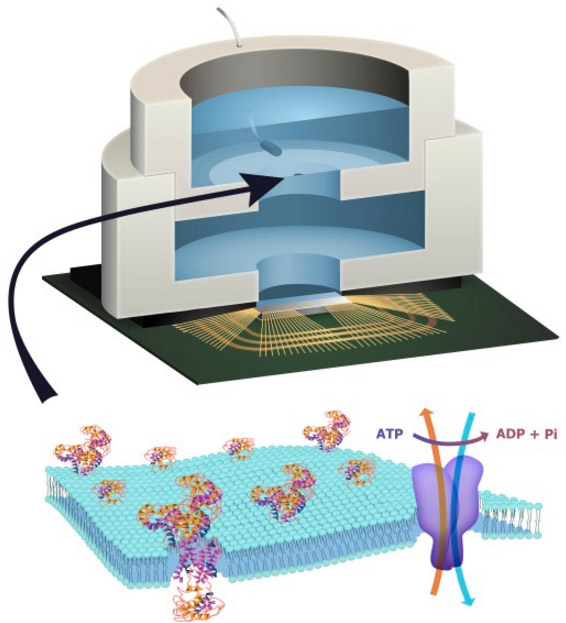
Illustration depicting a biocell attached to a CMOS integrated circuit with a membrane containing sodium-potassium pumps in pores. Energy is stored chemically in ATP molecules. When the energy is released as charged ions (which are then converted to electrons to power the chip at the bottom of the experimental device), the ATP is converted to ADP + inorganic phosphate. (credit: Trevor Finney and Jared Roseman/Columbia Engineering)

Columbia Engineering researchers have combined biological and solid-state components for the first time, opening the door to creating entirely new artificial biosystems.

In this experiment, they used a biological cell to power a conventional solid-state complementary metal-oxide-semiconductor (CMOS) integrated circuit. An artificial lipid bilayer membrane containing adenosine triphosphate (ATP)-powered ion pumps (which provide energy for cells) was used as a source of ions (which were converted to electrons to power the chip).

The study, led by Ken Shepard, Lau Family Professor of Electrical Engineering and professor of biomedical engineering at Columbia Engineering, was published online today (Dec. 7, 2015) in an open-access paper in Nature Communications.

How to build a hybrid biochip

Living systems achieve this functionality with their own version of electronics based on lipid membranes and ion channels and pumps, which act as a kind of “biological transistor.” Charge in the form of ions carry energy and information, and ion channels control the flow of ions across cell membranes.

Solid-state systems, such as those in computers and communication devices, use electrons; their electronic signaling and power are controlled by field-effect transistors.

To build a prototype of their hybrid system, Shepard’s team packaged a CMOS integrated circuit (IC) with an ATP-harvesting “biocell.” In the presence of ATP, the system pumped ions across the membrane, producing an electrical potential (voltage)* that was harvested by the integrated circuit.

“We made a macroscale version of this system, at the scale of several millimeters, to see if it worked,” Shepard notes. “Our results provide new insight into a generalized circuit model, enabling us to determine the conditions to maximize the efficiency of harnessing chemical energy through the action of these ion pumps. We will now be looking at how to scale the system down.”

While other groups have harvested energy from living systems, Shepard and his team are exploring how to do this at the molecular level, isolating just the desired function and interfacing this with electronics. “We don’t need the whole cell,” he explains. “We just grab the component of the cell that’s doing what we want. For this project, we isolated the ATPases because they were the proteins that allowed us to extract energy from ATP.”

The capability of a bomb-sniffing dog, no Alpo required

Next, the researchers plan to go much further, such as recognizing specific molecules and giving chips the potential to taste and smell.

The ability to build a system that combines the power of solid-state electronics with the capabilities of biological components has great promise, they believe. “You need a bomb-sniffing dog now, but if you can take just the part of the dog that is useful — the molecules that are doing the sensing — we wouldn’t need the whole animal,” says Shepard.

The technology could also provide a power source for implanted electronic devices in ATP-rich environments such as inside living cells, the researchers suggest.

*  “In general, integrated circuits, even when operated at the point of minimum energy in subthreshold, consume on the order of 10−2 W mm−2 (or assuming a typical silicon chip thickness of 250 μm, 4 × 10⁻² W mm−3). Typical cells, in contrast, consume on the order of 4 × 10⁻⁶ W mm−3. In the experiment, a typical active power dissipation for the IC circuit was 92.3 nW, and the active average harvesting power was 71.4 fW for the biocell (the discrepancy is managed through duty-cycled operation of the IC).” — Jared M. Roseman et al./Nature Communications


Hybrid integrated biological–solid-state system powered with adenosine triphosphate

Jared M. RosemanJianxun LinSiddharth RamakrishnanJacob K. Rosenstein & Kenneth L. Shepard
Nature Communications 7 Dec 2015; 6(10070)
     http://dx.doi.org:/10.1038/ncomms10070

There is enormous potential in combining the capabilities of the biological and the solid state to create hybrid engineered systems. While there have been recent efforts to harness power from naturally occurring potentials in living systems in plants and animals to power complementary metal-oxide-semiconductor integrated circuits, here we report the first successful effort to isolate the energetics of an electrogenic ion pump in an engineered in vitro environment to power such an artificial system. An integrated circuit is powered by adenosine triphosphate through the action of Na+/K+ adenosine triphosphatases in an integrated in vitro lipid bilayer membrane. The ion pumps (active in the membrane at numbers exceeding 2 × 106mm−2) are able to sustain a short-circuit current of 32.6pAmm−2 and an open-circuit voltage of 78mV, providing for a maximum power transfer of 1.27pWmm−2 from a single bilayer. Two series-stacked bilayers provide a voltage sufficient to operate an integrated circuit with a conversion efficiency of chemical to electrical energy of 14.9%.


Figure 1: Fully hybrid biological–solid-state system.


Fully hybrid biological-solid-state system.

http://www.nature.com/ncomms/2015/151207/ncomms10070/images/ncomms10070-f1.jpg

(a) Illustration depicting biocell attached to CMOS integrated circuit. (b) Illustration of membrane in pore containing sodium–potassium pumps. (c) Circuit model of equivalent stacked membranes, =2.1pA, =98.6G, =575G and =75pF, Ag/AgCl electrode equivalent resistance RWE+RCE<20k, energy-harvesting capacitor CSTOR=100nF combined with switch as an impedance transformation network (only one switch necessary due to small duty cycle), and CMOS IC voltage doubler and resistor representing digital switching load. RL represents the four independent ring oscillator loads. (d) Equivalent circuit detail of stacked biocell. (e) Switched-capacitor voltage doubler circuit schematic.


The energetics of living systems are based on electrochemical membrane potentials that are present in cell plasma membranes, the inner membrane of mitochondria, or the thylakoid membrane of chloroplasts1. In the latter two cases, the specific membrane potential is known as the proton-motive force and is used by proton adenosine triphosphate (ATP) synthases to produce ATP. In the former case, Na+/K+-ATPases hydrolyse ATP to maintain the resting potential in most cells.

While there have been recent efforts to harness power from some naturally occurring potentials in living systems that are the result of ion pump action both in plants2 and animals3, 4 to power complementary metal-oxide semiconductor (CMOS) integrated circuits (ICs), this work is the first successful effort to isolate the energetics of an electrogenic ion pump in an engineered in vitroenvironment to power such an artificial system. Prior efforts to harness power from in vitromembrane systems incorporating ion-pumping ATPases5, 6, 7, 8, 9 and light-activated bacteriorhodopsin9, 10, 11 have been limited by difficulty in incorporating these proteins in sufficient quantity to attain measurable current and in achieving sufficiently large membrane resistances to harness these currents. Both problems are solved in this effort to power an IC from ATP in an in vitro environment. The resulting measurements provide new insight into a generalized circuit model, which allows us to determine the conditions to maximize the efficiency of harnessing chemical energy through the action of electrogenic ion pumps.


ATP-powered IC

Figure 1a shows the complete hybrid integrated system, consisting of a CMOS IC packaged with an ATP-harvesting ‘biocell’. The biocell consists of two series-stacked ATPase bearing suspended lipid bilayers with a fluid chamber directly on top of the IC. Series stacking of two membranes is necessary to provide the required start-up voltage for IC and eliminates the need for an external energy source, which is typically required to start circuits from low-voltage supplies2, 3. As shown inFig. 1c, a matching network in the form of a switched capacitor allows the load resistance of the IC to be matched to that presented by the biocell. In principle, the switch S can be implicit. The biocell charges CSTOR until the self start-up voltage, Vstart, is reached. The chip then operates until the biocell voltage drops below the minimum supply voltage for operation, Vmin. Active current draw from the IC stops at this point, allowing the charge to build up again on CSTOR. In our case, however, the IC leakage current exceeds 13.5nA at Vstart, more than can be provided by the biocell. As a result, an explicit transistor switch and comparator (outside of the IC) are used for this function in the experimental results presented here, which are not powered by the biocell and not included in energy efficiency calculations (see Supplementary Discussion for additional details). The energy from the biocell is used to operate a voltage converter (voltage doubler) and some simple inverter-based ring oscillators in the IC, which receive power from no other sources.

Figure 1: Fully hybrid biological–solid-state system.

http://www.nature.com/ncomms/2015/151207/ncomms10070/images/ncomms10070-f1.jpg


……..   Prior to the addition of ATP, the membrane produces no electrical power and has an Rm of 280G. A 1.7-pA short-circuit (SC) current (Fig. 2b) through the membrane is observed upon the addition of ATP (final concentration 3mM) to the cis chamber where functional, properly oriented enzymes generate a net electrogenic pump current. To perform these measurements, currents through each membrane of the biocell are measured using a voltage-clamp amplifier (inset of Fig. 2b) with a gain of 500G with special efforts taken to compensate amplifier leakage currents. Each ATPase transports three Na+ ions from the cis chamber to the trans chamber and two K+ ions from thetrans chamber to the cis chamber (a net charge movement of one cation) for every molecule of ATP hydrolysed. At a rate of 100 hydrolysis events per second under zero electrical (SC) bias13, this results in an electrogenic current of ~16aA. The observed SC current corresponds to about 105 active ATPases in the membrane or a concentration of about 2 × 106mm−2, about 5% of the density of channels occurring naturally in mammalian nerve fibres14. It is expected that half of the channels inserted are inactive because they are oriented incorrectly.

Figure 2: Single-cell biocell characterization.

http://www.nature.com/ncomms/2015/151207/ncomms10070/images_article/ncomms10070-f2.jpg

(a)…Pre-ATP data linear fit (black line) slope yield Rm=280G. Post ATP data fit to a Boltzmann curve, slope=0.02V (blue line). Post-ATP linear fit (red line) yields Ip=−1.8pA and Rp=61.6G, which corresponds to a per-ATP source resistance of 6.16 × 10¹⁵. The current due to membrane leakage through R_{m} is subtracted in the post-ATP curve…. (b)…


Current–voltage characteristics of the ATPases

Figure 2a shows the complete measured current–voltage (IV) characteristic of a single ATPase-bearing membrane in the presence of ATP. The current due to membrane leakage through Rm is subtracted in the post-ATP curve. The IV characteristic fits a Boltzmann sigmoid curve, consistent with sodium–potassium pump currents measured on membrane patches at similar buffer conditions13, 15, 16. This nonlinear behaviour reflects the fact that the full ATPase transport cycle (three Na+ ions from cis to trans and two K+ ions from trans to cis) time increases (the turn-over rate, kATP, decreases) as the membrane potential increases16. No effect on pump current is expected from any ion concentration gradients produced by the action of the ATPases (seeSupplementary Discussion). Using this Boltzmann fit, we can model the biocell as a nonlinear voltage-controlled current source IATPase (inset Fig. 2a), in which the current produced by this source varies as a function of Vm. In the fourth quadrant, where the cell is producing electrical power, this model can be linearized as a Norton equivalent circuit, consisting of a DC current source (Ip) in parallel with a current-limiting resistor (Rp), which acts to limit the current delivered to the load at increasing bias (IATPase~IpVm/Rp). Figure 2c shows the measured and simulated charging of Cm for a single membrane (open-circuited voltage). A custom amplifier with input resistance Rin>10T was required for this measurement (see Electrical Measurement Methods).


Reconciling operating voltage differences

The electrical characteristics of biological systems and solid-state systems are mismatched in their operating voltages. The minimum operating voltage of solid-state systems is determined by the need for transistors to modulate a Maxwell–Boltzmann (MB) distribution of carriers by several orders of magnitude through the application of a potential that is several multiples of kT/q (where kis Boltzmann’s constant, T is the temperature in degrees Kelvin and q is the elementary charge). Biological systems, while operating under the same MB statistics, have no such constraints for operating ion channels since they are controlled by mechanical (or other conformational) processes rather than through modulation of a potential barrier. To bridge this operating voltage mismatch, the circuit includes a switched-capacitor voltage doubler (Fig. 1d) that is capable of self-startup from voltages as low Vstart=145mV (~5.5kT/q) and can be operated continuously from input voltages from as low as Vmin=110mV (see Supplementary Discussion)…..


Maximizing the efficiency of harvesting energy from ATP

Solid-state systems and biological systems are also mismatched in their operating impedances. In our case, the biocell presents a source impedance, =84.2G, while the load impedance presented by the complete integrated circuit (including both the voltage converter and ring oscillator loads) is approximately RIC=200k. (The load impedance, RL, of the ring oscillators alone is 305k.) This mismatch in source and load impedance is manifest in large differences in power densities. In general, integrated circuits, even when operated at the point of minimum energy in subthreshold, consume on the order of 10−2Wmm−2 (or assuming a typical silicon chip thickness of 250μm, 4 × 10⁻²Wmm−3) (ref. 17). Typical cells, in contrast, consume on the order of 4 × 10⁻⁶Wmm−3 (ref. 18). In our case, a typical active power dissipation for our circuit is 92.3nW, and the active average harvesting power is 71.4fW for the biocell. This discrepancy is managed through duty-cycled operation of the IC in which the circuit is largely disabled for long periods of time (Tcharge), integrating up the power onto a storage capacitor (CSTOR), which is then expended in a very brief period of activity (Trun), as shown in Fig. 3a.

The overall efficiency of the system in converting chemical energy to the energy consumed in the load ring oscillator (η) is given by the product of the conversion efficiency of the voltage doubler (ηconverter) and the conversion efficiency of chemical energy to electrical energy in the biocell (ηbiocell), η=ηconverter × ηbiocell. ηconverter is relatively constant over the range of input voltages at ~59%, as determined by various loading test circuits included in the chip design (Supplementary Figs 1–6). ηbiocell, however, varies with transmembrane potential Vm. η is the efficiency in transferring power to the power ring oscillator loads from the ATP harvested by biocell.

…….

To first order, the energy made available to the Na+/K+-ATPase by the hydrolysis of ATP is independent of the chemical or electric potential of the membrane and is given by |ΔGATP|/(qNA), where ΔGATP is the Gibbs free energy change due to the ATP hydrolysis reaction per mole of ATP at given buffer conditions and NA is Avogadro’s number. Since every charge that passes through IATPase corresponds to a single hydrolysis event, we can use two voltage sources in series with IATPase to independently account for the energy expended by the pumps both in moving charge across the electric potential difference and in moving ions across the chemical potential difference. The dependent voltage source Vloss in this branch fixes the voltage across IATPase, and the total power produced by the pump current source is (|ΔGATP|/NA)(NkATP), which is the product of the energy released per molecule of ATP, the number of active ATPases and the ATP turnover rate. The power dissipated in voltage source Vchem models the work performed by the ATPases in transporting ions against a concentration gradient. In the case of the Na+/K+ ATPase,Vchem is given by . The power dissipated in this source is introduced back into the circuit in the power generated by the Nernst independent voltage sources, and . The power dissipated in the dependent voltage source Vloss models any additional power not used to perform chemical or electrical work. ……


Integration of ATP-harvesting ion pumps could provide a means to power future CMOS microsystems scaled to the level of individual cells22. In molecular diagnostics, the integration of pore-forming proteins such as alpha haemolysin23 or MspA porin24 with CMOS electronics is already finding application in DNA sequencing25. Exploiting the large diversity of function available in transmembrane proteins in these hybrid systems could, for example, lead to highly specific sensing platforms for airborne odorants or soluble molecular entities26, 27. Heavily multiplexed platforms could become high-throughput in vitro drug-screening platforms against this diversity of function. In addition, integration of transmembrane proteins with CMOS may become a convenient alternative to fluorescence for coupling to synthetic biological systems28.


Roseman, J. M. et al. Hybrid integrated biological–solid-state system powered with adenosine triphosphate. Nat. Commun. 6:10070      http://dx.doi.org:/10.1038/ncomms10070 (2015).


  • Rottenberg, H. The measurement of membrane potential and deltapH in cells, organelles, and vesicles. Methods Enzymol. 55, 547569 (1979).
  • Himes, C., Carlson, E., Ricchiuti, R. J., Otis, B. P. & Parviz, B. A. Ultralow voltage nanoelectronics powered directly, and solely, from a tree. IEEE Trans. Nanotechnol. 9, 25(2010).
  • Mercier, P. P., Lysaght, A. C., Bandyopadhyay, S., Chandrakasan, A. P. & Stankovic, K. M.Energy extraction from the biologic battery in the inner ear. Nat. Biotechnol. 30, 12401243(2012).
  • Halámková, L. et al. Implanted Biofuel Cell Operating in a Living Snail. J. Am. Chem. Soc.134, 50405043 (2012).


Read Full Post »

Rhodopsin role in ciliary trafficking

Jillian N Pearring
Department of Ophthalmology, Duke University School of Medicine, Durham, United States
No competing interests declared

” data-author-inst=”DukeUniversitySchoolofMedicineUnitedStates”>Jillian N Pearring

William J Spencer
Department of Ophthalmology, Duke University School of Medicine, Durham, United States
No competing interests declared

” data-author-inst=”DukeUniversitySchoolofMedicineUnitedStates”>William J Spencer

Eric C Lieu
Department of Ophthalmology, Duke University School of Medicine, Durham, United States
No competing interests declared

” data-author-inst=”DukeUniversitySchoolofMedicineUnitedStates”>Eric C Lieu, 

Vadim Y Arshavsky
Department of Ophthalmology, Duke University School of Medicine, Durham, United States
For correspondence: vadim.arshavsky@duke.edu
No competing interests declared

” data-author-inst=”DukeUniversitySchoolofMedicineUnitedStates”>Vadim Y Arshavsky
eLife 2015;10.7554/eLife.12058   http://dx.doi.org/10.7554/eLife.12058

Sensory cilia are populated by a select group of signaling proteins that detect environmental stimuli. How these molecules are delivered to the sensory cilium and whether they rely on one another for specific transport remains poorly understood. Here, we investigated whether the visual pigment, rhodopsin, is critical for delivering other signaling proteins to the sensory cilium of photoreceptor cells, the outer segment. Rhodopsin is the most abundant outer segment protein and its proper transport is essential for formation of this organelle, suggesting that such a dependency might exist. Indeed, we demonstrated that guanylate cyclase-1, producing the cGMP second messenger in photoreceptors, requires rhodopsin for intracellular stability and outer segment delivery. We elucidated this dependency by showing that guanylate cyclase-1 is a novel rhodopsin-binding protein. These findings expand rhodopsin’s role in vision from being a visual pigment and major outer segment building block to directing trafficking of another key signaling protein.


Photoreceptor cells transform information entering the eye as photons into patterns of neuronal electrical activity. This transformation takes place in the sensory cilium organelle, the outer segment. Outer segments are built from a relatively small set of structural and signaling proteins, including components of the classical GPCR phototransduction cascade. Such a distinct functional and morphological specialization allow outer segments to serve as a nearly unmatched model system for studying general principles of GPCR signaling (Arshavsky et al., 2002) and, in more recent years, a model for ciliary trafficking (Garcia-Gonzalo and Reiter, 2012; Nemet et al., 2015; Pearring et al., 2013; Schou et al., 2015; Wang and Deretic, 2014). Despite our deep understanding of visual signal transduction, little is known how the outer segment is populated by proteins performing this function. Indeed, nearly all mechanistic studies of outer segment protein trafficking were devoted to rhodopsin (Nemet et al., 2015; Wang and Deretic, 2014), which is a GPCR visual pigment comprising the majority of the outer segment membrane protein mass (Palczewski, 2006). The mechanisms responsible for outer segment delivery of other transmembrane proteins remain essentially unknown. Some of them contain short outer segment targeting signals, which can be identified through site-specific mutagenesis (Deretic et al., 1998; Li et al., 1996; Pearring et al., 2014; Salinas et al., 2013; Sung et al., 1994; Tam et al., 2000; Tam et al., 2004). A documented exception is retinal guanylate cyclase 1 (GC-1), whose exhaustive mutagenesis did not yield a distinct outer segment targeting motif (Karan et al., 2011).

GC-1 is a critical component of the phototransduction machinery responsible for synthesizing the second messenger, cGMP (Wen et al., 2014). GC-1 is the only guanylate cyclase isoform expressed in the outer segments of cones and the predominant isoform in rods (Baehr et al., 2007; Yang et al., 1999). GC-1 knockout in mice is characterized by severe degeneration of cones and abnormal light-response recovery kinetics in rods (Yang et al., 1999). Furthermore, a very large number of GC-1 mutations found in human patients cause one of the most severe forms of early onset retinal dystrophy, called Leber’s congenital amaurosis (Boye, 2014; Kitiratschky et al., 2008). Many of these mutations are located outside the catalytic site of GC-1, which raises great interest to understanding the mechanisms of its intracellular processing and trafficking.

In this study, we demonstrate that, rather than relying on its own targeting motif, GC-1 is transported to the outer segment in a complex with rhodopsin. We conducted a comprehensive screen of outer segment protein localization in rod photoreceptors of rhodopsin knockout (Rho-/- ) mice and found that GC-1 was the only protein severely affected by this knockout. We next showed that this unique property of GC-1 is explained by its interaction with rhodopsin, which likely initiates in the biosynthetic membranes and supports both intracellular stability and outer segment delivery of this enzyme. These findings explain how GC-1 reaches its specific intracellular destination and also expand the role of rhodopsin in supporting normal vision by showing that it guides trafficking of another key phototransduction protein.


GC-1 is the outer segment-resident protein severely down-regulated in rhodopsin knockout rods

GC-1 stability and trafficking require the transmembrane core of rhodopsin but not its outer 119 segment targeting domain

GC-1 is a rhodopsin-interacting protein


The findings reported in this study expand our understanding of how the photoreceptor’s sensory cilium is populated by its specific membrane proteins. We have found that rhodopsin serves as an interacting partner and a vehicle for ciliary delivery of a key phototransduction protein, GC-1. This previously unknown function adds to the well-established roles of rhodopsin as a GPCR visual pigment and a major building block of photoreceptor membranes. We further showed that GC-1 is unique in its reliance on rhodopsin, as the other nine proteins tested in this study were expressed in significant amounts and faithfully localized to rod outer segments in the absence of rhodopsin.

Our data consolidate a number of previously published observations, including a major puzzle related to GC-1: the lack of a distinct ciliary targeting motif encoded in its sequence. The shortest recombinant fragment of GC-1 which localized specifically to the outer segment was found to be very large and contain both transmembrane and cytoplasmic domains (Karan et al., 2011). Our study shows that GC-1 delivery requires rhodopsin and, therefore, can rely on specific targeting information encoded in the rhodopsin molecule. Interestingly, we also found that this information can be replaced by an alternative ciliary targeting sequence from a GPCR not endogenous to photoreceptors. This suggests that the functions of binding/stabilization of GC-1 and ciliary targeting are performed by different parts of the rhodopsin molecule. Our findings also shed new light on the report that both rhodopsin and GC-1 utilize intraflagellar transport (IFT) for their ciliary trafficking and co-precipitate with IFT proteins (Bhowmick et al., 2009). The authors hypothesized that GC-1 plays a primary role in assembling cargo for the IFT particle bound for ciliary delivery. Our data suggest that it is rhodopsin that drives this complex, at least in photoreceptor cells where these proteins are specifically expressed. Unlike GC-1’s reliance on rhodopsin for its intracellular stability or outer segment trafficking, rhodopsin does not require GC-1 as its expression level and localization remain normal in rods of GC-1 knockout mice ((Baehr et al., 2007) and this study). The outer segment trafficking of cone opsins is not affected by the lack of GC-1 either (Baehr et al., 2007; Karan et al., 2008), although GC-1 knockout cones undergo rapid degeneration, likely because they do not express GC-2 – an enzyme with redundant function. The primary role of rhodopsin in guiding GC-1 to the outer segment is further consistent with rhodopsin directly interacting with IFT20, a mobile component of the IFT complex responsible for recruiting IFT cargo at the Golgi network (Crouse et al., 2014; Keady et al., 2011).

It was also reported that GC-1 trafficking requires participation of chaperone proteins, most importantly DnaJB6 (Bhowmick et al., 2009). Our data suggest that GC-1 interaction with DnaJB6 is transient, most likely in route to the outer segment, since we were not able to co-precipitate DnaJB6 with GC-1 from whole retina lysates (Figure 5). In contrast, the majority of GC-1 co-precipitates with rhodopsin from these same lysates, suggesting that these proteins remain in a complex after being delivered to the outer segment. Although our data do not exclude that the mature GC-1-rhodopsin complex may contain additional protein component(s), our attempts to identify such components by mass spectrometry have not yielded potential candidates.

Interestingly, GC-1 was previously shown to stably express in cell culture where it localizes to either ciliary or intracellular membranes (Bhowmick et al., 2009; Peshenko et al., 2015). This strikes at the difference between the composition of cellular components supporting membrane protein stabilization and transport in cell culture models versus functional photoreceptors. The goal of future experiments is to determine whether these protein localization patterns would be affected by co-expressing GC-1 with rhodopsin, thereby gaining further insight into the underlying intracellular trafficking mechanisms.

Finally, GC-1 trafficking was reported to depend on the small protein, RD3, thought to stabilize both guanylate cyclase isoforms, GC-1 and GC-2, in biosynthetic membranes (Azadi et al., 2010; Zulliger et al., 2015). In the case of GC-1, this stabilization would be complementary to that by rhodopsin and potentially could take place at different stages of GC-1 maturation and trafficking in photoreceptors. Another proposed function of RD3 is to inhibit the activity of guanylate cyclase isoforms outside the outer segment in order to prevent undesirable cGMP synthesis in other cellular compartments (Peshenko et al., 2011a).

In summary, this study explains how GC-1 reaches its intracellular destination without containing a dedicated targeting motif, expands our understanding of the role of rhodopsin in photoreceptor biology and extends the diversity of signaling proteins found in GPCR complexes to a member of the guanylate cyclase family. Provided that the cilium is a critical site of GPCR signaling in numerous cell types (Schou et al., 2015), it would be interesting to learn whether other ciliary GPCRs share rhodopsin’s ability to stabilize and deliver fellow members of their signaling pathways


Like this:

Read Full Post »

Identical Twin Brother Develops Schizophrenia

Identical Twin Brother Develops Schizophrenia

Author: Larry H. Bernstein, MD, FCAP


My identical twin brother develops schizophrenia

I graduated college as a chemistry undergraduate prior to entrance into medical school in 1973, and my brother had not exhibited signs of serious mental distress until that point.  He was dating a young woman who rejected him, and he was also under pressure from our father, who thought he did not have direction. The oldest daughter was married and was well prepared in piano and in mathematics, and she has prepared students in piano to the present day. The triplet sister was married to a medical student who went on to become a psychiatrist. The two sons were still living at home.  There was considerable pressure on my brother to complete his studies.   The trigger seemed to be the breakup of his relationship. It was in the months prior to my graduation that my mother was deeply concerned and our parents pursued a psychiatric evaluation.   He was put on chlorpromazine, but then developed jaundice. Schizophrenia was not understood in those years, and for many years was an illness that brought shame to the parents.  I shared a bedroom with my brother for all the years prior to this event and I only saw it develop at the surface.

We both had worked as waiters at a resort on Lake Michigan for some years prior to my entrance to medical school, and Leslie had an interest in biology.  He was closer to our younger sister, and I was trying to keep up with Sharon, who was 2 years older and had an infant that I visited often.  I had a close friend who was my buddy.  I could talk to him often, and we compared notes after a double date.  Leslie had a friend who we had played chess with in high school.  My brother showed no progress and his psychiatric visits were costly. My father was a dental technician who was skilled at making dentures.

It was the summer prior to my entry into medical school that I worked in a biochemistry research laboratory under the supervision of my brother in law.  The first year medical studies were pressured with anatomy, biochemistry, inborn errors of metabolism, neuroanatomy and embryology, and dissection of cadavers.  Leslie was admitted to the Lafayette Clinic at Wayne State University. He was now receiving the best care available. I visited him at that time, and he played chess with the attendant.
It was also during the first year of medical school that the progressive Rabbi Adler, at Rodeph Shalom who had a national reputation was shot in front of the Bima by Richard Wishnetsky, a troubled man our age who was mentally ill, probably with a mood disorder. My good friend was home from Berkeley and tried to avoid the problem, but he was released by a law school student. Richard’s parents were leaders in the congregation.  My friend and I knew there was a problem early because Richard had received a Woodrow Wilson scholarship, and he considered graduate studies under a faculty member at the Catholic University in Detroit, but he did go to the University of Michigan.

At the end of the first year, the triplets went to Washington, DC to participate in an ongoing Schizophrenia twin study.  I was engaged in studies of radiation on virus in an NIH lab during the study. Three years later, when I was rotating through psychiatry at Herman Kiefer Hospital in my third year having taking time out for a Master of Science degree in Anatomy (the evolution of the proteins of the eye lens), I found myself in the Detroit riots.


My brother grew a beard and became somewhat disheveled. He had hallucinations, and he could tell about his dreams.  For instance, so and so visited him.  He began living in an apartment on Woodward Avenue, the largest street in Detroit. He became very spiritual, and he wrote poetry.  One day he stood in the middle of Woodward Avenue wearing a tallis (prayer shawl) and directed traffic.  He did manage to finish his undergraduate studies, but when he took a job teaching biology, he just couldn’t. He also knew that a Croatian girl who graduated high school with us, who was a talented dancer, developed schizophrenia.

My mother was very stressed. She was helping to care for my older sister’s daughter, and she was grieving over her son.  She developed abdominal pain in 1978, when I graduated and went to my residency in Pathology at University of Kansas Medical Center in Kansas City, in what was to be a residency and PhD program. I had joined the Berry Plan during my medical school years and when I graduated I was randomly selected to go into the Navy, but got a deferment to complete my studies.

It was during that time that I learned that my mother had had an exploratory laparotomy for what turned out to be an infiltrating carcinoma of the stomach, through the wall and on the peritoneal surface (linitis plastic).  No biopsy was taken.  I flew home frequently until the end.  She was on morphine to ease the pain.  I began seeing a woman I had known in high school, who was now teaching. We were married in December of 1979, after my mother died.  My mother’s father had always been well and was a mechanic in Cleveland. I was told that he died of a broken heart with the loss of my mother.

I went to University of California, San Diego in January, 1980, to work in Enzymology, the inhibition of the pyridine nucleotide linked malate dehydrogenase reaction, under Nathan O. Kaplan, and there I also completed my residency.  It happens at that time, my brother had moved to San Diego, and he was looked after our triplet sister.  It was a fortunate circumstance for the triplets.


Read Full Post »

Stem Cell derived kidneys

Stem Cell derived kidneys

Larry H. Bernstein, MD, FCAP, Curator

LPBI


HUMAN STEM CELL-DERIVED KIDNEYS CONNECT TO BLOOD VESSELS WHEN TRANSPLANTED INTO MICE

http://health-innovations.org/2015/11/20/human-stem-cell-derived-kidneys-connect-to-blood-vessels-when-transplanted-into-mice/


ft Stem cell-derived kidneys connect to blood vessels when transplanted into mice - healthinnovations

https://michellepetersen76.files.wordpress.com/2015/11/ft-stem-cell-derived-kidneys-connect-to-blood-vessels-when-transplanted-into-mice-healthinnovations.png

The kidney tissues derived from human iPS cells
A.The kidney tissue generated in vitro, which shows green fluorescence in each glomerulus.
B.Vascularized glomerulus formed upon transplantation into the mouse. Many red blood cells (arrowhead) are observed, and the substance exists in the lumen (*), suggesting the possible filtration.
C.Mouse vascular endothelial cells (green) are incorporated into the glomerulus that consists of podocytes (magenta).
D.The slit diaphragm (arrow) formed between the cellular processes of the podocytes. Credit: The Institute of Molecular Embryology and Genetics (IMEG).

In the field of iPS cell-based regenerative medicine, advanced research with clinical applications for many organs and tissues, such as the retina, has steadily progressed. However, growing a kidney from scratch has been extremely difficult.  Although the number of renal failure patients on dialysis is increasing, opportunities for renal transplant have been limited with great attention given to the growth of kidneys to stem the shortage.

Now, a study from researchers at Kumamoto University shows mouse kidney capillaries successfully connecting to kidney tissue derived from human iPS cells. The team state that this achievement shows that human kidney glomeruli made in vitro can connect to blood vessels after transplantation and grow to maturity, a big step forward in gain-of-function for a urine-producing kidney.  The opensource study is published in the Journal of the American Society of Nephrology.

Earlier studies from the lab led to the development of an in vitro three-dimensional kidney structure from human iPS cells.  However, it was unclear how similar the kidney tissue made in vitro was to that formed in a living body. Additionally, the original kidney tissue was not connected to any blood vessels, even though the primary function of the organ is to filter waste products and excess fluid from the blood.  In many kidney diseases, the pathology is with the glomeruli that filter urine from the blood. Filtration in the glomerulus is performed by cells called podocytes that are in direct contact with the blood vessels. Through the special filtration membrane of the podocytes, proteins don’t leak into the urine and allows moisture to pass through.  Therefore, the group focused on analyzing the podocyte of the glomeruli in detail.  They achieved this by genetically modifying the iPS cells and growing human kidney tissue in vitro with green fluorescence then visualizing how human glomeruli became established.

The current study continued this analysis by taking out only the podocytes of the human glomeruli using the green fluorescence, and revealed that glomerular podocytes made in vitro express the same genes important for normal biological function.  Data findings show that after transplanting the human iPS cell-based kidney tissue into a mouse body, glomeruli connecting to mouse kidney capillaries formed. Results show that human glomerular podocytes further matured around adjacent blood vessels as in a living body and formed a characteristic filtration membrane structure.  The group state that to their knowledge the successful connection of capillaries with the podocytes of iPS cell-manufactured human glomeruli resulting in a distinct filtration membrane is the first of its kind in the world.

The team surmise that their findings should advance research into the manufactured kidney’s function to produce and excrete urine.  They go on to add that by using iPS cells from patients, development of new drugs and clarification of the causes of kidney disease are also expected.  For the future, the researchers state that they are now working to develop a discharge path for the kidney and combine it with findings on glomerular cells.

Source: The Institute of Molecular Embryology and Genetics (IMEG)


Human Induced Pluripotent Stem Cell–Derived Podocytes Mature into Vascularized Glomeruli upon Experimental Transplantation

Sazia Sharmin*Atsuhiro Taguchi*Yusuke Kaku*Yasuhiro Yoshimura*Tomoko Ohmori*Tetsushi Sakuma, et al.

JASN Nov 19; 2015 ASN.2015010096      http://dx.doi.org:/10.1681/ASN.2015010096    http://jasn.asnjournals.org/content/early/2015/11/18/ASN.2015010096.full

Glomerular podocytes express proteins, such as nephrin, that constitute the slit diaphragm, thereby contributing to the filtration process in the kidney. Glomerular development has been analyzed mainly in mice, whereas analysis of human kidney development has been minimal because of limited access to embryonic kidneys. We previously reported the induction of three-dimensional primordial glomeruli from human induced pluripotent stem (iPS) cells. Here, using transcription activator–like effector nuclease-mediated homologous recombination, we generated human iPS cell lines that express green fluorescent protein (GFP) in the NPHS1 locus, which encodes nephrin, and we show that GFP expression facilitated accurate visualization of nephrin-positive podocyte formation in vitro. These induced human podocytes exhibited apicobasal polarity, with nephrin proteins accumulated close to the basal domain, and possessed primary processes that were connected with slit diaphragm–like structures. Microarray analysis of sorted iPS cell–derived podocytes identified well conserved marker gene expression previously shown in mouse and human podocytes in vivo. Furthermore, we developed a novel transplantation method using spacers that release the tension of host kidney capsules, thereby allowing the effective formation of glomeruli from human iPS cell–derived nephron progenitors. The human glomeruli were vascularized with the host mouse endothelial cells, and iPS cell–derived podocytes with numerous cell processes accumulated around the fenestrated endothelial cells. Therefore, the podocytes generated from iPS cells retain the podocyte-specific molecular and structural features, which will be useful for dissecting human glomerular development and diseases.


The glomerulus is the filtering apparatus of the kidney and contains three types of cells: podocytes, vascular endothelial cells, and mesangial cells. Podocytes cover the basal domains of the endothelial cells via the basement membrane and play a major role in the filtration process.1,2 Podocytes possess multiple cytoplasmic protrusions. The primary processes are complicated by the further stemming of smaller protrusions (secondary processes or foot processes), which interdigitate with those from neighboring podocytes. The gaps between these foot processes are connected with the slit diaphragm, which is detectable only by electron microscopy. The molecular nature of the slit diaphragm was initially revealed by identification of NPHS1 as the gene responsible for Finnish-type congenital nephrotic syndrome.3 The nephrin protein encoded by NPHS1intercalates with those from neighboring cells, thus forming a molecular mesh that hinders serum proteins of high molecular weight from leaking into the urine.4,5 To date, many slit diaphragm–associated proteins have been identified, including NPHS2 (encoding podocin) and NEPH1, mutations that cause proteinuria in humans and/or mice.6,7

Podocytes are derived from nephron progenitors that reside in the embryonic kidney and express transcription factor Six2.8 Upon Wnt stimulation, the nephron progenitors undergo mesenchymal-to-epithelial transition and form a tubule.9 This tubule changes its shape; one end forms the glomerulus with podocytes inside, which is surrounded by a Bowman’s capsule. Meanwhile, vascular endothelial cells and mesangial cells migrate into the developing glomeruli, thus connecting the glomeruli with circulation.2 In these processes, several transcription factors, including Wt1, regulate expression of nephrin in podocytes.10 Apical junctions are initially formed between the presumptive podocytes, but the apical domain loses its direct contact with that of the neighboring cells, thus forming the characteristic podocyte shape. Nephrin is eventually localized to the site close to the basal domain and contributes to the formation of the slit diaphragm.2 The molecular mechanisms underlying podocyte development have been extensively studied in mice. However, because of limited access to human embryos, relatively little is known regarding transcription profiles of podocytes and glomerulogenesis in humans.4,11,12

We have recently induced the nephron progenitors from mouse embryonic stem (ES) cells and human induced pluripotent stem (iPS) cells by redefining the in vivo origin of the nephron progenitors.13 The induced progenitor aggregates readily form three-dimensional primordial glomeruli and renal tubules upon Wnt stimulation in vitro. To analyze the detailed structures and transcription profiles of the induced podocytes, we have here inserted the GFP gene into the NPHS1 locus of human iPS cells via homologous recombination using transcription activator–like effector nucleases (TALENs)14 and generated glomeruli with green fluorescent protein (GFP)-tagged podocytes.


Fluorescent Visualization of Human Glomerular Podocytes Generated fromNPHS1-GFP iPS Cells

To visualize developing human podocytes in vitro, we inserted a gene encoding GFP into the NPHS1 locus of human iPS cells by homologous recombination (Figure 1A). We first constructed a pair of plasmids expressing TALENs targeted in close proximity to the NPHS1 start codon. When tested in HEK 293 cells, these plasmids efficiently deleted the NPHS1 gene (Supplemental Figure 1A). We then introduced these TALEN plasmids, along with a targeting vector containing the GFP gene and the homology arms, into human iPS cells. This resulted in efficient homologous recombination and isolation of heterozygous GFP knock-in (NPHS1-GFP) clones (Figure 1B, Supplemental Figure 1, B and C).

Figure 1.

Successful generation ofNPHS1-GFP iPS cells by homologous recombination. (A) Strategy for targeting the human NPHS1 locus. TheGFP cassette was inserted upstream of the NPHS1 start codon. The puromycin-resistance cassette (PURO) is flanked by loxP sites. Positions for primers and probes for screening are indicated. E, EcoRV; N, NheI. (B) Southern blot of control (+/+) and NPHS1-GFP (GFP/+) clones. Genomic DNA was digested and hybridized with the indicated probes.

We differentiated these NPHS1-GFP iPS clones toward the nephron progenitors and subsequently combined them with murine embryonic spinal cord, which is a potent inducer of tubulogenesis, as we previously reported.13 Four days after recombination, spotty GFP signals could be observed, and the number and intensity of GFP signals increased thereafter until day 9 (Figure 2A,Supplemental Figure 2A). We observed GFP signals in all the examined samples from seven independent experiments (a total of 50 samples). Some of the signals started in a crescent shape and gradually changed into round structures (Figure 2A, lower panels), which suggests that human glomerular formation in vitro may be visualized. Therefore, we examined glomerulogenesis using sections of the explants. At day 3, only tubular structures were observed and GFP-positive cells were undetectable (Figure 2B). At day 4, structures that resembled S-shaped bodies were observed, in which proximo-distal specification occurred toward the presumptive distal (E-cadherin+) and proximal (cadherin-6+) renal tubules and glomerular podocytes (WT1+) (Figure 2C). At day 6, various forms of primordial glomeruli were observed, and most of the GFP signals overlapped with those of WT1 (Figure 2B). We ordered these glomeruli according to GFP intensity, which is likely to reflect the chronologic order of development. Weakly GFP-positive (and WT1-positive) limbs appeared at one end of the tubules, which elongated to surround the renal tubules. GFP intensity increased when the podocyte layers were convoluted. At day 9, strongly GFP-positive round glomeruli were formed. These histologic changes are consistent with the previous observations of human glomeruli in aborted fetuses.15 Thus, we succeeded in visualizing human podocyte development and glomerulogenesis in vitro. Interestingly, some, but not all, of the Bowman’s capsule cells were positive for GFP and nephrin (Supplemental Figure 2B), suggesting that these cells are not completely specified yet. Indeed, transient nephrin expression in some capsule cells was reported in vivo.16

Figure 2.

Fluorescent visualization of human glomerular podocytes generated fromNPHS1-GFP iPS cells. (A) Morphologic changes of GFP-positive glomeruli during differentiation in vitro. The nephron progenitors induced fromNPHS1-GFP iPS cells were combined with murine embryonic spinal cord and cultured for the indicated time. Lower panels: higher magnification of the areas marked by rectangles in the upper panels. Note the shape changes of the glomerulus (arrowheads). Scale bars: 500 μm. (B) Histologic sections of glomeruli developing in vitro. Tissues at day 3, 6, and 9 after recombination with the spinal cord were analyzed. Top panels: Hematoxylin-eosin (HE) staining. Middle panels: GFP (green) staining. Bottom panels: dual staining with GFP and WT1. Nuclei were stained with 4′,6-diamidino-2-phenylindole (DAPI: blue). Scale bars: 20 μm. (C) Presumptive S-shaped bodies observed at day 4 (left two panels) and day 6 (right two panels). Serial sections were stained with E-cadherin (Ecad: magenta)/cadherin-6 (cad6: green) and E-cadherin (magenta)/WT1 (green). Arrowheads: WT1-positive presumptive glomerular regions. Scale bars: 20 μm.

Induced Podocytes Exhibit Apicobasal Polarity and Basally Localized Nephrin

We analyzed day 9 sections at higher resolution to examine the apicobasal polarity of the induced podocytes. GFP was detected in the nuclei and cytoplasm of most cells in the round glomeruli (Figure 3A) because we did not attach any localization signal to GFP when generating NPHS1-GFP iPS cells. Nephrin proteins were distributed in a linear fashion in the iPS cell–derived glomeruli and at one end of the WT1-positive podocyte layer (Figure 3, A and B). These expression patterns significantly overlapped with those of type IV collagen, which was accumulated on the basal side of the podocytes (Figure 3C). In contrast, podocalyxin, an apical marker, was expressed in a manner mutually exclusive of nephrin (Figure 3D). Therefore, the induced podocytes exhibited a well established apicobasal polarity and nephrin proteins were properly localized at the basal side, where the presumptive slit diaphragm should be formed. We also observed nephrin-positive dots on the lateral side of the podocytes (Figure 3A, arrowheads), as reported in human developing podocytes in vivo.15 We found that these dots actually represent the filamentous structures encompassing the basal to the lateral side of the podocytes (Figure 3, B and C, arrowheads). Although further investigation is required, this may reflect the transit state of nephrin proteins shifting from the apical to the basal domain of the induced podocytes.

Figure 3.

Induced podocytes exhibit apicobasal polarity and basally localized nephrin. (A) Nephrin (magenta) and GFP (green) staining of the induced glomerulus at day 9. (B) Nephrin (magenta) and WT1 (green) staining. (C) Nephrin (magenta) and type IV collagen (COL: green) staining. (D) Nephrin (magenta) and podocalyxin (PODXL: green) staining. The left columns are at lower magnification to show a whole glomerulus. The right two columns are singly stained, while the left two columns represent merged images. Arrows: nephrin proteins localized to the basal domain; arrowheads: nephrin-positive dot-like or filamentous structures. Scale bars: 10 μm.

Induced Podocytes Possess Primary Processes with the Slit Diaphragm–Like Structures

We further analyzed the morphology of the induced glomeruli by electron microscopy. Both scanning and transmission electron microscopy showed well organized glomeruli surrounded by Bowman’s capsules (Figure 4, A and B). Interestingly, numerous microvilli were detected in the apical domain of the induced podocytes (Figure 4, C and D). Similar microvilli were reported in developing in vivo podocytes in humans.17,18 The podocytes were attached to each other at sites close to the basal region (Figure 4D). Inspection of the basal side of the induced podocytes by scanning microscopy identified multiple protrusions (Figure 4E), which were confirmed by transmission microscopy (Figure 4F). Higher magnification clearly showed bridging structures between the protrusions, which may represent an immature form of the slit diaphragm (Figure 4, G and H, Supplemental Figure 3, A–C). Thus, this is the first in vitrogeneration of mammalian podocytes with slit diaphragm–like structures from pluripotent stem cells. However, because typical interdigitation of the protrusions is lacking, they are likely to represent primary processes but not secondary processes (foot processes).

Figure 4.

Induced podocytes possess primary processes with the immature slit diaphragm–like structures. (A and B) Induced glomerulus covered with a Bowman’s capsule shown by (A) scanning and (B) transmission electron microscopy. (C) Induced podocytes observed by scanning electron microscopy. Multiple microvilli are observed on the apical surface (arrowheads). (D) Aligned podocytes, which attach to each other at sites close to the basal region, shown by transmission electron microscopy. Multiple microvilli are observed on the apical surface (arrowheads). (E) Primary processes shown by scanning electron microscopy (asterisks). Podocytes from the basal side are shown. (F) Primary processes shown by transmission electron microscopy (asterisks). (G) Slit diaphragm–like structures between the primary processes (arrows), shown by scanning electron microscopy. (H) Primary processes with slit diaphragm–like structures (arrows), shown by transmission electron microscopy. Scale bars: A and B: 10μm; C–F: 2 μm; G and H: 0.2 μm.

Induction of Podocytes from Human NPHS1-GFP iPS Cells Enables Their Efficient Isolation

We next tried to purify the GFP-positive podocytes at day 9 by FACS. Of the induced cells, 7.45%±0.72% (mean±SEM from five independent induction experiments) were positive for GFP (Figure 5A, left panel). We also found that the monoclonal antibody against the extracellular domain of nephrin (48E11),19in combination with the anti-podocalyxin antibody, was useful for sorting developing podocytes. Of the GFP-positive cells, 94.0% were positive for both nephrin and podocalyxin (Figure 5A, middle panel), while most of the GFP-negative cells (97.5%) were negative for both markers (Figure 5A, right panel). Thus, GFP faithfully mimics nephrin expression and podocytes were enriched in the GFP-positive population. Quantitative RT-PCR analysis of sorted cells confirmed the differential expression of several podocyte markers, such asNPHS2 (encoding podocin) and synaptopodin (Figure 5B). When the sorted GFP-positive cells were cultured for 3 days, the cells expressed WT1 in nuclei and podocalyxin on the cell surface (Figure 5C). Nephrin and GFP were detected on the cell surface membrane and in the cytoplasm, respectively, at day 7 of culture, although expression levels were lower than before the start of the culture. These results indicate that induction from NPHS1-GFP iPS cells enables efficient isolation of developing human podocytes.

Figure 5.

Induction of podocytes from human NPHS1-GFP iPS cells enables their efficient isolation. (A) FACS analysis of induced tissues at day 9. Almost 8% of cells are positive for GFP in this representative experiment (left panel). Nephrin and podocalyxin (PODXL) expression in the GFP-positive or -negative fraction (middle and right panel, respectively). (B) Quantitative RT-PCR analysis of GFP-positive and -negative fractions. Average and SEM from three independent experiments are shown. β-ACT, β-actin; SYNPO, synaptopodin. (C) Immunostaining of podocytes cultured for the indicated times after sorting GFP-positive cells. Scale bars: 5 μm. (D) Venn diagram of the transcription profiles of podocytes. Microarray data of GFP-positive podocytes are compared with those of human adult glomeruli and murine podocytes.

GFP-Positive–Induced Podocytes Show Transcriptional Profiles That Overlap with Those of Mouse and Human Podocytes In Vivo

To obtain comprehensive transcription profiles of the iPS cell–derived podocytes, we performed microarray analysis at day 9. We detected 2985 probes that were enriched in GFP-positive podocytes compared with GFP-negative cells. Of these, the top 300 genes were used for unbiased cluster analysis against microarray data from a wide variety of human tissues (Supplemental Figure 4, A and C).20 Genes enriched in the GFP-positive podocytes had variable tissue specificity. For example, NPHS2 was selectively expressed in the kidney or fetal kidney tissues. However, synaptopodin andFOXC2 were sorted into the ubiquitously expressing cluster. Dendrin was assigned to a cluster enriched in the neuronal tissues. These results suggest a single molecule is not sufficient to confirm the identity of podocytes. Therefore, we compared our gene list of GFP-positive human podocytes with the published microarray analyses of adult human glomeruli and adult podocytes from Mafb-GFP transgenic mice.11,21 Overall, 190 probes were overlapping among the three gene sets (Figure 5D, Supplemental Table 1, Table 1). These included typical slit diaphragm–related genes, such as NPHS1, NPHS2,CD2AP,22 chloride intracellular channel protein 5 (CLIC5),23 and dendrin,24,25and basolateral adhesion molecules such as claudin 5 and integrinα3.26,27Phospholipase ε1 and nonmuscle myosin heavy chain 9 (Myh9), causative genes for hereditary kidney diseases,2830 were also included. Transcription factors that have important roles in podocyte development, including WT1, MAFB, FOXD1, and TCF21, as well as vascular attractants such as VEGFA and semaphorin, were also expressed.1,2,31 Interestingly, when these selected overlapping genes were used for the cluster analysis against the microarray data from various organs described above, kidney and fetal kidney were segregated as separate clusters, suggesting the kidney-biased features of the overlapping gene set (Supplemental Figure 4B).

Table 1.

Genes common to iPS cell–derived podocytes in vitro, human glomeruli, and mouse podocytes in vivo

We also identified genes common to GFP-positive podocytes and adult human glomeruli (Figure 5D, Supplemental Table 2), and genes common to GFP-positive podocytes and mouse adult podocytes (Figure 5D, Supplemental Table 3). The former includes BMP7,32 while the latter includes NEPH1 (KIRREL),FOXC2, ROBO2, and EPHRIN-B1.7,3336 These results indicated that the typical transcriptional profiles are well conserved among our podocytes generated in vitro as well as mouse and human podocytes in vivo. In addition, extracellular matrix components characteristic of glomeruli at the capillary loop stage,lamininα5/β2/γ1 isoforms (corresponding to laminin 521) and type IV collagenα4/α5,37 were detected, the latter of which is the causative gene for Alport syndrome. These data indicate that the transition to these mature forms from immature laminin 111 and collagen α1/α2 has already occurred in vitro.

Taken together, our podocytes induced in vitro possessed the typical features of those in vivo, not only in morphology but also in transcription profiles, further supporting the authenticity of our human iPS cell induction protocol. In addition, genes exclusively expressed in the GFP-positive podocytes are worthy of further investigation because they may include genes specific to developing human podocytes, a possibility that has not been addressed to date (Figure 5D,Supplemental Table 4).


Transplanted iPS Cell–Derived Nephron Progenitors Form Vascularized Glomeruli

We next examined whether glomeruli generated from iPS cells integrated with the vascular endothelial cells. The iPS cell–derived nephron progenitor spheres were induced by spinal cord for 1 day in vitro to initiate tubulogenesis and were then transplanted beneath the kidney capsule of immunodeficient mice. We also cotransplanted mixed aggregates of human umbilical vein endothelial cells (HUVECs) and mesenchymal stem cells (MSCs) because these cells are useful for the generation of vascularized organ buds in vitro.38,39 When these aggregates were transplanted using a conventional method that we used for the transplantation of mouse ES cell–derived nephron progenitors,13 minimal nephron differentiation was observed at 10 days after transplantation (n=4) (Figure 6A). Because human iPS cell–derived aggregates were larger (approximately 1000 µm in diameter) than those from mouse ES cells (approximately 600 µm) and were instantly flattened upon transplantation (Supplemental Figure 5A), we hypothesized that mechanical tension of the capsule may have hampered nephron differentiation. Therefore, we inserted two agarose rods of 1100 µm diameter in a V-shaped position to release tension and secure a space for the transplanted aggregates (Figure 6B). We also soaked the rods with VEGF to enhance vasculogenesis.31 As a result, we observed immature glomerular formation at day 10 in the transplants, accompanied by blood vessels integrating into these glomeruli (n=5) (Figure 6, C and D). The vessels were preferentially clustered in the glomeruli among the grafted tissue (Figure 6D), suggesting that the iPS cell–derived podocytes possess the potential to attract vasculature. This is also consistent with microarray data showing VEGFA expression in our induced podocytes.

Figure 6.

Transplanted iPS cell–derived nephron progenitors form vascularized glomeruli. (A) Hematoxylin-eosin sections of tissues at 10 days after transplantation using a conventional method. Right panel: magnified image of the square in the right panel. kid, kidney of the host mouse. (B) Method for transplantation using solid agarose rods. Right panel: macroscopic view of transplanted tissue under the kidney capsule. Ag, agarose rods. (C) Hematoxylin-eosin sections of the transplanted tissue at day 10 in the presence of the rods. Right panel: magnified images of the square. (D) Vascularized glomeruli at day 10. Staining of WT1 and CD31. Right panel: magnified image of the square in the left panel. (E) Hematoxylin-eosin section of the transplanted tissue at day 20. Middle and right panel: magnified images of the squares in the panels on their left, respectively. *Stromal cells. kid, kidney of the host mouse. (F) Vascularized glomeruli formed upon transplantation at day 20. Left panel: magnified images of panel E. Right panel: magnified image of the square in the left panel. Note the enlarged Bowman’s space. (G) The endothelial cells are of mouse origin. Staining of WT1 (magenta) and MECA-32, a marker for mouse-specific endothelial cells (green). (H) Hematoxylin-eosin staining showing red blood cells in the induced glomeruli. (I) Hematoxylin-eosin staining showing the eosin-positive precipitates in the Bowman’s space. (J) Staining of nephrin (magenta) and CD31 (green). Right panel shows the basal localization of nephrin. Scale bars: A, C–F, I: 100 μm; B: 1 mm; G, H, J: 10 μm.

At day 20 after transplantation, we observed enlarged transplanted tissues beneath the capsule (Supplemental Figure 5B). Histologic examination revealed excessive growth of stromal cells of human origin, which were presumably derived from nonrenal tissues that were coinduced with nephron progenitors from iPS cells (n=4) (Figure 6E, Supplemental Figure 5C). Nonetheless, glomeruli were formed and the blood vessels were well integrated into the glomeruli (Figure 6, F and G). Moreover, 90% (135 of 150) of the glomeruli contained red blood cells (Figure 6H). Indeed, some of the glomeruli showed an enlarged Bowman’s space and contained eosin-positive precipitation (Figure 6I), which might imply a small amount of urine production. Interestingly, endothelial cells in the induced glomeruli were of mouse origin (Figure 6G,Supplemental Figure 5D). HUVEC-derived endothelial cells were not integrated into the iPS cell–derived glomeruli but were located separately from the sites of nephron formation (Supplemental Figure 5E). Therefore, HUVEC may not be competent to interact with human podocytes.

The anti-human specific podocalyxin antibody stained the apical domains of the iPS cell–derived podocytes, but not those of the host mouse podocytes (Supplemental Figure 5F). Nephrin protein in induced podocytes was localized at the basal side that faced the vascular endothelial cells (Figure 6J), suggesting the emergence of filtering apparatus. Electron microscopic analyses of two additional samples at day 20 showed that iPS cell–derived podocytes accumulated around, and were closely associated with, endothelial cells (Figure 7A). The induced podocytes developed numerous complex cell processes, as well as a linear basement membrane, at interfaces with endothelial cells (Figure 7B). The distances between the cell processes of some podocytes were enlarged, and slit diaphragm–like structures were formed between the processes located above the basement membrane (Figure 7C). Each of these diaphragms appeared as an electron-dense line (approximately 35 nm wide, 10 nm thick) bridging adjacent cell processes of the iPS cell–derived podocytes (Figure 7D). This feature was also observed in vivo and differed from the immature ladder-like structure that was seen between adjacent podocytes cultured exclusively in vitro without transplantation (Figure 4). Endothelial cells also produced basement membrane, but it was not fused to that of the podocytes in most cases, thus forming double-layered structures (Figure 7E). Interestingly, endothelial cells were fenestrated with residual diaphragm, a characteristic feature of embryonic glomerular endothelial cells (Figure 7F).40Furthermore, an electron-dense substance was detected in the Bowman’s space (Figure 7C), as in Figure 6I, implying the possible presence of filtration. Taken together, glomeruli generated from human iPS cells were vascularized and had many morphologic features present in glomeruli in vivo.

Figure 7.

iPS cell–derived glomeruli in the transplants exhibited many morphologic features of those in vivo. (A) Induced podocytes surrounding the vascular endothelial cells and extending many cell processes, shown by transmission electron microcopy. (B) Complex cell processes of podocytes formed between the cells and above the basement membrane. (C and D) Formation of slit diaphragm–like structures (arrows) between the cell processes of induced podocytes. Note the electron-dense substance in the Bowman’s capsule (asterisk). (E) Formation of double-layered basement membranes, each derived from endothelial cells (white arrowheads) and induced podocytes. (F) Fenestrated endothelial cells with diaphragms (black arrowheads). bm, basement membrane derived from induced podocytes; en, endothelial cells. Scale bars: A: 1 μm; B, E: 0.5 μm; C, D, F: 0.2 μm.

Discussion

We have inserted GFP into the NPHS1 locus of human iPS cells and successfully differentiated them toward three-dimensional glomeruli. The GFP-positive–induced podocytes possessed apicobasal polarity and were equipped with primary processes and slit diaphragm–like structures. Furthermore, sorted podocytes exhibited typical transcription profiles that overlap with those in vivo. These findings underscore the authenticity of our induction protocol.NPHS1 promoter–driven GFP expression is a good indicator of glomerulus formation. Several groups have reported the induction of kidney tissues in vitro,13,4143 and our iPS cell lines will be useful for assessing the induction efficiency of glomeruli by each protocol. In addition, we successfully sorted human podocytes using a combination of anti-nephrin and anti-podocalyxin antibodies. These reagents will make genetic GFP integration unnecessary for the purification of podocytes from patient-derived iPS cells, and possibly from more complex in vivo tissues.

It is surprising that well organized glomeruli are formed without the other two components of glomeruli: mesangial and vascular endothelial cells. These two cell types are not derived from nephron progenitors, as shown by cell lineage analysis in mice,8,44,45 and indeed we did not detect these lineages in the induced glomeruli (Supplemental Figure 3D). Thus, glomeruli can self-organize their structures solely from the podocytes derived from nephron progenitors, without any inductive signals from mesangial cells or the vasculature. However, further maturation will be required to reproduce hereditary glomerular diseases. We developed a new transplantation technique using agarose rods to secure a space against the tension evoked by kidney capsules. This technical improvement led to the successful generation, for the first time, of vascularized glomeruli derived from human iPS cells. The induced podocytes exhibited complex cell processes with slit diaphragm–like structures, and linear basement membrane that ran along that of the endothelial cells was formed. Furthermore, endothelial cells were fenestrated, which is a characteristic feature of glomerular endothelial cells. Most experiments used agarose rods soaked with VEGF to potentially accelerate vasculogenesis; however, the absence of VEGF in the rods also caused the formation of vascularized glomeruli (Supplemental Figure 5G). Thus, we can at least conclude that the human iPS cell–derived podocytes expressed sufficient attractants, including VEGF, to recruit endothelial cells.

It is noteworthy that the integrated endothelial cells were of mouse origin from the host animals but were not derived from HUVECs, although both vascular sources were initially located in proximity to the iPS cell–derived transplants. Therefore, human podocytes recruited mouse endothelial cells despite species differences, while HUVECs may not be competent to interact with human podocytes. Even when we performed transplantation without HUVECs or MSCs, we observed vascularized glomeruli, suggesting that paracrine effects of these cells may also be minimal (Supplemental Figure 5H). The presence of double-layered basement membrane might be caused by the incomplete fusion between those derived from human podocytes and mouse endothelial cells, as observed when mouse embryonic kidney was transplanted onto a quail chorioallantoic membrane.46 Therefore, the identification of optimal sources for human endothelial cells is necessary.

While it is difficult to estimate the gestational age on the basis of the morphology of the individual glomeruli,47,48 waiting for a longer period after transplantation may help further maturation of induced podocytes. However, we observed an excessive growth of stromal, presumably nonrenal, cells in the transplants. Thus, it will be essential to develop methods to purify nephron progenitors for transplantation. At the same time, it is necessary to induce genuine stromal cells because both interstitial cells and mesangial cells are derived from renal stromal progenitors.45 At present, we have no evidence that proper mesangial cells exist in our vascularized glomeruli. Ideally, human endothelial and mesangial cells that correspond to those in the developing kidney should be combined. Although further induction studies, as well as imaging techniques to visualize the slit diaphragm with a higher resolution,49are needed to achieve this goal, our results will accelerate the understanding of human podocyte biology both in developmental and diseased states.


Read Full Post »

Biochemistry and Dysmetabolism of Aging and Serious Illness

Biochemistry and Dysmetabolism of Aging and Serious Illness, Volume 2 (Volume Two: Latest in Genomics Methodologies for Therapeutics: Gene Editing, NGS and BioInformatics, Simulations and the Genome Ontology), Part 1: Next Generation Sequencing (NGS)

Biochemistry and Dysmetabolism of Aging and Serious Illness

Curator: Larry H. Bernstein, MD, FCAP


White Matter Lipids as a Ketogenic Fuel Supply in Aging Female Brain: Implications for Alzheimer’s Disease

Lauren P. Klosinski, Jia Yao, Fei Yin, Alfred N. Fonteh, Michael G. Harrington, Trace A. Christensen, Eugenia Trushina, Roberta Diaz Brinton
http://www.ebiomedicine.com/article/S2352-3964(15)30192-4/abstract      DOI: http://dx.doi.org/10.1016/j.ebiom.2015.11.002
Highlights
  • Mitochondrial dysfunction activates mechanisms for catabolism of myelin lipids to generate ketone bodies for ATP production.
  • Mechanisms leading to ketone body driven energy production in brain coincide with stages of reproductive aging in females.
  • Sequential activation of myelin catabolism pathway during aging provides multiple therapeutic targets and windows of efficacy.

The mechanisms underlying white matter degeneration, a hallmark of multiple neurodegenerative diseases including Alzheimer’s, remain unclear. Herein we provide a mechanistic pathway, spanning multiple transitions of aging, that links mitochondrial dysfunction early in aging with later age white matter degeneration. Catabolism of myelin lipids to generate ketone bodies can be viewed as an adaptive survival response to address brain fuel and energy demand. Women are at greatest risk of late-onset-AD, thus, our analyses in female brain address mechanisms of AD pathology and therapeutic targets to prevent, delay and treat AD in the sex most affected with potential relevance to men.


White matter degeneration is a pathological hallmark of neurodegenerative diseases including Alzheimer’s. Age remains the greatest risk factor for Alzheimer’s and the prevalence of age-related late onset Alzheimer’s is greatest in females. We investigated mechanisms underlying white matter degeneration in an animal model consistent with the sex at greatest Alzheimer’s risk. Results of these analyses demonstrated decline in mitochondrial respiration, increased mitochondrial hydrogen peroxide production and cytosolic-phospholipase-A2 sphingomyelinase pathway activation during female brain aging. Electron microscopic and lipidomic analyses confirmed myelin degeneration. An increase in fatty acids and mitochondrial fatty acid metabolism machinery was coincident with a rise in brain ketone bodies and decline in plasma ketone bodies. This mechanistic pathway and its chronologically phased activation, links mitochondrial dysfunction early in aging with later age development of white matter degeneration. The catabolism of myelin lipids to generate ketone bodies can be viewed as a systems level adaptive response to address brain fuel and energy demand. Elucidation of the initiating factors and the mechanistic pathway leading to white matter catabolism in the aging female brain provides potential therapeutic targets to prevent and treat demyelinating diseases such as Alzheimer’s and multiple sclerosis. Targeting stages of disease and associated mechanisms will be critical.

3. Results

  1. 3.1. Pathway of Mitochondrial Deficits, H2O2 Production and cPLA2 Activation in the Aging Female Brain
  2. 3.2. cPLA2-sphingomyelinase Pathway Activation in White Matter Astrocytes During Reproductive Senescence
  3. 3.3. Investigation of White Matter Gene Expression Profile During Reproductive Senescence
  4. 3.4. Ultra Structural Analysis of Myelin Sheath During Reproductive Senescence
  5. 3.5. Analysis of the Lipid Profile of Brain During the Transition to Reproductive Senescence
  6. 3.6. Fatty Acid Metabolism and Ketone Generation Following the Transition to Reproductive Senescence


4. Discussion

Age remains the greatest risk factor for developing AD (Hansson et al., 2006, Alzheimer’s, 2015). Thus, investigation of transitions in the aging brain is a reasoned strategy for elucidating mechanisms and pathways of vulnerability for developing AD. Aging, while typically perceived as a linear process, is likely composed of dynamic transition states, which can protect against or exacerbate vulnerability to AD (Brinton et al., 2015). An aging transition unique to the female is the perimenopausal to menopausal conversion (Brinton et al., 2015). The bioenergetic similarities between the menopausal transition in women and the early appearance of hypometabolism in persons at risk for AD make the aging female a rational model to investigate mechanisms underlying risk of late onset AD.

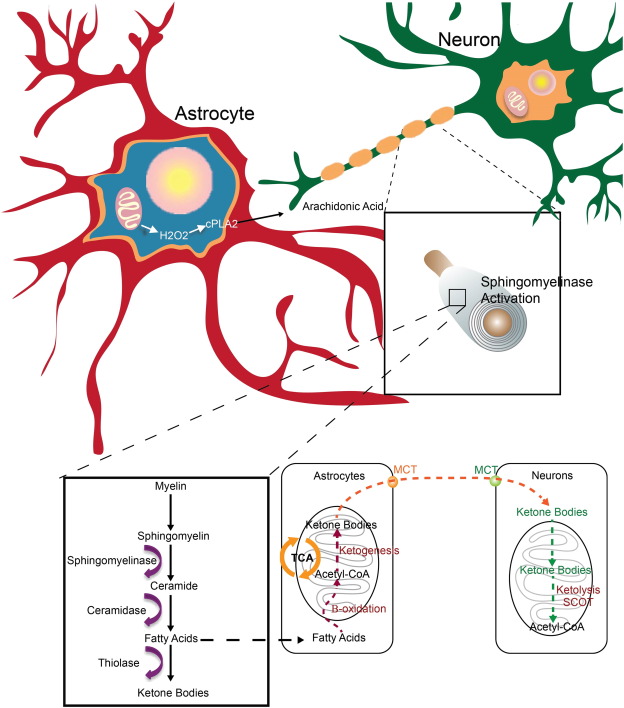
Findings from this study replicate our earlier findings that age of reproductive senescence is associated with decline in mitochondrial respiration, increased H2O2 production and shift to ketogenic metabolism in brain (Yao et al., 2010, Ding et al., 2013, Yin et al., 2015). These well established early age-related changes in mitochondrial function and shift to ketone body utilization in brain, are now linked to a mechanistic pathway that connects early decline in mitochondrial respiration and H2O2 production to activation of the cPLA2-sphingomyelinase pathway to catabolize myelin lipids resulting in WM degeneration (Fig. 12). These lipids are sequestered in lipid droplets for subsequent use as a local source of ketone body generation via astrocyte mediated beta-oxidation of fatty acids. Astrocyte derived ketone bodies can then be transported to neurons where they undergo ketolysis to generate acetyl-CoA for TCA derived ATP generation required for synaptic and cell function (Fig. 12).

Thumbnail image of Fig. 12. Opens large image

http://www.ebiomedicine.com/cms/attachment/2040395791/2053874721/gr12.sml

Fig. 12

Schematic model of mitochondrial H2O2 activation of cPLA2-sphingomyelinase pathway as an adaptive response to provide myelin derived fatty acids as a substrate for ketone body generation: The cPLA2-sphingomyelinase pathway is proposed as a mechanistic pathway that links an early event, mitochondrial dysfunction and H2O2, in the prodromal/preclinical phase of Alzheimer’s with later stage development of pathology, white matter degeneration. Our findings demonstrate that an age dependent deficit in mitochondrial respiration and a concomitant rise in oxidative stress activate an adaptive cPLA2-sphingomyelinase pathway to provide myelin derived fatty acids as a substrate for ketone body generation to fuel an energetically compromised brain.

Biochemical evidence obtained from isolated whole brain mitochondria confirms that during reproductive senescence and in response to estrogen deprivation brain mitochondria decline in respiratory capacity (Yao et al., 2009, Yao et al., 2010, Brinton, 2008a, Brinton, 2008b, Swerdlow and Khan, 2009). A well-documented consequence of mitochondrial dysfunction is increased production of reactive oxygen species (ROS), specifically H2O2 (Boveris and Chance, 1973, Beal, 2005, Yin et al., 2014, Yap et al., 2009). While most research focuses on the damage generated by free radicals, in this case H2O2 functions as a signaling molecule to activate cPLA2, the initiating enzyme in the cPLA2-sphingomyelinase pathway (Farooqui and Horrocks, 2006, Han et al., 2003, Sun et al., 2004). In AD brain, increased cPLA2 immunoreactivity is detected almost exclusively in astrocytes suggesting that activation of the cPLA2-sphingomyelinase pathway is localized to astrocytes in AD, as opposed to the neuronal or oligodendroglial localization that is observed during apoptosis (Sun et al., 2004, Malaplate-Armand et al., 2006, Di Paolo and Kim, 2011, Stephenson et al., 1996,Stephenson et al., 1999). In our analysis, cPLA2 (Sanchez-Mejia and Mucke, 2010) activation followed the age-dependent rise in H2O2 production and was sustained at an elevated level.

Direct and robust activation of astrocytic cPLA2 by physiologically relevant concentrations of H2O2 was confirmed in vitro. Astrocytic involvement in the cPLA2-sphingomyelinase pathway was also indicated by an increase in cPLA2 positive astrocyte reactivity in WM tracts of reproductively incompetent mice. These data are consistent with findings from brains of persons with AD that demonstrate the same striking localization of cPLA2immunoreactivity within astrocytes, specifically in the hippocampal formation (Farooqui and Horrocks, 2004). While neurons and astrocytes contain endogenous levels of cPLA2, neuronal cPLA2 is activated by an influx of intracellular calcium, whereas astrocytic cPLA2 is directly activated by excessive generation of H2O2 (Sun et al., 2004, Xu et al., 2003, Tournier et al., 1997). Evidence of this cell type specific activation was confirmed by the activation of cPLA2 in astrocytes by H2O2 and the lack of activation in neurons. These data support that astrocytic, not neuronal, cPLA2 is the cellular mediator of the H2O2 dependent cPLA2-sphingomyelinase pathway activation and provide associative evidence supporting a role of astrocytic mitochondrial H2O2 in age-related WM catabolism.

The pattern of gene expression during the shift to reproductive senescence in the female mouse hippocampus recapitulates key observations in human AD brain tissue, specifically elevation in cPLA2, sphingomyelinase and ceramidase (Schaeffer et al., 2010, He et al., 2010, Li et al., 2014). Further, up-regulation of myelin synthesis, lipid metabolism and inflammatory genes in reproductively incompetent female mice is consistent with the gene expression pattern previously reported from aged male rodent hippocampus, aged female non-human primate hippocampus and human AD hippocampus (Blalock et al., 2003, Blalock et al., 2004, Blalock et al., 2010, Blalock et al., 2011, Kadish et al., 2009, Rowe et al., 2007). In these analyses of gene expression in aged male rodent hippocampus, aged female non-human primate hippocampus and human AD hippocampus down regulation of genes related to mitochondrial function, and up-regulation in multiple genes encoding for enzymes involved in ketone body metabolism occurred (Blalock et al., 2003, Blalock et al., 2004, Blalock et al., 2010, Blalock et al., 2011, Kadish et al., 2009, Rowe et al., 2007). The comparability across data derived from aging female mouse hippocampus reported herein and those derived from male rodent brain, female nonhuman brain and human AD brain strongly suggest that cPLA2-sphingomyelinase pathway activation, myelin sheath degeneration and fatty acid metabolism leading to ketone body generation is a metabolic adaptation that is generalizable across these naturally aging models and are evident in aged human AD brain. Collectively, these data support the translational relevance of findings reported herein.

Data obtained via immunohistochemistry, electron microscopy and MBP protein analyses demonstrated an age-related loss in myelin sheath integrity. Evidence for a loss of myelin structural integrity emerged in reproductively incompetent mice following activation of the cPLA2-sphingomyelinase pathway. The unraveling myelin phenotype observed following reproductive senescence and aging reported herein is consistent with the degenerative phenotype that emerges following exposure to the chemotherapy drug bortezomib which induces mitochondrial dysfunction and increased ROS generation (Carozzi et al., 2010, Cavaletti et al., 2007,Ling et al., 2003). In parallel to the decline in myelin integrity, lipid droplet density increased. In aged mice, accumulation of lipid droplets declined in parallel to the rise in ketone bodies consistent with the utilization of myelin-derived fatty acids to generate ketone bodies. Due to the sequential relationship between WM degeneration and lipid droplet formation, we posit that lipid droplets serve as a temporary storage site for myelin-derived fatty acids prior to undergoing β-oxidation in astrocytes to generate ketone bodies.

Microstructural alterations in myelin integrity were associated with alterations in the lipid profile of brain, indicative of WM degeneration resulting in release of myelin lipids. Sphingomyelin and galactocerebroside are two main lipids that compose the myelin sheath (Baumann and Pham-Dinh, 2001). Ceramide is common to both galactocerebroside and sphingomyelin and is composed of sphingosine coupled to a fatty acid. Ceramide levels increase in aging, in states of ketosis and in neurodegeneration (Filippov et al., 2012, Blazquez et al., 1999, Costantini et al., 2005). Specifically, ceramide levels are elevated at the earliest clinically recognizable stage of AD, indicating a degree of WM degeneration early in disease progression (Di Paolo and Kim, 2011,Han et al., 2002, Costantini et al., 2005). Sphingosine is statistically significantly elevated in the brains of AD patients compared to healthy controls; a rise that was significantly correlated with acid sphingomyelinase activity, Aβ levels and tau hyperphosphorylation (He et al., 2010). In our analyses, a rise in ceramides was first observed early in the aging process in reproductively incompetent mice. The rise in ceramides was coincident with the emergence of loss of myelin integrity consistent with the release of myelin ceramides from sphingomyelin via sphingomyelinase activation. Following the rise in ceramides, sphingosine and fatty acid levels increased. The temporal sequence of the lipid profile was consistent with gene expression indicating activation of ceramidase for catabolism of ceramide into sphingosine and fatty acid during reproductive senescence. Once released from ceramide, fatty acids can be transported into the mitochondrial matrix of astrocytes via CPT-1, where β-oxidation of fatty acids leads to the generation of acetyl-CoA (Glatz et al., 2010). It is well documented that acetyl-CoA cannot cross the inner mitochondrial membrane, thus posing a barrier to direct transport of acetyl-CoA generated by β-oxidation into neurons. In response, the newly generated acetyl-CoA undergoes ketogenesis to generate ketone bodies to fuel energy demands of neurons (Morris, 2005,Guzman and Blazquez, 2004, Stacpoole, 2012). Because astrocytes serve as the primary location of β-oxidation in brain they are critical to maintaining neuronal metabolic viability during periods of reduced glucose utilization (Panov et al., 2014, Ebert et al., 2003, Guzman and Blazquez, 2004).

Once fatty acids are released from myelin ceramides, they are transported into astrocytic mitochondria by CPT1 to undergo β-oxidation. The mitochondrial trifunctional protein HADHA catalyzes the last three steps of mitochondrial β-oxidation of long chain fatty acids, while mitochondrial ABAD (aka SCHAD—short chain fatty acid dehydrogenase) metabolizes short chain fatty acids. Concurrent with the release of myelin fatty acids in aged female mice, CPT1, HADHA and ABAD protein expression as well as ketone body generation increased significantly. These findings indicate that astrocytes play a pivotal role in the response to bioenergetic crisis in brain to activate an adaptive compensatory system that activates catabolism of myelin lipids and the metabolism of those lipids into fatty acids to generate ketone bodies necessary to fuel neuronal demand for acetyl-CoA and ATP.

Collectively, these findings provide a mechanistic pathway that links mitochondrial dysfunction and H2O2generation in brain early in the aging process to later stage white matter degeneration. Astrocytes play a pivotal role in providing a mechanistic strategy to address the bioenergetic demand of neurons in the aging female brain. While this pathway is coincident with reproductive aging in the female brain, it is likely to have mechanistic translatability to the aging male brain. Further, the mechanistic link between bioenergetic decline and WM degeneration has potential relevance to other neurological diseases involving white matter in which postmenopausal women are at greater risk, such as multiple sclerosis. The mechanistic pathway reported herein spans time and is characterized by a progression of early adaptive changes in the bioenergetic system of the brain leading to WM degeneration and ketone body production. Translationally, effective therapeutics to prevent, delay and treat WM degeneration during aging and Alzheimer’s disease will need to specifically target stages within the mechanistic pathway described herein. The fundamental initiating event is a bioenergetic switch from being a glucose dependent brain to a glucose and ketone body dependent brain. It remains to be determined whether it is possible to prevent conversion to or reversal of a ketone dependent brain. Effective therapeutic strategies to intervene in this process require biomarkers of bioenergetic phenotype of the brain and stage of mechanistic progression. The mechanistic pathway reported herein may have relevance to other age-related neurodegenerative diseases characterized by white matter degeneration such as multiple sclerosis.

Blood. 2015 Oct 15;126(16):1925-9.    http://dx.doi.org:/10.1182/blood-2014-12-617498. Epub 2015 Aug 14.
Targeting the leukemia cell metabolism by the CPT1a inhibition: functional preclinical effects in leukemias.
Cancer cells are characterized by perturbations of their metabolic processes. Recent observations demonstrated that the fatty acid oxidation (FAO) pathway may represent an alternative carbon source for anabolic processes in different tumors, therefore appearing particularly promising for therapeutic purposes. Because the carnitine palmitoyl transferase 1a (CPT1a) is a protein that catalyzes the rate-limiting step of FAO, here we investigated the in vitro antileukemic activity of the novel CPT1a inhibitor ST1326 on leukemia cell lines and primary cells obtained from patients with hematologic malignancies. By real-time metabolic analysis, we documented that ST1326 inhibited FAO in leukemia cell lines associated with a dose- and time-dependent cell growth arrest, mitochondrial damage, and apoptosis induction. Data obtained on primary hematopoietic malignant cells confirmed the FAO inhibition and cytotoxic activity of ST1326, particularly on acute myeloid leukemia cells. These data suggest that leukemia treatment may be carried out by targeting metabolic processes.
Oncogene. 2015 Oct 12.   http://dx.doi.org:/10.1038/onc.2015.394. [Epub ahead of print]
Tumour-suppression function of KLF12 through regulation of anoikis.
Suppression of detachment-induced cell death, known as anoikis, is an essential step for cancer metastasis to occur. We report here that expression of KLF12, a member of the Kruppel-like family of transcription factors, is downregulated in lung cancer cell lines that have been selected to grow in the absence of cell adhesion. Knockdown of KLF12 in parental cells results in decreased apoptosis following cell detachment from matrix. KLF12 regulates anoikis by promoting the cell cycle transition through S phase and therefore cell proliferation. Reduced expression levels of KLF12 results in increased ability of lung cancer cells to form tumours in vivo and is associated with poorer survival in lung cancer patients. We therefore identify KLF12 as a novel metastasis-suppressor gene whose loss of function is associated with anoikis resistance through control of the cell cycle.
Mol Cell. 2015 Oct 14. pii: S1097-2765(15)00764-9. doi: 10.1016/j.molcel.2015.09.025. [Epub ahead of print]
PEPCK Coordinates the Regulation of Central Carbon Metabolism to Promote Cancer Cell Growth.
Phosphoenolpyruvate carboxykinase (PEPCK) is well known for its role in gluconeogenesis. However, PEPCK is also a key regulator of TCA cycle flux. The TCA cycle integrates glucose, amino acid, and lipid metabolism depending on cellular needs. In addition, biosynthetic pathways crucial to tumor growth require the TCA cycle for the processing of glucose and glutamine derived carbons. We show here an unexpected role for PEPCK in promoting cancer cell proliferation in vitro and in vivo by increasing glucose and glutamine utilization toward anabolic metabolism. Unexpectedly, PEPCK also increased the synthesis of ribose from non-carbohydrate sources, such as glutamine, a phenomenon not previously described. Finally, we show that the effects of PEPCK on glucose metabolism and cell proliferation are in part mediated via activation of mTORC1. Taken together, these data demonstrate a role for PEPCK that links metabolic flux and anabolic pathways to cancer cell proliferation.
Mol Cancer Res. 2015 Oct;13(10):1408-20.   http://dx.doi.org:/10.1158/1541-7786.MCR-15-0048. Epub 2015 Jun 16.
Disruption of Proline Synthesis in Melanoma Inhibits Protein Production Mediated by the GCN2 Pathway.
Many processes are deregulated in melanoma cells and one of those is protein production. Although much is known about protein synthesis in cancer cells, effective ways of therapeutically targeting this process remain an understudied area of research. A process that is upregulated in melanoma compared with normal melanocytes is proline biosynthesis, which has been linked to both oncogene and tumor suppressor pathways, suggesting an important convergent point for therapeutic intervention. Therefore, an RNAi screen of a kinase library was undertaken, identifying aldehyde dehydrogenase 18 family, member A1 (ALDH18A1) as a critically important gene in regulating melanoma cell growth through proline biosynthesis. Inhibition of ALDH18A1, the gene encoding pyrroline-5-carboxylate synthase (P5CS), significantly decreased cultured melanoma cell viability and tumor growth. Knockdown of P5CS using siRNA had no effect on apoptosis, autophagy, or the cell cycle but cell-doubling time increased dramatically suggesting that there was a general slowdown in cellular metabolism. Mechanistically, targeting ALDH18A1 activated the serine/threonine protein kinase GCN2 (general control nonderepressible 2) to inhibit protein synthesis, which could be reversed with proline supplementation. Thus, targeting ALDH18A1 in melanoma can be used to disrupt proline biosynthesis to limit cell metabolism thereby increasing the cellular doubling time mediated through the GCN2 pathway.  This study demonstrates that melanoma cells are sensitive to disruption of proline synthesis and provides a proof-of-concept that the proline synthesis pathway can be therapeutically targeted in melanoma tumors for tumor inhibitory efficacy. Mol Cancer Res; 13(10); 1408-20. ©2015 AACR.
SDHB-Deficient Cancers: The Role of Mutations That Impair Iron Sulfur Cluster Delivery.
BACKGROUND:  Mutations in the Fe-S cluster-containing SDHB subunit of succinate dehydrogenase cause familial cancer syndromes. Recently the tripeptide motif L(I)YR was identified in the Fe-S recipient protein SDHB, to which the cochaperone HSC20 binds.
METHODS:   In order to characterize the metabolic basis of SDH-deficient cancers we performed stable isotope-resolved metabolomics in a novel SDHB-deficient renal cell carcinoma cell line and conducted bioinformatics and biochemical screening to analyze Fe-S cluster acquisition and assembly of SDH in the presence of other cancer-causing SDHB mutations.

RESULTS:

We found that the SDHB(R46Q) mutation in UOK269 cells disrupted binding of HSC20, causing rapid degradation of SDHB. In the absence of SDHB, respiration was undetectable in UOK269 cells, succinate was elevated to 351.4±63.2 nmol/mg cellular protein, and glutamine became the main source of TCA cycle metabolites through reductive carboxylation. Furthermore, HIF1α, but not HIF2α, increased markedly and the cells showed a strong DNA CpG island methylator phenotype (CIMP). Biochemical and bioinformatic screening revealed that 37% of disease-causing missense mutations in SDHB were located in either the L(I)YR Fe-S transfer motifs or in the 11 Fe-S cluster-ligating cysteines.

CONCLUSIONS:

These findings provide a conceptual framework for understanding how particular mutations disproportionately cause the loss of SDH activity, resulting in accumulation of succinate and metabolic remodeling in SDHB cancer syndromes.


SR4 Uncouples Mitochondrial Oxidative Phosphorylation, Modulates AMPK-mTOR Signaling, and Inhibits Proliferation of HepG2 Hepatocarcinoma Cells

  1. L. Figarola, J. Singhal, J. D. Tompkins, G. W. Rogers, C. Warden, D. Horne, A. D. Riggs, S. Awasthi and S. S. Singhal.

J Biol Chem. 2015 Nov 3, [epub ahead of print]


CD47 Receptor Globally Regulates Metabolic Pathways That Control Resistance to Ionizing Radiation

  1. W. Miller, D. R. Soto-Pantoja, A. L. Schwartz, J. M. Sipes, W. G. DeGraff, L. A. Ridnour, D. A. Wink and D. D. Roberts.

J Biol Chem. 2015 Oct 9, 290 (41): 24858-74.


Knockdown of PKM2 Suppresses Tumor Growth and Invasion in Lung Adenocarcinoma

  1. Sun, A. Zhu, L. Zhang, J. Zhang, Z. Zhong and F. Wang.

Int J Mol Sci. 2015 Oct 15, 16 (10): 24574-87.


EglN2 associates with the NRF1-PGC1alpha complex and controls mitochondrial function in breast cancer

  1. Zhang, C. Wang, X. Chen, M. Takada, C. Fan, X. Zheng, H. Wen, Y. Liu, C. Wang, R. G. Pestell, K. M. Aird, W. G. Kaelin, Jr., X. S. Liu and Q. Zhang.

EMBO J. 2015 Oct 22, [epub ahead of print]


Mitochondrial Genetics Regulate Breast Cancer Tumorigenicity and Metastatic Potential.

Current paradigms of carcinogenic risk suggest that genetic, hormonal, and environmental factors influence an individual’s predilection for developing metastatic breast cancer. Investigations of tumor latency and metastasis in mice have illustrated differences between inbred strains, but the possibility that mitochondrial genetic inheritance may contribute to such differences in vivo has not been directly tested. In this study, we tested this hypothesis in mitochondrial-nuclear exchange mice we generated, where cohorts shared identical nuclear backgrounds but different mtDNA genomes on the background of the PyMT transgenic mouse model of spontaneous mammary carcinoma. In this setting, we found that primary tumor latency and metastasis segregated with mtDNA, suggesting that mtDNA influences disease progression to a far greater extent than previously appreciated. Our findings prompt further investigation into metabolic differences controlled by mitochondrial process as a basis for understanding tumor development and metastasis in individual subjects. Importantly, differences in mitochondrial DNA are sufficient to fundamentally alter disease course in the PyMT mouse mammary tumor model, suggesting that functional metabolic differences direct early tumor growth and metastatic efficiency. Cancer Res; 75(20); 4429-36. ©2015 AACR.


Cancer Lett. 2015 Oct 29. pii: S0304-3835(15)00656-4.    http://dx.doi.org:/10.1016/j.canlet.2015.10.025. [Epub ahead of print]
Carboxyamidotriazole inhibits oxidative phosphorylation in cancer cells and exerts synergistic anti-cancer effect with glycolysis inhibition.

Targeting cancer cell metabolism is a promising strategy against cancer. Here, we confirmed that the anti-cancer drug carboxyamidotriazole (CAI) inhibited mitochondrial respiration in cancer cells for the first time and found a way to enhance its anti-cancer activity by further disturbing the energy metabolism. CAI promoted glucose uptake and lactate production when incubated with cancer cells. The oxidative phosphorylation (OXPHOS) in cancer cells was inhibited by CAI, and the decrease in the activity of the respiratory chain complex I could be one explanation. The anti-cancer effect of CAI was greatly potentiated when being combined with 2-deoxyglucose (2-DG). The cancer cells treated with the combination of CAI and 2-DG were arrested in G2/M phase. The apoptosis and necrosis rates were also increased. In a mouse xenograft model, this combination was well tolerated and retarded the tumor growth. The impairment of cancer cell survival was associated with significant cellular ATP decrease, suggesting that the combination of CAI and 2-DG could be one of the strategies to cause dual inhibition of energy pathways, which might be an effective therapeutic approach for a broad spectrum of tumors.


Cancer Immunol Res. 2015 Nov;3(11):1236-47.    http://dx.doi.org:/10.1158/2326-6066.CIR-15-0036. Epub 2015 May 29.
Inhibition of Fatty Acid Oxidation Modulates Immunosuppressive Functions of Myeloid-Derived Suppressor Cells and Enhances Cancer Therapies.

Myeloid-derived suppressor cells (MDSC) promote tumor growth by inhibiting T-cell immunity and promoting malignant cell proliferation and migration. The therapeutic potential of blocking MDSC in tumors has been limited by their heterogeneity, plasticity, and resistance to various chemotherapy agents. Recent studies have highlighted the role of energy metabolic pathways in the differentiation and function of immune cells; however, the metabolic characteristics regulating MDSC remain unclear. We aimed to determine the energy metabolic pathway(s) used by MDSC, establish its impact on their immunosuppressive function, and test whether its inhibition blocks MDSC and enhances antitumor therapies. Using several murine tumor models, we found that tumor-infiltrating MDSC (T-MDSC) increased fatty acid uptake and activated fatty acid oxidation (FAO). This was accompanied by an increased mitochondrial mass, upregulation of key FAO enzymes, and increased oxygen consumption rate. Pharmacologic inhibition of FAO blocked immune inhibitory pathways and functions in T-MDSC and decreased their production of inhibitory cytokines. FAO inhibition alone significantly delayed tumor growth in a T-cell-dependent manner and enhanced the antitumor effect of adoptive T-cell therapy. Furthermore, FAO inhibition combined with low-dose chemotherapy completely inhibited T-MDSC immunosuppressive effects and induced a significant antitumor effect. Interestingly, a similar increase in fatty acid uptake and expression of FAO-related enzymes was found in human MDSC in peripheral blood and tumors. These results support the possibility of testing FAO inhibition as a novel approach to block MDSC and enhance various cancer therapies. Cancer Immunol Res; 3(11); 1236-47. ©2015 AACR.


Ionizing radiation induces myofibroblast differentiation via lactate dehydrogenase

  1. L. Judge, K. M. Owens, S. J. Pollock, C. F. Woeller, T. H. Thatcher, J. P. Williams, R. P. Phipps, P. J. Sime and R. M. Kottmann.

Am J Physiol Lung Cell Mol Physiol. 2015 Oct 15, 309 (8): L879-87.


Vitamin C selectively kills KRAS and BRAF mutant colorectal cancer cells by targeting GAPDH

  1. Yun, E. Mullarky, C. Lu, K. N. Bosch, A. Kavalier, K. Rivera, J. Roper, Chio, II, E. G. Giannopoulou, C. Rago, A. Muley, J. M. Asara, J. Paik, O. Elemento, Z. Chen, D. J. Pappin, L. E. Dow, N. Papadopoulos, S. S. Gross and L. C. Cantley.

Science. 2015 Nov 5, [epub ahead of print]


Down-regulation of FBP1 by ZEB1-mediated repression confers to growth and invasion in lung cancer cells

  1. Zhang, J. Wang, H. Xing, Q. Li, Q. Zhao and J. Li.

Mol Cell Biochem. 2015 Nov 6, [epub ahead of print]


J Mol Cell Cardiol. 2015 Oct 23. pii: S0022-2828(15)30073-0.     http://dx.doi.org:/10.1016/j.yjmcc.2015.10.002. [Epub ahead of print]
GRK2 compromises cardiomyocyte mitochondrial function by diminishing fatty acid-mediated oxygen consumption and increasing superoxide levels.

The G protein-coupled receptor kinase-2 (GRK2) is upregulated in the injured heart and contributes to heart failure pathogenesis. GRK2 was recently shown to associate with mitochondria but its functional impact in myocytes due to this localization is unclear. This study was undertaken to determine the effect of elevated GRK2 on mitochondrial respiration in cardiomyocytes. Sub-fractionation of purified cardiac mitochondria revealed that basally GRK2 is found in multiple compartments. Overexpression of GRK2 in mouse cardiomyocytes resulted in an increased amount of mitochondrial-based superoxide. Inhibition of GRK2 increased oxygen consumption rates and ATP production. Moreover, fatty acid oxidation was found to be significantly impaired when GRK2 was elevated and was dependent on the catalytic activity and mitochondrial localization of this kinase. Our study shows that independent of cardiac injury, GRK2 is localized in the mitochondria and its kinase activity negatively impacts the function of this organelle by increasing superoxide levels and altering substrate utilization for energy production.


Br J Pharmacol. 2015 Oct 27. doi: 10.1111/bph.13377. [Epub ahead of print]
All-trans retinoic acid protects against doxorubicin-induced cardiotoxicity by activating the Erk2 signalling pathway.
BACKGROUND AND PURPOSE:

Doxorubicin (Dox) is a powerful antineoplastic agent for treating a wide range of cancers. However, doxorubicin cardiotoxicity of the heart has largely limited its clinical use. It is known that all-trans retinoic acid (ATRA) plays important roles in many cardiac biological processes, however, the protective effects of ATRA on doxorubicin cardiotoxicity remain unknown. Here, we studied the effect of ATRA on doxorubicin cardiotoxicity and underlying mechanisms.

EXPERIMENTAL APPROACHES:

Cellular viability assays, western blotting and mitochondrial respiration analyses were employed to evaluate the cellular response to ATRA in H9c2 cells and primary cardiomyocytes. Quantitative PCR (Polymerase Chain Reaction) and gene knockdown were performed to investigate the underlying molecular mechanisms of ATRA’s effects on doxorubicin cardiotoxicity.

KEY RESULTS:

ATRA significantly inhibited doxorubicin-induced apoptosis in H9c2 cells and primary cardiomyocytes. ATRA was more effective against doxorubicin cardiotoxicity than resveratrol and dexrazoxane. ATRA also suppressed reactive oxygen species (ROS) generation, and restored the expression level of mRNA and proteins in phase II detoxifying enzyme system: Nrf2 (nuclear factor-E2-related factor 2), MnSOD (manganese superoxide dismutase), HO-1 (heme oxygenase1) as well as mitochondrial function (mitochondrial membrane integrity, mitochondrial DNA copy numbers, mitochondrial respiration capacity, biogenesis and dynamics). Both Erk1/2 (extracellular signal-regulated kinase1/2) inhibitor (U0126) and Erk2 siRNA, but not Erk1 siRNA, abolished the protective effect of ATRA against doxorubicin-induced toxicity in H9c2 cells. Remarkably, ATRA did not compromise the anticancer efficacy of doxorubicin in gastric carcinoma cells.

CONCLUSION AND IMPLICATION:

ATRA protected cardiomyocytes against doxorubicin-induced toxicity by activating the Erk2 pathway without compromising the anticancer efficacy of doxorubicin. Therefore, ATRA may be a promising candidate as a cardioprotective agent against doxorubicin cardiotoxicity.


Proteomic and Biochemical Studies of Lysine Malonylation Suggest Its Malonic Aciduria-associated Regulatory Role in Mitochondrial Function and Fatty Acid Oxidation

  1. Colak, O. Pougovkina, L. Dai, M. Tan, H. Te Brinke, H. Huang, Z. Cheng, J. Park, X. Wan, X. Liu, W. W. Yue, R. J. Wanders, J. W. Locasale, D. B. Lombard, V. C. de Boer and Y. Zhao.

Mol Cell Proteomics. 2015 Nov 1, 14 (11): 3056-71.


Foxg1 localizes to mitochondria and coordinates cell differentiation and bioenergetics

  1. Pancrazi, G. Di Benedetto, L. Colombaioni, G. Della Sala, G. Testa, F. Olimpico, A. Reyes, M. Zeviani, T. Pozzan and M. Costa.

Proc Natl Acad Sci U S A. 2015 Oct 27, 112(45): 13910-5.


Evidence of Mitochondrial Dysfunction within the Complex Genetic Etiology of Schizophrenia

  1. E. Hjelm, B. Rollins, F. Mamdani, J. C. Lauterborn, G. Kirov, G. Lynch, C. M. Gall, A. Sequeira and M. P. Vawter.

Mol Neuropsychiatry. 2015 Nov 1, 1 (4): 201-219.


Metabolic Reprogramming Is Required for Myofibroblast Contractility and Differentiation

  1. Bernard, N. J. Logsdon, S. Ravi, N. Xie, B. P. Persons, S. Rangarajan, J. W. Zmijewski, K. Mitra, G. Liu, V. M. Darley-Usmar and V. J. Thannickal.

J Biol Chem. 2015 Oct 16, 290 (42): 25427-38.


J Biol Chem. 2015 Oct 23;290(43):25834-46.    http://dx.doi.org:/10.1074/jbc.M115.658815. Epub 2015 Sep 4.
Kinome Screen Identifies PFKFB3 and Glucose Metabolism as Important Regulators of the Insulin/Insulin-like Growth Factor (IGF)-1 Signaling Pathway.

The insulin/insulin-like growth factor (IGF)-1 signaling pathway (ISP) plays a fundamental role in long term health in a range of organisms. Protein kinases including Akt and ERK are intimately involved in the ISP. To identify other kinases that may participate in this pathway or intersect with it in a regulatory manner, we performed a whole kinome (779 kinases) siRNA screen for positive or negative regulators of the ISP, using GLUT4 translocation to the cell surface as an output for pathway activity. We identified PFKFB3, a positive regulator of glycolysis that is highly expressed in cancer cells and adipocytes, as a positive ISP regulator. Pharmacological inhibition of PFKFB3 suppressed insulin-stimulated glucose uptake, GLUT4 translocation, and Akt signaling in 3T3-L1 adipocytes. In contrast, overexpression of PFKFB3 in HEK293 cells potentiated insulin-dependent phosphorylation of Akt and Akt substrates. Furthermore, pharmacological modulation of glycolysis in 3T3-L1 adipocytes affected Akt phosphorylation. These data add to an emerging body of evidence that metabolism plays a central role in regulating numerous biological processes including the ISP. Our findings have important implications for diseases such as type 2 diabetes and cancer that are characterized by marked disruption of both metabolism and growth factor signaling.


FASEB J. 2015 Oct 19.    http://dx.doi.org:/pii: fj.15-276360. [Epub ahead of print]
Perm1 enhances mitochondrial biogenesis, oxidative capacity, and fatigue resistance in adult skeletal muscle.

Skeletal muscle mitochondrial content and oxidative capacity are important determinants of muscle function and whole-body health. Mitochondrial content and function are enhanced by endurance exercise and impaired in states or diseases where muscle function is compromised, such as myopathies, muscular dystrophies, neuromuscular diseases, and age-related muscle atrophy. Hence, elucidating the mechanisms that control muscle mitochondrial content and oxidative function can provide new insights into states and diseases that affect muscle health. In past studies, we identified Perm1 (PPARGC1- and ESRR-induced regulator, muscle 1) as a gene induced by endurance exercise in skeletal muscle, and regulating mitochondrial oxidative function in cultured myotubes. The capacity of Perm1 to regulate muscle mitochondrial content and function in vivo is not yet known. In this study, we use adeno-associated viral (AAV) vectors to increase Perm1 expression in skeletal muscles of 4-wk-old mice. Compared to control vector, AAV1-Perm1 leads to significant increases in mitochondrial content and oxidative capacity (by 40-80%). Moreover, AAV1-Perm1-transduced muscles show increased capillary density and resistance to fatigue (by 33 and 31%, respectively), without prominent changes in fiber-type composition. These findings suggest that Perm1 selectively regulates mitochondrial biogenesis and oxidative function, and implicate Perm1 in muscle adaptations that also occur in response to endurance exercise.-Cho, Y., Hazen, B. C., Gandra, P. G., Ward, S. R., Schenk, S., Russell, A. P., Kralli, A. Perm1 enhances mitochondrial biogenesis, oxidative capacity, and fatigue resistance in adult skeletal muscle.


A conserved MADS-box phosphorylation motif regulates differentiation and mitochondrial function in skeletal, cardiac, and smooth muscle cells.
Exposure to metabolic disease during fetal development alters cellular differentiation and perturbs metabolic homeostasis, but the underlying molecular regulators of this phenomenon in muscle cells are not completely understood. To address this, we undertook a computational approach to identify cooperating partners of the myocyte enhancer factor-2 (MEF2) family of transcription factors, known regulators of muscle differentiation and metabolic function. We demonstrate that MEF2 and the serum response factor (SRF) collaboratively regulate the expression of numerous muscle-specific genes, including microRNA-133a (miR-133a). Using tandem mass spectrometry techniques, we identify a conserved phosphorylation motif within the MEF2 and SRF Mcm1 Agamous Deficiens SRF (MADS)-box that regulates miR-133a expression and mitochondrial function in response to a lipotoxic signal. Furthermore, reconstitution of MEF2 function by expression of a neutralizing mutation in this identified phosphorylation motif restores miR-133a expression and mitochondrial membrane potential during lipotoxicity. Mechanistically, we demonstrate that miR-133a regulates mitochondrial function through translational inhibition of a mitophagy and cell death modulating protein, called Nix. Finally, we show that rodents exposed to gestational diabetes during fetal development display muscle diacylglycerol accumulation, concurrent with insulin resistance, reduced miR-133a, and elevated Nix expression, as young adult rats. Given the diverse roles of miR-133a and Nix in regulating mitochondrial function, and proliferation in certain cancers, dysregulation of this genetic pathway may have broad implications involving insulin resistance, cardiovascular disease, and cancer biology.


Read Full Post »

Rheumatoid arthritis update

Rheumatoid arthritis update

Larry H. Bernstein, MD, FCAP, Curator

LPBI


Innovation update: Advancing the standard of care in rheumatoid arthritis 

Old innovation makes way for new innovation

Twenty years ago, the standard of care for RA was some combination of basic NSAIDS, along with methotrexate. Caregivers focused on symptom relief, and it was widely understood that many patients would fail to achieve remission. As the disease developed, patients would eventually develop severely life-limiting disabilities as their disease progressed.

During this period, researchers presenting at conferences grew excited about data on a new class of drugs known as anti-tumor necrosis factor (TNF) antibodies. In an article published in Acta Orthopaedica Scandinavica in 1995, two physician-researchers wrote the following:

“Primary results have recently been published on the use of anti-TNF monoclonal antibodies. In a controlled trial these antibodies were able to significantly influence a number of disease-activity variables in RA. An important observation was that the clinical effect lasted from weeks to, in some cases, months.  Although the potential of these agents for clinical use is still uncertain, these observations suggest that interfering with certain targets of the immune-inflammatory process is possible, effective and so far without side effects.”

About four years after Drs. Van de Putte and Van Riel extolled the virtues of disease-modifying biologics in clinical trials, the first anti-TNF antibody, Remicade (infliximab) was approved in 1999. At that point, the standard of care for RA improved significantly, forever changing the treatment paradigm for patients with RA.


The expanding class of JAK inhibitors

At this year’s ACR meeting, researchers  focused on  anti-inflammatory antibodies and a relatively new class of oral drugs known as janus kinase (JAK) inhibitors.  Interest in JAK inhibitors has spiked since the approval of Pfizer’s oral medication Xeljanz (tofacitinib) —the first, and currently the only, JAK inhibitor approved for the treatment of moderate-to-severe RA.JAK inhibitors have garnered interest because of the role they can play in expanding a treatment area dominated by synthetic and biologic disease-modifying anti-rheumatic drugs (DMARDs). Could JAK inhibitors provide the breakthrough in RA that the anti-TNF antibodies provided almost 20 years ago?

Currently, Eli Lilly and Incyte are in late-stage development of baricitinib, a JAK1/JAK2 inhibitor for treatment of RA. Until last December, Johnson & Johnson (J&J) and Astellas were working jointly on another JAK inhibitor, known as ASPO15K, but J&J exercised its opt-out option and left the partnership. Astellas vowed to go it alone or look for a new partner, but there have not been many updates on ASPO15K within the last year.


Innovation means understanding and responding to unmet needs

Like many other therapeutic areas, RA treatments are often used in combination. For some patients, the combination of methotrexate and a powerful biologic, such as Remicade (infliximab), will help a patient achieve remission Yet others will either not respond to methotrexate and Remicade, or will have a negative reaction. Understanding how to help nonresponders achieve relief has become a key area of research in RA.

According to Terence Rooney, MD, Medical Director at Lilly Bio-Medicines, “A substantial proportion of patients treated with methotrexate – commonly used across the disease continuum for 25 years – do not achieve satisfactory disease control, signaling a need for more effective RA treatment options. In addition, studies have shown that some patients who initially respond to biologics lose response over time, and approximately 40 percent of patients with high disease activity never respond adequately to TNF antagonist biologics.”


Innovative clinical trial design

As Lilly and Incyte approach the end of the development process for baricitinib, they have been collecting results from clinical trials designed to both establish basic efficacy and safety in placebo-controlled and comparator trials, and to obtain data on targeted patient populations.

According to Rooney, “The baricitinib phase three program investigated the benefit of baricitinib across the spectrum of patients with rheumatoid arthritis, including newly diagnosed patients, patients who had failed to respond to conventional DMARDs, and patients who had failed multiple injectable biologic DMARD therapies.”

“In addition, the phase 3 program included two 52-week studies that incorporated either methotrexate or adalimumab as active comparators to provide useful information for therapeutic positioning of baricitinib. In these studies, baricitinib was statistically superior to methotrexate and to adalimumab in improving signs and symptoms, physical function, and important patient-reported outcomes including pain, fatigue and stiffness.”

Rooney also pointed out that there is additional data establishing baricitinib as a DMARD that significantly inhibits progressive radiographic joint damage.


Experience plus evidence equals more innovation

As has become the norm, companies at ACR often highlight new data confirming the efficacy and safety of already approved drugs in larger patient populations and in real-world settings..

Lilly currently has data on more than 40,000 patients worldwide, reflecting its global ambitions. Assuming that baricitinib is approved next year (the goal is to file at the end of the year), Lilly will continue to present data at ACR in the coming years highlighting the results of its long-term extension study, RA-BEYOND.


Pfizer’s up-to-date Xeljanz data presentation at ACR

Although Xeljanz has been on the market for three years in more than 40 countries, Pfizer continues to focus on collecting new data and using it to expand use of Xeljanz. In fact, Pfizer had 20 abstracts focused solely on Xeljanz at ACR 2015.

According to Rory O’Connor, MD, Senior Vice President and Head of Global Medical Affairs, Global Innovative Pharmaceuticals Business, Pfizer, “Ongoing clinical trials and long-term extension studies provide important information about the safety and efficacy of Xeljanz in RA. We are focused on continuing to build on our knowledge of the clinical application of Xeljanz in real-world settings.”

Pfizer was also able to highlight new data that supports their recent NDA for Xeljanz XR, a once-daily formulation of Xeljanz, which is currently approved as a twice-daily dosing formulation.


JAK inhibition beyond RA

One of the most exciting things about the progress with JAK inhibitors is the possibility to innovate treatments beyond RA. Lilly has been exploring the role of JAK-dependent cytokines in the pathogenesis of numerous inflammatory and autoimmune diseases. The company also plans to meet with regulatory authorities to develop a pediatric program for juvenile RA and idiopathic arthritis.

Meanwhile, Pfizer has developed a broad portfolio of various JAK inhibitors and therapies with new modes of action. Already, Pfizer researchers have completed two phase three studies in ulcerative colitis and the top-line results have been positive.

Medical meetings are exciting, because they provide a forum for discussing breakthroughs and portending a future in which the standard of care improves. For companies like Lilly, Incyte, and Pfizer, continual development of more novel approaches to serious diseasesis like a call-response echo chamber in which innovation drives more innovation, resulting in better long-term outcomes for patients.


The JAK/STAT signaling pathway
, ,

http://d1dvw62tmnyoft.cloudfront.net/content/joces/117/8/1281/F1.large.jpg


In addition to the principal components of the pathway, other effector proteins have been identified that contribute to at least a subset of JAK/STAT signaling events. STAMs (signal-transducing adapter molecules) are adapter molecules with conserved VHS and SH3 domains (Lohi and Lehto, 2001). STAM1 and STAM2A can be phosphorylated by JAK1-JAK3 in a manner that is dependent on a third domain present in some STAMs, the ITAM (inducible tyrosine-based activation motif). Through a poorly understood mechanism, the STAMs facilitate the transcriptional activation of specific target genes, including MYC. A second adapter that facilitates JAK/STAT pathway activation is StIP (stat-interacting protein), a WD40 protein. StIPs can associate with both JAKs and unphosphorylated STATs, perhaps serving as a scaffold to facilitate the phosphorylation of STATs by JAKs. A third class of adapter with function in JAK/STAT signaling is the SH2B/Lnk/APS family. These proteins contain both pleckstrin homology and SH2 domains and are also substrates for JAK phosphorylation. Both SH2-Bβ and APS associate with JAKs, but the former facilitates JAK/STAT signaling while the latter inhibits it. The degree to which each of these adapter families contributes to JAK/STAT signaling is not yet well understood, but it is clear that various proteins outside the basic pathway machinery influence JAK/STAT signaling.

In addition to JAK/STAT pathway effectors, there are three major classes of negative regulator: SOCS (suppressors of cytokine signaling), PIAS (protein inhibitors of activated stats) and PTPs (protein tyrosine phosphatases) (reviewed by Greenhalgh and Hilton, 2001). Perhaps the simplest are the tyrosine phosphatases, which reverse the activity of the JAKs. The best characterized of these is SHP-1, the product of the mouse motheaten gene. SHP-1 contains two SH2 domains and can bind to either phosphorylated JAKs or phosphorylated receptors to facilitate dephosphorylation of these activated signaling molecules. Other tyrosine phosphatases, such as CD45, appear to have a role in regulating JAK/STAT signaling through a subset of receptors.

SOCS proteins are a family of at least eight members containing an SH2 domain and a SOCS box at the C-terminus (reviewed by Alexander, 2002). In addition, a small kinase inhibitory region located N-terminal to the SH2 domain has been identified for SOCS1 and SOCS3. The SOCS complete a simple negative feedback loop in the JAK/STAT circuitry: activated STATs stimulate transcription of the SOCS genes and the resulting SOCS proteins bind phosphorylated JAKs and their receptors to turn off the pathway. The SOCS can affect their negative regulation by three means. First, by binding phosphotyrosines on the receptors, SOCS physically block the recruitment of signal transducers, such as STATs, to the receptor. Second, SOCS proteins can bind directly to JAKs or to the receptors to specifically inhibit JAK kinase activity. Third, SOCS interact with the elongin BC complex and cullin 2, facilitating the ubiquitination of JAKs and, presumably, the receptors. Ubiquitination of these targets decreases their stability by targeting them for proteasomal degradation.

The third class of negative regulator is the PIAS proteins: PIAS1, PIAS3, PIASx and PIASy. These proteins have a Zn-binding RING-finger domain in the central portion, a well-conserved SAP (SAF-A/Acinus/PIAS) domain at the N-terminus, and a less-well-conserved carboxyl domain. The latter domains are involved in target protein binding. The PIAS proteins bind to activated STAT dimers and prevent them from binding DNA. The mechanism by which PIAS proteins act remains unclear. However, PIAS proteins have recently been demonstrated to associate with the E2 conjugase Ubc9 and to have E3 conjugase activity for sumoylation that is mediated by the RING finger domain (reviewed by Jackson, 2001). Although there is evidence that STATs can be modified by sumoylation (Rogers et al., 2003), the function of that modification in negative regulation is not yet known.

Although the mechanism of JAK/STAT signaling is relatively simple in theory, the biological consequences of pathway activation are complicated by interactions with other signaling pathways (reviewed by Heinrich et al., 2003; Rane and Reddy, 2000; Shuai, 2000). An understanding of this cross-talk is only beginning to emerge, but the best characterized interactions of the JAK/STAT pathway are with the receptor tyrosine kinase (RTK)/Ras/MAPK (mitogen-activated protein kinase) pathway. The relationship between these cascades is complex and their paths cross at multiple levels, each enhancing activation of the other. First, activated JAKs can phosphorylate tyrosines on their associated receptors that can serve as docking sites for SH2-containing adapter proteins from other signaling pathways. These include SHP-2 and Shc, which recruit the GRB2 adapter and stimulate the Ras cascade. The same mechanism stimulates other cascades, such as the recruitment and JAK phosphorylation of insulin receptor substrate (IRS) and p85, which results in the activation of the phosphoinositide 3-kinase (PI3K) pathway [for more on PI3K signaling, see Foster et al. (Foster et al., 2003)]. JAK/STAT signaling also indirectly promotes Ras signaling through the transcriptional activation of SOCS3. SOCS3 binds RasGAP, a negative regulator of Ras signaling, and reduces its activity, thereby promoting activation of the Ras pathway. Reciprocally, RTK pathway activity promotes JAK/STAT signaling by at least two mechanisms. First, the activation of some RTKs, including EGFR and PDGFR, results in the JAK-independent tyrosine phosphorylation of STATs, probably by the Src kinase. Second, RTK/Ras pathway stimulation causes the downstream activation of MAPK. MAPK specifically phosphorylates a serine near the C-terminus of most STATs. While not absolutely necessary for STAT activity, this serine phosphorylation dramatically enhances transcriptional activation by STAT. In addition to RTK and PI3K interactions with JAK/STAT signaling, multiple levels of cross-talk with the TGF-β signaling pathway have been recently reported [for a review of TGF-β, see (Moustakas, 2002)]. Furthermore, the functions of activated STATs can be altered through association with other transcription factors and cofactors that are regulated by other signaling pathways. Thus the integration of input from many signaling pathways must be considered if we are to understand the biological consequences of cytokine stimulation.

References

…..


https://youtu.be/9JHBHSHaBeI

Published on 27 Feb 2014

The JAK/STAT secondary messenger signaliing pathway..
Presented by: Joseph Farahany, M.D


Jak/Stat Signaling Pathway


Jaks and Stats are critical components of many cytokine receptor systems; regulating growth, survival, differentiation, and pathogen resistance. An example of these pathways is shown for the IL-6 (or gp130) family of receptors, which coregulate B cell differentiation, plasmacytogenesis, and the acute phase reaction. Cytokine binding induces receptor dimerization, activating the associated Jaks, which phosphorylate themselves and the receptor. The phosphorylated sites on the receptor and Jaks serve as docking sites for the SH2-containing Stats, such as Stat3, and for SH2-containing proteins and adaptors that link the receptor to MAP kinase, PI3K/Akt, and other cellular pathways.

Phosphorylated Stats dimerize and translocate into the nucleus to regulate target gene transcription. Members of the suppressor of cytokine signaling (SOCS) family dampen receptor signaling via homologous or heterologous feedback regulation. Jaks or Stats can also participate in signaling through other receptor classes, as outlined in the Jak/Stat Utilization Table. Researchers have found Stat3 and Stat5 to be constitutively activated by tyrosine kinases other than Jaks in several solid tumors

The Jak/Stat pathway mediates the effects of cytokines, like erythropoietin, thrombopoietin, and G-CSF, which are protein drugs for the treatment of anemia, thrombocytopenia, and neutropenia, respectively. The pathway also mediates signaling by interferons, which are used as antiviral and antiproliferative agents. Researchers have found that dysregulated cytokine signaling contributes to cancer. Aberrant IL-6 signaling contributes to the pathogenesis of autoimmune diseases, inflammation, and cancers such as prostate cancer and multiple myeloma. Jak inhibitors currently are being tested in models of multiple myeloma. Stat3 can act as an oncogene and is constitutively active in many tumors. Crosstalk between cytokine signaling and EGFR family members is seen in some cancer cells. Research has shown that in glioblastoma cells overexpressing EGFR, resistance to EGFR kinase inhibitors is induced by Jak2 binding to EGFR via the FERM domain of the former [Sci. Signal. (2013) 6, ra55].

Activating Jak mutations are major molecular events in human hematological malignancies. Researchers have found a unique somatic mutation in the Jak2 pseudokinase domain (V617F) that commonly occurs in polycythemia vera, essential thrombocythemia, and idiopathic myelofibrosis. This mutation results in the pathologic activation Jak2, associated with receptors for erythropoietin, thrombopoietin, and G-CSF, which control erythroid, megakaryocytic, and granulocytic proliferation and differentiation. Researchers have also shown that somatic acquired gain-of-function mutations of Jak1 are found in adult T cell acute lymphoblastic leukemia. Somatic activating mutations in Jak1, Jak2, and Jak3 have also been identified in pediatric acute lymphoblastic leukemia (ALL). Furthermore, Jak2 mutations have been detected around pseudokinase domain R683 (R683G or DIREED) in Down syndrome childhood B-ALL and pediatric B-ALL.

Selected Reviews:

– See more at: http://www.cellsignal.com/contents/science-pathway-research-immunology-and-inflammation/jak-stat-signaling-pathway/pathways-il6#sthash.8SVwSWXw.dpuf


The JAK-STAT Signaling Pathway: Input and Output Integration1

  1. Peter J. Murray

The Journal of Immunology Mar 1, 2007;  178(5): 2623-2629    http://dx.doi.org:/10.4049/​jimmunol.178.5.2623

Universal and essential to cytokine receptor signaling, the JAK-STAT pathway is one of the best understood signal transduction cascades. Almost 40 cytokine receptors signal through combinations of four JAK and seven STAT family members, suggesting commonality across the JAK-STAT signaling system. Despite intense study, there remain substantial gaps in understanding how the cascades are activated and regulated. Using the examples of the IL-6 and IL-10 receptors, I will discuss how diverse outcomes in gene expression result from regulatory events that effect the JAK1-STAT3 pathway, common to both receptors. I also consider receptor preferences by different STATs and interpretive problems in the use of STAT-deficient cells and mice. Finally, I consider how the suppressor of cytokine signaling (SOCS) proteins regulate the quality and quantity of STAT signals from cytokine receptors. New data suggests that SOCS proteins introduce additional diversity into the JAK-STAT pathway by adjusting the output of activated STATs that alters downstream gene activation.


The mammalian JAK and STAT family members have been extensively, and seemingly exhaustively, analyzed in the mouse and human systems. All four JAK and seven STAT family members have been deleted in the mouse, in addition to the creation of conditional alleles for genes whose loss of function leads to embryonic or perinatal lethality (Stat3, combined deficiency of Stat5a and Stat5b, and Jak2). In humans, detailed genetic studies have been performed in people bearing mutant Jak or Stat genes. Specific Abs to phospho-forms of each protein are used to study how the JAK-STAT cascade is activated by cytokine receptors. Crystallographic studies have illuminated structural information for multiple STAT family members in different forms. Pharmacological inhibitors have been developed for clinical use where JAK-STAT signaling is implicated in disease pathology and progression. Finally, in most cases, a specific JAK-STAT combination has been paired with each cytokine receptor, and this information translated into cell-type specific patterns of cytokine responsiveness and gene expression.

Major questions remain concerning how the JAK-STAT cascade functions to control specific gene expression patterns, and how the cascades are regulated. I will describe three elements of JAK-STAT signaling that require experimental investigation. First, I will address an unexpected experimental complication that arises from the analysis of mice and cells that lack one or more STAT family member. Second, I will use JAK1-STAT3 signaling from the IL-10R and IL-6R systems to illustrate that we lack detailed understanding of how specificity in gene expression is generated by receptors that use identical JAK-STAT members. Third, we have yet to explain how STAT activation is negatively regulated. Although the suppressor of cytokine signaling (SOCS)3 proteins are the best understood negative regulators of the JAK-STAT pathway, the biochemical mechanism of SOCS-mediated inhibition is unexplained. Moreover, additional inhibitory pathways have also been proposed to block the production of activated STATs. Collectively, I will argue that our understanding of the pathway from cytokine receptor to gene expression profile is in its infancy, but remains one of the best opportunities to dissect signal transduction.

Overview of the proximal JAK-STAT activation mechanism

The current model of JAK-STAT signaling holds that cytokine receptor engagement activates the associated JAK combination, which in turn phosphorylates the receptor cytoplasmic domain to allow recruitment of a STAT, which in turn is phosphorylated, dimerizes and moves to the nucleus to bind specific sequences in the genome and activate gene expression. Cytoplasmic domains of cytokine receptors associate with JAKs via JAK binding sites located close to the membrane (1). The postulated role of JAKs in trafficking or chaperoning the receptors to the cell surface is debated (2, 3, 4, 5, 6). Regardless of the when and where cytokine receptors and JAKs associate, their close apposition at the membrane is required to stimulate the kinase activity of the JAK following cytokine binding. At this stage in the activation of the pathway, we understand next to nothing about the structural basis of the JAK-receptor interaction, how receptor intracellular domains reorient upon cytokine binding and physically contact the JAK to receive the phosphorylation modification.

JAK-mediated phosphorylation of the receptor creates binding sites for the Src homology 2 (SH2) domains of the STATs. STAT recruitment is followed by tyrosine, and in some cases, serine phosphorylation on key residues (by the JAKs and other closely associated kinases) that leads to transit into the nucleus. This brief summary of the activation of the JAK-STAT pathway omits numerous unresolved details: the STAT monomer to dimer transition has been questioned, as has the role of phosphorylation in dimerization and nuclear transit (7). Furthermore, it is unclear how many configurations of STAT homo- and heterocomplexes are present in cells before, during, and after cytokine stimulation (8, 9,10). We do not understand the detailed structural basis for the preference of one SH2 domain for a given receptor, and we have little knowledge of how other non-JAK kinases are recruited to the receptors and phosphorylate the STATs.

Many receptors signal through a small number of JAKs

Cytokine receptors signal through two types of pathways: the JAK-STAT pathway and other pathways that usually involve the activation of the MAP kinase cascade. Although the latter will not be discussed here, it is worth noting that elegant genetic studies have demonstrated the importance of these pathways in various pathological systems (11, 12,13, 14). There are now ∼36 cytokine receptor combinations that respond to ∼38 cytokines (counting the type I IFNs as one because they all signal through the IFN-αβR). Different cells and tissues express distinct receptor combinations that respond to cytokine combinations unique to the microenvironment or systemic response of the organism. Hence, at any given time, a single cell may integrate signals from multiple cytokine receptors. Genetic studies have established that the cytokine receptor system is restrictive in that different classes of receptors preferentially use one JAK or JAK combination (7): receptors required for hemopoietic cell development and proliferation use JAK2, common γ-chain receptors use JAK1 and JAK3 whereas other receptors use only JAK1 (Fig. 1). Unexplained is the selective use of these combinations: why the IFN-γR rigidly uses the JAK1, JAK2 combination is unknown as is the restricted use of TYK2. Compared with JAK1–3, TYK2 is unusual in that loss of function mutations in the mouse have shown obligate, but not absolute, requirements in IFN-αβR and IL-12R signaling (15, 16). In contrast, human TYK2 seems to be essential for signaling through a broader range of cytokine receptors (17).


FIGURE 1.

FIGURE 1.

The majority of cytokine receptors use three JAK combinations. Shown are well-studied cases where JAK usage by each cytokine receptor has been established by genetic and biochemical studies. Exceptions shown are the G-CSFR (∗) where it is currently unclear whether both JAK1 and JAK2 are required together. Additionally, the IL-12R (†) and IL-23R (†) require TYK2 but the requirement for JAK2 has not been definitively determined. Receptors that use JAK2 and JAK3, JAK3 alone, TYK2 alone, or JAK3 and TYK2 have not been described.

The preferential association of JAKs to certain receptor classes raises several issues. First, how did the JAK-receptor combinations evolve? Because the number of receptors is relatively large, why has the number of JAKs remained small? Why have the combinations of JAK pairs also remained small given that there are 10 possible combinations that can be used (Fig. 1)? Second, how flexible is the cytokine receptor-JAK pair? That is, can receptors be engineered for interchangeable JAK use, or is a given JAK combination fixed for a specific receptor class? For example, can JAK1, JAK3, or TYK2 activate erythropoietin receptor (EpoR) signaling (if so engineered) or is JAK2 obligatory for signaling? These questions allude to a fundamental issue that concerns the function of the JAK in cytokine receptor activation: if the only function of the JAKs is to phosphorylate tyrosine resides on the cytoplasmic domain of the receptors, then it should be possible to trade JAK-receptor pairs. If these receptors retain identical downstream gene expression profiles, then the signal generated by the JAK is generic and functions primarily to activate the receptor (6). Conversely, it is also possible that each receptor-JAK combination retains crucial specificity functions and swapping, for example, JAK1 for JAK2 on the EpoR will modify or destroy a specific function in erythrogenesis. These questions can be addressed experimentally by replacing one preferred JAK binding site for another in genes encoding different receptors. The EpoR is a good test example because the activity of the receptor and its signaling pathway is essential for life and erythropoiesis is readily assayed.

Core versus cell-type specific STAT signaling

Microarray experiments designed to monitor changes in gene expression induced by JAK-STAT signaling have revealed that both cell-type specific transcription and core, or stereotypic, mRNA profiles are induced by activated cytokine receptors in different cell types (Fig. 2). For example, IFN-γ, via STAT1, induces the expression of a similar cohort of genes regardless of the cell type tested (18). These genes are often termed the “IFN signature” and overlap with the gene expression pattern induced by IFN-αβ signaling that also involves STAT1, in cooperation with STAT2 and IRF9. The IFN signature is readily observed in microarray experiments and is indicative of STAT1 activity. The STAT6 pathway activated by IL-4 or IL-13 provides an example of a cell-type specific response. IL-4-regulated genes in T cells have a distinct signature compared with IL-4/IL-13 signaling in macrophages or other non-lymphocytes (19, 20, 21, 22). In the latter, genes such as Arg1(encoding arginase 1) are often induced >100-fold but are silent in T cells (23, 24, 25, 26,27). Collectively these data argue that STATs activate defined gene sets, depending on their genomic accessibility, and possibly on cofactors that further refine gene expression profiles. STAT3 signaling illustrates a more complex system and will be discussed below to illustrate the distinctions between IL-6 and IL-10 signaling.


FIGURE 2.

FIGURE 2.

Core signaling by STATs. Representative examples of gene expression induced by STAT signaling in different tissues. The examples were extracted and edited from numerous microarray and empirical studies.

Interpreting experiments using STAT loss-of-function systems

Experiments with the different STAT knockout mice, and cells derived from these animals, have been critical for understanding specific requirements of individual STATs in gene expression following cytokine receptor signaling. The interpretation of these experiments is generally straightforward. For example, STAT5a and STAT5b are essential for the expression of genes that promote hemopoietic survival (28, 29, 30) whereas STAT1 is required for the expression of IFN-regulated genes that are involved in the protection against pathogens (18). However, by EMSA and immunoblotting experiments, most cytokines have been shown to activate multiple STATs, prompting experiments to determine transcriptional responses that can be activated in the absence of a given STAT. An initial example of this type of approach was performed by Schreiber and colleagues who interrogated gene expression profiles induced by IFN-γ signaling in the absence of STAT1 (31, 32). In these experiments, IFN-γ was used to stimulate STAT1-deficient bone marrow-derived macrophages and fibroblasts. Numerous genes were induced by IFN-γ in the absence of STAT1, leading to the conclusion that the IFN-γR activates a STAT1-independent gene expression program. However, inspection of the genes induced by IFN-γ signaling in STAT1-deficient cells shows many to be STAT3-regulated genes such asSocs3, Gadd45, and Cebpb. STAT3 phosphorylation is normally induced by IFN-γ in wild-type cells but in the absence of STAT1, STAT3 signaling is dominant. What is the mechanism of this effect? We now know from experiments using STAT-deficient cells that receptor occupancy, or lack of occupancy by the dominant STAT that binds the receptor, causes a switch from one activated STAT to another (33). A converse example is the conversion of IL-6R signaling to a dominant STAT1 activation in STAT3-deficient cells (34). This switch causes the downstream induction of the IFN gene expression pathway just as IFN-γ would cause in wild-type cells.

A related example is observed when IL-6 signaling is tested in the absence of SOCS3. SOCS3 is induced by STAT signaling from different cytokine receptors and functions as a feedback inhibitor of the IL-6R (and the G-CSFR, LIFR, and leptinR) by binding to phosphorylated Y757 on the gp130 cytoplasmic domain (see below). However in the absence of SOCS3, STAT3 phosphorylation is greatly increased (35, 36, 37). At the same time however, STAT1 phosphorylation is also induced, leading to a dominant IFN-like gene expression signature (35, 36). Thus SOCS3 regulates both the quantity and type of STAT signal generated from the IL-6R. Although the mechanism of the SOCS3 effect is unclear, the promiscuity of different receptors for different STATs argues that loss-of-function experiments must be carefully examined for the activation of other STAT molecules that fill the “hole” created by the loss of one STAT. These data also suggest that different cytokine receptors have evolved selectivity for different classes of STATs. Although STAT1 and STAT3 can apparently interchangeably bind the IL-6R or IFN-γR when either molecule is missing, signaling in wild-type cells shows a strong preference for one STAT over the other. Likewise, other receptors may have evolved to bind only one STAT, and in the absence of the key STAT, the other STATs cannot bind and/or be activated by the receptor.

The above examples primarily describe experiments using STAT1–STAT3-activating receptors but these are not isolated cases. In T cells stimulated by IL-12, STAT4 is activated and drives IFN-γ production. This pathway is a central regulatory event in the development of the Th1 type T cell responses. IFN-αβ, via the IFN-αβR, also activates STAT4 (in addition to STAT1 and STAT2 that forms a complex with IRF-9 to mediate anti-viral gene expression) but cannot activate strong IFN-γ production and therefore cannot drive Th1 development (38). However, in the absence of STAT1, IFN-αβ causes a large increase in IFN-γ production, especially in vivo during viral infection (39, 40). These data were originally interpreted to mean that STAT1 normally suppressed IFN-γ production. However, the data can just as easily be resolved when we consider that STAT4 activation from the IFN-αβR is increased in the absence of STAT1. Recent data confirm this interpretation but also show that STAT4 activation by the IFN-αβR, although increased, cannot sustain IFN-γ production from T cells when compared with IL-12 (38). This is probably because of the stronger differential activity of SOCS1 on the IFN-αβR versus the IL-12R (discussed below). I would predict that an IFN-αβR that is refractory to SOCS1 (or active in a Socs1−/− background) would behave identically to the IL-12R in the absence of STAT1.

Although loss of gene expression may be observed in a given STAT knockout, a corresponding increase in the ectopic activation of another STAT pathway may confound the interpretation of results in both in vitro and in vivo systems. Because specific Abs are available for each tyrosine-phosphorylated STAT molecule, a simple solution is to first measure which other STATs are activated by a given receptor in the absence of the STAT of interest. Experiments using STAT knockout systems should also be supported by additional data that uses complimentary mutations in the receptor that ablate STAT recruitment, or complete loss of the receptor. Finally, it is worth noting that the loss of a STAT pathway from a receptor signaling system can cause additional loss of key negative regulatory systems including feedback loops such as SOCS induction as presently debated for G-CSFR signaling and receptor systems discussed below (41, 42, 43, 44, 45).

  1. Negative regulation of the JAK-STAT signal
  2. Is there functional equivalence in signaling from receptors using the same JAK-STAT combination in the same cell?
  3. Future directions


FIGURE 3.

FIGURE 3.

Proposed differential STAT activation by IL-10 or IL-6. Shown are three classes of genes activated by STAT3 where Socs3 is a representative “common” gene induced by both receptors. In the absence of SOCS3, the IL-6R can activate the anti-inflammatory genes in the same way as the IL-10R. The mechanism of this effect remains to be established.


JAK/STAT Activation Inhibitors

The JAK/STAT pathway plays an important role in cytokine receptor-mediated signal transduction via activation of downstream signal transducers and activators of transcription (STAT), phosphatidylinositol 3-kinase (PI3K), and mitogen-activated protein kinase (MAPK) pathways.
These inhibitors are useful tools for exploring the contribution of JAK/STAT-mediated signaling.

Pathways of inhibition of JAK/STAT activation

JAK/STAT Activation Inhibitors

AG490 JAK2 inhibitor 10 mg
AZD1480 NEW! JAK1 & JAK2 inhibitor 5 mg
CP-690550 JAK3 Inhibitor 5 mg
CYT387 NEW! JAK1/JAK2 & TBK1/IKK-ε inhibitor 10 mg
Ruxolitinib JAK1 & JAK2 Inhibitor 5 mg


Methotrexate Is a JAK/STAT Pathway Inhibitor

Sally Thomas, Katherine H. Fisher, John A. Snowden, Sarah J. Danson, Stephen Brown, Martin P. Zeidler

PLOS   Published: July 1, 2015
DOI: http://dx.doi.org:/10.1371/journal.pone.0130078
Background 

The JAK/STAT pathway transduces signals from multiple cytokines and controls haematopoiesis, immunity and inflammation. In addition, pathological activation is seen in multiple malignancies including the myeloproliferative neoplasms (MPNs). Given this, drug development efforts have targeted the pathway with JAK inhibitors such as ruxolitinib. Although effective, high costs and side effects have limited its adoption. Thus, a need for effective low cost treatments remains.

Methods & Findings        

We used the low-complexity Drosophila melanogaster pathway to screen for small molecules that modulate JAK/STAT signalling. This screen identified methotrexate and the closely related aminopterin as potent suppressors of STAT activation. We show that methotrexate suppresses human JAK/STAT signalling without affecting other phosphorylation-dependent pathways. Furthermore, methotrexate significantly reduces STAT5 phosphorylation in cells expressing JAK2 V617F, a mutation associated with most human MPNs. Methotrexate acts independently of dihydrofolate reductase (DHFR) and is comparable to the JAK1/2 inhibitor ruxolitinib. However, cells treated with methotrexate still retain their ability to respond to physiological levels of the ligand erythropoietin.

Conclusions

Aminopterin and methotrexate represent the first chemotherapy agents developed and act as competitive inhibitors of DHFR. Methotrexate is also widely used at low doses to treat inflammatory and immune-mediated conditions including rheumatoid arthritis. In this low-dose regime, folate supplements are given to mitigate side effects by bypassing the biochemical requirement for DHFR. Although independent of DHFR, the mechanism-of-action underlying the low-dose effects of methotrexate is unknown. Given that multiple pro-inflammatory cytokines signal through the pathway, we suggest that suppression of the JAK/STAT pathway is likely to be the principal anti-inflammatory and immunosuppressive mechanism-of-action of low-dose methotrexate. In addition, we suggest that patients with JAK/STAT-associated haematological malignancies may benefit from low-dose methotrexate treatments. While the JAK1/2 inhibitor ruxolitinib is effective, a £43,200 annual cost precludes widespread adoption. With an annual methotrexate cost of around £32, our findings represent an important development with significant future potential.

Citation: Thomas S, Fisher KH, Snowden JA, Danson SJ, Brown S, Zeidler MP (2015) Methotrexate Is a JAK/STAT Pathway Inhibitor. PLoS ONE 10(7): e0130078.   http://dx.doi.org:/10.1371/journal.pone.0130078


Read Full Post »

Mirogabalin for diabetic neuropathy

Mirogabalin for diabetic neuropathy

Larry H. Bernstein, MD, FCAP, Curator

LPBI


Mirogabalin

by DR ANTHONY MELVIN CRASTO Ph.D


Mirogabalin, A-2000700, DS-5565
1138245-13-2, C12H19NO2, 209.28
[(1R,5S,6S)-6-(aminomethyl)-3-ethylbicyclo[3.2.0]hept-3-en-6-yl]acetic acid
2-[(1R,5S,6S)-6-(aminomethyl)-3-ethyl-6-bicyclo[3.2.0]hept-3-enyl]acetic acid
UNII-S7LK2KDM5U
Originator
Daiichi Sankyo
Therapeutic Claim
Treatment of fibromyalgia

Phase III clinical trials at Daiichi Sankyo for the treatment of pain associated with fibromyalgia


Class
Analgesic drugs (small molecules)
Mechanism of action
CACNA2D1 protein modulators


Mirogabalin (DS-5565) is a drug developed by Daiichi Sankyo and related to drugs such as gabapentin and pregabalin. Similarly to these drugs, mirogabalin binds to the α2δ calcium channels (1 and 2), but with significantly higher potency than pregabalin. It has shown promising results in Phase II clinical trials for the treatment of diabeticperipheral neuropathic pain,[1][2] and is currently in Phase III trials.

Mirogabalin, a voltage-dependent calcium channel subunit alpha-2/delta-1 ligand, is in phase III clinical trials at Daiichi Sankyo for the treatment of pain associated with fibromyalgia. The company is also conducting phase III clinical studies for the treatment of chronic pain and pain associated with diabetic peripheral neuropathy.

PATENTS

WO 2009041453

https://www.google.co.in/patents/EP2192109A1

JP 2010241796

WO 2012169475

WO 2012169474

WO2015005298

https://patentscope.wipo.int/search/en/detail.jsf


In the present invention, compounds having formula (IX) prepared via the process F from Step A (and / or its enantiomer) may be very produced as pure compounds. Compounds of formula (IX) which can be obtained by the present invention typically have a quality below.

The content of the diastereomer represented by the formula (X): 0.1% less than the content of the enantiomers represented by the formula (XI): 1.0% less than the formula (XII) and the double bond represented by the formula (XIII) The total content of regioisomers: less than 0.5% (Note that each content is calculated from the area percentage of the free form of formula (IX) (VII) in the by test High Performance Liquid Chromatography) [formula 23] [of 24]


 Next, the present invention is described by examples in detail, the present invention is, which however shall not be construed as limited thereto.
The internal standard substance in a magnetic resonance spectra (NMR), and using tetramethylsilane and abbreviations indicate the multiplicity, s = singlet, d = doublet, t = triplet, q = quartet, m = multiplet, and brs = It shows a broad singlet.
In the name of the compound, “R” and “S” indicate the absolute configuration at the asymmetric carbon. Furthermore, “RS” and “SR” indicates that the asymmetric carbon atom is racemic. In addition, “(1RS, and 5SR) -” if such a can shows the relative arrangement of the 1-position and the 5-position, as well shows only one of the diastereomers, its diastereomers are racemic We show that.
In the name of the compound, “E” and “Z” indicates the arrangement of positional isomers in the structure of the compound having a position isomerism.
“EZ” and “ZE” indicates that it is a mixture of regioisomers. Way more notation, is in accordance with the conventions in this area of the normal.

Read Full Post »

Cells Rhythmically Regulate Their Genes

Cells Rhythmically Regulate Their Genes

Larry H. Bernstein, MD, FCAP, Curator

LPBI


Cells Rhythmically Regulate Their Genes

http://www.technologynetworks.com/Genotyping/news.aspx?ID=184486

Study led by researchers at Caltech shows that pulsing can allow two proteins to interact with each other in a rhythmic fashion that allows them to control genes.


Even in a calm, unchanging environment, cells are not static. Among other actions, cells activate and then deactivate some types of transcription factors—proteins that control the expression of genes—in a series of unpredictable and intermittent pulses. Since discovering this pulsing phenomenon, scientists have wondered what functions it could provide for cells.

Now, a new study from Caltech researchers shows that pulsing can allow two proteins to interact with each other in a rhythmic fashion that allows them to control genes. Specifically, when the expression of the transcription factors goes in and out of sync, gene expression also goes up and down. These rhythms of activation, the researchers say, may also underlie core processes in the cells of organisms from across the kingdoms of life.

“The way transcription factor pulses sync up with one another in time could play an important role in allowing cells to process information, communicate with other cells, and respond to stress,” says paper coauthor Michael Elowitz, a professor of biology and biological engineering and an investigator with the Howard Hughes Medical Institute.


Msn2_green_Mig1_red-NEWS-WEB.jpg

http://www.technologynetworks.com/images/videos/News%20Images/PT/Msn2_green_Mig1_red-NEWS-WEB.jpg


The research was led by Caltech postdoctoral scholar Yihan Lin. Other Caltech authors of the paper are Assistant Professor of Chemistry Long Cai; Chang Ho Sohn, a staff scientist in the Cai lab; and Elowitz’s former graduate student Chiraj K. Dalal (PhD ’10), now at UC San Francisco.

Cai, Dalal, and Elowitz reported a functional role for transcription factor pulsing in 2008. In the meantime, researchers worldwide have been steadily uncovering similar surges of protein activity across diverse cell types and genetic systems.

Realizing that many different factors are pulsing in the same cell even in unchanging conditions, the Caltech scientists began to wonder if cells might adjust the relative timing of these pulses to enable a novel sort of time-based regulation. To find out, they set up time-lapse movies to follow two pulsing proteins and a target gene in real time in individual yeast cells.

The team tagged two central transcription factors named Msn2 and Mig1 with green and red fluorescent proteins, respectively. When the transcription factors are activated, they move into the nucleus, where they influence gene expression. This movement—as well as the activation of the factors—can be visualized because the fluorescent markers concentrate within the small volume of the nucleus, causing it to glow brightly, either green, red, or both. The color choice for the fluorescent tags was symbolic: Msn2 serves as an activator, and Mig1 as a repressor. “Msn2, the green factor, steps on the gas and turns up gene expression, while Mig1, the red factor, hits the brakes,” says Elowitz.

When the scientists stressed the yeast cells by adding heat, for example, or restricting food, the pulses of Msn2 and Mig1 changed their timing with respect to one another, with more or less frequent periods of overlap between their pulses, depending upon the stressing stimulus.

Generally, when the two transcription factors pulsed in synchrony, the repressor blocked the ability of the activator to turn on genes. “It’s like someone simultaneously pumping the gas and brake pedals in a car over and over again,” says Elowitz.

But when they were off-beat, with the activator pulsing without the repressor, gene expression increased. “When the cell alternates between the brake and the gas—the Msn2 transcription factor in this case—the car can move,” says Elowitz. As a result of these stress-altered rhythms, the cells successfully produced more (or fewer) copies of certain proteins that helped the yeast cope with the unpleasant situation.

Previously, researchers have thought that the relative concentrations of multiple transcription factors in the nucleus determine how they regulate a common gene target—a phenomenon known as combinatorial regulation. But the new study suggests that the relative timing of the pulses of transcription factors may be just as important as their concentration.

“Most genes in the cell are regulated by several transcription factors in a combinatorial fashion, as parts of a complex network,” says Cai. “What we’re now seeing is a new mode of regulation that controls the pulse timing of transcription factors, and this could be critical to understanding the combinatorial regulation in genetic networks.”

“There appears to be a layer of time-based regulation in the cell that, because it can only be observed with movies of individual cells, is still largely unexplored,” says Lin. “We look forward to learning more about this intriguing and underappreciated form of gene regulation.”

In future research, the scientists will try to understand how prevalent this newfound mode of time-based regulation is in a variety of cell types and will examine its involvement in gene regulation systems. In the context of synthetic biology—the harnessing and modification of biological systems for human technological applications—the researchers also hope to develop methods to control such pulsing to program new cellular behaviors.


Combinatorial gene regulation by modulation of relative pulse timing.
Nature. Nov 5, 2015; 527(7576):54-8. doi: 10.1038/nature15710. Epub 2015 Oct 14.
Studies of individual living cells have revealed that many transcription factors activate in dynamic, and often stochastic, pulses within the same cell. However, it has remained unclear whether cells might exploit the dynamic interaction of these pulses to control gene expression. Here, using quantitative single-cell time-lapse imaging of Saccharomyces cerevisiae, we show that the pulsatile transcription factors Msn2 and Mig1 combinatorially regulate their target genes through modulation of their relative pulse timing. The activator Msn2 and repressor Mig1 showed pulsed activation in either a temporally overlapping or non-overlapping manner during their transient response to different inputs, with only the non-overlapping dynamics efficiently activating target gene expression. Similarly, under constant environmental conditions, where Msn2 and Mig1 exhibit sporadic pulsing, glucose concentration modulated the temporal overlap between pulses of the two factors. Together, these results reveal a time-based mode of combinatorial gene regulation. Regulation through relative signal timing is common in engineering and neurobiology, and these results suggest that it could also function broadly within the signalling and regulatory systems of the cell.

Pulsatile Dynamics in the Yeast Proteome
Chiraj K. Dalal,1,2 Long Cai,1,2 Yihan Lin,1 Kasra Rahbar,1 and Michael B. Elowitz1, * 1
Howard Hughes Medical Institute, Division of Biology and Bioengineering, California Institute of Technology, Pasadena, CA 91125, USA

http://dx.doi.org/10.1016/j.cub.2014.07.076

Highlights

  • Pulsing is prevalent in the yeast proteome
  • Pulsing is specific to transcription factors
  • Pulsing regulates a large fraction of the genome

The activation of transcription factors in response to environmental conditions is fundamental to cellular regulation. Recent work has revealed that some transcription factors are activated in stochastic pulses of nuclear localization, rather than at a constant level, even in a constant environment [ 1–12 ]. In such cases, signals control the mean activity of the transcription factor by modulating the frequency, duration, or amplitude of these pulses. Although specific pulsatile transcription factors have been identified in diverse cell types, it has remained unclear how prevalent pulsing is within the cell, how variable pulsing behaviors are between genes, and whether pulsing is specific to transcriptional regulators or is employed more broadly. To address these issues, we performed a proteome-wide movie-based screen to systematically identify localization-based pulsing behaviors in Saccharomyces cerevisiae. The screen examined all genes in a previously developed fluorescent protein fusion library of 4,159 strains [ 13 ] in multiple media conditions. This approach revealed stochastic pulsing in ten proteins, all transcription factors. In each case, pulse dynamics were heterogeneous and unsynchronized among cells in clonal populations. Pulsing is the only dynamic localization behavior that we observed, and it tends to occur in pairs of paralogous and redundant proteins. Taken together, these results suggest that pulsatile dynamics play a pervasive role in yeast and may be similarly prevalent in other eukaryotic species.

Since most pulsing proteins are members of a pair of paralogous or functionally redundant transcription factors, one explanation for the evolution of pulsing is one in which pulsing is ancient and existed prior to the whole-genome duplication (estimated to be w80 million years ago [20]). Since then, pulsing appears to have been lost only in some proteins (Mig3 and Rtg3), and the paralogs that have retained the ability to pulse have changed in their dynamics (Figure 3). Alternatively, paralogs that both pulse could have acquired pulsatile regulation through shared regulatory inputs that later became pulsatile. Further work analyzing whether proteins orthologous to the pulsing transcription factors described here also pulse, specifically in species that diverged prior to the whole-genome duplication, will distinguish between these hypotheses.

Recent work shows that pulsatile regulation occurs in diverse mammalian systems including NF-AT [9], p53 [10], Erk signaling [11], TGF-b signaling [12], and NF-kB [22–24]. Moreover, many bacterial systems, such as persistence in Mycobacterium smegmatis [25] and bacterial competence [26], sporulation [27], and stress response in Bacillus subtilis [28], employ pulsing. The presence of pulsing in so many systems across a wide range of species suggests that pulsing may be a common solution to many biological problems. For example, pulsing has already been shown to proportionally regulate entire regulons of target genes [2, 7], implement transient differentiation [26, 29], enable a multi-cell-cycle timer [27], and promote bet-hedging [25]. Pulsing may provide a time-based mode of regulation that facilitates these and other functions [1].

Figure 3. Pulsing Is Variable Single-cell traces show that pulses vary from cell to cell (different colors on the same trace), from paralog to paralog (across columns) and from protein to protein (A–L). All traces are from the same movie that generated corresponding filmstrips in Figure 2. All traces have been smoothed. See also Figure S2 and Movie S1. pulsing may be a common solution to many biological problems. For example, pulsing has already been shown to proportionally regulate entire regulons of target genes [2, 7], implement transient differentiation [26, 29], enable a multi-cell-cycle timer [27], and promote bet-hedging [25]. Pulsing may provide a time-based mode of regulation that facilitates these and other functions [1].

Taken together, these observations reveal that pulsatility is surprisingly pervasive in cells. It will now be critical to determine its mechanisms and functions and understand how these dynamics are integrated into the core functions of living cells. Although recent work has provided new insights into Msn2 pulsing [3, 4, 7, 8, 30, 31] and other work has provided a mechanism for pulsatile activation of a sigma factor in bacteria [28], we still lack a full understanding of the mechanisms of pulse generation and modulation for any yeast transcription factor. Do different pulsing systems use a common type of mechanism for pulsing, or are there many distinct mechanisms that can generate similar pulse dynamics? Pulsatility appears to be a core regulatory mechanism in yeast and most likely in other cell types as well [9]. The pulsatile proteins identified here should provide a starting point for understanding the roles that this dynamic regulatory mechanism plays in diverse cell types.


The title places scientific facts in the correct direction. However, for fast regulatory responses (those that keeps cells alive), no change in gene expression is required.

Read Full Post »

Excess Eating, Overweight, and Diabetic

Excess Eating, Overweight, and Diabetic

Larry H Bernstein, MD, FCAP, Curator

LPBI


You Did NOT Eat Your Way to Diabetes!

http://www.phlaunt.com/diabetes/14046739.php


The myth that diabetes is caused by overeating also hurts the one out of five people who are not overweight when they contract Type 2 Diabetes. Because doctors only think “Diabetes” when they see a patient who fits the stereotype–the grossly obese inactive patient–they often neglect to check people of normal weight for blood sugar disorders even when they show up with classic symptoms of high blood sugar such as recurrent urinary tract infections or neuropathy.

Where Did This Toxic Myth Come From?

The way this myth originated is this: Because people with Type 2 Diabetes are often overweight and because many people who are overweight have a syndrome called “insulin resistance” in which their cells do not respond properly to insulin so that they require larger than normal amounts of insulin to lower their blood sugar, the conclusion was drawn years ago that insulin resistance was the cause of Type 2 Diabetes.

It made sense. Something was burning out the beta cells in these people, and it seemed logical that the something must be the stress of pumping out huge amounts of insulin, day after day. This idea was so compelling that it was widely believed by medical professionals, though few realized it had never been subjected to careful investigation by large-scale research.

That is why any time there is an article in the news about Type 2 Diabetes you are likely to read something that says, “While Type 1 diabetes (sometimes called Juvenile Diabetes) is a condition where the body does not produce insulin, Type 2 Diabetes is the opposite: a condition where the body produces far too much insulin because of insulin resistance caused by obesity.”

When your doctor tells you the same thing, the conclusion is inescapable: your overeating caused you to put on excess fat and that your excess fat is what made you diabetic.

Blaming the Victim

This line of reasoning leads to subtle, often unexpressed, judgmental decisions on the part of your doctor, who is likely to believe that had you not been such a pig, you would not have given yourself this unnecessary disease.

And because of this unspoken bias, unless you are able to “please” your doctor by losing a great deal of weight after your diagnosis you may find yourself treated with a subtle but callous disregard because of the doctor’s feeling that you brought this condition down on yourself. This bias is similar to that held by doctors who face patients who smoke a pack a day and get lung cancer and still refuse to stop smoking.

You also see this bias frequently expressed in the media. Articles on the “obesity epidemic” blame overeating for a huge increase in the number of people with diabetes, including children and teenagers who are pictured greedily gorging on supersized fast foods while doing no exercise more strenuous than channel surfing. In a society where the concepts “thin” and “healthy” have taken on the overtones of moral virtue and where the only one of the seven deadly sins that still inspires horror and condemnation is gluttony, being fat is considered by many as sure proof of moral weakness. So it is not surprising that the subtext of media coverage of obesity and diabetes is that diabetes is nothing less than the just punishment you deserve for being such a glutton.

Except that it’s not true.

Obesity Has Risen Dramatically While Diabetes Rates Have Not

The rate of obesity has grown alarmingly over the past decades, especially in certain regions of the U.S. The NIH reports that “From 1960-2 to 2005-6, the prevalence of obesity increased from 13.4 to 35.1 percent in U.S. adults age 20 to 74.7.”

If obesity was causing diabetes, you’d exect to see a similar rise in the diabetes rate. But this has not happened. The CDC reports that “From 1980 through 2010, the crude prevalence of diagnosed diabetes increased …from 2.5% to 6.9%.” However, if you look at the graph that accompanies this statement, you see that the rate of diabetes diagnoses rose only gradually through this period–to about 3.5% until it suddenly sped upward in the late 1990s. This sudden increase largely due to the fact that in 1998 the American Diabetes Association changed the criteria by which diabetes was to be diagnosed, lowering the fasting blood sugar level used to diagnose diabetes from 141 mg/dl to 126 mg/dl. (Details HERE)

Analyzing these statistics, it becomes clear that though roughtly 65 million more Americans became fat over this period, only 13 million more Americans became diabetic.

And to further confuse the matter, several factors other than the rise in obesity and the ADA’s lowering of the diagnostic cutoff also came into play during this period which also raised the rate of diabetes diagnoses:

Diabetes becomes more common as people age as the pancreas like other organs, becames less efficient. In 1950 only 12% of the U.S. population was over 65. By 2010 40% was, and of those 40%, 19% were over 75.(Details HERE.)

At the same time, the period during which the rate of diabetes rose was also the period in which doctors began to heavily prescribe statins, a class of drugs we now know raises the risk of developing diabetes. (Details HERE.)

Why Obesity Doesn’t Cause Diabetes: The Genetic Basis of Diabetes

While people who have diabetes are often heavy, one out of five people diagnosed with diabetes are thin or normal weight. And though heavy people with diabetes are, indeed, likely to be insulin resistant, the majority of people who are overweight will never develop diabetes. In fact, they will not develop diabetes though they are likely to be just as insulin resistant as those who do–or even more so.

The message that diabetes researchers in academic laboratories are coming up with about what really causes diabetes is quite different from what you read in the media. What they are finding is that to get Type 2 Diabetes you need to have some combination of a variety of already-identified genetic flaws which produce the syndrome that we call Type 2 Diabetes. This means that unless you have inherited abnormal genes or had your genes damaged by exposure to pesticides, plastics and other environmental toxins known to cause genetic damage, you can eat until you drop and never develop diabetes.

Now let’s look in more depth at what peer reviewed research has found about the true causes of diabetes

Twin Studies Back up a Genetic Cause for Diabetes

Studies of identical twins showed that twins have an 80% concordance for Type 2 Diabetes. In other words, if one twin has Type 2 Diabetes, the chance that the other will have it two are 4 out of 5. While you might assume that this might simply point to the fact that twins are raised in the same home by mothers who feed them the same unhealthy diets, studies of non-identical twins found NO such correlation. The chances that one non-identical twin might have Type 2 Diabetes if the other had it were much lower, though these non-identical twins, born at the same time and raised by the same caregivers were presumably also exposed to the same unhealthy diets.

This kind of finding begins to hint that there is more than just bad habits to blame for diabetes. A high concordance between identical twins which is not shared by non-identical twins is usually advanced as an argument for a genetic cause, though because one in five identical twins did not become diabetic, it is assumed that some additional factors beyond the inherited genome must come into play to cause the disease to appear. Often this factor is an exposure to an environmental toxin which knocks out some other, protective genetic factor.

The Genetic Basis of Type 2 Diabetes Mellitus: Impaired Insulin Secretion versus Impaired Insulin Sensitivity. John E. Gerich. Endocrine Reviews 19(4) 491-503, 1998.

The List of Genes Associated with Type 2 Keeps Growing

Here is a brief list of some of the abnormal genes that have been found to be associated with Type 2 Diabetes in people of European extraction: TCF7L2, HNF4-a, PTPN, SHIP2, ENPP1, PPARG, FTO, KCNJ11, NOTCh3, WFS1, CDKAL1, IGF2BP2, SLC30A8, JAZF1, and HHEX.

People from non-European ethnic groups have been found to have entirely different sets of diabetic genes than do Western Europeans, like the UCP2 polymorphism found in Pima Indians and the three Calpain-10 gene polymorphisms that have been found to be associated with diabetes in Mexicans. The presence of a variation in yet another gene, SLC16A11, was recently found to be associated with a 25% higher risk of a Mexican developing Type 2 diabetes.

The More Diabetes Genes You Have The Worse Your Beta Cells Perform

A study published in the Journal Diabetologia in November 2008 studied how well the beta cells secreted insulin in 1,211 non-diabetic individuals. They then screened these people for abnormalities in seven genes that have been found associated with Type 2 Diabetes.

They found that with each abnormal gene found in a person’s genome, there was an additive effect on that person’s beta cell dysfunction with each additional gene causing poorer beta cell function.

The impact of these genetic flaws becomes clear when we learn that in these people who were believed to be normal, beta cell glucose sensitivity and insulin production at meal times was decreased by 39% in people who had abnormalities in five genes. That’s almost half. And if your beta cells are only putting out half as much insulin as a normal person’s it takes a lot less stress on those cells to push you into becoming diabetic.

Beta cell glucose sensitivity is decreased by 39% in non-diabetic individuals carrying multiple diabetes-risk alleles compared with those with no risk alleles L. Pascoe et al. Diabetologia, Volume 51, Number 11 / November, 2008.

Gene Tests Predict Diabetes Independent of Conventional “Risk Factors”

A study of 16,061 Swedish and 2770 Finnish subjects found that

Variants in 11 genes (TCF7L2, PPARG, FTO, KCNJ11, NOTCh3, WFS1, CDKAL1, IGF2BP2, SLC30A8, JAZF1, and HHEX) were significantly associated with the risk of Type 2 Diabetes independently of clinical risk factors [i.e. family history, obesity etc.]; variants in 8 of these genes were associated with impaired beta-cell function.

Note that though the subjects here were being screened for Type 2 Diabetes, the defect found here was NOT insulin resistance, but rather deficient insulin secretion. This study also found that:

The discriminative power of genetic risk factors improved with an increasing duration of follow-up, whereas that of clinical risk factors decreased.

In short, the longer these people were studied, the more likely the people with these gene defects were to develop diabetes.

Clinical Risk Factors, DNA Variants, and the Development of Type 2 Diabetes Valeriya Lyssenko, M.D. et. al. New England Journal of Medicine, Volume 359:2220-2232, November 20, 2008,Number 21.

What A Common Diabetes Gene Does

A study published in July of 2009 sheds light on what exactly it is that an allele (gene variant) often found associated with diabetes does. The allele in question is one of TCF7L2 transcription factor gene. The study involved 81 normal healthy young Danish men whose genes were tested. They were then given a battery of tests to examine their glucose metabolisms. The researchers found that:

Carriers of the T allele were characterised by reduced 24 h insulin concentrations … and reduced insulin secretion relative to glucose during a mixed meal test … but not during an IVGTT [intravenous glucose tolerance test].

This is an interesting finding, because what damages our bodies is the blood sugar we experience after eating “a mixed meal” but so much research uses the artificial glucose tolerance (GTT) test to assess blood sugar health. This result suggests that the GTT may be missing important signs of early blood sugar dysfunction and that the mixed meal test may be a better diagnostic test than the GTT. I have long believed this to be true, since so many people experience reactive lows when they take the GTT which produces a seemingly “normal reading” though they routinely experience highs after eating meals. These highs are what damage our organs.

Young men with the TCF7L2 allele also responded with weak insulin secretion in response to the incretin hormone GLP-1 and “Despite elevated hepatic [liver] glucose production, carriers of the T allele had significantly reduced 24 h glucagon concentrations … suggesting altered alpha cell function.”

Here again we see evidence that long before obesity develops, people with this common diabetes gene variant show highly abnormal blood sugar behavior. Abnormal production of glucose by the liver may also contribute to obesity as metformin, a drug that that blocks the liver’s production of glucose blocks weight gain and often causes weight loss.

The T allele of rs7903146 TCF7L2 is associated with impaired insulinotropic action of incretin hormones, reduced 24 h profiles of plasma insulin and glucagon, and increased hepatic glucose production in young healthy men. K. Pilgaard et al. Diabetologia, Issue Volume 52, Number 7 / July, 2009. DOI 10.1007/s00125-009-1307-x

Genes Linked to African Heritage Linked to Poor Carbohydrate Metabolism

It has long been known that African-Americans have a much higher rate of diabetes and metabolic syndrome than the American population as a whole. This has been blamed on lifestyle, but a 2009 genetic study finds strong evidence that the problem is genetic.

The study reports,

Using genetic samples obtained from a cohort of subjects undergoing cardiac-related evaluation, a strict algorithm that filtered for genomic features at multiple levels identified 151 differentially-expressed genes between Americans of African ancestry and those of European ancestry. Many of the genes identified were associated with glucose and simple sugar metabolism, suggestive of a model whereby selective adaptation to the nutritional environment differs between populations of humans separated geographically over time.

In the full text discussion the authors state,

These results suggest that differences in glucose metabolism between Americans of African and European may reside at the transcriptional level. The down-regulation of these genes in the AA cohorts argues against these changes being a compensatory response to hyperglycemia and suggests instead a genetic adaptation to changes in the availability of dietary sugars that may no longer be appropriate to a Western Diet.

In conclusion the authors note that the vegetarian diet of the Seventh Day Adventists, often touted as proof of the usefulness of the “Diet Pyramid” doesn’t provide the touted health benefits to people of African American Heritage. Obviously, when hundreds of carbohydrate metabolizing genes aren’t working properly the diet needed is a low carbohydrate diet.

The study is available in full text here:

Stable Patterns of Gene Expression Regulating Carbohydrate Metabolism Determined by Geographic AncestryJonathan C. Schisler et. al. PLoS One 4(12): e8183. doi:10.1371/journal.pone.0008183

Gene that Disrupts Circadian Clock Associated with Type 2 Diabetes

It has been known for a while that people who suffer from sleep disturbances often suffer raised insulin resistance. In December of 2008, researchers identified a gene, “rs1387153, near MTNR1B (which encodes the melatonin receptor 2 (MT2)), as a modulator of fasting plasma glucose.” They conclude,

Our data suggest a possible link between circadian rhythm regulation and glucose homeostasis through the melatonin signaling pathway.

Melatonin levels appear to control the body clock which, in turn, regulates the secretion of substances that modify blood pressure, hormone levels, insulin secretion and many other processes throughout the body.

A variant near MTNR1B is associated with increased fasting plasma glucose levels and type 2 diabetes risk. Nabila Bouatia-Naji et al. Nature Genetics Published online: 7 December 2008, doi:10.1038/ng.277

There’s an excellent translation of what this study means, translated into layman’s terms at Science Daily:

Body Clock Linked to Diabetes And High Blood Sugar In New Genome-wide Study


The Environmental Factors That Push Borderline Genes into Full-fledged Diabetes

We’ve seen so far that to get Type 2 Diabetes you seem to need to have some diabetes gene or genes, but that not everyone with these genes develops diabetes. There are what scientists call environmental factors that can push a borderline genetic case into full fledged diabetes. Let’s look now at what the research has found about what some of these environmental factors might be.


Your Mother’s Diet During Pregnancy May Have Caused Your Diabetes

Many “environmental factors” that scientists explore occur in the environment of the womb. Diabetes is no different, and the conditions you experienced when you were a fetus can have life-long impact on your blood sugar control.

Researchers following the children of mothers who had experienced a Dutch famine during World War II found that children of mothers who had experienced famine were far more likely to develop diabetes in later life than a control group from the same population whose mothers had been adequately fed.

Glucose tolerance in adults after prenatal exposure to famine. Ravelli AC et al.Lancet. 1998 Jan 17;351(9097):173-7.,

A study of a Chinese population found a link between low birth weight and the development of both diabetes and impaired glucose regulation (i.e. prediabetes) that was independent of “sex, age, central obesity, smoking status, alcohol consumption, dyslipidemia, family history of diabetes, and occupational status.” Low birth weight in this population may well be due to less than optimal maternal nutrition during pregnancy.

Evidence of a Relationship Between Infant Birth Weight and Later Diabetes and Impaired Glucose Regulation in a Chinese Population Xinhua Xiao et. al. Diabetes Care31:483-487, 2008.

This may not seem all that relevant to Americans whose mothers have not been exposed to famine conditions. But to conclude this is to forget how many American teens and young women suffer from eating disorders and how prevalent crash dieting is in the group of women most likely to get pregnant.

It is also true that until the 1980s obstetricians routinely warned pregnant women against gaining what is now understood to be a healthy amount of weight. When pregnant women started to gain weight, doctors often put them on highly restrictive diets which resulted in many case in the birth of underweight babies.

Your Mother’s Gestational Diabetes May Have Caused Your Diabetes

Maternal starvation is not the only pre-birth factor associated with an increased risk of diabetes. Having a well-fed mother who suffered gestational diabetes also increases a child’s risk both of obesity and of developing diabetes.

High Prevalence of Type 2 Diabetes and Pre-Diabetes in Adult Offspring of Women With Gestational Diabetes Mellitus or Type 1 Diabetes The role of intrauterine hyperglycemia Tine D. Clausen, MD et al. Diabetes Care 31:340-346, 2008

Pesticides and PCBs in Blood Stream Correlate with Incidence of Diabetes

A study conducted among members of New York State’s Mohawk tribe found that the odds of being diagnosed with diabetes in this population was almost 4 times higher in members who had high concentrations of PCBs in their blood serum. It was even higher for those with high concentrations of pesticides in their blood.

Diabetes in Relation to Serum Levels of Polychlorinated Biphenyls and Chlorinated Pesticides in Adult Native Americans Neculai Codru, Maria J. Schymura,Serban Negoita,Robert Rej,and David O. Carpenter.Environ Health Perspect. 2007 October; 115(10): 1442-1447.Published online 2007 July 17. doi: 10.1289/ehp.10315.

It is very important to note that there is no reason to believe this phenomenon is limited to people of Native American heritage. Upstate NY has a well-known and very serious PCB problem–remember Love Canal? And the entire population of the U.S. has been overexposed to powerful pesticides for a generation.

More evidence that obesity may be caused by exposure to toxic pollutants which damage genes comes in a study published January of 2009. This study tracked the exposure of a group of pregnant Belgian woman to several common pollutants: hexachlorobenzene, dichlorodiphenyldichloroethylene (DDE) , dioxin-like compounds, and polychlorinated biphenyls (PCBs). It found a correlation between exposure to PCBs and DDE and obesity by age 3, especially in children of mothers who smoked.

Intrauterine Exposure to Environmental Pollutants and Body Mass Index during the First 3 Years of Life Stijn L. Verhulst et al., Environmental Health Perspectives. Volume 117, Number 1, January 2009

These studies, which garnered no press attention at all, probably have more to tell us about the reason for the so-called “diabetes epidemic” than any other published over the last decade.

BPA and Plasticizers from Packaging Are Strongly Linked to Obesity and Insulin Resistance

BPA, the plastic used to line most metal cans has long been suspected of causing obesity. Now we know why. A study published in 2008 reported that BPA suppresses a key hormone, adiponectin, which is responsible for regulating insulin sensitivity in the body and puts people at a substantially higher risk for metabolic syndrome.

Science Daily: Toxic Plastics: Bisphenol A Linked To Metabolic Syndrome In Human Tissue

The impact of BPA on children is dramatic. Analysis of 7 years of NHANES epidemiological data found that having a high urine level of BPA doubles a child’s risk of being obese.

Bisphenol A and Chronic Disease Risk Factors in US Children. Eng, Donna et al.Pediatrics Published online August 19, 2013. doi: 10.1542/peds.2013-0106

You, and your children are getting far more BPA from canned foods than what health authorities assumed they were getting. A research report published in 2011 reported that the level of BPA actually measured in people’s bodies after they consumed canned soup turned out to be extremely high. People who ate a serving of canned soup every day for five days had BPA levels of 20.8 micrograms per liter of urine, whereas people who instead ate fresh soup had levels of 1.1 micrograms per liter.

Canned Soup Consumption and Urinary Bisphenol A: A Randomized Crossover Trial Carwile, JL et al. JAMA. November 23/30, 2011, Vol 306, No. 20

Nevertheless, the FDA caved in to industry pressure in 2012 and refused to regulate BPA claiming that, as usual, more study was needed. (FDA: BPA)

BPA is not the only toxic chemical associated with plastics that may be promoting insulin resistance. . Phthalates are compounds added to plastic to make it flexible. They rub off on our food and are found in our blood and urine. A study of 387 Hispanic and Black, New York City children who were between six and eight years old measured the phthalates in their urine and found that the more phthalates in their urine, the fatter the child was a year later.

Associations between phthalate metabolite urinary concentrations and body size measures in New York City children.
Susan L. Teitelbaum et al.Environ Res. 2012 Jan;112:186-93.

This finding was echosed by another study:

Urinary phthalates and increased insulin resistance in adolescents Trasande L, et al. Pediatrics 2013; DOI: 10.1542/peds.2012-4022.

And phthalates are everywhere. A study of 1,016 Swedes aged 70 years and older found that four phthalate metabolites were detected in the blood serum of almost all the participants. High levels of three of these were associated with the prevalence of diabetes. The researchers explain that one metabolite was mainly related to poor insulin secretion, whereas two others were related to insulin resistance. The researchers didn’t check to see whether this relationship held for prediabetes.

Circulating Levels of Phthalate Metabolites Are Associated With Prevalent Diabetes in the Elderly.Lind, MP et al. Diabetes. Published online before print April 12, 2012, doi: 10.2337/dc11-2396

Chances are very good that these same omnipresent phthalates are also causing insulin resistance and damaging insulin secretion in people whose ages fall between those of the two groups studied here.

Use of Herbicide Atrazine Maps to Obesity, Causes Insulin Resistance

A study published in April of 2009 mentions that “There is an apparent overlap between areas in the USA where the herbicide, atrazine (ATZ), is heavily used and obesity-prevalence maps of people with a BMI over 30.”

It found that when rats were given low doses of this pesticide in thier water, “Chronic administration of ATZ decreased basal metabolic rate, and increased body weight, intra-abdominal fat and insulin resistance without changing food intake or physical activity level.” In short the animals got fat even without changing their food intake. When the animals were fed a high fat,high carb diet, the weight gain was even greater.

Insulin resistance was increased too, which if it happens in people, means that people who have genetically-caused borderline capacity to secrete insulin are more likely to become diabetic when they are exposed to this chemical via food or their drinking water.

Chronic Exposure to the Herbicide, Atrazine, Causes Mitochondrial Dysfunction and Insulin Resistance PLoS ONE Published 13 Apr 2009

2,4-D A Common Herbicide Blocks Secretion of GLP-1–A Blood Sugar Lowering Gastric Peptide

In 2007 scientists at New York’s Mount Sinai Hospital discovered that the intestine has receptors for sugar identical to those found on the tongue and that these receptors regulate secretion of glucagon-like peptide-1 (GLP-1). GLP-1 is the peptide that is mimicked by the diabetes drug Byetta and which is kept elevated by Januvia and Onglyza. You can read about that finding in this Science Daily report:

Science Daily: Your Gut Has Taste Receptors

In November 2009, these same scientists reported that a very common herbicide 2,4 D blocked this taste receptor, effectively turning off its ability to stimulate the production GLP-1. The fibrate drugs used to lower cholesterol were also found to block the receptor.

Science Daily: Common Herbicides and Fibrates Block Nutrient-Sensing Receptor Found in Gut and Pancreas

What was even more of concern was the discovery that the ability of these compounds to block this gut receptor “did not generalize across species to the rodent form of the receptor.” The lead researcher was quoted as saying,

…most safety tests were done using animals, which have T1R3 receptors that are insensitive to these compounds,

This takes on additional meaning when you realize that most compounds released into the environment are tested only on animals, not humans. It may help explain why so many supposedly “safe” chemicals are damaging human glucose metabolisms.

Trace Amounts of Arsenic in Urine Correlate with Dramatic Rise in Diabetes

A study published in JAMA in August of 2008 found of 788 adults who had participated in the 2003-2004 National Health and Nutrition Examination Survey (NHANES) found those who had the most arsenic in their urine, were nearly four times more likely to have diabetes than those who had the least amount.

The study is reported here:

Arsenic Exposure and Prevalence of Type 2 Diabetes in US Adults. Ana Navas-Acien et al. JAMA. 2008;300(7):814-822.

The New York Times report about this study (no longer online) added this illuminating bit of information to the story:

Arsenic can get into drinking water naturally when minerals dissolve. It is also an industrial pollutant from coal burning and copper smelting. Utilities use filtration systems to get it out of drinking water.

Seafood also contains nontoxic organic arsenic. The researchers adjusted their analysis for signs of seafood intake and found that people with Type 2 Diabetes had 26 percent higher inorganic arsenic levels than people without Type 2 Diabetes.

How arsenic could contribute to diabetes is unknown, but prior studies have found impaired insulin secretion in pancreas cells treated with an arsenic compound.

Prescription Drugs, Especially SSRI Antidepressants Cause Obesity and Possibly Diabetes

Another important environmental factor is this: Type 2 Diabetes can be caused by some commonly prescribed drugs. Beta blockers and atypical antipsychotics like Zyprexa have been shown to cause diabetes in people who would not otherwise get it. This is discussed here.

There is some research that suggests that SSRI antidepressants may also promote diabetes. It is well known that antidepressants cause weight gain.

Spin doctors in the employ of the drug companies who sell these high-profit antidepressants have long tried to attribute the relationship between depression and obesity to depression, rather than the drugs used to treat the condition.

However, a new study published in June 2009 used data from the Canadian National Population Health Survey (NPHS), a longitudinal study of a representative cohort of household residents in Canada and tracked the incidence of obesity over ten years.

The study found that, “MDE [Major Depressive Episode] does not appear to increase the risk of obesity. …Pharmacologic treatment with antidepressants may be associated with an increased risk of obesity. [emphasis mine]. The study concluded,

Unexpectedly, significant effects were seen for serotonin-reuptake-inhibiting antidepressants [Prozac,Celexa, Lovox, Paxil, Zoloft] and venlafaxine [Effexor], but neither for tricyclic antidepressants nor antipsychotic medications.

Scott B. Patten et al. Psychother Psychosom 2009;78:182-186 (DOI: 10.1159/000209349)

Here is an article posted by the Mayo Clinic that includes the statement “weight gain is a reported side effect of nearly all antidepressant medications currently available.

Antidepressants and weight gain – Mayoclinic.com

Here is a report about a paper presented at the 2006 ADA Conference that analyzed the Antidepressant-Diabetes connection in a major Diabetes prevention study:

Medscape: Antidepressant use associated with increased type 2 diabetes risk.

Treatment for Cancer, Especially Radiation, Greatly Increases Diabetes Risk Independent of Obesity or Exercise Level

A study published in August 2009 analyzed data for 8599 survivors in the Childhood Cancer Survivor Study. It found that after adjusting for body mass and exercise levels, survivors of childhood cancer were 1.8 times more likely than the siblings to report that they had diabetes.

Even more significantly, those who had had full body radiation were 7.2 times more likely to have diabetes.

This raises the question of whether exposure to radiation in other contexts also causes Type 2 diabetes.

Diabetes Mellitus in Long-term Survivors of Childhood Cancer: Increased Risk Associated With Radiation Therapy: A Report for the Childhood Cancer Survivor Study.Lillian R. Meacham et al. Arch. Int. Med.Vol. 169 No. 15, Aug 10/24, 2009.

More Insight into the Effect of Genetic Flaws

Now that we have a better idea of some of the underlying physiological causes of diabetes, lets look more closely at the physiological processes that takes place as these genetic flaws push the body towards diabetes.

Insulin Resistance Develops in Thin Children of People with Type 2 Diabetes

Lab research has come up with some other intriguing findings that challenge the idea that obesity causes insulin resistance which causes diabetes. Instead, it looks like the opposite happens: Insulin resistance precedes the development of obesity.

One of these studies took two groups of thin subjects with normal blood sugar who were evenly matched for height and weight. The two groups differed only in that one group had close relatives who had developed Type 2 Diabetes, and hence, if there were a genetic component to the disorder, they were more likely to have it. The other group had no relatives with Type 2 Diabetes. The researchers then and examined the subjects’ glucose and insulin levels during a glucose tolerance test and calculated their insulin resistance. They found that the thin relatives of the people with Type 2 Diabetes already had much more insulin resistance than did the thin people with no relatives with diabetes.

Insulin resistance in the first-degree relatives of persons with Type 2 Diabetes. Straczkowski M et al. Med Sci Monit. 2003 May;9(5):CR186-90.

This result was echoed by a second study published in November of 2009.

That study compared detailed measurements of insulin secretion and resistance in 187 offspring of people diagnosed with Type 2 diabetes against 509 controls. Subjects were matched with controls for age, gender and BMI. It concluded:

The first-degree offspring of type 2 diabetic patients show insulin resistance and beta cell dysfunction in response to oral glucose challenge. Beta cell impairment exists in insulin-sensitive offspring of patients with type 2 diabetes, suggesting beta cell dysfunction to be a major defect determining diabetes development in diabetic offspring.

Beta cell (dys)function in non-diabetic offspring of diabetic patients M. Stadler et al. Diabetologia Volume 52, Number 11 / November, 2009, pp 2435-2444. doi 10.1007/s00125-009-1520-7

Mitochondrial Dysfunction is Found in Lean Relatives of People with Type 2 Diabetes

One reason insulin resistance might precede obesity was explained by a landmark 2004 study which looked at the cells of the “healthy, young, lean” but insulin-resistant relatives of people with Type 2 Diabetes and found that their mitochondria, the “power plant of the cells” that is the part of the cell that burns glucose, appeared to have a defect. While the mitochondria of people with no relatives with diabetes burned glucose well, the mitochondria of the people with an inherited genetic predisposition to diabetes were not able to burn off glucose as efficiently, but instead caused the glucose they could not burn and to be stored in the cells as fat.

Impaired mitochondrial activity in the insulin-resistant offspring of patients with type 2 diabetes. Petersen KF et al. New England J Med 2004 Feb 12; 350(7);639-41

More Evidence that Abnormal Insulin Resistance Precedes Weight Gain and Probably Causes It

A study done by the same researchers at Yale University School of Medicine who discovered the mitochondrial problem we just discussed was published in Proceedings of the National Academy of Science (PNAS) in July 2007. It reports on a study that compared energy usage by lean people who were insulin resistant and lean people who were insulin sensitive.

The role of skeletal muscle insulin resistance in the pathogenesis of the metabolic syndrome Petersen,KF et al. PNAS July 31, 2007 vol. 104 no. 31 12587-12594.

Using new imaging technologies, the researchers found that lean but insulin resistant subjects converted glucose from high carbohydrate meals into triglycerides–i.e. fat. Lean insulin-sensitive subjects, in contrast, stored the same glucose in the form of muscle and liver glycogen.

The researchers conclude that:

the insulin resistance, in these young, lean, insulin resistant individuals, was independent of abdominal obesity and circulating plasma adipocytokines, suggesting that these abnormalities develop later in the development of the metabolic syndrome.”

In short, obesity looked to be a result, not a cause of the metabolic flaw that led these people to store carbohydrate they ate in the form of fat rather than burn it for energy.

The researchers suggested controlling insulin resistance with exercise. It would also be a good idea for people who are insulin resistant, or have a family history of Type 2 Diabetes to cut back on their carb intake, knowing that the glucose from the carbs they eat is more likely to turn into fat.

Beta Cells Fail to Reproduce in People with Diabetes

A study of pancreas autopsies that compared the pancreases of thin and fat people with diabetes with those of thin and fat normal people found that fat, insulin-resistant people who did not develop diabetes apparently were able to grow new beta-cells to produce the extra insulin they needed. In contrast, the beta cells of people who developed diabetes were unable to reproduce. This failure was independent of their weight.

Beta-Cell Deficit and Increased Beta-Cell Apoptosis in Humans With Type 2 Diabetes. Alexandra E. Butler, et al. Diabetes 52:102-110, 2003

Once Blood Sugars Rise They Impair a Muscle Gene that Regulates Insulin Sensitivity

Another piece of the puzzle falls into place thanks to a research study published on Feb 8, 2008.

Downregulation of Diacylglycerol Kinase Delta Contributes to Hyperglycemia-Induced Insulin Resistance. Alexander V. Chibalin et. al. Cell, Volume 132, Issue 3, 375-386, 8 February 2008.

As reported in Diabetes in Control (which had access to the full text of the study)

The research team identified a “fat-burning” gene, the products of which are required to maintain the cells insulin sensitivity. They also discovered that this gene is reduced in muscle tissue from people with high blood sugar and type 2-diabetes. In the absence of the enzyme that is made by this gene, muscles have reduced insulin sensitivity, impaired fat burning ability, which leads to an increased risk of developing obesity.

“The expression of this gene is reduced when blood sugar rises, but activity can be restored if blood sugar is controlled by pharmacological treatment or exercise”, says Professor Juleen Zierath. “Our results underscore the importance of tight regulation of blood sugar for people with diabetes.”

In short, once your blood sugar rises past a certain point, you become much more insulin resistant. This, in turn, pushes up your blood sugar more.

A New Model For How Diabetes Develops

These research findings open up a new way of understanding the relationship between obesity and diabetes.

Perhaps people with the genetic condition underlying Type 2 Diabetes inherit a defect in the beta cells that make those cells unable to reproduce normally to replace cells damaged by the normal wear and tear of life.Or perhaps exposure to an environmental toxin damages the related genes.

Perhaps, too, a defect in the way that their cells burn glucose inclines them to turn excess blood sugar into fat rather than burning it off as a person with normal mitochondria might do.

Put these facts together and you suddenly get a fatal combination that is almost guaranteed to make a person fat.

Studies have shown that blood sugars only slightly over 100 mg/dl are high enough to render beta cells dysfunctional.

Beta-cell dysfunction and glucose intolerance: results from the San Antonio metabolism (SAM) study. Gastaldelli A, et al. Diabetologia. 2004 Jan;47(1):31-9. Epub 2003 Dec 10.

In a normal person who had the ability to grow new beta cells, any damaged beta cells would be replaced by new ones, which would keep the blood sugar at levels low enough to avoid further damage. But the beta cells of a person with a genetic heritage of diabetes are unable to reproduce So once blood sugars started to rise, more beta cells would succumb to the resulting glucose toxicity, and that would, in turn raise blood sugar higher.

As the concentration of glucose in their blood rose, these people would not be able to do what a normal person does with excess blood sugar–which is to burn it for energy. Instead their defective mitochondria will cause the excess glucose to be stored as fat. As this fat gets stored in the muscles it causes the insulin resistance so often observed in people with diabetes–long before the individual begins to gain visible weight. This insulin resistance puts a further strain on the remaining beta cells by making the person’s cells less sensitive to insulin. Since the person with an inherited tendency to diabetes’ pancreas can’t grow the extra beta cells that a normal person could grow when their cells become insulin resistant this leads to ever escalating blood sugars which further damage the insulin-producing cells, and end up in the inevitable decline into diabetes.

Low Fat Diets Promote the Deterioration that Leads to Diabetes in People with the Genetic Predisposition

In the past two decades, when people who were headed towards diabetes begin to gain weight, they were advised to eat a low fat diet. Unfortunately, this low fat diet is also a high carbohydrate diet–one that exacerbates blood sugar problems by raising blood sugars dangerously high, destroying more insulin-producing beta-cells, and catalyzing the storage of more fat in the muscles of people with dysfunctional mitochondria. Though they may have stuck to diets to low fat for weeks or even months these people were tormented by relentless hunger and when they finally went off their ineffective diets, they got fatter. Unfortunately, when they reported these experiences to their doctors, they were almost universally accused of lying about their eating habits.

It has only been documented in medical research during the past two years that that many patients who have found it impossible to lose weight on the low fat high carbohydrate can lose weight–often dramatically–on a low carbohydrate diet while improving rather than harming their blood lipids.

Very low-carbohydrate and low-fat diets affect fasting lipids and postprandial lipemia differently in overweight men. Sharman MJ, et al. J Nutr. 2004 Apr;134(4):880-5.

An isoenergetic very low carbohydrate diet improves serum HDL cholesterol and triacylglycerol concentrations, the total cholesterol to HDL cholesterol ratio and postprandial lipemic responses compared with a low fat diet in normal weight, normolipidemic women. Volek JS, et al. J Nutr. 2003 Sep;133(9):2756-61.

The low carb diet does two things. By limiting carbohydrate, it limits the concentration of blood glucose which often is enough to bring moderately elevated blood sugars down to normal or near normal levels. This means that there will be little excess glucose left to be converted to fat and stored.

It also gets around the mitochondrial defect in processing glucose by keeping blood sugars low so that the body switches into a mode where it burns ketones rather than glucose for muscle fuel.

Relentless Hunger Results from Roller Coaster Blood Sugars

There is one last reason why you may believe that obesity caused your diabetes, when, in fact, it was undiagnosed diabetes that caused your obesity.

Long before a person develops diabetes, they go through a phase where they have what doctors called “impaired glucose tolerance.” This means that after they eat a meal containing carbohydrates, their blood sugar rockets up and may stay high for an hour or two before dropping back to a normal level.

What most people don’t know is that when blood sugar moves swiftly up or down most people will experience intense hunger. The reasons for this are not completely clear. But what is certain is that this intense hunger caused by blood sugar swings can develop years before a person’s blood sugar reaches the level where they’ll be diagnosed as diabetic.

This relentless hunger, in fact, is often the very first diabetic symptom a person will experience, though most doctors do not recognize this hunger as a symptom. Instead, if you complain of experiencing intense hunger doctors may suggest you need an antidepressant or blame your weight gain, if you are female, on menopausal changes.

This relentless hunger caused by impaired glucose tolerance almost always leads to significant weight gain and an increase in insulin resistance. However, because it can take ten years between the time your blood sugar begins to rise steeply after meals and the time when your fasting blood sugar is abnormal enough for you to be diagnosed with diabetes, most people are, indeed, very fat at the time of diagnosis.

With better diagnosis of diabetes (discussed here) we would be able to catch early diabetes before people gained the enormous amounts of weight now believed to cause the syndrome. But at least now people with diabetic relatives who are at risk for developing diabetes can go a long way towards preventing the development of obesity by controlling their carbohydrate intake long before they begin to put on weight.

You CAN Undo the Damage

No matter what your genetic heritage or the environmental insults your genes have survived, you can take steps right now to lower your blood sugar, eliminate the secondary insulin resistance caused by high blood sugars, and start the process that leads back to health. The pages linked here will show you how.

How To Get Your Blood Sugar Under Control

What Can You Eat When You Are Cutting The Carbs?

What is a Normal Blood Sugar

Research Connecting Blood Sugar Level with Organ Damage

The 5% Club: They Normalized Their Blood Sugar and So Can You

Read Full Post »

Variability of Gene Expression and Drug Resistance

Variability of Gene Expression and Drug Resistance, Volume 2 (Volume Two: Latest in Genomics Methodologies for Therapeutics: Gene Editing, NGS and BioInformatics, Simulations and the Genome Ontology), Part 1: Next Generation Sequencing (NGS)

Variability of Gene Expression and Drug Resistance

Larry H. Bernstein, MD, FCAP, Curator

LPBI


New Data Suggest Extreme Genetic Diversity of Tumors May Impart Drug Resistance

NEW YORK (GenomeWeb) – Researchers from the University of Chicago and the Beijing Institute of Genomics have undertaken one of the most extensive analyses of the genome of a single tumor and found far greater genetic diversity than anticipated. Such variation, they said, may enable even small tumors to resist treatment.

“With 100 million mutations, each capable of altering a protein in some way, there is a high probability that a significant minority of tumor cells will survive, even after aggressive treatment,” Chung-I Wu, a University of Chicago researcher and senior author of the study, said in a statement. “In a setting with so much diversity, those cells could multiply to form new tumors, which would be resistant to standard treatments.”


Extremely high genetic diversity in a single tumor points to prevalence of non-Darwinian cell evolution

Shaoping Linga,1Zheng Hua,1Zuyu Yanga,1Fang Yanga,1Yawei LiaPei LinbKe ChenaLili DongaLihua CaoaYong TaoaLingtong HaoaQingjian ChenbQiang Gonga, et al.

Shaoping Ling,  PNAS   http://dx.doi.org:/10.1073/pnas.1519556112      http://www.pnas.org/content/early/2015/11/11/1519556112

A tumor comprising many cells can be compared to a natural population with many individuals. The amount of genetic diversity reflects how it has evolved and can influence its future evolution. We evaluated a single tumor by sequencing or genotyping nearly 300 regions from the tumor. When the data were analyzed by modern population genetic theory, we estimated more than 100 million coding region mutations in this unexceptional tumor. The extreme genetic diversity implies evolution under the non-Darwinian mode. In contrast, under the prevailing view of Darwinian selection, the genetic diversity would be orders of magnitude lower. Because genetic diversity accrues rapidly, a high probability of drug resistance should be heeded, even in the treatment of microscopic tumors.

The prevailing view that the evolution of cells in a tumor is driven by Darwinian selection has never been rigorously tested. Because selection greatly affects the level of intratumor genetic diversity, it is important to assess whether intratumor evolution follows the Darwinian or the non-Darwinian mode of evolution. To provide the statistical power, many regions in a single tumor need to be sampled and analyzed much more extensively than has been attempted in previous intratumor studies. Here, from a hepatocellular carcinoma (HCC) tumor, we evaluated multiregional samples from the tumor, using either whole-exome sequencing (WES) (n = 23 samples) or genotyping (n = 286) under both the infinite-site and infinite-allele models of population genetics. In addition to the many single-nucleotide variations (SNVs) present in all samples, there were 35 “polymorphic” SNVs among samples. High genetic diversity was evident as the 23 WES samples defined 20 unique cell clones. With all 286 samples genotyped, clonal diversity agreed well with the non-Darwinian model with no evidence of positive Darwinian selection. Under the non-Darwinian model,MALL (the number of coding region mutations in the entire tumor) was estimated to be greater than 100 million in this tumor. DNA sequences reveal local diversities in small patches of cells and validate the estimation. In contrast, the genetic diversity under a Darwinian model would generally be orders of magnitude smaller. Because the level of genetic diversity will have implications on therapeutic resistance, non-Darwinian evolution should be heeded in cancer treatments even for microscopic tumors.

Semantically Related Articles


The findings, which appeared in the Proceedings of the National Academy of Sciences this week, also call into question the widely held view that evolution at the cellular level is driven by Darwinian selection, revealing a level of rapid and extensive genetic diversity beyond what would be expected under this model.

In the study, the researchers focused on a single hepatocellular carcinoma tumor, roughly the size of a ping pong ball. They sampled 286 regions from a single slice of the tumor, studying each one with either whole-exome sequencing or genotyping under both the infinite-site and infinite-allele models of population genetics.

Based on their analyses, the team estimated more than 100 million coding region mutations in what they called an “unexceptional” tumor — more mutations than would ordinarily be expected by orders of magnitude, according to Wu.

This extreme genetic diversity, the study’s authors wrote, implies evolution under the non-Darwinian mode, which is driven by random mutations largely unaffected by natural selection. It also raises the question of why there is so little apparent Darwinian selection in the tumor.

The scientists speculated that in solid tumors, cells remain together and do not migrate, “so that when an advantageous mutation indeed emerges, cells carrying it are competing mostly with themselves. These mutations may confer advantages in fighting for space or extracting nutrients, but they are stifled by their own advantages,” they wrote.

Beneficial mutations may emerge on occasion, but in solid tumors the cell populations are “so structured that selection may often be blunted,” they stated. “The physiological effect has to be very strong to overcome those constraints.” Cancer drugs could remove those constraints, loosening up a cell population and allowing competition to occur, the investigators added.

Wu and his colleagues see the presence of so many mutations in a tumor as creating problems when it comes to treatment. “It almost guarantees that some cells will be resistant,” study co-author and University of Chicago oncologist Daniel Catenacci said in the statement. “But it also suggests that aggressive treatment could push tumor cells into a more Darwinian mode.”

Overall, the findings highlight the need to consider non-Darwinian evolution and the vast genetic diversity it can confer as factors when developing treatment strategies, even for small tumors, the researchers concluded.

Read Full Post »

« Newer Posts - Older Posts »