Feeds:
Posts
Comments

Archive for the ‘Acute lymphocytic leukemia’ Category

Allogeneic Stem Cell Transplantation

Writer and Curator: Larry H. Bernstein, MD, FCAP

This article has the following structure:

9.3.1  Cell based immunotherapy

9.3.2  Photodynamic therapy (PDT)

9.3.3  Small molecules targeted therapy drugs; Tyrosine kinase inhibitors; imatinib (Gleevec/Glivec) and gefitinib (Iressa).

9.3.4 Graft versus Host Disease

9.3.5 Aspergillus Complicating Allogeneic Transplantation

Introduction

9.3.1 Allogeneic Stem Cell Treatment

http://www.lls.org/treatment/types-of-treatment/stem-cell-transplantation/allogeneic-stem-cell-transplantation

Allogeneic stem cell transplantation involves transferring the stem cells from a healthy person (the donor) to your body after high-intensity chemotherapy or radiation.

Allogeneic stem cell transplantation is used to cure some patients who:

  • Are at high risk of relapse
  • Don’t respond fully to treatment
  • Relapse after prior successful treatment

Allogeneic stem cell transplantation can be a high-risk procedure. The high-conditioning regimens are meant to severely or completely impair your ability to make stem cells and you will likely experience side effects during the days you receive high-dose conditioning radiation or chemotherapy. The goals of high-conditioning therapy are to:

treat the remaining cancer cells intensively, thereby making a cancer recurrence less likely
inactivate the immune system to reduce the chance of stem cell graft rejection
enable donor cells to travel to the marrow (engraftment), produce blood cells and bring about graft versus tumor effect

Possible Adverse Effects

The immune system and the blood system are closely linked and can’t be separated from each other. Because of this, allogeneic transplantation means that not only the donor’s blood system but also his or her immune system is transferred. As a result, these adverse effects are possible:

  • Immune rejection of the donated stem cells by the recipient (host-versus-graft effect)
  • Immune reaction by the donor cells against the recipient’s tissues (graft-versus-host disease [GVHD])

The immune reaction, or GVHD, is treated by administering drugs to the patient after the transplant that reduce the ability of the donated immune cells to attack and injure the patient’s tissues. See Graft Versus Host Disease.

Allogeneic stem cell transplants for patients who are older or have overall poor health are relatively uncommon. This is because the pre-transplant conditioning therapy is generally not well tolerated by such patients, especially those with poorly functioning internal organs. However, reduced intensity allogeneic stem cell transplants may be an appropriate treatment for some older or sicker patients.

T-Lymphocyte Depletion

One goal of allogeneic stem cell transplant is to cause the T lymphocytes in the donor’s blood or marrow to take hold (engraft) and grow in the patient’s marrow. Sometimes the T lymphocytes attack the cancer cells. When this happens, it’s called graft versus tumor (GVT) effect (also called graft versus cancer effect). The attack makes it less likely that the disease will return. This effect is more common in myeloid leukemias than it is in other blood cancers.

Unfortunately, T lymphocytes are the same cells that cause graft versus host disease (GVHD). Because of this serious and sometimes life-threatening side effect, doctors in certain cases want to decrease the number of T lymphocytes to be infused with the stem cells. This procedure, called T-lymphocyte depletion, is currently being studied by researchers. The technique involves treating the stem cells collected for transplant with agents that reduce the number of T lymphocytes.

The aim of T-lymphocyte depletion is to lessen GVHD’s incidence and severity. However, it can also cause increased rates of graft rejection, a decreased GVT effect and a slower immune recovery. Doctors must be careful about the number of T lymphocytes removed when using this technique.

Stem Cell Selection

Stem cell selection is another technique being studied in clinical trials that can reduce the number of T lymphocytes that a patient receives. Because of specific features on the outer coat of stem cells, doctors can selectively remove stem cells from a cell mixture. This technique produces a large number of stem cells and fewer other cells, including T lymphocytes.

9.3.2 Defining Characteristics of  Stem Cells

http://stemcells.nih.gov/info/basics/pages/basics1.aspx

Stem cells have the remarkable potential to develop into many different cell types in the body during early life and growth. In addition, in many tissues they serve as a sort of internal repair system, dividing essentially without limit to replenish other cells as long as the person or animal is still alive. When a stem cell divides, each new cell has the potential either to remain a stem cell or become another type of cell with a more specialized function, such as a muscle cell, a red blood cell, or a brain cell.

Stem cells are distinguished from other cell types by two important characteristics. First, they are unspecialized cells capable of renewing themselves through cell division, sometimes after long periods of inactivity. Second, under certain physiologic or experimental conditions, they can be induced to become tissue- or organ-specific cells with special functions. In some organs, such as the gut and bone marrow, stem cells regularly divide to repair and replace worn out or damaged tissues. In other organs, however, such as the pancreas and the heart, stem cells only divide under special conditions.

Until recently, scientists primarily worked with two kinds of stem cells from animals and humans: embryonic stem cells and non-embryonic “somatic” or “adult” stem cells. The functions and characteristics of these cells will be explained in this document. Scientists discovered ways to derive embryonic stem cells from early mouse embryos more than 30 years ago, in 1981. The detailed study of the biology of mouse stem cells led to the discovery, in 1998, of a method to derive stem cells from human embryos and grow the cells in the laboratory. These cells are called human embryonic stem cells. The embryos used in these studies were created for reproductive purposes through in vitro fertilization procedures.

When they were no longer needed for that purpose, they were donated for research with the informed consent of the donor. In 2006, researchers made another breakthrough by identifying conditions that would allow some specialized adult cells to be “reprogrammed” genetically to assume a stem cell-like state. This new type of stem cell is called induced pluripotent stem cells (iPSCs).

Stem cells differ from other kinds of cells in the body. All stem cells—regardless of their source—have three general properties: they are capable of dividing and renewing themselves for long periods; they are unspecialized; and they can give rise to specialized cell types.

Stem cells are capable of dividing and renewing themselves for long periods. Unlike muscle cells, blood cells, or nerve cells—which do not normally replicate themselves—stem cells may replicate many times, or proliferate. A starting population of stem cells that proliferates for many months in the laboratory can yield millions of cells. If the resulting cells continue to be unspecialized, like the parent stem cells, the cells are said to be capable of long-term self-renewal.

Scientists are trying to understand two fundamental properties of stem cells that relate to their long-term self-renewal:

  1. Why can embryonic stem cells proliferate for a year or more in the laboratory without differentiating, but most adult stem cells cannot; and
  2. What are the factors in living organisms that normally regulate stem cell proliferation and self-renewal?

Discovering the answers to these questions may make it possible to understand how cell proliferation is regulated during normal embryonic development or during the abnormal cell division that leads to cancer.

Stem cells are unspecialized. One of the fundamental properties of a stem cell is that it does not have any tissue-specific structures that allow it to perform specialized functions. For example, a stem cell cannot work with its neighbors to pump blood through the body (like a heart muscle cell), and it cannot carry oxygen molecules through the bloodstream (like a red blood cell). However, unspecialized stem cells can give rise to specialized cells, including heart muscle cells, blood cells, or nerve cells.

Stem cells can give rise to specialized cells. When unspecialized stem cells give rise to specialized cells, the process is called differentiation. While differentiating, the cell usually goes through several stages, becoming more specialized at each step. Scientists are just beginning to understand the signals inside and outside cells that trigger each step of the differentiation process. The internal signals are controlled by a cell’s genes, which are interspersed across long strands of DNA and carry coded instructions for all cellular structures and functions. The external signals for cell differentiation include chemicals secreted by other cells, physical contact with neighboring cells, and certain molecules in the microenvironment. The interaction of signals during differentiation causes the cell’s DNA to acquire epigenetic marks that restrict DNA expression in the cell and can be passed on through cell division.

Adult stem cells typically generate the cell types of the tissue in which they reside. For example, a blood-forming adult stem cell in the bone marrow normally gives rise to the many types of blood cells. It is generally accepted that a blood-forming cell in the bone marrow—which is called a hematopoietic stem cell—cannot give rise to the cells of a very different tissue, such as nerve cells in the brain.

Through years of experimentation, scientists have established some basic protocols or “recipes” for the directed differentiation of embryonic stem cells into some specific cell types (Figure 1). (For additional examples of directed differentiation of embryonic stem cells, refer to the NIH stem cell report available at

http://stemcells.nih.gov/info/scireport/pages/2006report.aspx.)

stem cell differentiation figure1_sm

stem cell differentiation figure1_sm

http://stemcells.nih.gov/StaticResources/images/figure1_sm.jpg

9.3.3 Types of Stem Cell Transplants for Treating Cancer

http://www.cancer.org/treatment/treatmentsandsideeffects/treatmenttypes/bonemarrowandperipheralbloodstemcelltransplant/stem-cell-transplant-types-of-transplant

In a typical stem cell transplant for cancer very high doses of chemo are used, often along with radiation therapy, to try to destroy all the cancer cells. This treatment also kills the stem cells in the bone marrow. Soon after treatment, stem cells are given to replace those that were destroyed. These stem cells are given into a vein, much like a blood transfusion. Over time they settle in the bone marrow and begin to grow and make healthy blood cells. This process is called engraftment.

There are 3 basic types of transplants. They are named based on who gives the stem cells.

  • Autologous (aw-tahl-uh-gus)—the cells come from you
  • Allogeneic (al-o-jen-NEE-ick or al-o-jen-NAY-ick)—the cells come from a matched related or unrelated donor
  • Syngeneic (sin-jen-NEE-ick or sin-jen-NAY-ick)—the cells come from your identical twin or triplet
hematopoietic stem cell transplant

hematopoietic stem cell transplant

Autologous stem cell transplants

These stem cells come from you alone. In this type of transplant, your stem cells are taken before you get cancer treatment that destroys them. Your stem cells are removed, or harvested, from either your bone marrow or your blood and then frozen. To find out more about that process, please see the section “What’s it like to donate stem cells?” After you get high doses of chemo and/or radiation the stem cells are thawed and given back to you.

One advantage of autologous stem cell transplant is that you are getting your own cells back. When you donate your own stem cells you don’t have to worry about the graft attacking your body (graft-versus-host disease) or about getting a new infection from another person. But there can still be graft failure, and autologous transplants can’t produce the “graft-versus-cancer” effect.

This kind of transplant is mainly used to treat certain leukemias, lymphomas, and multiple myeloma. It’s sometimes used for other cancers, like testicular cancer and neuroblastoma, and certain cancers in children.

Getting rid of cancer cells in autologous transplants

A possible disadvantage of an autologous transplant is that cancer cells may be picked up along with the stem cells and then put back into your body later. Another disadvantage is that your immune system is still the same as before when your stem cells engraft. The cancer cells were able to grow despite your immune cells before, and may be able to do so again. The need to remove cancer cells from transplants or transplant patients and the best way to do it is being researched.

Doing 2 autologous transplants in a row is known as a tandem transplant or a double autologous transplant. In this type of transplant, the patient gets 2 courses of high-dose chemo, each followed by a transplant of their own stem cells. All of the stem cells needed are collected before the first high-dose chemo treatment, and half of them are used for each transplant. Most often both courses of chemo are given within 6 months, with the second one given after the patient recovers from the first one.

Allogeneic stem cell transplants

In the most common type of allogeneic transplant, the stem cells come from a donor whose tissue type closely matches the patient’s. (This is discussed later under “HLA matching” in the section called “ Donor matching for allogeneic transplant.”) The best donor is a close family member, usually a brother or sister. If you do not have a good match in your family, a donor might be found in the general public through a national registry. This is sometimes called a MUD (matched unrelated donortransplant. Transplants with a MUD are usually riskier than those with a relative who is a good match.

Blood taken from the placenta and umbilical cord of newborns is a newer source of stem cells for allogeneic transplant. Called cord blood, this small volume of blood has a high number of stem cells that tend to multiply quickly. But the number of stem cells in a unit of cord blood is often too low for large adults, so this source of stem cells is limited to small adults and children. Doctors are now looking at different ways to use cord blood for transplant in larger adults, such as using cord blood from 2 donors.

Pros of allogeneic stem cell transplant: The donor stem cells make their own immune cells, which could help destroy any cancer cells that remain after high-dose treatment. This is called the graft-versus-cancer effect. Other advantages are that the donor can often be asked to donate more stem cells or even white blood cells if needed, and stem cells from healthy donors are free of cancer cells.

Cons to allogeneic stem cell transplants: The transplant, also known as the graft, might not take — that is, the donor cells could die or be destroyed by the patient’s body before settling in the bone marrow. Another risk is that the immune cells from the donor may not just attack the cancer cells – they could attack healthy cells in the patient’s body. This is called graft-versus-host disease (described in the section called “Problems that may come up shortly after transplant”). There is also a very small risk of certain infections from the donor cells, even though donors are tested before they donate. A higher risk comes from infections you have had, and which your immune system has under control. These infections often surface after allogeneic transplant because your immune system is held in check (suppressed) by medicines called immunosuppressive drugs. These infections can cause serious problems and even death.

Allogeneic transplant is most often used to treat certain types of leukemia, lymphomas, multiple myeloma,myelodysplastic syndrome, and other bone marrow disorders such as aplastic anemia.

Mini transplants (non-myeloablative transplants)

For some people, age or certain health conditions make it more risky to wipe out all of their bone marrow before a transplant. For those people, doctors can use a type of allogeneic transplant that’s sometimes called a mini-transplant. Compared with a standard allogeneic transplant, this one uses less chemo and/or radiation to get the patient ready for the transplant. Your doctor might refer to it as a non-myeloablative transplant or mention reduced-intensity conditioning (RIC). The idea here is to kill some of the cancer cells along with some of the bone marrow, and suppress the immune system just enough to allow donor stem cells to settle in the bone marrow.

Unlike the standard allogeneic transplant, cells from both the donor and the patient exist together in the patient’s body for some time after a mini-transplant. But slowly, over the course of months, the donor cells take over the bone marrow and replace the patient’s own bone marrow cells. These new cells can then develop an immune response to the cancer and help kill off the patient’s cancer cells — the graft-versus-cancer effect.

Syngeneic stem cell transplants – for those with an identical sibling

This is a special kind of allogeneic transplant that can only be used when the recipient has an identical sibling (twin or triplet) who can donate — someone who will have the same tissue type. An advantage of syngeneic stem cell transplant is that graft-versus-host disease will not be a problem. There are no cancer cells in the transplant, either, as there would be in an autologous transplant.

A disadvantage is that because the new immune system is so much like the recipient’s immune system, there is no graft-versus-cancer effect, either. Every effort must be made to destroy all the cancer cells before the transplant is done to help keep the cancer from relapsing (coming back).

9.3.4 Graft versus Host Disease

http://bethematch.org/For-Patients-and-Families/Life-after-transplant/Graft-versus-host-disease–GVHD-/

Graft-versus-host disease(GVHD) occurs because of differences between the cells of your body and the donated cells and is a common side effect of an allogeneic bone marrow transplant.

An allogeneic transplant uses blood cells from a family member, unrelated donor or cord blood unit. GVHD can affect many different parts of the body including the skin, eyes, mouth, stomach, and intestines.

There are two types of GVHD:

  • Acute GVHD: Develops in the first 100 days or so after transplant but can occur later. This primarily affects the skin, stomach, intestines, and liver.
  • Chronic GVHD: Usually develops 3-6 months after transplant, but signs can appear earlier or later. If you have had or currently have acute GVHD, you are more likely to have chronic GVHD.

The severity of acute and chronic GVHD can range from mild to life-threatening.

Doctors often see mild GVHD as a good thing after an allogeneic transplant when the transplant was done for a blood cancer. It is a sign that the donor’s immune system is working to destroy any remaining cancer cells. Patients who experience some GVHD have a lower risk of the cancer returning after transplant than patients who do not develop GVHD. If the transplant was to treat a disease other than cancer disease, like aplastic anemia, then the doctor may want to treat even mild GVHD.

Graft-versus-Host Disease

JLM FerraraJE LevineP Reddy, and E Holler
Lancet. 2009 May 2; 373(9674): 1550–1561.
http://dx.doi.org:/10.1016/S0140-6736(09)60237-3

The number of allogeneic hematopoietic cell transplantations (HCT) continues to increase with more than 25,000 allogeneic transplantations performed annually. The graft-versus-leukemia / tumor (GVL) effect during allogeneic HCT effectively eradicates many hematological malignancies.1 The development of novel strategies that use donor leukocyte infusions, non-myeloablative conditioning and umbilical cord blood (UCB) transplantation have helped expand the indications for allogeneic HCT over the last several years, especially among older patients.2 Improvements in infectious prophylaxis, immunosuppressive medications, supportive care and DNA-based tissue typing have also contributed to improved outcomes after allogeneic HCT.1 Yet the major complication of allogeneic HCT, graft-versus-host disease (GVHD), remains lethal and limits the use of this important therapy.2 Given current trends, the number of transplants from unrelated donors is expected to double within the next five years, significantly increasing the population of patients with GVHD. In this seminar we review advances made in identifying the genetic risk factors and pathophysiology of this major HCT complication, as well as its prevention, diagnosis and treatment.

Etiology and Clinical Features

Fifty years ago Billingham formulated three requirements for the development of GVHD: the graft must contain immunologically competent cells; the recipient must express tissue antigens that are not present in the transplant donor; and the recipient must be incapable of mounting an effective response to eliminate the transplanted cells.3 We know now that the immunologically competent cells are T cells, and that GVHD can develop in various clinical settings when tissues containing T cells (blood products, bone marrow, and solid organs) are transferred from one person to another who is not able to eliminate those cells.45 Patients, whose immune systems are suppressed, and who receive white blood cells from another individual, are at particularly high risk for GVHD.

GVHD occurs when donor T cells respond to genetically defined proteins on host cells. The most important proteins are Human Leukocyte Antigens (HLA)267, which are highly polymorphic and are encoded by the major histocompatibility complex (MHC). Class I HLA (A, B, and C) proteins are expressed on almost all nucleated cells of the body at varying densities. Class II proteins (DR, DQ, and DP) are primarily expressed on hematopoietic cells (B cells, dendritic cells, monocytes), but their expression can be induced on many other cell types following inflammation or injury. High-resolution DNA typing of HLA genes with polymerase chain reaction (PCR)-based techniques have now largely replaced earlier methods. The incidence of acute GVHD is directly related to the degree of mismatch between HLA proteins89 and thus ideally, donors and recipients are matched at HLA-A, -B, -C, and -DRB1, (“8/8 matches”), but mismatches may be tolerated for UCB grafts (see below).1012

Non-HLA Genetics

Despite HLA identity between a patient and donor, approximately 40% of patients receiving HLA-identical grafts develop acute GVHD due to genetic differences that lie outside the HLA loci, or “minor” histocompatibility antigens (HA). Some minor HAs, such as HY and HA-3, are expressed on all tissues and are targets for both GVHD and GVL.13 Other minor HAs, such as HA-1 and HA-2, are expressed most abundantly on hematopoietic cells (including leukemic cells) and may therefore induce a greater GVL effect with less GVHD.1314

Polymorphisms in both donors and recipients for cytokines that are involved in the classical `cytokine storm’ of GVHD (discussed below) have been implicated as risk factors for GVHD.15 Tumor Necrosis Factor (TNF)-α, Interleukin 10 (IL-10), Interferon-γ (IFNγ) variants have correlated with GVHD in some, but not all, studies.1618 Genetic polymorphisms of proteins involved in innate immunity, such as nucleotide oligomerization domain 2 and Keratin 18 receptors, have also been associated with GVHD.1922 Future strategies to identify the best possible transplant donor will probably incorporate both HLA and non-HLA genetic factors.

Clinical Features of Acute GVHD

Based on an early Seattle experience, acute GVHD was defined to occur prior to day 100, whereas chronic GVHD occurred after that time.2325 This definition is far from satisfactory, and a recent National Institutes of Health classification includes late-onset acute GVHD (after day 100) and an overlap syndrome with features of both acute and chronic GVHD.26 Late-onset acute GVHD and the overlap syndrome occur with greater frequency after reduced-intensity conditioning (RIC), an increasingly widespread technique (see below). As shown in Table 1, the clinical manifestations of acute GVHD occur in the skin, gastrointestinal tract and liver.27 In a comprehensive review, Martin et al found that at the onset of acute GVHD, 81% of patients had skin involvement, 54% had GI involvement, and 50% had liver involvement.23 Recent data suggest that lungs might also be targets of experimental GVHD.28

Acute GVHD Symptoms

Table 1

Pathophysiology of Acute GVHD

Two important principles are important to consider regarding the pathophysiology of acute GVHD. First, acute GVHD reflects exaggerated but normal inflammatory mechanisms mediated by donor lymphocytes infused into the recipient where they function appropriately, given the foreign environment they encounter. Second, the recipient tissues that stimulate donor lymphocytes have usually been damaged by underlying disease, prior infections, and the transplant conditioning regimen.29 As a result, these tissues produce molecules (sometimes referred to as “danger” signals) that promote the activation and proliferation of donor immune cells.4245 Mouse models havebeen central to our identification and understanding of the pathophysiologic mechanisms of GVHD, and canine models have been critical to the development of clinically useful strategies for GVHD prophylaxis and treatment and to the development of donor leukocyte infusions.364647 Based largely on these experimental models, the development of acute GVHD can be conceptualized in three sequential steps or phases: (1) activation of the APCs; (2) donor T cell activation, proliferation, differentiation and migration; and (3) target tissue destruction (Figure 3).

Figure 3

GVHD Pathophysiology

In Phase I, the recipient conditioning regimen damages host tissues and causes release of inflammatory cytokines such as TNFα, IL-1 and IL-6. Increased levels of these cytokines leads to activation of host antigen presenting cells (APCs). In Phase II, host APCs activate mature donor cells. The subsequent proliferation and differentiation of these activated T cells produces additional effectors that mediate the tissue damage, including Cytotoxic T Lymphocytes, Natural Killer (NK) cells, TNFα and IL-1. Lipopolysaccharide (LPS) that has leaked through the damaged intestinal mucosa triggers additional TNFα production. TNFα can damage tissue directly by inducing necrosis and apoptosis in the skin and GI tract through either TNF receptors or the Fas pathway. TNFα plays a direct role in intestinal GVHD damage which further amplifies damage in the skin, liver and lung in a “cytokine storm.”

GVHD pathophysiology nihms-115970-f0003

GVHD pathophysiology nihms-115970-f0003

http://www.ncbi.nlm.nih.gov/pmc/articles/PMC2735047/bin/nihms-115970-f0003.jpg

Phase I: Activation of Antigen Presenting Cells (APCs)

The first step involves the activation of APCs by the underlying disease and the HCT conditioning regimen. Damaged host tissues respond by producing “danger” signals, including proinflammatory cytokines (e.g., TNF-α), chemokines, and increased expression of adhesion molecules, MHC antigens and costimulatory molecules on host APCs.424850 A recent report demonstrated that at one week after HCT, increased levels of TNF-α receptor I, a surrogate marker for TNF-α, strongly correlated with the later development of GVHD.51 Damage to the GI tract from the conditioning is particularly important because it allows for systemic translocation of additional inflammatory stimuli such as microbial products including lipopolysaccaride (LPS) or other pathogen-associated molecular patterns that further enhance the activation of host APCs.49 The secondary lymphoid tissue in the GI tract is likely the initial site of interaction between activated APCs and donor T cells.52 These observations have led an important clinical strategy to reduce acute GVHD by reducing the intensity of the conditioning regimen. Experimental GVHD can also be reduced by manipulating distinct subsets of APCs.53,54 In addition, non-hematopoietic stem cells, such as mesenchymal stem cells or stromal cells, can reduce allogeneic T cell responses, although the mechanism for such inhibition remains unclear.2

The concept that enhanced activation of host APCs increases the risk for acute GVHD unifies a number of seemingly disparate clinical associations with that risk, such as advanced stages of malignancy, more intense transplant conditioning regimens and histories of viral infections. APCs detect infections by recognizing conserved molecular patterns that are unique to microbes, called pathogen-associated molecular patterns (PAMPs). Among the classes of receptors that recognize such patterns, the Toll-like receptors (TLR) are the best characterized.55 For example, TLR4 recognizes LPS55 and mice with mutant TLR4 receptors that do not respond to LPS cause less GVHD when used as donors.56 Other TLRs that recognize viral DNA or RNA also activate APCs and may enhance GVHD, providing a potential mechanistic basis for increased GVHD associated with viral infections such as cytomegalovirus (CMV).57

Phase II: Donor T Cell Activation

The core of the GVH reaction is Step 2, where donor T cells proliferate and differentiate in response to host APCs. The “danger” signals generated in Phase I augment this activation at least in part by increasing the expression of costimulatory molecules.58 Blockade of co-stimulatory pathways to prevent GVHD is successful in animal models, but this approach has not yet been tested in large clinical trials.2

In mouse models, where genetic differences between donor and recipient strains can be tightly controlled, CD4+ cells induce acute GVHD to MHC class II differences, and CD8+ cells induce acute GVHD to MHC class I differences.5961 In the majority of HLA-identical HCTs, both CD4+ and CD8+ subsets respond to minor histocompatibility antigens and can cause GVHD in HLA-identical HCT.

Regulatory T cells can suppress the proliferation of conventional T cells and prevent GVHD in animal models when added to donor grafts containing conventional T cells.62 In mice, the Foxp3 protein functions as a master switch in the development of regulatory T cells, which normally constitute 5% of the CD4+ T cell population.62 Regulatory T cells secrete anti-inflammatory cytokines IL-10 and Transforming Growth Factor(TGF)-β and can also act through contact-dependent inhibition of APCs.62 It is likely that the use of regulatory T cells in clinical acute GVHD will require improved techniques to identify and expand them.

Natural Killer T cell (NKT) 1.1+ subsets of both the host and donors that have been shown to modulate acute GVHD.63 Host NKT cells have been shown to suppress acute GVHD in an IL-4 dependent manner.64 A recent clinical trial of total lymphoid irradiation used as conditioning significantly reduced GVHD and enhanced host NKT cell function.65 By contrast, donor NKT cells can reduce GVHD and enhance perforin mediated GVL in an experimental model.66

Activation of immune cells results in rapid intracellular biochemical cascades that induce transcription of genes for many proteins including cytokines and their receptors. Th1 cytokines (IFN-γ, IL-2 and TNF-α) are produced in large amounts during acute GVHD. IL-2 production by donor T cells remains the principal target of many current clinical therapeutic and prophylactic approaches to GVHD, such as cyclosporine, tacrolimus and monoclonal antibodies (mAbs) directed against IL-2 and its receptor.9 But emerging data indicate an important role for IL-2 in the generation and maintenance of CD4+ CD25+ T regs, suggesting that prolonged interference with IL-2 may have an unintended consequence of preventing the development of long term tolerance after allogeneic HCT.67 IFN-γ has multiple functions and can either amplify or reduce GVHD.68,69 IFN-γ may amplify GVHD by increasing the expression of molecules such as chemokines receptors, MHC proteins, and adhesion molecules; it also increases the sensitivity of monocytes and macrophages to stimuli such as LPS and accelerates intracellular cascades in response to these stimuli.70Early polarization of donor T cells so that they secrete less IFN-γ and more IL-4 can also attenuate experimental acute GVHD.71 IFN-γ may amplify GVHD by directly damaging epithelium in the GI tract and skin and inducing immnosuppression through the induction of nitric oxide.72 By contrast, IFN-γ may suppress GVHD by hastening the apoptosis of activated donor T cells.6973. This complexity means the manipulation of IFN-γ may have diverse effects in vivo, making it a challenging target with respect to therapeutic intervention. IL-10 plays a key role in suppression of immune responses, and clinical data suggest it may regulate acute GVHD.17 TGF-β, another suppressive cytokine can suppress acute GVHD but exacerbate chronic GVHD.74 Thus the timing and duration of the secretion of any given cytokine may determine the specific effects of that cytokine on GVHD severity.

Phase III: Cellular and Inflammatory Effector Phase

The effector phase of this process is a complex cascade of both cellular mediators such as cytotoxic T lymphocytes(CTLs) and NK cells and soluble inflammatory mediators such as TNF-α, IFN-γ, IL-1 and nitric oxide.229 These soluble and cellular mediators synergize to amplify local tissue injury and further promote inflammation and target tissue destruction.

Cellular Effectors

The cellular effectors of acute GVHD are primarily CTLs and NK cells.49 CTLs that preferentially use the Fas/FasL pathway of target lysis and appear to predominate in GVHD liver damage (hepatocytes express large amounts of Fas) whereas GVHD CTLs that use the perforin /granzyme pathways are more important in the GI tract and skin.275 Chemokines direct the migration of donor T cells from lymphoid tissues to the target organs where they cause damage. Macrophage inflammatory protein-1alpha (MIP-1α) and other chemokines such as CCL2-5, CXCL2, CXCL9-11, CCL17 and CCL27 are over-expressed and enhance the homing of cellular effectors to target organs during experimental GVHD.76Expression of integrins, such as α4β7 and its ligand MadCAM-1, are also important for homing of donor T cells to Peyer’s patches during intestinal GVHD.527778

Prevention of GVHD

Based on the evidence from animal models regarding the central role of T cells in initiating GVHD, numerous clinical studies evaluating T cell depletion (TCD) as prophylaxis for GVHD were performed in the 1980’s and 1990’s. There were three principal TCD strategies: (1) negative selection of T cells ex vivo, (2) positive selection of CD34+ stem cells ex vivo; and (3) anti-T cell antibodies in vivo.83Most strategies showed a significant limitation in both acute and chronic GVHD.8488 Unfortunately, the lower incidence of severe GVHD was offset by high rates of graft failure, relapse of malignancy, infections, and Epstein-Barr virus-associated lymphoproliferative disorders. Negative selection purging strategies using various anti-T cell antibodies achieved similar long-term results regardless of the breadth of antibody specificity.8993 One large registry study demonstrated that purging strategies using antibodies with broad specificities produced inferior leukemia-free survival than standard immunosuppression in patients receiving unrelated donor transplants.94 Several studies have investigated partial T cell depletion, either by eliminating specific T cell subsets (e.g., CD8+) or by titrating the dose of T cells present in the inoculum.9597 None of these approaches, however, has convincingly demonstrated an optimal strategy that improves long-term survival.

Alemtuzumab is a monoclonal antibody that binds CD52, a protein expressed on a broad spectrum of leukocytes including lymphocytes, monocytes, and dendritic cells. Its use in GVHD prophylaxis in a Phase II trial decreased the incidence of acute and chronic GVHD following reduced intensity transplant.98 In two prospective studies, patients who received alemtuzumab rather than methotrexate showed significantly lower rates of acute and chronic GVHD,99 but experienced more infectious complications and higher rates of relapse, so that there was no overall survival benefit. Alemtuzumab may also contribute to graft failure when used with minimal intensity conditioning regimens.100

An alternative strategy to TCD attempted to induce anergy in donor T cells by ex vivo antibody blockade of co-stimulatory pathways prior to transplantation. A small study using this approach in haploidentical HCT recipients was quite encouraging, but has not yet been replicated.101 Thus the focus of most prevention strategies remains pharmacological manipulation of T cells after transplant.

Administration of anti-T cell antibodies in vivo as GVHD prophylaxis has also been extensively tested. The best studied drugs are anti-thymocyte globulin (ATG) or antilymphocyte globulin (ALG) preparations. These sera, which have high titers of polyclonal antibodies, are made by immunizing animals (horses or rabbits) to thymocytes or lymphocytes, respectively. A complicating factor in determining the role of these polyclonal sera in transplantation is the observation that even different brands of the same class of sera exert different biologic effects.102 However, the side effects of ATG/ALG infusions are common across different preparations and include fever, chills, headache, thrombocytopenia (from cross-reactivity to platelets), and, infrequently, anaphylaxis. In retrospective studies, rabbit ATG reduced the incidence of GVHD in related donor HSCT recipients without appearing to improve survival.103104 In recipients of unrelated donor HSCT, addition of ALG to standard GVHD prophylaxis effectively prevented severe GVHD, but did not result in improved survival because of increased infections.105 In a long term follow-up study, however, pretransplant ATG provided significant protection against extensive chronic GVHD and chronic lung dysfunction.106

The primary pharmacologic strategy to prevent GVHD is the inhibition of the cytoplasmic enzyme, calcineurin, that is critical for in the activation of T cells. The calcineurin inhibitors, cyclosporine and tacrolimus, have similar mechanisms of action, clinical effectiveness and toxicity profiles, including hypomagnesemia, hyperkalemia, hypertension, and nephrotoxicity.9107 Serious side effects include transplant-associated thrombotic microangiopathy (TAM) and neurotoxicity that can lead to premature discontinuation. Although clinically similar to thrombotic thrombocytopenic purpura, TAM does not reliably respond to therapeutic plasmapheresis, carries a high mortality rate, and removal of the offending agent does not always result in improvement.108 Posterior reversible encephalopathy syndrome includes mental status changes, seizures, neurological deficits and characteristic magnetic resonance imaging findings; this syndrome has been seen in 1-2% of HCT recipients receiving and calcineurin inhibitors.109 Side effects of these drugs decrease as the dose is tapered, usually two to four months after HCT.

Calcineurin inhibitors are often administered in combination with other immunosuppressants, such as methotrexate, which is given at low doses in the early post-transplant period.9107 The toxicities of methotrexate (neutropenia and mucositis) have led some investigators to replace it with mycophenolate mofetil (MMF). In one prospective randomized trial, patients who received MMF as part of GVHD prophylaxis experienced significantly less severe mucositis and more rapid neutrophil engraftment than those who received methotrexate.110 The incidence and severity of acute GVHD was similar between the two groups, but the study closed early due to superiority of the MMF arm with respect to reduced mucositis and the speed of hematopoietic engraftment. A desire for faster neutrophil engraftment has led to the use of MMF in UCB blood transplants where graft failure is a major concern.111 MMF is also often used after RIC regimens for similar reasons.112113

Sirolimus is an immunosuppressant that is structurally similar to tacrolimus but does not inhibit calcineurin. In a small Phase II trial, it showed excellent efficacy in combination with tacrolimus;114 the drug damages endothelial cells, however, and it may enhance TAM that is associated with calcineurin inhibitors.115 The combination of tacrolimus and sirolimus is currently being compared in a large randomized multi-center trial.

RIC regimens attempt to suppress the host immune system sufficiently so that donor T cells can engraft and then ablate the lympho-hematopoietic compartment of the recipient. The term “non-myeloablative” is therefore somewhat misleading. RIC regimens produce less tissue damage and lower levels of the inflammatory cytokines that are important in the initiation of GVHD pathophysiology; this effect may explain the reduced incidence of severe GVHD following RIC compared to the full intensity conditioning used in historical controls.98116 The onset of acute GVHD may be delayed after RIC until after day 100, however, and it may present simultaneously with elements of chronic GVHD (“overlap syndrome”).116120

Treatment of Acute GVHD

GVHD generally first develops in the second month after HCT, during continued treatment with calcineurin-based prophylaxis.23121 Steroids, with their potent antilymphocyte and anti-inflammatory activity, are the gold standard for treatment of GVHD. Many centers treat mild GVHD of the skin (Grade I) with topical steroids alone, but for more severe skin GVHD and any degree of visceral GVHD involvement, high-dose systemic steroids are usually initiated. Steroid therapy results in complete remission in less than half of the patients,122 and more severe GVHD is less likely to respond to treatment.123124 In a prospective randomized study, the addition of ATG to steroids as primary therapy did not increase the response rate.124 In a retrospective study, the use of ATG in patients who showed early signs of steroid-resistance was beneficial,122 but not all studies show such benefit and ATG is not standardly used because of increased infection risks.106125126.

An increasingly common treatment for GVHD is extracorporeal photopheresis (ECP). During ECP, the patient’s white blood cells are collected by apheresis, incubated with the DNA-intercalating agent, 8-methoxypsoralen, exposed to ultraviolet light (UVA), and returned to the patient. ECP is known to induce cellular apoptosis, which has strong anti-inflammatory effects in a number of systems, including prevention of rejection of solid organ grafts.127 Animal studies show that ECP reverses acute GVHD by increasing the number of regulatory T cells.128 A Phase II clinical study of steroid-dependent or steroid refractory GVHD showed resolution of GVHD in a large majority of patients, with 50% long-term survival in this very high risk group.129 Randomized multi-center studies of this approach are needed to determine its place in the management of acute GVHD.

Another interesting strategy to treat GVHD is the blockade of the inflammatory cytokine TNF-α. TNF-α can activate APCs, recruit effector cells and cause direct tissue damage.130 In animal models, TNF-α plays a central role in GVHD of the GI tract, which is central to the “cytokine storm” and plasma levels of TNFR I (a surrogate marker for TNF-α) rise in patients before the clinical manifestations of GVHD appear. 51 A recent Phase II trial of etanercept, a solubilized TNFR II, showed significant efficacy when added to systemic steroids as primary therapy for acute GVHD. Seventy percent of patients had complete resolution of all GVHD symptoms within one month, with 80% complete responses in the GI tract and the skin. The authors also showed that plasma levels of TNFR I were a significant biomarker for clinical GVHD.131

Treatment of Chronic GVHD

In contrast to acute GVHD, the pathophysiology of chronic GVHD remains poorly understood, and it is treated with a variety of immunosuppressive agents. The response of chronic GVHD to treatment is unpredictable, and mixed responses in different organs can occur in the same patient. Confounding variables such as infection and co-morbidities also make responses hard to measure. The use of corticosteroids (with or without a calcineurin inhibitor) is the standard of care, but a randomized trial of more than 300 patients with chronic GVHD found no difference between cyclosporine plus prednisone versus prednisone alone.132 Chronic immunosuppressants, especially those containing steroids, are highly toxic and result in infectious deaths. Many second line therapies have been studied, but none has achieved widespread acceptance. As mentioned above, ECP shows some promise, with significant response rates in high-risk patients. The best responses were observed in skin, liver, oral mucosa, eye, and lung.133 This observation is particularly relevant because lung GVHD has the potential to be a particularly devastating complication necessitating lung transplant as the only therapeutic option.134135

Essential Supportive Care in GVHD Patients

Meticulous supportive care is critical for patients with both acute and chronic GVHD because of the extended duration of immunosuppressive treatments and because the multiple medications required may have synergistic toxicities. Such care includes extensive infectious prophylaxis, early interventions in cases of suspected infections, and prophylaxis against non-infectious side effects of medications (See Table 3). These complications often require rapid responses to prevent serious or irreversible damage, and are best handled in close collaboration between the primary physician and the transplant specialist.

Table 3

Recommendations for Supportive Care

All patients should receive at least fluconazole as prophylaxis against fungal infections. Invasive molds, especially aspergillus, are common in patients with prolonged steroid use.136 Prophylaxis with voriconazole or posaconazole should be considered for these patients. Usual sites of infection are the lungs, sinuses, brain, skin,137 and serial galactomannan assays may aid in the early detection.138 Candida can cause lesions in the lung and spleen, which may need screening with ultrasonography. Pneumocystis is another opportunistic infection that should receive cotrimoxazol (bactrim) prophylaxis.139

Viral infections are frequent in these patients with GVHD. Cytomegalovirus causes interstitial pneumonia and gastritis. Patients who are at risk should have their blood monitored several times monthly. Techniques that directly detect virus should be performed, such as CMV PCR or pp65 antigen, and evidence of increased viral load should prompt preemptive treatment with ganciclovir or foscarnet prior to clinical manifestations of disease. Shingles is not uncommon and acyclovir prophylaxis may be beneficial.140 Patients and caregivers should receive vaccinations against influenza, and treatment with neuraminidase inhibitors is recommended in the event of influenza infection.141142

Patients with GVHD often have IgG2 and IgG4 subclass deficiencies despite normal lgG levels, making them susceptible to infections with encapsulated organisms. Treatment of severe hypogammaglobulinemia with intravenous immunoglobulin is standard in many centers,143 but the level that triggers replacement varies considerably among transplant specialists. There is little supporting evidence for the routine use of intravenous immunoglobulin as prophylaxis144 but patients should receive routine prophylaxis (penicillin or its equivalent) due to the increased risk of streptococcal sepsis.145 Pneumococcal conjugate and hemophilus influenza vaccine may provide additional protection and are also recommended for all patients, including those with chronic GVHD.139146147 The sites of any indwelling catheters should be assessed regularly and early treatment of a suspected infection initiated. Early signs or symptoms of septic shock such as shaking chills or low blood pressure requires prompt evaluation with chest X-ray and/or CT scan, blood culture and broad spectrum antibiotics because shock may progress rapidly in these patients.

9.3.5 Aspergillus Complicating Allogeneic Transplantation

Aspergillus infections in allogeneic stem cell transplant recipients: have we made any progress?

E Jantunen, V-J Anttila and T Ruutu
BMT 2002; 30(12):925-929
http://www.nature.com/bmt/journal/v30/n12/full/1703738a.html
http://dx.doi.org:/10.1038/sj.bmt.1703738

Invasive aspergillosis (IA) is common in allogeneic SCT recipients, with an incidence of 4-10%. The majority of these infections are diagnosed several months after SCT and they are frequently associated with GVHD. The diagnosis is difficult and often delayed. Established IA is notoriously difficult to treat with a death rate of 80-90%. This review summarises recent data on this problem to assess whether there has been any progress. Effective prophylactic measures are still lacking. Severe immunosuppression is the main obstacle to the success of therapy. Recent and ongoing developments in diagnostic measures and new antifungal agents may improve treatment results to some extent, but Aspergillus infections still remain a formidable problem in allogeneic transplantation. Further studies in this field will focus on the role of various cytokines and combinations of antifungal agents.

Summary

Read Full Post »

Hematologic Malignancies [2.4.3]

Writer and Curator:  Larry H. Bernstein, MD, FCAP

Updated on 4/14/2016

Hematologic Malignancies 

Not excluding lymphomas [solid tumors]

The following series of articles are discussions of current identifications, classification, and treatments of leukemias, myelodysplastic syndromes and myelomas.

6.2 Hematological Malignancies

6.2.1 Ontogenesis of blood elements

6.2.1.1 Erythropoiesis

6.2.1.2 White blood cell series: myelopoiesis

6.2.1.3 Thrombocytogenesis

6.2.2 Classification of hematopoietic cancers

6.2.2.1 Primary Classification

6.2.2.1.1 Acute leukemias

6.2.2.1.1 Myelodysplastic syndromes

6.2.2.1.2 Acute myeloid leukemia

6.2.2.1.3 Acute lymphoblastic leukemia

6.2.2.2 Myeloproliferative Disorders

6.2.2.2.1 Chronic myeloproliferative disorders

6.2.2.2.2 Chronic myelogenous leukemia and related disorders

6.2.2.2.3 Myelofibrosis, including chronic idiopathic

6.2.2.2.4 Polycythemia, including polycythemia rubra vera

6.2.2.2.5 Thrombocytosis, including essential thrombocythemia

6.2.2.3 Chronic lymphoid leukemia and other lymphoid leukemias

6.2.2.4 Lymphomas

6.2.2.4.1 Non-Hodgkin Lymphoma

6.2.2.4.2 Hodgkin lymphoma

6.2.2.5 Lymphoproliferative disorders associated with immunodeficiency

6.2.2.6 Plasma Cell dyscrasias

6.2.2.7 Mast cell disease and Histiocytic neoplasms

6.2.3 Secondary Classification

6.2.3.1 Nuance – PathologyOutlines

6.2.3.1..1-8

6.2.4 Diagnostics

6.2.4.1 Computer-aided diagnostics

6.2.4.1.1 Back-to-Front Design

6.2.4.1.2 Realtime Clinical Expert Support

6.2.4.1.3 Regression: A richly textured method for comparison and classification of predictor variables

6.2.4.1.4 Converting Hematology Based Data into an Inferential Interpretation

6.2.4.1.5 A model for Thalassemia Screening using Hematology Measurements

6.2.4.1.6 Measurement of granulocyte maturation may improve the early diagnosis of the septic state.

6.2.4.1.7 The automated malnutrition assessment.

6.2.4.2 Molecular Diagnostics

6.2.4.2.1 Genomic Analysis of Hematological Malignancies

6.2.4.2.2 Next-generation sequencing in hematologic malignancies: what will be the dividends?

6.2.4.2.3 Leveraging cancer genome information in hematologic malignancies.

6.2.4.2.4 p53 mutations are associated with resistance to chemotherapy and short survival in hematologic malignancies

6.2.4.2.5 Genomic approaches to hematologic malignancies

6.2.5  Treatment of hematopoietic cancers

6.2.5.1 Treatments for leukemia by type

6.2.5.1.1 Acute lymphocytic leukemias

6.2.5.1.2 Treatment of Acute Lymphoblastic Leukemia

6.2.5.1.3 Acute Lymphoblastic Leukemia

6.2.5.1.4 Gene-Expression Patterns in Drug-Resistant Acute Lymphoblastic Leukemia Cells and Response to Treatment

6.2.5.1.5 Leukemias Treatment & Management

6.2.5.1.6 Treatments and drugs

6.2.5.2 Acute Myeloid Leukemia

6.2.5.2.1 New treatment approaches in acute myeloid leukemia: review of recent clinical studies

6.2.5.2.2 Novel approaches to the treatment of acute myeloid leukemia.

6.2.5.2.3 Current treatment of acute myeloid leukemia

6.2.5.2.4 Adult Acute Myeloid Leukemia Treatment (PDQ®)

6.2.5.3 Treatment for CML

6.2.5.3.1 Chronic Myelogenous Leukemia Treatment (PDQ®)

6.2.5.3.2 What`s new in chronic myeloid leukemia research and treatment?

6.2.5.4 Chronic Lymphocytic Leukemia

6.2.5.4.1 Chronic Lymphocytic Leukemia Treatment (PDQ®)

6.2.5.4.2 Results from the Phase 3 Resonate™ Trial

6.2.5.4.3 Typical treatment of chronic lymphocytic leukemia

6.2.5.5 Lymphoma treatment

6.2.5.5.1 Overview

6.2.5.5.2 Chemotherapy

6.2.6 Primary treatments

6.2.6.1 Total body irradiation (TBI)

6.2.6.2 Bone marrow (BM) transplantation

6.2.6.2.1 Autologous stem cell transplantation

6.2.6.2.2  Hematopoietic stem cell transplantation

6.2.7 Supportive Therapies

6.2.7.1  Blood transfusions

6.2.7.2  Erythropoietin

6.2.7.3  G-CSF (granulocyte-colony stimulating factor)

6.2.7.4  Plasma exchange (plasmapheresis)

6.2.7.5  Platelet transfusions

6.2.7.6  Steroids

6.2.1 Ontogenesis of the blood elements: hematopoiesis

http://www.britannica.com/EBchecked/topic/69747/blood-cell-formation

Blood cells are divided into three groups: the red blood cells (erythrocytes), the white blood cells (leukocytes), and the blood platelets (thrombocytes). The white blood cells are subdivided into three broad groups: granulocytes, lymphocytes, and monocytes.

Blood cells do not originate in the bloodstream itself but in specific blood-forming organs, notably the marrow of certain bones. In the human adult, the bone marrow produces all of the red blood cells, 60–70 percent of the white cells (i.e., the granulocytes), and all of the platelets. The lymphatic tissues, particularly the thymus, the spleen, and the lymph nodes, produce the lymphocytes (comprising 20–30 percent of the white cells). The reticuloendothelial tissues of the spleen, liver, lymph nodes, and other organs produce the monocytes (4–8 percent of the white cells). The platelets, which are small cellular fragments rather than complete cells, are formed from bits of the cytoplasm of the giant cells (megakaryocytes) of the bone marrow.

In the human embryo, the first site of blood formation is the yolk sac. Later in embryonic life, the liver becomes the most important red blood cell-forming organ, but it is soon succeeded by the bone marrow, which in adult life is the only source of both red blood cells and the granulocytes. Both the red and white blood cells arise through a series of complex, gradual, and successive transformations from primitive stem cells, which have the ability to form any of the precursors of a blood cell. Precursor cells are stem cells that have developed to the stage where they are committed to forming a particular kind of new blood cell.

In a normal adult the red cells of about half a liter (almost one pint) of blood are produced by the bone marrow every week. Almost 1 percent of the body’s red cells are generated each day, and the balance between red cell production and the removal of aging red cells from the circulation is precisely maintained.

Cells-in-the-Bone-Marrow-1024x747

Cells-in-the-Bone-Marrow-1024×747

http://interactive-biology.com/wp-content/uploads/2012/07/Cells-in-the-Bone-Marrow-1024×747.png

6.2.1.1 Erythropoiesis

http://www.interactive-biology.com/3969/erythropoiesis-formation-of-red-blood-cells/

Erythropoiesis – Formation of Red Blood Cells

Because of the inability of erythrocytes (red blood cells) to divide to replenish their own numbers, the old ruptured cells must be replaced by totally new cells. They meet their demise because they don’t have the usual specialized intracellular machinery, which controls cell growth and repair, leading to a short life span of 120 days.

This short life span necessitates the process erythropoiesis, which is the formation of red blood cells. All blood cells are formed in the bone marrow. This is the erythrocyte factory, which is soft, highly cellar tissue that fills the internal cavities of bones.

Erythrocyte differentiation takes place in 8 stages. It is the pathway through which an erythrocyte matures from a hemocytoblast into a full-blown erythrocyte. The first seven all take place within the bone marrow. After stage 7 the cell is then released into the bloodstream as a reticulocyte, where it then matures 1-2 days later into an erythrocyte. The stages are as follows:

  1. Hemocytoblast, which is a pluripotent hematopoietic stem cell
  2. Common myeloid progenitor, a multipotent stem cell
  3. Unipotent stem cell
  4. Pronormoblast
  5. Basophilic normoblast also called an erythroblast.
  6. Polychromatophilic normoblast
  7. Orthochromatic normoblast
  8. Reticulocyte

These characteristics can be seen during the course of erythrocyte maturation:

  • The size of the cell decreases
  • The cytoplasm volume increases
  • Initially there is a nucleus and as the cell matures the size of the nucleus decreases until it vanishes with the condensation of the chromatin material.

Low oxygen tension stimulates the kidneys to secrete the hormone erythropoietin into the blood, and this hormone stimulates the bone marrow to produce erythrocytes.

Rarely, a malignancy or cancer of erythropoiesis occurs. It is referred to as erythroleukemia. This most likely arises from a common myeloid precursor, and it may occur associated with a myelodysplastic syndrome.

Summary of erythrocyte maturation

6.2.1.2 White blood cell series: myelopoiesis

http://www.nlm.nih.gov/medlineplus/ency/presentations/100151_3.htm

http://www.nlm.nih.gov/medlineplus/ency/images/ency/fullsize/15220.jpg

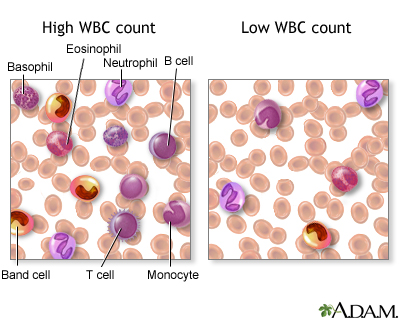
There are various types of white blood cells (WBCs) that normally appear in the blood: neutrophils (polymorphonuclear leukocytes; PMNs), band cells (slightly immature neutrophils), T-type lymphocytes (T cells), B-type lymphocytes (B cells), monocytes, eosinophils, and basophils. T and B-type lymphocytes are indistinguishable from each other in a normal slide preparation. Any infection or acute stress will result in an increased production of WBCs. This usually entails increased numbers of cells and an increase in the percentage of immature cells (mainly band cells) in the blood. This change is referred to as a “shift to the left” People who have had a splenectomy have a persistent mild elevation of WBCs. Drugs that may increase WBC counts include epinephrine, allopurinol, aspirin, chloroform, heparin, quinine, corticosteroids, and triamterene. Drugs that may decrease WBC counts include antibiotics, anticonvulsants, antihistamine, antithyroid drugs, arsenicals, barbiturates, chemotherapeutic agents, diuretics and sulfonamides.   (Updated by: David C. Dugdale, III, MD)

https://www.med-ed.virginia.edu/courses/path/innes/nh/wcbmaturation.cfm

Note that the mature forms of the myeloid series (neutrophils, eosinophils, basophils), all have lobed (segmented) nuclei. The degree of lobation increases as the cells mature.

The earliest recognizable myeloid cell is the myeloblast (10-20m dia) with a large round to oval nucleus. There is fine diffuse immature chromatin (without clumping) and a prominant nucleolus.

The cytoplasm is basophilic without granules. Although one may see a small golgi area adjacent to the nucleus, granules are not usually visible by light microscopy. One should not see blast cells in the peripheral blood.

myeloblast x100b

myeloblast x100b

https://www.med-ed.virginia.edu/courses/path/innes/images/nhjpeg/nh%20myeloblast%20x100b.jpeg

The promyelocyte (10-20m) is slightly larger than a blast. Its nucleus, although similar to a myeloblast shows slight chromatin condensation and less prominent nucleoli. The cytoplasm contains striking azurophilic granules or primary granules. These granules contain myeloperoxidase, acid phosphatase, and esterase enzymes. Normally no promyelocytes are seen in the peripheral blood.

At the point in development when secondary granules can be recognized, the cell becomes a myelocyte.

promyelocyte x100

promyelocyte x100

https://www.med-ed.virginia.edu/courses/path/innes/images/nhjpeg/nh%20promyelocyte%20×100%20a.jpeg

Myelocytes (10-18m) are not normally found in the peripheral blood. Nucleoli may not be seen in the late myelocyte. Primary azurophilic granules are still present, but secondary granules predominate. Secondary granules (neut, eos, or baso) first appear adjacent to the nucleus. In neutrophils this is the “dawn” of neutrophilia.

Metamyelocytes (10-18m) have kidney shaped indented nuclei and dense chromatin along the nuclear membrane. The cytoplasm is faintly pink, and they have secondary granules (neutro, eos, or baso). Zero to one percent of the peripheral blood white cells may be metamyelocytes (juveniles).

metamyelocyte x100

metamyelocyte x100

https://www.med-ed.virginia.edu/courses/path/innes/images/nhjpeg/nh%20metamyelocyte%20×100.jpeg

Bands, slightly smaller than juveniles, are marked by a U-shaped or deeply indented nucleus.

band neutrophilx100a

band neutrophilx100a

https://www.med-ed.virginia.edu/courses/path/innes/images/nhjpeg/nh%20band%20x100a.jpeg

Segmented (segs) or polymorphonuclear (PMN) leukocytes (average 14 m dia) are distinguished by definite lobation with thin thread-like filaments of chromatin joining the 2-5 lobes. 45-75% of the peripheral blood white cells are segmented neutrophils.

https://www.med-ed.virginia.edu/courses/path/innes/images/nhjpeg/nh%20neutrophil%20×100%20d.jpeg

6.2.1.3 Thrombocytogenesis

The incredible journey: From megakaryocyte development to platelet formation

Kellie R. Machlus1,2 and Joseph E. Italiano Jr
JCB 2013; 201(6): 785-796
http://dx.doi.org:/10.1083/jcb.201304054

Large progenitor cells in the bone marrow called megakaryocytes (MKs) are the source of platelets. MKs release platelets through a series of fascinating cell biological events. During maturation, they become polyploid and accumulate massive amounts of protein and membrane. Then, in a cytoskeletal-driven process, they extend long branching processes, designated proplatelets, into sinusoidal blood vessels where they undergo fission to release platelets.

megakaryocyte production of platelets

megakaryocyte production of platelets

http://dm5migu4zj3pb.cloudfront.net/manuscripts/26000/26891/medium/JCI0526891.f4.jpg

platelets and the immune continuum nri2956-f3

platelets and the immune continuum nri2956-f3

http://www.nature.com/nri/journal/v11/n4/images/nri2956-f3.jpg

6.2.2 Classification of hematological malignancies
Practical Diagnosis of Hematologic Disoreders. 4th edition. Vol 2.
Kjeldsberg CR, Ed.  ASCP Press.  2006. Chicago, IL.

6.2.2.1 Primary Classification

6.2.2.1.1 Acute leukemias

6.2.2.1.1 Myelodysplastic syndromes

6.2.2.1.2 Acute myeloid leukemia

6.2.2.1.3 Acute lymphoblastic leukemia

6.2.2.2 Myeloproliferative Disorders

6.2.2.2.1 Chronic myeloproliferative disorders

6.2.2.2.2 Chronic myelogenous leukemia and related disorders

6.2.2.2.3 Myelofibrosis, including chronic idiopathic

6.2.2.2.4 Polycythemia, including polycythemia rubra vera

6.2.2.2.5 Thrombocytosis, including essential thrombocythemia

6.2.2.3 Chronic lymphoid leukemia and other lymphoid leukemias

6.2.2.4 Lymphomas

6.2.2.4.1 Non-Hodgkin Lymphoma

6.2.2.4.2 Hodgkin lymphoma

6.2.2.5 Lymphoproliferative disorders associated with immunodeficiency

6.2.2.6 Plasma Cell dyscrasias

6.2.2.7 Mast cell disease and Histiocytic neoplasms

6.2.3 Secondary Classification

6.2.3.1 Nuance – PathologyOutlines
Nat Pernick, Ed.

http://www.pathologyoutlines.com/leukemia.html

This site is up-to-date and revised periodically. It is the best site for pathology information.

6.2.4 Diagnostics

6.2.4.1 Computer-aided diagnostics

6.2.4.1.1 Back-to-Front Design

Robert Didner
Bell Laboratories

Decision-making in the clinical setting
Didner, R  Mar 1999  Amer Clin Lab

Mr. Didner is an Independent Consultant in Systems Analysis, Information Architecture (Informatics) Operations Research, and Human Factors Engineering (Cognitive Psychology),  Decision Information Designs, 29 Skyline Dr., Morristown, NJ07960, U.S.A.; tel.: 973-455-0489; fax/e-mail: bdidner@hotmail.com

A common problem in the medical profession is the level of effort dedicated to administration and paperwork necessitated by various agencies, which contributes to the high cost of medical care. Costs would be reduced and accuracy improved if the clinical data could be captured directly at the point they are generated in a form suitable for transmission to insurers or machine transformable into other formats. Such a capability could also be used to improve the form and the structure of information presented to physicians and support a more comprehensive database linking clinical protocols to outcomes, with the prospect of improving clinical outcomes. Although the problem centers on the physician’s process of determining the diagnosis and treatment of patients and the timely and accurate recording of that process in the medical system, it substantially involves the pathologist and laboratorian, who interact significantly throughout the in-formation-gathering process. Each of the currently predominant ways of collecting information from diagnostic protocols has drawbacks. Using blank paper to collect free-form notes from the physician is not amenable to computerization; such free-form data are also poorly formulated, formatted, and organized for the clinical decision-making they support. The alternative of preprinted forms listing the possible tests, results, and other in-formation gathered during the diagnostic process facilitates the desired computerization, but the fixed sequence of tests and questions they present impede the physician from using an optimal decision-making sequence. This follows because:

  • People tend to make decisions and consider information in a step-by-step manner in which intermediate decisions are intermixed with data acquisition steps.
  • The sequence in which components of decisions are made may alter the decision outcome.
  • People tend to consider information in the sequence it is requested or displayed.
  • Since there is a separate optimum sequence of tests and questions for each cluster of history and presenting symptoms, there is no one sequence of tests and questions that can be optimal for all presenting clusters.
  • As additional data and test results are acquired, the optimal sequence of further testing and data acquisition changes, depending on the already acquired information.

Therefore, promoting an arbitrary sequence of information requests with preprinted forms may detract from outcomes by contributing to a non-optimal decision-making sequence. Unlike the decisions resulting from theoretical or normative processes, decisions made by humans are path dependent; that is, the out-come of a decision process may be different if the same components are considered in a different sequence.

Proposed solution

This paper proposes a general approach to gathering data at their source in computer-based form so as to improve the expected outcomes. Such a means must be interactive and dynamic, so that at any point in the clinical process the patient’s presenting symptoms, history, and the data already collected are used to determine the next data or tests requested. That de-termination must derive from a decision-making strategy designed to produce outcomes with the greatest value and supported by appropriate data collection and display techniques. The strategy must be based on the knowledge of the possible outcomes at any given stage of testing and information gathering, coupled with a metric, or hierarchy of values for assessing the relative desirability of the possible outcomes.

A value hierarchy

  • The numbered list below illustrates a value hierarchy. In any particular instance, the higher-numbered values should only be considered once the lower- numbered values have been satisfied. Thus, a diagnostic sequence that is very time or cost efficient should only be considered if it does not increase the likelihood (relative to some other diagnostic sequence) that a life-threatening disorder may be missed, or that one of the diagnostic procedures may cause discomfort.
  • Minimize the likelihood that a treatable, life-threatening disorder is not treated.
  • Minimize the likelihood that a treatable, discomfort-causing disorder is not treated.
  • Minimize the likelihood that a risky procedure(treatment or diagnostic procedure) is inappropriately administered.
  • Minimize the likelihood that a discomfort-causing procedure is inappropriately administered.
  • Minimize the likelihood that a costly procedure is inappropriately administered.
  • Minimize the time of diagnosing and treating thepatient.8.Minimize the cost of diagnosing and treating the patient.

The above hierarchy is relative, not absolute; for many patients, a little bit of testing discomfort may be worth a lot of time. There are also some factors and graduations intentionally left out for expository simplicity (e.g., acute versus chronic disorders).This value hierarchy is based on a hypothetical patient. Clearly, the hierarchy of a health insurance carrier might be different, as might that of another patient (e.g., a geriatric patient). If the approach outlined herein were to be followed, a value hierarchy agreed to by a majority of stakeholders should be adopted.

Efficiency

Once the higher values are satisfied, the time and cost of diagnosis and treatment should be minimized. One way to do so would be to optimize the sequence in which tests are performed, so as to minimize the number, cost, and time of tests that need to be per-formed to reach a definitive decision regarding treatment. Such an optimum sequence could be constructed using Claude Shannon’s information theory.

According to this theory, the best next question to ask under any given situation (assuming the question has two possible outcomes) is that question that divides the possible outcomes into two equally likely sets. In the real world, all tests or questions are not equally valuable, costly, or time consuming; therefore, value(risk factors), cost, and time should be used as weighting factors to optimize the test sequence, but this is a complicating detail at this point.

A value scale

For dynamic computation of outcome values, the hierarchy could be converted into a weighted value scale so differing outcomes at more than one level of the hierarchy could be readily compared. An example of such a weighted value scale is Quality Adjusted Life Years (QALY).

Although QALY does not incorporate all of the factors in this example, it is a good conceptual starting place.

The display, request, decision-making relationship

For each clinical determination, the pertinent information should be gathered, organized, formatted, and formulated in a way that facilitates the accuracy, reliability, and efficiency with which that determination is made. A physician treating a patient with high cholesterol and blood pressure (BP), for example, may need to know whether or not the patient’s cholesterol and BP respond to weight changes to determine an appropriate treatment (e.g., weight control versus medication). This requires searching records for BP, certain blood chemicals (e.g., HDLs, LDLs, triglycerides, etc.), and weight from several

sources, then attempting to track them against each other over time. Manually reorganizing this clinical information each time it is used is extremely inefficient. More important, the current organization and formatting defies principles of human factors for optimally displaying information to enhance human information-processing characteristics, particularly for decision support.

While a discussion of human factors and cognitive psychology principles is beyond the scope of this paper, following are a few of the system design principles of concern:

  • Minimize the load on short-term memory.
  • Provide information pertinent to a given decision or component of a decision in a compact, contiguous space.
  • Take advantage of basic human perceptual and pat-tern recognition facilities.
  • Design the form of an information display to com-plement the decision-making task it supports.

F i g u re 1 shows fictitious, quasi-random data from a hypothetical patient with moderately elevated cholesterol. This one-page display pulls together all the pertinent data from six years of blood tests and related clinical measurements. At a glance, the physician’s innate pattern recognition, color, and shape perception facilities recognize the patient’s steadily increasing weight, cholesterol, BP, and triglycerides as well as the declining high-density lipoproteins. It would have taken considerably more time and effort to grasp this information from the raw data collection and blood test reports as they are currently presented in independent, tabular time slices.

Design the formulation of an information display to complement the decision-making task.

The physician may wish to know only the relationship between weight and cardiac risk factors rather than whether these measures are increasing or decreasing, or are within acceptable or marginal ranges. If so, Table 1 shows the correlations between weight and the other factors in a much more direct and simple way using the same data as in Figure 1. One can readily see the same conclusions about relations that were drawn from Figure 1.This type of abstract, symbolic display of derived information also makes it easier to spot relationships when the individual variables are bouncing up and down, unlike the more or less steady rise of most values in Figure 1. This increase in precision of relationship information is gained at the expense of other types of information (e.g., trends). To display information in an optimum form then, the system designer must know what the information demands of the task are at the point in the task when the display is to be used.

Present the sequence of information display clusters to complement an optimum decision-making strategy.

Just as a fixed sequence of gathering clinical, diagnostic information may lead to a far from optimum outcome, there exists an optimum sequence of testing, considering information, and gathering data that will lead to an optimum outcome (as defined by the value hierarchy) with a minimum of time and expense. The task of the information system designer, then, is to provide or request the right information, in the best form, at each stage of the procedure. For ex-ample, Figure 1 is suitable for the diagnostic phase since it shows the current state of the risk factors and their trends. Table 1, on the other hand, might be more appropriate in determining treatment, where there may be a choice of first trying a strict dietary treatment, or going straight to a combination of diet plus medication. The fact that Figure 1 and Table 1 have somewhat redundant information is not a problem, since they are intended to optimally provide information for different decision-making tasks. The critical need, at this point, is for a model of how to determine what information should be requested, what tests to order, what information to request and display, and in what form at each step of the decision-making process. Commitment to a collaborative relationship between physicians and laboratorians and other information providers would be an essential requirement for such an undertaking. The ideal diagnostic data-collection instrument is a flexible, computer-based device, such as a notebook computer or Personal Digital Assistant (PDA) sized device.

Barriers to interactive, computer-driven data collection at the source

As with any major change, it may be difficult to induce many physicians to change their behavior by interacting directly with a computer instead of with paper and pen. Unlike office workers, who have had to make this transition over the past three decades, most physicians’ livelihoods will not depend on converting to computer interaction. Therefore, the transition must be made attractive and the changes less onerous. Some suggestions follow:

  1. Make the data collection a natural part of the clinical process.
  2. Ensure that the user interface is extremely friendly, easy to learn, and easy to use.
  3. Use a small, portable device.
  4. Use the same device for collection and display of existing information (e.g., test results and his-tory).
  5. Minimize the need for free-form written data entry (use check boxes, forms, etc.).
  6. Allow the entry of notes in pen-based free-form (with the option of automated conversion of numeric data to machine-manipulable form).
  7. Give the physicians a more direct benefit for collecting data, not just a means of helping a clerk at an HMO second-guess the physician’s judgment.
  8. Improve administrative efficiency in the office.
  9. Make the data collection complement the clinical decision-making process.
  10. Improve information displays, leading to better outcomes.
  11. Make better use of the physician’s time and mental effort.

Conclusion

The medical profession is facing a crisis of information. Gathering information is costing a typical practice more and more while fees are being restricted by third parties, and the process of gathering this in-formation may be detrimental to current outcomes. Gathered properly, in machine-manipulable form, these data could be reformatted so as to greatly improve their value immediately in the clinical setting by leading to decisions with better outcomes and, in the long run, by contributing to a clinical data warehouse that could greatly improve medical knowledge. The challenge is to create a mechanism for data collection that facilitates, hastens, and improves the outcomes of clinical activity while minimizing the inconvenience and resistance to change on the part of clinical practitioners. This paper is intended to provide a high-level overview of how this may be accomplished, and start a dialogue along these lines.

References

  1. Tversky A. Elimination by aspects: a theory of choice. Psych Rev 1972; 79:281–99.
  2. Didner RS. Back-to-front design: a guns and butter approach. Ergonomics 1982; 25(6):2564–5.
  3. Shannon CE. A mathematical theory of communication. Bell System Technical J 1948; 27:379–423 (July), 623–56 (Oct).
  4. Feeny DH, Torrance GW. Incorporating utility-based quality-of-life assessment measures in clinical trials: two examples. Med Care 1989; 27:S190–204.
  5. Smith S, Mosier J. Guidelines for designing user interface soft-ware. ESD-TR-86-278, Aug 1986.
  6. Miller GA. The magical number seven plus or minus two. Psych Rev 1956; 65(2):81–97.
  7. Sternberg S. High-speed scanning in human memory. Science 1966; 153: 652–4.

Table 1

Correlation of weight with other cardiac risk factors

Cholesterol 0.759384
HDL 0.53908
LDL 0.177297
BP-syst. 0.424728
BP-dia. 0.516167
Triglycerides 0.637817

Figure 1  Hypothetical patient data.

(not shown)

6.2.4.1.2 Realtime Clinical Expert Support

http://pharmaceuticalintelligence.com/2015/05/10/realtime-clinical-expert-support/

6.2.4.1.3 Regression: A richly textured method for comparison and classification of predictor variables

http://pharmaceuticalintelligence.com/2012/08/14/regression-a-richly-textured-method-for-comparison-and-classification-of-predictor-variables/

6.2.4.1.4 Converting Hematology Based Data into an Inferential Interpretation

Larry H. Bernstein, Gil David, James Rucinski and Ronald R. Coifman
In Hematology – Science and Practice
Lawrie CH, Ch 22. Pp541-552.
InTech Feb 2012, ISBN 978-953-51-0174-1
https://www.researchgate.net/profile/Larry_Bernstein/publication/221927033_Converting_Hematology_Based_Data_into_an_Inferential_Interpretation/links/0fcfd507f28c14c8a2000000.pdf

6.2.4.1.5 A model for Thalassemia Screening using Hematology Measurements

https://www.researchgate.net/profile/Larry_Bernstein/publication/258848064_A_model_for_Thalassemia_Screening_using_Hematology_Measurements/links/0c9605293c3048060b000000.pdf

A model for automated screening of thalassemia in hematology (math study).

Kneifati-Hayek J, Fleischman W, Bernstein LH, Riccioli A, Bellevue R.
Lab Hematol. 2007; 13(4):119-23. http://dx.doi.org:/10.1532/LH96.07003.

The results of 398 patient screens were collected. Data from the set were divided into training and validation subsets. The Mentzer ratio was determined through a receiver operating characteristic (ROC) curve on the first subset, and screened for thalassemia using the second subset. HgbA2 levels were used to confirm beta-thalassemia.

RESULTS: We determined the correct decision point of the Mentzer index to be a ratio of 20. Physicians can screen patients using this index before further evaluation for beta-thalassemia (P < .05).

CONCLUSION: The proposed method can be implemented by hospitals and laboratories to flag positive matches for further definitive evaluation, and will enable beta-thalassemia screening of a much larger population at little to no additional cost.

6.2.4.1.6 Measurement of granulocyte maturation may improve the early diagnosis of the septic state.

Bernstein LH, Rucinski J. Clin Chem Lab Med. 2011 Sep 21;49(12):2089-95.
http://dx.doi.org:/10.1515/CCLM.2011.688.

6.2.4.1.7 The automated malnutrition assessment.

David G, Bernstein LH, Coifman RR. Nutrition. 2013 Jan; 29(1):113-21.
http://dx.doi.org:/10.1016/j.nut.2012.04.017

6.2.4.2 Molecular Diagnostics

6.2.4.2.1 Genomic Analysis of Hematological Malignancies

Acute lymphoblastic leukemia (ALL) is the most common hematologic malignancy that occurs in children. Although more than 90% of children with ALL now survive to adulthood, those with the rarest and high-risk forms of the disease continue to have poor prognoses. Through the Pediatric Cancer Genome Project (PCGP), investigators in the Hematological Malignancies Program are identifying the genetic aberrations that cause these aggressive forms of leukemias. Here we present two studies on the genetic bases of early T-cell precursor ALL and acute megakaryoblastic leukemia.

  • Early T-Cell Precursor ALL Is Characterized by Activating Mutations
  • The CBFA2T3-GLIS2Fusion Gene Defines an Aggressive Subtype of Acute Megakaryoblastic Leukemia in Children

Early T-cell precursor ALL (ETP-ALL), which comprises 15% of all pediatric T-cell leukemias, is an aggressive disease that is typically resistant to contemporary therapies. Children with ETP-ALL have a high rate of relapse and an extremely poor prognosis (i.e., 5-year survival is approximately 20%). The genetic basis of ETP-ALL has remained elusive. Although ETP-ALL is associated with a high burden of DNA copy number aberrations, none are consistently found or suggest a unifying genetic alteration that drives this disease.

Through the efforts of the PCGP, Jinghui Zhang, PhD (Computational Biology), James R. Downing, MD (Pathology), Charles G. Mullighan, MBBS(Hons), MSc, MD (Pathology), and colleagues analyzed the whole-genome sequences of leukemic cells and matched normal DNA from 12 pediatric patients with ETP-ALL. The identified genetic mutations were confirmed in a validation cohort of 52 ETP-ALL specimens and 42 non-ETP T-lineage ALLs (T-ALL).

In the journal Nature, the investigators reported that each ETP-ALL sample carried an average of 1140 sequence mutations and 12 structural variations. Of the structural variations, 51% were breakpoints in genes with well-established roles in hematopoiesis or leukemogenesis (e.g., MLH2,SUZ12, and RUNX1). Eighty-four percent of the structural variations either caused loss of function of the gene in question or resulted in the formation of a fusion gene such as ETV6-INO80D. The ETV6 gene, which encodes a protein that is essential for hematopoiesis, is frequently mutated in leukemia. Among the DNA samples sequenced in this study, ETV6 was altered in 33% of ETP-ALL but only 10% of T-ALL cases.

6.2.4.2.2 Next-generation sequencing in hematologic malignancies: what will be the dividends?

Jason D. MerkerAnton Valouev, and Jason Gotlib
Ther Adv Hematol. 2012 Dec; 3(6): 333–339.
http://dx.doi.org:/10.1177/2040620712458948

The application of high-throughput, massively parallel sequencing technologies to hematologic malignancies over the past several years has provided novel insights into disease initiation, progression, and response to therapy. Here, we describe how these new DNA sequencing technologies have been applied to hematolymphoid malignancies. With further improvements in the sequencing and analysis methods as well as integration of the resulting data with clinical information, we expect these technologies will facilitate more precise and tailored treatment for patients with hematologic neoplasms.

6.2.4.2.3 Leveraging cancer genome information in hematologic malignancies.

Rampal R1Levine RL.
J Clin Oncol. 2013 May 20; 31(15):1885-92.
http://dx.doi.org:/10.1200/JCO.2013.48.7447

The use of candidate gene and genome-wide discovery studies in the last several years has led to an expansion of our knowledge of the spectrum of recurrent, somatic disease alleles, which contribute to the pathogenesis of hematologic malignancies. Notably, these studies have also begun to fundamentally change our ability to develop informative prognostic schema that inform outcome and therapeutic response, yielding substantive insights into mechanisms of hematopoietic transformation in different tissue compartments. Although these studies have already had important biologic and translational impact, significant challenges remain in systematically applying these findings to clinical decision making and in implementing new technologies for genetic analysis into clinical practice to inform real-time decision making. Here, we review recent major genetic advances in myeloid and lymphoid malignancies, the impact of these findings on prognostic models, our understanding of disease initiation and evolution, and the implication of genomic discoveries on clinical decision making. Finally, we discuss general concepts in genetic modeling and the current state-of-the-art technology used in genetic investigation.

6.2.4.2.4 p53 mutations are associated with resistance to chemotherapy and short survival in hematologic malignancies

E Wattel, C Preudhomme, B Hecquet, M Vanrumbeke, et AL.
Blood, (Nov 1), 1994; 84(9): pp 3148-3157
http://www.bloodjournal.org/content/bloodjournal/84/9/3148.full.pdf

We analyzed the prognostic value of p53 mutations for response to chemotherapy and survival in acute myeloid leukemia (AML), myelodysplastic syndrome (MDS), and chronic lymphocytic leukemia (CLL). Mutations were detected by single-stranded conformation polymorphism (SSCP) analysis of exons 4 to 10 of the P53 gene, and confirmed by direct sequencing. A p53 mutation was found in 16 of 107 (15%) AML, 20 of 182 (11%) MDS, and 9 of 81 (11%) CLL tested. In AML, three of nine (33%) mutated cases and 66 of 81 (81%) nonmutated cases treated with intensive chemotherapy achieved complete remission (CR) (P = .005) and none of five mutated cases and three of six nonmutated cases treated by low-dose Ara C achieved CR or partial remission (PR) (P = .06). Median actuarial survival was 2.5 months in mutated cases, and 15 months in nonmutated cases (P < lo-‘). In the MDS patients who received chemotherapy (intensive chemotherapy or low-dose Ara C), 1 of 13 (8%) mutated cases and 23 of 38 (60%) nonmutated cases achieved CR or PR (P = .004), and median actuarial survival was 2.5 and 13.5 months, respectively (P C lo-’). In all MDS cases (treated and untreated), the survival difference between mutated cases and nonmutated cases was also highly significant. In CLL, 1 of 8 (12.5%) mutated cases treated by chemotherapy (chlorambucil andlor CHOP andlor fludarabine) responded, as compared with 29 of 36 (80%) nonmutated cases (P = .02). In all CLL cases, survival from p53 analysis was significantly shorter in mutated cases (median 7 months) than in nonmutated cases (median not reached) (P < IO-’). In 35 of the 45 mutated cases of AML, MDS, and CLL, cytogenetic analysis or SSCP and sequence findings showed loss of the nonmutated P53 allele. Our findings show that p53 mutations are a strong prognostic indicator of response to chemotherapy and survival in AML, MDS, and CLL. The usual association of p53 mutations to loss of the nonmutated P53 allele, in those disorders, ie, to absence of normal p53 in tumor cells, suggests that p53 mutations could induce drug resistance, at least in part, by interfering with normal apoptotic pathways in tumor cells.

6.2.4.2.5 Genomic approaches to hematologic malignancies

Benjamin L. Ebert and Todd R. Golub
Blood. 2004; 104:923-932
https://www.broadinstitute.org/mpr/publications/projects/genomics/Review%20Genomics%20of%20Heme%20Malig,%20Blood%202004.pdf

In the past several years, experiments using DNA microarrays have contributed to an increasingly refined molecular taxonomy of hematologic malignancies. In addition to the characterization of molecular profiles for known diagnostic classifications, studies have defined patterns of gene expression corresponding to specific molecular abnormalities, oncologic phenotypes, and clinical outcomes. Furthermore, novel subclasses with distinct molecular profiles and clinical behaviors have been identified. In some cases, specific cellular pathways have been highlighted that can be therapeutically targeted. The findings of microarray studies are beginning to enter clinical practice as novel diagnostic tests, and clinical trials are ongoing in which therapeutic agents are being used to target pathways that were identified by gene expression profiling. While the technology of DNA microarrays is becoming well established, genome-wide surveys of gene expression generate large data sets that can easily lead to spurious conclusions. Many challenges remain in the statistical interpretation of gene expression data and the biologic validation of findings. As data accumulate and analyses become more sophisticated, genomic technologies offer the potential to generate increasingly sophisticated insights into the complex molecular circuitry of hematologic malignancies. This review summarizes the current state of discovery and addresses key areas for future research.

6.2.4.3 Flow cytometry

Introduction to Flow Cytometry: Blood Cell Identification

Dana L. Van Laeys
https://www.labce.com/flow_cytometry.aspx

No other laboratory method provides as rapid and detailed analysis of cellular populations as flow cytometry, making it a valuable tool for diagnosis and management of several hematologic and immunologic diseases. Understanding this relevant methodology is important for any medical laboratory scientist.

Whether you have no previous experience with flow cytometry or just need a refresher, this course will help you to understand the basic principles, with the help of video tutorials and interactive case studies.

Basic principles include:

  1. Immunophenotypic features of various types of hematologic cells
  2. Labeling cellular elements with fluorochromes
  3. Blood cell identification, specifically B and T lymphocyte identification and analysis
  4. Cell sorting to isolate select cell population for further analysis
  5. Analyzing and interpreting result reports and printouts

6.2.5 Treatments

6.2.5.1 Treatments for leukemia by type

6.2.5.1.1 Acute lymphocytic leukemias

6.2.5.1.1.1 Treatment of Acute Lymphoblastic Leukemia

Ching-Hon Pu, and William E. Evans
N Engl J Med Jan 12, 2006; 354:166-178
http://dx.doi.org:/10.1056/NEJMra052603

Although the overall cure rate of acute lymphoblastic leukemia (ALL) in children is about 80 percent, affected adults fare less well. This review considers recent advances in the treatment of ALL, emphasizing issues that need to be addressed if treatment outcome is to improve further.

6.2.5.1.1.2 Acute Lymphoblastic Leukemia

Ching-Hon Pui, Mary V. Relling, and James R. Downing
N Engl J Med Apr 8, 2004; 350:1535-1548
http://dx.doi.org:/10.1056/NEJMra023001

This comprehensive survey emphasizes how recent advances in the knowledge of molecular mechanisms involved in acute lymphoblastic leukemia have influenced diagnosis, prognosis, and treatment.

6.2.5.1.1.3 Gene-Expression Patterns in Drug-Resistant Acute Lymphoblastic Leukemia Cells and Response to Treatment

Amy Holleman, Meyling H. Cheok, Monique L. den Boer, et al.
N Engl J Med 2004; 351:533-42

Childhood acute lymphoblastic leukemia (ALL) is curable with chemotherapy in approximately 80 percent of patients. However, the cause of treatment failure in the remaining 20 percent of patients is largely unknown.

Methods We tested leukemia cells from 173 children for sensitivity in vitro to prednisolone, vincristine, asparaginase, and daunorubicin. The cells were then subjected to an assessment of gene expression with the use of 14,500 probe sets to identify differentially expressed genes in drug-sensitive and drug-resistant ALL. Gene-expression patterns that differed according to sensitivity or resistance to the four drugs were compared with treatment outcome in the original 173 patients and an independent cohort of 98 children treated with the same drugs at another institution.

Results We identified sets of differentially expressed genes in B-lineage ALL that were sensitive or resistant to prednisolone (33 genes), vincristine (40 genes), asparaginase (35 genes), or daunorubicin (20 genes). A combined gene-expression score of resistance to the four drugs, as compared with sensitivity to the four, was significantly and independently related to treatment outcome in a multivariate analysis (hazard ratio for relapse, 3.0; P=0.027). Results were confirmed in an independent population of patients treated with the same medications (hazard ratio for relapse, 11.85; P=0.019). Of the 124 genes identified, 121 have not previously been associated with resistance to the four drugs we tested.

Conclusions  Differential expression of a relatively small number of genes is associated with drug resistance and treatment outcome in childhood ALL.

6.2.5.1.1.4 Leukemias Treatment & Management

Author: Lihteh Wu, MD; Chief Editor: Hampton Roy Sr
http://emedicine.medscape.com/article/1201870-treatment

The treatment of leukemia is in constant flux, evolving and changing rapidly over the past few years. Most treatment protocols use systemic chemotherapy with or without radiotherapy. The basic strategy is to eliminate all detectable disease by using cytotoxic agents. To attain this goal, 3 phases are typically used, as follows: remission induction phase, consolidation phase, and maintenance therapy phase.

Chemotherapeutic agents are chosen that interfere with cell division. Tumor cells usually divide more rapidly than host cells, making them more vulnerable to the effects of chemotherapy. Primary treatment will be under the direction of a medical oncologist, radiation oncologist, and primary care physician. Although a general treatment plan will be outlined, the ophthalmologist does not prescribe or manage such treatment.

  • The initial treatment of ALL uses various combinations of vincristine, prednisone, and L-asparaginase until a complete remission is obtained.
  • Maintenance therapy with mercaptopurine is continued for 2-3 years following remission.
  • Use of intrathecal methotrexate with or without cranial irradiation to cover the CNS varies from facility to facility.
  • Daunorubicin, cytarabine, and thioguanine currently are used to obtain induction and remission of AML.
  • Maintenance therapy for 8 months may lengthen remission. Once relapse has occurred, AML generally is curable only by bone marrow transplantation.
  • Presently, treatment of CLL is palliative.
  • CML is characterized by a leukocytosis greater than 100,000 cells. Emergent treatment with leukopheresis sometimes is necessary when leukostastic complications are present. Otherwise, busulfan or hydroxyurea may control WBC counts. During the chronic phase, treatment is palliative.
  • When CML converts to the blastic phase, approximately one third of cases behave as ALL and respond to treatment with vincristine and prednisone. The remaining two thirds resemble AML but respond poorly to AML therapy.
  • Allogeneic bone marrow transplant is the only curative therapy for CML. However, it carries a high early mortality rate.
  • Leukemic retinopathy usually is not treated directly. As the hematological parameters normalize with systemic treatment, many of the ophthalmic signs resolve. There are reports that leukopheresis for hyperviscosity also may alleviate intraocular manifestations.
  • When definite intraocular leukemic infiltrates fail to respond to systemic chemotherapy, direct radiation therapy is recommended.
  • Relapse, manifested by anterior segment involvement, should be treated by radiation. In certain cases, subconjunctival chemotherapeutic agents have been injected.
  • Optic nerve head infiltration in patients with ALL is an emergency and requires prompt radiation therapy to try to salvage some vision.

6.2.5.1.1.5 Treatments and drugs

http://www.mayoclinic.org/diseases-conditions/leukemia/basics/
treatment/con-20024914

Common treatments used to fight leukemia include:

  • Chemotherapy. Chemotherapy is the major form of treatment for leukemia. This drug treatment uses chemicals to kill leukemia cells.

Depending on the type of leukemia you have, you may receive a single drug or a combination of drugs. These drugs may come in a pill form, or they may be injected directly into a vein.

  • Biological therapy. Biological therapy works by using treatments that help your immune system recognize and attack leukemia cells.
  • Targeted therapy. Targeted therapy uses drugs that attack specific vulnerabilities within your cancer cells.

For example, the drug imatinib (Gleevec) stops the action of a protein within the leukemia cells of people with chronic myelogenous leukemia. This can help control the disease.

  • Radiation therapy. Radiation therapy uses X-rays or other high-energy beams to damage leukemia cells and stop their growth. During radiation therapy, you lie on a table while a large machine moves around you, directing the radiation to precise points on your body.

You may receive radiation in one specific area of your body where there is a collection of leukemia cells, or you may receive radiation over your whole body. Radiation therapy may be used to prepare for a stem cell transplant.

  • Stem cell transplant. A stem cell transplant is a procedure to replace your diseased bone marrow with healthy bone marrow.

Before a stem cell transplant, you receive high doses of chemotherapy or radiation therapy to destroy your diseased bone marrow. Then you receive an infusion of blood-forming stem cells that help to rebuild your bone marrow.

You may receive stem cells from a donor, or in some cases you may be able to use your own stem cells. A stem cell transplant is very similar to a bone marrow transplant.

6.2.5.1.2 Acute Myeloid Leukemia

6.2.5.1.2.1 New treatment approaches in acute myeloid leukemia: review of recent clinical studies.

Norsworthy K1Luznik LGojo I.
Rev Recent Clin Trials. 2012 Aug; 7(3):224-37.
http://www.ncbi.nlm.nih.gov/pubmed/22540908

Standard chemotherapy can cure only a fraction (30-40%) of younger and very few older patients with acute myeloid leukemia (AML). While conventional allografting can extend the cure rates, its application remains limited mostly to younger patients and those in remission. Limited efficacy of current therapies and improved understanding of the disease biology provided a spur for clinical trials examining novel agents and therapeutic strategies in AML. Clinical studies with novel chemotherapeutics, antibodies, different signal transduction inhibitors, and epigenetic modulators demonstrated their clinical activity; however, it remains unclear how to successfully integrate novel agents either alone or in combination with chemotherapy into the overall therapeutic schema for AML. Further studies are needed to examine their role in relation to standard chemotherapy and their applicability to select patient populations based on recognition of unique disease and patient characteristics, including the development of predictive biomarkers of response. With increasing use of nonmyeloablative or reduced intensity conditioning and alternative graft sources such as haploidentical donors and cord blood transplants, the benefits of allografting may extend to a broader patient population, including older AML patients and those lacking a HLA-matched donor. We will review here recent clinical studies that examined novel pharmacologic and immunologic approaches to AML therapy.

6.2.5.1.2.2 Novel approaches to the treatment of acute myeloid leukemia.

Roboz GJ1
Hematology Am Soc Hematol Educ Program. 2011:43-50.
http://dx.doi.org:/10.1182/asheducation-2011.1.43.

Approximately 12 000 adults are diagnosed with acute myeloid leukemia (AML) in the United States annually, the majority of whom die from their disease. The mainstay of initial treatment, cytosine arabinoside (ara-C) combined with an anthracycline, was developed nearly 40 years ago and remains the worldwide standard of care. Advances in genomics technologies have identified AML as a genetically heterogeneous disease, and many patients can now be categorized into clinicopathologic subgroups on the basis of their underlying molecular genetic defects. It is hoped that enhanced specificity of diagnostic classification will result in more effective application of targeted agents and the ability to create individualized treatment strategies. This review describes the current treatment standards for induction, consolidation, and stem cell transplantation; special considerations in the management of older AML patients; novel agents; emerging data on the detection and management of minimal residual disease (MRD); and strategies to improve the design and implementation of AML clinical trials.

Age ≥ 60 years has consistently been identified as an independent adverse prognostic factor in AML, and there are very few long-term survivors in this age group.5 Poor outcomes in elderly AML patients have been attributed to both host- and disease-related factors, including medical comorbidities, physical frailty, increased incidence of antecedent myelodysplastic syndrome and myeloproliferative disorders, and higher frequency of adverse cytogenetics.28 Older patients with multiple poor-risk factors have a high probability of early death and little chance of long-term disease-free survival with standard chemotherapy. In a retrospective analysis of 998 older patients treated with intensive induction at the M.D. Anderson Cancer Center, multivariate analysis identified age ≥ 75 years, unfavorable karyotype, poor performance status, creatinine > 1.3 mg/dL, duration of antecedent hematologic disorder > 6 months, and treatment outside a laminar airflow room as adverse prognostic indicators.29 Patients with 3 or more of these factors had expected complete remission rates of < 20%, 8-week mortality > 50%, and 1-year survival < 10%. The Medical Research Council (MRC) identified cytogenetics, WBC count at diagnosis, age, and de novo versus secondary disease as critical factors influencing survival in > 2000 older patients with AML, but cautioned in their conclusions that less objective factors, such as clinical assessment of “fitness” for chemotherapy, may be equally important in making treatment decisions in this patient population.30 It is hoped that data from comprehensive geriatric assessments of functional status, cognition, mood, quality of life, and other measures obtained during ongoing cooperative group trials will improve our ability to predict how older patients will tolerate treatment.

6.5.1.2.3 Current treatment of acute myeloid leukemia.

Roboz GJ1.
Curr Opin Oncol. 2012 Nov; 24(6):711-9.
http://dx.doi.org:/10.1097/CCO.0b013e328358f62d.

The objectives of this review are to discuss standard and investigational nontransplant treatment strategies for acute myeloid leukemia (AML), excluding acute promyelocytic leukemia.

RECENT FINDINGS: Most adults with AML die from their disease. The standard treatment paradigm for AML is remission induction chemotherapy with an anthracycline/cytarabine combination, followed by either consolidation chemotherapy or allogeneic stem cell transplantation, depending on the patient’s ability to tolerate intensive treatment and the likelihood of cure with chemotherapy alone. Although this approach has changed little in the last three decades, increased understanding of the pathogenesis of AML and improvements in molecular genomic technologies are leading to novel drug targets and the development of personalized, risk-adapted treatment strategies. Recent findings related to prognostically relevant and potentially ‘druggable’ molecular targets are reviewed.

SUMMARY: At the present time, AML remains a devastating and mostly incurable disease, but the combination of optimized chemotherapeutics and molecularly targeted agents holds significant promise for the future.

6.5.1.2.4  Adult Acute Myeloid Leukemia Treatment (PDQ®)
http://www.cancer.gov/cancertopics/pdq/treatment/adultAML/healthprofessional/page9

About This PDQ Summary

This summary is reviewed regularly and updated as necessary by the PDQ Adult Treatment Editorial Board, which is editorially independent of the National Cancer Institute (NCI). The summary reflects an independent review of the literature and does not represent a policy statement of NCI or the National Institutes of Health (NIH).

Board members review recently published articles each month to determine whether an article should:

  • be discussed at a meeting,
  • be cited with text, or
  • replace or update an existing article that is already cited.

Treatment Option Overview for AML

Successful treatment of acute myeloid leukemia (AML) requires the control of bone marrow and systemic disease and specific treatment of central nervous system (CNS) disease, if present. The cornerstone of this strategy includes systemically administered combination chemotherapy. Because only 5% of patients with AML develop CNS disease, prophylactic treatment is not indicated.[13]

Treatment is divided into two phases: remission induction (to attain remission) and postremission (to maintain remission). Maintenance therapy for AML was previously administered for several years but is not included in most current treatment clinical trials in the United States, other than for acute promyelocytic leukemia. (Refer to the Adult Acute Myeloid Leukemia in Remission section of this summary for more information.) Other studies have used more intensive postremission therapy administered for a shorter duration of time after which treatment is discontinued.[4] Postremission therapy appears to be effective when given immediately after remission is achieved.[4]

Since myelosuppression is an anticipated consequence of both the leukemia and its treatment with chemotherapy, patients must be closely monitored during therapy. Facilities must be available for hematologic support with multiple blood fractions including platelet transfusions and for the treatment of related infectious complications.[5] Randomized trials have shown similar outcomes for patients who received prophylactic platelet transfusions at a level of 10,000/mm3 rather than 20,000/mm3.[6] The incidence of platelet alloimmunization was similar among groups randomly assigned to receive pooled platelet concentrates from random donors; filtered, pooled platelet concentrates from random donors; ultraviolet B-irradiated, pooled platelet concentrates from random donors; or filtered platelets obtained by apheresis from single random donors.[7] Colony-stimulating factors, for example, granulocyte colony–stimulating factor (G-CSF) and granulocyte-macrophage colony–stimulating factor (GM-CSF), have been studied in an effort to shorten the period of granulocytopenia associated with leukemia treatment.[8] If used, these agents are administered after completion of induction therapy. GM-CSF was shown to improve survival in a randomized trial of AML in patients aged 55 to 70 years (median survival was 10.6 months vs. 4.8 months). In this Eastern Cooperative Oncology Group (ECOG) (EST-1490) trial, patients were randomly assigned to receive GM-CSF or placebo following demonstration of leukemic clearance of the bone marrow;[9] however, GM-CSF did not show benefit in a separate similar randomized trial in patients older than 60 years.[10] In the latter study, clearance of the marrow was not required before initiating cytokine therapy. In a Southwest Oncology Group (NCT00023777) randomized trial of G-CSF given following induction therapy to patients older than 65 years, complete response was higher in patients who received G-CSF because of a decreased incidence of primary leukemic resistance. Growth factor administration did not impact on mortality or on survival.[11,12] Because the majority of randomized clinical trials have not shown an impact of growth factors on survival, their use is not routinely recommended in the remission induction setting.

The administration of GM-CSF or other myeloid growth factors before and during induction therapy, to augment the effects of cytotoxic therapy through the recruitment of leukemic blasts into cell cycle (growth factor priming), has been an area of active clinical research. Evidence from randomized studies of GM-CSF priming have come to opposite conclusions. A randomized study of GM-CSF priming during conventional induction and postremission therapy showed no difference in outcomes between patients who received GM-CSF and those who did not receive growth factor priming.[13,14][Level of evidence: 1iiA] In contrast, a similar randomized placebo-controlled study of GM-CSF priming in patients with AML aged 55 to 75 years showed improved disease-free survival (DFS) in the group receiving GM-CSF (median DFS for patients who achieved complete remission was 23 months vs. 11 months; 2-year DFS was 48% vs. 21%), with a trend towards improvement in overall survival (2-year survival was 39% vs. 27%, = .082) for patients aged 55 to 64 years.[15][Level of evidence: 1iiDii]

References

  1. Kebriaei P, Champlin R, deLima M, et al.: Management of acute leukemias. In: DeVita VT Jr, Lawrence TS, Rosenberg SA: Cancer: Principles and Practice of Oncology. 9th ed. Philadelphia, Pa: Lippincott Williams & Wilkins, 2011, pp 1928-54.
  2. Wiernik PH: Diagnosis and treatment of acute nonlymphocytic leukemia. In: Wiernik PH, Canellos GP, Dutcher JP, et al., eds.: Neoplastic Diseases of the Blood. 3rd ed. New York, NY: Churchill Livingstone, 1996, pp 283-302.
  3. Morrison FS, Kopecky KJ, Head DR, et al.: Late intensification with POMP chemotherapy prolongs survival in acute myelogenous leukemia–results of a Southwest Oncology Group study of rubidazone versus adriamycin for remission induction, prophylactic intrathecal therapy, late intensification, and levamisole maintenance. Leukemia 6 (7): 708-14, 1992. [PUBMED Abstract]
  4. Cassileth PA, Lynch E, Hines JD, et al.: Varying intensity of postremission therapy in acute myeloid leukemia. Blood 79 (8): 1924-30, 1992. [PUBMED Abstract]
  5. Supportive Care. In: Wiernik PH, Canellos GP, Dutcher JP, et al., eds.: Neoplastic Diseases of the Blood. 3rd ed. New York, NY: Churchill Livingstone, 1996, pp 779-967.
  6. Rebulla P, Finazzi G, Marangoni F, et al.: The threshold for prophylactic platelet transfusions in adults with acute myeloid leukemia. Gruppo Italiano Malattie Ematologiche Maligne dell’Adulto. N Engl J Med 337 (26): 1870-5, 1997. [PUBMED Abstract]
  7. Leukocyte reduction and ultraviolet B irradiation of platelets to prevent alloimmunization and refractoriness to platelet transfusions. The Trial to Reduce Alloimmunization to Platelets Study Group. N Engl J Med 337 (26): 1861-9, 1997. [PUBMED Abstract]
  8. Geller RB: Use of cytokines in the treatment of acute myelocytic leukemia: a critical review. J Clin Oncol 14 (4): 1371-82, 1996. [PUBMED Abstract]
  9. Rowe JM, Andersen JW, Mazza JJ, et al.: A randomized placebo-controlled phase III study of granulocyte-macrophage colony-stimulating factor in adult patients (> 55 to 70 years of age) with acute myelogenous leukemia: a study of the Eastern Cooperative Oncology Group (E1490). Blood 86 (2): 457-62, 1995. [PUBMED Abstract]
  10. Stone RM, Berg DT, George SL, et al.: Granulocyte-macrophage colony-stimulating factor after initial chemotherapy for elderly patients with primary acute myelogenous leukemia. Cancer and Leukemia Group B. N Engl J Med 332 (25): 1671-7, 1995. [PUBMED Abstract]
  11. Dombret H, Chastang C, Fenaux P, et al.: A controlled study of recombinant human granulocyte colony-stimulating factor in elderly patients after treatment for acute myelogenous leukemia. AML Cooperative Study Group. N Engl J Med 332 (25): 1678-83, 1995. [PUBMED Abstract]
  12. Godwin JE, Kopecky KJ, Head DR, et al.: A double-blind placebo-controlled trial of granulocyte colony-stimulating factor in elderly patients with previously untreated acute myeloid leukemia: a Southwest oncology group study (9031). Blood 91 (10): 3607-15, 1998. [PUBMED Abstract]
  13. Buchner T, Hiddemann W, Wormann B, et al.: GM-CSF multiple course priming and long-term administration in newly diagnosed AML: hematologic and therapeutic effects. [Abstract] Blood 84 (10 Suppl 1): A-95, 27a, 1994.
  14. Löwenberg B, Boogaerts MA, Daenen SM, et al.: Value of different modalities of granulocyte-macrophage colony-stimulating factor applied during or after induction therapy of acute myeloid leukemia. J Clin Oncol 15 (12): 3496-506, 1997. [PUBMED Abstract]
  15. Witz F, Sadoun A, Perrin MC, et al.: A placebo-controlled study of recombinant human granulocyte-macrophage colony-stimulating factor administered during and after induction treatment for de novo acute myelogenous leukemia in elderly patients. Groupe Ouest Est Leucémies Aiguës Myéloblastiques (GOELAM). Blood 91 (8): 2722-30, 1998. [PUBMED Abstract]

6.2.5.1.3 Treatment for CML

6.2.5.1.3.1 Chronic Myelogenous Leukemia Treatment (PDQ®)

http://www.cancer.gov/cancertopics/pdq/treatment/CML/Patient/page4

Treatment Option Overview

Key Points for This Section

There are different types of treatment for patients with chronic myelogenous leukemia.

Six types of standard treatment are used:

  1. Targeted therapy
  2. Chemotherapy
  3. Biologic therapy
  4. High-dose chemotherapy with stem cell transplant
  5. Donor lymphocyte infusion (DLI)
  6. Surgery

New types of treatment are being tested in clinical trials.

Patients may want to think about taking part in a clinical trial.

Patients can enter clinical trials before, during, or after starting their cancer treatment.

Follow-up tests may be needed.

There are different types of treatment for patients with chronic myelogenous leukemia.

Different types of treatment are available for patients with chronic myelogenous leukemia (CML). Some treatments are standard (the currently used treatment), and some are being tested in clinical trials. A treatment clinical trial is a research study meant to help improve current treatments or obtain information about new treatments for patients with cancer. When clinical trials show that a new treatment is better than the standard treatment, the new treatment may become the standard treatment. Patients may want to think about taking part in a clinical trial. Some clinical trials are open only to patients who have not started treatment.

Six types of standard treatment are used:

Targeted therapy

Targeted therapy is a type of treatment that uses drugs or other substances to identify and attack specific cancer cells without harming normal cells. Tyrosine kinase inhibitors are targeted therapy drugs used to treat chronic myelogenous leukemia.

Imatinib mesylate, nilotinib, dasatinib, and ponatinib are tyrosine kinase inhibitors that are used to treat CML.

See Drugs Approved for Chronic Myelogenous Leukemia for more information.

Chemotherapy

Chemotherapy is a cancer treatment that uses drugs to stop the growth of cancer cells, either by killing the cells or by stopping them from dividing. When chemotherapy is taken by mouth or injected into a vein or muscle, the drugs enter the bloodstream and can reach cancer cells throughout the body (systemic chemotherapy). When chemotherapy is placed directly into the cerebrospinal fluid, an organ, or a body cavity such as the abdomen, the drugs mainly affect cancer cells in those areas (regional chemotherapy). The way the chemotherapy is given depends on the type and stage of the cancer being treated.

See Drugs Approved for Chronic Myelogenous Leukemia for more information.

Biologic therapy

Biologic therapy is a treatment that uses the patient’s immune system to fight cancer. Substances made by the body or made in a laboratory are used to boost, direct, or restore the body’s natural defenses against cancer. This type of cancer treatment is also called biotherapy or immunotherapy.

See Drugs Approved for Chronic Myelogenous Leukemia for more information.

High-dose chemotherapy with stem cell transplant

High-dose chemotherapy with stem cell transplant is a method of giving high doses of chemotherapy and replacing blood-forming cells destroyed by the cancer treatment. Stem cells (immature blood cells) are removed from the blood or bone marrow of the patient or a donor and are frozen and stored. After the chemotherapy is completed, the stored stem cells are thawed and given back to the patient through an infusion. These reinfused stem cells grow into (and restore) the body’s blood cells.

See Drugs Approved for Chronic Myelogenous Leukemia for more information.

Donor lymphocyte infusion (DLI)

Donor lymphocyte infusion (DLI) is a cancer treatment that may be used after stem cell transplant.Lymphocytes (a type of white blood cell) from the stem cell transplant donor are removed from the donor’s blood and may be frozen for storage. The donor’s lymphocytes are thawed if they were frozen and then given to the patient through one or more infusions. The lymphocytes see the patient’s cancer cells as not belonging to the body and attack them.

Surgery

Splenectomy

6.2.5.1.3.2 What`s new in chronic myeloid leukemia research and treatment?

http://www.cancer.org/cancer/leukemia-chronicmyeloidcml/detailedguide/leukemia-chronic-myeloid-myelogenous-new-research

Combining the targeted drugs with other treatments

Imatinib and other drugs that target the BCR-ABL protein have proven to be very effective, but by themselves these drugs don’t help everyone. Studies are now in progress to see if combining these drugs with other treatments, such as chemotherapy, interferon, or cancer vaccines (see below) might be better than either one alone. One study showed that giving interferon with imatinib worked better than giving imatinib alone. The 2 drugs together had more side effects, though. It is also not clear if this combination is better than treatment with other tyrosine kinase inhibitors (TKIs), such as dasatinib and nilotinib. A study going on now is looking at combing interferon with nilotinib.

Other studies are looking at combining other drugs, such as cyclosporine or hydroxychloroquine, with a TKI.

New drugs for CML

Because researchers now know the main cause of CML (the BCR-ABL gene and its protein), they have been able to develop many new drugs that might work against it.

In some cases, CML cells develop a change in the BCR-ABL oncogene known as a T315I mutation, which makes them resistant to many of the current targeted therapies (imatinib, dasatinib, and nilotinib). Ponatinib is the only TKI that can work against T315I mutant cells. More drugs aimed at this mutation are now being tested.

Other drugs called farnesyl transferase inhibitors, such as lonafarnib and tipifarnib, seem to have some activity against CML and patients may respond when these drugs are combined with imatinib. These drugs are being studied further.

Other drugs being studied in CML include the histone deacetylase inhibitor panobinostat and the proteasome inhibitor bortezomib (Velcade).

Several vaccines are now being studied for use against CML.

6.2.5.1.4. Chronic Lymphocytic Leukemia

6.2.5.1.4.1 Chronic Lymphocytic Leukemia Treatment (PDQ®)

General Information About Chronic Lymphocytic Leukemia

Key Points for This Section

  1. Chronic lymphocytic leukemia is a type of cancer in which the bone marrow makes too many lymphocytes (a type of white blood cell).
  2. Leukemia may affect red blood cells, white blood cells, and platelets.
  3. Older age can affect the risk of developing chronic lymphocytic leukemia.
  4. Signs and symptoms of chronic lymphocytic leukemia include swollen lymph nodes and tiredness.
  5. Tests that examine the blood, bone marrow, and lymph nodes are used to detect (find) and diagnose chronic lymphocytic leukemia.
  6. Certain factors affect treatment options and prognosis (chance of recovery).
  7. Chronic lymphocytic leukemia is a type of cancer in which the bone marrow makes too many lymphocytes (a type of white blood cell).

Chronic lymphocytic leukemia (also called CLL) is a blood and bone marrow disease that usually gets worse slowly. CLL is one of the most common types of leukemia in adults. It often occurs during or after middle age; it rarely occurs in children.

http://www.cancer.gov/images/cdr/live/CDR755927-750.jpg

Anatomy of the bone; drawing shows spongy bone, red marrow, and yellow marrow. A cross section of the bone shows compact bone and blood vessels in the bone marrow. Also shown are red blood cells, white blood cells, platelets, and a blood stem cell.

Anatomy of the bone. The bone is made up of compact bone, spongy bone, and bone marrow. Compact bone makes up the outer layer of the bone. Spongy bone is found mostly at the ends of bones and contains red marrow. Bone marrow is found in the center of most bones and has many blood vessels. There are two types of bone marrow: red and yellow. Red marrow contains blood stem cells that can become red blood cells, white blood cells, or platelets. Yellow marrow is made mostly of fat.

Leukemia may affect red blood cells, white blood cells, and platelets.

Normally, the body makes blood stem cells (immature cells) that become mature blood cells over time. A blood stem cell may become a myeloid stem cell or a lymphoid stem cell.

A myeloid stem cell becomes one of three types of mature blood cells:

  1. Red blood cells that carry oxygen and other substances to all tissues of the body.
  2. White blood cells that fight infection and disease.
  3. Platelets that form blood clots to stop bleeding.

A lymphoid stem cell becomes a lymphoblast cell and then one of three types of lymphocytes (white blood cells):

  1. B lymphocytes that make antibodies to help fight infection.
  2. T lymphocytes that help B lymphocytes make antibodies to fight infection.
  3. Natural killer cells that attack cancer cells and viruses.
Blood cell development. CDR526538-750

Blood cell development. CDR526538-750

http://www.cancer.gov/images/cdr/live/CDR526538-750.jpg

Blood cell development; drawing shows the steps a blood stem cell goes through to become a red blood cell, platelet, or white blood cell. A myeloid stem cell becomes a red blood cell, a platelet, or a myeloblast, which then becomes a granulocyte (the types of granulocytes are eosinophils, basophils, and neutrophils). A lymphoid stem cell becomes a lymphoblast and then becomes a B-lymphocyte, T-lymphocyte, or natural killer cell.

Blood cell development. A blood stem cell goes through several steps to become a red blood cell, platelet, or white blood cell.

In CLL, too many blood stem cells become abnormal lymphocytes and do not become healthy white blood cells. The abnormal lymphocytes may also be called leukemia cells. The lymphocytes are not able to fight infection very well. Also, as the number of lymphocytes increases in the blood and bone marrow, there is less room for healthy white blood cells, red blood cells, and platelets. This may cause infection, anemia, and easy bleeding.

This summary is about chronic lymphocytic leukemia. See the following PDQ summaries for more information about leukemia:

  • Adult Acute Lymphoblastic Leukemia Treatment.
  • Childhood Acute Lymphoblastic Leukemia Treatment.
  • Adult Acute Myeloid Leukemia Treatment.
  • Childhood Acute Myeloid Leukemia/Other Myeloid Malignancies Treatment.
  • Chronic Myelogenous Leukemia Treatment.
  • Hairy Cell Leukemia Treatment

Older age can affect the risk of developing chronic lymphocytic leukemia.

Anything that increases your risk of getting a disease is called a risk factor. Having a risk factor does not mean that you will get cancer; not having risk factors doesn’t mean that you will not get cancer. Talk with your doctor if you think you may be at risk. Risk factors for CLL include the following:

  • Being middle-aged or older, male, or white.
  • A family history of CLL or cancer of the lymph system.
  • Having relatives who are Russian Jews or Eastern European Jews.

Signs and symptoms of chronic lymphocytic leukemia include swollen lymph nodes and tiredness.

Usually CLL does not cause any signs or symptoms and is found during a routine blood test. Signs and symptoms may be caused by CLL or by other conditions. Check with your doctor if you have any of the following:

  • Painless swelling of the lymph nodes in the neck, underarm, stomach, or groin.
  • Feeling very tired.
  • Pain or fullness below the ribs.
  • Fever and infection.
  • Weight loss for no known reason.

Tests that examine the blood, bone marrow, and lymph nodes are used to detect (find) and diagnose chronic lymphocytic leukemia.

The following tests and procedures may be used:

Physical exam and history : An exam of the body to check general signs of health, including checking for signs of disease, such as lumps or anything else that seems unusual. A history of the patient’s health habits and past illnesses and treatments will also be taken.

Complete blood count (CBC) with differential : A procedure in which a sample of blood is drawn and checked for the following:

The number of red blood cells and platelets.

The number and type of white blood cells.

The amount of hemoglobin (the protein that carries oxygen) in the red blood cells.

The portion of the blood sample made up of red blood cells.

6.2.5.1.4.2 Results from the Phase 3 Resonate™ Trial

Significantly improved progression free survival (PFS) vs ofatumumab in patients with previously treated CLL

  • Patients taking IMBRUVICA® had a 78% statistically significant reduction in the risk of disease progression or death compared with patients who received ofatumumab1
  • In patients with previously treated del 17p CLL, median PFS was not yet reached with IMBRUVICA® vs 5.8 months with ofatumumab (HR 0.25; 95% CI: 0.14, 0.45)1

Significantly prolonged overall survival (OS) with IMBRUVICA® vs ofatumumab in patients with previously treated CLL

  • In patients with previously treated CLL, those taking IMBRUVICA® had a 57% statistically significant reduction in the risk of death compared with those who received ofatumumab (HR 0.43; 95% CI: 0.24, 0.79; P<0.05)1

6.2.5.1.4.3 Typical treatment of chronic lymphocytic leukemia

http://www.cancer.org/cancer/leukemia-chroniclymphocyticcll/detailedguide/leukemia-chronic-lymphocytic-treating-treatment-by-risk-group

Treatment options for chronic lymphocytic leukemia (CLL) vary greatly, depending on the person’s age, the disease risk group, and the reason for treating (for example, which symptoms it is causing). Many people live a long time with CLL, but in general it is very difficult to cure, and early treatment hasn’t been shown to help people live longer. Because of this and because treatment can cause side effects, doctors often advise waiting until the disease is progressing or bothersome symptoms appear, before starting treatment.

If treatment is needed, factors that should be taken into account include the patient’s age, general health, and prognostic factors such as the presence of chromosome 17 or chromosome 11 deletions or high levels of ZAP-70 and CD38.

Initial treatment

Patients who might not be able to tolerate the side effects of strong chemotherapy (chemo), are often treated with chlorambucil alone or with a monoclonal antibody targeting CD20 like rituximab (Rituxan) or obinutuzumab (Gazyva). Other options include rituximab alone or a corticosteroid like prednisione.

In stronger and healthier patients, there are many options for treatment. Commonly used treatments include:

  • FCR: fludarabine (Fludara), cyclophosphamide (Cytoxan), and rituximab
  • Bendamustine (sometimes with rituximab)
  • FR: fludarabine and rituximab
  • CVP: cyclophosphamide, vincristine, and prednisone (sometimes with rituximab)
  • CHOP: cyclophosphamide, doxorubicin, vincristine (Oncovin), and prednisone
  • Chlorambucil combined with prednisone, rituximab, obinutuzumab, or ofatumumab
  • PCR: pentostatin (Nipent), cyclophosphamide, and rituximab
  • Alemtuzumab (Campath)
  • Fludarabine (alone)

Other drugs or combinations of drugs may also be also used.

If the only problem is an enlarged spleen or swollen lymph nodes in one region of the body, localized treatment with low-dose radiation therapy may be used. Splenectomy (surgery to remove the spleen) is another option if the enlarged spleen is causing symptoms.

Sometimes very high numbers of leukemia cells in the blood cause problems with normal circulation. This is calledleukostasis. Chemo may not lower the number of cells until a few days after the first dose, so before the chemo is given, some of the cells may be removed from the blood with a procedure called leukapheresis. This treatment lowers blood counts right away. The effect lasts only for a short time, but it may help until the chemo has a chance to work. Leukapheresis is also sometimes used before chemo if there are very high numbers of leukemia cells (even when they aren’t causing problems) to prevent tumor lysis syndrome (this was discussed in the chemotherapy section).

Some people who have very high-risk disease (based on prognostic factors) may be referred for possible stem cell transplant (SCT) early in treatment.

Second-line treatment of CLL

If the initial treatment is no longer working or the disease comes back, another type of treatment may help. If the initial response to the treatment lasted a long time (usually at least a few years), the same treatment can often be used again. If the initial response wasn’t long-lasting, using the same treatment again isn’t as likely to be helpful. The options will depend on what the first-line treatment was and how well it worked, as well as the person’s health.

Many of the drugs and combinations listed above may be options as second-line treatments. For many people who have already had fludarabine, alemtuzumab seems to be helpful as second-line treatment, but it carries an increased risk of infections. Other purine analog drugs, such as pentostatin or cladribine (2-CdA), may also be tried. Newer drugs such as ofatumumab, ibrutinib (Imbruvica), and idelalisib (Zydelig) may be other options.

If the leukemia responds, stem cell transplant may be an option for some patients.

Some people may have a good response to first-line treatment (such as fludarabine) but may still have some evidence of a small number of leukemia cells in the blood, bone marrow, or lymph nodes. This is known as minimal residual disease. CLL can’t be cured, so doctors aren’t sure if further treatment right away will be helpful. Some small studies have shown that alemtuzumab can sometimes help get rid of these remaining cells, but it’s not yet clear if this improves survival.

Treating complications of CLL

One of the most serious complications of CLL is a change (transformation) of the leukemia to a high-grade or aggressive type of non-Hodgkin lymphoma called diffuse large cell lymphoma. This happens in about 5% of CLL cases, and is known as Richter syndrome. Treatment is often the same as it would be for lymphoma (see our document called Non-Hodgkin Lymphoma for more information), and may include stem cell transplant, as these cases are often hard to treat.

Less often, CLL may transform to prolymphocytic leukemia. As with Richter syndrome, these cases can be hard to treat. Some studies have suggested that certain drugs such as cladribine (2-CdA) and alemtuzumab may be helpful.

In rare cases, patients with CLL may have their leukemia transform into acute lymphocytic leukemia (ALL). If this happens, treatment is likely to be similar to that used for patients with ALL (see our document called Leukemia: Acute Lymphocytic).

Acute myeloid leukemia (AML) is another rare complication in patients who have been treated for CLL. Drugs such as chlorambucil and cyclophosphamide can damage the DNA of blood-forming cells. These damaged cells may go on to become cancerous, leading to AML, which is very aggressive and often hard to treat (see our document calledLeukemia: Acute Myeloid).

CLL can cause problems with low blood counts and infections. Treatment of these problems were discussed in the section “Supportive care in chronic lymphocytic leukemia.”

6.2.5.1.5 Lymphoma treatment

 6.2.5.1.5.1 Overview

http://www.emedicinehealth.com/lymphoma/page8_em.htm#lymphoma_treatment

The most widely used therapies are combinations of chemotherapyand radiation therapy.

  • Biological therapy, which targets key features of the lymphoma cells, is used in many cases nowadays.

The goal of medical therapy in lymphoma is complete remission. This means that all signs of the disease have disappeared after treatment. Remission is not the same as cure. In remission, one may still have lymphoma cells in the body, but they are undetectable and cause no symptoms.

  • When in remission, the lymphoma may come back. This is called recurrence.
  • The duration of remission depends on the type, stage, and grade of the lymphoma. A remission may last a few months, a few years, or may continue throughout one’s life.
  • Remission that lasts a long time is called durable remission, and this is the goal of therapy.
  • The duration of remission is a good indicator of the aggressiveness of the lymphoma and of the prognosis. A longer remission generally indicates a better prognosis.

Remission can also be partial. This means that the tumor shrinks after treatment to less than half its size before treatment.

The following terms are used to describe the lymphoma’s response to treatment:

  • Improvement: The lymphoma shrinks but is still greater than half its original size.
  • Stable disease: The lymphoma stays the same.
  • Progression: The lymphoma worsens during treatment.
  • Refractory disease: The lymphoma is resistant to treatment.

The following terms to refer to therapy:

  • Induction therapy is designed to induce a remission.
  • If this treatment does not induce a complete remission, new or different therapy will be initiated. This is usually referred to as salvage therapy.
  • Once in remission, one may be given yet another treatment to prevent recurrence. This is called maintenance therapy.

6.2.5.1.5.2 Chemotherapy

Many different types of chemotherapy may be used for Hodgkin lymphoma. The most commonly used combination of drugs in the United States is called ABVD. Another combination of drugs, known as BEACOPP, is now widely used in Europe and is being used more often in the United States. There are other combinations that are less commonly used and not listed here. The drugs that make up these two more common combinations of chemotherapy are listed below.

ABVD: Doxorubicin (Adriamycin), bleomycin (Blenoxane), vinblastine (Velban, Velsar), and dacarbazine (DTIC-Dome). ABVD chemotherapy is usually given every two weeks for two to eight months.

BEACOPP: Bleomycin, etoposide (Toposar, VePesid), doxorubicin, cyclophosphamide (Cytoxan, Neosar), vincristine (Vincasar PFS, Oncovin), procarbazine (Matulane), and prednisone (multiple brand names). There are several different treatment schedules, but different drugs are usually given every two weeks.

The type of chemotherapy, number of cycles of chemotherapy, and the additional use of radiation therapy are based on the stage of the Hodgkin lymphoma and the type and number of prognostic factors.

6.2.5.1.5.3 Adult Non-Hodgkin Lymphoma Treatment (PDQ®)

http://www.cancer.gov/cancertopics/pdq/treatment/adult-non-hodgkins/Patient/page1

Key Points for This Section

Adult non-Hodgkin lymphoma is a disease in which malignant (cancer) cells form in the lymph system.

Because lymph tissue is found throughout the body, adult non-Hodgkin lymphoma can begin in almost any part of the body. Cancer can spread to the liver and many other organs and tissues.

Non-Hodgkin lymphoma in pregnant women is the same as the disease in nonpregnant women of childbearing age. However, treatment is different for pregnant women. This summary includes information on the treatment of non-Hodgkin lymphoma during pregnancy

Non-Hodgkin lymphoma can occur in both adults and children. Treatment for children, however, is different than treatment for adults. (See the PDQ summary on Childhood Non-Hodgkin Lymphoma Treatment for more information.)

There are many different types of lymphoma.

Lymphomas are divided into two general types: Hodgkin lymphoma and non-Hodgkin lymphoma. This summary is about the treatment of adult non-Hodgkin lymphoma. For information about other types of lymphoma, see the following PDQ summaries:

Age, gender, and a weakened immune system can affect the risk of adult non-Hodgkin lymphoma.

If cancer is found, the following tests may be done to study the cancer cells:

  • Immunohistochemistry : A test that uses antibodies to check for certain antigens in a sample of tissue. The antibody is usually linked to a radioactive substance or a dye that causes the tissue to light up under a microscope. This type of test may be used to tell the difference between different types of cancer.
  • Cytogenetic analysis : A laboratory test in which cells in a sample of tissue are viewed under a microscope to look for certain changes in the chromosomes.
  • Immunophenotyping : A process used to identify cells, based on the types of antigens ormarkers on the surface of the cell. This process is used to diagnose specific types of leukemia and lymphoma by comparing the cancer cells to normal cells of the immune system.

Certain factors affect prognosis (chance of recovery) and treatment options.

The prognosis (chance of recovery) and treatment options depend on the following:

  • The stage of the cancer.
  • The type of non-Hodgkin lymphoma.
  • The amount of lactate dehydrogenase (LDH) in the blood.
  • The amount of beta-2-microglobulin in the blood (for Waldenström macroglobulinemia).
  • The patient’s age and general health.
  • Whether the lymphoma has just been diagnosed or has recurred (come back).

Stages of adult non-Hodgkin lymphoma may include E and S.

Adult non-Hodgkin lymphoma may be described as follows:

E: “E” stands for extranodal and means the cancer is found in an area or organ other than the lymph nodes or has spread to tissues beyond, but near, the major lymphatic areas.

S: “S” stands for spleen and means the cancer is found in the spleen.

Stage I adult non-Hodgkin lymphoma is divided into stage I and stage IE.

  • Stage I: Cancer is found in one lymphatic area (lymph node group, tonsils and nearby tissue, thymus, or spleen).
  • Stage IE: Cancer is found in one organ or area outside the lymph nodes.

Stage II adult non-Hodgkin lymphoma is divided into stage II and stage IIE.

  • Stage II: Cancer is found in two or more lymph node groups either above or below the diaphragm (the thin muscle below the lungs that helps breathing and separates the chest from the abdomen).
  • Stage IIE: Cancer is found in one or more lymph node groups either above or below the diaphragm. Cancer is also found outside the lymph nodes in one organ or area on the same side of the diaphragm as the affected lymph nodes.

Stage III adult non-Hodgkin lymphoma is divided into stage III, stage IIIE, stage IIIS, and stage IIIE+S.

  • Stage III: Cancer is found in lymph node groups above and below the diaphragm (the thin muscle below the lungs that helps breathing and separates the chest from the abdomen).
  • Stage IIIE: Cancer is found in lymph node groups above and below the diaphragm and outside the lymph nodes in a nearby organ or area.
  • Stage IIIS: Cancer is found in lymph node groups above and below the diaphragm, and in the spleen.
  • Stage IIIE+S: Cancer is found in lymph node groups above and below the diaphragm, outside the lymph nodes in a nearby organ or area, and in the spleen.

In stage IV adult non-Hodgkin lymphoma, the cancer:

  • is found throughout one or more organs that are not part of a lymphatic area (lymph node group, tonsils and nearby tissue, thymus, or spleen), and may be in lymph nodes near those organs; or
  • is found in one organ that is not part of a lymphatic area and has spread to organs or lymph nodes far away from that organ; or
  • is found in the liver, bone marrow, cerebrospinal fluid (CSF), or lungs (other than cancer that has spread to the lungs from nearby areas).

Adult non-Hodgkin lymphomas are also described based on how fast they grow and where the affected lymph nodes are in the body.  Indolent & aggressive.

The treatment plan depends mainly on the following:

  • The type of non-Hodgkin’s lymphoma
  • Its stage (where the lymphoma is found)
  • How quickly the cancer is growing
  • The patient’s age
  • Whether the patient has other health problems
  • If there are symptoms present such as fever and night sweats (see above)

6.2.5.1.6 Primary treatments

6.2.5.1.6.1 Radiation Therapy for leukemias and lymphomas

http://www.lls.org/treatment/types-of-treatment/radiation-therapy

Radiation therapy, also called radiotherapy or irradiation, can be used to treat leukemia, lymphoma, myeloma and myelodysplastic syndromes. The type of radiation used for radiotherapy (ionizing radiation) is the same that’s used for diagnostic x-rays. Radiotherapy, however, is given in higher doses.

Radiotherapy works by damaging the genetic material (DNA) within cells, which prevents them from growing and reproducing. Although the radiotherapy is directed at cancer cells, it can also damage nearby healthy cells. However, current methods of radiotherapy have been improved upon, minimizing “scatter” to nearby tissues. Therefore its benefit (destroying the cancer cells) outweighs its risk (harming healthy cells).

When radiotherapy is used for blood cancer treatment, it’s usually part of a treatment plan that includes drug therapy. Radiotherapy can also be used to relieve pain or discomfort caused by an enlarged liver, lymph node(s) or spleen.

Radiotherapy, either alone or with chemotherapy, is sometimes given as conditioning treatment to prepare a patient for a blood or marrow stem cell transplant. The most common types used to treat blood cancer are external beam radiation (see below) and radioimmunotherapy.
External Beam Radiation

External beam radiation is the type of radiotherapy used most often for people with blood cancers. A focused radiation beam is delivered outside the body by a machine called a linear accelerator, or linac for short. The linear accelerator moves around the body to deliver radiation from various angles. Linear accelerators make it possible to decrease or avoid skin reactions and deliver targeted radiation to lessen “scatter” of radiation to nearby tissues.

The dose (total amount) of radiation used during treatment depends on various factors regarding the patient, disease and reason for treatment, and is established by a radiation oncologist. You may receive radiotherapy during a series of visits, spread over several weeks (from two to 10 weeks, on average). This approach, called dose fractionation, lessens side effects. External beam radiation does not make you radioactive.

6.2.5.1.6.2 bone marrow (BM) transplantation

http://www.nlm.nih.gov/medlineplus/ency/article/003009.htm

There are three kinds of bone marrow transplants:

Autologous bone marrow transplant: The term auto means self. Stem cells are removed from you before you receive high-dose chemotherapy or radiation treatment. The stem cells are stored in a freezer (cryopreservation). After high-dose chemotherapy or radiation treatments, your stems cells are put back in your body to make (regenerate) normal blood cells. This is called a rescue transplant.

Allogeneic bone marrow transplant: The term allo means other. Stem cells are removed from another person, called a donor. Most times, the donor’s genes must at least partly match your genes. Special blood tests are done to see if a donor is a good match for you. A brother or sister is most likely to be a good match. Sometimes parents, children, and other relatives are good matches. Donors who are not related to you may be found through national bone marrow registries.

Umbilical cord blood transplant: This is a type of allogeneic transplant. Stem cells are removed from a newborn baby’s umbilical cord right after birth. The stem cells are frozen and stored until they are needed for a transplant. Umbilical cord blood cells are very immature so there is less of a need for matching. But blood counts take much longer to recover.

Before the transplant, chemotherapy, radiation, or both may be given. This may be done in two ways:

Ablative (myeloablative) treatment: High-dose chemotherapy, radiation, or both are given to kill any cancer cells. This also kills all healthy bone marrow that remains, and allows new stem cells to grow in the bone marrow.

Reduced intensity treatment, also called a mini transplant: Patients receive lower doses of chemotherapy and radiation before a transplant. This allows older patients, and those with other health problems to have a transplant.

A stem cell transplant is usually done after chemotherapy and radiation is complete. The stem cells are delivered into your bloodstream usually through a tube called a central venous catheter. The process is similar to getting a blood transfusion. The stem cells travel through the blood into the bone marrow. Most times, no surgery is needed.

Donor stem cells can be collected in two ways:

Bone marrow harvest. This minor surgery is done under general anesthesia. This means the donor will be asleep and pain-free during the procedure. The bone marrow is removed from the back of both hip bones. The amount of marrow removed depends on the weight of the person who is receiving it.

Leukapheresis. First, the donor is given 5 days of shots to help stem cells move from the bone marrow into the blood. During leukapheresis, blood is removed from the donor through an IV line in a vein. The part of white blood cells that contains stem cells is then separated in a machine and removed to be later given to the recipient. The red blood cells are returned to the donor.

Why the Procedure is Performed

A bone marrow transplant replaces bone marrow that either is not working properly or has been destroyed (ablated) by chemotherapy or radiation. Doctors believe that for many cancers, the donor’s white blood cells can attach to any remaining cancer cells, similar to when white cells attach to bacteria or viruses when fighting an infection.

Your doctor may recommend a bone marrow transplant if you have:

Certain cancers, such as leukemia, lymphoma, and multiple myeloma

A disease that affects the production of bone marrow cells, such as aplastic anemia, congenital neutropenia, severe immunodeficiency syndromes, sickle cell anemia, thalassemia

Had chemotherapy that destroyed your bone

6.2.5.1.6.2.1 Autologous stem cell transplantation

6.2.5.1.6.2.1.1 Phase II trial of 131I-B1 (anti-CD20) antibody therapy with autologous stem cell transplantation for relapsed B cell lymphomas

O.W Press,  F Appelbaum,  P.J Martin, et al.
http://www.thelancet.com/journals/lancet/article/PIIS0140-6736(95)92225-3/abstract

25 patients with relapsed B-cell lymphomas were evaluated with trace-labelled doses (2·5 mg/kg, 185-370 MBq [5-10 mCi]) of 131I-labelled anti-CD20 (B1) antibody in a phase II trial. 22 patients achieved 131I-B1 biodistributions delivering higher doses of radiation to tumor sites than to normal organs and 21 of these were treated with therapeutic infusions of 131I-B1 (12·765-29·045 GBq) followed by autologous hemopoietic stem cell reinfusion. 18 of the 21 treated patients had objective responses, including 16 complete remissions. One patient died of progressive lymphoma and one died of sepsis. Analysis of our phase I and II trials with 131I-labelled B1 reveal a progression-free survival of 62% and an overall survival of 93% with a median follow-up of 2 years. 131I-anti-CD20 (B1) antibody therapy produces complete responses of long duration in most patients with relapsed B-cell lymphomas when given at maximally tolerated doses with autologous stem cell rescue.

6.2.5.2.6.2.1.2 Autologous (Self) Transplants

http://www.leukaemia.org.au/treatments/stem-cell-transplants/autologous-self-transplants

An autologous transplant (or rescue) is a type of transplant that uses the person’s own stem cells. These cells are collected in advance and returned at a later stage. They are used to replace stem cells that have been damaged by high doses of chemotherapy, used to treat the person’s underlying disease.

In most cases, stem cells are collected directly from the bloodstream. While stem cells normally live in your marrow, a combination of chemotherapy and a growth factor (a drug that stimulates stem cells) called Granulocyte Colony Stimulating Factor (G-CSF) is used to expand the number of stem cells in the marrow and cause them to spill out into the circulating blood. From here they can be collected from a vein by passing the blood through a special machine called a cell separator, in a process similar to dialysis.

Most of the side effects of an autologous transplant are caused by the conditioning therapy used. Although they can be very unpleasant at times it is important to remember that most of them are temporary and reversible.

6.2.5.2.6.2.1.3  Hematopoietic stem cell transplantation

Hematopoietic stem cell transplantation (HSCT) is the transplantation of multipotent hematopoietic stem cells, usually derived from bone marrow, peripheral blood, or umbilical cord blood. It may be autologous (the patient’s own stem cells are used) or allogeneic (the stem cells come from a donor).

Hematopoietic Stem Cell Transplantation

Author: Ajay Perumbeti, MD, FAAP; Chief Editor: Emmanuel C Besa, MD
http://emedicine.medscape.com/article/208954-overview

Hematopoietic stem cell transplantation (HSCT) involves the intravenous (IV) infusion of autologous or allogeneic stem cells to reestablish hematopoietic function in patients whose bone marrow or immune system is damaged or defective.

The image below illustrates an algorithm for typically preferred hematopoietic stem cell transplantation cell source for treatment of malignancy.

An algorithm for typically preferred hematopoietic stem cell transplantation cell source for treatment of malignancy: If a matched sibling donor is not available, then a MUD is selected; if a MUD is not available, then choices include a mismatched unrelated donor, umbilical cord donor(s), and a haploidentical donor.

6.2.5.3 Supportive Therapies

6.2.5.3.1  Blood transfusions – risks and complications of a blood transfusion

  • Allogeneic transfusion reaction (acute or delayed hemolytic reaction)
  • Allergic reaction
  • Viruses Infectious Diseases

The risk of catching a virus from a blood transfusion is very low.

HIV. Your risk of getting HIV from a blood transfusion is lower than your risk of getting killed by lightning. Only about 1 in 2 million donations might carry HIV and transmit HIV if given to a patient.

Hepatitis B and C. The risk of having a donation that carries hepatitis B is about 1 in 205,000. The risk for hepatitis C is 1 in 2 million. If you receive blood during a transfusion that contains hepatitis, you’ll likely develop the virus.

Variant Creutzfeldt-Jakob disease (vCJD). This disease is the human version of Mad Cow Disease. It’s a very rare, yet fatal brain disorder. There is a possible risk of getting vCJD from a blood transfusion, although the risk is very low. Because of this, people who may have been exposed to vCJD aren’t eligible blood donors.

  • Fever
  • Iron Overload
  • Lung Injury
  • Graft-Versus-Host Disease

Graft-versus-host disease (GVHD) is a condition in which white blood cells in the new blood attack your tissues.

6.2.5.3.2  Erythropoietin

Erythropoietin, (/ɨˌrɪθrɵˈpɔɪ.ɨtɨn/UK /ɛˌrɪθr.pˈtɪn/) also known as EPO, is a glycoprotein hormone that controls erythropoiesis, or red blood cell production. It is a cytokine (protein signaling molecule) for erythrocyte (red blood cell) precursors in the bone marrow. Human EPO has a molecular weight of 34 kDa.

Also called hematopoietin or hemopoietin, it is produced by interstitial fibroblasts in the kidney in close association with peritubular capillary and proximal convoluted tubule. It is also produced in perisinusoidal cells in the liver. While liver production predominates in the fetal and perinatal period, renal production is predominant during adulthood. In addition to erythropoiesis, erythropoietin also has other known biological functions. For example, it plays an important role in the brain’s response to neuronal injury.[1] EPO is also involved in the wound healing process.[2]

Exogenous erythropoietin is produced by recombinant DNA technology in cell culture. Several different pharmaceutical agents are available with a variety ofglycosylation patterns, and are collectively called erythropoiesis-stimulating agents (ESA). The specific details for labelled use vary between the package inserts, but ESAs have been used in the treatment of anemia in chronic kidney disease, anemia in myelodysplasia, and in anemia from cancer chemotherapy. Boxed warnings include a risk of death, myocardial infarction, stroke, venous thromboembolism, and tumor recurrence.[3]

6.2.5.3.4  G-CSF (granulocyte-colony stimulating factor)

Granulocyte-colony stimulating factor (G-CSF or GCSF), also known as colony-stimulating factor 3 (CSF 3), is a glycoprotein that stimulates the bone marrow to produce granulocytes and stem cells and release them into the bloodstream.

There are different types, including

  • Lenograstim (Granocyte)
  • Filgrastim (Neupogen, Zarzio, Nivestim, Ratiograstim)
  • Long acting (pegylated) filgrastim (pegfilgrastim, Neulasta) and lipegfilgrastim (Longquex)

Pegylated G-CSF stays in the body for longer so you have treatment less often than with the other types of G-CSF.

6.2.5.3.5  Plasma exchange (plasmapheresis)

http://emedicine.medscape.com/article/1895577-overview

Plasmapheresis is a term used to refer to a broad range of procedures in which extracorporeal separation of blood components results in a filtered plasma product.[1, 2] The filtering of plasma from whole blood can be accomplished via centrifugation or semipermeable membranes.[3] Centrifugation takes advantage of the different specific gravities inherent to various blood products such as red cells, white cells, platelets, and plasma.[4] Membrane plasma separation uses differences in particle size to filter plasma from the cellular components of blood.[3]

Traditionally, in the United States, most plasmapheresis takes place using automated centrifuge-based technology.[5] In certain instances, in particular in patients already undergoing hemodialysis, plasmapheresis can be carried out using semipermeable membranes to filter plasma.[4]

In therapeutic plasma exchange, using an automated centrifuge, filtered plasma is discarded and red blood cells along with replacement colloid such as donor plasma or albumin is returned to the patient. In membrane plasma filtration, secondary membrane plasma fractionation can selectively remove undesired macromolecules, which then allows for return of the processed plasma to the patient instead of donor plasma or albumin. Examples of secondary membrane plasma fractionation include cascade filtration,[6] thermofiltration, cryofiltration,[7] and low-density lipoprotein pheresis.

The Apheresis Applications Committee of the American Society for Apheresis periodically evaluates potential indications for apheresis and categorizes them from I to IV based on the available medical literature. The following are some of the indications, and their categorization, from the society’s 2010 guidelines.[2]

  • The only Category I indication for hemopoietic malignancy is Hyperviscosity in monoclonal gammopathies

6.2.5.3.6  Platelet transfusions

6.2.5.3.6.1 Indications for platelet transfusion in children with acute leukemia

Scott Murphy, Samuel Litwin, Leonard M. Herring, Penelope Koch, et al.
Am J Hematol Jun 1982; 12(4): 347–356
http://onlinelibrary.wiley.com/doi/10.1002/ajh.2830120406/abstract;jsessionid=A6001D9D865EA1EBC667EF98382EF20C.f03t01
http://dx.doi.org:/10.1002/ajh.2830120406

In an attempt to determine the indications for platelet transfusion in thrombocytopenic patients, we randomized 56 children with acute leukemia to one of two regimens of platelet transfusion. The prophylactic group received platelets when the platelet count fell below 20,000 per mm3 irrespective of clinical events. The therapeutic group was transfused only when significant bleeding occurred and not for thrombocytopenia alone. The time to first bleeding episode was significantly longer and the number of bleeding episodes were significantly reduced in the prophylactic group. The survival curves of the two groups could not be distinguished from each other. Prior to the last month of life, the total number of days on which bleeding was present was significantly reduced by prophylactic therapy. However, in the terminal phase (last month of life), the duration of bleeding episodes was significantly longer in the prophylactic group. This may have been due to a higher incidence of immunologic refractoriness to platelet transfusion. Because of this terminal bleeding, comparison of the two groups for total number of days on which bleeding was present did not show a significant difference over the entire study period.

6.2.5.3.6.2 Clinical and laboratory aspects of platelet transfusion therapy
Yuan S, Goldfinger D
http://www.uptodate.com/contents/clinical-and-laboratory-aspects-of-platelet-transfusion-therapy

INTRODUCTION — Hemostasis depends on an adequate number of functional platelets, together with an intact coagulation (clotting factor) system. This topic covers the logistics of platelet use and the indications for platelet transfusion in adults. The approach to the bleeding patient, refractoriness to platelet transfusion, and platelet transfusion in neonates are discussed elsewhere.

Pooled platelets – A single unit of platelets can be isolated from every unit of donated blood, by centrifuging the blood within the closed collection system to separate the platelets from the red blood cells (RBC). The number of platelets per unit varies according to the platelet count of the donor; a yield of 7 x 10¹⁰ platelets is typical [1]. Since this number is inadequate to raise the platelet count in an adult recipient, four to six units are pooled to allow transfusion of 3 to 4 x 10¹¹ platelets per transfusion [2]. These are called whole blood-derived or random donor pooled platelets.

Advantages of pooled platelets include lower cost and ease of collection and processing (a separate donation procedure and pheresis equipment are not required). The major disadvantage is recipient exposure to multiple donors in a single transfusion and logistic issues related to bacterial testing.

Apheresis (single donor) platelets – Platelets can also be collected from volunteer donors in the blood bank, in a one- to two-hour pheresis procedure. Platelets and some white blood cells are removed, and red blood cells and plasma are returned to the donor. A typical apheresis platelet unit provides the equivalent of six or more units of platelets from whole blood (ie, 3 to 6 x 10¹¹ platelets) [2]. In larger donors with high platelet counts, up to three units can be collected in one session. These are called apheresis or single donor platelets.

Advantages of single donor platelets are exposure of the recipient to a single donor rather than multiple donors, and the ability to match donor and recipient characteristics such as HLA type, cytomegalovirus (CMV) status, and blood type for certain recipients.

Both pooled and apheresis platelets contain some white blood cells (WBC) that were collected along with the platelets. These WBC can cause febrile non-hemolytic transfusion reactions (FNHTR), alloimmunization, and transfusion-associated graft-versus-host disease (ta-GVHD) in some patients.

Platelet products also contain plasma, which can be implicated in adverse reactions including transfusion-related acute lung injury (TRALI) and anaphylaxis. (See ‘Complications of platelet transfusion’ .)

6.2. +  Steroids

Read Full Post »

Mitochondrial Isocitrate Dehydrogenase and Variants

Writer and Curator: Larry H. Bernstein, MD, FCAP 

2.1.4      Mitochondrial Isocitrate Dehydrogenase (IDH) and variants

2.1.4.1 Accumulation of 2-hydroxyglutarate is not a biomarker for malignant progression of IDH-mutated low grade gliomas

Juratli TA, Peitzsch M, Geiger K, Schackert G, Eisenhofer G, Krex D.
Neuro Oncol. 2013 Jun;15(6):682-90
http://dx.doi.org:/10.1093/neuonc/not006

Low-grade gliomas (LGG) occur in the cerebral hemispheres and represent 10%–15% of all astrocytic brain tumors.1 Despite long-term survival in many patients, 50%–75% of patients with LGG eventually die of either progression of a low-grade tumor or transformation to a malignant glioma.2 The time to progression can vary from a few months to several years,35 and the median survival among patients with LGG ranges from 5 to 10 years.6,7 Among several risk factors, only age, histology, tumor location, and Karnofsky performance index have generally been accepted as prognostic factors for patients with LGG.8,9 As a prognostic molecular marker, only 1p19q codeletion was identified as such in pure oligodendrogliomas. However, this association was not seen in either astrocytomas or oligoastrocytomas.10

Somatic mutations in human cytosolic isocitrate dehydrogenases 1 (IDH1) were first described in 2008 in ∼12% of glioblastomas11 and later in acute myeloid leukemia, in which the reported mutations were missense and specific for a single R132 residue.11,12 Some gliomas lacking cytosolic IDH1 mutations were later observed to have mutations in IDH2, the mitochondrial homolog of IDH1.12 IDH mutations are the most commonly mutated genes in many types of gliomas, with incidences of up to 75% in grade II and grade III gliomas.13,14 Further frequent mutations in patients with LGG were recently identified, including inactivating alterations in alpha thalassemia/mental retardation syndrome X-linked (ATRX), inactivating mutations in 2 suppressor genes, homolog of Drosophila capicua (CIC) and far-upstream binding protein 1 (FUBP1), in about 70% of grade II gliomas and 57% of sGBM.1517 The association between ATRX mutations with IDHmutations and the association between CIC/FUBP1 mutations and IDH mutations and 1p/19q loss are especially common among the grade II-III gliomas and remarkably homogeneous in terms of genetic alterations and clinical characteristics.16

It was thought that IDH mutations might be a prognostic factor in LGG, predicting a prolonged survival from the beginning of the disease.1823 However, this assumption, as shown in our and other earlier studies, had to be corrected because survival among patients who have LGG with IDH mutations is only improved after transformation to secondary high-grade gliomas.18,19,24 Furthermore, it had already been demonstrated that an IDH mutation is not a biomarker for further malignant transformation in LGG.18 IDH1 and IDH2 catalyze the oxidative decarboxylation of isocitrate to α-ketoglutarate (α-KG) and reduce NADP to NADPH.25 The mutations inactivate the standard enzymatic activity of IDH112 and confer novel activity on IDH1 for conversion of α-KG and NADPH to 2-hydroxyglutarate (2HG) and NADP+, supporting the evidence thatIDH1 and 2 are proto-oncogenes. This gain of function causes an accumulation of 2HG in glioma and acute myeloid leukemia samples.26,27 The 2HG levels in cancers with IDH mutations are found to be consistently elevated by 10–100-fold, compared with levels in samples lacking mutations of IDH1 or IDH2.26,28Nevertheless, how exactly the production or accumulation of 2HG by mutant IDH might drive cancer development is not well understood.

In the present study, we postulate that intratumoral 2HG could be a useful biomarker that predicts the malignant transformation of WHO grade II LGG. We therefore screened for IDH mutations in patients with LGG and measured the accumulation of 2HG in 2 populations of patients, patients with LGG with and without malignant transformation, with use of liquid chromatography–tandem mass spectrometry (LC-MS/MS). Furthermore, we compared the concentrations of 2HG in LGG and their consecutive secondary glioblastomas (sGBM) to evaluate changes in metabolite levels during the malignant progression.

Objectives: To determine whether accumulation of 2-hydroxyglutarate in IDH-mutated low-grade gliomas (LGG; WHO grade II) correlates with their malignant transformation and to evaluate changes in metabolite levels during malignant progression. Methods: Samples from 54 patients were screened for IDH mutations: 17 patients with LGG without malignant transformation, 18 patients with both LGG and their consecutive secondary glioblastomas (sGBM; n = 36), 2 additional patients with sGBM, 10 patients with primary glioblastomas (pGBM), and 7 patients without gliomas. The cellular tricarboxylic acid cycle metabolites, citrate, isocitrate, 2-hydroxyglutarate, α-ketoglutarate, fumarate, and succinate were profiled by liquid chromatography-tandem mass spectrometry. Ratios of 2-hydroxyglutarate/isocitrate were used to evaluate differences in 2-hydroxyglutarate accumulation in tumors from LGG and sGBM groups, compared with pGBM and nonglioma groups. Results: IDH1 mutations were detected in 27 (77.1%) of 37 patients with LGG. In addition, in patients with LGG with malignant progression (n = 18), 17 patients were IDH1 mutated with a stable mutation status during their malignant progression. None of the patients with pGBM or nonglioma tumors had an IDH mutation. Increased 2-hydroxyglutarate/isocitrate ratios were seen in patients with IDH1-mutated LGG and sGBM, in comparison with those with IDH1-nonmutated LGG, pGBM, and nonglioma groups. However, no differences in intratumoral 2-hydroxyglutarate/isocitrate ratios were found between patients with LGG with and without malignant transformation. Furthermore, in patients with paired samples of LGG and their consecutive sGBM, the 2-hydroxyglutarate/isocitrate ratios did not differ between both tumor stages. Conclusion: Although intratumoral 2-hydroxyglutarate accumulation provides a marker for the presence of IDH mutations, the metabolite is not a useful biomarker for identifying malignant transformation or evaluating malignant progression.

LC-MS/MS Analysis of Tricarboxylic Acid Cycle (TCA) Metabolites

Instrumentation included an AB Sciex QTRAP 5500 triple quadruple mass spectrometer coupled to a high-performance liquid chromatography (HPLC) system from Shimadzu containing a binary pump system, an autosampler, and a column oven. Targeted analyses of citrate, isocitrate, α-ketoglutarate (α-KG), succinate, fumarate (Sigma-Aldrich), and 2-hydroxyglutarate (2HG; SiChem GmbH) were performed in multiple reaction monitoring (MRM) scan mode with use of negative electrospray ionization (-ESI). Expected mass/charge ratios (m/z), assumed as [M-H+], were m/z 190.9, m/z 191.0, m/z 145.0, m/z 116.9, m/z 114.8, and m/z 147.0 for citrate, isocitrate, α-KG, succinate, fumarate, and 2HG, respectively. For quantification, ratios of analytes and respective stable isotope-labeled internal standards (IS) (Table 2) were used. For quantification of isocitrate and 2HG, stable isotope-labeled succinate was used as IS because of unavailability of labeled analogs. MRM transitions are summarized in Table 2.

IDH1 Mutation and Outcome

An IDH1 mutation was detected in 27 of 35 patients with LGG (77.1%), in 10 of 17 patients in LGG1 (59%), and in 17 of 18 patients in LGG2 (95%). In all cases, IDH1 mutations were found on R132. IDH2mutations were not detected in any of the patients. The IDH1 mutation status was stable during progression from LGG to sGBM in all patients in LGG2. None of the patients with pGBM or nonglioma had an IDH mutation. Patients with LGG with an IDH1 mutation had a median PFS of 3.3 years, which was comparable to that among patients with wild-type LGG (2.8 years; P > .05). Furthermore, the OS among patients with LGG with an IDH1 mutation was not statistically different at 13.0 years compared with that among patients with LGG without an IDH1 mutation, who had an OS of 9.3 years (P = .66).

LC-MS/MS Profiling of TCA Metabolites

TCA metabolites, citrate, isocitrate, α-ketoglutarate, succinate, fumarate, and 2-hydroxyglutarate were measured in glioma samples with and without an IDH1 mutation, in samples identified as primary GBM, and in nonglioma brain tumor specimens (Fig. 1). No differences in citrate, isocitrate, α-KG, succinate, and fumarate concentrations were found when comparing all of the latter groups. Concentrations of 2HG, a side product in IDH1-mutated gliomas, were 20–34-fold higher in IDH1-mutated gliomas (0.64–0.81 µmol/g), compared with non–IDH1-mutated LGG1 (P ≤ .001). No differences were observed between IDH1-mutated gliomas and IDH1-nonmutated LGG2 and sGBM, caused by strongly elevated 2HG levels in either 1 or 2 samples in these groups, respectively. Furthermore, in IDH1-mutated gliomas, 2HG concentrations were a mean of 20 times higher than in pGBM and nongliomas (P ≤ .001) (Fig. 1). No differences were observed between the single groups of IDH1-mutated gliomas LGG1, LGG2, and sGBM in relation to 2HG concentration.

Fig. 1.  Dot-box and whisker plots show concentration ranges for TCA metabolites measured in IDH1-nonmutated (IDH1wt) and IDH1-mutated (IDH1mut) LGG and sGBM and in pGBM and nonglioma tumor specimens

http://www.ncbi.nlm.nih.gov/pmc/articles/PMC3661092/bin/not00601.gif

To detect possible differences among the IDH1-mutated LGG1, LGG2, and sGBM, the α-KG/isocitrate and 2HG/isocitrate ratios were used in additional tests. Therefore, the direct precursor-product relation would correct for all differences possibly expected during pre-analytical processing. To prove this, analyte ratios ofIDH1-mutated and nonmutated gliomas were compared. IDH1-mutated gliomas showed a 2HG/isocitrate ratio that was 13 times higher (P ≤ .001) (Fig. 2A), which corresponds to a lower accumulation of 2HG inIDH1-nonmutated gliomas. α-KG/isocitrate ratios were determined to be approximately 10-fold higher inIDH1-mutated gliomas than in IDH1-nonmutated gliomas (P = .005) (Fig. 2B), which also implies lower accumulation of α-KG in IDH1-nonmutated gliomas.

2-hydroxyglutarate-to-isocitrate-ratios

2-hydroxyglutarate-to-isocitrate-ratios

http://www.ncbi.nlm.nih.gov/pmc/articles/PMC3661092/bin/not00602.jpg

Fig. 2.  2-Hydroxyglutarate to isocitrate ratios (A) and α-ketoglutarate to isocitrate ratios (B) for IDH1-nonmutated (IDH1wt) and IDH1-mutated (IDH1mut) gliomas (LGG and sGBM); boxes span the 25th and 75th percentiles with median, and whiskers represent the 10th and 90th percentiles with points as outliers. Abbreviations: LGG, low-grade gliomas; sGBM, secondary glioblastomas.

2HG/isocitrate and α-KG/isocitrate ratios, respectively, were calculated in all 8 specimen groups (Fig. 3). In addition to the differences in 2HG/isocitrate ratios of IDH1-mutated and nonmutated gliomas (Fig. 2A), the ratios in IDH1-mutated gliomas were 4–9 times higher, compared with those in pGBM (P ≤ .001), and 3–6 times higher, compared with those in non-glioma tumor specimens, which was not statistically significant (Fig. 3A). In detail, ratios of 2HG and isocitrate were established to be 13, 9.4, and 22 times higher in IDH1-mutated LGG1, LGG2, and their consecutive sGBM, respectively, than in IDH1-nonmutated LGG1 (Fig. 3A). No significant differences were observed between IDH1-mutated gliomas and IDH1-nonmutated LGG2 and sGBM. The comparison of 2HG/isocitrate ratios between IDH1-nonmutated gliomas and IDH1-mutated LGG2 and sGBM showed no statistically significant differences. However, a trend toward higher ratios inIDH1-mutated LGG1/2 was seen. Furthermore, no differences could be determined by comparing 2HG/isocitrate ratios measured in the groups of IDH1-mutated LGG1 and LGG2. Although 2HG/isocitrate ratios in IDH1-mutated secondary glioblastomas are 1.7 and 2.3 times higher than in the LGG1 and LGG2 groups, respectively, no statistically significant differences were observed.   Fig. 3.

http://www.ncbi.nlm.nih.gov/pmc/articles/PMC3661092/bin/not00603.gif

The absence of a straight trend to higher 2HG/isocitrate ratios during malignant progression is shown by paired analysis of IDH1-mutated LGG2 and their consecutive sGBM (Fig. 3C). Similar findings were observed using the α-KG/isocitrate ratios. Although significant differences were found, with ratios approximately 10 times higher in IDH1-mutated glioblastomas than in IDH1-nonmutated glioblastomas (Fig. 2B), it was not possible to differentiate among the 3 IDH1-mutated glioblastoma groups LGG1, LGG2, and their consecutive sGBM with use of this analyte ratio (Fig. 3B and D).

On the basis of a comprehensive analysis of cellular TCA metabolites from several cohorts of patients with glioma and nonglioma, our study provides evidence that the level of 2HG accumulation is not suitable as an early biomarker for distinguishing patients with LGG in relation to their course of malignancy. To our knowledge, this is the first report of a paired analysis of 2HG levels in LGG and their consecutive sGBM showing stable 2HG accumulation during malignant progression. This fact assumes that malignant transformation of IDH-mutated LGG appears to be independent of their intracellular 2HG accumulation. Considering these results, we could not stratify patients with LGG into subgroups with distinct survival.

2.1.4.2 An Inhibitor of Mutant IDH1 Delays Growth and Promotes Differentiation of Glioma Cells

Rohle D1, Popovici-Muller J, Palaskas N, Turcan S, Grommes C, et al.
Science. 2013 May 3; 340(6132):626-30
http://dx.doi.org:/10.1126/science.1236062

The recent discovery of mutations in metabolic enzymes has rekindled interest in harnessing the altered metabolism of cancer cells for cancer therapy. One potential drug target is isocitrate dehydrogenase 1 (IDH1), which is mutated in multiple human cancers. Here, we examine the role of mutant IDH1 in fully transformed cells with endogenous IDH1 mutations. A selective R132H-IDH1 inhibitor (AGI-5198) identified through a high-throughput screen blocked, in a dose-dependent manner, the ability of the mutant enzyme (mIDH1) to produce R-2-hydroxyglutarate (R-2HG). Under conditions of near-complete R-2HG inhibition, the mIDH1 inhibitor induced demethylation of histone H3K9me3 and expression of genes associated with gliogenic differentiation. Blockade of mIDH1 impaired the growth of IDH1-mutant–but not IDH1-wild-type–glioma cells without appreciable changes in genome-wide DNA methylation. These data suggest that mIDH1 may promote glioma growth through mechanisms beyond its well-characterized epigenetic effects.

Somatic mutations in the metabolic enzyme isocitrate dehydrogenase (IDH) have recently been identified in multiple human cancers, including glioma (12), sarcoma (34), acute myeloid leukemia (56), and others. All mutations map to arginine residues in the catalytic pockets of IDH1 (R132) or IDH2 (R140 and R172) and confer on the enzymes a new activity: catalysis of alpha-ketoglutarate (2-OG) to the (R)-enantiomer of 2-hydroxyglutarate (R-2HG) (78). R-2HG is structurally similar to 2-OG and, due to its accumulation to millimolar concentrations in IDH1-mutant tumors, competitively inhibits 2-OG–dependent dioxygenases (9).

The mechanism by which mutant IDH1 contributes to the pathogenesis of human glioma remains incompletely understood. Mutations in IDH1 are found in 50 to 80% of human low-grade (WHO grade II) glioma, a disease that progresses to fatal WHO grade III (anaplastic glioma) and WHO grade IV (glioblastoma) tumors over the course of 3 to 15 years. IDH1 mutations appear to precede the occurrence of other mutations (10) and are associated with a distinctive gene-expression profile (“proneural” signature), DNA hypermethylation [CpG island methylator phenotype (CIMP)], and certain clinicopathological features (1113). When ectopically expressed in immortalized human astrocytes, R132H-IDH1 promotes the growth of these cells in soft agar (14) and induces epigenetic alterations found in IDH1-mutant human gliomas (15,16). However, no tumor formation was observed when R132H-IDH1 was expressed from the endogenousIDH1 locus in several cell types of the murine central nervous system (17).

To explore the role of mutant IDH1 in tumor maintenance, we used a compound that was identified in a high-throughput screen for compounds that inhibit the IDH1-R132H mutant homodimer (fig. S1 and supplementary materials) (18). This compound, subsequently referred to as AGI-5198 (Fig. 1A), potently inhibited mutant IDH1 [R132H-IDH1; half-maximal inhibitory concentration (IC50), 0.07 µM) but not wild-type IDH1 (IC50 > 100 µM) or any of the examined IDH2 isoforms (IC50 > 100 µM) (Fig. 1B). We observed no induction of nonspecific cell death at the highest examined concentration of AGI-5198 (20 µM).

Fig. 1 An R132H-IDH1 inhibitor blocks R-2HG production and soft-agar growth of IDH1-mutant glioma cells

http://www.ncbi.nlm.nih.gov/pmc/articles/PMC3985613/bin/nihms504357f1.jpg

an-r132h-idh1-inhibitor-blocks-r-2hg-production-and-soft-agar-growth-of-idh1-mutant-glioma-cells

an-r132h-idh1-inhibitor-blocks-r-2hg-production-and-soft-agar-growth-of-idh1-mutant-glioma-cells

(A) Chemical structure of AGI-5198. (B) IC50 of AGI-5198 against different isoforms of IDH1 and IDH2, measured in vitro. (C) Sanger sequencing chromatogram (top) and comparative genomic hybridization profile array (bottom) of TS603 glioma cells. (D) AGI-5198 inhibits R-2HG production in R132H-IDH1 mutant TS603 glioma cells. Cells were treated for 2 days with AGI-5198, and R-2HG was measured in cell pellets. R-2HG concentrations are indicated above each bar (in mM). Error bars, mean ± SEM of triplicates. (E and F) AGI-5198 impairs soft-agar colony formation of (E) IDH1-mutant TS603 glioma cells [*P < 0.05, one-way analysis of variance (ANOVA)] but not (F) IDH1–wild-type glioma cell lines (TS676 and TS516). Error bars, mean ± SEM of triplicates.

We next explored the activity of AGI-5198 in TS603 glioma cells with an endogenous heterozygous R132H-IDH1 mutation, the most common IDH mutation in glioma (2). TS603 cells were derived from a patient with anaplastic oligodendroglioma (WHO grade III) and harbor another pathognomomic lesion for this glioma subtype, namely co-deletion of the short arm of chromosome 1 (1p) and the long arm of chromosome 19 (19q) (19) (Fig. 1C). Measurements of R-2HG concentrations in pellets of TS603 glioma cells demonstrated dose-dependent inhibition of the mutant IDH1 enzyme by AGI-5198 (Fig. 1D). When added to TS603 glioma cells growing in soft agar, AGI-5198 inhibited colony formation by 40 to 60% (Fig. 1E). AGI-5198 did not impair colony formation of two patient-derived glioma lines that express only the wild-type IDH1allele (TS676 and TS516) (Fig. 1F), further supporting the selectivity of AGI-5198.

After exploratory pharmacokinetic studies in mice (fig. S2), we examined the effects of orally administered AGI-5198 on the growth of human glioma xenografts. When given daily to mice with established R132H-IDH1 glioma xenografts, AGI-5198 [450 mg per kg of weight (mg/kg) per os] caused 50 to 60% growth inhibition (Fig. 2A). Treatment was tolerated well with no signs of toxicity during 3 weeks of daily treatment (fig. S3). Tumors from AGI-5198– treated mice showed reduced staining with an antibody against the Ki-67 protein, a marker used for quantification of tumor cell proliferation in human brain tumors. In contrast, staining with an antibody against cleaved caspase-3 showed no differences between tumors from vehicle and AGI-5198–treated mice (fig. S4), suggesting that the growth-inhibitory effects of AGI-5198 were primarily due to impaired tumor cell proliferation rather than induction of apoptotic cell death. AGI-5198 did not affect the growth of IDH1 wild-type glioma xenografts (Fig. 2B).

Fig. 2 AGI-5198 impairs growth of IDH1-mutant glioma xenografts in mice

http://www.ncbi.nlm.nih.gov/corecgi/tileshop/tileshop.fcgi?p=PMC3&id=735048&s=43&r=3&c=2

AGI-5198 impairs growth of IDH1-mutant glioma xenografts in mice

AGI-5198 impairs growth of IDH1-mutant glioma xenografts in mice

Given the likely prominent role of R-2HG in the pathogenesis of IDH-mutant human cancers, we investigated whether intratumoral depletion of this metabolite would have similar growth inhibitory effects onR132H-IDH1-mutant glioma cells as AGI-5198. We engineered TS603 sublines in which IDH1–short hairpin RNA (shRNA) targeting sequences were expressed from a doxycycline-inducible cassette. Doxycycline had no effect on IDH1 protein levels in cells expressing the vector control but depleted IDH1 protein levels by 60 to 80% in cells infected with IDH1-shRNA targeting sequences (Fig. 2C). We next injected these cells into the flanks of mice with severe combined immunodeficiency and, after establishment of subcutaneous tumors, randomized the mice to receive either regular chow or doxycycline-containing chow. As predicted from our experiments with AGI-5198, doxycycline impaired the growth of TS603 glioma cells expressing inducible IDH1-shRNAs in soft agar (fig. S5) and in vivo (Fig. 2D) but had no effect on the growth of tumors expressing the vector control (fig. S6). Immunohistochemistry (IHC) with a mutant-specific R132H-IDH1 antibody confirmed depletion of the mutant IDH1 protein in IDH1-shRNA tumors treated with doxycycline. This was associated with an 80 to 90% reduction in intratumoral R-2HG levels, similar to the levels observed in TS603 glioma xenografts treated with AGI-5198 (fig. S7). Knockdown of the IDH1 protein in R132C-IDH1-mutant HT1080 sarcoma cells similarly impaired the growth of these cells in vitro and in vivo (fig. S8).

Fig. 3 AGI-5198 promotes astroglial differentiation in R132H-IDH1  mutant cells
http://www.ncbi.nlm.nih.gov/pmc/articles/PMC3985613/bin/nihms504357f3.jpg

The gene-expression data suggested that treatment of IDH1-mutant glioma xenografts with AGI-5198 promotes a gene-expression program akin to gliogenic (i.e., astrocytic and oligodendrocytic) differentiation. To examine this question further, we treated TS603 glioma cells ex vivo with AGI-5198 and performed immunofluorescence for glial fibrillary acidic protein (GFAP) and nestin (NES) as markers for astrocytes and undifferentiated neuroprogenitor cells, respectively. .. We investigated whether blockade of mutant IDH1 could restore this ability, and this was indeed the case (Fig. 3D). These results indicate that mIDH1 plays an active role in restricting cellular differentiation potential, and this defect is acutely reversible by blockade of the mutant enzyme.

In the developing central nervous system, gliogenic differentiation is regulated through changes in DNA and histone methylation (24). Mutant IDH1 can affect both epigenetic processes through R-2HG mediated suppression of TET (ten-eleven translocation) methyl cytosine hydroxylases and Jumonji-C domain histone demethylases (JHDMs). We therefore sought to define the epigenetic changes that were associated with the acute growth-inhibitory effects of AGI-5198 in vivo. .. Treatment of mice with AGI-5198 resulted in dose-dependent reduction of intratumoral R-2HG with partial R-2HG reduction at the 150 mg/kg dose (0.85 ± 0.22 mM) and near-complete reduction at the 450 mg/kg dose (0.13 ± 0.03 mM) (Fig. 4A).

Fig. 4 Dose-dependent inhibition of histone methylation in IDH1-mutant gliomas after short term treatment with AGI-5198

http://www.ncbi.nlm.nih.gov/pmc/articles/PMC3985613/bin/nihms504357f4.gif

We next examined whether acute pharmacological blockade of the mutant IDH1 enzyme reversed the CIMP, which is strongly associated with IDH1-mutant human gliomas (12). ..  On a genome-wide scale, we observed no statistically significant change in the distribution of β values between AGI-5198– and vehicle-treated tumors (Fig. 4B) (supplementary materials).
We next examined the kinetics of histone demethylation after inhibition of the mutant IDH1 enzyme. The histone demethylases JMJD2A and JMJD2C, which remove bi- and trimethyl marks from H3K9, are significantly more sensitive to inhibition by the R-2HG oncometabolite than other 2-OG–dependent oxygenases (891425). Restoring their enzymatic activity in IDH1-mutant cancer cells would thus be expected to require near-complete inhibition of R-2HG production. Consistent with this prediction, tumors from the 450 mg/kg AGI-5198 cohort showed a marked decrease in H3K9me3 staining, but there was no decrease in H3K9me3 staining in tumors from the 150 mg/kg AGI-5198 cohort (Fig. 4C) (fig. S11). Of note, AGI-5198 did not decrease H3K9 trimethylation in IDH1–wild-type glioma xenografts (fig. S12A) or in normal astrocytes (fig. S12B), demonstrating that the effect of AGI-5198 on histone methylation was not only dose-dependent but also IDH1-mutant selective.

Because the inability to erase repressive H3K9 methylation can be sufficient to impair cellular differentiation of nontransformed cells (16), we examined the TS603 xenograft tumors for changes in the RNA expression of astrocytic (GFAP, AQP4, and ATP1A2) and oligodendrocytic (CNP and NG2) differentiation markers by real-time polymerase chain reaction (RT-PCR). Compared with vehicletreated tumors, we observed an increase in the expression of astroglial differentiation genes only in tumors treated with 450 mg/kg AGI-5198 (Fig. 4D).

In summary, we describe a tool compound (AGI-5198) that impairs the growth of R132H-IDH1-mutant, but not IDH1 wild-type, glioma cells. This data demonstrates an important role of mutant IDH1 in tumor maintenance, in addition to its ability to promote transformation in certain cellular contexts (1426). Effector pathways of mutant IDH remain incompletely understood and may differ between tumor types, reflecting clinical differences between these disorders. Although much attention has been directed toward TET-family methyl cytosine hydroxylases and Jumonji-C domain histone demethylases, the family of 2-OG–dependent dioxygenases includes more than 50 members with diverse functions in collagen maturation, hypoxic sensing, lipid biosynthesis/metabolism, and regulation of gene expression (27).

2.1.4.3 Detection of oncogenic IDH1 mutations using MRS

OC Andronesi, O Rapalino, E Gerstner, A Chi, TT Batchelor, et al.
J Clin Invest. 2013;123(9):3659–3663
http://dx.doi.org:/10.1172/JCI67229

The investigation of metabolic pathways disturbed in isocitrate dehydrogenase (IDH) mutant tumors revealed that the hallmark metabolic alteration is the production of D-2-hydroxyglutarate (D-2HG). The biological impact of D-2HG strongly suggests that high levels of this metabolite may play a central role in propagating downstream the effects of mutant IDH, leading to malignant transformation of cells. Hence, D-2HG may be an ideal biomarker for both diagnosing and monitoring treatment response targeting IDH mutations. Magnetic resonance spectroscopy (MRS) is well suited to the task of noninvasive D-2HG detection, and there has been much interest in developing such methods. Here, we review recent efforts to translate methodology using MRS to reliably measure in vivo D-2HG into clinical research.

Recurrent heterozygous somatic mutations of the isocitrate dehydrogenase 1 and 2 (IDH1 and IDH2) genes were recently found by genome-wide sequencing to be highly frequent (50%–80%) in human grade II–IV gliomas (12). IDH mutations are also often observed in several other cancers, including acute myeloid leukemia (3), central/periosteal chondrosarcoma and enchondroma (4), and intrahepatic cholangiocarcinoma (5). The identification of frequent IDH mutations in multiple cancers suggests that this pathway is involved in oncogenesis. Indeed, increasing evidence demonstrates that IDH mutations alter downstream epigenetic and genetic cellular signal transduction pathways in tumors (67). In gliomas, IDH1 mutations appear to define a distinct clinical subset of tumors, as these patients have a 2- to 4-fold longer median survival compared with patients with wild-type IDH1 gliomas (8). IDH1 mutations are especially common in secondary glioblastoma (GBM) arising from lower-grade gliomas, arguing that these mutations are early driver events in this disease (9). Despite aggressive therapy with surgery, radiation, and cytotoxic chemotherapy, average survival of patients with GBM is less than 2 years, and less than 10% of patients survive 5 years or more (10).

The discovery of cancer-related IDH1 mutations has raised hopes that this pathway can be targeted for therapeutic benefit (1112). Methods that can rapidly and noninvasively identify patients for clinical trials and determine the pharmacodynamic effect of candidate agents in patients enrolled in trials are particularly important to guide and accelerate the translation of these treatments from bench to bedside. Magnetic resonance spectroscopy (MRS) can play an important role in clinical and translational research because IDH mutated tumor cells have such a distinct molecular phenotype (13,14).

The family of IDH enzymes includes three isoforms: IDH1, which localizes in peroxisomes and cytoplasm, and IDH2 and IDH3, which localize in mitochondria as part of the tricarboxylic acid cycle (11). All three wild-type enzymes catalyze the oxidative decarboxylation of isocitrate to α-ketoglutarate (αKG), using the cofactor NADP+ (IDH1 and IDH2) or NAD+(IDH3) as the electron acceptor. To date, only mutations of IDH1 and IDH2 have been identified in human cancers (11), and only one allele is mutated. In gliomas, about 90% of IDH mutations involve a substitution in IDH1 in which arginine 132 (R132) from the catalytic site is replaced by a histidine (IDH1 R132H), known as the canonical IDH1 mutation (8). A number of noncanonical mutations such as IDH1 R132C, IDH1 R132S, IDH1 R132L, and IDH1 R132G are less frequently present. Arginine R172 in IDH2 is the corresponding residue to R132 in IDH1, and the most common mutation is IDH2 R172K. In addition to IDH2 R172K, IDH2 R140Q has also been observed in acute myeloid leukemia. Although most IDH1 mutations occur at R132, a small number of mutations producing D-2-hydroxyglutarate (D-2HG) occur at R100, G97, and Y139 (15). However, only a single residue is mutated in either IDH1 or IDH2 in a given tumor.

IDH mutations result in a very high accumulation of the oncometabolite D-2HG in the range of 5- to 35-mM levels, which is 2–3 orders of magnitude higher than D-2HG levels in tumors with wild-type IDH or in healthy tissue (13). All IDH1 G97, R100, R132, and Y139 and IDH2 R140 and R172 mutations confer a neomorphic activity to the IDH1/2 enzymes, switching their activity toward the reduction of αKG to D-2HG, using NADPH as a cofactor (15). The gain of function conferred by these mutations is possible because in each tumor cell a copy of the wild-type allele exists to supply the αKG substrate and NADPH cofactor for the mutated allele.

A cause and effect relationship between IDH mutation and tumorigenesis is probable, and D-2HG appears to play a pivotal role as the relay agent. Evidence is mounting that high levels of D-2HG alter the biology of tumor cells toward malignancy by influencing the activity of enzymes critical for regulating the metabolic (14) and epigenetic state of cells (671618). D-2HG may act as an oncometabolite via competitive inhibition of αKG-dependent dioxygenases (16). This includes inhibition of histone demethylases and 5-methlycytosine hydroxylases (e.g., TET2), leading to genome-wide alterations in histone and DNA hypermethylation as well as inhibition of hydroxylases, resulting in upregulation of HIF-1 (19). The effects of D-2HG have been shown to be reversible in leukemic transformation (18), which gives further evidence that treatments that lower D-2HG could be a valid therapeutic approach for IDH-mutant tumors. In addition to increased D-2HG, widespread metabolic disturbances of the cellular metabolome have been measured in cells with IDH mutations, including changes in amino acid concentration (increased levels of glycine, serine, threonine, among others, and decreased levels of aspartate and glutamate), N-acetylated amino acids (N-acetylaspartate, N-acetylserine, N-acetylthreonine), glutathione derivatives, choline metabolites, and TCA cycle intermediates (fumarate, malate) (14). These metabolic changes might be exploited for therapy. For example, IDH mutations cause a depletion of NADPH, which lowers the reductive capabilities of tumor cells (20) and perhaps makes them more susceptible to treatments that create free radicals (e.g., radiation) (21).

In vivo MRS of D-2HG in IDH mutant tumors

D-2HG may be an optimal biomarker for tumors with IDH mutations, as it ideally fulfills several important requirements: (a) there is virtually no normal D-2HG background — in cells without IDH mutations, D-2HG is produced as an error product of normal metabolism and is only present at trace levels; (b) 99% of tumors with IDH mutations have increased levels of D-2HG by several orders of magnitude; (c) the only other known cause of elevated 2HG is hydroxyglutaric aciduria (in this case, high L-2HG caused by a mutation in 2HG dehydrogenase), which is a rare inborn error of metabolism that presents with a different clinical phenotype and marked developmental anomalies in early childhood. Hence, tumors displaying increased levels of D-2HG are unlikely to represent false-positive cases for IDH mutations. Furthermore, this raises the possibility that D-2HG levels could also be used to quantify and predict the efficacy of drugs targeting mutant IDH1 for antitumor therapy (1115). In fact, it is hard to find a similar example of another tumor biomarker metabolite that is so well supported by the underlying biology.

The high levels of D-2HG observed in IDH1-mutant gliomas are amenable to detection by in vivo MRS. Given that the detection threshold of in vivo MRS is around 1 mM (1 μmol/g, wet tissue), D-2HG should be measurable only in situations in which it accumulates due to IDH1 mutations. Conversely, D-2HG is not expected to be detectable in tumors in which IDH1 is not mutated or in healthy tissues. In addition, ex vivo MRS measurements of intact biopsies (22) or extracts reach higher sensitivity 0.1–0.01 mM (0.1–0.01 μmol/g) and can be used as a cheaper and faster alternative to mass spectrometry.

Recently, reliable detection of D-2HG using in vivo 1H MRS was demonstrated in glioma patients (2930). Andronesi et al. reported the unambiguous detection of D-2HG in mutant IDH1 glioma in vivo using 2D correlation spectroscopy (COSY) and J-difference spectroscopy (29). In 2D COSY the overlapping signals are resolved along a second orthogonal chemical shift dimension (3132), and in the case of D-2HG, the cross-peaks resulting from the scalar coupling of Hα-Hβ protons show up in a region that is free of the contribution of other metabolites in both healthy and wild-type tumors. While 2D COSY retains all the metabolites in the spectrum, J-difference spectroscopy (2533) takes the opposite approach instead by focusing on the metabolite of interest, such as D-2HG, and selectively applying a narrow-band radiofrequency pulse to selectively refocus the Hα-Hβ scalar coupling evolution, then removing the contribution of overlapping metabolites. In this case a 1D difference spectrum with the Hα signal of D-2HG is detected at 4.02 ppm. Both methods have strengths and weaknesses: 2D COSY has the highest resolving power to disentangle overlapping metabolites, but has less sensitivity and quantification is more complex; J-difference spectroscopy has increased sensitivity, and quantification is straightforward, but it is susceptible to subtraction errors.

In Table 1, a comparison is made among the published methods for D-2HG detection. Results selected from the literature are shown in Figure 1. Besides the approaches discussed thus far, other methods are available in the in vivo MRS armamentarium that could be perhaps explored for reliable detection of 2D-HG, such as multiple-quantum filtering sequences (3435) and a variety of 2D spectroscopic methods (3639).

Table 1 Summary of in vivo 1H MRS methods used in the literature for detection of D-2HG in patients with mutant IDH glioma

http://dm5migu4zj3pb.cloudfront.net/manuscripts/67000/67229/small/JCI67229.t1.gif

Figure 1 In vivo D-2HG measurements: (A) J-difference spectroscopy with MEGA-LASER sequence in a patient with GBM with mutant IDH1. Adapted with permission from Science Translational Medicine (29). (B) Spectral editing with PRESS sequence of TE 97 ms (TE1: 32 ms, TE2: 65 ms) in a patient with mutant IDH1 oligodendroglioma. Adapted with permission from Nature Medicine (30). (C) Spectra acquired with PRESS sequence of TE 30 ms in a patient with mutant IDH1 anaplastic astrocytoma. Adapted with permission from Journal of Neuro-Oncology (24). Cho, choline; Cre, creatine; Gln, glutamine; Glu, glutamate; Lac, lactate; MM, macromolecules; NAA, N-acetyl- aspartate.

http://dm5migu4zj3pb.cloudfront.net/manuscripts/67000/67229/small/JCI67229.f1.gif

Ex vivo MRS of D-2HG in tumors with IDH mutations

The panoply of methods and ability of ex vivo MRS (50) to detect D-2HG in patient samples is far superior to in vivo MRS because the above list of limitations and artifacts is not of concern.

Metabolic profiling of intact tumor biopsies as small as 1 mg can be performed with high-resolution magic angle spinning (HRMAS) (5153). HRMAS preserves the integrity of the samples that can be further analyzed with immunohistochemistry, genomics, or other metabolic profiling tools such as mass spectrometry. Detection of D-2HG in mutant IDH1 glioma was confirmed by ex vivo HRMAS experiments (295455). In addition to D-2HG, ex vivo HRMAS studies can detect quantitative and qualitative changes for a large number of metabolites in IDH mutated tumors (5455).

The example of IDH1 mutations is a perfect illustration of the rapid pace of progress brought to the medical sciences by the power and advances of modern technology: genome-wide sequencing, metabolomics, and imaging.

In vivo MRS has the unique ability to noninvasively probe IDH mutations by measuring the endogenously produced oncometabolite D-2HG. As an imaging-based technique, it has the benefit of posing minimal risk to the patients, can be performed repeatedly as many times as necessary, and can probe tumor heterogeneity without disturbing the internal milieu. To date, in vivo MRS is the only imaging method that is specific to IDH mutations — existing PET or SPECT radiotracers are not specific (5657), IDH-targeted agents for in vivo molecular imaging do not yet exist, and the prohibitive cost of radiotracers will likely limit their clinical development.
2.1.4.4 Hypoxia promotes IDH-dependent carboxylation of α-KG to citrate to support cell growth and viability

DR Wise, PS Ward, JES Shay, JR Cross, Joshua J Grube, et al.
PNAS | Dec 6, 2011; 108(49):19611–19616
http://www.pnas.org/cgi/doi/10.1073/pnas.1117773108

Citrate is a critical metabolite required to support both mitochondrial bioenergetics and cytosolic macromolecular synthesis. When cells proliferate under normoxic conditions, glucose provides the acetyl-CoA that condenses with oxaloacetate to support citrate production. Tricarboxylic acid (TCA) cycle anaplerosis is maintained primarily by glutamine. Here we report that some hypoxic cells are able to maintain cell proliferation despite a profound reduction in glucose-dependent citrate production. In these hypoxic cells, glutamine becomes a major source of citrate. Glutamine-derived α-ketoglutarate is reductively carboxylated by the NADPH-linked mitochondrial isocitrate dehydrogenase (IDH2) to form isocitrate, which can then be isomerized to citrate. The increased IDH2-dependent carboxylation of glutamine-derived α-ketoglutarate in hypoxia is associated with a concomitantincreased synthesisof2-hydroxyglutarate (2HG) in cells with wild-type IDH1 and IDH2. When either starved of glutamine or rendered IDH2-deficient by RNAi, hypoxic cells areunable toproliferate.The reductive carboxylation ofglutamine is part of the metabolic reprogramming associated with hypoxia-inducible factor 1 (HIF1), as constitutive activation of HIF1 recapitulates the preferential reductive metabolism of glutamine derived α-ketoglutarate even in normoxic conditions. These data support a role for glutamine carboxylation in maintaining citrate synthesis and cell growth under hypoxic conditions.

Citrate plays a critical role at the center of cancer cell metabolism. It provides the cell with a source of carbon for fatty acid and cholesterol synthesis (1). The breakdown of citrate by ATP-citrate lyase is a primary source of acetyl-CoA for protein acetylation (2). Metabolism of cytosolic citrate by aconitase and IDH1 can also provide the cell with a source of NADPH for redox regulation and anabolic synthesis. Mammalian cells depend on the catabolism of glucose and glutamine to fuel proliferation (3). In cancer cells cultured at atmospheric oxygen tension (21% O2), glucose and glutamine have both been shown to contribute to the cellular citrate pool, with glutamine providing the major source of the four-carbon molecule oxaloacetate and glucose providing the major source of the two-carbon molecule acetyl-CoA (4, 5). The condensation of oxaloacetate and acetyl-CoA via citrate synthase generates the 6 carbon citrate molecule. However, both the conversion of glucose-derived pyruvate to acetyl-CoA by pyruvate dehydrogenase (PDH) and the conversion of glutamine to oxaloacetate through the TCA cycle depend on NAD+, which can be compromised under hypoxic conditions. This raises the question of how cells that can proliferate in hypoxia continue to synthesize the citrate required for macromolecular synthesis.

This question is particularly important given that many cancers and stem/progenitor cells can continue proliferating in the setting of limited oxygen availability (6, 7). Louis Pasteur first highlighted the impact of hypoxia on nutrient metabolism based on his observation that hypoxic yeast cells preferred to convert glucose into lactic acid rather than burning it in an oxidative fashion. The molecular basis forthis shift in mammalian cells has been linked to the activity of the transcription factor HIF1 (8–10). Stabilization of the labile HIF1α subunit occurs in hypoxia. It can also occur in normoxia through several mechanisms including loss of the von Hippel-Lindau tumor suppressor (VHL), a common occurrence in renal carcinoma(11). Although hypoxia and/or HIF1α stabilization is a common feature of multiple cancers, to date the source of citrate in the setting of hypoxia or HIF activation has not been determined. Here, we study the sources of hypoxic citrate synthesis in a glioblastoma cell line that proliferates in profound hypoxia (0.5% O2). Glucose uptake and conversion to lactic acid increased in hypoxia. However, glucose conversion into citrate dramatically declined. Glutamine consumption remained constant in hypoxia, and hypoxic cells were addicted to the use of glutamine in hypoxia as a source of α-ketoglutarate. Glutamine provided the major carbon source for citrate synthesis during hypoxia. However, the TCA cycle-dependent conversion of glutamine into citric acid was significantly suppressed. In contrast, there was a relative increase in glutamine-dependent citrate production in hypoxia that resulted from carboxylation of α-ketoglutarate. This reductive synthesis required the presence of mitochondrial isocitrate dehydrogenase 2 (IDH2). In confirmation of the reverse flux through IDH2, the increased reductive metabolism of glutamine-derived α-ketoglutarate in hypoxia was associated with increased synthesis of 2HG. Finally, constitutive HIF1α-expressing cells also demonstrated significant reductive carboxylation-dependent synthesis of citrate in normoxia and a relative defect in the oxidative conversion of glutamine into citrate. Collectively, the data demonstrate that mitochondrial glutaminemetabolismcanbereroutedthroughIDH2-dependent citrate synthesis in support of hypoxic cell growth.

Some Cancer Cells Can Proliferate at 0.5% O2 Despite a Sharp Decline in Glucose-Dependent Citrate Synthesis. At 21% O2, cancer cells have been shown to synthesize citrate by condensing glucose-derived acetyl-CoA with glutamine-derived oxaloacetate through the activity of the canonical TCA cycle enzyme citrate synthase (4). In contrast, less is known regarding the synthesis of citrate by cells that can continue proliferating in hypoxia. The glioblastoma cellline SF188 is able to proliferate at 0.5% O2 (Fig.1A),a level of hypoxia that is sufficient to stabilize HIF1α (Fig. 1B) and predicted to limit respiration (12, 13). Consistent with previous observations in hypoxic cells, we found that SF188 cells demonstrated increased lactate production when incubated in hypoxia
(Fig. 1C), and the ratio of lactate produced to glucose consumed increased demonstrating an increase in the rate of anaerobic glycolysis. When glucose-derived carbon in the form of pyruvate is converted to lactate, it is diverted away from subsequent metabolism that can contribute to citrate production. However, we observed that SF188 cells incubated in hypoxia maintain their intracellular citrate to ∼75% of the level maintained under normoxia (Fig. 1D). This prompted an investigation of how proliferating cells maintain citrate production under hypoxia. Increased glucose uptake and glycolytic metabolism are critical elements of the metabolic response to hypoxia. To evaluate the contributions made by glucose to the citrate pool under normoxia or hypoxia, SF188 cells incubated in normoxia or hypoxia were cultured in medium containing 10 mM [U-13C] glucose. Following a 4-h labeling period, cellular metabolites were extracted and analyzed for isotopic enrichment.

Fig. 1. SF188 glioblastoma cells proliferate at 0.5% O2 despite a profound reduction in glucose-dependent citrate synthesis. (A) SF188 cells were plated in complete medium equilibrated with 21% O2 (Normoxia) or 0.5% O2 (Hypoxia), total viable cells were counted 24 h and 48 h later (Day 1 and Day 2), and population doublings were calculated. Data are the mean ± SEM of four independent experiments. (B) Western blot demonstrates stabilized HIF1α protein in cells cultured in hypoxia compared with normoxia. (C) Cells were grown in normoxia or hypoxia for 24 h, after which culture medium was collected. Medium glucose and lactate levels were measured and compared with the levels in fresh medium. (D) Cells were cultured for 24 h as in C. Intracellular metabolism was then quenched with 80% MeOH prechilled to −80 °C that was spiked with a 13C-labeled citrate as an internal standard. Metabolites were then extracted, and intracellular citrate levels were analyzed with GC-MS and normalized to cell number. Data for C and D are the mean ± SEM of three independent experiments. (E) Model depicting the pathway for cit+2 production from [U-13C] glucose. Glucose uniformly 13Clabeled will generate pyruvate+3. Pyruvate+3 can be oxidatively decarboxylated by PDH to produce acetyl-CoA+2, which can condense with unlabeled oxaloacetate to produce cit+2. (F) Cells were cultured for 24 h as in C and D, followed by an additional 4 h of culture in glucose-deficient medium supplemented with 10 mM [U-13C]glucose. Intracellular metabolites were then extracted, and 13C-enrichment in cellular citrate was analyzed by GCMS and normalized to the total citrate pool size. Data are the mean ± SD of three independent cultures from a representative of two independent experiments. *P < 0.05, ***P < 0.001

Fig. 2. Glutamine carbon is required for hypoxic cell viability and contributes to increased citrate production through reductive carboxylation relative to oxidative metabolism in hypoxia. (A) SF188 cells were cultured for 24 h in complete medium equilibrated with either 21% O2 (Normoxia) or 0.5% O2 (Hypoxia). Culture medium was then removed from cells and analyzed for glutamine levels which were compared with the glutamine levels in fresh medium. Data are the mean ± SEM of three independent experiments. (B) The requirement for glutamine to maintain hypoxic cell viability can be satisfied by α-ketoglutarate. Cells were cultured in complete medium equilibrated with 0.5% O2 for 24 h, followed by an additional 48 h at 0.5% O2 in either complete medium (+Gln), glutamine-deficient medium (−Gln), or glutamine-deficient medium supplemented with 7 mM dimethyl α-ketoglutarate (−Gln +αKG). All medium was preconditioned in 0.5% O2. Cell viability was determined by trypan blue dye exclusion. Data are the mean and range from two independent experiments. (C) Model depicting the pathways for cit+4 and cit+5 production from [U-13C]glutamine (glutamine+5). Glutamine+5 is catabolized to α-ketoglutarate+5, which can then contribute to citrate production by two divergent pathways. Oxidative metabolism produces oxaloacetate+4, which can condense with unlabeled acetyl-CoA to produce cit+4. Alternatively, reductive carboxylation produces isocitrate+5, which can isomerize to cit+5. (D) Glutamine contributes to citrate production through increased reductive carboxylation relative to oxidative metabolism in hypoxic proliferating cancer cells. Cells were cultured for 24 h as in A, followed by 4 h of culture in glutamine-deficient medium supplemented with 4 mM [U-13C]glutamine. 13C enrichment in cellular citrate was quantitated with GC-MS. Data are the mean ± SD of three independent cultures from a representative of three independent experiments. **P < 0.01.

Fig. 3. Cancer cells maintain production of other metabolites in addition to citrate through reductive carboxylation in hypoxia. (A) SF188 cells were cultured in complete medium equilibrated with either 21% O2 (Normoxia) or 0.5% O2 (Hypoxia) for 24 h. Intracellular metabolism was then quenched with 80% MeOH prechilled to −80 °C that was spiked with a 13C-labeled citrate as an internal standard. Metabolites were extracted, and intracellular aspartate (asp), malate (mal), and fumarate (fum) levels were analyzed with GC-MS. Data are the mean± SEM of three independent experiments. (B) Model for the generation of aspartate, malate, and fumarate isotopomers from [U-13C] glutamine (glutamine+5). Glutamine+5 is catabolized to α-ketoglutarate+5. Oxidative metabolism of α-ketoglutarate+5 produces fumarate+4, malate+4, and oxaloacetate (OAA)+4 (OAA+ 4 is in equilibrium with aspartate+4 via transamination). Alternatively, α-ketoglutarate+5 can be reductively carboxylated to generate isocitrate+5 and citrate+5. Cleavage of citrate+5 in the cytosol by ATP-citrate lyase (ACL) will produce oxaloacetate+3 (in equilibrium with aspartate+3). Oxaloacetate+3 can be metabolized to malate+3 and fumarate+3. (C) SF188 cells were cultured for 24 h as in A, and then cultured for an additional 4 h in glutamine-deficient medium supplemented with 4 mM [U-13C] glutamine. 13C enrichment in cellular aspartate, malate, and fumarate was determined by GC-MS and normalized to the relevant metabolite total pool size. Data shown are the mean ± SD of three independent cultures from a representative of three independent experiments. **P < 0.01, ***P < 0.001.

Glutamine Carbon Metabolism Is Required for Viability in Hypoxia. In addition to glucose, we have previously reported that glutamine can contribute to citrate production during cell growth under normoxic conditions (4). Surprisingly, under hypoxic conditions, we observed that SF188 cells retained their high rate of glutamine consumption (Fig. 2A). Moreover, hypoxic cells cultured in glutamine-deficient medium displayed a significant loss of viability (Fig. 2B). In normoxia, the requirement for glutamine to maintain viability of SF188 cells can be satisfied by α-ketoglutarate, the downstream metabolite of glutamine that is devoid of nitrogenous groups (14). α-ketoglutarate cannot fulfill glutamine’s roles as a nitrogen source for nonessential amino acid synthesis or as an amide donor for nucleotide or hexosamine synthesis, but can be metabolized through the oxidative TCA cycle to regenerate oxaloacetate, and subsequently condense with glucose-derived acetyl-CoA to produce citrate. To test whether the restoration of carbon from glutamine metabolism in the form of α-ketoglutarate could rescue the viability defect of glutamine-starved SF188 cells even under hypoxia, SF188 cells incubated in hypoxia were cultured in glutamine-deficient medium supplemented with a cell-penetrant form of α-ketoglutarate (dimethyl α-ketoglutarate). The addition of dimethyl α-ketoglutarate rescued the defect in cell viability observed upon glutamine withdrawal (Fig. 2B). These data demonstrate that, even under hypoxic conditions, when the ability of glutamine to replenish oxaloacetate through oxidative TCA cycle metabolism is diminished, SF188 cells retain their requirement for glutamine as the carbon backbone for α-ketoglutarate. This result raised the possibility that glutamine could be the carbon source for citrate production through an alternative, nonoxidative, pathway in hypoxia.

Cells Proliferating in Hypoxia Preferentially Produce Citrate Through Reductive Carboxylation Rather than Oxidative Metabolism. To distinguish the pathways by which glutamine carbon contributes to citrate production in normoxia and hypoxia, SF188 cells were incubated in normoxia or hypoxia and cultured in medium containing 4 mM [U-13C] glutamine. After 4 h of labeling, intracellular metabolites were extracted and analyzed by GC-MS. In normoxia,the cit+4 pool constituted the majority of the enriched citrate in the cell. Cit+4 arises from the oxidative metabolism of glutamine-derived α-ketoglutarate+5 to oxaloacetate+4 and its subsequent condensation with unenriched, glucose-derived acetyl-CoA (Fig.2C and D). Cit+5 constituted a significantly smaller pool than cit+4 in normoxia. Conversely, in hypoxia, cit+5 constituted the majority of the enriched citrate in the cell. Cit+5 arises from the reductive carboxylation of glutamine-derived α-ketoglutarate+5 to isocitrate+5, followed by the isomerization of isocitrate+5 to cit+5 by aconitase. The contribution of cit+4 to the total citrate pool was significantly lower in hypoxia than normoxia, and the accumulation of other enriched citrate species in hypoxia remained low. These data support the role of glutamine as a carbon source for citrate production in normoxia and hypoxia.

Cells Proliferating in Hypoxia Maintain Levels of Additional Metabolites Through Reductive Carboxylation. Previous work has documented that, in normoxic conditions, SF188 cells use glutamine as the primary anaplerotic substrate, maintaining the pool sizes of TCA cycle intermediates through oxidative metabolism (4). Surprisingly, we found that, when incubated in hypoxia, SF188 cells largely maintained their levels of aspartate (in equilibrium with oxaloacetate), malate, and fumarate (Fig. 3A). To distinguish how glutamine carbon contributes to these metabolites in normoxia and hypoxia, SF188 cells incubated in normoxia or hypoxia were cultured in medium containing 4 mM [U-13C] glutamine. After a 4-h labeling period, metabolites were extracted and the intracellular pools of aspartate, malate, and fumarate were analyzed by GC-MS. In normoxia, the majority of the enriched intracellular asparatate, malate, and fumarate were the +4 species, which arise through oxidative metabolism of glutamine-derived α-ketoglutarate (Fig. 3 B and C). The +3 species, which can be derived from the citrate generated by the reductive carboxylation of glutamine derived α-ketoglutarate, constituted a significantly lower percentage of the total aspartate, malate, and fumarate pools. By contrast, in hypoxia, the +3 species constituted a larger percentage of the total aspartate, malate, and fumarate pools than they did in normoxia. These data demonstrate that, in addition to citrate, hypoxic cells preferentially synthesize oxaloacetate, malate, and fumarate through the pathway of reductive carboxylation rather than the oxidative TCA cycle.

IDH2 Is Critical in Hypoxia for Reductive Metabolism of Glutamine and for Cell Proliferation.We hypothesized that the relative increase in reductive carboxylation we observed in hypoxia could arise from the suppression of α-ketoglutarate oxidation through the TCA cycle. Consistent with this, we found that α-ketoglutarate levels increased in SF188 cells following 24 h in hypoxia (Fig. 4A). Surprisingly, we also found that levels of the closely related metabolite 2-hydroxyglutarate (2HG) increased in hypoxia, concomitant with the increase in α-ketoglutarate under these conditions. 2HG can arise from the noncarboxylating reduction of α-ketoglutarate (Fig. 4B). Recent work has found that specific cancer-associated mutations in the active sites of either IDH1 or IDH2 lead to a 10- to 100-fold enhancement in this activity facilitating 2HG production (15–17), but SF188 cells lack IDH1/2 mutations. However, 2HG levels are also substantially elevated in the inborn error of metabolism 2HG aciduria, and the majority of patients with this disease lack IDH1/2 mutations. As 2HG has been demonstrated to arise in these patients from mitochondrial α-ketoglutarate (18), we hypothesized that both the increased reductive carboxylation of glutamine-derived α-ketoglutarate to citrate and the increased 2HG accumulation we observed in hypoxia could arise from increased reductive metabolism by wild-type IDH2 in the mitochondria.

Fig. 4. Reductive carboxylation of glutamine-derived α-ketoglutarate to citrate in hypoxic cancer cells is dependent on mitochondrial IDH2. (A) α-ketoglutarate and 2HG increase in hypoxia. SF188 cells were cultured in complete medium equilibrated with either 21% O2 (Normoxia) or 0.5% O2 (Hypoxia) for 24 h. Intracellular metabolites were then extracted, cell extracts spiked with a 13C-labeled citrate as an internal standard, and intracellular α-ketoglutarate and 2HG levels were analyzed with GC-MS. Data shown are the mean ± SEM of three independent experiments. (B) Model for reductive metabolism from glutamine-derived α-ketoglutarate. Glutamine+5 is catabolized to α-ketoglutarate+5. Carboxylation of α-ketoglutarate+5 followed by reduction of the carboxylated intermediate (reductive carboxylation) will produce isocitrate+5, which can then isomerize to cit+5. In contrast, reductive activity on α-ketoglutarate+5 that is uncoupled from carboxylation will produce 2HG+5. (C) IDH2 is required for reductive metabolism of glutamine-derived α-ketoglutarate in hypoxia. SF188 cells transfected with a siRNA against IDH2 (siIDH2) or nontargeting negative control (siCTRL) were cultured for 2 d in complete medium equilibrated with 0.5% O2.(Upper) Cells were then cultured at 0.5% O2 for an additional 4 h in glutamine-deficient medium supplemented with 4 mM [U-13C]glutamine. 13C enrichment in intracellular citrate and 2HG was determined and normalized to the relevant metabolite total pool size. (Lower) Cells transfected and cultured in parallel at 0.5% O2 were counted by hemocytometer (excluding nonviable cells with trypan blue staining) or harvested for protein to assess IDH2 expression by Western blot. Data shown for GC-MS and cell counts are the mean ± SD of three independent cultures from a representative experiment. **P < 0.01, ***P < 0.001.

Reprogramming of Metabolism by HIF1 in the Absence of Hypoxia Is Sufficient to Induce Increased Citrate Synthesis by Reductive Carboxylation Relative to Oxidative Metabolism. The relative increase in the reductive metabolism of glutamine-derived α-ketoglutarate at 0.5% O2 may be explained by the decreased ability to carry out oxidative NAD+-dependent reactions as respiration is inhibited (12, 13). However, a shift to preferential reductive glutamine metabolism could also result from the active reprogramming of cellular metabolism by HIF1 (8–10), which inhibits the generation of mitochondrial acetyl-CoA necessary for the synthesis of citrate by oxidative glucose and glutamine metabolism (Fig. 5A). To better understand the role of HIF1 in reductive glutamine metabolism, we used VHL-deficient RCC4 cells, which display constitutive expression of HIF1α under normoxia (Fig. 5B).

Fig. 5. Reprogramming of metabolism by HIF1 in the absence of hypoxia is sufficient to induce reductive carboxylation of glutamine-derived α-ketoglutarate. (A) Model depicting how HIF1 signaling’s inhibition of pyruvate dehydrogenase (PDH) activity and promotion of lactate dehydrogenase-A (LDH-A) activity can block the generation of mitochondrial acetyl-CoA from glucose-derived pyruvate, thereby favoring citrate synthesis from reductive carboxylation of glutamine-derived α-ketoglutarate. (B) Western blot demonstrating HIF1α protein in RCC4 VHL−/− cells in normoxia with a nontargeting shRNA (shCTRL), and the decrease in HIF1α protein in RCC4 VHL−/− cells stably expressing HIF1α shRNA (shHIF1α). (C) HIF1-induced reprogramming of glutamine metabolism. Cells from B at 21% O2 were cultured for 4 h in glutamine-deficient medium supplemented with 4 mM [U-13C]glutamine. Intracellular metabolites were then extracted, and 13C enrichment in cellular citrate was determined by GC-MS. Data shown are the mean ± SD of three independent cultures from a representative of three independent experiments. ***P < 0.001.

Compared with glucose metabolism, much less is known regarding how glutamine metabolism is altered under hypoxia. It has also remained unclear how hypoxic cells can maintain the citrate production necessary for macromolecular biosynthesis. In this report, we demonstrate that in contrast to cells at 21% O2, where citrate is predominantly synthesized through oxidative metabolism of both glucose and glutamine, reductive carboxylation of glutamine carbon becomes the major pathway of citrate synthesis in cells that can effectively proliferate at 0.5% O2. Moreover, we show that in these hypoxic cells, reductive carboxylation of glutamine-derived α-ketoglutarate is dependent on mitochondrial IDH2. Although others have previously suggested the existence of reductive carboxylation in cancer cells (19, 20), these studies failed to demonstrate the intracellular localization or specific IDH isoform responsible for the reductive carboxylation flux. Recently, we identified IDH2 as an isoform that contributes to reductive carboxylation in cancer cells incubated at 21% O2 (16), but remaining unclear were the physiological importance and regulation of this pathway relative to oxidative metabolism, as well as the conditions where this reductive pathway might be advantageous for proliferating cells. Here we report that IDH2-mediated reductive carboxylation of glutamine-derived α-ketoglutarate to citrate is an important feature of cells proliferating in hypoxia. Moreover, the reliance on reductive glutamine metabolism can be recapitulated in normoxia by constitutive HIF1 activation in cells with loss of VHL. The mitochondrial NADPH/NADP+ ratio required to fuel the reductive reaction through IDH2 can arise from the increased NADH/NAD+ ratio existing in the mitochondria under hypoxic conditions (21, 22), with the transfer of electrons from NADH to NADP+ to generate NADPH occurring through the activity of the mitochondrial transhydrogenase (23).

In further support of the increased mitochondrial reductive glutamine metabolism that we observe in hypoxia, we report here that incubation in hypoxia can lead to elevated 2HG levels in cells lacking IDH1/2 mutations. 2HG production from glutamine-derived α-ketoglutarate significantly decreased with knockdown of IDH2, supporting the conclusion that 2HG is produced in hypoxia by enhanced reverse flux of α-ketoglutarate through IDH2in a truncated, noncarboxylating reductive reaction. However,other mechanisms may also contribute to 2HG elevation in hypoxia. These include diminished oxidative activity and/or enhanced reductive activity of the 2HG dehydrogenase, a mitochondrial enzyme that normally functions to oxidize 2HG back to α-ketoglutarate (25). The level of 2HG elevation we observe in hypoxic cells is associated with a concomitant increase in α-ketoglutarate, and is modest relative to that observed in cancers with IDH1/2 gain-of-function mutations. Nonetheless, 2HG elevation resulting from hypoxia in cells with wild-type IDH1/2 may hold promise as a cellular or serum biomarker for tissues undergoing chronic hypoxia and/or excessive glutamine metabolism.

2.1.4.5 IDH mutation impairs histone demethylation and results in a block to cell differentiation.

C Lu, PS Ward, GS Kapoor, D Rohle, S Turcan, et al.
Nature 483, 474–478 (22 Mar 2012)
http://dx.doi.org:/10.1038/nature10860

Recurrent mutations in isocitrate dehydrogenase 1 (IDH1) and IDH2 have been identified in gliomas, acute myeloid leukaemias (AML) and chondrosarcomas, and share a novel enzymatic property of producing 2-hydroxyglutarate (2HG) from α-ketoglutarate1, 2, 3, 4, 5, 6. Here we report that 2HG-producing IDH mutants can prevent the histone demethylation that is required for lineage-specific progenitor cells to differentiate into terminally differentiated cells. In tumour samples from glioma patients, IDH mutations were associated with a distinct gene expression profile enriched for genes expressed in neural progenitor cells, and this was associated with increased histone methylation. To test whether the ability of IDH mutants to promote histone methylation contributes to a block in cell differentiation in non-transformed cells, we tested the effect of neomorphic IDH mutants on adipocyte differentiation in vitro. Introduction of either mutant IDH or cell-permeable 2HG was associated with repression of the inducible expression of lineage-specific differentiation genes and a block to differentiation. This correlated with a significant increase in repressive histone methylation marks without observable changes in promoter DNA methylation. Gliomas were found to have elevated levels of similar histone repressive marks. Stable transfection of a 2HG-producing mutant IDH into immortalized astrocytes resulted in progressive accumulation of histone methylation. Of the marks examined, increased H3K9 methylation reproducibly preceded a rise in DNA methylation as cells were passaged in culture. Furthermore, we found that the 2HG-inhibitable H3K9 demethylase KDM4C was induced during adipocyte differentiation, and that RNA-interference suppression of KDM4C was sufficient to block differentiation. Together these data demonstrate that 2HG can inhibit histone demethylation and that inhibition of histone demethylation can be sufficient to block the differentiation of non-transformed cells.

Figure 1: IDH mutations are associated with dysregulation of glial differentiation and global histone methylation.

http://www.nature.com/nature/journal/v483/n7390/carousel/nature10860-f1.2.jpg

Figure 2: Differentiation arrest induced by mutant IDH or 2HG is associated with increased global and promoter-specific H3K9 and H3K27 methylation.

http://www.nature.com/nature/journal/v483/n7390/carousel/nature10860-f2.2.jpg

Figure 3: IDH mutation induces histone methylation increase in CNS-derived cells and can alter cell lineage gene expression.

http://www.nature.com/nature/journal/v483/n7390/carousel/nature10860-f3.2.jpg
2.1.4.6 Isocitrate dehydrogenase mutations in leukemia

McKenney AS, Levine RL.
J Clin Invest. 2013 Sep; 123(9):3672-7
http://dx.doi.org:/1172/JCI67266

Recent genome-wide discovery studies have identified a spectrum of mutations in different malignancies and have led to the elucidation of novel pathways that contribute to oncogenic transformation. The discovery of mutations in the genes encoding isocitrate dehydrogenase (IDH) has uncovered a critical role for altered metabolism in oncogenesis, and the neomorphic, oncogenic function of IDH mutations affects several epigenetic and gene regulatory pathways. Here we discuss the relevance of IDH mutations to leukemia pathogenesis, therapy, and outcome and how mutations in IDH1 and IDH2 affect the leukemia epigenome, hematopoietic differentiation, and clinical outcome.

Mutations in isocitrate dehydrogenase (IDH) have been identified in a spectrum of human malignancies. Mutations in IDH1 were first identified in an exome resequencing analysis of patients with colorectal cancer (1). Shortly thereafter, recurrent IDH1 and IDH2 mutations were found in patients with glioma, most commonly in patients who present with lower-grade gliomas (2). IDH1 mutations were subsequently discovered in patients with acute myeloid leukemia (AML) through whole genome sequencing (3), which was followed by the identification of somatic IDH2 mutations in patients with AML (46). Further studies revealed that IDH mutations induce a neomorphic function to produce the oncometabolite 2-hydroxyglutarate (2HG) (78), which can inhibit many cellular processes (910). In particular, the ability of 2HG to alter the epigenetic landscape makes IDH a prototypical target for prognostic studies and drug targeting in leukemias.

IDH proteins catalyze the oxidative decarboxylation of isocitrate to α-ketoglutarate (αKG, also known as 2-oxoglutarate). IDH3 primarily functions as the allosterically regulated, rate-limiting enzymatic step in the TCA cycle, while the other two isoforms, which are mutated in cancer, utilize this catalytic process in additional contexts including metabolism and glucose sensing (IDH1) and regulation of oxidative respiration (IDH2) (1112). Loss-of-function mutations in other TCA cycle components have previously been identified in other types of cancer, specifically in mutations in fumarate hydratase (FH) and succinate dehydrogenase (SDH). As such, many hypothesized that IDH1/2 mutations would result in loss of metabolic activity, and indeed, enzymatic studies confirmed that the mutant protein’s ability to perform its native function is markedly attenuated, as measured by reduced production of αKG or NADPH (1314).

However, the genetic data relating to these mutations were more consistent with gain-of-function mutation: all of the observed alterations are somatic, heterozygous mutations that occur at highly conserved positions, which appear to be functionally equivalent between different isoforms. This discrepancy was resolved when metabolic profiling showed that the IDH1 mutant protein catalyzes a neomorphic reaction that converts αKG to 2HG. 2HG can be detected at high levels in gliomas harboring these mutations (4), and the accumulation of 2HG was further found to be common to oncogenic IDH mutations (8). This finding indicated that 2HG may serve as a potential functional biomarker of IDH mutation, and later, metabolomics analysis of 2HG content in patient samples led to the identification of IDH2 mutations in leukemias (6). IDH mutant proteins have been proposed to form a heterodimer with the remaining wild-type IDH isoform (7814), which is consistent with genetic data showing retention of the wild-type allele in IDH-mutant cancers.

The discovery of the neomorphic function of IDH opened the doors for true investigation into the implications of these mutations and the resultant intracellular accumulation of 2HG. 2HG is thought to competitively inhibit the activity of a broad spectrum of αKG-dependent enzymes with known and postulated roles in oncogenic transformation. Some targets, such as the prolyl 4-hydroxylases, have unclear implications in leukemia pathogenesis. However, the recent demonstration that alterations in epigenetic factors occur in the majority of acute leukemias led to investigations of the effects of 2HG on the jumonji C domain histone-modifying enzymes and the newly characterized tet methylcytosine dioxygenase (TET) family of methylcytosine hydroxylases. Importantly, expression of IDH or exposure to chemically modified, cell-permeable 2HG affects hematopoietic differentiation, likely due to changes in epigenetic regulation that induce reversible alterations in differentiation states (15).

TET1 was initially discovered as a binding partner of mixed-lineage leukemia (MLL) in patients with MLL-translocated AML (1617). However, the function of the TET gene family and its role in leukemogenesis remained unknown until TET1 was shown to catalyze αKG-dependent addition of a hydroxyl group to methylated cytosines (18), which precedes DNA demethylation and results in altered epigenetic control (10,1824). TET enzymes have further been shown to catalyze conversion of 5-methylcytosine (5mC) to 5-formylcytosine (5fC) or 5-carboxylcytosine (5cC) (2526). These data suggest that loss of TET2 enzymatic function can lead to aberrant cytosine methylation and epigenetic silencing in malignant settings. TET2mutations were initially found in array-comparative genomic hybridization and genome-wide SNP arrays, which identified microdeletions containing this gene in a patient with myeloproliferative neoplasm (MPN) and myelodysplastic syndrome (MDS) (27). This discovery was followed by the identification of somatic missense, nonsense, and frameshift TET2 mutations in patients with MDS, MPN, AML, and other myeloid malignancies (2730). Most TET2 alleles result in nonsense/frameshift mutations, which result in loss of TET2 catalytic function (31), consistent with a tumor suppressor function in myeloid malignancies.

When 2HG was hypothesized to affect specific enzymatic processes in oncogenesis, AML patients were observed to harbor IDH1/2 and TET mutations in a mutually exclusive manner (9). Of note, exploration into the functional relationship between these mutant IDH proteins and the function of TET2 ultimately suggested a role for 2HG in inhibiting TET enzymatic function. IDH- or TET2-mutant patient samples are characterized by increased global hypermethylation of DNA and transcriptional silencing of genes with hypermethylated promoters. Expression of these IDH-mutant alleles in experimental models was further observed to result in increased methylation, reduced hydroxymethylation, and impaired TET2 function (9). Finally, in biochemical assays, 2HG was shown to directly inhibit TET2 as well as other αKG-dependent enzymes (10). These data demonstrate that a key feature of IDH1/2 mutations in hematopoietic cells is to impair TET2 function and disrupt DNA methylation (​Figure1).

Figure 1 Normal IDH functions to convert isocitrate to αKG in the Krebs cycle.

http://www.ncbi.nlm.nih.gov/pmc/articles/PMC3754251/bin/JCI67266.f1.gif

mutations have been observed with IDH1_2 mutations leukemias

mutations have been observed with IDH1_2 mutations leukemias

Many mutations have been observed in conjunction with IDH1/2 mutations in different types of leukemia.

In de novo adult AML, these mutations should be observed in the context of other prognostic indicators such as CEBPA, NPM1, and DNMT3A mutation. In AML that progresses from MPN, IDH1/2 mutations can be examined separately from the mutations responsible for MPN (such as JAK2 or MPL mutations) using paired pre- and post-transformation samples. Evidence supports a role for IDH1/2 hotspot mutations in leukemic transformation.

http://www.ncbi.nlm.nih.gov/pmc/articles/instance/3754251/bin/JCI67266.f2.gif

Conditional loss of Tet2 expression in mice results in a chronic myelomonocytic leukemia (CMML) phenotype and in increased hematopoietic self-renewal in vivo (32). Of note, in vitro systems have shown that TET2 silencing and expression of IDH1/2 mutant alleles leads to impaired hematopoietic differentiation and expansion of stem/progenitor cells (9). More recently, IDH1 (R132H) conditional knockin mice with hematopoietic-specific recombination were analyzed and found to have myeloid expansion, although they did not develop overt AML. This suggests that IDH mutations by themselves cannot promote overt transformation, and that additional genetic, epigenetic, and/or microenvironmental factors are needed to cooperate with mutant IDH alleles to promote hematologic malignancies. The hematopoietic defects included increased numbers of hematopoietic stem cells and myeloid progenitor cells, and a DNA methylation signature that was similar to observed patterns in primary AML patients with IDH1 mutations (33). While many models of IDH-mutant leukemia have shown potential, future models that incorporate the complexity seen in human patients are needed, as discussed below. More recently, the effects of IDH1/2 mutations on hematopoietic cell lines were replicated using exogenously applied 2HG, which was rendered permeable to the cell membrane by esterification. The Kaelin group used this system to dissect the role of 2HG in the αKG-dependent pathways that may be affected in IDH mutation, and to show that the effects are reversible (34). Tools such as these will help advance our understanding of the biology of IDH mutations and, by extension, the potential therapies that may affect mutant IDH and the downstream pathways. Indeed, given the recent description of mutant-selective IDH1/2 inhibitors (3437), the development of genetically accurate models of IDH mutant–mediated leukemogenesis will be critical to evaluate the effects of targeted therapies in mice with AML and subsequently in the clinical context.

2.1.4.7 The Common Feature of Leukemia-Associated IDH1 and IDH2 Mutations – a Neomorphic Enzyme Activity Converting α-Ketoglutarate to 2-Hydroxyglutarate

PS Ward, J Patel, DR Wise, O Abdel-Wahab, BD Bennett, HA Coller, et al.
Cancer Cell 2010 Mar 16; 17(3):225–234
http://dx.doi.org/10.1016/j.ccr.2010.01.020

Highlights

  • All IDH mutations reported in cancer share a common neomorphic enzymatic activity
  • Both wild-type IDH1 and IDH2 are required for cell proliferation
  • IDH2 R140Q mutations occur in 9% of AML cases
  • Overall, IDH2 mutations appear more common than IDH1 mutations in AML


Summary

The somatic mutations in cytosolic isocitrate dehydrogenase 1 (IDH1) observed in gliomas can lead to the production of 2-hydroxyglutarate (2HG). Here, we report that tumor 2HG is elevated in a high percentage of patients with cytogenetically normal acute myeloid leukemia (AML). Surprisingly, less than half of cases with elevated 2HG possessed IDH1 mutations. The remaining cases with elevated 2HG had mutations in IDH2, the mitochondrial homolog of IDH1. These data demonstrate that a shared feature of all cancer-associated IDH mutations is production of the oncometabolite 2HG. Furthermore, AML patients with IDH mutations display a significantly reduced number of other well characterized AML-associated mutations and/or associated chromosomal abnormalities, potentially implicating IDH mutation in a distinct mechanism of AML pathogenesis.

Significance

Most cancer-associated enzyme mutations result in either catalytic inactivation or constitutive activation. Here we report that the common feature of IDH1 and IDH2 mutations observed in AML and glioma is the acquisition of an enzymatic activity not shared by either wild-type enzyme. The product of this neomorphic enzyme activity can be readily detected in tumor samples, and we show that tumor metabolite analysis can identify patients with tumor-associated IDH mutations. Using this method, we discovered a 2HG-producing IDH2 mutation, IDH2 R140Q, that was present in 9% of serial AML samples. Overall, IDH1 and IDH2 mutations were observed in over 23% of AML patients.

Mutations in human cytosolic isocitrate dehydrogenase I (IDH1) occur somatically in > 70% of grade II-III gliomas and secondary glioblastomas, and in 8.5% of acute myeloid leukemias (AML) (Mardis et al., 2009 and Yan et al., 2009). Mutations have also been reported in cancers of the colon and prostate (Kang et al., 2009 and Sjoblom et al., 2006). To date, all reported IDH1 mutations result in an amino acid substitution at a single arginine residue in the enzyme’s active site, R132. A subset of intermediate grade gliomas lacking mutations in IDH1 has been found to harbor mutations in IDH2, the mitochondrial homolog of IDH1. The IDH2 mutations that have been identified in gliomas occur at the analogous residue to IDH1 R132, IDH2 R172. Both IDH1 R132 and IDH2 R172 mutants lack the wild-type enzyme’s ability to convert isocitrate to α-ketoglutarate (Yan et al., 2009). To date, all reported IDH1 or IDH2 mutations are heterozygous, with the cancer cells retaining one wild-type copy of the relevant IDH1 or IDH2 allele. No patient has been reported with both an IDH1 and IDH2 mutation. These data argue against the IDH mutations resulting in a simple loss of function.

Normally both cytosolic IDH1 and mitochondrial IDH2 exist as homodimers within their respective cellular compartments, and the mutant proteins retain the ability to bind to their respective wild-type partner. Therefore, it has been proposed that mutant IDH1 can act as a dominant negative against wild-type IDH1 function, resulting in a decrease in cytosolic α-ketoglutarate levels and leading to an indirect activation of the HIF-1α pathway (Zhao et al., 2009). However, recent work has provided an alternative explanation. The R132H IDH1 mutation observed in gliomas was found to display a gain of function for the NADPH-dependent reduction of α-ketoglutarate to R(–)-2-hydroxyglutarate (2HG) ( Dang et al., 2009). This in vitro activity was confirmed when 2HG was found to be elevated in IDH1-mutated gliomas. Whether this neomorphic activity is a common feature shared by IDH2 mutations was not determined.

IDH1 R132 mutations identical to those reported to produce 2HG in gliomas were recently reported in AML (Mardis et al., 2009). These IDH1 R132 mutations were observed in 8.5% of AML patients studied, and a significantly higher percentage of mutation was observed in the subset of patients whose tumors lacked cytogenetic abnormalities. IDH2 R172 mutations were not observed in this study. However, during efforts to confirm and extend these findings, we found an IDH2 R172K mutation in an AML sample obtained from a 77-year-old woman. This finding confirmed that both IDH1 and IDH2 mutations can occur in AML and prompted us to more comprehensively investigate the role of IDH2 in AML.

The present study was undertaken to see if IDH2 mutations might share the same neomorphic activity as recently reported for glioma-associated IDH1 R132 mutations. We also determined whether tumor-associated 2HG elevation could prospectively identify AML patients with mutations in IDH. To investigate the lack of reduction to homozygosity for either IDH1 or IDH2 mutations in tumor samples, the ability of wild-type IDH1 and/or IDH2 to contribute to cell proliferation was examined.

IDH2 Is Mutated in AML

A recent study employing a whole-genome sequencing strategy in an AML patient resulted in the identification of somatic IDH1 mutations in AML (Mardis et al., 2009). Based on the report that IDH2 mutations were also observed in the other major tumor type in which IDH1 mutations were implicated (Yan et al., 2009), we sequenced the IDH2 gene in a set of de-identified AML DNA samples. Several cases with IDH2 R172 mutations were identified. In the initial case, the IDH2 mutation found, R172K, was the same mutation reported in glioma samples. It has been recently reported that cancer-associated IDH1 R132 mutants display a loss-of-function for the use of isocitrate as substrate, with a concomitant gain-of-function for the reduction of α-ketoglutarate to 2HG (Dang et al., 2009). This prompted us to determine if the recurrent R172K mutation in IDH2 observed in both gliomas and leukemias might also display the same neomorphic activity. In IDH1, the role of R132 in determining IDH1 enzymatic activity is consistent with the stabilizing charge interaction of its guanidinium moiety with the β-carboxyl group of isocitrate (Figure 1A). This β-carboxyl is critical for IDH’s ability to catalyze the interconversion of isocitrate and α-ketoglutarate, with the overall reaction occurring in two steps through a β-carboxyl-containing intermediate (Ehrlich and Colman, 1976). Proceeding in the oxidative direction, this β-carboxyl remains on the substrate throughout the IDH reaction until the final decarboxylating step which produces α-ketoglutarate.

IDH1 R132 and IDH2 R172 Are Analogous Residues

IDH1 R132 and IDH2 R172 Are Analogous Residues

http://ars.els-cdn.com/content/image/1-s2.0-S153561081000036X-gr1.jpg

Figure 1. IDH1 R132 and IDH2 R172 Are Analogous Residues that Both Interact with the β-Carboxyl of Isocitrate

(A) Active site of crystallized human IDH1 with isocitrate.

(B) Active site of human IDH2 with isocitrate, modeled based on the highly homologous and crystallized pig IDH2 structure. For (A) and (B), carbon 6 of isocitrate containing the β-carboxyl is highlighted in cyan, with remaining isocitrate carbons shown in yellow. Carbon atoms of amino acids (green), amines (blue), and oxygens (red) are also shown. Hydrogen atoms are omitted from the figure for clarity. Dashed lines depict interactions < 3.1 Å, corresponding to hydrogen and ionic bonds. Residues coming from the other monomer of the IDH dimer are denoted with a prime (′) symbol.

To understand how R172 mutations in IDH2 might relate to the R132 mutations in IDH1 characterized for gliomas, we modeled human IDH2 based on the pig IDH2 structure containing bound isocitrate (Ceccarelli et al., 2002). Human and pig IDH2 protein share over 97% identity and all active site residues are identical. The active site of human IDH2 was structurally aligned with human IDH1 (Figure 1). Similar to IDH1, in the active site of IDH2 the isocitrate substrate is stabilized by multiple charge interactions throughout the binding pocket. Moreover, like R132 in IDH1, the analogous R172 in IDH2 is predicted to interact strongly with the β-carboxyl of isocitrate. This raised the possibility that cancer-associated IDH2 mutations at R172 might affect enzymatic interconversion of isocitrate and α-ketoglutarate similarly to IDH1 mutations at R132.

Mutation of IDH2 R172K Enhances α-Ketoglutarate-Dependent NADPH Consumption

To test whether cancer-associated IDH2 R172K mutations shared the gain of function in α-ketoglutarate reduction observed for IDH1 R132 mutations (Dang et al., 2009), we overexpressed wild-type or R172K mutant IDH2 in cells with endogenous wild-type IDH2 expression, and then assessed isocitrate-dependent NADPH production and α-ketoglutarate-dependent NADPH consumption in cell lysates. As reported previously (Yan et al., 2009), extracts from cells expressing the R172K mutant IDH2 did not display isocitrate-dependent NADPH production above the levels observed in extracts from vector-transfected cells. In contrast, extracts from cells expressing a comparable amount of wild-type IDH2 markedly increased isocitrate-dependent NADPH production (Figure 2A). However, when these same extracts were tested for NADPH consumption in the presence of α-ketoglutarate, R172K mutant IDH2 expression was found to correlate with a significant enhancement to α-ketoglutarate-dependent NADPH consumption. Vector-transfected cell lysates did not demonstrate this activity (Figure 2B). Although not nearly to the same degree as with the mutant enzyme, wild-type IDH2 overexpression also reproducibly enhanced α-ketoglutarate-dependent NADPH consumption under these conditions.

Expression of R172K Mutant IDH2 Results in Enhanced α-Ketoglutarate-Dependent Consumption of NADPH

Expression of R172K Mutant IDH2 Results in Enhanced α-Ketoglutarate-Dependent Consumption of NADPH

http://ars.els-cdn.com/content/image/1-s2.0-S153561081000036X-gr2.jpg

Figure 2. Expression of R172K Mutant IDH2 Results in Enhanced α-Ketoglutarate-Dependent Consumption of NADPH

(A) 293T cells transfected with wild-type or R172K mutant IDH2, or empty vector, were lysed and subsequently assayed for their ability to generate NADPH from NADP+ in the presence of 0.1 mM isocitrate.

(B) The same cell lysates described in (A) were assayed for their consumption of NADPH in the presence of 0.5 mM α-ketoglutarate. Data for (A) and (B) are each representative of three independent experiments. Data are presented as the mean and standard error of the mean (SEM) from three independent measurements at the indicated time points.

(C) Expression of wild-type and R172K mutant IDH2 was confirmed by western blotting of the lysates assayed in (A) and (B). Reprobing of the same blot with IDH1 antibody as a control is also shown.

Mutation of IDH2 R172K Results in Elevated 2HG Levels

R172K mutant IDH2 lacks the guanidinium moiety in residue 172 that normally stabilizes β-carboxyl addition in the interconversion of α-ketoglutarate and isocitrate. Yet R172K mutant IDH2 exhibited enhanced α-ketoglutarate-dependent NADPH consumption in cell lysates (Figure 2B). A similar enhancement of α-ketoglutarate-dependent NADPH consumption has been reported for R132 mutations in IDH1, resulting in conversion of α-ketoglutarate to 2HG (Dang et al., 2009). To determine whether cells expressing IDH2 R172K shared this property, we expressed IDH2 wild-type or IDH2 R172K in cells. The accumulation of organic acids, including 2HG, both within cells and in culture medium of the transfectants was then assessed by gas-chromatography mass spectrometry (GC-MS) after MTBSTFA derivatization of the organic acid pool. We observed a metabolite peak eluting at 32.5 min on GC-MS that was of minimal intensity in the culture medium of IDH2-wild-type-expressing cells, but that in the medium of IDH2-R172K-expressing cells had a markedly higher intensity approximating that of the glutamate signal (Figures 3A and 3B). Mass spectra of this metabolite peak fit that predicted for MTBSTFA-derivatized 2HG, and the peak’s identity as 2HG was additionally confirmed by matching its mass spectra with that obtained by derivatization of commercial 2HG standards (Figure 3C). Similar results were obtained when the intracellular organic acid pool was analyzed. IDH2 R172K expressing cells were found to have an approximately 100-fold increase in the intracellular levels of 2HG compared with the levels detected in vector-transfected and IDH2-wild-type-overexpressing cells (Figure 3D). Consistent with previous work, IDH1-R132H-expressing cells analyzed in the same experiment had comparable accumulation of 2HG in both cells and in culture medium. 2HG accumulation was not observed in cells overexpressing IDH1 wild-type (data not shown).

Figure 3. Expression of R172K Mutant IDH2 Elevates 2HG Levels within Cells and in Culture Medium

(A and B) 293T cells transfected with IDH2 wild-type (A) or IDH2 R172K (B) were provided fresh culture medium the day after transfection. Twenty-four hours later, the medium was collected, from which organic acids were extracted, purified, and derivatized with MTBSTFA. Shown are representative gas chromatographs for the derivatized organic acids eluting between 30 to 34 min, including aspartate (Asp) and glutamate (Glu). The arrows indicate the expected elution time of 32.5 min for MTBSTFA-derivatized 2HG, based on similar derivatization of a commercial R(-)-2HG standard. Metabolite abundance refers to GC-MS signal intensity.

(C) Mass spectrum of the metabolite peak eluting at 32.5 min in (B), confirming its identity as MTBSTFA-derivatized 2HG. The structure of this derivative is shown in the inset, with the tert-butyl dimethylsilyl groups added during derivatization highlighted in green. m/e indicates the mass (in atomic mass units) to charge ratio for fragments generated by electron impact ionization.

(D) Cells were transfected as in (A) and (B), and after 48 hr intracellular metabolites were extracted, purified, MTBSTFA-derivatized, and analyzed by GC-MS. Shown is the quantitation of 2HG signal intensity relative to glutamate for a representative experiment. See also Figure S1.

http://ars.els-cdn.com/content/image/1-s2.0-S153561081000036X-gr3.jpg

Mutant IDH2 Produces the (R) Enantiomer of 2HG

Cancer-associated mutants of IDH1 produce the (R) enantiomer of 2HG ( Dang et al., 2009). To determine the chirality of the 2HG produced by mutant IDH2 and to compare it with that produced by R132H mutant IDH1, we used a two-step derivatization method to distinguish the stereoisomers of 2HG by GC-MS: an esterification step with R-(−)-2-butanolic HCl, followed by acetylation of the 2-hydroxyl with acetic anhydride ( Kamerling et al., 1981). Test of this method on commercial S(+)-2HG and R(−)-2HG standards demonstrated clear separation of the (S) and (R) enantiomers, and mass spectra of the metabolite peaks confirmed their identity as the O-acetylated di-(−)-2-butyl esters of 2HG (see Figures S1A and S1B available online). By this method, we confirmed the chirality of the 2HG found in cells expressing either R132H mutant IDH1 or R172K mutant IDH2 corresponded exclusively to the (R) enantiomer ( Figures S1C and S1D).

Leukemic Cells Bearing Heterozygous R172K IDH2 Mutations Accumulate 2HG

IDH2 Is Critical for Proliferating Cells and Contributes to the Conversion of α-Ketoglutarate into Citrate in the Mitochondria

A peculiar feature of the IDH-mutated cancers described to date is their lack of reduction to homozygosity. All tumors with IDH mutations retain one IDH wild-type allele. To address this issue we examined whether wild-type IDH1 and/or IDH2 might play a role in either cell survival or proliferation. Consistent with this possibility, we found that siRNA knockdown of either IDH1 or IDH2 can significantly reduce the proliferative capacity of a cancer cell line expressing both wild-type IDH1 and IDH2 ( Figure 4A).

Both IDH1 and IDH2 Are Critical for Cell Proliferation

Both IDH1 and IDH2 Are Critical for Cell Proliferation

http://ars.els-cdn.com/content/image/1-s2.0-S153561081000036X-gr4.jpg

Figure 4. Both IDH1 and IDH2 Are Critical for Cell Proliferation

(A) SF188 cells were treated with either of two unique siRNA oligonucleotides against IDH1 (siIDH1-A and siIDH1-B), either of two unique siRNA oligonucleotides against IDH2 (siIDH2-A and siIDH2-B), or control siRNA (siCTRL), and total viable cells were counted 5 days later. Data are the mean ± SEM of four independent experiments. In each case, both pairs of siIDH nucleotides gave comparable results. A representative western blot from one of the experiments, probed with antibody specific for either IDH1 or IDH2 as indicated, is shown on the right-hand side.

(B) Model depicting the pathways for citrate +4 (blue) and citrate +5 (red) formation in proliferating cells from [13C-U]-L-glutamine (glutamine +5).

(C) Cells were treated with two unique siRNA oligonucleotides against IDH2 or control siRNA, labeled with [13C-U]-L-glutamine, and then assessed for isotopic enrichment in citrate by LC-MS. Citrate +5 and Citrate +4 refer to citrate with five or four 13C-enriched atoms, respectively. Reduced expression of IDH2 from the two unique oligonucleotides was confirmed by western blot. Blotting with actin antibody is shown as a loading control.

(D) Cells were treated with two unique siRNA oligonucleotides against IDH3 (siIDH3-A and siIDH3-B) or control siRNA, and then labeled and assessed for isotopic citrate enrichment by GC-MS. Shown are representative data from three independent experiments. Reduced expression of IDH3 from the two unique oligonucleotides was confirmed by western blot. In (C) and (D), data are presented as mean and standard deviation of three replicates per experimental group.

The genetic analysis of these tumor samples revealed two neomorphic IDH mutations that produce 2HG. Among the IDH1 mutations, tumors with IDH1 R132C or IDH1 R132G accumulated 2HG. This result is not unexpected, as a number of mutations of R132 to other residues have also been shown to accumulate 2HG in glioma samples (Dang et al., 2009).

The other neomorphic allele was unexpected. All five of the IDH2 mutations producing 2HG in this sample set contained the same mutation, R140Q. As shown in Figure 1, both R140 in IDH2 and R100 in IDH1 are predicted to interact with the β-carboxyl of isocitrate. Additional modeling revealed that despite the reduced ability to bind isocitrate, the R140Q mutant IDH2 is predicted to maintain its ability to bind and orient α-ketoglutarate in the active site (Figure 6). This potentially explains the ability of cells with this neomorph to accumulate 2HG in vivo. As shown in Figure 5, samples containing IDH2 R140Q mutations were found to have accumulated 2HG to levels 10-fold to 100-fold greater than the highest levels detected in IDH wild-type samples.

Figure 5. Primary Human AML Samples with IDH1 or IDH2 Mutations Display Marked Elevations of 2HG

http://ars.els-cdn.com/content/image/1-s2.0-S153561081000036X-gr5.jpg

Structural Modeling of R140Q Mutant IDH2

Structural Modeling of R140Q Mutant IDH2

Figure 6.  Structural Modeling of R140Q Mutant IDH2

(A) Active site of human wild-type IDH2 with isocitrate replaced by α-ketoglutarate (α-KG). R140 is well positioned to interact with the β-carboxyl group that is added as a branch off carbon 3 when α-ketoglutarate is reductively carboxylated to isocitrate.

(B) Active site of R140Q mutant IDH2 complexed with α-ketoglutarate, demonstrating the loss of proximity to the substrate in the R140Q mutant. This eliminates the charge interaction from residue 140 that stabilizes the addition of the β-carboxyl required to convert α-ketoglutarate to isocitrate.

IDH2 Mutations Are More Common Than IDH1 Mutations in AML

  • Neomorphic Enzymatic Activity to Produce 2HG Is the Shared Feature of IDH1 and IDH2 Mutations
  • 2HG as a Screening and Diagnostic Marker
  • Maintaining At Least One IDH1 and IDH2 Wild-Type Allele May Be Essential for Transformed Cells
  • 2HG as an Oncometabolite

Read Full Post »

Graft-versus-Host Disease

Writer and Curator: Larry H. Bernstein, MD, FCAP 


Introduction

This piece is a follow up to the article on allogeneic transfusion reactions, which extends into transplantation and transplantation outcomes for hematological diseases, both malignant and nonmalignant. The safety of transfusions in Western countries has improved substantially, and the causes for transfusion mishaps has been reduced to unexpected infectious sources, uncommon immune incompatibilities, and errors in processing the blood products.  The greatest risk is incurred in platelet transfusions because of the short shelf-life of the product, and the time needed for testing prior to release.  This portion of the review is concerned with Graft-versus-Host Disease, which is unique to transfusion and transplanting of blood. In other transplantation, there is graft failure because of host versus graft incompatibility or complications.  The reverse order applies to blood.  In this case, on the contrary, the transfused or grafted donor tissue becomes a pursuer after the recipients hematopoietic cells.

Peter Brian Medawar: Father of Transplantation

Thomas E. Starzl, M.D., PH.D., F.A.C.S.
J Am Coll Surg. 1995 Mar; 180(3): 332–336

Most of the surgical specialities can be tracked to the creative vision of a surgeon. Transplantation is an exception. Here, the father of the field is succinctly defined in the dictionary as: “Peter Brian Medawar: a Brazilian born British Zoologist who at the age of 45 shared a 1960 Nobel Prize for his work on acquired immunologic tolerance”. Medawar was mysteriously overwhelming to many colleagues and observers, even when he was young. He was the son of a Lebanese father and an English mother—tall, athletic, abnormally handsome, hypnotically articulate in public, and politely cordial in his personal relations. In September 1969, at the age of 54, he had the first of a series of strokes. These crippled him physically but not in spirit. Although I saw Medawar often professionally and privately over a 22 year period, before and after he was disabled, this sporadic exposure was not enough to understand him. My sense is that no one did, except perhaps Jean, his wife for nearly 50 years.

Medawar’s dazzling personality before and great courage after his strokes was inspirational, but his fame was based on the unique achievement in 1953 captured by the terse dictionary mention of “acquired immunologic tolerance.” The roots leading to this accomplishment had fed on the blood of war. More than 12 years earlier, the recently wed zoologist Medawar—24 years of age and fresh from graduate studies at Oxford University—was assigned to
the service of the British surgeon, Dr. Thomas Gibson, to determine if skin allografts could be used to treat casualties from the Battle of Britain. First,
in human studies with Gibson, and then with simple and logical rabbit experiments, Medawar showed that rejection of the skin was an immunologic phenomenon. This later was shown  to be analogous to the cell-mediated delayed hypersensitivity that confers immunity to diseases such as tuberculosis. The principal evidence in the early studies was that repetitive grafts from the same donor were rejected more rapidly with each successive attempt —the sensitization and donor specificity confirming an earlier clinical observations by Emil Holman of Stanford in skin-grafted burn victims. Once it was established that rejection was an immune reaction, strategies began to evolve to weaken the recipient immune system. By 1953, total body irradiation and adrenal cortical steroids had been shown to delay skin rejection. However, this immunosuppressive effect was either minor if the animals survived, or lethal to the recipient if the grafts were spared.

Bombshell

In the resulting atmosphere of nihilism about clinical applications, a three and one-half page article by Billingham, Brent, and Medawar in the October 3, 1953 issue of Nature describing acquired tolerance, came as a blinding beacon of hope. The three men had learned that donor splenocytes could be engrafted by their intravenous infusion into immunologically immature mice in utero or perinatally. When these inoculated recipients matured, they could accept skin and other tissues from the donor (but from no other) mouse strain. The immune system of the recipients had been populated by the immunocytes of the donor, meaning that they were now chimeras. The race was on to convert this principle to humans. However, the dark side of their accomplishment soon was revealed by the two younger members of Medawar’s team, Billingham and Brent and by the Dane, Simonsen. The engrafted donor cells could turn the tables and reject the defenseless recipient unless the tissue match was a good one. This was the dreaded graft versus host disease (GVHD) in which transplanted donor cells attacked the recipient skin, gastrointestinal tract, lungs, liver, and the bone marrow itself. Medawar’s dream of 1953 was suddenly a nightmare. Or was it?

On the contrary, the work took a straight line to clinical application, after the demonstration by Prehn and Main that similar tolerance could be induced in adult mice rendered immunologically defenseless by total body irradiation before splenocyte (or later bone marrow) infusion. The recipient conditioning, known as cytoablation, also could be accomplished with myelotoxic drugs. However, as Billingham, Brent, and Medawar had predicted, donor specific tolerance could be induced in humans without GVHD only if there was a good tissue (HLA) match. In 1968, 15 years after the epic Billingham, Brent and Medawar publication, Robert Good and Fritz Bach reported the first two successful human bone marrow transplants. Both recipients of well matched bone marrow from blood relatives are still alive. This was a triumph in which the principal clinicians were internists, as summarized 25 years later in the acceptance speech by the 1990 Nobel Laureate Donnall Thomas.

The growth of bone marrow and whole organ transplantation

The growth of bone marrow and whole organ transplantation

http://www.ncbi.nlm.nih.gov/pmc/articles/PMC2681237/bin/nihms-87975-f0001.gif

The growth of bone marrow (right) and whole organ transplantation (left) from the seed planted by Peter Medawar during World War II. GVHD, Graft versus host disease.

Immunological Tolerance: Medawar Nobel Acceptance Lecture

“Immunological tolerance” may be described as a state of indifference or non-reactivity towards a substance that would normally be expected to excite an immunological response. The term first came to be used in the context of tissue transplantation immunity, i.e. of the form of immunity that usually prohibits the grafting of tissues between individuals of different genetic make-up; and it was used to refer only to a non-reactivity caused by exposing animals to antigenic stimuli before they were old enough to undertake an immunological response. For example, if living cells from a mouse of strain CBA are injected into an adult mouse of strain A, the CBA cells will be destroyed by an immunological process, and the A-line mouse that received them will destroy any later graft of the same origin with the speed to be expected of an animal immunologically forearmed. But if the CBA cells are injected into a foetal or newborn A-line mouse, they are accepted; more than that, the A-line mouse, when it grows up, will accept any later graft from a CBA donor as if it were its own. I shall begin by using the term “immunological tolerance” in the rather restricted sense that is illustrated by this experiment, and shall discuss its more general usage later on.

The experiment I have just described can be thought of as an artificial reproduction of an astonishing natural curiosity, the phenomenon of red-cell chimerism in certain dizygotic twins. The blood systems of twin cattle before birth are not sharply distinct from each other, as they are in most other twins; instead, the blood systems make anastomoses with each other, with the effect that the twins can indulge in a prolonged exchange of blood before birth. In 1945, R.D. Owen2 made the remarkable discovery that most twin cattle are born with, and may retain throughout life, a stable mixture – not necessarily a fifty-fifty mixture – of each other’s red cells; it followed, then, that the twin cattle must have exchanged red-cell precursors and not merely red cells in their mutual transfusion before birth. This is the first example of the phenomenon we came to call immunological tolerance; the red cells could not have “adapted” themselves to their strange environment, because they were in fact identified as native or foreign by those very antigenie properties which, had an adaptation occurred, must necessarily have been transformed. A few years later R.E. Billingham and I3, with the help of three members of the scientific staff of the Agricultural Research Council, showed that most dizygotic cattle twins would accept skin grafts from each other, and that this mutual tolerance was specific, for skin transplanted from third parties was cast off in the expected fashion.

Some properties of the tolerant state

The main points that emerged from our analysis of the tolerant state were these. In the first place, tolerance must be due to an alteration of the host, not to an antigenic adaptation of the grafted cells, for grafts newly transplanted in adult life have no opportunity to adapt themselves, and the descendants of the cells injected into foetal or newborn animals can be shown by N.A. Mitcbison’s methods to retain their antigenic power10. Once established, the state of tolerance is systemic; if one part of the body will tolerate a foreign graft, so will another; we found no evidence that a tolerated graft builds up a privileged position for itself within its own lymphatic territory. The stimulus that is responsible for instating tolerance is an antigenic stimulus – one which, had it been applied to older animals, would have caused them to become sensitive or immune. A plural stimulus can induce plural tolerance; the donor will usually contain several important antigens that are lacking in the recipient, and long-lasting tolerance must imply tolerance of them all. The state of tolerance is specific in the sense that it will discriminate between one individual and another, for an animal made tolerant of grafts from one individual will not accept grafts from a second individual unrelated to the first; but it will not discriminate between one tissue and another from the same donor.

Tolerance and auto-immunity: 50 years after Burnet.

Martini A1, Burgio GR
Eur J Pediatr. 1999 Oct;158(10):769-75.

Fifty years ago Sir F. Macfarlane Burnet published his first fundamental contribution to the theory of immune tolerance he perfected 10 years later. Since then an impressive amount of new information on the function of the immune system has been gathered. As any original meaningful theory, Burnet’s hypothesis on the development of immune tolerance has undergone extensive modifications to take into account all these new findings. An improved understanding of the mechanisms of tolerance has led to new possibilities for the treatment of auto-immune diseases.

Clonal Selection
http://en.wikipedia.org/wiki/Clonal_selection

Clonal selection theory is a scientific theory in immunology that explains the functions of cells (lymphocytes) of the immune system in response to specific antigens invading the body. The concept was introduced by an Australian doctor Frank Macfarlane Burnet in 1957 in an attempt to explain the formation of a diversity of antibodies during initiation of the immune response. The theory has become a widely accepted model for how the immune system responds to infection and how certain types of B and T lymphocytes are selected for destruction of specific antigens.

The theory states that in a pre-existing group of lymphocytes (specifically B cells), a specific antigen only activates (i.e. selection) its counter-specific cell so that particular cell is induced to multiply (producing its clones) for antibody production. In short the theory is an explanation of the mechanism for the generation of diversity of antibody specificity. The first experimental evidence came in 1958, when Gustav Nossal and Joshua Lederberg showed that one B cell always produces only one antibody. The idea turned out to be the foundation of molecular immunology, especially in adaptive immunity.

The fundamental contribution of Robert A. Good to the discovery of the crucial role of thymus in mammalian immunity

Domenico Ribatti
Immunology. 2006 Nov; 119(3): 291–295.
http://dx.doi.org:/10.1111/j.1365-2567.2006.02484.x

Robert Alan Good was a pioneer in the field of immunodeficiency diseases. He and his colleagues defined the cellular basis and functional consequences of many of the inherited immunodeficiency diseases. His was one of the groups that discovered the pivotal role of the thymus in the immune system development and defined the separate development of the thymus-dependent and bursa-dependent lymphoid cell lineages and their responsibilities in cell-mediated and humoral immunity.  Keywords: bursa of Fabricius, history of medicine, immunology, thymus

Robert Alan Good (May 21, 1922 – June 13, 2003) was an American physician who performed the first successful human bone marrow transplant

Robert A. Good began his intellectual and experimental queries related to the thymus in 1952 at the University of Minnesota, initially with pediatric patients. However, his interest in the plasma cell, antibodies and the immune response began in 1944, while still in Medical School at the University of Minnesota in Minneapolis, with his first publication appearing in 1945.

Idiopathic Acquired Agammaglobulinemia Associated with Thymoma (1953)

  • a markedly deficient ability to produce antibodies and significant deficits of all or most of the cell-mediated immunities
  • in no instance did removal of the thymic tumour restore immunological function or correct the protein deficit

Good syndrome: thymoma with immunodeficiency

  • increased susceptibility to bacterial infections by encapsulated organisms and opportunistic viral and fungal infections
  • immunodeficiencies, leukopenia, lymphopenia and eosinophylopenia
  • severely hypogammaglobulinemic rather than agammaglobulinemic

Good and others found that the patients lacked all of the subsequently described immunoglobulins. These patients were found not to have plasma cells or germinal centers in their hematopoietic and lymphoid tissues. They possessed circulating lymphocytes in normal numbers.

Speculation on the reason for immunological failure following neonatal thymectomy has centered on the thymus as a source of cells or humoral factors essential to normal lymphoid development and immunological maturation.

The bursa of Fabricius and the thymus are ‘central lymphoid organs’ in the chicken, essential to the ontogenetic development of adaptive immunity in that species. Studies by Papermaster and co-workers in Good’s laboratory34,35 indicated that bursectomy in the newly hatched chicks did not completely abolish immunological potential in the adult animal but rather produced a striking quantitative reduction insufficient to eliminate the homograft reaction. The failure of thymectomy in newly hatched chicks to alter the immunological potential of the maturing animal probably only reflected the participation of the bursa of Fabricius in the development of full immunological capacity.

Bursectomized and irradiated birds were completely devoid of germinal centers, plasma cells and the capacity to make antibodies yet they had perfectly normal development of thymocytes and lymphocytes elsewhere in the body that mediated cellular immune reactions. On the other hand, thymectomized and irradiated animals were deficient in lymphocytes that mediated cellular immunity as assessed by skin graft rejection, delayed-type hypersensitivity and graft versus host assays, but they still produced germinal centers, plasma cells and circulating immunoglobulins.


Graft vs Host Disease

Graft-versus-host disease (GVHD) is a complication that can occur after a stem cell or bone marrow transplant. With GVHD, the newly transplanted donor cells attack the transplant recipient’s body.

Graft-versus-host disease (GVHD) is a common complication following an allogeneic tissue transplant. It is commonly associated with stem cell or bone marrow transplant but the term also applies to other forms of tissue graft. Immune cells (white blood cells) in the tissue (the graft) recognize the recipient (the host) as “foreign“. The transplanted immune cells then attack the host’s body cells. GVHD can also occur after a blood transfusion if the blood products used have not been irradiated or treated with an approved pathogen reduction system.

http://en.wikipedia.org/wiki/Graft-versus-host_disease

Causes

GVHD may occur after a bone marrow or stem cell transplant in which someone receives bone marrow tissue or cells from a donor. This type of transplant is called allogeneic. The new, transplanted cells regard the recipient’s body as foreign. When this happens, the newly transplanted cells attack the recipient’s body.

GVHD does not occur when someone receives his or her own cells during a transplant. This type of transplant is called autologous.

Before a transplant, tissue and cells from possible donors are checked to see how closely they match the person having the transplant. GVHD is less likely to occur, or symptoms will be milder, when the match is close. The chance of GVHD is:

  • Around 30 – 40% when the donor and recipient are related
  • Around 60 – 80% when the donor and recipient are not related

There are two types of GVHD: acute and chronic. Symptoms in both acute and chronic GVHD range from mild to severe.

  • Acute GVHD usually happens within the first 6 months after a transplant.
  • Chronic GVHD usually starts more than 3 months after a transplant, and can last a lifetime.

Bone marrow transplant

A bone marrow transplant is a procedure to replace damaged or destroyed bone marrow with healthy bone marrow stem cells.  Stem cells are immature cells in the bone marrow that give rise to all of your blood cells.

There are three kinds of bone marrow transplants:

  • Autologous bone marrow transplant: The term auto means self. Stem cells are removed from you before you receive high-dose chemotherapy or radiation treatment. The stem cells are stored in a freezer (cryopreservation). After high-dose chemotherapy or radiation treatments, your stems cells are put back in your body to make (regenerate) normal blood cells. This is called a rescue transplant.
  • Allogeneic bone marrow transplant: The term allo means other. Stem cells are removed from another person, called a donor. Most times, the donor’s genes must at least partly match your genes. Special blood tests are done to see if a donor is a good match for you. A brother or sister is most likely to be a good match. Sometimes parents, children, and other relatives are good matches. Donors who are not related to you may be found through national bone marrow registries.
  • Umbilical cord blood transplant: This is a type of allogeneic transplant. Stem cells are removed from a newborn baby’s umbilical cord right after birth. The stem cells are frozen and stored until they are needed for a transplant. Umbilical cord blood cells are very immature so there is less of a need for matching. But blood counts take much longer to recover.

Before the transplant, chemotherapy, radiation, or both may be given. This may be done in two ways:

  • Ablative (myeloablative) treatment: High-dose chemotherapy, radiation, or both are given to kill any cancer cells. This also kills all healthy bone marrow that remains, and allows new stem cells to grow in the bone marrow.
  • Reduced intensity treatment, also called a mini transplant: Patients receive lower doses of chemotherapy and radiation before a transplant. This allows older patients, and those with other health problems to have a transplant.

Histocompatibility antigen:

  • A histocompatibility antigen blood test looks at proteins called human leukocyte antigens (HLAs). These are found on the surface of almost all cells in the human body. HLAs are found in large amounts on the surface of white blood cells. They help the immune system tell the difference between body tissue and substances that are not from your own body.

http://www.nlm.nih.gov/medlineplus/ency/article/001309.htm

Induction of transplantation tolerance in haploidenical transplantation under reduced intensity conditioning: The role of ex-vivo generated donor CD8+ T cells with central memory phenotype

Eran Ophir, Y Eidelstein, E Bachar-Lustig, D Hagin, N Or-Geva, A Lask, , Y Reisner
Best Practice & Research Clinical Haematology 24 (2011) 393–401
http://dx.doi.org:/10.1016/j.beha.2011.05.007

Haploidentical hematopoietic stem cell transplantation (HSCT) offers the advantage of readily available family member donors for nearly all patients. A ‘megadose’ of purified CD34þ hematopoietic stem cells is used to overcome the host’s residual immunity surviving the myeloablative conditioning, while avoiding severe GVHD. However, the number of CD34+ cells that can be harvested is insufficient for overcoming the large numbers of host T cells remaining after reduced intensity conditioning (RIC). Therefore, combining a ‘megadose’ of CD34+ HSCT with other tolerizing cells could potentially support and promote successful engraftment of haploidentical purified stem cell transplantation under a safer RIC. One approach to address this challenge
could be afforded by using Donor CD8 T cells directed against 3rd-party stimulators, bearing an ex-vivo induced central memory phenotype (Tcm). These Tcm cells, depleted of GVH reactivity, were shown to be highly
efficient in overcoming host T cells mediated rejection and in promoting
fully mismatched bone-marrow (BM) engraftment, in HSCT murine models.
This is likely due to the marked lymph node homing of the Tcm, their strong proliferative capacity and prolonged persistence in BM transplant recipients. Thus, combining anti 3rd-party Tcm cell therapy with a ‘megadose’ of purified CD34+ stem cells, could offer a safer RIC protocol for attaining hematopoietic chimerism in patients with hematological diseases and as a platform for organ transplantation or cell therapy in cancer patients.

Induction of tolerance in organ recipients by hematopoietic stem cell transplantation

Eran Ophir, Yair Reisner
International Immunopharmacology 9 (2009) 694–700
http://dx.doi.org:/10.1016/j.intimp.2008.12.009

The use of hematopoietic stem cell transplantation (HSCT) for the establishment of mixed chimerism represents a viable and attractive approach for generating tolerance in transplantation biology, as it generally leads to durable immune tolerance, enabling the subsequent engraftment of organ transplants without the need for a deleterious continuous immunosuppressive therapy. However, in order to apply HSCT to patients in a manner that enables long term survival, transplant-related mortality must be minimized by eliminating the risk for graft-versus-host-disease (GVHD) and by reducing the toxicity of the conditioning protocol. T-cell depleted bone marrow transplants (TDBMT) have been shown to adequately eliminate GVHD. However, even in leukemia patients undergoing supralethal conditioning, mismatched TDBMT are vigorously rejected. This barrier can be overcome through the modulatory activity of CD34 cells, which are endowed with veto activity, by the use of megadose stem cell transplants. In mice, megadoses of Sca+linhematopoietic stem cells can induce mixed chimerism following sub-lethal conditioning. Nevertheless, the number of human CD34 cells that can be harvested is not likely to be sufficient to overcome rejection under reduced intensity conditioning (RIC), which might be acceptable in recipients of organ transplantation. To address this challenge, we investigated a novel source of veto cells, namely anti 3rd-party cytotoxic T cells (CTLs) which are depleted of GVH reactivity, combined with megadoses of purified stem cells and a RIC protocol. This approach might provide a safer modality for the induction of durable chimerism.

Intrinsic unresponsiveness of Mertk/B cells to chronic graft-versus-host disease is associated with unmodulated CD1d expression

Wen-Hai Shao, Y Zhen, FD Finkelman, RA Eisenberg, PL Cohen
Journal of Autoimmunity 39 (2012) 412e419
http://dx.doi.org/10.1016/j.jaut.2012.07.001

Activation and migration of marginal zone B (MZB) cells into follicular (FO) regions of the spleen has been proposed as one of the mechanisms that regulate the development of autoreactive B cells. The mer receptor tyrosine kinase (Mertk) mediates apoptotic cell clearance and regulates activation and cytokine secretion. In the well-studied class II chronic GVH model of bm12 cells into B6 hosts, we observed that Mertk deficient B6 mice did not generate autoantibodies in response to this allogeneic stimulus. We posited that Mertk is important in MHC-II-mediated B cell signaling. In the present study, we show that B cells from Mertk-/- mice but not WT B6 mice exhibited decreased calcium mobilization and tyrosine phosphorylation when stimulated by MHC-II cross-linking. The finding that Mertk was important for class II signaling in B cells was further supported by the preponderance of a-allotype autoantibodies in cGVH in RAG-KO mice reconstituted with a mixture of bone marrow from Mertk-/-mice (b-allotype) and C20 mice (a-allotype). MZB cells from Mertk-/-  mice were unable to down regulate surface CD1d expression and subsequent inclusion in the MZ, associated with significantly lower germinal center responses compared to MZB cells from WT. Moreover, Mertk-/- mice treated with an anti-CD1d down regulating antibody responded significantly to bm12 cells, while no response was observed in Mertk-/- mice treated with control antibodies. Taken together, these findings extend the role of Mertk to include CD1d down regulation on MZB cells, a potential mechanism limiting B cell activation in cGVH.

Galectin-9 ameliorates acute GVH disease through the induction of T-cell apoptosis

Kazuki Sakai, Eri Kawata, Eishi Ashihara, Yoko Nakagawa, et al.
Eur. J. Immunol. 2011. 41: 67–75 http://dx.doi.org:/10.1002/eji.200939931

Galectins comprise a family of animal lectins that differ in their affinity for β-galactosides. Galectin-9 (Gal-9) is a tandem-repeat-type galectin that was recently shown to function as a ligand for T-cell immunoglobin domain and mucin domain-3 (Tim-3) expressed on terminally differentiated CD41 Th1 cells. Gal-9 modulates immune reactions, including the induction of apoptosis in Th1 cells. In this study, we investigated the effects of Gal-9 in murine models of acute GVH disease (aGVHD). First, we demonstrated that recombinant human Gal-9 inhibit MLR in a dose-dependent manner, involving both Ca21 influx and apoptosis in T cells. Next, we revealed that recombinant human Gal-9 significantly inhibit the progression of aGVHD in murine BM transplantation models. In conclusion, Gal-9 ameliorates aGVHD, possibly by inducing T-cell apoptosis, suggesting that gal-9 may be an attractive candidate for the treatment of aGVHD.


GVHD Prevention: An Ounce Is Better Than a Pound

Pavan Reddy, Gerard Socie, Corey Cutler, Daniel Weisdorf
Biol Blood Marrow Transplant 18:S17-S26, 2012  http://dx.doi.org:/10.1016/j.bbmt.2011.10.034

The pathophysiology of acute graft-versus-host disease (aGVHD) is known to involve donor T cells responding to host histoincompatible allo-antigens presented by the host antigen presenting cells (APCs) and the subsequent induction of pro-inflammatory cytokines and cellular effectors that cause target organ damage. In a more general sense, GVHD can be considered as an immune response against foreign antigens that has gone awry. Similar to all immune responses, GVHD, can be understood as a process that consists of (A) triggers, (B) sensors, (C) mediators, and (D) effectors of GVHD.

Like all immune responses, certain triggers are critical for induction of acute graft-versus-host disease (aGVHD). These include: (1) Disparities between histocompatibility antigens: antigen disparity can be at the level of major histocompatibility complex (MHC), that is, MHC mismatched or at the level of minor histocompatibility antigens (miHA), that is, MHC matched but miHA mismatched. The severity of aGVHD is directly related to the degree of M HC mismatch. In bone marrow transplants (BMT) that are MHC matched but miHA disparate, donor T cells still recognize MHC-peptide derived from the products of recipient polymorphic genes, the miHAs.

Damage induced by conditioning regimens and underlying diseases: under most circumstances, the initiation of an adaptive immune response is triggered by the innate immune response. The innate immune system is triggered by certain exogenous and endogenous molecules. This is likely the case in the induction of aGVHD. Pattern recognition receptors such as Toll-like receptors (TLR), nucleotide-binding oligomerization domain containing 2 (NOD2) play an essential role in innate immunity and in initiating the cellular signaling pathways that activate cytokine secretion, such as NF-kB. Some of their ligands, such as lipopolysaccharide, CpG, and MDP2, which is recognized by TLR-4, TLR-9, and NOD2, respectively, are released by the preparative regimens and contribute to the induction and enhancement of allo-T cell responses. In this way, the conditioning regimens amplify the secretion of proinflammatory cytokines like interleukin (IL)-1, tumor necrosis factor (TNF)-α,  IL-6, and other interferon family members in a process described as a ‘‘cytokine storm.’’

The triggers that initiate an immune response have to be sensed and presented. APCs might be considered the sensors for aGVHD. The APCs sense the DAMPs, present the MHC disparate or miHA disparate protein, and provide the critical secondary (costimulatory) and tertiary (cytokine) signals for activation of the alloreactive T cells, the mediators of aGVHD. APCs sense allo-disparity through MHC and peptide complexes. Dendritic cells (DCs) are the most potent APCs and the primary sensors of allo-disparity.

APCs provide the critical costimulation signals for turning on the aGVHD process. The interaction between the MHC/allopeptide complex on APCs and the T cell receptor of donor T cells along with the signal via T cell costimulatory molecules and their ligands on APCs is required to achieve T cell activation, proliferation, differentiation, and survival and the in vivo blockade of positive costimulatory molecules (such as CD28, ICOS, CD40, CD30, etc.), or inhibitory signals (such as PD-1 and CTLA-4) mitigate or exacerbate aGVHD, respectively.

Evidence suggests that alloreactive donor T cells consist of several subsets with different stimuli responsiveness, activation thresholds, and effector functions.

The allo-antigen composition of the host determines which donor T cells subsets differentiate and proliferate. As mentioned previously, in the majority of HLA-matched HCT, aGVHD may be induced by either or both CD41 and CD81 subsets responses to miHAs. The repertoire and immunodominance of the GVHD-associated peptides presented by MHC class I and class II molecules has not been defined. Donor naive CD62L1 T cells are the primary alloreactive T cells that drive the GVHD reaction while the donor effector memory CD62L2 T cells do not. Interestingly, donor regulatory T cells (Tregs) expressing CD62L are also critical to the regulation of GVHD. We now know that it is possible to modulate the alloreactivity of na€ıve T cells by inducing anergy with costimulation blockade, deletion via cytokine modulation, or mixed chimerism. Donor effector memory T cells that are nonalloreactive do not induce GVHD, yet are able to transfer functional memory. In contrast, memory T cells that are alloreactive can cause severe GVHD.

The effector phase that leads to GVHD target organ damage is a complex cascade that involves cytolytic cellular effectors such as CD8 cytotoxic T lymphocytes (CTLs), CD4 T cells, natural killer cells, and inflammatory molecules such as IL-1β, TNF-α, IFN-ϒ, IL-6, and reactive oxygen species. The cellular effectors require cell-cell contact to kill the cells of the target tissues via activation of perforin granzyme, Fas-FasL (CD95-CD95L), or TNFR TRAIL pathways. Other CTLs killing mechanisms such as TWEAK, and LTβ/LIGHT pathways have also been implicated in GVHD. It is important to note that
CTL pathways are essential for GVL effects as well.

All of the above aspects of the biology of aGVHD have been summarized in the mold of a normal immune response. Although this allows for accessing the biology of GVHD, it is important to note that GVHD is a complicated systemic process with as yet still many unknowns and is not a simplified, linear, or cyclical process.

Kinetics of CD4+ and CD8+ T-cell subsets in graft-versus-host reaction (GVHR) in ginbuna crucian carp Carassius auratus langsdorfii

Yasuhiro Shibasakia, H Todaa, Isao kobayashib, T Moritomoa, T Nakanishia
Developmental and Comparative Immunology 34 (2010) 1075–1081
http://dx.doi.org:/10.1016/j.dci.2010.05.009

We have previously demonstrated the presence of graft-versus-host reaction (GVHR) in fish employing a model system of clonal triploid ginbuna and tetraploid ginbuna-goldfish hybrids. To elucidate the role of CD8+ T cells in the induction of GVHR, we investigate the kinetics of CD4+ and CD8+ T-cell subsets in GVHR along with the pathological changes associated with GVH disease (GVHD) in ginbuna. GVHR was not induced with a leukocyte fraction lacking CD8+ T cells separated by magnetic cell sorting. Ploidy and immunofluorescence analysis revealed that CD4+ and CD8+  T cells from sensitized donors greatly

increased in the host trunk kidney, constituting more than 80% of total cells 1–2 weeks after donor cell injection, while those from non-sensitized donors constituted less than 50% of cells present. The increase of CD4+ T cells was greater and more rapid than that of CD8+ T cells. The number of donor CD4+ and CD8+ T cells was highest in trunk kidney followed by spleen. Increases in donor CD4+ and CD8+ T cells were also found in liver and PBL, although the percentages were not as high. Pathologic changes similar to those in human and murine acute GVHD were observed in the lymphoid organs as well as target organs such as skin, liver and intestine, including the destruction of cells and tissues and massive leukocyte infiltration. The pathologic changes became more severe with the increase of CD8+ T cells. These results suggest that donor-derived CD8+ T cells play essential roles for the induction of acute GVHR/D in teleosts as in mammals.

Fludarabine and Exposure-Targeted Busulfan Compares Favorably with Busulfan/Cyclophosphamide-Based Regimens in Pediatric Hematopoietic
Cell Transplantation: Maintaining Efficacy with Less Toxicity

I.H. Bartelink, E.M.L. van Reij, C.E. Gerhardt, E.M. van Maarseveen, et al
Biol Blood Marrow Transplant 20 (2014) 345e353
http://dx.doi.org/10.1016/j.bbmt.2013.11.027

Busulfan (Bu) is used as a myeloablative agent in conditioning regimens before allogeneic hematopoietic cell transplantation (allo-HCT). In line with strategies explored in adults, patient outcomes may be optimized by replacing cyclophosphamide (Cy) with or without melphalan (Mel) with fludarabine (Flu). We compared outcomes in 2 consecutive cohorts of HCT recipients with a nonmalignant HCT indication, a myeloid malignancy, or a lymphoid malignancy with a contraindication for total body irradiation (TBI). Between 2009 and 2012, 64 children received Flu + Bu at a target dose of 80-95 mg-h/L, and between 2005 and 2008, 50 children received Bu targeted to 74-80 mg-h/L þ Cy. In the latter group, Mel was added for patients with myeloid malignancy (n = 12). Possible confounding effects of calendar time were studied in 69 patients receiving a myeloablative dose of TBI between 2005 and 2012. Estimated 2-year survival and event-free survival were 82% and 78%, respectively, in the FluBu arm and 78% and 72%, respectively, in the BuCy (Mel) arm (P,  not significant). Compared with the BuCy (Mel) arm, less toxicity was noted in the FluBu arm, with lower rates of acute (noninfectious) lung injury (16% versus 36%; P < .007), veno-occlusive disease (3% versus 28%; P < .003), chronic graft-versus-host disease (9% versus 26%; P < .047), adenovirus infection (3% versus 32%; P < .001), and human herpesvirus 6 infection reactivation (21% versus 44%; P < .005). Furthermore, the median duration of neutropenia was shorter in the FluBu arm (11 days versus 22 days; P < .001), and the patients in this arm required fewer transfusions. Our data indicate that Flu (160 mg/m2) with targeted myeloablative Bu (90 mg-h/L) is less toxic than and equally effective
as BuCy (Mel) in patients with similar indications for allo-HCT.

Fibrotic and Sclerotic Manifestations of Chronic Graft-versus-Host Disease

Carrie L. Kitko, Eric S. White, Kristin Baird
Biol Blood Marrow Transplant 18:S46-S52, 2012
http://dx.doi.org:/10.1016/j.bbmt.2011.10.021

Chronic graft-versus-host disease (cGVHD) is a common cause of morbidity
and mortality following allogeneic stem cell transplantation (HCT), with approximately 50% to 60% of long-term HCT survivors developing one or more manifestations of the disorder. Although acute GVHD is typically limited to skin, liver, and gastrointestinal involvement, virtually every organ is at risk for the development of cGVHD. Although the pathophysiology of cGVHD remains poorly understood, some of the most severe organ manifestations are linked by end-organ fibrosis. In particular, fibrotic cutaneous and bronchiolar changes, resulting in scleroderma-like changes and bronchiolitis obliterans syndrome (BOS), respectively, are two of the most devastating outcomes for these patients. Both sclerotic GVHD (ScGVHD) and BOS have been reported in 5% to 15% of patients with cGVHD.

Many of the manifestations of cGVHD share clinical characteristics seen in nontransplant conditions, including systemic sclerosis or pulmonary fibrosis. Thus, understanding the pathophysiology underlying these related conditions may help identify potential mechanisms and ultimately new therapeutic options for patients with cGVHD.

Tyrosine kinase inhibitors (TKIs) have been shown to inhibit two different profibrotic pathways (transforming growth factor β [TGF-β] and platelet-derived growth factor [PDGF]) in various mouse models of fibrotic disease and offer a possible novel treatment approach for cGVHD patients suffering from severe sclerosis. Likewise, overexpression of TNF-α has been shown to induce fibrogenesis in experimental hepatocellular disease and has been linked with human scleroderma-associated interstitial pulmonary fibrosis and profibrotic responses in human osteoarthritic hip joint fibroblasts. The use of TNF antagonists has been examined in some clinical situations associated with fibrosis, suggesting they may also be of some benefit to patients with cGVHD; however, this must first be prospectively tested.

Table. Proposed Modifications to NIH BOS Clinical Definition

  • Absence of infection (no change)
  • Another cGVHD manifestation in another organ (no change)
  • FEV1 <75% predicted (no change) or >10% decline from pre-HCT value (modification)
  • Signs of Obstruction
  • FEV1/SVC ratio <0.7 (modification), or
  • RV >120% predicted (no change), or
  • RV/TLC >120% (modification), and
  • HRCT with evidence of air trapping (no change)

SVC indicates slow vital capacity; RV, residual volume; TLC, total lung capacity; HRCT, high-resolution computed tomography

Figure (not shown)
Effect of etanercept on survival in post-HCT patients with subacute lung injury. (A) Overall 5-year survival by pulmonary function testing defect. Patients with an obstructive defect (solid line) had a 5-year survival of 67% compared with 44% in those with a restrictive lung defect (dashed line) (P 5 .19). (B) Overall 5-year survival by response to therapy. Patients who responded to etanercept therapy (solid line) had a 5-year survival of 90% compared with 55% in patients who failed to respond (dashed line) (P 5.07). (Figures reprinted with permission, Biol Blood and Marrow Trans).

Extensive, sclerotic skin changes with superficial or deep subcutaneous or fascial involvement are seen in approximately 4% to 13% of patients with cGVHD and can be a life-threatening manifestation. ScGVHD of the skin includes several cutaneous presentations characterized by inflammation and progressive fibrosis of the dermis and subcutaneous tissues. These changes can resemble morphea, systemic sclerosis, or eosinophilic fasciitis and may or may not occur in the setting of concurrent overlying epidermal GVHD. When severe, ScGVHD can result in contractures, severe wasting, and chest wall restriction.

Development of clinical trials for patients with cGVHD is difficult because of the complexity and heterogeneity of disease, variable approaches to treatment, and the lack of standardized assessments of disease. In particular, the study of ScGVHD lacks universally accepted measures of disease burden and response. Investigators have used several measures to assess ScGVHD involvement including body surface area, magnetic resonance imaging, ultrasound, and range-of-motion measurements. Additionally, investigators have tried to apply the Rodnan score, the standardmeasure for skin involvement in scleroderma. Thus far, none of these measures has proven
to be completely reliable in the setting of ScGVHD, and it is likely that multiple measures will need to be integrated into the assessment of ScGVHD.

Imatinib mesylate (Gleevec in the US; Glivec in Europe, Australia, and Latin America, marketed by Novartis) is a TKI that has biological activity against both PDGF and TGF-β signaling pathways. Both cytokines have been implicated in the pathogenesis of several fibrosing diseases, including hepatic, renal, and lung, as well as in scleroderma, a disease that closely resembles ScGVHD. In addition, stimulatory antibodies specific for the PDGF receptor (PDGFR) were identified in a series of 39 patients with extensive cGVHD with higher levels detected in those patients with skin involvement. Similar stimulatory antibodies targeting PDGFR have been reported in patients with scleroderma, suggesting an important therapeutic target for these fibrosing conditions. Imatinib mesylate has particularly potent activity against PDGF and is FDA approved in the United States for the treatment of several disorders associated with aberrant PDGFR signaling. The side effect profile of the drug is well established in non-HCT patients, which is helpful in the setting of a therapy for allogenic HCT patients, many of whom have multiorgan system symptoms and possible dysfunction and who will require ongoing immunosuppressive therapy.

Through the efforts of the Chronic GVHD Consortium, led by Stephanie Lee at the Fred Hutchinson Cancer Research Center, there is a multicenter, ongoing prospective evaluation of the NIH diagnostic and assessment tools. This effort has already resulted in several publications that have further refined essential criteria for cGVHD evaluation, including organ-specific manifestations such as BOS and ScGVHD. Currently, the Consortium is conducting a multicenter prospective clinical trial of fluticasone propionate, azithromycin, and montelukast for the treatment of BOS (ClinicalTrials.gov NCT01307462); a separate trial of imatinib versus rituximab for treatment of ScGVHD is also enrolling subjects (ClinicalTrials.gov NCT01309997).

Although cGVHD remains a significant problem for many long-term survivors of HCT, critical advances in cGVHD research and treatment can be achieved by cooperative group efforts such as those put forth by the Chronic GVHD Consortium and the Clinical Trials Network.

Hematopoietic stem cell transplantation (HSCT): An approach to autoimmunity

Carmen Alaez, Mariana Loyola, Andrea Murguıa, Hilario Flores, et al.
Autoimmunity Reviews 5 (2006) 167– 179
http://dx.doi.org:/10.1016/j.autrev.2005.06.003

HSCT provides the opportunity to replace a damaged tissue. It is the most important treatment for high risk hematologic malignant and nonmalignant disorders. An important challenge in the identification of matched donors/patients is the HLA diversity. The Mexican Bone Marrow Registry (DONORMO) has nowadays N5000 donors. The prevalent alleles are Amerindian, Mediterranean (Semitic and Spanish genes) and African. In theory, it is possible to find 11% of 6/6 A–B–DR low resolution matches for 70% of patients with Mexican ancestry. We contributed with 39 unrelated, cord blood and autologous HSCT for patients with malignant, genetic and autoimmune disorders. Overall disease survival was 50% (2–7 years) depending on the initial diagnosis, conditioning, disease evolution or other factors. Clinical studies using autologous and unrelated HSC are performed on patients with refractory autoimmune diseases producing mixed results: mainly, T1D, RA, MS, SLE. Improvement has been observed in skin damage and quality of life in SLE and systemic sclerosis. Disease stabilization in 2/3 of MS patients. However, in RA and T1D, initial benefits have been followed by eventual relapse. With growing clinical experience and protocol improvement, treatment-related mortality is decreasing. Proof efficacy will be achieved by comparing HSCT with standard therapy in autoimmunity.

Monoclonal Antibody-Mediated Targeting of CD123, IL-3 Receptor α Chain, Eliminates Human Acute Myeloid Leukemic Stem Cells

Liqing Jin, Erwin M. Lee, Hayley S. Ramshaw, Samantha J. Busfield, et al.
Cell: Stem Cell 5, 31–42, July 2, 2009
http://dx.doi.org:/10.1016/j.stem.2009.04.018

Leukemia stem cells (LSCs) initiate and sustain the acute myeloid leukemia (AML) clonal hierarchy and possess biological properties rendering them resistant to conventional chemotherapy. The poor survival of AML patients raises expectations that LSC-targeted therapies might achieve durable remissions. We report that an anti-interleukin-3 (IL-3) receptor α chain (CD123)-neutralizing antibody (7G3) targeted AML-LSCs, impairing homing
to bone marrow (BM) and activating innate immunity of nonobese diabetic/ severe-combined immunodeficient (NOD/SCID) mice. 7G3 treatment profoundly reduced AML-LSC engraftment and improved mouse survival.
Mice with preestablished disease showed reduced AML burden in the BM
and periphery and impaired secondary transplantation upon treatment, establishing that AMLLSCs were directly targeted. 7G3 inhibited IL-3-mediated intracellular signaling of isolated AML CD34+ CD38[1] cells in vitro and reduced their survival. These results provide clear validation for therapeutic monoclonal antibody (mAb) targeting of AML-LSCs and for translation of in vivo preclinical research findings toward a clinical application.

Many Days at Home during Neutropenia after Allogeneic Hematopoietic Stem Cell Transplantation Correlates with Low Incidence of Acute Graft-versus-Host Disease

Olle Ringdén, Mats Remberger, Katarina Holmberg, Charlotta Edeskog, et al.
Biol Blood Marrow Transplant 19 (2013) 314e320
http://dx.doi.org/10.1016/j.bbmt.2012.10.011

Patients are isolated in the hospital during the neutropenic phase after allogeneic hematopoietic stem cell transplantation. We challenged this by allowing patients to be treated at home. A nurse from the unit visited and checked the patient. One hundred forty-six patients treated at home were compared with matched hospital control subjects. Oral intake was intensified from September 2006 and improved (P < .002). We compared 4 groups: home care and control subjects before and after September 2006. The cumulative incidence of acute graft-versus-host disease (GVHD) of grades II to IV was 15% in the “old” home care group, which was significantly lower than that of 32% to 44% in the other groups (P <.03). Transplantation-related mortality, chronic GVHD, and relapse were similar in the groups. The “new” home care patients spent fewer days at home (P < .002). In multivariate analysis, GVHD of grades 0 to I was associated with home care (hazard ratio [HR], 2.46; P <.02) and with days spent at home (HR, .92; P < .005) but not with oral nutrition (HR, .98; P = .13). Five year survival was 61% in the home care group as compared with 49% in the control subjects (P < .07). Home care is safe. Home care and many days spent at home were correlated with a low risk of acute GVHD.

Impact on Outcomes of Human Leukocyte Antigen Matching by Allele-Level Typing in Adults with Acute Myeloid Leukemia Undergoing Umbilical Cord Blood Transplantation

Jaime Sanz, Francisco J. Jaramillo, Dolores Planelles, Pau Montesinos, et al.
Biol Blood Marrow Transplant 20 (2014) 106e110
http://dx.doi.org/10.1016/j.bbmt.2013.10.016

This retrospective study analyzed the impact of directional donor-recipient human leukocyte antigen (HLA) disparity using allele-level typing at HLA-A, -B, -C, and -DRB1 in 79 adults with acute myeloid leukemia (AML) who received single-unit umbilical cord blood (UCB) transplant at a single institution. With extended high resolution HLA typing, the donor-recipient compatibility ranged from 2/8 to 8/8. HLA disparity showed no negative impact on nonrelapse mortality (NRM), graft-versus-host (GVH) disease or engraftment. Considering disparities in the GVH direction, the 5-year cumulative incidence of relapse was 44% and 22% for patients receiving an UCB unit matched > 6/8 and < 6/8, respectively (P <.04). In multivariable analysis, a higher HLA disparity in the GVH direction using extended high-resolution typing (Risk ratio [RR] 2.8; 95% confidence interval [CI], 1.5 to 5.1; P ¼.0009) and first complete remission at time of transplantation (RR 2.1; 95% CI, 1.2 to 3.8; P < .01) were the only variables significantly associated with an improved disease-free survival. In conclusion, we found that in adults with AML undergoing single-unit UCBT, an increased number of HLA disparities at allele-level typing improved disease-free survival by decreasing the relapse rate without a negative effect on NRM.

HLA mismatch direction in cord blood transplantation: impact on outcome and implications for cord blood unit selection
Cladd E. Stevens, C Carrier, C Carpenter, D Sung, and A Scaradavou

Blood. 2011; 118(14):3969-3978
http://dx.doi.org:/10.1182/blood-2010-11-317271

Donor-recipient human leukocyte antigen mismatch level affects the outcome of unrelated cord blood (CB) transplantation. To identify possible “permissive” mismatches, we examined the relationship between  direction of human leukocyte antigen mismatch (“vector”) and transplantation outcomes in 1202 recipients of single CB units from the New York Blood Center National Cord Blood Program treated in United States Centers from 1993-2006. Altogether, 98 donor/patient pairs had only unidirectional mismatches: 58 in the graft-versus-host (GVH) direction only (GVH-O) and 40 in the host-versus-graft or rejection direction only (R-O). Engraftment was faster in patients with GVH-O mismatches compared with those with 1 bidirectional mismatch (hazard ratio [HR] = 1.6, P < .003). In addition, patients with hematologic malignancies given GVH-O grafts had lower transplantation-related mortality (HR = 0.5, P < .062), overall mortality (HR = 0.5, P < .019), and treatment failure (HR = 0.5, P < .016), resulting in outcomes similar to those of matched CB grafts. In contrast, R-O mismatches had slower engraftment, higher graft failure, and higher relapse rates (HR = 2.4, P < .010). Based on our findings, CB search algorithms should be modified to identify unidirectional mismatches. We recommend that transplant centers give priority to GVH-O-mismatched units over other mismatches and avoid selecting R-O mismatches, if possible.

Mutation of the NPM1 gene contributes to the development of donor cell–derived acute myeloid leukemia after unrelated cord blood transplantation
for acute lymphoblastic leukemia

G Rodríguez-Macías, C Martínez-Laperche, J Gayoso, V Noriega, .., Ismael Buño
Human Pathology (2013) 44, 1696–1699
http://dx.doi.org/10.1016/j.humpath.2013.01.001

Donor cell leukemia (DCL) is a rare but severe complication after allogeneic stem cell transplantation. Its true incidence is unknown because of a lack of correct recognition and reporting, although improvements in molecular analysis of donor-host chimerism are contributing to a better diagnosis of this complication. The mechanisms of leukemogenesis are unclear, and multiple factors can contribute to the development of DCL. In recent years, cord blood has emerged as an alternative source of hematopoietic progenitor cells, and at least 12 cases of DCL have been reported after unrelated cord blood transplantation. We report a new case of DCL after unrelated cord blood transplantation in a 44-year-old woman diagnosed as having acute lymphoblastic leukemia with t(1;19) that developed acute myeloid leukemia with normal karyotype and nucleophosmin (NPM1) mutation in donor cells. To our knowledge, this is the first report of NPM1 mutation contributing to DCL development.

Graft-versus-leukemia in the bone marrow
Blood, 23 JAN 2014; 123(4)
http://imagebank.hematology.org.

63-year-old female with relapsed acute myeloid leukemia (AML) after allogeneic stem cell transplantation reached CR2 after re-induction therapy followed by consolidation with donor lymphocyte infusions: 3 x 10⁷/kg and 3 x 10⁸/kg after 1 and 2.5 months, respectively. No signs of graft-versus-host disease were observed at this time. At 5 months follow-up, her blood count deteriorated: hemoglobin: 6.9 mmol/L, thrombocytes: 58 x 109/L and leukocytes: 1.37 x 10⁹/L. Bone marrow aspirate was not evaluable. Bone marrow trephine biopsy showed relapse AML with hypercellularity in the H&E staining (340 objective lens, panel A) and 20% CD341 blast cells without any signs of maturation (panel B). Also, a high number of CD3 positive T cells (panel C) was noted, intermingling with the CD34 positive blasts, both staining positively with CD43 (panel D). Only supportive care was given. However, normalization of the blood count was observed in the following months and she developed graft-versus-host disease of the lung, which was treated with ciclosporin and prednisone. A bone marrow aspirate performed 3 months after relapse showed a third remission with 0.8% myeloid blasts. In retrospect, one could therefore consider the picture of the bone marrow trephine biopsy at the second relapse as graft-versus-leukemia in the bone marrow.

GVL- panel A

GVL- panel A

GVL - panel B

GVL – panel B

GVL - panel C

GVL – panel C

GVL - panel D

Long-Term Outcomes of Alemtuzumab-Based Reduced-Intensity Conditioned Hematopoietic Stem Cell Transplantation for Myelodysplastic Syndrome and Acute Myelogenous Leukemia Secondary to Myelodysplastic Syndrome

Victoria T. Potter, Pramila Krishnamurthy, Linda D. Barber, ZiYi Lim, et al.
Biol Blood Marrow Transplant 20 (2014) 111e117
http://dx.doi.org/10.1016/j.bbmt.2013.10.021

Allogeneic hematopoietic stem cell transplantation (HSCT) with reduced-intensity conditioning (RIC) offers a potential cure for patients with myelodysplastic syndrome (MDS) who are ineligible for standard-intensity regimens. Previously published data from our institution suggest excellent outcomes at 1 yr using a uniform fludarabine, busulfan, and alemtuzumab-based regimen. Here we report long-term follow-up of 192 patients with MDS and acute myelogenous leukemia (AML) secondary to MDS (MDS-AML) transplanted with this protocol, using sibling (n = 45) or matched unrelated (n = 147) donors. The median age of the cohort was 57 yr (range, 21 to 72 yr), and median follow-up was 4.5 yr (range, 0.1 to 10.6 yr). The 5-yr overall survival (OS), event-free survival, and nonrelapse mortality were 44%, 33%, and 26% respectively. The incidence of de novo chronic graft-versus-host disease (GVHD) was low at 19%, illustrating the efficacy of alemtuzumab for GVHD prophylaxis. Conversely, the 5-yr relapse rate was 51%. For younger patients (age <50 yr), the 5-yr OS and relapse rates were 58% and 39%, respectively. On multivariate analysis, advanced age predicted significantly worse outcomes, with patients age >60 yr having a 5-yr OS of 15% and relapse rate of 66%. Patients receiving preemptive donor lymphocyte infusions had an impressive 5-yr OS of 67%, suggesting that this protocol may lend itself to the incorporation of immunotherapeutic strategies. Overall, these data demonstrate good 5-yr OS for patients with MDS and MDS-AML undergoing alemtuzumab-based RIC-HSCT. The low rate of chronic GVHD is encouraging, and comparative studies with other RIC protocols are warranted.

Natural killer cell activity influences outcome after T cell depleted stem cell transplantation from matched unrelated and haploidentical donors

Peter Lang, Matthias Pfeiffer,  Heiko-Manuel Teltschik, Patrick Schlegel, et al.
Best Practice & Research Clinical Haematology 24 (2011) 403–411
http://dx.doi.org:/10.1016/j.beha.2011.04.009

Lytic activity and recovery of natural killer (NK) cells was monitored in pediatric patients with leukemias (ALL, AML, CML, JMML) and myelodysplastic syndromes after transplantation of T cell depleted stem cells from matched unrelated (n = 18) and mismatched related (haploidentical, n = 29) donors. CD34+ selection with magnetic microbeads resulted in 8 x 10³/kg residual T cells. No post-transplant immune suppression was given. NK cells recovered rapidly after transplantation (300 CD56+/mL at day 30, median), whereas T cell recovery was delayed (median: 12 CD3+/mL at day 90). NK activity was measured as specific lysis of K 562 targets several times (mean: 3 assays per patient). Four temporal patterns of lytic activity could be differentiated: consistently low, consistently high, decreasing and increasing activity. Patients with consistently high or increasing activity had significantly lower relapse probability than patients with consistently low or decreasing levels (0.18 vs 0.73 at 2 years, p < 0.05). The subgroup of patients with ALL showed similar results (0.75 vs 0.14 at 2 years, p < 0.05). Speed of T cell recovery had no influence. These data suggest that both achieving and maintaining a high level of NK activity may contribute to prevent relapse. Since NK activity could be markedly increased by in vitro stimulation with Interleukin 2 (IL-2), in vivo administration should be considered.

Graft-versus-host disease: Pathogenesis and clinical manifestations of graft-versus-host disease

Sharon R. Hymes, Amin M. Alousi,  and Edward W. Cowen
J Am Acad Dermatol  2012; 66: 515.e1-18.

  • Graft-versus-host disease is the primary cause of morbidity and nonerelapse related mortality in patients who undergo allogeneic hematopoietic cell transplantation.
  • Acute graft-versus-host disease manifests as a skin exanthem, liver dysfunction, and gastrointestinal involvement.
  • Chronic graft-versus-host disease of the skin is remarkably variable in its clinical presentation.
  • Chronic graft-versus-host disease is a multisystem disorder that may affect nearly any organ; the most common sites are the skin, oral mucosa, and eyes.

Key points

  • Allogeneic transplantation is in widespread use for hematologic malignancies, but is also increasingly used for marrow failure syndromes, immunodeficiencies, and other life-threatening conditions
  • Graft-versus-host disease is the primary cause of morbidity and nonerelapse related mortality after allogeneic hematopoietic cell transplantation
  • Minimizing graft-versus-host disease without losing the graft-versus-tumor effect is an area of active research
  • The skin is the most common organ affected in patients with graft-versus-host disease

Outcomes of Thalassemia Patients Undergoing Hematopoietic Stem Cell Transplantation by Using a Standard Myeloablative versus a Novel Reduced-Toxicity Conditioning Regimen According to a New Risk Stratification

Usanarat Anurathapan, S Pakakasama, P Mekjaruskul, N Sirachainan, et al.
Biol Blood Marrow Transplant 20 (2014) 2056e2075
http://dx.doi.org/10.1016/j.bbmt.2014.07.016

Improving outcomes among class 3 thalassemia patients receiving allogeneic hematopoietic stem cell transplantations (HSCT) remains a challenge. Before HSCT, patients who were > 7 years old and had a liver size > 5 cm constitute what the Center for International Blood and Marrow Transplant Research defined as a very high risk subset of a conventional high-risk class 3 group (here referred to as class 3 HR). We performed HSCT in 98 patients with related and unrelated donor stem cells. Seventy-six of the patients with age < 10 years received the more conventional myeloablative conditioning (MAC) regimen (cyclophos-phamide, busulfan,  + fludarabine); the remaining 22 patients with age > 10 years and hepatomegaly (class 3 HR), and in several instances additional comorbidity problems, underwent HSCT with a novel reduced-toxicity conditioning (RTC) regimen (fludarabine and busulfan). We then compared the outcomes between these 2 groups (MAC versus RTC). Event-free survival (86% versus 90%) and overall survival (95% versus 90%) were not significantly different between the respective groups; however, there was a higher incidence of serious treatment-related complications in the MAC group, and although we experienced 6 graft failures in the MAC group (8%), there were none in the RTC group. Based on these results, we suggest that (1) class 3HRthalassemia patients can safely receive HSCT with our novel RTC regimen and achieve the same excellent outcome as low/standard-risk thalassemia patients who received the standard MAC regimen, and further, (2) that this novel RTC approach should be tested in the low/standard-risk patient population.

Pharmacological Immunosuppression Reduces But Does Not Eliminate the Need for Total-Body Irradiation in Nonmyeloablative Conditioning Regimens for Hematopoietic Cell Transplantation

Marco Mielcarek, Beverly Torok-Storb, Rainer Storb
Biol Blood Marrow Transplant 17: 1255-1260 (2011)
http://dx.doi.org:/10.1016/j.bbmt.2011.01.003

In the dog leukocyte antigen (DLA)-identical hematopoietic cell transplantation (HCT) model, stable marrow engraftment can be achieved with total-body irradiation (TBI) of 200 cGy when used in combination with postgrafting immunosuppression. The TBI dose can be reduced to 100 cGy without compromising engraftment rates if granulocyte colony-stimulating factor (G-CSF)-mobilized peripheral blood mononuclear cells (G-PBMC) are infused with the marrow. T cell-depleting the G-PBMC product abrogates this effect. These results were interpreted to suggest that the additional T cells provided with G-PBMC facilitated engraftment by overcoming host resistance.We therefore hypothesized that the TBI dose may be further reduced to 50 cGy by augmenting immunosupression either by (1) tolerizing or killing recipient T cells, or (2) enhancing the graft-versus-host (GVH) activity of donor T cells. To test the first hypothesis, recipient T cells were activated before HCT by repetitive donor-specific PBMC infusions followed by administration of methotrexate (MTX) (n 5 5), CTLA4-Ig (n = 4), denileukin diftitox (Ontak; n = 4), CTLA4-Ig 1 MTX (n = 8), or 5c8 antibody (anti-CD154) 1 MTX (n = 3). To test the second hypothesis, recipient dendritic cells were expanded in vivo by infusion of Flt3 ligand given either pre-HCT (n = 4) or pre- and post-HCT (n = 5) to augment GVH reactions. Although all dogs showed initial allogeneic engraftment, sustained engraftment was seen in only 6 of 42 dogs (14% of all dogs treated in 9 experimental groups). Hence, unless more innovative pharmacotherapy can be developed that more forcefully shifts the immunologic balance in favor of the donor, noncytotoxic immunosuppressive drug therapy as the sole component of HCT preparative regimens may not suffice to ensure sustained engraftment.

Pretransplant Immunosuppression followed by Reduced-Toxicity Conditioning and Stem Cell Transplantation in High-Risk Thalassemia: A Safe Approach to Disease Control

Usanarat Anurathapan, S Pakakasama, P Rujkijyanont, N Sirachainan, et al.
Biol Blood Marrow Transplant 19 (2013) 1254e1270
http://dx.doi.org/10.1016/j.bbmt.2013.04.023

Patients with class 3 thalassemia with high-risk features for adverse events after high-dose chemotherapy with hematopoietic stem cell transplantation (HSCT) are difficult to treat, tending to either suffer serious toxicity or fail to establish stable graft function. We performed HSCT in 18 such patients age 7 years and hepatomegaly using a novel approach with pretransplant immunosuppression followed by a myeloablative reduced-toxicity conditioning regimen (fludarabine and i.v. busulfan [Flu-IV Bu]) and then HSCT. The median patient age was 14 years (range, 10 to 18 years). Before the Flu-IV Bu þ antithymocyte globulin conditioning regimen, all patients received 1 to 2 cycles of pretransplant immunosuppression with fludarabine and dexamethasone. Thirteen patients received a related donor graft, and 5 received an unrelated donor graft. An initial prompt engraftment of donor cells with full donor chimerism was observed in all 18 patients, but 2 patients developed secondary mixed chimerism that necessitated withdrawal of immunosuppression to achieve full donor chimerism. Two patients (11%) had acute grade III-IV graft-versus-host disease, and 5 patients had limited chronic graft-versus-host disease. The only treatment-related mortality was from infection, and with a median follow-up of 42 months (range, 4 to 75), the 5-year overall survival and thalassemia-free survival were 89%. We conclude that this novel sequential immunoablative pretransplant-ation conditioning program is safe and effective for patients with high-risk class 3 thalassemia exhibiting additional comorbidities.

Profiling antibodies to class II HLA in transplant patient sera

Curtis McMurtrey, D Lowe, R Buchli, S Daga, D Royer, A Humphrey, et al.
Human Immunology 75 (2014) 261–270
http://dx.doi.org/10.1016/j.humimm.2013.11.015

Immunizing events including pregnancy, transfusions, and transplantation promote strong alloantibody responses to HLA. Such alloantibodies to HLA preclude organ transplantation, foster hyperacute rejection, and contribute to chronic transplant failure. Diagnostic antibody-screening assays detect alloreactive antibodies, yet key attributes including antibody concentration and isotype remain largely unexplored. The goal here was to provide a detailed profile of allogeneic antibodies to class II HLA. Methodologically, alloantibodies were purified from sensitized patient sera using an HLA-DR11 immunoaffinity column and subsequently categorized. Antibodies to DR11 were found to fix complement, exist at a median serum concentration of 2.3 lg/mL, consist of all isotypes, and isotypes IgG2, IgM, and IgE were elevated. Because multimeric isotypes can confound diagnostic determinations of antibody concentration, IgM and IgA isotypes were removed and DR11-IgG tested alone. Despite removal of multimeric isotypes, patient-to patient antibody concentra-tions did not correlate with MFI values. In conclusion, allogeneic antibody responses to DR11 are comprised of all antibody isotypes at differing proportions, these combined isotypes fix complement at nominal serum concentrations, and enhancements other than the removal of IgM and IgA multimeric isotypes may be required if MFI is to be used as a means of determining anti-HLA serum antibody concentrations in diagnostic clinical assays.

Reduced-intensity conditioning and HLA-matched hemopoietic stem-cell transplantation in patients with chronic granulomatous disease: a prospective multicenter study

Tayfun Güngör, P Teira, M Slatter, G Stussi, P Stepensky, D Moshous, et al.
Lancet 2014; 383: 436–48
http://dx.doi.org/10.1016/S0140-6736(13)62069-3

Background In chronic granulomatous disease allogeneic hemopoietic stem-cell transplantation (HSCT) in adolescents and young adults and patients with high-risk disease is complicated by graft-failure, graft-versus-host disease (GVHD), and transplant-related mortality. We examined the effect of a reduced-intensity conditioning regimen designed to enhance myeloid engraftment and reduce organ toxicity in these patients.       Methods This prospective study was done at 16 centers in ten countries worldwide. Patients aged 0–40 years with chronic granulomatous disease were assessed and enrolled at the discretion of individual centers. Reduced-intensity conditioning consisted of high-dose fludarabine (30 mg/m² [infants <9 kg 1∙2 mg/kg]; one dose per day on days –8 to –3), serotherapy (anti-thymocyte globulin [10 mg/kg, one dose per day on days –4 to –1; or thymoglobulin 2·5 mg/kg, one dose per day on days –5 to –3]; or low-dose alemtuzumab [<1 mg/kg on days –8 to –6]), and low-dose (50–72% of myeloablative dose) or targeted busulfan administration (recommended cumulative area under the curve: 45–65 mg/L × h). Busulfan was administered mainly intravenously and exceptionally orally from days –5 to –3. Intravenous busulfan was dosed according to weight-based recommendations and was administered in most centers (ten) twice daily over 4 h. Unmanipulated bone marrow or peripheral blood stem cells from HLA-matched related donors or HLA-9/10 or HLA-10/10 matched unrelated-donors were infused. The primary endpoints were overall survival and event-free survival (EFS), probabilities of overall survival and EFS at 2 years, incidence of acute and chronic GVHD, achievement of at least 90% myeloid donor chimerism, and incidence of graft failure after at least 6 months of follow-up. Findings 56 patients (median age 12∙7 years; IQR 6·8–17·3) with chronic granulomatous disease were enrolled from June 15, 2003, to Dec 15, 2012. 42 patients (75%) had high-risk features (ie, intractable infections and autoinflammation), 25 (45%) were adolescents and young adults (age 14–39 years). 21 HLA-matched related-donor and 35 HLA-matched unrelated-donor transplants were done. Median time to engraftment was 19 days (IQR 16–22) for neutrophils and 21 days (IQR 16–25) for platelets. At median follow-up of 21 months (IQR 13–35) overall survival was 93% (52 of 56) and EFS was 89% (50 of 56). The 2-year probability of overall survival was 96% (95% CI 86∙46–99∙09) and of EFS was 91% (79∙78–96∙17). Graft-failure occurred in 5% (three of 56) of patients. The cumulative incidence of acute GVHD of grade III–IV was 4% (two of 56) and of chronic graft-versus-host disease was 7% (four of 56). Stable (≥90%) myeloid donor chimerism was documented in 52 (93%) surviving patients. Interpretation This reduced-intensity conditioning regimen is safe and efficacious in high-risk patients with chronic granulomatous disease.

Refinement of the Definition of Permissible HLA-DPB1 Mismatches with Predicted Indirectly ReCognizable HLA-DPB1 Epitopes

Kirsten A. Thus, MTA Ruizendaal, TA de Hoop, Eric Borst, et al.
Biol Blood Marrow Transplant 20 (2014) 1705e1710
http://dx.doi.org/10.1016/j.bbmt.2014.06.026

Hematopoietic stem cell transplantation with HLA-DPB1emismatched donors leads to an increased risk of acute graft-versus-host disease (GVHD). Studies have indicated a prognostic value for classifying HLA-DPB1 mismatches based on T cell epitope (TCE) groups. The aim of this study was to determine the contribution of indirect recognition of HLA-DPe derived epitopes, as determined with the Predicted Indirectly ReCognizable HLA Epitopes (PIRCHE) method. We therefore conducted a retrospective single-center analysis on 80 patients transplanted with a 10/10 matched unrelated donor that was HLA-DPB1 mismatched. HLADPB1 mismatches that were classified as GVH nonpermissive by the TCE algorithm correlated to higher numbers of HLA class I as well as HLA class II presented PIRCHE (PIRCHE-I and -II) compared with permissive or host-versus-graft nonpermissive mismatches. Patients with acute GVHD grades II to IV presented significantly higher numbers of PIRCHE-I compared with patients without acute GVHD (P < .05). Patients were divided into 2 groups based on the presence or absence of PIRCHE. Patients with PIRCHE-I or -II have an increased hazard of acute GVHD when compared with patients without PIRCHE-I or -II (hazard ratio [HR], 3.19; 95% confidence interval [CI], 1.10 to 9.19; P <.05; and HR, 4.07; 95% CI, .97 to 17.19; P < .06, respectively). Patients classified as having an HLA-DPB1 permissive mismatch by the TCE model had an increased risk of acute GVHD when comparing presence of PIRCHE-I with absence of PIRCHE-I (HR, 2.96; 95% CI, .84 to 10.39; P < .09). We therefore conclude that the data presented in this study describe an attractive and feasible possibility to better select permissible HLA-DPB1 mismatches by including both a direct and an indirect recognition model.

Treosulfan-Thiotepa-FludarabineeBased Conditioning Regimen for
Allogeneic Transplantation in Patients with Thalassemia Major: A
Single-Center Experience from North India

Dharma Choudhary, SK Sharma, N Gupta,…, Satyendra Katewa
Biol Blood Marrow Transplant 19 (2013) 492e503
http://dx.doi.org/10.1016/j.bbmt.2012.11.007

Hematopoietic stem cell transplantation (HSCT) is the definite treatment
for patients with thalassemia major. A busulfan (Bu) and cyclophosphamide
(Cy)ebased regimen has been the standard myeloablative chemotherapy,
but it is associated with higher treatment-related toxicity, particularly in
patients classified as high risk by the Pesaro criteria. Treosulfan-based
conditioning regimens have been found to be equally effective and less
toxic. Consequently, we analyzed the safety and efficacy of treosulfan/
thiotepa/fludarabine (treo/thio/flu)-based conditioning regimens for
allogeneic HSCT in patients with thalassemia major between February
2010 and September 2012. We compared those results retrospectively
with results in patients who underwent previous HSCT with a Bu/Cy/
antithymocyte globulin (ATG)ebased conditioning regimen. A treo/thio/
flu-based conditioning regimen was used in 28 consecutive patients with
thalassemia major. The median patient age was 9.7 years (range, 2-18
years), and the mean CD34+ stem cell dose was 6.18 x 10⁶/kg. Neutrophil
and platelet engraftment occurred at a median of 15 days (range, 12-23
days) and 21 days (range, 14-34 days), respectively. Three patients
developed veno-occlusive disease, 4 patients developed acute graft
versus-host disease (GVHD), and 2 patients had chronic GVHD. Treatment-
related mortality (TRM) was 21.4%. Two patients experienced secondary
graft rejection. We compared these results with results in patients who
underwent previous HSCT using a Bu/Cy/ATG-based conditioning regimen.
Twelve patients were treated with this protocol, at a median age of 7.2
years (range, 2-11 years). One patient had moderate veno-occlusive disease,
2 patients developed acute GVHD, 2 patients had chronic GVHD, and 2
patients experienced graft rejection. There was no TRM in this group. We
found no significant differences between the 2 groups (treo/thio/flu vs Bu/
Cy/ATG) in terms of the incidence of acute GVHD, chronic GVHD, TRM,
and graft failure, although a trend toward higher TRM was seen with the
treo/thio/flu regimen.

Graft-versus-Host Disease
James L.M. Ferrara, John E. Levine, Pavan Reddy, and Ernst Holler
Lancet. 2009 May 2; 373(9674): 1550–1561
http:dx.doi.org:/10.1016/S0140-6736(09)60237-3

The number of allogeneic hematopoietic cell transplantations (HCT)
continues to increase with more than 25,000 allogeneic transplantations
performed annually. The graft-versus leukemia/ tumor (GVL) effect during
allogeneic HCT effectively eradicates many hematological malignancies.
The development of novel strategies that use donor leukocyte infusions,
non-myeloablative conditioning and umbilical cord blood (UCB)
transplantation have helped expand the indications for allogeneic HCT
over the last several years, especially among older patients. Improvements
in infectious prophylaxis, immunosuppressive medications, supportive care
and DNA-based tissue typing have also contributed to improved outcomes
after allogeneic HCT. Yet the major complication of allogeneic HCT, graft-
versus-host disease (GVHD), remains lethal and limits the use of this
important therapy. Given current trends, the number of transplants from
unrelated donors is expected to double within the next five years,
significantly increasing the population of patients with GVHD. In this
seminar we review advances made in identifying the genetic risk
factors and pathophysiology of this major HCT complication, as well
as its prevention, diagnosis and treatment.

Non-HLA Genetics—Despite HLA identity between a patient and donor,
approximately 40% of patients receiving HLA-identical grafts develop
acute GVHD due to genetic differences that lie outside the HLA loci,
or “minor” histocompatibility antigens (HA). Some minor HAs, such as HY
and HA-3, are expressed on all tissues and are targets for both GVHD
and GVL. Other minor HAs, such as HA-1 and HA-2, are expressed most
abundantly on hematopoietic cells (including leukemic cells) and may
therefore induce a greater GVL effect with less GVHD. Polymorphisms
in both donors and recipients for cytokines that are involved in the
classical `cytokine storm’ of GVHD have been implicated as risk factors
for GVHD. Tumor Necrosis Factor (TNF)-α, Interleukin 10 (IL-10),
Interferon-γ (IFNγ) variants have correlated with GVHD in some, but
not all, studies. Genetic polymorphisms of proteins involved in innate
immunity, such as nucleotide oligomerization domain 2 and Keratin 18
receptors, have also been associated with GVHD.

Future strategies to identify the best possible transplant donor will
probably incorporate both HLA and non-HLA genetic factors. Skin is most
commonly affected and is usually the first organ involved, often coinciding
with engraftment of donor cells. The characteristic maculopapular rash is
pruritic and can spread throughout the body, sparing the scalp. In severe
cases the skin may blister and ulcerate. Apoptosis at the base of epidermal
rete pegs is a characteristic pathologic finding. Other features include
dyskeratosis, exocytosis of lymphocytes, satellite lymphocytes adjacent
to dyskeratotic epidermal keratinocytes, and a perivascular lymphocytic
infiltration in the dermis.

Gastrointestinal tract involvement of acute GVHD usually presents as
diarrhea but may also include vomiting, anorexia, and/or abdominal pain
when severe. The diarrhea of GVHD is secretory and often voluminous
(greater than two liters per day). Bleeding, which carries a poor prognosis,
occurs as a result of mucosal ulceration but patchy involvement of the
mucosa often leads to a normal appearance on endoscopy.

The incidence of the severity of acute GVHD is determined by the extent
of involvement of  three principal target organs. The overall grades are
classified as I (mild), II (moderate), III (severe) and IV (very severe). Severe
GVHD carries a poor prognosis, with 25% long term survival for grade III and
5% for grade IV. The incidence of acute GVHD is directly related to the
degree of mismatch between HLA proteins and ranges from 35-45% in
recipients of full matched sibling donor grafts to 60-80% in recipients of
one-antigen HLA mismatched unrelated donor grafts. The same degree
of mismatch causes less GVHD using UCB grafts and incidence of acute
GVHD is lower following the transplant of partially matched UCB units
and ranges from 35-65%.

Two important principles are important to consider regarding the
pathophysiology of acute GVHD. First, acute GVHD reflects exaggerated
but normal inflammatory mechanisms mediated by donor lymphocytes infused
into the recipient where they function appropriately, given the foreign
environment they encounter. Second, the recipient tissues that stimulate
donor lymphocytes have usually been damaged by underlying disease,
prior infections, and the transplant conditioning regimen. As
a result, these tissues produce molecules (sometimes referred to as
“danger” signals) that promote the activation and proliferation of donor
immune cells.  Based largely on experimental models, the development
of acute GVHD can be conceptualized in three sequential steps or phases:
(1) activation of the APCs; (2) donor T cell activation, proliferation,
differentiation and migration; and (3) target tissue destruction.

Alemtuzumab is a monoclonal antibody that binds CD52, a protein
expressed on a broad spectrum of leukocytes including lymphocytes,
monocytes, and dendritic cells. Its use in GVHD prophylaxis in a
Phase II trial decreased the incidence of acute and chronic GVHD
following reduced intensity transplant.98 In two prospective studies,
patients who received alemtuzumab rather than methotrexate showed
significantly lower rates of acute and chronic GVHD, but experienced
more infectious complications and higher rates of relapse, so that there
was no overall survival benefit. Alemtuzumab may also contribute to
graft failure when used with minimal intensity conditioning regimens.

An alternative strategy to TCD attempted to induce anergy in donor
T cells by ex vivo antibody blockade of co-stimulatory pathways prior
to transplantation. A small study using this approach in haploidentical
HCT recipients was quite encouraging, but has not yet been replicated.
Thus the focus of most prevention strategies remains  pharmacological
manipulation of T cells after transplant.

Administration of anti-T cell antibodies in vivo as GVHD prophylaxis
has also been extensively tested. The best studied drugs are anti-
thymocyte globulin (ATG) or antilymphocyte globulin (ALG) preparations.
These sera, which have high titers of polyclonal antibodies, are made
by immunizing animals (horses or rabbits) to thymocytes or lymphocytes,
respectively. A complicating factor in determining the role of these
polyclonal sera in transplantation is the observation that even different
brands of the same class of sera exert different biologic effects. However,
the side effects of ATG/ALG infusions are common across different
preparations and include fever, chills, headache, thrombocytopenia
(from cross-reactivity to platelets), and, infrequently, anaphylaxis. In
retrospective studies, rabbit ATG reduced the incidence of GVHD in
related donor HSCT recipients without appearing to improve survival.
In recipients of unrelated donor HSCT, addition of ALG to standard
GVHD prophylaxis effectively prevented severe GVHD, but did not
result in improved survival because of increased infections. In a long
term follow-up study, however, pretransplant ATG provided significant
protection against extensive chronic GVHD and chronic lung dysfunction.

As allogeneic transplantation becomes an increasingly attractive therapeutic
option, the need for novel approaches to GVHD has accelerated. The
number of patients receiving transplants from unrelated donors is
expected to double in the next five years, significantly increasing
the population of patients with GVHD. The advent of RIC regimens
has reduced transplant-related mortality and lengthened the period
during which acute GVHD may develop (many new cases present up
to day 200) and the need for close monitoring of patients in this period
has increased. Patients have often returned to the care of their primary
hematologists by this time, increasing the need for these physicians to
collaborate with transplant specialists in the management of GVHD and
its complications.

Identification of biomarkers for GVHD with diagnostic (and possibly
prognostic) significance may eventually make the treatment of GVHD
preemptive rather than prophylactic. The use of cellular component therapy,
such as regulatory T cells that have been expanded ex vivo. will also
enter clinical trials in the near future, but the extensive infrastructure
required for such cellular approaches will likely limit their use initially.

Immunomodulatory Effects of Palifermin (Recombinant Human
Keratinocyte Growth Factor) in 
an SLE-Like Model of Chronic
Graft-Versus-Host Disease

C. A. Ellison, Y. V. Lissitsyn, I. Gheorghiu & J. G. Gartner
Scandinavian Journal of Immunology 2011; 75, 69–76
http://dx.doi.org:/10.1111/j.1365-3083.2011.02628.x

Keratinocyte growth factor (KGF) promotes epithelial cell proliferation
and survival. Recombinant human KGF, also known as palifermin, protects
epithelial cells from injury induced by chemicals, irradiation and acute murine
graft versus-host disease (GVHD). Findings from our studies and others
have shown that palifermin also has immunomodulatory properties. In a
model of acute GVHD, we showed that it shifts the immune response
from one in which Th1 cytokines dominate to mixed Th1 and Th2 cytokine
profile. Using the DBA⁄ 2 fi (C57BL ⁄ 6 · DBA⁄ 2)F1-hybrid model of chronic,
systemic lupus erythematosus-like GVHD, we showed that palifermin
treatment is associated with higher levels of Th2 cytokines, the production
of anti-nuclear antibodies, cryoglobulinemia and the development of more
severe pathological changes in the kidney. The aim of our current study
was to gain a better understanding of the immunobiology of KGF by
further characterizing the palifermin-mediated effects in this model of
chronic GVHD. Because the pathological changes we observed resemble
those seen in thymic stromal lymphopoietin (TSLP) transgenic mice, we
had originally hypothesized that palifermin might augment TSLP levels.
Surprisingly, we did not observe an increase in thymic

TSLP mRNA expression in palifermin-treated recipients. We did, however,
observe some differences in the percentages of CD4+CD25+Foxp3+
regulatory T cells in the spleen at some time points in palifermin-treated
recipients. Most importantly, we found that TGFβ levels were higher in
palifermin-treated recipients early in the GVH reaction, raising the
possibility that KGF might indirectly induce the development of fibrosis
and glomerulonephritis through a pathway involving TGFβ.

Keratinocyte growth factor (KGF) is an epithelial cell growth factor that is
produced by both mesenchymal cells and intraepithelial cdT cells. It is
also known as fibroblast growth factor 7. Its receptor, (KGFR⁄FGF7R), an
alternatively spliced form of FGFR2 ⁄ bek, is found on epithelial cells in
the intestine, mammary glands, ovaries and urinary tract, and on
hepatocytes, keratinocytes and alveolar type II cells. Previously, it
was shown that recombinant human KGF, also known as palifermin,
can protect the lung, bladder or intestine from chemical- or irradiation-
induced injury. This has been attributed to the ability of KGF to reduce
oxidative damage and enhance DNA repair.

Our own studies have provided a better understanding of the immuno-
biological properties of KGF in pathologically distinct models of systemic
disease driven by intense immunological and inflammatory responses.
The acute GVHD that develops in the C57BL ⁄ 6 fi (C57BL ⁄ 6 · DBA⁄ 2)F1-
hybrid model is characterized by the activation of alloreactive donor T cells,
the production of Th1 cytokines and tissue injury in the skin, gastrointestinal
tract, liver, thymus and lung, where epithelia are present. Injury to the
intestinal mucosa permits the translocation of endotoxin into the system,
which, if untreated, leads to the development of endotoxemic shock. We
showed that palifermin treatment protects recipients from epithelial
cell injury, endotoxemia and morbidity in GVH mice. Palifermin also
shifts the immune response away from one that is predominated by Th1
cytokines towards a profile of mixed Th1 and Th2 cytokines, with a
preponderance of Th2 cytokines. The DBA⁄ 2 fi (C57BL ⁄ 6 · DBA⁄ 2)F1-
hybrid model of chronic GVHD is characterized by pathological changes
resembling those seen in systemic lupus erythematosus (SLE). Using this
model, we showed that palifermin treatment augments the production of Th2
cytokines such as IL-4, IL-5 and IL-13 and obviates IFN-c production. Both
untreated and palifermin-treated recipients developed pathological changes
in the kidney, but these changes were more severe in palifermin-treated
recipients. Some of the changes that developed in the palifermin-treated
recipients resemble those seen in thymic stromal lymphopoietin (TSLP)
transgenic mice. These similarities include the presence of ANA in the
sera, the development of cryoglobulinemia and the development of
glomerulonephritis featuring the deposition of immune complexes
consisting of IgG, IgA, IgM and C3 in the mesangium and the glomerular
capillaries. This led us to hypothesize that treating the recipient mice with
palifermin might induce TSLP expression in this model.

In this study, we were interested in determining whether palifermin
treatment was indeed associated with increased TSLP expression.
We were also interested in knowing whether palifermin treatment
changes the percentage of CD4+CD25+FoxP3+ cells in the spleen,
because palifermin treatment has been associated with increased
percentages of CD4+CD25+FoxP3+ cells in other studies including
our own. Lastly, we wished to study the effect of palifermin treatment
on TGFb levels, because this cytokine is known to play a pivotal role
in the development of glomerulonephritis.

We studied the histopathological changes to confirm that the pathological
changes seen in the kidney in this study were the same as those reported
by us previously.We examined kidney sections from both untreated and
palifermin-treated recipients. In these experiments, we were able to
reproduce findings from an earlier study that showed that palifermin-
treated recipients mice in this model of chronic GVHD develop a severe,
extracapillary proliferative glomerular nephritis characterized by epithelial
crescents and hyaline thrombi. These changes were associated with higher
levels of protein in the urine and the development of ascites, presumably
related to the development of nephrotic syndrome, as a consequence
of glomerular injury.

Pathological changes in the kidney

Pathological changes in the kidney. (A) shows a section from a BDF1-hybrid control
mouse that did not receive a graft. (B) shows increased epithelial cellularity within a
glomerulus from an untreated recipient with chronic graft-versus-host disease, on
day 50. No crescents were observed in sections from this group of recipients.
(C and D) show examples of pathological changes observed in kidneys from
palifermin-treated recipients on day 50. Arrows indicate examples of crescentic
glomerulonephritis and the development of protein casts within tubular lumena.
(E and F) show examples of the hyaline thrombi (arrows) seen in the glomeruli
in kidney sections from palifermin-treated recipients on day 50. All sections
were stained with haematoxylin and eosin except for that shown in (F), which
was stained with Masson Trichrome. The concentration of protein measured in
the urine is shown in the lower left corner of each photomicrograph. Original
magnification: ·200 (B–E) and ·400 (A and F).

TGFβ is a highly pleiotropic cytokine with three isoforms, TGFβ1, TGFβ2 and
TGFβ3 . Nearly, all cells have receptors for at least one of these isoforms,
but cells of the immune system primarily express TGFβ1. This cytokine
was implicated in the development of experimental glomerulonephritis in
experiments in which rats were treated with antiserum directed against
TGFβ1. The ability of palifermin to induce TGFβ release and reverse
limited airflow was demonstrated in a mouse model of emphysema. The
authors further showed that palifermin induced the release of TGFβ1
from primary cultures of mouse alveolar type 2 cells. Our results show
that palifermin treatment is associated with a rise in splenic TGFβ levels
during the first month of the GVH reaction. It is possible that by inducing
TGFβ production shortly after transplantation, palifermin treatment is able
to promote the development of the severe, crescentic glomerulonephritis
that we observed at later time points. As such, our findings raise the
possibility that endogenous KGF might play a role in the development
of glomerulonephritis and ⁄ or other autoimmune phenomena associated
with chronic GVHD and ⁄ or SLE.

T cells, murine chronic graft-versus-host disease and autoimmunity

Robert A. Eisenberg, Charles S. Via
Journal of Autoimmunity 39 (2012) 240e247
http://dx.doi.org:/10.1016/j.jaut.2012.05.017

The chronic graft-versus-host disease (cGVHD) in mice is characterized by
the production of autoantibodies and immunopathology characteristic of
systemic lupus erythematosus (lupus). The basic pathogenesis involves
the cognate recognition of foreign MHC class II of host B cells by alloreactive
CD4 T cells from the donor. CD4 T cells of the host are also necessary for
the full maturation of host B cells before the transfer of donor T cells.
CD8 T cells play critical roles as well. Donor CD8 T cells that are highly
cytotoxic can ablate or prevent the lupus syndrome, in part by killing
recipient B cells. Host CD8 T cells can reciprocally downregulate donor
CD8 T cells, and thus prevent them from suppressing the autoimmune
process. Thus, when the donor inoculum contains both CD4 T cells and
CD8 T cells, the resultant syndrome depends on the balance of activities
of these various cell populations. For example, in one cGVHD model
(DBA/2 (C57BL/6xDBA/2)F1, the disease is more severe in females, as
it is in several of the spontaneous mouse models of lupus, as well as in
human disease. The mechanism of this female skewing of disease
appears to depend on the relative inability of CD8 cells of the female host
to downregulate the donor CD4 T cells that drive the autoantibody response.
In general, then, the abnormal CD4 T cell help and the modulating roles
of CD8 T cells seen in cGVHD parallel the participation of T cells in
genetic lupus in mice and human lupus, although these spontaneous
syndromes are presumably not driven by overt alloreactivity.

Systemic lupus erythematosus (SLE) is characterized by a spectrum of auto-
antibodies that targets multiple normal cellular components, particularly
nucleic acids or proteins that are physiologically bound to nucleic acids.
Although SLE is highly diverse in its manifestations, a common theme
is the loss of B cell tolerance to these cellular autoantigens. More than
for any other human condition, several spontaneously arising mouse
models for SLE have been described, beginning with the New Zealand
strains in 1959. These models are largely genetic. In some cases, an
individual gene such as fas or Yaa plays a major role in driving the loss
of tolerance. However, in general the genetic contribution is complex and
involves multiple loci, which are not yet fully defined.

Despite extensive investigations, the failures in immunoregulation that
underlie the genetic SLE models remain poorly understood. It is not known
for sure which B cell tolerance checkpoints are breached in a given model,
and why. The autoantibody response to DNA, Sm, and other autoantigens
resembles the normal response to exogenous antigens: it involves clonal
expansion, somatic mutation, and a pattern of isotype use characteristic of
a T-cell dependent immunization. Thus the cellular dynamics of the response
may be basically normal. Yet the B-cell repertoire is abnormally autoreactive.

In this review we wish to focus more on the role of the T cell in SLE. As
stated above, the loss of B cell tolerance in SLE does appear in general
to require the participation of T cells. Multiple T cells abnormalities have
been described in human and in murine SLE, although in most cases it is
not clear if these are primary or secondary manifestations. Nevertheless,
it is striking how difficult it has been to demonstrate definitively the specificity
of the T cells that provide help for autoantibody production.

The key cellular mechanism in the cGVHD that results in the loss of B cell
tolerance and the production of the autoantibodies typical of SLE is the
cognate interaction of CD4 T cells with an MHC class II determinant on
the B cell surface. A variety of protocols have achieved this interaction.
In general, either the donor/recipient strains are paired in such away
that they only differ at the MHC class II loci, or the CD4 cells are isolated
free of CD8 cells that would recognize MHC class I. If the allorecognition
involves both CD4 T cell interaction with MHC II and CD8 interaction with
MHC I, an acute GVHD occurs, which is immunosuppressive, rather than
immunostimulatory. The DBA/2 (C57BL/6 DBA/2)F1 (B6D2F1) and the
BALB/c (BALB/c A/J)F1 models are exceptions to this rule. The former
has been investigated extensively for a deficiency in CD8 cytotoxic
lymphocytes.

The MHC class II recognition may be at either the I-A or the I-E locus.
However, the autoantibody specificities seen and the degree of immuno-
pathology differ depending on the locus targeted. In one set of experiments,
F1 mice were bred between either B6 or coisogenic bm12 mice and
B10.A(2R) or B10.A(4R) MHC recombinant congenics. The MHC class II
of B6 is I-Ab, while that of bm12 is I-Abm12. These two alleles differ by
only three amino acids, which is sufficient for a full strength MLR (mixed
lymphocyte reaction) between the two strains. Otherwise B6 and bm12
are identical. B10.A(2R) and B10.A(4R) differ only by the expression of
I-E in the former strain, but not in the latter strain. Thus, donor/recipient
combinations could be employed that provided for allogeneic differs only
at I-A, only at I-E, or at both loci.

Results from Busser et al. delineate requirements for this MHC class II
recognition. Utilizing several transgenic mouse strains that express a
more or less constricted CD4 autoreactive repertoire, they showed that
a diverse repertoire was essential to the production of SLE autoantibodies
by MHC II recognition. On the other hand, the non-specific, early polyclonal
B cell activation phase of cGVHD occurred even with a limited CD4 repertoire.

Figure not shown. Chronic GVHD in bm12 C57BL/6 mice. The MHC of the
bm12 donor differs from the MHC of the C57BL/6 recipient just in three
amino acids in the I-A class II molecule. Thus donor CD4 T cells recognize
MHC IIþ B cells as foreign. Donor CD8 T cells see only self MHC I. All T
cells do not express MHC II. Polyclonal activation and specific lupus
autoantibody responses ensue..

Lupus can result from unchecked CD4 T cell cognate help to a polyclonal
population of B cells. CD8 T cells can downregulate this CD4 driven B-cell
hyperactivity through CD8 CTL effectors and can maintain remission,
possibly through memory CD8 T cells. Whether CD8 CTL actually prevent
lupus in normals and fail in lupus prone individuals is not known; however,
data from the P F1 model suggest that therapeutic induction of CD8 CTL
and possibly long term memory cells may be beneficial in preventing or
limiting disease expression. The potential major role played by either
IFNa and IL-21 in both lupus expression and CD8 CTL function remains
to be further defined, but already these cytokines are being targeted in
human or murine lupus.

It is not surprising that the T cells have been shown to have diverse roles in
the autoimmune cGVHD in mice. Donor CD4 T cells drive the host B cell
activation, while host CD4 T cells are required to mature these B cells prior
to their encounter with donor T cells. Donor CD4 T cells also help activate
donor CD8 T cells, which in turn can downregulate or even ablate the
autoimmune response. Donor CD4 T cells license host DC cells, which in
turn can interact with donor CD8 T cells. Host CD8 T cells can suppress
the activity of donor CD8 T cells, and thereby favor the development of
the lupus syndrome. Although the precise mechanisms of T cell participation
in spontaneous lupus are still being defined, it seems reasonable to probe
these syndromes in humans and in mice for T cell mechanism that have
been shown to participate in cGVHD, CD4-B cell interactions almost
certainly are central to the pathogenesis of spontaneous lupus, and they
have been a target of investigation for several decades. If we understood
the peptide specificity of the alloreactive CD4 T cells that drive the formation
of the characteristic lupus autoantibodies, we would have a much clearer
idea where to look for such epitopes in spontaneous disease. Much less
is known about the other T cell activities defined in cGVHD, particularly
those that involve CD8 T cells. This area should invite further detailed
investigation. For example, the striking role of CD8 T cells in the stronger
female disease in the DBA BDF1 model clearly demands that similar
mechanisms be sought for in spontaneous disease.

Understanding Chronic GVHD from Different Angles

Bruce Blazar, Eric S. White, Daniel Couriel
Biol Blood Marrow Transplant 18:S184-S188, 2012
http://dx.doi.org:/10.1016/j.bbmt.2011.10.025

Whereas acute graft-versus-host disease (aGVHD) rates have decreased
with more intensive GVHD preventive agents and use of single and double
umbilical cord blood units as a source of donor cells in adult recipients,
significant chronic GVHD (cGVHD) rates unexpectedly have remained high.
Moreover, granulocyte colony stimulating factor mobilized peripheral blood
stem cell grafts have been associated with an increased overall risk of
cGVHD. As such, cGVHD has emerged as a primary cause of morbidity
and mortality following allogeneic hematopoietic stem cell transplantation.
Progress in developing cGVHD interventional strategies has been hampered
by variable onset and clinical and pathological manifestations of cGVHD, now
better defined by the National Institutes of Health (NIH) consensus conference,
and a dearth of preclinical models that closely mimic the conditions in which
cGVHD is generated and manifested. Although the exact causes of cGVHD
remain unknown, higher antibody levels have been associated with auto-
immunity and implicated in cGVHD. Newly diagnosed patients with
extensive cGVHD had elevated soluble B cell activating factor levels and
anti-double-strand DNA antibodies were found, which was associated with
higher circulating levels of pregerminal center (GC) B cells and post-GC
plasmablasts. B cells from cGVHD patients were hyperresponsive to Toll-like
receptor-9 signaling and have up-regulated CD86 levels.

By using a Cy and low doses of donor T cells, aGVHD was avoided and
cGVHD with BO favored. Histologic changes were similar to the findings in
human cGVHD with peribronchiolar and perivascular cuffing and infiltration
of the airway epithelium. The liver had inflammation and lymphocytic
infiltration, along with collagen deposition. The parotid and submandibular
salivary glands displayed lymphocytic infiltrates in both the bone marrow
and cGVHD groups, likely because of transplantation conditioning.

Treatment of steroid refractory cGVHD patients with rituximab, a B cell–
depleting anti-CD20 monoclonal antibody, has shown a beneficial role in
resolution of the autoimmune disorders such as systemic lupus erythmatosus
and rheumatoid arthritis, andcGVHD, with overall response rates of 29%
to 36% for oral, hepatic, gastrointestinal, and lung cGVHD, and 60% for
cutaneous cGVHD in aggregate data from multiple trials. Thus, we recently
undertook studies to identify the presence of CD41 T helper cells and B2201
B cells in the airways of mice that had BO, tissue-specific antibodies from sera,
and alloantibody deposition in the lung and liver of cGVHD recipients. cGVHD
development was associated with IgG2c deposition in the lung and liver,
abrogated if the donor bone marrow was deficient in mature B cells or
incapable of producing antihost reactive IgG. Robust GC formation was
seen in mice with cGVHD. Alleviation of symptoms in mice that received
B cell–deficient bone marrow confirms the requirement of B cells for lung
dysfunction and inflammation and fibrosis in the lung and liver.

Given a role for IgG antibodies, allo- or auto-Ab binding to the cGVHD organs
could enable tissue destruction or the pathology could be defined by the
specific function of these secreted antibodies. Pathogenic antibody production
therefore is likely to be an important inducer of cGVHD, and targeting this
specific function of the B cells is an attractive strategy for cGVHD. Because
GC B cells display lower susceptibility to rituximab-mediated clearance, probably
because they reside in a nonoptimal environment for antibody-based depletion,
our observation that GC B cells are critical to the development of cGVHD
suggests that agents that are more effective at disrupting the GC might be
more clinically useful. Treatment with LTbR-Ig, a fusion protein that blocks
interactions between LTbR and its ligands, had a direct effect on the
symptoms of cGVHD, at least in part by blocking GC formation and suggest
that LTbR-Ig could be a potential clinical interventional strategy for prevention
and therapy of cGVHD.

Fibrosis is the end result of a number of inflammatory and other injurious events,
resulting in replacement of normal tissue with a dense extracellular matrix (ECM)
scar composed primarily of collagens. While some degree of tissue fibrosis is
considered protective (e.g. in the setting of cutaneous wound healing),
exaggerated or unrelenting ECM deposition with replacement of the normal
tissue architecture is considered pathologic. Fibroproliferative disorders as
a class involving multiple organs (e.g. cGVHD following hematopoietic stem
cell transplant [affecting up to 30% of recipients surviving more than 100 days,
scleroderma [estimated to affect 70,000 in the US], idiopathic pulmonary fibrosis
[estimated to affect 200,000 in the US], hepatic cirrhosis [estimated to affect
up to 400,000 in the US], and renal fibrosis due to diabetic nephropathy and
other causes [estimated to affect over 400,000 in the US]) are a major cause
of morbidity and mortality. Combined, these disorders alone are conservatively
estimated to affect approximately 1 in 300 persons in the United States. When
coupled with a host of other disorders in which tissue fibrosis contributes to
morbidity (e.g. fibroproliferative acute respiratory distress syndrome,
hypersensitivity pneumonitis, solid organ transplant rejection), that estimate
is likely to be much greater.

Wound healing occurs by a highly orchestrated, complex process that has
been well defined. In general, wound repair occurs in 4 stages which overlap
considerably: clotting/coagulation, inflammation, fibroproliferation, and tissue
remodeling. The initial injury leads to a local disruption of epithelial and
endothelial barriers resulting in the elaboration of inflammatory mediators and
extravasation of cells and plasma proteins that serve to achieve hemostasis
and provide a provisional fibrin-rich matrix for the influx of inflammatory and
other reparative cells. Simultaneously, platelet degranulation provides a local
“boost” of vasodilators, growth factors, and ECM proteins that aid in the wound
healing response. Inflammatory cell influx occurs next, with polymorphonuclear
leukocytes (PMNs) arriving first. Following PMN degranulation, mononuclear
cells (macrophages and lymphocytes) arrive next and, along with PMN derived
products, sterilize and remove foreign materials from the wound. This process
also results in the elaboration of cytokines and chemokines designed to
augment the inflammatory response, to promote angiogenesis (allowing for
enhanced nutrient and oxygen delivery to the wound bed), and to recruit
fibroblasts to the wound bed. Fibroblast recruitment and transdifferentiation to
myofibroblasts (or recruitment of already-differentiated myofibroblasts or
fibroblast precursors; this point is still controversial) marks the fibroproliferative
stage, with the result being the elaboration of ECM proteins (collagens,
fibronectins) to repair the tissue defect.

Vorinostat plus tacrolimus and mycophenolate to prevent graft-versus-host
disease after related-donor reduced-intensity conditioning allogeneic
hemopoietic 
stem-cell transplantation: a phase 1/2 trial

Sung Won Choi, T Braun, L Chang, JLM Ferrara, A Pawarode, et al.
Lancet Oncol 2014; 15: 87–95
http://dx.doi.org/10.1016/S1470-2045(13)70512-6

Background Acute graft-versus-host disease (GVHD) remains a barrier to more
widespread application of allogeneic hemopoietic stem-cell transplantation.
Vorinostat is an inhibitor of histone deacetylases and was shown to attenuate
GVHD in preclinical models. We aimed to study the safety and activity of
vorinostat, in combination with standard immunoprophylaxis, for prevention of
GVHD in patients undergoing related-donor reduced-intensity conditioning
hemopoietic stem-cell transplantation. Methods Between March 31, 2009,
and Feb 8, 2013, we did a prospective, single-arm, phase 1/2 study at two
centers in the USA. We recruited adults (aged ≥18 years) with high-risk
hematological malignant diseases who were candidates for reduced-intensity
conditioning hemopoietic stem-cell transplantation and had an available 8/8
or 7/8 HLA matched related donor. All patients received a conditioning regimen
of fl udarabine (40 mg/m² daily for 4 days) and busulfan (3·2 mg/kg daily for
2 days) and GVHD immunoprophylaxis of mycophenolate mofetil (1 g three
times a day, days 0–28) and tacrolimus (0·03 mg/kg a day, titrated to a goal
level of 8–12 ng/mL, starting day –3 until day 180). Vorinostat (either 100 mg
or 200 mg, twice a day) was initiated 10 days before haemopoietic stem-cell
transplantation until day 100. The primary endpoint was the cumulative
incidence of grade 2–4 acute GVHD by day 100. This trial is registered with
ClinicalTrials.gov, number NCT00810602.
Findings 50 patients were assessable for both toxic effects and response;
eight additional patients were included in the analysis of toxic effects. All
patients engrafted neutrophils and platelets at expected times after
hemopoietic stem-cell transplantation. The cumulative incidence of grade
2–4 acute GVHD by day 100 was 22% (95% CI 13–36). The most common
non-hematological adverse events included electrolyte disturbances (n=15),
hyperglycemia (11), infections (six), mucositis (four), and increased activity
of liver enzymes (three). Non-symptomatic thrombocytopenia after
engraftment was the most common hematological grade 3–4 adverse
event (nine) but was transient and all cases resolved swiftly.
Interpretation Administration of vorinostat in combination with standard
GVHD prophylaxis after related-donor reduced-intensity conditioning
hemopoietic stem-cell transplantation is safe and is associated with a
lower than expected incidence of severe acute GVHD. Future studies
are needed to assess the effect of vorinostat for prevention of GVHD in
broader settings of hemopoietic stem-cell transplantation.

Read Full Post »

Genomics and Metabolomics Advances in Cancer

Writer and Curator: Larry H. Bernstein, MD, FCAP

UPDATED 6/01/2019 

UPDATED 9/26/2021

Genomics

Unraveling the clonal hierarchy of somatic genomic aberrations

D Prandi, SC Baca, A Romanel, CE Barbieri, Juan-Miguel Mosquera, et al.
Genome Biology 2014, 15:439
http://genomebiology.com/2014/15/8/439

Defining the chronology of molecular alterations may identify milestones in carcinogenesis. To unravel the temporal evolution of aberrations from clinical tumors, we developed CLONET, which upon estimation of tumor admixture and ploidy infers the clonal hierarchy of genomic aberrations. Comparative analysis across 100 sequenced genomes from prostate, melanoma, and lung cancers established diverse evolutionary hierarchies, demonstrating the early disruption of tumor-specific pathways. The analyses highlight the diversity of clonal evolution within and across tumor types that might be informative for risk stratification and patient selection for targeted therapies. CLONET addresses heterogeneous clinical samples seen in the setting of precision medicine.

The Transcription Factor Titration Effect Dictates Level of Gene Expression

RC Brewster, FM Weinert, HG Garcia, D Song, M Rydenfelt, and R Phillips
Cell,  Mar 13, 2014;156: 1312–1323
http://dx.doi.org/10.1016/j.cell.2014.02.022

Models of transcription are often built around a picture of RNA polymerase and transcription factors (TFs) acting on a single copy of a promoter. However, most TFs are shared between multiple genes with varying binding affinities. Beyond that, genes often exist at high copy number—in multiple identical copies on the chromosome or on plasmids or viral vectors with copy numbers in the hundreds. Using a thermodynamic model, we characterize the interplay between TF copy number and the demand for that TF. We demonstrate the parameter-free predictive power of this model as a function of the copy number of the TF and the number and affinities of the available specific binding sites; such predictive control is important for the understanding of transcription and the desire to quantitatively design the output of genetic circuits. Finally, we use these experiments to dynamically measure plasmid copy number through the cell cycle.

Telomere dynamics in human mesenchymal stem cells after exposure to acute oxidative stress

M Harbo, S Koelvraa, N Serakinci, L Bendixa
DNA Repair 2012.  http://dx.doi.org/10.1016/j.dnarep.2012.06.003

A gradual shortening of telomeres due to replication can be measured using the standard telomere restriction fragments (TRF) assay and other methods by measuring the mean length of all the telomeres in a cell. In contrast, stress-induced telomere shortening, which is believed to be just as important for causing cellular senescence, cannot be measured properly using these methods. Stress-induced telomere shortening caused by, e.g. oxidative damage happens in a stochastic manner leaving just a few single telomeres critically short. It is now possible to visualize these few ultra-short telomeres due to the advantages of the newly developed Universal single telomere length assay (STELA), and we therefore believe that this method should be considered the method of choice when measuring the length of telomeres after exposure to oxidative stress. In order to test our hypothesis, cultured human mesenchymal stem cells, either primary or hTERT immortalized, were exposed to sub-lethal doses of hydrogen peroxide, and the short term effect on telomere dynamics was monitored by Universal STELA and TRF measurements. Both telomere measures were then correlated with the percentage of senescent cells estimated by senescence-associated β-galactosidase staining. The exposure to acute oxidative stress resulted in an increased number of ultra-short telomeres, which correlated strongly with the percentage of senescent cells, whereas a correlation between mean telomere length and the percentage of senescent cells was absent. Based on the findings in the present study, it seems reasonable to conclude that Universal STELA is superior to TRF in detecting telomere damage caused by exposure to oxidative stress. The choice of method should therefore be considered carefully in studies examining stress-related telomere shortening as well as in the emerging field of lifestyle studies involving telomere length measurements.

tDNA insulators and the emerging role of TFIIIC in genome organization

Kevin Van Bortle and Victor G. Corces
Transcription Dec 12, 2012; 3(6): 1-8. www.landesbioscience.com

Recent findings provide evidence that tDNAs function as chromatin insulators from yeast to humans. TFIIIC, a transcription factor that interacts with the B-box in tDNAs as well as thousands of ETC sites in the genome, is responsible for insulator function. Though tDNAs are capable of enhancer-blocking and barrier activities for which insulators are defined, new insights into the relationship between insulators and chromatin structure suggest that TFIIIC serves a complex role in genome organization. We review the role of tRNA genes and TFIIIC as chromatin insulators, and highlight recent findings that have broadened our understanding of insulators in genome biology.

Structure and organization of insulators in eukaryotes. (A) From yeast to mammals, in organisms in which it has been studied, the TFIIIC protein interacts with the B-box sequence in tRNA genes or sites in the genome named ETC sites.

Synthetic CpG islands reveal DNA sequence determinants of chromatin structure

E Wachter, T Quante, C Merusi, A Arczewska, F Stewart, S Webb, A Bird
eLife 2014;3:e03397. http://dx.doi.org:/10.7554/eLife.03397.001

The mammalian genome is punctuated by CpG islands (CGIs), which differ sharply from the bulk genome by being rich in G + C and the dinucleotide CpG. CGIs often include transcription initiation sites and display ‘active’ histone marks, notably histone H3 lysine 4 methylation. In embryonic stem cells (ESCs) some CGIs adopt a ‘bivalent’ chromatin state bearing simultaneous ‘active’ and ‘inactive’ chromatin marks. To determine whether CGI chromatin is developmentally programmed at specific genes or is imposed by shared features of CGI DNA, we integrated artificial CGI-like DNA sequences into the ESC genome. We found that bivalency is the default chromatin structure for CpG-rich, G + C-rich DNA. A high CpG density alone is not sufficient for this effect, as A + T-rich sequence settings invariably provoke de novo DNA methylation leading to loss of CGI signature chromatin. We conclude that both CpG-richness and G + C-richness are required for induction of signature chromatin structures at CGIs.

Locus-specific mutation databases: pitfalls and good practice based on the p53 experience

Thierry Soussi, Chikashi Ishioka, Mireille Claustres and Christophe Béroud
NATURE REVIEWS | CANCER JAN 2006; 6: 83-90.

Between 50,000 and 60,000 mutations have been described in various genes that are associated with a wide variety of diseases. Reporting, storing and analysing these data is an important challenge as such data provide invaluable information for both clinical medicine and basic science.

The practical value of mutation analysis All studies performed to date show that mutations are, in general, not randomly distributed. Hot-spot regions have been demonstrated, corresponding to a region of DNA that is susceptible to mutations (such as CpG dinucleotides), a codon encoding a key residue in the biological function of the protein, or both (BOX 1). Identification of these hot-spot regions and natural mutants is essential to define crucial regions in an unknown protein.

Locus-specific databases have been developed to exploit this huge volume of data. The p53 mutation database is a paradigm, as it constitutes the largest collection of somatic mutations (22,000). However, there are several biases in this database that can lead to serious erroneous interpretations. We describe several rules for mutation database management that could benefit the entire scientific community.

Gene set enrichment analysis: A knowledge-based approach for interpreting genome-wide expression profiles

A Subramaniana, P Tamayo, VK  Mootha, S Mukherjee, BL Ebert, et al.
PNAS  Oct 25, 2005; 102(43): 15545–15550
http://pnas.org/cgi/doi/10.1073/pnas.0506580102

Although genomewide RNA expression analysis has become a routine tool in biomedical research, extracting biological insight from such information remains a major challenge. Here, we describe a powerful analytical method called Gene Set Enrichment Analysis (GSEA) for interpreting gene expression data. The method derives its power by focusing on gene sets, that is, groups of genes that share common biological function, chromosomal location, or regulation. We demonstrate how GSEA yields insights into several cancer-related data sets, including leukemia and lung cancer. Notably, where single-gene analysis finds little similarity between two independent studies of patient survival in lung cancer, GSEA reveals many biological pathways in common. The GSEA method is embodied in a freely available software package, together with an initial database of 1,325 biologically defined gene sets.

Mutational landscape and significance across 12 major cancer types

C Kandoth, MD McLellan, F Vandin, Kai Ye, B Niu, C Lu, et al.
NATURE  OCT 2013; 502: 333-337. http://dx.doi.org:/10.1038/nature12634

The Cancer Genome Atlas (TCGA) has used the latest sequencing and analysis methods to identify somatic variants across thousands of tumours. Here we present data and analytical results for point mutations and small insertions/deletions from 3,281 tumours across 12 tumour types as part of the TCGA Pan-Cancer effort. We illustrate the distributions of mutation frequencies, types and contexts across tumour types, and establish their links to tissues of origin, environmental/ carcinogen influences, and DNA repair defects. Using the integrated data sets, we identified 127 significantly mutated genes from well-known(for example, mitogen-activated protein kinase, phosphatidylinositol-3-OH kinase,Wnt/b-catenin and receptor tyrosine kinase signalling pathways, and cell cycle control) and emerging (for example, histone, histone modification, splicing, metabolism and proteolysis) cellular processes in cancer. The average number of mutations in these significantly mutated genes varies across tumour types; most tumours have two to six, indicating that the numberof driver mutations required during oncogenesis is relatively small. Mutations in transcriptional factors/regulators show tissue specificity, whereas histone modifiers are often mutated across several cancer types. Clinical association analysis identifies genes having a significant effect on survival, and investigations of mutations with respect to clonal/subclonal architecture delineate their temporal orders during tumorigenesis. Taken together, these results lay the groundwork for developing new diagnostics and individualizing cancer treatment.

Molecular insights into RNA and DNA helicase evolution from the determinants of  specificity for a DEAD-box RNA helicase

Anna L. Mallam, David J. Sidote and Alan M. Lambowitz
eLife 2014; http://dx.doi.org:/10.7554/eLife.04630

How different helicase families with a conserved catalytic ‘helicase core’ evolved to function on varied RNA and DNA substrates by diverse mechanisms remains unclear. Here, we used Mss116, a yeast DEAD-box protein that utilizes ATP to locally unwind dsRNA, to investigate helicase specificity and mechanism. Our results define the molecular basis for the substrate specificity of a DEAD-box protein. Additionally, they show that Mss116 has ambiguous substrate-binding properties and interacts with all four NTPs and both RNA and DNA. The efficiency of unwinding correlates with the stability of the ‘closed-state’ helicase core, a complex with nucleotide and nucleic acid that forms as duplexes are unwound. Crystal structures reveal that core stability is modulated by family-specific interactions that favor certain substrates. This suggests how present-day  helicases diversified from an ancestral core with broad specificity by retaining core closure as a common catalytic mechanism while optimizing substrate-binding interactions for different cellular functions.

Identification of human TERT elements necessary for telomerase recruitment to telomeres

Jens C Schmidt, Andrew B Dalby, Thomas R Cech
eLife 2014; http://dx.doi.org/10.7554/eLife.03563

Human chromosomes terminate in telomeres, repetitive DNA sequences bound by the shelterin complex. Shelterin protects chromosome ends, prevents recognition by the DNA damage machinery, and recruits telomerase. A patch of  amino acids, termed the TEL-patch, on the OB-fold domain of the shelterin  component TPP1 is essential to recruit telomerase to telomeres. In contrast, the site on telomerase that interacts with the TPP1 OB-fold is not well defined. Here we identify separation-of-function mutations in the TEN-domain of human telomerase reverse transcriptase (hTERT) that disrupt the interaction of telomerase with TPP1 in vivo and in vitro but have very little effect on the catalytic activity of telomerase. Suppression of a TEN-domain mutation with a compensatory charge-swap mutation in the TEL-patch indicates that their association is direct. Our findings define the interaction interface required for telomerase recruitment to telomeres, an important step towards developing modulators of this interaction as therapeutics for human disease.

Metabolomics

Single Cell Profiling of Circulating Tumor Cells: Transcriptional Heterogeneity and Diversity from Breast Cancer Cell Lines

MN Mindrinos, G Bhanot, SH Dairkee, RW Davis, SS Jeffrey
PLoS ONE 7(5): e33788. http://dx.doi.org:/doi:10.1371/journal.pone.0033788

Background: To improve cancer therapy, it is critical to target metastasizing cells. Circulating tumor cells (CTCs) are rare cells found in the blood of patients with solid tumors and may play a key role in cancer dissemination. Uncovering CTC phenotypes offers a potential avenue to inform treatment. However, CTC transcriptional profiling is limited by leukocyte contamination; an approach to surmount this problem is single cell analysis. Here we demonstrate feasibility of performing high dimensional single CTC profiling, providing early insight into CTC heterogeneity and allowing comparisons to breast cancer cell lines widely used for drug discovery.
Methodology/Principal Findings: We purified CTCs using the MagSweeper, an immunomagnetic enrichment device that isolates live tumor cells from unfractionated blood. CTCs that met stringent criteria for further analysis were obtained from 70% (14/20) of primary and 70% (21/30) of metastatic breast cancer patients; none were captured from patients with nonepithelial cancer (n = 20) or healthy subjects (n = 25). Microfluidic-based single cell transcriptional profiling of 87 cancer associated and reference genes showed heterogeneity among individual CTCs, separating them into two major subgroups, based on 31 highly expressed genes. In contrast, single cells from seven breast cancer cell lines were tightly clustered together by sample ID and ER status. CTC profiles were distinct from those of cancer cell lines, questioning the suitability of such lines for drug discovery efforts for late stage cancer therapy.
Conclusions/Significance: For the first time, we directly measured high dimensional gene expression in individual CTCs without the common practice of pooling such cells. Elevated transcript levels of genes associated with metastasis NPTN, S100A4, S100A9, and with epithelial mesenchymal transition: VIM, TGFß1, ZEB2, FOXC1, CXCR4, were striking compared to cell lines. Our findings demonstrate that profiling CTCs on a cell-by-cell basis is possible and may facilitate the application of ‘liquid biopsies’ to better model drug discovery

Simplifying Disease Complexity part 6 – Bringing Metabolomics into Practice
Dr. Kirk Beebe, Director of Application Science, Metabolon, Inc.

n the previous editions of this 6-part series, we’ve explored numerous example of how metabolomics is bringing success to areas such as cancer, metabolic disease, cardiovascular, and rare disease research. Although we did not devote attention to every area of biology or therapeutic area, the intent of this broad series was not only to convey how metabolomics can be used in a specific area of research (e.g. cancer), but actually, how metabolomics is a central science for interrogating any biological question. So, although it may seem like an oversimplification, to understand whether metabolomics could be used in a research setting one need only ask themselves, “Do I have a biological question that would benefit from a hypothesis-free approach?, am I interested in exploring my system for potential new discoveries? Or do I need a biomarker/better biomarker?

As described in our first part, metabolites have been and continue to be a staple for clinical and in vivo decision making (e.g. cholesterol, glucose, bilirubin, creatinine, thyroid hormone, newborn screening for inborn errors of metabolism (IEMs)). In short, this utility is fundamental to the foundations of biology since metabolism is central to all kingdoms of life and contemporary biology is driven to maintain metabolic homeostasis to maintain the phenotype. An unappreciated point that we leave this series with is that this fundamental nature (the connection of metabolism to the phenotype) confers an important advantage of metabolism for deriving biomarkers and understanding the underlying physiology.

Metabolites are a diagnostic data stream.

Whether a phenotype is driven by a single mutation or a combination of genetic differences, environmental influences or the microbiota, metabolism provides a systems-level diagnostic.

That is, no matter the source of the physiological or phenotypic change (i.e. genes, microbiota, environmental), the change will almost invariably register within metabolism. Thus, modern metabolomic approaches offer the opportunity to more deeply interrogate the “metabolome” to discover more sensitive and specific biomarkers and understand the basis of disease and drug response.

As such, metabolomics has the potential to be able to integrate systems on a number of levels. It is useful through its ability to enrich genomics, transcriptomics and proteomics, thus integrating a number of data streams that provide knowledge and contribute to informed decision-making and patient management1. Using metabolomics, individual tissues can be queried but less invasive sample types (e.g., blood, urine, feces, and/or saliva) can also yield biomarkers and mechanistic insight. The integration of the individual tissues at the level of these more accessible samples can offer an overview of the entire system and inform on important biological pathways. Finally, although the focus of this series was on what metabolomics can bring to biomarker and other related research areas, it should be noted that a combination of metabolomics with other scientific approaches will undoubtedly broaden insight and produce verifiable, validatable biomarkers that track with efficacy and therapy.

As we close this series, we hope that we have conveyed 4 critical points – 1) metabolism is central to biology and hence, key in research and biomarker discovery, 2) the reason for this is due to the fundamental nature of metabolism being central to the development of all life and being the focal point of contemporary biology’s drive to maintain homeostasis, 3) metabolomic is the most powerful way to survey metabolism by offering a simultaneous read-out if hundreds of reactions and pathways, and 4) metabolomics as a practical tool has only recently emerged.

And it is on this last point that we leave the reader with some final considerations. We imagine that, after careful review of the information outlined in this series, many readers will be motivated to explore the use of metabolomics in their research. However, as outlined throughout this series, mature technologies have only recently arisen. Nevertheless, there are many laboratories that perform some version of “metabolomics”. Although the experimental goal often dictates the precise approach, there are 5 critical features  that a metabolomic technology must harbor in order for it to achieve a similar purpose as mature omic technologies (e.g. DNA sequencers) in terms of depth of coverage and data quality. These minimally include:

  1. Must be based on an authenticated chemical library
    2. Must have procedures for eliminated noise from the data
    5. Must have a mechanism to identify novel metabolites
    6. Must have robust QC process from sample preparation through statistical analysis
    4. Must provide a mechanism to abstract information/interpret the data

References

  1. Eckhart, A.D., Beebe, K. & Milburn, M. Metabolomics as a key integrator for “omic” advancement of personalized medicine and future therapies. Clin Transl Sci 5, 285-288

(2012).

  1. Evans, A., Mitchell, M., Dai, H. & DeHaven, C.D. Categorizing Ion –Features in Liquid Chromatography/Mass Spectrometry Metobolomics Data. Metabolomics 2 (2012).
  2. DeHaven, C.D., Evans, A., Dai, H. & Lawton, K.A. in Metabolomics. (ed. U. Roessner) (InTech, 2012).
  3. Dehaven, C.D., Evans, A.M., Dai, H. & Lawton, K.A. Organization of GC/MS and LC/MS metabolomics data into chemical libraries. J Cheminform 2, 9 (2010).
  4. Evans, A.M., DeHaven, C.D., Barrett, T., Mitchell, M. & Milgram, E. Integrated, nontargeted ultrahigh performance liquid chromatography/electrospray ionization tandem mass spectrometry platform for the identification and relative quantification of the small-molecule complement of biological systems. Anal Chem 81, 6656-6667 (2009).

Prediction of intracellular metabolic states from extracellular metabolomic data

MK Aurich, G Paglia, Ottar Rolfsson, S Hrafnsdottir, M  Magnusdottir, MM, et al.

Metabolomics Aug 14, 2014;  http://dx.doi.org:/10.1007/s11306-014-0721-3
http://link.springer.com/article/10.1007/s11306-014-0721-3/fulltext.html#Sec1

intra- extracellular metabolites

intra- extracellular metabolites

http://link.springer.com/static-content/images/404/
art%253A10.1007%252Fs11306-014-0721-3/MediaObjects/11306_2014_721_Fig1_HTML.gif

Metabolic models can provide a mechanistic framework to analyze information-rich omics data sets, and are increasingly being used to investigate metabolic alternations in human diseases. An expression of the altered metabolic pathway utilization is the selection of metabolites consumed and released by cells. However, methods for the inference of intracellular metabolic states from extracellular measurements in the context of metabolic models remain underdeveloped compared to methods for other omics data. Herein, we describe a workflow for such an integrative analysis emphasizing on extracellular metabolomics data. We demonstrate, using the lymphoblastic leukemia cell lines Molt-4 and CCRF-CEM, how our methods can reveal differences in cell metabolism. Our models explain metabolite uptake and secretion by predicting a more glycolytic phenotype for the CCRF-CEM model and a more oxidative phenotype for the Molt-4 model, which was supported by our experimental data. Gene expression analysis revealed altered expression of gene products at key regulatory steps in those central metabolic pathways, and literature query emphasized the role of these genes in cancer metabolism. Moreover, in silico gene knock-outs identified unique control points for each cell line model, e.g., phosphoglycerate dehydrogenase for the Molt-4 model. Thus, our workflow is well suited to the characterization of cellular metabolic traits based on extracellular metabolomic data, and it allows the integration of multiple omics data sets into a cohesive picture based on a defined model context.

Metabolome Informatics Research

Metabolome Informatics Research

Identification of Metabolites in the Normal Ovary and Their Transformation in Primary and Metastatic Ovarian Cancer MOC vs EOC

Identification of Metabolites in the Normal Ovary and Their Transformation in Primary and Metastatic Ovarian Cancer MOC vs EOC

Genomics and Cancer

Identification of Gene Networks Associated with Acute Myeloid Leukemia by Comparative Molecular Methylation and Expression Profiling

M Dellett, KA O’Hagan, HA Alexandra Colyer and KI Mills
Biomarkers in Cancer 2010:2 43–55  http://www.la-press.com.

Around 80% of acute myeloid leukemia (AML) patients achieve a complete remission, however many will relapse and ultimately die of their disease. The association between karyotype and prognosis has been studied extensively and identified patient cohorts as having favourable [e.g. t(8; 21), inv (16)/t(16; 16), t(15; 17)], intermediate [e.g. cytogenetically normal (NK-AML)] or adverse risk [e.g. complex karyotypes]. Previous studies have shown that gene expression profiling signatures can classify the sub-types of AML, although few reports have shown a similar feature by using methylation markers. The global methylation patterns in 19 diagnostic AML samples were investigated using the Methylated CpG Island Amplification Microarray (MCAM) method and CpG island microarrays containing 12,000 CpG sites. The first analysis, comparing favourable and intermediate cytogenetic risk groups, revealed significantly differentially methylated CpG sites (594 CpG islands) between the two subgroups. Mutations in the NPM1 gene occur at a high frequency (40%) within the NK-AML subgroup and are associated with a more favourable prognosis in these patients. A second analysis comparing the NPM1 mutant and wild-type research study subjects again identified distinct methylation profiles between these two subgroups. Network and pathway analysis revealed possible molecular mechanisms associated with the different risk and/or mutation sub-groups. This may result in a better classification of the risk groups, improved monitoring targets, or the identification of novel molecular therapies.

Molecular Imaging of Proteases in Cancer

Yunan Yang, Hao Hong, Yin Zhang and Weibo Cai
Cancer Growth and Metastasis 2009:2 13–27. http://www.la-press.com

Proteases play important roles during tumor angiogenesis, invasion, and metastasis. Various molecular imaging techniques have been employed for protease imaging: optical (both fluorescence and bioluminescence), magnetic resonance imaging (MRI), single-photon emission computed tomography (SPECT), and positron emission tomography (PET). In this review, we will summarize the current status of imaging proteases in cancer with these techniques. Optical imaging of proteases, in particular with fluorescence, is the most intensively validated and many of the imaging probes are already commercially available. It is generally agreed that the use of activatable probes is the most accurate and appropriate means for measuring protease activity. Molecular imaging of proteases with other techniques (i.e. MRI, SPECT, and PET) has not been well-documented in the literature which certainly deserves much future effort. Optical imaging and molecular MRI of protease activity has very limited potential for clinical investigation. PET/SPECT imaging is suitable for clinical investigation; however the optimal probes for PET/SPECT imaging of proteases in cancer have yet to be developed. Successful development of protease imaging probes with optimal in vivo stability, tumor targeting efficacy, and desirable pharmacokinetics for clinical translation will eventually improve cancer patient management. Not limited to cancer, these protease-targeted imaging probes will also have broad applications in other diseases such as arthritis, atherosclerosis, and myocardial infarction.

Evolutionarily conserved genetic interactions with budding and fission yeast MutS identify orthologous relationships in mismatch repair-deficient cancer cells

E Tosti, JA Katakowski, S Schaetzlein, Hyun-Soo Kim, CJ Ryan, M Shales, et al.
Genome Medicine 2014, 6:68. http://genomemedicine.com/content/6/9/68

Background: The evolutionarily conserved DNA mismatch repair (MMR) system corrects base-substitution and insertion-deletion mutations generated during erroneous replication. The mutation or inactivation of many MMR factors strongly predisposes to cancer, where the resulting tumors often display resistance to standard chemotherapeutics. A new direction to develop targeted therapies is the harnessing of synthetic genetic interactions, where the simultaneous loss of two otherwise non-essential factors leads to reduced cell fitness or death. High-throughput screening in human cells to directly identify such interactors for disease-relevant genes is now widespread, but often requires extensive case-by-case optimization. Here we asked if conserved genetic interactors (CGIs) with MMR genes from two evolutionary distant yeast species (Saccharomyces cerevisiae and Schizosaccharomyzes pombe) can predict orthologous genetic relationships in higher eukaryotes.
Methods: High-throughput screening was used to identify genetic interaction profiles for the MutSα and MutSβ heterodimer subunits (msh2Δ, msh3Δ, msh6Δ) of fission yeast. Selected negative interactors with MutSβ (msh2Δ/msh3Δ) were directly analyzed in budding yeast, and the CGI with SUMO-protease Ulp2 further examined after RNA interference/drug treatment in MSH2-deficient and -proficient human cells.
Results: This study identified distinct genetic profiles for MutSα and MutSβ, and supports a role for the latter in recombinatorial DNA repair. Approximately 28% of orthologous genetic interactions with msh2Δ/msh3Δ are conserved in both yeasts, a degree consistent with global trends across these species. Further, the CGI between budding/fission yeast msh2 and SUMO-protease Ulp2 is maintained in human cells (MSH2/SENP6), and enhanced by Olaparib, a PARP inhibitor that induces the accumulation of single-strand DNA breaks. This identifies SENP6 as a promising new target for the treatment of MMR-deficient cancers.
Conclusion: Our findings demonstrate the utility of employing evolutionary distance in tractable lower eukaryotes to predict orthologous genetic relationships in higher eukaryotes. Moreover, we provide novel insights into the genome maintenance functions of a critical DNA repair complex and propose a promising targeted treatment for MMR deficient tumors.

Cancer Genome Landscapes

B Vogelstein, N Papadopoulos, VE Velculescu, S Zhou, LA Diaz Jr., KW Kinzler, et al.
Science 339, 1546 (2013); http://dx.doi.org:/10.1126/science.1235122

Over the past decade, comprehensive sequencing efforts have revealed the genomic landscapes of common forms of human cancer. For most cancer types, this landscape consists of a small number of “mountains” (genes altered in a high percentage of tumors) and a much larger number of “hills” (genes altered infrequently). To date, these studies have revealed ~140 genes that, when altered by intragenic mutations, can promote or “drive” tumorigenesis. A typical tumor contains two to eight of these “driver gene” mutations; the remaining mutations are passengers that confer no selective growth advantage. Driver genes can be classified into 12 signaling pathways that regulate three core cellular processes: cell fate, cell survival, and genome maintenance. A better understanding of these pathways is one of the most pressing needs in basic cancer research. Even now, however, our knowledge of cancer genomes is sufficient to guide the development of more effective approaches for reducing cancer morbidity and mortality.

Approaches for establishing the function of regulatory genetic variants involved in disease

Julian Charles Knight
Genome Medicine 2014, 6:92.  http://genomemedicine.com/content/6/10/92

The diversity of regulatory genetic variants and their mechanisms of action reflect the complexity and context-specificity of gene regulation. Regulatory variants are important in human disease and defining such variants and establishing mechanism is crucial to the interpretation of disease-association studies. This review describes approaches for identifying and functionally characterizing regulatory variants, illustrated using examples from common diseases. Insights from recent advances in resolving the functional epigenomic regulatory landscape in which variants act are highlighted, showing how this has enabled functional annotation of variants and the generation of hypotheses about mechanism of action. The utility of quantitative trait mapping at the transcript, protein and metabolite level to define association of specific genes with particular variants and further inform disease associations are reviewed. Establishing mechanism of action is an essential step in resolving functional regulatory variants, and this review describes how this is being facilitated by new methods for analyzing allele-specific expression, mapping chromatin interactions and advances in genome editing. Finally, integrative approaches are discussed together with examples highlighting how defining the mechanism of action of regulatory variants and identifying specific modulated genes can maximize the translational utility of genome-wide association studies to understand the pathogenesis of diseases and discover new drug targets or opportunities to repurpose existing drugs to treat them.

Biomarkers

TRIM29 as a Novel Biomarker in Pancreatic Adenocarcinoma

Hongli Sun, Xianwei Dai, and Bing Han
Disease Markers 2014, Article ID 317817, 7 pages
http://dx.doi.org/10.1155/2014/317817

Background and Aim. Tripartite motif-containing 29 (TRIM29) is structurally a member of the tripartite motif family of proteins and is involved in diverse human cancers. However, its role in pancreatic cancer remains unclear.
Methods. The expression pattern of TRIM29 in pancreatic ductal adenocarcinoma was assessed by immunocytochemistry. Multivariate logistic regression analysis was used to investigate the association between TRIM29 and clinical characteristics. In vitro analyses by scratch wound healing assay and invasion assays were performed using the pancreatic cancer cell lines.
Results. Immunohistochemical analysis showed TRIM29 expression in pancreatic cancer tissues was significantly higher (𝑛 = 186) than that in matched adjacent nontumor tissues. TRIM29 protein expression was significantly correlated with lymph node metastasis (𝑃 = 0.019). Patients with positive TRIM29 expression showed both shorter overall survival and shorter recurrence-free survival than those with negative TRIM29 expression. Multivariate analysis revealed that TRIM29 was an independent factor for pancreatic cancer over survival (HR = 2.180, 95% CI: 1.324–4.198, 𝑃 = 0.011). In vitro, TRIM29 knockdown resulted in inhibition of pancreatic cancer cell proliferation, migration, and invasion.
Conclusions. Our results indicate that TRIM29 promotes tumor progression and may be a novel prognostic marker for pancreatic ductal adenocarcinoma.

Bioinformatic identification of proteins with tissue-specific expression for biomarker discovery

I Prassas, CC Chrystoja, S Makawita1, and EP Diamandis
BMC Medicine 2012, 10:39. http://www.biomedcentral.com/1741-7015/10/39

Background: There is an important need for the identification of novel serological biomarkers for the early detection of cancer. Current biomarkers suffer from a lack of tissue specificity, rendering them vulnerable to nondisease-specific increases. The present study details a strategy to rapidly identify tissue-specific proteins using bioinformatics.
Methods: Previous studies have focused on either gene or protein expression databases for the identification of candidates. We developed a strategy that mines six publicly available gene and protein databases for tissue-specific proteins, selects proteins likely to enter the circulation, and integrates proteomic datasets enriched for the cancer secretome to prioritize candidates for further verification and validation studies.
Results: Using colon, lung, pancreatic and prostate cancer as case examples, we identified 48 candidate tissuespecific biomarkers, of which 14 have been previously studied as biomarkers of cancer or benign disease. Twenty six candidate biomarkers for these four cancer types are proposed.
Conclusions: We present a novel strategy using bioinformatics to identify tissue-specific proteins that are potential cancer serum biomarkers. Investigation of the 26 candidates in disease states of the organs is warranted

The Serum Glycome to Discriminate between Early-Stage Epithelial Ovarian Cancer and Benign Ovarian Diseases

K Biskup, E Iona Braicu, J Sehouli, R Tauber, and V Blanchard
Disease Markers 2014, Article ID 238197, 10 pages
http://dx.doi.org/10.1155/2014/238197

Epithelial ovarian cancer (EOC) is the sixth most common cause of cancer deaths in women because the diagnosis occurs mostly when the disease is in its late-stage. Current diagnostic methods of EOC show only a moderate sensitivity, especially at an early-stage of the disease; hence, novel biomarkers are needed to improve the diagnosis. We recently reported that serum glycome modifications observed in late-stage EOC patients by MALDI-TOF-MS could be combined as a glycan score named GLYCOV that was calculated from the relative areas of the 11 N-glycan structures that were significantly modulated. Here, we evaluated the ability of GLYCOV to recognize early-stage EOC in a cohort of 73 individuals comprised of 20 early-stage primary serous EOC, 20 benign ovarian diseases (BOD), and 33 age-matched healthy controls. GLYCOV was able to recognize stage I EOC whereas CA125 values were statistically significant only for stage II EOC patients. In addition, GLYCOV was more sensitive and specific compared to CA125 in distinguishing early-stage EOC from BOD patients, which is of high relevance to clinicians as it is difficult for them to diagnose malignancy prior to operation.

The Clinicopathological Significance of miR-133a in Colorectal Cancer

Timothy Ming-Hun Wan, Colin Siu-Chi Lam, Lui Ng, Ariel Ka-Man Chow, et al.
Disease Markers  2014, Article ID 919283, 8 pages http://dx.doi.org/10.1155/2014/919283

This study determined the expression of microRNA-133a (MiR-133a) in colorectal cancer (CRC) and adjacent normal mucosa samples and evaluated its clinicopathological role in CRC. The expression of miR-133a in 125 pairs of tissue samples was analyzed by quantitative real-time polymerase chain reaction (qRT-PCR) and correlated with patient’s clinicopathological data by statistical analysis. Endogenous expression levels of several potential target genes were determined by qRT-PCR and correlated using Pearson’s method. MiR-133a was downregulated in 83.2% of tumors compared to normal mucosal tissue. Higher miR-133a expression in tumor tissues was associated with development of distant metastasis, advanced Dukes and TNM staging, and poor survival. The unfavorable prognosis of higher miR-133a expression was accompanied by dysregulation of potential miR-133a target genes, LIM and SH3 domain protein 1 (LASP1), Caveolin-1 (CAV1), and Fascin-1 (FSCN1). LASP1 was found to possess a negative correlation (𝛾 = −0.23), whereas CAV1 exhibited a significant positive correlation (𝛾 = 0.27), and a stronger correlation was found in patients who developed distant metastases (𝛾 = 0.42). In addition, a negative correlation of FSCN1 was only found in nonmetastatic patients. In conclusion, miR-133a was downregulated in CRC tissues, but its higher expression correlated with adverse clinical characteristics and poor prognosis.

The Clinical Significance of PR, ER, NF-𝜅B, and TNF-𝛼 in Breast Cancer

Xian-Long Zhou, Wei Fan, Gui Yang, and Ming-Xia Yu
Disease Markers 2014, Article ID 494581, 7 pages http://dx.doi.org/10.1155/2014/494581

Objectives. To investigate the expression of estrogen (ER), progesterone receptors (PR), nuclear factor-𝜅B (NF-𝜅B), and tumor necrosis factor-𝛼 (TNF-𝛼) in human breast cancer (BC), and the correlation of these four parameters with clinicopathological features of BC.
Methods and Results. We performed an immunohistochemical SABC method for the identification of ER, PR, NF-𝜅B, and TNF-𝛼 expression in 112 patients with primary BC.The total positive expression rate of ER, PR, NF-𝜅B, and TNF-𝛼 was 67%, 76%, 84%, and 94%, respectively. The expressions of ER and PR were correlated with tumor grade, TNM stage, and lymph node metastasis (𝑃 < 0.01, resp.), but not with age, tumor size, histological subtype, age at menarche, menopause status, number of pregnancies, number of deliveries, and family history of cancer. Expressions of ER and PR were both correlated with NF-𝜅B and TNF-𝛼 expression (𝑃 < 0.05, resp.). Moreover, there was significant correlation between ER and PR (𝑃 < 0.0001) as well as between NF-𝜅B and TNF-𝛼 expression (𝑃 < 0.05).
Conclusion. PR and ER are highly expressed, with significant correlation with NF-𝜅B and TNF-𝛼 expression in breast cancer. The important roles of ER and PR in invasion and metastasis of breast cancer are probably associated with NF-𝜅B and TNF-𝛼 expression.

Serum Protein Profile at Remission Can Accurately Assess Therapeutic Outcomes and Survival for Serous Ovarian Cancer

J Wang, A Sharma, SA Ghamande, S Bush, D Ferris, W Zhi, et la.
PLoS ONE 8(11): e78393. http://dx.doi.org:/10.1371/journal.pone.0078393

Background: Biomarkers play critical roles in early detection, diagnosis and monitoring of therapeutic outcome and recurrence of cancer. Previous biomarker research on ovarian cancer (OC) has mostly focused on the discovery and validation of diagnostic biomarkers. The primary purpose of this study is to identify serum biomarkers for prognosis and therapeutic outcomes of ovarian cancer. Experimental Design: Forty serum proteins were analyzed in 70 serum samples from healthy controls (HC) and 101 serum samples from serous OC patients at three different disease phases: post diagnosis (PD), remission (RM) and recurrence (RC). The utility of serum proteins as OC biomarkers was evaluated using a variety of statistical methods including survival analysis.
Results: Ten serum proteins (PDGF-AB/BB, PDGF-AA, CRP, sFas, CA125, SAA, sTNFRII, sIL-6R, IGFBP6 and MDC) have individually good area-under-the-curve (AUC) values (AUC = 0.69–0.86) and more than 10 three-marker combinations have excellent AUC values (0.91–0.93) in distinguishing active cancer samples (PD & RC) from HC. The mean serum protein levels for RM samples are usually intermediate between HC and OC patients with active cancer (PD & RC). Most importantly, five proteins (sICAM1, RANTES, sgp130, sTNFR-II and sVCAM1) measured at remission  can classify, individually and in combination, serous OC patients into two subsets with significantly different overall survival (best HR = 17, p,1023).
Conclusion: We identified five serum proteins which, when measured at remission, can accurately predict the overall survival of serous OC patients, suggesting that they may be useful for monitoring the therapeutic outcomes for ovarian cancer.

Serum Clusterin as a Tumor Marker and Prognostic Factor for Patients with Esophageal Cancer

Wei Guo, Xiao Ma, Christine Xue, Jianfeng Luo, Xiaoli Zhu, et al.
Disease Markers 2014, Article ID 168960, 7 pages http://dx.doi.org/10.1155/2014/168960

Background. Recent studies have revealed that clusterin is implicated in many physiological and pathological processes, including tumorigenesis. However, the relationship between serum clusterin expression and esophageal squamous cell carcinoma (ESCC) is unclear.
Methods. The serum clusterin concentrations of 87 ESCC patients and 136 healthy individuals were examined. An independent-samples Mann-Whitney 𝑈 test was used to compare serum clusterin concentrations of ESCC patients to those of healthy controls. Univariate analysis was conducted using the log-rank test and multivariate analyses were performed using the Cox proportional hazards model. Results. In healthy controls, the mean clusterin concentration was 288.8 ± 75.1 𝜇g/mL, while in the ESCC patients, the mean clusterin concentration was higher at 412.3±159.4 𝜇g/mL (𝑃 < 0.0001). The 1-, 2-, and 4-year survival rates for the 87 ESCC patients were 89.70%, 80.00%, and 54.50%. Serum clusterin had an optimal diagnostic cut-off point (serum clusterin concentration = 335.5 𝜇g/mL) for esophageal squamous cell carcinoma with sensitivity of 71.26% and specificity of 77.94%. And higher serum clusterin concentration (>500 𝜇g/mL) indicated better prognosis (𝑃 = 0.030).
Conclusions. Clusterin may play a key role during tumorigenesis and tumor progression of ESCC and it could be applied in clinical work as a tumor marker and prognostic factor.

Septin 9 methylated DNA is a sensitive and specific blood test for colorectal cancer

JD Warren, Wei Xiong, AM Bunker, CP Vaughn, LV Furtado, et al.
BMC Medicine 2011, 9:133. http://www.biomedcentral.com/1741-7015/9/133

Background: About half of Americans 50 to 75 years old do not follow recommended colorectal cancer (CRC) screening guidelines, leaving 40 million individuals unscreened. A simple blood test would increase screening compliance, promoting early detection and better patient outcomes. The objective of this study is to demonstrate the performance of an improved sensitivity blood-based Septin 9 (SEPT9) methylated DNA test for colorectal cancer. Study variables include clinical stage, tumor location and histologic grade.
Methods: Plasma samples were collected from 50 untreated CRC patients at 3 institutions; 94 control samples were collected at 4 US institutions; samples were collected from 300 colonoscopy patients at 1 US clinic prior to endoscopy. SEPT9 methylated DNA concentration was tested in analytical specimens, plasma of known CRC cases, healthy control subjects, and plasma collected from colonoscopy patients.
Results: The improved SEPT9 methylated DNA test was more sensitive than previously described methods; the test had an overall sensitivity for CRC of 90% (95% CI, 77.4% to 96.3%) and specificity of 88% (95% CI, 79.6% to 93.7%), detecting CRC in patients of all stages. For early stage cancer (I and II) the test was 87% (95% CI, 71.1% to 95.1%) sensitive. The test identified CRC from all regions, including proximal colon (for example, the cecum) and had a 12% false-positive rate. In a small prospective study, the SEPT9 test detected 12% of adenomas with a false-positive rate of 3%.
Conclusions: A sensitive blood-based CRC screening test using the SEPT9 biomarker specifically detects a majority of CRCs of all stages and colorectal locations. The test could be offered to individuals of average risk for CRC who are unwilling or unable to undergo colonoscopy.

Matrix Metalloproteinases in Cancer: Prognostic Markers and Therapeutic Targets

Pia Vihinen And Veli-Matti K¨Ah¨Ari
Int. J. Cancer 2002; 99: 157–166 http://dx.doi.org:/10.1002/ijc.10329

Degradation of extracellular matrix is crucial for malignant tumour growth, invasion, metastasis and angiogenesis. Matrix metalloproteinases (MMPs) are a family of zinc-dependent neutral endopeptidases collectively capable of degrading essentially all matrix components. Elevated levels of distinct MMPs can be detected in tumour tissue or serumof patients with advanced cancer and their role as prognostic indicators in cancer is studied. In addition, therapeutic intervention of tumour growth and invasion based on inhibition of MMP activity is under intensive investigation and several MMP inhibitors are in clinical trials in cancer. In this review, we discuss the current view on the feasibility of MMPs as prognostic markers and as targets for therapeutic intervention in cancer.

Mass Spectrometric Screening of Ovarian Cancer with Serum Glycans

Jae-Han Kim, Chang Won Park, Dalho Um, Ki Hwang Baek, Yohahn Jo, et al.
Disease Markers  2014, Article ID 634289, 9 pages
http://dx.doi.org/10.1155/2014/634289

development of novel biomarkers based on the glycomic analysis. In this study, N-linked glycans from human serum were quantitatively profiled by matrix-assisted laser desorption ionization time-of-flight (MALDI-TOF) mass spectrometry (MS) and compared between healthy controls and ovarian cancer patients. A training set consisting of 40 healthy controls and 40 ovarian cancer cases demonstrated an inverse correlation between 𝑃 value of ANOVA and area under the curve (AUC) of each candidate biomarker peak from MALDI-TOF MS, providing standards for the classification. A multi-biomarker panel composed of 15 MALDI-TOF MS peaks resulted in AUC of 0.89, 80∼90% sensitivity, and 70∼83% specificity in the training set. The performance of the biomarker panel was validated in a separate blind test set composed of 23 healthy controls and 37 ovarian cancer patients, leading to 81∼84% sensitivity and 83% specificity with cut-off values determined by the training set. Sensitivity of CA-125, the most widely used ovarian cancer marker, was 74%in the training set and 78% in the test set, respectively. These results indicate that MALDI-TOF MS-mediated serum N-glycan analysis could provide critical information for the screening of ovarian cancer.

Large, Collaborative Lung Cancer Trial Goes for Precision Medicine Goal

News | June 30, 2014 | Lung Cancer Targets

By Anna Azvolinsky, PhD

In a new biomarker-focused clinical trial, five therapies will be tested to develop new, precision medicine approaches to treat squamous cell lung cancer. The Lung Cancer Master Protocol (Lung-MAP)/SWOG S1400 phase 2/3 clinical trial, brings together the National Cancer Institute (NCI), the Foundation for the National Institutes of Health (FNIH), SWOG Cancer Research, five pharmaceutical companies (Amgen, AstraZeneca, Genentech, MedImmune, and Pfizer), Foundation Medicine (a molecular informatics company), and Friends of Cancer Research, a non-profit foundation.

The trial aims to enroll about 10,000 patients total and will cost about $160 million, of which the NCI is contributing $25 million.

Lung-MAP is unique as this is the first public-private partnership in drug development that includes the NCI, the Food and Drug Administration (FDA), U.S. oncology cooperative groups, and a number of patient advocacy groups according to one of the study investigators, David Gandara, MD, chair of the SWOG lung committee, and thoracic oncologist at the UC Davis Cancer Center. “Funds are made available for every aspect of the trial,” said Gandara. “There is nothing in the history of oncology or drug development like it.”

The clinical trial seeks to identify molecular aberrations in patients with advanced squamous cell lung cancer that can be targeted either by existing therapies or through the development of new ones. The innovation of this trial is a master protocol that will rely on the strength of numbers—up to 1000 patients per year at more than 200 sites throughout the U.S. for more than 200 cancer-related genetic alterations. Testing results will then dictate which experimental trial arm is most appropriate for which patient. Unlike a trial that seeks to enroll patients harboring just one mutation, which limits the access for many patients, the Lung-MAP design better ensures that a patient who is screened will be eligible for a targeted therapy trial arm.

This type of umbrella trial design is particularly suitable for squamous cell lung cancer. Thus far, has not been defined by one or several driver mutations. Instead, these tumors are made of a spectrum of genetic aberrations that are each relatively rare within the squamous lung cancer patient population, making enrollment into targeted therapy clinical trials difficult. According to the NCI, Lung-MAP “aims to establish a model of clinical testing that more efficiently meets the needs of both patients and drug developers,” facilitating more efficient matching of a patient to an investigational targeted therapy trial.

Lung-MAP was specifically designed for squamous cell lung cancer because this lung cancer subtype represents the greatest unmet need for new treatment, Gandara told OncoTherapy Network:

“All of the dramatic advances that have been made in the treatment of lung cancer over the last ten years have occurred in adenocarcinoma, a lung cancer subtype with several recently recognized and ‘druggable oncogenes’ such as EGFR mutations or ALK translocations. However, there have been essentially no advances in squamous cell lung cancer.”

But, recent genome-wide studies have identified several gene alterations in squamous cell lung cancer that are also druggable, including PI3K, FGFR, and CDK mutations, said Gandara. The trial is initially testing four targeted therapies: Genentech’s GDC-0032 (a PI3 kinase inhibitor), Pfizer’s palbociclib (an oral cyclin-dependent-kinase 4/6 inhibitor, AZD4547), an oral fibroblast growth factor receptor inhibitor from AstraZeneca, and rilotumumab, Amgen’s antibody against the human hepatocyte growth factor.

The fifth agent is, MEDI4736, an immune checkpoint inhibitor antibody targeting PD-L1. Patients whose tumors do not harbor a mutation suitable for targeting with one of the four targeted therapies will be enrolled in the MED4736 sub-study.

Once a patient is matched to a specific trial sub-study, randomization will determine whether the patient receives the experimental therapy or standard of care chemotherapy. The planned trial endpoints for each sub-study are overall survival and progression-free survival.

“I cannot overemphasize the importance of the FDA’s participation in this project, since each of these sub-studies is designed to result in approval of a paired biomarker and new drug if that sub-study meets the requirements for improved effectiveness,” said Gandara.

– See more at: http://www.oncotherapynetwork.com/lung-cancer-targets/large-collaborative-lung-cancer-trial-goes-precision-medicine-goal

The BATTLE Trial: Personalizing Therapy for Lung Cancer

Kim, RS. Herbst, II. Wistuba, JJ Lee, GR. Blumenschein Jr., A Tsao, DJ. Stewart, et al.

Authors’ Affiliations: 1Departments of Thoracic/Head and Neck Medical Oncology, 2Pathology, 3Biostatistics, and 4Diagnostic Radiology, The University of Texas MD Anderson Cancer Center, Houston, Texas; 5Winship Cancer Center, Emory University, Atlanta, Georgia; 6Dana-Farber Cancer Institute, Boston, Massachusetts; and 7University of Maryland, Baltimore, Maryland.

Corresponding Author:

Waun K. Hong, The University of Texas MD Anderson Cancer Center, 1515 Holcombe Blvd., Houston, TX 77030. Phone: 713-794-1441; Fax: 1-713-792-4654; E-mail:whong@mdanderson.org

The Biomarker-integrated Approaches of Targeted Therapy for Lung Cancer Elimination (BATTLE) trial represents the first completed prospective, biopsy-mandated, biomarker-based, adaptively randomized study in 255 pretreated lung cancer patients. Following an initial equal randomization period, chemorefractory non–small cell lung cancer (NSCLC) patients were adaptively randomized to erlotinib, vandetanib, erlotinib plus bexarotene, or sorafenib, based on relevant molecular biomarkers analyzed in fresh core needle biopsy specimens. Overall results include a 46% 8-week disease control rate (primary end point), confirm prespecified hypotheses, and show an impressive benefit from sorafenib among mutant-KRAS patients. BATTLE establishes the feasibility of a new paradigm for a personalized approach to lung cancer clinical trials.

(ClinicalTrials.gov numbers:NCT00409968, NCT00411671, NCT00411632, NCT00410059, and   NCT00410189.

Significance: The BATTLE study is the first completed prospective, adaptively randomized study in heavily pretreated NSCLC patients that mandated tumor profiling with “real-time” biopsies, taking a substantial step toward realizing personalized lung cancer therapy by integrating real-time molecular laboratory findings in delineating specific patient populations for individualized treatment. Cancer Discovery; 1(1); 44–53. © 2011 AACR.

Read the Commentary on this article by Sequist et al., p. 14
Read the Commentary on this article by Rubin et al., p. 17
This article is highlighted in the In This Issue feature, p. 4

Pharmacometabolomics in Drug Discovery & Development: Applications and Challenges

Yang and F. Marotta
Metabolomics 2012, 2:5 http://dx.doi.org/10.4172/2153-0769.1000e122

Recently, the concept of pharmaco-metabolomics is mentioned more frequently as an emerging discipline to study the effect of drugs on the whole pattern of small endogenous molecules and in applying the profiles of metabolomics for drug development. For the latter part, metabolomics is majorly used to differentiate patients into responder or non-responder groups in an effort to decrease large inter-individual variation in clinical trials. It is a novel approach that combines metabolite profile and chemo-metrics to model and predict drug targets, efficacy, pharmacokinetics and toxicity on both individual and population basis. It attracts many scientists’ attention because of its intrinsic advantages and promising potentials in drug discovery and development. Considering personalized drug treatment is the desired goal for current drug development, pharmaco-metabolomics provide an effective and inexpensive strategy to evaluate drug efficacy and toxicology, which may make personalized medicine realistic both from scientific and financial perspectives. Furthermore, the FDA also realized that metabolomics coupling with other “Omics” approaches could be a valuable tool in evaluating general toxicology and could eventually replace the use of animals after addressing certain challenges.

Networking metabolites and diseases

Pascal Braun, Edward Rietman, and Marc Vidal
PNAS  July 22, 2008; 105(29): 9849–9850

Diseasome and Drug-Target Network

Recently, Goh et al. constructed a ‘‘diseasome’’ network in which two diseases are linked to each other if they share at least one gene, in which mutations are associated with both diseases. In the resulting network, related disease families cluster tightly together, thus phenotypically defining functional modules. Importantly, for the first time this study applied concepts from network biology to human diseases, thus opening the door for discovering causal relationships between  disregulated networks and resulting ailments.

Subsequently Yilderim et al. linked drugs to protein targets in a drug–target network, which could then be overlaid with the diseasome network. One notable finding was the recent trend toward the development of new compounds directly targeted at disease gene products, whereas previous drugs, often found by trial and error, appear to target proteins only indirectly related to the actual disease molecular mechanisms. An important question that remains in this emerging field of network analysis consists of investigating the extent to which directly targeting the product of mutated genes is an efficient approach or whether targeting network properties instead, and thereby accounting for indirect nonlinear effects of system perturbations by drugs, may prove more fruitful. However, to answer such questions it is important to have a good understanding of the various influences that can lead to diseases.

UPDATED 6/01/2019

Combined hereditary and somatic mutations of replication error repair genes result in rapid onset of ultra-hypermutated cancers

from  2015 Mar;47(3):257-62. doi: 10.1038/ng.3202. Epub 2015 Feb 2.

Shlien A1Campbell BB2de Borja R3Alexandrov LB4Merico D5Wedge D4Van Loo P6Tarpey PS4Coupland P7Behjati S4Pollett A8Lipman T9Heidari A9Deshmukh S9Avitzur N9Meier B10Gerstung M4Hong Y10Merino DM3Ramakrishna M4Remke M11Arnold R3Panigrahi GB3Thakkar NP12Hodel KP13Henninger EE13Göksenin AY13Bakry D14Charames GS15Druker H16Lerner-Ellis J17Mistry M2Dvir R18Grant R14Elhasid R18Farah R19Taylor GP20Nathan PC14Alexander S14Ben-Shachar S21Ling SC22Gallinger S23Constantini S24Dirks P25Huang A26Scherer SW27Grundy RG28Durno C29Aronson M30Gartner A10Meyn MS31Taylor MD25Pursell ZF13Pearson CE12Malkin D32Futreal PA4Stratton MR4Bouffet E26Hawkins C33Campbell PJ34Tabori U35Biallelic Mismatch Repair Deficiency Consortium.

Abstract: DNA replication-associated mutations are repaired by two components: polymerase proofreading and mismatch repair. The mutation/consequences of disruption to both repair components in humans are not well studied. We sequenced cancer genomes from children with inherited biallelic mismatch repair deficiency (bMMRD). High-grade bMMRD brain tumors exhibited massive numbers of substitution mutations (>250/Mb), which was greater than all childhood and most cancers (>7,000 analyzed). All ultra-hypermutated bMMRD cancers acquired early somatic driver mutations in DNA polymerase ɛ or δ. The ensuing mutation signatures and numbers are unique and diagnostic of childhood germ-line bMMRD (P < 10(-13)). Sequential tumor biopsy analysis revealed that bMMRD/polymerase-mutant cancers rapidly amass an excess of simultaneous mutations (∼600 mutations/cell division), reaching but not exceeding ∼20,000 exonic mutations in <6 months. This implies a threshold compatible with cancer-cell survival. We suggest a new mechanism of cancer progression in which mutations develop in a rapid burst after ablation of replication repair.

Genetic changes which occur in spontaneous arising somatic cancers include point mutations, copy number alterations and rearrangements and in general result from a defective DNA repair mechanisms during proliferation/replication over many years however as most somatic cancers are heterogeneous it is difficult to pinpoint the exact repair defects which may be ultimately responsible for such genetic aberrations.

However, early-onset cancers (e.g. pediatric cancers) in patients with hereditary DNA repair defects offer a good view of the mutation types and secondary pathways that drive oncogenesis. bMMRD is a childhood cancer syndrome characterized by early-onset cancers in various organs and caused by biallelic mutations.  In this study, genomes from 17 inherited cancers, by exomic sequencing and microarrays, were analyzed and compared to non-neoplastic tissue genomes from matched patients.  Brain cancers from these patients had an extremely high number of point mutations compared to other childhood cancers and adult cancers.

Mismatch repair was defective in all these cancers therefore it appeared that secondary mutations are required to cause the ultrahypermutated state.  The most frequently mutated gene was POLE (polymerase epsilon), affecting the proofreading ability of this DNA polymerase.  The genomes of tumors with mutant POLE had signature mutational spectrum and the signature occurred early but these signatures had been found in endometrial and colorectal cancers.  The authors concluded, based on serial analysis of other brain cancers with bMMRD and the observation that recurrent brain cancers accumulated mutations over a relatively short period, once the proofreading capability of pol epsilon is compromised in MMR deficient cells there is no defense against rapid and catastrophic accumulations of mutations.  This rapid accumulation of mutations apparently do not lead to apoptosis but rather rapid tumor initiation, and generating multiple subclones of tumor cells.

UPDATED 9/26/2021

Metabolic Profiling Reveals a Dependency of Human Metastatic Breast Cancer on Mitochondrial Serine and One-Carbon Unit Metabolism

Source: https://pubmed.ncbi.nlm.nih.gov/31941752/

Abstract

Breast cancer is the most common cancer among American women and a major cause of mortality. To identify metabolic pathways as potential targets to treat metastatic breast cancer, we performed metabolomics profiling on the breast cancer cell line MDA-MB-231 and its tissue-tropic metastatic subclones. Here, we report that these subclones with increased metastatic potential display an altered metabolic profile compared with the parental population. In particular, the mitochondrial serine and one-carbon (1C) unit pathway is upregulated in metastatic subclones. Mechanistically, the mitochondrial serine and 1C unit pathway drives the faster proliferation of subclones through enhanced de novo purine biosynthesis. Inhibition of the first rate-limiting enzyme of the mitochondrial serine and 1C unit pathway, serine hydroxymethyltransferase (SHMT2), potently suppresses proliferation of metastatic subclones in culture and impairs growth of lung metastatic subclones at both primary and metastatic sites in mice. Some human breast cancers exhibit a significant association between the expression of genes in the mitochondrial serine and 1C unit pathway with disease outcome and higher expression of SHMT2 in metastatic tumor tissue compared with primary tumors. In addition to breast cancer, a few other cancer types, such as adrenocortical carcinoma and kidney chromophobe cell carcinoma, also display increased SHMT2 expression during disease progression. Together, these results suggest that mitochondrial serine and 1C unit metabolism plays an important role in promoting cancer progression, particularly in late-stage cancer. IMPLICATIONS: This study identifies mitochondrial serine and 1C unit metabolism as an important pathway during the progression of a subset of human breast cancers.

ntroduction

The majority of breast cancer patients die from metastatic disease. The process of cancer metastasis involves local invasion into surrounding tissue, dissemination into the bloodstream, extravasation, and eventual colonization of a new tissue. Following a period of dormancy, small numbers of micrometastases eventually proliferate into large macrometastases, or secondary tumors.

Previous studies have illuminated several themes of metabolic reprogramming that occur during metastasis (). However, the majority of these reported site-specific metabolic features of metastatic cancer cells. We reason that breast cancer cells that leave the primary tumor and successfully establish new lesions at distal sites would encounter similar metabolic stresses during metastasis. By performing comparative metabolomics on the MDA-MB-231 human breast cancer cell line and its tissue-tropic metastatic subclones, we uncovered that the catabolism of the non-essential amino acid serine through the mitochondrial one-carbon (1C) unit pathway is an important driver of proliferation in a subset of metastatic breast cancers that closely resembles the molecular features of MDA-MB-231 cells. Emerging evidence shows that the non-essential amino acid serine is essential for cancer cell survival and proliferation. The genomic regions containing PHGDH are amplified in breast cancer and melanoma, diverting 3PG to serine synthesis (,). We also reported that PHGDH is upregulated upon amino acid starvation by the transcription factor ATF4 (). On one hand, serine serves as a precursor for the synthesis of protein, lipids, nucleotides and other amino acids, which are necessary for cell division and growth. On the other hand, serine catabolism through the mitochondrial 1C unit pathway is critical for maintaining cellular redox control under stress conditions (,). In mitochondria, serine catabolism is initiated by serine hydroxymethyltransferase 2 (SHMT2). SHMT2 catalyzes a reversible reaction converting serine to glycine, with concurrent generation of the 1C unit donor methylene-THF, which is further oxidized by downstream enzymes MTHFD2 and MTHFD1L to produce NAD(P)H and formate. Subsequent export of formate from the mitochondria can then be re-assimilated into the cytosolic folate pool to support anabolic reactions. All three mitochondrial serine and 1C unit pathway enzymes (SHMT2, MTHFD2 and MTHFD1L) are upregulated in breast tumor samples compared to normal tissues (,). However, due to lack of functional investigations targeting this pathway in in vitro and in vivo breast cancer models, it remains unclear whether the mitochondrial 1C unit pathway represents a good target for treating metastatic breast cancer.

In this study, we report that enzymes in the mitochondrial serine and 1C unit pathway are even further upregulated specifically in subclones of the aggressive breast cancer cell line MDA-MB-231 that have been selected in vivo for the ability to preferentially metastasize to specific organs. We demonstrate that SHMT2 inhibition suppresses proliferation more strongly in these highly metastatic subclones compared to the parental population in vitro. Knockdown of SHMT2 also impairs breast cancer growth in vivo at both the primary and metastatic sites. In addition, we find that the expression of mitochondrial 1C unit pathway enzymes significantly associates with poor disease outcome in a subset of human breast cancer patients, potentiating its role as a therapeutic target or biomarker in advanced cancer. Finally, SHMT2 expression increases in breast invasive carcinoma, adrenocortical carcinoma, chromophobe renal cell carcinoma and papillary renal cell carcinoma during tumor progression, particularly in late stage tumors, suggesting that inhibitors targeting SHMT2 may hold promise for treating these late stage cancers when other therapeutic options become limited.

Materials and Methods

Cell lines

All of the paired parental and metastatic subclones were generated in Dr. Joan Massagué’s laboratory (Memorial Sloan-Kettering Cancer Center) (). Cells were cultured in DMEM/F12 with 10% fetal bovine serum (Sigma) with 1% penicillin/streptomycin. All cells lines were tested every three to six months and found negative for mycoplasma (MycoAlert Mycoplasma Detection Kit; Lonza). These cell lines were not authenticated by the authors. All cell lines used in experiments were passaged no more than ten times from time of thawing.

RNAi

Stable 831-BrM,1833-BoM, and 4175-LM cell lines expressing shRNA against SHMT2, MTHFD2, and c-Myc were generated through infection with lentivirus and 1 μg/mL puromycin selection. shRNA-expressing virus was obtained using a previously published method (). Pooled populations were tested for on-target knockdown by immunoblot.

Immunoblot

The following antibodies were used: SHMT1, SHMT2 (Sigma), MTHFD2, MTHFD1L, c-Myc, Actin (Cell Signaling Technologies).

RNA Isolation, Reverse Transcription, and Real-Time PCR

Total RNA was isolated from tissue culture plates according to the TRIzol Reagant (Invitrogen) protocol. 3 μg of total RNA was used in the reverse transcription reaction using the SuperScript III (Invitrogen) protocol. Quantitative PCR amplification was performed on the Prism 7900 Sequence Detection System (Applied Biosystems) using Taqman Gene Expression Assays (Applied Biosystems). Gene expression data were normalized to 18S rRNA.

In vivo Tumor Growth Assays

All procedures involving animals and their care were approved by the Institutional Animal Care and Use Committee of Stanford University in accordance with institutional and National Institutes of Health guidelines. For orthotopic growth studies, 4175-LM shNT and 4175-LM shSHMT2 cells (1 × 10⁶ cells in 0.1 mL of PBS, n = 8 per group) were injected into the flanks of NU/J 10-week-old female mice (The Jackson Laboratory). Tumors were measured with calipers over a 50-day time course. Volumes were calculated using the formula width2 × length × 0.5.

For lung metastasis assays, 4175-LM shNT and 4175-LM shSHMT2 cells (0.2 × 10⁵ cells, n = 8 per group) were injected via tail vein into 6–8 week-old female NOD SCID mice. Mice were imaged weekly using the Xenogen IVIS 200 (PerkinElmer, Waltham, MA). Briefly, mice were injected intraperitoneally with 100 μg/g of D-luciferin (potassium salt; PerkinElmer) on the day of imaging. 8 min later, mice were anesthetized in an anesthesia-induction chamber using a mixture of 3% isoflurane (Fluriso, VetOne) in O2. Anesthesia was maintained with a mixture of 2% isoflurane in O2 inside the imaging chamber. Using Living Image (PerkinElmer, Waltham, MA), images were acquired (Exposure time, auto; F stop. 1.2; Binning, medium) from both dorsal and ventral sides of mice and a total photon flux (p/sec/cm2/sr) per animal was calculated by averaging the signal acquired from the dorsal and ventral side. After 4 weeks, surviving mice were sacrificed and lungs snap frozen in liquid N2 prior to homogenization in TRIzol for RNA extraction.

Metabolite Profiling and Mass Spectrometry

For total metabolite analysis, parental and metastatic cell lines were seeded in 60mm culture dishes in DMEM/F12 supplemented with 10% dialyzed fetal bovine serum. Media was refreshed 2 hours prior to harvesting by washing 3x with PBS before quenching with 800mL of −80 C 80:20 methanol:water. Extracts were spun down, supernatants collected, dried and resuspended in water before LC-MS analysis. Samples were analyzed by reversed-phase ion-pairing chromatography coupled with negative-mode electrospray-ionization high-resolution MS on a stand-alone ThermoElectron Exactive orbitrap mass spectrometer (). Peak picking and quantification were conducted using MAVEN analysis software. Heatmap was generated in R. Multiple testing correction and q-value generation were performed in PRISM software (GraphPad).

For [2,3,3-2H]serine labeling experiments, parental and metastatic cells were cultured in RPMI medium lacking glucose, serine, and glycine (TEKnova) supplemented with 2 g/L glucose and 0.03 g/L [2,3,3-2H]serine (Cambridge Isotope Laboratories) for up to 24 hours before harvesting. Cells were washed twice with ice-cold PBS prior to extraction with 400 μL of 80:20 acetonitrile:water over ice for 15 min. Cells were scraped off plates to be collected with supernatants, sonicated for 30s, then spun down at 1.5 × 10⁴ RPM for 10 min. 200 μL of supernatant was taken out for LC-MS/MS analysis immediately.

Quantitative LC-ESI-MS/MS analysis of [2,3,3-2H]serine-labeled cell extracts was performed using an Agilent 1290 UHPLC system equipped with an Agilent 6545 Q-TOF mass spectrometer (Santa Clara, CA, US). A hydrophilic interaction chromatography method (HILIC) with an BEH amide column (100 × 2.1 mm i.d., 1.7 μm; Waters) was used for compound separation at 35 °C with a flow rate of 0.3ml/min. The mobile phase A consisted of 25 mM ammonium acetate and 25mM ammonium hydroxide in water and mobile phase B was acetonitrile. The gradient elution was 0–1 min, 85 % B; 1–12 min, 85 % B → 65 % B; 12– 12.2 min, 65 % B-40%B; 12.2–15 min, 40%B. After the gradient, the column was re-equilibrated at 85%B for 5min. The overall runtime was 20 min and the injection volume was 5 μL. Agilent Q-TOF was operated in negative mode and the relevant parameters were as listed: ion spray voltage, 3500 V; nozzle voltage, 1000 V; fragmentor voltage, 125 V; drying gas flow, 11 L/min; capillary temperature, 325 °C, drying gas temperature, 350 °C; and nebulizer pressure, 40 psi. A full scan range was set at 50 to 1600 (m/z). The reference masses were 119.0363 and 980.0164. The acquisition rate was 2 spectra/s. Isotopologues extraction was performed in Agilent Profinder B.08.00 (Agilent Technologies). Retention time (RT) of each metabolite was determined by authentic standards (Supplementary Table S1). The mass tolerance was set to +/−15 ppm and RT tolerance was +/− 0.2 min. Natural isotope abundance was corrected using Agilent Profinder software (Agilent Technologies).

Cell Line Classification

Cell line expression and copy number data were downloaded from the COSMIC cell line dataset (https://cancer.sanger.ac.uk/cell_lines), and all cell lines were classified using different cell line classifiers, including PAM50 and scmod2 using the package genefu from Bioconductor; and iC10 using package iC10 (). The MDA-MB-231 parental and metastatic subclones were classified as Basal (posterior probability of 0.516), ER-Her2- (posterior probability of 0.997), IC4 (posterior probability of 0.999).

Outcome Analysis

METABRIC clinical and expression data was downloaded from EGA (EGAS00000000083) (). Outcome analysis was performed in IC4 samples only (N=342) in order to mimic the phenotype of the MDA-MB-231 breast cancer cell line. Survival analysis was performed over disease specific survival (DSS) censored to 20 years. Gene high/low categorization was performed using the maxstat algorithm, which determines the optimal threshold for separating high and low expression (from the surv cutpoint function of package survminer). Cox Proportional Hazard multivariate models use continuous expression adjusted by age, grade, size, number of lymph nodes, ER, PR and Her2 status. Kaplan-Meier plots were generated using the package survcomp, and Cox Proportional Hazards were generated using the package rms.

Immunohistochemical Staining and Quantification for SHMT2

Human primary breast cancer tissue and paired lymph node metastases were obtained from Biomax.us. Tumors were graded by Biomax.us pathologists according to the Nottingham grading system with respect to degree of glandular duct formation, nuclear pleomorphism, and nuclear fission counting. Each feature was scored from 1–3, and the total score was used to determine the following grades: Grade 1 (total score 3–5; low grade or well differentiated), Grade 2 (total score 6–7; intermediate grade or moderately differentiated), Grade 3 (total score 8–9; high grade or poorly differentiated). Standard immunohistochemical methods were performed as previously described (). The primary anti-human SHMT2 antibody (Sigma) was used at a concentration of 1:3000. Images were acquired on a Leica DMi8 system (Leica Microsystems) and quantified for positive SHMT2 signal intensity by ImageJ software.

SHMT2 Expression Analysis by Individual Cancer Stage

SHMT2 expression data across every annotated TCGA cancer data set was queried and downloaded from the UALCAN database (http://ualcan.path.uab.edu/index.html) ().

Statistical Analyses

All statistical tests were performed using the paired or unpaired Student’s t test by PRISM software. Values with a p value of < 0.05 were considered significant.

Results

Metastatic breast cancer cells exhibit altered metabolic profiles

To identify common metabolic pathways reprogrammed in metastatic breast cancer cells during cancer progression, we performed metabolomic profiling of the human triple negative breast cancer cell line MDA-MB-231 and its metastatic subpopulations (Fig. 1A and andB).B). This cell line was derived from the pleural effusion of a patient with widespread metastatic disease years after primary tumor removal (), and the subclones of this cell line with higher metastasis rate and preference to the bone, lung, or brain were previously isolated by in vivo selection () (831-BrM: brain metastasis. 1833-BoM: bone metastasis. 4175-LM: lung metastasis).

An external file that holds a picture, illustration, etc.
Object name is nihms-1549628-f0001.jpg

Metastatic breast cancer subclones display an altered metabolic profile. (A) Schematic of targeted metabolomics workflow. Brain (831-BrM), bone (1833-BoM), and lung (4175-LM) metastatic subclones from tissue-tropic subpopulations were generated following IV injection of a parental population of MDA-MB-231 (231-Parental) cells into the tail vein or heart. Stable cell lines were passaged in culture prior to metabolite extraction for LC-MS/MS. (B) LC-MS profile of the 231-Parental, 831-BrM, and 1833-BoM cell lines. Cell lines were plated in biological triplicates prior to metabolite extraction. Signals were normalized to the mean signal of each metabolite across all samples, log2 transformed, and clustered.

At the time of initial metabolomics comparison, the lung metastatic subclone 4175-LM did not recover well in culture, so we profiled the 831-BrM and 1833-BoM metastatic subclones along with the parental population. We observed multiple metabolites involved in a plethora of metabolic pathways that were differentially enriched or depleted in the metastatic 831-BrM and 1833-BoM subclones compared to the parental population of MDA-MB-231 (231-Parental) cells (Fig. 1B). Following correction for false discovery rate, the levels of twenty-four metabolites were significantly altered in both 831-BrM and 1833-BoM cells compared to 231-Parental cells (Supplementary Table S2). Metabolites significantly enriched in metastatic subclones included the glycolytic intermediate dihydroxyacetone-phosphate (which is reversibly isomerized to glyceraldehyde-3-phosphate), the tricarboxylic acid (TCA) cycle intermediate succinate, amino acids such as proline and asparagine, and the pentose-phosphate pathway product 5-phosphoribosyl-1-pyrophosphate. These observations are consistent with prior observations of perturbations in lower glycolysis and the TCA cycle observed in other cell line models (notably murine 4T1 cells), suggesting common metabolic developments during metastasis of breast cancers in both mice and humans (,,). Additionally, enrichment of asparagine has been reported to promote metastatic cancer cell phenotypes by epithelial-to-mesenchymal transition (). Nonetheless, the most significantly depleted class of metabolites in 831-BrM and 1833-BoM cells compared to 231-Parental cells were free purine nucleotides, suggesting alterations in purine metabolism in metastatic cells (Fig. 1B).

c-Myc is important for breast cancer cell proliferation

We wondered whether reduced levels of purines reflected decreased synthesis or higher consumption in the metastatic subclones. Because it was previously reported that the oncogenic transcription factor c-Myc induces the expression of nucleotide biosynthesis genes and that c-Myc amplification and overexpression is a common event in triple-negative breast cancer (), we wondered if the relative differences in purine abundance could be explained by altered c-Myc protein levels in our cell line system. Indeed, 831-BrM, 1833-BoM, and 4175-LM cells overexpressed c-Myc compared to 231-Parental cells (Fig. 2A). Since sufficiency of free nucleotides can act as an important checkpoint for cell division (), we then compared the proliferation rates of parental and metastatic subclones. Accordingly, 831-BrM, 1833-BoM, and 4175-LM cells proliferated faster than 231-Parental cells in vitro (Fig. 2B), suggesting that the higher consumption rate is the cause of lower purine levels in the metastatic subclones.

An external file that holds a picture, illustration, etc.
Object name is nihms-1549628-f0002.jpg

c-Myc drives proliferation in metastatic breast cancer cell subclones. (A) IB for c-Myc from whole-cell extracts of parental and metastatic subclones. (B) Proliferation of parental cells and metastatic subclones over 3 days (mean ± SD, n = 3). (C) 3 day proliferation of 231-Parental, 831-BrM, 1833-BoM, and 4175-LM cells expressing either a nontargeting (shNT) or c-Myc targeting (shMyc) vectors. (mean ± SD, n = 3).

Because the role of c-Myc in metastasis is still unclear, with evidence suggesting it plays both pro-metastatic and anti-metastatic functions in breast cancer depending on the genetic context (,), we tested the sensitivity of parental and metastatic subclones to c-Myc inhibition. Small hairpin RNA (shRNA)–mediated knockdown of c-Myc reduced cell proliferation in all four cell lines, although the degree of inhibition was stronger in 831-BrM and 1833-BoM cells (Fig. 2CSupplementary Fig. S1). Parental cells expressing a non-targeting shRNA showed elevated c-Myc expression, possibly due to puromycin selection. These data suggest that c-Myc is an important mediator of cell proliferation, and c-Myc overexpression provided a proliferative advantage at least in brain and bone-metastatic subclones.

Identification of serine and one-carbon unit pathway elevation in metastatic subclones

The products of several metabolic pathways feed into nucleotide synthesis, including ribulose-5-phosphate from the pentose phosphate pathway, and one-carbon (1C) units and glycine from the serine and 1C unit pathway. It is also known that c-Myc can promote the expression of serine and glycine metabolism genes in cancer cells (,). We performed expression analyses of the metastatic subclones and found elevated levels of the key mitochondrial enzymes serine hydroxymethyltransferase 2 (SHMT2), methylenetetrahydrofolate dehydrogenase 2 (MTHFD2), and methylenetetrahydrofolate dehydrogenase 1-like (MTHFD1L), in contrast to the downregulated expression of the cytosolic isoenzyme serine hydroxymethyltransferase 1 (SHMT1) (Fig. 3AC). Consistent with previous reports in other cell types, knockdown of c-Myc in parental and metastatic breast cancer subclones diminished MTHFD2 and MTHFD1L protein expression, suggesting these enzymes are c-Myc-regulated (Supplementary Fig. S1). SHMT2 expression did not reduce upon c-Myc knockdown, suggesting that SHMT2 expression was regulated by other transcription factors. To determine whether c-Myc and mitochondrial 1C unit pathway enzyme overexpression was a common co-occurrence in other cancer metastasis models, we checked protein expression levels in the parental and metastatic subpopulations of other human cell line systems derived from lung adenocarcinoma or ER+ breast carcinoma patients (,). There was a clear correlation of SHMT2, MTHFD2, and MTHFD1L expression with c-Myc expression among all the cell lines tested. The brain metastatic subclones of lung adnocacinoma cell lines PC9 and H2030 had increased MTHFD2 expression, though we could not find another system that also displayed overexpression of c-Myc and all the three mitochondrial 1C unit pathway enzymes in metastatic subclones relative to their corresponding parental cells (Supplementary Fig. S2). Taken together with the observations of higher serine and glycine levels in 831-BrM and 1833-BoM cells compared to 231-Parental cells (Fig. 1B), these data suggest that the role of c-Myc in regulating mitochondrial serine and 1C unit metabolism in metastatic cancer may be tissue-specific.

An external file that holds a picture, illustration, etc.
Object name is nihms-1549628-f0003.jpg

The mitochondrial serine and one-carbon unit pathway is upregulated in metastatic breast cancer subclones. (A) Schematic of the cytosolic and mitochondrial serine and one-carbon unit pathway. (B) qPCR for serine and one-carbon unit pathway genes (mean ± SD, n = 3, *P < 0.05 **P < 0.01 ***P < 0.001 ****P < 0.0001 by two-tailed Student’s t test, compared to expression in parental cells). (C) IB for serine and one-carbon unit pathway enzymes from whole-cell extracts of parental cells and metastatic subclones. (D) Schematic diagram of incorporation of 2H (D) from [2,3,3-2H]serine onto glycine, one-carbon units, and purines. (E) SHMT flux estimated by relative abundance of labeled glycine from serine (mean ± SD, n = 3, **P < 0.01 by two-tailed Student’s t test). (F) Fractional labeling of [2,3,3-2H]serine onto GTP and ATP (mean ± SD, n = 3, *P < 0.05 **P < 0.01 ***P < 0.001 by two-tailed Student’s t test).

Metastatic subclones display increased mitochondrial serine and one-carbon unit pathway activity

We next asked if higher expression of mitochondrial serine and 1C unit pathway enzymes might indeed reflect higher pathway activity. Serine can be catabolized in both the mitochondrial and cytosolic branch of the 1C unit pathway. Since cancer cells predominately express the mitochondrial serine catabolic enzymes over the cytosolic enzymes, serine is generally catabolized in the mitochondria in cancer cells (,,). Serine hydroxyl-methyltransferase 2 (SHMT2) initiates this reaction by converting serine to glycine while donating a carbon group to tetrahydrafolate (THF) to generate methylene-THF. Subsequent oxidation of methylene-THF by MTHFD2 and MTHFD1L generates NAD(P)H and formate. Formate can cross the mitochondrial membrane to provide 1C units for anabolic reactions such as nucleotide synthesis ().

We hypothesized that the reason metastatic cells upregulate the serine and 1C unit pathway is to enhance nucleotide synthesis to fuel cell proliferation. Indeed, most cancer cells have been reported to utilize serine as the predominant source of 1C units for biosynthesis (). We performed [2,3,3-2H]serine tracing to examine 1C unit pathway flux to glycine and purine nucleotides. In cells grown in media containing [2,3,3-2H]serine, the cytosolic pathway generates methylene-THF (me-THF) mass heavy by 2 (M+2) and 10-formyl-THF mass heavy by 1 (M+1), while 10-formyl-THF derived from mitochondrial formate exchange to the cytosol is strictly M+1. [2,3,3-2H]serine labeling onto the metabolites glycine and purine nucleotide triphosphates produced from the mitochondrial pathway thereby produces glycine M+1 and purines either M+1 or M+2 (Fig. 3D). Time course experiments were performed in 4175-LM cells to determine the optimal steady state labeling conditions for glycine and ATP from serine: 2 hours and 24 hours respectively (Supplementary Fig. S3). We observed higher SHMT flux in metastatic subclones, as the relative abundance of M+1 glycine was approximately 1.5-fold higher in 4175-LM cells compared to 231-Parental cells, indicating that higher purine turnover in metastatic cells was fueled by higher SHMT flux (Fig. 3E). Importantly, while robust fractions of ATP and GTP were labeled in parental cells, the metastatic subclones displayed even higher labeling fractions from serine (Fig. 3F). These results demonstrate that upregulation of serine catabolism through the mitochondrial 1C unit pathway promotes de novo purine synthesis in metastatic breast cancer cells.

Serine catabolism is necessary for metastatic cancer cell proliferation in vitro

To address the extent to which mitochondrial serine catabolism is necessary for cell proliferation, 231-Parental, 831-BrM, 1833-BoM, and 4175-LM cells were infected with lentivirus expressing shRNAs against SHMT2 (shSHMT2) or a nontargeting control (shNT). Intriguingly, knockdown of SHMT2 protein expression with two different shRNAs drastically suppressed proliferation of the metastatic subclones significantly, with a reduced effect in 231-Parental cells (Fig. 4A and andB).B). In contrast, knockdown of the downstream enzyme of the mitochondrial serine and 1C unit pathway, MTHFD2, suppressed proliferation to a lesser extent (Supplementary Fig. S4A and B). To evaluate the therapeutic potential of targeting 1C unit metabolism to block metastatic growth, we treated cells with a small-molecule inhibitor of SHMT called SHIN1 (). In vitro, metastatic subclones were sensitive to SHIN1 with an EC50 in the 100–500 nM range (Supplementary Fig. S5). There was no obvious enhancement of SHIN1 sensitivity in 831-BrM, 1833-BoM, and 4175-LM cells compared to 231-Parental cells, possibly because SHIN1 inhibits both SHMT2 and SHMT1 (Fig. 4C). Importantly, inhibition of cell proliferation in the presence of SHIN1 could be rescued by the supplementation of formate (2 mM), a source of cellular 1C units (Fig. 4C). These results indicate that the major role of elevated mitochondrial serine catabolism is to generate 1C units for cytosolic purine biosynthesis in the metastatic subclones. Thus, targeting SHMT activity may be a promising way to restrict nucleotide availability to block metastatic breast cancer cell proliferation.

An external file that holds a picture, illustration, etc.
Object name is nihms-1549628-f0004.jpg

Metastatic subclones are particularly sensitive to SHMT2 inhibition. (A) 3 day proliferation of 231-Parental, 831-BrM,1833-BoM, and 4175-LM cells expressing either a nontargeting (shNT) or SHMT2 targeting (shSHMT2) vectors. Relative proliferation was calculated relative to average proliferation of shNT cells (mean ± SD, n = 3). (B) IB for SHMT2 in parental and metastatic subclones. (C) 3 day proliferation of parental and metastatic cells with 2 μM SHIN1, in RPMI with or without 2 mM formate and dialyzed FBS (mean ± SD, n = 3, ***P < 0.001 ****P < 0.0001 by two-tailed Student’s t test). Counts were normalized to the proliferation of 231-Parental cells in media without SHIN1 and formate treatment. (D) Growth of 4175-LM shNT and shSHMT2 tumors in the mammary fat pad of nude mice (mean ± SEM, n = 8, **P < 0.01 by two-tailed Student’s t test). (E) Quantification of luminescence signal in the lungs of mice 3 weeks post injection of either 4175-LM shNT or shSHMT2 cells (mean ± SEM, **P < 0.01 by two-tailed Student’s t test, shNT;n = 8 shSHMT2;n = 7). (F) qPCR analysis of hGAPDH expression in the lungs of mice 4 weeks post injection of either 4175-LM shNT or shSHMT2 cells (mean ± SEM, *P < 0.05 by two-tailed Student’s t test, shNT;n = 6 shSHMT2;n = 7).

SHMT2 knockdown impairs primary and metastatic growth in vivo

We then interrogated the effect of reducing mitochondrial 1C unit pathway activity in two different models of cancer growth in vivo. 4175-LM cells were chosen due to the relative ease of monitoring, measuring, and collecting tissue from lung metastasis compared to brain and bone metastasis. For the first model, we monitored breast cancer growth at the primary tumor site. SHMT2 knockdown significantly impaired the growth of 4175-LM cells in the mammary fat pads of immunodeficient mice (Fig. 4DSupplementary Fig. S6). For the second model, we induced breast cancer metastasis to the lung by intravenous tail vein injection. Because 4175-LM cells express firefly luciferase (), we tracked tumor growth in the lung by bioluminescence imaging (BLI). Both BLI and quantification of human GAPDH (hGAPDH) expression from resected mouse lungs revealed a roughly two-fold reduction of lung tumor burden in mice injected with shSHMT2 cells compared to shNT cells (Fig. 4E and andF,FSupplementary Fig. S7A). While on average, shSHMT2 tumors had reduced human SHMT2 (hSHMT2) expression compared to shNT tumors, some shSHMT2 tumors appeared to have reacquired hSHMT2 expression (Supplementary Fig. S7B and C). These data suggest that SHMT2 is necessary for metastatic growth in vivo.

Mitochondrial serine and 1C unit pathway genes are associated with more aggressive metastatic disease in some human breast cancer patients

To further explore the relevancy of mitochondrial one-carbon unit metabolism in human breast cancer metastasis, we examined the expression of SHMT1, SHMT2, MTHFD2, and MTHFD1L in the METABRIC dataset of human breast cancer patients (). We retrospectively inferred metastatic recurrence in patients by examining the frequency of disease-specific survival (DSS) up to 20 years. Patients were separated into two groups based on the maxstat algorithm (see Materials and Methods). Patients with high SHMT2 expression were significantly more likely to succumb to metastatic recurrent disease, while patients with high expression of the cytosolic isozyme SHMT1 were significantly protected from metastatic relapse (Fig. 5ASupplementary Fig. S8). Using three different breast cancer subtype clustering analyses based on gene expression (PAM50, IC10, SCMOD2), we classified the MDA-MB-231 cell line as basal, IC4 (copy number flat), and ERHer2 (,). We have previously described IC4 as consisting of a mixture of ER tumors with lymphocytic infiltration and ER+ tumors with abundant stroma. Accordingly, further analysis of the IC4 patient subgroup following adjustment for covariates of age, grade, size, number of lymph nodes, ER, PR and Her2 status revealed a significant association of MTHFD1, MTHFD1L, MTHFD2, and SHMT2 expression with worse survival and SHMT1 expression with better survival (Fig. 5B). Finally, we stained a tissue microarray panel of human breast invasive ductal carcinoma and matched lymph node metastases and found significantly higher expression of SHMT2 in metastatic cancer cells comparing to the primary tumors (Fig. 5C and andD).D). Together, these data suggest that SHMT2 and other mitochondrial 1C unit pathway enzymes may be used as prognostic markers that indicate worse patient outcome, while cytosolic SHMT1 expression may indicate better survival rate in the IC4 patient subgroup.

An external file that holds a picture, illustration, etc.
Object name is nihms-1549628-f0005.jpg

Mitochondrial serine and one-carbon unit pathway enzyme expression correlates with poor survival in human breast cancer. (A) Kaplan-Meier plot for SHMT1 (left) and SHMT2 (right) expression associated with disease-specific survival (DSS) in the human IC4 patient subgroup (METABRIC). (B) Forest plot for the hazard of individual 1C unit pathway genes adjusted for covariates (age, grade, size, number of lymph nodes, ER, PR and Her2 status) in the IC4 subgroup (n=343). (C) Representative SHMT2 staining (at 40x) of human breast invasive ductal carcinoma and matched metastatic carcinoma tissue samples (LN = lymph node). (D) Quantification of SHMT2 intensity by IHC in metastatic lesions compared to primary tumors (mean ± SD, n = 33 per group, *P < 0.05 by two-tailed Student’s t test).

Relevance of SHMT2 expression in the progression and aggressiveness of other cancer types

To evaluate the contribution of mitochondrial 1C unit metabolism to the progression of other cancer types, we queried SHMT2 expression in TCGA datasets through the UALCAN portal (). In addition to breast invasive carcinoma (BRCA), we identified adrenocortical carcinoma (ACC), head and neck squamous cell carcinoma (HNSC), kidney chromophobe cell carcinoma (KICH), and kidney renal papillary cell carcinoma (KIRP) as cancer types in which SHMT2 expression progressively increased as a function of stage (Fig. 6). Notably, gain of SHMT2 expression in BRCA and HNSC tended to occur early on in cancer progression, whereas in KICH, SHMT2 upregulation may occur only during the very late stage. A few cancer types such as mesothelioma (MESO) and ovarian serous cystadenocarcinoma (OV) showed the opposite trend: a progressive loss of SHMT2 expression with increasing cancer stage (Supplementary Fig. 9). Collectively, these data present the possibility that there exist additional cancer types in which mitochondrial 1C unit metabolism promotes progression and aggressiveness.

An external file that holds a picture, illustration, etc.
Object name is nihms-1549628-f0006.jpg

SHMT2 expression increases with stage in various cancers.

Box plots depicting the average expression level (transcripts per million) of SHMT2 in normal tissue (N) and as a function of cancer stage (stage 1 = S1; stage 2 = S2; stage 3 = S4; stage 4 = S4). Statistically significant differences between pairwise comparisons are highlighted in red. Abbreviations for cancer types are explained as follows: ACC (adrenocortical carcinoma), BRCA (breast invasive carcinoma), HNSCC (head and neck squamous cell carcinoma), KICH (kidney chromophobe carcinoma), KIRP (kidney renal papillary cell carcinoma).

Discussion

For breast cancer, common metastatic sites include the brain, bone, liver, and lung. At the cellular level, the original heterogeneous population of cancer cells from the primary tumor undergo a selection process whereby those clones with alterations (carrying both genetic lesions and epigenetic modifications) favoring fitness and plasticity are enriched. These adaptations, in turn, equip cells with the ability to withstand standard treatments such as chemotherapy and radiation therapy, ultimately leading to cancer progression and metastatic recurrence (). While many previous studies have elucidated a role for molecular processes such as epithelial to mesenchymal transition and invasion and migration of cancer cells, our understanding of how metabolic pathway alterations shape metastatic growth is still limited. It is important to note that the MDA-MB-231 cells we studied were isolated from a pleural population that already metastasizes well in vivo. Our metabolomics profiling of the even more highly metastatic triple-negative breast cancer subclones suggested alterations in both glycolysis and the TCA cycle during the late stages of cancer progression, consistent with findings from other groups of heightened mitochondrial metabolism in metastatic cells (,,,). We further discovered elevated catabolism of serine in the mitochondria of our metastatic subclones. A previous study in isogenic murine 4T1 breast cancer cell lines found that transformed cells showed higher levels of nucleotides than nontransformed cells, and that “more metastatic” lines had even more nucleotides than “less metastatic” ones (). In contrast, we found lower levels of free purines in metastatic variants of human MDA-MB-231 cell lines compared to the parental population (Fig. 1B). This discrepancy may be attributed to different oncogenic contexts in 4T1 cells versus MDA-MB-231 cells or inherent differences in purine metabolism between murine and human cells. Due to the difficulty of obtaining pure metastatic tumor tissue from in vivo studies, the metabolomic analysis were performed using established cell lines in vitro. Microenvironmental factors from metastatic niche, such as hypoxia and nutrient starvation, also regulate cancer cell metabolism. Since mitochondrial 1C unit metabolism can utilize both NAD+ and NADP+, cancer cells with upregulation of mitochondrial 1C unit metabolism may gain metabolic flexibility to sustain proliferation under stress conditions. When cells engage active respiration, the mitochondrial 1C unit pathway can utilize NAD+ to generate 1C units; under hypoxia or starvation conditions, when the NAD+/NADH ratio decreases, elevated mitochondrial ROS leads to an increased NADP+/NADPH ratio, which can also drive the 1C unit pathway and purine synthesis. Further investigations comparing the metabolic profile changes under these stress conditions may provide more insight into potential links between metabolic stresses and the evolution of metastatic cancer cells.

The role of serine in cancer growth has drawn increasing interest over the years ever since the identification of PHGDH amplifications in melanoma and breast cancer (,). A variety of mechanisms have been proposed to explain why increased serine synthesis and serine catabolism could promote tumorigenesis, including rerouting glucose carbon flux, maintenance of compartment-specific NAD(P)+/NAD(P)H ratios, and the control of metabolites such as acetyl-coA, α-ketoglutarate, or 2-hydroxyglutarate (,,). Moreover, a previous study had implicated SHMT2 and a neutral amino acid importer of serine and glycine (ASCT2) as prognostic biomarkers for breast cancer (). Our study is the first to directly evaluate the therapeutic potential of targeting SHMT2 in metastatic breast cancer using both genetic and pharmaceutical approaches. Intriguingly, genetic knockdown of SHMT2 strongly inhibited the proliferation of metastatic cells, while treatment with a dual SHMT1/SHMT2 inhibitor suppressed proliferation of both parental and metastatic subclones. This discrepancy may be explained by prior observations that while MDA-MB-231 cells preferentially utilize the mitochondrial pathway for 1C unit production, inhibition of individual mitochondrial enzymes can lead to a switch to the cytosolic pathway (). We thus speculate that 231-Parental cells may be more adept at switching to cytosolic serine catabolism, and for reasons still unclear, the metastatic subclones are less flexible. Consistent with observations in colon cancer xenografts (), SHMT2 knockdown in the lung metastatic subclone slowed, but not completely suppressed, tumor growth in the mammary fat pad and lung. In addition, we found that in the IC4 subset of human breast cancer patients, the expression of mitochondrial one-carbon unit enzymes is positively associated with more aggressive disease. Thus, interrogating the expression status of mitochondrial one-carbon unit enzymes through transcriptional or proteomic methods holds prognostic value in the metastatic setting, and warrants the need for further development of drugs that selectively inhibit serine catabolism for treating the metastasis of triple-negative breast cancer.

What causes the upregulation of mitochondrial serine catabolic flux in highly metastatic cancer cells? We provide evidence that a crucial oncogenic event promotes the ability of metastatic breast cancer subclones to catabolize serine faster than parental cells: c-Myc activation. c-Myc overexpression is known to be associated with up to 40% of breast cancers, with hyperactive c-Myc enriched particularly in the basal-like subtype (,). These observations are consistent with our findings of the MDA-MB-231 cell line as basal-like and its metastatic subclones expressing even higher levels of c-Myc than the parental population (Fig. 2A). We found that c-Myc was required for the maintenance of the mitochondrial serine and 1C unit pathway genes MTHFD2 and MTHFD1L, consistent with previous reports that c-Myc supports serine/glycine metabolism at the transcriptional level in other cell types (,). These results suggest a model for breast cancer metastasis in which a small fraction of c-Mychigh expressing cells from the primary tumor acquire the ability to upregulate serine catabolism to fuel growth in metastatic tissue sites. Alternatively, high c-Myc expression and the linked ability to upregulate serine catabolism may be intrinsic properties of stem-like metastasis-initiating cells that are enriched in breast cancer cell populations selected for high metastatic activity in mice. As one of the key oncogenic transcription factors, there is increasing evidence that c-Myc plays multiple roles during the metastatic process. c-Myc knockdown reduces invasion and migration of MDA-MB-231 cells (). Moreover, a recent study corroborated our findings of elevated c-Myc levels in brain-metastatic derivatives of human breast cancer cells and demonstrated its necessity for the invasive growth of brain metastases (). Our study highlights the role of c-Myc in enhancing 1C unit pathway activity and proliferation, which is also important for metastatic growth. Since SHMT2 expression was not reduced by c-Myc shRNA, it is likely that other tumor-promoting factors, such as ATF4 and NRF2, also play important roles in late stage cancer progression by modulating 1C unit metabolism. Intriguingly, a recent report showed that TGF-β signaling induces the expression of SHMT2 (). Given the critical role of TGF-β in promoting metastasis (,), it may be interesting to further investigate whether serine and 1C unit pathway metabolic reprogramming is controlled by TGF-ß signaling in metastatic subpopulations of human breast cancer cells.

Read Full Post »

Metabolomics Summary and Perspective

Metabolomics Summary and Perspective

Author and Curator: Larry H Bernstein, MD, FCAP 


This is the final article in a robust series on metabolism, metabolomics, and  the “-OMICS-“ biological synthesis that is creating a more holistic and interoperable view of natural sciences, including the biological disciplines, climate science, physics, chemistry, toxicology, pharmacology, and pathophysiology with as yet unforeseen consequences.

There have been impressive advances already in the research into developmental biology, plant sciences, microbiology, mycology, and human diseases, most notably, cancer, metabolic , and infectious, as well as neurodegenerative diseases.

Acknowledgements:

I write this article in honor of my first mentor, Harry Maisel, Professor and Emeritus Chairman of Anatomy, Wayne State University, Detroit, MI and to my stimulating mentors, students, fellows, and associates over many years:

Masahiro Chiga, MD, PhD, Averill A Liebow, MD, Nathan O Kaplan, PhD, Johannes Everse, PhD, Norio Shioura, PhD, Abraham Braude, MD, Percy J Russell, PhD, Debby Peters, Walter D Foster, PhD, Herschel Sidransky, MD, Sherman Bloom, MD, Matthew Grisham, PhD, Christos Tsokos, PhD,  IJ Good, PhD, Distinguished Professor, Raool Banagale, MD, Gustavo Reynoso, MD,Gustave Davis, MD, Marguerite M Pinto, MD, Walter Pleban, MD, Marion Feietelson-Winkler, RD, PhD,  John Adan,MD, Joseph Babb, MD, Stuart Zarich, MD,  Inder Mayall, MD, A Qamar, MD, Yves Ingenbleek, MD, PhD, Emeritus Professor, Bette Seamonds, PhD, Larry Kaplan, PhD, Pauline Y Lau, PhD, Gil David, PhD, Ronald Coifman, PhD, Emeritus Professor, Linda Brugler, RD, MBA, James Rucinski, MD, Gitta Pancer, Ester Engelman, Farhana Hoque, Mohammed Alam, Michael Zions, William Fleischman, MD, Salman Haq, MD, Jerard Kneifati-Hayek, Madeleine Schleffer, John F Heitner, MD, Arun Devakonda,MD, Liziamma George,MD, Suhail Raoof, MD, Charles Oribabor,MD, Anthony Tortolani, MD, Prof and Chairman, JRDS Rosalino, PhD, Aviva Lev Ari, PhD, RN, Rosser Rudolph, MD, PhD, Eugene Rypka, PhD, Jay Magidson, PhD, Izaak Mayzlin, PhD, Maurice Bernstein, PhD, Richard Bing, Eli Kaplan, PhD, Maurice Bernstein, PhD.

This article has EIGHT parts, as follows:

Part 1

Metabolomics Continues Auspicious Climb

Part 2

Biologists Find ‘Missing Link’ in the Production of Protein Factories in Cells

Part 3

Neuroscience

Part 4

Cancer Research

Part 5

Metabolic Syndrome

Part 6

Biomarkers

Part 7

Epigenetics and Drug Metabolism

Part 8

Pictorial

genome cartoon

genome cartoon

 iron metabolism

iron metabolism

personalized reference range within population range

personalized reference range within population range

Part 1.  MetabolomicsSurge

metagraph  _OMICS

metagraph _OMICS

Metabolomics Continues Auspicious Climb

Jeffery Herman, Ph.D.
GEN May 1, 2012 (Vol. 32, No. 9)

Aberrant biochemical and metabolite signaling plays an important role in

  • the development and progression of diseased tissue.

This concept has been studied by the science community for decades. However, with relatively

  1. recent advances in analytical technology and bioinformatics as well as
  2. the development of the Human Metabolome Database (HMDB),

metabolomics has become an invaluable field of research.

At the “International Conference and Exhibition on Metabolomics & Systems Biology” held recently in San Francisco, researchers and industry leaders discussed how

  • the underlying cellular biochemical/metabolite fingerprint in response to
  1. a specific disease state,
  2. toxin exposure, or
  3. pharmaceutical compound
  • is useful in clinical diagnosis and biomarker discovery and
  • in understanding disease development and progression.

Developed by BASF, MetaMap® Tox is

  • a database that helps identify in vivo systemic effects of a tested compound, including
  1. targeted organs,
  2. mechanism of action, and
  3. adverse events.

Based on 28-day systemic rat toxicity studies, MetaMap Tox is composed of

  • differential plasma metabolite profiles of rats
  • after exposure to a large variety of chemical toxins and pharmaceutical compounds.

“Using the reference data,

  • we have developed more than 110 patterns of metabolite changes, which are
  • specific and predictive for certain toxicological modes of action,”

said Hennicke Kamp, Ph.D., group leader, department of experimental toxicology and ecology at BASF.

With MetaMap Tox, a potential drug candidate

  • can be compared to a similar reference compound
  • using statistical correlation algorithms,
  • which allow for the creation of a toxicity and mechanism of action profile.

“MetaMap Tox, in the context of early pre-clinical safety enablement in pharmaceutical development,” continued Dr. Kamp,

  • has been independently validated “
  • by an industry consortium (Drug Safety Executive Council) of 12 leading biopharmaceutical companies.”

Dr. Kamp added that this technology may prove invaluable

  • allowing for quick and accurate decisions and
  • for high-throughput drug candidate screening, in evaluation
  1. on the safety and efficacy of compounds
  2. during early and preclinical toxicological studies,
  3. by comparing a lead compound to a variety of molecular derivatives, and
  • the rapid identification of the most optimal molecular structure
  • with the best efficacy and safety profiles might be streamlined.
Dynamic Construct of the –Omics

Dynamic Construct of the –Omics

Targeted Tandem Mass Spectrometry

Biocrates Life Sciences focuses on targeted metabolomics, an important approach for

  • the accurate quantification of known metabolites within a biological sample.

Originally used for the clinical screening of inherent metabolic disorders from dried blood-spots of newborn children, Biocrates has developed

  • a tandem mass spectrometry (MS/MS) platform, which allows for
  1. the identification,
  2. quantification, and
  3. mapping of more than 800 metabolites to specific cellular pathways.

It is based on flow injection analysis and high-performance liquid chromatography MS/MS.

Clarification of Pathway-Specific Inhibition by Fourier Transform Ion Cyclotron Resonance.Mass Spectrometry-Based Metabolic Phenotyping Studies F5.large

common drug targets

common drug targets

The MetaDisIDQ® Kit is a

  • “multiparamatic” diagnostic assay designed for the “comprehensive assessment of a person’s metabolic state” and
  • the early determination of pathophysiological events with regards to a specific disease.

MetaDisIDQ is designed to quantify

  • a diverse range of 181 metabolites involved in major metabolic pathways
  • from a small amount of human serum (10 µL) using isotopically labeled internal standards,

This kit has been demonstrated to detect changes in metabolites that are commonly associated with the development of

  • metabolic syndrome, type 2 diabetes, and diabetic nephropathy,

Dr. Dallman reports that data generated with the MetaDisIDQ kit correlates strongly with

  • routine chemical analyses of common metabolites including glucose and creatinine

Biocrates has also developed the MS/MS-based AbsoluteIDQ® kits, which are

  • an “easy-to-use” biomarker analysis tool for laboratory research.

The kit functions on MS machines from a variety of vendors, and allows for the quantification of 150-180 metabolites.

The SteroIDQ® kit is a high-throughput standardized MS/MS diagnostic assay,

  • validated in human serum, for the rapid and accurate clinical determination of 16 known steroids.

Initially focusing on the analysis of steroid ranges for use in hormone replacement therapy, the SteroIDQ Kit is expected to have a wide clinical application.

Hormone-Resistant Breast Cancer

Scientists at Georgetown University have shown that

  • breast cancer cells can functionally coordinate cell-survival and cell-proliferation mechanisms,
  • while maintaining a certain degree of cellular metabolism.

To grow, cells need energy, and energy is a product of cellular metabolism. For nearly a century, it was thought that

  1. the uncoupling of glycolysis from the mitochondria,
  2. leading to the inefficient but rapid metabolism of glucose and
  3. the formation of lactic acid (the Warburg effect), was

the major and only metabolism driving force for unchecked proliferation and tumorigenesis of cancer cells.

Other aspects of metabolism were often overlooked.

“.. we understand now that

  • cellular metabolism is a lot more than just metabolizing glucose,”

said Robert Clarke, Ph.D., professor of oncology and physiology and biophysics at Georgetown University. Dr. Clarke, in collaboration with the Waters Center for Innovation at Georgetown University (led by Albert J. Fornace, Jr., M.D.), obtained

  • the metabolomic profile of hormone-sensitive and -resistant breast cancer cells through the use of UPLC-MS.

They demonstrated that breast cancer cells, through a rather complex and not yet completely understood process,

  1. can functionally coordinate cell-survival and cell-proliferation mechanisms,
  2. while maintaining a certain degree of cellular metabolism.

This is at least partly accomplished through the upregulation of important pro-survival mechanisms; including

  • the unfolded protein response;
  • a regulator of endoplasmic reticulum stress and
  • initiator of autophagy.

Normally, during a stressful situation, a cell may

  • enter a state of quiescence and undergo autophagy,
  • a process by which a cell can recycle organelles
  • in order to maintain enough energy to survive during a stressful situation or,

if the stress is too great,

  • undergo apoptosis.

By integrating cell-survival mechanisms and cellular metabolism

  • advanced ER+ hormone-resistant breast cancer cells
  • can maintain a low level of autophagy
  • to adapt and resist hormone/chemotherapy treatment.

This adaptation allows cells

  • to reallocate important metabolites recovered from organelle degradation and
  • provide enough energy to also promote proliferation.

With further research, we can gain a better understanding of the underlying causes of hormone-resistant breast cancer, with

  • the overall goal of developing effective diagnostic, prognostic, and therapeutic tools.

NMR

Over the last two decades, NMR has established itself as a major tool for metabolomics analysis. It is especially adept at testing biological fluids. [Bruker BioSpin]

Historically, nuclear magnetic resonance spectroscopy (NMR) has been used for structural elucidation of pure molecular compounds. However, in the last two decades, NMR has established itself as a major tool for metabolomics analysis. Since

  • the integral of an NMR signal is directly proportional to
  • the molar concentration throughout the dynamic range of a sample,

“the simultaneous quantification of compounds is possible

  • without the need for specific reference standards or calibration curves,” according to Lea Heintz of Bruker BioSpin.

NMR is adept at testing biological fluids because of

  1.  high reproducibility,
  2. standardized protocols,
  3. low sample manipulation, and
  4. the production of a large subset of data,

Bruker BioSpin is presently involved in a project for the screening of inborn errors of metabolism in newborn children from Turkey, based on their urine NMR profiles. More than 20 clinics are participating to the project that is coordinated by INFAI, a specialist in the transfer of advanced analytical technology into medical diagnostics. The construction of statistical models are being developed

  • for the detection of deviations from normality, as well as
  • automatic quantification methods for indicative metabolites

Bruker BioSpin recently installed high-resolution magic angle spinning NMR (HRMAS-NMR) systems that can rapidly analyze tissue biopsies. The main objective for HRMAS-NMR is to establish a rapid and effective clinical method to assess tumor grade and other important aspects of cancer during surgery.

Combined NMR and Mass Spec

There is increasing interest in combining NMR and MS, two of the main analytical assays in metabolomic research, as a means

  • to improve data sensitivity and to
  • fully elucidate the complex metabolome within a given biological sample.
  •  to realize a potential for cancer biomarker discovery in the realms of diagnosis, prognosis, and treatment.

.

Using combined NMR and MS to measure the levels of nearly 250 separate metabolites in the patient’s blood, Dr. Weljie and other researchers at the University of Calgary were able to rapidly determine the malignancy of a  pancreatic lesion (in 10–15% of the cases, it is difficult to discern between benign and malignant), while avoiding unnecessary surgery in patients with benign lesions.

When performing NMR and MS on a single biological fluid, ultimately “we are,” noted Dr. Weljie,

  1. “splitting up information content, processing, and introducing a lot of background noise and error and
  2. then trying to reintegrate the data…
    It’s like taking a complex item, with multiple pieces, out of an IKEA box and trying to repackage it perfectly into another box.”

By improving the workflow between the initial splitting of the sample, they improved endpoint data integration, proving that

  • a streamlined approach to combined NMR/MS can be achieved,
  • leading to a very strong, robust and precise metabolomics toolset.

Metabolomics Research Picks Up Speed

Field Advances in Quest to Improve Disease Diagnosis and Predict Drug Response

John Morrow Jr., Ph.D.
GEN May 1, 2011 (Vol. 31, No. 9)

As an important discipline within systems biology, metabolomics is being explored by a number of laboratories for

  • its potential in pharmaceutical development.

Studying metabolites can offer insights into the relationships between genotype and phenotype, as well as between genotype and environment. In addition, there is plenty to work with—there are estimated to be some 2,900 detectable metabolites in the human body, of which

  1. 309 have been identified in cerebrospinal fluid,
  2. 1,122 in serum,
  3. 458 in urine, and
  4. roughly 300 in other compartments.

Guowang Xu, Ph.D., a researcher at the Dalian Institute of Chemical Physics.  is investigating the causes of death in China,

  • and how they have been changing over the years as the country has become a more industrialized nation.
  •  the increase in the incidence of metabolic disorders such as diabetes has grown to affect 9.7% of the Chinese population.

Dr. Xu,  collaborating with Rainer Lehman, Ph.D., of the University of Tübingen, Germany, compared urinary metabolites in samples from healthy individuals with samples taken from prediabetic, insulin-resistant subjects. Using mass spectrometry coupled with electrospray ionization in the positive mode, they observed striking dissimilarities in levels of various metabolites in the two groups.

“When we performed a comprehensive two-dimensional gas chromatography, time-of-flight mass spectrometry analysis of our samples, we observed several metabolites, including

  • 2-hydroxybutyric acid in plasma,
  •  as potential diabetes biomarkers,” Dr. Xu explains.

In other, unrelated studies, Dr. Xu and the German researchers used a metabolomics approach to investigate the changes in plasma metabolite profiles immediately after exercise and following a 3-hour and 24-hour period of recovery. They found that

  • medium-chain acylcarnitines were the most distinctive exercise biomarkers, and
  • they are released as intermediates of partial beta oxidation in human myotubes and mouse muscle tissue.

Dr. Xu says. “The traditional approach of assessment based on a singular biomarker is being superseded by the introduction of multiple marker profiles.”

Typical of the studies under way by Dr. Kaddurah-Daouk and her colleaguesat Duke University

  • is a recently published investigation highlighting the role of an SNP variant in
  • the glycine dehydrogenase gene on individual response to antidepressants.
  •  patients who do not respond to the selective serotonin uptake inhibitors citalopram and escitalopram
  • carried a particular single nucleotide polymorphism in the GD gene.

“These results allow us to pinpoint a possible

  • role for glycine in selective serotonin reuptake inhibitor response and
  • illustrate the use of pharmacometabolomics to inform pharmacogenomics.

These discoveries give us the tools for prognostics and diagnostics so that

  • we can predict what conditions will respond to treatment.

“This approach to defining health or disease in terms of metabolic states opens a whole new paradigm.

By screening hundreds of thousands of molecules, we can understand

  • the relationship between human genetic variability and the metabolome.”

Dr. Kaddurah-Daouk talks about statins as a current

  • model of metabolomics investigations.

It is now known that the statins  have widespread effects, altering a range of metabolites. To sort out these changes and develop recommendations for which individuals should be receiving statins will require substantial investments of energy and resources into defining the complex web of biochemical changes that these drugs initiate.
Furthermore, Dr. Kaddurah-Daouk asserts that,

  • “genetics only encodes part of the phenotypic response.

One needs to take into account the

  • net environment contribution in order to determine
  • how both factors guide the changes in our metabolic state that determine the phenotype.”

Interactive Metabolomics

Researchers at the University of Nottingham use diffusion-edited nuclear magnetic resonance spectroscopy to assess the effects of a biological matrix on metabolites. Diffusion-edited NMR experiments provide a way to

  • separate the different compounds in a mixture
  • based on the differing translational diffusion coefficients (which reflect the size and shape of the molecule).

The measurements are carried out by observing

  • the attenuation of the NMR signals during a pulsed field gradient experiment.

Clare Daykin, Ph.D., is a lecturer at the University of Nottingham, U.K. Her field of investigation encompasses “interactive metabolomics,”which she defines as

“the study of the interactions between low molecular weight biochemicals and macromolecules in biological samples ..

  • without preselection of the components of interest.

“Blood plasma is a heterogeneous mixture of molecules that

  1. undergo a variety of interactions including metal complexation,
  2. chemical exchange processes,
  3. micellar compartmentation,
  4. enzyme-mediated biotransformations, and
  5. small molecule–macromolecular binding.”

Many low molecular weight compounds can exist

  • freely in solution,
  • bound to proteins, or
  • within organized aggregates such as lipoprotein complexes.

Therefore, quantitative comparison of plasma composition from

  • diseased individuals compared to matched controls provides an incomplete insight to plasma metabolism.

“It is not simply the concentrations of metabolites that must be investigated,

  • but their interactions with the proteins and lipoproteins within this complex web.

Rather than targeting specific metabolites of interest, Dr. Daykin’s metabolite–protein binding studies aim to study

  • the interactions of all detectable metabolites within the macromolecular sample.

Such activities can be studied through the use of diffusion-edited nuclear magnetic resonance (NMR) spectroscopy, in which one can assess

  • the effects of the biological matrix on the metabolites.

“This can lead to a more relevant and exact interpretation

  • for systems where metabolite–macromolecule interactions occur.”

Diffusion-edited NMR experiments provide a way to separate the different compounds in a mixture based on

  • the differing translational diffusion coefficients (which reflect the size and shape of the molecule).

The measurements are carried out by observing

  • the attenuation of the NMR signals during a pulsed field gradient experiment.

Pushing the Limits

It is widely recognized that many drug candidates fail during development due to ancillary toxicity. Uwe Sauer, Ph.D., professor, and Nicola Zamboni, Ph.D., researcher, both at the Eidgenössische Technische Hochschule, Zürich (ETH Zürich), are applying

  • high-throughput intracellular metabolomics to understand
  • the basis of these unfortunate events and
  • head them off early in the course of drug discovery.

“Since metabolism is at the core of drug toxicity, we developed a platform for

  • measurement of 50–100 targeted metabolites by
  • a high-throughput system consisting of flow injection
  • coupled to tandem mass spectrometry.”

Using this approach, Dr. Sauer’s team focused on

  • the central metabolism of the yeast Saccharomyces cerevisiae, reasoning that
  • this core network would be most susceptible to potential drug toxicity.

Screening approximately 41 drugs that were administered at seven concentrations over three orders of magnitude, they observed changes in metabolome patterns at much lower drug concentrations without attendant physiological toxicity.

The group carried out statistical modeling of about

  • 60 metabolite profiles for each drug they evaluated.

This data allowed the construction of a “profile effect map” in which

  • the influence of each drug on metabolite levels can be followed, including off-target effects, which
  • provide an indirect measure of the possible side effects of the various drugs.

Dr. Sauer says.“We have found that this approach is

  • at least 100 times as fast as other omics screening platforms,”

“Some drugs, including many anticancer agents,

  • disrupt metabolism long before affecting growth.”
killing cancer cells

killing cancer cells

Furthermore, they used the principle of 13C-based flux analysis, in which

  • metabolites labeled with 13C are used to follow the utilization of metabolic pathways in the cell.

These 13C-determined intracellular responses of metabolic fluxes to drug treatment demonstrate

  • the functional performance of the network to be rather robust,
conformational changes leading to substrate efflux.

conformational changes leading to substrate efflux.

leading Dr. Sauer to the conclusion that

  • the phenotypic vigor he observes to drug challenges
  • is achieved by a flexible make up of the metabolome.

Dr. Sauer is confident that it will be possible to expand the scope of these investigations to hundreds of thousands of samples per study. This will allow answers to the questions of

  • how cells establish a stable functioning network in the face of inevitable concentration fluctuations.

Is Now the Hour?

There is great enthusiasm and agitation within the biotech community for

  • metabolomics approaches as a means of reversing the dismal record of drug discovery

that has accumulated in the last decade.

While the concept clearly makes sense and is being widely applied today, there are many reasons why drugs fail in development, and metabolomics will not be a panacea for resolving all of these questions. It is too early at this point to recognize a trend or a track record, and it will take some time to see how this approach can aid in drug discovery and shorten the timeline for the introduction of new pharmaceutical agents.

Degree of binding correlated with function

Degree of binding correlated with function

Diagram_of_a_two-photon_excitation_microscope_

Diagram_of_a_two-photon_excitation_microscope_

Part 2.  Biologists Find ‘Missing Link’ in the Production of Protein Factories in Cells

Biologists at UC San Diego have found

  • the “missing link” in the chemical system that
  • enables animal cells to produce ribosomes

—the thousands of protein “factories” contained within each cell that

  • manufacture all of the proteins needed to build tissue and sustain life.
‘Missing Link’

‘Missing Link’

Their discovery, detailed in the June 23 issue of the journal Genes & Development, will not only force

  • a revision of basic textbooks on molecular biology, but also
  • provide scientists with a better understanding of
  • how to limit uncontrolled cell growth, such as cancer,
  • that might be regulated by controlling the output of ribosomes.

Ribosomes are responsible for the production of the wide variety of proteins that include

  1. enzymes;
  2. structural molecules, such as hair,
  3. skin and bones;
  4. hormones like insulin; and
  5. components of our immune system such as antibodies.

Regarded as life’s most important molecular machine, ribosomes have been intensively studied by scientists (the 2009 Nobel Prize in Chemistry, for example, was awarded for studies of its structure and function). But until now researchers had not uncovered all of the details of how the proteins that are used to construct ribosomes are themselves produced.

In multicellular animals such as humans,

  • ribosomes are made up of about 80 different proteins
    (humans have 79 while some other animals have a slightly different number) as well as
  • four different kinds of RNA molecules.

In 1969, scientists discovered that

  • the synthesis of the ribosomal RNAs is carried out by specialized systems using two key enzymes:
  • RNA polymerase I and RNA polymerase III.

But until now, scientists were unsure if a complementary system was also responsible for

  • the production of the 80 proteins that make up the ribosome.

That’s essentially what the UC San Diego researchers headed by Jim Kadonaga, a professor of biology, set out to examine. What they found was the missing link—the specialized

  • system that allows ribosomal proteins themselves to be synthesized by the cell.

Kadonaga says that he and coworkers found that ribosomal proteins are synthesized via

  • a novel regulatory system with the enzyme RNA polymerase II and
  • a factor termed TRF2,”

“For the production of most proteins,

  1. RNA polymerase II functions with
  2. a factor termed TBP,
  3. but for the synthesis of ribosomal proteins, it uses TRF2.”
  •  this specialized TRF2-based system for ribosome biogenesis
  • provides a new avenue for the study of ribosomes and
  • its control of cell growth, and

“it should lead to a better understanding and potential treatment of diseases such as cancer.”

Coordination of the transcriptome and metabolome

Coordination of the transcriptome and metabolome

the potential advantages conferred by distal-site protein synthesis

the potential advantages conferred by distal-site protein synthesis

Other authors of the paper were UC San Diego biologists Yuan-Liang Wang, Sascha Duttke and George Kassavetis, and Kai Chen, Jeff Johnston, and Julia Zeitlinger of the Stowers Institute for Medical Research in Kansas City, Missouri. Their research was supported by two grants from the National Institutes of Health (1DP2OD004561-01 and R01 GM041249).

Turning Off a Powerful Cancer Protein

Scientists have discovered how to shut down a master regulatory transcription factor that is

  • key to the survival of a majority of aggressive lymphomas,
  • which arise from the B cells of the immune system.

The protein, Bcl6, has long been considered too complex to target with a drug since it is also crucial

  • to the healthy functioning of many immune cells in the body, not just B cells gone bad.

The researchers at Weill Cornell Medical College report that it is possible

  • to shut down Bcl6 in diffuse large B-cell lymphoma (DLBCL)
  • while not affecting its vital function in T cells and macrophages
  • that are needed to support a healthy immune system.

If Bcl6 is completely inhibited, patients might suffer from systemic inflammation and atherosclerosis. The team conducted this new study to help clarify possible risks, as well as to understand

  • how Bcl6 controls the various aspects of the immune system.

The findings in this study were inspired from

  • preclinical testing of two Bcl6-targeting agents that Dr. Melnick and his Weill Cornell colleagues have developed
  • to treat DLBCLs.

These experimental drugs are

  • RI-BPI, a peptide mimic, and
  • the small molecule agent 79-6.

“This means the drugs we have developed against Bcl6 are more likely to be

  • significantly less toxic and safer for patients with this cancer than we realized,”

says Ari Melnick, M.D., professor of hematology/oncology and a hematologist-oncologist at NewYork-Presbyterian Hospital/Weill Cornell Medical Center.

Dr. Melnick says the discovery that

  • a master regulatory transcription factor can be targeted
  • offers implications beyond just treating DLBCL.

Recent studies from Dr. Melnick and others have revealed that

  • Bcl6 plays a key role in the most aggressive forms of acute leukemia, as well as certain solid tumors.

Bcl6 can control the type of immune cell that develops in the bone marrow—playing many roles

  • in the development of B cells, T cells, macrophages, and other cells—including a primary and essential role in
  • enabling B-cells to generate specific antibodies against pathogens.

According to Dr. Melnick, “When cells lose control of Bcl6,

  • lymphomas develop in the immune system.

Lymphomas are ‘addicted’ to Bcl6, and therefore

  • Bcl6 inhibitors powerfully and quickly destroy lymphoma cells,” .

The big surprise in the current study is that rather than functioning as a single molecular machine,

  • Bcl6 functions like a Swiss Army knife,
  • using different tools to control different cell types.

This multifunction paradigm could represent a general model for the functioning of other master regulatory transcription factors.

“In this analogy, the Swiss Army knife, or transcription factor, keeps most of its tools folded,

  • opening only the one it needs in any given cell type,”

He makes the following analogy:

  • “For B cells, it might open and use the knife tool;
  • for T cells, the cork screw;
  • for macrophages, the scissors.”

“this means that you only need to prevent the master regulator from using certain tools to treat cancer. You don’t need to eliminate the whole knife,” . “In fact, we show that taking out the whole knife is harmful since

  • the transcription factor has many other vital functions that other cells in the body need.”

Prior to these study results, it was not known that a master regulator could separate its functions so precisely. Researchers hope this will be a major benefit to the treatment of DLBCL and perhaps other disorders that are influenced by Bcl6 and other master regulatory transcription factors.

The study is published in the journal Nature Immunology, in a paper titled “Lineage-specific functions of Bcl-6 in immunity and inflammation are mediated by distinct biochemical mechanisms”.

Part 3. Neuroscience

Vesicles influence function of nerve cells 
Oct, 06 2014        source: http://feeds.sciencedaily.com

Neurons (blue) which have absorbed exosomes (green) have increased levels of the enzyme catalase (red), which helps protect them against peroxides.

Neurons (blue) which have absorbed exosomes (green) have increased levels of the enzyme catalase (red), which helps protect them against peroxides.

Neurons (blue) which have absorbed exosomes (green) have increased levels of the enzyme catalase (red), which helps protect them against peroxides.

Tiny vesicles containing protective substances

  • which they transmit to nerve cells apparently
  • play an important role in the functioning of neurons.

As cell biologists at Johannes Gutenberg University Mainz (JGU) have discovered,

  • nerve cells can enlist the aid of mini-vesicles of neighboring glial cells
  • to defend themselves against stress and other potentially detrimental factors.

These vesicles, called exosomes, appear to stimulate the neurons on various levels:

  • they influence electrical stimulus conduction,
  • biochemical signal transfer, and
  • gene regulation.

Exosomes are thus multifunctional signal emitters

  • that can have a significant effect in the brain.
Exosome

Exosome

The researchers in Mainz already observed in a previous study that

  • oligodendrocytes release exosomes on exposure to neuronal stimuli.
  • these are absorbed by the neurons and improve neuronal stress tolerance.

Oligodendrocytes, a type of glial cell, form an

  • insulating myelin sheath around the axons of neurons.

The exosomes transport protective proteins such as

  • heat shock proteins,
  • glycolytic enzymes, and
  • enzymes that reduce oxidative stress from one cell type to another,
  • but also transmit genetic information in the form of ribonucleic acids.

“As we have now discovered in cell cultures, exosomes seem to have a whole range of functions,” explained Dr. Eva-Maria Krmer-Albers. By means of their transmission activity, the small bubbles that are the vesicles

  • not only promote electrical activity in the nerve cells, but also
  • influence them on the biochemical and gene regulatory level.

“The extent of activities of the exosomes is impressive,” added Krmer-Albers. The researchers hope that the understanding of these processes will contribute to the development of new strategies for the treatment of neuronal diseases. Their next aim is to uncover how vesicles actually function in the brains of living organisms.

http://labroots.com/user/news/article/id/217438/title/vesicles-influence-function-of-nerve-cells

The above story is based on materials provided by Universitt Mainz.

Universitt Mainz. “Vesicles influence function of nerve cells.” ScienceDaily. ScienceDaily, 6 October 2014. www.sciencedaily.com/releases/2014/10/141006174214.htm

Neuroscientists use snail research to help explain “chemo brain”

10/08/2014
It is estimated that as many as half of patients taking cancer drugs experience a decrease in mental sharpness. While there have been many theories, what causes “chemo brain” has eluded scientists.

In an effort to solve this mystery, neuroscientists at The University of Texas Health Science Center at Houston (UTHealth) conducted an experiment in an animal memory model and their results point to a possible explanation. Findings appeared in The Journal of Neuroscience.

In the study involving a sea snail that shares many of the same memory mechanisms as humans and a drug used to treat a variety of cancers, the scientists identified

  • memory mechanisms blocked by the drug.

Then, they were able to counteract or

  • unblock the mechanisms by administering another agent.

“Our research has implications in the care of people given to cognitive deficits following drug treatment for cancer,” said John H. “Jack” Byrne, Ph.D., senior author, holder of the June and Virgil Waggoner Chair and Chairman of the Department of Neurobiology and Anatomy at the UTHealth Medical School. “There is no satisfactory treatment at this time.”

Byrne’s laboratory is known for its use of a large snail called Aplysia californica to further the understanding of the biochemical signaling among nerve cells (neurons).  The snails have large neurons that relay information much like those in humans.

When Byrne’s team compared cell cultures taken from normal snails to

  • those administered a dose of a cancer drug called doxorubicin,

the investigators pinpointed a neuronal pathway

  • that was no longer passing along information properly.

With the aid of an experimental drug,

  • the scientists were able to reopen the pathway.

Unfortunately, this drug would not be appropriate for humans, Byrne said. “We want to identify other drugs that can rescue these memory mechanisms,” he added.

According the American Cancer Society, some of the distressing mental changes cancer patients experience may last a short time or go on for years.

Byrne’s UT Health research team includes co-lead authors Rong-Yu Liu, Ph.D., and Yili Zhang, Ph.D., as well as Brittany Coughlin and Leonard J. Cleary, Ph.D. All are affiliated with the W.M. Keck Center for the Neurobiology of Learning and Memory.

Byrne and Cleary also are on the faculty of The University of Texas Graduate School of Biomedical Sciences at Houston. Coughlin is a student at the school, which is jointly operated by UT Health and The University of Texas MD Anderson Cancer Center.

The study titled “Doxorubicin Attenuates Serotonin-Induced Long-Term Synaptic Facilitation by Phosphorylation of p38 Mitogen-Activated Protein Kinase” received support from National Institutes of Health grant (NS019895) and the Zilkha Family Discovery Fellowship.

Doxorubicin Attenuates Serotonin-Induced Long-Term Synaptic Facilitation by Phosphorylation of p38 Mitogen-Activated Protein Kinase

Source: Univ. of Texas Health Science Center at Houston

http://www.rdmag.com/news/2014/10/neuroscientists-use-snail-research-help-explain-E2_9_Cchemo-brain

Doxorubicin Attenuates Serotonin-Induced Long-Term Synaptic Facilitation by Phosphorylation of p38 Mitogen-Activated Protein Kinase

Rong-Yu Liu*,  Yili Zhang*,  Brittany L. Coughlin,  Leonard J. Cleary, and  John H. Byrne   +Show Affiliations
The Journal of Neuroscience, 1 Oct 2014, 34(40): 13289-13300;
http://dx.doi.org:/10.1523/JNEUROSCI.0538-14.2014

Doxorubicin (DOX) is an anthracycline used widely for cancer chemotherapy. Its primary mode of action appears to be

  • topoisomerase II inhibition, DNA cleavage, and free radical generation.

However, in non-neuronal cells, DOX also inhibits the expression of

  • dual-specificity phosphatases (also referred to as MAPK phosphatases) and thereby
  1. inhibits the dephosphorylation of extracellular signal-regulated kinase (ERK) and
  2. p38 mitogen-activated protein kinase (p38 MAPK),
  3. two MAPK isoforms important for long-term memory (LTM) formation.

Activation of these kinases by DOX in neurons, if present,

  • could have secondary effects on cognitive functions, such as learning and memory.

The present study used cultures of rat cortical neurons and sensory neurons (SNs) of Aplysia

  • to examine the effects of DOX on levels of phosphorylated ERK (pERK) and
  • phosphorylated p38 (p-p38) MAPK.

In addition, Aplysia neurons were used to examine the effects of DOX on

  • long-term enhanced excitability, long-term synaptic facilitation (LTF), and
  • long-term synaptic depression (LTD).

DOX treatment led to elevated levels of

  • pERK and p-p38 MAPK in SNs and cortical neurons.

In addition, it increased phosphorylation of

  • the downstream transcriptional repressor cAMP response element-binding protein 2 in SNs.

DOX treatment blocked serotonin-induced LTF and enhanced LTD induced by the neuropeptide Phe-Met-Arg-Phe-NH2. The block of LTF appeared to be attributable to

  • overriding inhibitory effects of p-p38 MAPK, because
  • LTF was rescued in the presence of an inhibitor of p38 MAPK
    (SB203580 [4-(4-fluorophenyl)-2-(4-methylsulfinylphenyl)-5-(4-pyridyl)-1H-imidazole]) .

These results suggest that acute application of DOX might impair the formation of LTM via the p38 MAPK pathway.
Terms: Aplysia chemotherapy ERK  p38 MAPK serotonin synaptic plasticity

Technology that controls brain cells with radio waves earns early BRAIN grant

10/08/2014

bright spots = cells with increased calcium after treatment with radio waves,  allows neurons to fire

bright spots = cells with increased calcium after treatment with radio waves, allows neurons to fire

BRAIN control: The new technology uses radio waves to activate or silence cells remotely. The bright spots above represent cells with increased calcium after treatment with radio waves, a change that would allow neurons to fire.

A proposal to develop a new way to

  • remotely control brain cells

from Sarah Stanley, a research associate in Rockefeller University’s Laboratory of Molecular Genetics, headed by Jeffrey M. Friedman, is

  • among the first to receive funding from U.S. President Barack Obama’s BRAIN initiative.

The project will make use of a technique called

  • radiogenetics that combines the use of radio waves or magnetic fields with
  • nanoparticles to turn neurons on or off.

The National Institutes of Health is one of four federal agencies involved in the BRAIN (Brain Research through Advancing Innovative Neurotechnologies) initiative. Following in the ambitious footsteps of the Human Genome Project, the BRAIN initiative seeks

  • to create a dynamic map of the brain in action,

a goal that requires the development of new technologies. The BRAIN initiative working group, which outlined the broad scope of the ambitious project, was co-chaired by Rockefeller’s Cori Bargmann, head of the Laboratory of Neural Circuits and Behavior.

Stanley’s grant, for $1.26 million over three years, is one of 58 projects to get BRAIN grants, the NIH announced. The NIH’s plan for its part of this national project, which has been pitched as “America’s next moonshot,” calls for $4.5 billion in federal funds over 12 years.

The technology Stanley is developing would

  • enable researchers to manipulate the activity of neurons, as well as other cell types,
  • in freely moving animals in order to better understand what these cells do.

Other techniques for controlling selected groups of neurons exist, but her new nanoparticle-based technique has a

  • unique combination of features that may enable new types of experimentation.
  • it would allow researchers to rapidly activate or silence neurons within a small area of the brain or
  • dispersed across a larger region, including those in difficult-to-access locations.

Stanley also plans to explore the potential this method has for use treating patients.

“Francis Collins, director of the NIH, has discussed

  • the need for studying the circuitry of the brain,
  • which is formed by interconnected neurons.

Our remote-control technology may provide a tool with which researchers can ask new questions about the roles of complex circuits in regulating behavior,” Stanley says.
Rockefeller University’s Laboratory of Molecular Genetics
Source: Rockefeller Univ.

Part 4.  Cancer

Two Proteins Found to Block Cancer Metastasis

Why do some cancers spread while others don’t? Scientists have now demonstrated that

  • metastatic incompetent cancers actually “poison the soil”
  • by generating a micro-environment that blocks cancer cells
  • from settling and growing in distant organs.

The “seed and the soil” hypothesis proposed by Stephen Paget in 1889 is now widely accepted to explain how

  • cancer cells (seeds) are able to generate fertile soil (the micro-environment)
  • in distant organs that promotes cancer’s spread.

However, this concept had not explained why some tumors do not spread or metastasize.

The researchers, from Weill Cornell Medical College, found that

  • two key proteins involved in this process work by
  • dramatically suppressing cancer’s spread.

The study offers hope that a drug based on these

  • potentially therapeutic proteins, prosaposin and Thrombospondin 1 (Tsp-1),

might help keep human cancer at bay and from metastasizing.

Scientists don’t understand why some tumors wouldn’t “want” to spread. It goes against their “job description,” says the study’s senior investigator, Vivek Mittal, Ph.D., an associate professor of cell and developmental biology in cardiothoracic surgery and director of the Neuberger Berman Foundation Lung Cancer Laboratory at Weill Cornell Medical College. He theorizes that metastasis occurs when

  • the barriers that the body throws up to protect itself against cancer fail.

But there are some tumors in which some of the barriers may still be intact. “So that suggests

  • those primary tumors will continue to grow, but that
  • an innate protective barrier still exists that prevents them from spreading and invading other organs,”

The researchers found that, like typical tumors,

  • metastasis-incompetent tumors also send out signaling molecules
  • that establish what is known as the “premetastatic niche” in distant organs.

These niches composed of bone marrow cells and various growth factors have been described previously by others including Dr. Mittal as the fertile “soil” that the disseminated cancer cell “seeds” grow in.

Weill Cornell’s Raúl Catena, Ph.D., a postdoctoral fellow in Dr. Mittal’s laboratory, found an important difference between the tumor types. Metastatic-incompetent tumors

  • systemically increased expression of Tsp-1, a molecule known to fight cancer growth.
  • increased Tsp-1 production was found specifically in the bone marrow myeloid cells
  • that comprise the metastatic niche.

These results were striking, because for the first time Dr. Mittal says

  • the bone marrow-derived myeloid cells were implicated as
  • the main producers of Tsp-1,.

In addition, Weill Cornell and Harvard researchers found that

  • prosaposin secreted predominantly by the metastatic-incompetent tumors
  • increased expression of Tsp-1 in the premetastatic lungs.

Thus, Dr. Mittal posits that prosaposin works in combination with Tsp-1

  • to convert pro-metastatic bone marrow myeloid cells in the niche
  • into cells that are not hospitable to cancer cells that spread from a primary tumor.
  • “The very same myeloid cells in the niche that we know can promote metastasis
  • can also be induced under the command of the metastatic incompetent primary tumor to inhibit metastasis,”

The research team found that

  • the Tsp-1–inducing activity of prosaposin
  • was contained in only a 5-amino acid peptide region of the protein, and
  • this peptide alone induced Tsp-1 in the bone marrow cells and
  • effectively suppressed metastatic spread in the lungs
  • in mouse models of breast and prostate cancer.

This 5-amino acid peptide with Tsp-1–inducing activity

  • has the potential to be used as a therapeutic agent against metastatic cancer,

The scientists have begun to test prosaposin in other tumor types or metastatic sites.

Dr. Mittal says that “The clinical implications of the study are:

  • “Not only is it theoretically possible to design a prosaposin-based drug or drugs
  • that induce Tsp-1 to block cancer spread, but
  • you could potentially create noninvasive prognostic tests
  • to predict whether a cancer will metastasize.”

The study was reported in the April 30 issue of Cancer Discovery, in a paper titled “Bone Marrow-Derived Gr1+ Cells Can Generate a Metastasis-Resistant Microenvironment Via Induced Secretion of Thrombospondin-1”.

Disabling Enzyme Cripples Tumors, Cancer Cells

First Step of Metastasis

First Step of Metastasis

Published: Sep 05, 2013  http://www.technologynetworks.com/Metabolomics/news.aspx?id=157138

Knocking out a single enzyme dramatically cripples the ability of aggressive cancer cells to spread and grow tumors.

The paper, published in the journal Proceedings of the National Academy of Sciences, sheds new light on the importance of lipids, a group of molecules that includes fatty acids and cholesterol, in the development of cancer.

Researchers have long known that cancer cells metabolize lipids differently than normal cells. Levels of ether lipids – a class of lipids that are harder to break down – are particularly elevated in highly malignant tumors.

“Cancer cells make and use a lot of fat and lipids, and that makes sense because cancer cells divide and proliferate at an accelerated rate, and to do that,

  • they need lipids, which make up the membranes of the cell,”

said study principal investigator Daniel Nomura, assistant professor in UC Berkeley’s Department of Nutritional Sciences and Toxicology. “Lipids have a variety of uses for cellular structure, but what we’re showing with our study is that

  • lipids can send signals that fuel cancer growth.”

In the study, Nomura and his team tested the effects of reducing ether lipids on human skin cancer cells and primary breast tumors. They targeted an enzyme,

  • alkylglycerone phosphate synthase, or AGPS,
  • known to be critical to the formation of ether lipids.

The researchers confirmed that

  1. AGPS expression increased when normal cells turned cancerous.
  2. inactivating AGPS substantially reduced the aggressiveness of the cancer cells.

“The cancer cells were less able to move and invade,” said Nomura.

The researchers also compared the impact of

  • disabling the AGPS enzyme in mice that had been injected with cancer cells.

Nomura. observes -“Among the mice that had the AGPS enzyme inactivated,

  • the tumors were nonexistent,”

“The mice that did not have this enzyme

  • disabled rapidly developed tumors.”

The researchers determined that

  • inhibiting AGPS expression depleted the cancer cells of ether lipids.
  • AGPS altered levels of other types of lipids important to the ability of the cancer cells to survive and spread, including
    • prostaglandins and acyl phospholipids.

“What makes AGPS stand out as a treatment target is that the enzyme seems to simultaneously

  • regulate multiple aspects of lipid metabolism
  • important for tumor growth and malignancy.”

Future steps include the

  • development of AGPS inhibitors for use in cancer therapy,

“This study sheds considerable light on the important role that AGPS plays in ether lipid metabolism in cancer cells, and it suggests that

  • inhibitors of this enzyme could impair tumor formation,”

said Benjamin Cravatt, Professor and Chair of Chemical Physiology at The Scripps Research Institute, who is not part of the UC.

Agilent Technologies Thought Leader Award Supports Translational Research Program
Published: Mon, March 04, 2013

The award will support Dr DePinho’s research into

  • metabolic reprogramming in the earliest stages of cancer.

Agilent Technologies Inc. announces that Dr. Ronald A. DePinho, a world-renowned oncologist and researcher, has received an Agilent Thought Leader Award.

DePinho is president of the University of Texas MD Anderson Cancer Center. DePinho and his team hope to discover and characterize

  • alterations in metabolic flux during tumor initiation and maintenance, and to identify biomarkers for early detection of pancreatic cancer together with
  • novel therapeutic targets.

Researchers on his team will work with scientists from the university’s newly formed Institute of Applied Cancer Sciences.

The Agilent Thought Leader Award provides funds to support personnel as well as a state-of-the-art Agilent 6550 iFunnel Q-TOF LC/MS system.

“I am extremely pleased to receive this award for metabolomics research, as the survival rates for pancreatic cancer have not significantly improved over the past 20 years,” DePinho said. “This technology will allow us to

  • rapidly identify new targets that drive the formation, progression and maintenance of pancreatic cancer.

Discoveries from this research will also lead to

  • the development of effective early detection biomarkers and novel therapeutic interventions.”

“We are proud to support Dr. DePinho’s exciting translational research program, which will make use of

  • metabolomics and integrated biology workflows and solutions in biomarker discovery,”

said Patrick Kaltenbach, Agilent vice president, general manager of the Liquid Phase Division, and the executive sponsor of this award.

The Agilent Thought Leader Program promotes fundamental scientific advances by support of influential thought leaders in the life sciences and chemical analysis fields.

The covalent modifier Nedd8 is critical for the activation of Smurf1 ubiquitin ligase in tumorigenesis

Ping Xie, Minghua Zhang, Shan He, Kefeng Lu, Yuhan Chen, Guichun Xing, et al.
Nature Communications
  2014; 5(3733).  http://dx.doi.org:/10.1038/ncomms4733

Neddylation, the covalent attachment of ubiquitin-like protein Nedd8, of the Cullin-RING E3 ligase family

  • regulates their ubiquitylation activity.

However, regulation of HECT ligases by neddylation has not been reported to date. Here we show that

  • the C2-WW-HECT ligase Smurf1 is activated by neddylation.

Smurf1 physically interacts with

  1. Nedd8 and Ubc12,
  2. forms a Nedd8-thioester intermediate, and then
  3. catalyses its own neddylation on multiple lysine residues.

Intriguingly, this autoneddylation needs

  • an active site at C426 in the HECT N-lobe.

Neddylation of Smurf1 potently enhances

  • ubiquitin E2 recruitment and
  • augments the ubiquitin ligase activity of Smurf1.

The regulatory role of neddylation

  • is conserved in human Smurf1 and yeast Rsp5.

Furthermore, in human colorectal cancers,

  • the elevated expression of Smurf1, Nedd8, NAE1 and Ubc12
  • correlates with cancer progression and poor prognosis.

These findings provide evidence that

  • neddylation is important in HECT ubiquitin ligase activation and
  • shed new light on the tumour-promoting role of Smurf1.
 Swinging domains in HECT E3

Swinging domains in HECT E3

Subject terms: Biological sciences Cancer Cell biology

Figure 1: Smurf1 expression is elevated in colorectal cancer tissues.

Smurf1 expression is elevated in colorectal cancer tissues.

Smurf1 expression is elevated in colorectal cancer tissues.

(a) Smurf1 expression scores are shown as box plots, with the horizontal lines representing the median; the bottom and top of the boxes representing the 25th and 75th percentiles, respectively; and the vertical bars representing the ra

Figure 2: Positive correlation of Smurf1 expression with Nedd8 and its interacting enzymes in colorectal cancer.

Positive correlation of Smurf1 expression with Nedd8 and its interacting enzymes in colorectal cancer

Positive correlation of Smurf1 expression with Nedd8 and its interacting enzymes in colorectal cancer

(a) Representative images from immunohistochemical staining of Smurf1, Ubc12, NAE1 and Nedd8 in the same colorectal cancer tumour. Scale bars, 100 μm. (bd) The expression scores of Nedd8 (b, n=283 ), NAE1 (c, n=281) and Ubc12 (d, n=19…

Figure 3: Smurf1 interacts with Ubc12.

Smurf1 interacts with Ubc12

Smurf1 interacts with Ubc12

(a) GST pull-down assay of Smurf1 with Ubc12. Both input and pull-down samples were subjected to immunoblotting with anti-His and anti-GST antibodies. Smurf1 interacted with Ubc12 and UbcH5c, but not with Ubc9. (b) Mapping the regions…

Figure 4: Nedd8 is attached to Smurf1through C426-catalysed autoneddylation.

Nedd8 is attached to Smurf1through C426-catalysed autoneddylation

Nedd8 is attached to Smurf1through C426-catalysed autoneddylation

(a) Covalent neddylation of Smurf1 in vitro.Purified His-Smurf1-WT or C699A proteins were incubated with Nedd8 and Nedd8-E1/E2. Reactions were performed as described in the Methods section. Samples were analysed by western blotting wi…

Figure 5: Neddylation of Smurf1 activates its ubiquitin ligase activity.

Neddylation of Smurf1 activates its ubiquitin ligase activity.

Neddylation of Smurf1 activates its ubiquitin ligase activity.

(a) In vivo Smurf1 ubiquitylation assay. Nedd8 was co-expressed with Smurf1 WT or C699A in HCT116 cells (left panels). Twenty-four hours post transfection, cells were treated with MG132 (20 μM, 8 h). HCT116 cells were transfected with…

http://www.nature.com/ncomms/2014/140513/ncomms4733/carousel/ncomms4733-f1.jpg

http://www.nature.com/ncomms/2014/140513/ncomms4733/carousel/ncomms4733-f2.jpg

http://www.nature.com/ncomms/2014/140513/ncomms4733/carousel/ncomms4733-f3.jpg

http://www.nature.com/ncomms/2014/140513/ncomms4733/carousel/ncomms4733-f4.jpg

http://www.nature.com/ncomms/2014/140513/ncomms4733/carousel/ncomms4733-f5.jpg

http://www.nature.com/ncomms/2014/140513/ncomms4733/carousel/ncomms4733-f6.jpg

http://www.nature.com/ncomms/2014/140513/ncomms4733/carousel/ncomms4733-f7.jpg

http://www.nature.com/ncomms/2014/140513/ncomms4733/carousel/ncomms4733-f8.jpg

The deubiquitylase USP33 discriminates between RALB functions in autophagy and innate immune response

M Simicek, S Lievens, M Laga, D Guzenko, VN. Aushev, et al.
Nature Cell Biology 2013; 15, 1220–1230    http://dx.doi.org:/10.1038/ncb2847

The RAS-like GTPase RALB mediates cellular responses to nutrient availability or viral infection by respectively

  • engaging two components of the exocyst complex, EXO84 and SEC5.
  1. RALB employs SEC5 to trigger innate immunity signalling, whereas
  2. RALB–EXO84 interaction induces autophagocytosis.

How this differential interaction is achieved molecularly by the RAL GTPase remains unknown.

We found that whereas GTP binding

  • turns on RALB activity,

ubiquitylation of RALB at Lys 47

  • tunes its activity towards a particular effector.

Specifically, ubiquitylation at Lys 47

  • sterically inhibits RALB binding to EXO84, while
  • facilitating its interaction with SEC5.

Double-stranded RNA promotes

  • RALB ubiquitylation and
  • SEC5–TBK1 complex formation.

In contrast, nutrient starvation

  • induces RALB deubiquitylation
  • by accumulation and relocalization of the deubiquitylase USP33
  • to RALB-positive vesicles.

Deubiquitylated RALB

  • promotes the assembly of the RALB–EXO84–beclin-1 complexes
  • driving autophagosome formation. Thus,
  • ubiquitylation within the effector-binding domain
  • provides the switch for the dual functions of RALB in
    • autophagy and innate immune responses.

Part 5. Metabolic Syndrome

Single Enzyme is Necessary for Development of Diabetes

Published: Aug 20, 2014 http://www.technologynetworks.com/Metabolomics/news.aspx?ID=169416

12-LO enzyme promotes the obesity-induced oxidative stress in the pancreatic cells.

An enzyme called 12-LO promotes the obesity-induced oxidative stress in the pancreatic cells that leads

  • to pre-diabetes, and diabetes.

12-LO’s enzymatic action is the last step in

  • the production of certain small molecules that harm the cell,

according to a team from Indiana University School of Medicine, Indianapolis.

The findings will enable the development of drugs that can interfere with this enzyme, preventing or even reversing diabetes. The research is published ahead of print in the journal Molecular and Cellular Biology.

In earlier studies, these researchers and their collaborators at Eastern Virginia Medical School showed that

  • 12-LO (which stands for 12-lipoxygenase) is present in these cells
  • only in people who become overweight.

The harmful small molecules resulting from 12-LO’s enzymatic action are known as HETEs, short for hydroxyeicosatetraenoic acid.

  1. HETEs harm the mitochondria, which then
  2. fail to produce sufficient energy to enable
  3. the pancreatic cells to manufacture the necessary quantities of insulin.

For the study, the investigators genetically engineered mice that

  • lacked the gene for 12-LO exclusively in their pancreas cells.

Mice were either fed a low-fat or high-fat diet.

Both the control mice and the knockout mice on the high fat diet

  • developed obesity and insulin resistance.

The investigators also examined the pancreatic beta cells of both knockout and control mice, using both microscopic studies and molecular analysis. Those from the knockout mice were intact and healthy, while

  • those from the control mice showed oxidative damage,
  • demonstrating that 12-LO and the resulting HETEs
  • caused the beta cell failure.

Mirmira notes that fatty diet used in the study was the Western Diet, which comprises mostly saturated-“bad”-fats. Based partly on a recent study of related metabolic pathways, he says that

  • the unsaturated and mono-unsaturated fats-which comprise most fats in the healthy,
  • relatively high fat Mediterranean diet-are unlikely to have the same effects.

“Our research is the first to show that 12-LO in the beta cell

  • is the culprit in the development of pre-diabetes, following high fat diets,” says Mirmira.

“Our work also lends important credence to the notion that

  • the beta cell is the primary defective cell in virtually all forms of diabetes and pre-diabetes.”

A New Player in Lipid Metabolism Discovered

Published: Aug18, 2014  http://www.technologynetworks.com/Metabolomics/news.aspx?ID=169356

Specially engineered mice gained no weight, and normal counterparts became obese

  • on the same high-fat, obesity-inducing Western diet.

Specially engineered mice that lacked a particular gene did not gain weight

  • when fed a typical high-fat, obesity-inducing Western diet.

Yet, these mice ate the same amount as their normal counterparts that became obese.

The mice were engineered with fat cells that lacked a gene called SEL1L,

  • known to be involved in the clearance of mis-folded proteins
  • in the cell’s protein making machinery called the endoplasmic reticulum (ER).

When mis-folded proteins are not cleared but accumulate,

  • they destroy the cell and contribute to such diseases as
  1. mad cow disease,
  2. Type 1 diabetes and
  3. cystic fibrosis.

“The million-dollar question is why don’t these mice gain weight? Is this related to its inability to clear mis-folded proteins in the ER?” said Ling Qi, associate professor of molecular and biochemical nutrition and senior author of the study published online July 24 in Cell Metabolism. Haibo Sha, a research associate in Qi’s lab, is the paper’s lead author.

Interestingly, the experimental mice developed a host of other problems, including

  • postprandial hypertriglyceridemia,
  • and fatty livers.

“Although we are yet to find out whether these conditions contribute to the lean phenotype, we found that

  • there was a lipid partitioning defect in the mice lacking SEL1L in fat cells,
  • where fat cells cannot store fat [lipids], and consequently
  • fat goes to the liver.

During the investigation of possible underlying mechanisms, we discovered

  • a novel function for SEL1L as a regulator of lipid metabolism,” said Qi.

Sha said “We were very excited to find that

  • SEL1L is required for the intracellular trafficking of
  • lipoprotein lipase (LPL), acting as a chaperone,” .

and added that “Using several tissue-specific knockout mouse models,

  • we showed that this is a general phenomenon,”

Without LPL, lipids remain in the circulation;

  • fat and muscle cells cannot absorb fat molecules for storage and energy combustion,

People with LPL mutations develop

  • postprandial hypertriglyceridemia similar to
  • conditions found in fat cell-specific SEL1L-deficient mice, said Qi.

Future work will investigate the

  • role of SEL1L in human patients carrying LPL mutations and
  • determine why fat cell-specific SEL1L-deficient mice remain lean under Western diets, said Sha.

Co-authors include researchers from Cedars-Sinai Medical Center in Los Angeles; Wageningen University in the Netherlands; Georgia State University; University of California, Los Angeles; and the Medical College of Soochow University in China.

The study was funded by the U.S. National Institutes of Health, the Netherlands Organization for Health Research and Development National Institutes of Health, the Cedars-Sinai Medical Center, Chinese National Science Foundation, the American Diabetes Association, Cornell’s Center for Vertebrate Genomics and the Howard Hughes Medical Institute.

Part 6. Biomarkers

Biomarkers Take Center Stage

Josh P. Roberts
GEN May 1, 2013 (Vol. 33, No. 9)  http://www.genengnews.com/

While work with biomarkers continues to grow, scientists are also grappling with research-related bottlenecks, such as

  1. affinity reagent development,
  2. platform reproducibility, and
  3. sensitivity.

Biomarkers by definition indicate some state or process that generally occurs

  • at a spatial or temporal distance from the marker itself, and

it would not be an exaggeration to say that biomedicine has become infatuated with them:

  1. where to find them,
  2. when they may appear,
  3. what form they may take, and
  4. how they can be used to diagnose a condition or
  5. predict whether a therapy may be successful.

Biomarkers are on the agenda of many if not most industry gatherings, and in cases such as Oxford Global’s recent “Biomarker Congress” and the GTC “Biomarker Summit”, they hold the naming rights. There, some basic principles were built upon, amended, and sometimes challenged.

In oncology, for example, biomarker discovery is often predicated on the premise that

  • proteins shed from a tumor will traverse to and persist in, and be detectable in, the circulation.

By quantifying these proteins—singularly or as part of a larger “signature”—the hope is

  1. to garner information about the molecular characteristics of the cancer
  2. that will help with cancer detection and
  3. personalization of the treatment strategy.

Yet this approach has not yet turned into the panacea that was hoped for. Bottlenecks exist in

  • affinity reagent development,
  • platform reproducibility, and
  • sensitivity.

There is also a dearth of understanding of some of the

  • fundamental principles of biomarker biology that we need to know the answers to,

said Parag Mallick, Ph.D., whose lab at Stanford University is “working on trying to understand where biomarkers come from.”

There are dogmas saying that

  • circulating biomarkers come solely from secreted proteins.

But Dr. Mallick’s studies indicate that fully

  • 50% of circulating proteins may come from intracellular sources or
  • proteins that are annotated as such.

“We don’t understand the processes governing

  • which tumor-derived proteins end up in the blood.”

Other questions include “how does the size of a tumor affect how much of a given protein will be in the blood?”—perhaps

  • the tumor is necrotic at the center, or
  • it’s hypervascular or hypovascular.

He points out “The problem is that these are highly nonlinear processes at work, and

  • there is a large number of factors that might affect the answer to that question,” .

Their research focuses on using

  1. mass spectrometry and
  2. computational analysis
  • to characterize the biophysical properties of the circulating proteome, and
  • relate these to measurements made of the tumor itself.

Furthermore, he said – “We’ve observed that the proteins that are likely to

  • first show up and persist in the circulation, ..
  • are more stable than proteins that don’t,”
  • “we can quantify how significant the effect is.”

The goal is ultimately to be able to

  1. build rigorous, formal mathematical models that will allow something measured in the blood
  2. to be tied back to the molecular biology taking place in the tumor.

And conversely, to use those models

  • to predict from a tumor what will be found in the circulation.

“Ultimately, the models will allow you to connect the dots between

  • what you measure in the blood and the biology of the tumor.”

Bound for Affinity Arrays

Affinity reagents are the main tools for large-scale protein biomarker discovery. And while this has tended to mean antibodies (or their derivatives), other affinity reagents are demanding a place in the toolbox.

Affimers, a type of affinity reagent being developed by Avacta, consist of

  1. a biologically inert, biophysically stable protein scaffold
  2. containing three variable regions into which
  3. distinct peptides are inserted.

The resulting three-dimensional surface formed by these peptides

  • interacts and binds to proteins and other molecules in solution,
  • much like the antigen-binding site of antibodies.

Unlike antibodies, Affimers are relatively small (13 KDa),

  • non-post-translationally modified proteins
  • that can readily be expressed in bacterial culture.

They may be made to bind surfaces through unique residues

  • engineered onto the opposite face of the Affimer,
  • allowing the binding site to be exposed to the target in solution.

“We don’t seem to see in what we’ve done so far

  • any real loss of activity or functionality of Affimers when bound to surfaces—

they’re very robust,” said CEO Alastair Smith, Ph.D.

Avacta is taking advantage of this stability and its large libraries of Affimers to develop

  • very large affinity microarrays for
  • drug and biomarker discovery.

To date they have printed arrays with around 20–25,000 features, and Dr. Smith is “sure that we can get toward about 50,000 on a slide,” he said. “There’s no real impediment to us doing that other than us expressing the proteins and getting on with it.”

Customers will be provided with these large, complex “naïve” discovery arrays, readable with standard equipment. The plan is for the company to then “support our customers by providing smaller arrays with

  • the Affimers that are binding targets of interest to them,” Dr. Smith foretold.

And since the intellectual property rights are unencumbered,

  • Affimers in those arrays can be licensed to the end users
  • to develop diagnostics that can be validated as time goes on.

Around 20,000-Affimer discovery arrays were recently tested by collaborator Professor Ann Morgan of the University of Leeds with pools of unfractionated serum from patients with symptoms of inflammatory disease. The arrays

  • “rediscovered” elevated C-reactive protein (CRP, the clinical gold standard marker)
  • as well as uncovered an additional 22 candidate biomarkers.
  • other candidates combined with CRP, appear able to distinguish between different diseases such as
  1. rheumatoid arthritis,
  2. psoriatic arthritis,
  3. SLE, or
  4. giant cell arteritis.

Epigenetic Biomarkers

Methylation of adenine

Sometimes biomarkers are used not to find disease but

  • to distinguish healthy human cell types, with
  •  examples being found in flow cytometry and immunohistochemistry.

These widespread applications, however, are difficult to standardize, being

  • subject to arbitrary or subjective gating protocols and other imprecise criteria.

Epiontis instead uses an epigenetic approach. “What we need is a unique marker that is

  • demethylated only in one cell type and
  • methylated in all the other cell types,”

Each cell of the right cell type will have

  • two demethylated copies of a certain gene locus,
  • allowing them to be enumerated by quantitative PCR.

The biggest challenge is finding that unique epigenetic marker. To do so they look through the literature for proteins and genes described as playing a role in the cell type’s biology, and then

  • look at the methylation patterns to see if one can be used as a marker,

They also “use customized Affymetrix chips to look at the

  • differential epigenetic status of different cell types on a genomewide scale.”

explained CBO and founder Ulrich Hoffmueller, Ph.D.

The company currently has a panel of 12 assays for 12 immune cell types. Among these is an assay for

  • regulatory T (Treg) cells that queries the Foxp3 gene—which is uniquely demethylated in Treg
  • even though it is transiently expressed in activated T cells of other subtypes.

Also assayed are Th17 cells, difficult to detect by flow cytometry because

  • “the cells have to be stimulated in vitro,” he pointed out.

Developing New Assays for Cancer Biomarkers

Researchers at Myriad RBM and the Cancer Prevention Research Institute of Texas are collaborating to develop

  • new assays for cancer biomarkers on the Myriad RBM Multi-Analyte Profile (MAP) platform.

The release of OncologyMAP 2.0 expanded Myriad RBM’s biomarker menu to over 250 analytes, which can be measured from a small single sample, according to the company. Using this menu, L. Stephen et al., published a poster, “Analysis of Protein Biomarkers in Prostate and Colorectal Tumor Lysates,” which showed the results of

  • a survey of proteins relevant to colorectal (CRC) and prostate (PC) tumors
  • to identify potential proteins of interest for cancer research.

The study looked at CRC and PC tumor lysates and found that 102 of the 115 proteins showed levels above the lower limit of quantification.

  • Four markers were significantly higher in PC and 10 were greater in CRC.

For most of the analytes, duplicate sections of the tumor were similar, although some analytes did show differences. In four of the CRC analytes, tumor number four showed differences for CEA and tumor number 2 for uPA.

Thirty analytes were shown to be

  • different in CRC tumor compared to its adjacent tissue.
  • Ten of the analytes were higher in adjacent tissue compared to CRC.
  • Eighteen of the markers examined demonstrated  —-

significant correlations of CRC tumor concentration to serum levels.

“This suggests.. that the Oncology MAP 2.0 platform “provides a good method for studying changes in tumor levels because many proteins can be assessed with a very small sample.”

Clinical Test Development with MALDI-ToF

While there have been many attempts to translate results from early discovery work on the serum proteome into clinical practice, few of these efforts have progressed past the discovery phase.

Matrix-assisted laser desorption/ionization-time of flight (MALDI-ToF) mass spectrometry on unfractionated serum/plasma samples offers many practical advantages over alternative techniques, and does not require

  • a shift from discovery to development and commercialization platforms.

Biodesix claims it has been able to develop the technology into

  • a reproducible, high-throughput tool to
  • routinely measure protein abundance from serum/plasma samples.

“.. we improved data-analysis algorithms to

  • reproducibly obtain quantitative measurements of relative protein abundance from MALDI-ToF mass spectra.

Heinrich Röder, CTO points out that the MALDI-ToF measurements

  • are combined with clinical outcome data using
  • modern learning theory techniques
  • to define specific disease states
  • based on a patient’s serum protein content,”

The clinical utility of the identification of these disease states can be investigated through a retrospective analysis of differing sample sets. For example, Biodesix clinically validated its first commercialized serum proteomic test, VeriStrat®, in 85 different retrospective sample sets.

Röder adds that “It is becoming increasingly clear that

  • the patients whose serum is characterized as VeriStrat Poor show
  • consistently poor outcomes irrespective of
  1. tumor type,
  2. histology, or
  3. molecular tumor characteristics,”

MALDI-ToF mass spectrometry, in its standard implementation,

  • allows for the observation of around 100 mostly high-abundant serum proteins.

Further, “while this does not limit the usefulness of tests developed from differential expression of these proteins,

  • the discovery potential would be greatly enhanced
  • if we could probe deeper into the proteome
  • while not giving up the advantages of the MALDI-ToF approach,”

Biodesix reports that its new MALDI approach, Deep MALDI™, can perform

  • simultaneous quantitative measurement of more than 1,000 serum protein features (or peaks) from 10 µL of serum in a high-throughput manner.
  • it increases the observable signal noise ratio from a few hundred to over 50,000,
  • resulting in the observation of many lower-abundance serum proteins.

Breast cancer, a disease now considered to be a collection of many complexes of symptoms and signatures—the dominant ones are labeled Luminal A, Luminal B, Her2, and Basal— which suggests different prognose, and

  • these labels are considered too simplistic for understanding and managing a woman’s cancer.

Studies published in the past year have looked at

  1. somatic mutations,
  2. gene copy number aberrations,
  3. gene expression abnormalities,
  4. protein and miRNA expression, and
  5. DNA methylation,

coming up with a list of significantly mutated genes—hot spots—in different categories of breast cancers. Targeting these will inevitably be the focus of much coming research.

“We’ve been taking these large trials and profiling these on a variety of array or sequence platforms. We think we’ll get

  1. prognostic drivers
  2. predictive markers for taxanes and
  3. monoclonal antibodies and
  4. tamoxifen and aromatase inhibitors,”
    explained Brian Leyland-Jones, Ph.D., director of Edith Sanford Breast Cancer Research. “We will end up with 20–40 different diseases, maybe more.”

Edith Sanford Breast Cancer Research is undertaking a pilot study in collaboration with The Scripps Research Institute, using a variety of tests on 25 patients to see how the information they provide complements each other, the overall flow, and the time required to get and compile results.

Laser-captured tumor samples will be subjected to low passage whole-genome, exome, and RNA sequencing (with targeted resequencing done in parallel), and reverse-phase protein and phosphorylation arrays, with circulating nucleic acids and circulating tumor cells being queried as well. “After that we hope to do a 100- or 150-patient trial when we have some idea of the best techniques,” he said.

Dr. Leyland-Jones predicted that ultimately most tumors will be found

  • to have multiple drivers,
  • with most patients receiving a combination of two, three, or perhaps four different targeted therapies.

Reduce to Practice

According to Randox, the evidence Investigator is a sophisticated semi-automated biochip sys­tem designed for research, clinical, forensic, and veterinary applications.

Once biomarkers that may have an impact on therapy are discovered, it is not always routine to get them into clinical practice. Leaving regulatory and financial, intellectual property and cultural issues aside, developing a diagnostic based on a biomarker often requires expertise or patience that its discoverer may not possess.

Andrew Gribben is a clinical assay and development scientist at Randox Laboratories, based in Northern Ireland, U.K. The company utilizes academic and industrial collaborators together with in-house discovery platforms to identify biomarkers that are

  • augmented or diminished in a particular pathology
  • relative to appropriate control populations.

Biomarkers can be developed to be run individually or

  • combined into panels of immunoassays on its multiplex biochip array technology.

Specificity can also be gained—or lost—by the affinity of reagents in an assay. The diagnostic potential of Heart-type fatty acid binding protein (H-FABP) abundantly expressed in human myocardial cells was recognized by Jan Glatz of Maastricht University, The Netherlands, back in 1988. Levels rise quickly within 30 minutes after a myocardial infarction, peaking at 6–8 hours and return to normal within 24–30 hours. Yet at the time it was not known that H-FABP was a member of a multiprotein family, with which the polyclonal antibodies being used in development of an assay were cross-reacting, Gribben related.

Randox developed monoclonal antibodies specific to H-FABP, funded trials investigating its use alone, and multiplexed with cardiac biomarker assays, and, more than 30 years after the biomarker was identified, in 2011, released a validated assay for H-FABP as a biomarker for early detection of acute myocardial infarction.

Ultrasensitive Immunoassays for Biomarker Development

Research has shown that detection and monitoring of biomarker concentrations can provide

  • insights into disease risk and progression.

Cytokines have become attractive biomarkers and candidates

  • for targeted therapies for a number of autoimmune diseases, including rheumatoid arthritis (RA), Crohn’s disease, and psoriasis, among others.

However, due to the low-abundance of circulating cytokines, such as IL-17A, obtaining robust measurements in clinical samples has been difficult.

Singulex reports that its digital single-molecule counting technology provides

  • increased precision and detection sensitivity over traditional ELISA techniques,
  • helping to shed light on biomarker verification and validation programs.

The company’s Erenna® immunoassay system, which includes optimized immunoassays, offers LLoQ to femtogram levels per mL resolution—even in healthy populations, at an improvement of 1-3 fold over standard ELISAs or any conventional technology and with a dynamic range of up to 4-logs, according to a Singulex official, who adds that

  • this sensitivity improvement helps minimize undetectable samples that
  • could otherwise delay or derail clinical studies.

The official also explains that the Singulex solution includes an array of products and services that are being applied to a number of programs and have enabled the development of clinically relevant biomarkers, allowing translation from discovery to the clinic.

In a poster entitled “Advanced Single Molecule Detection: Accelerating Biomarker Development Utilizing Cytokines through Ultrasensitive Immunoassays,” a case study was presented of work performed by Jeff Greenberg of NYU to show how the use of the Erenna system can provide insights toward

  • improving the clinical utility of biomarkers and
  • accelerating the development of novel therapies for treating inflammatory diseases.

A panel of inflammatory biomarkers was examined in DMARD (disease modifying antirheumatic drugs)-naïve RA (rheumatoid arthritis) vs. knee OA (osteoarthritis) patient cohorts. Markers that exhibited significant differences in plasma concentrations between the two cohorts included

  • CRP, IL-6R alpha, IL-6, IL-1 RA, VEGF, TNF-RII, and IL-17A, IL-17F, and IL-17A/F.

Among the three tested isoforms of IL-17,

  • the magnitude of elevation for IL-17F in RA patients was the highest.

“Singulex provides high-resolution monitoring of baseline IL-17A concentrations that are present at low levels,” concluded the researchers. “The technology also enabled quantification of other IL-17 isoforms in RA patients, which have not been well characterized before.”

The Singulex Erenna System has also been applied to cardiovascular disease research, for which its

  • cardiac troponin I (cTnI) digital assay can be used to measure circulating
  • levels of cTnI undetectable by other commercial assays.

Recently presented data from Brigham and Women’s Hospital and the TIMI-22 study showed that

  • using the Singulex test to serially monitor cTnI helps
  • stratify risk in post-acute coronary syndrome patients and
  • can identify patients with elevated cTnI
  • who have the most to gain from intensive vs. moderate-dose statin therapy,

according to the scientists involved in the research.

The study poster, “Prognostic Performance of Serial High Sensitivity Cardiac Troponin Determination in Stable Ischemic Heart Disease: Analysis From PROVE IT-TIMI 22,” was presented at the 2013 American College of Cardiology (ACC) Annual Scientific Session & Expo by R. O’Malley et al.

Biomarkers Changing Clinical Medicine

Better Diagnosis, Prognosis, and Drug Targeting Are among Potential Benefits

  1. John Morrow Jr., Ph.D.

Researchers at EMD Chemicals are developing biomarker immunoassays

  • to monitor drug-induced toxicity including kidney damage.

The pace of biomarker development is accelerating as investigators report new studies on cancer, diabetes, Alzheimer disease, and other conditions in which the evaluation and isolation of workable markers is prominently featured.

Wei Zheng, Ph.D., leader of the R&D immunoassay group at EMD Chemicals, is overseeing a program to develop biomarker immunoassays to

  • monitor drug-induced toxicity, including kidney damage.

“One of the principle reasons for drugs failing during development is because of organ toxicity,” says Dr. Zheng.
“proteins liberated into the serum and urine can serve as biomarkers of adverse response to drugs, as well as disease states.”

Through collaborative programs with Rules-Based Medicine (RBM), the EMD group has released panels for the profiling of human renal impairment and renal toxicity. These urinary biomarker based products fit the FDA and EMEA guidelines for assessment of drug-induced kidney damage in rats.

The group recently performed a screen for potential protein biomarkers in relation to

  • kidney toxicity/damage on a set of urine and plasma samples
  • from patients with documented renal damage.

Additionally, Dr. Zheng is directing efforts to move forward with the multiplexed analysis of

  • organ and cellular toxicity.

Diseases thought to involve compromised oxidative phosphorylation include

  • diabetes, Parkinson and Alzheimer diseases, cancer, and the aging process itself.

Good biomarkers allow Dr. Zheng to follow the mantra, “fail early, fail fast.” With robust, multiplexible biomarkers, EMD can detect bad drugs early and kill them before they move into costly large animal studies and clinical trials. “Recognizing the severe liability that toxicity presents, we can modify the structure of the candidate molecule and then rapidly reassess its performance.”

Scientists at Oncogene Science a division of Siemens Healthcare Diagnostics, are also focused on biomarkers. “We are working on a number of antibody-based tests for various cancers, including a test for the Ca-9 CAIX protein, also referred to as carbonic anhydrase,” Walter Carney, Ph.D., head of the division, states.

CAIX is a transmembrane protein that is

  • overexpressed in a number of cancers, and, like Herceptin and the Her-2 gene,
  • can serve as an effective and specific marker for both diagnostic and therapeutic purposes.
  • It is liberated into the circulation in proportion to the tumor burden.

Dr. Carney and his colleagues are evaluating patients after tumor removal for the presence of the Ca-9 CAIX protein. If

  • the levels of the protein in serum increase over time,
  • this suggests that not all the tumor cells were removed and the tumor has metastasized.

Dr. Carney and his team have developed both an immuno-histochemistry and an ELISA test that could be used as companion diagnostics in clinical trials of CAIX-targeted drugs.

The ELISA for the Ca-9 CAIX protein will be used in conjunction with Wilex’ Rencarex®, which is currently in a

  • Phase III trial as an adjuvant therapy for non-metastatic clear cell renal cancer.

Additionally, Oncogene Science has in its portfolio an FDA-approved test for the Her-2 marker. Originally approved for Her-2/Neu-positive breast cancer, its indications have been expanded over time, and was approved

  • for the treatment of gastric cancer last year.

It is normally present on breast cancer epithelia but

  • overexpressed in some breast cancer tumors.

“Our products are designed to be used in conjunction with targeted therapies,” says Dr. Carney. “We are working with companies that are developing technology around proteins that are

  • overexpressed in cancerous tissues and can be both diagnostic and therapeutic targets.”

The long-term goal of these studies is to develop individualized therapies, tailored for the patient. Since the therapies are expensive, accurate diagnostics are critical to avoid wasting resources on patients who clearly will not respond (or could be harmed) by the particular drug.

“At this time the rate of response to antibody-based therapies may be very poor, as

  • they are often employed late in the course of the disease, and patients are in such a debilitated state
  • that they lack the capacity to react positively to the treatment,” Dr. Carney explains.

Nanoscale Real-Time Proteomics

Stanford University School of Medicine researchers, working with Cell BioSciences, have developed a

  • nanofluidic proteomic immunoassay that measures protein charge,
  • similar to immunoblots, mass spectrometry, or flow cytometry.
  • unlike these platforms, this approach can measure the amount of individual isoforms,
  • specifically, phosphorylated molecules.

“We have developed a nanoscale device for protein measurement, which I believe could be useful for clinical analysis,” says Dean W. Felsher, M.D., Ph.D., associate professor at Stanford University School of Medicine.

Critical oncogenic transformations involving

  • the activation of the signal-related kinases ERK-1 and ERK-2 can now be followed with ease.

“The fact that we measure nanoquantities with accuracy means that

  • we can interrogate proteomic profiles in clinical patients,

by drawing tiny needle aspirates from tumors over the course of time,” he explains.

“This allows us to observe the evolution of tumor cells and

  • their response to therapy
  • from a baseline of the normal tissue as a standard of comparison.”

According to Dr. Felsher, 20 cells is a large enough sample to obtain a detailed description. The technology is easy to automate, which allows

  • the inclusion of hundreds of assays.

Contrasting this technology platform with proteomic analysis using microarrays, Dr. Felsher notes that the latter is not yet workable for revealing reliable markers.

Dr. Felsher and his group published a description of this technology in Nature Medicine. “We demonstrated that we could take a set of human lymphomas and distinguish them from both normal tissue and other tumor types. We can

  • quantify changes in total protein, protein activation, and relative abundance of specific phospho-isoforms
  • from leukemia and lymphoma patients receiving targeted therapy.

Even with very small numbers of cells, we are able to show that the results are consistent, and

  • our sample is a random profile of the tumor.”

Splice Variant Peptides

“Aberrations in alternative splicing may generate

  • much of the variation we see in cancer cells,”

says Gilbert Omenn, Ph.D., director of the center for computational medicine and bioinformatics at the University of Michigan School of Medicine. Dr. Omenn and his colleague, Rajasree Menon, are

  • using this variability as a key to new biomarker identification.

It is becoming evident that splice variants play a significant role in the properties of cancer cells, including

  • initiation, progression, cell motility, invasiveness, and metastasis.

Alternative splicing occurs through multiple mechanisms

  • when the exons or coding regions of the DNA transcribe mRNA,
  • generating initiation sites and connecting exons in protein products.

Their translation into protein can result in numerous protein isoforms, and

  • these isoforms may reflect a diseased or cancerous state.

Regulatory elements within the DNA are responsible for selecting different alternatives; thus

  • the splice variants are tempting targets for exploitation as biomarkers.
Analyses of the splice-site mutation

Analyses of the splice-site mutation

Despite the many questions raised by these observations, splice variation in tumor material has not been widely studied. Cancer cells are known for their tremendous variability, which allows them to

  • grow rapidly, metastasize, and develop resistance to anticancer drugs.

Dr. Omenn and his collaborators used

  • mass spec data to interrogate a custom-built database of all potential mRNA sequences
  • to find alternative splice variants.

When they compared normal and malignant mammary gland tissue from a mouse model of Her2/Neu human breast cancers, they identified a vast number (608) of splice variant proteins, of which

  • peptides from 216 were found only in the tumor sample.

“These novel and known alternative splice isoforms

  • are detectable both in tumor specimens and in plasma and
  • represent potential biomarker candidates,” Dr. Omenn adds.

Dr. Omenn’s observations and those of his colleague Lewis Cantley, Ph.D., have also

  • shed light on the origins of the classic Warburg effect,
  • the shift to anaerobic glycolysis in tumor cells.

The novel splice variant M2, of muscle pyruvate kinase,

  • is observed in embryonic and tumor tissue.

It is associated with this shift, the result of

  • the expression of a peptide splice variant sequence.

It is remarkable how many different areas of the life sciences are tied into the phenomenon of splice variation. The changes in the genetic material can be much greater than point mutations, which have been traditionally considered to be the prime source of genetic variability.

“We now have powerful methods available to uncover a whole new category of variation,” Dr. Omenn says. “High-throughput RNA sequencing and proteomics will be complementary in discovery studies of splice variants.”

Splice variation may play an important role in rapid evolutionary changes, of the sort discussed by Susumu Ohno and Stephen J. Gould decades ago. They, and other evolutionary biologists, argued that

  • gene duplication, combined with rapid variability, could fuel major evolutionary jumps.

At the time, the molecular mechanisms of variation were poorly understood, but today

  • the tools are available to rigorously evaluate the role of
  • splice variation and other contributors to evolutionary change.

“Biomarkers derived from studies of splice variants, could, in the future, be exploited

  • both for diagnosis and prognosis and
  • for drug targeting of biological networks,
  • in situations such as the Her-2/Neu breast cancers,” Dr. Omenn says.

Aminopeptidase Activities

“By correlating the proteolytic patterns with disease groups and controls, we have shown that

  • exopeptidase activities contribute to the generation of not only cancer-specific
  • but also cancer type specific serum peptides.

according to Paul Tempst, Ph.D., professor and director of the Protein Center at the Memorial Sloan-Kettering Cancer Center.

So there is a direct link between peptide marker profiles of disease and differential protease activity.” For this reason Dr. Tempst argues that “the patterns we describe may have value as surrogate markers for detection and classification of cancer.”

To investigate this avenue, Dr. Tempst and his colleagues have followed

  • the relationship between exopeptidase activities and metastatic disease.

“We monitored controlled, de novo peptide breakdown in large numbers of biological samples using mass spectrometry, with relative quantitation of the metabolites,” Dr. Tempst explains. This entailed the use of magnetic, reverse-phase beads for analyte capture and a MALDI-TOF MS read-out.

“In biomarker discovery programs, functional proteomics is usually not pursued,” says Dr. Tempst. “For putative biomarkers, one may observe no difference in quantitative levels of proteins, while at the same time, there may be substantial differences in enzymatic activity.”

In a preliminary prostate cancer study, the team found a significant difference

  • in activity levels of exopeptidases in serum from patients with metastatic prostate cancer
  • as compared to primary tumor-bearing individuals and normal healthy controls.

However, there were no differences in amounts of the target protein, and this potential biomarker would have been missed if quantitative levels of protein had been the only criterion of selection.

It is frequently stated that “practical fusion energy is 30 years in the future and always will be.” The same might be said of functional, practical biomarkers that can pass muster with the FDA. But splice variation represents a new handle on this vexing problem. It appears that we are seeing the emergence of a new approach that may finally yield definitive diagnostic tests, detectable in serum and urine samples.

Part 7. Epigenetics and Drug Metabolism

DNA Methylation Rules: Studying Epigenetics with New Tools

The tools to unravel the epigenetic control mechanisms that influence how cells control access of transcriptional proteins to DNA are just beginning to emerge.

Patricia Fitzpatrick Dimond, Ph.D.

http://www.genengnews.com/media/images/AnalysisAndInsight/Feb7_2013_24454248_GreenPurpleDNA_EpigeneticsToolsII3576166141.jpg

New tools may help move the field of epigenetic analysis forward and potentially unveil novel biomarkers for cellular development, differentiation, and disease.

DNA sequencing has had the power of technology behind it as novel platforms to produce more sequencing faster and at lower cost have been introduced. But the tools to unravel the epigenetic control mechanisms that influence how cells control access of transcriptional proteins to DNA are just beginning to emerge.

Among these mechanisms, DNA methylation, or the enzymatically mediated addition of a methyl group to cytosine or adenine dinucleotides,

  • serves as an inherited epigenetic modification that
  • stably modifies gene expression in dividing cells.

The unique methylomes are largely maintained in differentiated cell types, making them critical to understanding the differentiation potential of the cell.

In the DNA methylation process, cytosine residues in the genome are enzymatically modified to 5-methylcytosine,

  • which participates in transcriptional repression of genes during development and disease progression.

5-methylcytosine can be further enzymatically modified to 5-hydroxymethylcytosine by the TET family of methylcytosine dioxygenases. DNA methylation affects gene transcription by physically

  • interfering with the binding of proteins involved in gene transcription.

Methylated DNA may be bound by methyl-CpG-binding domain proteins (MBDs) that can

  • then recruit additional proteins. Some of these include histone deacetylases and other chromatin remodeling proteins that modify histones, thereby
  • forming compact, inactive chromatin, or heterochromatin.

While DNA methylation doesn’t change the genetic code,

  • it influences chromosomal stability and gene expression.

Epigenetics and Cancer Biomarkers

multistage chemical carcinogenesis

multistage chemical carcinogenesis

And because of the increasing recognition that DNA methylation changes are involved in human cancers, scientists have suggested that these epigenetic markers may provide biological markers for cancer cells, and eventually point toward new diagnostic and therapeutic targets. Cancer cell genomes display genome-wide abnormalities in DNA methylation patterns,

  • some of which are oncogenic and contribute to genome instability.

In particular, de novo methylation of tumor suppressor gene promoters

  • occurs frequently in cancers, thereby silencing them and promoting transformation.

Cytosine hydroxymethylation (5-hydroxymethylcytosine, or 5hmC), the aforementioned DNA modification resulting from the enzymatic conversion of 5mC into 5-hydroxymethylcytosine by the TET family of oxygenases, has been identified

  • as another key epigenetic modification marking genes important for
  • pluripotency in embryonic stem cells (ES), as well as in cancer cells.

The base 5-hydroxymethylcytosine was recently identified as an oxidation product of 5-methylcytosine in mammalian DNA. In 2011, using sensitive and quantitative methods to assess levels of 5-hydroxymethyl-2′-deoxycytidine (5hmdC) and 5-methyl-2′-deoxycytidine (5mdC) in genomic DNA, scientists at the Department of Cancer Biology, Beckman Research Institute of the City of Hope, Duarte, California investigated

  • whether levels of 5hmC can distinguish normal tissue from tumor tissue.

They showed that in squamous cell lung cancers, levels of 5hmdC showed

  • up to five-fold reduction compared with normal lung tissue.

In brain tumors,5hmdC showed an even more drastic reduction

  • with levels up to more than 30-fold lower than in normal brain,
  • but 5hmdC levels were independent of mutations in isocitrate dehydrogenase-1, the enzyme that converts 5hmC to 5hmdC.

Immunohistochemical analysis indicated that 5hmC is “remarkably depleted” in many types of human cancer.

  • there was an inverse relationship between 5hmC levels and cell proliferation with lack of 5hmC in proliferating cells.

Their data suggest that 5hmdC is strongly depleted in human malignant tumors,

  • a finding that adds another layer of complexity to the aberrant epigenome found in cancer tissue.

In addition, a lack of 5hmC may become a useful biomarker for cancer diagnosis.

Enzymatic Mapping

But according to New England Biolabs’ Sriharsa Pradhan, Ph.D., methods for distinguishing 5mC from 5hmC and analyzing and quantitating the cell’s entire “methylome” and “hydroxymethylome” remain less than optimal.

The protocol for bisulphite conversion to detect methylation remains the “gold standard” for DNA methylation analysis. This method is generally followed by PCR analysis for single nucleotide resolution to determine methylation across the DNA molecule. According to Dr. Pradhan, “.. bisulphite conversion does not distinguish 5mC and 5hmC,”

Recently we found an enzyme, a unique DNA modification-dependent restriction endonuclease, AbaSI, which can

  • decode the hydryoxmethylome of the mammalian genome.

You easily can find out where the hydroxymethyl regions are.”

AbaSI, recognizes 5-glucosylatedmethylcytosine (5gmC) with high specificity when compared to 5mC and 5hmC, and

  • cleaves at narrow range of distances away from the recognized modified cytosine.

By mapping the cleaved ends, the exact 5hmC location can, the investigators reported, be determined.

Dr. Pradhan and his colleagues at NEB; the Department of Biochemistry, Emory University School of Medicine, Atlanta; and the New England Biolabs Shanghai R&D Center described use of this technique in a paper published in Cell Reports this month, in which they described high-resolution enzymatic mapping of genomic hydroxymethylcytosine in mouse ES cells.

In the current report, the authors used the enzyme technology for the genome-wide high-resolution hydroxymethylome, describing simple library construction even with a low amount of input DNA (50 ng) and the ability to readily detect 5hmC sites with low occupancy.

As a result of their studies, they propose that

factors affecting the local 5mC accessibility to TET enzymes play important roles in the 5hmC deposition

  • including include chromatin compaction, nucleosome positioning, or TF binding.
  •  the regularly oscillating 5hmC profile around the CTCF-binding sites, suggests 5hmC ‘‘writers’’ may be sensitive to the nucleosomal environment.
  • some transiently stable 5hmCs may indicate a poised epigenetic state or demethylation intermediate, whereas others may suggest a locally accessible chromosomal environment for the TET enzymatic apparatus.

“We were able to do complete mapping in mouse embryonic cells and are pleased about what this enzyme can do and how it works,” Dr. Pradhan said.

And the availability of novel tools that make analysis of the methylome and hypomethylome more accessible will move the field of epigenetic analysis forward and potentially novel biomarkers for cellular development, differentiation, and disease.

Patricia Fitzpatrick Dimond, Ph.D. (pdimond@genengnews.com), is technical editor at Genetic Engineering & Biotechnology News.

Epigenetic Regulation of ADME-Related Genes: Focus on Drug Metabolism and Transport

Published: Sep 23, 2013

Epigenetic regulation of gene expression refers to heritable factors that are functionally relevant genomic modifications but that do not involve changes in DNA sequence.

Examples of such modifications include

  • DNA methylation, histone modifications, noncoding RNAs, and chromatin architecture.

Epigenetic modifications are crucial for

packaging and interpreting the genome, and they have fundamental functions in regulating gene expression and activity under the influence of physiologic and environmental factors.

In this issue of Drug Metabolism and Disposition, a series of articles is presented to demonstrate the role of epigenetic factors in regulating

  • the expression of genes involved in drug absorption, distribution, metabolism, and excretion in organ development, tissue-specific gene expression, sexual dimorphism, and in the adaptive response to xenobiotic exposure, both therapeutic and toxic.

The articles also demonstrate that, in addition to genetic polymorphisms, epigenetics may also contribute to wide inter-individual variations in drug metabolism and transport. Identification of functionally relevant epigenetic biomarkers in human specimens has the potential to improve prediction of drug responses based on patient’s epigenetic profiles.

http://www.technologynetworks.com/Metabolomics/news.aspx?ID=157804

This study is published online in Drug Metabolism and Disposition

Part 8.  Pictorial Maps

 Prediction of intracellular metabolic states from extracellular metabolomic data

MK Aurich, G Paglia, Ottar Rolfsson, S Hrafnsdottir, M Magnusdottir, MM Stefaniak, BØ Palsson, RMT Fleming &

Ines Thiele

Metabolomics Aug 14, 2014;

http://dx.doi.org:/10.1007/s11306-014-0721-3

http://link.springer.com/article/10.1007/s11306-014-0721-3/fulltext.html#Sec1

http://link.springer.com/static-content/images/404/art%253A10.1007%252Fs11306-014-0721-3/MediaObjects/11306_2014_721_Fig1_HTML.gif

Metabolic models can provide a mechanistic framework

  • to analyze information-rich omics data sets, and are
  • increasingly being used to investigate metabolic alternations in human diseases.

An expression of the altered metabolic pathway utilization is the selection of metabolites consumed and released by cells. However, methods for the

  • inference of intracellular metabolic states from extracellular measurements in the context of metabolic models remain underdeveloped compared to methods for other omics data.

Herein, we describe a workflow for such an integrative analysis

  • emphasizing on extracellular metabolomics data.

We demonstrate,

  • using the lymphoblastic leukemia cell lines Molt-4 and CCRF-CEM,

how our methods can reveal differences in cell metabolism. Our models explain metabolite uptake and secretion by predicting

  • a more glycolytic phenotype for the CCRF-CEM model and
  • a more oxidative phenotype for the Molt-4 model,
  • which was supported by our experimental data.

Gene expression analysis revealed altered expression of gene products at

  • key regulatory steps in those central metabolic pathways, and

literature query emphasized the role of these genes in cancer metabolism.

Moreover, in silico gene knock-outs identified unique

  •  control points for each cell line model, e.g., phosphoglycerate dehydrogenase for the Molt-4 model.

Thus, our workflow is well suited to the characterization of cellular metabolic traits based on

  • -extracellular metabolomic data, and it allows the integration of multiple omics data sets
  • into a cohesive picture based on a defined model context.

Keywords Constraint-based modeling _ Metabolomics _ Multi-omics _ Metabolic network _ Transcriptomics

1 Introduction

Modern high-throughput techniques have increased the pace of biological data generation. Also referred to as the ‘‘omics avalanche’’, this wealth of data provides great opportunities for metabolic discovery. Omics data sets

  • contain a snapshot of almost the entire repertoire of mRNA, protein, or metabolites at a given time point or

under a particular set of experimental conditions. Because of the high complexity of the data sets,

  • computational modeling is essential for their integrative analysis.

Currently, such data analysis is a bottleneck in the research process and methods are needed to facilitate the use of these data sets, e.g., through meta-analysis of data available in public databases [e.g., the human protein atlas (Uhlen et al. 2010) or the gene expression omnibus (Barrett et al.  2011)], and to increase the accessibility of valuable information for the biomedical research community.

Constraint-based modeling and analysis (COBRA) is

  • a computational approach that has been successfully used to
  • investigate and engineer microbial metabolism through the prediction of steady-states (Durot et al.2009).

The basis of COBRA is network reconstruction: networks are assembled in a bottom-up fashion based on

  • genomic data and extensive
  • organism-specific information from the literature.

Metabolic reconstructions capture information on the

  • known biochemical transformations taking place in a target organism
  • to generate a biochemical, genetic and genomic knowledge base (Reed et al. 2006).

Once assembled, a

  • metabolic reconstruction can be converted into a mathematical model (Thiele and Palsson 2010), and
  • model properties can be interrogated using a great variety of methods (Schellenberger et al. 2011).

The ability of COBRA models

  • to represent genotype–phenotype and environment–phenotype relationships arises
  • through the imposition of constraints, which
  • limit the system to a subset of possible network states (Lewis et al. 2012).

Currently, COBRA models exist for more than 100 organisms, including humans (Duarte et al. 2007; Thiele et al. 2013).

Since the first human metabolic reconstruction was described [Recon 1 (Duarte et al. 2007)],

  • biomedical applications of COBRA have increased (Bordbar and Palsson 2012).

One way to contextualize networks is to

  • define their system boundaries according to the metabolic states of the system, e.g., disease or dietary regimes.

The consequences of the applied constraints can

  • then be assessed for the entire network (Sahoo and Thiele 2013).

Additionally, omics data sets have frequently been used

  • to generate cell-type or condition-specific metabolic models.

Models exist for specific cell types, such as

  1. enterocytes (Sahoo and Thiele2013),
  2. macrophages (Bordbar et al. 2010),
  3. adipocytes (Mardinoglu et al. 2013),
  4. even multi-cell assemblies that represent the interactions of brain cells (Lewis et al. 2010).

All of these cell type specific models, except the enterocyte reconstruction

  • were generated based on omics data sets.

Cell-type-specific models have been used to study

  • diverse human disease conditions.

For example, an adipocyte model was generated using

  • transcriptomic, proteomic, and metabolomics data.

This model was subsequently used to investigate metabolic alternations in adipocytes

  • that would allow for the stratification of obese patients (Mardinoglu et al. 2013).

The biomedical applications of COBRA have been

  1. cancer metabolism (Jerby and Ruppin, 2012).
  2. predicting drug targets (Folger et al. 2011; Jerby et al. 2012).

A cancer model was generated using

  • multiple gene expression data sets and subsequently used
  • to predict synthetic lethal gene pairs as potential drug targets
  • selective for the cancer model, but non-toxic to the global model (Recon 1),

a consequence of the reduced redundancy in the cancer specific model (Folger et al. 2011).

In a follow up study, lethal synergy between FH and enzymes of the heme metabolic pathway

  • were experimentally validated and resolved the mechanism by which FH deficient cells,
    e.g., in renal-cell cancer cells survive a non-functional TCA cycle (Frezza et al. 2011).

Contextualized models, which contain only the subset of reactions active in a particular tissue (or cell-) type,

  • can be generated in different ways (Becker and Palsson, 2008; Jerby et al. 2010).

However, the existing algorithms mainly consider

  • gene expression and proteomic data
  • to define the reaction sets that comprise the contextualized metabolic models.

These subset of reactions are usually defined

  • based on the expression or absence of expression of the genes or proteins (present and absent calls),
  • or inferred from expression values or differential gene expression.

Comprehensive reviews of the methods are available (Blazier and Papin, 2012; Hyduke et al. 2013). Only the compilation of a large set of omics data sets

  • can result in a tissue (or cell-type) specific metabolic model, whereas

the representation of one particular experimental condition is achieved

  • through the integration of omics data set generated from one experiment only (condition-specific cell line model).

Recently, metabolomic data sets have become more comprehensive and

  • using these data sets allow direct determination of the metabolic network components (the metabolites).

Additionally, metabolomics has proven to be stable, relatively inexpensive, and highly reproducible (Antonucci et al. 2012). These factors make metabolomic data sets particularly valuable for

  • interrogation of metabolic phenotypes.

Thus, the integration of these data sets is now an active field of research (Li et al. 2013; Mo et al. 2009; Paglia et al. 2012b; Schmidt et al. 2013).

Generally, metabolomic data can be incorporated into metabolic networks as

  • qualitative, quantitative, and thermodynamic constraints (Fleming et al. 2009; Mo et al. 2009).

Mo et al. used metabolites detected in the

  • spent medium of yeast cells to determine intracellular flux states through a sampling analysis (Mo et al. 2009),
  • which allowed unbiased interrogation of the possible network states (Schellenberger and Palsson 2009) and
  • prediction of internal pathway use.
Modes of transcriptional regulation during the YMC

Modes of transcriptional regulation during the YMC

Such analyses have also been used to reveal the effects of

  1. enzymopathies on red blood cells (Price et al. 2004),
  2. to study effects of diet on diabetes (Thiele et al. 2005) and
  3. to define macrophage metabolic states (Bordbar et al. 2010).

This type of analysis is available as a function in the COBRA toolbox (Schellenberger et al. 2011).

In this study, we established a workflow

  • for the generation and analysis of condition-specific metabolic cell line models
  • that can facilitate the interpretation of metabolomic data.

Our modeling yields meaningful predictions regarding

  • metabolic differences between two lymphoblastic leukemia cell lines (Fig. 1A).

Fig. 1

metabol leukem cell lines11306_2014_721_Fig1_HTML

metabol leukem cell lines11306_2014_721_Fig1_HTML

A Combined experimental and computational pipeline to study human metabolism.

  1. Experimental work and omics data analysis steps precede computational modeling.
  2. Model predictions are validated based on targeted experimental data.
  3. Metabolomic and transcriptomic data are used for model refinement and submodel extraction.
  4. Functional analysis methods are used to characterize the metabolism of the cell-line models and compare it to additional experimental data.
  5. The validated models are subsequently used for the prediction of drug targets.

B Uptake and secretion pattern of model metabolites. All metabolite uptakes and secretions that were mapped during model generation are shown.

  • Metabolite uptakes are depicted on the left, and
  • secreted metabolites are shown on the right.
  1. A number of metabolite exchanges mapped to the model were unique to one cell line.
  2. Differences between cell lines were used to set quantitative constraints for the sampling analysis.

C Statistics about the cell line-specific network generation.

D Quantitative constraints.

For the sampling analysis, an additional set of constraints was imposed on the cell line specific models,

  • emphasizing the differences in metabolite uptake and secretion between cell lines.

Higher uptake of a metabolite was allowed

  • in the model of the cell line that consumed more of the metabolite in vitro, whereas
  • the supply was restricted for the model with lower in vitro uptake.

This was done by establishing the same ratio between the models bounds as detected in vitro.

X denotes the factor (slope ratio) that distinguishes the bounds, and

  • which was individual for each metabolite.

(a) The uptake of a metabolite could be x times higher in CCRF-CEM cells,

(b) the metabolite uptake could be x times higher in Molt-4,

(c) metabolite secretion could be x times higher in CCRF-CEM, or

(d) metabolite secretion could be x times higher in Molt-4 cells.LOD limit of detection.

The consequence of the adjustment was, in case of uptake, that one model was constrained to a lower metabolite uptake (A, B), and the difference depended on the ratio detected in vitro. In case of secretion, one model

  • had to secrete more of the metabolite, and again
  • the difference depended on the experimental difference detected between the cell lines

2 Results

We set up a pipeline that could be used to infer intracellular metabolic states

  • from semi-quantitative data regarding metabolites exchanged between cells and their environment.

Our pipeline combined the following four steps:

  1. data acquisition,
  2. data analysis,
  3. metabolic modeling and
  4. experimental validation of the model predictions (Fig. 1A).

We demonstrated the pipeline and the predictive potential to predict metabolic alternations in diseases such as cancer based on

^two lymphoblastic leukemia cell lines.

The resulting Molt-4 and CCRF-CEM condition-specific cell line models could explain

^  metabolite uptake and secretion
^  by predicting the distinct utilization of central metabolic pathways by the two cell lines.
^  the CCRF-CEM model resembled more a glycolytic, commonly referred to as ‘Warburg’ phenotype,
^  our model predicted a more respiratory phenotype for the Molt-4 model.

We found these predictions to be in agreement with measured gene expression differences

  • at key regulatory steps in the central metabolic pathways, and they were also
  • consistent with additional experimental data regarding the energy and redox states of the cells.

After a brief discussion of the data generation and analysis steps, the results derived from model generation and analysis will be described in detail.

2.1 Pipeline for generation of condition-specific metabolic cell line models

integration of exometabolomic (EM) data

integration of exometabolomic (EM) data

2.1.1 Generation of experimental data

We monitored the growth and viability of lymphoblastic leukemia cell lines in serum-free medium (File S2, Fig. S1). Multiple omics data sets were derived from these cells.Extracellular metabolomics (exo-metabolomic) data,

integration of exometabolomic (EM) data

integration of exometabolomic (EM) data

^  comprising measurements of the metabolites in the spent medium of the cell cultures (Paglia et al. 2012a),
^ were collected along with transcriptomic data, and these data sets were used to construct the models.

2.1.4 Condition-specific models for CCRF-CEM and Molt-4 cells

To determine whether we had obtained two distinct models, we evaluated the reactions, metabolites, and genes of the two models. Both the Molt-4 and CCRF-CEM models contained approximately half of the reactions and metabolites present in the global model (Fig. 1C). They were very similar to each other in terms of their reactions, metabolites, and genes (File S1, Table S5A–C).

(1) The Molt-4 model contained seven reactions that were not present in the CCRF-CEM model (Co-A biosynthesis pathway and exchange reactions).
(2) The CCRF-CEM contained 31 unique reactions (arginine and proline metabolism, vitamin B6 metabolism, fatty acid activation, transport, and exchange reactions).
(3) There were 2 and 15 unique metabolites in the Molt-4 and CCRF-CEM models, respectively (File S1, Table S5B).
(4) Approximately three quarters of the global model genes remained in the condition-specific cell line models (Fig. 1C).
(5) The Molt-4 model contained 15 unique genes, and the CCRF-CEM model had 4 unique genes (File S1, Table S5C).
(6) Both models lacked NADH dehydrogenase (complex I of the electron transport chain—ETC), which was determined by the absence of expression of a mandatory subunit (NDUFB3, Entrez gene ID 4709).

Rather, the ETC was fueled by FADH2 originating from succinate dehydrogenase and from fatty acid oxidation, which through flavoprotein electron transfer

FADH2

FADH2

  • could contribute to the same ubiquinone pool as complex I and complex II (succinate dehydrogenase).

Despite their different in vitro growth rates (which differed by 11 %, see File S2, Fig. S1) and
^^^ differences in exo-metabolomic data (Fig. 1B) and transcriptomic data,
^^^ the internal networks were largely conserved in the two condition-specific cell line models.

2.1.5 Condition-specific cell line models predict distinct metabolic strategies

Despite the overall similarity of the metabolic models, differences in their cellular uptake and secretion patterns suggested distinct metabolic states in the two cell lines (Fig. 1B and see “Materials and methods” section for more detail). To interrogate the metabolic differences, we sampled the solution space of each model using an Artificial Centering Hit-and-Run (ACHR) sampler (Thiele et al. 2005). For this analysis, additional constraints were applied, emphasizing the quantitative differences in commonly uptaken and secreted metabolites. The maximum possible uptake and maximum possible secretion flux rates were reduced
^^^ according to the measured relative differences between the cell lines (Fig. 1D, see “Materials and methods” section).

We plotted the number of sample points containing a particular flux rate for each reaction. The resulting binned histograms can be understood as representing the probability that a particular reaction can have a certain flux value.

A comparison of the sample points obtained for the Molt-4 and CCRF-CEM models revealed

  • a considerable shift in the distributions, suggesting a higher utilization of glycolysis by the CCRF-CEM model
    (File S2, Fig. S2).

This result was further supported by differences in medians calculated from sampling points (File S1, Table S6).
The shift persisted throughout all reactions of the pathway and was induced by the higher glucose uptake (34 %) from the extracellular medium in CCRF-CEM cells.

The sampling median for glucose uptake was 34 % higher in the CCRF-CEM model than in Molt-4 model (File S2, Fig. S2).

The usage of the TCA cycle was also distinct in the two condition-specific cell-line models (Fig. 2). Interestingly,
the models used succinate dehydrogenase differently (Figs. 2, 3).

TCA_reactions

TCA_reactions

The Molt-4 model utilized an associated reaction to generate FADH2, whereas

  • in the CCRF-CEM model, the histogram was shifted in the opposite direction,
  • toward the generation of succinate.

Additionally, there was a higher efflux of citrate toward amino acid and lipid metabolism in the CCRF-CEM model (Fig. 2). There was higher flux through anaplerotic and cataplerotic reactions in the CCRF-CEM model than in the Molt-4 model (Fig. 2); these reactions include

(1) the efflux of citrate through ATP-citrate lyase,
(2) uptake of glutamine,
(3) generation of glutamate from glutamine,
(4) transamination of pyruvate and glutamate to alanine and to 2-oxoglutarate,
(5) secretion of nitrogen, and
(6) secretion of alanine.

energetics-of-cellular-respiration

energetics-of-cellular-respiration

The Molt-4 model showed higher utilization of oxidative phosphorylation (Fig. 3), again supported by
elevated median flux through ATP synthase (36 %) and other enzymes, which contributed to higher oxidative metabolism. The sampling analysis therefore revealed different usage of central metabolic pathways by the condition-specific models.

Fig. 2

Differences in the use of  the TCA cycle by the CCRF-CEM model (red) and the Molt-4 model (blue).

Differences in the use of the TCA cycle by the CCRF-CEM model (red) and the Molt-4 model (blue).

Differences in the use of the TCA cycle by the CCRF-CEM model (red) and the Molt-4 model (blue).

The table provides the median values of the sampling results. Negative values in histograms and in the table describe reversible reactions with flux in the reverse direction. There are multiple reversible reactions for the transformation of isocitrate and α-ketoglutarate, malate and fumarate, and succinyl-CoA and succinate. These reactions are unbounded, and therefore histograms are not shown. The details of participating cofactors have been removed.

Figure 3.

Molt-4 has higher median flux through ETC reactions II–IV 11306_2014_721_Fig3_HTML

Molt-4 has higher median flux through ETC reactions II–IV 11306_2014_721_Fig3_HTML

Atp ATP, cit citrate, adp ADP, pi phosphate, oaa oxaloacetate, accoa acetyl-CoA, coa coenzyme-A, icit isocitrate, αkg α-ketoglutarate, succ-coa succinyl-CoA, succ succinate, fumfumarate, mal malate, oxa oxaloacetate,
pyr pyruvate, lac lactate, ala alanine, gln glutamine, ETC electron transport chain

Ingenuity network analysis showing up (red) and downregulation (green) of miRNAs involved in PC and their target genes

Ingenuity network analysis showing up (red) and downregulation (green) of miRNAs involved in PC and their target genes

metabolic pathways 1476-4598-10-70-1

metabolic pathways 1476-4598-10-70-1

Metabolic Systems Research Team fig2

Metabolic Systems Research Team fig2

Metabolic control analysis of respiration in human cancer tissue. fphys-04-00151-g001

Metabolic control analysis of respiration in human cancer tissue. fphys-04-00151-g001

Metabolome Informatics Research fig1

Metabolome Informatics Research fig1

Modelling of Central Metabolism network3

Modelling of Central Metabolism network3

N. gaditana metabolic pathway map ncomms1688-f4

N. gaditana metabolic pathway map ncomms1688-f4

protein changes in biological mechanisms

protein changes in biological mechanisms

Read Full Post »

Cell Research News – What’s to Follow?

Larry H. Bernstein, MD, FCAP, Reporter

Leaders in Pharmaceutical Intelligence

http://pharmaceuticalintelligence.com/2014/08/26/larryhbern/Cell_Research_News_-_What’s_to_Follow?


Stem Cell Research ‘Holy Grail’ Uncovered, Thanks to Zebrafish

By Estel Grace Masangkay

With help from the zebrafish, a team of Australian researchers has uncovered how
hematopoietic stem cells (HSC) renew themselves.

HSCs refers to stem cells present in the blood and bone marrow that are used 
for  the replenishment of the body’s supply of blood and immune cells – 

  • in transplants for leukemia and myeloma.
  • Stem cells have the potential to transform into vital cells

    including muscle, bone, and blood vessels.

Understanding how HSCs form and renew themselves has potential application in the
treatment of

  • spinal cord injuries
  • degenerative disorders
  • diabetes.

Professor Peter Currie, of the Australian Regen Med Institute at Victoria’s Monash
University, led a research team to discover a crucial part of HSC’s development. Using 
a high-resolution microscopy, Prof. Curie’s team 

  • caught zebrafish embyonic SCs on film as they formed. 
  • the researchers were studying muscle mutations in the aquatic animal.

“Zebrafish make ESCs in exactly the same way as humans do, but their embryos and
larvae develop free living, but the larvae are both free swimming and transparent, so one could see every cell in the body forming, including ESCs,” explained Prof. Currie.

The researchers noticed in films that a

  •  ‘buddy cell’ came along to help the ESCs form.

Called endotome cells, 

  • they aided pre-ESCs to turn into ESCs.  

Prof. Currie said that endotome cells act as helper cells for pre-ESCs , 

  • helping them progress to become fully fledged stem cells.

The team not only

  • identified some of the cells and signals 
  • required for ESC formation, but also 
  • pinpointed the genes required 
  • for endotome formation in the first place.

The next step for the researchers is to 

  • locate the signals present in the endotome cells 
  • that trigger ESC formation in the embryo. 

This may provide clues for developing

  • specific blood cells on demand for blood-related disorders. 

Professor Currie also pointed out the discovery’s potential for 

  • correcting genetic defects in the cell and 
  • transplanting them back in the body to treat disorders.

The team’s work was published in the international journal Nature.


Jell-O Like Biomaterial Could Hold Key to Cancer Cell Destruction

by Estel Grace Masangkay

Scientists from Penn State University reported that a biomaterial made of tiny 
molecules was able to attract and destroy cancer cells.

Professor Yong Wang and bioengineering faculty at Penn State, built the 
tissue-like biomaterial to accomplish what chemotherapy could not –

  • kill every cancer cell without leaving
  • the possibility of a recurrence.

Prof. Wang and team built polymers 

  • from tiny molecules called monomers. They
  • then wove the polymers into 3D networks 

called hydrogels. Hydrogel is soft and flexible, 
like Jell-O, and it contains a lot of water, and

  • can be safely put into the body, unlike 

other implants that the body often tries 

  • to get rid of through the immune response.

“We want to make sure the materials we are using are compatible in the body.”

The researchers 

  • attached aptamers to the hydrogels, 
  • which release bio-chemical signal-only molecules 
  • that draw in cancer cells. 

Once attracted, the cancer cells are entrapped in the Jell-O-like substance. 

What happens next is 

  • an oligonucleotide binds to the protein-binding site of the aptamer 
  • and triggers the release of anticancer drugs at the proper time.

“Once we trap the cancer cells, we can deliver anticancer drugs 

  • to that specific location to kill them. 

This technique would help avoid the need for systemic medications that kill not only cancer cells, but normal cells as well. Systemic chemotherapy drugs

  • make patients devastatingly sick and possibly 
  • leave behind cancer cells to wreak havoc another day

If our new technique has any side effects at all, it would be only local side 
effects and not whole-body systemic side effects,” explained Prof. Wang.

The initial results of the research were published by Prof. Wang in the 
Journal of the American Chemical Society in 2012. Prof. Wang also shared 
the latest results of his work at the Society for Biomaterials Meeting &
 Exposition in April this year.


Read Full Post »

Larry H Bernstein, MD, FCAP

http://pharmaceuticalintelligence.com/6-19-2014/larryhbern/Gene Switch Takes Blood Cells to Leukemia and Back Again

Kevin Mayer


Summary

Loss-of-function mutations in a gene called Pax5 have been known to drive normal blood cells to turn into leukemia cells. Such mutations are permanent, so it remained unclear whether an initial, temporary loss of function would instigate an irreversible cascade of events leading to an accumulation of undifferentiated lymphoblasts, or whether an ongoing loss of function would be needed to maintain the disease state.


With the publication of a new study, the question has become more than academic. The study, by researchers at Melbourne’s Walter and Eliza Hall Institute, has not only shown that switching off Pax5 causes cancer in a murine model of B-progenitor acute lymphoblastic leukemia (B-ALL), it has also demonstrated that switching on Pax5 essentially cures the disease.

The results of the study appeared June 15 in the journal Genes & Development, in an article entitled “Pax5 loss imposes a reversible differentiation block in B-progenitor acute lymphoblastic leukemia.” The article described how the researchers used transgenic RNAi to reversibly suppress endogenous Pax5 expression in the hematopoietic compartment of mice, which cooperates with activated signal transducer and activator of transcription 5 (STAT5) to induce B-ALL.

“In this model, restoring endogenous Pax5 expression in established B-ALL triggers immunophenotypic maturation and durable disease remission by engaging a transcriptional program reminiscent of normal B-cell differentiation,” wrote the authors. “Notably, even brief Pax5 restoration in B-ALL cells causes rapid cell cycle exit and disables their leukemia-initiating capacity.”

Institute researcher Grace Liu noted that Pax5, which is frequently “lost” in childhood B-ALL, is essential for normal development of B cells. “When Pax5 function is compromised, developing B cells can get trapped in an immature state and become cancerous,” she said. “We have shown that restoring Pax5 function, even in cells that have already become cancerous, removes this ‘block,’ and enables the cells to develop into normal white blood cells.”

Simply restoring Pax5 sufficed to normalize cancer cells. That is, re-engaging the stalled differentiation program in immature white blood cells restored normal development “despite the presence of additional oncogenic lesions.”

Institute researcher Ross Dickins, Ph.D., said that forcing B-ALL cells to resume their normal development could provide a new strategy for treating leukemia: “While B-ALL has a relatively good prognosis compared with other cancers, current treatments can last years and have major side effects. By understanding how specific genetic changes drive B-ALL, it may be possible to develop more specific treatments that act faster with fewer side effects.”

“It is very difficult to develop drugs that restore the function of genes that are lost during cancer development,” Dr. Dickins added. “However, by understanding the mechanisms by which Pax5 loss causes leukemia, we can begin to look at ways of developing drugs that could have the same effect as restoring Pax5 function.”

Pax5 is just one of about 100 genes known to suppress human tumors. Now that Pax5 has been scrutinized with genetic switch technology, the researchers speculate that similar technology could be used to characterize other tumor suppressor genes.


Read Full Post »

« Newer Posts