Feeds:
Posts
Comments

Archive for the ‘Curation’ Category

Pituitary Neuroendocrine Axis

Writer and Curator: Larry H. Bernstein, MD, FCAP 

Hypothalamic-Pituitary-Endocrine Axis

The attachments below are fully illustrated annotated outline of the discussion we are about to be engaged in.

http://bcs.whfreeman.com/thelifewire/content/chp42/4202002.html

Animation 8.5: The Hypothalamus and Endocrine Function

The hypothalamus is a small, yet vitally important, brain region that integrates the body’s two communication systems: the endocrine and nervous systems. It links the two by sending and receiving signals from other regions of the nervous system while also controlling the body’s “master gland“—the pituitary gland. The pituitary, in turn, controls most other endocrine organs of the body.

The interaction between the hypothalamus, pituitary, and other endocrine glands is known as the hypothalamic–pituitary–endocrine axis. In one animation, we examine the hypothalamic control of the pituitary gland, and we show the endocrine glands that the pituitary controls. In another, we examine a phenomenon called a negative feedback loop, in which hormones from endocrine glands influence the action of the hypothalamus.

http://www.mindsmachine.com/av08.05.script.html

Hypothalamus-Pituitary Overview

The hormonal control center of the body can be found at the base of the brain, in a tiny pea-sized structure, called the pituitary gland, and an overlying region, called the hypothalamus. Because the pituitary controls many other endocrine glands, it is known as the “master gland” of the body. However, the hypothalamus wields even greater power, because it controls the pituitary gland.

The pituitary gland consists of two distinct parts. One part, the anterior pituitary, originates from glandular tissue. The other part, the posterior pituitary, consists of neural tissue and is essentially an extension of the brain.

As an extension of the brain, the posterior pituitary contains axons from neurons in the hypothalamus. The cell bodies of these neurons are clustered in groups, called nuclei. A number of nuclei exist in the hypothalamus; the important ones for the posterior pituitary are the paraventricular and supraoptic nuclei.

The neurons that extend into the posterior pituitary produce either the hormone arginine vasopressin (abbreviated AVP) or the hormone oxytocin. These hormones are made in the cell bodies and then transported to the axon terminals.

The axon terminals abut tiny capillaries in the posterior pituitary. If a neuron is stimulated and fires an action potential, the neuron releases its hormones from the axon terminals. The hormones quickly enter the capillaries and flow with the blood into the general circulation of the body.

The AVP-producing (arginine-vasopressin, related to angiotensin and vasopressin peptides) neurons respond to signals relating to thirst and water regulation. If body fluids have a high osmolality, this signal causes the neurons to release AVP into the bloodstream. AVP stimulates the kidneys to conserve water. Although water conservation is its major role, AVP also triggers blood vessels to contract, which increases blood pressure.

The oxytocin-producing neurons respond to stimulation from a suckling baby. When these neurons fire action potentials, they release oxytocin into the general circulation. Oxytocin reaches the mammary glands, triggering them to express milk. These neurons are also activated during childbirth, during which oxytocin triggers uterine contractions. But we have also seen in a previous document that the action of oxytocin is also tied to social behavior, which is expressed as empathy, or anxiety, or anger control in aggressive behavior.  There is another layer in this story that is related to glutaminergic chemistry and GABAergic response.

Unlike the posterior pituitary, the anterior pituitary consists of glandular tissue. The gland consists of numerous cell types, which specialize in making and releasing specific hormones. However, these hormones are only released (or, in some cases, inhibited from being released) in response to hypothalamic hormones.

An elaborate web of capillaries, called the hypothalamic-pituitary portal system, connects the glandular cells with neurons from the hypothalamus. The hypothalamic neurons abut the capillaries, and when stimulated, release hormones into the portal circulation.

The hypothalamic hormones are peptides that travel directly to the cells of the anterior pituitary. Here, a specific hormone affects a specific type of anterior pituitary cell. Each cell type, in turn, produces and releases its own hormones into the general circulation. Once released, the anterior pituitary hormones travel throughout the body to their various targets.

The hypothalamic hormones are generally called releasing hormones, because most of them trigger the anterior pituitary to release hormones. Some, however, inhibit hormone release, as indicated by their specific names. The anterior pituitary hormones are called tropic hormones. Click on these hormone pairs to learn the function of the tropic hormones in the body.

Negative Feedback Loops

The hypothalamus initiates a chain of events that control the endocrine system. It releases hormones that trigger the anterior pituitary to release more hormones. These hormones – control vital endocrine organs: the adrenal glands, thyroid, ovaries, testes, which in turn influence the pituitary gland by a feedback loop.. Although the hypothalamus drives the system, the hypothalamus is kept in check by this negative feedback loop.

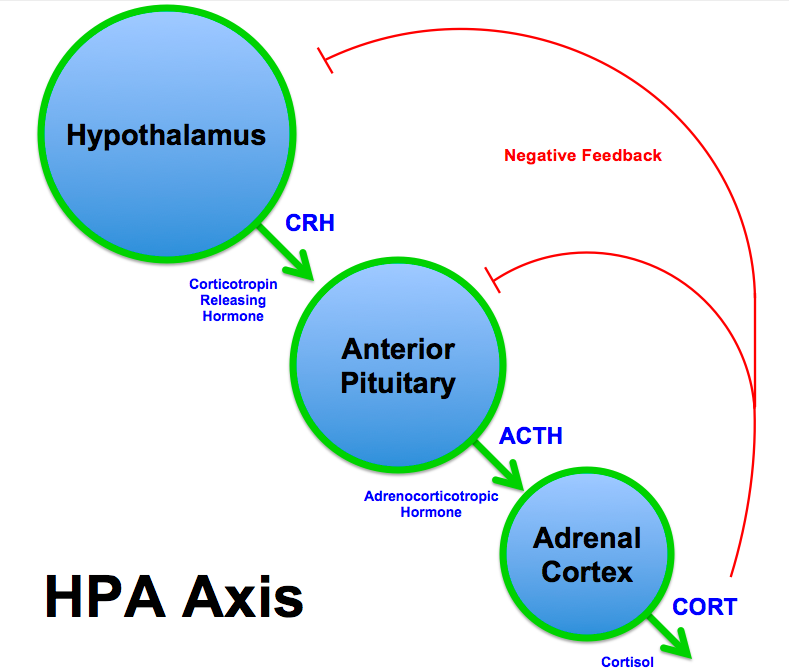
Let’s look at a negative feedback loop using the hormones of the adrenal cortex as an example. In response to stress signals, the hypothalamus releases corticotropin-releasing hormone, or CRH. CRH triggers the anterior pituitary to release adrenocorticotropic hormone, or ACTH, which triggers the adrenal cortex to release a steroid hormone called cortisol. The same mechanism pertains to the thyroid and the relationship between thyroid stimulating hormone (TSH) and thyroid hormone.

Cortisol has many effects on different target organs in the body, but the primary one is to increase glucose in the blood. This sugar is an energy resource that allows the body to respond to physiological or psychological stress. Cortisol, estrogen and androgen are not peptide hormones.  They are steroid hormones, synthesized with a cholesterol backbone, and are also related to the bile secreted by the liver.  While peptide hormones have an amino acid sequence and are highly polar, this is not the case for the steroids.

In addition to acting on organs and tissues throughout the body, the hormones travel through the bloodstream back to the brain, where they inhibit the release of CRH.

Without CRH, the anterior pituitary does not release ACTH. In addition to this effect, the cortisol also acts directly on the anterior pituitary to inhibit ACTH release. Without ACTH, the adrenal cortex stops releasing cortisol.

This interaction is an example of a negative feedback loop. In this loop, the output of the system—the hormones from the adrenal cortex—ultimately diminish the input from the system—the hormones from the hypothalamus and anterior pituitary. This system turns on cortisol release, but then turns it off before cortisol levels get too high, keeping them at a fairly steady level.

This description is not complete without mention of the relationship between growth hormone (GSH) and the liver.  Growth hormone stimulates the liver to produce insulin-like peptide 1 (IL-1), which acts on the pancreatic islet cells to produce insulin.  There is also a competing relationship between glucagon, synthesized by the liver, which acts on glycogenolysis, and insulin, which facilitates glucose entry into peripheral tissues, and is therefore, anabolic.   Insofar as GSH is concerned, it is pleiotrophic because it promotes insulin secretion by the pancreas, but it also raises blood glucose levels.

CONCLUSION

Through its release of hormones, the hypothalamus controls reproduction, growth, metabolism, water conservation, blood pressure, lactation, childbirth, and responses to stress. Through its connections with other regions of the nervous system, the hypothalamus controls many other bodily functions.

http://www.mindsmachine.com/av08.05.script.html

HPA_Axis_Diagram_(Brian_M_Sweis_2012)

HPA_Axis_Diagram_(Brian_M_Sweis_2012)

Hypothalamic-Pituitary-Adrenal Axis

http://upload.wikimedia.org/wikipedia/commons/5/55/HPA_Axis_Diagram_%28Brian_M_Sweis_2012%29.png

The interactions among the organs that constitute the HPA axis, a major part of the neuroendocrine system that controls reactions to stress and regulates many body processes, including digestion, the immune system, mood and emotions, sexuality and energy storage and expenditure is illustrated in the picture above. It is the common mechanism for interactions among glands, hormones, and parts of the midbrain that mediate the general adaptation syndrome (GAS).[1] While steroids are produced only by vertebrates, the physiological role of the HPA axis and corticosteroids in stress response is so fundamental that analogous systems can be found in invertebrates and monocellular organisms as well.

Anatomical connections between brain areas such as the amygdala, hippocampus, prefrontal cortex and hypothalamus facilitate activation of the HPA axis. Sensory information arriving at the lateral aspect of the amygdala is processed and conveyed to the central nucleus, which projects to several parts of the brain involved in responses to fear. At the hypothalamus, fear-signaling impulses activate both the sympathetic nervous system and the modulating systems of the HPA axis.

The key elements of the HPA axis are:

The paraventricular nucleus of the hypothalamus, which contains neuroendocrine neurons that synthesize and secrete vasopressin and corticotropin-releasing hormone (CRH). These two peptides regulate:

The anterior lobe of the pituitary gland. In particular, CRH and vasopressin stimulate the secretion of adrenocorticotropic hormone (ACTH), once known as corticotropin. ACTH in turn acts on:

the adrenal cortex, which produces glucocorticoid hormones (mainly cortisol in humans) in response to stimulation by ACTH. Glucocorticoids in turn act back on the hypothalamus and pituitary (to suppress CRH and ACTH production) in a negative feedback cycle.

CRH and vasopressin are released from neurosecretory nerve terminals at the median eminence. CRH is transported to the anterior pituitary through the portal blood vessel system of the hypophyseal stalk and vasopressin is transported by axonal transport to the posterior pituitary. There, CRH and vasopressin act synergistically to stimulate the secretion of stored ACTH from corticotrope cells. ACTH is transported by the blood to the adrenal cortex of the adrenal gland, where it rapidly stimulates biosynthesis of corticosteroids such as cortisol from cholesterol. Cortisol is a major stress hormone and has effects on many tissues in the body, including the brain. In the brain, cortisol acts on two types of receptor – mineralocorticoid receptors and glucocorticoid receptors, and these are expressed by many different types of neurons. One important target of glucocorticoids is the hypothalamus, which is a major controlling centre of the HPA axis.

http://en.wikipedia.org/wiki/Hypothalamic%E2%80%93pituitary%E2%80%93adrenal_axis

Hypothalamic–pituitary–gonadal axis

This axis controls development, reproduction, and aging in animals. Gonadotropin-releasing hormone (GnRH) is secreted from the hypothalamus by GnRH-expressing neurons. The anterior portion of the pituitary gland produces luteinizing hormone (LH) and follicle-stimulating hormone (FSH), and the gonads produce estrogen and testosterone.

In oviparous organisms (e.g. fish, reptiles, amphibians, birds), the HPG axis is commonly referred to as the hypothalamus-pituitary-gonadal-liver axis (HPGL-axis) in females. Many egg-yolk and chorionic proteins are synthesized heterologously in the liver, which are necessary for oocyte growth and development. Examples of such necessary liver proteins are vitellogenin and choriogenin.

The hypothalamus is located in the brain and secretes GnRH. GnRH travels down the anterior portion of the pituitary via the hypophyseal portal system and binds to receptors on the secretory cells of the adenohypophysis. In response to GnRH stimulation these cells produce LH and FSH, which travel into the blood stream.

These two hormones play an important role in communicating to the gonads. In females FSH and LH act primarily to activate the ovaries to produce estrogen and inhibin and to regulate the menstrual cycle and ovarian cycle. Estrogen forms a negative feedback loop by inhibiting the production of GnRH in the hypothalamus. Inhibin acts to inhibit activin, which is a peripherally produced hormone that positively stimulates GnRH-producing cells. Follistatin, which is also produced in all body tissue, inhibits activin and gives the rest of the body more control over the axis. In males LH stimulates the interstitial cells located in the testes to produce testosterone, and FSH plays a role in spermatogenesis. Only small amounts of estrogen are secreted in males. Recent research has shown that a neurosteroid axis exists, which helps the cortex to regulate the hypothalamus’s production of GnRH.

http://en.wikipedia.org/wiki/Hypothalamic%E2%80%93pituitary%E2%80%93gonadal_axis

Hypothalamic–pituitary–thyroid axis

thyroid function axis

thyroid function axis

Short overview of thyroid homeostasis

Short overview of thyroid homeostasis

http://upload.wikimedia.org/wikipedia/commons/thumb/d/d1/Thyroid_system.svg/640px-Thyroid_system.svg.png

Thyroid homeostasis results from a multi-loop feedback system that is found in virtually all higher vertebrates. Proper function of thyrotropic feedback control is indispensable for growth, differentiation, reproduction and intelligence. Very few animals (e.g. axolotls and sloths) have impaired thyroid homeostasis that exhibits a very low set-point that is assumed to underlie the metabolic and ontogenetic anomalies of these animals.

The pituitary gland secretes thyrotropin (TSH; Thyroid Stimulating Hormone) that stimulates the thyroid to secrete thyroxine (T4) and, to a lesser degree, triiodothyronine (T3). The major portion of T3, however, is produced in peripheral organs, e.g. liver, adipose tissue, glia and skeletal muscle by deiodination from circulating T4. Deiodination is controlled by numerous hormones and nerval signals including TSH, vasopressin and catecholamines.

Both peripheral thyroid hormones (iodothyronines) inhibit thyrotropin secretion from the pituitary (negative feedback). Consequently, equilibrium concentrations for all hormones are attained.

TSH secretion is also controlled by thyrotropin releasing hormone (thyroliberin, TRH), whose secretion itself is again suppressed by plasma T4 and T3 in CSF (long feedback, Fekete–Lechan loop). Additional feedback loops are ultrashort feedback control of TSH secretion (Brokken-Wiersinga-Prummel loop) and linear feedback loops controlling plasma protein binding. Convergence of multiple afferent signals in the control of TSH release may be the reason for the observation that the relation between free T4 concentration and TSH levels deviates from a pure loglinear relation that has previously been proposed.

Thyrotropic feedback control - Jwdietrich

Thyrotropic feedback control – Jwdietrich

“Thyrotropic feedback control” by Jwdietrich2 – Own work. Licensed under CC BY 3.0 via Wikimedia Commons – http://commons.wikimedia.org/wiki/File:Thyrotropic_feedback_control.svg#mediaviewer/File:Thyrotropic_feedback_control.svg

The above has been a broad stroke of the Pituitary-Hypophysial-Endocrine Axis. It does not take into account another level of complexity in the receptor mediated reactions.

Anatomy of the pituitary, thyroid, parathyroid and adrenal glands

Ritchie, J.E., Balasubramanian, S.P
Surgery (United Kingdom) 2014; 32 (10), pp. 499-503

A detailed understanding of anatomy is essential for several reasons: to enable
accurate diagnosis and plan appropriate management; to perform surgery in a safe
and effective manner avoiding damage to adjacent structures and; to anticipate and
recognize variations in normal anatomy. This chapter will cover the anatomy of four
major endocrine glands (thyroid, parathyroid, pituitary and adrenal). Other
endocrine glands (such as the hypothalamus, pineal gland, thymus, endocrine
pancreas and the gonads) are beyond the scope of this chapter. In addition to gross
anatomy, clinically relevant embryological and histological details of these four
glands are also discussed.

Physiology of the pituitary, thyroid, parathyroid and adrenal glands

Mihai, R.
Surgery (United Kingdom) 2014; 32 (10), pp. 504-512

The pituitary gland is made of clusters of cells producing specific hormones that
control growth (growth hormone), thyroid function (triiodothyronine (T3) and
thyroxine (T4)), adrenal function (adrenocorticotrophic hormone (ACTH)) and gonadal
function (follicle-timulating hormone and luteinizing hormone). In addition, the neurons
that join the posterior pituitary (neurohypophysis) secrete vasopressin – the
antidiuretic hormone involved in maintaining water balance. The negative feedback
loop is the basic mechanism to control the regulation of all endocrine glands.
Hypothalamic peptides – releasing hormones (e.g. TRH, corticotrophin-releasing
hormone) reach the hypophysis via the portal venous system and induce the
secretion of specific stimulating hormones (e.g. thyroid-stimulating hormone,
ACTH) that drive the end-target endocrine cells to secrete hormones (e.g.
thyroid hormones – T3 and T4 or adrenal hormones – cortisol, dehydro-epiandrosterone sulphate). The plasma levels of these circulating hormones inhibit
the pituitary (short feedback) or the hypothalamus (long feedback) and limit the further
release of releasing and stimulating hormones. The effects of circulating hormones
on different tissues are mediated via specific receptors on the cell membrane (e.g.
vasopressin receptors), in the cytoplasm (steroid receptor for cortisol) or in the
nucleus (e.g. thyroid hormone receptors). Understanding the physiological effects of
peripheral hormones helps understanding the mechanisms by which clinical signs
and symptoms develop in diseases characterized by excessive hormone secretion
(e.g. thyrotoxicosis, Cushing syndrome, phaeochromocytomas) or lack of hormone
secretion (e.g. diabetes insipidus). The parathyroid gland and adrenal medulla are
not controlled by the pituitary but play important roles in calcium metabolism
and the adrenergic (sympathetic nervous system) function respectively.

Pathology of the pituitary, parathyroid, thyroid and adrenal glands

Okpokam, A., Johnson, S.J.
Surgery (United Kingdom) 2014; 32 (10), pp. 513-524

The clinical presentation of pathology of these endocrine organs is usually of hyper-
or hypo-secretion of hormones, enlargement and/or nodules found either clinically
or radiologically. Hyperfunction usually results from hyperplasia or functioning
neoplasms. Hypofunction usually represents destruction of the gland. Neoplasms
may be functional or non-functional, and benign or malignant, the latter may also
present as distant metastases. Many cases benefit from multidisciplinary team
discussion, pre- and/or post-operatively. Most hyperplasia/neoplasia is sporadic,
but a significant minority occurs in familial settings, for example multiple endocrine
neoplasia (MEN) syndromes type 1 and type 2. Any of these endocrine organs
can also be involved by non-endocrine primary malignancy, either by direct
infiltration or blood-borne metastasis.

Neuroanatomy and Physiology of the Avian Hypothalamic/Pituitary Axis: Clinical Aspects

Midge Ritchie
Vet Clin Exot Anim 17 (2014) 13–22
http://dx.doi.org/10.1016/j.cvex.2013.09.005

The pituitary gland (hypophysis) is a small gland that is intimately connected
to the hypothalamus at the base of the brain and is classified as either
adenohypophysis or neurohypophysis.

The avian thyroid glands are paired glands located ventrolaterally to the
trachea. The histology of the avian thyroids is the same as in mammals:
organized into follicles filled with colloid and lined with cuboidal epithelial cells
that secrete into the interior of the follicles.

Adrenal lesions in birds have been described postmortem only. Antemortem
diagnosis of adrenal disease has not been reported in birds. It is believed,
however, that the ACTH stimulation and low dose dexamethasone suppression
test can potentially be used in birds for the diagnosis of hypoadrenocorticism
and hyperadrenocorticism.

In birds, as in other verterbrates, gonadotropin-releasing hormone (GnRH), also
known as luteinizing hormone releasing hormone (LHRH), released from the
hypothalamus, is the primary factor responsible for the release of gonadotropins
(luteinizing hormone [LH], follicle-stimulating hormone [FSH], and prolactin) by the
anterior pituitary gland. Gonadotropins bind to their gonadal receptors and affect
the function of the ovaries and testes.

The 2 hormones of the neurohypophysis, arginine vasotocin (AVT) and mesotocin
(MT), are produced by and secreted from separate neurosecretory neurons. AVT
and MT are transported bound to carrier proteins by axoplasmic transport. The
hormones are then stored in pars nervosa before release.

Endocrine responses to critical illness: Novel insights and therapeutic implications

Boonen, E., Van Den Berghe, G.
Journal of Clinical Endocrinology and Metabolism 2014; 99 (5), pp. 1569-1582

Context: Critical illness, an extreme form of severe physical stress, is characterized
by important endocrine and metabolic changes. Due to critical care medicine,
survival from previously lethal conditions has become possible, but many
patients now enter a chronic phase of critical illness. The role of the endocrine
and metabolic responses to acute and prolonged critical illness in mediating or
hampering recovery remains highly debated. Evidence Acquisition: The recent
literature on changes within the hypothalamic-pituitary-thyroid axis and the
hypothalamic-pituitary-adrenal axis and on hyperglycemia in relation to recovery
from critical illness was critically appraised and interpreted against previous
insights. Possible therapeutic implications of the novel insights were analyzed.
Specific remaining questions were formulated. Evidence Synthesis: In recent years,
important novel insights in the pathophysiology and the consequences of some
of these endocrine responses to acute and chronic critical illness were generated.
Acute endocrine adaptations are directed toward providing energy and substrates
for the vital fight-or-flight response in a context of exogenous substrate deprivation.
Distinct endocrine and metabolic alterations characterize the chronic phase of critical
illness, which seems to be no longer solely beneficial and could hamper recovery and
rehabilitation.Conclusions: Important novel insights reshape the current view on
endocrine and metabolic responses to critical illness and further clarify underlying
pathways. Although many issues remain unresolved, some therapeutic implications
were already identified. More work is required to find better treatments, and the
optimal timing for such treatments, to further prevent protracted critical illness, to
enhance recovery thereof, and to optimize rehabilitation.

Endocrinopathies after allogeneic and autologous transplantation of hematopoietic
stem cells

Orio, F., Muscogiuri, G., Palomba, S., (…), Colao, A., Selleri, C.
Scientific World Journal 2014; 2014, 282147

Early and late endocrine disorders are among the most common complications in
survivors after hematopoietic allogeneic- (allo-) and autologous- (auto-stem cell
transplant (HSCT). This review summarizes main endocrine disorders reported in
literature and observed in our center as consequence of auto- and allo-HSCT and
outlines current options for their management. Gonadal impairment has been found
early in approximately two-thirds of auto- and allo-HSCT patients: 90-99% of
women and 60-90% of men. Dysfunctions of the hypothalamus-pituitary-growth
hormone/insulin growth factor-I axis, hypothalamus-pituitary-thyroid axis, and
hypothalamus-pituitary-adrenal axis were documented as later complications,
occurring in about 10, 30, and 40% of transplanted patients, respectively. Moreover,
overt or subclinical thyroid complications (including persistent low-T3 syndrome,
chronic thyroiditis, subclinical hypo- or hyperthyroidism, and thyroid carcinoma),
gonadal failure, and adrenal insufficiency may persist many years after HSCT. Our
analysis further provides evidence that main recognized risk factors for endocrine
complications after HSCT are the underlying disease, previous pretransplant
therapies, the age at HSCT, gender, total body irradiation, posttransplant
derangement of immune system, and in the allogeneic setting, the presence of
graft-versus-host disease requiring prolonged steroid treatment. Early identification of
endocrine complications can greatly improve the quality of life of long-term survivors
after HSCT.

Purinergic signalling in endocrine organs

Burnstock, G.
Purinergic Signalling 2014; 10 (1), pp. 189-231

There is widespread involvement of purinergic signalling in endocrine biology.
Pituitary cells express P1, P2X and P2Y receptor subtypes to mediate hormone
release. Adenosine 5′-triphosphate (ATP) regulates insulin release in the
pancreas and is involved in the secretion of thyroid hormones. ATP plays a major
role in the synthesis, storage and release of catecholamines from the adrenal gland.
In the ovary purinoceptors mediate gonadotrophin-induced progesterone secretion,
while in the testes, both Sertoli and Leydig cells express purinoceptors that
mediate secretion of oestradiol and testosterone, respectively. ATP released as
a cotransmitter with noradrenaline is involved in activities of the pineal gland
and in the neuroendocrine control of the thymus. In the hypothalamus, ATP and
adenosine stimulate or modulate the release of luteinising hormone-releasing
hormone, as well as arginine-vasopressin and oxytocin. Functionally active P2X
and P2Y receptors have been identified on human placental syncytiotrophoblast
cells and on neuroendocrine cells in the lung, skin, prostate and intestine. Adipocytes
have been recognised recently to have endocrine function involving purinoceptors.

Heroes in endocrinology: Nobel prizes

de Herder, W.W.
Endocrine Connections 2014; 3 (3), pp. R94-R104

The Nobel Prize in Physiology or Medicine was first awarded in 1901. Since then,
the Nobel Prizes in Physiology or Medicine, Chemistry and Physics have been awarded
to at least 33 distinguished researchers who were directly or indirectly involved
in research into the field of endocrinology. This paper reflects on the life histories,
careers and achievements of 11 of them: Frederick G Banting, Roger Guillemin,
Philip S Hench, Bernardo A Houssay, Edward C Kendall, E Theodor Kocher,
John J R Macleod, Tadeus Reichstein, Andrew V Schally, Earl W Sutherland, Jr
and Rosalyn Yalow. All were eminent scientists, distinguished lecturers and
winners of many prizes and awards.

A brief history of great discoveries in pharmacology: In celebration of the centennial
anniversary of the founding of the American Society of Pharmacology and
Experimental Therapeutics
Rubin, R.P.
Pharmacological Reviews 2007; 59 (4), pp. 289-359
http://dx.doi.org:/10.1124/pr.107.70102

Chapter 49 – Primary Hyperparathyroidism and Hyperparathyroid Bone Disease
Lorraine A. Fitzpatrick
Osteoporosis (Second Edition), Volume 2, 2001, Pages 259–269
http://dx.doi.org:/10.1016/B978-012470862-4/50050-7

This chapter reviews the current state of knowledge about primary hyperparathyroidism
(1°HPT) and bone and highlights recent long-term data. Variable degrees of osteopenia
are common in patients having 1°HPT and osteoporosis may be evident at the
diagnosis of 1°HPT. The skeletal deficits are occasionally severe, but usually of
undetermined relationship to the hyperparathyroidism. On average, the decrements
of bone mass suggest only about a doubling of fracture risk, an increment
not discernible in the small studies done to date. The few prospective studies
of fracture risk in 1°HPT were not sufficiently powered to adequately address the
issue. Osteopenia may be worst at primarily cortical sites, which would suggest
a greater risk of appendicular than of spinal crush fractures. Regardless of site or
severity of osteopenia, surgical therapy of 1°HPT causes substantially increased
bone mineral density (BMD) at most sites, on the order of 10 to 12%.
Increases of such magnitude are rarely seen in therapy of osteoporosis by any
other means. Moreover, the increases are larger and may go on for longer periods
than could be accounted for by simple filling in of remodeling space. One
must reason that decrements of bone mass similar to those seen in 1°HPT
increase fracture risk under other circumstances, and assure that restoration of
BMD after parathyroid adenomectomy in hyperparathyroid patients
should substantially reduce fracture risk. Severe bone disease caused by
1°HPT is rare. As a group, hyperparathyroid patients have mildly to moderately
reduced bone mineral density that may be worst for cortical bone, but which
has been observed at all sites. Removal of parathyroid adenomas and restoration
of normal parathyroid function causes substantial, lasting increases of BMD
(averaging 10 to 12%). Gain of bone occurs at all sites, may go on for up to
10 years, and is greatest in patients having the greatest baseline decrements
of BMD.

New aspects of immunoregulation by growth and lactogenic hormones
Berczi, I., Quintanar Stephano, A., Campos, R., Kovacs, K.
Advances in Neuroimmune Biology 2014; 5 (1), pp. 43-60
http://dx.doi.org:/10.3233/NIB-140086

Growth hormone and prolactin maintain adaptive immunity, which incudes cell
mediated immunity, antibody- and autoimmune reactions, maintain thymus
and bone marrow function. Insulin like growth factor-1 participate in the
regulatory action of growth hormone and prolactin. The hypothalamus-pituitary-
adrenal axis stimulates innate immunity and suppresses adaptive immunity.
Dopamine also inhibits adaptive immunity and regulates innate immunity.
Catecholamine’s and corticosteroids support innate immunity and stimulate
suppressor-regulatory T cells, which inhibit adaptive immunity. Adrenalectomy
sensitized mice to Lipid A, which was mediated by exaggerated production
of tumor necrosis factor-alpha, due to the lack of functional hypothalamic
pituitary adrenal axis. Growth and lactogenic hormones share signal
transduction pathways with type I (gamma-c) cytokines. This indicates
functional overlap. The hypothalamic pituitary adrenal axis produces
glucocorticoids, which stimulate innate immunity, and play a primary
role during the acute phase response. Vasopressin supports the acute
phase response, maintains chronic inflammatory reactions and coordinates
healing. Vasopressin maintains immunocompetence during homeostasis
as it stimulates the hypothalamus-pituitary-adrenal axis and also prolactin.
Vasopressin stimulates innate immune cytokine production. Oxytocin is
immunoregulatory. Thyroidectomy in rats suppresses immune function and
thyroxin releases growth hormone and prolactin from transplanted pituitary
grafts in rats and also restores immunocompetence. This indicates that
thyroxin is an indirect immunoregulator. The growth hormone secretagouge,
ghrelin, is immunoregulatory. Dopamine is a neurotransmitter and immuno-regulator. Dopamine has a role in normal immune function and in stress,
inflammatory diseases, schizophrenia, Parkinson disease, Tourette syndrome,
Lupus, Multiple Sclerosis, AIDS, and generalized anxiety syndrome.

Increased frequency of the rs2066853 variant of aryl hydrocarbon receptor gene
in patients with acromegaly
Cannavo, S., Ferrau, F., Ragonese, M., (…), Ruggeri, R.M., Trimarchi, F.
Clinical Endocrinology 2014; 81 (2), pp. 249-253
http://dx.doi.org:/10.1111/cen.12424

Context
Aryl hydrocarbon receptor (AHR) pathway has a key role in cellular detoxification
mechanisms and seems implicated in tumorigenesis. Moreover, polymorphisms
and mutations of AHR gene have been associated with several human and
animal tumours. Although AHR has been found differently expressed in pituitary
adenomas, AHR gene mutation status has never been investigated in acromegalic
patients. Design In this study, we evaluated patients with apparently sporadic GH-secreting pituitary adenoma for AHR gene variants.
Patients and Methods
Seventy patients with sporadic GH-secreting pituitary adenoma (M = 27, age
59·1 ± 1·6 years) and 157 sex- and age-atched controls were enrolled in the
study. In all patients and controls, the exons 1, 2, 3, 5 and 10 of AHR gene were
evaluated for nucleotide variants by sequencing analysis.
Results
The rs2066853 polymorphism was identified in the exon 10 of 18/70 acromegalic
patients and 9/157 healthy subjects (25·7 vs. 5·7%, χ2 = 18·98 P < 0·0001), in
homozygosis in one patient and in heterozygosis in the other 17 and in the
9 healthy subjects. Moreover, a heterozygous rs4986826 variant in exon 10
was identified in a patient with heterozygous rs2066853 polymorphism, and
in the patient with homozygous rs2066853 variant. This second polymorphism
was not detected in the control group. Patients with rs2066853 polymorphism
showed increased IGF-1 ULN (P < 0·05) and prevalence of cavernous
sinus invasion (P = 0·05), thyroid (P = 0·02), bladder (P = 0·0001) or
lymphohematopoietic (P < 0·05) tumours.
Conclusions
AHR gene rs2066853 polymorphism is significantly more frequent in
acromegalic patients than in healthy subjects and is associated with
increased disease aggressivity. Moreover, the rs4986826 variant was
detected in few patients with rs2066853 polymorphism, but its role is
to be cleared.

Current knowledge of D-aspartate in glandular tissues
Hunn, B.H.M., Martin, W.G., Simpson Jr., S., Mclean, C.A.
Clinical Endocrinology 2014; 81 (2), pp. 249-253
http://dx.doi.org:/10.1111/cen.12424

Context
Aryl hydrocarbon receptor (AHR) pathway has a key role in cellular
detoxification mechanisms and seems implicated in tumorigenesis.
Moreover, polymorphisms and mutations of AHR gene have been
associated with several human and animal tumours. Although AHR has
been found differently expressed in pituitary adenomas, AHR gene mutation
status has never been investigated in acromegalic patients.
Design
In this study, we evaluated patients with apparently sporadic GH-secreting
pituitary adenoma for AHR gene variants.
Patients and Methods
Seventy patients with sporadic GH-secreting pituitary adenoma (M = 27,
age 59·1 ± 1·6 years) and 157 sex- and age-atched controls were enrolled
in the study. In all patients and controls, the exons 1, 2, 3, 5 and 10 of
AHR gene were evaluated for nucleotide variants by sequencing analysis.
Results
The rs2066853 polymorphism was identified in the exon 10 of 18/70
acromegalic patients and 9/157 healthy subjects (25·7 vs. 5·7%, χ2 = 18·98
P < 0·0001), in homozygosis in one patient and in heterozygosis in the other
17 and in the 9 healthy subjects. Moreover, a heterozygous rs4986826 variant
in exon 10 was identified in a patient with heterozygous rs2066853
polymorphism, and in the patient with homozygous rs2066853 variant.
This second polymorphism was not detected in the control group. Patients
with rs2066853 polymorphism  showed increased IGF-1 ULN (P < 0·05)
and prevalence of cavernous sinus invasion (P = 0·05), thyroid (P = 0·02),
bladder (P = 0·0001) or lymphohematopoietic (P < 0·05) tumours.
Conclusions
AHR gene rs2066853 polymorphism is significantly more frequent in
acromegalic patients than in healthy subjects and is associated with
increased disease aggressivity. Moreover, the rs4986826 variant was
detected in few patients with rs2066853 polymorphism, but its role is
to be cleared.

Autophagy in the endocrine glands
Weckman, A., Di Ieva, A., Rotondo, F., (…), Kovacs, K., Cusimano
Journal of Molecular Endocrinology 2013; 52 (2), pp. R151-R163
http://dx.doi.org:/10.1530/JME-13-0241

Autophagy is an important cellular process involving the degradation of
intracellular components. Its regulation is complex and while there are
many methods available, there is currently no single effective way of
detecting and monitoring autophagy. It has several cellular functions
that are conserved throughout the body, as well as a variety of different
physiological roles depending on the context of its occurrence in the
body. Autophagy is also involved in the pathology of a wide range of
diseases. Within the endocrine system, autophagy has both its traditional
conserved functions and specific functions. In the endocrine glands,
autophagy plays a critical role in controlling intracellular hormone levels.
In peptide-secreting cells of glands such as the pituitary gland, crinophagy,
a specific form of autophagy, targets the secretory granules to control the
levels of stored hormone. In steroid-secreting cells of glands such as the
testes and adrenal gland, autophagy targets the steroid-producing organelles.
The dysregulation of autophagy in the endocrine glands leads to several
different endocrine diseases such as diabetes and infertility. This review
aims to clarify the known roles of autophagy in the physiology of the
endocrine system, as well as in various endocrine diseases.

Insm1 controls development of pituitary endocrine cells and requires a SNAG
domain for function and for recruitment of histone-modifying factors
Welcker, J.E., Hernandez-Miranda, L.R., Paul, F.E., (…), Selbach, M., Birchmeier, C.
Development (Cambridge) 2013; 140 (24), pp. 4947-4958
http://dx.doi.org:/10.1242/dev.097642

The Insm1 gene encodes a zinc finger factor expressed in many endocrine organs.
We show here that Insm1 is required for differentiation of all endocrine cells in the
pituitary. Thus, in Insm1 mutant mice, hormones characteristic of the different
pituitary cell types (thyroid-stimulating hormone, follicle-stimulating hormone,
melanocyte-stimulating hormone, adrenocorticotrope hormone, growth hormone
and prolactin) are absent or produced at markedly reduced levels. This differentiation
deficit is accompanied by upregulated expression of components of the Notch
signaling pathway, and by prolonged expression of progenitor markers, such
as Sox2. Furthermore, skeletal muscle-specific genes are ectopically expressed
in endocrine cells, indicating that Insm1 participates in the repression of an
inappropriate gene expression program. Because Insm1 is also essential for
differentiation of endocrine cells in the pancreas, intestine and adrenal gland,
it is emerging as a transcription factor that acts in a pan-endocrine manner.
The Insm1 factor contains a SNAG domain at its N-terminus, and we show
here that the SNAG domain recruits histone-modifying factors (Kdm1a, Hdac1/2
and Rcor1-3) and other proteins implicated in transcriptional regulation (Hmg20a/b
and Gse1). Deletion of sequences encoding the SNAG domain in mice disrupted
differentiation of pituitary endocrine cells, and resulted in an upregulated expression
of components of the Notch signaling pathway and ectopic expression of skeletal
muscle-specific genes. Our work demonstrates that Insm1 acts in the epigenetic
and transcriptional network that controls differentiation of endocrine cells in the
anterior pituitary gland, and that it requires the SNAG domain to exert
this function in vivo.
Neuromedin B stimulates the hypothalamic–pituitary–gonadal axis in male rats

C.K. Boughton, S.A. Patel, E.L. Thompson, M. Patterson, A.E. Curtis, A. Amina, et al.
Regulatory Peptides 187 (2013) 6–11
http://dx.doi.org/10.1016/j.regpep.2013.10.002

Neuromedin B (NMB) is a highly conserved bombesin-related peptide found in mammals. NMB mRNA is detected in the central nervous system(CNS) and is highly expressed in the rat hypothalamus, in particular the medial preoptic area and the arcuate nucleus. The mammalian bombesin family of receptors consists of three closely related G protein coupled receptors, BB1, BB2 and BB3. The BB1 receptor subtype has the highest affinity for NMB. NMB has well documented roles in the regulation of the thyroid axis and the stress axis in rats. However, there is little available data regarding the role of NMB in the regulation of the hypothalamic–pituitary–gonadal (HPG) axis. It is known that the NMB receptor is expressed in immortalized gonadotrophin releasing hormone (GnRH) releasing GT1-7 cells and murine forebrain GnRH neurons, and that anterior pituitary NMB immunoreactivity is altered by changes in the sex steroid environment.
The objective of these studies was thus to further investigate the effects of NMB on the HPG axis. Intracerebroventricular (ICV) administration of NMB (10nmol) to adult male rats significantly increased plasma luteinizing hormone (LH) levels 30min after injection (plasma LH ng/ml; saline 0.69±0.07, 10nmol NMB1.33± 0.17, P b 0.01). In vitro, NMB stimulated GnRH release from hypothalamic explants from male rats and from hypothalamic GT1-7 cells.
NMB had no significant effect on LH release from anterior pituitary explants from male rats, or from pituitary LβT2 cells in vitro. These results suggest a previously unreported role for NMB in the stimulation of the HPG axis via hypothalamic GnRH. Further work is now required to determine the receptor mediating the effects of NMB on the reproductive axis and the physiological role of NMB in reproduction.

Thyroid and Pituitary

TGFβ2 regulates hypothalamic Trh expression through the TGFβ inducible early gene-1 (TIEG1) during fetal development

M Molecular and Cellular Endocrinology 400 (2015) 129–139 Martínez-Armenta, SD de León-Guerrero, A Catalán, L Alvarez-Arellano, et al.
http://dx.doi.org/10.1016/j.mce.2014.10.021

The hypothalamus regulates the homeostasis of the organism by controlling hormone secretion from the pituitary. The molecular mechanisms that regulate the differentiation of the hypothalamic thyrotropin releasing hormone (TRH) phenotype are poorly understood. We have previously shown that Klf10 or TGFβ inducible early gene-1 (TIEG1) is enriched in fetal hypothalamic TRH neurons. Here, we show that expression of TGFβ isoforms (1-3) and both TGFβ receptors (TβRI and II) occurs in the hypothalamus concomitantly with the establishment of TRH neurons during late embryonic development. TGFβ2 induces Trh expression via a TIEG1 dependent mechanism. TIEG1 regulates Trh expression through an evolutionary conserved GC rich sequence on the Trh promoter. Finally, in mice deficient in TIEG1, Trh expression is lower than in wild type animals at embryonic day 17. These results indicate that TGFβ signaling, through the upregulation of TIEG1, plays an important role in the establishment of Trh expression in the embryonic hypothalamus.

Gonadotropic Hormone

The essence of female–male physiological dimorphism: Differential Ca2+-homeostasis enabled by the interplay between farnesol-like endogenous sesquiterpenoids and sex-steroids? The Calcigender paradigm

Arnold De Loof
General and Comparative Endocrinology 211 (2015) 131–146
http://dx.doi.org/10.1016/j.ygcen.2014.12.003

Ca2+ is the most omnipresent pollutant on earth, in higher concentrations a real threat to all living cells. When [Ca2+]i rises above 100 nM (=resting level), excess Ca2+ needs to be confined in the SER and mitochondria, or extruded by the different Ca2+-ATPases. The evolutionary origin of eggs and sperm cells has a crucial, yet often overlooked link with Ca2+-homeostasis. Because there is no goal whatsoever in evolution, gametes did neither originate ‘‘with the purpose’’ of generating a progeny nor of increasing fitness by introducing meiosis. The explanation may simply be that females ‘‘invented the trick’’ to extrude eggs from their body as an escape strategy for getting rid of toxic excess Ca2+ resulting from a sex-hormone driven increased influx into particular cells and tissues. The production of Ca2+-rich milk, seminal fluid in males and all secreted proteins by eukaryotic cells may be similarly explained. This view necessitates an upgrade of the role of the RER-Golgi system in extruding Ca2+. In the context of insect metamorphosis, it has recently been (re)discovered that (some isoforms of) Ca2+-ATPases act as membrane receptors for some types of lipophilic ligands, in particular for endogenous farnesol-like sesquiterpenoids (FLS) and, perhaps, for some steroid hormones as well. A novel paradigm, tentatively named ‘‘Calcigender’’ emerges. Its essence is: gender-specific physiotypes ensue from differential Ca2+-homeostasis enabled by genetic differences, farnesol/FLS and sex hormones. Apparently the body of reproducing females gets temporarily more poisoned by Ca2+ than the male one, a selective benefit rather than a disadvantage.

Kisspeptin induces expression of gonadotropin-releasing hormone receptor in GnRH-producing GT1–7 cells overexpressing G protein-coupled receptor 54

U Sukhbaatar, H Kanasaki, T Mijiddorj, Aki Oride, Ki Miyazaki
General and Comparative Endocrinology 194 (2013) 94–101
http://dx.doi.org/10.1016/j.ygcen.2013.09.002

Kisspeptin signaling through its receptor is crucial for many reproductive functions. However, the molecular mechanisms and biomedical significance of the regulation of GnRH neurons by kisspeptin have not been adequately elucidated.
In the present study, we found that kisspeptin increases GnRH receptor (GnRHR) expression in a GnRH-producing cell line (GT1–7). Because cellular activity of G protein-coupled receptor 54 (GPR54) and GnRHR was limited in GT1–7 cells, we overexpressed these receptors to clarify receptor function.
Using luciferase reporter constructs, the activity of both the serum response element (Sre) promoter, a target for extracellular signal-regulated kinase (ERK), and the cyclic AMP (cAMP) response element (Cre) promoter were increased by kisspeptin. Although GnRH increased Sre promoter activity, the Cre promoter was not significantly activated by GnRH. Kisspeptin, but not GnRH, increased cAMP accumulation in these cells. Kisspeptin also increased the transcriptional activity of GnRHR; however, the effect of GnRH on the GnRHR promoter was limited and not significant. Transfection of GT1–7 cells with constitutively active MEK kinase (MEKK) and protein kinase A (PKA) increased GnRHR expression. In addition, GnRHR expression was further increased by co-overexpression of MEKK and PKA. The Cre promoter, but not the Sre promoter, was also further activated by co-overexpression of MEKK and PKA. GnRH significantly increased the activity of the GnRHR promoter in the presence of cAMP.
The present findings suggest that kisspeptin is a potent stimulator of GnRHR expression in GnRH-producing neurons in association with ERK and the cAMP/PKA pathways

Role of leptin in the regulation of sterol/steroid biosynthesis in goose granulosa cells

Shenqiang Hu, Chao Gan, Rui Wen, Qihai Xiao, Hua Gou, Hehe Liu, et al.
Theriogenology 82 (2014) 677–685
http://dx.doi.org/10.1016/j.theriogenology.2014.05.025

Leptin is critical for reproductive endocrinology. The aim of this study is to assess the expression patterns of leptin receptor (Lepr) during ovarian follicle development and to reveal the mechanism by which leptin affects steroid hormone secretion in goose granulosa cells. Transcripts of Lepr were ubiquitous in all tested tissues, with pituitary and adrenal glands being the predominant sites. Goose ovarian follicles were divided into several groups by diameter including prehierarchical (4 to 6, 6 to 8, and 8 to 10 mm) and hierarchical (F5–F1) follicles. Lepr gene expression was significantly higher in granulosa cells than in theca cells from follicles of 4 to 8 mm in diameter. Expression of Lepr in granulosa cells decreased gradually as follicles developed, with fluctuating expression in F5 and F3 follicles. Lepr mRNA in theca cells underwent a slight decrease from the 6- to 8-mm cohorts to F5 follicle and then exhibited a transient increase and declined later. In vitro experiments in cultured goose granulosa cells showed that estradiol release was significantly stimulated, whereas progesterone increased slightly and testosterone decreased dramatically after leptin treatment. In accordance with the data for steroids, expression of Lepr, Srebp1, Cyp51, StAR, and Cyp19a1 were induced by the addition of leptin, and the concomitant changes in Hmgcs1, Dhcr24, Cyp11a1, 17b-hsd, Cyp17, and 3b-hsd gene expression were seen. These results suggested that leptin is involved in the development of goose ovarian follicles, and leptin’s effect on steroid hormone secretion could be due to altered sterol/steroidogenic gene expression via interaction with its receptor.

Progesterone and 17[1]-estradiol regulate expression ofnesfatin-1/NUCB2 in mouse pituitary gland

Yiwa Chung, Jinhee Kim, Eunji Im, Heejeong Kim, Hyunwon Yang
Peptides 63 (2015) 4–9
http://dx.doi.org/10.1016/j.peptides.2014.10.011

tNesfatin-1 was first shown to be involved in the control of appetite and energy metabolism in the hypo-thalamus. Many recent reports have shown nesfatin-1 expression in various tissues including the pituitary gland, but its expression and regulation mechanisms in the pituitary gland are unclear. Therefore, first, we investigated the mRNA and protein expression of nesfatin-1 in the pituitary using qRT-PCR and Western blotting, respectively. Expression of NUCB2 mRNA and nesfatin-1 protein was higher in the pituitary gland than in other organs, and nesfatin-1 protein was localized in many cells in the anterior pituitary gland. Next, we investigated whether NUCB2 mRNA expression in the pituitary gland was regulated by sex steroid hormones secreted by the ovary. Mice were ovariectomized and injected with progesterone (P4) and 17[1]-estradiol (E2). The expression of NUCB2 in the pituitary gland was dramatically decreased after ovariectomy and increased with injection of P4 and E2, respectively. The in vitro experiment to elucidate the direct effect of P4 and E2 on NUCB2 mRNA expression showed NUCB2 mRNA expression was significantly increased with E2 and decreased with P4 alone and P4 plus E2 in cultured pituitary tissue. The present study demonstrated that nesfatin-1/NUCB2 was highly expressed in the mouse pituitary and was regulated by P4 and E2. These data suggest that reproductive-endocrine regulation through hypothalamus–pituitary–ovary axis may contribute to nesfatin-1/NUCB2 expression in the pituitary gland.

The role of TGF-β/Smad signaling in dopamine agonist-resistant prolactinomas
Zhenye Li, Qian Liu1, Chuzhong Li, Xuyi Zong, Jiwei Bai, YoutuWu, et al.
Molecular and Cellular Endocrinology 402 (2015) 64–71
http://dx.doi.org/10.1016/j.mce.2014.12.024

Background: Prolactinomas are the most common secretory pituitary adenomas. The first line of treatment involves dopamine agonists (DAs); however, a subset of patients is resistant to such therapy. Recent studies suggest that dopamine can up-regulate TGF-β1 synthesis in rat pituitary lactotrophs whereas estradiol down-regulates TGF-β1. To date, the role of TGF-β/Smad signaling in DAs-resistant prolactinomas has not been explored.
Methods: High-content screening (HCS) techniques, qRT-PCR,Western blot, immunofluorescence and ELISA, were performed to determine the role of TGF-β/Smad signaling in DAs-resistant prolactinomas.
Results: We reported a significant down-regulation of TGF-β/Smad signaling cascade in DAs-resistant prolactinomas compared to normal human anterior pituitaries. Following treatment with TGF-β1, the dopamine agonist, bromocriptine, and the estrogen antagonist (ER), fulvestrant in GH3 cells, we found that TGF-β1 and fulvestrant caused significant cytotoxicity in a dose- and time-dependent manner and activated Smad3 was detected following exposure to TGF-β1 and fulvestrant. In addition, treating GH3 cells with fulvestrant increased active TGF-β1 levels and decreased PRL levels in a dose-dependent manner.
Conclusion: TGF-β/Smad signaling pathway may play an important role in DA-resistant prolactinomas and has the potential to be a viable target for the diagnosis and treatment of prolactinomas, particularly in patients who are resistant to Das.

Pituitary adenylate cyclase-activating polypeptide (PACAP) increases expression of the gonadotropin-releasing hormone (GnRH) receptor in GnRH-producing GT1-7 cells overexpressing PACAP type I receptor

Haruhiko Kanasaki, T Mijiddorj, U Sukhbaatar, Aki Oride, K Miyazaki
General and Comparative Endocrinology 193 (2013) 95–102
http://dx.doi.org/10.1016/j.ygcen.2013.07.013

The present study demonstrates the action of pituitary adenylate cyclase-activating polypeptide (PACAP) on gonadotropin-releasing hormone (GnRH)-producing neuronal cells, GT1-7. Because we found the expression levels of PACAP type 1 receptor (PAC1R) to be low in these cells, we transfected them with PAC1R expression vector and observed the outcome. PACAP increased the activity of the serum response element (Sre) promoter, a target of extracellular signal-regulated kinase (ERK), as well as the cAMP response element (Cre) promoter in GT1-7 cells overexpressing PAC1R. We also observed ERK phosphorylation and cAMP accumulation upon PACAP stimulation. PACAP stimulated the promoter activity of GnRH receptor (GnRHR) with increasing levels of GnRHR proteins. Notably, the increase in GnRHR promoter activity from kisspeptin was potentiated in the presence of PACAP. A similar increasing effect of PACAP on the action of kisspeptin was observed for Cre promoter activity. On the other hand, the Sre promoter activated by kisspeptin was inhibited by co-treatment with kisspeptin and PACAP. Likewise, kisspeptin-increased GnRHR promoter activity and Cre promoter activity were both potentiated in the presence of cAMP, whereas the Sre promoter activated by kisspeptin was inhibited in the presence of cAMP. Our observations show that PACAP increases GnRHR expression and stimulates kisspeptin’s effect on GnRHR expression in association with the cAMP/PKA signaling pathway in GT1-7 cells overexpressing PAC1R. In addition, PACAP was shown to have an inhibitory effect on ERK-mediated kisspeptin action.

PACAP modulates GnRH signaling in gonadotropes

Lisa M. Halvorson
Molecular and Cellular Endocrinology 385 (2014) 45–55
http://dx.doi.org/10.1016/j.mce.2013.09.029

Hypothalamic gonadotropin-releasing hormone is known to be critical for normal gonadotropin biosynthesis and secretion by the gonadotrope cells of the anterior pituitary gland. Additional regulation is provided by gonadal steroid feedback as well as by intrapituitary factors, such as activin and follistatin. Less well-appreciated is the role of pituitary adenylate-cyclase activating polypeptide (PACAP) as both a hypothalamic–pituitary releasing factor as well as an autocrine–paracrine factor within the pituitary. PACAP regulates gonadotropin expression alone and through modulation of GnRH responsiveness achieved by increases in GnRH receptor expression and interactions at the level of intracellular signaling pathways. In addition to direct effects on the gonadotrope, PACAP stimulates follistatin secretion by the folliculostellate cells and thereby contributes to differential expression of the gonadotropin subunits. Conversely, GnRH augments the ability of PACAP to regulate gonadotrope function by increasing pituitary PACAP and PACAP receptor expression. This review will summarize the current understanding of the mechanisms by which PACAP modulates gonadotrope function, with a focus on interactions with GnRH.

Grass carp prolactin: Molecular cloning, tissue expression, intrapituitary autoregulation by prolactin and paracrine regulation by growth hormone and luteinizing hormone

Chengyuan Lin, Xue Jiang, Guangfu Hu, W.K.W. Ko, A.O.L.Wong
Molecular and Cellular Endocrinology 399 (2015) 267–283
http://dx.doi.org/10.1016/j.mce.2014.0.00

Prolactin (PRL), a pituitary hormone with diverse functions, is well-documented to be under the control of both hypothalamic and peripheral signals. Intrapituitary modulation of PRL expression via autocrine/paracrine mechanisms has also been reported, but similar information is still lacking in lower vertebrates. To shed light on autocrine/paracrine regulation of PRL in fish model, grass carp PRL was cloned and its expression in the carp pituitary has been confirmed. In grass carp pituitary cells, local secretion of PRL could suppress PRL release with concurrent rises in PRL production and mRNA levels. Paracrine stimulation by growth hormone (GH) was found to up-regulate PRL secretion, PRL production and PRL transcript expression, whereas the opposite was true for the local actions of luteinizing hormone (LH). Apparently, local interactions of PRL, GH and LH via autocrine/paracrine mechanisms could modify PRL production in carp pituitary cells through differential regulation of PRL mRNA stability and gene transcription.

Gonadotropin inhibitory hormone (GnIH) as a regulator of gonadotropes

Iain J. Clarke, Helena C. Parkington
Molecular and Cellular Endocrinology 385 (2014) 36–44
http://dx.doi.org/10.1016/j.mce.2013.08.017

Gonadotropin inhibitory hormone (GnIH) has emerged as a negative regulator of gonadotrope function in a range of species. In rodents, such as rats and mice, GnIH exerts influence upon GnRH cells within the brain. In other species, however, the peptide is secreted into hypophysial portal blood to act on pituitary gonadotropes. In particular, a series of studies in sheep have demonstrated potent actions at the level of the pituitary gland to counteract the function of GnRH in terms of the synthesis and secretion of gonadotropins. This review focuses on the action of GnIH at the level of the gonadotrope.

GPR30 mediates anorectic estrogen-induced STAT3 signaling in the hypothalamus

Obin Kwona,, Eun Seok Kang, Insook Kim, Sora Shina, Mijung Kima, et al.
Metabolism Clinical Exper 2014: 63: 1455–1461
http://dx.doi.org/10.1016/j.metabol.2014.07.015

Objective. Estrogen plays an important role in the control of energy balance in the hypothalamus. Leptin-independent STAT3 activation (i.e., tyrosine705-phosphorylation of STAT3, pSTAT3) in the hypothalamus is hypothesized as the primary mechanism of the estrogen-induced anorexic response. However, the type of estrogen receptor that mediates this regulation is unknown. We investigated the role of the G protein-coupled receptor 30 (GPR30) in estradiol (E2)-induced STAT3 activation in the hypothalamus.
Materials/methods. Regulation of STAT3 activation by E2, G-1, a specific agonist of GPR30 and G-15, a specific antagonist of GPR30 was analyzed in vitro and in vivo. Effect of GPR30 activation on eating behavior was analyzed in vivo.
Results. E2 stimulated pSTAT3 in cells expressing GPR30, but not expressing estrogen receptor ERα and ERβ. G-1 induced pSTAT3, and G-15 inhibited E2-induced pSTAT3 in primary cultures of hypothalamic neurons. A cerebroventricular injection of G-1 increased pSTAT3 in the arcuate nucleus of mice, which was associated with a decrease in food intake and body weight gain.
Conclusions. These results suggest that GPR30 is the estrogen receptor that mediates the anorectic effect of estrogen through the STAT3 pathway in the hypothalamus.

Leptin influences estrogen metabolism and accelerates prostate cell proliferation

CN Habib, AM Al-Abd, Mai F. Tolba, AE Khalifa, Alaa Khedr, et al.
Life Sciences 121 (2015) 10–15
http://dx.doi.org/10.1016/j.lfs.2014.11.007

Aim: The present study was designed to investigate the effect of leptin on estrogen metabolism in prostatic cells.
Main methods: Malignant (PC-3) and benign (BPH-1) human prostate cells were treated with 17-β-hydroxyestradiol (1 μM) alone or in combination with leptin (0.4, 4, 40 ng/ml) for 72 h. Cell proliferation assay, immunocytochemical staining of estrogen receptor (ER), liquid chromatography–tandem mass spectrometry method (LC–MS) and semi-quantitative reverse transcriptase polymerase chain reaction (RT-PCR) were used.
Key findings: Cell proliferation assay demonstrated that leptin caused significant growth potentiation in both cells. Immunocytochemical staining showed that leptin significantly increased the expression of ER-α and decreased that of ER-β in PC-3 cells. LC–MS method revealed that leptin increased the concentration 4-hydroxyestrone and/or decreased that of 2-methoxyestradiol, 4-methoxyestradiol and 2-methoxyestrone. Interestingly, RT-PCR showed that leptin significantly up-regulated the expression of aromatase and cytochrome P450 1B1 (CYP1B1) enzymes; however down-regulated the expression of catechol-o-methyltransferase (COMT) enzyme.
Significance: These data indicate that leptin-induced proliferative effect in prostate cells might be partly attributed to estrogen metabolism. Thus, leptin might be a novel target for therapeutic intervention in prostatic disorders.

Ovariectomy in young prepubertal dairy heifers causes complete suppression of mammary progesterone receptors

B.T. Velayudhan, B.P. Huderson, S.E. Ellis, C.L. Parsons, R.C. Hovey, et al.
Domestic Animal Endocrinology 51 (2015) 8–18
http://dx.doi.org/10.1016/j.domaniend.2014.10.002

Mammary growth and development depends on ovarian steroids and particularly interaction of estrogen and progesterone with their intracellular receptors. The objectives of this study were to determine the effect of ovariectomy on the expression of protein and messenger RNA for estrogen receptor-alpha (ESR1) and progesterone receptor (PGR) and their relation to mammary ductal development and cell proliferation. Prepubertal Holstein heifers 2, 3, or 4 mo of age were randomly assigned to one of 2 treatments, ovariectomized (OVX; n ¼ 8) or sham operated (INT; n ¼ 12). Mammary parenchymal (PAR) tissue samples were harvested 30 d after surgery. Localization and quantitation of ESR1 and PGR in PAR were determined by immunohistochemistry and quantitative multispectral imaging. Relative messenger RNA expression of ESR1 and PGR in PAR was measured by quantitative real time polymerase chain reaction. We observed the complete absence of PGR-positive epithelial cell nuclei and reduced PGR transcript abundance in mammary parenchyma of OVX heifers. The percent of epithelial cells expressing ESR1 did not differ by treatment but was decreased with age. However, average intensity of ESR1 expression per cell was reduced in OVX heifers. The abundance of Ki67 labeled epithelial cells and stromal cells was reduced after ovariectomy. These data suggest that reduced mammary development after ovariectomy may be mediated by loss of PGR expression and reduced ESR1 expression in positive cells. A presumptive relationship with ovarian-derived circulating estradiol remains unresolved, but data suggest other ovarian-derived agents may play a role. Use of specific antagonists to manipulate expression or action of PGR and ESR1 receptors should provide direct evidence for roles of these receptors in prepubertal bovine mammary development.

Growth Hormone and IGF 1..2

IGF1R blockade with ganitumab results in systemic effects on the GH-IGF axis in mice

Moody, G., Beltran, P.J., Mitchell, P., (…), Cohen, P., Calzone, F.J.
2014 Journal of Endocrinology 221 (1), pp. 145-155

Ganitumab is a fully human MAB to the human type 1 IGF receptor (IGF1R). Binding assays showed that ganitumab recognized murine IGF1R with sub-nanomolar affinity (KDZ0.22 nM) and inhibited the interaction of murine IGF1R with IGF1 and IGF2. Ganitumab inhibited IGF1-induced activation of IGF1R in murine lungs and CT26 murine colon carcinoma cells and tumors. Addition of ganitumab to 5-fluorouracil resulted in enhanced inhibition of tumor growth in the CT26 model. Pharmacological intervention with ganitumab in naïve nude mice resulted in a number of physiological changes described previously in animals with targeted deletions of Igf1 and Igf1r, including inhibition of weight gain, reduced glucose tolerance and significant increase in serum levels of GH, IGF1 and IGFBP3. Flow cytometric analysis identified GR1/CD11b-positive cells as the highest IGF1R-expressing cells in murine peripheral blood. Administration of ganitumab led to a dose-dependent, reversible decrease in the number of peripheral neutrophils with no effect on erythrocytes or platelets. These findings indicate that acute IGF availability for its receptor plays a critical role in physiological growth, glucose metabolism and neutrophil physiology and support the presence of a pituitary IGF1R-driven negative feedback loop that tightly regulates serum IGF1 levels through Gh signaling.

Determinants of GH resistance in malnutrition

Fazeli, P.K., Klibanski, A.

2014 Journal of Endocrinology 220 (3), pp. R57-R65

States of undernutrition are characterized by GH resistance. Decreased total energy intake, as well as isolated protein-calorie malnutrition and isolated nutrient deficiencies, result in elevated GH levels and low levels of IGF1. We review various states of malnutrition and a disease state characterized by chronic undernutrition – anorexia nervosa – and discuss possible mechanisms contributing to the state of GH resistance, including fibroblast growth factor 21 and Sirtuin 1. We conclude by examining the hypothesis that GH resistance is an adaptive response to states of undernutrition, in order to maintain euglycemia and preserve energy.

Hepatic Hedgehog signaling contributes to the regulation of IGF1 and IGFBP1 serum levels

Matz-Soja, M., Aleithe, S., Marbach, E., (…), Kratzsch, J., Gebhardt, R.
2014 Cell Communication and Signaling 12 (1), 11

Background: Hedgehog signaling plays an important role in embryonic development, organogenesis and cancer. In the adult liver, Hedgehog signaling in non-parenchymal cells has been found to play a role in certain disease states such as fibrosis and cirrhosis. However, whether the Hedgehog pathway is active in mature healthy hepatocytes and is of significance to liver function are controversial.
Findings. Two types of mice with distinct conditional hepatic deletion of the Smoothened gene, an essential co-receptor protein of the Hedgehog pathway, were generated for investigating the role of Hedgehog signaling in mature hepatocytes. The knockout animals (KO) were inconspicuous and healthy with no changes in serum transaminases, but showed a slower weight gain. The liver was smaller, but presented a normal architecture and cellular composition. By quantitative RT-PCR the downregulation of the expression of Indian hedgehog (Ihh) and the Gli3 transcription factor could be demonstrated in healthy mature hepatocytes from these mice, whereas Patched1 was upregulated. Strong alterations in gene expression were also observed for the IGF axis. While expression of Igf1 was downregulated, that of Igfbp1 was upregulated in the livers of both genders. Corresponding changes in the serum levels of both proteins could be detected by ELISA. By activating and inhibiting the transcriptional output of Hedgehog signaling in cultured hepatocytes through siRNAs against Ptch1 and Gli3, respectively, in combination with a ChIP assay evidence was collected indicating that Igf1 expression is directly dependent on the activator function of Gli3. In contrast, the mRNA level of Igfbp1 appears to be controlled through the repressor function of Gli3, while that of Igfbp2 and Igfbp3 did not change. Interestingly, body weight of the transgenic mice correlated well with IGF-I levels in both genders and also with IGFBP-1 levels in females, whereas it did not correlate with serum growth hormone levels.
Conclusions: Our results demonstrate for the first time that Hedgehog signaling is active in healthy mature mouse hepatocytes and that it has considerable importance for IGF-I homeostasis in the circulation. These findings may have various implications for mouse physiology including the regulation of body weight and size, glucose homeostasis and reproductive capacity.

How IGF-1 activates its receptor

Jennifer M Kavran, JM McCabe, PO Byrne, MK Connacher, et al.
eLife 2014;10.7554/eLife.03772 http://dx.doi.org/10.7554/eLife.03772

The Type I Insulin-like Growth Factor Receptor (IGF1R) is involved in growth and  survival of normal and neoplastic cells. A ligand-dependent conformational change is thought to regulate IGF1R activity, but the nature of this change is unclear. We point out an underappreciated dimer in the crystal structure of the related Insulin Receptor (IR) with Insulin bound that allows direct comparison with unliganded IR and suggests a mechanism by which ligand regulates IR/IGF1R activity.
We test this mechanism in a series of biochemical and biophysical assays and find the IGF1R ectodomain maintains an autoinhibited state in which the TMs are held apart. Ligand binding releases this constraint, allowing TM association and unleashing an intrinsic propensity of the intracellular regions to autophosphorylate. Enzymatic studies of full-length and kinase containing fragments show phosphorylated IGF1R is fully active independent of ligand and the extracellular-TM regions.
The key step triggered by ligand binding is thus autophosphorylation.

Molecular evolution of growth hormone and insulin-like growth factor 1 receptors in long-lived, small-bodied mammals

Kalina T.J. Davies, Georgia Tsagkogeorga, Nigel C. Bennett, Liliana M. Dávalos, et al.
Gene 549 (2014) 228–236 http://dx.doi.org/10.1016/j.gene.2014.07.061

Mammals typically display a robust positive relationship between lifespan and body size. Two groups that deviate markedly from this pattern are bats and African mole-rats, with members of both groups being extremely long-lived given their body size, with the maximum documented lifespan for many species exceeding 20 years.
A recent genomics study of the exceptionally long-lived Brandt’s bat, Myotis brandtii (41 years), suggested that its longevity and small body size may be at least partly attributed to key amino acid substitutions in the transmembrane domains of the receptors of growth hormone (GH) and insulin-like growth factor 1 (IGF1). However, whereas elevated longevity is likely to be common across all 19 bat families, the reported amino acid substitutions were only observed in two closely related bat families.
To test the hypothesis that an altered GH/IGF1 axis relates to the longevity of African mole-rats and bats, we compared and analyzed the homologous coding gene sequences in genomic and transcriptomic data from 26 bat species, five mole-rats and 38 outgroup species.
Phylogenetic analyses of both genes recovered the majority of nodes in the currently accepted species tree with high support. Compared to other clades, such as primates and carnivores, the bats and rodents had longer branch lengths. The single 24 amino acid transmembrane domain of IGF1Rwas found to be more conserved across mammals compared to that of GHR. Within bats, considerable variation in the transmembrane domain of GHR was found, including a previously unreported deletion in Emballon uridae. The transmembrane domains of rodents were found to be more conserved, with mole-rats lacking uniquely conserved amino acid substitutions. Molecular evolutionary analyses showed that both genes were under purifying selection in bats and mole-rats.
Our findings suggest that while the previously documented mutations may confer some additional lifespan to Myotis bats, other, as yet unknown, genetic differences are likely to account for the long lifespans observed in many bat and mole-rat species.

Treatment with N- And C-terminal peptides of parathyroid hormone-related
protein partly compensate the skeletal abnormalities in IGF-I deficient mice

Rodríguez-de La Rosa, L., López-Herradón, A., Portal-Núñez, S., (…), Varela-Nieto, I., Esbrit, P.
2014 PLoS ONE 9 (2), e87536

Insulin-like growth factor-I (IGF-I) deficiency causes growth delay, and IGF-I has been shown to partially mediate bone anabolism by parathyroid hormone (PTH). PTH-related protein (PTHrP) is abundant in bone, and has osteogenic features by poorly defined mechanisms. We here examined the capacity of PTHrP (1-36) and PTHrP (107-111) (osteostatin) to reverse the skeletal alterations associated with IGF-I deficiency. Igf1-null mice and their wild type littermates were treated with each PTHrP peptide (80 mg/Kg/every other day/2 weeks; 2 males and 4 females for each genotype) or saline vehicle (3 males and 3 females for each genotype). We found that treatment with either PTHrP peptide ameliorated trabecular structure in the femur in both genotypes. However, these peptides were ineffective in normalizing the altered cortical structure at this bone site in Igf1-null mice. An aberrant gene expression of factors associated with osteoblast differentiation and function, namely runx2, osteoprotegerin/ receptor activator of NF-?B ligand ratio, Wnt3a, cyclin D1, connexin 43, catalase and Gadd45, as well as in osteocyte sclerostin, was found in the long bones of Igf1-null mice. These mice also displayed a lower amount of trabecular osteoblasts and osteoclasts in the tibial metaphysis than those in wild type mice. These alterations in Igf1-null mice were only partially corrected by each PTHrP peptide treatment. The skeletal expression of Igf2, Igf1 receptor and Irs2 was increased in Igf1- null mice, and this compensatory profile was further improved by treatment with each PTHrP peptide related to ERK1/2 and FoxM1 activation. In vitro, PTHrP (1-36) and osteostatin were effective in promoting bone marrow stromal cell mineralization in normal mice but not in IGF-I-deficient mice. Collectively, these findings indicate that PTHrP (1- 36) and osteostatin can exert several osteogenic actions even in the absence of IGF-I in the mouse bone.

Paternally expressed, imprinted insulin-like growth factor-2 in chorionic villi correlates significantly with birth weight

Demetriou, C., Abu-Amero, S., Thomas, A.C., (…), Stanier, P., Moore, G.E.
2014 PLoS ONE 9 (1), e85454

Context: Fetal growth involves highly complex molecular pathways. IGF2 is a key paternally expressed growth hormone that is critical for in utero growth in mice. Its role in human fetal growth has remained ambiguous, as it has only been studied in term tissues. Conversely the maternally expressed growth suppressor, PHLDA2, has a significant negative correlation between its term placental expression and birth weight.
Objective: The aim of this study is to address the role in early gestation of expression of IGF1, IGF2, their receptors IGF1R and IGF2R, and PHLDA2 on term birth weight.
Design: Real-time quantitative PCR was used to investigate mRNA expression of IGF1, IGF2, IGF1R, IGF2R and PHLDA2 in chorionic villus samples (CVS) (n = 260) collected at 11-13 weeks’ gestation. Expression was correlated with term birth weight using statistical package R including correction for several confounding factors. Results: Transcript levels of IGF2 and IGF2R revealed a significant positive correlation with birth weight (0.009 and 0.04, respectively). No effect was observed for IGF1, IGF1R or PHLDA2 and birth weight. Critically, small for gestational age (SGA) neonates had significantly lower IGF2 levels than appropriate for gestational age neonates (p = 3·6610-7).
Interpretation: Our findings show that IGF2 mRNA levels at 12 weeks gestation could provide a useful predictor of future fetal growth to term, potentially predicting SGA babies. SGA babies are known to be at a higher risk for type 2 diabetes. This research reveals an imprinted, parentally driven rheostat for in utero growth

Jensen, R.B., Thankamony, A., O’Connell, S.M., (…), Dunger, D.B., Juul, A.
2014 European Journal of Endocrinology 171 (4), pp. 509-518

A randomised controlled trial evaluating IGF1 titration in contrast to current GH dosing strategies in children born small for gestational age: The North European Small-for-Gestational-Age Study

Minireview: Mechanisms of growth hormone- mediated gene regulation

Chia, D.J.
2014 Molecular Endocrinology 28 (7), pp. 1012-1025

GH exerts a diverse array of physiological actions that include prominent roles in growth and metabolism, with a major contribution via stimulating IGF-1 synthesis. GH achieves its effects by influencing gene expression profiles, and Igf1 is a key transcriptional target of GH signaling in liver and other tissues. This review examines the mechanisms of GH-mediated gene regulation that begin with signal transduction pathways activated downstream of the GH receptor and continue with chromatin events at target genes and additionally encompasses the topics of negative regulation and cross talk with other cellular inputs. The transcription factor, signal transducer and activator of transcription 5b, is regarded as the major signaling pathway by which GH achieves its physiological effects, including in stimulating Igf1 gene transcription in liver. Recent studies exploring the mechanisms of how activated signal transducer and activator of transcription 5b accomplishes this are highlighted, which begin to characterize epigenetic features at regulatory domains of the Igf1 locus. Further research in this field offers promise to better understand the GH-IGF-1 axis in normal physiology and disease and to identify strategies to manipulate the axis to improve human health.

Management of endocrine disease: GH excess: diagnosis and medical therapy.

Andersen, M.
2014 European journal of endocrinology / European Federation of Endocrine Societies 170 (1), pp. R31-41

Acromegaly is predominantly caused by a pituitary adenoma, which secretes an excess of GH resulting in increased IGF1 levels. Most of the GH assays used currently measure only the levels of the 22 kDa form of GH. In theory, the diagnostic sensitivity may be lower compared with the previous assays, which have used polyclonal antibodies. Many GH-secreting adenomas are plurihormonal and may co-secrete prolactin, TSH and ?-subunit. Hyperprolactinemia is found in 30-40% of patients with acromegaly, and hyperprolactinemia may occasionally be diagnosed before acromegaly is apparent. Although trans-sphenoidal surgery of a GH-secreting adenoma remains the first treatment at most centers, the role of somatostatin analogues, octreotide long-acting repeatable and lanreotide Autogel as primary therapy is still the subject of some debate. Although the normalization of GH and IGF1 levels is the main objective in all patients with acromegaly, GH and IGF1 levels may be discordant, especially during somatostatin analogue therapy. This discordance usually takes the form of high GH levels and an IGF1 level towards the upper limit of the normal range. Pasireotide, a new somatostatin analogue, may be more efficacious in some patients, but the drug has not yet been registered for acromegaly. Papers published on pasireotide have reported an increased risk of diabetes mellitus due to a reduction in insulin levels. Pegvisomant, the GH receptor antagonist, is indicated – alone or in combination with a somatostatin analogue – in most patients who fail to enter remission on a somatostatin analogue. Dopamine-D2-agonists may be effective as monotherapy in a few patients, but it may prove necessary to apply combination therapy involving a somatostatin analogue and/or pegvisomant.

Characterization and prevalence of severe primary IGF1 deficiency in a large cohort of French children with short stature

Teissier, R., Flechtner, I., Colmenares, A., (…), Souberbielle, J.C., Polak, M
2014 European Journal of Endocrinology 170 (6), pp. 847-854

Objective: The prevalence of severe primary IGF1 deficiency (IGFD) is unclear. IGFD must be identified promptly as treatment with recombinant human IGF1 (rhIGF1) is now available. Our objective was to characterize and assess the prevalence of severe primary IGFD in a large cohort of patients evaluated for short stature at a pediatric endocrinology unit in France.
Design: Observational study in a prospective cohort.
Methods: Consecutive patients referred to our unit between 2004 and 2009 for suspected slow statural growth were included. Patients were classified into eight etiological categories. IGFD was defined by height ? -3 SDS, serum IGF1 levels <2.5th percentile, GH sufficiency, and absence of causes of secondary IGFD.
Results: Out of 2546 patients included, 337 (13.5%) were born small for gestational age and 424 (16.9%) had idiopathic short stature. In these two categories, we identified 30 patients who met our criterion for IGFD (30/2546, 1.2%). In these 30 patients, we assessed the response to IGF1 generation test, time course of IGF1 levels, and efficiency of GH replacement therapy. The results indicated that only four of the 30 children were definite or possible candidates for rhIGF1 replacement therapy.
Conclusion: The prevalence of severe primary IGFD defined using the standard criterion for rhIGF1 treatment was 1.2%, and only 0.2% of patients were eligible for rhIGF1 therapy.

GH signaling in skeletal muscle and adipose tissue in healthy human subjects: Impact of gender and age

Vestergaard, P.F., Vendelbo, M.H., Pedersen, S.B., (…), Jessen, N., Jorgensen, J.O.L.
2014 European Journal of Endocrinology 171 (5), pp. 623-631

Objective: The mechanisms underlying the impact of age and gender on the GH-IGF1 axis remain unclear. We tested the hypothesis that age and gender have impacts on GH signaling in human subjects in vivo.
Design: A total of 20 healthy non-obese adults (‘young group’ <30 years (5F/5M) and ‘old group’ >60 years (5F/5M)) were studied after: i) an i.v. GH bolus (0.5 mg) and ii) saline.
Methods: Muscle and fat biopsies were obtained after 30 and 120 min. Total and phosphorylated STAT5B proteins, gene expression of IGF1, SOCS1, SOCS2, SOCS3 and CISH, body composition, VO2max, and muscle strength were measured. Results: In the GH-unstimulated state, women displayed significantly elevated levels of CISH mRNA in muscle (P=0.002) and fat (P=0.05) and reduced levels of IGF1 mRNA in fat. Phosphorylated STAT5B (pSTAT5b) was maximally increased in all subjects 30 min after GH exposure and more pronounced in women when compared with men (P=0.01). IGF1, SOCS1, SOCS2, SOCS3, and CISH mRNA expression increased significantly in muscle after 120 min in all subjects with no impact of age and gender. GH-induced pSTAT5b correlated inversely with lean body mass (LBM; r=-0.56, P Z0.01) and positively with the CISH mRNA response (r=0.533, P=0.05).
Conclusion: i) GH signaling in muscle and fat after a single GH bolus in healthy human subjects is age independent, ii) we hypothesize that constitutive overexpression of CISH may contribute to the relative GH resistance in women, and iii) experimental studies on the impact of sex steroid administration and physical training on GH signaling in human subjects in vivo are required.

Direct stimulation of bone mass by increased GH signaling in the osteoblasts of Socs2-/- mice

Dobie, R., MacRae, V.E., Huesa, C., (…), Ahmed, S.F., Farquharson, C.
2014 Journal of Endocrinology 223 (1), pp. 93-106

The suppressor of cytokine signaling (Socs2-/-)-knockout mouse is characterized by an overgrowth phenotype due to enhanced GH signaling. The objective of this study was to define the Socs2-/- bone phenotype and determine whether GH promotes bone mass via IGF1-dependent mechanisms. Despite no elevation in systemic IGF1 levels, increased body weight in 4-week-old Socs2-/- mice following GH treatment was associated with increased cortical bone area (Ct.Ar) (P<0.01). Furthermore, detailed bone analysis of male and female juvenile and adult Socs2-/- mice revealed an altered cortical and trabecular phenotype consistent with the known anabolic effects of GH. Indeed, male Socs2-/- mice had increased Ct.Ar (P<0.05) and thickness associated with increased strength. Despite this, there was no elevation in hepatic Igf1 expression, suggesting that the anabolic bone phenotype was the result of increased local GH action. Mechanistic studies showed that in osteoblasts and bone of Socs2-/- mice, STAT5 phosphorylation was significantly increased in response to GH. Conversely, overexpression of SOCS2 decreased GH-induced STAT5 signaling. Although an increase in Igf1 expression was observed in Socs2-/- osteoblasts following GH, it was not evident in vivo. Igf1 expression levels were not elevated in response to GH in 4-week-old mice and no alterations in expression was observed in bone samples of 6-week-old Socs2-/- mice. These studies emphasize the critical role of SOCS2 in controlling the local GH anabolic bone effects. We provide compelling evidence implicating SOCS2 in the regulation of GH osteoblast signaling and ultimately bone accrual, which maybe via mechanisms that are independent of IGF1 production in vivo.

Therapy of acromegalic patients exacerbated by concomitant type 2 diabetes requires higher pegvisomant doses to normalise IGF1 levels

Droste, M., Domberg, J., Buchfelder, M., (…), Stalla, G., Strasburger, C.J.
2014 European Journal of Endocrinology 171 (1), pp. 59-68

Objective: Acromegaly is associated with an increased prevalence of glucose metabolism disorders. Clinically confirmed diabetes mellitus is observed in approximately one quarter of all patients with acromegaly and is known to have a worse prognosis in these patients.
Design: Of 514 acromegalic patients treated with pegvisomant and recorded in the German Cohort of ACROSTUDY, 147 had concomitant diabetes mellitus. We analysed these patients in an observational study and compared patients with and without concomitant diabetes.
Results: Under treatment with pegvisomant, patients with diabetes mellitus rarely achieved normalization (64% in the diabetic cohort vs 75% in the non-diabetic cohort, P=0.04) for IGF1. Diabetic patients normalised for IGF1 required higher pegvisomant doses (18.9 vs 15.5 mg pegvisomant/day, P<0.01). Furthermore, those diabetic patients requiring insulin therapy showed a tendency towards requiring even higher pegvisomant doses to normalize IGF1 values than diabetic patients receiving only oral treatment (22.8 vs 17.2 mg pegvisomant/day, PZ0.11).
Conclusions: Hence, notable interdependences between the acromegaly, the glucose metabolism of predisposed patients and their treatment with pegvisomant were observed. Our data support recent findings suggesting that intra-portal insulin levels determine the GH receptor expression in the liver underlined by the fact that patients with concomitant diabetes mellitus, in particular those receiving insulin therapy, require higher pegvisomant doses to normalize IGF1. It is therefore important to analyse various therapy modalities to find out whether they influence the associated diabetes mellitus and/or whether the presence of diabetes mellitus influences the treatment results of an acromegaly therapy.

Sustained biochemical control in patients with acromegaly treated with lanreotide depot 120 mg administered every 4 weeks, or an extended dosing interval of 6 or 8 weeks: a pharmacokinetic approach

Edda Gomez-Panzani, S Chang, J Ramis, MM Landolfi, B Bakker
Research and Reports in Endocrine Disorders 2012:2 79–84
http://dx.doi.org/10.2147/RRED.S38149

Objective: Lanreotide depot is a long-acting somatostatin receptor ligand injected deep subcutaneously every 4 weeks for the treatment of acromegaly. The aim of the presented studies was to establish whether lanreotide depot, administered to patients with acromegaly at an extended dosing interval of 6 or 8 weeks, is effective in maintaining appropriate serum growth hormone (GH) and insulin-like growth factor-1 (IGF-1) levels, with acceptable tolerability.
Methods: Two studies were conducted. Study B1 compared lanreotide depot 120 mg (every 4, 6, or 8 weeks) with lanreotide microparticle formulation 30 mg (every 7, 10, or 14 days) in 98 patients who had a GH level of #2.5 ng/mL and normalized IGF-1. Study B2 evaluated lanreotide depot 120 mg administered to 64 patients every 8 weeks, after which the dosing interval was adjusted based on GH levels.
Results: Mean lanreotide trough serum concentrations at steady state for all dosing intervals were .1.13 ng/mL, shown to achieve a GH level of #2.5 ng/mL. In Study B1, following treatment with lanreotide depot given every 6 or 8 weeks, 87.5% and 93.9% of patients, respectively, had normalized GH, whereas 83.3% and 88.5% of patients, respectively, had both normalized GH and IGF-1. In Study B2, 88.9% had normalized GH and 42.9% of patients had normalized GH and IGF-1 following lanreotide depot every 8 weeks. Gastrointestinal disorders, generally mild/moderate in severity, were the most common adverse events.
Conclusion: In the studies presented, lanreotide depot 120 mg every 4, 6, or 8 weeks provided effective hormonal control with acceptable safety. An extended dosing interval is a feasible approach for patients adequately controlled with lanreotide depot 60 or 90 mg every 4 weeks.

The endocrine effects of acylated and des-acylated ghrelin

David E Andrich, K Cianflone, Alain-Steve Comtois, S Lalonde, DH St-Pierre
Research and Reports in Endocrine Disorders 2012:2 31–40
http://dx.doi.org/10.2147/RRED.S33480

Acylated ghrelin is one of the few peptides known whose isolation and characterization follow the description of its receptor and its basic biological functions. Characterized initially for its somatotrophic properties, ghrelin was shown later to exert various effects on other important physiological functions in mammals, such as appetite, gastric acid secretion, gut motility, insulin sensitivity, adiposity, and energy expenditure. Further, ghrelin influences cardiac function, reproduction, and the immune system as well. Here we present an overview of the discovery and subsequent development of ghrelin as an important peptide hormone involved in the control of energy metabolism in humans and other mammals. Recently reported effects of acylated ghrelin on glucose/lipid uptake, de novo lipogenesis, gluconeogenesis, lipid-droplet formation, fatty acid transport into mitochondria, and mitochondrial activity are particularly emphasized and discussed

Regulatory neuropeptides (ghrelin, obestatin and nesfatin-1) levels in serum and reproductive tissues of female and male rats with fructose-induced metabolic syndrome

Zekiye Catak, S Aydin, I Sahin, T Kuloglu, A Aksoy, AF Dagli
Neuropeptides 48 (2014) 167–177
http://dx.doi.org/10.1016/j.npep.2014.04.002

Although, the exact mechanisms underlying the development of the metabolic syndrome (MetS) are not still completely understood, obesity, circulated peptide hormone levels and their interaction with genetic factors are considered largely responsible. The purpose of this study is to explore how the levels of ghrelin, obestatin (OBS) and NUCB2/nesfatin-1 (NES)/NUCB2 change in serum and the reproductive tissues of female and male rats with fructose-induced metabolic syndrome, and whether the levels of each hormone is correlated with the hormones involved with fertility. Experiments were conducted on 5-week-old Sprague–Dawley male and female rats assigned to either a control group or a MetS group. Controls were fed standard rat food and water ad libitum, while the MetS group was fed standard food with 10% (v/v) fructose solution added to their drinking water for 12 weeks with a 12/12 h photoperiod circle. Then, all animals were sacrificed after a one night fast. Peptides levels in the serum and reproductive tissues of rats were studied using the ELISA method while the immunoreactivity of reproductive system peptide hormones were shown by immunohistochemical staining method. Furthermore, the other biochemical parameters were measured using Konelab-60 equipment and infertility hormones were measured with Immulite2000. Fasting serum insulin, glucose, triglyceride, alanine aminotransferase (ALT), gamma glutamyl transpeptidase (GGT), low-density lipoprotein cholesterol (LDL-C), and total cholesterol (TC) levels were statistically significantly higher, and the amount of high density lipoprotein cholesterol (HDL-C) was significantly lower, in the MetS groups. Serum and tissue supernatant NES levels were significantly higher in the rats with MetS than the control group. Ghrelin, OBS and NES were expressed in the cytoplasm, concentrated around the apical parts of the epithelial cells in the reproductive tissues of the rats. The amounts of ghrelin were lower in the reproductive tissues of the animals with MetS, while NES levels in the same tissues increased. Obestatin also decreased, though not in the seminal glands.

Hypothalamus Role in Stress Response and Adaptability

Oxytocin mechanisms of stress response and aggression in a territorial finch

James L. Goodson, Sara E. Schrock, Marcy A. Kingsbury
Physiology & Behavior 141 (2015) 154–163
http://dx.doi.org/10.1016/j.physbeh.2015.01.016

All jawed vertebrates produce a form of oxytocin (OT), and in birds, mammals and fish, OT is strongly associated with affiliation. However, remarkably few data are available on the roles of OT and OT receptors (OTRs) in aggression. Because OT and OTRs exert anxiolytic effects in mammals (although context-specific) and modulate stress coping, we hypothesized that OTR activation is at least permissive for territorial aggression. Indeed, we find that peripheral injections of an OTR antagonist significantly reduce male–male and female–female aggression in a highly territorial finch. This finding suggests the hypothesis that aggression is accompanied by an increase in transcriptional (Fos) activity of OT neurons, but contrary to this hypothesis, we find that dominant male residents do not elevate OT-Fos colocalization following an aggressive encounter and that OT-Fos colocalization in the preoptic area and hypothalamus correlates negatively with aggression. Furthermore, OT-Fos colocalization increases dramatically in males that were aggressively subjugated or pursued by a human hand, likely reflecting OT modulation of stress response. Because OT inhibits the hypothalamo–pituitary–adrenal axis, the antagonist effects may reflect the fact that aggressive birds and mammals tend to be hyporesponsive to stress. If this is correct, then 1) the observed effects of OTR antagonism may reflect alterations in corticosterone feedback to the brain rather than centrally mediated OTR effects, and 2) the negative correlation between OT-Fos colocalization and aggression may reflect the fact that more aggressive, stress hyporesponsive males require less inhibition of the hypothalamo–pituitary–adrenal axis than do less aggressive males, despite the requirement of that inhibition for the normal display of aggression.

Oxytocin induces social communication by activating arginine-vasopressin V1areceptors and not oxytocin receptors

Zhimin Song, Katharine E. McCann, John K. McNeill IV, et al.
Psychoneuroendocrinology (2014) 50, 14—19
http://dx.doi.org/10.1016/j.psyneuen.2014.08.005

Arginine-vasopressin (AVP) and oxytocin (OT) and their receptors are very similar in structure. As a result, at least some of the effects of these peptides may be     the result of crosstalk between their canonical receptors. The present study investigated this hypothesis by determining whether the induction of flank marking, a form of social communication in Syrian hamsters, by OT is mediated by the OT receptor or the AVP V1a receptor. Intracerebroventricular(ICV) injections of OT or AVP induced flank marking in a dose-dependent manner although the effects of AVP were approximately 100 times greater than those of OT. Injections of highly selective V1a receptor agonists but not OT receptor agonists induced flank marking, and V1a receptor antagonists but not OT receptor antagonists significantly inhibited the ability of OT to induce flank marking. Lastly, injection of alpha-melanocyte-stimulating hormone ([1]-MSH), a peptide that stimulates OT but not AVP release, significantly increased odor-induced flank marking, and these effects were blocked by a V1a receptor antagonist. These data demonstrate that OT induces flank marking by activating AVP V1a and not OT receptors, suggesting that theV1a receptor should be considered to be an OT receptor as well as an AVP receptor.

Levels of central oxytocin and glucocorticoid receptor and serum adrenocorticotropic hormone and corticosterone in mandarin voles with different levels of sociability

Xufeng Qiao, Yating Yan, Fadao Tai∗, Ruiyong Wu, Ping Hao, et al.
Behavioural Brain Research 274 (2014) 226–234
http://dx.doi.org/10.1016/j.bbr.2014.08.020

Sociability is the prerequisite to social living. Oxytocin and the hypothalamo-pituitary-adrenocortical axis mediate various social behaviors across different social contexts in different rodents. We hypothesized that they also mediate levels of non-reproductive social behavior. Here we explored naturally occurring variation in sociability through a social preference test and compared central oxytocin, glucocorticoid receptors, serum adrenocorticotropic hormone and corticosterone in mandarin voles with different levels of sociability.
We found that low-social voles showed higher levels of anxiety-like behavior in open field tests, and had more serum adrenocorticotropic hormone and corticosterone than high-social voles. High-social individuals had more glucocorticoid receptor positive neurons in the hippocampus and more oxytocin positive neurons in the paraventricular nuclei and supraoptic nuclei of the hypothalamus than low-social individuals.
Within the same level of sociability, females had more oxytocin positive neurons in the paraventricular nuclei and supraoptic nuclei of the hypothalamus than males. These results indicate that naturally occurring social preferences are associated with higher levels of central oxytocin and hippocampus glucocorticoid receptor and lower levels of anxiety and serum adrenocorticotropic hormone and corticosterone.

HPA axis genetic variation, pubertal status, and sex interact to predict amygdala and hippocampus responses to negative emotional faces in school-age children

David Pagliaccio, JL Luby, R Bogdan, A Agrawal, MS. Gaffrey, et al.
NeuroImage 109 (2015) 1–11
http://dx.doi.org/10.1016/j.neuroimage.2015.01.017

Accumulating evidence suggests a role for stress exposure, particularly during early life, and for variation in genes involved in stress response pathways in neural responsivity to emotional stimuli. Understanding how individual differences in these factors predict differences in emotional responsivity may be important for understanding both normative emotional development and for understanding the mechanisms underlying internalizing disorders, like anxiety and depression, that have often been related to increased amygdala and hippocampus responses to negatively valenced emotional stimuli. The present study examined whether stress exposure and genetic profile scores (10 single nucleotide polymorphisms within four hypothalamic–pituitary–adrenal axis genes: CRHR1, NR3C2, NR3C1, and FKBP5) predict individual differences in amygdala and hippocampus responses to fearful vs. neutral faces in school-age children (7–12 year olds; N = 107). Experience of more stressful and traumatic life events predicted greater left amygdala responses to negative emotional stimuli. Genetic profile scores interacted with sex and pubertal status to predict amygdala and hippocampus responses. Specifically, genetic profile scores were a stronger predictor of amygdala and hippocampus responses among pubertal vs. prepubertal children where they positively predicted responses to fearful faces among pubertal girls. and positively predicted responses to neutral faces among pubertal boys. The current results suggest that genetic and environmental stress-related factors may be important in normative individual differences in responsivity to negative emotional stimuli, a potential mechanism underlying internalizing disorders. Further, sex and pubertal development may be key moderators of the effects of stress-system genetic variation on amygdala and hippocampus responsivity, potentially relating to sex differences in stress-related psychopathology.

Hypothalamic—pituitary—adrenal axis activity in older persons with and without a depressive disorder

D. Rhebergen, N.C.M. Korten, B.W.J.H. Penninx, M.L. Stek, et al.
Psychoneuroendocrinology (2015) 51, 341—350
http://dx.doi.org/10.1016/j.psyneuen.2014.10.005

Background: Altered functioning of the hypothalamic—pituitary—adrenal axis (HPA-axis) has been associated with depression, but findings have been inconsistent. Among older depressed persons, both hyperactivity and hypo-activity of the HPA-axis were demonstrated. However, most studies were population-based studies, with single cortisol measurements, lacking insight into diurnal patterns of HPA-axis functioning. We aim to provide insight into functioning of the HPA-axis, assessed by various salivary cortisol samples, in depressed older adults and non-depressed controls.
Methods: Data were derived from the Netherlands Study of Depression in Older Persons. Cortisol levels of older persons without a lifetime diagnosis of depression and/or anxiety (n = 109) were compared with older persons with a 6-month major depression diagnosis (n = 311). ANCOVA analyses and random coefficient analysis on the four morning cortisol samples were performed. A possible U-shaped association between cortisol and depression status was examined.
Results: Depressed older persons showed higher morning cortisol levels at awakening (T1) and a less dynamic awakening response compared to non-depressed older persons. Dexamethasone suppression did not differ across groups. No U-shaped association between HPA-axis activity and depression was observed.
Conclusion: We demonstrated a hypercortisolemic state and a diminished ability to respond tothe stress of awakening among depressed older persons. Previously it was shown, that hyper-cortisolemic states may indicate a lifelong biological vulnerability for depression. Our findings expand on previous literature by demonstrating that in older persons the HPA-axis may become less responsive to stress, culminating in a further dysregulation of the diurnal cortisol-rhythm, superimposed on — possibly lifelong — hypercortisolemic states.

Hypothalamic–pituitary hormones during critical illness: a dynamic neuroendocrine response

Lies Langouche and Greet Van Den Berghe
Handbook of Clinical Neurology, Vol. 124 (3rd series)

Clinical Neuroendocrinology: Chapter 8

The early phase of illness is characterized by an actively secreting pituitary in the presence of low peripheral target hormones. The acute endocrine alterations can be considered beneficial, as they appear to delay costly anabolism and facilitate the release of substrates as fuel to vital tissues in order to improve survival. In the prolonged phase of critical illness, when recovery does not quickly ensue, a uniform hypothalamic–pituitary suppression occurs, further contributing to the low levels of peripheral target hormones. The ongoing hypercatabolism, despite the administration of artificial nutrition, leads to substantial loss of lean body mass. Ultimately, this may compromise recovery of vital functions and delay rehabilitation.

neuroendocrine changes during critical illness

neuroendocrine changes during critical illness

Simplified scheme of the neuroendocrine changes during the acute, chronic, and recovery phase of critical illness. In the acute phase of illness (first hours to a few days after onset), the secretory activity of the anterior pituitary is essentially maintained or amplified, whereas anabolic target organ hormones are inactivated. In the chronic phase of protracted critical illness (intensive care-dependent for weeks), the secretory activity of the anterior pituitary appears uniformly suppressed in relation to reduced circulating levels of target organ hormones. Impaired anterior pituitary hormone secretion allows the respective target organ hormones to decrease proportionately over time, with cortisol being a noteworthy exception, the circulating levels of which remain elevated. The onset of recovery is characterized by restored levels of target hormones and pituitary hormones. Shaded areas represent the range within which the hormonal changes occur.

GPER1 (GPR30) knockout mice display reduced anxiety and altered stress response in a sex and paradigm dependent manner

Iris Kastenberger, Christoph Schwarzer
Hormones and Behavior 66 (2014) 628–636
http://dx.doi.org/10.1016/j.yhbeh.2014.09.001

The putative estrogen receptor GPER1 (the former orphan receptor GPR30) is discussed to be involved in emotional and cognitive functions and stress control. We recently described the induction of anxiety-like effects by the GPER1 agonist G-1 upon systemic injection into mice. To contribute to a better understanding of the role of GPER1 in anxiety and stress, we investigated germ-line GPER1 deficient mice. Our experiments revealed marked differences between the sexes. A mild but consistent phenotype of increased exploratory drive was observed in the home cage, the elevated plus maze and the light–dark choice test in male GPER1 KO mice. In contrast, female GPER1-KO mice displayed a less pronounced phenotype in these tests. Estrous-stage dependent mild anxiolytic-like effects were observed solely in the open field test. Notably, we observed a strong shift in acute stress coping behavior in the tail suspension test and basal corticosterone levels in different phases of the estrous cycle in female GPER1-KO mice. Our data, in line with previous reports, suggest that GPER1 is involved in anxiety and stress control. Surprisingly, its effects appear to be stronger in male than female mice.

Testosterone and Estradiol Differentially Affect Cell Proliferation in the Subventricular Zone of Young Adult Gonadectomized Male and Female Rats

Farinetti, S. Tomasi, B. Foglio, A. Ferraris, G. Ponti,  S. Gotti, et al.
Neuroscience 286 (2015) 162–170
http://dx.doi.org/10.1016/j.neuroscience.2014.11.050

Steroid hormones are important players to regulate adult neurogenesis in the dentate gyrus of the hippocampus, but their involvement in the regulation of the same phenomenon in the subventricular zone (SVZ) of the lateral ventricles is not completely understood.
Here, in male rats, we tested the existence of activational effects of testosterone (T) on cell proliferation in the adult SVZ. To this aim, three groups of male rats: castrated, castrated and treated with T, and controls were treated with 5-bromo-20-deoxyuridine (BrdU) and killed after 24 h. The density of BrdU-labeled cells was significantly lower in castrated animals in comparison to the other two groups, thus supporting a direct correlation between SVZ proliferation and levels of circulating T.
To clarify whether this effect is purely androgen-dependent, or mediated by the T metabolites, estradiol (E2) and  dihydrotestosterone (DHT), we evaluated SVZ proliferation in castrated males treated with E2, DHT and E2+ DHT, in comparison to T- and vehicle-treated animals, and sham-operated controls. The stereological analysis demonstrated that E2 and T, but not DHT, increase proliferation in the SVZ of adult male rats. Quantitative evaluation of cells expressing the endogenous marker of cell proliferation phosphorylated form of Histone H3 (PHH3), or the marker of highly dividing SVZ progenitors Mash1, indicated the effect of T/E2 is mostly restricted to SVZ proliferating progenitors. The same experimental protocol was repeated on ovariectomized female rats treated with E2 or T. In this case, no statistically significant difference was found among groups.
Overall, our results clearly show that the gonadal hormones T and E2 represent important mediators of cell proliferation in the adult SVZ. Moreover, we show that such an effect is restricted to males, supporting adult neurogenesis in rats is a process differentially modulated in the two sexes.

Neuroendocrine regulation of inflammation

Caroline J. Padro, Virginia M. Sanders
Seminars in Immunology 26 (2014) 357–368
http://dx.doi.org/10.1016/j.smim.2014.01.003

The interaction between the sympathetic nervous system and the immune system has been documented over the last several decades. In this review, the neuroanatomical, cellular, and molecular evidence for neuroimmune regulation in the maintenance of immune homeostasis will be discussed, as well as the potential impact of neuroimmune dysregulation in health and disease.

mAbs and pituitary dysfunction: clinical evidence and pathogenic hypotheses

F Torino, A Barnabei, RM Paragliola, P Marchetti, R Salvatori and SM Corsello
European Journal of Endocrinology (2013) 169 R153–R164
http://dx.doi.org:/10.1530/EJE-13-0434

mAbs are established targeted therapies for several diseases, including hematological and solid malignancies. These agents have shown a favorable toxicity profile, but, despite their high selectivity, new typical side-effects have emerged. In cancer patients, pituitary dysfunction may be mainly due to brain metastases or primary tumors and to related surgery and radiotherapy. Anticancer agents may induce hypopituitarism in patients cured for childhood cancers. These agents infrequently affect pituitary function in adult cancer patients. Notably, hypophysitis, a previously very rare disease, has emerged as a distinctive side-effect of ipilimumab and tremelimumab, two mAbs inhibiting the cytotoxic T-lymphocyte antigen-4 receptor, being occasionally seen with nivolumab, another immune checkpoint inhibitor. Enhanced antitumor immunity is the suggested mechanism of action of these drugs and autoimmunity the presumptive mechanism of their toxicity. Recently, ipilimumab has been licensed for the treatment of patients affected by metastatic melanoma. With the expanding use of these drugs, hypophysitis will be progressively encountered by oncologists and endocrinologists in clinical practice. The optimal management of this potentially life-threatening adverse event needs a rapid and timely diagnostic and therapeutic intervention. Hypopituitarism caused by these agents is rarely reversible, requiring prolonged or lifelong substitutive hormonal treatment. Further studies are needed to clarify several clinical and pathogenic aspects of this new form of secondary pituitary dysfunction.

Aberrant gonadotropin-releasing hormone receptor (GnRHR) expression and its regulation of CYP11B2 expression and aldosterone production in adrenal aldosterone-producing adenoma (APA)

Yasuhiro Nakamura, NG. Hattangady, Ping Ye, F Satoh, Ryo Morimoto, et al.
Molecular and Cellular Endocrinology 384 (2014) 102–108
http://dx.doi.org/10.1016/j.mce.2014.01.016

Aberrant expression of gonadotropin-releasing hormone receptor (GnRHR) has been reported in human adrenal tissues including aldosterone-producing adenoma (APA). However, the details of its expression and functional role in adrenals are still not clear. In this study, quantitative RT-PCR analysis revealed the mean level of GnRHR mRNA was significantly higher in APAs than in human normal adrenal (NA) (P = 0.004). GnRHR protein expression was detected in human NA and neoplastic adrenal tissues. In H295R cells transfected with GnRHR, treatment with GnRH resulted in a concentration-dependent increase in CYP11B2 reporter activity. Chronic activation of GnRHR with GnRH  (100 nM), in a cell line with doxycycline-inducible GnRHR (H295R-TR/GnRHR), increased CYP11B2 expression and aldosterone production. These agonistic effects were inhibited by blockers for the calcium signaling pathway, KN93 and calmidazolium. These results suggest GnRH, through heterotopic expression of its receptor, may be a potential regulator of CYP11B2 expression levels in some cases of APA.

Additional sources:

Lies Langouche and Greet Van Den Berghe. Chapter 8. Hypothalamic–pituitary hormones during critical illness: a dynamic neuroendocrine response. In Handbook of Clinical Neurology, Vol. 124 (3rd series). Clinical Neuroendocrinology

Critical illness is the medical condition in which a patient, because of major surgery or severe illness, requires immediate intensive medical support of vital organ functions in order to survive. Independent of the underlying condition, critical illness is characterized by a uniform dysregulation of the hypothalamic–pituitary–peripheral axes. In the majority of these axes a clear biphasic pattern can be distinguished (Fig. 8.1). The early phase of illness is characterized by an actively secreting pituitary in the presence of low peripheral target hormones. The acute endocrine alterations can be considered beneficial, as they appear to delay costly anabolism and facilitate the release of substrates as fuel to vital tissues in order to improve survival. In the prolonged phase of critical illness, when recovery does not quickly ensue, a uniform hypothalamic–pituitary suppression occurs, further contributing to the low levels of peripheral target hormones. The ongoing hypercatabolism, despite the administration of artificial nutrition, leads to substantial loss of lean body mass. Ultimately, this may compromise recovery of vital functions and delay rehabilitation. The severity of the neuroendocrine alterations is associated with a high risk of morbidity and mortality in the intensive care unit (ICU).

  1. Fliers, A. Boelen, and A.S.P. Van Trotsenburg. Chapter 9. Central regulation of the hypothalamo–pituitary–thyroid (HPT) axis: focus on clinical aspects. In Handbook of Clinical Neurology, Vol. 124 (3rd series). Clinical Neuroendocrinology

The tripeptide thyrotropin-releasing hormone (TRH) was first isolated from the hypothalamus in the late 1960s, and its neuronal expression in various hypothalamic nuclei was demonstrated when immunocytochemistry became available for neuroanatomic studies in the 1970s. These studies helped establish the pivotal role for TRH neurons in the hypothalamic paraventricular nucleus (PVN) in the neuroendocrine regulation of the hypothalamo–pituitary–thyroid (HPT) axis. The demonstration of an inverse relationship between plasma thyroid hormone concentrations and TRH mRNA expression in the PVN during experimentally induced hyper- and hypothyroidism (Segerson et al., 1987) confirmed the central role of TRH neurons in the HPT axis as a classic neuroendocrine feedback loop. The neuroanatomic distribution of TRH neurons in the human hypothalamus was reported only in the 1990s.

Kelly Cheer and Peter J. Trainer. Chapter 10. Evaluation of pituitary function. In Handbook of Clinical Neurology, Vol. 124 (3rd series). Clinical Neuroendocrinology.

This chapter aims to give a rational, reliable and strategic approach to pituitary investigation with understanding of the underlying physiology, thereby increasing confidence when seeing patients with pituitary dysfunction or reading about dynamic pituitary function tests in clinical letters.

Read Full Post »

Biomarker Guided Therapy

Writer and Curator: Larry H. Bernstein, MD, FCAP

Novel serum protein biomarker panel revealed by mass spectrometry and its prognostic value in breast cancer

Liping Chung, K Moore, L Phillips, FM Boyle, DJ Marsh and RC Baxter
Breast Cancer Research 2014, 16:R63
http://breast-cancer-research.com/content/16/3/R63

Introduction: Serum profiling using proteomic techniques has great potential to detect biomarkers that might improve diagnosis and predict outcome for breast cancer patients (BC). This study used surface-enhanced laser desorption/ionization time-of-flight (SELDI-TOF) mass spectrometry (MS) to identify differentially expressed  proteins in sera from BC and healthy volunteers (HV), with the
goal  of developing a new prognostic biomarker panel.
Methods: Training set serum samples from 99 BC and 51 HV subjects were applied to four adsorptive chip surfaces (anion-exchange, cation-exchange, hydrophobic, and metal affinity) and analyzed by time-of-flight MS. For validation, 100 independent BC serum samples and 70 HV samples were analyzed similarly. Cluster analysis of protein spectra was performed to identify protein patterns related to BC and HV groups. Univariate and multivariate statistical analyses were used to develop a protein panel to distinguish breast cancer sera from healthy sera, and its prognostic potential was evaluated.
Results: From 51 protein peaks that were significantly up- or downregulated in BC patients by univariate analysis, binary logistic regression yielded five protein peaks that together classified BC and HV with a receiver operating characteristic (ROC) area-under-the-curve value of 0.961. Validation on an independent patient cohort confirmed the five-protein parameter (ROC value 0.939). The five-protein parameter showed positive association with large tumor size (P = 0.018) and lymph node involvement (P = 0.016). By matrix-assisted laser desorption/ionization time-of-flight (MALDI-TOF) MS, immunoprecipitation and western blotting the proteins were identified as a fragment of apolipoprotein H (ApoH), ApoCI, complement C3a, transthyretin, and ApoAI. Kaplan-Meier analysis on 181 subjects after median follow-up of >5 years demonstrated that the panel significantly predicted disease-free survival (P = 0.005), its efficacy apparently greater in women with estrogen receptor (ER)-negative tumors (n = 50, P = 0.003) compared to ER-positive (n = 131, P = 0.161), although the influence of ER status needs to be confirmed after longer follow-up.
Conclusions: Protein mass profiling by MS has revealed five serum proteins which, in combination, can distinguish between serum from women with breast cancer and healthy control subjects with high sensitivity and specificity. The five-protein panel significantly predicts recurrence-free survival in women with ER-negative tumors and may have value in the management of these patients.

Variants of uncertain significance in BRCA: a harbinger of ethical and policy issues to come?

Jae Yeon Cheon, Jessica Mozersky and Robert Cook-Deegan
Genome Medicine 2014, 6:121
http://genomemedicine.com/content/6/12/121

After two decades of genetic testing and research, the BRCA1 and BRCA2 genes are two of the most well-characterized genes in the human genome. As a result, variants of uncertain significance (VUS; also called variants of unknown significance) are reported less frequently than for genes that have been less thoroughly studied. However, VUS continue to be uncovered, even for BRCA1/2. The increasing use of multi-gene panels and whole-genome and whole-exome sequencing will lead to higher rates of VUS detection because more genes are being tested, and most genomic loci have been far less intensively characterized than BRCA1/2. In this article, we draw attention to ethical and policy-related issues that will emerge. Experience garnered from BRCA1/2 testing is a useful introduction to the challenges of detecting VUS in other genetic testing contexts, while features unique to BRCA1/2 suggest key differences between the BRCA experience and the current challenges of multi-gene panels in clinical care. We propose lines of research and policy development, emphasizing the importance of pooling data into a centralized open-access database for the storage of gene variants to improve VUS interpretation. In addition, establishing ethical norms and regulated practices for sharing and curating data, analytical algorithms, interpretive frameworks and patient re-contact are important policy areas.

The Significance of Normal Pretreatment Levels of CA125 (<35 U/mL) in Epithelial Ovarian Carcinoma

Joseph Menczer,  Erez Ben-Shem,  Abraham Golan, and Tally Levy
Rambam Maimonides Med J 2015;6 (1):e0005. http://dx.doi.org:/10.5041/RMMJ.10180

Objective: To assess the association between normal CA125 levels at diagnosis of epithelial ovarian carcinoma (EOC) with prognostic factors and with outcome.
Methods: The study group consisted of histologically confirmed EOC patients with normal pretreatment CA125 levels, and the controls consisted of EOC patients with elevated (≥35 U/mL) pretreatment CA125 levels, diagnosed and treated between 1995 and 2112. Study and control group patients fulfilled the following criteria: 1) their pretreatment CA125 levels were assessed; 2) they had full standard primary treatment, i.e. cytoreductive surgery and cisplatin-based chemotherapy; and 3) they were followed every 2–4 months during the first two years and every 4–6 months thereafter.
Results: Of 114 EOC patients who fulfilled the inclusion criteria, 22 (19.3%) had normal pretreatment CA125 levels. The control group consisted of the remaining 92 patients with ≥35 U/mL serum CA125 levels pretreatment. The proportion of patients with early-stage and low-grade disease, with optimal cytoreduction, and with platin-sensitive tumors was significantly higher in the study group than in the control group. The progression-free survival (PFS) and overall survival (OS) were significantly higher in the study group than in the control group on univariate analysis but not on multivariate analysis.

Higher gene expression variability in the more aggressive subtype of chronic lymphocytic leukemia

Simone Ecker, Vera Pancaldi, Daniel Rico and Alfonso Valencia
Genome Medicine (2015) 7:8 http://dx.doi.org:/10.1186/s13073-014-0125-z

Background: Chronic lymphocytic leukemia (CLL) presents two subtypes which have drastically different clinical outcomes, IgVH mutated (M-CLL) and IgVH unmutated (U-CLL). So far, these two subtypes are not associated to clear differences in gene expression profiles. Interestingly, recent results have highlighted important roles for heterogeneity, both at the genetic and at the epigenetic level in CLL progression.
Methods: We analyzed gene expression data of two large cohorts of CLL patients and quantified expression variability across individuals to investigate differences between the two subtypes using different measures and statistical tests. Functional significance was explored by pathway enrichment and network analyses. Furthermore, we implemented a random forest approach based on expression variability to classify patients into disease subtypes.
Results: We found that U-CLL, the more aggressive type of the disease, shows significantly increased variability of gene expression across patients and that, overall, genes that show higher variability in the aggressive subtype are related to cell cycle, development and inter-cellular communication. These functions indicate a potential relation between gene expression variability and the faster progression of this CLL subtype. Finally, a classifier based on gene expression variability was able to correctly predict the disease subtype of CLL patients.
Conclusions: There are strong relations between gene expression variability and disease subtype linking significantly increased expression variability to phenotypes such as aggressiveness and resistance to therapy in CLL.

The Emerging Roles of Thyroglobulin

Yuqian Luo, Yuko Ishido, Naoki Hiroi, Norihisa Ishii, and Koichi Suzuki
Advances in Endocrinology 2014, Article ID 189194, 7 pages http://dx.doi.org/10.1155/2014/189194

Thyroglobulin (Tg), the most important and abundant protein in thyroid follicles, is well known for its essential role in thyroid hormone synthesis. In addition to its conventional role as the precursor of thyroid hormones, we have uncovered a novel function of Tg as an endogenous regulator of follicular function over the past decade. The newly discovered negative feedback effect of Tg on follicular function observed in the rat and human thyroid provides an alternative explanation for the observation of follicle heterogeneity. Given the essential role of the regulatory effects of Tg, we consider that dysregulation of normal Tg function is associated with multiple human thyroid diseases including autoimmune thyroid disease and thyroid cancer. Additionally, extrathyroid Tg may serve a regulatory function in other organs. Further exploration of Tg action, especially at the molecular level, is needed to obtain a better understanding of both the physiological and pathological roles of Tg.

The GUIDE-IT trial will help doctors find a new standard of care for heart failure.

Heart failure affects more than 25 million people worldwide, including 5.8 million in the United States and 6.9 million in Europe. About one to two percent of adults in developed countries have been diagnosed with heart failure; this increases to more than 10 percent in people over age 70. Moreover, heart failure accounts for more than 17 percent of Medicare spending and about 5 percent of total US healthcare spending. The cost to society in the US is about 30 billion dollars a year—and rising.

For people hospitalized due to heart failure, the outlook isn’t encouraging. Following discharge, one in four patients is likely to be back in the hospital in less than a month. With every acute heart failure event that requires readmission, the chances of dying from the disease increase.

Heart failure occurs when the heart is unable to fill with or pump sufficient blood to meet the needs of the body. Some heart failure symptoms—shortness of breath, fatigue and fluid buildup—which are present in other health problems. Heart failure may develop from coronary artery disease, high blood pressure, cardiomyopathy, heart valve disease, arrhythmias, viral or bacterial infections, and congenital heart defects. As a consequence, these patients often have additional diseases (comorbidities) and managing heart failure can be extremely challenging.

There have been no new drugs for heart failure in more than a decade. The last breakthrough was cardiac resynchronization therapy, a device and not a drug. The goals of therapy are to treat heart failure’s underlying causes, reduce symptoms, improve the patient’s quality of life and keep the disease from getting worse.

More than a pump

The heart isn’t just a muscle pumping blood through the body. It is also an endocrine gland that secretes peptides and hormones. When the heart is failing, its stressed cells release larger amounts of substances known as natriuretic peptides, including N-terminal prohormone brain natriuretic peptide, or NT-proBNP.

Roche’s NT-proBNP test measures the levels of this peptide and helps doctors to determine whether patients are suffering from heart failure and to assess their prognosis. Most recently, NT-proBNP has also been shown to help physicians guide and adjust the patient’s drug therapy. The objective of the pivotal GUIDE-IT trial is to demonstrate the efficacy and safety of NT-proBNP guided heart failure therapy.

Sponsored by the National Institutes of Health (NIH), the GUIDE-IT trial will help doctors answer important questions about NT-proBNP’s impact on medical care. About 1100 patients are enrolled in this robustly powered, randomized controlled trial comparing NT-proBNP guided therapy on top of standard care versus standard care alone in high-risk heart failure patients. Its primary endpoint is time to cardiovascular death or first heart failure hospitalization.

With the NT-proBNP biomarker, doctors can create personalized treatment plans for patients to substantially reduce mortality and morbidity. It can be viewed as a companion diagnostic that works with all the drugs recommended by the major guidelines.

Finding new answers

GUIDE-IT will last five years and involve approximately 45 trial sites in the United States. The first group of patients will be enrolled by the end of 2012.

“We need to take a more strategic approach if we are going to meet the AHA/ASA’s 2020 goal of reducing heart failure hospitalizations by 20 percent,” Dr. O’Connor, Chief of the Division of Cardiovascular Medicine at Duke Heart Center in Durham, North Carolina, said at a media briefing held in October at Roche Diagnostics International in Rotkreuz, Switzerland.
The relative and combined ability of: high-sensitivity cardiac troponin T, and N-terminal pro-B-type natriuretic Peptide – to predict cardiovascular events and death in patients with type 2 diabetes.

Hillis GS; Welsh P; Chalmers J; Perkovic V; Chow CK; Li Q; Jun M; Neal B; et al.
http://reference.medscape.com/medline/abstract/24089534?src=wnl_ref_prac_diab

OBJECTIVE Current methods of risk stratification in patients with type 2 diabetes are suboptimal. The current study assesses the ability of N-terminal pro-B-type natriuretic peptide (NT-proBNP) and high-sensitivity cardiac troponin T (hs-cTnT) to improve the prediction of cardiovascular events and death in patients with type 2 diabetes.
RESEARCH DESIGN AND METHODS A nested case-cohort study was performed in 3,862 patients who participated in the Action in Diabetes and Vascular Disease: Preterax and Diamicron Modified Release Controlled Evaluation (ADVANCE) trial. RESULTS Seven hundred nine (18%) patients experienced a major cardiovascular event (composite of cardiovascular death, nonfatal myocardial infarction, or nonfatal stroke) and 706 (18%) died during a median of 5 years of follow-up. In Cox regression models, adjusting for all established risk predictors, the hazard ratio for cardiovascular events for NT-proBNP was 1.95 per 1 SD increase (95% CI 1.72, 2.20) and the hazard ratio for hs-cTnT was 1.50 per 1 SD increase (95% CI 1.36, 1.65). The hazard ratios for death were 1.97 (95% CI 1.73, 2.24) and 1.52 (95% CI 1.37, 1.67), respectively. The addition of either marker improved 5-year risk classification for cardiovascular events (net reclassification index in continuous model, 39% for NT-proBNP and 46% for hs-cTnT). Likewise, both markers greatly improved the accuracy with which the 5-year risk of death was predicted. The combination of both markers provided optimal risk discrimination.
CONCLUSIONS NT-proBNP and hs-cTnT appear to greatly improve the accuracy with which the risk of cardiovascular events or death can be estimated in patients with type 2 diabetes.

Genetics and Heart Failure: A Concise Guide for the Clinician

Cécile Skrzynia, Jonathan S. Berg, Monte S. Willis and Brian C. Jensen
Current Cardiology Reviews, 2013; 9.

Abstract: The pathogenesis of heart failure involves a complex interaction between genetic and environmental factors. Genetic factors may influence the susceptibility to the underlying etiology of heart failure, the rapidity of disease progression, or the response to pharmacologic therapy. The genetic contribution to heart failure is relatively minor in most multifactorial cases, but more direct and profound in the case of familial dilated cardiomyopathy. Early studies of genetic risk for heart failure focused on polymorphisms in genes integral to the adrenergic and renin-angiotensin-aldosterone system. Some of these variants were found to increase the risk of developing heart failure, and others appeared to affect the therapeutic response to neurohormonal antagonists. Regardless, each variant individually confers a relatively modest increase in risk and likely requires complex interaction with other variants and the environment for heart failure to develop. Dilated cardiomyopathy frequently leads to heart failure, and a genetic etiology increasingly has been recognized in cases previously considered to be “idiopathic”. Up to 50% of dilated cardiomyopathy cases without other cause likely are due to a heritable genetic mutation. Such mutations typically are found in genes encoding sarcomeric proteins and are inherited in an autosomal dominant fashion. In recent years, rapid advances in sequencing technology have improved our ability to diagnose familial dilated cardiomyopathy and those diagnostic tests are available widely. Optimal care for the expanding population of patients with heritable heart failure involves counselors and physicians with specialized training in genetics, but numerous online genetics resources are available to practicing clinicians.

Cardiac Troponin Testing Is Overused after the Rule-In or Rule-Out of Myocardial Infarction

Olaia Rodriguez Fraga, Y Sandoval, SA Love, ZJ McKinney, MAM Murakami, SW Smith, FS Apple
Clinical Chemistry 2015; 61:2 http://dx.doi.org:/10.1373/clinchem.2014.232694

No good studies have systematically evaluated appropriate clinical utilization of cardiac troponin testing in the clinical setting of the rule-in and rule-out of myocardial infarction (MI). Our collective 100-plus years of clinical and laboratory experience suggested that provider test ordering and use of cardiac troponin has been excessive after a diagnosis of MI or no MI has been determined. There is no evidence that supports continuation of cardiac troponin testing after a diagnosis is made.

Number of cTnI results demonstrating excessive orders by diagnosis

Number of cTnI results demonstrating excessive orders by diagnosis

Time and Frequency Domain Analysis of Heart Rate Variability and their orrelations in Diabetes Mellitus
T. Ahamed Seyd, V. I. Thajudin Ahamed, Jeevamma Jacob, Paul Joseph K
Intl J Biolog and Life Sciences 2008; 4(1)

Diabetes mellitus (DM) is frequently characterized by autonomic nervous dysfunction. Analysis of heart rate variability (HRV) has become a popular noninvasive tool for assessing the activities of autonomic nervous system (ANS). In this paper, changes in ANS
activity are quantified by means of frequency and time domain analysis of R-R interval variability. Electrocardiograms (ECG) of 16 patients suffering from DM and of 16 healthy volunteers were recorded. Frequency domain analysis of extracted normal to normal interval (NN interval) data indicates significant difference in very low frequency (VLF) power, low frequency (LF) power and high frequency (HF) power, between the DM patients and control group. Time domain measures, standard deviation of NN interval (SDNN), root mean square of successive NN interval differences (RMSSD), successive NN intervals differing more than 50 ms (NN50 Count), percentage value of NN50 count (pNN50), HRV triangular index and triangular interpolation of NN intervals (TINN) also show significant difference between the DM patients and control group.

Power Spectral Density of the RR interval of a 55 year old healthy volunteer

Power Spectral Density of the RR interval of a 55 year old healthy volunteer

Power Spectral Density of the RR interval of a 55 year old healthy volunteer

Power Spectral Density of the RR interval of a 62 year old woman suffering

Power Spectral Density of the RR interval of a 62 year old woman suffering

Power Spectral Density of the RR interval of a 62 year old woman suffering
from diabetes for the last 15 years

HRV analysis has gained much importance in recent years, as a technique employed to explore the activity of ANS, and as an important early marker for identifying different pathological conditions. DM is a disease in which the cardiac autonomic activity is progressively compromised. Our investigation indicates that different time domain and frequency domain measures of HRV would be able to provide valuable information regarding the autonomic dysfunction to DM.

Time domain and frequency domain analysis of the RR interval variability of diabetic and normal subjects shows that there is significant difference in these measures for DM patients with respect to normal subjects. Variation of the HRV parameters indicates changes in ANS activity of DM patients. This can provide valid information regarding autonomic neuropathy in people with diabetes. It may be noted that these methods can detect changes before clinical signs appear. So we can expect that these measures enable early detection and treatment/subsequent management of patients and thus can avoid acute and chronic complications.

Multiparametric diagnostics of cardiomyopathies by microRNA signatures

Christine S. Siegismund & Maria Rohde & Uwe Kühl & Dirk Lassner
Microchim Acta 2014   http://dx.doi.org:/10.1007/s00604-014-1249-y

The diagnosis of cardiomyopathies by endomyocardial biopsy analysis is the gold standard for confirmation of causative reasons but is failing if a sample does not contain the area of interest due to focal pathology. Biopsies are revealing an extract of the current situation of the heart muscle only, and the need for global organ-specific or systemic markers is obvious in order to minimize sampling errors. Global markers like specific gene expression signatures in myocardial tissue may therefore reflect the focal situation or condition of the whole myocardium. Besides gene expression profiles, microRNAs (miRNAs) represent a new group of stable biomarkers that are detectable both in tissue and body fluids. Such miRNAs may serve as cardiological biomarkers to characterize inflammatory processes, to confirm viral infections, and to differentiate various forms of infection.
The predictive power of single miRNAs for diagnosis of complex diseases may be further increased if several distinctly deregulated candidates are combined to form a specific miRNA signature. Diagnostic systems that generate disease related miRNA profiles are based on microarrays, bead-based oligo sorbent assays, or on assays based on real-time polymerase chain reactions and placed on microfluidic cards or nanowell plates. Multiparametric diagnostic systems that can measure differentially expressed miRNAs may become the diagnostic tool of the future due to their predictive value with respect to clinical course, therapeutic decisions, and therapy monitoring. We discuss here specific merits, limitations and the potential of currently available analytical platforms for diagnostics of heart muscle diseases based on miRNA profiling.

Predictive value of plasma galectin-3 levels in heart failure with reduced and preserved ejection fraction

Rudolf A. de Boer, DJA Lok, T Jaarsma, P van der Meer, AA Voors, et al.
Annals Med, 2011; 43: 60–68 http://dx.doi.org:/10.3109/07853890.2010.538080

We studied the prognostic value of base-line galectin-3 in a large HF cohort, with preserved and reduced left ventricular ejection fraction (LVEF), and compared this to other biomarkers.
Methods. We studied 592 HF patients who had been hospitalized for HF and were followed for 18 months. The primary end-point was a composite of all-cause mortality and HF hospitalization.
Results. A doubling of galectin-3 levels was associated with a hazard ratio (HR) of 1.97 (1.62–2.42) for the primary outcome (P= 0.001). After correction for age, gender, BNP, eGFR, and diabetes the HR was 1.38 (1.07–1.78; P= 0.015). Galectin-3 levels were correlated with higher IL -6 and CRP levels (P= 0.002). Changes of galectin-3 levels after 6 months did not add prognostic information to the base-line value (n= 291); however, combining plasma galectin-3 and BNP levels increased prognostic value over either biomarker alone (ROC analysis, P = 0.05). The predictive value of galectin-3 was stronger in patients with preserved LVEF (n= 114) compared to patients with reduced LVEF (P= 0.001).
Conclusions. Galectin-3 is an independent marker for outcome in HF and appears to be particularly useful in HF patients with preserved LVEF.

Criteria for the use of omics-based predictors in clinical trials

Lisa M. McShane, MM Cavenagh, TG Lively, DA Eberhard, et al.
Nature  17 Oct 2013; 502: 317-320. http://dx.doi.org:/10.1038/nature12564

The US National Cancer Institute (NCI), in collaboration with scientists representing multiple areas of expertise relevant to ‘omics’-based test development, has developed a checklist of criteria that can be used to determine the readiness of omics-based tests for guiding patient care in clinical trials. The checklist criteria cover issues relating to specimens, assays, mathematical modelling, clinical trial design, and ethical, legal and regulatory aspects. Funding bodies and journals are encouraged to consider the checklist, which they may find useful for assessing study quality and evidence strength. The checklist will be used to evaluate proposals for NCI-sponsored clinical
trials in which omics tests will be used to guide therapy.

M-Atrial Natriuretic Peptide and Nitroglycerin in a Canine Model of Experimental Acute Hypertensive Heart Failure: Differential Actions of 2 cGMP Activating Therapeutics.

Paul M McKie, Alessandro Cataliotti, Tomoko Ichiki, S Jeson Sangaralingham, Horng H Chen, John C Burnett
J Am Heart Assoc 01/2014; 3(1):e000206. http://dx.doi.org:/10.1161/JAHA.113.000206

Systemic hypertension is a common characteristic in acute heart failure (HF). This increasingly recognized phenotype is commonly associated with renal dysfunction and there is an unmet need for renal enhancing therapies. In a canine model of HF and acute vasoconstrictive hypertension we characterized and compared the cardiorenal actions of M-atrial natriuretic peptide (M-ANP), a novel particulate guanylyl cyclase (pGC) activator, and nitroglycerin, a soluble guanylyl cyclase (sGC) activator.
HF was induced by rapid RV pacing (180 beats per minute) for 10 days. On day 11, hypertension was induced by continuous angiotensin II infusion. We characterized the cardiorenal and humoral actions prior to, during, and following intravenous M-ANP (n=7), nitroglycerin (n=7), and vehicle (n=7) infusion. Mean arterial pressure (MAP) was reduced by M-ANP (139±4 to 118±3 mm Hg, P<0.05) and nitroglycerin (137±3 to 116±4 mm Hg, P<0.05); similar findings were recorded for pulmonary wedge pressure (PCWP) with M-ANP (12±2 to 6±2 mm Hg, P<0.05) and nitroglycerin (12±1 to 6±1 mm Hg, P<0.05). M-ANP enhanced renal function with significant increases (P<0.05) in glomerular filtration rate (38±4 to 53±5 mL/min), renal blood flow (132±18 to 236±23 mL/min), and natriuresis (11±4 to 689±37 mEq/min) and also inhibited aldosterone activation (32±3 to 23±2 ng/dL, P<0.05), whereas nitroglycerin had no significant (P>0.05) effects on these renal parameters or aldosterone activation.
Our results advance the differential cardiorenal actions of pGC (M-ANP) and sGC (nitroglycerin) mediated cGMP activation. These distinct renal and aldosterone modulating actions make M-ANP an attractive therapeutic for HF with concomitant hypertension, where renal protection is a key therapeutic goal.

Genome-Wide Association Study of a Heart Failure Related Metabolomic Profile Among African Americans in the Atherosclerosis Risk in Communities (ARIC) Study

Bing Yu, Y Zheng, D Alexander, TA Manolio, A Alonso, JA Nettleton, & E Boerwinkle
Genet Epidemiol 2013; 00:1–6, http://dx.doi.org:/10.1002/gepi.21752

Both the prevalence and incidence of heart failure (HF) are increasing, especially among African Americans, but no large-scale, genome-wide association study (GWAS) of HF-related metabolites has been reported. We sought to identify novel genetic variants that are associated with metabolites previously reported to relate to HF incidence. GWASs of three metabolites identified previously as risk factors for incident HF (pyroglutamine, dihydroxy docosatrienoic acid, and X-11787, being either hydroxy-leucine or hydroxy-isoleucine) were performed in 1,260 African Americans free of HF at the baseline examination of the Atherosclerosis Risk in Communities (ARIC) study. A significant association on chromosome 5q33 (rs10463316, MAF = 0.358, P-value = 1.92 × 10⁻¹⁰) was identified for pyroglutamine. One region on chromosome 2p13 contained a nonsynonymous substitution in N-acetyltransferase 8 (NAT8) was associated with X-11787 (rs13538, MAF = 0.481, P-value = 1.71 × 10⁻²³). The smallest P-value for dihydroxy docosatrienoic acid was rs4006531 on chromosome 8q24 (MAF = 0.400, P-value = 6.98 × 10⁻⁷). None of the above SNPs were individually associated with incident HF, but a genetic risk score (GRS) created by summing the most significant risk alleles from each metabolite detected 11% greater risk of HF per allele. In summary, we identified three loci associated with previously reported HF-related metabolites. Further use of metabolomics technology will facilitate replication of these findings in independent samples.

Global Left Atrial Strain Correlates with CHADS2 Risk Score in Patients with Atrial Fibrillation

SK Saha, PL Anderson, G Caracciolo, A Kiotsekoglou, S Wilansky, S Govind, et al.
J Am Soc Echocardiogr 2011; 24(5): 506-512.
http://dx.doi.org:/10.1016/j.echo.2011.02.012

Background: The aim of this cross-sectional study was to explore the association between echocardiographic parameters and CHADS2 score in patients with nonvalvular atrial fibrillation (AF).
Methods: Seventy-seven subjects (36 patients with AF, 41 control subjects) underwent standard twodimensional, Doppler, and speckle-tracking echocardiography to compute regional and global left atrial (LA) strain.
Results: Global longitudinal LA strain was reduced in patients with AF compared with controls (P < .001) and was a predictor of high risk for thromboembolism (CHADS2 score $ 2; odds ratio, 0.86; P = .02). LA strain indexes showed good interobserver and intraobserver variability. In sequential Cox models, the prediction of hospitalization and/or death was improved by addition of global LA strain and indexed LA volume to CHADS2 score (P = .003).
Conclusions: LA strain is a reproducible marker of dynamic LA function and a predictor of stroke risk and cardiovascular outcomes in patients with AF.

Gene Expression and Genetic Variation in Human Atria

Honghuang Lin, EV Dolmatova, MP Morley, KL Lunetta, et al.
Heart Rhythm, HRTHM5533. PII: S1547-5271(13)01226-5
http://dx.doi.org/10.1016/j.hrthm.2013.10.051

Background— The human left and right atria have different susceptibilities to develop atrial fibrillation (AF). However, the molecular events related to structural and functional changes that enhance AF susceptibility are still poorly understood.
Objective— To characterize gene expression and genetic variation in human atria.
Methods— We studied the gene expression profiles and genetic variations in 53 left atrial and 52 right atrial tissue samples collected from the Myocardial Applied Genomics Network (MAGNet) repository. The tissues were collected from heart failure patients undergoing transplantation and from unused organ donor hearts with normal ventricular function. Gene expression was profiled using the Affymetrix GeneChip Human Genome U133A Array. Genetic variation was profiled using the Affymetrix Genome-Wide Human SNP Array 6.0.
Results— We found that 109 genes were differentially expressed between left and right atrial tissues. A total of 187 and 259 significant cis-associations between transcript levels and genetic variants were identified in left and right atrial tissues, respectively. We also found that a SNP at a known AF locus, rs3740293, was associated with the expression of MYOZ1 in both left and right atrial tissues. Conclusion— We found a distinct transcriptional profile between the right and left atrium, and extensive cis-associations between atrial transcripts and common genetic variants. Our results implicate MYOZ1 as the causative gene at the chromosome 10q22 locus for AF.

Atrial Natriuretic Peptide Single Nucleotide Polymorphisms in Patients with Nonfamilial Structural Atrial Fibrillation

Pietro Francia, A Ricotta, A Frattari, R Stanzione, A Modestino, et al.
Clinical Medicine Insights: Cardiology 2013:7 153–159
http://dx.doi.org:/10.4137/CMC.S12239

Background: Atrial natriuretic peptide (ANP) has antihypertrophic and antifibrotic properties that are relevant to AF substrates. The −G664C and rs5065 ANP single nucleotide polymorphisms (SNP) have been described in association with clinical phenotypes, including hypertension and left ventricular hypertrophy. A recent study assessed the association of early AF and rs5065 SNPs in low-risk subjects. In a Caucasian population with moderate-to-high cardiovascular risk profile and structural AF, we conducted a case-control study to assess whether the ANP −G664C and rs5065 SNP associate with nonfamilial structural AF.
Methods: 168 patients with nonfamilial structural AF and 168 age- and sex-matched controls were recruited. The rs5065 and −G664C ANP SNPs were genotyped.
Results: The study population had a moderate-to-high cardiovascular risk profile with 86% having hypertension, 23% diabetes, 26% previous myocardial infarction, and 23% left ventricular systolic dysfunction. Patients with AF had greater left atrial diameter (44 ± 7
vs. 39 ± 5 mm; P , 0.001) and higher plasma NTproANP levels (6240 ± 5317 vs. 3649 ± 2946 pmol/mL; P , 0.01). Odds ratios (ORs)
for rs5065 and −G664C gene variants were 1.1 (95% confidence interval [CI], 0.7–1.8; P = 0.71) and 1.2 (95% CI, 0.3–3.2; P = 0.79), respectively, indicating no association with AF. There were no differences in baseline clinical characteristics among carriers and noncarriers of the −664C and rs5065 minor allele variants.
Conclusions: We report lack of association between the rs5065 and −G664C ANP gene SNPs and AF in a Caucasian population of patients with structural AF. Further studies will clarify whether these or other ANP gene variants affect the risk of different subphenotypes of AF driven by distinct pathophysiological mechanisms.

N-terminal proBNP and mortality in hospitalized patients with heart failure and preserved vs. reduced systolic function: data from the prospective Copenhagen Hospital Heart Failure Study (CHHF)

Kirk, M. Bay, J. Parnerc, K. Krogsgaard, T.M. Herzog, S. Boesgaard, et al.
Eur Journal Heart Failure 6 (2004) 335–341
http://dx.doi.org:/10.1016/j.ejheart.2004.01.002

Preserved systolic function among heart failure patients is a common finding, a fact that has only recently been fully appreciated. The aim of the present study was to examine the value of NT-proBNP to predict mortality in relation to established risk factors among consecutively hospitalised heart failure patients and secondly to characterise patients in relation to preserved and reduced systolic function. Material: At the time of admission 2230 consecutively hospitalised patients had their cardiac status evaluated through determinations of NT-proBNP, echocardiography, clinical examination and medical history. Follow-up was performed 1 year later in all patients. Results: 161 patients fulfilled strict diagnostic criteria for heart failure (HF). In this subgroup of patients 1-year mortality was approximately 30% and significantly higher as compared to the remaining non-heart failure population (approx. 16%). Using univariate analysis left ventricular ejection fraction (LVEF), New York Heart Association classification (NYHA) and plasma levels of NT-proBNP all predicted mortality independently. However, regardless of systolic function, age and NYHA class, risk-stratification was provided by measurements of NT-proBNP. Having measured plasma levels of NT-proBNP, LVEF did not provide any additional prognostic information on mortality among heart failure patients (multivariate analysis).
Conclusion: The results show that independent of LVEF, measurements of NT-proBNP add additional prognostic information. It is concluded that NT-proBNP is a strong predictor of 1-year mortality in consecutively hospitalised patients with heart failure with preserved as well as reduced systolic function.

N-terminal pro-B-type natriuretic peptide and the prediction of primary cardiovascular events: results from 15-year follow-up of WOSCOPS

Paul Welsh, Orla Doolin, Peter Willeit, Chris Packard, Peter Macfarlane, et al.
Eur Heart Journal 2014. http://eurheartj.oxfordjournals.org/

Aims: To test whether N-terminal pro-B-type natriuretic peptide (NT-proBNP) was independently associated with, and improved the prediction of, cardiovascular disease (CVD) in a primary prevention cohort.
Methods and results:  In the West of Scotland Coronary Prevention Study (WOSCOPS), a cohort of middle-aged men with hypercholesterolemia at a moderate risk of CVD, we related the baseline NT-proBNP (geometric mean 28 pg/mL) in 4801 men to the risk of CVD over 15 years during which 1690 experienced CVD events. Taking into account the competing risk of non-CVD death, NT-proBNP was associated with an increased risk of all CVD [HR: 1.17 (95% CI: 1.11–1.23) per standard deviation increase in log NT-proBNP] after adjustment for classical and clinical cardiovascular risk factors plus C-reactive protein. N-terminal pro-B-type natriuretic peptide was more strongly related to the risk of fatal [HR: 1.34 (95% CI: 1.19–1.52)] than non-fatal CVD [HR: 1.17 (95% CI: 1.10–1.24)] (P ¼ 0.022). The addition of NT-proBNP to traditional risk factors improved the C-index (+0.013; P , 0.001). The continuous net reclassification index improved with the addition of NT-proBNP by 19.8% (95% CI: 13.6–25.9%) compared with 9.8% (95% CI: 4.2–15.6%) with the addition of C-reactive protein. N-terminal pro-B-type natriuretic peptide correctly reclassified 14.7% of events, whereas C-reactive protein correctly reclassified 3.4% of events. Results were similar in the 4128 men without evidence of angina, nitrate prescription, minor ECG abnormalities, or prior cerebrovascular disease.
Conclusion: N-terminal pro-B-type natriuretic peptide predicts CVD events in men without clinical evidence of CHD, angina, or history of stroke, and appears related more strongly to the risk for fatal events. N-terminal pro-B-type natriuretic peptide also provides moderate risk discrimination, in excess of that provided by the measurement of C-reactive protein.

Effect of B-type natriuretic peptide-guided treatment of chronic heart failure on total mortality and hospitalization: an individual patient meta-analysis

Richard W. Troughton, Christopher M. Frampton, Hans-Peter Brunner-La Rocca,
Matthias Pfisterer, Luc W.M. Eurlings, Hans Erntell, Hans Persson, et al.
Eur Heart J 2014; 35: 1559–1567 http://dx.doi.org:/10.1093/eurheartj/ehu090

Aims Natriuretic peptide-guided (NP-guided) treatment of heart failure has been tested against standard clinically guided care in multiple studies, but findings have been limited by study size. We sought to perform an individual patient data metaanalysis to evaluate the effect of NP-guided treatment of heart failure on all-cause mortality.
Methods and results
Eligible randomized clinical trials were identified from searches of Medline andEMBASEdatabases and the Cochrane Clinical
Trials Register. The primary pre-specified outcome, all-cause mortality was tested using a Cox proportional hazards regression model that included study of origin, age (< 75 or ≥75 years), and left ventricular ejection fraction (LVEF, ≤45 or .45%) as covariates. Secondary endpoints included heart failure or cardiovascular hospitalization. Of 11 eligible studies, 9 provided individual patient data and 2 aggregate data. For the primary endpoint individual data from 2000 patients were included, 994 randomized to clinically guided care and 1006 to NP-guided care. All-cause mortality was significantly reduced by NP-guided treatment [hazard ratio = 0.62 (0.45–0.86);
P = 0.004] with no heterogeneity between studies or interaction with LVEF. The survival benefit from NP-guided therapy was seen in younger ( <75 years) patients [0.62 (0.45–0.85); P = 0.004] but not older (≥75 years) patients [0.98 (0.75–1.27); P = 0.96]. Hospitalization due to heart failure [0.80 (0.67–0.94); P = 0.009] or cardiovascular disease [0.82 (0.67–0.99); P = 0.048]was significantly lower in NP-guided patients with no heterogeneity between studies and no interaction with age or LVEF.
Conclusion: Natriuretic peptide-guided treatment of heart failure reduces all-cause mortality in patients aged < 75 years and overall reduces heart failure and cardiovascular hospitalization.

Diagnostic and prognostic evaluation of left ventricular systolic heart failure by plasma N-terminal pro-brain natriuretic peptide concentrations in a large sample of the general population

B A Groenning, I Raymond, P R Hildebrandt, J C Nilsson, M Baumann, F Pedersen
Heart 2004;90:297–303. http://dx.doi.org:/10.1136/hrt.2003.026021

Objective: To evaluate N-terminal pro-brain natriuretic peptide (NT-proBNP) as a diagnostic and prognostic marker for systolic heart failure in the general population.
Design: Study participants, randomly selected to be representative of the background population, filled in a heart failure questionnaire and underwent pulse and blood pressure measurements, electrocardiography, echocardiography, and blood sampling and were followed up for a median (range) period of 805 (6021171) days.
Setting: Participants were recruited from four randomly selected general practitioners and were examined in a Copenhagen university hospital.
Patients: 382 women and 290 men in four age groups (50259 (n = 174); 60269 (n = 204); 70279 (n = 174); > 80 years (n = 120)).
Main outcome measures: Value of NT-proBNP in evaluating patients with symptoms of heart failure and impaired left ventricular (LV) systolic function; prognostic value of NT-proBNP for mortality and hospital admissions.
Results: In 38 (5.6%) participants LV ejection fraction (LVEF) was (40%. NT-proBNP identified patients with symptoms of heart failure and LVEF (40% with a sensitivity of 0.92, a specificity of 0.86, positive and negative predictive values of 0.11 and 1.00, and area under the curve of 0.94. NT-proBNP was the strongest independent predictor of mortality (hazard ratio (HR) = 5.70, p = 0.0001), hospital admissions for heart failure (HR = 13.83, p = 0.0001), and other cardiac admissions (HR = 3.69, p = 0.0001). Mortality (26 v 6, p = 0.0003), heart failure admissions (18 v 2, p = 0.0002), and admissions for other cardiac causes (44 v 13, p = 0.0001) were significantly higher in patients with NTproBNP above the study median (32.5 pmol/l). Conclusions: Measurement of NT-proBNP may be useful as a screening tool for systolic heart failure in the general population.

Copeptin—Marker of Acute Myocardial Infarction

Martin Möckel & Julia Searle
Curr Atheroscler Rep 2014; 16:421 http://dx.doi.org:/10.1007/s11883-014-0421-5

The concentration of copeptin, the C-terminal part of pro-arginine vasopressin, has been shown to increase early after acute and severe events. Owing to complementary pathophysiology and kinetics, the unspecific marker copeptin, in combination with highly cardio-specific troponin, has been evaluated as an early-rule-out strategy for acute myocardial infarction in patients presenting with signs and symptoms of acute coronary syndrome. Overall, most studies have reported a negative predictive value between 97 and 100 % for the diagnosis of acute myocardial infarction in low- to intermediate-risk patients with suspected acute coronary syndrome. Additionally, a recent multicenter, randomized process study, where patients who tested negative for copeptin and troponin were discharged from the emergency department, showed that the safety of the new process was comparable to that of the current standard process. Further interventional trials and data from registries are needed to ensure the effectiveness and patient benefit of the new strategy.

The role of copeptin as a diagnostic and prognostic biomarker for risk stratification in the emergency department

Christian H Nickel1, Roland Bingisser and Nils G Morgenthaler
BMC Medicine 2012, 10:7 http://www.biomedcentral.com/1741-7015/10/7

The hypothalamic-pituitary-adrenal axis is activated in response to stress. One of the activated hypothalamic hormones is arginine vasopressin, a hormone involved in hemodynamics and osmoregulation. Copeptin, the C-terminal part of the arginine vasopressin precursor peptide, is a sensitive and stable surrogate marker for arginine vasopressin release. Measurement of copeptin levels has been shown to be useful in a variety of clinical scenarios, particularly as a prognostic marker in patients with acute diseases such as lower respiratory tract infection, heart disease and stroke. The measurement of copeptin levels may provide crucial information for risk stratification in a variety of clinical situations. As such, the emergency department appears to be the ideal setting for its potential use. This review summarizes the recent progress towards determining the prognostic and diagnostic value of copeptin in the emergency department.

Variability of the Transferrin Receptor 2 Gene in AMD

Daniel Wysokinski, Janusz Blasiak, Mariola Dorecka, Marta Kowalska, et al.
Disease Markers 2014, Article ID 507356, 8 pages http://dx.doi.org/10.1155/2014/507356

Oxidative stress is a major factor in the pathogenesis of age-related macular degeneration (AMD). Iron may catalyze the Fenton reaction resulting in overproduction of reactive oxygen species. Transferrin receptor 2 plays a critical role in iron homeostasis and variability in its gene may influence oxidative stress and AMD occurrence. To verify this hypothesis we assessed the association between  polymorphisms of the TFR2 gene and AMD. A total of 493AMDpatients and 171matched controls were genotyped for the two polymorphisms of the TFR2 gene: c.1892C>T (rs2075674) and c.−258+123T>C (rs4434553). We also assessed the modulation of some AMD risk factors by these polymorphisms.The CC and TT genotypes of the c.1892C>T were associated with AMD occurrence but the latter only in obese patients. The other polymorphism was not associated with AMD occurrence, but the CC genotype was correlated with an increasing AMD frequency in subjects with BMI < 26. The TT genotype and the T allele of this polymorphism decreased AMD occurrence in subjects above 72 years, whereas the TC genotype and the C allele increased occurrence of AMD in this group.The c.1892C>T and c.−258+123T>C polymorphisms of the TRF2 gene may be associated with AMD occurrence, either directly or by modulation of risk factors.

Urinary N-Acetyl-beta-D-glucosaminidase as an Early Marker for Acute Kidney Injury in Full-Term Newborns with Neonatal Hyperbilirubinemia

Bangning Cheng, Y Jin, G Liu, Z Chen, H Dai, and M Liu
Disease Markers 2014, Article ID 315843, 6 pages http://dx.doi.org/10.1155/2014/315843

Purpose. To investigate renal function estimated by markers in full-term newborns with hyperbilirubinemia.
Methods. A total of 332 full-term newborns with hyperbilirubinemia and 60 healthy full-term newborns were enrolled. Total serum bilirubin, serum creatinine (Cr), serum blood urea nitrogen (BUN), serum cystatin C (Cys-C), urinary beta-2-microglobulin (𝛽2MG) index, and urinary N-acetyl-beta-D-glucosaminidase (NAG) index were measured before and after treatment. All newborns were divided into three groups according to total serum bilirubin levels: group 1 (221-256), group 2 (256-342), and group 3 (>342). Results. The control group and group 1 did not differ significantly in regard to serum Cr, serum BUN, serum Cys-C, urinary 𝛽2MG index, and urinary NAG index. Urinary NAG index in group 2 was significantly higher than that in control group (𝑃 < 0.001). Between control group and group 3, serum Cys-C, urinary 𝛽2MG index, and urinary NAG index differed significantly. The significant positive correlation between total serum bilirubin and urinary NAG index was found in newborns when total serum bilirubin level was more than 272 𝜇mol/L.
Conclusions. High unconjugated bilirubin could result in acute kidney injury in full-term newborns. Urinary NAG might be the suitable marker for predicting acute kidney injury in full-term newborns with hyperbilirubinemia.

Urinary C-peptide creatinine ratio detects absolute insulin deficiency in Type 2 diabetes.

S V Hope, A G Jones, E Goodchild, M Shepherd, R E J Besser, B Shields, T McDonald, B A Knight, A Hattersley

Department of Geriatrics, Royal Devon and Exeter NHS Foundation Trust; NIHR Exeter Clinical Research Facility, University of Exeter.

Diabetic Medicine (impact factor: 2.9). 05/2013; http://dx.doi.org:/10.1111/dme.12222

Source: PubMed

ABSTRACT AIMS: To determine the prevalence and clinical characteristics of absolute insulin deficiency in long-standing Type 2 diabetes, using a strategy based on home urinary C-peptide creatinine ratio measurement.
METHODS: We assessed the urinary C-peptide creatinine ratios, from urine samples taken at home 2 h after the largest meal of the day, in 191 insulin-treated subjects with Type 2 diabetes (diagnosis age ≥45 years, no insulin in the first year). If the initial urinary C-peptide creatinine ratio was ≤0.2 nmol/mmol (representing absolute insulin deficiency), the assessment was repeated. A standardized mixed-meal tolerance test with 90-min stimulated serum C-peptide measurement was performed in nine subjects with a urinary C-peptide creatinine ratio ≤ 0.2 nmol/mmol (and in nine controls with a urinary C-peptide creatinine ratio >0.2 nmol/mmol) to confirm absolute insulin deficiency.
RESULTS: A total of 2.7% of participants had absolute insulin deficiency confirmed by a mixed-meal tolerance test. They were identified initially using urinary C-peptide creatinine ratio: 11/191 subjects (5.8%) had two consistent urinary C-peptide creatinine ratios ≤ 0.2 nmol/mmol; 9/11 subjects completed a mixed-meal tolerance test and had a median stimulated serum C-peptide of 0.18nmol/l. Five out of nine subjects had stimulated serum C-peptide <0.2 nmol/l and 9/9 subjects with urinary C-peptide creatinine ratio >0.2 had endogenous insulin secretion confirmed by the mixed-meal tolerance test. Compared with subjects with a urinary C-peptide creatinine ratio >0.2 nmol/mmol, those with confirmed absolute insulin deficiency had a shorter time to insulin treatment (median 2.5 vs. 6 years, P=0.005) and lower BMI (25.1 vs. 29.1kg/m(2) , P=0.04). Two out of five patients were glutamic acid decarboxylase autoantibody-positive.
CONCLUSIONS: Absolute insulin deficiency may occur in long-standing Type 2 diabetes, and cannot be reliably predicted by clinical features or autoantibodies. Its recognition should help guide treatment, education and management. The urinary C-peptide creatinine ratio is a practical non-invasive method to aid detection of absolute insulin deficiency, with a urinary C-peptide creatinine ratio > 0.2 nmol/mmol being a reliable indicator of retained endogenous insulin secretion.

Unlocking Biomarkers’ Full Potential

David Daniels, Ph.D.     genengnews  Feb 1, 2013 (Vol. 33, No. 3)

http://www.genengnews.com/gen-articles/unlocking-biomarkers-full-potential/4700/

Biomarker research and development has evolved over the past years from looking for a single marker (e.g., PSA) linked to a disease state to looking for a panel of markers that can capture the heterogeneity inherent in both the disease and the impacted patient population.

That is one of the key messages to be delivered at GTC’s “Biomarkers Summit” next month. Across the board, resources are being focused on the delivery of more precise, quantifiable biomarkers with predictive value in therapeutic decisions and for the prognosis of illness.

“Our focus on biomarker development is the recognition that the new products need to provide cost savings for the already strapped healthcare systems rather than just be cost effective,” shares Paul Billings, M.D., Ph.D., CMO at Life Technologies.

“We have built a new medical sciences group to address the needs of the multiple delivery systems in the world—from the sophisticated medical clinics in the developed world to the nurse-run shanty clinic in the third world. Providing tools for equitable access to quality diagnosis, on assay platforms that can provide care for all patients, is our goal.”

Life Tech’s medical sciences division has been built by acquisition of Pinpoint Genomics, Navigenics, and Compendia, and collaborations with partners such as Ingenuity Systems and CollabRx. The division is focused on taking the tools that have been used in the life science laboratories and providing molecular diagnostic data to the clinic. The intent is to deliver data in a valuable format that can be used by the molecular pathologist or the treating physician.

The division is developing the Pervenio™ Lung RS assay, a 14-gene expression profile that serves as a risk stratifier that uses a weighted algorithm for the expressed biomarkers within the tumor biopsy, a first-of-its-kind prognostic test for lung cancer, the firm reports.

Initially, tests will be offered as a service through Life Tech’s CLIA laboratory. Then, from the performance lessons learned, Life Tech’s will develop a simpler assay platform, with FDA approval, that can be dispersed globally without reduction of the essential content in the biomarker panel. The focus is on the workflow—screening for known mutations using established easy-to-use assay platforms, like RT-PCR. Should the screen not produce useful results, clinicians can search for new mutations via discovery platforms like next-gen sequencing (NGS).

http://www.genengnews.com/Media/images/Article/thumb_Sequenom_LungCartaPanel1722631391.jpg

Sequenom’s LungCarta panel of 214 somatic mutations in 26 tumor suppressors and oncogenes covers highly mutated pathways in lung adenocarcinomas.

At Sequenom, the company provides both the tools (DNA mass spectrometry and reagents) for confirmatory biomarker development as well as serving on the front lines as a diagnostic service provider (CLIA lab). The beauty of DNA mass spec is that it can process multiplexed PCR samples (10–60 loci) in a method that is quantitative when used for profiling tumor biopsies that are either archival or fresh tissue.

Given a tumor sample with multiple somatic mutations, the instrument enables the determination of the homogeneity of the cells, in which case the mutations will have the same allele frequency. Accuracy, as measured by coefficient of variance, is less than 2%. Despite this level of sensitivity, the mass spec can only be used as a confirmatory tool looking for known mutations. Discovery is best done using DNA sequencing. DNA mass spec can also be used to study methylation in tumor samples.

“In the not-too-distant future, we will be looking for mutations in plasma samples rather than biopsies,” predicts Charles Cantor, Ph.D., CSO at Sequenom.

“The key is to look noninvasively for mutations within plasma samples such that we can potentially catch the disease state earlier, rather than after tumor formation. Regardless of the tumor type, this approach will enable us to monitor therapeutic response and metastatic potential noninvasively. DNA mass spec is an ultrasensitive detection product that can detect somatic mutations at levels of 1 per 1,000. This level of sensitivity is critical for the future of plasma screening. NGS technology is not that sensitive.”

Sequenom’s CLIA lab is using automated DNA mass spec to provide three different test protocols: (1) carrier screening for cystic fibrosis looking at more than 100 different mutations, (2) adult macular degeneration progression using an SNP test with 13 loci, and (3) a noninvasive test for Rh compatibility between a mother and her unborn fetus.

http://www.genengnews.com/Media/images/Article/thumb_Illumina_HiSeq_Scientist2141841107.jpg

Scientists are using Illumina’s HiSeq system to discover molecular biomarkers that may provide opportunities for early detection of a range of diseases.

Sequenom has also set up an NGS facility within a CLIA lab in San Diego using Illumina’s HiSEQ platform. The NGS platform has been set up for noninvasive aneuploidy detection of maternal plasma (10 cc sample) looking at chromosomes 13, 18, and 21. The lab says it has analyzed more than 40,000 samples this year and is planning to increase that volume up to 100,000 samples per year. Most of these samples come from the U.S., but given the development of a new blood collection tube that allows for 72-hour ambient shipping, the lab is looking to increase the number of samples from outside the U.S.

Drug Development

During drug development, biomarkers function as pharmacodynamic markers to help assess the mechanism of action of a drug candidate, to define the downstream biological pathway, and to determine whether the drug is engaging the target with the anticipated biological effect. Later, biomarkers help determine whether a drug is effective using the tested regime (route of delivery, dosage level, and length of exposure time).

Following early development, the second stage is to use biomarkers to help segment patients for clinical trials. Part of the consideration here is how heterogeneous the disease is; are there homogeneous subsets of patients that will respond differentially to the drug based on different mechanisms of the disease?

“Biomarker research is focused on on- target effects,” says Nick Dracopoli, Ph.D., vp, head of oncology biomarkers at Janssen Research and Development, a J&J company.

“We look at indications and at patients with those indications that are most likely to respond to the drug candidates we’re developing. For oncology biomarkers, germ-line effects are weaker indicators than somatic changes in the tumor. As a consequence, SNP-based, genome-wide association studies are not very useful. It is better to focus on molecular changes within the tumor and define gene expression profiles and epigenetic modifications that correlate with the tumor phenotype. We are increasingly tracking patient immune response, particularly as more immuno-oncology products are moving into the drug development pipeline.”

The number of biomarkers being developed varies from project to project. But it is very clear that to be successful in the clinic, the biomarkers and the assays need to be of low complexity. Of the 10 to 12 companion diagnostics that have been approved by the FDA to date, all measure the status of the drug target (on-target markers). For example, EGFR measures the level of receptor expression; Braf and Kras markers measure the presence of the mutation and translocation in the ALK gene measures gene knockout.

It is important to realize that molecular profiles for first-in-class drugs are not optimal because they are based on only a few patients. Consequently they have weak predictive value overall.

“Aside from that rule of thumb, if you have a greater than 50% response rate for your drug, it is unlikely that you need a biomarker to predict response. Biomarker utility is best for drugs that would have a difficult road to approval, where it is critical to enrich for the subpopulation of responders. For example, Pfizer’s crizontinib was approved for non-small-cell lung patients but is only effective for 5% of all patients. If Pfizer was unable to demonstrate the relationship between activation of the ALK gene and disease, this inhibitor would not have been approved,” says Dr. Dracopoli.

“Drugs that are more broadly active can come to market without a companion diagnostic test. There is always a balance between the predictive values of the biomarker test and the response rates to treatment. That is, we should not treat if the chance of response is only 3–5%, rather than if it were 50% where the patient would want to take the chance if the drug were safe.”

An important take-home message is that mutations are not unique to an indication. So if you find a driver mutation in indications for which the drug has not been approved, you could discover new indications for the drug.

“At the end of the day, this is what cancer is—heterogeneous,” says Dr. Dracopoli. “We’d all love to treat one cancer with one drug and at one dose, but the story is more complex. The future of oncology is around understanding the molecular heterogeneity or underlying molecular pathology of the disease and the diversity of it, and then treat each patient accordingly.”

Clinical Considerations

“Given the complexity of biology,” says Achim Plum, Ph.D., principal consultant, Siemens, “whether is it cancer, metabolic disease, or any other disease state, we have been forced to move away from the idea that a single biomarker can capture the entire ‘story’ or mechanistic view of any disease. Hence newly developed biomarkers will be made up of a panel of markers that serve as a profile. In addition, with the sheer volume of DNA and protein analytics data, the clinic will need to employ software tools and algorithms to help the decision making.”

The task of getting broad profiling technologies that are analytical into a clinical setting and making them routine is difficult but not insurmontable. This will take a collaborative effort, something that Siemens among others are looking to develop. The key is to avoid technology hype and to establish good reliable software to process the data for decision making. “Data is not knowledge, and knowledge is not automatically decision making.”

As an academic, Daniel Chan, Ph.D., has a view of the whole value chain for biomarkers from discovery to development to use in the clinic. Dr. Chan holds the titles of professor in pathology, oncology, radiology, and urology, and is the director of the clinical chemistry division lab at Johns Hopkins Hospital.

Given his perspective from discovery to clinical use, Dr. Chan indicated that from the clinical point of view, “we need more markers.” He oversees the discovery of new biomarkers in his research lab, their validation in his translational research lab, and finally their utility in practice in his clinical chemistry lab. He is a strong advocate for collaboration of biomarker development from discovery to verification and validation to incorporation within the clinical practice.

Beyond the use of biomarkers for patient stratification and correlation between marker and therapeutic choice, as is the focus of the biopharma industry, for the clinic the use of biomarkers is for prevention and early detection. The earlier the detection, the better the outcome. That is, provide the “cure” before you need to initiate treatment.

To be successful in the future of biomarkers, we need to look beyond the biopharma focus and expand the horizon for early detection and monitor therapy later, says Dr. Chan. He describes a roadmap of developing bridges (to bridge the knowledge gaps), gates (decision gates for go/no go decisions as to whether a development path is viable), and partnerships (to collaborate with different points of view) for efficient new biomarker development.

According to Dr. Chan, we must define the intended use of the biomarker, which identifies the specific application and sets up the clinical study and study population to meet the clinical needs. We need to define specific assays to monitor biomarkers that will work within a clinical setting, not a research lab setting that uses disease models (tissue culture cells or small animals) and not real patient samples.

“The days when single markers are sufficient (PSA for prostate cancer or troponin for cardiovascular disease) are behind us. We need to develop a panel of markers or a profile pattern to address patient population heterogeneity and disease complexity that will guide our decision-making process,” remarks Dr. Chan. “Molecular biomarkers are giving way to protein biomarkers,” he adds.

Prevention and early detection will require the use of whole-body scans, so the sampling technology and analytical tools to be developed are critical to realize this goal. Assay ease of use, automation, and analytical performance that is suitable for the clinical lab are fundamental.

“An important future goal for biomarkers,” says Dr. Billings, “is to sample circulating tumor cells or circulating DNA in blood or plasma samples as a noninvasive measure of patient status. A decline in tumor biomarkers during chemotherapy, for example, could reflect the efficacy of the therapy. In contrast, an increase in tumor biomarkers, in a patient who had previously undergone surgery and therapy, might indicate disease recurrence, and is likely to do so before a tumor mass is detectable by imaging methods.”

STAT4 Gene Polymorphisms Are Associated with Susceptibility and ANA Status in Primary Biliary Cirrhosis

Satoru Joshita, T Umemura, M Nakamura, Y Katsuyama, S Shibata, et al.
Disease Markers  2014, Article ID 727393, 8 pages http://dx.doi.org/10.1155/2014/727393

Recent genome-wide association studies suggest that genetic factors contribute to primary biliary cirrhosis (PBC) susceptibility. Although several reports have demonstrated that the interleukin (IL) 12 signaling pathway is involved in PBC pathogenesis, its precise genetic factors have not been fully clarified. Here, we performed an association analysis between IL12A, IL12RB, and signal transducer and activator of transcription 4 (STAT4) genetic variations and susceptibility to PBC. Single nucleotide polymorphisms (SNPs) were genotyped in 395 PBC patients and 458 healthy subjects of Japanese ethnicity and evaluated for associations with PBC susceptibility, anti-nuclear antibody (ANA) status, and anti-mitochondrial antibody (AMA) status. We detected significant associations with PBC susceptibility for several STAT4 SNPs (rs10168266; p = 9.4 × 10⁻³, rs11889341; p = 1.2 × 10⁻³, rs7574865; p = 4.0 × 10⁻⁴, rs8179673; p = 2.0 × 10⁻⁴, and rs10181656; p = 4.2 × 10⁻⁵). Three risk alleles (rs7574865; p = 0.040, rs8179673; p = 0.032, and rs10181656; p = 0.031) were associated with ANA status, but not with AMA positivity. Our findings confirm that STAT4 is involved in PBC susceptibility and may play a role in ANA status in the Japanese population.

Serum Omentin-1 as a Disease Activity Marker for Crohn’s Disease

Yan Lu, Li Zhou, L Liu, Yan Feng, Li Lu, X Ren, X Dong, & W Sang
Disease Markers  2014, Article ID 162517, 5 pages   http://dx.doi.org/10.1155/2014/162517

Background and Aim. It remains challenging to determine the inflammatory activity in Crohn’s disease (CD) for lack of specific laboratory markers. Recent studies suggest that serum omentin-1 is associated with inflammatory response. We aimed to assess the potential of serum omentin-1 as a marker of disease activity in CD patients.
Methods. Serum omentin-1 concentrations were determined by enzyme-linked immunosorbent assay (ELISA) in patients with CD (n = 240), functional gastrointestinal disorders (FGDs, n = 120), and healthy controls (HC, n = 60) and evaluated for correlation with disease activity. Expression of omentin-1 in colonic tissues from patients with CD was also analyzed by real-time PCR and Western blotting. Serum omentin-1 levels as an activity index were evaluated using a receiver operating characteristic (ROC) curve.
Results. Serum omentin-1 concentrations were significantly decreased in active CD patients compared with patients in remission, FGDs, and HC (all p < 0.001). Expression of omentin-1 was decreased at mRNA and protein levels in inflamed colonic tissues in active CD than that in noninflamed colonic tissues. Serum omentin-1 levels were negatively correlated with disease activity in CD, better than C-reactive protein (CRP).
Conclusion. Our results indicate that serum and colonic omentin-1 expressions are decreased in active CD patients. The correlation of serum omentin-1 with disease activity in CD is superior to that of CRP. Serum omentin-1 is a potential marker for CD disease activity.
Serum Levels of Resistin, Adiponectin, and Apelin in Gastroesophageal Cancer Patients

Dorota Diakowska, K Markocka-Mdczka, P Szelachowski, and K Grabowski
Disease Markers 2014, Article ID 619649, 8 pages   http://dx.doi.org/10.1155/2014/619649

The aim of the study was the investigation of relationship between cachexia syndrome and serum resistin, adiponectin, and apelin in patients with gastroesophageal cancer (GEC).
Material and Methods. Adipocytokines concentrations were measured in sera of 85 GEC patients and 60 healthy controls. They were also evaluated in tumor tissue and appropriate normal mucosa of 38 operated cancer patients.
Results. Resistin and apelin concentrations were significantly higher in GEC patients than in the controls. The highest resistin levels were found in cachectic patients and in patients with distant metastasis. Serum adiponectin significantly decreased in GEC patients with regional and distant metastasis. Serum apelin was significantly higher in cachectic patients than in the controls. Apelin was positively correlated with hsCRP level. Resistin and apelin levels increased significantly in tumor tissues. Weak positive correlations between adipocytokines levels in serum and in tumor tissue were observed.
Conclusions. Resistin is associated with cachexia and metastasis processes of GEC. Reduction of serum adiponectin reflects adipose tissue wasting in relation to GEC progression. Correlation of apelin with hsCRP can reflect a presumable role of apelin in systemic inflammatory response in esophageal and gastric cancer.

Serum Level of HER-2 Extracellular Domain in Iranian Patients with Breast Cancer: A Follow-up Study

Mehrnoosh Doroudchi, Abdolrasoul Talei, Helmout Modjtahedi, et al.
IJI 2005; 2(4): 191-200

Background: A soluble form of HER-2/neu extracellular domain (sHER-2) is reported to be released in the sera of metastatic breast cancer patients.
Objective: To measure the level of sHER-2 in sera of 115 breast cancer patients. Methods: Serial samples of 27 patients with metastasis, 18 non-metastatic patients, 15 patients in stage 0/I and 14 patients with accompanying benign breast disease were also included in this study.
Results: No significant difference was observed between sHER-2 level in the pre-operative sera of breast cancer patients and that of healthy individuals. Only 8 out of 27 patients whom later developed metastasis showed elevated levels of sHER-2 in their first serum sample. However, a trend of increase in the level of sHER-2 was observed in 14 (51.8%) of 27 metastatic sera before clinical diagnosis of the metastasis. A significant association between sHER-2 positive status and vascular invasion of the tumor was observed (P = 0.02). In addition, significant correlation of sHER-2 level with CEA (highest r = 0.74) and CA 15.3 (highest r = 0.74) tumor marker levels in the serial sera were observed. The mean time from sHER-2 positivity to tumor metastasis was calculated to be 98 days (range = 29-174).  Conclusion: Our results indicate that a relatively high percentage of Iranian patients with breast cancer show an elevated level of sHER-2 in their sera before clinical diagnosis of the tumor metastasis. Therefore, measuring the level of this oncoprotein, not only helps physicians in monitoring the patients during HERCEPTIN therapy, but also can be helpful in choosing more aggressive treatments at the early satges of tumor metastasis.
B-type natriuretic peptide is a biomarker for pulmonary hypertension in preterm infants with bronchopulmonary dysplasia

Alain Cuna, Jegen Kandasamy, Naomi Fineberg, Brian Sims
Research and Reports in Neonatology 2013:3 33–36
http://dx.doi.org/10.2147/RRN.S42236

Background: B-type natriuretic peptide (BNP) is a cardiac biomarker useful in screening for pulmonary hypertension (PH) in adults. It is possible that BNP may also be useful in detecting PH among preterm infants with bronchopulmonary dysplasia (BPD).
Objective: To determine the utility of BNP for identification of PH among preterm infants with BPD.
Methods: We retrospectively identified preterm infants with BPD who underwent screening echocardiography for suspected PH and had serum BNP levels measured within 10 days before or after echocardiography. Eligible infants were classified based on echocardiographic diagnosis of either PH or no PH. Median and interquartile ranges (IQR) of BNP values were compared, and area under the curve (AUC) of receiver operator characteristic (ROC) analysis was used to determine the optimum threshold value for detection of PH.
Results: Twenty-five preterm infants with BPD (mean gestational age 26.5 ± 1.7 weeks, mean birth weight 747 ± 248 g) were identified. The median difference in days between echocardiography and BNP measurement was 1 day (IQR 0–3, range 0–10 days). Based on echocardiography, 16 were diagnosed with PH and nine without PH. No significant difference in terms of gestational age, birth weight, sex, race, or respiratory support was found between the two groups. Median (IQR) BNP values of those with PH were higher than those without PH (413 [212–1178] pg/mL versus 55 [21–84] pg/mL, P , 0.001). AUC of ROC analysis showed that a BNP value of 117 pg/mL had 93.8% sensitivity and 100% specificity for detecting PH.
Conclusion: BNP estimation may be useful for screening of PH in infants with BPD.

Read Full Post »

Pharmacogenomics

Writer and Curator: Larry H. Bernstein, MD, FCAP


Implementation and utilization of genetic testing in personalized medicine

NS Abul-Husn, AO Obeng, SC Sanderson, O Gottesman, S A Scott
Pharmacogenomics and Personalized Medicine 2014:7 227–240
http://dx.doi.org/10.2147/PGPM.S48887

Clinical genetic testing began over 30 years ago with the availability of mutation detection for sickle cell disease diagnosis. Since then, the field has dramatically transformed to include gene sequencing, high-throughput targeted genotyping, prenatal mutation detection, preimplantation genetic diagnosis, population-based carrier screening, and now genome-wide analyses using microarrays and next-generation sequencing. Despite these significant advances in molecular technologies and testing capabilities, clinical genetics laboratories historically have been centered on mutation detection for Mendelian disorders. However, the ongoing identification of deoxyribonucleic acid (DNA) sequence variants associated with common diseases prompted the availability of testing for personal disease risk estimation, and created commercial opportunities for direct-to-consumer genetic testing companies that assay these variants. This germline genetic risk, in conjunction with other clinical, family, and demographic variables, are the key components of the personalized medicine paradigm, which aims to apply personal genomic and other relevant data into a patient’s clinical assessment to more precisely guide medical management. However, genetic testing for disease risk estimation is an ongoing topic of debate, largely due to inconsistencies in the results, concerns over clinical validity and utility, and the variable mode of delivery when returning genetic results to patients in the absence of traditional counseling. A related class of genetic testing with analogous issues of clinical utility and acceptance is pharmacogenetic testing, which interrogates sequence variants implicated in interindividual drug response variability. Although clinical pharmacogenetic testing has not previously been widely adopted, advances in rapid turnaround time genetic testing technology and the recent implementation of preemptive genotyping programs at selected medical centers suggest that personalized medicine through pharmacogenetics is now a reality. This review aims to summarize the current state of implementing genetic testing for personalized medicine, with an emphasis on clinical pharmacogenetic testing.

Pharmacogenomic knowledge gaps and educational resource needs among physicians in selected specialties

Katherine A Johansen Taber, Barry D Dickinson
Pharmacogenomics and Personalized Medicine 2014:7 145–162
http://dx.doi.org/10.2147/PGPM.S63715

Background: The use of pharmacogenomic testing in the clinical setting has the potential to improve the safety and effectiveness of drug therapy, yet studies have revealed that physicians lack knowledge about the topic of pharmacogenomics, and are not prepared to implement it in the clinical setting. This study further explores the pharmacogenomic knowledge deficit and educational resource needs among physicians.
Materials and methods: Surveys of primary care physicians, cardiologists, and psychiatrists were conducted.
Results: Few physicians reported familiarity with the topic of pharmacogenomics, but more reported confidence in their knowledge about the influence of genetics on drug therapy. Only a small minority had undergone formal training in pharmacogenomics, and a majority reported being unsure what type of pharmacogenomic tests were appropriate to order for the clinical situation. Respondents indicated that an ideal pharmacogenomic educational resource should be electronic and include such components as how to interpret pharmacogenomic test results, recommendations for prescribing, population subgroups most likely to be affected, and contact information for laboratories offering pharmacogenomic testing.
Conclusion: Physicians continue to demonstrate pharmacogenomic knowledge gaps, and are unsure about how to use pharmacogenomic testing in clinical practice. Educational resources that are clinically oriented and easily accessible are preferred by physicians, and may best support appropriate clinical implementation of pharmacogenomics.

Developing genomic knowledge bases and databases to support clinical management: current perspectives

Vojtech Huser, Murat Sincan, James J Cimino
Pharmacogenomics and Personalized Medicine 2014:7 275–283
http://dx.doi.org/10.2147/PGPM.S49904

Personalized medicine, the ability to tailor diagnostic and treatment decisions for individual patients, is seen as the evolution of modern medicine. We characterize here the informatics resources available today or envisioned in the near future that can support clinical interpretation of genomic test results. We assume a clinical sequencing scenario (germline whole-exome sequencing) in which a clinical specialist, such as an endocrinologist, needs to tailor patient management decisions within his or her specialty (targeted findings) but relies on a genetic counselor to interpret off-target incidental findings. We characterize the genomic input data and list various types of knowledge bases that provide genomic knowledge for generating clinical decision support. We highlight the need for patient-level databases with detailed lifelong phenotype content in addition to genotype data and provide a list of recommendations for personalized medicine knowledge bases and databases. We conclude that no single knowledge base can currently support all aspects of personalized recommendations and that consolidation of several current resources into larger, more dynamic and collaborative knowledge bases may offer a future path forward.


Tumor Heterogeneity: Mechanisms and Bases for a Reliable Application of Molecular Marker Design

Salvador J. Diaz-Cano
Int. J. Mol. Sci. 2012, 13, 1951-2011; http://dx.doi.org/10.3390/ijms13021951

Tumor heterogeneity is a confusing finding in the assessment of neoplasms, potentially resulting in inaccurate diagnostic, prognostic and predictive tests. This tumor heterogeneity is not always a random and unpredictable phenomenon, whose knowledge helps designing better tests. The biologic reasons for this intratumoral heterogeneity would then be important to understand both the natural history of neoplasms and the selection of test samples for reliable analysis. The main factors contributing to intratumoral heterogeneity inducing gene abnormalities or modifying its expression include: the gradient ischemic level within neoplasms, the action of tumor microenvironment (bidirectional interaction between tumor cells and stroma), mechanisms of intercellular transference of genetic information (exosomes), and differential mechanisms of sequence-independent modifications of genetic material and proteins. The intratumoral heterogeneity is at the origin of tumor progression and it is also the byproduct of the selection process during progression. Any analysis of heterogeneity mechanisms must be integrated within the process of segregation of genetic changes in tumor cells during the clonal expansion and progression of neoplasms. The evaluation of these mechanisms must also consider the redundancy and pleiotropism of molecular pathways, for which appropriate surrogate markers would support the presence or not of heterogeneous genetics and the main mechanisms responsible. This knowledge would constitute a solid scientific background for future therapeutic planning.

Systematic evaluation of connectivity map for disease indications

Jie Cheng, Lun Yang, Vinod Kumar and Pankaj Agarwal
Genome Medicine 2014, 6:95 http://genomemedicine.com/content/6/12/95

Background: Connectivity map data and associated methodologies have become a valuable tool in understanding drug mechanism of action (MOA) and discovering new indications for drugs. One of the key ideas of connectivity map (CMAP) is to measure the connectivity between disease gene expression signatures and compound-induced gene expression profiles. Despite multiple impressive anecdotal validations, only a few systematic evaluations have assessed the accuracy of this aspect of CMAP, and most of these utilize drug-to-drug matching to transfer indications across the two drugs.
Methods: To assess CMAP methodologies in a more direct setting, namely the power of classifying known drug-disease relationships, we evaluated three CMAP-based methods on their prediction performance against a curated dataset of 890 true drug-indication pairs. The disease signatures were generated using Gene Logic BioExpress system and the compound profiles were derived from the Connectivity Map database (CMAP, build 02, http://www.broadinstitute.org/CMAP/).
Results: The similarity scoring algorithm called eXtreme Sum (XSum) better than the standard Kolmogorov-Smirnov (KS) statistic in terms of the area under curve and can achieve a four-fold enrichment at 0.01, false positive rate level, with AUC = 2.2E-4, P value = 0.0035.
Conclusion: Connectivity map can significantly enrich true positive drug-indication pairs given an effective matching algorithm.

Pharmacogenetics of Statin-Induced Myopathy: A Focused Review of the Clinical Translation of Pharmacokinetic Genetic Variants

Jasmine A Talameh and Joseph P Kitzmiller
J Pharmacogenomics Pharmacoproteomics 2014, 5:2 http://dx.doi.org/10.4172/2153-0645.1000128

Statins are the most commonly prescribed drugs in the United States and are extremely effective in reducing major cardiovascular events in the millions of Americans with hyperlipidemia. However, many patients (up to 25%) cannot tolerate or discontinue statin therapy due to statin-induced myopathy (SIM). Patients will continue to experience SIM at unacceptably high rates or experience unnecessary cardiovascular events (as a result of discontinuing or decreasing their statin therapy) until strategies for predicting or mitigating SIM are identified. A promising strategy for predicting or mitigating SIM is pharmacogenetic testing particularly of pharmacokinetic genetic variants as SIM is  related to statin exposure. Data is emerging on the association between pharmacokinetic genetic variants and SIM.
A current, critical evaluation of the literature on pharmacokinetic genetic variants and SIM for potential translation to clinical practice is lacking. This review focuses specifically on pharmacokinetic genetic variants and their association with SIM clinical outcomes. We also discuss future directions, specific to the research on pharmacokinetic genetic variants, which could speed the translation into clinical practice. For simvastatin, we did not find sufficient evidence to support the clinical translation of pharmacokinetic genetic variants other than SLCO1B1. However, SLCO1B1 may also be clinically relevant for pravastatin- and pitavastatin-induced myopathy, but additional studies assessing SIM clinical outcome are needed. CYP2D6*4 may be clinically relevant for atorvastatin-induced myopathy, but mechanistic studies are needed. Future research efforts need to incorporate statin-specific analyses, multi-variant analyses, and a standard definition of SIM. As the use of statins is extremely common and SIM continues to occur in a significant number of patients, future research investments in pharmacokinetic genetic variants have the potential to make a profound impact on public health.

Benefits of Pharmacogenetics in the Management of Hypertension

Clara Torrellas, Juan Carlos Carril and Ramón Cacabelos
J Pharmacogenomics Pharmacoproteomics 2014, 5:2 http://dx.doi.org/10.4172/2153-0645.1000126

Introduction: Hypertension, suffered by 35% of the population, stands out as the main risk factor for cardiovascular disorders with the highest death rate worldwide. Only a small number of patients with hypertension gets efficient control over blood pressure (BP) with appropriate drug therapy.  harmacogenetics, as a tool to identify antihypertensive therapeutic response-associated polymorphisms, could help to reduce this problem.
Objectives: We present here an epidemiological study of the prevalence of hypertension and its pharmacological treatment to demonstrate the error rate that physicians can commit when the patient´s pharmacogenetic profile is unknown.
Method: The sample consisted of 1115 individuals of which 332 met criteria for hypertension. We recorded each patient´s drug prescription prior to their visit to EuroEspes Biomedical Research Center, and analyzed their pharmacogenetic profile.
Results: About 30% of patients were hypertensive, of whom only 40.4% were receiving an active ingredient for hypertension control. Among them, CYP3A4/5 and CYP2C9 were the major metabolizing enzymes. Antagonists of angiotensin II receptors, followed by calcium-blocking agents and beta-adrenergic antagonists were the most commonly-prescribed drug categories. However, 61% of hypertensive patients were not taking suitable antihypertensive agents for their metabolism according to their genetic idiosyncrasy. Furthermore, the highest error rate was determined for CYP2C9.
Conclusion: The introduction of changes in the management of hypertension in the Spanish population could be useful to promote the prevention and treatment of high blood pressure in a more efficient way. The integration of pharmacogenetic testing into routine clinical procedures could optimize the therapeutic response, guiding the physician in the choice of the correct antihypertensive drug and the correct dose. The control of BP arises as an area of particular interest in assessing the validity and utility of pharmacogenetic testing/intervention.

Pharmacogenomics Study of Clopidogrel by RFLP based Genotyping of CYP2C19 in Cardiovascular Disease Patients in North-East Population of India

Prasanthi SV, Vinayak S Jamdade, Nityanand B Bolshette, Ranadeep Gogoi and Mangala Lahkar
J Pharmacogenomics Pharmacoproteomics 2014, 5:3 http://dx.doi.org/10.4172/2153-0645.1000132

Introduction and Objective: Pharmacogenetics is a genetically determined variability in drug responses. The genes and their allelic variants which affect our response to drugs are the main routes in development of pharmacogenetics. Clopidogrel is an antiplatelet drug, used against athero-thrombotic events in cardiovascular patients. The objective of our study was to identify the CYP2C19 Single Nucleotide Polymorphisms, responsible for altering the metabolism of clopidogrel, at gene level. And to document the prevalence of CYP2C19 gene mutations in clopidogrel treated cardiovascular disease patients in Assam population, Guwahati Medical College & Hospital, in North- East India.
Patients and Methods: We have studied 60 patients who received clopidogrel from Gauhati medical college and hospital Assam. Genomic DNA was extracted by using Hipura blood genomic DNA extracting mini preparation kit by following the manufacturer’s instructions.RFLP analysis was done by DNA amplification which was carried out by using set of primers and resulting ampicons of CYP2C19*2;CYP2C19*3 and CYP2C19*17 were subjected for Restriction digestion with SmaI, BamHI and Lwe0I respectively.
Results: We found that CYP2C19*2 had allelic frequency of ~40% in Gauhati Medical College and Hospital, Assam, North East India. None of the samples were mutated with CYP2C19*3 andCYP2C19*17 allele. Other CYP2C19 variant alleles with reduced or absent enzymatic activity have been identified. Conclusion: We found that loss of functional allele CYP2C19*2 had higher carriage frequency; whereas, CYP2C19*3 and *17 alleles were not found in cardiovascular patients who were taking clopidogrel. Personalized therapy targeting patients who carry these genetic variants might help to improve the clinical outcome.

Role of cytochrome P450 genotype in the steps toward personalized drug therapy

Larisa H Cavallari, Hyunyoung Jeong, Adam Bress
Pharmacogenomics and Personalized Medicine 2011:4 123–136
http://dx.doi.org/10.2147/PGPM.S15497

Genetic polymorphism for cytochrome 450 (P450) enzymes leads to interindividual variability in the plasma concentrations of many drugs. In some cases, P450 genotype results in decreased enzyme activity and an increased risk for adverse drug effects. For example, individuals with the CYP2D6 loss-of-function genotype are at increased risk for ventricular arrhythmia if treated with usual does of thioridazine. In other cases, P450 genotype may influence the dose of a drug required to achieve a desired effect. This is the case with warfarin, with lower doses often necessary in carriers of a variant CYP2C9*2 or *3 allele to avoid supratherapeutic anticoagulation. When a prodrug, such as clopidogrel or codeine, must undergo hepatic biotransformation to its active form, a loss-of-function P450 genotype leads to reduced concentrations of the active drug and decreased drug efficacy. In contrast, patients with multiple CYP2D6 gene copies are at risk for opioid-related toxicity if treated with usual doses of codeine-containing analgesics. At least 25 drugs contain information in their US Food and Drug Administration-approved labeling regarding P450 genotype. The CYP2C9, CYP2C19, and CYP2D6 genes are the P450 genes most often cited. To date, integration of P450 genetic information into clinical decision making is limited. However, some institutions are beginning to embrace routine P450 genotyping to assist in the treatment of their patients. Genotyping for P450 variants may carry less risk for discrimination compared with genotyping for disease-associated variants. As such, P450 genotyping is likely to lead the way in the clinical implementation of pharmacogenomics. This review discusses variability in the CYP2C9, CYP2C19, and CYP2D6 genes and the implications of this for drug efficacy and safety.

Asthma pharmacogenetics and the development of genetic profiles for personalized medicine

Victor E Ortega, Deborah A Meyers, Eugene R Bleecker
Pharmacogenomics and Personalized Medicine 2015:8 9–22
http://dx.doi.org/10.2147/PGPM.S52846

Human genetics research will be critical to the development of genetic profiles for personalized or precision medicine in asthma. Genetic profiles will consist of gene variants that predict individual disease susceptibility and risk for progression, predict which pharmacologic therapies will result in a maximal therapeutic benefit, and predict whether a therapy will result in an adverse response and should be avoided in a given individual. Pharmacogenetic studies of the glucocorticoid, leukotriene, and β2-adrenergic receptor pathways have focused on candidate genes within these pathways and, in addition to a small number of genome-wide association studies, have identified genetic loci associated with therapeutic responsiveness. This review summarizes these pharmacogenetic discoveries and the future of genetic profiles for personalized medicine in asthma. The benefit of a personalized, tailored approach to health care delivery is needed in the development of expensive biologic drugs directed at a specific biologic pathway. Prior pharmacogenetic discoveries, in combination with additional variants identified in future studies, will form the basis for future genetic profiles for personalized tailored approaches to maximize therapeutic benefit for an individual asthmatic while minimizing the risk for adverse events.

Clinical application of high throughput molecular screening techniques for pharmacogenomics

Arun P Wiita, Iris Schrijver
Pharmacogenomics and Personalized Medicine 2011:4 109–121
http://dx.doi.org/10.2147/PGPM.S15302

Genetic analysis is one of the fastest-growing areas of clinical diagnostics. Fortunately, as our knowledge of clinically relevant genetic variants rapidly expands, so does our ability to detect these variants in patient samples. Increasing demand for genetic information may necessitate the use of high throughput diagnostic methods as part of clinically validated testing. Here we provide a general overview of our current and near-future abilities to perform large-scale genetic testing in the clinical laboratory. First we review in detail molecular methods used for high throughput mutation detection, including techniques able to monitor thousands of genetic variants for a single patient or to genotype a single genetic variant for thousands of patients simultaneously. These methods are analyzed in the context of pharmacogenomic testing in the clinical laboratories, with a focus on tests that are currently validated as well as those that hold strong promise for widespread clinical application in the near future. We further discuss the unique economic and clinical challenges posed by pharmacogenomic markers. Our ability to detect genetic variants frequently outstrips our ability to accurately interpret them in a clinical context, carrying implications both for test development and introduction into patient management algorithms. These complexities must be taken into account prior to the introduction of any pharmacogenomic biomarker into routine clinical testing.

Clinical implementation of RNA signatures for pharmacogenomic decision-making

Weihua Tang, Zhiyuan Hu, Hind Muallem, Margaret L Gulley
Pharmacogenomics and Personalized Medicine 2011:4 95–107
http://dx.doi.org/10.2147/PGPM.S14888

RNA profiling is increasingly used to predict drug response, dose, or toxicity based on analysis of drug pharmacokinetic or pharmacodynamic pathways. Before implementing multiplexed RNA arrays in clinical practice, validation studies are carried out to demonstrate sufficient evidence of analytic and clinical performance, and to establish an assay protocol with quality assurance measures. Pathologists assure quality by selecting input tissue and by interpreting results in the context of the input tissue as well as the technologies that were used and the clinical setting in which the test was ordered. A strength of RNA profiling is the array-based measurement of tens to thousands of RNAs at once, including redundant tests for critical analytes or pathways to promote confidence in test results. Instrument and reagent manufacturers are crucial for supplying reliable components of the test system. Strategies for quality assurance include careful attention to RNA preservation and quality checks at pertinent steps in the assay protocol, beginning with specimen collection and proceeding through the variousphases of transport, processing, storage, analysis, interpretation, and reporting. Specimen quality is checked by probing housekeeping transcripts, while spiked and exogenous controls serve as a check on analytic performance of the test system. Software is required to manipulate abundant array data and present it for interpretation by a laboratory physician who reports results in a manner facilitating therapeutic decision-making. Maintenance of the assay requires periodic documentation of personnel competency and laboratory proficiency. These strategies are shepherding genomic arrays into clinical settings to provide added value to patients and to the larger health care system.

Dysregulation of the homeobox transcription factor gene HOXB13: role in prostate cancer

Brennan Decker, Elaine A Ostrander
Pharmacogenomics and Personalized Medicine 2014:7 193–201
http://dx.doi.org/10.2147/PGPM.S38117

Prostate cancer (PC) is the most common noncutaneous cancer in men, and epidemiological studies suggest that about 40% of PC risk is heritable. Linkage analyses in hereditary PC families have identified multiple putative loci. However, until recently, identification of specific risk alleles has proven elusive. Cooney et al used linkage mapping and segregation analysis to identify a putative risk locus on chromosome 17q21-22. In search of causative variant(s) in genes from the candidate region, a novel, potentially deleterious G84E substitution in homeobox transcription factor gene HOXB13 was observed in multiple hereditary PC families. In follow-up testing, the G84E allele was enriched in cases, especially those with an early diagnosis or positive family history of disease. This finding was replicated by others, confirming HOXB13 as a PC risk gene. The HOXB13 protein plays diverse biological roles in embryonic development and terminally differentiated tissue. In tumor cell lines, HOXB13 participates in a number of biological functions, including coactivation and localization of the androgen receptor and FOXA1. However, no consensus role has emerged and many questions remain. All HOXB13 variants with a proposed role in PC risk are predicted to damage the protein and lie in domains that are highly conserved across species. The G84E variant has the strongest epidemiological support and lies in a highly conserved MEIS protein-binding domain, which binds cofactors required for activation. On the basis of epidemiological and biological data, the G84E variant likely modulates the interaction between the HOXB13 protein and the androgen receptor, as well as affecting FOXA1-mediated transcriptional programming. However, further studies of the mutated protein are required to clarify the mechanisms by which this translates into PC risk.

Patient selection and targeted treatment in the management of platinum-resistant ovarian cancer

Christopher P Leamon, Chandra D Lovejoy, Binh Nguyen
Pharmacogenomics and Personalized Medicine 2013:6 113–125
http://dx.doi.org/10.2147/PGPM.S24943

Ovarian cancer (OC) has the highest mortality rate of any gynecologic cancer, and patients generally have a poor prognosis due to high chemotherapy resistance and late stage disease diagnosis. Platinum-resistant OC can be treated with cytotoxic chemotherapy such as paclitaxel, topotecan, pegylated liposomal doxorubicin, and gemcitabine, but many patients eventually relapse upon treatment. Fortunately, there are currently a number of targeted therapies in development for these patients who have shown promising results in recent clinical trials. These treatments often target the vascular endothelial growth factor pathway (eg, bevacizumab and aflibercept), DNA repair mechanisms (eg, iniparib and olaparib), or they are directed against folate related pathways (eg, pemetrexed, farletuzumab, and vintafolide). As many targeted therapies are only effective in a subset of patients, there is an increasing need for the identification of response predictive biomarkers. Selecting the right patients through biomarker screening will help tailor therapy to patients and decrease superfluous treatment to those who are biomarker negative; this approach should lead to improved clinical results and decreased toxicities. In this review the current targeted therapies used for treating platinum-resistant OC are discussed. Furthermore, use of prognostic and response predictive biomarkers to define OC patient populations that may benefit from specific targeted therapies is also highlighted.

Pharmacogenetics in breast cancer: steps toward personalized medicine in breast cancer management

Sarah Rofaiel, Esther N Muo1, Shaker A Mousa
Pharmacogenomics and Personalized Medicine 2010:3 129–143
http://dx.dpi.org:/10.2147/PGPM.S10789

There is wide individual variability in the pharmacokinetics, pharmacodynamics, and tolerance to anticancer drugs within the same ethnic group and even greater variability among different ethnicities. Pharmacogenomics (PG) has the potential to provide personalized therapy based on individual genetic variability in an effort to maximize efficacy and reduce adverse effects. The benefits of PG include improved therapeutic index, improved dose regimen, and selection of optimal types of drug for an individual or set of individuals. Advanced or metastatic breast cancer is typically treated with single or multiple combinations of chemotherapy regimens including anthracyclines, taxanes, antimetabolites, alkylating agents, platinum drugs, vinca alkaloids, and others. In this review, the PG of breast cancer therapeutics, including tamoxifen, which is the most widely used therapeutic for the treatment of hormone-dependent breast cancer, is reviewed. The pharmacological activity of tamoxifen depends on its conversion by cytochrome P450 2D6 (CYP2D6) to its abundant active metabolite, endoxifen. Patients with reduced CYP2D6 activity, as a result of either their genotype or induction by the coadministration of other drugs that inhibit CYP2D6 function, produce little endoxifen and hence derive limited therapeutic benefit from tamoxifen; the same can be said about the different classes of therapeutics in breast cancer. PG studies of breast cancer therapeutics should provide patients with breast cancer with optimal and personalized therapy

Novel treatment strategies in triple-negative breast cancer: specific role of poly(adenosine diphosphate-ribose) polymerase inhibition

M William Audeh
Pharmacogenomics and Personalized Medicine 2014:7 307–316
http://dx.doi.org/10.2147/PGPM.S39765

Inhibitors of the poly(adenosine triphosphate-ribose) polymerase (PARP)-1 enzyme induce synthetic lethality in cancers with ineffective DNA (DNA) repair or homologous repair deficiency, and have shown promising clinical activity in cancers deficient in DNA repair due to germ-line mutation in BRCA1 and BRCA2. The majority of breast cancers arising in carriers of BRCA1 germ-line mutations, as well as half of those in BRCA2 carriers, are classified as triple-negative breast cancer (TNBC). TNBC is a biologically heterogeneous group of breast cancers characterized by the lack of immunohistochemical expression of the ER, PR, or HER2 proteins, and for which the current standard of care in systemic therapy is cytotoxic chemotherapy. Many “sporadic” cases of TNBC appear to have indicators of DNA repair dysfunction similar to those in BRCA-mutation carriers, suggesting the possible utility of PARP inhibitors in a subset of TNBC. Significant genetic heterogeneity has been observed within the TNBC cohort, creating challenges for interpretation of prior clinical trial data, and for the design of future clinical trials. Several PARP inhibitors are currently in clinical development in BRCA-mutated breast cancer. The use of PARP inhibitors in TNBC without BRCA mutation will require biomarkers that identify cancers with homologous repair deficiency in order to select patients likely to respond. Beyond mutations in the BRCA genes, dysfunction in other genes that interact with the homologous repair pathway may offer opportunities to induce synthetic lethality when combined with PARP inhibition.

Clinical potential of novel therapeutic targets in breast cancer: CDK4/6, Src, JAK/STAT, PARP, HDAC, and PI3K/AKT/mTOR pathways

Sarah R Hosford, Todd W Miller
Pharmacogenomics and Personalized Medicine 2014:7 203–215
http://dx.doi.org/10.2147/PGPM.S52762

Breast cancers expressing estrogen receptor α, progesterone receptor, or the human epidermal growth factor receptor 2 (HER2) proto-oncogene account for approximately 90% of cases, and treatment with antiestrogens and HER2-targeted agents has resulted in drastically improved survival in many of these patients. However, de novo or acquired resistance to antiestrogen and HER2-targeted therapies is common, and many tumors will recur or progress despite these treatments. Additionally, the remaining 10% of breast tumors are negative for estrogen receptor α, progesterone receptor, and HER2 (“triple-negative”), and a clinically proven tumor-specific drug target for this group has not yet been identified. Therefore, the identification of new therapeutic targets in breast cancer is of vital clinical importance. Preclinical studies elucidating the mechanisms driving resistance to standard therapies have identified promising targets including cyclin-dependent kinase 4/6, phosphoinositide 3-kinase, poly adenosine diphosphate–ribose polymerase, Src, and histone deacetylase. Herein, we discuss the clinical potential and status of new therapeutic targets in breast cancer.

Overview of diagnostic/targeted treatment combinations in personalized medicine for breast cancer patients

Anna Tessari, Dario Palmieri, Serena Di Cosimo
Pharmacogenomics and Personalized Medicine 2014:7 1–19
http://dx.doi.org/10.2147/PGPM.S53304

Breast cancer includes a body of molecularly distinct subgroups, characterized by different presentation, prognosis, and sensitivity to treatments. Significant advances in our understanding of the complex architecture of this pathology have been achieved in the last few decades, thanks to new biotechnologies that have recently come into the research field and the clinical practice, giving oncologists new instruments that are based on biomarkers and allowing them to set up a personalized approach for each individual patient. Here we review the main treatments available or in preclinical development, the biomolecular diagnostic and prognostic approaches that changed our perspective about breast cancer, giving an overview of targeted therapies that represent the current standard of care for these patients. Finally, we report some examples of how new technologies in clinical practice can set in motion the development of new drugs.

Human ABC transporter ABCG2/BCRP expression in chemoresistance: basic and clinical perspectives for molecular cancer therapeutics

Kohji Noguchi, Kazuhiro Katayama, Yoshikazu Sugimoto
Pharmacogenomics and Personalized Medicine 2014:7 53–64
http://dx.doi.org/10.2147/PGPM.S38295

Adenosine triphosphate (ATP)-binding cassette (ABC) transporter proteins, such as ABCB1/P-glycoprotein (P-gp) and ABCG2/breast cancer resistance protein (BCRP), transport various structurally unrelated compounds out of cells. ABCG2/BCRP is referred to as a “half-type” ABC transporter, functioning as a homodimer, and transports anticancer agents such as irinotecan, 7-ethyl-10-hydroxycamptothecin (SN-38), gefitinib, imatinib, methotrexate, and mitoxantrone from cells. The expression of ABCG2/BCRP can confer a multidrug-resistant phenotype on cancer cells and affect drug absorption, distribution, metabolism, and excretion in normal tissues, thus modulating the in vivo efficacy of chemotherapeutic agents. Clarification of the substrate preferences and structural relationships of ABCG2/BCRP is essential for our understanding of the molecular mechanisms underlying its effects in vivo during chemotherapy. Its single-nucleotide polymorphisms are also involved in determining the efficacy of chemotherapeutics, and those that reduce the functional activity of ABCG2/BCRP might be associated with unexpected adverse effects from normal doses of anticancer drugs that are ABCG2/BCRP substrates. Importantly, many recently developed molecular-targeted cancer drugs, such as the tyrosine kinase inhisbitors, imatinib mesylate, gefitinib, and others, can also interact with ABCG2/BCRP. Both functional single-nucleotide polymorphisms and inhibitory agents of ABCG2/BCRP modulate the in vivo pharmacokinetics and pharmacodynamics of these molecular cancer treatments, so the pharmacogenetics of ABCG2/BCRP is an important consideration in the application of molecular-targeted chemotherapies.

Bosutinib: a SRC–ABL tyrosine kinase inhibitor for treatment of chronic myeloid leukemia

Fuad El Rassi, Hanna Jean Khoury
Pharmacogenomics and Personalized Medicine 2013:6 57–62
http://dx.doi.org/10.2147/PGPM.S32145

Bosutinib is one of five tyrosine kinase inhibitors commercially available in the United States for the treatment of chronic myeloid leukemia. This review of bosutinib summarizes the mode of action, pharmacokinetics, efficacy and safety data, as well as the patient-focused perspective through quality-of-life data. Bosutinib has shown considerable and sustained efficacy in chronic myeloid leukemia, especially in the chronic phase, with resistance or intolerance to prior tyrosine kinase inhibitors. Bosutinib has distinct but manageable adverse events. In the absence of T315I and V299L mutations, there are no absolute contraindications for the use of bosutinib in this patient population.

Toward precision medicine with next-generation EGFR inhibitors in non-small-cell lung cancer
Timothy A Yap, Sanjay Popat
Pharmacogenomics and Personalized Medicine 2014:7 285–295
http://dx.doi.org/10.2147/PGPM.S55339

The use of genomics to discover novel targets and biomarkers has placed the field of oncology at the forefront of precision medicine. First-generation epidermal growth factor receptor (EGFR) inhibitors have transformed the therapeutic landscape of EGFR mutant non-small-cell lung carcinoma through the genetic stratification of tumors from patients with this disease. Somatic EGFR mutations in lung adenocarcinoma are now well established as predictive biomarkers of response and resistance to small-molecule EGFR inhibitors. Despite early patient benefit, primary resistance and subsequent tumor progression to first-generation EGFR inhibitors are seen in 10%–30% of patients with EGFR mutant non-small-cell lung carcinoma. Acquired drug resistance is also inevitable, with patients developing disease progression after only 10–13 months of antitumor therapy. This review details strategies pursued in circumventing T790M-mediated drug resistance to EGFR inhibitors, which is the most common mechanism of acquired resistance, and focuses on the clinical development of second-generation EGFR inhibitors, exemplified by afatinib (BIBW2992). We discuss the rationale, mechanism of action, clinical efficacy, and toxicity profile of afatinib, including the LUX-Lung studies. We also discuss the emergence of third-generation irreversible mutant-selective inhibitors of EGFR and envision the future management of EGFR mutant lung adenocarcinoma.

ALK-driven tumors and targeted therapy: focus on crizotinib

Carlos Murga-Zamalloa, Megan S Lim
Pharmacogenomics and Personalized Medicine 2014:7 87–94
http://dx.doi.org/10.2147/PGPM.S37504

Receptor tyrosine kinases have emerged as promising therapeutic targets for a diverse set of tumors. Overactivation of the tyrosine kinase anaplastic lymphoma kinase (ALK) has been reported in several types of malignancies such as anaplastic large cell lymphoma, inflammatory myofibroblastic tumor, neuroblastoma, and non-small-cell lung carcinoma. Further characterization of the molecular role of ALK has revealed an oncogenic signaling signature that results in tumor dependence on ALK. ALK-positive tumors display a different behavior than their ALK-negative counterparts; however, the specific role of ALK in some of these tumors remains to be elucidated. Although more studies are required to establish selective targeting of ALK as a definitive therapeutic option, initial trials have shown extraordinary results in the majority of cases.

Non-small-cell lung cancer: molecular targeted therapy and personalized medicine – drug resistance, mechanisms, and strategies

Marybeth Sechler, AD Cizmic, S Avasarala, M Van Scoyk, C Brzezinski, et al.
Pharmacogenomics and Personalized Medicine 2013:6 25–36
http://dx.doi.org/10.2147/PGPM.S26058

Targeted therapies for cancer bring the hope of specific treatment, providing high efficacy and in some cases lower toxicity than conventional treatment. Although targeted therapeutics have helped immensely in the treatment of several cancers, like chronic myelogenous leukemia, colon cancer, and breast cancer, the benefit of these agents in the treatment of lung cancer remains limited, in part due to the development of drug resistance. In this review, we discuss the mechanisms of drug resistance and the current strategies used to treat lung cancer. A better understanding of these drug-resistance mechanisms could potentially benefit from the development of a more robust personalized medicine approach for the treatment of lung cancer.

ERCC1 and XRCC1 as biomarkers for lung and head and neck cancer

Alec Vaezi, Chelsea H Feldman, Laura J Niedernhofer
Pharmacogenomics and Personalized Medicine 2011:4 47–63
http://dx.doi.org/10.2147/PGPM.S20317

Advanced stage non-small cell lung cancer and head and neck squamous cell carcinoma are both treated with DNA damaging agents including platinum-based compounds and radiation therapy. However, at least one quarter of all tumors are resistant or refractory to these genotoxic agents. Yet the agents are extremely toxic, leading to undesirable side effects with potentially no benefit. Alternative therapies exist, but currently there are no tools to predict whether the first-line genotoxic agents will work in any given patient. To maximize therapeutic success and limit unnecessary toxicity, emerging clinical trials aim to inform personalized treatments tailored to the biology of individual tumors. Worldwide, significant resources have been invested in identifying biomarkers for guiding the treatment of lung and head and neck cancer. DNA repair proteins of the nucleotide excision repair pathway (ERCC1) and of the base excision repair pathway (XRCC1), which are instrumental in clearing DNA damage caused by platinum drugs and radiation, have been extensively studied as potential biomarkers of clinical outcomes in lung and head and neck cancers. The results are complex and contradictory. Here we summarize the current status of single nucleotide polymorphisms, mRNA, and protein expression of ERCC1 and XRCC1 in relation
to cancer risk and patient outcomes.

Optimizing response to gefitinib in the treatment of non-small-cell lung cancer

Pietro Carotenuto, Cristin Roma, Anna Maria Rachiglio, Raffaella Pasquale, et al.
Pharmacogenomics and Personalized Medicine 2011:4 1–9
http://dx.doi.org:/10.2147/PGPM.S6626

The epidermal growth factor receptor (EGFR) is expressed in the majority of non-small-cell lung cancer (NSCLC). However, only a restricted subgroup of NSCLC patients respond to treatment with the EGFR tyrosine kinase inhibitor (EGFR TKI) gefitinib. Clinical trials have demonstrated that patients carrying activating mutations of the EGFR significantly benefit from treatment with gefitinib. In particular, mutations of the EGFR TK domain have been shown to increase the sensitivity of the EGFR to exogenous growth factors and, at the same time, to EGFR TKIs such as gefitinib. EGFR mutations are more frequent in patients with particular clinical and pathological features such as female sex, nonsmoker status, adenocarcinoma histology, and East Asian ethnicity. A close correlation was found between EGFR mutations and response to gefitinib in NSCLC patients. More importantly, randomized Phase III studies have shown the superiority of gefitinib compared with chemotherapy in EGFR mutant patients in the first-line setting. In addition, gefitinib showed a good toxicity profile with an incidence of adverse events that was significantly lower compared with chemotherapy. Therefore, gefitinib is a major breakthrough for the management of EGFR mutant NSCLC patients and represents the first step toward personalized treatment of NSCLC.

Pharmacogenomics of drug metabolizing enzymes and transporters: implications for cancer therapy

Jing Li, Martin H Bluth
Pharmacogenomics and Personalized Medicine 2011:4 11–33
http://dx.doi.org:/10.2147/PGPM.S18861

The new era of personalized medicine, which integrates the uniqueness of an Individual with respect to the pharmacokinetics and pharmacodynamics of a drug, holds promise as a means to provide greater safety and efficacy in drug design and development. Personalized medicine is particularly important in oncology, whereby most clinically used anticancer drugs have a narrow therapeutic window and exhibit a large interindividual pharmacokinetic and pharmacodynamics variability. This variability can be explained, at least in part, by genetic variations in the genes encoding drug metabolizing enzymes, transporters, or drug targets. Understanding of how genetic variations influence drug disposition and action could help in tailoring cancer therapy based on individual’s genetic makeup. This review focuses on the pharmacogenomics of drug metabolizing enzymes and drug transporters, with a particular highlight of examples whereby genetic variations in the metabolizing enzymes and transporters influence the pharmacokinetics and/or response of chemotherapeutic agents.

Transcriptome-wide signatures of tumor stage in kidney renal clear cell carcinoma: connecting copy number variation, methylation and transcription factor activity
Qi Liu, Pei-Fang Su, Shilin Zhao and Yu Shyr
Genome Medicine 2014, 6:117 http://genomemedicine.com/content/6/12/117

Background: Comparative analysis of expression profiles between early and late stage cancers can help to understand cancer progression and metastasis mechanisms and to predict the clinical aggressiveness of cancer. The observed stage-dependent expression changes can be explained by genetic and epigenetic alterations as well as transcription dysregulation. Unlike genetic and epigenetic alterations, however, activity changes of transcription factors, generally occurring at the post-transcriptional or post-translational level, are hard to detect and quantify.
Methods: Here we developed a statistical framework to infer the activity changes of transcription factors by simultaneously taking into account the contributions of genetic and epigenetic alterations to mRNA expression variations.
Results: Applied to kidney renal clear cell carcinoma (KIRC), the model underscored the role of methylation as a significant contributor to stage-dependent expression alterations and identified key transcription factors as potential drivers of cancer progression.
Conclusions: Integrating copy number, methylation, and transcription factor activity signatures to explain stage-dependent expression alterations presented a precise and comprehensive view on the underlying mechanisms during KIRC progression.

Developments in renal pharmacogenomics and applications in chronic kidney disease

Ariadna Padullés, Inés Rama, Inés Llaudó, Núria Lloberas
Pharmacogenomics and Personalized Medicine 2014:7 251–266
http://dx.doi.org/10.2147/PGPM.S52763

Chronic kidney disease (CKD) has shown an increasing prevalence in the last century. CKD encompasses a poor prognosis related to a remarkable number of comorbidities, and many patients suffer from this disease progression. Once the factors linked with CKD evolution are distinguished, it will be possible to provide and enhance a more intensive treatment to high-risk patients. In this review, we focus on the emerging markers that might be predictive or related to CKD progression physiopathology as well as those related to a different pattern of response to treatment, such as inhibitors of the renin–angiotensin system (including angiotensin-converting enzyme inhibitors and angiotensin II receptor blockers; the vitamin D receptor agonist; salt sensitivity hypertension; and progressive kidney-disease markers with identified genetic polymorphisms). Candidate-gene association studies and genome-wide association studies have analyzed the genetic basis for common renal diseases, including CKD and related factors such as diabetes and hypertension. This review will, in brief, consider genotype-based pharmacotherapy, risk prediction, drug target recognition, and personalized treatments, and will mainly focus on findings in CKD patients. An improved understanding will smooth the progress of switching from classical clinical medicine to gene-based medicine.


.

Read Full Post »

Proteomics

Writer and Curator: Larry H. Bernstein, MD, FCAP


The previous discussion concerned genomics, metabolomics, and cancer. The discussion that follows is concerned with the expanding filed of proteomics, which has implication for disease discovery, pharmaceutical targeting, and diagnostics.

The human proteome – a scientific opportunity for transforming diagnostics, therapeutics, and healthcare

Marc Vidal, Daniel W Chan, Mark Gerstein, Matthias Mann, Gilbert S Omenn, et al.
Clinical Proteomics 2012, 9:6  http://www.clinicalproteomicsjournal.com/content/9/1/6

A National Institutes of Health (NIH) workshop was convened in Bethesda, MD on September 26–27, 2011, with representative scientific leaders in the field of proteomics and its applications to clinical settings. The main purpose of this workshop was to articulate ways in which the biomedical research community can capitalize on recent technology advances and synergize with ongoing efforts to advance the field of human proteomics. This executive summary and the following full report describe the main discussions and outcomes of the workshop.

Proteomics Pioneer Award 2013: Professor Amos Bairoch, University of Geneva, Switzerland

Eupa Open Proteomics 2 (2014) 34  http://dx.doi.org/10.1016/j.euprot.2013.12.002

Amos Bairoch has always been fascinated by computer science, genetics and biochemistry. His fi rst project, as a PhD student, was the development of PC/Gene, a MS-DOS based software package for the analysis of protein and nucleotide sequences. While working on this project, he realized that there was no single resource for protein sequences, and started to develop the first annotated protein sequence database, which became Swiss-Prot and was first released in July 1986. In 1988, he created PROSITE, a database of protein families and domains, and a little later ENZYME, an enzyme nomenclature database.

Amos Bairoch led the Swiss-Prot group from its creation in 1988 until 2009. During this period, Swiss-Prot became the primary protein sequence resource in the world and has been a key research instrument for both bioinformaticians and laboratory-based scientists, particularly in the field of proteomics.

Since 2009, Amos Bairoch’s group is developing neXtProt, a knowledgebase
specifically dedicated to human proteins.neXtProt has been chosen as the reference protein database for the HUPO Human Proteome Projects.

For his major contributions in the field of proteomic databases, Amos Bairoch received the Friedrich Miescher Award from the Swiss Society of Biochemistry in 1993, the Helmut Horten Foundation Incentive Award in 1995, the Pehr Edman award and the European Latsis Prize in 2004, the Otto Naegeli prize in 2010, and the HUPO Distinguished Achievement Award in Proteomic Sciences in 2011.

National Heart, Lung, and Blood Institute Clinical Proteomics Working Group Report

CB Granger, JE Van Eyk, SC Mockrin and N. Leigh Anderson
Circulation. 2004;109:1697-1703
http://dx.doi.org:/10.1161/01.CIR.0000121563.47232.2A

The National Heart, Lung, and Blood Institute (NHLBI) Clinical Proteomics Working Group was charged with identifying opportunities and challenges in clinical proteomics and using these as a basis for recommendations aimed at directly improving patient care. The group included representatives of clinical and translational research, proteomic technologies, laboratory medicine, bioinformatics, and 2 of the NHLBI Proteomics Centers, which form part of a program focused on innovative technology development. This report represents the results from a one-and-a-half-day meeting on May 8 and 9, 2003. For the purposes of this report, clinical proteomics is defined as the systematic, comprehensive, large-scale identification of protein patterns (“fingerprints”) of disease and the application of this knowledge to improve patient care and public health through better assessment of disease susceptibility, prevention of disease, selection of therapy for the individual, and monitoring of treatment response.

The -omics era: Proteomics and lipidomics in vascular research

Athanasios Didangelos, Christin Stegemann, Manuel Mayr
Atherosclerosis 221 (2012) 12– 17
http://dx.doi.org:/10.1016/j.atherosclerosis.2011.09.043

The retention of proatherogenic low-density lipoprotein (LDL) particles on the subendothelial extracellular matrix (ECM) is a hallmark of atherosclerosis. Apolipoprotein B (apoB)-containing lipoprotein particles are trapped in the arterial intima by proteoglycans in atherosclerosis-prone areas and eventually become modified, commonly by aggregation and oxidation. The initial accumulation of proatherogenic lipoproteins initiates an inflammatory response, which results in the release of proteolytic enzymes and induces the dedifferentiation of vascular smooth muscle cells (SMCs) resulting in alterations of their matrix producing properties. The precise mechanisms responsible for the accumulation of certain matrix components and subsequent lipoprotein retention on the vessel wall are not fully elucidated. Undoubtedly, ECM remodeling contributes to the formation of atherosclerotic lesions and the lipid composition of apolipoproteins influences their binding properties to the matrix. An unbiased discovery approach, which is not limited to known molecules of presumed importance, will be invaluable for the identification of novel, previously unknown mediators of disease. Although descriptive, the detailed examination of atherosclerotic plaques using advanced proteomics and lipidomics techniques can generate novel insights and form the basis for further mechanistic investigations.

The Revolution in Proteomics Ionization –
CaptiveSpray nanoBooster™
Bruker, LC-MS Source

Bruker CaptiveSpray principle:

Stable and robust nanoflow LC/MS is still a challenge in proteomics analysis. The Bruker CaptiveSpray source is a revolutionary ion source with a patented design that provides provides easy operation just as simple normal flow electrospray.

CaptiveSpray delivers nanospray sensitivity, resists plugging, and provides reproducible uninterrupted flow for even the most complex proteomics samples.

CaptiveSpray nanoBooster brings your MS to the next performance level and provides even higher flexibility.

  • Boost nanoflow sensitivity
    • Push up ID rates
    • Enabling Glycoanalysis
    • Supercharging capability

CaptiveSpray provides a vortex gas that sweeps around the emitter spray tip to desolvate and to focus the Taylor cone into the MS inlet capillary. The vacuum seal to the MS ion guide draws all of the sample ions into the MS increasing the efficiency of sample transfer from the spray tip into the mass spectrometer. The direct connection to the inlet capillary eliminates the need for any source adjustment making the CaptiveSpray source truly Plug-and-Play.

CaptiveSpray Illustration

CaptiveSpray Illustration

CaptiveSpray Illustration

Structure elucidation

Structure elucidation

Structure elucidation

Tissue Proteomics for the Next Decade? Towards a Molecular Dimension in Histology

R Longuespee, M Fleron, C Pottier, F Quesada-Calvo, Marie-Alice Meuwis, et al.
OMICS A Journal of Integrative Biology 2014; 18(9)
http://dx.doi.org:/10.1089/omi.2014.0033

Currently, sampling methods, biochemical procedures, and MS instrumentations allow scientists to perform ‘‘in depth’’ analysis of the protein content of any type of tissue of interest. This article reviews the salient issues in proteomics analysis of tissues. We first outline technical and analytical considerations for sampling and biochemical processing of tissues and subsequently the instrumental possibilities for proteomics analysis such as shotgun proteomics in an anatomical context. Specific attention concerns formalin fixed and paraffin embedded (FFPE) tissues that are potential ‘‘gold mines’’ for histopathological investigations. In all, the matrix assisted laser desorption/ionization (MALDI) MS imaging, which allows for differential mapping of hundreds of compounds on a tissue section, is currently the most striking evidence of linkage and transition between ‘‘classical’’ and ‘‘molecular’’ histology. Tissue proteomics represents a veritable field of research and investment activity for modern biomarker discovery and development for the next decade.

A transcriptome-proteome integrated network identifies ERp57 as a hub that mediates bone metastasis

N Santana-Codina, R Carretero, R Sanz-Pamplona1, T Cabrera, et al.
The American Society for Biochemistry and Molecular Biology
MCP  Apr 26, 2013; Manuscript M112.022772
E-mail: asierra@idibell.cat

Bone metastasis is the most common distant relapse in breast cancer. The identification of key proteins involved in the osteotropic phenotype would represent a major step toward the development of new prognostic markers and therapeutic improvements. The aim of this study was to characterize functional phenotypes that favor bone metastasis in human breast cancer.
We used the human breast cancer cell line MDA-MB-231 and its osteotropic BO2 subclone to identify crucial proteins in bone metastatic growth. We identified 31 proteins, 15 underexpressed and 16 overexpressed, in BO2 cells compared to parental cells. We employed a network-modeling approach in which these 31 candidate proteins were prioritized with respect to their potential in metastasis formation, based on the topology of the protein–protein interaction network and differential expression. The protein–protein interaction network provided a framework to study the functional relationships between biological molecules by attributing functions to genes whose functions had not been characterized.
The combination of expression profiles and protein interactions revealed an endoplasmic reticulum-thiol oxidoreductase, ERp57, functioning as a hub which retained 4 downregulated nodes involved in antigen presentation associated with the human major histocompatibility complex class I molecules, including HLA-A, HLA-B, HLA-E and HLA-F. Further analysis of the interaction network revealed an inverse correlation between ERp57 and vimentin, which influences cytoskeleton reorganization. Moreover, knockdown of ERp57 in BO2 cells confirmed its bone organ-specific prometastatic role. Altogether, ERp57 appears as a multifunctional chaperone that can regulate diverse biological processes to maintain the homeostasis of breast cancer cells and promote the development of bone metastasis.

Tandem-repeat protein domains across the tree of life

Kristin K. Jernigan and Seth R. Bordenstein
PeerJ 3:e732; 2015 http://dx.doi.org:/10.7717/peerj.732

Tandem-repeat protein domains, composed of repeated units of conserved stretches of 20–40 amino acids, are required for a wide array of biological functions. Despite their diverse and fundamental functions, there has been no comprehensive assessment of their taxonomic distribution, incidence, and associations with organismal lifestyle and phylogeny.
In this study, we assess for the first time the abundance of armadillo (ARM) and tetratricopeptide (TPR) repeat domains across all three domains in the tree of life and compare the results to our previous analysis on ankyrin (ANK) repeat domains in this journal. All eukaryotes and a majority of the bacterial and archaeal genomes analyzed have a minimum of one TPR and ARM repeat. In eukaryotes, the fraction of ARM-containing proteins is approximately double that of TPR and ANK-containing proteins, whereas bacteria and archaea are enriched in TPR-containing proteins relative to ARM- and ANK-containing proteins.
We show in bacteria that phylogenetic history, rather than lifestyle or pathogenicity, is a predictor of TPR repeat domain abundance, while neither phylogenetic history nor lifestyle predicts ARM repeat domain abundance. Surprisingly, pathogenic bacteria were not enriched in TPR-containing proteins, which have been associated within virulence factors in certain species. Taken together, this comparative analysis provides a newly appreciated view of the prevalence and diversity of multiple types of tandem-repeat protein domains across the tree of life.
A central finding of this analysis is that tandem repeat domain-containing proteins are prevalent not just in eukaryotes, but also in bacterial and archaeal species.

Detection of colorectal adenoma and cancer based on transthyretin and C3a-desArg serum levels

Anne-Kristin Fentz, Monika Sporl, Jorg Spangenberg, Heinz Joachim List, et al.
Proteomics Clin. Appl. 2007, 1, 536–544
http://dx.doi.org:/10.1002/prca.200600664

Colorectal cancer is the second leading cause of cancer death, and it develops from benign colorectal adenomas in over 95% of patients. Early detection of these cancer precursors by screening tests and their removal can potentially eradicate more than 95% of colorectal cancers before they develop.
To discover sensitive and specific biomarkers for improvement of pre-clinical diagnosis of colorectal adenoma and cancer, we analysed in two independent studies (n = 87 and n = 83 patients) serum samples from colorectal cancer (stage III), colorectal adenoma and control patients using SELDI-TOF-MS. Extensive statistical analysis was performed to establish homogeneous patient groups based on their clinical data.
Two biomarkers that were each able to distinguish control patients from either colorectal adenoma or colorectal cancer patients (p,0.001) were identified as transthyretin (pre-albumin) and C3adesArg by MS/MS and were further validated by antibody-based assays (radial immunodiffusion, ELISA). A combination of both proteins clearly indicated the presence of colorectal adenoma or carcinoma. Using a cut-off of  >0.225 g/L for transthyretin and >1974 ng/mL for C3a-desArg, we found a sensitivity and specificity for colorectal adenoma of 96% and 70%, respectively.

The essential biology of the endoplasmic reticulum stress response for structural and computational biologists

Sadao Wakabayashi, Hiderou Yoshida
CSBJ Mar 2013; 6(7), e201303010   http://dx.doi.org/10.5936/csbj.201303010

The endoplasmic reticulum (ER) stress response is a cytoprotective mechanism that maintains homeostasis of the ER by upregulating the capacity of the ER in accordance with cellular demands. If the ER stress response cannot function correctly, because of reasons such as aging, genetic mutation or environmental stress, unfolded proteins accumulate in the ER and cause ER stress-induced apoptosis, resulting in the onset of folding diseases, including Alzheimer’s disease and diabetes mellitus. Although the mechanism of the ER stress response has been analyzed extensively by biochemists, cell biologists and molecular biologists, many aspects remain to be elucidated. For example, it is unclear how sensor molecules detect ER stress, or how cells choose the two opposite cell fates (survival or apoptosis) during the ER stress response. To resolve these critical issues, structural and computational approaches will be indispensable, although the mechanism of the ER stress response is complicated and difficult to understand holistically at a glance. Here, we provide a concise introduction to the mammalian ER stress response for structural and computational biologists.

Sequence co-evolution gives 3D contacts and structures of protein complexes

Thomas A Hopf, Charlotta P I Schärfe, João P G L M Rodrigues, et al.
eLife 2014;3:e03430   http://dx.doi.org:/10.7554/eLife.03430

Protein–protein interactions are fundamental to many biological processes. Experimental screens have identified tens of thousands of interactions, and structural biology has provided detailed functional insight for select 3D protein complexes. An alternative rich source of information about protein interactions is the evolutionary sequence record. Building on earlier work, we show that analysis of correlated evolutionary sequence changes across proteins identifies residues that are close in space with sufficient accuracy to determine the three-dimensional structure of the protein complexes. We evaluate prediction performance in blinded tests on 76 complexes of known 3D structure, predict protein–protein contacts in 32 complexes of unknown structure, and demonstrate how evolutionary couplings can be used to distinguish between interacting and non-interacting protein pairs in a large complex. With the current growth of sequences, we expect that the method can be generalized to genome-wide elucidation of protein–protein interaction networks and used for interaction predictions at residue resolution.
S-Glutathionylation of Cryptic Cysteines Enhances Titin Elasticity by Blocking Protein Folding

Jorge Alegre-Cebollada, P Kosuri, D Giganti, E Eckels, JA Rivas-Pardo, et al.
Cell, Mar 13, 2014; 156: 1235–1246. http://dx.doi.org/10.1016/j.cell.2014.01.056

The giant elastic protein titin is a determinant factor in how much blood fills the left ventricle during diastole and thus in the etiology of heart disease. Titin has been identified as a target of S-glutathionylation, an end product of the nitric-oxide-signaling cascade that increases cardiac muscle elasticity. However, it is unknown how S-glutathionylation may regulate the elasticity of titin and cardiac tissue.
Here, we show that mechanical unfolding of titin immunoglobulin (Ig) domains exposes buried cysteine residues, which then can be S-glutathionylated. S-glutathionylation of cryptic cysteines greatly decreases the mechanical stability of the parent Ig domain as well as its ability to fold. Both effects favor a more extensible state of titin. Furthermore, we demonstrate that S-glutathionylation of cryptic cysteines in titin mediates mechanochemical modulation of the elasticity of human cardiomyocytes.
We propose that posttranslational modification of cryptic residues is a general mechanism to regulate tissue elasticity.
Encounter complexes and dimensionality reduction in protein–protein association

Dima Kozakov, Keyong Li, David R Hall, Dmitri Beglov, Jiefu Zheng, et al.
eLife 2014;3:e01370 http://dx.doi.org:/10.7554/eLife.01370.001

An outstanding challenge has been to understand the mechanism whereby proteins associate. We report here the results of exhaustively sampling the conformational space in protein–protein association using a physics-based energy function. The agreement between experimental intermolecular paramagnetic relaxation enhancement (PRE) data and the PRE profiles calculated from the docked structures shows that the method captures both specific and non-specific encounter complexes. To explore the energy landscape in the vicinity of the native structure, the nonlinear manifold describing the relative orientation of two solid bodies is projected onto a Euclidean space in which the shape of low energy regions is studied by principal component analysis. Results show that the energy surface is canyon-like, with a smooth funnel within a two dimensional subspace capturing over 75% of the total motion. Thus, proteins tend to associate along preferred pathways, similar to sliding of a protein along DNA in the process of protein-DNA recognition.

Cardiovascular Proteomics: Evolution and Potential

  1. Kent Arrell, Irina Neverova and Jennifer E. Van Eyk
    Circ Res. 2001;88:763-773 http://dx.doi.org:/doi:/10.1161/hh0801.090193

The development of proteomics is a timely one for cardiovascular research. Analyses at the organ, subcellular, and molecular levels have revealed dynamic, complex, and subtle intracellular processes associated with heart and vascular disease. The power and flexibility of proteomic analyses, which facilitate protein separation, identification, and characterization, should hasten our understanding of these processes at the protein level. Properly applied, proteomics provides researchers with cellular protein “inventories” at specific moments in time, making it ideal for documenting protein modification due to a particular disease, condition, or treatment. This is accomplished through the establishment of species- and tissue-specific protein databases, providing a foundation for subsequent proteomic studies. Evolution of proteomic techniques has permitted more thorough investigation into molecular mechanisms underlying cardiovascular disease, facilitating identification not only of modified proteins but also of the nature of their modification. Continued development should lead to functional proteomic studies, in which identification of protein modification, in conjunction with functional data from established biochemical and physiological methods, has the ability to further our understanding of the interplay between proteome change and cardiovascular disease.

Advances in Proteomic Technologies and Its Contribution to the Field of Cancer

Mehdi Mesri

Advances in Medicine  2014, Article ID 238045, 25 pages http://dx.doi.org/10.1155/2014/238045

Systematic studies of the cancer genome have generated a wealth of knowledge in recent years. These studies have uncovered a number of new cancer genes not previously known to be causal targets in cancer. Genetic markers can be used to determine predisposition to tumor development, but molecularly targeted treatment strategies are not widely available for most cancers. Precision care plans still must be developed by understanding and implementing basic science research into clinical treatment. Proteomics is continuing to make major strides in the discovery of fundamental biological processes as well as more recent transition into an assay platform capable of measuring hundreds of proteins in any biological system. As such, proteomics can translate basic science discoveries into the clinical practice of precision medicine. The proteomic field has progressed at a fast rate over the past five years in technology, breadth and depth of applications in all areas of the bioscience. Some of the previously experimental technical approaches are considered the gold standard today, and the community is now trying to come to terms with the volume and complexity of the data generated. Here I describe contribution of proteomics in general and biological mass spectrometry in particular to cancer research, as well as related major technical and conceptual developments in the field.

Chemoproteomics reveals Toll-like receptor fatty acylation

Nicholas M Chesarino, Jocelyn C Hach, James L Chen, Balyn W Zaro, et al.
BMC Biology 2014, 12:91 http://www.biomedcentral.com/1741-7007/12/91

Background: Palmitoylation is a 16-carbon lipid post-translational modification that increases protein hydrophobicity. This form of protein fatty acylation is emerging as a critical regulatory modification for multiple aspects of cellular interactions and signaling. Despite recent advances in the development of chemical tools for the rapid identification and visualization of palmitoylated proteins, the palmitoyl proteome has not been fully defined. Here we sought to identify and compare the palmitoylated proteins in murine fibroblasts and dendritic cells.
Results: A total of 563 putative palmitoylation substrates were identified, more than 200 of which have not been previously suggested to be palmitoylated in past proteomic studies. Here we validate the palmitoylation of several new proteins including Toll-like receptors (TLRs) 2, 5 and 10, CD80, CD86, and NEDD4. Palmitoylation of TLR2, which was uniquely identified in dendritic cells, was mapped to a transmembrane domain-proximal cysteine. Inhibition of TLR2 S-palmitoylation pharmacologically or by cysteine mutagenesis led to decreased cell surface expression and a decreased inflammatory response to microbial ligands. Conclusions: This work identifies many fatty acylated proteins involved in fundamental cellular processes as well as cell type-specific functions, highlighting the value of examining the palmitoyl proteomes of multiple cell types. Spalmitoylation of TLR2 is a previously unknown immunoregulatory mechanism that represents an entirely novel avenue for modulation of TLR2 inflammatory activity.

Comparative Proteomics and Network Analysis Identify PKC Epsilon Underlying Long-Chain Fatty Acid Signaling

T Yonezawa, R Kurata, A Tajima, X Cui, H Maruta, H Nakaoka, K Nakajima and H Inokio
J Proteomics Bioinform 2014: 7:11 http://dx.doi.org/10.4172/jpb.1000337

Long-chain fatty acid possesses myriad roles in the biological function of the cells, not only as an energy substrate but also as substrates for cell membrane synthesis and as precursors for intracellular signaling molecules. However, little is known about the biological pathways that are stimulated by long-chain fatty acid. In order to identify the pathway of long-chain fatty acid, we performed 2-dimensional gel electrophoresis in the cells treated with or without oleate, and then analyzed 648 protein spots using PDQuest software and narrowed down 22 significant changing spots by statistical criterion. We also tried to determine these spots by MALDI-QIT-TOF-MS and SWISSPROT database query. We identified 11 proteins and predicted the biological network using available data sets from protein-protein interaction database. This prediction indicated that several protein kinase Cs (PKCs) underlie long chain fatty acid signaling. Indeed, oleate stimulated predicted PKC pathways. In expression array, oleate significantly up-regulated only PKC epsilon, but not other PKCs, in transcriptional levels. Collectively, our proteomics and network analysis implicates that PKC epsilon pathway plays an important role in long-chain fatty acid signaling.
Editorial: The art of proteomics translation

Translational Proteomics 2013; 1: 1–2 http://dx.doi.org/10.1016/j.trprot.2013.03.001

Over the years, the difficulties of transferring fundamental proteomics discoveries to clinical applications have caused a lot of frustration to proteomics researchers and clinicians alike, in both academia and industry. One of the reasons for this barrier is the lack of understanding between basic scientists and physicians: they have been trained using opposing concepts. Whilst the former want to control and understand all variables, the latter need rapid actions on patients, rather than absolute certainties. Both disciplines are difficult to con-dense into a single scientist and therefore interdisciplinary associations need to be fostered. Translational research has often been viewed as a two-way street: bedside to bench, and back to bedside. We should perhaps look at it as a roundabout, with the patient and his disease in the center, surrounded by a constant, iterative inter-play between basic, translational and clinical scientists, from both the public and private sectors. Proteomics research needs more than just a translation road bridge from discoveries to cures. Rather, it requires networks of road junctions to fill all the gaps and to allow cross-fertilization and synergies. Translational research and translational proteomics are more than just interesting concepts and hot keywords, they are supposed to improve the quality of people’s lives. With the launch of Translational Proteomics, we want to help the scientific and medical communities overcome the challenges on the long path from discovery to patient care. By focusing on connecting basic proteomics research to its ultimate clinical applications, the Journal will provide a space for publications detailing proteomics experiments, from early discovery to validation and the bedside.

Structural Basis of Diverse Membrane Target Recognitions by Ankyrins

C Wang, Z Wei, K Chen, F Ye, C Yu, V Bennett, and M Zhang
eLife 2014;  http:dx.doi.org:/10.7554/eLife.04353

Ankyrin adaptors together with their spectrin partners coordinate diverse ion channels and cell adhesion molecules within plasma membrane domains and  thereby promote physiological activities including fast signaling in the heart and  nervous system. Ankyrins specifically bind to numerous membrane targets through  their 24 ankyrin repeats (ANK repeats), although the mechanism for the facile and  independent evolution of these interactions has not been resolved. Here we report the structures of ANK repeats in complex with an inhibitory segment from the C-terminal regulatory domain and with a sodium channel Nav1.2 peptide, respectively, showing that the extended, extremely conserved inner groove spanning the entire ANK repeat solenoid contains multiple target binding sites capable of accommodating target protein with very diverse sequences via combinatorial usage of these sites. These structures establish a framework for understanding the evolution of ankyrins’ membrane targets, with implications for other proteins containing extended ANK repeat domains.

Fusion of Protein Aggregates Facilitates Asymmetric Damage Segregation

Miguel Coelho, Steven J. Lade, Simon Alberti, Thilo Gross, Iva M. Tolic
PLOS Biology June 2014; 12(6):e1001886
http://dx.doi.org:/10.1371/journal.pbio.1001886

Asymmetric segregation of damaged proteins at cell division generates a cell that retains damage and a clean cell that supports population survival. In cells that divide asymmetrically, such as Saccharomyces cerevisiae, segregation of damaged proteins is achieved by retention and active transport. We have previously shown that in the symmetrically dividing Schizosaccharomyces pombe there is a transition between symmetric and asymmetric segregation of damaged proteins. Yet how this transition and generation of damage-free cells are achieved remained unknown. Here, by combining in vivo imaging of Hsp104-associated aggregates, a form of damage, with mathematical modeling, we find that fusion of protein aggregates facilitates asymmetric segregation. Our model predicts that, after stress, the increased number of aggregates fuse into a single large unit, which is inherited asymmetrically by one daughter cell, whereas the other one is born clean. We experimentally confirmed that fusion increases segregation asymmetry, for a range of stresses, and identified Hsp16 as a fusion factor. Our work shows that fusion of protein aggregates promotes the formation of damage-free cells. Fusion of cellular factors may represent a general mechanism for their asymmetric segregation at division.

Symmetric exchange of multi-protein building blocks between stationary focal adhesions and the cytosol

Jan-Erik Hoffmann, Y Fermin, R LO Stricker, K Ickstadt, E Zamir
eLife 2014;3:e02257. http://dx.doi.org:/10.7554/eLife.02257.001

How can the integrin adhesome get self-assembled locally, rapidly, and correctly as diverse cell-matrix adhesion sites? Here, we investigate this question by exploring the cytosolic state of integrin-adhesome components and their dynamic exchange between adhesion sites and cytosol. Using fluorescence cross-correlation spectroscopy (FCCS) and fluorescence recovery after photo-bleaching (FRAP) we found that the integrin adhesome is extensively pre-assembled already in the cytosol as multi-protein building blocks for adhesion sites. Stationary focal adhesions release symmetrically the same types of protein complexes that they recruit, thereby keeping the cytosolic pool of building blocks spatiotemporally uniform. We conclude a model in which multi-protein building blocks enable rapid and modular self-assembly of adhesion sites and symmetric exchange of these building blocks preserves their specifications and thus the assembly logic of the system.

Redox signaling via the molecular chaperone BiP protects cells against endoplasmic reticulum-derived oxidative stress

Jie Wang, Kristeen A Pareja, Chris A Kaiser, Carolyn S Sevier
eLife 2014;3:e03496. http://dx.doi.org:/10.7554/eLife.03496

Oxidative protein folding in the endoplasmic reticulum (ER) has emerged as a potentially significant source of cellular reactive oxygen species (ROS). Recent studies suggest that levels of ROS generated as a byproduct of oxidative folding rival those produced by mitochondrial respiration. Mechanisms that protect cells against oxidant accumulation within the ER have begun to be elucidated yet many questions still remain regarding how cells prevent oxidant-induced damage from ER folding events. Here we report a new role for a central well-characterized player in ER homeostasis as a direct sensor of ER redox imbalance. Specifically we show that a conserved cysteine in the lumenal chaperone BiP is susceptible to oxidation by peroxide, and we demonstrate that oxidation of this conserved cysteine disrupts BiP’s ATPase cycle. We propose that alteration of BiP activity upon oxidation helps cells cope with disruption to oxidative folding within the ER during oxidative stress.

Current perspectives on cadherin-cytoskeleton interactions and dynamics

Xuan Liang, Guillermo A Gomez, Alpha S Yap
Cell Health and Cytoskeleton 2015:7 11–24
http://dx.doi.org/10.2147/CHC.S76107

Cells are linked together dynamically by adhesion molecules, such as the classical cadherins. E-cadherin, which mediates epithelial cell–cell interactions, plays fundamental roles in tissue organization and is often perturbed in diseases such as cancer. It has long been recognized that the biology of E-cadherin arises from cooperation between adhesion and the actin cytoskeleton. A major feature is the generation of contractile forces at junctions, yielding patterns of tension that contribute to tissue integrity and patterning. Here we discuss recent developments in understanding how cadherin junctions integrate signaling and cytoskeletal dynamics to sense and generate force.

N-glycosylation status of E-cadherin controls cytoskeletal dynamics through the organization of distinct β-catenin- and γ-catenin-containing AJs

Basem T Jamal, M Nita-Lazar, Z Gao, B Amin, J Walker, MA Kukuruzinska
Cell Health and Cytoskeleton 2009:1 67–80

N-glycosylation of E-cadherin has been shown to inhibit cell–cell adhesion. Specifically, our recent studies have provided evidence that the reduction of E-cadherin N-glycosylation promoted the recruitment of stabilizing components, vinculin and serine/threonine protein phosphatase 2A (PP2A), to adherens junctions (AJs) and enhanced the association of AJs with the actin cytoskeleton. Here, we examined the details of how N-glycosylation of E-cadherin affected the molecular organization of AJs and their cytoskeletal interactions. Using the hypoglycosylated E-cadherin variant, V13, we show that V13/β-catenin complexes preferentially interacted with PP2A and with the microtubule motor protein dynein. This correlated with dephosphorylation of the microtubule-associated protein tau, suggesting that increased association of PP2A with V13-containing AJs promoted their tethering to microtubules. On the other hand, V13/γ-catenin complexes associated more with vinculin, suggesting that they mediated the interaction of AJs with the actin cytoskeleton. N-glycosylation driven changes in the molecular organization of AJs were physiologically significant because transfection of V13 into A253 cancer cells, lacking both mature AJs and tight junctions (TJs), promoted the formation of stable AJs and enhanced the function of TJs to a greater extent than wild-type E-cadherin. These studies provide the first mechanistic insights into how N-glycosylation of E-cadherin drives changes in AJ composition through the assembly of distinct β-catenin- and γ-catenin-containing scaffolds that impact the interaction with different cytoskeletal components.

Mapping the dynamics of force transduction at cell-cell 4 junctions of epithelial clusters

Mei Rosa Ng, Achim Besser, Joan S. Brugge, Gaudenz Danuser
eLife 2014;10.7554/eLife.03282
http://dx.doi.org/10.7554/eLife.03282

Force transduction at cell-cell adhesions regulates tissue development, maintenance and adaptation. We developed computational and experimental approaches to quantify, with both subcellular and multi-cellular resolution, the dynamics of force transmission in cell clusters. Applying this technology to spontaneously-forming adherent epithelial cell clusters, we found that basal force fluctuations were coupled to E-cadherin localization at the level of individual cell-cell junctions. At the multi-cellular scale, cell-cell force exchange depended on the cell position within a cluster, and was adaptive to reconfigurations due to cell divisions or positional rearrangements. Importantly, force transmission through a cell required coordinated modulation of cell-matrix adhesion and actomyosin contractility in the cell and its neighbors. These data provide insights into  mechanisms that could control mechanical stress homeostasis in dynamic epithelial tissues, and highlight our methods as a resource for the study of mechanotransduction in cell-cell adhesions.

G-protein-coupled receptor signaling and polarized actin dynamics drive cell-in-cell invasion

Vladimir Purvanov, Manuel Holst, Jameel Khan, Christian Baarlink, Robert Grosse
eLife 2014;3:e02786.  http://dx.doi.org:/10.7554/eLife.02786

Homotypic or entotic cell-in-cell invasion is an integrin-independent process observed in carcinoma cells exposed during conditions of low adhesion such as in exudates of malignant disease. Although active cell-in-cell invasion depends on RhoA and actin, the precise mechanism as well as the underlying actin structures and assembly factors driving the process are unknown. Furthermore, whether specific cell surface receptors trigger entotic invasion in a signal-dependent fashion has not been investigated. In this study, we identify the G-protein-coupled LPA receptor 2 (LPAR2) as a signal transducer specifically required for the actively invading cell during entosis. We find that G12/13 and PDZ-RhoGEF are required for entotic invasion, which is driven by blebbing and a uropod-like actin structure at the rear of the invading cell. Finally, we provide evidence for an involvement of the RhoA-regulated formin Dia1 for entosis downstream of LPAR2. Thus, we delineate a signaling process that regulates actin dynamics during cell-in-cell invasion.

Cytoskeletal Basis of Ion Channel Function in Cardiac Muscle

Matteo Vatta, and Georgine Faulkner
Future Cardiol. 2006 Jul 1; 2(4): 467–476. http://dx.doi.org:/10.2217/14796678.2.4.467

The heart is a force-generating organ that responds to self-generated electrical stimuli from specialized cardiomyocytes. This function is modulated by sympathetic and parasympathetic activity.

In order to contract and accommodate the repetitive morphological changes induced by the cardiac cycle, cardiomyocytes depend on their highly evolved and specialized cytoskeletal apparatus. Defects in components of the cytoskeleton, in the long term, affect the ability of the cell to compensate at both functional and structural levels. In addition to the structural remodeling, the myocardium becomes increasingly susceptible to altered electrical activity leading to arrhythmogenesis. The development of arrhythmias secondary to structural remodeling defects has been noted, although the detailed molecular mechanisms are still elusive. Here I will review the current knowledge of the molecular and functional relationships between the cytoskeleton and ion channels and, I will discuss the future impact of new data on molecular cardiology research and clinical practice.

Structure and transport mechanism of the sodium/proton 2 antiporter MjNhaP1

Cristina Paulino, D Wöhlert , E Kapotova, Ö Yildiz & W Kühlbrandt
eLife 2014;  http://dx.doi.org/10.7554/eLife.03583

Sodium/proton antiporters are essential for sodium and pH homeostasis and play a major role in human health and disease. We determined the structures of the archaeal sodium/proton antiporter MjNhaP1 in two complementary states. The inward-open state was obtained by x-ray crystallography in the presence of sodium at pH8, where the transporter is highly active. The outward-open state was obtained by electron crystallography without sodium at pH4, where MjNhaP1 is inactive. Comparison of both structures reveals a 7° tilt of the 6-helix bundle. Na+  uptake measurements indicate non-cooperative transport with an activity maximum at pH7.5. We conclude that binding of a Na+ ion from the outside induces helix movements that close the extracellular cavity, open the cytoplasmic funnel, and result in a ~5 Å vertical relocation of the ion binding site to release the substrate ion into the cytoplasm.

Integrated control of transporter endocytosis and recycling by the arrestin-related protein Rod1 and the ubiquitin ligase Rsp5

Michel Becuwe, Sébastien Léon
eLife 2014; http://dx.doi.org/10.7554/eLife.03307

After endocytosis, membrane proteins can recycle to the cell membrane or be degraded in lysosomes. Cargo ubiquitylation favors their lysosomal targeting and can be regulated by external signals, but the mechanism is ill-defined. Here, we studied the post-endocytic trafficking of Jen1, a yeast monocarboxylate transporter, using microfluidics-assisted live cell imaging. We show that the ubiquitin ligase Rsp5 and the glucose-regulated arrestin related (ART) protein Rod1, involved in the glucose-induced internalization of Jen1, are  also required for the post-endocytic sorting of Jen1 to the yeast lysosome. This new step takes place at the trans-Golgi network (TGN), where Rod1 localizes dynamically upon triggering endocytosis. Indeed, transporter trafficking to the TGN after internalization is required for their degradation. Glucose removal promotes Rod1 relocalization to the cytosol and Jen1 deubiquitylation, allowing transporter recycling when the signal is only transient. Therefore, nutrient availability regulates transporter fate through the localization of the ART/Rsp5 ubiquitylation complex at the TGN.

  1. McKenney, W Huynh, ME. Tanenbaum, G Bhabha, and RD. Vale
    Science Express 19 June 2014 /10.1126/science.1254198
    http://www.sciencemag.org/content/early/recent/10.1126/science.1254198

Cytoplasmic dynein is a molecular motor that transports a large variety of cargoes (e.g., organelles, mRNAs, and viruses) along microtubules over long intracellular distances. The dynactin protein complex is important for dynein activity in vivo, but its precise role has been unclear. Here, we found that purified mammalian dynein did not move processively on microtubules in vitro. However, when dynein formed a complex with dynactin and one of four different cargo-specific adapter proteins, the motor became ultra-processive, moving for distances similar to those of native cargoes in living cells. Thus, we propose that dynein is largely inactive in the cytoplasm and that a variety of adapter proteins activate processive motility by linking dynactin to dynein only when the motor is bound to its proper cargo.

Removal of surface charge–charge interactions from ubiquitin leaves the protein folded and very stable

Vakhtang V. Loladze And George I. Makhatadze
Protein Science (2002), 11:174–177
http://www.proteinscience.org/cgi/doi/10.1101/ps.29902.

The contribution of solvent-exposed charged residues to protein stability was evaluated using ubiquitin as a model protein. We combined site-directed mutagenesis and specific chemical modifications to first replace all Arg residues with Lys, followed by carbomylation of Lys- amino groups. Under the conditions in which all carboxylic groups are protonated (at pH 2), the chemically modified protein is folded and very stable (dG= 18 kJ/mol). These results indicate that surface charge–charge interactions are not an essential fundamental force for protein folding and stability.

Phase Transitions of Multivalent Proteins Can Promote Clustering of Membrane Receptors

Sudeep Banjade and Michael K. Rosen
eLife 2014; http://dx.doi.org/10.7554/eLife.04123

Clustering of proteins into micrometer-sized structures at membranes is observed in many signaling pathways. Most models of clustering are specific to particular systems, and relationships between physical properties of the clusters and their molecular components are not well understood. We report biochemical reconstitution on supported lipid bilayers of protein clusters containing the adhesion receptor Nephrin, and its cytoplasmic partners, Nck and N-WASP. With Nephrin attached to the bilayer, multivalent interactions enable these proteins to polymerize on the membrane surface and undergo two-dimensional phase separation, producing micrometer-sized clusters. Dynamics and thermodynamics of the clusters are modulated by the valencies and affinities of the interacting species. In the presence of the Arp2/3 complex, the clusters assemble actin filaments, suggesting that clustering of regulatory factors could promote local actin assembly at membranes. Interactions between multivalent proteins could be a  general mechanism for cytoplasmic adaptor proteins to organize membrane receptors into micrometer-scale signaling zones.

The quantitative architecture of centromeric chromatin

Dani L Bodor, João F Mata, Mikhail Sergeev, Ana Filipa David, et al.
eLife 2014;3:e02137. http://dx.doi.org:/10.7554/eLife.02137

The centromere, responsible for chromosome segregation during mitosis, is epigenetically defined by CENP-A containing chromatin. The amount of centromeric CENP-A has direct implications for both the architecture and epigenetic inheritance of centromeres. Using complementary strategies, we determined that typical human centromeres contain ∼400 molecules of CENP-A, which is controlled by a mass-action mechanism. This number, despite representing only ∼4% of all centromeric nucleosomes, forms a ∼50-fold enrichment to the overall genome. In addition, although pre-assembled CENP-A is randomly segregated during cell division, this amount of CENP-A is sufficient to prevent stochastic loss of centromere function and identity. Finally, we produced a statistical map of CENP-A occupancy at a human neocentromere and identified nucleosome positions that feature CENP-A in a majority of cells. In summary, we present a quantitative view of the centromere that provides a mechanistic framework for both robust epigenetic inheritance of centromeres and the paucity of neocentromere formation.

Synaptic proteins promote calcium-triggered fast transition from point contact to full fusion

Jiajie Diao, Patricia Grob, Daniel J Cipriano, Minjoung Kyoung
eLife 2012;1:e00109. http://dx.doi.org:/10.7554/eLife.00109

The molecular underpinnings of synaptic vesicle fusion for fast neurotransmitter release are still unclear. Here, we used a single vesicle–vesicle system with reconstituted SNARE and synaptotagmin-1 proteoliposomes to decipher the temporal sequence of membrane states upon Ca2+-injection at 250–500 μM on a 100-ms timescale. Furthermore, detailed membrane morphologies were imaged with cryo-electron microscopy before and after Ca2+-injection. We discovered a heterogeneous network of immediate and delayed fusion pathways. Remarkably, all instances of Ca2+-triggered immediate fusion started from a membrane–membrane point-contact and proceeded to complete fusion without discernible hemifusion intermediates. In contrast, pathways that involved a stable hemifusion diaphragm only resulted in fusion after many seconds, if at all. When complexin was included, the Ca2+-triggered fusion network shifted towards the immediate pathway, effectively synchronizing fusion, especially at lower Ca2+-concentration. Synaptic proteins may have evolved to select this immediate pathway out of a heterogeneous network of possible membrane fusion pathways.

Cytoskeleton, cytoskeletal interactions, and vascular endothelial function

Jingli Wang, Michael E Widlansky
Cell Health and Cytoskeleton 2012:4 119–127
http://dx.doi.org/10.2147/CHC.S21823

Far from being inert, the vascular endothelium is a critical regulator of vascular function. While the endothelium participates in autocrine, paracrine, and endocrine signaling, it also transduces mechanical signals from the cell surface involving key cell structural elements. In this review, we discuss the structure of the vascular endothelium and its relationship to traditional cardiovascular risk factors and clinical cardiovascular events. Further, we review the emerging evidence that cell structural elements, including the glycocalyx, intercellular junctions, and cytoskeleton elements, help the endothelium to communicate with its environment to regulate vascular function, including vessel permeability and signal transduction via nitric oxide bioavailability. Further work is necessary to better delineate the regulatory relationships between known key regulators of vascular function and endothelial cell structural elements.

Cellular prion protein is required for neuritogenesis: fine-tuning of multiple signaling pathways involved in focal adhesions and actin cytoskeleton dynamics

Aurélie Alleaume-Butaux, C Dakowski, M Pietri, S Mouillet-Richard, et al.
Cell Health and Cytoskeleton 2013:5 1–12
http://dx.doi.org/10.2147/CHC.S28081

Neuritogenesis is a dynamic phenomenon associated with neuronal differentiation that allows a rather spherical neuronal stem cell to develop dendrites and axon, a prerequisite for the integration and transmission of signals. The acquisition of neuronal polarity occurs in three steps: (1) neurite sprouting, which consists of the formation of buds emerging from the postmitotic neuronal soma; (2) neurite outgrowth, which represents the conversion of buds into neurites, their elongation and evolution into axon or dendrites; and (3) the stability and plasticity of neuronal polarity. In neuronal stem cells, remodeling and activation of focal adhesions (FAs) associated with deep modifications of the actin cytoskeleton is a prerequisite for neurite sprouting and subsequent neurite outgrowth. A multiple set of growth factors and interactors located in the extracellular matrix and the plasma membrane orchestrate neuritogenesis by acting on intracellular signaling effectors, notably small G proteins such as RhoA, Rac, and Cdc42, which are involved in actin turnover and the dynamics of FAs. The cellular prion protein (PrPC), a glycosylphosphatidylinositol (GPI)-anchored membrane protein mainly known for its role in a group of fatal neurodegenerative diseases, has emerged as a central player in neuritogenesis. Here, we review the contribution of PrPC to neuronal polarization and detail the current knowledge on the signaling pathways fine-tuned by PrPC to promote neurite sprouting, outgrowth, and maintenance. We emphasize that PrPC-dependent neurite sprouting is a process in which PrPC governs the dynamics of FAs and the actin cytoskeleton via β1 integrin signaling. The presence of PrPC is necessary to render neuronal stem cells competent to respond to neuronal inducers and to develop neurites. In differentiating neurons, PrPC exerts a facilitator role towards neurite elongation. This function relies on the interaction of PrPC with a set of diverse partners such as elements of the extracellular matrix, plasma membrane receptors, adhesion molecules, and soluble factors that control actin cytoskeleton turnover through Rho-GTPase signaling. Once neurons have reached their terminal stage of differentiation and acquired their polarized morphology, PrPC also takes part in the maintenance of neurites. By acting on tissue nonspecific alkaline phosphatase, or matrix metalloproteinase type 9, PrPC stabilizes interactions between neurites and the extracellular matrix.

Broader implications: biological and clinical significance of microtubule acetylation

Sharon M Rymut, Thomas J Kelley
Cell Health and Cytoskeleton 2015:7 71–82
http://dx.doi.org/10.2147/CHC.S77040

Microtubule acetylation is a key posttranslational modification that enhances organelle transport, drives cell signaling, and regulates cell cycle regulation. The optimal level of microtubule acetylation is regulated by the acetyltransferase alpha-tubulin-N-acetyltransferase 1and two deacetylases, histone deacetylase 6 and sirtuin-2. Alterations in microtubule acetylation levels have been associated with the pathophysiology of a number of diseases, including various forms of neurodegenerative conditions, cancer, and even cystic fibrosis. In this review, we will highlight the biological and clinical significance of microtubule acetylation and the potential of targeting this pathway for therapeutics.

Inositol-1,4,5-trisphosphate 1 (IP3)-mediated STIM1 oligomerization requires  intact mitochondrial Ca2+ uptake

  1. Deak, S. Blass, M. J. Khan, L. N. Groschner, M. Waldeck-Weiermair, et al.
    Journal of Cell Science 2014 advanced print

Mitochondria contribute to cell signaling by controlling store-operated Ca2+ entry (SOCE).  SOCE is activated by Ca2+ release from the endoplasmic reticulum (ER), whereupon the stromal  interacting molecule 1 (STIM1) forms oligomers, redistributes to ER-plasma membrane  junctions, and opens plasma membrane Ca2+ channels. Mechanisms by which mitochondria interfere with the complex process of SOCE are insufficiently clarified. In this study we used a shRNA approach to investigate the direct involvement of mitochondrial Ca2+ buffering in SOCE. We demonstrate that knock-down of two proteins that are essential for mitochondrial Ca2+ uptake, either the mitochondrial calcium uniporter (MCU) or uncoupling protein 2 (UCP2), results in decelerated STIM1 oligomerization and impaired SOCE following cell stimulation with an inositol-1,4,5-trisphosphate (IP3)-generating agonist. Upon artificially augmented cytosolic Ca2+-buffering or ER Ca2+ depletion by sarco/endoplasmic reticulum Ca2+-ATPase (SERCA) inhibitors, STIM1 oligomerization did not rely on intact mitochondrial Ca2+ uptake.  However, MCU-dependent mitochondrial sequestration of Ca2+ entering through the SOCE  pathway was essential to prevent slow deactivation of SOCE. Our findings show a stimulus specific contribution of mitochondrial Ca2+ uptake to the SOCE machinery likely by shaping cytosolic Ca2+ micro-domains.

Role of forkhead box protein A3 in age-associated metabolic decline

Xinran Ma, Lingyan Xu, Oksana Gavrilov, and Elisabetta Mueller
PNAS | September 30, 2014 | vol. 111 | no. 39 | 14289–14294
www.pnas.org/cgi/doi/10.1073/pnas.1407640111

Aging is associated with increased adiposity and diminished thermogenesis, but the critical transcription factors influencing these metabolic changes late in life are poorly understood. We recently demonstrated that the winged helix factor forkhead box protein A3 (Foxa3) regulates the expansion of visceral adipose tissue in high-fat diet regimens; however, whether Foxa3 also contributes to the increase in adiposity and the decrease in brown fat activity observed during the normal aging process is currently unknown.
Here we report that during aging, levels of Foxa3 are significantlyand selectively up-regulated in brown and inguinal white fat depots, and that midage Foxa3-null mice have increased white fat browning and thermogenic capacity, decreased adipose tissue expansion, improved insulin sensitivity, and increased longevity. Foxa3 gain-of-function and loss-of-function studies in inguinal adipose depots demonstrated a cell-autonomous function for Foxa3 in white fat tissue browning. Furthermore, our analysis revealed that the mechanisms of Foxa3 modulation of brown fat gene programs involve the suppression of peroxisome proliferator activated receptor γ coactivtor 1 α (PGC1α) levels through interference with cAMP responsive element binding protein 1-mediated transcriptional regulation of the PGC1α promoter. Overall, our data demonstrate a role for Foxa3 in energy expenditure and in age-associated metabolic disorders.

Prediction of enzyme function by combining sequence similarity and protein interactions

Jordi Espadaler, Narayanan Eswa, Enrique Querol, Francesc X Avilés, et al.
BMC Bioinformatics 2008, 9:249 http://dx.doi.org:/10.1186/1471-2105-9-249

Background: A number of studies have used protein interaction data alone for protein function prediction. Here, we introduce a computational approach for annotation of enzymes, based on the observation that similar protein sequences are more likely to perform the same function if they share similar interacting partners.
Results: The method has been tested against the PSI-BLAST program using a set of 3,890 protein sequences from which interaction data was available. For protein sequences that align with at least 40% sequence identity to a known enzyme, the specificity of our method in predicting the first three EC digits increased from 80% to 90% at 80% coverage when compared to PSI-BLAST.
Conclusion: Our method can also be used in proteins for which homologous sequences with known interacting partners can be detected. Thus, our method could increase 10% the specificity of genome-wide enzyme predictions based on sequence matching by PSI-BLAST alone.

Plasma Transthyretin Indicates the Direction of both Nitrogen Balance and Retinoid Status in Health and Disease

Ingenbleek Yves and Bienvenu Jacques
The Open Clinical Chemistry Journal, 2008, 1, 1-12

Whatever the nutritional status and the disease condition, the actual transthyretin (TTR) plasma level is determined by opposing influences between anabolic and catabolic alterations. Rising TTR values indicate that synthetic processes prevail over tissue breakdown with a nitrogen balance (NB) turning positive as a result of efficient nutritional support and / or anti-inflammatory therapy. Declining TTR values point to the failure of sustaining NB as an effect of maladjusted dietetic management and / or further worsening of the morbid condition. Serial measurement of TTR thus appears as a dynamic index defining the direction of NB in acute and chronic disorders, serving as a guide to alert the physician on the validity of his therapeutic strategy. The level of TTR production by the liver also works as a limiting factor for the cellular bioavailability of retinol and retinoid derivatives which play major roles in the brain ageing process. Optimal protein nutritional status, as assessed by TTR values within the normal range, prevents the occurrence of vascular and cerebral damages while maintaining the retinoid-mediated memory, cognitive and behavioral activities of elderly persons.

Prof. Dr. Volker Haucke
Institut für Chemie-Biochemie
Takustrasse 6
http://userpage.chemie.fu-berlin.de/biochemie/aghaucke/teaching.html

Eukaryotic cells contain three major types of cytoskeletal filaments

Eukaryotic cells contain three major types of cytoskeletal filaments

major types of cytoskeletal filaments

major types of cytoskeletal filaments

Intermediate Filaments support the nuclear membrane and connect cells at cell junctions

Intermediate Filaments support the nuclear membrane and connect cells at cell junctions

microtubules (MTs; green) radiate from MTOCs (yellow) towards the cell periphery

microtubules (MTs; green) radiate from MTOCs (yellow) towards the cell periphery

Actin polymerization in vitro reveals a critical dependence of filament assembly on G-actin concentration via a 3-step nucleation mechanism

Actin polymerization in vitro reveals a critical dependence of filament assembly on G-actin concentration via a 3-step nucleation mechanism

Binding-proteins and receptors

Motor, visual and emotional deficits in mice after closed-head mild traumatic brain injury are alleviated by the novel CB2 inverse agonist SMM-189
Reiner, A., Heldt, S.A., Presley, C.S., (…), Gurley, S.N., Moore, B.M.
2015  International Journal of Molecular Sciences 16 (1), pp. 758-787

We have developed a focal blast model of closed-head mild traumatic brain injury (TBI) in mice. As true for individuals that have experienced mild TBI, mice subjected to 50-60 psi blast show motor, visual and emotional deficits, diffuse axonal injury and microglial activation, but no overt neuron
loss. Because microglial activation can worsen brain damage after a concussive event and because microglia can be
modulated by their cannabinoid type 2 receptors (CB2), we evaluated the effectiveness of the novel CB2 receptor inverse agonist SMM-189 in altering microglial activation and mitigating deficits after mild TBI. In vitro analysis indicated that SMM-189 converted human microglia from the pro-inflammatory M1 phenotype to the pro-healing M2 phenotype. Studies in mice showed that daily administration of SMM-189 for two weeks beginning shortly after blast greatly reduced the motor, visual, and emotional deficits otherwise evident after 50-60 psi blasts, and prevented brain injury that may contribute to these deficits. Our results suggest that treatment with the CB2 inverse agonist SMM-189 after a mild TBI event can reduce its adverse consequences by beneficially modulating microglial activation. These
findings recommend further evaluation of CB2 inverse agonists as a novel therapeutic approach for treating mild TBI.

The novel small leucine-rich protein chondroadherin-like (CHADL) is expressed in cartilage and modulates chondrocyte differentiation
Tillgren, V., Ho, J.C.S., Önnerfjord, P., Kalamajski, S.
2015  Journal of Biological Chemistry 290 (2), pp. 918-925

The constitution and biophysical properties of extracellular matrices can dramatically influence cellular phenotype during development, homeostasis, or pathogenesis. These effects can be signaled through a differentially regulated assembly of collagen fibrils, orchestrated by a family of collagen-associated small leucine-rich proteins (SLRPs). In this report, we describe the tissue-specific expression and function of a previously uncharacterized SLRP, chondroadherin-like (CHADL). We developed antibodies against CHADL and, by immunohistochemistry, detected CHADL expression mainly in skeletal tissues, particularly in fetal cartilage and in the pericellular space of adult chondrocytes. In situ hybridizations and immunoblots on tissue lysates confirmed this tissue-specific expression pattern. Recombinant CHADL bound collagen in cell culture and inhibited in vitro collagen fibrillogenesis. After Chadl shRNA knockdown, chondrogenic ATDC5 cells increased their differentiation, indicated by increased transcript levels of Sox9, Ihh, Col2a1, and Col10a1. The knockdown increased collagen II and aggrecan deposition in the cell layers.

Microarray analysis of the knockdown samples suggested collagen receptor-related changes, although other upstream effects could not be excluded. Together, our data indicate that the novel SLRP CHADL is expressed in cartilaginous tissues, influences collagen fibrillogenesis, and modulates chondrocyte differentiation. CHADL appears to have a negative regulatory role, possibly ensuring the formation of a stable extracellular matrix.

P53 protein-mediated Up-regulation of MAP kinase phosphatase 3 (MKP-3) contributes to the establishment of the cellular senescent phenotype through dephosphorylation of extracellular signal-regulated kinase 1/2 (ERK1/2)
Zhang, H., Chi, Y., Gao, K., Zhang, X., Yao, J.
2015  Source of the DocumentJournal of Biological Chemistry 290 (2), pp. 1129-1140

Growth arrest is one of the essential features of cellular senescence. At present, the precise mechanisms responsible for the establishment of the senescence-associated arrested phenotype are still incompletely understood. Given that ERK1/2 is one of the major kinases controlling cell growth and proliferation, we examined the possible implication of ERK1/2. Exposure of normal rat epithelial cells to etoposide caused cellular senescence, as manifested by enlarged cell size, a flattened cell body, reduced cell proliferation, enhanced ?-galactosidase activity, and elevated p53 and p21. Senescent cells displayed a blunted response to growth factor-induced cell proliferation, which was preceded by impaired ERK1/2 activation. Further analysis revealed that senescent cells expressed a significantly higher level of mitogenactivated protein phosphatase 3 (MKP-3, a cytosolic ERK1/2-targeted phosphatase), which was suppressed by blocking the transcriptional activity of the tumor suppressor p53 with pifithrin-?. Inhibition of MKP-3 activity with a specific inhibitor or siRNA enhanced basal ERK1/2 phosphorylation and promoted cell proliferation. Apart from its role in growth arrest, impairment of ERK1/2 also contributed to the resistance of senescent cells to oxidant-elicited cell injury. These results therefore indicate that p53-mediated up-regulation of MKP-3 contributes to the establishment of the senescent cellular phenotype through dephosphorylating ERK1/2. Impairment of ERK1/2 activation could be an important mechanism by which p53 controls cellular senescence.

Dynamics and interaction of Interleukin-4 receptor subunits in living cells
Gandhi, H., Worch, R., Kurgonaite, K., (…), Bökel, C., Weidemann, T.
2015  Biophysical Journal 107 (11), pp. 2515-2527

It has long been established that dimerization of Interleukin-4 receptor (IL-4R) subunits is a pivotal step for JAK/STAT signal transduction. However, ligand-induced complex formation at the surface of living cells has been challenging to observe. Here we report an experimental assay employing trisNTA dyes for orthogonal, external labeling of eGFP-tagged receptor constructs that allows the quantification of receptor heterodimerization by dual-color fluorescence cross-correlation spectroscopy. Fluorescence cross-correlation spectroscopy analysis at the plasma membrane shows that IL-4R subunit dimerization is indeed a strictly ligand-induced process.

Under conditions of saturating cytokine occupancy, we determined intramembrane dissociation constants (Kd,2D) of 180 and 480 receptors per ?m2 for the type-2 complexes IL-4:IL-4R?/IL-13R?1 and IL-13:IL-13R?1/IL-4R?, respectively. For the lower affinity type-1 complex IL-4:IL-4R?/IL-2R?, we estimated a Kd,2D of ?1000 receptors per ?m2. The receptor densities required for effective dimerization thus exceed the typical, average expression levels by several orders of magnitude. In addition, we find that all three receptor subunits accumulate rapidly within a subpopulation of early sorting and recycling endosomes stably anchored just beneath the plasma membrane (cortical endosomes, CEs). The receptors, as well as labeled IL-4 and trisNTA ligands are specifically trafficked into CEs by a constitutive internalization mechanism. This may compensate for the inherent weak affinities that govern ligand-induced receptor dimerization at the plasma membrane. Consistently, activated receptors are also concentrated at the CEs. Our observations thus suggest that receptor trafficking may play an important role for the regulation of IL-4R-mediated JAK/STAT signaling.

Role of mitochondria in nonalcoholic fatty liver disease
Nassir, F., Ibdah, J.A.
2015  International Journal of Molecular Sciences 15 (5), pp. 8713-8742

Nonalcoholic fatty liver disease (NAFLD) affects about 30% of the general population in the United States and includes a spectrum of disease that includes simple steatosis, non-alcoholic steatohepatitis (NASH), fibrosis and cirrhosis. Significant insight has been gained into our understanding of the pathogenesis of NALFD; however the key metabolic aberrations underlying lipid accumulation in hepatocytes and the progression of NAFLD remain to be elucidated. Accumulating and emerging evidence indicate that hepatic mitochondria play a critical role in the development and pathogenesis of steatosis and NAFLD. Here, we review studies that document a link between the pathogenesis of NAFLD and hepatic mitochondrial dysfunction with particular focus on new insights into the role of impaired fatty acid oxidation, the transcription factor peroxisome proliferator-activated receptor-? coactivator-1? (PGC-1?), and sirtuins in development and progression of NAFLD.

Read Full Post »

Genomics and Metabolomics Advances in Cancer

Writer and Curator: Larry H. Bernstein, MD, FCAP

UPDATED 6/01/2019 

UPDATED 9/26/2021

Genomics

Unraveling the clonal hierarchy of somatic genomic aberrations

D Prandi, SC Baca, A Romanel, CE Barbieri, Juan-Miguel Mosquera, et al.
Genome Biology 2014, 15:439
http://genomebiology.com/2014/15/8/439

Defining the chronology of molecular alterations may identify milestones in carcinogenesis. To unravel the temporal evolution of aberrations from clinical tumors, we developed CLONET, which upon estimation of tumor admixture and ploidy infers the clonal hierarchy of genomic aberrations. Comparative analysis across 100 sequenced genomes from prostate, melanoma, and lung cancers established diverse evolutionary hierarchies, demonstrating the early disruption of tumor-specific pathways. The analyses highlight the diversity of clonal evolution within and across tumor types that might be informative for risk stratification and patient selection for targeted therapies. CLONET addresses heterogeneous clinical samples seen in the setting of precision medicine.

The Transcription Factor Titration Effect Dictates Level of Gene Expression

RC Brewster, FM Weinert, HG Garcia, D Song, M Rydenfelt, and R Phillips
Cell,  Mar 13, 2014;156: 1312–1323
http://dx.doi.org/10.1016/j.cell.2014.02.022

Models of transcription are often built around a picture of RNA polymerase and transcription factors (TFs) acting on a single copy of a promoter. However, most TFs are shared between multiple genes with varying binding affinities. Beyond that, genes often exist at high copy number—in multiple identical copies on the chromosome or on plasmids or viral vectors with copy numbers in the hundreds. Using a thermodynamic model, we characterize the interplay between TF copy number and the demand for that TF. We demonstrate the parameter-free predictive power of this model as a function of the copy number of the TF and the number and affinities of the available specific binding sites; such predictive control is important for the understanding of transcription and the desire to quantitatively design the output of genetic circuits. Finally, we use these experiments to dynamically measure plasmid copy number through the cell cycle.

Telomere dynamics in human mesenchymal stem cells after exposure to acute oxidative stress

M Harbo, S Koelvraa, N Serakinci, L Bendixa
DNA Repair 2012.  http://dx.doi.org/10.1016/j.dnarep.2012.06.003

A gradual shortening of telomeres due to replication can be measured using the standard telomere restriction fragments (TRF) assay and other methods by measuring the mean length of all the telomeres in a cell. In contrast, stress-induced telomere shortening, which is believed to be just as important for causing cellular senescence, cannot be measured properly using these methods. Stress-induced telomere shortening caused by, e.g. oxidative damage happens in a stochastic manner leaving just a few single telomeres critically short. It is now possible to visualize these few ultra-short telomeres due to the advantages of the newly developed Universal single telomere length assay (STELA), and we therefore believe that this method should be considered the method of choice when measuring the length of telomeres after exposure to oxidative stress. In order to test our hypothesis, cultured human mesenchymal stem cells, either primary or hTERT immortalized, were exposed to sub-lethal doses of hydrogen peroxide, and the short term effect on telomere dynamics was monitored by Universal STELA and TRF measurements. Both telomere measures were then correlated with the percentage of senescent cells estimated by senescence-associated β-galactosidase staining. The exposure to acute oxidative stress resulted in an increased number of ultra-short telomeres, which correlated strongly with the percentage of senescent cells, whereas a correlation between mean telomere length and the percentage of senescent cells was absent. Based on the findings in the present study, it seems reasonable to conclude that Universal STELA is superior to TRF in detecting telomere damage caused by exposure to oxidative stress. The choice of method should therefore be considered carefully in studies examining stress-related telomere shortening as well as in the emerging field of lifestyle studies involving telomere length measurements.

tDNA insulators and the emerging role of TFIIIC in genome organization

Kevin Van Bortle and Victor G. Corces
Transcription Dec 12, 2012; 3(6): 1-8. www.landesbioscience.com

Recent findings provide evidence that tDNAs function as chromatin insulators from yeast to humans. TFIIIC, a transcription factor that interacts with the B-box in tDNAs as well as thousands of ETC sites in the genome, is responsible for insulator function. Though tDNAs are capable of enhancer-blocking and barrier activities for which insulators are defined, new insights into the relationship between insulators and chromatin structure suggest that TFIIIC serves a complex role in genome organization. We review the role of tRNA genes and TFIIIC as chromatin insulators, and highlight recent findings that have broadened our understanding of insulators in genome biology.

Structure and organization of insulators in eukaryotes. (A) From yeast to mammals, in organisms in which it has been studied, the TFIIIC protein interacts with the B-box sequence in tRNA genes or sites in the genome named ETC sites.

Synthetic CpG islands reveal DNA sequence determinants of chromatin structure

E Wachter, T Quante, C Merusi, A Arczewska, F Stewart, S Webb, A Bird
eLife 2014;3:e03397. http://dx.doi.org:/10.7554/eLife.03397.001

The mammalian genome is punctuated by CpG islands (CGIs), which differ sharply from the bulk genome by being rich in G + C and the dinucleotide CpG. CGIs often include transcription initiation sites and display ‘active’ histone marks, notably histone H3 lysine 4 methylation. In embryonic stem cells (ESCs) some CGIs adopt a ‘bivalent’ chromatin state bearing simultaneous ‘active’ and ‘inactive’ chromatin marks. To determine whether CGI chromatin is developmentally programmed at specific genes or is imposed by shared features of CGI DNA, we integrated artificial CGI-like DNA sequences into the ESC genome. We found that bivalency is the default chromatin structure for CpG-rich, G + C-rich DNA. A high CpG density alone is not sufficient for this effect, as A + T-rich sequence settings invariably provoke de novo DNA methylation leading to loss of CGI signature chromatin. We conclude that both CpG-richness and G + C-richness are required for induction of signature chromatin structures at CGIs.

Locus-specific mutation databases: pitfalls and good practice based on the p53 experience

Thierry Soussi, Chikashi Ishioka, Mireille Claustres and Christophe Béroud
NATURE REVIEWS | CANCER JAN 2006; 6: 83-90.

Between 50,000 and 60,000 mutations have been described in various genes that are associated with a wide variety of diseases. Reporting, storing and analysing these data is an important challenge as such data provide invaluable information for both clinical medicine and basic science.

The practical value of mutation analysis All studies performed to date show that mutations are, in general, not randomly distributed. Hot-spot regions have been demonstrated, corresponding to a region of DNA that is susceptible to mutations (such as CpG dinucleotides), a codon encoding a key residue in the biological function of the protein, or both (BOX 1). Identification of these hot-spot regions and natural mutants is essential to define crucial regions in an unknown protein.

Locus-specific databases have been developed to exploit this huge volume of data. The p53 mutation database is a paradigm, as it constitutes the largest collection of somatic mutations (22,000). However, there are several biases in this database that can lead to serious erroneous interpretations. We describe several rules for mutation database management that could benefit the entire scientific community.

Gene set enrichment analysis: A knowledge-based approach for interpreting genome-wide expression profiles

A Subramaniana, P Tamayo, VK  Mootha, S Mukherjee, BL Ebert, et al.
PNAS  Oct 25, 2005; 102(43): 15545–15550
http://pnas.org/cgi/doi/10.1073/pnas.0506580102

Although genomewide RNA expression analysis has become a routine tool in biomedical research, extracting biological insight from such information remains a major challenge. Here, we describe a powerful analytical method called Gene Set Enrichment Analysis (GSEA) for interpreting gene expression data. The method derives its power by focusing on gene sets, that is, groups of genes that share common biological function, chromosomal location, or regulation. We demonstrate how GSEA yields insights into several cancer-related data sets, including leukemia and lung cancer. Notably, where single-gene analysis finds little similarity between two independent studies of patient survival in lung cancer, GSEA reveals many biological pathways in common. The GSEA method is embodied in a freely available software package, together with an initial database of 1,325 biologically defined gene sets.

Mutational landscape and significance across 12 major cancer types

C Kandoth, MD McLellan, F Vandin, Kai Ye, B Niu, C Lu, et al.
NATURE  OCT 2013; 502: 333-337. http://dx.doi.org:/10.1038/nature12634

The Cancer Genome Atlas (TCGA) has used the latest sequencing and analysis methods to identify somatic variants across thousands of tumours. Here we present data and analytical results for point mutations and small insertions/deletions from 3,281 tumours across 12 tumour types as part of the TCGA Pan-Cancer effort. We illustrate the distributions of mutation frequencies, types and contexts across tumour types, and establish their links to tissues of origin, environmental/ carcinogen influences, and DNA repair defects. Using the integrated data sets, we identified 127 significantly mutated genes from well-known(for example, mitogen-activated protein kinase, phosphatidylinositol-3-OH kinase,Wnt/b-catenin and receptor tyrosine kinase signalling pathways, and cell cycle control) and emerging (for example, histone, histone modification, splicing, metabolism and proteolysis) cellular processes in cancer. The average number of mutations in these significantly mutated genes varies across tumour types; most tumours have two to six, indicating that the numberof driver mutations required during oncogenesis is relatively small. Mutations in transcriptional factors/regulators show tissue specificity, whereas histone modifiers are often mutated across several cancer types. Clinical association analysis identifies genes having a significant effect on survival, and investigations of mutations with respect to clonal/subclonal architecture delineate their temporal orders during tumorigenesis. Taken together, these results lay the groundwork for developing new diagnostics and individualizing cancer treatment.

Molecular insights into RNA and DNA helicase evolution from the determinants of  specificity for a DEAD-box RNA helicase

Anna L. Mallam, David J. Sidote and Alan M. Lambowitz
eLife 2014; http://dx.doi.org:/10.7554/eLife.04630

How different helicase families with a conserved catalytic ‘helicase core’ evolved to function on varied RNA and DNA substrates by diverse mechanisms remains unclear. Here, we used Mss116, a yeast DEAD-box protein that utilizes ATP to locally unwind dsRNA, to investigate helicase specificity and mechanism. Our results define the molecular basis for the substrate specificity of a DEAD-box protein. Additionally, they show that Mss116 has ambiguous substrate-binding properties and interacts with all four NTPs and both RNA and DNA. The efficiency of unwinding correlates with the stability of the ‘closed-state’ helicase core, a complex with nucleotide and nucleic acid that forms as duplexes are unwound. Crystal structures reveal that core stability is modulated by family-specific interactions that favor certain substrates. This suggests how present-day  helicases diversified from an ancestral core with broad specificity by retaining core closure as a common catalytic mechanism while optimizing substrate-binding interactions for different cellular functions.

Identification of human TERT elements necessary for telomerase recruitment to telomeres

Jens C Schmidt, Andrew B Dalby, Thomas R Cech
eLife 2014; http://dx.doi.org/10.7554/eLife.03563

Human chromosomes terminate in telomeres, repetitive DNA sequences bound by the shelterin complex. Shelterin protects chromosome ends, prevents recognition by the DNA damage machinery, and recruits telomerase. A patch of  amino acids, termed the TEL-patch, on the OB-fold domain of the shelterin  component TPP1 is essential to recruit telomerase to telomeres. In contrast, the site on telomerase that interacts with the TPP1 OB-fold is not well defined. Here we identify separation-of-function mutations in the TEN-domain of human telomerase reverse transcriptase (hTERT) that disrupt the interaction of telomerase with TPP1 in vivo and in vitro but have very little effect on the catalytic activity of telomerase. Suppression of a TEN-domain mutation with a compensatory charge-swap mutation in the TEL-patch indicates that their association is direct. Our findings define the interaction interface required for telomerase recruitment to telomeres, an important step towards developing modulators of this interaction as therapeutics for human disease.

Metabolomics

Single Cell Profiling of Circulating Tumor Cells: Transcriptional Heterogeneity and Diversity from Breast Cancer Cell Lines

MN Mindrinos, G Bhanot, SH Dairkee, RW Davis, SS Jeffrey
PLoS ONE 7(5): e33788. http://dx.doi.org:/doi:10.1371/journal.pone.0033788

Background: To improve cancer therapy, it is critical to target metastasizing cells. Circulating tumor cells (CTCs) are rare cells found in the blood of patients with solid tumors and may play a key role in cancer dissemination. Uncovering CTC phenotypes offers a potential avenue to inform treatment. However, CTC transcriptional profiling is limited by leukocyte contamination; an approach to surmount this problem is single cell analysis. Here we demonstrate feasibility of performing high dimensional single CTC profiling, providing early insight into CTC heterogeneity and allowing comparisons to breast cancer cell lines widely used for drug discovery.
Methodology/Principal Findings: We purified CTCs using the MagSweeper, an immunomagnetic enrichment device that isolates live tumor cells from unfractionated blood. CTCs that met stringent criteria for further analysis were obtained from 70% (14/20) of primary and 70% (21/30) of metastatic breast cancer patients; none were captured from patients with nonepithelial cancer (n = 20) or healthy subjects (n = 25). Microfluidic-based single cell transcriptional profiling of 87 cancer associated and reference genes showed heterogeneity among individual CTCs, separating them into two major subgroups, based on 31 highly expressed genes. In contrast, single cells from seven breast cancer cell lines were tightly clustered together by sample ID and ER status. CTC profiles were distinct from those of cancer cell lines, questioning the suitability of such lines for drug discovery efforts for late stage cancer therapy.
Conclusions/Significance: For the first time, we directly measured high dimensional gene expression in individual CTCs without the common practice of pooling such cells. Elevated transcript levels of genes associated with metastasis NPTN, S100A4, S100A9, and with epithelial mesenchymal transition: VIM, TGFß1, ZEB2, FOXC1, CXCR4, were striking compared to cell lines. Our findings demonstrate that profiling CTCs on a cell-by-cell basis is possible and may facilitate the application of ‘liquid biopsies’ to better model drug discovery

Simplifying Disease Complexity part 6 – Bringing Metabolomics into Practice
Dr. Kirk Beebe, Director of Application Science, Metabolon, Inc.

n the previous editions of this 6-part series, we’ve explored numerous example of how metabolomics is bringing success to areas such as cancer, metabolic disease, cardiovascular, and rare disease research. Although we did not devote attention to every area of biology or therapeutic area, the intent of this broad series was not only to convey how metabolomics can be used in a specific area of research (e.g. cancer), but actually, how metabolomics is a central science for interrogating any biological question. So, although it may seem like an oversimplification, to understand whether metabolomics could be used in a research setting one need only ask themselves, “Do I have a biological question that would benefit from a hypothesis-free approach?, am I interested in exploring my system for potential new discoveries? Or do I need a biomarker/better biomarker?

As described in our first part, metabolites have been and continue to be a staple for clinical and in vivo decision making (e.g. cholesterol, glucose, bilirubin, creatinine, thyroid hormone, newborn screening for inborn errors of metabolism (IEMs)). In short, this utility is fundamental to the foundations of biology since metabolism is central to all kingdoms of life and contemporary biology is driven to maintain metabolic homeostasis to maintain the phenotype. An unappreciated point that we leave this series with is that this fundamental nature (the connection of metabolism to the phenotype) confers an important advantage of metabolism for deriving biomarkers and understanding the underlying physiology.

Metabolites are a diagnostic data stream.

Whether a phenotype is driven by a single mutation or a combination of genetic differences, environmental influences or the microbiota, metabolism provides a systems-level diagnostic.

That is, no matter the source of the physiological or phenotypic change (i.e. genes, microbiota, environmental), the change will almost invariably register within metabolism. Thus, modern metabolomic approaches offer the opportunity to more deeply interrogate the “metabolome” to discover more sensitive and specific biomarkers and understand the basis of disease and drug response.

As such, metabolomics has the potential to be able to integrate systems on a number of levels. It is useful through its ability to enrich genomics, transcriptomics and proteomics, thus integrating a number of data streams that provide knowledge and contribute to informed decision-making and patient management1. Using metabolomics, individual tissues can be queried but less invasive sample types (e.g., blood, urine, feces, and/or saliva) can also yield biomarkers and mechanistic insight. The integration of the individual tissues at the level of these more accessible samples can offer an overview of the entire system and inform on important biological pathways. Finally, although the focus of this series was on what metabolomics can bring to biomarker and other related research areas, it should be noted that a combination of metabolomics with other scientific approaches will undoubtedly broaden insight and produce verifiable, validatable biomarkers that track with efficacy and therapy.

As we close this series, we hope that we have conveyed 4 critical points – 1) metabolism is central to biology and hence, key in research and biomarker discovery, 2) the reason for this is due to the fundamental nature of metabolism being central to the development of all life and being the focal point of contemporary biology’s drive to maintain homeostasis, 3) metabolomic is the most powerful way to survey metabolism by offering a simultaneous read-out if hundreds of reactions and pathways, and 4) metabolomics as a practical tool has only recently emerged.

And it is on this last point that we leave the reader with some final considerations. We imagine that, after careful review of the information outlined in this series, many readers will be motivated to explore the use of metabolomics in their research. However, as outlined throughout this series, mature technologies have only recently arisen. Nevertheless, there are many laboratories that perform some version of “metabolomics”. Although the experimental goal often dictates the precise approach, there are 5 critical features  that a metabolomic technology must harbor in order for it to achieve a similar purpose as mature omic technologies (e.g. DNA sequencers) in terms of depth of coverage and data quality. These minimally include:

  1. Must be based on an authenticated chemical library
    2. Must have procedures for eliminated noise from the data
    5. Must have a mechanism to identify novel metabolites
    6. Must have robust QC process from sample preparation through statistical analysis
    4. Must provide a mechanism to abstract information/interpret the data

References

  1. Eckhart, A.D., Beebe, K. & Milburn, M. Metabolomics as a key integrator for “omic” advancement of personalized medicine and future therapies. Clin Transl Sci 5, 285-288

(2012).

  1. Evans, A., Mitchell, M., Dai, H. & DeHaven, C.D. Categorizing Ion –Features in Liquid Chromatography/Mass Spectrometry Metobolomics Data. Metabolomics 2 (2012).
  2. DeHaven, C.D., Evans, A., Dai, H. & Lawton, K.A. in Metabolomics. (ed. U. Roessner) (InTech, 2012).
  3. Dehaven, C.D., Evans, A.M., Dai, H. & Lawton, K.A. Organization of GC/MS and LC/MS metabolomics data into chemical libraries. J Cheminform 2, 9 (2010).
  4. Evans, A.M., DeHaven, C.D., Barrett, T., Mitchell, M. & Milgram, E. Integrated, nontargeted ultrahigh performance liquid chromatography/electrospray ionization tandem mass spectrometry platform for the identification and relative quantification of the small-molecule complement of biological systems. Anal Chem 81, 6656-6667 (2009).

Prediction of intracellular metabolic states from extracellular metabolomic data

MK Aurich, G Paglia, Ottar Rolfsson, S Hrafnsdottir, M  Magnusdottir, MM, et al.

Metabolomics Aug 14, 2014;  http://dx.doi.org:/10.1007/s11306-014-0721-3
http://link.springer.com/article/10.1007/s11306-014-0721-3/fulltext.html#Sec1

intra- extracellular metabolites

intra- extracellular metabolites

http://link.springer.com/static-content/images/404/
art%253A10.1007%252Fs11306-014-0721-3/MediaObjects/11306_2014_721_Fig1_HTML.gif

Metabolic models can provide a mechanistic framework to analyze information-rich omics data sets, and are increasingly being used to investigate metabolic alternations in human diseases. An expression of the altered metabolic pathway utilization is the selection of metabolites consumed and released by cells. However, methods for the inference of intracellular metabolic states from extracellular measurements in the context of metabolic models remain underdeveloped compared to methods for other omics data. Herein, we describe a workflow for such an integrative analysis emphasizing on extracellular metabolomics data. We demonstrate, using the lymphoblastic leukemia cell lines Molt-4 and CCRF-CEM, how our methods can reveal differences in cell metabolism. Our models explain metabolite uptake and secretion by predicting a more glycolytic phenotype for the CCRF-CEM model and a more oxidative phenotype for the Molt-4 model, which was supported by our experimental data. Gene expression analysis revealed altered expression of gene products at key regulatory steps in those central metabolic pathways, and literature query emphasized the role of these genes in cancer metabolism. Moreover, in silico gene knock-outs identified unique control points for each cell line model, e.g., phosphoglycerate dehydrogenase for the Molt-4 model. Thus, our workflow is well suited to the characterization of cellular metabolic traits based on extracellular metabolomic data, and it allows the integration of multiple omics data sets into a cohesive picture based on a defined model context.

Metabolome Informatics Research

Metabolome Informatics Research

Identification of Metabolites in the Normal Ovary and Their Transformation in Primary and Metastatic Ovarian Cancer MOC vs EOC

Identification of Metabolites in the Normal Ovary and Their Transformation in Primary and Metastatic Ovarian Cancer MOC vs EOC

Genomics and Cancer

Identification of Gene Networks Associated with Acute Myeloid Leukemia by Comparative Molecular Methylation and Expression Profiling

M Dellett, KA O’Hagan, HA Alexandra Colyer and KI Mills
Biomarkers in Cancer 2010:2 43–55  http://www.la-press.com.

Around 80% of acute myeloid leukemia (AML) patients achieve a complete remission, however many will relapse and ultimately die of their disease. The association between karyotype and prognosis has been studied extensively and identified patient cohorts as having favourable [e.g. t(8; 21), inv (16)/t(16; 16), t(15; 17)], intermediate [e.g. cytogenetically normal (NK-AML)] or adverse risk [e.g. complex karyotypes]. Previous studies have shown that gene expression profiling signatures can classify the sub-types of AML, although few reports have shown a similar feature by using methylation markers. The global methylation patterns in 19 diagnostic AML samples were investigated using the Methylated CpG Island Amplification Microarray (MCAM) method and CpG island microarrays containing 12,000 CpG sites. The first analysis, comparing favourable and intermediate cytogenetic risk groups, revealed significantly differentially methylated CpG sites (594 CpG islands) between the two subgroups. Mutations in the NPM1 gene occur at a high frequency (40%) within the NK-AML subgroup and are associated with a more favourable prognosis in these patients. A second analysis comparing the NPM1 mutant and wild-type research study subjects again identified distinct methylation profiles between these two subgroups. Network and pathway analysis revealed possible molecular mechanisms associated with the different risk and/or mutation sub-groups. This may result in a better classification of the risk groups, improved monitoring targets, or the identification of novel molecular therapies.

Molecular Imaging of Proteases in Cancer

Yunan Yang, Hao Hong, Yin Zhang and Weibo Cai
Cancer Growth and Metastasis 2009:2 13–27. http://www.la-press.com

Proteases play important roles during tumor angiogenesis, invasion, and metastasis. Various molecular imaging techniques have been employed for protease imaging: optical (both fluorescence and bioluminescence), magnetic resonance imaging (MRI), single-photon emission computed tomography (SPECT), and positron emission tomography (PET). In this review, we will summarize the current status of imaging proteases in cancer with these techniques. Optical imaging of proteases, in particular with fluorescence, is the most intensively validated and many of the imaging probes are already commercially available. It is generally agreed that the use of activatable probes is the most accurate and appropriate means for measuring protease activity. Molecular imaging of proteases with other techniques (i.e. MRI, SPECT, and PET) has not been well-documented in the literature which certainly deserves much future effort. Optical imaging and molecular MRI of protease activity has very limited potential for clinical investigation. PET/SPECT imaging is suitable for clinical investigation; however the optimal probes for PET/SPECT imaging of proteases in cancer have yet to be developed. Successful development of protease imaging probes with optimal in vivo stability, tumor targeting efficacy, and desirable pharmacokinetics for clinical translation will eventually improve cancer patient management. Not limited to cancer, these protease-targeted imaging probes will also have broad applications in other diseases such as arthritis, atherosclerosis, and myocardial infarction.

Evolutionarily conserved genetic interactions with budding and fission yeast MutS identify orthologous relationships in mismatch repair-deficient cancer cells

E Tosti, JA Katakowski, S Schaetzlein, Hyun-Soo Kim, CJ Ryan, M Shales, et al.
Genome Medicine 2014, 6:68. http://genomemedicine.com/content/6/9/68

Background: The evolutionarily conserved DNA mismatch repair (MMR) system corrects base-substitution and insertion-deletion mutations generated during erroneous replication. The mutation or inactivation of many MMR factors strongly predisposes to cancer, where the resulting tumors often display resistance to standard chemotherapeutics. A new direction to develop targeted therapies is the harnessing of synthetic genetic interactions, where the simultaneous loss of two otherwise non-essential factors leads to reduced cell fitness or death. High-throughput screening in human cells to directly identify such interactors for disease-relevant genes is now widespread, but often requires extensive case-by-case optimization. Here we asked if conserved genetic interactors (CGIs) with MMR genes from two evolutionary distant yeast species (Saccharomyces cerevisiae and Schizosaccharomyzes pombe) can predict orthologous genetic relationships in higher eukaryotes.
Methods: High-throughput screening was used to identify genetic interaction profiles for the MutSα and MutSβ heterodimer subunits (msh2Δ, msh3Δ, msh6Δ) of fission yeast. Selected negative interactors with MutSβ (msh2Δ/msh3Δ) were directly analyzed in budding yeast, and the CGI with SUMO-protease Ulp2 further examined after RNA interference/drug treatment in MSH2-deficient and -proficient human cells.
Results: This study identified distinct genetic profiles for MutSα and MutSβ, and supports a role for the latter in recombinatorial DNA repair. Approximately 28% of orthologous genetic interactions with msh2Δ/msh3Δ are conserved in both yeasts, a degree consistent with global trends across these species. Further, the CGI between budding/fission yeast msh2 and SUMO-protease Ulp2 is maintained in human cells (MSH2/SENP6), and enhanced by Olaparib, a PARP inhibitor that induces the accumulation of single-strand DNA breaks. This identifies SENP6 as a promising new target for the treatment of MMR-deficient cancers.
Conclusion: Our findings demonstrate the utility of employing evolutionary distance in tractable lower eukaryotes to predict orthologous genetic relationships in higher eukaryotes. Moreover, we provide novel insights into the genome maintenance functions of a critical DNA repair complex and propose a promising targeted treatment for MMR deficient tumors.

Cancer Genome Landscapes

B Vogelstein, N Papadopoulos, VE Velculescu, S Zhou, LA Diaz Jr., KW Kinzler, et al.
Science 339, 1546 (2013); http://dx.doi.org:/10.1126/science.1235122

Over the past decade, comprehensive sequencing efforts have revealed the genomic landscapes of common forms of human cancer. For most cancer types, this landscape consists of a small number of “mountains” (genes altered in a high percentage of tumors) and a much larger number of “hills” (genes altered infrequently). To date, these studies have revealed ~140 genes that, when altered by intragenic mutations, can promote or “drive” tumorigenesis. A typical tumor contains two to eight of these “driver gene” mutations; the remaining mutations are passengers that confer no selective growth advantage. Driver genes can be classified into 12 signaling pathways that regulate three core cellular processes: cell fate, cell survival, and genome maintenance. A better understanding of these pathways is one of the most pressing needs in basic cancer research. Even now, however, our knowledge of cancer genomes is sufficient to guide the development of more effective approaches for reducing cancer morbidity and mortality.

Approaches for establishing the function of regulatory genetic variants involved in disease

Julian Charles Knight
Genome Medicine 2014, 6:92.  http://genomemedicine.com/content/6/10/92

The diversity of regulatory genetic variants and their mechanisms of action reflect the complexity and context-specificity of gene regulation. Regulatory variants are important in human disease and defining such variants and establishing mechanism is crucial to the interpretation of disease-association studies. This review describes approaches for identifying and functionally characterizing regulatory variants, illustrated using examples from common diseases. Insights from recent advances in resolving the functional epigenomic regulatory landscape in which variants act are highlighted, showing how this has enabled functional annotation of variants and the generation of hypotheses about mechanism of action. The utility of quantitative trait mapping at the transcript, protein and metabolite level to define association of specific genes with particular variants and further inform disease associations are reviewed. Establishing mechanism of action is an essential step in resolving functional regulatory variants, and this review describes how this is being facilitated by new methods for analyzing allele-specific expression, mapping chromatin interactions and advances in genome editing. Finally, integrative approaches are discussed together with examples highlighting how defining the mechanism of action of regulatory variants and identifying specific modulated genes can maximize the translational utility of genome-wide association studies to understand the pathogenesis of diseases and discover new drug targets or opportunities to repurpose existing drugs to treat them.

Biomarkers

TRIM29 as a Novel Biomarker in Pancreatic Adenocarcinoma

Hongli Sun, Xianwei Dai, and Bing Han
Disease Markers 2014, Article ID 317817, 7 pages
http://dx.doi.org/10.1155/2014/317817

Background and Aim. Tripartite motif-containing 29 (TRIM29) is structurally a member of the tripartite motif family of proteins and is involved in diverse human cancers. However, its role in pancreatic cancer remains unclear.
Methods. The expression pattern of TRIM29 in pancreatic ductal adenocarcinoma was assessed by immunocytochemistry. Multivariate logistic regression analysis was used to investigate the association between TRIM29 and clinical characteristics. In vitro analyses by scratch wound healing assay and invasion assays were performed using the pancreatic cancer cell lines.
Results. Immunohistochemical analysis showed TRIM29 expression in pancreatic cancer tissues was significantly higher (𝑛 = 186) than that in matched adjacent nontumor tissues. TRIM29 protein expression was significantly correlated with lymph node metastasis (𝑃 = 0.019). Patients with positive TRIM29 expression showed both shorter overall survival and shorter recurrence-free survival than those with negative TRIM29 expression. Multivariate analysis revealed that TRIM29 was an independent factor for pancreatic cancer over survival (HR = 2.180, 95% CI: 1.324–4.198, 𝑃 = 0.011). In vitro, TRIM29 knockdown resulted in inhibition of pancreatic cancer cell proliferation, migration, and invasion.
Conclusions. Our results indicate that TRIM29 promotes tumor progression and may be a novel prognostic marker for pancreatic ductal adenocarcinoma.

Bioinformatic identification of proteins with tissue-specific expression for biomarker discovery

I Prassas, CC Chrystoja, S Makawita1, and EP Diamandis
BMC Medicine 2012, 10:39. http://www.biomedcentral.com/1741-7015/10/39

Background: There is an important need for the identification of novel serological biomarkers for the early detection of cancer. Current biomarkers suffer from a lack of tissue specificity, rendering them vulnerable to nondisease-specific increases. The present study details a strategy to rapidly identify tissue-specific proteins using bioinformatics.
Methods: Previous studies have focused on either gene or protein expression databases for the identification of candidates. We developed a strategy that mines six publicly available gene and protein databases for tissue-specific proteins, selects proteins likely to enter the circulation, and integrates proteomic datasets enriched for the cancer secretome to prioritize candidates for further verification and validation studies.
Results: Using colon, lung, pancreatic and prostate cancer as case examples, we identified 48 candidate tissuespecific biomarkers, of which 14 have been previously studied as biomarkers of cancer or benign disease. Twenty six candidate biomarkers for these four cancer types are proposed.
Conclusions: We present a novel strategy using bioinformatics to identify tissue-specific proteins that are potential cancer serum biomarkers. Investigation of the 26 candidates in disease states of the organs is warranted

The Serum Glycome to Discriminate between Early-Stage Epithelial Ovarian Cancer and Benign Ovarian Diseases

K Biskup, E Iona Braicu, J Sehouli, R Tauber, and V Blanchard
Disease Markers 2014, Article ID 238197, 10 pages
http://dx.doi.org/10.1155/2014/238197

Epithelial ovarian cancer (EOC) is the sixth most common cause of cancer deaths in women because the diagnosis occurs mostly when the disease is in its late-stage. Current diagnostic methods of EOC show only a moderate sensitivity, especially at an early-stage of the disease; hence, novel biomarkers are needed to improve the diagnosis. We recently reported that serum glycome modifications observed in late-stage EOC patients by MALDI-TOF-MS could be combined as a glycan score named GLYCOV that was calculated from the relative areas of the 11 N-glycan structures that were significantly modulated. Here, we evaluated the ability of GLYCOV to recognize early-stage EOC in a cohort of 73 individuals comprised of 20 early-stage primary serous EOC, 20 benign ovarian diseases (BOD), and 33 age-matched healthy controls. GLYCOV was able to recognize stage I EOC whereas CA125 values were statistically significant only for stage II EOC patients. In addition, GLYCOV was more sensitive and specific compared to CA125 in distinguishing early-stage EOC from BOD patients, which is of high relevance to clinicians as it is difficult for them to diagnose malignancy prior to operation.

The Clinicopathological Significance of miR-133a in Colorectal Cancer

Timothy Ming-Hun Wan, Colin Siu-Chi Lam, Lui Ng, Ariel Ka-Man Chow, et al.
Disease Markers  2014, Article ID 919283, 8 pages http://dx.doi.org/10.1155/2014/919283

This study determined the expression of microRNA-133a (MiR-133a) in colorectal cancer (CRC) and adjacent normal mucosa samples and evaluated its clinicopathological role in CRC. The expression of miR-133a in 125 pairs of tissue samples was analyzed by quantitative real-time polymerase chain reaction (qRT-PCR) and correlated with patient’s clinicopathological data by statistical analysis. Endogenous expression levels of several potential target genes were determined by qRT-PCR and correlated using Pearson’s method. MiR-133a was downregulated in 83.2% of tumors compared to normal mucosal tissue. Higher miR-133a expression in tumor tissues was associated with development of distant metastasis, advanced Dukes and TNM staging, and poor survival. The unfavorable prognosis of higher miR-133a expression was accompanied by dysregulation of potential miR-133a target genes, LIM and SH3 domain protein 1 (LASP1), Caveolin-1 (CAV1), and Fascin-1 (FSCN1). LASP1 was found to possess a negative correlation (𝛾 = −0.23), whereas CAV1 exhibited a significant positive correlation (𝛾 = 0.27), and a stronger correlation was found in patients who developed distant metastases (𝛾 = 0.42). In addition, a negative correlation of FSCN1 was only found in nonmetastatic patients. In conclusion, miR-133a was downregulated in CRC tissues, but its higher expression correlated with adverse clinical characteristics and poor prognosis.

The Clinical Significance of PR, ER, NF-𝜅B, and TNF-𝛼 in Breast Cancer

Xian-Long Zhou, Wei Fan, Gui Yang, and Ming-Xia Yu
Disease Markers 2014, Article ID 494581, 7 pages http://dx.doi.org/10.1155/2014/494581

Objectives. To investigate the expression of estrogen (ER), progesterone receptors (PR), nuclear factor-𝜅B (NF-𝜅B), and tumor necrosis factor-𝛼 (TNF-𝛼) in human breast cancer (BC), and the correlation of these four parameters with clinicopathological features of BC.
Methods and Results. We performed an immunohistochemical SABC method for the identification of ER, PR, NF-𝜅B, and TNF-𝛼 expression in 112 patients with primary BC.The total positive expression rate of ER, PR, NF-𝜅B, and TNF-𝛼 was 67%, 76%, 84%, and 94%, respectively. The expressions of ER and PR were correlated with tumor grade, TNM stage, and lymph node metastasis (𝑃 < 0.01, resp.), but not with age, tumor size, histological subtype, age at menarche, menopause status, number of pregnancies, number of deliveries, and family history of cancer. Expressions of ER and PR were both correlated with NF-𝜅B and TNF-𝛼 expression (𝑃 < 0.05, resp.). Moreover, there was significant correlation between ER and PR (𝑃 < 0.0001) as well as between NF-𝜅B and TNF-𝛼 expression (𝑃 < 0.05).
Conclusion. PR and ER are highly expressed, with significant correlation with NF-𝜅B and TNF-𝛼 expression in breast cancer. The important roles of ER and PR in invasion and metastasis of breast cancer are probably associated with NF-𝜅B and TNF-𝛼 expression.

Serum Protein Profile at Remission Can Accurately Assess Therapeutic Outcomes and Survival for Serous Ovarian Cancer

J Wang, A Sharma, SA Ghamande, S Bush, D Ferris, W Zhi, et la.
PLoS ONE 8(11): e78393. http://dx.doi.org:/10.1371/journal.pone.0078393

Background: Biomarkers play critical roles in early detection, diagnosis and monitoring of therapeutic outcome and recurrence of cancer. Previous biomarker research on ovarian cancer (OC) has mostly focused on the discovery and validation of diagnostic biomarkers. The primary purpose of this study is to identify serum biomarkers for prognosis and therapeutic outcomes of ovarian cancer. Experimental Design: Forty serum proteins were analyzed in 70 serum samples from healthy controls (HC) and 101 serum samples from serous OC patients at three different disease phases: post diagnosis (PD), remission (RM) and recurrence (RC). The utility of serum proteins as OC biomarkers was evaluated using a variety of statistical methods including survival analysis.
Results: Ten serum proteins (PDGF-AB/BB, PDGF-AA, CRP, sFas, CA125, SAA, sTNFRII, sIL-6R, IGFBP6 and MDC) have individually good area-under-the-curve (AUC) values (AUC = 0.69–0.86) and more than 10 three-marker combinations have excellent AUC values (0.91–0.93) in distinguishing active cancer samples (PD & RC) from HC. The mean serum protein levels for RM samples are usually intermediate between HC and OC patients with active cancer (PD & RC). Most importantly, five proteins (sICAM1, RANTES, sgp130, sTNFR-II and sVCAM1) measured at remission  can classify, individually and in combination, serous OC patients into two subsets with significantly different overall survival (best HR = 17, p,1023).
Conclusion: We identified five serum proteins which, when measured at remission, can accurately predict the overall survival of serous OC patients, suggesting that they may be useful for monitoring the therapeutic outcomes for ovarian cancer.

Serum Clusterin as a Tumor Marker and Prognostic Factor for Patients with Esophageal Cancer

Wei Guo, Xiao Ma, Christine Xue, Jianfeng Luo, Xiaoli Zhu, et al.
Disease Markers 2014, Article ID 168960, 7 pages http://dx.doi.org/10.1155/2014/168960

Background. Recent studies have revealed that clusterin is implicated in many physiological and pathological processes, including tumorigenesis. However, the relationship between serum clusterin expression and esophageal squamous cell carcinoma (ESCC) is unclear.
Methods. The serum clusterin concentrations of 87 ESCC patients and 136 healthy individuals were examined. An independent-samples Mann-Whitney 𝑈 test was used to compare serum clusterin concentrations of ESCC patients to those of healthy controls. Univariate analysis was conducted using the log-rank test and multivariate analyses were performed using the Cox proportional hazards model. Results. In healthy controls, the mean clusterin concentration was 288.8 ± 75.1 𝜇g/mL, while in the ESCC patients, the mean clusterin concentration was higher at 412.3±159.4 𝜇g/mL (𝑃 < 0.0001). The 1-, 2-, and 4-year survival rates for the 87 ESCC patients were 89.70%, 80.00%, and 54.50%. Serum clusterin had an optimal diagnostic cut-off point (serum clusterin concentration = 335.5 𝜇g/mL) for esophageal squamous cell carcinoma with sensitivity of 71.26% and specificity of 77.94%. And higher serum clusterin concentration (>500 𝜇g/mL) indicated better prognosis (𝑃 = 0.030).
Conclusions. Clusterin may play a key role during tumorigenesis and tumor progression of ESCC and it could be applied in clinical work as a tumor marker and prognostic factor.

Septin 9 methylated DNA is a sensitive and specific blood test for colorectal cancer

JD Warren, Wei Xiong, AM Bunker, CP Vaughn, LV Furtado, et al.
BMC Medicine 2011, 9:133. http://www.biomedcentral.com/1741-7015/9/133

Background: About half of Americans 50 to 75 years old do not follow recommended colorectal cancer (CRC) screening guidelines, leaving 40 million individuals unscreened. A simple blood test would increase screening compliance, promoting early detection and better patient outcomes. The objective of this study is to demonstrate the performance of an improved sensitivity blood-based Septin 9 (SEPT9) methylated DNA test for colorectal cancer. Study variables include clinical stage, tumor location and histologic grade.
Methods: Plasma samples were collected from 50 untreated CRC patients at 3 institutions; 94 control samples were collected at 4 US institutions; samples were collected from 300 colonoscopy patients at 1 US clinic prior to endoscopy. SEPT9 methylated DNA concentration was tested in analytical specimens, plasma of known CRC cases, healthy control subjects, and plasma collected from colonoscopy patients.
Results: The improved SEPT9 methylated DNA test was more sensitive than previously described methods; the test had an overall sensitivity for CRC of 90% (95% CI, 77.4% to 96.3%) and specificity of 88% (95% CI, 79.6% to 93.7%), detecting CRC in patients of all stages. For early stage cancer (I and II) the test was 87% (95% CI, 71.1% to 95.1%) sensitive. The test identified CRC from all regions, including proximal colon (for example, the cecum) and had a 12% false-positive rate. In a small prospective study, the SEPT9 test detected 12% of adenomas with a false-positive rate of 3%.
Conclusions: A sensitive blood-based CRC screening test using the SEPT9 biomarker specifically detects a majority of CRCs of all stages and colorectal locations. The test could be offered to individuals of average risk for CRC who are unwilling or unable to undergo colonoscopy.

Matrix Metalloproteinases in Cancer: Prognostic Markers and Therapeutic Targets

Pia Vihinen And Veli-Matti K¨Ah¨Ari
Int. J. Cancer 2002; 99: 157–166 http://dx.doi.org:/10.1002/ijc.10329

Degradation of extracellular matrix is crucial for malignant tumour growth, invasion, metastasis and angiogenesis. Matrix metalloproteinases (MMPs) are a family of zinc-dependent neutral endopeptidases collectively capable of degrading essentially all matrix components. Elevated levels of distinct MMPs can be detected in tumour tissue or serumof patients with advanced cancer and their role as prognostic indicators in cancer is studied. In addition, therapeutic intervention of tumour growth and invasion based on inhibition of MMP activity is under intensive investigation and several MMP inhibitors are in clinical trials in cancer. In this review, we discuss the current view on the feasibility of MMPs as prognostic markers and as targets for therapeutic intervention in cancer.

Mass Spectrometric Screening of Ovarian Cancer with Serum Glycans

Jae-Han Kim, Chang Won Park, Dalho Um, Ki Hwang Baek, Yohahn Jo, et al.
Disease Markers  2014, Article ID 634289, 9 pages
http://dx.doi.org/10.1155/2014/634289

development of novel biomarkers based on the glycomic analysis. In this study, N-linked glycans from human serum were quantitatively profiled by matrix-assisted laser desorption ionization time-of-flight (MALDI-TOF) mass spectrometry (MS) and compared between healthy controls and ovarian cancer patients. A training set consisting of 40 healthy controls and 40 ovarian cancer cases demonstrated an inverse correlation between 𝑃 value of ANOVA and area under the curve (AUC) of each candidate biomarker peak from MALDI-TOF MS, providing standards for the classification. A multi-biomarker panel composed of 15 MALDI-TOF MS peaks resulted in AUC of 0.89, 80∼90% sensitivity, and 70∼83% specificity in the training set. The performance of the biomarker panel was validated in a separate blind test set composed of 23 healthy controls and 37 ovarian cancer patients, leading to 81∼84% sensitivity and 83% specificity with cut-off values determined by the training set. Sensitivity of CA-125, the most widely used ovarian cancer marker, was 74%in the training set and 78% in the test set, respectively. These results indicate that MALDI-TOF MS-mediated serum N-glycan analysis could provide critical information for the screening of ovarian cancer.

Large, Collaborative Lung Cancer Trial Goes for Precision Medicine Goal

News | June 30, 2014 | Lung Cancer Targets

By Anna Azvolinsky, PhD

In a new biomarker-focused clinical trial, five therapies will be tested to develop new, precision medicine approaches to treat squamous cell lung cancer. The Lung Cancer Master Protocol (Lung-MAP)/SWOG S1400 phase 2/3 clinical trial, brings together the National Cancer Institute (NCI), the Foundation for the National Institutes of Health (FNIH), SWOG Cancer Research, five pharmaceutical companies (Amgen, AstraZeneca, Genentech, MedImmune, and Pfizer), Foundation Medicine (a molecular informatics company), and Friends of Cancer Research, a non-profit foundation.

The trial aims to enroll about 10,000 patients total and will cost about $160 million, of which the NCI is contributing $25 million.

Lung-MAP is unique as this is the first public-private partnership in drug development that includes the NCI, the Food and Drug Administration (FDA), U.S. oncology cooperative groups, and a number of patient advocacy groups according to one of the study investigators, David Gandara, MD, chair of the SWOG lung committee, and thoracic oncologist at the UC Davis Cancer Center. “Funds are made available for every aspect of the trial,” said Gandara. “There is nothing in the history of oncology or drug development like it.”

The clinical trial seeks to identify molecular aberrations in patients with advanced squamous cell lung cancer that can be targeted either by existing therapies or through the development of new ones. The innovation of this trial is a master protocol that will rely on the strength of numbers—up to 1000 patients per year at more than 200 sites throughout the U.S. for more than 200 cancer-related genetic alterations. Testing results will then dictate which experimental trial arm is most appropriate for which patient. Unlike a trial that seeks to enroll patients harboring just one mutation, which limits the access for many patients, the Lung-MAP design better ensures that a patient who is screened will be eligible for a targeted therapy trial arm.

This type of umbrella trial design is particularly suitable for squamous cell lung cancer. Thus far, has not been defined by one or several driver mutations. Instead, these tumors are made of a spectrum of genetic aberrations that are each relatively rare within the squamous lung cancer patient population, making enrollment into targeted therapy clinical trials difficult. According to the NCI, Lung-MAP “aims to establish a model of clinical testing that more efficiently meets the needs of both patients and drug developers,” facilitating more efficient matching of a patient to an investigational targeted therapy trial.

Lung-MAP was specifically designed for squamous cell lung cancer because this lung cancer subtype represents the greatest unmet need for new treatment, Gandara told OncoTherapy Network:

“All of the dramatic advances that have been made in the treatment of lung cancer over the last ten years have occurred in adenocarcinoma, a lung cancer subtype with several recently recognized and ‘druggable oncogenes’ such as EGFR mutations or ALK translocations. However, there have been essentially no advances in squamous cell lung cancer.”

But, recent genome-wide studies have identified several gene alterations in squamous cell lung cancer that are also druggable, including PI3K, FGFR, and CDK mutations, said Gandara. The trial is initially testing four targeted therapies: Genentech’s GDC-0032 (a PI3 kinase inhibitor), Pfizer’s palbociclib (an oral cyclin-dependent-kinase 4/6 inhibitor, AZD4547), an oral fibroblast growth factor receptor inhibitor from AstraZeneca, and rilotumumab, Amgen’s antibody against the human hepatocyte growth factor.

The fifth agent is, MEDI4736, an immune checkpoint inhibitor antibody targeting PD-L1. Patients whose tumors do not harbor a mutation suitable for targeting with one of the four targeted therapies will be enrolled in the MED4736 sub-study.

Once a patient is matched to a specific trial sub-study, randomization will determine whether the patient receives the experimental therapy or standard of care chemotherapy. The planned trial endpoints for each sub-study are overall survival and progression-free survival.

“I cannot overemphasize the importance of the FDA’s participation in this project, since each of these sub-studies is designed to result in approval of a paired biomarker and new drug if that sub-study meets the requirements for improved effectiveness,” said Gandara.

– See more at: http://www.oncotherapynetwork.com/lung-cancer-targets/large-collaborative-lung-cancer-trial-goes-precision-medicine-goal

The BATTLE Trial: Personalizing Therapy for Lung Cancer

Kim, RS. Herbst, II. Wistuba, JJ Lee, GR. Blumenschein Jr., A Tsao, DJ. Stewart, et al.

Authors’ Affiliations: 1Departments of Thoracic/Head and Neck Medical Oncology, 2Pathology, 3Biostatistics, and 4Diagnostic Radiology, The University of Texas MD Anderson Cancer Center, Houston, Texas; 5Winship Cancer Center, Emory University, Atlanta, Georgia; 6Dana-Farber Cancer Institute, Boston, Massachusetts; and 7University of Maryland, Baltimore, Maryland.

Corresponding Author:

Waun K. Hong, The University of Texas MD Anderson Cancer Center, 1515 Holcombe Blvd., Houston, TX 77030. Phone: 713-794-1441; Fax: 1-713-792-4654; E-mail:whong@mdanderson.org

The Biomarker-integrated Approaches of Targeted Therapy for Lung Cancer Elimination (BATTLE) trial represents the first completed prospective, biopsy-mandated, biomarker-based, adaptively randomized study in 255 pretreated lung cancer patients. Following an initial equal randomization period, chemorefractory non–small cell lung cancer (NSCLC) patients were adaptively randomized to erlotinib, vandetanib, erlotinib plus bexarotene, or sorafenib, based on relevant molecular biomarkers analyzed in fresh core needle biopsy specimens. Overall results include a 46% 8-week disease control rate (primary end point), confirm prespecified hypotheses, and show an impressive benefit from sorafenib among mutant-KRAS patients. BATTLE establishes the feasibility of a new paradigm for a personalized approach to lung cancer clinical trials.

(ClinicalTrials.gov numbers:NCT00409968, NCT00411671, NCT00411632, NCT00410059, and   NCT00410189.

Significance: The BATTLE study is the first completed prospective, adaptively randomized study in heavily pretreated NSCLC patients that mandated tumor profiling with “real-time” biopsies, taking a substantial step toward realizing personalized lung cancer therapy by integrating real-time molecular laboratory findings in delineating specific patient populations for individualized treatment. Cancer Discovery; 1(1); 44–53. © 2011 AACR.

Read the Commentary on this article by Sequist et al., p. 14
Read the Commentary on this article by Rubin et al., p. 17
This article is highlighted in the In This Issue feature, p. 4

Pharmacometabolomics in Drug Discovery & Development: Applications and Challenges

Yang and F. Marotta
Metabolomics 2012, 2:5 http://dx.doi.org/10.4172/2153-0769.1000e122

Recently, the concept of pharmaco-metabolomics is mentioned more frequently as an emerging discipline to study the effect of drugs on the whole pattern of small endogenous molecules and in applying the profiles of metabolomics for drug development. For the latter part, metabolomics is majorly used to differentiate patients into responder or non-responder groups in an effort to decrease large inter-individual variation in clinical trials. It is a novel approach that combines metabolite profile and chemo-metrics to model and predict drug targets, efficacy, pharmacokinetics and toxicity on both individual and population basis. It attracts many scientists’ attention because of its intrinsic advantages and promising potentials in drug discovery and development. Considering personalized drug treatment is the desired goal for current drug development, pharmaco-metabolomics provide an effective and inexpensive strategy to evaluate drug efficacy and toxicology, which may make personalized medicine realistic both from scientific and financial perspectives. Furthermore, the FDA also realized that metabolomics coupling with other “Omics” approaches could be a valuable tool in evaluating general toxicology and could eventually replace the use of animals after addressing certain challenges.

Networking metabolites and diseases

Pascal Braun, Edward Rietman, and Marc Vidal
PNAS  July 22, 2008; 105(29): 9849–9850

Diseasome and Drug-Target Network

Recently, Goh et al. constructed a ‘‘diseasome’’ network in which two diseases are linked to each other if they share at least one gene, in which mutations are associated with both diseases. In the resulting network, related disease families cluster tightly together, thus phenotypically defining functional modules. Importantly, for the first time this study applied concepts from network biology to human diseases, thus opening the door for discovering causal relationships between  disregulated networks and resulting ailments.

Subsequently Yilderim et al. linked drugs to protein targets in a drug–target network, which could then be overlaid with the diseasome network. One notable finding was the recent trend toward the development of new compounds directly targeted at disease gene products, whereas previous drugs, often found by trial and error, appear to target proteins only indirectly related to the actual disease molecular mechanisms. An important question that remains in this emerging field of network analysis consists of investigating the extent to which directly targeting the product of mutated genes is an efficient approach or whether targeting network properties instead, and thereby accounting for indirect nonlinear effects of system perturbations by drugs, may prove more fruitful. However, to answer such questions it is important to have a good understanding of the various influences that can lead to diseases.

UPDATED 6/01/2019

Combined hereditary and somatic mutations of replication error repair genes result in rapid onset of ultra-hypermutated cancers

from  2015 Mar;47(3):257-62. doi: 10.1038/ng.3202. Epub 2015 Feb 2.

Shlien A1Campbell BB2de Borja R3Alexandrov LB4Merico D5Wedge D4Van Loo P6Tarpey PS4Coupland P7Behjati S4Pollett A8Lipman T9Heidari A9Deshmukh S9Avitzur N9Meier B10Gerstung M4Hong Y10Merino DM3Ramakrishna M4Remke M11Arnold R3Panigrahi GB3Thakkar NP12Hodel KP13Henninger EE13Göksenin AY13Bakry D14Charames GS15Druker H16Lerner-Ellis J17Mistry M2Dvir R18Grant R14Elhasid R18Farah R19Taylor GP20Nathan PC14Alexander S14Ben-Shachar S21Ling SC22Gallinger S23Constantini S24Dirks P25Huang A26Scherer SW27Grundy RG28Durno C29Aronson M30Gartner A10Meyn MS31Taylor MD25Pursell ZF13Pearson CE12Malkin D32Futreal PA4Stratton MR4Bouffet E26Hawkins C33Campbell PJ34Tabori U35Biallelic Mismatch Repair Deficiency Consortium.

Abstract: DNA replication-associated mutations are repaired by two components: polymerase proofreading and mismatch repair. The mutation/consequences of disruption to both repair components in humans are not well studied. We sequenced cancer genomes from children with inherited biallelic mismatch repair deficiency (bMMRD). High-grade bMMRD brain tumors exhibited massive numbers of substitution mutations (>250/Mb), which was greater than all childhood and most cancers (>7,000 analyzed). All ultra-hypermutated bMMRD cancers acquired early somatic driver mutations in DNA polymerase ɛ or δ. The ensuing mutation signatures and numbers are unique and diagnostic of childhood germ-line bMMRD (P < 10(-13)). Sequential tumor biopsy analysis revealed that bMMRD/polymerase-mutant cancers rapidly amass an excess of simultaneous mutations (∼600 mutations/cell division), reaching but not exceeding ∼20,000 exonic mutations in <6 months. This implies a threshold compatible with cancer-cell survival. We suggest a new mechanism of cancer progression in which mutations develop in a rapid burst after ablation of replication repair.

Genetic changes which occur in spontaneous arising somatic cancers include point mutations, copy number alterations and rearrangements and in general result from a defective DNA repair mechanisms during proliferation/replication over many years however as most somatic cancers are heterogeneous it is difficult to pinpoint the exact repair defects which may be ultimately responsible for such genetic aberrations.

However, early-onset cancers (e.g. pediatric cancers) in patients with hereditary DNA repair defects offer a good view of the mutation types and secondary pathways that drive oncogenesis. bMMRD is a childhood cancer syndrome characterized by early-onset cancers in various organs and caused by biallelic mutations.  In this study, genomes from 17 inherited cancers, by exomic sequencing and microarrays, were analyzed and compared to non-neoplastic tissue genomes from matched patients.  Brain cancers from these patients had an extremely high number of point mutations compared to other childhood cancers and adult cancers.

Mismatch repair was defective in all these cancers therefore it appeared that secondary mutations are required to cause the ultrahypermutated state.  The most frequently mutated gene was POLE (polymerase epsilon), affecting the proofreading ability of this DNA polymerase.  The genomes of tumors with mutant POLE had signature mutational spectrum and the signature occurred early but these signatures had been found in endometrial and colorectal cancers.  The authors concluded, based on serial analysis of other brain cancers with bMMRD and the observation that recurrent brain cancers accumulated mutations over a relatively short period, once the proofreading capability of pol epsilon is compromised in MMR deficient cells there is no defense against rapid and catastrophic accumulations of mutations.  This rapid accumulation of mutations apparently do not lead to apoptosis but rather rapid tumor initiation, and generating multiple subclones of tumor cells.

UPDATED 9/26/2021

Metabolic Profiling Reveals a Dependency of Human Metastatic Breast Cancer on Mitochondrial Serine and One-Carbon Unit Metabolism

Source: https://pubmed.ncbi.nlm.nih.gov/31941752/

Abstract

Breast cancer is the most common cancer among American women and a major cause of mortality. To identify metabolic pathways as potential targets to treat metastatic breast cancer, we performed metabolomics profiling on the breast cancer cell line MDA-MB-231 and its tissue-tropic metastatic subclones. Here, we report that these subclones with increased metastatic potential display an altered metabolic profile compared with the parental population. In particular, the mitochondrial serine and one-carbon (1C) unit pathway is upregulated in metastatic subclones. Mechanistically, the mitochondrial serine and 1C unit pathway drives the faster proliferation of subclones through enhanced de novo purine biosynthesis. Inhibition of the first rate-limiting enzyme of the mitochondrial serine and 1C unit pathway, serine hydroxymethyltransferase (SHMT2), potently suppresses proliferation of metastatic subclones in culture and impairs growth of lung metastatic subclones at both primary and metastatic sites in mice. Some human breast cancers exhibit a significant association between the expression of genes in the mitochondrial serine and 1C unit pathway with disease outcome and higher expression of SHMT2 in metastatic tumor tissue compared with primary tumors. In addition to breast cancer, a few other cancer types, such as adrenocortical carcinoma and kidney chromophobe cell carcinoma, also display increased SHMT2 expression during disease progression. Together, these results suggest that mitochondrial serine and 1C unit metabolism plays an important role in promoting cancer progression, particularly in late-stage cancer. IMPLICATIONS: This study identifies mitochondrial serine and 1C unit metabolism as an important pathway during the progression of a subset of human breast cancers.

ntroduction

The majority of breast cancer patients die from metastatic disease. The process of cancer metastasis involves local invasion into surrounding tissue, dissemination into the bloodstream, extravasation, and eventual colonization of a new tissue. Following a period of dormancy, small numbers of micrometastases eventually proliferate into large macrometastases, or secondary tumors.

Previous studies have illuminated several themes of metabolic reprogramming that occur during metastasis (). However, the majority of these reported site-specific metabolic features of metastatic cancer cells. We reason that breast cancer cells that leave the primary tumor and successfully establish new lesions at distal sites would encounter similar metabolic stresses during metastasis. By performing comparative metabolomics on the MDA-MB-231 human breast cancer cell line and its tissue-tropic metastatic subclones, we uncovered that the catabolism of the non-essential amino acid serine through the mitochondrial one-carbon (1C) unit pathway is an important driver of proliferation in a subset of metastatic breast cancers that closely resembles the molecular features of MDA-MB-231 cells. Emerging evidence shows that the non-essential amino acid serine is essential for cancer cell survival and proliferation. The genomic regions containing PHGDH are amplified in breast cancer and melanoma, diverting 3PG to serine synthesis (,). We also reported that PHGDH is upregulated upon amino acid starvation by the transcription factor ATF4 (). On one hand, serine serves as a precursor for the synthesis of protein, lipids, nucleotides and other amino acids, which are necessary for cell division and growth. On the other hand, serine catabolism through the mitochondrial 1C unit pathway is critical for maintaining cellular redox control under stress conditions (,). In mitochondria, serine catabolism is initiated by serine hydroxymethyltransferase 2 (SHMT2). SHMT2 catalyzes a reversible reaction converting serine to glycine, with concurrent generation of the 1C unit donor methylene-THF, which is further oxidized by downstream enzymes MTHFD2 and MTHFD1L to produce NAD(P)H and formate. Subsequent export of formate from the mitochondria can then be re-assimilated into the cytosolic folate pool to support anabolic reactions. All three mitochondrial serine and 1C unit pathway enzymes (SHMT2, MTHFD2 and MTHFD1L) are upregulated in breast tumor samples compared to normal tissues (,). However, due to lack of functional investigations targeting this pathway in in vitro and in vivo breast cancer models, it remains unclear whether the mitochondrial 1C unit pathway represents a good target for treating metastatic breast cancer.

In this study, we report that enzymes in the mitochondrial serine and 1C unit pathway are even further upregulated specifically in subclones of the aggressive breast cancer cell line MDA-MB-231 that have been selected in vivo for the ability to preferentially metastasize to specific organs. We demonstrate that SHMT2 inhibition suppresses proliferation more strongly in these highly metastatic subclones compared to the parental population in vitro. Knockdown of SHMT2 also impairs breast cancer growth in vivo at both the primary and metastatic sites. In addition, we find that the expression of mitochondrial 1C unit pathway enzymes significantly associates with poor disease outcome in a subset of human breast cancer patients, potentiating its role as a therapeutic target or biomarker in advanced cancer. Finally, SHMT2 expression increases in breast invasive carcinoma, adrenocortical carcinoma, chromophobe renal cell carcinoma and papillary renal cell carcinoma during tumor progression, particularly in late stage tumors, suggesting that inhibitors targeting SHMT2 may hold promise for treating these late stage cancers when other therapeutic options become limited.

Materials and Methods

Cell lines

All of the paired parental and metastatic subclones were generated in Dr. Joan Massagué’s laboratory (Memorial Sloan-Kettering Cancer Center) (). Cells were cultured in DMEM/F12 with 10% fetal bovine serum (Sigma) with 1% penicillin/streptomycin. All cells lines were tested every three to six months and found negative for mycoplasma (MycoAlert Mycoplasma Detection Kit; Lonza). These cell lines were not authenticated by the authors. All cell lines used in experiments were passaged no more than ten times from time of thawing.

RNAi

Stable 831-BrM,1833-BoM, and 4175-LM cell lines expressing shRNA against SHMT2, MTHFD2, and c-Myc were generated through infection with lentivirus and 1 μg/mL puromycin selection. shRNA-expressing virus was obtained using a previously published method (). Pooled populations were tested for on-target knockdown by immunoblot.

Immunoblot

The following antibodies were used: SHMT1, SHMT2 (Sigma), MTHFD2, MTHFD1L, c-Myc, Actin (Cell Signaling Technologies).

RNA Isolation, Reverse Transcription, and Real-Time PCR

Total RNA was isolated from tissue culture plates according to the TRIzol Reagant (Invitrogen) protocol. 3 μg of total RNA was used in the reverse transcription reaction using the SuperScript III (Invitrogen) protocol. Quantitative PCR amplification was performed on the Prism 7900 Sequence Detection System (Applied Biosystems) using Taqman Gene Expression Assays (Applied Biosystems). Gene expression data were normalized to 18S rRNA.

In vivo Tumor Growth Assays

All procedures involving animals and their care were approved by the Institutional Animal Care and Use Committee of Stanford University in accordance with institutional and National Institutes of Health guidelines. For orthotopic growth studies, 4175-LM shNT and 4175-LM shSHMT2 cells (1 × 10⁶ cells in 0.1 mL of PBS, n = 8 per group) were injected into the flanks of NU/J 10-week-old female mice (The Jackson Laboratory). Tumors were measured with calipers over a 50-day time course. Volumes were calculated using the formula width2 × length × 0.5.

For lung metastasis assays, 4175-LM shNT and 4175-LM shSHMT2 cells (0.2 × 10⁵ cells, n = 8 per group) were injected via tail vein into 6–8 week-old female NOD SCID mice. Mice were imaged weekly using the Xenogen IVIS 200 (PerkinElmer, Waltham, MA). Briefly, mice were injected intraperitoneally with 100 μg/g of D-luciferin (potassium salt; PerkinElmer) on the day of imaging. 8 min later, mice were anesthetized in an anesthesia-induction chamber using a mixture of 3% isoflurane (Fluriso, VetOne) in O2. Anesthesia was maintained with a mixture of 2% isoflurane in O2 inside the imaging chamber. Using Living Image (PerkinElmer, Waltham, MA), images were acquired (Exposure time, auto; F stop. 1.2; Binning, medium) from both dorsal and ventral sides of mice and a total photon flux (p/sec/cm2/sr) per animal was calculated by averaging the signal acquired from the dorsal and ventral side. After 4 weeks, surviving mice were sacrificed and lungs snap frozen in liquid N2 prior to homogenization in TRIzol for RNA extraction.

Metabolite Profiling and Mass Spectrometry

For total metabolite analysis, parental and metastatic cell lines were seeded in 60mm culture dishes in DMEM/F12 supplemented with 10% dialyzed fetal bovine serum. Media was refreshed 2 hours prior to harvesting by washing 3x with PBS before quenching with 800mL of −80 C 80:20 methanol:water. Extracts were spun down, supernatants collected, dried and resuspended in water before LC-MS analysis. Samples were analyzed by reversed-phase ion-pairing chromatography coupled with negative-mode electrospray-ionization high-resolution MS on a stand-alone ThermoElectron Exactive orbitrap mass spectrometer (). Peak picking and quantification were conducted using MAVEN analysis software. Heatmap was generated in R. Multiple testing correction and q-value generation were performed in PRISM software (GraphPad).

For [2,3,3-2H]serine labeling experiments, parental and metastatic cells were cultured in RPMI medium lacking glucose, serine, and glycine (TEKnova) supplemented with 2 g/L glucose and 0.03 g/L [2,3,3-2H]serine (Cambridge Isotope Laboratories) for up to 24 hours before harvesting. Cells were washed twice with ice-cold PBS prior to extraction with 400 μL of 80:20 acetonitrile:water over ice for 15 min. Cells were scraped off plates to be collected with supernatants, sonicated for 30s, then spun down at 1.5 × 10⁴ RPM for 10 min. 200 μL of supernatant was taken out for LC-MS/MS analysis immediately.

Quantitative LC-ESI-MS/MS analysis of [2,3,3-2H]serine-labeled cell extracts was performed using an Agilent 1290 UHPLC system equipped with an Agilent 6545 Q-TOF mass spectrometer (Santa Clara, CA, US). A hydrophilic interaction chromatography method (HILIC) with an BEH amide column (100 × 2.1 mm i.d., 1.7 μm; Waters) was used for compound separation at 35 °C with a flow rate of 0.3ml/min. The mobile phase A consisted of 25 mM ammonium acetate and 25mM ammonium hydroxide in water and mobile phase B was acetonitrile. The gradient elution was 0–1 min, 85 % B; 1–12 min, 85 % B → 65 % B; 12– 12.2 min, 65 % B-40%B; 12.2–15 min, 40%B. After the gradient, the column was re-equilibrated at 85%B for 5min. The overall runtime was 20 min and the injection volume was 5 μL. Agilent Q-TOF was operated in negative mode and the relevant parameters were as listed: ion spray voltage, 3500 V; nozzle voltage, 1000 V; fragmentor voltage, 125 V; drying gas flow, 11 L/min; capillary temperature, 325 °C, drying gas temperature, 350 °C; and nebulizer pressure, 40 psi. A full scan range was set at 50 to 1600 (m/z). The reference masses were 119.0363 and 980.0164. The acquisition rate was 2 spectra/s. Isotopologues extraction was performed in Agilent Profinder B.08.00 (Agilent Technologies). Retention time (RT) of each metabolite was determined by authentic standards (Supplementary Table S1). The mass tolerance was set to +/−15 ppm and RT tolerance was +/− 0.2 min. Natural isotope abundance was corrected using Agilent Profinder software (Agilent Technologies).

Cell Line Classification

Cell line expression and copy number data were downloaded from the COSMIC cell line dataset (https://cancer.sanger.ac.uk/cell_lines), and all cell lines were classified using different cell line classifiers, including PAM50 and scmod2 using the package genefu from Bioconductor; and iC10 using package iC10 (). The MDA-MB-231 parental and metastatic subclones were classified as Basal (posterior probability of 0.516), ER-Her2- (posterior probability of 0.997), IC4 (posterior probability of 0.999).

Outcome Analysis

METABRIC clinical and expression data was downloaded from EGA (EGAS00000000083) (). Outcome analysis was performed in IC4 samples only (N=342) in order to mimic the phenotype of the MDA-MB-231 breast cancer cell line. Survival analysis was performed over disease specific survival (DSS) censored to 20 years. Gene high/low categorization was performed using the maxstat algorithm, which determines the optimal threshold for separating high and low expression (from the surv cutpoint function of package survminer). Cox Proportional Hazard multivariate models use continuous expression adjusted by age, grade, size, number of lymph nodes, ER, PR and Her2 status. Kaplan-Meier plots were generated using the package survcomp, and Cox Proportional Hazards were generated using the package rms.

Immunohistochemical Staining and Quantification for SHMT2

Human primary breast cancer tissue and paired lymph node metastases were obtained from Biomax.us. Tumors were graded by Biomax.us pathologists according to the Nottingham grading system with respect to degree of glandular duct formation, nuclear pleomorphism, and nuclear fission counting. Each feature was scored from 1–3, and the total score was used to determine the following grades: Grade 1 (total score 3–5; low grade or well differentiated), Grade 2 (total score 6–7; intermediate grade or moderately differentiated), Grade 3 (total score 8–9; high grade or poorly differentiated). Standard immunohistochemical methods were performed as previously described (). The primary anti-human SHMT2 antibody (Sigma) was used at a concentration of 1:3000. Images were acquired on a Leica DMi8 system (Leica Microsystems) and quantified for positive SHMT2 signal intensity by ImageJ software.

SHMT2 Expression Analysis by Individual Cancer Stage

SHMT2 expression data across every annotated TCGA cancer data set was queried and downloaded from the UALCAN database (http://ualcan.path.uab.edu/index.html) ().

Statistical Analyses

All statistical tests were performed using the paired or unpaired Student’s t test by PRISM software. Values with a p value of < 0.05 were considered significant.

Results

Metastatic breast cancer cells exhibit altered metabolic profiles

To identify common metabolic pathways reprogrammed in metastatic breast cancer cells during cancer progression, we performed metabolomic profiling of the human triple negative breast cancer cell line MDA-MB-231 and its metastatic subpopulations (Fig. 1A and andB).B). This cell line was derived from the pleural effusion of a patient with widespread metastatic disease years after primary tumor removal (), and the subclones of this cell line with higher metastasis rate and preference to the bone, lung, or brain were previously isolated by in vivo selection () (831-BrM: brain metastasis. 1833-BoM: bone metastasis. 4175-LM: lung metastasis).

An external file that holds a picture, illustration, etc.
Object name is nihms-1549628-f0001.jpg

Metastatic breast cancer subclones display an altered metabolic profile. (A) Schematic of targeted metabolomics workflow. Brain (831-BrM), bone (1833-BoM), and lung (4175-LM) metastatic subclones from tissue-tropic subpopulations were generated following IV injection of a parental population of MDA-MB-231 (231-Parental) cells into the tail vein or heart. Stable cell lines were passaged in culture prior to metabolite extraction for LC-MS/MS. (B) LC-MS profile of the 231-Parental, 831-BrM, and 1833-BoM cell lines. Cell lines were plated in biological triplicates prior to metabolite extraction. Signals were normalized to the mean signal of each metabolite across all samples, log2 transformed, and clustered.

At the time of initial metabolomics comparison, the lung metastatic subclone 4175-LM did not recover well in culture, so we profiled the 831-BrM and 1833-BoM metastatic subclones along with the parental population. We observed multiple metabolites involved in a plethora of metabolic pathways that were differentially enriched or depleted in the metastatic 831-BrM and 1833-BoM subclones compared to the parental population of MDA-MB-231 (231-Parental) cells (Fig. 1B). Following correction for false discovery rate, the levels of twenty-four metabolites were significantly altered in both 831-BrM and 1833-BoM cells compared to 231-Parental cells (Supplementary Table S2). Metabolites significantly enriched in metastatic subclones included the glycolytic intermediate dihydroxyacetone-phosphate (which is reversibly isomerized to glyceraldehyde-3-phosphate), the tricarboxylic acid (TCA) cycle intermediate succinate, amino acids such as proline and asparagine, and the pentose-phosphate pathway product 5-phosphoribosyl-1-pyrophosphate. These observations are consistent with prior observations of perturbations in lower glycolysis and the TCA cycle observed in other cell line models (notably murine 4T1 cells), suggesting common metabolic developments during metastasis of breast cancers in both mice and humans (,,). Additionally, enrichment of asparagine has been reported to promote metastatic cancer cell phenotypes by epithelial-to-mesenchymal transition (). Nonetheless, the most significantly depleted class of metabolites in 831-BrM and 1833-BoM cells compared to 231-Parental cells were free purine nucleotides, suggesting alterations in purine metabolism in metastatic cells (Fig. 1B).

c-Myc is important for breast cancer cell proliferation

We wondered whether reduced levels of purines reflected decreased synthesis or higher consumption in the metastatic subclones. Because it was previously reported that the oncogenic transcription factor c-Myc induces the expression of nucleotide biosynthesis genes and that c-Myc amplification and overexpression is a common event in triple-negative breast cancer (), we wondered if the relative differences in purine abundance could be explained by altered c-Myc protein levels in our cell line system. Indeed, 831-BrM, 1833-BoM, and 4175-LM cells overexpressed c-Myc compared to 231-Parental cells (Fig. 2A). Since sufficiency of free nucleotides can act as an important checkpoint for cell division (), we then compared the proliferation rates of parental and metastatic subclones. Accordingly, 831-BrM, 1833-BoM, and 4175-LM cells proliferated faster than 231-Parental cells in vitro (Fig. 2B), suggesting that the higher consumption rate is the cause of lower purine levels in the metastatic subclones.

An external file that holds a picture, illustration, etc.
Object name is nihms-1549628-f0002.jpg

c-Myc drives proliferation in metastatic breast cancer cell subclones. (A) IB for c-Myc from whole-cell extracts of parental and metastatic subclones. (B) Proliferation of parental cells and metastatic subclones over 3 days (mean ± SD, n = 3). (C) 3 day proliferation of 231-Parental, 831-BrM, 1833-BoM, and 4175-LM cells expressing either a nontargeting (shNT) or c-Myc targeting (shMyc) vectors. (mean ± SD, n = 3).

Because the role of c-Myc in metastasis is still unclear, with evidence suggesting it plays both pro-metastatic and anti-metastatic functions in breast cancer depending on the genetic context (,), we tested the sensitivity of parental and metastatic subclones to c-Myc inhibition. Small hairpin RNA (shRNA)–mediated knockdown of c-Myc reduced cell proliferation in all four cell lines, although the degree of inhibition was stronger in 831-BrM and 1833-BoM cells (Fig. 2CSupplementary Fig. S1). Parental cells expressing a non-targeting shRNA showed elevated c-Myc expression, possibly due to puromycin selection. These data suggest that c-Myc is an important mediator of cell proliferation, and c-Myc overexpression provided a proliferative advantage at least in brain and bone-metastatic subclones.

Identification of serine and one-carbon unit pathway elevation in metastatic subclones

The products of several metabolic pathways feed into nucleotide synthesis, including ribulose-5-phosphate from the pentose phosphate pathway, and one-carbon (1C) units and glycine from the serine and 1C unit pathway. It is also known that c-Myc can promote the expression of serine and glycine metabolism genes in cancer cells (,). We performed expression analyses of the metastatic subclones and found elevated levels of the key mitochondrial enzymes serine hydroxymethyltransferase 2 (SHMT2), methylenetetrahydrofolate dehydrogenase 2 (MTHFD2), and methylenetetrahydrofolate dehydrogenase 1-like (MTHFD1L), in contrast to the downregulated expression of the cytosolic isoenzyme serine hydroxymethyltransferase 1 (SHMT1) (Fig. 3AC). Consistent with previous reports in other cell types, knockdown of c-Myc in parental and metastatic breast cancer subclones diminished MTHFD2 and MTHFD1L protein expression, suggesting these enzymes are c-Myc-regulated (Supplementary Fig. S1). SHMT2 expression did not reduce upon c-Myc knockdown, suggesting that SHMT2 expression was regulated by other transcription factors. To determine whether c-Myc and mitochondrial 1C unit pathway enzyme overexpression was a common co-occurrence in other cancer metastasis models, we checked protein expression levels in the parental and metastatic subpopulations of other human cell line systems derived from lung adenocarcinoma or ER+ breast carcinoma patients (,). There was a clear correlation of SHMT2, MTHFD2, and MTHFD1L expression with c-Myc expression among all the cell lines tested. The brain metastatic subclones of lung adnocacinoma cell lines PC9 and H2030 had increased MTHFD2 expression, though we could not find another system that also displayed overexpression of c-Myc and all the three mitochondrial 1C unit pathway enzymes in metastatic subclones relative to their corresponding parental cells (Supplementary Fig. S2). Taken together with the observations of higher serine and glycine levels in 831-BrM and 1833-BoM cells compared to 231-Parental cells (Fig. 1B), these data suggest that the role of c-Myc in regulating mitochondrial serine and 1C unit metabolism in metastatic cancer may be tissue-specific.

An external file that holds a picture, illustration, etc.
Object name is nihms-1549628-f0003.jpg

The mitochondrial serine and one-carbon unit pathway is upregulated in metastatic breast cancer subclones. (A) Schematic of the cytosolic and mitochondrial serine and one-carbon unit pathway. (B) qPCR for serine and one-carbon unit pathway genes (mean ± SD, n = 3, *P < 0.05 **P < 0.01 ***P < 0.001 ****P < 0.0001 by two-tailed Student’s t test, compared to expression in parental cells). (C) IB for serine and one-carbon unit pathway enzymes from whole-cell extracts of parental cells and metastatic subclones. (D) Schematic diagram of incorporation of 2H (D) from [2,3,3-2H]serine onto glycine, one-carbon units, and purines. (E) SHMT flux estimated by relative abundance of labeled glycine from serine (mean ± SD, n = 3, **P < 0.01 by two-tailed Student’s t test). (F) Fractional labeling of [2,3,3-2H]serine onto GTP and ATP (mean ± SD, n = 3, *P < 0.05 **P < 0.01 ***P < 0.001 by two-tailed Student’s t test).

Metastatic subclones display increased mitochondrial serine and one-carbon unit pathway activity

We next asked if higher expression of mitochondrial serine and 1C unit pathway enzymes might indeed reflect higher pathway activity. Serine can be catabolized in both the mitochondrial and cytosolic branch of the 1C unit pathway. Since cancer cells predominately express the mitochondrial serine catabolic enzymes over the cytosolic enzymes, serine is generally catabolized in the mitochondria in cancer cells (,,). Serine hydroxyl-methyltransferase 2 (SHMT2) initiates this reaction by converting serine to glycine while donating a carbon group to tetrahydrafolate (THF) to generate methylene-THF. Subsequent oxidation of methylene-THF by MTHFD2 and MTHFD1L generates NAD(P)H and formate. Formate can cross the mitochondrial membrane to provide 1C units for anabolic reactions such as nucleotide synthesis ().

We hypothesized that the reason metastatic cells upregulate the serine and 1C unit pathway is to enhance nucleotide synthesis to fuel cell proliferation. Indeed, most cancer cells have been reported to utilize serine as the predominant source of 1C units for biosynthesis (). We performed [2,3,3-2H]serine tracing to examine 1C unit pathway flux to glycine and purine nucleotides. In cells grown in media containing [2,3,3-2H]serine, the cytosolic pathway generates methylene-THF (me-THF) mass heavy by 2 (M+2) and 10-formyl-THF mass heavy by 1 (M+1), while 10-formyl-THF derived from mitochondrial formate exchange to the cytosol is strictly M+1. [2,3,3-2H]serine labeling onto the metabolites glycine and purine nucleotide triphosphates produced from the mitochondrial pathway thereby produces glycine M+1 and purines either M+1 or M+2 (Fig. 3D). Time course experiments were performed in 4175-LM cells to determine the optimal steady state labeling conditions for glycine and ATP from serine: 2 hours and 24 hours respectively (Supplementary Fig. S3). We observed higher SHMT flux in metastatic subclones, as the relative abundance of M+1 glycine was approximately 1.5-fold higher in 4175-LM cells compared to 231-Parental cells, indicating that higher purine turnover in metastatic cells was fueled by higher SHMT flux (Fig. 3E). Importantly, while robust fractions of ATP and GTP were labeled in parental cells, the metastatic subclones displayed even higher labeling fractions from serine (Fig. 3F). These results demonstrate that upregulation of serine catabolism through the mitochondrial 1C unit pathway promotes de novo purine synthesis in metastatic breast cancer cells.

Serine catabolism is necessary for metastatic cancer cell proliferation in vitro

To address the extent to which mitochondrial serine catabolism is necessary for cell proliferation, 231-Parental, 831-BrM, 1833-BoM, and 4175-LM cells were infected with lentivirus expressing shRNAs against SHMT2 (shSHMT2) or a nontargeting control (shNT). Intriguingly, knockdown of SHMT2 protein expression with two different shRNAs drastically suppressed proliferation of the metastatic subclones significantly, with a reduced effect in 231-Parental cells (Fig. 4A and andB).B). In contrast, knockdown of the downstream enzyme of the mitochondrial serine and 1C unit pathway, MTHFD2, suppressed proliferation to a lesser extent (Supplementary Fig. S4A and B). To evaluate the therapeutic potential of targeting 1C unit metabolism to block metastatic growth, we treated cells with a small-molecule inhibitor of SHMT called SHIN1 (). In vitro, metastatic subclones were sensitive to SHIN1 with an EC50 in the 100–500 nM range (Supplementary Fig. S5). There was no obvious enhancement of SHIN1 sensitivity in 831-BrM, 1833-BoM, and 4175-LM cells compared to 231-Parental cells, possibly because SHIN1 inhibits both SHMT2 and SHMT1 (Fig. 4C). Importantly, inhibition of cell proliferation in the presence of SHIN1 could be rescued by the supplementation of formate (2 mM), a source of cellular 1C units (Fig. 4C). These results indicate that the major role of elevated mitochondrial serine catabolism is to generate 1C units for cytosolic purine biosynthesis in the metastatic subclones. Thus, targeting SHMT activity may be a promising way to restrict nucleotide availability to block metastatic breast cancer cell proliferation.

An external file that holds a picture, illustration, etc.
Object name is nihms-1549628-f0004.jpg

Metastatic subclones are particularly sensitive to SHMT2 inhibition. (A) 3 day proliferation of 231-Parental, 831-BrM,1833-BoM, and 4175-LM cells expressing either a nontargeting (shNT) or SHMT2 targeting (shSHMT2) vectors. Relative proliferation was calculated relative to average proliferation of shNT cells (mean ± SD, n = 3). (B) IB for SHMT2 in parental and metastatic subclones. (C) 3 day proliferation of parental and metastatic cells with 2 μM SHIN1, in RPMI with or without 2 mM formate and dialyzed FBS (mean ± SD, n = 3, ***P < 0.001 ****P < 0.0001 by two-tailed Student’s t test). Counts were normalized to the proliferation of 231-Parental cells in media without SHIN1 and formate treatment. (D) Growth of 4175-LM shNT and shSHMT2 tumors in the mammary fat pad of nude mice (mean ± SEM, n = 8, **P < 0.01 by two-tailed Student’s t test). (E) Quantification of luminescence signal in the lungs of mice 3 weeks post injection of either 4175-LM shNT or shSHMT2 cells (mean ± SEM, **P < 0.01 by two-tailed Student’s t test, shNT;n = 8 shSHMT2;n = 7). (F) qPCR analysis of hGAPDH expression in the lungs of mice 4 weeks post injection of either 4175-LM shNT or shSHMT2 cells (mean ± SEM, *P < 0.05 by two-tailed Student’s t test, shNT;n = 6 shSHMT2;n = 7).

SHMT2 knockdown impairs primary and metastatic growth in vivo

We then interrogated the effect of reducing mitochondrial 1C unit pathway activity in two different models of cancer growth in vivo. 4175-LM cells were chosen due to the relative ease of monitoring, measuring, and collecting tissue from lung metastasis compared to brain and bone metastasis. For the first model, we monitored breast cancer growth at the primary tumor site. SHMT2 knockdown significantly impaired the growth of 4175-LM cells in the mammary fat pads of immunodeficient mice (Fig. 4DSupplementary Fig. S6). For the second model, we induced breast cancer metastasis to the lung by intravenous tail vein injection. Because 4175-LM cells express firefly luciferase (), we tracked tumor growth in the lung by bioluminescence imaging (BLI). Both BLI and quantification of human GAPDH (hGAPDH) expression from resected mouse lungs revealed a roughly two-fold reduction of lung tumor burden in mice injected with shSHMT2 cells compared to shNT cells (Fig. 4E and andF,FSupplementary Fig. S7A). While on average, shSHMT2 tumors had reduced human SHMT2 (hSHMT2) expression compared to shNT tumors, some shSHMT2 tumors appeared to have reacquired hSHMT2 expression (Supplementary Fig. S7B and C). These data suggest that SHMT2 is necessary for metastatic growth in vivo.

Mitochondrial serine and 1C unit pathway genes are associated with more aggressive metastatic disease in some human breast cancer patients

To further explore the relevancy of mitochondrial one-carbon unit metabolism in human breast cancer metastasis, we examined the expression of SHMT1, SHMT2, MTHFD2, and MTHFD1L in the METABRIC dataset of human breast cancer patients (). We retrospectively inferred metastatic recurrence in patients by examining the frequency of disease-specific survival (DSS) up to 20 years. Patients were separated into two groups based on the maxstat algorithm (see Materials and Methods). Patients with high SHMT2 expression were significantly more likely to succumb to metastatic recurrent disease, while patients with high expression of the cytosolic isozyme SHMT1 were significantly protected from metastatic relapse (Fig. 5ASupplementary Fig. S8). Using three different breast cancer subtype clustering analyses based on gene expression (PAM50, IC10, SCMOD2), we classified the MDA-MB-231 cell line as basal, IC4 (copy number flat), and ERHer2 (,). We have previously described IC4 as consisting of a mixture of ER tumors with lymphocytic infiltration and ER+ tumors with abundant stroma. Accordingly, further analysis of the IC4 patient subgroup following adjustment for covariates of age, grade, size, number of lymph nodes, ER, PR and Her2 status revealed a significant association of MTHFD1, MTHFD1L, MTHFD2, and SHMT2 expression with worse survival and SHMT1 expression with better survival (Fig. 5B). Finally, we stained a tissue microarray panel of human breast invasive ductal carcinoma and matched lymph node metastases and found significantly higher expression of SHMT2 in metastatic cancer cells comparing to the primary tumors (Fig. 5C and andD).D). Together, these data suggest that SHMT2 and other mitochondrial 1C unit pathway enzymes may be used as prognostic markers that indicate worse patient outcome, while cytosolic SHMT1 expression may indicate better survival rate in the IC4 patient subgroup.

An external file that holds a picture, illustration, etc.
Object name is nihms-1549628-f0005.jpg

Mitochondrial serine and one-carbon unit pathway enzyme expression correlates with poor survival in human breast cancer. (A) Kaplan-Meier plot for SHMT1 (left) and SHMT2 (right) expression associated with disease-specific survival (DSS) in the human IC4 patient subgroup (METABRIC). (B) Forest plot for the hazard of individual 1C unit pathway genes adjusted for covariates (age, grade, size, number of lymph nodes, ER, PR and Her2 status) in the IC4 subgroup (n=343). (C) Representative SHMT2 staining (at 40x) of human breast invasive ductal carcinoma and matched metastatic carcinoma tissue samples (LN = lymph node). (D) Quantification of SHMT2 intensity by IHC in metastatic lesions compared to primary tumors (mean ± SD, n = 33 per group, *P < 0.05 by two-tailed Student’s t test).

Relevance of SHMT2 expression in the progression and aggressiveness of other cancer types

To evaluate the contribution of mitochondrial 1C unit metabolism to the progression of other cancer types, we queried SHMT2 expression in TCGA datasets through the UALCAN portal (). In addition to breast invasive carcinoma (BRCA), we identified adrenocortical carcinoma (ACC), head and neck squamous cell carcinoma (HNSC), kidney chromophobe cell carcinoma (KICH), and kidney renal papillary cell carcinoma (KIRP) as cancer types in which SHMT2 expression progressively increased as a function of stage (Fig. 6). Notably, gain of SHMT2 expression in BRCA and HNSC tended to occur early on in cancer progression, whereas in KICH, SHMT2 upregulation may occur only during the very late stage. A few cancer types such as mesothelioma (MESO) and ovarian serous cystadenocarcinoma (OV) showed the opposite trend: a progressive loss of SHMT2 expression with increasing cancer stage (Supplementary Fig. 9). Collectively, these data present the possibility that there exist additional cancer types in which mitochondrial 1C unit metabolism promotes progression and aggressiveness.

An external file that holds a picture, illustration, etc.
Object name is nihms-1549628-f0006.jpg

SHMT2 expression increases with stage in various cancers.

Box plots depicting the average expression level (transcripts per million) of SHMT2 in normal tissue (N) and as a function of cancer stage (stage 1 = S1; stage 2 = S2; stage 3 = S4; stage 4 = S4). Statistically significant differences between pairwise comparisons are highlighted in red. Abbreviations for cancer types are explained as follows: ACC (adrenocortical carcinoma), BRCA (breast invasive carcinoma), HNSCC (head and neck squamous cell carcinoma), KICH (kidney chromophobe carcinoma), KIRP (kidney renal papillary cell carcinoma).

Discussion

For breast cancer, common metastatic sites include the brain, bone, liver, and lung. At the cellular level, the original heterogeneous population of cancer cells from the primary tumor undergo a selection process whereby those clones with alterations (carrying both genetic lesions and epigenetic modifications) favoring fitness and plasticity are enriched. These adaptations, in turn, equip cells with the ability to withstand standard treatments such as chemotherapy and radiation therapy, ultimately leading to cancer progression and metastatic recurrence (). While many previous studies have elucidated a role for molecular processes such as epithelial to mesenchymal transition and invasion and migration of cancer cells, our understanding of how metabolic pathway alterations shape metastatic growth is still limited. It is important to note that the MDA-MB-231 cells we studied were isolated from a pleural population that already metastasizes well in vivo. Our metabolomics profiling of the even more highly metastatic triple-negative breast cancer subclones suggested alterations in both glycolysis and the TCA cycle during the late stages of cancer progression, consistent with findings from other groups of heightened mitochondrial metabolism in metastatic cells (,,,). We further discovered elevated catabolism of serine in the mitochondria of our metastatic subclones. A previous study in isogenic murine 4T1 breast cancer cell lines found that transformed cells showed higher levels of nucleotides than nontransformed cells, and that “more metastatic” lines had even more nucleotides than “less metastatic” ones (). In contrast, we found lower levels of free purines in metastatic variants of human MDA-MB-231 cell lines compared to the parental population (Fig. 1B). This discrepancy may be attributed to different oncogenic contexts in 4T1 cells versus MDA-MB-231 cells or inherent differences in purine metabolism between murine and human cells. Due to the difficulty of obtaining pure metastatic tumor tissue from in vivo studies, the metabolomic analysis were performed using established cell lines in vitro. Microenvironmental factors from metastatic niche, such as hypoxia and nutrient starvation, also regulate cancer cell metabolism. Since mitochondrial 1C unit metabolism can utilize both NAD+ and NADP+, cancer cells with upregulation of mitochondrial 1C unit metabolism may gain metabolic flexibility to sustain proliferation under stress conditions. When cells engage active respiration, the mitochondrial 1C unit pathway can utilize NAD+ to generate 1C units; under hypoxia or starvation conditions, when the NAD+/NADH ratio decreases, elevated mitochondrial ROS leads to an increased NADP+/NADPH ratio, which can also drive the 1C unit pathway and purine synthesis. Further investigations comparing the metabolic profile changes under these stress conditions may provide more insight into potential links between metabolic stresses and the evolution of metastatic cancer cells.

The role of serine in cancer growth has drawn increasing interest over the years ever since the identification of PHGDH amplifications in melanoma and breast cancer (,). A variety of mechanisms have been proposed to explain why increased serine synthesis and serine catabolism could promote tumorigenesis, including rerouting glucose carbon flux, maintenance of compartment-specific NAD(P)+/NAD(P)H ratios, and the control of metabolites such as acetyl-coA, α-ketoglutarate, or 2-hydroxyglutarate (,,). Moreover, a previous study had implicated SHMT2 and a neutral amino acid importer of serine and glycine (ASCT2) as prognostic biomarkers for breast cancer (). Our study is the first to directly evaluate the therapeutic potential of targeting SHMT2 in metastatic breast cancer using both genetic and pharmaceutical approaches. Intriguingly, genetic knockdown of SHMT2 strongly inhibited the proliferation of metastatic cells, while treatment with a dual SHMT1/SHMT2 inhibitor suppressed proliferation of both parental and metastatic subclones. This discrepancy may be explained by prior observations that while MDA-MB-231 cells preferentially utilize the mitochondrial pathway for 1C unit production, inhibition of individual mitochondrial enzymes can lead to a switch to the cytosolic pathway (). We thus speculate that 231-Parental cells may be more adept at switching to cytosolic serine catabolism, and for reasons still unclear, the metastatic subclones are less flexible. Consistent with observations in colon cancer xenografts (), SHMT2 knockdown in the lung metastatic subclone slowed, but not completely suppressed, tumor growth in the mammary fat pad and lung. In addition, we found that in the IC4 subset of human breast cancer patients, the expression of mitochondrial one-carbon unit enzymes is positively associated with more aggressive disease. Thus, interrogating the expression status of mitochondrial one-carbon unit enzymes through transcriptional or proteomic methods holds prognostic value in the metastatic setting, and warrants the need for further development of drugs that selectively inhibit serine catabolism for treating the metastasis of triple-negative breast cancer.

What causes the upregulation of mitochondrial serine catabolic flux in highly metastatic cancer cells? We provide evidence that a crucial oncogenic event promotes the ability of metastatic breast cancer subclones to catabolize serine faster than parental cells: c-Myc activation. c-Myc overexpression is known to be associated with up to 40% of breast cancers, with hyperactive c-Myc enriched particularly in the basal-like subtype (,). These observations are consistent with our findings of the MDA-MB-231 cell line as basal-like and its metastatic subclones expressing even higher levels of c-Myc than the parental population (Fig. 2A). We found that c-Myc was required for the maintenance of the mitochondrial serine and 1C unit pathway genes MTHFD2 and MTHFD1L, consistent with previous reports that c-Myc supports serine/glycine metabolism at the transcriptional level in other cell types (,). These results suggest a model for breast cancer metastasis in which a small fraction of c-Mychigh expressing cells from the primary tumor acquire the ability to upregulate serine catabolism to fuel growth in metastatic tissue sites. Alternatively, high c-Myc expression and the linked ability to upregulate serine catabolism may be intrinsic properties of stem-like metastasis-initiating cells that are enriched in breast cancer cell populations selected for high metastatic activity in mice. As one of the key oncogenic transcription factors, there is increasing evidence that c-Myc plays multiple roles during the metastatic process. c-Myc knockdown reduces invasion and migration of MDA-MB-231 cells (). Moreover, a recent study corroborated our findings of elevated c-Myc levels in brain-metastatic derivatives of human breast cancer cells and demonstrated its necessity for the invasive growth of brain metastases (). Our study highlights the role of c-Myc in enhancing 1C unit pathway activity and proliferation, which is also important for metastatic growth. Since SHMT2 expression was not reduced by c-Myc shRNA, it is likely that other tumor-promoting factors, such as ATF4 and NRF2, also play important roles in late stage cancer progression by modulating 1C unit metabolism. Intriguingly, a recent report showed that TGF-β signaling induces the expression of SHMT2 (). Given the critical role of TGF-β in promoting metastasis (,), it may be interesting to further investigate whether serine and 1C unit pathway metabolic reprogramming is controlled by TGF-ß signaling in metastatic subpopulations of human breast cancer cells.

Read Full Post »

Evolution and Medicine

Reporter and Curator: Larry H. Bernstein, MD, FCAP 


http://paleoaerie.org/2015/01/21/what-has-evolution-done-for-me-lately/

Excerpt of article

Cancer is an inescapable fact of life. All of us with either die from it or know someone who will. Cancer is so prevalent because it isn’t a disease in the way a flu or a cold is. No outside force or germ is needed to cause cancer (although it can). It arises from the very way we are put together.  Most of the genes that are needed for multicellular life have been found to be associated with cancer. Cancer is a result of our natural genetic machinery that has been built up over billions of years breaking down over time.

CLONAL EVOLUTION OF CANCER. MEL GREAVES.HTTP://WWW.SCIENCE-CONNECTIONS.COM/TRENDS/SCIENCE_CONTENT/EVOLUTION_6.HTM

Cancer is not only a result of evolutionary processes, cancer itself follows evolutionary theory as it grows. The immune system places a selective pressure on cancer cells, keeping it in check until the cancer evolves a way to avoid it and surpass it in a process known as immunoediting. Cancers face selective pressures in the microenvironments in which they grow. Due to the fast growth of cancer cells, they suck up oxygen in the tissues, causing wildly fluctuating oxygen levels as the body tries to get oxygen to the tissues. This sort of situation is bad for normal tissues and so it is for cancer, at least until they evolve and adapt. At some point, some cancer cells will develop the ability to use what is called aerobic glycolysis to make the ATP we use for energy. Ordinarily, our cells only use glycolysis when they run out of oxygen because aerobic respiration (aka oxidative phosphorylation) is far more efficient. Cancer cells, on the other hand, learn to use glycolysis all the time, even in the presence of abundant oxygen. They may not grow as quickly when there is plenty of oxygen, but they are far better than normal cells at hypoxic, or low oxygen, conditions, which they create by virtue of their metabolism. Moreover, they are better at taking up nutrients because many of the metabolic pathways for aerobic respiration also influence nutrient uptake, so shifting those pathways to nutrient uptake rather than metabolism ensures cancer cells get first pick of any nutrients in the area. The Warburg Effect, as this is called, works by selective pressures hindering those cells that can’t do so and favoring those that can. Because cancer cells have loose genetic controls and they are constantly dividing, the cancer population can evolve, whereas the normal cells cannot.

Evolutionary theory can also be used to track cancer as it metastasizes. If a person has several tumors, it is possible to take biopsies of each one and use standard cladistic programs that are normally used to determine evolutionary relationships between organisms to find which tumor is the original tumor. If the original tumor is not one of those biopsied, it will tell you where the cancer originated within the body. You can thus track the progression of cancer throughout a person’s body. Expanding on this, one can even track the effect of cancer through its effects on how organisms interact within ecosystems, creating its own evolutionary stamp on the environment as its effects radiate throughout the ecosystem.

I’ve talked about cancer at decent length (although I could easily go one for many more pages) because it is less well publicly known than some of the other ways that evolutionary theory helps us out in medicine. The increasing resistance of bacteria and viruses to antibiotics is well known. Antibiotic resistance follows standard evolutionary processes, with the result that antibiotic resistant bacteria are expected to kill 10 million people a year by 2050.  People have to get a new flu shot every year because the flu viruses are legion and they evolve rapidly to bypass old vaccinations.  If we are to accurately predict how the viruses may adapt and properly prepare vaccines for the coming year, evolutionary theory must be taken into account. Without it, the vaccines are much less likely to be effective. Evolutionary studies have pointed out important changes in the Ebola virus and how those changes areaffecting its lethality, which will need to be taken into account for effective treatments. Tracking the origins of viruses, like the avian flu or swine flu, gives us information that will be useful in combating them or even stopping them at their source before they become a problem.

HTTP://WWW.MEDSCAPE.COM/VIEWARTICLE/756378


Read Full Post »

Highlights of a Green Evolution

Reporter and Curator: Larry H Bernstein, MD, FCAP 


Chlorophyll

chlorophyll coloration to leaves

chlorophyll coloration to leaves

Paul May
School of Chemistry, University of Bristol
VRML, Jmol, and Chime versions

Chlorophyll is the molecule that absorbs sunlight and uses its energy to
synthesize carbohydrates from CO2 and water. This process is known as
photosynthesis. Animals and humans obtain their food supply by eating plants.

In 1780, the famous English chemist Joseph Priestley found that plants could “restore air which has been injured by the burning of candles.” He placed a mint
plant into a vessel of water for several days, then found that “the air would neither extinguish a candle, nor was it all inconvenient to a mouse which I put into it”.
He discovered that plants produce oxygen. Then, in 1794,  Antoine Lavoisier
discovered oxidation.  It fell to a Dutchman, Jan Ingenhousz,  to make the next
major contribution to the mechanism of photosynthesis.
Having heard of Priestley’s experiments, he  spent a summer near London doing
over 500 experiments, to discover that light plays a major role in photosynthesis.
He noted that plants not only have the faculty to correct bad air in six to ten days,
but they perform this in a few hours; owing to the influence of light of the sun
upon the plant.

Very soon after, more pieces of the puzzle were found by two chemists working
in Geneva. Jean Senebier, found that “fixed air” (CO2) was taken up during photosynthesis, and Theodore de Saussure discovered that the other reactant
necessary was water. The final contribution came from a German surgeon,
Julius Robert Mayer ,

Julius Robert Mayer

Julius Robert Mayer

who recognised that plants convert solar energy into chemical energy. He said:
“Nature has put itself the problem of how to catch in flight light streaming to
the Earth and to store the most elusive of all powers in rigid form. The plants
take in one form of power, light; and produce another power, chemical
difference.” The actual chemical equation which takes place is the reaction
between carbon dioxide and water, catalyzed by sunlight, to produce glucose
and a waste product, oxygen. The glucose sugar is either directly used as an
energy source by the plant for metabolism or growth, or is polymerized to form
starch, so it can be stored until needed. The waste oxygen is excreted into the
atmosphere, where it is made use of by plants and animals for respiration.

http://www.chm.bris.ac.uk/motm/chlorophyll/photosth.gif

Chlorophyll as a Photoreceptor

Chlorophyll is the molecule that traps this ‘most elusive of all powers’ – and is
called a photoreceptor. It is found in the chloroplasts of green plants,
and is what makes green plants, green. The basic structure of a chlorophyll
molecule is a porphyrin ring, co-ordinated to a central atom. This is very
similar in structure to the heme group found in hemoglobin, except that in
heme the central atom is iron, whereas in chlorophyll it is magnesium.

chphyll

http://www.chm.bris.ac.uk/motm/chlorophyll/chphyll.gif

Click for 3D structure file

Click for 3D structure file

There are actually 2 main types of chlorophyll, named a and b. They differ only
slightly, in the composition of a sidechain (in a it is – H3, in b it is CHO). Both of these
two chlorophylls are very effective photoreceptors because they contain a network of
alternating single and double bonds, and the orbitals can delocalize stabilizing the
structure. Such delocalised polyenes have very strong absorption bands in the visible
regions of the spectrum, allowing the plant to absorb the energy from sunlight.

chloroabs

http://www.chm.bris.ac.uk/motm/chlorophyll/chloroabs.gif

The different side groups in the 2 chlorophylls ‘tune’ the absorption spectrum to
slightly different wavelengths, so that light that is not significantly absorbed by
chlorophyll a, at, say, 460nm, will instead be captured by chlorophyll b, which
absorbs strongly at that wavelength. Thus these two kinds of chlorophyll
complement each other in absorbing sunlight. Plants can obtain all their energy
requirements from the blue and red parts of the spectrum, however, there is still
a large spectral region, between 500-600nm, where very little light is absorbed.

This light is in the green region of the spectrum, and since it is reflected, this
is the reason plants appear green. Chlorophyll absorbs so strongly that it can
mask other less intense colours. Some of these more delicate colours (from
molecules such as carotene and quercetin) are revealed when the chlorophyll
molecule decays in the Autumn, and the woodlands turn red, orange,and
golden brown. Chlorophyll can also be damaged when vegetation is cooked,
since the central Mg atom is replaced by hydrogen ions. This affects the energy
levels within the molecule, causing its absorbance spectrum to alter. Thus cooked
leaves change colour – often becoming a paler, insipid yellowy green.

As the chlorophyll in leaves decays in the autumn, the green colour fades and is
replaced by the oranges and reds of carotenoids.

Chlorophyll in Plants

The chlorophyll molecule is the active part that absorbs the sunlight, but just as with
hemoglobin, in order to do its job (synthesising carbohydrates) it needs to be attached
to the backbone of a very complicated protein. This protein may look haphazard in
design, but it has exactly the correct structure to orient the chlorophyll molecules in
the optimal position to enable them to react with nearby CO2 and H2O molecules in
a very efficient manner. Several chlorophyll molecules are lurking inside this bacterial
photoreceptor protein (right).

References:

Introduction to Organic Chemistry, Streitweiser and Heathcock (MacMillan, New York,
1981).

Biochemistry, L. Stryer (W.H. Freeman and Co, San Francisco, 1975).

Wikipedia – Chlorophyll

Chlorophyll (also chlorophyl) is a green pigment found in cyanobacteria and the
chloroplasts of algae and plants.  Its name is derived from the Greek words χλωρός,
chloros (“green”) and φύλλον, phyllon (“leaf”).  Chlorophyll is an extremely important
biomolecule, critical in photosynthesis, which allows plants to absorb energy from light. Chlorophyll absorbs light most strongly in the blue portion of the
electromagnetic spectrum, followed by the red portion. Conversely, it is a poor
absorber of green and near-green portions of the spectrum, hence the green
color of chlorophyll-containing tissues. chlorophyll was first isolated by
Joseph Bienaimé Caventou and Pierre Joseph Pelletier in 1817.

Absorption maxima of chlorophylls against the spectrum of white light

Chlorofilab.svg

Chlorophyll is found in high concentrations in chloroplasts of plant cells.

Clorofila_3
http://upload.wikimedia.org/wikipedia/commons/thumb/0/05/Clorofila_3.jpg/
120px-Clorofila_3.jpg

These chlorophyll maps show milligrams of chlorophyll per cubic meter of seawater
each month. Places where chlorophyll amounts were very low, indicating very low
numbers of phytoplankton, are blue. Places where chlorophyll concentrations were
high, meaning many phytoplankton were growing, are yellow.

chlophyll world map

chlophyll world map

http://upload.wikimedia.org/wikipedia/commons/thumb/e/e3/
MY1DMM_CHLORA.ogv/220px–MY1DMM_CHLORA.ogv.jpg

Chlorophyll and photosynthesis

Chlorophyll is vital for photosynthesis, which allows plants to absorb energy from light.

Chlorophyll molecules are specifically arranged in and around photosystems that are
embedded in the thylakoid membranes of chloroplasts. In these complexes,
chlorophyll serves two primary functions. The function of the vast majority of
chlorophyll (up to several hundred molecules per photosystem) is to absorb light and
transfer that light energy by resonance energy transfer to a specific chlorophyll pair
in the reaction center of the photosystems.

The two currently accepted photosystem units are Photosystem II and Photosystem I,
which have their own distinct reaction center chlorophylls, named P680 and P700,
respectively. These pigments are named after the wavelength (in nanometers) of their
red-peak absorption maximum. The identity, function and spectral properties of the
types of chlorophyll in each photosystem are distinct and determined by each other
and the protein structure surrounding them. Once extracted from the protein into a
solvent (such as acetone or methanol), these chlorophyll pigments can be separated
in a simple paper chromatography experiment and, based on the number of polar
groups between chlorophyll a and chlorophyll b, will chemically separate out on the
paper.

The function of the reaction center chlorophyll is to use the energy absorbed by and
transferred to it from the other chlorophyll pigments in the photosystems to undergo
a charge separation, a specific redox reaction in which the chlorophyll donates an
electron into a series of molecular intermediates called an electron transport chain.
The charged reaction center chlorophyll (P680+) is then reduced back to its ground
state by accepting an electron. In Photosystem II, the electron that reduces P680+
ultimately comes from the oxidation of water into O2 and H+ through several
intermediates.

This reaction is how photosynthetic organisms such as plants produce O2 gas, and
is the source for practically all the O2 in Earth’s atmosphere. Photosystem I typically
works in series with Photosystem II; thus the P700+ of Photosystem I is usually
reduced, via many intermediates in the thylakoid membrane, by electrons ultimately
from Photosystem II. Electron transfer reactions in the thylakoid membranes are
complex, however, and the source of electrons used to reduce P700+ can vary.

The electron flow produced by the reaction center chlorophyll pigments is used to
shuttle H+ ions across the thylakoid membrane, setting up a chemiosmotic potential
used mainly to produce ATP chemical energy; and those electrons ultimately reduce
NADP+ to NADPH, a universal reductant used to reduce CO2 into sugars as well as
for other biosynthetic reductions.

Reaction center chlorophyll–protein complexes are capable of directly absorbing light
and performing charge separation events without other chlorophyll pigments, but the
absorption cross section (the likelihood of absorbing a photon under a given light
intensity) is small. Thus, the remaining chlorophylls in the photosystem and antenna
pigment protein complexes associated with the photosystems all cooperatively absorb
and funnel light energy to the reaction center. Besides chlorophyll a, there are other
pigments, called accessory pigments, which occur in these pigment–protein
antenna complexes.

Chemical structure

Chlorophyll is a chlorin pigment, which is structurally similar to and produced through the same metabolic pathway as other porphyrin pigments such as heme. At the center
of the chlorin ring is a magnesium ion. This was discovered in 1906, and was the first
time that magnesium had been detected in living tissue. or the structures depicted in

this article, some of the ligands attached to the Mg2+ center are omitted for clarity.
The chlorin ring can have several different side chains, usually including a long
phytol chain. There are a few different forms that occur naturally, but the most
widely distributed form in terrestrial plants is chlorophyll a.

Chlorophyll-a-3D

Chlorophyll-a-3D

http://upload.wikimedia.org/wikipedia/commons/thumb/9/92/
Chlorophyll-a-3D-vdW.png/220px-Chlorophyll-a-3D-vdW.png

Space-filling model of the chlorophyll a molecule

After initial work done by German chemist Richard Willstätter spanning from 1905 to
1915, the general structure of chlorophyll a was elucidated by Hans Fischer in 1940.
By 1960, when most of the stereochemistry of chlorophyll a was known, Robert Burns
Woodward published a total synthesis of the molecule. In 1967, the last remaining
stereochemical elucidation was completed by Ian Fleming, and in 1990 Woodward
and co-authors published an updated synthesis. Chlorophyll was announced to be
present in cyanobacteria and other oxygenic microorganisms that form stromatolites
in 2010; a molecular formula of C55H70O6N4Mg and a structure of (2-formyl)-chlorophyll a were deduced based on NMR, optical and mass spectra.

When leaves degreen in the process of plant senescence, chlorophyll is converted
to a group of colourless tetrapyrroles known as nonfluorescent chlorophyll catabolites
(NCC’s) with the general structure:

These compounds have also been identified in several ripening fruits

Nonfluorescentchlorophilcatabolites.svg

http://upload.wikimedia.org/wikipedia/commons/thumb/c/c7/Nonfluorescent
chlorophilcatabolites.svg/241px-Nonfluorescentchlorophilcatabolites.svg.png

Absorbance spectra of free chlorophyll a (blue) and b (red) in a solvent. The spectra
of chlorophyll molecules are slightly modified in vivo depending on specific pigment-
protein interactions.

Chlorophyll_ab_spectra

Chlorophyll_ab_spectra

http://upload.wikimedia.org/wikipedia/commons/thumb/2/23/Chlorophyll_ab_
spectra-en.svg/220px-Chlorophyll_ab_spectra-en.svg.png

Complementary light absorbance of anthocyanins with chlorophylls

Anthocyanins are other plant pigments. The absorbance pattern responsible for the
red color of anthocyanins may be complementary to that of green chlorophyll in
photosynthetically active tissues such as young Quercus coccifera leaves. It may
protect the leaves from attacks by plant eaters that may be attracted by green color.

Superposition of spectra of chlorophyll a and b with oenin (malvidin 3O glucoside),
a typical anthocyanidin, showing that, while chlorophylls absorb in the blue and
yellow/red parts of the visible spectrum, oenin absorbs mainly in the green part
of the spectrum, where chlorophylls don’t absorb at all.

Superposition of spectra of chlorophyll a and b with oenin

Superposition of spectra of chlorophyll a and b with oenin

http://upload.wikimedia.org/wikipedia/commons/thumb/f/f0/Spectra_Chlorophyll_
ab_oenin_%281%29.PNG/220px-Spectra_Chlorophyll_ab_oenin_%281%29.PNG

Many important natural substances are chelates. In chelates a central metal ion is
bonded to a large organic molecule, a molecule composed of carbon, hydrogen, and
other elements such as oxygen and nitrogen. One such chelate is chlorophyll, the
green pigment of plants. In chlorophyll the central ion is magnesium, and the large
organic molecule is a porphyrin. The porphyrin contains four nitrogen atoms that form
bonds to magnesium in a square planar arrangement. There are several forms of
chlorophyll. The structure of one form, chlorophyll a, is shown.

chlrphyl

http://scifun.chem.wisc.edu/chemweek/chlrphyl/chlrphyl.gif

(As you can see from the molecular structure, the “chloro” in chlorophyll does not
mean that it contains the element chlorine. The chloro portion of the word is from
the Greek chloros, which means yellowish green. The name of the element chlorine
comes from the same source. Chlorine is a yellowish green gas.)

Chlorophyll is one of the most important chelates in nature. It is capable of
channeling the energy of sunlight into chemical energy through the process of
photosynthesis. In photosynthesis, the energy absorbed by chlorophyll transforms
carbon dioxide and
water into carbohydrates and oxygen.

CO2 + H2O ——- (CH2O) + O2

(In this equation, (CH2O) is the empirical formula of carbohydrates.) The chemical
energy stored by photosynthesis in carbohydrates drives biochemical reactions in
nearly all living organisms.

In the photosynthetic reaction, carbon dioxide is reduced by water; in other words,
electrons are transferred from water to carbon dioxide. Chlorophyll assists this
transfer. When chlorophyll absorbs light energy, an electron in chlorophyll is excited
from a lower energy state to a higher energy state. In this higher energy state, this
electron is more readily transferred to another molecule. This starts a chain of
electron-transfer steps, which ends with an electron transferred to carbon dioxide.

Meanwhile, the chlorophyll which gave up an electron can accept an electron from
another molecule. This is the end of a process which starts with the removal of an
electron from water. Thus, chlorophyll is at the center of the photosynthetic
oxidation-reduction reaction between carbon dioxide and water.

Other molecules with structures similar to that of chlorophyll play important roles in
other biochemical electron-transfer (oxidation-reduction) reactions. Heme consists
of a porphyrin similar to that in chlorophyll and an iron(II) ion in the center of the
porphyrin. Heme is bright red. In the red blood cells of vertebrates, heme is bound
to proteins forming hemoglobin. Hemoglobin combines with oxygen in the lungs, gills,
or other respiratory surfaces and releases it in the tissues. In muscle cells, myoglobin,
the name given to hemoglobin in muscles, stores oxygen as an electron source for
energy-releasing oxidation-reduction reactions.

Another relative of chlorophyll is vitamin B12. Vitamin B12 contains a cobalt ion at
the center of the porphyrin. Like heme, vitamin B12 is bright red. It is essential to
digestion and nutritional absorption in animals. The exact way it functions is not
known. Because vitamin B12 is not produced by higher plants, a strictly vegetarian
diet can lead to vitamin B12 deficiency. However, it is produced by molds and
bacteria which grow on most foods.

The intense color of chlorophyll suggests that it may be useful as a commercial
pigment. In fact, chlorophyll a is a green dye (Natural Green 3) used in soaps and
cosmetics. The absorption spectrum of chlorophyll (below) shows that it absorbs
strongly in the red and blue-violet regions of the visible spectrum. Because it absorbs
red and blue-violet light, the light it reflects and transmits appears green. Commercial
pigments with structures similar to chlorophyll have been produced in a range of colors.
Some of these have slightly modified porphyrins, such as having hydrogen atoms
replaced with chlorine atoms. Others have different metal ions. For example, one
bright blue pigment has a copper(I) ion at the center of the porphyrin and is used
primarily in coloring fabrics.

http://scifun.chem.wisc.edu/chemweek/chlrphyl/clrphlsp.gif

Read Full Post »

The Colors of Respiration and Electron Transport

Reporter & Curator: Larry H. Bernstein, MD, FCAP 


Molecular Biology of the Cell. 4th edition

Electron-Transport Chains and Their Proton Pumps
http://www.ncbi.nlm.nih.gov/books/NBK26904/

Having considered in general terms how a mitochondrion uses electron
transport to create an electrochemical proton gradient, we need to
examine the mechanisms that underlie this membrane-based energy-conversion process. In doing so, we also accomplish a larger purpose.
As emphasized at the beginning of this chapter, very similar chemi-
osmotic mechanisms are used by mitochondria, chloroplasts, archea,
and bacteria. In fact, these mechanisms underlie the function of nearly
all living organisms— including anaerobes that derive all their energy
from electron transfers between two inorganic molecules. It is therefore
rather humbling for scientists to remind themselves that the existence
of chemiosmosis has been recognized for only about 40 years.

mitochondria

mitochondria


Overview of The Electron Transport Chain

Overview of The Electron Transport Chain

We begin with a look at some of the principles that underlie the electron-transport process, with the aim of explaining how it can pump protons
across a membrane.

Although protons resemble other positive ions such as Na+ and K+
in their movement across membranes, in some respects they are unique.
Hydrogen atoms are by far the most abundant type of atom in living
organisms; they are plentiful not only in all carbon-containing
biological molecules, but also in the water molecules that surround
them. The protons in water are highly mobile, flickering through the
hydrogen-bonded network of water molecules by rapidly
dissociating from one water molecule to associate with its neighbor,
as illustrated in Figure 14-20A. Protons are thought to move across a
protein pump embedded in a lipid bilayer in a similar way: they
transfer from one amino acid side chain to another, following a
special channel through the protein.

Protons are also special with respect to electron transport. Whenever
a molecule is reduced by acquiring an electron, the electron (e -) brings
with it a negative charge. In many cases, this charge is rapidly
neutralized by the addition of a proton (H+) from water, so that
the net effect of the reduction is to transfer an entire hydrogen atom,
H+ + e – (Figure 14-20B). Similarly, when a molecule is oxidized,
a hydrogen atom removed from it can be readily dissociated into
its constituent electron and proton—allowing the electron to
be transferred separately to a molecule that accepts electrons,
while the proton is passed to the water. Therefore, in a membrane
in which electrons are being passed along an electron-transport
chain, pumping protons from one side of the membrane to
another can be relatively simple. The electron carrier merely
needs to be arranged in the membrane in a way that causes it to
pick up a proton from one side of the membrane when it accepts
an electron, and to release the proton on the other side of the
membrane as the electron is passed to the next carrier molecule
in the chain (Figure 14-21).

protons pumped across membranes ch14f21

protons pumped across membranes ch14f21

http://www.ncbi.nlm.nih.gov/books/NBK26904/bin/ch14f21.gif

Figure 14-21

How protons can be pumped across membranes. As an electron
passes along an electron-transport chain embedded in a lipid-bilayer
membrane, it can bind and release a proton at each step.
In this diagram, electron carrier B picks up a proton (H+)
from one (more…)

e_transfer

e_transfer

The Redox Potential Is a Measure of Electron Affinities

In biochemical reactions, any electrons removed from one
molecule are always passed to another, so that whenever one
molecule is oxidized, another is reduced. Like any other chemical r
eaction, the tendency of such oxidation-reduction reactions, or
redox reactions, to proceed spontaneously depends on the free-
energy change (ΔG) for the electron transfer, which in turn
depends on the relative affinities of the two molecules for electrons.

Because electron transfers provide most of the energy for living
things, it is worth spending the time to understand them. Many
readers are already familiar with acids and bases, which donate
and accept protons (see Panel 2-2, pp. 112–113). Acids and bases
exist in conjugate acid-base pairs, in which the acid is readily
converted into the base by the loss of a proton. For example,
acetic acid (CH3COOH) is converted into its conjugate base
(CH3COO-) in the reaction:

Image ch14e3.jpg

In exactly the same way, pairs of compounds such as NADH and
NAD+ are called redox pairs, since NADH is converted to NAD+
by the loss of electrons in the reaction:

Image ch14e4.jpg

NAD+_NADH

NAD+_NADH

NADH is a strong electron donor: because its electrons are held
in a high-energy linkage, the free-energy change for passing its
electrons to many other molecules is favorable (see Figure 14-9).
It is difficult to form a high-energy linkage. Therefore its redox
partner, NAD+, is of necessity a weak electron acceptor.

The tendency to transfer electrons from any redox pair can be
measured experimentally. All that is required is the formation
of an electrical circuit linking a 1:1 (equimolar) mixture of the
redox pair to a second redox pair that has been arbitrarily selected
as a reference standard, so the voltage difference can be measured
between them (Panel 14-1, p. 784). This voltage difference is
defined as the redox potential; as defined, electrons move
spontaneously from a redox pair like NADH/NAD+ with a low
redox potential (a low affinity for electrons) to a redox pair like
O2/H2O with a high redox potential (a high affinity for electrons).
Thus, NADH is a good molecule for donating electrons to the
respiratory chain, while O2 is well suited to act as the “sink” for
electrons at the end of the pathway. As explained in Panel 14-1,
the difference in redox potential, ΔE0′, is a direct measure of
the standard free-energy change (ΔG°) for the transfer of an
electron from one molecule to another.

Proteins of inner space

Proteins of inner space

energetics-of-cellular-respiration

energetics-of-cellular-respiration

Box Icon

Panel 14-1

Redox Potentials.

Electron Transfers Release Large Amounts of Energy

As just discussed, those pairs of compounds that have the most negative
redox potentials have the weakest affinity for electrons and therefore
contain carriers with the strongest tendency to donate electrons.
Conversely, those pairs that have the most positive redox potentials
have the strongest affinity for electrons and therefore contain carriers
with the strongest tendency to accept electrons. A 1:1 mixture of NADH
and NAD+ has a redox potential of -320 mV, indicating that NADH has
a strong tendency to donate electrons; a 1:1 mixture of H2O and ½O2
has a redox potential of +820 mV, indicating that O2 has a strong
tendency to accept electrons. The difference in redox potential is
1.14 volts (1140 mV), which means that the transfer of each electron
from NADH to O2 under these standard conditions is enormously
favorable, where ΔG° = -26.2 kcal/mole (-52.4 kcal/mole for the two
electrons transferred per NADH molecule; see Panel 14-1). If we
compare this free-energy change with that for the formation of the
phosphoanhydride bonds in ATP (ΔG° = -7.3 kcal/mole, see Figure 2-75), we see that more than enough energy is released by the oxidization
of one NADH molecule to synthesize several molecules of ATP from
ADP and Pi.

 Phosphate dependence of pyruvate oxidation

Phosphate dependence of pyruvate oxidation

Living systems could certainly have evolved enzymes that would
allow NADH to donate electrons directly to O2 to make water in the reaction:

Image ch14e5.jpg

But because of the huge free-energy drop, this reaction would proceed
with almost explosive force and nearly all of the energy would be released
as heat. Cells do perform this reaction, but they make it proceed much
more gradually by passing the high-energy electrons from NADH to
O2 via the many electron carriers in the electron-transport chain.
Since each successive carrier in the chain holds its electrons more
tightly, the highly energetically favorable reaction 2H+ + 2e – + ½O2
→ H2O is made to occur in many small steps. This enables nearly half
of the released energy to be stored, instead of being lost to the
environment as heat.

Spectroscopic Methods Have Been Used to Identify Many Electron
Carriers in the Respiratory Chain

Many of the electron carriers in the respiratory chain absorb visible
light and change color when they are oxidized or reduced. In general,
each has an absorption spectrum and reactivity that are distinct enough
to allow its behavior to be traced spectroscopically, even in crude mixtures.
It was therefore possible to purify these components long before their
exact functions were known. Thus, the cytochromes were discovered
in 1925 as compounds that undergo rapid oxidation and reduction in
living organisms as disparate as bacteria, yeasts, and insects. By observing
cells and tissues with a spectroscope, three types of cytochromes were
identified by their distinctive absorption spectra and designated
cytochromes a, b, and c. This nomenclature has survived, even though
cells are now known to contain several cytochromes of each type and
the classification into types is not functionally important.

The cytochromes constitute a family of colored proteins that are
related by the presence of a bound heme group, whose iron atom
changes from the ferric oxidation state (Fe3+) to the ferrous oxidation
state (Fe2+) whenever it accepts an electron. The heme group consists
of a porphyrin ring with a tightly bound iron atom held by four nitrogen
atoms at the corners of a square (Figure 14-22). A similar porphyrin ring
is responsible for the red color of blood and for the green color of
leaves, being bound to iron in hemoglobin and to magnesium in
chlorophyll, respectively.

The structure of the heme group attached covalently to cytochrome c ch14f22

The structure of the heme group attached covalently to cytochrome c ch14f22

http://www.ncbi.nlm.nih.gov/books/NBK26904/bin/ch14f22.jpg

Figure 14-22. The structure of the heme group attached covalently
to cytochrome c.

Figure 14-22

The structure of the heme group attached covalently to cytochrome c.
The porphyrin ring is shown in blue. There are five different
cytochromes in the respiratory chain. Because the hemes in different
cytochromes have slightly different structures and (more…)

Iron-sulfur proteins are a second major family of electron carriers. In these
proteins, either two or four iron atoms are bound to an equal number of
sulfur atoms and to cysteine side chains, forming an iron-sulfur center
on the protein (Figure 14-23). There are more iron-sulfur centers than
cytochromes in the respiratory chain. But their spectroscopic detection
requires electron spin resonance (ESR) spectroscopy, and they are less
completely characterized. Like the cytochromes, these centers carry one
electron at a time.

structure of iron sulfur centers ch14f23

structure of iron sulfur centers ch14f23

http://www.ncbi.nlm.nih.gov/books/NBK26904/bin/ch14f23.jpg

Figure 14-23. The structures of two types of iron-sulfur centers.

Figure 14-23

The structures of two types of iron-sulfur centers. (A) A center of the
2Fe2S type. (B) A center of the 4Fe4S type. Although they contain
multiple iron atoms, each iron-sulfur center can carry only one
electron at a time. There are more than seven different (more…)

The simplest of the electron carriers in the respiratory chain—and
the only one that is not part of a protein—is a small hydrophobic
molecule that is freely mobile in the lipid bilayer known as ubiquinone,
or coenzyme Q. A quinone (Q) can pick up or donate either one or
two electrons; upon reduction, it picks up a proton from the medium
along with each electron it carries (Figure 14-24).

quinone electron carriers ch14f24

quinone electron carriers ch14f24

http://www.ncbi.nlm.nih.gov/books/NBK26904/bin/ch14f24.jpg

Figure 14-24. Quinone electron carriers.

Figure 14-24

Quinone electron carriers. Ubiquinone in the respiratory chain picks
up one H+ from the aqueous environment for every electron it accepts,
and it can carry either one or two electrons as part of a hydrogen atom
(yellow). When reduced ubiquinone donates (more…)

In addition to six different hemes linked to cytochromes, more than
seven iron-sulfur centers, and ubiquinone, there are also two copper
atoms and a flavin serving as electron carriers tightly bound to respiratory-chain proteins in the pathway from NADH to oxygen. This pathway
involves more than 60 different proteins in all.

As one would expect, the electron carriers have higher and higher
affinities for electrons (greater redox potentials) as one moves along
the respiratory chain. The redox potentials have been fine-tuned
during evolution by the binding of each electron carrier in a particular
protein context, which can alter its normal affinity for electrons. However,
because iron-sulfur centers have a relatively low affinity for electrons,
they predominate in the early part of the respiratory chain; in contrast,
the cytochromes predominate further down the chain, where a higher
affinity for electrons is required.

The order of the individual electron carriers in the chain was
determined by sophisticated spectroscopic measurements (Figure 14-25),
and many of the proteins were initially isolated and characterized as
individual polypeptides. A major advance in understanding the
respiratory chain, however, was the later realization that most of
the proteins are organized into three large enzyme complexes.

path of electrons ch14f25

path of electrons ch14f25

http://www.ncbi.nlm.nih.gov/books/NBK26904/bin/ch14f25.gif

Figure 14-25. The general methods used to determine the path of
electrons along an electron-transport chain.

Figure 14-25

The general methods used to determine the path of electrons along
an electron-transport chain. The extent of oxidation of electron
carriers a, b, c, and d is continuously monitored by following their
distinct spectra, which differ in their oxidized and (more…)

The Respiratory Chain Includes Three Large Enzyme Complexes
Embedded in the Inner Membrane

Membrane proteins are difficult to purify as intact complexes
because they are insoluble in aqueous solutions, and some of
the detergents required to solubilize them can destroy normal
protein-protein interactions. In the early 1960s, however, it
was found that relatively mild ionic detergents, such as deoxycholate,
can solubilize selected components of the inner mitochondrial
membrane in their native form. This permitted the identification
and purification of the three major membrane-bound respiratory
enzyme complexes in the pathway from NADH to oxygen (Figure 14-26).
As we shall see in this section, each of these complexes acts as an
electron-transport-driven H+ pump; however, they were
initially characterized in terms of the electron carriers that
they interact with and contain:

mitochondrial oxidative phosphorylation

mitochondrial oxidative phosphorylation

http://www.ncbi.nlm.nih.gov/books/NBK26904/bin/ch14f26.gif

Figure 14-26. The path of electrons through the three respiratory
enzyme complexes.

Figure 14-26

The path of electrons through the three respiratory enzyme complexes.
The relative size and shape of each complex are shown. During the
transfer of electrons from NADH to oxygen (red lines), ubiquinone
and cytochrome c serve as mobile carriers that ferry (more…)

The NADH dehydrogenase complex (generally known as complex I)
is the largest of the respiratory enzyme complexes, containing more
than 40 polypeptide chains. It accepts electrons from NADH and
passes them through a flavin and at least seven iron-sulfur centers
to ubiquinone. Ubiquinone then transfers its electrons to a second
respiratory enzyme complex, the cytochrome b-c1 complex.

The cytochrome b-c1 complex contains at least 11 different
polypeptide chains and functions as a dimer. Each monomer
contains three hemes bound to cytochromes and an iron-sulfur
protein. The complex accepts electrons from ubiquinone
and passes them on to cytochrome c, which carries its electron
to the cytochrome oxidase complex.

The cytochrome oxidase complex also functions as a dimer; each
monomer contains 13 different polypeptide chains, including two
cytochromes and two copper atoms. The complex accepts one electron
at a time from cytochrome c and passes them four at a time to oxygen.

The cytochromes, iron-sulfur centers, and copper atoms can carry
only one electron at a time. Yet each NADH donates two electrons,
and each O2 molecule must receive four electrons to produce water.
There are several electron-collecting and electron-dispersing points
along the electron-transport chain where these changes in electron
number are accommodated. The most obvious of these is cytochrome
oxidase.

An Iron-Copper Center in Cytochrome Oxidase Catalyzes Efficient
O2 Reduction

Because oxygen has a high affinity for electrons, it releases a
large amount of free energy when it is reduced to form water.
Thus, the evolution of cellular respiration, in which O2 is
converted to water, enabled organisms to harness much more
energy than can be derived from anaerobic metabolism. This
is presumably why all higher organisms respire. The ability of
biological systems to use O2 in this way, however, requires a
very sophisticated chemistry. We can tolerate O2 in the air we
breathe because it has trouble picking up its first electron; this
fact allows its initial reaction in cells to be controlled closely by
enzymatic catalysis. But once a molecule of O2 has picked up one
electron to form a superoxide radical (O2 -), it becomes dangerously
reactive and rapidly takes up an additional three electrons wherever
it can find them. The cell can use O2 for respiration only because
cytochrome oxidase holds onto oxygen at a special bimetallic
center, where it remains clamped between a heme-linked iron
atom and a copper atom until it has picked up a total of four electrons.
Only then can the two oxygen atoms of the oxygen molecule be
safely released as two molecules of water (Figure 14-27).

Figure 14-27. The reaction of O2 with electrons in cytochrome oxidase.

Figure 14-27

The reaction of O2 with electrons in cytochrome oxidase. As indicated,
the iron atom in heme a serves as an electron queuing point; this
heme feeds four electrons into an O2 molecule held at the bimetallic
center active site, which is formed by the other (more…)

The cytochrome oxidase reaction is estimated to account for 90%
of the total oxygen uptake in most cells. This protein complex is
therefore crucial for all aerobic life. Cyanide and azide are extremely
toxic because they bind tightly to the cell’s cytochrome oxidase
complexes to stop electron transport, thereby greatly reducing
ATP production.

Although the cytochrome oxidase in mammals contains 13
different protein subunits, most of these seem to have a subsidiary
role, helping to regulate either the activity or the assembly of the
three subunits that form the core of the enzyme. The complete
structure of this large enzyme complex has recently been determined
by x-ray crystallography, as illustrated in Figure 14-28. The atomic
resolution structures, combined with mechanistic studies of the effect
of precisely tailored mutations introduced into the enzyme by genetic
engineering of the yeast and bacterial proteins, are revealing the
detailed mechanisms of this finely tuned protein machine.

Figure 14-28. The molecular structure of cytochrome oxidase.

Figure 14-28

The molecular structure of cytochrome oxidase. This protein
is a dimer formed from a monomer with 13 different protein
subunits (monomer mass of 204,000 daltons). The three colored
subunits are encoded by the mitochondrial genome, and they
form the functional (more…)

Electron Transfers Are Mediated by Random Collisions in
the Inner Mitochondrial Membrane

The two components that carry electrons between the three
major enzyme complexes of the respiratory chain—ubiquinone
and cytochrome c—diffuse rapidly in the plane of the inner
mitochondrial membrane. The expected rate of random collisions
between these mobile carriers and the more slowly diffusing
enzyme complexes can account for the observed rates of electron
transfer (each complex donates and receives an electron about
once every 5–20 milliseconds). Thus, there is no need to postulate
a structurally ordered chain of electron-transfer proteins in the
lipid bilayer; indeed, the three enzyme complexes seem to exist as
independent entities in the plane of the inner membrane, being
present in different ratios in different mitochondria.

The ordered transfer of electrons along the respiratory chain
is due entirely to the specificity of the functional interactions
between the components of the chain: each electron carrier is
able to interact only with the carrier adjacent to it in the sequence
shown in Figure 14-26, with no short circuits.

Electrons move between the molecules that carry them in
biological systems not only by moving along covalent bonds
within a molecule, but also by jumping across a gap as large
as 2 nm. The jumps occur by electron “tunneling,” a quantum-
mechanical property that is critical for the processes we are
discussing. Insulation is needed to prevent short circuits that
would otherwise occur when an electron carrier with a low redox
potential collides with a carrier with a high redox potential. This
insulation seems to be provided by carrying an electron deep
enough inside a protein to prevent its tunneling interactions
with an inappropriate partner.

How the changes in redox potential from one electron carrier
to the next are harnessed to pump protons out of the mitochondrial
matrix is the topic we discuss next.

A Large Drop in Redox Potential Across Each of the Three Respiratory
Enzyme Complexes Provides the Energy for H+ Pumping

We have previously discussed how the redox potential reflects
electron affinities (see p. 783). An outline of the redox potentials
measured along the respiratory chain is shown in Figure 14-29.
These potentials drop in three large steps, one across each major
respiratory complex. The change in redox potential between any
two electron carriers is directly proportional to the free energy
released when an electron transfers between them. Each enzyme
complex acts as an energy-conversion device by harnessing some
of this free-energy change to pump H+ across the inner membrane,
thereby creating an electrochemical proton gradient as electrons
pass through that complex. This conversion can be demonstrated
by purifying each respiratory enzyme complex and incorporating
it separately into liposomes: when an appropriate electron donor
and acceptor are added so that electrons can pass through the complex,
H+ is translocated across the liposome membrane.

Figure 14-29. Redox potential changes along the mitochondrial
electron-transport chain.

Figure 14-29

Redox potential changes along the mitochondrial electron-transport
chain. The redox potential (designated E′0) increases as electrons
flow down the respiratory chain to oxygen. The standard free-energy
change, ΔG°, for the transfer (more…)

The Mechanism of H+ Pumping Will Soon Be Understood in
Atomic Detail

Some respiratory enzyme complexes pump one H+ per electron
across the inner mitochondrial membrane, whereas others pump
two. The detailed mechanism by which electron transport is coupled
to H+ pumping is different for the three different enzyme complexes.
In the cytochrome b-c1 complex, the quinones clearly have a role.
As mentioned previously, a quinone picks up a H+ from the aqueous
medium along with each electron it carries and liberates it when it
releases the electron (see Figure 14-24). Since ubiquinone is freely
mobile in the lipid bilayer, it could accept electrons near the inside
surface of the membrane and donate them to the cytochrome b-c1
complex near the outside surface, thereby transferring one H+
across the bilayer for every electron transported. Two protons are
pumped per electron in the cytochrome b-c1 complex, however, and
there is good evidence for a so-called Q-cycle, in which ubiquinone
is recycled through the complex in an ordered way that makes this
two-for-one transfer possible. Exactly how this occurs can now be
worked out at the atomic level, because the complete structure of
the cytochrome b-c1 complex has been determined by x-ray
crystallography (Figure 14-30).

Figure 14-30. The atomic structure of cytochrome b-c 1.

Figure 14-30

The atomic structure of cytochrome b-c 1. This protein is a dimer.
The 240,000-dalton monomer is composed of 11 different protein
molecules in mammals. The three colored proteins form the
functional core of the enzyme: cytochrome b (green), cytochrome (more…)

Allosteric changes in protein conformations driven by electron
transport can also pump H+, just as H+ is pumped when ATP
is hydrolyzed by the ATP synthase running in reverse. For both the
NADH dehydrogenase complex and the cytochrome oxidase complex,
it seems likely that electron transport drives sequential allosteric
changes in protein conformation that cause a portion of the protein
to pump H+ across the mitochondrial inner membrane. A general
mechanism for this type of H+ pumping is presented in Figure 14-31.

Figure 14-31. A general model for H+ pumping.

Figure 14-31

A general model for H+ pumping. This model for H+ pumping
by a transmembrane protein is based on mechanisms that are
thought to be used by both cytochrome oxidase and the light-driven
procaryotic proton pump, bacteriorhodopsin. The protein
is driven through (more…)

H+ Ionophores Uncouple Electron Transport from ATP Synthesis

Since the 1940s, several substances—such as 2,4-dinitrophenol—
have been known to act as uncoupling agents, uncoupling electron
transport from ATP synthesis. The addition of these low-molecular-weight organic compounds to cells stops ATP synthesis by mitochondria
without blocking their uptake of oxygen. In the presence of an
uncoupling agent, electron transport and H+ pumping continue at
a rapid rate, but no H+ gradient is generated. The explanation for
this effect is both simple and elegant: uncoupling agents are lipid-
soluble weak acids that act as H+ carriers (H+ ionophores), and
they provide a pathway for the flow of H+ across the inner mitochondrial
membrane that bypasses the ATP synthase. As a result of this short-
circuiting, the proton-motive force is dissipated completely, and
ATP can no longer be made.

Respiratory Control Normally Restrains Electron Flow
Through the Chain

When an uncoupler such as dinitrophenol is added to cells,
mitochondria increase their oxygen uptake substantially because
of an increased rate of electron transport. This increase reflects
the existence of respiratory control. The control is thought to
act via a direct inhibitory influence of the electrochemical proton
gradient on the rate of electron transport. When the gradient is
collapsed by an uncoupler, electron transport is free to run unchecked
at the maximal rate. As the gradient increases, electron transport
becomes more difficult, and the process slows. Moreover, if an
artificially large electrochemical proton gradient is experimentally
created across the inner membrane, normal electron transport
stops completely, and a reverse electron flow can be detected in
some sections of the respiratory chain. This observation suggests
that respiratory control reflects a simple balance between the
free-energy change for electron-transport-linked proton pumping
and the free-energy change for electron transport—that is, the
magnitude of the electrochemical proton gradient affects both
the rate and the direction of electron transport, just as it affects
the directionality of the ATP synthase (see Figure 14-19).

Respiratory control is just one part of an elaborate interlocking
system of feedback controls that coordinate the rates of glycolysis,
fatty acid breakdown, the citric acid cycle, and electron transport.
The rates of all of these processes are adjusted to the ATP:ADP ratio,
increasing whenever an increased utilization of ATP causes the ratio
to fall. The ATP synthase in the inner mitochondrial membrane,
for example, works faster as the concentrations of its substrates
ADP and Pi increase. As it speeds up, the enzyme lets more H+ flow
into the matrix and thereby dissipates the electrochemical proton
gradient more rapidly. The falling gradient, in turn, enhances the
rate of electron transport.

Similar controls, including feedback inhibition of several key enzymes
by ATP, act to adjust the rates of NADH production to the rate of
NADH utilization by the respiratory chain, and so on. As a result of
these many control mechanisms, the body oxidizes fats and sugars
5–10 times more rapidly during a period of strenuous exercise than
during a period of rest.

Natural Uncouplers Convert the Mitochondria in Brown Fat into
Heat-generating Machines

In some specialized fat cells, mitochondrial respiration is normally
uncoupled from ATP synthesis. In these cells, known as brown fat
cells, most of the energy of oxidation is dissipated as heat rather
than being converted into ATP. The inner membranes of the large
mitochondria in these cells contain a special transport protein that
allows protons to move down their electrochemical gradient, by-
passing ATP synthase. As a result, the cells oxidize their fat stores
at a rapid rate and produce more heat than ATP. Tissues containing
brown fat serve as “heating pads,” helping to revive hibernating animals
and to protect sensitive areas of newborn human babies from the cold.

Bacteria Also Exploit Chemiosmotic Mechanisms to Harness Energy

Bacteria use enormously diverse energy sources. Some, like animal
cells, are aerobic; they synthesize ATP from sugars they oxidize to
CO2 and H2O by glycolysis, the citric acid cycle, and a respiratory
chain in their plasma membrane that is similar to the one in the
inner mitochondrial membrane. Others are strict anaerobes, deriving
their energy either from glycolysis alone (by fermentation) or from an
electron-transport chain that employs a molecule other than oxygen
as the final electron acceptor. The alternative electron acceptor can
be a nitrogen compound (nitrate or nitrite), a sulfur compound
(sulfate or sulfite), or a carbon compound (fumarate or carbonate),
for example. The electrons are transferred to these acceptors by a
series of electron carriers in the plasma membrane that are comparable
to those in mitochondrial respiratory chains.

Despite this diversity, the plasma membrane of the vast majority of
bacteria contains an ATP synthase that is very similar to the one in
mitochondria. In bacteria that use an electron-transport chain to
harvest energy, the electron-transport pumps H+ out of the cell and
thereby establishes a proton-motive force across the plasma membrane
that drives the ATP synthase to make ATP. In other bacteria, the
ATP synthase works in reverse, using the ATP produced by glycolysis
to pump H+ and establish a proton gradient across the plasma
membrane. The ATP used for this process is generated by
fermentation processes (discussed in Chapter 2).

Thus, most bacteria, including the strict anaerobes, maintain a proton
gradient across their plasma membrane. It can be harnessed to drive
a flagellar motor, and it is used to pump Na+ out of the bacterium via
a Na+-H+ antiporter that takes the place of the Na+-K+ pump of
eucaryotic cells. This gradient is also used for the active inward transport
of nutrients, such as most amino acids and many sugars: each nutrient is
dragged into the cell along with one or more H+ through a specific symporter
(Figure 14-32). In animal cells, by contrast, most inward transport across
the plasma membrane is driven by the Na+ gradient that is established by the
Na+-K+ pump.

Figure 14-32. The importance of H+-driven transport in bacteria.

Figure 14-32

The importance of H+-driven transport in bacteria. A proton-motive force
generated across the plasma membrane pumps nutrients into the cell and
expels Na+. (A) In an aerobic bacterium, an electrochemical proton gradient
across the plasma membrane is produced (more…)

Some unusual bacteria have adapted to live in a very alkaline
environment and yet must maintain their cytoplasm at a physiological
pH. For these cells, any attempt to generate an electrochemical H+
gradient would be opposed by a large H+ concentration gradient in
the wrong direction (H+ higher inside than outside). Presumably for
this reason, some of these bacteria substitute Na+ for H+ in all of their
chemiosmotic mechanisms. The respiratory chain pumps Na+ out of
the cell, the transport systems and flagellar motor are driven by an
inward flux of Na+, and a Na+-driven ATP synthase synthesizes
ATP. The existence of such bacteria demonstrates that the principle
of chemiosmosis is more fundamental than the proton-motive force
on which it is normally based.

Summary

The respiratory chain in the inner mitochondrial membrane contains
three respiratory enzyme complexes through which electrons pass on
their way from NADH to O2.

Each of these can be purified, inserted into synthetic lipid vesicles,
and then shown to pump H+ when electrons are transported through it.
In the intact membrane, the mobile electron carriers ubiquinone and
cytochrome c complete the electron-transport chain by shuttling between
the enzyme complexes. The path of electron flow is NADH → NADH
dehydrogenase complex → ubiquinone → cytochrome b-c1 complex →
cytochrome c → cytochrome oxidase complex → molecular oxygen (O2).

The respiratory enzyme complexes couple the energetically favorable
transport of electrons to the pumping of H+ out of the matrix. The
resulting electrochemical proton gradient is harnessed to make ATP
by another transmembrane protein complex, ATP synthase, through
which H+ flows back into the matrix. The ATP synthase is a reversible
coupling device that normally converts a backflow of H+ into ATP
phosphate bond energy by catalyzing the reaction ADP + Pi → ATP,
but it can also work in the opposite direction and hydrolyze ATP to
pump H+ if the electrochemical proton gradient is sufficiently reduced.
Its universal presence in mitochondria, chloroplasts, and procaryotes
testifies to the central importance of chemiosmotic mechanisms in cells.

By agreement with the publisher, this book is accessible by the search
feature, but cannot be browsed.

Copyright © 2002, Bruce Alberts, Alexander Johnson, Julian Lewis,
Martin Raff, Keith Roberts, and Peter Walter; Copyright © 1983, 1989,
1994, Bruce Alberts, Dennis Bray, Julian Lewis, Martin Raff, Keith
Roberts, and James D. Watson .

Read Full Post »

The Colors of Life Function

Writer and Curator: Larry H. Bernstein, MD, FCAP 

2.5.1 Type 1 Copper Proteins

The Cu(II) state of this category has an intense blue color due to a thiolate ligand
to Cu(II) charge transfer, and unusual EPR properties arising from the asymmetrical
Cu site (distorted trigonal-pyramidal). The proteins all have a low molecular
mass and have, so far, rather arbitrarily been divided into sub-groups, such as
azurins, plastocyanins, pseudoazurins, amicyanins and various other blue
proteins. Of these the azurins, amicyanins, pseudo-azurins and plastocyanins
apparently have similar copper coordination by two histidine, one cysteine and
one methionine residue. Where the function of Type I copper proteins is known,
it is invariably electron transfer. As yet the names for these proteins are all trivial
and are often derived from source, function or color. The different classes are
usually discerned on the basis of their primary and tertiary structure.

The first bacterial blue proteins to be described were called azurins. Rusticyanin is
another example of a bacterial protein. It has unusual properties with a reduction
potential of 680 mV, and is functional at pH 2. The azurins have well-defined electron
-transfer functions.

The so-called pseudo-azurins differ from the azurins in the N-terminal amino acid
sequence and the optical spectra, which resemble those of plastocyanins.

The blue proteins known as plastocyanins occur in plants, blue-green and green
algae. Their electron transfer role is well defined, i.e. from the bc1 complex
(EC 1.10.2.2) to the photooxidized P-700.

Amicyanins are electron carriers between methylamine dehydrogenase and
cytochrome c, with a characteristic amino acid sequence.

Of the remaining blue proteins stellacyanin is a well- known example. Umecyanin,
plantacyanin and mavicyanin are also considered to belong to this group.
Although these proteins undergo redox reactions in vitro, their true biological
function remains unknown. Most of these proteins exhibit an unusual EPR signal
in which the copper hyperfine splitting pattern is poorly resolved. There is good
evidence that at least for stellacyanin, methionine does not function as a ligand
for copper.

2.5.2 Type 2 Copper Proteins

The copper centres in these proteins are spectroscopically consistent with square
planar or pyramidal coordination, containing oxygen and/or nitrogen ligation.
The Cu(II) is EPR active, with a ‘normal’ signal. There is no intense blue color.
This group includes the copper/zinc superoxide dismutase (EC 1.15.1.1),
dopamine b-monooxygenase (EC 1.14.17.1), galactose oxidase (EC 1.1.3.9)
and the various copper-containing amine oxidases. Some members of this last
group may also contain an organic prosthetic group, such as PQQ
(see section 10), or a modified amino-acid residue.

2.5.3 Type 3 Copper Proteins

In this group a pair of copper atoms comprise a dinuclear centre, with no EPR
activity as for single Cu’s. The best known example of an enzyme containing a
single Type 3 centre is tyrosinase (catechol oxidase, EC 1.10.3.1). This protein
contains a metal center which is a structural analogue of the dinuclear copper
center in hemocyanin (ref 31).

2.5.4 Multi-Copper Oxidases

In addition to the above, there are several proteins with catalytic activity that
contain Types 1, 2 and 3 centres in various stoichiometric ratios. These
include L-ascorbate oxidase (EC 1.10.3.3), laccase (EC 1.10.3.2) and
ceruloplasmin (ferro-oxidase, EC 1.16.3.1), the latter two having aromatic diamine
and diphenol oxidase activity. There is growing evidence that in these proteins
the Type 2 and Type 3 copper centres are juxtaposed. Recently it has been
shown that in L-ascorbate oxidase, a trinuclear copper site is present, consisting
of a type 3 copper site, very close (3.9 Å) and possibly bridged to a type 2 copper
site (ref 32). There is a view that ceruloplasmin functions as a ferro-oxidase
and the Fe(III) produced in this reaction can then oxidize the same substrates
as laccase.

2.5.5 Copper Centres in Cytochrome Oxidase

There are two copper centres that appear to be unique. Both are present in
cytochrome-c oxidase (EC 1.9.3.1). The first appears to be an isolated metal ion
and has been referred to as Cud and CuA. The second appears to be part
of a dinuclear centre with cytochrome a3. It has been referred to as Cuu,
Cua3 and CuB. At the moment the ascriptions CuA and CuB are most frequently
used; however, the recent discovery (ref 33) of a cytochrome oxidase in which
cytochrome a has been replaced by cytochrome b, leads to the recommendation
that CuB shall be referred to as Cua3.

There is a striking similarity between two of the Cu centres of N2O reductase
and CuA (ref 34, 35).

2.5.6 Molybdenum enzymes (general)

Molybdenum enzymes contain molybdenum at the catalytic center responsible
for reaction with substrate. They may be divided into those that contain
the iron-molybdenum cofactor and those that contain the pterin-molybdenum
cofactor.

2.5.7 Additional centers

If a molybdenum enzyme contains flavin, it may be called either a molybdenum
flavoprotein or a flavomolybdenum protein, as indicated above. Other centers
should be treated similarly, e.g. an iron-sulfur molybdenum protein.

2.5.8 Molybdenum enzymes containing the iron-molybdenum cofactor

The only enzymes at present known to belong to this group are the nitrogenases
(EC 1.18.6.1; and EC 1.19.6.1): see pp 89-116 in (ref 36) and pp 91-100 in (ref 37).

2.5.9 Molybdenum enzymes containing the pterin-molybdenum cofactor

These enzymes [see pp 411-415 in (ref 36) and (ref 38)] may be divided
into those in which the molybdenum bears a cyanide-labile sulfido (or thio
– see Note 1) ligand i.e. containing the S2- ligand as Mo=S) and those
lacking this ligand. The former group includes xanthine oxidase (EC 1.1.3.22),
xanthine dehydrogenase (EC 1.1.1.204), aldehyde oxidase (EC 1.2.3.1) and
purine hydroxylase (EC: see Note 2 and 3). These may be called ‘molybdenum-
containing hydroxylase’ as is widely done. Molybdenum enzymes lacking the
sulfide (thio) ligand include sulfite oxidase (EC 1.8.3.1), NAD(P)+-independent
aldehyde dehydrogenase and nitrate reductases (assimilatory and dissimilatory)
(EC 1.6.6.1-3).

2.5.10 Molybdenum enzymes containing the pterin-molybdenum cofactor

These enzymes [see pp 411-415 in (ref 36) and (ref 38)] may be divided into those
in which the molybdenum bears a cyanide-labile sulfido (or thio – see Note 1)
ligand i.e. containing the S2- ligand as Mo=S) and those lacking this ligand. The
former group includes xanthine oxidase (EC 1.1.3.22), xanthine dehydrogenase
(EC 1.1.1.204), aldehyde oxidase (EC 1.2.3.1) and purine hydroxylase. These
may be called ‘molybdenum-containing hydroxylase’ as is widely done.
Molybdenum enzymes lacking the sulfide (thio) ligand include sulfite oxidase
(EC 1.8.3.1), NAD(P)+-independent aldehyde dehydrogenase and nitrate
reductases (assimilatory and dissimilatory) (EC 1.6.6.1-3).

2.5.11 Metal-Substituted Metalloproteins

Scientists from several areas, dealing with spectroscopy and electron-transfer
mechanisms, often use metalloproteins in which a metal at the active site has
been substituted by another metal ion, like Co, Zn, Hg, Cd. Examples are zinc-
substituted cytochromes and cobalt-substituted ferredoxins.

The names for such modified proteins are easily given by using indications
like: ‘zinc-substituted ….’. In case of multi-metal proteins, where ambiguity might
arise about which metal has been substituted, one could easily add in parentheses
the name of the metal that has been replaced, such as: cobalt- substituted [Fe]
nitrogenase.

In formulae fragments or short names one could use the following notation:
[3Fe1Co-4S]2+, cytochrome c'[Fe[arrow right]CoFe], plastocyanin[Cu
[arrow right]Hg].

Ambler, R.P. (1980) in From Cyclotrons to Cytochromes (Kaplan, N.O. &
Robinson, A., eds) Academic Press, New York

Moore, G. & Pettigrew, F.(1987) Cytochromes c, Springer-Verlag, Berlin

Bartsch, R.G. (1963) in Bacterial Photosynthesis (Gest, H., San Pietro, A. &
Vernon, L.P., ed.) p. 315, Antioch Press, Yellow Springs, Ohio.

Stiefel, E.I. & Cramer, S.P. (1985) in Molybdenum Enzymes (Spiro, T.G., ed.),
Wiley-Interscience, New York, 89-116.

Smith B.E. et al. (1988), in Nitrogen Fixation Hundred Years After (Bothe,
H., de Bruijn, F.J. & Newton, W.E., ed.), Gustav Fischer, Stuttgart, New York,
91-100

Type-2 copper-containing enzymes.
MacPherson IS1, Murphy ME.
Cell Mol Life Sci. 2007 Nov;64(22):2887-99.

Type-2  Cu sites are found in all the major branches of life and are often
involved in the catalysis of oxygen species. Four type-2 Cu protein
families are selected as model systems for review: amine oxidases,
Cu monooxygenases, nitrite reductase/multicopper oxidase, and
CuZn superoxide dismutase. For each model protein, the availability
of multiple crystal structures and detailed enzymological studies provides
a detailed molecular view of the type-2 Cu site and delineation of the
mechanistic role of the Cu in biological function. Comparison of these
model proteins leads to the identification of common properties of the
Cu sites and insight into the evolution of the trinuclear active site found
in multicopper oxidases.

Copper proteins and copper enzymes.
Cass AE, Hill HA.
Ciba Found Symp. 1980;79:71-91.
http://www.chm.bris.ac.uk/motm/caeruloplasmin/copper_proteins/t1.htm

The copper proteins that function in homeostasis, electron transport, dioxygen
transport and oxidation are discussed. Particular emphasis is placed on the
role of the ligands, their type and disposition which, in conjunction with other
residues in the active site, determine the role of the copper ion. It is proposed that
copper proteins can be considered in four groups. Those in Group I contain a
single copper ion in an approximately tetrahedral environment with nitrogen and
sulphur-containing ligands. Group II proteins have a single copper ion in a square-
planar-like arrangement. Group III proteins have two copper ions in close
proximity. Group IV consists of multi-opper proteins, composed of sites
representative of the other three groups.

Such centers owe their name to the intense blue coloration of the corresponding
Cu(II) proteins. The color is particularly distinctive since the metal centers are
so optically diluted in these metalloenzymes that only intense absorption in the
visible region, resulting from symmetry allowed electronic transitions, can give
rise to conspicuous colors. In contrast, the comparatively pale blue color of normal
Cu(II)) is the result of forbidden electronic transitions between d-orbitals of
different symmetry; in Cu2+(aq) this gives a molar extinction coefficient of
10 M-1cm-1 from a broad absorption between 10,000 cm-1 and 15,000 cm-1
compared to about 3000 M-1cm-1 observed for blue Cu(II) centers.  For the
T1 centers the intense absorption is attributed to a ligand-to-metal charge
transfer between the Cu2+ and a bonded cysteinate ligand. Typically, as in
azurin or plastocyanin this occurs around 16,000 cm-1. Ceruloplasmin has
three T1 centers, and the blue absorption is at 16,400 cm-1 (610nm).

Plastocyanine geometry

around the copper Crystal structures show a very irregular ‘tetrahedral’ coordination
with two sulphurs from methionine and cysteinate, and two histidine nitrogens.
However a comparison of azurin with plastocyanin shows that the geometry
is in some ways closer to a trigonal bipyramid, with and without one extra apical
ligand, so that azurin has a weakly bound glutamine oxygen, and plastocyanine
does not. The T1 coppers in caruloplasmin are in plastocyanine-type domains.
Each of these are coordinated to two histidines and a cysteine, in two of the T1
domains there is also a methionine residue, the third T1 domain has a leucine
residue which may only have a van der Waals type contact with the copper.

T1 copper centers are functional in the reversible electron transfer:

Cu2+ + e-   =   Cu+

The strongly distorted geometry represents a compromise (entactic-state
situation) between d10 Cu(I), with its preferred tetrahedral or trigonal
coordination through soft sulfur ligands, and d9 Cu(II) with preferential
square planar or square pyramidal geometry and nitrogen ligand
coordination.   This irregular, high energy arrangement at the metal
center resembles the transition-state geometry between the tetrahedral
and square planar equilibrium configurations of the two oxidation states
involved and permits enhanced rates of electron transfer. The potential
range for proteins with T1 copper centers runs from 180 mV in
stellacyanin to 680 mV in rusticyanin.

Zinc proteins: enzymes, storage proteins, transcription factors, and replication
proteins.
Coleman JE.
Annu Rev Biochem. 1992;61:897-946.

In the past five years there has been a great expansion in our knowledge of
the role of zinc in the structure and function of proteins. Not only is zinc
required for essential catalytic functions in enzymes (more than 300 are known
at present), but also it stabilizes and even induces the folding of protein
subdomains. The latter functions have been most dramatically illustrated
by the discovery of the essential role of zinc in the folding of the DNA-binding
domains of eukaryotic transcription factors, including the zinc
finger transcription factors, the large family of hormone receptor proteins,
and the zinc cluster transcription factors from yeasts. Similar functions are
highly probable for the zinc found in the RNA polymerases and the zinc-
containing accessory proteins involved in nucleic acid replication. The rapid
increase in the number and nature of the proteins in which zinc functions
is not unexpected since zinc is the second most abundant trace metal found in
eukaryotic organisms, second only to iron. If one subtracts the amount of iron
found in hemoglobin, zinc becomes the most abundant trace metal found
in the human body.

Zinc Coordination Spheres in Protein Structures
ACS ChemWorx
Mikko Laitaoja , Jarkko Valjakka , and Janne Jänis
Inorg. Chem., 2013, 52 (19), pp 10983–10991
http://dx.doi.org:/10.1021/ic401072d
Sept 23, 2013

Synopsis
A statistical analysis in terms of zinc coordinating amino acids, metal-to-ligand
bond lengths, coordination number, and structural classification was performed,
revealing coordination spheres from classical tetrahedral cysteine/histidine binding
sites to more complex binuclear sites with carboxylated lysine residues. According
to the results, coordination spheres of hundreds of crystal structures in the PDB
could be misinterpreted due to symmetry-related molecules or missing electron
densities for ligands.

Protein-folding location can regulate manganese-binding versus copper- or
zinc-binding.
Tottey S, Waldron KJ, Firbank SJ, Reale B, Bessant C, Sato K, Cheek TR, et al.
Nature. 2008 Oct 23;455(7216):1138-42. http://dx.doi.org:/10.1038/nature07340

Metals are needed by at least one-quarter of all proteins. Although metallo-
chaperones insert the correct metal into some proteins, they have not been
found for the vast majority, and the view is that most metalloproteins acquire
their metals directly from cellular pools. However, some metals form more
stable complexes with proteins than do others. For instance, as described
in the Irving-Williams series, Cu(2+) and Zn(2+) typically form more stable
complexes than Mn(2+). Thus it is unclear what cellular mechanisms manage
metal acquisition by most nascent proteins. To investigate this question, we
identified the most abundant Cu(2+)-protein, CucA (Cu(2+)-cupin A), and the
most abundant Mn(2+)-protein, MncA (Mn(2+)-cupin A), in the periplasm of
the cyanobacterium Synechocystis PCC 6803. Each of these newly identified
proteins binds its respective metal via identical  ligands within a cupin fold.
Consistent with the Irving-Williams series, MncA only binds Mn(2+) after
folding in solutions containing at least a 10(4) times molar excess of Mn(2+)
over Cu(2+) or Zn(2+). However once MncA has bound Mn(2+), the metal
does not exchange with Cu(2+). MncA and CucA have signal peptides for
different export pathways into the periplasm, Tat and Sec respectively. Export
by the Tat pathway allows MncA to fold in the cytoplasm, which contains only
tightly bound copper or Zn(2+) (refs 10-12) but micromolar Mn(2+) (ref. 13). In
contrast, CucA folds in the periplasm to acquire Cu(2+). These results reveal
a mechanism whereby the compartment in which a protein folds overrides its
binding preference to control its metal content. They explain why the cytoplasm
must contain only tightly bound and buffered copper and Zn(2+).

Predicting copper-, iron-, and zinc-binding proteins in pathogenic species of the
Paracoccidioides genus
GB Tristão, L do Prado Assunção, LPA dos Santos, CL Borges, MG Silva-Bailão,
CM de Almeida Soares, G Cavallaro and AM Bailão*
Front. Microbiol., 9 Jan 2015 http://dx.doi.org:/10.3389/fmicb.2014.00761

Approximately one-third of all proteins have been estimated to contain at least
one metal cofactor, and these proteins are referred to as metalloproteins. These
represent one of the most diverse classes of proteins, containing metal ions that
bind to specific sites to perform catalytic, regulatory and structural functions.
Bioinformatic tools have been developed to predict metalloproteins encoded by
an organism based only on its genome sequence. Its function and the type of
metal binder can also be predicted via a bioinformatics approach.  Paracoccidioides
complex includes termodimorphic pathogenic fungi that are found as saprobic
mycelia in the environment and as yeast, the parasitic form, in host tissues. They
are the etiologic agents of Paracoccidioidomycosis, a prevalent systemic mycosis
in Latin America. Many metalloproteins are important for the virulence of several
pathogenic microorganisms. Accordingly, the present work aimed to predict the
copper, iron and zinc proteins encoded by the genomes of three phylogenetic species
of Paracoccidioides (Pb01, Pb03, andPb18). The metalloproteins were identified
using bioinformatics approaches based on structure, annotation and domains. Cu-,
Fe-, and Zn-binding proteins represent 7% of the total proteins encoded by
Paracoccidioides spp. genomes. Zinc proteins were the most abundant metallo-
proteins, representing 5.7% of the fungus proteome, whereas copper and iron
proteins represent 0.3 and 1.2%, respectively. Functional classification revealed that
metalloproteins are related to many cellular processes. Furthermore, it was observed
that many of these metalloproteins serve as virulence factors in the biology of the
fungus. Thus, it is concluded that the Cu, Fe, and Zn metalloproteomes of the
Paracoccidioides spp. are of the utmost importance for the biology and virulence
of these particular human pathogens.

Zinc finger proteins: new insights into structural and functional diversity
John H Laity, Brian M Lee, Peter E Wright
Current Opinion in Structural Biology Feb 2001; 11(1): 39–46
http://epigenie.com/key-epigenetic-players/chromatin-modifying-and-dna-
binding-proteins/zinc-finger-proteins/

Zinc finger proteins are among the most abundant proteins in eukaryotic genomes.
Their functions are extraordinarily diverse and include DNA recognition, RNA
packaging, transcriptional activation, regulation of apoptosis, protein folding
and assembly, and lipid binding. Zinc finger structures are as diverse as their
functions. Structures have recently been reported for many new zinc finger
domains with novel topologies, providing important insights into structure/function
relationships. In addition, new structural studies of proteins containing the
classical Cys2His2 zinc finger motif have led to novel insights into mechanisms
of DNA binding and to a better understanding of their broader functions in
transcriptional regulation.

Zinc Finger Proteins

Zinc finger (ZnF) proteins are a massive, diverse family of proteins that serve a
wide variety of biological functions. Due to their diversity, it is difficult to come up
with a simple definition of what unites all ZnF proteins; however, the most common
approach is to define them as all small, functional domains that require coordination
by at least one zinc ion (Laity et al., 2001). The zinc ion serves to stabilize the
integration of the protein itself, and is generally not involved in binding targets.
The “finger” refers to the secondary structures (α-helix and β-sheet) that are
held together by the Zn ion. Zinc finger containing domains typically serve
as interactors, binding DNA, RNA, proteins or small molecules (Laity et al., 2001).

ZnF Protein Families

Cys2His2 was the first domain discovered (also known as Krüppel-type). It was
initially discovered as a repeating domain in the IIIA transcription factor in
Xenopus laevis (Brown et al., 1985; Miller et al., 1985). IIIA has nine repeats
of the 30 amino acids that make up the Cys2His2 domain. Each domain forms
a left-handed ββα secondary structure, and coordinates a Zn ion between
two cysteines on the β-sheet hairpin and two histidines in the α-helix, hence
the name Cys2His2 (Lee et al., 1989). These resides are highly conserved,
as well as a general hydrophobic core that allows the helix to form. The other
residues can show great sequence diversity (Michael et al., 1992). Cys2His2
zinc fingers that bind DNA tend to have 2-4 tandem domains as part of a
larger protein. The residues of the alpha helices form specific contacts with a
specific DNA sequence motif by “reading” the nucleotides in major groove
of DNA (Elrod-Erickson et al., 1996; Pavletich and Pabo, 1991). Cys2His2
proteins are the biggest group of transcription factors in most species. Non-
DNA binding proteins can have much more flexible tertiary structure.
Examples of Cys2His2 proteins include the Inhibitor of Apoptosis (IAP) family
of proteins and the CTFC transcription factor.

Treble clef fingers are a very diverse group of ZnF protiens both in terms of
structure and function. What makes them a family is a shared fold at their core
that looks a little like a musical treble clef, especially if you squint (Grishin,
2001). Most treble clef finger motifs have a β hairpin, a variable loop region,
a β hairpin, and an α helix. The “knuckle” of the β hairpin and the α helix contain
the Cys-x-x-Cys sequence necessary to coordinate the Zn ion. Treble clef
fingers often form the core of protein structures, for example the L24E and
S14 ribosomal proteins and the RING finger family.

Zinc ribbons are a little less structurally complex than the other two major groups.
Zinc ribbons contain two zinc knuckles, often β hairpins, coordinating a zinc ion via
a two Cys residures separated by 2-4 other residues on one knuckle, and a Cys-x-x-
Cys on the other (Hahn and Roberts, 2000). Examples of zinc ribbon-containing
proteins include the basal transcription factors TFIIS and TFIIB that for a complex
with RNAPII to bind DNA, and the Npl4 nuclear core protein that uses a zinc ribbon
to bind ubiquitin (Alam et al., 2004). Cys2His2, treble clef fingers, and zinc ribbons
form the majority of zinc fingers, but there are several other smaller groups that
don’t fit neatly into these three. Green fluorescent protein as a marker for gene
expression.

Metallothionein proteins expression, copper and zinc concentrations, and lipid
peroxidation level in a rodent model for amyotrophic lateral sclerosis
E Tokuda, Shin-Ichi Ono,  K Ishige, A Naganuma, Y Ito, T Suzuki
Toxicology Jan 2007; 229(1–2): 33–41

It has been hypothesized that copper-mediated oxidative stress contributes to the
pathogenesis of familial amyotrophic lateral sclerosis (ALS), a fatal motor neuron
disease in humans. To verify this hypothesis, we examined the copper and zinc
concentrations and the amounts of lipid peroxides, together with that of the
expression of metallothionein (MT) isoforms in a mouse model [superoxide
dismutase1 transgenic (SOD1 Tg) mouse] of ALS. The expression of MT-I and
MT-II (MT-I/II) isoforms were measured together with Western blotting, copper
level, and lipid peroxides amounts increased in an age-dependent manner in the
spinal cord, the region responsible for motor paralysis. A significant increase was
already seen as early as 8-week-old SOD1 Tg mice, at which time the mice had not
yet exhibited motor paralysis, and showed a further increase at 16 weeks of age,
when paralysis was evident. Inversely, the spinal zinc level had significantly
decreased at both 8 and 16 weeks of age. The third isoform, the MT-III level,
remained at the same level as an 8-week-old wild-type mouse, finally increasing
to a significant level at 16 weeks of age. It has been believed that a mutant SOD1
protein, encoded by a mutant SOD1, gains a novel cytotoxic function while
maintaining its original enzymatic activity, and causes motor neuron death
(gain-of-toxic function). Copper-mediated oxidative stress seems to be a probable
underlying pathogenesis of gain-of-toxic function. Taking the above current
concepts and the classic functions of MT into account, MTs could have a disease
modifying property: the MT-I/II isoform for attenuating the gain-of-toxic function
at the early stage of the disease, and the MT-III isoform at an advanced stage.

Prion protein expression level alters regional copper, iron and zinc content in
the mouse brain
MJ Pushie,  IJ Pickering, GR Martin, S Tsutsui, FR Jirik and GN George
Metallomics, 2011,3, 206-214 http://dx.doi.org:/10.1039/C0MT00037J

The central role of the prion protein (PrP) in a family of fatal neurodegenerate
diseases has garnered considerable research interest over the past two decades.
Moreover, the role of PrP in neuronal development, as well as its apparent role
in metal homeostasis, is increasingly of interest. The host-encoded form of the
prion protein (PrPC) binds multiple copper atoms via its N-terminal domain
and can influence brain copper and iron levels. The importance of PrPC to the
regulation of brain metal homeostasis and metal distribution, however, is not
fully understood. We therefore employed synchrotron-based X-ray fluorescence
imaging to map the level and distributions of several key metals in the brains of
mice that express different levels of PrPC. Brain sections from wild-type, prion
gene knockout (Prnp−/−) and PrPC over-expressing mice revealed striking
variation in the levels of iron, copper, and even zinc in specific brain regions as
a function of PrPC expression. Our results indicate that one important function
of PrPC may be to regulate the amount and distribution of specific metals within
the central nervous system. This raises the possibility that PrPC levels, or its
activity, might regulate the progression of diseases in which altered metal
homeostasis is thought to play a pathogenic role such as Alzheimer’s,
Parkinson’s and Wilson’s diseases and disorders such as hemochromatosis.

Zinc & Copper Imbalances: Immense Biochemical Implications
Mar 27, 2013 by Michael McEvoy
http://metabolichealing.com/zinc-copper-imbalances-immense-biochemical-
implications/

The status of zinc and copper levels may have profound implications for
many people. Much has been written about the significance of these two
trace elements for many, many years. Many health conditions may be
directly caused by abnormal zinc and copper levels.

With all of the recent attention given to methylation status, gene mutations,
MTHFR, and the associated neurological and mental/behavioral disorders
that may ensue, zinc and copper status remains a pivotal ratio in these regards.

While zinc toxicity and copper deficiency are possible, the subject of this
article is on the more common imbalance: copper toxicity and zinc deficiency.

The Physiological Roles Of Zinc & Copper

Zinc and copper are antagonists. The balance between these two trace
elements is an example of the effects of biological dualism. While zinc
toxicity is possible, far more common is zinc deficiency and copper toxicity.
Both zinc and copper play essential roles in the body, and there can be a
number of causes for why imbalances ensue.

It may be easier to identify the roles that zinc doesn’t play in the body,
than the roles it does play. Zinc is an essential trace element that activates
several hundred enzymatic reactions. These reactions are fundamental
to life and biological activity. Some of the activities that zinc are involved in:

  • DNA & RNA synthesis
  • Gene expression
  • Nervous system function
  • Immune function & immune signaling such as cell
    apoptosis
  • Neuronal transmission
  • Brain function
  • Zinc possesses powerful anabolic activities in the cells
  • Formation of zinc proteins known as “zinc fingers”
  • Zinc is essential for blood clotting and platelet formation
  • Zinc is involved in Vitamin A synthesis
  • Folate is made available through zinc enzyme reactions
  • Along with copper, Zinc makes up the antioxidant
    enzyme
    system, ZnCu superoxide dismutase
  • Steroidal hormone synthesis
  • Growth & development of children
  • Testosterone and semen formation
  • The highest concentration of zinc is found in the
    male prostate gland

Copper is an essential trace element serving many important functions
as well. However, copper is well documented to induce several toxic effects
in the body, when elevated. Because copper is a pro-oxidant when free and
unbound, it can quickly generate free radicals.

The major sources for copper toxicity are: exposure to industrial forms
of copper such as copper pipes, copper cookware, birth control, exposure
to copper-based fungicides. Diets high in copper and low in zinc may play
a role in copper toxicity. Pyrrole disorder, which causes depletion of zinc,
may result in elevated levels of copper.

Some of the essential roles copper plays in the body:

  • Connective tissue formation
  • ATP synthesis
  • Iron metabolism
  • Brain health via neurotransmitter synthesis
  • Gene transcription
  • Synthesis of the antioxidant superoxide dismutase
  • Skin pigmentation
  • Nerve tissue: myelin sheath formation
  • Copper tends to rise when estrogen is dominant

Perhaps one of the first reports that zinc and copper imbalances play
a role in human health and disease was their detection in mental
disorders made by Carl Pfeiffer, MD, PhD. Dr. Pfeiffer identified a
condition known as pyrrole disorder, sometimes referred to as
pyrroluria or “mauve factor”.

As it turns out, pyrrole disorder is a major biochemical imbalance
in many people with chronic illnesses such as chronic Lyme disease,
autism, schizophrenia, depression, bi-polar, and chronic fatigue
syndrome. Pyrroles are a byproduct of hemoglobin synthesis.
Apparently, some individuals are more predisposed towards producing
higher amounts of pyrroles. When pyrroles are excessive, they irreversibly
bind to zinc and vitamin B6, causing their excretion. Consequently,
it is common that once zinc levels become depleted, copper levels tend to rise.

Copper Toxicity

Problems associated with copper toxicity include: pyrrole disorder,
estrogen dominance, schizophrenia, depression, anxiety disorder,
chronic fatigue, migraines, liver toxicity, thyroid conditions, chronic
candida yeast infections, PMS, to name a few. Some research has
even implicated copper toxicity with Alzheimer’s Disease and with
cardiovascular disease. Perhaps one of the primary mechanisms
through which copper toxicity can damage tissues is through its
initiation of oxidative stress and free radical formation. Free copper
ions that are not bound to copper proteins such as ceruloplasmin,
are pro-oxidants, and are highly reactive.

Empirical research from clinicians, indicates that there are different
types of copper imbalances. For example, if there is a lot of free,
unbound copper present, this may cause a situation of nutritive
copper deficiency. Another copper imbalance is when high pyrroles
depress zinc levels, and copper levels concomintantly rise. If high
pyrroles are present, B6 will also be lost in high amounts. In a general
but very real sense, all forms of copper excess will affect zinc status,
due to the dualistic nature of zinc and copper.

Copper & Estrogen

It has been known for many years that copper can cause a rise in
estrogen, and conversely estrogen may raise copper. Estrogen
dominance has been extensively studied in its role in breast
cancer development. One possible, critical role that can cause
estrogen to become carcinogenic, is through its oxidation induced by
copper. 
Once oxidized, estrogen forms volatile hydroxyl radicals and
the associated DNA damage and “mutagenesis”.

Zinc Deficiency

As mentioned previously, pyrrole disorder will directly depress
zinc status, causing high levels of its excretion. When zinc is
lost, copper rises. Because of their essential roles in neuro-
transmitter synthesis, low zinc and high copper levels can
directly effect cognition, behavior and thought processes.
Zinc has been studied in biochemical reactions involving
calcium-driven, synaptic neurotransmission, as well as in
glutamate/GABA balance and with limbic brain function.

Zinc & Reproduction

Zinc is essential for steroidal hormone synthesis, and is a
well known catalyst for testosterone synthesis, as well as
leutinizing hormone. Zinc has demonstrated its ability to
prevent miscarriage and toxicity during pregnancy. The male
prostate gland reportedly contains the highest concentration
of zinc in the body.

Zinc & Brain Function

Much attention has been given to excitotoxicity, such as the
effects induced by MSG (monosodium glutamtate). Excess
stimulation of the excitatory neurotransmitter glutamate,
may cause severe physical and psychological reactions in
certain individuals. Zinc has been studied for its ability to
enhance GABA 
(glutamate’s antagonistic neurotransmitter)
activity and to suppress excess glutamate.

Studies on mice demonstrated that when depleted of zinc
for two weeks, the mice developed seizures, most likely due
to GABA deficiencies and glutamate excess.

There is an emerging body of evidence that demonstrates
that Alzheimer’s disease may involve copper toxicity and
zinc deficiency. Not only can excess copper cause zinc
depletion, but so can excess lead.

The hippocampus, a major part of the limbic brain, records
memories and is responsible for processing meaningful
experiences. Numerous studies site that if hippocampal
cells are deprived of zinc, the hippocampal cells die. In
addition to hippocampus cell death induced by zinc
deprivation, the amygdala, the other major limbic gland
experiences cell death as well, when deprived of zinc.

Green Fluorescent Protein

Chalfie M, Tu Y, Euskirchen G, Ward WW, Prasher DC.
Science. 1994 Feb 11;263(5148):802-5.
http://www.ncbi.nlm.nih.gov/pubmed/8303295

A complementary DNA for the Aequorea victoria green fluorescent protein (GFP)
produces a fluorescent product when expressed in prokaryotic (Escherichia coli)
or eukaryotic (Caenorhabditis elegans) cells. Because exogenous substrates and
cofactors are not required for this fluorescence, GFP expression can be used
to monitor gene expression and protein localization in living organisms.

http://en.wikipedia.org/wiki/Green_fluorescent_protein

The green fluorescent protein (GFP) is a protein composed of 238 amino acid
residues (26.9 kDa) that exhibits bright green fluorescence when exposed
to light in the blue to ultraviolet range. Although many other marine organisms
have similar green fluorescent proteins, GFP traditionally refers to the protein
first isolated from the jellyfish Aequorea victoria. The GFP from A. victoria
has a major excitation peak at a wavelength of 395 nm and a minor one at
475 nm. Its emission peak is at 509 nm, which is in the lower green portion
of the visible spectrum. The fluorescence quantum yield (QY) of GFP is 0.79.
The GFP from the sea pansy (Renilla reniformis) has a single major excitation
peak at 498 nm.

In cell and molecular biology, the GFP gene is frequently used as a reporter of
expression. In modified forms it has been used to make biosensors, and many
animals have been created that express GFP as a proof-of-concept that a gene
can be expressed throughout a given organism. The GFP gene can be introduced
into organisms and maintained in their genome through breeding, injection with a
viral vector, or cell transformation. To date, the GFP gene has been introduced
and expressed in many Bacteria, Yeast and other Fungi, fish (such as zebrafish),
plant, fly, and mammalian cells, including human. Martin Chalfie, Osamu Shimomura,
and Roger Y. Tsien were awarded the 2008 Nobel Prize in Chemistry on 10 October
2008 for their discovery and development of the green fluorescent protein.

http://www.conncoll.edu/ccacad/zimmer/GFP-ww/GFP-1.htm

In Aequorea victoria a protein called aequorin releases blue light upon binding
with calcium. This blue light is then totally absorbed by the GFP, which in turn
gives off the green light as in the animation below.

In 1994 GFP was cloned. Now GFP is found in laboratories all over the world where
it is used in every conceivable plant and animal. Flatworms, algae, E. coli and pigs
have all been made to fluoresce with GFP.

The importance of GFP was recognized in 2008 when the Nobel Committee awarded
Osamu Shimomura, Marty Chalfie and Roger Tsien the Chemistry Nobel Prize ”
for the discovery and development of the green fluorescent protein, GFP.”

Why is it so popular? Well, I like to think of GFP as the microscope of the twenty-
first century. Using GFP we can see when proteins are made, and where they can go.
This is done by joining the GFP gene to the gene of the protein of interest so that
when the protein is made it will have GFP hanging off it. Since GFP fluoresces, one
can shine light at the cell and wait for the distinctive green fluorescence associated
with GFP to appear.

A variant of yellow fluorescent protein with fast and efficient maturation for
cell-biological applications
T Nagai, K Ibata, E Sun Park, M Kubota, K Mikoshiba & A Miyawaki
Nature Biotechnology 20, 87 – 90 (2002)  http://dx.doi.org:/10.1038/nbt0102-87

The green fluorescent protein (GFP) from the jellyfish Aequorea victoria
has provided a myriad of applications for biological systems. Over the last
several years, mutagenesis studies have improved folding properties of GFP.
However, slow maturation is still a big obstacle to the use of GFP variants for
visualization. These problems are exacerbated when GFP variants are expressed
at 37°C and/or targeted to certain organelles. Thus, obtaining GFP variants that
mature more efficiently is crucial for the development of expanded research
applications. Among Aequorea GFP variants, yellow fluorescent proteins (YFPs)
are relatively acid-sensitive,and uniquely quenched by chloride ion (Cl−)3. For
YFP to be fully and stably fluorescent, mutations that decrease the sensitivity
to both pH and Cl− are desired. Here we describe the development of an
improved version of YFP named “Venus”. Venus contains a novel mutation,
F46L, which at 37°C greatly accelerates oxidation of the chromophore, the rate-
limiting step of maturation. As a result of other mutations, F64L/M153T/
V163A/S175G, Venus folds well and is relatively tolerant of exposure
to acidosis and Cl−. We succeeded in efficiently targeting a neuropeptide
Y-Venus fusion protein to the dense-core granules of PC12 cells. Its secretion
was readily monitored by measuring release of fluorescence into the medium.
The use of Venus as an acceptor allowed early detection of reliable signals of
fluorescence resonance energy transfer (FRET) for Ca2+ measurements in brain
slices. With the improved speed and efficiency of maturation and the increased
resistance to environment, Venus will enable fluorescent labelings that were not
possible before.

Rhodopsin-like Protein from the Purple Membrane of Halobacterium halobium
DIETER OESTERHELT &  WALTHER STOECKENIUS
Nature New Biology 29 Sep 1971; 233, 149-152  | http://dx.doi.org:/10.1038/
newbio233149a0

HALOPHILIC bacteria require high concentrations of sodium chloride and lower
concentrations of KCl and MgCl2 for growth. The cell membrane dissociates into
fragments of varying size when the salt is removed1. One characteristic fragment—
termed the “purple membrane” because of its characteristic deep purple colour—
has been isolated in relatively pure form from Halobacterium halobium. We can
now show that the purple colour is due to retinal bound to an opsin-like protein,
the only protein present in this membrane fragment.

References

Stoeckenius, W. , and Rowen, R. , J. Cell Biol., 34, 365 (1967).

Stoeckenius, W. , and Kunau, W. H. , J. Cell Biol., 38, 337 (1968).

Blaurock, A. E. , and Stoeckenius, W. , Nature New Biology, 233, 152 (1971).

Sehgal, S. N. , and Gibbons, N. E. , Canad. J. Microbiol., 6, 165 (1960).

Kelly, M. , Norgård, S. , and Liaach-Jensen, S. , Acta Chem. Scand., 2A, 2169 (1970).

Shapiro, A. L. , Vinnela, E. , and Maizel, jun., J. V. , Biochem. Biophys. Res.
Commun., 28, 815 (1967).

The monomerization of the Purple protein, a member of the GFP-family
Corning, Brooke

Green fluorescent protein (GFP) has been used extensively since its discovery
in the 1960s to report and visualize gene expression. For years it has been the only
known naturally occurring fluorescent pigment that is encoded by a single gene,
making it extremely useful in various fields of biology, because the expression of
this gene directly leads to the appearance of the fluorescent green color. Recently,
however, many more proteins with similar properties to GFP, and available in a
variety of colors, have been isolated from the class of marine organisms called
Anthozoa, which includes the corals. This increase in the availability of colored
proteins in GFP family in turn has expanded the number of available biotech-
nology applications. However, some of these newly discovered GFP-like
proteins do not have wild-type forms that readily allow for the creation of
fusion proteins, particularly because of oligomerization. It is widely accepted
that almost all members of the GFP-family form dimers or tetramers in their
functional forms.

This study investigates a GFP-ike protein, Purple, isolated from two species,
Galaxea fascicularis and Montipora efflorescens. Purple protein forms oligomers
when expressed, which would then interfere with the normal expression of a  protein
to be tagged in gene fusion experiments. We selectively mutated 3 amino acids,
which we believed were responsible for oligomerization in Purple. These 3
residues were chosen based on sequence similarities to a very similar protein,
a mutant form of the Rtms5 chromoprotein from Montipora efflorescens. While
we had hoped that the resulting triple-mutant Purple protein would form
monomers in vivo while retaining its purple coloration, this turned out to
be incorrect. The resulting mutants had lost their ability to turn purple. However,
we also determined that we had successfully changed the oligomerization
state of Purple by examining the relative molecular mass of one our
mutant proteins, which turned out to be half the size of the original
purple protein. It is possible that by adding additional mutations in
the future, the original spectral properties could be recovered. If
successful, this would further expand the utility of the GFP family.

Rhodopsin, also known as visual purple, from Ancient Greek ῥόδον
(rhódon, “rose”), due to its pinkish color, and ὄψις (ópsis, “sight”), is
a light-sensitive receptor protein. It is a biological pigment in photo-
receptor cells of the retina. Rhodopsin is the primary pigment found
in rod photoreceptors. Rhodopsins belong to the G-protein-coupled
receptor (GPCR) family. They are extremely sensitive to light, enabling
vision in low-light conditions. Exposed to light, the pigment
immediately photobleaches, and it takes about 45 minutes to regenerate
fully in humans. Its discovery was reported by German physiologist
Franz Christian Boll in 1876.

Read Full Post »

The Life and Work of Allan Wilson

Curator: Larry H. Bernstein, MD, FCAP


Allan Charles Wilson (18 October 1934 – 21 July 1991) was a Professor of Biochemistry at the University of California, Berkeley, a pioneer in the use of molecular approaches to understand evolutionary change and reconstruct phylogenies, and a revolutionary contributor to the study of human evolution. He was one of the most controversial figures in post-war biology; his work attracted a great deal of attention both from within and outside the academic world. He is the only New Zealander to have won the MacArthur Fellowship.

He is best known for experimental demonstration of the concept of the molecular clock (with his doctoral student Vincent Sarich), which was theoretically postulated by Linus Pauling and Emile Zuckerkandl, revolutionary insights into the nature of the molecular anthropology of higher primates and human evolution, called Mitochondrial Eve hypothesis (with his doctoral students Rebecca L. Cann and Mark Stoneking).

Allan Wilson was born in Ngaruawahia, New Zealand, and raised on his family’s rural dairy farm at Helvetia, Pukekohe, about twenty miles south of Auckland. At his local Sunday School, the vicar’s wife was impressed by young Allan’s interest in evolution and encouraged Allan’s mother to enroll him at the elite King’s College secondary school in Auckland. There he excelled in mathematics, chemistry, and sports.

Wilson already had an interest in evolution and biochemistry, but intended to be the first in his family to attend university by pursuing studies in agriculture and animal science. Wilson met Professor Campbell Percy McMeekan, a New Zealand pioneer in animal science, who suggested that Wilson attend the University of Otago in southern New Zealand to further his study in biochemistry rather than veterinary science. Wilson gained a BSc from the University of Otago in 1955, majoring in both zoology and biochemistry.

The bird physiologist Donald S. Farner met Wilson as an undergraduate at Otago and invited him to Washington State University at Pullman as his graduate student. Wilson obliged and completed a master’s degree in zoology at WSU under Farner in 1957, where he worked on the effects of photoperiod on the physiology of birds.

Wilson then moved to the University of California, Berkeley, to pursue his doctoral research. At the time the family thought Allan would only be gone two years. Instead, Wilson remained in the United States, gaining his PhD at Berkeley in 1961 under the direction of biochemist Arthur Pardee for work on the regulation of flavin biosynthesis in bacteria. From 1961 to 1964, Wilson studied as a post-doc under biochemist Nathan O. Kaplan at Brandeis University in Waltham, Massachusetts. In Kaplan’s lab, working with lactate and malate dehydrogenases, Wilson was first introduced to the nascent field of molecular evolution. Nate Kaplan was one of the very earliest pioneers to address phylogenetic problems with evidence from protein molecules, an approach that Wilson later famously applied to human evolution and primate relationships. After Brandeis, Wilson returned to Berkeley where he set up his own lab in the Biochemistry department, remaining there for the rest of his life.

Wilson joined the UC Berkeley faculty of biochemistry in 1964, and was promoted to full professor in 1972. His first major scientific contribution was published as Immunological Time-Scale For Hominid Evolution in the journal Science in December 1967. With his student Vincent Sarich, he showed that evolutionary relationships of the human species with other primates, in particular the Great Apes (chimpanzees, gorillas, and orangutans), could be inferred from molecular evidence obtained from living species, rather than solely from fossils of extinct creatures.

Their microcomplement fixation method (see complement system) measured the strength of the immune reaction between an antigen (serum albumin) from one species and an antibody raised against the same antigen in another species. The strength of the antibody-antigen reaction was known to be stronger between more closely related species: their innovation was to measure it quantitatively among many species pairs as an “immunological distance”. When these distances were plotted against the divergence times of species pair with well-established evolutionary histories, the data showed that the molecular difference increased linearly with time, in what was termed a “molecular clock”. Given this calibration curve, the time of divergence between species pairs with unknown or uncertain fossil histories could be inferred. Most controversially, their data suggested that divergence times between humans, chimpanzees, and gorillas were on the order of 3~5 million years, far less than the estimates of 9~30 million years accepted by conventional paleoanthropologists from fossil hominids such as Ramapithecus. This ‘recent origin’ theory of human/ape divergence remained controversial until the discovery of the “Lucy” fossils in 1974.

Wilson and another PhD student Mary-Claire King subsequently compared several lines of genetic evidence (immunology, amino acid differences, and protein electrophoresis) on the divergence of humans and chimpanzees, and showed that all methods agreed that the two species were >99% similar.[4][19] Given the large organismal differences between the two species in the absence of large genetic differences, King and Wilson argued that it was not structural gene differences that were responsible for species differences, but gene regulation of those differences, that is, the timing and manner in which near-identical gene products are assembled during embryology and development. In combination with the “molecular clock” hypothesis, this contrasted sharply with the accepted view that larger or smaller organismal differences were due to large or smaller rates of genetic divergence.

In the early 1980s, Wilson further refined traditional anthropological thinking with his work with PhD students Rebecca Cann and Mark Stoneking on the so-called “Mitochondrial Eve” hypothesis.[20] In his efforts to identify informative genetic markers for tracking human evolutionary history, he focused on mitochondrial DNA (mtDNA) — genes that are found in mitochondria in the cytoplasm of the cell outside the nucleus. Because of its location in the cytoplasm, mtDNA is passed exclusively from mother to child, the father making no contribution, and in the absence of genetic recombination defines female lineages over evolutionary timescales. Because it also mutates rapidly, it is possible to measure the small genetic differences between individual within species by restriction endonuclease gene mapping. Wilson, Cann, and Stoneking measured differences among many individuals from different human continental groups, and found that humans from Africa showed the greatest inter-individual differences, consistent with an African origin of the human species (the so-called “Out of Africa” hypothesis). The data further indicated that all living humans shared a common maternal ancestor, who lived in Africa only a few hundreds of thousands of years ago.

This common ancestor became widely known in the media and popular culture as the Mitochondrial Eve. This had the unfortunate and erroneous implication that only a single female lived at that time, when in fact the occurrence of a coalescent ancestor is a necessary consequence of population genetic theory, and the Mitochondrial Eve would have been only one of many humans (male and female) alive at that time.[2][3] This finding was, like his earlier results, not readily accepted by anthropologists. Conventional hypothesis was that various human continental groups had evolved from diverse ancestors, over several million of years since divergence from chimpanzees. The mtDNA data, however, strongly suggested that all humans descended from a common, quite recent, African mother.

Wilson became ill with leukemia, and after a bone marrow transplant, died on Sunday, 21 July 1991, at the Fred Hutchinson Memorial Cancer Research Center in Seattle. He had been scheduled to give the keynote address at an international conference the same day. He was 56, at the height of his scientific recognition and powers.

Wilson’s success can be attributed to his strong interest and depth of knowledge in biochemistry and evolutionary biology, his insistence of quantification of evolutionary phenomena, and has early recognition of new molecular techniques that could shed light on questions of evolutionary biology. After development of quantitative immunological methods, his lab was the first to recognize restriction endonuclease mapping analysis as a quantitative evolutionary genetic method, which led to his early use of DNA sequencing, and the then-nascent technique of PCR to obtain large DNA sets for genetic analysis of populations. He trained scores of undergraduate, graduate (34 people, 17 each of men and women, received their doctoral degrees in his lab), and post-doctoral students in molecular evolutionary biology, including sabbatical visitors from six continents. His lab published more than 300 technical papers, and was recognized as a mecca for those wishing to enter the field of molecular evolution in the 1970s and 1980s.

The Allan Wilson Centre for Molecular Ecology and Evolution was established in 2002 in his honour to advance knowledge of the evolution and ecology of New Zealand and Pacific plant and animal life, and human history in the Pacific. The Centre is under the Massey University, at Palmerston North, New Zealand, and is a national collaboration involving the University of Auckland, Victoria University of Wellington, the University of Otago, University of Canterbury and the New Zealand Institute for Plant and Food Research.

A 41-minutes documentary film of his life entitled Allan Wilson, Evolutionary: Biochemist, Biologist, Giant of Molecular Biology was released by Films Media Group in 2008.


Allan Charles Wilson. 18 October 1934 — 21 July 1991

Rebecca L. Cann

Department of Cell and Molecular Biology, University of Hawaii at Manoa, Biomedical Sciences Building T514, 1960 East–West Rd, Honolulu, HI 96822, USA

Abstract

Allan Charles Wilson was born on 18 October 1934 at Ngaruawahia, New Zealand. He died in Seattle, Washington, on 21 July 1991 while undergoing treatment for leukemia.  Allan was known as a pioneering and highly innovative biochemist, helping to define the field of molecular evolution and establish the use of a molecular clock to measure evolutionary change between living species. The molecular clock, a method of measuring the timescale of evolutionary change between two organisms on the basis of the number of mutations that they have accumulated since last sharing a common genetic ancestor, was an idea initially championed by Émile Zuckerkandl and Linus Pauling (Zuckerkandl & Pauling 1962), on the basis of their observations that the number of changes in an amino acid sequence was roughly linear with time in the aligned hemoglobin proteins of animals. Although it is now not unusual to see the words ‘molecular evolution’ and ‘molecular phylogeny’ together, when Allan formed his own biochemistry laboratory in 1964 at the University of California, Berkeley, many scientists in the field of evolutionary biology considered these ideas complete heresy. Allan’s death at the relatively young age of 56 years left behind his wife, Leona (deceased in 2009), a daughter, Ruth (b. 1961), and a son, David (b. 1964), as well his as mother, Eunice (deceased in 2002), a younger brother, Gary Wilson, and a sister, Colleen Macmillan, along with numerous nieces, nephews and cousins in New Zealand, Australia and the USA. In this short span of time, he trained more than 55 doctoral students and helped launch the careers of numerous postdoctoral fellows.

Allan Charles Wilson, Biochemistry; Molecular Biology: Berkeley

1934-1991

Professor

The sudden death of Allan Wilson, of leukemia, on 21 July 1991, at the age of 56, and at the height of his powers, robbed the Berkeley campus and the international scientific community of one of its most active and respected leaders.

Read Full Post »

« Newer Posts - Older Posts »