Feeds:
Posts
Comments

Archive for the ‘Drug Delivery Platform Technology’ Category

New Topoisomerase Inhibitors in Clinical Trials

Curator: Stephen J. Williams, Ph.D.

Below is a great review of topoisomerase in cancer, approved inhibitors as well as some in clinical trials.

Biomolecules 2015, 5, 1652-1670; doi:10.3390/biom5031652

OPEN ACCESS

biomolecules

ISSN 2218-273X

www.mdpi.com/journal/biomolecules/

Review

Inhibition of Topoisomerase (DNA) I (TOP1): DNA Damage Repair and Anticancer Therapy

Yang Xu and Chengtao Her *

School of Molecular Biosciences, College of Veterinary Medicine, Washington State University, Mail Drop 64-7520, Pullman, WA 99164, USA; E-Mail: davidxy22@vetmed.wsu.edu

* Author to whom correspondence should be addressed; E-Mail: cher@wsu.edu; Tel.: +1-509-335-7537; Fax: +1-509-335-4159.

Academic Editors: Wolf-Dietrich Heyer, Thomas Helleday and Fumio Hanaoka Received: 22 May 2015 / Accepted: 14 July 2015 / Published: 22 July 2015

Abstract: Most chemotherapy regimens contain at least one DNA-damaging agent that preferentially affects the growth of cancer cells. This strategy takes advantage of the differences in cell proliferation between normal and cancer cells. Chemotherapeutic drugs are usually designed to target rapid-dividing cells because sustained proliferation is a common feature of cancer [1,2]. Rapid DNA replication is essential for highly proliferative cells, thus blocking of DNA replication will create numerous mutations and/or chromosome rearrangements—ultimately triggering cell death [3]. Along these lines, DNA topoisomerase inhibitors are of great interest because they help to maintain strand breaks generated by topoisomerases during replication. In this article, we discuss the characteristics of topoisomerase (DNA) I (TOP1) and its inhibitors, as well as the underlying DNA repair pathways and the use of TOP1 inhibitors in cancer therapy.

Biomolecules 2015, 5                                                                                                                           1653

  1. Type IB Topoisomerases and Inhibitors
    1.1. TOP1

DNA topoisomerases resolve topological constraints that may arise from DNA strand separation and are therefore important for transcription and replication [4]. There are six topoisomerases in humans, classified as Type IA, IB and IIA. Type IA topoisomerases TOP3a and TOP3b cleave one DNA strand to relax only negative supercoiling. In addition, TOP3a forms the BTR complex with BLM and RMI1/2, which plays a role in the dissolution of double-Holliday junctions [5]. Type IIA topoisomerases TOP2a and TOP2b generate double-strand breaks on one DNA molecule to allow the passing of other DNA strands [6]. Topoisomerases are attractive drug targets in cancer therapy. For example, the commonly used anticancer agents doxorubicin and etoposide (VP-16) are TOP2 inhibitors [7]. Type IB topoisomerases include the nuclear TOP1 and mitochondrial TOP1mt [4]. TOP1 initiates the DNA relaxation by nicking one DNA strand. It then forms a TOP1-DNA cleavage complex (TOP1cc) by covalently linked to the 3′-phosphate end via its tyrosine residue Y723 (3′-P-Y). Following the resolution of topological entanglements and the removal of TOP1, the 5′-hydroxyl end is realigned with the 3′-end for religation. Each nicking-closing cycle enables the relaxation of one DNA supercoiling (Figure 1).

Figure 1. A schematic representation of strand passages catalyzed by three types of topoisomerases (adapted from ref. [8]).

fig1topto

TOP1 is essential for embryonic development in mammals [9]. Although TOP1 plays an important role in the deconvolution of supercoils arising amid DNA replication, the precise steps involved with

Biomolecules 2015, 5                                                                                                                         1654

the recruitment of TOP1 to topological constraints remains to be revealed. It appears that in yeast TOP1 travels at a distance of 600 bp ahead of the replication fork [10] and remains associated with the GINS-MCM complex [11]. However, the yeast TOP1 is distinct from its human counterpart in that it has little effect on fork progression or the firing of replication origin [12]. In humans, TOP1 binds to the regions of the pre-replicative complex in cells during the M, early G1, and G1/S phases of the cell cycle to control the firing of replication origins [12]. This difference may explain why yeast cells are viable in the absence of TOP1. In addition, TOP1 also has functions in transcription that are independent of its role in resolving DNA topological entanglements. First, TOP1 is known to repress transcription by binding to TFIID [13]. Second, inhibition of TOP1 can cause the induction of c-Jun in leukemia cells, suggesting its additional role in the control of transcription [14]. Furthermore, TOP1 interacts with the splicing factor ASF/SF2 by which it promotes the maturation of RNA—through suppressing the formation of R-loops (RNA-DNA hybrids)—and prevents collision between transcription bubble and replication fork [15,16]. It appears that the levels of TOP1 have to be dynamically regulated. In B cells, TOP1 is reduced by activation-induced cytidine deaminase (AID) to facilitate class-switch recombination (CSR) and somatic hypermutation (SHM) [17,18]. Although TOP1mt is important for mitochondrial integrity and metabolism, mice lacking mitochondrial TOP1mt are viable and fertile but they are associated with increased negative supercoiling of mtDNA [19,20].

1.2. TOP1 Inhibitors

Stabilization of TOP1cc by topoisomerase poison is detrimental to cells due to the disruption of DNA uncoiling, increased strand breaks, and unstable RNA transcripts as well as incomplete DNA replication [21]. The TOP1 inhibitor camptothecin (CPT), first isolated from the Chinese tree Camptotheca acuminate, was clinically used for cancer treatment long before it was identified as a TOP1 inhibitor [22]. Due to side effects, CPT is no longer used clinically and it has been replaced by more effective and safer TOP1 inhibitors [23]. Currently, CPT derivatives topotecan (trade name: Hycamtin) and irinotecan (CPT-11, trade name: Camptosar) are routinely used to treat colorectal, ovarian and lung cancers, while a few other TOP1 inhibitors are being tested in clinical trials.

CPT is a 5-ring alkaloid that is active in its closed E-ring (lactone) form but it is inactive with an open E-ring (carboxylate) at physiological and alkaline pH [24]. Therefore, CPT is not effective for inhibiting TOP1mt due to a higher pH mitochondrial environment. The inactive form of CPT tends to bind to serum albumin, which might be a reason for its side effects. CPT is highly specific for TOP1 and the binding is of relatively low affinity and can be reversed after drug removal. These features make the action of CPT controllable [24], and in fact CPT is widely used in studies of replication-associated DNA damage response. There are a few CPT derivatives and non-CPT TOP1 inhibitors [4,8,24]. For example, CPT derivatives Diflomotecan and S39625 were designed to stabilize the E-ring. Irinotecan has the bis-piperidine side chain to increase its water solubility, but it also contributes to some side effects. Non-CPTs—such as indolocarbazoles, phenanthrolines (e.g., ARC-111) and indenoisoquinolines—refer to drugs that have no typical CPT E-ring structures but they can still specifically target TOP1 and bind irreversibly to TOP1cc. Some of the CPT derivatives (i.e., Gimatecan and Belotecan) and non-CPTs (i.e., NSC 725776 and NSC 724998) are presently tested in clinical trials [23].

Biomolecules 2015, 5                                                                                                                           1655

How does CPT trap TOP1cc? Analysis of the crystal structure and modeling suggest that CPT-TOP1-DNA forms a ternary complex to prevent the two DNA ends from religation [25–27]. Although it is still controversial on how CPT is intercalated into DNA, it seems that CPT traps TOP1cc with a thymine (T) at the -1 position and a guanine (G) at the +1 position on the scissile strand, and it is therefore sequence-specific [28]. Three amino acid residues of the TOP1 enzyme, R364, D533 and N722, combined with DNA bases, contribute to the stabilization of the ternary complex by forming hydrogen bonds and hydrophobic interactions. It is of note that several point mutations, including N722S, in Camptotheca acuminata TOP1 confer resistance to CPT [29]. Interestingly, the same amino acids also contribute to the inhibition of TOP1 by non-CPT drugs [24].

  1. Repair of TOP1 Poison-Induced DNA Lesions

As aforementioned, CPT-induced trapping of TOP1cc creates a single strand break with a free 5′-hydroxyl group, whereas the 3′-phosphate is connected to Y723 of TOP1 (3′-P-Y). At least two pathways contribute to the repair of DNA lesions created by TOP1 poison [30]. The tyrosyl-DNA-phosphodiesterase (TDP1) pathway starts with the ubiquitination and proteasome-mediated degradation of TOP1 in the CPT-TOP1-DNA complex to generate a 3′-P end linked to a short peptide [31]. TDP1 then cleaves the P-Y bond to release the 3′-P end; however, the 3′-P end cannot be directly ligated to the 5′-OH end because of the requirements of DNA ligases. The human polynucleotide kinase (PNKP) can process the DNA ends by functioning as both a 3′-phosphatase and a kinase to generate the required 3′-OH and 5′-P termini for direct ligation. The rest of the repair events can be best described by the single-strand break (SSB) repair pathway, which will be discussed below. Indeed, TDP1 and PNKP are tightly associated with the SSB repair machinery [32,33].

The endonuclease pathway requires multiple endonucleases to excise the DNA—usually at a few nucleotides away from the 3′-P-TOP1 end – on the scissile strand to release the DNA-TOP1 complex [30]. Initial studies were carried out to identify genes that functioned in CPT repair in the absence of TDP1 in yeast [34,35]. These studies led to the identification of RAD1-RAD10, SLX1-SLX4, MUS81-MMS4, MRE11-SAE2 as well as genes involved in recombination. The RAD1-RAD10 (human XPF/ERCC4-ERCC1) complex is a DNA structure-specific endonuclease that can act on 5′ overhang structures [36]. Interestingly, the cleavage site of XPF-ERCC1 is in the non-protruding DNA strand, about 3–4 nucleotides away from the 3′ end [36]. Therefore, trapped TOP1ccs can be removed by this endonuclease activity. Likewise, MUS81-MMS4 (human MUS81-EME1) can also cleave nicked duplex at the 5′ of the nick [37]. The SLX1-SLX4 endonuclease, although not tested on nicked duplexes, is able to process 3′ flap and other DNA structures [38,39]. In human cells, SLX4 also associates with XPF-ERCC1 and MUS81-EME1 endonucleases to process specific DNA intermediates [39,40]. Moreover, MRE11-RAD50 cleaves the 3′-P-Y bond and resects DNA to produce a 3′-OH end [41]. A direct role of SAE2 (human CtIP) in processing 3′-P-TOP1 is unknown, and its endonuclease activity appears to be limited to the 5′ flap or DNA “hairpin” structures [42,43]. Nonetheless, the endonuclease activity of CtIP is essential for processing CPT adducts [42]. In addition, like CtIP, the 5′ flap endonuclease RAD27 (human FEN1) seems to be unable to directly process 3′-P-TOP1 ends [44]. However, the gap endonuclease activity of FEN1 is important for processing stalled replication forks and CPT-induced adducts [45]. The role of FEN1 in SSB repair will be discussed further in the next section.

Biomolecules 2015, 5                                                                                                                           1656

During DNA replication, SSBs created by CPT are most likely converted to double-strand breaks (DSBs) by replication fork runoff. This conversion appears to be dependent on the proteolysis of TOP1 [46]. The repair of one-ended DSBs, as will be discussed in the next section, is largely dependent on homologous recombination (HR). However, low doses of CPT may also induce PARP1 and/or RAD51 dependent replication fork regression—generating no or few DSBs [47,48]. The regressed fork leads to the formation of a “chicken foot” DNA structure by newly synthesized strands [3,49,50]. The formation of regressed fork can be largely suppressed by ATR, EXO1, and DNA2 [51–53]. However, fork reversal can also be beneficial as it provides time for the repair of TOP1-induced DNA lesions by TDP1, thereby preventing DSB formation and the activation of error-prone non-homologous end-joining (NHEJ) [30].

  1. Pathways Involved in the Repair of CPT-Induced DNA Lesions

Normal cells use DNA damage response (DDR) pathways to maintain genomic stability [54]. As aforementioned, SSB and DSB repair mechanisms are the two major DDR pathways that repair TOP1-induced DNA lesions. Paradoxically, cancer cells exploit DDR pathways to accumulate necessary genomic alterations for promoting proliferation. Furthermore, altered DDR and apoptotic responses in cancer cells are the major obstacles to successful chemotherapy. Thus, the delineation of TOP1-related SSB and DSB repair mechanisms is of great importance for identifying drug targets that can selectively affect cancer cell survival.

3.1. Single-Strand Break (SSB) Repair

Trapping of TOP1cc results in a 3′-P-TOP1 end and a 5′-OH terminus. Because the two ends cannot be directly religated, the persisting SSB is likely to be detected by PARP1 in which activated PARP1 catalyzes the synthesis of poly(ADP-ribose) (PAR) chains for recruiting repair proteins [55]. This reaction can be rapidly reversed by PARG, which hydrolyzes the PAR chains. The PAR chains at the SSB sites are important for the recruitment of XRCC1 that functions as a loading dock for other SSB repair proteins including TDP1 and PNKP. TDP1 generates 3′-P and PNKP converts 3′-P to 3′-OH, and PNKP also converts 5′-OH to 5′-P, making ends compatible for religation with no base loss. The rejoining of the 3′-OH and 5′-P ends is mainly mediated by LIG3, in which XRCC1 mediates the recruitment of LIG3.

If the trapped TOP1cc intermediates are processed by endonucleases, the initial SSBs will be converted to 3′-OH and 5′-OH ends with a gap over a few nucleotides (in the case of XPF-ERCC1, the loss is in the range of 3–4 nt), leading to the activation of PARP1 and XRCC1 recruitment. Consequentially, Pol3 recruited by XRCC1 can catalyze the gap filling, and PCNA-Polö/E also plays a role in this process [55]. If the 5′-OH is not processed by PNKP, the 5′-flap resulted from gap filling is likely to be removed by FEN1, which explains why FEN1 deficiency also leads to an increased CPT sensitivity. The final ligation is catalyzed by LIG1 because of the presence of PCNA.

Biomolecules 2015, 5                                                                                                                           1657

3.2. Double-Strand Break (DSB) Repair

Successful DSB repair requires concerted actions of proteins involved in DNA damage signaling and repair [54]. To repair TOP1 poison-induced DNA lesions, ATR signaling is required due to the runoff of replication fork and the presence of long single-strand DNA (ssDNA) [56]. The full activation of ATR follows a “two-man” rule—the ssDNA-ATRIP-dependent recruitment of ATR kinase and the RAD17 clamp loader/9-1-1/TOPBP1 mediator loading at the ssDNA-dsDNA junction. ATR phosphorylates CHEK1 to harness cell cycle arrest. If one-ended DSB is formed, ATM will be activated through the action of the MRE11-RAD50-NBS1 (MRN) complex. ATM mainly phosphorylates CHEK2 to mediate cell cycle arrest. Both ATM and ATR are able to phosphorylate hundreds of proteins in response to DSB formation [57]. One remarkable substrate is the histone H2AX, which can be phosphorylated by both kinases to yield g-H2AX. It is conceived that the propagation of g-H2AX signaling along the chromatin facilitates MDC1 recruitment and BRCA1 signaling via the MDC1-RNF8-RNF168-RAP80 ubiquitin cascade—events that are essential for HR [58].

The repair of TOP1 poison-induced DNA lesions is in essence the repair of one-ended DSBs, which facilitates the restoration of replication forks to restart DNA replication. It is important to note that one-ended DSB repair occurs in the S phase and relies on HR rather than NHEJ [59]. The first step in HR is end resection to generate a 3′-overhang for homology searching. A TOP1 cleavage in the leading strand may require end resection by the MRN-CtIP-BRCA1 and BLM-EXO1-DNA2 complexes [60], whereas a cleavage in the lagging strand automatically forms a 3′-overhang. Rad51 then associates with the 3′-ssDNA to form a nucleofilament for strand invasion, which leads to the formation of a D-loop structure [61]. This process continues with DNA synthesis, branch migration and the resolution of Holliday junction structures to reconstitute a functional replication fork [62]. TOP1 poisons can also lead to the formation of two-ended DSB if two replication forks collide into each other at the site of SSB. The repair of this type of DSBs is not aimed for fork restoration and can be accomplished by the classical DSB repair mechanisms [61].

3.3. Genes Involved in CPT-Induced Damage Repair

A long list of genes, in which mutations confer sensitivity to CPT in yeast, chicken or mammalian cells, has been compiled [24,30,63]. With no surprise, many genes involved in SSB and DSB repair are on the list, such as PARP1, XRCC1, PNKP, TDP1 for SSB repair; MRN, ATM-CHK2, ATR-CHK1 for DSB signaling; BRCA1/2, XRCC2, XRCC3 for HR. Most recently, the hMSH5-FANCJ complex has also been implicated to play a role in CPT-induced DNA damage response and repair [64]. Mutations in the binding partners of these repair factors are also likely to sensitize cells to CPT treatment. For example, depletion of the MRN-binding partner hnRNPUL increases the sensitivity to CPT [65]; and deficiencies in ZRANB3 and SPIDR, binding partners of PCNA and RAD51, cause CPT hypersensitivity in cancer cells [66–68]. In addition, the two DNA helicases BLM and WRN have also been implicated in the repair of CPT-induced DNA lesions [69,70]. Early studies revealed that chicken BLM knockout cells and human BLM-deficient fibroblasts showed increased sensitivity to CPT [71,72]. On the contrary, mouse BLM knockout embryonic stem cells showed mild resistance to

Biomolecules 2015, 5                                                                                                                           1658

CPT [73]. This discrepancy is likely attributable to the complexity of CPT-induced DNA lesion repair as well as different treatment conditions and experimental systems.

Interstrand crosslinks (ICLs) resemble CPT-induced lesions in that they block both replication and transcription [74]. They may induce replication fork reversal and fork collapse, which require DNA incision for lesion processing and HR for repair. ICL repair is accomplished by the coordinated actions of 17 Fanconi anemia (FA) genes whose mutations contribute to FA in patients [75]. Depletion of FANCP/SLX4 or FANCQ/XPF causes cellular sensitivity to CPT because they form an endonuclease complex involved in the repair of trapped TOP1cc [38]. Likewise, depletion of FANCS/BRCA1, FANCD1/BRCA2, FANCN/PALB2 or FANCO/RAD51C sensitizes cells to CPT because of their involvement in HR [76]. Accordingly, depletion of the FA core complex except FANCM—involved in fork reversal—is not expected to increase CPT sensitivity because they are unable to recognize the trapped TOP1cc [76]. However, the roles of FANCI, D2, J and FAN1 in the process are elusive due to conflicting reports presumably reflecting different experimental systems [76–78]. For example, in a multicolor competition assay, loss of FANCI or FAN1 rendered cells sensitive to CPT treatment [77]. However, this observation could not be recapitulated in studies performed with FANCI-deficient lymphoblasts and FAN1-depleted HEK293 cells [76,79], indicating that the involvement of these two genes in CTP sensitivity might be cell type specific.

It is interesting to note that the MMS22L-TONSL complex plays a prominent role in mediating CPT sensitivity [80–83]. Depletion of this complex impairs RAD51 foci formation and triggers G2/M arrest, indicating that the MMS22L-TONSL complex participates in HR repair. Furthermore, this complex associates with MCM, FACT, ASF1 and histones. FACT and ASF1 are histone chaperones that function in H2A/H2B and H3/H4 chromatin assembly and disassembly, respectively [84]. They recycle parental histones from old DNA strands unwound by MCM and incorporate them into newly synthesized DNA strands. FACT and ASF1 also function in checkpoint signaling; therefore the involvement of MMS22L-TONSL in CPT response implies the existence of a close association between HR, DNA damage signaling and replication restart.

  1. TOP1 Inhibition in Cancer Treatment

The understanding of the function of TOP1 and the cellular effects of TOP1 inhibition has been a stepping-stone for the development of effective CPT derivatives in cancer therapy. Since TOP1 functions in normal and cancer cells, the use of low doses of TOP1 inhibitors are actively sought to treat cancers that heavily rely on the function of TOP1 for survival (e.g., highly malignant, rapid-dividing tumor cells). In fact, the FDA-approved CPT derivatives topotecan and irinotecan are currently used to treat ovarian and colorectal cancers, respectively [24].

Furthermore, the promising results from a Phase I trial have warranted further evaluation of the CPT derivative Diflomotecan in Phase II trials [85]. Other derivatives like Gimatecan, Lurtotecan and Exatecan are also being tested in clinical trials (Table 1). The non-CPT indolocarbazole BMS-250749 showed great anti-tumor activity against preclinical xenograft models [86], but no further evaluation beyond Phase I trials is presently available (Table 2). Another indolocarbazole compound Edotecarin has shown promising anti-tumor activity in xenograft models and it is now advanced to Phase II studies of patients with advanced solid tumors [87]. By contrast, Phenanthroline ARC-111 (topovale)

Biomolecules 2015, 5                                                                                                                             1659

was potently against human tumor xenografts and displayed anti-cancer activity in colon and Wilms’ tumors [88]; however, no result from Phase I clinical trials is available owing to profound bone marrow toxicity [89]. To date, indenoisoquinolines are the most promising non-CPT inhibitors in clinical trials. LMP400 (NSC 743400, indotecan) and LMP776 (NSC 725776, indimitecan) show significant anti-tumor activities in animal models and both are being evaluated in Phase I clinical trials for relapsed solid tumors and lymphomas [8,90].

Table 1. CPT derivatives in clinical trials [91].

Name                            Structure                     Clinical Trial            Malignancy        Reference

Biomolecules 2015, 5                                                                                                                           1660

Given the observation that CPT-mediated TOP1 inhibition provokes DNA repair activities, a synergistic effect is then anticipated on cancer cells by inhibition of TOP1 and downregulation of DNA repair activities. The rationale for this approach is to accelerate the accumulation of DNA breaks and trigger cellular apoptosis, probably through mitotic catastrophe [92]. Which DNA repair pathways can we exploit? Currently, the major interests are in SSB and DSB repair mechanisms. Indeed, PARP inhibitors can enhance the cytotoxicity of TOP1 inhibitors in cancer cell lines as well as in mouse models [93–96]. Phase I studies of combination therapy using PARP inhibitors veliparib or olaparib (FDA-approved) together with topotecan were carried out in patients with advanced solid tumors but showed some dose-dependent side effects [97,98]. TDP1 can be another potential target because it functions directly downstream of PARP1 in the repair of TOP1 poison-induced DNA lesions [99]. TDP1 inhibitors sensitize cells to CPT treatment in vitro [100,101], however in vivo evaluation is presently unavailable due to unsuitable properties of the compounds [102].

Table 2. Non-CPT derivatives in preclinical and clinical trials [91].

Name                       Structure               Clinical Trial            Malignancy             Reference

Indolocarbazoles
(Edotecarin,
BMS-250749)
Phase II

(Edotecarin, Pfizer)

Stomach, breast
neoplasms
Preclinical
(BMS-250749)
Anti-tumor activity
in preclinical
xenograft models
[86,87,103]
Phenanthridines
(ARC-111/topovale)
Anti-tumor activity

Preclinical                    in preclinical            [88,89,103]
xenograft models

Indenoisoquinolines
(LMP400, LMP776)
Phase I                              Lymphomas             [8,90,103]

DSB repair can be targeted by either inhibition of DSB signaling or inhibition of HR. ATM and ATR inhibitors can largely increase the sensitivity to CPT in cancer cells [104,105]. This can be explained by the fact that abrogation of the cell cycle arrest will allow cells with unreplicated or unrepaired chromosomes to enter mitosis thereby triggering mitotic catastrophe and cell death. Similarly, CHEK1 and CHEK2 inhibitors are tested in Phase I studies in combination with irinotecan [106,107]. Inhibitors that can directly block HR proteins are very limited [108]. This is partially attributed to the fact that HR genes are often mutated in cancer cells, thus diminishing the enthusiasm for developing HR inhibitors. One diterpenoid compound, however, was found to be able to inhibit the function of BRCA1 and render cytotoxicity in human prostate cancer cells [109]. Several RAD51 inhibitors have also been

Biomolecules 2015, 5                                                                                                                           1661

identified but have not been tested in cell lines [110]. Inhibition of BRCA1 and RAD51 can be also achieved indirectly by harnessing corresponding kinases [106]. Clearly, defective hMRE11 sensitizes colon cancer cells to CPT treatment [111]. Although MRE11-deficeint tumor xenografts failed to display significant growth inhibition by irinotecan alone, combining thymidine with irinotecan caused a dramatic growth delay [112].

TOP1 inhibitors might be also useful for treating cancers with BRCA1/2 mutations. The successful use of PARP inhibitors in treating BRCA1/2-deficient tumors has ignited a broad interest in searching for synthetic lethality among DNA damage response and repair genes [113,114]. In the PARP-BRCA1/2 example, the accumulation of SSBs by PARP inhibition would lead to the formation of DSBs during replication. In HR-deficient cells, DSBs can only be repaired by illegitimate (toxic) NHEJ—joining one-ended DSBs from different locations—leading to cell death [115,116]. However, resistance to PARP inhibitors can arise in BRCA1-deficient tumors during treatment from either genetic reversion of BRCA1 mutations or the loss of NHEJ [117–122]. Therefore, it would be beneficial to explore the possibility of developing a similar synthetic lethal strategy to use TOP1 inhibitors in the treatment of BRCA1/2-deficient tumors.

Figure 2. An overview of the effects of TOP1 inhibition is provided. Inhibitors and key DNA repair factors are highlighted.

Biomolecules 2015, 5                                                                                                                         1662

  1. Conclusions

Trapping of TOP1 by inhibitors generates SSBs and DSBs that are repaired by their corresponding repair pathways (Figure 2). Therefore, developing effective TOP1 inhibitors not only provides powerful tools to study DNA replication and repair but also establishes a foundation to devise new synthetic lethal strategies for efficient cancer treatments. The accumulation of DNA strand breaks (SSBs and DSBs) by TOP1 inhibition in HR-deficient tumor cells is expected to enhance cytotoxicity. However, increased DNA repair activities in cancer cells can make TOP1 inhibitors less effective, so silencing of repair pathways in conjunction with the use of TOP1 inhibitors offers an attractive new means for cancer control. Since each tumor is unique, it would be advantageous to identify the individualities of DNA repair pathways or biomarkers reflecting the changes of DNA repair activities in tumor cells [92,123]. This will make it possible to achieve better and predictable prognosis through tailored therapeutic regimens. Given that TOP1 is essential for transcription and DNA replication, future design of novel TOP1 inhibitors and combinational therapy strategies should aim to increase therapeutic efficacy of the inhibitors, thus reducing side effects.

Acknowledgments

The work in the Her laboratory is supported by the NIH grant GM084353.

Author Contributions

Yang Xu and Chengtao Her wrote and revised the article.

Conflicts of Interest

The authors declare that they have no conflicts of interest with the contents of this article.

Please see the following file for the referencesReferences for top paper

From a 2015 Clinical Cancer Research paper:

Phase 1 clinical pharmacology study of F14512, a new polyamine-vectorized anti-cancer drug, in naturally occurring canine lymphoma

Dominique Tierny1, Francois Serres1, Zacharie Segaoula1, Ingrid Bemelmans1, Emmanuel Bouchaert1,

Aurelie Petain2, Viviane Brel3, Stephane Couffin4, Thierry Marchal5, Laurent Nguyen6, Xavier Thuru7,

Pierre Ferre2, Nicolas Guilbaud8, and Bruno Gomes9,*

Abstract

Purpose: F14512 is a new topoisomerase II inhibitor containing a spermine moiety that facilitates selective uptake by tumor cells and increases topoisomerase II poisoning. F14512 is currently in Phase I/II clinical trial in patients with acute myeloid leukemia. The aim of this study was to investigate F14512 potential in a new clinical indication. Because of the many similarities between human and dog lymphomas, we sought to determine the tolerance, efficacy, PK/PD relationship of F14512 in this indication, and potential biomarkers that could be translated into human trials. Experimental design: Twenty-three dogs with stage III-IV naturally occurring lymphomas were enrolled in the Phase 1 dose-escalation trial which consisted of three cycles of F14512 intravenous injections. Endpoints included safety and therapeutic efficacy. Serial blood samples and tumor biopsies were obtained for PK/PD and biomarker studies. Results: Five dose levels were evaluated in order to determine the recommended dose. F14512 was well tolerated, with the expected dose-dependent hematological toxicity. F14512 induced an early decrease of tumoral lymph node cells, and a high response rate of 91% (21/23) with 10 complete responses, 11 partial responses, 1 stable disease and 1 progressive disease. Phosphorylation of histone H2AX was studied as a potential pharmacodynamic biomarker of F14512. Conclusions: This trial demonstrated that F14512 can be safely administered to dogs with lymphoma resulting in strong therapeutic efficacy. Additional evaluation of F14512 is needed to compare its efficacy with standards of care in dogs, and to translate biomarker and efficacy findings into clinical trials in humans.

AND From ASCO 2015 Annual Meeting

Survival impact of switching to different topoisomerase I or II inhibitors-based regimens (topo-I or topo-II) in extensive-disease small cell lung cancer (ED-SCLC): supplemental analysis from JCOG0509.

Abstract:

Background: The J0509 (phase III study for chemotherapy-naive ED-SCLC) demonstrated amrubicin plus cisplatin (AP) was inferior to irinotecan plus cisplatin (IP). However, median overall survival (OS) of both AP and IP (15 and 17 mo) was more favorable than those of previous trials (9-12 mo), probably because switching to different topo-I or topo-II in the second-line therapy, especially the use of topo-II in IP arm, was frequent. This analysis aimed to investigate whether observed survival benefit of IP arm can be explained by the treatment switching, and how post-protocol chemotherapy affected the result of J0509. Methods: Two analysis sets from J0509 were used: all randomized 283 pts and 250 pts who received post-protocol chemotherapy. One pt without initiation date of second-line therapy was excluded. A rank-preserving structural failure time (RPSFT) model was used to estimate “causal survival benefit” that would have been observed if all pts had been followed with the same type of regimen as randomized throughout the follow-up period. Additionally, to assess the survival impact of second-line use of topo-II, OS after initiating second-line therapy (OS2) was analyzed by multivariate Cox models. Results: %treatment switching in IP arm and AP arm was 65.2% (92/141) and 43.7% (62/142). By RPSFT model, estimated OS excluding the effect of the treatment switching was 2.7-fold longer in IP (topo-I) arm than AP (topo-II) arm. This causal survival benefit was stronger than the original report of J0509 (nearly 1.4-fold extension by Cox model), indicating that re-challenging topo-I in IP arm appeared beneficial. The multivariate Cox analysis for OS2 (n = 250) revealed second-line use of topo-II was detrimental (hazard ratio, 1.5; 95%CI, 1.1-2.1). Among sensitive relapsed pts in IP arm, OS2 was favorable in the following order: irinotecan-based regimen > the other topo-I > topo-II. Conclusions: IP remains the standard therapy. Re-challenging topo-I, especially irinotecan-based topo-I, seemed beneficial for IP-sensitive pts. This result should be confirmed in further investigations with large sample size. Clinical trial information: 000000720.


Below is actively recruiting clinical trials evaluating topoisomerase inhibitors. Shown are only a few trials for a complete list from CancerTrials.gov please see this link:

https://clinicaltrials.gov/ct2/results?term=topoisomerase+inhibitor&recr=Open#wrapper

A service of the U.S. National Institutes of Health

897 studies found for:    topoisomerase inhibitor | Open Studies

Include only open studies Exclude studies with Unknown status

Status Study
Recruiting A Study of Standard Treatment +/- Enoxaparin in Small Cell Lung Cancer

Condition: Small Cell Lung Cancer
Interventions: Drug: cisplatinum or carboplatin and e.g.etoposide.;   Drug: cisplatinum or carboplatin and e.g.etoposide+enoxaparin
Recruiting A Phase I Study of Indenoisoquinolines LMP400 and LMP776 in Adults With Relapsed Solid Tumors and Lymphomas

Conditions: Neoplasms;   Lymphoma
Interventions: Drug: LMP 400;   Drug: LMP 776
Recruiting A Dose-Ranging Study Evaluating the Efficacy, Safety, and Tolerability of GSK2140944 in the Treatment of Uncomplicated Urogenital Gonorrhea Caused by Neisseria Gonorrhoeae

Condition: Gonorrhea
Intervention: Drug: GSK2140944
Recruiting Selinexor in Combination With Irinotecan in Adenocarcinoma of Stomach and Distal Esophagus

Conditions: Esophageal Cancer;   Gastric Cancer
Interventions: Drug: Selinexor;   Drug: Irinotecan
Recruiting Multimodal Molecular Targeted Therapy to Treat Relapsed or Refractory High-risk Neuroblastoma

Condition: Neuroblastoma Recurrent
Interventions: Drug: Dasatinib;   Drug: Rapamycin;   Drug: Irinotecan;   Drug: Temozolomide
Unknown  Study of the Farnesyl Transferase Inhibitor, R115777, in Combination With Topotecan (NYU 99-32)

Condition: Cancer
Interventions: Drug: R115777 (farnesyl transferase inhibitor);   Drug: Topotecan
Recruiting Pegylated Irinotecan NKTR 102 in Treating Patients With Relapsed Small Cell Lung Cancer

Condition: Recurrent Small Cell Lung Carcinoma
Interventions: Other: Laboratory Biomarker Analysis;   Drug: Pegylated Irinotecan;   Other: Pharmacological Study
Recruiting Selinexor and Chemotherapy in Treating Patients With Relapsed or Refractory Acute Myeloid Leukemia

Conditions: Adult Acute Myeloid Leukemia With 11q23 (MLL) Abnormalities;   Adult Acute Myeloid Leukemia With Del(5q);   Adult Acute Myeloid Leukemia With Inv(16)(p13;q22);   Adult Acute Myeloid Leukemia With t(15;17)(q22;q12);   Adult Acute Myeloid Leukemia With t(16;16)(p13;q22);   Adult Acute Myeloid Leukemia With t(8;21)(q22;q22);   Recurrent Adult Acute Myeloid Leukemia;   Secondary Acute Myeloid Leukemia
Interventions: Drug: mitoxantrone hydrochloride;   Drug: etoposide;   Drug: cytarabine;   Drug: selinexor;   Other: laboratory biomarker analysis;   Other: pharmacological study
Recruiting WEE1 Inhibitor MK-1775 and Irinotecan Hydrochloride in Treating Younger Patients With Relapsed or Refractory Solid Tumors

Conditions: Childhood Solid Neoplasm;   Recurrent Childhood Medulloblastoma;   Recurrent Childhood Supratentorial Primitive Neuroectodermal Tumor;   Recurrent Neuroblastoma
Interventions: Drug: Irinotecan Hydrochloride;   Other: Laboratory Biomarker Analysis;   Other: Pharmacological Study;   Drug: WEE1 Inhibitor AZD1775
Recruiting PARP Inhibitor BMN-673 and Temozolomide or Irinotecan Hydrochloride in Treating Patients With Locally Advanced or Metastatic Solid Tumors

Conditions: Metastatic Cancer;   Unspecified Adult Solid Tumor
Interventions: Drug: PARP inhibitor BMN-673;   Drug: temozolomide;   Drug: irinotecan hydrochloride;   Other: pharmacological study;   Other: laboratory biomarker analysis
Recruiting A Phase II Multicenter, Randomized, Placebo Controlled, Double Blinded Clinical Study of KD018 as a Modulator of Irinotecan Chemotherapy in Patients With Metastatic Colorectal Cancer

Condition: Colorectal Neoplasms
Interventions: Drug: KD018;   Drug: Irinotecan;   Drug: Placebo
Recruiting The Efficacy of the 7 Days Tailored Therapy as 2nd Rescue Therapy for Eradication of H. Pylori Infection

Condition: Helicobacter Infection
Interventions: Procedure: H. pylori culture and antimicrobial susceptibility testing;   Drug: 14 days empirical bismuth quadruple therapy (Proton pump inhibitor);   Drug: Metronidazole;   Drug: Tetracycline;   Drug: tripotassium dicitrate bismuthate;   Drug: 7 days tailored therapy Proton Pump Inhibitor;   Drug: Moxifloxacin;   Drug: Amoxicillin
Recruiting G1T28 (CDK 4/6 Inhibitor) in Combination With Etoposide and Carboplatin in Extensive Stage Small Cell Lung Cancer (SCLC)

Condition: Small Cell Lung Cancer
Interventions: Drug: G1T28 + carboplatin/ etoposide;   Drug: Placebo + carboplatin/ etoposide
Recruiting Trial of Topotecan With VX-970, an ATR Kinase Inhibitor, in Small Cell Lung Cancer

Conditions: Carcinoma, Non-Small -Cell Lung;   Ovarian Neoplasms;   Small Cell Lung Carcinoma;   Uterine Cervical Neoplasms;   Carcinoma, Neuroendocrine
Interventions: Drug: Topotecan;   Drug: VX-970
Recruiting Prospective Analysis of UGT1A1 Promoter Polymorphism for Irinotecan Dose Escalation in Metastatic Colorectal Cancer Patients Treated With Bevacizumab Combined With FOLFIRI as the First-line Setting

Condition: Metastatic Colorectal Cancer
Interventions: Genetic: UGT1A1 genotyping (6,6);   Genetic: UGTIA1 genotyping (6,7);   Genetic: UGTIA1 genotyping (7,7);   Genetic: UGT1A1 non-genotyping;   Drug: bevacizumab (Avastin);   Drug: irinotecan;   Drug: Leucovorin;   Drug: 5-FU
Recruiting A Study of the Bruton’s Tyrosine Kinase Inhibitor, PCI-32765 (Ibrutinib), in Combination With Rituximab, Cyclophosphamide, Doxorubicin, Vincristine, and Prednisone in Patients With Newly Diagnosed Non-Germinal Center B-Cell Subtype of Diffuse Large B-Cell Lymphoma

Condition: Lymphoma
Interventions: Drug: Ibrutinib;   Drug: Placebo;   Drug: Rituximab;   Drug: Cyclophosphamide;   Drug: Doxorubicin;   Drug: Vincristine;   Drug: Prednisone (or equivalent)
Recruiting Irinotecan Combination Chemotherapy for Refractory or Relapsed Brain Tumor in Children and Adolescents

Condition: Brain Tumor
Intervention: Drug: Irinotecan combination chemotherapy
Recruiting A Study To Evaluate PF-04449913 With Chemotherapy In Patients With Acute Myeloid Leukemia or Myelodysplastic Syndrome

Condition: Acute Myeloid Leukemia
Interventions: Drug: PF-04449913;   Drug: Low dose ARA-C (LDAC);   Drug: Decitabine;   Drug: Daunorubicin;   Drug: Cytarabine
Recruiting Veliparib and Pegylated Liposomal Doxorubicin Hydrochloride in Treating Patients With Recurrent Ovarian Cancer, Fallopian Tube Cancer, or Primary Peritoneal Cancer or Metastatic Breast Cancer

Conditions: Estrogen Receptor Negative;   HER2/Neu Negative;   Male Breast Carcinoma;   Progesterone Receptor Negative;   Recurrent Breast Carcinoma;   Recurrent Fallopian Tube Carcinoma;   Recurrent Ovarian Carcinoma;   Recurrent Primary Peritoneal Carcinoma;   Stage IV Breast Cancer;   Triple-Negative Breast Carcinoma
Interventions: Other: Laboratory Biomarker Analysis;   Drug: Pegylated Liposomal Doxorubicin Hydrochloride;   Other: Pharmacological Study;   Drug: Veliparib
Recruiting A Study To Evaluate Ara-C and Idarubicin in Combination With the Selective Inhibitor Of Nuclear Export (SINE) Selinexor (KPT-330) in Patients With Relapsed Or Refractory AML

Condition: Acute Myeloid Leukemia (Relapsed/Refractory)
Interventions: Drug: Selinexor;   Drug: Idarubcin;   Drug: Cytarabine

Read Full Post »

A Pioneering Partnership in Transformative NanoMedicine: CLEVELAND CLINIC AND THE HEBREW UNIVERSITY OF JERUSALEM

Reporter: Aviva Lev-Ari, PhD, RN


“Our two institutions will leverage resources and begin to combine our scientific knowledge,” says Professor Menahem Ben-Sasson, President, The Hebrew University of Jerusalem. “These powerful interactions will expedite better medical treatments, more rapid, cost-effective diagnostics, and improved healthcare delivery for people the world over.”

Nanotechnology enables doctors to deliver medications to select sites, preventing drugs from degrading in the body before reaching targeted sites because the miniscule particles are protected. A potentially transformative new dimension of medicine, this remarkably precise technology allows delivery of large doses of drugs to be released at a specific site and only to that site, causing fewer side effects than many traditional treatments. Customized and carefully calibrated drug treatment offers the possibility of greater effectiveness and patient safety. In addition, nanotechnology is used to create inexpensive devices that facilitate therapy and new ways of diagnosing disease. This technology also promises to save money and time. Often, doctors can run tests in their office rather than send samples to a laboratory.


WATCH VIDEO

https://www.afhu.org/a-pioneering-partnership-in-nanomedicine/news/?utm_source=Master+List&utm_campaign=349756b365-Cleveland_Clinic_Annoucement10_12_2015&utm_medium=email&utm_term=0_343e19a421-349756b365-92801633#.Vh1Z1BNVhHz


About The Hebrew University of Jerusalem and Nanomedicine

The Hebrew University of Jerusalem is Israel’s foremost institution of higher learning and research, with seven academic facilities located on four campuses. It is ranked among the top-100 worldwide. Founded in 1918, The Hebrew University educates approximately 23,000 students annually and engages in many international academic and research partnerships with institutions throughout the world. Within the Faculty of Science,

The Harvey M. Krueger Family Center for Nanoscience and Nanotechnology facilitates scientific interactions across multiple disciplines and develops new uses for nanotechnology.

The Unit for Nanoscopic Characterization and the Unit for Nanofabrication in the Krueger Center’s multi-user research infrastructure promotes neuroscience and nanotechnology. Research covers diverse fields including new materials, molecular and nano-electronics, nanomedicine, nanopharmacy and nanobiology. One especially important area is directed drug delivery, conducted in collaboration with Hebrew University’s School of Pharmacy at the Faculty of Medicine and its Silberman Institute for Life Sciences at the Faculty of Science. The School of Pharmacy is renowned for the development of nanomedicines and the development of nano-based drug delivery systems. Much of this work is commercialized through Yissum, the technology transfer arm of The Hebrew University. To learn more, please visitwww.huji.ac.il.

About American Friends of The Hebrew University

American Friends of The Hebrew University (AFHU), is a national, nonprofit organization whose mission is to promote awareness of, and raise support for, The Hebrew University of Jerusalem in the United States. AFHU events, programs and missions in communities throughout the United States, help to ensure that The Hebrew University is a research engine for the world and an engine of growth for the State of Israel. To learn more about The Hebrew University and its groundbreaking nanomedical partnership with Cleveland Clinic, please visit www.afhu.org.

About Cleveland Clinic

Cleveland Clinic is a nonprofit multispecialty academic medical center that integrates clinical and hospital care with research and education. Located in Cleveland, Ohio, USA, it was founded in 1921 by four renowned physicians with a vision of providing outstanding patient care based upon the principles of cooperation, compassion and innovation. Cleveland Clinic has pioneered many medical breakthroughs, including coronary artery bypass surgery and the first face transplant in the United States. U.S. News & World Reportconsistently names Cleveland Clinic as one of the nation’s best hospitals in its annual “America’s Best Hospitals” survey. More than 3,000 full-time salaried physicians and researchers and 11,000 nurses represent 120 medical specialties and subspecialties. The Cleveland Clinic Health System includes a main campus near downtown Cleveland, eight community hospitals, more than 75 Northern Ohio outpatient locations, including 16 full-service Family Health Centers, and Cleveland Clinic Florida and the Lou Ruvo Center for Brain Health in Las Vegas, Nevada, USA, Cleveland Clinic Canada in Toronto, and Cleveland Clinic Abu Dhabi, UAE. In 2013, there were 5.5 million outpatient visits throughout the Cleveland Clinic Health System and 157,000 hospital admissions. Patients came for treatment from every state and from more than 130 countries. Visit us at www.clevelandclinic.org. Follow us at www.twitter.com/ClevelandClinic.


Read Full Post »

Nanotechnology: aptamers for specific & better delivery systems of existing drugs

Larry H. Bernstein, MD, FCAP, Curator

LPBI

Oligonucleotide Aptamers: New Tools for Targeted Cancer Therapy
Hongguang Sun1, Xun Zhu2, Patrick Y Lu3, Roberto R Rosato1, Wen Tan4and Youli Zu1

Molecular Therapy Nucleic Acids (2014) 3, e182;  http://dx.doi.org:/10.1038/mtna.2014.32

Aptamers are a class of small nucleic acid ligands that are composed of RNA or single-stranded DNA oligonucleotides and have high specificity and affinity for their targets. Similar to antibodies, aptamers interact with their targets by recognizing a specific three-dimensional structure and are thus termed “chemical antibodies.” In contrast to protein antibodies, aptamers offer unique chemical and biological characteristics based on their oligonucleotide properties. Hence, they are more suitable for the development of novel clinical applications. Aptamer technology has been widely investigated in various biomedical fields for biomarker discovery, in vitro diagnosis, in vivo imaging, and targeted therapy. This review will discuss the potential applications of aptamer technology as a new tool for targeted cancer therapy with emphasis on the development of aptamers that are able to specifically target cell surface biomarkers. Additionally, we will describe several approaches for the use of aptamers in targeted therapeutics, including aptamer-drug conjugation, aptamer-nanoparticle conjugation, aptamer-mediated targeted gene therapy, aptamer-mediated immunotherapy, and aptamer-mediated biotherapy.

Keywords: cell surface biomarker; nanomedicine; oligonucleotide aptamer; SELEX; targeted cancer therapy

The terms “aptamer” and “SELEX” were introduced by two independent groups in 1990.1,2 The term “aptamer” refers to small nucleic acid ligands that exhibit specific therapeutic functions and an unambiguous binding affinity for their targets. Conversely, Systematic Evolution of Ligands by EXponential enrichment (SELEX) technology is the method used for aptamer development. Although using small molecule nucleic acids as therapeutics has been explored for decades, development of SELEX and aptamer technology revolutionized this field.

The most important property of an aptamer, from the Latin aptus (to fit), is its high target selectivity. These short, chemically synthesized, single-stranded (ss) RNA or DNA oligonucleotides fold into specific three-dimensional (3D) structures with dissociation constants usually in the pico- to nano-molar range.3 Moreover, in contrast to other nucleic acid molecular probes, aptamers interact with and bind to their targets through structural recognition (Figure 1), a process similar to that of an antigen-antibody reaction. Thus, aptamers are also referred to as “chemical antibodies.”

Figure 1.

Figure 1 - Unfortunately we are unable to provide accessible alternative text for this. If you require assistance to access this image, please contact help@nature.com or the authorSchematic diagram of aptamer binding to its target.

Full figure (43K)

Due to their small size and oligonucleotide properties, aptamers offer several advantages over protein antibodies in both their extensive clinical applicability and a less challenging industrial synthesis process. Specifically, (i) aptamers can penetrate tissues faster and more efficiently due to their significantly lower molecular weight (8–25kDa aptamers versus ~150kDa of antibodies). Therefore, aptamers penetrate tissues barriers and reach their target sites in vivo more efficiently than the larger-sized protein antibodies. (ii) Aptamers are virtually nonimmunogenic in vivo. In principal, as aptamers are oligonucleotides they should not be recognized by the immune system. In practice, a recent clinical study showed that aptamers did not stimulate an immune response in vivo,4,5 as compared to protein antibodies that are highly immunogenic, especially following repeat injections. (iii) Aptamers are thermally stable. Based on the intrinsic property of oligonucleotides, even after a 95 °C denaturation, aptamers can refold into their correct 3D conformations once cooled to room temperature. In comparison, protein-based antibodies permanently lose their activity at high temperatures. More importantly, a well-established synthesis protocol and chemical modification technology lead to (iv) rapid, large-scale aptamer synthesis and modification capacity that includes a variety of functional moieties; (v) low structural variation during chemical synthesis; and (vi) have lower production costs. Moreover, aptamers specifically recognize a wide range of targets, such as ions, drugs, toxins, peptides, proteins, viruses, bacteria, cells, and even tissues.6,7,8,9,10,11,12 In the clinic, aptamer-based therapeutics are gaining momentum. For example, Macugen, a modified RNA aptamer, specifically targets vascular endothelial growth factor. It has been approved by the US Food and Drug Administration (FDA)13 for the treatment of wet age-related macular degeneration and is under evaluation for other conditions.14 In the cancer setting, AS1411 targets nucleolin, a protein over-expressed in a variety of tumors. It is currently being evaluated as a potential treatment option in solid tumors and acute myeloid leukemia.15 An updated list of therapeutic aptamers undergoing clinical trials is included in ref. 16 and Table 1. Taken together, these clinical studies highlight many possible uses that aptamers may have in a variety of biomedical fields, including therapeutics.17

A list of therapeutic aptamers undergoing clinical trials

A list of therapeutic aptamers undergoing clinical trials

A list of therapeutic aptamers undergoing clinical trials

http://www.nature.com/mtna/journal/v3/n8/images/mtna201432t1.jpeg

Since aptamer technology was first introduced, the RNA-based sequence library has been widely used for SELEX. Based on the existing evidence, it is believed that the presence of a 2′-OH group and non-Watson-Crick base pairing allows RNA aptamer oligonucleotides to fold into more diverse 3D structures than ssDNA molecules. Consequently, using the more flexible RNA sequences simplifies the development of high-affinity and -specificity aptamers. Despite their advantages, RNA sequences are very sensitive to nucleases present in biological environments and can be rapidly degraded.18 To increase nuclease resistance of RNA-based aptamers, several chemical modifications have been investigated. Evidence shows that 2′-OH group and phosphodiester linkages of RNA sequences are the sites of nuclease hydrolysis. Subsequently, substitutions of the 2′-OH functional group by 2′-fluoro, 2′-amino, or 2′-O-methoxy motifs, and/or changes to the phosphodiester backbone with boranophosphate or phosphorothioate are the most common modifications aimed at increasing nuclease resistance.19 More recently, Wu et al. developed a novel chemical modification method to increase siRNA stability, in which phosphorodithioate and 2′-O-Methyl were simultaneously substituted in the same nucleotide.20 This modification method significantly enhanced siRNA stability and represents a potential new direction for utilization of RNA-based therapies in complex biological systems. Other effective modifications recently reported utilize the locked nucleic acid technology16,21 or generate “mirror” RNA sequence structures, termed spiegelmers.22 These modifications result in structural changes to the RNA sequences, which cannot be digested by nucleases.

In addition to RNA aptamers, ssDNA-based aptamers have also been developed. Due to their lack of 2′-OH groups, DNA molecules are naturally resistant to 2′-endonucleases and are stable in biological environments. Recently, our group developed a biostable DNA-based aptamer specific for CD30, a protein biomarker that is over-expressed in Hodgkin and anaplastic large cell lymphomas. Functional analysis demonstrated that this ssDNA-based aptamer exhibited high CD30 binding affinity as low as 2 nmol/l and was stable in human serum for up to 8 hours. Conversely, an RNA-based CD30 aptamer was digested within 10 minutes under similar conditions.23

In summary, unique chemical features and biological functions have made aptamers a very attractive tool in biomedical research over the past two decades. Currently, there are over 4,000 published articles referenced in the PubMed database that include the term “aptamer.” Research areas that include aptamer technology cover bioassays, drug development, cell detection, tissue staining, in vitro and in vivoimaging, nanotechnology, and targeted therapy. As chemical antibodies, aptamers represent an excellent alternative to replace or supplement protein antibodies, which have been extensively used in the clinic.

Aptamers Specifically Targeting Cell Surface Biomarkers

Using SELEX technology to develop aptamers for cell surface biomarkers

Similar to protein antibody development, purified recombinant proteins or peptides expressed in prokaryotic or eukaryotic systems can be used as targets for aptamers selected by the SELEX method. However, because of the posttranslational modifications, especially in the case of highly glycosylated proteins, purified proteins or peptides often cannot fold into the correct 3D structure that is formed under physiologic conditions.32 Consequently, the newly synthesized aptamers may not be able to selectively recognize and interact with their corresponding targets, which would result in failure of the biomedical application. As this is a common problem, it is very important to choose biomarkers in their native conformation for aptamers selection. Taking this issue into an account, a modified SELEX technology that uses whole living cells, Cell-based SELEX (or Cell-SELEX), was recently established.33 To develop cell-specific aptamers, the Cell-SELEX method uses whole living cells that express surface biomarkers of interest. However, the presence of many different cell surface molecules in addition to the target biomarker(s) results in the synthesis of many unrelated/unwanted aptamers. Therefore, in addition to all the SELEX steps described above, Cell-SELEX technology also utilizes control cells that do not express the target biomarker(s) during the counter-selection step.33

Well-characterized biomarkers that are endogenously expressed at high levels, such as the ErbB superfamily, MUC1, EpCAM, and CD30, offer the best potential for cell-based aptamer development. Subsequently, cell lines that have high endogenous expression of cell-specific or cancer type-specific biomarker(s) are commonly used for Cell-SELEX. However, if such cell lines are unavailable, a biomarker of interest could be over-expressed in a particular cell line via gene transfection and the parental cells used for counter-selection. Using this approach, aptamers targeting the cancer stem cell (CSC) biomarker CD133 have been recently developed.34 In this study, CD133 cDNA was transfected into HEK293T cells that were then used for aptamer enrichment, with the parental HEK293T cells serving as a negative control. Similarly, an aptamer specific for the human receptor tyrosine kinase was recently developed.35

Despite the advantages offered by the Cell-SELEX system, this method provides low aptamer enrichment efficiency because many off-target surface biomarkers/molecules are coexpressed on the cells of interest. To overcome this obstacle, our lab introduced a modified SELEX method that combines the cell-based SELEX with purified protein-based SELEX techniques. This hybrid (or cross-over) SELEX had been used to develop Tenascin-C-specific RNA aptamers.36 In our lab, by employing the hybrid-SELEX approach, we developed a DNA aptamer specific for CD30-positive lymphoma tumor cells.23 As shown in Figure 2, the synthesized ssDNA sequence library was initially selected through the cell-based SELEX with CD30-expressing cells, followed by further enrichment with the purified CD30 protein-based SELEX. The current thought is that aptamers developed through this hybrid-SELEX process will be more selective in recognizing and binding to their target biomarker(s). In addition to our hybrid-SELEX approach, other modified Cell-SELEX technologies have been developed, such as internalized Cell-SELEX, designed to select functional aptamers that could be internalized by human cells,37,38,39,40,41,42,43 and FACS-SELEX, that is used to eliminate dead cells that nonspecifically bind nucleic acids and affect subsequent aptamer selection results.44,45

Figure 2.

Schematic diagram of our hybrid-SELEX method

Schematic diagram of our hybrid-SELEX method

http://www.nature.com/mtna/journal/v3/n8/images/mtna201432f2.jpeg

Schematic diagram of our hybrid-SELEX method for selection of CD30-specific ssDNA aptamer. In our experiment, the hybrid-SELEX process is divided into (a) the cell-based SELEX selection and (b) CD30 protein-based SELEX enrichment. First, CD30-expressing lymphoma cells are used for positive selection and CD30-negative Jurkat cells are used in negative counter-selection. After 20 rounds of selection, the enriched aptamer pool is incubated with CD30 protein immobilized on magnetic beads for five additional rounds of enrichment. SELEX, Systematic Evolution of Ligands by EXponential enrichment.

>>>>

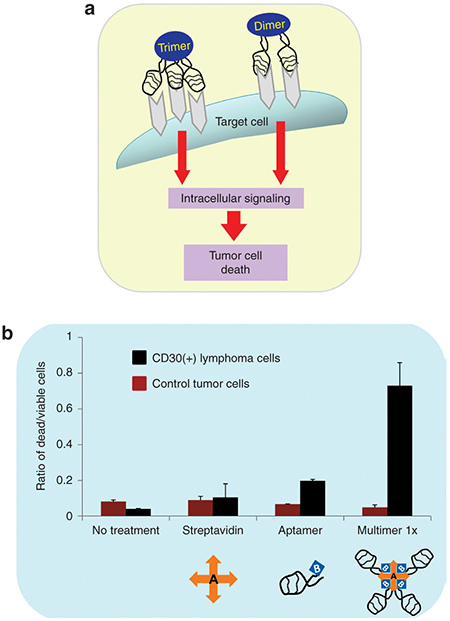
Figure 6.

Aptamer-based biotherapy

Aptamer-based biotherapy

http://www.nature.com/mtna/journal/v3/n8/images/mtna201432f6.jpeg

Aptamer-based biotherapy. (a) Schema showing receptor oligomerization-inducing downstream signaling. CD30-associated signaling is activated by its ligand through trimerization of the receptor, leading to varied outcomes that range from apoptosis to proliferation. (b) CD30-positive and -negative cells were incubated without any treatment or in the presence of control streptavidin, monomeric aptamer, and multimeric aptamer. Following 72-hour incubation, the multivalent CD30 aptamer induced cell death in the CD30-positive lymphoma cells, but had no effect on the CD30-negative control cells. Ratio of the dead/live cells was calculated by costaining the cells with Hoechst 33342 (live cells) and propidium iodide (dead cells).

Antibody-based targeted therapeutics provide high target specificity and affinity. However, their potential for immunogenicity is of a great concern, as is their high production cost, both of which have limited their clinical applicability. As discussed in this review, when compared to protein antibodies, oligonucleotide aptamers offer many advantages, including simple chemical synthesis, virtual nonimmunogenicity, smaller size, faster tissue penetration, ease of modification with different functional moieties, low cost of production, and high biological stability. Therefore, aptamers have become a promising new class of molecular ligands that could replace or supplement protein antibodies. In summary, aptamer technology has a strong market value and may be applied in various biomedical fields, including in vitro cancer cell detection, in vivo tumor imaging, and targeted cancer therapy (Figure 7).

Figure 7.

Although aptamer technology has a great potential in the biomedical field, several technical challenges remain and must be addressed. These include: (i) how can aptamers be rapidly adapted for specific targets by decreasing false-positive/-negative selection? Primarily dependent on the natural properties of targets of interest, such as proteins versus cells or tissues, the process of aptamer selection is usually time-consuming, and the success rate is sometimes low. To improve the speed and success rate, novel methods for aptamer selection have been recently described. They include bead-based selection, that can select aptamers as rapidly as a single round of selection,27,28 and the SOMAmer, which improves the aptamer production success rate from less than 30% to over 50%.29,30 More recently, a study by Cho et al.devised a Quantitative Parallel Aptamer Selection System (QPASS) method, which integrates microfluidic selection, NGS, and in situ-synthesized aptamer arrays. This approach allows for the simultaneous measurement of affinity and specificity for thousands of candidate aptamers in parallel.116 In addition to QPASS, evolving modifications to the Cell-SELEX approach are beginning to address difficulties with successful removal of the influence stemming from the presence of dead cells, slow enrichment aptamers recognizing targets of interest, and contamination with unwanted aptamer sequences. As described above, utilization of the above-mentioned FACS-mediated SELEX44,45and hybrid-SELEX23 offers novel approaches that address these technical challenges.

(ii) How can we select cancer-relevant targets for aptamer development and clinical applications? Tumorigenesis is a dynamic process that includes multiple constantly changing factors. Therefore, a one-size-fits-all cancer-specific biomarker is unlikely to ever be identified. Yet, it has been established that certain biomarkers present in healthy tissues are highly expressed in cancer cells. Moreover, certain biomarkers are associated with particular cancer cell types making them to be considered as useful targets for development of targeted cancer therapy. However, while use of cancer cells to identify biomarkers and to develop therapeutic agents is a reasonable approach, cultured cells, especially immortalized cell lines, greatly differ from tumor tissues in vivo. To overcome these limitations and to select more reliable cancer-relevant biomarkers for aptamer development, several innovative SELEX methods have been recently described. Of particular interest are the tissue-based SELEX117 and the in vivo-SELEX,118 which offer target selection under more relevant pathologic conditions. This cell/tissue-specific biomarker selection can also be utilized for development of noncancer related therapies, as shown for aptamers targeting the adipose tissue in obesity119 and for aptamers designed to penetrate the blood-brain barrier in order to combat brain diseases.120 Hence, we believe that the careful selection of cancer-associated biomarkers and cell/tissue type-specific biomarkers will expand the scopes of aptamer applicability and improve the feasibility of clinical applications.

(iii) What methods could improve aptamer biostability in vivo? Unmodified RNA-based aptamers are very susceptible to the nuclease-mediated degradation in vivo. Although many chemical modifications aimed at increasing biostability of the RNA aptamers have been developed, including 2′-modifications, 3′-modifications, phosphodiester backbone modifications,19,20 and utilizations of novel nucleic acids (locked nucleic acid and Spiegelmers),16,21,22 their effectiveness is still limited. When it was first described, PEGylation was a very attractive strategy for prolonging aptamer circulation half-life and enhancing their biostability. However, a recent report showed that the in vivo use of PEGylated aptamers induced production of anti-PEG antibodies,121emphasizing the need for the development of alternative approaches.

(iv) How can aptamer technology be modified to achieve a more effective drug delivery? Many drug delivery systems described in this review are tested in vitro or in animal models. Yet, as with any compound that is translated from the bench to the bedside, aptamer-drug conjugates may behave differently in a human patient than they do in laboratory animals. Therefore, aptamer-drug conjugation remains an important challenge that must be considered. Specifically, various coupling approaches lead to different pharmacokinetics, biodistribution, and tolerability in vivo, which in turn greatly affect treatment effectiveness. In the same vein, we must consider the effectiveness of aptamer-mediated target gene therapy. Gene therapy, including siRNA and miRNA aimed at silencing specific genes, is considered the next generation therapeutic approach. However, silencing a single pathogenic gene may not be a viable therapeutic option because tumorigenesis is a process regulated by multiple genes and signaling pathways. Therefore, combining targeted therapeutics with gene therapy may represent the most effective strategy. Such combinational therapy approaches can greatly improve the therapeutic efficacy while reducing the required dosages of both drugs and small molecule RNAs,122 and, more importantly, may offer new alternatives to combat chemotherapy-resistant cancers.110

(v) The last important point to consider is whether aptamer-mediated biotherapies can become effective, FDA-approved medications. Following Macugen approval by the FDA, many aptamer-mediated biotherapies have been evaluated in clinical trials. Of particular interest is AS1411, an antitumor aptamer that has completed several Phase I clinical trials.15 Trial results are promising and offer useful insights into further modifications that could be applied to therapeutic aptamer development.

Taken together, although some technical challenges remain to be addressed, oligonucleotide aptamers have become an attractive and promising tool for targeted cancer therapy. As more clinical data are accumulated, we and others will be better equipped to optimize aptamer formulations, leading to the expansion of aptamer use in the clinic.

  1. Ellington, AD and Szostak, JW (1990). In vitro selection of RNA molecules that bind specific ligands. Nature 346: 818–822. | Article | PubMed | ISI | CAS |
  2. Tuerk, C and Gold, L (1990). Systematic evolution of ligands by exponential enrichment: RNA ligands to bacteriophage T4 DNA polymerase. Science 249: 505–510. | Article | PubMed | ISI | CAS |
  3. Nimjee, SM, Rusconi, CP and Sullenger, BA (2005). Aptamers: an emerging class of therapeutics. Annu Rev Med 56: 555–583. | Article | PubMed | ISI | CAS |
  4. Eyetech Study Group (2002). Preclinical and phase 1A clinical evaluation of an anti-VEGF pegylated aptamer (EYE001) for the treatment of exudative age-related macular degeneration. Retina22: 143–152. | PubMed | ISI |
  5. Eyetech Study Group (2003). Anti-vascular endothelial growth factor therapy for subfoveal choroidal neovascularization secondary to age-related macular degeneration: phase II study results. Ophthalmology 110: 979–986. | Article | PubMed |
  6. Parekh, P, Tang, Z, Turner, PC, Moyer, RW and Tan, W (2010). Aptamers recognizing glycosylated hemagglutinin expressed on the surface of vaccinia virus-infected cells. Anal Chem 82: 8642–8649. | Article | PubMed |
  7. Sefah, K, Tang, ZW, Shangguan, DH, Chen, H, Lopez-Colon, D, Li, Y et al. (2009). Molecular recognition of acute myeloid leukemia using aptamers. Leukemia 23: 235–244. | Article | PubMed | CAS |
  8. Bayrac, AT, Sefah, K, Parekh, P, Bayrac, C, Gulbakan, B, Oktem, HA et al. (2011). In vitro Selection of DNA Aptamers to Glioblastoma Multiforme. ACS Chem Neurosci 2: 175–181. | Article | PubMed | ISI |
  9. Bruno, JG and Kiel, JL (1999). In vitro selection of DNA aptamers to anthrax spores with electrochemiluminescence detection.Biosens Bioelectron 14: 457–464. | Article | PubMed | CAS |
  10. Kirby, R, Cho, EJ, Gehrke, B, Bayer, T, Park, YS, Neikirk, DP et al. (2004). Aptamer-based sensor arrays for the detection and quantitation of proteins. Anal Chem 76: 4066–4075. | Article | PubMed | CAS |
  11. Shangguan, D, Li, Y, Tang, Z, Cao, ZC, Chen, HW, Mallikaratchy, Pet al. (2006). Aptamers evolved from live cells as effective molecular probes for cancer study. Proc Natl Acad Sci USA 103: 11838–11843. | Article | PubMed | CAS |
  12. Tang, Z, Parekh, P, Turner, P, Moyer, RW and Tan, W (2009). Generating aptamers for recognition of virus-infected cells. Clin Chem 55: 813–822. | Article | PubMed | CAS |
  13. Que-Gewirth, NS and Sullenger, BA (2007). Gene therapy progress and prospects: RNA aptamers. Gene Ther 14: 283–291. | Article | PubMed | CAS |
  14. Sundaram, P, Kurniawan, H, Byrne, ME and Wower, J (2013). Therapeutic RNA aptamers in clinical trials. Eur J Pharm Sci 48: 259–271. | Article | PubMed |
  15. Ireson, CR and Kelland, LR (2006). Discovery and development of anticancer aptamers. Mol Cancer Ther 5: 2957–2962. | Article | PubMed | CAS |

Nanomedicine

From bioimaging to drug delivery and therapeutics, nanotechnology is poised to change the way doctors practice medicine.

By Guizhi Zhu, Lei Mei and Weihong Tan | August 1, 2014

http://www.the-scientist.com/?articles.view/articleNo/40598/title/Nanomedicine/

Nanotechnology in Therapeutics

A Focus on Nanoparticles as a Drug Delivery System

Suwussa Bamrungsap; Zilong Zhao; Tao Chen; Lin Wang; Chunmei Li; Ting Fu; Weihong Tan

Nanomedicine. 2012;7(8):1253-1271. http://www.medscape.com/viewarticle/770397_1

Continuing improvement in the pharmacological and therapeutic properties of drugs is driving the revolution in novel drug delivery systems. In fact, a wide spectrum of therapeutic nanocarriers has been extensively investigated to address this emerging need. Accordingly, this article will review recent developments in the use of nanoparticles as drug delivery systems to treat a wide variety of diseases. Finally, we will introduce challenges and future nanotechnology strategies to overcome limitations in this field.

Nanotechnology involves the engineering of functional systems at the molecular scale. Such systems are characterized by unique physical, optical and electronic features that are attractive for disciplines ranging from materials science to biomedicine. One of the most active research areas of nanotechnology is nanomedicine, which applies nanotechnology to highly specific medical interventions for the prevention, diagnosis and treatment of diseases.[1,2,401] The surge in nanomedicine research during the past few decades is now translating into considerable commercialization efforts around the globe, with many products on the market and a growing number in the pipeline. Currently, nanomedicine is dominated by drug delivery systems, accounting for more than 75% of total sales.[3]

Nanomaterials fall into a size range similar to proteins and other macromolecular structures found inside living cells. As such, nanomaterials are poised to take advantage of existing cellular machinery to facilitate the delivery of drugs. Nanoparticles (NPs) containing encapsulated, dispersed, absorbed or conjugated drugs have unique characteristics that can lead to enhanced performance in a variety of dosage forms. When formulated correctly, drug particles are resistant to settling and can have higher saturation solubility, rapid dissolution and enhanced adhesion to biological surfaces, thereby providing rapid onset of therapeutic action and improved bioavailability. In addition, the vast majority of molecules in a nanostructure reside at the particle surface,[4] which maximizes the loading and delivery of cargos, such as therapeutic drugs, proteins and polynucleotides, to targeted cells and tissues. Highly efficient drug delivery, based on nanomaterials, could potentially reduce the drug dose needed to achieve therapeutic benefit, which, in turn, would lower the cost and/or reduce the side effects associated with particular drugs. Furthermore, NP size and surface characteristics can be easily manipulated to achieve both passive and active drug targeting. Site-specific targeting can be achieved by attaching targeting ligands, such as antibodies or aptamers, to the surface of particles, or by using guidance in the form of magnetic NPs. NPs can also control and sustain release of a drug during transport to, or at, the site of localization, altering drug distribution and subsequent clearance of the drug in order to improve therapeutic efficacy and reduce side effects.

Nanotechnology could be strategically implemented in new developing drug delivery systems that can expand drug markets. Such a plan would be applied to drugs selected for full-scale development based on their safety and efficacy data, but which fail to reach clinical development because of poor biopharmacological properties, for example, poor solubility or poor permeability across the intestinal epithelium, situations that translate into poor bioavailability and undesirable pharmacokinetic properties.[5] The new drug delivery methods are expected to enable pharmaceutical companies to reformulate existing drugs on the market, thereby extending the lifetime of products and enhancing the performance of drugs by increasing effectiveness, safety and patient adherence, and ultimately reducing healthcare costs.[6–8]

Commercialization of nanotechnology in pharmaceutical and medical science has made great progress. Taking the USA alone as an example, at least 15 new pharmaceuticals approved since 1990 have utilized nanotechnology in their design and drug delivery systems. In each case, both product development and safety data reviews were conducted on a case-by-case basis, using the best available methods and procedures, with an understanding that postmarketing vigilance for safety issues would be ongoing. Some representative examples of therapeutic nanocarriers on the market are briefly described in Table 1.

In this review, we focus mainly on the application of nanotechnology to drug delivery and highlight several areas of opportunity where current and emerging nanotechnologies could enable novel classes of therapeutics. We look at challenges and general trends in pharmaceutical nanotechnology, and we also explore nanotechnology strategies to overcome limitations in drug delivery. However, this article can only serve to provide a glimpse into this rapidly evolving field, both now and what may be expected in the future.

Read Full Post »

CRISPR/Cas9 Finds Its Way As an Important Tool For Drug Discovery & Development

  UPDATED 6/11/2021

CRISPR Diagnostics: CRISPR-dx Comes of Age: Tool in Drug Development

The past five years has seen a rapid expansion of the ability of CRISPR based tools toward diagnostic testing. Recently, CRISPR has been used to detect SARS-CoV-2 in patients. An article in the journal Science describes the different classes of CRISPR diagnostics in use today .

Update near end of post

UPDATED 8/08/2020

Association to Causation: Using GWAS to Identify Druggable Targets

A Gen Webinar Thursday, August 6, 2020; 11:00am – 12:30pm EST

See at end of post

Curator: Stephen J. Williams, Ph.D.


2.1.2.1

CRISPR/Cas9 Finds Its Way As an Important Tool For Drug Discovery & Development, Volume 2 (Volume Two: Latest in Genomics Methodologies for Therapeutics: Gene Editing, NGS and BioInformatics, Simulations and the Genome Ontology), Part 2: CRISPR for Gene Editing and DNA Repair

The RNA-guided Cas9 nuclease from the microbial clustered regularly interspaced short palindromic repeats (CRISPR) adaptive immune system can be used to facilitate efficient genome engineering in eukaryotic cells by simply specifying a 20-nt targeting sequence within its guide RNA.

CRISPR/Cas systems are part of the adaptive immune system of bacteria and archaea, protecting them against invading nucleic acids such as viruses by cleaving the foreign DNA in a sequence-dependent manner. Although CRISPR arrays were first identified in the Escherichia coli genome in 1987 (Ishino et al., 1987), their biological function was not understood until 2005, when it was shown that the spacers were homologous to viral and plasmid sequences suggesting a role in adaptive immunity (Bolotin et al., 2005; Mojica et al., 2005; Pourcel et al., 2005). Two years later, CRISPR arrays were confirmed to provide protection against invading viruses when combined with Cas genes (Barrangou et al., 2007). The mechanism of this immune system based on RNA-mediated DNA targeting was demonstrated shortly thereafter (Brouns et al., 2008; Deltcheva et al., 2011; Garneau et al., 2010; Marraffini and Sontheimer, 2008).

Jennifer Doudna, PhD Professor of Molecular and Cell Biology and Chemistry, University of California, Berkeley Investigator, Howard Hughes Medical Institute has recently received numerous awards and accolades for the discovery of CRISPR/Cas9 as a tool for mammalian genetic manipulation as well as her primary intended research target to understand bacterial resistance to viral infection.

A good post on the matter and Dr. Doudna can be seen below:

http://pharmaceuticalintelligence.com/2014/06/13/215-245-6132014-jennifer-doudna-the-biology-of-crisprs-from-genome-defense-to-genetic-engineering/

In Delineating a Role for CRISPR-Cas9 in Pharmaceutical Targeting inheritable metabolic disorders in which may benefit from a CRISPR-Cas9 mediated therapy is discussed. However this curation is meant to focus on CRISPR/CAS9 AS A TOOL IN PRECLINICAL DRUG DEVELOPMENT.


Three Areas of Importance of CRISPR/Cas9 as a TOOL in Preclinical Drug Discovery Include:

  1. Gene-Function Studies: CRISPR/CAS9 ability to DEFINE GENETIC LESION and INSERTION SITE
  2. CRISPR/CAS9 Use in Developing Models of Disease
  3. CRISPR/CAS9 Use as a Diagnostic Tool
  • Using CRISPR/Cas9 in PRECLINICAL TOXICOLOGY STUDIES

I.     Gene-Function Studies: CRISPR/CAS9 ability to DEFINE GENETIC LESION and INSERTION SITE

The advent of the first tools for manipulating genetic material (cloning, PCR, transgenic technology, and before microarray and other’omic methods) allowed scientists to probe novel, individual gene functions as well as their variants and mutants in a “one-gene-at-a time” process. In essence, a gene (or mutant gene) was sequenced, cloned into expression vectors and transfected into recipient cells where function was evaluated.

However, some of the experimental issues with this methodology involved

  • Most transfections experiments result in NON ISOGENIC cell lines – by definition the insertion of a transgene alters the genetic makeup of a cell line. Simple transfection experiments with one transgene compared to a “null” transfectant compares non-isogenic lines, possibly confusing the interpretation of gene-function studies. Therefore a common technique is to develop cell lines with inducible gene expression, thereby allowing the investigator to compare a gene’s effect in ISOGENIC cell lines.
  1. Use of CRSPR in Highthrough-put Screening of Genetic Function

A very nice presentation and summary of CRSPR’s use in determining gene function in a high-throughput manner can be found below

www.rna.uzh.ch/events/journalclub/20140429JCCaihong.pdf

  1. Determining Off-target Effects of Gene Therapy Simplified with CRSPR

In GUIDE-seq: First genome-wide method of detecting off-target DNA breaks induced by CRISPR-Cas nucleases (from This Journal’s series on Live Meeting Coverage) at a 2014 Koch lecture

Shengdar Q Tsai and J Keith Joung describe

an approach for global detection of DNA double-stranded breaks (DSBs) introduced by RGNs and potentially other nucleases. This method, called genome-wide, unbiased identification of DSBs enabled by sequencing (GUIDE-seq), relies on capture of double-stranded oligodeoxynucleotides into DSBs. Application of GUIDE-seq to 13 RGNs in two human cell lines revealed wide variability in RGN off-target activities and unappreciated characteristics of off-target sequences. The majority of identified sites were not detected by existing computational methods or chromatin immunoprecipitation sequencing (ChIP-seq). GUIDE-seq also identified RGN-independent genomic breakpoint ‘hotspots’.

SOURCE http://www.nature.com/nbt/journal/vaop/ncurrent/full/nbt.3117.html

II. CRISPR/Cas9 Use in Developing Models of Disease


  1. Developing Animal Tumor Models

In a post this year I discussed a talk at the recent 2015 AACR National Meeting on a laboratories ability to use CRISPR gene editing in-vivo to produce a hepatocarcinoma using viral delivery. The post can be seen here: Notes from Opening Plenary Session – The Genome and Beyond from the 2015 AACR Meeting in Philadelphia PA; Sunday April 19, 2015

1) In this talk Dr. Tyler Jacks discussed his use of CRSPR to generate a mouse model of liver tumor in an immunocompetent mouse. Some notes from this talk are given below

  1. B) Engineering Cancer Genomes: Tyler Jacks, Ph.D.; Director, Koch Institute for Integrative Cancer Research
  • Cancer GEM’s (genetically engineered mouse models of cancer) had moved from transgenics to defined oncogenes
  • Observation that p53 -/- mice develop spontaneous tumors (lymphomas)
  • then GEMs moved to Cre/Lox systems to generate mice with deletions however these tumor models require lots of animals, much time to create, expensive to keep;
  • figured can use CRSPR/Cas9 as rapid, inexpensive way to generate engineered mice and tumor models
  • he used CRSPR/Cas9 vectors targeting PTEN to introduce PTEN mutations in-vivo to hepatocytes; when they also introduced p53 mutations produced hemangiosarcomas; took ONLY THREE months to produce detectable tumors
  • also produced liver tumors by using CRSPR/Cas9 to introduce gain of function mutation in β-catenin

See an article describing this study by MIT News “A New Way To Model Cancer: New gene-editing technique allows scientists to more rapidly study the role of mutations in tumor development.”

The original research article can be found in the August 6, 2014 issue of Nature[1]

And see also on the Jacks Lab site under Research

2)     In the Upcoming Meeting New Frontiers in Gene Editing multiple uses of CRISPR technology is discussed in relation to gene knockout/function studies, tumor model development and

New Frontiers in Gene Editing

Session Spotlight:
BUILDING IN VIVO MODELS FOR DRUG DISCOVERY

Genome Editing Animal Models in Drug Discovery
Myung Shin, Ph.D., Senior Principal Scientist, Biology-Discovery, Genetics and Pharmacogenomics, Merck Research Laboratories

Recent advances in genome editing have greatly accelerated and expanded the ability to generate animal models. These tools allow generating mouse models in condensed timeline compared to that of conventional gene-targeting knock-out/knock-in strategies. Moreover, the genome editing methods have expanded the ability to generate animal models beyond mice. In this talk, we will discuss the application of ZFN and CRISPR to generate various animal models for drug discovery programs.

In vivo Cancer Modeling and Genetic Screening Using CRISPR/Cas9
Sidi Chen, Ph.D., Postdoctoral Fellow, Laboratories of Dr. Phillip A. Sharp and Dr. Feng Zhang, Koch Institute for Integrative Cancer Research at MIT and Broad Institute of Harvard and MIT

Here we describe a genome-wide CRISPR-Cas9-mediated loss-of-function screen in tumor growth and metastasis. We mutagenized a non-metastatic mouse cancer cell line using a genome-scale library. The mutant cell pool rapidly generates metastases when transplanted into immunocompromised mice. Enriched sgRNAs in lung metastases and late stage primary tumors were found to target a small set of genes, suggesting specific loss-of-function mutations drive tumor growth and metastasis.

FEATURED PRESENTATION: In vivo Chromosome Engineering Using CRISPR-Cas9
Andrea Ventura, M.D., Ph.D., Assistant Member, Cancer Biology and Genetics Program, Memorial Sloan Kettering Cancer Center

We will discuss our experience using somatic genome editing to engineer oncogenic chromosomal rearrangements in vivo. More specifically, we will present the results of our ongoing efforts aimed at modeling cancers driven by chromosomal rearrangements using viral mediated delivery of Crispr-Cas9 to adult animals.

RNAi and CRISPR/Cas9-Based in vivo Models for Drug Discovery
Christof Fellmann, Ph.D., Postdoctoral Fellow, Laboratory of Dr. Jennifer Doudna, Department of Molecular and Cell Biology, The University of California, Berkeley

Genetically engineered mouse models (GEMMs) are a powerful tool to study disease initiation, treatment response and relapse. By combining CRISPR/Cas9 and “Sensor” validated, tetracycline-regulated “miR-E” shRNA technology, we have developed a fast and scalable platform to generate RNAi GEMMs with reversible gene silencing capability. The synergy of CRISPR/Cas9 and RNAi enabled us to not only model disease pathogenesis, but also mimic drug therapy in mice, providing us capability to perform preclinical studies in vivo.

In vivo Genome Editing Using Staphylococcus aureus Cas9
Fei Ann Ran, Ph.D., Post-doctoral Fellow, Laboratory of Dr. Feng Zhang, Broad Institute and Junior Fellow, Harvard Society of Fellows

The RNA-guided Cas9 nuclease from the bacterial CRISPR/Cas system has been adapted as a powerful tool for facilitating targeted genome editing in eukaryotes. Recently, we have identified an additional small Cas9 nuclease from Staphylococcus aureus that can be packaged with its guide RNA into a single adeno-associated virus (AAV) vector for in vivo applications. We demonstrate the use of this system for effective gene modification in adult animals and further expand the Cas9 toolbox for in vivo genome editing.

OriGene, Making the Right Tools for CRISPR Research
Xuan Liu, Ph.D., Senior Director, Marketing, OriGene

CRISPR technology has quickly revolutionized the scientific community. Its simplicity has democratized the genome editing technology and enabled every lab to consider its utility in gene function research. As the largest tool box for gene functional research, OriGene created a large collection of CRISPR-related tools, including various all-in-one vectors for gRNA cloning, donor vector backbones, genome-wide knockout kits, AAVS1 insertion vectors, etc. OriGene’s high quality products will accelerate CRISPR research.

  1. Transgenic Animals : Custom Mouse and Rat Model Generation Service Using CRISPR/Cas9 by AppliedStem Cell Inc. (http://www.appliedstemcell.com/)

A critical component of producing transgenic animals is the ability of each successive generations to pass on the transgene. In her post on this site, A NEW ERA OF GENETIC MANIPULATION  Dr. Demet Sag discusses the molecular biology of Cas9 systems and their efficiency to cause point mutations which can be passed on to subsequent generations

This group developed a new technology for editing genes that can be transferable change to the next generation by combining microbial immune defense mechanism, CRISPR/Cas9 that is the latest ground breaking technology for translational genomics with gene therapy-like approach.

  • In short, this so-called “mutagenic chain reaction” (MCR) introduces a recessive mutation defined by CRISPR/Cas9 that lead into a high rate of transferable information to the next generation. They reported that when they crossed the female MCR offspring to wild type flies, the yellow phenotype observed more than 95 percent efficiency.

The advantage of CRISPR/Cas9 over ZFNs or TALENs is its scalability and multiplexibility in that multiple sites within the mammalian genome can be simultaneously modified, providing a robust, high-throughput approach for gene editing in mammalian cells.

Applied StemCell, Inc. offers various services related to animal models including conventional transgenic rats, and phenotype analysis using knock-in, knock-out strategies.

Further explanation of their use of CRSPR can be found at the site below:

http://pharmaceuticalintelligence.com/2014/10/29/gene-editing-at-crispr-speed-services-and-tools/

In addition, ReproCELL Inc., a Tokyo based stem cell company, uses CRSPR to develop

· Tailored disease model cells (hiPSC-Disease Model Cells)

  • 2 types of services
  • ReproUNUS™-g:human iPS cell derived functional cells involving gene editing by CRISPR/Cas9 system
  • eproUNUS™-p:patient derived iPS cell derived functional cells

III. Using CRISPR/Cas9 in PRECLINICAL TOXICOLOGY STUDIES

As of now it is unclear as to the strategy of pharma in how to use this technology for toxicology testing however a few companies have licensed the technology to use across their R&D platforms including

A recent paper used a sister technique TALEN to generate knock-in pigs which suggest that it would be possible to generate pigs with human transgenes, especially in human liver isozymes in orer to study hepatotoxicity of drugs.

Efficient bi-allelic gene knockout and site-specific knock-in mediated by TALENs in pigs

Jing Yao, Jiaojiao Huang, Tang Hai, Xianlong Wang, Guosong Qin, Hongyong Zhang, Rong Wu, Chunwei Cao, Jianzhong Jeff Xi, Zengqiang Yuan, Jianguo Zhao

Sci Rep. 2014; 4: 6926. Published online 2014 November 5. doi: 10.1038/srep06926

UPDATED 8/08/2020

Association to Causation: Using GWAS to Identify Druggable Targets

A Gen Webinar Thursday, August 611:00am – 12:30pm

This webinar is available at https://www.genengnews.com/resources/webinars/association-to-causation-using-gwas-to-identify-druggable-target/

Speakers:

Martin Kampmann, PhD

matinkampmann ucsf

Associate Professor
UCSF
Investigator
Chan Zuckerberg Biohub

Kevin Holden, PhD

kevinholdn sythego

Head of Science
Synthego

Abhi Saharia, PhD

abhisharia sythego

VP, Commercial Development
Synthego

Human genetics provides perhaps the single best opportunity to innovate and improve clinical success rates, through the identification of novel drug targets for complex disease. Even as correlation identifies multiple genetic variants associated with disease, it is challenging to conduct requisite functional studies to identify the causal variants, especially since most association signals map to non-coding regions of the genome.

Genetic editing technologies, such as CRISPR, have enabled the modeling of associated variants at their native loci, including non-coding loci, empowering the identification of underlying biological mechanisms of disease with potential causal genes. However, genome editing is largely manual today severely limiting scale, and forcing the use of rational filters to prioritize which variants to investigate functionally.

In this GEN webinar, we will discuss several strategies enabling large-scale functional investigation of disease-associated variants in a cost- and time-effective manner, including different types of pooled CRISPR-based screens and the development of a fully automated genome engineering platform. We will also review how optimization of genome engineering on this platform enables the engineering of disease-associated variants at scale in pluripotent cells.

  • They will be presenting on use of wide scale CRSPR screens to validate druggable targets
  • The presenters will also discuss new platforms for these wide scale screens

Martin Kampmann, PhD UCSF

  • Multiple genetic variants associated with disease
  • Big gap between accumulation of genetic variant information and functions of these variants
  • CRSPRi or CRSPa (siRNA coupled or enhancer coupled CRSPR guides)
  • Arrayed screens: multiplate guide RNAs and phenotype measured (phenotype can be morphology, complex biological systems like organoids or non autonomous functions
  • Using pooled screens and use of suitable cell model critical for this strategy
  • For example in iPSC vs. neurons has different expression patterns upon same CRSPR of UBA1
  • Advantage is using CRSPR to take iPSC from diseased variant patient to make a corrected isogenic control then introduce gRNAs and use modifier screens to determine phenotypes
  • Generated a platform called CRISPRbrain.org to do bioinformatics on various experiments with different guide RNAs (CRSPRs)

Abhi Saharia, PhD Syntheco

  • Target identification with CSRSPR at Scale
  • Nature medicine paper did GWAS and found 27 SNV associated with high risk disease and a rational filter focused on 1 SNV in noncoding region but why study a single variant and if studied all 27 would they have been able to identify a more representative druggable set?
  • Goal is to reduce or eliminate these rational filters
  • HALO (scalable RNA guide), ECLIPSE platform (automated generation of modified cell lines, BIOINFORMATIC platform (integrated informatics)
  • Syntheco uses an electroporation with ribonucleic proteins (RNP) to give highest efficiency and minimizes off target as complex is only in cells for a short period of time
  • They confirm they are doing single cell cloning by using automated microscopy to confirm single cell growth in each cloning well

Kevin Holden, Head of Science at Syntheco

  • Engineering iPSc genetically modified cells at scale
  • The closer you get to your target site the more efficient your CRSPR so a big factor when making guides, especially for knock-in CRSPR
  • Adding a small molecule non homologous end joining inhibitor increases efficiency to 95%
  • Cold shocking the cells also assists in homologous repair
  • Use cleavage resistant templates

III. CRISPR/CAS9 AS A DIAGNOSTIC TOOL

     In the journal Science, Omar Abudayyeh and Jonathan Gootenberg discuss how CRISPR-based diagnostic (CRISPR-dx) tools offer a solution, and multiple CRISPR-dx products for detection of the SARS-CoV-2 RNA genome have been authorized by the US Food and Drug Administration (FDA).  In addition they discuss the work by Jiao et al. in combining this technique to develop a rapid and sensitive SARS-CoV2 diagnostic test.

Omar O. AbudayyehJonathan S. Gootenberg. Science  28 May 2021: CRISPR Diagnostics
Vol. 372, Issue 6545, pp. 914-915; DOI: 10.1126/science.abi9335

Summary

Although clinical diagnostics take many forms, nucleic acid–based testing has become the gold standard for sensitive detection of many diseases, including pathogenic infections. Quantitative polymerase chain reaction (qPCR) has been widely adopted for its ability to detect only a few DNA or RNA molecules that can unambiguously specify a particular disease. However, the complexity of this technique restricts application to laboratory settings. The severe acute respiratory syndrome coronavirus 2 (SARS-CoV-2) pandemic has underscored the need for the development and deployment of nucleic acid tests that are economical, easily scaled, and capable of being run in low-resource settings, without sacrifices in speed, sensitivity or specificity. CRISPR-based diagnostic (CRISPR-dx) tools offer a solution, and multiple CRISPR-dx products for detection of the SARS-CoV-2 RNA genome have been authorized by the US Food and Drug Administration (FDA). On page 941 of this issue, Jiao et al. (1) describe a new CRISPR-based tool to distinguish several SARS-CoV-2 variants in a single reaction.

Although clinical diagnostics take many forms, nucleic acid–based testing has become the gold standard for sensitive detection of many diseases, including pathogenic infections. Quantitative polymerase chain reaction (qPCR) has been widely adopted for its ability to detect only a few DNA or RNA molecules that can unambiguously specify a particular disease. However, the complexity of this technique restricts application to laboratory settings. The severe acute respiratory syndrome coronavirus 2 (SARS-CoV-2) pandemic has underscored the need for the development and deployment of nucleic acid tests that are economical, easily scaled, and capable of being run in low-resource settings, without sacrifices in speed, sensitivity or specificity. CRISPR-based diagnostic (CRISPR-dx) tools offer a solution, and multiple CRISPR-dx products for detection of the SARS-CoV-2 RNA genome have been authorized by the US Food and Drug Administration (FDA). On page 941 of this issue, Jiao et al. (1) describe a new CRISPR-based tool to distinguish several SARS-CoV-2 variants in a single reaction.

There are multiple types of CRISPR systems comprising basic components of a single protein or protein complex, which cuts a specific DNA or RNA target programmed by a complementary guide sequence in a CRISPR-associated RNA (crRNA). The type V and VI systems and the CRISPR-associated endonucleases Cas12 (23) and Cas13 (45) bind and cut DNA or RNA, respectively. Furthermore, upon recognizing a target DNA or RNA sequence, Cas12 and Cas13 proteins exhibit “collateral activity” whereby any DNA or RNA, respectively, in the sample is cleaved regardless of its nucleic acid sequence (46). Thus, reporter DNAs or RNAs, which allow for visual or fluorescent detection upon cleavage, can be added to a sample to infer the presence or absence of specific DNA or RNA species (48).

Initial versions of CRISPR-dx utilizing Cas13 alone were sensitive to the low picomolar range, corresponding to a limit of detection of millions of molecules in a microliter sample. To improve sensitivity, preamplification methods, such as recombinase polymerase amplification (RPA), PCR, loop-mediated isothermal amplification (LAMP), or nucleic acid sequence–based amplification (NASBA), can be used with Cas12 or Cas13 to enable a limit of detection down to a single molecule (8). This preamplification approach, applicable to both Cas12 and Cas13 (67), enabled a suite of detection methods and multiplexing up to four orthogonal targets (7). Additional developments expanded CRISPR-dx readouts beyond fluorescence, including lateral flow (7), colorimetric (9), and electronic or material responsive readouts (10), allowing for instrument-free approaches. In addition, post–collateral-cleavage amplification methods, such as the use of the CRISPR-associated enzyme Csm6, have been combined with Cas13 to further increase the speed of CRISPR-dx tests (7). As an alternative to collateral-cleavage–based detection, type III CRISPR systems, which involve large multiprotein complexes capable of targeting both DNA and RNA, have been used for SARS-CoV-2 detection through production of colorimetric or fluorometric readouts (11).

FDA-authorized CRISPR-dx tests are currently only for use in centralized labs, because the most common CRISPR detection protocols require fluid handling steps and two different incubations, precluding their immediate use at the point of care. Single-step formulations have been developed to overcome this limitation, and these “one-pot” versions of CRISPR-dx are simple to run, operate at a single temperature, and run without complex equipment, producing either fluorescence or lateral flow readouts. The programmability of CRISPR makes new diagnostic tests easier to develop, and within months of the release of the SARS-CoV-2 genome, many COVID-19–specific CRISPR tests were reported and distributed around the world.

The broader capability for Cas enzyme–enhanced nucleic acid binding or cleavage has led to several other detection modalities. Cas9-based methods for cleaving nucleic acids in solution for diagnostic purposes have been combined with other detection platforms, such as destruction of undesired amplicons for preparation of next-generation sequencing libraries (12), or selective removal of alleles for nucleotide-specific detection (13). Alternatively, the programmable cleavage event from the Cas nuclease can be used to initiate an amplification reaction (14). Cas9-based DNA targeting has also been used for nucleotide detection in combination with solid-state electronics, promising an amplification-free platform for detection. In this platform, called CRISPR-Chip, the Cas9 protein binds nucleotide targets of interest (often in the context of the native genome) to graphene transistors, where the presence of these targets alters either current or voltage (15). By utilizing additional Cas9 orthologs and specific guide designs, CRISPR-Chip approaches have been tuned for single–base-pair sensitivity (15). Because they are integrated with electronic readers, CRISPR-Chip platforms may allow facile point-of-care detection with handheld devices.


Different classes of CRISPR diagnostics. GRAPHIC: ERIN DANIEL


Jiao et al. use a distinct characteristic of type II CRISPR systems, which involve Cas9, to develop a new type of noncollateral based CRISPR detection. Unlike Cas12s and Cas13, Cas9-crRNA complex formation requires an additional RNA known as the trans-activating CRISPR RNA (tracrRNA). By sequencing RNAs bound to Cas9 from Campylobacter jejuni in its natural host, the authors identified unexpected crRNAs, called noncanonical crRNA (ncrRNA), that corresponded to endogenous transcripts. Upon investigation of this surprising observation, it became clear that the tracrRNA was capable of hybridizing to semi-complementary sequences from a variety of RNA sources, leading to biogenesis of ncrRNAs of various sizes. Recognizing that they could program tracrRNAs to target a transcript of interest, the authors generated a reprogrammed tracrRNA (Rptr) that could bind and cleave a desired transcript, converting a piece of that transcript into a functional guide RNA. By then creating fluorescent DNA sensors that would be cleaved by the Rptr and ncrRNAs, the sensing of RNA by Cas9 could be linked to a detectable readout. This platform, called LEOPARD (leveraging engineered tracrRNAs and on-target DNAs for parallel RNA detection), can be combined with gel-based readouts and enables multiplexed detection of several different sequences in a single reaction (see the figure).

Jiao et al. also combined LEOPARD with PCR in a multistep workflow to detect SARS-CoV-2 genomes from patients with COVID-19. Although more work is needed to integrate this Cas9-based detection modality into a single step with RPA or LAMP to create a portable and sensitive isothermal test, an advantage of this approach is the higher-order multiplexing that can be achieved, allowing multiple pathogens, diseases, or variants to be detected simultaneously. More work is also needed to combine this technology with extraction-free methods for better ease of use; alternative readouts to gel-based readouts, such as lateral flow and colorimetric readouts, would be beneficial for point-of-care detection.

In just 5 years, the CRISPR-dx field has rapidly expanded, growing from a set of peculiar molecular biology discoveries to multiple FDA-authorized COVID-19 tests and spanning four of the six major subtypes of CRISPR systems. Despite the tremendous promise of CRISPR-dx, substantial challenges remain to adapting these technologies for point-of-care and at-home settings. Simplification of the chemistries to operate as a single reaction in a matter of minutes would be revolutionary, especially if the reaction could be run at room temperature without any complex or expensive equipment. These improvements to CRISPR-dx assays can be achieved by identification or engineering of additional Cas enzymes with lower-temperature requirements, higher sensitivity, or faster kinetics, enabling rapid and simple amplification-free detection with single-molecule sensitivity.

Often overlooked is the necessity for a sample DNA or RNA preparation step that is simple enough to be added directly to the CRISPR reaction to maintain a simple workflow for point-of-care testing. In addition, higher-order multiplexing developments would allow for expansive testing menus and approach the possibility of testing for all known diseases. As these advancements are realized, innovative uses of CRISPR-dx will continue in areas such as surveillance, integration with biomaterials, and environmental monitoring. In future years, CRISPR-dx assays may become universal in the clinic and at home, reshaping how diseases are diagnosed.

References and Notes

Other related articles on CRISPR/Cas9 were published in this Open Access Online Scientific Journal, include the following:

Search Results for ‘CRISPR’

Where is the most promising avenue to success in Pharmaceuticals with CRISPR-Cas9?

CRISPR/Cas9 genome editing tool for Staphylococcus aureus Cas9 complex (SaCas9) @ MIT’s Broad Institute

Delineating a Role for CRISPR-Cas9 in Pharmaceutical Targeting

Using CRISPR to investigate pancreatic cancer

Simple technology makes CRISPR gene editing cheaper

RNAi, CRISPR, and Gene Editing: Discussions on How To’s and Best Practices @14th Annual World Preclinical Congress June 10-12, 2015 | Westin Boston Waterfront | Boston, MA

CRISPR/Cas9: Contributions on Endoribonuclease Structure and Function, Role in Immunity and Applications in Genome Engineering

CRISPR-CAS editing brings cloning of woolly mammoth one step closer to reality

GUIDE-seq: First genome-wide method of detecting off-target DNA breaks induced by CRISPR-Cas nucleases

The Patents for CRISPR, the DNA editing technology as the Biggest Biotech Discovery of the Century

CRISPR: Applications for Autoimmune Diseases @UCSF

Read Full Post »

Where is the most promising avenue to success in Pharmaceuticals with CRISPR-Cas9?

Author: Larry H. Bernstein, MD, FCAP


2.1.2.3

Where is the most promising avenue to success in Pharmaceuticals with CRISPR-Cas9?  Volume 2 (Volume Two: Latest in Genomics Methodologies for Therapeutics: Gene Editing, NGS and BioInformatics, Simulations and the Genome Ontology), Part 2: CRISPR for Gene Editing and DNA Repair

There has been a rapid development of methods for genetic engineering that is based on an initial work on bacterial resistance to viral invasion.  The engineering called RNA inhibition (RNAi) has gone through several stages leading to a more rapid and more specific application with minimal error.

It is a different issue to consider this application with respect to bacterial, viral, fungal, or parasitic invasion than it would be for complex human metabolic conditions and human cancer. The difference is that humans and multi-organ species are well differentiated systems with organ specific genome translation to function.

I would expect to see the use of genomic alteration as most promising in the near term for the enormous battle against antimicrobial, antifungal, and antiparasitic drug resistance.  This could well be expected to be a long-term battle because of the invading organisms innate propensity to develop resistance.

A CRISPR/Cas system mediates bacterial innate immune evasion and virulence

Timothy R. Sampson, Sunil D. Saroj, Anna C. Llewellyn, Yih-Ling Tzeng David S. Weiss

Affiliations, Contributions, Corresponding author

Nature 497, 254–257 (09 May 2013),  http://dx.doi.org:/10.1038/nature12048

CRISPR/Cas (clustered regularly interspaced palindromic repeats/CRISPR-associated) systems are a bacterial defence against invading foreign nucleic acids derived from bacteriophages or exogenous plasmids1234. These systems use an array of small CRISPR RNAs (crRNAs) consisting of repetitive sequences flanking unique spacers to recognize their targets, and conserved Cas proteins to mediate target degradation5678. Recent studies have suggested that these systems may have broader functions in bacterial physiology, and it is unknown if they regulate expression of endogenous genes910. Here we demonstrate that the Cas protein Cas9 of Francisella novicida uses a unique, small, CRISPR/Cas-associated RNA (scaRNA) to repress an endogenous transcript encoding a bacterial lipoprotein. As bacterial lipoproteins trigger a proinflammatory innate immune response aimed at combating pathogens1112, CRISPR/Cas-mediated repression of bacterial lipoprotein expression is critical for F. novicida to dampen this host response and promote virulence. Because Cas9 proteins are highly enriched in pathogenic and commensal bacteria, our work indicates that CRISPR/Cas-mediated gene regulation may broadly contribute to the regulation of endogenous bacterial genes, particularly during the interaction of such bacteria with eukaryotic hosts.

http://www.nature.com/nature/journal/v497/n7448/carousel/nature12048-f1.2.jpg

http://www.nature.com/nature/journal/v497/n7448/carousel/nature12048-f2.2.jpg

http://www.nature.com/nature/journal/v497/n7448/carousel/nature12048-f4.2.jpg

Zhang lab unlocks crystal structure of new CRISPR/Cas9 genome editing tool

Paul Goldsmith,  2015 Aug

In a paper published today in Cell researchers from the Broad Institute and University of Tokyo revealed the crystal structure of theStaphylococcus aureus Cas9 complex (SaCas9)—a highly efficient enzyme that overcomes one of the primary challenges to in vivo mammalian genome editing.

First identified as a potential genome-editing tool by Broad Institute core member Feng Zhang and his colleagues (and published by Zhang lab in April 2015), SaCas9 is expected to expand scientists’ ability to edit genomes in vivo. This new structural study will help researchers refine and further engineer this promising tool to accelerate genomic research and bring the technology closer to use in the treatment of human genetic disease.

“SaCas9 is the latest addition to our Cas9 toolbox, and the crystal shows us its blueprint,” said co-senior author Feng Zhang, who in addition to his Broad role, is also an investigator at the McGovern Institute for Brain Research, and an assistant professor at MIT.

The engineered CRISPR-Cas9 system adapts a naturally-occurring system that bacteria use as a defense mechanism against viral infection. The Zhang lab first harnessed this system as an effective genome-editing tool in mammalian cells using the Cas9 enzymes from Streptococcus thermophilus (StCas9) andStreptococcus pyogenes (SpCas9). Now, Zhang and colleagues have detailed the molecular structure of SaCas9, providing scientists with a high-resolution map of this enzyme. By comparing the crystal structure of SaCas9 to the crystal structure of the more commonly-used SpCas9 (published by the Zhang lab in February 2014), the team was able to focus on aspects important to Cas9 function— potentially paving the way to further develop the experimental and therapeutic potential of the CRISPR-Cas9 system.

Paper cited: Nishimasu H et al. “Crystal Structure of Staphylococcus aureus Cas9.” Cell, http://dx.doi.org:/10.1016/j.cell.2015.08.007

Advances in CRISPR-Cas9 genome engineering: lessons learned from RNA interference

Rodolphe Barrangou1,†, Amanda Birmingham2,†, Stefan Wiemann3, Roderick L. Beijersbergen4, Veit Hornung5 and Anja van Brabant Smith2
Nucleic Acids Research, 2015 Mar 23.  http:dx.doi.org:/10.1093/nar/gkv226

RNAi and CRISPR-Cas9 have many clear similarities. Indeed, the mechanisms of both use small RNAs with an on-target specificity of ∼18–20 nt. Both methods have been extensively reviewed recently (3–5) so we only highlight their main features here. RNAi operates by piggybacking on the endogenous eukaryotic pathway for microRNA-based gene regulation (Figure 1A). microRNAs (miRNAs) are small, ∼22-nt-long molecules that cause cleavage, degradation and/or translational repression of RNAs with adequate complementarity to them(6).RNAi reagentsfor research aim to exploit the cleavage pathway using perfect complementarity to their targets to produce robust downregulation of only the intended target gene. The CRISPRCas9 system, on the other hand, originates from the bacterial CRISPR-Cas system, which provides adaptive immunity against invading genetic elements (7). Generally, CRISPR-Cas systems provide DNA-encoded (7), RNAmediated (8), DNA- (9) or RNA-targeting(10) sequencespecific targeting. Cas9 is the signature protein for Type II CRISPR-Cas systems (11

Figure 1. (not shown) The RNAi and CRISPR-Cas9 pathways in mammalian cells. (A) miRNA genes code for primary miRNAs that are processed by the Drosha/DGCR8 complex to generate pre-miRNAs with a hairpin structure. These molecules are exported from the nucleus to the cytoplasm, where they are further processed by Dicer to generate ∼22-nt-long double-stranded mature miRNAs. The RNA duplex associates with an Argonaute (Ago) protein and is then unwound; the strand with a more unstable 5 end (known as the guide strand) is loaded into Ago to create the RNA-induced silencing complex (RISC) while the unloaded strand is discarded. Depending on the degree of complementarity to their targets, miRNAs cause either transcript cleavage and/or translational repression and mRNA degradation. siRNAs directly mimic mature miRNA duplexes, while shRNAs enter the miRNA pathway at the pre-miRNA hairpin stage and are processed into such duplexes. (B) CRISPR-Cas9-mediated genome engineering in mammalian cells requires crRNA, tracrRNA and Cas9. crRNA and tracrRNA can be provided exogenously through a plasmid for expression of a sgRNA, or chemically synthesized crRNA and tracrRNA molecules can be transfected along with a Cas9 expression plasmid. The crRNA and tracrRNA are loaded into Cas9 to form an RNP complex which targets complementary DNA adjacent to the PAM. Using the RuvC and HNH nickases, Cas9 generates a double-stranded break (DSB) that can be either repaired precisely (resulting in no genetic change) or imperfectly repaired to create a mutation (indel) in the targeted gene. There are a myriad of mutations that can be generated; some mutations will have no effect on protein function while others will result in truncations or loss of protein function. Shown are mutations that will induce a frame shift in the coding region of the mRNA (indicated by red X’s), resulting in either a truncated, non-functional protein or loss of protein expression due to nonsense-mediated decay of the mRNA.

Both RNAi and CRISPR-Cas9 have experienced significant milestones in their technological development, as highlighted in Figure 2 (7–14,16–22,24–51) (highlighted topics have been detailed in recent reviews (2,4,52–58)). The CRISPR-Cas9 milestones to date have mimicked a compressed version of those for RNAi, underlining the practical benefit of leveraging similarities to this well-trodden research path. While RNAi has already influenced many advances in the CRISPR-Cas9 field, other applications of CRISPR-Cas9 have not yet been attained but will likely continue to be inspired by the corresponding advances in the RNAi field (Table 1). Of particular interest are the potential parallels in efficiency, specificity, screening and in vivo/therapeutic applications, which we discuss further below.

Figure2. Timeline of milestones for RNAi and CRISPR-Cas9. Milestones in the RNAi field are noted above the line and milestones in the CRISPR-Cas9 field are noted below the line. These milestones have been covered in depth in recent reviews (2,4,52–29).
Table 1. Summary of improvements in the CRISPR-Cas9 field that can be anticipated by corresponding RNAi advances

Work performed during the first few years of intensive RNAi investigations demonstrated that, when taking 70– 75% reduction in RNA levels as a heuristic threshold for efficiency (59), only a small majority of siRNAs and shRNAs function efficiently (24,60) when guide strand sequences are chosen randomly. This observation led to the development in 2004 of rational design algorithms for siRNA molecules (Figure2), followed later by similar algorithms for shRNAs. These methods have been able to achieve∼75% correlation and >80% positive predictive power in identifying functional siRNAs (61) but have been somewhat less effective for shRNAs (62) (perhaps because in most cases, shRNAs produce less knockdown than do siRNAs, likely due to a smaller number of active molecules in each cell). crRNAs also vary widely in efficiency: reports have demonstrated indel (insertion and deletion) creation rates between 5 and 65% (20,25), though the average appears to be between 10 and 40% in unenriched cell populations. Indeed, a growing amount of evidence suggests a wide range of crRNA efficiency between genes and even between exons of the same gene, yielding some ‘super’ crRNAs that are more functional(26,27).

Perhaps in no other area are the lessons of RNAi as obvious as in that of specificity. While RNAi was originally hailed as exquisitely specific (64), subsequent research has shown that in some circumstances it can trigger non-specific effects and/or sequence-specific off-target effects (65). Many non-specific effects seen with this approach are mediated by the inadvertent activation of pattern recognition receptors (PRRs) of the innate immune system that have evolved to sense the presence of nucleic acids in certain sub-cellular compartments. siRNA length, certain sequence motifs, the absence of 2-nt 3 overhangs and cell type are important factors for induction of the mammalian interferon response (66–68). Additionally, the general perturbation of cellular or tissue homeostasis by the delivery process itself can also trigger unwanted responses (most likely secondary to innate immune damage-sensing pathways) such as the wide-spread alteration of gene expression caused by cationic lipids, especially when used at high concentrations (69). Such nonspecific effects associated with delivery will still exist for CRISPR-Cas9 but can likely be overcome by minimizing lipid concentration as is now routinely done in RNAi studies. Similarly, the introduction of chemical modifications into the backbone of an siRNA duplex (e.g. 2-O-methyl ribosyl) can block the recognition of RNA molecules by PRRs (66,70–71),

RNAi can also produce sequence-specific off-target effects, which were initially described in early 2003 (31), but whose potential impact was not fully appreciated until well after the method had become a widely used research and screening technique (e.g. (74)). Cleavage-based off-targeting, which occurs when RISC encounters an unintended transcript target with perfect or near-perfect complementarity to its guide strand, can induce knockdownequivalenttothatofintendedtargetdown-regulation and was originally hypothesized to be the main cause of sequence-specific off-target effects. It took several years to determine that these effects were in fact primarily caused byRNAireagentsactingina‘miRNA-like’fashion,downregulating unintended targets by small (usually <2-fold) amounts primarily through seed-based interactions with the 3 UTR of those unintended targets. Because miRNAlike off-targeting is generally seed-based and all transcripts contain matches to a variety of 6–8-base motifs, such off targeting can affect tens to hundreds of transcripts. Furthermore, if the RNAi reagent contains a seed mimicking that of an endogenous miRNA, the off-targeting may affect the pathway or family of targets evolutionarily selected for regulation by that miRNA. It is not possible to design RNAi reagents that do not contain seed regions found in the transcriptome’s 3 UTRs and the non-seed factors that conclusively determine whether or not a seed-matched transcript is in fact off-targeted have not yet been identified. Both rational design and chemical modifications such as 2 O-methyl ribosyl substitutions can mitigate seed-based off-target effects (32), but without a full solution, specificity remains a well-known pain point for RNAi users.

Of particular importance is evaluating whether the lower efficiencies seen using CRISPR-Cas9 are sufficient to generate a desired phenotype in the screening assay––that is, determining whether the phenotype is detectable in the targeted cell population. In this regard, two factors are of special concern: the ploidy of the gene locus of interest (as tumor cell lines are often aneuploid) and the likelihood of disrupting the reading frame by the induced mutation (since +3 or−3 indels would not serve this purpose). Taking these factors into account, the chance of obtaining a high percentage of cells that have a functional knockout in a bulk cell culture is relatively low under typical screening conditions. Consequently, it is unlikely that traditional arrayed loss-of-signal screens such as those common in RNAi will be widely feasible in bulk-transfected cells using CRISPR-Cas9.

RNAi has demonstrated tremendous value as a functional genomics tool, especially with the technological advances described above that enhance efficiency and decrease offtarget effects (118). Likewise, CRISPR-Cas9 has already proven to be a valuable tool for functional genomics studies. Although we have highlighted many points on which the RNAi field can offer pertinent guidance for the effective development and exploitation of CRISPR-Cas9, it is important to remember the fundamental differences that underlie these techniques (Table 3). These contrasts must be considered when selecting the most appropriate method for studying a particular gene or genome.
Molecular consequences. One such fundamental difference between the two is the molecular consequences of their actions. RNAi results in knockdown at the RNA level while CRISPR-Cas9 causes a change in the DNA of the genome; as a corollary, RNAi happens predominantly in the cytoplasm, while CRISPRCas9 acts in the nucleus. These contrasts highlight the differing applicability of the techniques: for example, circRNAs (119,120) that differ from their linear counterparts by splice order in the final transcript can be interrogated by RNAi but not CRISPR-Cas9, while intron functionality can be investigated by CRISPR-Cas9 but not RNAi. For more prosaic targets of interest, in some cases the resulting phenotype associated with either knockdown or knockout may be similar but in others there may be significant differences that result from repression of gene expression compared to a complete null genotype.AlthoughCRISPRCas9-based approaches for drug target identification have been developed (121), repression of gene expression may better model a potential drug’s means of activity and thus be more relevant for drug discovery efforts.

Duration of effect. Because of differences in their mode of action, CRISPRCas9 and RNAi also differ in their duration of effect. siRNA knockdown is typically transient (lasting 2–7 days), while genome engineering with CRISPR-Cas9 induces a permanent effect that, if all alleles are affected, sustainably removes gene function and activity. shRNA knockdown can be either short- or long-term depending on whether the shRNA is continuously expressed, providing some middleground; shRNA activity can also be turned on and off with inducible vectors (122,123) although some leakage can occur even in the off state, depending on the inducible system. Inducible or transient systems will also likely be necessary for studying essential genes viaCRISPR-Cas9

Modulation of non-coding genes Most protein-coding genes will be easily down-modulated by either RNAi or CRISPR-Cas9. For permanent disruption of protein-coding genes using CRISPR-Cas9, frameshift mutations in a critical coding exon (i.e. an early protein-coding exon that is used by all relevant transcript variants) must occur, while RNAi reagents can be targeted essentially anywhere within the transcript.However,knockdown or knockout of non-coding RNAs is more nuanced. The study of small non-coding genes, particularly, is complicated for both RNAi and CRISPR-Cas9 by the limited design space for targeting the non-coding gene without affecting nearby genes.

The fact that CRISPR-Cas9 is not an endogenous mammalian system provides the opportunity for innovative protein evolution studies that are not possible with RNAi. Given this, we anticipate that the CRISPR-Cas9 field will expand beyond the canonical S. pyogenes SpyCas9 in combination with the NGG PAM that has been the focus of virtually all mammalian applications to date. Indeed, other Cas9 proteins are being increasingly characterized (145) with their respective PAMs (of various sizes and sequences) in order to expand targeting specificity.

The new frontier of genome engineering with CRISPR-Cas9
GENOME EDITING
Jennifer A. Doudna* and Emmanuelle Charpentier
Science 346, 1258096 (2014). http://dx.doi .org/10.1126/ science.125809

Fig. 1.Timeline of CRISPR-Cas and genome engineering research fields. Key developments in both fields are shown. These two fields merged in 2012 with the discovery that Cas9 is an RNA-programmable DNA endonuclease, leading to the explosion of papers beginning in 2013 in which Cas9 has been used to modify genes in human cells as well as many other cell types and organisms.

Functionality of CRISPR-Cas9 Bioinformatic analyses first identified Cas9 (formerly COG3513, Csx12, Cas5, or Csn1) as a large multifunctional protein (36) with two putative nuclease domains, HNH (38, 43, 44) and RuvC-like (44). Genetic studies showed that S. thermophilus Cas9 is essential for defense against viral invasion (45, 66), might be responsible for introducing DSBs into invading plasmids and phages (67), enables in vivo targeting of temperate phages and plasmids in bacteria (66, 68), and requires the HNH and RuvC domains to interfere with plasmid transformation efficiency (68). In 2011 (66), trans-activating crRNA (tracrRNA) —a small RNA that is trans-encoded upstream of the type II CRISPR-Cas locus in Streptococcus pyogenes—was reported to be essential for crRNA maturation by ribonuclease III and Cas9, and tracrRNA-mediated activation of crRNA maturation was found to confer sequence-specific immunity against parasite genomes. In 2012 (64), the S.pyogenes CRISPR-Cas9proteinwasshown tobeadual-RNA–guidedDNAendonucleasethat uses the tracrRNA:crRNA duplex (66) to direct DNA cleavage (64) (Fig. 2). Cas9 uses its HNH domain to cleave the DNA strand that is complementary to the 20-nucleotide sequence of the crRNA; the RuvC-like domain of Cas9 cleaves the DNA strand opposite the complementary strand (64, 65) (Fig. 2). Mutating either the HNH or the RuvC-like domain in Cas9 generates a variant protein with single-stranded DNA cleavage (nickase) activity, whereas mutating both domains (dCas9; Asp10 → Ala, His840 → Ala) results in an RNA guided DNA binding protein(64,65). DNA target recognition requires both base pairing to the crRNA sequence and the presence of a short sequence (PAM) adjacent to the targeted sequence in the DNA (64, 65) (Fig. 2). The dual tracrRNA:crRNA was then engineered as a single guide RNA (sgRNA) that retains two critical features: the 20-nucleotide sequence at the 5′end of the sgRNA that determines the DNA target site by Watson-Crick base pairing,and the double-stranded structure at the 3′ side of the guide sequence that binds to Cas9 (64) (Fig. 2). This created a simple two-component system in which changes to the guide sequence (20 nucleotides in the native RNA) of the sgRNA can be used to program CRISPR-Cas9 to target any DNA sequence of interest as long as it is adjacent to a PAM (64).

Fig. 2. Biology of the type II-A CRISPR-Cas system.The type II-A system from S. pyogenes is shown as an example. (A) The cas gene operon with tracrRNA and the CRISPR array. (B) The natural pathway of antiviral defense involves association of Cas9 with the antirepeat-repeat RNA (tracrRNA: crRNA) duplexes, RNA co-processing by ribonuclease III, further trimming, R-loop formation, and target DNA cleavage. (C) Details of the natural DNA cleavage with the duplex tracrRNA:crRNA

Mechanism of CRISPR-Cas9–mediated genome targeting. Structural analysis of S. pyogenes Cas9 has revealed additional insights into the mechanism of CRISPR-Cas9 (Fig. 3). Molecular structures of Cas9 determined by electron microscopy and x-ray crystallography show that the protein undergoes large conformational rearrangement upon binding to the guide RNA, with a further change upon association with a target doublestranded DNA (dsDNA). This change creates a channel, running between the two structural lobes of the protein, that binds to the RNA-DNA hybrid as well as to the coaxially stacked dualRNA structure of the guide corresponding to the crRNA repeat–tracrRNA antirepeat interaction (77, 78). An arginine-rich a helix (77–79) bridges the two structural lobes of Cas9 and appears to be the hinge between them.

Fig. 4. CRISPR-Cas9 as a genome engineering tool. (A) Different strategies for introducing blunt double-stranded DNA breaks into genomic loci, which become substrates for endogenous cellular DNA repair machinery that catalyze nonhomologous end joining (NHEJ) or homology-directed repair (HDR). (B) Cas9 can function as a nickase (nCas9) when engineered to contain an inactivating mutation in either the HNH domain or RuvC domain active sites. When nCas9 is used with two sgRNAs that recognize offset target sites in DNA, a staggered double-strand break is created. (C) Cas9 functions as an RNA-guided DNA binding protein when engineered to contain inactivating mutations in both of its active sites.This catalytically inactive or dead Cas9 (dCas9) can mediate transcriptional down-regulation or activation, particularly when fused to activator or repressor domains. In addition, dCas9 can be fused to fluorescent domains, such as green fluorescent protein (GFP), for live-cell imaging of chromosomal loci. Other dCas9 fusions, such as those including chromatin or DNA modification domains, may enable targeted epigenetic changes to genomic DNA.

The programmable binding capability of dCas9 can also be used for imaging of specific loci in live cells. An enhanced green fluorescent protein– tagged dCas9 protein and a structurally optimized sgRNA were shown to produce robust imaging of repetitiveand nonrepetitiveelementsin telomeres and coding genes in living cells (131). This CRISPR imaging tool has the potential to improve the current technologies for studying conformational dynamics of native chromosomes in living cells, particularlyifmulticolorimagingcanbedeveloped using multiple distinct Cas9 proteins. It may also be possible to couple fluorescent proteins or small molecules to the guide RNA, providing an orthogonal strategy for multicolor imaging using Cas9. Novel technologies aiming to disrupt proviruses may be an attractive approach to eliminating viral genomes from infected individuals and thus curing viral infections. An appeal of this strategy is that it takes advantage of the primary native functions of CRISPR-Cas systems as antiviral adaptive immune systems in bacteria. The targeted CRISPR-Cas9 technique was shown to efficiently cleave and mutate the long terminal repeat sites of HIV-1 and also to remove internal viral genes from the chromosome of infected cells (132, 133). CRISPR-Cas9 is also a promising technology in the field of engineering and synthetic biology. A multiplex CRISPR approach referred to as CRISPRm was developed to facilitate directed evolution of biomolecules (134). CRISPRm consists of the optimization of CRISPR-Cas9 to generate quantitative gene assembly and DNA library insertion into the fungal genomes, providing a strategy to improve the activity of biomolecules. In addition, it has been possible to induce Cas9 to bind single stranded RNA in a programmable fashion by using short DNA oligonucleotides containing PAM sequences (PAMmers) to activate the enzyme, suggesting new ways to target transcripts without prior affinity tagging (135).  Several groups have developed algorithmic tools that predict the sequence of an optimal sgRNA with minimized off-target effects (for example, http://tools.genome-engineering.org, http://zifit.partners.org, and www.e-crisp.org) (141–145).

Our understanding of how genomes direct development, normal physiology, and disease in higher organisms has been hindered by a lack of suitable tools for precise and efficient gene engineering. The simple two-component CRISPRCas9system,usingWatson-Crickbasepairing by aguideRNAtoidentifytargetDNAsequences,is a versatile technology that has already stimulated innovative applications in biology. Understanding the CRISPR-Cas9 system at the biochemical and structural level allows the engineering of tailored Cas9 variants with smaller size and increased specificity. A crystal structure of the smaller Cas9 protein from Actinomyces, for example, showed how natural variation created a streamlined enzyme, setting the stage for future engineered Cas9 variants (77). A deeper analysis of the large panel of naturally evolving bacterial Cas9 enzymes may also reveal orthologs with distinct DNA binding specificity, will broaden the choice of PAMs, and will certainly reveal shorter variants more amenable for delivery in human cells.

Furthermore, specific methods for delivering Cas9 and its guide RNA to cells and tissues should benefit the field of human gene therapy. For example, recent experiments confirmed that the Cas9 protein-RNA complex can be introduced directly into cells using nucleofection or cell-penetrating peptides to enable rapid and timed editing (89,152), and transgenic organisms
that express Cas9 from inducible promoters are being tested. An exciting harbinger of future research in this area is the recent demonstration that Cas9–guide RNA complexes, when injected into adult mice, provided sufficient editing in the liver to alleviate a genetic disorder (153). Understanding the rates of homology-directed repair afterCas9-mediatedDNAcuttingwilladvancethe field by enabling efficient insertion of new or corrected sequences into cells and organisms. In addition, the rapid advance of the field has raised excitement about commercial applications of CRISPR-Cas9.

CRISPR Needle with DNA Nanoclews 

GEN 2015 Aug

A team of researchers from North Carolina State University (NC State) and the University of North Carolina at Chapel Hill (UNC-CH) have created and utilized a nanoscale vehicle composed of DNA to deliver the CRISPR-Cas9 gene editing complex into cells both in vitro and in vivo.

When the nanoclew comes into contact with a cell, the cell absorbs the nanoclew completely—swallowing it and wrapping it an endosome. Nanoclews are coated with a positively charged polymer that breaks down the endosome, setting the nanoclew free inside the cell, thus allowing CRISPR-Cas9 to make its way to the nucleus. [North Carolina State University]

  • “Traditionally, researchers deliver DNA into a targeted cell to make the CRISPR RNA and Cas9 inside the cell itself—but that limits control over its dosage,” explained co-senior author Chase Beisel, Ph.D., assistant professor in the department of chemical and biomolecular engineering at NC State. “By directly delivering the Cas9 protein itself, instead of turning the cell into a Cas9 factory, we can ensure that the cell receives the active editing system and can reduce problems with unintended editing.”
  • The findings from this study were published recently in Angewandte Chemie through an article entitled “Self-Assembled DNA Nanoclews for the Efficient Delivery of CRISPR-Cas9 for Genome Editing.”
  • The nanoclews are made of a single, tightly-wound strand of DNA. The DNA is engineered to partially complement the relevant CRISPR RNA it will carry, allowing the CRISPR-Cas9 complex to loosely attach itself to the nanoclew. “Multiple CRISPR-Cas complexes can be attached to a single nanoclew,” noted lead author Wujin Sun, a Ph.D. student in Dr. Gu’s laboratory.
  • When the nanoclew comes into contact with a cell, the cell absorbs the nanoclew completely through typical endocytic mechanisms. The nanoclews are coated with a positively charged polymer, in order to break down the endosomal membrane and set the nanoclew free inside the cell. The CRISPR-Cas9 complexes will then free themselves from the nanoclew structure to make their way to the nucleus. Once the CRISPR-Cas9 complex reaches the nucleus than the gene editing can begin.
  • In order to test their delivery method, the investigators created fluorescently labeled cancer cells in culture and within mice. The CRISPR nanoclew was then designed to target the gene generating fluorescent protein in the cells—if the glowing stopped than the nanoclews worked. “And they did work. More than one-third of cancer cells stopped expressing the fluorescent protein,” Dr. Beisel stated.

Imitating Viruses to Deliver Drugs to Cells

2015 Aug – by CNRS (Délégation Paris Michel-Ange)

Figure (not shown). Assembly of the artificial virus and protein delivery: the virus consists of an initial polymer (pGi-Ni2+, left) on which the proteins to be delivered bind. It is encapsulated (right) by a second polymer (πPEI), which binds to the cell surface.

Viruses are able to redirect the functioning of cells in order to infect them. Inspired by their mode of action, scientists from the CNRS and Université de Strasbourg have designed a “chemical virus” that can cross the double lipid layer that surrounds cells, and then disintegrate in the intracellular medium in order to release active compounds. To achieve this, the team used two polymers they had designed, which notably can self-assemble or dissociate, depending on the conditions. This work, the result of collaborative efforts by chemists, biologists and biophysicists, is published in the 1st September issue of Angewandte Chemie International Edition.

Biotechnological advances have offered access to a wealth of compounds with therapeutic potential.  Many of these compounds are only active inside human cells but remain unusable because the lipid membrane surrounding these cells is a barrier they cannot cross. The challenge is therefore to find transfer solutions that can cross this barrier.

By imitating the ability of viruses to penetrate into cells, chemists in the Laboratoire de Conception et Application de Molécules Bioactives (CNRS/Université de Strasbourg) sought to design particles capable of releasing macromolecules that are only active inside cells. To achieve this, these particles must comply with several, often contradictory, constraints. They must remain stable in the extracellular medium, they must be able to bind to the cells so that they be internalized, but they must be more fragile inside the cells so that they can release their content. Using two polymers designed by the team, the scientists succeeded in creating a “chemical virus” that meets the conditions necessary for the direct delivery of active proteins into cells.

In practice, the first polymer (pGi-Ni2+) serves as a substrate for the proteins that bind to it. The second, recently patented polymer (πPEI), encapsulates this assembly thanks to its positive charges, which bind to the negative charges of pGi-Ni2+. The particles obtained (30-40 nanometers in diameter) are able to recognize the cell membrane and bind to it. This binding activates a cellular response: the nanoparticle is surrounded by a membrane fragment and enters the intracellular compartment, called the endosome. Although they remain stable outside the cell, the assemblies are attacked by the acidity that prevails within this new environment.  Furthermore, this drop in pH allows the πPEI to burst the endosome, releasing its content of active compounds.

Thanks to this assembly, the scientists were able to concentrate enough active proteins within the cells to achieve a notable biological effect. Thus by delivering a protein called caspase 3 into cancer cell lines, they succeeded in inducing 80% cell death.1

The in vitro results are encouraging, particularly since this “chemical virus” only becomes toxic at a dose ten times higher than that used during the study. Furthermore, preliminary results in the mouse have not revealed any excess mortality. However, elimination by the body of the two polymers remains an open question. The next stage will consist in testing this method in-depth and in vivo, in animals. In the short term, this system will serve as a research tool to vectorize2 recombinant and/or chemically modified proteins into cells. In the longer term, this work could make it possible to apply pharmaceutical proteins to intracellular targets and contribute to the development of innovative drugs.

This work was made possible by the collaboration of biophysicists and biologists. The skills in electron cryomicroscopy available at the Institut de Génétique et de Biologie Moléculaire et Cellulaire (CNRS/Université de Strasbourg/Inserm), and the expertise in atomic force microscopy of the Laboratoire de Biophotonique et Pharmacologie (CNRS/Université de Strasbourg) enabled highly precise characterization of the molecular assemblies. The Laboratoire Biotechnologie et Signalisation Cellulaire (CNRS/Université de Strasbourg) supplied the recombinant proteins encapsulated in the artificial virus.

A CRISPR view of development

Melissa M. Harrison,1 Brian V. Jenkins,2 Kate M. O’Connor-Giles,3,4 and Jill Wildonger2
1Department of Biomolecular Chemistry, University of Wisconsin School of Medicine and Public Health, Madison, Wisconsin 53706, USA; 2Biochemistry Department, University of Wisconsin-Madison, Madison, Wisconsin 53706, USA; 3Laboratory of Genetics, 4Laboratory of Cell and Molecular Biology, University of Wisconsin-Madison, Madison, Wisconsin 53706, USA
GENES & DEVELOPMENT 2015 Aug; 28:1859–1872
http://www.genesdev.org/cgi/doi/10.1101/gad.248252.114.

The CRISPR (clustered regularly interspaced short palindromic repeat)–Cas9 (CRISPR-associated nuclease 9) system is poised to transform developmental biology by providing a simple, efficient method to precisely manipulate the genome of virtually any developing organism. This RNA-guided nuclease (RGN)-based approach already has been effectively used to induce targeted mutations in multiple genes simultaneously, create conditional alleles, and generate endogenously tagged proteins. Illustrating the adaptability of RGNs, the genomes of >20 different plant and animal species as well as multiple cell lines and primary cells have been successfully modified. Here we review the current and potential uses of RGNs to investigate genome function during development.

Through the regulated process of development, a single cell divides and differentiates into the multitude of specialized cells that compose a mature organism. This process is controlled in large part by differential gene expression, which generates cells with distinct identities and phenotypes despite nearly identical genomes. Recent advances in genome engineering provide the opportunity to efficiently introduce almost any targeted modification in genomic DNA and, in so doing, the unprecedented ability to probe genome function during development in a diverse array of systems.

The CRISPR–Cas9 system has propelled genome editing from being a technical possibility to a practical reality for developmental biology studies due to the simplicity with which the Cas9 nuclease is recruited to a specific DNA sequence by a small, easily generated guide RNA (gRNA) that recognizes its genomic target via standard Watson-Crick base-pairing.

Cas9 enzymes from type II CRISPR–Cas systems are emerging as the sequence-specific nucleases of choice for genome engineering for several reasons. Most notably, as anRNA-guidednuclease(RGN),Cas9isguidedbyasingle gRNA that is readily engineered. In the case of the most commonly used Cas9, derived from Streptococcus pyogenes, the gRNA targeting sequence comprises 20 nucleotides (nt) that can be ordered as a pair of oligonucleotides and rapidly cloned. In contrast, generating an effective ZFN or TALEN is labor-intensive (see Box 1). ZFNs and TALENs are proteins that combine uniquely designed and generated DNA-binding sequences with the FokI nuclease cleavage domain. FokI is an obligate dimer, necessitating the generation of two novel proteins per editing experiment compared with a single gRNA for CRISPR–Cas9-mediated targeting.

Figure 1. (not shown) The flexibility and adaptability of the CRISPR–Cas9 system offers vast potential for genome manipulations. (A) Overview of the CRISPR–Cas9 system. At its simplest, the system consists of the chimeric gRNA (purple), which guides the Cas9 nuclease to the genomic target site (red). The genomic target site is composed of 20 base pairs (bp) of homology with the gRNA (red) and a PAM sequence (white). Cleavage (scissors) occurs 3 bp 59 of the PAM. (B) Components required for RGN-mediated genome editing. The CRISPR–Cas9 components can be delivered as DNA, RNA, or protein, as indicated, and introduced into the cell or embryo through injection, transfection, electroporation, or infection. Organisms and cells expressing transgenic Cas9 are available, and in Drosophila, both the transgenic Cas9-expressing strains and those expressing transgenic gRNA have been shown to increase targeting efficacy. To introduce designer mutations and/or exogenous sequence, a ssDNA or dsDNA donor template is included. (C) Genome engineering outcomes. Cas9-induced DSBs can be repaired by either NHEJ or HDR. (Top left) The DSB generated by a single gRNA can be repaired by NHEJ to generate indels. (Bottom left, dashed box) With the use of two gRNAs, NHEJ can result in larger deletions. If the gRNAs target sequences on different chromosomes, it is possible to generate chromosomal translocations and inversions. (Right) With the inclusion of a researcher-designed donor template, HDR makes it possible to generate conditional alleles (top), fluorescently or epitope tagged proteins (middle), specific mutations (bottom), or any combination thereof. The donor template can also be designed to correct a mutation in the organism or cell or replace a gene. (D) Catalytically inactive dCas9 provides a platform for probing genomic function. dCas9 can be fused to any number of different effectors to allow for the visualization of where specific DNA sequences localize, the repression or activation of transcription, or the immunoprecipitation of the bound chromatin.

Box: 1. A miniguide to genome engineering techniques

Zinc finger nucleases (ZFNs), transcriptional activator-like effector nucleases (TALENs), and CRISPR (clustered regularly interspaced short palindromic repeat)–Cas9 (CRISPR-associated nuclease 9) all function on a similar principle: A nuclease is guided to a specific sequence within the genome to induce a double strand DNA break (DSB). Once a DSB is generated, the cell’s intrinsic DNA repair machinery is set in motion, and it is during the repair of the DSB that the genome is modified. DSBs are typically repaired by either non-homologous end joining (NHEJ) or homology-directed repair (HDR) (Fig. 1C). In NHEJ, the two cleaved ends of the DSB are ligated together. During this process, DNA of varying sizes, generally on the order of a few base pairs, is occasionally inserted and/or deleted randomly. When a DSB is targeted to a coding exon, these insertions or deletions (indels) can result in a truncated gene product. If two DSBs are induced, NHEJ can generate deletions, eliminating an entire gene or region. HDR uses homologous sequence as a template to repair the DSB. Researchers can take advantage of this repair pathway to introduce designer mutations or exogenous sequence, such as genetically encoded tags, by supplying the cell with a donor DNA template that has homology with the sequence flanking the DSB. Note that cells can also use endogenous DNA as a template, in which case the DSB is repaired without incorporation of the donor-supplied edits. It is important to keep in mind that although the researcher directs where the DSB occurs in the genome, the cell is in control of how the DSB is repaired, which determines the ultimate outcome of a genome-editing experiment.

ZFNs

ZFNs are fusion proteins comprised of DNA-binding C2H2 zinc fingers fused to the nonspecific DNA cleavage domain of the nuclease Fok1 (for review, see Carroll 2011). Each zinc finger can be engineered to recognize a nucleotide triplet, and multiple (typically three to six) zinc fingers are joined in tandem to target specific genome sequences. Because the Fok1 cleavage domain must dimerize to be active, two ZFNs are required to create a DSB. This technique, which was first  successfully used in fruit flies more than a decade ago (Bibikova et al. 2002), has since been used to modify the genomes of many different organisms, including those that had not previously been developed as genetic model systems.

TALENs

Similar to ZFNs, TALENs are chimeric proteins comprised of a programmable DNA-binding domain fused to the Fok1 nuclease domain (for review, see Joung and Sander 2013). TALEs are naturally occurring proteins that are secreted by the bacteria Xanthamonas and bind to sequences in the host plant genome, activating transcription. The TALE DNA binding domain is composed of multiple repeats, each of which are 33–35 amino acids long. Each repeat recognizes a single nucleotide in the target DNA sequence. Nucleotide specificity is conferred by a two-amino-acid hypervariable region present in each repeat. Sequence-specific TALENs are generated by modifying the two residues in the hypervariable region and concatenating multiple TALE repeats together. Because the TALE DNA-binding domain is fused to Fok1, TALENs, like ZFNs, must also be used as dimers to generate DSBs.

RGNs hold great potential for dissecting how the genome functions during development. Since the CRISPR–Cas9 system has been recently described in detail elsewhere (Hsu et al. 2014; Sander and Joung 2014), we provide just a brief overview of the system (Box1; Fig.1A–C) and focus here on a few practical considerations for using RGNs to edit the genome of a developing organism.

The CRISPR–Cas9 system

The CRISPR–Cas9 genome-editing method is derived from a prokaryotic RNA-guided defense system (Gasiunas et al. 2012; Jinek et al. 2012, 2013; Cong et al. 2013; Mali et al. 2013c). CRISPR repeats were first discovered in the Escherichia coli genome as an unusual repeat locus (Ishino et al. 1987). The significance of this structure was appreciated later when investigators realized that phage and plasmid sequences are similar to the spacer sequences in CRISPR loci (Bolotin et al. 2005; Mojica et al. 2005; Pourcel et al. 2005). Soon afterward, it was shown that spacers are derived from viral genomic sequence (Barrangou et al. 2007). In the CRISPR–Cas system, short sequences (referred to as ‘‘protospacers’’) from an invading viral genome are copied as‘‘spacers’’ between repetitive sequences in the CRISPR locus of the host genome. The CRISPR locus is transcribed and processed into short CRISPR RNAs (crRNAs) that guide the Cas to the complementary genomic target sequence. There are at least eleven different CRISPR– Cas systems, which have been grouped into three major types (I–III). In the type I and II systems, nucleotides adjacent to the protospacer in the targeted genome comprise the protospacer adjacent motif (PAM). The PAM is essential for Cas to cleave its target DNA, enabling the CRISPR–Cas system to differentiate between the invading viral genome and the CRISPR locus in the host genome, which does not incorporate the PAM. For additional details on this fascinating prokaryotic adaptive immune response, see recent reviews (Sorek et al. 2013; Terns and Terns 2014). Type II CRISPR–Cas systems have been adapted as a genome-engineering tool. In this system, crRNA teams up with a second RNA, called trans-acting CRISPR RNA (tracrRNA), which is critical for crRNA maturation and recruiting the Cas9 nuclease to DNA (Deltcheva et al. 2011; Jinek et al. 2012). The RNA that guides Cas9 uses a short (;20-nt) sequence to identify its genomic target. This three-component system was simplified by fusing together crRNA and tracrRNA, creating a single chimeric ‘‘guide’’ RNA (abbreviated as sgRNA or simply gRNA) (Gasiunas et al. 2012; Jinek et al. 2012). While some early experiments indicated that a gRNA may not cleave a subset of targets as efficiently as a crRNA in combination with tracrRNA (Mali et al. 2013c), the ease of using a single RNA has led to the widespread adoption of gRNAs for genome engineering. A number of resources for designing experiments using the CRISPR–Cas9 system are freely available online. (A comprehensive list is available at http://www. geewisc.wisc.edu.)

The current methods of producing the CRISPR–Cas9 components provide great flexibility in terms of expression and delivery, and biologists can exploit these options to control when and where DSBs are generated in an organism. To introduce DSBs and generate modifications early in development, the CRISPR–Cas9 components can be injected as DNA, RNA, or protein into most developing organisms. This approach, which has been widely used, generates mosaic organisms for analysis. To gain control over which tissues are affected, a plasmid expressing Cas9 under the control of tissue-specific enhancers can be used. Since each cell has a choice of whether to repair a breakthrough NHEJ or HDR, a variety of different repair events will be present in the injected organism (and in individual cells). The frequency at which both alleles of a gene are affected has been reported to be high enough to visualize null phenotypes in developing mice and zebrafish (Jao et al. 2013; Wang et al. 2013a; Yasue et al. 2014; Yen et al. 2014).

Genome engineering with RGNs enables the direct manipulation of nearly any sequence in the genome to determine its role in development. The major limitation as to which genomic loci can be targeted is the requirement of a specific protospacer adjacent motif (PAM). The PAM is a short DNA motif adjacent to the Cas9 recognition sequence in the target DNA and is essential for cleavage. The most commonly used S. pyogenes Cas9 requires the PAM sequence 59-NGG (in cell lines, other PAMs are recognized, including 59-NAG, but at a lower frequency) (Jinek et al. 2012; Esvelt et al. 2013; Hsu et al. 2013; Jiang et al. 2013a; Zhang et al. 2014). The PAM is critical for cleavage and increases target specificity but, conversely, can also make some segments of the genome refractory to Cas9 cleavage. For example, AT-rich genomic sequences may contain fewer PAM sites that would be recognized and cleaved by S. pyogenes Cas9. Thus, some poly(dA-dT) tracts, which are implicated in nucleosome positioning (for review, see Struhl and Segal 2013), may be difficult to manipulate using S. pyogenes Cas9.

With RGNs, a variety of genomic manipulations are brought within reach of developmental biologists studying a diversity of organisms (Table 1 [nt shown]). This approach also makes it possible to readily generate mutations in different genetic strains, making it easier to control genetic background and eliminating the need to carry out multigenerational mating schemes to bring different mutations together in the same animal. While the CRISPR–Cas9 system has been widely used to introduce indels and deletions, HDR makes it possible to introduce more precise gene mutations, deletions, and exogenous sequences, such as loxP sites and green fluorescent protein (GFP).

Multiplexing advantages

Genes that have essential roles in development are often functionally redundant, and thus the effects of mutating a single gene can be masked by the presence of another gene. Due to the ease and efficiency with which gRNAs can be generated, multiple gRNAs can be used in a single experiment to simultaneously mutate multiple genes, overcoming issues of redundancy. Recent technical innovations now make it possible to express multiple gRNAs from a single transcript (Nissim et al. 2014; Tsai et al. 2014), making RGN multiplexing experiments even easier to carry out. Such multiplexing experiments will also facilitate multifaceted experiments, including epistasis tests and manipulating genes that are physically very close together in the genome. Multiplexing has already been used successfully to simultaneously disrupt both Tet1 and Tet2 in developing mice following injection into zygotes (Wang et al. 2013a). The CRISPR– Cas9 system has also been used to eliminate two genes in monkeys (Niu et al. 2014b).

Many gene products of interest to developmental biologists are essential early in development, and mutations in these genes are lethal to an animal before it reaches later developmental stages. Conditional alleles provide spatial and temporal control over gene inactivation and therefore have been invaluable tools for working with genes that cause early lethality. Conditional alleles have also been used to determine where and when a gene is acting during development. The utility of exerting conditional control over gene activity is widely recognized, and an international consortium is currently working to create a library of conditional alleles for  ~ 20,000 genes in the mouse genome (Skarnes et al. 2011). Since the expression of the conditional allele reflects the expression pattern of the recombinase, it is advantageous to have a variety of lines that express recombinase in specific tissues or at discrete developmental stages. The CRISPR– Cas9 system was recently used to generate two different Cre recombinase-expressing lines in rats (Ma et al. 2014b). Thus, RGNs are being used to rapidly generate the tools necessary to probe gene function in a tissue- and time-dependent manner.

RGNs open the door to quickly and easily tagging endogenous genes for developmental studies. Furthermore, because the CRISPR–Cas9 system is amenable to multiplexing, tags could be added simultaneously to multiple genes or different splice isoforms of a single gene. There is an ever-growing number of genetically encoded molecular tags that can be used for functional analysis, protein purification, or protein and RNA localization studies.

One of the first reportsof the use of RGNs for genome engineering demonstrated success in induced pluripotent stem cells (iPSCs) with a frequency of between 2% and 4% when assayed by deep sequencing of bulk culture (Mali et al. 2013c). Recovery of engineered cells is increased when Cas9-expressing cells are marked with a fluorescent marker and selected by cell sorting (Ding et al. 2013). Using this strategy, it was reported that clones containing at least one mutant allele could be isolated at frequencies between 51% and 79%. In comparison, TALENs designed against the same set of genes resulted in between 0% and 34% of clones containing at least one mutant allele.

The relative ease of generating mutant animals will yield many additional animal models of disease and supply a means of testing whether specific polymorphisms are the proximal cause of disease in vivo. Additionally, the CRISPR–Cas9 system is amenable to application in organisms not widely used for genetic studies. Organisms that may be better suited to mimic human disease can now be more easily used to generate disease models. For example, mouse models of the bleeding disorder von Willebrand disease fail to fully recapitulate the human disease.

Apart from point mutations and gene deletions, large chromosomal rearrangements can drive specific cancers. By simultaneously introducing gRNAs targeting two different chromosomes or two widely separated regions of the same chromosome, RGNs have been used to introduce targeted inversions and translocations into otherwise wild-type human cells (Choi and Meyerson 2014; Torres et al. 2014). These engineered cells will ultimately allow for studies of the causative role of these gene fusions in cancer progression. Translocations that drive lung adenocarcinoma (Choi and Meyerson 2014), acute myeloid leukemia, and Ewing’s sarcoma (Torres et al. 2014) have been generated in both HEK293 cells and more physiologically relevant cell types (nontransformed immortalized lung epithelial cells and human mesenchymal stem cells). Additionally, cell lines harboring chromosomal inversions found in lung adenocarcinoma have also been created (Choi and Meyerson 2014).

The first RGN based genetic screens were recently carried out in cultured mammalian cells (Koike-Yusa et al. 2014; Shalem et al. 2014; Wang et al. 2014; Zhou et al. 2014). When carrying out such a screen, it is important to consider both the number of genes targeted by the library and the degree of coverage of each gene. The largest library reported to date is comprised of 90,000 gRNAs designed to target 19,000 genes, which equates to about four to five gRNAs per targeted gene (Koike-Yusa et al. 2014).The screens identified targets affecting the DNA mismatch repair pathway (Koike-Yusa et al. 2014; Wang et al. 2014), resistance to bacterial and chemical toxins (Koike-Yusa et al. 2014; Wang et al. 2014; Zhou et al. 2014), and cell survival and proliferation (Shalem et al. 2014; Wang et al. 2014). The Zheng group (Shalem et al. 2014) also compared the results of their screen for genes involved in resistance to a drug that inhibits B-Raf with a prior RNAi screen that used the same cell line and drug. This comparison revealed that gRNAs identified targets that could be validated more consistently and efficiently than shRNAs, pointing to the potential advantages of using gRNAs to knock out, rather than knock down, gene function in genetic screens.

The question remains whether similar screens can be performed in a developing organism. Excitingly, two recent proof-of-principle studies using worms and mice indicate that RGNs will likely be useful for in vivo genetic screens, including unbiased forward genetic screens (Liu et al. 2014a; Mashiko et al. 2014).

In regards to knocking down gene expression, it remains to be determined how effective CRISPRi and dCas9 chimeras are in comparison with RNAi. Notably, CRISPRi and the dCas9 chimeras designed to inhibit gene expression are reportedly less effective in cultured mammalian cells than in bacteria (Gilbert et al. 2013). Nonetheless, given the ease with which dCas9 and TALE platforms can be programmed and their versatility, the potential application of these approaches to investigating genome dynamics in vivo is enticing to consider.

The majority of RGN-editing experiments have taken advantage of NHEJ to create small indels and larger deletions, which are useful for disrupting gene expression. However, to introduce specific mutations or other tailored modifications (e.g., genetically encoded tags), the HDR pathway must be activated. In most eukaryotic cells, DSBs are repaired more frequently through NHEJ than HDR (for review, see Lieber et al. 2003; Carroll 2014).

Pharma IQ (PiQ), 2015 Sep 1

Pharma IQ spoke to Bhuvaneish, a Post Doctorate Fellow in neurodegenerative disorders.

Bhuvaneish T.S joined the Scottish Centre for Regenerative Medicine – University of Edinburgh, almost  two years ago to establish and drive the use of CRISPR Cas9 within the University’s lab and apply it as a model for different disorders

Aim: To model motor neuron diseases using human pleuripotent stem cells

Bhuvaneish notes: “The disease modelling of neurodegenerative disorders, using human IPS (Induced Pluripotent Stem Cells), is quite challenging because of the technical variability in generating the IPS lines between different patient samples and also the varied genetic background between the donors. So this is a complex problem and leads to [difficulties when] interpreting the results and it’s also possible to generate erroneous results rather than proper scientific results because of the variations.

“One way to overcome this problem is using multiple lines for our study. So instead of using two or three patient donors, increasing their sample number to five or six, which is a tedious process.

“The other option, which [is] the ideal scenario, is to generate isogenic stem cells that differ only in the disease causing genetic variant.  So that’s where the CRISPR Cas9 comes in and it’s a quite handy tool for us.

“In a nutshell what you could do is take patients’ stem cells and then perform a gene correction in CRISPR Cas9. So now we have two types of cell, one is the mutant and the other is the gene corrected. Both are pretty much identical apart from the disease variant. It could be either a point mutation, [or] an expansion repeat, etc. This allows us to nail different phenotypes for motor neurone disorders.

“So generally we generate motor neurones from these two lines and model the disease in a dish, which also helps us to understand the mechanism of the disease.”

Bhuvaneish’s lab also generates different knock outs, which is highly efficient with the CRISPR technique.

Challenges with CRISPR Cas9

With Bhuvaneish leading the use of this technique in the lab, he encountered various challenges regarding the delivery system into the stem cells.

These challenges include off target effects and the efficiency of CRISPR Cas9.

On the latter point, he explains: “Although people say that the efficiency of CRISPR is much better than other gene editing systems like TAL effectors or zinc fingers, it is still pretty low. I mean, the efficiencies you are talking about is 2%, so it is still low.

He continues:  “These are the two challenges which we have and I think it’s a challenge the entire world has at the moment with this technology. And we’ve been trying to increase efficiencies with certain drugs, which has also been published recently. I haven’t got any data to back it up myself but looks promising, though.”

“So that itself is a really good thing because now I can dissect the disease causing phenotypes which we see in our culture and that has been reversed after gene correction. You can completely reverse the phenotype. So that itself is proof of concept that the disease causing the mutation is causing this phenotype.”

“In the research field it’s a really, really important tool but for gene therapy as a therapeutic we are still very behind because of the ethical issues.  The big challenge is in how to deliver these Cas9 proteins and the guide RNAs to the required donor. It could be that the disease has affected only one particular organ rather than the whole body so you would try to target those particular organs. And it’s a challenge in delivering those Cas9 and the guide RNAs to the particular organ because it’s quite a huge protein compared to conventional proteins which have been used for gene therapy.

“Although it’s highly efficient when compared to the others, for therapeutics we need precise targeting with very, very minimal off target mutations. So that would be CRISPR’s bottleneck coming into the medicine field as a therapeutic.

“For the research it is great at the moment. It has enabled most of the researchers to do the genome editing in human stem cells, which was virtually impossible before.”

Read Full Post »

Cancer Biology and Genomics for Disease Diagnosis (Vol. I) Now Available for Amazon Kindle

Cancer Biology and Genomics for Disease Diagnosis (Vol. I) Now Available for Amazon Kindle

Reporter: Stephen J Williams, PhD

Article ID #179: Cancer Biology and Genomics for Disease Diagnosis (Vol. I) Now Available for Amazon Kindle. Published on 8/14/2015

WordCloud Image Produced by Adam Tubman

Leaders in Pharmaceutical Business Intelligence would like to announce the First volume of their BioMedical E-Book Series C: e-Books on Cancer & Oncology

Volume One: Cancer Biology and Genomics for Disease Diagnosis

CancerandOncologyseriesCcoverwhich is now available on Amazon Kindle at                          http://www.amazon.com/dp/B013RVYR2K.

This e-Book is a comprehensive review of recent Original Research on Cancer & Genomics including related opportunities for Targeted Therapy written by Experts, Authors, Writers. This ebook highlights some of the recent trends and discoveries in cancer research and cancer treatment, with particular attention how new technological and informatics advancements have ushered in paradigm shifts in how we think about, diagnose, and treat cancer. The results of Original Research are gaining value added for the e-Reader by the Methodology of Curation. The e-Book’s articles have been published on the Open Access Online Scientific Journal, since April 2012.  All new articles on this subject, will continue to be incorporated, as published with periodical updates.

We invite e-Readers to write an Article Reviews on Amazon for this e-Book on Amazon. All forthcoming BioMed e-Book Titles can be viewed at:

http://pharmaceuticalintelligence.com/biomed-e-books/

Leaders in Pharmaceutical Business Intelligence, launched in April 2012 an Open Access Online Scientific Journal is a scientific, medical and business multi expert authoring environment in several domains of  life sciences, pharmaceutical, healthcare & medicine industries. The venture operates as an online scientific intellectual exchange at their website http://pharmaceuticalintelligence.com and for curation and reporting on frontiers in biomedical, biological sciences, healthcare economics, pharmacology, pharmaceuticals & medicine. In addition the venture publishes a Medical E-book Series available on Amazon’s Kindle platform.

Analyzing and sharing the vast and rapidly expanding volume of scientific knowledge has never been so crucial to innovation in the medical field. WE are addressing need of overcoming this scientific information overload by:

  • delivering curation and summary interpretations of latest findings and innovations
  • on an open-access, Web 2.0 platform with future goals of providing primarily concept-driven search in the near future
  • providing a social platform for scientists and clinicians to enter into discussion using social media
  • compiling recent discoveries and issues in yearly-updated Medical E-book Series on Amazon’s mobile Kindle platform

This curation offers better organization and visibility to the critical information useful for the next innovations in academic, clinical, and industrial research by providing these hybrid networks.

Table of Contents for Cancer Biology and Genomics for Disease Diagnosis

Preface

Introduction  The evolution of cancer therapy and cancer research: How we got here?

Part I. Historical Perspective of Cancer Demographics, Etiology, and Progress in Research

Chapter 1:  The Occurrence of Cancer in World Populations

Chapter 2.  Rapid Scientific Advances Changes Our View on How Cancer Forms

Chapter 3:  A Genetic Basis and Genetic Complexity of Cancer Emerge

Chapter 4: How Epigenetic and Metabolic Factors Affect Tumor Growth

Chapter 5: Advances in Breast and Gastrointestinal Cancer Research Supports Hope for Cure

Part II. Advent of Translational Medicine, “omics”, and Personalized Medicine Ushers in New Paradigms in Cancer Treatment and Advances in Drug Development

Chapter 6:  Treatment Strategies

Chapter 7:  Personalized Medicine and Targeted Therapy

Part III.Translational Medicine, Genomics, and New Technologies Converge to Improve Early Detection

Chapter 8:  Diagnosis                                     

Chapter 9:  Detection

Chapter 10:  Biomarkers

Chapter 11:  Imaging In Cancer

Chapter 12: Nanotechnology Imparts New Advances in Cancer Treatment, Detection, &  Imaging                                 

Epilogue by Larry H. Bernstein, MD, FACP: Envisioning New Insights in Cancer Translational Biology


Read Full Post »

IBM Announces Deals With Apple, Johnson & Johnson, and Medtronic In Bid To Transform Health Care by Matthew HerperForbes Staff

Reporter: Aviva Lev-Ari, PhD, RN
Big Blue is certainly putting some muscle into medicine.  Some 2,000 employees will be involved in a new Watson-in-medicine business unit. The Armonk, N.Y.-based computing giant is making two acquisitions, too, buying Cleveland’s Explorys, an analytics company that has access to 50 million medical records from U.S. patients, and Dallas’ Phytel, a healthcare services head of IBM’s Life Science company that provides feedback to doctors and patients for follow-up care. Deal prices were not disclosed.

It is also announcing some big partnerships:
•       Apple AAPL +3.6% will work to integrate Watson-based apps into its HealthKit and ResearchKit tool systems for developers, which allow the collection of personal health data and the use of such data in clinical trials.

•       Johnson & Johnson JNJ +0.95%, which is one of the largest makers of knee and hip implants, will use Watson to create a personal concierge service to prepare patients for knee surgery and to help them deal with its after effects.

•       Medtronic MDT +0.18%, the maker of implantable heart devices and diabetes products, will use Watson to create an “internet of things” around its medical gadgets, collecting data both for patients’ personal use and, once it’s anonymized, for understanding how well the devices are working. Initially, the focus is on diabetes.
SOURCE

Read Full Post »

NIH and FDA on 3D Printing in Medical Applications: Views for On-demand Drug Printing, in-Situ direct Tissue Repair and Printed Organs for Live Implants


UPDATED on 4/5/2016

Update on FDA Policy Regarding 3D Bioprinted Material

Curator: Stephen J. Williams, Ph.D.

http://pharmaceuticalintelligence.com/2016/04/05/update-on-fda-policy-regarding-3d-bioprinted-material/

UPDATED on 11/12/2015

NIH Considers Guidelines for CAR-T therapy: Report from Recombinant DNA Advisory Committee


FDA Guidance on Use of Xenotransplanted Products in Human: Implications in 3D Printing

FDA Guidance Documents Update Nov. 2015 on Devices, Animal Studies, Gene Therapy, Liposomes

FDA Cellular & Gene Therapy Guidances: Implications for CRSPR/Cas9 Trials

New FDA Draft Guidance On Homologous Use of Human Cells, Tissues, and Cellular and Tissue-Based Products – Implications for 3D BioPrinting of Regenerative Tissue

FDA Guidance on Use of Xenotransplanted Products in Human: Implications in 3D Printing

FDA Guidance Documents Update Nov. 2015 on Devices, Animal Studies, Gene Therapy, Liposomes

FDA Cellular & Gene Therapy Guidances: Implications for CRSPR/Cas9 Trials

New FDA Draft Guidance On Homologous Use of Human Cells, Tissues, and Cellular and Tissue-Based Products – Implications for 3D BioPrinting of Regenerative Tissue

Logo of pharmthera

P&T Community Current issue Registration Submit an Article
P T. 2014 Oct; 39(10): 704–711.
PMCID: PMC4189697

Medical Applications for 3D Printing: Current and Projected Uses

SOURCE

http://www.ncbi.nlm.nih.gov/pmc/articles/PMC4189697/

FUTURE TRENDS

3D printing is expected to play an important role in the trend toward personalized medicine, through its use in customizing nutritional products, organs, and drugs.3,9 3D printing is expected to be especially common in pharmacy settings.5 The manufacturing and distribution of drugs by pharmaceutical companies could conceivably be replaced by emailing databases of medication formulations to pharmacies for on-demand drug printing.1 This would cause existing drug manufacturing and distribution methods to change drastically and become more cost-effective.1 If most common medications become available in this way, patients might be able to reduce their medication burden to one polypill per day, which would promote patient adherence.5

The most advanced 3D printing application that is anticipated is the bioprinting of complex organs.3,11 It has been estimated that we are less than 20 years from a fully functioning printable heart.8 Although, due to challenges in printing vascular networks, the reality of printed organs is still some way off, the progress that has been made is promising.3,7 As the technology advances, it is expected that complex heterogeneous tissues, such as liver and kidney tissues, will be fabricated successfully.9 This will open the door to making viable live implants, as well as printed tissue and organ models for use in drug discovery.9 It may also be possible to print out a patient’s tissue as a strip that can be used in tests to determine what medication will be most effective.1 In the future, it could even be possible to take stem cells from a child’s baby teeth for lifelong use as a tool kit for growing and developing replacement tissues and organs.3

In situ printing, in which implants or living organs are printed in the human body during operations, is another anticipated future trend.13 Through use of 3D bioprinting, cells, growth factors, and biomaterial scaffolding can be deposited to repair lesions of various types and thicknesses with precise digital control.10 In situ bioprinting for repairing external organs, such as skin, has already taken place.13 In one case, a 3D printer was used to fill a skin lesion with keratinocytes and fibroblasts, in stratified zones throughout the wound bed.13 This approach could possibly advance to use for in situ repair of partially damaged, diseased, or malfunctioning internal organs.13 A handheld 3D printer for use in situ for direct tissue repair is an anticipated innovation in this area.10 Advancements in robotic bioprinters and robot-assisted surgery may also be integral to the evolution of this technology.13

Medical applications for 3D printing are expanding rapidly and are expected to revolutionize health care.1Medical uses for 3D printing, both actual and potential, can be organized into several broad categories, including:

  • tissue and organ fabrication;
  • creation of customized prosthetics, implants, and anatomical models; and
  • pharmaceutical research regarding drug dosage forms, delivery, and discovery.2

The application of 3D printing in medicine can provide many benefits, including:

the customization and personalization of medical products, drugs, and equipment;

  • cost-effectiveness;
  • increased productivity;
  • the democratization of design and manufacturing; and
  • enhanced collaboration.1,36

However, it should be cautioned that despite recent significant and exciting medical advances involving 3D printing, notable scientific and regulatory challenges remain and the most transformative applications for this technology will need time to evolve.35,7

A number of fairly simple 3D-printed medical devices have received the FDA’s 510(k) approval.17

COMMON TYPES OF 3D PRINTERS

All 3D printing processes offer advantages and disadvantages.3 The type of 3D printer chosen for an application often depends on the materials to be used and how the layers in the finished product are bonded.11 The three most commonly used 3D printer technologies in medical applications are: selective laser sintering (SLS), thermal inkjet (TIJ) printing, and fused deposition modeling (FDM).10,11 A brief discussion of each of these technologies follows.

Selective Laser Sintering

An SLS printer uses powdered material as the substrate for printing new objects.11 A laser draws the shape of the object in the powder, fusing it together.11 Then a new layer of powder is laid down and the process repeats, building each layer, one by one, to form the object.11 Laser sintering can be used to create metal, plastic, and ceramic objects.11 The degree of detail is limited only by the precision of the laser and the fineness of the powder, so it is possible to create especially detailed and delicate structures with this type of printer.11

Thermal Inkjet Printing

Inkjet printing is a “noncontact” technique that uses thermal, electromagnetic, or piezoelectric technology to deposit tiny droplets of “ink” (actual ink or other materials) onto a substrate according to digital instructions.10 In inkjet printing, droplet deposition is usually done by using heat or mechanical compression to eject the ink drops.10 In TIJ printers, heating the printhead creates small air bubbles that collapse, creating pressure pulses that eject ink drops from nozzles in volumes as small as 10 to 150 picoliters.10 Droplet size can be varied by adjusting the applied temperature gradient, pulse frequency, and ink viscosity.10

TIJ printers are particularly promising for use in tissue engineering and regenerative medicine.10,13Because of their digital precision, control, versatility, and benign effect on mammalian cells, this technology is already being applied to print simple 2D and 3D tissues and organs (also known as bioprinting).10 TIJ printers may also prove ideal for other sophisticated uses, such as drug delivery and gene transfection during tissue construction.10

Fused Deposition Modeling

FDM printers are much more common and inexpensive than the SLS type.11 An FDM printer uses a printhead similar to an inkjet printer.11 However, instead of ink, beads of heated plastic are released from the printhead as it moves, building the object in thin layers.4,11 This process is repeated over and over, allowing precise control of the amount and location of each deposit to shape each layer.4 Since the material is heated as it is extruded, it fuses or bonds to the layers below.4 As each layer of plastic cools, it hardens, gradually creating the solid object as the layers build.11 Depending on the complexity and cost of an FDM printer, it may have enhanced features such as multiple printheads.11 FDM printers can use a variety of plastics.11 In fact, 3D FDM printed parts are often made from the same thermoplastics that are used in traditional injection molding or machining, so they have similar stability, durability, and mechanical properties.4

REFERENCES

1. Schubert C, van Langeveld MC, Donoso LA. Innovations in 3D printing: a 3D overview from optics to organs. Br J Ophthalmol. 2014;98(2):159–161. [PubMed]
2. Klein GT, Lu Y, Wang MY. 3D printing and neurosurgery—ready for prime time? World Neurosurg.2013;80(3–4):233–235. [PubMed]
3. Banks J. Adding value in additive manufacturing: Researchers in the United Kingdom and Europe look to 3D printing for customization. IEEE Pulse. 2013;4(6):22–26. [PubMed]
4. Mertz L. Dream it, design it, print it in 3-D: What can 3-D printing do for you? IEEE Pulse.2013;4(6):15–21. [PubMed]
5. Ursan I, Chiu L, Pierce A. Three-dimensional drug printing: a structured review. J Am Pharm Assoc.2013;53(2):136–144. [PubMed]
6. Gross BC, Erkal JL, Lockwood SY, et al. Evaluation of 3D printing and its potential impact on biotechnology and the chemical sciences. Anal Chem. 2014;86(7):3240–3253. [PubMed]
7. Bartlett S. Printing organs on demand. Lancet Respir Med. 2013;1(9):684. [PubMed]
8. Science and society: Experts warn against bans on 3D printing. Science. 2013;342(6157):439. [PubMed]
9. Lipson H. New world of 3-D printing offers “completely new ways of thinking:” Q & A with author, engineer, and 3-D printing expert Hod Lipson. IEEE Pulse. 2013;4(6):12–14. [PubMed]
10. Cui X, Boland T, D’Lima DD, Lotz MK. Thermal inkjet printing in tissue engineering and regenerative medicine. Recent Pat Drug Deliv Formul. 2012;6(2):149–155. [PMC free article] [PubMed]
11. Hoy MB. 3D printing: making things at the library. Med Ref Serv Q. 2013;32(1):94–99. [PubMed]
12. 3D Print Exchange. National Institutes of Health; Available at: http://3dprint.nih.gov. Accessed July 9, 2014.
13. Ozbolat IT, Yu Y. Bioprinting toward organ fabrication: challenges and future trends. IEEE Trans Biomed Eng. 2013;60(3):691–699. [PubMed]
14. Bertassoni L, Cecconi M, Manoharan V, et al. Hydrogel bioprinted microchannel networks for vascularization of tissue engineering constructs. Lab on a Chip. 2014;14(13):2202. [PMC free article][PubMed]
15. Centers for Disease Control and Prevention Colorectal cancer statistics. Sep 2, 2014. Available at:http://www.cdc.gov/cancer/colorectal/statistics. Accessed September 17, 2014.
16. Khaled SA, Burley JC, Alexander MR, Roberts CJ. Desktop 3D printing of controlled release pharmaceutical bilayer tablets. Int J Pharm. 2014;461(1–2):105–111. [PubMed]
17. Plastics Today. FDA tackles opportunities, challenges, of 3D printed medical devices. Jun 2, 2014. Available at: http://www.plasticstoday.com/articles/FDA-tackles-opportunities-challenges-3D-printed-medical-devices-140602. Accessed July 9, 2014.
18. Food and Drug Administration Public workshop—additive manufacturing of medical devices: an interactive discussion on the technical considerations of 3D printing. Sep 3, 2014. Available at:http://www.fda.gov/medicaldevices/newsevents/workshopsconferences/ucm397324.htm. Accessed September 17, 2014.

Read Full Post »

Severe IBS Symptoms: Clinical Trial results on delivery of peppermint oil to the small intestine through a system (IBgard®)

Reporter: Aviva Lev-Ari, PhD, RN


Written by Freelance medical writer Walter Alexander


IBgard® Delivery of Mint Oil Effective in Patients with Severe IBS Symptoms
WASHINGTON DC, May 17, 2015—In IBSREST™ (Irritable Bowel Syndrome Reduction Evaluation and Safety Trial), sustained delivery of peppermint oil to the small intestine through a system (IBgard®) that minimizes release in the stomach and colon, resulted in significant reductions in severe or unbearable irritable bowel syndrome (IBS) symptoms over four weeks as compared with placebo. Other formulations of mint oil tend to remain in the stomach or pass all the way to the colon, potentially causing cause heartburn, nausea and anal burning.

About 25 percent of IBS patients, said Brooks D. Cash, MD, professor of medicine at University of South Alabama, Mobile, AB, at his poster at the Digestive Disease Week 2015 annual meeting, describe their symptoms as severe. Dr. Cash noted that derangements in gut immunity, microbiota, sensation, motility, secretion, and digestion have all been proposed as possible etiologies of IBS. L-menthol, the main constituent of peppermint oil, has anti-spasmodic, anti-carminative, topical analgesic, anti-infective and 5-HT3 receptor antagonism properties. IBSREST™ evaluated the efficacy and tolerability of IBgard, an ultra-purified peppermint oil, in a population enriched with severe/unbearable symptoms.High symptom severity reflects higher intensity and frequency of individual symptoms, leading in IBS patients to lower quality of life, work disruptions, and frequent physician visits (more than one per month). Dr. Cash noted also that among treatments for the three IBS subtypes (M:mixed/alternating; D: diarrhea; C:constipation), approved products are lacking for IBS-M and options for IBS-D are limited. “Our study was selective for patients with severe symptoms because that is where the unmet need is,” Dr. Cash said in an interview. He pointed out further that in studies of other treatments, more severe patients tend to respond less well. The targeted delivery of mint oil in solid microspheres to the small intestine was expected to address the unmet need, according to Dr. Cash.

The randomized, placebo-controlled trial included 72 patients (mean age ~41 years) who met Rome III criteria for IBS-D or IBS-M, had average daily IBS-related abdominal pain of ≥4 on a 0-10 scale, and a Total IBS Symptom Score (TISS) of ≥2 on a 0-4 scale. The TISS scale encompasses 8 symptoms (abdominal pain or discomfort, bloating or distention, pain at evacuation, urgency, constipation, diarrhea, mucus or gas and sense of incomplete evacuation). After a 3-week period for symptom severity assessment and prohibited medication washout, subjects were randomly allocated to receive IBgard 180 mg TID or identical placebo for 4 weeks.

After 28 days, the reduction from baseline in number of severe and unbearable symptoms (average of frequency and intensity ≥3) was -66 percent for IBgardas compared with -42 percent with placebo (P=0.0212). The reduction in patient-reported severe or unbearable abdominal pain intensity at 28 days was -79.4 percent for IBgard and-40.5 percent for placebo (P=0.0009). Trends in percent reduction in severe or unbearable individual intensity scores were favorable for IBgard across all 8 severe/unbearable parameters (from 71 percent to 90 percent), more than at 24 hour assessment (30 percent to 47 percent).“Severe symptom patients responded as well as those with less severe symptom patients. That’s very reassuring,” Dr. Cash said.

IBgard was well tolerated and safe. No patients withdrew from the study on account of treatment emergent adverse events.

Dr. Cash concluded, “Over 4 weeks, IBgard was effective at improving the composite IBS symptom score, and the individual IBS symptom components, including severe or unbearable abdominal pain intensity at 4 weeks.”


SOURCE

From: Gail Thornton <gailsthornton@yahoo.com>

Reply-To: Gail Thornton <gailsthornton@yahoo.com>

Date: Wednesday, July 8, 2015 at 11:23 AM

To: Aviva Lev-Ari <avivalev-ari@alum.berkeley.edu>

Subject: Article for Pharmaceutical Business Intelligence on IBgard


Read Full Post »

Novel Modeling Methods for Genomic Data Analysis & Evolutionary Systems Biology to Design Dosing Regimens to Minimize Resistance

Reporter: Aviva Lev-Ari, PhD, RN

Dana-Farber’s Franziska Michor to Present Novel Modeling Methods for Genomic Data Analysis

As part of Discovery on Target’s new Quantitative Systems Pharmacology conference, Dr. Franziska Michor, will provide her team’s experiences in employing state-of the-art modeling methods to address treatment response and the evolution of resistance. The event will be held September 23-24 in Boston and will bring together experts in QSP and the researchers interested in using this methodology.

Featured Presentation: Applying Evolutionary Systems Biology to Design Dosing Regimens to Minimize Resistance

Franziska Michor, Ph.D., Professor, Department of Biostatistics and Computational Biology, Dana-Farber Cancer Institute,Department of Biostatistics, Harvard School of Public Health


Final Agenda

APPLICATIONS OF QSP TO DRUG DISCOVERY AND DEVELOPMENT

Right Target, Right Dose, Right Trial with Limited Animal Use: QSP Doubles the 3R Benefits
Valeriu Damian-Iordcahe, Ph.D., Head, Modelling and Translational Biology, GSK

The QSP Extensibility Concept: A Physiology-Based Multi-Scale Model as a Platform to Address Wide-Ranging Clinical Questions
Mark C. Peterson, Ph.D., Director, Global Pharmacometrics, GIPB Clinical Pharmacology, Pfizer, Inc.

Creating and Performing Research with PhysioPD™ Research Platforms: Overview and Case Study

Ananth Kadambi, Ph.D., Senior Vice President, PhysioPD™, Rosa & Co.

Diverse Application with a Common Underlying Workflow
Saroja Ramanujan, Ph.D., Senior Scientist, Group Lead, Translational & Systems Pharmacology, Genentech

Building Translational Quantitative Pharmacology: The Merck Experience
Prajakti Kothare, Ph.D., Scientific Lead, Early Phase Quantitative Pharmacology & Pharmacometrics, Pharmacokinetics, Pharmacodynamics & Drug Metabolism, Merck

INTERACTIVE BREAKOUT DISCUSSIONS

Partnerships between Academia, Government and Industry to Implement QSP as A New Paradigm for Drug Discovery

Lansing Taylor, Ph.D., Director, University of Pittsburgh Drug Discovery Institute & Allegheny Foundation, Professor of Computational and Systems Biology, University of Pittsburgh

Preclinical-to-Clinical Translation in Oncology: Principles and Best Practices

Arijit Chakravarty, Ph.D., Director, Modeling and Simulation (DMPK), Takeda Pharmaceuticals International Co.

SYSTEMS DISEASE MODELS

A Quantitative Systems Pharmacology (QSP) Framework for Oncology Translational and Early Clinical Development
Arijit Chakravarty, Ph.D., Director, Modeling and Simulation (DMPK), Takeda Pharmaceuticals International Co.

Applying Evolutionary Systems Biology To Design Dosing Regimens To Minimize Resistance
Franziska Michor, Ph.D., Professor, Department of Biostatistics and Computational Biology, Dana-Farber Cancer Institute, Department of Biostatistics, Harvard School of Public Health

Development and Application of the Coagulation Systems Model
Fei Hua, Ph.D., Clinical Pharmacology Lead, PharmaTx Clinical Research & Development, Pfizer, Inc.

Applications of Quantitative Systems Pharmacology (QSP) in Crohn’s Disease Drug Discovery and Development
Oliver Ghobrial, Ph.D., Senior Research Scientist III, Translational Modeling and Simulation, AbbVie

Adaptive Resistance and Fractional Response of Cancer Cells to Therapy
Mohammad Fallahi-Sichani, Ph.D., Merck Fellow of the Life Sciences Research Foundation, Department of Systems Biology, Harvard Medical School

QSP FOR BIOMARKERS IDENTIFICATION AND DEVELOPMENT

Implementing a Quantitative Systems Pharmacology Platform for Drug Discovery in Academia

Lansing Taylor, Ph.D., Director, University of Pittsburgh Drug Discovery Institute & Allegheny Foundation, Professor of Computational and Systems Biology, University of Pittsburgh

Systems Pharmacology Insights for Patient Selection for Liposomal Anti-Cancer Therapy: From Idea to Clinical Evaluation
Bart Hendriks, Ph.D., Director, Research & Development, Merrimack Pharmaceuticals

TECHNOLOGIES FOR QUANTITATIVE PHARMACOLOGY

Engineering Targeted Growth Factors to Repair Heart Tissue Following Ischemic Injury
Matthew Onsum, Ph.D., President and CEO, Silver Creek Pharmaceuticals

Kriging – An Emerging Technology with the Potential of Improving the Precision of in silico Predictions and Eliminating the Need for Creating Local Models
Istvan Enyedy, Ph.D., Senior Scientist, Chemistry and Molecular Therapeutics, Biogen

A Massively Orthogonal Pharmacology Search Engine: Can All of Our Models and Data Be “GoogledTM”?
Douglas Selinger, Ph.D., Manager, Bioinformatics, Preclinical Safety, Novartis Institutes for BioMedical Research

Also Available at Discovery on Target:

Short Course: Using Mechanistic Physiological Models in Drug Development: A Proven Quantitative Systems Pharmacology (QSP) Approach (Separate Registration Required)

SOURCE

From: “Quantitative Systems Pharmacology” <jaimeh@healthtech.com>

Date: July 1, 2015 at 9:20:00 AM EDT

To: avivalev-ari@alum.berkeley.edu

Subject: Dana-Farber’s Franziska Michor Presents Novel Modeling for Genomic Data

Read Full Post »

« Newer Posts - Older Posts »