Feeds:
Posts
Comments

Archive for the ‘Pharmacotherapy and Cell Activity’ Category

CRISPR/Cas9, Familial Amyloid Polyneuropathy ( FAP) and Neurodegenerative Disease

CRISPR/Cas9, Familial Amyloid Polyneuropathy (FAP) and Neurodegenerative Disease, Volume 2 (Volume Two: Latest in Genomics Methodologies for Therapeutics: Gene Editing, NGS and BioInformatics, Simulations and the Genome Ontology), Part 2: CRISPR for Gene Editing and DNA Repair

CRISPR/Cas9, Familial Amyloid Polyneuropathy ( FAP) and Neurodegenerative Disease

Curator: Larry H. Bernstein, MD, FCAP


CRISPR/Cas9 and Targeted Genome Editing: A New Era in Molecular Biology

https://www.neb.com/tools-and-resources/feature-articles/crispr-cas9-and-targeted-genome-editing-a-new-era-in-molecular-biology

The development of efficient and reliable ways to make precise, targeted changes to the genome of living cells is a long-standing goal for biomedical researchers. Recently, a new tool based on a bacterial CRISPR-associated protein-9 nuclease (Cas9) from Streptococcus pyogenes has generated considerable excitement (1). This follows several attempts over the years to manipulate gene function, including homologous recombination (2) and RNA interference (RNAi) (3). RNAi, in particular, became a laboratory staple enabling inexpensive and high-throughput interrogation of gene function (4, 5), but it is hampered by providing only temporary inhibition of gene function and unpredictable off-target effects (6). Other recent approaches to targeted genome modification – zinc-finger nucleases [ZFNs, (7)] and transcription-activator like effector nucleases [TALENs (8)]– enable researchers to generate permanent mutations by introducing doublestranded breaks to activate repair pathways. These approaches are costly and time-consuming to engineer, limiting their widespread use, particularly for large scale, high-throughput studies.

The Biology of Cas9

The functions of CRISPR (Clustered Regularly Interspaced Short Palindromic Repeats) and CRISPR-associated (Cas) genes are essential in adaptive immunity in select bacteria and archaea, enabling the organisms to respond to and eliminate invading genetic material. These repeats were initially discovered in the 1980s in E. coli (9), but their function wasn’t confirmed until 2007 by Barrangou and colleagues, who demonstrated that S. thermophilus can acquire resistance against a bacteriophage by integrating a genome fragment of an infectious virus into its CRISPR locus (10).

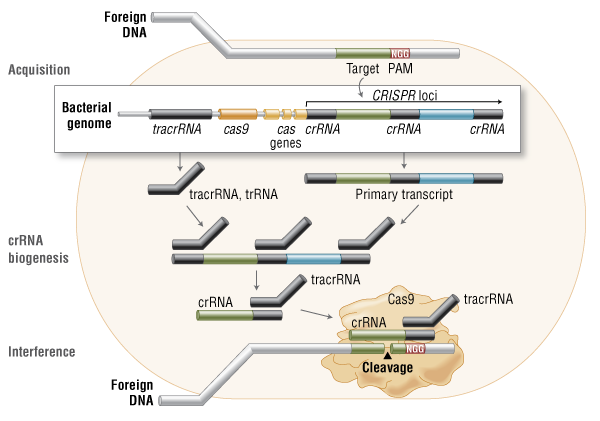
Three types of CRISPR mechanisms have been identified, of which type II is the most studied. In this case, invading DNA from viruses or plasmids is cut into small fragments and incorporated into a CRISPR locus amidst a series of short repeats (around 20 bps). The loci are transcribed, and transcripts are then processed to generate small RNAs (crRNA – CRISPR RNA), which are used to guide effector endonucleases that target invading DNA based on sequence complementarity (Figure 1) (11).

Figure 1. Cas9 in vivo: Bacterial Adaptive Immunity

https://www.neb.com/~/media/NebUs/Files/Feature%20Articles/Images/FA_Cas9_Fig1_Cas9InVivo.png

In the acquisition phase, foreign DNA is incorporated into the bacterial genome at the CRISPR loci. CRISPR loci is then transcribed and processed into crRNA during crRNA biogenesis. During interference, Cas9 endonuclease complexed with a crRNA and separate tracrRNA cleaves foreign DNA containing a 20-nucleotide crRNA complementary sequence adjacent to the PAM sequence. (Figure not drawn to scale.)

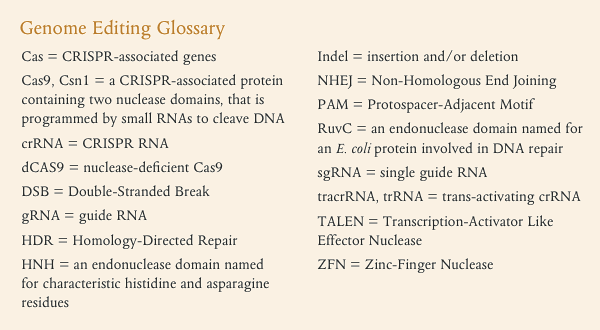
https://www.neb.com/~/media/NebUs/Files/Feature%20Articles/Images/FA_Cas9_GenomeEditingGlossary.png

One Cas protein, Cas9 (also known as Csn1), has been shown, through knockdown and rescue experiments to be a key player in certain CRISPR mechanisms (specifically type II CRISPR systems). The type II CRISPR mechanism is unique compared to other CRISPR systems, as only one Cas protein (Cas9) is required for gene silencing (12). In type II systems, Cas9 participates in the processing of crRNAs (12), and is responsible for the destruction of the target DNA (11). Cas9’s function in both of these steps relies on the presence of two nuclease domains, a RuvC-like nuclease domain located at the amino terminus and a HNH-like nuclease domain that resides in the mid-region of the protein (13).

To achieve site-specific DNA recognition and cleavage, Cas9 must be complexed with both a crRNA and a separate trans-activating crRNA (tracrRNA or trRNA), that is partially complementary to the crRNA (11). The tracrRNA is required for crRNA maturation from a primary transcript encoding multiple pre-crRNAs. This occurs in the presence of RNase III and Cas9 (12).

During the destruction of target DNA, the HNH and RuvC-like nuclease domains cut both DNA strands, generating double-stranded breaks (DSBs) at sites defined by a 20-nucleotide target sequence within an associated crRNA transcript (11, 14). The HNH domain cleaves the complementary strand, while the RuvC domain cleaves the noncomplementary strand.

The double-stranded endonuclease activity of Cas9 also requires that a short conserved sequence, (2–5 nts) known as protospacer-associated motif (PAM), follows immediately 3´- of the crRNA complementary sequence (15). In fact, even fully complementary sequences are ignored by Cas9-RNA in the absence of a PAM sequence (16).

Cas9 and CRISPR as a New Tool in Molecular Biology

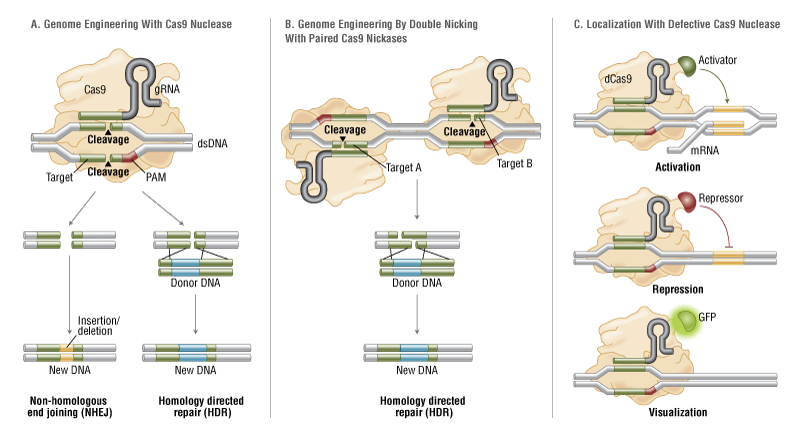
The simplicity of the type II CRISPR nuclease, with only three required components (Cas9 along with the crRNA and trRNA) makes this system amenable to adaptation for genome editing. This potential was realized in 2012 by the Doudna and Charpentier labs (11). Based on the type II CRISPR system described previously, the authors developed a simplified two-component system by combining trRNA and crRNA into a single synthetic single guide RNA (sgRNA). sgRNAprogrammed Cas9 was shown to be as effective as Cas9 programmed with separate trRNA and crRNA in guiding targeted gene alterations (Figure 2A).

To date, three different variants of the Cas9 nuclease have been adopted in genome-editing protocols. The first is wild-type Cas9, which can site-specifically cleave double-stranded DNA, resulting in the activation of the doublestrand break (DSB) repair machinery. DSBs can be repaired by the cellular Non-Homologous End Joining (NHEJ) pathway (17), resulting in insertions and/or deletions (indels) which disrupt the targeted locus. Alternatively, if a donor template with homology to the targeted locus is supplied, the DSB may be repaired by the homology-directed repair (HDR) pathway allowing for precise replacement mutations to be made (Figure 2A) (17, 18).

Cong and colleagues (1) took the Cas9 system a step further towards increased precision by developing a mutant form, known as Cas9D10A, with only nickase activity. This means it cleaves only one DNA strand, and does not activate NHEJ. Instead, when provided with a homologous repair template, DNA repairs are conducted via the high-fidelity HDR pathway only, resulting in reduced indel mutations (1, 11, 19). Cas9D10A is even more appealing in terms of target specificity when loci are targeted by paired Cas9 complexes designed to generate adjacent DNA nicks (20) (see further details about “paired nickases” in Figure 2B).

The third variant is a nuclease-deficient Cas9 (dCas9, Figure 2C) (21). Mutations H840A in the HNH domain and D10A in the RuvC domain inactivate cleavage activity, but do not prevent DNA binding (11, 22). Therefore, this variant can be used to sequence-specifically target any region of the genome without cleavage. Instead, by fusing with various effector domains, dCas9 can be used either as a gene silencing or activation tool (21, 23–26). Furthermore, it can be used as a visualization tool. For instance, Chen and colleagues used dCas9 fused to Enhanced Green Fluorescent Protein (EGFP) to visualize repetitive DNA sequences with a single sgRNA or nonrepetitive loci using multiple sgRNAs (27).

Figure 2. CRISPR/Cas9 System Applications

https://www.neb.com/~/media/NebUs/Files/Feature%20Articles/Images/FA_Cas9_Fig2_Cas9forGenomeEditing.png?device=modal

  1. Wild-type Cas9 nuclease site specifically cleaves double-stranded DNA activating double-strand break repair machinery. In the absence of a homologous repair template non-homologous end joining can result in indels disrupting the target sequence. Alternatively, precise mutations and knock-ins can be made by providing a homologous repair template and exploiting the homology directed repair pathway.
    B. Mutated Cas9 makes a site specific single-strand nick. Two sgRNA can be used to introduce a staggered double-stranded break which can then undergo homology directed repair.
    C. Nuclease-deficient Cas9 can be fused with various effector domains allowing specific localization. For example, transcriptional activators, repressors, and fluorescent proteins.

Targeting Efficiency and Off-target Mutations

Targeting efficiency, or the percentage of desired mutation achieved, is one of the most important parameters by which to assess a genome-editing tool. The targeting efficiency of Cas9 compares favorably with more established methods, such as TALENs or ZFNs (8). For example, in human cells, custom-designed ZFNs and TALENs could only achieve efficiencies ranging from 1% to 50% (29–31). In contrast, the Cas9 system has been reported to have efficiencies up to >70% in zebrafish (32) and plants (33), and ranging from 2–5% in induced pluripotent stem cells (34). In addition, Zhou and colleagues were able to improve genome targeting up to 78% in one-cell mouse embryos, and achieved effective germline transmission through the use of dual sgRNAs to simultaneously target an individual gene (35).

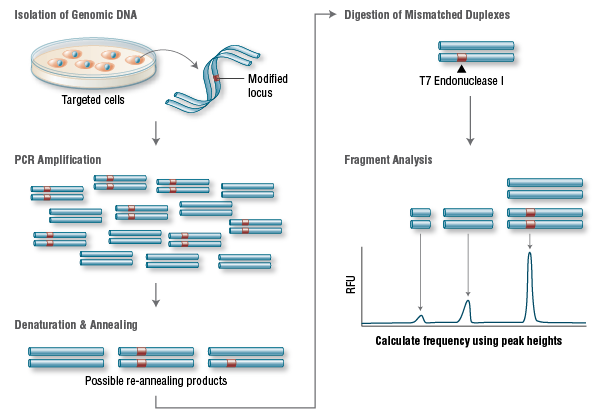
A widely used method to identify mutations is the T7 Endonuclease I mutation detection assay (36, 37) (Figure 3). This assay detects heteroduplex DNA that results from the annealing of a DNA strand, including desired mutations, with a wildtype DNA strand (37).

Figure 3. T7 Endonuclease I Targeting Efficiency Assay

https://www.neb.com/~/media/NebUs/Files/Feature%20Articles/Images/FA_Cas9_Fig3_T7Assay_TargetEfficiency.png

Genomic DNA is amplified with primers bracketing the modified locus. PCR products are then denatured and re-annealed yielding 3 possible structures. Duplexes containing a mismatch are digested by T7 Endonuclease I. The DNA is then electrophoretically separated and fragment analysis is used to calculate targeting efficiency.

Another important parameter is the incidence of off-target mutations. Such mutations are likely to appear in sites that have differences of only a few nucleotides compared to the original sequence, as long as they are adjacent to a PAM sequence. This occurs as Cas9 can tolerate up to 5 base mismatches within the protospacer region (36) or a single base difference in the PAM sequence (38). Off-target mutations are generally more difficult to detect, requiring whole-genome sequencing to rule them out completely.

Recent improvements to the CRISPR system for reducing off-target mutations have been made through the use of truncated gRNA (truncated within the crRNA-derived sequence) or by adding two extra guanine (G) nucleotides to the 5´ end (28, 37). Another way researchers have attempted to minimize off-target effects is with the use of “paired nickases” (20). This strategy uses D10A Cas9 and two sgRNAs complementary to the adjacent area on opposite strands of the target site (Figure 2B). While this induces DSBs in the target DNA, it is expected to create only single nicks in off-target locations and, therefore, result in minimal off-target mutations.

By leveraging computation to reduce off-target mutations, several groups have developed webbased tools to facilitate the identification of potential CRISPR target sites and assess their potential for off-target cleavage. Examples include the CRISPR Design Tool (38) and the ZiFiT Targeter, Version 4.2 (39, 40).

Applications as a Genome-editing and Genome Targeting Tool

Following its initial demonstration in 2012 (9), the CRISPR/Cas9 system has been widely adopted. This has already been successfully used to target important genes in many cell lines and organisms, including human (34), bacteria (41), zebrafish (32), C. elegans (42), plants (34), Xenopus tropicalis (43), yeast (44), Drosophila (45), monkeys (46), rabbits (47), pigs (42), rats (48) and mice (49). Several groups have now taken advantage of this method to introduce single point mutations (deletions or insertions) in a particular target gene, via a single gRNA (14, 21, 29). Using a pair of gRNA-directed Cas9 nucleases instead, it is also possible to induce large deletions or genomic rearrangements, such as inversions or translocations (50). A recent exciting development is the use of the dCas9 version of the CRISPR/Cas9 system to target protein domains for transcriptional regulation (26, 51, 52), epigenetic modification (25), and microscopic visualization of specific genome loci (27).

The CRISPR/Cas9 system requires only the redesign of the crRNA to change target specificity. This contrasts with other genome editing tools, including zinc finger and TALENs, where redesign of the protein-DNA interface is required. Furthermore, CRISPR/Cas9 enables rapid genome-wide interrogation of gene function by generating large gRNA libraries (51, 53) for genomic screening.

The Future of CRISPR/Cas9

The rapid progress in developing Cas9 into a set of tools for cell and molecular biology research has been remarkable, likely due to the simplicity, high efficiency and versatility of the system. Of the designer nuclease systems currently available for precision genome engineering, the CRISPR/Cas system is by far the most user friendly. It is now also clear that Cas9’s potential reaches beyond DNA cleavage, and its usefulness for genome locus-specific recruitment of proteins will likely only be limited by our imagination.


Scientists urge caution in using new CRISPR technology to treat human genetic disease

By Robert Sanders, Media relations | MARCH 19, 2015
http://news.berkeley.edu/2015/03/19/scientists-urge-caution-in-using-new-crispr-technology-to-treat-human-genetic-disease/

http://news.berkeley.edu/wp-content/uploads/2015/03/crispr350.jpg

The bacterial enzyme Cas9 is the engine of RNA-programmed genome engineering in human cells. (Graphic by Jennifer Doudna/UC Berkeley)

A group of 18 scientists and ethicists today warned that a revolutionary new tool to cut and splice DNA should be used cautiously when attempting to fix human genetic disease, and strongly discouraged any attempts at making changes to the human genome that could be passed on to offspring.

Among the authors of this warning is Jennifer Doudna, the co-inventor of the technology, called CRISPR-Cas9, which is driving a new interest in gene therapy, or “genome engineering.” She and colleagues co-authored a perspective piece that appears in the March 20 issue of Science, based on discussions at a meeting that took place in Napa on Jan. 24. The same issue of Science features a collection of recent research papers, commentary and news articles on CRISPR and its implications.    …..

A prudent path forward for genomic engineering and germline gene modification

David Baltimore1,  Paul Berg2, …., Jennifer A. Doudna4,10,*, et al.
http://science.sciencemag.org/content/early/2015/03/18/science.aab1028.full
Science  19 Mar 2015.  http://dx.doi.org:/10.1126/science.aab1028


Correcting genetic defects

Scientists today are changing DNA sequences to correct genetic defects in animals as well as cultured tissues generated from stem cells, strategies that could eventually be used to treat human disease. The technology can also be used to engineer animals with genetic diseases mimicking human disease, which could lead to new insights into previously enigmatic disorders.

The CRISPR-Cas9 tool is still being refined to ensure that genetic changes are precisely targeted, Doudna said. Nevertheless, the authors met “… to initiate an informed discussion of the uses of genome engineering technology, and to identify proactively those areas where current action is essential to prepare for future developments. We recommend taking immediate steps toward ensuring that the application of genome engineering technology is performed safely and ethically.”


Amyloid CRISPR Plasmids and si/shRNA Gene Silencers

http://www.scbt.com/crispr/table-amyloid.html

Santa Cruz Biotechnology, Inc. offers a broad range of gene silencers in the form of siRNAs, shRNA Plasmids and shRNA Lentiviral Particles as well as CRISPR/Cas9 Knockout and CRISPR Double Nickase plasmids. Amyloid gene silencers are available as Amyloid siRNA, Amyloid shRNA Plasmid, Amyloid shRNA Lentiviral Particles and Amyloid CRISPR/Cas9 Knockout plasmids. Amyloid CRISPR/dCas9 Activation Plasmids and CRISPR Lenti Activation Systems for gene activation are also available. Gene silencers and activators are useful for gene studies in combination with antibodies used for protein detection.    Amyloid CRISPR Knockout, HDR and Nickase Knockout Plasmids


CRISPR-Cas9-Based Knockout of the Prion Protein and Its Effect on the Proteome


Mehrabian M, Brethour D, MacIsaac S, Kim JK, Gunawardana C.G, Wang H, et al.
PLoS ONE 2014; 9(12): e114594. http://dx.doi.org/10.1371/journal.pone.0114594

The molecular function of the cellular prion protein (PrPC) and the mechanism by which it may contribute to neurotoxicity in prion diseases and Alzheimer’s disease are only partially understood. Mouse neuroblastoma Neuro2a cells and, more recently, C2C12 myocytes and myotubes have emerged as popular models for investigating the cellular biology of PrP. Mouse epithelial NMuMG cells might become attractive models for studying the possible involvement of PrP in a morphogenetic program underlying epithelial-to-mesenchymal transitions. Here we describe the generation of PrP knockout clones from these cell lines using CRISPR-Cas9 knockout technology. More specifically, knockout clones were generated with two separate guide RNAs targeting recognition sites on opposite strands within the first hundred nucleotides of the Prnp coding sequence. Several PrP knockout clones were isolated and genomic insertions and deletions near the CRISPR-target sites were characterized. Subsequently, deep quantitative global proteome analyses that recorded the relative abundance of>3000 proteins (data deposited to ProteomeXchange Consortium) were undertaken to begin to characterize the molecular consequences of PrP deficiency. The levels of ∼120 proteins were shown to reproducibly correlate with the presence or absence of PrP, with most of these proteins belonging to extracellular components, cell junctions or the cytoskeleton.

http://journals.plos.org/plosone/article/figure/image?size=inline&id=info:doi/10.1371/journal.pone.0114594.g001

http://journals.plos.org/plosone/article/figure/image?size=inline&id=info:doi/10.1371/journal.pone.0114594.g003


Development and Applications of CRISPR-Cas9 for Genome Engineering

Patrick D. Hsu,1,2,3 Eric S. Lander,1 and Feng Zhang1,2,*
Cell. 2014 Jun 5; 157(6): 1262–1278.   doi:  10.1016/j.cell.2014.05.010

Recent advances in genome engineering technologies based on the CRISPR-associated RNA-guided endonuclease Cas9 are enabling the systematic interrogation of mammalian genome function. Analogous to the search function in modern word processors, Cas9 can be guided to specific locations within complex genomes by a short RNA search string. Using this system, DNA sequences within the endogenous genome and their functional outputs are now easily edited or modulated in virtually any organism of choice. Cas9-mediated genetic perturbation is simple and scalable, empowering researchers to elucidate the functional organization of the genome at the systems level and establish causal linkages between genetic variations and biological phenotypes. In this Review, we describe the development and applications of Cas9 for a variety of research or translational applications while highlighting challenges as well as future directions. Derived from a remarkable microbial defense system, Cas9 is driving innovative applications from basic biology to biotechnology and medicine.

The development of recombinant DNA technology in the 1970s marked the beginning of a new era for biology. For the first time, molecular biologists gained the ability to manipulate DNA molecules, making it possible to study genes and harness them to develop novel medicine and biotechnology. Recent advances in genome engineering technologies are sparking a new revolution in biological research. Rather than studying DNA taken out of the context of the genome, researchers can now directly edit or modulate the function of DNA sequences in their endogenous context in virtually any organism of choice, enabling them to elucidate the functional organization of the genome at the systems level, as well as identify causal genetic variations.

Broadly speaking, genome engineering refers to the process of making targeted modifications to the genome, its contexts (e.g., epigenetic marks), or its outputs (e.g., transcripts). The ability to do so easily and efficiently in eukaryotic and especially mammalian cells holds immense promise to transform basic science, biotechnology, and medicine (Figure 1).

http://www.ncbi.nlm.nih.gov/pmc/articles/PMC4343198/bin/nihms659174f1.jpg

For life sciences research, technologies that can delete, insert, and modify the DNA sequences of cells or organisms enable dissecting the function of specific genes and regulatory elements. Multiplexed editing could further allow the interrogation of gene or protein networks at a larger scale. Similarly, manipulating transcriptional regulation or chromatin states at particular loci can reveal how genetic material is organized and utilized within a cell, illuminating relationships between the architecture of the genome and its functions. In biotechnology, precise manipulation of genetic building blocks and regulatory machinery also facilitates the reverse engineering or reconstruction of useful biological systems, for example, by enhancing biofuel production pathways in industrially relevant organisms or by creating infection-resistant crops. Additionally, genome engineering is stimulating a new generation of drug development processes and medical therapeutics. Perturbation of multiple genes simultaneously could model the additive effects that underlie complex polygenic disorders, leading to new drug targets, while genome editing could directly correct harmful mutations in the context of human gene therapy (Tebas et al., 2014).

Eukaryotic genomes contain billions of DNA bases and are difficult to manipulate. One of the breakthroughs in genome manipulation has been the development of gene targeting by homologous recombination (HR), which integrates exogenous repair templates that contain sequence homology to the donor site (Figure 2A) (Capecchi, 1989). HR-mediated targeting has facilitated the generation of knockin and knockout animal models via manipulation of germline competent stem cells, dramatically advancing many areas of biological research. However, although HR-mediated gene targeting produces highly precise alterations, the desired recombination events occur extremely infrequently (1 in 106–109 cells) (Capecchi, 1989), presenting enormous challenges for large-scale applications of gene-targeting experiments.

Genome Editing Technologies Exploit Endogenous DNA Repair Machinery

http://www.ncbi.nlm.nih.gov/pmc/articles/PMC4343198/bin/nihms659174f2.gif

To overcome these challenges, a series of programmable nuclease-based genome editing technologies have been developed in recent years, enabling targeted and efficient modification of a variety of eukaryotic and particularly mammalian species. Of the current generation of genome editing technologies, the most rapidly developing is the class of RNA-guided endonucleases known as Cas9 from the microbial adaptive immune system CRISPR (clustered regularly interspaced short palindromic repeats), which can be easily targeted to virtually any genomic location of choice by a short RNA guide. Here, we review the development and applications of the CRISPR-associated endonuclease Cas9 as a platform technology for achieving targeted perturbation of endogenous genomic elements and also discuss challenges and future avenues for innovation.   ……

Figure 4   Natural Mechanisms of Microbial CRISPR Systems in Adaptive Immunity

http://www.ncbi.nlm.nih.gov/pmc/articles/PMC4343198/bin/nihms659174f4.gif

……  A key turning point came in 2005, when systematic analysis of the spacer sequences separating the individual direct repeats suggested their extrachromosomal and phage-associated origins (Mojica et al., 2005Pourcel et al., 2005Bolotin et al., 2005). This insight was tremendously exciting, especially given previous studies showing that CRISPR loci are transcribed (Tang et al., 2002) and that viruses are unable to infect archaeal cells carrying spacers corresponding to their own genomes (Mojica et al., 2005). Together, these findings led to the speculation that CRISPR arrays serve as an immune memory and defense mechanism, and individual spacers facilitate defense against bacteriophage infection by exploiting Watson-Crick base-pairing between nucleic acids (Mojica et al., 2005Pourcel et al., 2005). Despite these compelling realizations that CRISPR loci might be involved in microbial immunity, the specific mechanism of how the spacers act to mediate viral defense remained a challenging puzzle. Several hypotheses were raised, including thoughts that CRISPR spacers act as small RNA guides to degrade viral transcripts in a RNAi-like mechanism (Makarova et al., 2006) or that CRISPR spacers direct Cas enzymes to cleave viral DNA at spacer-matching regions (Bolotin et al., 2005).   …..

As the pace of CRISPR research accelerated, researchers quickly unraveled many details of each type of CRISPR system (Figure 4). Building on an earlier speculation that protospacer adjacent motifs (PAMs) may direct the type II Cas9 nuclease to cleave DNA (Bolotin et al., 2005), Moineau and colleagues highlighted the importance of PAM sequences by demonstrating that PAM mutations in phage genomes circumvented CRISPR interference (Deveau et al., 2008). Additionally, for types I and II, the lack of PAM within the direct repeat sequence within the CRISPR array prevents self-targeting by the CRISPR system. In type III systems, however, mismatches between the 5′ end of the crRNA and the DNA target are required for plasmid interference (Marraffini and Sontheimer, 2010).  …..

In 2013, a pair of studies simultaneously showed how to successfully engineer type II CRISPR systems from Streptococcus thermophilus (Cong et al., 2013) andStreptococcus pyogenes (Cong et al., 2013Mali et al., 2013a) to accomplish genome editing in mammalian cells. Heterologous expression of mature crRNA-tracrRNA hybrids (Cong et al., 2013) as well as sgRNAs (Cong et al., 2013Mali et al., 2013a) directs Cas9 cleavage within the mammalian cellular genome to stimulate NHEJ or HDR-mediated genome editing. Multiple guide RNAs can also be used to target several genes at once. Since these initial studies, Cas9 has been used by thousands of laboratories for genome editing applications in a variety of experimental model systems (Sander and Joung, 2014). ……

The majority of CRISPR-based technology development has focused on the signature Cas9 nuclease from type II CRISPR systems. However, there remains a wide diversity of CRISPR types and functions. Cas RAMP module (Cmr) proteins identified in Pyrococcus furiosus and Sulfolobus solfataricus (Hale et al., 2012) constitute an RNA-targeting CRISPR immune system, forming a complex guided by small CRISPR RNAs that target and cleave complementary RNA instead of DNA. Cmr protein homologs can be found throughout bacteria and archaea, typically relying on a 5 site tag sequence on the target-matching crRNA for Cmr-directed cleavage.

Unlike RNAi, which is targeted largely by a 6 nt seed region and to a lesser extent 13 other bases, Cmr crRNAs contain 30–40 nt of target complementarity. Cmr-CRISPR technologies for RNA targeting are thus a promising target for orthogonal engineering and minimal off-target modification. Although the modularity of Cmr systems for RNA-targeting in mammalian cells remains to be investigated, Cmr complexes native to P. furiosus have already been engineered to target novel RNA substrates (Hale et al., 20092012).   ……

Although Cas9 has already been widely used as a research tool, a particularly exciting future direction is the development of Cas9 as a therapeutic technology for treating genetic disorders. For a monogenic recessive disorder due to loss-of-function mutations (such as cystic fibrosis, sickle-cell anemia, or Duchenne muscular dystrophy), Cas9 may be used to correct the causative mutation. This has many advantages over traditional methods of gene augmentation that deliver functional genetic copies via viral vector-mediated overexpression—particularly that the newly functional gene is expressed in its natural context. For dominant-negative disorders in which the affected gene is haplosufficient (such as transthyretin-related hereditary amyloidosis or dominant forms of retinitis pigmentosum), it may also be possible to use NHEJ to inactivate the mutated allele to achieve therapeutic benefit. For allele-specific targeting, one could design guide RNAs capable of distinguishing between single-nucleotide polymorphism (SNP) variations in the target gene, such as when the SNP falls within the PAM sequence.


CRISPR/Cas9: a powerful genetic engineering tool for establishing large animal models of neurodegenerative diseases

Zhuchi Tu, Weili Yang, Sen Yan, Xiangyu Guo and Xiao-Jiang Li

Molecular Neurodegeneration 2015; 10:35  http://dx.doi.org:/10.1186/s13024-015-0031-x

Animal models are extremely valuable to help us understand the pathogenesis of neurodegenerative disorders and to find treatments for them. Since large animals are more like humans than rodents, they make good models to identify the important pathological events that may be seen in humans but not in small animals; large animals are also very important for validating effective treatments or confirming therapeutic targets. Due to the lack of embryonic stem cell lines from large animals, it has been difficult to use traditional gene targeting technology to establish large animal models of neurodegenerative diseases. Recently, CRISPR/Cas9 was used successfully to genetically modify genomes in various species. Here we discuss the use of CRISPR/Cas9 technology to establish large animal models that can more faithfully mimic human neurodegenerative diseases.

Neurodegenerative diseases — Alzheimer’s disease(AD),Parkinson’s disease(PD), amyotrophic lateral sclerosis (ALS), Huntington’s disease (HD), and frontotemporal dementia (FTD) — are characterized by age-dependent and selective neurodegeneration. As the life expectancy of humans lengthens, there is a greater prevalence of these neurodegenerative diseases; however, the pathogenesis of most of these neurodegenerative diseases remain unclear, and we lack effective treatments for these important brain disorders.

CRISPR/Cas9,  Non-human primates,  Neurodegenerative diseases,  Animal model

There are a number of excellent reviews covering different types of neurodegenerative diseases and their genetic mouse models [812]. Investigations of different mouse models of neurodegenerative diseases have revealed a common pathology shared by these diseases. First, the development of neuropathology and neurological symptoms in genetic mouse models of neurodegenerative diseases is age dependent and progressive. Second, all the mouse models show an accumulation of misfolded or aggregated proteins resulting from the expression of mutant genes. Third, despite the widespread expression of mutant proteins throughout the body and brain, neuronal function appears to be selectively or preferentially affected. All these facts indicate that mouse models of neurodegenerative diseases recapitulate important pathologic features also seen in patients with neurodegenerative diseases.

However, it seems that mouse models can not recapitulate the full range of neuropathology seen in patients with neurodegenerative diseases. Overt neurodegeneration, which is the most important pathological feature in patient brains, is absent in genetic rodent models of AD, PD, and HD. Many rodent models that express transgenic mutant proteins under the control of different promoters do not replicate overt neurodegeneration, which is likely due to their short life spans and the different aging processes of small animals. Also important are the remarkable differences in brain development between rodents and primates. For example, the mouse brain takes 21 days to fully develop, whereas the formation of primate brains requires more than 150 days [13]. The rapid development of the brain in rodents may render neuronal cells resistant to misfolded protein-mediated neurodegeneration. Another difficulty in using rodent models is how to analyze cognitive and emotional abnormalities, which are the early symptoms of most neurodegenerative diseases in humans. Differences in neuronal circuitry, anatomy, and physiology between rodent and primate brains may also account for the behavioral differences between rodent and primate models.


Mitochondrial dynamics–fusion, fission, movement, and mitophagy–in neurodegenerative diseases

Hsiuchen Chen and David C. Chan
Human Molec Gen 2009; 18, Review Issue 2 R169–R176
http://dx.doi.org:/10.1093/hmg/ddp326

Neurons are metabolically active cells with high energy demands at locations distant from the cell body. As a result, these cells are particularly dependent on mitochondrial function, as reflected by the observation that diseases of mitochondrial dysfunction often have a neurodegenerative component. Recent discoveries have highlighted that neurons are reliant particularly on the dynamic properties of mitochondria. Mitochondria are dynamic organelles by several criteria. They engage in repeated cycles of fusion and fission, which serve to intermix the lipids and contents of a population of mitochondria. In addition, mitochondria are actively recruited to subcellular sites, such as the axonal and dendritic processes of neurons. Finally, the quality of a mitochondrial population is maintained through mitophagy, a form of autophagy in which defective mitochondria are selectively degraded. We review the general features of mitochondrial dynamics, incorporating recent findings on mitochondrial fusion, fission, transport and mitophagy. Defects in these key features are associated with neurodegenerative disease. Charcot-Marie-Tooth type 2A, a peripheral neuropathy, and dominant optic atrophy, an inherited optic neuropathy, result from a primary deficiency of mitochondrial fusion. Moreover, several major neurodegenerative diseases—including Parkinson’s, Alzheimer’s and Huntington’s disease—involve disruption of mitochondrial dynamics. Remarkably, in several disease models, the manipulation of mitochondrial fusion or fission can partially rescue disease phenotypes. We review how mitochondrial dynamics is altered in these neurodegenerative diseases and discuss the reciprocal interactions between mitochondrial fusion, fission, transport and mitophagy.


Applications of CRISPR–Cas systems in Neuroscience

Matthias Heidenreich  & Feng Zhang
Nature Rev Neurosci 2016; 17:36–44   http://dx.doi.org:/10.1038/nrn.2015.2

Genome-editing tools, and in particular those based on CRISPR–Cas (clustered regularly interspaced short palindromic repeat (CRISPR)–CRISPR-associated protein) systems, are accelerating the pace of biological research and enabling targeted genetic interrogation in almost any organism and cell type. These tools have opened the door to the development of new model systems for studying the complexity of the nervous system, including animal models and stem cell-derived in vitro models. Precise and efficient gene editing using CRISPR–Cas systems has the potential to advance both basic and translational neuroscience research.
Cellular neuroscience
, DNA recombination, Genetic engineering, Molecular neuroscience

Figure 3: In vitro applications of Cas9 in human iPSCs.close

http://www.nature.com/nrn/journal/v17/n1/carousel/nrn.2015.2-f3.jpg

a | Evaluation of disease candidate genes from large-population genome-wide association studies (GWASs). Human primary cells, such as neurons, are not easily available and are difficult to expand in culture. By contrast, induced pluripo…

  1. Genome-editing Technologies for Gene and Cell Therapy

Molecular Therapy 12 Jan 2016

  1. Systematic quantification of HDR and NHEJ reveals effects of locus, nuclease, and cell type on genome-editing

Scientific Reports 31 Mar 2016

  1. Controlled delivery of β-globin-targeting TALENs and CRISPR/Cas9 into mammalian cells for genome editing using microinjection

Scientific Reports 12 Nov 2015


Alzheimer’s Disease: Medicine’s Greatest Challenge in the 21st Century

https://www.physicsforums.com/insights/can-gene-editing-eliminate-alzheimers-disease/

The development of the CRISPR/Cas9 system has made gene editing a relatively simple task.  While CRISPR and other gene editing technologies stand to revolutionize biomedical research and offers many promising therapeutic avenues (such as in the treatment of HIV), a great deal of debate exists over whether CRISPR should be used to modify human embryos. As I discussed in my previous Insight article, we lack enough fundamental biological knowledge to enhance many traits like height or intelligence, so we are not near a future with genetically-enhanced super babies. However, scientists have identified a few rare genetic variants that protect against disease.  One such protective variant is a mutation in the APP gene that protects against Alzheimer’s disease and cognitive decline in old age. If we can perfect gene editing technologies, is this mutation one that we should be regularly introducing into embryos? In this article, I explore the potential for using gene editing as a way to prevent Alzheimer’s disease in future generations. Alzheimer’s Disease: Medicine’s Greatest Challenge in the 21st Century Can gene editing be the missing piece in the battle against Alzheimer’s? (Source: bostonbiotech.org) I chose to assess the benefit of germline gene editing in the context of Alzheimer’s disease because this disease is one of the biggest challenges medicine faces in the 21st century. Alzheimer’s disease is a chronic neurodegenerative disease responsible for the majority of the cases of dementia in the elderly. The disease symptoms begins with short term memory loss and causes more severe symptoms – problems with language, disorientation, mood swings, behavioral issues – as it progresses, eventually leading to the loss of bodily functions and death. Because of the dementia the disease causes, Alzheimer’s patients require a great deal of care, and the world spends ~1% of its total GDP on caring for those with Alzheimer’s and related disorders. Because the prevalence of the disease increases with age, the situation will worsen as life expectancies around the globe increase: worldwide cases of Alzheimer’s are expected to grow from 35 million today to over 115 million by 2050.

Despite much research, the exact causes of Alzheimer’s disease remains poorly understood. The disease seems to be related to the accumulation of plaques made of amyloid-β peptides that form on the outside of neurons, as well as the formation of tangles of the protein tau inside of neurons. Although many efforts have been made to target amyloid-β or the enzymes involved in its formation, we have so far been unsuccessful at finding any treatment that stops the disease or reverses its progress. Some researchers believe that most attempts at treating Alzheimer’s have failed because, by the time a patient shows symptoms, the disease has already progressed past the point of no return.

While research towards a cure continues, researchers have sought effective ways to prevent Alzheimer’s disease. Although some studies show that mental and physical exercise may lower ones risk of Alzheimer’s disease, approximately 60-80% of the risk for Alzheimer’s disease appears to be genetic. Thus, if we’re serious about prevention, we may have to act at the genetic level. And because the brain is difficult to access surgically for gene therapy in adults, this means using gene editing on embryos.

Reference https://www.physicsforums.com/insights/can-gene-editing-eliminate-alzheimers-disease/


Utilising CRISPR to Generate Predictive Disease Models: a Case Study in Neurodegenerative Disorders


Dr. Bhuvaneish.T. Selvaraj  – Scottish Centre for Regenerative Medicine

http://www.crisprsummit.com/utilising-crispr-to-generate-predictive-disease-models-a-case-study-in-neurodegenerative-disorders

  • Introducing the latest developments in predictive model generation
  • Discover how CRISPR is being used to develop disease models to study and treat neurodegenerative disorders
  • In depth Q&A session to answer your most pressing questions


Turning On Genes, Systematically, with CRISPR/Cas9

http://www.genengnews.com/gen-news-highlights/turning-on-genes-systematically-with-crispr-cas9/81250697/


Scientists based at MIT assert that they can reliably turn on any gene of their choosing in living cells. [Feng Zhang and Steve Dixon]  http://www.genengnews.com/media/images/GENHighlight/Dec12_2014_CRISPRCas9GeneActivationSystem7838101231.jpg

With the latest CRISPR/Cas9 advance, the exhortation “turn on, tune in, drop out” comes to mind. The CRISPR/Cas9 gene-editing system was already a well-known means of “tuning in” (inserting new genes) and “dropping out” (knocking out genes). But when it came to “turning on” genes, CRISPR/Cas9 had little potency. That is, it had demonstrated only limited success as a way to activate specific genes.

A new CRISPR/Cas9 approach, however, appears capable of activating genes more effectively than older approaches. The new approach may allow scientists to more easily determine the function of individual genes, according to Feng Zhang, Ph.D., a researcher at MIT and the Broad Institute. Dr. Zhang and colleagues report that the new approach permits multiplexed gene activation and rapid, large-scale studies of gene function.

The new technique was introduced in the December 10 online edition of Nature, in an article entitled, “Genome-scale transcriptional activation by an engineered CRISPR-Cas9 complex.” The article describes how Dr. Zhang, along with the University of Tokyo’s Osamu Nureki, Ph.D., and Hiroshi Nishimasu, Ph.D., overhauled the CRISPR/Cas9 system. The research team based their work on their analysis (published earlier this year) of the structure formed when Cas9 binds to the guide RNA and its target DNA. Specifically, the team used the structure’s 3D shape to rationally improve the system.

In previous efforts to revamp CRISPR/Cas9 for gene activation purposes, scientists had tried to attach the activation domains to either end of the Cas9 protein, with limited success. From their structural studies, the MIT team realized that two small loops of the RNA guide poke out from the Cas9 complex and could be better points of attachment because they allow the activation domains to have more flexibility in recruiting transcription machinery.

Using their revamped system, the researchers activated about a dozen genes that had proven difficult or impossible to turn on using the previous generation of Cas9 activators. Each gene showed at least a twofold boost in transcription, and for many genes, the researchers found multiple orders of magnitude increase in activation.

After investigating single-guide RNA targeting rules for effective transcriptional activation, demonstrating multiplexed activation of 10 genes simultaneously, and upregulating long intergenic noncoding RNA transcripts, the research team decided to undertake a large-scale screen. This screen was designed to identify genes that confer resistance to a melanoma drug called PLX-4720.

“We … synthesized a library consisting of 70,290 guides targeting all human RefSeq coding isoforms to screen for genes that, upon activation, confer resistance to a BRAF inhibitor,” wrote the authors of the Nature paper. “The top hits included genes previously shown to be able to confer resistance, and novel candidates were validated using individual [single-guide RNA] and complementary DNA overexpression.”

A gene signature based on the top screening hits, the authors added, correlated with a gene expression signature of BRAF inhibitor resistance in cell lines and patient-derived samples. It was also suggested that large-scale screens such as the one demonstrated in the current study could help researchers discover new cancer drugs that prevent tumors from becoming resistant.

More at –  http://www.genengnews.com/gen-news-highlights/turning-on-genes-systematically-with-crispr-cas9/81250697/


Susceptibility and modifier genes in Portuguese transthyretin V30M amyloid polyneuropathy: complexity in a single-gene disease
Miguel L. Soares1,2, Teresa Coelho3,6, Alda Sousa4,5, …, Maria Joa˜o Saraiva2,5 and Joel N. Buxbaum1
Human Molec Gen 2005; 14(4): 543–553   http://dx.doi.org:/10.1093/hmg/ddi051
https://www.researchgate.net/profile/Isabel_Conceicao/publication/8081351_Susceptibility_and_modifier_genes_in_Portuguese_transthyretin_V30M_amyloid_polyneuropathy_complexity_in_a_single-gene_disease/links/53e123d70cf2235f352733b3.pdf

Familial amyloid polyneuropathy type I is an autosomal dominant disorder caused by mutations in the transthyretin (TTR ) gene; however, carriers of the same mutation exhibit variability in penetrance and clinical expression. We analyzed alleles of candidate genes encoding non-fibrillar components of TTR amyloid deposits and a molecule metabolically interacting with TTR [retinol-binding protein (RBP)], for possible associations with age of disease onset and/or susceptibility in a Portuguese population sample with the TTR V30M mutation and unrelated controls. We show that the V30M carriers represent a distinct subset of the Portuguese population. Estimates of genetic distance indicated that the controls and the classical onset group were furthest apart, whereas the late-onset group appeared to differ from both. Importantly, the data also indicate that genetic interactions among the multiple loci evaluated, rather than single-locus effects, are more likely to determine differences in the age of disease onset. Multifactor dimensionality reduction indicated that the best genetic model for classical onset group versus controls involved the APCS gene, whereas for late-onset cases, one APCS variant (APCSv1) and two RBP variants (RBPv1 and RBPv2) are involved. Thus, although the TTR V30M mutation is required for the disease in Portuguese patients, different genetic factors may govern the age of onset, as well as the occurrence of anticipation.

Autosomal dominant disorders may vary in expression even within a given kindred. The basis of this variability is uncertain and can be attributed to epigenetic factors, environment or epistasis. We have studied familial amyloid polyneuropathy (FAP), an autosomal dominant disorder characterized by peripheral sensorimotor and autonomic neuropathy. It exhibits variation in cardiac, renal, gastrointestinal and ocular involvement, as well as age of onset. Over 80 missense mutations in the transthyretin gene (TTR ) result in autosomal dominant disease http://www.ibmc.up.pt/~mjsaraiv/ttrmut.html). The presence of deposits consisting entirely of wild-type TTR molecules in the hearts of 10– 25% of individuals over age 80 reveals its inherent in vivo amyloidogenic potential (1).

FAP was initially described in Portuguese (2) where, until recently, the TTR V30M has been the only pathogenic mutation associated with the disease (3,4). Later reports identified the same mutation in Swedish and Japanese families (5,6). The disorder has since been recognized in other European countries and in North American kindreds in association with V30M, as well as other mutations (7).

TTR V30M produces disease in only 5–10% of Swedish carriers of the allele (8), a much lower degree of penetrance than that seen in Portuguese (80%) (9) or in Japanese with the same mutation. The actual penetrance in Japanese carriers has not been formally established, but appears to resemble that seen in Portuguese. Portuguese and Japanese carriers show considerable variation in the age of clinical onset (10,11). In both populations, the first symptoms had originally been described as typically occurring before age 40 (so-called ‘classical’ or early-onset); however, in recent years, more individuals developing symptoms late in life have been identified (11,12). Hence, present data indicate that the distribution of the age of onset in Portuguese is continuous, but asymmetric with a mean around age 35 and a long tail into the older age group (Fig. 1) (9,13). Further, DNA testing in Portugal has identified asymptomatic carriers over age 70 belonging to a subset of very late-onset kindreds in whose descendants genetic anticipation is frequent. The molecular basis of anticipation in FAP, which is not mediated by trinucleotide repeat expansions in the TTR or any other gene (14), remains elusive.

Variation in penetrance, age of onset and clinical features are hallmarks of many autosomal dominant disorders including the human TTR amyloidoses (7). Some of these clearly reflect specific biological effects of a particular mutation or a class of mutants. However, when such phenotypic variability is seen with a single mutation in the gene encoding the same protein, it suggests an effect of modifying genetic loci and/or environmental factors contributing differentially to the course of disease. We have chosen to examine age of onset as an example of a discrete phenotypic variation in the presence of the particular autosomal dominant disease-associated mutation TTR V30M. Although the role of environmental factors cannot be excluded, the existence of modifier genes involved in TTR amyloidogenesis is an attractive hypothesis to explain the phenotypic variability in FAP. ….

ATTR (TTR amyloid), like all amyloid deposits, contains several molecular components, in addition to the quantitatively dominant fibril-forming amyloid protein, including heparan sulfate proteoglycan 2 (HSPG2 or perlecan), SAP, a plasma glycoprotein of the pentraxin family (encoded by the APCS gene) that undergoes specific calcium-dependent binding to all types of amyloid fibrils, and apolipoprotein E (ApoE), also found in all amyloid deposits (15). The ApoE4 isoform is associated with an increased frequency and earlier onset of Alzheimer’s disease (Ab), the most common form of brain amyloid, whereas the ApoE2 isoform appears to be protective (16). ApoE variants could exert a similar modulatory effect in the onset of FAP, although early studies on a limited number of patients suggested this was not the case (17).

In at least one instance of senile systemic amyloidosis, small amounts of AA-related material were found in TTR deposits (18). These could reflect either a passive co-aggregation or a contributory involvement of protein AA, encoded by the serum amyloid A (SAA ) genes and the main component of secondary (reactive) amyloid fibrils, in the formation of ATTR.

Retinol-binding protein (RBP), the serum carrier of vitamin A, circulates in plasma bound to TTR. Vitamin A-loaded RBP and L-thyroxine, the two natural ligands of TTR, can act alone or synergistically to inhibit the rate and extent of TTR fibrillogenesis in vitro, suggesting that RBP may influence the course of FAP pathology in vivo (19). We have analyzed coding and non-coding sequence polymorphisms in the RBP4 (serum RBP, 10q24), HSPG2 (1p36.1), APCS (1q22), APOE (19q13.2), SAA1 and SAA2 (11p15.1) genes with the goal of identifying chromosomes carrying common and functionally significant variants. At the time these studies were performed, the full human genome sequence was not completed and systematic singlenucleotide polymorphism (SNP) analyses were not available for any of the suspected candidate genes. We identified new SNPs in APCS and RBP4 and utilized polymorphisms in SAA, HSPG2 and APOE that had already been characterized and shown to have potential pathophysiologic significance in other disorders (16,20–22). The genotyping data were analyzed for association with the presence of the V30M amyloidogenic allele (FAP patients versus controls) and with the age of onset (classical- versus late-onset patients). Multilocus analyses were also performed to examine the effects of simultaneous contributions of the six loci for determining the onset of the first symptoms.  …..

The potential for different underlying models for classical and late onset is supported by the MDR analysis, which produces two distinct models when comparing each class with the controls. One could view the two onset classes as unique diseases. If this is the case, then the failure to detect a single predictive genetic model is consistent with two related, but different, diseases. This is exactly what would be expected in such a case of genetic heterogeneity (28). Using this approach, a major gene effect can be viewed as a necessary, but not sufficient, condition to explain the course of the disease. Analyzing the cases but omitting from the analysis of phenotype the necessary allele, in this case TTR V30M, can then reveal a variety of important modifiers that are distinct between the phenotypes.

The significant comparisons obtained in our study cohort indicate that the combined effects mainly result from two and three-locus interactions involving all loci except SAA1 and SAA2 for susceptibility to disease. A considerable number of four-site combinations modulate the age of onset with SAA1 appearing in a majority of significant combinations in late-onset disease, perhaps indicating a greater role of the SAA variants in the age of onset of FAP.

The correlation between genotype and phenotype in socalled simple Mendelian disorders is often incomplete, as only a subset of all mutations can reliably predict specific phenotypes (34). This is because non-allelic genetic variations and/or environmental influences underlie these disorders whose phenotypes behave as complex traits. A few examples include the identification of the role of homozygozity for the SAA1.1 allele in conferring the genetic susceptibility to renal amyloidosis in FMF (20) and the association of an insertion/deletion polymorphism in the ACE gene with disease severity in familial hypertrophic cardiomyopathy (35). In these disorders, the phenotypes arise from mutations in MEFV and b-MHC, but are modulated by independently inherited genetic variation. In this report, we show that interactions among multiple genes, whose products are confirmed or putative constituents of ATTR deposits, or metabolically interact with TTR, modulate the onset of the first symptoms and predispose individuals to disease in the presence of the V30M mutation in TTR. The exact nature of the effects identified here requires further study with potential application in the development of genetic screening with prognostic value pertaining to the onset of disease in the TTR V30M carriers.

If the effects of additional single or interacting genes dictate the heterogeneity of phenotype, as reflected in variability of onset and clinical expression (with the same TTR mutation), the products encoded by alleles at such loci could contribute to the process of wild-type TTR deposition in elderly individuals without a mutation (senile systemic amyloidosis), a phenomenon not readily recognized as having a genetic basis because of the insensitivity of family history in the elderly.


Safety and Efficacy of RNAi Therapy for Transthyretin Amyloidosis

Coelho T, Adams D, Silva A, et al.
N Engl J Med 2013;369:819-29.    http://dx.doi.org:/10.1056/NEJMoa1208760

Transthyretin amyloidosis is caused by the deposition of hepatocyte-derived transthyretin amyloid in peripheral nerves and the heart. A therapeutic approach mediated by RNA interference (RNAi) could reduce the production of transthyretin.

Methods We identified a potent antitransthyretin small interfering RNA, which was encapsulated in two distinct first- and second-generation formulations of lipid nanoparticles, generating ALN-TTR01 and ALN-TTR02, respectively. Each formulation was studied in a single-dose, placebo-controlled phase 1 trial to assess safety and effect on transthyretin levels. We first evaluated ALN-TTR01 (at doses of 0.01 to 1.0 mg per kilogram of body weight) in 32 patients with transthyretin amyloidosis and then evaluated ALN-TTR02 (at doses of 0.01 to 0.5 mg per kilogram) in 17 healthy volunteers.

Results Rapid, dose-dependent, and durable lowering of transthyretin levels was observed in the two trials. At a dose of 1.0 mg per kilogram, ALN-TTR01 suppressed transthyretin, with a mean reduction at day 7 of 38%, as compared with placebo (P=0.01); levels of mutant and nonmutant forms of transthyretin were lowered to a similar extent. For ALN-TTR02, the mean reductions in transthyretin levels at doses of 0.15 to 0.3 mg per kilogram ranged from 82.3 to 86.8%, with reductions of 56.6 to 67.1% at 28 days (P<0.001 for all comparisons). These reductions were shown to be RNAi mediated. Mild-to-moderate infusion-related reactions occurred in 20.8% and 7.7% of participants receiving ALN-TTR01 and ALN-TTR02, respectively.

ALN-TTR01 and ALN-TTR02 suppressed the production of both mutant and nonmutant forms of transthyretin, establishing proof of concept for RNAi therapy targeting messenger RNA transcribed from a disease-causing gene.


Alnylam May Seek Approval for TTR Amyloidosis Rx in 2017 as Other Programs Advance


https://www.genomeweb.com/rnai/alnylam-may-seek-approval-ttr-amyloidosis-rx-2017-other-programs-advance

Officials from Alnylam Pharmaceuticals last week provided updates on the two drug candidates from the company’s flagship transthyretin-mediated amyloidosis program, stating that the intravenously delivered agent patisiran is proceeding toward a possible market approval in three years, while a subcutaneously administered version called ALN-TTRsc is poised to enter Phase III testing before the end of the year.

Meanwhile, Alnylam is set to advance a handful of preclinical therapies into human studies in short order, including ones for complement-mediated diseases, hypercholesterolemia, and porphyria.

The officials made their comments during a conference call held to discuss Alnylam’s second-quarter financial results.

ATTR is caused by a mutation in the TTR gene, which normally produces a protein that acts as a carrier for retinol binding protein and is characterized by the accumulation of amyloid deposits in various tissues. Alnylam’s drugs are designed to silence both the mutant and wild-type forms of TTR.

Patisiran, which is delivered using lipid nanoparticles developed by Tekmira Pharmaceuticals, is currently in a Phase III study in patients with a form of ATTR called familial amyloid polyneuropathy (FAP) affecting the peripheral nervous system. Running at over 20 sites in nine countries, that study is set to enroll up to 200 patients and compare treatment to placebo based on improvements in neuropathy symptoms.

According to Alnylam Chief Medical Officer Akshay Vaishnaw, Alnylam expects to have final data from the study in two to three years, which would put patisiran on track for a new drug application filing in 2017.

Meanwhile, ALN-TTRsc, which is under development for a version of ATTR that affects cardiac tissue called familial amyloidotic cardiomyopathy (FAC) and uses Alnylam’s proprietary GalNAc conjugate delivery technology, is set to enter Phase III by year-end as Alnylam holds “active discussions” with US and European regulators on the design of that study, CEO John Maraganore noted during the call.

In the interim, Alnylam continues to enroll patients in a pilot Phase II study of ALN-TTRsc, which is designed to test the drug’s efficacy for FAC or senile systemic amyloidosis (SSA), a condition caused by the idiopathic accumulation of wild-type TTR protein in the heart.

Based on “encouraging” data thus far, Vaishnaw said that Alnylam has upped the expected enrollment in this study to 25 patients from 15. Available data from the trial is slated for release in November, he noted, stressing that “any clinical endpoint result needs to be considered exploratory given the small sample size and the very limited duration of treatment of only six weeks” in the trial.

Vaishnaw added that an open-label extension (OLE) study for patients in the ALN-TTRsc study will kick off in the coming weeks, allowing the company to gather long-term dosing tolerability and clinical activity data on the drug.

Enrollment in an OLE study of patisiran has been completed with 27 patients, he said, and, “as of today, with up to nine months of therapy … there have been no study drug discontinuations.” Clinical endpoint data from approximately 20 patients in this study will be presented at the American Neurological Association meeting in October.

As part of its ATTR efforts, Alnylam has also been conducting natural history of disease studies in both FAP and FAC patients. Data from the 283-patient FAP study was presented earlier this year and showed a rapid progression in neuropathy impairment scores and a high correlation of this measurement with disease severity.

During last week’s conference call, Vaishnaw said that clinical endpoint and biomarker data on about 400 patients with either FAC or SSA have already been collected in a nature history study on cardiac ATTR. Maraganore said that these findings would likely be released sometime next year.

Alnylam Presents New Phase II, Preclinical Data from TTR Amyloidosis Programs
https://www.genomeweb.com/rnai/alnylam-presents-new-phase-ii-preclinical-data-ttr-amyloidosis-programs


Amyloid disease drug approved

Nature Biotechnology 2012; (3http://dx.doi.org:/10.1038/nbt0212-121b

The first medication for a rare and often fatal protein misfolding disorder has been approved in Europe. On November 16, the E gave a green light to Pfizer’s Vyndaqel (tafamidis) for treating transthyretin amyloidosis in adult patients with stage 1 polyneuropathy symptoms. [Jeffery Kelly, La Jolla]


Safety and Efficacy of RNAi Therapy for Transthyretin …

http://www.nejm.org/…/NEJMoa1208760?&#8230;

The New England Journal of Medicine

Aug 29, 2013 – Transthyretin amyloidosis is caused by the deposition of hepatocyte-derived transthyretin amyloid in peripheral nerves and the heart.


Alnylam’s RNAi therapy targets amyloid disease

Ken Garber
Nature Biotechnology 2015; 33(577)    http://dx.doi.org:/10.1038/nbt0615-577a

RNA interference’s silencing of target genes could result in potent therapeutics.

http://www.nature.com/nbt/journal/v33/n6/images/nbt0615-577a-I1.jpg

The most clinically advanced RNA interference (RNAi) therapeutic achieved a milestone in April when Alnylam Pharmaceuticals in Cambridge, Massachusetts, reported positive results for patisiran, a small interfering RNA (siRNA) oligonucleotide targeting transthyretin for treating familial amyloidotic polyneuropathy (FAP).  …

  1. Analysis of 589,306 genomes identifies individuals resilient to severe Mendelian childhood diseases

Nature Biotechnology 11 April 2016

  1. CRISPR-Cas systems for editing, regulating and targeting genomes

Nature Biotechnology 02 March 2014

  1. Near-optimal probabilistic RNA-seq quantification

Nature Biotechnology 04 April 2016


Translational Neuroscience: Toward New Therapies

https://books.google.com/books?isbn=0262029863

Karoly Nikolich, ‎Steven E. Hyman – 2015 – ‎Medical

Tafamidis for Transthyretin Familial Amyloid Polyneuropathy: A Randomized, Controlled Trial. … Multiplex Genome Engineering Using CRISPR/Cas Systems.


Is CRISPR a Solution to Familial Amyloid Polyneuropathy?

Author and Curator: Larry H. Bernstein, MD, FCAP

Originally published as

https://pharmaceuticalintelligence.com/2016/04/13/is-crispr-a-solution-to-familial-amyloid-polyneuropathy/


http://scholar.aci.info/view/1492518a054469f0388/15411079e5a00014c3d

FAP is characterized by the systemic deposition of amyloidogenic variants of the transthyretin protein, especially in the peripheral nervous system, causing a progressive sensory and motor polyneuropathy.

FAP is caused by a mutation of the TTR gene, located on human chromosome 18q12.1-11.2.[5] A replacement of valine by methionine at position 30 (TTR V30M) is the mutation most commonly found in FAP.[1] The variant TTR is mostly produced by the liver.[citation needed] The transthyretin protein is a tetramer.    ….


Read Full Post »

Alzheimer’s Disease: Novel Therapeutical Approaches — Articles of Note @PharmaceuticalIntelligence.com

Curators: Larry H. Bernstein, MD, FCAP and Aviva Lev-Ari, PhD, RN

UPDATED on 7/23/2022

Blots on a field?

A neuroscience image sleuth finds signs of fabrication in scores of Alzheimer’s articles, threatening a reigning theory of the disease

sticky brain deposits of the protein amyloid beta (Aβ) is the prevailing theory explaining advancement of AD.

SOURCE

21 JUL 2022

BY CHARLES PILLER

https://www.science.org/content/article/potential-fabrication-research-images-threatens-key-theory-alzheimers-disease


The Rogue Immune Cells That Wreck the Brain

Beth Stevens thinks she has solved a mystery behind brain disorders such as Alzheimer’s and schizophrenia.

by Adam Piore   April 4, 2016            

https://www.technologyreview.com/s/601137/the-rogue-immune-cells-that-wreck-the-brain/

Microglia are part of a larger class of cells—known collectively as glia—that carry out an array of functions in the brain, guiding its development and serving as its immune system by gobbling up diseased or damaged cells and carting away debris. Along with her frequent collaborator and mentor, Stanford biologist Ben Barres, and a growing cadre of other scientists, Stevens, 45, is showing that these long-overlooked cells are more than mere support workers for the neurons they surround. Her work has raised a provocative suggestion: that brain disorders could somehow be triggered by our own bodily defenses gone bad.

In one groundbreaking paper, in January, Stevens and researchers at the Broad Institute of MIT and Harvard showed that aberrant microglia might play a role in schizophrenia—causing or at least contributing to the massive cell loss that can leave people with devastating cognitive defects. Crucially, the researchers pointed to a chemical pathway that might be targeted to slow or stop the disease. Last week, Stevens and other researchers published a similar finding for Alzheimer’s.

This might be just the beginning. Stevens is also exploring the connection between these tiny structures and other neurological diseases—work that earned her a $625,000 MacArthur Foundation “genius” grant last September.

All of this raises intriguing questions. Is it possible that many common brain disorders, despite their wide-ranging symptoms, are caused or at least worsened by the same culprit, a component of the immune system? If so, could many of these disorders be treated in a similar way—by stopping these rogue cells?

VIEW VIDEO

Science  31 Mar 2016;        http://dx.doi.org:/10.1126/science.aad8373      Complement and microglia mediate early synapse loss in Alzheimer mouse models.
Soyon Hong1, Victoria F. Beja-Glasser1,*, Bianca M. Nfonoyim1,*,…., Ben A. Barres6, Cynthia A. Lemere,2, Dennis J. Selkoe2,7, Beth Stevens1,8,

Synapse loss in Alzheimer’s disease (AD) correlates with cognitive decline. Involvement of microglia and complement in AD has been attributed to neuroinflammation, prominent late in disease. Here we show in mouse models that complement and microglia mediate synaptic loss early in AD. C1q, the initiating protein of the classical complement cascade, is increased and associated with synapses before overt plaque deposition. Inhibition of C1q, C3 or the microglial complement receptor CR3, reduces the number of phagocytic microglia as well as the extent of early synapse loss. C1q is necessary for the toxic effects of soluble β-amyloid (Aβ) oligomers on synapses and hippocampal long-term potentiation (LTP). Finally, microglia in adult brains engulf synaptic material in a CR3-dependent process when exposed to soluble Aβ oligomers. Together, these findings suggest that the complement-dependent pathway and microglia that prune excess synapses in development are inappropriately activated and mediate synapse loss in AD.

Genome-wide association studies (GWAS) implicate microglia and complement-related pathways in AD (1). Previous research has demonstrated both beneficial and detrimental roles of complement and microglia in plaque-related neuropathology (23); however, their roles in synapse loss, a major pathological correlate of cognitive decline in AD (4), remain to be identified. Emerging research implicates microglia and immune-related mechanisms in brain wiring in the healthy brain (1). During development, C1q and C3 localize to synapses and mediate synapse elimination by phagocytic microglia (57). We hypothesized that this normal developmental synaptic pruning pathway is activated early in the AD brain and mediates synapse loss.

Scientists have known about glia for some time. In the 1800s, the pathologist Rudolf Virchow noted the presence of small round cells packing the spaces between neurons and named them “nervenkitt” or “neuroglia,” which can be translated as nerve putty or glue. One variety of these cells, known as astrocytes, was defined in 1893. And then in the 1920s, the Spanish scientist Pio del Río Hortega developed novel ways of staining cells taken from the brain. This led him to identify and name two more types of glial cells, including microglia, which are far smaller than the others and are characterized by their spidery shape and multiple branches. It is only when the brain is damaged in adulthood, he suggested, that microglia spring to life—rushing to the injury, where it was thought they helped clean up the area by eating damaged and dead cells. Astrocytes often appeared on the scene as well; it was thought that they created scar tissue.

This emergency convergence of microglia and astrocytes was dubbed “gliosis,” and by the time Ben Barres entered medical school in the late 1970s, it was well established as a hallmark of neurodegenerative diseases, infection, and a wide array of other medical conditions. But no one seemed to understand why it occurred. That intrigued Barres, then a neurologist in training, who saw it every time he looked under a microscope at neural tissue in distress. “It was just really fascinating,” he says. “The great mystery was: what is the point of this gliosis? Is it good? Is it bad? Is it driving the disease process, or is it trying to repair the injured brain?”

Barres began looking for the answer. He learned how to grow glial cells in a dish and apply a new recording technique to them. He could measure their electrical qualities, which determine the biochemical signaling that all brain cells use to communicate and coördinate activity.

Barres’s group had begun to identify the specific compounds astrocytes secreted that seemed to cause neurons to grow synapses. And eventually, they noticed that these compounds also stimulated production of a protein called C1q.

Conventional wisdom held that C1q was activated only in sick cells—the protein marked them to be eaten up by immune cells—and only outside the brain. But Barres had found it in the brain. And it was in healthy neurons that were arguably at their most robust stage: in early development. What was the C1q protein doing there?

https://d267cvn3rvuq91.cloudfront.net/i/images/glia33.jpg?sw=590&cx=0&cy=0&cw=2106&ch=2106

A stained astrocyte.

The answer lies in the fact that marking cells for elimination is not something that happens only in diseased brains; it is also essential for development. As brains develop, their neurons form far more synaptic connections than they will eventually need. Only the ones that are used are allowed to remain. This pruning allows for the most efficient flow of neural transmissions in the brain, removing noise that might muddy the signal.

Kalaria, RN. Microglia and Alzheimer’s disease. Current Opinion in Hematology: January 1999 – Volume 6 – Issue 1 – p 15

Microglia play a major role in the cellular response associated with the pathological lesions of Alzheimer’s disease. As brain-resident macrophages, microglia elaborate and operate under several guises that seem reminiscent of circulating and tissue monocytes of the leucocyte repertoire. Although microglia bear the capacity to synthesize amyloid β, current evidence is most consistent with their phagocytic role. This largely involves the removal of cerebral amyloid and possibly the transformation of amyloid β into fibrils. The phagocytic functions also encompass the generation of cytokines, reactive oxygen and nitrogen species, and various proteolytic enzymes, events that may exacerbate neuronal damage rather than incite outgrowth or repair mechanisms. Microglia do not appear to function as true antigen-presenting cells. However, there is circumstantial evidence that suggests functional heterogeneity within microglia. Pharmacological agents that suppress microglial activation or reduce microglial-mediated oxidative damage may prove useful strategies to slow the progression of Alzheimer’s disease.

Streit WJ. Microglia and Alzheimer’s disease pathogenesis. J Neurosci Res 1 July 2004; 77(1):1–8
http://dx.doi.org:/10.1002/jnr.20093

The most visible and, until very recently, the only hypothesis regarding the involvement of microglial cells in Alzheimer’s disease (AD) pathogenesis is centered around the notion that activated microglia are neurotoxin-producing immune effector cells actively involved in causing the neurodegeneration that is the cause for AD dementia. The concept of detrimental neuroinflammation has gained a strong foothold in the AD arena and is being expanded to other neurodegenerative diseases. This review takes a comprehensive and critical look at the overall evidence supporting the neuroinflammation hypothesis and points out some weaknesses. The current work also reviews evidence for an alternative theory, the microglial dysfunction hypothesis, which, although eliminating some of the shortcomings, does not necessarily negate the amyloid/neuroinflammation theory. The microglial dysfunction theory offers a different perspective on the identity of activated microglia and their role in AD pathogenesis taking into account the most recent insights gained from studying basic microglial biology.

REFERENCES

  1. Keren Asraf, Nofar Torika, Ella Roasso, Sigal Fleisher-Berkovich, Differential effect of intranasally administrated kinin B1 and B2 receptor antagonists in Alzheimer’s disease mice, Biological Chemistry, 2016, 397, 4CrossRef
  2. Honghua Zheng, Chia-Chen Liu, Yuka Atagi, Xiao-Fen Chen, Lin Jia, Longyu Yang,Wencan He, Xilin Zhang, Silvia S. Kang, Terrone L. Rosenberry, John D. Fryer, Yun-Wu Zhang, Huaxi Xu, Guojun Bu, Opposing Roles of the Triggering Receptor Expressed on Myeloid Cells 2 (TREM2) and TREM-like Transcript 2 (TREML2) in Microglia Activation, Neurobiology of Aging, 2016CrossRef
  3. Yuanyuan Li, Xufei Du, Gang Pei, Jiulin Du, Jian Zhao, Patricia Gaspar, β-Arrestin1 regulates the morphology and dynamics of microglia in zebrafishin vivo,European Journal of Neuroscience, 2016, 43, 2, 131Wiley Online Library
  4. YongCheol Yoo, Kyunghee Byun, Taewook Kang, Delger Bayarsaikhan, Jin Young Kim, Seyeoun Oh, Young Hye Kim, Se-Young Kim, Won-Il Chung, Seung U. Kim,Bonghee Lee, Young Mok Park, Amyloid-Beta-Activated Human Microglial Cells Through ER-Resident Proteins, Journal of Proteome Research, 2015, 14, 1, 214CrossRef
  5. J.S. Baizer, K.M. Wong, S. Manohar, S.H. Hayes, D. Ding, R. Dingman, R.J. Salvi, Effects of acoustic trauma on the auditory system of the rat: The role of microglia, Neuroscience, 2015, 303, 299CrossRef
  6. Frank L. Heppner, Richard M. Ransohoff, Burkhard Becher, Immune attack: the role of inflammation in Alzheimer disease, Nature Reviews Neuroscience, 2015, 16, 6, 358CrossRef
  7. Zhen Fan, Yahyah Aman, Imtiaz Ahmed, Gaël Chetelat, Brigitte Landeau, K. Ray Chaudhuri, David J. Brooks, Paul Edison, Influence of microglial activation on neuronal function in Alzheimer’s and Parkinson’s disease dementia, Alzheimer’s & Dementia, 2015, 11, 6, 608CrossRef
  8. Athanasios Lourbopoulos, Ali Ertürk, Farida Hellal, Microglia in action: how aging and injury can change the brain’s guardians, Frontiers in Cellular Neuroscience, 2015, 9CrossRef
  9. Yue Tian, Shanbin Guo, Xiuying Wu, Ling Ma, Xiaochun Zhao, Minocycline Alleviates Sevoflurane-Induced Cognitive Impairment in Aged Rats, Cellular and Molecular Neurobiology, 2015, 35, 4, 585CrossRef
  10. Melanie Meyer-Luehmann, Marco Prinz, Myeloid Cells in Alzheimer’s Disease: Culprits, Victims or Innocent Bystanders?, Trends in Neurosciences, 2015, 38, 10, 659CrossRef
  11. Jessica M. Collins, Anna E. King, Adele Woodhouse, Matthew T.K. Kirkcaldie,James C. Vickers, The effect of focal brain injury on beta-amyloid plaque deposition, inflammation and synapses in the APP/PS1 mouse model of Alzheimer’s disease, Experimental Neurology, 2015, 267, 219CrossRef
  12. Gaurav Singhal, Emily J. Jaehne, Frances Corrigan, Bernhard T. Baune, Cellular and molecular mechanisms of immunomodulation in the brain through environmental enrichment, Frontiers in Cellular Neuroscience, 2014, 8CrossRef
  13. Jinhua Ma, Bo-Ryoung Choi, ChiHye Chung, Sun Min, Won Jeon, Jung-Soo Han, Chronic brain inflammation causes a reduction in GluN2A and GluN2B subunits of NMDA receptors and an increase in the phosphorylation of mitogen-activated protein kinases in the hippocampus, Molecular Brain, 2014, 7, 1, 33CrossRef
  14. Linn Malmsten, Swetha Vijayaraghavan, Outi Hovatta, Amelia Marutle, Taher Darreh-Shori, Fibrillar β-amyloid 1-42 alters cytokine secretion, cholinergic signalling and neuronal differentiation, Journal of Cellular and Molecular Medicine,2014, 18, 9, 1874Wiley Online Library
  15. Xiao-shuang Jiang, Ying-qin Ni, Tian-jin Liu, Meng Zhang, Rui Jiang, Ge-zhi Xu, Generation and characterization of immortalized rat retinal microglial cell lines,Journal of Neuroscience Research, 2014, 92, 4, 424Wiley Online Library
  16. Wolfgang J Streit, Qing-Shan Xue, Human CNS immune senescence and neurodegeneration, Current Opinion in Immunology, 2014, 29, 93CrossRef
  17. Ashley M. Fenn, John C. Gensel, Yan Huang, Phillip G. Popovich, Jonathan Lifshitz,Jonathan P. Godbout, Immune Activation Promotes Depression 1 Month After Diffuse Brain Injury: A Role for Primed Microglia, Biological Psychiatry, 2014, 76, 7, 575CrossRef
  18. N. Xie, C. Wang, Y. Lian, C. Wu, H. Zhang, Q. Zhang, Inhibition of mitochondrial fission attenuates Aβ-induced microglia apoptosis, Neuroscience, 2014, 256, 36CrossRef
  19. Noël C. Derecki, Natalie Katzmarski, Jonathan Kipnis, Melanie Meyer-Luehmann, Microglia as a critical player in both developmental and late-life CNS pathologies,Acta Neuropathologica, 2014, 128, 3, 333CrossRef
  20. Petra Majerova, Monika Zilkova, Zuzana Kazmerova, Andrej Kovac, Kristina Paholikova, Branislav Kovacech, Norbert Zilka, Michal Novak, Microglia display modest phagocytic capacity for extracellular tau oligomers, Journal of Neuroinflammation, 2014, 11, 1CrossRef

Kira Irving MosherabTony Wyss-Corayac. Microglial dysfunction in brain aging and Alzheimer’s disease.

Review – Part of the Special Issue: Alzheimer’s Disease – Amyloid, Tau and Beyond. Biochemical Pharmacology 15 Apr 2014; 88(4):594–604   doi:10.1016/j.bcp.2014.01.008

Microglia, the immune cells of the central nervous system, have long been a subject of study in the Alzheimer’s disease (AD) field due to their dramatic responses to the pathophysiology of the disease. With several large-scale genetic studies in the past year implicating microglial molecules in AD, the potential significance of these cells has become more prominent than ever before. As a disease that is tightly linked to aging, it is perhaps not entirely surprising that microglia of the AD brain share some phenotypes with aging microglia. Yet the relative impacts of both conditions on microglia are less frequently considered in concert. Furthermore, microglial “activation” and “neuroinflammation” are commonly analyzed in studies of neurodegeneration but are somewhat ill-defined concepts that in fact encompass multiple cellular processes. In this review, we have enumerated six distinct functions of microglia and discuss the specific effects of both aging and AD. By calling attention to the commonalities of these two states, we hope to inspire new approaches for dissecting microglial mechanisms.

http://ars.els-cdn.com/content/image/1-s2.0-S000629521400032X-fx1.jpg


A Olmos-Alonso, STT Schetters, S Sri, K Askew, …, VH Perry, D Gomez-Nicola.
Pharmacological targeting of CSF1R inhibits microglial proliferation and prevents the progression of Alzheimer’s-like pathology. Brain 8 Jan 2016.  http://dx.doi.org/10.1093/brain/awv379

The proliferation and activation of microglial cells is a hallmark of several neurodegenerative conditions. This mechanism is regulated by the activation of the colony-stimulating factor 1 receptor (CSF1R), thus providing a target that may prevent the progression of conditions such as Alzheimer’s disease. However, the study of microglial proliferation in Alzheimer’s disease and validation of the efficacy of CSF1R-inhibiting strategies have not yet been reported. In this study we found increased proliferation of microglial cells in human Alzheimer’s disease, in line with an increased upregulation of the CSF1R-dependent pro-mitogenic cascade, correlating with disease severity. Using a transgenic model of Alzheimer’s-like pathology (APPswe, PSEN1dE9; APP/PS1 mice) we define a CSF1R-dependent progressive increase in microglial proliferation, in the proximity of amyloid-β plaques. Prolonged inhibition of CSF1R in APP/PS1 mice by an orally available tyrosine kinase inhibitor (GW2580) resulted in the blockade of microglial proliferation and the shifting of the microglial inflammatory profile to an anti-inflammatory phenotype. Pharmacological targeting of CSF1R in APP/PS1 mice resulted in an improved performance in memory and behavioural tasks and a prevention of synaptic degeneration, although these changes were not correlated with a change in the number of amyloid-β plaques. Our results provide the first proof of the efficacy of CSF1R inhibition in models of Alzheimer’s disease, and validate the application of a therapeutic strategy aimed at modifying CSF1R activation as a promising approach to tackle microglial activation and the progression of Alzheimer’s disease.

The neuropathology of Alzheimer’s disease shows a robust innate immune response characterized by the presence of activated microglia, with increased or de novo expression of diverse macrophage antigens (Akiyama et al., 2000; Edison et al., 2008), and production of inflammatory cytokines (Dickson et al., 1993; Fernandez-Botran et al., 2011). Evidence indicates that non-steroidal anti-inflammatory drugs (NSAIDs) protect from the onset or progression of Alzheimer’s disease (Hoozemans et al., 2011), suggestive of the idea that inflammation is a causal component of the disease rather than simply a consequence of the neurodegeneration. In fact, inflammation (Holmes et al., 2009), together with tangle pathology (Nelson et al., 2012) or neurodegeneration-related biomarkers (Wirth et al., 2013) correlate better with cognitive decline than amyloid-b accumulation, but the underlying mechanisms of the sequence of events that contribute to the clinical symptoms are poorly understood. The contribution of inflammation to disease pathogenesis is supported by recent genome-wide association studies, highlighting immune-related genes such as CR1 (Jun et al., 2010), TREM2 (Guerreiro et al., 2013; Jonsson et al., 2013) or HLA-DRB5–HLA-DRB1 in association with Alzheimer’s disease (European Alzheimer’s Disease et al., 2013). Additionally, a growing body of evidence suggests that systemic inflammation may interact with the innate immune response in the brain to act as a ‘driver’ of disease progression and exacerbate symptoms (Holmes et al., 2009, 2011). Microglial cells are the master regulators of the neuroin- flammatory response associated with brain disease (GomezNicola and Perry, 2014a, b). Activated microglia have been demonstrated in transgenic models of Alzheimer’s disease (LaFerla and Oddo, 2005; Jucker, 2010) and have been recently shown to dominate the gene expression landscape of patients with Alzheimer’s disease (Zhang et al., 2013). Recently, microglial activation through the transcription factor PU.1 has been reported to be capital for the progression of Alzheimer’s disease, highlighting the role of microglia in the disease-initiating steps (Gjoneska et al., 2015). Results from our group, using a murine model of chronic neurodegeneration (prion disease), show large numbers of microglia with an activated phenotype (Perry et al., 2010) and a cytokine profile similar to that of Alzheimer’s disease (Cunningham et al., 2003). The expansion of the microglial population during neurodegeneration is almost exclusively dependent upon proliferation of resident cells (GomezNicola et al., 2013, 2014a; Li et al., 2013). An increased microglial proliferative activity has also been described in a mouse model of Alzheimer’s disease (Kamphuis et al., 2012) and in post-mortem samples from patients with Alzheimer’s disease (Gomez-Nicola et al., 2013, 2014b). This proliferative activity is regulated by the activation of the colony stimulating factor 1 receptor (CSF1R; GomezNicola et al., 2013). Pharmacological strategies inhibiting the kinase activity of CSF1R provide beneficial effects on the progression of chronic neurodegeneration, highlighting the detrimental contribution of microglial proliferation (Gomez-Nicola et al., 2013). The presence of a microglial proliferative response with neurodegeneration is also supported by microarray analysis correlating clinical scores of incipient Alzheimer’s disease with the expression of Cebpa and Spi1 (PU.1), key transcription factors controlling microglial lineage commitment and proliferation (Blalock et al., 2004). Consistent with these data, Csf1r is upregulated in mouse models of amyloidosis (Murphy et al., 2000), as well as in human post-mortem samples from patients with Alzheimer’s disease (Akiyama et al., 1994). Although these ideas would lead to the evaluation of the efficacy of CSF1R inhibitors in Alzheimer’s disease, we have little evidence regarding the level of microglial proliferation in Alzheimer’s disease or the effects of CSF1R targeting in animal models of Alzheimer’s disease-like pathology. In this study, we set out to define the microglial proliferative response in both human Alzheimer’s disease and a mouse model of Alzheimer’s disease-like pathology, as well as the activation of the CSF1R pathway. We provide evidence for a consistent and robust activation of a microglial proliferative response, associated with the activation of CSF1R. We provide proof-of-target engagement and efficacy of an orally available CSF1R inhibitor (GW2580), which inhibits microglial proliferation and partially prevents the pathological progression of Alzheimer’s disease-like pathology, supporting the evaluation of CSF1R-targeting approaches as a therapy for Alzheimer’s disease.

Post-mortem samples of Alzheimer’s disease For immunohistochemical analysis, human brain autopsy tissue samples (temporal cortex, paraffin-embedded, formalin- fixed, 96% formic acid-treated, 6-mm sections) from the National CJD Surveillance Unit Brain Bank (Edinburgh, UK) were obtained from cases of Alzheimer’s disease (five females and five males, age 58–76) or age-matched controls (four females and five males, age 58–79), in whom consent for use of autopsy tissues for research had been obtained. All cases ful- filled the criteria for the pathological diagnosis of Alzheimer’s disease. Ethical permission for research on autopsy materials stored in the National CJD Surveillance Unit was obtained from Lothian Region Ethics Committee

Figure 1 Characterization of the microglial proliferative response in Alzheimer’s disease. (A–C) Immunohistochemical analysis and quantification of the number of total microglial cells (Iba1+ ; A) or proliferating microglial cells (Iba1+Ki67 + ; B) in the grey (GM) and white matter (WM) of the temporal cortex of Alzheimer’s disease cases (AD) and age-matched non-demented controls (NDC). (C) Representative pictures of the localization of a marker of proliferation (Ki67, dark blue) in microglial cells (Iba1+ , brown) in the grey matter of the temporal cortex of non-demented controls or Alzheimer’s disease cases. (D) RT-PCR analysis of the mRNA expression of CSF1R, CSF1, IL34, SPI1 (PU.1), CEBPA, RUNX1 and PCNA in the temporal cortex of Alzheimer’s disease cases and age-matched non-demented controls. Expression of mRNA represented as mean SEM and indicated as relative expression to the normalization factor (geometric mean of four housekeeping genes; GAPDH, HPRT, 18S and GUSB) using the 2-CT method. Statistical differences: *P 50.05, **P 50.01, ***P 50.001. Data were analysed with a two-way ANOVA and a post hoc Tukey test (A and B) or with a two-tailed Fisher t-test (D). Scale bar in C = 50 mm.

Increased microglial proliferation and CSF1R activity are closely associated with the progression of Alzheimer’s disease-like pathology 

Pharmacological targeting of CSF1R activation with an orally-available inhibitor blocks microglial proliferation in APP/PS1 mice

CSF1R inhibition prevents the progression of Alzheimer’s disease-like pathology

The innate immune component has a clear influence over the onset and progression of Alzheimer’s disease. The analysis of therapeutic approaches aimed at controlling neuroinflammation in Alzheimer’s disease is moving forward at the preclinical and clinical level, with several clinical trials aimed at modulating inflammatory components of the disease. We have previously demonstrated that the proliferation of microglial cells is a core component of the neuroinflammatory response in a model of prion disease, another chronic neurodegenerative disease, and is controlled by the activation of CSF1R (Gomez-Nicola et al., 2013). This aligns with recent reports pinpointing the causative effect of the activation of the microglial proliferative response on the neurodegenerative events of human and mouse Alzheimer’s disease, highlighting the activity of the master regulator PU.1 (Gjoneska et al., 2015). Our results provide a proof of efficacy of CSF1R inhibition for the blockade of microglial proliferation in a model of Alzheimer’s disease-like pathology. Treatment with the orally available CSF1R kinase-inhibitor (GW2580) proves to be an effective disease-modifying approach, partially improving memory and behavioural performance, and preventing synaptic degeneration. These results support the previously reported link of the inflammatory response generated by microglia in models of Alzheimer’s disease with the observed synaptic and behavioural deficits, regardless of amyloid deposition (Jones and Lynch, 2014).

Our findings support the relevance of CSF1R signalling and microglial proliferation in chronic neurodegeneration and validate the evaluation of CSF1R inhibitors in clinical trials for Alzheimer’s disease. Our findings show that the inhibition of microglial proliferation in a model of Alzheimer’s disease-like pathology does not modify the burden of amyloid-b plaques, suggesting an uncoupling of the amyloidogenic process from the pathological progression of the disease.


Other Related Articles published in this Open Access Online Scientific Journal include the following:

Role of infectious agent in Alzheimer’s Disease?

Alzheimer’s disease, snake venome, amyloid and transthyretin

Alzheimer’s Disease – tau art thou, or amyloid

Breakthrough Prize for Alzheimer’s Disease 2016

Tau and IGF1 in Alzheimer’s Disease

Amyloid and Alzheimer’s Disease

Important Lead in Alzheimer’s Disease Model

BWH Researchers: Genetic Variations can Influence Immune Cell Function: Risk Factors for Alzheimer’s Disease,DM, and MS later in life

BACE1 Inhibition role played in the underlying Pathology of Alzheimer’s Disease

Late Onset of Alzheimer’s Disease and One-carbon Metabolism

Alzheimer’s Disease Conundrum – Are We Near the End of the Puzzle?

Ustekinumab New Drug Therapy for Cognitive Decline resulting from Neuroinflammatory Cytokine Signaling and Alzheimer’s Disease

New Alzheimer’s Protein – AICD

Developer of Alzheimer’s drug Exelon at Hebrew University’s School of Pharmacy: Israel Prize in Medicine awarded to Prof. Marta Weinstock-Rosin

TyrNovo’s Novel and Unique Compound, named NT219, selectively Inhibits the process of Aging and Neurodegenerative Diseases, without affecting Lifespan

@NIH – Discovery of Causal Gene Mutation Responsible for two Dissimilar Neurological diseases: Amyotrophic Lateral Sclerosis (ALS) and Frontotemporal Dementia (FTD)

Introduction to Nanotechnology and Alzheimer disease

Genomic Promise for Neurodegenerative Diseases, Dementias, Autism Spectrum, Schizophrenia, and Serious Depression

New ADNI Project to Perform Whole-genome Sequencing of Alzheimer’s Patients,

Brain Biobank

Removing Alzheimer plaques

Tracking protein expression

Schizophrenia genomics

Breakup of amyloid plaques

Mindful Discoveries

Beyond tau and amyloid

Serum Folate and Homocysteine, Mood Disorders, and Aging

Long Term Memory and Prions

Retromer in neurological disorders

Neurovascular pathways to neurodegeneration

Studying Alzheimer’s biomarkers in Down syndrome

Amyloid-Targeting Immunotherapy Targeting Neuropathologies with GSK33 Inhibitor

Brain Science

Sleep quality, amyloid and cognitive decline

microglia and brain maintenance

Notable Papers in Neurosciences

New Molecules to reduce Alzheimer’s and Dementia risk in Diabetic patients

The Alzheimer Scene around the Web

MRI Cortical Thickness Biomarker Predicts AD-like CSF and Cognitive Decline in Normal Adults


Keywords:

  • Alzheimer’s disease
  • microglia
  • gliosis
  • neurodegeneration
  • inflammation


Read Full Post »

Alzheimer’s disease, snake venome, amyloid and transthyretin

Larry H. Bernstein, MD, FCAP, Curator

LPBI


Significant points:

  • Alzheimer’s Disease is characterized by amyloid plaques
  • The plaques have amyloid beta and tau
  • Toxic proteins accumulate in AD
  • snake venome activates enzymes (Endothelin Converting Enzyme-1 and Neprilysin) that break down the plaques that are sufficient in non-AD brain
  • Aβ peptides derive from proteolytic processing of a large (695/770 amino acids) type 1 transmembrane glycoprotein known as amyloid beta precursor protein (APP)
  • a natural variant of Amyloid-β (Aβ) carrying the A2V substitution protects heterozygous carriers from AD by its ability to interact with wild-type Aβ, hindering conformational changes and assembly
  • aggregated Aβ species, particularly oligomeric assemblies, trigger a cascade of events that lead to hyperphosphorylation, misfolding and assembly of the tau protein with formation of neurofibrillary tangles
  • [Aβ1-6A2VTAT(D)] revealed strong anti-amyloidogenic effects in vitro and protected human neuroblastoma cells from Aβ toxicity
  • while both Aβ1-6A2V and Aβ1-6WT display a predominant coil configuration, Aβ1-6A2V shows a slightly higher propensity to form secondary structure motifs involving two to three residues
  • Aβ1-6A2VTAT(D) maintains the in vitro anti-amyloidogenic properties of Aβ1-6A2V(D)
  • Transthyretin (TTR) influences plasma Aβ by reducing its levels
  • Transthyretin (TTR) binds Aβ peptide, preventing its deposition and toxicity
  • TTR facilitated peptide internalization of Aβ1-42 uptake by primary hepatocytes
  • Brain permeability to TTR
  • TTR regulates LRP1 levels, suggesting that TTR uses this receptor to promote Aβ clearance


Snake venom may hold key to breaking down plaques that cause Alzheimer’s disease

March 2, 2016  http://medicalxpress.com/news/2016-03-snake-venom-key-plaques-alzheimer.html

http://www.ncbi.nlm.nih.gov/pmc/articles/PMC4750079/bin/srep20949-f2.jpg

http://www.ncbi.nlm.nih.gov/pmc/articles/instance/4750079/bin/srep20949-f2.jpg

Alzheimer’s disease, snake venome, amyloid and transthyretin


Snake venom may hold key to breaking down plaques that cause Alzheimer’s disease

http://img.medicalxpress.com/newman/csz/news/800/2016/snakevenomma.jpg

A toxic protein called amyloid beta is thought to play a key role in the onset of Alzheimer’s disease. In healthy people, amyloid beta is degraded by enzymes as it forms. However, in patients with the disease, these enzymes appear unable to adequately perform their actions, causing the toxic protein to accumulate into plaque deposits, which many researchers consider leads to dementia.

One of the Holy Grails of the pharmaceutical industry has been to find a drug that stimulates these enzymes in people, particularly those who are in the early stages of dementia, when amyloid plaques are just starting to accumulate.

Monash researchers have discovered what could well be this elusive drug candidate– a molecule in snake venom that appears to activate the enzymes involved in breaking down the amyloid plaques in the brain that are the hallmark of Alzheimer’s disease. Dr Sanjaya Kuruppu and Professor Ian Smith from Monash University’s Biomedicine Discovery Institute have just published their research in Nature Scientific Reports.

Dr Kuruppu has spent most of his research life studying snake venoms, looking for drug candidates.  When he began researching Alzheimer’s disease he says that “snake venom was an obvious place for me to start.”

He was looking for a molecule that would stimulate the enzymes to break down the amyloid plaques.  What he found, when screening various snake venoms, was in fact one molecule with the ability to enhance the activity of two plaque degrading enzymes. This molecule was extracted from a venom of a pit viper found in South and Central America. Dr Kuruppu and his team have developed synthetic versions of this molecule. Initial tests done in the laboratory using human cells have shown it to have the same effects as the native version found in the snake venom.

Dr Kuruppu is one of the four researchers in Australia to receive funding from the National Foundation for Medical Research and Innovation to conduct further testing of this newly-identified molecule.

Explore further: Alzheimer protein’s structure may explain its toxicity

More information: A. Ian Smith et al. N-terminal domain of Bothrops asper Myotoxin II Enhances the Activity of Endothelin Converting Enzyme-1 and Neprilysin, Scientific Reports (2016).
http://dx.doi.org:/10.1038/srep22413


N-terminal domain of Bothrops asper Myotoxin II Enhances the Activity of Endothelin Converting Enzyme-1 and Neprilysin

  1. Ian Smith, Niwanthi W. Rajapakse, Oded Kleifeld, Bruno Lomonte,…, Helena C. Parkington, James C. Whisstock & Sanjaya Kuruppu

Scientific Reports 6, Article number: 22413 (2016)    http://www.nature.com/articles/srep22413


Neprilysin (NEP) and endothelin converting enzyme-1 (ECE-1) are two enzymes that degrade amyloid beta in the brain. Currently there are no molecules to stimulate the activity of these enzymes. Here we report, the discovery and characterisation of a peptide referred to as K49-P1-20, from the venom of Bothrops asper which directly enhances the activity of both ECE-1 and NEP. This is evidenced by a 2- and 5-fold increase in the Vmax of ECE-1 and NEP respectively. The K49-P1-20 concentration required to achieve 50% of maximal stimulation (AC50) of ECE-1 and NEP was 1.92 ± 0.07 and 1.33 ± 0.12 μM respectively. Using BLITZ biolayer interferometry we have shown that K49-P1-20 interacts directly with each enzyme. Intrinsic fluorescence of the enzymes change in the presence of K49-P1-20 suggesting a change in conformation. ECE-1 mediated reduction in the level of endogenous soluble amyloid beta 42 in cerebrospinal fluid is significantly higher in the presence of K49-P1-20 (31 ± 4% of initial) compared with enzyme alone (11 ± 5% of initial; N = 8, P = 0.005, unpaired t-test). K49-P1-20 could be an excellent research tool to study mechanism(s) of enzyme stimulation, and a potential novel drug lead in the fight against Alzheimer’s disease.

Metalloproteases play a central role in regulating many physiological processes and consequently abnormal activity of these enzymes contribute to a wide range of disease pathologies. These include cardiovascular1 and neurodegenerative disease2 as well as many types of cancers1. Inhibitors of metalloproteases are widely used in research applications with some also approved for use in the clinic. However, molecules which stimulate the activity of these enzymes are rarely encountered, and as such our understanding of the mechanism(s) behind enzyme stimulation remains poor. Stimulators of enzyme activity can provide novel insights into enzyme biology and potentially open up avenues for the design of a novel class of drugs. For instance, ECE-1 and NEP are two metalloproteases that degrade amyloid beta (Aβ), the accumulation of which is a hallmark of Alzheimer’s disease.

Therefore it is of great interest to regulate the production of, and more importantly, the degradation of Aβ by stimulating the activity of these enzymes2. This in turn could reverse, prevent or at least halt the progression of Alzheimer’s disease.

Previous studies using animal models of Alzheimer’s disease have shown that increasing the expression of ECE3 and NEP4 through DNA based techniques can have beneficial effects. However, DNA based approaches can pose challenges for clinical translation. Molecules which can directly stimulate the activity of ECE-1 and NEP, or increase their expression are more attractive alternatives. Several studies have reported on the presence of molecules which increase the expression of or activity of NEP5,6,7. However, there are no reports on molecules which stimulate the activity of ECE-1. For example, polyphenols in green tea have been reported to increase the activity of NEP in cell culture models5, while the neuroprotective hormone humanin has been shown to increase the expression of NEP in a mouse model of Alzheimer’s disease6. In addition, Kynurenic acid elevates NEP expression as well as activity in human neuroblastoma cultures and mouse cortical neurones7. Therefore this study aimed to identify a molecule which stimulates the activity of ECE-1. Here we report on the discovery of K49-P1-20, a 20 amino acid peptide from the venom of B. asper which stimulates the activity of both ECE-1 and NEP. The effect of this peptide on other closely related enzymes was also examined.

Identification of K49-P1-20

We screened venom from species across different geographical regions for their effects on ECE-1 activity. The venom from B. asper was found to stimulate the activity of ECE-1 (624 ± 27% of control; Fig. 1a). Fractionation of venom confirmed that ECE-1 stimulation was mediated by the previously isolated B. aspermyotoxin II (Fig. 1a), a lysine 49 (K49) type phospholipase A2 found in this venom which induces myonecrosis upon envenoming8. Digestion of B. asper myotoxin II with ArgC proteinase indicated that the stimulation of ECE-1 activity was mediated by its N-terminal region (Fig. 1a). The synthetic peptide K49-P1-34 corresponding to the N-terminal region mimicked the stimulator effects of B. asper myotoxin II (Fig. 1a,b). No significant difference in the activation was observed between peptides K49-P1-20 and K49-P1-34 (Fig. 1a). However, the level of stimulation observed in the presence of K49-P9-34 and inverted sequence of K49-P1-20 was significantly less compared with native K49-P1-20 (Fig. 1a). Further digestion of peptide K49-P1-20 resulted in a reduction in its ability to stimulate ECE-1 activity (Fig. 1c) indicating the importance of residues 1-20 for maximal stimulation of ECE-1 activity. Peptide K49-P1-20 failed to inhibit direct twitches of the chick biventer cervicis nerve muscle preparation, confirming its lack of myotoxic effects (Fig. 1d), in agreement with the previous mapping of toxicity determinants of B. asper myotoxin II to its C-terminal region9.

Figure 1

Figure 1

http://www.nature.com/article-assets/npg/srep/2016/160302/srep22413/images_hires/m685/srep22413-f1.jpg


Discovery of K49-P1-20 (a) Comparison of ECE-1 stimulating effects of venom, B. asper myotoxin II, peptides K49-P1-20, K49-P1-34, K49-P9-34 and inverted K49-P1-20 (10 ng/μL); (b) Schematic showing the amino acid sequence of B. asper myotoxin II (ArgC mediated cleavage sites are indicated by arrows). The underlined sections correspond to the sequence of synthetic peptides tested for their effects on ECE-1 activity; (c) trypsin mediated cleavage of K49-P1-20 produces peptides K49-P1-7 and K49-P8-20 (cleavage sites indicated by arrows, top panel); the effect of K49-P1-20, peptides K49-P1-7 and K49-P8-20 on ECE-1 activity (bottom panel); (d) a representative trace showing the effect of K49-P1-20 (25 μg/mL) on direct twitches of the chick biventer cervices muscle. The arrow indicates the point of addition of peptide. *Significantly different than ECE-1 + peptide K49-P1-20, P < 0.05, unpaired t-test, n = 48.

Alanine scan

Alanine substitution of Leu(2) and Ile(9) failed to enhance ECE-1 activity, indicating their importance for stimulating ECE-1 (Fig. 3). Alanine substitution of Leu(2), Phe(3), Glu(4), Leu(10), Glu(12), Thr(13), Lys(15), Lys(19) and Ser(20) failed to enhance NEP activity, indicating their importance for stimulating NEP (Fig. 3).

Figure 3: Alanine scan.

A library of K49-P1-20 analogs were synthesised where each subsequent residue was replaced by an Ala. These analogs were tested for their ability to stimulate ECE-1 and NEP activity. The K49-P1-20 analogs are shown in the middle, with the Ala substitutions indicated in red. Closed bar denotes enzyme alone and the native peptide is indicated in blue *significantly different compared to enzyme alone; P < 0.05; One-way ANOVA; n = 4.

K49-P1-20 and enzyme interaction and conformational changes

BLITZ Biolayer interferometry

N-terminal biotinylation of K49-P1-20 had no significant effect on its ability to stimulate ECE-1 activity (Fig. 4a). Interaction of ECE-1 and NEP with biotinylated K49-P1-20 immobilised on a streptavidin biosensor was indicated by an increase in response units (nm) over time (Fig. 4b). The interaction was rapidly reversible. There was only a minimal interaction between each of the enzymes and biotinylated version of inverted K49-P1-20.


Figure 4: Association between K49-P1-20 and enzymes.

Figure 4

Figure 4

(a) Effect of N-terminal biotinylation of K49-P1-20 on the activity of ECE-1. (b) Representative traces obtained using Biolayer interferometry showing the level of interaction between enzymes and the biotinylated version of native or inverted K49-P1-20; representative traces showing the effect of K49-P1-20 on the intrinsic fluorescence of (c) ECE-1 and (d) NEP. Fluorescence of K49-P1-20 alone, and the sum of fluorescence intensities of K49-P1-20 and enzyme is also indicated.

K49-P1-20 stimulates ECE-1 activity in cerebrospinal fluid

K49-P1-20 (1–30 ng/μL) stimulated the activity of rhECE-1 in cerebrospinal fluid obtained from a patient with Alzheimer’s disease, as evidenced by the enhanced cleavage of bradykinin based QFS (Fig. 7a). Addition of stimulated ECE-1 to cerebrospinal fluid obtained from patients with Alzheimer’s disease (N = 8) resulted in a significant decrease (31 ± 4%) in the levels of endogenous soluble Aβ42 over 4 h, compared with the addition of non-stimulated ECE-1 (11 ± 5%; P = 0.005, unpaired t-testFig. 7b). This decrease was blocked by the ECE-1 specific inhibitor CGS35066 (Fig. 7b).

Figure 7: K49-P1-20 stimulates ECE-1 activity in cerebrospinal fluid

Figure 7

(a) the effect of K49-P1-20 (1–30 ng/μL) on the activity of rhECE-1(0.04–ng/μL) added to cerebrospinal fluid obtained from a patient with Alzheimer’s disease at post mortem. Enzyme activity was measured using the bradykinin based QFS. * & α significantly different compared to ECE-1 alone or K49-P1-20 (1 ng/μL) respectively; P < 0.001; n = 5; one-way ANOVA. (b) The effect of ECE-1 alone (0.04 ng/μL); ECE-1 incubated with K49-P1-20 (300 ng/μL); or ECE-1+ K49-P1-20 + ECE-1 inhibitor CGS35066 (500 nM), on the levels of endogenous Aβ42 in cerebrospinal fluid taken from a patient with Alzheimer’s disease at post-mortem was determined using a commercially available ELISA kit. Significantly different compared to *ECE-1 alone P = 0.005; or **ECE-1 + K49-P1-20, P = 0.009; unpaired t-test, N = 8–11.

Discussion

ECE-1 and NEP are two closely related metalloproteases that play a key role in many physiological and pathophysiological processes2,15,16. A common substrate to both enzymes is Aβ which plays a key role in the pathogenesis of Alzheimer’s disease2,15,16,17,18. Previous studies have reported the discovery of molecules which increase NEP activity5,6,7. However, there are no reports on molecules that increase ECE-1 activity. Here we report on the discovery of a peptide named K49-P1-20 from the venom of B. asper which stimulates the activity of both ECE-1 and NEP. Interaction of K49-P1-20 with ECE-1 or NEP appears to induce a change in its conformation leading to an increase in activity. Unlike the molecules reported in previous studies which increase NEP expression and therefore cellular NEP activity5,6,7, K49-P1-20 appears to allosterically regulate the activity of ECE-1 and NEP.

Animal venoms have long been a source of lead compounds for future pharmaceuticals and research tools19,20. We therefore screened venoms of snakes found in different geographical regions to identify a molecule that modulates the activity of ECE-1, and found that the venom of B. asper stimulated ECE-1 activity. Initial fractionation of venom indicated that this effect was mediated by a toxin known as B. asper myotoxin II which induces myonecrosis following envenoming8. B. aspermyotoxin II belongs to a class of toxins known as Lysine 49 phospholipase A2 myotoxins21. Asp to Lys substitution at position 49 is a key structural feature of these toxins and their toxic effects are independent of the phospholipase A2 activity. Digestion of this toxin with ArgC proteinase indicated that stimulation of ECE-1 activity was mediated by its N-terminal domain. The use of synthetic peptides of varying length corresponding to this region confirmed that these effects were in fact mediated by its first 20 amino acids. Inverted sequence of K49-P1-20 failed to induce an increase in ECE-1 activity (136 ± 12 as % of ECE-1 alone; n = 3-4), indicating that the specific sequence of K49-P1-20 is critical for the observed effects. Further shortening of this peptide resulted in a loss of ECE-1 stimulating effects. K49-P1-20 therefore appears to possess the shortest optimum sequence required for ECE-1 stimulation and was used in all downstream studies. Previous studies have shown that myotoxic effects of B. asper myotoxin II are mediated by is C-terminal domain9. In agreement with this result, K49-P1-20 showed no myotoxicity in chick biventer cervicis muscle.

Compared with enzyme alone, K49-P1-20 also significantly enhanced the activity (expressed as % of control) of closely related enzyme NEP (1606 ± 29), and two other metalloproteases ACE-2 (145 ± 8) and IDE (292 ± 38). The level of ACE-2 and IDE stimulation was however significantly less compared with NEP, therefore indicating degree of specificity towards ECE-1 and NEP. All further studies therefore focused on the effect of K49-P1-20 on ECE-1 and NEP activity. K49-P1-20 increased the activity of ECE-1 and NEP in a concentration dependant manner. The increase in activity of both enzymes become evident at a K49-P1-20 concentration of 0.23 μM, or a peptide: enzyme molar ratio of 1:368. The high level of ECE-1 and NEP stimulation observed in response to K49-P1-20 is most likely the result of a common binding region for K49-P1-20 within these enzymes. ECE-1 and NEP in deed share 40% sequence homology22. However the potential sites of interaction between the enzymes and K49-P1-20 are best identified through structural biology approaches that take into account the secondary and tertiary structure of the enzymes.

Physical interaction between the activating molecule and enzyme is a common characteristic in the mechanisms of enzyme activation23. We used biolayer interferometry to probe possible physical interaction between K49-P1-20 and ECE-1 or NEP. N-terminal biotinylation of K49-P1-20 had no significant impact on its ability to stimulate ECE-1 activity, thus facilitating its use as a tool in research applications. Biotinylated K49-P1-20 immobilised on a streptavidin biosensor interacted directly with both ECE-1 and NEP as evidenced by the increase in response units over time. This interaction however was not observed with the biotinylated version of inverted K49-P1-20.

It is logical to assume that a conformational change that occurs following interaction with K49-P1-20 mediates the increase in enzyme activity. We investigated this by examining the effect of K49-P1-20 on the intrinsic fluorescence of ECE-1 and NEP. Fluorescence spectra of each enzyme in the presence of K49-P1-20 were distinct from that of enzyme alone. In addition, the sum of individual spectra for K49-P1-20 and ECE-1 or NEP failed to overlap with the spectra obtained by incubating K49-P1-20 with enzymes. This suggests that spectral changes that occur in the presence of K49-P1-20 is the likely result of a change in conformation of the enzymes, which in turn is a possible consequence of a direct interaction with K49-P1-20.


Tackling amyloidogenesis in Alzheimer’s disease with A2V variants of Amyloid-β

Giuseppe Di Fede, Marcella Catania, Emanuela Maderna, Michela Morbin,…,,Fabio Moda, Matteo Salvalaglio, Mario Salmona  & Fabrizio Tagliavini

Scientific Reports 6, Article number: 20949 (2016)  http://dx.doi.org:/10.1038/srep20949


We developed a novel therapeutic strategy for Alzheimer’s disease (AD) exploiting the properties of a natural variant of Amyloid-β (Aβ) carrying the A2V substitution, which protects heterozygous carriers from AD by its ability to interact with wild-type Aβ, hindering conformational changes and assembly thereof. As prototypic compound we designed a six-mer mutated peptide (Aβ1-6A2V), linked to the HIV-related TAT protein, which is widely used for brain delivery and cell membrane penetration of drugs. The resulting molecule [Aβ1-6A2VTAT(D)] revealed strong anti-amyloidogenic effects in vitro and protected human neuroblastoma cells from Aβ toxicity. Preclinical studies in AD mouse models showed that short-term treatment with Aβ1-6A2VTAT(D) inhibits Aβ aggregation and cerebral amyloid deposition, but a long treatment schedule unexpectedly increases amyloid burden, although preventing cognitive deterioration. Our data support the view that the AβA2V-based strategy can be successfully used for the development of treatments for AD, as suggested by the natural protection against the disease in human A2V heterozygous carriers. The undesirable outcome of the prolonged treatment with Aβ1-6A2VTAT(D) was likely due to the TAT intrinsic attitude to increase Aβ production, avidly bind amyloid and boost its seeding activity, warning against the use of the TAT carrier in the design of AD therapeutics.

Alzheimer’s disease (AD) is the most common form of dementia in the elderly. Its clinical course is slow but irreversible since no disease-modifying treatments are currently available. As a result, this illness has a huge socio-sanitary impact and designing of effective therapies is considered a public health priority.

A central pathological feature of AD is the accumulation of misfolded Amyloid-beta (Aβ) peptides in the form of oligomers and amyloid fibrils in the brain1,2,3. It has been advanced that aggregated Aβ species, particularly oligomeric assemblies, trigger a cascade of events that lead to hyperphosphorylation, misfolding and assembly of the tau protein with formation of neurofibrillary tangles and disruption of the neuronal cytoskeleton, widespread synaptic loss and neurodegeneration. According to this view, altered Aβ species are the primary cause of AD and the primary target for therapeutic intervention3,4.

Aβ peptides derive from proteolytic processing of a large (695/770 amino acids) type 1 transmembrane glycoprotein known as amyloid beta precursor protein (APP). APP is cleaved at the N-terminus of the Aβ domain by β-secretase, forming a large, soluble ectodomain (sAPPβ) and a 99-residue, membrane-retained C-terminal fragment (C99). Subsequently, γ-secretase cleaves C99 to release Aβ with different carboxyl termini, including Aβ40, Aβ42 and other minor species5. APP may undergo an alternative, non-amyloidogenic processing where the protein is cleaved within the Aβ domain by α-secretase, forming a soluble ectodomain (sAPPα) and an 83-residue C-terminal fragment (C83)5,6.

We identified a novel mutation in the APP gene resulting in A-to-V substitution at codon 673, corresponding to position 2 in the Aβ sequence7. Studies on biological samples from an A673V homozygous carrier, and cellular and C. elegans models indicated that this mutation shifts APP processing towards the amyloidogenic pathway with increased production of amyloidogenic peptides. Furthermore, the A2V substitution in the Aβ sequence (AβA2V) increases the propensity of the full-length peptides (i.e., Aβ1-40 and Aβ1-42) to adopt a β-sheet structure, boosts the formation of oligomers both in vitroand in vivo and enhances their neurotoxicity8,9,10. Following the observation that humans carrying the mutation in the heterozygous state do not develop AD, we carried out in vitro studies with synthetic peptides that revealed the extraordinary ability of AβA2V to interact with wild-type Aβ (AβWT), interfering with its nucleation or nucleation-dependent polymerization7. This provides grounds for developing a disease-modifying therapy for AD based on modified AβA2V peptides retaining the key functional properties of parental full-length AβA2V.

Following this approach, we generated a mutated six-mer peptide (Aβ1-6A2V), constructed entirely by D-amino acids [Aβ1-6A2V(D)] to increase its stability in vivo, whose interaction with full-length AβWT hinders oligomer production and prevents amyloid fibril formation8.

These results prompted us to develop a prototypic compound by linking Aβ1-6A2V(D) to an all-D form of TAT sequence [TAT(D)], a peptide derived from HIV that powerfully increases virus transmission to neighbour cells11, and is widely used for brain delivery of drugs12,13,14. Here we report that this compound [Aβ1-6A2VTAT(D)] has strong anti-amyloidogenic effects in vitro, leading to inhibition of oligomer, amyloid fibril formation and of Aβ-dependent neurotoxicity. Preclinical studies showed that a short-term treatment with this peptide in an AD mouse model prevents Aβ aggregation and amyloid deposition in the brain but longer treatment unexpectedly increases amyloid burden, most likely due to the TAT intrinsic attitude to enhance Aβ production and to avidly bind amyloid and boost its seeding activity, warning against the use of this carrier in therapeutic approaches for AD.

In silico molecular modeling of AβA2V peptide variants

To predict the structural basis of the anti-amyloidogenic effect of Aβ1-6A2V(D), a comparative conformation analysis of WT and mutated Aβ1-6 was carried out with all-atom classical MD simulations in explicit solvent. Both Aβ1-6WT and Aβ1-6A2V are intrinsically disordered peptides characterized by high flexibility. Nevertheless, the substitution of Ala2 with a Val residue induces significant changes in the appearance of the peptide in solution, resulting in an increase of the apolar character of the solvent accessible surface (SAS) (Fig. 1A) and in a modification of the gyration radius distribution in the Aβ1-6A2V. Figure 1B shows that the probability distribution of the gyration radius is characterized by a global shift to smaller values and by the appearance of a shoulder in the distribution corresponding to gyration radii of 0.5 nm.

Figure 1: Analysis of 1.5 μs explicit solvent MD simulations of the Aβ1-6WT and Aβ1-6A2V peptides.

An external file that holds a picture, illustration, etc. Object name is srep20949-f1.jpg

(A) Apolar character of the peptide SAS represented as the ratio between SASapolar and the total SAS. (B) Gyration radius distribution. (C) Analysis of secondary structure propensity. “Structure” indicates residues possessing a defined secondary structure, in this case structure indicates residues in a “turn” configuration. “Coil” indicates residues that do not display a defined secondary structure. Analysis of the secondary structure was carried out with DSSP. (D) Typical compact “turn” and elongated “coil” configurations reported for the Aβ1-6A2V and Aβ1-6WT, respectively. (E) Analysis of the most populated structural clusters. Representative structures of the six most probable clusters were reported. The coil configuration has been highlighted in green, the turn in red and a partly folded turn in orange.

An analysis of the secondary structure content displayed by the peptides (Fig. 1C) shows that, while both Aβ1-6A2Vand Aβ1-6WT display a predominant coil configuration, Aβ1-6A2V shows a slightly higher propensity to form secondary structure motifs involving two to three residues. Aβ1-6A2V in fact displays a propensity to form a turn involving the Glu3, Phe4 and Arg5 residues (Fig. 1D). The most populated structural clusters15 (Fig. 1E), in Aβ1-6WT are characterized by an elongated coil structure accounting for 52.6% of the configurations, while the compact “turn” state is only the third most probable cluster, with a population of around 9%. Conversely, in the Aβ1-6A2V, while the most populated structure is still an elongated coil (32%), the “turn” configuration is the second most populated structural cluster (31%).

Both Aβ1-6WT and Aβ1-6A2V under physiological conditions are characterized by intramolecular salt bridges such as those between Asp1 and Arg5 or Glu3-Arg5. In the extended coil configuration (Fig. 1E), salt bridges can be dynamically formed and dissociated without requiring a specific rearrangement of the peptide backbone. However, in the turn configuration salt bridges are typically dissociated; the interaction of the apolar Val2 sidechain with the Arg5 sidechain stabilizes such a dissociated state. The additional sterical hindrance to the rearrangement induced by the Val2 sidechain also contributes to the stabilization of the turn configuration of the A2V peptide.

The propensity of the A2V mutant to adopt a Glu3-Arg5 turn configuration characterized by a significant lifetime can be interpreted as the probable source of the heterotypic interaction of the Aβ1-6A2V with full-length Aβ, which results in hindering its assembly.

Aβ1-6A2V retains the in vitro anti-amyloidogenic features of the parental full-length peptide


We previously showed that Aβ1-6A2V(D) destabilizes the secondary structure of Aβ1-42WT8 and is even more effective than the WT peptide [Aβ1-6WT(D)] and the A2V-mutated L-isomer [Aβ1-6A2V(L)] at preventing the aggregation of full-length AβWT8.

Treatment of SH-SY5Y cells with Aβ1-6WT(D) or Aβ1-6A2V(D) showed that neither is toxic for living cells even at high concentrations (20 μM) (Fig. 2A,B) and that both peptides are able to reduce the toxicity induced by Aβ1-42WT (Fig. 2C,D). However, Aβ1-6A2V(D) showed a stronger effect in counteracting the reduction of cell viability caused by Aβ1-42WT (Fig. 2D), suggesting that the A-to-V substitution actually amplifies the protective effects of the six-mer peptide.

Figure 2: Analysis of the effects of Aβ1-6WT(D), Aβ1-6A2V(D) and Aβ1-6A2VTAT(D) on neurotoxicity in cell models.

http://www.ncbi.nlm.nih.gov/pmc/articles/PMC4750079/bin/srep20949-f2.jpg

http://www.ncbi.nlm.nih.gov/pmc/articles/instance/4750079/bin/srep20949-f2.jpg

SH-SY5Y cells were differentiated with 10 μM retinoic acid. After 6 days the proper peptide was added to culture medium and cell viability was assessed after 24 h by MTT test. (A,B) Neither Aβ1-6WT(D) nor Aβ1-6A2V(D) are significantly toxic when added to culture medium of differentiated SH-SY5Y cells. Conversely, Aβ1-42WT reduces cell viability by 35%. * Significance vs non-treated cells. (C,D) Both Aβ1-6WT(D) and Aβ1-6A2V(D) are able to counteract the toxic effect of Aβ1-42WT. Aβ1-6A2V(D) showed a stronger effect than Aβ1-6WT(D). (E) Aβ1-6A2VTAT(D) is not toxic when added to culture medium at concentrations ranging between 1 and 5 μM, while it reduces cell viability at higher concentrations. * Significance vs non-treated cells. (F) Aβ1-6A2VTAT(D) showed a dose-dependent effect in reducing Aβ1-42wt toxicity. Comparison of cell viability was performed by Student t-test.

Aβ1-6A2VTAT(D) maintains the in vitro anti-amyloidogenic properties of Aβ1-6A2V(D)

Aβ1-6A2V(D) alone does not efficiently cross either the blood brain barrier (BBB) or cell membranes (data not shown). This is an important feature that would deeply limit its use as an in vivo anti-amyloidogenic drug. So, we linked this peptide to the all-D TAT sequence to improve the translocation of Aβ1-6A2V(D) across the BBB and cell membranes, minimize the degradation of the peptide and reduce the immune response elicited by the molecule. The resulting compound [Aβ1-6A2VTAT(D)] destabilizes the secondary structure of Aβ1-42WT. Indeed, CD spectroscopy studies showed that Aβ1-6A2VTAT(D) inhibits the acquisition of β-sheet conformation by Aβ1-42WT (data not shown), thus affecting the folding of the full-length peptide.

We tested the ability of Aβ1-6A2VTAT(D) to inhibit the fibrillogenic properties of the full-length Aβ in vitro and found that the compound hindered Aβ1-42WT aggregation (Fig. 3). Polarized light and electron microscopy studies on aggregates of Aβ1-42WT formed after 20 days incubation with or without Aβ1-6A2VTAT(D) revealed that the mutated peptide hinders the formation of amyloid structures (Fig. 3B) and reduces the amount of fibrils generated by the full-length peptide (Fig. 3D). Moreover, AFM analysis (Fig. 3E,H) showed that Aβ1-6A2VTAT(D) actually interferes with the oligomerization process of Aβ1-42WT. Indeed, monomeric Aβ1-42WT, incubated alone at a final concentration of 100 μM, formed a family of small oligomers of different size within a range of 6-20 nm in diameter (~ 70%) (Fig. 3E,G). Conversely, the co-incubation with Aβ1-6A2VTAT(D) resulted in the formation of very small globular structures with a range of 5-8 nm in diameter and height of 200-400 pm (~ 70%), large and thin structures, apparently very rich in water (width: 500–700 nm; height: 200–500 pm). Notably, only rare oligomeric structures were detected (Fig. 3F,H).

Figure 3: Inhibition of aggregation of Aβ1-42WT by Aβ1-6A2VTAT(D).

Figure 3

Polarized-light (A,B), electron microscopy (C,D) and atomic force microscopy (AFM) (E–H) studies showing the inhibitory effects of Aβ1-6A2VTAT(D) on amyloid formation, fibril production and oligomerization by Aβ1-42WT. In polarized-light and EM studies, both peptides were used at 0.125 mM, molar ratio = 1:1 or 1:4 respectively, with 20 days incubation. From 5–20 days, 1:1 co-incubation of the two peptides (B,D) displayed a lower amyloid fibril content respect to Aβ1-42WT alone (A,C), showing protofibrils, short fibrils and disaggregated granular material.E,F: Representative Tapping mode of AFM images as determined by amplitude error data of Aβ1-42WT oligomers. Aβ1-42WT peptide 100 μM in phosphate buffer 50 mM, pH 7.4 was incubated at 4 °C for 24 h alone (E) (Z range: -10/ + 10 mV) or in presence of Aβ1-6A2VTAT(D) (F) (Z range: -10/ + 25 mV). The molar ratio of Aβ1-42WT to Aβ1-6A2VTAT(D) was 1:4. Scale bar: 1 μm, inset: 200 nm. (G,H): height plot profiles obtained along different lines traced on the topographic AFM images. Overall, these effects were already evident in the 1:1 mixture of the two peptides (data not shown), suggesting that the inhibition of Aβ1-42WT aggregation by Aβ1-6A2VTAT(D) is a dose-dependent effect.

These effects were observed by incubating Aβ1-42WT and Aβ1-6A2VTAT(D) at a 1:4 molar ratio, but they were also evident at equimolar concentrations of the two peptides.

Moreover, treatment of differentiated SH-SY5Y cells with Aβ1-6A2VTAT(D) showed that the peptide is not toxic when administered at concentrations ranging between 1 and 5 μM (Fig. 2E). When co-incubated with Aβ1-42WT, Aβ1-6A2VTAT(D) displayed a significant dose-dependent reduction of the toxicity induced by full-length Aβ (Fig. 2F).

All these findings indicated that the designed Aβ1-6A2VTAT(D) peptide is particularly efficient at inhibiting Aβ polymerization and toxicity in vitro, and identified it as our lead compound for the subsequent in vivo studies.

During the last few decades, huge efforts have been made to develop disease-modifying therapies for Alzheimer, but the results of these attempts have been frustrating. The anticipated increase of AD patients in the next few decades makes the development of efficient treatments an urgent issue16. In order to prevent the disease and radically change its irreversible course, a long series of experimental strategies against the main molecular actors of the disease (Aβ and tau)17 or novel therapeutic targets18 have been designed based on purely theoretical grounds19 as well as on evidence mainly deriving from preclinical observations in AD animal models20. However, few strategies proved suitable for application in human clinical trials, and none proved to be really effective21.Our approach differs from previous strategies – mainly those involving modified Aβ peptides that have been found to inhibit amyloidogenesis19,22 – since it is based on a natural genetic variant of amyloid-β (AβA2V) that occurs in humans and prevents the development of the disease when present in the heterozygous state7.

In this context, we carried out in vitro and in vivo studies that revealed the extraordinary ability of AβA2V to interact with AβWT, interfering with its aggregation8. These findings were a proof of concept of the validity of therapeutic strategies based on the use of AβA2V variant, and prompted us to develop a new disease-modifying treatment for AD by designing a six-mer mutated D-isomer peptide [Aβ1-6A2V(D)] linked to the short amino acid sequence derived from the HIV TAT peptide, widely used for brain delivery, to make the translocation of Aβ1-6A2V(D) across the BBB feasible.

The use of TAT as a carrier for brain delivery of drugs has been employed in several experimental approaches for the treatment of AD-like pathology in mouse models12,13. Recently, intraperitoneal administration of a TAT-BDNF peptide complex for 1 month was shown to improve the cognitive functions in AD rodent models23.

A previous study showed that, following its peripheral injection, a fluorescein-labelled version of TAT is able to cross the BBB, bind amyloid plaques and activate microglia in the cerebral cortex of APPswe/PS1DE9 transgenic mice24. TAT was then conjugated with a peptide inhibitor (RI-OR2, Ac-rGffvlkGr-NH2) consisting of a retro-inverted version of Aβ16–20 sequence25 that was found to block the formation of Aβ aggregates in vitro and to inhibit the toxicity of Aβ on cultured cells25. Daily i.p. injection of RI-OR2-TAT for 21 days into 10-month-old APPswe/PS1DE9 mice resulted in a reduction in Aβ oligomer levels and amyloid-β burden in cerebral cortex24.

We followed a similar strategy and initially demonstrated that Aβ1-6A2V(D), with or without the TAT sequence, retains in vitro the anti-amyloidogenic properties of the parental full-length mutated Aβ, since it is effective at hindering in vitro the production of oligomers and fibrils, the formation of amyloid and the toxicity induced by Aβ1-42WT peptide on SYSH-5Y cells.

Based on these results, we then decided to test in vivothe anti-amyloidogenic ability of Aβ1-6A2VTAT(D). The compound proved stable in serum after i.p. administration in mice, able to cross the BBB and associated with an immune response that was not found to cause any brain damage.

Short-term treatment with Aβ1-6A2VTAT(D) in the APPswe/PS1DE9 mouse model prevented cognitive deterioration, Aβ aggregation and amyloid deposition in brain. Unexpectedly, a longer treatment schedule, while retaining the results for cognitive impairment, attenuated the effects on Aβ production and increased amyloid burden, most likely due to the intrinsic amyloidogenic properties of TAT.


Indeed, we found that TAT(D), unlike Aβ1-6A2V(D), has a strong ability to bind amyloid deposits. This avidity for amyloid could boost the intrinsic seeding activity of amyloid plaques via a continuous and self-sustained recruitment of Aβ aggregates, leading to an exacerbation of the amyloidogenesis.

A similar effect of TAT was described in a study26reporting that HIV TAT promotes AD-like pathology in an AD mouse model co-expressing human APP bearing the Swedish mutation and TAT peptide (PSAPP/TAT mice). These mice indeed showed more Aβ deposition, neurodegeneration, neuronal apoptotic signalling, and phospho-tau production than PSAPP mice.

Moreover, TAT was found to increase Aβ levels by inhibiting neprilysin27 or enhancing β-secretase cleavage of APP, resulting in increased levels of the C99 APP fragment and 5.5-fold higher levels of Aβ4228. The same study reported that stereotaxic injection of a lentiviral TAT expression construct into the hippocampus of APP/presenilin-1 (PS1) transgenic mice resulted in increased TAT-mediated production of Aβ in vivo as well as an increase in the number and size of Aβ plaques. This is consistent with our findings, indicating a shift in APP processing towards the amyloidogenic processing in vivo at the end of the 5-month treatment with Aβ1-6A2VTAT(D) that was not observed in shorter treatment schedules with the same compound.

Therefore, these data suggest that the final outcome of our in vivo studies with Aβ1-6A2VTAT(D) is the result of side effects of the TAT carrier, whose amyloidogenic intrinsic activity neutralized the anti-amyloidogenic properties of the AβA2V variant. Nevertheless, we believe that the approach based on the use of AβA2V variant can be successfully used in treating AD, because of its potential ability to tackle the main pathogenic events involved in the disease, as suggested by the natural protection against the disease which occurs in human heterozygous A673V carriers.


Transthyretin participates in beta-amyloid transport from the brain to the liver- involvement of the low-density lipoprotein receptor-related protein 1?

Mobina Alemi, Cristiana Gaiteiro, Carlos Alexandre Ribeiro, Luís Miguel Santos,João Rodrigues Gomes,…, Ignacio Romero, Maria João Saraiva  & Isabel Cardoso

Scientific Reports 6, Article number: 20164 (2016)   http://dx.doi.org:/10.1038/srep20164

Transthyretin (TTR) binds Aβ peptide, preventing its deposition and toxicity. TTR is decreased in Alzheimer’s disease (AD) patients. Additionally, AD transgenic mice with only one copy of the TTR gene show increased brain and plasma Aβ levels when compared to AD mice with both copies of the gene, suggesting TTR involvement in brain Aβ efflux and/or peripheral clearance. Here we showed that TTR promotes Aβ internalization and efflux in a human cerebral microvascular endothelial cell line, hCMEC/D3. TTR also stimulated brain-to-blood but not blood-to-brain Aβ permeability in hCMEC/D3, suggesting that TTR interacts directly with Aβ at the blood-brain-barrier. We also observed that TTR crosses the monolayer of cells only in the brain-to-blood direction, as confirmed by in vivo studies, suggesting that TTR can transport Aβ from, but not into the brain. Furthermore, TTR increased Aβ internalization by SAHep cells and by primary hepatocytes from TTR+/+ mice when compared to TTR−/− animals. We propose that TTR-mediated Aβ clearance is through LRP1, as lower receptor expression was found in brains and livers of TTR−/− mice and in cells incubated without TTR. Our results suggest that TTR acts as a carrier of Aβ at the blood-brain-barrier and liver, using LRP1.

Alzheimer’s disease (AD), described for the first time by Alois Alzheimer in 1906, is characterized by progressive loss of cognitive functions ultimately leading to death1. Pathologically, the disease is characterized by the presence of extraneuronal amyloid plaques consisting of aggregates of amyloid-beta (Aβ) peptide, and neurofibrillary tangles (NFTs) which are intracellular aggregates of abnormally hyperphosphorylated tau protein2. Aβ peptide is generated upon sequential cleavage of the amyloid precursor protein (APP), by beta- and gamma-secretases, and it is believed that an imbalance between Aβ production and clearance results in its accumulation in the brain.

Clearance of Aβ from the brain occurs via active transport at the blood-brain-barrier (BBB) and blood cerebrospinal fluid (CSF) barrier (BCSFB), in addition to the peptidolytic removal of the peptide by several enzymes. The receptors for Aβ at the BBB bind Aβ directly, or bind to one of its carrier proteins, and transport it across the endothelial cell. The low-density lipoprotein receptor-related protein 1 (LRP1) and the receptor for advanced glycation end products (RAGE) are involved in receptor-mediated flux of Aβ across the BBB3. Both LRP1 and RAGE are multi-ligand cell surface receptors that, in addition to Aβ, mediate the clearance of a large number of proteins. While LRP1 appears to mediate the efflux of Aβ from the brain to the periphery, RAGE has been strongly implicated in Aβ influx back into the central nervous system (CNS). With increasing age, the expression of the Aβ efflux transporters is decreased and the Aβ influx transporter expression is increased at the BBB, adding to the amyloid burden in the brain.


Transthyretin (TTR), a 55 kDa homotetrameric protein involved in the transport of thyroid hormones and retinol, has been proposed as a protective protein in AD in the mid-nineties, when Schwarzman and colleagues described this protein as the major Aβ binding protein in CSF. These authors described that TTR was able to inhibit Aβ aggregation and toxicity, suggesting that when TTR fails to sequester Aβ, amyloid formation occurs4,5. Data showing that TTR is decreased in both CSF6 and plasma7,8 of AD patients, strengthen the idea of neuroprotection by TTR. Evidence coming from in vivostudies in AD transgenic mice established in different TTR genetic backgrounds9,10 also suggests that TTR prevents Aβ deposition and protects against neurodegeneration, although the exact mechanism is still unknown. Ribeiro and colleagues reported increased Aβ levels in both brain and plasma of AD mice with only one copy of the TTR gene, when compared to animals with two copies of the gene11, suggesting a role for TTR in Aβ clearance. Growing evidence also suggests a wider role for TTR in CNS neuroprotection, including in ischemia12, regeneration13 and memory14.

The presence of TTR in brain areas other than its site of synthesis and secretion – the choroid plexus (CP) and CSF, respectively–in situations of injury, such as ischemia, has been shown using a mouse model with compromised heat-shock response12. Authors showed that TTR was not being locally synthesized, but instead should derive from CSF TTR. However, other studies demonstrated TTR synthesis by cortical15 or hippocampal neurons both in vitro16, and in vivo17, and some hints on its regulation have already been advanced. Kerridge and colleagues showed that TTR is expressed in SH-SY5Y neuroblastoma cell line, and that it is up-regulated by the AICD fragment of amyloid precursor protein (APP), specifically derived from the APP695 isoform. Induced accumulation of functional AICD resulted in TTR up-regulation and Aβ decreased levels16. Wang and colleagues reported that TTR expression in SH-SY5Y cells, primary hippocampal neurons and hippocampus of APP23 mice is significantly enhanced by heat shock factor 1 (HSF1)17. In any case, TTR is available in the brain and might participate in brain Aβ efflux by promoting BBB permeability to the peptide. With regard to Aβ peripheral elimination, it is known that Aβ bound to ApoE/cholesterol can be incorporated in HDL to be further delivered at the liver for degradation18 and curiously, a fraction of TTR is transported in HDL19. Furthermore, the liver is the major site for TTR degradation and although its hepatic receptor has never been unequivocally identified, it has been reported that it is a RAP-sensitive receptor20. Thus, in this work we assessed the role of TTR in Aβ transport, both from the brain and to the liver.

TTR clearance in vivo

TTR ability to cross the BBB, in both directions, was studied in vivo using TTR −/− mice and injecting h rTTR. To assess the brain-to-blood permeability, immediately before the injection, mice were weighed and anesthetized with intraperitoneal injection of an anesthetic combination of ketamine and medetomidine (7.5 mg/Kg and 0.1 mg/Kg, respectively) and placed in a stereotaxic apparatus (Stoelting Co.). The cranium was exposed using an incision in the skin and one small hole was drilled through the cranium over the right lateral ventricle injection site to the following coordinates: mediolateral −1.0 mm, anterior-posterior −0.22 mm and dorsal-ventral −1.88 mm, from bregma. Then, 10 μg of h rTTR were injected into the brain using a 10 μL motorized syringe (Hamilton Co.) connected to a 30 gauge needle (RN Needle 6 pK, Hamilton Co.) at a rate of 0.75 μL/min (4 μL final volume). After injection, the microsyringe was left in place for 3 minutes to minimize any backflow, and then the incision was closed with sutures (Surgicryl), and the wound was cleaned with 70% ethanol. After surgery, the animals were kept warm, using a warming pad, and blood samples were collected by the tail vein after 20, 40 and 60 minutes, in a capillary tube (previously coated with EDTA). At the time of sacrifice (after 60 minutes), the mice were re-anesthetized with 75 mg/Kg ketamine and 1 mg/Kg medetomidine, and after total absence of reflexes in the paw and tail, mice were perfused through the injection of sterile PBS pH 7.4 via the inferior vena cava until the liver becomes blanched. Then, the brain was rapidly collected and frozen at −80 °C until use.

To assess the blood-to-brain permeability, 10 μg of h rTTR were injected in the tail vein, and blood samples were collected after 20, 40 and 60 minutes. At 60 minutes, and after perfusion as described above, CSF and brain were also collected.

To determine TTR levels, brains were weighted and homogenized in 750 μL of 50 mM TBS pH 7.4 containing protease inhibitor cocktail. After centrifugation for 20 minutes at 14000 rpm at 4 °C, supernatants were collected. TTR concentration in brain, CSF and plasmas was determined by ELISA.

Characterization of the hCMEC/D3 cell line

The hCMEC/D3 cell line represents a valid and powerfulin vitro tool as a BBB model, and presents a less expensive and more logistically feasible alternative to primary hBMEC cells24,25. Thus, our first step was the validation of the hCMEC/D3 model by characterizing this cell line regarding two critical features for our studies: BBB integrity and LRP1 expression.

In the context of endothelial cell tight junctions (TJ), hCMEC/D3 cells were tested for claudin-5 and occludin expression by immunofluorescence. As shown in Fig. 1, hCMEC/D3 cells are positive for TJ structural proteins, claudin-5 and occludin, showing the expected membrane localization (as previously described). These results indicate that the integrity, tightness and structure, as well as the paracellular contact between endothelial cells are guaranteed by these TJ proteins. Along with other TJ proteins expressed by hCMEC/D3, claudin-5 and occludin ensure, with high efficiency, the control of transport across the cells monolayer.

Figure 1: Immunofluorescence localization of TJs components Claudin-5 and Occludin, and of LRP1, in hCMEC/D3.


Figure 1

The expression of the efflux transport receptor LRP1 by the hCMEC/D3 cell line is a key factor when validating this model, both for BBB studies purposes and for Aβ transport research. Thus, we performed immunofluorescence analysis to verify if LRP1 exists in the hCMEC/D3 cells. Our results show that LRP1 is expressed in these cells ensuring the Aβ transport through the cells monolayer (Fig. 1).

Effect of TTR in Aβ1-42 internalization by hCMEC/D3

Aβ1-42 is transported across the BBB, as expected, and is internalized by hCMEC/D3 cells. We firstly investigated FAM-labelled Aβ1-42 (FAM-Aβ1-42, 500 ng/mL)) uptake by these cells in the absence and presence of human recombinant TTR (h rTTR) (7.5 μg/mL), and analysed the results by flow cytometry.

Cells were incubated with FAM-Aβ1-42 at 37 °C producing a rapid uptake of the peptide (Fig. 2A). After 5 minutes of incubation, 35–39% of the cells were fluorescent and after an additional 5 minutes (10 minutes incubation) a significant increase was already measured as over 57% of the cells were fluorescent, although differences between the presence and absence of TTR were not significant. However, after 15 minutes the presence of TTR significantly increased Aβ internalization resulting in about 73% fluorescent cells, in contrast to 61.7% incubated in the absence of TTR (Fig. 2A). Finally after 30 minutes of incubation, and although the difference between internalization levels at 15 and 30 minutes was not statistically significant, FAM-Aβ1-42 internalization was significantly higher in the presence of TTR.

Figure 2: Interaction of FAM-Aβ1-42 with hCMEC/D3 cells in the presence and absence of TTR assessed by flow cytometry:

Figure 2

(A) Internalization levels of FAM-Aβ1-42 by hCMEC/D3 cells in the presence of h rTTR (white columns) was significantly higher than in the absence of the protein (black columns) after 15 and 30 minutes of incubations. (B) Efflux of FAM-Aβ1-42 from hCMEC/D3 measured after 10 minutes of incubation with the peptide was significantly increased at 20 minutes post-replacement with fresh FAM-Aβ1-42-free media, in the presence of h rTTR. N = 3 for each condition and data are expressed as mean±SEM.

Next to investigate the fate of internalized Aβ, we performed an efflux assay. For that, hCMEC/D3 cells were firstly incubated with FAM-Aβ1-42 for 10 minutes, in the absence or presence of h rTTR and then the media were replaced with fresh Aβ-free media. Cells were further incubated at 37 °C and levels of FAM-Aβ1-42 inside cells were measured by flow cytometry, after 10 and 20 minutes. Figure 2B depicts the results showing that in the presence of TTR, FAM-Aβ1-42 effluxes significantly faster than in the absence of this protein, after 20 minutes (45.5% and 67.6% fluorescent cells, respectively).

Effect of TTR in hCMEC/D3 brain-to-blood permeability to Aβ1-42 peptide

In order to investigate the effect of TTR in Aβ1-42 transport across a monolayer of cells, acting as a model of the BBB as previously described, Aβ1-42 transport experiments were performed in hCMEC/D3 cultured in transwells inserts, as shown in Fig. 3A. Cells were grown for 10 days until reaching maximal confluence and allowing TJ formation. Thus, at this point, the cell monolayer should show restricted paracellular permeability, and its confirmation was done using FITC-labelled dextran as a low molecular weight paracellular diffusion marker. In this approach, FITC-labelled dextran 0.25 mg/mL was added to the apical chamber, and then incubated for 1 hour. Wells in which FITC-labelled dextran exceeded 125 ng/mL on the basolateral chamber were considered to have the monolayer disrupted and thus were excluded from the experiment.

Figure 3: Brain-to-blood permeability of hCMEC/D3 cells to Aβ1-42:

Figure 3

(A) Schematic representation of the transwell system used showing the brain and blood sides; Aβ1-42 peptide was always added to the brain side, whereas TTR was added either to the brain or to the blood sides. (B) Brain-to-blood permeability was increased in the presence of h rTTR although without reaching significant differences. However, in the presence of (C) hTTR present in sera, brain-to-blood permeability of hCMEC/D3 cells to Aβ1-42 was significantly increased after 3 hours up to 48 hrs. As a control, Aβ peptide was also added to non-seeded filters to show free passage of the peptide when compared to cell-seeded ones. N = 3 for each condition and data are expressed as mean±SEM. To mimic the absence of TTR, we used TTR-depleted human sera obtained after affinity chromatography, and further analysed by western blot (D) lanes 1- human sera; 2- protein G sepharose beads/anti-human prealbumin antibody; 3-human sera TTR-depleted; 4-Eluted TTR; 5-r hTTR.

We added h rTTR either to the brain or to the blood side, whereas Aβ1-42 was always added to the brain side. Results are displayed in Fig. 3B and show increased permeability of the hCMEC/D3 monolayer to Aβ1-42, when h rTTR is in the brain side, as compared to the levels of Aβ1-42 passage when h rTTR is in the blood side, although the differences were not statistically significant.

To further evaluate the effect of TTR in Aβ1-42 transport across the BBB and in order to obtain a more complex environment in hCMEC/D3 model, we performed the same transwell experiments but using human sera as source of hTTR (TTR concentration 7.5 μg/ml). To mimic the absence of TTR, we used human sera after TTR depletion by affinity chromatography (Fig. 3D). Again, hTTR present in the brain side promoted significant Aβ1-42 transport across the hCMEC/D3, as compared to the situation where hTTR was in the blood side (Fig. 3C). This suggests that TTR participates in Aβ1-42 efflux from the brain through a mechanism that implies TTR/Aβ interaction at the BBB or in its vicinity.

Brain permeability to TTR

Given our evidence in TTR-assisted Aβ transport and to clarify if TTR might be co-transported during such process, we assessed TTR internalization by hCMEC/D3 cells, and as shown in Fig. 4A, TTR was uptaken by these cells.

Figure 4: Permeability of hCMEC/D3 cells to TTR:

Figure 4

(A) hCMEC/D3 cells internalize TTR, as assessed by fluorescence microscopy. (B) hCMEC/D3 cells are permeable to TTR in the brain-to-blood direction but not in the blood-to-brain direction. N = 3 for each condition and data are expressed as mean±SEM.

We next investigated if TTR could cross the hCMEC/D3 monolayer and to assess this, hTTR was added either to the apical or basolateral compartment of the transwells. TTR was then quantified in the media of both chambers and analysed as % TTR that passed to the opposite side. As shown in Fig. 4B, TTR crosses the monolayer in the brain-to-blood direction but not in the blood-to brain direction. This suggests TTR is using a receptor with main expression in the basolateral membrane of the hCMEC/D3 cells.

To confirm these results, we also evaluated TTR clearance in vivo, using TTR−/− mice injected with h rTTR, either intracranially (IC) in the right lateral ventricle or intravenously (IV) in the tail vein. As displayed in Table 1, TTR injected in the brain rapidly reached the periphery as TTR was easily detected in blood, whereas mice injected IV showed negligible levels of the protein in the CSF and brain. Thus, this data corroborates the results obtained in the transwell experiments. This also suggests that TTR can favour Aβ brain efflux but cannot favour its influx, contributing to neuroprotection in AD.

Effect of TTR in Aβ1-42 and Aβ1-40 in AD transgenic mice

Previous work using an AD transgenic model (APPswe/PS1A246E) with different TTR genetic backgrounds (AD/TTR) has demonstrated that Aβ1-42 plasma levels are increased in 7-month old TTR+/− female mice, when compared to TTR+/+ animals11, suggesting a role for TTR in Aβ peripheral clearance.

In this work, to obtain a better knowledge on the effect of TTR in plasma Aβ peptide levels, we extended the study by evaluating not only Aβ1-42 but also Aβ1-40 levels in 3-months old AD/TTR+/+, AD/TTR+/− and AD/TTR−/− female mice. Results are depicted in Fig. 5 and show a negative correlation between TTR and both Aβ1-42 and Aβ1-40. Differences between AD/TTR+/+ and AD/TTR−/− mice were found to be statistical significant for both Aβ peptides. In addition, for Aβ1-42 statistical significant differences were also observed between AD/TTR+/− and AD/TTR−/−.

Figure 5: Effect of TTR genetic reduction in plasma Aβ1-42 and Aβ1-40 levels: Results are shown for 3-month old female mice with three distinct genotypes for TTR: AD/TTR+/+ (N = 5 for Aβ1-42; N = 4 for Aβ1-40), AD/TTR+/− (N = 6 for Aβ1-42; N = 4 for Aβ1-40) and AD/TTR−/− (N = 5 for Aβ1-42; N = 4 for Aβ1-40).

Taken together, our results suggest that TTR influences plasma Aβ by reducing its levels.

Effect of TTR in Aβ1-42 internalization by SAHep cells and primary hepatocytes

Aβ is known to also be delivered at the liver for degradation; therefore, we analysed the effect of TTR in FAM-Aβ1-42 internalization using the SAHep cell line. Uptake of Aβ1-42 peptide increased in the presence of h rTTR showing a positive correlation between Aβ uptake and h rTTR concentration, reaching a maximum of 70% when using 4.5–7.5 μg/mL of TTR in 3 hours (Fig. 6A).

Figure 6: Effect of TTR in Aβ peptide internalization by hepatocytes:

Figure 6

(A) FAM-Aβ1-42 internalization by SAHep cells, in the absence or presence of increasing concentrations of h rTTR, as measured by flow cytometry. TTR concentrations up to 4.5–7.5 μg/mL resulted in increased Aβ internalization by cells. N = 3 for each condition. (B) Flow cytometry of primary cultures of hepatocytes derived from mice with different genetic TTR backgrounds; hepatocytes derived from TTR+/+ mice showed significantly more internalization of FAM-Aβ1-42 than those derived from TTR+/− and from TTR−/−. N =  11, N = 8, N = 14, N = 6 for hepatocytes derived from TTR +/+, TTR +/−, TTR −/− and h rTTR treated TTR −/− mice, respectively. (C) moTTR levels in supernatants of primary hepatocytes measured by ELISA confirmed the genetic reduction in TTR+/− which showed about half of the TTR in TTR+/+, while TTR−/− produced no TTR protein. N = 7 for TTR+/+ and −/− mice and N = 5 for TTR +/−.


To further study the effect of TTR in Aβ1-42 uptake by hepatocytes, and in order to avoid addition of exogenous TTR (since hepatocytes produce TTR), we prepared primary cultures of hepatocytes derived from mice with different TTR genetic backgrounds (TTR+/+, TTR+/− and TTR−/−). TTR secretion was evaluated by ELISA revealing values of approximately 70 and 40 ng/mL for TTR+/+ and TTR+/−, respectively, over a period of 3 hours (Fig. 6C). TTR−/− hepatocytes did not produce TTR, as expected.

As for Aβ1-42 uptake, we observed that TTR facilitated peptide internalization by primary hepatocytes as differences were statistically significant between genetic backgrounds (Fig. 6B). Importantly, addition of h rTTR to TTR−/− hepatocytes partially rescued the phenotype as internalization values equalized those of TTR+/− cells.

Influence of TTR on LRP1 levels

We firstly assessed LRP1 expression by qRT-PCR in total brain extracts of TTR+/+, TTR+/− and TTR−/− mice, and observed significant differences in the expression of this receptor: brains from TTR+/+ mice expressed LRP1 in significantly higher levels than brains from TTR−/− animals (Fig. 7A1). These results were corroborated by measuring LRP1 protein levels by western blot (Fig. 7A2).

Figure 7: LRP1 expression in the brain, liver and cell lines assessed by qRT-PCR, western blot and immunofluorescence: LRP1 levels investigated in the brains from TTR+/+, TTR+/− and TTR−/− mice by

(A1) qRT-PCR (n = 4) and (A2) by western blot (n = 3), showed to correlate directly with TTR levels. hCMEC/D3 cells (n = 3) incubated with TTR showed higher amounts of (B1) mRNA and (B2) protein than cells without TTR. Similarly, livers of TTR+/+ mice expressed more LRP1, both (C1) mRNA (n = 4) and (C2) protein (n = 3), than of TTR−/− mice. (D1) qRT-PCR for LRP1 in SAHep cells incubated with exogenous h rTTR increased their LRP1 mRNA levels (n = 3). (D2) Upon incubation with TTR, SAHep cells increased their LRP1 protein levels.

To further understand the importance of TTR in regulating LRP1 levels in the context of Aβ transport across the BBB, we incubated hCMEC/D3 cells with h rTTR and investigated LRP1 expression by qRT-PCR. As depicted in Fig. 7B1, hCMEC/D3 incubated with TTR displayed higher LRP1 expression, thus confirming the regulation of LRP1 by TTR in these endothelial cells; these results were also corroborated by protein levels, as evaluated by immunocytochemistry (Fig. 7B2)

Similarly to the internalization studies, we also evaluated the ability of TTR to regulate LRP1 levels in hepatocytes by performing qRT-PCR studies in livers from TTR+/+, TTR+/− and TTR−/− mice, as well as in the hepatocyte cell line, SAHep cells. Similarly to the brains, livers from TTR+/+ mice expressed higher levels of LRP1, when compared to the livers from TTR−/− animals (Fig. 7C1). Protein analysis confirmed the effect of TTR at increasing LRP1 and as for the brains, significant differences were observed between TTR+/+ and TTR−/− mice (Fig. 7C2). As for the cell line, SAHep cells analyzed by qRT-PCR (Fig. 7D1) and immunocytochemistry (Fig. 7D2) showed increased LRP1 mRNA and protein levels, respectively, when incubated with TTR.


Altogether, these results indicate that TTR regulates LRP1 levels, suggesting that TTR uses this receptor to promote Aβ clearance.

TTR is a transporter protein mainly synthesized in the liver and in the CP of the brain and secreted into the blood and CSF, respectively. TTR is known to transport several molecules, in particular T4 and retinol through binding to the retinol binding protein (RBP). In the CSF, TTR binds Aβ peptide impeding its deposition in the brain. However, the molecular mechanism underlying this process is not known. Given our earlier evidences that TTR lowers brain and plasma Aβ11, we hypothesized that TTR could function as an Aβ carrier that transports the peptide to its receptor at the brain barriers and at the liver.

Since the cerebral capillaries represent about the double of the total apical surface area of the CP27, we decided to start by studying the effect of TTR in Aβ transport at the BBB. Using the hCMEC/D3 in vitro model of the BBB, we showed that TTR significantly increased Aβ internalization by these cells. Both in the presence and absence of TTR, Aβ internalization levels were high after 15 minutes and no significant increase was measured after 30 minutes. Thus, we assessed efflux by removing media with FAM-Aβ1-42 after a period of incubation to show that TTR was also promoting Aβ efflux from these cells.

To further study the effect of TTR in Aβ transport using the hCMEC/D3 model and given the differential expression of receptors in polarized BBB endothelial cells, we next performed our experiments using transwell cultures. Brain-to-blood transport of Aβ peptide was investigated and we concluded that TTR increased Aβ transport, if added to the brain side but not if added to the blood side. This observation is consistent with a direct TTR/Aβ interaction, as previously demonstrated28. To understand if TTR was also being transported while carrying Aβ, we also evaluated TTR ability to cross the endothelial monolayer to show that this protein can cross in the brain-to-blood direction, but does not cross in the opposite direction. To confirm this, we analyzed in vivo TTR brain permeability using TTR−/− mice injected with h rTTR either into the brain ventricle or into the tail vein. The presence of TTR was then investigated in brain and blood. The results corroborated the in vitroobservations since upon IC administration of TTR, the protein was rapidly found in blood; however, after IV injection of TTR the protein was detected neither in CSF nor in the brain extracts. Our findings are also supported by previous work on TTR turnover and degradation29; in this work authors reported that rat TTR injected intraventricularly into the CSF of rats was mainly degraded in the liver and kidneys (therefore effluxing from the brain), whereas no specific transfer of plasma TTR to the nervous system or degradation of plasma TTR in the nervous system was observed. It is worthy to note that Makover and colleagues injected purified rat TTR in a system containing the same endogenous rat TTR29, and results are similar to the ones we describe now. Therefore, we can conclude that in our system the TTR−/− background did not significantly affected TTR clearance.

The differential brain permeability to TTR indicates the use of a receptor with preferential expression on the basolateral membrane of the endothelial cells forming the BBB, such as LRP1, which in turn is known to internalize Aβ peptide. Whether TTR can cross or not as a complex, namely with Aβ peptide, is not known and needs to be investigated.


TTR gene expression in the brain is usually described as being confined to the CP and meninges, although TTR can be transported to other brain cells. For instance, it is described that in situations of compromised heat-shock response, and as a response to cerebral ischemia, CSF TTR contributes to control neuronal cell death, edema and inflammation12. This implies that TTR is transported from CSF to other brain areas, and thus it is also possible that this protein participates in Aβ transport at the BBB. TTR gene expression has been also attributed to neurons and for instance, SH-SY5Y cells transfected with APP695 isoform showed up-regulation of TTR mRNA expression, with concomitant decrease in Aβ levels16. Other authors showed that the majority of hippocampal neurons from human AD and all those from APP23 mouse brains contain TTR. In addition, quantitative PCR for TTR mRNA and Western blot analysis showed that primary neurons from APP23 mice transcribe TTR mRNA, and that the cells synthesize and secrete TTR protein15. More recently, it has been shown that TTR transcription and protein production can be induced by heat shock factor 1 (HSF1) in hippocampal neurons but not in the liver, both using cell lines and in vivo approaches17.

Importantly, the BCSFB should also be investigated for TTR-assisted Aβ transport, since this protein is the major protein binding Aβ in CSF. In spite of the low TTR levels in CSF (~2 mg/mL), the choroid plexus is presented as the major site of TTR expression, expressed as a ratio of TTR/mass of tissue, corresponding to a ~30-fold higher than that found in plasma30. Interestingly, a recent report describes that in a triple transgenic mouse model of AD only the Aβ1-42 isoform is increased at the epithelial cytosol, and in stroma surrounding choroidal capillaries. Noteworthy, there was increased expression, presumably compensatory, of the choroidal Aβ transporters: LRP1 and RAGE. In addition, authors reported that the expression of TTR was attenuated as compared to non-transgenic mice31.

Previous works indicated that the genetic reduction of TTR in an AD mouse model results in increased Aβ brain levels9,10; another work using 7 month old female mice also showed increased Aβ1-42 plasma levels in AD/TTR+/− mice as compared to age-and gender-matched AD/TTR+/+ animals. In the present work, we extended our study and evaluated both plasma Aβ1-42 and Aβ1-40 isoforms in 3 months old AD/TTR+/+, AD/TTR/+/− and AD/TTR−/− animals, showing that TTR correlates negatively with both isoforms of Aβ. Further, these findings support the idea that plasma may also reflect disease disturbances in AD.

Thus, the following level of our study focused on the effect of TTR in Aβ peptide uptake by the liver. After showing that h rTTR produces a concentration-dependent increase in Aβ internalization by SAHep cells, we worked with primary hepatocytes derived from mice with different TTR backgrounds showing again higher levels of internalization in the presence of TTR.

Interestingly, previous work has shown that TTR is internalized by the liver using a RAP-sensitive receptor20, such as LRP1. Multiple factors influence the function of LRP1-mediated Aβ clearance, such as its expression, shedding, structural modifications and transcriptional regulation by other genes32. Recent studies have clarified how Aβ clearance mechanisms in the CNS are indirectly altered by vascular and metabolism-related genes via the sterol regulatory element binding protein (SREBP2)33. In addition, AD risk genes such as phosphatidylinositol binding clathrin assembly protein (PICALM)34 and apoE isoforms can differentially regulate Aβ clearance from the brain through LRP135.

Consequently, given the importance of this receptor in Aβ clearance both from the brain and at the liver, we evaluated the levels of gene and protein expression in different models. Both LRP1 transcript and protein levels were increased in TTR+/+ brains as compared to TTR−/−. To further confirm the importance of TTR in regulating the levels of LRP1 specifically at the BBB, and contributing to explain the importance of TTR in Aβ clearance, we measured LRP1 in hCMEC/D3 cells with and without incubation with TTR. We observed that the presence of TTR clearly increased the receptor expression, producing significant differences. A similar study was then undertaken for liver and SAHep cells, which again showed regulation of LRP1 expression by TTR. Whether liver TTR regulates liver LRP1 and CSF TTR regulates brain LRP1 is not known and further studies, namely differential silencing of the TTR gene (liver or CP), should be performed.

In a recent study, TTR has been described to regulate insulin-like growth factor receptor I (IGF-IR) expression in mouse hippocampus (but not in choroid plexus) and this effect is due to TTR mainly synthesized by the choroid plexus (and secreted into the CSF) and not by peripheral TTR36. Once more, the possibility for local TTR production has been advanced by some authors16,17, as already mentioned. Finally, it is also known that LRP1 and IGF-IR interact37,38 in a way that the extracellular ligand-binding domain of LRP1 is not involved thus remaining free to bind its ligands. A common link is now established as TTR can regulate the expression of both receptors, albeit in different areas of the brain, opening the possibility for TTR being involved in other processes in the CNS. Moreover, using mice with deleted APP and APLP2, APP has been shown to down-regulate expression of LRP139 via epigenetic events mediated through its intracellular domain (AICD) and to up-regulate TTR, as previously described16. Though it is not known if LRP1 and TTR regulation are part of the same AICD-pathway since TTR levels were not evaluated in the APP and APLP2-deleted mice.

In summary, we show that neuroprotective effects of TTR previously observed in the context of AD are consistent with its role in Aβ clearance at the BBB and liver, and that TTR regulates LRP1 expression, suggesting that TTR is also transported by this receptor. In the future, the TTR-LRP1 cascade should be further investigated for therapeutic targeting.

Summary

TTR decreases in the population of both men and women after age 45 years.  This has consequences with respect to AD.  TTR is mainly synthesized by the choroid plexus (and secreted into the CSF) and not by peripheral TTR36, but this declines even earlier than that produced by the liver. (Ingenbleek and Bernstein, 2016).  This suggests a significant role for these age related changes in the development of AD.  Moreover, what has been presented indicates a role for snake venum in increasing the removal of amyloid plaque that develops in AD.  TTR is important in A-beta clearance in liver and BBB.  There was a shift in APP processing towards the amyloidogenic processing in vivo at the end of the 5-month treatment with Aβ1-6A2VTAT(D) that was not observed in shorter treatment schedules with the same compound


MIT scientists find evidence that Alzheimer’s ‘lost memories’ may one day be recoverable    By Ariana Eunjung Cha

https://www.washingtonpost.com/news/to-your-health/wp/2016/03/17/mit-scientists-find-evidence-that-alzheimers-lost-memories-may-one-day-be-recoverable/?tid=pm_national_pop_b

Scientists had assumed for a long time that the disease destroys how those memories are encoded and makes them disappear forever. But what if they weren’t actually gone — just inaccessible?

A new paper published Wednesday by the Massachusetts Institute of Technology’s Nobel Prize-winning Susumu Tonegawa provides the first strong evidence of this possibility and raises the hope of future treatments that could reverse some of the ravages of the disease on memory.

“The important point is, this is a proof of concept,” Tonegawa said. “That is, even if a memory seems to be gone, it is still there. It’s a matter of how to retrieve it.”

Zane JaunmuktaneSimon MeadMatthew Ellis, …., A. Sarah WalkerPeter RudgeJohn Collinge & Sebastian Brandner
Nature (10 Sep 2015)
;525,247–250     
     doi:10.1038/nature15369

More than two hundred individuals developed Creutzfeldt–Jakob disease (CJD) worldwide as a result of treatment, typically in childhood, with human cadaveric pituitary-derived growth hormone contaminated with prions1, 2. Although such treatment ceased in 1985, iatrogenic CJD (iCJD) continues to emerge because of the prolonged incubation periods seen in human prion infections. Unexpectedly, in an autopsy study of eight individuals with iCJD, aged 36–51 years, in four we found moderate to severe grey matter and vascular amyloid-β (Aβ) pathology. The Aβ deposition in the grey matter was typical of that seen in Alzheimer’s disease and Aβ in the blood vessel walls was characteristic of cerebral amyloid angiopathy3 and did not co-localize with prion protein deposition. None of these patients had pathogenic mutations, APOE ε4 or other high-risk alleles4associated with early-onset Alzheimer’s disease. Examination of a series of 116 patients with other prion diseases from a prospective observational cohort study5 showed minimal or no Aβ pathology in cases of similar age range, or a decade older, without APOE ε4 risk alleles. We also analysed pituitary glands from individuals with Aβ pathology and found marked Aβ deposition in multiple cases. Experimental seeding of Aβ pathology has been previously demonstrated in primates and transgenic mice by central nervous system or peripheral inoculation with Alzheimer’s disease brain homogenate6, 7, 8, 9, 10, 11. The marked deposition of parenchymal and vascular Aβ in these relatively young patients with iCJD, in contrast with other prion disease patients and population controls, is consistent with iatrogenic transmission of Aβ pathology in addition to CJD and suggests that healthy exposed individuals may also be at risk of iatrogenic Alzheimer’s disease and cerebral amyloid angiopathy. These findings should also prompt investigation of whether other known iatrogenic routes of prion transmission may also be relevant to Aβ and other proteopathic seeds associated with neurodegenerative and other human diseases.

http://www.nih.gov/news-events/news-releases/decoding-molecular-ties-between-vascular-disease-alzheimers

The research, described in the journal Nature, involved two groups of mice. One was a normal control and the other was  genetically engineered to have Alzheimer’s-like symptoms. Both groups were given a mild electric shock to their feet. The first group appeared to remember the trauma of the incident by showing fear when placed back in the box where they had been given the shock. The Alzheimer’s mice, on the other hand, seemed to quickly forget what happened and did not have an upset reaction to the box.

Their reaction changed dramatically when the scientists stimulated tagged cells in their brains in the hippocampus — the part of the brain that encodes short-term memories — with a special blue light. When they were put back in the box following the procedure, their memories of the shock appeared to have returned, and they displayed the same fear as their healthy counterparts.

Tonegawa and his colleagues wrote that the treatment appears to have boosted neurons to regrow small buds called dendritic spines that form connections with other cells.


The revelations have “shattered a 20-year paradigm of how we’re thinking about the disease,” Rudy Tanzi, a Harvard neurology professor who is not involved in the research, told the Boston Herald. He said that since the 1980s, researchers believed the memories just weren’t getting stored properly.

The technique used in the study — optical stimulation of brain cells, or “optogenetics” — involves the insertion of a gene into parts of a brain to make them sensitive to blue light and then stimulating them with the light.

In a commentary accompanying the paper, Prerana Shrestha and Eric Klann of the Center for Neural Science at New York University said that the research employed a “clever strategy” and that “the potential to rescue long-term memory in dementia is exciting.”

Doug Brown, director of research at the Alzheimer’s Society, cautioned that the technique is not something that can be translated into a procedure that is safe for the estimated 44 million people worldwide with dementia just yet.

“While interesting,” he told the Guardian, “the practicalities of this approach — using a special blue light to stimulate memory — means that we’re still many years away from knowing if it would be possible to restore lost memories in people.”

Electrical stimulation of the brain may be one alternative scientists can pursue, according to Christine Denny, a neurobiologist at Columbia University. Nature reported that early trials showed that deep-brain stimulation of the hippocampus may improve memory in some Alzheimer’s patients.


Memory retrieval by activating engram cells in mouse models of early Alzheimer’s disease

Dheeraj S. RoyAutumn AronsTeryn I. MitchellMichele PignatelliTomás J. Ryan Susumu Tonegawa
Nature(2016)
       doi:10.1038/nature17172

Alzheimer’s disease (AD) is a neurodegenerative disorder characterized by progressive memory decline and subsequent loss of broader cognitive functions1. Memory decline in the early stages of AD is mostly limited to episodic memory, for which the hippocampus has a crucial role2. However, it has been uncertain whether the observed amnesia in the early stages of AD is due to disrupted encoding and consolidation of episodic information, or an impairment in the retrieval of stored memory information. Here we show that in transgenic mouse models of early AD, direct optogenetic activation of hippocampal memory engram cells results in memory retrieval despite the fact that these mice are amnesic in long-term memory tests when natural recall cues are used, revealing a retrieval, rather than a storage impairment. Before amyloid plaque deposition, the amnesia in these mice is age-dependent3, 4, 5, which correlates with a progressive reduction in spine density of hippocampal dentate gyrus engram cells. We show that optogenetic induction of long-term potentiation at perforant path synapses of dentate gyrus engram cells restores both spine density and long-term memory. We also demonstrate that an ablation of dentate gyrus engram cells containing restored spine density prevents the rescue of long-term memory. Thus, selective rescue of spine density in engram cells may lead to an effective strategy for treating memory loss in the early stages of AD.

Figure 1: Optogenetic activation of memory engrams restores fear memory in early AD mice

Optogenetic activation of memory engrams restores fear memory in early AD mice.

ac, Amyloid-β (Aβ) plaques in 9-month-old AD mice (a), in the DG (b), and in the EC (c). d, Plaque counts in HPC sections (n = 4 mice per group). ND, not detected. e, CFC behavioural schedule (n = 10 mice per group). fi, Freezing leve…

Figure 2: Neural correlates of amnesia in early AD mice.close

Neural correlates of amnesia in early AD mice.

a, b, Images showing dendritic spines from DG engram cells of control (a) and AD (b) groups. c, Average spine density showing a decrease in AD mice (n = 7,032 spines) compared with controls (n = 9,437 spines, n = 4 mice per group).


Behavioural rescue and spine restoration by optical LTP is protein-synthesis dependent.

Behavioural rescue and spine restoration by optical LTP is protein-synthesis dependent.

a, Modified behavioural schedule for long-term rescue of memory recall in AD mice in the presence of saline or anisomycin (left). Memory recall 2 days after LTP induction followed by drug administration showed less freezing of AD mice


Turn Off Alzheimer’s Disease

Lomonosov Moscow State University   http://www.dddmag.com/news/2016/03/turn-alzheimers-disease

This image shows the three-dimensional structure of the dimer of the metal-binding domain of beta-amyloid peptide having 'English mutation'. Two peptide molecules connected to each other with the help of zinc ion. Source: This image shows the three-dimensional structure of the dimer of the metal-binding domain of beta-amyloid peptide having 'English mutation'.  Source: Lomonosov Moscow State University

This image shows the three-dimensional structure of the dimer of the metal-binding domain of beta-amyloid peptide having ‘English mutation’. Two peptide molecules connected to each other with the help of zinc ion. Source: This image shows the three-dimensional structure of the dimer of the metal-binding domain of beta-amyloid peptide having ‘English mutation’. Source: Lomonosov Moscow State University

A group of the Lomonosov Moscow State University scientists, together with their colleagues from the Institute of Molecular Biology, Russian Academy of Sciences and the King’s College London, succeeded in sorting out the mechanism of Alzheimer’s disease development and possibly distinguished its key trigger. Their article was published in Scientific Reports.

‘Alzheimer’s disease is a widespread degenerative damage of central nervous system leading to a loss of mental ability.’Until now it was considered incurable,’ tells Vladimir Polshakov, the leading researcher, MSU Faculty of Fundamental Medicine. Though now scientists managed to distinguish the mechanism ‘running’ the disease development, so, a chance appeared to elaborate some new chemical compounds, that may work as an efficient cure.

Several hypotheses are dedicated to the Alzheimer’s disease development. One of the most common is the so-called amyloid hypothesis.

Amyloids (to be precise, beta-amyloid peptides) are molecular constructions of a protein type and in its normal healthy state they provide a protection to the brain cells. They live fast, and having fulfilled their function they fall prey to the work of proteases, the cleaning enzymes that cut all the used protein elements into harmless ‘slags’ that are further reclaimed or removed from a body. However, according to the amyloid hypothesis, at some point something goes wrong, and the cells’ protectors turn to be their killers. Moreover, those peptides start gathering, forming aggregations and hence getting out of the reach of proteases’ cutting blades. Within the amyloid hypothesis this mechanism is more or less precisely described on the later stages of the disease, when the toxic aggregations appeared already and further, when the brain is covered with amyloid plaques. However, the early stage of a beta-amyloid transformation into harmful organic products is highly unexplored.

‘We knew, for example, that a crucial role in initiation of such processes is played by ions of several transition metals, first of all — zinc,’ tells Vladimir Polshakov. ‘Zinc actually conducts a number of useful and healthy functions in a brain, though in this case it was reasonably suspected as a ‘pest’, and particularly as an initiator of a cascade of processes, leading to theAlzheimer’sdisease. However, it remained unclear, what exactly happens during an interaction of zin? ions with peptide molecules, which amino acids bind zinc ions, and how such interaction stipulates a peptide aggregation. We set a goal to clarify at least some of those questions’.

Scientists studied various pathogenic beta-amyloid peptides, their so-called metal binding domains — relatively short peptide regions, capable to bind metal ions. A number of experimental techniques were applied, including nuclear magnetic resonance (NMR) spectroscopy, used to determine the structure of the forming molecular complexes. Some spectra requiring higher sensitivity were additionally measured in London. According to Polshakov, the choice of the studied pathogens was ‘partly a luck’. One of the specimens was the product of so-called ‘English mutation’ — peptide, different from a common beta-amyloid peptide only with one amino acid substitution. Using the NMR spectroscopy scientists managed to sort out chemical processes and structural changes while a peptide molecules interact with zinc ion and undergo further aggregation.

The second pathogen was an isomerized beta-amyloid peptide. It was not different from a normal one in its chemical composition, though one of its amino acid residues, aspartic acid, was in a form with a specific atomic positioning. Such isomerism happens spontaneously, without help of any enzymes, and is related to the ageing processes, another influential factor of the Alzheimer’s disease. Fellow biologists from the Moscow’s Institute of Molecular Biology showed recently, that administration of an isomerized peptide to transgenic mice led to an accelerated formation of amyloid plaques. With the presence of zinc ions, a metal binding domain of the isomerized peptide aggregated so fast that the forming structures were hard to detect. Though scientists managed to distinguish that despite all the differences in processes occurring to the ‘English mutant’ and isomerized peptide in presence of zinc ions, initial stages of these transformations were similar. The trigger happened to be the same — a role of a pathogenic aggregation’s seed was in both cases played by initially formed peptide dimers, i.e. two peptide molecules, connected to each other with help of zinc ion. Such dimers were also detected in normal human peptides, and the difference in all the studied forms could be explained by the speed of formation of corresponding dimer and its proneness to a further aggregation.

Based on their findings, researches proposed the mechanism of zinc-controlled transformation of a peptide-protector into a peptide-killer. That mechanism, scientists notice, explains multiple experimental data, not only gathered by the group, but also collected by their colleagues in other laboratories preoccupied with the Alzheimer’s disease studies. Researchers also hope that thanks to a very certain targeting their discovery would help to produce new medicine capable to block beta-amyloid peptide aggregation stipulated by zinc ions.


Read Full Post »

Alzheimer’s Disease – tau art thou, or amyloid

Larry H. Bernstein, MD, FCAP, Curator

LPBI


Alzheimer’s Disease and Tau  

http://www.nyas.org/Publications/Ebriefings/Detail.aspx

Pathogenic Mechanisms and Therapeutic Approaches

Organizers: Robert Martone (St. Jude Children’s Research Hospital) and Sonya Dougal (The New York Academy of Sciences)Presented by the Brain Dysfunction Discussion Group

Reported by Caitlin McOmish | Posted February 2, 2016


http://www.nyas.org/image.axd?id=7391dacc-ddda-4b9a-ad45-06a05953b756&t=635690168670270000


Microtubule-associated protein tau helps maintain the stability and flexibility of microtubules in neuronal axons. Alternative splicing of the tau gene, MAPT, produces 6 isoforms of tau in the brain and many more in the peripheral nervous system. Tau can be phosphorylated at over 30 sites, and it undergoes many posttranslational modifications to operate as a substrate for multiple enzymes. However, tau also mediates pathological functions including neuroinflammatory response, seizure, and amyloid-β (Aβ) toxicity, and tau pathology is a hallmark of conditions including frontotemporal dementia, traumatic brain injury (TBI), Down syndrome, focal cortical dysplasia, and Alzheimer’s disease (AD), as well as some tumors and infections. On September 18, 2015, speakers at the Brain Dysfunction Discussion Group’s Alzheimer’s Disease and Tau: Pathogenic Mechanisms and Therapeutic Approaches symposium discussed the mechanisms by which tau becomes pathological and how the pathology spreads. They also described emerging therapeutic strategies for AD focused on tau.


http://www.nyas.org/image.axd?id=4a8bd710-d75a-4655-8bee-ef48fac6a783&t=635888888349400000

Microtubule-associated protein tau has a complex biology, including multiple splice variants and phosphorylation sites. Tau is a key component of microtubules, which contribute to neuronal stability. In AD, tau changes, causing microtubules to collapse, and tau proteins clump together to form neurofibrillary tangles. (Image presented by Robert Martone courtesy of the National Institute on Aging)


Tau is ubiquitous in the brain, with widespread effects, but has historically been overlooked as a driving force in AD. In his introduction to the symposium, Robert Martone from St. Jude Children’s Research Hospital highlighted tau’s activity and emergence as a treatment target for this devastating disorder. Hyperphosphorylated tau (p-tau) has long been recognized as a principle component of neurofibrillary tangles in AD; tau monomers are misfolded into oligomers that form tau filaments. As Hartmuth Kolb from Johnson & Johnson explained, the development in 2012 of a tau-specific positron emission tomography (PET) tracer led to important insights into the presence and spread of tau pathology over the course of tauopathies, including AD, in humans. Notably, researchers demonstrated that tau pathology propagates through the brain in a predictable pattern, corresponding to the Braak stages of AD.

http://www.nyas.org/image.axd?id=16b77dfd-391b-4495-913f-95a2fba38458&t=635888888240470000

Tau pathology spreads through the brain in a predictable pattern. Abnormal tau protein is first observed in the transentorhinal region (stages I and II) and spreads to the limbic regions in stages III and IV, when early signs of AD begin to be observed. Pathology subsequently extends throughout the neocortex, driving fully developed AD. This staging was first described by Braak and Braak in 1991. (Image courtesy of Hartmuth Kolb)


It is likely that the symptoms of AD are produced by the combined effects of tau and Aβ pathologies. George Bloom from the University of Virginia described how Aβ and tau interact to cause mature neurons to reenter the cell cycle, leading to cell death. In a healthy brain, insulin acts as a gatekeeper that maintains adult neurons in the G0 phase after the cells permanently exit the cell cycle. In AD, amyloid oligomers sequester neuronal insulin receptors, causing insulin resistance. In parallel, tau phosphorylation at key sites—pY18 (fyn site), pS409 (PKA site), pS416 (CAM Kinase site), and pS262—drives mTOR signaling at the plasma membrane but not at the lysosome, resulting in cell cycle reentry. In a normal cell, activation of mTOR at the lysosome overrides the cell cycle reentry signal—creating an important regulatory mechanism for maintaining healthy neurons. However, lysosomal activation of mTOR is insulin dependent and thus affected by Aβ-induced insulin insensitivity. Amyloid oligomers, via insulin regulation, release the brakes on a cascade of events driven by p-tau that leads to cell cycle reentry and cell death.

http://www.nyas.org/image.axd?id=35ed7190-cb27-4bed-bc0d-1fa27091e733&t=635888888067800000

Hallmark dysfunction produced by Aβ is dependent on tau. Pathological Aβ drives the formation of p-tau in the brain, resulting in synaptic dysfunction, cell death, and broad neurocognitive symptoms. This process can be influenced by a range of factors including genetic predisposition, environmental risk factors, and biochemical signaling pathways. (Image courtesy of George Bloom)


Khalid Iqbal from the New York State Institute for Basic Research in Developmental Disabilities described research showing that p-tau spreads through the brain in a rodent model, well beyond the injection site, in a prion-like manner, and that the spread of pathology can be mitigated by the addition of PP2A—a phosphatase known to be decreased in gray and white matter in AD. PP2A regulation is affected in AD, stroke, and brain acidosis, providing a link between these disorders and tau pathology.

Discussion of the pathophysiology of AD commonly focuses on Aβ plaques and neurofibrillary tangles (NFTs) composed of misassembled hyperphosphorylated tau; it has generally been thought that these plaques and tangles are the primary causes of symptoms. However, recent evidence indicates that oligomeric variants of tau are actually far more toxic than the form of tau present in NFTs. Michael Hutton from Eli Lilly and Company studies the properties needed for tau to become pathological. He used animal models to show that the abnormal p-tau “seed,” from which a prion-like spread develops, must be of a high molecular weight (with at minimum three tau units) and highly phosphorylated to induce healthy tau to become pathological. These characteristics are necessary but not sufficient for effective seeding. There is also evidence that tau pathology propagates via an autocatalytic cycle of seeded aggregation and fragmentation.

Propagation, in addition to requiring a large number of p-tau units in aggregates, may be affected by the isomerization of those monomers. Kun Ping Lu from Harvard Medical School provided data suggesting that cis but not trans pT231-tau is a precursor of tauopathy, linking TBI to the later development of neurodegenerative diseases such as chronic traumatic encephalopathy and AD. He demonstrated a role for Pin1, a phosphorylation-specific prolyl isomerase, in this process using animal models of TBI and AD. Pin1, which is regulated in response to stress, prevents the accumulation of toxic cis p-tau by converting it to the trans isoform, but this process is inhibited in AD and TBI. Lu showed that cis p-tau’s ability to cause and spread neurodegeneration can be blocked by a cis p-tau monoclonal antibody in vitro and in animal models, pointing to the therapeutic potential of targetingcis p-tau for treatment of TBI and AD.

Culturing p-tau seeds in vitro produces a broad array of tau aggregate structures. Marc Diamond from the University of Texas Southwestern Medical Center discussed the diverse structures produced by different tau seeds, which his team has studied in a series of experiments using in vitro models, animal models, and human postmortem analyses. His lab showed that distinct conformations of aggregate seeds propagate stably, infecting normal cells and leading them to acquire abnormal tau aggregates with distinct, reproducible structures and different biochemical properties. In another study, the team showed that the morphology of the p-tau aggregates was related to diagnosis. Seeds sourced from postmortem human tissue produced reliable phenotypes in culture, which tracked with different diagnoses, retroactively predicting biological outcome. Thus, the characteristics of the p-tau seed have a large influence on the biological outcome, providing a new prospect for presymptomatic diagnosis.


http://www.nyas.org/image.axd?id=53f0c661-b6ca-4366-b289-a610fa12572f&t=635888888166270000

Tau seeds obtained from postmortem brain tissue from AD, argyrophilic grain disease (AGD), corticobasal degeneration (CBD), Pick’s disease (PiD), and progressive supranuclear palsy (PSP) produce unique aggregate pathologies in cell culture, including toxic, mosaic, ordered, disordered, and speckled. AD-derived seeds largely produce the speckled phenotype. (Images courtesy of Marc Diamond)


With the mechanisms by which p-tau forms, converts healthy tau, and seeds dysfunction established, the question of how p-tau exits the cell and moves through the brain arises. The pattern of spread and the speed with which the pathology progresses suggests that p-tau propagates trans-synaptically. Nicole Leclerc from the University of Montreal provided evidence to support this view. It is likely, her lab has shown, that tau is secreted and taken up by neurons in an active process, in response to neuronal activity. Tau secretion in vitro increases under conditions such as starvation and lysosomal dysfunction, phenomena found in the early stages of AD. Moreover, hyperphosphorylation appears to increase the targeting of tau to the secretory pathway, potentially accelerating the spread of p-tau. Intriguingly, however, the extracellular tau is hypophosphorylated, suggesting large-scale dephosphorylation during the secretory process. This hypo-tau may activate muscarinic acetylcholine receptors, increasing intracellular Ca2+ and promoting cell death.

These findings suggest that the synapse plays a critical role in the development of AD; the extrasynaptic environment is known to be exquisitely regulated by microglia. The focus of studies into neurodegenerative disorders is often neurons, but genetic studies have repeatedly identified changes in expression of microglial genes in AD, including in one of the leading AD candidate genes, TREM2, demonstrating a fundamental contribution of these cells to AD. Richard Ransohoff of Biogen discussed the importance of this cell type. Microglia enter the brain at around embryonic day (E) 9.5 in rodents and are crucially involved in maintaining brain health. During development the cells play a major role in large-scale synaptic pruning required for effective neural maturation. They are also highly responsive to the environment, and stress in adulthood can reengage microglial synaptic pruning—a process that is adaptive during development but maladaptive in adulthood. The process is regulated by complement system cascades. TGF-β expressed by astrocytes drives neurons to express C1q presynaptically, initiating complement elements to accumulate at the site, ultimately activating microglia to prune the synaptic connection. In AD, inappropriate activation of this cascade may lead to the removal of otherwise healthy connections. Ransohoff described a role for CXCR3, the fractalkine receptor, in regulating reactivity of microglia, and thus mitigating pruning of adult synapses. Regulation of microglia reactivity is driven by epigenetically induced changes in inflammatory response genes. Correspondingly, in the absence of CXCR3, tau pathology is aggravated in htau mice (which express human tau isoforms), suggesting a protective effect of the CXCR3 pathway. Ransohoff closed with the caveat that microglia are not intrinsically helpful or harmful; their properties are context dependent and must be unraveled by empirical observations in appropriate models.

Peter Davies from the Feinstein Institute for Medical Research discussed the need to better incorporate current knowledge into research model design, particularly to develop monoclonal antibodies for the treatment of AD. Monoclonal antibodies are a promising strategy, but translating preclinical findings into successful clinical outcomes will require careful consideration of the context of the early research. Most transgenic animal models for AD express p-tau in all neurons, but such extensive p-tau spread is not found in human AD brains. There are several hurdles to determine the drugs’ efficacy and safety in humans; it is difficult to assess specificity and find appropriate dosages. In a series of studies with a focus on external reproducibility, Davies presented evidence from animal models showing that immunotherapy can block the spread of p-tau but cannot undo pathology already present in the brain. In the htau mouse model several putative antibodies lacked efficacy and in some cases appeared to worsen pathology. These findings underscore the need for both better models and improved understanding of mechanisms of action before moving drugs to the clinic.


The New York Academy of Sciences. Alzheimer’s Disease and Tau: Pathogenic Mechanisms and Therapeutic Approaches. Academy eBriefings. 2015. Available at: www.nyas.org/Tau2015-eB


Read Full Post »

Breakup of amyloid plaques

Larry H. Bernstein, MD, FCAP, Curator

LPBI


Small Molecule EPPS Breaks Up Amyloid Plaques

Alzheimers Plaque Therapy, Alzheimers small molecule, amyloid plaque treatment

One of the hallmarks of Alzheimer’s disease has been the generation of Amyloid-β (Aβ) oligomers, fibrils, and ultimately plaques. It is currently contended whether these plaques are a cause of Alzheimer’s disease and related mental deficits, or merely an effect. Researchers at the Korea Institute of Science and Technology have demonstrated in vivo formation and disaggregation of Aβ plaques. They previously reported small ionic molecules which could accelerate the formation of Aβ plaques. Six small molecules which inhibited aggregate formation were discovered at the same time. One of these molecules, 4-(2-hydroxyethyl)-1-piperazinepropanesulphonic acid (EPPS), works as a therapeutic in a Alzheimer’s mouse model. EPPS was found to be both orally available and cross the blood brain barrier where it directly binds to Aβ plaques. Double transgenic mice , APPswe/PS1-dE9 (amyloid precursor protein/presenilin protein 1) mice were administered EPPS in their drinking water for 3.5 months and compared to non-treated transgenic controls. EPPS treated mice both improved from their baseline and out-performed transgenic controls in both the Morris water maze and contextual fear response tests. Immunofluorescent staining of matched brain regions demonstrated elimination of Aβ plaques in the hippocampus of EPPS treated mice. Further study is required to completely understand the mechanism by which EPPS disaggregates the Aβ plaques. This study demonstrates the cause and effects Aβ plaque generation, and subsequent removal, has on Alzheimer’s disease related cognitive function. Should the effect transfer to humans, this could prove a significant discovery for the treatment of Alzheimer’s disease.


Kim, et al. (October, 2015) EPPS rescues hippocampus-dependent cognitive deficits in APP/PS1 ice by disaggregation of amyloid-b oligomers and plaques Nature Communications


EPPS  rescues hippocampus-dependent cognitive deficits in APP/PS1 mice by disaggregation of amyloid-β oligomers and plaques

Hye Yun KimHyunjin Vincent KimSeonmi JoC. Justin LeeSeon Young ChoiDong Jin Kim & YoungSoo Kim

Nature Communications 2016; 6(8997)     http://dx.doi.org:/10.1038/ncomms9997

Alzheimer’s disease (AD) is characterized by the transition of amyloid-β (Aβ) monomers into toxic oligomers and plaques. Given that Aβ abnormality typically precedes the development of clinical symptoms, an agent capable of disaggregating existing Aβ aggregates may be advantageous. Here we report that a small molecule, 4-(2-hydroxyethyl)-1-piperazinepropanesulphonic acid (EPPS), binds to Aβ aggregates and converts them into monomers. The oral administration of EPPS substantially reduces hippocampus-dependent behavioural deficits, brain Aβ oligomer and plaque deposits, glial γ-aminobutyric acid (GABA) release and brain inflammation in an Aβ-overexpressing, APP/PS1 transgenic mouse model when initiated after the development of severe AD-like phenotypes. The ability of EPPS to rescue Aβ aggregation and behavioural deficits provides strong support for the view that the accumulation of Aβ is an important mechanism underlying AD.


During Alzheimer’s disease (AD) pathogenesis, amyloid-β (Aβ) monomers aberrantly aggregate into toxic oligomers, fibrils and eventually plaques. The concentration of misfolded Aβ species highly correlates with the severity of neurotoxicity and inflammation that leads to neurodegeneration in AD1, 2, 3. Accordingly, substantial efforts have been devoted to reducing Aβ levels, including methods to prevent the production and aggregation of Aβ4, 5, 6, 7. Although these approaches effectively prevent the de novo formation of Aβ aggregates, existing Aβ oligomers and plaques will still remain in the patient’s brain8, 9, 10. Thus, the desirable effects of Aβ inhibitors may be expected when administered before a patient develops toxic Aβ deposits5, 6, 7. However, in AD patients with mild-to-moderate symptoms, anti-amyloidogenic agents have not yielded expected outcomes, which may be due to the incomplete removal of pre-existing Aβ aggregates11. As Aβ typically begins to aggregate long before the onset of AD symptoms, interventions specifically aimed at disaggregating existing plaques and oligomers may constitute a useful approach to AD treatment, perhaps in parallel with agents aimed at inhibiting aggregate formation8, 9, 10, 11, 12.


Result highlights  

EPPS reduces Aβ-aggregate-induced memory deficits in mice

Figure 1: EPPS ameliorates Aβ-induced memory deficits in mice.


EPPS ameliorates A[beta]-induced memory deficits in mice.

(a) Time course of the experiments. (b) Intracerebroventricular (i.c.v.) injection site brain schematic diagram. (c) Pretreated effects of EPPS on Aβ-aggregate-induced memory deficits observed by the % alternation on the Y-maze. EPPS, 0 (n=10), 30 (n=9) or 100mgkg−1 per day (n=10), was orally given to 8.5-week-old ICR male mice for 1 week; then, vehicle (10% DMSO in PBS, n=10) or Aβ aggregates (50pmol per 10% DMSO in PBS; Supplementary Fig. 1A) were injected into the intracerebroventricular region (P=0.022). (d) Co-treated effects of EPPS on Aβ-aggregate-induced memory deficits observed by the % alternation on the Y-maze. Male, 8.5-week-old ICR mice received an injection of vehicle (n=9) or Aβ aggregates into the intracerebroventricular region, and then EPPS, 0 (n=10), 30 (n=10) or 100mgkg−1 per day (n=10), was orally given to these mice for 5 days. From the top, P=0.003, 0.006, 0.015. The error bars represent the s.e.m. One-way analysis of variance followed by Bonferroni’s post-hoc comparisons tests were performed in all statistical analyses. (*P<0.05, **P<0.01, ***P<0.001; other comparisons were not significant).


EPPS is orally safe and penetrates the blood–brain barrier

Orally administered EPPS rescues cognitive deficits in APP/PS1 mice


Figure 2: EPPS rescues hippocampus-dependent cognitive deficits.

http://www.nature.com/ncomms/2015/151208/ncomms9997/images_article/ncomms9997-f2.jpg


Figure 3: EPPS does not affect synaptic plasticity in mice.

http://www.nature.com/ncomms/2015/151208/ncomms9997/images_article/ncomms9997-f3.jpg


Figure 4: EPPS disaggregates Aβ plaques and oligomers in APP/PS1 mice.

EPPS disaggregates A[beta] plaques and oligomers in APP/PS1 mice.

APP/PS1 mice and WTs from the aforementioned behavioural tests were killed and subjected to brain analyses. EPPS, 0 (TG(), male, n=15), 10 (TG(+), male, n=11) or 30mgkg-1 per day (TG(++), male,n=8), was orally given to 10.5-month-old APP/PS1 for 3.5 months and their brains were compared with age-matched WT brains (WT(), male, n=16). (a) ThS-stained Aβ plaques in whole brains (scale bars, 1mm) and the hippocampal region (scale bars, 200μm) of each group. The mouse brain schematic diagram was created by authors (green and red boxes: regions of brain images, a and f, respectively). (b) Number or area of plaques normalized (%) to the level in 10.5-month-old TG mice. Plaque number: P-values compared with TG (male, 10.5-month-old) are all <0.0001 (#). P-values compared with TG() (male, 14-month-old) are all <0.0001 (*). Plaque area: P-values compared with TG (male, 10.5-month-old) are all <0.0001 (#). P-values compared with TG() (male, 14-month-old) are all <0.0001 (*). (ce) Aβ-insoluble and -soluble fractions analyses from brain lysates. (c) Sandwich ELISA of Aβ-insoluble fractions. Hippocampus: all P<0.0001; cortex: P=0.004, 0.046. (d) Sandwich ELISA of Aβ-soluble fractions. (e) Dot blotting of the total Aβ (anti-Aβ: 6E10, also recognizes APP) and oligomers (anti-amyloidogenic protein oligomer: A11). (f) Histochemical analyses of Aβ deposition. Aβs were stained with the 6E10 antibody and ThS. Aβ plaques (first row): green; all Aβs (second row): red; 4,6-diamidino-2-phenylindole (DAPI): blue (as a location indicator). The third and bottom rows show merged images of plaques and Aβs, and plaques and Aβs with DAPI staining. Scale bars, 50μm. (g) Western blotting analyses of APP expression in hippocampal and cortical lysates (detected at ~100kDa by 6E10 antibody). Densitometry (see Supplementary Fig. 3A). Full version (see Supplementary Fig. 7). The error bars represent the s.e.m. One-way analysis of variance followed by Bonferroni’s post-hoc comparisons tests were performed in all statistical analyses (*P<0.05, **P<0.01, ***P<0.001, #P<0.05, ##P<0.01,###P<0.001; other comparisons were not significant).


EPPS removes Aβ plaques and oligomers in APP/PS1 mice

Collectively, these results indicate that EPPS rescues hippocampus-dependent cognitive deficits when orally administered to aged, symptomatic APP/PS1 TG mice.

Collectively, these results indicate that orally administered EPPS effectively decreases Aβ plaques and oligomers in APP/PS1 model mouse brains.


EPPS lowers Aβ-dependent inflammation and glial GABA release

Figure 5: EPPS lowers inflammation and glial GABA release.

EPPS disaggregates Aβ oligomers and fibrils by direct interaction and reduces cytotoxicity

Figure 6: EPPS disaggregates Aβ aggregates by selective binding.


(1) a small molecule, EPPS, converts neurotoxic oligomers and plaques into non-toxic monomers by directly binding to Aβ aggregates;

(2) orally administered EPPS produces a dose-dependent reduction of Aβ plaque deposits and behavioural deficits in APP/PS1 TG mice, even when administration was delayed until after the pathology was well established;

(3) the beneficial effect of EPPS probably operates through an Aβ-related mechanism rather by facilitating cognitive processes; and

(4) large doses of EPPS appeared to be well tolerated in initial toxicity studies6, 7, 33.

Dr. T. Ronald Theodore
Email rtheodore@integratedbiologics.com
URL http://www.integratedbiologics.com
In Response To Breakup of amyloid plaques
Submitted on 2016/05/18 at 3:33 am
Comment Re: “EPPS rescues hippocampus-dependent cognitive deficits in APP/PS1 mice by disaggregation of amyloid-β oligomers and plaques” Kim et al, Nature Communications 8 December 2015
HEPES, Zwitterions, and the “Good” Buffers as Biological Response Modifiers

In reference to the article “EPPS rescues hippocampus-dependent cognitive deficits in APP/PS1 mice by disaggregation of amyloid-β oligomers and plaques” Kim et al, Nature Communications 8 December 2015, we note some important omissions.

Kim et al state specific effects of EPPS affecting Alzheimer’s disease. We would point out that EPPS is also referenced as HEPPS.1 HEPPS has been accepted as a “Good” buffer and a zwitterion. The authors attribute the effects of EPPS to anti-inflammatory action. The authors omit reference that EPPS (HEPPS) is a listed “Good” buffer and a zwitterion.1 The anti-inflammatory effects of zwitterions and “Good” buffers have been previously described.3,4 The effects of these zwitterions as biological response modifiers with effects on neurological diseases including Alzheimer’s have been previously noted.4,5 ( HEPES has been used preferentially based on Good’s original data showing HEPES has the highest ability to increase the rate of mitochondrial oxidative phosphorylation). Kim et al attribute the effects of EPPS to anti-inflammatory actions. The anti-inflammatory effects of the buffers are well known.3,4 We would suggest that anti-inflammatory effects of the buffers may be singular, synergistic or combined effects of other biological responses that have been noted including mitochondrial and other actions.4,5,6,7 Prior literature and data would certainly anticipate the findings of Kim et al. It is noted that all these zwitterionic buffers have effects on the neurological system.

What is important is that further research to determine the effects of these zwitterionic buffers as biological response modifiers on neurological diseases including Alzheimer’s is continued. The ability of the zwitterionic buffers on brain and other organ injury are currently under review.

T. Ronald Theodore
Integrated Biologics, LLC
rtheodore@integratedbiologics.com

1. Merck Index, 15th Edition, Feb 2015.
2. Norman E. Good et al., Hydrogen Ion Buffers for Biological Research, Biochemistry vol.5, No. 2, Feb. 1966.
3. “Effects of In-vivo Administration of Taurine and HEPES on the Inflammatory Response in Rats” Pharmacy and Pharmacology, vol. 46, No. 9, Sept. 1994.
4. Theodore et al., Zwitterionic Compositions and Methods as Biological Response Modifiers, US Patent No. 6,071,919.
5. Garvey et al., Phosphate and HEPES buffers potently affect the fibrillation and oligomerization mechanism of Alzheimer’s Aβ peptide, Biochemical and Biophysical Research Communications, 06/2011; 409(3):385-8. DOI: 10.1016/j.bbrc.2011.04.141.
6. Theodore et al., Pilot Ascending Dose Tolerance Study of Parenterally Administered 4-(2 Hydroxyethyl)-l-piperazine Ethane Sulfonic Acid (TVZ-7) in Dogs, Cancer Biotherapy & Radiopharmaceuticals, Volume 12, Number 5, 1997.
7. Theodore et al., Preliminary Evaluation of a Fixed Dose of Zwitterionic Piperazine (TVZ-7) in Clinical Cancer, Cancer Biotherapy and Radiopharmaceuticals, Volume 12, Number 5, 1997.


Read Full Post »

Beyond tau and amyloid

Larry H. Bernstein, MD, FCAP, Curator

LPBI


BEYOND AΒ AND TAU: OTHER TOXIC INSULTS AND AD PATHOLOGY


Neurovascular pathways to neurodegeneration in Alzheimer’s disease and other disorders.

Berislav V. Zlokovic

Nature Reviews Neuroscience 12, 723-738 (December 2011) |   http:dx.doi.org:/10.1038/nrn3114

The neurovascular unit (NVU) comprises brain endothelial cells, pericytes or vascular smooth muscle cells, glia and neurons. The NVU controls blood–brain barrier (BBB) permeability and cerebral blood flow, and maintains the chemical composition of the neuronal ‘milieu’, which is required for proper functioning of neuronal circuits. Recent evidence indicates that BBB dysfunction is associated with the accumulation of several vasculotoxic and neurotoxic molecules within brain parenchyma, a reduction in cerebral blood flow, and hypoxia. Together, these vascular-derived insults might initiate and/or contribute to neuronal degeneration. This article examines mechanisms of BBB dysfunction in neurodegenerative disorders, notably Alzheimer’s disease, and highlights therapeutic opportunities relating to these neurovascular deficits.


Summary

The neurovascular unit comprises vascular cells (endothelial cells, pericytes and vascular smooth muscle cells (VSMCs)), glial cells (astrocytes, microglia and oliogodendroglia) and neurons.
Neurodegenerative disorders such as Alzheimer’s disease and amyotrophic lateral sclerosis (ALS) are associated with microvascular dysfunction and/or degeneration in the brain, neurovascular disintegration, defective blood–brain barrier (BBB) function and/or vascular factors.
The interactions between endothelial cells and pericytes are crucial for the formation and maintenance of the BBB. Indeed, pericyte deficiency leads to BBB breakdown and extravasation of multiple vasculotoxic and neurotoxic circulating macromolecules, which can contribute to neuronal dysfunction, cognitive decline and neurodegenerative changes.
Alterations in cerebrovascular metabolic functions can also lead to the secretion of multiple neurotoxic and inflammatory factors.
BBB dysfunction and/or breakdown and cerebral blood flow (CBF) reductions and/or dysregulation may occur in sporadic Alzheimer’s disease and experimental models of this disease before cognitive decline, amyloid-β deposition and brain atrophy. In patients with ALS and in some experimental models of ALS, CBF dysregulation, blood–spinal cord barrier breakdown and spinal cord hypoperfusion have been reported prior to motor neuron cell death.
Several studies in animal models of Alzheimer’s disease and, more recently, in patients with this disorder have shown diminished amyloid-β clearance from brain tissue. The recognition of amyloid-β clearance pathways opens exciting new therapeutic opportunities for this disease.
‘Multiple-target, multiple-action’ agents will stand a better chance of controlling the complex disease mechanisms that mediate neurodegeneration in disorders such as Alzheimer’s disease than will agents that have only one target. According to the vasculo-neuronal-inflammatory triad model of neurodegenerative disorders, in addition to neurons, brain endothelium, VSMCs, pericytes, astrocytes and activated microglia all represent important therapeutic targets.


Neurons depend on blood vessels for their oxygen and nutrient supplies, and for the removal of carbon dioxide and other potentially toxic metabolites from the brain’s interstitial fluid (ISF). The importance of the circulatory system to the human brain is highlighted by the fact that although the brain comprises ~2% of total body mass, it receives up to 20% of cardiac output and is responsible for ~20% and ~25% of the body’s oxygen consumption and glucose consumption, respectively1. To underline this point, when cerebral blood flow (CBF) stops, brain functions end within seconds and damage to neurons occurs within minutes2.

Neurodegenerative disorders such as Alzheimer’s disease and amyotrophic lateral sclerosis (ALS) are associated with microvascular dysfunction and/or degeneration in the brain, neurovascular disintegration, defective blood–brain barrier (BBB) function and/or vascular factors1, 3, 4, 5, 6, 7, 8, 9, 10, 11, 12. Microvascular deficits diminish CBF and, consequently, the brain’s supply of oxygen, energy substrates and nutrients. Moreover, such deficits impair the clearance of neurotoxic molecules that accumulate and/or are deposited in the ISF, non-neuronal cells and neurons. Recent evidence suggests that vascular dysfunction leads to neuronal dysfunction and neurodegeneration, and that it might contribute to the development of proteinaceous brain and cerebrovascular ‘storage’ disorders. Such disorders include cerebral β-amyloidosis and cerebral amyloid angiopathy (CAA), which are caused by accumulation of the peptide amyloid-β in the brain and the vessel wall, respectively, and are features of Alzheimer’s disease1.

In this Review, I will discuss neurovascular pathways to neurodegeneration, placing a focus on Alzheimer’s disease because more is known about neurovascular dysfunction in this disease than in other neurodegenerative disorders. The article first examines transport mechanisms for molecules to cross the BBB, before exploring the processes that are involved in BBB breakdown at the molecular and cellular levels, and the consequences of BBB breakdown, hypoperfusion, and hypoxia and endothelial metabolic dysfunction for neuronal function. Next, the article reviews evidence for neurovascular changes during normal ageing and neurovascular BBB dysfunction in various neurodegenerative diseases, including evidence suggesting that vascular defects precede neuronal changes. Finally, the article considers specific mechanisms that are associated with BBB dysfunction in Alzheimer’s disease and ALS, and therapeutic opportunities relating to these neurovascular deficits.

The neurovascular unit

The neurovascular unit (NVU) comprises vascular cells (that is, endothelium, pericytes and vascular smooth muscle cells (VSMCs)), glial cells (that is, astrocytes, microglia and oliogodendroglia) and neurons1,2, 13 (Fig. 1). In the NVU, the endothelial cells together form a highly specialized membrane around blood vessels. This membrane underlies the BBB and limits the entry of plasma components, red blood cells (RBCs) and leukocytes into the brain. The BBB also regulates the delivery into the CNS of circulating energy metabolites and essential nutrients that are required for proper neuronal and synaptic function. Non-neuronal cells and neurons act in concert to control BBB permeability and CBF. Vascular cells and glia are primarily responsible for maintenance of the constant ‘chemical’ composition of the ISF, and the BBB and the blood–spinal cord barrier (BSCB) work together with pericytes to prevent various potentially neurotoxic and vasculotoxic macromolecules in the blood from entering the CNS, and to promote clearance of these substances from the CNS1.

In the brain, pial arteries run through the subarachnoid space (SAS), which contains the cerebrospinal fluid (CSF). These vessels give rise to intracerebral arteries, which penetrate into brain parenchyma. Intracerebral arteries are separated from brain parenchyma by a single, interrupted layer of elongated fibroblast-like cells of the pia and the astrocyte-derived glia limitans membrane that forms the outer wall of the perivascular Virchow–Robin space. These arteries branch into smaller arteries and subsequently arterioles, which lose support from the glia limitans and give rise to pre-capillary arterioles and brain capillaries. In an intracerebral artery, the vascular smooth muscle cell (VSMC) layer occupies most of the vessel wall. At the brain capillary level, vascular endothelial cells and pericytes are attached to the basement membrane. Pericyte processes encase most of the capillary wall, and they communicate with endothelial cells directly through synapse-like contacts containing connexins and N-cadherin. Astrocyte end-foot processes encase the capillary wall, which is composed of endothelium and pericytes. Resting microglia have a ‘ramified’ shape and can sense neuronal injury.

Figure 2 | Blood–brain barrier transport mechanisms.

Small lipophilic drugs, oxygen and carbon dioxide diffuse across the blood–brain barrier (BBB), whereas ions require ATP-dependent transporters such as the (Na++K+)ATPase. Transporters for nutrients include the glucose transporter 1 (GLUT1; also known as solute carrier family 2, facilitated glucose transporter member 1 (SLC2A1)), the lactate transporter monocarboxylate transporter 1 (MCT1) and the L1 and y+ transporters for large neutral and cationic essential amino acids, respectively. These four transporters are expressed at both the luminal and albuminal membranes. Non-essential amino acid transporters (the alanine, serine and cysteine preferring system (ASC), and the alanine preferring system (A)) and excitatory amino acid transporter 1 (EAAT1), EAAT2 and EAAT3 are located at the abluminal side. The ATP-binding cassette (ABC) efflux transporters that are found in the endothelial cells include multidrug resistance protein 1 (ABCB1; also known as ATP-binding cassette subfamily B member 1) and solute carrier organic anion transporter family member 1C1 (OATP1C1). Finally, transporters for peptides or proteins include the endothelial protein C receptor (EPCR) for activated protein C (APC); the insulin receptors (IRs) and the transferrin receptors (TFRs), which are associated with caveolin 1 (CAV1); low-density lipoprotein receptor-related protein 1 (LRP1) for amyloid-β, peptide transport system 1 (PTS1) for encephalins; and the PTS2 and PTS4–vasopressin V1a receptor (V1AR) for arginine vasopressin.


Transport across the blood–brain barrier. The endothelial cells that form the BBB are connected by tight and adherens junctions, and it is the tight junctions that confer the low paracellular permeability of the BBB1. Small lipophilic molecules, oxygen and carbon dioxide diffuse freely across the endothelial cells, and hence the BBB, but normal brain endothelium lacks fenestrae and has limited vesicular transport.

The high number of mitochondria in endothelial cells reflects a high energy demand for active ATP-dependent transport, conferred by transporters such as the sodium pump ((Na++K+)ATPase) and the ATP-binding cassette (ABC) efflux transporters. Sodium influx and potassium efflux across the abluminal side of the BBB is controlled by (Na++K+)ATPase (Fig. 2). Changes in sodium and potassium levels in the ISF influence the generation of action potentials in neurons and thus directly affect neuronal and synaptic functions1, 12.

Brain endothelial cells express transporters that facilitate the transport of nutrients down their concentration gradients, as described in detail elsewhere1, 14 (Fig. 2). Glucose transporter 1 (GLUT1; also known as solute carrier family 2, facilitated glucose transporter member 1 (SLC2A1)) — the BBB-specific glucose transporter — is of special importance because glucose is a key energy source for the brain.

Monocarboxylate transporter 1 (MCT1), which transports lactate, and the L1 and y+ amino acid transporters are expressed at the luminal and abluminal membranes12, 14. Sodium-dependent excitatory amino acid transporter 1 (EAAT1), EAAT2 and EAAT3 are expressed at the abluminal side of the BBB15 and enable removal of glutamate, an excitatory neurotransmitter, from the brain (Fig. 2). Glutamate clearance at the BBB is essential for protecting neurons from overstimulation of glutaminergic receptors, which is neurotoxic16.

ABC transporters limit the penetration of many drugs into the brain17. For example, multidrug resistance protein 1 (ABCB1; also known as ATP-binding cassette subfamily B member 1) controls the rapid removal of ingested toxic lipophilic metabolites17 (Fig. 2). Some ABC transporters also mediate the efflux of nutrients from the endothelium into the ISF. For example, solute carrier organic anion transporter family member 1C1 (OATP1C1) transports thyroid hormones into the brain. MCT8 mediates influx of thyroid hormones from blood into the endothelium18 (Fig. 2).

The transport of circulating peptides across the BBB into the brain is restricted or slow compared with the transport of nutrients19. Carrier-mediated transport of neuroactive peptides controls their low levels in the ISF20, 21, 22, 23, 24 (Fig. 2). Some proteins, including transferrin, insulin, insulin-like growth factor 1 (IGF1), leptin25, 26, 27 and activatedprotein C (APC)28, cross the BBB by receptor-mediated transcytosis (Fig. 2).

Circumventricular organs. Several small neuronal structures that surround brain ventricles lack the BBB and sense chemical changes in blood or the cerebrospinal fluid (CSF) directly. These brain areas are known as circumventricular organs (CVOs). CVOs have important roles in multiple endocrine and autonomic functions, including the control of feeding behaviour as well as regulation of water and salt metabolism29. For example, the subfornical organ is one of the CVOs that are capable of sensing extracellular sodium using astrocyte-derived lactate as a signal for local neurons to initiate neural, hormonal and behavioural responses underlying sodium homeostasis30. Excessive sodium accumulation is detrimental, and increases in plasma sodium above a narrow range are incompatible with life, leading to cerebral oedema (swelling), seizures and death29.

Vascular-mediated pathophysiology

The key pathways of vascular dysfunction that are linked to neurodegenerative diseases include BBB breakdown, hypoperfusion–hypoxia and endothelial metabolic dysfunction (Fig. 3). This section examines processes that are involved in BBB breakdown at the molecular and cellular levels, and explores the consequences of all three pathways for neuronal function and viability.

Figure 3 | Vascular-mediated neuronal damage and neurodegeneration.

a | Blood–brain barrier (BBB) breakdown that is caused by pericyte detachment leads to leakage of serum proteins and focal microhaemorrhages, with extravasation of red blood cells (RBCs). RBCs release haemoglobin, which is a source of iron. In turn, this metal catalyses the formation of toxic reactive oxygen species (ROS) that mediate neuronal injury. Albumin promotes the development of vasogenic oedema, contributing to hypoperfusion and hypoxia of the nervous tissue, which aggravates neuronal injury. A defective BBB allows several potentially vasculotoxic and neurotoxic proteins (for example, thrombin, fibrin and plasmin) to enter the brain. b | Progressive reductions in cerebral blood flow (CBF) lead to increasing neuronal dysfunction. Mild hypoperfusion, oligaemia, leads to a decrease in protein synthesis, whereas more-severe reductions in CBF, leading to hypoxia, cause an array of detrimental effects.


Blood–brain barrier breakdown. Disruption to tight and adherens junctions, an increase in bulk-flow fluid transcytosis, and/or enzymatic degradation of the capillary basement membrane cause physical breakdown of the BBB.

The levels of many tight junction proteins, their adaptor molecules and adherens junction proteins decrease in Alzheimer’s disease and other diseases that cause dementia1, 9, ALS31, multiple sclerosis32 and various animal models of neurological disease8, 33. These decreases might be partly explained by the fact that vascular-associated matrix metalloproteinase (MMP) activity rises in many neurodegenerative disorders and after ischaemic CNS injury34, 35; tight junction proteins and basement membrane extracellular matrix proteins are substrates for these enzymes34. Lowered expression of messenger RNAs that encode several key tight junction proteins, however, has also been reported in some neurodegenerative disorders, such as ALS31.

Endothelial cell–pericyte interactions are crucial for the formation36, 37and maintenance of the BBB33, 38. Pericyte deficiency can lead to a reduction in expression of certain tight junction proteins, including occludin, claudin 5 and ZO1 (Ref. 33), and to an increase in bulk-flow transcytosis across the BBB, causing BBB breakdown38. Both processes can lead to extravasation of multiple small and large circulating macromolecules (up to 500 kDa) into the brain parenchyma33, 38. Moreover, in mice, an age-dependent progressive loss of pericytes can lead to BBB disruption and microvasular degeneration and, subsequently, neuronal dysfunction, cognitive decline and neurodegenerative changes33. In their lysosomes, pericytes concentrate and degrade multiple circulating exogenous39 and endogenous proteins, including serum immunoglobulins and fibrin33, which amplify BBB breakdown in cases of pericyte deficiency.

BBB breakdown typically leads to an accumulation of various molecules in the brain. The build up of serum proteins such as immunoglobulins and albumin can cause brain oedema and suppression of capillary blood flow8, 33, whereas high concentrations of thrombin lead to neurotoxicity and memory impairment40, and accelerate vascular damage and BBB disruption41. The accumulation of plasmin (derived from circulating plasminogen) can catalyse the degradation of neuronal laminin and, hence, promote neuronal injury42, and high fibrin levels accelerate neurovascular damage6. Finally, an increase in the number of RBCs causes deposition of haemoglobin-derived neurotoxic products including iron, which generates neurotoxic reactive oxygen species (ROS)8, 43(Fig. 3a). In addition to protein-mediated vasogenic oedema, local tissue ischaemia–hypoxia depletes ATP stores, causing (Na++K+)ATPase pumps and Na+-dependent ion channels to stop working and, consequently, the endothelium and astrocytes to swell (known as cytotoxic oedema)44. Upregulation of aquaporin 4 water channels in response to ischaemia facilitates the development of cytotoxic oedema in astrocytes45.

Hypoperfusion and hypoxia. CBF is regulated by local neuronal activity and metabolism, known as neurovascular coupling46. The pial and intracerebral arteries control the local increase in CBF that occurs during brain activation, which is termed ‘functional hyperaemia’. Neurovascular coupling requires intact pial circulation, and for VSMCs and pericytes to respond normally to vasoactive stimuli33, 46, 47. In addition to VSMC-mediated constriction and vasodilation of cerebral arteries, recent studies have shown that pericytes modulate brain capillary diameter through constriction of the vessel wall47, which obstructs capillary flow during ischaemia48. Astrocytes regulate the contractility of intracerebral arteries49, 50.

Progressive CBF reductions have increasingly serious consequences for neurons (Fig. 3b). Briefly, mild hypoperfusion — termed oligaemia — affects protein synthesis, which is required for the synaptic plasticity mediating learning and memory46. Moderate to severe CBF reductions and hypoxia affect ATP synthesis, diminishing (Na++K+)ATPase activity and the ability of neurons to generate action potentials9. In addition, such reductions can lower or increase pH, and alter electrolyte balances and water gradients, leading to the development of oedema and white matter lesions, and the accumulation of glutamate and proteinaceous toxins (for example, amyloid-β and hyperphopshorylated tau) in the brain. A reduction of greater than 80% in CBF results in neuronal death2.

The effect of CBF reductions has been extensively studied at the molecular and cellular levels in relation to Alzheimer’s disease. Reduced CBF and/or CBF dysregulation occurs in elderly individuals at high risk of Alzheimer’s disease before cognitive decline, brain atrophy and amyloid-β accumulation10, 46, 51, 52, 53, 54. In animal models, hypoperfusion can induce or amplify Alzheimer’s disease-like neuronal dysfunction and/or neuropathological changes. For example, bilateral carotid occlusion in rats causes memory impairment, neuronal dysfunction, synaptic changes and amyloid-β oligomerization55, leading to accumulation of neurotoxic amyloid-β oligomers56. In a mouse model of Alzheimer’s disease, oligaemia increases neuronal amyloid-β levels and neuronal tau phosphophorylation at an epitope that is associated with Alzheimer’s disease-type paired helical filaments57. In rodents, ischaemia leads to the accumulation of hyperphosphorylated tau in neurons and the formation of filaments that resemble those present in human neurodegenerative tauopathies and Alzheimer’s disease58. Mice expressing amyloid-β precursor protein (APP) and transforming growth factor β1 (TGFβ1) develop deficient neurovascular coupling, cholinergic denervation, enhanced cerebral and cerebrovascular amyloid-β deposition, and age-dependent cognitive decline59.

Recent studies have shown that ischaemia–hypoxia influences amyloidogenic APP processing through mechanisms that increase the activity of two key enzymes that are necessary for amyloid-β production; that is, β-secretase and γ-secretase60, 61, 62, 63. Hypoxia-inducible factor 1α (HIF1α) mediates transcriptional increase in β-secretase expression61. Hypoxia also promotes phosphorylation of tau through the mitogen-activated protein kinase (MAPK; also known as extracellular signal-regulated kinase (ERK)) pathway64, downregulates neprilysin — an amyloid-β-degrading enzyme65 — and leads to alterations in the expression of vascular-specific genes, including a reduction in the expression of the homeobox protein MOX2 gene mesenchyme homeobox 2 (MEOX2) in brain endothelial cells5 and an increase in the expression of the myocardin gene (MYOCD) in VSMCs66. In patients with Alzheimer’s disease and in models of this disorder, these changes cause vessel regression, hypoperfusion and amyloid-β accumulation resulting from the loss of the key amyloid-β clearance lipoprotein receptor (see below). In addition, hypoxia facilitates alternative splicing of Eaat2 mRNA in Alzheimer’s disease transgenic mice before amyloid-β deposition67 and suppresses glutamate reuptake by astrocytes independently of amyloid formation68, resulting in glutamate-mediated neuronal injury that is independent of amyloid-β.

In response to hypoxia, mitochondria release ROS that mediate oxidative damage to the vascular endothelium and to the selective population of neurons that has high metabolic activity. Such damage has been suggested to occur before neuronal degeneration and amyloid-β deposition in Alzheimer’s disease69, 70. Although the exact triggers of hypoxia-mediated neurodegeneration and the role of HIF1α in neurodegeneration versus preconditioning-mediated neuroprotection remain topics of debate, mitochondria-generated ROS seem to have a primary role in the regulation of the HIF1α-mediated transcriptional switch that can activate an array of responses, ranging from mechanisms that increase cell survival and adaptation to mechanisms inducing cell cycle arrest and death71. Whether inhibition of hypoxia-mediated pathogenic pathways will delay onset and/or control progression in neurodegenerative conditions such as Alzheimer’s disease remains to be determined.

When comparing the contributions of BBB breakdown and hypoperfusion to neuronal injury, it is interesting to consider Meox2+/− mice. Such animals have normal pericyte coverage and an intact BBB but a substantial perfusion deficit5 that is comparable to that found in pericyte-deficient mice that develop BBB breakdown33 Notably, however, Meox2+/− mice show less pronounced neurodegenerative changes than pericyte-deficient mice, indicating that chronic hypoperfusion–hypoxia alone can cause neuronal injury, but not to the same extent as hypoperfusion–hypoxia combined with BBB breakdown.

Endothelial neurotoxic and inflammatory factors. Alterations in cerebrovascular metabolic functions can lead to the secretion of multiple neurotoxic and inflammatory factors72, 73. For example, brain microvessels that have been isolated from individuals with Alzheimer’s disease (but not from neurologically normal age-matched and young individuals) and brain microvessels that have been treated with inflammatory proteins release neurotoxic factors that kill neurons74, 75. These factors include thrombin, the levels of which increase with the onset of Alzheimer’s disease76. Thrombin can injure neurons directly40and indirectly by activating microglia and astrocytes73. Compared with those from age-matched controls, brain microvessels from individuals with Alzheimer’s disease secrete increased levels of multiple inflammatory mediators, such as nitric oxide, cytokines (for example, tumour necrosis factor (TNF), TGFβ1, interleukin-1β (IL-1β) and IL-6), chemokines (for example, CC-chemokine ligand 2 (CCL2; also known as monocyte chemoattractant protein 1 (MCP1)) and IL-8), prostaglandins, MMPs and leukocyte adhesion molecules73. Endothelium-derived neurotoxic and inflammatory factors together provide a molecular link between vascular metabolic dysfunction, neuronal injury and inflammation in Alzheimer’s disease and, possibly, in other neurodegenerative disorders.

Neurovascular changes

This section examines evidence for neurovascular changes during normal ageing and for neurovascular and/or BBB dysfunction in various neurodegenerative diseases, as well as the possibility that vascular defects can precede neuronal changes.

Age-associated neurovascular changes. Normal ageing diminishes brain circulatory functions, including a detectable decay of CBF in the limbic and association cortices that has been suggested to underlie age-related cognitive changes77. Alterations in the cerebral microvasculature, but not changes in neural activity, have been shown to lead to age-dependent reductions in functional hyperaemia in the visual system in cats78 and in the sensorimotor cortex in pericyte-deficient mice33. Importantly, a recent longitudinal CBF study in neurologically normal individuals revealed that people bearing the apolipoprotein E (APOE) ɛ4allele — the major genetic risk factor for late-onset Alzheimer’s disease79, 80, 81 — showed greater regional CBF decline in brain regions that are particularly vulnerable to pathological changes in Alzheimer’s disease than did people without this allele82.

A meta-analysis of BBB permeability in 1,953 individuals showed that neurologically healthy humans had an age-dependent increase in vascular permeability83. Moreover, patients with vascular or Alzheimer’s disease-type dementia and leucoaraiosis — a small-vessel disease of the cerebral white matter — had an even greater age-dependent increase in vascular permeability83. Interestingly, an increase in BBB permeability in brain areas with normal white matter in patients with leukoaraiosis has been suggested to play a causal part in disease and the development of lacunar strokes84. Age-related changes in the permeability of the blood–CSF barrier and the choroid plexus have been reported in sheep85.

Vascular pathology. Patients with Alzheimer’s disease or other dementia-causing diseases frequently show focal changes in brain microcirculation. These changes include the appearance of string vessels (collapsed and acellular membrane tubes), a reduction in capillary density, a rise in endothelial pinocytosis, a decrease in mitochondrial content, accumulation of collagen and perlecans in the basement membrane, loss of tight junctions and/or adherens junctions3, 4, 5, 6, 9,46, 86, and BBB breakdown with leakage of blood-borne molecules4, 6,7, 9. The time course of these vascular alterations and how they relate to dementia and Alzheimer’s disease pathology remain unclear, as no protocol that allows the development of the diverse brain vascular pathology to be scored, and hence to be tracked with ageing, has so far been developed and widely validated87. Interestingly, a recent study involving 500 individuals who died between the ages of 69 and 103 years showed that small-vessel disease, infarcts and the presence of more than one vascular pathological change were associated with Alzheimer’s disease-type pathological lesions and dementia in people aged 75 years of age87. These associations were, however, less pronounced in individuals aged 95 years of age, mainly because of a marked ageing-related reduction in Alzheimer’s disease neuropathology relative to a moderate but insignificant ageing-related reduction in vascular pathology87.

Accumulation of amyloid-β and amyloid deposition in pial and intracerebral arteries results in CAA, which is present in over 80% of Alzheimer’s disease cases88. In patients who have Alzheimer’s disease with established CAA in small arteries and arterioles, the VSMC layer frequently shows atrophy, which causes a rupture of the vessel wall and intracerebral bleeding in about 30% of these patients89, 90. These intracerebral bleedings contribute to, and aggravate, dementia. Patients with hereditary cerebral β-amyloidosis and CAA of the Dutch, Iowa, Arctic, Flemish, Italian or Piedmont L34V type have accelerated VSMC degeneration resulting in haemorrhagic strokes and dementia91. Duplication of the gene encoding APP causes early-onset Alzheimer’s disease dementia with CAA and intracerebral haemorrhage92.

Early studies of serum immunoglobulin leakage reported that patients with ALS had BSCB breakdown and BBB breakdown in the motor cortex93. Microhaemorrhages and BSCB breakdown have been shown in the spinal cord of transgenic mice expressing mutant variants of human superoxide dismutase 1 (SOD1), which in mice cause an ALS-like disease8, 94, 95. In mice with ALS-like disease and in patients with ALS, BSCB breakdown has been shown to occur before motor neuron degeneration or brain atrophy8, 11, 95.

BBB breakdown in the substantia nigra and the striatum has been detected in murine models of Parkinson’s disease that are induced by administration of 1-methyl-4-phenyl-1,2,3,6-tetrahydropyridine (MPTP)96, 97, 98. However, the temporal relationship between BBB breakdown and neurodegeneration in Parkinson’s disease is currently unknown. Notably, the prevalence of CAA and vascular lesions increases in Parkinson’s disease99, 100. Vascular lesions in the striatum and lacunar infarcts can cause vascular parkinsonism syndrome101. A recent study reported BBB breakdown in a rat model of Huntington’s disease that is induced with the toxin 3-nitropropionic acid102.

Several studies have established disruption of BBB with a loss of tight junction proteins during neuroinflammatory conditions such as multiple sclerosis and its murine model, experimental allergic encephalitis. Such disruption facilitates leukocyte infiltration, leading to oliogodendrocyte death, axonal damage, demyelination and lesion development32.

Functional changes in the vasculature. In individuals with Alzheimer’s disease, GLUT1 expression at the BBB decreases103, suggesting a shortage in necessary metabolic substrates. Studies using18F-fluorodeoxyglucose (FDG) positron emission tomography (PET) have identified reductions in glucose uptake in asymptomatic individuals with a high risk of dementia104, 105. Several studies have suggested that reduced glucose uptake across the BBB, as seen by FDG PET, precedes brain atrophy104, 105, 106, 107, 108.

Amyloid-β constricts cerebral arteries109. In a mouse model of Alzheimer’s disease, impairment of endothelium-dependent regulation of neocortical microcirculation110, 111 occurs before amyloid-β accumulation. Recent studies have shown that CD36, a scavenger receptor that binds amyloid-β, is essential for the vascular oxidative stress and diminished functional hyperaemia that occurs in response to amyloid-β exposure112. Neuroimaging studies in patients with Alzheimer’s disease have shown that neurovascular uncoupling occurs before neurodegenerative changes10, 51, 52, 53. Moreover, cognitively normal APOE ɛ4 carriers at risk of Alzheimer’s disease show impaired CBF responses to brain activation in the absence of neurodegenerative changes or amyloid-β accumulation54. Recently, patients with Alzheimer’s disease as well as mouse models of this disease with high cerebrovascular levels of serum response factor (SRF) and MYOCD, the two transcription factors that control VSMC differentiation, have been shown to develop a hypercontractile arterial phenotype resulting in brain hypoperfusion, diminished functional hyperaemia and CAA66, 113. More work is needed to establish the exact role of SRF and MYOCD in the vascular dysfunction that results in the Alzheimer’s disease phenotype and CAA.

PET studies with 11C-verapamil, an ABCB1 substrate, have indicated that the function of ABCB1, which removes multiple drugs and toxins from the brain, decreases with ageing114 and is particularly compromised in the midbrain of patients with Parkinson’s disease, progressive supranuclear palsy or multiple system atrophy115. More work is needed to establish the exact roles of ABC BBB transporters in neurodegeneration and whether their failure precedes the loss of dopaminergic neurons that occurs in Parkinson’s disease.

In mice with ALS-like disease and in patients with ALS, hypoperfusion and/or dysregulated CBF have been shown to occur before motor neuron degeneration or brain atrophy8, 116. Reduced regional CBF in basal ganglia and reduced blood volume have been reported in pre-symptomatic gene-tested individuals at risk for Huntington’s disease117. Patients with Huntington’s disease display a reduction in vasomotor activity in the cerebral anterior artery during motor activation118.

Vascular and neuronal common growth factors. Blood vessels and neurons share common growth factors and molecular pathways that regulate their development and maintenance119, 120. Angioneurins are growth factors that exert both vasculotrophic and neurotrophic activities121. The best studied angioneurin is vascular endothelial growth factor (VEGF). VEGF regulates vessel formation, axonal growth and neuronal survival120. Ephrins, semaphorins, slits and netrins are axon guidance factors that also regulate the development of the vascular system121. During embryonic development of the neural tube, blood vessels and choroid plexus secrete IGF2 into the CSF, which regulates the proliferation of neuronal progenitor cells122. Genetic and pharmacological manipulations of angioneurin activity yielded various vascular and cerebral phenotypes121. Given the dual nature of angioneurin action, these studies have not been able to address whether neuronal dysfunction results from a primary insult to neurons and/or whether it is secondary to vascular dysfunction.

Increased levels of VEGF, a hypoxia-inducible angiogenic factor, were found in the walls of intraparenchymal vessels, perivascular deposits, astrocytes and intrathecal space of patients with Alzheimer’s disease, and were consistent with the chronic cerebral hypoperfusion and hypoxia that were observed in these individuals73. In addition to VEGF, brain microvessels in Alzheimer’s disease release several molecules that can influence angiogenesis, including IL-1β, IL-6, IL-8, TNF, TGFβ, MCP1, thrombin, angiopoietin 2, αVβ3 and αVβ5 integrins, and HIF1α73. However, evidence for increased vascularity in Alzheimer’s disease is lacking. On the contrary, several studies have reported that focal vascular regression and diminished microvascular density occur in Alzheimer’s disease4, 5, 73 and in Alzheimer’s disease transgenic mice123. The reason for this discrepancy is not clear. The anti-angiogenic activity of amyloid-β, which accumulates in the brains of individuals with Alzheimer’s disease and Alzheimer’s disease models, may contribute to hypovascularity123. Conversely, genome-wide transcriptional profiling of brain endothelial cells from patients with Alzheimer’s disease revealed that extremely low expression of vascular-restricted MEOX2 mediates aberrant angiogenic responses to VEGF and hypoxia, leading to capillary death5. This finding raises the interesting question of whether capillary degeneration in Alzheimer’s disease results from unsuccessful vascular repair and/or remodelling. Moreover, mice that lack one Meox2 allele have been shown to develop a primary cerebral endothelial hypoplasia with chronic brain hypoperfusion5, resulting in secondary neurodegenerative changes33.

Does vascular dysfunction cause neuronal dysfunction? In summary, the evidence that is discussed above clearly indicates that vascular dysfunction is tightly linked to neuronal dysfunction. There are many examples to illustrate that primary vascular deficits lead to secondary neurodegeneration, including CADASIL (cerebral autosomal dominant arteriopathy with subcortical infarcts), an hereditary small-vessel brain disease resulting in multiple small ischaemic lesions, neurodegeneration and dementia124; mutations in SLC2A1 that cause dysfunction of the BBB-specific GLUT1 transporter in humans resulting in seizures; cognitive impairment and microcephaly125; microcephaly and epileptiform discharges in mice with genetic deletion of a single Slc2a1allele126; and neurodegeneration mediated by a single Meox2 homebox gene deletion restricted to the vascular system33. Patients with hereditary cerebral β-amyloidosis and CAA of the Dutch, Iowa, Arctic, Flemish, Italian or Piedmont L34V type provide another example showing that primary vascular dysfunction — which in this case is caused by deposition of vasculotropic amyloid-β mutants in the arterial vessel wall — leads to dementia and intracerebral bleeding. Moreover, as reviewed in the previous sections, recent evidence suggests that BBB dysfunction and/or breakdown, and CBF reductions and/or dysregulation may occur in sporadic Alzheimer’s disease and experimental models of this disease before cognitive decline, amyloid-β deposition and brain atrophy. In patients with ALS and in some experimental models of ALS, CBF dysregulation, BSCB breakdown and spinal cord hypoperfusion have been reported to occur before motor neuron cell death. Whether neurological changes follow or precede vascular dysfunction in Parkinson’s disease, Huntington’s disease and multiple sclerosis remains less clear. However, there is little doubt that vascular injury mediates, amplifies and/or lowers the threshold for neuronal dysfunction and loss in several neurological disorders.

Disease-specific considerations

This section examines how amyloid-β levels are kept low in the brain, a process in which the BBB has a central role, and how faulty BBB-mediated clearance mechanisms go awry in Alzheimer’s disease. On the basis of this evidence and the findings discussed elsewhere in the Review, a new hypothesis for the pathogenesis of Alzheimer’s disease that incorporates the vascular evidence is presented. ALS-specific disease mechanisms relating to the BBB are then examined.

Alzheimer’s disease. Amyloid-β clearance from the brain by the BBB is the best studied example of clearance of a proteinaceous toxin from the CNS. Multiple pathways regulate brain amyloid-β levels, including its production and clearance (Fig. 4). Recent studies127, 128, 129 have confirmed earlier findings in multiple rodent and non-human primate models demonstrating that peripheral amyloid-β is an important precursor of brain amyloid-β130, 131, 132, 133, 134, 135, 136. Moreover, peripheral amyloid-β sequestering agents such as soluble LRP1 (ref.137), anti-amyloid-β antibodies138, 139, 140, gelsolin and the ganglioside GM1 (Ref. 141), or systemic expression of neprilysin142, 143have been shown to reduce the amyloid burden in Alzheimer’s disease mice by eliminating contributions of the peripheral amyloid-β pool to the total brain pool of this peptide.

Figure 4 | The role of blood–brain barrier transport in brain homeostasis of amyloid-β.

Amyloid-β (Aβ) is produced from the amyloid-β precursor protein (APP), both in the brain and in peripheral tissues. Clearance of amyloid-β from the brain normally maintains its low levels in the brain. This peptide is cleared across the blood–brain barrier (BBB) by the low-density lipoprotein receptor-related protein 1 (LRP1). LRP1 mediates rapid efflux of a free, unbound form of amyloid-β and of amyloid-β bound to apolipoprotein E2 (APOE2), APOE3 or α2-macroglobulin (not shown) from the brain’s interstitial fluid into the blood, and APOE4 inhibits such transport. LRP2 eliminates amyloid-β that is bound to clusterin (CLU; also known as apolipoprotein J (APOJ)) by transport across the BBB, and shows a preference for the 42-amino-acid form of this peptide. ATP-binding cassette subfamily A member 1 (ABCA1; also known as cholesterol efflux regulatory protein) mediates amyloid-β efflux from the brain endothelium to blood across the luminal side of the BBB (not shown). Cerebral endothelial cells, pericytes, vascular smooth muscle cells, astrocytes, microglia and neurons express different amyloid-β-degrading enzymes, including neprilysin (NEP), insulin-degrading enzyme (IDE), tissue plasminogen activator (tPA) and matrix metalloproteinases (MMPs), which contribute to amyloid-β clearance. In the circulation, amyloid-β is bound mainly to soluble LRP1 (sLRP1), which normally prevents its entry into the brain. Systemic clearance of amyloid-β is mediated by its removal by the liver and kidneys. The receptor for advanced glycation end products (RAGE) provides the key mechanism for influx of peripheral amyloid-β into the brain across the BBB either as a free, unbound plasma-derived peptide and/or by amyloid-β-laden monocytes. Faulty vascular clearance of amyloid-β from the brain and/or an increased re-entry of peripheral amyloid-β across the blood vessels into the brain can elevate amyloid-β levels in the brain parenchyma and around cerebral blood vessels. At pathophysiological concentrations, amyloid-β forms neurotoxic oligomers and also self-aggregates, which leads to the development of cerebral β-amyloidosis and cerebral amyloid angiopathy.


The receptor for advanced glycation end products (RAGE) mediates amyloid-β transport in brain and the propagation of its toxicity. RAGE expression in brain endothelium provides a mechanism for influx of amyloid-β144, 145 and amyloid-β-laden monocytes146 across the BBB, as shown in Alzheimer’s disease models (Fig. 4). The amyloid-β-rich environment in Alzheimer’s disease and models of this disorder increases RAGE expression at the BBB and in neurons147, 148, amplifying amyloid-β-mediated pathogenic responses. Blockade of amyloid-β–RAGE signalling in Alzheimer’s disease is a promising strategy to control self-propagation of amyloid-β-mediated injury.

Several studies in animal models of Alzheimer’s disease and, more recently, in patients with this disorder149 have shown that diminished amyloid-β clearance occurs in brain tissue in this disease. LRP1 plays an important part in the three-step serial clearance of this peptide from brain and the rest of the body150 (Fig. 4). In step one, LRP1 in brain endothelium binds brain-derived amyloid-β at the abluminal side of the BBB, initiating its clearance to blood, as shown in many animal models151, 152, 153, 154, 155, 156 and BBB models in vitro151, 157,158. The vasculotropic mutants of amyloid-β that have low binding affinity for LRP1 are poorly cleared from the brain or CSF151, 159, 160. APOE4, but not APOE3 or APOE2, blocks LRP1-mediated amyloid-β clearance from the brain and, hence, promotes its retention161, whereas clusterin (also known as apolipoprotein J (APOJ)) mediates amyloid-β clearance across the BBB via LRP2 (Ref. 153). APOE and clusterin influence amyloid-β aggregation162, 163. Reduced LRP1 levels in brain microvessels, perhaps in addition to altered levels of ABCB1, are associated with amyloid-β cerebrovascular and brain accumulation during ageing in rodents, non-human primates, humans, Alzheimer’s disease mice and patients with Alzheimer’s disease66, 151, 152, 164, 165, 166. Moreover, recent work has shown that brain LRP1 is oxidized in Alzheimer’s disease167, and may contribute to amyloid-β retention in brain because the oxidized form cannot bind and/or transport amyloid-β137. LRP1 also mediates the removal of amyloid-β from the choroid plexus168.

In step two, circulating soluble LRP1 binds more than 70% of plasma amyloid-β in neurologically normal humans137. In patients with Alzheimer’s disease or mild cognitive impairment (MCI), and in Alzheimer’s disease mice, amyloid-β binding to soluble LRP1 is compromised due to oxidative changes137, 169, resulting in elevated plasma levels of free amyloid-β isoforms comprising 40 or 42 amino acids (amyloid-β1–40 and amyloid-β1–42). These peptides can then re-enter the brain, as has been shown in a mouse model of Alzheimer’s disease137. Rapid systemic removal of amyloid-β by the liver is also mediated by LRP1 and comprises step three of the clearance process170.

In brain, amyloid-β is enzymatically degraded by neprilysin171, insulin-degrading enzyme172, tissue plasminogen activator173 and MMPs173,174 in various cell types, including endothelial cells, pericytes, astrocytes, neurons and microglia. Cellular clearance of this peptide by astrocytes and VSMCs is mediated by LRP1 and/or another lipoprotein receptor66, 175. Clearance of amyloid-β aggregates by microglia has an important role in amyloid-β-directed immunotherapy176 and reduction of the amyloid load in brain177. Passive ISF–CSF bulk flow and subsequent clearance through the CSF might contribute to 10–15% of total amyloid-β removal152, 153, 178. In the injured human brain, increasing soluble amyloid-β concentrations in the ISF correlated with improvements in neurological status, suggesting that neuronal activity might regulate extracellular amyloid-β levels179.

The role of BBB dysfunction in amyloid-β accumulation, as discussed above, underlies the contribution of vascular dysfunction to Alzheimer’s disease (see Fig. 5 for a model of vascular damage in Alzheimer’s disease). The amyloid hypothesis for the pathogenesis of Alzheimer’s disease maintains that this peptide initiates a cascade of events leading to neuronal injury and loss and, eventually, dementia180, 181. Here, I present an alternative hypothesis — the two-hit vascular hypothesis of Alzheimer’s disease — that incorporates the vascular contribution to this disease, as discussed in this Review (Box 1). This hypothesis states that primary damage to brain microcirculation (hit one) initiates a non-amyloidogenic pathway of vascular-mediated neuronal dysfunction and injury, which is mediated by BBB dysfunction and is associated with leakage and secretion of multiple neurotoxic molecules and/or diminished brain capillary flow that causes multiple focal ischaemic or hypoxic microinjuries. BBB dysfunction also leads to impairment of amyloid-β clearance, and oligaemia leads to increased amyloid-β generation. Both processes contribute to accumulation of amyloid-β species in the brain (hit two), where these peptides exert vasculotoxic and neurotoxic effects. According to the two-hit vascular hypothesis of Alzheimer’s disease, tau pathology develops secondary to vascular and/or amyloid-β injury.

Figure 5 | A model of vascular damage in Alzheimer’s disease.

a | In the early stages of Alzheimer’s disease, small pial and intracerebral arteries develop a hypercontractile phenotype that underlies dysregulated cerebral blood flow (CBF). This phenotype is accompanied by diminished amyloid-β clearance by the vascular smooth muscle cells (VSMCs). In the later phases of Alzheimer’s disease, amyloid deposition in the walls of intracerebral arteries leads to cerebral amyloid angiopathy (CAA), pronounced reductions in CBF, atrophy of the VSMC layer and rupture of the vessels causing microbleeds. b | At the level of capillaries in the early stages of Alzheimer’s disease, blood–brain barrier (BBB) dysfunction leads to a faulty amyloid-β clearance and accumulation of neurotoxic amyloid-β oligomers in the interstitial fluid (ISF), microhaemorrhages and accumulation of toxic blood-derived molecules (that is, thrombin and fibrin), which affect synaptic and neuronal function. Hyperphosphorylated tau (p-tau) accumulates in neurons in response to hypoperfusion and/or rising amyloid-β levels. At this point, microglia begin to sense neuronal injury. In the later stages of the disease in brain capillaries, microvascular degeneration leads to increased deposition of basement membrane proteins and perivascular amyloid. The deposited proteins and amyloid obstruct capillary blood flow, resulting in failure of the efflux pumps, accumulation of metabolic waste products, changes in pH and electrolyte composition and, subsequently, synaptic and neuronal dysfunction. Neurofibrillary tangles (NFTs) accumulate in response to ischaemic injury and rising amyloid-β levels. Activation of microglia and astrocytes is associated with a pronounced inflammatory response. ROS, reactive oxygen species.


Amyotrophic lateral sclerosis. The cause of sporadic ALS, a fatal adult-onset motor neuron neurodegenerative disease, is not known182. In a relatively small number of patients with inherited SOD1 mutations, the disease is caused by toxic properties of mutant SOD1 (Ref. 183). Mutations in the genes encoding ataxin 2 and TAR DNA-binding protein 43 (TDP43) that cause these proteins to aggregate have been associated with ALS182, 184. Some studies have suggested that abnormal SOD1 species accumulate in sporadic ALS185. Interestingly, studies in ALS transgenic mice expressing a mutant version of human SOD1 in neurons, and in non-neuronal cells neighbouring these neurons, have shown that deletion of this gene from neurons does not influence disease progression186, whereas deletion of this gene from microglia186 or astrocytes187 substantially increases an animal’s lifespan. According to an emerging hypothesis of ALS that is based on studies in SOD1 mutant mice, the toxicity that is derived from non-neuronal neighbouring cells, particularly microglia and astrocytes, contributes to disease progression and motor neuron degeneration186, 187, 188, 189, 190, whereas BBB dysfunction might be critical for disease initiation8, 43, 94, 95. More work is needed to determine whether this concept of disease initiation and progression may also apply to cases of sporadic ALS.

Human data support a role for angiogenic factors and vessels in the pathogenesis of ALS. For example, the presence of VEGF variations (which were identified in large meta-analysis studies) has been linked to ALS191. Angiogenin is another pro-angiogenic gene that is implicated in ALS because heterozygous missense mutations in angiogenin cause familial and sporadic ALS192. Moreover, mice with a mutation that eliminates hypoxia-responsive induction of the Vegf gene (Vegfδ/δ mice) develop late-onset motor neuron degeneration193. Spinal cord ischaemia worsens motor neuron degeneration and functional outcome in Vegfδ/δmice, whereas the absence of hypoxic induction of VEGF in mice that develop motor neuron disease from expression of ALS-linked mutant SOD1G93A results in substantially reduced survival191.

Therapeutic opportunities

Many investigators believe that primary neuronal dysfunction resulting from an intrinsic neuronal disorder is the key underlying event in human neurodegenerative diseases. Thus, most therapeutic efforts for neurodegenerative diseases have so far been directed at the development of so-called ‘single-target, single-action’ agents to target neuronal cells directly and reverse neuronal dysfunction and/or protect neurons from injurious insults. However, most preclinical and clinical studies have shown that such drugs are unable to cure or control human neurological disorders2, 181, 183, 194, 195. For example, although pathological overstimulation of glutaminergic NMDA receptors (NMDARs) has been shown to lead to neuronal injury and death in several disorders, including stroke, Alzheimer’s disease, ALS and Huntington’s disease16, NMDAR antagonists have failed to show a therapeutic benefit in the above-mentioned human neurological disorders.

Recently, my colleagues and I coined the term vasculo-neuronal-inflammatory triad195 to indicate that vascular damage, neuronal injury and/or neurodegeneration, and neuroinflammation comprise a common pathological triad that occurs in multiple neurological disorders. In line with this idea, it is conceivable that ‘multiple-target, multiple-action’ agents (that is, drugs that have more than one target and thus have more than one action) will have a better chance of controlling the complex disease mechanisms that mediate neurodegeneration than agents that have only one target (for example, neurons). According to the vasculo-neuronal-inflammatory triad model, in addition to neurons, brain endothelium, VSMCs, pericytes, astrocytes and activated microglia are all important therapeutic targets.

Here, I will briefly discuss a few therapeutic strategies based on the vasculo-neuronal-inflammatory triad model. VEGF and other angioneurins may have multiple targets, and thus multiple actions, in the CNS120. For example, preclinical studies have shown that treatment of SOD1G93A rats with intracerebroventricular VEGF196 or intramuscular administration of a VEGF-expressing lentiviral vector that is transported retrogradely to motor neurons in SOD1G93A mice197 reduced pathology and extended survival, probably by promoting angiogenesis and increasing the blood flow through the spinal cord as well as through direct neuronal protective effects of VEGF on motor neurons. On the basis of these and other studies, a phase I–II clinical trial has been initiated to evaluate the safety of intracerebroventricular infusion of VEGF in patients with ALS198. Treatment with angiogenin also slowed down disease progression in a mouse model of ALS199.

IGF1 delivery has been shown to promote amyloid-β vascular clearance and to improve learning and memory in a mouse model of Alzheimer’s disease200. Local intracerebral implantation of VEGF-secreting cells in a mouse model of Alzheimer’s disease has been shown to enhance vascular repair, reduce amyloid burden and improve learning and memory201. In contrast to VEGF, which can increase BBB permeability, TGFβ, hepatocyte growth factor and fibroblast growth factor 2 promote BBB integrity by upregulating the expression of endothelial junction proteins121 in a similar way to APC43. However, VEGF and most growth factors do not cross the BBB, so the development of delivery strategies such as Trojan horses is required for their systemic use25.

A recent experimental approach with APC provides an example of a neurovascular medicine that has been shown to favourably regulate multiple pathways in non-neuronal cells and neurons, resulting in vasculoprotection, stabilization of the BBB, neuroprotection and anti-inflammation in several acute and chronic models of the CNS disorders195 (Box 2).

The recognition of amyloid-β clearance pathways (Fig. 4), as discussed above, opens exciting new therapeutic opportunities for Alzheimer’s disease. Amyloid-β clearance pathways are promising therapeutic targets for the future development of neurovascular medicines because it has been shown both in animal models of Alzheimer’s disease1 and in patients with sporadic Alzheimer’s disease149 that faulty clearance from brain and across the BBB primarily determines amyloid-β retention in brain, causing the formation of neurotoxic amyloid-β oligomers56 and the promotion of brain and cerebrovascular amyloidosis3. The targeting of clearance mechanisms might also be beneficial in other diseases; for example, the clearance of extracellular mutant SOD1 in familial ALS, the prion protein in prion disorders and α-synuclein in Parkinson’s disease might all prove beneficial. However, the clearance mechanisms for these proteins in these diseases are not yet understood.

Conclusions and perspectives

Currently, no effective disease-modifying drugs are available to treat the major neurodegenerative disorders202, 203, 204. This fact leads to a question: are we close to solving the mystery of neurodegeneration? The probable answer is yes, because the field has recently begun to recognize that, first, damage to neuronal cells is not the sole contributor to disease initiation and progression, and that, second, correcting disease pathways in vascular and glial cells may offer an array of new approaches to control neuronal degeneration that do not involve targeting neurons directly. These realizations constitute an important shift in paradigm that should bring us closer to a cure for neurodegenerative diseases. Here, I raise some issues concerning the existing models of neurodegeneration and the new neurovascular paradigm.

The discovery of genetic abnormalities and associations by linkage analysis or DNA sequencing has broadened our understanding of neurodegeneration204. However, insufficient effort has been made to link genetic findings with disease biology. Another concern for neurodegenerative research is how we should interpret findings from animal models202. Genetically engineered models of human neurodegenerative disorders in Drosophila melanogaster andCaenorhabditis elegans have been useful for dissecting basic disease mechanisms and screening compounds. However, in addition to having much simpler nervous systems, insects and avascular species do not have cerebrovascular and immune systems that are comparable to humans and, therefore, are unlikely to replicate the complex disease pathology that is found in people.

For most neurodegenerative disorders, early steps in the disease processes remain unclear, and biomarkers for these stages have yet to be identified. Thus, it is difficult to predict whether mammalian models expressing human genes and proteins that we know are implicated in the intermediate or later stages of disease pathophysiology, such as amyloid-β or tau in Alzheimer’s disease7, 181, will help us to discover therapies for the early stages of disease and for disease prevention, because the exact role of these pathological accumulations during disease onset remains uncertain. According to the two-hit vascular hypothesis of Alzheimer’s disease, incorporating vascular factors that are associated with Alzheimer’s disease into current models of this disease may more faithfully replicate dementia events in humans. Alternatively, by focusing on the comorbidities and the initial cellular and molecular mechanisms underlying early neurovascular dysfunction that are associated with Alzheimer’s disease, new models of dementia and neurodegeneration may be developed that do not require the genetic manipulation of amyloid-β or tau expression.

The proposed neurovascular triad model of neurodegenerative diseases challenges the traditional neurocentric view of such disorders. At the same time, this model raises a set of new important issues that require further study. For example, the molecular basis of the neurovascular link with neurodegenerative disorders is poorly understood, in terms of the adhesion molecules that keep the physical association of various cell types together, the molecular crosstalk between different cell types (including endothelial cells, pericytes and astrocytes) and how these cellular interactions influence neuronal activity. Addressing these issues promises to create new opportunities not only to better understand the molecular basis of the neurovascular link with neurodegeneration but also to develop novel neurovascular-based medicines.

The construction of a human BBB molecular atlas will be an important step towards understanding the role of the BBB and neurovascular interactions in health and disease. Achievement of this goal will require identifying new BBB transporters by using genomic and proteomic tools, and by cloning some of the transporters that are already known. Better knowledge of transporters at the human BBB will help us to better understand their potential as therapeutic targets for disease.

Development of higher-resolution imaging methods to evaluate BBB integrity, key transporters’ functions and CBF responses in the microregions of interest (for example, in the entorhinal region of the hippocampus) will help us to understand how BBB dysfunction correlates with cognitive outcomes and neurodegenerative processes in MCI, Alzheimer’s disease and related disorders.

The question persists: are we missing important therapeutic targets by studying the nervous system in isolation from the influence of the vascular system? The probable answer is yes. However, the current exciting and novel research that is based on the neurovascular model has already begun to change the way that we think about neurodegeneration, and will continue to provide further insights in the future, leading to the development of new neurovascular therapies.

References

  1. Zlokovic, B. V. The blood–brain barrier in health and chronic neurodegenerative disorders. Neuron 57, 178–201 (2008).

  2. Moskowitz, M. A., Lo, E. H. & Iadecola, C. The science of stroke: mechanisms in search of treatments. Neuron 67, 181–198 (2010).
    A comprehensive review describing mechanisms of ischaemic injury to the neurovascular unit.

  3. Zlokovic, B. V. Neurovascular mechanisms of Alzheimer’s neurodegeneration. Trends Neurosci. 28, 202–208 (2005).

  4. Brown, W. R. & Thore, C. R. Review: cerebral microvascular pathology in ageing and neurodegeneration. Neuropathol. Appl. Neurobiol. 37, 56–74 (2011).

  5. Wu, Z. et al. Role of the MEOX2 homeobox gene in neurovascular dysfunction in Alzheimer disease. Nature Med. 11, 959–965 (2005).
    A study demonstrating that low expression of MEOX2 in brain endothelium leads to aberrant angiogenesis and vascular regression in Alzheimer’s disease.

  6. Paul, J., Strickland, S. & Melchor, J. P. Fibrin deposition accelerates neurovascular damage and neuroinflammation in mouse models of Alzheimer’s disease. J. Exp. Med. 204, 1999–2008 (2007).
    A study showing BBB breakdown in models of Alzheimer’s disease.

  7. Zipser, B. D. et al. Microvascular injury and blood–brain barrier leakage in Alzheimer’s disease. Neurobiol. Aging 28, 977–986 (2007).

  8. Zhong, Z. et al. ALS-causing SOD1 mutants generate vascular changes prior to motor neuron degeneration. Nature Neurosci. 11, 420–422 (2008).
    A study demonstrating that BSCB defects precede motor neuron degeneration in mice that develop an ALS-like disease.

  9. Kalaria, R. N. Vascular basis for brain degeneration: faltering controls and risk factors for dementia. Nutr. Rev. 68, S74–S87 (2010).

  10. Knopman, D. S. & Roberts, R. Vascular risk factors: imaging and neuropathologic correlates. J. Alzheimers Dis. 20, 699–709 (2010).

  11. Miyazaki, K. et al. Disruption of neurovascular unit prior to motor neuron degeneration in amyotrophic lateral sclerosis. J. Neurosci. Res. 89, 718–728 (2011).

  12. Neuwelt, E. A. et al. Engaging neuroscience to advance translational research in brain barrier biology. Nature Rev. Neurosci. 12, 169–182 (2011).

  13. Guo, S. & Lo, E. H. Dysfunctional cell–cell signaling in the neurovascular unit as a paradigm for central nervous system disease.Stroke 40, S4–S7 (2009).

  14. Redzic, Z. Molecular biology of the blood–brain and the blood–cerebrospinal fluid barriers: similarities and differences. Fluids Barriers CNS 8, 3 (2011).

  15. O’Kane, R. L., Martinez-Lopez, I., DeJoseph, M. R., Vina, J. R. & Hawkins, R. A. Na+-dependent glutamate transporters (EAAT1, EAAT2, and EAAT3) of the blood–brain barrier. A mechanism for glutamate removal. J. Biol. Chem. 274, 31891–31895 (1999).

………   212

Author affiliations

  1. Department of Physiology and Biophysics, and Center for Neurodegeneration and Regeneration at the Zilkha Neurogenetic Institute, University of Southern California, Keck School of Medicine, 1501 San Pablo Street, Los Angeles, California 90089, USA.
    Email: bzlokovi@usc.edu


Retromer in Alzheimer disease, Parkinson disease and other neurological disorders.

Scott A. Small and Gregory A. Petsko

Nature Reviews Neuroscience  2015; 16:126-132.   http://dx.doi.org:/10.1038/nrn3896


Retromer is a protein assembly that has a central role in endosomal trafficking, and retromer dysfunction has been linked to a growing number of neurological disorders. First linked to Alzheimer disease, retromer dysfunction causes a range of pathophysiological consequences that have been shown to contribute to the core pathological features of the disease. Genetic studies have established that retromer dysfunction is also pathogenically linked to Parkinson disease, although the biological mechanisms that mediate this link are only now being elucidated. Most recently, studies have shown that retromer is a tractable target in drug discovery for these and other disorders of the nervous system.

Yeast has proved to be an informative model organism in cell biology and has provided early insight into much of the molecular machinery that mediates the intracellular transport of proteins1,2. Indeed, the term ‘retromer’ was first introduced in a yeast study in 1998 (Ref. 3). In this study, retromer was referred to as a complex of proteins that was dedicated to transporting cargo in a retrograde direction, from the yeast endosome back to the Golgi.

By 2004, a handful of studies had identified the molecular4 and the functional5, 6 homologies of the mammalian retromer, and in 2005 retromer was linked to its first human disorder, Alzheimer disease (AD)7. At the time, the available evidence suggested that the mammalian retromer might match the simplicity of its yeast homologue. Since then, a dramatic and exponential rise in research focusing on retromer has led to more than 300 publications. These studies have revealed the complexity of the mammalian retromer and its functional diversity in endosomal transport, and have implicated retromer in a growing number of neurological disorders.

New evidence indicates that retromer is a ‘master conductor’ of endosomal sorting and trafficking8. Synaptic function heavily depends on endosomal trafficking, as it contributes to the presynaptic release of neurotransmitters and regulates receptor density in the postsynaptic membrane, a process that is crucial for neuronal plasticity9. Therefore, it is not surprising that a growing number of studies are showing that retromer has an important role in synaptic biology10, 11, 12, 13. These observations may account for why the nervous system seems particularly sensitive to genetic and other defects in retromer. In this Progress article, we briefly review the molecular organization and the functional role of retromer, before discussing studies that have linked retromer dysfunction to several neurological diseases — notably, AD and Parkinson disease (PD).

Function and organization

The endosome is considered a hub for intracellular transport. From the endosome, transmembrane proteins can be actively sorted and trafficked to various intracellular sites via distinct transport routes (Fig. 1a). Studies have shown that the mammalian retromer mediates two of the three transport routes out of endosomes. First, retromer is involved in the retrieval of cargos from endosomes and in their delivery, in a retrograde direction, to the trans-Golgi network (TGN)5,6. Retrograde transport has many cellular functions but, as we describe, it is particularly important for the normal delivery of hydrolases and proteases to the endosomal–lysosomal system. The second transport route in which retromer functions is the recycling of cargos from endosomes back to the cell surface14, 15 (Fig. 1a). It is this transport route that is particularly important for neurons, as it mediates the normal delivery of glutamate and other receptors to the plasma membrane during synaptic remodelling and plasticity10, 11, 12, 13.

Figure 1: Retromer’s endosomal transport function and molecular organization.
Retromer's endosomal transport function and molecular organization.

a | Retromer mediates two transport routes out of endosomes via tubules that extend out of endosomal membranes. The first is the retrograde pathway in which cargo is retrieved from the endosome and trafficked to the trans-Golgi network (TGN). The second is the recycling pathway in which cargo is trafficked back from the endosome to the cell surface. The degradation pathway, which is not mediated by retromer, involves the trafficking of cargo from endosomes to lysosomes for degradation. b | The retromer assembly of proteins can be organized into distinct functional modules, all of which work together as part of retromer’s transport role. The ‘cargo-recognition core’ is the central module of the retromer assembly and comprises a trimer of proteins, in which vacuolar protein sorting-associated protein 26 (VPS26) and VPS29 bind VPS35. The ‘tubulation’ module includes protein complexes that bind the cargo-recognition core and aid in the formation and stabilization of tubules that extend out of endosomes, directing the transport of cargos towards their final destinations. The ‘membrane-recruiting’ proteins recruit the cargo-recognition core to the endosomal membrane. The WAS protein family homologue (WASH) complex of proteins also binds the cargo-recognition core and is involved in endosomal ‘actin remodelling’ to form actin patches, which are important for directing cargos towards retromer’s transport pathways. Retromer cargos includes a range of receptors — which bind the cargo-recognition core — and their ligands. PtdIns3P, phosphatidylinositol-3-phosphate.

As well as extending the endosomal transport routes, recent studies have considerably expanded the number of molecular constituents and what is known about the functional organization of the mammalian retromer. Following this expansion in knowledge of the molecular diversity and organizational complexity, retromer might be best described as a multimodular protein assembly. The protein or group of proteins that make up each module can vary, but each module is defined by its distinct function, and the modules work in unison in support of retromer’s transport role.

Two modules are considered central to the retromer assembly. First and foremost is a trimeric complex that functions as a ‘cargo-recognition core’, which selects and binds to the transmembrane proteins that need to be transported and that reside in endosomal membranes5, 6. This trimeric core comprises vacuolar protein sorting-associated protein 26 (VPS26), VPS29 and VPS35; VPS35 functions as the core’s backbone to which the other two proteins bind16. VPS26 is the only member of the core that has been found to have two paralogues, VPS26a and VPS26b17,18, and studies suggest that VPS26b might be differentially expressed in the brain19, 20. Some studies suggest that VPS26a and VPS26b are functionally redundant21, whereas others suggest that they might form distinct cargo-recognition cores20, 22.

The second central module of the retromer assembly is the ‘tubulation’ module, which is made up of proteins that work together in the formation and the stabilization of tubules that extend out of endosomes and that direct the transport of cargo towards its final destination (Fig. 1b). The proteins in this module, which directly binds the cargo-recognition core, are members of the subgroup of the sorting nexin (SNX) family that are characterized by the inclusion of a carboxy-terminal BIN–amphiphysin–RVS (BAR) domain23. These members include SNX1, SNX2, SNX5 and SNX6 (Refs 24,25). As part of the tubulation module, these SNX-BAR proteins exist in different dimeric combinations, but typically SNX1 interacts with SNX5 or SNX6, and SNX2 interacts with SNX5 or SNX6 (Refs 26,27). The EPS15-homology domain 1 (EHD1) protein can be included in this module, as it is involved in stabilizing the tubules formed by the SNX-BAR proteins28.

A third module of the retromer assembly functions to recruit the cargo-recognition core to endosomal membranes and to stabilize the core once it is there (Fig. 1b). Proteins that are part of this ‘membrane-recruiting’ module include SNX3 (Ref. 29), the RAS-related protein RAB7A30, 31,32 and TBC1 domain family member 5 (TBC1D5), which is a member of the TRE2–BUB2–CDC16 (TBC) family of RAB GTPase-activating proteins (GAPs)28. In addition, the lipid phosphatidylinositol-3-phosphate (PtdIns3P), which is found on endosomal membranes, contributes to recruiting most of the retromer-related SNXs through their phox homology domains33. Interestingly, another SNX with a phox homology domain, SNX27, was recently linked to retromer and its function15, 34. SNX27 functions as an adaptor for binding to PDZ ligand-containing cargos that are destined for transport to the cell surface via the recycling pathway. Thus, according to the functional organization of the retromer assembly, SNX27 belongs to the module that engages in cargo recognition and selection.

Recent studies have identified a fourth module of the retromer assembly. The five proteins in this module — WAS protein family homologue 1 (WASH1), FAM21, strumpellin, coiled-coil domain-containing protein 53 (CCDC53) and KIAA1033 (also known as WASH complex subunit 7) — form the WASH complex and function as an ‘actin-remodelling’ module28, 35, 36 (Fig. 1b). Specifically, the WASH complex functions in the rapid polymerization of actin to create patches of actin filaments on endosomal membranes. The complex is recruited to endosomal membranes by binding VPS35 (Ref. 28), and together they divert cargo towards retromer transport pathways and away from the degradation pathway.

The cargos that are transported by retromer include the receptors that directly bind the cargo-recognition core and the ligands of these receptors that are co-transported with the receptors. The receptors that are transported by retromer that have so far been identified to be the most relevant to neurological diseases are the family of VPS10 domain-containing receptors (including sortilin-related receptor 1 (SORL1; also known as SORLA), sortilin, and SORCS1, SORCS2 and SORCS3)7; the cation-independent mannose-6-phosphate receptor (CIM6PR)6, 5; glutamate receptors10; and phagocytic receptors that mediate the clearing function of microglia37. The most disease-relevant ligand to be identified that is trafficked as retromer cargo is the β-amyloid precursor protein (APP)7, 38, 39, 40, 41, which binds SORL1 and perhaps other VPS10 domain-containing receptors42 at the endosomal membrane.

Retromer dysfunction

Guided by retromer’s established function, and on the basis of empirical evidence, there are three well-defined pathophysiological consequences of retromer dysfunction that have proven to be relevant to AD and nervous system disorders. First, retromer dysfunction can cause cargos that typically transit rapidly through the endosome to reside in the endosome for longer than normal durations, such that they can be pathogenically processed into neurotoxic fragments (for example, APP, when stalled in the endosome, is more likely to be processed into amyloid-β, which is implicated in AD43 (Fig. 2a)). Second, by reducing endosomal outflow via impairment of the recycling pathway, retromer dysfunction can lead to a reduction in the number of cell surface receptors that are important for brain health (for example, microglia phagocytic receptors37 (Fig. 2b)).

Figure 2: The pathophysiology of retromer dysfunction.
The pathophysiology of retromer dysfunction.

Retromer dysfunction has three established pathophysiological consequences. In the examples shown, the left graphic represents a cell with normal retromer function and the right graphic represents a cell with a deficit in retromer function. a | Retromer dysfunction causes increased levels of cargo to reside in endosomes. For example, in primary neurons, retromer transports the β-amyloid precursor protein (APP) out of endosomes. Accordingly, retromer dysfunction increases APP levels in endosomes, leading to accelerated APP processing, resulting in an accumulation of neurotoxic fragments of APP (namely, β-carboxy-terminal fragment (βCTF) and amyloid-β) that are pathogenic in Alzheimer disease. b | Retromer dysfunction causes decreased cargo levels at the cell surface. For example, in microglia, retromer mediates the transport of phagocytic receptors to the cell surface and retromer dysfunction results in a decrease in the delivery of these receptors. Studies suggest that this cellular phenotype might have a pathogenic role in Alzheimer disease. c | Retromer dysfunction causes decreased delivery of proteases to the endosome. Retromer is required for the normal retrograde transport of the cation-independent mannose-6-phosphate receptor (CIM6PR) from the endosome back to the trans-Golgi network (TGN). It is in the TGN that this receptor binds cathepsin D and other proteases, and transports them to the endosome, to support the normal function of the endosomal–lysosomal system. By impairing the retrograde transport of the receptor, retromer dysfunction ultimately leads to reduced delivery of cathepsin D to this system. Cathepsin D deficiency has been shown to disrupt the endosomal–lysosomal system and to trigger tau pathology either within endosomes or secondarily in the cytosol.

The third consequence (Fig. 2c) is a result of the established role that retromer has in the retrograde transport of receptors, such as CIM6PR5, 6 or sortilin44, after these receptors transport proteases from the TGN to the endosome. Once at the endosome, the proteases disengage from the receptors, are released into endosomes and migrate to lysosomes. These proteases function in the endosomal–lysosomal system to degrade proteins, protein oligomers and aggregates45. Retromer functions to transfer the ‘naked’ receptor from the endosome back to the TGN via the retrograde pathway5, 6, allowing the receptors to continue in additional rounds of protease delivery. Accordingly, by reducing the normal retrograde transport of these receptors, retromer dysfunction has been shown to reduce the proper delivery of proteases to the endosomal–lysosomal system5,6, which, as discussed below, is a pathophysiological state linked to several brain disorders.

Although requiring further validation, recent studies suggest that retromer dysfunction might be involved in two other mechanisms that have a role in neurological disease. One study suggested that retromer might be involved in trafficking the transmembrane protein autophagy-related protein 9A (ATG9A) to recycling endosomes, from where it can then be trafficked to autophagosome precursors — a trafficking step that is crucial in the formation and the function of autophagosomes46. Autophagy is an important mechanism by which neurons clear neurotoxic aggregates that accumulate in numerous neurodegenerative diseases47. A second study has suggested that retromer dysfunction might enhance the seeding and the cell-to-cell spread of intracellular neurotoxic aggregates48, which have emerged as novel pathophysiological mechanisms that are relevant to AD49, PD50 and other neurodegenerative diseases.

Alzheimer disease

Retromer was first implicated in AD in a molecular profiling study that relied on functional imaging observations in patients and animal models to guide its molecular analysis7. Collectively, neuroimaging studies confirmed that the entorhinal cortex is the region of the hippocampal circuit that is affected first in AD, even in preclinical stages, and suggested that this effect was independent of ageing (as reviewed in Ref. 51). At the same time, neuroimaging studies identified a neighbouring hippocampal region, the dentate gyrus, that is relatively unaffected in AD52. Guided by this information, a study was carried out in which the two regions of the brain were harvested post mortem from patients with AD and from healthy individuals, intentionally covering a broad range of ages. A statistical analysis was applied to the determined molecular profiles of the regions that was designed to address the following question: among the thousands of profiled molecules, which are the ones that are differentially affected in the entorhinal cortex versus the dentate gyrus, in patients versus controls, but that are not affected by age? The final results led to the determination that the brains of patients with AD are deficient in two core retromer proteins — VPS26 and VPS35 (Ref. 7).

Little was known about the receptors of the neuronal retromer, so to understand how retromer deficiency might be mechanistically linked to AD, an analysis was carried out on the molecular data set that looked for transmembrane molecules for which expression levels correlated with VPS35 expression. The top ‘hit’ was the transcript encoding the transmembrane protein SORL1 (Ref. 43). As SORL1 belongs to the family of VPS10-containing receptors and as VPS10 is the main retromer receptor in yeast3, it was postulated that SORL1 and the family of other VPS10-containing proteins (sortillin, SORCS1, SORCS2 and SORCS3) might function as retromer receptors in neurons7. In addition, SORL1 had recently been reported to bind APP53, so if SORL1 was assumed to be a receptor that is trafficked by retromer, then APP might be the cargo that is co-trafficked by retromer. This led to a model in which retromer traffics APP out of endosomes7, which are the organelles in which APP is most likely to be cleaved by βAPP-cleaving enzyme 1 (BACE1; also known as β-secretase 1)43; this is the initial enzymatic step in the pathogenic processing of APP.

Subsequent studies were required to further establish the pathogenic link between retromer and AD, and to test the proposed model. The pathogenic link was further supported by human genetic studies. First, a genetic study investigating the association between AD, the genes encoding the components of the retromer cargo-recognition core and the family of VPS10-containing receptors found that variants of SORL1 increase the risk of developing AD38. This finding was confirmed by numerous studies, including a recent large-scale AD genome-wide association study54. Other genetic studies identified AD-associated variants in genes encoding proteins that are linked to nearly all modules of the retromer assembly55, including genes encoding proteins of the retromer tubulation module (SNX1), genes encoding proteins of the retromer membrane-recruiting module (SNX3 and RAB7A) and genes encoding proteins of the retromer actin-remodelling module (KIAA1033). In addition, nearly all of the genes encoding the family of VPS10-containing retromer receptors have been found to have variants that associate with AD56. Finally, a study found that brain regions that are differentially affected in AD are deficient in PtdIns3P, which is the phospholipid required for recruiting many sorting nexins to endosomal membranes57. Thus, together with the observation that the brains of patients with AD are deficient in VPS26a and VPS35 (Refs 7,37), all modules in the retromer assembly are implicated in AD.

Studies in mice39, 58, 59, flies39 and cells in culture34, 40, 41, 60, 61 have investigated how retromer dysfunction leads to the pathogenic processing of APP. Although rare discrepancies have been observed among these studies62, when viewed in total, the most consistent findings are that retromer dysfunction causes increased pathogenic processing of APP by increasing the time that APP resides in endosomes. Moreover, these studies have confirmed that SORL1 and other VPS10-containing proteins function as APP receptors that mediate APP trafficking out of endosomes.

Retromer has unexpectedly been linked to microglial abnormalities37 — another core feature of AD — which, on the basis of recent genetic findings, seem to have an upstream role in disease pathogenesis54, 63. A recent study found that microglia harvested from the brains of individuals with AD are deficient in VPS35 and provided evidence suggesting that retromer’s recycling pathway regulates the normal delivery of various phagocytic receptors to the cell surface of microglia37, including the phagocytic receptor triggering receptor expressed on myeloid cells 2 (TREM2) (Fig. 2b). Mutations in TREM2 have been linked to AD63, and a recent study indicates that these mutations cause a reduction in its cell surface delivery and accelerate TREM2 degradation, which suggests that the mutations are linked to a recycling defect64. While they are located at the microglial cell surface, these phagocytic receptors function in the clearance of extracellular proteins and other molecules from the extracellular space65. Taken together, these recent studies suggest that defects in the retromer’s recycling pathway can, at least in part, account for the microglial defects observed in the disease.

The microtubule-associated protein tau is the key element of neurofibrillary tangles, which are the other hallmark histological features of AD. Although a firm link between retromer dysfunction and tau toxicity remains to be established, recent insight into tau biology suggests several plausible mechanisms that are worth considering. Tau is a cytosolic protein, but nonetheless, through mechanisms that are still undetermined, it is released into the extracellular space from where it gains access to neuronal endosomes via endocytosis66, 67. In fact, recent studies suggest that the pathogenic processing of tau is triggered after it is endocytosed into neurons and while it resides in endosomes67. Of note, it still remains unknown which specific tau processing step — its phosphorylation, cleavage or aggregation — is an obligate step towards tau-related neurotoxicity. Accordingly, if defects in microglia or in other phagocytic cells reduce their capacity to clear extracellular tau, this would accelerate tau endocytosis in neurons and its pathogenic processing.

A second possibility comes from the established role retromer has in the proper delivery of cathepsin D and other proteases to the endosomal–lysosomal system via CIM6PR or sortilin (Fig. 2c). Studies in sheep, mice and flies68 have shown that cathepsin D deficiency can enhance tau toxicity and that this is mediated by a defective endosomal–lysosomal system68. Whether this mechanism leads to abnormal processing of tau within endosomes or in the cytosol via caspase activation68 remains unclear. As discussed above, retromer dysfunction will lead to a decrease in the normal delivery of cathepsin D to the endosome and will result in endosomal–lysosomal system defects. Retromer dysfunction can therefore be considered as a functional phenocopy of cathepsin D deficiency, which suggests a plausible link between retromer dysfunction and tau toxicity. Nevertheless, although these recent insights establish plausibility and support further investigation into the link between retromer and tau toxicity, whether this link exists and how it may be mediated remain open and outstanding questions.

Parkinson disease

The pathogenic link between retromer and PD is singular and straightforward: exome sequencing has identified autosomal-dominant mutations in VPS35 that cause late-onset PD69, 70, one of a handful of genetic causes of late-onset disease. However, the precise mechanism by which these mutations cause the disease is less clear.

Among a group of recent studies, all46, 48, 71, 72, 73, 74, 75, 76 but one77 strongly suggest that these mutations cause a loss of retromer function. At the molecular level, the mutations do not seem to disrupt mutant VPS35 from interacting normally with VPS26 and VPS29, and from forming the cargo-recognition core. Rather, two studies suggest that the mutations have a restricted effect on the retromer assembly but reduce the ability of VPS35 to associate with the WASH complex46, 75. Studies disagree about the pathophysiological consequences of the mutations. Four studies suggest that the mutations affect the normal retrograde transport of CIM6PR71, 73, 75, 76 from the endosome back to the TGN (Fig. 2c). In this scenario, the normal delivery of cathepsin D to the endosomal–lysosomal system should be reduced and this has been empirically shown73. Cathepsin D has been shown to be the dominant endosomal–lysosomal protease for the normal processing of α-synuclein76, and mutations could therefore lead to abnormal α-synuclein processing and to the formation of α-synuclein aggregates, which are thought to have a key pathogenic role in PD.

A separate study suggested that the mutation might cause a mistrafficking of ATG9, and thereby, as discussed above, reduce the formation and the function of autophagosomes46. Autophagosomes have also been implicated as an intracellular site in which α-synuclein aggregates are cleared. Thus, although future studies are needed to resolve these discrepant findings (which may in fact not be mutually exclusive), these studies are generally in agreement that retromer defects will probably increase the neurotoxic levels of α-synuclein aggregates48.

Several studies in flies71, 74 and in rat neuronal cultures71 provide strong evidence that increasing retromer function by overexpressing VPS35 rescues the neurotoxic effects of the most common PD-causing mutations in leucine-rich repeat kinase 2 (LRRK2). Moreover, a separate study has shown that increasing retromer levels rescues the neurotoxic effect of α-synuclein aggregates in a mouse model48. These findings have immediate therapeutic implications for drugs that increase VPS35 and retromer function, as discussed in the next section, but they also offer mechanistic insight. LRRK2 mutations were found to phenocopy the transport defects caused either by theVPS35 mutations or by knocking down VPS35 (Ref. 71). Together, this and other studies78suggest that LRRK2 might have a role in retromer-dependent transport, but future studies are required to clarify this role.

Other neurological disorders

Besides AD and PD, in which a convergence of findings has established a strong pathogenic link, retromer is being implicated in an increasing number of other neurological disorders. Below, we briefly review three disorders for which the evidence of the involvement of retromer in their pathophysiology is currently the most compelling.

The first of these disorders is Down syndrome (DS), which is caused by an additional copy of chromosome 21. Given the hundreds of genes that are duplicated in DS, it has been difficult to identify which ones drive the intellectual impairments that characterize this condition. A recent elegant study provides strong evidence that a deficiency in the retromer cargo-selection protein SNX27 might be a primary driver for some of these impairments79. This study found that the brains of individuals with DS were deficient in SNX27 and that this deficiency may be caused by an extra copy of a microRNA (miRNA) encoded by human chromosome 21 (the miRNA is produced at elevated levels and thereby decreases SNX27 expression). Consistent with the known role of SNX27 in retromer function, decreased expression of this protein in mice disrupted glutamate receptor recycling in the hippocampus and led to dendritic dysfunction. Importantly, overexpression of SNX27 rescued cognitive and other defects in animal models79, which not only strengthens the causal link between retromer dysfunction and cognitive impairment in DS but also has important therapeutic implications.

Hereditary spastic paraplegia (HSP) is another disorder linked to retromer. HSP is caused by genetic mutations that affect upper motor neurons and is characterized by progressive lower limb spasticity and weakness. Although there are numerous mutations that cause HSP, most are unified by their effects on intracellular transport80. One HSP-associated gene in particular encodes strumpellin81, which is a member of the WASH complex.

The third disorder linked to retromer is neuronal ceroid lipofuscinosis (NCL). NCL is a young-onset neurodegenerative disorder that is part of a larger family of lysosomal storage diseases and is caused by mutations in one of ten identified genes — nine neuronal ceroid lipofuscinosis (CLN) genes and the gene encoding cathepsin D82. Besides cathepsin D, for which the link to retromer has been discussed above, CLN3 seems to function in the normal trafficking of CIM6PR83. However, the most direct link to retromer has been recently described for CLN5, which seems to function, at least in part, as a retromer membrane-recruiting protein84.

Retromer as a therapeutic target

As suggested by the first study implicating retromer in AD7, and in several subsequent studies71,85, increasing the levels of retromer’s cargo-recognition core enhances retromer’s transport function. Motivated by this observation and after a decade-long search86, we identified a novel class of ‘retromer pharmacological chaperones’ that can bind and stabilize retromer’s cargo-recognition core and increase retromer levels in neurons61.

Validating the motivating hypothesis, the chaperones were found to enhance retromer function, as shown by the increased transport of APP out of endosomes and a reduction in the accumulation of APP-derived neurotoxic fragments61. Although there are numerous other pharmacological approaches for enhancing retromer function, this success provides the proof-of-principle that retromer is a tractable therapeutic target.

As retromer functions in all cells, a general concern is whether enhancing its function will have toxic adverse effects. However, studies have found that in stark contrast to even mild retromer deficiencies, increasing retromer levels has no obvious negative consequences in yeast, neuronal cultures, flies or mice40, 48, 61, 71. This might make sense because unlike drugs that, for example, function as inhibitors, simply increasing the normal flow of transport through the endosome might not be cytotoxic.

If retromer drugs are safe and can effectively enhance retromer function in the nervous system — which are still outstanding issues — there are two general indications for considering their clinical application. One rests on the idea that these agents will only be efficacious in patients who have predetermined evidence of retromer dysfunction. The most immediate example is that of individuals with PD that is caused by LRRK2 mutations. As discussed above, several ‘preclinical’ studies in flies and neuronal cultures have already established that increasing retromer levels71, 74can reverse the neurotoxic effects of such mutations and, thus, if this approach is proven to be safe, LRRK2-linked PD might be an appropriate indication for clinical trials.

Alternatively, the pathophysiology of a disease might be such that retromer-enhancing drugs would be efficacious regardless of whether there is documented evidence of retromer dysfunction. AD illustrates this point. As reviewed above, current evidence suggests that retromer-enhancing drugs will, at the very least, decrease pathogenic processing of APP in neurons and enhance microglial function, even if there are no pre-existing defects in retromer.

More generally, histological studies comparing the entorhinal cortex of patients with sporadic AD to age-matched controls have documented that enlarged endosomes are a defining cellular abnormality in AD87, 88. Importantly, enlarged endosomes are uniformly observed in a broad range of patients with sporadic AD, which suggests that enlarged endosomes reflect an intracellular site at which molecular aetiologies converge87. In addition, because they are observed in early stages of the disease in regions of the brain without evidence of amyloid pathology87, enlarged endosomes are thought to be an upstream event. Mechanistically, the most likely cause of enlarged endosomes is either too much cargo flowing into endosomes — as occurs, for example, with apolipoprotein E4 (APOE4), which has been shown to accelerate endocytosis89, 90 — or too little cargo flowing out, as observed in retromer dysfunction40, 61 and related transport defects57. By any mechanism, retromer-enhancing drugs might correct this unifying cellular defect and might be expected to be beneficial regardless of the specific aetiology.

Conclusions

The fact that retromer defects, including those derived from bona fide genetic mutations, seem to differentially target the nervous system suggests that the nervous system is differentially dependent on retromer for its normal function. We think that this reflects the unique cellular properties of neurons and how synaptic biology heavily depends on endosomal transport and trafficking. Although plausible, future studies are required to confirm and to test the details of this hypothesis.

However, currently, it is the clinical rather than the basic neuroscience of retromer that is much better understood, with the established pathophysiological consequences of retromer dysfunction providing a mechanistic link to the disorders in which retromer has been implicated. Nevertheless, many questions remain. The two most interesting questions, which are in fact inversions of each other, relate to regional vulnerability in the nervous system. First, why does retromer dysfunction target specific neuronal populations? Second, how can retromer dysfunction cause diseases that target different regions of the nervous system? Recent evidence hints at answers to both questions, which must somehow be rooted in the functional and molecular diversity of retromer.

The type and the extent of retromer defects linked to different disorders might provide pathophysiological clues as well as reasons for differential vulnerability. As discussed, in AD there seem to be across-the-board defects in retromer, such that each module of the retromer assembly as well as multiple retromer cargos have been pathogenically implicated. By contrast, the profile of retromer defects in PD seems to be more circumscribed, involving selective disruption of the interaction between VPS35 and the WASH complex. These insights might agree with histological87, 88 and large-scale genetic studies54 that suggest that endosomal dysfunction is a unifying focal point in the cellular pathogenesis of AD. In contrast, genetics and other studies91suggest that the cellular pathobiology of PD is more distributed, implicating the endosome but other organelles as well, in particular the mitochondria.

Interestingly, studies suggest that the entorhinal cortex — a region that is differentially vulnerable to AD — has unique dendritic structure and function92, which are highly dependent on endosomal transport. We speculate that it is the unique synaptic biology of the entorhinal cortex that can account for why it might be particularly sensitive to defects in endosomal transport in general and retromer dysfunction in particular, and for why this region is the early site of disease. Future studies are required to investigate this hypothesis, as well as to understand why the substantia nigra or other regions that are differentially vulnerable to PD would be particularly sensitive to the more circumscribed defect in retromer.

Perhaps the most important observation for clinical neuroscience is the now well-established fact that increasing levels of retromer proteins enhances retromer function and has already proved capable of reversing defects associated with AD, PD and DS in either cell culture or in animal models. The relationships between protein levels and function are not always simple, but emerging pharmaceutical technologies that selectively and safely increase protein levels are now a tractable goal in drug discovery93. With the evidence mounting that retromer has a pathogenic role in two of the most common neurodegenerative diseases, we think that targeting retromer to increase its functional activity is an important goal that has strong therapeutic promise.

References

  • Schekman, R. Charting the secretory pathway in a simple eukaryote. Mol. Biol. Cell 21,37813784 (2010).
  • Henne, W. M., Buchkovich, N. J. & Emr, S. D. The ESCRT pathway. Dev. Cell 21, 7791(2011).
  • Seaman, M. N., McCaffery, J. M. & Emr, S. D. A membrane coat complex essential for endosome-to-Golgi retrograde transport in yeast. J. Cell Biol. 142, 665681 (1998).
  • Haft, C. R.et al. Human orthologs of yeast vacuolar protein sorting proteins Vps26, 29, and 35: assembly into multimeric complexes. Mol. Biol. Cell 11, 41054116 (2000).
  • Seaman, M. N. Cargo-selective endosomal sorting for retrieval to the Golgi requires retromer. J. Cell Biol. 165, 111122 (2004).
  • Arighi, C. N., Hartnell, L. M., Aguilar, R. C., Haft, C. R. & Bonifacino, J. S. Role of the mammalian retromer in sorting of the cation-independent mannose 6-phosphate receptor. J. Cell Biol. 165, 123133 (2004).
  • Small, S. A.et al. Model-guided microarray implicates the retromer complex in Alzheimer’s disease. Ann. Neurol. 58, 909919 (2005).
  • Burd, C. & Cullen, P. J. Retromer: a master conductor of endosome sorting. Cold Spring Harb. Perspect. Biol. 6, a016774 (2014).
  • Carroll, R. C., Beattie, E. C., von Zastrow, M. & Malenka, R. C. Role of AMPA receptor endocytosis in synaptic plasticity. Nature Rev. Neurosci. 2, 315324 (2001).
  • Choy, R. W.et al. Retromer mediates a discrete route of local membrane delivery to dendrites. Neuron 82, 5562 (2014).
  • Zhang, D.et al. RAB-6.2 and the retromer regulate glutamate receptor recycling through a retrograde pathway. J. Cell Biol. 196, 85101 (2012).
  • Hussain, N. K., Diering, G. H., Sole, J., Anggono, V. & Huganir, R. L. Sorting nexin 27 regulates basal and activity-dependent trafficking of AMPARs. Proc. Natl Acad. Sci. USA111, 1184011845 (2014).
  • Loo, L. S., Tang, N., Al-Haddawi, M., Dawe, G. S. & Hong, W. A role for sorting nexin 27 in AMPA receptor trafficking. Nature Commun. 5, 3176 (2014).
  • Feinstein, T. N.et al. Retromer terminates the generation of cAMP by internalized PTH receptors. Nature Chem. Biol. 7, 278284 (2011).
  • Temkin, P.et al. SNX27 mediates retromer tubule entry and endosome-to-plasma membrane trafficking of signalling receptors. Nature Cell Biol. 13, 715721 (2011).
  • Seaman, M. N. Recycle your receptors with retromer. Trends Cell Biol. 15, 6875 (2005).
  • Kerr, M. C.et al. A novel mammalian retromer component, Vps26B. Traffic 6, 9911001(2005).
  • Collins, B. M.et al. Structure of Vps26B and mapping of its interaction with the retromer protein complex. Traffic 9, 366379 (2008).
  • Kim, E.et al. Identification of novel retromer complexes in the mouse testis. Biochem. Biophys. Res. Commun. 375, 1621 (2008).
  • Bugarcic, A.et al. Vps26A and Vps26B subunits define distinct retromer complexes. Traffic12, 17591773 (2011).

……. 93

Affiliations   

Taub Institute for Research on Alzheimer’s Disease and the Ageing Brain, Departments of Neurology, Radiology, and Psychiatry, Columbia University College of Physicians and Surgeons, New York, New York 10032, USA.

Scott A. Small

Helen and Robert Appel Alzheimer’s Disease Research Institute, Department of Neurology and Feil Family Brain and Mind Research Institute, Weill Cornell Medical College, New York, New York 10065, USA.

Gregory A. Petsko


See also:

Neurobiol Aging. 2011 Nov;32(11):2109.e1-14. doi: 10.1016/j.neurobiolaging.2011.05.025.
Altered intrinsic neuronal excitability and reduced Na+ currents in a mouse model of Alzheimer’s disease.
Brown JT, Chin J, Leiser SC, Pangalos MN, Randall AD.

Trends Neurosci. 2013 Jun;36(6):325-35. doi: 10.1016/j.tins.2013.03.002.
Why size matters – balancing mitochondrial dynamics in Alzheimer’s disease.
DuBoff B, Feany M, Götz J.

Neuron. 2014 Dec 3;84(5):1023-33. doi: 10.1016/j.neuron.2014.10.024.
Dendritic structural degeneration is functionally linked to cellular hyperexcitability in a mouse model of Alzheimer’s disease.
Šišková Z, Justus D, Kaneko H, Friedrichs D, Henneberg N, Beutel T, Pitsch J, Schoch S, Becker A, von der Kammer H, Remy S.


Video: How can we tease out the role of other toxic insults in AD pathogenesis?

https://neuroalzheimerscommunity.nature.com/videos/3896-other-toxic-insults/download.mp4


Read Full Post »

Kurzweill Reports in Medical Science I

Curator: Larry H. Bernstein, MD, FCAP


E-coli bacteria found in some China farms and patients cannot be killed with antiobiotic drug of last resort

“One of the most serious global threats to human health in the 21st century” — could spread around the world, requiring “urgent coordinated global action”
November 20, 2015

http://www.kurzweilai.net/e-coli-bacteria-found-in-some-china-farms-and-patients-cannot-be-killed-with-antiobiotic-drug-of-last-resort

Colistin antibiotic overused in farm animals in China apparently caused E-coli bacteria to become completely resistant to treatment; E-coli strain has already spread to Laos and Malaysia (credit: Yi-Yun Liu et al./Lancet Infect Dis)

Widespread E-coli bacteria that cannot be killed with the antiobiotic drug of last resort — colistin — have been found in samples taken from farm pigs, meat products, and a small number of patients in south China, including bacterial strains with epidemic potential, an international team of scientists revealed in a paper published Thursday Nov. 19 in the journal The Lancet Infectious Diseases.

The scientists in China, England, and the U.S. found a new gene, MCR-1, carried in E-coli bacteria strain SHP45. MCR-1 enables bacteria to be highly resistant to colistin and other polymyxins drugs.

“The emergence of the MCR-1 gene in China heralds a disturbing breach of the last group of antibiotics — polymixins — and an end to our last line of defense against infection,” said Professor Timothy Walsh, from the Cardiff University School of Medicine, who collaborated on this research with scientists from South China Agricultural University.

Walsh, an expert in antibiotic resistance, is best known for his discovery in 2011 of the NDM-1 disease-causing antibiotic-resistant superbug in New Delhi’s drinking water supply. “The rapid spread of similar antibiotic-resistant genes such as NDM-1 suggests that all antibiotics will soon be futile in the face of previously treatable gram-negative bacterial infections such as E.coli and salmonella,” he said.

Likely to spread worldwide; already found in Laos and Malaysia

The MCR-1 gene was found on plasmids — mobile DNA that can be easily copied and transferred between different bacteria, suggesting an alarming potential to spread and diversify between different bacterial populations.

Structure of plasmid pHNSHP45 carrying MCR-1 from Escherichia coli strain SHP45 (credit: Yi-Yun Liu et al./Lancet Infect Dis)

“We now have evidence to suggest that MCR-1-positive E.coli has spread beyond China, to Laos and Malaysia, which is deeply concerning,” said Walsh.  “The potential for MCR-1 to become a global issue will depend on the continued use of polymixin antibiotics, such as colistin, on animals, both in and outside China; the ability of MCR-1 to spread through human strains of E.coli; and the movement of people across China’s borders.”

“MCR-1 is likely to spread to the rest of the world at an alarming rate unless we take a globally coordinated approach to combat it. In the absence of new antibiotics against resistant gram-negative pathogens, the effect on human health posed by this new gene cannot be underestimated.”

“Of the top ten largest producers of colistin for veterinary use, one is Indian, one is Danish, and eight are Chinese,” The Lancet Infectious Diseases notes. “Asia (including China) makes up 73·1% of colistin production with 28·7% for export including to Europe.29 In 2015, the European Union and North America imported 480 tonnes and 700 tonnes, respectively, of colistin from China.”

Urgent need for coordinated global action

“Our findings highlight the urgent need for coordinated global action in the fight against extensively resistant and pan-resistant gram-negative bacteria,” the journal paper concludes.

“The implications of this finding are enormous,” an associated editorial comment to the The Lancet Infectious Diseases paper stated. “We must all reiterate these appeals and take them to the highest levels of government or face increasing numbers of patients for whom we will need to say, ‘Sorry, there is nothing I can do to cure your infection.’”

Margaret Chan, MD, Director-General of the World Health Organization, warned in 2011 that “the world is heading towards a post-antibiotic era, in which many common infections will no longer have a cure and, once again, kill unabated.”

“Although in its 2012 World Health Organization Advisory Group on Integrated Surveillance of Antimicrobial Resistance (AGISAR) report the WHO concluded that colistin should be listed under those antibiotics of critical importance, it is regrettable that in the 2014 Global Report on Surveillance, the WHO did not to list any colistin-resistant bacteria as part of their ‘selected bacteria of international concern,’” The Lancet Infectious Diseases paper says, reflecting WHO’s inaction in Ebola-stricken African countries, as noted last September by the international medical humanitarian organization Médecins Sans Frontières.

Funding for the E-coli bacteria study was provided by the Ministry of Science and Technology of China and National Natural Science Foundation of China.


Abstract of Emergence of plasmid-mediated colistin resistance mechanism MCR-1 in animals and human beings in China: a microbiological and molecular biological study

Until now, polymyxin resistance has involved chromosomal mutations but has never been reported via
horizontal gene transfer. During a routine surveillance project on antimicrobial resistance in commensal Escherichia coli from food animals in China, a major increase of colistin resistance was observed. When an E coli strain, SHP45, possessing colistin resistance that could be transferred to another strain, was isolated from a pig, we conducted further analysis of possible plasmid-mediated polymyxin resistance. Herein, we report the emergence of the first plasmid-mediated polymyxin resistance mechanism, MCR-1, in Enterobacteriaceae.

The mcr-1 gene in E coli strain SHP45 was identified by whole plasmid sequencing and subcloning. MCR-1 mechanistic studies were done with sequence comparisons, homology modelling, and electrospray ionisation mass spectrometry. The prevalence of mcr-1 was investigated in E coli and Klebsiella pneumoniae strains collected from five provinces between April, 2011, and November, 2014. The ability of MCR-1 to confer polymyxin resistance in vivo was examined in a murine thigh model.

Polymyxin resistance was shown to be singularly due to the plasmid-mediated mcr-1 gene. The plasmid carrying mcr-1 was mobilised to an E coli recipient at a frequency of 10−1 to 10−3 cells per recipient cell by conjugation, and maintained in K pneumoniae and Pseudomonas aeruginosa. In an in-vivo model, production of MCR-1 negated the efficacy of colistin. MCR-1 is a member of the phosphoethanolamine transferase enzyme family, with expression in E coli resulting in the addition of phosphoethanolamine to lipid A. We observed mcr-1 carriage in E coli isolates collected from 78 (15%) of 523 samples of raw meat and 166 (21%) of 804 animals during 2011–14, and 16 (1%) of 1322 samples from inpatients with infection.

The emergence of MCR-1 heralds the breach of the last group of antibiotics, polymyxins, by plasmid-mediated resistance. Although currently confined to China, MCR-1 is likely to emulate other global resistance mechanisms such as NDM-1. Our findings emphasise the urgent need for coordinated global action in the fight against pan-drug-resistant Gram-negative bacteria.


Researchers discover signaling molecule that helps neurons find their way in the developing brain

November 20, 2015

http://www.kurzweilai.net/researchers-discover-signaling-molecule-that-helps-neurons-find-their-way-in-the-developing-brain

This image shows a section of the spinal cord of a mouse embryo. Neurons appear green. Commissural axons (which connect the two sides of the brain) appear as long, u-shaped threads, and the bottom, yellow segment of the structure represents the midline (between brain hemispheres). (credit: Laboratory of Brain Development and Repair/ The Rockefeller University)

Rockefeller University researchers have discovered a molecule secreted by cells in the spinal cord that helps guide axons (neuron extensions) during a critical stage of central nervous system development in the embryo. The finding helps solve the mystery: how do the billions of neurons in the embryo nimbly reposition themselves within the brain and spinal cord, and connect branches to form neural circuits?

Working in mice, the researchers identified an axon guidance factor, NELL2, and explained how it makes commissural axons (which connect the two sides of the brain).

The findings could help scientists understand what goes wrong in a rare disease called horizontal gaze palsy with progressive scoliosis. People affected by the condition often suffer from abnormal spine curvature, and are unable to move their eyes horizontally from side to side. The study was published Thursday Nov. 19 in the journal Science.


Abstract of Operational redundancy in axon guidance through the multifunctional receptor Robo3 and its ligand NELL2

Axon pathfinding is orchestrated by numerous guidance cues, including Slits and their Robo receptors, but it remains unclear how information from multiple cues is integrated or filtered. Robo3, a Robo family member, allows commissural axons to reach and cross the spinal cord midline by antagonizing Robo1/2–mediated repulsion from midline-expressed Slits and potentiating deleted in colorectal cancer (DCC)–mediated midline attraction to Netrin-1, but without binding either Slits or Netrins. We identified a secreted Robo3 ligand, neural epidermal growth factor-like-like 2 (NELL2), which repels mouse commissural axons through Robo3 and helps steer them to the midline. These findings identify NELL2 as an axon guidance cue and establish Robo3 as a multifunctional regulator of pathfinding that simultaneously mediates NELL2 repulsion, inhibits Slit repulsion, and facilitates Netrin attraction to achieve a common guidance purpose.

A sensory illusion that makes yeast cells self-destruct

A possible tactic for cancer therapeutics
November 20, 2015

http://www.kurzweilai.net/a-sensory-illusion-that-makes-yeast-cells-self-destruct


Effects of osmotic changes on yeast cell growth. (A) Schematic of the flow chamber used to create osmotic level oscillations for different periods of time. (B) Cell growth for these periods. The graphs show the average number of progeny cells (blue) before and after applying stress for different periods (gray shows orginal “no stress” line). The inset shows representative images of cells for two periods. (credit: Amir Mitchell et al./Science)

UC San Francisco researchers have discovered that even brainless single-celled yeast have “sensory biases” that can be hacked by a carefully engineered illusion — a finding that could be used to develop new approaches to fighting diseases such as cancer.

In the new study, published online Thursday November 19 in Science Express, Wendell Lim, PhD, the study’s senior author*, and his team discovered that yeast cells falsely perceive a pattern of osmotic levels (by applying potassium chloride) that alternate in eight minute intervals as massive, continuously increasing stress. In response, the microbes over-respond and kill themselves. (In their natural environment, salt stress normally gradually increases.)

The results, Lim says, suggest a whole new way of looking at the perceptual abilities of simple cells and this power of illusion could even be used to develop new approaches to fighting cancer and other diseases.

“Our results may also be relevant for cellular signaling in disease, as mutations affecting cellular signaling are common in cancer, autoimmune disease, and diabetes,” the researchers conclude in the paper. “These mutations may rewire the native network, and thus could modify its activation and adaptation dynamics. Such network rewiring in disease may lead to changes that can be most clearly revealed by simulation with oscillatory inputs or other ‘non-natural’ patterns.

“The changes in network response behaviors could be exploited for diagnosis and functional profiling of disease cells, or potentially taken advantage of as an Achilles’ heel to selectively target cells bearing the diseased network.”

https://youtu.be/CuDjZrM8xtA
UC San Francisco (UCSF) | Sensory Illusion Causes Cells to Self-Destruct

* Chair of the Department of Cellular and Molecular Pharmacology at UCSF, director of the UCSF Center for Systems and Synthetic Biology, and a Howard Hughes Medical Institute (HHMI) investigator.

** Normally, sensor molecules in a yeast cell detect changes in salt concentration and instruct the cell to respond by producing a protective chemical. The researchers found that the cells were perfectly capable of adapting when they flipped the salt stress on and off every minute or every 32 minutes. But to their surprise, when they tried an eight-minute oscillation of precisely the same salt level the cells quickly stopped growing and began to die off.


Abstract of Oscillatory stress stimulation uncovers an Achilles’ heel of the yeast MAPK signaling network

Cells must interpret environmental information that often changes over time. We systematically monitored growth of yeast cells under various frequencies of oscillating osmotic stress. Growth was severely inhibited at a particular resonance frequency, at which cells show hyperactivated transcriptional stress responses. This behavior represents a sensory misperception—the cells incorrectly interpret oscillations as a staircase of ever-increasing osmolarity. The misperception results from the capacity of the osmolarity-sensing kinase network to retrigger with sequential osmotic stresses. Although this feature is critical for coping with natural challenges—like continually increasing osmolarity—it results in a tradeoff of fragility to non-natural oscillatory inputs that match the retriggering time. These findings demonstrate the value of non-natural dynamic perturbations in exposing hidden sensitivities of cellular regulatory networks.

Google Glass helps cardiologists complete difficult coronary artery blockage surgery

November 20, 2015

http://www.kurzweilai.net/google-glass-helps-cardiologists-in-challenging-coronary-artery-blockage-surgery


Google Glass allowed the surgeons to clearly visualize the distal coronary vessel and verify the direction of the guide wire advancement relative to the course of the occluded vessel segment. (credit: Maksymilian P. Opolski et al./Canadian Journal of Cardiology

Cardiologists from the Institute of Cardiology, Warsaw, Poland have used Google Glass in a challenging surgical procedure, successfully clearing a blockage in the right coronary artery of a 49-year-old male patient and restoring blood flow, reports the Canadian Journal of Cardiology.

Chronic total occlusion, a complete blockage of the coronary artery, sometimes referred to as the “final frontier in interventional cardiology,” represents a major challenge for catheter-based percutaneous coronary intervention (PCI), according to the cardiologists.

That’s because of the difficulty of recanalizing (forming new blood vessels through an obstruction) combined with poor visualization of the occluded coronary arteries.

Coronary computed tomography angiography (CTA) is increasingly used to provide physicians with guidance when performing PCI for this procedure. The 3-D CTA data can be projected on monitors, but this technique is expensive and technically difficult, the cardiologists say.

So a team of physicists from the Interdisciplinary Centre for Mathematical and Computational Modelling of theUniversity of Warsaw developed a way to use Google Glass to clearly visualize the distal coronary vessel and verify the direction of the guide-wire advancement relative to the course of the blocked vessel segment.

Three-dimensional reconstructions displayed on Google Glass revealed the exact trajectory of the distal right coronary artery (credit: Maksymilian P. Opolski et al./Canadian Journal of Cardiology)

The procedure was completed successfully, including implantation of two drug-eluting stents.

“This case demonstrates the novel application of wearable devices for display of CTA data sets in the catheterization laboratory that can be used for better planning and guidance of interventional procedures, and provides proof of concept that wearable devices can improve operator comfort and procedure efficiency in interventional cardiology,” said lead investigatorMaksymilian P. Opolski, MD, PhD, of the Department of Interventional Cardiology and Angiology at the Institute of Cardiology, Warsaw, Poland.

“We believe wearable computers have a great potential to optimize percutaneous revascularization, and thus favorably affect interventional cardiologists in their daily clinical activities,” he said. He also advised that “wearable devices might be potentially equipped with filter lenses that provide protection against X-radiation.


Abstract of First-in-Man Computed Tomography-Guided Percutaneous Revascularization of Coronary Chronic Total Occlusion Using a Wearable Computer: Proof of Concept

We report a case of successful computed tomography-guided percutaneous revascularization of a chronically occluded right coronary artery using a wearable, hands-free computer with a head-mounted display worn by interventional cardiologists in the catheterization laboratory. The projection of 3-dimensional computed tomographic reconstructions onto the screen of virtual reality glass allowed the operators to clearly visualize the distal coronary vessel, and verify the direction of the guide wire advancement relative to the course of the occluded vessel segment. This case provides proof of concept that wearable computers can improve operator comfort and procedure efficiency in interventional cardiology.

Modulating brain’s stress circuity might prevent Alzheimer’s disease

Drug significantly prevented onset of cognitive and cellular effects in mice
November 17, 2015

http://www.kurzweilai.net/modulating-brains-stress-circuity-might-prevent-alzheimers-disease


Effect of drug treatment on AD mice in control group (left) or drug (right) on Ab plaque load. (credit: Cheng Zhang et al./Alzheimer’s & Dementia: The Journal of the Alzheimer’s Association)

In a novel animal study design that mimicked human clinical trials, researchers at University of California, San Diego School of Medicine report that long-term treatment using a small-molecule drug that reduces activity of  the brain’s stress circuitry significantly reduces Alzheimer’s disease (AD) neuropathology and prevents onset of cognitive impairment in a mouse model of the neurodegenerative condition.

The findings are described in the current online issue of the journal Alzheimer’s & Dementia: The Journal of the Alzheimer’s Association.

Previous research has shown a link between the brain’s stress signaling pathways and AD. Specifically, the release of a stress-coping hormone called corticotropin-releasing factor (CRF), which is widely found in the brain and acts as a neurotransmitter/neuromodulator, is dysregulated in AD and is associated with impaired cognition and with detrimental changes in tau protein and increased production of amyloid-beta protein fragments that clump together and trigger the neurodegeneration characteristic of AD.

“Our work and that of our colleagues on stress and CRF have been mechanistically implicated in Alzheimer’s disease, but agents that impact CRF signaling have not been carefully tested for therapeutic efficacy or long-term safety in animal models,” said the study’s principal investigator and corresponding author Robert Rissman, PhD, assistant professor in the Department of Neurosciences and Biomarker Core Director for the Alzheimer’s Disease Cooperative Study (ADCS).

The researchers determined that modulating the mouse brain’s stress circuitry mitigated generation and accumulation of amyloid plaques widely attributed with causing neuronal damage and death. As a consequence, behavioral indicators of AD were prevented and cellular damage was reduced.  The mice began treatment at 30-days-old — before any pathological or cognitive signs of AD were present — and continued until six months of age.

One particular challenge, Rissman noted, is limiting exposure of the drug to the brain so that it does not impact the body’s ability to respond to stress. “This can be accomplished because one advantage of these types of small molecule drugs is that they readily cross the blood-brain barrier and actually prefer to act in the brain,” Rissman said.

“Rissman’s prior work demonstrated that CRF and its receptors are integrally involved in changes in another AD hallmark, tau phosphorylation,” said William Mobley, MD, PhD, chair of the Department of Neurosciences and interim co-director of the Alzheimer’s Disease Cooperative Study at UC San Diego. “This new study extends those original mechanistic findings to the amyloid pathway and preservation of cellular and synaptic connections.  Work like this is an excellent example of UC San Diego’s bench-to-bedside legacy, whereby we can quickly move our basic science findings into the clinic for testing,” said Mobley.

Rissman said R121919 was well-tolerated by AD mice (no significant adverse effects) and deemed safe, suggesting CRF-antagonism is a viable, disease-modifying therapy for AD. Drugs like R121919 were originally designed to treat generalized anxiety disorder, irritable bowel syndrome and other diseases, but failed to be effective in treating those disorders.

Rissman noted that repurposing R121919 for human use was likely not possible at this point. He and colleagues are collaborating with the Sanford Burnham Prebys Medical Discovery Institute to design new assays to discover the next generation of CRF receptor-1 antagonists for testing in early phase human safety trials.

“More work remains to be done, but this is the kind of basic research that is fundamental to ultimately finding a way to cure — or even prevent —Alzheimer’s disease,” said David Brenner, MD, vice chancellor, UC San Diego Health Sciences and dean of UC San Diego School of Medicine. “These findings by Dr. Rissman and his colleagues at UC San Diego and at collaborating institutions on the Mesa suggest we are on the cusp of creating truly effective therapies.”


Abstract of Corticotropin-releasing factor receptor-1 antagonism mitigates beta amyloid pathology and cognitive and synaptic deficits in a mouse model of Alzheimer’s disease

Introduction: Stress and corticotropin-releasing factor (CRF) have been implicated as mechanistically involved in Alzheimer’s disease (AD), but agents that impact CRF signaling have not been carefully tested for therapeutic efficacy or long-term safety in animal models.

Methods: To test whether antagonism of the type-1 corticotropin-releasing factor receptor (CRFR1) could be used as a disease-modifying treatment for AD, we used a preclinical prevention paradigm and treated 30-day-old AD transgenic mice with the small-molecule, CRFR1-selective antagonist, R121919, for 5 months, and examined AD pathologic and behavioral end points.

Results: R121919 significantly prevented the onset of cognitive impairment in female mice and reduced cellular and synaptic deficits and beta amyloid and C-terminal fragment-β levels in both genders. We observed no tolerability or toxicity issues in mice treated with R121919.

Discussion: CRFR1 antagonism presents a viable disease-modifying therapy for AD, recommending its advancement to early-phase human safety trials.

Allen Institute researchers decode patterns that make our brains human
Conserved gene patterning across human brains provide insights into health and disease
November 17, 2015

http://www.kurzweilai.net/allen-institute-researchers-decode-patterns-that-make-our-brains-human


Percentage of known neuron-, astrocyte- and oligodendrocyte-enriched genes in 32 modules, ordered by proportion of neuron-enriched gene membership. (credit: Michael Hawrylycz et al./Nature Neuroscience)

Allen Institute researchers have identified a surprisingly small set of just 32 gene-expression patterns for all 20,000 genes across 132 functionally distinct human brain regions, and these patterns appear to be common to all individuals.

In research published this month in Nature Neuroscience, the researchers used data for six brains from the publicly available Allen Human Brain Atlas. They believe the study is important because it could provide a baseline from which deviations in individuals may be measured and associated with diseases, and could also provide key insights into the core of the genetic code that makes our brains distinctly human.

While many of these patterns were similar in human and mouse, many genes showed different patterns in human. Surprisingly, genes associated with neurons were most conserved (consistent) across species, while those for the supporting glial cells showed larger differences. The most highly stable genes (the genes that were most consistent across all brains) include those associated with diseases and disorders like autism and Alzheimer’s, and these genes include many existing drug targets.

These patterns provide insights into what makes the human brain distinct and raise new opportunities to target therapeutics for treating disease.

The researchers also found that the pattern of gene expression in cerebral cortex is correlated with “functional connectivity” as revealed by neuroimaging data from the Human Connectome Project.

“The human brain is phenomenally complex, so it is quite surprising that a small number of patterns can explain most of the gene variability across the brain,” says Christof Koch, Ph.D., President and Chief Scientific Officer at the Allen Institute for Brain Science. “There could easily have been thousands of patterns, or none at all. This gives us an exciting way to look further at the functional activity that underlies the uniquely human brain.”


Abstract of Canonical genetic signatures of the adult human brain

The structure and function of the human brain are highly stereotyped, implying a conserved molecular program responsible for its development, cellular structure and function. We applied a correlation-based metric called differential stability to assess reproducibility of gene expression patterning across 132 structures in six individual brains, revealing mesoscale genetic organization. The genes with the highest differential stability are highly biologically relevant, with enrichment for brain-related annotations, disease associations, drug targets and literature citations. Using genes with high differential stability, we identified 32 anatomically diverse and reproducible gene expression signatures, which represent distinct cell types, intracellular components and/or associations with neurodevelopmental and neurodegenerative disorders. Genes in neuron-associated compared to non-neuronal networks showed higher preservation between human and mouse; however, many diversely patterned genes displayed marked shifts in regulation between species. Finally, highly consistent transcriptional architecture in neocortex is correlated with resting state functional connectivity, suggesting a link between conserved gene expression and functionally relevant circuitry.

Read Full Post »

Important Lead in Alzheimer’s Disease Model

Larry H. Bernstein, MD, FCAP, Curator

LPBI


UCSD team targeting new stress pathway in Alzheimer’s program

By John Carroll

has long been one of the most frustrating targets in R&D. Despite repeated assurances from rival camps that toxic loads of amyloid beta and tau are likely causes of the diseases, no one is quite sure what is going on and clinical failures are routine. But investigators at UC San Diego School of Medicine say they have been garnering some preclinical clues that would suggest there could be a new pathway to follow in the clinic.

Following the idea that the brain’s stress signaling circuitry may play a role in the development of the disease, the UCSD group centered on a hormone called corticotropin-releasing factor. CRF is a neuropeptide that triggers the behavioral and biologic responses to stress, which UC says has been associated with worsening cognition as well as the alteration of tau and the creation of a-beta.

The team found a way to block the CRF receptor in mouse models for the disease with an anti-anxiety and IBS drug called R121919. Cellular damage was reduced, the scientists say, while the behavioral changes associated with the disease were also avoided in the mice.

“The novelty of this study is two-fold: We used a preclinical prevention paradigm of a CRF-antagonist (a drug that blocks the CRF receptor in brain cells) called R121919 in a well-established AD model–and we did so in a way that draws upon our experience in human trials,” said Robert Rissman, an assistant professor in the Department of Neurosciences and Biomarker Core Director for the Alzheimer’s Disease Cooperative Study, in a release. “We found that R121919 antagonism of CRF-receptor-1 prevented onset of cognitive impairment and synaptic/dendritic loss in AD mice.”

The group followed up by saying that R121919 appeared to be a safe way to hit the stress pathway, but that it was unlikely that they could repurpose the drug specifically for Alzheimer’s. Now the team plans to search for new drugs that can do the same thing, with an eye to getting into the clinic.

“Rissman’s prior work demonstrated that CRF and its receptors are integrally involved in changes in another AD hallmark, tau phosphorylation,” said Dr. William Mobley, chair of the Department of Neurosciences and interim co-director of the Alzheimer’s Disease Cooperative Study at UC San Diego, in the release. “This new study extends those original mechanistic findings to the amyloid pathway and preservation of cellular and synaptic connections. Work like this is an excellent example of UC San Diego’s bench-to-bedside legacy, whereby we can quickly move our basic science findings into the clinic for testing.”


Corticotropin-releasing factor receptor-1 antagonism mitigates beta amyloid pathology and cognitive and synaptic deficits in a mouse model of Alzheimer’s disease

Cheng Zhang, Ching-Chang Kuo, Setareh H. Moghadam, Louise Monte, Shannon N. Campbell, Kenner C. Rice, Paul E. Sawchenko, Eliezer Masliah, Robert A. Rissman
Introduction   Stress and corticotropin-releasing factor (CRF) have been implicated as mechanistically involved in Alzheimer’s disease (AD), but agents that impact CRF signaling have not been carefully tested for therapeutic efficacy or long-term safety in animal models.

Methods   To test whether antagonism of the type-1 corticotropin-releasing factor receptor (CRFR1) could be used as a disease-modifying treatment for AD, we used a preclinical prevention paradigm and treated 30-day-old AD transgenic mice with the small-molecule, CRFR1-selective antagonist, R121919, for 5 months, and examined AD pathologic and behavioral end points.

Results   R121919 significantly prevented the onset of cognitive impairment in female mice and reduced cellular and synaptic deficits and beta amyloid and C-terminal fragment-β levels in both genders. We observed no tolerability or toxicity issues in mice treated with R121919.

Discussion   CRFR1 antagonism presents a viable disease-modifying therapy for AD, recommending its advancement to early-phase human safety trials.


Preclinical study points to GPR3 as a potential target for Alzheimer’s


The role of G protein-coupled receptors in the pathology of Alzheimer’s disease
Amantha Thathiah and Bart De Strooper
Nature Reviews Feb 2011; 12: 73-87

Abstract | G protein-coupled receptors (GPCRs) are involved in numerous key neurotransmitter systems in the brain that are disrupted in Alzheimer’s disease (AD). GPCRs also directly influence the amyloid cascade through modulation of the α-, β- and γ-secretases, proteolysis of the amyloid precursor protein (APP), and regulation of amyloid-β degradation. Additionally, amyloid-β has been shown to perturb GPCR function. Emerging insights into the mechanistic link between GPCRs and AD highlight the potential of this class of receptors as a therapeutic target for AD.


Figure 1 | Modulation of APP processing by GPcrs. Cleavage of amyloid precursor protein (APP) by α-secretase generates the soluble amino-terminal ectodomain of APP (sAPPα) and the carboxy-terminal fragment C83. Subsequent cleavage of C83 by the γ-secretase complex yields the APP intracellular domain (AICD) and a short fragment termed p3. Several G protein-coupled receptors (GPCRs), including muscarinic, metabotropic and serotonergic receptors modulate α-secretase-mediated proteolysis. Alternatively, cleavage of APP by β-secretase generates sAPPβ and the C-terminal fragment C99. Subsequent cleavage of C99 by the γ-secretase complex yields the AICD and the amyloid-β peptide. Of the GPCRs that regulate this processing, the δ-opioid receptor (DOR) and the adensoine A2A receptor (A2AR) have been shown to modulate β-secretase-mediated cleavage of APP, whereas the β2 adrenergic receptor (β2-AR), G protein-coupled receptor 3 (GPR3), and CXC-chemokine receptor 2 (CXCR2) have been shown to modulate γ-secretasemediated cleavage of C99 or C83. Aβ, amyloid-β; ADAM, a disintegrin and metalloproteinase; BACE1, β-site APP-converting enzyme 1; CRHR1, corticotrophinreleasing hormone (CRH) receptor type I; 5-HT, 5-hydroxytryptamine (serotonin); mAChR, muscarinic acetylcholine receptor; mGluR, metabotropic glutamate receptor; PAC1R, pituitary adenylate cyclase 1 receptor.


Box 1 | The cholinergic and amyloid cascade hypotheses
The amyloid cascade hypothesis The amyloid cascade hypothesis postulates that gradual changes in the metabolism and aggregation of amyloid-β initiates a cascade of neuronal and inflammatory injury that culminates in extensive neuronal dysfunction and cell death associated with neurotransmitter deficits and dementia145,146. The cholinergic hypothesis The cholinergic hypothesis posits that a dysfunction in acetylcholine (ACh)-containing neurons substantially contributes to the cognitive decline observed in Alzheimer’s disease (AD)147. This is based on the observation that cholinergic transmission has a fundamental role in cognition and is disrupted in patients with AD148,149. convergence of the amyloid cascade and cholinergic hypotheses ACh is a key neurotransmitter involved in learning and memory150 that binds to distinct receptor subtypes in the brain: nicotinic ACh receptors (nAChRs) and muscarinic ACh receptors (mAChRs). Nicotinic neurotransmission is implicated in the pathogenesis of AD (TABle 1). Additional evidence suggests that the major mAChR subtypes involved in AD are the postsynaptic M1 mAChRs, which mediate the effects of ACh, and the presynaptic M2 mAChRs, which inhibit ACh release151, 152. Amyloid-β deposition may contribute to the cholinergic dysfunction in AD by decreasing the release of presynaptic ACh and impairing the coupling of postsynaptic M1 mAChRs with G proteins. This leads to decreased signal transduction, impairments in cognition, a reduction in the levels of amyloid precursor protein (APP), the generation of more neurotoxic amyloid-β and a further decrease in ACh release111. Genetic ablation of the M1 mAChR in a transgenic mouse model of AD decreases the production of the soluble amino-terminal ectodomain of APP (sAPPα), increases amyloid-β generation and exacerbates the amyloid plaque pathology28, supporting the development of M1-selective agonists. In addition, M1 mAChR activation reduces tau phosphorylation27,153 and alleviates hippocampus-dependent memory impairments27, making M1 mAChRs a compelling therapeutic target for AD. Furthermore, receptor subtype specificity will be of key importance as M2 and M4 mAChRs seem to inhibit sAPPα release and potentially aggravate amyloid-β generation28,30, and activation of nAChRs exacerbates the tau pathology154.


Figure 2 | GPcr signalling and the α-secretase pathway. G protein-coupled receptors (GPCRs) exert their multiple functions through a complex network of intracellular signalling pathways. Ligand-bound GPCRs activate heterotrimeric G proteins, inducing the exchange of GDP for GTP and the formation of a GTP-bound Gα subunit and the release of a Gβγ dimer. The G protein subunits then activate specific secondary effector molecules, such as adenylyl cyclase (AC), phospholipase C (PLC) and phospholipase A2 (PLA2), leading to the generation of secondary messengers and activation of extracellular signal-regulated kinase 1/2 (ERK1/2), Janus kinase (JAK) and phophoinositide 3-kinase (PI3K), and modulation of the α-secretase pathway. In the case of the M1 muscarinic acetylcholine receptor (M1 mAChR), the group I metabotropic glutamate receptors (mGluRs) and the 5-hydroxytryptamine receptors 5-HT2A/2CR and 5-HT4R, agonist stimulation leads to an increase in soluble amyloid precursor protein (sAPP) release, a decrease in amyloid-β (Aβ) generation, a decrease in tau phosphorylation and/or an alleviation of the cognitive deficits in a mouse model of Alzheimer’s disease (AD). Conversely, agonist stimulation of the Group II mGluRs leads to an increase in amyloid-β42 generation, tau phosphorylation and an exacerbation of the cognitive deficits in an AD mouse model. In the case of the 5-HT6 receptor (5-HT6R), antagonism of the receptor leads to an improvement in cognition. Solid arrows represent direct signalling pathways and dashed arrows represent signalling via intermediates that are not shown. ACh, acetylcholine; ADAM, a disintegrin and metalloproteinase; cAMP, cyclic AMP; GSK3β, glycogen synthase kinase 3β; NMDAR, NMDA receptor; PKC, protein kinase C; sAPPα, soluble amino-terminal ectodomain of APP; STAT, signal transducer and activator of transcription.


Pituitary adenylate cyclase 1 receptor. The pituitary adenylate cyclase 1 receptor (PAC1R) is a GPCR that is stimulated by the neuropeptide pituitary adenylate cyclase­activating polypeptide (PACAP). The receptor is primarily localized to the hypothalamus but is also expressed in the cerebral cortex and hippocampus72, areas of the human brain affected by AD. The major form of PACAP, composed of 38 amino acids (PACAP38), has been show to improve memory in rats73. Together with a C­terminal truncated form, PACAP27, it stimulates an increase in sAPPα release74. This effect is blocked by a broad­spectrum metalloprotease inhibitor and by an ADAM10­specific inhibitor, GI254023X74. Thus, stimulation of PAC1R enhances α­secretase activity. Although the molecular mechanism of this effect has not been elucidated, neuropeptide hormones such as PACAP27 and PACAP38 display a high flux rate across the blood–brain barrier (bbb)75, which should permit the in vivo examination of the effect of PACAP in a transgenic mouse model of AD.
Regulation of b-secretase The β­secretase bACE1 (β­site APP­converting enzyme 1), is a type I transmembrane aspartyl protease that is active at low pH and is predominantly localized in acidic intracellular compartments, such as endosomes and the trans­Golgi network. Cleavage of APP by bACE1 generates a soluble n­terminal ectodomain of APP (sAPPβ) and the n terminus of amyloid­β. Subsequent cleavage of the membrane­bound C­terminal fragment C99 by the γ­secretase liberates the amyloid­β peptide species (FIG. 1). bACE1 is abundantly expressed in neurons in the brain. Bace1–/– mice are viable and fertile, facilitating the study of the role of this enzyme in AD. bACE1 deficiency in an AD mouse model abrogates amyloid­β generation, amyloid pathology, electrophysiological dysfunction and cognitive deficits, implying that therapeutic inhibition of bACE1 would decrease generation of all amyloid­β species. However, Bace1–/– mice display phenotypic abnormalities that are related to the processing of additional proteins by bACE1, suggesting that therapeutic inhibition of bACE1 could have adverse side effects (reviewed in ReFS 76,77). nevertheless, bACE1 is arguably the primary therapeutic target to deter amyloid­β generation. Detailed structural analysis of bACE1 has led to the discovery of many transition state­based inhibitors with activity in the low nanomolar range, although the in vivo efficacy of these compounds is limited because most of them do not penetrate the bbb or are actively exported from the brain by P­glycoprotein. Recent evidence suggests that GPCRs such as the δ­opioid receptor (DOR)78 could provide a therapeutic opportunity to modulate bACE1 and amyloid­β generation .
δ‑ and μ‑opioid receptors. The opioid receptors, which play important parts in learning and memory, are deregulated in specific regions of the AD brain79. There is evidence to suggest that the DOR, together with the β2 adrenergic receptor (β2­AR), promotes the γ­secretasemediated cleavage of the APP C­terminal fragment after its generation by β­secretase80. A more recent study by the same group suggested that activation of the DOR promotes the translocalization of a complex consisting of the DOR, β­secretase and γ­secretase from the cell surface to the late endosomes and lysosomes (LEL), which results in enhanced β­ and γ­secretase proteolysis of APP78. In a mouse model of AD, administration of natrindole, a selective DOR antagonist, improved spatial learning and reference memory, and reduced the amyloid plaque burden78. Similarly, in vivo knock down of the DOR reduced amyloid­β40 accumulation in the hippoc ampus of an AD mouse model. However, there was no effect on the more hydrophobic (and therefore more toxic) amyloid­β42 (ReF. 78). by contrast, administration of a μ­opioid receptor (MOR) antagonist had no effect on amyloid­β generation or amyloid plaque formation and was unable to reverse the learning and memory deficiency of the AD mouse model78, although another group reported improved spatial memory retention in this transgenic AD mouse model81. DOR binding is decreased in the amygdala and ventral putamen, and MOR binding is decreased in the hippocampus and subiculum79 of post­mortem brain samples from patients with AD. Elevated hippocampal levels of enkephalin, the ligand for these receptors, have been detected in AD transgenic mice and in the human AD brain81,82. Excessive stimulation by enkephalin may uncouple the opioid receptors from G proteins, resulting in receptor internalization83,84 and reduced receptor binding in patients with AD79,85. These adaptive changes in opioid receptor expression in response to increased enkephalin levels might limit the efficacy of opioid receptor antagonists in AD and could explain the variable effects of different DOR antagonists on amyloid­β generation in AD transgenic mouse models.
Regulation of g-secretase The γ-­secretase complex is composed of four integral membrane proteins: the catalytic component presenilin 1 (PS1) or PS2 and the essential cofactors nicastrin, anterior pharynx defective 1 (APH1) and presenilin enhancer 2 (PEn2)86. Proteolysis of the α­ cleavage product C83 by the γ­secretase complex generates a short p3 fragment, which precludes formation of amyloid­β. by contrast, proteolysis of the β­secretase product C99 by the γ­secretase complex generates the amyloid­β peptide, which ranges in length from 35 to 43 residues (FIG. 1). The majority of amyloid­β produced is 40 amino acids in length (amyloid­β40), whereas a small proportion (~10%) is the 42­residue variant (amyloid­β42). Several γ­secretase inhibitors have been developed but they have limited clinical efficacy owing to the severe side effects associated with inhibition of the notch receptor, which is a substrate for γ­secretase proteolysis. Therefore, determination of the cellular mechanisms that specifically regulate amyloid­β generation by γ­secretase is of crucial importance for understanding the factors that cause AD and could highlight new therapeutic targets.


b 2‑adrenergic receptor. Stimulation of β2­AR increases amyloid­β generation in vitro, independently of an elevation in cAMP levels80. In an AD transgenic mouse model, treatment with a β2­AR agonist or antagonist respectively increased and decreased the amyloid plaque burden80. It has been suggested that the β2­AR constitutively associates with PS1 at the plasma membrane and undergoes clathrin­mediated endocytosis together with the γ­secretase complex following agonist stimulation80. This proposed localization of the γ­secretase in LEL compartments, which is supported by other studies87,88, could promote cleavage of C99 and thereby the generation of amyloid­β80. As a therapeutic application, it will be important to determine whether β2­AR activation also modulates cleavage of the notch receptor, given the adverse side effects of targeting γ­secretase discussed above. Importantly, the β2­AR is expressed in the hippocampus and the cortex in humans89, and polymorphisms in the gene encoding the β2­AR are associated with an increased risk of developing sporadic lateonset AD90, providing support for the potential clinical relevance of the in vitro and AD mouse model findings.
G protein‑coupled receptor 3. G protein­coupled receptor 3 (GPR3) is an orphan GPCR with a putative ligand91 that has not been validated92,93. The receptor was identified as a modulator of amyloid­β generation in a high­throughput functional genomics screen designed to identify potential therapeutic targets for AD92. GPR3 is strongly expressed in neurons in the hippocampus, amygdala, cortex, entorhinal cortex and thalamus in the normal human brain94,95, and its expression is increased in a subset of patients with sporadic AD92. Several lines of evidence support the involvement of GPR3 in the generation of amyloid­β. In vitro models of AD suggest that this effect is independent of its ability to stimulate the production of cAMP92. In an AD transgenic mouse model96, hippocampal overexpression of GPR3 enhanced amyloid­β40 and amyloid­β42 generation in the absence of an effect on γ­secretase expression92. Genetic ablation of Gpr3 in these mice dramatically reduced amyloid­β40 and amyloid­β42 levels92, demonstrating that endogenous GPR3 is involved in amyloid­β generation. Further in vitro studies suggested that GPR3 promotes increased association of the individual γ­secretase complex components within detergent­resistant membrane domains and stabilizes the mature γ­secretase complex92. Thus, similar to the β2­AR, the effect of GPR3 signalling on amyloid­β generation is not mediated through an elevation in cAMP levels. Rather, both GPCRs modulate the trafficking and/or localization of the γ­secretase complex to membrane domains where it can more efficiently process the β­secretase product C99. Importantly, the in vitro effect of GPR3 expression on amyloid­β generation occurs in the absence of an effect on notch processing, suggesting that GPR3 can selectively target specific γ­secretase pathways.
CXC‑chemokine receptor 2. The CXC­chemokine receptor type 2 (CXCR2) is abundantly expressed in neurons and is strongly upregulated in a subpopulation of neuritic plaques in the post­mortem human AD brain97,98. In an AD transgenic mouse model, treatment with the CXCR2 antagonist Sb­225002 reduces amyloid­β40 levels99 and is accompanied by a reduction in PS1–C­terminal fragment (CTF) levels, resulting in a probable decrease in the proteolytically active mature γ­secretase complex99. Crossing the Cxcr2­deficient mouse with an AD transgenic mouse also results in a decrease in amyloid­β40 and amyloid­β42 generation, and γ­secretase complex expression100. In vitro evidence suggests that antagonism of CXCR2 reduces expression levels of other γ­secretase complex components, inhibiting generation of both the AICD and the notch intracellular domain. Whether CXCR2 is involved in enhanced turnover, degradation or stabilization of the PS1–CTF has not been determined. However, inhibition of Jun n­terminal kinase (JnK) activity, which is involved in signalling downstream of CXCR2, correlates with reduced phosphorylation and stability of the PS1–CTF101,102. Given that antagonism of CXCR2 leads to general changes in γ­secretase expression and activity, it will be challenging to therapeutically target CXCR2.
GPCRs and amyloid-b toxicity One of the most puzzling aspects of the amyloid cascade hypothesis is why amyloid­β exerts a neurotoxic effect on cells. There is no clear correlation between exposure of the brain to amyloid­β plaques and neurodegeneration and, in cell culture models, the toxicity associated with amyloid­β is variable and poorly understood. Small oligomeric structures of amyloid­β, known as amyloidβ­derived diffusible ligands (ADDLs)103, cause synaptotoxicity, interfering with glutamate signalling at several levels, including direct and indirect effects on Ca2+ levels, endocytosis, and possibly membrane damage and clustering of various membrane proteins. A further complication is that a component of the toxicity associated with amyloid­β might be the consequence of a general mechanism such as interaction with the plasma membrane, which could affect multiple GPCRs. Moreover, several GPCRs are involved in neuro inflammation, with beneficial or detrimental effects on amyloid­β­mediated toxicity depending on the model under investigation. Thus, it remains unclear how the involvement of GPCRs in amyloid­-β ­mediated toxicity can be clinically exploited. Studies on the angiotensin type 2 receptor (AT2R), the adenosine A2A receptor (A2AR) and CC­chemokine receptor 2 (CCR2) provide insight into this complicated matter.


Figure 3 | Amyloid-β toxicity and deregulation of AT2r and M1 mAchr signalling . Oxidative stress and amyloid-β (Aβ) accumulation leads to an increase in reactive oxygen species (ROS) generation and dimerization of angiotensin type 2 receptors (AT2R). An increase in levels of the protein-crosslinking enzyme transglutaminase, as occurs in Alzheimer’s disease, and further Aβ deposition trigger crosslinking and subsequent oligomerization of AT2R dimers. The AT2R oligomers sequester Gαq/11 and thereby inhibit Gαq/11 from coupling to M1 muscarinic acetylcholine receptors (M1 mAChRs). Sequestration of Gαq/11 results in tau phosphorylation, neuronal degeneration and Alzheimer’s disease progression. PKC, protein kinase C. Figure is reproduced, with permission, from REF. 111 © (2009) American Association for the Advancement of Science.

…….

GPCRs and amyloid-b degradation Promoting amyloid­β clearance from the brain is an alternative therapeutic strategy to inhibition of amyloid­β generation. Such an approach is the basis for the passive and active immunotherapy with amyloid­βspecific antibodies. However, stimulation of GPCRs, in particular the somatostatin receptor, could represent an interesting alternative approach to promoting amyloid­β clearance, as these GPCRs induce expression of amyloidβ­degrading enzymes, such as neprilysin, in the brain. A combination of memory enhancement, neuroprotection and anti­amyloid­β activity makes this an attractive therapeutic approach for AD.
Somatostatin receptors. Somatostatin (also known as somatotropin release­ inhibiting factor, SRIF) is a regulatory peptide with two bioactive forms, SRIF14 and SRIF28, which are widely expressed throughout the CnS and function in neurotransmission, protein secretion and cell proliferation133,134. Expression of the two most abundant SRIF receptors in the brain, somatostatin receptor type 2 (SSTR2) and SSTR4, is reduced in the cortex of human patients with AD135. Interestingly, intracerebroventricular injection of amyloid­β25–35 results in a selective decrease in SSTR2 mRnA and protein levels in the temporal cortex of rats, whereas cognitive deficits correlate with reduced SRIF concentrations in the CSF136 or middle front gyrus (brodmann area 9)137. SRIF levels are also reduced in the CSF136, cortex135 and hippocampus138 of patients with AD. Compelling evidence suggests that SRIF is a modulator of neprilysin activity in the brain139. neprilysin, one of the main amyloid­β­degrading enzymes, regulates the steady state levels of amyloid­β40 and amyloid­β42 in vivo140. SRIF has been shown to significantly elevate neprilysin levels in primary murine cortical neuronal cultures, which accompanies a reduction in amyloid­β42 levels139. Conversely, neprilysin activity and localization are altered in the hippocampus of SRIF­deficient mice, with a corresponding increase in amyloid­β42 levels139. There are conflicting results from AD transgenic mouse models, which show either an increase141 or a decrease in SRIF levels142. Further work is necessary to clarify the cause of the changes in SRIF levels in these AD models.

Figure 4 | Adenosine A2A receptor and amyloid-β-mediated toxicity. a | Amyloid-β (Aβ) deposition has been shown to activate the p38 mitogen-activated protein kinase (MAPK) signalling pathway, which leads to Aβ-induced neurotoxicity. Pharmacological blockade of the adenosine A2A receptor (A2AR) with the compound SCH 58261 reduces Aβ-induced p38 MAPK phosphorylation, synaptotoxicity and cognitive impairment. b | Similarly, caffeine, an A2AR antagonist, is also protective against Aβ-mediated toxicity and may regulate the expression levels of the β-secretase, via the cRaf-1/nuclear factor-κB pathway and presenilin 1, which leads to a decrease in Aβ40 and Aβ42 deposition and is protective against cognitive impairment in an Alzheimer’s disease mouse model. Solid arrows represent direct signalling pathways and dashed arrows represent signalling via intermediates that are not shown. JNK, Jun N-terminal kinase.


Box 2 | GPCRs, diabetes and Alzheimer’s disease Glucagon-like peptide 1 receptor Type 2 diabetes (T2D) has been identified as a risk factor for Alzheimer’s disease (AD)155, and insulin signalling has a role in learning and memory156-158, which potentially links insulin resistance to AD dementia. Indeed, deregulated insulin signalling has been observed in brains of patients with AD and may contribute to the development of AD159. The combination of insulin with other antidiabetic medications is also associated with lower amyloid plaque density and a diminution of the cognitive decline associated with AD160,161. Strategies have therefore been developed to normalize insulin signalling in the brain to deter the progression of AD162. One promising intervention is the use of the incretin hormone glucagon-like peptide 1 (GLP1) as a treatment for neurodegenerative diseases163. In vivo administration of GLP1 or exendin-4, a more stable analogue of GLP1, reduces endogenous levels of amyloid-β40 in the mouse brain and protects against cell death164. In addition, GLP1 and the stable analogue (Val8)GLP1 enhance long-term potentiation (LTP) and reverse the LTP impairment induced by amyloid-β25-35 administration in rodents, which might underlie an improvement in cognitive function165. Most recently, (Val8)GLP1 also prevented amyloid-β40-induced impairment in late-phase LTP, and spatial learning and memory in rodents166. Some evidence also suggests that the desensitization of insulin receptors that occurs in AD can be reversed by activation of GLP1 receptors (GLP1Rs)167. GLP1 binds to GLP1R, which activates diverse signalling pathways, including cyclic AMP, protein kinase A, phospholipase C, phosphatidylinositol 3-kinase, protein kinase C and mitogen-activated protein kinase168–171. GLP1R-deficient mice display an impairment in synaptic plasticity163 and a decrease in the acquisition of contextual learning, a learning deficit that can be reversed following hippocampal gene transfer of Glp1r172. By contrast, overexpression of GLP1R through hippocampal gene transfer markedly enhanced learning and memory in rodents172. Taken together, these studies suggest that the GLP1R represents a novel and promising therapeutic target for AD. Amylin receptor Amylin (also known as islet amyloid polypeptide) is a peptide that was first isolated from amyloid deposits from the pancreatic islets of Langerhans of patients with type 2 diabetes173. Interestingly, human amylin, which acts through the G protein-coupled amylin receptor, possesses amyloidogenic and neurotoxic properties similar to amyloid-β174. Accordingly, treatment of rat neuronal cultures with an amylin receptor antagonist, AC187, attenuates amyloid-β42- and amylin-induced neurotoxicity by blocking caspase activation175. It would be interesting to determine whether treatment with GLP1 could alleviate the cognitive deficits, and to determine the expression levels of GLP1R in this diabetic AD mouse model. Most recently, studies conducted by crossing two T2D mouse models with an AD mouse model have provided further mechanistic insight into the relationship between diabetes and AD, demonstrating that the onset of diabetes exacerbates cognitive dysfuntion in the absence of an elevation in amyloid-β levels and leads to increased cerebrovascular inflammation and amyloid angiopathy176. Conversely, the diabetic AD mice display an accelerated diabetic phenotype relative to the diabetic mouse model alone, suggesting that the amyloid pathology may adversely affect the T2D and vice versa.


Concluding remarks numerous drug discovery efforts target the inhibition of amyloid-­β production, the prevention of amyloid­β aggregation and the enhancement of amyloid-­β clearance. Although these may seem to be straightforward biochemical pathways, several feedback loops enhance not only amyloid­β deposition but also its toxicity, clearance and overall impact on memory function and neuronal health. Such feedback loops also imply that a monotherapy will not be sufficient to prevent the progression of AD. based on the discussion above, it is clear that several GPCRs are involved at many stages of AD disease progression (TABle 1). There also seems to be a pathologically reinforcing loop between type 2 diabetes and AD, with GPCRs providing an avenue for therapeutic intervention for both diseases (BOX 2). Drugs that target GPCRs could diversify the symptomatic therapeutic portfolio for AD and potentially provide disease­modifying treatments. In this sense, they complement the current areas of investigation, which are primarily focused on secretase inhibitors77 and amyloid immunotherapy144. Given that the current anti­amyloidogenic therapy under development is considered to be most effective as a preventative measure or in early stages of AD, additional drugs that preferentially enhance cognition will become a necessary complement to treatment, especially as the disease progresses to more advanced stages. In this regard, GPCRs represent the largest therapeutic target in the pharmaceutical industry and provide ample opportunities for AD­related drug development. nevertheless, progress in the field is hampered by the difficulty in developing highly receptor­specific ligands and the adverse side effects of currently available drugs. Recent advances in the GPCR field suggest that a more functional approach towards the classification of GPCRs, which are now organized according to structural similarity, might enhance the therapeutic potential of GPCRs and assist in the development of selective GPCR candidate drugs for AD and many other diseases.


Related Articles:

Alzheimer’s: Investigators spotlight a pathway for amyloid beta clearance

Eta-amyloid discovered in Alzheimer’s adds new piece to the complex puzzle

Read Full Post »

Amyloid-Targeting Immunotherapy

Curator: Larry H. Bernstein, MD, FCAP

Possible Reasons Found for Failure of Alzheimer’s Treatment

By Staff Editor

http://www.healthnewsdigest.com/news/Alzheimer_Issues_680/Possible-Reasons-Found-for-Failure-of-Alzheimer-s-Treatment.shtml

(HealthNewsDigest.com) – Agglutinated proteins in the brain, known as amyloid-β plaques, are a key characteristic of Alzheimer’s. One treatment option uses special antibodies to break down these plaques. This approach yielded good results in the animal model, but for reasons that are not yet clear, it has so far been unsuccessful in patient studies. Scientists at the Technical University of Munich (TUM) have now discovered one possible cause: they noticed that, in mice that received one antibody treatment, nerve cell disorders did not improve and were even exacerbated.

Immunotherapies with antibodies that target amyloid-β were long considered promising for treating Alzheimer’s. Experiments with animals showed that they reduced plaques and reversed memory loss. In clinical studies on patients, however, it has not yet been possible to confirm these results. A team of researchers working with Dr. Dr. Marc Aurel Busche, a scientist at the TUM hospital Klinikum rechts der Isar Klinik und Poliklinik für Psychiatrie und Psychotherapie and at the TUM Institute of Neuroscience, and Prof. Arthur Konnerth from the Institute of Neuroscience has now clarified one possible reason for this. The findings were published in Nature Neuroscience.

Immunotherapy Increases Number of Hyperactive Nerve Cells

The researchers used Alzheimer’s mice models for their study. These animals carry a transgene for the amyloid-β precursor protein, which, as in humans, leads to the formation of amyloid-β plaques in the brain and causes memory disorders. The scientists treated the animals with immunotherapy antibodies and then analyzed nerve cell activity using high-resolution two-photon microscopy. They found that, while the plaques disappeared, the number of abnormally hyperactive neurons rose sharply.

“Hyperactive neurons can no longer perform their normal functions and, after some time, wear themselves out. They then fall silent and, later, possibly die off,” says Busche, explaining the significance of their discovery. “This could explain why patients who received the immunotherapy experienced no real improvement in their condition despite the decrease in plaques,” he adds.

Released Oligomers Potential Reason for Hyperactivity

Even in young Alzheimer’s mice, when no plaques were yet detectable in the brain, the antibody treatment led to increased development of hyperactive nerve cells. “Looking at these findings, even using the examined immunotherapies at an early stage, before the plaques appear, would offer little chance of success. As the scientist explains, the treatment already exhibits these side effects here, too.

“We suspect that the mechanism is as follows: The antibodies used in treatment release increasing numbers of soluble oligomers. These are precursors of the plaques and have been considered problematic for some time now. This could cause the increase in hyperactivity,” says Busche.

The work was funded by an Advanced ERC grant to Prof. Arthur Konnerth, the EU FP7 program (Project Corticonic) and the Deutsche Forschungsgemeinschaft (IRTG 1373 and SFB870). Marc Aurel Busche was supported by the Hans und Klementia Langmatz Stiftung.

Publication
Marc Aurel Busche, Christine Grienberger, Aylin D. Keskin, Beomjong Song, Ulf Neumann, Matthias Staufenbiel, Hans Förstl and Arthur Konnerth, Decreased amyloid-β and increased neuronal hyperactivity by immunotherapy in Alzheimer’s models, Nature Neuroscience, November 9, 2015.
DOI: 10.1038/nn.4163
http://www.nature.com/neuro/journal/vaop/ncurrent/full/nn.4163.html

Amyloid-Targeting Immunotherapy Disrupts Neuronal Function

Some antibodies designed to eliminate the plaques prominent in Alzheimer’s disease can aggravate neuronal hyperactivity in mice.

By Karen Zusi | November 9, 2015  http://www.the-scientist.com//?articles.view/articleNo/44435/title/Amyloid-Targeting-Immunotherapy-Disrupts-Neuronal-Function/

http://www.the-scientist.com/images/News/November2015/10_alzheimerbrain_b.jpg

Removing built-up plaques of amyloid-β in the brain is a long-sought therapy for patients with Alzheimer’s disease, but for a variety of reasons, few treatments have succeeded in alleviating symptoms once they reach clinical trials. In a study published today (November 9) in Nature Neuroscience, an international team examined the effects of two amyloid-β antibodies on neuronal activity in a mouse model, finding that the antibodies in fact led to an increase in neuronal dysfunction.

Decreased amyloid-β and increased neuronal hyperactivity by immunotherapy in Alzheimer’s models

Marc Aurel BuscheChristine GrienbergerAylin D KeskinBeomjong SongUlf NeumannMatthias StaufenbielHans Förstl & Arthur Konnerth
Nature Neuroscience (2015)
    http://dx.doi.org:/10.1038/nn.4163

Among the most promising approaches for treating Alzheimer´s disease is immunotherapy with amyloid-β (Aβ)-targeting antibodies. Using in vivo two-photon imaging in mouse models, we found that two different antibodies to Aβ used for treatment were ineffective at repairing neuronal dysfunction and caused an increase in cortical hyperactivity. This unexpected finding provides a possible cellular explanation for the lack of cognitive improvement by immunotherapy in human studies.

Marc Busche, a psychiatrist at Technical University of Munich in Germany, and others had previously found that neuronal hyperactivity is common in mouse models of Alzheimer’s disease. The chronically rapid-firing neurons can interfere with normal brain function in mice. “There’s evidence from human fMRI [functional magnetic resonance imaging] studies that humans will show hyperactivation early in the disease, followed by hypoactivation later on,” Busche told The Scientist. “It’s an early stage of neuronal dysfunction that can later turn into neural silencing.”

To investigate whether certain antibodies would alleviate this Alzheimer’s disease-associated phenotype, Busche and his colleagues first turned to bapineuzumab—a human monoclonal antibody that initially showed promise in treating mice modeling Alzheimer’s disease, but failed in human clinical trials. The dominant hypothesis for bapineuzumab’s failure is that it was administered too late in the disease progression, said Busche. “But it’s still a hypothesis,” he added. “There’s no real explanation for why these antibodies failed.”

The team’s latest experimenters used mice with a genetic mutation that caused them to overexpress the human amyloid-β protein; these engineered mice also displayed neuronal hyperactivity. The researchers injected 3D6, the mouse version of bapineuzumab, into the engineered mice, as well as into wild-type mice that had normal expression levels of the mouse amyloid-β protein. The team observed the effects using two-photon calcium imaging in a blinded study.

As expected, 3D6 decreased the amount of amyloid-β plaques in the engineered mice, while the control mice displayed no reaction to the injected antibodies. However, the mice engineered to overexpress human amyloid-β showed increased neuronal hyperactivity in response to the antibody, regardless of what stage of plaque development they were in. Even mice too young to have developed plaques showed aggravated hyperactive neurons. The team observed the same phenomenon when it tested a second antibody, β1, which went through early stages of drug development but was never used in human clinical trials.

As expected, 3D6 decreased the amount of amyloid-β plaques in the engineered mice, while the control mice displayed no reaction to the injected antibodies. However, the mice engineered to overexpress human amyloid-β showed increased neuronal hyperactivity in response to the antibody, regardless of what stage of plaque development they were in. Even mice too young to have developed plaques showed aggravated hyperactive neurons. The team observed the same phenomenon when it tested a second antibody, β1, which went through early stages of drug development but was never used in human clinical trials.

The results surprised Busche. “When it turned out that the antibody group was worse than the control group, it was unbelievable. But we checked many times and there was no mistake,” he said. “We don’t see this effect in wild-type mice so it must be dependent on the interaction between the antibody and amyloid-β.”

Busche was quick to point out that the mouse model is not the same as a human Alzheimer’s patient. However, he said, “it gives a sense that we don’t understand the antibody’s action, and this might go on in the human brain as well.”

“I fully believe in their results, but I have some hesitation in saying that this result explains the failed clinical trials for amyloid-β immunotherapy,” said Cynthia Lemere, a neurologist and Alzheimer’s disease researcher at the Brigham and Women’s Hospital in Boston. “I think the major reason for clinical trials failing for immunotherapy is that up until now, they’ve been done in people with moderate-to-severe Alzheimer’s disease, and then mild-to-moderate. Now the studies are going further to include people with very early stages of clinical symptoms—and to my knowledge, they haven’t been stopped because patients are getting worse.”

Thomas Wisniewski, a cognitive neurologist at New York University, voiced a similar perspective. “I don’t think this is an explanation for why immunotherapy isn’t working—I think there are other more plausible reasons for that,” he said, citing clinical trials that treated patients during later stages of Alzheimer’s disease progression, as well as those that haven’t addressed tau-related pathologies, or didn’t target the key types of amyloid-β. “[The neuronal hyperactivity] is an interesting phenomenon to be studied,” he added, “but I think it’s a separate issue.”

M.A. Busche et al., “Decreased amyloid-β and increased neuronal hyperactivity by immunotherapy in Alzheimer’s models,” Nature Neuroscience, doi:10.1038/nn.4163, 2015.

Figure 2: Worsening of neuronal dysfunction by anti-Aβ antibodies can occur independently of the effects on Aβ pathology.

Worsening of neuronal dysfunction by anti-A[beta] antibodies can occur independently of the effects on A[beta] pathology.

(a) Top, representative in vivo activity maps in WT (left) as well as isotype-treated (middle) and β1-treated (right) Tg2576 mice. Bottom, Ca2+ transients of neurons indicated above. The further aggravation of neuronal hyperactivity (mi…

http://www.nature.com/neuro/journal/vaop/ncurrent/carousel/nn.4163-F2.jpg

Anti-Aβ treatment aggravates abnormal brain activity in a mouse model of Alzheimer’s disease

Nature Neuroscience   Nov 10, 2015

http://www.natureasia.com/en/research/highlight/10316

Therapies that reduce deposits of amyloid-β (Aβ) in the brain are ineffective at repairing neuronal impairment in mice and actually increase it, finds a study published online in Nature Neuroscience. Aβ deposits aggregate into clumps in the brain which are a pathological hallmark of Alzheimer’s disease.

Expression of mutant human amyloid protein in animals results in deposits of Aβ plaques that induce abnormal increases in neuronal activity and impair the normal function of neuronal circuits.

Arthur Konnerth, Marc Busche and colleagues explored whether they could reverse these impairments by treating mice that overexpress the human mutant amyloid precursor protein with either of two different antibodies targeting Aβ (14 mice) or a control antibody (19 mice). They found that, although treatment with the Aβ targeting antibodies reduced the amount of plaques in the animals’ brains, it also increased the amount of hyperactive neurons.

This was true whether the treatment was given to older mice (14 treated, 19 control) or younger mice in which the accumulation of Aβ had yet to occur (10 treated, 13 control). The same therapies had no effect on neuronal activity in a group of normal mice (5 treated, 3 control), suggesting that the observed exacerbation in mutant mice is dependent on the presence of Aβ and cannot be explained by incidental effects of inflammation in response to the antibodies.

The authors note that, although other research has shown that anti-Aβ treatment can prevent the weakening of neuronal connections and memory impairments in animal models of Alzheimer’s disease, these benefits are not enough to repair neuronal dysfunction.

They suggest that their findings provide a cellular mechanism that may explain, in part, why treatments targeting Aβ in human clinical trials have failed to improve cognitive deficits. However, the authors point out that future studies are needed to determine whether the increase in abnormal neural activity seen in their animal models is related to the poor efficacy of Aβ therapy in patients.


ANAVEX™ 2-73

ANAVEX™ 2-73 is an orally available drug candidate developed to potentially modify Alzheimer’s disease rather than temporarily address its symptoms. It has a clean Phase 1 data profile and shows reversal of memory loss (anti-amnesic properties) and neuroprotection in several models of Alzheimer’s disease.

Successful Phase 1 Clinical Trial

A Phase 1 single ascending dose human clinical trial of ANAVEX 2-73 was successfully completed in healthy human volunteers. It was a randomized, placebo-controlled study. Healthy male volunteers aged 18 to 55 received single, ascending oral doses over the course of the trial. The trial objectives were to define the maximum tolerated dose, assess pharmacokinetics (PK), clinical and lab safety.

Results:

  • Dosing from 1-60 mg.
  • Maximum tolerated dose 55-60 mg; above the equivalent dose shown to have positive effects in mouse models of Alzheimer’s disease.
  • Well tolerated below the 55-60 mg dose with only mild adverse events in some volunteers.
  • Observed adverse events at doses above the maximum tolerated single dose included headache and dizziness, which were moderate in severity and reversible. These side effects are often seen with drugs that target central nervous system (CNS) conditions, including Alzheimer’s disease.
  • No significant changes in blood safety measurements.
  • No changes in ECG.
  • Favorable PK profile.
    • Rapid absorption into blood.
    • Dose proportional kinetics.

The trial was conducted in Germany by ABX-CRO in collaboration with the Technical University of Dresden. ABX-CRO and the Technical University of Dresden are well regarded for their experience with clinical trials and CNS compounds.


ANAVEX 2-73,

Clinical-stage biopharmaceutical company Anavex Life Sciences Corp. is working on an investigational oral treatment for Alzheimer’s disease called ANAVEX 2-73, with full PART A data and preliminary PART B data from its ongoing Phase 2a clinical trial to be presented during the Clinical Trials on Alzheimer’s Disease (CTAD) conference, November 5 and 7 in Barcelona, Spain.

The trial’s Principal Investigator, Stephen Macfarlane, who also serves as director and associate professor at Aged Psychiatry, Caulfield Hospital in Melbourne, Australia, will represent the company and host a late-breaking oral session entitled “New Exploratory Alzheimer’s Drug ANAVEX 2-73: Assessment of Safety and Cognitive Performance in a Phase 2a Study in mild-to-moderate Alzheimer’s Patients.” During the presentation, which will take place Saturday, November 7, at 9:45 a.m. CET, at the Gran Hotel Princesa Sofia, in Barcelona, Macfarlane will focus on the the multicenter Phase 2a clinical trial of ANAVEX 2-73. The study includes two separate phases and includes 32 mild-to-moderate Alzheimer’s patients. While PART A is a simple randomized, open-label, two-period, cross-over, adaptive trial of up to 36 days, PART B is an open-label extension trial for an additional 52 weeks.

The research intends to assess the maximum dose of treatment tolerated by patients, and to explore cognitive efficacy using mini-mental state examination score (MMSE), dose response, bioavailability, Cogstate and electroencephalographic (EEG) activity, including event-related potentials (EEG/ERP), as well as the preformance of ANAVEX 2-73 as an add-on therapy to donepezil (Aricept).

ANAVEX 2-73 is Anavex’s lead investigational treatment for Alzheimer’s disease, in line with the company’s goal of finding effective therapies for Alzheimer’s disease, other central nervous system (CNS) diseases, pain, and various types of cancer. The novel drug targets sigma-1 and muscarinic receptors, which are thought to decrease the amount of protein misfolding, beta amyloid tau and inflammation through upstream actions.

Last November, the biopharmaceutical company presented encouraging results from their phase 1 clinical trial for Anavex 2-73, during the CNS Summit 2014 in Boca Raton, Florida. The phase 1 study demonstrated that the treatment is safe and well tolerated, suggesting a favorable pharmacokinetics profile. During the randomized, double-blind, placebo-controlled study no severe adverse events were registered, while the adverse events reported included moderate and reversible headache and dizziness, which are common symptoms associated with drugs that target central nervous system (CNS) conditions, such as Alzheimer’s.

New Exploratory Alzheimer’s Drug ANAVEX 2-73: Assessment of Safety and Cognitive Performance in a Phase 2a Study in mild-to-moderate Alzheimer’s Patients

Steve Macfarlane, MD1 , Paul Maruff, PhD2 , Marco Cecchi, PhD3 , Dennis Moore, PhD3 , Anastasios Zografidis, PhD4 , Christopher Missling, PhD4 (1)

Caulfield Hospital, Melbourne, Australia (2), Cogstate, Melbourne, Australia (3), Neuronetrix, KY, USA (4), Anavex Life Sciences, Corp., New York, NY, USA

Background: Despite major efforts aimed at finding a treatment for Alzheimer’s disease (AD), progress in developing compounds that can relieve cognitive deficits associated with the disease has been slow. ANAVEX 2-73 is a sigma-1 and muscarinic receptor agonist that in preclinical studies has shown memory-preserving and neuroprotective effects. In our ongoing phase 2a clinical study we are assessing ANAVEX 2-73 safety in subjects with mild-to-moderated AD, and measuring drug effects on MMSE, EEG and Event Related Potentials (ERP) cognitive measures, and Cogstate test batteries to optimize dosing.

Methods: Thirty-two subjects that meet NINCDS-ADRDA criteria for probable AD are being recruited at up to seven clinical sites in Melbourne, Australia. Subjects are between 55 and 85 years of age, and have an MMSE of 16 to 28. In PART A of the study, participants are administered ANAVEX 2-73 orally and IV in an open-label, 2-period, cross-over trial with adaptive study design lasting up to 36 days for each participant. In PART B of the study, all participants are administered ANAVEX 2-73 daily orally. MMSE, EEG/ERP (P300) and Cogstate tests are performed at baseline and subsequently at weeks 12, 26, 38 and 52 of the PART B open label extension.

Results: The primary outcome of the study is safety, and ANAVEX 2-73 was well tolerated. In the secondary outcome endpoints preliminary analysis of data from subjects shows an average improvement of the MMSE score at week 5. A majority of all patients tested so far improved their respective MMSE score. The average EEG/ERP (P300 amplitude) signal also improved and also the average Cogstate test improved across the test batteries.

Conclusions: Data collected so far indicate that ANAVEX 2-73 is safe and well tolerated. Interim results also show improved cognitive performance after drug administration in subjects with mild-to-moderate AD. The current results seem to justify a prospective comparison with current standard of care in a larger clinical trial study. A more complete set of results will be available at the time of the conference.

Read Full Post »

The Vibrant Philly Biotech Scene: Focus on KannaLife Sciences and the Discipline and Potential of Pharmacognosy

Curator and Interviewer: Stephen J. Williams, Ph.D.

Article ID #167: The Vibrant Philly Biotech Scene: Focus on KannaLife Sciences and the Discipline and Potential of Pharmacognosy. Published on 2/19/2015

WordCloud Image Produced by Adam Tubman


philly2nightThis post is the third in a series of posts highlighting interviews with Philadelphia area biotech startup CEO’s and show how a vibrant biotech startup scene is evolving in the city as well as the Delaware Valley area. Philadelphia has been home to some of the nation’s oldest biotechs including Cephalon, Centocor, hundreds of spinouts from a multitude of universities as well as home of the first cloned animal (a frog), the first transgenic mouse, and Nobel laureates in the field of molecular biology and genetics. Although some recent disheartening news about the fall in rankings of Philadelphia as a biotech hub and recent remarks by CEO’s of former area companies has dominated the news, biotech incubators like the University City Science Center and Bucks County Biotechnology Center as well as a reinvigorated investment community (like PCCI and MABA) are bringing Philadelphia back. And although much work is needed to bring the Philadelphia area back to its former glory days (including political will at the state level) there are many bright spots such as the innovative young companies as outlined in these posts.

In today’s post, I had the opportunity to talk with both Dr. William Kinney, Chief Scientific Officer and Thoma Kikis, Founder/CMO of KannaLife Sciences based in the Pennsylvania Biotech Center of Bucks County.   KannaLifeSciences, although highlighted in national media reports and Headline news (HLN TV)for their work on cannabis-derived compounds, is a phyto-medical company focused on the discipline surrounding pharmacognosy, the branch of pharmacology dealing with natural drugs and their constituents.

Below is the interview with Dr. Kinney and Mr. Kikis of KannaLife Sciences and Leaders in Pharmaceutical Business Intelligence (LPBI)


PA Biotech Questions answered by Dr. William Kinney, Chief Scientific Officer of KannaLife Sciences


LPBI: Your parent company   is based in New York. Why did you choose the Bucks County Pennsylvania Biotechnology Center?


Dr. Kinney: The Bucks County Pennsylvania Biotechnology Center has several aspects that were attractive to us.  They have a rich talent pool of pharmaceutically trained medicinal chemists, an NIH trained CNS pharmacologist,  a scientific focus on liver disease, and a premier natural product collection.


LBPI: The Blumberg Institute and Natural Products Discovery Institute has acquired a massive phytochemical library. How does this resource benefit the present and future plans for KannaLife?


Dr. Kinney: KannaLife is actively mining this collection for new sources of neuroprotective agents and is in the process of characterizing the active components of a specific biologically active plant extract.  Jason Clement of the NPDI has taken a lead on these scientific studies and is on our Advisory Board. 


LPBI: Was the state of Pennsylvania and local industry groups support KannaLife’s move into the Doylestown incubator?


Dr. Kinney: The move was not State influenced by state or industry groups. 


LPBI: Has the partnership with Ben Franklin Partners and the Center provided you with investment opportunities?


Dr. Kinney: Ben Franklin Partners has not yet been consulted as a source of capital.


LPBI: The discipline of pharmacognosy, although over a century old, has relied on individual investigators and mainly academic laboratories to make initial discoveries on medicinal uses of natural products. Although there have been many great successes (taxol, many antibiotics, glycosides, etc.) many big pharmaceutical companies have abandoned this strategy considering it a slow, innefective process. Given the access you have to the chemical library there at Buck County Technology Center, the potential you had identified with cannabanoids in diseases related to oxidative stress, how can KannaLife enhance the efficiency of finding therapeutic and potential preventive uses for natural products?


Dr. Kinney: KannaLife has the opportunity to improve upon natural molecules that have shown medically uses, but have limitations related to safety and bioavailability. By applying industry standard medicinal chemistry optimization and assay methods, progress is being made in improving upon nature.  In addition KannaLife has access to one of the most commercially successful natural products scientists and collections in the industry.


LPBI: How does the clinical & regulatory experience in the Philadelphia area help a company like Kannalife?


Dr. Kinney: Within the region, KannaLife has access to professionals in all areas of drug development either by hiring displaced professionals or partnering with regional contract research organizations.


LPBI  You are focusing on an interesting mechanism of action (oxidative stress) and find your direction appealing (find compounds to reverse this, determine relevant disease states {like HCE} then screen these compounds in those disease models {in hippocampal slices}).  As oxidative stress is related to many diseases are you trying to develop your natural products as preventative strategies, even though those type of clinical trials usually require massive numbers of trial participants or are you looking to partner with a larger company to do this?


Dr. Kinney: Our strategy is to initially pursue Hepatic Encephalophy (HE) as the lead orphan disease indication and then partner with other organizations to broaden into other areas that would benefit from a neuroprotective agent.  It is expected the HE will be responsive to an acute treatment regimen.   We are pursuing both natural products and new chemical entities for this development path.


General Questions answered by Thoma Kikis, Founder/CMO of KannaLife Sciences


LPBI: How did KannaLife get the patent from the National Institutes of Health?


My name is Thoma Kikis I’m the co-founder of KannaLife Sciences. In 2010, my partner Dean Petkanas and I founded KannaLife and we set course applying for the exclusive license of the ‘507 patent held by the US Government Health and Human Services and National Institutes of Health (NIH). We spent close to 2 years working on acquiring an exclusive license from NIH to commercially develop Patent 6,630,507 “Cannabinoids as Antioxidants and Neuroprotectants.” In 2012, we were granted exclusivity from NIH to develop a treatment for a disease called Hepatic Encephalopathy (HE), a brain liver disease that stems from cirrhosis.


Cannabinoids are the chemicals that compose the Cannabis plant. There are over 85 known isolated Cannabinoids in Cannabis. The cannabis plant is a repository for chemicals, there are over 400 chemicals in the entire plant. We are currently working on non-psychoactive cannabinoids, cannabidiol being at the forefront.


As we started our work on HE and saw promising results in the area of neuroprotection we sought out another license from the NIH on the same patent to treat CTE (Chronic Traumatic Encephalopathy), in August of 2014 we were granted the additional license. CTE is a concussion related traumatic brain disease with long term effects mostly suffered by contact sports players including football, hockey, soccer, lacrosse, boxing and active military soldiers.


To date we are the only license holders of the US Government held patent on cannabinoids.


LPBI: How long has this project been going on?


We have been working on the overall project since 2010. We first started work on early research for CTE in early-2013.


LPBI: Tell me about the project. What are the goals?


Our focus has always been on treating diseases that effect the Brain. Currently we are looking for solutions in therapeutic agents designed to reduce oxidative stress, and act as immuno-modulators and neuroprotectants.


KannaLife has an overall commitment to discover and understand new phytochemicals. This diversification of scientific and commercial interests strongly indicates a balanced and thoughtful approach to our goals of providing standardized, safer and more effective medicines in a socially responsible way.


Currently our research has focused on the non-psychoactive cannabidiol (CBD). Exploring the appropriate uses and limitations and improving its safety and Metered Dosing. CBD has a limited therapeutic window and poor bioavailability upon oral dosing, making delivery of a consistent therapeutic dose challenging. We are also developing new CBD-like molecules to overcome these limitations and evaluating new phytochemicals from non-regulated plants.


KannaLife’s research is led by experienced pharmaceutically trained professionals; Our Scientific team out of the Pennsylvania Biotechnology Center is led by Dr. William Kinney and Dr. Douglas Brenneman both with decades of experience in pharmaceutical R&D.


LPBI: How do cannabinoids help neurological damage? -What sort of neurological damage do they help?


Cannabinoids and specifically cannabidiol work to relieve oxidative stress, and act as immuno-modulators and neuroprotectants.


So far our pre-clinical results show that cannabidiol is a good candidate as a neuroprotectant as the patent attests to. Our current studies have been to protect neuronal cells from toxicity. For HE we have been looking specifically at ammonia and ethanol toxicity.


– How did it go from treating general neurological damage to treating CTE? Is there any proof yet that cannabinoids can help prevent CTE? What proof?


We started examining toxicity first with ammonia and ethanol in HE and then posed the question; If CBD is a neuroprotectant against toxicity then we need to examine what it can do for other toxins. We looked at CTE and the toxin that causes it, tau. We just acquired the license in August from the NIH for CTE and are beginning our pre-clinical work in the area of CTE now with Dr. Ron Tuma and Dr. Sara Jane Ward at Temple University in Philadelphia.


LPBI: How long until a treatment could be ready? What’s the timeline?


We will have research findings in the coming year. We plan on filing an IND (Investigational New Drug application) with the FDA for CBD and our molecules in 2015 for HE and file for CTE once our studies are done.


LPBI: What other groups are you working with regarding CTE?


We are getting good support from former NFL players who want solutions to the problem of concussions and CTE. This is a very frightening topic for many players, especially with the controversy and lawsuits surrounding it. I have personally spoken to several former NFL players, some who have CTE and many are frightened at what the future holds.


We enrolled a former player, Marvin Washington. Marvin was an 11 year NFL vet with NY Jets, SF 49ers and won a SuperBowl on the 1998 Denver Broncos. He has been leading the charge on KannaLife’s behalf to raise awareness to the potential solution for CTE.


We tried approaching the NFL in 2013 but they didn’t want to meet. I can understand that they don’t want to take a position. But ultimately, they’re going to have to make a decision and look into different research to treat concussions. They have already given the NIH $30 Million for research into football related injuries and we hold a license with the NIH, so we wanted to have a discussion. But currently cannabinoids are part of their substance abuse policy connected to marijuana. Our message to the NFL is that they need to lead the science, not follow it.


Can you imagine the NFL’s stance on marijuana treating concussions and CTE? These are topics they don’t want to touch but will have to at some point.


LPBI: Thank you both Dr. Kinney and Mr. Kikis.


Please look for future posts in this series on the Philly Biotech Scene on this site

Also, if you would like your Philadelphia biotech startup to be highlighted in this series please contact me or

http://pharmaceuticalintelligence.com at:

sjwilliamspa@comcast.net or @StephenJWillia2  or @pharma_BI.

Our site is read by ~ thousand international readers DAILY and thousands of Twitter followers including venture capital.


Other posts on this site in this VIBRANT PHILLY BIOTECH SCENE SERIES OR referring to PHILADELPHIA BIOTECH include:

The Vibrant Philly Biotech Scene: Focus on Computer-Aided Drug Design and Gfree Bio, LLC

RAbD Biotech Presents at 1st Pitch Life Sciences-Philadelphia

The Vibrant Philly Biotech Scene: Focus on Vaccines and Philimmune, LLC

What VCs Think about Your Pitch? Panel Summary of 1st Pitch Life Science Philly

1st Pitch Life Science- Philadelphia- What VCs Really Think of your Pitch

LytPhage Presents at 1st Pitch Life Sciences-Philadelphia

Hastke Inc. Presents at 1st Pitch Life Sciences-Philadelphia

PCCI’s 7th Annual Roundtable “Crowdfunding for Life Sciences: A Bridge Over Troubled Waters?” May 12 2014 Embassy Suites Hotel, Chesterbrook PA 6:00-9:30 PM

Pfizer Cambridge Collaborative Innovation Events: ‘The Role of Innovation Districts in Metropolitan Areas to Drive the Global an | Basecamp Business

Mapping the Universe of Pharmaceutical Business Intelligence: The Model developed by LPBI and the Model of Best Practices LLC


Read Full Post »

« Newer Posts - Older Posts »