Feeds:
Posts
Comments

Archive for the ‘Reproductive Andrology, Embryology, Genomic Endocrinology, Preimplantation Genetic Diagnosis and Reproductive Genomics’ Category

Lipid Metabolism

Lipid Metabolism

Reporter and Curator: Larry H. Bernstein, MD, FCAP 


This is fourth of a series of articles, lipid metabolism, that began with signaling and signaling pathways. These discussion lay the groundwork to proceed in later discussions that will take on a somewhat different approach. These are critical to develop a more complete point of view of life processes.  I have indicated that many of the protein-protein interactions or protein-membrane interactions and associated regulatory features have been referred to previously, but the focus of the discussion or points made were different.  The role of lipids in circulating plasma proteins as biomarkers for coronary vascular disease can be traced to the early work of Frederickson and the classification of lipid disorders.  The very critical role of lipids in membrane structure in health and disease has had much less attention, despite the enormous importance, especially in the nervous system.

  1. Signaling and signaling pathways
  2. Signaling transduction tutorial.
  3. Carbohydrate metabolism

3.1  Selected References to Signaling and Metabolic Pathways in Leaders in Pharmaceutical Intelligence

  1. Lipid metabolism
  2. Protein synthesis and degradation
  3. Subcellular structure
  4. Impairments in pathological states: endocrine disorders; stress hypermetabolism; cancer.


Lipid Metabolism

http://www.elmhurst.edu/~chm/vchembook/622overview.html

Overview of Lipid Catabolism:

The major aspects of lipid metabolism are involved with

  • Fatty Acid Oxidationto produce energy or
  • the synthesis of lipids which is called Lipogenesis.

The metabolism of lipids and carbohydrates are related by the conversion of lipids from carbohydrates. This can be seen in the diagram. Notice the link through actyl-CoA, the seminal discovery of Fritz Lipmann. The metabolism of both is upset by diabetes mellitus, which results in the release of ketones (2/3 betahydroxybutyric acid) into the circulation.


metabolism of fats

metabolism of fats


http://www.elmhurst.edu/~chm/vchembook/images/590metabolism.gif

The first step in lipid metabolism is the hydrolysis of the lipid in the cytoplasm to produce glycerol and fatty acids.

Since glycerol is a three carbon alcohol, it is metabolized quite readily into an intermediate in glycolysis, dihydroxyacetone phosphate. The last reaction is readily reversible if glycerol is needed for the synthesis of a lipid.

The hydroxyacetone, obtained from glycerol is metabolized into one of two possible compounds. Dihydroxyacetone may be converted into pyruvic acid, a 3-C intermediate at the last step of glycolysis to make energy.

In addition, the dihydroxyacetone may also be used in gluconeogenesis (usually dependent on conversion of gluconeogenic amino acids) to make glucose-6-phosphate for glucose to the blood or glycogen depending upon what is required at that time.

Fatty acids are oxidized to acetyl CoA in the mitochondria using the fatty acid spiral. The acetyl CoA is then ultimately converted into ATP, CO2, and H2O using the citric acid cycle and the electron transport chain.

There are two major types of fatty acids – ω-3 and ω-6.  There are also saturated and unsaturated with respect to the existence of double bonds, and monounsaturated and polyunsatured.  Polyunsaturated fatty acids (PUFAs) are important in long term health, and it will be seen that high cardiovascular risk is most associated with a low ratio of ω-3/ω-6, the denominator being from animal fat. Ω-3 fatty acids are readily available from fish, seaweed, and flax seed. More can be said of this later.

Fatty acids are synthesized from carbohydrates and occasionally from proteins. Actually, the carbohydrates and proteins have first been catabolized into acetyl CoA. Depending upon the energy requirements, the acetyl CoA enters the citric acid cycle or is used to synthesize fatty acids in a process known as LIPOGENESIS.

The relationships between lipid and carbohydrate metabolism are
summarized in Figure 2.


fattyacidspiral

fattyacidspiral

http://www.elmhurst.edu/~chm/vchembook/images/620fattyacidspiral.gif


 Energy Production Fatty Acid Oxidation:

Visible” ATP:

In the fatty acid spiral, there is only one reaction which directly uses ATP and that is in the initiating step. So this is a loss of ATP and must be subtracted later.

A large amount of energy is released and restored as ATP during the oxidation of fatty acids. The ATP is formed from both the fatty acid spiral and the citric acid cycle.


Connections to Electron Transport and ATP:

One turn of the fatty acid spiral produces ATP from the interaction of the coenzymes FAD (step 1) and NAD+ (step 3) with the electron transport chain. Total ATP per turn of the fatty acid spiral is:

Electron Transport Diagram – (e.t.c.)

Step 1 – FAD into e.t.c. = 2 ATP
Step 3 – NAD+ into e.t.c. = 3 ATP
Total ATP per turn of spiral = 5 ATP

In order to calculate total ATP from the fatty acid spiral, you must calculate the number of turns that the spiral makes. Remember that the number of turns is found by subtracting one from the number of acetyl CoA produced. See the graphic on the left bottom.

Example with Palmitic Acid = 16 carbons = 8 acetyl groups

Number of turns of fatty acid spiral = 8-1 = 7 turns

ATP from fatty acid spiral = 7 turns and 5 per turn = 35 ATP.

This would be a good time to remember that single ATP that was needed to get the fatty acid spiral started. Therefore subtract it now.

NET ATP from Fatty Acid Spiral = 35 – 1 = 34 ATP

Review ATP Summary for Citric Acid Cycle:The acetyl CoA produced from the fatty acid spiral enters the citric acid cycle. When calculating ATP production, you have to show how many acetyl CoA are produced from a given fatty acid as this controls how many “turns” the citric acid cycle makes.Starting with acetyl CoA, how many ATP are made using the citric acid cycle? E.T.C = electron transport chain

 Step  ATP produced
7  1
Step 4 (NAD+ to E.T.C.) 3
Step 6 (NAD+ to E.T.C.)  3
Step10 (NAD+ to E.T.C.)  3
Step 8 (FAD to E.T.C.) 2
 NET 12 ATP


 ATP Summary for Palmitic Acid – Complete Metabolism:The phrase “complete metabolism” means do reactions until you end up with carbon dioxide and water. This also means to use fatty acid spiral, citric acid cycle, and electron transport as needed.Starting with palmitic acid (16 carbons) how many ATP are made using fatty acid spiral? This is a review of the above panel E.T.C = electron transport chain

 Step  ATP (used -) (produced +)
Step 1 (FAD to E.T.C.) +2
Step 4 (NAD+ to E.T.C.) +3
Total ATP  +5
 7 turns  7 x 5 = 35
initial step  -1
 NET  34 ATP

The fatty acid spiral ends with the production of 8 acetyl CoA from the 16 carbon palmitic acid.

Starting with one acetyl CoA, how many ATP are made using the citric acid cycle? Above panel gave the answer of 12 ATP per acetyl CoA.

E.T.C = electron transport chain

 Step  ATP produced
One acetyl CoA per turn C.A.C. +12 ATP
8 Acetyl CoA = 8 turns C.A.C. 8 x 12 = 96 ATP
Fatty Acid Spiral 34 ATP
GRAND TOTAL  130 ATP


Fyodor Lynen

Feodor Lynen was born in Munich on 6 April 1911, the son of Wilhelm Lynen, Professor of Mechanical Engineering at the Munich Technische Hochschule. He received his Doctorate in Chemistry from Munich University under Heinrich Wieland, who had won the Nobel Prize for Chemistry in 1927, in March 1937 with the work: «On the Toxic Substances in Amanita». in 1954 he became head of the Max-Planck-Institut für Zellchemie, newly created for him as a result of the initiative of Otto Warburg and Otto Hahn, then President of the Max-Planck-Gesellschaft zur Förderung der Wissenschaften.

Lynen’s work was devoted to the elucidation of the chemical details of metabolic processes in living cells, and of the mechanisms of metabolic regulation. The problems tackled by him, in conjunction with German and other workers, include the Pasteur effect, acetic acid degradation in yeast, the chemical structure of «activated acetic acid» of «activated isoprene», of «activated carboxylic acid», and of cytohaemin, degradation of fatty acids and formation of acetoacetic acid, degradation of tararic acid, biosynthesis of cysteine, of terpenes, of rubber, and of fatty acids.

In 1954 Lynen received the Neuberg Medal of the American Society of European Chemists and Pharmacists, in 1955 the Liebig Commemorative Medal of the Gesellschaft Deutscher Chemiker, in 1961 the Carus Medal of the Deutsche Akademie der Naturforscher «Leopoldina», and in 1963 the Otto Warburg Medal of the Gesellschaft für Physiologische Chemie. He was also a member of the U>S> National Academy of Sciences, and shared the Nobel Prize in Physiology and Medicine with Konrad Bloch in 1964, and was made President of the Gesellschaft Deutscher Chemiker (GDCh) in 1972.

This biography was written at the time of the award and first published in the book series Les Prix Nobel. It was later edited and republished in Nobel Lectures, and shortened by myself.

The Pathway from “Activated Acetic Acid” to the Terpenes and Fatty Acids

My first contact with dynamic biochemistry in 1937 occurred at an exceedingly propitious time. The remarkable investigations on the enzyme chain of respiration, on the oxygen-transferring haemin enzyme of respiration, the cytochromes, the yellow enzymes, and the pyridine proteins had thrown the first rays of light on the chemical processes underlying the mystery of biological catalysis, which had been recognised by your famous countryman Jöns Jakob Berzelius. Vitamin B2 , which is essential to the nourishment of man and of animals, had been recognised by Hugo Theorell in the form of the phosphate ester as the active group of an important class of enzymes, and the fermentation processes that are necessary for Pasteur’s “life without oxygen”

had been elucidated as the result of a sequence of reactions centered around “hydrogen shift” and “phosphate shift” with adenosine triphosphate as the phosphate-transferring coenzyme. However, 1,3-diphosphoglyceric acid, the key substance to an understanding of the chemical relation between oxidation and phosphorylation, still lay in the depths of the unknown. Never-

theless, Otto Warburg was on its trail in the course of his investigations on the fermentation enzymes, and he was able to present it to the world in 1939.


This was the period in which I carried out my first independent investigation, which was concerned with the metabolism of yeast cells after freezing in liquid air, and which brought me directly into contact with the mechanism of alcoholic fermentation. This work taught me a great deal, and yielded two important pieces of information.


  • The first was that in experiments with living cells, special attention must be given to the permeability properties of the cell membranes, and
  • the second was that the adenosine polyphosphate system plays a vital part in the cell,
    • not only in energy transfer, but
    • also in the regulation of the metabolic processes.


.

This investigation aroused by interest in problems of metabolic regulation, which led me to the investigation of the Pasteur effects, and has remained with me to the present day.


My subsequent concern with the problem of the acetic acid metabolism arose from my stay at Heinrich Wieland’s laboratory. Workers here had studied the oxidation of acetic acid by yeast cells, and had found that though most of the acetic acid undergoes complete oxidation, some remains in the form of succinic and citric acids.


The explanation of these observations was provided-by the Thunberg-Wieland process, according to which two molecules of acetic acid are dehydrogenated to succinic acid, which is converted back into acetic acid via oxaloacetic acid, pyruvic acid, and acetaldehyde, or combines at the oxaloacetic acid stage with a further molecule of acetic acid to form citric acid (Fig. 1). However, an experimental check on this view by a Wieland’s student Robert Sonderhoffs brought a surprise. The citric acid formed when trideuteroacetic acid was supplied to yeast cells contained the expected quantity of deuterium, but the succinic acid contained only half of the four deuterium atoms required by Wieland’s scheme.


This investigation aroused by interest in problems of metabolic regulation, which led me to the investigation of the Pasteur effects, and has remained with me to the present day. My subsequent concern with the problem of the acetic acid metabolism arose from my stay at Heinrich Wieland’s laboratory. Workers here had studied the oxidation of acetic acid by yeast cells, and had found that though most of the acetic acid undergoes complete oxidation, some remains in the form of succinic and citric acid

The answer provided by Martius was that citric acid  is in equilibrium with isocitric acid and is oxidised to cr-ketoglutaric acid, the conversion of which into succinic acid had already been discovered by Carl Neuberg (Fig. 1).

It was possible to assume with fair certainty from these results that the succinic acid produced by yeast from acetate is formed via citric acid. Sonderhoff’s experiments with deuterated acetic acid led to another important discovery.

In the analysis of the yeast cells themselves, it was found that while the carbohydrate fraction contained only insignificant quantities of deuterium, large quantities of heavy hydrogen were present in the fatty acids formed and in the sterol fraction. This showed that

  • fatty acids and sterols were formed directly from acetic acid, and not indirectly via the carbohydrates.

As a result of Sonderhoff’s early death, these important findings were not pursued further in the Munich laboratory.

  • This situation was elucidated only by Konrad Bloch’s isotope experiments, on which he reports.

My interest first turned entirely to the conversion of acetic acid into citric acid, which had been made the focus of the aerobic degradation of carbohydrates by the formulation of the citric acid cycle by Hans Adolf Krebs. Unlike Krebs, who regarded pyruvic acid as the condensation partner of acetic acid,

  • we were firmly convinced, on the basis of the experiments on yeast, that pyruvic acid is first oxidised to acetic acid, and only then does the condensation take place.

Further progress resulted from Wieland’s observation that yeast cells that had been “impoverished” in endogenous fuels by shaking under oxygen were able to oxidise added acetic acid only after a certain “induction period” (Fig. 2). This “induction period” could be shortened by addition of small quantities of a readily oxidisable substrate such as ethyl alcohol, though propyl and butyl alcohol were also effective. I explained this by assuming that acetic acid is converted, at the expense of the oxidation of the alcohol, into an “activated acetic acid”, and can only then condense with oxalacetic acid.

In retrospect, we find that I had come independently on the same group of problems as Fritz Lipmann, who had discovered that inorganic phosphate is indispensable to the oxidation of pyruvic acid by lactobacilli, and had detected acetylphosphate as an oxidation product. Since this anhydride of acetic acid and phosphoric acid could be assumed to be the “activated acetic acid”.

I learned of the advances that had been made in the meantime in the investigation of the problem of “activated acetic acid”. Fritz Lipmann has described the development at length in his Nobel Lecture’s, and I need not repeat it. The main advance was the recognition that the formation of “activated acetic acid” from acetate involved not only ATP as an energy source, but also the newly discovered coenzyme A, which contains the vitamin pantothenic acid, and that “activated acetic acid” was probably an acetylated coenzyme  A.

http://www.nobelprize.org/nobel_prizes/medicine/laureates/1964/lynen-bio.html

http://onlinelibrary.wiley.com/store/10.1002/anie.201106003/asset/image_m/mcontent.gif?v=1&s=1e6dc789dfa585fe48947e92cc5dfdcabd8e2677

Fyodor Lynen

Lynen’s most important research at the University of Munich focused on intermediary metabolism, cholesterol synthesis, and fatty acid biosynthesis. Metabolism involves all the chemical processes by which an organism converts matter and energy into forms that it can use. Metabolism supplies the matter—the molecular building blocks an organism needs for the growth of new tissues. These building blocks must either come from the breakdown of molecules of food, such as glucose (sugar) and fat, or be built up from simpler molecules within the organism.

Cholesterol is one of the fatty substances found in animal tissues. The human body produces cholesterol, but this substance also enters the body in food. Meats, egg yolks, and milk products, such as butter and cheese, contain cholesterol. Such organs as the brain and liver contain much cholesterol. Cholesterol is a type of lipid, one of the classes of chemical compounds essential to human health. It makes up an important part of the membranes of each cell in the body. The body also uses cholesterol to produce vitamin D and certain hormones.

All fats are composed of an alcohol called glycerol and substances called fatty acids. A fatty acid consists of a long chain of carbon atoms, to which hydrogen atoms are attached. There are three types of fatty acids: saturated, monounsaturated, and polyunsaturated.

Living cells manufacture complicated chemical compounds from simpler substances through a process called biosynthesis. For example, simple molecules called amino acids are put together to make proteins. The biosynthesis of both fatty acids and cholesterol begins with a chemically active form of acetate, a two-carbon molecule. Lynen discovered that the active form of acetate is a coenzyme, a heat-stabilized, water-soluble portion of an enzyme, called acetyl coenzyme A. Lynen and his colleagues demonstrated that the formation of cholesterol begins with the condensation of two molecules of acetyl coenzyme A to form acetoacetyl coenzyme A, a four-carbon molecule.

http://science.howstuffworks.com/dictionary/famous-scientists/biologists/feodor-lynen-info.htm

Fyodor Lynen

Fyodor Lynen


SREBPs: activators of the complete program of cholesterol and fatty acid synthesis in the liver

Jay D. Horton1,2, Joseph L. Goldstein1 and Michael S. Brown1

1Department of Molecular Genetics, and
2Department of Internal Medicine, University of Texas Southwestern Medical Center, Dallas, Texas, USA

J Clin Invest. 2002;109(9):1125–1131.
http://dx.doi.org:/10.1172/JCI15593
Lipid homeostasis in vertebrate cells is regulated by a family of membrane-bound transcription factors designated sterol regulatory element–binding proteins (SREBPs). SREBPs directly activate the expression of more than 30 genes dedicated to the synthesis and uptake of cholesterol, fatty acids, triglycerides, and phospholipids, as well as the NADPH cofactor required to synthesize these molecules (14). In the liver, three SREBPs regulate the production of lipids for export into the plasma as lipoproteins and into the bile as micelles. The complex, interdigitated roles of these three SREBPs have been dissected through the study of ten different lines of gene-manipulated mice. These studies form the subject of this review.

SREBPs: activation through proteolytic processing

SREBPs belong to the basic helix-loop-helix–leucine zipper (bHLH-Zip) family of transcription factors, but they differ from other bHLH-Zip proteins in that they are synthesized as inactive precursors bound to the endoplasmic reticulum (ER) (1, 5). Each SREBP precursor of about 1150 amino acids is organized into three domains: (a) an NH2-terminal domain of about 480 amino acids that contains the bHLH-Zip region for binding DNA; (b) two hydrophobic transmembrane–spanning segments interrupted by a short loop of about 30 amino acids that projects into the lumen of the ER; and (c) a COOH-terminal domain of about 590 amino acids that performs the essential regulatory function described below.

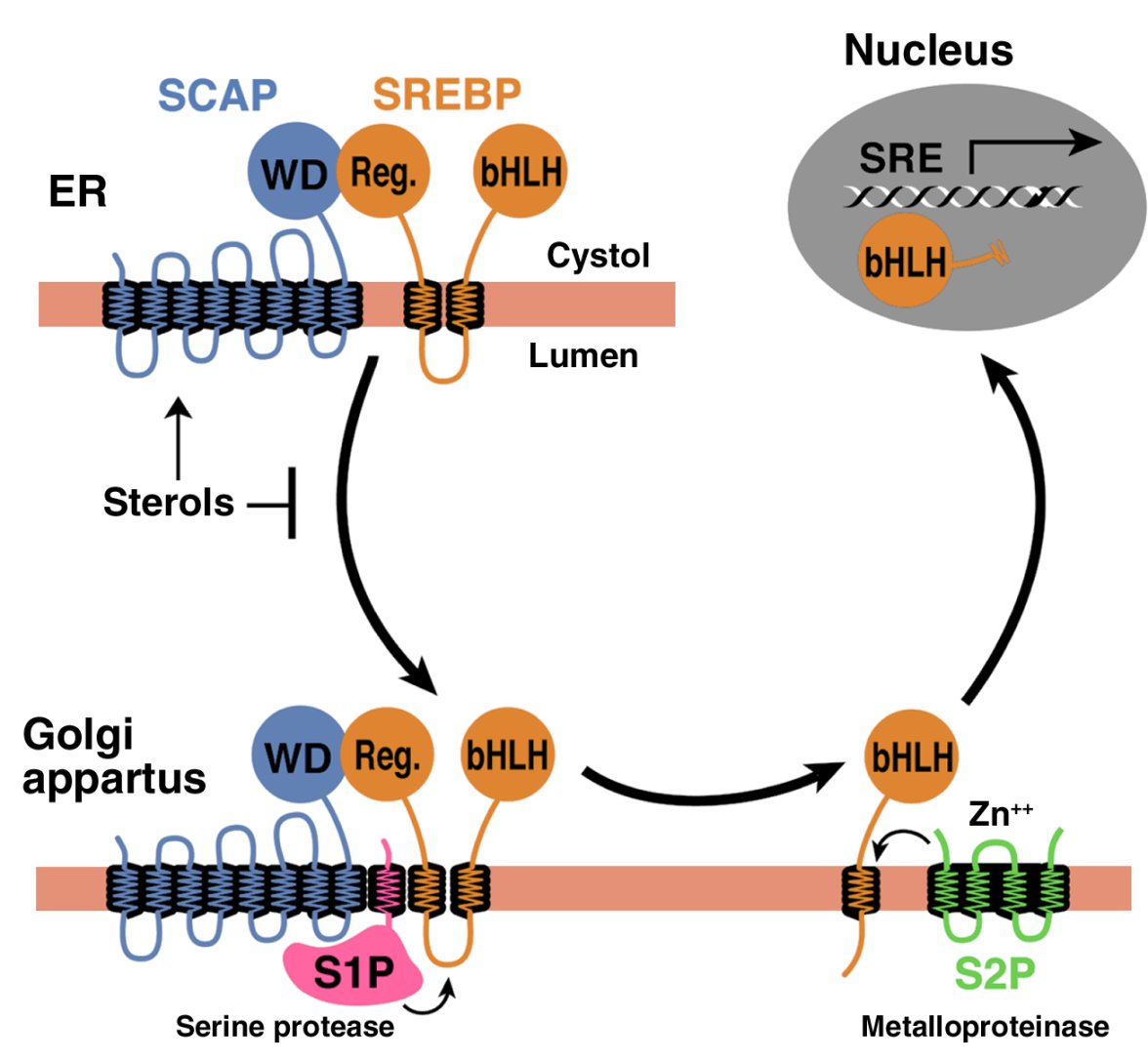
In order to reach the nucleus and act as a transcription factor, the NH2-terminal domain of each SREBP must be released from the membrane proteolytically (Figure 1). Three proteins required for SREBP processing have been delineated in cultured cells, using the tools of somatic cell genetics (see ref. 5for review). One is an escort protein designated SREBP cleavage–activating protein (SCAP). The other two are proteases, designated Site-1 protease (S1P) and Site-2 protease (S2P). Newly synthesized SREBP is inserted into the membranes of the ER, where its COOH-terminal regulatory domain binds to the COOH-terminal domain of SCAP (Figure 1).


Figure 1

Model for the sterol-mediated proteolytic release of SREBPs from membranes JCI0215593.f1

Model for the sterol-mediated proteolytic release of SREBPs from membranes JCI0215593.f1


Model for the sterol-mediated proteolytic release of SREBPs from membranes. SCAP is a sensor of sterols and an escort of SREBPs. When cells are depleted of sterols, SCAP transports SREBPs from the ER to the Golgi apparatus, where two proteases, Site-1 protease (S1P) and Site-2 protease (S2P), act sequentially to release the NH2-terminal bHLH-Zip domain from the membrane. The bHLH-Zip domain enters the nucleus and binds to a sterol response element (SRE) in the enhancer/promoter region of target genes, activating their transcription. When cellular cholesterol rises, the SCAP/SREBP complex is no longer incorporated into ER transport vesicles, SREBPs no longer reach the Golgi apparatus, and the bHLH-Zip domain cannot be released from the membrane. As a result, transcription of all target genes declines. Reprinted from ref. 5 with permission.

http://dm5migu4zj3pb.cloudfront.net/manuscripts/15000/15593/large/JCI0215593.f1.jpg

SCAP is both an escort for SREBPs and a sensor of sterols. When cells become depleted in cholesterol, SCAP escorts the SREBP from the ER to the Golgi apparatus, where the two proteases reside. In the Golgi apparatus, S1P, a membrane-bound serine protease, cleaves the SREBP in the luminal loop between its two membrane-spanning segments, dividing the SREBP molecule in half (Figure 1). The NH2-terminal bHLH-Zip domain is then released from the membrane via a second cleavage mediated by S2P, a membrane-bound zinc metalloproteinase. The NH2-terminal domain, designated nuclear SREBP (nSREBP), translocates to the nucleus, where it activates transcription by binding to nonpalindromic sterol response elements (SREs) in the promoter/enhancer regions of multiple target genes.


Figure 1


When the cholesterol content of cells rises, SCAP senses the excess cholesterol through its membranous sterol-sensing domain, changing its conformation in such a way that the SCAP/SREBP complex is no longer incorporated into ER transport vesicles. The net result is that SREBPs lose their access to S1P and S2P in the Golgi apparatus, so their bHLH-Zip domains cannot be released from the ER membrane, and the transcription of target genes ceases (1, 5). The biophysical mechanism by which SCAP senses sterol levels in the ER membrane and regulates its movement to the Golgi apparatus is not yet understood. Elucidating this mechanism will be fundamental to understanding the molecular basis of cholesterol feedback inhibition of gene expression.

SREBPs: two genes, three proteins

The mammalian genome encodes three SREBP isoforms, designated SREBP-1a, SREBP-1c, and SREBP-2. SREBP-2 is encoded by a gene on human chromosome 22q13. Both SREBP-1a and -1c are derived from a single gene on human chromosome 17p11.2 through the use of alternative transcription start sites that produce alternate forms of exon 1, designated 1a and 1c (1). SREBP-1a is a potent activator of all SREBP-responsive genes, including those that mediate the synthesis of cholesterol, fatty acids, and triglycerides. High-level transcriptional activation is dependent on exon 1a, which encodes a longer acidic transactivation segment than does the first exon of SREBP-1c. The roles of SREBP-1c and SREBP-2 are more restricted than that of SREBP-1a. SREBP-1c preferentially enhances transcription of genes required for fatty acid synthesis but not cholesterol synthesis. Like SREBP-1a, SREBP-2 has a long transcriptional activation domain, but it preferentially activates cholesterol synthesis (1). SREBP-1a and SREBP-2 are the predominant isoforms of SREBP in most cultured cell lines, whereas SREBP-1c and SREBP-2 predominate in the liver and most other intact tissues (6).

When expressed at higher than physiologic levels, each of the three SREBP isoforms can activate all enzymes indicated in Figure 2, which shows the biosynthetic pathways used to generate cholesterol and fatty acids. However, at normal levels of expression, SREBP-1c favors the fatty acid biosynthetic pathway and SREBP-2 favors cholesterologenesis. SREBP-2–responsive genes in the cholesterol biosynthetic pathway include those for the enzymes HMG-CoA synthase, HMG-CoA reductase, farnesyl diphosphate synthase, and squalene synthase. SREBP-1c–responsive genes include those for ATP citrate lyase (which produces acetyl-CoA) and acetyl-CoA carboxylase and fatty acid synthase (which together produce palmitate [C16:0]). Other SREBP-1c target genes encode a rate-limiting enzyme of the fatty acid elongase complex, which converts palmitate to stearate (C18:0) (ref.7); stearoyl-CoA desaturase, which converts stearate to oleate (C18:1); and glycerol-3-phosphate acyltransferase, the first committed enzyme in triglyceride and phospholipid synthesis (3). Finally, SREBP-1c and SREBP-2 activate three genes required to generate NADPH, which is consumed at multiple stages in these lipid biosynthetic pathways (8) (Figure 2).


Figure 2


major metabolic intermediates in the pathways for synthesis of cholesterol, fatty acids, and triglycerides JCI0215593.f2

major metabolic intermediates in the pathways for synthesis of cholesterol, fatty acids, and triglycerides JCI0215593.f2


http://dm5migu4zj3pb.cloudfront.net/manuscripts/15000/15593/large/JCI0215593.f2.jpg


Genes regulated by SREBPs. The diagram shows the major metabolic intermediates in the pathways for synthesis of cholesterol, fatty acids, and triglycerides. In vivo, SREBP-2 preferentially activates genes of cholesterol metabolism, whereas SREBP-1c preferentially activates genes of fatty acid and triglyceride metabolism. DHCR, 7-dehydrocholesterol reductase; FPP, farnesyl diphosphate; GPP, geranylgeranyl pyrophosphate synthase; CYP51, lanosterol 14α-demethylase; G6PD, glucose-6-phosphate dehydrogenase; PGDH, 6-phosphogluconate dehydrogenase; GPAT, glycerol-3-phosphate acyltransferase.

Genes regulated by SREBPs. The diagram shows the major metabolic intermediates in the pathways for synthesis of cholesterol, fatty acids, and triglycerides. In vivo, SREBP-2 preferentially activates genes of cholesterol metabolism, whereas SREBP-1c preferentially activates genes of fatty acid and triglyceride metabolism. DHCR, 7-dehydrocholesterol reductase; FPP, farnesyl diphosphate; GPP, geranylgeranyl pyrophosphate synthase; CYP51, lanosterol 14α-demethylase; G6PD, glucose-6-phosphate dehydrogenase; PGDH, 6-phosphogluconate dehydrogenase; GPAT, glycerol-3-phosphate acyltransferase.

Knockout and transgenic mice

Ten different genetically manipulated mouse models that either lack or overexpress a single component of the SREBP pathway have been generated in the last 6 years (916). The key molecular and metabolic alterations observed in these mice are summarized in Table 1.


Table 1
Alterations in hepatic lipid metabolism in gene-manipulated mice overexpressing or lacking SREBPs

http://dm5migu4zj3pb.cloudfront.net/manuscripts/15000/15593/small/JCI0215593.t1.gif

Knockout mice that lack all nSREBPs die early in embryonic development. For instance, a germline deletion of S1p, which prevents the processing of all SREBP isoforms, results in death before day 4 of development (15, 17). Germline deletion of Srebp2 leads to 100% lethality at a later stage of embryonic development than does deletion of S1p (embryonic day 7–8). In contrast, germline deletion of Srebp1, which eliminates both the 1a and the 1c transcripts, leads to partial lethality, in that about 15–45% of Srebp1–/– mice survive (13). The surviving homozygotes manifest elevated levels of SREBP-2 mRNA and protein (Table 1), which presumably compensates for the loss of SREBP-1a and -1c. When the SREBP-1c transcript is selectively eliminated, no embryonic lethality is observed, suggesting that the partial embryonic lethality in the Srebp1–/– mice is due to the loss of the SREBP-1a transcript (16).

To bypass embryonic lethality, we have produced mice in which all SREBP function can be disrupted in adulthood through induction of Cre recombinase. For this purpose, loxP recombination sites were inserted into genomic regions that flank crucial exons in the Scap or S1p genes (so-called floxed alleles) (14, 15). Mice homozygous for the floxed gene and heterozygous for a Cre recombinase transgene, which is under control of an IFN-inducible promoter (MX1-Cre), can be induced to delete Scap or S1p by stimulating IFN expression. Thus, following injection with polyinosinic acid–polycytidylic acid, a double-stranded RNA that provokes antiviral responses, the Cre recombinase is produced in liver and disrupts the floxed gene by recombination between the loxP sites.

Cre-mediated disruption of Scap or S1p dramatically reduces nSREBP-1 and nSREBP-2 levels in liver and diminishes expression of all SREBP target genes in both the cholesterol and the fatty acid synthetic pathways (Table 1). As a result, the rates of synthesis of cholesterol and fatty acids fall by 70–80% in Scap- and S1p-deficient livers.

In cultured cells, the processing of SREBP is inhibited by sterols, and the sensor for this inhibition is SCAP (5). To learn whether SCAP performs the same function in liver, we have produced transgenic mice that express a mutant SCAP with a single amino acid substitution in the sterol-sensing domain (D443N) (12). Studies in tissue culture show that SCAP(D443N) is resistant to inhibition by sterols. Cells that express a single copy of this mutant gene overproduce cholesterol (18). Transgenic mice that express this mutant version of SCAP in the liver exhibit a similar phenotype (12). These livers manifest elevated levels of nSREBP-1 and nSREBP-2, owing to constitutive SREBP processing, which is not suppressed when the animals are fed a cholesterol-rich diet. nSREBP-1 and -2 increase the expression of all SREBP target genes shown in Figure 2, thus stimulating cholesterol and fatty acid synthesis and causing a marked accumulation of hepatic cholesterol and triglycerides (Table 1). This transgenic model provides strong in vivo evidence that SCAP activity is normally under partial inhibition by endogenous sterols, which keeps the synthesis of cholesterol and fatty acids in a partially repressed state in the liver.

http://dm5migu4zj3pb.cloudfront.net/manuscripts/15000/15593/small/JCI0215593.t1.gif

Function of individual SREBP isoforms in vivo

To study the functions of individual SREBPs in the liver, we have produced transgenic mice that overexpress truncated versions of SREBPs (nSREBPs) that terminate prior to the membrane attachment domain. These nSREBPs enter the nucleus directly, bypassing the sterol-regulated cleavage step. By studying each nSREBP isoform separately, we could determine their distinct activating properties, albeit when overexpressed at nonphysiologic levels.

Overexpression of nSREBP-1c in the liver of transgenic mice produces a triglyceride-enriched fatty liver with no increase in cholesterol (10). mRNAs for fatty acid synthetic enzymes and rates of fatty acid synthesis are elevated fourfold in this tissue, whereas the mRNAs for cholesterol synthetic enzymes and the rate of cholesterol synthesis are not increased (8). Conversely, overexpression of nSREBP-2 in the liver increases the mRNAs only fourfold. This increase in cholesterol synthesis is even more remarkable when encoding all cholesterol biosynthetic enzymes; the most dramatic is a 75-fold increase in HMG-CoA reductase mRNA (11). mRNAs for fatty acid synthesis enzymes are increased to a lesser extent, consistent with the in vivo observation that the rate of cholesterol synthesis increases 28-fold in these transgenic nSREBP-2 livers, while fatty acid synthesis increases one considers the extent of cholesterol overload in this tissue, which would ordinarily reduce SREBP processing and essentially abolish cholesterol synthesis (Table 1).

http://dm5migu4zj3pb.cloudfront.net/manuscripts/15000/15593/small/JCI0215593.t1.gif

We have also studied the consequences of overexpressing SREBP-1a, which is expressed only at low levels in the livers of adult mice, rats, hamsters, and humans (6). nSREBP-1a transgenic mice develop a massive fatty liver engorged with both cholesterol and triglycerides (9), with heightened expression of genes controlling cholesterol biosynthesis and, still more dramatically, fatty acid synthesis (Table 1). The preferential activation of fatty acid synthesis (26-fold increase) relative to cholesterol synthesis (fivefold increase) explains the greater accumulation of triglycerides in their livers. The relative representation of the various fatty acids accumulating in this tissue is also unusual. Transgenic nSREBP-1a livers contain about 65% oleate (C18:1), markedly higher levels than the 15–20% found in typical wild-type livers (8) — a result of the induction of fatty acid elongase and stearoyl-CoA desaturase-1 (7). Considered together, the overexpression studies indicate that both SREBP-1 isoforms show a relative preference for activating fatty acid synthesis, whereas SREBP-2 favors cholesterol.

The phenotype of animals lacking the Srebp1 gene, which encodes both the SREBP-1a and -1c transcripts, also supports the notion of distinct hepatic functions for SREBP-1 and SREBP-2 (13). Most homozygous SREBP-1 knockout mice die in utero. The surviving Srebp1–/– mice show reduced synthesis of fatty acids, owing to reduced expression of mRNAs for fatty acid synthetic enzymes (Table 1). Hepatic nSREBP-2 levels increase in these mice, presumably in compensation for the loss of nSREBP-1. As a result, transcription of cholesterol biosynthetic genes increases, producing a threefold increase in hepatic cholesterol synthesis (Table 1).

http://dm5migu4zj3pb.cloudfront.net/manuscripts/15000/15593/small/JCI0215593.t1.gif

The studies in genetically manipulated mice clearly show that, as in cultured cells, SCAP and S1P are required for normal SREBP processing in the liver. SCAP, acting through its sterol-sensing domain, mediates feedback regulation of cholesterol synthesis. The SREBPs play related but distinct roles: SREBP-1c, the predominant SREBP-1 isoform in adult liver, preferentially activates genes required for fatty acid synthesis, while SREBP-2 preferentially activates the LDL receptor gene and various genes required for cholesterol synthesis. SREBP-1a and SREBP-2, but not SREBP-1c, are required for normal embryogenesis.

Transcriptional regulation of SREBP genes

Regulation of SREBPs occurs at two levels — transcriptional and posttranscriptional. The posttranscriptional regulation discussed above involves the sterol-mediated suppression of SREBP cleavage, which results from sterol-mediated suppression of the movement of the SCAP/SREBP complex from the ER to the Golgi apparatus (Figure 1). This form of regulation is manifest not only in cultured cells (1), but also in the livers of rodents fed cholesterol-enriched diets (19).

http://dm5migu4zj3pb.cloudfront.net/manuscripts/15000/15593/small/JCI0215593.f1.gif

The transcriptional regulation of the SREBPs is more complex. SREBP-1c and SREBP-2 are subject to distinct forms of transcriptional regulation, whereas SREBP-1a appears to be constitutively expressed at low levels in liver and most other tissues of adult animals (6). One mechanism of regulation shared by SREBP-1c and SREBP-2 involves a feed-forward regulation mediated by SREs present in the enhancer/promoters of each gene (20, 21). Through this feed-forward loop, nSREBPs activate the transcription of their own genes. In contrast, when nSREBPs decline, as in Scap or S1p knockout mice, there is a secondary decline in the mRNAs encoding SREBP-1c and SREBP-2 (14, 15).

Three factors selectively regulate the transcription of SREBP-1c: liver X-activated receptors (LXRs), insulin, and glucagon. LXRα and LXRβ, nuclear receptors that form heterodimers with retinoid X receptors, are activated by a variety of sterols, including oxysterol intermediates that form during cholesterol biosynthesis (2224). An LXR-binding site in the SREBP-1c promoter activates SREBP-1c transcription in the presence of LXR agonists (23). The functional significance of LXR-mediated SREBP-1c regulation has been confirmed in two animal models. Mice that lack both LXRα and LXRβ express reduced levels of SREBP-1c and its lipogenic target enzymes in liver and respond relatively weakly to treatment with a synthetic LXR agonist (23). Because a similar blunted response is found in mice that lack SREBP-1c, it appears that LXR increases fatty acid synthesis largely by inducing SREBP-1c (16). LXR-mediated activation of SREBP-1c transcription provides a mechanism for the cell to induce the synthesis of oleate when sterols are in excess (23). Oleate is the preferred fatty acid for the synthesis of cholesteryl esters, which are necessary for both the transport and the storage of cholesterol.

LXR-mediated regulation of SREBP-1c appears also to be one mechanism by which unsaturated fatty acids suppress SREBP-1c transcription and thus fatty acid synthesis. Rodents fed diets enriched in polyunsaturated fatty acids manifest reduced SREBP-1c mRNA expression and low rates of lipogenesis in liver (25). In vitro, unsaturated fatty acids competitively block LXR activation of SREBP-1c expression by antagonizing the activation of LXR by its endogenous ligands (26). In addition to LXR-mediated transcriptional inhibition, polyunsaturated fatty acids lower SREBP-1c levels by accelerating degradation of its mRNA (27). These combined effects may contribute to the long-recognized ability of polyunsaturated fatty acids to lower plasma triglyceride levels.

SREBP-1c and the insulin/glucagon ratio

The liver is the organ responsible for the conversion of excess carbohydrates to fatty acids to be stored as triglycerides or burned in muscle. A classic action of insulin is to stimulate fatty acid synthesis in liver during times of carbohydrate excess. The action of insulin is opposed by glucagon, which acts by raising cAMP. Multiple lines of evidence suggest that insulin’s stimulatory effect on fatty acid synthesis is mediated by an increase in SREBP-1c. In isolated rat hepatocytes, insulin treatment increases the amount of mRNA for SREBP-1c in parallel with the mRNAs of its target genes (28, 29). The induction of the target genes can be blocked if a dominant negative form of SREBP-1c is expressed (30). Conversely, incubating primary hepatocytes with glucagon or dibutyryl cAMP decreases the mRNAs for SREBP-1c and its associated lipogenic target genes (30, 31).

In vivo, the total amount of SREBP-1c in liver and adipose tissue is reduced by fasting, which suppresses insulin and increases glucagon levels, and is elevated by refeeding (32, 33). The levels of mRNA for SREBP-1c target genes parallel the changes in SREBP-1c expression. Similarly, SREBP-1c mRNA levels fall when rats are treated with streptozotocin, which abolishes insulin secretion, and rise after insulin injection (29). Overexpression of nSREBP-1c in livers of transgenic mice prevents the reduction in lipogenic mRNAs that normally follows a fall in plasma insulin levels (32). Conversely, in livers of Scap knockout mice that lack all nSREBPs in the liver (14) or knockout mice lacking either nSREBP-1c (16) or both SREBP-1 isoforms (34), there is a marked decrease in the insulin-induced stimulation of lipogenic gene expression that normally occurs after fasting/refeeding. It should be noted that insulin and glucagon also exert a posttranslational control of fatty acid synthesis though changes in the phosphorylation and activation of acetyl-CoA carboxylase. The posttranslational regulation of fatty acid synthesis persists in transgenic mice that overexpress nSREBP-1c (10). In these mice, the rates of fatty acid synthesis, as measured by [3H]water incorporation, decline after fasting even though the levels of the lipogenic mRNAs remain high (our unpublished observations).

Taken together, the above evidence suggests that SREBP-1c mediates insulin’s lipogenic actions in liver. Recent in vitro and in vivo studies involving adenoviral gene transfer suggest that SREBP-1c may also contribute to the regulation of glucose uptake and glucose synthesis. When overexpressed in hepatocytes, nSREBP-1c induces expression of glucokinase, a key enzyme in glucose utilization. It also suppresses phosphoenolpyruvate carboxykinase, a key gluconeogenic enzyme (35, 36).

SREBPs in disease

Many individuals with obesity and insulin resistance also have fatty livers, one of the most commonly encountered liver abnormalities in the US (37). A subset of individuals with fatty liver go on to develop fibrosis, cirrhosis, and liver failure. Evidence indicates that the fatty liver of insulin resistance is caused by SREBP-1c, which is elevated in response to the high insulin levels. Thus, SREBP-1c levels are elevated in the fatty livers of obese (ob/ob) mice with insulin resistance and hyperinsulinemia caused by leptin deficiency (38, 39). Despite the presence of insulin resistance in peripheral tissues, insulin continues to activate SREBP-1c transcription and cleavage in the livers of these insulin-resistant mice. The elevated nSREBP-1c increases lipogenic gene expression, enhances fatty acid synthesis, and accelerates triglyceride accumulation (31, 39). These metabolic abnormalities are reversed with the administration of leptin, which corrects the insulin resistance and lowers the insulin levels (38).

Metformin, a biguanide drug used to treat insulin-resistant diabetes, reduces hepatic nSREBP-1 levels and dramatically lowers the lipid accumulation in livers of insulin-resistant ob/ob mice (40). Metformin stimulates AMP-activated protein kinase (AMPK), an enzyme that inhibits lipid synthesis through phosphorylation and inactivation of key lipogenic enzymes (41). In rat hepatocytes, metformin-induced activation of AMPK also leads to decreased mRNA expression of SREBP-1c and its lipogenic target genes (41), but the basis of this effect is not understood.

The incidence of coronary artery disease increases with increasing plasma LDL-cholesterol levels, which in turn are inversely proportional to the levels of hepatic LDL receptors. SREBPs stimulate LDL receptor expression, but they also enhance lipid synthesis (1), so their net effect on plasma lipoprotein levels depends on a balance between opposing effects. In mice, the plasma levels of lipoproteins tend to fall when SREBPs are either overexpressed or underexpressed. In transgenic mice that overexpress nSREBPs in liver, plasma cholesterol and triglycerides are generally lower than in control mice (Table 1), even though these mice massively overproduce fatty acids, cholesterol, or both. Hepatocytes of nSREBP-1a transgenic mice overproduce VLDL, but these particles are rapidly removed through the action of LDL receptors, and they do not accumulate in the plasma. Indeed, some nascent VLDL particles are degraded even before secretion by a process that is mediated by LDL receptors (42). The high levels of nSREBP-1a in these animals support continued expression of the LDL receptor, even in cells whose cholesterol concentration is elevated. In LDL receptor–deficient mice carrying the nSREBP-1a transgene, plasma cholesterol and triglyceride levels rise tenfold (43).

Mice that lack all SREBPs in liver as a result of disruption of Scap or S1p also manifest lower plasma cholesterol and triglyceride levels (Table 1).

http://dm5migu4zj3pb.cloudfront.net/manuscripts/15000/15593/small/JCI0215593.t1.gif

In these mice, hepatic cholesterol and triglyceride synthesis is markedly reduced, and this likely causes a decrease in VLDL production and secretion. LDL receptor mRNA and LDL clearance from plasma is also significantly reduced in these mice, but the reduction in LDL clearance is less than the overall reduction in VLDL secretion, the net result being a decrease in plasma lipid levels (15). However, because

humans and mice differ substantially with regard to LDL receptor expression, LDL levels, and other aspects of lipoprotein metabolism,

it is difficult to predict whether human plasma lipids will rise or fall when the SREBP pathway is blocked or activated.

SREBPs in liver: unanswered questions

The studies of SREBPs in liver have exposed a complex regulatory system whose individual parts are coming into focus. Major unanswered questions relate to the ways in which the transcriptional and posttranscriptional controls on SREBP activity are integrated so as to permit independent regulation of cholesterol and fatty acid synthesis in specific nutritional states. A few clues regarding these integration mechanisms are discussed below.

Whereas cholesterol synthesis depends almost entirely on SREBPs, fatty acid synthesis is only partially dependent on these proteins. This has been shown most clearly in cultured nonhepatic cells such as Chinese hamster ovary cells. In the absence of SREBP processing, as when the Site-2 protease is defective, the levels of mRNAs encoding cholesterol biosynthetic enzymes and the rates of cholesterol synthesis decline nearly to undetectable levels, whereas the rate of fatty acid synthesis is reduced by only 30% (44). Under these conditions, transcription of the fatty acid biosynthetic genes must be maintained by factors other than SREBPs. In liver, the gene encoding fatty acid synthase (FASN) can be activated transcriptionally by upstream stimulatory factor, which acts in concert with SREBPs (45). The FASN promoter also contains an LXR element that permits a low-level response to LXR ligands even when SREBPs are suppressed (46). These two transcription factors may help to maintain fatty acid synthesis in liver when nSREBP-1c is low.

Another mechanism of differential regulation is seen in the ability of cholesterol to block the processing of SREBP-2, but not SREBP-1, under certain metabolic conditions. This differential regulation has been studied most thoroughly in cultured cells such as human embryonic kidney (HEK-293) cells. When these cells are incubated in the absence of fatty acids and cholesterol, the addition of sterols blocks processing of SREBP-2, but not SREBP-1, which is largely produced as SREBP-1a in these cells (47). Inhibition of SREBP-1 processing requires an unsaturated fatty acid, such as oleate or arachidonate, in addition to sterols (47). In the absence of fatty acids and in the presence of sterols, SCAP may be able to carry SREBP-1 proteins, but not SREBP-2, to the Golgi apparatus. Further studies are necessary to document this apparent independent regulation of SREBP-1 and SREBP-2 processing and to determine its mechanism.


Acknowledgments

Support for the research cited from the authors’ laboratories was provided by grants from the NIH (HL-20948), the Moss Heart Foundation, the Keck Foundation, and the Perot Family Foundation. J.D. Horton is a Pew Scholar in the Biomedical Sciences and is the recipient of an Established Investigator Grant from the American Heart Association and a Research Scholar Award from the American Digestive Health Industry.

References

  1. Brown, MS, Goldstein, JL. The SREBP pathway: regulation of cholesterol metabolism by proteolysis of a membrane-bound transcription factor. Cell 1997. 89:331-340.

View this article via: PubMed

  1. Horton, JD, Shimomura, I. Sterol regulatory element-binding proteins: activators of cholesterol and fatty acid biosynthesis. Curr Opin Lipidol 1999. 10:143-150.

View this article via: PubMed

  1. Edwards, PA, Tabor, D, Kast, HR, Venkateswaran, A. Regulation of gene expression by SREBP and SCAP. Biochim Biophys Acta 2000. 1529:103-113.

View this article via: PubMed

  1. Sakakura, Y, et al. Sterol regulatory element-binding proteins induce an entire pathway of cholesterol synthesis. Biochem Biophys Res Commun 2001. 286:176-183.

View this article via: PubMed

  1. Goldstein, JL, Rawson, RB, Brown, MS. Mutant mammalian cells as tools to delineate the sterol regulatory element-binding protein pathway for feedback regulation of lipid synthesis. Arch Biochem Biophys 2002. 397:139-148.

View this article via: PubMed

  1. Shimomura, I, Shimano, H, Horton, JD, Goldstein, JL, Brown, MS. Differential expression of exons 1a and 1c in mRNAs for sterol regulatory element binding protein-1 in human and mouse organs and cultured cells. J Clin Invest 1997. 99:838-845.

View this article via: JCI.org PubMed

  1. Moon, Y-A, Shah, NA, Mohapatra, S, Warrington, JA, Horton, JD. Identification of a mammalian long chain fatty acyl elongase regulated by sterol regulatory element-binding proteins. J Biol Chem 2001. 276:45358-45366.

View this article via: PubMed

  1. Shimomura, I, Shimano, H, Korn, BS, Bashmakov, Y, Horton, JD. Nuclear sterol regulatory element binding proteins activate genes responsible for entire program of unsaturated fatty acid biosynthesis in transgenic mouse liver. J Biol Chem 1998. 273:35299-35306.

View this article via: PubMed

  1. Shimano, H, et al. Overproduction of cholesterol and fatty acids causes massive liver enlargement in transgenic mice expressing truncated SREBP-1a. J Clin Invest 1996. 98:1575-1584.

View this article via: JCI.org PubMed

  1. Shimano, H, et al. Isoform 1c of sterol regulatory element binding protein is less active than isoform 1a in livers of transgenic mice and in cultured cells. J Clin Invest 1997. 99:846-854.

View this article via: JCI.org PubMed

  1. Horton, JD, et al. Activation of cholesterol synthesis in preference to fatty acid synthesis in liver and adipose tissue of transgenic mice overproducing sterol regulatory element-binding protein-2. J Clin Invest 1998. 101:2331-2339.

View this article via: JCI.org PubMed

  1. Korn, BS, et al. Blunted feedback suppression of SREBP processing by dietary cholesterol in transgenic mice expressing sterol-resistant SCAP(D443N). J Clin Invest 1998. 102:2050-2060.

View this article via: JCI.org PubMed

  1. Shimano, H, et al. Elevated levels of SREBP-2 and cholesterol synthesis in livers of mice homozygous for a targeted disruption of the SREBP-1 gene. J Clin Invest 1997. 100:2115-2124.

View this article via: JCI.org PubMed

  1. Matsuda, M, et al. SREBP cleavage-activating protein (SCAP) is required for increased lipid synthesis in liver induced by cholesterol deprivation and insulin elevation. Genes Dev 2001. 15:1206-1216.

View this article via: PubMed

  1. Yang, J, et al. Decreased lipid synthesis in livers of mice with disrupted Site-1 protease gene. Proc Natl Acad Sci USA 2001. 98:13607-13612.

View this article via: PubMed

Liang, G, et al. Diminished hepatic response to fasting/refeeding and liver X receptor agonists in mice with selective deficiency of sterol regulatory element-binding protein-1c. J Biol Chem 2002. 277:9520-9528.

http://www.jci.org/articles/view/15593


Structural Biochemistry/Lipids/Membrane Lipids

< Structural Biochemistry‎ | Lipids

Membrane proteins rely on their interaction with membrane lipids to uphold its structure and maintain its functions as a protein. For membrane proteins to purify and crystallize, it is essential for the membrane protein to be in the appropriate lipid environment. Lipids assist in crystallization and stabilize the protein and provide lattice contacts. Lipids can also help obtain membrane protein structures in a native conformation. Membrane protein structures contain bound lipid molecules. Biological membranes are important in life, providing permeable barriers for cells and their organelles. The interaction between membrane proteins and lipids facilitates basic processes such as respiration, photosynthesis, transport, signal transduction and motility. These basic processes require a diverse group of proteins, which are encoded by 20-30% of an organism’s annotated genes.

There exist a great number of membrane lipids. Specifically, eukaryotic cells have a very complex collection of lipids that rely on many of the cell’s resources for its synthesis. Interactions between proteins and lipids can be very specific. Specific types of lipids can make a structure stable, provide control in insertion and folding processes, and help to assemble multisubunit complexes or supercomplexes, and most importantly, can significantly affect a membrane protein’s functions. Protein and lipid interactions are not sufficiently tight, meaning that lipids are retained during membrane protein purification. Since cellular membranes are fluid arrangements of lipids, some lipids affect interesting changes to membrane due to their characteristics. Glycosphigolipids and cholesterol tend to form small islands within the membranes, called lipid rafts, due to their physical properties. Some proteins also tend to cluster in lipid raft, while others avoid being in lipid rafts. However, the existence of lipid rafts in cells seems to be transitory.

Recent progress in determining membrane protein structure has brought attention to the importance of maintaining a favorable lipid environment so proteins to crystallize and purify successfully. Lipids assist in crystallization by stabilizing the protein fold and the relationships between subunits or monomers. The lipid content in protein-lipid detergent complexes can be altered by adjusting solubilisation and purification protocols, also by adding native or non-native lipids.

There are three type of membrane lipids: 1. Phospholipids: major class of membrane lipids. 2. glycolipids. 3. Cholesterols. Membrane lipids were started with eukaryotes and bacteria.

http://en.wikibooks.org/wiki/Structural_Biochemistry/Lipids/Membrane_Lipids

Types of Membrane Lipids

Lipids are often used as membrane constituents. The three major classes that membrane lipids are divided into are phospholipids, glycolipids, and cholesterol. Lipids are found in eukaryotes and bacteria. Although the lipids in archaea have many features that are related to the membrane formation that is similar with lipids of other organisms, they are still distinct from one another. The membranes of archaea differ in composition in three major ways. Firstly, the nonpolar chains are joined to a glycerol backbone by ether instead of esters, allowing for more resistance to hydrolysis. Second, the alkyl chains are not linear, but branched and make them more resistant to oxidation. The ability of archaeal lipids to resist hydrolysis and oxidation help these types of organisms to withstand the extreme conditions of high temperature, low pH, or high salt concentration. Lastly, the stereochemistry of the central glycerol is inverted. Membrane lipids have an extensive repertoire, but they possess a critical common structural theme in which they are amphipathic molecules, meaning they contain both a hydrophilic and hydrophobic moiety.

Membrane lipids are all closed bodies or boundaries separating substituent parts of the cell. The thickness of membranes is usually between 60 and 100 angstroms. These bodies are constructed from non-covalent assemblies. Their polar heads align with each other and their non-polar hydrocarbon tails align as well. The resulting stability is credited to hydrophobic interaction which proves to be quite stable due to the length of their hydrocarbon tails.


Membrane Lipids

Lipid Vesicles

Lipid vesicles, also known as liposomes, are vesicles that are essentially aqueous vesicles that are surrounded by a circular phospholipid bilayer. Like the other phospholipid structures, they have the hydrocarbon/hydrophobic tails facing inward, away from the aqueous solution, and the hydrophilic heads facing towards the aqueous solution. These vesicles are structures that form enclosed compartments of ions and solutes, and can be utilized to study the permeability of certain membranes, or to transfer these ions or solutes to certain cells found elsewhere.

Liposomes as vesicles can serve various clinical uses. Injecting liposomes containing medicine or DNA (for gene therapy) into patients is a possible method of drug delivery. The liposomes fuse with other cells’ membranes and therefore combine their contents with that of the patient’s cell. This method of drug delivery is less toxic than direct exposure because the liposomes carry the drug directly to cells without any unnecessary intermediate steps.

Because of the hydrophobic interactions among several phospholipids and glycolipids, a certain structure called the lipid bilayer or bimolecular sheet is favored. As mentioned earlier, phospholipids and glycolipids have both hydrophilic and hydrophobic moieties; thus, when several phospholipids or glycolipids come together in an aqueous solution, the hydrophobic tails interact with each other to form a hydrophobic center, while the hydrophilic heads interact with each other forming a hydrophilic coating on each side of the bilayer.

http://upload.wikimedia.org/wikibooks/en/b/ba/Liposome_final%2A.png

http://upload.wikimedia.org/wikibooks/en/f/fa/Membrane_bilayer.jpg


Liposome_

Liposome_


Membrane_bilayer

Membrane_bilayer


Evidence Report/Technology Assessment   Number 89


Effects of Omega-3 Fatty Acids on Lipids and Glycemic Control in Type II Diabetes and the Metabolic Syndrome and on Inflammatory Bowel Disease, Rheumatoid Arthritis, Renal Disease, Systemic Lupus Erythematosus, and Osteoporosis


Prepared for:

Agency for Healthcare Research and Quality

U.S. Department of Health and Human Services

540 Gaither Road

Rockville, MD 20850

http://www.ahrq.gov

Contract No. 290-02-0003


Chapter 1. Introduction

This report is one of a group of evidence reports prepared by three Agency for Healthcare Research and Quality (AHRQ)-funded Evidence-Based Practice Centers (EPCs) on the role of omega-3 fatty acids (both from food sources and from dietary supplements) in the prevention or treatment of a variety of diseases. These reports were requested and funded by the Office of Dietary Supplements, National Institutes of Health. The three EPCs – the Southern California EPC (SCEPC, based at RAND), the Tufts-New England Medical Center (NEMC) EPC, and the University of Ottawa EPC – have each produced evidence reports. To ensure consistency of approach, the three EPCs collaborated on selected methodological elements, including literature search strategies, rating of evidence, and data table design.

The aim of these reports is to summarize the current evidence on the effects of omega-3 fatty acids on prevention and treatment of cardiovascular diseases, cancer, child and maternal health, eye health, gastrointestinal/renal diseases, asthma, immune- mediated diseases, tissue/organ transplantation, mental health, and neurological diseases and conditions. In addition to informing the research community and the public on the effects of omega-3 fatty acids on various health conditions, it is anticipated that the findings of the reports will also be used to help define the agenda for future research.

This report focuses on the effects of omega-3 fatty acids on immune- mediated diseases, bone metabolism, and gastrointestinal/renal diseases. Subsequent reports from the SCEPC will focus on cancer and neurological diseases and conditions.

This chapter provides a brief review of the current state of knowledge about the metabolism, physiological functions, and sources of omega-3 fatty acids.


The Recognition of Essential Fatty Acids

Dietary fat has long been recognized as an important source of energy for mammals, but in the late 1920s, researchers demonstrated the dietary requirement for particular fatty acids, which came to be called essential fatty acids. It was not until the advent of intravenous feeding, however, that the importance of essential fatty acids was widely accepted: Clinical signs of essential fatty acid deficiency are generally observed only in patients on total parenteral nutrition who received mixtures devoid of essential fatty acids or in those with malabsorption syndromes.

These signs include dermatitis and changes in visual and neural function. Over the past 40 years, an increasing number of physiological functions, such as immunomodulation, have been attributed to the essential fatty acids and their metabolites, and this area of research remains quite active.1, 2

Fatty Acid Nomenclature

The fat found in foods consists largely of a heterogeneous mixture of triacylglycerols (triglycerides)–glycerol molecules that are each combined with three fatty acids. The fatty acids can be divided into two categories, based on chemical properties: saturated fatty acids, which are usually solid at room temperature, and unsaturated fatty acids, which are liquid at room temperature. The term “saturation” refers to a chemical structure in which each carbon atom in the fatty acyl chain is bound to (saturated with) four other atoms, these carbons are linked by single bonds, and no other atoms or molecules can attach; unsaturated fatty acids contain at least one pair of carbon atoms linked by a double bond, which allows the attachment of additional atoms to those carbons (resulting in saturation). Despite their differences in structure, all fats contain approximately the same amount of energy (37 kilojoules/gram, or 9 kilocalories/gram).

The class of unsaturated fatty acids can be further divided into monounsaturated and polyunsaturated fatty acids. Monounsaturated fatty acids (the primary constituents of olive and canola oils) contain only one double bond. Polyunsaturated fatty acids (PUFAs) (the primary constituents of corn, sunflower, flax seed and many other vegetable oils) contain more than one double bond. Fatty acids are often referred to using the number of carbon atoms in the acyl chain, followed by a colon, followed by the number of double bonds in the chain (e.g., 18:1 refers to the 18-carbon monounsaturated fatty acid, oleic acid; 18:3 refers to any 18-carbon PUFA with three double bonds).

PUFAs are further categorized on the basis of the location of their double bonds. An omega or n notation indicates the number of carbon atoms from the methyl end of the acyl chain to the first double bond. Thus, for example, in the omega-3 (n-3) family of PUFAs, the first double bond is 3 carbons from the methyl end of the molecule. The trivial names, chemical names and abbreviations for the omega-3 fatty acids are detailed in Table 1.1.  Finally, PUFAs can be categorized according to their chain length. The 18-carbon n-3 and n-6 short-chain PUFAs are precursors to the longer 20- and 22-carbon PUFAs, called long-chain PUFAs (LCPUFAs).

Fatty Acid Metabolism

Mammalian cells can introduce double bonds into all positions on the fatty acid chain except the n-3 and n-6 position. Thus, the short-chain alpha- linolenic acid (ALA, chemical abbreviation: 18:3n-3) and linoleic acid (LA, chemical abbreviation: 18:2n-6) are essential fatty acids.

No other fatty acids found in food are considered ‘essential’ for humans, because they can all be synthesized from the short chain fatty acids.

Following ingestion, ALA and LA can be converted in the liver to the long chain, more unsaturated n-3 and n-6 LCPUFAs by a complex set of synthetic pathways that share several enzymes (Figure 1). LC PUFAs retain the original sites of desaturation (including n-3 or n-6). The omega-6 fatty acid LA is converted to gamma-linolenic acid (GLA, 18:3n-6), an omega- 6 fatty acid that is a positional isomer of ALA. GLA, in turn, can be converted to the longerchain omega-6 fatty acid, arachidonic acid (AA, 20:4n-6). AA is the precursor for certain classes of an important family of hormone- like substances called the eicosanoids (see below).

The omega-3 fatty acid ALA (18:3n-3) can be converted to the long-chain omega-3 fatty acid, eicosapentaenoic acid (EPA; 20:5n-3). EPA can be elongated to docosapentaenoic acid (DPA 22:5n-3), which is further desaturated to docosahexaenoic acid (DHA; 22:6n-3). EPA and DHA are also precursors of several classes of eicosanoids and are known to play several other critical roles, some of which are discussed further below.

The conversion from parent fatty acids into the LC PUFAs – EPA, DHA, and AA – appears to occur slowly in humans. In addition, the regulation of conversion is not well understood, although it is known that ALA and LA compete for entry into the metabolic pathways.

Physiological Functions of EPA and AA

As stated earlier, fatty acids play a variety of physiological roles. The specific biological functions of a fatty acid are determined by the number and position of double bonds and the length of the acyl chain.

Both EPA (20:5n-3) and AA (20:4n-6) are precursors for the formation of a family of hormone- like agents called eicosanoids. Eicosanoids are rudimentary hormones or regulating – molecules that appear to occur in most forms of life. However, unlike endocrine hormones, which travel in the blood stream to exert their effects at distant sites, the eicosanoids are autocrine or paracrine factors, which exert their effects locally – in the cells that synthesize them or adjacent cells. Processes affected include the movement of calcium and other substances into and out of cells, relaxation and contraction of muscles, inhibition and promotion of clotting, regulation of secretions including digestive juices and hormones, and control of fertility, cell division, and growth.3

The eicosanoid family includes subgroups of substances known as prostaglandins, leukotrienes, and thromboxanes, among others. As shown in Figure 1.1, the long-chain omega-6 fatty acid, AA (20:4n-6), is the precursor of a group of eicosanoids that include series-2 prostaglandins and series-4 leukotrienes. The omega-3 fatty acid, EPA (20:5n-3), is the precursor to a group of eicosanoids that includes series-3 prostaglandins and series-5 leukotrienes. The AA-derived series-2 prostaglandins and series-4 leukotrienes are often synthesized in response to some emergency such as injury or stress, whereas the EPA-derived series-3 prostaglandins and series-5 leukotrienes appear to modulate the effects of the series-2 prostaglandins and series-4 leukotrienes (usually on the same target cells). More specifically, the series-3 prostaglandins are formed at a slower rate and work to attenuate the effects of excessive levels of series-2 prostaglandins. Thus, adequate production of the series-3 prostaglandins seems to protect against heart attack and stroke as well as certain inflammatory diseases like arthritis, lupus, and asthma.3.

EPA (22:6 n-3) also affects lipoprotein metabolism and decreases the production of substances – including cytokines, interleukin 1ß (IL-1ß), and tumor necrosis factor a (TNF-a) – that have pro-inflammatory effects (such as stimulation of collagenase synthesis and the expression of adhesion molecules necessary for leukocyte extravasation [movement from the circulatory system into tissues]).2 The mechanism responsible for the suppression of cytokine production by omega-3 LC PUFAs remains unknown, although suppression of omega-6-derived eicosanoid production by omega-3 fatty acids may be involved, because the omega-3 and omega-6 fatty acids compete for a common enzyme in the eicosanoid synthetic pathway, delta-6 desaturase.

DPA (22:5n-3) (the elongation product of EPA) and its metabolite DHA (22:6n-3) are frequently referred to as very long chain n-3 fatty acids (VLCFA). Along with AA, DHA is the major PUFA found in the brain and is thought to be important for brain development and function. Recent research has focused on this role and the effect of supplementing infant formula with DHA (since DHA is naturally present in breast milk but not in formula).

Dietary Sources and Requirements

Both ALA and LA are present in a variety of foods. LA is present in high concentrations in many commonly used oils, including safflower, sunflower, soy, and corn oil. ALA is present in some commonly used oils, including canola and soybean oil, and in some leafy green vegetables. Thus, the major dietary sources of ALA and LA are PUFA-rich vegetable oils. The proportion of LA to ALA as well as the proportion of those PUFAs to others varies considerably by the type of oil. With the exception of flaxseed, canola, and soybean oil, the ratio of LA to ALA in vegetable oils is at least 10 to 1. The ratios of LA to ALA for flaxseed, canola, and soy are approximately 1: 3.5, 2:1, and 8:1, respectively; however, flaxseed oil is not typically consumed in the North American diet. It is estimated that on average in the U.S., LA accounts for 89% of the total PUFAs consumed, and ALA accounts for 9%. Another estimate suggests that Americans consume 10 times more omega-6 than omega-3 fatty acids.4 Table 1.2 shows the proportion of omega 3 fatty acids for a number of foods.

Syntheis and Degradation

Source of Acetyl CoA for Fatty Acid Synthesis

Source of Acetyl CoA for Fatty Acid Synthesis

step 1

step 1

condensation reaction with malonyl ACP

ACP (acyl carrier protein)

ACP (acyl carrier protein)

synthesis requires acetyl CoA from citrate shuttle

synthesis requires acetyl CoA from citrate shuttle

conversion to fatty acyl co A in cytoplasm

conversion to fatty acyl co A in cytoplasm

ACP (acyl carrier protein)

ACP (acyl carrier protein)

FA synthesis not exactly reverse of catabolism

FA synthesis not exactly reverse of catabolism


Fatty Acid Synthase

Fatty Acid Synthase

complete FA synthesis

complete FA synthesis

Desaturation

Desaturation

Elongation and Desaturation of Fatty Acids

Elongation and Desaturation of Fatty Acids

release of FAs from adiposites

release of FAs from adiposites

Fatty acid beta oxidation and Krebs cycle produce NAD, NADH, FADH2

Fatty acid beta oxidation and Krebs cycle produce NAD, NADH, FADH2

ketone bodies

ketone bodies

metabolism of ketone bodies

metabolism of ketone bodies

Arachidonoyl-mimicking

Arachidonoyl-mimicking

Arachidonate pathways

Arachidonate pathways

arachidonic acid derivatives

arachidonic acid derivatives

major metabolic intermediates in the pathways for synthesis of cholesterol, fatty acids, and triglycerides

major metabolic intermediates in the pathways for synthesis of cholesterol, fatty acids, and triglycerides

Model for the sterol-mediated proteolytic release of SREBPs from membrane

Model for the sterol-mediated proteolytic release of SREBPs from membrane

hormone regulation

hormone regulation

 insulin receptor and and insulin receptor signaling pathway (IRS)

insulin receptor and and insulin receptor signaling pathway (IRS)

 islet brain glucose signaling

islet brain glucose signaling


Fish source

Fish source

omega FAs

omega FAs


Excessive omega 6s

Excessive omega 6s

omega 6s

omega 6s

diet and cancer

diet and cancer

Patients at risk of FA deficiency

Patients at risk of FA deficiency

PPAR role

PPAR role

PPAR role

PPAR role

Omega 6_3 pathways

Omega 6_3 pathways

n3 vs n6 PUFAs

n3 vs n6 PUFAs

triene-teraene ratio

triene-teraene ratio

arachidonic acid, leukotrienes, PG and thromboxanes

arachidonic acid, leukotrienes, PG and thromboxanes

Cox 2 and cancer

Cox 2 and cancer

Lipidomics of atherosclerotic plaques

Lipidomics of atherosclerotic plaques


Effect of TPN on EFAD

Effect of TPN on EFAD

benefits of omega 3s

benefits of omega 3s

food consumption

food consumption


Read Full Post »

Larry H. Bernstein, MD, FCAP, Author and Curator

http://pharmaceuticalintelligence.com/7/17/2014/Genes, proteomes, and their interaction


This is the third discussion of a several part series leading from the genome, to protein synthesis (1), posttranslational modification of proteins (2), examples of protein effects on metabolism and signaling pathways (3), and leading to disruption of signaling pathways in disease (4), and effects leading to mutagenesis.


1.  A Primer on DNAand DNA Replication


Dna triplex pic

Epigenetic_mechanisms


2. Overview of translational medicine

3. Genes, proteomes, and their interaction

4. Regulation of somatic stem cell Function

5.  Proteomics – The Pathway to Understanding and Decision-making in Medicine

6.  Genomics, Proteomics and standards

7.  Long Non-coding RNAs Can Encode Proteins After All

8.  Proteins and cellular adaptation to stress

9.  Loss of normal growth regulation


This discussion is the beginning of a diversion away from the routine discussion of a specific sequence and pairing of nucleotides in the classic model, to explore the interaction between proteins, or folded proteins and RNA or hidtones that reside in the nucleus and contribute to induction or inactivation of gene expression.  The basic text document is rigid, inflexible, and resides in all cells.  Yet, in bacteria, yeast, and eukaryotic cells, there are models of gene expression, and in eukaryotes, there is the development of expressed organ systems.  These systems have similar proteins or enzymes that are functionally identical, but they have isoforms that bind with proteins, membranes, lipopolysaccharides, and lipoproteins – which has an impact on the catabolic and anabolic activity of the cells, and they are affected by oxidative stress, and they are often dependent on the energy of binding with metal ions,i.e., Mn, Cu, Cd, Zn,..,Fe, and in other cases anionic ligands, such as I, and they may transiently act through a nucleotide or influenced by a hormone.


This will be presented as a group of predetermined articles to follow:

1.   Scientists discover a broad spectrum of alternatively spliced human protein variants within a well-studied family of genes.  

2.  Thyroid Hormone Key to Lipid Kinase Regulation

3.  Mammalian Target of Rapamycin Complex 1 Orchestrates Invariant NKT Cell Differentiation and Effector Function

4   The E3 ligase PARC mediates the degradation of cytosolic cytochrome c to promote survival in neurons and cancer cells

5.  Nf k-beta signaling pathway

6.  P181 cAMP-mediated Rac1 activation regulates the re-establishment of endothelial adherens junctions and barrier restoration during inflammation.

7.  Structure of the DDB1–CRBN E3 ubiquitin ligase in complex with thalidomide

8.  Protein misfolding, congophilia, oligomerization, and defective amyloid processing in preeclampsia

9.  Removing parts of shape-shifting protein explains how blood clots


1.  Added Layers of Proteome Complexity

Scientists discover a broad spectrum of alternatively spliced human protein variants within a well-studied family of genes.  

By Anna Azvolinsky | July 17, 2014

added layers of proteome

added layers of proteome


There may be more to the human proteome than previously thought. Some genes are known to have several different alternatively spliced protein variants, but the Scripps Research Institute’s Paul Schimmel and his colleagues have now uncovered almost 250 protein splice variants of an essential, evolutionarily conserved family of human genes. The results were published today (July 17) in Science.

Focusing on the 20-gene family of aminoacyl tRNA synthetases (AARSs), the team captured AARS transcripts from human tissues—some fetal, some adult—and showed that many of these messenger RNAs (mRNAs) were translated into proteins. Previous studies have identified several splice variants of these enzymes that have novel functions, but uncovering so many more variants was unexpected, Schimmel said. Most of these new protein products lack the catalytic domain but retain other AARS non-catalytic functional domains.

“The main point is that a vast new area of biology, previously missed, has been uncovered,” said Schimmel.

“This is an incredible study that fundamentally changes how we look at the protein-synthesis machinery,” Michael Ibba, a protein translation researcher at Ohio State University who was not involved in the work, told The Scientist in an e-mail. “The unexpected and potentially vast expanded functional networks that emerge from this study have the potential to influence virtually any aspect of cell growth.”

The team—including researchers at the Hong Kong University of Science and Technology, Stanford University, and aTyr Pharma, a San Diego-based biotech company that Schimmel co-founded—comprehensively captured and sequenced the AARS mRNAs from six human tissue types using high-throughput deep sequencing. While many of the transcripts were expressed in each of the tissues, there was also some tissue specificity.

Next, the team showed that a proportion of these transcripts, including those missing the catalytic domain, indeed resulted in stable protein products: 48 of these splice variants associated with polysomes. In vitro translation assays and the expression of more than 100 of these variants in cells confirmed that many of these variants could be made into stable protein products.

The AARS enzymes—of which there’s one for each of the 20 amino acids—bring together an amino acid with its appropriate transfer RNA (tRNA) molecule. This reaction allows a ribosome to add the amino acid to a growing peptide chain during protein translation. AARS enzymes can be found in all living organisms and are thought to be among the first proteins to have originated on Earth.

To understand whether these non-catalytic proteins had unique biological activities, the researchers expressed and purified recombinant AARS fragments, testing them in cell-based assays for proliferation, cell differentiation, and transcriptional regulation, among other phenotypes. “We screened through dozens of biological assays and found that these variants operate in many signaling pathways,” said Schimmel.

“This is an interesting finding and fits into the existing paradigm that, in many cases, a single gene is processed in various ways [in the cell] to have alternative functions,” said­ Steven Brenner, a computational genomics researcher at the University of California, Berkeley.

The team is now investigating the potentially unique roles of these protein splice variants in greater detail—in both human tissue as well as in model organisms. For example, it is not yet clear whether any of these variants directly bind tRNAs.

“I do think [these proteins] will play some biological roles,” said Tao Pan, who studies the functional roles of tRNAs at the University of Chicago. “I am very optimistic that interesting biological functions will come out of future studies on these variants.”

Brenner agreed. “There could be very different biological roles [for some of these proteins]. Biology is very creative that way, [it’s] able to generate highly diverse new functions using combinations of existing protein domains.” However, the low abundance of these variants is likely to constrain their potential cellular functions, he noted.

Because AARSs are among the oldest proteins, these ancient enzymes were likely subject to plenty of change over time, said Karin Musier-Forsyth, who studies protein translational at the Ohio State University. According to Musier-Forsyth, synthetases are already known to have non-translational functions and differential localizations. “Like the addition of post-translational modifications, splicing variation has evolved as another way to repurpose protein function,” she said.

One of the protein variants was able to stimulate skeletal muscle fiber formation ex vivo and upregulate genes involved in muscle cell differentiation and metabolism in primary human skeletal myoblasts. “This was really striking,” said Musier-Forsyth. “This suggests that, perhaps, peptides derived from these splice variants could be used as protein-based therapeutics for a variety of diseases.”

W.S. Lo et al., “Human tRNA synthetase catalytic nulls with diverse functions,” Science,  http://dx.doi.org:/10.1126/science.1252943, 2014.

Tags  tRNAproteomicsprotein synthesis and human proteome project


2. Thyroid Hormone Key to Lipid Kinase Regulation

Published: Jul 16, 2014 | Updated: Jul 17, 2014
By Salynn Boyles, Contributing Writer, MedPage Today
Reviewed by Zalman S. Agus, MD; Emeritus Professor, Perelman School of Medicine at the University of Pennsylvania and
Dorothy Caputo, MA, BSN, RN, Nurse Planner

Action Points

  • Thyroid hormone is an essential regulator of human growth, brain maturation, and adult cognition and metabolism.
  • This study provides evidence that cytoplasmic thyroid hormone signaling through phosphatidylinositol 3-kinase appears to be an essential mechanism underlying normal synaptic maturation and plasticity in the postnatal mouse hippocampus

Thyroid hormones are key for brain development and synaptic maturation, and researchers have identified a specific molecular mechanism for rapid lipid kinase activation by the thyroid hormone receptor beta (TR-beta) that involves a cytoplasmic complex of the gene.

Many effects of the thyroid hormone on mammalian cells in vitro have been shown to be mediated by the phosphatidylinositol 3-kinase (PI3K), but the molecular mechanism of PI3K regulation and its relevance to brain development have not been clear, according to David L. Armstrong, PhD, of the National Institute of Environmental Health and Development in Research Triangle, N.C., and colleagues.

They identified a specific molecular mechanism for rapid PI3 kinase activation by TR-beta which involves a cytoplasmic complex of TR-beta, the p85 regulatory subunit of PI3 kinase and the Src family kinase, Lyn, they wrote in Endocrinology.Armstrong’s co-authors are from Duke University and Loyola University in Chicago.

This complex provides a unique mechanism for integrating growth signals through thyroid hormone and receptor tyrosine kinases, they explained.

“Most everyone agrees that thyroid hormones are essential for brain development and synaptic maturation, but we didn’t know how exactly,” Armstrong told MedPage Today. “We show that nongenomic signaling in TR-beta through PI3 kinase is essential for one of its physiological actions.”

The Role of T3 Hormone

The recognition that many hormones regulate gene expression through receptor proteins that bind to DNA is a major biological discovery over the past 50 years, the researchers noted.

“More recently, it has become clear that in many cases the same hormones produce rapid effects on cell physiology though the same receptors signaling in the cytoplasm,” they wrote. “However, testing the relative importance of the genomic and nongenomic mechanisms in vivo has been prevented by the absence of specific molecular mechanisms for the nongenomic effects that could be blocked by mutation of the receptor without disrupting its direct effects on gene expression.”

The thyroid hormone T3 has been shown to be a regulator of many physiological effects, including human growth, brain maturation, and adult cognition and metabolism.

Many of these effects have been found to be mediated through the regulation of gene expression by zinc-finger nuclear receptor proteins that are encoded by the THRA and THRB genes. But many in vitro effects of T3 are too rapid to be explained by transcriptional regulation, Armstrong and colleagues noted.

In earlier work, they identified PI3 kinase as a key player in these rapid effects. Like thyroid hormone, PI3 kinase activity has been identified as essential for growth, metabolism, and brain development.

PI3 kinase is regulated primarily by receptor tyrosine kinases, and an integrin receptor has been identified that mediates some of the PI3 kinase-dependent effects of thyroxine (T4), the widely circulated precursor of T3.

Both TR-alpha and TR-beta have also been reported to associate with PI3 kinase and stimulate its activity in many cell types. In a 2006 study in the Proceedings of the National Academy of Sciences, Armstrong and colleagues demonstrated that TRis required to reconstitute T3 and PI3 kinase-dependent regulation of Kv11.1 channels in cell-free membrane patches from Chinese hamster ovary (CHO) cells.

Based on that research, they concluded that TR-beta signaling through PI3K “provides a molecular explanation for the essential role of thyroid hormone in human brain development and adult lipid metabolism.”

Measuring PIP3 Production

In the newly reported series of experiments, the researchers used fluorescent PIP3 indicator to directly measure PIP3 production in response to thyroid hormone on the same time scale as the electrophysiological measurements in the CHO cells expressing recombinant human thyroid hormone receptors.

The research revealed that, in the absence of hormone, the nuclear receptor TR-beta forms a cytoplasmic complex with the p85 subunit of PI3 kinase and the Src family tyrosine kinase, Lyn, which depends on two canonical phosphotyrosine motifs in the second zinc finger of TR that are not conserved in  TR-beta

“When hormone is added, [TR-beta] dissociates and moves to the nucleus, and PIP3production goes up rapidly,” the researchers wrote. “Mutating either tyrosine to a phenylalanine prevents rapid signaling through PI3 kinase but does not prevent hormone-dependent transcription of genes with a thyroid hormone response element.”

“It is only when you have both thyroid hormone and phosphotyrosine signaling that you get maximal stimulation of PI3 kinase,” Armstrong said, adding that the novel methodology of the study, which involved serum from thyroidectomized animals, led to the finding.

These experiments led to in vivo research to test the physiological relevance of thyroid hormone signaling through PI3 kinase for brain development in a novel mouse line created by the researchers.

“We reasoned that blocking binding of TR-beta to p85 by mutating Y171 might eliminate any dominant negative effect of the mutant, in much the same way that receptor knockdown proved much less deleterious to the organism than hormone withdrawal, presumably because many of the effects of the receptor on gene expression are mediated by binding of the unliganded receptor,” they wrote.

They created a novel mouse line with a targeted mutation knocked into the THRB gene to substitute phenylalanine for tyrosine at residue 147 of TR-beta-1, which prevents Lyn binding to the mutant receptor.

They confirmed that the mutation did not alter total circulating levels of thyroxine (T4) or T3 by mass spectrometry of serum samples from 4-month-old mice.

“When the rapid signaling mechanism was blocked chronically throughout development in mice by a targeted point mutation in both alleles of THRB, circulating hormone levels, TR-betaexpression, and direct gene regulation by TR-beta in the brain and liver were all unaffected,” the researchers wrote. “The mutation did significantly impair maturation and plasticity of the Schaffer collateral synapses on CA1 pyramidal neurons in the postnatal hippocampus. Thus, phosphotyrosine-dependent association of TR-betawith PI3K provides a potential mechanism for integrating regulation of development and metabolism by thyroid hormone and receptor tyrosine kinases.”

A Novel Finding

The finding that thyroid hormone signaling through PI3 kinase appears to be an essential mechanism underlying normal synaptic maturation and plasticity in the postnatal mouse hippocampus is novel.

The researchers noted that they could not formally exclude some more subtle effects of the mutation on the regulation of an unknown gene that plays as central a role in synaptic development as PI3K, but the added that “our results do categorically rule out a role for other thyroid hormone receptors in this particular aspect of synaptic maturation in the mouse hippocampus.

“In either case, given the importance of thyroid hormone signaling for human brain development and adult metabolism, future studies will need to investigate whether PI3 kinase stimulation by thyroid hormone is also susceptible to disruption by environmental toxicants,” they wrote.

Armstrong also pointed out that the tyrosine motifs in TR-beta, which were shown to be essential for signaling through PI3 kinase, are present in all mammals, but not in other species with known genome data, with the exception of the gecko and the axolotl (Mexican salamander).

“Mammals evolved from reptiles, and the thinking is that they survived by adopting a nocturnal niche,” he said. “This is exactly what thyroid hormone does, so it may be that this mutation contributed to the (evolutionary) success of mammals.”

Primary source: Endocrinology
Source reference: Martin NP, et al “A rapid cytoplasmic mechanism for PI3 kinase regulation by the nuclear thyroid hormone receptor, TR beta, and genetic evidence for its role in the maturation of mouse hippocampal synapses in vivo”

Endocrinology 2014;         http://dx.doi.org:/10.1210/en.2013-2058.


3.  Mammalian Target of Rapamycin Complex 1 Orchestrates Invariant NKT Cell Differentiation and Effector Function.

Lianjun ZhangBenjamin O TschumiStéphanie CorgnacMarkus A Rüegg,Michael N HallJean-Pierre MachPedro RomeroAlena Donda

Journal of immunology (Baltimore, Md. : 1950) 07/2014;     http://dx.doi.org:/10.4049/jimmunol.1400769

Source: PubMed

ABSTRACT Invariant NKT (iNKT) cells play critical roles in bridging innate and adaptive immunity. The Raptor containing mTOR complex 1 (mTORC1) has been well documented to control peripheral CD4 or CD8 T cell effector or memory differentiation. However, the role of mTORC1 in iNKT cell development and function remains largely unknown. By using mice with T cell-restricted deletion of Raptor, we show that mTORC1 is selectively required for iNKT but not for conventional T cell development. Indeed, Raptor-deficient iNKT cells are mostly blocked at thymic stage 1-2, resulting in a dramatic decrease of terminal differentiation into stage 3 and severe reduction of peripheral iNKT cells. Moreover, residual iNKT cells in Raptor knockout mice are impaired in their rapid cytokine production upon αGalcer challenge. Bone marrow chimera studies demonstrate that mTORC1 controls iNKT differentiation in a cell-intrinsic manner. Collectively, our data provide the genetic evidence that iNKT cell development and effector functions are under the control of mTORC1 signaling.


4.  PARC

The E3 ligase PARC mediates the degradation of cytosolic cytochrome c to promote survival in neurons and cancer cells

Vivian Gama1,2, Vijay Swahari1,2, Johanna Schafer1*, Adam J. Kole2, Allyson Evans2, Yolanda Huang2, Anna Cliffe1,2, Brian Golitz3,4, Noah Sciaky3,4, Xin-Hai Pei5,6, Yue Xiong5,6, and Mohanish Deshmukh1,2,5

1 Neuroscience Center, 2 Department of Cell Biology and Physiology, 3 UNC RNAi Screening Facility,4 Department of Pharmacology, 5 Lineberger Comprehensive Cancer Center, 6 Department of Biochemistry and Biophysics, University of North Carolina, Chapel Hill, NC 27599, USA.* Present address: Vanderbilt University, Nashville, TN 37232, USA.  Present address: Cell Press, Cambridge, MA 02139, USA.  Present address: Department of Anesthesiology, Columbia University Medical Center, New York, NY 10032, USA.

Abstract: The ability to withstand mitochondrial damage is especially critical for the survival of postmitotic cells, such as neurons. Likewise, cancer cells can also survive mitochondrial stress. We found that cytochrome c (Cyt c), which induces apoptosis upon its release from damaged mitochondria, is targeted for proteasome-mediated degradation in mouse neurons, cardiomyocytes, and myotubes and in human glioma and neuroblastoma cells, but not in proliferating human fibroblasts. In mouse neurons, apoptotic protease-activating factor 1 (Apaf-1) prevented the proteasome-dependent degradation of Cyt c in response to induced mitochondrial stress. An RNA interference screen in U-87 MG glioma cells identified p53-associated Parkin-like cytoplasmic protein (PARC, also known as CUL9) as an E3 ligase that targets Cyt c for degradation. The abundance of PARC positively correlated with differentiation in mouse neurons, and overexpression of PARC reduced the abundance of mitochondrially-released cytosolic Cyt c in various cancer cell lines and in mouse embryonic fibroblasts. Conversely, neurons from Parc-deficient mice had increased sensitivity to mitochondrial damage, and neuroblastoma or glioma cells in which PARC or ubiquitin was knocked down had increased abundance of mitochondrially-released cytosolic Cyt c and decreased viability in response to stress. These findings suggest that PARC-mediated ubiquitination and degradation of Cyt c is a strategy engaged by both neurons and cancer cells to prevent apoptosis during conditions of mitochondrial stress.
Sci. Signal., 15 July 2014   Vol. 7, Issue 334, p. ra67
http://dx.doi.org:/10.1126/scisignal.2005309

Citation: V. Gama, V. Swahari, J. Schafer, A. J. Kole, A. Evans, Y. Huang, A. Cliffe, B. Golitz, N. Sciaky, X.-H. Pei, Y. Xiong, M. Deshmukh, The E3 ligase PARC mediates the degradation of cytosolic cytochrome c to promote survival in neurons and cancer cells. Sci. Signal. 7, ra67 (2014).

Killing the Killer: PARC/CUL9 Promotes Cell Survival by Destroying Cytochrome c

Jonathan Lopez and Stephen W. G. Tait*
Cancer Research UK Beatson Institute, Institute of Cancer Sciences, University of Glasgow, Garscube Estate, Switchback Road, Glasgow G61 1BD, UK.

Abstract: Balanced amounts of apoptotic cell death are essential for health; its deregulation plays key roles in neurodegeneration, autoimmunity, and cancer. Mitochondria orchestrate apoptosis through a process called mitochondrial outer-membrane permeabilization (MOMP). After MOMP, mitochondrial cytochrome c is released into the cytoplasm, where it binds the adaptor molecule APAF1, triggering caspase protease activation and cell death. In this issue of Science Signaling, Deshmukh and colleagues define a new survival mechanism downstream of mitochondrial permeabilization. Specifically, they identify proteasomal degradation of cytochrome c as a major determinant of cell survival. In an unbiased approach, PARC (also known as CUL9) was found to be the ubiquitin ligase responsible for the ubiquitination and proteasomal degradation of cytochrome c. The consequences of this survival process may be double-edged because both cancer cells and postmitotic cells use PARC/CUL9–mediated cytochrome c degradation to ensure cell survival. Ultimately, differential targeting of this process may promote survival of postmitotic tissue or enhance tumor-specific killing.

Citation: J. Lopez, S. W. G. Tait, Killing the Killer: PARC/CUL9 Promotes Cell Survival by Destroying Cytochrome c. Sci. Signal. 7, pe17 (2014).

Sci. Signal., 15 July 2014  Vol. 7, Issue 334, p. pe17
http://dx.doi.org:/10.1126/scisignal.2005619


4. The WNK-SPAK/OSR1 pathway: Master regulator of cation-chloride cotransporters

Dario R. Alessi1, Jinwei Zhang1, Arjun Khanna2, Thomas Hochdörfer1, Yuze Shang3, and Kristopher T. Kahle2,3*
1 MRC Protein Phosphorylation and Ubiquitylation Unit, College of Life Sciences, University of Dundee, Dundee DD1 5EH, Scotland.
2 Department of Neurosurgery, Massachusetts General Hospital, and Harvard Medical School, 3 Manton Center for Orphan Disease Research, Boston Children’s Hospital, Boston, MA 02115, USA.

Abstract: The WNK-SPAK/OSR1 kinase complex is composed of the kinases WNK (with no lysine) and SPAK (SPS1-related proline/alanine-rich kinase) or the SPAK homolog OSR1 (oxidative stress–responsive kinase 1). The WNK family senses changes in intracellular Cl concentration, extracellular osmolarity, and cell volume and transduces this information to sodium (Na+), potassium (K+), and chloride (Cl) cotransporters [collectively referred to as CCCs (cation-chloride cotransporters)] and ion channels to maintain cellular and organismal homeostasis and affect cellular morphology and behavior. Several genes encoding proteins in this pathway are mutated in human disease, and the cotransporters are targets of commonly used drugs. WNKs stimulate the kinases SPAK and OSR1, which directly phosphorylate and stimulate Cl-importing, Na+-driven CCCs or inhibit the Cl-extruding, K+-driven CCCs. These coordinated and reciprocal actions on the CCCs are triggered by an interaction between RFXV/I motifs within the WNKs and CCCs and a conserved carboxyl-terminal docking domain in SPAK and OSR1. This interaction site represents a potentially druggable node that could be more effective than targeting the cotransporters directly. In the kidney, WNK-SPAK/OSR1 inhibition decreases epithelial NaCl reabsorption and K+ secretion to lower blood pressure while maintaining serum K+. In neurons, WNK-SPAK/OSR1 inhibition could facilitate Clextrusion and promote -aminobutyric acidergic (GABAergic) inhibition. Such drugs could have efficacy as K+-sparing blood pressure–lowering agents in essential hypertension, nonaddictive analgesics in neuropathic pain, and promoters of GABAergic inhibition in diseases associated with neuronal hyperactivity, such as epilepsy, spasticity, neuropathic pain, schizophrenia, and autism.
Citation: D. R. Alessi, J. Zhang, A. Khanna, T. Hochdörfer, Y. Shang, K. T. Kahle, The WNK-SPAK/OSR1 pathway: Master regulator of cation-chloride cotransporters. Sci. Signal. 7, re3 (2014).

Sci. Signal., 15 July 2014  Vol. 7, Issue 334, p. re3
http://dx.doi.org:/10.1126/scisignal.2005365


5. Nf k-beta signaling pathway

Cracking the NF-B Code

Karen E. Tkach, Jennifer E. Oyler, and Grégoire Altan-Bonnet*
ImmunoDynamics Group, Memorial Sloan Kettering Cancer Center, New York, NY 10065, USA.

Abstract: The discovery of feedback loops between signaling and gene expression is ushering in new quantitative models of cellular regulation. In a recent issue of Science Signaling, Sung et al. showed how positive feedback downstream of nuclear factor B (NF-B) signaling enhances the capacity of macrophages to scale their antimicrobial responses to the dose of pathogen-associated molecular cues. This finding stemmed from analysis of cell-to-cell variability and computational modeling of time integration between signaling and transcriptional responses. Ultimately, such quantitative approaches challenge the oft-assumed time separation of “fast” signal transduction followed by “slow” gene expression, and they provide a better understanding of complex biological regulation over long time scales.

Citation: K. E. Tkach, J. E. Oyler, G. Altan-Bonnet, Cracking the NF-B Code. Sci. Signal. 7, pe5 (2014).

Sci. Signal., 18 February 2014  Vol. 7, Issue 313, p. pe5
http://dx.doi.org:/10.1126/scisignal.2005108


Switching of the Relative Dominance Between Feedback Mechanisms in Lipopolysaccharide-Induced Nfk-B Signaling

Myong-Hee Sung1*, Ning Li2, Qizong Lao1, Rachel A. Gottschalk2, Gordon L. Hager1*, and Iain D. C. Fraser2*
1 Laboratory of Receptor Biology and Gene Expression, National Cancer Institute, 2 Laboratory of Systems Biology, National Institute of Allergy and Infectious Diseases, National Institutes of Health, Bethesda, MD 20892, USA.

Abstract: A fundamental goal in biology is to gain a quantitative understanding of how appropriate cell responses are achieved amid conflicting signals that work in parallel. Through live, single-cell imaging, we monitored both the dynamics of nuclear factor B (NF-B) signaling and inflammatory cytokine transcription in macrophages exposed to the bacterial product lipopolysaccharide (LPS). Our analysis revealed a previously uncharacterized positive feedback loop involving induction of the expression of Rela, which encodes the RelA (p65) NF-B subunit. This positive feedback loop rewired the regulatory network when cells were exposed to LPS above a distinct concentration. Paradoxically, this rewiring of NF-B signaling in macrophages (a myeloid cell type) required the transcription factor Ikaros, which promotes the development of lymphoid cells. Mathematical modeling and experimental validation showed that the RelA positive feedback overcame existing negative feedback loops and enabled cells to discriminate between different concentrations of LPS to mount an effective innate immune response only at higher concentrations. We suggest that this switching in the relative dominance of feedback loops (“feedback dominance switching”) may be a general mechanism in immune cells to integrate opposing feedback on a key transcriptional regulator and to set a response threshold for the host.

Citation: M.-H. Sung, N. Li, Q. Lao, R. A. Gottschalk, G. L. Hager, I. D. C. Fraser, Switching of the Relative Dominance Between Feedback Mechanisms in Lipopolysaccharide-Induced NF-B Signaling. Sci. Signal. 7, ra6 (2014).

Sci. Signal., 14 January 2014  Vol. 7, Issue 308, p. ra6
http://dx.doi.org:/10.1126/scisignal.2004764

Drug development in the Alzheimer’s field has been riddled with failures, and most research efforts have focused on pinpointing genetic and environmental factors responsible for causing or accelerating the progression of the disease.

Now, researchers from Montreal’s Douglas Mental Health Institute and McGill University have identified a relatively frequent genetic variant that may provide protection against the devastating neurodegenerative disease.

“We found that specific genetic variants in a gene called HMG CoA reductase which normally regulates cholesterol production and mobilization in the brain can interfere with, and delay the onset of Alzheimer’s disease by nearly four years. This is an exciting breakthrough in a field where successes have been scarce these past few years,” said Dr. Judes Poirier, whose previous research led to the discovery that a genetic variant was formally associated with the common form of Alzheimer’s disease.

This variant may explain why some people who are carriers of predisposing genetic factors for the common form of Alzheimer’s do not develop the disease, living long lives without memory problems until their nineties.


6.  P181 cAMP-mediated Rac1 activation regulates the re-establishment of endothelial adherens junctions and barrier restoration during inflammation.

M AslamH NefC TroidlR SchulzT NollC HammD Guenduez

Cardiovascular research 07/2014; 103(suppl 1):S32.
http://dx.doi.org:/10.1093/cvr/cvu082.117
Source: PubMed

ABSTRACT Inflammatory mediators like thrombin and TNFα disrupt endothelial junctions and barrier integrity, leading to edema formation. This increase in endothelial permeability is followed by slow restoration of the endothelial barrier, which is critical for the maintenance of basal endothelial permeability. However, the molecular mechanism of recovery of the endothelial barrier in response to inflammatory mediators has not yet been well delineated. The aim of the present study was to explore the mechanism of this barrier restoration. Specific emphasis was given to the role of Rac1 GTPase activation, which is an important regulator of endothelial adherens junction (AJ) integrity.


7.  Thalidomide

Structure of the DDB1–CRBN E3 ubiquitin ligase in complex with thalidomide

Eric S. Fischer, Kerstin Böhm, John R. Lydeard, Haidi Yang, Michael B. Stadler, et al.
Nature (2014)     http://dx.doi.org:/10.1038/nature13527

In the 1950s, the drug thalidomide, administered as a sedative to pregnant women, led to the birth of thousands of children with multiple defects. Despite the teratogenicity of thalidomide and its derivatives lenalidomide and pomalidomide, these immunomodulatory drugs (IMiDs) recently emerged as effective treatments for multiple myeloma and 5q-deletion-associated dysplasia. IMiDs target the E3 ubiquitin ligase CUL4–RBX1–DDB1–CRBN (known as CRL4CRBN) and promote the ubiquitination of the IKAROS family transcription factors IKZF1 and IKZF3 by CRL4CRBN. Here we present crystal structures of the DDB1–CRBN complex bound to thalidomide, lenalidomide and pomalidomide. The structure establishes that CRBN is a substrate receptor within CRL4CRBN and enantioselectively binds IMiDs. Using an unbiased screen, we identified the homeobox transcription factor MEIS2 as an endogenous substrate of CRL4CRBN. Our studies suggest that IMiDs block endogenous substrates (MEIS2) from binding to CRL4CRBN while the ligase complex is recruiting IKZF1 or IKZF3 for degradation. This dual activity implies that small molecules can modulate an E3 ubiquitin ligase and thereby upregulate or downregulate the ubiquitination of proteins.

Figure 1: The overall structure of the DDB1–CRBN complex.

http://www.nature.com/nature/journal/vaop/ncurrent/carousel/nature13527-f1.jpg

a, Cartoon representation of the structure of the complex of human DDB1, G. gallus CRBN and thalidomide: DDB1, highlighting the domains BPA (red), BPB (magenta), BPC (orange) and DDB1-CTD (grey); G. gallus CRBN, highlighting the domain…

Figure 2: IMiD binding to CRBN.

http://www.nature.com/nature/journal/vaop/ncurrent/carousel/nature13527-f2.jpg

a, Chemical structure of lenalidomide. b, Chemical structure of pomalidomide. c, Sketch of thalidomide and its interactions with G. gallus CRBN. Hydrogen bonds are shown as dashed lines, and hydrophobic interactions are indicated as gr

Figure 3: CRBN is a substrate receptor in the ligase CRL4CRBN.

http://www.nature.com/nature/journal/vaop/ncurrent/carousel/nature13527-f3.jpg

a, Architecture of the CRL4DDB2 complex bound to DNA (PDB ID 4A0K). b, Model of CRL4CRBN bound to thalidomide. c, Firefly luciferase (Fluc) to Renillaluciferase (Rluc) ratios (Fluc:Rluc) of IKZF1-reporter-plasmid-transfected HEK 293T…


Figure 5: Molecular model of IMiD function.

http://www.nature.com/nature/journal/vaop/ncurrent/carousel/nature13527-f5.jpg

a, Thalidomide binds to CRBN at the canonical substrate-binding site. b, The potent anti-myeloma drug thalidomide and its derivatives lenalidomide and pomalidomide occupy the same site but with different solvent-exposed moieties. c, Bi…


8. Preeclampsia of pregnancyand protein misfolding

Protein misfolding, congophilia, oligomerization, and defective amyloid processing in preeclampsia

Irina A. Buhimschi1,2,*Unzila A. Nayeri2Guomao Zhao1Lydia L. Shook2Anna Pensalfini3, et al.
1Center for Perinatal Research, The Research Institute at Nationwide Children’s Hospital and Department of Pediatrics, 4Depart of ObGyn, The Ohio State University College of Medicine, Columbus, OH
2Depart of ObGyn and Reproductive Sciences, Yale University School of Medicine, New Haven, CT

3Center for Dementia Research, Nathan Kline Institute for Psychiatric Research and Department of Psychiatry, New York University School of Medicine, New York, NY
5Depart of ObGyn and Reproductive Sciences, University of Vermont College of Medicine, Burlington, VT .
6Department of Molecular Biology and Biochemistry, University of California, Irvine, Irvine, CA 92617, USA.
7Department of Biochemistry and Experimental Biochemistry Unit, King Abdulaziz Univ, Jeddah , Saudi Arabia.

Preeclampsia is a pregnancy-specific disorder of unknown etiology and a leading contributor to maternal and perinatal morbidity and mortality worldwide. Because there is no cure other than delivery, preeclampsia is the leading cause of iatrogenic preterm birth. We show that preeclampsia shares pathophysiologic features with recognized protein misfolding disorders. These features include urine congophilia (affinity for the amyloidophilic dye Congo red), affinity for conformational state–dependent antibodies, and dysregulation of prototype proteolytic enzymes involved in amyloid precursor protein (APP) processing. Assessment of global protein misfolding load in pregnancy based on urine congophilia (Congo red dot test) carries diagnostic and prognostic potential for preeclampsia. We used conformational state–dependent antibodies to demonstrate the presence of generic supramolecular assemblies (prefibrillar oligomers and annular protofibrils), which vary in quantitative and qualitative representation with preeclampsia severity. In the first attempt to characterize the preeclampsia misfoldome, we report that the urine congophilic material includes proteoforms of ceruloplasmin, immunoglobulin free light chains, SERPINA1, albumin, interferon-inducible protein 6-16, and Alzheimer’s β-amyloid. The human placenta abundantly expresses APP along with prototype APP-processing enzymes, of which the α-secretase ADAM10, the β-secretases BACE1 and BACE2, and the γ-secretase presenilin-1 were all up-regulated in preeclampsia. The presence of β-amyloid aggregates in placentas of women with preeclampsia and fetal growth restriction further supports the notion that this condition should join the growing list of protein conformational disorders. If these aggregates play a pathophysiologic role, our findings may lead to treatment for preeclampsia.

Citation: I. A. Buhimschi, U. A. Nayeri, G. Zhao, L. L. Shook, A. Pensalfini, E. F. Funai, I. M. Bernstein, C. G. Glabe, C. S. Buhimschi,Protein misfolding, congophilia, oligomerization, and defective amyloid processing in preeclampsia. Sci. Transl. Med. 6, 245ra92 (2014).


9. Blood Clotting

Removing parts of shape-shifting protein explains how blood clots

prothrombin (FII)

prothrombin (FII)


Using x-ray crystallography, SLU researchers published the first image of the important blood-clotting protein prothrombin (coagulation factor II). The protein’s flexible structure is key to the development of blood-clotting.In results recently published in Proceedings of the National Academy of Sciences (PNAS), Saint Louis University scientists have discovered that removal of disordered sections of a protein’s structure reveals the molecular mechanism of a key reaction that initiates blood clotting.

Enrico Di Cera, M.D., chair of the Edward A. Doisy department of biochemistry and molecular biology at Saint Louis University, studies thrombin, a key vitamin K-dependent blood-clotting protein, and its inactive precursor prothrombin (or coagulation factor II).

“Prothrombin is essential for life and is the most important clotting factor,” Di Cera said. “We are proud to report that our lab here at SLU has finally succeeded in crystallizing prothrombin for the first time.”

Blood-clotting has long ensured our survival, stopping blood loss after an injury. However, when triggered in the wrong circumstances, clotting can lead to debilitating or fatal conditions such as a heart attack, stroke or deep vein thrombosis.

Before thrombin becomes active, it circulates throughout the blood in the inactive (zymogen) form called prothrombin. When the active enzyme is needed (after a vascular injury, for example), the coagulation cascade is initiated and prothrombin is converted into the active enzyme thrombin that causes blood to clot.

X-ray crystallography is one tool in scientists’ toolbox for understanding processes at the molecular level. It offers a way to obtain a “snap shot” of a protein’s structure.

In this technique, scientists grow crystals of the protein they want to study, shoot x-rays at them and record data about the way the rays are scattered by crystals. Then they use computer programs to create an image of the protein based on that data.

Once scientists can visualize the three dimensional structure of a molecule, they can begin to piece together the way in which the protein functions and interacts with other molecules in the body, or with drugs.

Last year, Di Cera and colleagues published the first structure of prothrombin. This first structure lacked a domain responsible for interaction with membranes and certain other sections were not detected by x-ray analysis. Though the scientists were able to crystallize the protein, there were disordered regions in the structure that they could not see.

Within prothrombin there are two kringle domains (looped sections of a protein named after the Scandinavian pastry) connected by a “linker” region that intrigued the SLU investigators because of its intrinsic disorder.

“We deleted this linker and crystals grew in a few days instead of months, revealing for the first time the full architecture of prothrombin,” Di Cera said.

In addition to this remarkable discovery, Di Cera and colleagues found that the deleted version of prothrombin is activated to thrombin much faster than the intact prothrombin. The structure without the disordered linker is in fact optimized for conversion to thrombin and reveals key information on the mechanism of prothrombin activation.

For over four decades, scientists have tried to crystallize prothrombin but without success.

“It took us almost two years to discover that the disordered linker was the key,” Di Cera said.  “Finally, prothrombin revealed its secrets and with that the molecular mechanism of a key reaction of blood clotting finally becomes amenable to rational drug design for therapeutic intervention.”

SLU researchers Nicola Pozzi, Ph.D., Zhiwei Chen, Leslie Pelc and Daniel Shropshire also are authors on the paper.

Read Full Post »

Reason in Hobby Lobby

Curator: Larry H. Bernstein, MD, FCAP


This is a Part 4 followup of the Hobby Lobby legal precedent.

  • Where has the reason gone?

http://pharmaceuticalintelligence.com/2014/07/07/where-has-reason-gone-2/

  • Justice Ginsberg written dissent – Third Part

http://pharmaceuticalintelligence.com/2014/07/08/justice-ginsberg-written-dissent/

  • The physicians’ view of Supreme Court on an issue of public health

http://pharmaceuticalintelligence.com/2014/07/08/the-physicians-view-of-supreme-court-on-an-issue-of-public-health/

  •  Reason in Hobby Lobby

http://pharmaceuticalintelligence.com/2014/07/08/reason-in-hobby-lobby/


 Reason in Hobby Lobby


Reason #1 SCOTUS Will Regret Hobby Lobby byMan from Wasichustan

After oral arguments in the Hobby Lobby case, I wrote a very misnamed but widely read diary in which I echoed Attorney and Ring of Fire radio host Mike Papantonio’s argument that the SCOTUS would never rule in favor of Hobby Lobby for a really Big Business reason: It pierces the corporate veil.  If Hobby Lobby’s owners can give their Corporation religion, their religion gives Hobby Lobby’s owners–and any other owner, shareholder, officer, whatever–liability for the actions of the corporation.  Mr. Papantonio, who happens to be one of America’s preeminent trial lawyers, sees it as an opportunity to sue owners for the company’s negligence. Some other people, it turns out, agree with his assessment and expand on what it means….

That separation is what legal and business scholars call the “corporate veil,” and it’s fundamental to the entire operation. Now, thanks to the Hobby Lobby case, it’s in question. By letting Hobby Lobby’s owners assert their personal religious rights over an entire corporation, the Supreme Court has poked a major hole in the veil. In other words, if a company is not truly separate from its owners, the owners could be made responsible for its debts and other burdens.  So says Alex Park, writing in Salon today.

“If religious shareholders can do it, why can’t creditors and government regulators pierce the corporate veil in the other direction?” Burt Neuborne, a law professor at New York University, asked in an email. That’s a question raised by 44 other law professors, who filed a friends-of-the-court brief that implored the Court to reject Hobby Lobby’s argument and hold the veil in place. Here’s what they argued: Allowing a corporation, through either shareholder vote or board resolution, to take on and assert the religious beliefs of its shareholders in order to avoid having to comply with a generally-applicable law with a secular purpose is fundamentally at odds with the entire concept of incorporation.

Creating such an unprecedented and idiosyncratic tear in the corporate veil would also carry with it unintended consequences, many of which are not easily foreseen. This is definitely going to complicate things for the religious extremists on the SCOTUS and empire wide as these lawsuits inevitably proliferate.  Putting on the popcorn….now.

George Takei’s blistering response to #HobbyLobby: Could a Muslim Corp impose Sharia Law?

byVyan   THU JUL 03, 2014 AT 09:12 AM PDT “The ruling elevates the rights of a FOR-PROFIT CORPORATION over those of its women employees and opens the door to all manner of claims that a company can refuse services based on its owner’s religion,” Takei wrote.

(O)ne wonders,” he said, “whether the case would have come out differently if a Muslim-run chain business attempted to impose Sharia law on its employees.” “Hobby Lobby is not a church. It’s a business — and a big one at that,” he continued. “Businesses must and should be required to comply with neutrally crafted laws of general applicability.

Your boss should not have a say over your healthcare. Just as Justice Ginsberg and Mr Takei have suggested, the Hyper-Religious are already attempting to capitalize on the SCOTUS new granting of the rights of an individual to a corporate entity. In this decision the SCOTUS Majority opinion claimed that they were not granting the equal legitimacy of such follow on requests, but they’ve kicked open the door. Takei – bless his soul – also pointed out the basic hypocrisy of Hobby Lobby’s business practices in regards to religion.  Noting that… …Hobby Lobby has invested in multiple companies that manufacture abortion drugs and birth control. The company receives most of its merchandise from China, a country where overpopulation has led to mandatory abortions and sterilizations for women who try to have more than one child.

What the battle over birth control is really about     byteacherken

in a 2012 piece at Alternet by Sara Robinson. Conservative bishops and Congressmen are fighting a rear-guard action against one of the most revolutionary changes in human history. Robinson suggests 500 years from now looking back, the three great achievements of the 20th Century are likely to be the invention of the integrated circuit (without which the internet does not exist), the Moon landing (which she thinks will carry the same impact as Magellan’s circumnavigation of the globe), and the mass availability of nearly 100% effective contraception.

 Free Birth Control is Emerging Standard for Women   RICARDO ALONSO-ZALDIVAR, Associated Press       07/07/2014

WASHINGTON (AP) — More than half of privately insured women are getting free birth control under President Barack Obama’s health law, a major coverage shift that’s likely to advance. This week the Supreme Court allowed some employers with religious scruples to opt out, but most companies appear to be going in the opposite direction. Recent data from the IMS Institute document a sharp change during 2013. The share of privately insured women who got their birth control pills without a copayment jumped to 56 percent, from 14 percent in 2012. The law’s requirement that most health plans cover birth control as prevention, at no additional cost to women, took full effect in 2013. The average annual saving for women was $269. “It’s a big number,” said institute director Michael Kleinrock. The institute is the research arm of IMS Health, a Connecticut-based technology company that uses pharmacy records to track prescription drug sales. The core of Obama’s law — taxpayer-subsidized coverage for the uninsured — benefits a relatively small share of Americans. But free preventive care— from flu shots to colonoscopies —is a dividend of sorts for the majority with employer coverage.

Read Full Post »

Justice Ginsberg Written Dissent

Curator and Reporter: Larry H. Bernstein, MD, FCAP


This is the third of a series of four articles on Hobby Lobby and the consequences.


  • Where has the reason gone?

http://pharmaceuticalintelligence.com/2014/07/07/where-has-reason-gone-2/

  • Justice Ginsberg written dissent – Third Part

http://pharmaceuticalintelligence.com/2014/07/08/justice-ginsberg-written-dissent/

  • The physicians’ view of Supreme Court on an issue of public health

http://pharmaceuticalintelligence.com/2014/07/08/the-physicians-view-of-supreme-court-on-an-issue-of-public-health/

  •  Reason in Hobby Lobby

http://pharmaceuticalintelligence.com/2014/07/08/reason-in-hobby-lobby/


Justice Ginsberg Written Dissent

The dissenters deride as unfounded the Court’s new recognition of religious rights for for-profit corporations: Until this litigation, no decision of this Court recognized a for-profit corporation’s qualification for a religious exemption from a generally applicable law, whether under the Free Exercise Clause or RFRA.

The absence of such precedent is just what one would expect, for the exercise of religion is characteristic of natural persons, not artificial legal entities. As Chief Justice Marshall observed nearly two centuries ago,   a corporation is “an artificial being, invisible, intangible, and existing only in contemplation of law.

 Trustees of Dartmouth College v. Woodward, 4 Wheat. 518, 636 (1819). Corporations, Justice Stevens more recently reminded, “have no consciences, no beliefs, no feelings, no thoughts, no desires.” Citizens United v. Federal Election Comm’n, 558 U. S. 310, 466 (2010) (opinion concurring in part and dissenting in part). The First Amendment’s free exercise protections, the Court has indeed recognized, shelter churches and other nonprofit religion-based organizations. “For many individuals, religious activity derives meaning in large measure from participation in a larger religious community,” and “furtherance of the autonomy of religious organizations often furthers individual religious freedom as well.”  The Court’s “special solicitude to the rights of religious organizations,” however, is just that. No such solicitude is traditional for commercial organizations.

Indeed, until today, religious exemptions had never been extended to any entity operating in “the commercial, profit-making world.”  The reason why is hardly obscure. Religious organizations exist to foster the interests of persons subscribing to the same religious faith. Not so of for-profit corporations. Workers who sustain the operations of those corporations commonly are not drawn from one religious community. Indeed, by law, no religion-based criterion can restrict the work force of for-profit corporations.

The distinction between a community made up of believers in the same religion and one embracing persons of diverse beliefs, clear as it is, constantly escapes the Court’s attention. One can only wonder why the Court shuts this key difference from sight. But even if these for-profit corporations can maintain religious beliefs, this doesn’t really burden them: Undertaking the inquiry that the Court forgoes, (dissent) would conclude that

the connection between the families’ religious objections and the contraceptive coverage requirement is too attenuated to rank as substantial. The requirement carries no command that Hobby Lobby or Conestoga purchase or provide the contraceptives they find objectionable.

Instead, it calls on the companies covered by the requirement to direct money into undifferentiated funds that finance a wide variety of benefits under comprehensive health plans. Those plans, in order to comply with the ACA, must offer contraceptive coverage without cost sharing, just as they must cover an array of other preventive services.

Importantly, the decisions whether to claim benefits under the plans are made not by Hobby Lobby or Conestoga, but by the covered employees and dependents, in consultation with their health care providers.

Should an employee of Hobby Lobby or Conestoga share the religious beliefs of the Greens and Hahns, she is of course under no compulsion to use the contraceptives in question. But “[n]o individual decision by an employee and her physician—be it to use contraception, treat an infection, or have a hip replaced—is in any meaningful sense [her employer’s] decision or action.”

It is doubtful that Congress, when it specified that burdens must be “substantia[l],” had in mind a linkage thus interrupted by independent decisionmakers (the woman and her health counselor) standing between the challenged government action and the religious exercise claimed to be infringed. Any decision to use contraceptives made by a woman covered under Hobby Lobby’s or Conestoga’s plan will not be propelled by the Government, it will be the woman’s autonomous choice, informed by the physician she consults.

And let’s be clear: these are truly compelling governmental interests: To recapitulate, the mandated contraception coverage enables women to avoid the health problems unintended pregnancies may visit on them and their children.The coverage helps safeguard the health of women for whom pregnancy may be hazardous, even life threatening. See Brief for American College of Obstetricians and Gynecologists et al. as Amici Curiae 14–15. And the mandate secures benefits wholly unrelated to pregnancy, preventing certain cancers, menstrual disorders, and pelvic pain. …

It bears note in this regard that the cost of an IUD is nearly equivalent to a month’s full-time pay for workers earning the minimum wage; that almost one-third of women would change their contraceptive method if costs were not a factor; and that only one-fourth of women who request an IUD actually have one inserted after finding out how expensive it would be. See also Eisenberg, supra, at S60 (recent study found that women who face out-of-pocket IUD costs in excess of $50 were “11-times less likely to obtain an IUD than women who had to pay less than $50”); Postlethwaite, Trussell, Zoolakis, Shabear, & Petitti, A Comparison of Contraceptive Procurement Pre- and Post-Benefit Change, 76 Contraception 360, 361–362 (2007) (when one health system eliminated patient cost sharing for IUDs, use of this form of contraception more than doubled).

As for the “let the government pay” alternative, the dissenters find it lacking: Impeding women’s receipt of benefits “by requiring them to take steps to learn about, and to sign up for, a new [government funded and administered] health benefit” was scarcely what Congress contemplated. Ibid. More-over, Title X of the Public Health Service Act  “is the nation’s only dedicated source of federal funding for safety net family planning services … Safety net programs like Title X are not designed to absorb the unmet needs of . . . insured individuals.”

And where is the stopping point to the “let the government pay” alternative? Suppose an employer’s sincerely held religious belief is offended by health coverage of vaccines, or paying the minimum wage, or according women equal pay for substantially similar work? Does it rank as a less restrictive alternative to require the government to provide the money or benefit to which the employer has a religion-based objection?… Conestoga suggests that, if its employees had to acquire and pay for the contraceptives (to which the corporation objects) on their own, a tax credit would qualify as a less restrictive alternative.

A tax credit, of course, is one variety of “let the government pay.” In addition to departing from the existing employer-based system of health insurance, Conestoga’s alternative would require a woman to reach into her own pocket in the first instance, and it would do nothing for the woman too poor to be aided by a tax credit.

In sum, in view of what Congress sought to accomplish, i.e., comprehensive preventive care for women furnished through employer-based health plans, none of the proffered alternatives would satisfactorily serve the compelling interests to which Congress responded. And, in conclusion, the dissenters warn about what’s next: Hobby Lobby and Conestoga surely do not stand alone as commercial enterprises seeking exemptions from generally applicable laws on the basis of their religious beliefs.

See, e.g.,Newman v. Piggie Park Enterprises, Inc., 256 F. Supp. 941, 945 (SC 1966) (owner of restaurant chain refused to serve black patrons based on his religious beliefs opposing racial integration); In re Minnesota ex rel. McClure, 370 N. W. 2d 844, 847 (Minn. 1985) (born-again Christians who owned closely held, for-profit health clubs believed that the Bible proscribed hiring or retaining an “individua[l] living with but not married to a person of the opposite sex,”

“a young, single woman working without her father’s consent or a married woman working without her husband’s consent,” and any person “antagonistic to the Bible,” including “fornicators and homosexuals” (internal quotation marks omitted)), appeal dismissed, 478 U. S. 1015 (1986) ; Elane Photography, LLC v. Willock, 2013–NMSC–040, _ N. M. _, 309 P. 3d 53 (for-profit photography business owned by a husband and wife refused to photograph a lesbian couple’s commitment ceremony based on the religious beliefs of the company’s owners), cert. denied, 572 U. S. _ (2014).

Would RFRA require exemptions in cases of this ilk? And if not, how does the Court divine which religious beliefs are worthy of accommodation, and which are not? Isn’t the Court disarmed from making such a judgment given its recognition that “courts must not presume to determine . . . the plausibility of a religious claim”? Would the exemption the Court holds RFRA demands for employers with religiously grounded objections to the use of certain contraceptives extend to employers with religiously grounded objections to blood transfusions (Jehovah’s Witnesses); antidepressants (Scientologists); medications derived from pigs, including anesthesia, intravenous fluids, and pills coated with gelatin (certain Muslims, Jews, and Hindus); and vaccinations (Christian Scientists, among others)?

According to counsel for Hobby Lobby, “each one of these cases . . . would have to be evaluated on its own . . . apply[ing] the compelling interest-least restrictive alternative test.” Not much help there for the lower courts bound by today’s decision. … There is an overriding interest, I believe, in keeping the courts “out of the business of evaluating the relative merits of differing religious claims,” or the sincerity with which an asserted religious belief is held. Indeed, approving some religious claims while deeming others unworthy of accommodation could be “perceived as favoring one religion over another,” the very “risk the Establishment Clause was designed to preclude.”

The Court, I fear, has ventured into a minefield by its immoderate reading of RFRA. I would confine religious exemptions under that Act to organizations formed “for a religious purpose,” “engage[d] primarily in carrying out that religious purpose,” and not “engaged . . . substantially in the exchange of goods or services for money beyond nominal amounts.” ORIGINALLY POSTED TO ADAM B ON MON JUN 30, 2014 AT 09:05 AM PDT. TAGS  1st Amendment Affordable Care Act contraceptive mandate Health Care Hobby Lobby   Religious Freedom SCOTUS Supreme Court

Read Full Post »

Genomics, Proteomics and standards

Larry H. Bernstein, MD, FCAP, Curator

http://pharmaceuticalintelligence/7/6/2014/Genomics, Proteomics and standards

This article is a look at where the biomedical research sciences are in developing standards for development in the near term.


Let’s Not Wait for the FDA: Raising the Standards of Biomarker Development – A New Series

published by Theral Timpson on Tue, 07/01/2014 – 15:03

We talk a lot on this show about the potential of personalized medicine. Never before have we learned at such breakneck speed just how our bodies function. The pace of biological research staggers the mind and hints at a time when we will “crack the code” of the system that is homo sapiens, going from picking the low hanging fruit to a more rational approach. The high tech world has put at the fingertips of biologists just the tools to do it. There is plenty of compute, plenty of storage available to untangle, or decipher the human body. Yet still, we talk of potential.

Chat with anyone heavily involved in the life science industry–be it diagnostics or pharma– and you’ll quickly hear that we must have better biomarkers.

Next week we launch a series, Let’s Not Wait for the FDA: Raising the Standards of Biomarker Development, where we will pursue the “hotspots” that are haunting those in the field.

The National Biomarker Development Alliance (NBDA) is a non profit organization based at Arizona State University and led by the formidable Anna Barker, former deputy director of the NCI. The aim of the NBDA is to identify problem areas in biomarker development–from the biospecimen and sampling issues to experiment design to bioinformatics challenges–and raise the standards in each area. This series of interviews is based on their approach. We will purse each of these topics with a special guest.

The place to start is with samples. The majority of researchers who are working on biomarker assays don’t give much thought to the “story” of their samples. Yet the quality of their research will never exceed the quality of the samples with which they start–a very scary thought according toCarolyn Compton, a former pathologist, now professor of pathology at ASU and Johns Hopkins. Carolyn worked originally as a clinical pathologist and knows first hand the the issues around sample degradation. She left the clinic when she was recruited to the NCI with the mission of bringing more awareness to the issue of bio specimens. She joins us as our first guest in the series.

That Carolyn has straddled the world of the clinic and the world of research is key to her message. And it’s key to this series. As we see an increased push to “translate” research into clinical applications, we find that these two worlds do not work enough together.

Researchers spend a lot of time analyzing data and developing causal relationships from certain biological molecules to a disease. But how often do these researchers consider how the history of a sample might be altering their data?

“Garbage in, garbage out,” says Carolyn, who links low quality samples with the abysmal non-reproducable rate of most published research.

Two of our guests in the series have worked on the adaptive iSpy breast cancer trials. These are innovative clinical trials that have been designed to “adapt” to the specific biology of those in the trial. Using the latest advances in genetics, the iSPY trials aim to match experimental drugs with the molecular makeup of tumors most likely to respond to them. And the trials are testing multiple drugs at once.

Don Berry is known for bringing statistics to clinical trials. He designed the iSpy trials and joins us to explain how these new trials work and of the promise of the adaptive design.

Laura Esserman is the director of the breast cancer center at UCSC and has been heavily involved in the implementation of the iSpy trials. Esserman is concerned that “if we keep doing conventional clinical trials, people are going to give up on doing them.” An MBA as well as an MD, Esserman brings what she learned about innovation in the high-tech industry to treatment for breast cancer.

From there we turn to the topic of “systems biology” where we will chat with George Poste, a tour de force when it comes to considering all of the various aspects of biology. Anyone who has ever been present for one of George’s presentations has no doubt come away scratching your head wondering if we’ll ever really glimpse the whole system that is a human being. If there is one brain that has seen all the rooms and hallways of our complex system, it’s George Poste.

We’ll finish the series by interviewing David Haussler from UCSC of Genome Browser fame. Recently Haussler has worked extensively on an NCI project, The Cancer Genome Atlas, to bring together data sets and connect cancer researchers around the world. What is the promise and pitfalls David sees with the latest bioinformatics tools?

George Poste says that in the literature we have identified 150,000 biomarkers that have causal linkage to disease. Yet only 100 of these have been commercialized and are used in the clinic. Why is the number so low? We hope to come up with some answers in this series.


Why Hasn’t Clinical Genetics Taken Off? (part 2)

published by Sultan Meghji on Fri, 06/20/2014 – 14:49


In my previous post, I made the broad comment that education of the patient and front line doctors was the single largest barrier to entry for clinical genetics. Here I look at the steps in the scientific process and where the biggest opportunities lie:

The Sequencing (still)

PCR is a perfectly reasonable technology for sequencing in the research lab today, but the current configuration of technologies need to change. We need to move away from an expert level skill set and a complicated chemistry process in the lab to a disposable, consumer friendly set of technologies. I’m not convinced PCR is the right technology for that and would love to see nanopore be a serious contender, but lack of funding for a broad spectrum of both physics-only as well as physical-electrical startups have slowed the progress of these technologies. And waiting in the wings, other technologies are spinning up in research labs around the world. Price is no longer a serious problem in the space – reliable, repeatable, easy to use sequencing technologies are. The complexity of the current technology (both in terms of sample preparation and machine operation) is a big hurdle.

The Analysis (compute)

Over the last few years, quite a bit of commentary and effort has been put into making the case that the compute is a significant challenge (including more than a few comments by yours truly in that vein!). Today, it can be said with total confidence that compute is NOT a problem. Compute has been commoditized. Through excellent new software to advanced platforms and new hardware, it is a trivial exercise to do the analysis and costs tiny amounts of money ($<25 per sample on a cloud provider appears to be the going rate for a clinical exome in terms of platform & infrastructure cost). Integration with the sequencer and downstream medical middleware is the biggest opportunity.

The Analysis (value)

The bigger challenge on the analysis is the specific things being analyzed as mapped to the needs of the patient. We are still in a world where the vast majority of the sequencing work is being done in support of a specific patient with a specific disease. There isn’t even broad consensus yet in the scientific community about the basics of the pipeline (see my blog posthere for an attempt at capturing what I’m seeing in the market). A movement away from the recent trend in studying specific indications (esp. cancer) is called for. Broadening the sample population will allow us to pick simpler, clearer and easier pipelines which will then make them more adoptable. It would be a massive benefit to the world if the scientific, medical and regulatory communities would get together and start creating, in a crowdsourced manner, a small number of databases that are specifically useful to healthy people. Targeting things like nutrition, athletics, metabolism, and other normal aspects of daily life. A dataset that could, when any one person’s DNA is references, would find something useful. Including the regulators is key so that we can begin to move away from the old fashioned model of clearances that still permeate the industry.

The Regulators

Beyond the broader issues around education I referenced in my previous post, there is a massive upgrade in the regulation infrastructure that is needed. We still live in a world of fax machines, overnight shipping of paper documents and personal relationships all being more important than the quality of the science you as an innovator are bringing to bear.

Consider the recent massive growth in wearables, fitness trackers and other instrumentation local to the human body. Why must we treat clinical genetics simply as a diagnostic and not, as it should be, as a fundamental set of quantitative data about your body that you can leverage in a myriad of ways. Direct to consumer (DTC) genetics companies, most notably 23andme, have approached this problem poorly – instead of making it valuable to the average consumer, what they’ve done is attempted to straddle the line between medical and not. The Fitbit model has shown very clearly that lifestyle activities can be directly harnessed to build commercial value in scaling health related activities without becoming a regulatory issue. It’s time for genetics to do the same thing.


Development and Role of the Human Reference Sequence in Personal Genomics

Posted by @finchtalk on July 3, 2014

discovery in a digital world


A few weeks back, we published a review about the development and role of the human reference genome. A key point of the reference genome is that it is not a single sequence. Instead it is an assembly of consensus sequences that are designed to deal with variation in the human population and uncertainty in the data. The reference is a map and like a geographical maps evolves though increased understanding over time.

From the Wiley On Line site:

Abstract

Genome maps, like geographical maps, need to be interpreted carefully. Although maps are essential to exploration and navigation they cannot be completely accurate. Humans have been mapping the world for several millennia, but genomes have been mapped and explored for just a single century with the greatest advancements in making a sequence reference map of the human genome possible in the past 30 years. After the deoxyribonucleic acid (DNA) sequence of the human genome was completed in 2003, the reference sequence underwent several improvements and today provides the underlying comparative resource for a multitude genetic assays and biochemical measurements. However, the ability to simplify genetic analysis through a single comprehensive map remains an elusive goal.

Key Concepts:

  • Maps are incomplete and contain errors.
  • DNA sequence data are interpreted through biochemical experiments or comparisons to other DNA sequences.
  • A reference genome sequence is a map that provides the essential coordinate system for annotating the functional regions of the genome and comparing differences between individuals’ genomes.
  • The reference genome sequence is always product of understanding at a set point in time and continues to evolve.
  • DNA sequences evolve through duplication and mutation and, as a result, contain many repeated sequences of different sizes, which complicates data analysis.
  • DNA sequence variation happens on large and small scales with respect to the lengths of the DNA differences to include single base changes, insertions, deletions, duplications and rearrangements.
  • DNA sequences within the human population undergo continual change and vary highly between individuals.
  • The current reference genome sequence is a collection of sequences, an assembly, that include sequences assembled into chromosomes, sequences that are part of structurally complex regions that cannot be assembled, patches (fixes) that cannot be included in the primary sequence, and high variability sequences that are organised into alternate loci.
  • Genetic analysis is error prone and the data require validation because the methods for collecting DNA sequences create artifacts and the reference sequence used for comparative analyses is incomplete.

Keywords:DNA sequencing


Read Full Post »

The SCID Pig II: Researchers Develop Another SCID Pig, And Another Great Model For Cancer Research


Updated 6/25/2019

Writer. Reporter: Stephen J. Williams, Ph.D.

gottingen minipig2


The choice of suitable animal model of disease may define future success or failure for drug development, basic and translational research, or biomarker discovery projects.   Indeed, as highlighted in one of my earlier posts “Heroes in Medical Research: Developing Models for Cancer Research”, the choice of animal to model a human disease can have drastic implications in the basic researchers ability to understand metabolic and genetic factors causally associated with disease development. As described in that post the King rat model led to our understanding of the genetics of early development and sex determination while early mouse models helped us to understand the impact of microenvironment on cell fate and the discovery of stem cells. In addition, transgenic and immunodeficient mice resulted in transformational studies on our understanding of cancer. Small rodent models are ideal for following reasons:

  • Ease of genetic manipulation
  • Availability of well-defined models
  • Ease of low cost of use

Regardless of these benefits many investigators in industry and academia are looking to models of human disease in animals more closely resembling human anatomy, physiology, and genetics.


There is a growing need for alternative animal models in cancer research.


As I had discussed in another of my earlier posts “The SCID Pig: How Pigs are becoming a Great Alternate Model for Cancer Research”, the pig is gaining notoriety and acceptance as a very suitable animal to model human disease as minipigs and humans have:

  • Similar physiology
  • Similar genetics: >90% homology
  • Similar anatomic dimensions: i.e. Adult Gottingen minipigs are 70kg (adult human male weight)
  • Similar organ size and structure to humans organ size and structure
  • Pig genome sequencing project nearly complete
  • Ability to manipulate pig genetics

The post had discussed the development of a severe combined immunodeficient (SCID) pig by investigators at Iowa State and Kansas State University. This line of pigs, selected on a specific diet, could act as recipients for human cancer cell lines, a proof of their SCID phenotype.

A report featured on Fierce Biotech Research “MU Scientists Successfully Transplant, Grow Stem Cells in Pigs” discussed the development of a new genetically-modified immunodeficient porcine model by researchers at the University of Missouri, recently published in Proceedings of the National Academy of Sciences[1].

These pigs are available from the National Swine Resource and Research Center (http://nsrrc.missouri.edu).

For the report on Fierce Biotech Research please follow the link below:

http://www.fiercebiotechresearch.com/press-releases/mu-scientists-successfully-transplant-grow-stem-cells-pigs


The report in FierceBiotech highlights the type of studies an immunocompromised pig model would be useful for including:

  • Regenerative medicine
  • Xenotransplantation
  • Tumor growth and efficacy studies


Comments in the post from the investigators explained the benefits of developing such a porcine model system including:

“The rejection of transplants and grafts by host bodies is a huge hurdle for medical researchers,” said R. Michael Roberts, Curators Professor of Animal Science and Biochemistry and a researcher in the Bond Life Sciences Center. “By establishing that these pigs will support transplants without the fear of rejection, we can move stem cell therapy research forward at a quicker pace.”

The studies main investigators, Drs. Randall Prather and R. Michael Roberts, both of University of Missouri, along with first authors Kiho Lee, Deug-Nam Kwon and Toshihiko Ezashi, used biallellic mutation of the RAG2 gene in Gottingen minipig fibroblasts and then subsequent somatic cell nuclear transfer (SCNT) to produce the RAG2-/- animals. (Rag2 is a protein involved in V(D)J recombination of antibodies during early B and T cell development. See GeneCard link above)

As proof of their SCID phenotype the authors showed that

  1. these RAG2-/- animals could act as host for human induced pluripotent stem cells
  2. act as recipient for allogeneic porcine stem cells
  3. reduced levels of (CD21+) B cells and (CD3+) T cells
  4. growth retardation if housed under standard, non-sterile conditions

Details of the study are given below:

Methodology Used

For Production of Gottingen minipigs carrying the RAG2 mutation

To produce targeted mutations in RAG2:

  • TALENS () were constructed to produced mutation in exon 2 of RAG2
  • Constructed TALENS and reporter electroporated in fetal-derived pig fibroblasts
  • SCNT used to transfer RAG2 mutant nuclei to donor oocytes
  • 9 embryo transfers resulted in 22 live piglets
  • Piglets genotyped as either monoallelic or biallelic RAG2 mutant
  • RAG2wild-type and mutants housed in either pathogen-free or normal housing conditions

To verify SCID phenotype of litter by either

  1. Graft acceptance of human iPSCs and teratoma formation

–          Fibroblasts from human umbilical cord reprogrammed to pluripotency; verified by pluripotent markers POUSF1, NANOG, SSEA-3)

–          Two human and porcine iPSC lines with trophoblastic properties[2] were injected subcutaneously in ear or flank

–          Tumor formation analyzed by immunohistochemistry using markers:

CTNNBI (B-catenin)

VWF (von Willebrand

DES and ACTG2

GFAP and ENO2

Human specific MFN1 (both antibody and gene primers)

  1. Flow Cytometry

–          Analysis of piglet spleen cells for B cell population (CD21)

–          Analysis of piglet spleen cell for T cell population (CD3)

C.    Histology

– histo evaluation of thymus, spleen

– marker evaluation of spleen using anti-CD79A (B cells), CD3 (T cells),

CD335 (NK cells)

Results

TALEN produced a variety of indels (insertion/deletions) and three RAG2 mutatnt colonies (containing monoallelic, mix of mono and biallelic) used for SCNT.

Three litters produced 16 piglets (eight survived [four mono and four biallelic]

Biallelic RAG2 mutants showed slower weight gain than wild type or monoallelic mutants with signs of inflammation and apoptosis in spleen and designated “failure to thrive” in standard housing…needed a clean environment to thrive.

Biallelic mutant pigs lacked mature CD21 B cells and CD3 T cells but contained macrophages and NK cells.

Implantation of human and allogenic porcine pluripotent stem cells (trophoblastic) showed rapid development of teratomas.
References

  1. Lee K, Kwon DN, Ezashi T, Choi YJ, Park C, Ericsson AC, Brown AN, Samuel MS, Park KW, Walters EM et al: Engraftment of human iPS cells and allogeneic porcine cells into pigs with inactivated RAG2 and accompanying severe combined immunodeficiency. Proceedings of the National Academy of Sciences of the United States of America 2014, 111(20):7260-7265.
  2. Ezashi T, Matsuyama H, Telugu BP, Roberts RM: Generation of colonies of induced trophoblast cells during standard reprogramming of porcine fibroblasts to induced pluripotent stem cells. Biology of reproduction 2011, 85(4):779-787.

Updated 6/25/2019

The following articles represent an update on the ability to create genetically predisposed porcine models of cancer.  The ability to utilize transposable elements to introduce genetic changes in porcine cells in combination with Somatic Cell Nuclear Transfer technology with the ultimate goal to create a transgenic minipig is discussed.  The next two articles describe the ability of the scid pig to act as a recipient for human ovarian cancer cells and description of a transgenic inducible porcine intestinal tumor model.

Transgenic Res. 2011 Jun;20(3):533-45. doi: 10.1007/s11248-010-9438-x. Epub 2010 Aug 29.

Pig transgenesis by Sleeping Beauty DNA transposition.

Jakobsen JE1Li JKragh PMMoldt BLin LLiu YSchmidt MWinther KDSchyth BDHolm IEVajta GBolund LCallesen HJørgensen ALNielsen ALMikkelsen JG.

Author information

Abstract

Modelling of human disease in genetically engineered pigs provides unique possibilities in biomedical research and in studies of disease intervention. Establishment of methodologies that allow efficient gene insertion by non-viral gene carriers is an important step towards development of new disease models. In this report, we present transgenic pigs created by Sleeping Beauty DNA transposition in primary porcine fibroblasts in combination with somatic cell nuclear transfer by handmade cloning. Göttingen minipigs expressing green fluorescent protein are produced by transgenesis with DNA transposon vectors carrying the transgene driven by the human ubiquitin C promoter. These animals carry multiple copies (from 8 to 13) of the transgene and show systemic transgene expression. Transgene-expressing pigs carry both transposase-catalyzed insertions and at least one copy of randomly inserted plasmid DNA. Our findings illustrate critical issues related to DNA transposon-directed transgenesis, including coincidental plasmid insertion and relatively low Sleeping Beauty transposition activity in porcine fibroblasts, but also provide a platform for future development of porcine disease models using the Sleeping Beauty gene insertion technology.

This paper makes use of two technologies: transposon mediated gene transfer to introduce foreign DNA, for example a disease predisposition gene, into oocytes or early embryos, without the use of viral vectors; and use of SCNT to clone a minipig from viable embryos.


The transposon mediated system is based on the Sleeping Beauty (SB) vector system, which is a cut and paste DNA transposon belonging to the Tc1/mariner superfamily of transposable elements(1).  Transposable DNA elements are mobile genetic elements which integrate into genomic DNA, in the case of the SB system into discrete sequence elements of actively transcribed genes.  The system consists of two entities: 1) a transposase responsible for cutting and pasting the mobile element and 2) the transposon; the vectorial DNA sequence which is inserted into genomic DNA.  SB transposition has been used to integrate exogenous genetic elements into the genome of various mammalian species(2) and to make tumor models in mice (3-7) and to transform, ex-vivo, porcine ovarian epithelial cells (8) and to stably integrate GFP containing vectors into porcine fibroblast genome(9).  Because of the efficiency and nonviral integration of exogenous vectors into mammalian systems, Sleeping Beauty system has been considered as a potential therapeutic gene transfer modality (10-12).


  1. Li, Z.H., Liu, D.P., Wang, J., Guo, Z.C., Yin, W.X., and Liang, C.C. Inversion and transposition of Tc1 transposon of C. elegans in mammalian cells. Somat Cell Mol Genet. 1998; 24:363-369.
  2. Balciuniene, J., Nagelberg, D., Walsh, K.T., Camerota, D., Georlette, D., Biemar, F., et al. Efficient disruption of Zebrafish genes using a Gal4-containing gene trap. BMC Genomics. 2013; 14:619.
  3. Romano, G., Marino, I.R., Pentimalli, F., Adamo, V., and Giordano, A. Insertional mutagenesis and development of malignancies induced by integrating gene delivery systems: implications for the design of safer gene-based interventions in patients. Drug News Perspect. 2009; 22:185-196.
  4. Dupuy, A.J. Transposon-based screens for cancer gene discovery in mouse models. Semin Cancer Biol. 2010; 20:261-268.
  5. Dupuy, A.J., Akagi, K., Largaespada, D.A., Copeland, N.G., and Jenkins, N.A. Mammalian mutagenesis using a highly mobile somatic Sleeping Beauty transposon system. Nature. 2005; 436:221-226.
  6. Dupuy, A.J., Clark, K., Carlson, C.M., Fritz, S., Davidson, A.E., Markley, K.M., et al. Mammalian germ-line transgenesis by transposition. Proc Natl Acad Sci U S A. 2002; 99:4495-4499.
  7. Dupuy, A.J., Fritz, S., and Largaespada, D.A. Transposition and gene disruption in the male germline of the mouse. Genesis. 2001; 30:82-88.
  8. Hamilton, T.C., Williams, S.J., and Cvetkovic, D. 2010. Cancer Compositions, Animal Models, and Methods of Use Thereof. U.S.P. Office, editor. USA: Fox Chase Cancer Center.
  9. Clark, K.J., Carlson, D.F., Foster, L.K., Kong, B.W., Foster, D.N., and Fahrenkrug, S.C. Enzymatic engineering of the porcine genome with transposons and recombinases. BMC Biotechnol. 2007; 7:42.
  10. Ivics, Z., and Izsvak, Z. Transposable elements for transgenesis and insertional mutagenesis in vertebrates: a contemporary review of experimental strategies. Methods Mol Biol. 2004; 260:255-276.
  11. Liu, H., Liu, L., Fletcher, B.S., and Visner, G.A. Sleeping Beauty-based gene therapy with indoleamine 2,3-dioxygenase inhibits lung allograft fibrosis. FASEB J. 2006; 20:2384-2386.
  12. Ohlfest, J.R., Lobitz, P.D., Perkinson, S.G., and Largaespada, D.A. Integration and long-term expression in xenografted human glioblastoma cells using a plasmid-based transposon system. Mol Ther. 2004; 10:260-268.


A second paper, by Larry Shook and Geoffrey Clark’s groups describe the production of ex vivo transformed porcine breast cancer line, driven by inactivation of BRCA1.  In this paper normal porcine breast epithelial cells were immortalized by transfection with SV large T antigen (SV-LT) and upon inactivation of porcine BRCA1 in these immortalized cell lines, developed phenotype characteristic of transformed cells and exhibited cancer stem cell characteristics.  The end point assay for transformation was growth in soft agar however the authors did not confirm malignancy in either SCID mice or SCID pigs.

Front Genet. 2015 Aug 25;6:269. doi: 10.3389/fgene.2015.00269. eCollection 2015.

A porcine model system of BRCA1 driven breast cancer.

Donninger H1Hobbing K2Schmidt ML3Walters E4Rund L5Schook L5Clark GJ2.

Author information

Abstract

BRCA1 is a breast and ovarian tumor suppressor. Hereditary mutations in BRCA1 result in a predisposition to breast cancer, and BRCA1expression is down-regulated in ~30% of sporadic cases. The function of BRCA1 remains poorly understood, but it appears to play an important role in DNA repair and the maintenance of genetic stability. Mouse models of BRCA1 deficiency have been developed in an attempt to understand the role of the gene in vivo. However, the subtle nature of BRCA1 function and the well-known discrepancies between human and murine breast cancer biology and genetics may limit the utility of mouse systems in defining the function of BRCA1 in cancer and validating the development of novel therapeutics for breast cancer. In contrast to mice, pig biological systems, and cancer genetics appear to more closely resemble their human counterparts. To determine if BRCA1 inactivation in pig cells promotes their transformation and may serve as a model for the human disease, we developed an immortalized porcine breast cell line and stably inactivated BRCA1 using miRNA. The cell line developed characteristics of breast cancer stem cells and exhibited a transformed phenotype. These results validate the concept of using pigs as a model to study BRCA1 defects in breast cancer and establish the first porcine breast tumor cell line.


Figure 1. Immortalization of pig mammary epithelial cells. Primary pig breast epithelial cells were stably transfected with an SV40 LT expression construct and selected in puromycin. Surviving cells were serially passaged to confirm immortalization.


fgene-06-00269-g001 immortalized breast porcine epithelial cells


Figure 3. Loss of BRCA1 enhances pig mammary epithelial cell growth. (A) Serially passaging the pig mammary epithelial cells stably knocked down for BRCA1 resulted in an altered morphology compared to those cells stably expressing the LacZ miRNA. (B) 2 × 10⁴ cells/well were plated in 6-well plates and cell growth was determined by counting the number of cells at the indicated times. Error bars show standard error, p < 0.05.

fgene-06-00269-g003growthofbrcaminusporbrepith


Figure 5. Loss of BRCA1 enhances the transformed phenotype of pig mammary epithelial cells. (A) The pig breast epithelial cells stably expressing BRCA1 miRNA were plated in soft agar and scored for growth 14 days later. Representative photomicrographs are shown in the top panel and data from three independent experiments quantitated in the bar graph in the lower panel. (B) 1 × 10⁶ cells/well were plated in polyHEMA-coated 12-well plates and cell viability assessed 48 h later by trypan blue staining. Error bars show standard error, p < 0.05.

fgene-06-00269-g005brca1minuporbrepithcolonies


A third paper describes the development, in Gottingen minipigs, of a transgenic inducible model of intestinal cancer.

Mol Oncol. 2017 Nov;11(11):1616-1629. doi: 10.1002/1878-0261.12136. Epub 2017 Oct 10.

A genetically inducible porcine model of intestinal cancer.

Callesen MM1Árnadóttir SS1Lyskjaer I1Ørntoft MW1Høyer S2Dagnaes-Hansen F3Liu Y4Li R4Callesen H4Rasmussen MH1Berthelsen MF3Thomsen MK3Schweiger PJ5Jensen KB5Laurberg S6Ørntoft TF1Elverløv-Jakobsen JE3Andersen CL1.

Author information

Abstract

Transgenic porcine cancer models bring novel possibilities for research. Their physical similarities with humans enable the use of surgical procedures and treatment approaches used for patients, which facilitates clinical translation. Here, we aimed to develop an inducible oncopig model of intestinal cancer. Transgenic (TG) minipigs were generated using somatic cell nuclear transfer by handmade cloning. The pigs encode two TG cassettes: (a) an Flp recombinase-inducible oncogene cassette containing KRAS-G12D, cMYC, SV40LT – which inhibits p53 – and pRB and (b) a 4-hydroxytamoxifen (4-OHT)-inducible Flp recombinase activator cassette controlled by the intestinal epithelium-specific villin promoter. Thirteen viable transgenic minipigs were born. The ability of 4-OHT to activate the oncogene cassette was confirmed in vitro in TG colonic organoids and ex vivo in tissue biopsies obtained by colonoscopy. In order to provide proof of principle that the oncogene cassette could also successfully be activated in vivo, three pigs were perorally treated with 400 mg tamoxifen for 2 × 5 days. After two months, one pig developed a duodenal neuroendocrine carcinoma with a lymph node metastasis. Molecular analysis of the carcinoma and metastasis confirmed activation of the oncogene cassette. No tumor formation was observed in untreated TG pigs or in the remaining two treated pigs. The latter indicates that tamoxifen delivery can probably be improved. In summary, we have generated a novel inducible oncopig model of intestinal cancer, which has the ability to form metastatic disease already two months after induction. The model may be helpful in bridging the gap between basic research and clinical usage. It opens new venues for longitudinal studies of tumor development and evolution, for preclinical assessment of new anticancer regimens, for pharmacology and toxicology assessments, as well as for studies into biological mechanisms of tumor formation and metastasis.


Other posts on this site related to Cancer Research Tools include

The SCID Pig: How Pigs are becoming a Great Alternate Model for Cancer Research

Heroes in Medical Research: Developing Models for Cancer Research

Reprogramming Induced Pleuripotent Stem Cells

The Cancer Research Concentration @ Leaders in Pharmaceutical Business Intelligence

A Synthesis of the Beauty and Complexity of How We View Cancer

Guidelines for the welfare and use of animals in cancer research

Gene Therapy and the Genetic Study of Disease: @Berkeley and @UCSF – New DNA-editing technology spawns bold UC initiative as Crispr Goes Global


Read Full Post »

Mutational Landscape of Rare Childhood Brain Cancer: Analysis of 60 Intercranial Germ Cell Tumor Cases using NGS, SNP and Expression Array Analysis – Signaling Pathways KIT/RAS are affected by mutations in IGCTs

Reporter: Aviva Lev-Ari, PhD, RN

With Omics Tools, Researchers Describe Mutational Landscape of Rare Childhood Brain Cancer

NEW YORK (GenomeWeb) — Using a combination of omics techniques, a team led by Baylor College of Medicine researchers described the mutational landscape of intercranial germ cell tumors, a rare type of childhood brain cancer.

By analyzing some 60 intercranial germ cell tumor cases using next-generation sequencing along with SNP and expression array analysis, the researchers found that signaling pathways, especially the KIT/RAS pathway, are affected by mutations in IGCTs, findings they reported in the online advanced edition of Nature today. Many of the mutations uncovered further suggested possible treatment routes.

“This study establishes a molecular foundation for understanding the biology of IGCTs and suggests potentially promising therapeutic strategies focusing on the inhibition of KIT/RAS activation and the AKT1/mTOR pathway,” the researchers led by Baylor’s Ching Lau wrote.

IGCTs are rare, though they are more common in Japan and other East Asian countries. The tumors typically affect the pineal region of the brain, arise around puberty, and are more common in boys than in girls. They can also be split into pure germinoma and non-germinomatous germ cell tumors.

By sequencing the whole exomes of 28 cases to a mean 139x coverage on the Illumina HiSeq 2000 platform, Lau and his colleagues uncovered an average six non-silent mutations per sample. To validate their findings, the researchers performed targeted deep sequencing using a custom AmpliSeq array to about 1,000x coverage on 34 additional IGCT cases.

More than half of the tumors, they found, had mutations in at least one gene involved in the KIT/RAS or AKT/mTOR pathways.

KIT, they noted, was mutated in 16 IGCT tumors, though not in any NGGCT tumors. When those mutations were present, they clustered mostly in exon 17 and exon 11. Additionally, the researchers reported that KIT was overexpressed in the majority of pure germinomas and infrequently in NGCCTs.

KRAS or NRAS mutations, meanwhile, appeared in some 19 percent of IGCT cases, but were not present alongside KIT mutations. And mutations in CBL, a gene encoding a RING finger ubiquitin E3 ligase, were also common in IGCT cases.

The researchers further reported focal amplifications of 14q32.33 in five tumors in the discovery set. Only one oncogene — AKT1 — is located within that 2 megabase region.

Using qPCR, the researchers confirmed an increase in AKT1 copy number in those five cases and in seven additional cases from the validation set. Those copy-number gains were linked to increased mRNA expression of AKT1 but not of other genes in the region.

Other recurrent mutations appeared in BCORL1, MTOR, TP53, SPTA1, KDM2A, and LAMA4, they reported.

As this tumor is so rare, Lau and his colleagues also sought to uncover germline mutations that may predispose someone to developing IGCT, and compared germline sequence data for genes enriched in novel functional variants from patients in the IGCT discovery cohort and to controls.

Of the top genes enriched in functional germline variants, just JMJD1C is a chromatin modifier gene and is thought to have a role in both mouse and human germinal tissue development.

In the combined cohort of 62 IGCT cases, 10 patients harbored a rare germline variant in JMJD1C, and three of those patients, though unrelated, had a rare dinucleotide polymorphism. Nine of those 10 patients were from Japan, and one was from Hong Kong, the researchers noted.

Additionally, they calculated an odds ratio of 4.8 between mutations in JMJD1C and the risk of developing IGCT.

JMJD1C, Lau and his colleagues added, interacts with the thyroid hormone receptor and likely also with the androgen receptor in humans. Expression array analysis revealed high JMJD1C and AR expression in the 37 cases the researchers tested.

“It is intriguing that both histone-modifying genes discovered in this study are implicated in the interaction with nuclear receptor proteins,” the researchers said. “It suggests the possibility that JMJD1C and BCORL1 might be associated with the male preponderance and age of peak incidence of IGCTs through interaction with AR triggered by elevated levels of androgen hormones at puberty.”

The mutations in these tumors also suggested possible IGCT treatment avenues, notably by inhibiting the KIT/RAS and AKT/mTOR signaling pathways.

For instance, the researchers noted that there currently are eight approved tyrosine kinase inhibitors that target KIT and that the MEK inhibitor selumetinib has been effective against KRAS-mutated non-small-cell lung cancer cells and may also work in IGCT cases.


SOURCE

http://www.genomeweb.com//node/1398271?utm_source=SilverpopMailing&utm_medium=email&utm_campaign=Goldman%20Sachs%20Starts%20Exact%20Sciences%20Coverage;%20Childhood%20Brain%20Cancer%20Omics%20Study;%20B%20Braun,%20CeGaT%20-%2006/04/2014%2003:40:00%20PM

Read Full Post »

Reproductive Genomics: New $10M NIH Grant goes to Cornell University

Reporter: Aviva Lev-Ari, PhD, RN

Cornell Wins $10M NIH Grant for Center for Reproductive Genomics

NEW YORK (GenomeWeb News) – Cornell University has received a $10 million grant from the National Institutes of Health to fund a Center for Reproductive Genomics that will investigate the genomic basis of human reproductive disorders and birth defects, Cornell said on Monday.

The CRG will use the five-year award to pursue four research projects focused on small RNA, or noncoding RNA. The researchers want to understand how small RNA impacts meiotic errors involved in infertility, defects, and other reproductive problems, and translate their findings into new ways to diagnose and treat those disorders.

“My lab focuses on human eggs and sperm, which are prone to chromosomal abnormalities causing birth defects such as Down and Klinefelter’s syndromes,” CRG Director Paula Cohen, a professor of genetics at Cornell’s College of Veterinary Medicine, said in a statement.

“Other CRG researchers work on issues with sperm, or basic cell biology influencing reproduction … Our center aims to learn how and why these problems happen, why they arise in humans more than in other species, what small RNAs have to do with it, and ultimately what we can do about it,” Cohen said.

CRG researcher Andrew Grimson, an assistant professor of molecular biology and genetics, will study the timing and targets of small RNA actions that take place during germ cell formation. Darius Paduch, an associate professor of urology and reproductive medicine at Weill Cornell Medical College in New York, will investigate the roles and expression of small RNAs in human male germ cells and how testicular small RNAs differ in men with different types of infertility.

John Schimenta, a professor at the College of Veterinary Medicine, will investigate how RNAs differ in men with different types of infertility by examining the function and targets of the conserved small RNAs that are expressed during sperm production.

“We will take these questions from the lab all the way to human medicine, conducting basic biology research in Ithaca and translating it at Weill, where doctors see patients with chromosomal abnormalities and fertility issues,” Cohen said.

The grant also will support Cornell’s new RNA Sequencing Core, which is run by Director Jen Grenier and will sequence small RNAs and offer its services to other researchers across the campus.

The CRG’s co-director, Peter Schlegel, will oversee an outreach core, which will provide bimonthly public seminars on reproductive health, work with physicians outside of Cornell who want to know more about small RNA, and train residents at the center in techniques for investigating small RNAs.

Cornell created the CRG in name only in 2006 and has since been seeking funding to fully establish it and launch its research programs, a spokesperson for Cornell toldGenomeWeb Daily News today.


Read Full Post »

Human Longevity Inc (HLI) – $70M in Financing of Venter’s New Integrative Omics and Clinical Bioinformatics

Reporter: Aviva Lev-Ari, PhD, RN

Article ID #121: Human Longevity Inc (HLI) – $70M in Financing of Venter’s New Integrative Omics and Clinical Bioinformatics. Published on 3/5/14

WordCloud Image Produced by Adam Tubman

Venter’s New Integrative Omics and Clinical Data Analysis Firm Lands $70M in Financing

March 04, 2014

NEW YORK (GenomeWeb News) – J. Craig Venter today unveiled a new company called Human Longevity Inc. that will combine human genome, microbiome, and metabolome data coupled with clinical information to fuel development of new diagnostics, therapeutics, and stem cell treatments for diseases related to aging.

In a media briefing today, Venter said the company will “change the way medicine is practiced,” and will spearhead “a shift to a more preventive, genomic-based medicine model” that can lead to longer, healthier lives and lower healthcare costs.

Using $70 million in Series A financing, HLI initially plans to conduct genome, microbiome, and tumor sequencing on patients from the University of California, San Diego Moores Cancer Center and use their clinical phenotype and metabolomics data to create a massive database, Venter explained in a media briefing. HLI said the financing came from a small group of private investors. Though it didn’t disclose the names of those investors, The New York Times reported today that Illumina was among the backers.

Venter said the initial financing should keep the company going for about 18 months. HLI is building a long-term facility in San Diego that will be completed in about a year, Venter said, and it is currently in temporary facilities.

The firm plans to license data and knowledge to pharmaceutical and biotechnology firms and universities for their own research programs, while developing new therapeutics and diagnostics and providing sequencing services.

The company has already bought two Illumina HiSeq X Ten Sequencing Systems, and has inked an option to buy three more. It plans to sequence up to 40,000 human genomes per year initially and ramp up to 100,000 per year. HLI said it will conduct the first clinical project to include germ line, human genome, and tumor genome sequencing, along with a range of other types of information from each patient.

As part of its efforts, HLI has struck an agreement with Metabolon, under which the NC-based firm will provide biochemical profiling of the genomic samples that HLI collects.

Venter is co-founder, executive chairman and CEO of HLI, which also has agreed to a research services collaboration with the J. Craig Venter Institute, of which he is founder and CEO. That alliance will cover proteomics, infectious disease diagnostics, and the human microbiome.

The company said that it will tackle cancer first. Every patient at the UCSD Moores Cancer Center will have the opportunity to have their genome, microbiome, and tumors sequenced and analyzed as part of their treatment, said Venter. Other diseases of interest include diabetes, obesity, heart and liver diseases, and dementia.

Venter noted that 13 years ago it cost around $100 million and took nine months to sequence his genome, but now that cost has dropped to around $1,000 per genome.

“We are scaling up to do tens of thousands of genomes in the same time frame that it took to do one,” he said.

Through its agreement with HLI, Metabolon will characterize 2,400 chemicals in the bloodstream of 10,000 of the initial patients.

Venter said HLI plans to try to layer “the chemical data with the microbiome data, the human genome data, and most importantly the human phenotype data. We will be importing clinical records of every individual we are sequencing, so this will be one of the largest data studies in the history of science and medicine.”

“Hopefully,” Venter said, within 10 years HLI will “have data from half a million to a million human genomes, and the phenotype data, clinical data, and outcome data associated with that.”

“I view this as just the beginning, a starting point of this new field that some of us have been waiting for for a very long time, following on the first human genome 13 years ago,” he said.

Among Venter’s ventures is Synthetic Genomics, a genomics and synthetic biology firm of which he is a co-founder, chairman, CEO, and co-CSO. Though HLI didn’t say specifically that it would collaborate with Synthetic Genomics, according to a FAQ sheet on its website, it plans to use “synthetic biology advances to repair and repopulate a patient’s depleted and degraded stem cell population, returning those cells to a more healthy and youthful state.”

In addition to Venter, HLI’s two other co-founders are Peter Diamandis, chairman and CEO of the X Prize Foundation and co-founder and executive chairman of Singularity University, and stem cell biology researcher and entrepreneur Robert Hariri, who also will serve as company vice chairman.

J Craig Venter wants to digitize DNA and transmit the signal to teleport organisms

Aviva Lev-Ari, PhD, RN

http://pharmaceuticalintelligence.com/2013/11/01/j-craig-venter-wants-to-digitize-dna-and-transmit-the-signal-to-teleport-organisms/

Life Sciences Circle Event: Next omics – Personalized Medicine beyond Genomics, December 11, 2013 5:30-8:30PM, The Broad Institute, Cambridge

Aviva Lev-Ari, PhD, RN

http://pharmaceuticalintelligence.com/2013/11/18/life-sciences-circle-event-next-omics-personalized-medicine-beyond-genomics-december-11-2013-530-830pm-the-broad-institute-cambridge/

2013 Genomics: The Era Beyond the Sequencing of the Human Genome: Francis Collins, Craig Venter, Eric Lander, et al.

Aviva Lev-Ari, PhD, RN

http://pharmaceuticalintelligence.com/2013/02/11/2013-genomics-the-era-beyond-the-sequencing-human-genome-francis-collins-craig-venter-eric-lander-et-al/

Synthetic Biology: On Advanced Genome Interpretation for Gene Variants and Pathways: What is the Genetic Base of Atherosclerosis and Loss of Arterial Elasticity with Aging

Aviva Lev-Ari, PhD, RN

http://pharmaceuticalintelligence.com/2013/05/17/synthetic-biology-on-advanced-genome-interpretation-for-gene-variants-and-pathways-what-is-the-genetic-base-of-atherosclerosis-and-loss-of-arterial-elasticity-with-aging/

Scientific Innovation: as Influenced by Academia, Publishing Requirements and the Academic Publishing Industry

Aviva Lev-Ari, PhD, RN

http://pharmaceuticalintelligence.com/2014/03/05/scientific-innovation-as-influenced-by-academia-publishing-requirements-and-the-academic-publishing-industry/

Fourth Annual QPrize Competition to Fund the World’s Next Groundbreaking Startups by Qualcomm Ventures

Aviva Lev-Ari, PhD, RN

http://pharmaceuticalintelligence.com/2014/02/09/fourth-annual-qprize-competition-to-fund-the-worlds-next-groundbreaking-startups-by-qualcomm-ventures/

Cancer Genomics – Leading the Way by Cancer Genomics Program at UC Santa Cruz

Aviva Lev-Ari, PhD, RN

http://pharmaceuticalintelligence.com/2012/10/29/cancer-genomics-leading-the-way-by-cancer-genomics-program-at-uc-santa-cruz/

Research Paradigm Shift in Human Genomics – Predictive Biomarkers and Personalized Medicine

Aviva Lev-Ari, PhD, RN

http://pharmaceuticalintelligence.com/2013/01/13/paradigm-shift-in-human-genomics-predictive-biomarkers-and-personalized-medicine-part-1/

LEADERS in the Competitive Space of Genome Sequencing of Genetic Mutations for Therapeutic Drug Selection in Cancer Personalized Treatment

Aviva Lev-Ari, PhD, RN

http://pharmaceuticalintelligence.com/2013/01/13/leaders-in-genome-sequencing-of-genetic-mutations-for-therapeutic-drug-selection-in-cancer-personalized-treatment-part-2/

Personalized Medicine: An Institute Profile – Coriell Institute for Medical Research

Aviva Lev-Ari, PhD, RN

http://pharmaceuticalintelligence.com/2013/01/13/personalized-medicine-an-institute-profile-coriell-institute-for-medical-research-part-3/

The Consumer Market for Personal DNA Sequencing

Aviva Lev-Ari, PhD, RN

http://pharmaceuticalintelligence.com/2013/01/13/consumer-market-for-personal-dna-sequencing-part-4/

Read Full Post »

Three-parent Baby-making: Practice of Modifying Oocytes for use in In-vitro Fertilization: FDA Hearing

Reporter: Aviva Lev-Ari, PhD, RN

Article ID #116: Three-parent Baby-making: Practice of Modifying Oocytes for use in In-vitro Fertilization: FDA Hearing. Published on 2/26/2014

WordCloud Image Produced by Adam Tubman


The US Food and Drug Administration wants to find out if the practice of modifying oocytes for use in in vitro fertilization is safe and scientifically sound, and held a hearing this week to launch a review of the process. Although it is sometimes referred to as three-parent baby-making, the procedure is not as kinky as it sounds, nor is it a likely set-up for a situation comedy, as very little DNA is contributed by the donor, but it has triggered some scientific, safety, and ethical concerns.

Specifically, the FDA’s Cellular, Tissue, and Gene Therapies Advisory Committee held a two-day meeting to hear about the use of cytoplasmic transfer, which enables women with inherited forms of mitochondrial disease to have healthy children by combining a healthy donor egg with nuclear genetic material from the mother before the IVF procedure.

The UK is already moving forward with permitting three-person IVF, but the procedure is not allowed in the US.

FDA is leaving the ethical questions and controversies about oocyte modification aside for now and seeking input on future clinical trials and the scientific, technological, and clinical issues involved and how they may affect the health of the mother and child.

In the New York Times, Sabrina Tavernise notes that although the treatments in question here are not what is generally thought of as genetic engineering, research into this area in general spurs fears in the US about how far science will go in human engineering.

“Every time we get a little closer to genetic tinkering to promote health — that’s exciting and scary,” Alan Copperman, director of the division of reproductive endocrinology and infertility at Mount Sinai Medical Center in New York, tells theTimes. “People are afraid it will turn into a dystopian brave new world.”

At the FDA meeting this week, Oregon Health Sciences University researcher Shoukrat Mitalipov, who has performed the procedure in monkeys in the US and contends that it is ready to be used in humans, took questions from the panel about the procedures he has used and the specifics of his experiments.

FDA for now plans to consider the science as it is, how it may be used, and whether it may be ready for expanded studies in humans.

“We haven’t made any decision about whether clinical trials will be allowed to proceed,” FDA’s Celia Witten tells the Times.

Marcy Darnovsky of the Center for Genetics and Society in a Times op-ed this weeksays these technologies are not ready, and crystallizes the angst many feel about human genetic tinkering.

She says, though, that they may have value, and that avoiding mitochondrial disease or helping women conceive are worthy goals.

“But these procedures are deeply problematic in terms of their medical risks and societal implications. Will the child be born healthy, or will the cellular disruptions created by this eggs-as-Lego pieces approach lead to problems later on? What about subsequent generations? And how far will we go in our efforts to engineer humans?” Darnovsky adds.

SOURCE

Read Full Post »

« Newer Posts - Older Posts »