Feeds:
Posts
Comments

Archive for the ‘Ecosystems & Industrial Concentration in the Medical Device Sector’ Category

No Early Symptoms – An Aortic Aneurysm Before It Ruptures – Is There A Way To Know If I Have it?

Curator: Aviva Lev-Ari, PhD, RN

I shadowed Dr. Cambria in the Operating Room at MGH in January 2005 while he performed Carotid Endarterectomy following Aortic Valve Replacement performed by Dr. Jennifer D. Walker  in a sequence, first the Valve replacement, then the Endarterectomy.

Aneurysm

Published on Thursday, 15 November 2012 | Print | Email
This word has a Greek origin from the terms [aneurusma], composed of [ana] meaning “complete or throughout”, and [eurus] meaning “wide”, a “complete widening or dilation”. It is used to refer to the dilation of an artery. Aneurysms can be formed in any artery, although they have some preferred sites. The most common aneurysms are found in the aorta, arterial circle of Willis, the root of the cerebral arteries, and internal carotid arteries.Biomechanical studies suggest that once an aneurysm forms it will generally progress in its dilation until aneurysmal rupture. Because of turbulent flow within the aneurysm large clots are usually formed, which in turn can cause emboli.The image shows an excised infrarenal aortic abdominal aneurysm (AAA). The two common iliac arteries can be seen. If you click on the image you will be able to see the same aneurysm opened through its posterior wall and the clot that was contained inside.Photography by D.M.Klein  Abdominal Aortic Aneurysm

http://clinanat.com/mtd/153-aneurysm

On 6/11/2013, Efrain Miranda, Ph.D. commented on this article, as follows:

It is true that abdominal aortic aneurysms (AAA) are mostly asymptomatic, until they rupture. By luck, some are identified. An example was a AAA found in Albert Einstein by Dr. Nissen when Einstein went for abdominal surgery for something completely unrelated! In my experience, I have found many AAA’s in individuals who had a totally different cause of death.

Dr. Richard Cambria describes an Aortic Aneurysm and recalls the numerous risk factors associated with the condition.

VIEW VIDEO

http://www.empowher.com/aortic-aneurysm/content/there-are-no-early-symptoms-there-way-know-if-i-have-aortic-aneurysm-it-rupt

By Dr. Richard Cambria Expert April 12, 2011 – 10:08am


Dr. Cambria:
An aortic aneurysm can be most simply thoughts of as a weakening or ballooning of the aorta which is the body’s major and largest blood vessel. That’s important because this ballooning or weakening can eventually lead to the aneurysm bursting, which is usually a fatal event.

Aneurysms have been referred to as the ‘silent killer’ because in most cases these aortic aneurysms cause no symptoms or problems prior to bursting. Most aortic aneurysms occur in older patients, but there are a clearly defined set of risk factors which makes certain patients at higher risk of developing aortic aneurysms. These include, most importantly, a family history of aortic aneurysm disease, and by family history I mean, if your mother or father or a brother or sister had an aortic aneurysm, you are clearly at increased risk of developing an aneurysm.

20% of the patients that we treat for aortic aneurysms have a positive family history of aneurysm disease. You are also at higher risk for developing an aortic aneurysm if you are female, if you have a history of high blood pressure, if you have been a cigarette smoker, and if you have chronic obstructive pulmonary disease or emphysema, which is in turn related to long-term cigarette smoking.

If you are at risk for developing an aortic aneurysm there are simple diagnostic x-ray studies such as ultrasounds and CAT scans to accurately diagnose number one, whether or not an aneurysm is present, and more importantly, if it is present, to measure just how large it is because that’s the single most important factor in determining whether or not your aneurysm needs to be treated.

It’s important to detect and monitor aortic aneurysms before they reach the stage of bursting because treatment is then usually successful with an expected excellent recovery. Treatment of aortic aneurysms today is very effective and involves replacing the aneurysm with an artificial blood vessel.

There are a variety of different surgical treatments, some of them including minimally invasive operations known as stent grafts, which are applied today in many patients.

Mass General has been a leader in the northeast in the successful management of aortic aneurysms. More than a decade ago, we formed the Mass General Thoracic Aortic Center, which is a team-approach of vascular surgeons, cardiac or heart surgeons, and cardiologists to effectively manage thoracic aneurysms which are often the most challenging and clinically complex to treat.

About Dr. Richard Paul Cambria, M.D.:
Richard P. Cambria, M.D. is Professor of Surgery at Harvard Medical School and Chief, Division of Vascular/Endovascular Surgery at Massachusetts General Hospital. Dr. Cambria received his medical degree from the College of Physicians and Surgeons, Columbia University, in 1977. He trained in general and vascular surgery at Massachusetts General Hospital.

http://www.empowher.com/aortic-aneurysm/content/there-are-no-early-symptoms-there-way-know-if-i-have-aortic-aneurysm-it-rupt

Education & Awards

Dr. Cambria graduated from Columbia University, New York. He has 15 awards.

Awards
One of America’s Leading Experts on:
Abdominal Aortic Aneurysm
Aortic Aneurysm
Aortic Diseases
Aortic Rupture
Arterial Occlusive Diseases
Blood Vessel Prosthesis Implantation
Carotid Endarterectomy
Carotid Stenosis
Kidney Failure
Mesenteric Vascular Occlusion
Spinal Cord Ischemia
Thoracic Aortic Aneurysm
Vascular Surgical Procedures
Castle Connolly America’s Top Doctors® (2002 – 2012)
Top Ten Doctors (2012)
Vascular Surgery, Downtown, Boston, MA

http://www.vitals.com/doctors/Dr_Richard_Cambria.html#ixzz2VqxwIwMK

Publications & Research

Dr. Cambria has contributed to 164 publications.
Title Giant Cell Aortitis of the Ascending Aorta Without Signs or Symptoms of Systemic Vasculitis is Associated with Elevated Risk of Distal Aortic Events.
Date February 2012
Journal Arthritis and Rheumatism
Title Long-term Outcomes of Patients Undergoing Endovascular Infrainguinal Interventions with Single-vessel Peroneal Artery Runoff.
Date May 2011
Journal Journal of Vascular Surgery : Official Publication, the Society for Vascular Surgery [and] International Society for Cardiovascular Surgery, North American Chapter
Excerpt Read excerpt

Title Management of Diseases of the Descending Thoracic Aorta in the Endovascular Era: a Medicare Population Study.
Date October 2010
Journal Annals of Surgery
Excerpt Read excerpt

Title The Effects of Systemic Hypothermia on a Murine Model of Thoracic Aortic Ischemia Reperfusion.
Date August 2010
Journal Journal of Vascular Surgery : Official Publication, the Society for Vascular Surgery [and] International Society for Cardiovascular Surgery, North American Chapter
Excerpt Read excerpt

Title Long-term Outcomes of Diabetic Patients Undergoing Endovascular Infrainguinal Interventions.
Date August 2010
Journal Journal of Vascular Surgery : Official Publication, the Society for Vascular Surgery [and] International Society for Cardiovascular Surgery, North American Chapter
Excerpt Read excerpt

Title Preoperative Variables Predict Persistent Type 2 Endoleak After Endovascular Aneurysm Repair.
Date August 2010
Journal Journal of Vascular Surgery : Official Publication, the Society for Vascular Surgery [and] International Society for Cardiovascular Surgery, North American Chapter
Excerpt Read excerpt

Title Surgical Management of Descending Thoracic Aortic Disease: Open and Endovascular Approaches: a Scientific Statement from the American Heart Association.
Date August 2010
Journal Circulation
Title Balloon Expandable Stents Facilitate Right Renal Artery Reconstruction During Complex Open Aortic Aneurysm Repair.
Date March 2010
Journal Journal of Vascular Surgery : Official Publication, the Society for Vascular Surgery [and] International Society for Cardiovascular Surgery, North American Chapter
Excerpt Read excerpt

Title Preoperative Functional Status Predicts Perioperative Outcomes After Infrainguinal Bypass Surgery.
Date March 2010
Journal Journal of Vascular Surgery : Official Publication, the Society for Vascular Surgery [and] International Society for Cardiovascular Surgery, North American Chapter
Excerpt Read excerpt

Title Intermediate-term Outcomes of Endovascular Treatment for Symptomatic Chronic Mesenteric Ischemia.
Date February 2010
Journal Journal of Vascular Surgery : Official Publication, the Society for Vascular Surgery [and] International Society for Cardiovascular Surgery, North American Chapter
Excerpt Read excerpt

Title A Multicenter Clinical Trial of Endovascular Stent Graft Repair of Acute Catastrophes of the Descending Thoracic Aorta.
Date December 2009
Journal Journal of Vascular Surgery : Official Publication, the Society for Vascular Surgery [and] International Society for Cardiovascular Surgery, North American Chapter
Excerpt Read excerpt

Title Effect of Pj34 on Spinal Cord Tissue Viability and Gene Expression in a Murine Model of Thoracic Aortic Reperfusion Injury.
Date December 2009
Journal Vascular and Endovascular Surgery
Excerpt Read excerpt

Title Secondary Intervention After Endovascular Abdominal Aortic Aneurysm Repair.
Date October 2009
Journal Annals of Surgery
Excerpt Read excerpt

Title Aortic Remodeling After Endovascular Repair of Acute Complicated Type B Aortic Dissection.
Date September 2009
Journal Journal of Vascular Surgery : Official Publication, the Society for Vascular Surgery [and] International Society for Cardiovascular Surgery, North American Chapter
Excerpt Read excerpt

Title Significant Perioperative Morbidity Accompanies Contemporary Infrainguinal Bypass Surgery: an Nsqip Report.
Date September 2009
Journal Journal of Vascular Surgery : Official Publication, the Society for Vascular Surgery [and] International Society for Cardiovascular Surgery, North American Chapter
Excerpt Read excerpt

Title Pj34, a Poly-adp-ribose Polymerase Inhibitor, Modulates Visceral Mitochondrial Activity and Cd14 Expression Following Thoracic Aortic Ischemia-reperfusion.
Date August 2009
Journal American Journal of Surgery
Excerpt Read excerpt

Title Thoracoabdominal Aneurysm Repair: Hybrid Versus Open Repair.
Date July 2009
Journal Journal of Vascular Surgery : Official Publication, the Society for Vascular Surgery [and] International Society for Cardiovascular Surgery, North American Chapter
Excerpt Read excerpt

Title Successful Use of Bivalirudin for Combined Carotid Endarterectomy and Coronary Revascularization with the Use of Cardiopulmonary Bypass in a Patient with an Elevated Heparin-platelet Factor 4 Antibody Titer.
Date April 2009
Journal Anesthesia and Analgesia
Excerpt Read excerpt

Title Atherosclerotic Peripheral Vascular Disease Symposium Ii: Controversies in Carotid Artery Revascularization.
Date January 2009
Journal Circulation
Title Functional Outcome After Thoracoabdominal Aneurysm Repair.
Date December 2008
Journal Journal of Vascular Surgery : Official Publication, the Society for Vascular Surgery [and] International Society for Cardiovascular Surgery, North American Chapter
Excerpt Read excerpt

Title Outcomes Following Endovascular Abdominal Aortic Aneurysm Repair (evar): an Anatomic and Device-specific Analysis.
Date August 2008
Journal Journal of Vascular Surgery : Official Publication, the Society for Vascular Surgery [and] International Society for Cardiovascular Surgery, North American Chapter
Excerpt Read excerpt

Title Zenith Abdominal Aortic Aneurysm Endovascular Graft.
Date August 2008
Journal Journal of Vascular Surgery : Official Publication, the Society for Vascular Surgery [and] International Society for Cardiovascular Surgery, North American Chapter
Excerpt Read excerpt

Title Spinal Cord Complications After Thoracic Aortic Surgery: Long-term Survival and Functional Status Varies with Deficit Severity.
Date August 2008
Journal Journal of Vascular Surgery : Official Publication, the Society for Vascular Surgery [and] International Society for Cardiovascular Surgery, North American Chapter
Excerpt Read excerpt

Title Five-year Results of Endovascular Treatment with the Gore Tag Device Compared with Open Repair of Thoracic Aortic Aneurysms.
Date June 2008
Journal Journal of Vascular Surgery : Official Publication, the Society for Vascular Surgery [and] International Society for Cardiovascular Surgery, North American Chapter
Excerpt Read excerpt

Title Aortic Aneurysms.
Date May 2008
Journal Journal of the American College of Radiology : Jacr
Title International Controlled Clinical Trial of Thoracic Endovascular Aneurysm Repair with the Zenith Tx2 Endovascular Graft: 1-year Results.
Date March 2008
Journal Journal of Vascular Surgery : Official Publication, the Society for Vascular Surgery [and] International Society for Cardiovascular Surgery, North American Chapter
Excerpt Read excerpt

Title Contemporary Management of Descending Thoracic and Thoracoabdominal Aortic Aneurysms: Endovascular Versus Open.
Date February 2008
Journal Circulation
Title Contemporary Management of Carotid Stenosis: Carotid Endarterectomy is Here to Stay.
Date January 2008
Journal Perspectives in Vascular Surgery and Endovascular Therapy
Excerpt Read excerpt

Title Long-term Durability of Open Abdominal Aortic Aneurysm Repair.
Date November 2007
Journal Journal of Vascular Surgery : Official Publication, the Society for Vascular Surgery [and] International Society for Cardiovascular Surgery, North American Chapter
Excerpt Read excerpt

Title Commentary On: Mas Jl, Chatellier G, Beyssen B, Et Al. Endarterectomy Versus Stenting in Patients with Symptomatic Severe Carotid Stenosis. N Engl J Med. 2006;355:1660-1671.
Date November 2007
Journal Perspectives in Vascular Surgery and Endovascular Therapy
Excerpt Read excerpt

Title Defining the High-risk Patient for Carotid Endarterectomy: an Analysis of the Prospective National Surgical Quality Improvement Program Database.
Date October 2007
Journal Journal of Vascular Surgery : Official Publication, the Society for Vascular Surgery [and] International Society for Cardiovascular Surgery, North American Chapter
Excerpt Read excerpt

Title Persistent Type 2 Endoleak After Endovascular Repair of Abdominal Aortic Aneurysm is Associated with Adverse Late Outcomes.
Date July 2007
Journal Journal of Vascular Surgery : Official Publication, the Society for Vascular Surgery [and] International Society for Cardiovascular Surgery, North American Chapter
Excerpt Read excerpt

Title Restenosis After Eversion Vs Patch Closure Carotid Endarterectomy.
Date July 2007
Journal Journal of Vascular Surgery : Official Publication, the Society for Vascular Surgery [and] International Society for Cardiovascular Surgery, North American Chapter
Excerpt Read excerpt

Title Surgical Revascularization Versus Endovascular Therapy for Chronic Mesenteric Ischemia: a Comparative Experience.
Date July 2007
Journal Journal of Vascular Surgery : Official Publication, the Society for Vascular Surgery [and] International Society for Cardiovascular Surgery, North American Chapter
Excerpt Read excerpt

Title Comparison of Risk-adjusted 30-day Postoperative Mortality and Morbidity in Department of Veterans Affairs Hospitals and Selected University Medical Centers: Vascular Surgical Operations in Men.
Date July 2007
Journal Journal of the American College of Surgeons
Excerpt Read excerpt

Title Thoracoabdominal Aneurysm Repair: a 20-year Perspective.
Date March 2007
Journal The Annals of Thoracic Surgery
Excerpt Read excerpt

Title Stent-graft Versus Open-surgical Repair of the Thoracic Aorta: Mid-term Results.
Date January 2007
Journal Journal of Vascular Surgery : Official Publication, the Society for Vascular Surgery [and] International Society for Cardiovascular Surgery, North American Chapter
Excerpt Read excerpt

Title Intermediate Results of Percutaneous Endovascular Therapy of Femoropopliteal Occlusive Disease: a Contemporary Series.
Date October 2006
Journal Journal of Vascular Surgery : Official Publication, the Society for Vascular Surgery [and] International Society for Cardiovascular Surgery, North American Chapter
Excerpt Read excerpt

Title Long-term Outcomes After Endovascular Abdominal Aortic Aneurysm Repair: the First Decade.
Date October 2006
Journal Annals of Surgery
Excerpt Read excerpt

Title Poly Adenosine Diphosphate-ribose Polymerase Inhibitor Pj34 Abolishes Systemic Proinflammatory Responses to Thoracic Aortic Ischemia and Reperfusion.
Date August 2006
Journal Journal of the American College of Surgeons
Excerpt Read excerpt

Title Contemporary Results of Open Surgical Repair of Descending Thoracic Aortic Aneurysms.
Date August 2006
Journal Seminars in Vascular Surgery
Excerpt Read excerpt

Title Commentary on “extra-anatomic Visceral Revascularization and Endovascular Stent-grafting for Complex Thoracoabdominal Aortic Lesions”.
Date May 2006
Journal Perspectives in Vascular Surgery and Endovascular Therapy
Title Multi-institutional Pivotal Trial of the Zenith Tx2 Thoracic Aortic Stent-graft for Treatment of Descending Thoracic Aortic Aneurysms: Clinical Study Design.
Date May 2006
Journal Perspectives in Vascular Surgery and Endovascular Therapy
Excerpt Read excerpt

Title Aortic Dissection: Perspectives in the Era of Stent-graft Repair.
Date March 2006
Journal Journal of Vascular Surgery : Official Publication, the Society for Vascular Surgery [and] International Society for Cardiovascular Surgery, North American Chapter
Title Current Results of Open Surgical Repair of Descending Thoracic Aortic Aneurysms.
Date March 2006
Journal Journal of Vascular Surgery : Official Publication, the Society for Vascular Surgery [and] International Society for Cardiovascular Surgery, North American Chapter
Title Late Results of Combined Carotid and Coronary Surgery Using Actual Versus Actuarial Methodology.
Date December 2005
Journal The Annals of Thoracic Surgery
Excerpt Read excerpt

Title Contemporary Results of Angioplasty-based Infrainguinal Percutaneous Interventions.
Date November 2005
Journal Journal of Vascular Surgery : Official Publication, the Society for Vascular Surgery [and] International Society for Cardiovascular Surgery, North American Chapter
Excerpt Read excerpt

Title Pj34, a Poly-adp-ribose Polymerase Inhibitor, Modulates Renal Injury After Thoracic Aortic Ischemia/reperfusion.
Date October 2005
Journal Surgery
Excerpt Read excerpt

Title Safety and Efficacy of Reoperative Carotid Endarterectomy: a 14-year Experience.
Date July 2005
Journal Journal of Vascular Surgery : Official Publication, the Society for Vascular Surgery [and] International Society for Cardiovascular Surgery, North American Chapter
Excerpt Read excerpt

Title Determinants of Carotid Endarterectomy Anatomic Durability: Effects of Serum Lipids and Lipid-lowering Drugs.
Date May 2005
Journal Journal of Vascular Surgery : Official Publication, the Society for Vascular Surgery [and] International Society for Cardiovascular Surgery, North American Chapter
Excerpt Read excerpt

Title Early Outcomes of Endovascular Versus Open Abdominal Aortic Aneurysm Repair in the National Surgical Quality Improvement Program-private Sector (nsqip-ps).
Date May 2005
Journal Journal of Vascular Surgery : Official Publication, the Society for Vascular Surgery [and] International Society for Cardiovascular Surgery, North American Chapter
Excerpt Read excerpt

Title Thoracoabdominal Aneurysm Repair: Anesthetic Management.
Date March 2005
Journal International Anesthesiology Clinics
Title Endovascular Treatment of Thoracic Aortic Aneurysms: Results of the Phase Ii Multicenter Trial of the Gore Tag Thoracic Endoprosthesis.
Date March 2005
Journal Journal of Vascular Surgery : Official Publication, the Society for Vascular Surgery [and] International Society for Cardiovascular Surgery, North American Chapter
Excerpt Read excerpt

Title Poly(adenosine Diphosphate Ribose) Polymerase Inhibition Modulates Spinal Cord Dysfunction After Thoracoabdominal Aortic Ischemia-reperfusion.
Date March 2005
Journal Journal of Vascular Surgery : Official Publication, the Society for Vascular Surgery [and] International Society for Cardiovascular Surgery, North American Chapter
Excerpt Read excerpt

Title Current Status of Thoracoabdominal Aneurysm Repair.
Date November 2004
Journal Advances in Surgery
Title Stenting for Carotid-artery Stenosis.
Date October 2004
Journal The New England Journal of Medicine
Title Carotid Endarterectomy at the Millennium: What Interventional Therapy Must Match.
Date September 2004
Journal Annals of Surgery
Excerpt Read excerpt

Title Surgical Management of Popliteal Artery Embolism at the Turn of the Millennium.
Date June 2004
Journal Annals of Vascular Surgery
Excerpt Read excerpt

Title Regional Hypothermia with Epidural Cooling for Prevention of Spinal Cord Ischemic Complications After Thoracoabdominal Aortic Surgery.
Date April 2004
Journal Seminars in Thoracic and Cardiovascular Surgery
Excerpt Read excerpt

Title Preservation of Renal Function with Surgical Revascularization in Patients with Atherosclerotic Renovascular Disease.
Date February 2004
Journal Journal of Vascular Surgery : Official Publication, the Society for Vascular Surgery [and] International Society for Cardiovascular Surgery, North American Chapter
Excerpt Read excerpt

Title Durability of Aortouniiliac Endografting with Femorofemoral Crossover: 4-year Experience in the Evt/guidant Trials.
Date June 2003
Journal Journal of Vascular Surgery : Official Publication, the Society for Vascular Surgery [and] International Society for Cardiovascular Surgery, North American Chapter
Excerpt Read excerpt

Title Late Aortic and Graft-related Events After Thoracoabdominal Aneurysm Repair.
Date February 2003
Journal Journal of Vascular Surgery : Official Publication, the Society for Vascular Surgery [and] International Society for Cardiovascular Surgery, North American Chapter
Excerpt Read excerpt

Title Surgical Treatment of Complicated Distal Aortic Dissection.
Date October 2002
Journal Seminars in Vascular Surgery
Excerpt Read excerpt

Title Thoracoabdominal Aneurysm Repair: Results with 337 Operations Performed over a 15-year Interval.
Date October 2002
Journal Annals of Surgery
Excerpt Read excerpt

Title Clinical Outcome of Internal Iliac Artery Occlusions During Endovascular Treatment of Aortoiliac Aneurysmal Diseases.
Date October 2002
Journal Journal of Vascular and Interventional Radiology : Jvir
Excerpt Read excerpt

Title Evolving Experience with Thoracic Aortic Stent Graft Repair.
Date July 2002
Journal Journal of Vascular Surgery : Official Publication, the Society for Vascular Surgery [and] International Society for Cardiovascular Surgery, North American Chapter
Excerpt Read excerpt

Title Clinical Failures of Endovascular Abdominal Aortic Aneurysm Repair: Incidence, Causes, and Management.
Date July 2002
Journal Journal of Vascular Surgery : Official Publication, the Society for Vascular Surgery [and] International Society for Cardiovascular Surgery, North American Chapter
Excerpt Read excerpt

Title Regarding “analysis of Predictive Factors for Progression of Type B Aortic Intramural Hematoma with Computed Tomography”.
Date July 2002
Journal Journal of Vascular Surgery : Official Publication, the Society for Vascular Surgery [and] International Society for Cardiovascular Surgery, North American Chapter
Title Contemporary Management of Aortic Branch Compromise Resulting from Acute Aortic Dissection.
Date July 2001
Journal Journal of Vascular Surgery : Official Publication, the Society for Vascular Surgery [and] International Society for Cardiovascular Surgery, North American Chapter
Excerpt Read excerpt

Title Endovascular Stent-graft in Abdominal Aortic Aneurysms: the Relationship Between Patent Vessels That Arise from the Aneurysmal Sac and Early Endoleak.
Date June 2001
Journal Radiology
Excerpt Read excerpt

Title Regional Hypothermia with Epidural Cooling for Spinal Cord Protection During Thoracoabdominal Aneurysm Repair.
Date April 2001
Journal Seminars in Vascular Surgery
Excerpt Read excerpt

Title Endovascular Repair of Abdominal Aortic Aneurysms: Current Status and Future Directions.
Date August 2000
Journal Ajr. American Journal of Roentgenology
Title Epidural Cooling for Spinal Cord Protection During Thoracoabdominal Aneurysm Repair: A Five-year Experience.
Date July 2000
Journal Journal of Vascular Surgery : Official Publication, the Society for Vascular Surgery [and] International Society for Cardiovascular Surgery, North American Chapter
Excerpt Read excerpt

Title Utility and Reliability of Endovascular Aortouniiliac with Femorofemoral Crossover Graft for Aortoiliac Aneurysmal Disease.
Date July 2000
Journal Journal of Vascular Surgery : Official Publication, the Society for Vascular Surgery [and] International Society for Cardiovascular Surgery, North American Chapter
Excerpt Read excerpt

Title Surgical Renal Artery Reconstruction Without Contrast Arteriography: the Role of Clinical Profiling and Magnetic Resonance Angiography.
Date January 2000
Journal Journal of Vascular Surgery : Official Publication, the Society for Vascular Surgery [and] International Society for Cardiovascular Surgery, North American Chapter
Excerpt Read excerpt

http://www.vitals.com/doctors/Dr_Richard_Cambria/credentials
http://www.vitals.com/doctors/Dr_Richard_Cambria/credentials#ixzz2VqyhFZVd

Cambria RP, Brewster DC, Lauterbach SR, Kaufman JA, Geller SC, Fan CM, Greenfield A, Hilgenberg A, Clouse WD. Evolving experience with thoracic aortic stent-graft repair. J Vasc Surg 2002:35:1129-36.

Cambria, RP, Clouse WD, Davison JK, Dunn PF, Corey M, Dorer D. Thoracoabdominal aneurysm repair: Results with 337 operations performed over a 15 year interval. Ann Surg 2002;236-471-79.

Cambria RP, Lauterbach SR, Brewster DC, Gertler JP, LaMuraglia GM, Isselbacher EM, Hilgenberg AD, Moncure AC. Contemporary management of aortic branch compromise secondary to acute aortic dissections. J Vasc Surg 2001;331185-92.

Cambria RP and Black JH. Aortic dissection perspectives for the vascular/endovascular surgeon. In Rutherford (ed) Comprehensive Vascular and Endovascular Surgery 6 th , W. B. Saunders, Inc. (in press, 2004).

Cambria RP, Marone LK, Cloud WD, Dorer, DJ, Brewster, DC, LaMuraglia, GM, Watkins, MT, Kwolek, CJ. Preservation of renal functions with surgical revascularization in patients with atherosclerotic renovascular disease. J Vasc Surg 2004; 10.023.

Abdominal Aortic Aneurysm – Case Study

by

Angela Rodriguez-Wong, MD, RVT, RPVI

Lois Eliassi, BS, RVT

http://www.navixdiagnostix.com/downloads/Navix%20-%20Q1%20’13%20Ultrasound%20Solutions.pdf

An aneurysm is defined as a focally dilated segment of an artery that is 1.5 times its normal diameter and involves all three arterial walls (intima, media and adventitia). Aneurysms can be found in the common femoral and popliteal arteries in the lower extremities, the splenic, mesenteric, and renal arteries in the abdomen, and also in the intracranial vessels. However, the most common is an abdominal aortic aneurysm (AAA) involving the aorta and iliac arteries.

Abdominal aortic aneurysms are generally asymptomatic and are discovered accidentally either by physician palpation or by a radiologic examination such as a chest or abdominal X-ray. The risk factors that increase the probability of developing a AAA are primarily smoking and family history. An abdominal aortic aneurysm can rupture and, according to the Centers for Disease Control and Prevention, ruptured AAA was the 10th leading cause of death in males between the ages of 65-74 in the United States in 2000.

The preferred method of screening for AAA is diagnostic ultrasound. According to the Journal of Vascular Surgery, diagnostic ultrasound performed by a registered vascular technologist has a sensitivity of 100 percent and a specificity of 96 percent for the detection of an infrarenal AAA. The abdominal aorta is considered aneurysmal when it measures >3.0 cm.

Because of its accuracy, diagnostic ultrasound not only has become an integral part in diagnosing AAA but is also an integral part in the evaluation of disease progression, the preoperative AAA evaluation, and the follow-up of AAA surgical repair. It is important to note that a rupture of an AAA is a surgical emergency and is difficult to evaluate with ultrasound due to the inability to easily demonstrate abdominal free fluid. If a rupture is suspected, it is recommended that other imaging modalities such as CT be employed to better demonstrate the ruptured aneurysm and any intra-abdominal free fluid.

Case Study – 

Abdominal Aortic Aneurysm – A 77 year-old male

Angela Rodriguez-Wong, MD, RVT, RPVI

Lois Eliassi, BS, RVT

Figure 1 Distal abdominal aortic aneurysm with mural thrombus.

pic1

Figure 2 Bifurcation of the aorta.

pic2

Case Study: A 77 year-old male with a past medical history of diabetes, hypertension, arthritis, aortic valve disease and heavy smoking was referred to Eastern Vascular Diagnostic Center with a 4.2 centimeter aneurysm. The patient denied any family history of aneurysm and is allergic to intravenous contrast. A physical exam found the patient alert with a blood pressure of 100/60 mmHg, a pulse of 58 and respiration of 16. Auscultation found a bruit in the left carotid artery, clear lungs, and a regular heart rhythm with an aortic systolic murmur. The patient had a well healed sub-costal incision on his abdomen. The physician was unable to palpate the aneurysms. The patient had an aortic valve replacement in 2007 and also a cholecystectomy. On May 12, 2012, a magnetic resonance imaging (MRI) scan without contrast was performed on the patient’s abdomen. The MRI found an AAA measuring greater than 3 cm with extensive plaque near the bifurcation. The aneurysm extended into the right common iliac artery (CIA) measuring 4.2 cm and into the left CIA measuring 3.1 cm. The MRI exam did not include the pelvis, so the extent of the iliac aneurysms was not clear. On July 31, 2012, the ultrasound was performed, demonstrating normal ankle brachial index (right-1.2, left-1.1) and a AAA measuring 3.9 cm which extended into the right and left CIA. The maximum diameter of the right CIA measures 4.1 cm with mural thrombus creating a residual lumen of 2.0 cm. The maximum diameter of the left CIA measures 4.3 cm, there is also mural thrombus noted but without significant appreciable diameter reduction within the vessel. A computed tomography (CT) scan of the abdomen and pelvis without contrast was performed on July 18th confirming the infrarenal AAA with extension into the iliac arteries bilaterally.

Surgery is recommended when an AAA reaches 5.0-5.5 cm in a male and 4.5-5.0 cm in females. Surgery, depending on the aneurysm, can be an open repair or an endovascular repair. In this patient, despite the size of the AAA being 4.1 cm, the disease also involved the bilateral common iliacs prompting the need for surgical intervention. The patient was cleared by cardiology and on July 31st had an AAA and bilateral Iliac aneurysm resection with a re-implantation of the inferior mesenteric artery and an Aorta to right Hypogastric bypass to maintain pelvic perfusion.

The U.S. Preventive Services Task Force has released a statement summarizing recommendations for screening for AAA. It states that screening benefits patients who have a relatively high risk for dying from an aneurysm; major risk factors are age 65 years or older, male sex, and smoking at least 100 cigarettes in a lifetime. The guideline recommends one-time screening with ultrasound for AAA in men 65 to 75 years of age who have ever smoked. No recommendation was made for or against screening in men 65 to 75 years of age who have never smoked, and it recommended against screening women. Men with a strong family history of AAA should be counseled about the risks and benefits of screening as they approach 65 years of age.

Angela Rodriguez-Wong, MD, RVT, RPVI 

awong@navixdiagnostix.com

Lois Eliassi, BS, RVT

leliassi@navixdiagnostix.com

Figure 3 Sagittal image of the right common iliac artery demonstrating the measurement of the aneurysm and the true lumen.

pic3

Figure 4 Coronal view of the left common iliac artery.

pic4

REFERENCES 

1. Anderson RN. Deaths: Leading causes for 2000. Natl Vital Stat Rep. 2002;50:1–85.

2. Kent KC, Zwolak RM, Jaff MR, et al. Screening for abdominal aortic aneurysm. J Vasc Surg. 2004;39:267–9.

3. Upchurch G Jr, Schaub T. Abdominal aortic aneurysm. American Family Physician. 2006;73(7), 1198-1204. http://www.aafp.org/afp/2006/0401/p1198.html

http://www.navixdiagnostix.com/downloads/Navix%20-%20Q1%20’13%20Ultrasound%20Solutions.pdf

Read Full Post »

Imaging Biomarker for Arterial Stiffness: Pathways in Pharmacotherapy for Hypertension and Hypercholesterolemia Management

Author, and Content Consultant to e-SERIES A: Cardiovascular Diseases: Justin Pearlman, MD, PhD, FACC

and

Article Curator: Aviva Lev-Ari, PhD, RN

This article has Four Parts:

Part 1:

Quantification of Arterial Stiffness selected for its Predictive Value for Cardiovascular (CV) Events.

Arterial stiffness can predict cardiovascular adverse events such as stroke and heart attack. While there are various ways to define and estimate arterial stiffness, relatively simple surrogates have clinical advantages and favorable reports regarding predictive accuracy. This article will review in particular carotid-femoral pulse wave velocity (cfPWV) as an imaging-based biomarker of arterial stiffness.

Part II:

Results for Advances and Recent Clinical Trials in Hypertension Management

Caution is required in the interpretation of trial results, due to the Hawthorne Effect: participation in a trial confers benefits to all groups. Usually the Hawthorne effect is attributed to the close attention and is considered transient, but it can have lasting impact. In a retrospective cohort study, the benefits of participation in clinical trials irrespective of the treatment allocation were illustrated by better persistence and adherence to prescribed medication long term.

  • Participation in a clinical trial enhances adherence and persistence to treatment: a retrospective cohort study.

Hypertension . 2011 ; 58 : 573 – 578 .

  • It is proving more and more difficult to show incremental benefit of new therapies over standard therapy in control groups that are on background therapy marked by high statin, antiplatelet, and other antihypertensive therapy rates, as well as more overweight and obesity and less tobacco use than in the past.

Participation in a Clinical Trial Enhances Adherence and Persistence to Treatment, A Retrospective Cohort Study Chronobiol Int . 2011 ; 28 : 601 – 610.

 Cardiorenal end points in a trial of Aliskiren for type 2 diabetes. N Engl J Med . 2012 ; 367 : 2204 – 2213.

Part III:

Pharmacotherapy for Hypertension and Hypercholesterolemia Management: Mechanism of Action of Top 10 Cardio Drugs 2012, published on May 16, 2013. FiercePharma reports the top 10 drugs from expenditure standpoint:

Part IV: Management Aspects of the Global Pharmaceutical Industry

The 20 Highest-Paid Biopharma CEOs of 2012 are also reported by FiersePharma.

Part 1:

Quantification of Arterial Stiffness selected for its Predictive Value for Cardiovascular (CV) Events.

based on

Stéphane Laurent, Elie Mousseaux and Pierre Boutouyrie, Arterial Stiffness as an Imaging Biomarker : Are All Pathways Equal?

http://hyper.ahajournals.org/content/early/2013/05/20/HYPERTENSIONAHA.113.01372.citation

In a recent meta-analysis,2 Seventeen longitudinal studies totalizing 15,877 subjects with a mean follow-up of 7.7 years showed, for 1 SD increase in PWV, a risk ratio of 1.47 (1.31–1.64) for total mortality, 1.47 (1.29–1.66) for CV mortality, and 1.42 (1.29–1.58) for all-cause mortality.

Aortic stiffness, measured through cfPWV, can thus be considered as a novel imaging biomarker for predicting CV events, although its value as a true surrogate end point requires a large intervention trial to demonstrate that the reduction in arterial stiffness translates into a reduction in CV events.

Prediction of Occurrence of Cardiovascular Events Independently of Left Ventricular Mass in Hypertensive Patients: Monitoring of Timing of Korotkoff Sounds as Indicator of Arterial Stiffness

In this article by Gosse et al7 published in the present issue of Hypertension, the Authors provides an important contribution with regard to the predictive value of arterial stiffness for CV events for the following reasons:

  • First, the authors reported that arterial stiffness, measured in a population of 793 patients with hypertension with a mean follow-up of 97 months, was independently related to all CV events, major CV events, and total mortality. Interestingly, the predictive value was significant in all subgroups of CV risk, defined by a low, medium, or high SCORE risk. These findings confirmed those of previous studies.
  • Second, the authors took advantage of the simultaneous measurement of 24-hour blood pressure (BP) to include 24-hour mean BP in the multivariate Cox analysis, and this is a novelty. Thus, they were able to provide the demonstration that the predictive value of arterial stiffness is not only independent of office BP, as shown in most epidemiological studies, but also of 24-hour mean BP and pulse pressure (or alternatively 24-hour systolic and diastolic BPs) simultaneously measured.
  • Third, among the 793 patients, 519 patients had baseline measurements of arterial stiffness before any antihypertensive treatment, and the remaining 274 patients had measurement during the follow- up period. The independent predictive value of arterial stiffness was significant whether measured before or after the administration of antihypertensive treatment.
  • Finally, Gosse et al 7 showed, in a subgroup of 523 patients who had a measurement of left ventricular mass index, that the predictive value of arterial stiffness for major CV events was independent of left ventricular mass index. The authors thus confirmed the very few epidemiological studies which analyzed the predictive value of biomarkers of target organ damages (ie, left ventricular mass index, urinary albumin excretion rate, carotid intimamedia thickness, and arterial stiffness) and found that arterial stiffness retained a significant predictive value when adjusted either to left ventricular mass index6 or carotid intima-media thickness.5
  • The method which has been used to determine arterial stiffness. Indeed, Gosse et al 8 proposed, 2 decades ago, to take advantage of an ambulatory measurement of BP and continuous monitoring of ECG >24 hours, to calculate the QKD interval. QKD is the time between the onset of the QRS on the ECG and the detection of the last Korotkoff sound by the microphone placed on the brachial artery. It has 2 components:
  1. the pre-ejection time, which is influenced by heart rate and
  2. the pulse transmission time, which is inversely related to PWV, and arterial stiffness.
  • BP and QKD are measured repeatedly, and a stiffness parameter is derived from the linear regression of all the measurements of QKD, heart rate, and systolic BP >24 hours. The QKD interval is calculated for a 100-mm Hg BP, thus it gives an isobaric value of arterial stiffness, and for a 60-beats/min heart rate to reduce the influence of the pre-ejection time.
  • Most importantly, the arterial pathway of pulse wave transmission includes the ascending aorta, the aortic arch, and muscular arteries (subclavian and brachial), and thus,
  • differs from the carotid-femoral pathway of the cfPWV measurement, considered as gold standard for arterial stiffness.9
  • cfPWV is calculated as the ratio of the transit time between the feet of the carotid and femoral pressure waveforms, and the carotid-femoral distance, a ratio which is undisputedly recognized as a stiffness parameter. Several studies and a consensus statement have determined the correction factor, which should be applied to the carotid-femoral distance, to take into account the fact that, when the pressure wave is recorded at the carotid level, it has already reached the descending thoracic aorta.
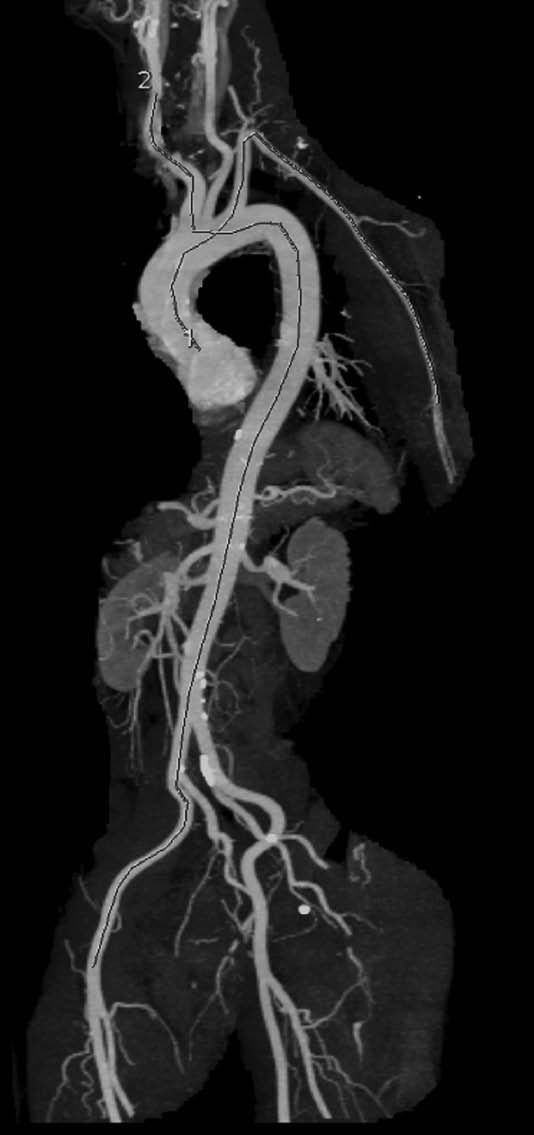
  • The pressure wave travels mostly along an aortic segment, including the thoracic descending aorta and the abdominal aorta, and ultimately travels along the iliac and common femoral arteries. This is well exemplified by the Figure, which superimposes the trajectory of the pressure pulse wave on a normal angiogram obtained by magnetic resonance imaging.

VIEW FIGURE

The trajectories of the pressure pulse waves along the arterial segments are superimposed onto an angiogram obtained by computed tomography scan (left anterior oblique). The carotid-femoral pathway is described as dotted line, and the QKD pathway is described as dashed line.

pap62

FIGURE SOURCE:

http://hyper.ahajournals.org/content/early/2013/05/20/HYPERTENSIONAHA.113.01372.citation

The method developed by Gosse et al 7,8 measures the time delay between the onset of the QRS on the ECG and the detection of the last Korotkoff sound by the microphone placed on the brachial artery. Thus, the pressure pulse wave travels first along the ascending aorta and the aortic arch (ie, a short pathway of elastic arteries) and then along the subclavian and brachial arteries (ie, a much longer pathway of muscular arteries).

Because the stiffness of muscular arteries is little influenced by age and hypertension, Gosse et al8 attributed the difference in QKD duration to ascending aorta and aortic arch. However, a closer look at the Figure shows that the length of the ascending and aortic arch pathway represents a very small part of the total pathway and casts doubt about this statement.

Furthermore, in magnetic resonance imaging studies, the transit time of flow wave along the aortic arch (average 120 mm length) is often found ≈35 ms in young healthy subjects,10 a value which is far from the mean 206 ms QKD duration found in the present study. Thus, part of that QFD duration has to be further explained by both the preejection period and the transit time within muscular arteries.

Alternative Devices

  • 2008 – The arteriograph system estimates PWV from a single-site determination of the suprasystolic waveform at the brachial artery site, and measures the time elapsed between the first wave ejected from the left ventricle to the aortic root, and its reflection from the bifurcation as the second systolic wave, with subtraction of the brachial artery transit time.
  • 2010 – The Mobil-O-Graph system uses oscillometric recording of brachial artery pressure waveform and reconstructs the central pulse wave by applying a transfer function. Central pulse wave is then decomposed into forward and backward waves, and PWV isestimated from their time difference.
  • Device |Method |Arterial Pathway |Predictive Value for CV Events | (Year of First Publication)

1984 Complior Mechanotransducer Carotid-femoral Yes (1999)

1990 Sphygmocor Tonometer Carotid-femoral Yes (2011)

1994 QKD ECG + Korotkoff sounds Aorta + brachial Yes (2005)

1997 Cardiov. Eng. Inc Tonometer Carotid-femoral Yes (2010)

2002 Doppler probes Doppler probe Aortic arch + descending aorta Yes (2002)

2002 VP-1000 Omron Brachial and ankle pressure cuffs Aorta + brachial + lower limbs Yes (2005)

2004 PulsePen Tonometer Carotid-femoral No

2006 CAVI-VaSera ECG + Brachial and ankle pressure cuffs Aorta + brachial + lower limbs No

2008 Arteriograph Arm pressure cuff Aorta + brachial No

2009 MRI-ArtFun MRI Aortic arch No

2009 Vicorder Cuffs Carotid-femoral No

2010 Mobil-O-Graph Arm pressure cuff Aorta No

Conclusions

The measurement of arterial stiffness is increasingly popular among physicians and researchers mainly because its predictive value for cardiovascular (CV) events has been well demonstrated. The largest amount of evidence has been given for aortic stiffness, measured through carotid-femoral pulse wave velocity (cfPWV). This has been initially reported in the late 1990s or early 2000s.1

Aortic stiffness is an independent predictor of all-cause and cardiovascular mortality in hypertensive patients. Hypertension. 2001;37:1236–1241.

European Network for Non-invasive Investigation of Large Arteries. Expert consensus document on arterial stiffness: methodological issues and clinical applications. Eur Heart J. 2006;27:2588–2605.

Arterial Stiffness as an Imaging Biomarker : Are All Pathways Equal? http://hyper.ahajournals.org/content/early/2013/05/20/HYPERTENSIONAHA.113.01372.citation

References for Imaging Biomarker for Arterial Stiffness, at the end of the paper

Part II:

Results for Advances and Recent Clinical Trials in Hypertension Management

Based on

Garry L.R. Jennings, Recent Advances in Hypertension:Recent Clinical Trials of Hypertension Management http://hyper.ahajournals.org/content/early/2013/05/20/HYPERTENSIONAHA.113.00863.citation

Trends: tended to drive interest toward equivalence rather than efficacy studies (ie, trials designed to show an investigational agent is as good as, not better than, existing treatment), surrogate end points, including new blood pressure (BP) variables, and studies of combinations and algorithms rather than single interventions. Population studies around the world, however, continue to show that large numbers of people have hypertension that is not treated satisfactorily and are not achieving the goals set by the major national guidelines. These guidelines themselves are under continual scrutiny on the basis of recent data casting doubt on the validity of present BP goals. Guideline committees also face the issue that evidence based on expensive large-scale clinical trials is more often funded by the pharmaceutical or device industries than by government, leaving large evidence gaps in areas of public importance but no direct interest to industry funders. The purpose of the present article is to briefly review clinical trials of interventions in hypertension during the past 2 years.

Subject categories of Last Decade Clinical Trials on Hypertension

  • Resistant Hypertension
  • Resistant Hypertension and the Sympathetic
  • Nervous System
  • Trials of Pharmacotherapy
  • Old Ground, New Findings
  • Are Chlorthalidone and Nonthiazides the Best Diuretics for Treatment of Hypertension?
  • BP Targets and Treatment
  • Lifestyle and Nonpharmacological Approaches to Hypertension
  1.  Sodium
  2. Trials of Nutrition and BP
  • Resistance Exercise and BP

What Can Be Learned From Clinical Trials Reported in the Present Decade?

  • Systems for blood pressure management in the community can be improved because a large treatment gap remains.
  • Drug combinations from different classes with different modes of action are useful.
  • Drug combinations that include drugs with similar mode of action do not generally enhance efficacy and come at a cost in adverse events.
  • Small but important nutritional effects on blood pressure demand further examination.
  • The sympathetic nervous system has returned as an important target for therapy of hypertension.
  • Blood pressure targets and goals need refining, preferably on the basis of specifically designed clinical trials.

The scene for clinical trials of hypertension management is in transition. The era of mega trials may not be over but is certainly in decline, and in the past 2 years there have been no studies reporting primary outcome data the scale of the

  • Antihypertensive and
  • Lipid-Lowering Treatment
  1. Lipid-Lowering Treatment to Prevent Heart Attack Trial (ALLHAT),
  2. The ONgoing Telmisartan Alone and in combination with Ramipril Global Endpoint Trial (ONTARGET),
  3. Anglo-Scandinavian Cardiac Outcomes Trial (ASCOT), and other
  4. major studies that marked clinical trial activity and informed guideline committees during the past 2 to 3 decades.

This reflects in part the view that the

  • present benchmark pharmacological agents for treating hypertension are difficult to improve,
  • some systemic issues affecting the pharmaceutical industry influencing the ability to make the large investment required to perform mega trials and
  • the quality of the antihypertensive drug pipeline.

http://hyper.ahajournals.org/content/early/2013/05/20/HYPERTENSIONAHA.113.00863.citation

References for Clinical Trial on Hypertension, at the end of the paper

Part III:

Mechanism of Action of Top 10 Cardio Drugs 2012, published on May 16, 2013

The top 10 Cardio Drugs in 2012 belong to two drug classes

  • Antihypertensive and
  • Lipid-Lowering Treatment

Sales % Change 2012 vs 2011 by Drug Class

MOA

By

Drug Class

Drug Name

2011 Sales billion

2012 Sales billion

% change

Statins

Crestor

6.622

6.253

-6%

Lipitor

9.577

3.948

-59%

Zetia

2.428

2.567

+6%

Vytorin

1.882

1.747

-7%

Total Sales and % change Statins

 20,509  14,515  -29.2%

ARB

Diovan

5.665

4.417

-22%

ACEII

Benicar

2.602

2.446

-6%

ACEI

Micardis

2.217

2.098

-5%

ARB

Avapro

1.797

1.422

-30% (BMS)

ARB

Blopress

1.808

1.643

-9%

PAH

Tracleer

1.721

1.6

-7%

Total Sales and % change AntiHTN

 15,810  13,626  -13.8%

Data Source:

http://www.fiercepharma.com/special-reports/top-10-cardio-drugs-2012#ixzz2U9Axh8X4 

1 Crestor

Crestor (AstraZeneca)
Patent expiry: July 2016

2012 sales: $6.253 billion
2011 sales: $6.622 billion
Change: (6%)

Crestor – FiercePharma http://www.fiercepharma.com/special-reports/crestor-0#ixzz2UACLZyaa 

(rosuvastatin calcium) is indicated as an adjunct to diet to reduce elevated Total-C, LDL-C, ApoB, non-HDL-C, and triglycerides, and to increase HDL-C in adult patients with primary hyperlipidemia or mixed dyslipidemia and to slow the progression of atherosclerosis in adult patients as part of a treatment strategy to lower Total-C and LDL-C to target levels.1

2 Diovan

Diovan (Novartis)
Patent expiry: September 2012

2012 sales: $4.417 billion
2011 sales: $5.665 billion
Change: (22%)

Diovan – FiercePharma http://www.fiercepharma.com/special-reports/diovan#ixzz2UACdBCtZ 

Valsartan (Angiotan or Diovan) is an angiotensin II receptor antagonist (more commonly called an “ARB”, or angiotensin receptor blocker), with particularly high affinity for the type I (AT1) angiotensin receptor. By blocking the action of angiotensin, valsartan dilates blood vessels and reduces blood pressure.[1] In the U.S., valsartan is indicated for treatment of high blood pressure, congestive heart failure (CHF), or post-myocardial infarction (MI).[2]

3 Lipitor

Lipitor (Pfizer)
Patent expiry: November 2011

2012 sales: $3.948 billion
2011 sales: $9.577 billion
Change: (59%)

Lipitor – FiercePharma http://www.fiercepharma.com/special-reports/lipitor-2#ixzz2UACsJ2Y2 

(atorvastatin calcium) tablets are a prescription medicine that is used along with a low-fat diet. It lowers the LDL (“bad”) cholesterol and triglycerides in your blood. It can raise your HDL (“good”) cholesterol as well. LIPITOR can lower the risk for heart attack, stroke, certain types of heart surgery, and chest pain in patients who have heart disease or risk factors for heart disease such as age, smoking, high blood pressure, low HDL, or family history of early heart disease. LIPITOR can lower the risk for heart attack or stroke in patients with diabetes and risk factors such as diabetic eye or kidney problems, smoking, or high blood pressure.

LIPITOR is a member of the drug class known as statins, used for lowering blood cholesterol. It also stabilizes plaque and prevents strokes through anti-inflammatory and other mechanisms. Like all statins, atorvastatin works by inhibiting HMG-CoA reductase, an enzyme found in liver tissue that plays a key role in production of cholesterol in the body.

Atorvastatin was first synthesized in 1985 by Bruce Roth of Parke-Davis Warner-Lambert Company (now Pfizer). The best selling drug in pharmaceutical history, sales of Lipitor since it was approved in 1996 exceed US$125 billion, and the drug has topped the list of best-selling branded pharmaceuticals in the world for nearly a decade

4 Zetia

Zetia (Merck)
Patent expiry: December 2016

2012 sales: $2.567 billion
2011 sales: $2.428 billion
Change: 6%

Zetia – FiercePharma http://www.fiercepharma.com/special-reports/zetia#ixzz2UADFaGJ0 

Ezetimibe (pron.: /ɛˈzɛtɨmɪb/) is a drug that lowers plasma cholesterol levels. It acts by decreasing cholesterol absorption in the intestine. It may be used alone (marketed as Zetia or Ezetrol), when other cholesterol-lowering medications are not tolerated, or together withstatins (e.g., ezetimibe/simvastatin, marketed as Vytorin and Inegy) when statins alone do not control cholesterol.

Ezetimibe decreases cholesterol levels, but has not been shown to improve outcomes in cardiovascular disease patients by decreasing atherosclerotic or vascular events compared to placebo. Ezetimibe is endorsed in the Canadian Lipid Guidelines and is considered a well-tolerated option for an add-on agent to statin, to help patients achieve their LDL (or bad cholesterol) targets. [1] Ezetimibe is the only add-on to statin therapy that has successfully shown cardiovascular benefit when combined with statin, but has not been proven to have an incremental benefit compared to statins alone. [2] Britain’s NICE statement, published in 2007, endorses its use for monotherapy if statins are not tolerated or as add-on therapy.[3]

5 Benicar

Benicar (Daiichi Sankyo)
Patent expiry: October 2016

2012 sales: $2.446 billion
2011 sales: $2.602 billion
Change: (6%)

Benicar – FiercePharma http://www.fiercepharma.com/special-reports/benicar#ixzz2UADYvld5 

BENICAR and BENICAR HCT are prescription medicines used to lower high blood pressure (hypertension). They may be used alone or with other medicines used to treat high blood pressure. BENICAR HCT is not for use as the first medicine to treat high blood pressure.

 Olmesartan medoxomil is an angiotensin II receptor antagonistused to treat high blood pressure.

Olmesartan is a prodrug that works by blocking the binding of angiotensin II to the AT1 receptors in vascular muscle; it is therefore independent of angiotensin II synthesis pathways, unlike ACE inhibitors. By blocking the binding rather than the synthesis of angiotensin II, olmesartan inhibits the negative regulatory feedback on renin secretion. As a result of this blockage, olmesartan reduces vasoconstriction and the secretion of aldosterone. This lowers blood pressure by producing vasodilation, and decreasing peripheral resistance.

6 Micardis

Micardis (Boehringer Ingelheim)
Patent Expiry: January 2014

2012 Sales: $2.098 billion
2011 Sales: $2.217 billion
Change: (5%)

Micardis – FiercePharma http://www.fiercepharma.com/special-reports/micardis#ixzz2UADpDZeO 

Micardis® (telmisartan) tablets are a prescription medicine used to treat high blood pressure (hypertension). Additionally, MICARDIS 80 mg tablets are used in certain high-risk people aged 55 years and older who are unable to take a medicine called an angiotensin converting enzyme inhibitor (ACE-I) to help lower their risk of having certain cardiovascular problems such as stroke, heart attack, or death.

Micardis® (telmisartan) tablets are a prescription medicine used to treat high blood pressure (hypertension).

Telmisartan (INN) (pron.: /tɛlmɪˈsɑrtən/) is an angiotensin II receptor antagonist (angiotensin receptor blocker, ARB) used in the management of hypertension. It is marketed under thetrade name Micardis (by Boehringer Ingelheim), among others.

Telmisartan is an angiotensin II receptor blocker that shows high affinity for the angiotensin II receptor type 1 (AT1), with a binding affinity 3000 times greater for AT1 than AT2. It has the longest half-life of any ARB (24 hours)[1][4] and the largest volume of distribution.

In addition to blocking the RAs, telmisartan acts as a selective modulator of peroxisome proliferator-activated receptor gamma (PPAR-γ), a central regulator of insulin and glucose metabolism. It is believed that telmisartan’s dual mode of action may provide protective benefits against the vascular and renal damage caused by diabetes and cardiovascular disease (CVD).[4]

Telmisartan’s activity at the PPAR-γ receptor has prompted speculation around its potential as a sport doping agent as an alternative to GW 501516.[5] Telmisartan activates PPARδ receptors in several tissues. [6][7][8][9]

7 Avapro

Avapro (Sanofi)
Patent expiry: March 2012

Total 2012 sales: $1.925 billion
2012 sales Sanofi: $1.422 billion
2012 sales BMS: $503 million

Total 2011 sales: $2.749 billion
2011 sales Sanofi: $1.797 billion
2011 sales BMS: $952 million
Total Change: (30%)

Avapro – FiercePharma http://www.fiercepharma.com/special-reports/avapro#ixzz2UAE9iB2E 

rbesartan (INN) (pron.: /ɜrbəˈsɑrtən/) is an angiotensin II receptor antagonist used mainly for the treatment of hypertension. Irbesartan was developed by Sanofi Research (now part ofsanofi-aventis). It is jointly marketed by sanofi-aventis and Bristol-Myers Squibb under the trade names Aprovel, Karvea, and Avapro.

As with all angiotensin II receptor antagonists, irbesartan is indicated for the treatment ofhypertension. Irbesartan may also delay progression of diabetic nephropathy and is also indicated for the reduction of renal disease progression in patients with type 2 diabetes,[1]hypertension and microalbuminuria (>30 mg/24 hours) or proteinuria (>900 mg/24 hours).[2]

 A large randomized trial following 4100+ men and women with heart failure and normal ejection fraction (>=45%) over 4+ years found no improvement in study outcomes or survival with irbesartan as compared to placebo.[3]

8 Vytorin

Vytorin (Merck)
Patent Expiry: April 2017

2012 sales: $1.747 billion
2011 sales: $1.882 billion
Change: (7%)

Vytorin – FiercePharma http://www.fiercepharma.com/special-reports/vytorin#ixzz2UAEQVcQr 

Ezetimibe/simvastatin (pron.: /ɛˈzɛtɨmɪb ˌsɪmvəˈstætɨn/) is a drug combination used for the treatment of dyslipidemia. It is a combination of ezetimibe (best known as Zetia in the United States and Ezetrol elsewhere) and the statin drug simvastatin (best known as Zocor in the U.S.). The combination preparation is marketed by Merck & Co./Schering-PloughPharmaceuticals (joint venture) under the trade names Vytorin and Inegy.

Ezetimibe reduces blood cholesterol by inhibiting absorption of cholesterol by the small intestine by acting at the brush border of the small intestine and inhibits the absorption of cholesterol, leading to a decrease in the delivery of intestinal cholesterol to the liver.

Simvastatin is an HMG-CoA reductase inhibitor or statin. It works by blocking an enzymethat is necessary for the body to make cholesterol.

Even though ezetimibe decreases cholesterol levels, as of 2009 it has not been found to lead to improvement in real world outcomes.[1] The combination of simvastatin and ezetimibe has not been found to be any better than simvastatin alone. A panel of experts thus concluded in 2008 that it should “only be used as a last resort”.[2]

9 Blopress

Blopress (Takeda Pharmaceutical)
Patent expiry: June 2012

2012 sales: $1.643 billion
2011 sales: $1.808 billion
Change: (9%)

Blopress – FiercePharma http://www.fiercepharma.com/special-reports/blopress#ixzz2UAEnxyWy

Candesartan (rINN) (pron.: /ˌkændɨˈsɑrtən/) is an angiotensin II receptor antagonist used mainly for the treatment of hypertension. The prodrug candesartan cilexetil is marketed by AstraZeneca and Takeda Pharmaceuticals, commonly under the trade names Blopress,Atacand, Amias, and Ratacand

As all angiotensin II receptor antagonists, candesartan is indicated for the treatment of hypertension. Results from the CHARM study in the early 2000s demonstrated the morbidity and mortality reduction benefits of candesartan therapy in congestive heart failure.[1] Thus, while ACE inhibitors are still considered first-line therapy in heart failure, candesartan can be used in combination with an ACE to achieve improved mortality and morbidity vs. an ACE alone and additionally is an alternative in patients intolerant of ACE inhibitor therapy.

Prehypertension

In a four-year randomized controlled trial, candesartan was compared to placebo to see whether it could prevent or postpone the development of full-blown hypertension in people with so-called prehypertension. During the first two years of the trial, half of participants were given candesartan, and the others received placebo; candesartan reduced the risk of developing hypertension by nearly two-thirds during this period. In the last two years of the study, all participants were switched to placebo. By the end of the study, candesartan hadsignificantly reduced the risk of hypertension, by more than 15%. Serious side effects were actually more common among participants receiving placebo than in those given candesartan.[2]

Candesartan is also available in a combination formulation with a low dose thiazide diuretic, invariably hydrochlorothiazide, to achieve an additive antihypertensive effect. Candesartan/hydrochlorothiazide combination preparations are marketed under various trade names including Atacand HCT, Hytacand, Blopress Plus, Advantec and Ratacand Plus.

10 Tracleer

Tracleer (Actelion)
Patent expiry: November 2015   

2012 sales: $1.600 billion
2011 sales: $1.721 billion
Change: (7%)

Tracleer – FiercePharma http://www.fiercepharma.com/special-reports/tracleer#ixzz2UAF2iIJB 

Bosentan is a dual endothelin receptor antagonist used in the treatment of pulmonary artery hypertension (PAH). It is licensed in the United States, the European Union and other countries by Actelion Pharmaceuticals for the management of PAH under the trade name Tracleer.

Bosentan is a competitive antagonist of endothelin-1 at the endothelin-A (ET-A) and endothelin-B (ET-B) receptors. Under normal conditions, endothelin-1 binding of ET-A or ET-B receptors causes pulmonary vasoconstriction. By blocking this interaction, bosentan decreases pulmonary vascular resistance. Bosentan has a slightly higher affinity for ET-A than ET-B.

Clinical uses 

Bosentan is indicated mainly for the treatment of pulmonary hypertension. In 2007, bosentan was approved in the European Union also for reducing the number of new digital ulcers in patients with systemic sclerosis and ongoing digital ulcer disease.

In the United States, bosentan is indicated for the treatment of pulmonary arterial hypertension (WHO Group I) in patients with WHO Class II-IV symptoms, to improve exercise capacity and decrease the rate of clinical worsening.[1]

http://www.fiercepharma.com/special-reports/top-10-cardio-drugs-2012

For years, cardio was king. The world’s all-time best-selling drug, Pfizer’s ($PFE) Lipitor, after all, is an antihyperlipidemic drug. Cardio drugs have traditionally made up one of the largest categories of therapeutic treatment in the drug universe.

According to EvaluatePharma‘s World Preview 2018 report, combined sales of antihypertensive drugs and antihyperlipidemics were more than $70 billion in 2011. That would put them at the top of the heap. Sales of antihypertensive drugs alone were more than $40 billion that year, making them the second-largest therapy area defined by the report, behind oncology drugs at $64.4 billion. The list, compiled by EvaluatePharma, includes the theraputic areas categorized as cardio, so it does not include some products sometimes used for heart disease but not in that therapeutic area, including blood thinners like Plavix.

But many of the top cardio drugs are long in the tooth, and generics are now eating their lunch. Did I mention Lipitor? Sales cratered last year, falling nearly 60%. Despite that, the drug placed third among the top 10 cardio drugs of 2012, a reminder of the stature it had achieved. Four of the top 10 have lost patent protection in the last two years, and most will be off patent by 2016, with only Merck’s ($MRK) Vytorin protected until 2017.

Last year, the top 10 cardio drugs racked up sales of $28.644 billion, down 23% from the $37.271 billion they sold in 2011. Still, the group has made a lot of money for its companies for years and, in some cases, completely changed the treatment of heart disease.

It is an interesting list. Only Merck has two drugs in the top 10. The other drugmakers make up a broad swath of the pharma industry. Read our report below, and if you have some insights you would like to share, please do.

Top 10 Cardio Drugs 2012 – FiercePharma http://www.fiercepharma.com/special-reports/top-10-cardio-drugs-2012#ixzz2UAByWR7s 

Part IV:

20 Highest-Paid Biopharma CEOs of 2012

Call it a rite of spring. Every year about this time, FiercePharma takes a look at executive compensation in the industry, and we rank the highest-paid CEOs. If you’re a regular reader, you’ll notice that this year’s list is longer than previous editions. And there’s a reason for that: curiosity.

As we were beginning to gather numbers from biopharma companies’ proxy statements and annual reports, news surfaced that Valeant Pharmaceuticals ($VRX) and Actavis ($ACT) had been in merger talks. The former CEO of Mylan ($MYL), one of Actavis’ rivals, regularly appeared on our highest-paid executives list, so we looked up the numbers on Actavis. No dice; CEO Paul Bisaro may have pulled off his biggest merger ever last year, but $8.66 million in compensation still didn’t qualify him for our ranking.

Then, we pulled out Valeant’s proxy statement. And while CEO Michael Pearson didn’t earn enough in 2012 to make the cutoff–his compensation just surpassed $6 million–he should have been at the top of the list last year. Pearson’s 2011 pay package broke $36 million. He collected more than $18 million in stock and option awards, plus a special $13.7 million dividend payment, stemming from agreements negotiated years before.

We hate to miss a scoop. Naturally. So, we vowed to avoid making the same mistake this time around. Rather than limit our executive-pay search to the biggest pharma companies and biotechs, plus the usual suspects who often make CEO-pay rankings, we used a bigger net. We collected compensation information from 50 companies, including numbers for CEOs, CFOs, R&D chiefs and other top executives.

Partly because of this search, but mostly because of big bonuses and awards at fast-growing Regeneron ($REGN), we have a brand-new No. 1 on our list. That’s Regeneron CEO Leonard Schleifer, whose 2012 compensation totaled $30.047 million. You’ll notice some other newbies, such as Leonard Bell from Alexion ($ALXN), whose pay bump put him in 12th place. And then there are familiar faces, such as Pfizer ($PFE) CEO Ian Read; Johnson & Johnson’s ($JNJ) former chairman and CEO, William Weldon; and Eli Lilly ($LLY) CEO John Lechleiter, who hung on in 10th place.

Many of the companies we researched pay their top people far less than the $10 million that served as our cutoff figure. Novo Nordisk ($NVO) CEO Lars Sorensen, who has presided over double-digit growth there for several years, collected a package of cash and stock awards worth about $5 million for 2012. GlaxoSmithKline ($GSK) CEO Andrew Witty made less than $6 million himself; he took a pay cut for the year because of Glaxo’s shortfall on certain performance targets.

And then there are others who would have made the list, had their titles been different. There’s Regeneron R&D chief George Yancopoulos, whose extraordinary $81 million in compensation shows how much the company appreciates its newly minted blockbuster, Eylea. There’s Mylan Chairman Robert Coury, who used to be a fixture on our list until Heather Bresch took over as CEO; he made more than $28 million last year. Novartis’ ($NVS) former chairman Daniel Vasella could have qualified for 12th place with his $13.98 million in compensation.

Vasella, then, gives us a quick segue to the ongoing debate over executive pay. In Switzerland, populist dismay at some high-profile compensation figures led to a public vote earlier this year. Citizens voted in new restrictions on common bonuses, such as golden parachutes, and gave shareholders a binding vote on executive pay. And local analysts figure that late-breaking news of Vasella’s behind-the-scenes noncompete agreement–worth some $78 million over 5 years–helped pay activists to get out the vote. (Vasella ended up refusing the deal, by the way.)

In the U.S., where executives are paid more than anywhere else in the world, shareholders at some companies have successfully lobbied for a greater emphasis on performance pay and against extraordinary bonuses, such as change-in-control payments that send top executives on their way with tens of millions after a merger. Other companies have instituted “say-on-pay” advisory votes for shareholders, but those often end up as rubber stamps for the status quo.

Now, we’re interested in what you have to say about executive compensation. Are the CEOs on this list worth their price? What’s a supersuccessful new drug worth? Should CEO pay be docked for R&D failures? What about failed launches? Should other, lower-paid executives earn more? Tweet your opinions to @FiercePharma using the hashtag #FPexecpay, leave your comments below or email us. We’ll collect your thoughts in a future article.

As always, feel free to send us your thoughts on our coverage. And if we missed a well-paid CEO, be sure to let us know.

— Tracy Staton (email | Twitter)

For more:
Top 10 Biotech CEO Pay Packages of 2012
Top 10 Pharma CEO salaries of 2010
Top 10 Pharma CEO salaries of 2009
2012’s 10 highest-paid Med Tech CEOs
Top 10 Medical Device Industry CEO Salaries for 2011


20 Highest-Paid Biopharma CEOs of 2012 – FiercePharma http://www.fiercepharma.com/special-reports/20-highest-paid-biopharma-ceos-2012#ixzz2UAGAlHay 

REFERENCES FOR Part I: Arterial Stiffness

1. Laurent S, Boutouyrie P, Asmar R, Gautier I, Laloux B, Guize L,

Ducimetiere P, Benetos A. Aortic stiffness is an independent predictor

of all-cause and cardiovascular mortality in hypertensive patients.

Hypertension. 2001;37:1236–1241.

2. Vlachopoulos C, Aznaouridis K, Stefanadis C. Prediction of cardiovascular

events and all-cause mortality with arterial stiffness: a systematic

review and meta-analysis. J Am Coll Cardiol. 2010;55:1318–1327.

3. Boutouyrie P, Tropeano AI, Asmar R, Gautier I, Benetos A, Lacolley P,

Laurent S. Aortic stiffness is an independent predictor of primary coronary

events in hypertensive patients: a longitudinal study. Hypertension.

2002;39:10–15.

4. Mattace-Raso FU, van der Cammen TJ, Hofman A, van Popele NM, Bos

ML, Schalekamp MA, Asmar R, Reneman RS, Hoeks AP, Breteler MM,

Witteman JC. Arterial stiffness and risk of coronary heart disease and

stroke: the Rotterdam Study. Circulation. 2006;113:657–663.

5. Sehestedt T, Jeppesen J, Hansen TW, Rasmussen S, Wachtell K, Ibsen H,

Torp-Pedersen C, Olsen MH. Risk stratification with the risk chart from

the European Society of Hypertension compared with SCORE in the general

population. J Hypertens. 2009;27:2351–2357.

6. Mitchell GF, Hwang SJ, Vasan RS, Larson MG, Pencina MJ,

Hamburg NM, Vita JA, Levy D, Benjamin EJ. Arterial stiffness and

cardiovascular events: the Framingham Heart Study. Circulation. 2010;

121:505–511.

7. Gosse P, Cremer A, Papaioannou G, Yeim S. Arterial stiffness from monitoring

of timing of Korotkoff sounds predicts the occurrence of cardiovascular

events independently of left ventricular mass in hypertensive

patients. HYPERTENSIONAHA.113.01039 Published online before print May 20, 2013,doi: 10.1161/​HYPERTENSIONAHA.113.01039

Hypertension. 2013;62:XX–XX.

http://hyper.ahajournals.org/content/early/2013/05/20/HYPERTENSIONAHA.113.01039.abstract.html?papetoc

8. Gosse P, Guillo P, Ascher G, Clementy J. Assessment of arterial distensibility

by monitoring the timing of Korotkoff sounds. Am J Hypertens.

1994;7:228–233.

9. Laurent S, Cockcroft J, Van Bortel L, Boutouyrie P, Giannattasio C,

Hayoz D, Pannier B, Vlachopoulos C, Wilkinson I, Struijker-Boudier

H; European Network for Non-invasive Investigation of Large Arteries.

Expert consensus document on arterial stiffness: methodological issues

and clinical applications. Eur Heart J. 2006;27:2588–2605.

10. Dogui A, Redheuil A, Lefort M, DeCesare A, Kachenoura N, Herment A,

Mousseaux E. Measurement of aortic arch pulse wave velocity in cardiovascular

MR: comparison of transit time estimators and description of a

new approach. J Magn Reson Imaging. 2011;33:1321–1329.

downloaded from

http://hyper.ahajournals.org/content/early/2013/05/20/HYPERTENSIONAHA.113.01372.citation

REFERENCES for Part II: Clinical Trials of Hypertension Management

1. Hanselin MR , Saseen JJ , Allen RR , Marrs JC , Nair KV . Description of

antihypertensive use in patients with resistant hypertension prescribed

four or more agents. Hypertension . 2011 ; 58 : 1008 – 1013 .

2. Bakris GL , Lindholm LH , Black HR , Krum H , Linas S , Linseman JV ,

Arterburn S , Sager P , Weber M . Divergent results using clinic and ambulatory

blood pressures: report of a darusentan-resistant hypertension trial.

Hypertension . 2010 ; 56 : 824 – 830 .

3. Smithwick RH , Thompson JE . Splanchnicectomy for essential hypertension;

results in 1,266 cases. J Am Med Assoc . 1953 ; 152 : 1501 – 1504 .

4. Esler M , Ferrier C , Lambert G , Eisenhofer G , Cox H , Jennings G .

Biochemical evidence of sympathetic hyperactivity in human hypertension.

Hypertension . 1991 ; 17 ( 4 Suppl ): III29 – III35 .

5. Esler MD , Krum H , Sobotka PA , Schlaich MP , Schmieder RE , Bohm

M . Symplicity HTN-2 investigators. Renal sympathetic denervation in

patients with treatment-resistant hypertension: a randomized controlled

trial. Lancet 2010 ; 376 : 1903 – 1909 .

6. Brinkmann J , Heusser K , Schmidt BM , Menne J , Klein G , Bauersachs J ,

Haller H , Sweep FC , Diedrich A , Jordan J , Tank J . Catheter-based renal

nerve ablation and centrally generated sympathetic activity in diffi cultto-

control hypertensive patients: prospective case series. Hypertension .

2012 ; 60 : 1485 – 1490 .

7. Mahfoud F , Cremers B , Janker J , et al . Renal hemodynamics and renal

function after catheter-based renal sympathetic denervation in patients

with resistant hypertension. Hypertension . 2012 ; 60 : 419 – 424 .

8. Lambert GW , Hering D , Esler MD , Marusic P , Lambert EA , Tanamas

SK , Shaw J , Krum H , Dixon JB , Barton DA , Schlaich MP . Health-related

quality of life after renal denervation in patients with treatment-resistant

hypertension. Hypertension . 2012 ; 60 : 1479 – 1484 .

9. Daugherty SL , Powers JD , Magid DJ , Masoudi FA , Margolis KL ,

O ’ Connor PJ , Schmittdiel JA , Ho PM . The association between medication

adherence and treatment intensifi cation with blood pressure control

in resistant hypertension. Hypertension . 2012 ; 60 : 303 – 309 .

10. Bobrie G , Frank M , Azizi M , Peyrard S , Boutouyrie P , Chatellier G ,

Laurent S , Menard J , Plouin PF . Sequential nephron blockade versus

sequential renin-angiotensin system blockade in resistant hypertension:

a prospective, randomized, open blinded endpoint study. J Hypertens .

2012 ; 30 : 1656 – 1664 .

11. Mancia G . Additional drug treatment in resistant hypertension: need for

randomized studies. J Hypertens . 2012 ; 30 : 1514 – 1515 .

12. Hermida RC , Ayala DE , Moj ó n A , Fontao MJ , Fern á ndez JR .

Chronotherapy with valsartan/hydrochlorothiazide combination in essential

hypertension: improved sleep-time blood pressure control with bedtime

dosing. Chronobiol Int . 2011 ; 28 : 601 – 610 .

13. Persu A , Renkin J , Thijs L , Staessen JA . Renal denervation: ultima

ratio or standard in treatment-resistant hypertension. Hypertension .

2012 ; 60 : 596 – 606 .

14. Lohmeier TE , Iliescu R . Chronic lowering of blood pressure by carotid

barorefl ex activation: mechanisms and potential for hypertension therapy.

Hypertension . 2011 ; 57 : 880 – 886 .

15. Bisognano JD , Bakris G , Nadim MK , Sanchez L , Kroon AA , Schafer J ,

de Leeuw PW , Sica DA . Barorefl ex activation therapy lowers blood pressure

in patients with resistant hypertension: results from the double-blind,

randomized, placebo-controlled rheos pivotal trial. J Am Coll Cardiol .

2011 ; 58 : 765 – 773 .

16. Parving HH , Brenner BM , McMurray JJ , de Zeeuw D , Haffner SM ,

Solomon SD , Chaturvedi N , Persson F , Desai AS , Nicolaides M , Richard

A , Xiang Z , Brunel P , Pfeffer MA ; ALTITUDE Investigators . Cardiorenal

end points in a trial of aliskiren for type 2 diabetes. N Engl J Med .

2012 ; 367 : 2204 – 2213 .

17. The ONTARGET Investigators . Telmisartan, ramipril, or both in patients

at high risk for vascular events. N Engl J Med . 2008 ; 358 : 1547 – 1559 .

18. Mancia G , Parati G , Bilo G , et al . Ambulatory blood pressure values in

the Ongoing Telmisartan Alone and in Combination with Ramipril Global

Endpoint Trial (ONTARGET). Hypertension . 2012 ; 60 : 1400 – 1406 .

19. Roush GC , Holford TR , Guddati AK . Chlorthalidone compared with

hydrochlorothiazide in reducing cardiovascular events: systematic review

and network meta-analyses. Hypertension . 2012 ; 59 : 1110 – 1117 .

20. Cushman WC , Bakris GL , White WB , Weber MA , Sica D , Roberts A ,

Lloyd E , Kupfer S . Azilsartan medoxomil plus chlorthalidone reduces

blood pressure more effectively than olmesartan plus hydrochlorothiazide

in stage 2 systolic hypertension. Hypertension . 2012 ; 60 : 310 – 318 .

21. Alderman MH , Piller LB , Ford CE , Probstfi eld JL , Oparil S , Cushman WC ,

Einhorn PT , Franklin SS , Papademetriou V , Ong ST , Eckfeldt JH , Furberg

CD , Calhoun DA , Davis BR ; Antihypertensive and Lipid-Lowering

Treatment to Prevent Heart Attack Trial Collaborative Research Group .

Clinical signifi cance of incident hypokalemia and hyperkalemia in treated

hypertensive patients in the antihypertensive and lipid-lowering treatment

to prevent heart attack trial. Hypertension . 2012 ; 59 : 926 – 933 .

22. Kostis WJ , Thijs L , Richart T , Kostis JB , Staessen JA . Persistence of mortality

reduction after the end of randomized therapy in clinical trials of

blood pressure-lowering medications. Hypertension . 2010 ; 56 : 1060 – 1068 .

23. van Onzenoort HA , Menger FE , Neef C , Verberk WJ , Kroon AA , de

Leeuw PW , van der Kuy PH . Participation in a clinical trial enhances

adherence and persistence to treatment: a retrospective cohort study.

Hypertension . 2011 ; 58 : 573 – 578 .

24. Sever PS . The Anglo-Scandinavian Cardiac Outcomes Trial: implications

and further outcomes. Hypertension . 2012 ; 60 : 248 – 259 .

25. Larstorp AC , Ariansen I , Gjesdal K , Olsen MH , Ibsen H , Devereux RB ,

Okin PM , Dahl ö f B , Kjeldsen SE , Wachtell K . Association of pulse pressure

with new-onset atrial fi brillation in patients with hypertension and

left ventricular hypertrophy: the Losartan Intervention For Endpoint

(LIFE) reduction in hypertension study. Hypertension . 2012 ; 60 : 347 – 353 .

26. Rossignol P , Cridlig J , Lehert P , Kessler M , Zannad F . Visit-to-visit blood

pressure variability is a strong predictor of cardiovascular events in hemodialysis:

insights from FOSIDIAL. Hypertension . 2012 ; 60 : 339 – 346 .

27. Matsui Y , O ’ Rourke MF , Hoshide S , Ishikawa J , Shimada K , Kario

K . Combined Effect of Angiotensin II Receptor Blocker and Either a

Calcium Channel Blocker or Diuretic on Day-by-Day Variability of Home

Blood Pressure: The Japan Combined Treatment With Olmesartan and a

Calcium-Channel Blocker Versus Olmesartan and Diuretics Randomized

Effi cacy Study. Hypertension . 2012 ; 59 : 1132 – 1138 .

28. Jennings GL , Sudhir K . Initial therapy of primary hypertension. Med J

Aust . 1990 ; 152 : 198 – 203 .

29. Egan BM , Bandyopadhyay D , Shaftman SR , Wagner CS , Zhao Y ,

Yu-Isenberg KS . Initial monotherapy and combination therapy and hypertension

control the fi rst year. Hypertension . 2012 ; 59 : 1124 – 1131 .

30. Bavry AA , Pepine CJ . Treatment of hypertension: lower is better, or is it?

Hypertension . 2012 ; 60 : 281 – 282 .

31. Mizuno R , Fujimoto S , Saito Y , Okamoto Y . Optimal antihypertensive

level for improvement of coronary microvascular dysfunction: the lower,

the better? Hypertension . 2012 ; 60 : 326 – 332 .

32. Roman MJ , Howard BV , Howard WJ , Mete M , Fleg JL , Lee ET ,

Devereux RB . Differential impacts of blood pressure and lipid lowering

on regression of ventricular and arterial mass: the Stop Atherosclerosis in

Native Diabetics Trial. Hypertension . 2011 ; 58 : 367 – 371 .

33. Bertoia ML , Waring ME , Gupta PS , Roberts MB , Eaton CB . Implications

of new hypertension guidelines in the United States. Hypertension .

2012 ; 60 : 639 – 644 .

34. Stewart S , Carrington MJ , Swemmer CH , et al .; VIPER-BP Study

Investigators . Effect of intensive structured care on individual blood pressure

targets in primary care: multicentre randomised controlled trial. BMJ .

2012 ; 345 : e7156 .

35. Dickinson BD , Havas S ; Council on Science and Public Health, American

Medical Association . Reducing the population burden of cardiovascular

disease by reducing sodium intake: a report of the Council on Science and

Public Health. Arch Intern Med . 2007 ; 167 : 1460 – 1468 .

36. O ’ Donnell MJ , Yusuf S , Mente A , Gao P , Mann JF , Teo K , McQueen M ,

Sleight P , Sharma AM , Dans A , Probstfi eld J , Schmieder RE . Urinary

sodium and potassium excretion and risk of cardiovascular events. JAMA .

2011 ; 306 : 2229 – 2238 .

37. Hummel SL , Seymour EM , Brook RD , Kolias TJ , Sheth SS , Rosenblum

HR , Wells JM , Weder AB . Low-sodium dietary approaches to stop

hypertension diet reduces blood pressure, arterial stiffness, and oxidative

stress in hypertensive heart failure with preserved ejection fraction.

Hypertension . 2012 ; 60 : 1200 – 1206 .

38. Soedamah-Muthu SS , Verberne LD , Ding EL , Engberink MF , Geleijnse JM .

Dairy consumption and incidence of hypertension: a dose-response metaanalysis

of prospective cohort studies. Hypertension . 2012 ; 60 : 1131 – 1137 .

39. West SG , Gebauer SK , Kay CD , Bagshaw DM , Savastano DM ,

Diefenbach C , Kris-Etherton PM . Diets containing pistachios reduce systolic

blood pressure and peripheral vascular responses to stress in adults

with dyslipidemia. Hypertension . 2012 ; 60 : 58 – 63 .

40. Zhang X , Qi Q , Liang J , Hu FB , Sacks FM , Qi L . Neuropeptide Y promoter

polymorphism modifi es effects of a weight-loss diet on 2-year

changes of blood pressure: the preventing overweight using novel dietary

strategies trial. Hypertension . 2012 ; 60 : 1169 – 1175 .

41. Meredith IT , Friberg P , Jennings GL , Dewar EM , Fazio VA , Lambert GW ,

Esler MD . Exercise training lowers resting renal but not cardiac sympathetic

activity in humans. Hypertension . 1991 ; 18 : 575 – 582 .

42. Cornelissen VA , Fagard RH , Coeckelberghs E , Vanhees L . Impact of resistance

training on blood pressure and other cardiovascular risk factors: a metaanalysis

of randomized, controlled trials. Hypertension . 2011 ; 58 : 950 – 958 .

Downloaded from

http://hyper.ahajournals.org/content/early/2013/05/20/HYPERTENSIONAHA.113.00863.citation

RELATED SOURCES:

Aortic pulse pressure is associated with the localization of coronary artery disease based on coronary flow lateralization. American journal of hypertension, 25(10), 1055-1063.

  1. Georges Khoueiry1,
  2. Basem Azab2,
  3. Estelle Torbey2,
  4. Nidal Abi Rafeh1,
  5. Jean-Paul Atallah2,
  6. Kathleen Ahern2,
  7. James Malpeso1,
  8. Donald McCord1 and
  9. Elie R. Chemaly3⇓

Author Affiliations


  1. 1Department of Cardiology, Staten Island University Hospital, Staten Island, New York, USA

  2. 2Department of Internal Medicine, Staten Island University Hospital, Staten Island, New York, USA

  3. 3Cardiovascular Institute, Mount Sinai School of Medicine, New York, New York, USA

Elie R. Chemaly (elie.chemaly@mssm.edu)

Abstract

Background Aortic pulse pressure (APP) is related to arterial stiffness and associated with the presence and extent of coronary artery disease (CAD). Besides, the left coronary artery (LCA) has a predominantly diastolic flow while the right coronary artery (RCA) receives systolic and diastolic flow. Thus, we hypothesized that increased systolic–diastolic pressure difference had a greater atherogenic effect on the RCA than on the LCA.

Methods A random sample of 433 CAD patients (145 females, 288 males, mean age 65.0 ± 11.1 years) undergoing coronary angiography at Staten Island University Hospital between January 2005 and May 2008 was studied. Coronary lesion was defined as a ≥50% luminal stenosis. Patients were divided into three groups, with isolated LCA lesions (n = 154), isolated RCA lesions (n = 36) or mixed LCA and RCA lesions (n = 243).

Results APP differed significantly between groups, being highest when the RCA alone was affected (67.6 ± 20.3 mm Hg for LCA vs. 78.8 ± 22.0 for RCA vs. 72.7 ± 22.6 for mixed, P = 0.008 for analysis of variance (ANOVA)). Age and gender were not associated with CAD location. Heart rate was associated with CAD location, lowest in RCA group, and negatively correlated with APP. However, left ventricular ejection fraction (LVEF) was lower in the mixed CAD group and positively correlated with APP. The association between APP and right-sided CAD persisted in multivariate logistic regression adjusting for confounders, including heart rate, LVEF and medication use. A similar but less significant pattern was seen with brachial arterial pressures.

Conclusions Aortic pulse pressure may affect CAD along with coronary flow phasic patterns.

American Journal of Hypertension, advance online publication 28 June 2012; doi:10.1038/ajh.2012.87

The Relationship Between Diastolic Pressure and Coronary Collateral Circulation in Patients With Stable Angina Pectoris and Chronic Total Occlusion. Am J Hypertens (2013)doi: 10.1093/ajh/hps096 

First published online: February 7, 2013

  1. Wang Shu1,
  2. Jing jing1,
  3. Liu Chang Fu1,
  4. Jiang Tie Min2,
  5. Yang Xiao Bo1,
  6. Zhou Ying1and
  7. Chen Yun Dai1,*
  1. 1 The Cardiovascular Medical Department of the General Hospital of the Chinese People’s Liberation Army, Beijing, China;

  2. 2 The Cardiovascular Medical Department of the Affiliated Hospital of the Chinese People’s Armed Police Logistics College, Tianjin, China.
  1. ↵Correspondence: Chen Yun Dai (chenyundai2002@163.com).

Abstract

BACKGROUND The most important biomechanical source of activation of the coronary collateral circulation (CCC) is increased tangential fluid shear stress at the arterial endothelial surface. The coronary circulation is unique in that most coronary blood flow occurs in diastole. Consequently, the diastolic blood pressure (DBP) may influence the tangential fluid shear stress on the arterial endothelial surface in diastole, therebyaffecting development of the CCC.

METHODS To investigate this, we conducted a study of 222 patients with stable angina pectoris and chronic total occlusion of coronary arteries. All of the patients had no history of coronary artery interventional therapy, coronary artery bypass surgery, cardiomyopathy, or congenital heart disease. The extent of the collateral vasculature of the area perfused by the artery affected by chronic total occlusion was graded as poor or well-developed according to Rentrop’s classification.

RESULTS Univariate analysis showed a significant difference between the study subgroup with poorly developed collaterals and that with well-developed collaterals in terms of high diastolic blood pressure (DBP) and mean DBP. Multivariate analysis revealed high DBP as the only independent positive predictor of a well-developed collateral circulation.

CONCLUSIONS High DBP is positively related to a well-developed CCC. Differences in development of the CCC may be one of the pathophysiologic mechanisms responsible for the J-curve phenomenon in the relationship between DBP and cardiovascular risk.

http://ajh.oxfordjournals.org/content/early/2013/02/06/ajh.hps096.abstract

Other related articles that were published on this Open Access Online Scientific Journal, include the following:

Synthetic Biology: On Advanced Genome Interpretation for Gene Variants and Pathways: What is the Genetic Base of Atherosclerosis and Loss of Arterial Elasticity with Aging

Aviva Lev-Ari, PhD, RN May 17, 2013

http://pharmaceuticalintelligence.com/2013/05/17/synthetic-biology-on-advanced-genome-interpretation-for-gene-variants-and-pathways-what-is-the-genetic-base-of-atherosclerosis-and-loss-of-arterial-elasticity-with-aging/

Artherogenesis: Predictor of CVD – the Smaller and Denser LDL Particles

Aviva Lev-Ari, PhD, RN 11/15/2012

http://pharmaceuticalintelligence.com/2012/11/15/artherogenesis-predictor-of-cvd-the-smaller-and-denser-ldl-particles/

Cardiovascular Diseases: Causes, Risks and Management, Volume Two, Risks of Cardiovascular Diseases

Justin D. Pearlman MD ME PhD MA FACC, Editor

http://pharmaceuticalintelligence.com/biomed-e-books/cardiovascular-diseases-risks-and-management/cvd-2-risk-assessment-of-cardiovascular-diseases/

Genetics of Conduction Disease: Atrioventricular (AV) Conduction Disease (block): Gene Mutations – Transcription, Excitability, and Energy Homeostasis

Aviva Lev-Ari, PhD, RN 4/28/2013

http://pharmaceuticalintelligence.com/2013/04/28/genetics-of-conduction-disease-atrioventricular-av-conduction-disease-block-gene-mutations-transcription-excitability-and-energy-homeostasis/

Genomics & Genetics of Cardiovascular Disease Diagnoses: A Literature Survey of AHA’s Circulation Cardiovascular Genetics, 3/2010 – 3/2013

Aviva Lev-Ari, PhD, RN and Larry H. Bernstein, MD, FCAP 3/7/2013

http://pharmaceuticalintelligence.com/2013/03/07/genomics-genetics-of-cardiovascular-disease-diagnoses-a-literature-survey-of-ahas-circulation-cardiovascular-genetics-32010-32013/

Hypertriglyceridemia concurrent Hyperlipidemia: Vertical Density Gradient Ultracentrifugation a Better Test to Prevent Undertreatment of High-Risk Cardiac Patients

Aviva Lev-Ari, PhD, RN 4/4/2013

http://pharmaceuticalintelligence.com/2013/04/04/hypertriglyceridemia-concurrent-hyperlipidemia-vertical-density-gradient-ultracentrifugation-a-better-test-to-prevent-undertreatment-of-high-risk-cardiac-patients/

Hypertension and Vascular Compliance: 2013 Thought Frontier – An Arterial Elasticity Focus

Justin D. Pearlman, MD, PhD and Aviva Lev-Ari, PhD, RN 5/11/2013

http://pharmaceuticalintelligence.com/2013/05/11/arterial-elasticity-in-quest-for-a-drug-stabilizer-isolated-systolic-hypertension-caused-by-arterial-stiffening-ineffectively-treated-by-vasodilatation-antihypertensives/

Read Full Post »

Reporter: Aviva Lev-Ari, PhD, RN


In this Journal Stent technology was researched thoroughly, the reader is advised to enrich his/hers knowledge on Re-vascularization technology by reviewing the following articles and the bibliography in each of them:

Coronary Artery Disease – Medical Devices Solutions: From First-In-Man Stent Implantation, via Medical Ethical Dilemmas to Drug Eluting Stents

Aviva Lev-Ari, PhD, RN 8/13/2012

Drug Eluting Stents: On MIT’s Edelman Lab’s Contributions to Vascular Biology and its Pioneering Research on DES

Larry H Bernstein, MD, FACP, Author and  Aviva Lev-Ari, PhD, RN, Curator 4/25/2013

Vascular Repair: Stents and Biologically Active Implants

Larry H Bernstein, MD, FACP, Author and  Aviva Lev-Ari, PhD, RN, Curator 5/4/2013

Biomaterials Technology: Models of Tissue Engineering for Reperfusion and Implantable Devices for Revascularization 5/5/2013

Revascularization: PCI, Prior History of PCI vs CABG

Aviva Lev-Ari, PhD, RN 4/25/2013

To Stent or Not? A Critical Decision

Aviva Lev-Ari, PhD, RN 10/23/2012

New Drug-Eluting Stent Works Well in STEMI

Aviva Lev-Ari, PhD, RN 8/22/2012

OrbusNeich seizes Boston Scientific stents in Germany as part of patent infringement proceedings

May 21, 2013

OrbusNeich seizes Boston Scientific stents in Germany as part of patent infringement proceedings

WIESBADEN, Germany, May 21, 2013 /PRNewswire/ — Medical device manufacturer OrbusNeich Medical Inc. and its subsidiary, OrbusNeich Medical GmbH (collectively “OrbusNeich”) today announced that it has enforced the seizure of over 190 stent systems from Boston Scientific Corporation (NYSE: BSX) in connection with its patent infringement proceedings in the Dusseldorf Regional Court. The products were found on May 15, 2013, at the premises of Boston Scientific Medizintechnik GmbH in Ratingen (Germany), the German subsidiary of Boston Scientific Corporation (collectively “Boston Scientific”).

In violation of the Court’s April 30, 2013 Preliminary Injunction, Boston Scientific initially denied access to search its premises – the court’s decision grants OrbusNeich the right to seize stents in the possession of Boston Scientific that have been commercially distributed but not yet used. Boston Scientific claimed that none of the concerned stent systems were in its possession at the location in Ratingen. Only after the Police were called did Boston Scientific allow the bailiff to search the building and seize the products.

The April 30, 2013, ruling, which Boston Scientific has appealed, allows OrbusNeich to prevent Boston Scientific from marketing and selling the affected stent lines in Germany, which include the Small Vessel, Small Workhorse and Workhorse Stents of Boston Scientific’s PROMUS Element™, PROMUS Element Plus™, OMEGA™, TAXUS Element™, SYNERGY™ and Promus PREMIER™ product lines. In this decision, the Regional Court found that the geometric pattern of these stents infringe OrbusNeich’s patent EP 1 341 482.

On May 13, 2013, OrbusNeich obtained a second Preliminary Injunction against Boston Scientific following Boston Scientific’s attempt to circumvent the first Injunction by transferring the German distribution of the affected products to Boston Scientific (UK) Ltd. and Boston Scientific Ltd. Boston Scientific may appeal this decision.

In addition to the Preliminary Injunctions, OrbusNeich’s principal patent infringement proceedings are also before the Dusseldorf Regional Court. In these proceedings, OrbusNeich is seeking damages, a permanent injunction and other relief for alleged infringement of the German parts of the EP 1 341 412 and ‘482 patents by the affected stent lines. A hearing in this main proceeding is scheduled for May 2014.

Similar infringement proceedings have also been filed in The Netherlands and Ireland.

The proceedings follow a favorable ruling for OrbusNeich by the European Patent Office (EPO) on February 11, 2013, in connection with the ‘482 patent. The EPO decision, which has been appealed, upheld the claim of the ‘482 patent, as amended, against an opposition by Boston Scientific and Terumo, claiming the patent was invalid.

About OrbusNeich

OrbusNeich is a global company that designs, develops, manufactures and markets innovative medical devices for the treatment of vascular diseases. Current products are the world’s first pro-healing stent, the Genous™ Stent, as well as other stents and balloons marketed under the names of Azule™, R stent™, Scoreflex™, Sapphire™, Sapphire II™ and Sapphire NC™. Development stage products include the COMBO Dual Therapy Stent™, the world’s first dual therapy stent. OrbusNeich is headquartered in Hong Kong and has operations in Shenzhen, China; Fort Lauderdale, Fla.; Hoevelaken, The Netherlands; and Tokyo, Japan. OrbusNeich supplies medical devices to interventional cardiologists in more than 60 countries. For more information, visit http://www.OrbusNeich.com.

Media Contact:
Jed Repko – Bryan Darrow – Taylor Ingraham
Joele Frank , Wilkinson Brimmer Katcher
212-355-4449

SOURCE: OrbusNeich Medical Inc.

Read more: OrbusNeich seizes Boston Scientific stents in Germany as part of patent infringement proceedings – FierceMedicalDevices http://www.fiercemedicaldevices.com/press-releases/orbusneich-seizes-boston-scientific-stents-germany-part-patent-infringement#ixzz2TwxCAgth

http://www.fiercemedicaldevices.com/press-releases/orbusneich-seizes-boston-scientific-stents-germany-part-patent-infringement?utm_medium=nl&utm_source=internal


Read Full Post »

Causes and imaging features of false positives and false negatives on 18F-PET/CT in oncologic imaging

Author and Curator: Dror Nir, PhD

Early this year I have posted on: Whole-body imaging as cancer screening tool; answering an unmet clinical need? F-PET/CT was discussed in this post as a leading modality in that respect. Here I report on an article dedicated to the sources for misdiagnosis; i.e. false negatives and false positives when applying this technology:

Causes and imaging features of false positives and false negatives on 18F-PET/CT in oncologic imaging, Niamh M. Long and Clare S. Smith /Insights into Imaging© European Society of Radiology 201010.1007/s13244-010-0062-3

Abstract

Background

18F-FDG is a glucose analogue that is taken up by a wide range of malignancies. 18F-FDG PET-CT is now firmly established as an accurate method for the staging and restaging of various cancers. However, 18F-FDG also accumulates in normal tissue and other non-malignant conditions, and some malignancies do not take up F18-FDG or have a low affinity for the tracer, leading to false-positive and false-negative interpretations.

Methods

PET-CT allows for the correlation of two separate imaging modalities, combining both morphological and metabolic information. We should use the CT to help interpret the PET findings. In this article we will highlight specific false-negative and false-positive findings that one should be aware of when interpreting oncology scans.

Results

We aim to highlight post-treatment conditions that are encountered routinely on restaging scans that can lead to false-positive interpretations. We will emphasise the importance of using the CT component to help recognise these entities to allow improved diagnostic accuracy.

Conclusion

In light of the increased use of PET-CT, it is important that nuclear medicine physicians and radiologists be aware of these conditions and correlate the PET and CT components to avoid misdiagnosis, over staging of disease and unnecessary biopsies.

Introduction

[18F] 2-fluoro-2deoxy-D-glucose (18F-FDG) PET-CT imaging has become firmly established as an excellent clinical tool in the diagnosis, staging and restaging of cancer. 18F-FDG (a glucose analog) is taken up by cells via glucose transporter proteins. The glucose analog then undergoes phosphorylation by hexokinase to FDG-6 phosphate. Unlike glucose, FDG-phosphate does not undergo further metabolism and so becomes trapped in the cell as the cell membrane is impermeable to FDG-6 phosphate following phosphorylation [1].

Malignant tumors have a higher metabolic rate and generally express higher numbers of specific membrane transporter proteins than normal cells. This results in increased uptake of 18F-FDG by tumor cells and forms the basis of FDG-PET imaging [2]. Glucose however acts as a basic energy substrate for many tissues, and so 18F-FDG activity can be seen both physiologically and in benign conditions. In addition, not all tumors take up FDG [3–5]. The challenge for the interpreting physician is to recognize these entities and avoid the many pitfalls associated with 18F-FDG PET-CT imaging.

In this article we discuss false-positive and false-negative 18F-FDG PET-CT findings, common and atypical physiological sites of FDG uptake, and benign pathological causes of FDG uptake. We will focus on post-treatment conditions that can result in false-positive findings. We will highlight the importance of utilizing the CT component of the study, not only for attenuation correction but also in the interpretation of the study. The CT component of 18F-FDG PET-CT imaging can provide high-resolution anatomical information, which enables more accurate staging and assessment. For the purposes of this article, we refer to the descriptive terms “false-positive” and “false-negative” findings in the context of oncology imaging.

The authors acknowledge that there are recognized causes of FDG uptake that are not related to malignancy; however in this paper we refer to false-positive findings as FDG uptake that is not tumor related.

Patient preparation

Tumor uptake of FDG is reduced in the presence of raised serum glucose as glucose competes with FDG for uptake by the membrane transporter proteins. In order to prevent false-negative results, it is necessary for the patient to fast for at least 4–6 h prior to the procedure [6]. Induction of a euglycamic hypoinsulinaemic state also serves to reduce the uptake of glucose by the myocardium and skeletal muscle. In the fasting state, the decreased availability of glucose results in predominant metabolism of fatty acids by the myocardium. This reduces the intensity of myocardial uptake and prevents masking of metastatic disease within the mediastinum [6].

The radiotracer is administered intravenously (dose dependent on both the count rate capability of the system used and the patient’s weight), and the patient is left resting in a comfortable position during the uptake phase (60–90 min). Patient discomfort and anxiety can result in increased uptake in skeletal muscles of the neck and paravertebral regions. Muscular contraction immediately prior to or following injection can result in increased FDG activity in major muscle groups [6].

Patients are placed in a warm, quiet room with little stimulation, as speech during the uptake phase is associated with increased FDG uptake in the laryngeal muscles [7].

At our institution we perform the CT component with arms up except for head and neck studies where the arms are placed down by the side. This minimizes artifacts on CT. Depending on the type of cancer, oral contrast to label the bowel and intravenous contrast may also be given. The CT is performed with a full dose similar to a diagnostic CT, and lungs are analyzed following reconstruction with a lung algorithm. The PET scan is performed with 3–4 min per bed position; however the time per bed position will vary in different centers depending on both the dose of FDG administered and the specifications of the camera used for image acquisition. It is beyond the scope of this article to provide detailed procedure guidelines for 18F-FDG PET-CT imaging, and for this purpose we refer the reader to a comprehensive paper by Boellaard et al. [8].

Technical causes of false positives

Misregistration artifact

The evaluation of pulmonary nodules provides a unique challenge for combined PET-CT scanning due to differences in breathing patterns between CT and PET acquisition periods. CT imaging of the thorax is classically performed during a breath-hold; however PET images are acquired during tidal breathing, and this can contribute significantly to misregistration of pulmonary nodules on fused PET-CT images. Misregistration is particularly evident at the lung bases, which can lead to difficulty differentiating pulmonary nodules from focal liver lesions (Fig. 1) [9].

f1

Fig. 1

18F-FDG PET-CT performed in a 65-year-old male with colorectal cancer. On the coronal PET images, a focus of increased FDG uptake is seen at the right lung base (black arrow). Contrast CT does not show any pulmonary nodules but does demonstrate a liver metastasis in the superior aspect of the right lobe of the liver (yellow arrow)

Acquiring CT imaging of the thorax during quiet respiration can help to minimize misregistration artifacts. It is also important to correlate your PET and CT findings by scrolling up and down to make sure that lesions match.

Injected clot

A further diagnostic pitfall in staging of intrathoracic disease can be caused by injected clot. Injection of radioactive clot following blood withdrawal into the syringe at the time of radiotracer administration can result in pulmonary hotspots [10]. The absence of a CT correlate for a pulmonary hotspot should raise the possibility of injected clot; however this is a diagnosis of exclusion, and it is important to carefully evaluate the adjacent slices to ensure the increased radiotracer activity does not relate to misregistration of a pulmonary nodule or hilar lymph node. The area of abnormal radiotracer uptake should also be closely evaluated on subsequent restaging CT to ensure there has been no interval development of an anatomical abnormality in the region of previously diagnosed injected clot (Fig. 2) [11].

f2

Fig. 2

18F-FDG PET-CT performed in a 28-year-old male with an osteosarcoma of the femur. A focus of increased FDG uptake (yellow arrow) is identified in the left lower lobe with no CT correlate (a). A 3-month follow-up CT thorax again does not demonstrate any pulmonary nodules confirming that the uptake seen originally on the PET-CT was due to injected clot (b)

Injection artifact

Leakage of radiotracer into the subcutaneous tissues at the injection site or tissued injection can result in subcutaneous tracking of FDG along lymphatic channels in the arm. This can result in spurious uptake in axillary nodes distal to the injection site [12]. Careful attention must be paid to the technical aspects of the study to ensure accurate staging. Injection at the side contralateral to the site of disease is advised where feasible to allow differentiation between artifactual and metastatic uptake, particularly in breast cancer patients. The side of injection should also be clearly documented during administration of radiotracer, and this information should be available to the reader in order to ensure pathological FDG uptake is not spuriously attributed to injection artifact (Fig. 3).

f3

Fig. 3

18F-FDG PET-CT performed in a 56-year-old woman with colorectal cancer. Some low grade FDG uptake is identified in non-enlarged right axillary nodes (yellow arrow) consistent with injection artifact

Imaging of metallic implants

The use of CT for attenuation correction negates the need for traditional transmission attenuation correction, reducing scanning time. There are however technical factors relating to the use of CT imaging for attenuation correction, which lead to artefacts when imaging metal [9]. The presence of metal implants in the body produces streak artifact on CT imaging and degrades image quality. When CT images are used for attenuation correction, the presence of metal results in over attenuation of PET activity in this region and can result in artifactual ‘hot spots.’ Metal prostheses, dental fillings, indwelling ports and breast expanders and sometimes contrast media are common causes of streak artifact secondary to high photon absorption and can cause attenuation correction artifacts [9]. In order to avoid false positives, particularly when imaging metallic implants careful attenuation should be paid to the nonattenuation corrected images, which do not produce this artifact.

Sites of physiological FDG uptake

Physiological uptake in a number of organs is readily recognized and rarely confused with malignancy. These include cerebral tissue, the urinary system, liver and spleen. Approximately 20% of administered activity is renally excreted in the 2 h post-injection resulting in intense radiotracer activity in the renal collecting systems, ureters and bladder [13]. In order to minimize the intensity of renal activity, patients are advised to void prior to imaging. Moderate physiological FDG uptake is noted in the liver, spleen, GI tract and salivary glands. Uptake in the cecum and right colon tends to be higher than in the remainder of the colon due to the presence of glucose-avid lymphocytes [14].

Other sites of physiological FDG activity can be confused with malignancy. Examples include activity within brown fat, adrenal activity, uterus and ovaries.

Brown fat

FDG uptake in hyper-metabolic brown adipose tissue is well recognized as a potential source of false positive in 18F-FDG PET-CT imaging. The incidence of FDG uptake in brown fat has been reported as between 2.5–4% [15, 16].

Hypermetabolic brown fat is more commonly identified in children than in adults and is more prevalent in females than in males. It occurs more frequently in patients with low body mass index and in cold weather [15].

Glucose accumulation within brown fat is increased by sympathetic stimulation as brown fat is innervated by the sympathetic nervous system. In view of this, administration of oral propranolol is advised by some authors as it has been shown to reduce the uptake of FDG by brown fat [17]. This is not performed at our institution; however, attempts are made to reduce FDG uptake in brown fat by maintaining a warm ambient temperature and providing patients with blankets during the uptake phase.

The typical distribution of brown fat in a bilateral symmetric pattern in the supraclavicular and neck regions is rarely confused with malignancy. In cases where hypermetabolic brown fat is seen to surround lymph nodes, the CT images should be separately evaluated to allow morphological assessment of the lymph nodes. The classical CT features of pathological replacement of lymph nodes should be sought, namely increased short axis diameter, loss of the fatty hilum and loss of the normal concavity of the lymph node. If the morphology of the lymph node is entirely normal, malignancy can be confidently excluded and the increased uptake attributed to brown fat [18].

Atypical brown fat in the mediastinum can be misinterpreted as nodal metastases and has been identified in the paratracheal, paraoesophageal, prevascular regions, along the pericardium and in the interatrial septum. Extramediastinal sites of brown fat uptake include the paravertebral regions, perinephric, perihepatic and subdiaphragmatic regions and in the intraatrial septum [16].

The absence of an anatomical lesion on CT imaging in areas of FDG uptake should raise the possibility of brown fat to the reader. Careful evaluation of the CT images must be performed to confirm the presence of adipose tissue in the anatomical region correlating to the increased FDG activity on 18F-FDG PET before this activity be attributed to brown fat.

An awareness of the possibility of brown fat in atypical locations is vital to avoid overstaging, and correlation with CT imaging increases reader confidence in differentiating brown fat from malignancy (Fig. 4).

f4

Fig. 4

18F-FDG PET-CT surveillance scan performed in a 36-year-old male with a history of seminoma. Symmetrical uptake is noted in the neck, supraclavicular fossa and paravertebral regions consistent with typical appearance of brown fat activity (black arrow). Brown fat uptake is also seen in the left supradiaphragmatic region and left paraoesophageal region (yellow arrow) (a). 18F-FDG PET-CT performed in a 48-year-old male with a history of colorectal cancer. Increased FDG uptake is noted within brown fat associated with lipomatous hypertrophy of the intra-atrial septum (b)

Uterine and ovarian uptake

In premenopausal women endometrial uptake of FDG varies cyclically and is increased both at ovulation and during the menstrual phase of the cycle with mean SUV values of 3.5–5 [19]. Endometrial uptake in postmenopausal women is abnormal and warrants further investigation; however benign explanations for increased FDG uptake include recent curettage, uterine fibroids and endometrial polyps [19].

Benign ovarian uptake of FDG in premenopausal women can be associated with ovulation. In postmenopausal women, ovarian uptake of FDG should be further investigated (Fig. 5).

f5

Fig. 5

18F-FDG PET-CT performed in a 42-year-old premenopausal female with breast cancer. She was scanned during menstruation. FDG uptake is noted within metastatic right axillary nodes (black arrow). Increased FDG uptake is also noted within the endometrial canal of the uterus (yellow arrow), which is thickened on CT, consistent with active menstruation (a). 18F-FDG PET-CT performed in the same 42-year-old woman at a different stage in her menstrual cycle showing resolution of the previously identified uterine uptake (yellow arrow) (b)

Adrenal uptake

18F-FDG PET imaging is commonly used for evaluation of adrenal masses in patients with diagnosed malignancies. Similarly incidental adrenal lesions are commonly identified on staging 18F-FDG PET-CT imaging. The positive predictive value of 18F-FDG PET-CT evaluation of adrenal lesions has been reported as high as 95% with a similarly high negative predictive value of 94% [20].

Causes of false-positive adrenal lesions include angiomyolipoma, adrenal hyperplasia and adrenal adenomas (up to 5%) [21, 24]. FDG activity greater than that of the liver is generally associated with malignancy; however benign lesions have been reported with greater activity than liver [21].

Evaluation of the CT component can provide additional diagnostic information with identification of HU attenuation values of <10 on noncontrast CT for adrenal adenomas or fat-containing myelolipomata [21].

Symmetrical intense FDG activity with no identifiable abnormality on CT is associated with benign physiological FDG uptake (Fig. 6).

f6 f6-b

Fig. 6

18F-FDG PET-CT performed in a 50-year-old woman with inflammatory breast cancer. Diffuse increased FDG uptake is noted within the right breast (yellow arrow) and in a right axillary node (black arrow), consistent with malignancy (a). Increased symmetrical uptake is also noted within both adrenal glands with no abnormal correlate on CT (yellow arrow) (b). Post-chemotherapy PET-CT performed 5 months later demonstrates resolution of the activity within the breast, increased uptake in the bone marrow consistent with post treatment effect (black arrow) and persistent increased uptake in the adrenal glands (yellow arrow), confirming benign physiological activity (c)

Thyroid uptake

Thyroid uptake is incidentally identified on 18F-FDG PET imaging with a frequency of almost 4%, with a diffuse uptake pattern in roughly half of cases and a focal pattern in the remainder [22]. The majority of diffuse uptake represents chronic thyroiditis, multinodular goiter or Graves’ disease, whereas focal uptake is associated with a risk of malignancy that ranges from 30.9–63.6% in published studies [22, 23]. Focal thyroid uptake requires further investigation with ultrasound and tissue biopsy.

Uptake in the gastrointestinal tract

The pattern of physiological uptake within the GI tract is highly variable. Low-grade linear uptake is likely related to smooth muscle activity and swallowed secretions. More focal increased uptake in the distal esophagus is sometimes seen with Barrett’s esophagus. In view of this, referral for OGD may be reasonable in cases of increased uptake in the distal esophagus [14, 24].

The typical pattern of FDG uptake in the stomach is of low-grade activity in a J-shaped configuration. Small bowel typically demonstrates mild heterogeneous uptake throughout. Common pitfalls of small bowel evaluation relate to spuriously high uptake in underdistened or overlapping loops of bowel [14, 25].

Within the colon, FDG uptake is highly variable, however can be quite avid particularly in the cecum, right colon and rectosigmoid regions. Focal areas of FDG activity within the colon that are of greater intensity than background liver uptake should raise the suspicion of a colonic neoplasm (Fig. 7) [25, 26].

f7

Fig. 7

18F-FDG PET-CT restaging scan performed in a 65-year-old female with a history of breast cancer. Incidental focal uptake is identified in the ascending colon where some abnormal thickening is seen on the CT component (yellow arrow). Colonoscopy confirmed the presence of a T3 adenocarcinoma

In a review of over 3,000 patients’ focal areas of abnormal FDG uptake within the gastrointestinal tract (GIT) were identified in 3% of cases of staging 18F-FDG PET-CT studies.

Incidental malignant lesions were identified in 19% of these patients with pre-malignant lesions including adenomas in 42% of the patients [27]. In view of this endoscopy referral is recommended in the absence of a clear benign correlate for focal areas of avid uptake on CT imaging.

Treatment-related causes of false-positive uptake

There are a number of conditions that can occur in patients undergoing treatment for cancer. When imaging these patients to assess for response, we often see these treatment-related conditions. It is important to recognize the imaging features to avoid misdiagnosis.

Thymus/thymic hyperplasia

Thymic hyperplasia post-chemotherapy is a well-described phenomenon. It is generally seen in children and young adults at a median of 12 months post chemotherapy [28]. The presence of increased FDG uptake in the anterior mediastinum can be attributed to thymic hyperplasia by identification of a triangular soft tissue density seen retrosternally on CT with a characteristic bilobed anatomical appearance [29]. In the presence of thymic hyperplasia, there is generally preservation of the normal shape of the gland despite an increase in size [30].

Superior mediastinal extension of thymic tissue is an anatomical variant that has been described in children and young adults (Fig. 8).

f8

Fig. 8

A 3.5-year-old boy with abdominal Burkitt’s lymphoma. Coronal 18F-FDG PET scan obtained 5 months after completion of treatment shows increased activity in the thymus in an inverted V configuration and in superior thymic extension (white arrow). Note physiologic activity within the right neck in the sternocleidomastoid muscle (a). Axial CT image from the same 18F-FDG PET-CT study performed 5 months after treatment shows a nodule (white arrow) anteromedial to the left brachiocephalic vein (b). Axial fusion image shows that the FDG activity in the superior mediastinum corresponds to this enlarged nodule anteromedial to left brachiocephalic vein (white arrow) (c). Axial fusion image shows increased activity in an enlarged thymus consistent with thymic hyperplasia (white arrow; standardized uptake value 3.0) of similar intensity to activity in superior mediastinum (d)

It presents as a soft tissue nodule anteromedial to the left brachiocephalic vein and represents a remnant of thymic tissue along the path of migration in fetal life. In patients with thymic hyperplasia, a superior mediastinal nodule in this location may represent accessory thymic tissue. An awareness of this physiological variant is necessary to prevent misdiagnosis [28].

G-CSF changes

Granulocyte colony-stimulating factor is a glycoprotein hormone that regulates proliferation and differentiation of granulocyte precursors. It is used to accelerate recovery from chemotherapy-related neutropaenia in cancer patients. Intense increased FDG uptake is commonly observed in the bone marrow and spleen following GCSF therapy; however the bone marrow response to GCSF can be differentiated from pathological infiltration by its intense homogeneous nature without focally increased areas of FDG uptake. Increased FDG uptake attributable to GCSF uptake rapidly decreases following completion of therapy and generally resolves within a month (Fig. 9).

f9

Fig. 9

18F-FDG PET-CT performed in a 46-year-old male post four cycles of chemotherapy for lymphoma and 2 weeks post administration of G-CSF. Note the diffuse homogeneous increased uptake throughout the bone marrow and the increased uptake in the spleen (yellow arrow)

Marked uptake in the bone marrow can also be seen following chemotherapy, reflecting marrow activation [31, 32].

Radiation pneumonitis

Inflammatory morphological changes in the radiation field post-irradiation of primary or metastatic lung tumor can result in false-positive diagnosis. Radiation pneumonitis typically occurs following high doses of external beam radiotherapy (>40 Gy). In the acute phase (1–8 weeks) radiation pneumonitis is characterized by ground-glass opacities and patchy consolidation. This can commonly lead to a misdiagnosis of infection. Chronic CT appearances of fibrosis and traction bronchiectasis in the radiation field allow correct interpretation of increased FDG uptake as radiation pneumonitis as opposed to disease recurrence [33, 34]. Other organs are also sensitive to radiation, and persistent uptake due to inflammatory change can persist for up to 1 year. It is important to elicit a history of radiation from the patient and to correlate the increased uptake with the CT findings to avoid missing a disease recurrence (Fig. 10).

f 10

Fig. 10

18F18-FDG PET-CT performed in a 52-year-old male with newly diagnosed esophageal carcinoma. Increased FDG uptake is identified within the esophagus (black arrow) and an upper abdominal lymph node (yellow arrow), consistent with malignancy (a). 18F18-FDG PET-CT performed 6 weeks post-completion of radiotherapy for esophageal carcinoma. Linear increased uptake is identified along the mediastinum in the radiation port (black arrow). This corresponds to areas of ground-glass change on CT (yellow arrow) consistent with acute radiation change (b)

Infection

Bone marrow suppression places chemotherapy patients at increased risk of infection.

Inflammatory cells such as neutrophils and activated macrophages at the site of infection or inflammation actively accumulate FDG [35].

In the post-therapy setting it has been reported that up to 40% of FDG uptake occurs in non-tumor tissue [12]. Infection is one of the most common causes of false-positive 18F-FDG PET-CT findings post-chemotherapy. Chemotherapy patients are susceptible to a wide variety of infections, including upper respiratory chest infections, pneumonia, colitis and cholecystitis. Reactivation of tuberculous infection can occur in immunocompromised patients post,chemotherapy, and correlation with CT imaging can prevent misdiagnosis in suspected cases.

Atypical infections such as cryptococcosis and pneumocystis can also present as false-positives on FDG imaging (Fig. 11) [36].

f 11

Fig. 11

18F-FDG PET-CT performed in a 57-year-old male 2 weeks following chemotherapy for lung cancer. Increased FDG uptake is noted within the cecum (black arrow). On CT there is some thickening of the cecal wall and stranding of the pericecal fat (yellow arrow) consistent with typhilits

Surgery and radiotherapy

There are inherent challenges in the interpretation of 18F-FDG PET-CT imaging in the postoperative patient. Non-tumor-related uptake of FDG is frequently identified in post-operative wound sites, at colostomy sites or at the site of post-radiation inflammatory change. 18F-FDG PET-CT imaging during the early postoperative/post-radiotherapy period may result in overstaging of patients because of non-neoplastic uptake of FDG [12]. Careful evaluation of the CT component in this setting is vital as CT imaging can provide valuable additional information regarding benign inflammatory conditions commonly encountered in the postoperative setting such as abscesses or wound infection. These conditions are often readily apparent on CT, particularly when oral and/or IV contrast CT is administered.

The reader should also bear in mind that avid uptake of FDG at postoperative/post radiotherapy sites may mask malignant FDG uptake in neighboring structures. In order to minimize non-tumoral uptake of FDG, it is advisable to allow at least 6 weeks post-surgery or completion of radiotherapy prior to performing staging 18F-FDG PET-CT [24].

Talc pleurodesis

Talc pleurodesis is a commonly performed procedure for the treatment of persistent pneumothorax or pleural effusion. The fibrotic/inflammatory reaction results in increased FDG uptake on 18F-FDG PET imaging with corresponding high-density areas of pleural thickening on CT. SUV values of between 2–16.3 have been seen years after the procedure [37].

When increased FDG uptake is indentified in the pleural space in a patient with a known history of pleurodesis, correlation with CT is recommended to detect pleural thickening of increased attenuation that suggests talc rather than tumor.

It is extremely important that a comprehensive history with relevant surgical interventions is available to the reader in order to ensure accurate diagnosis and staging (Fig. 12).

f 12

Fig. 12

18F-FDG PET-CT performed in a 69-year-old male with a history of non-Hodgkin’s lymphoma. The patient had a previous talc pleurodesis for a persistent left pleural effusion. Increased FDG activity is identified within the left pleura (black arrow). CT demonstrates a pleural effusion with high density material along the left pleural surface consistent with talc (yellow arrow)

Flare phenomenon

Bone healing is mediated by osteoblasts, and an early increase in osteoblast activity on successful treatment of metastatic disease has been described [38]. “Bone flare” refers to a disproportionate increase in bone lesion activity on isotope bone scan despite evidence of a therapeutic response to treatment in other lesions and has been well described in breast, prostate and lung tumors. ‘Flare phenomenon’ has also been described on 18F-FDG PET-CT in patients with lung and breast cancer who are receiving chemotherapy [39].

Differentiating between increased FDG uptake due to flare response and true disease progression may not be possible in the early post-treatment studies. While it is recognized that bone flare is a rare phenomenon, an increase in baseline skeletal activity and appearance of new bone lesions despite apparent response or stable disease elsewhere should be interpreted with caution to avoid erroneously suggesting progressive disease.

Osteonecrosis

Osteonecrosis or avascular necrosis has been well described as a complication of combination chemotherapy treatment, especially where it includes intermittent high-dose corticosteroids (e.g., lymphoma patients) [40]. Commonly encountered sites include the hip and less frequently the proximal humerus. Occasionally we can see a discrete entity known as jaw osteonecrosis. Patients receiving IV bisphosphonates for the management of bone metastases are at an increased risk of developing this [41]. The development of osteonecrosis in the mandible is frequently preceded by tooth extraction. Radiographic findings that may be visualized on CT include osteosclerosis, dense woven bone, thickened lamina dura and sub-periosteal bone deposition [42]. FDG uptake can be seen in areas of osteonecrosis (Fig. 13).

f 13

Fig. 13

18F-FDG PET-CT performed in a 46-year-old gentleman with a history of non-Hodgkin’s lymphoma. Increased FDG uptake is identified in the right proximal humerus (black arrow). CT of the area demonstrates a corresponding vague area of sclerosis (yellow arrow). Biopsy of the area yielded osteonecrosis with no evidence of metastatic disease

Insufficiency fractures

Pelvic insufficiency fractures have been described following irradiation for gynecological, colorectal, anal and prostate cancer. They commonly occur within 3–12 months post-radiation treatment, and osteoporosis is often a precipitating factor. FDG uptake in insufficiency fractures ranges from mild and diffuse to intense and heterogeneous. The maximum SUV values are variable with reported values of between 2.4–7.2 [43]. Differentiating insufficiency fractures from bone metastases can prove challenging; however they are often bilateral and occur in characteristic locations within the radiation field—sacral ala, pubic rami and iliac bones. Biopsy of insufficiency fractures can lead to irreparable damage and so careful correlation of 18F-FDG PET imaging with the CT component along with radiation history is vital for correct diagnosis. CT allows evaluation of the bone cortex and adjacent soft tissues, which can confirm the diagnosis of a pathological fracture or a metastatic deposit.

Follow-up of suspected insufficiency fractures demonstrates a reduction in FDG uptake over time (Fig. 14) [43].

f 14

Fig. 14

18F-FDG PET-CT performed in a 46-year-old female, 3 years post-chemo-radiation for cervical carcinoma. Low grade FDG uptake is identified in the left acetabulum and right pubic bone (black arrow). CT demonstrates pathological fractures in these areas consistent with insufficiency fractures (yellow arrow)

Sarcoidosis

Sarcoidosis is a chronic multisystem disorder characterized by non-caseating granulomas and derangement of normal tissue architecture [36]. Sarcoidosis has been reported in association with a variety of malignancies either synchronously or post-chemotherapy. Aggregation of inflammatory cells post-chemotherapy is associated with accumulation of FDG, and the intensity of FDG uptake may correlate with disease activity [36].

When suspected disease recurrence presents with signs and symptoms compatible with sarcoidosis (i.e., mediastinal and bihilar lymphadenopathy), this must be excluded by clinical, radiological and pathological correlation to prevent mistreatment (Fig. 15).

f 15

Fig. 15

18F-FDG PET-CT performed in a 67-year-old male for restaging of laryngeal carcinoma. Increased FDG uptake is noted in the left lower neck and left mediastinum (black arrow). CT demonstrates lymphadenopathy in these areas (yellow arrow), some of which are calcified. Biopsy of the left lower neck node confirmed sarcoidosis

FDG-PET negative tumors

There are a number of malignancies that can be FDG-PET negative. Examples include bronchoalveolar carcinoma and carcinoid tumors in the lung, renal cell carcinomas and hepatomas, mucinous tumors of the GIT and colon, and low grade lymphomas [3, 44–48]. Careful evaluation of the CT component of the study however will prevent a misdiagnosis (Fig. 16).

f 16

Fig. 16

18F-FDG PET-CT performed in a 52-year-old female with breast cancer and chronic hepatitis. On the CT component a hyper-enhancing mass is identified in segment 4 of the liver (yellow arrow). No increased FDG activity is identified in this area on the PET component. Biopsy of the mass confirmed the diagnosis of a hepatocellular carcinoma

Osteoblastic metastases

Bone metastases are diagnosed in up to 85% of patients with advanced breast cancer, leading to significant morbidity and mortality. Sclerotic bone metastases are commonly associated with breast carcinoma [49].18F-FDG PET imaging is superior to nuclear bone scan in detection of osteolytic breast metastases; however it commonly fails to diagnose osteoblastic or sclerotic metastases [50]. Review of bony windows on CT imaging allows identification of sclerotic metastases and ensures accurate staging of metastatic bone disease (Fig. 17).

f 17

Fig. 17

Staging 18F-FDG PET-CT performed in a 45-year-old female with newly diagnosed breast cancer. CT demonstrates multiple small sclerotic foci in the spine and pelvis (yellow arrow), consistent with bony metastases. These are FDG negative on the PET component of the study

Discussion/conclusion

18F-FDG PET imaging has dramatically changed cancer staging, and findings of restaging studies commonly effect changes in treatment protocols. 18F-FDG however is not tumor specific. As interpreting physicians we need to be aware of these false positives and false negatives. In this review we have outlined atypical physiological sites of FDG uptake along with common causes of FDG uptake in benign pathological conditions, many of which are treatment related. With 18F-FDG PET-CT we have the advantage of two imaging modalities. The PET component gives us functional information and the CT, anatomical data. We have discussed the importance of dual-modality imaging and correlation with CT imaging of the above conditions. Furthermore CT imaging provides important diagnostic information in evaluation of tumors that poorly concentrate FDG. In light of the increased reliance of 18F-FDG PET-CT for cancer staging, it is vital that radiologists and nuclear medicine physicians be aware of pitfalls in 18F-FDG PET-CT imaging and correlate PET and CT components to avoid misdiagnosis, overstaging of disease and unnecessary biopsies.


Other research papers related to the use of 18F-PET in management of cancer were published on this Scientific Web site:

State of the art in oncologic imaging of Lymphoma.

State of the art in oncologic imaging of Colorectal cancers.

State of the art in oncologic imaging of Prostate.

State of the art in oncologic imaging of lungs.

State of the art in oncologic imaging of breast.

Whole-body imaging as cancer screening tool; answering an unmet clinical need?


References

1.

Pauwels EK, Ribeiro MJ, Stoot JH et al (1998) FDG accumulation and tumor biology. Nucl Med Biol 25:317–322PubMedCrossRef

2.

Wahl RL (1996) Targeting glucose transporters for tumor imaging: “sweet” idea, “sour” result. J Nucl Med 37(6):1038–1041PubMed

3.

Kim BT, Kim Y, Lee KS, Yoon SB, Cheon EM, Kwon OJ, Rhee CH, Han J, Shin MH (1998) Localized form of bronchioalveolar carcinoma: FDG PET findings. AJR 170(4):935–939PubMed

4.

Hoh CK, Hawkins RA, Glaspy JA, Dahlbom M, Tse NY, Hoffman EJ, Schiepers C, Choi Y, Rege S, Nitzsche E (1993) Cancer detection with whole-body PET using 2-[18F]fluoro-2-deoxy-D-glucose. J Comput Assist Tomogr 17(4):582–589PubMedCrossRef

5.

Fenchel S, Grab D, Nuessle K, Kotzerke J, Rieber A, Kreienberg R, Brambs HJ, Reske SN (2002) Asymptomatic adnexal masses: correlation of FDG PET and histopathologic findings. Radiology 223(3):780–788PubMedCrossRef

6.

Shreve PD, Anzai Y, Wahl RL (1999) Pitfalls in oncologic diagnosis with FDG PET imaging: physiologic and benign variants. Radiographics 19(1):61–77, quiz 150–151PubMed

7.

Abouzied MM, Crawford ES, Nabi HA (2005) 18 F-FDG imaging: pitfalls and artifacts. J Nucl Med Technol 33(3):145–155PubMed

8.

Boellaard R, O’Doherty MJ, Weber WA, Mottaghy FM, Lonsdale MN, Stroobants SG, Oyen WJ, Kotzerke J, Hoekstra OS, Pruim J, Marsden PK, Tatsch K, Hoekstra CJ, Visser EP, Arends B, Verzijlbergen FJ, Zijlstra JM, Comans EF, Lammertsma AA, Paans AM, Willemsen AT, Beyer T, Bockisch A, Schaefer-Prokop C, Delbeke D, Baum RP, Chiti A, Krause BJ (2010) FDG PET and PET/CT: EANM procedure guidelines for tumour PET imaging: version 1.0. Eur J Nucl Med Mol Imaging 37(1):181–200PubMedCrossRef

9.

Sureshbabu W, Mawlawi O (2005) PET/CT imaging artifacts. J Nucl Med Technol 33(3):156–161, quiz 163–164PubMed

10.

Lin E, Alavi A (2009) PET and PET/CT: A Clinical Guide: 2nd Edn. Thieme New York p 145

11.

Hany TF, Heuberger J, von Schulthess GK (2003) Iatrogenic FDG foci in the lungs: a pitfall of PET image interpretation. Eur Radiol 13(9):2122–2127, Epub 2002 Oct 17PubMedCrossRef

12.

Kazama T, Faria SC, Varavithya V, Phongkitkarun S, Ito H, Macapinlac HA (2005) FDG PET in the evaluation of treatment for lymphoma: clinical usefulness and pitfalls. Radiographics 25(1):191–207PubMedCrossRef

13.

Swanson DP, Chilton HM, Thrall JH (1990) Pharmaceuticals in medical imaging. Macmillan, New York

14.

Prabhakar HB, Sahani DV, Fischman AJ, Mueller PR, Blake MA (2007) Bowel hot spots at PET-CT. Radiographics 27(1):145–159PubMedCrossRef

15.

Yeung HW, Grewal RK, Gonen M, Schöder H, Larson SM (2003) Patterns of (18)F-FDG uptake in adipose tissue and muscle: a potential source of false-positives for PET. J Nucl Med 44(11):1789–1796PubMed

16.

Truong MT, Erasmus JJ, Munden RF, Marom EM, Sabloff BS, Gladish GW, Podoloff DA, Macapinlac HA (2004) Focal FDG uptake in mediastinal brown fat mimicking malignancy: a potential pitfall resolved on PET/CT. Am J Roentgenol 183(4):1127–1132

17.

Söderlund V, Larsson SA, Jacobsson H (2007) Reduction of FDG uptake in brown adipose tissue in clinical patients by a single dose of propranolol. Eur J Nucl Med Mol Imaging 34(7):1018–1022PubMedCrossRef

18.

Sumi M, Ohki M, Nakamura T (2001) Comparison of sonography and CT for differentiating benign from malignant cervical lymph nodes in patients with squamous cell carcinoma of the head and neck. AJR 176(4):1019–1024PubMed

19.

Lerman H, Metser U, Grisaru D, Fishman A, Lievshitz G, Even-Sapir E (2004) Normal and abnormal 18 F-FDG endometrial and ovarian uptake in pre- and postmenopausal patients: assessment by PET/CT. J Nucl Med 45(2):266–271PubMed

20.

Lu Y, Xie D, Huang W, Gong H, Yu J (2010) 18 F-FDG PET/CT in the evaluation of adrenal masses in lung cancer patients. Neoplasma 57(2):129–134PubMedCrossRef

21.

Boland GW, Blake MA, Holalkere NS, Hahn PF (2009) PET/CT for the characterization of adrenal masses in patients with cancer: qualitative versus quantitative accuracy in 150 consecutive patients. AJR Am J Roentgenol 192(4):956–962PubMedCrossRef

22.

Chen W, Parsons M, Torigian DA, Zhuang H, Alavi A (2009) Evaluation of thyroid FDG uptake incidentally identified on FDG-PET/CT imaging. Nucl Med Commun 30(3):240–244PubMedCrossRef

23.

Choi JY, Lee KS, Kim HJ, Shim YM, Kwon OJ, Park K, Baek CH, Chung JH, Lee KH, Kim BT (2006) Focal thyroid lesions incidentally identified by integrated 18 F-FDG PET/CT: clinical significance and improved characterization. J Nucl Med 47(4):609–615PubMed

24.

Blake MA, Slattery J, Sahani DV, Kalra MK (2005) Practical issues in abdominal PET/CT. Appl Radiol 34(11):8–18

25.

Kei PL, Vikram R, Yeung HW, Stroehlein JR, Macapinlac HA (2010) Incidental finding of focal FDG uptake in the bowel during PET/CT: CT features and correlation with histopathologic results. AJR Am J Roentgenol 194(5):W401–W406PubMedCrossRef

26.

Pandit-Taskar N, Schöder H, Gonen M, Larson SM, Yeung HW (2004) Clinical significance of unexplained abnormal focal FDG uptake in the abdomen during whole-body PET. AJR Am J Roentgenol 183(4):1143–1147PubMed

27.

Kamel EM, Thumshirn M, Truninger K, Schiesser M, Fried M, Padberg B, Schneiter D, Stoeckli SJ, von Schulthess GK, Stumpe KD (2004) Significance of incidental 18 F-FDG accumulations in the gastrointestinal tract in PET/CT: correlation with endoscopic and histopathologic results. J Nucl Med 45(11):1804–1810PubMed

28.

Smith CS, Schöder H, Yeung HW (2007) Thymic extension in the superior mediastinum in patients with thymic hyperplasia: potential cause of false-positive findings on 18 F-FDG PET/CT. AJR Am J Roentgenol 188(6):1716–1721PubMedCrossRef

29.

Ferdinand B, Gupta P, Kramer EL (2004) Spectrum of thymic uptake at 18 F-FDG PET. Radiographics 24(6):1611–1616PubMedCrossRef

30.

Baron RL, Lee JK, Sagel SS, Levitt RG (1982) Computed tomography of the abnormal thymus. Radiology 142(1):127–134PubMed

31.

Hollinger EF, Alibazoglu H, Ali A, Green A, Lamonica G (1998) Hematopoietic cytokine-mediated FDG uptake simulates the appearance of diffuse metastatic disease on whole-body PET imaging. Clin Nucl Med 23(2):93–98PubMedCrossRef

32.

Kazama T, Swanston N, Podoloff DA, Macapinlac HA (2005) Effect of colony-stimulating factor and conventional- or high-dose chemotherapy on FDG uptake in bone marrow. Eur J Nucl Med Mol Imaging 32(12):1406–1411PubMedCrossRef

33.

Claude L, Pérol D, Ginestet C, Falchero L, Arpin D, Vincent M, Martel I, Hominal S, Cordier JF, Carrie C (2004) A prospective study on radiation pneumonitis following conformal radiation therapy in non-small-cell lung cancer: clinical and dosimetric factors analysis. Radiother Oncol 71(2):175–181PubMedCrossRef

34.

Frank A, Lefkowitz D, Jaeger S, Gobar L, Sunderland J, Gupta N, Scott W, Mailliard J, Lynch H, Bishop J et al (1995) Decision logic for retreatment of asymptomatic lung cancer recurrence based on positron emission tomography findings. Int J Radiat Oncol Biol Phys 32(5):1495–1512PubMedCrossRef

35.

Love C, Tomas MB, Tronco GG, Palestro CJ (2005) FDG PET of infection and inflammation. Radiographics 25(5):1357–1368PubMedCrossRef

36.

Chang JM, Lee HJ, Goo JM, Lee HY, Lee JJ, Chung JK, Im JG (2006) False positive and false negative FDG-PET scans in various thoracic diseases. Korean J Radiol 7(1):57–69PubMedCrossRef

37.

Kwek BH, Aquino SL, Fischman AJ (2004) Fluorodeoxyglucose positron emission tomography and CT after talc pleurodesis. Chest 125(6):2356–2360PubMedCrossRef

38.

Coleman RE, Mashiter G, Whitaker KB, Moss DW, Rubens RD, Fogelman I (1988) Bone scan flare predicts successful systemic therapy for bone metastases. J Nucl Med 29(8):1354–1359PubMed

39.

Krupitskaya Y, Eslamy HK, Nguyen DD, Kumar A, Wakelee HA (2009) Osteoblastic Bone Flare on F18-FDG PET in Non-small Cell Lung Cancer (NSCLC) Patients Receiving Bevacizumab in addition to standard Chemotherapy. J Thorac Oncol 4(3):429–431PubMedCrossRef

40.

Talamo G, Angtuaco E, Walker RC, Dong L, Miceli MH, Zangari M, Tricot G, Barlogie B, Anaissie E (2005) Avascular necrosis of femoral and/or humeral heads in multiple myeloma: results of a prospective study of patients treated with dexamethasone-based regimens and high-dose chemotherapy. J Clin Oncol 23(22):5217–5223PubMedCrossRef

41.

Catalano L, Del Vecchio S, Petruzziello F, Fonti R, Salvatore B, Martorelli C, Califano C, Caparrotti G, Segreto S, Pace L, Rotoli B (2007) Sestamibi and FDG-PET scans to support diagnosis of jaw osteonecrosis. Ann Hematol 86(6):415–423PubMedCrossRef

42.

Arce K, Assael LA, Weissman JL, Markiewicz MR (2009) MR imaging findings in bisphosphonate-related osteonecrosis of jaws. J Oral Maxillofac Surg 67(5 Suppl):75–84PubMedCrossRef

43.

Oh D, Huh SJ, Lee SJ, Kwon JW (2009) Variation in FDG uptake on PET in patients with radiation-induced pelvic insufficiency fractures: a review of 10 cases. Ann Nucl Med 23(6):511–516PubMedCrossRef

44.

Erasmus JJ, McAdams HP, Patz EF Jr, Coleman RE, Ahuja V, Goodman PC (1998) Evaluation of primary pulmonary carcinoid tumors using FDG PET. AJR Am J Roentgenol 170(5):1369–1373PubMed

45.

Kang DE, White RL Jr, Zuger JH, Sasser HC, Teigland CM (2004) Clinical use of fluorodeoxyglucose F 18 positron emission tomography for detection of renal cell carcinoma. J Urol 171(5):1806–1809PubMedCrossRef

46.

Khan MA, Combs CS, Brunt EM, Lowe VJ, Wolverson MK, Solomon H, Collins BT, Di Bisceglie AM (2000) Positron emission tomography scanning in the evaluation of hepatocellular carcinoma. J Hepatol 32(5):792–797PubMedCrossRef

47.

Berger KL, Nicholson SA, Dehdashti F, Siegel BA (2000) FDG PET evaluation of mucinous neoplasms: correlation of FDG uptake with histopathologic features. AJR Am J Roentgenol 174(4):1005–1008PubMed

48.

Jerusalem G, Beguin Y, Najjar F, Hustinx R, Fassotte MF, Rigo P, Fillet G (2001) Positron emission tomography (PET) with 18 F-fluorodeoxyglucose (18 F-FDG) for the staging of low-grade non-Hodgkin’s lymphoma (NHL). Ann Oncol 12(6):825–830PubMedCrossRef

49.

Tateishi U, Gamez C, Dawood S, Yeung HW, Cristofanilli M, Macapinlac HA (2008) Bone metastases in patients with metastatic breast cancer: morphologic and metabolic monitoring of response to systemic therapy with integrated PET/CT. Radiology 247(1):189–196PubMedCrossRef

50.

Huyge V, Garcia C, Vanderstappen A, Alexiou J, Gil T, Flamen P (2009) Progressive osteoblastic bone metastases in breast cancer negative on FDG-PET. Clin Nucl Med 34(7):417–420PubMedCrossRef

Read Full Post »

Biomaterials Technology: Models of Tissue Engineering for Reperfusion and Implantable Devices for Revascularization

Author and Curator: Larry H Bernstein, MD, FACP

and

Curator: Aviva Lev-Ari, PhD, RN

http://pharmaceuticalintelligence.com/5_04_2013/bernstein_lev-ari/Bioengineering_of_Vascular_and_Tissue_Models

This is the THIRD of a three part series on the evolution of vascular biology and the studies of the effects of biomaterials
in vascular reconstruction and on drug delivery, which has embraced a collaboration of cardiologists at Harvard Medical School , Affiliated Hospitals, and MIT,
requiring cardiovascular scientists at the PhD and MD level, physicists, and computational biologists working in concert, and
an exploration of the depth of the contributions by a distinguished physician, scientist, and thinker.

The FIRST part – Vascular Biology and Disease – covered the advances in the research on

Drug Eluting Stents: On MIT’s Edelman Lab’s Contributions to Vascular Biology and its Pioneering Research on DES

  • vascular biology,
  • signaling pathways,
  • drug diffusion across the endothelium and
  • the interactions with the underlying muscularis (media),
  • with additional considerations for type 2 diabetes mellitus.

The SECOND part – Stents and Drug Delivery – covered the

Vascular Repair: Stents and Biologically Active Implants

  • purposes,
  • properties and
  • evolution of stent technology with
  • the acquired knowledge of the pharmacodynamics of drug interactions and drug distribution.

In this THIRD part, on Problems and Promise of Biomaterials Technology, we cover the biomaterials used and the design of the cardiovascular devices, extension of uses, and opportunities for improvement

Biomaterials Technology: Tissue Engineering and Vascular Models –

Problems and Promise

We have thus far elaborated on developments in the last 15 years that have led to significant improvements in cardiovascular health.

First, there has been development of smaller sized catheters that can be introduced into

  • not only coronary arteries, but into the carotid and peripheral vasculature;

Second, there has been specific design of coated-stents that can be placed into an artery

  • for delivery of a therapeutic drug.

This began with a focus on restenosis, a serious problem after vascular repair, beginning
with the difficult problem of  control of heparin activity given intravenously, and was
extended to modifying the heparan-sulfate molecular structure

  • to diminish vascular endothelial hyperplasia,
  • concurrent with restriction of the anticoagulant activity.

Third, the ability to place stents with medicated biomaterials locally has extended to

  • the realm of chemotherapy, and we shall see where this progresses.

The Engineered Arterial Blood Flow Models

Biomedical engineers, in collaboration with physicians, biologists, chemists, physicists, and
mathematicians, have developed models to predict vascular repair by knowledge of

  • the impact of interventions on blood flow.

These models have become increasingly sophisticated and precise, and they propel us
toward optimization of cardiovascular therapeutics in general and personalizing treatments
for patients with cardiovascular disease. (1)
The science of vascular biology has been primarily stimulated by the clinical imperative to

  • combat complications that ensue from vascular interventions.

Thus, when a novel vascular biological finding or cardiovascular medical/surgical technique
is presented, we are required to ask the 2-fold question:

  • what have we learned about the biology of the blood vessel?
  • how might this knowledge be used to enhance clinical perspective and treatment?

The innovative method of engineering arterial conduits presented by Campbell et al. in
Circulation Research presents us with just such a challenge, and we deal with it’s biological and clinical ramifications.

Each of four pivotal studies in vascular tissue engineering has been an important advance
in the progression to a tissue-engineered blood vessel that can serve as a

  • living graft, responsive to the biological environment as
  • a self-renewing tissue with an inherent healing potential.
  • Weinberg and Bell taught us that a tissue-engineered graft could be constructed
  • and could be composed of human cells.

L’heureux et al demonstrated that the mechanical strength of such a material

  • derived in major part from the extracellular matrix and
  • production of matrix and integrity of cellular sheets
  • could be enhanced by alterations in culture conditions.

Niklason et al. noted that grafts are optimally formed

  • when incubated within environmental conditions that they will confront in vivo
  • or would have experienced if formed naturally.

Campbell et al. now demonstrate that it is possible to remove

  • the immune reaction and acute rejection that may follow cell-based grafting
  • by culturing tissues in the anticipated host and
  • address a fundamental issue of whether cell source or site of cell placement
  • dictates function after cell implantation.

It appears that the vascular matrix can be remodeled by the body according to the needs of the environment. It may
very well be that the ultimate configuration of autologous cell-based vascular graft need not be determined at
outset by the cells that comprise the device, but rather

  • by a dynamics that is established by environmental needs, wherein the body molds
  • tissue-engineered constructs to meet
    • local flow,
    • metabolic, and
    • inflammatory requirements.

In other words, cell source for tissue reconstruction may be secondary to
cell pliability to environmental influence.

Endothelial and smooth muscle cells from many, perhaps any,

  • vascular bed can be used to create new grafts and will then
  • achieve secondary function once in place in the artery.

The environmental remodeling observed after implantation

  • may modify limitations of grafts that are composed of nonvascular peritoneal cells whose initial structure
    is not either venous or arterial. (2)
  • The trilaminate vascular architecture provides biochemical regulation and mechanical integrity.
  • Yet regulatory control can be regained after injury without recapitulating tertiary structure.

Tissue-engineered (TE) endothelium controls repair even when

  • placed in the perivascular space of injured vessels.

It remains unclear from vascular repair studies whether endothelial implants recapitulate the vascular
epithelial lining
or expose injured tissues to endothelial cells (ECs) with unique healing potential because

  • ECs line the vascular epithelium and the vasa vasorum.

Authors examined this issue in a nonvascular tubular system, asking whether airway repair is controlled by

  • bronchial epithelial cells (EPs) or by
  • Endothelial Cells (ECs) of the perfusing bronchial vasculature.

Localized bronchial denuding injury

  • damaged epithelium, narrowed bronchial lumen, and led to
  • mesenchymal cell hyperplasia, hypervascularity, and inflammatory
  • cell infiltration. Peribronchial TE constructs embedded with

EPs or ECs limited airway injury, although optimum repair was obtained

  • when both cells were present in TE matrices.

EC and EP expression of

  • PGE2, TGF1, TGF2, GM-CSF, IL-8, MCP-1, and soluble VCAM-1
  • and ICAM-1 was altered by matrix embedding,

but expression was altered most significantly when both,

  • EC and EP,  cells were present simultaneously.

EPs may provide for functional control of organ injury and fibrous response, and

ECs may provide for preservation of tissue perfusion and the epithelium in particular.

Together the two cells

  • optimize functional restoration and healing, suggesting that
  • multiple cells of a tissue contribute to the differentiated biochemical function and repair
    of a tissue, but 
    need not assume
  • a fixed, ordered architectural relationship, as in intact tissues, to achieve these effects. (3)

Matrix-embedded Endothelial Cells (MEECs) Implants

The implantation of matrix-embedded endothelial cells (MEECs)

  • is considered to have therapeutic potential in controlling the vascular response to injury and
  • maintaining patency in arteriovenous anastomoses.

Authors considered the 3-dimensional microarchitecture of the tissue engineering scaffold to be
a key regulator of endothelial behavior in MEEC constructs.

Notably, Authors found that

  • ECs in porous collagen scaffold had a markedly altered cytoskeletal structure with oriented actin
    fibers
    and rearranged focal adhesion proteins, in comparison to cells grown on 2D surfaces.

Examining the immunomodulatory capabilities of MEECs revealed, MEECs were able to reduce the recruitment
of monocytes
to an inflamed endothelial monolayer by 5-fold compared to EC on 2D surfaces.

An analysis of secreted factors from the cells revealed

  • an 8-fold lower release of Monocyte Chemotactic Protein-1 (MCP-1) from MEECs.

Differences between 3D and 2D cultured cells were abolished in the presence of

  • inhibitors to the focal adhesion associated signaling molecule Src, suggesting that
  • adhesion-mediated signaling is essential in controlling the potent immunomodulatory
    effects of MEEC. (4)

Cardiogenesis is regulated by a complex interplay between transcription factors. How do these interactions
regulate the transition from mesodermal precursors to cardiac progenitor cells (CPCs)?

Yin Yang 1 (YY1), a member of the GLI-Kruppel

  • family of DNA-binding zinc finger transcription factor (TF), can
  • activate or inhibit transcription in a context-dependent manner.

Bioinformatic-based Transcription Factor Genome-wide Sequencing Analysis

These investigators performed a bioinformatic-based transcription factor genome-wide sequencing analysis

  • binding  site analysis on upstream promoter regions of genes that are enriched in embryonic stem cell–derived CPCs
  • to identify novel regulators of mesodermal cardiac lineage

From 32 candidate transcription factors screened, they found that

  • Yin Yang 1 (YY1), a repressor of sarcomeric gene expression, is present in CPCs.

They uncovered the ability of YY1 to transcriptionally activate Nkx2.5,

  • Nkx2.5 as a key marker of early cardiogenic commitment.
  • YY1 regulates Nkx2.5 expression via a 2.1-kb cardiac-specific enhancer as demonstrated by in vitro
  1. luciferase-based assays,
  2. in vivo chromatin immunoprecipitation,
  3. and genome-wide sequencing analysis.

Furthermore, the ability of YY1 to activate Nkx2.5 expression depends on its cooperative interaction with Gata4.

Cardiac mesoderm–specific loss-of-function of YY1 resulted in early embryonic lethality.

This was corroborated in vitro by embryonic stem cell–based assays which showed the

  • overexpression of YY1 enhanced the cardiogenic differentiation of embryonic stem cells into CPCs.

The results indicate an essential and unexpected role for YY1

  • to promote cardiogenesis as a transcriptional activator of Nkx2.5
  • and other CPC-enriched genes. (5)

Proportional Hazards Models to Analyze First-onset of Major
Cardiovascular Disease Events

Various measures of arterial stiffness and wave reflection are considered to be cardiovascular risk markers.

Prior studies have not assessed relations of a comprehensive panel of stiffness measures to prognosis

Authors used Proportional Hazards Models to analyze first-onset of major cardiovascular disease events 

  • myocardial infarction,
  • unstable angina,
  • heart failure, or
  • stroke

In relation to arterial stiffness measured by

  • pulse wave velocity [PWV]
  • wave reflection
  • augmentation index [AI]
  • carotid-brachial pressure amplification [PPA]
  • and central pulse pressure [CPP]

in 2232 participants (mean age, 63 years; 58% women) in the Framingham Heart Study.

During median follow-up of 7.8 (range, 0.2 to 8.9) years,

  • 151 of 2232 participants (6.8%) experienced an event.

In multivariable models adjusted for

  • age,
  • sex,
  • systolic blood pressure,
  • use of antihypertensive therapy,
  • total and high-density lipoprotein cholesterol concentrations,
  • smoking, and
  • presence of diabetes mellitus,

Higher aortic PWV was associated with a 48% increase in

  • cardiovascular disease risk
    (95% confidence interval, 1.16 to 1.91 per SD; P0.002).

After PWV was added to a standard risk factor model,

  • integrated discrimination improvement was 0.7%
    (95% confidence interval, 0.05% to 1.3%; P < 0.05).

In contrast, AI, CPP, and PPA were not related to

  • cardiovascular disease outcomes in multivariable models.

(1) Higher aortic stiffness assessed by PWV is associated with

  • increased risk for a first cardiovascular event.

(2) Aortic PWV improves risk prediction when added to standard risk factors

  • and may represent a valuable biomarker of CVD risk in the community. (6)

1. Engineered arterial models to correlate blood flow to tissue biological response. J Martorell, P Santoma, JJ Molins,
AA Garcıa-Granada, JA Bea, et al.  Ann NY Acad Sci 2012: 1254:51–56. (Issue: Evolving Challenges in Promoting
Cardiovascular Health)    http://dx.doi.org/10.1111/j.1749-6632.2012.06518.x

2.  Vascular Tissue Engineering. Designer Arteries. Elazer R. Edelman. Circ Res. 1999; 85:1115-1117
http://www.circresaha.org  http://dx.doi.org/10.1161/01.RES.85.12

3.  Tissue-engineered endothelial and epithelial implants differentially and synergistically regulate airway repair.
BG Zani, K Kojima, CA Vacanti, and ER Edelman.   PNAS 13, 2008; 105(19):7046–7051.
http://www.pnas.org/cgi/doi/10.1073/pnas.0802463105

4.  The role of scaffold microarchitecture in engineering endothelial cell immunomodulation.
L Indolfi, AB Baker, ER Edelman. Biomaterials 2012; http://dx.doi.org/10.1016/j.biomaterials.2012.06.052

5.  Essential and Unexpected Role of Yin Yang 1 to Promote Mesodermal Cardiac Differentiation. S Gregoire, R Karra,
D Passer, Marcus-André Deutsch, et al.  Circ Res. 2013;112:900-910. http://dx.doi.org/10.1161/CIRCRESAHA.113.259259
http://circres.ahajournals.org/doi:10.1161/CIRCRESAHA.113.259259

6.  Arterial Stiffness and Cardiovascular Events. The Framingham Heart Study.
GF Mitchell, Shih-Jen Hwang, RS Vasan, MG Larson, et al.  Circulation. 2010;121:505-511.
http://circ.ahajournals.org/doi/10.1161/CIRCULATIONAHA.109.886655

Cardiology Diagnosis of ACS and Stents – 2012

The Year in Cardiology 2012: Acute Coronary Syndromes.

Nick E.J. West      http://www.medscape.com/viewarticle/779039

The European Society of Cardiology (ESC) produced updated guidance on management of STEMI in 2012.
It also produced a third version of the Universal Definition of Myocardial Infarction.
The importance of early diagnosis is stressed, with first ECG in patients

  • with suspected STEMI recommended within 10 min of first medical contact (FMC)
  • and primary percutaneous coronary intervention (PPCI) for STEMI
  • ideally within 90 min (rated ‘acceptable’ out to a maximum of 120 min).

The guidance highlights the importance of collaborative networks

  • to facilitate achievement of such targets.
  • the importance of prompt assessment
  • management of atypical presentations not always considered under the umbrella of STEMI, including
    • left bundle branch block (LBBB),
    • paced rhythms, and
    • isolated ST-segment elevation in lead aVR,

especially when accompanied by symptoms consistent with myocardial ischaemia.

Therapeutic hypothermia is now recommended for

  • all resuscitated patients with STEMI complicated by cardiac arrest
  •  immediate coronary angiography with a view to follow-on PPCI
  • when the ECG demonstrates persistent ST-segment elevation.

In the light of recently published studies and meta-analyses,

  • including that of Kalesan et al., drug-eluting stents (DES) are
  • now routinely preferred to bare metal stents (BMS) in view of
  • the reduced need for repeat revascularization and the lack of
  • previously perceived hazard for stent thrombosis.

The more potent antiplatelet agents prasugrel and ticagrelor are also preferred

  • to clopidogrel for all STEMI cases, with duration of dual antiplatelet therapy (DAPT)
  • ideally for 1 year, but reduced to a strict
  • minimum of 6 months for patients receiving DES.

The Third Universal Definition of Myocardial Infarction was published
simultaneously with the STEMI guidance. This guideline endorses

  • cardiac troponin as the biomarker of choice to detect myocardial necrosis
  • with spontaneously occurring myocardial infarction (MI) defined as an
  • elevation above the 99th percentile upper reference value for the assay.

There is further development and clarification of MI in different settings

  • to allow standardization across trials and registries

in particular after revascularization procedures: after CABG with normal baseline troponin

  • MI is defined as a rise to a value 10 times greater than baseline in the first 48 h, and
  • a rise to 5 times greater than 99th percentile upper reference after PCI

in patients with a normal baseline level (or a 20% rise when troponin is elevated and stable or falling pre-procedure).

ACCF/AHA  updated guidance on the management of unstable angina/non-STEMI:

angiography with a view to revascularization

  • is now recommended within 12–24 h of presentation, with
  • DAPT pre-loading prior to PCI procedures also now advocated.

Ticagrelor and prasugrel are cited as acceptable alternatives to clopidogrel.
The maintenance dose of aspirin recommended for the majority of cases is 81 mg daily.
This guideline brings about transatlantic agreement in most areas.

Risk Stratification

Identification and appropriate triage of patients presenting to emergency departments
with acute chest pain remains a difficult dilemma:

  • many are low-risk and have a non-cardiac origin
  • a significant minority with coronary artery disease may not be picked up
    on clinical grounds even when accompanied by appropriate tests,

    • including ECG and biomarker estimation used in conjunction
    • with a clinical risk score (e.g. GRACE, TIMI).

As endorsed in ESC guidance, there has been increasing interest in

  • non-typical ECG patterns for the diagnosis of STEMI; although LBBB is
  • an accepted surrogate

Widimsky et al.  retrospectively analysed 6742 patients admitted to hospital with acute MI

  • in patients presenting with right bundle branch block, a blocked epicardial vessel was
  • more common (51.7 vs. 39.4%; P < 0.001) and incidence of both shock and mortality
  • comparable with LBBB (14.3 vs. 13.1%; P = NS; and 15.8 vs. 15.4%; P = NS, respectively).

Wong et al. demonstrated the importance of ST-elevation in lead aVR,

  • often viewed as indicative of left main stem occlusion, having increased mortality
  • in patients presenting with both inferior and anterior infarction.

Perhaps the most important data regarding the ECG in 2012 were also the most simple:

  • Antoni et al. highlighted a powerful and very simple method of risk stratification;
  •  heart rate measured on a 12-lead ECG at discharge after Primary PCI (PPCI) is an
  • independent predictor of mortality at 1 and 4 years of follow-up.

Patients with a discharge heart rate of ≥70 b.p.m. had a two-fold higher mortality at both follow-up
time points, with every increase of 5 b.p.m. in heart rate

  • equating to a 29% increase in mortality at 1 year and 24% at 5 years.

These findings have important implications for the optimization of patient therapies after MI (including the use of
rate-limiting agents such as beta-blockers, calcium channel-blockers, and ivabradine), although large randomized
trials are needed to confirm that

  • interventions to reduce heart rate will replicate the benefits observed in this study.

http://img.medscape.com/article/779/039/779039-thumb1.png

Figure 1.  Kaplan–Meier time-to-event plots for heart rate at discharge divided by quartiles and all-cause mortality
(A and C) and cardiovascular mortality (B and D) at 1-year (A and B) and 4-year (C and D) follow-up,
demonstrating relationship between discharge heart rate and mortality after PPCI for STEMI.
Modified from Antoni et al.

Coronary Intervention and Cardioprotection in Acute Coronary Syndromes

Microvascular obstruction during PCI for ACS/STEMI is associated with increased infarct size and adverse prognosis;
its pathophysiology is thought to be a combination of

  • mechanical distal embolization of thrombus and plaque constituents during PCI,  coupled with
  • enhanced constriction/hyperreactivity of the distal vascular bed.

The most novel Strategy to Reduce Infarct Size

is the use of a Bare Metal Stent (BMS) covered on its outer surface with a mesh micronet designed to
trap and hold potentially friable material that might embolize distally at the time of PCI.

The MASTER study randomized 433 STEMI patients to PPCI

  • with conventional BMS or DES at the operator’s discretion vs.
  • the novel MGuard stent (InspireMD, Tel Aviv, Israel);

the primary endpoint of complete ST-segment resolution was better

  • in patients receiving MGuard (57.85 vs. 44.7%; P = 0.008), as was
  • the achievement of TIMI grade 3 flow in the treated vessel (91.7 vs. 82.9%; P = 0.006).

Nevertheless, median ST-segment resolution did not differ

  • between treatment groups,
  • myocardial blush grade was no different, and
  • safety outcomes at 30 days (death, adverse events) as well as
  • overall MRI-determined infarct mass.

Higher TVR rates may accrue with a BMS platform when compared with

  • current-generation DES (as now endorsed for PPCI in ESC guidance).

In comparing the four studies in cardioprotection, there remains little to choose between strategies as evidenced by

  • the relatively minor differences between surrogate endpoints employed regardless of
  • therapeutic intervention chosen (Figure 2).

http://img.medscape.com/article/779/039/779039-fig2.jpg

Figure 2.  Comparison of study endpoints for reduction in infarct size in STEMI.
Study endpoints listed on the x-axis. STR, ST-segment resolution; TIMI 3, thrombolysis in
myocardial infarction grade 3 antegrade flow; myocardial blush grade 2/3 (MBG 2/3).

Recent advances in

  • PCI equipment,
  • peri-procedural pharmacology,
  • technique, and safety, as well as
  • convergence of national guidance,

are leading to the point where

  • even in the highest risk patients such as those presenting with ACS, small improvements
  • may be difficult to discern despite large well-designed and -conducted studies.

References

  1. a. The Task Force on the management of ST-segment elevation acute myocardial infarction
    of the European Society of Cardiology. ESC guidelines for the management of acute
    myocardial infarction in patients presenting with ST-segment elevation. Eur Heart J
    2012;33:2569–2619.  b. Management of acute myocardial infarction in patients presenting
    with ST-segment elevation. The Task Force on the Management of Acute Myocardial
    Infarction of the European Society of Cardiology.  Eur Heart J 2003; 24 (1): 28-66.
    http://dx.doi.org/10.1093/eurheartj/ehs215
  2. ESC Guidelines for the management of acute coronary syndromes in patients presenting
    without persistent ST-segment elevation: The Task Force for the management of acute
    coronary syndromes (ACS) in patients presenting without persistent ST-segment elevation
    of the European Society of Cardiology (ESC).  http://dx.doi.org/10.1093/eurheartj/ehr236
  3. Thygesen K, Alpert JS, Jaffe AS, Simoons ML, Chaitman BS, White HD. The Writing Group on
    behalf of the Joint ESC/ACCF/AHA/WHF Task Force for the Universal Definition of
    Myocardial Infarction. Third universal definition of myocardial infarction.
    Eur Heart J 2012;33:2551–2567.  http://dx.doi.org/10.1093/eurheartj/ehm355
  4. Kalesan B, Pilgrim T, Heinimann K, Raber L, Stefanini GG, et al. Comparison of drug-eluting
    stents with bare metal stents in patients with ST-segment elevation myocardial infarction.
    Eur Heart J 2012;33:977–987.
  5. Jneid H, Anderson JL, Wright RS, Adams CS, et al. 2012 ACCF/AHA Focused Update of the
    Guideline for the Management of Patients with Unstable Angina/Non-ST-Elevation Myocardial
    Infraction (Updating the 2007 Guideline and Replacing the 2011 Focused Update). A Report
    of the American College of CardiologyFoundation/American Heart Association Task Force
    on Practice Guidelines. J Am Coll Cardiol 2012;60:645–681.
  6. Widimsky P, Rohác F, Stásek J, Kala P, Rokyta R, et al. Primary angioplasty in acute myocardial
    infarction with right bundle branch block: should new onset right bundle branch block be added
    to future guidelines as an indication for reperfusion therapy? Eur HeartJ 2012;33:86–95.
  7. Wong CK, Gao W, Stewart RA, French JK, and the HERO-2 Investigators. The prognostic meaning of
    the full spectrum of aVR ST-segment changes in acute myocardial infarction.
    Eur Heart J 2012;33:384–392.
  8. Antoni L, Boden H, Delgado V, Boersma E, et al. Relationship between discharge heart rate and mortality
    in patients after myocardial infarction treated with primary percutaneous coronary intervention.
    Eur Heart J 2012;33:96–102.
  9. Stone GW, Abizaid A, Silber S, Dizon JM, Merkely B, et al. Prospective, randomised, multicenter evaluation
    of a polyethylene terephthalate micronet mesh-covered stent (MGuard) in ST-segment elevation myocardial
    infarction. The MASTER Trial. J Am Coll Cardiol. doi:pii:S0735-1097(12)04506-8. 10.1016/j.jacc.2012.09.004. 
  10. Zhou C, Yao Y, Zheng Z, Gong J, Wang W, Hu S, Li L. Stenting technique, gender, and age are associated with
    cardioprotection by ischaemic postconditioning in primary coronary intervention: a systematic review of
    10 randomized trials. Eur Heart J 2012;33:3070–3077.

Resistant Hypertension.

Robert M. Carey.
Hypertension. 2013;61:746-750.  http://dx.doi.org/10.1161/HYPERTENSIONAHA.111.00601

Resistant hypertension is defined as failure to achieve goal blood pressure (BP) <140/90 mm Hg
(or <130/80 mm Hg in patients with diabetes mellitus or chronic kidney disease) in patients with

  • hypertension who are compliant with maximum tolerated doses of an appropriate antihypertensive drug regimen consisting of a minimum of 3 agents of different classes, including a diuretic.
  • Patients who meet the criteria for resistant hypertension but whose BP can be controlled on maximum tolerated
    doses of ≥4 antihypertensive agents are classified as having controlled resistant hypertension.

Although the number of failed antihypertensive drugs required for the classification of resistant hypertension is arbitrary,

  • this diagnosis identifies patients at high risk for having a potentially curable form of hypertension, and
  • those who may benefit from specific therapeutic approaches to lower BP.

Summary

The first portion of this document shows the impact that ER Edelman and his peers have had in the development
of interventional cardiology, and in carrying out studies to test, validate, or reject assumptions about the interaction of
biomaterials with

  • vascular and smooth muscle tissue in the repair of injured vessels, by
  1. trauma
  2. inflammatory injury
  3. stent placement.

In the second portion of this discussion, I introduce current views about complications in implanted devices, evolving
standards, and the current definitions of stable, unstable, and previously unclassified ACS risk.

Pushing Drug-Eluting Stents Into Uncharted Territory

Simpler Than You Think—More Complex Than You Imagine

Campbell Rogers, MD; Elazer R. Edelman, MD, PhD.  Circulation 2006; 113: 2262-2265.
http://dx.doi.org/10.1161/​CIRCULATIONAHA.106.623470

Mechanical failure is a characteristic of a material or a device and not necessarily an indication of inadequacy. All devices
will fail under some specific stress. It is only failure at the lowest levels of stress that may represent inadequacy. Stress on
a material, for example, rises with strain until a critical load is exceeded, at which point the material fatigues and loses
mechanical integrity. Failure analysis, the science by which these conditions are rigorously defined, is an important
component of device design, development, and use. Once the transition point to failure is identified, material use can be
restricted to the zone of safety or modified so as to have this zone expanded. Just as the characterization of a material is
incomplete unless pushed to the limits of load bearing, characterization of an implantable device is incomplete unless
preclinical and clinical environments test the limits of device functionality. It was in this light in 1999 that the Authors noted the impossibility of defining the functional limits of novel bare metal stents in head-to-head trials, which, by necessity, could only include lesions into which the predicate device (the Palmaz-Schatz stent, Cordis, Warren, NJ) could have be placed.

New School Percutaneous Interventions

Over the past 5 years, the number of percutaneous interventions has grown by 40%. This expansion derives from an
increased breadth of cases, as percutaneous interventions are now routinely performed in diabetic, small-vessel, multilesion,
diffuse disease, and acute coronary syndrome settings. Contemporaneously, widespread adoption of drug-eluting stents has emboldened clinicians and provided greater security in the use of these devices in lesions or patients previously thought to

Head-to-head randomized trial data have accumulated so that analysis may demonstrate differences among drug-eluting stents. The playing field for prospective randomized trials could enhance the weight of evidence to unanswered questions about what underlying factors determine device failure.

Complexity Simplified

Drug-eluting stent “failure” can be defined operationally in the same way as material failure:

  • inadequate function in the setting of a given load or strain.

The inability to withstand stress may take many forms that can change over time. Failure may be manifest acutely as

  • the inability to deliver a stent to the desired location,
  • subacutely as stent thrombosis or
  • postprocedural myonecrosis, and later as
  • restenosis

“Simple lesions” are those in which few devices should fail;“Complex” lesions have a heightened risk of failure. To be of value, each scale of advancing complexity must provoke higher failure rates.  For any device may fail sooner than another along one such “complexity” scale and later along another. As advanced drug-eluting stent designs have enhanced deliverability and reduced restenosis rates, 7 randomized trials comparing directly the two Food and Drug Administration (FDA)-approved drug-eluting stents, Cypher (Cordis-Johnson and Johnson) and Taxus (Boston Scientific, Boston, Mass), have been reported.  These trials report a broad range of restenotic failure as evidenced by the need for revascularization. Across these trials, driven by a variety of factors, revascularization rates vary quite widely.

The clinical end point of target lesion revascularization (TLR) becomes

  • a single measure of device failure.

When the 7 trials are depicted in order of increasing TLR, the rate of failure increases more slowly with 1 device than
the other.  This gives two regression plots for Taxus vs Cypher with different slopes, as complexity increases, and the

  • separation between the failure rates of the two devices broadens plotted against “degree of complexity” assigned by the  slopes of the lines.

Finally, the correlation between TLR rates for Taxus and Cypher stents indicates that trial-specific events and conditions determined TLR (with a sharp slope of Taxus vs Cypher (r-sq = 0.85).  The ratio of TLR (the slope) wasgreater than 3, suggesting that although both devices are subject to increasing failure as complexity increases,

  • one device becomes ever-more likely than the other to fail when applied in settings with ever-higher TLR risk.

In other words, composite medical devices with a wide range of

  • structural,
  • geometric, and
  • pharmacological differences
    • can be shown to produce different clinical effects
    • as the environments in which they are tested become increasingly complex.

What the Individual Trials Cannot Tell Us

The progressive difference between the performances of the 2 FDA-approved drug-eluting stents as they are pushed into
more complex settings is precisely what one would anticipate from medical devices with different performance signatures.
Most randomized trials, even if they include high complexity, are unable to identify predictors of failure because of the low numbers of patients enrolled, and the problem gets worse as the number of subsets increase. Consequently, device development, and clinical practice, knowing which patient or lesion characteristics confer higher failure rates is critical.
This analysis has centered on restenosis. Other failure modes to be considered are

  • stent thrombosis,
  • postprocedural myonecrosis
  • late plaque rupture
  • vascular disease away from the site
  • heightened inflammatory reaction
    • are no less critical and may be determined by
    • completely different device or patient characteristics.

Well-executed registry or pooled data

It is in this light that the registry report of Kastrati et al. in the current issue of Circulation is of greatest value. There are
two ways in which well-executed registry or pooled data can be most complementary to randomized trials.

First, large numbers of patients provide a higher incidence of rare failure modes as well as allow more granular determination of lesion- or patient-specific predictors of failure (meta-analysis or better, combined data file). A pooled analysis of several head-to-head randomized bare metal stent trials allowed identification of clear risk factors for stent thrombosis that had eluded analysis of the individual (smaller) trials.

Second, registry or pooled data may incorporate a broader range of patient characteristics, allowing greater discrimination between devices. The report of Kastrati et al may fall into this category as well, as it includes “high risk” populations from several randomized trials. They report on more than 2000 lesions in 1845 patients treated with either Taxus or Cypher drug-eluting stents at two hospitals.  The study population is from a series of randomized trials comparing Taxus and Cypher stents.   Using multivariate analysis to identify what lesion and patient characteristics predict failure (restenosis), they identified risk factors that included

  • prior history of coronary bypass surgery
  • calcification
  • smaller vessel size
  • greater degree of prestent and poststent stenosis.

Use of a Cypher rather than Taxus stent was independently associated with lower restenosis risk.

An interesting negative finding was the absence of diabetes as a significant predictor, at odds with strong suggestions from several other analyses. A better understanding from preclinical or clinical studies of the effect of diabetic states on restenosis is critical.

Author’s opinion voiced:

This Author (LHB), considers the study underpowered to answer that question because of further partitioning with several variables. Pooled data with

  • rigorous ascertainment and
  • careful statistical methodology, taken
  • together with randomized trial data, open a door to device choice based on the knowledge that risk of failure (complexity) does vary, and
  • the higher the complexity, the greater the incremental benefit of choosing one device over another.

A decision algorithm is therefore possible, whereby multiple failure modes and risk factors are weighed, and

  • an optimum stent choice made which balances
  • safety and efficacy based on the totality of evidence, rather than anecdote and loose comparisons of disparate subgroups from individual trials.

Evaluating Clinical Trials

The subject of trial(s) is difficult… the aim and meaning of all the trials… is

  • to let people know what they ought to do or what they must believe

It was perhaps naïve to imagine that devices as different one from another as the two current FDA-approved drug-eluting
stents would produce identical clinical results. If so, it ought not to come as a surprise that head-to-head randomized trial
data from many different countries in complex settings are now indicating just how differently the 2 devices may perform.

Future trials should be designed and evaluated to examine why these differences exist. Trials residing
only in previous safety and complexity domains

  • are unlikely to offer deeper insights into
    1. device performance,
    2. patient care decisions, or
    3. discrimination of alternative therapies.

We look forward to more trials that will examine what we currently believe to be the limits of

  • drug-eluting stents and interventional cardiology and to

help define in simple terms differences

  • between complex devices applied to complex problems.

This 2009 article was an excellent demonstration of comparing two commonly used coated-stents, and then extending the argument to the need for more data to further delineated the factors that explain the differences they found. In the previous article, the SECOND in the three article series,  Stents and Drug Delivery

Vascular Repair: Stents and Biologically Active Implants

we concentrated on stents and drug delivery, and not on stent failure.  But the following article in J Control Release,

was published the following year, and is another example of this method of explanatory approach to the problem.

Lesion Complexity Determines Arterial Drug Distribution After Local Drug Delivery

AR Tzafriri,  N Vukmirovic, VB Kolachalama, I Astafieva, ER Edelman. J Control Release. 2010; 142(3): 332–338.
http://:dx. doi:.org/10.1016/j.jconrel.2009.11.007       PMCID: PMC2994187

Local drug delivery from endovascular stents has transformed how we treat coronary artery disease. Yet, few drugs are in fact effective when delivered from endovascular implants and those that possess a narrow therapeutic window. The width of this window is predicated to a great degree upon the extent of drug deposition and distribution through the arterial wall.

  • Drugs that are retained within the blood vessel are far more effective than those that are not.

Thus, for example, heparin regulates virtually every aspect of the vascular response to injury, but it is so soluble and diffusible that it simply cannot stay in the artery for more than minutes after release.

  • Heparin has no effect on intimal hyperplasia when eluted from a stent.
  • Paclitaxel and sirolimus in contradistinction are far smaller compounds with perhaps more narrow and specific effects than heparin.

These drugs bind tenaciously to tissue protein elements and specific intracellular targets and remain beneath stent struts long after release.

The clinical efficacy of paclitaxel and sirolimus at reducing coronary artery restenosis rates following elution from stents appears incontrovertible. Emerging clinical and preclinical data suggest that the benefit of the local release of these drugs is beset by significant complications, that rise with lesion complexity as

  • the native composition and layered ultrastructure of the native artery is more significantly disrupted.

Virmani and others have hypothesized that the attraction of lipophilic drugs like paclitaxel and sirolimus to fat should affect their retention within and effects upon atheromatous lesions.

Though stents are deployed in diseased arteries drug distribution has only been quantified in intact, non-diseased vessels.

Authors @ MIT, correlated steady-state arterial drug distribution with tissue ultrastructure and composition in abdominal aortae from atherosclerotic human autopsy specimens and rabbits

  • with lesions induced by dietary manipulation and controlled injury.

Drug and compositional metrics were quantified and correlated at a compartmental level, in each of the tunica layers, or at an intra-compartmental level. All images were processed to

  • eliminate backgrounds and artifacts, and
  • pixel values between thresholds were extracted for all zones of interest.

Specific algorithms analyzed each of the histo/immuno-stained arterial structures. Intra-compartmental analyses were

  • performed by sub-dividing arterial cross-sections into 2–64 equal sectors and
  • evaluating the pixel-average luminosity for each sector.

Linear regression of drug versus compositional luminosities asymptotically approached steady state after subdivision into 16 sectors. This system controlled delivered dose and removed the significant unpredictability in release that is imposed by variability

  • in stent position relative to the arterial wall,
  • inflation techniques and stent geometry.
As steady state tissue distribution results were obtained under constant source conditions, without washout by flowing blood,
  • they constitute upper bounds for arterial drug distribution
  • following transient modes of in vivo drug delivery wherein
  • only a fraction of the eluted dose is absorbed by the artery

Paclitaxel, everolimus, and sirolimus deposition in human aortae was maximal in the media and scaled inversely with lipid content.

Net tissue paclitaxel and everolimus levels were indistinguishable in mildly injured rabbit arteries independent of diet. Yet, serial sectioning of cryopreserved arterial segments demonstrated

  • a differential transmural deposition pattern that was amplified with disease and
  • correlated with expression of their intracellular targets, tubulin and FKBP-12.

Tubulin distribution and paclitaxel binding increased with

  • vascular injury and macrophage infiltration, and
  • were reduced with (reduced) lipid content.

Sirolimus analogues and their specific binding target FKBP-12 were less sensitive to alterations of diet
in mildly injured arteries, presumably reflecting a faster transient response of FKBP-12 to injury.

The idea that drug deposition after balloon inflation and stent implantation within diseased, atheromatous and sclerotic vessels tracks so precisely with specific tissue elements is

  • an important consideration of drug-eluting technologies and
  • may well require that we consider diseased rather than naïve tissues in preclinical evaluations.

Another publication in the same year reveals the immense analytical power used in understanding the complexities
of drug-eluting stents.

Luminal Flow Amplifies Stent-Based Drug Deposition in Arterial Bifurcations

Kolachalama VB, Levine EG, Edelman ER.    PLoS ONE 2009; 4(12): e8105.
 http://dx.doi.org/10.1371/journal.pone.0008105

Treatment of arterial bifurcation lesions using drug-eluting stents (DES) is now common clinical practice.
Arterial drug distribution patterns become challenging to analyze if the lesion involves more than a vessel
such as in the case of bifurcations.  As use extends to nonstraightforward lesions and complex geometries,
questions abound

  • regarding DES longevity and safety

Indeed, there is no consensus on best stent placement scenario, no understanding as to

  • whether DES will behave in bifurcations as they do in straight segments, and
  • whether drug from a main-branch (MB) stent can be deposited within a side-branch (SB).

It is not evident how to

  • efficiently determine the efficacy of local drug delivery and
  • quantify zones of excessive drug that are
  • harbingers of vascular toxicity and thrombosis,
  • and areas of depletion that are associated
  • with tissue overgrowth and
  • luminal re-narrowing.

Geometry modeling and governing equations

Authors @MIT constructed two-phase computational models of stent-deployed arterial bifurcations

  • simulating blood flow and drug transport to investigate the
  • factors modulating drug distribution when the main-branch (MB) was treated using a DES.

The framework for constructing physiologically realistic three dimensional computational models of single
and bifurcated arterial vessels was SolidWorks (Dassault Systemes) (Figs. 1A–1B, Movie S1). The geometry
generation algorithm allowed for controlled alteration of several parameters including

  • stent location
  • strut dimensions
  • stent-cell shape
  • lumen diameter to arterial tissue thickness ratio
  • lengths of the arterial branches
  • extent of stent apposition and
  • the bifurcation angle.

For the current study, equal lengths (2LS) were assumed for the proximal and distal sections of the MB from the bifurcation. The SB was constructed at an angle of 300. The inlet conditions were based on

  • mean blood flow and
  • diameter measurements

obtained from human left anterior descending coronary artery (LAD).

The diameter of the lumen (DMB) and thickness (TMB) for the MB were defined such that DMB=TMB~10 and

  • this ratio was also maintained for the SB.

Schematics of the computational models used for the study. A stent of length LS is placed at the upstream section of the arterial vessel in the (A) absence and in the (B) presence of a bifurcation, respectively.

  • Insets in (B) denote delta wing stent design (i),
  • strut thickness (d) (ii), and
  • the outlets of the side-branch in (iii) and
  • and the main-branch in (iv).

A delta wing-shaped cell design belonging to the class of slotted-tube stents was used for all simulations.
The length (LS) and diameter (DS) were

  • fixed at 9|10-2 m and 3|10-2 m, respectively, for the MB stent.

All stents were assumed to be perfectly apposed to the lumen of MB and the intrinsic strut shape was modeled as

  • square with length 10-4 m.

The continuity and momentum equations were solved within the arterial lumen, where

vf , rho~1060 kg=m3, P and m are

  • velocity
  • density
  • pressure and the
  • viscosity of blood.

In order to capture boundary layer effects at the lumen-wall (or mural) surface, a Carreau model was employed for

  • all the simulations to account for shear thinning behavior of blood at low shear rates

In the arterial lumen, drug transport followed advection-diffusion process.  Similar to the momentum transport in the arterial lumen, the continuity equation was solved within the arterial wall by assuming it as a porous medium.

A finite volume solver (Fluent, ANSYS Inc.) was utilized to perform the coupled flow and drug transport simulations. The semi-implicit method for pressure-linked equations-consistent (SIMPLEC) algorithm was used with second order spatial accuracy. A second order discretization scheme was used to solve the pressure equation and second order  upwind schemes were used for the momentum and concentration variables.

Simulations for each case were performed

  • for at least 2500 iterations or
  • until there was a 1028 reduction in the mass transport residual.

Drug distribution in non-bifurcating vessels

Constant flow simulations generate local recirculation zones juxtaposed to the stent which in turn act as

  • secondary sources of drug deposition and
  • induce an asymmetric tissue drug distribution profile in the longitudinal flow direction.

Our3D computational model predicts a far more extensive fluid mechanic effect on drug deposition than previously appreciated in two-dimensional (2D) domains.

Within the stented region, drug deposition on the mural interface quantified as

  • the area-weighted average drug concentration (AWAC)
  • in the distal segment of the stent is 12% higher than the proximal segment

Total drug uptake in the arterial wall denote as volume-weighted average concentration (VWAC) is highest in the middle segment of the stent and 5% higher than the proximal stent region

Increased mural drug deposition along the flow direction in a non-bifurcating arterial vessel.

Inset shows a high magnification image of drug pattern in the distal stent segment outlined by black dashed line.
The entire stent is divided into three equal sections denoted as proximal, middle and distal sections, respectively
and the same notation is followed for subsequent analyses.

http://dx.doi.org/10.1371/journal.pone.0008105.g002

These observations indicate that the flow-mediated effect induced by the presence of the stent in the artery

  • is maximal on the mural surface and
  • increases in the longitudinal flow direction.

Further, these results suggest that transmural diffusion-mediated transport sequesters drug from both

  • the proximal and distal portions of the stent
  • into the central segment of the arterial wall beneath the stent.

Predicted levels of average drug concentration varied exponentially

  • with linear increments of inlet flow rate

but maintained similar relationship between the inter-segment concentration levels within the stented region.

Stent position influences drug distribution in bifurcated beds

The location of the stent directly modulates

  • the extent to which drug is deposited on the arterial wall as well as
  • spatial gradients that are established in arterial drug distribution.

Similar to the non-bifurcating vessel case,

  • peaks in drug deposition occur directly beneath the stent struts regardless of the relative location of the SB with respect to the stent. However,
  • drug distribution and corresponding spatial heterogeneity within inter-strut regions depend on the stent location with respect to the flow divider.
  • Mural drug deposition is a function of relative stent position with respect to the side-branch and Reynolds number in arterial bifurcations.

Impact of flow on drug distribution in bifurcations

One can appreciate how blood flow and flow dividers affect arterial drug deposition, and especially on inter-strut drug deposition.

  • Drug deposition within the stented-region of MB  and the entire SB significantly decreases with flow acceleration regardless of stent placement.

Simulations predicted

Local endovascular drug delivery was long assumed to be governed by diffusion alone. The impact of flow was
thought to be restricted to systemic dilution.

  • 2D computational models suggested a complex interplay between the stent and blood flow
  1. Arterial drug deposition is a function of stent location.   http://dx.doi.org/10.1371/journal.pone.0008105.g005
  2. Arterial drug deposition is mediated by flow in bifurcated beds.
    http://dx.doi.org/10.1371/journal.pone.0008105.g006
  • extensive flow-mediated drug delivery in bifurcated vascular beds where the drug distribution patterns are heterogeneous and sensitive to relative stent position and luminal flow.

A single DES in the MB coupled with large retrograde luminal flow on the lateral wall of the side-branch (SB) can provide drug deposition on the SB lumen-wall interface, except

  • when the MB stent is downstream of the SB flow divider.
  • the presence of the SB affects drug distribution in the stented MB.

Fluid mechanic effects play an even greater role than in the SB

  • especially when the DES is across and downstream to the flow divider
  • and in a manner dependent upon

    the Reynolds number.

Summary

We presented the hemodynamic effects on drug distribution patterns using a

  • simplified uniform-cell stent design, though our methodology is adaptable to
    several types of stents with variable design features.

Variability in arterial drug distribution due to other geometric and morphologic aspects such as

  • bifurcation angle, arterial taper as well as presence of a trifurcation can also be understood using our computational framework.

Further, performance of a candidate DES using other commonly used stenting procedures for bifurcation lesions such as culotte and crush techniques can be quantified based on their resulting drug distribution patterns.

Other Related Articles that were published on this Open Access Online Scientific Journal include the following:

Vascular Repair: Stents and Biologically Active Implants

Larry H Bernstein, MD, FACP and Aviva Lev-Ari, RN, PhD, 5/4/2013

Modeling Targeted Therapy

Larry H Bernstein, MD, FACP 3/2/2013

Quantum Biology And Computational Medicine

Larry H Bernstein, MD, FACP 4/3/2013

Virtual Biopsy – is it possible?

Larry H Bernstein, MD, FACP 3/3/2013

Reprogramming cell fate  3/2/2013

Larry H Bernstein, MD, FACP

How Methionine Imbalance with Sulfur-Insufficiency Leads to Hyperhomocysteinemia

Larry H Bernstein, MD, FACP 4/4/2013

Amyloidosis with Cardiomyopathy

Larry H Bernstein, MD, FACP 3/31/2013

Nitric Oxide, Platelets, Endothelium and Hemostasis

Larry H Bernstein, MD, FACP 11/8/2012

Mitochondrial Damage and Repair under Oxidative Stress

Larry H Bernstein, MD, FACP 10/28/2012

Endothelial Function and Cardiovascular Disease

Larry H Bernstein, MD, FACP 10/25/2012

Endothelial Dysfunction, Diminished Availability of cEPCs, Increasing CVD Risk for Macrovascular Disease –Therapeutic Potential of cEPCs

Aviva Lev-Ari, PhD, RN 8/27/2012

Prostacyclin and Nitric Oxide: Adventures in Vascular Biology – A Tale of Two Mediators

Aviva Lev-Ari, RN, PhD, 4/30/2013

Genetics of Conduction Disease: Atrioventricular (AV) Conduction Disease (block): Gene Mutations – Transcription, Excitability, and Energy Homeostasis

Aviva Lev-Ari, PhD, 4/28/2013

Genetics of Conduction Disease: Atrioventricular (AV) Conduction Disease (block): Gene Mutations – Transcription, Excitability, and Energy Homeostasis

Revascularization: PCI, Prior History of PCI vs CABG

Aviva Lev-Ari, PhD, 4/25/2013

Revascularization: PCI, Prior History of PCI vs CABG

Revascularization: PCI, Prior History of PCI vs CABG

Aviva Lev-Ari, PhD, RN 4/25/2013

http://pharmaceuticalintelligence.com/2013/04/25/revascularization-pci-prior-history-of-pci-vs-cabg/

Cholesteryl Ester Transfer Protein (CETP) Inhibitor: Potential of Anacetrapib to treat Atherosclerosis and CAD

Aviva Lev-Ari, PhD, RN 4/7/2013

http://pharmaceuticalintelligence.com/2013/04/07/cholesteryl-ester-transfer-protein-cetp-inhibitor-potential-of-anacetrapib-to-treat-atherosclerosis-and-cad/

Hypertriglyceridemia concurrent Hyperlipidemia: Vertical Density Gradient Ultracentrifugation a Better Test to Prevent Undertreatment of High-Risk Cardiac Patients

Aviva Lev-Ari, PhD, RN 4/4/2013

http://pharmaceuticalintelligence.com/2013/04/04/hypertriglyceridemia-concurrent-hyperlipidemia-vertical-density-gradient-ultracentrifugation-a-better-test-to-prevent-undertreatment-of-high-risk-cardiac-patients/

Fight against Atherosclerotic Cardiovascular Disease: A Biologics not a Small Molecule – Recombinant Human lecithin-cholesterol acyltransferase (rhLCAT) attracted AstraZeneca to acquire AlphaCore

Aviva Lev-Ari, PhD, RN 4/3/2013

http://pharmaceuticalintelligence.com/2013/04/03/fight-against-atherosclerotic-cardiovascular-disease-a-biologics-not-a-small-molecule-recombinant-human-lecithin-cholesterol-acyltransferase-rhlcat-attracted-astrazeneca-to-acquire-alphacore/

High-Density Lipoprotein (HDL): An Independent Predictor of Endothelial Function & Atherosclerosis, A Modulator, An Agonist, A Biomarker for Cardiovascular Risk

Aviva Lev-Ari, PhD, RN 3/31/2013

http://pharmaceuticalintelligence.com/2013/03/31/high-density-lipoprotein-hdl-an-independent-predictor-of-endothelial-function-artherosclerosis-a-modulator-an-agonist-a-biomarker-for-cardiovascular-risk/

Acute Chest Pain/ER Admission: Three Emerging Alternatives to Angiography and PCI

Aviva Lev-Ari, PhD, RN 3/10/2013

http://pharmaceuticalintelligence.com/2013/03/10/acute-chest-painer-admission-three-emerging-alternatives-to-angiography-and-pci/

Genomics & Genetics of Cardiovascular Disease Diagnoses: A Literature Survey of AHA’s Circulation Cardiovascular Genetics, 3/2010 – 3/2013

Lev-Ari, A. and L H Bernstein 3/7/2013

http://pharmaceuticalintelligence.com/2013/03/07/genomics-genetics-of-cardiovascular-disease-diagnoses-a-literature-survey-of-ahas-circulation-cardiovascular-genetics-32010-32013/

The Heart: Vasculature Protection – A Concept-based Pharmacological Therapy including THYMOSIN

Aviva Lev-Ari, PhD, RN 2/28/2013

http://pharmaceuticalintelligence.com/2013/02/28/the-heart-vasculature-protection-a-concept-based-pharmacological-therapy-including-thymosin/

Arteriogenesis and Cardiac Repair: Two Biomaterials – Injectable Thymosin beta4 and Myocardial Matrix Hydrogel

Aviva Lev-Ari, PhD, RN 2/27/2013

http://pharmaceuticalintelligence.com/2013/02/27/arteriogenesis-and-cardiac-repair-two-biomaterials-injectable-thymosin-beta4-and-myocardial-matrix-hydrogel/

Coronary artery disease in symptomatic patients referred for coronary angiography: Predicted by Serum Protein Profiles

Aviva Lev-Ari, PhD, RN 12/29/2012

http://pharmaceuticalintelligence.com/2012/12/29/coronary-artery-disease-in-symptomatic-patients-referred-for-coronary-angiography-predicted-by-serum-protein-profiles/

Special Considerations in Blood Lipoproteins, Viscosity, Assessment and Treatment

Bernstein, HL and Lev-Ari, A. 11/28/2012

http://pharmaceuticalintelligence.com/2012/11/28/special-considerations-in-blood-lipoproteins-viscosity-assessment-and-treatment/

Peroxisome proliferator-activated receptor (PPAR-gamma) Receptors Activation: PPARγ transrepression for Angiogenesis in Cardiovascular Disease and PPARγ transactivation for Treatment of Diabetes

Aviva Lev-Ari, PhD, RN 11/13/2012

http://pharmaceuticalintelligence.com/2012/11/13/peroxisome-proliferator-activated-receptor-ppar-gamma-receptors-activation-pparγ-transrepression-for-angiogenesis-in-cardiovascular-disease-and-pparγ-transactivation-for-treatment-of-dia/

Clinical Trials Results for Endothelin System: Pathophysiological role in Chronic Heart Failure, Acute Coronary Syndromes and MI – Marker of Disease Severity or Genetic Determination?

Aviva Lev-Ari, PhD, RN 10/19/2012

http://pharmaceuticalintelligence.com/2012/10/19/clinical-trials-results-for-endothelin-system-pathophysiological-role-in-chronic-heart-failure-acute-coronary-syndromes-and-mi-marker-of-disease-severity-or-genetic-determination/

Endothelin Receptors in Cardiovascular Diseases: The Role of eNOS Stimulation

Aviva Lev-Ari, PhD, RN 10/4/2012

http://pharmaceuticalintelligence.com/2012/10/04/endothelin-receptors-in-cardiovascular-diseases-the-role-of-enos-stimulation/

Inhibition of ET-1, ETA and ETA-ETB, Induction of NO production, stimulation of eNOS and Treatment Regime with PPAR-gamma agonists (TZD): cEPCs Endogenous Augmentation for Cardiovascular Risk Reduction – A Bibliography

Aviva Lev-Ari, PhD, RN 10/4/2012

http://pharmaceuticalintelligence.com/2012/10/04/inhibition-of-et-1-eta-and-eta-etb-induction-of-no-production-and-stimulation-of-enos-and-treatment-regime-with-ppar-gamma-agonists-tzd-cepcs-endogenous-augmentation-for-cardiovascular-risk-reduc/

Positioning a Therapeutic Concept for Endogenous Augmentation of cEPCs — Therapeutic Indications for Macrovascular Disease: Coronary, Cerebrovascular and Peripheral

Aviva Lev-Ari, PhD, RN 8/29/2012

http://pharmaceuticalintelligence.com/2012/08/29/positioning-a-therapeutic-concept-for-endogenous-augmentation-of-cepcs-therapeutic-indications-for-macrovascular-disease-coronary-cerebrovascular-and-peripheral/

Cardiovascular Outcomes: Function of circulating Endothelial Progenitor Cells (cEPCs): Exploring Pharmaco-therapy targeted at Endogenous Augmentation of cEPCs

Aviva Lev-Ari, PhD, RN 8/28/2012

http://pharmaceuticalintelligence.com/2012/08/28/cardiovascular-outcomes-function-of-circulating-endothelial-progenitor-cells-cepcs-exploring-pharmaco-therapy-targeted-at-endogenous-augmentation-of-cepcs/

Endothelial Dysfunction, Diminished Availability of cEPCs, Increasing CVD Risk for Macrovascular Disease – Therapeutic Potential of cEPCs

Aviva Lev-Ari, PhD, R N 8/27/2012

http://pharmaceuticalintelligence.com/2012/08/27/endothelial-dysfunction-diminished-availability-of-cepcs-increasing-cvd-risk-for-macrovascular-disease-therapeutic-potential-of-cepcs/

Vascular Medicine and Biology: CLASSIFICATION OF FAST ACTING THERAPY FOR PATIENTS AT HIGH RISK FOR MACROVASCULAR EVENTS Macrovascular Disease – Therapeutic Potential of cEPCs

Aviva Lev-Ari, PhD, RN 8/24/2012

http://pharmaceuticalintelligence.com/2012/08/24/vascular-medicine-and-biology-classification-of-fast-acting-therapy-for-patients-at-high-risk-for-macrovascular-events-macrovascular-disease-therapeutic-potential-of-cepcs/

Cardiovascular Disease (CVD) and the Role of agent alternatives in endothelial Nitric Oxide Synthase (eNOS) Activation and Nitric Oxide Production

Aviva Lev-Ari, PhD, RN 7/19/2012

http://pharmaceuticalintelligence.com/2012/07/19/cardiovascular-disease-cvd-and-the-role-of-agent-alternatives-in-endothelial-nitric-oxide-synthase-enos-activation-and-nitric-oxide-production/

Resident-cell-based Therapy in Human Ischaemic Heart Disease: Evolution in the PROMISE of Thymosin beta4 for Cardiac Repair

Aviva Lev-Ari, PhD, RN 4/30/2012

http://pharmaceuticalintelligence.com/2012/04/30/93/

Triple Antihypertensive Combination Therapy Significantly Lowers Blood Pressure in Hard-to-Treat Patients with Hypertension and Diabetes

Aviva Lev-Ari, PhD, RN 5/29/2012

http://pharmaceuticalintelligence.com/2012/05/29/445/

Macrovascular Disease – Therapeutic Potential of cEPCs: Reduction Methods for CV Risk

Aviva Lev-Ari, PhD, RN 7/2/2012

http://pharmaceuticalintelligence.com/2012/07/02/macrovascular-disease-therapeutic-potential-of-cepcs-reduction-methods-for-cv-risk/

Mitochondria Dysfunction and Cardiovascular Disease – Mitochondria: More than just the “powerhouse of the cell”

Aviva Lev-Ari, PhD, RN 7/9/2012

http://pharmaceuticalintelligence.com/2012/07/09/mitochondria-more-than-just-the-powerhouse-of-the-cell/

Bystolic’s generic Nebivolol – positive effect on circulating Endothelial Proginetor Cells endogenous augmentation

Aviva Lev-Ari, PhD, RN 7/16/2012

http://pharmaceuticalintelligence.com/2012/07/16/bystolics-generic-nebivolol-positive-effect-on-circulating-endothilial-progrnetor-cells-endogenous-augmentation/

Arteriogenesis and Cardiac Repair: Two Biomaterials – Injectable Thymosin beta4 and Myocardial Matrix Hydrogel

Aviva Lev-Ari, PhD, RN 2/27/2013

http://pharmaceuticalintelligence.com/2013/02/27/arteriogenesis-and-cardiac-repair-two-biomaterials-injectable-thymosin-beta4-and-myocardial-matrix-hydrogel/

Cardiac Surgery Theatre in China vs. in the US: Cardiac Repair Procedures, Medical Devices in Use, Technology in Hospitals, Surgeons’ Training and Cardiac Disease Severity”

Aviva Lev-Ari, PhD, RN 1/8/2013

http://pharmaceuticalintelligence.com/2013/01/08/cardiac-surgery-theatre-in-china-vs-in-the-us-cardiac-repair-procedures-medical-devices-in-use-technology-in-hospitals-surgeons-training-and-cardiac-disease-severity/

Heart Remodeling by Design – Implantable Synchronized Cardiac Assist Device: Abiomed’s Symphony

Aviva Lev-Ari, PhD, RN 7/23/2012

http://pharmaceuticalintelligence.com/2012/07/23/heart-remodeling-by-design-implantable-synchronized-cardiac-assist-device-abiomeds-symphony/

Acute Chest Pain/ER Admission: Three Emerging Alternatives to Angiography and PCI

Aviva Lev-Ari, PhD, RN 3/10/2013

http://pharmaceuticalintelligence.com/2013/03/10/acute-chest-painer-admission-three-emerging-alternatives-to-angiography-and-pci/

Dilated Cardiomyopathy: Decisions on implantable cardioverter-defibrillators (ICDs) using left ventricular ejection fraction (LVEF) and Midwall Fibrosis: Decisions on Replacement using late gadolinium enhancement cardiovascular MR (LGE-CMR)

Aviva Lev-Ari, PhD, RN 3/10/2013
http://pharmaceuticalintelligence.com/2013/03/10/dilated-cardiomyopathy-decisions-on-implantable-cardioverter-defibrillators-icds-using-left-ventricular-ejection-fraction-lvef-and-midwall-fibrosis-decisions-on-replacement-using-late-gadolinium/

The Heart: Vasculature Protection – A Concept-based Pharmacological Therapy including THYMOSIN

Aviva Lev-Ari, PhD, RN 2/28/2013
http://pharmaceuticalintelligence.com/2013/02/28/the-heart-vasculature-protection-a-concept-based-pharmacological-therapy-including-thymosin/

FDA Pending 510(k) for The Latest Cardiovascular Imaging Technology

Aviva Lev-Ari, PhD, RN 1/28/2013
http://pharmaceuticalintelligence.com/2013/01/28/fda-pending-510k-for-the-latest-cardiovascular-imaging-technology/

PCI Outcomes, Increased Ischemic Risk associated with Elevated Plasma Fibrinogen not Platelet Reactivity

Aviva Lev-Ari, PhD, RN 1/10/2013
http://pharmaceuticalintelligence.com/2013/01/10/pci-outcomes-increased-ischemic-risk-associated-with-elevated-plasma-fibrinogen-not-platelet-reactivity/

The ACUITY-PCI score: Will it Replace Four Established Risk Scores — TIMI, GRACE, SYNTAX, and Clinical SYNTAX

Aviva Lev-Ari, PhD, RN 1/3/2013
http://pharmaceuticalintelligence.com/2013/01/03/the-acuity-pci-score-will-it-replace-four-established-risk-scores-timi-grace-syntax-and-clinical-syntax/

Coronary artery disease in symptomatic patients referred for coronary angiography: Predicted by Serum Protein Profiles

Aviva Lev-Ari, PhD, RN 12/29/2012
http://pharmaceuticalintelligence.com/2012/12/29/coronary-artery-disease-in-symptomatic-patients-referred-for-coronary-angiography-predicted-by-serum-protein-profiles/

Heart Renewal by pre-existing Cardiomyocytes: Source of New Heart Cell Growth Discovered

Aviva Lev-Ari, PhD, RN 12/23/2012
http://pharmaceuticalintelligence.com/2012/12/23/heart-renewal-by-pre-existing-cardiomyocytes-source-of-new-heart-cell-growth-discovered/

Cardiovascular Risk Inflammatory Marker: Risk Assessment for Coronary Heart Disease and Ischemic Stroke – Atherosclerosis.

Aviva Lev-Ari, PhD, RN 10/30/2012
http://pharmaceuticalintelligence.com/2012/10/30/cardiovascular-risk-inflammatory-marker-risk-assessment-for-coronary-heart-disease-and-ischemic-stroke-atherosclerosis/

To Stent or Not? A Critical Decision

Aviva Lev-Ari, PhD, RN 10/23/2012
http://pharmaceuticalintelligence.com/2012/10/23/to-stent-or-not-a-critical-decision/

New Definition of MI Unveiled, Fractional Flow Reserve (FFR)CT for Tagging Ischemia

Aviva Lev-Ari, PhD, RN 8/27/2012
http://pharmaceuticalintelligence.com/2012/08/27/new-definition-of-mi-unveiled-fractional-flow-reserve-ffrct-for-tagging-ischemia/

Ethical Considerations in Studying Drug Safety — The Institute of Medicine Report

Aviva Lev-Ari, PhD, RN 8/23/2012
http://pharmaceuticalintelligence.com/2012/08/23/ethical-considerations-in-studying-drug-safety-the-institute-of-medicine-report/

New Drug-Eluting Stent Works Well in STEMI

Aviva Lev-Ari, PhD, RN 8/22/2012
http://pharmaceuticalintelligence.com/2012/08/22/new-drug-eluting-stent-works-well-in-stemi/

Expected New Trends in Cardiology and Cardiovascular Medical Devices

Aviva Lev-Ari, PhD, RN 8/17/2012
http://pharmaceuticalintelligence.com/2012/08/17/expected-new-trends-in-cardiology-and-cardiovascular-medical-devices/

Coronary Artery Disease – Medical Devices Solutions: From First-In-Man Stent Implantation, via Medical Ethical Dilemmas to Drug Eluting Stents

Aviva Lev-Ari, PhD, RN 8/13/2012

http://pharmaceuticalintelligence.com/2012/08/13/coronary-artery-disease-medical-devices-solutions-from-first-in-man-stent-implantation-via-medical-ethical-dilemmas-to-drug-eluting-stents/

Percutaneous Endocardial Ablation of Scar-Related Ventricular Tachycardia

Aviva Lev-Ari, PhD, RN 7/18/2012

http://pharmaceuticalintelligence.com/2012/07/18/percutaneous-endocardial-ablation-of-scar-related-ventricular-tachycardia/

Competition in the Ecosystem of Medical Devices in Cardiac and Vascular Repair: Heart Valves, Stents, Catheterization Tools and Kits for Open Heart and Minimally Invasive Surgery (MIS)

Aviva Lev-Ari, PhD, RN 6/22/2012

http://pharmaceuticalintelligence.com/2012/06/22/competition-in-the-ecosystem-of-medical-devices-in-cardiac-and-vascular-repair-heart-valves-stents-catheterization-tools-and-kits-for-open-heart-and-minimally-invasive-surgery-mis/

Global Supplier Strategy for Market Penetration & Partnership Options (Niche Suppliers vs. National Leaders) in the Massachusetts Cardiology & Vascular Surgery Tools and Devices Market for Cardiac Operating Rooms and Angioplasty Suites

Aviva Lev-Ari, PhD, RN 6/22/2012

http://pharmaceuticalintelligence.com/2012/06/22/global-supplier-strategy-for-market-penetration-partnership-options-niche-suppliers-vs-national-leaders-in-the-massachusetts-cardiology-vascular-surgery-tools-and-devices-market-for-car/

Related Articles


English: tissue engineered vascular graft Deut...

English: tissue engineered vascular graft Deutsch: tissue engineerte Gefäßprothese (Photo credit: Wikipedia)

English: Cardiovascular disease: PAD therapy w...

English: Cardiovascular disease: PAD therapy with stenting Deutsch: PAVK Therapie: Kathetertherapie mit stenting (Photo credit: Wikipedia)

Endoscopic image of self-expanding metallic st...

Endoscopic image of self-expanding metallic stent in esophagus. Photograph released into public domain on permission of patient. — Samir धर्म 07:38, 2 June 2006 (UTC) (Photo credit: Wikipedia)

Read Full Post »

Vascular Repair: Stents and Biologically Active Implants

Author and Curator: Larry H Bernstein, MD, FACP
and
Curator: Aviva Lev-Ari, PhD, RN

This is the second article of a three part series recognizing the immense contribution of Elazer Edelman, MD, PhD, and his laboratory group at MIT to vascular biology, cardiovascular disease studies, and the bioengineering, development, and use of stenting technology for drug delivery, vascular repair, and limitation of vessel damage caused by stent placement.

The first article, published on this Open Access Online Scientific Journal
was concerned with vascular biology, and largely on both the impact of drug delivery design and placement on the endothelium of the vessel wall, and on the kinetics of drug delivery based on the location of stent placement versus intravascular injection as well as the metabolic events taking place in the arterial endothelium, intima, and muscularis.
This second article, is concerned with stents and drug delivery as it has evolved since the last decade of the 20th century based on biomaterials development and vascular biology principles to minimize inherent injury risk over this period.
The third. will be concerned with the lessons from biomaterials and stent mechanics going forward.
Heart care is in the midst of a transformation. Patients who once required heart surgery are treated with a stent, catheters for repair of valves, rhythm abnormalities, and a growing number of heart or vascular distrbances.
The catheters are threaded in through the femoral artery, and sometimes through the radial artery. The American College of Cardiology annual meeting highlights research on these devices.  The procedure allows patients to leave the hospital after a day or two post-implant, but the initial cost of the novel devices is high.  Not everyone qualifies for the treatment, and it will take a few years to compare the long term results with the benefits from surgery. But these procedures have allowed many patients treatment alternatives to surgery, and they offer an option for people who cannot be successfully managed by conservative medical therapy.

The effects of stent placement on vascular injury and the initiation of an inflammatory response

Leukocytes are recruited early and abundantly to experimentally injured vessels,

  • in direct proportion to cell proliferation and intimal growth.
Activated circulating leukocytes and Mac-1 (CD11 by CD18, aMb2) (monocytic) expression are
  • markers of restenosis risk in patients undergoing angioplasty.
Angioplastied vessels lack endothelium but have extensive fibrin(ogen) and platelet deposition.  Consequently, Mac-1-dependent adhesion to fibrin(ogen)  would be expected to
  • signal leukocyte recruitment and function, thereby
  • promote intimal growth
In this study
  • M1/70, an anti-CD11b blocking mAb, was  administered to rabbits before, and every 48 hr for 3, 6, or 14 days after iliac artery balloon denudation.
  • M1/70 was bound to isolated rabbit monocytes.

The result was

  • Mac-1-mediated dose-dependent
  • inhibition of fibrinogen binding in vitro, thereby,
  • reducing by half leukocyte recruitment at 3, 6, and 14 days after injury.
Neointimal growth 14 days after injury was markedly attenuated by treatment with M1/70 –
intimal area after balloon injury, 0.12+0.09 mm2, compared with
  •  0.32+0.08 mm2 in vehicle treated controls, P<0.01, and
  •  0.38+0.08mm2 in IgG-treated controls, P<0.005;
intimal area after stent injury, 0.56+0.16 mm2, compared with
  •  0.84+ 0.13 mm2 in vehicle-treated controls, P <0.05, and
  •  0.90+0.15 mm2 in IgG-treated controls, P <0.02).
Mac-1 blockade reduces experimental neointimal thickening. These findings suggest that
  • leukocyte recruitment to and
  • infiltration of injured arteries

may be a valid target for preventing intimal hyperplasia. (1) Emerging data indicate that the inflammatory response after mechanical arterial injury

  • correlates with the severity of neointimal hyperplasia in animal models
  • and post angioplasty restenosis in humans.
The present study was designed to examine whether a nonspecific
  • stimulation of the innate immune system,
  • induced in close temporal proximity to the vascular injury,
  • would modulate the results of the procedure.
A LPS dose was chosen to be sufficient to induce systemic inflammation but not septic shock. Key markers of inflammation increased after LPS administration were:
  • serum interleukin-1 levels, and
  • monocytic stimulation (CD14 levels on monocytes)
Arterial macrophage infiltration at 7 days after injury was
  • 1.7+1.2% of total cells in controls and
  • 4.2+1.8% in LPS-treated rabbits (n=4, P<0.05).
The injured arteries 4 weeks after injury had significantly increased
  • luminal stenosis:   38+4.2% versus 23+2.6%, mean+SEM; n=8, P<0.05; and
  • neointima-to-media ratio:  1.26+0.21 versus 0.66+0.09, P<0.05 in LPS-treated animals compared with controls.
This effect was abolished by anti-CD14 Ab administration. Serum Il-1 levels and monocyte CD14 expression were significantly increased
  • in correlation with the severity of intimal hyperplasia.
  • LPS treatment increased neointimal area after stenting
    • from 0.57+0.07 to 0.77+0.1 mm2, and
  • stenosis from 9+1% to 13+1.7% (n=5, P<0.05).
Nonspecific systemic stimulation of the innate immune system
  • concurrently with arterial vascular injury
  • facilitates neointimal formation, and conditions associated with
  • increased inflammation may increase restenosis.(2)
Millions of patients worldwide have received drug-eluting stents
  • to reduce their risk for in-stent restenosis.
The efficacy and toxicity of these local therapeutics depend upon
  • arterial drug deposition,
  • distribution, and
  • retention.
To examine how administered dose and drug release kinetics control arterial drug uptake, a model was created using principles of
  • computational fluid dynamics and
  • transient drug diffusion–convection.
The modeling predictions for drug elution were validated using
  • empiric data from stented porcine coronary arteries.
Inefficient, minimal arterial drug deposition was predicted when a bolus of drug was released and depleted within seconds.
Month-long stent-based drug release
  • efficiently delivered nearly continuous drug levels, but
  • the slow rate of drug presentation limited arterial drug uptake.
Uptake was only maximized when
  • the rates of drug release and absorption matched,
  • which occurred for hour-long drug release.
Of the two possible means for increasing the amount of drug on the stent,
  • modulation of drug concentration potently impacts
  • the magnitude of arterial drug deposition,
  • while changes in coating drug mass affect duration of release.
We demonstrate the importance of drug release kinetics and administered drug dose
  • in governing arterial drug uptake and suggest
  • novel drug delivery strategies for controlling spatio-temporal arterial drug distribution.(3)
Arterial drug concentrations determine local toxicity. Therefore, the emergent safety concerns surrounding drug-eluting stents mandate an investigation of the factors contributing to fluctuations in arterial drug uptake.
  • Drug-eluting stents were implanted into porcine coronary arteries, arterial drug uptake was followed and modeled using 2-dimensional computational drug transport.
Arterial drug uptake in vivo occurred faster than predicted by free drug diffusion, thus
  • an alternate, mechanism for rapid transport has been proposed involving carrier-mediated transport.
Though there was minimal variation in vivo in release kinetics from stent to stent,
  • arterial drug deposition varied by up to 114% two weeks after stent implantation.
  • extent of adherent mural thrombus fluctuated by 113% within 3 days.
The computational drug transport model predicted that focal and diffuse thrombi
  • elevate arterial drug deposition in proportion to the thrombus size
  • by reducing drug washout subsequently increasing local drug availability.
Variable peristrut thrombus can explain fluctuations in arterial drug uptake even in the face of a narrow range of drug release from the stent. The mural thrombus effects on arterial drug deposition may be circumvented by forcing slow rate limiting arterial transport, that cannot be further hindered by mural thrombus. (4)
1.  A mAb to the b2-leukocyte integrin Mac-1 (CD11byCD18) Reduces Intimal Thickening after Angioplasty or Stent Implantation in Rabbits. C Rogers, ER Edelman, and DI Simon. PNAS Aug 1998; 95: 10134–10139.
2.  Formation After Balloon and Stent Injury in Rabbits Systemic Inflammation Induced by Lipopolysaccharide increases Neointimal Formation After Balloon and Stent Injury in Rabbits. HD Danenberg, FGP Welt, M Walker, III, P Seifert, et al. Circulation 2002;105;2917-2922; http://dx.doi.org/10.1161/01.CIR.0000018168.15904.BB
3.  Intravascular drug release kinetics dictate arterial drug deposition, retention, and distribution.
B Balakrishnan, JF Dooley, G Kopia, ER Edelman. J Controlled Release  2007;123:100–108.
http://dx. doi.org/10.1016/j.jconrel.2007.06.025.
4.  Thrombus causes fluctuations in arterial drug delivery from intravascular stents. B Balakrishnan, J Dooley, G Kopia, ER Edelman. J Control Release 2008. http://dx.doi.org/10.1016/j.jconrel.2008.07.027

Perivascular Graft Repair

Heparin remains the gold-standard inhibitor of the processes involved in the vascular response to injury. Though this compound has profound and wide-reaching effects on vascular cells, its clinical utility is unclear. It is clear that the mode of heparin delivery is critical to its potential and it may well be that
  • routine forms of administration are insufficient
  • to observe benefit given the heparin’s short half-life and complex pharmacokinetics.
When ingested orally, heparin is degraded to inactive oligomer fragments while systemic administration
  • is complicated by the need for continuous infusion
  • and the potential for uncontrolled hemorrhage.
Thus alternative heparin delivery systems have been proposed to maximize regional effects while limiting systemic toxicity. Yet, as heparin is such a potent antithrombotic compound and since existing local delivery systems lack the ability to
  • precisely regulate release kinetics,
  • even site-specific therapy is prone to bleeding.
Authors now describe the design and development of a novel biodegradable system for the perivascular delivery of heparin to the blood vessel wall with well-defined release kinetics.
This system consists of heparin-encapsulated
  • poly(DL lactide-co-glycolide) (pLGA) microspheres sequestered in an alginate gel.
Controlled release of heparin from this heterogeneous system is obtained for a period of 25 days.
The experimental variables affecting heparin release from these matrices were investigated by
  • gel permeation chromatography (GPC) and scanning electron microscopy (SEM)
  • to monitor the degradation process and correlated well with the release kinetics.
Heparin-releasing gels inhibited growth in tissue culture of
  • bovine vascular smooth muscle cells in a dose-dependent manner.
  • and also controlled vascular injury in denuding and
  • interposition vascular graft animal models of disease even when uncontrolled bleeding was evident with standard matrix-type release.
This system provided an effective means of examining
  • the effects of various compounds in
  • the control of smooth muscle cell proliferation in accelerated arteriopathies and also
  • shed light on the biologic nature of these processes.(1)
Soft tissue adhesives are employed to repair and seal many different organs that range in both
  • tissue surface chemistry and
  • mechanical effects during organ function.
This complexity motivates the development of tunable adhesive materials with
  • high resistance to uniaxial or multiaxial loads
  • dictated by a specific organ environment.
Co-polymeric hydrogels comprising
  • aminated star polyethylene glycol and
  • dextran aldehyde (PEG:dextran)
are materials exhibiting physico-chemical properties that can be modified
Here we report that resistance to failure
  • under specific loading conditions, as well as
  • tissue response at the adhesive material–tissue interface, can be modulated through regulation of
  • the number and density of adhesive aldehyde groups.
Author found that atomic force microscopy (AFM) can
  • characterize the material aldehyde density available for tissue interaction,
  • facilitating rapid, informed material choice.

Further, the correlation between AFM quantification of nanoscale unbinding forces

  • with macroscale measurements of adhesion strength
  • by uniaxial tension or multiaxial burst pressure allows the design of materials with specific cohesion and adhesion strengths.
However, failure strength alone does not predict optimal in vivo reactivity. The development of adhesive materials is significantly enabled when
  • experiments are integrated along length scales to consider
  • organ chemistry and mechanical loading states concurrently
  • with adhesive material properties and tissue response. (2)
Cell culture and animal data support the role of endothelial cells and endothelial-based compounds in regulating vascular repair after injury.
Authors describe a long-term study in pigs in which the biological and immunological
  • responses to endothelial cell implants were investigated 3 months after angioplasty,
  • approximately 2 months after the implants have degraded.
Confluent porcine or bovine endothelial cells grown in polymer matrices were implanted adjacent to 28 injured porcine carotid arteries.
Porcine and bovine endothelial cell implants significantly
  • reduced experimental restenosis compared to control by 56 and 31%, respectively.
Host humoral responses were investigated by detection of an increase in serum antibodies that bind to the bovine or porcine cell strains used for implantation.
A significant increase in titer of circulating antibodies to the bovine cells was observed
  • after 4 days in all animals implanted with xenogeneic cells.
Detected antibodies returned to presurgery levels after Day 40.
No significant increase in titer of antibodies to the porcine cells was observed during the experiment in animals implanted with porcine endothelial cells.
No implanted cells, Gelfoam, or focal inflammatory reaction could be detected
  • histologically at any of the implant sites at 90 days.

Suggesting that tissue engineered endothelial cell implants

  • may provide long term control of vascular repair after injury,
  • rather than simply delaying lesion formation and that
  • allogeneic implants are able to provide a greater benefit than xenogeneic implants. (3)
Vascular access complications are a major problem in hemodialysis patients. Native arteriovenous fistulae, historically the preferred mode of access, have a patency rate of only 60% at 1 year.
The most common mode of failure is due to progressive stenosis at the anastomotic site.
Authors have previously demonstrated that perivascular endothelial cell implants
  • inhibit intimal thickening following acute balloon injury in pigs, and now seek to determine if these
  • implants provide a similar benefit in the chronic and more complex injury model of arteriovenous anastomoses.
Side-to-side femoral artery-femoral vein anastomoses were created in 24 domestic swine.
  • toxicological,
  • biological and
  • immunological responses

were investigated 3 days and 1 and 2 months postoperatively to allogeneic endothelial cell implants . The anastomoses were wrapped with polymer matrices containing

  • confluent porcine aortic endothelial cells (PAE; n = 14) or
  • control matrices without cells (n = 10).
PAE implants significantly reduced intimal hyperplasia at the anastomotic sites
  • compared to controls by 68% (p ! 0.05) at 2 months.
The beneficial effects of the PAE implants were not due to
  • differences in the rates of reendothelialization between the groups.
No significant immunological response to the allogeneic endothelial cells that impacted on efficacy was detected in any of the pigs.
No apparent toxicity was observed in any of the animals treated with endothelial implants.
These data suggest that perivascular endothelial cell implants
  • are safe and reduce early intimal hyperplasia in a porcine model of arteriovenous anastomoses. (4)
1.  Perivascular graft heparin delivery using biodegradable polymer wraps. ER Edelman, A Nathan,
M Katada, J Gates, MJ Karnovsky. Biomaterials 2000; 21:2279 -2286.
onlinelibrary.wiley.com/doi/10.1002/anie.200461360/full
2.  Tuning adhesion failure strength for tissue-specific applications. N Artzi, A Zeiger, F Boehning,
A bon Ramos, K Van Vliet, ER Edelman.  Acta Biomateriala 2010.
http://dx.doi.org/10.1016/j.actbio.2010.07.008.
3. Endothelial Implants Provide Long-Term Control of Vascular Repair in a Porcine Model of Arterial Injury. HM Nugent, ER Edelman. J Surg Res 2001; 99:228–234.  http://dx.doi.org/10.1006/jsre.2001.6198
4.  Perivascular Endothelial Implants Inhibit Intimal Hyperplasia in a Model of Arteriovenous Fistulae: A Safety and Efficacy Study in the Pig. HM Nugent, A Groothuis, P Seifert, et al. J Vasc Res 2002;39:524–533.

Luminal Flow and Arterial Drug Delivery

Endovascular stents reside in a dynamic flow environment and yet the impact of flow
  • on arterial drug deposition after stent-based delivery is only now emerging.
Authors employed computational fluid dynamic modeling tools to investigate
  • the influence of luminal flow patterns on arterial drug deposition and distribution.
Flow imposes recirculation zones distal and proximal to the stent strut that extend
  • the coverage of tissue absorption of eluted drug and
  • induce asymmetry in tissue drug distribution.
Our analysis now explains how the disparity in
  • sizes of the two recirculation zones and
  • the asymmetry in drug distribution are determined by a complex interplay of local flow and strut geometry.
When temporal periodicity was introduced as a model of
  • pulsatile flow,
  • the net luminal flow served as an index of flow-mediated spatiotemporal tissue drug uptake.
Dynamically changing luminal flow patterns are intrinsic to the coronary arterial tree. Coronary drug-eluting stents should be appropriately considered where
  • luminal flow,
  • strut design and
  • pulsatility
have direct effects on tissue drug uptake after local delivery.(1)
The efficacy of drug-eluting stents (DES) requires delivery of potent compounds directly to the underlying arterial tissue.
The commercially available DES drugs rapamycin and paclitaxel bind specifically to
  • their respective therapeutic targets, FKBP12 and polymerized microtubules,
  • while also associating in a more general manner with other tissue elements.
As it is binding that provides biological effect, the question arises as to whether other
  • locally released or systemically circulating drugs can
  • displace DES drugs from their tissue binding domains.
Specific and general binding sites for both drugs are distributed across the media and adventitia with higher specific binding associated with the binding site densities in the media.
The ability of rapamycin and paclitaxel to compete for specific protein binding and general tissue deposition
  • was assessed for both compounds simultaneously and
  • in the presence of other commonly administered cardiac drugs.
Drugs classically used to treat standard cardiovascular diseases, such as hypertension and hypercoaguability,
  • displace rapamycin and paclitaxel from general binding sites, possibly
  • decreasing tissue reserve capacity for locally delivered drugs.
Paclitaxel and rapamycin do not affect the other’s binding
  • to their biologically relevant specific protein targets, but
  • can  displace each other from tissue at three log order molar excess,
  • decreasing arterial loads by greater than 50%.
Local competitive binding therefore should not limit the placement of rapamycin and paclitaxel eluting stents in close proximity.(2)
Stent thrombosis is a lethal complication of endovascular intervention. There is concern about the inherent risk associated with specific stent designs and drug-eluting coatings
Authored examined whether drug-eluting coatings are inherently thrombogenic and whether the response to these materials was determined to any degree
  • by stent design and
  • stent deployment with custom-built stents.
Drug/polymer coatings uniformly reduce rather than increase thrombogenicity relative to matched bare metal counterparts (0.65-fold; P 0.011).
Thick-strutted (162 m) stents were 1.5-fold more thrombogenic than otherwise
  • identical thin-strutted (81 m) devices in ex vivo flow loops (P< 0.001),
commensurate with 1.6-fold greater thrombus coverage
  • 3 days after implantation in porcine coronary arteries (P 0.004).
When bare metal stents were deployed in
  • malapposed or overlapping configurations, thrombogenicity increased compared with apposed, length-matched controls (1.58-fold, P < 0.001; and 2.32-fold, P <0.001).
The thrombogenicity of polymer-coated stents with thin struts was
  • lowest in all configurations and remained insensitive to incomplete deployment.
Computational modeling– based
  • predictions of stent-induced flow derangements
  • correlated with spatial distribution of formed clots.
Drug/polymer coatings do not inherently increase acute stent clotting;
  • they reduce thrombosis.
However, strut dimensions and positioning relative to the vessel wall
  • are critical factors in modulating stent thrombogenicity.
Optimal stent geometries and surfaces, as demonstrated with thin stent struts,
  • help reduce the potential for thrombosis
  • despite complex stent configurations and variability in deployment. (Circulation. 2011;123:1400-1409.) (3)
1. Luminal flow patterns dictate arterial drug deposition in stent-based delivery.
VB Kolachalama, AR Tzafriri, DY Arifin, ER Edelman. J Control Release 2009; 133:24–30.
2. Local and systemic drug competition in drug-eluting stent tissue deposition properties.
AD Levin, M Jonas, Chao-Wei Hwang, ER Edelman.  J Control Release 2005; 109:236-243.
3. Stent Thrombogenicity Early in High-Risk Interventional Settings Is Driven by
Stent Design and Deployment and Protected by Polymer-Drug Coatings
Kumaran Kolandaivelu, Rajesh Swaminathan, William J. Gibson,.. ER Edelman

Management of Obstructive Coronary Artery Disease

Multiple studies have shown that diabetes mellitus (DM) can affect the
  • efficacy of revascularization therapies and subsequent clinical outcomes.
Selecting the appropriate myocardial revascularization strategy is critically important
  • in the setting of multivessel coronary disease.
Optimal medical therapy is an appropriate first-line strategy in patients with DM and mild symptoms. When medical therapy does not adequately control symptoms,
  • revascularization with either PCI or CABG may be used.
In patients with treated DM, moderate to severe symptoms and complex multivessel coronary disease,
  • coronary artery bypass graft surgery provides better survival,
  • fewer recurrent infarctions and
  • greater freedom from re-intervention.
Decisions regarding revascularization in patients with DM must take into account multiple factors and as such require a multidisciplinary team approach (‘heart team’). (1)
An incomplete understanding of the transport forces and local tissue structures
  • that modulate drug distribution has hampered
  • local pharmacotherapies in many organ systems.
These issues are especially relevant to arteries, where stent-based delivery allows fine control of locally directed drug release.
Local delivery produces tremendous drug concentration gradients
  • these are in part derived from transport forces,
  • differences in deposition from tissue to tissue

This suggests that tissue ultrastructure also plays an important role.

Authors measured the equilibrium drug uptake and the penetration and diffusivity of
  • dextrans (a model hydrophilic drug similar to heparin) and albumin
  • in orthogonal planes in arteries explanted from different vascular beds.
Authors found significant variations in drug distribution with
  • geometric orientation and
  • arterial connective tissue content.
Drug diffusivities parallel to the connective tissue sheaths were
  • one to two orders of magnitude greater than across these sheaths.
This diffusivity difference remained relatively constant for drugs up to 70 kDa
  • before decreasing for larger drugs.
Drugs also distributed better into elastic arteries, especially at lower molecular weights,
  • with almost 66% greater transfer into the thoracic aorta
  • than into the carotid artery.
Arterial drug transport is thus highly anisotropic and
  • dependent on arterial tissue content.
The role of the local composition and geometric organization of arterial tissue
  • in influencing vascular pharmacokinetics
is likely to become a critical consideration for local vascular drug delivery (2)
Radiolabeled drug-eluting stents have been proposed
  • to potentially reduce restenosis in coronary arteries.
A P-32 labeled oligonucleotide (ODN) loaded on a polymer coated stent
  • is slowly released in the arterial wall to deliver a therapeutic dose to the target tissue.
A relatively low proportion of drugs is transferred to the arterial wall (< 2%– 5% typically). This raises questions about the degree to which radiolabeled drugs eluted from the stent
  • can contribute to the total radiation dose delivered to tissues.
A three-dimensional diffusion-convection transport model is used
  • to model the transport of a hydrophilic drug released
  • from the surface of a stent to the arterial media.
Large drug concentration gradients are observed
  • near the stent struts giving rise to a
  • non-uniform radiation activity distribution for the drug
  • in the tissues as a function of time.
A voxel-based kernel convolution method is used to calculate the radiation dose rate
  • resulting from this activity build-up in the arterial wall
  • based on the medical internal radiation dose formalism.
Measured residence time for the P-32 ODN in the arterial wall and
  • at the stent surface obtained from animal studies
  • are used to normalize the results in terms of absolute dose to tissue.
The results indicate radiation due to drug eluted from the stent
  • contributes only a small fraction of the total radiation delivered to the arterial wall,
  • the main contribution comes from the activity embedded in the stent coating.
For hydrophilic compounds with rapid transit times in arterial tissue and minimal binding interactions,
  • the activity build-up in the arterial wall contributes only a small fraction
  • to the total dose delivered by the P-32 ODN stent.
For these compounds, it is concluded that radiolabeled drug-eluting stent
  • would not improve the performance of radioactive stents in treating restenosis.
Also, variability in the efficacy of drug delivery devices
  • makes accurate dosimetry difficult and
  • the drug washout in the systemic circulatory system
may yield an unnecessary activity build-up and dose to healthy organs. (3)
The first compounds considered for stent-based delivery,
  • such as heparin have failed to stop restenosis clinically.
More recent compounds, such as paclitaxel, are of a different sort.
They are hydrophobic, and their effects after local release seem far more profound.
This dichotomy raises the question of whether drugs that have an effect when released from a stent do so because of
  • differences in biology or differences in physicochemical properties and targeting.
Authored applied continuum pharmacokinetics to examine the effects of
  • transport forces and device geometry on
the distribution of stent-delivered hydrophilic and hydrophobic drugs.
Stent-based delivery leads to large concentration gradients.
Drug concentrations range from nil to several times the
  • mean tissue concentration over a few micrometers.
Concentration variations were a function of the Peclet number (Pe),
  • the ratio of convective to diffusive forces.
Although hydrophobic drugs exhibit greater variability than hydrophilic drugs,
  • they achieve higher mean concentrations and
  • they remain closer to the intima.
Inhomogeneous strut placement influences hydrophilic drugs
  • more negatively than hydrophobic drugs, and notably
  • affect local concentrations without changing mean concentrations.
Local concentrations and gradients are inextricably linked to biological effect. Therefore,
  • these results provide a potential explanation for the variable success of stent-based delivery.
Authors conclude that mere proximity of delivery devices to tissues
  • does not ensure adequate targeting,
  • because physiological transport forces cause
  • local concentrations to deviate significantly from mean concentrations. (4)
1.  Role of CABG in the management of obstructive coronary arterial disease in patients with diabetes mellitus. D Aronson, ER Edelman.  Curr Opin Pharmacol 2012, 12:134–141. Issue on Cardiovascular and renal. [Eds: JY Jeremy, K Zacharowski, N Shukla, S Wan].  http://dx.doi.org/10.1016/j.coph.2012.01.011
2.  Arterial Ultrastructure Influences Transport of Locally Delivered Drugs. Chao-Wei Hwang, ER Edelman. Circ Res. 2002; 90:826-832. http://www.circresaha.org/dx.doi.org/10.1161/01.RES.0000016672.26000.9E
3.  Dose model for stent-based delivery of a radioactive compound for the treatment of restenosis in coronary arteries. C Janickia, Chao-Wei Hwang, ER Edelman.  Med Phys 2003; 30(10), 2622-7.    http://dx.doi.org/10.1118/1.1607506
4.  Physiological Transport Forces Govern Drug Distribution for Stent-Based Delivery. Chao-Wei Hwang, D Wu, ER Edelman. Circulation. 2001;104(5) :600-605; e14 – e9010.     http://dx.doi.org/10.1161/hc3101.09221
Stent-Versus-Stent Equivalency Trials. Are Some Stents More Equal Than Others? Elazer R. Edelman, Campbell Rogers Circulation. 1999; 100(9): 896-898; e47 – e47.  http://dx.doi.org/10.1161/01.CIR.100.9.896
New endovascular stent designs are displacing tried and-true devices for use in an ever-broader array of lesions. There is disagreement as to which device is most advantageous and whether design determines outcome. Preclinical research says that this should be the case. Clinical trials have failed to validate design dependence. Can the divergent results be reconciled? More than 50 different stent configurations are available. The processes of industrial development and federal regulatory evaluation support the importance of design.
Stents are made from
  • a spectrum of materials
  • a range of manufacturing techniques, and have
    • variable surfaces,
    • dimensions,
    • surface coverage, and
    • strut configurations.
The number of parameters involved may doom the number of subsets to approach the number of designs. Moreover, each device seems to have a unique optimal mode of placement.  Differences have been reported in
  • flexibility,
  • tracking ability,
  • expansion,
  • radiovisibility,
  • side-branch access, and
  • resistance to compression and recoil for different devices.
Regulatory approval includes standards for safety:
  • toxicity,
  • biocompatibility,
  • structural and material analysis, and
  • fatigue testing
It has been suggested that
  • hoop strength,
  • surface cracking,
  • uniformity of expansion, and
  • other features become standardized as well.
Four different direct comparisons of first-generation Palmaz-Schatz slotted-tube stents and
second-generation stents have been made. In several studies there were no significant differences
in restenosis at follow-up, including
  • minimal luminal diameter (MLD),
  • percent diameter stenosis,
  • late loss, or
  •  binary restenosis rate.
In the fourth study, restenosis was far greater for the Gianturco-Roubin II (GR-II) stent (Cook) than
  • the Palmaz-Schatz stent (Cordis-Johnson & Johnson).
The data for all stents bunch across trials: with the exception of the GR-II stent,
variability between the test stent groups was no greater than
  • the variability between the Palmaz-Schatz stent groups in the different trials.
Three distinct possibilities exist to explain the absence of clinical evidence that different designs behave differently:
(1) no differences in clinical outcomes exist between devices;
(2) differences exist but are so slight as to be clinically meaningless; and
(3) differences exist that may be clinically meaningful, but trials performed to date were not designed to detect them.
Schematic representation of device performance plotting outcome against indication indicates that
  • complication rates rise as lesion complexity increases.
When 2 devices are clinically different, their curves are displaced, and when they are indistinguishable, their curves overlap.
Clinical trials that restrict the test population to lesions low on the complexity scale
  • ensure safety for all patients but are not the ideal venues in which to detect differences between devices.
Thus, although stents 1 and 2 may have different clinical outcomes, in a restricted-criteria equivalency trial with low complexity, they appear identical. It is only when the test device performs worse than the standard, that differences can be appreciated.
In contrast, an open registry will not only show when a test stent is worse than the standard stent but also when it is better.

Equivalency Trials

Stent-versus-stent trials are equivalency trials, designed to show that a test device performs “as well as” a standard, currently acceptable device.  This is a valid regulatory threshold but
  • not the means to evaluate the full potential of a device.
Equivalency trials must by definition commence with a patient population for whom the standard device is safe. Trials with currently approved devices as the standard necessitate that
  • patient entry and lesion selection be determined by
  • limitations of the standard, not the device.
to observe a difference in such a trial
  •  the test device performs worse
For the test device to perform better, both the test and the standard must be challenged.
This was not the case for the trials in which
  • the average reference vessel size was 3.0+0.05 mm and
  • American College of Cardiology type B2 and C lesions accounted for only ~65% of lesions.
These lesions are those for which the Palmaz-Schatz stent is approved and technically suited, but
  • they represent only a minority of those lesions now receiving stents

Complexity, Equivalence, and Better

In truth, it may be most appropriate to think about parameters of device success and safety as a continuum, describing a correlation between events such as
  • thrombosis or restenosis and
  • a continuous measure of indication,
  • vessel dimension, or lesion complexity (Figure).
A given device may be represented by a characteristic response over a range of indications.
When there is a lateral offset to the curves,
  • differences in potential performance are anticipated.
Curves might even cross, rather than run parallel, indicating that devices might be matched
to lesions and indications. Open trials would consider the entire range of the curves.
  • equivalency trials are limited to a small region of the curve.
The first-generation stents were a major innovation in interventional cardiology, and their place in medical history and biotechnology is unassailable.
Demonstration that new stents are better than old will require that evaluations be
  • performed in lesions for which current devices have marginal or limited application.
Complex or acutely unstable lesions, small arteries, and diseased bypass grafts are
  • the next great challenges of interventional cardiology.
Perhaps in these settings, future stent trials will provide firm evidence that
  • the manner in which blood vessels are manipulated dictates biological sequelae.
Proof that stent design can alter clinical outcomes may then unleash the potential
  • to change the way in which we consider design, approval, and use of new devices.
REFERENCES

Menichelli, M. (2006). Sirolimus Stent vs. Bare Stent in Acute Myocardial Infarction Trial. Presented at The European Paris Course on Revascularization (EuroPCR), May 16-19, 2006, Paris, France Paris, France.http://www.medscape.com/viewprogram/5505?rss

Pfisterer, P.E. (2006). Basel Stent Cost-effectiveness Trial-Late Thrombotic events (BASKET LATE) Trial. Presented at American College of Cardiology 55th Annual Scientific Session, March 11 – 14, 2006, Atlanta, Georgia.http://www.medscape.com/viewprogram/5185 

Rogers, C. Edelman E.R. (2006). Pushing drug-eluting stents into uncharted territory, Simpler then you think – more complex than you imagine. Circulation,113, 2262-2265.

Shirota, T., Yasui, H., Shimokawa, H. & Matsuda, T. (2003). Fabrication of endothelial progenitor cell (EPC)-seeded intravascular stent devices and in vitro endothelialization on hybrid vascular tissue. Biomaterials 24(13), 2295–2302.

Simonton, C. (2006). The STENT Registry: A real-world look at Sirolimus- and Pacitaxel-Eluting Stents. Cath Lab Digest, 14 (1), 1-10.

Turco, M. (2006). TAXUS ATLAS Trial – 9-Month results: Evaluation of TAXUS Liberte vs. TAXUS Express. Presented at The European Paris Course on Revascularization (EuroPCR), May 16-19, 2006, Paris, France Paris, France.http://www.medscape.com/viewprogram/5505?rss

Verma, S. and Marsden, P.A. (2005). Nitric Oxide-Eluting Polyurethanes – Vascular Grafts of the Future? New England Journal Medicine, 353 (7), 730-731.

Wood, S. (2006). Guidant suspends release of Xience V everolimus-eluting stent due to manufacturing standards http://www.theheart.org/article/679851.do 

Other Related Articles that were published on this Open Access Online Scientific Journal include the following:

Modeling Targeted Therapy

Larry H Bernstein, MD, FACP 3/2/2013

Quantum Biology And Computational Medicine

Larry H Bernstein, MD, FACP 4/3/2013

Virtual Biopsy – is it possible?

Larry H Bernstein, MD, FACP 3/3/2013

Reprogramming cell fate  3/2/2013

Larry H Bernstein, MD, FACP

How Methionine Imbalance with Sulfur-Insufficiency Leads to Hyperhomocysteinemia

Larry H Bernstein, MD, FACP 4/4/2013

http://pharmaceuticalintelligence.com/2013/04/04/sulfur-deficiency-and-hyperhomocusteinemia/

Amyloidosis with Cardiomyopathy

Larry H Bernstein, MD, FACP 3/31/2013

http://pharmaceuticalintelligence.com/2013/03/31/amyloidosis-with-cardiomyopathy/

Nitric Oxide, Platelets, Endothelium and Hemostasis

Larry H Bernstein, MD, FACP 11/8/2012

http://pharmaceuticalintelligence.com/2012/11/08/nitric-oxide-platelets-endothelium-and-hemostasis/

Mitochondrial Damage and Repair under Oxidative Stress

Larry H Bernstein, MD, FACP 10/28/2012

http://pharmaceuticalintelligence.com/2012/10/28/mitochondrial-damage-and-repair-under-oxidative-stress/

Endothelial Function and Cardiovascular Disease

Larry H Bernstein, MD, FACP 10/25/2012

http://pharmaceuticalintelligence.com/2012/10/25/endothelial-function-and-cardiovascular-disease/

Endothelial Dysfunction, Diminished Availability of cEPCs, Increasing CVD Risk for Macrovascular Disease –Therapeutic Potential of cEPCs

Aviva Lev-Ari, PhD, RN 8/27/2012

Revascularization: PCI, Prior History of PCI vs CABG

Aviva Lev-Ari, PhD, RN 4/25/2013

http://pharmaceuticalintelligence.com/2013/04/25/revascularization-pci-prior-history-of-pci-vs-cabg/

Cholesteryl Ester Transfer Protein (CETP) Inhibitor: Potential of Anacetrapib to treat Atherosclerosis and CAD

Aviva Lev-Ari, PhD, RN 4/7/2013

http://pharmaceuticalintelligence.com/2013/04/07/cholesteryl-ester-transfer-protein-cetp-inhibitor-potential-of-anacetrapib-to-treat-atherosclerosis-and-cad/

Hypertriglyceridemia concurrent Hyperlipidemia: Vertical Density Gradient Ultracentrifugation a Better Test to Prevent Undertreatment of High-Risk Cardiac Patients

Aviva Lev-Ari, PhD, RN 4/4/2013

http://pharmaceuticalintelligence.com/2013/04/04/hypertriglyceridemia-concurrent-hyperlipidemia-vertical-density-gradient-ultracentrifugation-a-better-test-to-prevent-undertreatment-of-high-risk-cardiac-patients/

Fight against Atherosclerotic Cardiovascular Disease: A Biologics not a Small Molecule – Recombinant Human lecithin-cholesterol acyltransferase (rhLCAT) attracted AstraZeneca to acquire AlphaCore

Aviva Lev-Ari, PhD, RN 4/3/2013

http://pharmaceuticalintelligence.com/2013/04/03/fight-against-atherosclerotic-cardiovascular-disease-a-biologics-not-a-small-molecule-recombinant-human-lecithin-cholesterol-acyltransferase-rhlcat-attracted-astrazeneca-to-acquire-alphacore/

High-Density Lipoprotein (HDL): An Independent Predictor of Endothelial Function & Atherosclerosis, A Modulator, An Agonist, A Biomarker for Cardiovascular Risk

Aviva Lev-Ari, PhD, RN 3/31/2013

http://pharmaceuticalintelligence.com/2013/03/31/high-density-lipoprotein-hdl-an-independent-predictor-of-endothelial-function-artherosclerosis-a-modulator-an-agonist-a-biomarker-for-cardiovascular-risk/

Acute Chest Pain/ER Admission: Three Emerging Alternatives to Angiography and PCI

Aviva Lev-Ari, PhD, RN 3/10/2013

http://pharmaceuticalintelligence.com/2013/03/10/acute-chest-painer-admission-three-emerging-alternatives-to-angiography-and-pci/

Genomics & Genetics of Cardiovascular Disease Diagnoses: A Literature Survey of AHA’s Circulation Cardiovascular Genetics, 3/2010 – 3/2013

Lev-Ari, A. and L H Bernstein 3/7/2013

http://pharmaceuticalintelligence.com/2013/03/07/genomics-genetics-of-cardiovascular-disease-diagnoses-a-literature-survey-of-ahas-circulation-cardiovascular-genetics-32010-32013/

The Heart: Vasculature Protection – A Concept-based Pharmacological Therapy including THYMOSIN

Aviva Lev-Ari, PhD, RN 2/28/2013

http://pharmaceuticalintelligence.com/2013/02/28/the-heart-vasculature-protection-a-concept-based-pharmacological-therapy-including-thymosin/

Arteriogenesis and Cardiac Repair: Two Biomaterials – Injectable Thymosin beta4 and Myocardial Matrix Hydrogel

Aviva Lev-Ari, PhD, RN 2/27/2013

http://pharmaceuticalintelligence.com/2013/02/27/arteriogenesis-and-cardiac-repair-two-biomaterials-injectable-thymosin-beta4-and-myocardial-matrix-hydrogel/

Coronary artery disease in symptomatic patients referred for coronary angiography: Predicted by Serum Protein Profiles

Aviva Lev-Ari, PhD, RN 12/29/2012

http://pharmaceuticalintelligence.com/2012/12/29/coronary-artery-disease-in-symptomatic-patients-referred-for-coronary-angiography-predicted-by-serum-protein-profiles/

Special Considerations in Blood Lipoproteins, Viscosity, Assessment and Treatment

Bernstein, HL and Lev-Ari, A. 11/28/2012

http://pharmaceuticalintelligence.com/2012/11/28/special-considerations-in-blood-lipoproteins-viscosity-assessment-and-treatment/

Peroxisome proliferator-activated receptor (PPAR-gamma) Receptors Activation: PPARγ transrepression for Angiogenesis in Cardiovascular Disease and PPARγ transactivation for Treatment of Diabetes

Aviva Lev-Ari, PhD, RN 11/13/2012

http://pharmaceuticalintelligence.com/2012/11/13/peroxisome-proliferator-activated-receptor-ppar-gamma-receptors-activation-pparγ-transrepression-for-angiogenesis-in-cardiovascular-disease-and-pparγ-transactivation-for-treatment-of-dia/

Clinical Trials Results for Endothelin System: Pathophysiological role in Chronic Heart Failure, Acute Coronary Syndromes and MI – Marker of Disease Severity or Genetic Determination?

Aviva Lev-Ari, PhD, RN 10/19/2012

http://pharmaceuticalintelligence.com/2012/10/19/clinical-trials-results-for-endothelin-system-pathophysiological-role-in-chronic-heart-failure-acute-coronary-syndromes-and-mi-marker-of-disease-severity-or-genetic-determination/

Endothelin Receptors in Cardiovascular Diseases: The Role of eNOS Stimulation

Aviva Lev-Ari, PhD, RN 10/4/2012

http://pharmaceuticalintelligence.com/2012/10/04/endothelin-receptors-in-cardiovascular-diseases-the-role-of-enos-stimulation/

Inhibition of ET-1, ETA and ETA-ETB, Induction of NO production, stimulation of eNOS and Treatment Regime with PPAR-gamma agonists (TZD): cEPCs Endogenous Augmentation for Cardiovascular Risk Reduction – A Bibliography

Aviva Lev-Ari, PhD, RN 10/4/2012

http://pharmaceuticalintelligence.com/2012/10/04/inhibition-of-et-1-eta-and-eta-etb-induction-of-no-production-and-stimulation-of-enos-and-treatment-regime-with-ppar-gamma-agonists-tzd-cepcs-endogenous-augmentation-for-cardiovascular-risk-reduc/

Positioning a Therapeutic Concept for Endogenous Augmentation of cEPCs — Therapeutic Indications for Macrovascular Disease: Coronary, Cerebrovascular and Peripheral

Aviva Lev-Ari, PhD, RN 8/29/2012

http://pharmaceuticalintelligence.com/2012/08/29/positioning-a-therapeutic-concept-for-endogenous-augmentation-of-cepcs-therapeutic-indications-for-macrovascular-disease-coronary-cerebrovascular-and-peripheral/

Cardiovascular Outcomes: Function of circulating Endothelial Progenitor Cells (cEPCs): Exploring Pharmaco-therapy targeted at Endogenous Augmentation of cEPCs

Aviva Lev-Ari, PhD, RN 8/28/2012

http://pharmaceuticalintelligence.com/2012/08/28/cardiovascular-outcomes-function-of-circulating-endothelial-progenitor-cells-cepcs-exploring-pharmaco-therapy-targeted-at-endogenous-augmentation-of-cepcs/

Endothelial Dysfunction, Diminished Availability of cEPCs, Increasing CVD Risk for Macrovascular Disease – Therapeutic Potential of cEPCs

Aviva Lev-Ari, PhD, R N 8/27/2012

http://pharmaceuticalintelligence.com/2012/08/27/endothelial-dysfunction-diminished-availability-of-cepcs-increasing-cvd-risk-for-macrovascular-disease-therapeutic-potential-of-cepcs/

Vascular Medicine and Biology: CLASSIFICATION OF FAST ACTING THERAPY FOR PATIENTS AT HIGH RISK FOR MACROVASCULAR EVENTS Macrovascular Disease – Therapeutic Potential of cEPCs

Aviva Lev-Ari, PhD, RN 8/24/2012

http://pharmaceuticalintelligence.com/2012/08/24/vascular-medicine-and-biology-classification-of-fast-acting-therapy-for-patients-at-high-risk-for-macrovascular-events-macrovascular-disease-therapeutic-potential-of-cepcs/

Cardiovascular Disease (CVD) and the Role of agent alternatives in endothelial Nitric Oxide Synthase (eNOS) Activation and Nitric Oxide Production

Aviva Lev-Ari, PhD, RN 7/19/2012

http://pharmaceuticalintelligence.com/2012/07/19/cardiovascular-disease-cvd-and-the-role-of-agent-alternatives-in-endothelial-nitric-oxide-synthase-enos-activation-and-nitric-oxide-production/

Resident-cell-based Therapy in Human Ischaemic Heart Disease: Evolution in the PROMISE of Thymosin beta4 for Cardiac Repair

Aviva Lev-Ari, PhD, RN 4/30/2012

http://pharmaceuticalintelligence.com/2012/04/30/93/

Triple Antihypertensive Combination Therapy Significantly Lowers Blood Pressure in Hard-to-Treat Patients with Hypertension and Diabetes

Aviva Lev-Ari, PhD, RN 5/29/2012

http://pharmaceuticalintelligence.com/2012/05/29/445/

Macrovascular Disease – Therapeutic Potential of cEPCs: Reduction Methods for CV Risk

Aviva Lev-Ari, PhD, RN 7/2/2012

http://pharmaceuticalintelligence.com/2012/07/02/macrovascular-disease-therapeutic-potential-of-cepcs-reduction-methods-for-cv-risk/

Mitochondria Dysfunction and Cardiovascular Disease – Mitochondria: More than just the “powerhouse of the cell”

Aviva Lev-Ari, PhD, RN 7/9/2012

http://pharmaceuticalintelligence.com/2012/07/09/mitochondria-more-than-just-the-powerhouse-of-the-cell/

Bystolic’s generic Nebivolol – positive effect on circulating Endothelial Proginetor Cells endogenous augmentation

Aviva Lev-Ari, PhD, RN 7/16/2012

http://pharmaceuticalintelligence.com/2012/07/16/bystolics-generic-nebivolol-positive-effect-on-circulating-endothilial-progrnetor-cells-endogenous-augmentation/

Arteriogenesis and Cardiac Repair: Two Biomaterials – Injectable Thymosin beta4 and Myocardial Matrix Hydrogel

Aviva Lev-Ari, PhD, RN 2/27/2013

http://pharmaceuticalintelligence.com/2013/02/27/arteriogenesis-and-cardiac-repair-two-biomaterials-injectable-thymosin-beta4-and-myocardial-matrix-hydrogel/

Cardiac Surgery Theatre in China vs. in the US: Cardiac Repair Procedures, Medical Devices in Use, Technology in Hospitals, Surgeons’ Training and Cardiac Disease Severity”

Aviva Lev-Ari, PhD, RN 1/8/2013

http://pharmaceuticalintelligence.com/2013/01/08/cardiac-surgery-theatre-in-china-vs-in-the-us-cardiac-repair-procedures-medical-devices-in-use-technology-in-hospitals-surgeons-training-and-cardiac-disease-severity/

Heart Remodeling by Design – Implantable Synchronized Cardiac Assist Device: Abiomed’s Symphony

Aviva Lev-Ari, PhD, RN 7/23/2012

http://pharmaceuticalintelligence.com/2012/07/23/heart-remodeling-by-design-implantable-synchronized-cardiac-assist-device-abiomeds-symphony/

Acute Chest Pain/ER Admission: Three Emerging Alternatives to Angiography and PCI

Aviva Lev-Ari, PhD, RN 3/10/2013

http://pharmaceuticalintelligence.com/2013/03/10/acute-chest-painer-admission-three-emerging-alternatives-to-angiography-and-pci/

Dilated Cardiomyopathy: Decisions on implantable cardioverter-defibrillators (ICDs) using left ventricular ejection fraction (LVEF) and Midwall Fibrosis: Decisions on Replacement using late gadolinium enhancement cardiovascular MR (LGE-CMR)

Aviva Lev-Ari, PhD, RN 3/10/2013
http://pharmaceuticalintelligence.com/2013/03/10/dilated-cardiomyopathy-decisions-on-implantable-cardioverter-defibrillators-icds-using-left-ventricular-ejection-fraction-lvef-and-midwall-fibrosis-decisions-on-replacement-using-late-gadolinium/

The Heart: Vasculature Protection – A Concept-based Pharmacological Therapy including THYMOSIN

Aviva Lev-Ari, PhD, RN 2/28/2013
http://pharmaceuticalintelligence.com/2013/02/28/the-heart-vasculature-protection-a-concept-based-pharmacological-therapy-including-thymosin/

FDA Pending 510(k) for The Latest Cardiovascular Imaging Technology

Aviva Lev-Ari, PhD, RN 1/28/2013
http://pharmaceuticalintelligence.com/2013/01/28/fda-pending-510k-for-the-latest-cardiovascular-imaging-technology/

PCI Outcomes, Increased Ischemic Risk associated with Elevated Plasma Fibrinogen not Platelet Reactivity

Aviva Lev-Ari, PhD, RN 1/10/2013
http://pharmaceuticalintelligence.com/2013/01/10/pci-outcomes-increased-ischemic-risk-associated-with-elevated-plasma-fibrinogen-not-platelet-reactivity/

The ACUITY-PCI score: Will it Replace Four Established Risk Scores — TIMI, GRACE, SYNTAX, and Clinical SYNTAX

Aviva Lev-Ari, PhD, RN
http://pharmaceuticalintelligence.com/2013/01/03/the-acuity-pci-score-will-it-replace-four-established-risk-scores-timi-grace-syntax-and-clinical-syntax/

Coronary artery disease in symptomatic patients referred for coronary angiography: Predicted by Serum Protein Profiles

Aviva Lev-Ari, PhD, RN
http://pharmaceuticalintelligence.com/2012/12/29/coronary-artery-disease-in-symptomatic-patients-referred-for-coronary-angiography-predicted-by-serum-protein-profiles/

Heart Renewal by pre-existing Cardiomyocytes: Source of New Heart Cell Growth Discovered

Aviva Lev-Ari, PhD, RN 12/23/2012
http://pharmaceuticalintelligence.com/2012/12/23/heart-renewal-by-pre-existing-cardiomyocytes-source-of-new-heart-cell-growth-discovered/

Cardiovascular Risk Inflammatory Marker: Risk Assessment for Coronary Heart Disease and Ischemic Stroke – Atherosclerosis.

Aviva Lev-Ari, PhD, RN 10/30/2012
http://pharmaceuticalintelligence.com/2012/10/30/cardiovascular-risk-inflammatory-marker-risk-assessment-for-coronary-heart-disease-and-ischemic-stroke-atherosclerosis/

To Stent or Not? A Critical Decision

Aviva Lev-Ari, PhD, RN 10/23/2012
http://pharmaceuticalintelligence.com/2012/10/23/to-stent-or-not-a-critical-decision/

New Definition of MI Unveiled, Fractional Flow Reserve (FFR)CT for Tagging Ischemia

Aviva Lev-Ari, PhD, RN 8/27/2012
http://pharmaceuticalintelligence.com/2012/08/27/new-definition-of-mi-unveiled-fractional-flow-reserve-ffrct-for-tagging-ischemia/

Ethical Considerations in Studying Drug Safety — The Institute of Medicine Report

Aviva Lev-Ari, PhD, RN 8/23/2012
http://pharmaceuticalintelligence.com/2012/08/23/ethical-considerations-in-studying-drug-safety-the-institute-of-medicine-report/

New Drug-Eluting Stent Works Well in STEMI

Aviva Lev-Ari, PhD, RN 8/22/2012
http://pharmaceuticalintelligence.com/2012/08/22/new-drug-eluting-stent-works-well-in-stemi/

Expected New Trends in Cardiology and Cardiovascular Medical Devices

Aviva Lev-Ari, PhD, RN 8/17/2012
http://pharmaceuticalintelligence.com/2012/08/17/expected-new-trends-in-cardiology-and-cardiovascular-medical-devices/

Coronary Artery Disease – Medical Devices Solutions: From First-In-Man Stent Implantation, via Medical Ethical Dilemmas to Drug Eluting Stents

Aviva Lev-Ari, PhD, RN 8/13/2012

http://pharmaceuticalintelligence.com/2012/08/13/coronary-artery-disease-medical-devices-solutions-from-first-in-man-stent-implantation-via-medical-ethical-dilemmas-to-drug-eluting-stents/

Percutaneous Endocardial Ablation of Scar-Related Ventricular Tachycardia

Aviva Lev-Ari, PhD, RN 7/18/2012

http://pharmaceuticalintelligence.com/2012/07/18/percutaneous-endocardial-ablation-of-scar-related-ventricular-tachycardia/

Competition in the Ecosystem of Medical Devices in Cardiac and Vascular Repair: Heart Valves, Stents, Catheterization Tools and Kits for Open Heart and Minimally Invasive Surgery (MIS)

Aviva Lev-Ari, PhD, RN 6/22/2012

http://pharmaceuticalintelligence.com/2012/06/22/competition-in-the-ecosystem-of-medical-devices-in-cardiac-and-vascular-repair-heart-valves-stents-catheterization-tools-and-kits-for-open-heart-and-minimally-invasive-surgery-mis/

Global Supplier Strategy for Market Penetration & Partnership Options (Niche Suppliers vs. National Leaders) in the Massachusetts Cardiology & Vascular Surgery Tools and Devices Market for Cardiac Operating Rooms and Angioplasty Suites

Aviva Lev-Ari, PhD, RN 6/22/2012

http://pharmaceuticalintelligence.com/2012/06/22/global-supplier-strategy-for-market-penetration-partnership-options-niche-suppliers-vs-national-leaders-in-the-massachusetts-cardiology-vascular-surgery-tools-and-devices-market-for-car/

Related Articles

Image representing Elazer Edelman, MD , PhD as...

Image via CrunchBase

Diagram showing the location of vascular smoot...

Diagram showing the location of vascular smooth muscle cells (Photo credit: Wikipedia)

English: simplified diagram of the human Arter...

English: simplified diagram of the human Arterial system in anterior view. Français : Diagramme simplifié du système artériel humain en vue antérieure (en anglais). (Photo credit: Wikipedia)

Read Full Post »

Importance of Omega-3 Fatty Acids in Reducing Cardiovascular Disease

Reporter and Curator: Dr. Sudipta Saha, Ph.D.


UPDATED on 7/24/2018

Omega-3 fats Supplements Effect on Cardiovascular Health: EPA and DHA has little or no effect on Mortality or Cardiovascular Health

Reporter: Aviva Lev-Ari, PhD, RN

https://pharmaceuticalintelligence.com/2018/07/24/omega-3-fats-supplements-effect-on-cardiovascular-health-epa-and-dha-has-little-or-no-effect-on-mortality-or-cardiovascular-health/


The available evidence for cardiovascular effects of n-3 polyunsaturated fatty acid (PUFA) consumption has been reviewed here, focusing on long chain (seafood) n-3 PUFA, including their principal dietary sources, effects on physiological risk factors, potential molecular pathways and bioactive metabolites, effects on specific clinical endpoints, and existing dietary guidelines. Major dietary sources include fatty fish and other seafood. n-3 PUFA consumption lowers plasma triglycerides, resting heart rate, and blood pressure and might also improve myocardial filling and efficiency, lower inflammation, and improve vascular function. Experimental studies demonstrate direct anti-arrhythmic effects, which have been challenging to document in humans. n-3 PUFA affect a myriad of molecular pathways, including alteration of physical and chemical properties of cellular membranes, direct interaction with and modulation of membrane channels and proteins, regulation of gene expression via nuclear receptors and transcription factors, changes in eicosanoid profiles, and conversion of n-3 PUFA to bioactive metabolites. In prospective observational studies and adequately powered randomized clinical trials, benefits of n-3 PUFA seem most consistent for coronary heart disease mortality and sudden cardiac death. Potential effects on other cardiovascular outcomes are less-well-established, including conflicting evidence from observational studies and/or randomized trials for effects on nonfatal myocardial infarction, ischemic stroke, atrial fibrillation, recurrent ventricular arrhythmias, and heart failure. Research gaps include the relative importance of different physiological and molecular mechanisms, precise dose-responses of physiological and clinical effects, whether fish oil provides all the benefits of fish consumption, and clinical effects of plant-derived n-3 PUFA. Overall, current data provide strong concordant evidence that n-3 PUFA are bioactive compounds that reduce risk of cardiac death. National and international guidelines have converged on consistent recommendations for the general population to consume at least 250 mg/day of long-chain n-3 PUFA or at least 2 servings / week of oily fish.

Source References:

http://content.onlinejacc.org/article.aspx?articleid=1146941

http://www.ncbi.nlm.nih.gov/pubmed/17047219

http://www.ncbi.nlm.nih.gov/pubmed/18614744

http://www.ncbi.nlm.nih.gov/pubmed/19364995

http://www.ncbi.nlm.nih.gov/pubmed/16172267

Other articles related to this topic were published on this Open Access Online Scientific Journal, including the following:

Reversal of Cardiac mitochondrial dysfunction

Larry H Bernstein, MD, FACP, RN 04/14/2013

http://pharmaceuticalintelligence.com/2013/04/14/reversal-of-cardiac-mitochondrial-dysfunction/

Can resolvins suppress acute lung injury?

Larry H Bernstein, MD, FACB, RN 03/06/2013

http://pharmaceuticalintelligence.com/2013/03/06/can-resolvins-suppress-acute-lung-injury/

Calcium (Ca) supplementation (>1400 mg/day): Higher Death Rates from all Causes and Cardiovascular Disease in Women

Aviva Lev-Ari, PhD., RN 02/19/2013

http://pharmaceuticalintelligence.com/2013/02/19/calcium-ca-supplementation-1400-mgday-higher-death-rates-from-all-causes-and-cardiovascular-disease-in-women/

Endothelial Function and Cardiovascular Disease

Larry H Bernstein, MD, FCAP, Pathologist, Contributor, RN 10/25/2012

http://pharmaceuticalintelligence.com/2012/10/25/endothelial-function-and-cardiovascular-disease/

Mediterranean Diet is BEST for patients with established Heart Disorders

Aviva Lev-Ari, PhD, RN 10/15/2012

http://pharmaceuticalintelligence.com/2012/10/15/mediterranean-diet-is-best-for-patients-with-established-heart-disorders/

Read Full Post »

Ultrasound-based Screening for Ovarian Cancer

Author: Dror Nir, PhD

Occasionally, I check for news on ovarian cancer screening. I do that for sentimental reasons; I started the HistoScanning project aiming to develop an effective ultrasound-based screening solution for this cancer.

As awareness for ovarian cancer is highest in the USA, I checked for the latest news on the NCI web-site. I found that to-date: “There is no standard or routine screening test for ovarian cancer. Screening for ovarian cancer has not been proven to decrease the death rate from the disease.

Screening for ovarian cancer is under study and there are screening clinical trials taking place in many parts of the country. Information about ongoing clinical trials is available from the NCI Web site.”

I also found that:

Estimated new cases and deaths from ovarian cancer in the United States in 2013:

  • New cases: 22,240
  • Deaths: 14,030

To get an idea on the significance of these numbers, lets compare them to the numbers related to breast cancer:

Estimated new cases and deaths from breast cancer in the United States in 2013:

  • New cases: 232,340 (female); 2,240 (male)
  • Deaths: 39,620 (female); 410 (male)

Death rate of ovarian cancer patients is almost 4 times higher than the rate in breast cancer patients!

Therefore, I decided to raise awareness to the results achieved for ovarian HistoScanning in a double-blind multicenter European study that was published in European Radiology three years ago. The gynecologists who recruited patients to this study used standard ultrasound machines of GE-Medical. I would like as well to disclose that I am one of the authors of this paper:

A new computer-aided diagnostic tool for non-invasive characterisation of malignant ovarian masses: results of a multicentre validation study, Olivier Lucidarme et.al., European Radiology, August 2010, Volume 20, Issue 8, pp 1822-1830

Abstract

Objectives

To prospectively assess an innovative computer-aided diagnostic technology that quantifies characteristic features of backscattered ultrasound and theoretically allows transvaginal sonography (TVS) to discriminate benign from malignant adnexal masses.

Methods

Women (n = 264) scheduled for surgical removal of at least one ovary in five centres were included. Preoperative three-dimensional (3D)-TVS was performed and the voxel data were analysed by the new technology. The findings at 3D-TVS, serum CA125 levels and the TVS-based diagnosis were compared with histology. Cancer was deemed present when invasive or borderline cancerous processes were observed histologically.

Results

Among 375 removed ovaries, 141 cancers (83 adenocarcinomas, 24 borderline, 16 cases of carcinomatosis, nine of metastases and nine others) and 234 non-cancerous ovaries (107 normal, 127 benign tumours) were histologically diagnosed. The new computer-aided technology correctly identified 138/141 malignant lesions and 206/234 non-malignant tissues (98% sensitivity, 88% specificity). There were no false-negative results among the 47 FIGO stage I/II ovarian lesions. Standard TVS and CA125 had sensitivities/specificities of 94%/66% and 89%/75%, respectively. Combining standard TVS and the new technology in parallel significantly improved TVS specificity from 66% to 92% (p < 0.0001).

table 3

table 4

An example of an ovary considered to be normal with TVS.

An example of an ovary considered to be normal with TVS.

The same TVS false-negative ovary with OVHS-detected foci of malignancy. The presence of an adenocarcinoma was confirmed histologically.

The same TVS
false-negative ovary with OVHS-detected foci of malignancy. The presence of an
adenocarcinoma was confirmed histologically.

Conclusions

Computer-aided quantification of backscattered ultrasound is  highly sensitive for the diagnosis of malignant ovarian masses.

 Personal note:

Based on this study a promising offer for ultrasound-based screening method for ovarian cancer was published in:  Int J Gynecol Cancer. 2011 Jan;21(1):35-43. doi: 10.1097/IGC.0b013e3182000528.: Mathematical models to discriminate between benign and malignant adnexal masses: potential diagnostic improvement using ovarian HistoScanning. Vaes E, Manchanda R, Nir R, Nir D, Bleiberg H, Autier P, Menon U, Robert A.

Regrettably, the results of these studies were never transformed into routine clinical products due to financial reasons.

Other research papers related to the management of Prostate cancer were published on this Scientific Web site:

Beta-Blockers help in better survival in ovarian cancer

Ovarian Cancer and fluorescence-guided surgery: A report

Role of Primary Cilia in Ovarian Cancer

Squeezing Ovarian Cancer Cells to Predict Metastatic Potential: Cell Stiffness as Possible Biomarker

BRCA1 a tumour suppressor in breast and ovarian cancer – functions in transcription, ubiquitination and DNA repair

Warning signs may lead to better early detection of ovarian cancer


Read Full Post »

Drug Eluting Stents: On MIT’s Edelman Lab’s Contributions to Vascular Biology and its Pioneering Research on DES

Drug Eluting Stents: On MIT‘s Edelman Lab’s Contributions to Vascular Biology and its Pioneering Research on DES

Author: Larry H Bernstein, MD, FACP

and 

Curator: Aviva Lev-Ari, PhD, RN
http://PharmaceuticalIntelligence.com/2013/04/25/Contributions
-to-vascular-biology/

This is the first of a three part series on the evolution of vascular biology and the studies of the effects of biomaterials in vascular reconstruction and on drug delivery, which has embraced a collaboration of cardiologists at Harvard Medical School , Affiliated Hospitals, and MIT,
requiring cardiovascular scientists at the PhD and MD level, physicists, and computational biologists working in concert, and
an exploration of the depth of the contributions by a distinguished physician, scientist, and thinker.

The first part – Vascular Biology and Disease – will cover the advances in the research on

  • vascular biology,
  • signaling pathways,
  • drug diffusion across the endothelium and
  • the interactions with the underlying muscularis (media),
  • with additional considerations for type 2 diabetes mellitus.

The second part – Stents and Drug Delivery – will cover the

  • purposes,
  • properties and
  • evolution of stent technology with
  • the acquired knowledge of the pharmacodynamics of drug interactions and drug distribution.

The third part – Problems and Promise of Biomaterials Technology – will cover the shortcomings of the cardiovascular devices, and opportunities for improvement

Vascular Biology and Cardiovascular Disease

Early work on endothelial injury and drug release principles

The insertion of a catheter for the administration of heparin is not an innocuous procedure. Heparin is infused to block coagulation, lowering the risk of a dangerous

  • clot formation and
  • dissemination.

It was shown experimentally that the continuous infusion of heparin

  • suppresses smooth muscle proliferation after endothelial injury. It may lead to
  • hemorrhage as a primary effect.

The anticoagulant property of heparin was removed by chemical modification without loss of the anti-proliferative effect.

In this study, MIT researches placed ethylene-vinyl acetate copolymer matrices containing standard and modified heparin adjacent to rat carotid arteries at the time of balloon deendothelialization.

Matrix delivery of both heparin compounds effectively diminished this proliferation in comparison to controls without producing systemic anticoagulation or side effects.

This mode of therapy appeared more effective than administering the agents by either

  • intravenous pumps or
  • heparin/polymer matrices placed in a subcutaneous site distant from the injured carotid artery

This indicated that the site of placement at the site of injury is a factor in the microenvironment, and is a preference for avoiding restenosis after angioplasty and other interventions.

This raised the question of why the proliferation of vascular muscle occurs in the first place.
 Edelman, Nugent and Karnovsky  (1) showed that the proliferation required first the denudation of vascular surface endothelium. This exposed the underlayer to the effect of basic fibroblast growth factor, which stimulates mitogenesis of the exposed cell, explained by the endothelium as a barrier from circulating bFGF.

To answer this question, they compared the effect of

  • 125I-labelled bFGF intravenously given with perivascular controlled bFGF release.
  • Polymeric controlled release devices delivered bFGF to the extravascular space without transendothelial transport. 
Deposition within the blood vessel wall was rapidly distributed circumferentially and was substantially greater than that observed following intravenous injection.

The amount of bFGF deposited in arteries adjacent to the release devices was 40 times that deposited in similar arteries in animals who received a single intravenous bolus of bFGF.

The presence of intimal hyperplasia increased deposition of perivascularly released bFGF 2.4-fold but decreased the deposition of intravenously injected bFGF by 67%.

  • bFGF was 5- to 30-fold more abundant in solid organs after intravenous injection than it was following perivascular release, and
  • bFGF deposition was greatest in the kidney, liver, and spleen and was substantially lower in the heart and lung.

This result indicated that vascular deposition of bFGF is independent of endothelium, and

  • bFGF delivery is effectively perivascular. (2)

Drug activity studies have to be done in well controlled and representative conditions.
 Edelsman’s Lab researchers studied the

  • dose response of injured arteries to exogenous heparin in vivo by providing steady and predictable arterial levels of drug.
  • Controlled-release devices were fabricated to direct heparin uniformly and at a steady rate to the adventitial surface of balloon-injured rat carotid arteries.

Researchers predicted the distribution of heparin throughout the arterial wall using computational simulations and correlated these concentrations with the biologic response of the tissues.

Researchers determined from this process that an in vivo arterial concentration of 0.3 mg/ml of heparin is required to maximallyinhibit intimal hyperplasia after injury.

This estimation of the required tissue concentration of a drug is

  • independent of the route of administration and
  • applies to all forms of drug release.

In this way the Team was able to

  • evaluate the potential of  widely disparate forms of drug release and, to finally
  • create some rigorous criteria by which to guide the development of particular delivery strategies for local diseases. (3)

Chiefly, the following three effects:

(1) Effect of controlled adventitial heparin delivery on smooth muscle cell proliferation following endothelial injury. ER Edelman, DH Adams, and MJ Karnovsky. PNAS May 1990; 87: 3773-3777.


(2) Perivascular and intravenous administration of basic fibroblast growth factor: Vascular and solid organ deposition. ER Edelman, MA Nugent, and MJ Karnovsky. PNAS Feb 1993; 90: 1513-1517.


(3) Tissue concentration of heparin, not administered dose, correlates with the biological response of injured arteries in vivo. MA Lovich and ER Edelman. PNAS Sep 1999; 96: 11111–11116.

Vascular Injury and Repair

Perlecan is a heparin-sulfate proteoglycan that might be critical for regulation of vascular repair by inhibiting the binding and mitogenic activity of basic fibroblast growth factor-2 (bFGF-2) in vascular smooth muscle cells .

The Team generated

  • Clones of endothelial cells expressing an antisense vector targeting domain III of perlecan. The transfected cells produced significantly less perlecan than parent cells, and they had reduced bFGF in vascular smooth muscle cells.
  • Endothelial cells were seeded onto three-dimensional polymeric matrices and implanted adjacent to porcine carotid arteries subjected to deep injury.
  • The parent endothelial cells prevented thrombosis, but perlecan deficient cells were ineffective.

The ability of endothelial cells to inhibit intimal hyperplasia, however, was only in part suppressed by perlecan. The differential regulation by perlecan of these aspects of vascular repair may clarify why control of clinical clot formation does not lead to full control of intimal hyperplasia.

The use of genetically modified tissue engineered cells provides a new approach for dissecting the role of specific factors within the blood vessel wall.(1) Successful implementation of local arterial drug delivery requires transmural distribution of drug. The physicochemical properties of the applied compound govern its transport and tissue binding.

  • Hydrophilic compounds are cleared rapidly.
  • Hydrophobic drugs bind to fixed tissue elements, potentially prolonging tissue residence and biological effect.

Local vascular drug delivery provides

  • elevated concentrations of drug in the target tissue while
  • minimizing systemic side effects.

To better characterize local pharmacokinetics the Team examined the arterial transport of locally applied dextran and dextran derivatives in vivo.

Using a two-compartment pharmacokinetic model to correct

  • The measured transmural flux of these compounds for systemic
  • Redistribution and elimination as delivered from a photo-polymerizable hydrogel.
  • The diffusivities and the transendothelial permeabilities were strongly dependent on molecular weight and charge
  • For neutral dextrans, the diffusive resistance increased with molecular weightapproximately 4.1-fold between the molecular weights of 10 and 282 kDa.
  • Endothelial resistance increased 28-fold over the same molecular weight range.
  • The effective medial diffusive resistance was unaffected by cationic charge as such molecules moved identically to neutral compounds, but increased approximately 40% when dextrans were negatively charged.

Transendothelial resistance was 20-fold lower for the cationic dextrans, and 11-fold higher for the anionic dextrans, when both were compared to neutral counterparts.

These results suggest that, while

  • low molecular weight drugs will rapidly traverse the arterial wall with the endothelium posing a minimal barrier,
  • the reverse is true for high molecular weight agents.

The deposition and distribution of locally released vascular therapeutic compounds might be predicted based upon chemical properties, such as molecular weight and charge. (2)

Paclitaxel is hydrophobic and has therapeutic potential against proliferative vascular disease.
 The favorable preclinical data with this compound may, in part, result from preferential tissue binding.
 The complexity of Paclitaxel pharmacokinetics required in-depth investigation if this drug is to reach its full clinical potential in proliferative vascular diseases.

Equilibrium distribution of Paclitaxel reveals partitioning above and beyond perfusate concentration and a spatial gradient of drug across the arterial wall.

The effective diffusivity (Deff) was estimated from the Paclitaxel distribution data to

  • facilitate comparison of transport of Paclitaxel through arterial parenchyma with that of other vasoactive agents and to
  • characterize the disparity between endovascular and perivascular application of drug.

This transport parameter described the motion of drug in tissues given an applied concentration gradient and includes, in addition to diffusion,

  • the impact of steric hindrance within the arterial interstitium;
  • nonspecific binding to arterial elements; and, in the preparation used here,
  • convective effects from the applied transmural pressure gradient.

At all times, the effective diffusivity for endovascular delivery exceeded that of perivascular delivery. The arterial transport of Paclitaxel was quantified through application ex vivo and measurement of the subsequent transmural distribution.

  • Arterial Paclitaxel deposition at equilibrium varied across the arterial wall.
  • Permeation into the wall increased with time, from 15 minutes to 4 hours, and
  • varied with the origin of delivery.

In contrast to hydrophilic compounds, the concentration in tissue exceeded the applied concentration and the rate of transport was markedly slower. Furthermore, endovascular and perivascular Paclitaxel application led to differences in deposition across the blood vessel wall.

This leads to a conclusion that Paclitaxel interacts with arterial tissue elements  as it moves under the forces of

  • diffusion and
  • convection and
  • can establish substantial partitioning and spatial gradients across the tissue. (3)

Endovascular drug-eluting stents have changed the practice of  cardiovascular vascularization, and yet it is unclear how they so dramatically reduce restenosis

We don’t know how to distinguish between the different formulations available.
 Researchers are now questioning whether individual properties of different drugs beyond lipid avidity effect arterial transport and distribution.

In bovine internal carotid segments, tissue-loading profiles for

  • Hydrophobic Paclitaxel and Rapamycin are indistinguishable, reaching load steady state after 2 days.
  • Hydrophilic dextran reaches equilibrium in hours.

Paclitaxel and Rapamycin bind to the artery at 30–40 times bulk concentration, and bind to specific tissue elements.

Transmural drug distribution profiles are markedly different for the two compounds.

  • Rapamycin binds specifically to FKBP12 binding protein and it distributes evenly through the artery,
  • Paclitaxel binds specifically to microtubules, and remains primarily in the subintimal space.

The binding of Rapamycin and Paclitaxel to specific intracellular proteins plays an essential role in

  • determining arterial transport and distribution and in
  • distinguishing one compound from another.

These results offer further insight into the

  • mechanism of local drug delivery and the
  • specific use of existing drug-eluting stent formulations. (4)

The Role of Amyloid beta (A) in Creation of Vascular Toxic Plaque

Amyloid beta (A) is a peptide family produced and deposited in neurons and endothelial cells (EC).
It is found at subnanomolar concentrations in the plasma of healthy individuals.
 Simple conformational changes produce a form of A-beta , A-beta 42, which creates toxic plaque in the brains of Alzheimer’s patients.

Oxidative stress induced blood brain barrier degeneration has been proposed as a key factor for A-beta 42 toxicity.

This cannot account for lack of injury from the same peptide in healthy tissues.
Researchers hypothesized that cell state mediates A-beta’s effect.
 They examined the viability in the presence of A-beta secreted from transfected
Chinese hamster ovary cells (CHO) of

  • aortic Endothelial Cells (EC),
  • vascular smooth muscle cells (SMC) and
  • epithelial cells (EPI) in different states

A-beta was more toxic to all cell types when they were subconfluent.
 Subconfluent EC sprouted and SMC and EPI were inhibited by A-beta.
Confluent EC were virtually resistant to A-beta and suppressed A-beta production by A-beta +CHO.

Products of subconfluent EC overcame this resistant state, stimulating the production and toxicity of A-beta 42. Confluent EC overgrew >35% beyond their quiescent state in the presence of A-beta conditioned in media from subconfluent EC.

These findings imply that A-beta 42 may well be even more cytotoxic to cells in injured or growth states and potentially explain the variable and potent effects of this protein.

One may now need to consider tissue and cell state in addition to local concentration of and exposure duration to A-beta.

The specific interactions of A-beta and EC in a state-dependent fashion may help understand further the common and divergent forms of vascular and cerebral toxicity of A-beta and the spectrum of AD. (5)

(1) Perlecan is required to inhibit thrombosis after deep vascular injury and contributes
to endothelial cell-mediated inhibition of intimal hyperplasia. MA Nugent, HM Nugent,
RV Iozzoi, K Sanchack, and ER Edelman. PNAS Jun 2000; 97(12): 6722-6727


(2) Correlation of transarterial transport of various dextrans with their physicochemical properties.
O Elmalak, MA Lovich, E Edelman. Biomaterials 2000; 21: 2263-2272


(3) Arterial Paclitaxel Distribution and Deposition. CJ Creel, MA Lovich, ER Edelman. Circ Res. 2000;86:879-884


(4) Specific binding to intracellular proteins determines arterial transport properties for rapamycin and Paclitaxel.
AD Levin, N Vukmirovic, Chao-Wei Hwang, and ER Edelman. PNAS Jun 2004; 101(25): 9463–9467.
www.pnas.org/cgi/doi/10.1073/pnas.0400918101


(5) Amyloid beta toxicity dependent upon endothelial cell state. M Balcells, JS Wallins, ER Edelman.
Neuroscience Letters 441 (2008) 319–322

Endothelial Damage as an Inflammatory State

Autoimmunity may drive vascular disease through anti-endothelial cell (EC) antibodies. This raises a question about whether an increased morbidity of cardiovascular diseases in concert with systemic illnesses may involve these antibodies.

Matrix-embedded ECs act as powerful regulators of vascular repair accompanied by significant reduction in expected systemic and local inflammation.

The Lab researchers compared the immune response against free and matrix-embedded ECs in naive mice and mice with heightened EC immune reactivity. Mice were presensitized to EC with repeated subcutaneous injections of saline-suspended porcine EC (PAE) (5*10^5 cells).

On day 42, both naive mice (controls) and mice with heightened EC immune reactivity received 5*10^5 matrix-embedded or free PAEs. Circulating PAE-specific antibodies and effector T-cells were analyzed 90 days after implantation for –

  • PAE-specific antibody-titers,
  • frequency of CD4+-effector cells, and
  • xenoreactive splenocytes

These were 2- to 4-fold lower (P<0.0001) when naıve mice were injected with matrix-embedded instead of saline-suspended PAEs.

Though basal levels of circulating antibodies were significantly elevated after serial PAE injections (2210+341 mean fluorescence intensity, day 42) and almost doubled again 90 days after injection of a fourth set of free PAEs, antibody levels declined by half in recipients of matrix-embedded PAEs at day 42 (P<0.0001), as did levels of CD4+-effector cells and xenoreactive splenocytes.

A significant immune response to implantation of free PAE is elicited in naıve mice, that is even more pronounced in mice with pre-developed anti-endothelial immunity.

Matrix-embedding protects xenogeneic ECs against immune reaction in naive mice and in mice with heightened immune reactivity.

Matrix-embedded EC might offer a promising approach for treatment of advanced cardiovascular disease. (1)

Researchers examined the molecular mechanisms through which

mechanical force and hypertension modulate

endothelial cell regulation of vascular homeostasis.

Exposure to mechanical strain increased the paracrine inhibition of vascular smooth muscle cells (VSMCs) by endothelial cells.

Mechanical strain stimulated the production by endothelial cells of perlecan and heparan-sulfate glycosaminoglycans. By inhibiting the expression of perlecan with an antisense vector researchers demonstrated that perlecan was essential to the strain-mediated effects on endothelial cell growth control.

Mechanical regulation of perlecan expression in endothelial cells was

  • governed by a mechano-transduction pathway
  • requiring transforming growth factor (TGF-β) signaling and
  • intracellular signaling through the ERK pathway.

Immunohistochemical staining of the aortae of spontaneously hypertensive rats
demonstrated strong correlations between

  • endothelial TGF-β,
  • phosphorylated signaling intermediates, and
  • arterial thickening.

Studies on ex vivo arteries exposed to varying levels of pressure demonstrated that

ERK and TGF-beta signaling were required for pressure-induced upregulation of endothelial HSPG.

The Team’s findings suggest a novel feedback control mechanism in which

  • net arterial remodeling to hemodynamic forces is controlled by a dynamic interplay between growth stimulatory signals from vSMCs and
  • growth inhibitory signals from endothelial cells. (2)

Heparan-sulfate proteoglycans (HSPGs) are potent regulators of vascular remodeling and repair.
 The major enzyme capable of degrading HSPGs is heparanase, which led us to examine
the role of heparanase in controlling

  • arterial structure,
  • mechanics, and
  • remodeling.

In vitro studies suggested heparanase expression in endothelial cells serves as a negative regulator of endothelial inhibition of vascular smooth muscle cell (vSMC) proliferation.

ECs inhibit vSMC proliferation through the interplay between

  • growth stimulatory signals from vSMCs and
  • growth inhibitory signals from ECs.

This would be expected if ECs had HSPGs that are degraded by heparanase.
Arterial structure and remodeling to injury is modified by heparanase expression.
Transgenic mice overexpressing heparanase had

  • increased arterial thickness,
  • cellular density, and
  • mechanical compliance.

Endovascular stenting studies in Zucker rats demonstrated increased heparanase expression in the neointima of obese, hyperlipidemic rats in comparison to lean rats.

The extent of heparanase expression within the neointima strongly correlated with the neointimal thickness following injury. To test the effects of heparanase overexpression on arterial repair, researchers developed a novel murine model of stent injury using small diameter self-expanding stents.

Using this model, researchers found that increased

  • neointimal formation and
  • macrophage recruitment occurs in transgenic mice overexpressing heparanase.
  • Taken together, these results support a role for heparanase in the regulation of arterial structure, mechanics, and repair. (3)

The first host–donor reaction in transplantation occurs at the blood–tissue interface.
When the primary component of the implant (donor) is the endothelial cells, it incites an immunologic reaction. Injections of free endothelial cell implants elicit a profound major histocompatibility complex (MHC) II dominated immune response.

Endothelial cells embedded within three-dimensional matrices behave like quiescent endothelial cells.

Perivascular implants of such embedded ECs cells are the most potent inhibitor of intimal hyperplasia and thrombosis following controlled vascular injury, but without any immune reactivity.

Allo- and even exenogenic endothelial cells evoke no significant humoral or
cellular immune response in immune-competent hosts when embedded within matrices.
 Moreover,  endothelial implants are immune-modulatory, reducing the extent of the memory response to previous free cell implants.

Attenuated immunogenicity results in muted activation of adaptive and innate immune cells. These findings point toward a pivotal role of matrix–cell-interconnectivity for

  • the cellular immune phenotype and might therefore assist in the design  of
  • extracellular matrix components for successful tissue engineering. (4)

Because changes in subendothelial matrix composition are associated with alterations of the endothelial immune phenotype, researchers sought to understand if

  • cytokine-induced NF-κB activity and
  • downstream effects depend on substrate adherence of endothelial cells (EC).

The team compared the upstream

  • phosphorylation cascade,
  • activation of NF-ĸβ, and
  • expression/secretion

of downstream effects of EC grown on tissue culture polystyrene plates (TCPS) with EC embedded within collagen-based matrices (MEEC).

Adhesion of natural killer (NK) cells was quantified in vitro and in vivo.

  • NF-κβ subunit p65 nuclear levels were significantly lower and
  • p50 significantly higher in cytokine-stimulated MEEC than in EC-TCPS.

Despite similar surface expression of TNF-α receptors, MEEC had significantly decreased secretion and expression of IL-6, IL-8, MCP-1, VCAM-1, and ICAM-1.

Attenuated fractalkine expression and secretion in MEEC (two to threefold lower than in EC-TCPS; p < 0.0002) correlated with 3.7-fold lower NK cell adhesion to EC (6,335 ± 420 vs. 1,735 ± 135 cpm; p < 0.0002).

Furthermore, NK cell infiltration into sites of EC implantation in vivo was significantly reduced when EC were embedded within matrix.

Matrix embedding enables control of EC substratum interaction.

This in turn regulates chemokine and surface molecule expression and secretion, in particular – of those compounds within NF-κβ pathways,

  • chemoattraction of NK cells,
  • local inflammation, and
  • tissue repair. (5)

Monocyte recruitment and interaction with the endothelium is imperative to vascular recovery.

Tie2 plays a key role in endothelial health and vascular remodeling.
Researchers studied monocyte-mediated Tie2/angiopoietin signaling following interaction of primary monocytes with endothelial cells and its role in endothelial cell survival.

The direct interaction of primary monocytes with subconfluent endothelial cells

resulted in transient secretion of angiopoietin-1 from monocytes and

the activation of endothelial Tie2. This effect was abolished by preactivation of monocytes with tumor necrosis factor-α (TNFα).

Although primary monocytes contained high levels of

  • both angiopoietin 1 and 2,
  • endothelial cells contained primarily angiopoietin 2.

Seeding of monocytes on serum-starved endothelial cells reduced caspase-3 activity by 46+5.1%, and 52+5.8% after TNFα treatment, and it decreased single-stranded DNA levels by 41+4.2% and 40+ 3.5%, respectively.

This protective effect of monocytes on endothelial cells was reversed by Tie2 silencing with specific short interfering RNA.

The antiapoptotic effect of monocytes was further supported by the

  • activation of cell survival signaling pathways involving phosphatidylinositol 3-kinase,
  • STAT3, and
  • AKT.

Monocytes and endothelial cells form a unique Tie2/angiopoietin-1 signaling system that affects endothelial cell survival and may play critical a role in vascular remodeling and homeostasis. (6)

(1) Cell–Matrix Contact Prevents Recognition and Damage of Endothelial Cells in States of Heightened Immunity.
H Methe, ER Edelman. Circulation. 2006;114[suppl I]:I-233–I-238.
http://www.circulationaha.org/DOI/10.1161/CIRCULATIONAHA.105.000687

(2) Endothelial Cells Provide Feedback Control for Vascular Remodeling Through a Mechanosensitive Autocrine
TGFβ Signaling Pathway. AB Baker, DS Ettenson, M Jonas, MA Nugent, RV Iozzo, ER Edelman.
Circ. Res. 2008;103;289-297   http://dx.doi.org/10.1161/CIRCRESAHA.108.179465
http://circres.ahajournals.org/cgi/content/full/103/3/289

(3) Heparanase Alters Arterial Structure, Mechanics, and Repair Following Endovascular Stenting in Mice.
AB Baker, A Groothuis, M Jonas, DS Ettenson…ER Edelman.   Circ. Res. 2009;104;380-387;
http://dx.doi.org/10.1161/CIRCRESAHA.108.180695  http://circres.ahajournals.org/cgi/content/full/104/3/380

(4) The effect of three-dimensional matrix-embedding of endothelial cells on the humoral and cellular immune response.
H Methe, S Hess, ER Edelman. Seminars in Immunology 20 (2008) 117–122. http://dx.doi.org/10.1016/j.smim.2007.12.005

(5) NF-kB Activity in Endothelial Cells Is Modulated by Cell Substratum Inter-actions and Influences Chemokine-Mediated
Adhesion of Natural Killer Cells.  S Hess, H Methe, Jong-Oh Kim, ER Edelman.
Cell Transplantation 2009; 18: 261–273


(6) Primary Monocytes Regulate Endothelial Cell Survival Through Secretion of Angiopoietin-1 and Activation of Endothelial Tie2.
SY Schubert, A Benarroch, J Monter-Solans and ER Edelman. Arterioscler Thromb Vasc Biol 2011;31;870-875
http://dx.doi.org/10.1161/ATVBAHA.110.218255

Neointimal Formation, Shear Stress, and Remodelling with Reference to Diabetes

Innate immunity is of major importance in vascular repair. The present study evaluated whether

  • systemic and transient depletion of monocytes and macrophages with
  • liposome-encapsulated bisphosphonates inhibits experimental in-stent neointimal formation.

The Experiment

Rabbits fed on a hypercholesterolemic diet underwent bilateral iliac artery balloon denudation and stent deployment.

Liposomal alendronate (3 or 6 mg/kg) was given concurrently with stenting.

  • Monocyte counts were reduced by 90% 24 to 48 hours aftera single injection of liposomal alendronate, returning to basal levels at 6 days.

This treatment significantly reduced

  • intimal area at 28 days, from 3.88+0.93 to 2.08+0.58 and 2.16 +0.62 mm2.
  • Lumen area was increased from 2.87+0.44 to 3.57­+0.65 and 3.45+0.58 mm2, and
  • arterial stenosis was reduced from 58 11% to 37 8% and 38 7% in controls, in rabbits treated with 3 mg/kg, and with 6 mg/kg, respectively (mean+SD, n=8 rabbits/group, P< 0.01 for all 3 parameters).

No drug-related adverse effects were observed.
Reduction in neointimal formation was associated with

  • reduced arterial macrophage infiltration and proliferation at 6 days and with an
  • equal reduction in intimal macrophage and smooth muscle cell content at 28 days after injury.

Conversely, drug regimens ineffective in reducing monocyte levels did not inhibit neointimal formation.
Researchers have shown that a

  • single liposomal bisphosphonates injection concurrent with injury reduces in-stent neointimal formation and
  • arterial stenosis in hypercholesterolemic rabbits, accompanied by systemic transient depletion of monocytes and macrophages. (1)

Diabetes and insulin resistance are associated with increased disease risk and poor outcomes from cardiovascular interventions.

Even drug-eluting stents exhibit reduced efficacy in patients with diabetes.
Researchers reported the first study of vascular response to stent injury in insulin-resistant and diabetic animal models.

Endovascular stents were expanded in the aortae of

  • obese insulin-resistant and
  • type 2 diabetic Zucker rats,
  • in streptozotocin-induced type 1 diabetic Sprague-Dawley rats, and
  • in matched controls.

Insulin-resistant rats developed thicker neointima (0.46+0.08 versus 0.37+0.06 mm2, P 0.05), with  decreased lumen area (2.95+0.26 versus 3.29+0.15 mm2, P 0.03) 14 days after stenting compared with controls, but without increased vascular inflammation (tissue macrophages).

Insulin-resistant and diabetic rat vessels did exhibit markedly altered signaling pathway activation 1 and 2 weeks after stenting, with up to a 98% increase in p-ERK (anti-phospho ERK) and a 54% reduction in p-Akt (anti-phospho Akt) stained cells. Western blotting confirmed a profound effect of insulin resistance and diabetes on Akt and ERK signaling in stented segments. p-ERK/p-Akt ratio in stented segments uniquely correlated with neointimal response (R2 = 0.888, P< 0.04) , but not in lean controls.

Transfemoral aortic stenting in rats provides insight into vascular responses in insulin resistance and diabetes.

Shifts in ERK and Akt signaling related to insulin resistance may reflect altered tissue repair in diabetes accompanied by a

  • shift in metabolic : proliferative balance.

These findings may help explain the increased vascular morbidity in diabetes and suggest specific therapies for patients with insulin resistance and diabetes. (2)

Researchers investigated the role of Valsartan (V) alone or in combination with Simvastatin (S) on coronary atherosclerosis and vascular remodeling, and tested the hypothesis that V or V/S attenuate the pro-inflammatory effect of low endothelial shear stress (ESS).

Twenty-four diabetic, hyperlipidemic swine were allocated into Early (n = 12) and Late (n=12) groups.
Diabetic swine in each group were treated with Placebo (n=4), V (n = 4) and V/S (n = 4) and  followed for 8 weeks in the Early group and 30 weeks in the Late group.

Blood pressure, serum cholesterol and glucose were similar across the treatment subgroups.
ESS was calculated in plaque-free subsegments of interest (n = 109) in the Late group at week 23.
Coronary arteries of this group were harvested at week 30, and the subsegments of interest were identified, and analyzed histopathologically.

Intravascular geometrically correct 3-dimensional reconstruction of the coronary arteries of 12 swine was performed 23 weeks after initiation of diabetes mellitus and a hyperlipidemic diet. Local endothelial shear stress was calculated

  • in plaque-free subsegments of interest (n=142) with computational fluid dynamics, and
  • the coronary arteries (n=31) were harvested and the same subsegments were identified at 30 weeks.

V alone or with S

  • reduced the severity of inflammation in high-risk plaques.
Both regimens attenuated the severity of enzymatic degradation of the arterial wall, reducing the severity of expansive remodeling.
  • attenuated the pro-inflammatory effect of low ESS.
V alone or with S
  • exerts a beneficial effect of reducing and stabilizing high-risk plaque characteristics independent of a blood pressure- and lipid-lowering effect. (3)

This study tested the hypothesis that low endothelial shear stress  augments the

  • expression of matrix-degrading proteases, promoting the
  • formation of thin-capped atheromata.

Researchers assessed the messenger RNA and protein expression, and elastolytic activity of selected elastases and their endogenous inhibitors.

Subsegments with low endothelial shear stress at week 23 showed

  • reduced endothelial coverage,
  • enhanced lipid accumulation, and
  • intense infiltration of activated inflammatory cells at week 30.

These lesions showed increased expression of messenger RNAs encoding

  • matrix metalloproteinase-2, -9, and -12, and cathepsins K and S
  • relative to their endogenous inhibitors and
  • increased elastolytic activity.

Expression of these enzymes correlated positively with the severity of internal elastic lamina fragmentation.

Thin-capped atheromata in regions with

  • lower preceding endothelial shear stress had
  • reduced endothelial coverage,
  • intense lipid and inflammatory cell accumulation,
  • enhanced messenger RNA expression and
  • elastolytic activity of MMPs and cathepsins with
  • severe internal elastic lamina fragmentation.

Low endothelial shear stress induces endothelial discontinuity and

  • accumulation of activated inflammatory cells, thereby
  • augmenting the expression and activity of elastases in the intima and
  • shifting the balance with their inhibitors toward matrix breakdown.

Team’s results provide new insight into the mechanisms of regional formation of plaques with thin fibrous caps. (4)

Elevated CRP levels predict increased incidence of cardiovascular events and poor outcomes following interventions. There is the suggestion that CRP is also a mediator of vascular injury.

Transgenic mice carrying the human CRP gene (CRPtg) are predisposed to arterial thrombosis post-injury.

Researchers examined whether CRP similarly modulates the proliferative and hyperplastic phases of vascular repair in CRPtg when thrombosis is controlled with daily aspirin and heparin at the time of trans-femoral arterial wire-injury.

Complete thrombotic arterial occlusion at 28 days was comparable for wild-type and CRPtg mice (14 and 19%, respectively). Neointimal area at 28d was 2.5 fold lower in CRPtg (4190±3134 m2, n = 12) compared to wild-types (10,157±8890 m2, n = 11, p < 0.05).

Likewise, neointimal/media area ratio was 1.10±0.87 in wild-types and 0.45±0.24 in CRPtg (p < 0.05).

  • Seven days post-injury, cellular proliferation and apoptotic cell number in the intima were both less pronounced in CRPtg than wild-type.
  • No differences were seen in leukocyte infiltration or endothelial coverage.
CRPtg mice had significantly reduced p38 MAPK signaling pathway activation following injury.

The pro-thrombotic phenotype of CRPtg mice was suppressed by aspirin/heparin, revealing CRP’s influence on neointimal growth after trans-femoral arterial wire-injury.

  • Signaling pathway activation,
  • cellular proliferation, and
  • neointimal formation

were all reduced in CRPtg following vascular injury.
 Increasingly the Team was aware of CRP multipotent effects.
 Once considered only a risk factor, and recently a harmful agent, CRP is a far more complex regulator of vascular biology. (5)

(1) Liposomal Alendronate Inhibits Systemic Innate Immunity and Reduces In-Stent Neointimal
Hyperplasia in Rabbits. HD Danenberg, G Golomb, A Groothuis, J Gao…, ER Edelman.
Circulation. 2003;108:2798-2804


(2) Vascular Neointimal Formation and Signaling Pathway Activation in Response to Stent Injury
in Insulin-Resistant and Diabetic Animals. M Jonas, ER Edelman, A Groothuis, AB Baker, P Seifert, C Rogers.
Circ. Res. 2005;97;725-733.        http://dx.doi.org/10.1161/01.RES.0000183730.52908.C6
http://circres.ahajournals.org/cgi/content/full/97/7/725

(3) Attenuation of inflammation and expansive remodeling by Valsartan alone or in combination with
Simvastatin in high-risk coronary atherosclerotic plaques. YS Chatzizisis, M Jonas, R Beigel, AU Coskun…
ER Edelman, CL Feldman, PH Stone.  Atherosclerosis 203 (2009) 387–394


(4) Augmented Expression and Activity of Extracellular Matrix-Degrading Enzymes in Regions of Low
Endothelial Shear Stress Colocalize With Coronary Atheromata With Thin Fibrous Caps in Pigs.
YS Chatzizisis, AB Baker, GK Sukhova,…P Libby, CL Feldman, ER Edelman, PH Stone
Circulation 2011;123;621-630     http://dx.doi.org/10.1161/CIRCULATIONAHA.110.970038
http://circ.ahajournals.org/cgi/content/full/123/6/621


(5) Neointimal formation is reduced after arterial injury in human crp transgenic mice
HD Danenberg, E Grad, RV Swaminathan, Z Chenc,…ER Edelman
Atherosclerosis 201 (2008) 85–91

A Rattle Bag of Science and the Art of Translation

Science Translational Medicine – A rattle bag of science and the art of translation
E. R. Edelman, G. A. FitzGerald.
Sci.Transl. Med. 3, 104ed3 (2011). http://dx.doi.org/10.1126/scitranslmed.3002131

Elazer R. Edelman is the Thomas D. and Virginia W. Cabot Professor of Health Sciences and Technology at MIT,
Professor of Medicine at Harvard Medical School, a coronary care unit cardiologist at the Brigham and Women’s
Hospital, and Director of the Harvard-MIT Biomedical Engineering Center. E-mail: ere@mit.edu

Garret A. FitzGerald is the McNeil Professor in Translational Medicine and Therapeutics, Chair of the Department of
Pharmacology, and Director of the Institute for Translational Medicine & Therapeutics, University of Pennsylvania.
E-mail: garret@upenn.edu

In 2011, the American Association for the Advancement of Science (AAAS)  founded Science Translational Medicine (STM)
to disseminate interdisciplinary science integrating basic and clinical research that defines and fosters new therapeutics, devices, and diagnostics.

Conceived and nourished under the creative vision of Elias Zerhouni and Katrina Kelner, the journal has attracted widespread attention.
Now, as we assume the mantle of co-chief scientific advisors, we look back on the journal’s early accomplishments, restate our mission, and make clear the kinds of manuscripts we seek and accept for publication.

STM’s mission, as articulated by Elias and Katrina, was to

“promote human health by providing a forum for communication and cross-fertilization among basic, translational, and clinical research practitioners and trainees from all relevant established and emerging disciplines.”

This statement remains relevant and accurate today.
 With this mission on our masthead, STM now receives ~25 manuscripts (full-length research articles) per week and publishes ~10% of them. Roughly half of the submissions are deemed inappropriate for the journal and are returned without review within 8 to 10 days of receipt.

Of those papers that undergo full peer review,

decisions to reject are made within 48 days and

the mean time to acceptance (including the revision period) is 125 days.

There is now an average wait of only 24 days between acceptance and publication.

Defining TRANSLATIONAL Medicine

In accord with the journal’s broad readership, the ideal manuscript meets five criteria: It
(i) reports a discovery of translational relevance with high-impact potential;
(ii) has a conceptual focus with interdisciplinary appeal;
(iii) elucidates a biological mechanism;
(iv) is innovative and novel; and
(v) is presented in clear, broadly accessible language.
 STM seeks to publish research that describes

  • how innovative concepts drive the creative biomedical science
  • that ultimately improves the quality of people’s lives—

This is the broadest of our journal’s criteria but is the one that sets us apart as well.
Translational relevance does not require demonstration of benefit in humans but does require the evident potential to advance clinical medicine, thus impacting the direction of our culture and the welfare of our communities. Conceptual focus and mechanistic emphasis discriminate our papers from those that contain observational descriptions of technical findings for which value is restricted to a specific discipline.

However, innovation and novelty may apply to a fundamental scientific discovery or to the nature of its application and relevance to the translational process. Criteria enable the journal to consider versatile technological advances that apply new and creative thinking but may not necessarily offer fresh insights into biological mechanisms. Finally, while the subsequent additional efforts of the STM editorial staff are not to be discounted, the clarity of writing and coherence of argument presented within a submitted manuscript are likely to facilitate its progress through the challenge of peer review.

On Causes – Hippocrates, Aristotle, Robert Koch, and the Dread Pirate Roberts

Elazer R. Edelman
Circulation 2001;104:2509-2512

The idea of risk factors for vascular disease has evolved

  • from a dichotomous to continuous hazard analysis and
  • from the consideration of a few factors to
  • mechanistic investigation of many interrelated risks.

However, confusion still abounds regarding issues of association and causation. Originally, the simple presence of

  • tobacco abuse, hypertension, and/or hypercholesterolemia were tallied, and
  • the cumulative score was predictive of subsequent coronary artery disease.

Since then, dose responses have been defined for these and other factors and it has been suggested that almost 300 factors place patients at risk; these factors include elevations in plasma homocysteine.
 Recent studies shed interesting light on the mechanism of this potentially causal relationship, which was first noted in 1969.

Aside from putative effects on vessel wall dynamics, there is now direct evidence that homocysteine is atherogenic. Twenty-fold increases in plasma homocysteine achieved by dietary manipulation of apoE–/– mice increased aortic root lesion size 2-fold and produced a prolonged chronic inflammatory mural response accompanied by elevations in vascular cell adhesion molecule-1 (VCAM) and tumor necrosis factor-a (TNF-a).

In long term followup, homocysteine levels elevated by

  • dietary supplementation with methionine or homocysteine
  • promoted lesion size and plaque fibrosis in these
  • atherosclerosis-prone mice early in life, but without influencing ultimate plaque burden as the animals aged.

A number of mechanisms were proposed by which homocysteine achieved this effect, including

  • promotion of inflammation,
  • regulation of lipoprotein metabolism, and
  • modification of critical biochemical pathways and
  • metabolites including nitric oxide (NO).

See p 2569
In the present issue of Circulation,

Stühlinger et al 7 advance these mechanistic insights one critical step further by defining homocysteine’s effects at an enzymatic level.

The group led by Lentz published an association between levels of the

  • endogenous inhibitor of Nirtic Oxide synthase,
  • asymmetric dimethyl arginine (ADMA), and
  • homocysteine in cultured endothelial cells and in the serum of cynomolgus monkeys.

Such an association is interesting because the L-arginine–NO synthase pathway seems to be a critical component in the full range of endothelial cell biology and vascular dysfunction.

Stühlinger et al 7  now show that increased cultured endothelial cell elaboration of ADMA by homocysteine and its precursor L-methionine is associated with a dose-dependent impairment of the activity of endothelial dimethylarginine dimethylaminohydrolase (DDAH), the enzyme that degrades ADMA. Homocysteine directly inhibited DDAH activity in a cell-free system by targeting a critical sulfhydryl group on this enzyme.

Thus, one could envision that the balance of cardiovascular health and disease could well be determined by the ability of an intact Nirtic Oxide synthase system to overcome environmental, dietary, and even genetic factors.

In patients with altered enzymatic defense systems,

  • elevated homocysteine,
  • oxidized lipoproteins,
  • inflammation, and other
  • vasotoxins

may dominate even the most potent defense mechanisms.
These studies raise a number of issues.
Do we need to add to our list of established cardiovascular risk factors to accommodate new findings and associations?
Is there a final common pathway for all risk factors or perhaps even a unified factor theory into which all potential risks can be grouped?
And, as always, should we consider Nirtic Oxide at the core of this universality?
Finally, should we change our focus altogether and speak not of risk factors but of

  • genetic predisposition,
  • extent of biochemical aberration, and
  • degree of physical damage?

Some would view these remarkable success stories and the repeated association of hyperhomocyst(e)inemia with coronary, cerebral, and peripheral vascular disease and simply advocate for increased folic acid intake for all.

Indeed, this intervention of negligible cost and

  • insignificant side effect is already partially in place;
  • many foods are fortified with folate to prevent congenital neural tube defects.

This reader considers the seminal work by Vernon Young and Yves Ingenbleek on the relationship between

  • S8 and regions distant from lava flows in Asia and Indian subcontinents,
  • where they have determined hyperhomocysteinemia and the consequence associated with:
  • veganism (not voluntary)
  • impaired methyl donor reactions and transsulfuration pathways (not corrected by B12, folate)
  • loss of lean body mass due to the constant relationship of S:N (insufficient from plant sources)

What happens, when we fail to continue to pursue causality,

  • the linkage of biological significance or scientific plausibility with
  • epidemiologically or statistically significant association?

In medicine, risk becomes the likelihood that people without a disease will acquire the disease through contact with factors thought to increase disease risk.

All of these risk factors are then, by nature, imprecise and nonspecific.
 They are stochastic measures of what will happen to normal people who fall into particular measures of these parameters.

The daring may be willing to accept these risks, citing friend and foe who live well beyond or for far lesser times than anticipated by risk alone. Such concerns may well become moot if we can simultaneously identify patients at risk

  • by linking phenotype with genotype,
  • gene expression with protein elaboration, and
  • environmental exposures with the biochemical consequences and
  • direct anatomic aberrations they induce.

This kind of characterization may well replace a family history of arterial disease as a rough estimate of

  • genotype,
  • serum cholesterol as an indirect measure of the health of lipoprotein metabolism,
  • serum glucose as a crude determinant of the ravages of diabetes mellitus,
  • blood pressure measurement as a marker of long-standing endogenous exposure to altered flow, and
  • tobacco abuse as a maker of long-standing exposure to exogenous toxins.

Rather than identifying patients on the basis of their serum cholesterol, we will have a direct measure of their

  • LDL receptor number,
  • internalization rate,
  • macrophage content in the blood vessel wall,
  • metalloproteinase activity, etc.
  • insulin receptor metabolism,
  • oxidative state, and
  • glycated burden.
  • Serum glucose will similarly give way to these tests

Evaluating a new way to open clogged arteries: Computational model offers insight into mechanisms of drug-coated balloons.

A new study from MIT analyzes the potential usefulness of a new treatment that combines the benefits of angioplasty balloons and drug-releasing stents, but may pose fewer risks. With this new approach, a balloon is inflated in the artery for only a brief period, during which it releases a drug that prevents cells from accumulating and clogging the arteries over time.
While approved for limited use in Europe, these drug-coated balloons are still in development in the United States and have not received FDA approval. The MIT study, which models the behavior of the balloons, should help scientists optimize their performance and aid regulators in evaluating their effectiveness and safety.
“Until now, people who evaluate such technology could not distinguish hype from promise,” says Elazer Edelman, the Thomas D. and Virginia W. Cabot Professor of Health Sciences and Technology and senior author of the paper describing the study, which appeared online recently in the journal Circulation.
Lead author of the paper is Vijaya Kolachalama, a former MIT postdoc who is now a principal member of the technical staff at the Charles Stark Draper Laboratory.
Edelman’s lab is investigating a possible alternative to the current treatments: drug-coated balloons. “We’re trying to understand how and when this therapy could work and identify the conditions in which it may not,” Kolachalama says. “It has its merits; it has some disadvantages.”

Modeling drug release

The drug-coated balloons are delivered by a catheter and inflated at the narrowed artery for about 30 seconds, sometimes longer. During that time, the balloon coating, containing a drug such as Zotarolimus, is released from the balloon. The properties of the coating allow the drug to be absorbed in the body’s tissues. Once the drug is released, the balloon is removed.
In their new study, Kolachalama, Edelman and colleagues set out to rigorously characterize the properties of the drug-coated balloons. After performing experiments in tissue grown in the lab and in pigs, they developed a computer model that explains the dynamics of drug release and distribution. They found that factors such as the size of the balloon, the duration of delivery time, and the composition of the drug coating all influence how long the drug stays at the injury site and how effectively it clears the arteries.
One significant finding is that when the drug is released, some of it sticks to the lining of the blood vessels. Over time, that drug is slowly released back into the tissue, which explains why the drug’s effects last much longer than the initial 30-second release period.
“This is the first time we can explain the reasons why drug-coated balloons can work,” Kolachalama says. “The study also offers areas where people can consider thinking about optimizing drug transfer and delivery.”

http://circ.ahajournals.org/content/127/20/2047.short  
http://www.mit.edu/people/vbk/Circulation_2013.pdf 
http://www.sciencedaily.com/…13/05/130521121513.ht…    
Circulation, 2013; 127 (20): 2047 – 2055
http://dx.doi.org/10.1161/CIRCULATIONAHA.113.002051;


Conclusion

MIT’s Edelman’s Lab conducted the pioneering work in Vascular biology, animal models of drug eluting stents and was at the forefront of Empirical Molecular Cardiology in its studies in vascular physiology, biology and biomaterials for medical devices.

Related articles

MUC1* Ligand, NM23-H1, Is a Novel Growth Factor That Maintains Human Stem Cells in a More Naïve State (plosone.org)

Mass. General team develops implantable, bioengineered rat kidney (eurekalert.org)

Suppression of JAK2/STAT3 Signaling Reduces End-to-End Arterial Anastomosis Induced Cell Proliferation in Common Carotid Arteries of Rats (plosone.org)

Blood Vessel Function and Breathing Control Adversely Affected by Cutting Back on Sleep (medindia.net)

miRNA Biogenesis Enzyme Drosha Is Required for Vascular Smooth Muscle Cell Survival (plosone.org)

Cell-Permeable Peptide Shows Promise For Controlling Cardiovascular Disease (medicalnewstoday.com)

The Heart Revolution By Kilmer McCully, Martha McCully

HarperCollinsPublishers, 1969

http://books.google.com/books?id=iYLbuZFxEt8C&pg=PR20&dq=New+York+Times+homocysteine+and+Cholesterol&hl=en&sa=X&ei=_0F7UfDRA8zB4APozIHQAQ&ved=0CEMQ6AEwAg


Other Related Articles that were published on this Open Access Online Scientific Journal include the following:

Modeling Targeted Therapy

Larry H Bernstein, MD, FACP 3/2/2013

Quantum Biology And Computational Medicine

Larry H Bernstein, MD, FACP 4/3/2013

Virtual Biopsy – is it possible?

Larry H Bernstein, MD, FACP 3/3/2013

Reprogramming cell fate  3/2/2013

Larry H Bernstein, MD, FACP

How Methionine Imbalance with Sulfur-Insufficiency Leads to Hyperhomocysteinemia

Larry H Bernstein, MD, FACP 4/4/2013

http://pharmaceuticalintelligence.com/2013/04/04/sulfur-deficiency-and-hyperhomocusteinemia/

Amyloidosis with Cardiomyopathy

Larry H Bernstein, MD, FACP 3/31/2013

http://pharmaceuticalintelligence.com/2013/03/31/amyloidosis-with-cardiomyopathy/

Nitric Oxide, Platelets, Endothelium and Hemostasis

Larry H Bernstein, MD, FACP 11/8/2012

http://pharmaceuticalintelligence.com/2012/11/08/nitric-oxide-platelets-endothelium-and-hemostasis/

Mitochondrial Damage and Repair under Oxidative Stress

Larry H Bernstein, MD, FACP 10/28/2012

http://pharmaceuticalintelligence.com/2012/10/28/mitochondrial-damage-and-repair-under-oxidative-stress/

Endothelial Function and Cardiovascular Disease

Larry H Bernstein, MD, FACP 10/25/2012

http://pharmaceuticalintelligence.com/2012/10/25/endothelial-function-and-cardiovascular-disease/

Endothelial Dysfunction, Diminished Availability of cEPCs, Increasing CVD Risk for Macrovascular Disease –Therapeutic Potential of cEPCs

Aviva Lev-Ari, PhD, RN 8/27/2012

Revascularization: PCI, Prior History of PCI vs CABG

Aviva Lev-Ari, PhD, RN 4/25/2013

http://pharmaceuticalintelligence.com/2013/04/25/revascularization-pci-prior-history-of-pci-vs-cabg/

Cholesteryl Ester Transfer Protein (CETP) Inhibitor: Potential of Anacetrapib to treat Atherosclerosis and CAD

Aviva Lev-Ari, PhD, RN 4/7/2013

http://pharmaceuticalintelligence.com/2013/04/07/cholesteryl-ester-transfer-protein-cetp-inhibitor-potential-of-anacetrapib-to-treat-atherosclerosis-and-cad/

Hypertriglyceridemia concurrent Hyperlipidemia: Vertical Density Gradient Ultracentrifugation a Better Test to Prevent Undertreatment of High-Risk Cardiac Patients

Aviva Lev-Ari, PhD, RN 4/4/2013

http://pharmaceuticalintelligence.com/2013/04/04/hypertriglyceridemia-concurrent-hyperlipidemia-vertical-density-gradient-ultracentrifugation-a-better-test-to-prevent-undertreatment-of-high-risk-cardiac-patients/

Fight against Atherosclerotic Cardiovascular Disease: A Biologics not a Small Molecule – Recombinant Human lecithin-cholesterol acyltransferase (rhLCAT) attracted AstraZeneca to acquire AlphaCore

Aviva Lev-Ari, PhD, RN 4/3/2013

http://pharmaceuticalintelligence.com/2013/04/03/fight-against-atherosclerotic-cardiovascular-disease-a-biologics-not-a-small-molecule-recombinant-human-lecithin-cholesterol-acyltransferase-rhlcat-attracted-astrazeneca-to-acquire-alphacore/

High-Density Lipoprotein (HDL): An Independent Predictor of Endothelial Function & Atherosclerosis, A Modulator, An Agonist, A Biomarker for Cardiovascular Risk

Aviva Lev-Ari, PhD, RN 3/31/2013

http://pharmaceuticalintelligence.com/2013/03/31/high-density-lipoprotein-hdl-an-independent-predictor-of-endothelial-function-artherosclerosis-a-modulator-an-agonist-a-biomarker-for-cardiovascular-risk/

Acute Chest Pain/ER Admission: Three Emerging Alternatives to Angiography and PCI

Aviva Lev-Ari, PhD, RN 3/10/2013

http://pharmaceuticalintelligence.com/2013/03/10/acute-chest-painer-admission-three-emerging-alternatives-to-angiography-and-pci/

Genomics & Genetics of Cardiovascular Disease Diagnoses: A Literature Survey of AHA’s Circulation Cardiovascular Genetics, 3/2010 – 3/2013

Lev-Ari, A. and L H Bernstein 3/7/2013

http://pharmaceuticalintelligence.com/2013/03/07/genomics-genetics-of-cardiovascular-disease-diagnoses-a-literature-survey-of-ahas-circulation-cardiovascular-genetics-32010-32013/

The Heart: Vasculature Protection – A Concept-based Pharmacological Therapy including THYMOSIN

Aviva Lev-Ari, PhD, RN 2/28/2013

http://pharmaceuticalintelligence.com/2013/02/28/the-heart-vasculature-protection-a-concept-based-pharmacological-therapy-including-thymosin/

Arteriogenesis and Cardiac Repair: Two Biomaterials – Injectable Thymosin beta4 and Myocardial Matrix Hydrogel

Aviva Lev-Ari, PhD, RN 2/27/2013

http://pharmaceuticalintelligence.com/2013/02/27/arteriogenesis-and-cardiac-repair-two-biomaterials-injectable-thymosin-beta4-and-myocardial-matrix-hydrogel/

Coronary artery disease in symptomatic patients referred for coronary angiography: Predicted by Serum Protein Profiles

Aviva Lev-Ari, PhD, RN 12/29/2012

http://pharmaceuticalintelligence.com/2012/12/29/coronary-artery-disease-in-symptomatic-patients-referred-for-coronary-angiography-predicted-by-serum-protein-profiles/

Special Considerations in Blood Lipoproteins, Viscosity, Assessment and Treatment

Bernstein, HL and Lev-Ari, A. 11/28/2012

http://pharmaceuticalintelligence.com/2012/11/28/special-considerations-in-blood-lipoproteins-viscosity-assessment-and-treatment/

Peroxisome proliferator-activated receptor (PPAR-gamma) Receptors Activation: PPARγ transrepression for Angiogenesis in Cardiovascular Disease and PPARγ transactivation for Treatment of Diabetes

Aviva Lev-Ari, PhD, RN 11/13/2012

http://pharmaceuticalintelligence.com/2012/11/13/peroxisome-proliferator-activated-receptor-ppar-gamma-receptors-activation-pparγ-transrepression-for-angiogenesis-in-cardiovascular-disease-and-pparγ-transactivation-for-treatment-of-dia/

Clinical Trials Results for Endothelin System: Pathophysiological role in Chronic Heart Failure, Acute Coronary Syndromes and MI – Marker of Disease Severity or Genetic Determination?

Aviva Lev-Ari, PhD, RN 10/19/2012

http://pharmaceuticalintelligence.com/2012/10/19/clinical-trials-results-for-endothelin-system-pathophysiological-role-in-chronic-heart-failure-acute-coronary-syndromes-and-mi-marker-of-disease-severity-or-genetic-determination/

Endothelin Receptors in Cardiovascular Diseases: The Role of eNOS Stimulation

Aviva Lev-Ari, PhD, RN 10/4/2012

http://pharmaceuticalintelligence.com/2012/10/04/endothelin-receptors-in-cardiovascular-diseases-the-role-of-enos-stimulation/

Inhibition of ET-1, ETA and ETA-ETB, Induction of NO production, stimulation of eNOS and Treatment Regime with PPAR-gamma agonists (TZD): cEPCs Endogenous Augmentation for Cardiovascular Risk Reduction – A Bibliography

Aviva Lev-Ari, PhD, RN 10/4/2012

http://pharmaceuticalintelligence.com/2012/10/04/inhibition-of-et-1-eta-and-eta-etb-induction-of-no-production-and-stimulation-of-enos-and-treatment-regime-with-ppar-gamma-agonists-tzd-cepcs-endogenous-augmentation-for-cardiovascular-risk-reduc/

Positioning a Therapeutic Concept for Endogenous Augmentation of cEPCs — Therapeutic Indications for Macrovascular Disease: Coronary, Cerebrovascular and Peripheral

Aviva Lev-Ari, PhD, RN 8/29/2012

http://pharmaceuticalintelligence.com/2012/08/29/positioning-a-therapeutic-concept-for-endogenous-augmentation-of-cepcs-therapeutic-indications-for-macrovascular-disease-coronary-cerebrovascular-and-peripheral/

Cardiovascular Outcomes: Function of circulating Endothelial Progenitor Cells (cEPCs): Exploring Pharmaco-therapy targeted at Endogenous Augmentation of cEPCs

Aviva Lev-Ari, PhD, RN 8/28/2012

http://pharmaceuticalintelligence.com/2012/08/28/cardiovascular-outcomes-function-of-circulating-endothelial-progenitor-cells-cepcs-exploring-pharmaco-therapy-targeted-at-endogenous-augmentation-of-cepcs/

Endothelial Dysfunction, Diminished Availability of cEPCs, Increasing CVD Risk for Macrovascular Disease – Therapeutic Potential of cEPCs

Aviva Lev-Ari, PhD, R N 8/27/2012

http://pharmaceuticalintelligence.com/2012/08/27/endothelial-dysfunction-diminished-availability-of-cepcs-increasing-cvd-risk-for-macrovascular-disease-therapeutic-potential-of-cepcs/

Vascular Medicine and Biology: CLASSIFICATION OF FAST ACTING THERAPY FOR PATIENTS AT HIGH RISK FOR MACROVASCULAR EVENTS Macrovascular Disease – Therapeutic Potential of cEPCs

Aviva Lev-Ari, PhD, RN 8/24/2012

http://pharmaceuticalintelligence.com/2012/08/24/vascular-medicine-and-biology-classification-of-fast-acting-therapy-for-patients-at-high-risk-for-macrovascular-events-macrovascular-disease-therapeutic-potential-of-cepcs/

Cardiovascular Disease (CVD) and the Role of agent alternatives in endothelial Nitric Oxide Synthase (eNOS) Activation and Nitric Oxide Production

Aviva Lev-Ari, PhD, RN 7/19/2012

http://pharmaceuticalintelligence.com/2012/07/19/cardiovascular-disease-cvd-and-the-role-of-agent-alternatives-in-endothelial-nitric-oxide-synthase-enos-activation-and-nitric-oxide-production/

Resident-cell-based Therapy in Human Ischaemic Heart Disease: Evolution in the PROMISE of Thymosin beta4 for Cardiac Repair

Aviva Lev-Ari, PhD, RN 4/30/2012

http://pharmaceuticalintelligence.com/2012/04/30/93/

Triple Antihypertensive Combination Therapy Significantly Lowers Blood Pressure in Hard-to-Treat Patients with Hypertension and Diabetes

Aviva Lev-Ari, PhD, RN 5/29/2012

http://pharmaceuticalintelligence.com/2012/05/29/445/

Macrovascular Disease – Therapeutic Potential of cEPCs: Reduction Methods for CV Risk

Aviva Lev-Ari, PhD, RN 7/2/2012

http://pharmaceuticalintelligence.com/2012/07/02/macrovascular-disease-therapeutic-potential-of-cepcs-reduction-methods-for-cv-risk/

Mitochondria Dysfunction and Cardiovascular Disease – Mitochondria: More than just the “powerhouse of the cell”

Aviva Lev-Ari, PhD, RN 7/9/2012

http://pharmaceuticalintelligence.com/2012/07/09/mitochondria-more-than-just-the-powerhouse-of-the-cell/

Bystolic’s generic Nebivolol – positive effect on circulating Endothelial Proginetor Cells endogenous augmentation

Aviva Lev-Ari, PhD, RN 7/16/2012

http://pharmaceuticalintelligence.com/2012/07/16/bystolics-generic-nebivolol-positive-effect-on-circulating-endothilial-progrnetor-cells-endogenous-augmentation/

Arteriogenesis and Cardiac Repair: Two Biomaterials – Injectable Thymosin beta4 and Myocardial Matrix Hydrogel

Aviva Lev-Ari, PhD, RN 2/27/2013

http://pharmaceuticalintelligence.com/2013/02/27/arteriogenesis-and-cardiac-repair-two-biomaterials-injectable-thymosin-beta4-and-myocardial-matrix-hydrogel/

Cardiac Surgery Theatre in China vs. in the US: Cardiac Repair Procedures, Medical Devices in Use, Technology in Hospitals, Surgeons’ Training and Cardiac Disease Severity”

Aviva Lev-Ari, PhD, RN 1/8/2013

http://pharmaceuticalintelligence.com/2013/01/08/cardiac-surgery-theatre-in-china-vs-in-the-us-cardiac-repair-procedures-medical-devices-in-use-technology-in-hospitals-surgeons-training-and-cardiac-disease-severity/

Heart Remodeling by Design – Implantable Synchronized Cardiac Assist Device: Abiomed’s Symphony

Aviva Lev-Ari, PhD, RN 7/23/2012

http://pharmaceuticalintelligence.com/2012/07/23/heart-remodeling-by-design-implantable-synchronized-cardiac-assist-device-abiomeds-symphony/

Acute Chest Pain/ER Admission: Three Emerging Alternatives to Angiography and PCI

Aviva Lev-Ari, PhD, RN 3/10/2013

http://pharmaceuticalintelligence.com/2013/03/10/acute-chest-painer-admission-three-emerging-alternatives-to-angiography-and-pci/

Dilated Cardiomyopathy: Decisions on implantable cardioverter-defibrillators (ICDs) using left ventricular ejection fraction (LVEF) and Midwall Fibrosis: Decisions on Replacement using late gadolinium enhancement cardiovascular MR (LGE-CMR)

Aviva Lev-Ari, PhD, RN 3/10/2013
http://pharmaceuticalintelligence.com/2013/03/10/dilated-cardiomyopathy-decisions-on-implantable-cardioverter-defibrillators-icds-using-left-ventricular-ejection-fraction-lvef-and-midwall-fibrosis-decisions-on-replacement-using-late-gadolinium/

The Heart: Vasculature Protection – A Concept-based Pharmacological Therapy including THYMOSIN

Aviva Lev-Ari, PhD, RN 2/28/2013
http://pharmaceuticalintelligence.com/2013/02/28/the-heart-vasculature-protection-a-concept-based-pharmacological-therapy-including-thymosin/

FDA Pending 510(k) for The Latest Cardiovascular Imaging Technology

Aviva Lev-Ari, PhD, RN 1/28/2013
http://pharmaceuticalintelligence.com/2013/01/28/fda-pending-510k-for-the-latest-cardiovascular-imaging-technology/

PCI Outcomes, Increased Ischemic Risk associated with Elevated Plasma Fibrinogen not Platelet Reactivity

Aviva Lev-Ari, PhD, RN 1/10/2013
http://pharmaceuticalintelligence.com/2013/01/10/pci-outcomes-increased-ischemic-risk-associated-with-elevated-plasma-fibrinogen-not-platelet-reactivity/

The ACUITY-PCI score: Will it Replace Four Established Risk Scores — TIMI, GRACE, SYNTAX, and Clinical SYNTAX

Aviva Lev-Ari, PhD, RN
http://pharmaceuticalintelligence.com/2013/01/03/the-acuity-pci-score-will-it-replace-four-established-risk-scores-timi-grace-syntax-and-clinical-syntax/

Coronary artery disease in symptomatic patients referred for coronary angiography: Predicted by Serum Protein Profiles

Aviva Lev-Ari, PhD, RN
http://pharmaceuticalintelligence.com/2012/12/29/coronary-artery-disease-in-symptomatic-patients-referred-for-coronary-angiography-predicted-by-serum-protein-profiles/

Heart Renewal by pre-existing Cardiomyocytes: Source of New Heart Cell Growth Discovered

Aviva Lev-Ari, PhD, RN 12/23/2012
http://pharmaceuticalintelligence.com/2012/12/23/heart-renewal-by-pre-existing-cardiomyocytes-source-of-new-heart-cell-growth-discovered/

Cardiovascular Risk Inflammatory Marker: Risk Assessment for Coronary Heart Disease and Ischemic Stroke – Atherosclerosis.

Aviva Lev-Ari, PhD, RN 10/30/2012
http://pharmaceuticalintelligence.com/2012/10/30/cardiovascular-risk-inflammatory-marker-risk-assessment-for-coronary-heart-disease-and-ischemic-stroke-atherosclerosis/

To Stent or Not? A Critical Decision

Aviva Lev-Ari, PhD, RN 10/23/2012
http://pharmaceuticalintelligence.com/2012/10/23/to-stent-or-not-a-critical-decision/

New Definition of MI Unveiled, Fractional Flow Reserve (FFR)CT for Tagging Ischemia

Aviva Lev-Ari, PhD, RN 8/27/2012
http://pharmaceuticalintelligence.com/2012/08/27/new-definition-of-mi-unveiled-fractional-flow-reserve-ffrct-for-tagging-ischemia/

Ethical Considerations in Studying Drug Safety — The Institute of Medicine Report

Aviva Lev-Ari, PhD, RN 8/23/2012
http://pharmaceuticalintelligence.com/2012/08/23/ethical-considerations-in-studying-drug-safety-the-institute-of-medicine-report/

New Drug-Eluting Stent Works Well in STEMI

Aviva Lev-Ari, PhD, RN 8/22/2012
http://pharmaceuticalintelligence.com/2012/08/22/new-drug-eluting-stent-works-well-in-stemi/

Expected New Trends in Cardiology and Cardiovascular Medical Devices

Aviva Lev-Ari, PhD, RN 8/17/2012
http://pharmaceuticalintelligence.com/2012/08/17/expected-new-trends-in-cardiology-and-cardiovascular-medical-devices/

Coronary Artery Disease – Medical Devices Solutions: From First-In-Man Stent Implantation, via Medical Ethical Dilemmas to Drug Eluting Stents

Aviva Lev-Ari, PhD, RN 8/13/2012

http://pharmaceuticalintelligence.com/2012/08/13/coronary-artery-disease-medical-devices-solutions-from-first-in-man-stent-implantation-via-medical-ethical-dilemmas-to-drug-eluting-stents/

Percutaneous Endocardial Ablation of Scar-Related Ventricular Tachycardia

Aviva Lev-Ari, PhD, RN 7/18/2012

http://pharmaceuticalintelligence.com/2012/07/18/percutaneous-endocardial-ablation-of-scar-related-ventricular-tachycardia/

Competition in the Ecosystem of Medical Devices in Cardiac and Vascular Repair: Heart Valves, Stents, Catheterization Tools and Kits for Open Heart and Minimally Invasive Surgery (MIS)

Aviva Lev-Ari, PhD, RN 6/22/2012

http://pharmaceuticalintelligence.com/2012/06/22/competition-in-the-ecosystem-of-medical-devices-in-cardiac-and-vascular-repair-heart-valves-stents-catheterization-tools-and-kits-for-open-heart-and-minimally-invasive-surgery-mis/

Global Supplier Strategy for Market Penetration & Partnership Options (Niche Suppliers vs. National Leaders) in the Massachusetts Cardiology & Vascular Surgery Tools and Devices Market for Cardiac Operating Rooms and Angioplasty Suites

Aviva Lev-Ari, PhD, RN 6/22/2012

http://pharmaceuticalintelligence.com/2012/06/22/global-supplier-strategy-for-market-penetration-partnership-options-niche-suppliers-vs-national-leaders-in-the-massachusetts-cardiology-vascular-surgery-tools-and-devices-market-for-car/

Blood_Vessels

Blood_Vessels (Photo credit: shoebappa)

Visceral Myopathy in Statins

Visceral Myopathy in Statins (Photo credit: Snipergirl)

Medical science has advanced significantly sin...

Medical science has advanced significantly since 1507, when Leonardo da Vinci drew this diagram of the internal organs and vascular systems of a woman. (Photo credit: Wikipedia)

English: Lee Hood, MD, PhD, President and Co-f...

English: Lee Hood, MD, PhD, President and Co-found of the Institute for Systems Biology (Photo credit: Wikipedia)

Read Full Post »

Mayor Bloomberg Officially Transfers 12 Acres of Roosevelt Island to “Cornell Tech” – Technion-Cornell’s Jacobs Technion-Cornell Innovation Institute (JTCII)

Reporter: Stephen J. Williams, PhD

This image has an empty alt attribute; its file name is ArticleID-43.png

WordCloud Image Produced by Adam Tubman

UPDATED on 12/19/2013

Carnegie Mellon University Will Open the Fourth New Applied Sciences Program in NYC

NYC and Columbia to Create Institute for Data Sciences & Engineering

Jul 30, 2012  |  NYC.gov

http://www.mikebloomberg.com/index.cfm?objectid=D867EFB0-C29C-7CA2-F4B1FEBC8B06249D

To view the new renderings of the campus

http://tech.cornell.edu/future-campus/

Full news release issued by the City of New York,

Mayor Bloomberg Officially Transfers 12 Acres of Roosevelt Island to Cornell Tech

Dec 19, 2013  |  NYC.gov

Mayor Bloomberg, Cornell University President David J. Skorton, and Technion-Israel Institute of Technology President Peretz Lavie today formally executed a 99-year lease between the City of New York and Cornell Tech, which will pave the way for construction of the Cornell Tech campus on Roosevelt Island, exactly two years after Cornell and academic partner Technion were named the first winners of the City’sApplied Sciences NYC competition.

Cornell Tech is a revolutionary model for graduate-level technology education and is establishing itself as a world-leading institution, conferring graduate degrees and conducting research that drives technology, innovation, commercialization and the creation and retention of businesses and jobs in New York City. The land transfer will allow for groundbreaking on the campus to begin in January, with the first classrooms on Roosevelt Island set to open in 2017. Cornell Tech students began classes this fall in space donated by Google at their Chelsea headquarters on Eighth Avenue. Construction of the entire 2 million square foot build-out, which will span 12 acres on Roosevelt Island and house approximately 2,000 students and nearly 280 faculty and researchers, will be completed by 2043.

New details and renderings for the first phase of the full campus were also released today, revealing how the physical campus will be designed to support Cornell Tech’s focus on innovation, entrepreneurship and collaboration between academia and industry. Mayor Bloomberg and President Skorton signed the lease documents at a City Hall ceremony to finalize the official land transfer to Cornell Tech, where they were joined by President Lavie, Deputy Mayor for Economic Development Robert K. Steel, New York City Economic Development Corporation President Kyle Kimball, U.S. Representative Carolyn Maloney, Council Member and Borough President-Elect Gale Brewer, Council Member Jessica Lappin, Cornell Tech Vice President Cathy Dove, Cornell Board Chair Robert Harrison, Cornell Provost Kent Fuchs, Cornell Tech Dean Daniel Hutenlocher, Forest City Ratner Companies President and CEO MaryAnne Gilmartin, and Hudson Companies Principal David Kramer.

“Our goal has been to make New York City the global capital of technological innovation, and this new campus on Roosevelt Island is a central part of our strategy for achieving it,” said Mayor Michael R. Bloomberg. “It is one of the most ambitious and forward-looking economic development projects any city has ever undertaken, and it’s going to help add thousands of new jobs to our economy in the decades ahead.”

“The State was proud to work closely with the Mayor’s Office, RIOC and Cornell because we strongly believe that the path to New York State’s continued economic growth will largely be defined by partnerships that start with our State’s academic institutions,” said Governor Andrew M. Cuomo. “This project leverages two of the world’s most notable institutions in a way that will help foster technological innovation within New York State, while creating jobs and spurring business investment.”

“Cornell Tech is the proof that government and universities can work together to innovate and support economic growth, and we will be forever grateful for Mayor Bloomberg’s leadership in making this campus possible,” said Cornell University President David J. Skorton. “The Roosevelt Island campus is being built for the future, to be the place that generates the next big ideas, the new companies and extraordinary talent that will change New York and the world.”

“Thanks to Mayor Bloomberg’s vision, New York City is fast becoming a leading global center of innovation,” said Technion President Peretz Lavie. “Through the Joan & Irwin Jacobs Technion-Cornell Innovation Institute, our international partnership with Cornell Tech, we look forward to helping to further the city’s future as the technology capital of the world.”

Applied Sciences NYC was launched by Mayor Bloomberg in 2011 in an effort to capitalize on the considerable recent growth and even larger opportunity for future growth in technology-related jobs and businesses in New York City, and builds on the Bloomberg Administration’s record of creating a more diversified economy for the City’s future. In July 2011, NYCEDC issued an RFP seeking a university, institution or consortium to develop and operate a new or expanded campus in the City in exchange for City capital, access to City-owned land and the full support and partnership of the Bloomberg Administration, and subsequently received seven responses from 17 world-class institutions from around the globe. Cornell Tech was the first of four Applied Sciences projects to be announced by the City in an effort to strengthen New York City’s global competiveness – including its growing technology sector – and ensure that the City establishes itself as a worldwide hub of science, research, innovation and urban solutions for the digital age and the information economy. Cornell Tech was selected for this initiative based on its innovative model for graduate technology education and its emphasis on the intersections between academia and industry and forward-thinking areas of study. When completed, the new Roosevelt Island campus alone will nearly double the number of full-time, graduate engineering students enrolled in leading New York City Master’s and Ph.D. programs.

The four Applied Sciences NYC projects that have been announced by the Mayor include:

  • Cornell Tech on Roosevelt Island
  • The Center for Urban Science and Progress in Downtown Brooklyn, operated by an international consortium led by New York University
  • The Institute for Data Sciences and Engineering at Columbia University
  • Carnegie Mellon University’s Integrative Media Program at Steiner Studios in the Brooklyn Navy Yard.

Collectively, the four Applied Sciences NYC projects are expected to generate more than $33.2 billion in nominal economic activity, over 48,000 permanent and construction jobs, and approximately 1,000 spin-off companies by 2046, fulfilling the initiative’s goal of dramatically transforming the City’s economy for the 21st century. These institutions are already strengthening the City’s position as a hub of science, research, innovation and world-class urban solutions in a global economy driven by technological fluency and innovation.

“Mayor Bloomberg’s Applied Sciences initiative will transform the City’s economy, doubling the number of engineering faculty and graduate students in New York City. These are the skills we need to compete in the knowledge and information economy of the 21st Century,” said Deputy Mayor for Economic Development Robert K. Steel. “The closing of the Cornell Tech lease is a major step toward that goal and I congratulate Presidents Skorton and Lavie on this critical moment in the arc of Cornell and the Technion’s history.”

“Over only two years, thanks to an unprecedented model of collaboration across City and State government, top academic institutions, and the private sector, we have transformed Applied Sciences NYC from a visionary idea into a physical reality that is already reshaping our City,” said NYCEDC President Kyle Kimball. “Since selecting Cornell and the Technion as our first winners, in partnership with the Health and Hospitals Corporation we have built and opened a new hospital in Harlem that is currently serving former Coler-Goldwater patients; secured all necessary approvals for the Roosevelt Island campus; selected three additional Applied Sciences winners; and launched classes. Thanks to Mayor Bloomberg’s leadership, this initiative will create jobs, businesses, and technologies, resulting in transformative economic activity that will help secure the City’s future.”

“Cornell Tech is extremely grateful for the unwavering support of the Roosevelt Island community throughout the public review process and we are committed to being great neighbors during construction and beyond,” said Cornell Tech Vice President Cathy S. Dove. “We are also fortunate to have such extraordinary development partners in Forest City Ratner and Hudson/Related to help us make this vision a reality.”

“We are thrilled to be working with Cornell and so many great partners to help create a truly extraordinary new place on Roosevelt Island,” said Forest City Ratner Companies President and CEO MaryAnne Gilmartin. “Under Mayor Bloomberg’s watch the City’s tech sector has grown enormously and we are well poised as a company and as a project to continue with that growth at Cornell Tech.”

“With Mayor Bloomberg’s vision guiding the way, Cornell Tech will be at the leading edge of the next generation in tech and applied sciences,” said David Kramer, partner of The Hudson Companies. “We look forward to bringing out-of-the-box thinking to a best-in-class building on the forefront of design and sustainability.”

“I am pleased to join Mayor Bloomberg for this monumental step toward making the Cornell Tech campus a reality. I have strongly supported bringing Cornell Tech to Roosevelt Island from the very beginning of this process,” said U.S. Representative Carolyn Maloney. “The campus holds great promise for Roosevelt Island and for New York City, attracting future leaders in the technology and engineering industry. Many of the amenities included in the plans will be open and available to the public, including areas of park space. I commend Cornell for its transparency during the planning process and commitment to being a good neighbor to Island residents.”

“Cornell Tech will generate opportunities and innovations for generations to come, and today we take a step closer to our city’s future,” said Council Member Jessica Lappin.

“I applaud Mayor Bloomberg, Cornell Tech, and the Roosevelt Island Operating Corporation on their historic lease signing to build a new applied sciences campus on Roosevelt Island,” said Manhattan Borough President-Elect Gale A. Brewer. “This partnership will play a key role in the growth of New York City’s tech sector in the coming years, and will attract new development to Roosevelt Island. I look forward to working with all parties to ensure the success of this venture.”

Academic uses of the campus are anticipated to include classrooms, laboratories, teaming areas, and lecture halls, as well as start-up incubator/accelerator space to encourage entrepreneurship. The remainder of the space in the campus will be devoted to corporate co-location space designed to facilitate the interaction between academia and industry, residential uses, an executive education center, and ancillary uses, such as retail in support of the faculty, staff and students on the campus, as well as the creation of new open space.

While planning is underway for the opening of the permanent campus in 2017, Cornell Tech is already operating in temporary space in Manhattan. The campus master plan, designed by Skidmore, Owings and Merrill with James Corner Field Operations, includes a number of innovative features and facilities across a river-to-river campus with expansive views, a series of green, public spaces, and a seamless integration of indoor and outdoor areas. Cornell Tech will combine cutting edge technologies to create one of the most environmentally friendly and energy-efficient campuses in the world, not only employing, but developing new environmental technology.

A sustainable and innovative academic building will be designed by Pritzker Prize-winning architect Thom Mayne of Morphosis Architects and, in a significant departure from traditional academic facilities, take its cue from the tech world by offering open-plan space and extensive collaborative workspaces. The phase one academic building, if completed today, would be the largest net-zero energy building in eastern United States, with all of its power generated on campus.

A corporate co-location building, designed by Weiss/Manfredi and developed by Forest City Ratner Companies, will bring together corporate innovators, world-class researchers and energetic start-ups under one roof, a concrete reflection of the campus’ mission of fusing academia and industry to encourage innovation for the public good. Cornell Tech will be an anchor tenant. Renderings of this building and the academic building were released today, and are available at tech.cornell.edu/press/.

Ensuring that the campus is active 24/7, a residential building, designed by Handel Architects and developed by Hudson and Related Companies, will be built to provide convenient and affordable campus housing for students, faculty and staff. It will rely on passive sustainable design features to reduce energy usage and further advance the campus’ sustainability goals.

Plans are also under underway for an Executive Education Center and Hotel, which will help ensure that Cornell Tech is a magnet in New York City for innovation by providing conference, executive program and academic workshop space along with a hotel and destination restaurant.

The 12-acre footprint of the Cornell Tech campus includes the site of the former Goldwater Specialty Hospital and Nursing Facility, which has been replaced by the new state-of-the art, 365-bed, $300 million Henry J. Carter Specialty Hospital in Harlem, built by NYCEDC, which is operated by the NYC Health and Hospitals Corporation and provides world-class medical care for New Yorkers in need of highly specialized, complex treatment. Former Goldwater patients were relocated to the new hospital last month. The campus footprint also includes property formerly controlled by the Roosevelt Island Operating Corporation. Cornell Tech has spent the past year working with the Roosevelt Island community on plans to minimize the impact of construction on residents, including deployment of the largest barging program in New York City to remove demolition materials from the site.

Cornell Tech classes began earlier this year in space donated by Google in Chelsea. The school now includes masters and Ph.D. students, world-class faculty and established collaborations with dozens of industry-leading organizations contributing to graduate study in areas such as Computer Science, Electrical and Computer Engineering, Information Science, Operations Research and Business. Cornell Tech also launched its commitment to partnership with New York City’s public school students earlier this year, working with numerous organizations to bring tech education to a diverse audience. A director of K-12 education for Cornell Tech will be announced early in 2014.

Beginning in January, the Joan and Irwin Jacobs Technion-Cornell Innovation Institute at Cornell Tech will welcome a number of postdoctoral students to the current campus. Later in 2014, the Jacobs Institute will launch a master’s degree program in Connective Media designed to educate the entrepreneurial engineers and technologists needed in the media sector to steward the continuing digital transformation of the industry. Students in this two-year program will receive degrees from both Technion and Cornell. Also in 2014, Cornell Tech will launch a Johnson MBA that will combine business, technology, innovation and entrepreneurship in a fast-paced, hands-on learning environment.

Cornell Tech will host entrepreneurs-in-residence, organize business competitions, provide legal support for startups, reach out to existing companies to form research partnerships and sponsor research, and establish a pre-seed financing program to support promising research. In addition, the campus will structure its on-site tech transfer office to facilitate startup formation and technology licensing. Cornell Tech will also invest $150 million that will be solely devoted to start-up businesses in the City.

In keeping with the focus on community involvement contained in the RFP, the Cornell Tech proposal outlined a number of areas in which the universities will touch the lives of New Yorkers — the type of involvement to which both schools have been committed for many years in their primary campus communities. Plans for community involvement in New York City include the creation of education enhancement programs that will impact a minimum of 10,000 New York City students and 200 New York City teachers per year. Cornell Tech also intends to work closely with PS/IS 217 on Roosevelt Island to enrich their curricula and participate in STEM-oriented programming. They will also work to meet the goals of the City’s HireNYC employment program and develop partnerships for job placement and training. In furtherance of its community outreach goals, Cornell Tech will offer significant programming on and off its campus designed to engage with residents of Roosevelt Island and the larger City. Cornell’s campus plan will further create new public open space on the campus.

SOURCE

Technion-Cornell Innovation Institute: momentous gift of $133 million to create the Joan and Irwin Jacobs Technion-Cornell Innovation Institute (JTCII)

Reporter: Aviva Lev-Ari, PhD, RN

We are pleased to share some exciting news

     Jacobses.JPG
Irwin and Joan Jacobs on the Technion campus

Technion Guardians Joan and Irwin Jacobs, of San Diego, have made a momentous gift of $133 million to name the Technion-Cornell Innovation Institute. Dr. Irwin Jacobs, Founding Chairman and CEO Emeritus of Qualcomm, and his wife Joan will create the Joan and Irwin Jacobs Technion-Cornell Innovation Institute (JTCII). The JTCII is a key component of Cornell Tech, whose permanent campus will eventually be located on Roosevelt Island. The funds will help support curriculum initiatives, faculty and graduate students, and industry interactions in a two-year graduate program.

The gift is being announced today by New York City Mayor Michael R. Bloomberg during a press conference at New York City Hall, together with Joan and Irwin Jacobs, Technion President Peretz Lavie and Cornell President David J. Skorton. You can view the press conference at: www.nyc.gov starting at 3:00 p.m. EDT.

The Jacobses are both Cornell alumni who have a long history of supporting both institutions. Their visionary support of the Technion includes the Irwin and Joan Jacobs Graduate School and the Irwin and Joan Jacobs Center for Communications and Information Technologies. A member of the Technion International Board of Governors, Dr. Jacobs is a Life Trustee of the American Technion Society National Board of Regents, and a member of the ATS San Diego Chapter. He received the ATS’ highest honor, The Albert Einstein Award, in 1996, and a Technion Honorary Doctorate in 2000.

The JTCII plans to offer a two-year interdisciplinary program where students concurrently earn dual master’s degrees — one from Cornell and one from the Technion. This degree program will allow students to specialize in applied information-based sciences in one of three hubs focused around leading New York City industries — Connective Media, Healthier Living and The Built Environment — while honing their entrepreneurial skills. The first area of specialization will be in Connective Media, and is slated to begin in the fall of 2014. Research will also be focused on the hub areas.

A novel program for Postdoctoral Innovation Fellows will launch in fall 2013. The aim is to support individuals who seek to commercialize their research ideas in the stimulating environment of the JTCII, while taking full advantage of the entrepreneurial network of Cornell Tech and the proximity to New York City-based markets. Dr. Jacobs, along with Mayor Michael R. Bloomberg and Google Executive Chairman Eric Schmidt, serves as an advisor to Cornell Tech, the overall campus that is part of Cornell University.

We thank the Jacobses for their generous support.

To view the JTCII webpage visit: tech.cornell.edu/jtcii

Find out more at: www.ats.org/NYC


Arrow Technion: Israel’s Hard Drive — as published in NY TimesIn case you missed it, The New York Times published a wonderful article about the Technion, featured on the cover page of its Education Life section on April 14, 2013. The article credits the Technion for transforming the once quiet city of Haifa into a high-tech center.Click here to read the storyClick here to read a NY Times story on Cornell Tech

http://support.ats.org/site/MessageViewer?em_id=25624.0&dlv_id=37691

The Joan and Irwin Jacobs Technion–Cornell Innovation Institute (JTCII) is an academic partnership between two of the world’s most distinguished academic institutions, the Technion – Israel Institute of Technology and Cornell University.

The JTCII is a central component of the new Cornell Tech campus in New York City. It will offer unique graduate degree programs and foster applied research by faculty, students and fellows, in collaboration with industry partners.

JOAN AND IRWIN JACOBS

On April 22, Dr. Irwin Mark Jacobs, Founding Chairman and CEO Emeritus of Qualcomm, and his wife Joan Klein Jacobs, announced a $133 million gift to Cornell University and the Technion-Israel Institute of Technology to create the Joan and Irwin Jacobs Technion-Cornell Innovation Institute.

The Jacobses are both Cornell alumni who have a long history of supporting both Cornell and the Technion-Israel Institute of Technology. They have established the Irwin M. and Joan K. Jacobs Scholars and Fellows Programs and the Irwin and Joan Jacobs Professorship, both in the College of Engineering, as well as the Joan Klein Jacobs Cornell Tradition Fellowship in the College of Human Ecology at Cornell. Dr. Jacobs is a former member of the Cornell University Council and Mrs. Jacobs served on the President’s Council of Cornell Women. In recognition of their distinguished service to Cornell, Dr. and Mrs. Jacobs were both elected Presidential Councillors in 2005. The Jacobses’ visionary support of the Technion includes the Irwin and Joan Jacobs Graduate School and the Irwin and Joan Jacobs Center for Communications and Information Technologies. A member of the Technion International Board of Governors, Dr. Jacobs is a Life Trustee of the American Technion Society National Board of Regents, and a member of the ATS San Diego Chapter. Dr. Jacobs, along with Mayor Michael R. Bloomberg and Google Executive Chairman Eric Schmidt, is a member of Cornell Tech’s Steering Committee.

Dr. and Mrs. Jacobs are among the world’s most generous philanthropists. Their support has had a significant impact on numerous cultural, medical, educational, and civic organizations. The engineering school at the University of California, San Diego bears Dr. and Mrs. Jacobs’ names, as do the performing arts center of the campus’ La Jolla Playhouse and the new UCSD Medical Center.


PROGRAMS & RESEARCH

The JTCII fuses academic excellence with real-world applications through its unique two-year dual master’s degree program. The first class of students will begin in the Fall of 2014. Prospective JTCII faculty members will be accomplished scientists, engineers and technologists with proven entrepreneurial skills who can effectively engage with industry.

The JTCII departs from traditional academic departments and is organized in interdisciplinary hubs selected for their relevance to the New York City economy. The three hub areas are: Connective Media, which focuses on mobile and interactive media; Healthier Life, which will create solutions for better health care outcomes; and the Built Environment, which aims to increase the efficiency and sustainability of large-scale urban environments. In addition, a dynamic Industrial Affiliates program will provide a valuable source of local experts and seasoned entrepreneurial mentors.

In Fall 2013, the JTCII will launch a Postdoctoral Innovation Fellows program to encourage entrepreneurial efforts among highly qualified scientists. The program will provide fellows with rich ties to the emerging New York City tech ecosystem, access to industrial mentors and seasoned entrepreneurs, and connections to the local venture capital and legal communities.

JTCII in the News

The Technion: Israel’s Hard DriveTHE NEW YORK TIMES

Building a Better Tech SchoolTHE NEW YORK TIMES

Alliance Formed Secretly to Win Deal for CampusTHE NEW YORK TIMES


THE LEADERSHIP

Craig Gotsman

Founding Director, Joan and Irwin Jacobs Technion-Cornell Innovation Institute

Daniel Huttenlocher

Dean and Vice Provost, Cornell Tech

David J. Skorton

President, Cornell University

Peretz Lavie

President, Technion – Israel Institute of Technology
Board of Directors

CHAIRKent FuchsProvost, Cornell University

Arnon BenturExecutive Vice President and Director General, Technion-Israel Institute of Technology

Lance CollinsDean of the College of Engineering, Cornell University

Joanne DeStefanoVice President for Finance and Chief Financial Officer, Cornell University

Moshe EizenbergProfessor (Emeritus) of Materials Engineering and Former Vice President for Research, Technion-Israel Institute of Technology

Paul FeiginSenior Executive Vice President, Technion-Israel Institute of Technology

Daniel HuttenlocherDean and Vice Provost, Cornell Tech

Adam ShwartzChair of the Department of Electrical Engineering, Technion-Israel Institute of Technology

WHY NYC?

In 2010, the City of New York launched its groundbreaking Applied Sciences NYC program, an unparalleled opportunity to build world-class applied sciences and engineering campuses.

With Applied Sciences NYC, the city’s Economic Development Corporation seeks to dramatically expand capacity in the applied sciences to maintain global competitiveness and create jobs. By creating campuses like Cornell Tech, innovative new ideas lead to spinoff companies right here in the city that will transform its economy. The next high growth company—a Google, Amazon, or Facebook—may emerge in NYC.

ABOUT THE PARTNERS

Cornell University

Cornell University, one of the world’s powerhouse universities, is both a private university and a land grant institution of New York State, with 21,400 students in Ithaca, New York, Weill Cornell Medical College in New York City and Qatar, United Arab Emirates. An Ivy League institution, Cornell awarded the nation’s first university doctorate degrees in electrical engineering and industrial engineering. There are forty Nobel Laureates with Cornell affiliations.

Technion – Israel Institute of Technology

Technion-Israel Institute of Technology is a major source of the innovation and brainpower that drives the Israeli economy, and the cornerstone of Israel’s renown as the world’s “Start-Up Nation.” Alongside this, its three Nobel Prize Laureates exemplify traditional academic excellence. Technion people, ideas and inventions make important contributions to the world, including life-saving medicine, sustainable energy, computer software, water conservation and nanotechnology.

FIND MORE INFORMATION

Download the press release here. Visit our press kit for images.

For media inquiries, contact Jonathan Rosen.

For all other inquiries, contact David Keating.


By 
Published: April 12, 2013

IF all the hopes and hype are warranted, a nondescript third-floor loft in the Chelsea neighborhood of Manhattan offers a glimpse of the future, for New York City and for Cornell University. In truth, it doesn’t look like much — just cubicles and meeting rooms in space donated by Google. But looks deceive; here, with little fanfare, Cornell’s new graduate school of applied sciences is being rolled out.

Victor J. Blue for The New York Times

Rajit Manohar, associate dean for academic affairs at Cornell Tech, teaching a physical computing class.

Victor J. Blue for The New York Times

The charter class had to accept a high degree of uncertainty. Cornell has made it clear that, in many ways, this is not your typical university program.

The sparkling, sprawling new campus on Roosevelt Island filled with gee-whiz technology — still just ink on paper. The thousands of students and staff, the transformative effect on the city’s economy, the integration withthe Technion-Israel Institute of Technology — those all remain in the future, too.

But just 13 months after being awarded the prize in Mayor Michael R. Bloomberg’s contest to create a new science school, Cornell NYC Tech got up and running. Eight students enrolled in January in what is being called the beta class, a one-year master’s program in computer science. And Cornell has made it clear that, in many ways, this is not the usual university program.

Not long ago, three young high-tech entrepreneurs sat with the students, talking about failure. They talked about questionable technical, financial or personnel decisions in start-up businesses they had created or worked in, about companies they had seen disintegrate, and about detours into projects they later discarded.

A question was asked about Andrew Mason, co-founder of Groupon, who had been fired a day earlier as the company’s chief executive.

“We should all be so lucky as to build a company that the investors care enough about to fire us,” Tim Novikoff, the C.E.O. of a small company making mobile phone software, said with a wave of his arm around the table, prompting laughter from the students and knowing nods from the Cornell Tech staff. A rail-thin man with the deep-set eyes of someone who could use a little more sleep, Mr. Novikoff is in his early 30s, making him the oldest of the three visitors.

“It’s a miracle if a start-up gets off the ground,” he said. “The last six months I’ve had no income, I have no health insurance. But I got to fly out to a C.E.O. conference and talk with Ashton Kutcher about mobile video for 10 minutes.”

The visitors urged the students to take risks but to expect, at least at first, a precarious existence, riddled with setbacks, that will require obsessiveness and a thick skin — and they made it sound like the grandest of adventures. None of them made the reference, but they could all have been citing Samuel Beckett’s maxim: “Ever tried. Ever failed. No matter. Try again. Fail again. Fail better.”

Scenes like this play out each week at Cornell Tech, part of an unorthodox curriculum designed to eschew the traditional detached, highly academic approach to learning. Instead, business, technology and real-world experience is baked into the coursework.

“There’s no parallel to that in any traditional computer science program I’m aware of,” said Dan Huttenlocher, dean of Cornell Tech. “We’re taking a page from business schools.”

The practicums are organized by Greg Pass, a Cornell alumnus who was the chief technology officer at Twitter and now is the chief entrepreneurial officer of the graduate school. They are held in an informal setting each Friday with entrepreneurs from the city’s blooming tech sector, who are often no more than a few steps ahead of where the students are.

Reinforcing the sense that the work produce practical results, the United States Commerce Department has stationed a patent officer on the premises to help with patent applications and commercial strategies — an arrangement that federal officials say is a first.

A business class is mandatory, in addition to the usual technical courses. And the students are required, in each semester, to work with mentors from the private sector to design and create new products. Two of the students, Alex Kopp and Andrew Li, are working with a Google engineer on open-source software that predicts the severity of weather events.

“In Ithaca, you take a bunch of classes and then you have your one master’s project — you work on it alone,” said Mr. Kopp, who transferred from a master’s program at Cornell’s main campus. “It typically doesn’t have a business aspect to it, or you might be working on something that a professor is doing. This has a very different feel to it.”

Information technology is the common thread through the eight degrees the school plans to offer. Three will be dual master’s degrees from Cornell and the Technion, based on three “hubs” rather than traditional departments. One hub program, “connective media,” has largely been mapped out — though professors warn that it is subject to change as technology changes — and will deal with designing the mobile, fragmented and endlessly malleable technology that makes everyone a media creator as well as consumer. The other hubs, still under development, are being called “healthier life” (systems to improve health care delivery as well as personal technology) and “built environment” (computing applied to the physical world around us, from robotic devices to smart building design to real-time traffic information).

The curriculum will not be confined to standard disciplines, but will combine fields like electrical engineering, software development and social sciences, and professors will teach across those boundaries.

In fact, no professor has an office, not even the dean, and Dr. Huttenlocher insists they will not when the campus moves to Roosevelt Island, either. Instead, each person has a desk with low dividers, and people can grab conference rooms as needed — much like the headquarters of a small tech company.

“We’re trying to separate personal space from private space, to create an environment with constant interaction,” he said. “Believe it or not, this is a very important piece of the culture we’re trying to create.”

Some of Cornell Tech’s approach can be seen in Deborah Estrin’s computer networking course. She invites important innovators in the field to poke holes in conventional wisdom and get the students thinking about questions that go far beyond the curriculum.

One week, Bob Evans, a project manager at Google, challenged a cliché in software development, “Good, fast or cheap — pick two,” meaning you can’t have all three. To Mr. Evans, fast and cheap — and highly adaptable — is good by definition, allowing engineers to identify needed updates, repairs and new features. Creating a polished product before it is ever put to use is pointless, he told the class, because it will always need to be changed.

“Software is one brief moment of creation and a lifetime of maintenance,” he said.

Another week, Dr. Estrin’s guest was Scott Shenker, chief scientist of the International Computer Science Institute at the University of California, Berkeley. “I’m going to ask you questions,” he said at the outset. “The most important thing to know is I don’t care about your answer. It’s to get you to think.”

In acerbic fashion, he argued that the Internet protocols that are a foundation of global communication are fundamentally flawed, hinder traffic rather than help it and require billions of dollars in networking equipment that will soon become unnecessary.

In fact, Dr. Estrin had helped develop those very protocols before taking a turn into wireless sensing systems, and then applying those systems to health care. Her nonprofit organization, Open mHealth, develops open-source software that collects, combines and analyzes streams of data from devices that monitor the human body, be it one’s physical activity or blood sugar.

Cornell officials consider it a coup to have gotten Dr. Estrin, who recently finished a 10-year project at the University of California, Los Angeles, backed by the National Science Foundation.

Reading Cornell’s proposal, with its hubs on connective media and healthier life, Dr. Estrin said,“I felt like I had been part of the team writing it.”

THE staff and students at Cornell Tech can be seen as pioneers or guinea pigs — or both — and it was a select group who were ready to play that role (one of the original eight has already dropped out). The student body is intentionally small. They had to accept a high degree of uncertainty about what lay ahead and a very short time frame for deciding on their futures, and they had to be in the metropolitan area, or ready to move on short notice.

Classes started on Jan. 21. Some arrived in the city unsure of their schedules. Less than a month before they started, it remained unclear whether Cornell would find housing for those traveling from other parts of the country (it did).

“For me, from hearing about the program to applying was less than a month, and from that to getting to New York City was just another couple of months,” said Greg Tobkin, 27. A Williams College graduate, he had set out to earn a doctorate in computational biology at Cornell but left the program after three years and moved back to his hometown, San Francisco.

“I looked at biotech jobs, but it was a bad time to be looking, if you had zero actual biotech experience,” he said. After a year, “I started looking at master’s programs that had really rigorous comp sci and would also give me a chance to explore industry, so it was as if the Cornell Tech program were written for me.” He added: “Each week, we go visit some new start-up that is (a) awesome and (b) looking to hire.”

Ted Krum, like Mr. Tobkin, turned a career roadblock into an opportunity, but his change of direction was more profound. Mr. Krum, 47, who lives in Garden City, Long Island, had a job in finance before being downsized last year. He had studied computer science at Yale — he later got an M.B.A. at the University of Chicago — and his early work in finance involved writing software. He considered applying to Cornell Tech for a job, but his wife, an executive recruiter, suggested he apply as a student.

“We spent many evenings after our son was in bed figuring out if this was right, if we could swing it financially,” he said. Tuition comes to $43,185.

Mr. Krum’s computing knowledge was out of date, and studying alongside students half his age, he would have some catching up to do: “I thought, what’s the bigger risk, staying put in financial services and swimming against the tide of tens of thousands of job cuts, or going back to my first love, computers, and a field that’s actually growing?”

One thing the students have in common is being excited, not intimidated, by doing something so untested. Mr. Krum called it “the hottest ticket to the hottest show in town.”

Building Cornell Tech is decidedly seat of the pants. Dr. Huttenlocher still does not have a good idea how many new students the school will enroll in September, how many professors it will have then, or what classes it will offer. Nor is anyone sure how fast the various programs will be designed by the professors and authorized by New York State. State approval for dual degrees with the Technion, which has not operated in New York before, is more complex — one reason that, at the outset, the courses are Cornell’s alone.

Though Cornell and the Technion are taking it further, the relationship between most engineering and computer science schools and the business world is already so fluid as to startle someone with a liberal arts background. Professors routinely take breaks from academia to go into business. Former students and professors create companies based on work done within university walls and reach back into them to collaborate and recruit talent. Universities often own pieces of new ventures.

This kind of cross-pollination helped create thriving tech sectors in the areas surrounding the Technion, Stanford, the University of Texas and the Massachusetts Institute of Technology — something Mayor Bloomberg wants for New York. And it is of growing importance to universities, not just for their ability to draw top faculty and students, but also for their finances. “Technology transfer,” the private-sector use of university-born innovations, has become a multibillion-dollar source of revenue for schools.

When Mayor Bloomberg asked business leaders about the city’s economic prospects, the complaint he said he heard most often was a shortage of top-notch talent in computer science and engineering. The hope was that a new graduate school could turn the tech sector into another pillar of the city’s economy, like finance, medicine and media. In 2010, the mayor announced a contest, offering city-owned land on Roosevelt Island worth hundreds of millions of dollars, and up to $100 million worth of capital improvements.

Columbia, New York University, Carnegie Mellon and others submitted proposals, but only one, Stanford, proposed a project as big as Cornell’s. Columbia and N.Y.U. already had engineering schools in the city and plans for expansion, while Stanford had a thriving relationship with Silicon Valley.

More than any other bidder, Cornell saw the contest as a potential game changer. An Ivy League university with highly ranked programs in computer science and engineering, Cornell had a geographic disadvantage. Ithaca, small and remote, was not likely to become the heart of a new Silicon Valley.

But New York City, with a growing lineup of tech businesses and a large contingent of Cornell alumni, was a second home to the university — site of its medical school, part of its labor relations school and architecture school and other facilities. For years, Cornell has offered a bus service between the city and Ithaca, making the four-and-a-half-hour drive several times daily.

City officials said no university worked as hard as Cornell to accommodate and impress them, and in December 2011, Cornell’s joint bid with the Technion was named the winner. Columbia and N.Y.U. were also awarded grants to expand tech offerings in what Mayor Bloomberg dubs Applied Sciences NYC.

Last month, plans for the 12-acre campus on Roosevelt Island won approval from the City Planning Commission and have gone to the City Council for final approval. When finished, in about 25 years, the campus is projected to have more than 2,000 students and two million square feet of space. The timetable calls for the first building to open in 2017.

David J. Skorton, Cornell’s president, says that helping create one of the world’s great tech environments may be the university’s most important venture of the next generation. “It’s a terrific opportunity to create a model institution for 21st-century higher education in the applied sciences,” Dr. Skorton said, “and it boosts the visibility of the university as a whole.”

He also cites the rather old-school benefit of being in the thick of things.

“Interactions can occur at a very long distance now, but you still see that many, many serendipitous steps forward are based on the old concept of bumping into people, having lunch, that personal interaction,” Dr. Skorton said. “We’re already seeing that in the temporary campus, in the Google space.

“Even with all our technology,” he added, “proximity still really matters.”

Read Full Post »

« Newer Posts - Older Posts »