2018 Biopharma CEO Compensation Packages by John Carroll — on May 5, 2019 08:40 AM EDT
Reporter: Aviva Lev-Ari, PhD, RN
What we know so far:
As of April 30, 2019
Posted in Pharmaceutical Analytics, Pharmaceutical Industry Competitive Intelligence on May 6, 2019| Leave a Comment »
Reporter: Aviva Lev-Ari, PhD, RN
Posted in 3D Plotting Scaffolds, 3D Printing for Medical Application, Bio-MEMS, BioBanking, Bioengineering & reverse engineering design, BioInks, Biological Engineering, Biological Networks, BioPrinting in Regenerative Medicine, CANCER BIOLOGY & Innovations in Cancer Therapy, Cell Biology, Cell Level, Disease Biology, Drug Development using MultiOrgan Chip, Drug Development/Formulation using 3D Printing, Drug Toxicity, MEMS, MicroEngineering Cell-Tissue & Systems, Organoids, Pharmaceutical Analytics, Pharmaceutical Discovery, Pharmaceutical Drug Discovery, Pharmacologic toxicities, Tissue Engineering and Regenerative Medicine, Tissue Microenvironment, Translational Research, tagged 3-D printed liver tissue, 3D bioprinting, 3D tissue, Amnion Foundation, bioprinting, Brigham & Women's Hospital, drug induced liver injury, ECM, Harvard Medical School, hepatoxicity, Liver Tissue Engineeering, National Institutes of Health (NIH) ’s Common Fund, organova, Tissue engineering, toxicology on April 27, 2019| Leave a Comment »
Curator: Stephen J. Williams, PhD
The Society of Toxicology (SOT) and the U.S. Food and Drug Administration (FDA) will hold a workshop on “Alternative Methods for Predictive Safety Testing: 3D Bioprinted Tissue Models” on Tuesday, April 9, at the FDA Center for Food Safety and Applied Nutrition in College Park, Maryland. This workshop is the latest in the series, “SOT FDA Colloquia on Emerging Toxicological Science: Challenges in Food and Ingredient Safety.”
Human 3D bioprinted tissues represent a valuable in vitro approach for chemical, personal care product, cosmetic, and preclinical toxicity/safety testing. Bioprinting of skin, liver, and kidney is already appearing in toxicity testing applications for chemical exposures and disease modeling. The use of 3D bioprinted tissues and organs may provide future alternative approaches for testing that may more closely resemble and simulate intact human tissues to more accurately predict human responses to chemical and drug exposures.
A synopsis of the schedule and related works from the speakers is given below:
| 8:40 AM–9:20 AM | Overview and Challenges of Bioprinting Sharon Presnell, Amnion Foundation, Winston-Salem, NC |
| 9:20 AM–10:00 AM | Putting 3D Bioprinting to the Use of Tissue Model Fabrication Y. Shrike Zhang, Brigham and Women’s Hospital, Harvard Medical School and Harvard-MIT Division of Health Sciences and Technology, Boston, MA |
| 10:00 AM–10:20 AM | Break |
| 10:20 AM–11:00 AM | Uses of Bioprinted Liver Tissue in Drug Development Jean-Louis Klein, GlaxoSmithKline, Collegeville, PA |
| 11:00 AM–11:40 AM | Biofabrication of 3D Tissue Models for Disease Modeling and Chemical Screening Marc Ferrer, National Center for Advancing Translational Sciences, NIH, Rockville, MD |
Sharon Presnell, Ph.D. President, Amnion Foundation
Dr. Sharon Presnell was most recently the Chief Scientific Officer at Organovo, Inc., and the President of their wholly-owned subsidiary, Samsara Sciences. She received a Ph.D. in Cell & Molecular Pathology from the Medical College of Virginia and completed her undergraduate degree in biology at NC State. In addition to her most recent roles, Presnell has served as the director of cell biology R&D at Becton Dickinson’s corporate research center in RTP, and as the SVP of R&D at Tengion. Her roles have always involved the commercial and clinical translation of basic research and early development in the cell biology space. She serves on the board of the Coulter Foundation at the University of Virginia and is a member of the College of Life Sciences Foundation Board at NC State. In January 2019, Dr. Presnell will begin a new role as President of the Amnion Foundation, a non-profit organization in Winston-Salem.
A few of her relevant publications:
Integrating Kupffer cells into a 3D bioprinted model of human liver recapitulates fibrotic responses of certain toxicants in a time and context dependent manner. This work establishes that the presence of Kupffer cells or macrophages are important mediators in fibrotic responses to certain hepatotoxins and both should be incorporated into bioprinted human liver models for toxicology testing.
Abstract: Modeling clinically relevant tissue responses using cell models poses a significant challenge for drug development, in particular for drug induced liver injury (DILI). This is mainly because existing liver models lack longevity and tissue-level complexity which limits their utility in predictive toxicology. In this study, we established and characterized novel bioprinted human liver tissue mimetics comprised of patient-derived hepatocytes and non-parenchymal cells in a defined architecture. Scaffold-free assembly of different cell types in an in vivo-relevant architecture allowed for histologic analysis that revealed distinct intercellular hepatocyte junctions, CD31+ endothelial networks, and desmin positive, smooth muscle actin negative quiescent stellates. Unlike what was seen in 2D hepatocyte cultures, the tissues maintained levels of ATP, Albumin as well as expression and drug-induced enzyme activity of Cytochrome P450s over 4 weeks in culture. To assess the ability of the 3D liver cultures to model tissue-level DILI, dose responses of Trovafloxacin, a drug whose hepatotoxic potential could not be assessed by standard pre-clinical models, were compared to the structurally related non-toxic drug Levofloxacin. Trovafloxacin induced significant, dose-dependent toxicity at clinically relevant doses (≤ 4uM). Interestingly, Trovafloxacin toxicity was observed without lipopolysaccharide stimulation and in the absence of resident macrophages in contrast to earlier reports. Together, these results demonstrate that 3D bioprinted liver tissues can both effectively model DILI and distinguish between highly related compounds with differential profile. Thus, the combination of patient-derived primary cells with bioprinting technology here for the first time demonstrates superior performance in terms of mimicking human drug response in a known target organ at the tissue level.
A great interview with Dr. Presnell and the 3D Models 2017 Symposium is located here:
Please click here for Web based and PDF version of interview
Some highlights of the interview include
Dr. Zhang currently holds an Assistant Professor position at Harvard Medical School and is an Associate Bioengineer at Brigham and Women’s Hospital. His research interests include organ-on-a-chip, 3D bioprinting, biomaterials, regenerative engineering, biomedical imaging, biosensing, nanomedicine, and developmental biology. His scientific contributions have been recognized by >40 international, national, and regional awards. He has been invited to deliver >70 lectures worldwide, and has served as reviewer for >400 manuscripts for >30 journals. He is serving as Editor-in-Chief for Microphysiological Systems, and Associate Editor for Bio-Design and Manufacturing. He is also on Editorial Board of Bioprinting, Heliyon, BMC Materials, and Essays in Biochemistry, and on Advisory Panel of Nanotechnology.
Some relevant references from Dr. Zhang
Multi-tissue interactions in an integrated three-tissue organ-on-a-chip platform.
Skardal A, Murphy SV, Devarasetty M, Mead I, Kang HW, Seol YJ, Shrike Zhang Y, Shin SR, Zhao L, Aleman J, Hall AR, Shupe TD, Kleensang A, Dokmeci MR, Jin Lee S, Jackson JD, Yoo JJ, Hartung T, Khademhosseini A, Soker S, Bishop CE, Atala A.
Sci Rep. 2017 Aug 18;7(1):8837. doi: 10.1038/s41598-017-08879-x.
Wu H, Lei P, Liu G, Shrike Zhang Y, Yang J, Zhang L, Xie J, Niu W, Liu H, Ruan J, Hu Y, Zhang C.
Sci Rep. 2017 Mar 23;7(1):359. doi: 10.1038/s41598-017-00506-z.
A liver-on-a-chip platform with bioprinted hepatic spheroids.
Bhise NS, Manoharan V, Massa S, Tamayol A, Ghaderi M, Miscuglio M, Lang Q, Shrike Zhang Y, Shin SR, Calzone G, Annabi N, Shupe TD, Bishop CE, Atala A, Dokmeci MR, Khademhosseini A.
Biofabrication. 2016 Jan 12;8(1):014101. doi: 10.1088/1758-5090/8/1/014101.
Marc Ferrer, National Center for Advancing Translational Sciences, NIH
Marc Ferrer is a team leader in the NCATS Chemical Genomics Center, which was part of the National Human Genome Research Institute when Ferrer began working there in 2010. He has extensive experience in drug discovery, both in the pharmaceutical industry and academic research. Before joining NIH, he was director of assay development and screening at Merck Research Laboratories. For 10 years at Merck, Ferrer led the development of assays for high-throughput screening of small molecules and small interfering RNA (siRNA) to support programs for lead and target identification across all disease areas.
At NCATS, Ferrer leads the implementation of probe development programs, discovery of drug combinations and development of innovative assay paradigms for more effective drug discovery. He advises collaborators on strategies for discovering small molecule therapeutics, including assays for screening and lead identification and optimization. Ferrer has experience implementing high-throughput screens for a broad range of disease areas with a wide array of assay technologies. He has led and managed highly productive teams by setting clear research strategies and goals and by establishing effective collaborations between scientists from diverse disciplines within industry, academia and technology providers.
Ferrer has a Ph.D. in biological chemistry from the University of Minnesota, Twin Cities, and completed postdoctoral training at Harvard University’s Department of Molecular and Cellular Biology. He received a B.Sc. degree in organic chemistry from the University of Barcelona in Spain.
Some relevant references for Dr. Ferrer
Fully 3D Bioprinted Skin Equivalent Constructs with Validated Morphology and Barrier Function.
Derr K, Zou J, Luo K, Song MJ, Sittampalam GS, Zhou C, Michael S, Ferrer M, Derr P.
Tissue Eng Part C Methods. 2019 Apr 22. doi: 10.1089/ten.TEC.2018.0318. [Epub ahead of print]
Bagheri A, Buj-Corral I, Ferrer M, Pastor MM, Roure F.
Materials (Basel). 2018 Nov 29;11(12). pii: E2420. doi: 10.3390/ma11122420.
Mutation Profiles in Glioblastoma 3D Oncospheres Modulate Drug Efficacy.
Wilson KM, Mathews-Griner LA, Williamson T, Guha R, Chen L, Shinn P, McKnight C, Michael S, Klumpp-Thomas C, Binder ZA, Ferrer M, Gallia GL, Thomas CJ, Riggins GJ.
SLAS Technol. 2019 Feb;24(1):28-40. doi: 10.1177/2472630318803749. Epub 2018 Oct 5.
A high-throughput imaging and nuclear segmentation analysis protocol for cleared 3D culture models.
Boutin ME, Voss TC, Titus SA, Cruz-Gutierrez K, Michael S, Ferrer M.
Sci Rep. 2018 Jul 24;8(1):11135. doi: 10.1038/s41598-018-29169-0.
A High-Throughput Screening Model of the Tumor Microenvironment for Ovarian Cancer Cell Growth.
Lal-Nag M, McGee L, Guha R, Lengyel E, Kenny HA, Ferrer M.
SLAS Discov. 2017 Jun;22(5):494-506. doi: 10.1177/2472555216687082. Epub 2017 Jan 31.
Exploring Drug Dosing Regimens In Vitro Using Real-Time 3D Spheroid Tumor Growth Assays.
Lal-Nag M, McGee L, Titus SA, Brimacombe K, Michael S, Sittampalam G, Ferrer M.
SLAS Discov. 2017 Jun;22(5):537-546. doi: 10.1177/2472555217698818. Epub 2017 Mar 15.
Fu J, Fernandez D, Ferrer M, Titus SA, Buehler E, Lal-Nag MA.
SLAS Discov. 2017 Jun;22(5):525-536. doi: 10.1177/2472555217696796. Epub 2017 Mar 9.
Global Technology Conferences on 3D BioPrinting 2015 – 2016
New Scaffold-Free 3D Bioprinting Method Available to Researchers
Gene Editing for Gene Therapies with 3D BioPrinting
Posted in Pharmaceutical Analytics on March 26, 2019| Leave a Comment »
Reporter: Aviva Lev-Ari, PhD, RN
The Boston Chapter of the American Statistical Association (BCASA) invites you all to attend the Third Boston Pharmaceutical Symposium on May 3, 2019 at Pfizer, Building 2, Kendall Sq., Cambridge MA.
As an annual event, the Boston Pharmaceutical Symposium provides a unique venue for sharing statistical applications and research in the biotech-pharma industry, and building connections among all colleagues of the Greater Boston area engaged in the industry statistical practice. We welcome the participation from industry statisticians, academia researchers, as well as university students and any professionals who are interested in pharmaceutical statistical topics.
Third Boston Pharmaceutical Symposium will be a full-day event, featuring a series of invited talks, a poster session, and networking opportunities.
Public transportation and parking: The closest T-stop is the Kendall MIT station on the Red line. Parking is available for a fee of $38 for the day at the garage on-site. Please see Pfizer Event Information for more information on parking garages.
Confirmed Speakers
Submit a Poster Abstract
Please consider participating in Third Boston Pharmaceutical Symposium by submitting an abstract to the poster session.
Participants who are interested to have a poster presentation are encouraged to submit an abstract to the poster session. Abstracts need to be submitted by Friday, April 12 to Dr. Olga Vitek via o.vitek@northeastern.edu. Abstracts on topics related to pharmaceutical statistics may include, but are not limited to, adaptive designs, platform trials, umbrella designs, mater protocols, use of machine learning in clinical trials, dose response, wearable devices, analysis of pediatrics studies, etc.
Registration:
All participants in the symposium should register by Friday, April 26. (Late registration may be possible for a higher fee if the event does not sell out.) The registration fee covers a light breakfast, lunch, afternoon snacks, and symposium materials. The registration fee is $165 for industry professionals. Members of the Boston Chapter (BCASA) receive a discounted registration fee at $135. Thanks to support from Cytel, we are able to reduce the registration fees for participants from academic and nonprofit institutions to encourage broader participation. The fees are $60 for a non-BCASA member and $30 for a BCASA member if a participant is from academic or a nonprofit institution and registers with an academic/nonprofit system email address. To register, please go to https://bcasa2019pharma.eventbrite.com
Scientific Committee:
Please contact Dr. Olga Vitek via o.vitek@northeastern.edu for general inquiries.
Acknowledgements: We thank our colleagues at Pfizer for hosting this event. Financial support from Cytel is also gratefully acknowledged.
SOURCE
From: Tom Lane <tlane@mathworks.com>
Date: Tuesday, March 26, 2019 at 4:46 PM
To: Tom Lane <tlane@mathworks.com>
Subject: [BCASA] Third Boston Pharmaceutical Symposium, May 3 in Cambridge
Posted in Biochemical pathways, Enzymes and isoenzymes, Metabolomics, Neurodegenerative Diseases, Neurological Diseases, Parkinson's disease dyskinesia levodopa, Pharmacodynamics and Pharmacokinetics, Pharmacologic toxicities, tyrosine decarboxylases on January 23, 2019| Leave a Comment »
Reporter: Aviva Lev-Ari, PhD, RN
Decarboxylase enzymes can convert levodopa into dopamine. In contrast to levodopa, dopamine cannot cross the blood-brain barrier, so patients are also given a decarboxylase inhibitor. “But the levels of levodopa that will reach the brain vary strongly among Parkinson’s disease patients.
The bacterial tyrosine decarboxylase enzyme, which normally converts tyrosine into tyramine, but was found to also convert levodopa into dopamine. “We then determined that the source of this decarboxylase was Enterococcus bacteria.” The researchers also showed that the conversion of levodopa was not inhibited by a high concentration of the amino acid tyrosine, the main substrate of the bacterial tyrosine decarboxylase enzyme.
- Carbidopa is over 10,000 times more potent in inhibiting the human decarboxylase,
- the higher abundance of bacterial enzyme in the small intestines of rats reduced levels of levodopa in the bloodstream,
- positive correlation between disease duration and levels of bacterial tyrosine decarboxylase.
- Some Parkinson’s disease patients develop an overgrowth of small intestinal bacteria including Enterococci due to frequent uptake of proton pump inhibitors, which they use to treat gastrointestinal symptoms associated with the disease.
- Altogether, these factors result in a vicious circle leading to an increased levodopa/decarboxylase inhibitor dosage requirement in a subset of patients.El Aidy concludes that
- the presence of the bacterial tyrosine decarboxylase enzyme can explain why some patients need more frequent dosages of levodopa to treat their motor fluctuations. “This is considered to be a problem for Parkinson’s disease patients, because a higher dose will result in dyskinesia, one of the major side effects of levodopa treatment.“
SOURCE
Article | OPEN | Published:
Gut bacterial tyrosine decarboxylases restrict levels of levodopa in the treatment of Parkinson’s disease
Nature Communications volume 10, Article number: 310 (2019) | Download Citation
Abstract
Human gut microbiota senses its environment and responds by releasing metabolites, some of which are key regulators of human health and disease. In this study, we characterize gut-associated bacteria in their ability to decarboxylate levodopa to dopamine via tyrosine decarboxylases. Bacterial tyrosine decarboxylases efficiently convert levodopa to dopamine, even in the presence of tyrosine, a competitive substrate, or inhibitors of human decarboxylase. In situ levels of levodopa are compromised by high abundance of gut bacterial tyrosine decarboxylase in patients with Parkinson’s disease. Finally, the higher relative abundance of bacterial tyrosine decarboxylases at the site of levodopa absorption, proximal small intestine, had a significant impact on levels of levodopa in the plasma of rats. Our results highlight the role of microbial metabolism in drug availability, and specifically, that abundance of bacterial tyrosine decarboxylase in the proximal small intestine can explain the increased dosage regimen of levodopa treatment in Parkinson’s disease patients.
Posted in Drug Development Process, FDA, CE Mark & Global Regulatory Affairs: process management and strategic planning - GCP, GLP, ISO 14155, Pharmaceutical Analytics, Pharmaceutical Drug Discovery, Pharmaceutical Industry Competitive Intelligence, Pharmaceutical R&D Investment on January 16, 2019| Leave a Comment »
Reporter: Aviva Lev-Ari, PhD, RN
BIOBUSINESS BRIEFS
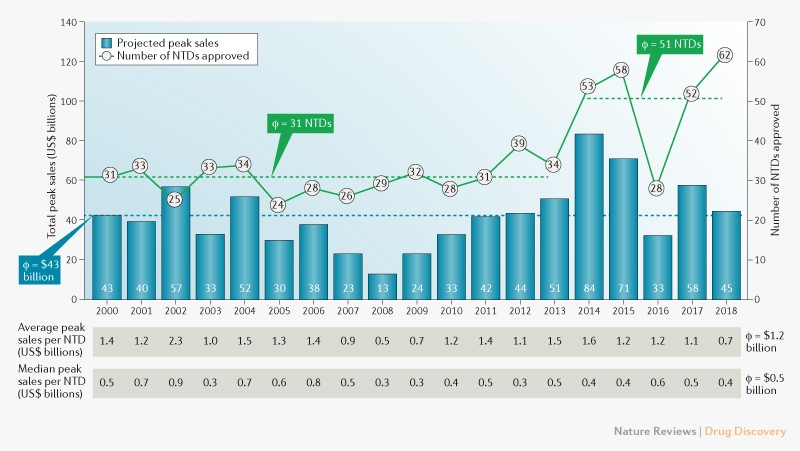
Fig. 1 | FDA approvals of new therapeutic drugs and aggregate projected peak global annual sales: 2000–2018. We analysed 2018 FDA approvals of new therapeutic drugs (NTDs), defined as new molecular entities approved by the FDA’s Center for Drug Evaluation and Research (CDER) and Center for Biologics Evaluation and Research (CBER), but with two adjustments: first, we excluded diagnostic imaging agents; and second, we included combination products with at least one new molecular entity as an active ingredient. The analysis is based exclusively on approvals by the FDA and the year in which the first indication approval took place. All peak sales values were obtained from EvaluatePharma and were inflation-adjusted to 2018 using standard global GDP-based inflators sourced from the Economist Intelligence Unit. To arrive at peak sales for each NTD, we reviewed both historical actual sales as well as the full range of forecast sales that are available from EvaluatePharma and selected the highest value. Sources: EvaluatePharma, FDA and Boston Consulting Group analysis.
SOURCE
Posted in Drug Development Process, Drug Discovery Chemistry, Pharmaceutical Analytics, Pharmaceutical Drug Discovery, Pharmaceutical Industry Competitive Intelligence, Pharmaceutical R&D Investment, Value-based Drug Pricing on February 27, 2018| Leave a Comment »
Reporter: Aviva Lev-Ari, PhD, RN
The total revenue from branded cardiovascular drugs in 2017 is projected to be just over $40 billion. Top companies in this space are putting a heavy focus on the anti-thrombotic segment, as these drugs continue to bring in the biggest profit and dominate the cardiovascular market.

Figures ($M) represent projected 2017 global sales of cardiovascular products. Credit: GlobalData.
Bayer currently holds the top spot in the market with 2017 sales of $5.4 billion; however, Sanofi and BMS come in a close second and third with sales of $5.1 and $4.7 billion, respectively.
Overall, apart from the anticoagulants segment, companies are investing less frequently due to the heavily genericized and mature nature of the cardiovascular market. This and the high cost of drug development makes the cardiovascular market hard to penetrate, especially for smaller, less established companies.
The clear leaders in sales of cardiovascular drugs are Eliquis and Xarelto (NOACs). These two drugs currently represent over 30% of the total cardiovascular market and their shares will continue to expand.
Despite high clinical unmet needs, this market is not expected to grow significantly in the near future, with the exception of the NOACs class.

Figures ($M) represent projected 2017 global sales. Credit: GlobalData.
SOURCE
https://www.pharmaceutical-technology.com/comment/top-players-cardiovascular-disease-2017/
Posted in Conference Coverage with Social Media, Drug Delivery Platform Technology, Drug Development Process, Drug Discovery Chemistry, Personalized and Precision Medicine & Genomic Research, Pharmaceutical Analytics, Pharmaceutical Discovery, Pharmaceutical Drug Discovery, Pharmaceutical Industry Competitive Intelligence, Pharmaceutical R&D Informatics, Pharmaceutical R&D Investment, Pharmacodynamics and Pharmacokinetics, Pharmacogenomics, Pharmacologic toxicities on February 21, 2018| Leave a Comment »
Reporter: Aviva Lev-Ari, PhD, RN


Dr. Aviva Lev-Ari, PhD, RN, Editor-in-Chief, PharmaceuticalIntelligence.com will be in attendance covering this event for the Press using Social Media via 12 Channels

LOGO of LPBI Group
Our Journal has 1,373,977 eReaders on 1/29/2018, for All Time and 7,283 Scientific Comments
http://pharmaceuticalintelligence.com
http://www.linkedin.com/in/avivalevari
https://www.linkedin.com/groups/my-groups
http://www.facebook.com/LeadersInPharmaceuticalBusinessIntelligence
For PROGRAMS, go to


September 26-27

September 26-27
September 27-28


Leadership we provide on curation of scientific findings in the eScientific publishing for Medical Education contents.
In Section 1, the Leadership we provide on curation of scientific findings in the eScientific publishing for Medical Education contents is demonstrated by a subset of several outstanding curations with high electronic Viewer volume. Each article included presents unique content contribution to Medical Clinical Education.
· These articles are extracted from the list of all Journal articles with >1,000 eReaders, 4/28/2012 to 1/29/2018.
Article Title, # of electronic Viewers, Author(s) Name
| Is the Warburg Effect the Cause or the Effect of Cancer: A 21st Century View? | 16,114 | Larry H. Bernstein, MD, FCAP |
| Do Novel Anticoagulants Affect the PT/INR? The Cases of XARELTO (rivaroxaban) and PRADAXA (dabigatran) | 11,606 | Vivek Lal, MBBS, MD, FCIR,
Justin D. Pearlman, MD, PhD, FACC and Aviva Lev-Ari, PhD, RN |
|||||
| Clinical Indications for Use of Inhaled Nitric Oxide (iNO) in the Adult Patient Market: Clinical Outcomes after Use, Therapy Demand and Cost of Care
|
5,865 | Aviva Lev-Ari, PhD, RN | |||||
| Peroxisome proliferator-activated receptor (PPAR-gamma) Receptors Activation: PPARγ transrepression for Angiogenesis in Cardiovascular Disease and PPARγ transactivation for Treatment of Diabetes | 1,919 | Aviva Lev-Ari, PhD, RN | |||||
| Bystolic’s generic Nebivolol – Positive Effect on circulating Endothelial Progenitor Cells Endogenous Augmentation | 1,059 | Aviva Lev-Ari, PhD, RN |
| Triple Antihypertensive Combination Therapy Significantly Lowers Blood Pressure in Hard-to-Treat Patients with Hypertension and Diabetes | 1,339 | Aviva Lev-Ari, PhD, RN |
| Select
Aviva Lev-Ari, PhD, RN 2012pharmaceutical |
3,064 Articles |
avivalev-ari@alum.berkeley.edu | Administrator | 3064 |
2.1 Volume of Articles in the Journal and in the 16 Volume-BioMed e-Series
1. Volume of Articles in the Journal since Journal inception on 4/28/2012:
· Total articles by ALL authors in Journal Archive on 1/29/2018 = 5,288
· ALL articles/posts Authored, Curated, Reported by Aviva Lev-Ari, PhD, RN = 3,064
2. Volume of Articles in the 16 Volume-BioMed e-Series
· Editorial & Publication of Articles in e-Books by Leaders in Pharmaceutical Business Intelligence: Contributions of Aviva Lev-Ari, PhD, RN
· LPBI Group’s Founder: Biography and Bibliographies – Aviva Lev-Ari, PhD, RN
https://pharmaceuticalintelligence.com/founder/
2.2 Digital Presence measured by eViews: Clicks on article by Author Name
Top Authors for all days ending 2018-01-29 (Summarized)
All Time
| Author Name | electronic Views | |
| Aviva Lev-Ari, PhD, RN [2012pharmaceutical] |
352,153 |
| Our TEAM | 5,934 |
|
||||
| Founder | 3,257 | |||||
| BioMed e-Series | 3,140 | |||||
| Journal PharmaceuticalIntelligence.com | 2,214 | |||||
| About | 2,054 | |||||
| VISION | 2,803 | |||||
LPBI Group |
1,201 |
2.3 Digital KOL Parameters
Key Opinion Leader (KOL) – Aviva Lev-Ari, PhD, RN, as Evidenced by
L.H. Bernstein, MD, FCAP
Editorial & Publication of Articles in e-Books by Leaders in Pharmaceutical Business Intelligence: Contributions of Larry H Bernstein, MD, FCAP
As BioMed e-Series Editor–in-Chief, I was responsible for the following functions of product design and product launch
· 16 Title creations for e-Books
· Designed 16 Cover Pages for a 16-Volume e-Books e-Series in BioMed
· Designed Series A eTOCs and approved of all 16 electronic Table of Contents (eTOCs), working in tandem with all the Editors of each volume and all the Author contributors of article contents in the Journal.
· Commissioned Articles by Authors/Curators per Author’s expertise on a daily basis
Below, see Volume Titles and Cover Pages:
13 LIVE results for Kindle Store: “Aviva Lev-Ari”
Oct 16, 2017 | Kindle eBook
by Larry H. Bernstein and Aviva Lev-Ari
Subscribers read for free.
$49.00$ 49 00 to buyKindle Edition
Get it TODAY, Jan 29
Sold by: Amazon Digital Services LLC
May 13, 2017 | Kindle eBook
by Larry H. Bernstein and Demet Sag
Subscribers read for free.
$100.00$ 100 00 to buyKindle Edition
Get it TODAY, Jan 29
Sold by: Amazon Digital Services LLC
Sep 4, 2017 | Kindle eBook
by Larry H. Bernstein and Aviva Lev-Ari
Subscribers read for free.
$115.00$ 115 00 to buyKindle Edition
Get it TODAY, Jan 29
Sold by: Amazon Digital Services LLC
Jun 20, 2013 | Kindle eBook
by Margaret Baker PhD and Tilda Barliya PhD
Subscribers read for free.
$75.00$ 75 00 to buyKindle Edition
Get it TODAY, Jan 29
5 out of 5 stars 6
Sold by: Amazon Digital Services LLC
Dec 9, 2017 | Kindle eBook
by Larry H. Bernstein and Aviva Lev-Ari
Subscribers read for free.
$75.00$ 75 00 to buyKindle Edition
Get it TODAY, Jan 29
Sold by: Amazon Digital Services LLC
Nov 28, 2015 | Kindle eBook
by Justin D. Pearlman MD ME PhD MA FACC and Stephen J. Williams PhD
Subscribers read for free.
$75.00$ 75 00 to buyKindle Edition
Get it TODAY, Jan 29
Sold by: Amazon Digital Services LLC
Nov 29, 2015 | Kindle eBook
by Larry H. Bernstein MD FCAP and Aviva Lev-Ari PhD RN
Subscribers read for free.
$75.00$ 75 00 to buyKindle Edition
Get it TODAY, Jan 29
Sold by: Amazon Digital Services LLC
Dec 30, 2017 | Kindle eBook
by Larry H. Bernstein and Irina Robu
Subscribers read for free.
$75.00$ 75 00 to buyKindle Edition
Get it TODAY, Jan 29
Sold by: Amazon Digital Services LLC
Jul 21, 2015 | Kindle eBook
by Larry H. Bernstein MD FCAP and Prabodah Kandala PhD
Subscribers read for free.
$75.00$ 75 00 to buyKindle Edition
Get it TODAY, Jan 29
5 out of 5 stars 1
Sold by: Amazon Digital Services LLC
Aug 10, 2015 | Kindle eBook
by Larry H Bernstein MD FCAP and Prabodh Kumar Kandala PhD
Subscribers read for free.
$75.00$ 75 00 to buyKindle Edition
Get it TODAY, Jan 29
Sold by: Amazon Digital Services LLC
Nov 22, 2015 | Kindle eBook
by Sudipta Saha PhD and Ritu Saxena PhD
Subscribers read for free.
$75.00$ 75 00 to buyKindle Edition
Get it TODAY, Jan 29
Sold by: Amazon Digital Services LLC
Dec 26, 2015 | Kindle eBook
by Larry H. Bernstein MD FACP and Aviva Lev-Ari PhD RN
Subscribers read for free.
$75.00$ 75 00 to buyKindle Edition
Get it TODAY, Jan 29
Sold by: Amazon Digital Services LLC
Dec 26, 2015 | Kindle eBook
by Justin D. Pearlman MD ME PhD MA FACC and Ritu Saxena PhD
Subscribers read for free.
$75.00$ 75 00 to buyKindle Edition
Get it TODAY, Jan 29
Sold by: Amazon Digital Services LLC
As BioMed e-Series Editor–in-Chief, Aviva Lev-Ari, PhD, RN was responsible for
· All the documentation (Instruction manuals) on Style setting, and for
· Training all team members
· Journal Articles Format
· Journal Comment Exchange Format
· e-Books Production Process:
1. Volume creation from Journal’s Article Archive,
2. Format Translation from HTML to .mobi for Kindle devices,
3. Proof reading process,
4. Title release,
5. Book electronic Upload to Amazon.com Cloud.
6. Connection of all articles and e-Books to Social Media, Ping back generation by mentioning other related articles published in the Journal
Lastly, 6, below
| Title | Date of Publication | Number of Pages |
| Perspectives on Nitric Oxide in Disease Mechanisms | 6/21/2013 | 895 |
| Cardiovascular Original Research: Cases in Methodology Design for Content Co-Curation | 11/30/2015 | 11039 KB |
| Etiologies of Cardiovascular Diseases: Epigenetics, Genetics and Genomics | 11/29/2015 | 12333 KB |
| Regenerative and Translational Medicine: The Therapeutics Promise for Cardiovascular Diseases | 12/26/2015 | 11668 KB |
| Genomics Orientations for Personalized Medicine | 11/23/2015 | 11724 KB |
| Cancer Biology & Genomics for Disease Diagnosis | 8/11/2015 | 13744 KB |
| Cancer Therapies: Metabolic, Genomics, Interventional, Immunotherapy and Nanotechnology in Therapy Delivery | 5/18/2017 | 5408 pages |
| Metabolic Genomics and Pharmaceutics | 7/21/2015 | 13927 KB |
| The Immune System, Stress Signaling, Infectious Diseases and Therapeutic Implications | 9/4/2017 | 3747 pages |
| The VOICES of Patients, Hospitals CEOs, Health Care Providers, Caregivers and Families: Personal Experience with Critical Care and Invasive Medical Procedures | 10/16/2017 | 826 pages |
| Medical Scientific Discoveries for the 21st Century & Interviews with Scientific Leaders | 12/9/2017 | 2862 pages |
| Milestones in Physiology: Discoveries in Medicine, Genomics and Therapeutics | 12/27/2015 | 11125 KB |
| Medical 3D BioPrinting – The Revolution in Medicine, Technologies for Patient-centered Medicine: From R&D in Biologics to New Medical Devices | 12/30/2017 | 1005 pages |
| Pharmacological Agents in Treatment of Cardiovascular Disease
|
Work-in-Progress, Expected Publishing date in 2018 | ??? |
| Interventional Cardiology and Cardiac Surgery for Disease Diagnosis and Guidance of Treatment | Work-in-Progress, Expected Publishing date in 2018
|
??? |
Posted in CANCER BIOLOGY & Innovations in Cancer Therapy, CAR-T, Drug Development Process, Drug Discovery Chemistry, Immuno-Oncology & Genomics, Immunotherapy, Personalized and Precision Medicine & Genomic Research, Pharmaceutical Analytics, Pharmaceutical Discovery, Pharmaceutical Drug Discovery, Pharmacogenomics on August 30, 2017| Leave a Comment »
Curator: Aviva Lev-Ari, PhD, RN
UPDATED on 12/10/2019
For an ‘acquisitive’ Gilead, 2020 will be key test for CAR-T plans
Success for Kite, which O’Day made an independent unit, is critical for Gilead. Not only did the California biotech invest a large sum to buy the CAR-T specialist, it’s the most notable bet made on a future outside of drugs for HIV and hepatitis C.
Sentiment on Wall Street has begun to turn against the wisdom of Gilead’s choice, doubting CAR-T will live up to the promise envisioned by O’Day’s predecessors. One analyst went so far as to include the acquisition among the five most value-destroying biopharma deals of the past decade.
Commercially, sales of Yescarta have grown to $334 million through the first nine months of the year, up from $183 million during the same period last year. Still, marketing CAR-T has proved challenging, with hurdles in reimbursement and in-hospital administration particularly acute.
The coming year could prove consequential in shifting Kite’s trajectory higher.
Within the next few weeks, Gilead will ask regulators to approve its second CAR-T cell therapy, a variation of its currently cleared leukemia and lymphoma treatment Yescarta that’s manufactured differently.
A new site in Europe coming online next year could substantially cut times down for Yescarta delivery there, Shaw said. (Globally, Novartis appears better positioned, with sites in Switzerland and France as well as partnerships in China, Japan and Australia.)
Automation of what’s now a mostly manual process will play an important role in CAR-T’s future too, according to Shaw.
“If we get our autologous cell therapy automated very well, you could imagine one day it could be at point of care,” she said. “We don’t want to be disrupted by someone else doing that.”
Disruption could also come in the form of allogeneic cell therapies, which are constructed using donor T cells rather than autologous treatments that use a patient’s own. Numerous clinical hurdles have made that approach more difficult but companies like Allogene — founded by former Kite executives — are moving ahead.
SOURCE
https://www.biopharmadive.com/news/gilead-kite-car-t-christi-shaw-dealmaking/568767/
UPDATED on 5/3/2019
Gilead Sciences tapped new CEO Daniel O’Day in part because of his cancer expertise. But he’s not planning to lead the company’s oncology ramp-up alone.
The Roche veteran intends to bring on a CEO for Gilead’s Kite unit, responsible for key CAR-T drug Yescarta. The new chief will report to O’Day and operate Kite as a separate business unit, JPMorgan analyst Cory Kasimov wrote in a Thursday note to clients.
RELATED: Gilead, looking for cancer sales, swipes Roche pharma chief Daniel O’Day for CEO post
Gilead acquired Kite in 2017 for $12 billion as its hepatitis C revenues, once its bread and butter, crashed. But so far, both Yescarta and Novartis’ rival CAR-T player, Kymriah, have struggled, thanks to a mix of reimbursement and manufacturing challenges.
Kite underperformed expectations once again in the first quarter, with Yescarta’s $96 million in sales for the period checking in below Wall Street consensus of $105 million.
O’Day doesn’t expect to see that trend continue, though. On Gilead’s earnings conference call, he “proclaimed his confidence in cell therapy, noting that it was a critical element of the company’s long term strategy,” Kasimov wrote.
Getting Gilead’s commercial business in order is just one of O’Days three main priorities as he settles into the CEO role, though. After taking the reins March 1, he decided to zero in on strengthening Gilead’s pipeline, in part through M&A. And he’ll also be making organizational tweaks to “ensure the right people are in the right place,” as Kasimov put it.
Gilead is “continuing to scan the entirety” of the M&A landscape and “acknowledges they will continue to ‘look at late stage pipeline,’” while keeping an eye on the company’s areas of expertise—oncology, HIV and hepatitis B and nonalcoholic steatohepatitis, Jefferies analyst Michael Yee wrote to his own clients. And the Big Biotech will be “accelerating internal” candidates in addition to adding bolt-on buys.
RELATED: Gilead executives predict patience—and some deal scouting—from new CEO Daniel O’Day
Unsurprisingly, analysts trained their attention on the call to O’Day’s strategy comments, and “there were literally minimal to no questions about financials,” Yee noted. But that doesn’t mean Gilead turned in a bad quarter. On the contrary, the first quarter was “fairly clean,” he wrote, with revenues of $5.28 billion meeting expectations and earnings per share of $1.76 topping forecasts by 15 cents.
New HIV hotshot Biktarvy stole the show on the revenue side, blowing the $648 million consensus prediction out of the water with $793 million in quarterly sales.
In the quarter, “about 80% of Biktarvy revenue came from switches with 25% from dolutegravir-containing regimens in the U.S.,” Kasimov wrote, referencing key combinations from Gilead’s HIV archrival, GlaxoSmithKline.
UPDATED on 9/7/2017
Here’s the inside account of Gilead’s 11-week sprint to its $12B Kite buyout – ENDPOINTS NEWS
UPDATED on 8/31/2017
Gilead-Kite: A New Transformative Deal For Biotech, AUG 30, 2017
Gilead has made a big bet on new technology in Kite’s immunotherapy platforms and has reduced the number of credible large players in the space.
With a reputation for intense diligence and dynamism in its business development efforts, Gilead’s management team will only bolster the immunotherapy field as it prepares to face off with Novartis, its immediate competitor, and enters squarely in the province of Merck and Bristol Myers Squibb, two of the leaders in immuno-oncology.
Gilead has reinvented the transformative transaction for the sector.
I attended this week the Cambridge Healthtech Institute’s 4th Annual
Delivering CAR, TCR, and TIL from Research to Reality
August 29 – 30, 2017 | Sheraton Boston | Boston, MA
The following talks on 8/29/2017 presented the frontier of CAR-T Therapies and Technologies from lab to bed side:
Mark Bonyhadi, Ph.D., Head, Research and Academic Affairs, Juno Therapeutics
Richard Morgan, Ph.D., Vice President, Immunotherapy, Bluebird Bio
Boro Dropulic, Ph.D., General Manager and CSO, Lentigen Technology, Inc.
I covered this event in Real Time for the Press
LIVE – 8/29 – CHI’s Oncolytic Virus Immunotherapy and ADOPTIVE CELL THERAPY, August 28-29, 2017 Sheraton Boston Hotel | Boston, MA
What does this mean for Immunotherapy? FDA put a temporary hold on Juno’s JCAR015, Three Death of Celebral Edema in CAR-T Clinical Trial and Kite Pharma announced Phase II portion of its CAR-T ZUMA-1 trial

Lydia Ramsey reported on Aug. 28, 2017 that Gilead just handed a revolutionary kind of cancer treatment a $12 billion endorsement.
For Gilead, which is known for its HIV and hepatitis C medications, this is an entirely new area of cancer development.
“The field of cell therapy has advanced very quickly, to the point where the science and technology have opened a clear path toward a potential cure for patients,” Gilead CEO John Milligan said in a news release. “We are greatly impressed with the Kite team and what they have accomplished, and share their belief that cell therapy will be the cornerstone of treating cancer.”
In July, a Food and Drug Administration panel voted in favor of approving one of these treatments made by Novartis. One of the panelists called it “most exciting thing I’ve seen in my lifetime.” The FDA is expected to decide whether to approve that therapy, a treatment for pediatric acute lymphoblastic lymphoblastic leukemia, by October.
Gilead won’t have to wait long to see if the FDA will approve Kite’s leading cell therapy, which is called axicabtagene ciloleucel or axi-cel. In November, Kite is expected to get an answer from the FDA regarding its CAR-T treatment for a type of blood cancer called aggressive B-cell non-Hodgkin lymphoma. In data Kite released in February, the company found that out of 101 patients, 36% had a complete response to the treatment after six months.
The one-time treatments won’t come cheap. While companies might price the drug based on how well it works, axi-cel’s price tag could still be $325,000. Analysts expect the therapy to generate $1.7 billion in sales by 2022.
While its axi-cel program is the farthest along, Kite’s also working on another CAR-T cell therapy that’s in clinical trialsto treat multiple myeloma, another form of blood cancer. The company’s also working on cell therapies to treat solid tumors that are still in early clinical trials.
On August 30, 2017, John Carroll writes:
[A]pproval marks a major shift in oncology, with a truly revolutionary approach to treating cancer.
The FDA has approved the world’s first CAR-T therapy, giving a green light to Novartis for Kymriah (tisagenlecleucel) in what regulators themselves describe as an historic event.
The accelerated approval — about a month ahead of the PDUFA date — came through for certain pediatric and young adult patients with a form of acute lymphoblastic leukemia
Novartis, the leader in the field, which will set the price on this therapy and likely those to come. Novartis’ investigators registered a game-changing 83% remission rate in its pivotal study.
CAR-T, though, is also associated with severe and potentially deadly side effects, including lethal instances of cytokine release syndrome with some patients dying from brain swelling in separate studies from the Novartis drug.
Regulators noted that they will require special training for anyone involved in delivering this therapy, while expanding the approval of Actemra (tocilizumab) to treat CAR T-cell-induced severe or life-threatening CRS in patients 2 years of age or older. “In clinical trials in patients treated with CAR-T cells,” the FDA reported, “69% of patients had complete resolution of CRS within two weeks following one or two doses of Actemra.”
Said Joseph Jimenez, CEO of Novartis:
“Five years ago, we began collaborating with the University of Pennsylvania and invested in further developing and bringing what we believed would be a paradigm-changing immunocellular therapy to cancer patients in dire need. With the approval of Kymriah, we are once again delivering on our commitment to change the course of cancer care.”
This approval marks a major shift in oncology, with a truly revolutionary approach to treating cancer. That hasn’t escaped the notice of big players and small, with a host of developers looking to do much better, more safely, with new drugs in the pipeline.
SOURCE
From: “John Carroll [Endpoints News]” <john@endpointsnews.com>
Reply-To: <john@endpointsnews.com>
Date: Wednesday, August 30, 2017 at 11:27 AM
To: Aviva Lev-Ari <AvivaLev-Ari@alum.berkeley.edu>
Subject: BREAKING: FDA ushers in a new era in cancer treatment with ‘historic’ CAR-T approval for Novartis
When researchers looked at the safety profile of canakinumab, they found something amazing — a major reduction in the risk of fatal cancers. This was driven by an effect of the highest dose of the drug to prevent lung cancer. The 300 mg dose reduced the occurrence of lung cancer by 67% and death from lung cancer by 77%. It was Viagra all over again.
SOURCE
In this Revolution and Revelation, Milton Packer explains how safety data can sometimes trump a primary endpoint
by August 30, 2017
https://www.medpagetoday.com/Blogs/RevolutionandRevelation/67605
Posted in Cancer and Current Therapeutics, Pharmaceutical Analytics, Pharmaceutical Industry Competitive Intelligence, tagged AbbVie AMGen AstraZeneca BMS Bristol-Myers Squibb cancer CHMP FDA GSK Janssen Keytruda Merck multiple myelomanew drugs nivolumab Novartis oncology Opdivo Pfizer Roche on January 3, 2017| Leave a Comment »
Reporter: Aviva Lev-Ari, PhD, RN
UPDATED on 8/29/2020
The top 10-selling cancer drugs generated a combined $63.58 billion in sales in 2018, up 17.5% from $54.126 billion in 2017. Seven of this year’s top 10 showed year-over-year increases in sales, of which six enjoyed double-digit gains.
Ranking #15 through #11 among cancer best-sellers are Takeda/Johnson & Johnson’s Velcade® (bortezomib); Incyte/Novartis’ Jakafi®/Jakavi® (ruxolitinib); Genentech (Roche)’s Perjeta (pertuzumab); Merck & Co.’s Gardasil/Gardasil 9; and J&J’s Zytiga® (abiraterone acetate). The treatments generated between $2.274 billion and $3.498 billion last year.
10. Xtandi® (enzalutamide)
Astellas Pharma and Pfizer
Type of Drug: Androgen receptor inhibitor
2018 Sales: $3.624 billion (¥327.8 billion [$2.925 billion Astellas + $0.699 billion Pfizer)
2017 Sales: $3.116 billion (¥282.8 billion [$2.526 billion Astellas + $0.590 billion Pfizer)
% Change: 16.3%
9. Ibrance® (palbociclib)
Pfizer
Type of Drug: Kinase inhibitor
2018 Sales: $4.118 billion 1
2017 Sales: $3.126 billion 1
% Change: 31.7%
8. Neulasta/Peglasta (pegfilgrastim)
Amgen and Kyowa Hakko Kirin
Type of Drug: Leukocyte growth factor
2018 Sales: $4.684 billion ($4.475 billion Amgen + $0.209 billion [¥23.1 billion] Kyowa Hakko Kirin)
2017 Sales: $4.716 billion ($4.534 billion Amgen + $0.182 billion [¥20.1 billion] Kyowa Hakko Kirin)
% Change: -0.7%
7. Imbruvica® (ibrutinib)
Pharmacyclics (AbbVie) and Johnson & Johnson (J&J)
Type of Drug: Kinase inhibitor
2018 Sales: $6.205 billion ($3.590 billion Pharmacyclics [AbbVie] + $2.615 billion J&J)
2017 Sales: $4.466 billion ($2.573 billion Pharmacyclics [AbbVie] + $1.893 billion J&J)
% Change: 38.9%
6. Rituxan®/MabThera (rituximab)
Genentech (Roche) and Biogen 2
Type of Drug: CD20-directed cytolytic antibody
2018 Sales: $6.750 billion [CHF 6.752 billion] 2
2017 Sales: $7.298 billion [CHF 7.300 billion] 2
% Change: -7.5%
5. Avastin
Roche
Type of Drug: Vascular endothelial growth factor–directed antibody
2018 Sales: $6.822 billion (CHF 6.849 billion)
2017 Sales: $6.662 billion (CHF 6.688 billion)
% Change: 2.4%
4. Herceptin
Roche (Genentech)
Type of Drug: HER2/neu receptor antagonist
2018 Sales: $6.951 billion (CHF 6.982 billion)
2017 Sales: $6.983 billion (CHF 7.014 billion)
% Change: -0.5%
3. Keytruda
Merck & Co.
Type of Drug: Programmed death receptor-1 (PD-1)-blocking antibody
2018 Sales: $7.171 billion
2017 Sales: $3.809 billion
% Change: 88.3%
2. Opdivo
Bristol-Myers Squibb (BMS) and Ono Pharmaceutical
Type of Drug: Programmed death receptor-1 (PD-1) blocking antibody
2018 Sales: $7.570 billion ($6.735 billion BMS + $835 million [¥92.5 billion] Ono)
2017 Sales: $5.763 billion ($4.948 billion BMS + $815 million [¥90.2 billion] Ono)
% Change: 31.4%
1. Revlimid
Celgene
Type of Drug: Thalidomide analogue
2018 Sales: $9.685 billion
2017 Sales: $8.187 billion
% Change: 18.3%
References
1. Despite the year-over-year sales increase, Pfizer said international Ibrance revenues were negatively impacted by a one-time price adjustment to full-year 2017 revenues related to finalizing reimbursement agreements in certain developed Europe markets
2. Biogen receives a share of U.S. pre-tax profits on sales of Rituxan, which is marketed by Genentech (Roche). Sales figures do not include U.S. pre-tax profits generated by Biogen, since the company only discloses those profits combined with profits from Gazyva® (obinutuzumab), and does not break out each product separately. Biogen reported combined Rituxan-Gazyva pre-tax profits of $1.432 billion for 2018, and $1.316 billion for 2017.
SOURCE
https://www.genengnews.com/a-lists/top-10-best-selling-cancer-drugs-of-2018/
UPDATED on 1/17/2017
All told, by 2022, the top 15 cancer drugs are expected to collectively make almost $90 billion in sales. To put that in perspective, that represents about one-fourth of the entire U.S. pharma market in 2014, according to QuintilesIMS data. It’s also bigger than pharma’s haul in Japan or China that year.
It will likely be no revelation that three drugs among the top six on our list—provided courtesy of EvaluatePharma and Chempetitive—come from the highly touted PD-1/PD-L1 or checkpoint inhibitor class.
SOURCE
|
Top Oncology Medicines
|
Projected Sales in 2020 |
| Revlimid (Celgene)
Generic Name: Lenalidomide |
$10,110 Million
|
| Imbruvica (AbbVie/J&J)
Generic Name: Ibrutinib |
$8,213 Million
|
| Avastin (Roche)
Generic Name: Bevacizumab |
$ 6,733 Million
|
| Opdivo (BMS)
Generic Name: Nivolumab |
$ 6,201 Million
|
| Xtandi (Medivation & Astellas)
Generic Name: Enzalutamide |
$5,700 Million
|
| Rituxan (Roche)
Generic Name: Rituximab |
$5,407 Million
|
| Ibrance (Pfizer)
Generic Name: Palbociclib |
$4,722 Million
|
| Perjeta (Roche)
Generic Name: Pertuzumab |
$4,669 Million
|
| Herceptin (Roche)
Generic Name: Trastuzumab |
$4,573 Million
|
| Keytruda (Merck)
Generic Name: Pembrolizumab |
$3,560 Million |
SOURCE
https://igeahub.com/2016/04/01/worlds-top-ten-cancer-drugs-by-2020/

Igea gives professionals, patients and investors interested in pharmaceuticals, biotechnology, healthcare technology, diagnostics and medical devices the most relevant, actionable news, information and analysis available anywhere. Our goal is to provide expert insights, analysis and information from industry leaders with a deep understanding of life sciences, medicine and healthcare. Created and curated by Luca Dezzani, MD, Global Medical Director at Novartis Oncology*, Igea offers an insider’s view on the most important developments in life sciences, healthcare technology, digital health and more.


Posted in Autoimmune Inflammatory DIseases, Biological Networks, Biological Networks, Gene Regulation and Evolution, Biomarkers & Medical Diagnostics, Biomedical Measurement Science, Cancer Informatics, Cell Biology, Signaling & Cell Circuits, Chemical Biology and its relations to Metabolic Disease, Chemical Genetics, Clinical Diagnostics, Clinical Genomics, Computational Biology/Systems and Bioinformatics, Developmental biology, Diagnostic Immunology, Diagnostics and Lab Tests, Disease Biology, Disease Biology, Small Molecules in Development of Therapeutic Drugs, DNA repair, Drug Delivery Platform Technology, Drug Development Process, Enzyme Induction, Epigenetics and Environmental Factors, Gene Regulation and Evolution, Genetics & Innovations in Treatment, Genetics & Pharmaceutical, Genomic Testing: Methodology for Diagnosis, Human Immune System in Health and in Disease, Human Sensation and Cellular Transduction: Physiology and Therapeutics, Immuno-Oncology & Genomics, Immunodiagnostics, Immunotherapy, Innovation in Immunology Diagnostics, International Global Work in Pharmaceutical, Investment in Technological Breakthrough, Medical and Population Genetics, Microbiologial genetics, Microbiology, Molecular Genetics & Pharmaceutical, Pharmaceutical Analytics, Pharmaceutical Discovery, Pharmaceutical Drug Discovery, Pharmaceutical Industry Competitive Intelligence, Pharmacogenomics, Population genetics, RNA Biology, RNA Biology, Cancer and Therapeutics, Signaling & Cell Circuits, Small Molecules in Development of Therapeutic Drugs, Technology Transfer: Biotech and Pharmaceutical on September 11, 2016| Leave a Comment »

Chief Scientific Officer
Leaders in Pharmaceutical Business Intelligence
Preface
Introduction
Chapter 1: Evolution of the Foundation for Diagnostics and Pharmaceuticals Industries
1.1 Outline of Medical Discoveries between 1880 and 1980
1.2 The History of Infectious Diseases and Epidemiology in the late 19th and 20th Century
1.3 The Classification of Microbiota
1.4 Selected Contributions to Chemistry from 1880 to 1980
1.5 The Evolution of Clinical Chemistry in the 20th Century
1.6 Milestones in the Evolution of Diagnostics in the US HealthCare System: 1920s to Pre-Genomics
Chapter 2. The search for the evolution of function of proteins, enzymes and metal catalysts in life processes
2.1 The life and work of Allan Wilson
2.2 The evolution of myoglobin and hemoglobin
2.3 More complexity in proteins evolution
2.4 Life on earth is traced to oxygen binding
2.5 The colors of life function
2.6 The colors of respiration and electron transport
2.7 Highlights of a green evolution
Chapter 3. Evolution of New Relationships in Neuroendocrine States
3.1 Pituitary endocrine axis
3.2 Thyroid function
3.3 Sex hormones
3.4 Adrenal Cortex
3.5 Pancreatic Islets
3.6 Parathyroids
3.7 Gastointestinal hormones
3.8 Endocrine action on midbrain
3.9 Neural activity regulating endocrine response
3.10 Genomic Promise for Neurodegenerative Diseases, Dementias, Autism Spectrum, Schizophrenia, and Serious Depression
Chapter 4. Problems of the Circulation, Altitude, and Immunity
4.1 Innervation of Heart and Heart Rate
4.2 Action of hormones on the circulation
4.3 Allogeneic Transfusion Reactions
4.4 Graft-versus Host reaction
4.5 Unique problems of perinatal period
4.6. High altitude sickness
4.7 Deep water adaptation
4.8 Heart-Lung-and Kidney
4.9 Acute Lung Injury
4.10 Reconstruction of Life Processes requires both Genomics and Metabolomics to explain Phenotypes and Phylogenetics
Chapter 5. Problems of Diets and Lifestyle Changes
5.1 Anorexia nervosa
5.2 Voluntary and Involuntary S-insufficiency
5.3 Diarrheas – bacterial and nonbacterial
5.4 Gluten-free diets
5.5 Diet and cholesterol
5.6 Diet and Type 2 diabetes mellitus
5.7 Diet and exercise
5.8 Anxiety and quality of Life
5.9 Nutritional Supplements
Chapter 6. Advances in Genomics, Therapeutics and Pharmacogenomics
6.1 Natural Products Chemistry
6.2 The Challenge of Antimicrobial Resistance
6.3 Viruses, Vaccines and immunotherapy
6.4 Genomics and Metabolomics Advances in Cancer
6.5 Proteomics – Protein Interaction
6.6 Pharmacogenomics
6.7 Biomarker Guided Therapy
6.8 The Emergence of a Pharmaceutical Industry in the 20th Century: Diagnostics Industry and Drug Development in the Genomics Era: Mid 80s to Present
6.09 The Union of Biomarkers and Drug Development
6.10 Proteomics and Biomarker Discovery
6.11 Epigenomics and Companion Diagnostics
Chapter 7
Integration of Physiology, Genomics and Pharmacotherapy
7.1 Richard Lifton, MD, PhD of Yale University and Howard Hughes Medical Institute: Recipient of 2014 Breakthrough Prizes Awarded in Life Sciences for the Discovery of Genes and Biochemical Mechanisms that cause Hypertension
7.2 Calcium Cycling (ATPase Pump) in Cardiac Gene Therapy: Inhalable Gene Therapy for Pulmonary Arterial Hypertension and Percutaneous Intra-coronary Artery Infusion for Heart Failure: Contributions by Roger J. Hajjar, MD
7.3 Diagnostics and Biomarkers: Novel Genomics Industry Trends vs Present Market Conditions and Historical Scientific Leaders Memoirs
7.4 Synthetic Biology: On Advanced Genome Interpretation for Gene Variants and Pathways: What is the Genetic Base of Atherosclerosis and Loss of Arterial Elasticity with Aging
7.5 Diagnosing Diseases & Gene Therapy: Precision Genome Editing and Cost-effective microRNA Profiling
7.6 Imaging Biomarker for Arterial Stiffness: Pathways in Pharmacotherapy for Hypertension and Hypercholesterolemia Management
7.7 Neuroprotective Therapies: Pharmacogenomics vs Psychotropic drugs and Cholinesterase Inhibitors
7.8 Metabolite Identification Combining Genetic and Metabolic Information: Genetic association links unknown metabolites to functionally related genes
7.9 Preserved vs Reduced Ejection Fraction: Available and Needed Therapies
7.10 Biosimilars: Intellectual Property Creation and Protection by Pioneer and by
7.11 Demonstrate Biosimilarity: New FDA Biosimilar Guidelines
Chapter 7. Biopharma Today
8.1 A Great University engaged in Drug Discovery: University of Pittsburgh
8.2 Introduction – The Evolution of Cancer Therapy and Cancer Research: How We Got Here?
8.3 Predicting Tumor Response, Progression, and Time to Recurrence
8.4 Targeting Untargetable Proto-Oncogenes
8.5 Innovation: Drug Discovery, Medical Devices and Digital Health
8.6 Cardiotoxicity and Cardiomyopathy Related to Drugs Adverse Effects
8.7 Nanotechnology and Ocular Drug Delivery: Part I
8.8 Transdermal drug delivery (TDD) system and nanotechnology: Part II
8.9 The Delicate Connection: IDO (Indolamine 2, 3 dehydrogenase) and Cancer Immunology
8.10 Natural Drug Target Discovery and Translational Medicine in Human Microbiome
8.11 From Genomics of Microorganisms to Translational Medicine
8.12 Confined Indolamine 2, 3 dioxygenase (IDO) Controls the Homeostasis of Immune Responses for Good and Bad
Chapter 9. BioPharma – Future Trends
9.1 Artificial Intelligence Versus the Scientist: Who Will Win?
9.2 The Vibrant Philly Biotech Scene: Focus on KannaLife Sciences and the Discipline and Potential of Pharmacognosy
9.3 The Vibrant Philly Biotech Scene: Focus on Computer-Aided Drug Design and Gfree Bio, LLC
9.4 Heroes in Medical Research: The Postdoctoral Fellow
9.5 NIH Considers Guidelines for CAR-T therapy: Report from Recombinant DNA Advisory Committee
9.6 1st Pitch Life Science- Philadelphia- What VCs Really Think of your Pitch
9.7 Multiple Lung Cancer Genomic Projects Suggest New Targets, Research Directions for Non-Small Cell Lung Cancer
9.8 Heroes in Medical Research: Green Fluorescent Protein and the Rough Road in Science
9.9 Issues in Personalized Medicine in Cancer: Intratumor Heterogeneity and Branched Evolution Revealed by Multiregion Sequencing
9.10 The SCID Pig II: Researchers Develop Another SCID Pig, And Another Great Model For Cancer Research
Epilogue



 2012pharmaceutical
 sjwilliamspa