Feeds:
Posts
Comments

Archive for the ‘Etiology’ Category

Long Term Memory and Prions

Larry H. Bernstein, MD, FCAP, Curator

LPBI


updated 12/12/2015


Possible biochemical mechanism underlying long-term memories identified

Why is a prion-like molecular state necessary for persistence of memory? Could a transient memory be made permanent with a “Limitless” NZT-type neurotropic drug — or permanently forgotten?

It’s a nagging question: why do some of our memories fade away, while others last forever? Now scientists at the Stowers Institute for Medical Research have identified a possible biochemical mechanism: a specific synaptic protein called Orb2 can either block or maintain neural synapses (connections between neurons), which create and maintain long-term memories.

So for a memory to persist, the synaptic connections must be kept strong. But how? The researchers previously identified a synaptic protein called CPEB that is responsible for maintaining the strength of such connections in the sea slug (a model organism used in memory research). Recently, they identified a similar protein, called Orb2, in the fruit fly.

Now, using a fruit fly model system, they found that the synaptic connections are kept strong by the transformation of Orb2 from one molecular state to another. And that transformation causes Orb2 molecules to solidify and strengthen the memory connections in the brain.

The authors conclude their paper, published in the current issue of the journal Cell, with several questions. How and what triggers this transformation, how long does it persist? Is the continued presence of a prion-like state necessary for the persistence of memory, and is it correlated with or predictive of long-lasting memory? And most interestingly: can a transient memory about to be forgotten be stabilized by artificial recruitment of the prion-like state (perhaps by a neurotropic compound)?

And what about that ironic link with prions, associated with neurodegenerative disorders? Are prions some twisted form of memory that could one day even have value? We’ll be keeping an eye on where this fascinating research leads.

Technical details: the memory switch

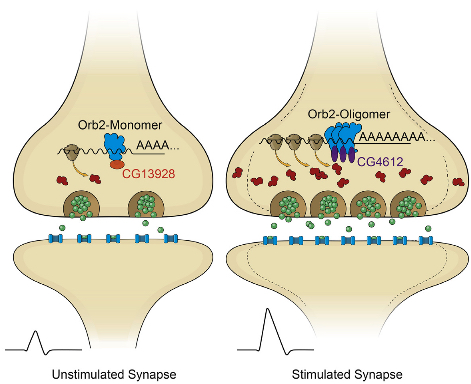
In their latest study, the researchers determined that Orb2 exists in two distinct physical states: monomeric (a single molecule that can bind to other molecules) and oligomeric (a molecular complex).

Like CPEB, oligomeric Orb2 is prion-like — that is, it’s a self-copying cluster. (But unlike prions, oligomeric Orb2 and CPEB are not toxic.) Monomeric Orb2 represses, and oligomeric Orb2 activates a crucial step in the complex cellular process that leads to protein synthesis.

During this crucial step, messenger RNA (mRNA), which is an RNA copy of a gene’s recipe for a protein, is translated by the cell’s ribosome into the sequence of amino acids that will make up a newly synthesized protein. The monomeric form of Orb2 binds to the target mRNA, keeping it in a repressed state.

The Stowers scientists also determined that prion-like Orb2 not only activates translation into amino acids but imparts its translational state to nearby monomer forms of Orb2. As a result, monomeric Orb2 is transformed into prion-like Orb2, so its role in translation switches from repression to activation.

Self-sustaining activation maintains synaptic activity

Stowers Associate Investigator Kausik Si, Ph.D. thinks this switch is the possible mechanism by which fleeting experiences create an enduring memory. “Because of the self-sustaining nature of the prion-like state, this creates a local and self-sustaining translation activation of Orb2-target mRNA, which maintains the changed state of synaptic activity over time,” says Si.

The discovery that the two distinct states of Orb2 have opposing roles in the translation process provides “for the first time a biochemical mechanism of synapse-specific persistent translation and long-lasting memory,” he states.

“To our knowledge, this is the first example of a prion-based protein switch that turns a repressor into an activator,” Si adds. “The recruitment of distinct protein complexes at the non-prion and prion-like forms to create altered activity states indicates the prion-like behavior is in essence a protein conformation-based switch.

“Through this switch, a protein can lose or gain a function that can be maintained over time in the absence of the original stimuli. Although such a possibility has been anticipated prior to this study, there was no direct evidence.”

The research builds upon previous studies by Si and Eric Kandel, M.D., of Columbia University and other scientists. These studies revealed that both short-term and long-term memories are created in synapses.


Abstract of Amyloidogenic Oligomerization Transforms Drosophila Orb2 from a Translation Repressor to an Activator

Memories are thought to be formed in response to transient experiences, in part through changes in local protein synthesis at synapses. In Drosophila, the amyloidogenic (prion-like) state of the RNA binding protein Orb2 has been implicated in long-term memory, but how conformational conversion of Orb2 promotes memory formation is unclear. Combining in vitro and in vivo studies, we find that the monomeric form of Orb2 represses translation and removes mRNA poly(A) tails, while the oligomeric form enhances translation and elongates the poly(A) tails and imparts its translational state to the monomer. The CG13928 protein, which binds only to monomeric Orb2, promotes deadenylation, whereas the putative poly(A) binding protein CG4612 promotes oligomeric Orb2-dependent translation. Our data support a model in which monomeric Orb2 keeps target mRNA in a translationally dormant state and experience-dependent conversion to the amyloidogenic state activates translation, resulting in persistent alteration of synaptic activity and stabilization of memory.


New Finding on Synapse Destruction May Open Path to Alzheimer’s Therapy

http://www.genengnews.com/gen-news-highlights/new-finding-on-synapse-destruction-may-open-path-to-alzheimer-s-therapy/81252029/

A team led by scientists at the University of New South Wales in Australia say they have discovered how connections between brain cells are destroyed in the early stages of Alzheimer’s disease. They believe their work opens up a new avenue for research on possible treatments for the degenerative brain condition.

“One of the first signs of Alzheimer’s disease is the loss of synapses—the structures that connect neurons in the brain,” noted study leader, Vladimir Sytnyk, Ph.D., of the UNSW School of Biotechnology and Biomolecular Sciences. “Synapses are required for all brain functions, and particularly for learning and forming memories. In Alzheimer’s disease, this loss of synapses occurs very early on, when people still only have mild cognitive impairment, and long before the nerve cells themselves die. We have identified a new molecular mechanism which directly contributes to this synapse loss, a discovery we hope could eventually lead to earlier diagnosis of the disease and new treatments.”

The team studied a specific protein in the brain, neural cell adhesion molecule 2 (NCAM2), one of a family of molecules that physically connects the membranes of synapses and help stabilize these long lasting synaptic contacts between neurons. The researchers paper (“Aβ-dependent reduction of NCAM2-mediated synaptic adhesion contributes to synapse loss in Alzheimer’s disease”) is published in Nature Communications.

Using post-mortem brain tissue from people with and without the condition, they discovered that synaptic NCAM2 levels in the part of the brain known as the hippocampus were low in those with Alzheimer’s disease. They also showed in mice studies and in the laboratory that NCAM2 was broken down by beta-amyloid, which is the main component of the plaques that build up in the brains of people with the disease.

“Our research shows the loss of synapses is linked to the loss of NCAM2 as a result of the toxic effects of beta-amyloid,” pointed out Dr. Sytnyk. “It opens up a new avenue for research on possible treatments that can prevent the destruction of NCAM2 in the brain.”


Aβ-dependent reduction of NCAM2-mediated synaptic adhesion contributes to synapse loss in Alzheimer’s disease

Iryna Leshchyns’kaHeng Tai LiewClaire ShepherdGlenda M. HallidayClaire H. StevensYazi D. KeLars M. Ittner & Vladimir Sytnyk
Nature Communications Nov 2015; 6(8836)        doi:10.1038/ncomms9836

Alzheimer’s disease (AD) is characterized by synapse loss due to mechanisms that remain poorly understood. We show that the neural cell adhesion molecule 2 (NCAM2) is enriched in synapses in the human hippocampus. This enrichment is abolished in the hippocampus of AD patients and in brains of mice overexpressing the human amyloid-β (Aβ) precursor protein carrying the pathogenic Swedish mutation. Aβ binds to NCAM2 at the cell surface of cultured hippocampal neurons and induces removal of NCAM2 from synapses. In AD hippocampus, cleavage of the membrane proximal external region of NCAM2 is increased and soluble extracellular fragments of NCAM2 (NCAM2-ED) accumulate. Knockdown of NCAM2 expression or incubation with NCAM2-ED induces disassembly of GluR1-containing glutamatergic synapses in cultured hippocampal neurons. Aβ-dependent disassembly of GluR1-containing synapses is inhibited in neurons overexpressing a cleavage-resistant mutant of NCAM2. Our data indicate that Aβ-dependent disruption of NCAM2 functions in AD hippocampus contributes to synapse loss.


Learning and memory processes depend on the number and correct functioning of synapses in the brain. Cell adhesion molecules are enriched in the pre- and postsynaptic membranes. These molecules physically connect synaptic membranes, providing mechanical stabilization of synaptic contacts1, 2, 3, are necessary for the formation of new synapses during neuronal development4, 5, and maintain and regulate synaptic plasticity in adults6, 7, 8, 9, 10.

Alzheimer’s disease (AD) is a neurodegenerative brain condition predominantly of the aging population. One of the earliest signs of AD is the loss of synapses11, which can at least partially be linked to the toxicity mediated by Aβ12, 13, 14, a peptide that accumulates in the brains of AD patients. The impact of AD on synaptic adhesion and the role of synaptic cell adhesion molecules in the progression of the disease remains poorly understood.

The neural cell adhesion molecule 2 (NCAM2), sometimes designated OCAM, belongs to the immunoglobulin superfamily of cell adhesion molecules. NCAM2 participates in homophilic trans-interactions15, 16. During human embryonic development, NCAM2 is expressed in several tissues, including lung, liver, and kidney with the highest expression in the brain17. The expression level of NCAM2 peaks around postnatal day 21 and remains high during adulthood15, suggesting that the protein is necessary both during development and in adult brains. Accordingly, studies with cultured neurons and in NCAM2 deficient mice show that NCAM2 is important for the development of the brain, and the olfactory system in particular18, 19.

The NCAM2 gene is located on chromosome 21 in humans and NCAM2 overexpression has been suggested to be one of the factors contributing to the symptoms of Down syndrome17, which presents with early-onset AD pathology. Single-nucleotide polymorphisms in the NCAM2 gene have been reported as a risk factor related to the progression of AD in the Japanese population20. A recent genome-wide association study has found an association between single-nucleotide polymorphisms in the NCAM2 gene and levels of Aβ in the cerebrospinal fluid in humans, suggesting that NCAM2 is involved in the pathogenic pathway to the senile plaques that concentrate in AD brains21. Since genetic association studies indicate a link between NCAM2 and AD, we have analysed whether AD pathology influences levels of NCAM2 in synapses. Our results indicate that the synaptic adhesion mediated by NCAM2 is highly susceptible to Aβ toxicity and that proteolytic fragments of NCAM2 generated in an Aβ-dependent manner can directly contribute to the induction of synapse disassembly.


Synaptic NCAM2 is reduced in the hippocampus in AD

To analyse whether functions of NCAM2 are affected in AD, frozen post-mortem brain tissue of AD patients and non-affected controls (n=10 each) was analysed by western blot with antibodies against NCAM2. The detailed demographic data for the subjects analysed are presented inSupplementary Table 1. Total levels of NCAM2 were slightly increased in the hippocampus, but not significantly affected in the cerebellum or superior temporal cortex in AD (Supplementary Fig. 1). In contrast, levels of VGLUT1, a presynaptic marker-protein of excitatory synapses, were reduced in AD hippocampus (Supplementary Fig. 1), indicating a loss of excitatory synapses. Levels of VGAT, a presynaptic marker-protein of inhibitory synapses, were not significantly affected in any brain region analysed (Supplementary Fig. 1).

Changes in the protein levels in brain homogenates do not necessarily reflect changes in the protein levels in synapses. To analyse whether the synaptic function of NCAM2 is affected in AD, we compared the enrichment of NCAM2 in synaptosomes isolated from the brain tissue of individuals with AD and non-affected controls by western blot analysis of synaptosomes and total homogenates of the brains used for synaptosome preparations. Equal total protein amounts from each probe were applied to the gels to compensate for any possible differences in the yield of synaptosomes because of the synapse loss observed in AD. Western blot analysis with antibodies against actin, VGLUT1, VGAT, synaptophysin (a general presynaptic marker-protein), and PSD95 (a postsynaptic marker-protein), showed that these proteins were enriched to similar levels in synaptosomes from AD and control brains, indicating similar purities of intact synaptosome isolations (Fig. 1a). Western blot analysis showed that in control individuals NCAM2 was highly enriched in synaptosomes from the hippocampus and to a lower degree in synaptosomes from the temporal cortex and cerebellum (Fig. 1a,b). This synaptic enrichment of NCAM2 was significantly reduced in synaptosomes from AD hippocampi (Fig. 1a,b). The synaptic enrichment of NCAM2 was slightly lower in the AD versus control cerebellum, however the difference was not statistically significant (Fig. 1a,b).


Figure 1: Synaptic accumulation of NCAM2 is reduced in the hippocampus of AD-affected individuals.

Figure 2: Cleavage of the membrane-adjacent extracellular fragment of NCAM2 is increased in AD brains.

Figure 3: The extracellular domain of NCAM2 binds to Aβ.

Cleavage of NCAM2aa682-701 is increased in AD brains

NCAM2 binds to Aβ in vitro

Figure 4: NCAM2 accumulates in excitatory synapses of cultured hippocampal neurons.

NCAM2 accumulates in excitatory synapses of cultured hippocampal neurons.

http://www.nature.com/ncomms/2015/151127/ncomms9836/images_article/ncomms9836-f4.jpg

(a) Low-magnification image of a cultured hippocampal neuron labelled by indirect immunofluorescence with antibodies against NCAM2, synaptophysin and MAP2. Note expression of NCAM2 along MAP2 positive dendrites. NCAM2 is also expressed in astrocytes (marked a) which are present in these cultures. Scale bar, 20μm. (b) High-magnification image of dendrites of neurons co-labelled with antibodies against NCAM2, synaptophysin and MAP2. Arrows show clusters of NCAM2 partially overlapping with synaptophysin accumulations. NCAM2-negative synapses are also observed (arrowheads). Scale bar, 10μm. (c) High-magnification image of a dendrite of a cultured hippocampal neuron labelled with antibodies against NCAM2, synaptophysin and PSD95. NCAM2 clusters partially overlap with accumulations of PSD95 and synaptophysin (arrows). Scale bar, 10μm. Three-dimensional analysis of the co-localization within the outlined area is on the right. Z-stack has been acquired with 0.15μm steps. The xz and yz sections along the dashed lines on the xy image are shown. Note co-localization of the NCAM2 cluster with synaptic markers. (d) Negative control, that is, labelling performed without primary antibodies, is shown. Scale bar, 10μm.


Figure 5: Aβ1–42 oligomers bind to NCAM2 at the cell surface of neurons.

Figure 6: Levels of NCAM2 are reduced in synaptosomes of cultured hippocampal neurons treated with Aβ1-42 oligomers.

Figure 7: NCAM2 co-localizes with Aβ1-42 in brains of APP23 transgenic mice.

Figure 8: NCAM2 binds to Aβ and its synaptic accumulation is reduced in the hippocampus of APP23 transgenic mice.

Aβ removes NCAM2 from synapses of hippocampal neurons

Western blot analysis showed that levels of soluble NCAM2 with the molecular weight of ~100kDa were significantly increased in culture medium from Aβ1-42-treated hippocampal neurons (Fig. 6b), further indicating that Aβ1-42 induces removal of NCAM2 off the neuronal cell surface. In contrast, levels of the soluble proteolytic products of CHL1, another synaptic cell adhesion molecule of the immunoglobulin superfamily26, 27, were not changed in the culture medium from Aβ1-42-treated hippocampal neurons (Fig. 6b). Incubation with Aβ1-42 did not increase levels of soluble NCAM2 in the culture medium from cortical neurons (Fig. 6b), suggesting that cortical neurons are more resistant to Aβ1-42-dependent NCAM2 proteolysis.

Aβ binds to and removes NCAM2 from synapses in APP23 mice

Disruption of NCAM2 adhesion promotes synapse disassembly

Figure 9: Disruption of NCAM2 functions at the neuronal cell surface promotes glutamatergic synapse disassembly.

Disruption of NCAM2 functions at the neuronal cell surface promotes glutamatergic synapse disassembly.

http://www.nature.com/ncomms/2015/151127/ncomms9836/images_article/ncomms9836-f9.jpg

(ae) Cultured hippocampal neurons were either mock-treated or incubated with the recombinant soluble extracellular domains of NCAM2 (NCAM2-ED), antibodies against the extracellular domain of NCAM2 (NCAM2mAb), or Aβ1-42 oligomers. In a,b, neurons were labelled with antibodies against the extracellular domain of GluR1 before permeabilization of membranes with detergent, and co-labelled with antibodies against synaptophysin after permeabilization of membranes with detergent. Representative images of dendrites are shown (a). Note co-localization of cell surface GluR1 accumulations with synaptophysin clusters in mock-treated neurons, and increased levels of non-synaptic cell surface GluR1 accumulations in neurons treated with NCAM2-ED, NCAM2mAb or Aβ1-42. Graphs (b) show the percentage of synaptic and non-synaptic GluR1 clusters relative to total number of GluR1 clusters along dendrites and numbers of synaptophysin accumulations per dendrite length (mean+s.e.m.). *P<0.0001 (analysis of variance with Dunnett’s multiple comparison test, n>80 dendrites from 20 neurons were analysed in each group). In c, neurons were labelled with antibodies against the extracellular domain of NR1 before permeabilization of membranes with detergent, and co-labelled with antibodies against synaptophysin after permeabilization of membranes with detergent. Graphs show the percentage of synaptic and non-synaptic NR1 clusters relative to total number of NR1 clusters along dendrites (mean+s.e.m.). *P<0.0001 (analysis of variance with Dunnett’s multiple comparison test, n>85 dendrites from 20 neurons were analysed). In d,e, neurons were co-labelled with fluorescent phalloidin and synaptophysin antibodies. Representative images of dendrites are shown in d. Note higher labelling intensity and co-localization with synaptophysin of the phalloidin-labelled polymerized actin accumulations in control neurons versus neurons treated with Aβ1-42, NCAM2-ED or NCAM2mAb. Note increased numbers of filopodia and lamellipodia in neurons treated with Aβ1-42, NCAM2-ED or NCAM2 mAb. Graphs (e) show ratio of the dendrite area-to-length and phalloidin labelling intensity of dendrites of neurons. Mean values+s.e.m. are shown. *P<0.0001 (analysis of variance with Dunnett’s multiple comparison test, n=50 dendrites from 20 neurons were analysed in each group). Scale bar, 10μm (in a,d).

Cleavage-resistant NCAM2 reduces Aβ-dependent synapse loss

Figure 10: Aβ1-42 reduces the number of GluR1-containing synapses in the NCAM2-dependent manner.

http://www.nature.com/ncomms/2015/151127/ncomms9836/images_article/ncomms9836-f10.jpg

(a) Representative images of dendrites of cultured hippocampal neurons transfected either with control negative miRNA (negative miR) or NCAM2miR and either mock-treated or incubated with Aβ1-42. Transfected neurons were identified by fluorescence of GFP, which is co-expressed together with miRNA. Neurons were co-labelled with antibodies against cell surface GluR1 and synaptophysin. Note that the number of synaptic GluR1 clusters is reduced and the number of non-synaptic GluR1 clusters is increased in neurons transfected with NCAM2miR. Scale bar, 10μm. (b,c) Graphs show mean+s.e.m. percentage of synaptic and non-synaptic GluR1 clusters relative to the total number of GluR1 clusters along dendrites (b) and numbers of synaptophysin accumulations per dendrite length normalized to the mean number in mock-treated neurons (c) for neurons described in (a). (df) Graphs show mean+s.e.m. percentage of synaptic and non-synaptic GluR1 clusters relative to the total number of GluR1 clusters along dendrites (d), number of synaptophysin accumulations per dendrite length normalized to the mean number in mock-treated neurons (e), and area/length ratio (f) in cultured hippocampal neurons transfected either with GFP alone or co-transfected with GFP and non-mutated NCAM2 (NCAM2WT) or NCAM2D693A mutant and either mock-treated or incubated with Aβ1-42. (g,h) Graphs show mean+s.e.m. percentage of non-synaptic GluR1 clusters relative to the total number of GluR1 clusters along dendrites (g) and area/length ratio (h) in cultured hippocampal neurons co-transfected with NCAM2 miR and either GFP, non-mutated NCAM2 (WT) or NCAM2D693A mutant (D693A) and either mock-treated or incubated with Aβ1-42. In bh, *P<0.01 (compared as indicated), ˆP<0.01 (compared with mock-treated neurons transfected with negative miR (b), GFP (df) or co-transfected with NCAM2miR and GFP (gh)), analysis of variance with Tukey’s multiple comparison test, n>50 dendrites from 20 neurons were analysed in each group.


Taken together, our results indicate that Aβ affects the numbers of GluR1-containing glutamatergic synapses in a NCAM2-dependent manner.

Alzheimer’s disease is characterized by loss of synapses, which is the strongest correlate of cognitive decline11, 29, 30, 31, 32 and possibly one of the earliest events in AD pathogenesis30, 33. Synapses are long lasting contacts between neurons, which are stabilized by a number of cell adhesion molecules that concentrate in pre- and postsynaptic membranes2, 5. Cell adhesion molecules play an essential role in maintaining synapse functionality and stability. Although cell adhesion molecules of many families are required for the synapse integrity8, 10, elimination of even one type of synaptic cell adhesion molecule is often sufficient to induce abnormalities in synapse ultrastructure and protein composition6, 7. In the present study, we show that levels of the synaptic cell adhesion molecule NCAM2 are markedly reduced in hippocampal synapses in AD brains and Aβ-forming APP23 mice. Our observations that disruption of NCAM2 interactions at the cell surface, knockdown of NCAM2 expression and Aβ exposure result in reduced numbers of glutamatergic synapses in hippocampal neurons suggest that abnormalities in NCAM2-mediated synaptic adhesion contribute to synapse loss in AD.

Although the mechanisms of synapse disassembly in AD remain poorly understood, previous studies indicated that synapse loss can be linked to Aβ-induced toxicity12, 34, 35. Our observations showing that synaptic levels of NCAM2 are similarly reduced in APP23 mice and in cultured hippocampal neurons from wild-type mice exposed to Aβ argue in favour of Aβ-dependent mechanisms in the disruption of NCAM2-mediated synaptic adhesion. We however do not exclude that other factors, such as disrupted trafficking of NCAM2 to synapses, may also contribute to the reduction of NCAM2 levels at synapses. Strikingly, the effects of Aβ on synaptic targeting of NCAM2 were particularly strong in hippocampal but not cortical or cerebellar neurons. The enhanced susceptibility of synaptic NCAM2 to Aβ-dependent proteolysis may therefore contribute to selective vulnerability of the hippocampus to AD.

Our observations that NCAM2 directly interacts with synthetic Aβ1-42, that Aβ1-42 forms a molecular complex with NCAM2 at the neuronal cell surface and that complexes of NCAM2 and oligomers of Aβ can be isolated from APP23 mouse brains, indicate that NCAM2 may function as a previously unrecognized receptor for Aβ at the neuronal cell surface. Previous studies have shown that Aβ can also bind to other cell adhesion molecules at the neuronal cell surface, among which are the prion protein36 and L137. In addition, a number of cell adhesion molecules have been shown to interact with APP, including the neural cell adhesion molecule 1 (NCAM1)38 and TAG1 (ref. 39). It remains to be investigated whether the NCAM2/Aβ complex comprises other adhesion molecules and cell surface proteins. Interestingly, NCAM1, a homologue of NCAM2, binds to prion protein40 and L1 (ref. 41). However, in spite of homology to NCAM2, NCAM1 binds to a region of APP which is different to the Aβ-containing region38.

…..

Taken together, we show that Aβ induces synaptic loss and proteolysis of NCAM2 in cell culture and APP transgenic mouse models, providing a mechanistic explanation for synaptic NCAM2 changes in AD brains. The detrimental effects of proteolyically cleaved extracellular NCAM2 on synapses may augment the Aβ toxicity in the pathogenesis of AD. The exact molecular mechanisms underlying Aβ-induced NCAM2 changes, and to which degree it contributes to onset and progression of disease remains to be established. Nevertheless, our data reveal a new role of NCAM2 in AD that warrants further investigation.

Read Full Post »

Retromer in neurological disorders

Larry H. Bernstein, MD, FCAP, Curator

LPBI


Retromer in Alzheimer disease, Parkinson disease and other neurological disorders.

Scott A. Small and Gregory A. Petsko
Nature Reviews Neuroscience 16; 126–132 (2015)      http://dx.doi.org:/10.1038/nrn3896


As discussed in the forum (see video here), there are many cellular pathways which are believed to be perturbed in Alzheimer’s Disease. Recent work has suggested that deficits in retromer complex function may underlie impairment of endosomal trafficking in neurons and may contribute to AD pathogenesis. This recent review illustrates the function of the retromer complex and discusses how its dysfunction may contribute to neurodegeneration.

By Tim Spencer on 24 Nov, 2015


Retromer is a protein assembly that has a central role in endosomal trafficking, and retromer dysfunction has been linked to a growing number of neurological disorders. First linked to Alzheimer disease, retromer dysfunction causes a range of pathophysiological consequences that have been shown to contribute to the core pathological features of the disease. Genetic studies have established that retromer dysfunction is also pathogenically linked to Parkinson disease, although the biological mechanisms that mediate this link are only now being elucidated. Most recently, studies have shown that retromer is a tractable target in drug discovery for these and other disorders of the nervous system.


Yeast has proved to be an informative model organism in cell biology and has provided early insight into much of the molecular machinery that mediates the intracellular transport of proteins1,2. Indeed, the term ‘retromer’ was first introduced in a yeast study in 1998 (Ref. 3). In this study, retromer was referred to as a complex of proteins that was dedicated to transporting cargo in a retrograde direction, from the yeast endosome back to the Golgi.

By 2004, a handful of studies had identified the molecular4 and the functional5, 6 homologies of the mammalian retromer, and in 2005 retromer was linked to its first human disorder, Alzheimer disease (AD)7. At the time, the available evidence suggested that the mammalian retromer might match the simplicity of its yeast homologue. Since then, a dramatic and exponential rise in research focusing on retromer has led to more than 300 publications. These studies have revealed the complexity of the mammalian retromer and its functional diversity in endosomal transport, and have implicated retromer in a growing number of neurological disorders.

New evidence indicates that retromer is a ‘master conductor’ of endosomal sorting and trafficking8. Synaptic function heavily depends on endosomal trafficking, as it contributes to the presynaptic release of neurotransmitters and regulates receptor density in the postsynaptic membrane, a process that is crucial for neuronal plasticity9. Therefore, it is not surprising that a growing number of studies are showing that retromer has an important role in synaptic biology10, 11, 12, 13. These observations may account for why the nervous system seems particularly sensitive to genetic and other defects in retromer. In this Progress article, we briefly review the molecular organization and the functional role of retromer, before discussing studies that have linked retromer dysfunction to several neurological diseases — notably, AD and Parkinson disease (PD).


The endosome is considered a hub for intracellular transport. From the endosome, transmembrane proteins can be actively sorted and trafficked to various intracellular sites via distinct transport routes (Fig. 1a). Studies have shown that the mammalian retromer mediates two of the three transport routes out of endosomes. First, retromer is involved in the retrieval of cargos from endosomes and in their delivery, in a retrograde direction, to the trans-Golgi network (TGN)5,6. Retrograde transport has many cellular functions but, as we describe, it is particularly important for the normal delivery of hydrolases and proteases to the endosomal–lysosomal system. The second transport route in which retromer functions is the recycling of cargos from endosomes back to the cell surface14, 15 (Fig. 1a). It is this transport route that is particularly important for neurons, as it mediates the normal delivery of glutamate and other receptors to the plasma membrane during synaptic remodelling and plasticity10, 11, 12, 13.

Figure 1: Retromer’s endosomal transport function and molecular organization.
Retromer's endosomal transport function and molecular organization.

a | Retromer mediates two transport routes out of endosomes via tubules that extend out of endosomal membranes. The first is the retrograde pathway in which cargo is retrieved from the endosome and trafficked to the trans-Golgi network (TGN). The second is the recycling pathway in which cargo is trafficked back from the endosome to the cell surface. The degradation pathway, which is not mediated by retromer, involves the trafficking of cargo from endosomes to lysosomes for degradation. b | The retromer assembly of proteins can be organized into distinct functional modules, all of which work together as part of retromer’s transport role. The ‘cargo-recognition core’ is the central module of the retromer assembly and comprises a trimer of proteins, in which vacuolar protein sorting-associated protein 26 (VPS26) and VPS29 bind VPS35. The ‘tubulation’ module includes protein complexes that bind the cargo-recognition core and aid in the formation and stabilization of tubules that extend out of endosomes, directing the transport of cargos towards their final destinations. The ‘membrane-recruiting’ proteins recruit the cargo-recognition core to the endosomal membrane. The WAS protein family homologue (WASH) complex of proteins also binds the cargo-recognition core and is involved in endosomal ‘actin remodelling’ to form actin patches, which are important for directing cargos towards retromer’s transport pathways. Retromer cargos includes a range of receptors — which bind the cargo-recognition core — and their ligands. PtdIns3P, phosphatidylinositol-3-phosphate.

As well as extending the endosomal transport routes, recent studies have considerably expanded the number of molecular constituents and what is known about the functional organization of the mammalian retromer. Following this expansion in knowledge of the molecular diversity and organizational complexity, retromer might be best described as a multimodular protein assembly. The protein or group of proteins that make up each module can vary, but each module is defined by its distinct function, and the modules work in unison in support of retromer’s transport role.

Two modules are considered central to the retromer assembly. First and foremost is a trimeric complex that functions as a ‘cargo-recognition core’, which selects and binds to the transmembrane proteins that need to be transported and that reside in endosomal membranes5, 6. This trimeric core comprises vacuolar protein sorting-associated protein 26 (VPS26), VPS29 and VPS35; VPS35 functions as the core’s backbone to which the other two proteins bind16. VPS26 is the only member of the core that has been found to have two paralogues, VPS26a and VPS26b17,18, and studies suggest that VPS26b might be differentially expressed in the brain19, 20. Some studies suggest that VPS26a and VPS26b are functionally redundant21, whereas others suggest that they might form distinct cargo-recognition cores20, 22.

The second central module of the retromer assembly is the ‘tubulation’ module, which is made up of proteins that work together in the formation and the stabilization of tubules that extend out of endosomes and that direct the transport of cargo towards its final destination (Fig. 1b). The proteins in this module, which directly binds the cargo-recognition core, are members of the subgroup of the sorting nexin (SNX) family that are characterized by the inclusion of a carboxy-terminal BIN–amphiphysin–RVS (BAR) domain23. These members include SNX1, SNX2, SNX5 and SNX6 (Refs 24,25). As part of the tubulation module, these SNX-BAR proteins exist in different dimeric combinations, but typically SNX1 interacts with SNX5 or SNX6, and SNX2 interacts with SNX5 or SNX6 (Refs 26,27). The EPS15-homology domain 1 (EHD1) protein can be included in this module, as it is involved in stabilizing the tubules formed by the SNX-BAR proteins28.

A third module of the retromer assembly functions to recruit the cargo-recognition core to endosomal membranes and to stabilize the core once it is there (Fig. 1b). Proteins that are part of this ‘membrane-recruiting’ module include SNX3 (Ref. 29), the RAS-related protein RAB7A30, 31,32 and TBC1 domain family member 5 (TBC1D5), which is a member of the TRE2–BUB2–CDC16 (TBC) family of RAB GTPase-activating proteins (GAPs)28. In addition, the lipid phosphatidylinositol-3-phosphate (PtdIns3P), which is found on endosomal membranes, contributes to recruiting most of the retromer-related SNXs through their phox homology domains33. Interestingly, another SNX with a phox homology domain, SNX27, was recently linked to retromer and its function15, 34. SNX27 functions as an adaptor for binding to PDZ ligand-containing cargos that are destined for transport to the cell surface via the recycling pathway. Thus, according to the functional organization of the retromer assembly, SNX27 belongs to the module that engages in cargo recognition and selection.

Recent studies have identified a fourth module of the retromer assembly. The five proteins in this module — WAS protein family homologue 1 (WASH1), FAM21, strumpellin, coiled-coil domain-containing protein 53 (CCDC53) and KIAA1033 (also known as WASH complex subunit 7) — form the WASH complex and function as an ‘actin-remodelling’ module28, 35, 36 (Fig. 1b). Specifically, the WASH complex functions in the rapid polymerization of actin to create patches of actin filaments on endosomal membranes. The complex is recruited to endosomal membranes by binding VPS35 (Ref. 28), and together they divert cargo towards retromer transport pathways and away from the degradation pathway.

The cargos that are transported by retromer include the receptors that directly bind the cargo-recognition core and the ligands of these receptors that are co-transported with the receptors. The receptors that are transported by retromer that have so far been identified to be the most relevant to neurological diseases are the family of VPS10 domain-containing receptors (including sortilin-related receptor 1 (SORL1; also known as SORLA), sortilin, and SORCS1, SORCS2 and SORCS3)7; the cation-independent mannose-6-phosphate receptor (CIM6PR)6, 5; glutamate receptors10; and phagocytic receptors that mediate the clearing function of microglia37. The most disease-relevant ligand to be identified that is trafficked as retromer cargo is the β-amyloid precursor protein (APP)7, 38, 39, 40, 41, which binds SORL1 and perhaps other VPS10 domain-containing receptors42 at the endosomal membrane.

Retromer dysfunction

Guided by retromer’s established function, and on the basis of empirical evidence, there are three well-defined pathophysiological consequences of retromer dysfunction that have proven to be relevant to AD and nervous system disorders. First, retromer dysfunction can cause cargos that typically transit rapidly through the endosome to reside in the endosome for longer than normal durations, such that they can be pathogenically processed into neurotoxic fragments (for example, APP, when stalled in the endosome, is more likely to be processed into amyloid-β, which is implicated in AD43 (Fig. 2a)). Second, by reducing endosomal outflow via impairment of the recycling pathway, retromer dysfunction can lead to a reduction in the number of cell surface receptors that are important for brain health (for example, microglia phagocytic receptors37 (Fig. 2b)).

Figure 2: The pathophysiology of retromer dysfunction.
The pathophysiology of retromer dysfunction.

Retromer dysfunction has three established pathophysiological consequences. In the examples shown, the left graphic represents a cell with normal retromer function and the right graphic represents a cell with a deficit in retromer function. a | Retromer dysfunction causes increased levels of cargo to reside in endosomes. For example, in primary neurons, retromer transports the β-amyloid precursor protein (APP) out of endosomes. Accordingly, retromer dysfunction increases APP levels in endosomes, leading to accelerated APP processing, resulting in an accumulation of neurotoxic fragments of APP (namely, β-carboxy-terminal fragment (βCTF) and amyloid-β) that are pathogenic in Alzheimer disease. b | Retromer dysfunction causes decreased cargo levels at the cell surface. For example, in microglia, retromer mediates the transport of phagocytic receptors to the cell surface and retromer dysfunction results in a decrease in the delivery of these receptors. Studies suggest that this cellular phenotype might have a pathogenic role in Alzheimer disease. c | Retromer dysfunction causes decreased delivery of proteases to the endosome. Retromer is required for the normal retrograde transport of the cation-independent mannose-6-phosphate receptor (CIM6PR) from the endosome back to the trans-Golgi network (TGN). It is in the TGN that this receptor binds cathepsin D and other proteases, and transports them to the endosome, to support the normal function of the endosomal–lysosomal system. By impairing the retrograde transport of the receptor, retromer dysfunction ultimately leads to reduced delivery of cathepsin D to this system. Cathepsin D deficiency has been shown to disrupt the endosomal–lysosomal system and to trigger tau pathology either within endosomes or secondarily in the cytosol.

The third consequence (Fig. 2c) is a result of the established role that retromer has in the retrograde transport of receptors, such as CIM6PR5, 6 or sortilin44, after these receptors transport proteases from the TGN to the endosome. Once at the endosome, the proteases disengage from the receptors, are released into endosomes and migrate to lysosomes. These proteases function in the endosomal–lysosomal system to degrade proteins, protein oligomers and aggregates45. Retromer functions to transfer the ‘naked’ receptor from the endosome back to the TGN via the retrograde pathway5, 6, allowing the receptors to continue in additional rounds of protease delivery. Accordingly, by reducing the normal retrograde transport of these receptors, retromer dysfunction has been shown to reduce the proper delivery of proteases to the endosomal–lysosomal system5,6, which, as discussed below, is a pathophysiological state linked to several brain disorders.

Although requiring further validation, recent studies suggest that retromer dysfunction might be involved in two other mechanisms that have a role in neurological disease. One study suggested that retromer might be involved in trafficking the transmembrane protein autophagy-related protein 9A (ATG9A) to recycling endosomes, from where it can then be trafficked to autophagosome precursors — a trafficking step that is crucial in the formation and the function of autophagosomes46. Autophagy is an important mechanism by which neurons clear neurotoxic aggregates that accumulate in numerous neurodegenerative diseases47. A second study has suggested that retromer dysfunction might enhance the seeding and the cell-to-cell spread of intracellular neurotoxic aggregates48, which have emerged as novel pathophysiological mechanisms that are relevant to AD49, PD50 and other neurodegenerative diseases.

Alzheimer disease

Retromer was first implicated in AD in a molecular profiling study that relied on functional imaging observations in patients and animal models to guide its molecular analysis7. Collectively, neuroimaging studies confirmed that the entorhinal cortex is the region of the hippocampal circuit that is affected first in AD, even in preclinical stages, and suggested that this effect was independent of ageing (as reviewed in Ref. 51). At the same time, neuroimaging studies identified a neighbouring hippocampal region, the dentate gyrus, that is relatively unaffected in AD52. Guided by this information, a study was carried out in which the two regions of the brain were harvested post mortem from patients with AD and from healthy individuals, intentionally covering a broad range of ages. A statistical analysis was applied to the determined molecular profiles of the regions that was designed to address the following question: among the thousands of profiled molecules, which are the ones that are differentially affected in the entorhinal cortex versus the dentate gyrus, in patients versus controls, but that are not affected by age? The final results led to the determination that the brains of patients with AD are deficient in two core retromer proteins — VPS26 and VPS35 (Ref. 7).

Little was known about the receptors of the neuronal retromer, so to understand how retromer deficiency might be mechanistically linked to AD, an analysis was carried out on the molecular data set that looked for transmembrane molecules for which expression levels correlated with VPS35 expression. The top ‘hit’ was the transcript encoding the transmembrane protein SORL1 (Ref. 43). As SORL1 belongs to the family of VPS10-containing receptors and as VPS10 is the main retromer receptor in yeast3, it was postulated that SORL1 and the family of other VPS10-containing proteins (sortillin, SORCS1, SORCS2 and SORCS3) might function as retromer receptors in neurons7. In addition, SORL1 had recently been reported to bind APP53, so if SORL1 was assumed to be a receptor that is trafficked by retromer, then APP might be the cargo that is co-trafficked by retromer. This led to a model in which retromer traffics APP out of endosomes7, which are the organelles in which APP is most likely to be cleaved by βAPP-cleaving enzyme 1 (BACE1; also known as β-secretase 1)43; this is the initial enzymatic step in the pathogenic processing of APP.

Subsequent studies were required to further establish the pathogenic link between retromer and AD, and to test the proposed model. The pathogenic link was further supported by human genetic studies. First, a genetic study investigating the association between AD, the genes encoding the components of the retromer cargo-recognition core and the family of VPS10-containing receptors found that variants of SORL1 increase the risk of developing AD38. This finding was confirmed by numerous studies, including a recent large-scale AD genome-wide association study54. Other genetic studies identified AD-associated variants in genes encoding proteins that are linked to nearly all modules of the retromer assembly55, including genes encoding proteins of the retromer tubulation module (SNX1), genes encoding proteins of the retromer membrane-recruiting module (SNX3 and RAB7A) and genes encoding proteins of the retromer actin-remodelling module (KIAA1033). In addition, nearly all of the genes encoding the family of VPS10-containing retromer receptors have been found to have variants that associate with AD56. Finally, a study found that brain regions that are differentially affected in AD are deficient in PtdIns3P, which is the phospholipid required for recruiting many sorting nexins to endosomal membranes57. Thus, together with the observation that the brains of patients with AD are deficient in VPS26a and VPS35 (Refs 7,37), all modules in the retromer assembly are implicated in AD.

Studies in mice39, 58, 59, flies39 and cells in culture34, 40, 41, 60, 61 have investigated how retromer dysfunction leads to the pathogenic processing of APP. Although rare discrepancies have been observed among these studies62, when viewed in total, the most consistent findings are that retromer dysfunction causes increased pathogenic processing of APP by increasing the time that APP resides in endosomes. Moreover, these studies have confirmed that SORL1 and other VPS10-containing proteins function as APP receptors that mediate APP trafficking out of endosomes.

Retromer has unexpectedly been linked to microglial abnormalities37 — another core feature of AD — which, on the basis of recent genetic findings, seem to have an upstream role in disease pathogenesis54, 63. A recent study found that microglia harvested from the brains of individuals with AD are deficient in VPS35 and provided evidence suggesting that retromer’s recycling pathway regulates the normal delivery of various phagocytic receptors to the cell surface of microglia37, including the phagocytic receptor triggering receptor expressed on myeloid cells 2 (TREM2) (Fig. 2b). Mutations in TREM2 have been linked to AD63, and a recent study indicates that these mutations cause a reduction in its cell surface delivery and accelerate TREM2 degradation, which suggests that the mutations are linked to a recycling defect64. While they are located at the microglial cell surface, these phagocytic receptors function in the clearance of extracellular proteins and other molecules from the extracellular space65. Taken together, these recent studies suggest that defects in the retromer’s recycling pathway can, at least in part, account for the microglial defects observed in the disease.

The microtubule-associated protein tau is the key element of neurofibrillary tangles, which are the other hallmark histological features of AD. Although a firm link between retromer dysfunction and tau toxicity remains to be established, recent insight into tau biology suggests several plausible mechanisms that are worth considering. Tau is a cytosolic protein, but nonetheless, through mechanisms that are still undetermined, it is released into the extracellular space from where it gains access to neuronal endosomes via endocytosis66, 67. In fact, recent studies suggest that the pathogenic processing of tau is triggered after it is endocytosed into neurons and while it resides in endosomes67. Of note, it still remains unknown which specific tau processing step — its phosphorylation, cleavage or aggregation — is an obligate step towards tau-related neurotoxicity. Accordingly, if defects in microglia or in other phagocytic cells reduce their capacity to clear extracellular tau, this would accelerate tau endocytosis in neurons and its pathogenic processing.

A second possibility comes from the established role retromer has in the proper delivery of cathepsin D and other proteases to the endosomal–lysosomal system via CIM6PR or sortilin (Fig. 2c). Studies in sheep, mice and flies68 have shown that cathepsin D deficiency can enhance tau toxicity and that this is mediated by a defective endosomal–lysosomal system68. Whether this mechanism leads to abnormal processing of tau within endosomes or in the cytosol via caspase activation68 remains unclear. As discussed above, retromer dysfunction will lead to a decrease in the normal delivery of cathepsin D to the endosome and will result in endosomal–lysosomal system defects. Retromer dysfunction can therefore be considered as a functional phenocopy of cathepsin D deficiency, which suggests a plausible link between retromer dysfunction and tau toxicity. Nevertheless, although these recent insights establish plausibility and support further investigation into the link between retromer and tau toxicity, whether this link exists and how it may be mediated remain open and outstanding questions.

Parkinson disease

The pathogenic link between retromer and PD is singular and straightforward: exome sequencing has identified autosomal-dominant mutations in VPS35 that cause late-onset PD69, 70, one of a handful of genetic causes of late-onset disease. However, the precise mechanism by which these mutations cause the disease is less clear.

Among a group of recent studies, all46, 48, 71, 72, 73, 74, 75, 76 but one77 strongly suggest that these mutations cause a loss of retromer function. At the molecular level, the mutations do not seem to disrupt mutant VPS35 from interacting normally with VPS26 and VPS29, and from forming the cargo-recognition core. Rather, two studies suggest that the mutations have a restricted effect on the retromer assembly but reduce the ability of VPS35 to associate with the WASH complex46, 75. Studies disagree about the pathophysiological consequences of the mutations. Four studies suggest that the mutations affect the normal retrograde transport of CIM6PR71, 73, 75, 76 from the endosome back to the TGN (Fig. 2c). In this scenario, the normal delivery of cathepsin D to the endosomal–lysosomal system should be reduced and this has been empirically shown73. Cathepsin D has been shown to be the dominant endosomal–lysosomal protease for the normal processing of α-synuclein76, and mutations could therefore lead to abnormal α-synuclein processing and to the formation of α-synuclein aggregates, which are thought to have a key pathogenic role in PD.

A separate study suggested that the mutation might cause a mistrafficking of ATG9, and thereby, as discussed above, reduce the formation and the function of autophagosomes46. Autophagosomes have also been implicated as an intracellular site in which α-synuclein aggregates are cleared. Thus, although future studies are needed to resolve these discrepant findings (which may in fact not be mutually exclusive), these studies are generally in agreement that retromer defects will probably increase the neurotoxic levels of α-synuclein aggregates48.

Several studies in flies71, 74 and in rat neuronal cultures71 provide strong evidence that increasing retromer function by overexpressing VPS35 rescues the neurotoxic effects of the most common PD-causing mutations in leucine-rich repeat kinase 2 (LRRK2). Moreover, a separate study has shown that increasing retromer levels rescues the neurotoxic effect of α-synuclein aggregates in a mouse model48. These findings have immediate therapeutic implications for drugs that increase VPS35 and retromer function, as discussed in the next section, but they also offer mechanistic insight. LRRK2 mutations were found to phenocopy the transport defects caused either by theVPS35 mutations or by knocking down VPS35 (Ref. 71). Together, this and other studies78suggest that LRRK2 might have a role in retromer-dependent transport, but future studies are required to clarify this role.

Other neurological disorders

Besides AD and PD, in which a convergence of findings has established a strong pathogenic link, retromer is being implicated in an increasing number of other neurological disorders. Below, we briefly review three disorders for which the evidence of the involvement of retromer in their pathophysiology is currently the most compelling.

The first of these disorders is Down syndrome (DS), which is caused by an additional copy of chromosome 21. Given the hundreds of genes that are duplicated in DS, it has been difficult to identify which ones drive the intellectual impairments that characterize this condition. A recent elegant study provides strong evidence that a deficiency in the retromer cargo-selection protein SNX27 might be a primary driver for some of these impairments79. This study found that the brains of individuals with DS were deficient in SNX27 and that this deficiency may be caused by an extra copy of a microRNA (miRNA) encoded by human chromosome 21 (the miRNA is produced at elevated levels and thereby decreases SNX27 expression). Consistent with the known role of SNX27 in retromer function, decreased expression of this protein in mice disrupted glutamate receptor recycling in the hippocampus and led to dendritic dysfunction. Importantly, overexpression of SNX27 rescued cognitive and other defects in animal models79, which not only strengthens the causal link between retromer dysfunction and cognitive impairment in DS but also has important therapeutic implications.

Hereditary spastic paraplegia (HSP) is another disorder linked to retromer. HSP is caused by genetic mutations that affect upper motor neurons and is characterized by progressive lower limb spasticity and weakness. Although there are numerous mutations that cause HSP, most are unified by their effects on intracellular transport80. One HSP-associated gene in particular encodes strumpellin81, which is a member of the WASH complex.

The third disorder linked to retromer is neuronal ceroid lipofuscinosis (NCL). NCL is a young-onset neurodegenerative disorder that is part of a larger family of lysosomal storage diseases and is caused by mutations in one of ten identified genes — nine neuronal ceroid lipofuscinosis (CLN) genes and the gene encoding cathepsin D82. Besides cathepsin D, for which the link to retromer has been discussed above, CLN3 seems to function in the normal trafficking of CIM6PR83. However, the most direct link to retromer has been recently described for CLN5, which seems to function, at least in part, as a retromer membrane-recruiting protein84.

Retromer as a therapeutic target

As suggested by the first study implicating retromer in AD7, and in several subsequent studies71,85, increasing the levels of retromer’s cargo-recognition core enhances retromer’s transport function. Motivated by this observation and after a decade-long search86, we identified a novel class of ‘retromer pharmacological chaperones’ that can bind and stabilize retromer’s cargo-recognition core and increase retromer levels in neurons61.

Validating the motivating hypothesis, the chaperones were found to enhance retromer function, as shown by the increased transport of APP out of endosomes and a reduction in the accumulation of APP-derived neurotoxic fragments61. Although there are numerous other pharmacological approaches for enhancing retromer function, this success provides the proof-of-principle that retromer is a tractable therapeutic target.

As retromer functions in all cells, a general concern is whether enhancing its function will have toxic adverse effects. However, studies have found that in stark contrast to even mild retromer deficiencies, increasing retromer levels has no obvious negative consequences in yeast, neuronal cultures, flies or mice40, 48, 61, 71. This might make sense because unlike drugs that, for example, function as inhibitors, simply increasing the normal flow of transport through the endosome might not be cytotoxic.

If retromer drugs are safe and can effectively enhance retromer function in the nervous system — which are still outstanding issues — there are two general indications for considering their clinical application. One rests on the idea that these agents will only be efficacious in patients who have predetermined evidence of retromer dysfunction. The most immediate example is that of individuals with PD that is caused by LRRK2 mutations. As discussed above, several ‘preclinical’ studies in flies and neuronal cultures have already established that increasing retromer levels71, 74can reverse the neurotoxic effects of such mutations and, thus, if this approach is proven to be safe, LRRK2-linked PD might be an appropriate indication for clinical trials.

Alternatively, the pathophysiology of a disease might be such that retromer-enhancing drugs would be efficacious regardless of whether there is documented evidence of retromer dysfunction. AD illustrates this point. As reviewed above, current evidence suggests that retromer-enhancing drugs will, at the very least, decrease pathogenic processing of APP in neurons and enhance microglial function, even if there are no pre-existing defects in retromer.

More generally, histological studies comparing the entorhinal cortex of patients with sporadic AD to age-matched controls have documented that enlarged endosomes are a defining cellular abnormality in AD87, 88. Importantly, enlarged endosomes are uniformly observed in a broad range of patients with sporadic AD, which suggests that enlarged endosomes reflect an intracellular site at which molecular aetiologies converge87. In addition, because they are observed in early stages of the disease in regions of the brain without evidence of amyloid pathology87, enlarged endosomes are thought to be an upstream event. Mechanistically, the most likely cause of enlarged endosomes is either too much cargo flowing into endosomes — as occurs, for example, with apolipoprotein E4 (APOE4), which has been shown to accelerate endocytosis89, 90 — or too little cargo flowing out, as observed in retromer dysfunction40, 61 and related transport defects57. By any mechanism, retromer-enhancing drugs might correct this unifying cellular defect and might be expected to be beneficial regardless of the specific aetiology.

Conclusions

The fact that retromer defects, including those derived from bona fide genetic mutations, seem to differentially target the nervous system suggests that the nervous system is differentially dependent on retromer for its normal function. We think that this reflects the unique cellular properties of neurons and how synaptic biology heavily depends on endosomal transport and trafficking. Although plausible, future studies are required to confirm and to test the details of this hypothesis.

However, currently, it is the clinical rather than the basic neuroscience of retromer that is much better understood, with the established pathophysiological consequences of retromer dysfunction providing a mechanistic link to the disorders in which retromer has been implicated. Nevertheless, many questions remain. The two most interesting questions, which are in fact inversions of each other, relate to regional vulnerability in the nervous system. First, why does retromer dysfunction target specific neuronal populations? Second, how can retromer dysfunction cause diseases that target different regions of the nervous system? Recent evidence hints at answers to both questions, which must somehow be rooted in the functional and molecular diversity of retromer.

The type and the extent of retromer defects linked to different disorders might provide pathophysiological clues as well as reasons for differential vulnerability. As discussed, in AD there seem to be across-the-board defects in retromer, such that each module of the retromer assembly as well as multiple retromer cargos have been pathogenically implicated. By contrast, the profile of retromer defects in PD seems to be more circumscribed, involving selective disruption of the interaction between VPS35 and the WASH complex. These insights might agree with histological87, 88 and large-scale genetic studies54 that suggest that endosomal dysfunction is a unifying focal point in the cellular pathogenesis of AD. In contrast, genetics and other studies91suggest that the cellular pathobiology of PD is more distributed, implicating the endosome but other organelles as well, in particular the mitochondria.

Interestingly, studies suggest that the entorhinal cortex — a region that is differentially vulnerable to AD — has unique dendritic structure and function92, which are highly dependent on endosomal transport. We speculate that it is the unique synaptic biology of the entorhinal cortex that can account for why it might be particularly sensitive to defects in endosomal transport in general and retromer dysfunction in particular, and for why this region is the early site of disease. Future studies are required to investigate this hypothesis, as well as to understand why the substantia nigra or other regions that are differentially vulnerable to PD would be particularly sensitive to the more circumscribed defect in retromer.

Perhaps the most important observation for clinical neuroscience is the now well-established fact that increasing levels of retromer proteins enhances retromer function and has already proved capable of reversing defects associated with AD, PD and DS in either cell culture or in animal models. The relationships between protein levels and function are not always simple, but emerging pharmaceutical technologies that selectively and safely increase protein levels are now a tractable goal in drug discovery93. With the evidence mounting that retromer has a pathogenic role in two of the most common neurodegenerative diseases, we think that targeting retromer to increase its functional activity is an important goal that has strong therapeutic promise.

References

  1. Schekman, R. Charting the secretory pathway in a simple eukaryote. Mol. Biol. Cell 21,37813784 (2010).
  2. Henne, W. M., Buchkovich, N. J. & Emr, S. D. The ESCRT pathway. Dev. Cell 21, 7791(2011).
  3. Seaman, M. N., McCaffery, J. M. & Emr, S. D. A membrane coat complex essential for endosome-to-Golgi retrograde transport in yeast. J. Cell Biol. 142, 665681 (1998).
  4. Haft, C. R. et al. Human orthologs of yeast vacuolar protein sorting proteins Vps26, 29, and 35: assembly into multimeric complexes. Mol. Biol. Cell 11, 41054116 (2000).
  5. Seaman, M. N. Cargo-selective endosomal sorting for retrieval to the Golgi requires retromer. J. Cell Biol. 165, 111122 (2004).

Read Full Post »

Neurovascular pathways to neurodegeneration

Larry H. Bernstein, MD, FCAP, Curator

LPBI


In addition to the many cellular insults which may contribute to neurodegeneration, there is also a wealth of evidence which suggests that dysfunction of the blood-brain barrier and other CNS vascular insults may also play a key role in Alzheimer’s Disease pathogenesis. This review from Berislav Zlokovic describes much of the recent work into understand how BBB dysfunction contributes to neurodegeneration.    By Tim Spencer on 24 Nov, 2015


Neurovascular pathways to neurodegeneration in Alzheimer’s disease and other disorders.

Berislav V. Zlokovic    About the author

Nat Rev Neurosci. 2011 Nov 3;12(12):723-38.        http://dx.doi.org:/10.1038/nrn3114


The neurovascular unit (NVU) comprises brain endothelial cells, pericytes or vascular smooth muscle cells, glia and neurons. The NVU controls blood–brain barrier (BBB) permeability and cerebral blood flow, and maintains the chemical composition of the neuronal ‘milieu’, which is required for proper functioning of neuronal circuits. Recent evidence indicates that BBB dysfunction is associated with the accumulation of several vasculotoxic and neurotoxic molecules within brain parenchyma, a reduction in cerebral blood flow, and hypoxia. Together, these vascular-derived insults might initiate and/or contribute to neuronal degeneration. This article examines mechanisms of BBB dysfunction in neurodegenerative disorders, notably Alzheimer’s disease, and highlights therapeutic opportunities relating to these neurovascular deficits.


Neurons depend on blood vessels for their oxygen and nutrient supplies, and for the removal of carbon dioxide and other potentially toxic metabolites from the brain’s interstitial fluid (ISF). The importance of the circulatory system to the human brain is highlighted by the fact that although the brain comprises ~2% of total body mass, it receives up to 20% of cardiac output and is responsible for ~20% and ~25% of the body’s oxygen consumption and glucose consumption, respectively1. To underline this point, when cerebral blood flow (CBF) stops, brain functions end within seconds and damage to neurons occurs within minutes2.

Neurodegenerative disorders such as Alzheimer’s disease and amyotrophic lateral sclerosis (ALS) are associated with microvascular dysfunction and/or degeneration in the brain, neurovascular disintegration, defective blood–brain barrier (BBB) function and/or vascular factors1, 3, 4, 5, 6, 7, 8, 9, 10, 11, 12. Microvascular deficits diminish CBF and, consequently, the brain’s supply of oxygen, energy substrates and nutrients. Moreover, such deficits impair the clearance of neurotoxic molecules that accumulate and/or are deposited in the ISF, non-neuronal cells and neurons. Recent evidence suggests that vascular dysfunction leads to neuronal dysfunction and neurodegeneration, and that it might contribute to the development of proteinaceous brain and cerebrovascular ‘storage’ disorders. Such disorders include cerebral β-amyloidosis and cerebral amyloid angiopathy (CAA), which are caused by accumulation of the peptide amyloid-β in the brain and the vessel wall, respectively, and are features of Alzheimer’s disease1.

In this Review, I will discuss neurovascular pathways to neurodegeneration, placing a focus on Alzheimer’s disease because more is known about neurovascular dysfunction in this disease than in other neurodegenerative disorders. The article first examines transport mechanisms for molecules to cross the BBB, before exploring the processes that are involved in BBB breakdown at the molecular and cellular levels, and the consequences of BBB breakdown, hypoperfusion, and hypoxia and endothelial metabolic dysfunction for neuronal function. Next, the article reviews evidence for neurovascular changes during normal ageing and neurovascular BBB dysfunction in various neurodegenerative diseases, including evidence suggesting that vascular defects precede neuronal changes. Finally, the article considers specific mechanisms that are associated with BBB dysfunction in Alzheimer’s disease and ALS, and therapeutic opportunities relating to these neurovascular deficits.

The neurovascular unit

The neurovascular unit (NVU) comprises vascular cells (that is, endothelium, pericytes and vascular smooth muscle cells (VSMCs)), glial cells (that is, astrocytes, microglia and oliogodendroglia) and neurons1, 2, 13 (Fig. 1). In the NVU, the endothelial cells together form a highly specialized membrane around blood vessels. This membrane underlies the BBB and limits the entry of plasma components, red blood cells (RBCs) and leukocytes into the brain. The BBB also regulates the delivery into the CNS of circulating energy metabolites and essential nutrients that are required for proper neuronal and synaptic function. Non-neuronal cells and neurons act in concert to control BBB permeability and CBF. Vascular cells and glia are primarily responsible for maintenance of the constant ‘chemical’ composition of the ISF, and the BBB and the blood–spinal cord barrier (BSCB) work together with pericytes to prevent various potentially neurotoxic and vasculotoxic macromolecules in the blood from entering the CNS, and to promote clearance of these substances from the CNS1.

Figure 1 | Cerebral microcirculation and the neurovascular unit.

Neurovascular pathways to neurodegeneration in Alzheimer's disease and other disorders

In the brain, pial arteries run through the subarachnoid space (SAS), which contains the cerebrospinal fluid (CSF). These vessels give rise to intracerebral arteries, which penetrate into brain parenchyma. Intracerebral arteries are separated from brain parenchyma by a single, interrupted layer of elongated fibroblast-like cells of the pia and the astrocyte-derived glia limitans membrane that forms the outer wall of the perivascular Virchow–Robin space. These arteries branch into smaller arteries and subsequently arterioles, which lose support from the glia limitans and give rise to pre-capillary arterioles and brain capillaries. In an intracerebral artery, the vascular smooth muscle cell (VSMC) layer occupies most of the vessel wall. At the brain capillary level, vascular endothelial cells and pericytes are attached to the basement membrane. Pericyte processes encase most of the capillary wall, and they communicate with endothelial cells directly through synapse-like contacts containing connexins and N-cadherin. Astrocyte end-foot processes encase the capillary wall, which is composed of endothelium and pericytes. Resting microglia have a ‘ramified’ shape and can sense neuronal injury.

Transport across the blood–brain barrier. The endothelial cells that form the BBB are connected by tight and adherens junctions, and it is the tight junctions that confer the low paracellular permeability of the BBB1. Small lipophilic molecules, oxygen and carbon dioxide diffuse freely across the endothelial cells, and hence the BBB, but normal brain endothelium lacks fenestrae and has limited vesicular transport.

The high number of mitochondria in endothelial cells reflects a high energy demand for active ATP-dependent transport, conferred by transporters such as the sodium pump ((Na++K+)ATPase) and the ATP-binding cassette (ABC) efflux transporters. Sodium influx and potassium efflux across the abluminal side of the BBB is controlled by (Na++K+)ATPase (Fig. 2). Changes in sodium and potassium levels in the ISF influence the generation of action potentials in neurons and thus directly affect neuronal and synaptic functions1, 12.

Figure 2 | Blood–brain barrier transport mechanisms.

Neurovascular pathways to neurodegeneration in Alzheimer's disease and other disorders

Small lipophilic drugs, oxygen and carbon dioxide diffuse across the blood–brain barrier (BBB), whereas ions require ATP-dependent transporters such as the (Na++K+)ATPase. Transporters for nutrients include the glucose transporter 1 (GLUT1; also known as solute carrier family 2, facilitated glucose transporter member 1 (SLC2A1)), the lactate transporter monocarboxylate transporter 1 (MCT1) and the L1 and y+ transporters for large neutral and cationic essential amino acids, respectively. These four transporters are expressed at both the luminal and albuminal membranes. Non-essential amino acid transporters (the alanine, serine and cysteine preferring system (ASC), and the alanine preferring system (A)) and excitatory amino acid transporter 1 (EAAT1), EAAT2 and EAAT3 are located at the abluminal side. The ATP-binding cassette (ABC) efflux transporters that are found in the endothelial cells include multidrug resistance protein 1 (ABCB1; also known as ATP-binding cassette subfamily B member 1) and solute carrier organic anion transporter family member 1C1 (OATP1C1). Finally, transporters for peptides or proteins include the endothelial protein C receptor (EPCR) for activated protein C (APC); the insulin receptors (IRs) and the transferrin receptors (TFRs), which are associated with caveolin 1 (CAV1); low-density lipoprotein receptor-related protein 1 (LRP1) for amyloid-β, peptide transport system 1 (PTS1) for encephalins; and the PTS2 and PTS4–vasopressin V1a receptor (V1AR) for arginine vasopressin.

Brain endothelial cells express transporters that facilitate the transport of nutrients down their concentration gradients, as described in detail elsewhere1, 14 (Fig. 2). Glucose transporter 1 (GLUT1; also known as solute carrier family 2, facilitated glucose transporter member 1 (SLC2A1)) — the BBB-specific glucose transporter — is of special importance because glucose is a key energy source for the brain.

Monocarboxylate transporter 1 (MCT1), which transports lactate, and the L1 and y+ amino acid transporters are expressed at the luminal and abluminal membranes12, 14. Sodium-dependent excitatory amino acid transporter 1 (EAAT1), EAAT2 and EAAT3 are expressed at the abluminal side of the BBB15 and enable removal of glutamate, an excitatory neurotransmitter, from the brain (Fig. 2). Glutamate clearance at the BBB is essential for protecting neurons from overstimulation of glutaminergic receptors, which is neurotoxic16.

ABC transporters limit the penetration of many drugs into the brain17. For example, multidrug resistance protein 1 (ABCB1; also known as ATP-binding cassette subfamily B member 1) controls the rapid removal of ingested toxic lipophilic metabolites17 (Fig. 2). Some ABC transporters also mediate the efflux of nutrients from the endothelium into the ISF. For example, solute carrier organic anion transporter family member 1C1 (OATP1C1) transports thyroid hormones into the brain. MCT8 mediates influx of thyroid hormones from blood into the endothelium18 (Fig. 2).

The transport of circulating peptides across the BBB into the brain is restricted or slow compared with the transport of nutrients19. Carrier-mediated transport of neuroactive peptides controls their low levels in the ISF20, 21, 22, 23, 24 (Fig. 2). Some proteins, including transferrin, insulin, insulin-like growth factor 1 (IGF1), leptin25, 26, 27 and activated protein C (APC)28, cross the BBB by receptor-mediated transcytosis (Fig. 2).

Circumventricular organs. Several small neuronal structures that surround brain ventricles lack the BBB and sense chemical changes in blood or the cerebrospinal fluid (CSF) directly. These brain areas are known as circumventricular organs (CVOs). CVOs have important roles in multiple endocrine and autonomic functions, including the control of feeding behaviour as well as regulation of water and salt metabolism29. For example, the subfornical organ is one of the CVOs that are capable of sensing extracellular sodium using astrocyte-derived lactate as a signal for local neurons to initiate neural, hormonal and behavioural responses underlying sodium homeostasis30. Excessive sodium accumulation is detrimental, and increases in plasma sodium above a narrow range are incompatible with life, leading to cerebral oedema (swelling), seizures and death29.

Vascular-mediated pathophysiology

The key pathways of vascular dysfunction that are linked to neurodegenerative diseases include BBB breakdown, hypoperfusion–hypoxia and endothelial metabolic dysfunction (Fig. 3). This section examines processes that are involved in BBB breakdown at the molecular and cellular levels, and explores the consequences of all three pathways for neuronal function and viability.

Figure 3 | Vascular-mediated neuronal damage and neurodegeneration.

Neurovascular pathways to neurodegeneration in Alzheimer's disease and other disorders

a | Blood–brain barrier (BBB) breakdown that is caused by pericyte detachment leads to leakage of serum proteins and focal microhaemorrhages, with extravasation of red blood cells (RBCs). RBCs release haemoglobin, which is a source of iron. In turn, this metal catalyses the formation of toxic reactive oxygen species (ROS) that mediate neuronal injury. Albumin promotes the development of vasogenic oedema, contributing to hypoperfusion and hypoxia of the nervous tissue, which aggravates neuronal injury. A defective BBB allows several potentially vasculotoxic and neurotoxic proteins (for example, thrombin, fibrin and plasmin) to enter the brain. b | Progressive reductions in cerebral blood flow (CBF) lead to increasing neuronal dysfunction. Mild hypoperfusion, oligaemia, leads to a decrease in protein synthesis, whereas more-severe reductions in CBF, leading to hypoxia, cause an array of detrimental effects.


Blood–brain barrier breakdown. Disruption to tight and adherens junctions, an increase in bulk-flow fluid transcytosis, and/or enzymatic degradation of the capillary basement membrane cause physical breakdown of the BBB.

The levels of many tight junction proteins, their adaptor molecules and adherens junction proteins decrease in Alzheimer’s disease and other diseases that cause dementia1, 9, ALS31, multiple sclerosis32 and various animal models of neurological disease8, 33. These decreases might be partly explained by the fact that vascular-associated matrix metalloproteinase (MMP) activity rises in many neurodegenerative disorders and after ischaemic CNS injury34, 35; tight junction proteins and basement membrane extracellular matrix proteins are substrates for these enzymes34. Lowered expression of messenger RNAs that encode several key tight junction proteins, however, has also been reported in some neurodegenerative disorders, such as ALS31.

Endothelial cell–pericyte interactions are crucial for the formation36, 37 and maintenance of the BBB33, 38. Pericyte deficiency can lead to a reduction in expression of certain tight junction proteins, including occludin, claudin 5 and ZO1 (Ref. 33), and to an increase in bulk-flow transcytosis across the BBB, causing BBB breakdown38. Both processes can lead to extravasation of multiple small and large circulating macromolecules (up to 500 kDa) into the brain parenchyma33, 38. Moreover, in mice, an age-dependent progressive loss of pericytes can lead to BBB disruption and microvasular degeneration and, subsequently, neuronal dysfunction, cognitive decline and neurodegenerative changes33. In their lysosomes, pericytes concentrate and degrade multiple circulating exogenous39and endogenous proteins, including serum immunoglobulins and fibrin33, which amplify BBB breakdown in cases of pericyte deficiency.

BBB breakdown typically leads to an accumulation of various molecules in the brain. The build up of serum proteins such as immunoglobulins and albumin can cause brain oedema and suppression of capillary blood flow8, 33, whereas high concentrations of thrombin lead to neurotoxicity and memory impairment40, and accelerate vascular damage and BBB disruption41. The accumulation of plasmin (derived from circulating plasminogen) can catalyse the degradation of neuronal laminin and, hence, promote neuronal injury42, and high fibrin levels accelerate neurovascular damage6. Finally, an increase in the number of RBCs causes deposition of haemoglobin-derived neurotoxic products including iron, which generates neurotoxic reactive oxygen species (ROS)8, 43 (Fig. 3a). In addition to protein-mediated vasogenic oedema, local tissue ischaemia–hypoxia depletes ATP stores, causing (Na++K+)ATPase pumps and Na+-dependent ion channels to stop working and, consequently, the endothelium and astrocytes to swell (known as cytotoxic oedema)44. Upregulation of aquaporin 4 water channels in response to ischaemia facilitates the development of cytotoxic oedema in astrocytes45.

Hypoperfusion and hypoxia. CBF is regulated by local neuronal activity and metabolism, known as neurovascular coupling46. The pial and intracerebral arteries control the local increase in CBF that occurs during brain activation, which is termed ‘functional hyperaemia’. Neurovascular coupling requires intact pial circulation, and for VSMCs and pericytes to respond normally to vasoactive stimuli33, 46, 47. In addition to VSMC-mediated constriction and vasodilation of cerebral arteries, recent studies have shown that pericytes modulate brain capillary diameter through constriction of the vessel wall47, which obstructs capillary flow during ischaemia48. Astrocytes regulate the contractility of intracerebral arteries49, 50.

Progressive CBF reductions have increasingly serious consequences for neurons (Fig. 3b). Briefly, mild hypoperfusion — termed oligaemia — affects protein synthesis, which is required for the synaptic plasticity mediating learning and memory46. Moderate to severe CBF reductions and hypoxia affect ATP synthesis, diminishing (Na++K+)ATPase activity and the ability of neurons to generate action potentials9. In addition, such reductions can lower or increase pH, and alter electrolyte balances and water gradients, leading to the development of oedema and white matter lesions, and the accumulation of glutamate and proteinaceous toxins (for example, amyloid-β and hyperphopshorylated tau) in the brain. A reduction of greater than 80% in CBF results in neuronal death2.

The effect of CBF reductions has been extensively studied at the molecular and cellular levels in relation to Alzheimer’s disease. Reduced CBF and/or CBF dysregulation occurs in elderly individuals at high risk of Alzheimer’s disease before cognitive decline, brain atrophy and amyloid-β accumulation10, 46, 51, 52, 53, 54. In animal models, hypoperfusion can induce or amplify Alzheimer’s disease-like neuronal dysfunction and/or neuropathological changes. For example, bilateral carotid occlusion in rats causes memory impairment, neuronal dysfunction, synaptic changes and amyloid-β oligomerization55, leading to accumulation of neurotoxic amyloid-β oligomers56. In a mouse model of Alzheimer’s disease, oligaemia increases neuronal amyloid-β levels and neuronal tau phosphophorylation at an epitope that is associated with Alzheimer’s disease-type paired helical filaments57. In rodents, ischaemia leads to the accumulation of hyperphosphorylated tau in neurons and the formation of filaments that resemble those present in human neurodegenerative tauopathies and Alzheimer’s disease58. Mice expressing amyloid-β precursor protein (APP) and transforming growth factor β1 (TGFβ1) develop deficient neurovascular coupling, cholinergic denervation, enhanced cerebral and cerebrovascular amyloid-β deposition, and age-dependent cognitive decline59.

Recent studies have shown that ischaemia–hypoxia influences amyloidogenic APP processing through mechanisms that increase the activity of two key enzymes that are necessary for amyloid-β production; that is, β-secretase and γ-secretase60, 61, 62, 63. Hypoxia-inducible factor 1α (HIF1α) mediates transcriptional increase in β-secretase expression61. Hypoxia also promotes phosphorylation of tau through the mitogen-activated protein kinase (MAPK; also known as extracellular signal-regulated kinase (ERK)) pathway64, downregulates neprilysin — an amyloid-β-degrading enzyme65 — and leads to alterations in the expression of vascular-specific genes, including a reduction in the expression of the homeobox protein MOX2 gene mesenchyme homeobox 2 (MEOX2) in brain endothelial cells5 and an increase in the expression of the myocardin gene (MYOCD) in VSMCs66. In patients with Alzheimer’s disease and in models of this disorder, these changes cause vessel regression, hypoperfusion and amyloid-β accumulation resulting from the loss of the key amyloid-β clearance lipoprotein receptor (see below). In addition, hypoxia facilitates alternative splicing of Eaat2 mRNA in Alzheimer’s disease transgenic mice before amyloid-β deposition67 and suppresses glutamate reuptake by astrocytes independently of amyloid formation68, resulting in glutamate-mediated neuronal injury that is independent of amyloid-β.

In response to hypoxia, mitochondria release ROS that mediate oxidative damage to the vascular endothelium and to the selective population of neurons that has high metabolic activity. Such damage has been suggested to occur before neuronal degeneration and amyloid-β deposition in Alzheimer’s disease69, 70. Although the exact triggers of hypoxia-mediated neurodegeneration and the role of HIF1α in neurodegeneration versus preconditioning-mediated neuroprotection remain topics of debate, mitochondria-generated ROS seem to have a primary role in the regulation of the HIF1α-mediated transcriptional switch that can activate an array of responses, ranging from mechanisms that increase cell survival and adaptation to mechanisms inducing cell cycle arrest and death71. Whether inhibition of hypoxia-mediated pathogenic pathways will delay onset and/or control progression in neurodegenerative conditions such as Alzheimer’s disease remains to be determined.

When comparing the contributions of BBB breakdown and hypoperfusion to neuronal injury, it is interesting to consider Meox2+/− mice. Such animals have normal pericyte coverage and an intact BBB but a substantial perfusion deficit5 that is comparable to that found in pericyte-deficient mice that develop BBB breakdown33 Notably, however,Meox2+/− mice show less pronounced neurodegenerative changes than pericyte-deficient mice, indicating that chronic hypoperfusion–hypoxia alone can cause neuronal injury, but not to the same extent as hypoperfusion–hypoxia combined with BBB breakdown.

Endothelial neurotoxic and inflammatory factors. Alterations in cerebrovascular metabolic functions can lead to the secretion of multiple neurotoxic and inflammatory factors72, 73. For example, brain microvessels that have been isolated from individuals with Alzheimer’s disease (but not from neurologically normal age-matched and young individuals) and brain microvessels that have been treated with inflammatory proteins release neurotoxic factors that kill neurons74, 75. These factors include thrombin, the levels of which increase with the onset of Alzheimer’s disease76. Thrombin can injure neurons directly40 and indirectly by activating microglia and astrocytes73. Compared with those from age-matched controls, brain microvessels from individuals with Alzheimer’s disease secrete increased levels of multiple inflammatory mediators, such as nitric oxide, cytokines (for example, tumour necrosis factor (TNF), TGFβ1, interleukin-1β (IL-1β) and IL-6), chemokines (for example, CC-chemokine ligand 2 (CCL2; also known as monocyte chemoattractant protein 1 (MCP1)) and IL-8), prostaglandins, MMPs and leukocyte adhesion molecules73. Endothelium-derived neurotoxic and inflammatory factors together provide a molecular link between vascular metabolic dysfunction, neuronal injury and inflammation in Alzheimer’s disease and, possibly, in other neurodegenerative disorders.

Neurovascular changes

This section examines evidence for neurovascular changes during normal ageing and for neurovascular and/or BBB dysfunction in various neurodegenerative diseases, as well as the possibility that vascular defects can precede neuronal changes.

Age-associated neurovascular changes. Normal ageing diminishes brain circulatory functions, including a detectable decay of CBF in the limbic and association cortices that has been suggested to underlie age-related cognitive changes77. Alterations in the cerebral microvasculature, but not changes in neural activity, have been shown to lead to age-dependent reductions in functional hyperaemia in the visual system in cats78 and in the sensorimotor cortex in pericyte-deficient mice33. Importantly, a recent longitudinal CBF study in neurologically normal individuals revealed that people bearing the apolipoprotein E (APOE) ɛ4 allele — the major genetic risk factor for late-onset Alzheimer’s disease79, 80, 81 — showed greater regional CBF decline in brain regions that are particularly vulnerable to pathological changes in Alzheimer’s disease than did people without this allele82.

A meta-analysis of BBB permeability in 1,953 individuals showed that neurologically healthy humans had an age-dependent increase in vascular permeability83. Moreover, patients with vascular or Alzheimer’s disease-type dementia and leucoaraiosis — a small-vessel disease of the cerebral white matter — had an even greater age-dependent increase in vascular permeability83. Interestingly, an increase in BBB permeability in brain areas with normal white matter in patients with leukoaraiosis has been suggested to play a causal part in disease and the development of lacunar strokes84. Age-related changes in the permeability of the blood–CSF barrier and the choroid plexus have been reported in sheep85.

Vascular pathology. Patients with Alzheimer’s disease or other dementia-causing diseases frequently show focal changes in brain microcirculation. These changes include the appearance of string vessels (collapsed and acellular membrane tubes), a reduction in capillary density, a rise in endothelial pinocytosis, a decrease in mitochondrial content, accumulation of collagen and perlecans in the basement membrane, loss of tight junctions and/or adherens junctions3, 4, 5, 6, 9, 46, 86, and BBB breakdown with leakage of blood-borne molecules4, 6, 7, 9. The time course of these vascular alterations and how they relate to dementia and Alzheimer’s disease pathology remain unclear, as no protocol that allows the development of the diverse brain vascular pathology to be scored, and hence to be tracked with ageing, has so far been developed and widely validated87. Interestingly, a recent study involving 500 individuals who died between the ages of 69 and 103 years showed that small-vessel disease, infarcts and the presence of more than one vascular pathological change were associated with Alzheimer’s disease-type pathological lesions and dementia in people aged 75 years of age87. These associations were, however, less pronounced in individuals aged 95 years of age, mainly because of a marked ageing-related reduction in Alzheimer’s disease neuropathology relative to a moderate but insignificant ageing-related reduction in vascular pathology87.

Accumulation of amyloid-β and amyloid deposition in pial and intracerebral arteries results in CAA, which is present in over 80% of Alzheimer’s disease cases88. In patients who have Alzheimer’s disease with established CAA in small arteries and arterioles, the VSMC layer frequently shows atrophy, which causes a rupture of the vessel wall and intracerebral bleeding in about 30% of these patients89, 90. These intracerebral bleedings contribute to, and aggravate, dementia. Patients with hereditary cerebral β-amyloidosis and CAA of the Dutch, Iowa, Arctic, Flemish, Italian or Piedmont L34V type have accelerated VSMC degeneration resulting in haemorrhagic strokes and dementia91. Duplication of the gene encoding APP causes early-onset Alzheimer’s disease dementia with CAA and intracerebral haemorrhage92.

Early studies of serum immunoglobulin leakage reported that patients with ALS had BSCB breakdown and BBB breakdown in the motor cortex93. Microhaemorrhages and BSCB breakdown have been shown in the spinal cord of transgenic mice expressing mutant variants of human superoxide dismutase 1 (SOD1), which in mice cause an ALS-like disease8, 94, 95. In mice with ALS-like disease and in patients with ALS, BSCB breakdown has been shown to occur before motor neuron degeneration or brain atrophy8, 11, 95.

BBB breakdown in the substantia nigra and the striatum has been detected in murine models of Parkinson’s disease that are induced by administration of 1-methyl-4-phenyl-1,2,3,6-tetrahydropyridine (MPTP)96, 97, 98. However, the temporal relationship between BBB breakdown and neurodegeneration in Parkinson’s disease is currently unknown. Notably, the prevalence of CAA and vascular lesions increases in Parkinson’s disease99,100. Vascular lesions in the striatum and lacunar infarcts can cause vascular parkinsonism syndrome101. A recent study reported BBB breakdown in a rat model of Huntington’s disease that is induced with the toxin 3-nitropropionic acid102.

Several studies have established disruption of BBB with a loss of tight junction proteins during neuroinflammatory conditions such as multiple sclerosis and its murine model, experimental allergic encephalitis. Such disruption facilitates leukocyte infiltration, leading to oliogodendrocyte death, axonal damage, demyelination and lesion development32.

Functional changes in the vasculature. In individuals with Alzheimer’s disease, GLUT1 expression at the BBB decreases103, suggesting a shortage in necessary metabolic substrates. Studies using 18F-fluorodeoxyglucose (FDG) positron emission tomography (PET) have identified reductions in glucose uptake in asymptomatic individuals with a high risk of dementia104, 105. Several studies have suggested that reduced glucose uptake across the BBB, as seen by FDG PET, precedes brain atrophy104, 105, 106, 107, 108.

Amyloid-β constricts cerebral arteries109. In a mouse model of Alzheimer’s disease, impairment of endothelium-dependent regulation of neocortical microcirculation110, 111occurs before amyloid-β accumulation. Recent studies have shown that CD36, a scavenger receptor that binds amyloid-β, is essential for the vascular oxidative stress and diminished functional hyperaemia that occurs in response to amyloid-β exposure112. Neuroimaging studies in patients with Alzheimer’s disease have shown that neurovascular uncoupling occurs before neurodegenerative changes10, 51, 52, 53. Moreover, cognitively normal APOE ɛ4 carriers at risk of Alzheimer’s disease show impaired CBF responses to brain activation in the absence of neurodegenerative changes or amyloid-β accumulation54. Recently, patients with Alzheimer’s disease as well as mouse models of this disease with high cerebrovascular levels of serum response factor (SRF) and MYOCD, the two transcription factors that control VSMC differentiation, have been shown to develop a hypercontractile arterial phenotype resulting in brain hypoperfusion, diminished functional hyperaemia and CAA66, 113. More work is needed to establish the exact role of SRF and MYOCD in the vascular dysfunction that results in the Alzheimer’s disease phenotype and CAA.

PET studies with 11C-verapamil, an ABCB1 substrate, have indicated that the function of ABCB1, which removes multiple drugs and toxins from the brain, decreases with ageing114 and is particularly compromised in the midbrain of patients with Parkinson’s disease, progressive supranuclear palsy or multiple system atrophy115. More work is needed to establish the exact roles of ABC BBB transporters in neurodegeneration and whether their failure precedes the loss of dopaminergic neurons that occurs in Parkinson’s disease.

In mice with ALS-like disease and in patients with ALS, hypoperfusion and/or dysregulated CBF have been shown to occur before motor neuron degeneration or brain atrophy8, 116. Reduced regional CBF in basal ganglia and reduced blood volume have been reported in pre-symptomatic gene-tested individuals at risk for Huntington’s disease117. Patients with Huntington’s disease display a reduction in vasomotor activity in the cerebral anterior artery during motor activation118.

Vascular and neuronal common growth factors. Blood vessels and neurons share common growth factors and molecular pathways that regulate their development and maintenance119, 120. Angioneurins are growth factors that exert both vasculotrophic and neurotrophic activities121. The best studied angioneurin is vascular endothelial growth factor (VEGF). VEGF regulates vessel formation, axonal growth and neuronal survival120. Ephrins, semaphorins, slits and netrins are axon guidance factors that also regulate the development of the vascular system121. During embryonic development of the neural tube, blood vessels and choroid plexus secrete IGF2 into the CSF, which regulates the proliferation of neuronal progenitor cells122. Genetic and pharmacological manipulations of angioneurin activity yielded various vascular and cerebral phenotypes121. Given the dual nature of angioneurin action, these studies have not been able to address whether neuronal dysfunction results from a primary insult to neurons and/or whether it is secondary to vascular dysfunction.

Increased levels of VEGF, a hypoxia-inducible angiogenic factor, were found in the walls of intraparenchymal vessels, perivascular deposits, astrocytes and intrathecal space of patients with Alzheimer’s disease, and were consistent with the chronic cerebral hypoperfusion and hypoxia that were observed in these individuals73. In addition to VEGF, brain microvessels in Alzheimer’s disease release several molecules that can influence angiogenesis, including IL-1β, IL-6, IL-8, TNF, TGFβ, MCP1, thrombin, angiopoietin 2, αVβ3 and αVβ5 integrins, and HIF1α73. However, evidence for increased vascularity in Alzheimer’s disease is lacking. On the contrary, several studies have reported that focal vascular regression and diminished microvascular density occur in Alzheimer’s disease4, 5, 73 and in Alzheimer’s disease transgenic mice123. The reason for this discrepancy is not clear. The anti-angiogenic activity of amyloid-β, which accumulates in the brains of individuals with Alzheimer’s disease and Alzheimer’s disease models, may contribute to hypovascularity123. Conversely, genome-wide transcriptional profiling of brain endothelial cells from patients with Alzheimer’s disease revealed that extremely low expression of vascular-restricted MEOX2 mediates aberrant angiogenic responses to VEGF and hypoxia, leading to capillary death5. This finding raises the interesting question of whether capillary degeneration in Alzheimer’s disease results from unsuccessful vascular repair and/or remodelling. Moreover, mice that lack one Meox2allele have been shown to develop a primary cerebral endothelial hypoplasia with chronic brain hypoperfusion5, resulting in secondary neurodegenerative changes33.

Does vascular dysfunction cause neuronal dysfunction? In summary, the evidence that is discussed above clearly indicates that vascular dysfunction is tightly linked to neuronal dysfunction. There are many examples to illustrate that primary vascular deficits lead to secondary neurodegeneration, including CADASIL (cerebral autosomal dominant arteriopathy with subcortical infarcts), an hereditary small-vessel brain disease resulting in multiple small ischaemic lesions, neurodegeneration and dementia124; mutations in SLC2A1 that cause dysfunction of the BBB-specific GLUT1 transporter in humans resulting in seizures; cognitive impairment and microcephaly125; microcephaly and epileptiform discharges in mice with genetic deletion of a single Slc2a1 allele126; and neurodegeneration mediated by a single Meox2 homebox gene deletion restricted to the vascular system33. Patients with hereditary cerebral β-amyloidosis and CAA of the Dutch, Iowa, Arctic, Flemish, Italian or Piedmont L34V type provide another example showing that primary vascular dysfunction — which in this case is caused by deposition of vasculotropic amyloid-β mutants in the arterial vessel wall — leads to dementia and intracerebral bleeding. Moreover, as reviewed in the previous sections, recent evidence suggests that BBB dysfunction and/or breakdown, and CBF reductions and/or dysregulation may occur in sporadic Alzheimer’s disease and experimental models of this disease before cognitive decline, amyloid-β deposition and brain atrophy. In patients with ALS and in some experimental models of ALS, CBF dysregulation, BSCB breakdown and spinal cord hypoperfusion have been reported to occur before motor neuron cell death. Whether neurological changes follow or precede vascular dysfunction in Parkinson’s disease, Huntington’s disease and multiple sclerosis remains less clear. However, there is little doubt that vascular injury mediates, amplifies and/or lowers the threshold for neuronal dysfunction and loss in several neurological disorders.

Disease-specific considerations

This section examines how amyloid-β levels are kept low in the brain, a process in which the BBB has a central role, and how faulty BBB-mediated clearance mechanisms go awry in Alzheimer’s disease. On the basis of this evidence and the findings discussed elsewhere in the Review, a new hypothesis for the pathogenesis of Alzheimer’s disease that incorporates the vascular evidence is presented. ALS-specific disease mechanisms relating to the BBB are then examined.

Alzheimer’s disease. Amyloid-β clearance from the brain by the BBB is the best studied example of clearance of a proteinaceous toxin from the CNS. Multiple pathways regulate brain amyloid-β levels, including its production and clearance (Fig. 4). Recent studies127,128, 129 have confirmed earlier findings in multiple rodent and non-human primate models demonstrating that peripheral amyloid-β is an important precursor of brain amyloid-β130, 131, 132, 133, 134, 135, 136. Moreover, peripheral amyloid-β sequestering agents such as soluble LRP1 (ref.137), anti-amyloid-β antibodies138, 139,140, gelsolin and the ganglioside GM1 (Ref. 141), or systemic expression of neprilysin142, 143 have been shown to reduce the amyloid burden in Alzheimer’s disease mice by eliminating contributions of the peripheral amyloid-β pool to the total brain pool of this peptide.

Figure 4 | The role of blood–brain barrier transport in brain homeostasis of amyloid-β.

Neurovascular pathways to neurodegeneration in Alzheimer's disease and other disorders

Amyloid-β (Aβ) is produced from the amyloid-β precursor protein (APP), both in the brain and in peripheral tissues. Clearance of amyloid-β from the brain normally maintains its low levels in the brain. This peptide is cleared across the blood–brain barrier (BBB) by the low-density lipoprotein receptor-related protein 1 (LRP1). LRP1 mediates rapid efflux of a free, unbound form of amyloid-β and of amyloid-β bound to apolipoprotein E2 (APOE2), APOE3 or α2-macroglobulin (not shown) from the brain’s interstitial fluid into the blood, and APOE4 inhibits such transport. LRP2 eliminates amyloid-β that is bound to clusterin (CLU; also known as apolipoprotein J (APOJ)) by transport across the BBB, and shows a preference for the 42-amino-acid form of this peptide. ATP-binding cassette subfamily A member 1 (ABCA1; also known as cholesterol efflux regulatory protein) mediates amyloid-β efflux from the brain endothelium to blood across the luminal side of the BBB (not shown). Cerebral endothelial cells, pericytes, vascular smooth muscle cells, astrocytes, microglia and neurons express different amyloid-β-degrading enzymes, including neprilysin (NEP), insulin-degrading enzyme (IDE), tissue plasminogen activator (tPA) and matrix metalloproteinases (MMPs), which contribute to amyloid-β clearance. In the circulation, amyloid-β is bound mainly to soluble LRP1 (sLRP1), which normally prevents its entry into the brain. Systemic clearance of amyloid-β is mediated by its removal by the liver and kidneys. The receptor for advanced glycation end products (RAGE) provides the key mechanism for influx of peripheral amyloid-β into the brain across the BBB either as a free, unbound plasma-derived peptide and/or by amyloid-β-laden monocytes. Faulty vascular clearance of amyloid-β from the brain and/or an increased re-entry of peripheral amyloid-β across the blood vessels into the brain can elevate amyloid-β levels in the brain parenchyma and around cerebral blood vessels. At pathophysiological concentrations, amyloid-β forms neurotoxic oligomers and also self-aggregates, which leads to the development of cerebral β-amyloidosis and cerebral amyloid angiopathy.

The receptor for advanced glycation end products (RAGE) mediates amyloid-β transport in brain and the propagation of its toxicity. RAGE expression in brain endothelium provides a mechanism for influx of amyloid-β144, 145 and amyloid-β-laden monocytes146 across the BBB, as shown in Alzheimer’s disease models (Fig. 4). The amyloid-β-rich environment in Alzheimer’s disease and models of this disorder increases RAGE expression at the BBB and in neurons147, 148, amplifying amyloid-β-mediated pathogenic responses. Blockade of amyloid-β–RAGE signalling in Alzheimer’s disease is a promising strategy to control self-propagation of amyloid-β-mediated injury.

Several studies in animal models of Alzheimer’s disease and, more recently, in patients with this disorder149 have shown that diminished amyloid-β clearance occurs in brain tissue in this disease. LRP1 plays an important part in the three-step serial clearance of this peptide from brain and the rest of the body150 (Fig. 4). In step one, LRP1 in brain endothelium binds brain-derived amyloid-β at the abluminal side of the BBB, initiating its clearance to blood, as shown in many animal models151, 152, 153, 154, 155, 156 and BBB models in vitro151, 157, 158. The vasculotropic mutants of amyloid-β that have low binding affinity for LRP1 are poorly cleared from the brain or CSF151, 159, 160. APOE4, but not APOE3 or APOE2, blocks LRP1-mediated amyloid-β clearance from the brain and, hence, promotes its retention161, whereas clusterin (also known as apolipoprotein J (APOJ)) mediates amyloid-β clearance across the BBB via LRP2 (Ref. 153). APOE and clusterin influence amyloid-β aggregation162, 163. Reduced LRP1 levels in brain microvessels, perhaps in addition to altered levels of ABCB1, are associated with amyloid-β cerebrovascular and brain accumulation during ageing in rodents, non-human primates, humans, Alzheimer’s disease mice and patients with Alzheimer’s disease66,151, 152, 164, 165, 166. Moreover, recent work has shown that brain LRP1 is oxidized in Alzheimer’s disease167, and may contribute to amyloid-β retention in brain because the oxidized form cannot bind and/or transport amyloid-β137. LRP1 also mediates the removal of amyloid-β from the choroid plexus168.

In step two, circulating soluble LRP1 binds more than 70% of plasma amyloid-β in neurologically normal humans137. In patients with Alzheimer’s disease or mild cognitive impairment (MCI), and in Alzheimer’s disease mice, amyloid-β binding to soluble LRP1 is compromised due to oxidative changes137, 169, resulting in elevated plasma levels of free amyloid-β isoforms comprising 40 or 42 amino acids (amyloid-β1–40 and amyloid-β1–42). These peptides can then re-enter the brain, as has been shown in a mouse model of Alzheimer’s disease137. Rapid systemic removal of amyloid-β by the liver is also mediated by LRP1 and comprises step three of the clearance process170.

In brain, amyloid-β is enzymatically degraded by neprilysin171, insulin-degrading enzyme172, tissue plasminogen activator173 and MMPs173, 174 in various cell types, including endothelial cells, pericytes, astrocytes, neurons and microglia. Cellular clearance of this peptide by astrocytes and VSMCs is mediated by LRP1 and/or another lipoprotein receptor66, 175. Clearance of amyloid-β aggregates by microglia has an important role in amyloid-β-directed immunotherapy176 and reduction of the amyloid load in brain177. Passive ISF–CSF bulk flow and subsequent clearance through the CSF might contribute to 10–15% of total amyloid-β removal152, 153, 178. In the injured human brain, increasing soluble amyloid-β concentrations in the ISF correlated with improvements in neurological status, suggesting that neuronal activity might regulate extracellular amyloid-β levels179.

The role of BBB dysfunction in amyloid-β accumulation, as discussed above, underlies the contribution of vascular dysfunction to Alzheimer’s disease (see Fig. 5 for a model of vascular damage in Alzheimer’s disease). The amyloid hypothesis for the pathogenesis of Alzheimer’s disease maintains that this peptide initiates a cascade of events leading to neuronal injury and loss and, eventually, dementia180, 181. Here, I present an alternative hypothesis — the two-hit vascular hypothesis of Alzheimer’s disease — that incorporates the vascular contribution to this disease, as discussed in this Review (Box 1). This hypothesis states that primary damage to brain microcirculation (hit one) initiates a non-amyloidogenic pathway of vascular-mediated neuronal dysfunction and injury, which is mediated by BBB dysfunction and is associated with leakage and secretion of multiple neurotoxic molecules and/or diminished brain capillary flow that causes multiple focal ischaemic or hypoxic microinjuries. BBB dysfunction also leads to impairment of amyloid-β clearance, and oligaemia leads to increased amyloid-β generation. Both processes contribute to accumulation of amyloid-β species in the brain (hit two), where these peptides exert vasculotoxic and neurotoxic effects. According to the two-hit vascular hypothesis of Alzheimer’s disease, tau pathology develops secondary to vascular and/or amyloid-β injury.

Figure 5 | A model of vascular damage in Alzheimer’s disease.

Neurovascular pathways to neurodegeneration in Alzheimer's disease and other disorders

a | In the early stages of Alzheimer’s disease, small pial and intracerebral arteries develop a hypercontractile phenotype that underlies dysregulated cerebral blood flow (CBF). This phenotype is accompanied by diminished amyloid-β clearance by the vascular smooth muscle cells (VSMCs). In the later phases of Alzheimer’s disease, amyloid deposition in the walls of intracerebral arteries leads to cerebral amyloid angiopathy (CAA), pronounced reductions in CBF, atrophy of the VSMC layer and rupture of the vessels causing microbleeds. b | At the level of capillaries in the early stages of Alzheimer’s disease, blood–brain barrier (BBB) dysfunction leads to a faulty amyloid-β clearance and accumulation of neurotoxic amyloid-β oligomers in the interstitial fluid (ISF), microhaemorrhages and accumulation of toxic blood-derived molecules (that is, thrombin and fibrin), which affect synaptic and neuronal function. Hyperphosphorylated tau (p-tau) accumulates in neurons in response to hypoperfusion and/or rising amyloid-β levels. At this point, microglia begin to sense neuronal injury. In the later stages of the disease in brain capillaries, microvascular degeneration leads to increased deposition of basement membrane proteins and perivascular amyloid. The deposited proteins and amyloid obstruct capillary blood flow, resulting in failure of the efflux pumps, accumulation of metabolic waste products, changes in pH and electrolyte composition and, subsequently, synaptic and neuronal dysfunction. Neurofibrillary tangles (NFTs) accumulate in response to ischaemic injury and rising amyloid-β levels. Activation of microglia and astrocytes is associated with a pronounced inflammatory response. ROS, reactive oxygen species.


Amyotrophic lateral sclerosis. The cause of sporadic ALS, a fatal adult-onset motor neuron neurodegenerative disease, is not known182. In a relatively small number of patients with inherited SOD1 mutations, the disease is caused by toxic properties of mutant SOD1 (Ref. 183). Mutations in the genes encoding ataxin 2 and TAR DNA-binding protein 43 (TDP43) that cause these proteins to aggregate have been associated with ALS182, 184. Some studies have suggested that abnormal SOD1 species accumulate in sporadic ALS185. Interestingly, studies in ALS transgenic mice expressing a mutant version of human SOD1 in neurons, and in non-neuronal cells neighbouring these neurons, have shown that deletion of this gene from neurons does not influence disease progression186, whereas deletion of this gene from microglia186 or astrocytes187substantially increases an animal’s lifespan. According to an emerging hypothesis of ALS that is based on studies in SOD1 mutant mice, the toxicity that is derived from non-neuronal neighbouring cells, particularly microglia and astrocytes, contributes to disease progression and motor neuron degeneration186, 187, 188, 189, 190, whereas BBB dysfunction might be critical for disease initiation8, 43, 94, 95. More work is needed to determine whether this concept of disease initiation and progression may also apply to cases of sporadic ALS.

Human data support a role for angiogenic factors and vessels in the pathogenesis of ALS. For example, the presence of VEGF variations (which were identified in large meta-analysis studies) has been linked to ALS191. Angiogenin is another pro-angiogenic gene that is implicated in ALS because heterozygous missense mutations in angiogenin cause familial and sporadic ALS192. Moreover, mice with a mutation that eliminates hypoxia-responsive induction of the Vegf gene (Vegfδ/δ mice) develop late-onset motor neuron degeneration193. Spinal cord ischaemia worsens motor neuron degeneration and functional outcome in Vegfδ/δ mice, whereas the absence of hypoxic induction of VEGF in mice that develop motor neuron disease from expression of ALS-linked mutant SOD1G93A results in substantially reduced survival191.

Therapeutic opportunities

Many investigators believe that primary neuronal dysfunction resulting from an intrinsic neuronal disorder is the key underlying event in human neurodegenerative diseases. Thus, most therapeutic efforts for neurodegenerative diseases have so far been directed at the development of so-called ‘single-target, single-action’ agents to target neuronal cells directly and reverse neuronal dysfunction and/or protect neurons from injurious insults. However, most preclinical and clinical studies have shown that such drugs are unable to cure or control human neurological disorders2, 181, 183, 194, 195. For example, although pathological overstimulation of glutaminergic NMDA receptors (NMDARs) has been shown to lead to neuronal injury and death in several disorders, including stroke, Alzheimer’s disease, ALS and Huntington’s disease16, NMDAR antagonists have failed to show a therapeutic benefit in the above-mentioned human neurological disorders.

Recently, my colleagues and I coined the term vasculo-neuronal-inflammatory triad195to indicate that vascular damage, neuronal injury and/or neurodegeneration, and neuroinflammation comprise a common pathological triad that occurs in multiple neurological disorders. In line with this idea, it is conceivable that ‘multiple-target, multiple-action’ agents (that is, drugs that have more than one target and thus have more than one action) will have a better chance of controlling the complex disease mechanisms that mediate neurodegeneration than agents that have only one target (for example, neurons). According to the vasculo-neuronal-inflammatory triad model, in addition to neurons, brain endothelium, VSMCs, pericytes, astrocytes and activated microglia are all important therapeutic targets.

Here, I will briefly discuss a few therapeutic strategies based on the vasculo-neuronal-inflammatory triad model. VEGF and other angioneurins may have multiple targets, and thus multiple actions, in the CNS120. For example, preclinical studies have shown that treatment of SOD1G93A rats with intracerebroventricular VEGF196 or intramuscular administration of a VEGF-expressing lentiviral vector that is transported retrogradely to motor neurons in SOD1G93A mice197 reduced pathology and extended survival, probably by promoting angiogenesis and increasing the blood flow through the spinal cord as well as through direct neuronal protective effects of VEGF on motor neurons. On the basis of these and other studies, a phase I–II clinical trial has been initiated to evaluate the safety of intracerebroventricular infusion of VEGF in patients with ALS198. Treatment with angiogenin also slowed down disease progression in a mouse model of ALS199.

IGF1 delivery has been shown to promote amyloid-β vascular clearance and to improve learning and memory in a mouse model of Alzheimer’s disease200. Local intracerebral implantation of VEGF-secreting cells in a mouse model of Alzheimer’s disease has been shown to enhance vascular repair, reduce amyloid burden and improve learning and memory201. In contrast to VEGF, which can increase BBB permeability, TGFβ, hepatocyte growth factor and fibroblast growth factor 2 promote BBB integrity by upregulating the expression of endothelial junction proteins121 in a similar way to APC43. However, VEGF and most growth factors do not cross the BBB, so the development of delivery strategies such as Trojan horses is required for their systemic use25.

A recent experimental approach with APC provides an example of a neurovascular medicine that has been shown to favourably regulate multiple pathways in non-neuronal cells and neurons, resulting in vasculoprotection, stabilization of the BBB, neuroprotection and anti-inflammation in several acute and chronic models of the CNS disorders195 (Box 2).

Box 2 | A model of multiple-target, multiple-action neurovascular medicine

The recognition of amyloid-β clearance pathways (Fig. 4), as discussed above, opens exciting new therapeutic opportunities for Alzheimer’s disease. Amyloid-β clearance pathways are promising therapeutic targets for the future development of neurovascular medicines because it has been shown both in animal models of Alzheimer’s disease1 and in patients with sporadic Alzheimer’s disease149 that faulty clearance from brain and across the BBB primarily determines amyloid-β retention in brain, causing the formation of neurotoxic amyloid-β oligomers56 and the promotion of brain and cerebrovascular amyloidosis3. The targeting of clearance mechanisms might also be beneficial in other diseases; for example, the clearance of extracellular mutant SOD1 in familial ALS, the prion protein in prion disorders and α-synuclein in Parkinson’s disease might all prove beneficial. However, the clearance mechanisms for these proteins in these diseases are not yet understood.

Conclusions and perspectives

Currently, no effective disease-modifying drugs are available to treat the major neurodegenerative disorders202, 203, 204. This fact leads to a question: are we close to solving the mystery of neurodegeneration? The probable answer is yes, because the field has recently begun to recognize that, first, damage to neuronal cells is not the sole contributor to disease initiation and progression, and that, second, correcting disease pathways in vascular and glial cells may offer an array of new approaches to control neuronal degeneration that do not involve targeting neurons directly. These realizations constitute an important shift in paradigm that should bring us closer to a cure for neurodegenerative diseases. Here, I raise some issues concerning the existing models of neurodegeneration and the new neurovascular paradigm.

The discovery of genetic abnormalities and associations by linkage analysis or DNA sequencing has broadened our understanding of neurodegeneration204. However, insufficient effort has been made to link genetic findings with disease biology. Another concern for neurodegenerative research is how we should interpret findings from animal models202. Genetically engineered models of human neurodegenerative disorders inDrosophila melanogaster and Caenorhabditis elegans have been useful for dissecting basic disease mechanisms and screening compounds. However, in addition to having much simpler nervous systems, insects and avascular species do not have cerebrovascular and immune systems that are comparable to humans and, therefore, are unlikely to replicate the complex disease pathology that is found in people.

For most neurodegenerative disorders, early steps in the disease processes remain unclear, and biomarkers for these stages have yet to be identified. Thus, it is difficult to predict whether mammalian models expressing human genes and proteins that we know are implicated in the intermediate or later stages of disease pathophysiology, such as amyloid-β or tau in Alzheimer’s disease7, 181, will help us to discover therapies for the early stages of disease and for disease prevention, because the exact role of these pathological accumulations during disease onset remains uncertain. According to the two-hit vascular hypothesis of Alzheimer’s disease, incorporating vascular factors that are associated with Alzheimer’s disease into current models of this disease may more faithfully replicate dementia events in humans. Alternatively, by focusing on the comorbidities and the initial cellular and molecular mechanisms underlying early neurovascular dysfunction that are associated with Alzheimer’s disease, new models of dementia and neurodegeneration may be developed that do not require the genetic manipulation of amyloid-β or tau expression.

The proposed neurovascular triad model of neurodegenerative diseases challenges the traditional neurocentric view of such disorders. At the same time, this model raises a set of new important issues that require further study. For example, the molecular basis of the neurovascular link with neurodegenerative disorders is poorly understood, in terms of the adhesion molecules that keep the physical association of various cell types together, the molecular crosstalk between different cell types (including endothelial cells, pericytes and astrocytes) and how these cellular interactions influence neuronal activity. Addressing these issues promises to create new opportunities not only to better understand the molecular basis of the neurovascular link with neurodegeneration but also to develop novel neurovascular-based medicines.

The construction of a human BBB molecular atlas will be an important step towards understanding the role of the BBB and neurovascular interactions in health and disease. Achievement of this goal will require identifying new BBB transporters by using genomic and proteomic tools, and by cloning some of the transporters that are already known. Better knowledge of transporters at the human BBB will help us to better understand their potential as therapeutic targets for disease.

Development of higher-resolution imaging methods to evaluate BBB integrity, key transporters’ functions and CBF responses in the microregions of interest (for example, in the entorhinal region of the hippocampus) will help us to understand how BBB dysfunction correlates with cognitive outcomes and neurodegenerative processes in MCI, Alzheimer’s disease and related disorders.

The question persists: are we missing important therapeutic targets by studying the nervous system in isolation from the influence of the vascular system? The probable answer is yes. However, the current exciting and novel research that is based on the neurovascular model has already begun to change the way that we think about neurodegeneration, and will continue to provide further insights in the future, leading to the development of new neurovascular therapies.

References
  1. Zlokovic, B. V. The blood–brain barrier in health and chronic neurodegenerative disorders. Neuron 57, 178–201 (2008).

  2. Moskowitz, M. A., Lo, E. H. & Iadecola, C. The science of stroke: mechanisms in search of treatments. Neuron 67, 181–198 (2010).
    A comprehensive review describing mechanisms of ischaemic injury to the neurovascular unit.

  3. Zlokovic, B. V. Neurovascular mechanisms of Alzheimer’s neurodegeneration.Trends Neurosci. 28, 202–208 (2005).

  4. Brown, W. R. & Thore, C. R. Review: cerebral microvascular pathology in ageing and neurodegeneration. Neuropathol. Appl. Neurobiol. 37, 56–74 (2011).

  5. Wu, Z. et al. Role of the MEOX2 homeobox gene in neurovascular dysfunction in Alzheimer disease. Nature Med. 11, 959–965 (2005).
    A study demonstrating that low expression of MEOX2 in brain endothelium leads to aberrant angiogenesis and vascular regression in Alzheimer’s disease.


Read Full Post »

Important Lead in Alzheimer’s Disease Model

Larry H. Bernstein, MD, FCAP, Curator

LPBI


UCSD team targeting new stress pathway in Alzheimer’s program

By John Carroll

has long been one of the most frustrating targets in R&D. Despite repeated assurances from rival camps that toxic loads of amyloid beta and tau are likely causes of the diseases, no one is quite sure what is going on and clinical failures are routine. But investigators at UC San Diego School of Medicine say they have been garnering some preclinical clues that would suggest there could be a new pathway to follow in the clinic.

Following the idea that the brain’s stress signaling circuitry may play a role in the development of the disease, the UCSD group centered on a hormone called corticotropin-releasing factor. CRF is a neuropeptide that triggers the behavioral and biologic responses to stress, which UC says has been associated with worsening cognition as well as the alteration of tau and the creation of a-beta.

The team found a way to block the CRF receptor in mouse models for the disease with an anti-anxiety and IBS drug called R121919. Cellular damage was reduced, the scientists say, while the behavioral changes associated with the disease were also avoided in the mice.

“The novelty of this study is two-fold: We used a preclinical prevention paradigm of a CRF-antagonist (a drug that blocks the CRF receptor in brain cells) called R121919 in a well-established AD model–and we did so in a way that draws upon our experience in human trials,” said Robert Rissman, an assistant professor in the Department of Neurosciences and Biomarker Core Director for the Alzheimer’s Disease Cooperative Study, in a release. “We found that R121919 antagonism of CRF-receptor-1 prevented onset of cognitive impairment and synaptic/dendritic loss in AD mice.”

The group followed up by saying that R121919 appeared to be a safe way to hit the stress pathway, but that it was unlikely that they could repurpose the drug specifically for Alzheimer’s. Now the team plans to search for new drugs that can do the same thing, with an eye to getting into the clinic.

“Rissman’s prior work demonstrated that CRF and its receptors are integrally involved in changes in another AD hallmark, tau phosphorylation,” said Dr. William Mobley, chair of the Department of Neurosciences and interim co-director of the Alzheimer’s Disease Cooperative Study at UC San Diego, in the release. “This new study extends those original mechanistic findings to the amyloid pathway and preservation of cellular and synaptic connections. Work like this is an excellent example of UC San Diego’s bench-to-bedside legacy, whereby we can quickly move our basic science findings into the clinic for testing.”


Corticotropin-releasing factor receptor-1 antagonism mitigates beta amyloid pathology and cognitive and synaptic deficits in a mouse model of Alzheimer’s disease

Cheng Zhang, Ching-Chang Kuo, Setareh H. Moghadam, Louise Monte, Shannon N. Campbell, Kenner C. Rice, Paul E. Sawchenko, Eliezer Masliah, Robert A. Rissman
Introduction   Stress and corticotropin-releasing factor (CRF) have been implicated as mechanistically involved in Alzheimer’s disease (AD), but agents that impact CRF signaling have not been carefully tested for therapeutic efficacy or long-term safety in animal models.

Methods   To test whether antagonism of the type-1 corticotropin-releasing factor receptor (CRFR1) could be used as a disease-modifying treatment for AD, we used a preclinical prevention paradigm and treated 30-day-old AD transgenic mice with the small-molecule, CRFR1-selective antagonist, R121919, for 5 months, and examined AD pathologic and behavioral end points.

Results   R121919 significantly prevented the onset of cognitive impairment in female mice and reduced cellular and synaptic deficits and beta amyloid and C-terminal fragment-β levels in both genders. We observed no tolerability or toxicity issues in mice treated with R121919.

Discussion   CRFR1 antagonism presents a viable disease-modifying therapy for AD, recommending its advancement to early-phase human safety trials.


Preclinical study points to GPR3 as a potential target for Alzheimer’s


The role of G protein-coupled receptors in the pathology of Alzheimer’s disease
Amantha Thathiah and Bart De Strooper
Nature Reviews Feb 2011; 12: 73-87

Abstract | G protein-coupled receptors (GPCRs) are involved in numerous key neurotransmitter systems in the brain that are disrupted in Alzheimer’s disease (AD). GPCRs also directly influence the amyloid cascade through modulation of the α-, β- and γ-secretases, proteolysis of the amyloid precursor protein (APP), and regulation of amyloid-β degradation. Additionally, amyloid-β has been shown to perturb GPCR function. Emerging insights into the mechanistic link between GPCRs and AD highlight the potential of this class of receptors as a therapeutic target for AD.


Figure 1 | Modulation of APP processing by GPcrs. Cleavage of amyloid precursor protein (APP) by α-secretase generates the soluble amino-terminal ectodomain of APP (sAPPα) and the carboxy-terminal fragment C83. Subsequent cleavage of C83 by the γ-secretase complex yields the APP intracellular domain (AICD) and a short fragment termed p3. Several G protein-coupled receptors (GPCRs), including muscarinic, metabotropic and serotonergic receptors modulate α-secretase-mediated proteolysis. Alternatively, cleavage of APP by β-secretase generates sAPPβ and the C-terminal fragment C99. Subsequent cleavage of C99 by the γ-secretase complex yields the AICD and the amyloid-β peptide. Of the GPCRs that regulate this processing, the δ-opioid receptor (DOR) and the adensoine A2A receptor (A2AR) have been shown to modulate β-secretase-mediated cleavage of APP, whereas the β2 adrenergic receptor (β2-AR), G protein-coupled receptor 3 (GPR3), and CXC-chemokine receptor 2 (CXCR2) have been shown to modulate γ-secretasemediated cleavage of C99 or C83. Aβ, amyloid-β; ADAM, a disintegrin and metalloproteinase; BACE1, β-site APP-converting enzyme 1; CRHR1, corticotrophinreleasing hormone (CRH) receptor type I; 5-HT, 5-hydroxytryptamine (serotonin); mAChR, muscarinic acetylcholine receptor; mGluR, metabotropic glutamate receptor; PAC1R, pituitary adenylate cyclase 1 receptor.


Box 1 | The cholinergic and amyloid cascade hypotheses
The amyloid cascade hypothesis The amyloid cascade hypothesis postulates that gradual changes in the metabolism and aggregation of amyloid-β initiates a cascade of neuronal and inflammatory injury that culminates in extensive neuronal dysfunction and cell death associated with neurotransmitter deficits and dementia145,146. The cholinergic hypothesis The cholinergic hypothesis posits that a dysfunction in acetylcholine (ACh)-containing neurons substantially contributes to the cognitive decline observed in Alzheimer’s disease (AD)147. This is based on the observation that cholinergic transmission has a fundamental role in cognition and is disrupted in patients with AD148,149. convergence of the amyloid cascade and cholinergic hypotheses ACh is a key neurotransmitter involved in learning and memory150 that binds to distinct receptor subtypes in the brain: nicotinic ACh receptors (nAChRs) and muscarinic ACh receptors (mAChRs). Nicotinic neurotransmission is implicated in the pathogenesis of AD (TABle 1). Additional evidence suggests that the major mAChR subtypes involved in AD are the postsynaptic M1 mAChRs, which mediate the effects of ACh, and the presynaptic M2 mAChRs, which inhibit ACh release151, 152. Amyloid-β deposition may contribute to the cholinergic dysfunction in AD by decreasing the release of presynaptic ACh and impairing the coupling of postsynaptic M1 mAChRs with G proteins. This leads to decreased signal transduction, impairments in cognition, a reduction in the levels of amyloid precursor protein (APP), the generation of more neurotoxic amyloid-β and a further decrease in ACh release111. Genetic ablation of the M1 mAChR in a transgenic mouse model of AD decreases the production of the soluble amino-terminal ectodomain of APP (sAPPα), increases amyloid-β generation and exacerbates the amyloid plaque pathology28, supporting the development of M1-selective agonists. In addition, M1 mAChR activation reduces tau phosphorylation27,153 and alleviates hippocampus-dependent memory impairments27, making M1 mAChRs a compelling therapeutic target for AD. Furthermore, receptor subtype specificity will be of key importance as M2 and M4 mAChRs seem to inhibit sAPPα release and potentially aggravate amyloid-β generation28,30, and activation of nAChRs exacerbates the tau pathology154.


Figure 2 | GPcr signalling and the α-secretase pathway. G protein-coupled receptors (GPCRs) exert their multiple functions through a complex network of intracellular signalling pathways. Ligand-bound GPCRs activate heterotrimeric G proteins, inducing the exchange of GDP for GTP and the formation of a GTP-bound Gα subunit and the release of a Gβγ dimer. The G protein subunits then activate specific secondary effector molecules, such as adenylyl cyclase (AC), phospholipase C (PLC) and phospholipase A2 (PLA2), leading to the generation of secondary messengers and activation of extracellular signal-regulated kinase 1/2 (ERK1/2), Janus kinase (JAK) and phophoinositide 3-kinase (PI3K), and modulation of the α-secretase pathway. In the case of the M1 muscarinic acetylcholine receptor (M1 mAChR), the group I metabotropic glutamate receptors (mGluRs) and the 5-hydroxytryptamine receptors 5-HT2A/2CR and 5-HT4R, agonist stimulation leads to an increase in soluble amyloid precursor protein (sAPP) release, a decrease in amyloid-β (Aβ) generation, a decrease in tau phosphorylation and/or an alleviation of the cognitive deficits in a mouse model of Alzheimer’s disease (AD). Conversely, agonist stimulation of the Group II mGluRs leads to an increase in amyloid-β42 generation, tau phosphorylation and an exacerbation of the cognitive deficits in an AD mouse model. In the case of the 5-HT6 receptor (5-HT6R), antagonism of the receptor leads to an improvement in cognition. Solid arrows represent direct signalling pathways and dashed arrows represent signalling via intermediates that are not shown. ACh, acetylcholine; ADAM, a disintegrin and metalloproteinase; cAMP, cyclic AMP; GSK3β, glycogen synthase kinase 3β; NMDAR, NMDA receptor; PKC, protein kinase C; sAPPα, soluble amino-terminal ectodomain of APP; STAT, signal transducer and activator of transcription.


Pituitary adenylate cyclase 1 receptor. The pituitary adenylate cyclase 1 receptor (PAC1R) is a GPCR that is stimulated by the neuropeptide pituitary adenylate cyclase­activating polypeptide (PACAP). The receptor is primarily localized to the hypothalamus but is also expressed in the cerebral cortex and hippocampus72, areas of the human brain affected by AD. The major form of PACAP, composed of 38 amino acids (PACAP38), has been show to improve memory in rats73. Together with a C­terminal truncated form, PACAP27, it stimulates an increase in sAPPα release74. This effect is blocked by a broad­spectrum metalloprotease inhibitor and by an ADAM10­specific inhibitor, GI254023X74. Thus, stimulation of PAC1R enhances α­secretase activity. Although the molecular mechanism of this effect has not been elucidated, neuropeptide hormones such as PACAP27 and PACAP38 display a high flux rate across the blood–brain barrier (bbb)75, which should permit the in vivo examination of the effect of PACAP in a transgenic mouse model of AD.
Regulation of b-secretase The β­secretase bACE1 (β­site APP­converting enzyme 1), is a type I transmembrane aspartyl protease that is active at low pH and is predominantly localized in acidic intracellular compartments, such as endosomes and the trans­Golgi network. Cleavage of APP by bACE1 generates a soluble n­terminal ectodomain of APP (sAPPβ) and the n terminus of amyloid­β. Subsequent cleavage of the membrane­bound C­terminal fragment C99 by the γ­secretase liberates the amyloid­β peptide species (FIG. 1). bACE1 is abundantly expressed in neurons in the brain. Bace1–/– mice are viable and fertile, facilitating the study of the role of this enzyme in AD. bACE1 deficiency in an AD mouse model abrogates amyloid­β generation, amyloid pathology, electrophysiological dysfunction and cognitive deficits, implying that therapeutic inhibition of bACE1 would decrease generation of all amyloid­β species. However, Bace1–/– mice display phenotypic abnormalities that are related to the processing of additional proteins by bACE1, suggesting that therapeutic inhibition of bACE1 could have adverse side effects (reviewed in ReFS 76,77). nevertheless, bACE1 is arguably the primary therapeutic target to deter amyloid­β generation. Detailed structural analysis of bACE1 has led to the discovery of many transition state­based inhibitors with activity in the low nanomolar range, although the in vivo efficacy of these compounds is limited because most of them do not penetrate the bbb or are actively exported from the brain by P­glycoprotein. Recent evidence suggests that GPCRs such as the δ­opioid receptor (DOR)78 could provide a therapeutic opportunity to modulate bACE1 and amyloid­β generation .
δ‑ and μ‑opioid receptors. The opioid receptors, which play important parts in learning and memory, are deregulated in specific regions of the AD brain79. There is evidence to suggest that the DOR, together with the β2 adrenergic receptor (β2­AR), promotes the γ­secretasemediated cleavage of the APP C­terminal fragment after its generation by β­secretase80. A more recent study by the same group suggested that activation of the DOR promotes the translocalization of a complex consisting of the DOR, β­secretase and γ­secretase from the cell surface to the late endosomes and lysosomes (LEL), which results in enhanced β­ and γ­secretase proteolysis of APP78. In a mouse model of AD, administration of natrindole, a selective DOR antagonist, improved spatial learning and reference memory, and reduced the amyloid plaque burden78. Similarly, in vivo knock down of the DOR reduced amyloid­β40 accumulation in the hippoc ampus of an AD mouse model. However, there was no effect on the more hydrophobic (and therefore more toxic) amyloid­β42 (ReF. 78). by contrast, administration of a μ­opioid receptor (MOR) antagonist had no effect on amyloid­β generation or amyloid plaque formation and was unable to reverse the learning and memory deficiency of the AD mouse model78, although another group reported improved spatial memory retention in this transgenic AD mouse model81. DOR binding is decreased in the amygdala and ventral putamen, and MOR binding is decreased in the hippocampus and subiculum79 of post­mortem brain samples from patients with AD. Elevated hippocampal levels of enkephalin, the ligand for these receptors, have been detected in AD transgenic mice and in the human AD brain81,82. Excessive stimulation by enkephalin may uncouple the opioid receptors from G proteins, resulting in receptor internalization83,84 and reduced receptor binding in patients with AD79,85. These adaptive changes in opioid receptor expression in response to increased enkephalin levels might limit the efficacy of opioid receptor antagonists in AD and could explain the variable effects of different DOR antagonists on amyloid­β generation in AD transgenic mouse models.
Regulation of g-secretase The γ-­secretase complex is composed of four integral membrane proteins: the catalytic component presenilin 1 (PS1) or PS2 and the essential cofactors nicastrin, anterior pharynx defective 1 (APH1) and presenilin enhancer 2 (PEn2)86. Proteolysis of the α­ cleavage product C83 by the γ­secretase complex generates a short p3 fragment, which precludes formation of amyloid­β. by contrast, proteolysis of the β­secretase product C99 by the γ­secretase complex generates the amyloid­β peptide, which ranges in length from 35 to 43 residues (FIG. 1). The majority of amyloid­β produced is 40 amino acids in length (amyloid­β40), whereas a small proportion (~10%) is the 42­residue variant (amyloid­β42). Several γ­secretase inhibitors have been developed but they have limited clinical efficacy owing to the severe side effects associated with inhibition of the notch receptor, which is a substrate for γ­secretase proteolysis. Therefore, determination of the cellular mechanisms that specifically regulate amyloid­β generation by γ­secretase is of crucial importance for understanding the factors that cause AD and could highlight new therapeutic targets.


b 2‑adrenergic receptor. Stimulation of β2­AR increases amyloid­β generation in vitro, independently of an elevation in cAMP levels80. In an AD transgenic mouse model, treatment with a β2­AR agonist or antagonist respectively increased and decreased the amyloid plaque burden80. It has been suggested that the β2­AR constitutively associates with PS1 at the plasma membrane and undergoes clathrin­mediated endocytosis together with the γ­secretase complex following agonist stimulation80. This proposed localization of the γ­secretase in LEL compartments, which is supported by other studies87,88, could promote cleavage of C99 and thereby the generation of amyloid­β80. As a therapeutic application, it will be important to determine whether β2­AR activation also modulates cleavage of the notch receptor, given the adverse side effects of targeting γ­secretase discussed above. Importantly, the β2­AR is expressed in the hippocampus and the cortex in humans89, and polymorphisms in the gene encoding the β2­AR are associated with an increased risk of developing sporadic lateonset AD90, providing support for the potential clinical relevance of the in vitro and AD mouse model findings.
G protein‑coupled receptor 3. G protein­coupled receptor 3 (GPR3) is an orphan GPCR with a putative ligand91 that has not been validated92,93. The receptor was identified as a modulator of amyloid­β generation in a high­throughput functional genomics screen designed to identify potential therapeutic targets for AD92. GPR3 is strongly expressed in neurons in the hippocampus, amygdala, cortex, entorhinal cortex and thalamus in the normal human brain94,95, and its expression is increased in a subset of patients with sporadic AD92. Several lines of evidence support the involvement of GPR3 in the generation of amyloid­β. In vitro models of AD suggest that this effect is independent of its ability to stimulate the production of cAMP92. In an AD transgenic mouse model96, hippocampal overexpression of GPR3 enhanced amyloid­β40 and amyloid­β42 generation in the absence of an effect on γ­secretase expression92. Genetic ablation of Gpr3 in these mice dramatically reduced amyloid­β40 and amyloid­β42 levels92, demonstrating that endogenous GPR3 is involved in amyloid­β generation. Further in vitro studies suggested that GPR3 promotes increased association of the individual γ­secretase complex components within detergent­resistant membrane domains and stabilizes the mature γ­secretase complex92. Thus, similar to the β2­AR, the effect of GPR3 signalling on amyloid­β generation is not mediated through an elevation in cAMP levels. Rather, both GPCRs modulate the trafficking and/or localization of the γ­secretase complex to membrane domains where it can more efficiently process the β­secretase product C99. Importantly, the in vitro effect of GPR3 expression on amyloid­β generation occurs in the absence of an effect on notch processing, suggesting that GPR3 can selectively target specific γ­secretase pathways.
CXC‑chemokine receptor 2. The CXC­chemokine receptor type 2 (CXCR2) is abundantly expressed in neurons and is strongly upregulated in a subpopulation of neuritic plaques in the post­mortem human AD brain97,98. In an AD transgenic mouse model, treatment with the CXCR2 antagonist Sb­225002 reduces amyloid­β40 levels99 and is accompanied by a reduction in PS1–C­terminal fragment (CTF) levels, resulting in a probable decrease in the proteolytically active mature γ­secretase complex99. Crossing the Cxcr2­deficient mouse with an AD transgenic mouse also results in a decrease in amyloid­β40 and amyloid­β42 generation, and γ­secretase complex expression100. In vitro evidence suggests that antagonism of CXCR2 reduces expression levels of other γ­secretase complex components, inhibiting generation of both the AICD and the notch intracellular domain. Whether CXCR2 is involved in enhanced turnover, degradation or stabilization of the PS1–CTF has not been determined. However, inhibition of Jun n­terminal kinase (JnK) activity, which is involved in signalling downstream of CXCR2, correlates with reduced phosphorylation and stability of the PS1–CTF101,102. Given that antagonism of CXCR2 leads to general changes in γ­secretase expression and activity, it will be challenging to therapeutically target CXCR2.
GPCRs and amyloid-b toxicity One of the most puzzling aspects of the amyloid cascade hypothesis is why amyloid­β exerts a neurotoxic effect on cells. There is no clear correlation between exposure of the brain to amyloid­β plaques and neurodegeneration and, in cell culture models, the toxicity associated with amyloid­β is variable and poorly understood. Small oligomeric structures of amyloid­β, known as amyloidβ­derived diffusible ligands (ADDLs)103, cause synaptotoxicity, interfering with glutamate signalling at several levels, including direct and indirect effects on Ca2+ levels, endocytosis, and possibly membrane damage and clustering of various membrane proteins. A further complication is that a component of the toxicity associated with amyloid­β might be the consequence of a general mechanism such as interaction with the plasma membrane, which could affect multiple GPCRs. Moreover, several GPCRs are involved in neuro inflammation, with beneficial or detrimental effects on amyloid­β­mediated toxicity depending on the model under investigation. Thus, it remains unclear how the involvement of GPCRs in amyloid­-β ­mediated toxicity can be clinically exploited. Studies on the angiotensin type 2 receptor (AT2R), the adenosine A2A receptor (A2AR) and CC­chemokine receptor 2 (CCR2) provide insight into this complicated matter.


Figure 3 | Amyloid-β toxicity and deregulation of AT2r and M1 mAchr signalling . Oxidative stress and amyloid-β (Aβ) accumulation leads to an increase in reactive oxygen species (ROS) generation and dimerization of angiotensin type 2 receptors (AT2R). An increase in levels of the protein-crosslinking enzyme transglutaminase, as occurs in Alzheimer’s disease, and further Aβ deposition trigger crosslinking and subsequent oligomerization of AT2R dimers. The AT2R oligomers sequester Gαq/11 and thereby inhibit Gαq/11 from coupling to M1 muscarinic acetylcholine receptors (M1 mAChRs). Sequestration of Gαq/11 results in tau phosphorylation, neuronal degeneration and Alzheimer’s disease progression. PKC, protein kinase C. Figure is reproduced, with permission, from REF. 111 © (2009) American Association for the Advancement of Science.

…….

GPCRs and amyloid-b degradation Promoting amyloid­β clearance from the brain is an alternative therapeutic strategy to inhibition of amyloid­β generation. Such an approach is the basis for the passive and active immunotherapy with amyloid­βspecific antibodies. However, stimulation of GPCRs, in particular the somatostatin receptor, could represent an interesting alternative approach to promoting amyloid­β clearance, as these GPCRs induce expression of amyloidβ­degrading enzymes, such as neprilysin, in the brain. A combination of memory enhancement, neuroprotection and anti­amyloid­β activity makes this an attractive therapeutic approach for AD.
Somatostatin receptors. Somatostatin (also known as somatotropin release­ inhibiting factor, SRIF) is a regulatory peptide with two bioactive forms, SRIF14 and SRIF28, which are widely expressed throughout the CnS and function in neurotransmission, protein secretion and cell proliferation133,134. Expression of the two most abundant SRIF receptors in the brain, somatostatin receptor type 2 (SSTR2) and SSTR4, is reduced in the cortex of human patients with AD135. Interestingly, intracerebroventricular injection of amyloid­β25–35 results in a selective decrease in SSTR2 mRnA and protein levels in the temporal cortex of rats, whereas cognitive deficits correlate with reduced SRIF concentrations in the CSF136 or middle front gyrus (brodmann area 9)137. SRIF levels are also reduced in the CSF136, cortex135 and hippocampus138 of patients with AD. Compelling evidence suggests that SRIF is a modulator of neprilysin activity in the brain139. neprilysin, one of the main amyloid­β­degrading enzymes, regulates the steady state levels of amyloid­β40 and amyloid­β42 in vivo140. SRIF has been shown to significantly elevate neprilysin levels in primary murine cortical neuronal cultures, which accompanies a reduction in amyloid­β42 levels139. Conversely, neprilysin activity and localization are altered in the hippocampus of SRIF­deficient mice, with a corresponding increase in amyloid­β42 levels139. There are conflicting results from AD transgenic mouse models, which show either an increase141 or a decrease in SRIF levels142. Further work is necessary to clarify the cause of the changes in SRIF levels in these AD models.

Figure 4 | Adenosine A2A receptor and amyloid-β-mediated toxicity. a | Amyloid-β (Aβ) deposition has been shown to activate the p38 mitogen-activated protein kinase (MAPK) signalling pathway, which leads to Aβ-induced neurotoxicity. Pharmacological blockade of the adenosine A2A receptor (A2AR) with the compound SCH 58261 reduces Aβ-induced p38 MAPK phosphorylation, synaptotoxicity and cognitive impairment. b | Similarly, caffeine, an A2AR antagonist, is also protective against Aβ-mediated toxicity and may regulate the expression levels of the β-secretase, via the cRaf-1/nuclear factor-κB pathway and presenilin 1, which leads to a decrease in Aβ40 and Aβ42 deposition and is protective against cognitive impairment in an Alzheimer’s disease mouse model. Solid arrows represent direct signalling pathways and dashed arrows represent signalling via intermediates that are not shown. JNK, Jun N-terminal kinase.


Box 2 | GPCRs, diabetes and Alzheimer’s disease Glucagon-like peptide 1 receptor Type 2 diabetes (T2D) has been identified as a risk factor for Alzheimer’s disease (AD)155, and insulin signalling has a role in learning and memory156-158, which potentially links insulin resistance to AD dementia. Indeed, deregulated insulin signalling has been observed in brains of patients with AD and may contribute to the development of AD159. The combination of insulin with other antidiabetic medications is also associated with lower amyloid plaque density and a diminution of the cognitive decline associated with AD160,161. Strategies have therefore been developed to normalize insulin signalling in the brain to deter the progression of AD162. One promising intervention is the use of the incretin hormone glucagon-like peptide 1 (GLP1) as a treatment for neurodegenerative diseases163. In vivo administration of GLP1 or exendin-4, a more stable analogue of GLP1, reduces endogenous levels of amyloid-β40 in the mouse brain and protects against cell death164. In addition, GLP1 and the stable analogue (Val8)GLP1 enhance long-term potentiation (LTP) and reverse the LTP impairment induced by amyloid-β25-35 administration in rodents, which might underlie an improvement in cognitive function165. Most recently, (Val8)GLP1 also prevented amyloid-β40-induced impairment in late-phase LTP, and spatial learning and memory in rodents166. Some evidence also suggests that the desensitization of insulin receptors that occurs in AD can be reversed by activation of GLP1 receptors (GLP1Rs)167. GLP1 binds to GLP1R, which activates diverse signalling pathways, including cyclic AMP, protein kinase A, phospholipase C, phosphatidylinositol 3-kinase, protein kinase C and mitogen-activated protein kinase168–171. GLP1R-deficient mice display an impairment in synaptic plasticity163 and a decrease in the acquisition of contextual learning, a learning deficit that can be reversed following hippocampal gene transfer of Glp1r172. By contrast, overexpression of GLP1R through hippocampal gene transfer markedly enhanced learning and memory in rodents172. Taken together, these studies suggest that the GLP1R represents a novel and promising therapeutic target for AD. Amylin receptor Amylin (also known as islet amyloid polypeptide) is a peptide that was first isolated from amyloid deposits from the pancreatic islets of Langerhans of patients with type 2 diabetes173. Interestingly, human amylin, which acts through the G protein-coupled amylin receptor, possesses amyloidogenic and neurotoxic properties similar to amyloid-β174. Accordingly, treatment of rat neuronal cultures with an amylin receptor antagonist, AC187, attenuates amyloid-β42- and amylin-induced neurotoxicity by blocking caspase activation175. It would be interesting to determine whether treatment with GLP1 could alleviate the cognitive deficits, and to determine the expression levels of GLP1R in this diabetic AD mouse model. Most recently, studies conducted by crossing two T2D mouse models with an AD mouse model have provided further mechanistic insight into the relationship between diabetes and AD, demonstrating that the onset of diabetes exacerbates cognitive dysfuntion in the absence of an elevation in amyloid-β levels and leads to increased cerebrovascular inflammation and amyloid angiopathy176. Conversely, the diabetic AD mice display an accelerated diabetic phenotype relative to the diabetic mouse model alone, suggesting that the amyloid pathology may adversely affect the T2D and vice versa.


Concluding remarks numerous drug discovery efforts target the inhibition of amyloid-­β production, the prevention of amyloid­β aggregation and the enhancement of amyloid-­β clearance. Although these may seem to be straightforward biochemical pathways, several feedback loops enhance not only amyloid­β deposition but also its toxicity, clearance and overall impact on memory function and neuronal health. Such feedback loops also imply that a monotherapy will not be sufficient to prevent the progression of AD. based on the discussion above, it is clear that several GPCRs are involved at many stages of AD disease progression (TABle 1). There also seems to be a pathologically reinforcing loop between type 2 diabetes and AD, with GPCRs providing an avenue for therapeutic intervention for both diseases (BOX 2). Drugs that target GPCRs could diversify the symptomatic therapeutic portfolio for AD and potentially provide disease­modifying treatments. In this sense, they complement the current areas of investigation, which are primarily focused on secretase inhibitors77 and amyloid immunotherapy144. Given that the current anti­amyloidogenic therapy under development is considered to be most effective as a preventative measure or in early stages of AD, additional drugs that preferentially enhance cognition will become a necessary complement to treatment, especially as the disease progresses to more advanced stages. In this regard, GPCRs represent the largest therapeutic target in the pharmaceutical industry and provide ample opportunities for AD­related drug development. nevertheless, progress in the field is hampered by the difficulty in developing highly receptor­specific ligands and the adverse side effects of currently available drugs. Recent advances in the GPCR field suggest that a more functional approach towards the classification of GPCRs, which are now organized according to structural similarity, might enhance the therapeutic potential of GPCRs and assist in the development of selective GPCR candidate drugs for AD and many other diseases.


Related Articles:

Alzheimer’s: Investigators spotlight a pathway for amyloid beta clearance

Eta-amyloid discovered in Alzheimer’s adds new piece to the complex puzzle

Read Full Post »

Studying Alzheimer’s biomarkers in Down syndrome

Larry H. Bernstein, MD, FCAP, Curator

LPBI


NIH supports new studies to find Alzheimer’s biomarkers in Down syndrome

Groundbreaking initiative will track dementia onset, progress in Down syndrome volunteers

http://www.nih.gov/news-events/news-releases/nih-supports-new-studies-find-alzheimers-biomarkers-down-syndrome


The National Institutes of Health has launched a new initiative to identify biomarkers and track the progression of Alzheimer’s in people with Down syndrome. Many people with Down syndrome have Alzheimer’s-related brain changes in their 30s that can lead to dementia in their 50s and 60s. Little is known about how the disease progresses in this vulnerable group. The NIH Biomarkers of Alzheimer’s Disease in Adults with Down Syndrome Initiative will support teams of researchers using brain imaging, as well as fluid and tissue biomarkers in research that may one day lead to effective interventions for all people with dementia.

The studies will be funded by the National Institute on Aging (NIA) and the Eunice Kennedy Shriver National Institute of Child Health and Human Development (NICHD), both part of NIH. The institutes are jointly providing an estimated $37 million over five years to two highly collaborative projects, which enlist a number of leading researchers to the effort. To advance Alzheimer’s research worldwide, the teams will make their data and samples freely available to qualified researchers.

“This is the first large-scale Alzheimer’s biomarker endeavor to focus on this high-risk group,” said Laurie Ryan, Ph.D., chief of the Dementias of Aging Branch in NIA’s Division of Neuroscience, which leads NIH research on Alzheimer’s.  “Much like the long-established Alzheimer’s Disease Neuroimaging Initiative, the goal of this initiative is to develop biomarker measures that signal the onset and progression of Alzheimer’s in people with Down syndrome. Hopefully, one day, we will also use these biomarkers to determine the effectiveness of promising treatments.”

The link between Alzheimer’s and Down syndrome is well-known. People with Down syndrome are born with an extra copy of chromosome 21, which contains the amyloid precursor protein gene. This gene plays a role in the production of harmful amyloid plaque, sticky clumps that build up outside neurons in Alzheimer’s disease. Having three copies of this gene is a known risk factor for early-onset Alzheimer’s that can occur in people in their 30s, 40s and 50s. By middle age, most but not all adults with Down syndrome develop signs of Alzheimer’s, and a high percentage go on to develop symptoms of dementia as they age into their 70s.

The initiative establishes funding for two research teams that will pool data and standardize procedures, increase sample size, and collectively analyze data that will be made widely available to the research community. The teams will employ an array of biomarkers to identify and track Alzheimer’s-related changes in the brain and cognition for over 500 Down syndrome volunteers, aged 25 and older. The measures include:

  • Positron emission tomography (PET) scans that track levels of amyloid and glucose (energy used by brain cells); MRI of brain volume and function; and levels of amyloid and tau in cerebrospinal fluid and blood;
  • Blood tests to identify biomarkers in blood, including proteins, lipids and markers of inflammation;
  • Blood tests to collect DNA for genome-wide association studies that identify the genetic factors that may confer risk, or protect against, developing Alzheimer’s;
  • Evaluations of medical conditions and cognitive and memory tests to determine levels of function and monitor any changes;
  • For the first time in people with Down syndrome, PET brain scans that detect levels of tau, the twisted knots of protein within brain cells that are a hallmark Alzheimer’s disease.

Aside from earlier onset, Alzheimer’s in people with Down syndrome is similar to Alzheimer’s in others. The first symptom may be memory loss, although people with Down syndrome initially tend to show behavior changes and problems with walking.

“Over the past 30 years, the average lifespan of people with Down syndrome has doubled to 60 years—a  bittersweet achievement when faced with the possibility of developing Alzheimer’s,” said Melissa Parisi, M.D., Ph.D., chief of the NICHD Intellectual and Developmental Disabilities Branch, which leads NIH’s Down syndrome research. “There is much to learn about Alzheimer’s in Down syndrome, and we’re hopeful that these new projects will provide some answers. One mystery we hope to solve is whether or not the disease progresses at a faster rate in this group.”

Parisi noted that research into Alzheimer’s in Down syndrome is a key focus of the National Plan to Address Alzheimer’s Disease(link is external), which calls for improved care for specific populations that are unequally burdened by the disease, including people with Down syndrome, and for increased research that may lead to possible Alzheimer’s therapies.

Benjamin Handen, Ph.D., Department of Psychiatry, University of Pittsburgh, heads a team that involves investigators and data from: Banner Alzheimer’s Institute, Phoenix; Cambridge University, England; Alzheimer’s Disease Cooperative Study, San Diego; Laboratory of Neuro Imaging, University of Southern California, Los Angeles. Nicole Schupf, Ph.D., Columbia University Medical Center, New York City, leads a team involving investigators at: University of California, Irvine; Kennedy Krieger Institute/Johns Hopkins University, Baltimore; Massachusetts General Hospital/Harvard University, Boston; and the University of North Texas Health Sciences Center, Fort Worth.

Learn more about this topic at https://www.nia.nih.gov/alzheimers/publication/alzheimers-disease-people-down-syndrome.

About the Eunice Kennedy Shriver National Institute of Child Health and Human Development (NICHD): The NICHD sponsors research on development, before and after birth; maternal, child, and family health; reproductive biology and population issues; and medical rehabilitation. For more information, visit the Institute’s website at http://www.nichd.nih.gov.

About the National Institute on Aging: The NIA leads the federal government effort conducting and supporting research on aging and the health and well-being of older people. It provides information on age-related cognitive change and neurodegenerative disease specifically at its Alzheimer’s Disease Education and Referral (ADEAR) Center at www.nia.nih.gov/alzheimers.

About the National Institutes of Health (NIH): NIH, the nation’s medical research agency, includes 27 Institutes and Centers and is a component of the U.S. Department of Health and Human Services. NIH is the primary federal agency conducting and supporting basic, clinical, and translational medical research, and is investigating the causes, treatments, and cures for both common and rare diseases. For more information about NIH and its programs, visit www.nih.gov.


NATIONAL PLAN TO ADDRESS ALZHEIMER’S DISEASE: 2015 UPDATE

pdf-document/national-plan-address-alzheimer%E2%80%99s-disease-2015-update (58 PDF pages)

Introduction

Vision Statement

National Alzheimer’s Project Act

Alzheimer’s Disease and Related Dementias

The Challenges

Framework and Guiding Principles

Goals as Building Blocks for Transformation

2015 Update


The Connection between Down Syndrome and Alzheimer’s Disease

Many, but not all, people with Down syndrome develop Alzheimer’s disease when they get older. Alzheimer’s is an irreversible, progressive brain disorder that slowly destroys memory and thinking skills and, eventually, the ability to carry out simple tasks.

Alzheimer’s disease is the most common cause of dementia among older adults. Dementia is the loss of cognitive functioning—thinking, remembering, and reasoning—and behavioral abilities to such an extent that it interferes with a person’s daily life and activities.

People with Down syndrome are born with an extra copy of chromosome 21, which carries the APP gene. This gene produces a specific protein called amyloid precursor protein (APP). Too much APP protein leads to a buildup of protein clumps called beta-amyloid plaques in the brain. By age 40, almost all people with Down syndrome have these plaques, along with other protein deposits, called tau tangles, which cause problems with how brain cells function and increase the risk of developing Alzheimer’s dementia.

However, not all people with these brain plaques will develop the symptoms of Alzheimer’s. Estimates suggest that 50 percent or more of people with Down syndrome will develop dementia due to Alzheimer’s disease as they age into their 70s.

Alzheimer’s Disease Symptoms

Many people with Down syndrome begin to show symptoms of Alzheimer’s disease in their 50s or 60s. But, like in all people with Alzheimer’s, changes in the brain that lead to these symptoms are thought to begin at least 10 years earlier. These brain changes include the buildup of plaques and tangles, the loss of connections between nerve cells, the death of nerve cells, and the shrinking of brain tissue (called atrophy).

The risk for Alzheimer’s disease increases with age, so it’s important to watch for certain changes in behavior, such as:

  • increased confusion
  • short-term memory problems (for example, asking the same questions over and over)
  • reduction in or loss of ability to do everyday activities

Other possible symptoms of Alzheimer’s dementia are:

  • seizures that begin in adulthood
  • problems with coordination and walking
  • reduced ability to pay attention
  • behavior and personality changes, such as wandering and being less social
  • decreased fine motor control
  • difficulty finding one’s way around familiar areas

Currently, Alzheimer’s disease has no cure, and no medications have been approved to treat Alzheimer’s in people with Down syndrome.

Down Syndrome and Alzheimer’s Disease Research

Alzheimer’s can last several years, and symptoms usually get worse over time.  Scientists are working hard to understand why some people with Down syndrome develop dementia while others do not. They want to know how Alzheimer’s disease begins and progresses, so they can develop drugs or other treatments that can stop, delay, or even prevent the disease process.

Research in this area includes:

  • Basic studies to improve our understanding of the genetic and biological causes of brain abnormalities that lead to Alzheimer’s
  • Observational research to measure cognitive changes in people over time
  • Studies of biomarkers (biological signs of disease), brain scans, and other tests that may help diagnose Alzheimer’s—even before symptoms appear—and show brain changes as people with Down syndrome age
  • Clinical trials to test treatments for dementia in adults with Down syndrome. Clinical trials are best the way to find out if a treatment is safe and effective in people.


Alzheimers Disease Neuroimaging Initiative (ADNI)

A public-private partnership, the purpose of ADNI is to develop a multisite, longitudinal, prospective, naturalistic study of normal cognitive aging, mild cognitive impairment (MCI), and early Alzheimer’s disease as a public domain research resource to facilitate the scientific evaluation of neuroimaging and other biomarkers for the onset and progression of MCI and Alzheimer’s disease.

Dr. Laurie Ryan of the NIA gives a brief overview of ADNI in this video:

https://youtu.be/0rBVe0Fwnik

Dr. Thomas Obisesan of Howard University, an ADNI study participant, and a study companion describe ADNI and what it’s like to be involved in the study

https://youtu.be/rK1yWvvHHl8

Learn more about this topic at https://www.nia.nih.gov/alzheimers/publication/alzheimers-disease-people-down-syndrome.

Read Full Post »

New Alzheimer’s Protein – AICD

Larry H. Bernstein, MD, FCAP, Curator

LPBI

SfN 2015 Recap: The Role of Synapses, Neural Networks in Alzheimer’s

Stephanie Guzowski, Editor, Drug Discovery & Development

http://www.biosciencetechnology.com/news/2015/11/sfn-2015-recap-role-synapses-neural-networks-alzheimers

Cognition and behavior rely on communication between individual neurons and extensive interactions between neural networks. But when synaptic dysfunction occurs, the results can be dire, leading to neurodegenerative symptoms in Alzheimer’s disease.

“The brain is the seed of our personal identity,” said Valina Dawson, Ph.D., director of neurogeneration and stem cell programs at Johns Hopkins University in Baltimore, Maryland. “It allows us to interact with our world but when things go wrong in the brain, it’s disastrous for the individual as well as the family.

http://www.biosciencetechnology.com/sites/biosciencetechnology.com/files/bt1511_steph_perineuronal%20nets_SfN.jpg

“Our ability to treat these diseases is limited at the moment. We need new insight into what goes wrong.”

A lesser-known protein

Researchers, for years, have targeted amyloid beta (Aβ) in attempts to halt the progression of Alzheimer’s disease, and have recently, shown increased interest in the protein, tau.

But Paula Pousinha, Ph.D., at the French National Centre for Scientific Research, has focused her research on a lesser-known protein fragment: amyloid precursor protein intracellular domain (AICD). AICD is a fragment of amyloid precursor protein (APP), which is formed at the same time as Aβ in the brain. New evidence suggests that in addition to Aβ, AICD also disrupts communication between neurons during the progression of Alzheimer’s disease. Pousinha presented thesepublished findings at this year’s Society for Neuroscience (SfN) conference, which took place from October 17 to 21 in Chicago.

“Although AICD has been known for more than 10 years, it has been poorly studied,” said Pousinha.
Crtl 1-Venus. Fusion of a fluorescent protein to small link proteins in the PNN allows tracking of PNN dynamics over time. Credit: S.F. Palida et al.

Pousinha’s research team demonstrated that overexpressing AICD levels with AAV vector in rats’ brains “perturbs neuronal communication in the hippocampus,” a key structure necessary in forming memories and an area earliest affected in Alzheimer’s disease.“In normal animals, if we apply to these neurons a high-frequency stimulation, afterward the neurons are stronger,” said Pousinha. “Neurons where we overexpressed AICD failed to have this potentization.”

Pousinha doesn’t negate the importance of Aβ in the development of neurodegenerative diseases. “Our study doesn’t exclude the pathological effects of Aβ,” she said. “We believe that Alzheimer’s disease is much more complex and has more than one candidate that has implications.

“It’s very important for the scientific community to understand the role of all these APP fragments of neuroinflammation — different pieces of the puzzle of how we can stop the disease progression.”

How do memories persist in the brain long term?

New research, also presented at this year’s SfN, has implications for understanding memory to develop treatments for Alzheimer’s disease and dementias. Sakina Palida, a graduate student at the University of California, San Diego found that localized modifications in the perineuronal net (PNN) at synapses could be a mechanism by which information is stably encoded and preserved in the brain over time.

“We still don’t understand how we stably encode and store memories in our brains for up to our entire lifetimes,” said Palida. The prevailing idea on how memories are maintained over time generally focus on postsynaptic proteins, said Palida. “But the problem with looking at intracellular synaptic proteins is that the majority turn over rapidly, of hours to at most a few days. So they’re very unstable.”

So, Palida and her team identified PNN as an ideal substrate for long-term memory. “Kind of like how you carve into stone — stone is a stable substrate — you retain the information regardless of what comes and goes over it.” They demonstrated that individual PNN proteins are highly stable, and that the PNN is locally degraded when synapses are strengthened.

Cord Blood Cells As a Potential Treatment for Alzheimer’s Disease

November 12, 2015 by mburatov

https://beyondthedish.wordpress.com/2015/11/12/cord-blood-cells-as-a-potential-treatment-for-alzheimers-disease/

Jared Ehrhart from the University of South Florida, who also serves as the Director of Research and Development at Saneron CCEL Therapeutics Inc, and his coworkers have shown that cells from umbilical cord blood can not only improve the health of mice that have an experimental form of Alzheimer’s disease (AD), but these can also be administered intravenously, which is safer and easier than other more invasive procedures.

Laboratory mice can be engineered to harbor mutations that can cause a neurodegenerative disease that greatly resembles human AD. One such mouse is the PSAPP mouse that harbors two mutations that are known to cause an inherited, early-onset form of AD in humans. By placing both mutations in the same mouse, the animal forms the characteristic protein plaques more rapidly and shows significant AD symptoms and brain pathology.

Ehrhart used PSAPP mice to test the ability of human umbilical cord blood to ameliorate the symptoms of AD. He injected one million Human Umbilical Cord Blood Cells (HUCBCs) into the tail veins of PSAPP mice and 2.2 million into the tail veins of Sprague-Dawley rats. Then he harvested their tissues at 24 hours, 7 days, and 30 days after injection. Then Ehrhart and his team used a variety of techniques to detect the presence of the HUCBCs.

Interestingly, the HUCBCs were able to cross the blood-brain barrier and take up residence in the brain. The cells remained in the brain and survived there for up to 30 days and did not promote the growth of any tumors.

Several studies have shown that the administration of HUCBCs to mice with a laboratory form of AD can improve the cognitive abilities of those mice (see Darlington D, et al., Cell Transplant. 2015;24(11):2237-50; Banik A, et al., Behav Brain Res. 2015 Sep 15;291:46-59; Darlington D, et al., Stem Cells Dev. 2013 Feb 1;22(3):412-21). However, in such cases it is essential to establish that the administered cells actually found their way to the site of damage and exerted a regenerative response.

Even though Ehrhart and his troop found that the intravenously administered HUCBCs were widely distributed throughout the bodies of the animals, they persisted in the central nervous system for up to one month after they were injected. In the words of this publication, which appeared in Cell Transplantation, the HUCBCs were “broadly detected in both in the brain and several peripheral organs, including the liver, kidneys, and bone marrow.”. The fact that such a minimally invasive procedure like intravenous injection can effectively introduce these cells into the bodies of the PSAPP mice and still produce a significant therapeutic effect is a significant discovery.

Ehrhart and his colleagues concluded that HUCBCs might provide therapeutic effects by modulating the inflammation that tends to accompany the onset of AD. Furthermore, these cells do not need to be delivered by means of an invasive procedure like intracerebroventricular injection. Furthermore, even though HUCBCs were detected in other organs, their numbers in those places was not excessive and the ability of the HUCBCs to cross the blood-brain barrier suggests that these cells might serve as safe, effective therapeutic agents for AD patients some day.
Crtl1-Venus Neurons. Tracking PNN dynamics in live cells, in mouse brain tissue. (Credit: S.F. Palida et al.)

And the team also demonstrated that mice lacking enzymes that degrade the PNN have deficient long-term, but not short-term, memory. “Which is a really exciting new result,” said Palida.

To track the PNN in live animals, Palida and her team fused a fluorescent protein to a small link protein in the PNN to allow tracking of PNN dynamics in real time. They also monitored PNN degradation in live cells after stimulating neurons with brain-derived neurotrophic factor (BDNF), a chemical secreted in the nervous system to enhance signaling — and observed localized degradation of the PNN at some newly formed synapses.

What’s next? “We’re currently making transgenic animals to express this protein, which would allow us to monitor PNN dynamics simultaneously with synaptic dynamics in a live animal brain, and really investigate this hypothesis further,” said Palida.

TOPICS  ANIMAL STUDIES  NEUROSCIENCE  EXCLUSIVE  RESEARCH EXCHANGE

Increased APP intracellular domain (AICD) production perturbs synaptic signal integration via increased NMDAR function

*Paula A Pousinha1 Pubmed Elisabeth Raymond1 Pubmed Xavier Mouska1 Pubmed Michael Willem2 Pubmed Hélène Marie1 Pubmed

http://sfn15.hubbian.com/id_8702

Alzheimer’s disease (AD) is a neurodegenerative disease that begins as mild short-term memory deficits and culminates in total loss of cognition and executive functions. The main culprit of the disease, resulting from Amyloid-Precursor Protein (APP) processing, has been thought to be amyloid-b peptide (Ab). However, despite the genetic and cell biological evidence that supports the amyloid cascade hypothesis, it is becoming clear that AD etiology is complex and that Ab alone is unable to account for all aspects of AD [Pimplikar et al. J Neurosci.30: 14946. 2010]. Gamma-secretase not only liberates Ab, but also its C-terminal intracellular counterpart called APP intracellular domain (AICD) [Passer. et al. JAlzheimers Dis.2: 289-301. 2000], which is known to also accumulate in AD patient’s brain [Ghosal et al. PNAS.106:18367. 2009], but surprisingly little is known about its functions in the hippocampus. To address this crucial issue, we increased AICD production in vivo in adult CA1 pyramidal neurons, mimicking the human pathological condition. Different ex-vivo electrophysiological and pharmacological approaches, including double- patch of neighbor neurons were used. We clearly demonstrate that in vivo AICD production increases synaptic NMDA receptor currents. This causes a frequency-dependent disruption of synaptic signal integration, leading to impaired long-term potentiation, which we were able to rescue by different pharmacological approaches. Our results provide convincing and entirely novel evidence that increased in vivo production of AICD is enough, per se, to cause synaptic dysfunction in CA1 hippocampal neurons.

Multiple low-dose infusions of human umbilical cord blood cells improve cognitive impairments and reduce amyloid-β-associated neuropathology in Alzheimer mice.

Darlington D1Deng JGiunta BHou HSanberg CDKuzmin-Nichols NZhou HDMori TEhrhart JSanberg PRTan J.

Stem Cells Dev. 2013 Feb 1;22(3):412-21. doi: 10.1089/scd.2012.0345. Epub 2012 Sep 5.

Alzheimer’s disease (AD) is the most common progressive age-related dementia in the elderly and the fourth major cause of disability and mortality in that population. The disease is pathologically characterized by deposition of β-amyloid plaques neurofibrillary tangles in the brain. Current strategies for the treatment of AD are symptomatic only. As such, they are less than efficacious in terms of significantly slowing or halting the underlying pathophysiological progression of the disease. Modulation by cell therapy may be new promising disease-modifying therapy. Recently, we showed reduction in amyloid-β (Aβ) levels/β-amyloid plaques and associated astrocytosis following low-dose infusions of mononuclear human umbilical cord blood cells (HUCBCs). Our current study extended our previous findings by examining cognition via (1) the rotarod test, (2) a 2-day version of the radial-arm water maze test, and (3) a subsequent observation in an open pool platform test to characterize the effects of monthly peripheral HUCBC infusion (1×10(6) cells/μL) into the transgenic PSAPP mouse model of cerebral amyloidosis (bearing mutant human APP and presenilin-1 transgenes) from 6 to 12 months of age. We show that HUCBC therapy correlates with decreased (1) cognitive impairment, (2) Aβ levels/β-amyloid plaques, (3) amyloidogenic APP processing, and (4) reactive microgliosis after a treatment of 6 or 10 months. As such, this report lays the groundwork for an HUCBC therapy as potentially novel alternative to oppose AD at the disease-modifying level.

http://www.ncbi.nlm.nih.gov/pmc/articles/PMC3549624/bin/fig-2.jpg

Alzheimer’s disease (ad) is the most common progressive age-related dementia, and is pathologically characterized by the deposition of amyloid-β peptide (Aβ) as amyloid plaques in the brain parenchyma and neurofibrillary tangles (NFTs) within neurons. As a result of the atrophy that occurs in both cortical and subcortical regions, patients suffer cognitive and emotional dysregulation leading eventually to an inability to perform acts of daily living independently and safely. In fact, AD has emerged as a national and international pandemic. According to the World Alzheimer Report 2010, dementia patients account for 35.6 million in worldwide, and are expected to increase to 65.7 million by 2030 and 115.4 million by 2050. Currently, the number of AD patients is around 1% of the world’s gross domestic product. Therefore, it is becoming increasingly evident that a more effective treatment or prophylaxes are needed in the near future. This is because Aβ plaques are potent activators of both microglia and astrocytes—central nervous system (CNS) resident immuno-competent cells that respond to cerebral amyloidosis by chronic, pro-inflammatory activation, also known as “inflammaging” (see review [1]). While it was once thought that activation of microglia and astrocytes in AD brains was an epiphenomenon and not a pathoetiological contributor to AD, more recent studies implicate this Aβ-mediated inflammatory cascade as an etiological perpetrator of AD. For example, therapeutic strategies aimed at manipulating this inflammatory cascade, including Aβ immunization, non-steroidal anti-inflammatory drugs, and modulation of microglial activation, are all able to reduce AD-like pathology and improve cognitive impairments in AD transgenic mouse models [2] and, in some cases, reduce AD pathology in humans [3].

While it is true that no model fully recapitulates AD, transgenic animal models pose novel insights into the pathophysiology of Aβ toxicity. This is especially so with regards to the effects of various Aβ species and the probable pathogenic role of Aβ oligomers [4]. In the PSAPP mouse model of cerebral amyloidosis (bearing mutant human APPsw and presenilin-1 transgenes), there are large numbers of compact Aβ plaques in the hippocampus and cerebral cortex. These mice demonstrate greatly accelerated β-amyloid deposition compared with Tg APPsw mice that is apparent as early as 16 weeks of age [5]. Concurrently, they show increased levels of both Aβ1–40 and Aβ1–42 in their parenchyma and a reduced performance of spatial working memory in the period preceding overt Aβ deposition [5]. Such findings support a critical role of Aβ1–42 in the pathogenesis of AD and suggest a neurotoxic effect of soluble forms of Aβ as well [6].

Human umbilical cord blood cells (HUCBCs) have a unique immunomodulatory potential. Therapeutic benefits derived from HUCBC treatment have been suggested to arise from modulation of peripheral inflammatory processes, which in turn affects inflammation in the brain parenchyma, and the mobilization of adult stem cells from the bone marrow (BM) [711]. Indeed, in the animal model of stroke, HUCBCs have been shown to promote a strong anti-inflammatory T helper 2 (Th2) response [7], as opposed to the deleterious proinflammatory T helper cell type 1 (Th1) response. Interestingly, this observation was seen in conjunction with reduced infarct volume and very importantly with rescue of neurological deficits [7,1214].

…………

HUCBC studies done in vitro have shown that these cells secrete soluble factors that have salutary effects [16,58]. Cultured HUCBC supernatants, for example, stimulate survival of neural cells and peripheral blood mononuclear cells cultured under conditions designed to induce cell stress and limit protein synthesis [12]. Moreover, HUCBCs have the capacity to stimulate generation of a vast amount of cytokines and neurotrophic factors that modify inflammatory responses, including IL-11, CSF-1, NGF, and thrombopoietin [7,22,23]. It has been reported that HUCBC entry into the brain is not required to promote neuroprotection [59]. According to the report just outlined, recovery following brain injury is mediated through peripheral anti-inflammatory responses resulting in brain recovery [9]. This is in accord with our results that indicated more of a peripheral, HUCBC-mediated CNS affect, since the cells were not detected in the mouse brain for any significant amount of time.

On the other hand, it should be noted that it has been shown that after irradiation, peripheral macrophages are able to penetrate the brain and mitigate cerebral amyloidosis in AD mice, implying that hematogenously derived macrophages are efficient at phagocytosing and clearing Aβ deposits [18]. Nevertheless, earlier reports have shown that Aβ can also be phagocytosed or cleared by brain-resident microglia [58,60,61].

In the current experimental paradigm, we did not detect the presence of brain-infiltrating macrophages. Specifically, we stained for CD45 (a marker for both macrophages and microglia), and observed that in and around Aβ plaques there were process-bearing cells that morphologically resembled microglia. Further, vascular “cuffing” that would suggest the presence of infiltrating macrophages that are frequently observed in other CNS inflammatory conditions, such as experimental autoimmune encephalomyelitis [62], was not detected. Also, given the difficulties inherent to distinguishing macrophages from microglia, and the ease of peripheral macrophages to engraft into the brain, as well as changes of microglial phenotype after brain injury [63], it remains possible that peripheral macrophages contribute to decreased cerebral amyloidosis after treatment with HUCBCs.

In this report, we have demonstrated that HUCBC infusion decreases Aβ/β-amyloid pathology in the brain parenchyma, reduces brain inflammation evidenced by reduction of activated microglia, and improves cognitive impairments associated with the AD-like pathology in PSAPP mice. These HUCBC-imparted beneficial effects, which correlate with increased brain-to-blood efflux of Aβ and a shift from proinflammatory Th1 to anti-inflammatory Th2 cytokines both in the brain and in the periphery, are similar to what we observed in previous studies after Aβ immunization [6466]. When taken together, our results provide the basis for a novel immunomodulatory strategy for AD using HUCBCs. While the exact mechanism of efficacy of multiple low-dose HUCBC infusions in AD patients is currently being elucidated, further studies investigating which HUCBC secreted factors are capable of modulating neuroinflammation, reducing AD-like pathology, and rescuing cognitive impairments will need to be explored.

GEN News Highlights    Nov 13, 2015      Alzheimer’s Drug Candidate Also Reverses Effects of Aging

http://www.genengnews.com/gen-news-highlights/alzheimer-s-drug-candidate-also-reverses-effects-of-aging/81251974/

  • Scientists at the Salk Institute say they have found that an experimental drug candidate aimed at combating Alzheimer’s disease has a host of unexpected anti-aging effects in animals.

    The Salk team expanded upon their previous development of a drug candidate, called J147, which takes a different tack by targeting Alzheimer’s major risk factor: old age. In the new work, the team showed that J147 worked well in a mouse model of aging not typically used in Alzheimer’s research. When these mice were treated with J147, they had better memory and cognition, healthier blood vessels in the brain and other improved physiological features.

    The team’s study (“A comprehensive multiomics approach toward understanding the relationship between aging and dementia”) is published in Aging.

    “Initially, the impetus was to test this drug in a novel animal model that was more similar to 99 percent of Alzheimer’s cases,” says Antonio Currais, Ph.D., the lead author and a member of the Schubert Cellular Neurobiology Laboratory at Salk. “We did not predict we’d see this sort of anti-aging effect, but J147 made old mice look like they were young, based upon a number of physiological parameters.”

    “While most drugs developed in the past 20 years target the amyloid plaque deposits in the brain (which are a hallmark of the disease), none have proven effective in the clinic,” says David Schubert, Ph.D., senior author of the study.

    Several years ago, Dr. Schubert and his colleagues began to approach the treatment of the disease from a new angle. Rather than target amyloid, the lab decided to zero in old age. Using cell-based screens against old age-associated brain toxicities, they synthesized J147.

    Previously, the team found that J147 could prevent and even reverse memory loss and Alzheimer’s pathology in mice that have a version of the inherited form of Alzheimer’s, the most commonly used mouse model. However, this form of the disease comprises only about 1% of Alzheimer’s cases. For everyone else, old age is the primary risk factor, according to Dr. Schubert. The team wanted to explore the effects of the drug candidate on a breed of mice that age rapidly and experience a version of dementia that more closely resembles the age-related human disorder.

    In this latest work, the researchers used a comprehensive set of assays to measure the expression of all genes in the brain, as well as over 500 small molecules involved with metabolism in the brains and blood of three groups of the rapidly aging mice. The three groups of rapidly aging mice included one set that was young, one set that was old, and one set that was old but fed J147 as they aged.

    The old mice that received J147 performed better on memory and other tests for cognition and also displayed more robust motor movements. The mice treated with J147 also had fewer pathological signs of Alzheimer’s in their brains. Importantly, because of the large amount of data collected on the three groups of mice, it was possible to demonstrate that many aspects of gene expression and metabolism in the old mice fed J147 were very similar to those of the young animals. These included markers for increased energy metabolism, reduced brain inflammation and reduced levels of oxidized fatty acids in the brain.

    Another notable effect was that J147 prevented the leakage of blood from the microvessels in the brains of old mice. “Damaged blood vessels are a common feature of aging in general, and in Alzheimer’s, it is frequently much worse,” points out Dr. Currais.

    While these studies represent a new and exciting approach to Alzheimer’s drug discovery and animal testing in the context of aging, the only way to demonstrate the clinical relevance of the work is to move J147 into clinical trials for Alzheimer’s disease, note the researchers.

    “If proven safe and effective for Alzheimer’s, the apparent anti-aging effect of J147 would be a welcome benefit,” adds Dr. Schubert. The team aims to begin human trials next year.

J147 was developed at Salk in the laboratory of David Schubert, a professor in the Cellular Neurobiology Laboratory. He said,

“It’s been known for a long time that people in India don’t get very much Alzheimer’s relative to what happens in the United States and the rest of the world.

“One of the curiosities about the diet in India is that they eat a lot of curry. A major spice in curry is turmeric. A major component of turmeric is curcumin.

“Curcumin has been around for a while. It is an FDA-Approved drug for cancer. A friend of mine in Los Angeles, Greg Cole, found that if you give curcumin to very similar mice to what this study’s author has been using, they get they get a little better, the (Alzheimer’s) plaques go away.

“The problem with curcumin is that it is not a great drug, in the sense that it gets degraded very rapidly. It’s availability is quite low in the bloodstream and the brain.

“We decided to make a better version of this. We did a lot of medicinal chemistry. We came up with J147.”

Lead study author Marguerite Prior, a research associate in Salk’s Cellular Neurobiology Laboratory, added,

“J147 is an exciting new compound because it really has strong potential to be an Alzheimer’s disease therapeutic by slowing disease progression and reversing memory deficits following short-term treatment.”

Because of its broad ability to protect nerve cells, the researchers believe that J147 may also be effective for treating other neurological disorders, such as Parkinson’s disease, Huntington’s disease and amyotrophic lateral sclerosis (ALS), as well as vascular dementia from stroke, although their study did not directly explore the drug’s efficacy as a therapy for those diseases.

The findings, published in the journal Alzheimer’s Research and Therapy, may pave the way to a new treatment for Alzheimer’s disease in humans.

Despite years of research, scientists are still seeking the first disease-modifying drugs for Alzheimer’s. Current FDA-approved medications, including Aricept®, Razadyne® and Exelon® (generic donepezil, galantamine and rivastigmine), offer only fleeting short-term benefits for Alzheimer’s patients, but they do nothing to slow the steady, irreversible decline of brain function that erases a person’s memory and ability to think clearly.

Professor Schubert and his colleagues bucked the trend within the pharmaceutical industry, which has focused on the biological pathways involved in the formation of amyloid plaques, the dense deposits of protein that characterize the disease. Instead, the Salk team used living neurons grown in laboratory dishes to test whether their new synthetic compounds, which are based upon natural products derived from plants, were effective at protecting brain cells against several pathologies associated with brain aging. From the test results of each chemical iteration of the lead compound, they were able to alter their chemical structures to make them much more potent. Although J147 appears to be safe in mice, the next step will require clinical trials to determine whether the compound will prove safe and effective in humans.

“Alzheimer’s disease research has traditionally focused on a single target, the amyloid pathway,” says Schubert, “but unfortunately drugs that have been developed through this pathway have not been successful in clinical trials. Our approach is based on the pathologies associated with old age-the greatest risk factor for Alzheimer’s and other neurodegenerative diseases-rather than only the specificities of the disease.”

J147
Salk scientists developed J147, a synthetic drug shown to improve memory and prevent brain damage in mice with Alzheimer’s disease.Images: Courtesy of the Salk Institute for Biological Studies

To test the efficacy of J147 in a much more rigorous preclinical Alzheimer’s model, the Salk team treated mice using a therapeutic strategy that they say more accurately reflects the human symptomatic stage of Alzheimer’s. Administered in the food of 20-month-old genetically engineered mice, at a stage when Alzheimer’s pathology is advanced, J147 rescued severe memory loss, reduced soluble levels of amyloid, and increased neurotrophic factors essential for memory, after only three months of treatment.

In a different experiment, the scientists tested J147 directly against Aricept (generic donepezil), the most widely prescribed Alzheimer’s drug, and found that it performed as well or better in several memory tests.

“In addition to yielding an exceptionally promising therapeutic, both the strategy of using mice with existing disease and the drug discovery process based upon aging are what make the study interesting and exciting,” says Schubert, “because it more closely resembles what happens in humans, who have advanced pathology when diagnosis occurs and treatment begins.” Most studies test drugs before pathology is present, which is preventive rather than therapeutic and may be the reason drugs don’t transfer from animal studies to humans.

Prior and her colleagues say that several cellular processes known to be associated with Alzheimer’s pathology are affected by J147, including an increase in a protein called brain-derived neurotrophic factor (BDNF), which protects neurons from toxic insults, helps new neurons grow and connect with other brain cells, and is involved in memory formation. Postmortem studies show lower than normal levels of BDNF in the brains of people with Alzheimer’s.

The Salk researchers say that J147, with its memory enhancing and neuroprotective properties, along with its safety and availability as an oral medication, would make an “ideal candidate” for Alzheimer’s disease clinical trials. They are currently seeking funding for such a trial.

MORE INFORMATION:
Other researchers on the study were Richard Dargusch, Jennifer L. Ehren and Chandra Chiruta, of the Salk Institute.The work was supported by the Alzheimer’s Drug Discovery Foundation, the Bundy Foundation, the Fritz Burns Foundation, the George E. Hewitt Foundation, the Alzheimer’s Association, and the National Institutes of Health.

AMSBIO announces that Belgian researchers have cited use of BioPORTER Protein Delivery Reagent to introduce Tau seeds into HEK293 cells. BioPORTER Protein Delivery Reagent is a unique lipid formulation that allows direct translocation of proteins into living cells.

Neurodegenerative tauopathies, including Alzheimer disease and frontotemporal dementias, are characterized by neurofibrillary tangles (NFT) composed of intracellular hyperphosphorylated Tau aggregates. Predominantly expressed in neurons, Tau is a microtubule (MT)-binding protein that stabilizes and promotes the assembly of MTs, and the Tau-MT interactions are negatively regulated by phosphorylation of Tau. A naturally unfolded soluble protein under normal conditions, Tau acquires highly ordered ß-pleated sheet structures as it assembles into insoluble hyperphosphorylated paired helical filaments as well as less frequent straight filaments that constitute NFTs in Alzheimer disease and related tauopathies. Significant correlation of total NFT burden with cognitive decline has been observed in Alzheimer disease patients.

In the Belgian research prion-like seeding and propagation of Tau-pathology was demonstrated experimentally and may underlie the stereotyped progression of neurodegenerative Tauopathies. The researchers analyzed the repercussions of prion-like spreading of Tau-pathology via neuronal connections on neuronal network function in TauP301S transgenic mice.

BioPORTER Protein Delivery Reagent provided the researchers with a quick and easy method to study protein function without the need for cloning and DNA transfection. The  reagent lipid captures proteins and transports them inside the target cells. The delivered proteins retain their structure and function while leaving the transduced cells unharmed. The reagent is especially useful when studying protein function in cells that are difficult to transfect using traditional DNA transfection reagents. http://www.amsbio.com/BioPORTER-protein-delivery-transfectiom-reagent.aspx

AMSBIO LLC, (617) 945-5033, http://www.amsbio.com

Neurotrophic factors are a family of proteins that are responsible for the growth and survival of nerve cells during development, and for the maintenance of adult nerve cells. Animal studies and test tube (in vitro Latin phrase for ‘in glass’; in a test tube or other artificial environment, as opposed to inside a living organism.”>in vitro)models

Organisms that scientists use to reproduce features of a disease of interest in an organism and then study it. For example, inserting the gene for HD into a mouse means that it will produce the altered HD protein in the brain. This creates an HD mouse model. The consistent use of these models allows researchers to test ideas about biology in a reproducible way, without the expense and ethical problems of performing these tests in humans.”>models have shown that certain neurotrophic factors are capable of making damaged nerve cells regenerate. Because of this capability, these factors represent exciting possibilities for reversing a number of devastating brain disorders, including Alzheimer’s disease

A neurodegenerative disease that causes progressive memory loss and severe dementia in advanced cases. Alzheimer’s disease is associated with certain abnormalities in brain tissue, involving a particular protein, beta-amyloid.”>Alzheimer’s disease, Parkinson’s disease

A neurodegenerative disorder that primarily affects one’s ability to perform smooth movements. The disease is associated with a loss of dopamine-producing nerve cells in the substantia nigra region of the brain.”>Parkinson’s disease, Lou Gehrig’s disease, and Huntington’s disease

A hereditary neurological disorder characterized by movement, cognitive, and psychiatric symptoms.”>Huntington’s Disease (HD). (For more information on how HD relates to Alzheimer’s and Parkinson’s, click here.) Currently, scientists are looking for ways to harness neurotrophic factors and somehow induce the damaged nerve cells to regenerate in order to improve the symptoms

Changes in the body or its functions, experienced by the patient and indicative of disease.”>symptoms of people with neurological having to do with nerve cells and/or the nervous system, particularly the brain”>neurological disorders.

One neurotrophic factor is a protein in the nervous system that promotes the growth of nerve cells.”>neurotrophic factor that is particularly relevant to HD is brain-derived neurotrophic factor (BDNF)

A protein that causes certain types of nerve cells to survive and grow. BDNF is primarily located in the central nervous system, where it acts on cells in the brain and the eye. In the peripheral nervous system, BDNF promotes the growth of sensory and motor neurons.”>Brain-derived neurotrophic factor (BDNF)

.BDNF

An abbreviation of brain-derived neurotrophic factor, which is a protein that causes certain types of nerve cells to survive and grow. BDNF is primarily located in the central nervous system, where it acts on cells in the brain and the eye. In the peripheral nervous system, BDNF promotes the growth of sensory and motor neurons.”>BDNF levels are decreased in the brains of HD patients, which might be partly responsible for the degenerative when a part of the body stops working well, and begins to decline in function”>degenerative processes of HD. Researchers have recently discovered a link between BDNF An abbreviation of brain-derived neurotrophic factor, which is a protein that causes certain types of nerve cells to survive and grow. BDNF is primarily located in the central nervous system, where it acts on cells in the brain and the eye. In the peripheral nervous system, BDNF promotes the growth of sensory and motor neurons.”>BDNF , mutant huntingtin

The altered form of the huntingtin protein caused by having the HD gene.”>mutant huntingtin , and excitotoxicity

Excessive stimulation of a nerve cell by a neurotransmitter, which poisons the nerve cell and degrades it.”>excitotoxicity, a process by which brain cells die after stimulation. The mutant huntingtin protein A key protein in Huntington’s disease. It exists in all humans but has a chemically different form in people with HD. Please note that although Huntingt<strong>o</strong>n’s disease is spelled with an o, the correct spelling of the protein involved is huntingt<strong>i</strong>n with an i.”>huntingtin protein invariably leads to the death of nerve cells in the striatum part of the brain that is involved in controlling movement. It is made up of the caudate and the putamen. Also referred to as the corpus striatum.”>striatum, the region of the brain needed for movements; however, how mutant huntingtin the altered form of the huntingtin protein caused by having the HD gene.”>mutant huntingtin does this damage is unclear. One possibility is that mutant huntingtin

The altered form of the huntingtin protein caused by having the HD gene.”>mutant huntingtin lowers levels of BDNF

An abbreviation of brain-derived neurotrophic factor, which is a protein that causes certain types of nerve cells to survive and grow. BDNF is primarily located in the central nervous system, where it acts on cells in the brain and the eye. In the peripheral nervous system, BDNF promotes the growth of sensory and motor neurons.”>BDNF, making nerve cells more susceptible to injury and death. Therefore, therapeutic approaches aimed at increasing BDNF

An abbreviation of brain-derived neurotrophic factor, which is a protein that causes certain types of nerve cells to survive and grow. BDNF is primarily located in the central nervous system, where it acts on cells in the brain and the eye. In the peripheral nervous system, BDNF promotes the growth of sensory and motor neurons.”>BDNF production may be able to counteract the effects ofmutant huntingtin

The altered form of the huntingtin protein caused by having the HD gene.”>mutant huntingtin and prevent a significant amount of the neurodegeneration

The deterioration or loss of function of nerve cells. Neurodegenerative diseases include HD, Alzheimer’s, Parkinson’s and many more. <em>Adj.</em>neurodegenerative.”>neurodegeneration that would otherwise occur in HD. (For more information on huntingtin protein

A key protein in Huntington’s disease. It exists in all humans but has a chemically different form in people with HD. Please note that although Huntingt<strong>o</strong>n’s disease is spelled with an o, the correct spelling of the protein involved is huntingt<strong>i</strong>n with an i.”>huntingtin protein

, click here.)

http://ghr.nlm.nih.gov/gene/BDNF

What is the official name of the BDNF gene?

The official name of this gene is “brain-derived neurotrophic factor.”

BDNF is the gene’s official symbol. The BDNF gene is also known by other names, listed below.

Read more about gene names and symbols on the About page.

What is the normal function of the BDNF gene?

The BDNF gene provides instructions for making a protein found in the brain and spinal cord called brain-derived neurotrophic factor. This protein promotes the survival of nerve cells (neurons) by playing a role in the growth, maturation (differentiation), and maintenance of these cells. In the brain, the BDNF protein is active at the connections between nerve cells (synapses), where cell-to-cell communication occurs. The synapses can change and adapt over time in response to experience, a characteristic called synaptic plasticity. The BDNF protein helps regulate synaptic plasticity, which is important for learning and memory.

The BDNF protein is found in regions of the brain that control eating, drinking, and body weight; the protein likely contributes to the management of these functions.

Does the BDNF gene share characteristics with other genes?

The BDNF gene belongs to a family of genes called endogenous ligands (endogenous ligands).

A gene family is a group of genes that share important characteristics. Classifying individual genes into families helps researchers describe how genes are related to each other. For more information, see What are gene families? in the Handbook.

Brain-derived Neurotrophic Factor      

DEVIN K. BINDERa,* and HELEN E. SCHARFMANb

Growth Factors. 2004 Sep; 22(3): 123–131.     doi:  10.1080/08977190410001723308
Nerve growth factor (NGF) was discovered in the early 1950s due to its trophic (survival- and growth-promoting) effects on sensory and sympathetic neurons (Levi-Montalcini and Hamburger, 1951), In 1982, brain-derived neurotrophic factor (BDNF), the second member of the “neurotrophic” family of neurotrophic factors, was shown to promote survival of a subpopulation of dorsal root ganglion neurons, and subsequently purified from pig brain (Barde et al., 1982). Since then, other members of the neurotrophin family such as neurotrophin-3 (NT-3) (Maisonpierre et al., 1990) and neurotrophin-4/5 (NT-4/5) (Hallbook et al., 1991; Ipet al., 1992) have been described, each with a distinct profile of trophic effects on subpopulations of neurons in the peripheral and central nervous systems.

The BDNF gene (in humans mapped to chromosome 11p) has four 5′ exons (exons I-IV) that are associated with distinct promoters, and one 3′ exon (exon V) that encodes the mature BDNF protein (Metsis et al., 1993; Timmusk et al., 1993). Eight distinct mRNAs are transcribed, with transcripts containing exons I-III expressed predominantly in brain and exon IV found in lung and heart (Timmusk et al., 1993).

BDNF shares about 50% amino acid identity with NGF, NT-3 and NT-4/5. Each neurotrophin consists of a noncovalently-1 linked homodimer and contains (1) a signal peptide following the initiation codon; and (2) a pro-region containing an N-linked glycosylation site. Initially produced as proneurotrophins, prohormone convertases such as furin cleave the proneurotrophins (M.W. ~30kDa) to the mature neurotrophin (M.W. ~14kDa) (Chao and Bothwell, 2002). Proneurotrophins have altered binding characteristics and distinct biologic activity in comparison with mature neurotrophins (Lee et al., 2001a,b). Neurotrophins also share a distinctive three-dimensional structure containing two pairs of antiparallel β-strands and cysteine residues in a cystine knot motif.

Each neurotrophin binds one or more of the tropomyosin-related kinase (trk) receptors, members of the family of receptor tyrosine kinases (Patapoutian and Reichardt, 2001). Ligand-induced receptor dimerization results in kinase activation; subsequent receptor autophosphorylation on multiple tyrosine residues creates specific binding sites for intracellular target proteins, which bind to the activated receptor via SH2 domains (Barbacid, 1994; Patapoutian and Reichardt, 2001). These include PLC-γ1 (phospholipase C), p85 (the noncatalytic subunit of PI-3 kinase) and Shc (SH2-containing sequence); activation of these target proteins can then lead to a variety of intracellular signalling cascades such as the Ras-MAP (mitogen-activated protein) kinase cascade and phosphorylation of cyclic AMP-response element binding protein (CREB) (Patapoutian and Reichardt, 2001; Segal, 2003).

TrkA binds NGF (with low-affinity binding by NT-3 in some systems); trkB binds BDNF and NT-4/5 with lower-affinity binding by NT-3; and trkC binds NT-3 (Barbacid, 1994). Trk receptors exist in both a full-length (trkB.FL) form as well as truncated (trkB.T1. trkB.T2) forms lacking the kinase domain (Eide et al., 1996; Fryer et al., 1997). Although most functions attributed to BDNF are associated with full-length trkB, several roles have been suggested for truncated receptors, including growth and development (Fryer et al., 1997; Yacoubian and Lo, 2000; Luikart et al., 2003) and negative modulation of trkB receptor expression and function (Eide et al., 1996; Haapasalo et al., 2001; Haapasalo et al., 2002). Expression of truncated trk receptors on astrocytes is upregulated following injury (Frisen et al.,1993) and may modulate neuronal vulnerability (Saarelainen et al., 2000a,b) and sequestration of BDNF in astrocytes (Biffo et al., 1995;Roback et al., 1995; Alderson et al., 2000). Recent studies have shown that BDNF activates glial calcium signalling by truncated trk receptors (Climent et al., 2000: Rose et al., 2003).

In addition, all of the neurotrophins bind to the p75 receptor, designated p75NTR. p75NTR, related to proteins of the tumor necrosis factor (TNFR) superfamily, has a glycosylated extracellular region involved in ligand binding, a transmembrane region, and a short cytoplasmic sequence lacking intrinsic catalytic activity (Chao and Hempstead, 1995; Dechant and Barde, 2002). Neurotrophin binding to p75NTR is linked to several intracellular signal transduction pathways, including nuclear factor-κB (NF-κB), Jun kinase and sphingo-myelin hydrolysis (Dechant and Barde, 2002). P75NTR signalling mediates biologic actions distinct from those of the trk receptors, notably the initiation of programmed cell death (apoptosis) (Casaccia-Bonnefil et al., 1996; Frade et al., 1996; Roux et al., 1999; Dechant and Barde, 2002). It has also been suggested that p75 may serve to determine neurotrophin binding specificity (Esposito et al., 2001; Lee et al., 2001a,b;Zaccaro et al., 2001).

BDNF GENE REGULATION

A multitude of stimuli have been described that alter BDNF gene expression in both physiologic and pathologic states (Lindholm et al., 1994). For example, light stimulation increases BDNF mRNA in visual cortex (Castrén et al., 1992), osmotic stimulation increases BDNF mRNA in the hypothalamus (Castrén et al., 1995; Dias et al., 2003), and whisker stimulation increases BDNF mRNA expression in somatosensory barrel cortex (Rocamora et al., 1996). Electrical stimuli that induce long-term potentiation (LTP) in the hippocampus, a cellular model of learning and memory, increase BDNF and NGF expression (Patterson et al., 1992; Castrén et al., 1993; Bramham et al., 1996). Even physical exercise has been shown to increase NGF and BDNF expression in hippocampus (Neeper et al., 1995). Interestingly, BDNF levels vary across the estrous cycle, which correlate with its effects on neural excitability (Scharfman et al., 2003).

Distinct BDNF 5′ exons are differentially regulated by stimuli such as neural activity. For example, exons I-III, but not exon IV, increase after kainic acid-induced seizures (Timmusk et al., 1993) or other stimuli that increase activity (Lauterborn et al., 1996; Tao et al., 2002). Protein synthesis is required for the effects of activity on exons I and II, but not III and IV, raising the possibility that the latter act as immediate early genes (Lauterborn et al., 1996; Castrén et al., 1998). The transcription factor CaRF activates transcription of exon III under the control of a calcium response element. CaRE1 (Tao et al., 2002). CREB, which can be stimulated by diverse stimuli ranging from activity to chronic antidepressant treatment (Nibuya et al., 1995,1996; Shieh et al., 1998; Tao et al., 1998; Shieh and Ghosh, 1999), also modulates exon III transcription. Recent evidence also indicates that neural activity triggers calcium-dependent phosphorylation and release of methyl-CpG binding protein 2 (MeCP2) from BDNF promoter III to derepress transcription (Chen et al., 2003).

LOCALIZATION, TRANSPORT AND RELEASE

BDNF and trkB mRNA have a widespread distribution in the central nervous system (Merlio et al., 1993;Conner et al., 1997). BDNF and trkB protein immunoreactivity is also widespread (Conner et al., 1997; Yanet al., 1997a,b; Drake et al., 1999), Like BDNF mRNA, constitutive BDNF protein expression is particularly high in the hippocampus, where the mossy fibre axons of dentate granule cells display BDNF immunoreactivity (Conner et al., 1997).

Unlike the classical target-derived trophic factor model in which neurotrophins—such as NGF—are retrogradely transported, there is now abundant evidence that BDNF is also anterogradely transported in brain. First, BDNF protein is localized to nerve terminals (Conner et al., 1997), and pathway transection or axonal transport inhibition abrogates this terminal expression (Altar et al., 1997; Conner et al., 1997; Altar and DiStefano, 1998). Second, higher-resolution studies have shown that BDNF is associated with dense-core vesicles (Fawcett et al., 1997; Altar and DiStefano, 1998), which are the primary site for neuropeptide storage and release from nerve terminals. Third, further functional studies have supported the anterograde transport hypothesis (Fawcett et al., 1998, 2000). Fourth, pro-BDNF is shuttled from the trans-Golgi network into secretory granules, where it is cleaved by prohormone convertase 1 (PC1) (Farhadi et al., 2000).

In addition, emerging evidence suggests that both BDNF and trk receptors may undergo regulated intracellular transport. For example, seizures lead to redistribution of BDNF mRNA from hippocampal CA3 cell bodies to their apical dendrites (Bregola et al., 2000; Simonato et al., 2002). Trk signalling is now thought to include retrograde transport of intact neurotrophin-trk complexes to the neuronal cell body (Miller and Kaplan, 2001; Ginty and Segal, 2002).

Recent evidence indicates that neurotrophins are released acutely following neuronal depolarization (Griesbeck et al., 1999; Mowla et al., 1999; Goggi et al., 2003). In fact, direct activity-dependent pre- to post-synaptic transneuronal transfer of BDNF has recently been demonstrated using fluorescently-labelled BDNF (Kohara et al., 2001). The released form of BDNF is thought to be proBDNF (Mowla et al., 2001), raising the possibility of postsecretory proteolytic processing by membrane-associated or extracellular proteases in the modulation of BDNF action (Lee et al., 2001a,b).

….. more

Experimental Drug Targeting Alzheimer’s Disease Shows Anti-aging Effects

http://www.biosciencetechnology.com/news/2015/11/experimental-drug-targeting-alzheimers-disease-shows-anti-aging-effects

Salk scientists Antonio Currais, David Schubert and team found a molecule that slows the clock on key aspects of aging in animals. Credit: Salk Institute

Salk scientists Antonio Currais, David Schubert and team found a molecule that slows the clock on key aspects of aging in animals. Credit: Salk Institute

Salk Institute researchers have found that an experimental drug candidate aimed at combating Alzheimer’s disease has a host of unexpected anti-aging effects in animals.

The Salk team expanded upon their previous development of a drug candidate, called J147, which takes a different tack by targeting Alzheimer’s major risk factor–old age. In the new work, the team showed that the drug candidate worked well in a mouse model of aging not typically used in Alzheimer’s research. When these mice were treated with J147, they had better memory and cognition, healthier blood vessels in the brain and other improved physiological features, as detailed November 12, 2015 in the journal Aging.

“Initially, the impetus was to test this drug in a novel animal model that was more similar to 99 percent of Alzheimer’s cases,” said Antonio Currais, the lead author and a member of Professor David Schubert’s Cellular Neurobiology Laboratory at Salk. “We did not predict we’d see this sort of anti-aging effect, but J147 made old mice look like they were young, based upon a number of physiological parameters.”

Alzheimer’s disease is a progressive brain disorder, recently ranked as the third leading cause of death in the United States and affecting more than five million Americans. It is also the most common cause of dementia in older adults, according to the National Institutes of Health.

“While most drugs developed in the past 20 years target the amyloid plaque deposits in the brain (which are a hallmark of the disease), none have proven effective in the clinic,” said Schubert, senior author of the study.

Several years ago, Schubert and his colleagues began to approach the treatment of the disease from a new angle. Rather than target amyloid, the lab decided to zero in on the major risk factor for the disease–old age. Using cell-based screens against old age-associated brain toxicities, they synthesized J147.

Previously, the team found that J147 could prevent and even reverse memory loss and Alzheimer’s pathology in mice that have a version of the inherited form of Alzheimer’s, the most commonly used mouse model. However, this form of the disease comprises only about 1 percent of Alzheimer’s cases. For everyone else, old age is the primary risk factor, said Schubert. The team wanted to explore the effects of the drug candidate on a breed of mice that age rapidly and experience a version of dementia that more closely resembles the age-related human disorder.

In this latest work, the researchers used a comprehensive set of assaid to measure the expression of all genes in the brain, as well as over 500 small molecules involved with metabolism in the brains and blood of three groups of the rapidly aging mice. The three groups of rapidly aging mice included one set that was young, one set that was old and one set that was old but fed J147 as they aged.

The old mice that received J147 performed better on memory and other tests for cognition and also displayed more robust motor movements. The mice treated with J147 also had fewer pathological signs of Alzheimer’s in their brains. Importantly, because of the large amount of data collected on the three groups of mice, it was possible to demonstrate that many aspects of gene expression and metabolism in the old mice fed J147 were very similar to those of the young animals. These included markers for increased energy metabolism, reduced brain inflammation and reduced levels of oxidized fatty acids in the brain.

Another notable effect was that J147 prevented the leakage of blood from the microvessels in the brains of old mice. “Damaged blood vessels are a common feature of aging in general, and in Alzheimer’s, it is frequently much worse,” said Currais.

Currais and Schubert note that while these studies represent a new and exciting approach to Alzheimer’s drug discovery and animal testing in the context of aging, the only way to demonstrate the clinical relevance of the work is to move J147 into human clinical trials for Alzheimer’s disease.

“If proven safe and effective for Alzheimer’s, the apparent anti-aging effect of J147 would be a welcome benefit,” adds Schubert. The team aims to begin human trials next year.

Read Full Post »

Notable Awards – 2015

Larry H. Bernstein, MD, FCAP, Curator

LPBI


Breakthrough Prizes Give Top Scientists the Rock Star Treatment

“By challenging conventional thinking and expanding knowledge over the long term, scientists can solve the biggest problems of our time,” Mr. Zuckerberg said in a statement. “The Breakthrough Prize honors achievements in science and math so we can encourage more pioneering research and celebrate scientists as the heroes they truly are.”

Left, Karl Deisseroth, Stanford School of Medicine; Edward S. Boyden of the McGovern Institute for Brain Research at M.I.T.CreditLeft, Winni Wintermeyer for The New York Times; Dominick Reuter/M.I.T. News

http://i1.nyt.com/images/2015/11/08/science/08breakthrough_comp_1/08breakthrough_comp_1-tmagArticle.jpg

Karl Deisseroth and Edward S. Boyden
Optogenetics

Karl Deisseroth, a professor at Stanford University and a Howard Hughes Medical Institute investigator, and Edward S. Boyden, a professor at the Massachusetts Institute of Technology, each received $3 million for their roles in the development of optogenetics, a technique that allows scientists to use light to turn neurons and groups of neurons on and off.

The technique is transforming the study of the brain because it allows scientists to test ideas about how the brain works. It has already been used to turn a kind of aggression on and off in flies, and thirst on and off in mice, pinpointing the brain cells involved.

The technique is universally praised, but the question of who will be recognized for its development is an issue for any prize committee. Dr. Boyden, Dr. Deisseroth and three other scientists published a paper in 2005that is recognized as a breakthrough. They demonstrated how to reliably control mammalian neurons with light, making widespread use of the technique inevitable.

Their paper built on earlier work, as much of science does. Opsins, light-sensitive chemicals that are crucial to optogenetics, have been studied since the 1970s. And the fact that optogenetics could be done was demonstrated in 2002.

In 2013, the European Brain Prize recognized six scientists for work on optogenetics, including Dr. Boyden and Dr. Deisseroth.

JAMES GORMAN


http://i1.nyt.com/images/2015/11/08/science/08Breakthrough4/08Breakthrough4-tmagArticle.jpg

John Hardy
Alzheimer’s research

Alzheimer’s disease was a complete mystery in the late 1980s. In autopsies, pathologists could see the ravages left in patients’ brains, but how and why did the process start? There were rare families in which the disease seemed to be inherited, though, and perhaps there was a gene mutation that might provide a clue to what goes awry. The problem was finding those families.

In the late 1980s, a woman who lived in Nottingham, England, contacted John Hardy at University College London and asked if he and his team wanted to study her family. Her father was one of 10 siblings, five of whom had developed Alzheimer’s disease, and she could trace the disease back for three generations. Their investigation led to the discovery of a gene mutation that, if inherited, always caused the disease. The gene was presenilin, and its protein was the amyloid precursor protein, or APP. Every person in that family who inherited the gene overproduced amyloid and got the disease. For the first time, scientists had a clue to what starts the horrendous destruction of brain cells in Alzheimer’s disease. And for the first time, by putting that gene mutation in mice, they could study Alzheimer’s in a lab animal, look for drugs to block the gene’s effects and finally use the tools of science to look for a cure.

GINA KOLATA

http://i1.nyt.com/images/2015/11/08/science/08Breakthrough-Hobbs/08Breakthrough-Hobbs-tmagArticle.jpg

Helen Hobbs
Cholesterol research

Helen Hobbs, a professor at the University of Texas Southwestern Medical Center and a Howard Hughes Medical Institute investigator, and her colleague Jonathan Cohen were intrigued when they read a short paper describing a French family with stunningly high levels of LDL cholesterol, the dangerous kind, and early deaths from heart attacks and strokes. The family members turned out to have a mutation in a gene, PCSK9, whose function was unknown. Dr. Hobbs and Dr. Cohen began to wonder: If too much PCSK9 caused heart disease, would people who made too little be protected? They scrutinized genetic data from a federal study and found that about 2.5 percent of blacks had a mutation that destroyed one copy of the gene; 3.2 percent of whites had a mutation that hobbled a copy of the gene but did not destroy it. In both cases, less PCSK9 was made and LDL levels were low. The people with the mutations seemed almost immune to heart disease, even if they had other risk factors like high blood pressure, smoking or diabetes.

What would happen if someone had both copies of PCSK9 destroyed? Dr. Hobbs found one young woman, an aerobics instructor, without PCSK9. She was healthy and fertile even though her LDL level was 14, lower than seemed possible (the average is 100). That discovery led to a race among drug companies to make cholesterol-lowering drugs that mimicked the effects of the PCSK9 mutations. The result is drugs that can make LDL levels plunge to the 30s, the 20s, even the teens. The first two such PCSK9 inhibitors were approved this year for people with high cholesterol levels who cannot get them down with statins and are at high risk of heart disease.

GINA KOLATA


TED Prize Goes to Archaeologist Who Combats Looting With Satellite Technology
http://static01.nyt.com/images/2015/11/09/arts/09SPACE/09SPACE-master675.jpg
http://www.nytimes.com/2015/11/09/arts/international/ted-grant-goes-to-archaeologist-who-combats-looting-with-satellite-technology.html


Read Full Post »

Neural Networks in Alzheimer’s

Larry H. Bernstein, MD, FCAP, Curator

LPBI

SfN 2015 Recap: The Role of Synapses, Neural Networks in Alzheimer’s

Stephanie Guzowski, Editor

http://www.dddmag.com/articles/2015/11/sfn-2015-recap-role-synapses-neural-networks-alzheimers

http://www.dddmag.com/sites/dddmag.com/files/perineuronal%20nets_SfN.jpg

Perineuronal nets, shown in green, in three regions of the mouse brain. Credit: S.F. Palida et al.

Cognition and behavior rely on communication between individual neurons and extensive interactions between neural networks. But when synaptic dysfunction occurs, the results can be dire, leading to neurodegenerative symptoms in Alzheimer’s disease.

“The brain is the seed of our personal identity,” said Valina Dawson, Ph.D., director of neurogeneration and stem cell programs at Johns Hopkins University in Baltimore, Maryland. “It allows us to interact with our world but when things go wrong in the brain, it’s disastrous for the individual as well as the family.

“Our ability to treat these diseases is limited at the moment. We need new insight into what goes wrong.”

A lesser-known protein

Researchers, for years, have targeted amyloid beta (Aβ) in attempts to halt the progression of Alzheimer’s disease, and have recently, shown increased interest in the protein, tau.

But Paula Pousinha, Ph.D., at the French National Centre for Scientific Research, has focused her research on a lesser-known protein fragment: amyloid precursor protein intracellular domain (AICD). AICD is a fragment of amyloid precursor protein (APP), which is formed at the same time as Aβ in the brain. New evidence suggests that in addition to Aβ, AICD also disrupts communication between neurons during the progression of Alzheimer’s disease. Pousinha presented thesepublished findings at this year’s Society for Neuroscience (SfN) conference, which took place from October 17 to 21 in Chicago.

“Although AICD has been known for more than 10 years, it has been poorly studied,” said Pousinha.

Pousinha’s research team demonstrated that overexpressing AICD levels with AAV vector in rats’ brains “perturbs neuronal communication in the hippocampus,” a key structure necessary in forming memories and an area earliest affected in Alzheimer’s disease.

“In normal animals, if we apply to these neurons a high-frequency stimulation, afterward the neurons are stronger,” said Pousinha. “Neurons where we overexpressed AICD failed to have this potentization.”

Pousinha doesn’t negate the importance of Aβ in the development of neurodegenerative diseases. “Our study doesn’t exclude the pathological effects of Aβ,” she said. “We believe that Alzheimer’s disease is much more complex and has more than one candidate that has implications.

“It’s very important for the scientific community to understand the role of all these APP fragments of neuroinflammation — different pieces of the puzzle of how we can stop the disease progression.”

How do memories persist in the brain long term?

New research, also presented at this year’s SfN, has implications for understanding memory to develop treatments for Alzheimer’s disease and dementias. Sakina Palida, a graduate student at the University of California, San Diego found that localized modifications in the perineuronal net (PNN) at synapses could be a mechanism by which information is stably encoded and preserved in the brain over time.

“We still don’t understand how we stably encode and store memories in our brains for up to our entire lifetimes,” said Palida. The prevailing idea on how memories are maintained over time generally focus on postsynaptic proteins, said Palida. “But the problem with looking at intracellular synaptic proteins is that the majority turn over rapidly, of hours to at most a few days. So they’re very unstable.”

So, Palida and her team identified PNN as an ideal substrate for long-term memory. “Kind of like how you carve into stone — stone is a stable substrate — you retain the information regardless of what comes and goes over it.” They demonstrated that individual PNN proteins are highly stable, and that the PNN is locally degraded when synapses are strengthened.

And the team also demonstrated that mice lacking enzymes that degrade the PNN have deficient long-term, but not short-term, memory. “Which is a really exciting new result,” said Palida.

To track the PNN in live animals, Palida and her team fused a fluorescent protein to a small link protein in the PNN to allow tracking of PNN dynamics in real time. They also monitored PNN degradation in live cells after stimulating neurons with brain-derived neurotrophic factor (BDNF), a chemical secreted in the nervous system to enhance signaling — and observed localized degradation of the PNN at some newly formed synapses.

Crtl 1-Venus. Fusion of a fluorescent protein to small link proteins in the PNN allows tracking of PNN dynamics over time. Credit: S.F. Palida et al. Crtl1-Venus Neurons. Tracking PNN dynamics in live cells, in mouse brain tissue. Credit: S.F. Palida et al.

What’s next? “We’re currently making transgenic animals to express this protein, which would allow us to monitor PNN dynamics simultaneously with synaptic dynamics in a live animal brain, and really investigate this hypothesis further,” said Palida.

Increased APP intracellular domain (AICD) production perturbs synaptic signal integration via increased NMDAR function

*Paula A Pousinha1PubmedElisabeth Raymond1PubmedXavier Mouska1PubmedMichael Willem2PubmedHélène Marie1Pubmed

1660 Route de Lucioles, CNRS IPMC UMR 7275, Valbonne, France2Ludwig-Maximilians-University Munich, Munich, Germany

Alzheimer’s disease (AD) is a neurodegenerative disease that begins as mild short-term memory deficits and culminates in total loss of cognition and executive functions. The main culprit of the disease, resulting from Amyloid-Precursor Protein (APP) processing, has been thought to be amyloid-b peptide (Ab). However, despite the genetic and cell biological evidence that supports the amyloid cascade hypothesis, it is becoming clear that AD etiology is complex and that Ab alone is unable to account for all aspects of AD [Pimplikar et al. J Neurosci.30: 14946. 2010]. Gamma-secretase not only liberates Ab, but also its C-terminal intracellular counterpart called APP intracellular domain (AICD) [Passer. et al. JAlzheimers Dis.2: 289-301. 2000], which is known to also accumulate in AD patient’s brain [Ghosal et al. PNAS.106:18367. 2009], but surprisingly little is known about its functions in the hippocampus. To address this crucial issue, we increased AICD production in vivo in adult CA1 pyramidal neurons, mimicking the human pathological condition. Different ex-vivo electrophysiological and pharmacological approaches, including double- patch of neighbor neurons were used. We clearly demonstrate that in vivo AICD production increases synaptic NMDA receptor currents. This causes a frequency-dependent disruption of synaptic signal integration, leading to impaired long-term potentiation, which we were able to rescue by different pharmacological approaches. Our results provide convincing and entirely novel evidence that increased in vivo production of AICD is enough, per se, to cause synaptic dysfunction in CA1 hippocampal neurons.

131.21P2X2R-FE65 interaction induces synaptic failure and neuronal dyshomeostasis after treatments with soluble oligomers of amyloid beta peptide

300.15Early synaptic deficits in Alzheimer’s disease involve neuronal adenosine A2A receptors

215.08Homeostatic coupling between surface trafficking and cleavage of amyloid precursor protein

280.11A novel mechanism for lowering Abeta

383.22Impact of intracellular soluble oligomers of amyloid-β peptide on glutamatergic synaptic transmission

Society for Neuroscience Annual Meeting Showcases Strides in Brain Research

10/23/2015 – Stephanie Guzowski, Editor

CHICAGO – Nearly 30,000 researchers from more than 80 countries gathered this week at the annual Society for Neuroscience (SfN) meeting, the world’s largest conference focused on scientific discovery related to the brain and nervous system.

The 45th annual SfN meeting at McCormick Place convention center showcased more than 15,000 scientific presentations on advances in technologies and new research about brain structure, disease and treatments, and 517 exhibitors, according to event organizers.

Presentations covered a wide variety of topics including new technologies to study the brain, the science behind addiction, potential treatments for spinal cord injuries, and the role of synapses in neurological conditions.

Of particular focus was the Brain Research through Advancing Innovative Neurotechnologies (BRAIN) Initiative, the large collaborative quest to develop technologies for a dynamic view of the brain. In early October, the National Institutes of Health announced its second round of funding to support goals, bringing the NIH investment to $85 million in fiscal year 2015.

Toxic Tau Could be Key to Alzheimer’s Treatment

01/06/2015 – Stephanie Guzowski, Editor

http://www.dddmag.com/articles/2015/01/toxic-tau-could-be-key-alzheimers-treatment

http://www.dddmag.com/sites/dddmag.com/files/tangles_Alz2.jpg

“But now, we know that tau is not simply a bystander but also a player,” Li said. “Both proteins work together to damage cell functions as the disease unfolds.”

Targeting tau

In the healthy brain, tau protein helps with the building and functioning of neurons. But when tau malfunctions, it creates abnormal clumps of protein fibers—neurofibrillary tangles—which spread rapidly throughout the brain. This highly toxic and altered form of the brain protein tau is called “tau oligomer.”

“There’s growing evidence that tau oligomers, not tau protein in general, are responsible for the development of neurodegenerative diseases, like Alzheimer’s,” said Julia Gerson, a graduate student in neuroscience at the University of Texas Medical Branch.

In Gerson’s research, which she presented at this year’s Society for Neuroscience meeting in Washington, D.C., Gerson and her team injected tau oligomers from people with Alzheimer’s into the brains of healthy mice. Subsequent testing revealed that the mice had developed memory loss.

“When we inject mice with tau oligomers, we see that they spend the same amount of time exploring a familiar object as an unfamiliar object,” said Gerson. “So they’re incapable of remembering that they’ve already seen this familiar object.”

What’s more, the molecules had multiplied throughout the animals’ brains. “This suggests that tau oligomers may spread from the injection site to other unaffected regions,” said Gerson.

Future treatments

Understanding tau’s connection to Alzheimer’s could have implications for potential therapies. “If we can stop the spread of these toxic tau oligomers, we may be capable of either preventing, or reversing, symptoms,” said Gerson. Gerson’s lab is currently investigating antibodies, which specifically fight tau oligomers.

Click to Enlarge. Normal brain vs. Alzheimer’s brain (Credit: Garrondo)

Erik Roberson, M.D., Ph.D., at the University of Alabama at Birmingham, and colleagues looked at how boosting the function of a specific type of neurotransmitter receptor, the NMDA receptor, provided benefit to people with the second most common type of dementia: frontotemporal dementia (FTD), a disease in which people experience rapid and dramatic changes in behavior, personality and social skills. People often quickly deteriorate and usually die about three years after diagnosis; there is also no effective treatment for FTD.

Since mutated tau impairs synapses—the connections between neurons—by reducing the size of NMDA receptors, “boosting the function of remaining NMDA receptors may help restore synaptic firing, and reverse behavioral abnormalities,” said Roberson.

Roberson’s, along with others’ work presented at the Society of Neuroscience meeting, focused on using animal models that mimic developing tau pathology. “These new mouse models, which contain both tau tangles and amyloid plaques” said Dr. Li, “offer the possibility of more accurately testing therapies directed at delaying the onset of amyloid beta plaques, tau accumulation and neuronal loss, all characteristic features of Alzheimer’s.”

Are clinical trials next?

Potentially, yes. “This arena of academic research has been ongoing for several years—it’s a younger area in terms of involvement of drug discovery,” said Sangram Sisodia, Ph.D., director of the Center for Molecular Neurobiology at the University of Chicago. “But I believe there is growing interest in pharma companies about targeting tau.

“The tau protein plays an incredibly complex role in the development of Alzheimer’s and other neurodegenerative diseases,” said Sisodia. “We are in the early stages of understanding that role, which will be crucial for developing effective preventions or treatments.”

Read Full Post »

Voluntary and Involuntary S- Insufficiency

Writer and Curator: Larry H Bernstein, MD, FCAP 

Transthyretin and the Stressful Condition

Introduction

This article is written among a series of articles concerned with stress, obesity, diet and exercise, as well as altitude and deep water diving for extended periods, and their effects.  There is a reason that I focus on transthyretin (TTR), although much can be said about micronutients and vitamins, and fat soluble vitamins in particular, and iron intake during pregnancy.    While the importance of vitamins and iron are well accepted, the metabolic basis for their activities is not fully understood.  In the case of a single amino acid, methionine, it is hugely important because of the role it plays in sulfur metabolism, the sulfhydryl group being essential for coenzyme A, cytochrome c, and for disulfide bonds.  The distribution of sulfur, like the distribution of iodine, is not uniform across geographic regions.  In addition, the content of sulfur found in plant sources is not comparable to that in animal protein.  There have been previous articles at this site on TTR, amyloid and sepsis.

Transthyretin and Lean Body Mass in Stable and Stressed State

http://pharmaceuticalintelligence.com/2013/12/01/transthyretin-and-lean-body-mass-in-stable-and-stressed-state/

A Second Look at the Transthyretin Nutrition Inflammatory Conundrum

http://pharmaceuticalintelligence.com/2012/12/03/a-second-look-at-the-transthyretin-nutrition-inflammatory-conundrum/

Stabilizers that prevent transthyretin-mediated cardiomyocyte amyloidotic toxicity

http://pharmaceuticalintelligence.com/2013/12/02/stabilizers-that-prevent-transthyretin-mediated-cardiomyocyte-amyloidotic-toxicity/

Thyroid Function and Disorders

http://pharmaceuticalintelligence.com/2015/02/05/thyroid-function-and-disorders/

Proteomics, Metabolomics, Signaling Pathways, and Cell Regulation: a Compilation of Articles in the Journal http://pharmaceuticalintelligence.com

http://pharmaceuticalintelligence.com/2014/09/01/compilation-of-references-in-leaders-in-pharmaceutical-intelligence-about-proteomics-metabolomics-signaling-pathways-and-cell-regulation-2/

Malnutrition in India, high newborn death rate and stunting of children age under five years

http://pharmaceuticalintelligence.com/2014/07/15/malnutrition-in-india-high-newborn-death-rate-and-stunting-of-children-age-under-five-years/

Vegan Diet is Sulfur Deficient and Heart Unhealthy

http://pharmaceuticalintelligence.com/2013/11/17/vegan-diet-is-sulfur-deficient-and-heart-unhealthy/

How Methionine Imbalance with Sulfur-Insufficiency Leads to Hyperhomocysteinemia

http://pharmaceuticalintelligence.com/2013/04/04/sulfur-deficiency-leads_to_hyperhomocysteinemia/

Amyloidosis with Cardiomyopathy

http://pharmaceuticalintelligence.com/2013/03/31/amyloidosis-with-cardiomyopathy/

Advances in Separations Technology for the “OMICs” and Clarification of Therapeutic Targets

http://pharmaceuticalintelligence.com/2012/10/22/advances-in-separations-technology-for-the-omics-and-clarification-of-therapeutic-targets/

Sepsis, Multi-organ Dysfunction Syndrome, and Septic Shock: A Conundrum of Signaling Pathways Cascading Out of Control

http://pharmaceuticalintelligence.com/2012/10/13/sepsis-multi-organ-dysfunction-syndrome-and-septic-shock-a-conundrum-of-signaling-pathways-cascading-out-of-control/

Automated Inferential Diagnosis of SIRS, sepsis, septic shock

http://pharmaceuticalintelligence.com/2012/08/01/automated-inferential-diagnosis-of-sirs-sepsis-septic-shock/

Transthyretin and the Systemic Inflammatory Response 

Transthyretin has been widely used as a biomarker for identifying protein-energy malnutrition (PEM) and for monitoring the improvement of nutritional status after implementing a nutritional intervention by enteral feeding or by parenteral infusion. This has occurred because transthyretin (TTR) has a rapid removal from the circulation in 48 hours and it is readily measured by immunometric assay. Nevertheless, concerns have been raised about the use of TTR in the ICU setting, which prompts a review of the actual benefit of using this test in a number of settings. TTR is easily followed in the underweight and the high risk populations in an ambulatory setting, which has a significant background risk of chronic diseases.  It is sensitive to the systemic inflammatory response syndrom (SIRS), and needs to be understood in the context of acute illness to be used effectively. There are a number of physiologic changes associated with SIRS and the injury/repair process that will affect TTR and will be put in context in this review. The most important point is that in the context of an ICU setting, the contribution of TTR is significant in a complex milieu.  copyright @ Bentham Publishers Ltd. 2009.

Transthyretin as a marker to predict outcome in critically ill patients.
Arun Devakonda, Liziamma George, Suhail Raoof, Adebayo Esan, Anthony Saleh, Larry H. Bernstein.
Clin Biochem Oct 2008; 41(14-15): 1126-1130

A determination of TTR level is an objective method od measuring protein catabolic loss of severly ill patients and numerous studies show that TTR levels correlate with patient outcomes of non-critically ill patients. We evaluated whether TTR level correlates with the prevalence of PEM in the ICUand evaluated serum TTR level as an indicator of the effectiveness of nutrition support and the prognosis in critically ill patients.

TTR showed excellent concordance with patients classified with PEM or at high malnutrition risk, and followed for 7 days, it is a measure of the metabolic burden. TTR levels did not respond early to nutrition support because of the delayed return to anabolic status. It is particularly helpful in removing interpretation bias, and it is an excellent measure of the systemic inflammatory response concurrent with a preexisting state of chronic inanition.

 The Stressful Condition as a Nutritionally Dependent Adaptive Dichotomy

Yves Ingenbleek and Larry Bernstein
Nutrition 1999;15(4):305-320 PII S0899-9007(99)00009-X

The injured body manifests a cascade of cytokine-induced metabolic events aimed at developing defense mechanisms and tissue repair. Rising concentrations of counterregulatory hormones work in concert with cytokines to generate overall insulin and insulin-like growth factor 1 (IGF-1), postreceptor resistance and energy requirements grounded on lipid dependency. Dalient features are self-sustained hypercortisolemia persisting as long as cytokines are oversecreted and down-regulation of the hypothalamo-pituitary-thyroid axis stabilized at low basal levels. Inhibition of thyroxine 5’deiodinating activity (5’DA) accounts for the depressed T3 values associated with the sparing of both N and energy-consuming processes. Both the liver and damaged territories adapt to stressful signals along up-regulated pathways disconnected from the central and peripheral control systems. Cytokines stimulate 5’DA and suppress the synthesis of TTR, causing the drop of retinol-binding protein (RBP) and the leakage of increased amounts of T4 and retinol in free form. TTR and RBP thus work as prohormonal reservoirs of precursor molecules which need to be converted into bioactive derivatives (T3 and retinoic acids) to reach transcriptional efficiency. The converting steps (5’DA and cellular retinol-binding protein-1) are activated to T4 and retinol, themselves operating as limiting factors to positive feedback loops. …The suicidal behavior of TBG, CBG, and IGFBP-3 allows the occurrence of peak endocrine and mitogenic influences at the site of inflammation. The production rate of TTR by the liver is the main determinant of both the hepatic release and blood transport of holoRBP, which explains why poor nutritional status concomitantly impairs thyroid- and retinoid-dependent acute phase responses, hindering the stressed body to appropriately face the survival crisis.  …
abbreviations: TBG, thyroxine-binding globulain; CBG, cortisol-binding globulin; IGFBP-3, insulin growth factor binding protein-3; TTR, transthyretin; RBP, retionol-binding protein.

Why Should Plasma Transthyretin Become a Routine Screening Tool in Elderly Persons? 

Yves Ingenbleek.
J Nutrition, Health & Aging 2009.

The homotetrameric TTR molecule (55 kDa as MM) was first identified in cerebrospinal fluid (CSF).  The initial name of prealbumin (PA)  was assigned based on the electrophoretic migration anodal to albumin. PA was soon recognized as a specific binding protein for thyroid hormone. and also of plasma retinol through the mediation of the small retinol-binding protein (RBP, 21 kDa as MM), which has a circulating half-life half that of TTR (24 h vs 48 h).

There exist at least 3 goos reasons why TTR should become a routine medical screening test in elderly persons.  The first id grounded on the assessment of protein nutritional status that is frequently compromized and may become a life threatening condition.  TTR was proposed as a marker of protein-energy malnutrition (PEM) in 1972. As a result of protein and energy deprivation, TTR hepatic synthesis is suppressed whereas all plasma indispensable amino acids (IAAs) manifest declining trends with the sole exception of methionine (Met) whose concentration usually remains unmodified. By comparison with ALB and transferrin (TF) plasma values, TTR did reveal a much higher degree of reactivity to changes in protein status that has been attributed to its shorter biological half-life and to its unusual tryptophan richness. The predictive ability of outcome offered by TTR is independent of that provided by ALB and TF. Uncomplicated PEM primarily affects the size of body nitrogen (N) pools, allowing reduced protein syntheses to levels compatible with survival.  These adaptiver changes are faithfully identified by the serial measurement of TTR whose reliability has never been disputed in protein-depleted states. On the contrary, the nutritional relevance of TTR has been controverted in acute and chronic inflammatory conditions due to the cytokine-induced transcriptional blockade of liver synthesis which is an obligatory step occurring independently from the prevailing nutritional status. Although PEM and stress ful disorders refer to distinct pathogenic mechanisms, their combined inhibitory effects on TTR liber production fueled a long-lasting strife regarding a poor specificity.  Recent body compositional studies have contributed to disentagling these intermingled morbidities, showing that evolutionary patterns displayed by plasma TTR are closely correlated with the fluctuations of lean body mass (LBM).

The second reason follows from advances describing the unexpected relationship established between TTR and homocysteine (Hcy), a S-containing AA not found in customary diets but resulting from the endogenous transmethylation of dietary methionine.  Hcy may be recycled to Met along a remethylation pathway (RM) or irreversibly degraded throughout the transsulfuration (TS) cascade to relase sulfaturia as end-product. Hcy is thus situated at the crossrad of RM and TS pathways which are in equilibrium keeping plasma Met values unaltered.  Three dietary water soluble B viatamins are implicated in the regulation of the Hcy-Met cycle. Folates (vit B9) are the most powerful agent, working as a supplier of the methyl group required for the RM process whereas cobalamines (vit B12) and pyridoxine (vit B6) operate as cofactors of Met-synthase and cystathionine-β-synthase.  Met synthase promotes the RM pathway whereas the rate-limiting CβS governs the TS degradative cascade. Dietary deficiency in any of the 3 vitamins may upregulate Hcy plasma values, an acquied biochemiucal anomaly increasingly encountered in aged populations.

The third reason refers to recent and fascinating data recorded in neurobiology and emphasizing the specific properties of TTR in the prevention of brain deterioration. TTR participates directly in the maintenance of memory and normal cognitive processes during the aging process by acting on the retinoid signaling pathway.  Moreover, TTR may bind amyloid β peptide in vitro, preventing its transformation into toxic amyloid fibrils and amyloid plaques.  TTR works as a limiting factor for the plasma transport of retinoid, which in turn operates as a limiting determinant of both physiologically active retinoic acid (RA) derivatives, implying that any fluctuation in protein status might well entail corresponding  alterations in cellular bioavailability of retinoid compounds.  Under normal aging circumstances, the concentration of retinoid compounds declines in cerebral tissues together with the downregulation of RA receptor expression. In animal models, depletion of RAs causes the deposition of amyloid-β peptides, favoring the formation of amyloid plaques.

Prealbumin and Nutritional Evaluation

Larry Bernstein, Walter Pleban
Nutrition Apr 1996; 12(4):255-259.
http://nutritionjrnl.com/article/S0899-9007(96)90852-7

We compressed 16-test-pattern classes of albumin (ALB), cholesterol (CHOL), and total protein (TPR) in 545 chemistry profiles to 4 classes by conveerting decision values to a number code to separate malnourished (1 or 2) from nonmalnourished (NM)(0) patients using as cutoff values for NM (0), mild (1), and moderate (2): ALB 35, 27 g/L; TPR 63, 53 g/L; CHOL 3.9, 2.8 mmol/L; and BUN 9.3, 3.6 mmol/L. The BUN was found to have  to have too low an S-value to make a contribution to the compressed classification. The cutoff values for classifying the data were assigned prior to statistical analysis, after examining information in the structured data. The data was obtained by a natural experiment in which the test profiles routinely done by the laboratory were randomly extracted. The analysis identifies the values used that best classify the data and are not dependent on distributional assumptions. The data were converted to 0, 1, or 2 as outcomes, to create a ternary truth table (eaxch row in nnn, the n value is 0 to 2). This allows for 3(81) possible patterns, without the inclusion of prealbumin (TTR). The emerging system has much fewer patterns in the information-rich truth table formed (a purposeful, far from random event). We added TTR, coded, and examined the data from 129 patients. The classes are a compressed truth table of n-coded patterns with outcomes of 0, 1, or 2 with protein-energy malnutrition (PEM) increasing from an all-0 to all-2 pattern.  Pattern class (F=154), PAB (F=35), ALB (F=56), and CHOL (F=18) were different across PEM class and predicted PEM class (R-sq. = 0.7864, F=119, p < E-5). Kruskall-Wallis analysis of class by ranks was significant for pattern class E-18), TTR (6.1E-15) ALB (E-16), CHOL (9E-10), and TPR (5E-13). The medians and standard error (SEM) for TTR, ALB, and CHOL of four TTR classes (NM, mild, mod, severe) are: TTR = 209, 8.7; 159, 9.3; 137, 10.4; 72, 11.1 mg/L. ALB – 36, 0.7; 30.5, 0.8; 25.0, 0.8; 24.5, 0.8 g/L. CHOL = 4.43, 0.17; 4.04, 0.20; 3.11, 0.21; 2.54, 0.22 mmol/L. TTR and CHOL values show the effect of nutrition support on TTR and CHOL in PEM. Moderately malnourished patients receiving nutrition support have TTR values in the normal range at 137 mg/L and at 159 mg/L when the ALB is at 25 g/L or at 30.5 g/L.

An Informational Approach to Likelihood of Malnutrition 

Larry Bernstein, Thomas Shaw-Stiffel, Lisa Zarney, Walter Pleban.
Nutrition Nov 1996;12(11):772-776.  PII: S0899-9007(96)00222-5.
http://dx.doi.org:/nutritionjrnl.com/article/S0899-9007(96)00222-5

Unidentified protein-energy malnutrition (PEM) is associated with comorbidities and increased hospital length of stay. We developed a model for identifying severe metabolic stress and likelihood of malnutrition using test patterns of albumin (ALB), cholesterol (CHOL), and total protein (TP) in 545 chemistry profiles…They were compressed to four pattern classes. ALB (F=170), CHOL (F = 21), and TP (F = 5.6) predicted PEM class (R-SQ = 0.806, F= 214; p < E^-6), but pattern class was the best predictor (R-SQ = 0.900, F= 1200, p< E^-10). Ktuskal-Wallis analysis of class by ranks was significant for pattern class (E^18), ALB (E^-18), CHOL (E^-14), TP (@E^-16). The means and SEM for tests in the three PEM classes (mild, mod, severe) were; ALB – 35.7, 0.8; 30.9, 0.5; 24.2, 0.5 g/L. CHOL – 3.93, 0.26; 3.98, 0.16; 3.03, 0.18 µmol/L, and TP – 68.8, 1.7; 60.0, 1.0; 50.6, 1.1 g/L. We classified patients at risk of malnutrition using truth table comprehension.

Downsizing of Lean Body Mass is a Key Determinant of Alzheimer’s Disease

Yves Ingenbleek, Larry Bernstein
J Alzheimer’s Dis 2015; 44: 745-754.
http://dx.doi.org:/10.3233/JAD-141950

Lean body mass (LBM) encompasses all metabolically active organs distributed into visceral and structural tissue compartments and collecting the bulk of N and K stores of the human body. Transthyretin (TTR)  is a plasma protein mainly secreted by the liver within a trimolecular TTR-RBP-retinol complex revealing from birth to old age strikingly similar evolutionary patterns with LBM in health and disease. TTR is also synthesized by the choroid plexus along distinct regulatory pathways. Chronic dietary methionine (Met) deprivation or cytokine-induced inflammatory disorders generates LBM downsizing following differentiated physiopathological processes. Met-restricted regimens downregulate the transsulfuration cascade causing upstream elevation of homocysteine (Hcy) safeguarding Met homeostasis and downstream drop of hydrogen sulfide (H2S) impairing anti-oxidative capacities. Elderly persons constitute a vulnerable population group exposed to increasing Hcy burden and declining H2S protection, notably in plant-eating communities or in the course of inflammatory illnesses. Appropriate correction of defective protein status and eradication of inflammatory processes may restore an appropriate LBM size allowing the hepatic production of the retinol circulating complex to resume, in contrast with the refractory choroidal TTR secretory process. As a result of improved health status, augmented concentrations of plasma-derived TTR and retinol may reach the cerebrospinal fluid and dismantle senile amyloid plaques, contributing to the prevention or the delay of the onset of neurodegenerative events in elderly subjects at risk of Alzheimer’s disease.

Amyloidogenic and non-amyloidogenic transthyretin variants interact differently with human cardiomyocytes: insights into early events of non-fibrillar tissue damage

Pallavi Manral and Natalia Reixach
Biosci.Rep.(2015)/35/art:e00172 http://dx.doi.org:/10.1042/BSR20140155

TTR (transthyretin) amyloidosis are diseases characterized by the aggregation and extracellular deposition of the normally soluble plasma protein TTR. Ex vivo and tissue culture studies suggest that tissue damage precedes TTR fibril deposition, indicating that early events in the amyloidogenic cascade have an impact on disease development. We used a human cardiomyocyte tissue culture model system to define these events. We previously described that the amyloidogenic V122I TTR variant is cytotoxic to human cardiac cells, whereas the naturally occurring, stable and non-amyloidogenic T119M TTR variant is not. We show that most of the V122I TTR interacting with the cells is extracellular and this interaction is mediated by a membraneprotein(s). In contrast, most of the non-amyloidogenic T119M TTR associated with the cells is intracellular where it undergoes lysosomal degradation. The TTR internalization process is highly dependent on membrane cholesterol content. Using a fluorescent labelled V122I TTR variant that has the same aggregation and cytotoxic potential as the native V122I TTR, we determined that its association with human cardiomyocytes is saturable with a KD near 650nM. Only amyloidogenic V122I TTR compete with fluorescent V122I force ll-binding sites. Finally, incubation of the human cardiomyocytes with V122I TTR but not with T119M TTR, generates superoxide species and activates caspase3/7. In summary, our results show that the interaction of the amyloidogenic V122I TTR is distinct from that of a non-amyloidogenic TTR variant and is characterized by its retention at the cell membrane, where it initiates the cytotoxic cascade.

Emerging roles for retinoids in regeneration and differentiation in normal and disease states

Lorraine J. Gudas
Biochimica et Biophysica Acta 1821 (2012) 213–221
http://dx.doi.org:/10.1016/j.bbalip.2011.08.002

The vitamin (retinol) metabolite, all-transretinoic acid (RA), is a signaling molecule that plays key roles in the development of the body plan and induces the differentiation of many types of cells. In this review the physiological and pathophysiological roles of retinoids (retinol and related metabolites) in mature animals are discussed. Both in the developing embryo and in the adult, RA signaling via combinatorial Hoxgene expression is important for cell positional memory. The genes that require RA for the maturation/differentiation of T cells are only beginning to be cataloged, but it is clear that retinoids play a major role in expression of key genes in the immune system. An exciting, recent publication in regeneration research shows that ALDH1a2(RALDH2), which is the rate-limiting enzyme in the production of RA from retinaldehyde, is highly induced shortly after amputation in the regenerating heart, adult fin, and larval fin in zebrafish. Thus, local generation of RA presumably plays a key role in fin formation during both embryogenesis and in fin regeneration. HIV transgenic mice and human patients with HIV-associated kidney disease exhibit a profound reduction in the level of RARβ protein in the glomeruli, and HIV transgenic mice show reduced retinol dehydrogenase levels, concomitant with a greater than 3-fold reduction in endogenous RA levels in the glomeruli. Levels of endogenous retinoids (those synthesized from retinol within cells) are altered in many different diseases in the lung, kidney, and central nervous system, contributing to pathophysiology.

The Membrane Receptor for Plasma Retinol-Binding Protein, A New Type of Cell-Surface Receptor

Hui Sun and Riki Kawaguchi
Intl Review Cell and Molec Biol, 2011; 288:Chap 1. Pp 1:34
http://dx.doi.org:/10.1016/B978-0-12-386041-5.00001-7

Vitamin A is essential for diverse aspects of life ranging from embryogenesis to the proper functioning of most adul torgans. Its derivatives (retinoids) have potent biological activities such as regulating cell growth and differentiation. Plasma retinol-binding protein (RBP) is the specific vitamin A carrier protein in the blood that binds to vitamin A with high affinity and delivers it to target organs. A large amount of evidence has accumulated over the past decades supporting the existence of a cell-surface receptor for RBP that mediates cellular vitamin A uptake. Using an unbiased strategy, this specific cell-surface RBP receptor has been identified as STRA6, a multi-transmembrane domain protein with previously unknown function. STRA6 is not homologous to any protein of known function and represents a new type of cell-surface receptor. Consistent with the diverse functions of vitamin A, STRA6 is widely expressed in embryonic development and in adult organ systems. Mutations in human STRA6 are associated with severe pathological phenotypes in many organs
such as the eye, brain, heart, and lung. STRA6 binds to RBP with high affinity and mediates vitamin A uptake into cells. This review summarizes the history of the RBP receptor research, its expression in the context of known functions of vitamin A in distinct human organs, structure/function analysis of this new type of membrane receptor, pertinent questions regarding its very existence, and its potential implication in treating human diseases.

Choroid plexus dysfunction impairs beta-amyloid clearance in a triple transgenic mouse model of Alzheimer’s disease

Ibrahim González-Marrero, Lydia Giménez-Llort, Conrad E. Johanson, et al.
Front Cell Neurosc  Feb2015; 9(17): 1-10
http://dx.doi.org:/10.3389/fncel.2015.00017

Compromised secretory function of choroid plexus (CP) and defective cerebrospinal fluid (CSF) production, along with accumulation of beta-amyloid (Aβ) peptides at the blood-CSF barrier (BCSFB), contribute to complications of Alzheimer’s disease (AD). The AD triple transgenic mouse model (3xTg-AD) at 16 month-old mimics critical hallmarks of the human disease: β-amyloid (Aβ) plaques and neurofibrillary tangles (NFT) with a temporal-and regional-specific profile. Currently, little is known about transport and metabolic responses by CP to the disrupted homeostasis of CNS Aβ in AD. This study analyzed the effects of highly-expressed AD-linked human transgenes (APP, PS1 and tau) on lateral ventricle CP function. Confocal imaging and immunohistochemistry revealed an increase only of Aβ42 isoform in epithelial cytosol and in stroma surrounding choroidal capillaries; this buildup may reflect insufficient clearance transport from CSF to blood. Still, there was increased expression, presumably compensatory, of the choroidal Aβ transporters: the low density lipoprotein receptor-related protein1 (LRP1) and the receptor for advanced glycation end product (RAGE). A thickening of the epithelial basal membrane and greater collagen-IV deposition occurred around capillaries in CP, probably curtailing solute exchanges. Moreover, there was attenuated expression of epithelial aquaporin-1 and transthyretin(TTR) protein compared to Non-Tg mice. Collectively these findings indicate CP dysfunction hypothetically linked to increasing Aβ burden resulting in less efficient ion transport, concurrently with reduced production of CSF (less sink action on brain Aβ) and diminished secretion of TTR (less neuroprotection against cortical Aβ toxicity). The putative effects of a disabled CP-CSF system on CNS functions are discussed in the context of AD.

Endoplasmic reticulum: The unfolded protein response is tangled In neurodegeneration

Jeroen J.M. Hoozemans, Wiep Scheper
Intl J Biochem & Cell Biology 44 (2012) 1295–1298
http://dx.doi.org/10.1016/j.biocel.2012.04.023

Organelle facts•The ER is involved in the folding and maturation ofmembrane-bound and secreted proteins.•The ER exerts protein quality control to ensure correct folding and to detect and remove misfolded proteins.•Disturbance of ER homeostasis leads to protein misfolding and induces the UPR.•Activation of the UPR is aimed to restore proteostasis via an intricate transcriptional and (post)translational signaling network.•In neurodegenerative diseases classified as tauopathies the activation of the UPR coincides with the pathogenic accumulation of the microtubule associated protein tau.•The involvement of the UPR in tauopathies makes it a potential therapeutic target.

The endoplasmic reticulum (ER) is involved in the folding and maturation of membrane-bound and secreted proteins. Disturbed homeostasis in the ER can lead to accumulation of misfolded proteins, which trigger a stress response called the unfolded protein response (UPR). In neurodegenerative diseases that are classified as tauopathies, activation of the UPR coincides with the pathogenic accumulation of the microtubule associated protein tau. Several lines of evidence indicate that UPR activation contributes to increased levels of phosphorylated tau, a prerequisite for the formation of tau aggregates. Increased understanding of the crosstalk between signaling pathways involved in protein quality control in the ERand tau phosphorylation will support the development of new therapeutic targets that promote neuronal survival.

Chemical and/or biological therapeutic strategies to ameliorate protein misfolding diseases

Derrick Sek Tong Ong and Jeffery W Kelly
Current Opin Cell Biol 2011; 23:231–238
http://dx.doi.org:/10.1016/j.ceb.2010.11.002

Inheriting a mutant misfolding-prone protein that cannot be efficiently folded in a given cell type(s) results in a spectrum of human loss-of-function misfolding diseases. The inability of the biological protein maturation pathways to adapt to a specific misfolding-prone protein also contributes to pathology. Chemical and biological therapeutic strategies are presented that restore protein homeostasis, or proteostasis, either by enhancing the biological capacity of the proteostasis network or through small molecule stabilization of a specific misfolding-prone protein. Herein, we review the recent literature on therapeutic strategies to ameliorate protein misfolding diseases that function through either of these mechanisms, or a combination thereof, and provide our perspective on the promise of alleviating protein misfolding diseases by taking advantage of proteostasis adaptation.

Read Full Post »

The Vibrant Philly Biotech Scene: Focus on KannaLife Sciences and the Discipline and Potential of Pharmacognosy

Curator and Interviewer: Stephen J. Williams, Ph.D.

Article ID #167: The Vibrant Philly Biotech Scene: Focus on KannaLife Sciences and the Discipline and Potential of Pharmacognosy. Published on 2/19/2015

WordCloud Image Produced by Adam Tubman


philly2nightThis post is the third in a series of posts highlighting interviews with Philadelphia area biotech startup CEO’s and show how a vibrant biotech startup scene is evolving in the city as well as the Delaware Valley area. Philadelphia has been home to some of the nation’s oldest biotechs including Cephalon, Centocor, hundreds of spinouts from a multitude of universities as well as home of the first cloned animal (a frog), the first transgenic mouse, and Nobel laureates in the field of molecular biology and genetics. Although some recent disheartening news about the fall in rankings of Philadelphia as a biotech hub and recent remarks by CEO’s of former area companies has dominated the news, biotech incubators like the University City Science Center and Bucks County Biotechnology Center as well as a reinvigorated investment community (like PCCI and MABA) are bringing Philadelphia back. And although much work is needed to bring the Philadelphia area back to its former glory days (including political will at the state level) there are many bright spots such as the innovative young companies as outlined in these posts.

In today’s post, I had the opportunity to talk with both Dr. William Kinney, Chief Scientific Officer and Thoma Kikis, Founder/CMO of KannaLife Sciences based in the Pennsylvania Biotech Center of Bucks County.   KannaLifeSciences, although highlighted in national media reports and Headline news (HLN TV)for their work on cannabis-derived compounds, is a phyto-medical company focused on the discipline surrounding pharmacognosy, the branch of pharmacology dealing with natural drugs and their constituents.

Below is the interview with Dr. Kinney and Mr. Kikis of KannaLife Sciences and Leaders in Pharmaceutical Business Intelligence (LPBI)


PA Biotech Questions answered by Dr. William Kinney, Chief Scientific Officer of KannaLife Sciences


LPBI: Your parent company   is based in New York. Why did you choose the Bucks County Pennsylvania Biotechnology Center?


Dr. Kinney: The Bucks County Pennsylvania Biotechnology Center has several aspects that were attractive to us.  They have a rich talent pool of pharmaceutically trained medicinal chemists, an NIH trained CNS pharmacologist,  a scientific focus on liver disease, and a premier natural product collection.


LBPI: The Blumberg Institute and Natural Products Discovery Institute has acquired a massive phytochemical library. How does this resource benefit the present and future plans for KannaLife?


Dr. Kinney: KannaLife is actively mining this collection for new sources of neuroprotective agents and is in the process of characterizing the active components of a specific biologically active plant extract.  Jason Clement of the NPDI has taken a lead on these scientific studies and is on our Advisory Board. 


LPBI: Was the state of Pennsylvania and local industry groups support KannaLife’s move into the Doylestown incubator?


Dr. Kinney: The move was not State influenced by state or industry groups. 


LPBI: Has the partnership with Ben Franklin Partners and the Center provided you with investment opportunities?


Dr. Kinney: Ben Franklin Partners has not yet been consulted as a source of capital.


LPBI: The discipline of pharmacognosy, although over a century old, has relied on individual investigators and mainly academic laboratories to make initial discoveries on medicinal uses of natural products. Although there have been many great successes (taxol, many antibiotics, glycosides, etc.) many big pharmaceutical companies have abandoned this strategy considering it a slow, innefective process. Given the access you have to the chemical library there at Buck County Technology Center, the potential you had identified with cannabanoids in diseases related to oxidative stress, how can KannaLife enhance the efficiency of finding therapeutic and potential preventive uses for natural products?


Dr. Kinney: KannaLife has the opportunity to improve upon natural molecules that have shown medically uses, but have limitations related to safety and bioavailability. By applying industry standard medicinal chemistry optimization and assay methods, progress is being made in improving upon nature.  In addition KannaLife has access to one of the most commercially successful natural products scientists and collections in the industry.


LPBI: How does the clinical & regulatory experience in the Philadelphia area help a company like Kannalife?


Dr. Kinney: Within the region, KannaLife has access to professionals in all areas of drug development either by hiring displaced professionals or partnering with regional contract research organizations.


LPBI  You are focusing on an interesting mechanism of action (oxidative stress) and find your direction appealing (find compounds to reverse this, determine relevant disease states {like HCE} then screen these compounds in those disease models {in hippocampal slices}).  As oxidative stress is related to many diseases are you trying to develop your natural products as preventative strategies, even though those type of clinical trials usually require massive numbers of trial participants or are you looking to partner with a larger company to do this?


Dr. Kinney: Our strategy is to initially pursue Hepatic Encephalophy (HE) as the lead orphan disease indication and then partner with other organizations to broaden into other areas that would benefit from a neuroprotective agent.  It is expected the HE will be responsive to an acute treatment regimen.   We are pursuing both natural products and new chemical entities for this development path.


General Questions answered by Thoma Kikis, Founder/CMO of KannaLife Sciences


LPBI: How did KannaLife get the patent from the National Institutes of Health?


My name is Thoma Kikis I’m the co-founder of KannaLife Sciences. In 2010, my partner Dean Petkanas and I founded KannaLife and we set course applying for the exclusive license of the ‘507 patent held by the US Government Health and Human Services and National Institutes of Health (NIH). We spent close to 2 years working on acquiring an exclusive license from NIH to commercially develop Patent 6,630,507 “Cannabinoids as Antioxidants and Neuroprotectants.” In 2012, we were granted exclusivity from NIH to develop a treatment for a disease called Hepatic Encephalopathy (HE), a brain liver disease that stems from cirrhosis.


Cannabinoids are the chemicals that compose the Cannabis plant. There are over 85 known isolated Cannabinoids in Cannabis. The cannabis plant is a repository for chemicals, there are over 400 chemicals in the entire plant. We are currently working on non-psychoactive cannabinoids, cannabidiol being at the forefront.


As we started our work on HE and saw promising results in the area of neuroprotection we sought out another license from the NIH on the same patent to treat CTE (Chronic Traumatic Encephalopathy), in August of 2014 we were granted the additional license. CTE is a concussion related traumatic brain disease with long term effects mostly suffered by contact sports players including football, hockey, soccer, lacrosse, boxing and active military soldiers.


To date we are the only license holders of the US Government held patent on cannabinoids.


LPBI: How long has this project been going on?


We have been working on the overall project since 2010. We first started work on early research for CTE in early-2013.


LPBI: Tell me about the project. What are the goals?


Our focus has always been on treating diseases that effect the Brain. Currently we are looking for solutions in therapeutic agents designed to reduce oxidative stress, and act as immuno-modulators and neuroprotectants.


KannaLife has an overall commitment to discover and understand new phytochemicals. This diversification of scientific and commercial interests strongly indicates a balanced and thoughtful approach to our goals of providing standardized, safer and more effective medicines in a socially responsible way.


Currently our research has focused on the non-psychoactive cannabidiol (CBD). Exploring the appropriate uses and limitations and improving its safety and Metered Dosing. CBD has a limited therapeutic window and poor bioavailability upon oral dosing, making delivery of a consistent therapeutic dose challenging. We are also developing new CBD-like molecules to overcome these limitations and evaluating new phytochemicals from non-regulated plants.


KannaLife’s research is led by experienced pharmaceutically trained professionals; Our Scientific team out of the Pennsylvania Biotechnology Center is led by Dr. William Kinney and Dr. Douglas Brenneman both with decades of experience in pharmaceutical R&D.


LPBI: How do cannabinoids help neurological damage? -What sort of neurological damage do they help?


Cannabinoids and specifically cannabidiol work to relieve oxidative stress, and act as immuno-modulators and neuroprotectants.


So far our pre-clinical results show that cannabidiol is a good candidate as a neuroprotectant as the patent attests to. Our current studies have been to protect neuronal cells from toxicity. For HE we have been looking specifically at ammonia and ethanol toxicity.


– How did it go from treating general neurological damage to treating CTE? Is there any proof yet that cannabinoids can help prevent CTE? What proof?


We started examining toxicity first with ammonia and ethanol in HE and then posed the question; If CBD is a neuroprotectant against toxicity then we need to examine what it can do for other toxins. We looked at CTE and the toxin that causes it, tau. We just acquired the license in August from the NIH for CTE and are beginning our pre-clinical work in the area of CTE now with Dr. Ron Tuma and Dr. Sara Jane Ward at Temple University in Philadelphia.


LPBI: How long until a treatment could be ready? What’s the timeline?


We will have research findings in the coming year. We plan on filing an IND (Investigational New Drug application) with the FDA for CBD and our molecules in 2015 for HE and file for CTE once our studies are done.


LPBI: What other groups are you working with regarding CTE?


We are getting good support from former NFL players who want solutions to the problem of concussions and CTE. This is a very frightening topic for many players, especially with the controversy and lawsuits surrounding it. I have personally spoken to several former NFL players, some who have CTE and many are frightened at what the future holds.


We enrolled a former player, Marvin Washington. Marvin was an 11 year NFL vet with NY Jets, SF 49ers and won a SuperBowl on the 1998 Denver Broncos. He has been leading the charge on KannaLife’s behalf to raise awareness to the potential solution for CTE.


We tried approaching the NFL in 2013 but they didn’t want to meet. I can understand that they don’t want to take a position. But ultimately, they’re going to have to make a decision and look into different research to treat concussions. They have already given the NIH $30 Million for research into football related injuries and we hold a license with the NIH, so we wanted to have a discussion. But currently cannabinoids are part of their substance abuse policy connected to marijuana. Our message to the NFL is that they need to lead the science, not follow it.


Can you imagine the NFL’s stance on marijuana treating concussions and CTE? These are topics they don’t want to touch but will have to at some point.


LPBI: Thank you both Dr. Kinney and Mr. Kikis.


Please look for future posts in this series on the Philly Biotech Scene on this site

Also, if you would like your Philadelphia biotech startup to be highlighted in this series please contact me or

http://pharmaceuticalintelligence.com at:

sjwilliamspa@comcast.net or @StephenJWillia2  or @pharma_BI.

Our site is read by ~ thousand international readers DAILY and thousands of Twitter followers including venture capital.


Other posts on this site in this VIBRANT PHILLY BIOTECH SCENE SERIES OR referring to PHILADELPHIA BIOTECH include:

The Vibrant Philly Biotech Scene: Focus on Computer-Aided Drug Design and Gfree Bio, LLC

RAbD Biotech Presents at 1st Pitch Life Sciences-Philadelphia

The Vibrant Philly Biotech Scene: Focus on Vaccines and Philimmune, LLC

What VCs Think about Your Pitch? Panel Summary of 1st Pitch Life Science Philly

1st Pitch Life Science- Philadelphia- What VCs Really Think of your Pitch

LytPhage Presents at 1st Pitch Life Sciences-Philadelphia

Hastke Inc. Presents at 1st Pitch Life Sciences-Philadelphia

PCCI’s 7th Annual Roundtable “Crowdfunding for Life Sciences: A Bridge Over Troubled Waters?” May 12 2014 Embassy Suites Hotel, Chesterbrook PA 6:00-9:30 PM

Pfizer Cambridge Collaborative Innovation Events: ‘The Role of Innovation Districts in Metropolitan Areas to Drive the Global an | Basecamp Business

Mapping the Universe of Pharmaceutical Business Intelligence: The Model developed by LPBI and the Model of Best Practices LLC


Read Full Post »

« Newer Posts - Older Posts »