Feeds:
Posts
Comments

Posts Tagged ‘Larry H. Bernstein’

Cardiovascular Original Research: Cases in Methodology Design for Content Curation and Co-Curation

Author: Aviva Lev-Ari, PhD, RN

Article ID #71: Cardiovascular Original Research: Cases in Methodology Design for Content Curation and Co-Curation. Published on 7/29/2013

WordCloud Image Produced by Adam Tubman

For a general article on Science and Curation, go to

Science and Curation: the New Practice of Web 2.0

Since 4/2012, Leaders in Pharmaceutical Business Intelligence, is developing an innovative methodology for the facilitation of Global access to Biomedical knowledge rather than the access to sheer search results on Scientific subject matters in the Life Sciences and Medicine. For the methodology to attain this complex goal it is to be dealing with popularization of ORIGINAL Scientific Research via Content Curation of Scientific Research Results by Experts, Authors, Writers using the critical  thinking process of expert interpretation of the original research results. We demonstrate in this article two approaches to the process of reaching that goal successfully.

Editorial Team Members and Five Series of e-Bookd in BioMed

Series A: e-Books on Cardiovascular Diseases

Content Consultant: Justin D Pearlman, MD, PhD, FACC

Volume One: Perspectives on Nitric Oxide

Sr. Editor: Larry Bernstein

Editor: Aviral Vatsa

Content Consultant: Stephen J Williams

available on Kindle Store @ Amazon.com

http://www.amazon.com/dp/B00DINFFYC

Volume Two: Cardiovascular Original Research: Cases in Methodology Design for Content Co-Curation

Curators: Justin D Pearlman, Larry H Bernstein, Aviva Lev-Ari

  • Causes
  • Risks and Biomarkers
  • Therapeutic Implications

Volume Three: Etiologies of CVD: Epigenetics, Genetics & Genomics

Curators: Larry H Bernstein and Aviva Lev-Ari

  • Causes
  • Risks and Biomarkers
  • Therapeutic Implications

Chapter 1: Genomics and Medicine by Marcus Feldman

Volume Four: Therapeutic Promise: CVD, Regenerative & Translational Medicine

Curators: Larry H Bernstein and Aviva Lev-Ari

  • Causes
  • Risks and Biomarkers
  • Therapeutic Implications

Volume Five: Pharmaco-Therapies for CVD

Curators: Vivek Lal, Larry H Bernstein and Aviva Lev-Ari

  • Causes
  • Risks and Biomarkers
  • Therapeutic Implications

Volume Six: Interventional Cardiology and Cardiac Surgery

Curators: Justin D Pearlman, Larry H Bernstein, Aviva Lev-Ari

  • Causes
  • Risks and Biomarkers
  • Therapeutic Implications

Volume Seven: CVD Imaging for Disease Diagnosis and Guidance of Treatment

Curators: Justin D Pearlman and Aviva Lev-Ari

  • Causes
  • Risks and Biomarkers
  • Therapeutic Implications

Series B: e-Books on Genomics & Medicine

Content Consultant: Larry H Bernstein, MD, FCAP

Volume 1: Genomics and Individualized Medicine

Sr. Editor: Stephen J Williams

Editors: Larry H Bernstein and Aviva Lev-Ari

Volume 2: Methodological Breakthroughs in NGS

Editor: Marcus Feldman

Volume 3: Institutional Leadership in Genomics

Editors: Marcus Feldman and Aviva Lev-Ari 

Series C: e-Books on Cancer & Oncology

Content Consultant: Larry H Bernstein, MD, FCAP

Volume 1: Cancer and Genomics

Sr. Editor: Stephen J Williams

Editors: Ritu Saxena, Tilda Barliya

Volume 2: Immunotherapy in Oncology

Sr. Editor: Stephen J Williams

Editors: Tilda Barliya and Demet Sag

Volume 3: Nanotechnology and Drug Delivery

Editor and Author: Tilda Barliya

Series D: e-Books on BioMedicine

Volume 1: Metabolomics

Sr. Editors: Larry H Bernstein and

Editor: Ritu Saxena 

Volume 2: Infectious Diseases

Editor: TBA

Volume 3: Immunology and Therapeutics

Editor: TBA

Series E: Titles in the Strategic Plan for 2014 – 2015

Volume 1: The Patient’s Voice: Personal Experience with Invasive Medical Procedures

Editor: TBA 

Volume 2: Interviews with Scientific Leaders

Editor: TBA

Volume 3: Infectious Milestones in Physiology – Discoveries in Medicine

Editor: TBA

[affiliate] Dr. Pnina G. Abir-Am, Belmont, MA – Independent AUTHOR, History of Molecular Biology

Dr. Aviva Lev-Ari, Boston, MA – Editor-in-Chief, BioMed Series, Editor – Genomics Volume One

Site Statistics

Date

Views to Date

# of articles

NIH Clicks

Nature Clicks

6/24/2013

199,857

1,034

1,275

661

7/29/2013  217,356  1,138  1,389  705
9/11/2013   238,937  1,202  1,495  735
9/26/2013  249,535  1,221  1,570  759

Date

Views to Date

# of articles

NIH Clicks

Nature Clicks

10/14/2013

260,043

1,252

1,593

781


This article has two parts:

Part I: The Curator as a Scientific Content Critique for the Architecture of Knowledge, its meaning and its societal implications.

Part II: Cases in Co-Curation and Scientific Content Critique

In Part I, one curator edifies the e-Reader via his/hers OWN creative mental processes of knowledge synthesis following the creative mental process of analytical critique. The outcome is a new FORM of writing Science and of writing about Science, as well as, a new FORM of framework been created for the organization of the interrelations exposed in the analytical phase of a dialectically generated original synthesis, the process of which is manifold: the structure of the knowledge presented, culling in the midst of inclusion/exclusion dialectics and finally the Curator’s own original synthetic statements of the new Art, a new conceptual perspective on Science.

  • For our VISION, See

http://pharmaceuticalintelligence.com/vision/

  • For periodic updates to the List of Cases developed by this Author/Curator, see

http://pharmaceuticalintelligence.com/contributors-biographies/aviva-lev-ari/

  • For a complete contribution to the Open Access Online Scientific Journal by the Author/Curator, see

http://pharmaceuticalintelligence.com — Search by Author/Curator’s Last Name, 567 articles on 7/30/2013

  • For the BioMed e-Books Series in Production, see

http://pharmaceuticalintelligence.com/biomed-e-books/

  • FIRST book of their BioMedical E-Book Series, Perspectives on Nitric Oxide in Disease Mechanisms, now available on Amazon.com Kindle Store

http://www.amazon.com/dp/B00DINFFYC

  • For CV of our entire Team of Experts, Authors, Writers, see

http://pharmaceuticalintelligence.com/contributors-biographies/

In part Part II: Cases in Co-Curation and Scientific Content Critique, are presented. A similar process to the one in Part I, is been applied. However, the Co-Curation, brings on stage several players. The Actors in the Scientific Writers Theater,  all own scientific knowledge and master the process of creation of a new Synthesis for most writing engagements. Since the Co-curators are educated in different disciplines, they are skillfully providing interpretations for others’ and their own new conception of ideas. Thus, they are developing new views of the original scientific results presented in peer reviewed journals, just the leading ones in every field. The Co-Curators, their creation is a new layer of comprehension for the processes at hand.

Example #1:

Action Potential, a well define concept in Physiology. For us,  Action Potential was a conceptual creation for the process of Co-Curation. Dr. Lev-Ari, requesting Dr. Bernstein to elaborate creatively, on the function of actin in cytoskeleton mobility, he did,  THEN a new conceptual creation process emerged and had YIELDED the following article:

Identification of Biomarkers that are Related to the Actin Cytoskeleton

Curator: Larry H Bernstein, MD, FCAP

http://pharmaceuticalintelligence.com/2012/12/10/identification-of-biomarkers-that-are-related-to-the-actin-cytoskeleton/

Example #2:

The e-Reader reads first

High Serum Calcium Linked to Developing Diabetes: IRAS Study

 Sep 24, 2013

http://www.medscape.com/viewarticle/811536

The e-Reader reads second the curation of that Source Interview

Diabetes-risk Forecasts: Serum Calcium in Upper-Normal Range (>2.5 mmol/L) as a New Biomarker

http://pharmaceuticalintelligence.com/2013/09/25/diabetes-risk-forecasts-serum-calcium-in-upper-normal-range-2-5-mmoll-as-a-new-biomarker/

The e-Reader will compare which of the two is more beneficial for the e-Reader.

We believe that the curation of the Source Interview has remarkable value added analysis that the Reader can benefit from.

The unique process as described for Part I and for Part II, above, will be demonstrated, below,  in concrete cases, as we applied the methodology of curation by one or by several Experts, Authors, Writers in the field of Cardiovascular Diseases.

The Process: We culled the scene for Cardiovascular Original Research in +24 Journals, we pre-select domains of research to cover: The Etiology of the Disease, the Risks of dysfunction at cellular, tissue, organelle, organ, anatomy, physiology, pathophysiology and diagnostics for all of the above. We interpret the Disease Management Options in a comprehensive fashion, exposing the e-Reader to an integrative approach for the treatment of Cardiovascular Disease.

Below,  the e-Reader finds selective cases exemplifying the methodology described, making

the one and only on the Internet and in e-Book Stores, to date.


Part I       

The Curator as a Scientific Content Critique for the Architecture of Knowledge

Lev-Ari, A. 8/6/2013 Stent Design and Thrombosis:  Bifurcation Intervention, Drug Eluting Stents (DES) and Biodegrable Stents

http://pharmaceuticalintelligence.com/2013/08/06/stent-design-and-thrombosis-bifurcation-intervention-drug-eluting-stents-des-and-biodegrable-stents/

Lev-Ari, A. 8/1/2013 Calcium Cycling (ATPase Pump) in Cardiac Gene Therapy: Inhalable Gene Therapy for Pulmonary Arterial Hypertension and Percutaneous Intra-coronary Artery Infusion for Heart Failure: Contributions by Roger J. Hajjar, MD

http://pharmaceuticalintelligence.com/2013/08/01/calcium-molecule-in-cardiac-gene-therapy-inhalable-gene-therapy-for-pulmonary-arterial-hypertension-and-percutaneous-intra-coronary-artery-infusion-for-heart-failure-contributions-by-roger-j-hajjar/

Lev-Ari, A. 7/19/2013 3D Cardiovascular Theater – Hybrid Cath Lab/OR Suite, Hybrid Surgery, Complications Post PCI and Repeat Sternotomy

http://pharmaceuticalintelligence.com/2013/07/19/3d-cardiovascular-theater-hybrid-cath-labor-suite-hybrid-surgery-complications-post-pci-and-repeat-sternotomy/

Lev-Ari, A. 7/14/2013 Vascular Surgery: International, Multispecialty Position Statement on Carotid Stenting, 2013 and Contributions of a Vascular Surgeon at Peak Career – Richard Paul Cambria, MD

http://pharmaceuticalintelligence.com/2013/07/14/vascular-surgery-position-statement-in-2013-and-contributions-of-a-vascular-surgeon-at-peak-career-richard-paul-cambria-md-chief-division-of-vascular-and-endovascular-surgery-co-director-thoracic/

Lev-Ari, A. 7/9/2013 Heart Transplant (HT) Indication for Heart Failure (HF): Procedure Outcomes and Research on HF, HT @ Two Nation’s Leading HF & HT Centers

http://pharmaceuticalintelligence.com/2013/07/09/research-programs-george-m-linda-h-kaufman-center-for-heart-failure-cleveland-clinic/

Lev-Ari, A. 7/8/2013 Becoming a Cardiothoracic Surgeon: An Emerging Profile in the Surgery Theater and through Scientific Publications

http://pharmaceuticalintelligence.com/2013/07/08/becoming-a-cardiothoracic-surgeon-an-emerging-profile-in-the-surgery-theater-and-through-scientific-publications/

Lev-Ari, A. 7/1/22013 Endovascular Lower-extremity Revascularization Effectiveness: Vascular Surgeons (VSs), Interventional Cardiologists (ICs) and Interventional Radiologists (IRs)

http://pharmaceuticalintelligence.com/2013/07/01/endovascular-lower-extremity-revascularization-effectiveness-vascular-surgeons-vss-interventional-cardiologists-ics-and-interventional-radiologists-irs/

Lev-Ari, A. 6/10/2013 No Early Symptoms – An Aortic Aneurysm Before It Ruptures – Is There A Way To Know If I Have it?

http://pharmaceuticalintelligence.com/2013/06/10/no-early-symptoms-an-aortic-aneurysm-before-it-ruptures-is-there-a-way-to-know-if-i-have-it/

Lev-Ari, A. 6/9/2013 Congenital Heart Disease (CHD) at Birth and into Adulthood: The Role of Spontaneous Mutations

http://pharmaceuticalintelligence.com/2013/06/09/congenital-heart-disease-at-birth-and-into-adulthood-the-role-of-spontaneous-mutations-the-genes-and-the-pathways/

Lev-Ari, A. 6/3/2013 Clinical Indications for Use of Inhaled Nitric Oxide (iNO) in the Adult Patient Market: Clinical Outcomes after Use, Therapy Demand and Cost of Care

http://pharmaceuticalintelligence.com/2013/06/03/clinical-indications-for-use-of-inhaled-nitric-oxide-ino-in-the-adult-patient-market-clinical-outcomes-after-use-therapy-demand-and-cost-of-care/

Lev-Ari, A. 6/2/2013 Inhaled Nitric Oxide in Adults: Clinical Trials and Meta Analysis Studies – Recent Findings

http://pharmaceuticalintelligence.com/2013/06/02/inhaled-nitric-oxide-in-adults-with-acute-respiratory-distress-syndrome/

Lev-Ari, A. 5/17/2013 Synthetic Biology: On Advanced Genome Interpretation for Gene Variants and Pathways: What is the Genetic Base of Atherosclerosis and Loss of Arterial Elasticity with Aging

http://pharmaceuticalintelligence.com/2013/05/17/synthetic-biology-on-advanced-genome-interpretation-for-gene-variants-and-pathways-what-is-the-genetic-base-of-atherosclerosis-and-loss-of-arterial-elasticity-with-aging/

Lev-Ari, A. 4/28/2013 Genetics of Conduction Disease: Atrioventricular (AV) Conduction Disease (block): Gene Mutations – Transcription, Excitability, and Energy Homeostasis

http://pharmaceuticalintelligence.com/2013/04/28/genetics-of-conduction-disease-atrioventricular-av-conduction-disease-block-gene-mutations-transcription-excitability-and-energy-homeostasis/

Lev-Ari, A. 2/28/2013 The Heart: Vasculature Protection – A Concept-based Pharmacological Therapy including THYMOSIN

http://pharmaceuticalintelligence.com/2013/02/28/the-heart-vasculature-protection-a-concept-based-pharmacological-therapy-including-thymosin/

Part II         

Cases in Co-Curation and Scientific Content Critique

Pearlman, JD, and A.  Lev-Ari, 9/30/2013

State of Cardiology on Wall Stress, Ventricular Workload and Myocardial Contractile Reserve: Aspects of Translational Medicine(TM)

http://pharmaceuticalintelligence.com/2013/09/30/state-of-cardiology-on-wall-stress-ventricular-workload-and-myocardial-contractile-reserve-aspects-of-translational-medicine/

Lal, V, Pearlman JD, and A. Lev-Ari, 9/23/2013

Do Novel Anticoagulants Affect the PT/INR? The Cases of  XARELTO (rivaroxaban) or PRADAXA (dabigatran)

http://pharmaceuticalintelligence.com/2013/09/23/do-novel-anticoagulants-affect-the-ptinr-the-cases-of-xarelto-rivaroxaban-and-pradaxa-dabigatran/

Bernstein LH, SJ Williams and A. Lev-Ari, 8/26/2013

Part II: Role of Calcium, the Actin Skeleton, and Lipid Structures in Signaling and Cell Motility

http://pharmaceuticalintelligence.com/2013/08/26/role-of-calcium-the-actin-skeleton-and-lipid-structures-in-signaling-and-cell-motility/

Bernstein LH, SJ Williams and A. Lev-Ari,  9/2/2013

Part III: Renal Distal Tubular Ca2+ Exchange Mechanism in Health and Disease

http://pharmaceuticalintelligence.com/2013/09/02/renal-distal-tubular-ca2-exchange-mechanism-in-health-and-disease/

Bernstein LH, Pearlman JD and A. Lev-Ari, 9/8/2013

Part IV: The Centrality of Ca(2+) Signaling and Cytoskeleton Involving Calmodulin Kinases and Ryanodine Receptors in Cardiac Failure, Arterial Smooth Muscle, Post-ischemic Arrhythmia, Similarities and Differences, and Pharmaceutical Targets

http://pharmaceuticalintelligence.com/2013/09/08/the-centrality-of-ca2-signaling-and-cytoskeleton-involving-calmodulin-kinases-and-ryanodine-receptors-in-cardiac-failure-arterial-smooth-muscle-post-ischemic-arrhythmia-similarities-and-differen/

Bernstein LH, Pearlman JD and A. Lev-Ari, 8/26/2013

Part V: Heart, Vascular Smooth Muscle, Excitation-Contraction Coupling (E-CC), Cytoskeleton, Cellular Dynamics and Ca2 Signaling

http://pharmaceuticalintelligence.com/2013/08/26/heart-smooth-muscle-excitation-contraction-coupling-cytoskeleton-cellular-dynamics-and-ca2-signaling/

Pearlman, JD, Bernstein, HL and A. Lev-Ari 8/28/2013

Part VII: Cardiac Contractility & Myocardium Performance: Ventricular Arrhythmias and Non-ischemic Heart Failure – Therapeutic Implications for Cardiomyocyte Ryanopathy (Calcium Release-related Contractile Dysfunction) and Catecholamine Responses

http://pharmaceuticalintelligence.com/2013/08/28/cardiac-contractility-myocardium-performance-ventricular-arrhythmias-and-non-ischemic-heart-failure-therapeutic-implications-for-cardiomyocyte-ryanopathy-calcium-release-related-contractile/

Pearlman, JD, Bernstein, LH and A. Lev-Ari, 9/12/2013

Part VIII: Disruption of Calcium Homeostasis: Cardiomyocytes and Vascular Smooth Muscle Cells: The Cardiac and Cardiovascular Calcium Signaling Mechanism

http://pharmaceuticalintelligence.com/2013/09/12/disruption-of-calcium-homeostasis-cardiomyocytes-and-vascular-smooth-muscle-cells-the-cardiac-and-cardiovascular-calcium-signaling-mechanism/

Pearlman, JD, Bernstein, LH and A. Lev-Ari, 9/16/2013

Part IX: Calcium-Channel Blockers, Calcium Release-related Contractile Dysfunction (Ryanopathy) and Calcium as Neurotransmitter Sensor

http://pharmaceuticalintelligence.com/2013/09/16/calcium-channel-blocker-calcium-as-neurotransmitter-sensor-and-calcium-release-related-contractile-dysfunction-ryanopathy/

Bernstein, LH and A. Lev-Ari, 9/10/2013

Part X: Synaptotagmin functions as a Calcium Sensor: How Calcium Ions Regulate the fusion of vesicles with cell membranes during Neurotransmission

http://pharmaceuticalintelligence.com/2013/09/10/synaptotagmin-functions-as-a-calcium-sensor-how-calcium-ions-regulate-the-fusion-of-vesicles-with-cell-membranes-during-neurotransmission/

Pearlman JD and A. Lev-Ari 8/25/2013

Coronary Circulation Combined Assessment: Optical Coherence Tomography (OCT), Near-Infrared Spectroscopy (NIRS) and Intravascular Ultrasound (IVUS) – Detection of Lipid-Rich Plaque and Prevention of Acute Coronary Syndrome (ACS)

http://pharmaceuticalintelligence.com/2013/08/25/coronary-circulation-combined-assessment-optical-coherence-tomography-oct-near-infrared-spectroscopy-nirs-and-intravascular-ultrasound-ivus-detection-of-lipid-rich-plaque-and-prevention-of-a/

Pearlman, JD, Bernstein, LH and A. Lev-Ari 8/5/2013

Alternative Designs for the Human Artificial Heart: The Patients in Heart Failure – Outcomes of Transplant (donor)/Implantation (artificial) and Monitoring Technologies for the Transplant/Implant Patient in the Community. To be submitted to Heart Failure Society of America (HFSA)

http://pharmaceuticalintelligence.com/2013/08/05/alternative-designs-for-the-human-artificial-heart-the-patients-in-heart-failure-outcomes-of-transplant-donorimplantation-artificial-and-monitoring-technologies-for-the-transplantimplant-pat/

Pearlman, JD and A. Lev-Ari 7/23/2013

Cardiovascular Complications: Death from Reoperative Sternotomy after prior CABG, MVR, AVR, or Radiation; Complications of PCI; Sepsis from Cardiovascular Interventions

http://pharmaceuticalintelligence.com/2013/07/23/cardiovascular-complications-of-multiple-etiologies-repeat-sternotomy-post-cabg-or-avr-post-pci-pad-endoscopy-andor-resultant-of-systemic-sepsis/

Pearlman, JD and A. Lev-Ari 7/22/2013

Cardiac Resynchronization Therapy (CRT) to Arrhythmias: Pacemaker/Implantable Cardioverter Defibrillator (ICD) Insertion

http://pharmaceuticalintelligence.com/2013/07/22/cardiac-resynchronization-therapy-crt-to-arrhythmias-pacemakerimplantable-cardioverter-defibrillator-icd-insertion

Pearlman, JD and A. Lev-Ari 7/17/2013

Emerging Clinical Applications for Cardiac CT: Plaque Characterization, SPECT Functionality, Angiogram’s and Non-Invasive FFR

http://pharmaceuticalintelligence.com/2013/07/17/emerging-clinical-applications-for-cardiac-ct-plaque-characterization-spect-functionality-angiograms-and-non-invasive-ffr/

Pearlman, JD and A. Lev-Ari 7/4/2013

Fractional Flow Reserve (FFR) & Instantaneous wave-free ratio (iFR): An Evaluation of Catheterization Lab Tools for Ischemic Assessment

http://pharmaceuticalintelligence.com/2013/07/04/fractional-flow-reserve-ffr-instantaneous-wave-free-rario-ifr-an-evaluation-of-catheterization-lab-tools-for-ischemic-assessment/

Pearlman, JD and A. Lev-Ari 5/24/2013

Imaging Biomarker for Arterial Stiffness: Pathways in Pharmacotherapy for Hypertension and Hypercholesterolemia Management

http://pharmaceuticalintelligence.com/2013/05/24/imaging-biomarker-for-arterial-stiffness-pathways-in-pharmacotherapy-for-hypertension-and-hypercholesterolemia-management/

Pearlman, JD and A. Lev-Ari 5/22/2013

Acute and Chronic Myocardial Infarction: Quantification of Myocardial Perfusion Viability – FDG-PET/MRI vs. MRI or PET alone

http://pharmaceuticalintelligence.com/2013/05/22/acute-and-chronic-myocardial-infarction-quantification-of-myocardial-viability-fdg-petmri-vs-mri-or-pet-alone/

Pearlman JD, LH Bernstein and A. Lev-Ari 5/15/2013

Diagnosis of Cardiovascular Disease, Treatment and Prevention: Current & Predicted Cost of Care and the Promise of Individualized Medicine Using Clinical Decision Support Systems

http://pharmaceuticalintelligence.com/2013/05/15/diagnosis-of-cardiovascular-disease-treatment-and-prevention-current-predicted-cost-of-care-and-the-promise-of-individualized-medicine-using-clinical-decision-support-systems-2/

Pearlman, JD and A. Lev-Ari 5/11/2013

Hypertension and Vascular Compliance: 2013 Thought Frontier – An Arterial Elasticity Focus

http://pharmaceuticalintelligence.com/2013/05/11/arterial-elasticity-in-quest-for-a-drug-stabilizer-isolated-systolic-hypertension-caused-by-arterial-stiffening-ineffectively-treated-by-vasodilatation-antihypertensives/

Pearlman, JD and A. Lev-Ari 5/7/2013

On Devices and On Algorithms: Arrhythmia after Cardiac Surgery Prediction and ECG Prediction of Paroxysmal Atrial Fibrillation Onset

http://pharmaceuticalintelligence.com/2013/05/07/on-devices-and-on-algorithms-arrhythmia-after-cardiac-surgery-prediction-and-ecg-prediction-of-paroxysmal-atrial-fibrillation-onset/

Pearlman, JD and A. Lev-Ari 5/4/2013

Clinical Decision Support Systems for Management Decision Making of Cardiovascular Diseases

http://pharmaceuticalintelligence.com/2013/05/04/cardiovascular-diseases-decision-support-systems-for-disease-management-decision-making/

Lev-Ari, A. and LH Bernstein 3/7/2013

Genomics & Genetics of Cardiovascular Disease Diagnoses: A Literature Survey of AHA’s Circulation Cardiovascular Genetics, 3/2010 – 3/2013

http://pharmaceuticalintelligence.com/2013/03/07/genomics-genetics-of-cardiovascular-disease-diagnoses-a-literature-survey-of-ahas-circulation-cardiovascular-genetics-32010-32013/

Find out more:

« Curation is the new research, »… et le nouveau média, Benoit Raphael, 2011http://benoitraphael.com/2011/01/17/curation-is-the-new-search/

La curation : la révolution du webjournalisme?, non-fiction.fr http://www.nonfiction.fr/article-4158-la_curation__la_revolution_du_webjournalisme_.htm

La curation : les 10 raisons de s’y intéresser, Pierre Tran http://pro.01net.com/editorial/529947/la-curation-les-10-raisons-de-sy-interesser/

Curation : quelle valeur pour les entreprises, les médias, et sa « marque personnelle »?, Marie-Laure Vie http://marilor.posterous.com/curation-et-marketing-de-linformation

Cracking Open the Scientific Process, Thomas Lin, New York Timeshttp://www.nytimes.com/2012/01/17/science/open-science-challenges-journal-tradition-with-web-collaboration.html?_r=4&pagewanted=1

La « massification » du web transforme les relations sociales, Valérie Varandat, INRIAhttp://www.inria.fr/actualite/actualites-inria/internet-du-futur

Internet a révolutionné le métier de chercheur, AgoraVoxhttp://www.agoravox.fr/actualites/technologies/article/internet-a-revolutionne-le-metier-103514

Gérer ses références numériques, Université de Genèvehttp://www.unige.ch/medecine/udrem/Unit/actualites/biblioManager.html

Notre liste Scoop-it : Scientific Social Network, MyScienceWork

SOURCE on Curation and Science

Share this:


Read Full Post »

Pre-operative Risk Factors and Clinical Outcomes Associated with Vasoplegia in Recipients of Orthotopic Heart Transplantation in the Contemporary Era.

Writer and Curator: Larry H. Bernstein, MD, FCAP

and

Curator: Aviva Lev-Ari, PhD, RN 


 Patarroyo M, Simbaqueba C, Shrestha K, Starling RC, Smedira N, Tang WH, Taylor DO.
 
BACKGROUND:  Patients who underwent orthotopic heart transplant (OHT) can develop vasoplegia, which is
  • associated with high mortality and morbidity.
Herein we examine the per-operative risk in OHT recipients at Cleveland Clinic.  Vasoplegic syndrome is
  • low systemic vascular resistance ( SVR index <1,600 dyn∙seg/cm5/m2 ) and
  • high cardiac output ( cardiac index >2.5 l/min/m2 )
  • within the first 4 postoperative hours.
VPS occurs more frequently after on pump CABG surgery versus off pump CABG surgery.

Methylene blue and vasoplegia: who, when, and how?

Stawicki SP, Sims C, Sarani B, Grossman MD, Gracias VH.
Department of Surgery, Division of Surgical Critical Care, University of Pennsylvania School of Medicine
Mini Rev Med Chem. 2008 May;8(5):472-90.  http://www.ncbi.nlm.nih.gov/pubmed/18473936
Vasoplegia or vasoplegic syndrome (VS) is thought to be due to
  • dysregulation of endothelial homeostasis and subsequent endothelial dysfunction
  • secondary to direct and indirect effects of multiple inflammatory mediators.
Vasoplegia has been observed in all age groups and in various clinical settings, such as anaphylaxis (including protamine reaction), sepsis, hemorrhagic shock, hemodialysis, and cardiac surgery. Among mechanisms thought to be contributory to VS, the nitric oxide (NO)/cyclic guanosine monophosphate (cGMP) pathway appears to play a prominent role.
Methylene blue (MB),
  • an inhibitor of nitric oxide synthase (NOS) and guanylate cyclase (GC),
has been found to improve
  • the refractory hypotension associated with endothelial dysfunction of VS.
METHODS:  We reviewed peri-operative data from 311 consecutive adult patients who underwent OHT between January 2003 and June 2008.
Vasoplegia was defined as
  1. persistent low systemic vascular resistance,
  2. despite multiple intravenous pressor drugs at high dose,
  3. between 6 and 48 hours after surgery.
RESULTS:  In our cohort of 311 patients, 35 (11%) patients developed vasoplegia syndrome; these patients were more likely to be UNOS Status 1A, with
  • a higher body surface area (1.8 ± 0.25 vs 1.63 ± 0.36, p = 0.0007),
  • greater history of thyroid disease (38.2% vs 18.5%, p = 0.0075) and
  • a higher rate of previous cardiothoracic surgery (79% vs 48%, p = 0.0006).
Pre-operatively,
  • they were more frequently treated with aspirin (73% vs 48%, p = 0.005) and
  • mechanical assist devices (ventricular assist devices [VADs]: 45% vs 17%, p < 0.0001;
  • total artificial hearts: 8.6% vs 0%, p < 0.0001), and
  • less treated with milrinone (14.7% vs 45.8%, p = 0.0005).
Bypass time (118 ± 37 vs 142 ± 39 minutes, p = 0.0002) and
donor heart ischemic time (191 ± 46 vs 219 ± 51 minutes, p = 0.002) were longer, with
  • higher mortality (3.2% vs 17.1%, p = 0.0003) and morbidity in the first 30 days after transplant.
In the multivariate analysis, history of thyroid disease (odds ratio [OR] = 2.7, 95% CI 1.0 to 7.0, p = 0.04) and VAD prior to transplant (OR = 2.8, 95% CI 1.07 to 7.4, p = 0.03)
  • were independent risk factors for development of vasoplegia syndrome.
CONCLUSIONS:
  1. High body mass index,
  2. long cardiopulmonary bypass time,
  3. prior cardiothoracic surgery,
  4. mechanical support,
  5. use of aspirin, and
  6. thyroid disease
are risk factors associated with development of vasoplegia syndrome.

Other related articles fpublished on thie Open Access Online Sceintific Journal include the following:

Phrenic Nerve Stimulation in Patients with Cheyne-Stokes Respiration and Congestive Heart Failure (larryhbern)

http://pharmaceuticalintelligence.com/2013/06/20/phrenic-nerve-stimulation-in-patients-with-cheyne-stokes-respiration-and-congestive-heart-failure/
First drug to improve heart failure mortality in over a decade – HealthCanal.com (Aviva Lev-Ari)
http://pharmaceuticalintelligence.com/2013/06/03/first-drug-to-improve-heart-failure-mortality-in-over-a-decade-healthcanal-com/
Meta-analysis: Heart Failure Worsens Short-term Prognosis of NSTE-ACS Patients – TCTMD
(Aviva Lev-Ari)
http://pharmaceuticalintelligence.com/2013/06/06/meta-analysis-heart-failure-worsens-short-term-prognosis-of-nste-acs-patients-tctmd/

Scientists prevent heart failure in mice (Aviva Lev-Ari)
http://pharmaceuticalintelligence.com/2013/05/29/scientists-prevent-heart-failure-in-mice/
Economic Toll of Heart Failure in the US: Forecasting the Impact of Heart Failure in the United States – A Policy Statement From the American Heart Association (Aviva Lev-Ari)
http://pharmaceuticalintelligence.com/2013/04/25/economic-toll-of-heart-failure-in-the-us-forecasting-the-impact-of-heart-failure-in-the-united-states-a-policy-statement-from-the-american-heart-association/
Stenosis, ischemia and heart failure (Aviva Lev-Ari)
http://pharmaceuticalintelligence.com/2013/05/16/stenosis-ischemia-and-heart-failure/
Congestive Heart Failure & Personalized Medicine: Two-gene Test predicts response to Beta Blocker Bucindolol (Aviva Lev-Ari)
http://pharmaceuticalintelligence.com/2012/10/17/chronic-heart-failure-personalized-medicine-two-gene-test-predicts-response-to-beta-blocker-bucindolol/

Gene Therapy Into Healthy Heart Muscle: Reprogramming Scar Tissue In Damaged Hearts
(Aviva Lev-Ari)

http://pharmaceuticalintelligence.com/2013/01/09/gene-therapy-into-healthy-heart-muscle-reprogramming-scar-tissue-in-damaged-hearts/

Heart Renewal by pre-existing Cardiomyocytes: Source of New Heart Cell Growth Discovered
Aviva Lev-Ari)
http://pharmaceuticalintelligence.com/2012/12/23/heart-renewal-by-pre-existing-cardiomyocytes-source-of-new-heart-cell-growth-discovered/

Heart Remodeling by Design – Implantable Synchronized Cardiac Assist Device: Abiomed’s Symphony (Aviva lev-Ari)

http://pharmaceuticalintelligence.com/2012/07/23/heart-remodeling-by-design-implantable-synchronized-cardiac-assist-device-abiomeds-symphony/

Survivals Comparison of Coronary Artery Bypass Graft (CABG) and Percutaneous Coronary Intervention (PCI) / Coronary Angioplasty (larryhbern)
http://pharmaceuticalintelligence.com/2013/06/23/comparison-of-cardiothoracic-bypass-and-percutaneous-interventional-catheterization-survivals/
First case in the US: Valve-in-Valve (Aortic and Mitral) Replacements with Transapical Transcatheter Implants – The Use of Transfemoral Devices (larryhbern)
http://pharmaceuticalintelligence.com/2013/06/23/valve-in-valve-replacements-with-transapical-transcatheter-implants/
Ventricular Assist Device (VAD): A Recommended Approach to the Treatment of Intractable Cardiogenic Shock (larryhbern)
http://pharmaceuticalintelligence.com/2013/06/18/a-recommended-approach-to-the-treatmnt-of-intractable-cardiogenic-shock/
Trans-apical Transcatheter Aortic Valve Replacement in a Patient with Severe and Complex Left Main Coronary Artery Disease (LMCAD) (larryhbern)
http://pharmaceuticalintelligence.com/2013/06/17/management-of-difficult-trans-apical-transcatheter-aortic-valve-replacement-in-a-patient-with-severe-and-complex-arterial-disease/
Clinical Indications for Use of Inhaled Nitric Oxide (iNO) in the Adult Patient Market: Clinical Outcomes after Use, Therapy Demand and Cost of Care (Aviva Lev-Ari)
http://pharmaceuticalintelligence.com/2013/06/03/clinical-indications-for-use-of-inhaled-nitric-oxide-ino-in-the-adult-patient-market-clinical-outcomes-after-use-therapy-demand-and-cost-of-care/

Space-filling model of the cyclic guanosine mo...

Space-filling model of the cyclic guanosine monophosphate molecule, also known as cGMP, a nucleotide. This image shows the anionic (negatively charged) form. Colour code (click to show) : Black: Carbon, C : White: Hydrogen, H : Red: Oxygen, O : Blue: Nitrogen, N : Orange: Phosphorus, P (Photo credit: Wikipedia)

Ball-and-stick model of the cyclic guanosine m...

Ball-and-stick model of the cyclic guanosine monophosphate molecule, also known as cGMP, a nucleotide. This image shows the anionic (negatively charged) form. Colour code (click to show) : Black: Carbon, C : White: Hydrogen, H : Red: Oxygen, O : Blue: Nitrogen, N : Orange: Phosphorus, P (Photo credit: Wikipedia)

English: Drawing showing targets of cGMP in cells

English: Drawing showing targets of cGMP in cells (Photo credit: Wikipedia)

Read Full Post »

Heart Transplantation: NHLBI’s Ten year Strategic Research Plan to Achieving Evidence-based Outcomes

Writer and Curator: Larry H Bernstein, MD, FCAP

and

Curator: Aviva Lev-Ari, PhD, RN 


Heart transplantation research in the next decade–a goal to achieving evidence-based outcomes: National Heart, Lung, And Blood Institute Working Group.

Shah MR, Starling RC, Schwartz Longacre L, Mehra MR; Working Group Participants.

The National Heart, Lung, and Blood Institute (NHLBI) convened a Working Group (WG) on August 5 to 6, 2010 in Bethesda, Maryland to discuss future directions of research in heart transplantation (HT). The WG was composed of researchers with expertise in the basic science, clinical science, and epidemiological aspects of advanced heart failure and HT.
These experts were asked to
  1. identify the highest priority research gaps in the field and
  2. make recommendations for future research strategies.
The WG was also asked to include approaches that capitalize on current scientific opportunities and focus on areas that required unique NHLBI leadership. Finally, the WG was charged with developing recommendations that would have short- and long-term impact on the field of HT. The WG participants reviewed key areas in HT and identified the most urgent knowledge gaps.
These gaps were then organized into the following 4 specific research directions:
1) enhanced phenotypic characterization of the pre-transplant population;
2) donor-recipient optimization strategies;
3) individualized immunosuppression therapy; and,
4) investigations of immune and non-immune factors affecting late cardiac allograft outcomes.
Finally, because the HT population is relatively small compared with other patient groups, the WG strongly urged concerted efforts to enroll every transplant recipient into a clinical study and to increase collaborative networks to optimize research in this field.

Other  related articles published on this Open Access Online Scientific Journal, include the following:

Heart Failure Treatment Improves, But Death Rate Remains High : NPR (A Lev-Ari)
http://pharmaceuticalintelligence.com/2013/05/29/heart-failure-treatment-improves-but-death-rate-remains-high-npr/

The Heart: Vasculature Protection – A Concept-based Pharmacological Therapy including THYMOSIN (Aviva Lev-Ari)
http://pharmaceuticalintelligence.com/2013/02/28/the-heart-vasculature-protection-a-concept-based-pharmacological-therapy-including-thymosin/

Resident-cell-based Therapy (Aviva Lev-Ari)
http://pharmaceuticalintelligence.com/2012/04/30/93/

Amyloidosis with Cardiomyopathy (larryhbern)
http://pharmaceuticalintelligence.com/2013/03/31/amyloidosis-with-cardiomyopathy/

Blood-vessels-generating stem cells discovered (ritu.saxena)
http://pharmaceuticalintelligence.com/2012/10/22/blood-vessel-generating-stem-cells-discovered/

Stem Cell Research — The Frontier is at the Technion in Israel (A Lev-Ari)
http://pharmaceuticalintelligence.com/2012/09/06/stem-cell-research-the-frontier-is-at-the-technion-in-israel/

Phrenic Nerve Stimulation in Patients with Cheyne-Stokes Respiration and Congestive Heart Failure (larryhbern)
http://pharmaceuticalintelligence.com/2013/06/20/phrenic-nerve-stimulation-in-patients-with-cheyne-stokes-respiration-and-congestive-heart-failure/

First drug to improve heart failure mortality in over a decade – HealthCanal.com (A Lev-Ari)
http://pharmaceuticalintelligence.com/2013/06/03/first-drug-to-improve-heart-failure-mortality-in-over-a-decade-healthcanal-com/

Meta-analysis: Heart Failure Worsens Short-term Prognosis of NSTE-ACS Patients – TCTMD
(Aviva Lev-Ari)
http://pharmaceuticalintelligence.com/2013/06/06/meta-analysis-heart-failure-worsens-short-term-prognosis-of-nste-acs-patients-tctmd/

Scientists prevent heart failure in mice (Aviva Lev-Ari)
http://pharmaceuticalintelligence.com/2013/05/29/scientists-prevent-heart-failure-in-mice/

Economic Toll of Heart Failure in the US: Forecasting the Impact of Heart Failure in the United States – A Policy Statement From the American Heart Association (Aviva Lev-Ari)
http://pharmaceuticalintelligence.com/2013/04/25/economic-toll-of-heart-failure-in-the-us-forecasting-the-impact-of-heart-failure-in-the-united-states-a-policy-statement-from-the-american-heart-association/

Stenosis, ischemia and heart failure (Aviva Lev-Ari)
http://pharmaceuticalintelligence.com/2013/05/16/stenosis-ischemia-and-heart-failure/

Congestive Heart Failure & Personalized Medicine: Two-gene Test predicts response to Beta Blocker Bucindolol (Aviva Lev-Ari)
http://pharmaceuticalintelligence.com/2012/10/17/chronic-heart-failure-personalized-medicine-two-gene-test-predicts-response-to-beta-blocker-bucindolol/

Heart Renewal by pre-existing Cardiomyocytes: Source of New Heart Cell Growth Discovered
Aviva Lev-Ari)
http://pharmaceuticalintelligence.com/2012/12/23/heart-renewal-by-pre-existing-cardiomyocytes-source-of-new-heart-cell-growth-discovered/

Heart Remodeling by Design – Implantable Synchronized Cardiac Assist Device: Abiomed’s Symphony (A lev-Ari)
http://pharmaceuticalintelligence.com/2012/07/23/heart-remodeling-by-design-implantable-synchronized-cardiac-assist-device-abiomeds-symphony/

First case in the US: Valve-in-Valve (Aortic and Mitral) Replacements with Transapical Transcatheter Implants – The Use of Transfemoral Devices (larryhbern)
http://pharmaceuticalintelligence.com/2013/06/23/valve-in-valve-replacements-with-transapical-transcatheter-implants/
Ventricular Assist Device (VAD): A Recommended Approach to the Treatment of Intractable

Cardiogenic Shock (larryhbern)
http://pharmaceuticalintelligence.com/2013/06/18/a-recommended-approach-to-the-treatmnt-of-intractable-cardiogenic-shock/

Trans-apical Transcatheter Aortic Valve Replacement in a Patient with Severe and Complex Left Main Coronary Artery Disease (LMCAD) (larryhbern)
http://pharmaceuticalintelligence.com/2013/06/17/management-of-difficult-trans-apical-transcatheter-aortic-valve-replacement-in-a-patient-with-severe-and-complex-arterial-disease/

Forrester-classification for classification of...

Forrester-classification for classification of Congestive heart failure ; Forrester-Klassifikation zur Einteilung einer akuten Herzinsuffizienz (Photo credit: Wikipedia)

Artificial heart: JARVIK-7 Heart, provided to ...

Artificial heart: JARVIK-7 Heart, provided to the National Heart, Lung and Blood Institute (NHLBI) by the University of Utah. (Photo credit: Wikipedia)

Schematic of a transplanted heart with native ...

Schematic of a transplanted heart with native lungs and the great vessels. (Photo credit: Wikipedia)

English: Ventricular assist device

English: Ventricular assist device (Photo credit: Wikipedia)

Read Full Post »

Open Abdominal Aortic Aneurysm (AAA) repair (OAR) vs. Endovascular AAA Repair (EVAR) in Chronic Kidney Disease (CKD) Patients –  Comparison of Surgery Outcomes

Writer and Curator: Larry H. Bernstein, MD, FCAP

and

Curator: Aviva Lev-Ari, PhD, RN 

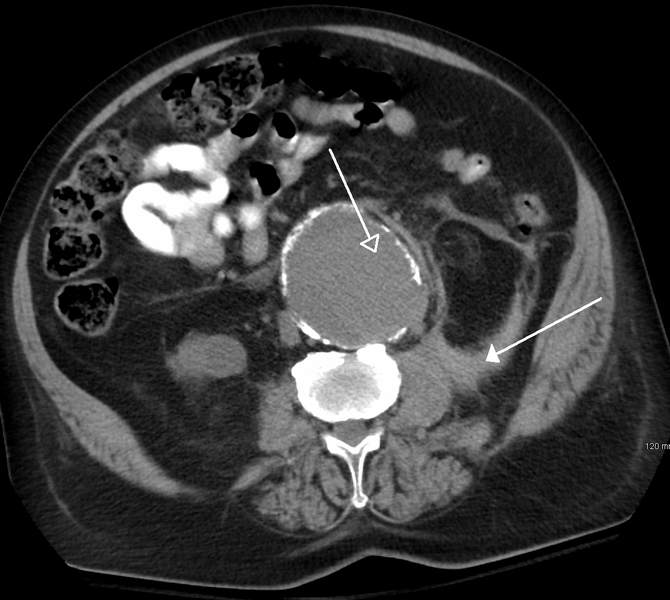
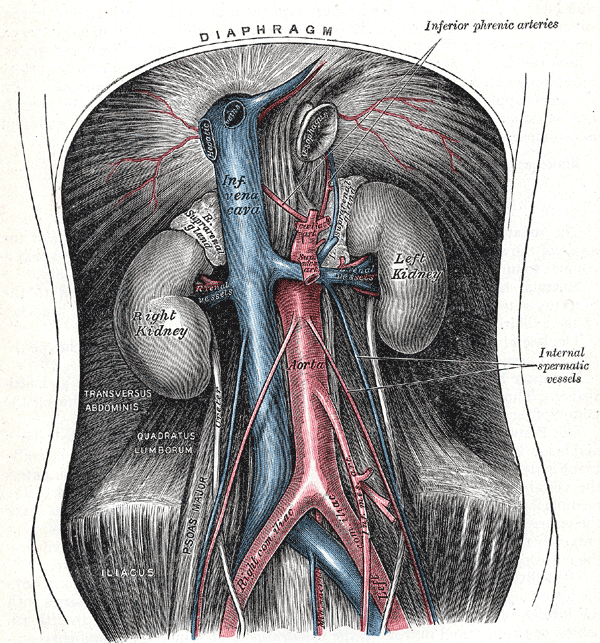
This is a review of the effects of CKD on increased morbidity and mortality of abdominal aortic aneurysm repair.   The abdominal aorta has branches to the superior mesenteric arteries proximally, and below that both renal arteries, which also supply the adrenals (suprarenal).
Severe atherosclerosis with plaque buildup and separation of the media from the endothelium, can migrate down the addominal aorta before frank rupture of an aneurysm.   Abdominal aortic aneurysm often extends from below the the renal arteries, to the internal spermatic vessels, or as far as the iliacs.

220px-Aortadiagramgray           Contrast-enhanced_CT_scan_demonstrating_abdominal_aortic_aneurysm

http://upload.wikimedia.org/wikipedia/commons/thumb/4/4a/Contrast-enhanced_CT_scan_demonstrating_abdominal_aortic_aneurysm.jpg/120px-Contrast-enhanced_CT_scan_demonstrating_abdominal_aortic_aneurysm.jpg

Of the visceral branches, the celiac artery and the superior and inferior mesenteric arteries are unpaired, while the suprarenals, renals, internal spermatics, and ovarian are paired. Of the parietal branches the inferior phrenics and lumbars are paired; the middle sacral is unpaired. The terminal branches are paired.
AAA is most common in men over age 65 years.  If it is expanding AAA causes sudden, severe, and constant low back, flank, abdominal, or groin pain (internal spermatic branch).  The presence of a pulsatile abdominal mass is virtually diagnostic but is found in less than half of all cases.  At least 65% of patients with a ruptured AAA die from sudden cardiovascular collapse before arriving at a hospital.
670px-RupturedAAA

EVAR for ruptured AAA

A study by Mehta et al assessed the effect of hemodynamic status on outcomes in 136 patients undergoing EVAR for ruptured AAAs.[1] The patients were divided into 2 groups:
(1) Hd-stable (systolic BP ≥80 mm Hg; n = 92 [68%]) and
(2) Hd-unstable (systolic BP < 80 mm Hg for >10 minutes; n = 44 [32%]).
The 30-day mortality, postoperative complications, need for secondary reinterventions, and midterm mortality were recorded. The 2 groups were found to be similar with respect to
  • comorbidities,
  • mean AAA maximum diameter (6.6 vs 6.4 cm),
  • need for on-the-table conversion to open repair (3% vs 7%), and
  • incidence of nonfatal complications (43% vs 38%) and secondary interventions (23% vs 25%).
  1. intraoperative need for aortic occlusion balloon,
  2.  mean estimated blood loss,
  3. incidence of developing abdominal compartment syndrome (ACS), and
  4. mortality
were all increased in the Hd-unstable group ([1]40% vs 6%, [2]744 vs 363 mL,[3] 29% vs 4%, and [4]33% vs 18%, respectively).

Open Surgery

Requires direct access to the aorta through an abdominal or retroperitoneal approach
Endovascular: Involves gaining access to the lumen of the abdominal aorta, usually via small incisions over the femoral vessels; an endograft, typically a cloth graft with a stent exoskeleton, is placed within the lumen of the AAA, extending distally into the iliac arteries.  Approximately 90% of abdominal aortic aneurysms are infrarenal.
The important surgical and endovascular anatomic considerations include associated renal and visceral artery involvement (either occlusive disease or involved in the aneurysm process) and the iliac artery (either occlusive disease or aneurysms). The length of the infrarenal aortic neck is important in helping determine the surgical approach (retroperitoneal vs transabdominal) and the location of the aortic cross clamp.

Endovascular Aneurysm Repair

Endovascular repair first became practical in the 1990s and although it is now an established alternative to open repair, its role is yet to be clearly defined. It is generally indicated in older, high-risk patients or patients unfit for open repair. However, endovascular repair is feasible for only a proportion of AAAs, depending on the morphology of the aneurysm. The main advantages over open repair are that there is less peri-operative mortality, less time in intensive care, less time in hospital overall and earlier return to normal activity. Disadvantages of endovascular repair include a requirement for more frequent ongoing hospital reviews, and a higher chance of further procedures being required.  According to the latest studies, the EVAR procedure does not offer any benefit for overall survival or health-related quality of life compared to open surgery, although aneurysm-related mortality is lower.

Aorta Anatomy and Pathology in AAA

The diameter of the aorta decreases in size from its thoracic portion to the abdominal and infrarenal portions. A normal aorta shows a reduction in medial elastin layers from the thoracic area to the abdominal portion. Elastin and collagen content are also reduced.  AAAs develop following degeneration of the media. The degeneration ultimately may lead to widening of the vessel lumen and loss of structural integrity.  
A multidisciplinary research program supported by the US National Heart, Lung, and Blood Institute identified proteolytic degradation of aortic wall connective tissue, inflammation and immune responses, biomechanical wall stress, and molecular genetics as mechanisms important in the development of AAA.  Similarly, surgical specimens of AAA reveal inflammation, with infiltration by lymphocytes and macrophages; thinning of the media; and marked loss of elastin.
Through gene microarray analysis, various genes involved in extracellular matrix degradation, inflammation, and other processes observed in AAA formation have been shown to be up-regulated, while others that may serve to prevent this occurrence are down-regulated. The combination of proteolytic degradation of aortic wall connective tissue, inflammation and immune responses, biomechanical wall stress, and molecular genetics represents a dynamic process that leads to aneurysmal deterioration of aortic tissue.
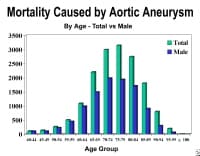
mortality caused by aortic aneurysm
1.  Mehta M, Paty PS, Byrne J, Roddy SP, Taggert JB, Sternbach Y, et al. The impact of hemodynamic status on outcomes of endovascular abdominal aortic aneurysm repair for rupture. J Vasc Surg. May 2013;57(5):1255-60. [Medline].
2.  Blanchard JF, Armenian HK, Friesen PP. Risk factors for abdominal aortic aneurysm: results of a case-control study. Am J Epidemiol. Mar 15 2000;151(6):575-83. [Medline].
3.  Lederle FA, Johnson GR, Wilson SE, Chute EP, Littooy FN, Bandyk D, et al. Prevalence and associations of abdominal aortic aneurysm detected through screening. Aneurysm Detection and Management (ADAM) Veterans Affairs Cooperative Study Group. Ann Intern Med. Mar 15 1997;126(6):441-9. [Medline].
4.   Wassef M, Baxter BT, Chisholm RL, Dalman RL, Fillinger MF, Heinecke J, et al. Pathogenesis of abdominal aortic aneurysms: a multidisciplinary research program supported by the National Heart, Lung, and Blood Institute. J Vasc Surg. Oct 2001;34(4):730-8. [Medline].
5.   [Guideline] U.S. Preventive Services Task Force. Screening for abdominal aortic aneurysm: recommendation statement. Ann Intern Med. Feb 1 2005;142(3):198-202. [Medline]. [Full Text].

Impact of chronic kidney disease on outcomes after abdominal aortic aneurysm repair

Patel VI, Lancaster RT, Mukhopadhyay S, Aranson NJ, Conrad MF, et al.
J Vasc Surg. 2012 Nov;56(5):1206-13.      http://dx.doi.org/10.1016/j.jvs.2012.04.037. Epub 2012 Aug 1.
Chronic kidney disease (CKD) is associated with increased morbidity and death after open abdominal aortic aneurysm (AAA) repair (OAR). This study highlights the effect of CKD on outcomes after endovascular AAA (EVAR) and OAR in contemporary practice.
The National Surgical Quality Improvement Program (NSQIP) Participant Use File (2005-2008) was queried by Current Procedural Terminology (American Medical Association, Chicago, Ill) code to identify EVAR or OAR patients, who were grouped by CKD class as having mild (CKD class 1 or 2), moderate (CKD class 3), or severe (CKD class 4 or 5) renal disease. Propensity score analysis was performed to match OAR and EVAR patients with mild CKD with those with moderate or severe CKD. Comparative analysis of mortality and clinical outcomes was performed based on CKD strata.
We identified 8701 patients who were treated with EVAR (n = 5811) or OAR (n = 2890) of intact AAAs. Mild, moderate, and severe CKD was present in 63%, 30%, and 7%, respectively. CKD increased (P < .01) overall mortality, with rates of 1.7% (mild), 5.3% (moderate), and 7.7% (severe) in unmatched patients undergoing EVAR or OAR. Operative mortality rates in patients with severe CKD were as high as 6.2% for EVAR and 10.3% for OAR.
Severity of CKD was associated with increasing frequency of risk factors; therefore, propensity matching to control for comorbidities was performed, resulting in similar baseline clinical and demographic features of patients with mild compared with those with moderate or severe disease.
In propensity-matched cohorts, moderate CKD increased the risk of 30-day mortality
  • for EVAR (1.9% mild vs 3.2% moderate; P = .013) and
  • OAR (3.1% mild vs 8.4% moderate; P < .0001).
Moderate CKD was also associated with increased morbidity in patients treated with
  • EVAR (8.3% mild vs 12.8% moderate; P < .0001) or
  • OAR (25.2% mild vs 32.4% moderate; P = .001).
Similarly, severe CKD increased the risk of 30-day mortality
  • for EVAR (2.6% mild vs 5.7% severe; P = .0081) and
  • OAR (4.1% mild vs 9.9% severe; P = .0057).
Severe CKD was also associated with increased morbidity in patients treated with
  • EVAR (10.6% mild vs 19.2% severe; P < .0001) or
  • OAR (31.1% mild vs 39.6% severe; P = .04).
The presence of moderate or severe CKD in patients considered for AAA repair is associated with significantly increased mortality and therefore should figure prominently in clinical decision making. The high mortality of AAA repair in patients with severe CKD is such that elective repair in such patients is not advised, except in extenuating clinical circumstances.

Related articles published on this Open Access Online Scientific Journal 

Effect of Hospital Characteristics on Outcomes of Endovascular Repair of Descending Aortic Aneurysms in US Medicare Population

Larry H. Bernstein, MD, FCAP 

http://pharmaceuticalintelligence.com/2013/06/27/effect-of-hospital-characteristics-on-outcomes-of-endovascular-repair-of-descending-aortic-aneurysms-in-us-medicare-population/

Abdominal Aortic Aneurysms (AAA): Albert Einstein’s Operation by Dr. Nissen
Aviva Lev-Ari, PhD, RN
No Early Symptoms – An Aortic Aneurysm Before It Ruptures – Is There A Way To Know If I Have it?
Justin D Pearlman, MD, PhD, FACC and Aviva Lev-Ari, PhD, RN
First-of-Its-Kind FDA Approval for ‘AUI’ Device with Endurant II AAA Stent Graft: Medtronic Expands in Endovascular Aortic Repair in the United States
Aviva Lev-Ari, PhD, RN
Abdominal Aortic Aneurysm: Endovascular repair and open repair resulted in similar long-term survival
Aviva Lev-Ari, PhD, RN
EUROPCR 2013, Paris 5/21-5/24, 2013 Conference for Cardiolovascular Intervention and Interventional Medicine
Aviva Lev-Ari, PhD, RN
Genomics & Genetics of Cardiovascular Disease Diagnoses: A Literature Survey of AHA’s Circulation Cardiovascular Genetics, 3/2010 – 3/2013
Aviva Lev-Ari, PhD, RN and Larry Bernstein, MD, FCAP
Competition in the Ecosystem of Medical Devices in Cardiac and Vascular Repair: Heart Valves, Stents, Catheterization Tools and Kits for Open Heart and Minimally Invasive Surgery (MIS)
Aviva Lev-Ari, PhD, RN
Bioabsorbable Drug Coating Scaffolds, Stents and Dual Antiplatelet Therapy
Aviva Lev-Ari, PhD, RN
Vascular Repair: Stents and Biologically Active Implants
Larry  Bernstein, MD, FCAP
Drug Eluting Stents: On MIT’s Edelman Lab’s Contributions to Vascular Biology and its Pioneering Research on DES
Larry H. Bernstein, MD, FCAP 
Coronary Artery Disease – Medical Devices Solutions: From First-In-Man Stent Implantation, via Medical Ethical Dilemmas to Drug Eluting Stents
Aviva Lev-Ari, PhD, RN
Survivals Comparison of Coronary Artery Bypass Graft (CABG) and Percutaneous Coronary Intervention (PCI) / Coronary Angioplasty
Larry Bernstein, MD, FCAP and Aviva Lev-Ari, PhD, RN
Trans-apical Transcatheter Aortic Valve Replacement in a Patient with Severe and Complex Left Main Coronary Artery Disease (LMCAD)
Larry Bernstein, MD, FCAP and Aviva Lev-Ari, PhD, RN
Transcatheter Aortic Valve Replacement (TAVR): Postdilatation to Reduce Paravalvular Regurgitation During TAVR with a Balloon-expandable Valve
Larry Bernstein, MD, FCAP and Aviva Lev-Ari, PhD, RN
Svelte Medical Systems’ Drug-Eluting Stent: 0% Clinically-Driven Events Through 12-Months in First-In-Man Study
Aviva Lev-Ari, PhD, RN
Acute and Chronic Myocardial Infarction: Quantification of Myocardial Perfusion Viability – FDG-PET/MRI vs. MRI or PET alone  (Justin Pearlman, Aviva Lev-Ari)
Biomaterials Technology: Models of Tissue Engineering for Reperfusion and Implantable Devices for Revascularization
Larry Bernstein, MD, FCAP and Aviva Lev-Ari, PhD, RN
Revascularization: PCI, Prior History of PCI vs CABG
Aviva Lev-Ari, PhD, RN
Accurate Identification and Treatment of Emergent Cardiac Events
Larry Bernstein, MD, FCAP
FDA Pending 510(k) for The Latest Cardiovascular Imaging Technology
Aviva Lev-Ari, PhD, RN
The ACUITY-PCI score: Will it Replace Four Established Risk Scores — TIMI, GRACE, SYNTAX, and Clinical SYNTAX
Aviva Lev-Ari, PhD, RN
Nitric Oxide and it’s impact on Cardiothoracic Surgery
Tilda Barliya, PhD
CABG or PCI: Patients with Diabetes – CABG Rein Supreme
Aviva Lev-Ari, PhD, RN
To Stent or Not? A Critical Decision
Aviva Lev-Ari, PhD, RN
Endothelin Receptors in Cardiovascular Diseases: The Role of eNOS Stimulation
Aviva Lev-Ari, PhD, RN
Absorb™ Bioresorbable Vascular Scaffold: An International Launch by Abbott Laboratories
Aviva Lev-Ari, PhD, RN
Carotid Stenting: Vascular surgeons have pointed to more minor strokes in the stenting group and cardiologists to more myocardial infarctions in the CEA cohort.
Aviva Lev-Ari, PhD, RN
New Drug-Eluting Stent Works Well in STEMI
Aviva Lev-Ari, PhD, RN
Global Supplier Strategy for Market Penetration & Partnership Options (Niche Suppliers vs. National Leaders) in the Massachusetts Cardiology & Vascular Surgery Tools and Devices Market for Cardiac Operating Rooms and Angioplasty Suites
Aviva Lev-Ari, PhD, RN
Abdominal Aortic Aneurysm in Computer Tomography

Abdominal Aortic Aneurysm in Computer Tomography (Photo credit: Wikipedia)

Read Full Post »

The Implications of a Newly Discovered  CYP2J2 Gene Polymorphism  Associated with Coronary Vascular Disease in the Uygur Chinese Population

Author, Curator: Larry H Bernstein, MD, FCAP

This is an interesting genomic study of the relationship of genetic polymorphism in the Chinese Uygur population that highlights the difficulty in CVD genomics, and casts a promising light on difficulties over
1.  possibly no more than 8 genetic signatures to account for all of human CVD conditions
2.  genetic signatures may no be equally distributed over studied populations
3.  genetic signatures may be more pronounced in different populations
4.  there is little predictable validity in such studies over large assimilated populations (such as African-Americans
5.  the best genomic evidence for meaningful associations does appear to tie in with endothelial metabolism
6.  the greatest difficulty in all studies is the small dose of information provided by an such linkage
7.  there has been too little information provided in studies of the effect of dietary factors on the affected population, which would entail nutrigenomics.
8.  there is an association between certain distinct CVD’s and later development of coronary heart disease (CHD).
This study concepts, methods and difficulties were recently reviewed in the following articles:
Synthetic Biology: On Advanced Genome Interpretation for Gene Variants and Pathways: What is the Genetic Base of Atherosclerosis and Loss of Arterial Elasticity with Aging
Aviva Lev-Ari, PhD, RN
Genomics & Genetics of Cardiovascular Disease Diagnoses: A Literature Survey of AHA’s Circulation Cardiovascular Genetics, 3/2010 – 3/2013
Aviva Lev-Ari, PhD, RN and Larry H Bernstein, MD, FCAP
Diagnosis of Cardiovascular Disease, Treatment and Prevention: Current & Predicted Cost of Care and the Promise of Individualized Medicine Using Clinical Decision Support Systems
Aviva Lev-Ari, PhD, RN and Larry H Bernstein, MD, FCAP
Hypertension and Vascular Compliance: 2013 Thought Frontier – An Arterial Elasticity Focus
Justin D. Pearlman, MD, PhD, and Aviva Lev-Ari, PhD, RN
Clinical Trials Results for Endothelin System: Pathophysiological role in Chronic Heart Failure, Acute Coronary Syndromes and MI – Marker of Disease Severity or Genetic Determination?
Aviva Lev-Ari, PhD, RN
Vascular Medicine and Biology: CLASSIFICATION OF FAST ACTING THERAPY FOR PATIENTS AT HIGH RISK FOR MACROVASCULAR EVENTS Macrovascular Disease – Therapeutic Potential of cEPCs
Aviva Lev-Ari, PhD, RN
Endothelial Function and Cardiovascular Disease
Larry H Bernstein, MD, FCAP
Reversal of Cardiac Mitochondrial Dysfunction
Larry H Bernstein, MD, FCAP
A Second Look at the Transthyretin Nutrition Inflammatory Conundrum
Larry H Bernstein, MD, FCAP

A Novel Polymorphism of the CYP2J2 Gene is Associated with Coronary Artery Disease in Uygur Population in China

Qing Zhu, Zhenyan Fu, Yitong Ma, Hong Yang, Ding Huang, Xiang Xie, Fen Liu, Yingying Zheng, Erdenbat Cha
PII: S0009-9120(13)00174-4    Available online 15 May 2013
Reference: CLB 8375
To appear in: Clinical Biochemistry
Received date: 17 February 2013
Revised date: 13 April 2013
Accepted date: 3 May 2013
Background: Cytochrome P450 (CYP) 2J2 is expressed in the vascular endothelium and metabolizes arachidonic acid to biologically active epoxyeicosatrienoic acids (EETs).
  • The EETs are potent endogenous vasodilators and
  • inhibitors of vascular inflammation.
The aim of the present study was to assess the association between the human CYP2J2 gene polymorphism and coronary artery disease (CAD) in a Han and Uygur population of China.
We use two independent case-control studies:
  1. a Han population (206 CAD patients and 262 control subjects) and
  2. a Uygur population (336 CAD patients and 448 control subjects).
All CAD patients  and controls were genotyped for the same three single nucleotide polymorphisms (SNPs)
  1. rs890293
  2. rs11572223
  3. rs2280275
of CYP2J2 gene by a Real-time PCR instrument.
Results: In the Uygur population, for total, the distribution of SNP3 (rs2280275) genotypes showed a significant difference between CAD and control participants (P=0.048).
For total and men, the distribution of SNP3 (rs2280275) alleles and the dominant model (CC vs CT + TT)
  • showed a significant difference between CAD and control participants (for allele: P=0.014 and P=0.035, respectively; for dominant model: P=0.014 and P=0.034, respectively).
The significant difference in dominant model was retained after adjustment for covariates (OR: 0.279, 95% confidence interval [CI]: 0.176-0.440, P=0.001; OR: 0.240, 95% CI: 0.128-0.457, P=0.001, respectively).
Conclusions: The CC genotype of rs2280275 in CYP2J2 gene could be a protective genetic marker of CAD and T allele may be a risk genetic marker of CAD in men of Uygur population in China.
Highlights:
1. We used two independent case-control studies: one was in a Han population and the other was in a Uygur population.
2. The CC genotype of rs2280275 in CYP2J2 gene could be a protective genetic marker of CAD and T allele may be a risk genetic marker of CAD in men of Uygur population in China.
3. Polymorphism of the CYP2J2 gene can affect the synthesis of epoxyeicosatrienoic acids (EETs).
Reviewer Observations:
This article describes the association between CYP2J2 polymorphism(SNP1, SNP2 and SNP3) and coronary artery disease (CAD) in two populations of China (Han and Uygur).
Results show that
  1. the frequency of T allele of rs2280275 (SNP3 of the CYP2J2) is higher in CAD patients than in control subjects and
  2. that CC genotype of rs 2280275 is significantly lower in CAD patients than in control subjects.
  3. “T allele of rs2280275 was significantly higher in CAD patients than in control participants. CC genotype of rs2280275 was significantly lower in CAD patients than in control participants.”;
  4. It appears that CC is the homozygous and dominant state of this SNP3 sequence in a pairing-combination.
  5. The effect of decreased CHD is seen only in the CC double combination, in men and not women. The difference between men and women with CAD is in LDL.
For Uygur population,
(1) after adjusting major confounding factors such as Glu、LDL、EH、DM and smoking, the effect of decreased CAD is seen only in the CC double combination, in men and not women.
(2) for men, the LDL level is higher in CAD than in control, for women, there isn’t a difference of LDL level between CAD and control.
(3) for men, the distribution of T and C allele is different between CAD and control (p=0.035), and not in women (p=0.118).
The T allele of SNP3 is increased in CAD. So the C allele is important, and a CT pair is neutral. Neither SNP1 or SNP2, or presumably both have lower incidence.

I might conjecture that having(heterozygous rs2280275), a C & a T, and eating a lot of fish and/or flax seed would show a difference

  • because of the intimal enzymatic conversion of arachidonic acid to EETs.

Arachidonic acid is a derivative of linoleic acid,an n-6 PUFA, while linolenic acid is an omega-3 PUFA. Substantial documentation of the effect of EETs is given. The anti-inflammatory advantage of an n-3 PUFA is also known.
It appears that the intimal conversion results in an omega-3 product.  In addition, the EET activates eNOS, so that there is endothelial NO produced.

The studies of both Spiecker and Ping Yin Liu showed the polymorphism of CYP2J2 (rs890293, SNP1) has relation with CAD. However, in this study, the authors found there was no association between the polymorphism of CYP2J2 (rs890293, SNP1) and CAD in Han population and Uygur population. We found (rs 2280275, SNP3) has association with CAD.
  • “The CC genotype of rs2280275 in CYP2J2 gene could be a protective genetic marker of CAD and T allele may be a risk genetic marker of CAD in men of Uygur population in China”
All participants had a differential diagnosis for chest pain encountered in the Cardiac Catheterization Laboratory of First Affiliated Hospital of Xinjiang Medical University. We recruited randomly CAD group and control group, subjects with valvular disease were excluded, control subjects were not healthy individuals, some of them have hypertension, some of them have DM, some of them have hyperlipidemia, which means control group expose to the same risk factors of CAD while the results of coronary angiogram is normal. All control subjects underwent a coronary angiogram and have no coronary artery stenosis.
The analysis was a logistic regression analysis, we used the major variables of CAD to analysis and found the CC genotype was the dependent useful factor after adjusting for major confounding factors such as Glu、LDL、EH、DM and smoking.
Schematic of EET interactions with cardiovascularion channels.
A: In the cardiac myocyte, EETs activate sarcolemmal or mitochondrial KATP channels.
B: In the vasculature, EETs activate endothelial small-(SKCa) or intermediate (IKCa)–conductance calcium-activated channels to cause hyperpolarization, which can be transmitted to the vascular smooth muscle via myoendothelial gap junctions. EETs also activate TRPV4 channels to activate Ca2+influx. In the vascular smooth muscle, EETs activate large conductance, calcium-activated (BK-Ca) channels through a G protein-Coupled event.
C: In platelets, EETs activate BK-Ca channels.calcium-activated (BK-Ca) channels through a G-protein-coupled event. C, In platelets, EETs activate BK-Ca channels.

Association of the ADRA2A polymorphisms with the risk of type 2 diabetes: A meta-analysis

Xi Chen, Lei Liu, Wentao He, Yu Lu, Delin Ma, Tingting Du, Qian Liu, Cai Chen, Xuefeng Yu
Clinical Biochemistry 2013;  46 (9): 722–726   http://dx.doi.org/10.1016/j.clinbiochem.2013.02.004
Results from the published studies on the association of ADRA2A (adrenoceptor alpha 2A) variants with type 2 diabetes (T2D) are conflicting and call for further assessment. The aim of this meta-analysis was to quantitatively summarize the effects of the two recently reported ADRA2A single nucleotide polymorphisms (SNPs) rs553668 and rs10885122 on T2D risk.
Results
Twelve studies with 40,828 subjects from seven eligible papers were included in the meta-analysis. Overall, the present meta-analysis failed to support a positive association between ADRA2A SNPs (rs553668 and rs10885122) and susceptibility to T2D (OR = 1.05, p = 0.17, 95% CI: 0.98, 1.12; and OR = 1.06, p = 0.11, 95% CI: 0.99, 1.13; respectively).
However, in the subgroup analysis by ethnicity, the significant association between rs553668 and the risk of T2D was obtained in Europeans under the recessive genetic model (OR = 1.36, p = 0.02, 95% CI: 1.05, 1.76).
Conclusion
The results of the meta-analyses indicated that both SNPs were associated with CHD in Caucasians (P < 0.05) but not in Asians. The results from our case-control study and meta-analyses might be explained by genetic heterogeneity in the susceptibility of CHD and ethnic differences between Asians and Caucasians.

Association between PCSK9 and LDLR gene polymorphisms with coronary heart disease: Case-control study and meta-analysis

Lina Zhang, Fang Yuan, Panpan Liu, Lijuan Fei, Yi Huang, Limin Xu, et al.
Clinical Biochemistry 2013; 46 (9): 727–732
► Association of rs11206510 and rs1122608 with CHD in 813 Chinese participants.
► The first association test of rs1122608 with the risk of CHD in Han Chinese.
► Meta-analyses were performed for rs11206510 and rs1122608.
► The two SNPs were associated with CHD in Caucasians but not in Asians.
Objective
To explore the association of rs11206510 (PCSK9 gene) and rs1122608 (LDLR gene) polymorphisms with coronary heart disease (CHD) in Han Chinese.
Methods
A total of 813 participants (290 CHD cases, 193 non-CHD controls and 330 healthy controls) were recruited in the case-control study. DNA genotyping was performed on the SEQUENOM® Mass–ARRAY iPLEX® platform. χ2-test was used to compare the genotype distribution and allele frequencies. Two meta-analyses were performed to establish the association between the two polymorphisms with CHD.
Results
No significant associations between the two SNPs and the risk of CHD were observed in the present study. The meta-analysis of rs11206510 of PCSK9 gene comprises 11 case-control studies with a total of 69,054 participants. Significant heterogeneity was observed in Caucasian population in subgroup analysis of the association studies of rs11206510 with CHD (P = 0.003, I2 = 67.2%). The meta-analysis of LDLR gene rs1122608 polymorphism comprises 7 case-control studies with a total of 20,456 participants and the heterogeneity of seven studies was minimal (P = 0.148, I2 = 36.7%).
Conclusion
The results of the meta-analyses indicated that both SNPs were associated with CHD in Caucasians (P < 0.05) but not in Asians.

The effect of hyperhomocysteinemia on aortic distensibility in healthy individuals

I Eleftheriadou, P Grigoropoulou, I Moyssakis, A Kokkinos. et al.
Nutrition 18 Feb 2013; 29 (6): 876-880, PII: S0899-9007(13)00015-4
Elevated plasma homocysteine (HCY) levels have been associated with increased risk for cardiovascular disease. Aortic distensibility and aortic pulse wave velocity (PWV) are indices of aortic elasticity. The aim of the present study was to determine the effect of acute methionine-induced HHCY on aortic distensibility and PWV in healthy individuals and the effect of acute HHCY on myocardial performance of the left ventricle (Tei index).
Thirty healthy volunteers were included in this crossover study. Aortic distensibility and Tei index were determined non-invasively by ultrasonography at baseline and 3 h after methionine or water consumption, while PWV was measured by applanation tonometry at baseline and every 1 h for the same time interval.
Oral methionine induced an increase in total plasma HCY concentrations (P < 0.001), whereas HCY concentrations did not change after water consumption. Aortic distensibility decreased 3 h after methionine load (P < 0.001) and Tei index increased (P < 0.001), suggesting worsening compared with baseline values. Water consumption had no effect on aortic distensibility or Tei index values. PWV values did not change after either methionine or water consumption.
Acute methionine-induced HHCY reduces aortic distensibility and worsens myocardial performance in healthy individuals. Further research is warranted to examine in the long term the direct effects of HHCY on cardiovascular function and the indirect effects on structural remodeling.
Micrograph of an artery that supplies the hear...

Micrograph of an artery that supplies the heart with significant atherosclerosis and marked luminal narrowing. Tissue has been stained using Masson’s trichrome. (Photo credit: Wikipedia)

Estimated propability of death or non-fatal my...

Estimated propability of death or non-fatal myocardial-infarction over one year corresponding ti selectet values of the individual scores. Ordinate: individual score, abscissa: Propability of death or non-fatal myocardial infarction in 1 year (in %) (Photo credit: Wikipedia)


Read Full Post »

Drug Eluting Stents: On MIT’s Edelman Lab’s Contributions to Vascular Biology and its Pioneering Research on DES

Drug Eluting Stents: On MIT‘s Edelman Lab’s Contributions to Vascular Biology and its Pioneering Research on DES

Author: Larry H Bernstein, MD, FACP

and 

Curator: Aviva Lev-Ari, PhD, RN
http://PharmaceuticalIntelligence.com/2013/04/25/Contributions
-to-vascular-biology/

This is the first of a three part series on the evolution of vascular biology and the studies of the effects of biomaterials in vascular reconstruction and on drug delivery, which has embraced a collaboration of cardiologists at Harvard Medical School , Affiliated Hospitals, and MIT,
requiring cardiovascular scientists at the PhD and MD level, physicists, and computational biologists working in concert, and
an exploration of the depth of the contributions by a distinguished physician, scientist, and thinker.

The first part – Vascular Biology and Disease – will cover the advances in the research on

  • vascular biology,
  • signaling pathways,
  • drug diffusion across the endothelium and
  • the interactions with the underlying muscularis (media),
  • with additional considerations for type 2 diabetes mellitus.

The second part – Stents and Drug Delivery – will cover the

  • purposes,
  • properties and
  • evolution of stent technology with
  • the acquired knowledge of the pharmacodynamics of drug interactions and drug distribution.

The third part – Problems and Promise of Biomaterials Technology – will cover the shortcomings of the cardiovascular devices, and opportunities for improvement

Vascular Biology and Cardiovascular Disease

Early work on endothelial injury and drug release principles

The insertion of a catheter for the administration of heparin is not an innocuous procedure. Heparin is infused to block coagulation, lowering the risk of a dangerous

  • clot formation and
  • dissemination.

It was shown experimentally that the continuous infusion of heparin

  • suppresses smooth muscle proliferation after endothelial injury. It may lead to
  • hemorrhage as a primary effect.

The anticoagulant property of heparin was removed by chemical modification without loss of the anti-proliferative effect.

In this study, MIT researches placed ethylene-vinyl acetate copolymer matrices containing standard and modified heparin adjacent to rat carotid arteries at the time of balloon deendothelialization.

Matrix delivery of both heparin compounds effectively diminished this proliferation in comparison to controls without producing systemic anticoagulation or side effects.

This mode of therapy appeared more effective than administering the agents by either

  • intravenous pumps or
  • heparin/polymer matrices placed in a subcutaneous site distant from the injured carotid artery

This indicated that the site of placement at the site of injury is a factor in the microenvironment, and is a preference for avoiding restenosis after angioplasty and other interventions.

This raised the question of why the proliferation of vascular muscle occurs in the first place.
 Edelman, Nugent and Karnovsky  (1) showed that the proliferation required first the denudation of vascular surface endothelium. This exposed the underlayer to the effect of basic fibroblast growth factor, which stimulates mitogenesis of the exposed cell, explained by the endothelium as a barrier from circulating bFGF.

To answer this question, they compared the effect of

  • 125I-labelled bFGF intravenously given with perivascular controlled bFGF release.
  • Polymeric controlled release devices delivered bFGF to the extravascular space without transendothelial transport. 
Deposition within the blood vessel wall was rapidly distributed circumferentially and was substantially greater than that observed following intravenous injection.

The amount of bFGF deposited in arteries adjacent to the release devices was 40 times that deposited in similar arteries in animals who received a single intravenous bolus of bFGF.

The presence of intimal hyperplasia increased deposition of perivascularly released bFGF 2.4-fold but decreased the deposition of intravenously injected bFGF by 67%.

  • bFGF was 5- to 30-fold more abundant in solid organs after intravenous injection than it was following perivascular release, and
  • bFGF deposition was greatest in the kidney, liver, and spleen and was substantially lower in the heart and lung.

This result indicated that vascular deposition of bFGF is independent of endothelium, and

  • bFGF delivery is effectively perivascular. (2)

Drug activity studies have to be done in well controlled and representative conditions.
 Edelsman’s Lab researchers studied the

  • dose response of injured arteries to exogenous heparin in vivo by providing steady and predictable arterial levels of drug.
  • Controlled-release devices were fabricated to direct heparin uniformly and at a steady rate to the adventitial surface of balloon-injured rat carotid arteries.

Researchers predicted the distribution of heparin throughout the arterial wall using computational simulations and correlated these concentrations with the biologic response of the tissues.

Researchers determined from this process that an in vivo arterial concentration of 0.3 mg/ml of heparin is required to maximallyinhibit intimal hyperplasia after injury.

This estimation of the required tissue concentration of a drug is

  • independent of the route of administration and
  • applies to all forms of drug release.

In this way the Team was able to

  • evaluate the potential of  widely disparate forms of drug release and, to finally
  • create some rigorous criteria by which to guide the development of particular delivery strategies for local diseases. (3)

Chiefly, the following three effects:

(1) Effect of controlled adventitial heparin delivery on smooth muscle cell proliferation following endothelial injury. ER Edelman, DH Adams, and MJ Karnovsky. PNAS May 1990; 87: 3773-3777.


(2) Perivascular and intravenous administration of basic fibroblast growth factor: Vascular and solid organ deposition. ER Edelman, MA Nugent, and MJ Karnovsky. PNAS Feb 1993; 90: 1513-1517.


(3) Tissue concentration of heparin, not administered dose, correlates with the biological response of injured arteries in vivo. MA Lovich and ER Edelman. PNAS Sep 1999; 96: 11111–11116.

Vascular Injury and Repair

Perlecan is a heparin-sulfate proteoglycan that might be critical for regulation of vascular repair by inhibiting the binding and mitogenic activity of basic fibroblast growth factor-2 (bFGF-2) in vascular smooth muscle cells .

The Team generated

  • Clones of endothelial cells expressing an antisense vector targeting domain III of perlecan. The transfected cells produced significantly less perlecan than parent cells, and they had reduced bFGF in vascular smooth muscle cells.
  • Endothelial cells were seeded onto three-dimensional polymeric matrices and implanted adjacent to porcine carotid arteries subjected to deep injury.
  • The parent endothelial cells prevented thrombosis, but perlecan deficient cells were ineffective.

The ability of endothelial cells to inhibit intimal hyperplasia, however, was only in part suppressed by perlecan. The differential regulation by perlecan of these aspects of vascular repair may clarify why control of clinical clot formation does not lead to full control of intimal hyperplasia.

The use of genetically modified tissue engineered cells provides a new approach for dissecting the role of specific factors within the blood vessel wall.(1) Successful implementation of local arterial drug delivery requires transmural distribution of drug. The physicochemical properties of the applied compound govern its transport and tissue binding.

  • Hydrophilic compounds are cleared rapidly.
  • Hydrophobic drugs bind to fixed tissue elements, potentially prolonging tissue residence and biological effect.

Local vascular drug delivery provides

  • elevated concentrations of drug in the target tissue while
  • minimizing systemic side effects.

To better characterize local pharmacokinetics the Team examined the arterial transport of locally applied dextran and dextran derivatives in vivo.

Using a two-compartment pharmacokinetic model to correct

  • The measured transmural flux of these compounds for systemic
  • Redistribution and elimination as delivered from a photo-polymerizable hydrogel.
  • The diffusivities and the transendothelial permeabilities were strongly dependent on molecular weight and charge
  • For neutral dextrans, the diffusive resistance increased with molecular weightapproximately 4.1-fold between the molecular weights of 10 and 282 kDa.
  • Endothelial resistance increased 28-fold over the same molecular weight range.
  • The effective medial diffusive resistance was unaffected by cationic charge as such molecules moved identically to neutral compounds, but increased approximately 40% when dextrans were negatively charged.

Transendothelial resistance was 20-fold lower for the cationic dextrans, and 11-fold higher for the anionic dextrans, when both were compared to neutral counterparts.

These results suggest that, while

  • low molecular weight drugs will rapidly traverse the arterial wall with the endothelium posing a minimal barrier,
  • the reverse is true for high molecular weight agents.

The deposition and distribution of locally released vascular therapeutic compounds might be predicted based upon chemical properties, such as molecular weight and charge. (2)

Paclitaxel is hydrophobic and has therapeutic potential against proliferative vascular disease.
 The favorable preclinical data with this compound may, in part, result from preferential tissue binding.
 The complexity of Paclitaxel pharmacokinetics required in-depth investigation if this drug is to reach its full clinical potential in proliferative vascular diseases.

Equilibrium distribution of Paclitaxel reveals partitioning above and beyond perfusate concentration and a spatial gradient of drug across the arterial wall.

The effective diffusivity (Deff) was estimated from the Paclitaxel distribution data to

  • facilitate comparison of transport of Paclitaxel through arterial parenchyma with that of other vasoactive agents and to
  • characterize the disparity between endovascular and perivascular application of drug.

This transport parameter described the motion of drug in tissues given an applied concentration gradient and includes, in addition to diffusion,

  • the impact of steric hindrance within the arterial interstitium;
  • nonspecific binding to arterial elements; and, in the preparation used here,
  • convective effects from the applied transmural pressure gradient.

At all times, the effective diffusivity for endovascular delivery exceeded that of perivascular delivery. The arterial transport of Paclitaxel was quantified through application ex vivo and measurement of the subsequent transmural distribution.

  • Arterial Paclitaxel deposition at equilibrium varied across the arterial wall.
  • Permeation into the wall increased with time, from 15 minutes to 4 hours, and
  • varied with the origin of delivery.

In contrast to hydrophilic compounds, the concentration in tissue exceeded the applied concentration and the rate of transport was markedly slower. Furthermore, endovascular and perivascular Paclitaxel application led to differences in deposition across the blood vessel wall.

This leads to a conclusion that Paclitaxel interacts with arterial tissue elements  as it moves under the forces of

  • diffusion and
  • convection and
  • can establish substantial partitioning and spatial gradients across the tissue. (3)

Endovascular drug-eluting stents have changed the practice of  cardiovascular vascularization, and yet it is unclear how they so dramatically reduce restenosis

We don’t know how to distinguish between the different formulations available.
 Researchers are now questioning whether individual properties of different drugs beyond lipid avidity effect arterial transport and distribution.

In bovine internal carotid segments, tissue-loading profiles for

  • Hydrophobic Paclitaxel and Rapamycin are indistinguishable, reaching load steady state after 2 days.
  • Hydrophilic dextran reaches equilibrium in hours.

Paclitaxel and Rapamycin bind to the artery at 30–40 times bulk concentration, and bind to specific tissue elements.

Transmural drug distribution profiles are markedly different for the two compounds.

  • Rapamycin binds specifically to FKBP12 binding protein and it distributes evenly through the artery,
  • Paclitaxel binds specifically to microtubules, and remains primarily in the subintimal space.

The binding of Rapamycin and Paclitaxel to specific intracellular proteins plays an essential role in

  • determining arterial transport and distribution and in
  • distinguishing one compound from another.

These results offer further insight into the

  • mechanism of local drug delivery and the
  • specific use of existing drug-eluting stent formulations. (4)

The Role of Amyloid beta (A) in Creation of Vascular Toxic Plaque

Amyloid beta (A) is a peptide family produced and deposited in neurons and endothelial cells (EC).
It is found at subnanomolar concentrations in the plasma of healthy individuals.
 Simple conformational changes produce a form of A-beta , A-beta 42, which creates toxic plaque in the brains of Alzheimer’s patients.

Oxidative stress induced blood brain barrier degeneration has been proposed as a key factor for A-beta 42 toxicity.

This cannot account for lack of injury from the same peptide in healthy tissues.
Researchers hypothesized that cell state mediates A-beta’s effect.
 They examined the viability in the presence of A-beta secreted from transfected
Chinese hamster ovary cells (CHO) of

  • aortic Endothelial Cells (EC),
  • vascular smooth muscle cells (SMC) and
  • epithelial cells (EPI) in different states

A-beta was more toxic to all cell types when they were subconfluent.
 Subconfluent EC sprouted and SMC and EPI were inhibited by A-beta.
Confluent EC were virtually resistant to A-beta and suppressed A-beta production by A-beta +CHO.

Products of subconfluent EC overcame this resistant state, stimulating the production and toxicity of A-beta 42. Confluent EC overgrew >35% beyond their quiescent state in the presence of A-beta conditioned in media from subconfluent EC.

These findings imply that A-beta 42 may well be even more cytotoxic to cells in injured or growth states and potentially explain the variable and potent effects of this protein.

One may now need to consider tissue and cell state in addition to local concentration of and exposure duration to A-beta.

The specific interactions of A-beta and EC in a state-dependent fashion may help understand further the common and divergent forms of vascular and cerebral toxicity of A-beta and the spectrum of AD. (5)

(1) Perlecan is required to inhibit thrombosis after deep vascular injury and contributes
to endothelial cell-mediated inhibition of intimal hyperplasia. MA Nugent, HM Nugent,
RV Iozzoi, K Sanchack, and ER Edelman. PNAS Jun 2000; 97(12): 6722-6727


(2) Correlation of transarterial transport of various dextrans with their physicochemical properties.
O Elmalak, MA Lovich, E Edelman. Biomaterials 2000; 21: 2263-2272


(3) Arterial Paclitaxel Distribution and Deposition. CJ Creel, MA Lovich, ER Edelman. Circ Res. 2000;86:879-884


(4) Specific binding to intracellular proteins determines arterial transport properties for rapamycin and Paclitaxel.
AD Levin, N Vukmirovic, Chao-Wei Hwang, and ER Edelman. PNAS Jun 2004; 101(25): 9463–9467.
www.pnas.org/cgi/doi/10.1073/pnas.0400918101


(5) Amyloid beta toxicity dependent upon endothelial cell state. M Balcells, JS Wallins, ER Edelman.
Neuroscience Letters 441 (2008) 319–322

Endothelial Damage as an Inflammatory State

Autoimmunity may drive vascular disease through anti-endothelial cell (EC) antibodies. This raises a question about whether an increased morbidity of cardiovascular diseases in concert with systemic illnesses may involve these antibodies.

Matrix-embedded ECs act as powerful regulators of vascular repair accompanied by significant reduction in expected systemic and local inflammation.

The Lab researchers compared the immune response against free and matrix-embedded ECs in naive mice and mice with heightened EC immune reactivity. Mice were presensitized to EC with repeated subcutaneous injections of saline-suspended porcine EC (PAE) (5*10^5 cells).

On day 42, both naive mice (controls) and mice with heightened EC immune reactivity received 5*10^5 matrix-embedded or free PAEs. Circulating PAE-specific antibodies and effector T-cells were analyzed 90 days after implantation for –

  • PAE-specific antibody-titers,
  • frequency of CD4+-effector cells, and
  • xenoreactive splenocytes

These were 2- to 4-fold lower (P<0.0001) when naıve mice were injected with matrix-embedded instead of saline-suspended PAEs.

Though basal levels of circulating antibodies were significantly elevated after serial PAE injections (2210+341 mean fluorescence intensity, day 42) and almost doubled again 90 days after injection of a fourth set of free PAEs, antibody levels declined by half in recipients of matrix-embedded PAEs at day 42 (P<0.0001), as did levels of CD4+-effector cells and xenoreactive splenocytes.

A significant immune response to implantation of free PAE is elicited in naıve mice, that is even more pronounced in mice with pre-developed anti-endothelial immunity.

Matrix-embedding protects xenogeneic ECs against immune reaction in naive mice and in mice with heightened immune reactivity.

Matrix-embedded EC might offer a promising approach for treatment of advanced cardiovascular disease. (1)

Researchers examined the molecular mechanisms through which

mechanical force and hypertension modulate

endothelial cell regulation of vascular homeostasis.

Exposure to mechanical strain increased the paracrine inhibition of vascular smooth muscle cells (VSMCs) by endothelial cells.

Mechanical strain stimulated the production by endothelial cells of perlecan and heparan-sulfate glycosaminoglycans. By inhibiting the expression of perlecan with an antisense vector researchers demonstrated that perlecan was essential to the strain-mediated effects on endothelial cell growth control.

Mechanical regulation of perlecan expression in endothelial cells was

  • governed by a mechano-transduction pathway
  • requiring transforming growth factor (TGF-β) signaling and
  • intracellular signaling through the ERK pathway.

Immunohistochemical staining of the aortae of spontaneously hypertensive rats
demonstrated strong correlations between

  • endothelial TGF-β,
  • phosphorylated signaling intermediates, and
  • arterial thickening.

Studies on ex vivo arteries exposed to varying levels of pressure demonstrated that

ERK and TGF-beta signaling were required for pressure-induced upregulation of endothelial HSPG.

The Team’s findings suggest a novel feedback control mechanism in which

  • net arterial remodeling to hemodynamic forces is controlled by a dynamic interplay between growth stimulatory signals from vSMCs and
  • growth inhibitory signals from endothelial cells. (2)

Heparan-sulfate proteoglycans (HSPGs) are potent regulators of vascular remodeling and repair.
 The major enzyme capable of degrading HSPGs is heparanase, which led us to examine
the role of heparanase in controlling

  • arterial structure,
  • mechanics, and
  • remodeling.

In vitro studies suggested heparanase expression in endothelial cells serves as a negative regulator of endothelial inhibition of vascular smooth muscle cell (vSMC) proliferation.

ECs inhibit vSMC proliferation through the interplay between

  • growth stimulatory signals from vSMCs and
  • growth inhibitory signals from ECs.

This would be expected if ECs had HSPGs that are degraded by heparanase.
Arterial structure and remodeling to injury is modified by heparanase expression.
Transgenic mice overexpressing heparanase had

  • increased arterial thickness,
  • cellular density, and
  • mechanical compliance.

Endovascular stenting studies in Zucker rats demonstrated increased heparanase expression in the neointima of obese, hyperlipidemic rats in comparison to lean rats.

The extent of heparanase expression within the neointima strongly correlated with the neointimal thickness following injury. To test the effects of heparanase overexpression on arterial repair, researchers developed a novel murine model of stent injury using small diameter self-expanding stents.

Using this model, researchers found that increased

  • neointimal formation and
  • macrophage recruitment occurs in transgenic mice overexpressing heparanase.
  • Taken together, these results support a role for heparanase in the regulation of arterial structure, mechanics, and repair. (3)

The first host–donor reaction in transplantation occurs at the blood–tissue interface.
When the primary component of the implant (donor) is the endothelial cells, it incites an immunologic reaction. Injections of free endothelial cell implants elicit a profound major histocompatibility complex (MHC) II dominated immune response.

Endothelial cells embedded within three-dimensional matrices behave like quiescent endothelial cells.

Perivascular implants of such embedded ECs cells are the most potent inhibitor of intimal hyperplasia and thrombosis following controlled vascular injury, but without any immune reactivity.

Allo- and even exenogenic endothelial cells evoke no significant humoral or
cellular immune response in immune-competent hosts when embedded within matrices.
 Moreover,  endothelial implants are immune-modulatory, reducing the extent of the memory response to previous free cell implants.

Attenuated immunogenicity results in muted activation of adaptive and innate immune cells. These findings point toward a pivotal role of matrix–cell-interconnectivity for

  • the cellular immune phenotype and might therefore assist in the design  of
  • extracellular matrix components for successful tissue engineering. (4)

Because changes in subendothelial matrix composition are associated with alterations of the endothelial immune phenotype, researchers sought to understand if

  • cytokine-induced NF-κB activity and
  • downstream effects depend on substrate adherence of endothelial cells (EC).

The team compared the upstream

  • phosphorylation cascade,
  • activation of NF-ĸβ, and
  • expression/secretion

of downstream effects of EC grown on tissue culture polystyrene plates (TCPS) with EC embedded within collagen-based matrices (MEEC).

Adhesion of natural killer (NK) cells was quantified in vitro and in vivo.

  • NF-κβ subunit p65 nuclear levels were significantly lower and
  • p50 significantly higher in cytokine-stimulated MEEC than in EC-TCPS.

Despite similar surface expression of TNF-α receptors, MEEC had significantly decreased secretion and expression of IL-6, IL-8, MCP-1, VCAM-1, and ICAM-1.

Attenuated fractalkine expression and secretion in MEEC (two to threefold lower than in EC-TCPS; p < 0.0002) correlated with 3.7-fold lower NK cell adhesion to EC (6,335 ± 420 vs. 1,735 ± 135 cpm; p < 0.0002).

Furthermore, NK cell infiltration into sites of EC implantation in vivo was significantly reduced when EC were embedded within matrix.

Matrix embedding enables control of EC substratum interaction.

This in turn regulates chemokine and surface molecule expression and secretion, in particular – of those compounds within NF-κβ pathways,

  • chemoattraction of NK cells,
  • local inflammation, and
  • tissue repair. (5)

Monocyte recruitment and interaction with the endothelium is imperative to vascular recovery.

Tie2 plays a key role in endothelial health and vascular remodeling.
Researchers studied monocyte-mediated Tie2/angiopoietin signaling following interaction of primary monocytes with endothelial cells and its role in endothelial cell survival.

The direct interaction of primary monocytes with subconfluent endothelial cells

resulted in transient secretion of angiopoietin-1 from monocytes and

the activation of endothelial Tie2. This effect was abolished by preactivation of monocytes with tumor necrosis factor-α (TNFα).

Although primary monocytes contained high levels of

  • both angiopoietin 1 and 2,
  • endothelial cells contained primarily angiopoietin 2.

Seeding of monocytes on serum-starved endothelial cells reduced caspase-3 activity by 46+5.1%, and 52+5.8% after TNFα treatment, and it decreased single-stranded DNA levels by 41+4.2% and 40+ 3.5%, respectively.

This protective effect of monocytes on endothelial cells was reversed by Tie2 silencing with specific short interfering RNA.

The antiapoptotic effect of monocytes was further supported by the

  • activation of cell survival signaling pathways involving phosphatidylinositol 3-kinase,
  • STAT3, and
  • AKT.

Monocytes and endothelial cells form a unique Tie2/angiopoietin-1 signaling system that affects endothelial cell survival and may play critical a role in vascular remodeling and homeostasis. (6)

(1) Cell–Matrix Contact Prevents Recognition and Damage of Endothelial Cells in States of Heightened Immunity.
H Methe, ER Edelman. Circulation. 2006;114[suppl I]:I-233–I-238.
http://www.circulationaha.org/DOI/10.1161/CIRCULATIONAHA.105.000687

(2) Endothelial Cells Provide Feedback Control for Vascular Remodeling Through a Mechanosensitive Autocrine
TGFβ Signaling Pathway. AB Baker, DS Ettenson, M Jonas, MA Nugent, RV Iozzo, ER Edelman.
Circ. Res. 2008;103;289-297   http://dx.doi.org/10.1161/CIRCRESAHA.108.179465
http://circres.ahajournals.org/cgi/content/full/103/3/289

(3) Heparanase Alters Arterial Structure, Mechanics, and Repair Following Endovascular Stenting in Mice.
AB Baker, A Groothuis, M Jonas, DS Ettenson…ER Edelman.   Circ. Res. 2009;104;380-387;
http://dx.doi.org/10.1161/CIRCRESAHA.108.180695  http://circres.ahajournals.org/cgi/content/full/104/3/380

(4) The effect of three-dimensional matrix-embedding of endothelial cells on the humoral and cellular immune response.
H Methe, S Hess, ER Edelman. Seminars in Immunology 20 (2008) 117–122. http://dx.doi.org/10.1016/j.smim.2007.12.005

(5) NF-kB Activity in Endothelial Cells Is Modulated by Cell Substratum Inter-actions and Influences Chemokine-Mediated
Adhesion of Natural Killer Cells.  S Hess, H Methe, Jong-Oh Kim, ER Edelman.
Cell Transplantation 2009; 18: 261–273


(6) Primary Monocytes Regulate Endothelial Cell Survival Through Secretion of Angiopoietin-1 and Activation of Endothelial Tie2.
SY Schubert, A Benarroch, J Monter-Solans and ER Edelman. Arterioscler Thromb Vasc Biol 2011;31;870-875
http://dx.doi.org/10.1161/ATVBAHA.110.218255

Neointimal Formation, Shear Stress, and Remodelling with Reference to Diabetes

Innate immunity is of major importance in vascular repair. The present study evaluated whether

  • systemic and transient depletion of monocytes and macrophages with
  • liposome-encapsulated bisphosphonates inhibits experimental in-stent neointimal formation.

The Experiment

Rabbits fed on a hypercholesterolemic diet underwent bilateral iliac artery balloon denudation and stent deployment.

Liposomal alendronate (3 or 6 mg/kg) was given concurrently with stenting.

  • Monocyte counts were reduced by 90% 24 to 48 hours aftera single injection of liposomal alendronate, returning to basal levels at 6 days.

This treatment significantly reduced

  • intimal area at 28 days, from 3.88+0.93 to 2.08+0.58 and 2.16 +0.62 mm2.
  • Lumen area was increased from 2.87+0.44 to 3.57­+0.65 and 3.45+0.58 mm2, and
  • arterial stenosis was reduced from 58 11% to 37 8% and 38 7% in controls, in rabbits treated with 3 mg/kg, and with 6 mg/kg, respectively (mean+SD, n=8 rabbits/group, P< 0.01 for all 3 parameters).

No drug-related adverse effects were observed.
Reduction in neointimal formation was associated with

  • reduced arterial macrophage infiltration and proliferation at 6 days and with an
  • equal reduction in intimal macrophage and smooth muscle cell content at 28 days after injury.

Conversely, drug regimens ineffective in reducing monocyte levels did not inhibit neointimal formation.
Researchers have shown that a

  • single liposomal bisphosphonates injection concurrent with injury reduces in-stent neointimal formation and
  • arterial stenosis in hypercholesterolemic rabbits, accompanied by systemic transient depletion of monocytes and macrophages. (1)

Diabetes and insulin resistance are associated with increased disease risk and poor outcomes from cardiovascular interventions.

Even drug-eluting stents exhibit reduced efficacy in patients with diabetes.
Researchers reported the first study of vascular response to stent injury in insulin-resistant and diabetic animal models.

Endovascular stents were expanded in the aortae of

  • obese insulin-resistant and
  • type 2 diabetic Zucker rats,
  • in streptozotocin-induced type 1 diabetic Sprague-Dawley rats, and
  • in matched controls.

Insulin-resistant rats developed thicker neointima (0.46+0.08 versus 0.37+0.06 mm2, P 0.05), with  decreased lumen area (2.95+0.26 versus 3.29+0.15 mm2, P 0.03) 14 days after stenting compared with controls, but without increased vascular inflammation (tissue macrophages).

Insulin-resistant and diabetic rat vessels did exhibit markedly altered signaling pathway activation 1 and 2 weeks after stenting, with up to a 98% increase in p-ERK (anti-phospho ERK) and a 54% reduction in p-Akt (anti-phospho Akt) stained cells. Western blotting confirmed a profound effect of insulin resistance and diabetes on Akt and ERK signaling in stented segments. p-ERK/p-Akt ratio in stented segments uniquely correlated with neointimal response (R2 = 0.888, P< 0.04) , but not in lean controls.

Transfemoral aortic stenting in rats provides insight into vascular responses in insulin resistance and diabetes.

Shifts in ERK and Akt signaling related to insulin resistance may reflect altered tissue repair in diabetes accompanied by a

  • shift in metabolic : proliferative balance.

These findings may help explain the increased vascular morbidity in diabetes and suggest specific therapies for patients with insulin resistance and diabetes. (2)

Researchers investigated the role of Valsartan (V) alone or in combination with Simvastatin (S) on coronary atherosclerosis and vascular remodeling, and tested the hypothesis that V or V/S attenuate the pro-inflammatory effect of low endothelial shear stress (ESS).

Twenty-four diabetic, hyperlipidemic swine were allocated into Early (n = 12) and Late (n=12) groups.
Diabetic swine in each group were treated with Placebo (n=4), V (n = 4) and V/S (n = 4) and  followed for 8 weeks in the Early group and 30 weeks in the Late group.

Blood pressure, serum cholesterol and glucose were similar across the treatment subgroups.
ESS was calculated in plaque-free subsegments of interest (n = 109) in the Late group at week 23.
Coronary arteries of this group were harvested at week 30, and the subsegments of interest were identified, and analyzed histopathologically.

Intravascular geometrically correct 3-dimensional reconstruction of the coronary arteries of 12 swine was performed 23 weeks after initiation of diabetes mellitus and a hyperlipidemic diet. Local endothelial shear stress was calculated

  • in plaque-free subsegments of interest (n=142) with computational fluid dynamics, and
  • the coronary arteries (n=31) were harvested and the same subsegments were identified at 30 weeks.

V alone or with S

  • reduced the severity of inflammation in high-risk plaques.
Both regimens attenuated the severity of enzymatic degradation of the arterial wall, reducing the severity of expansive remodeling.
  • attenuated the pro-inflammatory effect of low ESS.
V alone or with S
  • exerts a beneficial effect of reducing and stabilizing high-risk plaque characteristics independent of a blood pressure- and lipid-lowering effect. (3)

This study tested the hypothesis that low endothelial shear stress  augments the

  • expression of matrix-degrading proteases, promoting the
  • formation of thin-capped atheromata.

Researchers assessed the messenger RNA and protein expression, and elastolytic activity of selected elastases and their endogenous inhibitors.

Subsegments with low endothelial shear stress at week 23 showed

  • reduced endothelial coverage,
  • enhanced lipid accumulation, and
  • intense infiltration of activated inflammatory cells at week 30.

These lesions showed increased expression of messenger RNAs encoding

  • matrix metalloproteinase-2, -9, and -12, and cathepsins K and S
  • relative to their endogenous inhibitors and
  • increased elastolytic activity.

Expression of these enzymes correlated positively with the severity of internal elastic lamina fragmentation.

Thin-capped atheromata in regions with

  • lower preceding endothelial shear stress had
  • reduced endothelial coverage,
  • intense lipid and inflammatory cell accumulation,
  • enhanced messenger RNA expression and
  • elastolytic activity of MMPs and cathepsins with
  • severe internal elastic lamina fragmentation.

Low endothelial shear stress induces endothelial discontinuity and

  • accumulation of activated inflammatory cells, thereby
  • augmenting the expression and activity of elastases in the intima and
  • shifting the balance with their inhibitors toward matrix breakdown.

Team’s results provide new insight into the mechanisms of regional formation of plaques with thin fibrous caps. (4)

Elevated CRP levels predict increased incidence of cardiovascular events and poor outcomes following interventions. There is the suggestion that CRP is also a mediator of vascular injury.

Transgenic mice carrying the human CRP gene (CRPtg) are predisposed to arterial thrombosis post-injury.

Researchers examined whether CRP similarly modulates the proliferative and hyperplastic phases of vascular repair in CRPtg when thrombosis is controlled with daily aspirin and heparin at the time of trans-femoral arterial wire-injury.

Complete thrombotic arterial occlusion at 28 days was comparable for wild-type and CRPtg mice (14 and 19%, respectively). Neointimal area at 28d was 2.5 fold lower in CRPtg (4190±3134 m2, n = 12) compared to wild-types (10,157±8890 m2, n = 11, p < 0.05).

Likewise, neointimal/media area ratio was 1.10±0.87 in wild-types and 0.45±0.24 in CRPtg (p < 0.05).

  • Seven days post-injury, cellular proliferation and apoptotic cell number in the intima were both less pronounced in CRPtg than wild-type.
  • No differences were seen in leukocyte infiltration or endothelial coverage.
CRPtg mice had significantly reduced p38 MAPK signaling pathway activation following injury.

The pro-thrombotic phenotype of CRPtg mice was suppressed by aspirin/heparin, revealing CRP’s influence on neointimal growth after trans-femoral arterial wire-injury.

  • Signaling pathway activation,
  • cellular proliferation, and
  • neointimal formation

were all reduced in CRPtg following vascular injury.
 Increasingly the Team was aware of CRP multipotent effects.
 Once considered only a risk factor, and recently a harmful agent, CRP is a far more complex regulator of vascular biology. (5)

(1) Liposomal Alendronate Inhibits Systemic Innate Immunity and Reduces In-Stent Neointimal
Hyperplasia in Rabbits. HD Danenberg, G Golomb, A Groothuis, J Gao…, ER Edelman.
Circulation. 2003;108:2798-2804


(2) Vascular Neointimal Formation and Signaling Pathway Activation in Response to Stent Injury
in Insulin-Resistant and Diabetic Animals. M Jonas, ER Edelman, A Groothuis, AB Baker, P Seifert, C Rogers.
Circ. Res. 2005;97;725-733.        http://dx.doi.org/10.1161/01.RES.0000183730.52908.C6
http://circres.ahajournals.org/cgi/content/full/97/7/725

(3) Attenuation of inflammation and expansive remodeling by Valsartan alone or in combination with
Simvastatin in high-risk coronary atherosclerotic plaques. YS Chatzizisis, M Jonas, R Beigel, AU Coskun…
ER Edelman, CL Feldman, PH Stone.  Atherosclerosis 203 (2009) 387–394


(4) Augmented Expression and Activity of Extracellular Matrix-Degrading Enzymes in Regions of Low
Endothelial Shear Stress Colocalize With Coronary Atheromata With Thin Fibrous Caps in Pigs.
YS Chatzizisis, AB Baker, GK Sukhova,…P Libby, CL Feldman, ER Edelman, PH Stone
Circulation 2011;123;621-630     http://dx.doi.org/10.1161/CIRCULATIONAHA.110.970038
http://circ.ahajournals.org/cgi/content/full/123/6/621


(5) Neointimal formation is reduced after arterial injury in human crp transgenic mice
HD Danenberg, E Grad, RV Swaminathan, Z Chenc,…ER Edelman
Atherosclerosis 201 (2008) 85–91

A Rattle Bag of Science and the Art of Translation

Science Translational Medicine – A rattle bag of science and the art of translation
E. R. Edelman, G. A. FitzGerald.
Sci.Transl. Med. 3, 104ed3 (2011). http://dx.doi.org/10.1126/scitranslmed.3002131

Elazer R. Edelman is the Thomas D. and Virginia W. Cabot Professor of Health Sciences and Technology at MIT,
Professor of Medicine at Harvard Medical School, a coronary care unit cardiologist at the Brigham and Women’s
Hospital, and Director of the Harvard-MIT Biomedical Engineering Center. E-mail: ere@mit.edu

Garret A. FitzGerald is the McNeil Professor in Translational Medicine and Therapeutics, Chair of the Department of
Pharmacology, and Director of the Institute for Translational Medicine & Therapeutics, University of Pennsylvania.
E-mail: garret@upenn.edu

In 2011, the American Association for the Advancement of Science (AAAS)  founded Science Translational Medicine (STM)
to disseminate interdisciplinary science integrating basic and clinical research that defines and fosters new therapeutics, devices, and diagnostics.

Conceived and nourished under the creative vision of Elias Zerhouni and Katrina Kelner, the journal has attracted widespread attention.
Now, as we assume the mantle of co-chief scientific advisors, we look back on the journal’s early accomplishments, restate our mission, and make clear the kinds of manuscripts we seek and accept for publication.

STM’s mission, as articulated by Elias and Katrina, was to

“promote human health by providing a forum for communication and cross-fertilization among basic, translational, and clinical research practitioners and trainees from all relevant established and emerging disciplines.”

This statement remains relevant and accurate today.
 With this mission on our masthead, STM now receives ~25 manuscripts (full-length research articles) per week and publishes ~10% of them. Roughly half of the submissions are deemed inappropriate for the journal and are returned without review within 8 to 10 days of receipt.

Of those papers that undergo full peer review,

decisions to reject are made within 48 days and

the mean time to acceptance (including the revision period) is 125 days.

There is now an average wait of only 24 days between acceptance and publication.

Defining TRANSLATIONAL Medicine

In accord with the journal’s broad readership, the ideal manuscript meets five criteria: It
(i) reports a discovery of translational relevance with high-impact potential;
(ii) has a conceptual focus with interdisciplinary appeal;
(iii) elucidates a biological mechanism;
(iv) is innovative and novel; and
(v) is presented in clear, broadly accessible language.
 STM seeks to publish research that describes

  • how innovative concepts drive the creative biomedical science
  • that ultimately improves the quality of people’s lives—

This is the broadest of our journal’s criteria but is the one that sets us apart as well.
Translational relevance does not require demonstration of benefit in humans but does require the evident potential to advance clinical medicine, thus impacting the direction of our culture and the welfare of our communities. Conceptual focus and mechanistic emphasis discriminate our papers from those that contain observational descriptions of technical findings for which value is restricted to a specific discipline.

However, innovation and novelty may apply to a fundamental scientific discovery or to the nature of its application and relevance to the translational process. Criteria enable the journal to consider versatile technological advances that apply new and creative thinking but may not necessarily offer fresh insights into biological mechanisms. Finally, while the subsequent additional efforts of the STM editorial staff are not to be discounted, the clarity of writing and coherence of argument presented within a submitted manuscript are likely to facilitate its progress through the challenge of peer review.

On Causes – Hippocrates, Aristotle, Robert Koch, and the Dread Pirate Roberts

Elazer R. Edelman
Circulation 2001;104:2509-2512

The idea of risk factors for vascular disease has evolved

  • from a dichotomous to continuous hazard analysis and
  • from the consideration of a few factors to
  • mechanistic investigation of many interrelated risks.

However, confusion still abounds regarding issues of association and causation. Originally, the simple presence of

  • tobacco abuse, hypertension, and/or hypercholesterolemia were tallied, and
  • the cumulative score was predictive of subsequent coronary artery disease.

Since then, dose responses have been defined for these and other factors and it has been suggested that almost 300 factors place patients at risk; these factors include elevations in plasma homocysteine.
 Recent studies shed interesting light on the mechanism of this potentially causal relationship, which was first noted in 1969.

Aside from putative effects on vessel wall dynamics, there is now direct evidence that homocysteine is atherogenic. Twenty-fold increases in plasma homocysteine achieved by dietary manipulation of apoE–/– mice increased aortic root lesion size 2-fold and produced a prolonged chronic inflammatory mural response accompanied by elevations in vascular cell adhesion molecule-1 (VCAM) and tumor necrosis factor-a (TNF-a).

In long term followup, homocysteine levels elevated by

  • dietary supplementation with methionine or homocysteine
  • promoted lesion size and plaque fibrosis in these
  • atherosclerosis-prone mice early in life, but without influencing ultimate plaque burden as the animals aged.

A number of mechanisms were proposed by which homocysteine achieved this effect, including

  • promotion of inflammation,
  • regulation of lipoprotein metabolism, and
  • modification of critical biochemical pathways and
  • metabolites including nitric oxide (NO).

See p 2569
In the present issue of Circulation,

Stühlinger et al 7 advance these mechanistic insights one critical step further by defining homocysteine’s effects at an enzymatic level.

The group led by Lentz published an association between levels of the

  • endogenous inhibitor of Nirtic Oxide synthase,
  • asymmetric dimethyl arginine (ADMA), and
  • homocysteine in cultured endothelial cells and in the serum of cynomolgus monkeys.

Such an association is interesting because the L-arginine–NO synthase pathway seems to be a critical component in the full range of endothelial cell biology and vascular dysfunction.

Stühlinger et al 7  now show that increased cultured endothelial cell elaboration of ADMA by homocysteine and its precursor L-methionine is associated with a dose-dependent impairment of the activity of endothelial dimethylarginine dimethylaminohydrolase (DDAH), the enzyme that degrades ADMA. Homocysteine directly inhibited DDAH activity in a cell-free system by targeting a critical sulfhydryl group on this enzyme.

Thus, one could envision that the balance of cardiovascular health and disease could well be determined by the ability of an intact Nirtic Oxide synthase system to overcome environmental, dietary, and even genetic factors.

In patients with altered enzymatic defense systems,

  • elevated homocysteine,
  • oxidized lipoproteins,
  • inflammation, and other
  • vasotoxins

may dominate even the most potent defense mechanisms.
These studies raise a number of issues.
Do we need to add to our list of established cardiovascular risk factors to accommodate new findings and associations?
Is there a final common pathway for all risk factors or perhaps even a unified factor theory into which all potential risks can be grouped?
And, as always, should we consider Nirtic Oxide at the core of this universality?
Finally, should we change our focus altogether and speak not of risk factors but of

  • genetic predisposition,
  • extent of biochemical aberration, and
  • degree of physical damage?

Some would view these remarkable success stories and the repeated association of hyperhomocyst(e)inemia with coronary, cerebral, and peripheral vascular disease and simply advocate for increased folic acid intake for all.

Indeed, this intervention of negligible cost and

  • insignificant side effect is already partially in place;
  • many foods are fortified with folate to prevent congenital neural tube defects.

This reader considers the seminal work by Vernon Young and Yves Ingenbleek on the relationship between

  • S8 and regions distant from lava flows in Asia and Indian subcontinents,
  • where they have determined hyperhomocysteinemia and the consequence associated with:
  • veganism (not voluntary)
  • impaired methyl donor reactions and transsulfuration pathways (not corrected by B12, folate)
  • loss of lean body mass due to the constant relationship of S:N (insufficient from plant sources)

What happens, when we fail to continue to pursue causality,

  • the linkage of biological significance or scientific plausibility with
  • epidemiologically or statistically significant association?

In medicine, risk becomes the likelihood that people without a disease will acquire the disease through contact with factors thought to increase disease risk.

All of these risk factors are then, by nature, imprecise and nonspecific.
 They are stochastic measures of what will happen to normal people who fall into particular measures of these parameters.

The daring may be willing to accept these risks, citing friend and foe who live well beyond or for far lesser times than anticipated by risk alone. Such concerns may well become moot if we can simultaneously identify patients at risk

  • by linking phenotype with genotype,
  • gene expression with protein elaboration, and
  • environmental exposures with the biochemical consequences and
  • direct anatomic aberrations they induce.

This kind of characterization may well replace a family history of arterial disease as a rough estimate of

  • genotype,
  • serum cholesterol as an indirect measure of the health of lipoprotein metabolism,
  • serum glucose as a crude determinant of the ravages of diabetes mellitus,
  • blood pressure measurement as a marker of long-standing endogenous exposure to altered flow, and
  • tobacco abuse as a maker of long-standing exposure to exogenous toxins.

Rather than identifying patients on the basis of their serum cholesterol, we will have a direct measure of their

  • LDL receptor number,
  • internalization rate,
  • macrophage content in the blood vessel wall,
  • metalloproteinase activity, etc.
  • insulin receptor metabolism,
  • oxidative state, and
  • glycated burden.
  • Serum glucose will similarly give way to these tests

Evaluating a new way to open clogged arteries: Computational model offers insight into mechanisms of drug-coated balloons.

A new study from MIT analyzes the potential usefulness of a new treatment that combines the benefits of angioplasty balloons and drug-releasing stents, but may pose fewer risks. With this new approach, a balloon is inflated in the artery for only a brief period, during which it releases a drug that prevents cells from accumulating and clogging the arteries over time.
While approved for limited use in Europe, these drug-coated balloons are still in development in the United States and have not received FDA approval. The MIT study, which models the behavior of the balloons, should help scientists optimize their performance and aid regulators in evaluating their effectiveness and safety.
“Until now, people who evaluate such technology could not distinguish hype from promise,” says Elazer Edelman, the Thomas D. and Virginia W. Cabot Professor of Health Sciences and Technology and senior author of the paper describing the study, which appeared online recently in the journal Circulation.
Lead author of the paper is Vijaya Kolachalama, a former MIT postdoc who is now a principal member of the technical staff at the Charles Stark Draper Laboratory.
Edelman’s lab is investigating a possible alternative to the current treatments: drug-coated balloons. “We’re trying to understand how and when this therapy could work and identify the conditions in which it may not,” Kolachalama says. “It has its merits; it has some disadvantages.”

Modeling drug release

The drug-coated balloons are delivered by a catheter and inflated at the narrowed artery for about 30 seconds, sometimes longer. During that time, the balloon coating, containing a drug such as Zotarolimus, is released from the balloon. The properties of the coating allow the drug to be absorbed in the body’s tissues. Once the drug is released, the balloon is removed.
In their new study, Kolachalama, Edelman and colleagues set out to rigorously characterize the properties of the drug-coated balloons. After performing experiments in tissue grown in the lab and in pigs, they developed a computer model that explains the dynamics of drug release and distribution. They found that factors such as the size of the balloon, the duration of delivery time, and the composition of the drug coating all influence how long the drug stays at the injury site and how effectively it clears the arteries.
One significant finding is that when the drug is released, some of it sticks to the lining of the blood vessels. Over time, that drug is slowly released back into the tissue, which explains why the drug’s effects last much longer than the initial 30-second release period.
“This is the first time we can explain the reasons why drug-coated balloons can work,” Kolachalama says. “The study also offers areas where people can consider thinking about optimizing drug transfer and delivery.”

http://circ.ahajournals.org/content/127/20/2047.short  
http://www.mit.edu/people/vbk/Circulation_2013.pdf 
http://www.sciencedaily.com/…13/05/130521121513.ht…    
Circulation, 2013; 127 (20): 2047 – 2055
http://dx.doi.org/10.1161/CIRCULATIONAHA.113.002051;


Conclusion

MIT’s Edelman’s Lab conducted the pioneering work in Vascular biology, animal models of drug eluting stents and was at the forefront of Empirical Molecular Cardiology in its studies in vascular physiology, biology and biomaterials for medical devices.

Related articles

MUC1* Ligand, NM23-H1, Is a Novel Growth Factor That Maintains Human Stem Cells in a More Naïve State (plosone.org)

Mass. General team develops implantable, bioengineered rat kidney (eurekalert.org)

Suppression of JAK2/STAT3 Signaling Reduces End-to-End Arterial Anastomosis Induced Cell Proliferation in Common Carotid Arteries of Rats (plosone.org)

Blood Vessel Function and Breathing Control Adversely Affected by Cutting Back on Sleep (medindia.net)

miRNA Biogenesis Enzyme Drosha Is Required for Vascular Smooth Muscle Cell Survival (plosone.org)

Cell-Permeable Peptide Shows Promise For Controlling Cardiovascular Disease (medicalnewstoday.com)

The Heart Revolution By Kilmer McCully, Martha McCully

HarperCollinsPublishers, 1969

http://books.google.com/books?id=iYLbuZFxEt8C&pg=PR20&dq=New+York+Times+homocysteine+and+Cholesterol&hl=en&sa=X&ei=_0F7UfDRA8zB4APozIHQAQ&ved=0CEMQ6AEwAg


Other Related Articles that were published on this Open Access Online Scientific Journal include the following:

Modeling Targeted Therapy

Larry H Bernstein, MD, FACP 3/2/2013

Quantum Biology And Computational Medicine

Larry H Bernstein, MD, FACP 4/3/2013

Virtual Biopsy – is it possible?

Larry H Bernstein, MD, FACP 3/3/2013

Reprogramming cell fate  3/2/2013

Larry H Bernstein, MD, FACP

How Methionine Imbalance with Sulfur-Insufficiency Leads to Hyperhomocysteinemia

Larry H Bernstein, MD, FACP 4/4/2013

http://pharmaceuticalintelligence.com/2013/04/04/sulfur-deficiency-and-hyperhomocusteinemia/

Amyloidosis with Cardiomyopathy

Larry H Bernstein, MD, FACP 3/31/2013

http://pharmaceuticalintelligence.com/2013/03/31/amyloidosis-with-cardiomyopathy/

Nitric Oxide, Platelets, Endothelium and Hemostasis

Larry H Bernstein, MD, FACP 11/8/2012

http://pharmaceuticalintelligence.com/2012/11/08/nitric-oxide-platelets-endothelium-and-hemostasis/

Mitochondrial Damage and Repair under Oxidative Stress

Larry H Bernstein, MD, FACP 10/28/2012

http://pharmaceuticalintelligence.com/2012/10/28/mitochondrial-damage-and-repair-under-oxidative-stress/

Endothelial Function and Cardiovascular Disease

Larry H Bernstein, MD, FACP 10/25/2012

http://pharmaceuticalintelligence.com/2012/10/25/endothelial-function-and-cardiovascular-disease/

Endothelial Dysfunction, Diminished Availability of cEPCs, Increasing CVD Risk for Macrovascular Disease –Therapeutic Potential of cEPCs

Aviva Lev-Ari, PhD, RN 8/27/2012

Revascularization: PCI, Prior History of PCI vs CABG

Aviva Lev-Ari, PhD, RN 4/25/2013

http://pharmaceuticalintelligence.com/2013/04/25/revascularization-pci-prior-history-of-pci-vs-cabg/

Cholesteryl Ester Transfer Protein (CETP) Inhibitor: Potential of Anacetrapib to treat Atherosclerosis and CAD

Aviva Lev-Ari, PhD, RN 4/7/2013

http://pharmaceuticalintelligence.com/2013/04/07/cholesteryl-ester-transfer-protein-cetp-inhibitor-potential-of-anacetrapib-to-treat-atherosclerosis-and-cad/

Hypertriglyceridemia concurrent Hyperlipidemia: Vertical Density Gradient Ultracentrifugation a Better Test to Prevent Undertreatment of High-Risk Cardiac Patients

Aviva Lev-Ari, PhD, RN 4/4/2013

http://pharmaceuticalintelligence.com/2013/04/04/hypertriglyceridemia-concurrent-hyperlipidemia-vertical-density-gradient-ultracentrifugation-a-better-test-to-prevent-undertreatment-of-high-risk-cardiac-patients/

Fight against Atherosclerotic Cardiovascular Disease: A Biologics not a Small Molecule – Recombinant Human lecithin-cholesterol acyltransferase (rhLCAT) attracted AstraZeneca to acquire AlphaCore

Aviva Lev-Ari, PhD, RN 4/3/2013

http://pharmaceuticalintelligence.com/2013/04/03/fight-against-atherosclerotic-cardiovascular-disease-a-biologics-not-a-small-molecule-recombinant-human-lecithin-cholesterol-acyltransferase-rhlcat-attracted-astrazeneca-to-acquire-alphacore/

High-Density Lipoprotein (HDL): An Independent Predictor of Endothelial Function & Atherosclerosis, A Modulator, An Agonist, A Biomarker for Cardiovascular Risk

Aviva Lev-Ari, PhD, RN 3/31/2013

http://pharmaceuticalintelligence.com/2013/03/31/high-density-lipoprotein-hdl-an-independent-predictor-of-endothelial-function-artherosclerosis-a-modulator-an-agonist-a-biomarker-for-cardiovascular-risk/

Acute Chest Pain/ER Admission: Three Emerging Alternatives to Angiography and PCI

Aviva Lev-Ari, PhD, RN 3/10/2013

http://pharmaceuticalintelligence.com/2013/03/10/acute-chest-painer-admission-three-emerging-alternatives-to-angiography-and-pci/

Genomics & Genetics of Cardiovascular Disease Diagnoses: A Literature Survey of AHA’s Circulation Cardiovascular Genetics, 3/2010 – 3/2013

Lev-Ari, A. and L H Bernstein 3/7/2013

http://pharmaceuticalintelligence.com/2013/03/07/genomics-genetics-of-cardiovascular-disease-diagnoses-a-literature-survey-of-ahas-circulation-cardiovascular-genetics-32010-32013/

The Heart: Vasculature Protection – A Concept-based Pharmacological Therapy including THYMOSIN

Aviva Lev-Ari, PhD, RN 2/28/2013

http://pharmaceuticalintelligence.com/2013/02/28/the-heart-vasculature-protection-a-concept-based-pharmacological-therapy-including-thymosin/

Arteriogenesis and Cardiac Repair: Two Biomaterials – Injectable Thymosin beta4 and Myocardial Matrix Hydrogel

Aviva Lev-Ari, PhD, RN 2/27/2013

http://pharmaceuticalintelligence.com/2013/02/27/arteriogenesis-and-cardiac-repair-two-biomaterials-injectable-thymosin-beta4-and-myocardial-matrix-hydrogel/

Coronary artery disease in symptomatic patients referred for coronary angiography: Predicted by Serum Protein Profiles

Aviva Lev-Ari, PhD, RN 12/29/2012

http://pharmaceuticalintelligence.com/2012/12/29/coronary-artery-disease-in-symptomatic-patients-referred-for-coronary-angiography-predicted-by-serum-protein-profiles/

Special Considerations in Blood Lipoproteins, Viscosity, Assessment and Treatment

Bernstein, HL and Lev-Ari, A. 11/28/2012

http://pharmaceuticalintelligence.com/2012/11/28/special-considerations-in-blood-lipoproteins-viscosity-assessment-and-treatment/

Peroxisome proliferator-activated receptor (PPAR-gamma) Receptors Activation: PPARγ transrepression for Angiogenesis in Cardiovascular Disease and PPARγ transactivation for Treatment of Diabetes

Aviva Lev-Ari, PhD, RN 11/13/2012

http://pharmaceuticalintelligence.com/2012/11/13/peroxisome-proliferator-activated-receptor-ppar-gamma-receptors-activation-pparγ-transrepression-for-angiogenesis-in-cardiovascular-disease-and-pparγ-transactivation-for-treatment-of-dia/

Clinical Trials Results for Endothelin System: Pathophysiological role in Chronic Heart Failure, Acute Coronary Syndromes and MI – Marker of Disease Severity or Genetic Determination?

Aviva Lev-Ari, PhD, RN 10/19/2012

http://pharmaceuticalintelligence.com/2012/10/19/clinical-trials-results-for-endothelin-system-pathophysiological-role-in-chronic-heart-failure-acute-coronary-syndromes-and-mi-marker-of-disease-severity-or-genetic-determination/

Endothelin Receptors in Cardiovascular Diseases: The Role of eNOS Stimulation

Aviva Lev-Ari, PhD, RN 10/4/2012

http://pharmaceuticalintelligence.com/2012/10/04/endothelin-receptors-in-cardiovascular-diseases-the-role-of-enos-stimulation/

Inhibition of ET-1, ETA and ETA-ETB, Induction of NO production, stimulation of eNOS and Treatment Regime with PPAR-gamma agonists (TZD): cEPCs Endogenous Augmentation for Cardiovascular Risk Reduction – A Bibliography

Aviva Lev-Ari, PhD, RN 10/4/2012

http://pharmaceuticalintelligence.com/2012/10/04/inhibition-of-et-1-eta-and-eta-etb-induction-of-no-production-and-stimulation-of-enos-and-treatment-regime-with-ppar-gamma-agonists-tzd-cepcs-endogenous-augmentation-for-cardiovascular-risk-reduc/

Positioning a Therapeutic Concept for Endogenous Augmentation of cEPCs — Therapeutic Indications for Macrovascular Disease: Coronary, Cerebrovascular and Peripheral

Aviva Lev-Ari, PhD, RN 8/29/2012

http://pharmaceuticalintelligence.com/2012/08/29/positioning-a-therapeutic-concept-for-endogenous-augmentation-of-cepcs-therapeutic-indications-for-macrovascular-disease-coronary-cerebrovascular-and-peripheral/

Cardiovascular Outcomes: Function of circulating Endothelial Progenitor Cells (cEPCs): Exploring Pharmaco-therapy targeted at Endogenous Augmentation of cEPCs

Aviva Lev-Ari, PhD, RN 8/28/2012

http://pharmaceuticalintelligence.com/2012/08/28/cardiovascular-outcomes-function-of-circulating-endothelial-progenitor-cells-cepcs-exploring-pharmaco-therapy-targeted-at-endogenous-augmentation-of-cepcs/

Endothelial Dysfunction, Diminished Availability of cEPCs, Increasing CVD Risk for Macrovascular Disease – Therapeutic Potential of cEPCs

Aviva Lev-Ari, PhD, R N 8/27/2012

http://pharmaceuticalintelligence.com/2012/08/27/endothelial-dysfunction-diminished-availability-of-cepcs-increasing-cvd-risk-for-macrovascular-disease-therapeutic-potential-of-cepcs/

Vascular Medicine and Biology: CLASSIFICATION OF FAST ACTING THERAPY FOR PATIENTS AT HIGH RISK FOR MACROVASCULAR EVENTS Macrovascular Disease – Therapeutic Potential of cEPCs

Aviva Lev-Ari, PhD, RN 8/24/2012

http://pharmaceuticalintelligence.com/2012/08/24/vascular-medicine-and-biology-classification-of-fast-acting-therapy-for-patients-at-high-risk-for-macrovascular-events-macrovascular-disease-therapeutic-potential-of-cepcs/

Cardiovascular Disease (CVD) and the Role of agent alternatives in endothelial Nitric Oxide Synthase (eNOS) Activation and Nitric Oxide Production

Aviva Lev-Ari, PhD, RN 7/19/2012

http://pharmaceuticalintelligence.com/2012/07/19/cardiovascular-disease-cvd-and-the-role-of-agent-alternatives-in-endothelial-nitric-oxide-synthase-enos-activation-and-nitric-oxide-production/

Resident-cell-based Therapy in Human Ischaemic Heart Disease: Evolution in the PROMISE of Thymosin beta4 for Cardiac Repair

Aviva Lev-Ari, PhD, RN 4/30/2012

http://pharmaceuticalintelligence.com/2012/04/30/93/

Triple Antihypertensive Combination Therapy Significantly Lowers Blood Pressure in Hard-to-Treat Patients with Hypertension and Diabetes

Aviva Lev-Ari, PhD, RN 5/29/2012

http://pharmaceuticalintelligence.com/2012/05/29/445/

Macrovascular Disease – Therapeutic Potential of cEPCs: Reduction Methods for CV Risk

Aviva Lev-Ari, PhD, RN 7/2/2012

http://pharmaceuticalintelligence.com/2012/07/02/macrovascular-disease-therapeutic-potential-of-cepcs-reduction-methods-for-cv-risk/

Mitochondria Dysfunction and Cardiovascular Disease – Mitochondria: More than just the “powerhouse of the cell”

Aviva Lev-Ari, PhD, RN 7/9/2012

http://pharmaceuticalintelligence.com/2012/07/09/mitochondria-more-than-just-the-powerhouse-of-the-cell/

Bystolic’s generic Nebivolol – positive effect on circulating Endothelial Proginetor Cells endogenous augmentation

Aviva Lev-Ari, PhD, RN 7/16/2012

http://pharmaceuticalintelligence.com/2012/07/16/bystolics-generic-nebivolol-positive-effect-on-circulating-endothilial-progrnetor-cells-endogenous-augmentation/

Arteriogenesis and Cardiac Repair: Two Biomaterials – Injectable Thymosin beta4 and Myocardial Matrix Hydrogel

Aviva Lev-Ari, PhD, RN 2/27/2013

http://pharmaceuticalintelligence.com/2013/02/27/arteriogenesis-and-cardiac-repair-two-biomaterials-injectable-thymosin-beta4-and-myocardial-matrix-hydrogel/

Cardiac Surgery Theatre in China vs. in the US: Cardiac Repair Procedures, Medical Devices in Use, Technology in Hospitals, Surgeons’ Training and Cardiac Disease Severity”

Aviva Lev-Ari, PhD, RN 1/8/2013

http://pharmaceuticalintelligence.com/2013/01/08/cardiac-surgery-theatre-in-china-vs-in-the-us-cardiac-repair-procedures-medical-devices-in-use-technology-in-hospitals-surgeons-training-and-cardiac-disease-severity/

Heart Remodeling by Design – Implantable Synchronized Cardiac Assist Device: Abiomed’s Symphony

Aviva Lev-Ari, PhD, RN 7/23/2012

http://pharmaceuticalintelligence.com/2012/07/23/heart-remodeling-by-design-implantable-synchronized-cardiac-assist-device-abiomeds-symphony/

Acute Chest Pain/ER Admission: Three Emerging Alternatives to Angiography and PCI

Aviva Lev-Ari, PhD, RN 3/10/2013

http://pharmaceuticalintelligence.com/2013/03/10/acute-chest-painer-admission-three-emerging-alternatives-to-angiography-and-pci/

Dilated Cardiomyopathy: Decisions on implantable cardioverter-defibrillators (ICDs) using left ventricular ejection fraction (LVEF) and Midwall Fibrosis: Decisions on Replacement using late gadolinium enhancement cardiovascular MR (LGE-CMR)

Aviva Lev-Ari, PhD, RN 3/10/2013
http://pharmaceuticalintelligence.com/2013/03/10/dilated-cardiomyopathy-decisions-on-implantable-cardioverter-defibrillators-icds-using-left-ventricular-ejection-fraction-lvef-and-midwall-fibrosis-decisions-on-replacement-using-late-gadolinium/

The Heart: Vasculature Protection – A Concept-based Pharmacological Therapy including THYMOSIN

Aviva Lev-Ari, PhD, RN 2/28/2013
http://pharmaceuticalintelligence.com/2013/02/28/the-heart-vasculature-protection-a-concept-based-pharmacological-therapy-including-thymosin/

FDA Pending 510(k) for The Latest Cardiovascular Imaging Technology

Aviva Lev-Ari, PhD, RN 1/28/2013
http://pharmaceuticalintelligence.com/2013/01/28/fda-pending-510k-for-the-latest-cardiovascular-imaging-technology/

PCI Outcomes, Increased Ischemic Risk associated with Elevated Plasma Fibrinogen not Platelet Reactivity

Aviva Lev-Ari, PhD, RN 1/10/2013
http://pharmaceuticalintelligence.com/2013/01/10/pci-outcomes-increased-ischemic-risk-associated-with-elevated-plasma-fibrinogen-not-platelet-reactivity/

The ACUITY-PCI score: Will it Replace Four Established Risk Scores — TIMI, GRACE, SYNTAX, and Clinical SYNTAX

Aviva Lev-Ari, PhD, RN
http://pharmaceuticalintelligence.com/2013/01/03/the-acuity-pci-score-will-it-replace-four-established-risk-scores-timi-grace-syntax-and-clinical-syntax/

Coronary artery disease in symptomatic patients referred for coronary angiography: Predicted by Serum Protein Profiles

Aviva Lev-Ari, PhD, RN
http://pharmaceuticalintelligence.com/2012/12/29/coronary-artery-disease-in-symptomatic-patients-referred-for-coronary-angiography-predicted-by-serum-protein-profiles/

Heart Renewal by pre-existing Cardiomyocytes: Source of New Heart Cell Growth Discovered

Aviva Lev-Ari, PhD, RN 12/23/2012
http://pharmaceuticalintelligence.com/2012/12/23/heart-renewal-by-pre-existing-cardiomyocytes-source-of-new-heart-cell-growth-discovered/

Cardiovascular Risk Inflammatory Marker: Risk Assessment for Coronary Heart Disease and Ischemic Stroke – Atherosclerosis.

Aviva Lev-Ari, PhD, RN 10/30/2012
http://pharmaceuticalintelligence.com/2012/10/30/cardiovascular-risk-inflammatory-marker-risk-assessment-for-coronary-heart-disease-and-ischemic-stroke-atherosclerosis/

To Stent or Not? A Critical Decision

Aviva Lev-Ari, PhD, RN 10/23/2012
http://pharmaceuticalintelligence.com/2012/10/23/to-stent-or-not-a-critical-decision/

New Definition of MI Unveiled, Fractional Flow Reserve (FFR)CT for Tagging Ischemia

Aviva Lev-Ari, PhD, RN 8/27/2012
http://pharmaceuticalintelligence.com/2012/08/27/new-definition-of-mi-unveiled-fractional-flow-reserve-ffrct-for-tagging-ischemia/

Ethical Considerations in Studying Drug Safety — The Institute of Medicine Report

Aviva Lev-Ari, PhD, RN 8/23/2012
http://pharmaceuticalintelligence.com/2012/08/23/ethical-considerations-in-studying-drug-safety-the-institute-of-medicine-report/

New Drug-Eluting Stent Works Well in STEMI

Aviva Lev-Ari, PhD, RN 8/22/2012
http://pharmaceuticalintelligence.com/2012/08/22/new-drug-eluting-stent-works-well-in-stemi/

Expected New Trends in Cardiology and Cardiovascular Medical Devices

Aviva Lev-Ari, PhD, RN 8/17/2012
http://pharmaceuticalintelligence.com/2012/08/17/expected-new-trends-in-cardiology-and-cardiovascular-medical-devices/

Coronary Artery Disease – Medical Devices Solutions: From First-In-Man Stent Implantation, via Medical Ethical Dilemmas to Drug Eluting Stents

Aviva Lev-Ari, PhD, RN 8/13/2012

http://pharmaceuticalintelligence.com/2012/08/13/coronary-artery-disease-medical-devices-solutions-from-first-in-man-stent-implantation-via-medical-ethical-dilemmas-to-drug-eluting-stents/

Percutaneous Endocardial Ablation of Scar-Related Ventricular Tachycardia

Aviva Lev-Ari, PhD, RN 7/18/2012

http://pharmaceuticalintelligence.com/2012/07/18/percutaneous-endocardial-ablation-of-scar-related-ventricular-tachycardia/

Competition in the Ecosystem of Medical Devices in Cardiac and Vascular Repair: Heart Valves, Stents, Catheterization Tools and Kits for Open Heart and Minimally Invasive Surgery (MIS)

Aviva Lev-Ari, PhD, RN 6/22/2012

http://pharmaceuticalintelligence.com/2012/06/22/competition-in-the-ecosystem-of-medical-devices-in-cardiac-and-vascular-repair-heart-valves-stents-catheterization-tools-and-kits-for-open-heart-and-minimally-invasive-surgery-mis/

Global Supplier Strategy for Market Penetration & Partnership Options (Niche Suppliers vs. National Leaders) in the Massachusetts Cardiology & Vascular Surgery Tools and Devices Market for Cardiac Operating Rooms and Angioplasty Suites

Aviva Lev-Ari, PhD, RN 6/22/2012

http://pharmaceuticalintelligence.com/2012/06/22/global-supplier-strategy-for-market-penetration-partnership-options-niche-suppliers-vs-national-leaders-in-the-massachusetts-cardiology-vascular-surgery-tools-and-devices-market-for-car/

Blood_Vessels

Blood_Vessels (Photo credit: shoebappa)

Visceral Myopathy in Statins

Visceral Myopathy in Statins (Photo credit: Snipergirl)

Medical science has advanced significantly sin...

Medical science has advanced significantly since 1507, when Leonardo da Vinci drew this diagram of the internal organs and vascular systems of a woman. (Photo credit: Wikipedia)

English: Lee Hood, MD, PhD, President and Co-f...

English: Lee Hood, MD, PhD, President and Co-found of the Institute for Systems Biology (Photo credit: Wikipedia)

Read Full Post »

Mitochondrial Dysfunction and Cardiac Disorders

Curator: Larry H Bernstein, MD, FACP

This article is the THIRD in a four-article Series covering the topic of the Roles of the Mitochondria in Cardiovascular Diseases. They include the following;

  • Mitochondria and Cardiovascular Disease: A Tribute to Richard Bing, Larry H Bernstein, MD, FACP

http://pharmaceuticalintelligence.com/2013/04/14/chapter-5-mitochondria-and-cardiovascular-disease/

  • Mitochondrial Metabolism and Cardiac Function, Larry H Bernstein, MD, FACP

http://pharmaceuticalintelligence.com/2013/04/14/mitochondrial-metabolism-and-cardiac-function/

  • Mitochondrial Dysfunction and Cardiac Disorders, Larry H Bernstein, MD, FACP

http://pharmaceuticalintelligence.com/2013/04/14/mitochondrial-dysfunction-and-cardiac-disorders/

http://pharmaceuticalintelligence.com/2013/04/14/reversal-of-cardiac-mitochondrial-dysfunction/

Mitochondrial Metabolism in Impaired Cardiac Function

Mitochondrial Dysfunction and the Heart

Chronically elevated plasma free fatty acid levels in heart failure are associated with
  • decreased metabolic efficiency and cellular insulin resistance.
The mitochondrial theory of aging (MTA) and the free-radical theory of aging (FRTA) are closely related.
They were in fact proposed by the same researcher about 20 years apart. MTA adds
  • the mitochondria and its production of free radicals
  • into the concept that free-radicals damage DNA over time.
Tissue hypoxia, resulting from low cardiac output with or independent of endothelial impairment,
This dysfunctional state causes loss of mitochondrial mass. Therapies aimed at protecting mitochondrial function
  • have shown promise in patients and animal models with heart failure that will be the subject of Chapter III.

Myocardial function in hypertension

Genetic variation in vitamin D-dependent signaling
  • is associated with congestive heart failure in human subjects with hypertension.
Functional polymorphisms were selected from five candidate genes:
  1. CYP27B1,
  2. CYP24A1,
  3. VDR,
  4. REN and
  5. ACE.
Using the Marshfield Clinic Personalized Medicine Research Project,
  • 205 subjects with hypertension and congestive heart failure,
  • 206 subjects with hypertension alone and
  • 206 controls (frequency matched by age and gender) were genotyped.
In the context of hypertension, a SNP in CYP27B1 was associated with congestive heart failure
(odds ratio: 2.14 for subjects homozygous for the C allele; 95% CI: 1.05–4.39).
Genetic variation in vitamin D biosynthesis is associated with increased risk of heart failure.
RA Wilke, RU Simpson, BN Mukesh, SV Bhupathi, et al. Genetic variation in CYP27B1 is associated

Heart Failure and Coronary Circulation

There is a decrease in resting and peak stress myocardial function in chronic heart failure patients,
  • with recovery of skeletal muscle phosphocreatine following exercise induced by perhexiline treatment.
This suggested that mitochondrial deficiencies, caused by excessive free fatty acids (FFAs)
  • underlie a common cardiac and skeletal muscle myopathy in heart failure patients.
Tissue hypoxia in chronic heart failure from inadequate circulation in heart failure
  • increases the oxidative stress in lean body mass and in the heart itself.
The heterodimeric transcription factor hypoxia-inducible factor (HIF)-1
  • induces changes in the transcription of genes that encode proteins involved in the adaptation to hypoxia.
HIF-1 activity depends on levels of the HIF-1a subunit, which has a short half-life.
HIF-1a increases in rats with experimentally induced myocardial infarction together with elevated levels of
  • GLUT1 and haemoxygenase-1 in the peri-infarct region of the heart
The cardiac metabolic response to hypoxia is considered to be
  • a return to a pattern of fetal metabolism, in which
  • carbohydrates predominate as substrates for energy metabolism.
The reliance on carbohydrate energy source is thought to be a result of  the downregulation of PPARa with a decreased activity of
The sarcolemmal fatty acid transporter protein (FATP) levels are also decreased with palmitate oxidation,
  • transitioning away from fatty acid metabolism proportional to the degree of cardiac impairment.
The hypoxic changes of heart failure drives a switch toward
  1. glycolysis and glucose oxidation
  2. restriction of myocardial fatty acid uptake.
Nevertheless, late in the progression of heart failure, substrate metabolism is insufficient to support cardiac function, because
  • the hypoxic failing heart is no longer able to oxidize fats and may also be insulin resistant.
The author surmises that mitochondrial dysfunction caused by tissue hypoxia might be mediated by the
  • proapoptotic protein BCL2/adenovirus E1B 19kDa interacting protein (Bnip)3.
It  is strongly upregulated in response to hypoxia. In the isolated, perfused rat heart, Bnip3 expression was
  • induced after 1h of hypoxia, with Bnip3 integrating into the mitochondria of hypoxic ventricular myocytes.
This resulted in mitochondrial defects associated with
  1. opening of the permeability transition pore, leading to
  2. loss of inner membrane integrity and
  3. loss of mitochondrial mass.

Mitochondrial Dysfunction caused by Bnip3 Precedes Cell Death.

Experimentally induced myocardial ischemia had evidence of contractile dysfunction but preserved viability. A progressive
  • decline in circulating levels of endothelial progenitor cells was documented 3 months following instrumentation (P<0.001).
Quantitative polymerase chain reaction analysis revealed that
  • chronic myocardial ischemia produced a biphasic response in both
    • hypoxic-inducible factor 1 and
    • stromal-derived factor 1 mRNA expression.
While initially unregulated, a gradual decline was observed over time (from day 45 to 90), in
  • hypoxic-inducible factor 1 and
  • stromal-derived factor 1 mRNA expression .
On serial assessment, endothelial progenitor cell migration was progressively impaired in response to chemo-attractant gradients of:
  1. vascular endothelial growth factor (10-200 ng/mL)
  2. and stromal cell-derived factor-1 (10-100 ng/mL) .
Decreased circulating levels and migratory dysfunction of bone marrow derived endothelial progenitor cells
  • were documented in a reproducible clinically relevant model of myocardial ischemia.

Nitric Oxide (NO) in Myocardial Ischemia and Infarct

Nitric oxide (NO) is a free radical with an unpaired electron; it is an important physiologic messenger,
  • produced by nitric oxide synthases, which catalyze the reaction l-arginine to citrulline and NO.
The constitutive isoforms exists in neuronal and endothelial cells and is calcium dependent. Calcium binds to calmodulin and
  1. the calcium calmodulin complex activates the constitutive NO synthase that releases NO,
  2. relaxing smooth muscle cells through activation of guanylate cyclase and the production cGMP.
Therefore, the NO produced has a negative inotropic effect on the heart and is instrumental in the autoregulation of the coronary circulation.
The inducible form of NO synthase (iNOS), mostly produced in macrophages, is activated by cytokines and endotoxin. It eliminates intracellular pathogens,
damaging cells by inhibiting
  1. ATP production
  2. oxidative phosphorylation
  3. DNA synthesis.
In infection, lipopolysaccharide released from bacterial walls, stimulates production of iNOS. The large amount of NO produced
  • causes extensive vasodilation and hypotension.
We sought to assess whether oxidation products of
  • nitric oxide (NO), nitrite (NO2−) and nitrate (NO3−), referred to as NOx,
  • are released by the heart of patients after acute myocardial infarction (AMI) and
  • whether NOx can be determined in peripheral blood of these patients.
Previously we reported that in experimental myocardial infarction (rabbits) NOx is released mainly by inflammatory cells
  • (macrophages) in the myocardium 3 days after onset of  ischemia.
NOx is formed in heart muscle from NO; It originates through the activity of the inducible form of nitric oxide synthase (iNOS).
Eight patients with acute anterior MI and an equal number of controls were studied. Coronary venous blood was obtained by
coronary sinus catheterization; NOx concentrations in coronary sinus, in arterial and peripheral venous plasma were measured.
Left ventricular end-diastolic pressure was determined. Measurements were carried out 24, 48 and 72 h after onset of symptoms.
The type and location of coronary arterial lesions were determined by coronary angiography. Plasma NO3− was reduced to NO2−
by nitrate reductase before determination of NO2− concentration by chemiluminescence.
The results provided evidence that in patients with acute anterior MI, the myocardial production of nitrite and nitrate (NOx) was increased,
  • as well as the coronary arterial–venous difference.
Increased NOx production by the infarcted heart accounted for the increase of NOx concentration in arterial and the peripheral venous plasma.
The peak elevation of NOx occurred on days 2 and 3 after onset of the symptoms, suggesting that NOx production was at least in part the result of
  • production of NO by inflammatory cells (macrophages) in the heart.
The appearance of oxidative products of NO (NO2− and NO3−) in peripheral blood of patients with acute MI is
  • the result of their increased release from infarcted heart during the inflammatory phase of myocardial ischemia.
Further studies are needed to define the clinical value of these observations.
K Akiyama,  A Kimura, H Suzuki, Y Takeyama, …. R Bing.  Production of oxidative products of nitric oxide in infarcted human heart.  J Am Coll Cardiol. 1998;32(2):373-379.   http://dx.doi.org/10.1016/S0735-1097(98)00270-8
OPA1 Mutation and Late-Onset Cardiomyopathy
No cardiac disorders have been described in patients with OPA1 or similar mutations
  • involving the fission/fusion genes as seen in inherited maladies like Charcot–Marie–Tooth disease.
Our results indicate that, at least for OPA1, cardiac abnormalities are not completely
  • manifest until the development of blindness.

The OPA1-mutant mice survived more than 1 year and appeared healthy.

In patients with these diseases, reduced cardiac function may go undetected
secondary to reduced physical activity secondary to loss of vision.
It would be expected that patients with such mutations would have impaired cardiac reserve with
  • reduced ability to respond to high-stress disease states such as myocardial infarction and sepsis.
The OPA1-mutant mice have reduced cardiac reserve, as shown by
  • the lack of response to isoproterenol or to ischemia/reperfusion injury,
This suggests that patients with OPA1 and related inherited mitochondrial diseases
  • should be screened for abnormalities of cardiac function.
Le Chen; T Liu; A Tran; Xiyuan Lu; …AA. Knowlton. OPA1 Mutation and Late-Onset Cardiomyopathy:
Mitochondrial Dysfunction and mtDNA Instability.  http://jaha.ahajournals.org/content/1/5/e003012.full

Oxidative Stress and Mitochondria in the Failing Heart

The major problem in tissue hypoxia in the failing heart is oxidative stress. Reactive oxygen species (ROS), including
  • superoxide,
  • hydroxyl radicals and
  • hydrogen peroxide,
are generated by a number of cellular processes, including
  • mitochondrial electron transport,
  • NADPH oxidase and
  • xanthine dehydrogenase/xanthine oxidase.
The low availability of oxygen, the final receptor of mitochondrial electron transport (ET), results in
  • electron accumulation in the ET chain as the complexes become highly reduced.
A number of experimental and clinical studies have suggested that ROS generation is
  • enhanced in heart failure because of electron leak, and complexes I and II
  • are implicated as the primary sites of this loss.
Prolonged oxidative stress in cardiac failure results in damage to mitochondrial DNA.
The continued ROS generation and consequent cellular injury leads to functional decline.
Thus, mitochondria are both the sources and targets of a cycle of ROS-mediated injury in the failing heart.
Mice with a cardiac/skeletal muscle specific deficiency in the scavenger enzyme superoxide dismutase
  • developed progressive congestive heart failure
  • with defects in mitochondrial respiration.
Oxidative stress in these mice also caused specific morphological changes in cardiac mitochondria
  • characterized by decreased ATP levels,
  • impaired contractility,
  • dramatically restricted exercise capacity and
  • decreased survival.
This was in part corrected by treatment with the antioxidant superoxide dismutase mimetic, namely
  • manganese5,10,15,20-tetrakis-(4-benzoic acid)-porphyrin.
EUK-8, a superoxide dismutase and catalase mimetic improved survival and contractile parameters in a mutant mouse model
  • of pressure overload-induced oxidative stress and heart failure and in wild-type mice subjected to pressure overload.
In addition, mitochondria show
  • functional impairment and
  • morphological disorganization
in the left ventricle of Hypertrophic Cardiomyopathy (HCM)  patients without baseline systolic dysfunction.
These mitochondrial changes were associated with impaired myocardial contractile and relaxation reserves.
A strategy to protect the heart against oxidative stress could lie with
  • the modulation of mitochondrial electron transport itself.
Mild mitochondrial uncoupling may offer a potential cardioprotective effect by decreasing ROS production
  • preventing electron accumulation at complex III and
  • the Fe–S centres of complex I, and may therefore

mtDNA, Autophagy, and Heart Failure

Mitochondria are evolutionary endosymbionts derived from bacteria and contain DNA similar to bacterial DNA.
Mitochondria damaged by external haemodynamic stress are degraded by the autophagy/lysosome system in cardiomyocytes.
Mitochondrial DNA (mtDNA) that escapes from autophagy cell-autonomously leads to Toll-like receptor (TLR) 9-mediated
  • inflammatory responses in cardiomyocytes and
  • is capable of inducing myocarditis and dilated cardiomyopathy.
Cardiac-specific deletion of lysosomal deoxyribonuclease (DNase) II showed no cardiac phenotypes under baseline conditions,
but increased mortality and caused severe myocarditis and dilated cardiomyopathy 10 days after treatment with pressure overload.
Early in the pathogenesis, DNase II-deficient hearts showed
  • infiltration of inflammatory cells
  • increased messenger RNA expression of inflammatory cytokines
  • accumulation of mitochondrial DNA deposits in autolysosomes in the myocardium.
Administration of inhibitory oligodeoxynucleotides against TLR9, which is known to be activated by bacterial DNA6, or ablation of Tlr9
  • attenuated the development of cardiomyopathy in DNase II-deficient mice.
Furthermore, Tlr9 ablation
  • improved pressure overload-induced cardiac dysfunction and
  • inflammation even in mice with wild-type Dnase2a alleles.
These data provide new perspectives on the mechanism of genesis of chronic inflammation in failing hearts.
T Oka, S Hikoso, O Yamaguchi, M Taneike, T Takeda, T Tamai, et al.  Mitochondrial DNA that escapes from autophagy causes inflammation and heart failure.

Mitochondrial Dysfunction Increases Expression of Endothelin-1 and Induces Apoptosis

We developed an in vitro model of mitochondrial dysfunction using rotenone, a mitochondrial respiratory chain complex I inhibitor, and studied
  • preproendothelin-1 gene expression and apoptosis.
Rotenone greatly increased the gene expression of preproendothelin-1 in cardiomyocytes.
This result suggests that the gene expression of preproendothelin-1 is induced by the mitochondrial dysfunction.
Furthermore, treatment of cardiomyocytes with rotenone induced an elevation of caspase-3 activity, and caused a marked
  • increase in DNA laddering, an indication of apoptosis.
In conclusion, it is suggested that mitochondrial impairment in primary cultured cardiomyocytes induced by rotenone in vitro,
  • mimics some of the pathophysiological features of heart failure in vivo, and that ET-1 may have a role in myocardial dysfunction
    • with impairment of mitochondria in the failing heart.

Summary

This review focused on the evidence accumulated to the effect that mitochondria are key players in
  • the progression of congestive heart failure (CHF).
Mitochondria are the primary source of energy in the form of adenosine triphosphate that fuels the contractile apparatus,
  • essential for the mechanical activity and the Starling Effect of the heart.
We evaluate changes in mitochondrial morphology and alterations in the main components of mitochondrial energetics, such as
  • substrate utilization and
  • oxidative phosphorylation,
in the context of their contribution to the chronic energy deficit and mechanical dysfunction in HF.
REFERENCES
Zachman AL, Page JM, Prabhakar G, Guelcher SA, and Sung HJ, “Elucidation of adhesion-dependent spontaneous apoptosis in macrophages using phase separated PEG/polyurethane films.”
Acta Biomater. 2012 Nov 2.    http://dx.doi.org/pii: S1742-7061(12)00530-2. 10.1016/j.actbio.2012.10.038.    http://www.ncbi.nlm.nih.gov/pubmed/23128157

Other Related articles published on this Open Access Scientific Journal, include the following:

Perspectives on Nitric Oxide in Disease Mechanisms: The Nitric Oxide Discovery, Function, and Targeted Therapy  Opportunities, 2013, Aviral Vatsa, PhD and Larry H Bernstein, MD, FACP, Editors, Amazon e-Books (forthcoming). http://pharmaceuticalintelligence.com/biomed-e-books/perspectives-on-nitric-oxide-in-disease-mechanisms-v2/

Mitochondria: More than just the “powerhouse of the cell” Ritu Saxena, Ph.D. Consultants: Aviva Lev-Ari, PhD, RN and Pnina G. Abir-Am, PhD 7/9/2012

http://pharmaceuticalintelligence.com/2012/07/09/mitochondria-more-than-just-the-powerhouse-of-the-cell/

Mitochondrial dynamics and cardiovascular diseases, Ritu Saxena, PhD 11/14/2012
http://pharmaceuticalintelligence.com/2012/11/14/mitochondrial-dynamics-and-cardiovascular-diseases/

Mitochondrial Damage and Repair under Oxidative Stress, Larry H Bernstein, MD, FACP 10/28/2012
http://pharmaceuticalintelligence.com/2012/10/28/mitochondrial-damage-and-repair-under-oxidative-stress/

Mitochondria: Origin from oxygen free environment, role in aerobic glycolysis, metabolic adaptation, Larry H Bernstein, MD, FACP 9/26/2012

http://pharmaceuticalintelligence.com/2012/09/26/mitochondria-origin-from-oxygen-free-environment-role-in-aerobic-glycolysis-metabolic-adaptation/

Ca2+ signaling: transcriptional control, Larry H Bernstein, MD, FACP 3/6/2-13
http://pharmaceuticalintelligence.com/2013/03/06/ca2-signaling-transcriptional-control/

MIT Scientists on Proteomics: All the Proteins in the Mitochondrial Matrix identified, Aviva Lev-Ari, PhD, RN 2/3/2013
http://pharmaceuticalintelligence.com/2013/02/03/mit-scientists-on-proteomics-all-the-proteins-in-the-mitochondrial-matrix-identified/

Nitric Oxide has a ubiquitous role in the regulation of glycolysis -with a concomitant influence on mitochondrial function, Larry H Bernstein, MD, FACP 9/16/2012
http://pharmaceuticalintelligence.com/2012/09/16/nitric-oxide-has-a-ubiquitous-role-in-the-regulation-of-glycolysis-with-a-concomitant-influence-on-mitochondrial-function/

Ubiquinin-Proteosome pathway, autophagy, the mitochondrion, proteolysis and cell apoptosis, Larry H Bernstein, MD, FACP 2/14/2013
http://pharmaceuticalintelligence.com/2013/02/14/ubiquinin-proteosome-pathway-autophagy-the-mitochondrion-proteolysis-and-cell-apoptosis-reconsidered/

Low Bioavailability of Nitric Oxide due to Misbalance in Cell Free Hemoglobin in Sickle Cell Disease – A Computational Model   Anamika Sarkar, PhD 11/9/2012
http://pharmaceuticalintelligence.com/2012/11/09/low-bioavailability-of-nitric-oxide-due-to-misbalance-in-cell-free-hemoglobin-in-sickle-cell-disease-a-computational-model/

The rationale and use of inhaled NO in Pulmonary Artery Hypertension and Right Sided Heart Failure, , Larry H Bernstein, MD, FACP 8/20/2012

http://pharmaceuticalintelligence.com/2012/08/20/the-rationale-and-use-of-inhaled-no-in-pulmonary-artery-hypertension-and-right-sided-heart-failure/

Clinical Trials Results for Endothelin System: Pathophysiological role in Chronic Heart Failure, Acute Coronary Syndromes and MI – Marker of Disease Severity or Genetic Determination? Aviva Lev-Ari, PhD, RN 10/19/2012

http://pharmaceuticalintelligence.com/2012/10/19/clinical-trials-results-for-endothelin-system-pathophysiological-role-in-chronic-heart-failure-acute-coronary-syndromes-and-mi-marker-of-disease-severity-or-genetic-determination/

Endothelin Receptors in Cardiovascular Diseases: The Role of eNOS Stimulation, Aviva Lev-Ari, PhD, RN 10/4/2012

http://pharmaceuticalintelligence.com/2012/10/04/endothelin-receptors-in-cardiovascular-diseases-the-role-of-enos-stimulation/

Inhibition of ET-1, ETA and ETA-ETB, Induction of NO production, stimulation of eNOS and Treatment Regime with PPAR-gamma agonists (TZD): cEPCs Endogenous Augmentation for Cardiovascular Risk Reduction – A Bibliography, Aviva Lev-Ari, PhD, RN 10/4/2012

http://pharmaceuticalintelligence.com/2012/10/04/inhibition-of-et-1-eta-and-eta-etb-induction-of-no-production-and-stimulation-of-enos-and-treatment-regime-with-ppar-gamma-agonists-tzd-cepcs-endogenous-augmentation-for-cardiovascular-risk-reduc/

Genomics & Genetics of Cardiovascular Disease Diagnoses: A Literature Survey of AHA’s Circulation Cardiovascular Genetics, 3/2010 – 3/2013, L H Bernstein, MD, FACP and Aviva Lev-Ari,PhD, RN  3/7/2013

http://pharmaceuticalintelligence.com/2013/03/07/genomics-genetics-of-cardiovascular-disease-diagnoses-a-literature-survey-of-ahas-circulation-cardiovascular-genetics-32010-32013/

Cardiovascular Disease (CVD) and the Role of agent alternatives in endothelial Nitric Oxide Synthase (eNOS) Activation and Nitric Oxide Production, Aviva Lev-Ari, PhD, RN 7/19/2012

http://pharmaceuticalintelligence.com/2012/07/19/cardiovascular-disease-cvd-and-the-role-of-agent-alternatives-in-endothelial-nitric-oxide-synthase-enos-activation-and-nitric-oxide-production/

Cardiovascular Risk Inflammatory Marker: Risk Assessment for Coronary Heart Disease and Ischemic Stroke – Atherosclerosis.

Aviva Lev-Ari, PhD, RN 10/30/2012

http://pharmaceuticalintelligence.com/2012/10/30/cardiovascular-risk-inflammatory-marker-risk-assessment-for-coronary-heart-disease-and-ischemic-stroke-atherosclerosis/

Cholesteryl Ester Transfer Protein (CETP) Inhibitor: Potential of Anacetrapib to treat Atherosclerosis and CAD, Aviva Lev-Ari, PhD, RN 4/7/2013

http://pharmaceuticalintelligence.com/2013/04/07/cholesteryl-ester-transfer-protein-cetp-inhibitor-potential-of-anacetrapib-to-treat-atherosclerosis-and-cad/

Hypertriglyceridemia concurrent Hyperlipidemia: Vertical Density Gradient Ultracentrifugation a Better Test to Prevent Undertreatment of High-Risk Cardiac Patients, Aviva Lev-Ari, PhD, RN  4/4/2013

http://pharmaceuticalintelligence.com/2013/04/04/hypertriglyceridemia-concurrent-hyperlipidemia-vertical-density-gradient-ultracentrifugation-a-better-test-to-prevent-undertreatment-of-high-risk-cardiac-patients/

Fight against Atherosclerotic Cardiovascular Disease: A Biologics not a Small Molecule – Recombinant Human lecithin-cholesterol acyltransferase (rhLCAT) attracted AstraZeneca to acquire AlphaCore, Aviva Lev-Ari, PhD, RN 4/3/2013

http://pharmaceuticalintelligence.com/2013/04/03/fight-against-atherosclerotic-cardiovascular-disease-a-biologics-not-a-small-molecule-recombinant-human-lecithin-cholesterol-acyltransferase-rhlcat-attracted-astrazeneca-to-acquire-alphacore/

High-Density Lipoprotein (HDL): An Independent Predictor of Endothelial Function & Atherosclerosis, A Modulator, An Agonist, A Biomarker for Cardiovascular Risk, Aviva Lev-Ari, PhD, RN 3/31/2013

http://pharmaceuticalintelligence.com/2013/03/31/high-density-lipoprotein-hdl-an-independent-predictor-of-endothelial-function-artherosclerosis-a-modulator-an-agonist-a-biomarker-for-cardiovascular-risk/

Peroxisome proliferator-activated receptor (PPAR-gamma) Receptors Activation: PPARγ transrepression for Angiogenesis in Cardiovascular Disease and PPARγ transactivation for Treatment of Diabetes, Aviva Lev-Ari, PhD, RN 11/13/2012

http://pharmaceuticalintelligence.com/2012/11/13/peroxisome-proliferator-activated-receptor-ppar-gamma-receptors-activation-pparγ-transrepression-for-angiogenesis-in-cardiovascular-disease-and-pparγ-transactivation-for-treatment-of-dia/

Sulfur-Deficiciency and Hyperhomocysteinemia, L H Bernstein, MD, FACP

http://pharmaceuticalintelligence.com/2013/04/04/sulfur-deficiency-and-hyperhomocusteinemia/

Mitochondrial metabolism and cardiac function, L H Bernstein, MD, FACP
Cardiotoxicity and Cardiomyopathy Related to Drugs Adverse Effects, L H Bernstein, MD, FACP
Lp(a) Gene Variant Association, L H Bernstein, MD, FACP

Predicting Drug Toxicity for Acute Cardiac Events, L H Bernstein, MD, FACP

Amyloidosis with Cardiomyopathy, L H Bernstein, MD, FACP

Mitochondria and Cardiovascular Disease: A Tribute to Richard Bing, Larry H Bernstein, MD, FACP

http://pharmaceuticalintelligence.com/2013/04/14/chapter-5-mitochondria-and-cardiovascular-disease/

Mitochondrial Metabolism and Cardiac Function, Larry H Bernstein, MD, FACP

http://pharmaceuticalintelligence.com/2013/04/14/mitochondrial-metabolism-and-cardiac-function/

Mitochondrial Dysfunction and Cardiac Disorders, Larry H Bernstein, MD, FACP

http://pharmaceuticalintelligence.com/2013/04/14/mitochondrial-dysfunction-and-cardiac-disorders/

Reversal of Cardiac mitochondrial dysfunction, Larry H Bernstein, MD, FACP

http://pharmaceuticalintelligence.com/2013/04/14/reversal-of-cardiac-mitochondrial-dysfunction/

Related articles

Diagram taken from the paper "Dissection ...

Diagram taken from the paper “Dissection of mitochondrial superhaplogroup H using coding region SNPs” (Photo credit: Asparagirl)

English: Treatment Guidelines for Chronic Hear...

English: Treatment Guidelines for Chronic Heart Failure (Photo credit: Wikipedia)

Nitric Oxide Synthase

Nitric Oxide Synthase (Photo credit: Wikipedia)

Apoptosis Network

Apoptosis Network (Photo credit: sjcockell)

Read Full Post »

Reversal of Cardiac mitochondrial dysfunction

Curator: Larry H Bernstein, MD, FACP

This article is the FOURTH in a four-article Series covering the topic of the Roles of the Mitochondria in Cardiovascular Diseases. They include the following;

  • Mitochondria and Cardiovascular Disease: A Tribute to Richard Bing, Larry H Bernstein, MD, FACP

http://pharmaceuticalintelligence.com/2013/04/14/chapter-5-mitochondria-and-cardiovascular-disease/

  • Mitochondrial Metabolism and Cardiac Function, Larry H Bernstein, MD, FACP

http://pharmaceuticalintelligence.com/2013/04/14/mitochondrial-metabolism-and-cardiac-function/

  • Mitochondrial Dysfunction and Cardiac Disorders, Larry H Bernstein, MD, FACP

http://pharmaceuticalintelligence.com/2013/04/14/mitochondrial-dysfunction-and-cardiac-disorders/

http://pharmaceuticalintelligence.com/2013/04/14/reversal-of-cardiac-mitochondrial-dysfunction/


Mitochondrial metabolism and cardiac function

There is sufficient evidence to suggest that, even with optimal therapy, there is an

  • attenuation or loss of effectiveness of neurohormonal antagonism as heart failure worsens.

The production of oxygen radicals is increased in the failing heart, whereas

  • normal antioxidant enzyme activities are preserved.

Mitochondrial electron transport is an enzymatic source of oxygen radical generation and

  • can be a therapeutic target against oxidant-induced damage in the failing myocardium.

Therefore, future therapeutic targets

  • must address the cellular and molecular mechanisms that contribute to heart failure.

Furthermore, since  fundamental characteristics of the failing heart are 

  • defective mitochondrial energetics and
  • abnormal substrate metabolism

we might expect that substantial benefit may be derived from the development of therapies aimed at

  • preserving cardiac mitochondrial function and
  • optimizing substrate metabolism.

Nutrition and physiological function

Blockade of electron transport in isolated, perfused guinea pig hearts –
before ischaemia with the reversible complex I inhibitor amobarbital
  • decreased superoxide production and
  • preserved oxidative phosphorylation in cardiac mitochondria,
  • decreased myocardial damage.
But when ascorbic acid was administered orally to chronic heart failure patients, there were improvements
  • in endothelial function but
  • no improvement in skeletal muscle energy metabolism.
Angiotensin I-converting enzyme (ACE) inhibitors with trandolapril treatment  in models of heart failure
  • appear to preserve mitochondrial function
  • improving cardiac energy metabolism and
  • function in rats with chronic heart failure.
Similarly perindopril treatment   – in rat skeletal muscle after myocardial infarction -restored :
  • levels of the mitochondrial biogenesis transcription factors PPARg coactivator-1a and
  • nuclear respiratory factor-2a, and
  • prevented mitochondrial dysfunction
Tissue effects of ACE inhibition, such as
might activate intracellular signalling cascades that
  • stimulate mitochondrial biogenesis and
  • improve energy metabolism.
Clearly, the mechanisms of metabolic regulation by
  • existing cardioprotective agents require further investigation.

Substrate metabolism in the failing heart

Increased sympathetic drive in heart failure patients causes adipose tissue lipolysis, thus
  • elevating plasma FFA concentrations.
Myocardial FFA uptake rates are largely determined by circulating FFA concentrations.
In addition to being a major fuel in heart,
  • fatty acids are ligands for the peroxisome proliferator-activated receptors (PPARs),
    •  members of the nuclear hormone receptor (NHR) family.
One PPAR subtype, PPARa, is highly expressed in heart and skeletal muscle. PPARs regulate gene expression by
binding to response elements in the promoter region of target genes that control fatty acid metabolism, including
It has been known for many years that high plasma FFA concentrations are detrimental to the heart,
  • increasing oxygen consumption for any given workload.
Decreased myocardial oxygen efficiency could result, in part,
  • from the inherent stoichiometric inefficiency of fatty acid oxidation,
  • which accounts for the consumption of 12% more oxygen per ATP synthesized than glucose oxidation.

High levels of plasma FFAs have been associated with increased cardiac UCP3 levels in patients undergoing CABG(Fig) and

  • are believed to activate the uncoupling action of UCP3.

http://htmlimg1.scribdassets.com/8o5pfgywg0lyerj/images/4-244729cb6a.jpg

Fig .  Metabolic modulation of the failing heart can be achieved by inhibiting mitochondrial beta-oxidation with trimetazidine, or
  • free fatty acid (FFA) uptake via the carnitine palmitoyltransferase (CPT) system with perhexiline,
    • giving rise to more oxygen-efficient glucose oxidation.
Alternatively, CPT is inhibited by malonyl-coenzyme A (CoA),
  • synthesized from cytosolic acetyl-CoA by acetyl-CoA  carboxylase.
Pharmacological inhibition, or mutation, of
  • malonyl-CoA decarboxylase, which normally converts malonyl-CoA back to acetyl-CoA,
  • elevates malonyl-CoA levels, inhibiting mitochondrial FFA uptake and thus protects the failing heart.

Nutritional Support for the Mitochondria

Human Studies                                       Animal or In Vitro Studies

Alpha lipoic acid                                                    Resveratrol
Co-Enzyme Q10                                                      EgCG
Acetyl-L-Carnitine                                                Curcumin

Lipoic Acid & Acetyl-L-Carnitine

Alpha lipoic acid is known to be a mitochondrial antioxidant that preserves or improves mitochondrial function.

  •  lipoic acid can prevent arterial calcification, and
  • arterial calcification may be related to mitochondrial dysfunction
  • methods are under study to increase lipoic acid synthase production, the enzyme responsible for making lipoic acid in the body.

Co-Enzyme Q10

It is well known that statin drugs taken for high cholesterol severely reduce CoQ10 levels, and causes other negative cardiovascular side effects.
A  study on CAD patients has shown that over 8 weeks of supplementing with 300mg of CoQ10 reversed

  • mitochondrial dysfunction (as measured by a reduced lactate:pyruvate ratio) and
  • improved endothelial function (as measured by increased flow-mediated dilation)

Other Mitochondrial Antioxidants

Other natural compounds that have been shown to have antioxidant effects in the mitochondria include

  • resveratrol, found in wine and grapes,
  • curcumin from turmeric and
  • EGCG, found abundantly in green tea extract.

But no studies have been conducted for these compounds in CVD.

Metabolic syndrome and serum carotenoids: findings of a cross-sectional study
in Queensland, Australia

Metabolic syndrome and serum carotenoids.

T Coyne, TI Ibiebele, PD Baade, CS McClintock and JE Shaw.
Viertel Center for Research in Cancer Control, Cancer Council Queensland, and School of Public Health,
Queensland University of Technology and University of Queensland, Brisbane, Australia
Several components of the metabolic syndrome are known to be oxidative stress-related conditions
  1. diabetes and
  2. cardiovascular disease,
Carotenoids are compounds derived primarily from plants and several have been shown to be potent antioxidant nutrients.
Both diabetes and cardiovascular disease are known to be oxidative stress-related conditions such that
  • antioxidant nutrients may play a protective role in these conditions.
Several cross–sectional surveys have found lower levels of serum carotenoids among those with impaired glucose metabolism or type 2 diabetes.
Carotenoids are compounds derived primarily from plants, several of which are known to be potent antioxidants.
Epidemiological evidence indicates that some serum carotenoids may play a protective role against the development of chronic diseases such as
  1. atherosclerosis,
  2. stroke,
  3. hypertension,
  4. certain cancers,
  5. inflammatory diseases and
  6. diabetic retinopathy.

The primary carotenoids found in human serum are

  1. α-carotene
  2. β-carotene
  3. β-cryptoxanthin
  4. lutein/zeaxanthin
  5. lycopene.
The aim of this study was to examine the associations between metabolic syndrome status and major serum carotenoids in adult Australians.
Data on the presence of the metabolic syndrome, based on International Diabetes Federation 2005 criteria, were collected from 1523 adults
aged 25 years and over in six randomly selected urban centers in Queensland, Australia, using a cross sectional study design.
The following were determined:
  1. Weight
  2. height
  3. BMI
  4. waist circumference
  5. blood pressure
  6. fasting and 2-34 hour blood glucose
  7. lipids
  8. five serum carotenoids.
Criteria used to assess the number of metabolic syndrome components present in a 171 participant using the
2005 International Diabetes Federation definition are as follows:
Components = 0 -none of the metabolic syndrome components (i.e. abdominal obesity, raised triglyceride,
reduced HDL-cholesterol, raised blood pressure, and impaired fasting plasma glucose) are present;
  1. Components = any 1 one of the five metabolic syndrome components is present ;
  2. Components = 2 – any two of the five components are present;
  3. Components = 3 any three of the components are present;
  4. Components = 4 – any four of the components are present;
  5. Components = 5 = all five metabolic syndrome components are present.
This study investigated the relationships between these five primary serum carotenoids and the metabolic syndrome
in a cross-sectional population-based study in Queensland, Australia.  Distributions of serum carotenoids were skewed
and therefore natural logarithmically transformed to better approximate the normal distribution for regression analyses.
Association between log transformed serum carotenoids as dependent variables and metabolic syndrome status were
assessed using multiple linear regression analysis. Results are reported as back transformed geometric means.
Analysis was performed for each serum carotenoid separately, and the sum of the five carotenoids,
adjusting for the following potential confounders:
  1. age
  2. sex
  3. education
  4. BMI
  5. smoking
  6. alcohol intake
  7. physical activity
  8. vitamin use.
Mean serum alpha-carotene, beta-carotene and the sum of the five carotenoid concentrations were significantly lower (p<0.05)
in persons with the metabolic syndrome (after adjusting for age,sex, education, BMI status, alcohol intake, smoking, physical activity
status and vitamin/mineral use) than persons without the syndrome. Alpha, beta and total carotenoids also decreased significantly
(p<0.05) with increased number of components of the metabolic syndrome, after adjusting for these confounders. These differences
were significant among former smokers and non-smokers, but not in current smokers. Low concentrations of serum
  • alpha-carotene,
  • beta carotene and
  • the sum of five carotenoids
appear to be associated with metabolic syndrome status.
The overall prevalence of the syndrome was 24% and was significantly higher among males than females. As would be expected, significant
differences in prevalence of the syndrome were seen with
  • body mass index
  • waist circumference
  • systolic and diastolic blood pressure
  • blood lipids.
Significant differences were also evident by
  • age group, smoking status, educational status and income.
Income was marginally inversely associated. The prevalence increased with age, and was lower in those with post graduate education.
No significant differences were seen by alcohol intake, physical activity levels,  vitamin usage, or fruit intake. There was actually an
  • inverse relationship between vegetable intake (not fruit) and serum carotenoids.
Those who consumed 4 serves or more of vegetable were less likely to have the metabolic syndrome
  • compared to those who consumed 1 serve or less of vegetables.
The mean concentrations of serum alpha-carotene, beta-carotene and the sum of the five carotenoids were significantly lower for participants
  • with the metabolic syndrome present compared with those without the syndrome, after adjusting for potential confounding variables.
Concentrations of alpha-carotene, beta-carotene and the sum of the five carotenoids decreased significantly as
  • the number of components of the metabolic syndrome increased after adjusting for potential confounding variables.
Similarly there was an inverse association between quartiles of
  • individual and total serum carotenoids and metabolic syndrome status and each of its components.
This study was designed to investigate the association between several serum carotenoids and the metabolic syndrome.
The data from the present population study suggest that several serum carotenoids are inversely related to the metabolic syndrome.
The study showed significantly lower concentrations present among those with the metabolic syndrome of
  1. α-carotene,
  2. β-carotene and
  3. the sum of the five carotenoids
 compared to those without.We also found decreasing concentrations of all the carotenoids tested as

  • the number of the metabolic syndrome components increased.
This was significant for
  1. α-carotene,
  2. β-carotene,
  3. β-cryptoxanthin
  4. total carotenoids.
    (not lycopenes)
These findings are consistent with data reported from the third National Health and Nutrition Examination Survey (NHANES III).
In the NHANES III study, significantly lower concentrations of all the carotenoids, except lycopene, were found among persons
with the metabolic syndrome compared with those without, after adjusting for confounding factors similar to those in our study.

Carnitine: A novel health factor-An overview. 

CD Dayanand, N Krishnamurthy, S Ashakiran, KN Shashidhar
Int J Pharm Biomed Res 2011; 2(2): 79-89.  ISSN No: 0976-0350
Carnitine comprises L-carnitine, acetyl –L-carnitine and Propionyl –L-carnitine. Carnitine is
  • obtained in greater amount from animal dietary sources than from plant sources.
The endogenous synthesis of carnitine takes place in animal tissues like
  • liver
  • kidney
  • brain
using precursor amino acids lysine and methionine by a pathway
  • dependent on iron, vitamin C, niacin, pyridoxine .
This is the basis of vegans generally depending on carnitine in larger proportion
  • through in vivo synthesis than omnivorous subjects.
The concentration of tri-methyl lysine residues and the tissue specificity of  butyro-betaine dehydrogenase
  • plays a significant role in regulating the carnitine biosynthesis.
Carnitine transport from the site of synthesis to target tissue occurs via blood.
The measurement of plasma carnitine concentration represents –
  • the balance between the rate of synthesis and rate of excretion
    • through specific transporter proteins.
The cellular functional role of carnitine depends on the uptake into cells through
  1. carnitine transport proteins and
  2. transport into mitochondrial matrix.
The function of carnitine is to traverse Long-chain Fatty Acids across inner mitochondrial membrane
  • for β-oxidation, thereby, generating ATP.
Carnitine deficiency results in muscle disorders.  The deficiency states are primary and secondar.
The primary is of systemic or myopathic, characterized by a defect of high affinity organic cation transporter protein (CTP)
  • present on the plasma membrane of liver and kidney and
  • also due to dysfunction of carnitine reabsorbtion through
    • similar transport proteins in renal tubules.
Secondary carnitine deficiency is associated with
  1. mitochondrial disorders and also
  2. defective β-oxidation such as CPT-II and acyl CoA dehydrogenase.
In recent times, carnitine has been extensively studied in various research activities to explore the therapeutic benefit.
Thus, carnitine justifies as a novel health factor.

Propionyl-L-carnitine Corrects Metabolic and Cardiovascular Alterations in
Diet-Induced Obese Mice and Improves Liver Respiratory Chain Activity

C Mingorance,  L Duluc, M Chalopin, G Simard, et al.
PLC improved the insulin-resistant state and reversed the increased total cholesterol
but not the increase in free fatty acid, triglyceride and HDL/LDL ratio induced by high-fat diet.
Vehicle-HF exhibited a reduced

  • cardiac output/body weight ratio,
  • endothelial dysfunction and
  • tissue decrease of NO production,

all of them being improved by PLC treatment.
The decrease of hepatic mitochondrial activity by high-fat diet was reversed by PLC.

Oral administration of PLC improves the insulin-resistant state developed by obese animals and
decreases the cardiovascular risk associated with the metabolically impaired mitochondrial function.

Omega-3 Fatty Acid and cardioprotection

The Benefits of Flaxseed    

By Elaine Magee, MPH, RD    WebMD Expert Column
Some call it one of the most powerful plant foods on the planet. There’s some evidence it may help reduce your risk of

  • heart disease, cancer, stroke, and diabetes.

That’s quite a tall order for a tiny seed that’s been around for centuries.

Flaxseed was cultivated in Babylon as early as 3000 BC. In the 8th century, King Charlemagne believed so strongly in the
health benefits of flaxseed that he passed laws requiring his subjects to consume it. Now, thirteen centuries later, some
experts say we have preliminary research to back up what Charlemagne suspected.

http://img.webmd.com/dtmcms/live/webmd/consumer_assets/site_images/article_
thumbnails/features/benefits_of_flaxseed_features/375x321_benefits_of_flaxseed_features.jpg

Not only has consumer demand for flaxseed grown, agricultural use has also increased.
Flaxseed is what’s used to feed all those chickens that are laying eggs with higher levels of omega-3 fatty acids.
Although flaxseed contains all sorts of healthy components, it owes its primary healthy reputation to three of them:

  1. Omega-3 essential fatty acids, have been shown to have heart-healthy effects.  1.8 grams of plant omega-3s/tablespoon ground.
  2. Lignans, which have both plant estrogen and antioxidant qualities.  75 to 800 times more lignans than other plant foods.
  3. Fiber. Flaxseed contains both the soluble and insoluble types.

Omega-3 Polyunsaturated Fatty Acids and Cardiovascular Diseases

CJ Lavie, RV Milani, MR Mehra, and HO Ventura.
J. Am. Coll. Cardiol. 2009;54;585-594.   http://dx.doi.org/10.1016/j.jacc.2009.02.084
Fish oil is obtained in the human diet by eating oily fish, such as
  • herring, mackerel, salmon, albacore tuna, and sardines, or
  • by consuming fish oil supplements or cod liver oil.
Fish do not naturally produce these oils, but obtain them through the ocean food chain from the marine microorganisms
  • that are the original source of the omega-3 polyunsaturated fatty acids (ω-3 PUFA) found in fish oils.
Numerous prospective and retrospective trials from many countries, including the U.S., have shown that moderate
  • fish oil consumption decreases the risk of major cardiovascular (CV) events, such as
  1. myocardial infarction (MI),
  2. sudden cardiac death (SCD),
  3. coronary heart disease (CHD),
  4. atrial fibrillation (AF), and most recently,
  5. death in patients with heart failure (HF).
Most of the evidence for benefits of the ω-3 PUFA has been obtained for
  • eicosapentaenoic acid (EPA) and docosahexaenoic acid (DHA), the long-chain fatty acids in this family.
There is support for a benefit from alpha-linolenic acid (ALA),
  • the plant-based precursor of EPA.
The American Heart Association (AHA) has currently endorsed the use of ω-3 PUFA in patients with documented CHD

  • at a dose of approximately 1 g/day of combined DHA and EPA, either in the form of fatty fish or fish oil supplements
The health benefits of these long chain fatty acids are numerous and remain an active area of research.
Omega-3 polyunsaturated fatty acid (ω-3 PUFA) therapy continues to show great promise in primary and,
  • particularly in secondary prevention of cardiovascular (CV) diseases.
This portion of discussion summarizes the current scientific data on the effects of the long chain ω-3 PUFA
  • in the primary and secondary prevention of various CV disorders.
The most compelling evidence for CV benefits of ω-3 PUFA comes from 4 controlled trials
  • of nearly 40,000 participants randomized to receive eicosapentaenoic acid (EPA)
  • with or without docosahexaenoic acid (DHA) in studies of patients
    • in primary prevention,
    • after myocardial infarction, and
    • with heart failure (HF).
The evidence from retrospective epidemiologic studies and from large randomized controlled trials
show the benefits of ω-3 PUFA, specifically EPA and DHA, in primary and secondary CV prevention
and provide insight into potential mechanisms of these observed benefits.

Background Epidemiologic Evidence

During the past 3 decades, numerous epidemiologic and observational studies have been published on the CV benefits of ω-3 PUFA.
As early as 1944, Sinclair described the rarity of CHD in Greenland Eskimos, who consumed a diet high in whale, seal, and fish.
More than 30 years ago, Bang and Dyberg reported that despite a diet low in fruit, vegetables, and complex carbohydrates but
high in saturated fat and cholesterol, serum cholesterol and triglycerides were lower in Greenland Inuit than in age-matched residents
of Denmark, and the risk of MI was markedly lower in the Greenland population compared with the Danes. These initial observations raised
speculation on the potential benefits of ω-3 PUFA (particularly EPA and DHA) as the protective “Eskimo factor”.
Potential EPA and DHA Effects   
  1. Antiarrhythmic effects
  2. Improvements in autonomic function
  3. Decreased platelet aggregation
  4. Vasodilation
  5. Decreased blood pressure
  6. Anti-inflammatory effects
  7. Improvements in endothelial function
  8. Plaque stabilization
  9. Reduced atherosclerosis
  10. Reduced free fatty acids and triglycerides
  11. Up-regulated adiponectin synthesis
  12. Reduced collagen deposition
The target EPA + DHA consumption should be at least 500 mg/day for individuals without underlying overt CV disease
  • and at least 800 to 1,000 mg/day for individuals with known coronary heart disease and HF.
Further studies are needed to determine optimal dosing and the relative ratio of DHA and EPA ω-3 PUFA that
  • provides maximal cardioprotection in those at risk of CV disease
  • as well in the treatment of atherosclerotic, arrhythmic, and primary myocardial disorders.
Lavie et al.  Omega-3 PUFA and CV Diseases  J Am Coll Cardiol 2009; 54(7): 585–94

Assessing Appropriateness of Lipid Management Among Patients With Diabetes Mellitus

Moving From Target to Treatment.   AJ Beard, TP Hofer, JR Downs, et al. and Diabetes Clinical Action Measures Workgroup
Performance measures that emphasize only a treat-to-target approach may motivate ove-rtreatment with high-dose statins,
  • potentially leading to adverse events and unnecessary costs.
We developed a clinical action performance measure for lipid management in patients with diabetes mellitus that is designed
  • to encourage appropriate treatment with moderate-dose statins while minimizing over-treatment.
We examined data from July 2010 to June 2011 for 964 818 active Veterans Affairs primary care patients ≥18 years of age with diabetes mellitus.
We defined 3 conditions as successfully meeting the clinical action measure for patients 50 to 75 years old:
  1.  having a low-density lipoprotein (LDL) <100 mg/dL,
  2. taking a moderate-dose statin regardless of LDL level or measurement, or
  3. receiving appropriate clinical action (starting, switching, or intensifying statin therapy) if LDL is ≥100 mg/dL.
We examined possible over-treatment for patients ≥18 years of age by examining the proportion of patients
  • without ischemic heart disease who were on a high-dose statin.
We then examined variability in measure attainment across 881 facilities using 2-level hierarchical multivariable logistic models.
Of 668 209 patients with diabetes mellitus who were 50 to 75 years of age, 84.6% passed the clinical action measure:
  1. 67.2% with LDL <100 mg/dL,
  2. 13.0% with LDL ≥100 mg/dL and either on a moderate-dose statin (7.5%) or with appropriate clinical action (5.5%), and
  3. 4.4% with no index LDL on at least a moderate-dose statin. Of the entire cohort ≥18 years of age, 13.7% were potentially over-treated.
Use of a performance measure that credits appropriate clinical action indicates that almost 85% of diabetic veterans 50 to 75 years of age
  • are receiving appropriate dyslipidemia management.

Exercise training and mitochondria in heart failure

The beneficial effects of exercise in the rehabilitation of patients with heart failure are well established,
with improvements observed in
  • exercise capacity,
  • quality of life,
  • hospitalization rates and
  • morbidity/mortality.
There is no evidence of training-induced
improvements in cardiac energy metabolism or
  • mitochondrial function, and
  • no modification of myocardial oxidative capacity,
  • oxidative enzymes, or
  • energy transfer enzymes
in exercising rats with experimental heart failure, but there is  evidence of
There are also improvements in
  • skeletal muscle oxidative capacity with
  • increased mitochondrial density
following endurance training in heart failure patients associated with alleviation of symptoms such as
  • exercise intolerance and
  • chronic fatigue.
The mechanism underlying improvements in mitochondrial function may perhaps be a result of
  • more effective peripheral oxygen delivery following training,
  • alleviating tissue hypoxia and oxidative stress.

Treating Type 2 diabetes, and lowering cardiovascular disease risk

Treating Diabetes and Obesity with an FGF21-Mimetic Antibody
Activating the βKlotho/FGFR1c Receptor Complex

IN Foltz, S Hu, C King, Xinle Wu, et al.  Amgen and Texas A&M HSC, Houston, TX.
Sci Transl Med  Nov 2012; 4(162), p. 162ra153
http://dx.doi.org/10.1126/scitranslmed.3004690

Fibroblast growth factor 21 (FGF21) is a distinctive member of the FGF family with potent beneficial effects on

  1. lipid
  2. body weight
  3. glucose metabolism

A monoclonal antibody, mimAb1, binds to βKlotho with high affinity and specifically

  • activates signaling from the βKlotho/FGFR1c (FGF receptor 1c) receptor complex.

Injection of mimAb1 into obese cynomolgus monkeys led to FGF21-like metabolic effects:

  1. decreases in body weight,
  2. plasma insulin,
  3. triglycerides, and
  4. glucose during tolerance testing.

Mice with adipose-selective FGFR1 knockout were refractory to FGF21-induced improvements

  • in glucose metabolism and body weight.

mimAb1 depends on βKlotho to activate FGFR1c, but

  • it is not expected to induce side effects caused by activating FGFR1c alone.

The results in obese monkeys (with mimAb1) and in FGFR1 knockout mice (with FGF21) demonstrated

  • the essential role of FGFR1c in FGF21 function and
  • suggest fat as a critical target tissue for the cytokine and antibody.

This antibody activates FGF21-like signaling through cell surface receptors, and  provided

  • preclinical validation for an innovative therapeutic approach to diabetes and obesity.

Influencing Factors on Cardiac Structure and Function Beyond Glycemic Control
in Patients With Type 2 Diabetes Mellitus (T2DM)

R Ichikawa, M Daimon, T Miyazaki, T Kawata, et al.     Cardiovasc Diabetol. 2013;12(38)

We studied 148 asymptomatic patients with T2DM without overt heart disease.
Early (E) and late (A) diastolic mitral flow velocity and early diastolic mitral annular velocity (e’)

  • were measured for assessing left ventricular (LV) diastolic function.

In addition

  • insulin resistance,
  • non-esterified fatty acid,
  • high-sensitive CRP,
  • estimated glomerular filtration rate,
  • waist/hip ratio,
  • abdominal visceral adipose tissue (VAT),
  • subcutaneous adipose tissue (SAT)

In T2DM (compared to controls),

  • E/A and e’ were significantly lower, and
  • E/e’, left atrial volume and LV mass were significantly greater

VAT  and age were independent determinants of

  • left atrial volume (β =0.203, p=0.011),
  • E/A (β =−0.208, p=0.002), e’ (β =−0.354, p<0.001) and
  • E/e’ (β=0.220, p=0.003).

Independent determinants of LV mass were

  • systolic blood pressure,
  • waist-hip ratio (β=0.173, p=0.024)
  • VAT/SAT ratio (β=0.162, p=0.049)

Excessive visceral fat accompanied by adipocyte dysfunction may play a greater role than

  • glycemic control in the development of diastolic dysfunction and LV hypertrophy in T2DM

Inhibition of oxidative stress and mtDNA damage

Novel pharmacological agents are needed that

  • optimize substrate metabolism and
  • maintain mitochondrial integrity,
  • improve oxidative capacity in heart and skeletal muscle, and
  • alleviate many of the clinical symptoms associated with heart failure.

The evidence for the attenuation or loss of effectiveness of neurohormonal antagonism as heart failure worsens

  • indicates future therapeutic targets must address the cellular and molecular mechanisms that contribute to heart failure.

Pharmacological Targets of oxidative stress and mitochondrial damage

Defective mitochondrial energetics and abnormal substrate metabolism are fundamental characteristics of CHF.

A significant benefit may be derived from developing therapies aimed at

  • preserving cardiac mitochondrial function and
  • optimizing substrate metabolism.
Oxidative stress is enhanced in myocardial remodelling and failure. The increased production of oxygen radicals in the failing heart
  • with preserved antioxidant enzyme activities suggests
  • mitochondrial electron transport as a source of oxygen radical generation
  • can be a therapeutic target against oxidant-induced damage in the failing myocardium.
Chronic increases in oxygen radical production in the mitochondria
  • leads to mitochondrial DNA (mtDNA) damage,
  • functional decline,
  • further oxygen radical generation, and
  • cellular injury.
MtDNA defects may thus play an important role in the
  • development and progression of myocardial remodelling and failure.
Reactive oxygen species induce
  1. myocyte hypertrophy,
  2. apoptosis, and
  3. interstitial fibrosis
  4. by activating matrix metallo-proteinases,
  5. promoting the development and
  6. progression of maladaptive myocardial remodelling and failure.
Oxidative stress has direct effects on cellular structure and function and
  • may activate integral signalling molecules in myocardial remodelling and failure (Figure).
ROS result in a phenotype characterized by
  • hypertrophy and apoptosis in isolated cardiac myocytes.
Therefore, oxidative stress and mtDNA damage are good therapeutic targets.
Overexpression of the genes for
  • peroxiredoxin-3 (Prx-3), a mitochondrial antioxidant, or
  • mitochondrial transcription factor A (TFAM),
    • could ameliorate the decline in mtDNA copy number in failing hearts.
Consistent with alterations in mtDNA, the
  • decrease in mitochondrial function was prevented,
  • proving that the activation of Prx-3 or TFAM gene expression
  • could ameliorate the pathophysiological processes seen
  1. in mitochondrial dysfunction and
  2. myocardial remodelling.
Inhibition of oxidative stress and mtDNA damage
  • could be novel and effective treatment strategies for heart failure.
Proposed mechanisms through which overexpression of the
  • mitochondrial transcription factor A (TFAM) gene prevents
  • mitochondrial DNA (mtDNA) damage,
  • oxidative stress, and
  • myocardial remodelling and failure.
In wild-type mice, mitochondrial transcription factor A
  • directly interacts with mitochondrial DNA to form nucleoids.
Stress such as ischaemia causes mitochondrial DNA damage, which
  1. increases the production of reactive oxygen species (ROS)
  2. leading to a catastrophic cycle of mitochondrial electron transport impairment,
  3. further reactive oxygen species generation, and mitochondrial dysfunction.
TFAM overexpression may protect mitochondrial DNA from damage by
  1. directly binding and stabilizing mitochondrial DNA and
  2. increasing the steady-state levels of mitochondrial DNA
ameliorating mitochondrial dysfunction and thus the development and progression of heart failure.

Conclusion

Heart failure is a multifactorial syndrome that is characterized by
  • abnormal energetics and substrate metabolism in heart and skeletal muscle.
Although existing therapies have been beneficial, there is a clear need for new approaches to treatment.
Pharmacological targeting of the cellular stresses underlying mitochondrial dysfunction, such as
  • elevated fatty acid levels,
  • tissue hypoxia and oxidative stress and
  • metabolic modulation of heart and skeletal muscle mitochondria,
    • appears to offer a promising therapeutic strategy for tackling heart failure.
Murray AJ, Anderson RE, Watson GC, et al. Uncoupling proteins in human heart. Lancet 2004; 364:1786.
Delarue J, Magnan C. Free fatty acids and insulin resistance. Curr Opin ClinNutr Metab Care 2007; 10:142
Lee L, Campbell R, Scheuermann-Freestone M, et al. Metabolic modulation with perhexiline in chronic heart failure: a randomized, controlled trialof short-term use of a novel treatment. Circulation 2005; 112:3280
Tsutsui H, Kinugawa S, Matsushima S. Mitochondrial oxidative stress and dysfunction in myocardial remodelling. Cardiovasc Res. 2009;81(3):449-56. http://dxdoi.org/10.1093/cvr/cvn280.
C Maack, M Böhm. Targeting Mitochondrial Oxidative Stress in Heart Failure. J Am Coll Cardiol. 2011;58(1):83-86. http://dx.doi.org/10.1016/j.jacc.2011.01.032

 References

Mitochondrial dynamics and cardiovascular diseases    Ritu Saxena
http://pharmaceuticalintelligence.com/2012/11/14/mitochondrial-dynamics-and-cardiovascular-diseases/

Mitochondrial Damage and Repair under Oxidative Stress   larryhbern
http://pharmaceuticalintelligence.com/2012/10/28/mitochondrial-damage-and-repair-under-oxidative-stress/

Mitochondria: Origin from oxygen free environment, role in aerobic glycolysis, metabolic adaptation   larryhbern
http://pharmaceuticalintelligence.com/2012/09/26/mitochondria-origin-from-oxygen-free-environment-role-in-aerobic-glycolysis-metabolic-adaptation/

Ca2+ signaling: transcriptional control     larryhbern
http://pharmaceuticalintelligence.com/2013/03/06/ca2-signaling-transcriptional-control/

MIT Scientists on Proteomics: All the Proteins in the Mitochondrial Matrix identified  Aviva Lev-Ari
http://pharmaceuticalintelligence.com/2013/02/03/mit-scientists-on-proteomics-all-the-proteins-in-the-mitochondrial-matrix-identified/

Nitric Oxide has a ubiquitous role in the regulation of glycolysis -with a concomitant influence on mitochondrial function    larryhbern
http://pharmaceuticalintelligence.com/2012/09/16/nitric-oxide-has-a-ubiquitous-role-in-the-regulation-of-glycolysis-with-a-concomitant-influence-on-mitochondrial-function/

Ubiquinin-Proteosome pathway, autophagy, the mitochondrion, proteolysis and cell apoptosis  larryhbern
http://pharmaceuticalintelligence.com/2013/02/14/ubiquinin-proteosome-pathway-autophagy-the-mitochondrion-proteolysis-and-cell-apoptosis-reconsidered/

Low Bioavailability of Nitric Oxide due to Misbalance in Cell Free Hemoglobin in Sickle Cell Disease – A Computational Model   Anamika Sarkar
http://pharmaceuticalintelligence.com/2012/11/09/low-bioavailability-of-nitric-oxide-due-to-misbalance-in-cell-free-hemoglobin-in-sickle-cell-disease-a-computational-model/

The rationale and use of inhaled NO in Pulmonary Artery Hypertension and Right Sided Heart Failure    larryhbern
http://pharmaceuticalintelligence.com/2012/08/20/the-rationale-and-use-of-inhaled-no-in-pulmonary-artery-hypertension-and-right-sided-heart-failure/

Mitochondria and Cardiovascular Disease: A Tribute to Richard Bing, Larry H Bernstein, MD, FACP
http://pharmaceuticalintelligence.com/2013/04/14/chapter-5-mitochondria-and-cardiovascular-disease/

Mitochondrial Metabolism and Cardiac Function, Larry H Bernstein, MD, FACP
http://pharmaceuticalintelligence.com/2013/04/14/mitochondrial-metabolism-and-cardiac-function/

Mitochondrial Dysfunction and Cardiac Disorders, Larry H Bernstein, MD, FACP
http://pharmaceuticalintelligence.com/2013/04/14/mitochondrial-dysfunction-and-cardiac-disorders/

Reversal of Cardiac mitochondrial dysfunction, Larry H Bernstein, MD, FACP
http://pharmaceuticalintelligence.com/2013/04/14/reversal-of-cardiac-mitochondrial-dysfunction/

Clinical Trials Results for Endothelin System: Pathophysiological role in Chronic Heart Failure, Acute Coronary Syndromes and MI – Marker of Disease Severity or Genetic Determination? Aviva Lev-Ari, PhD, RN 10/19/2012
http://pharmaceuticalintelligence.com/2012/10/19/clinical-trials-results-for-endothelin-system-pathophysiological-role-in-chronic-heart-failure-acute-coronary-syndromes-and-mi-marker-of-disease-severity-or-genetic-determination/

Endothelin Receptors in Cardiovascular Diseases: The Role of eNOS Stimulation, Aviva Lev-Ari, PhD, RN 10/4/2012
http://pharmaceuticalintelligence.com/2012/10/04/endothelin-receptors-in-cardiovascular-diseases-the-role-of-enos-stimulation/

Inhibition of ET-1, ETA and ETA-ETB, Induction of NO production, stimulation of eNOS and Treatment Regime with PPAR-gamma agonists (TZD): cEPCs Endogenous Augmentation for Cardiovascular Risk Reduction – A Bibliography, Aviva Lev-Ari, PhD, RN 10/4/2012
http://pharmaceuticalintelligence.com/2012/10/04/inhibition-of-et-1-eta-and-eta-etb-induction-of-no-production-and-stimulation-of-enos-and-treatment-regime-with-ppar-gamma-agonists-tzd-cepcs-endogenous-augmentation-for-cardiovascular-risk-reduc/

Genomics & Genetics of Cardiovascular Disease Diagnoses: A Literature Survey of AHA’s Circulation Cardiovascular Genetics, 3/2010 – 3/2013, L H Bernstein, MD, FACP and Aviva Lev-Ari,PhD, RN  3/7/2013
http://pharmaceuticalintelligence.com/2013/03/07/genomics-genetics-of-cardiovascular-disease-diagnoses-a-literature-survey-of-ahas-circulation-cardiovascular-genetics-32010-32013/

Cardiovascular Disease (CVD) and the Role of agent alternatives in endothelial Nitric Oxide Synthase (eNOS) Activation and Nitric Oxide Production, Aviva Lev-Ari, PhD, RN 7/19/2012 http://pharmaceuticalintelligence.com/2012/07/19/cardiovascular-disease-cvd-and-the-role-of-agent-alternatives-in-endothelial-nitric-oxide-synthase-enos-activation-and-nitric-oxide-production/

Cardiovascular Risk Inflammatory Marker: Risk Assessment for Coronary Heart Disease and Ischemic Stroke – Atherosclerosis. Aviva Lev-Ari, PhD, RN 10/30/2012
http://pharmaceuticalintelligence.com/2012/10/30/cardiovascular-risk-inflammatory-marker-risk-assessment-for-coronary-heart-disease-and-ischemic-stroke-atherosclerosis/

Cholesteryl Ester Transfer Protein (CETP) Inhibitor: Potential of Anacetrapib to treat Atherosclerosis and CAD.     Aviva Lev-Ari, PhD, RN 4/7/2013
http://pharmaceuticalintelligence.com/2013/04/07/cholesteryl-ester-transfer-protein-cetp-inhibitor-potential-of-anacetrapib-to-treat-atherosclerosis-and-cad/

Hypertriglyceridemia concurrent Hyperlipidemia: Vertical Density Gradient Ultracentrifugation a Better Test to Prevent Undertreatment of High-Risk Cardiac Patients, Aviva Lev-Ari, PhD, RN  4/4/2013  http://pharmaceuticalintelligence.com/2013/04/04/hypertriglyceridemia-concurrent-hyperlipidemia-vertical-density-gradient-ultracentrifugation-a-better-test-to-prevent-undertreatment-of-high-risk-cardiac-patients/

Fight against Atherosclerotic Cardiovascular Disease: A Biologics not a Small Molecule – Recombinant Human lecithin-cholesterol acyltransferase (rhLCAT) attracted AstraZeneca to acquire AlphaCore.
Aviva Lev-Ari, PhD, RN 4/3/2013
http://pharmaceuticalintelligence.com/2013/04/03/fight-against-atherosclerotic-cardiovascular-disease-a-biologics-not-a-small-molecule-recombinant-human-lecithin-cholesterol-acyltransferase-rhlcat-attracted-astrazeneca-to-acquire-alphacore/

High-Density Lipoprotein (HDL): An Independent Predictor of Endothelial Function & Atherosclerosis, A Modulator, An Agonist, A Biomarker for Cardiovascular Risk.   Aviva Lev-Ari, PhD, RN 3/31/2013
http://pharmaceuticalintelligence.com/2013/03/31/high-density-lipoprotein-hdl-an-independent-predictor-of-endothelial-function-artherosclerosis-a-modulator-an-agonist-a-biomarker-for-cardiovascular-risk/

Peroxisome proliferator-activated receptor (PPAR-gamma) Receptors Activation: PPARγ transrepression for Angiogenesis in Cardiovascular Disease and PPARγ transactivation for Treatment of Diabetes.
Aviva Lev-Ari, PhD, RN 11/13/2012
http://pharmaceuticalintelligence.com/2012/11/13/peroxisome-proliferator-activated-receptor-ppar-gamma-receptors-activation-pparγ-transrepression-for-angiogenesis-in-cardiovascular-disease-and-pparγ-transactivation-for-treatment-of-dia/

Sulfur-Deficiciency and Hyperhomocysteinemia, L H Bernstein, MD, FACP
http://pharmaceuticalintelligence.com/2013/04/04/sulfur-deficiency-and-hyperhomocusteinemia/

Structure of the human mitochondrial genome.

Structure of the human mitochondrial genome. (Photo credit: Wikipedia)

English: Treatment Guidelines for Chronic Hear...

English: Treatment Guidelines for Chronic Heart Failure (Photo credit: Wikipedia)

English: Oxidative stress process Italiano: Pr...

English: Oxidative stress process Italiano: Processo dello stress ossidativo (Photo credit: Wikipedia)

Diagram taken from the paper "Dissection ...

Diagram taken from the paper “Dissection of mitochondrial superhaplogroup H using coding region SNPs” (Photo credit: Asparagirl)

Read Full Post »

Mitochondrial Metabolism and Cardiac Function

Curator: Larry H Bernstein, MD, FACP

This article is the SECOND in a four-article Series covering the topic of the Roles of the Mitochondria in Cardiovascular Diseases. They include the following;

The mitochondrion serves a critical role as a platform for
  • energy transduction,
  • signaling, and
  • cell death pathways
relevant to common diseases of the myocardium such as heart failure. This review focuses on the molecular regulatory events involved in mitochondrial energy metabolism.
This is followed by the derangements known to occur in the development of heart failure.

 Cardiac Energy Metabolism

All cellular processes are driven by ATP-dependent pathways. The heart has perpetually high energy demands related to
  • the maintenance of specialized cellular processes, including
    • ion transport,
    • sarcomeric function, and
    • intracellular Ca2+ homeostasis.
Myocardial workload (energy demand) and energy substrate availability (supply) are in continual flux. Thus, ATP-generating pathways must

  • respond proportionately to dynamic fluctuations in physiological demands and fuel delivery.
In order to support contractile activity, the human heart requires
  • a daily synthesis of approximately 30kg of ATP, via
    • oxidative phosphorylation at
    • the inner mitochondrial membrane.
These metabolic  processes are regulated, involving
  • allosteric control of enzyme activity,
  • signal transduction events, and
  • the activity of genes encoding
    • rate-limiting enzymes and proteins.
Catabolism of exogenous substrates ,such as
  • fatty acids,
  • glucose,
  • pyruvate,
  • lactate and
  • ketone bodies,
generates most of the reduced compounds,
  • NADH (nicotinamide adenine dinucleotide, reduced) and
  • FADH2 (flavin adenine dinucleotide, reduced),
which are necessary for mitochondrial electron transport (Fig. 1).
Fig 1  Fatty acid beta-oxidation and the Krebs cycle produce
  1. nicotinamide adenine dinucleotide, reduced (NADH) and
  2. flavin adenine dinucleotide, reduced(FADH2),
which are oxidized by complexes I and II, respectively, of
Electrons are transferred through the chain to the final acceptor, namely oxygen(O2).
The free energy from electron transfer
  1. is used to pump hydrogen out of the mitochondria and
  2. generate an electrochemical gradient across the inner mitochondrial membrane.
This gradient is the driving force for ATP synthesis via the ATP synthase. Alternatively,
H can enter the mitochondria by a mechanism not coupled to ATP synthesis, via
  • the uncoupling proteins(UCPs), which results in the dissipation of energy.

[ANT, adenine nucleotide translocase; CoA, coenzymeA; FAT, fatty acid transporter; GLUT, glucose transporter;

NAD, nicotinamide adenine dinucleotide; TCA, tricarboxylic acid].

Cardiac Energy Metabolic Pathways

 Oxidation of free fatty acids (FFAs) and glucose in mitochondria
  • accounts for the vast majority of ATP generation in the healthy adult heart.
FFAs are the preferred substrate in the adult myocardium,
  • supplying 70-90% of total ATP.
FAs derived from circulating triglyceride-rich lipoproteins and albumin bound nonesterified FAs
  • are oxidized in the mitochondrial matrix by the process of beta-oxidation (FAO), whereas
pyruvate derived from glucose and lactate
  • is oxidized by the pyruvate-dehydrogenase (PDH) complex,
    • localized within the inner mitochondrial membrane.
Acetyl-CoA, derived from both pathways,
  • enters the tricarboxylic acid (TCA) cycle.
Reduced flavin adenine dinucleotide (FADH2) and NADH are generated, respectively, via
  • substrate flux through the
The reducing equivalents enter the electron transport (ET) chain,
  • producing an electrochemical gradient across the mitochondrial membrane
  • that drives ATP synthesis in the presence of molecular oxygen (oxidative phosphorylation).
The relative contributions of each of these substrates are determined
  • by their availability
  • cardiac workload and
  • hormonal status
In the healthy, normal heart, the ATP requirement is largely met in the actively metabolic mitochondria by
  • the catabolism of free fatty acids (FFAs) via beta-oxidation,
  • the tricarboxylic acid cycle and
  • oxidative phosphorylation
giving rise to a greater ATP yield per C2 unit than with glucose.
The relative contribution of glucose to the mitochondrial acetyl-coenzyme A (CoA) pool increases
  • during the postprandial period,
    • when the heart is insulin stimulated, and
  • during exercise
  • hypoxia, or
  • ischemia
when glucose is favored as a more oxygen-efficient substrate than
  • FFAs (greater ATP yield per oxygen molecule consumed).
Substrate switching in the heart can also be achieved by
  • acute alterations in transcriptional regulation of key metabolic enzymes
  • in response to alterations in substrate levels and oxygen availability, or
  • indeed by the intracellular circadian clock.
This continual process of fine adjustment in fuel selection
  • allows cardiac mitochondria to function
  • under a range of metabolic conditions to meet the high energy demands of the heart.
Mitochondrial enzymes are encoded by both nuclear and mitochondrial genes.
All of the enzymes of
  1. beta-oxidation and the TCA cycle, and
  2. most of the subunits of Electron Transfer/Oxidative Phosphorylation,
    • are encoded by nuclear genes.
The mitochondrial genome is comprised of
  • 1 circular double-stranded chromosome that encodes
  • 13 ET chain subunits within complexes I, III, and IV.
Since mitochondrial number and function require both nuclear and mitochondrial-encoded genes,
  • coordinated mechanisms exist to regulate the 2 genomes and
  • determine overall cardiac oxidative capacity.
In addition, distinct pathways exist to coordinately regulate
  • nuclear genes encoding component mitochondrial pathways.

Early Postnatal Low-protein Nutrition, Metabolic Programming and
the Autonomic Nervous System in Adult Life.

JC de Oliveira, S Grassiolli, C Gravena, PCF de Mathias  Nutr Metab. 2012;9(80)

The developmental origins of health and disease (DOHaD) hypothesis stipulates that adult metabolic disease

  • may be programmed during the perinatal stage.

A large amount of evidence suggests that the etiology of obesity is not only related to food abundance

  • but also to food restriction during early life.

Protein restriction during lactation has been used as a rat model of metabolic programming

  • to study the impact of perinatal malnutrition on adult metabolism.

In contrast to protein restriction during fetal life, protein restriction during lactation did not appear to cause

  • either obesity or the hallmarks of metabolic syndrome, such as hyperinsulinemia, when individuals reached adulthood.

Protein restriction provokes body underweight and hypoinsulinemia.
Hypoinsulinemia programs adult rats to maintain normoglycemia,

  • pancreatic β-cells are less sensitive to secretion stimuli:
  1.  glucose and
  2. cholinergic agents.

These pancreatic dysfunctions are attributed to an imbalance of ANS activity

  • recorded in adult rats that experienced maternal protein restriction

Several studies have reported that the ANS activity is altered in under- or malnourished organisms. After weaning,

  • rats fed a chronically protein-deficient diet exhibited low activity of the vagus nerve,
  • whereas high sympathetic activity was recorded

These data were in agreement with a low insulin response to glucose.
Pancreatic islets isolated from protein-restricted rats showed

  • weak glucose and cholinergic insulin tropic responses
  • suggesting that pancreatic β-cell dysfunction may be attributed to altered ANS activity

Food abundance or restriction with regard to body weight control involves changes in

  • metabolic homeostasis and ANS balance activity.

Although the secretion of insulin by the pancreatic β-cells is increased in people who were overweight,

  • it is diminished in people who were underweight.

Changes in the ANS activity may constitute the mechanisms underlying the β-cell dysfunction:

  • the high PNS tonus observed in obese individuals constantly potentiates insulin secretion,
  • whereas the low activity reported in underweight individuals is associated with a weak cholinergic insulin tropic effect.

Under Nutrition Early in Life and Epigenetic Modifications, Association With Metabolic Diseases Risk

relevant to this issue is the role of epigenetic changes in the increased risk of developing metabolic diseases,

  • such as type 2 diabetes and obesity, later in life.

Epigenetic mechanisms, such as DNA methylation and/or nucleoprotein acetylation/methylation, are

  • crucial to the normal/physiological development of several tissues in mammals, and
  • they involve several mechanisms to guarantee fluctuations of enzymes and other proteins that regulate the metabolism.

The intrauterine phase of development is particularly important for the genomic processes related to genes associated with metabolic pathways.
This phase of life may be particularly important for nutritional disturbance. In humans who experienced the Dutch famine Winter in 1944–1945 and
in rats that were deprived of food in utero, epigenetic modifications were detected in

  • the insulin-like growth factor 2 (IGF2) and
  • pancreatic and duodenal home box 1 (Pdx1),

the major factors involved in pancreas development and pancreatic β-cell maturation.
The pancreas and the pancreatic β-cells develop during the embryonic phase, but the postnatal life is also crucial for

  • the maintenance processes that control the β-cell mass:
  1. proliferation,
  2. neogenesis
  3. apoptosis.

Nutritional Restriction to the Fetus: A Risk of Obesity Onset

If an abundant diet is offered to people who have been undernourished during the perinatal life,

  • this opportunity induces a metabolic shift toward the storage of energy and high fat tissue accumulation

The concept of Developmental Origins of Health and Disease extends to any type of stressful situations that may

  • predispose babies or pups to develop metabolic disorders when they reach adulthood.

Programmed Metabolism and Insulin Secretion-coupling Process

What are the mechanisms involved in the low glucose insulin tropic response observed in low protein-programmed lean rats?
The pancreatic β-cells secrete insulin when stimulated mostly by glucose. However, several nutrients, such as

  • amino acids,
  • fatty acids,
  • and their metabolites,

stimulate cellular metabolism and increase ATP production.

ATP-sensitive potassium channels (KATP) are inactivated by an increased ATP/ADP ratio. This provokes

  • membrane depolarization and
  • the activation of voltage-dependent calcium channels.

These ionic changes increase the intracellular calcium concentration, which is involved in

  • the export of insulin to the bloodstream.

Glucose may also stimulate insulin secretion by alternative pathways involving KATP channels.

Programmed Metabolism and Insulin Tropic Effects of Neurotransmitters

Insulin release is modulated by non-nutrient secretagogues, such as neurotransmitters, which

  • enhance or inhibit glucose-stimulated insulin secretion.

Pancreatic β-cells contain several receptors for neurotransmitters and Neuropeptide, such as

  • adrenoceptors and cholinergic muscarinic receptors (mAChRs).

These receptors are stimulated by efferent signals from the central nervous system, including the ANS,

  • throughout their neural ends for pancreatic β-cells.

During blood glucose level oscillations, the β-cells receive inputs from

  • the parasympathetic and sympathetic systems to participate in glycemic regulation.

Overall, acetylcholine promotes the potentiation of glucose-induced insulin secretion,

  • whereas noradrenaline and adrenaline inhibit this response.

Functional studies of mAChR subtypes have revealed that M1 and particularly M3 are the receptors that are involved in

  • the insulin tropic effect of acetylcholine.

Interestingly, it was reported that M3mAChR gene knockout mice are

  • underweight,
  • hypophagic and
  • hypoinsulinemic,

as are adult rats that were protein-restricted during lactation.
The pancreatic islets from M3mAChR mice (-/-) showed a reduced secretory response to cholinergic agonists.
In studies using transgenic mice in which the pancreatic β-cell M3mAChRs are chronically stimulated,

  • an improvement of glycemic control has been observed

Adult male rat offspring from whose mothers were protein-restricted during lactation

  • exhibit a low PNS activity.

Evidence suggests that ANS changes may contribute to the impairment of glycemic homeostasis in metabolically programmed rats.

Pathways involved in cardiac energy metabolism.

FA and glucose oxidation are the main ATP-generating pathways in the adult mammalian heart.
Acetyl-CoA derived from FA and glucose oxidation is
  • further oxidized in the TCA cycle to generate NADH and FADH2, which
  • enter the ET/oxidative phosphorylation pathway and drive ATP synthesis.
Genes encoding enzymes involved at multiple steps of these metabolic pathways
  1. uptake,
  2. esterification,
  3. mitochondrial transport,
  4. and oxidation
are transcriptionally regulated by PGC-1a
  • with its nuclear receptor partners, including PPARs and ERRs .
Glucose uptake/oxidation and electron transport/oxidative phosphorylation pathways are also regulated by PGC-1a via
  • other transcription factors, such as MEF-2 and NRF-1.

[Cyt c, cytochrome c]

 Fetal metabolism of carbohydrate utilization

This reviewer poses the question of whether the fetal cardiac metabolism, which is characterized by a (facultative) anaerobic glycolysis,
  • results in lactate production that is not redirected into the TCA cycle.
An unexamined, but related question is whether there is an associated change in the ratio of
  • mitochondrial to cytoplasmic malate dehydrogenase isoenzyme activity (m-MDH:c-MDH).
The fetal heart operates without oxygenation from a functioning lung, bathed in amniotic fluid.
An enzymatic feature might be expressed in a facultative anaerobic cytplasmic glycolytic pathway characterized by
  • a decrease in the h-type lactate dehydrogenase (LD) isoenzyme(s) (LD1, LD2) with a predominance of
  • the m-type LD isoenzymes (LD3, LD4, LD5).
The observation here is that the heart muscle is a syncytium, and it functions at a highly regulated rate,
  • not with the spurts of activity seen in skeletal muscle.
In another article in this series, there are morphological changes that occur in the heart mitochondria, and
  • there are three locations, as if the organelle itself were an organ.
The normal functioning myocardium can utilize lactic acid accumulated in the bloodstream during extreme exercise as fuel.
This is a virtue of mitochondrial function.  There is a significant functional difference between the roles of the h- and m-type LD isoenzymes.
The h-type is a regulatory enzyme that forms a complex as NADH is converted to NAD+ between the
  • LD (H4, H3M; LD1, LD2),
  • oxidized pyridine nucleotide coenzyme, and
  • pyruvate
The complex forms in 200 msec as observed in the Aminco-Morrow stop-flow analyzer.  This is not the case for the m-type isoenzyme.
I presume that it is not a factor in embryonic heart.  It would become a factor after birth with the expansion of the lungs.
This would also bring to the discussion the effect of severe restrictive lung disease on cardiac metabolism.

Related References:

LH Bernstein,  patents: Malate dehydrogenase method,  The lactate dehydrogenase method
LH Bernstein, J Everse. Determination of the isoenzyme levels of lactate dehydrogenase. Methods Enzymol 1975; 41 47-52    ICID: 825516
LH Bernstein, J Everse, N Shioura, PJ Russell. Detection of cardiac damage using a steady state assay for lactate dehydrogenase isoenzymes in serum.   J Mol Cell Cardiol 1974; 6(4):297-315  ICID: 825597
LH Bernstein, MB Grisham, KD Cole, J Everse . Substrate inhibition of the mitochondrial and cytoplasmic malate dehydrogenases. J Biol Chem 1978; 253(24):8697-8701. ICID: 825513
R Belding, L Bernstein, G Reynoso. An evaluation of the immunochemical LD1 method in routine clinical practice. Clin Chem 1981; 27(10):1027-1028.   ICID: 844981
J Adan, L H Bernstein, J Babb. Lactate dehydrogenase isoenzyme-1/total ratio: accurate for determining the existence of myocardial infarction. Clin Chem 1986; 32(4):624-628.  ICID: 825540
MB Grisham, LH Bernstein, J Everse. The cytoplasmic malate dehydrogenase in neoplastic tissues; presence of a novel isoenzyme? Br J Cancer 1983; 47(5):727-731. ICID: 825551
LH Bernstein, P Scinto. Two methods compared for measuring LD-1/total LD activity in serum. Clin Chem 1986; 32(5):792-796.   ICID: 825581

PGC-1a: an inducible integrator of transcriptional circuits

 The PPAR³ coactivator-1 (PGC-1) family of transcriptional coactivators is involved in regulating mitochondrial metabolism and biogenesis.
PGC-1a was the first member discovered through its functional interaction with the nuclear receptor PPAR³ in brown adipose tissue (BAT).
There are two PGC-1a related coactivators,
  1. PGC-1² (also called PERC) and
  2. PGC-1–related coactivator (PRC).
PRC coactivates transcription in mitochondrial biogenesis, with PGC-1a and PGC-1² . Both are expressed in tissues with high oxidative capacity, such as
  1. heart
  2. slow-twitch skeletal muscle, and
  3. BAT
They serve critical roles in the regulation of mitochondrial functional capacity. PGC-1a  also regulates
  • hepatic gluconeogenesis and
  • skeletal muscle glucose uptake.
PGC-1² appears to be important in regulating energy metabolism in the heart, but
  • PGC-1a is distinct from other PGC-1 family members, indeed from most coactivators, in its broad responsiveness to
  1. developmental alterations in energy metabolism and
  2. physiological and pathological cues at the level of expression and transactivation.
In the heart, PGC-1a expression increases at birth coincident with an increase in cardiac oxidative capacity and
  • a perinatal shift from reliance on glucose metabolism to the oxidation of fats for energy.
PGC-1a is induced by physiological stimuli that increase ATP demand and
  • stimulate mitochondrial oxidation, including
  1. cold exposure,
  2. fasting, and
  3. exercise.
Activation of this regulatory cascade increases cardiac mitochondrial oxidative capacity in the heart. In cardiac myocytes in culture, it
  1. increases mitochondrial number,
  2. upregulates expression of mitochondrial enzymes, and
  3. increases rates of FA oxidation and coupled respiration.
Thus, PGC-1a is an inducible coactivator that coordinately regulates
  • cardiac fuel selection and
  • mitochondrial ATP-producing capacity.
 PGC-1a activates expression of nuclear respiratory factor-1 (NRF-1) and NRF-2 and
  • directly coactivates NRF-1 on its target gene promoters.
NRF-1 and NRF-2 regulate expression of mitochondrial transcription factor A (Tfam),
  • a nuclear-encoded transcription factor that binds regulatory sites on mitochondrial DNA and is essential for
  1. replication,
  2. maintenance, and
  3. transcription of the mitochondrial genome.
Furthermore, NRF-1 and NRF-2 regulate the expression of nuclear genes encoding
  • respiratory chain subunits and other proteins required for mitochondrial function.
PGC-1a  also
  • coactivates the PPAR and ERR nuclear receptors, critical regulators of myocardial FFA utilization.
  • regulates genes involved in the cellular uptake and mitochondrial oxidation of FFAs.
  • is an integrator of the transcriptional network regulating mitochondrial biogenesis and function.
Numerous signaling pathways, by increasing either PGC-1a expression or activity, such as –
  • Ca2+-dependent,
  • NO,
  • MAPK, and
  • beta-adrenergic pathways (beta3/cAMP),
    • activate the PGC-1a directly
Additionally, the p38_MAPK pathway
  • selectively activates PPARa, which may bring about synergistic activation in the presence of PGC-1a,
  • whereas ERK-MAPK has the opposite effect.
These signaling pathways transduce physiological stimuli to the PGC-1a pathway:
  1. stress
  2. fasting
  3. exercise
PGC-1a, in turn, coactivates transcriptional partners,which regulate mitochondrial biogenesis and FA-oxidation pathways:
  • NRF-1 and -2,
  • ERRa, and
  • PPARa,
 Insights into the physiological responsiveness of the PGC-1a pathway come from
  • identification of signal transduction pathways that modulate the activity of PGC-1a and its downstream partners.
PGC-1a is upregulated in response to beta-adrenergic signaling, consistent with the involvement of this pathway in thermogenesis.
The stress-activated  p38_MAPK activates PGC-1a by increasing PGC-1a protein stability and promoting dissociation of a repressor.
p38 increases mitochondrial FAO through selective activation of the PGC-1a partner, PPARa. Conversely, the ERK-MAPK pathway
  • inactivates the PPARa/RXRa complex via direct phosphorylation.
Therefore, distinct limbs of the MAPK pathway exert
  • opposing regulatory influences on the PGC-1a cascade.
Recently, NO has emerged as a novel signaling molecule proposed to integrate pathways involved in
  • regulating mitochondrial biogenesis by inducing mitochondrial proliferation.

 A Paradox

Mitochondria are like little cells within our cells. They are the energy producing organelles of the body. The more energy a certain tissue requires
  • such as the brain and the heart
    • the more mitochondria those cells contain.
Conventional transmission electron microscopy of mammalian cardiac tissue reveals mitochondria to be
  1. elliptical individual organelles situated either in clusters beneath the sarcolemma (subsarcolemmal mitochondria, SSM) or
  2. in parallel, longitudinal rows ensconced within the contractile apparatus (interfibrillar mitochondria, IFM).
The two mitochondrial populations differ in their cristae morphology, with
  1. a lamelliform orientation in SSM, whereas
  2. the cristae orientation in IFM is tubular.
The morphology of mitochondria is responsive to changes in cardiomyocytes.
 Mitochondrial oxidative phosphorylation relies
  • not only on the activities of individual complexes, but also on
  • the coordinated action of supramolecular assemblies (respirasomes) of the electron transport chain (ETC) complexes
in both normal and failing heart.
Mitochondria have their own set of DNA and
  • the more energy they generate,
  • the more DNA-damaging free radicals they produce.
Mitochondrial DNA damage is incurred by generation of energy in ATP production, so that
  • the process that sustains life also is the source of toxic damage that causes the dysfunction and mitogeny in the cell.
In human mtDNA mutant cybrids with impaired mitochondrial respiration, the recovery of mitochondrial function
  • correlates with the formation of respirasomes suggesting that
  • respirasomes represent regulatory units of mitochondrial oxidative phosphorylation
    • by facilitating the electron transfer between the catalytic sites of the ETC.
We recently reported a decrease in mitochondrial respirasomes in CHF that fits in the category of a new mitochondrial cytopathy.
 ATP utilized by the heart is synthesized mainly by means of oxidative phosphorylation in the inner mitochondrial membrane,
  • a process that involves the coupling of electron transfer and oxygen consumption with phosphorylation of ADP to ATP.
The catabolism of exogenous substrates (FAs, glucose, pyruvate, lactate, and ketone bodies) provides the reduced intermediates,
  1. NADH (nicotinamide adenine dinucleotide, reduced) and
  2. FADH2 (flavin adenine dinucleotide, reduced),
as donors for mitochondrial electron transport.
The contribution of glucose to the acetyl CoA pool in the heart is
  • increased by insulin during the postprandial period and during exercise.
 All cells and tissues require
  • adenine,
  • pyridine, and
  • flavin nucleotides for energy
by way of Krebs cycle metabolism of fatty acids and carbohydrate substrates.
If DNA holds the blueprint for the proper function of a cell, then any change in the blueprint will change how the cell functions.
If the mitochondria do not function properly, then they cannot fulfill their role in producing energy:
  •  the cell will lose its ability to function adequately.

 Related articles

 References

Mitochondrial dynamics and cardiovascular diseases    Ritu Saxena
http://pharmaceuticalintelligence.com/2012/11/14/mitochondrial-dynamics-and-cardiovascular-diseases/
Mitochondrial Damage and Repair under Oxidative Stress   larryhbern
http://pharmaceuticalintelligence.com/2012/10/28/mitochondrial-damage-and-repair-under-oxidative-stress/
Mitochondria: Origin from oxygen free environment, role in aerobic glycolysis, metabolic adaptation   larryhbern
http://pharmaceuticalintelligence.com/2012/09/26/mitochondria-origin-from-oxygen-free-environment-role-in-aerobic-glycolysis-metabolic-adaptation/ Ca2+ signaling: transcriptional control     larryhbern
http://pharmaceuticalintelligence.com/2013/03/06/ca2-signaling-transcriptional-control/ MIT Scientists on Proteomics: All the Proteins in the Mitochondrial Matrix identified  Aviva Lev-Ari
http://pharmaceuticalintelligence.com/2013/02/03/mit-scientists-on-proteomics-all-the-proteins-in-the-mitochondrial-matrix-identified/
Nitric Oxide has a ubiquitous role in the regulation of glycolysis -with a concomitant influence on mitochondrial function    larryhbern
http://pharmaceuticalintelligence.com/2012/09/16/nitric-oxide-has-a-ubiquitous-role-in-the-regulation-of-glycolysis-with-a-concomitant-influence-on-mitochondrial-function/
Ubiquinin-Proteosome pathway, autophagy, the mitochondrion, proteolysis and cell apoptosis  larryhbern
http://pharmaceuticalintelligence.com/2013/02/14/ubiquinin-proteosome-pathway-autophagy-the-mitochondrion-proteolysis-and-cell-apoptosis-reconsidered/
Low Bioavailability of Nitric Oxide due to Misbalance in Cell Free Hemoglobin in Sickle Cell Disease – A Computational Model   Anamika Sarkar
http://pharmaceuticalintelligence.com/2012/11/09/low-bioavailability-of-nitric-oxide-due-to-misbalance-in-cell-free-hemoglobin-in-sickle-cell-disease-a-computational-model/
The rationale and use of inhaled NO in Pulmonary Artery Hypertension and Right Sided Heart Failure    larryhbern
http://pharmaceuticalintelligence.com/2012/08/20/the-rationale-and-use-of-inhaled-no-in-pulmonary-artery-hypertension-and-right-sided-heart-failure/
Mitochondria and Cardiovascular Disease: A Tribute to Richard Bing, Larry H Bernstein, MD, FACP
http://pharmaceuticalintelligence.com/2013/04/14/chapter-5-mitochondria-and-cardiovascular-disease/
Mitochondrial Metabolism and Cardiac Function, Larry H Bernstein, MD, FACP
http://pharmaceuticalintelligence.com/2013/04/14/mitochondrial-metabolism-and-cardiac-function/
Mitochondrial Dysfunction and Cardiac Disorders, Larry H Bernstein, MD, FACP
http://pharmaceuticalintelligence.com/2013/04/14/mitochondrial-dysfunction-and-cardiac-disorders/
Reversal of Cardiac mitochondrial dysfunction, Larry H Bernstein, MD, FACP
http://pharmaceuticalintelligence.com/2013/04/14/reversal-of-cardiac-mitochondrial-dysfunction/
Clinical Trials Results for Endothelin System: Pathophysiological role in Chronic Heart Failure, Acute Coronary Syndromes and MI – Marker of Disease Severity or Genetic Determination? Aviva Lev-Ari, PhD, RN 10/19/2012
http://pharmaceuticalintelligence.com/2012/10/19/clinical-trials-results-for-endothelin-system-pathophysiological-role-in-chronic-heart-failure-acute-coronary-syndromes-and-mi-marker-of-disease-severity-or-genetic-determination/
Endothelin Receptors in Cardiovascular Diseases: The Role of eNOS Stimulation, Aviva Lev-Ari, PhD, RN 10/4/2012
http://pharmaceuticalintelligence.com/2012/10/04/endothelin-receptors-in-cardiovascular-diseases-the-role-of-enos-stimulation/
Inhibition of ET-1, ETA and ETA-ETB, Induction of NO production, stimulation of eNOS and Treatment Regime with PPAR-gamma agonists (TZD): cEPCs Endogenous Augmentation for Cardiovascular Risk Reduction – A Bibliography, Aviva Lev-Ari, PhD, RN 10/4/2012
http://pharmaceuticalintelligence.com/2012/10/04/inhibition-of-et-1-eta-and-eta-etb-induction-of-no-production-and-stimulation-of-enos-and-treatment-regime-with-ppar-gamma-agonists-tzd-cepcs-endogenous-augmentation-for-cardiovascular-risk-reduc/
Genomics & Genetics of Cardiovascular Disease Diagnoses: A Literature Survey of AHA’s Circulation Cardiovascular Genetics, 3/2010 – 3/2013, L H Bernstein, MD, FACP and Aviva Lev-Ari,PhD, RN  3/7/2013
http://pharmaceuticalintelligence.com/2013/03/07/genomics-genetics-of-cardiovascular-disease-diagnoses-a-literature-survey-of-ahas-circulation-cardiovascular-genetics-32010-32013/
Cardiovascular Disease (CVD) and the Role of agent alternatives in endothelial Nitric Oxide Synthase (eNOS) Activation and Nitric Oxide Production, Aviva Lev-Ari, PhD, RN 7/19/2012
http://pharmaceuticalintelligence.com/2012/07/19/cardiovascular-disease-cvd-and-the-role-of-agent-alternatives-in-endothelial-nitric-oxide-synthase-enos-activation-and-nitric-oxide-production/
Cardiovascular Risk Inflammatory Marker: Risk Assessment for Coronary Heart Disease and Ischemic Stroke – Atherosclerosis. Aviva Lev-Ari, PhD, RN 10/30/2012
http://pharmaceuticalintelligence.com/2012/10/30/cardiovascular-risk-inflammatory-marker-risk-assessment-for-coronary-heart-disease-and-ischemic-stroke-atherosclerosis/
Cholesteryl Ester Transfer Protein (CETP) Inhibitor: Potential of Anacetrapib to treat Atherosclerosis and CAD, Aviva Lev-Ari, PhD, RN 4/7/2013
http://pharmaceuticalintelligence.com/2013/04/07/cholesteryl-ester-transfer-protein-cetp-inhibitor-potential-of-anacetrapib-to-treat-atherosclerosis-and-cad/
Hypertriglyceridemia concurrent Hyperlipidemia: Vertical Density Gradient Ultracentrifugation a Better Test to Prevent Undertreatment of High-Risk Cardiac Patients, Aviva Lev-Ari, PhD, RN  4/4/2013 http://pharmaceuticalintelligence.com/2013/04/04/hypertriglyceridemia-concurrent-hyperlipidemia-vertical-density-gradient-ultracentrifugation-a-better-test-to-prevent-undertreatment-of-high-risk-cardiac-patients/
Fight against Atherosclerotic Cardiovascular Disease: A Biologics not a Small Molecule – Recombinant Human lecithin-cholesterol acyltransferase (rhLCAT) attracted AstraZeneca to acquire AlphaCore, Aviva Lev-Ari, PhD, RN 4/3/2013
http://pharmaceuticalintelligence.com/2013/04/03/fight-against-atherosclerotic-cardiovascular-disease-a-biologics-not-a-small-molecule-recombinant-human-lecithin-cholesterol-acyltransferase-rhlcat-attracted-astrazeneca-to-acquire-alphacore/
High-Density Lipoprotein (HDL): An Independent Predictor of Endothelial Function & Atherosclerosis, A Modulator, An Agonist, A Biomarker for Cardiovascular Risk, Aviva Lev-Ari, PhD, RN 3/31/2013 

http://pharmaceuticalintelligence.com/2013/03/31/high-density-lipoprotein-hdl-an-independent-predictor-of-endothelial-function-artherosclerosis-a-modulator-an-agonist-a-biomarker-for-cardiovascular-risk/
Peroxisome proliferator-activated receptor (PPAR-gamma) Receptors Activation: PPARγ transrepression for Angiogenesis in Cardiovascular Disease and PPARγ transactivation for Treatment of Diabetes, Aviva Lev-Ari, PhD, RN 11/13/2012
http://pharmaceuticalintelligence.com/2012/11/13/peroxisome-proliferator-activated-receptor-ppar-gamma-receptors-activation-pparγ-transrepression-for-angiogenesis-in-cardiovascular-disease-and-pparγ-transactivation-for-treatment-of-dia/
Sulfur-Deficiciency and Hyperhomocysteinemia, L H Bernstein, MD, FACP
http://pharmaceuticalintelligence.com/2013/04/04/sulfur-deficiency-and-hyperhomocusteinemia/


Related articles


Mitochondria structure: 1 : inner membrane 2 :...

Mitochondria structure: 1 : inner membrane 2 : outer membrane 3 : cristae 4 : matrix (Photo credit: Wikipedia)

English: mechanism of fatty acids and L-carnit...

English: mechanism of fatty acids and L-carnitine going through mitochondrial membrane (Photo credit: Wikipedia)

English: Acyl-CoA from the cytosol to the mito...

English: Acyl-CoA from the cytosol to the mitochondrial matrix. Français : Transport de l’Acyl-CoA du Cytosol jusqu’à la matrice mitochondriale. (Photo credit: Wikipedia)

Read Full Post »

Paralysis by Sequestration and the Medical Revolution

Reporter: Larry H Bernstein, MD, FACP

This image has an empty alt attribute; its file name is ArticleID-33.png

WordCloud Image Produced by Adam Tubman

http://pharmaceuticalintelligence.com/2013/04/03/paralysis-by-s…cal-revolution/

Dysfunction and the Medical Revolution

http://www.genomeweb.com/blog/dysfunction-and-medical-revolution
April 02, 2013
The federal sequestration is cutting back or halting grants that fund “potentially groundbreaking” personalized medicine research funded by the National Institutes of Health, Institute for Systems Biology President Lee Hood opines. Taking his pen to the pages of The Hill, Hood writes that political three-way fisticuffs between lawmakers in both houses and the White House that led to the sequester — an across-the-board five percent whack to all agency budgets — could imperil advances in personalized medicine research that ISB is pursuing.
Hood praises the promise of what he calls P4 medicine, the convergence of new big data and genomic technologies to develop “medicine that is predictive, personalized, preventive, and participatory.”
The forward march of P4 will bring about a new type of medicine, Hood writes, that will improve care through diagnoses and targeted therapies. It also will save money in the long run because new and better treatments and predictive medicine will “reduce the skyrocketing costs of healthcare” and help create new “wellness sector” markets and companies that don’t yet exist, he says.
“In 1986, the automated DNA sequencer I invented was first brought to market, paving the way for the Human Genome Project completed in 2003. In 2010 alone, human genome sequencing activities generated $67 billion in US economic output and created 310,000 US jobs,” he says.
Hood doesn’t want to see a dysfunctional political culture on Capitol Hill hinder the advance of these technologies, markets, and medical innovations.
“On the 10th anniversary of the completion of the Human Genome Project, we can’t let the ongoing tug-of-war in Congress over spending priorities threaten the revolutionary work that is taking place in medical science,” he writes.
Submitted by Scott_K on Tue, 04/02/2013
Couldn’t agree more. I was just up on the Hill meeting with Representatives, and they are sadly bogged down in the sequester. Meanwhile, Medicare has suspended reimbursements for molecular diagnostic testing. Congress is missing an entire paradigm change where the art of patient care has led to the rapid emergence of Personalized Medicine. Without appropriate funding, we will not be able to educate patients, clinicians, reimbursement directors, and Congress themselves on the astounding advancements that have been made in personalized medicine. We can perform whole genome sequencing to identify clinically relevant mutations in individual patient’s tumors- morally, this technology could and should be available to all late stage cancer patients immediately. Frustratingly, we lack the political leadership and vision. In an environment where jobs for many experienced, bright scientists are so desperately needed, the failure of governmental leadership has led to the siphoning off of technological development and jobs to other more perceptive countries. This is a mess that can be corrected in no time with appropriate leadership from the three branches that Dr. Hood mentions. Here’s hoping that Dr. Hood’s communication will open some eyes.

Related articles

Personalized Medicine

Personalized Medicine (Photo credit: Wikipedia)

Read Full Post »

« Newer Posts - Older Posts »