Feeds:
Posts
Comments

Archive for the ‘Microbiology’ Category

CRISPR/Cas9, Familial Amyloid Polyneuropathy ( FAP) and Neurodegenerative Disease

CRISPR/Cas9, Familial Amyloid Polyneuropathy (FAP) and Neurodegenerative Disease, Volume 2 (Volume Two: Latest in Genomics Methodologies for Therapeutics: Gene Editing, NGS and BioInformatics, Simulations and the Genome Ontology), Part 2: CRISPR for Gene Editing and DNA Repair

CRISPR/Cas9, Familial Amyloid Polyneuropathy ( FAP) and Neurodegenerative Disease

Curator: Larry H. Bernstein, MD, FCAP


CRISPR/Cas9 and Targeted Genome Editing: A New Era in Molecular Biology

https://www.neb.com/tools-and-resources/feature-articles/crispr-cas9-and-targeted-genome-editing-a-new-era-in-molecular-biology

The development of efficient and reliable ways to make precise, targeted changes to the genome of living cells is a long-standing goal for biomedical researchers. Recently, a new tool based on a bacterial CRISPR-associated protein-9 nuclease (Cas9) from Streptococcus pyogenes has generated considerable excitement (1). This follows several attempts over the years to manipulate gene function, including homologous recombination (2) and RNA interference (RNAi) (3). RNAi, in particular, became a laboratory staple enabling inexpensive and high-throughput interrogation of gene function (4, 5), but it is hampered by providing only temporary inhibition of gene function and unpredictable off-target effects (6). Other recent approaches to targeted genome modification – zinc-finger nucleases [ZFNs, (7)] and transcription-activator like effector nucleases [TALENs (8)]– enable researchers to generate permanent mutations by introducing doublestranded breaks to activate repair pathways. These approaches are costly and time-consuming to engineer, limiting their widespread use, particularly for large scale, high-throughput studies.

The Biology of Cas9

The functions of CRISPR (Clustered Regularly Interspaced Short Palindromic Repeats) and CRISPR-associated (Cas) genes are essential in adaptive immunity in select bacteria and archaea, enabling the organisms to respond to and eliminate invading genetic material. These repeats were initially discovered in the 1980s in E. coli (9), but their function wasn’t confirmed until 2007 by Barrangou and colleagues, who demonstrated that S. thermophilus can acquire resistance against a bacteriophage by integrating a genome fragment of an infectious virus into its CRISPR locus (10).

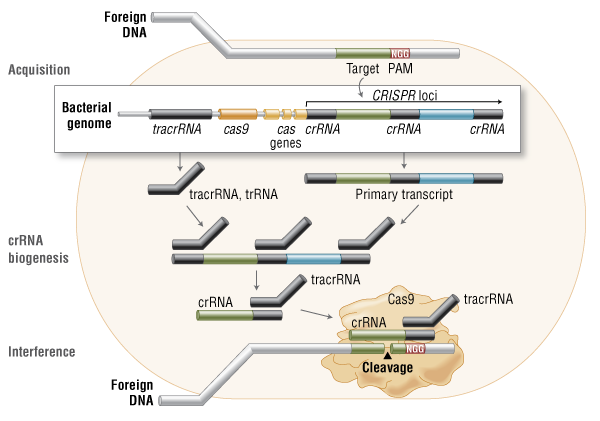
Three types of CRISPR mechanisms have been identified, of which type II is the most studied. In this case, invading DNA from viruses or plasmids is cut into small fragments and incorporated into a CRISPR locus amidst a series of short repeats (around 20 bps). The loci are transcribed, and transcripts are then processed to generate small RNAs (crRNA – CRISPR RNA), which are used to guide effector endonucleases that target invading DNA based on sequence complementarity (Figure 1) (11).

Figure 1. Cas9 in vivo: Bacterial Adaptive Immunity

https://www.neb.com/~/media/NebUs/Files/Feature%20Articles/Images/FA_Cas9_Fig1_Cas9InVivo.png

In the acquisition phase, foreign DNA is incorporated into the bacterial genome at the CRISPR loci. CRISPR loci is then transcribed and processed into crRNA during crRNA biogenesis. During interference, Cas9 endonuclease complexed with a crRNA and separate tracrRNA cleaves foreign DNA containing a 20-nucleotide crRNA complementary sequence adjacent to the PAM sequence. (Figure not drawn to scale.)

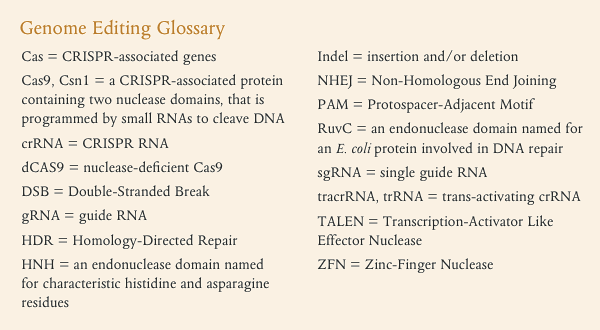
https://www.neb.com/~/media/NebUs/Files/Feature%20Articles/Images/FA_Cas9_GenomeEditingGlossary.png

One Cas protein, Cas9 (also known as Csn1), has been shown, through knockdown and rescue experiments to be a key player in certain CRISPR mechanisms (specifically type II CRISPR systems). The type II CRISPR mechanism is unique compared to other CRISPR systems, as only one Cas protein (Cas9) is required for gene silencing (12). In type II systems, Cas9 participates in the processing of crRNAs (12), and is responsible for the destruction of the target DNA (11). Cas9’s function in both of these steps relies on the presence of two nuclease domains, a RuvC-like nuclease domain located at the amino terminus and a HNH-like nuclease domain that resides in the mid-region of the protein (13).

To achieve site-specific DNA recognition and cleavage, Cas9 must be complexed with both a crRNA and a separate trans-activating crRNA (tracrRNA or trRNA), that is partially complementary to the crRNA (11). The tracrRNA is required for crRNA maturation from a primary transcript encoding multiple pre-crRNAs. This occurs in the presence of RNase III and Cas9 (12).

During the destruction of target DNA, the HNH and RuvC-like nuclease domains cut both DNA strands, generating double-stranded breaks (DSBs) at sites defined by a 20-nucleotide target sequence within an associated crRNA transcript (11, 14). The HNH domain cleaves the complementary strand, while the RuvC domain cleaves the noncomplementary strand.

The double-stranded endonuclease activity of Cas9 also requires that a short conserved sequence, (2–5 nts) known as protospacer-associated motif (PAM), follows immediately 3´- of the crRNA complementary sequence (15). In fact, even fully complementary sequences are ignored by Cas9-RNA in the absence of a PAM sequence (16).

Cas9 and CRISPR as a New Tool in Molecular Biology

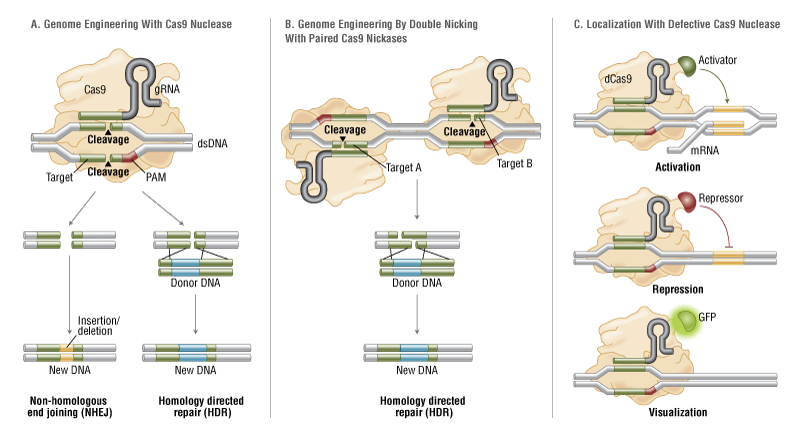
The simplicity of the type II CRISPR nuclease, with only three required components (Cas9 along with the crRNA and trRNA) makes this system amenable to adaptation for genome editing. This potential was realized in 2012 by the Doudna and Charpentier labs (11). Based on the type II CRISPR system described previously, the authors developed a simplified two-component system by combining trRNA and crRNA into a single synthetic single guide RNA (sgRNA). sgRNAprogrammed Cas9 was shown to be as effective as Cas9 programmed with separate trRNA and crRNA in guiding targeted gene alterations (Figure 2A).

To date, three different variants of the Cas9 nuclease have been adopted in genome-editing protocols. The first is wild-type Cas9, which can site-specifically cleave double-stranded DNA, resulting in the activation of the doublestrand break (DSB) repair machinery. DSBs can be repaired by the cellular Non-Homologous End Joining (NHEJ) pathway (17), resulting in insertions and/or deletions (indels) which disrupt the targeted locus. Alternatively, if a donor template with homology to the targeted locus is supplied, the DSB may be repaired by the homology-directed repair (HDR) pathway allowing for precise replacement mutations to be made (Figure 2A) (17, 18).

Cong and colleagues (1) took the Cas9 system a step further towards increased precision by developing a mutant form, known as Cas9D10A, with only nickase activity. This means it cleaves only one DNA strand, and does not activate NHEJ. Instead, when provided with a homologous repair template, DNA repairs are conducted via the high-fidelity HDR pathway only, resulting in reduced indel mutations (1, 11, 19). Cas9D10A is even more appealing in terms of target specificity when loci are targeted by paired Cas9 complexes designed to generate adjacent DNA nicks (20) (see further details about “paired nickases” in Figure 2B).

The third variant is a nuclease-deficient Cas9 (dCas9, Figure 2C) (21). Mutations H840A in the HNH domain and D10A in the RuvC domain inactivate cleavage activity, but do not prevent DNA binding (11, 22). Therefore, this variant can be used to sequence-specifically target any region of the genome without cleavage. Instead, by fusing with various effector domains, dCas9 can be used either as a gene silencing or activation tool (21, 23–26). Furthermore, it can be used as a visualization tool. For instance, Chen and colleagues used dCas9 fused to Enhanced Green Fluorescent Protein (EGFP) to visualize repetitive DNA sequences with a single sgRNA or nonrepetitive loci using multiple sgRNAs (27).

Figure 2. CRISPR/Cas9 System Applications

https://www.neb.com/~/media/NebUs/Files/Feature%20Articles/Images/FA_Cas9_Fig2_Cas9forGenomeEditing.png?device=modal

  1. Wild-type Cas9 nuclease site specifically cleaves double-stranded DNA activating double-strand break repair machinery. In the absence of a homologous repair template non-homologous end joining can result in indels disrupting the target sequence. Alternatively, precise mutations and knock-ins can be made by providing a homologous repair template and exploiting the homology directed repair pathway.
    B. Mutated Cas9 makes a site specific single-strand nick. Two sgRNA can be used to introduce a staggered double-stranded break which can then undergo homology directed repair.
    C. Nuclease-deficient Cas9 can be fused with various effector domains allowing specific localization. For example, transcriptional activators, repressors, and fluorescent proteins.

Targeting Efficiency and Off-target Mutations

Targeting efficiency, or the percentage of desired mutation achieved, is one of the most important parameters by which to assess a genome-editing tool. The targeting efficiency of Cas9 compares favorably with more established methods, such as TALENs or ZFNs (8). For example, in human cells, custom-designed ZFNs and TALENs could only achieve efficiencies ranging from 1% to 50% (29–31). In contrast, the Cas9 system has been reported to have efficiencies up to >70% in zebrafish (32) and plants (33), and ranging from 2–5% in induced pluripotent stem cells (34). In addition, Zhou and colleagues were able to improve genome targeting up to 78% in one-cell mouse embryos, and achieved effective germline transmission through the use of dual sgRNAs to simultaneously target an individual gene (35).

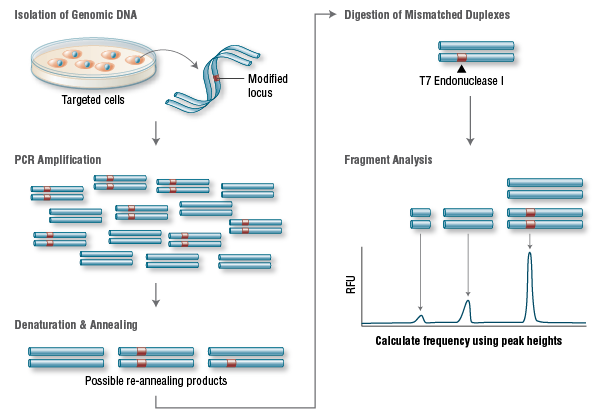
A widely used method to identify mutations is the T7 Endonuclease I mutation detection assay (36, 37) (Figure 3). This assay detects heteroduplex DNA that results from the annealing of a DNA strand, including desired mutations, with a wildtype DNA strand (37).

Figure 3. T7 Endonuclease I Targeting Efficiency Assay

https://www.neb.com/~/media/NebUs/Files/Feature%20Articles/Images/FA_Cas9_Fig3_T7Assay_TargetEfficiency.png

Genomic DNA is amplified with primers bracketing the modified locus. PCR products are then denatured and re-annealed yielding 3 possible structures. Duplexes containing a mismatch are digested by T7 Endonuclease I. The DNA is then electrophoretically separated and fragment analysis is used to calculate targeting efficiency.

Another important parameter is the incidence of off-target mutations. Such mutations are likely to appear in sites that have differences of only a few nucleotides compared to the original sequence, as long as they are adjacent to a PAM sequence. This occurs as Cas9 can tolerate up to 5 base mismatches within the protospacer region (36) or a single base difference in the PAM sequence (38). Off-target mutations are generally more difficult to detect, requiring whole-genome sequencing to rule them out completely.

Recent improvements to the CRISPR system for reducing off-target mutations have been made through the use of truncated gRNA (truncated within the crRNA-derived sequence) or by adding two extra guanine (G) nucleotides to the 5´ end (28, 37). Another way researchers have attempted to minimize off-target effects is with the use of “paired nickases” (20). This strategy uses D10A Cas9 and two sgRNAs complementary to the adjacent area on opposite strands of the target site (Figure 2B). While this induces DSBs in the target DNA, it is expected to create only single nicks in off-target locations and, therefore, result in minimal off-target mutations.

By leveraging computation to reduce off-target mutations, several groups have developed webbased tools to facilitate the identification of potential CRISPR target sites and assess their potential for off-target cleavage. Examples include the CRISPR Design Tool (38) and the ZiFiT Targeter, Version 4.2 (39, 40).

Applications as a Genome-editing and Genome Targeting Tool

Following its initial demonstration in 2012 (9), the CRISPR/Cas9 system has been widely adopted. This has already been successfully used to target important genes in many cell lines and organisms, including human (34), bacteria (41), zebrafish (32), C. elegans (42), plants (34), Xenopus tropicalis (43), yeast (44), Drosophila (45), monkeys (46), rabbits (47), pigs (42), rats (48) and mice (49). Several groups have now taken advantage of this method to introduce single point mutations (deletions or insertions) in a particular target gene, via a single gRNA (14, 21, 29). Using a pair of gRNA-directed Cas9 nucleases instead, it is also possible to induce large deletions or genomic rearrangements, such as inversions or translocations (50). A recent exciting development is the use of the dCas9 version of the CRISPR/Cas9 system to target protein domains for transcriptional regulation (26, 51, 52), epigenetic modification (25), and microscopic visualization of specific genome loci (27).

The CRISPR/Cas9 system requires only the redesign of the crRNA to change target specificity. This contrasts with other genome editing tools, including zinc finger and TALENs, where redesign of the protein-DNA interface is required. Furthermore, CRISPR/Cas9 enables rapid genome-wide interrogation of gene function by generating large gRNA libraries (51, 53) for genomic screening.

The Future of CRISPR/Cas9

The rapid progress in developing Cas9 into a set of tools for cell and molecular biology research has been remarkable, likely due to the simplicity, high efficiency and versatility of the system. Of the designer nuclease systems currently available for precision genome engineering, the CRISPR/Cas system is by far the most user friendly. It is now also clear that Cas9’s potential reaches beyond DNA cleavage, and its usefulness for genome locus-specific recruitment of proteins will likely only be limited by our imagination.


Scientists urge caution in using new CRISPR technology to treat human genetic disease

By Robert Sanders, Media relations | MARCH 19, 2015
http://news.berkeley.edu/2015/03/19/scientists-urge-caution-in-using-new-crispr-technology-to-treat-human-genetic-disease/

http://news.berkeley.edu/wp-content/uploads/2015/03/crispr350.jpg

The bacterial enzyme Cas9 is the engine of RNA-programmed genome engineering in human cells. (Graphic by Jennifer Doudna/UC Berkeley)

A group of 18 scientists and ethicists today warned that a revolutionary new tool to cut and splice DNA should be used cautiously when attempting to fix human genetic disease, and strongly discouraged any attempts at making changes to the human genome that could be passed on to offspring.

Among the authors of this warning is Jennifer Doudna, the co-inventor of the technology, called CRISPR-Cas9, which is driving a new interest in gene therapy, or “genome engineering.” She and colleagues co-authored a perspective piece that appears in the March 20 issue of Science, based on discussions at a meeting that took place in Napa on Jan. 24. The same issue of Science features a collection of recent research papers, commentary and news articles on CRISPR and its implications.    …..

A prudent path forward for genomic engineering and germline gene modification

David Baltimore1,  Paul Berg2, …., Jennifer A. Doudna4,10,*, et al.
http://science.sciencemag.org/content/early/2015/03/18/science.aab1028.full
Science  19 Mar 2015.  http://dx.doi.org:/10.1126/science.aab1028


Correcting genetic defects

Scientists today are changing DNA sequences to correct genetic defects in animals as well as cultured tissues generated from stem cells, strategies that could eventually be used to treat human disease. The technology can also be used to engineer animals with genetic diseases mimicking human disease, which could lead to new insights into previously enigmatic disorders.

The CRISPR-Cas9 tool is still being refined to ensure that genetic changes are precisely targeted, Doudna said. Nevertheless, the authors met “… to initiate an informed discussion of the uses of genome engineering technology, and to identify proactively those areas where current action is essential to prepare for future developments. We recommend taking immediate steps toward ensuring that the application of genome engineering technology is performed safely and ethically.”


Amyloid CRISPR Plasmids and si/shRNA Gene Silencers

http://www.scbt.com/crispr/table-amyloid.html

Santa Cruz Biotechnology, Inc. offers a broad range of gene silencers in the form of siRNAs, shRNA Plasmids and shRNA Lentiviral Particles as well as CRISPR/Cas9 Knockout and CRISPR Double Nickase plasmids. Amyloid gene silencers are available as Amyloid siRNA, Amyloid shRNA Plasmid, Amyloid shRNA Lentiviral Particles and Amyloid CRISPR/Cas9 Knockout plasmids. Amyloid CRISPR/dCas9 Activation Plasmids and CRISPR Lenti Activation Systems for gene activation are also available. Gene silencers and activators are useful for gene studies in combination with antibodies used for protein detection.    Amyloid CRISPR Knockout, HDR and Nickase Knockout Plasmids


CRISPR-Cas9-Based Knockout of the Prion Protein and Its Effect on the Proteome


Mehrabian M, Brethour D, MacIsaac S, Kim JK, Gunawardana C.G, Wang H, et al.
PLoS ONE 2014; 9(12): e114594. http://dx.doi.org/10.1371/journal.pone.0114594

The molecular function of the cellular prion protein (PrPC) and the mechanism by which it may contribute to neurotoxicity in prion diseases and Alzheimer’s disease are only partially understood. Mouse neuroblastoma Neuro2a cells and, more recently, C2C12 myocytes and myotubes have emerged as popular models for investigating the cellular biology of PrP. Mouse epithelial NMuMG cells might become attractive models for studying the possible involvement of PrP in a morphogenetic program underlying epithelial-to-mesenchymal transitions. Here we describe the generation of PrP knockout clones from these cell lines using CRISPR-Cas9 knockout technology. More specifically, knockout clones were generated with two separate guide RNAs targeting recognition sites on opposite strands within the first hundred nucleotides of the Prnp coding sequence. Several PrP knockout clones were isolated and genomic insertions and deletions near the CRISPR-target sites were characterized. Subsequently, deep quantitative global proteome analyses that recorded the relative abundance of>3000 proteins (data deposited to ProteomeXchange Consortium) were undertaken to begin to characterize the molecular consequences of PrP deficiency. The levels of ∼120 proteins were shown to reproducibly correlate with the presence or absence of PrP, with most of these proteins belonging to extracellular components, cell junctions or the cytoskeleton.

http://journals.plos.org/plosone/article/figure/image?size=inline&id=info:doi/10.1371/journal.pone.0114594.g001

http://journals.plos.org/plosone/article/figure/image?size=inline&id=info:doi/10.1371/journal.pone.0114594.g003


Development and Applications of CRISPR-Cas9 for Genome Engineering

Patrick D. Hsu,1,2,3 Eric S. Lander,1 and Feng Zhang1,2,*
Cell. 2014 Jun 5; 157(6): 1262–1278.   doi:  10.1016/j.cell.2014.05.010

Recent advances in genome engineering technologies based on the CRISPR-associated RNA-guided endonuclease Cas9 are enabling the systematic interrogation of mammalian genome function. Analogous to the search function in modern word processors, Cas9 can be guided to specific locations within complex genomes by a short RNA search string. Using this system, DNA sequences within the endogenous genome and their functional outputs are now easily edited or modulated in virtually any organism of choice. Cas9-mediated genetic perturbation is simple and scalable, empowering researchers to elucidate the functional organization of the genome at the systems level and establish causal linkages between genetic variations and biological phenotypes. In this Review, we describe the development and applications of Cas9 for a variety of research or translational applications while highlighting challenges as well as future directions. Derived from a remarkable microbial defense system, Cas9 is driving innovative applications from basic biology to biotechnology and medicine.

The development of recombinant DNA technology in the 1970s marked the beginning of a new era for biology. For the first time, molecular biologists gained the ability to manipulate DNA molecules, making it possible to study genes and harness them to develop novel medicine and biotechnology. Recent advances in genome engineering technologies are sparking a new revolution in biological research. Rather than studying DNA taken out of the context of the genome, researchers can now directly edit or modulate the function of DNA sequences in their endogenous context in virtually any organism of choice, enabling them to elucidate the functional organization of the genome at the systems level, as well as identify causal genetic variations.

Broadly speaking, genome engineering refers to the process of making targeted modifications to the genome, its contexts (e.g., epigenetic marks), or its outputs (e.g., transcripts). The ability to do so easily and efficiently in eukaryotic and especially mammalian cells holds immense promise to transform basic science, biotechnology, and medicine (Figure 1).

http://www.ncbi.nlm.nih.gov/pmc/articles/PMC4343198/bin/nihms659174f1.jpg

For life sciences research, technologies that can delete, insert, and modify the DNA sequences of cells or organisms enable dissecting the function of specific genes and regulatory elements. Multiplexed editing could further allow the interrogation of gene or protein networks at a larger scale. Similarly, manipulating transcriptional regulation or chromatin states at particular loci can reveal how genetic material is organized and utilized within a cell, illuminating relationships between the architecture of the genome and its functions. In biotechnology, precise manipulation of genetic building blocks and regulatory machinery also facilitates the reverse engineering or reconstruction of useful biological systems, for example, by enhancing biofuel production pathways in industrially relevant organisms or by creating infection-resistant crops. Additionally, genome engineering is stimulating a new generation of drug development processes and medical therapeutics. Perturbation of multiple genes simultaneously could model the additive effects that underlie complex polygenic disorders, leading to new drug targets, while genome editing could directly correct harmful mutations in the context of human gene therapy (Tebas et al., 2014).

Eukaryotic genomes contain billions of DNA bases and are difficult to manipulate. One of the breakthroughs in genome manipulation has been the development of gene targeting by homologous recombination (HR), which integrates exogenous repair templates that contain sequence homology to the donor site (Figure 2A) (Capecchi, 1989). HR-mediated targeting has facilitated the generation of knockin and knockout animal models via manipulation of germline competent stem cells, dramatically advancing many areas of biological research. However, although HR-mediated gene targeting produces highly precise alterations, the desired recombination events occur extremely infrequently (1 in 106–109 cells) (Capecchi, 1989), presenting enormous challenges for large-scale applications of gene-targeting experiments.

Genome Editing Technologies Exploit Endogenous DNA Repair Machinery

http://www.ncbi.nlm.nih.gov/pmc/articles/PMC4343198/bin/nihms659174f2.gif

To overcome these challenges, a series of programmable nuclease-based genome editing technologies have been developed in recent years, enabling targeted and efficient modification of a variety of eukaryotic and particularly mammalian species. Of the current generation of genome editing technologies, the most rapidly developing is the class of RNA-guided endonucleases known as Cas9 from the microbial adaptive immune system CRISPR (clustered regularly interspaced short palindromic repeats), which can be easily targeted to virtually any genomic location of choice by a short RNA guide. Here, we review the development and applications of the CRISPR-associated endonuclease Cas9 as a platform technology for achieving targeted perturbation of endogenous genomic elements and also discuss challenges and future avenues for innovation.   ……

Figure 4   Natural Mechanisms of Microbial CRISPR Systems in Adaptive Immunity

http://www.ncbi.nlm.nih.gov/pmc/articles/PMC4343198/bin/nihms659174f4.gif

……  A key turning point came in 2005, when systematic analysis of the spacer sequences separating the individual direct repeats suggested their extrachromosomal and phage-associated origins (Mojica et al., 2005Pourcel et al., 2005Bolotin et al., 2005). This insight was tremendously exciting, especially given previous studies showing that CRISPR loci are transcribed (Tang et al., 2002) and that viruses are unable to infect archaeal cells carrying spacers corresponding to their own genomes (Mojica et al., 2005). Together, these findings led to the speculation that CRISPR arrays serve as an immune memory and defense mechanism, and individual spacers facilitate defense against bacteriophage infection by exploiting Watson-Crick base-pairing between nucleic acids (Mojica et al., 2005Pourcel et al., 2005). Despite these compelling realizations that CRISPR loci might be involved in microbial immunity, the specific mechanism of how the spacers act to mediate viral defense remained a challenging puzzle. Several hypotheses were raised, including thoughts that CRISPR spacers act as small RNA guides to degrade viral transcripts in a RNAi-like mechanism (Makarova et al., 2006) or that CRISPR spacers direct Cas enzymes to cleave viral DNA at spacer-matching regions (Bolotin et al., 2005).   …..

As the pace of CRISPR research accelerated, researchers quickly unraveled many details of each type of CRISPR system (Figure 4). Building on an earlier speculation that protospacer adjacent motifs (PAMs) may direct the type II Cas9 nuclease to cleave DNA (Bolotin et al., 2005), Moineau and colleagues highlighted the importance of PAM sequences by demonstrating that PAM mutations in phage genomes circumvented CRISPR interference (Deveau et al., 2008). Additionally, for types I and II, the lack of PAM within the direct repeat sequence within the CRISPR array prevents self-targeting by the CRISPR system. In type III systems, however, mismatches between the 5′ end of the crRNA and the DNA target are required for plasmid interference (Marraffini and Sontheimer, 2010).  …..

In 2013, a pair of studies simultaneously showed how to successfully engineer type II CRISPR systems from Streptococcus thermophilus (Cong et al., 2013) andStreptococcus pyogenes (Cong et al., 2013Mali et al., 2013a) to accomplish genome editing in mammalian cells. Heterologous expression of mature crRNA-tracrRNA hybrids (Cong et al., 2013) as well as sgRNAs (Cong et al., 2013Mali et al., 2013a) directs Cas9 cleavage within the mammalian cellular genome to stimulate NHEJ or HDR-mediated genome editing. Multiple guide RNAs can also be used to target several genes at once. Since these initial studies, Cas9 has been used by thousands of laboratories for genome editing applications in a variety of experimental model systems (Sander and Joung, 2014). ……

The majority of CRISPR-based technology development has focused on the signature Cas9 nuclease from type II CRISPR systems. However, there remains a wide diversity of CRISPR types and functions. Cas RAMP module (Cmr) proteins identified in Pyrococcus furiosus and Sulfolobus solfataricus (Hale et al., 2012) constitute an RNA-targeting CRISPR immune system, forming a complex guided by small CRISPR RNAs that target and cleave complementary RNA instead of DNA. Cmr protein homologs can be found throughout bacteria and archaea, typically relying on a 5 site tag sequence on the target-matching crRNA for Cmr-directed cleavage.

Unlike RNAi, which is targeted largely by a 6 nt seed region and to a lesser extent 13 other bases, Cmr crRNAs contain 30–40 nt of target complementarity. Cmr-CRISPR technologies for RNA targeting are thus a promising target for orthogonal engineering and minimal off-target modification. Although the modularity of Cmr systems for RNA-targeting in mammalian cells remains to be investigated, Cmr complexes native to P. furiosus have already been engineered to target novel RNA substrates (Hale et al., 20092012).   ……

Although Cas9 has already been widely used as a research tool, a particularly exciting future direction is the development of Cas9 as a therapeutic technology for treating genetic disorders. For a monogenic recessive disorder due to loss-of-function mutations (such as cystic fibrosis, sickle-cell anemia, or Duchenne muscular dystrophy), Cas9 may be used to correct the causative mutation. This has many advantages over traditional methods of gene augmentation that deliver functional genetic copies via viral vector-mediated overexpression—particularly that the newly functional gene is expressed in its natural context. For dominant-negative disorders in which the affected gene is haplosufficient (such as transthyretin-related hereditary amyloidosis or dominant forms of retinitis pigmentosum), it may also be possible to use NHEJ to inactivate the mutated allele to achieve therapeutic benefit. For allele-specific targeting, one could design guide RNAs capable of distinguishing between single-nucleotide polymorphism (SNP) variations in the target gene, such as when the SNP falls within the PAM sequence.


CRISPR/Cas9: a powerful genetic engineering tool for establishing large animal models of neurodegenerative diseases

Zhuchi Tu, Weili Yang, Sen Yan, Xiangyu Guo and Xiao-Jiang Li

Molecular Neurodegeneration 2015; 10:35  http://dx.doi.org:/10.1186/s13024-015-0031-x

Animal models are extremely valuable to help us understand the pathogenesis of neurodegenerative disorders and to find treatments for them. Since large animals are more like humans than rodents, they make good models to identify the important pathological events that may be seen in humans but not in small animals; large animals are also very important for validating effective treatments or confirming therapeutic targets. Due to the lack of embryonic stem cell lines from large animals, it has been difficult to use traditional gene targeting technology to establish large animal models of neurodegenerative diseases. Recently, CRISPR/Cas9 was used successfully to genetically modify genomes in various species. Here we discuss the use of CRISPR/Cas9 technology to establish large animal models that can more faithfully mimic human neurodegenerative diseases.

Neurodegenerative diseases — Alzheimer’s disease(AD),Parkinson’s disease(PD), amyotrophic lateral sclerosis (ALS), Huntington’s disease (HD), and frontotemporal dementia (FTD) — are characterized by age-dependent and selective neurodegeneration. As the life expectancy of humans lengthens, there is a greater prevalence of these neurodegenerative diseases; however, the pathogenesis of most of these neurodegenerative diseases remain unclear, and we lack effective treatments for these important brain disorders.

CRISPR/Cas9,  Non-human primates,  Neurodegenerative diseases,  Animal model

There are a number of excellent reviews covering different types of neurodegenerative diseases and their genetic mouse models [812]. Investigations of different mouse models of neurodegenerative diseases have revealed a common pathology shared by these diseases. First, the development of neuropathology and neurological symptoms in genetic mouse models of neurodegenerative diseases is age dependent and progressive. Second, all the mouse models show an accumulation of misfolded or aggregated proteins resulting from the expression of mutant genes. Third, despite the widespread expression of mutant proteins throughout the body and brain, neuronal function appears to be selectively or preferentially affected. All these facts indicate that mouse models of neurodegenerative diseases recapitulate important pathologic features also seen in patients with neurodegenerative diseases.

However, it seems that mouse models can not recapitulate the full range of neuropathology seen in patients with neurodegenerative diseases. Overt neurodegeneration, which is the most important pathological feature in patient brains, is absent in genetic rodent models of AD, PD, and HD. Many rodent models that express transgenic mutant proteins under the control of different promoters do not replicate overt neurodegeneration, which is likely due to their short life spans and the different aging processes of small animals. Also important are the remarkable differences in brain development between rodents and primates. For example, the mouse brain takes 21 days to fully develop, whereas the formation of primate brains requires more than 150 days [13]. The rapid development of the brain in rodents may render neuronal cells resistant to misfolded protein-mediated neurodegeneration. Another difficulty in using rodent models is how to analyze cognitive and emotional abnormalities, which are the early symptoms of most neurodegenerative diseases in humans. Differences in neuronal circuitry, anatomy, and physiology between rodent and primate brains may also account for the behavioral differences between rodent and primate models.


Mitochondrial dynamics–fusion, fission, movement, and mitophagy–in neurodegenerative diseases

Hsiuchen Chen and David C. Chan
Human Molec Gen 2009; 18, Review Issue 2 R169–R176
http://dx.doi.org:/10.1093/hmg/ddp326

Neurons are metabolically active cells with high energy demands at locations distant from the cell body. As a result, these cells are particularly dependent on mitochondrial function, as reflected by the observation that diseases of mitochondrial dysfunction often have a neurodegenerative component. Recent discoveries have highlighted that neurons are reliant particularly on the dynamic properties of mitochondria. Mitochondria are dynamic organelles by several criteria. They engage in repeated cycles of fusion and fission, which serve to intermix the lipids and contents of a population of mitochondria. In addition, mitochondria are actively recruited to subcellular sites, such as the axonal and dendritic processes of neurons. Finally, the quality of a mitochondrial population is maintained through mitophagy, a form of autophagy in which defective mitochondria are selectively degraded. We review the general features of mitochondrial dynamics, incorporating recent findings on mitochondrial fusion, fission, transport and mitophagy. Defects in these key features are associated with neurodegenerative disease. Charcot-Marie-Tooth type 2A, a peripheral neuropathy, and dominant optic atrophy, an inherited optic neuropathy, result from a primary deficiency of mitochondrial fusion. Moreover, several major neurodegenerative diseases—including Parkinson’s, Alzheimer’s and Huntington’s disease—involve disruption of mitochondrial dynamics. Remarkably, in several disease models, the manipulation of mitochondrial fusion or fission can partially rescue disease phenotypes. We review how mitochondrial dynamics is altered in these neurodegenerative diseases and discuss the reciprocal interactions between mitochondrial fusion, fission, transport and mitophagy.


Applications of CRISPR–Cas systems in Neuroscience

Matthias Heidenreich  & Feng Zhang
Nature Rev Neurosci 2016; 17:36–44   http://dx.doi.org:/10.1038/nrn.2015.2

Genome-editing tools, and in particular those based on CRISPR–Cas (clustered regularly interspaced short palindromic repeat (CRISPR)–CRISPR-associated protein) systems, are accelerating the pace of biological research and enabling targeted genetic interrogation in almost any organism and cell type. These tools have opened the door to the development of new model systems for studying the complexity of the nervous system, including animal models and stem cell-derived in vitro models. Precise and efficient gene editing using CRISPR–Cas systems has the potential to advance both basic and translational neuroscience research.
Cellular neuroscience
, DNA recombination, Genetic engineering, Molecular neuroscience

Figure 3: In vitro applications of Cas9 in human iPSCs.close

http://www.nature.com/nrn/journal/v17/n1/carousel/nrn.2015.2-f3.jpg

a | Evaluation of disease candidate genes from large-population genome-wide association studies (GWASs). Human primary cells, such as neurons, are not easily available and are difficult to expand in culture. By contrast, induced pluripo…

  1. Genome-editing Technologies for Gene and Cell Therapy

Molecular Therapy 12 Jan 2016

  1. Systematic quantification of HDR and NHEJ reveals effects of locus, nuclease, and cell type on genome-editing

Scientific Reports 31 Mar 2016

  1. Controlled delivery of β-globin-targeting TALENs and CRISPR/Cas9 into mammalian cells for genome editing using microinjection

Scientific Reports 12 Nov 2015


Alzheimer’s Disease: Medicine’s Greatest Challenge in the 21st Century

https://www.physicsforums.com/insights/can-gene-editing-eliminate-alzheimers-disease/

The development of the CRISPR/Cas9 system has made gene editing a relatively simple task.  While CRISPR and other gene editing technologies stand to revolutionize biomedical research and offers many promising therapeutic avenues (such as in the treatment of HIV), a great deal of debate exists over whether CRISPR should be used to modify human embryos. As I discussed in my previous Insight article, we lack enough fundamental biological knowledge to enhance many traits like height or intelligence, so we are not near a future with genetically-enhanced super babies. However, scientists have identified a few rare genetic variants that protect against disease.  One such protective variant is a mutation in the APP gene that protects against Alzheimer’s disease and cognitive decline in old age. If we can perfect gene editing technologies, is this mutation one that we should be regularly introducing into embryos? In this article, I explore the potential for using gene editing as a way to prevent Alzheimer’s disease in future generations. Alzheimer’s Disease: Medicine’s Greatest Challenge in the 21st Century Can gene editing be the missing piece in the battle against Alzheimer’s? (Source: bostonbiotech.org) I chose to assess the benefit of germline gene editing in the context of Alzheimer’s disease because this disease is one of the biggest challenges medicine faces in the 21st century. Alzheimer’s disease is a chronic neurodegenerative disease responsible for the majority of the cases of dementia in the elderly. The disease symptoms begins with short term memory loss and causes more severe symptoms – problems with language, disorientation, mood swings, behavioral issues – as it progresses, eventually leading to the loss of bodily functions and death. Because of the dementia the disease causes, Alzheimer’s patients require a great deal of care, and the world spends ~1% of its total GDP on caring for those with Alzheimer’s and related disorders. Because the prevalence of the disease increases with age, the situation will worsen as life expectancies around the globe increase: worldwide cases of Alzheimer’s are expected to grow from 35 million today to over 115 million by 2050.

Despite much research, the exact causes of Alzheimer’s disease remains poorly understood. The disease seems to be related to the accumulation of plaques made of amyloid-β peptides that form on the outside of neurons, as well as the formation of tangles of the protein tau inside of neurons. Although many efforts have been made to target amyloid-β or the enzymes involved in its formation, we have so far been unsuccessful at finding any treatment that stops the disease or reverses its progress. Some researchers believe that most attempts at treating Alzheimer’s have failed because, by the time a patient shows symptoms, the disease has already progressed past the point of no return.

While research towards a cure continues, researchers have sought effective ways to prevent Alzheimer’s disease. Although some studies show that mental and physical exercise may lower ones risk of Alzheimer’s disease, approximately 60-80% of the risk for Alzheimer’s disease appears to be genetic. Thus, if we’re serious about prevention, we may have to act at the genetic level. And because the brain is difficult to access surgically for gene therapy in adults, this means using gene editing on embryos.

Reference https://www.physicsforums.com/insights/can-gene-editing-eliminate-alzheimers-disease/


Utilising CRISPR to Generate Predictive Disease Models: a Case Study in Neurodegenerative Disorders


Dr. Bhuvaneish.T. Selvaraj  – Scottish Centre for Regenerative Medicine

http://www.crisprsummit.com/utilising-crispr-to-generate-predictive-disease-models-a-case-study-in-neurodegenerative-disorders

  • Introducing the latest developments in predictive model generation
  • Discover how CRISPR is being used to develop disease models to study and treat neurodegenerative disorders
  • In depth Q&A session to answer your most pressing questions


Turning On Genes, Systematically, with CRISPR/Cas9

http://www.genengnews.com/gen-news-highlights/turning-on-genes-systematically-with-crispr-cas9/81250697/


Scientists based at MIT assert that they can reliably turn on any gene of their choosing in living cells. [Feng Zhang and Steve Dixon]  http://www.genengnews.com/media/images/GENHighlight/Dec12_2014_CRISPRCas9GeneActivationSystem7838101231.jpg

With the latest CRISPR/Cas9 advance, the exhortation “turn on, tune in, drop out” comes to mind. The CRISPR/Cas9 gene-editing system was already a well-known means of “tuning in” (inserting new genes) and “dropping out” (knocking out genes). But when it came to “turning on” genes, CRISPR/Cas9 had little potency. That is, it had demonstrated only limited success as a way to activate specific genes.

A new CRISPR/Cas9 approach, however, appears capable of activating genes more effectively than older approaches. The new approach may allow scientists to more easily determine the function of individual genes, according to Feng Zhang, Ph.D., a researcher at MIT and the Broad Institute. Dr. Zhang and colleagues report that the new approach permits multiplexed gene activation and rapid, large-scale studies of gene function.

The new technique was introduced in the December 10 online edition of Nature, in an article entitled, “Genome-scale transcriptional activation by an engineered CRISPR-Cas9 complex.” The article describes how Dr. Zhang, along with the University of Tokyo’s Osamu Nureki, Ph.D., and Hiroshi Nishimasu, Ph.D., overhauled the CRISPR/Cas9 system. The research team based their work on their analysis (published earlier this year) of the structure formed when Cas9 binds to the guide RNA and its target DNA. Specifically, the team used the structure’s 3D shape to rationally improve the system.

In previous efforts to revamp CRISPR/Cas9 for gene activation purposes, scientists had tried to attach the activation domains to either end of the Cas9 protein, with limited success. From their structural studies, the MIT team realized that two small loops of the RNA guide poke out from the Cas9 complex and could be better points of attachment because they allow the activation domains to have more flexibility in recruiting transcription machinery.

Using their revamped system, the researchers activated about a dozen genes that had proven difficult or impossible to turn on using the previous generation of Cas9 activators. Each gene showed at least a twofold boost in transcription, and for many genes, the researchers found multiple orders of magnitude increase in activation.

After investigating single-guide RNA targeting rules for effective transcriptional activation, demonstrating multiplexed activation of 10 genes simultaneously, and upregulating long intergenic noncoding RNA transcripts, the research team decided to undertake a large-scale screen. This screen was designed to identify genes that confer resistance to a melanoma drug called PLX-4720.

“We … synthesized a library consisting of 70,290 guides targeting all human RefSeq coding isoforms to screen for genes that, upon activation, confer resistance to a BRAF inhibitor,” wrote the authors of the Nature paper. “The top hits included genes previously shown to be able to confer resistance, and novel candidates were validated using individual [single-guide RNA] and complementary DNA overexpression.”

A gene signature based on the top screening hits, the authors added, correlated with a gene expression signature of BRAF inhibitor resistance in cell lines and patient-derived samples. It was also suggested that large-scale screens such as the one demonstrated in the current study could help researchers discover new cancer drugs that prevent tumors from becoming resistant.

More at –  http://www.genengnews.com/gen-news-highlights/turning-on-genes-systematically-with-crispr-cas9/81250697/


Susceptibility and modifier genes in Portuguese transthyretin V30M amyloid polyneuropathy: complexity in a single-gene disease
Miguel L. Soares1,2, Teresa Coelho3,6, Alda Sousa4,5, …, Maria Joa˜o Saraiva2,5 and Joel N. Buxbaum1
Human Molec Gen 2005; 14(4): 543–553   http://dx.doi.org:/10.1093/hmg/ddi051
https://www.researchgate.net/profile/Isabel_Conceicao/publication/8081351_Susceptibility_and_modifier_genes_in_Portuguese_transthyretin_V30M_amyloid_polyneuropathy_complexity_in_a_single-gene_disease/links/53e123d70cf2235f352733b3.pdf

Familial amyloid polyneuropathy type I is an autosomal dominant disorder caused by mutations in the transthyretin (TTR ) gene; however, carriers of the same mutation exhibit variability in penetrance and clinical expression. We analyzed alleles of candidate genes encoding non-fibrillar components of TTR amyloid deposits and a molecule metabolically interacting with TTR [retinol-binding protein (RBP)], for possible associations with age of disease onset and/or susceptibility in a Portuguese population sample with the TTR V30M mutation and unrelated controls. We show that the V30M carriers represent a distinct subset of the Portuguese population. Estimates of genetic distance indicated that the controls and the classical onset group were furthest apart, whereas the late-onset group appeared to differ from both. Importantly, the data also indicate that genetic interactions among the multiple loci evaluated, rather than single-locus effects, are more likely to determine differences in the age of disease onset. Multifactor dimensionality reduction indicated that the best genetic model for classical onset group versus controls involved the APCS gene, whereas for late-onset cases, one APCS variant (APCSv1) and two RBP variants (RBPv1 and RBPv2) are involved. Thus, although the TTR V30M mutation is required for the disease in Portuguese patients, different genetic factors may govern the age of onset, as well as the occurrence of anticipation.

Autosomal dominant disorders may vary in expression even within a given kindred. The basis of this variability is uncertain and can be attributed to epigenetic factors, environment or epistasis. We have studied familial amyloid polyneuropathy (FAP), an autosomal dominant disorder characterized by peripheral sensorimotor and autonomic neuropathy. It exhibits variation in cardiac, renal, gastrointestinal and ocular involvement, as well as age of onset. Over 80 missense mutations in the transthyretin gene (TTR ) result in autosomal dominant disease http://www.ibmc.up.pt/~mjsaraiv/ttrmut.html). The presence of deposits consisting entirely of wild-type TTR molecules in the hearts of 10– 25% of individuals over age 80 reveals its inherent in vivo amyloidogenic potential (1).

FAP was initially described in Portuguese (2) where, until recently, the TTR V30M has been the only pathogenic mutation associated with the disease (3,4). Later reports identified the same mutation in Swedish and Japanese families (5,6). The disorder has since been recognized in other European countries and in North American kindreds in association with V30M, as well as other mutations (7).

TTR V30M produces disease in only 5–10% of Swedish carriers of the allele (8), a much lower degree of penetrance than that seen in Portuguese (80%) (9) or in Japanese with the same mutation. The actual penetrance in Japanese carriers has not been formally established, but appears to resemble that seen in Portuguese. Portuguese and Japanese carriers show considerable variation in the age of clinical onset (10,11). In both populations, the first symptoms had originally been described as typically occurring before age 40 (so-called ‘classical’ or early-onset); however, in recent years, more individuals developing symptoms late in life have been identified (11,12). Hence, present data indicate that the distribution of the age of onset in Portuguese is continuous, but asymmetric with a mean around age 35 and a long tail into the older age group (Fig. 1) (9,13). Further, DNA testing in Portugal has identified asymptomatic carriers over age 70 belonging to a subset of very late-onset kindreds in whose descendants genetic anticipation is frequent. The molecular basis of anticipation in FAP, which is not mediated by trinucleotide repeat expansions in the TTR or any other gene (14), remains elusive.

Variation in penetrance, age of onset and clinical features are hallmarks of many autosomal dominant disorders including the human TTR amyloidoses (7). Some of these clearly reflect specific biological effects of a particular mutation or a class of mutants. However, when such phenotypic variability is seen with a single mutation in the gene encoding the same protein, it suggests an effect of modifying genetic loci and/or environmental factors contributing differentially to the course of disease. We have chosen to examine age of onset as an example of a discrete phenotypic variation in the presence of the particular autosomal dominant disease-associated mutation TTR V30M. Although the role of environmental factors cannot be excluded, the existence of modifier genes involved in TTR amyloidogenesis is an attractive hypothesis to explain the phenotypic variability in FAP. ….

ATTR (TTR amyloid), like all amyloid deposits, contains several molecular components, in addition to the quantitatively dominant fibril-forming amyloid protein, including heparan sulfate proteoglycan 2 (HSPG2 or perlecan), SAP, a plasma glycoprotein of the pentraxin family (encoded by the APCS gene) that undergoes specific calcium-dependent binding to all types of amyloid fibrils, and apolipoprotein E (ApoE), also found in all amyloid deposits (15). The ApoE4 isoform is associated with an increased frequency and earlier onset of Alzheimer’s disease (Ab), the most common form of brain amyloid, whereas the ApoE2 isoform appears to be protective (16). ApoE variants could exert a similar modulatory effect in the onset of FAP, although early studies on a limited number of patients suggested this was not the case (17).

In at least one instance of senile systemic amyloidosis, small amounts of AA-related material were found in TTR deposits (18). These could reflect either a passive co-aggregation or a contributory involvement of protein AA, encoded by the serum amyloid A (SAA ) genes and the main component of secondary (reactive) amyloid fibrils, in the formation of ATTR.

Retinol-binding protein (RBP), the serum carrier of vitamin A, circulates in plasma bound to TTR. Vitamin A-loaded RBP and L-thyroxine, the two natural ligands of TTR, can act alone or synergistically to inhibit the rate and extent of TTR fibrillogenesis in vitro, suggesting that RBP may influence the course of FAP pathology in vivo (19). We have analyzed coding and non-coding sequence polymorphisms in the RBP4 (serum RBP, 10q24), HSPG2 (1p36.1), APCS (1q22), APOE (19q13.2), SAA1 and SAA2 (11p15.1) genes with the goal of identifying chromosomes carrying common and functionally significant variants. At the time these studies were performed, the full human genome sequence was not completed and systematic singlenucleotide polymorphism (SNP) analyses were not available for any of the suspected candidate genes. We identified new SNPs in APCS and RBP4 and utilized polymorphisms in SAA, HSPG2 and APOE that had already been characterized and shown to have potential pathophysiologic significance in other disorders (16,20–22). The genotyping data were analyzed for association with the presence of the V30M amyloidogenic allele (FAP patients versus controls) and with the age of onset (classical- versus late-onset patients). Multilocus analyses were also performed to examine the effects of simultaneous contributions of the six loci for determining the onset of the first symptoms.  …..

The potential for different underlying models for classical and late onset is supported by the MDR analysis, which produces two distinct models when comparing each class with the controls. One could view the two onset classes as unique diseases. If this is the case, then the failure to detect a single predictive genetic model is consistent with two related, but different, diseases. This is exactly what would be expected in such a case of genetic heterogeneity (28). Using this approach, a major gene effect can be viewed as a necessary, but not sufficient, condition to explain the course of the disease. Analyzing the cases but omitting from the analysis of phenotype the necessary allele, in this case TTR V30M, can then reveal a variety of important modifiers that are distinct between the phenotypes.

The significant comparisons obtained in our study cohort indicate that the combined effects mainly result from two and three-locus interactions involving all loci except SAA1 and SAA2 for susceptibility to disease. A considerable number of four-site combinations modulate the age of onset with SAA1 appearing in a majority of significant combinations in late-onset disease, perhaps indicating a greater role of the SAA variants in the age of onset of FAP.

The correlation between genotype and phenotype in socalled simple Mendelian disorders is often incomplete, as only a subset of all mutations can reliably predict specific phenotypes (34). This is because non-allelic genetic variations and/or environmental influences underlie these disorders whose phenotypes behave as complex traits. A few examples include the identification of the role of homozygozity for the SAA1.1 allele in conferring the genetic susceptibility to renal amyloidosis in FMF (20) and the association of an insertion/deletion polymorphism in the ACE gene with disease severity in familial hypertrophic cardiomyopathy (35). In these disorders, the phenotypes arise from mutations in MEFV and b-MHC, but are modulated by independently inherited genetic variation. In this report, we show that interactions among multiple genes, whose products are confirmed or putative constituents of ATTR deposits, or metabolically interact with TTR, modulate the onset of the first symptoms and predispose individuals to disease in the presence of the V30M mutation in TTR. The exact nature of the effects identified here requires further study with potential application in the development of genetic screening with prognostic value pertaining to the onset of disease in the TTR V30M carriers.

If the effects of additional single or interacting genes dictate the heterogeneity of phenotype, as reflected in variability of onset and clinical expression (with the same TTR mutation), the products encoded by alleles at such loci could contribute to the process of wild-type TTR deposition in elderly individuals without a mutation (senile systemic amyloidosis), a phenomenon not readily recognized as having a genetic basis because of the insensitivity of family history in the elderly.


Safety and Efficacy of RNAi Therapy for Transthyretin Amyloidosis

Coelho T, Adams D, Silva A, et al.
N Engl J Med 2013;369:819-29.    http://dx.doi.org:/10.1056/NEJMoa1208760

Transthyretin amyloidosis is caused by the deposition of hepatocyte-derived transthyretin amyloid in peripheral nerves and the heart. A therapeutic approach mediated by RNA interference (RNAi) could reduce the production of transthyretin.

Methods We identified a potent antitransthyretin small interfering RNA, which was encapsulated in two distinct first- and second-generation formulations of lipid nanoparticles, generating ALN-TTR01 and ALN-TTR02, respectively. Each formulation was studied in a single-dose, placebo-controlled phase 1 trial to assess safety and effect on transthyretin levels. We first evaluated ALN-TTR01 (at doses of 0.01 to 1.0 mg per kilogram of body weight) in 32 patients with transthyretin amyloidosis and then evaluated ALN-TTR02 (at doses of 0.01 to 0.5 mg per kilogram) in 17 healthy volunteers.

Results Rapid, dose-dependent, and durable lowering of transthyretin levels was observed in the two trials. At a dose of 1.0 mg per kilogram, ALN-TTR01 suppressed transthyretin, with a mean reduction at day 7 of 38%, as compared with placebo (P=0.01); levels of mutant and nonmutant forms of transthyretin were lowered to a similar extent. For ALN-TTR02, the mean reductions in transthyretin levels at doses of 0.15 to 0.3 mg per kilogram ranged from 82.3 to 86.8%, with reductions of 56.6 to 67.1% at 28 days (P<0.001 for all comparisons). These reductions were shown to be RNAi mediated. Mild-to-moderate infusion-related reactions occurred in 20.8% and 7.7% of participants receiving ALN-TTR01 and ALN-TTR02, respectively.

ALN-TTR01 and ALN-TTR02 suppressed the production of both mutant and nonmutant forms of transthyretin, establishing proof of concept for RNAi therapy targeting messenger RNA transcribed from a disease-causing gene.


Alnylam May Seek Approval for TTR Amyloidosis Rx in 2017 as Other Programs Advance


https://www.genomeweb.com/rnai/alnylam-may-seek-approval-ttr-amyloidosis-rx-2017-other-programs-advance

Officials from Alnylam Pharmaceuticals last week provided updates on the two drug candidates from the company’s flagship transthyretin-mediated amyloidosis program, stating that the intravenously delivered agent patisiran is proceeding toward a possible market approval in three years, while a subcutaneously administered version called ALN-TTRsc is poised to enter Phase III testing before the end of the year.

Meanwhile, Alnylam is set to advance a handful of preclinical therapies into human studies in short order, including ones for complement-mediated diseases, hypercholesterolemia, and porphyria.

The officials made their comments during a conference call held to discuss Alnylam’s second-quarter financial results.

ATTR is caused by a mutation in the TTR gene, which normally produces a protein that acts as a carrier for retinol binding protein and is characterized by the accumulation of amyloid deposits in various tissues. Alnylam’s drugs are designed to silence both the mutant and wild-type forms of TTR.

Patisiran, which is delivered using lipid nanoparticles developed by Tekmira Pharmaceuticals, is currently in a Phase III study in patients with a form of ATTR called familial amyloid polyneuropathy (FAP) affecting the peripheral nervous system. Running at over 20 sites in nine countries, that study is set to enroll up to 200 patients and compare treatment to placebo based on improvements in neuropathy symptoms.

According to Alnylam Chief Medical Officer Akshay Vaishnaw, Alnylam expects to have final data from the study in two to three years, which would put patisiran on track for a new drug application filing in 2017.

Meanwhile, ALN-TTRsc, which is under development for a version of ATTR that affects cardiac tissue called familial amyloidotic cardiomyopathy (FAC) and uses Alnylam’s proprietary GalNAc conjugate delivery technology, is set to enter Phase III by year-end as Alnylam holds “active discussions” with US and European regulators on the design of that study, CEO John Maraganore noted during the call.

In the interim, Alnylam continues to enroll patients in a pilot Phase II study of ALN-TTRsc, which is designed to test the drug’s efficacy for FAC or senile systemic amyloidosis (SSA), a condition caused by the idiopathic accumulation of wild-type TTR protein in the heart.

Based on “encouraging” data thus far, Vaishnaw said that Alnylam has upped the expected enrollment in this study to 25 patients from 15. Available data from the trial is slated for release in November, he noted, stressing that “any clinical endpoint result needs to be considered exploratory given the small sample size and the very limited duration of treatment of only six weeks” in the trial.

Vaishnaw added that an open-label extension (OLE) study for patients in the ALN-TTRsc study will kick off in the coming weeks, allowing the company to gather long-term dosing tolerability and clinical activity data on the drug.

Enrollment in an OLE study of patisiran has been completed with 27 patients, he said, and, “as of today, with up to nine months of therapy … there have been no study drug discontinuations.” Clinical endpoint data from approximately 20 patients in this study will be presented at the American Neurological Association meeting in October.

As part of its ATTR efforts, Alnylam has also been conducting natural history of disease studies in both FAP and FAC patients. Data from the 283-patient FAP study was presented earlier this year and showed a rapid progression in neuropathy impairment scores and a high correlation of this measurement with disease severity.

During last week’s conference call, Vaishnaw said that clinical endpoint and biomarker data on about 400 patients with either FAC or SSA have already been collected in a nature history study on cardiac ATTR. Maraganore said that these findings would likely be released sometime next year.

Alnylam Presents New Phase II, Preclinical Data from TTR Amyloidosis Programs
https://www.genomeweb.com/rnai/alnylam-presents-new-phase-ii-preclinical-data-ttr-amyloidosis-programs


Amyloid disease drug approved

Nature Biotechnology 2012; (3http://dx.doi.org:/10.1038/nbt0212-121b

The first medication for a rare and often fatal protein misfolding disorder has been approved in Europe. On November 16, the E gave a green light to Pfizer’s Vyndaqel (tafamidis) for treating transthyretin amyloidosis in adult patients with stage 1 polyneuropathy symptoms. [Jeffery Kelly, La Jolla]


Safety and Efficacy of RNAi Therapy for Transthyretin …

http://www.nejm.org/…/NEJMoa1208760?&#8230;

The New England Journal of Medicine

Aug 29, 2013 – Transthyretin amyloidosis is caused by the deposition of hepatocyte-derived transthyretin amyloid in peripheral nerves and the heart.


Alnylam’s RNAi therapy targets amyloid disease

Ken Garber
Nature Biotechnology 2015; 33(577)    http://dx.doi.org:/10.1038/nbt0615-577a

RNA interference’s silencing of target genes could result in potent therapeutics.

http://www.nature.com/nbt/journal/v33/n6/images/nbt0615-577a-I1.jpg

The most clinically advanced RNA interference (RNAi) therapeutic achieved a milestone in April when Alnylam Pharmaceuticals in Cambridge, Massachusetts, reported positive results for patisiran, a small interfering RNA (siRNA) oligonucleotide targeting transthyretin for treating familial amyloidotic polyneuropathy (FAP).  …

  1. Analysis of 589,306 genomes identifies individuals resilient to severe Mendelian childhood diseases

Nature Biotechnology 11 April 2016

  1. CRISPR-Cas systems for editing, regulating and targeting genomes

Nature Biotechnology 02 March 2014

  1. Near-optimal probabilistic RNA-seq quantification

Nature Biotechnology 04 April 2016


Translational Neuroscience: Toward New Therapies

https://books.google.com/books?isbn=0262029863

Karoly Nikolich, ‎Steven E. Hyman – 2015 – ‎Medical

Tafamidis for Transthyretin Familial Amyloid Polyneuropathy: A Randomized, Controlled Trial. … Multiplex Genome Engineering Using CRISPR/Cas Systems.


Is CRISPR a Solution to Familial Amyloid Polyneuropathy?

Author and Curator: Larry H. Bernstein, MD, FCAP

Originally published as

https://pharmaceuticalintelligence.com/2016/04/13/is-crispr-a-solution-to-familial-amyloid-polyneuropathy/


http://scholar.aci.info/view/1492518a054469f0388/15411079e5a00014c3d

FAP is characterized by the systemic deposition of amyloidogenic variants of the transthyretin protein, especially in the peripheral nervous system, causing a progressive sensory and motor polyneuropathy.

FAP is caused by a mutation of the TTR gene, located on human chromosome 18q12.1-11.2.[5] A replacement of valine by methionine at position 30 (TTR V30M) is the mutation most commonly found in FAP.[1] The variant TTR is mostly produced by the liver.[citation needed] The transthyretin protein is a tetramer.    ….


Read Full Post »

Oncolytic Virus Immuno-Therapy: New Approach for a New Class of Immunotherapy Drugs

Curator: Larry H. Bernstein, MD, FCAP


Oncolytic viruses represent a promising novel immunotherapy strategy, which may be optimally combined with existing therapeutic modalities

Oncolytic viruses: a novel form of immunotherapy

Oncolytic viruses are novel anticancer agents, currently under investigation in Phase I–III clinical trials. Until recently, most studies have focused on the direct antitumor properties of these viruses, although there is now an increasing body of evidence that the host immune response may be critical to the efficacy of oncolytic virotherapy. This may be mediated via innate immune effectors, adaptive antiviral immune responses eliminating infected cells or adaptive antitumor immune responses. This report summarizes preclinical and clinical evidence for the importance of immune interactions, which may be finely balanced between viral and tumor elimination. On this basis, oncolytic viruses represent a promising novel immunotherapy strategy, which may be optimally combined with existing therapeutic modalities.
The anticancer activity of viruses has been reported throughout the 20th century. Developments in virology, genetic manipulation and molecular biology have led to a surge of research investigating viruses with oncolytic or antitumor properties over the last 15 years. Several oncolytic viruses are currently in Phase I–III clinical trials [1]. Until recently, despite the multitude of studies investigating direct viral effects upon cancer cells, relatively little attention had been paid to the interaction between oncolytic viruses and the immune system. We discuss the evidence supporting the view that the host immune response is critical to the efficacy of oncolytic virotherapy. The potential of oncolytic viruses to break immunological tumor tolerance, generating antitumor immunity, represents a novel avenue of immunotherapy.
Oncolytic viruses are self-replicating, tumor selective and directly lyze cancer cells [2]. They may be tumor selective in wild-type or attenuated forms or may be engineered to provide tumor selectivity. Naturally occurring oncolytic viruses include the double-stranded RNA reovirus and single-stranded RNA Newcastle disease virus (NDV) and vesicular stomatitis virus (VSV). By contrast, human DNA viruses, including adenoviruses, vaccinia and herpes simplex viruses (HSV) have been genetically modified in a variety of ways to provide tumor selectivity. A diverse range of mechanisms provide tumor specificity, including inactivation of antiviral defences, such as type I IFN responses in many cancer cells, viral deletions permitting replication only in tumor cells that can substitute for viral defects, tumor-selective uptake via upregulated or mutated receptors, and targeting to tumor promoters.

In the majority of clinical trials performed so far, oncolytic viruses have been administered via intratumoral injection. A smaller number of studies have examined regional or intravenous delivery. Clinical experience has demonstrated a favorable toxicity and safety profile and a number of tumor responses, although overall antitumor efficacy has been limited [1]. For example, ONYX-015, a modified adenovirus, has been used in clinical trials with response rates of 0–14% following intratumoral administration [3]. In view of the short history of oncolytic virotherapy, along with recent scientific advances in methods of viral delivery and enhancing antitumor potency, these low levels of single-agent clinical responses provide encouragement for the future.

An increasingly powerful body of evidence supports the ability of the immune system to modify the immunogenicity and behavior of tumors [4]. A host of tumor-associated antigens (TAA) have been characterized [5] and in a single tumor, tumor-infiltrating lymphocytes directed towards multiple TAAs can be identified [6]. Despite these antigenic differences, the antitumor immune response is commonly ineffectual. Tumors can subvert antitumor immunity, generating an immunosuppressive tumor microenvironment by a multitude of mechanisms. These include the induction of Treg cells, secretion of soluble immunosuppressive mediators including nitric oxide, IL-10 and TGF-β and recruitment of myeloid suppressor cells [4]. Matzinger’s ‘danger’ hypothesis proposes that the prime role of the immune system is to respond to cellular or tissue distress as opposed to nonself per se [7]. Several danger signals have been identified, including RNA, DNA, IFN-α, heat-shock proteins, uric acid and hyaluron, providing a mechanistic basis for this hypothesis [8]. On this basis, tumor-associated danger signals are critical to the generation of effective antitumor immunity. In addition to their ability to disrupt immune responses, tumors commonly lack such signals and successful tumor immunotherapy will probably to depend upon their provision. Oncolytic virotherapy represents a potent approach to cancer immunotherapy, combining the enhanced release of TAA via tumor cell death, in the context of danger signals (FIGURE 1).

An external file that holds a picture, illustration, etc. Object name is nihms75104f1.jpg

Figure 1   Concept of how oncolytic viral infection of tumor cells may lead to the generation of antitumor immune responses

The role of the innate immune response to cancer is double-edged. Chronic inflammatory changes can promote tumor progression via proliferative and proangiogenic signals [9], while by contrast, the infiltration of activated innate inflammatory cells can mediate tumor regression in vivo [10]. Manipulation of the immune environment within a tumor is a potentially critical strategy towards successful tumor immunotherapy [11].

Oncolytic viruses represent prime candidates to enhance the immunogenicity of the tumor microenvironment. As detailed below, oncolytic virotherapy may be immunomodulatory via tumor cell death, production of endogenous danger signals, the release of tumor-derived cytokines and direct effects upon cells of the innate immune system. Evidence from preclinical models suggests that an early influx of immune cells, including macrophages and natural killer (NK) cells, occurs in response to tumor viral therapy [1214]. These changes within the tumor hold the potential to alter the pre-existing immunosuppressive microenvironment, in favor of the generation of therapeutic immune responses. Dendritic cells (DC), the prime antigen-presenting cells and a component of the innate immune response are critical for the subsequent generation of antigen-specific or adaptive immune responses. However, as discussed later, the outcome of the innate response is finely balanced between promotion of tumor clearance and viral clearance limiting efficacy.

Virally induced cell death would be expected to enhance the availability of TAA for uptake by DC. Indeed, viral infection of tumors has been reported to enhance the phagocytosis of tumor-derived material [15,16]. The relationship between the mode of cell death and tumor immunogenicity has, however, been controversial; the immunogenicity of tumors has been reported not to be affected by whether tumor cells are alive, apoptotic or necrotic [17]. Even if the mode of cell death is not an immunogenic determinant, the release of intrinsic cell factors, including heat-shock protein [18], uric acid [19] and bradykinin [20], can be identified as danger signals by DC. Oncolytic viral infection may mediate production of these factors. For example, tumor cell infection by a modified oncolytic adenovirus increases intracellular uric acid levels, activating DC [19].

An array of cytokines provides costimulation for T-cell responses, while by contrast, tumor-derived cytokines, including TGF-β and IL-10, have immunosuppressive properties. In addition, the tumor-derived proinflammatory cytokines VEGF, TNF-α and several chemokines have been linked to promotion of tumor growth [21]. Oncolytic viral infection is likely to alter the balance of cytokines produced and the nature of the subsequent immune response. We have investigated the release of cytokines following infection of melanoma cells with reovirus, a naturally occurring double-stranded RNA virus currently in clinical trials [22]. Reovirus was found to induce secretion of IL-8, RANTES and MIP-1α/β, which play a role in the recruitment of DC, neutrophils and monocytes [23], and of IL-6, which can inhibit the immunosuppressive function of Treg cells [24]. Reovirus additionally reduced tumor secretion of the immunosuppressive cytokine IL-10. The immunogenic property of tumor-conditioned media from reovirus-infected tumor cells (filtered to remove viral particles) was confirmed by their ability to activate DC.

DC & the response to viral infection

The immune system is adept at pathogen recognition and a host of receptors specific for pathogen-associated molecular patterns, including the toll-like receptors (TLR), have been identified [25]. Innate viral recognition can center around viral nucleic acids or viral proteins [25]. DC play a critical role in the early innate immune responses, reciprocally interacting with other innate immune cells, including NK cells [26]. In this context, oncolytic viruses can influence the nature of the innate tumor response. Reovirus-infected DC, for example, enhance NK cytotoxicity towards tumor cells [27].

The effect of viruses upon DC is virus specific: measles and a vaccinia virus strain impair DC phenotype and function [28,29], an oncolytic adenovirus has a neutral effect [30], while reovirus is directly stimulatory to DC [27]. Although the immunomodulatory effects of oncolytic viruses have been investigated to a limited degree, it follows that the immune consequences of therapy with different viruses will vary widely. In addition, the genetic modification of viruses to confer oncolytic specificity may involve interference with virulence genes whose function is to modify the antiviral immune response, including type I interferon response genes [2,31]; alteration of such immunomodulatory genes will alter the consequences of the immune interactions of these modified viruses.

Oncolytic viruses & adaptive antitumor immunity

The innate immune response is thought to provide an important link to the generation of adaptive immune responses. DC are key to this link, taking up TAA, integrating danger signals and presenting antigen in an appropriate costimulatory context to the adaptive arm of the immune system. An adaptive antitumor immune response requires activation of cytotoxic CD8 T cells by DC presenting tumor antigen on MHC class I molecules. The presentation of exogenous antigen in a MHC class I context is termed ‘cross-presentation’. Critically, virally infected cells have been shown to be superior at delivering nonviral antigen for cross-presentation and cross-priming adaptive immune responses in vivo [32]. Intriguingly, recent work has defined a role for TLR-4 receptor ligands (bacterially derived lipopolysaccharide) in enhancing cross-presentation [33]; a similar effect of viral as opposed to bacterial TLR ligands has yet to be explored. Inflammatory stimuli have additionally been shown to enhance antigen processing and the generation of MHC class II complexes, required for CD4+ T-cell help in adaptive immune responses [34,35]; such inflammatory stimuli could be provided by viral tumor infection. Oncolytic virotherapy may therefore enhance immune priming via multiple effects upon DC. There is an emerging body of data from murine and human preclinical research supporting the concept that the efficacy of oncolytic virotherapy is at least partially immune mediated and that antitumor immunity can be generated.

Overall, the antiviral humoral and cellular immune responses may have contrasting consequences. Methods of enhancing viral delivery to tumors or immunomodulation provide an opportunity to alter this balance in favor of therapeutic benefit.

Clinical trials & the immune response

Although preclinical studies have provided support for the concept that the efficacy of oncolytic virotherapy may be dependent upon the host immune response, there are limited data on the immune response following virotherapy from early clinical trials.

Studies of intratumoral administration have provided direct evidence of a cellular immunological response. In a Phase I trial of a second-generation oncolytic HSV expressing GM–CSF injected into subcutaneous metastases from a variety of tumor types, post-treatment biopsies revealed an extensive immune cell infiltrate [54]. Additionally, suggestive of an immune-mediated antitumor effect, was the observation of inflammation in uninjected tumor deposits in four of 30 treated patients. Similarly, in a study of intratumoral administration of a recombinant vaccinia–GM–CSF virus in patients with melanoma deposits, treated lesions were shown to have a dense immune cell infiltrate. The generation of antitumor immunity was implied by the regression of noninjected regional dermal metastases in association with an immune infiltrate in four of seven treated patients [55]. A Phase I study of injection of JX-594, a targeted poxvirus armed with GM–CSF, into primary and metastatic liver tumors has recently been reported with encouraging evidence of activity, with a partial response in three and stable disease in six of ten evaluable patients by Response Evaluation Criteria in Solid Tumors (RECIST) [56]. Consistent with a possible antitumor immune response was the durability of tumor responses. Notably, there was evidence of functional response in noninjected tumors in three of seven evaluable patients by Choi criteria for reduction in Hounsfield units (n = 2) and by reduced 18F-fluorodeoxyglucose (18FDG)-PET signal (n = 1). There was evidence of viral dissemination to noninjected tumor tissue. The responses in injected and noninjected tumor tissue could therefore have been mediated by direct viral oncolysis, antiviral immune responses towards virally infected cells or antitumor immune responses established in the injected lesions.

Oncolytic viruses have been combined with tumor vaccines in an attempt to exploit viral danger signals. Vaccinia virus–melanoma cell lysate vaccines were used in an adjuvant Phase III study of 700 patients following melanoma resection, with no improvement in recurrence or overall survival [57]. A series of clinical studies has been performed by Schirrmacher et al. using a live autologous tumor vaccine infected by NDV irradiated to render tumor cells nonviable [58]. A significant proportion of patients developed antitumor immune responses as assessed by a delayed-type hypersensitivity response to skin prick tests. Phase II studies have been performed in glioblastoma multiforme, melanoma, breast and colorectal cancer with improvements in overall survival by 20–36% at 2–5-year follow-up compared with historical controls. These studies suggest that oncolytic viruses can break immunological tumor tolerance, although Phase III studies are needed to confirm these findings.

Combination therapy may be the optimal context in which to exploit the immunotherapeutic potential of oncolytic viruses. A rationale exists for combination with existing immunotherapy strategies, along with conventional therapy.

Adoptive cellular therapy & viral delivery

The use of cell carriers to chaperone viral particles to the tumor is a promising innovation [51]. Cells of the immune system have proven particularly adept, including cytokine-activated killer cells [52] and T lymphocytes [36]. Adoptive cellular therapy has met with some clinical success, but has been limited by the trafficking to and survival of T cells in the tumor microenvironment [62]. In a mouse model, the combination of oncolytic virus delivery with antigen-specific adoptive T-cell therapy has been shown to improve upon either treatment modality alone [63]. Although yet to be tested in clinical trials, these findings are of significant translational potential.

Immunotherapy combinations

Immunotherapy approaches may be logically combined with virotherapy to enhance antitumor responses.

The host immune response will probably be critical to the efficacy of oncolytic virotherapy, although it is a fine balance between rapid viral elimination and innate and adaptive responses, which may mediate tumor regression. The rational design of combination therapy, modulating the immunological outcome, may hold the key to fulfilling the potential of these novel agents. Clinical trials should be designed to include specific assessment of immune responses to both tumor and viral antigens, and recognize the immunotherapeutic potential of virotherapy in terms of clinical end points and patient selection.

Oncolytic Viruses and Their Application to Cancer Immunotherapy

E. Antonio Chiocca1 and Samuel D. Rabkin2
Cancer Immunol Res April 2014 2; 295
http://dx.doi.org:/10.1158/2326-6066.CIR-14-0015

Oncolytic viruses (OV) selectively replicate and kill cancer cells and spread within the tumor, while not harming normal tissue. In addition to this direct oncolytic activity, OVs are also very effective at inducing immune responses to themselves and to the infected tumor cells. OVs encompass a broad diversity of DNA and RNA viruses that are naturally cancer selective or can be genetically engineered. OVs provide a diverse platform for immunotherapy; they act as in situ vaccines and can be armed with immunomodulatory transgenes or combined with other immunotherapies. However, the interactions of OVs with the immune system may affect therapeutic outcomes in opposing fashions: negatively by limiting virus replication and/or spread, or positively by inducing antitumor immune responses. Many aspects of the OV–tumor/host interaction are important in delineating the effectiveness of therapy: (i) innate immune responses and the degree of inflammation induced; (ii) types of virus-induced cell death; (iii) inherent tumor physiology, such as infiltrating and resident immune cells, vascularity/hypoxia, lymphatics, and stromal architecture; and (iv) tumor cell phenotype, including alterations in IFN signaling, oncogenic pathways, cell surface immune markers [MHC, costimulatory, and natural killer (NK) receptors], and the expression of immunosuppressive factors. Recent clinical trials with a variety of OVs, especially those expressing granulocyte macrophage colony-stimulating factor (GM-CSF), have demonstrated efficacy and induction of antitumor immune responses in the absence of significant toxicity. Manipulating the balance between antivirus and antitumor responses, often involving overlapping immune pathways, will be critical to the clinical success of OVs. Cancer Immunol Res; 2(4); 295–300. ©2014 AACR.

Oncolytic virus (OV) therapy is based on selective replication of viruses in cancer cells and their subsequent spread within a tumor without causing damage to normal tissue (1, 2). It represents a unique class of cancer therapeutics with distinct mechanisms of action. The activity of OVs is very much a reflection of the underlying biology of the viruses from which they are derived and the host–virus interactions that have evolved in the battle between pathogenesis and immunity. This provides a diverse set of activities that can be harnessed and manipulated. Typically, OVs fall into two classes: (i) viruses that naturally replicate preferentially in cancer cells and are nonpathogenic in humans often due to elevated sensitivity to innate antiviral signaling or dependence on oncogenic signaling pathways. These include autonomous parvoviruses, myxoma virus (MYXV; poxvirus), Newcastle disease virus (NDV; paramyxovirus), reovirus, and Seneca valley virus (SVV; picornavirus); and (ii) viruses that are genetically manipulated for use as vaccine vectors, including measles virus (MV; paramyxovirus), poliovirus (PV; picornavirus), and vaccinia virus (VV; poxvirus), and/or those genetically engineered with mutations/deletions in genes required for replication in normal but not in cancer cells including adenovirus (Ad), herpes simplex virus (HSV), VV, and vesicular stomatitis virus (VSV; rhabdovirus; refs. 1,3). Genetic engineering has facilitated the rapid expansion of OVs in the past two decades, enabling a broad range of potentially pathogenic viruses to be manipulated for safety and targeting (3). Many of the hallmarks of cancer described by Hanahan and Weinberg (4) provide a permissive environment for OVs; they include sustained proliferation, resisting cell death, evading growth suppressors, genome instability, DNA damage stress, and avoiding immune destruction. In addition, insertion of foreign sequences can endow further selectivity for cancer cells and safety, as well as altering virus tropism through targeting of translation with internal ribosome entry sites (IRES) or microRNAs (PV and VSV), transcription with cell-specific promoter/enhancers (Ad, HSV), or transduction with altered virus receptors (HSV, Ad, MV, and VSV; refs.1, 3). These strategies are also being used to target replication-deficient viral vectors for gene therapy applications in cancer immunotherapy.

OVs have many features that make them advantageous and distinct from current therapeutic modalities: (i) there is a low probability for the generation of resistance (not seen so far), as OVs often target multiple oncogenic pathways and use multiple means for cytotoxicity; (ii) they replicate in a tumor-selective fashion and are relatively nonpathogenic and, in fact, only minimal systemic toxicity has been detected; (iii) virus dose in the tumor increases with time due to in situ virus amplification, as opposed to classical drug pharmacokinetics that decrease with time; and (iv) safety features can be built in, such as drug and immune sensitivity. These features should result in a very high therapeutic index. An important issue for OV therapy is delivery. Although systemic intravenous administration is simpler than intratumoral injection and can target multiple tumors, it has drawbacks, including nonimmune human serum, anti-OV antibodies that preexist for human viruses or can be induced by multiple administrations, lack of extravasation into tumors, and sequestration in the liver (1). Cell carriers [i.e., mesenchymal stromal cells, myeloid-derived suppressor cells (MDSC), neural stem cells, T cells, cytokine-induced killer cells, or irradiated tumor cells] can shield virus from neutralization and facilitate virus delivery to the tumor (5). The effectiveness will vary depending upon the cell phenotype, permissiveness to virus infection, tumor-homing ability, and transfer of infectious virus to tumor cells. To block virus neutralization and extend vascular circulation, viruses can also be coated in nanoparticles (i.e., PEGylation; ref. 1).

OV Immunotherapy

Virus infection and pathogenicity have been major drivers in the evolution of the human immune system, and vaccination against viruses is the quintessential exploitation of adaptive immunity. A major goal of OV-mediated immunotherapy is to activate and redirect functional innate and adaptive immune responses toward the tumor. Interactions between innate and adaptive immune cells and signaling factors (i.e., cytokines and chemokines), often involved in virus infections, play a large role in antitumor immunity or lack thereof, as well as successful immunotherapies (Fig. 1). Virus infection induces an inflammatory response leading to adaptive antivirus immunity. Thus, the immune system was seen initially as a negative factor in OV therapy for limiting virus infection/delivery because of preexisting or therapy-induced immunity, virus replication because of innate antiviral responses, and virus spread because of the infiltration of innate immune cells (6). In addition, most early studies were performed in human xenograft tumor models in immunodeficient mice lacking adaptive immune responses because some viruses were species selective or replicated better in human cells, and because there was availability of a broad diversity of human cancer cell lines. With the use of syngeneic tumor models in immunocompetent mice, it became clear that the consequences of the immune system were complex, but that the induction of antitumor immunity was feasible and efficacious (6). In particular, many OVs act asin situ vaccines, inducing robust, long lasting, and specific adaptive antitumor responses, often CD8+ T cell–mediated (7, 8). Interestingly, adaptive antiviral immunity can enhance antitumor immunity for HSV, but not for VSV (8, 9).

Figure 1.

Figure 1.

Cartoon of OV-mediated effects in tumor. First phase, OV delivered intratumorally or systemically, infects tumor cells (can be blocked by humoral defense systems; antibodies). After infection, OV replicates (can be blocked by innate responses; i.e., IFN-α/β), kills cells often by ICD, and spreads throughout the tumor (can be blocked by innate immune cells, i.e., NK cells and macrophages), eliciting an inflammatory response. When an armed OV is used, the immunomodulatory transgene is expressed (transgene product). Second phase, ICD and inflammation recruit DCs to the tumor, where they take up TAAs and induce an adaptive immune response (T and B cells), which targets the tumor (can be blocked by Tregs and MDSCs). Innate cells such as NK cells also have antitumor activities. Antitumor immune responses can be further enhanced by transgene products. CPA, cyclophosphamide.

http://cancerimmunolres.aacrjournals.org/content/2/4/295/F1.medium.gif


The inflammatory cascade and immunogenic cell death (ICD) induced by OV infection of tumors makes OVs particularly powerful inducers of antitumor immunity (8, 10). Among the many different types of cell death, some are immunogenic and characterized by the release of danger-associated molecular patterns (DAMP), such as calreticulin, high-mobility group protein B1 (HMGB1), and ATP, along with tumor-associated antigens (TAA; ref. 10). Multiple forms of ICD have been observed after OV (Ad, VV, HSV, MV, and coxsackievirus) infection of cancer cells, and there is a suggestion that ICD occurs in patients after treatment with oncolytic Ad and temozolomide (11). However, much remains to be learned about the mechanisms of OV-mediated cell death and how it can be exploited to enhance immunogenicity. Inflammation, typically chronic, can also promote tumorigenesis and inhibit T-cell antitumor activity (12). Restraining antiviral immune responses and minimizing pathology, while promoting antitumor immune responses, is a complex and poorly understood balancing act that will dictate OV therapy outcomes. In some cases, where minimal OV replication occurs in mouse tumors (i.e., HSV) or no replication is required (i.e., reovirus; ref. 13), antitumor efficacy is principally due to OV-induced immune responses. Understanding, harnessing, modulating, and/or enhancing OV-mediated immune responses for effective antitumor immunity are major areas in current research that intersect with other immunotherapeutic strategies.

Many viruses express immune evasion genes that enable them to establish infections and spread within their host (14). Mutations in these genes (i.e., HSV Us11, VV E3L, MYXV M156R, Ad VAI, and reovirus σ2/σ3, inhibitors of PKR; HSV ICP0, VV N2, NDV V, and MV V, inhibitors of IRF3; HSV ICP0, MYXV M13L, MV V, PV 3C, and VSV M, inhibitors of NF-κB; VV B8R and MYXV MT-7, inhibitors of IFN-γ; HSV ICP47 and AdE3-19K, inhibitors of MHC class I presentation; MV gp, inhibitor of T cells; and MYXV M128L and MV H, inhibitors of CD46) are likely to enhance the induction of immunity and possibly cross-presentation of TAAs. Such mutations should improve the safety of OVs by making them more visible to the immune system, as well as increasing antitumor immune responses. Conversely, they may diminish virus replication and spread. An additional problem not as easily addressed is OV infection of immune cells, especially dendritic cells (DC), that interferes with their function (15, 16).

Innate Immunity

Although adaptive immunity seems to provide and, in fact, represent even the major mode of anticancer action for OVs, it is also evident that an initial host response against an administered OV could destroy it along with the infected cells before the OV has a chance to replicate and induce cytotoxicity of a magnitude that is sufficient to set up an effective vaccination response (17). Location and site of OV administration is an important determinant of the characteristics of these initial host responses against the OV. For instance, intravenous or intra-arterial administration of OVs, such as recombinant HSV1, leads to its rapid recognition and elimination by the circulating complement and antibodies of the humoral defense system (18, 19). This has also been shown for VV (20), NDV (21), MV (22), and Ad (23, 24). Intratumoral administration can also lead to complement- and antibody-mediated destruction of the OV. In addition, intracellular and microenvironmental antiviral defense responses in infected tumor cells can also greatly limit the magnitude of OV replication (25–31). Finally, innate immune cells can rapidly respond to an administered OV, further limiting its survival and that of OV-infected tumor cells (32–35). In all these models, circumvention of such responses using pharmacologic agents, such as histone deacetylase (HDAC) inhibitors or immunomodulating drugs, or genes that block antiviral defense mechanisms, has led to improved OV replication and tumor cytotoxicity (reviewed in ref. 36). When pharmacologic agents are used, the interference of antiviral responses can be applied in a transient fashion usually right before or at the time of OV administration. This should lead to an initial burst of OV replication leading to tumor cell lysis. As the pharmacologic effects against host innate immunity wane, a large debris field of OVs and tumor antigens could be more promptly recognized by the antiviral host response, leading to a secondary long-term vaccination effect responsible for effective tumor immunity (Fig. 1). However, quantification of responses to OV therapy is a sorely needed area of investigation. For instance, the number of OV-replicative rounds, the tumor cell-OV burst size, the number of OV-replicative tumor foci, and the temporal kinetics of innate response suppression that are needed for an efficient lytic and vaccination effect are still undetermined. In fact, current applications of innate immunity modulation with OV administration remain to be determined in an empirical manner.


Enhancing OV Immunotherapy

Many OVs can accommodate gene insertions and thus can be “armed” with therapeutic transgenes, combining local gene delivery with oncolytic activity (42). Local expression in the tumor obviates toxicity arising from systemic administration of potent immune modulators. GM-CSF, based on its effects in cytokine-transduced cancer cell vaccines (i.e., clinically approved Sipuleucel-T), has been incorporated into a number of OVs [HSV T-Vec, VV JX-594, Ad Ad5/3-D24-GMCSF (43), and CG0070 (44)] that have entered clinical trials (8). GM-CSF–expressing OVs demonstrated only moderate activity in preclinical studies (45, 46), while JX-594 was not compared with a VV lacking GM-CSF (47). Other therapeutic transgenes include interleukin (IL)-2 (NDV, HSV, and parvovirus), IL-12 (Ad and HSV), IL-15 (VSV), IL-18 (HSV), IFN-α/β (Ad, VSV, and VV), soluble CD80 (Ad and HSV), 4-1BB (VV), CD40L (Ad, and no effect with VSV), Flt3L (Ad and HSV), CCL3 (Ad), CCL5 (Ad and VV), and combinations thereof (2). In addition to transgenes that enhance adaptive immune responses, cytokines/chemokines directed at the tumor microenvironment can alter the immune cell balance toward productive therapeutic immunity (Fig. 1). IL-12, a potent antitumor cytokine with antiangiogenic activities, when expressed from oncolytic HSV, reduced neovasculature and tumor regulatory T cells (Treg) and induced T cell–mediated immunity in an immunocompetent cancer stem cell model (48). Expression of a CXCR4 antagonist from oncolytic VV reduced tumor vasculature and accumulation of bone marrow–derived epithelial and myeloid cells and induced antitumor humoral responses (49).

Like many cancer vaccine strategies, OVs expressing TAAs can be used to induce tumor-selective adaptive immune responses. The combination of TAA expression in the tumor and OV-mediated cell killing induces enhanced T-cell migration and activation compared with OV-infected tumor cells expressing the TAA (50). This can be coupled to a prime (replication-deficient Ad or oncolytic Semliki Forest virus expressing a TAA)–boost (oncolytic VSV or VV expressing the same TAA) vaccine strategy, in which the boosted secondary response to the tumor dominates the primary anti-OV response (6, 8). To expand the antigenic repertoire, cDNA libraries from normal tissue (e.g., prostate for prostate tumors) or recurrent tumors have been inserted into VSV, and induced therapeutic immunity (51). Further enhancement was obtained by expressing xenogeneic TAAs (51, 52). The ability of oncolytic VSV expressing TAAs to induce IL-17 in the context of tumor immunity has been exploited to screen tumor cDNA libraries for individual TAAs and optimal TAA combinations, limiting potentially inappropriate responses of whole-cell or cDNA vaccines (53). Developing a similar strategy in a human setting would be a major advance.

A number of immunomodulatory agents have been examined to restrain antiviral immune responses and promote OV replication and spread. Cyclophosphamide can increase OV replication and inhibit tumor growth by suppressing innate immune cell (34) and antibody responses (54), depleting Tregs, and enhancing the antitumor activity of CTLs (Fig. 1; ref.8). A challenge is to identify immunosuppressive strategies that can blunt acute innate cells from blocking virus replication and spread, while permitting sufficient inflammation and cross-priming for robust antitumor immunity. Conversely, it will be of interest to combine OV with chemotherapies that induce ICD (e.g., cyclophosphamide, oxaloplatin, or anthracyclines such as doxorubicin and mitoxantrone), increase tumor cell antigenicity (e.g., gemcitabine, cisplatin, or etoposide) or susceptibility to immune cells (e.g., HDAC inhibitors, paclitaxel, or doxorubicin), or suppress MDSCs (e.g., gemcitabine and paclitaxel) and Tregs (e.g., cyclophosphamide or sunitinib; ref. 55) in immunocompetent preclinical models.

In conclusion, the field of virotherapy is becoming mature in its knowledge of effective anticancer mechanisms in animal tumor models with OVs that are also safe in human clinical trials. It seems that there may soon be a first-in-humans OV approved for use in the United States, which will further stimulate laboratory and clinical endeavors with this therapeutic strategy.


Oncolytic viruses: a new class of immunotherapy drugs.

Oncolytic viruses represent a new class of therapeutic agents that promote anti-tumour responses through a dual mechanism of action that is dependent on selective tumour cell killing and the induction of systemic anti-tumour immunity. The molecular and cellular mechanisms of action are not fully elucidated but are likely to depend on viral replication within transformed cells, induction of primary cell death, interaction with tumour cell antiviral elements and initiation of innate and adaptive anti-tumour immunity. A variety of native and genetically modified viruses have been developed as oncolytic agents, and the approval of the first oncolytic virus by the US Food and Drug Administration (FDA) is anticipated in the near future. This Review provides a comprehensive overview of the basic biology supporting oncolytic viruses as cancer therapeutic agents, describes oncolytic viruses in advanced clinical trials and discusses the unique challenges in the development of oncolytic viruses as a new class of drugs for the treatment of cancer.

Nat Rev Drug Discov. 2015 Sep;14(9):642-62.    http://dx.doi.org:/10.1038/nrd4663.


Oncolytic Virus-Mediated Immunotherapy: A Combinatorial Approach for Cancer Treatment  

SE Lawler, EA Chiocca    JCO.2015.62.5244    http://dx.doi.org:/10.1200/JCO.2015.62.5244


Preclinical Mouse Models for Analysis of the Therapeutic Potential of Engineered Oncolytic Herpes Viruses

MC Speranza, K Kasai, SE Lawler – ILAR Journal, 2016 – ilarjournal.oxfordjournals.org
Abstract After more than two decades of research and development, oncolytic herpes
viruses (oHSVs) are moving into the spotlight due to recent encouraging clinical trial data.
oHSV and other oncolytic viruses function through direct oncolytic cancer cell–killing

[HTML] FDA Approves IMLYGIC™(Talimogene Laherparepvec) As First Oncolytic Viral Therapy In The US

J Carroll, D Garde – fiercebiotech.com
THOUSAND OAKS, Calif., Oct. 27, 2015/PRNewswire/–Amgen (AMGN) today announced
that the US Food and Drug Administration (FDA) has approved the Biologics License
Application for IMLYGIC™(talimogene laherparepvec), a genetically modified oncolytic

Other related articles published in this Open Access Online Scientific Journal include the following:

Oncolytic Viruses in Cancer Therapy @ CHI’s PreClinical Congress, June 14, 2016 Westin Boston Waterfront, Boston

Reporter: Aviva Lev-Ari, PhD, RN

https://pharmaceuticalintelligence.com/2016/04/10/oncolytic-viruses-in-cancer-therapy-chis-preclinical-congress-june-14-2016-westin-boston-waterfront-boston/

Read Full Post »

Zika and neurone disorder

Larry H. Bernstein, MD, FCAP, Curator

LPBI

Zika virus impairs growth in human neurospheres and brain organoids

Since the emergence of Zika virus (ZIKV), reports of microcephaly have increased significantly in Brazil; however, causality between the viral epidemic and malformations in fetal brains needs further confirmation. Here, we examine the effects of ZIKV infection in human neural stem cells growing as neurospheres and brain organoids. Using immunocytochemistry and electron microscopy, we show that ZIKV targets human brain cells, reducing their viability and growth as neurospheres and brain organoids. These results suggest that ZIKV abrogates neurogenesis during human brain development.

Primary microcephaly is a severe brain malformation characterized by the reduction of the head circumference. Patients display a heterogeneous range of brain impairments, compromising motor, visual, hearing and cognitive functions (1).

Microcephaly is associated with decreased neuronal production as a consequence of proliferative defects and death of cortical progenitor cells (2). During pregnancy, the primary etiology of microcephaly varies from genetic mutations to external insults. The so-called TORCHS factors (Toxoplasmosis, Rubella, Cytomegalovirus, Herpes virus, Syphilis) are the main congenital infections that compromise brain development in utero (3).

The increase in the rate of microcephaly in Brazil has been associated with the recent outbreak of Zika virus (ZIKV) (4, 5), a flavivirus that is transmitted by mosquitoes (6) and sexually (79). So far, ZIKV has been described in the placenta and amniotic fluid of microcephalic fetuses (1013), and in the blood of microcephalic newborns (11, 14). ZIKV had also been detected within the brain of a microcephalic fetus (13, 14), and recently, there is direct evidence that ZIKV is able to infect and cause death of neural stem cells (15).

Here, we used human induced pluripotent stem (iPS) cells cultured as neural stem cells (NSC), neurospheres and brain organoids to explore the consequences of ZIKV infection during neurogenesis and growth with 3D culture models. Human iPS-derived NSCs were exposed to ZIKV (MOI 0.25 to 0.0025). After 24 hours, ZIKV was detected in NSCs (Fig. 1, A to D), when viral envelope protein was shown in 10.10% (MOI 0.025) and 21.7% (MOI 0.25) of cells exposed to ZIKV (Fig. 1E). Viral RNA was also detected in the supernatant of infected NSCs (MOI 0.0025) by qRT-PCR (Fig. 1F), supporting productive infection.

Fig. 1ZIKV infects human neural stem cells.

Confocal microscopy images of iPS-derived NSCs double stained for (A) ZIKV in the cytoplasm, and (B) SOX2 in nuclei, one day after virus infection. (C) DAPI staining, (D) merged channels show perinuclear localization of ZIKV. Bar = 100 μm. (E) Percentage of ZIKV infected SOX2 positive cells (MOI 0.25 and 0.025). (F) RT-PCR analysis of ZIKV RNA extracted from supernatants of mock and ZIKV-infected neurospheres (MOI 0.0025) after 3 DIV, showing amplification only in infected cells. RNA was extracted, qPCR performed and virus production normalized to 12h post-infection controls. Data presented as mean ± SEM, n=5, Student’s t test, *p < 0.05, **p < 0.01.

To investigate the effects of ZIKV during neural differentiation, mock- and ZIKV-infected NSCs were cultured as neurospheres. After 3 days in vitro, mock NSCs generated round neurospheres. However, ZIKV-infected NSCs generated neurospheres with morphological abnormalities and cell detachment (Fig. 2B). After 6 days in vitro (DIV), hundreds of neurospheres grew under mock conditions (Fig. 2, C and E). Strikingly, in ZIKV-infected NSCs (MOI 2.5 to 0.025) only a few neurospheres survived (Fig. 2, D and E).

Fig. 2ZIKV alters morphology and halts the growth of human neurospheres.

(A) Control neurosphere displays spherical morphology after 3 DIV. (B) Infected neurosphere showed morphological abnormalities and cell detachment after 3 DIV. (C) Culture well-plate containing hundreds of mock neurospheres after 6 DIV. (D) ZIKV-infected well-plate (MOI 2.5-0.025) containing few neurospheres after 6 DIV. Bar = 250 μm in (A) and (B), and 1 cm in (C) and (D). (E) Quantification of the number of neurospheres in different MOI. Data presented as mean ± SEM, n=3, Student’s t test, ***p < 0.01.

Mock neurospheres presented expected ultrastructural morphology of nucleus and mitochondria (Fig. 3A). ZIKV-infected neurospheres revealed the presence of viral particles, similarly to those observed in murine glial and neuronal cells (16). ZIKV was bound to the membranes and observed in mitochondria and vesicles of cells within infected neurospheres (Fig. 3, B and F, arrows). Apoptotic nuclei, a hallmark of cell death, were observed in all ZIKV-infected neurospheres analyzed (Fig. 3B). Of note, ZIKV-infected cells in neurospheres presented smooth membrane structures (SMS) (Fig. 3, B and F), similarly to those previously described in other cell types infected with dengue virus (17). These results suggest that ZIKV induces cell death in human neural stem cells and thus impairs the formation of neurospheres.

Fig. 3ZIKV induces death in human neurospheres.

Ultrastructure of mock- and ZIKV-infected neurospheres after 6 days in vitro. (A) Mock-infected neurosphere showing cell processes and organelles, (B) ZIKV-infected neurosphere shows pyknotic nucleus, swollen mitochondria, smooth membrane structures and viral envelopes (arrow). Arrows point viral envelopes on cell surface (C), inside mitochondria (D), endoplasmic reticulum (E) and close to smooth membrane structures (F). Bar = 1 μm in (A) and (B) and 0.2 μm in (C) to (F). m = mitochondria; n = nucleus; sms = smooth membrane structures.

To further investigate the impact of ZIKV infection during neurogenesis, human iPS-derived brain organoids (18) were exposed with ZIKV, and followed for 11 days in vitro (Fig. 4). The growth rate of 12 individual organoids (6 per condition) was measured during this period (Fig. 4, A and D). As a result of ZIKV infection, the average growth area of ZIKV-exposed organoids was reduced by 40% when compared to brain organoids under mock conditions (0.624 mm2 ± 0.064 ZIKV-exposed organoids versus 1.051 mm2 ± 0.1084 mock-infected organoids normalized, Fig. 4E).

Fig. 4ZIKV reduces the growth rate of human brain organoids.

35 days old brain organoids were infected with (A) MOCK and (B) ZIKV for 11 days in vitro. ZIKV-infected brain organoids show reduction in growth compared with MOCK. Arrows point to detached cells. Organoid area was measured before and after 11 days exposure with (C) MOCK and (D) ZIKV in vitro. Plotted quantification represent the growth rate. (E) Quantification of the average of mock- and ZIKV-infected organoid area 11 days after infection in vitro. Data presented as mean ± SEM, n=6, Student’s ttest, *p < 0.05.

In addition to MOCK infection, we used dengue virus 2 (DENV2), a flavivirus with genetic similarities to ZIKV (11, 19), as an additional control group. One day after viral exposure, DENV2 infected human NSCs with a similar rate as ZIKV (fig. S1, A and B). However, after 3 days in vitro, there was no increase in caspase 3/7 mediated cell death induced by DENV2 with the same 0.025 MOI adopted for ZIKV infection (fig. S1, C and D). On the other hand, ZIKV induced caspase 3/7 mediated cell death in NSCs, similarly to the results described by Tang and colleagues (15). After 6 days in vitro, there is a significant difference in cell viability between ZIKV-exposed NSCs compared to DENV2-exposed NSCs (fig. S1, E and F). In addition, neurospheres exposed to DENV2 display a round morphology such as uninfected neurospheres after 6 days in vitro (fig. S1G). Finally, there was no reduction of growth in brain organoids exposed to DENV2 for 11 days compared to MOCK (1.023 mm2 ± 0.1308 DENV2-infected organoids versus 1.011 mm2 ± 0.2471 mock-infected organoids normalized, fig. S1, H and I). These results suggest that the deleterious consequences of ZIKV infection in human NSCs, neurospheres and brain organoids are not a general feature of the flavivirus family. Neurospheres and brain organoids are complementary models to study embryonic brain development in vitro (20, 21). While neurospheres present the very early characteristics of neurogenesis, brain organoids recapitulate the orchestrated cellular and molecular early events comparable to the first trimester fetal neocortex, including gene expression and cortical layering (18, 22). Our results demonstrate that ZIKV induces cell death in human iPS-derived neural stem cells, disrupts the formation of neurospheres and reduces the growth of organoids (fig. S2), indicating that ZIKV infection in models that mimics the first trimester of brain development may result in severe damage. Other studies are necessary to further characterize the consequences of ZIKV infection during different stages of fetal development.

Cell death impairing brain enlargement, calcification and microcephaly is well described in congenital infections with TORCHS (3, 23, 24). Our results, together with recent reports showing brain calcification in microcephalic fetuses and newborns infected with ZIKV (10, 14) reinforce the growing body of evidence connecting congenital ZIKV outbreak to the increased number of reports of brain malformations in Brazil.

Supplementary Materials

www.sciencemag.org/cgi/content/full/science.aaf6116/DC1

Materials and Methods

Figs. S1 and S2

References (2527)


  •  , Genetic causes of microcephaly and lessons for neuronal development. WIREs Dev. Biol.2, 461478 (2013). doi:10.1002/wdev.89 pmid:24014418

    E. C. GilmoreC. A. Walsh

  •  , Autosomal recessive primary microcephaly (MCPH): A review of clinical, molecular, and evolutionary findings. Am. J. Hum. Genet.76, 717728 (2005). doi:10.1086/429930pmid:15806441

    C. G. WoodsJ. BondW. Enard

  • N. NeuJ. Duchon,P. Zachariah

  • D. MussoC. RocheE. RobinT. NhanA. TeissierV. M. Cao-Lormeau

  • B. D. Foy,K. C. Kobylinski,J. L. Chilson Foy,B. J. Blitvich,A. Travassos da Rosa,A. D. Haddow,R. S. Lanciotti,R. B. Tesh

  • M. Sarno,G. A. Sacramento,R. Khouri,M. S. do Rosário,F. Costa,G. Archanjo,L. A. Santos,N. Nery Jr.,N.Vasilakis,A. I. Ko,A. R. de Almeida

http://science.sciencemag.org/content/early/2016/04/08/science.aaf6116.full


Zika Virus Tied to MS-Like Brain Disorder

http://www.genengnews.com/gen-news-highlights/zika-virus-tied-to-ms-like-brain-disorder/81252591/

Scientists report that the Zika virus may be associated with an autoimmune disorder that attacks the brain’s myelin similar to multiple sclerosis (MS). The investigators will discuss the results of their research at the upcoming American Academy of Neurology’s 68th Annual Meeting in Vancouver, Canada.

“Though our study is small, it may provide evidence that in this case the virus has different effects on the brain than those identified in current studies,” said study author Maria Lucia Brito Ferreira, M.D., with Restoration Hospital in Recife, Brazil. “Much more research will need to be done to explore whether there is a causal link between Zika and these brain problems.”

For the study, researchers followed people who came to the hospital in Recife from December 2014 to June 2015 with symptoms compatible with arboviruses, the family of viruses that includes Zika, dengue, and chikungunya. Six people then developed neurologic symptoms that were consistent with autoimmune disorders and underwent exams and blood tests. The authors saw 151 cases with neurological manifestations during a period of December 2014 to December 2015.

All of the people came to the hospital with fever followed by a rash. Some also had severe itching, muscle and joint pain, and red eyes. The neurologic symptoms started right away for some people and up to 15 days later for others.

Of the six people who had neurologic problems, two of the people developed acute disseminated encephalomyelitis (ADEM), a swelling of the brain and spinal cord that attacks the myelin. In both cases, brain scans showed signs of damage to the brain’s white matter. Unlike MS, ADEM usually consists of a single attack that most people recover from within 6 months. In some cases, the disease can reoccur. Four of the people developed Guillain-Barré syndrome (GBS), a syndrome that involves myelin of the peripheral nervous system and has a previously reported association with the Zika virus.

When they were discharged from the hospital, five of the six people still had problems with motor functioning. One person had vision problems and one had problems with memory and thinking skills. Tests showed that the participants all had Zika virus. Tests for dengue and chikungunya were negative.

“This doesn’t mean that all people infected with Zika will experience these brain problems. Of those who have nervous system problems, most do not have brain symptoms,” said Dr. Ferreira. “However, our study may shed light on possible lingering effects the virus may be associated with in the brain.”

“At present, it does not seem that ADEM cases are occurring at a similarly high incidence as the GBS cases, but these findings from Brazil suggest that clinicians should be vigilant for the possible occurrence of ADEM and other immune-mediated illnesses of the central nervous system,” noted James Sejvar, M.D., with the Centers for Disease Control and Prevention in Atlanta and a member of the American Academy of Neurology. “Of course, the remaining question is ‘why’—why does Zika virus appear to have this strong association with GBS and potentially other immune/inflammatory diseases of the nervous system? Hopefully, ongoing investigations of Zika virus and immune-mediated neurologic disease will shed additional light on this important question.”

Zika Virus Structure Revealed

http://www.technologynetworks.com/Diagnostics/news.aspx?ID=190071

Team at Purdue becomes the first to determine the structure of the Zika virus, which reveals insights critical to the development of effective antiviral treatments and vaccines.

The team also identified regions within the Zika virus structure where it differs from other flaviviruses, the family of viruses to which Zika belongs that includes dengue, West Nile, yellow fever, Japanese encephalitis and tick-borne encephalitic viruses.

Any regions within the virus structure unique to Zika have the potential to explain differences in how a virus is transmitted and how it manifests as a disease, said Richard Kuhn, director of the Purdue Institute for Inflammation, Immunology and Infectious Diseases (PI4D) who led the research team with Michael Rossmann, Purdue’s Hanley Distinguished Professor of Biological Sciences.

“The structure of the virus provides a map that shows potential regions of the virus that could be targeted by a therapeutic treatment, used to create an effective vaccine or to improve our ability to diagnose and distinguish Zika infection from that of other related viruses,” said Kuhn, who also is head of Purdue’s Department of Biological Sciences. “Determining the structure greatly advances our understanding of Zika – a virus about which little is known. It illuminates the most promising areas for further testing and research to combat infection.”

The Zika virus, a mosquito-borne disease, has recently been associated with a birth defect called microcephaly that causes brain damage and an abnormally small head in babies born to mothers infected during pregnancy. It also has been associated with the autoimmune disease Guillain-Barré syndrome, which can lead to temporary paralysis. In the majority of infected individuals symptoms are mild and include fever, skin rashes and flulike illness, according to the World Health Organization.

Zika virus transmission has been reported in 33 countries. Of the countries where Zika virus is circulating 12 have reported an increased incidence of Guillain-Barré syndrome, and Brazil and French Polynesia have reported an increase in microcephaly, according to WHO. In February WHO declared the Zika virus to be “a public health emergency of international concern.”

“This breakthrough illustrates not only the importance of basic research to the betterment of human health, but also its nimbleness in quickly addressing a pressing global concern,” said Purdue President Mitch Daniels. “This talented team of researchers solved a very difficult puzzle in a remarkably short period of time, and have provided those working on developing vaccines and treatments to stop this virus a map to guide their way.”

Rossmann and Kuhn collaborated with Theodore Pierson, chief of the viral pathogenesis section of the Laboratory of Viral Diseases at the National Institutes of Health National Institute of Allergy and Infectious Diseases. Additional research team members include Purdue graduate student Devika Sirohi and postdoctoral research associates Zhenguo Chen, Lei Sun and Thomas Klose.

The team’s paper marks the first published success of the new Purdue Institute for Inflammation, Immunology and Infectious Diseases in Purdue’s Discovery Park.

The university’s recently announced $250 million investment in the life sciences funded the purchase of advanced equipment that allowed the team to do in a couple of months what otherwise would have taken years, Rossmann said.

“We were able to determine through cryo-electron microscopy the virus structure at a resolution that previously would only have been possible through X-ray crystallography,” he said. “Since the 1950s X-ray crystallography has been the standard method for determining the structure of viruses, but it requires a relatively large amount of virus, which isn’t always available; it can be very difficult to do, especially for viruses like Zika that have a lipid membrane and don’t organize accurately in a crystal; and it takes a long time. Now, we can do it through electron microscopy and view the virus in a more native state. This was unthinkable only a few years ago.”

The team studied a strain of Zika virus isolated from a patient infected during the French Polynesia epidemic and determined the structure to 3.8Å. At this near-atomic resolution key features of the virus structure can be seen and groups of atoms that form specific chemical entities, such as those that represent one of 20 naturally occurring amino acids, can be recognized, Rossmann said.

The team found the structure to be very similar to that of other flaviviruses with an RNA genome surrounded by a lipid, or fatty, membrane inside an icosahedral protein shell.

The strong similarity with other flaviviruses was not surprising and is perhaps reassuring in terms of vaccine development already underway, but the subtle structural differences are possibly key, Sirohi said.

“Most viruses don’t invade the nervous system or the developing fetus due to blood-brain and placental barriers, but the association with improper brain development in fetuses suggest Zika does,” Sirohi said. “It is not clear how Zika gains access to these cells and infects them, but these areas of structural difference may be involved. These unique areas may be crucial and warrant further investigation.”

The team found that all of the known flavivirus structures differ in the amino acids that surround a glycosylation site in the virus shell. The shell is made up of 180 copies of two different proteins. These, like all proteins, are long chains of amino acids folded into particular structures to create a protein molecule, Rossmann said.

The glycosylation site where Zika virus differs from other flaviviruses protrudes from the surface of the virus. A carbohydrate molecule consisting of various sugars is attached to the viral protein surface at this site.

In many other viruses it has been shown that as the virus projects a glycosylation site outward, an attachment receptor molecule on the surface of a human cell recognizes the sugars and binds to them, Kuhn said.

The virus is like a menacing stranger luring an unsuspecting victim with the offer of sweet candy. The human cell gladly reaches out for the treat and then is caught by the virus, which, once attached, may initiate infection of that cell.

The glycosylation site and surrounding residues on Zika virus may also be involved in attachment to human cells, and the differences in the amino acids between different flaviviruses could signify differences in the kinds of molecules to which the virus can attach and the different human cells it can infect, Rossmann said.

“If this site functions as it does in dengue and is involved in attachment to human cells, it could be a good spot to target an antiviral compound,” Rossmann said. “If this is the case, perhaps an inhibitor could be designed to block this function and keep the virus from attaching to and infecting human cells.”

The team plans to pursue further testing to evaluate the different regions as targets for treatment and to develop potential therapeutic molecules, Kuhn said.

Kuhn and Rossmann have studied flaviviruses, the family of viruses to which Zika belongs, for more than 14 years. They were the first to map the structure of any flavivirus when they determined the dengue virus structure in 2002. In 2003 they were first to determine the structure of West Nile virus and now they are the first to do so with the Zika virus.

Read Full Post »

Microbe meets cancer

Larry H. Bernstein, MD, FCAP, Curator

LPBI


Microbes Meet Cancer

Understanding cancer’s relationship with the human microbiome could transform immune-modulating therapies.

By Kate Yandell | April 1, 2016  http://www.the-scientist.com/?articles.view/articleNo/45616/title/Microbes-Meet-Cancer

 © ISTOCK.COM/KATEJA_FN; © ISTOCK.COM/FRANK RAMSPOTT  http://www.the-scientist.com/images/April2016/feature1.jpg

In 2013, two independent teams of scientists, one in Maryland and one in France, made a surprising observation: both germ-free mice and mice treated with a heavy dose of antibiotics responded poorly to a variety of cancer therapies typically effective in rodents. The Maryland team, led by Romina Goldszmidand Giorgio Trinchieri of the National Cancer Institute, showed that both an investigational immunotherapy and an approved platinum chemotherapy shrank a variety of implanted tumor types and improved survival to a far greater extent in mice with intact microbiomes.1 The French group, led by INSERM’s Laurence Zitvogel, got similar results when testing the long-standing chemotherapeutic agent cyclophosphamide in cancer-implanted mice, as well as in mice genetically engineered to develop tumors of the lung.2

The findings incited a flurry of research and speculation about how gut microbes contribute to cancer cell death, even in tumors far from the gastrointestinal tract. The most logical link between the microbiome and cancer is the immune system. Resident microbes can either dial up inflammation or tamp it down, and can modulate immune cells’ vigilance for invaders. Not only does the immune system appear to be at the root of how the microbiome interacts with cancer therapies, it also appears to mediate how our bacteria, fungi, and viruses influence cancer development in the first place.

“We clearly see shifts in the [microbial] community that precede development of tumors,” says microbiologist and immunologist Patrick Schloss, who studies the influence of the microbiome on colon cancer at the University of Michigan.

But the relationship between the microbiome and cancer is complex: while some microbes promote cell proliferation, others appear to protect us against cancerous growth. And in some cases, the conditions that spur one cancer may have the opposite effect in another. “It’s become pretty obvious that the commensal microbiota affect inflammation and, through that or through other mechanisms, affect carcinogenesis,” says Trinchieri. “What we really need is to have a much better understanding of which species, which type of bug, is doing what and try to change the balance.”

Gut feeling

In the late 1970s, pathologist J. Robin Warren of Royal Perth Hospital in Western Australia began to notice that curved bacteria often appeared in stomach tissue biopsies taken from patients with chronic gastritis, an inflammation of the stomach lining that often precedes the development of stomach cancer. He and Barry J. Marshall, a trainee in internal medicine at the hospital, speculated that the bacterium, now called Helicobacter pylori, was somehow causing the gastritis.3 So committed was Marshall to demonstrating the microbe’s causal relationship to the inflammatory condition that he had his own stomach biopsied to show that it contained no H. pylori, then infected himself with the bacterium and documented his subsequent experience of gastritis.4 Scientists now accept that H. pylori, a common gut microbe that is present in about 50 percent of the world’s population, is responsible for many cases of gastritis and most stomach ulcers, and is a strong risk factor for stomach cancer.5 Marshall and Warren earned the 2005 Nobel Prize in Physiology or Medicine for their work.

H. pylori may be the most clear-cut example of a gut bacterium that influences cancer development, but it is likely not the only one. Researchers who study cancer in mice have long had anecdotal evidence that shifts in the microbiome influence the development of diverse tumor types. “You have a mouse model of carcinogenesis. It works beautifully,” says Trinchieri. “You move to another institution. It works completely differently,” likely because the animals’ microbiomes vary with environment.

IMMUNE INFLUENCE: In recent years, research has demonstrated that microbes living in and on the mammalian body can affect cancer risk, as well as responses to cancer treatment. Although the details of this microbe-cancer link remain unclear, investigators suspect that the microbiome’s ability to modulate inflammation and train immune cells to react to tumors is to blame.
See full infographic: WEB | PDF
© AL GRANBERG

Around the turn of the 21st century, cancer researchers began to systematically experiment with the rodent microbiome, and soon had several lines of evidence linking certain gut microbes with a mouse’s risk of colon cancer. In 2001, for example, Shoichi Kado of the Yakult Central Institute for Microbiological Research in Japan and colleagues found that a strain of immunocompromised mice rapidly developed colon tumors, but that germ-free versions of these mice did not.6 That same year, an MIT-based group led by the late David Schauer demonstrated that infecting mice with the bacterium Citrobacter rodentium spurred colon tumor development.7 And in 2003, MIT’s Susan Erdman and her colleagues found that they could induce colon cancer in immunocompromised mice by infecting them with Helicobacter hepaticus, a relative of? H. pylori that commonly exists within the murine gut microbiome.8

More recent work has documented a similar link between colon cancer and the gut microbiome in humans. In 2014, a team led by Schloss sequenced 16S rRNA genes isolated from the stool of 90 people, some with colon cancer, some with precancerous adenomas, and still others with no disease.9 The researchers found that the feces of people with cancer tended to have an altered composition of bacteria, with an excess of the common mouth microbes Fusobacterium or Porphyromonas. A few months later, Peer Bork of the European Molecular Biology Laboratory performed metagenomic sequencing of stool samples from 156 people with or without colorectal cancer. Bork and his colleagues found they could predict the presence or absence of cancer using the relative abundance of 22 bacterial species, including Porphyromonas andFusobacterium.10 They could also use the method to predict colorectal cancer with about the same accuracy as a blood test, correctly identifying about 50 percent of cancers while yielding false positives less than 10 percent of the time. When the two tests were combined, they caught more than 70 percent of cancers.

Whether changes in the microbiota in colon cancer patients are harbingers of the disease or a consequence of tumor development remained unclear. “What comes first, the change in the microbiome or tumor development?” asks Schloss. To investigate this question, he and his colleagues treated mice with microbiome-altering antibiotics before administering a carcinogen and an inflammatory agent, then compared the outcomes in those animals and in mice that had received only the carcinogenic and inflammatory treatments, no antibiotics. The antibiotic-treated animals had significantly fewer and smaller colon tumors than the animals with an undisturbed microbiome, suggesting that resident bacteria were in some way promoting cancer development. And when the researchers transferred microbiota from healthy mice to antibiotic-treated or germ-free mice, the animals developed more tumors following carcinogen exposure. Sterile mice that received microbiota from mice already bearing malignancies developed the most tumors of all.11

Most recently, Schloss and his colleagues showed that treating mice with seven unique combinations of antibiotics prior to exposing them to carcinogens yielded variable but predictable levels of tumor formation. The researchers determined that the number of tumors corresponded to the unique ways that each antibiotic cocktail modulated the microbiome.12

“We’ve kind of proven to ourselves, at least, that the microbiome is involved in colon cancer,” says Schloss, who hypothesizes that gut bacteria–driven inflammation is to blame for creating an environment that is hospitable to tumor development and growth. Gain or loss of certain components of the resident bacterial community could lead to the release of reactive oxygen species, damaging cells and their genetic material. Inflammation also involves increased release of growth factors and blood vessel proliferation, potentially supporting the growth of tumors. (See illustration above.)

Recent research has also yielded evidence that the gut microbiota impact the development of cancer in sites far removed from the intestinal tract, likely through similar immune-modulating mechanisms.

Systemic effects

In the mid-2000s, MIT’s Erdman began infecting a strain of mice predisposed to intestinal tumors withH. hepaticus and observing the subsequent development of colon cancer in some of the animals. To her surprise, one of the mice developed a mammary tumor. Then, more of the mice went on to develop mammary tumors. “This told us that something really interesting was going on,” Erdman recalls. Sure enough, she and her colleagues found that mice infected with H. hepaticus were more likely to develop mammary tumors than mice not exposed to the bacterium.13The researchers showed that systemic immune activation and inflammation could contribute to mammary tumors in other, less cancer-prone mouse models, as well as to the development of prostate cancer.

MICROBIAL STOWAWAYS: Bacteria of the human gut microbiome are intimately involved in cancer development and progression, thanks to their interactions with the immune system. Some microbes, such as Helicobacter pylori, increase the risk of cancer in their immediate vicinity (stomach), while others, such as some Bacteroides species, help protect against tumors by boosting T-cell infiltration.© EYE OF SCIENCE/SCIENCE SOURCE
http://www.the-scientist.com/images/April2016/immune_2.jpg


© DR. GARY GAUGLER/SCIENCE SOURCE  http://www.the-scientist.com/images/April2016/immune3.jpg

At the University of Chicago, Thomas Gajewski and his colleagues have taken a slightly different approach to studying the role of the microbiome in cancer development. By comparing Black 6 mice coming from different vendors—Taconic Biosciences (formerly Taconic Farms) and the Jackson Laboratory—Gajewski takes advantage of the fact that the animals’ different origins result in different gut microbiomes. “We deliberately stayed away from antibiotics, because we had a desire to model how intersubject heterogeneity [in cancer development] might be impacted by the commensals they happen to be colonized with,” says Gajewski in an email to The Scientist.

Last year, the researchers published the results of a study comparing the progression of melanoma tumors implanted under the mice’s skin, finding that tumors in the Taconic mice grew more aggressively than those in the Jackson mice. When the researchers housed the different types of mice together before their tumors were implanted, however, these differences disappeared. And transferring fecal material from the Jackson mice into the Taconic mice altered the latter’s tumor progression.14

Instead of promoting cancer, in these experiments the gut microbiome appeared to slow tumor growth. Specifically, the reduced tumor growth in the Jackson mice correlated with the presence of Bifidobacterium, which led to the greater buildup of T?cells in the Jackson mice’s tumors. Bifidobacteriaactivate dendritic cells, which present antigens from bacteria or cancer cells to T?cells, training them to hunt down and kill these invaders. Feeding Taconic mice bifidobacteria improved their response to the implanted melanoma cells.

“One hypothesis going into the experiments was that we might identify immune-suppressive bacteria, or commensals that shift the immune response towards a character that was unfavorable for tumor control,” says Gajewski.  “But in fact, we found that even a single type of bacteria could boost the antitumor immune response.”

http://www.the-scientist.com/images/April2016/immune4.jpg


Drug interactions

Ideally, the immune system should recognize cancer as invasive and nip tumor growth in the bud. But cancer cells display “self” molecules that can inhibit immune attack. A new type of immunotherapy, dubbed checkpoint inhibition or blockade, spurs the immune system to attack cancer by blocking either the tumor cells’ surface molecules or the receptors on T?cells that bind to them.

CANCER THERAPY AND THE MICROBIOME

In addition to influencing the development and progression of cancer by regulating inflammation and other immune pathways, resident gut bacteria appear to influence the effectiveness of many cancer therapies that are intended to work in concert with host immunity to eliminate tumors.

  • Some cancer drugs, such as oxaliplatin chemotherapy and CpG-oligonucleotide immunotherapy, work by boosting inflammation. If the microbiome is altered in such a way that inflammation is reduced, these therapeutic agents are less effective.
  • Cancer-cell surface proteins bind to receptors on T cells to prevent them from killing cancer cells. Checkpoint inhibitors that block this binding of activated T cells to cancer cells are influenced by members of the microbiota that mediate these same cell interactions.
  • Cyclophosphamide chemotherapy disrupts the gut epithelial barrier, causing the gut to leak certain bacteria. Bacteria gather in lymphoid tissue just outside the gut and spur generation of T helper 1 and T helper 17 cells that migrate to the tumor and kill it.

As part of their comparison of Jackson and Taconic mice, Gajewski and his colleagues decided to test a type of investigational checkpoint inhibitor that targets PD-L1, a ligand found in high quantities on the surface of multiple types of cancer cells. Monoclonal antibodies that bind to PD-L1 block the PD-1 receptors on T?cells from doing so, allowing an immune response to proceed against the tumor cells. While treating Taconic mice with PD-L1–targeting antibodies did improve their tumor responses, they did even better when that treatment was combined with fecal transfers from Jackson mice, indicating that the microbiome and the immunotherapy can work together to take down cancer. And when the researchers combined the anti-PD-L1 therapy with a bifidobacteria-enriched diet, the mice’s tumors virtually disappeared.14

Gajewski’s group is now surveying the gut microbiota in humans undergoing therapy with checkpoint inhibitors to better understand which bacterial species are linked to positive outcomes. The researchers are also devising a clinical trial in which they will give Bifidobacterium supplements to cancer patients being treated with the approved anti-PD-1 therapy pembrolizumab (Keytruda), which targets the immune receptor PD-1 on T?cells, instead of the cancer-cell ligand PD-L1.

Meanwhile, Zitvogel’s group at INSERM is investigating interactions between the microbiome and another class of checkpoint inhibitors called CTLA-4 inhibitors, which includes the breakthrough melanoma treatment ipilimumab (Yervoy). The researchers found that tumors in antibiotic-treated and germ-free mice had poorer responses to a CTLA-4–targeting antibody compared with mice harboring unaltered microbiomes.15 Particular Bacteroides species were associated with T-cell infiltration of tumors, and feedingBacteroides fragilis to antibiotic-treated or germ-free mice improved the animals’ responses to the immunotherapy. As an added bonus, treatment with these “immunogenic” Bacteroides species decreased signs of colitis, an intestinal inflammatory condition that is a dangerous side effect in patients using checkpoint inhibitors. Moreover, Zitvogel and her colleagues showed that human metastatic melanoma patients treated with ipilimumab tended to have elevated levels of B. fragilis in their microbiomes. Mice transplanted with feces from patients who showed particularly strong B. fragilis gains did better on anti-CTLA-4 treatment than did mice transplanted with feces from patients with normal levels of B. fragilis.

“There are bugs that allow the therapy to work, and at the same time, they protect against colitis,” says Trinchieri. “That is very exciting, because not only [can] we do something to improve the therapy, but we can also, at the same time, try to reduce the side effect.”

And these checkpoint inhibitors aren’t the only cancer therapies whose effects are modulated by the microbiome. Trinchieri has also found that an immunotherapy that combines antibodies against interleukin-10 receptors with CpG oligonucleotides is more effective in mice with unaltered microbiomes.1He and his NCI colleague Goldszmid further found that the platinum chemotherapy oxaliplatin (Eloxatin) was more effective in mice with intact microbiomes, and Zitvogel’s group has shown that the chemotherapeutic agent cyclophosphamide is dependent on the microbiota for its proper function.

Although the mechanisms by which the microbiome influences the effectiveness of such therapies remains incompletely understood, researchers once again speculate that the immune system is the key link. Cyclophosphamide, for example, spurs the body to generate two types of T?helper cells, T?helper 1 cells and a subtype of T?helper 17 cells referred to as “pathogenic,” both of which destroy tumor cells. Zitvogel and her colleagues found that, in mice with unaltered microbiomes, treatment with cyclophosphamide works by disrupting the intestinal mucosa, allowing bacteria to escape into the lymphoid tissues just outside the gut. There, the bacteria spur the body to generate T?helper 1 and T?helper 17 cells, which translocate to the tumor. When the researchers transferred the “pathogenic” T?helper 17 cells into antibiotic-treated mice, the mice’s response to chemotherapy was partly restored.

Microbiome modification

As the link between the microbiome and cancer becomes clearer, researchers are thinking about how they can manipulate a patient’s resident microbial communities to improve their prognosis and treatment outcomes. “Once you figure out exactly what is happening at the molecular level, if there is something promising there, I would be shocked if people don’t then go in and try to modulate the microbiome, either by using pharmaceuticals or using probiotics,” says Michael Burns, a postdoc in the lab of University of Minnesota genomicist Ran Blekhman.

Even if researchers succeed in identifying specific, beneficial alterations to the microbiome, however, molding the microbiome is not simple. “It’s a messy, complicated system that we don’t understand,” says Schloss.

So far, studies of the gut microbiome and colon cancer have turned up few consistent differences between cancer patients and healthy controls. And the few bacterial groups that have repeatedly shown up are not present in every cancer patient. “We should move away from saying, ‘This is a causal species of bacteria,’” says Blekhman. “It’s more the function of a community instead of just a single bacterium.”

But the study of the microbiome in cancer is young. If simply adding one type of microbe into a person’s gut is not enough, researchers may learn how to dose people with patient-specific combinations of microbes or antibiotics. In February 2016, a team based in Finland and China showed that a probiotic mixture dubbed Prohep could reduce liver tumor size by 40 percent in mice, likely by promoting an anti-inflammatory environment in the gut.16

“If it is true that, in humans, we can alter the course of the disease by modulating the composition of the microbiota,” says José Conejo-Garcia of the Wistar Institute in Philadelphia, “that’s going to be very impactful.”

Kate Yandell has been a freelance writer living Philadelphia, Pennsylvania. In February she became an associate editor at Cancer Today.

GENETIC CONNECTION

The microbiome doesn’t act in isolation; a patient’s genetic background can also greatly influence response to therapy. Last year, for example, the Wistar Institute’s José Garcia-Conejo and Melanie Rutkowski, now an assistant professor at the University of Virginia, showed that a dominant polymorphism of the gene for the innate immune protein toll-like receptor 5 (TLR5) influences clinical outcomes in cancer patients by changing how the patients’ immune cells interact with their gut microbes (Cancer Cell, 27:27-40, 2015).

More than 7 percent of people carry a specific mutation in TLR5 that prevents them from mounting a full immune response when exposed to bacterial flagellin. Analyzing both genetic and survival data from the Cancer Genome Atlas, Conejo-Garcia, Rutkowski, and their colleagues found that estrogen receptor–positive breast cancer patients who carry the TLR5 mutation, called the R392X polymorphism, have worse outcomes than patients without the mutation. Among patients with ovarian cancer, on the other hand, those with the TLR5 mutation were more likely to live at least six years after diagnosis than patients who don’t carry the mutation.

Investigating the mutation’s contradictory effects, the researchers found that mice with normal TLR5produce higher levels of the cytokine interleukin 6 (IL-6) than those carrying the mutant version, which have higher levels of a different cytokine called interleukin 17 (IL-17). But when the researchers knocked out the animals’ microbiomes, these differences in cytokine production disappeared, as did the differences in cancer progression between mutant and wild-type animals.

“The effectiveness of depleting specific populations or modulating the composition of the microbiome is going to affect very differently people who are TLR5-positive or TLR5-negative,” says Conejo-Garcia. And Rutkowski speculates that many more polymorphisms linked to cancer prognosis may act via microbiome–immune system interactions. “I think that our paper is just the tip of the iceberg.”

References

  1. N. Iida et al., “Commensal bacteria control cancer response to therapy by modulating the tumor microenvironment,” Science, 342:967-70, 2013.
  2. S. Viaud et al., “The intestinal microbiota modulates the anticancer immune effects of cyclophosphamide,” Science, 342:971-76, 2013.
  3. J.R. Warren, B. Marshall, “Unidentified curved bacilli on gastric epithelium in active chronic gastritis,”Lancet, 321:1273-75, 1983.
  4. B.J. Marshall et al., “Attempt to fulfil Koch’s postulates for pyloric Campylobacter,” Med J Aust, 142:436-39, 1985.
  5. J. Parsonnet et al., “Helicobacter pylori infection and the risk of gastric carcinoma,” N Engl J Med, 325:1127-31, 1991.
  6. S. Kado et al., “Intestinal microflora are necessary for development of spontaneous adenocarcinoma of the large intestine in T-cell receptor β chain and p53 double-knockout mice,” Cancer Res, 61:2395-98, 2001.
  7. J.V. Newman et al., “Bacterial infection promotes colon tumorigenesis in ApcMin/+ mice,” J Infect Dis, 184:227-30, 2001.
  8. S.E. Erdman et al., “CD4+ CD25+ regulatory T lymphocytes inhibit microbially induced colon cancer in Rag2-deficient mice,” Am J Pathol, 162:691-702, 2003.
  9. J.P. Zackular et al., “The human gut microbiome as a screening tool for colorectal cancer,” Cancer Prev Res, 7:1112-21, 2014.
  10. G. Zeller et al., “Potential of fecal microbiota for early-stage detection of colorectal cancer,” Mol Syst Biol, 10:766, 2014.
  11. J.P. Zackular et al., “The gut microbiome modulates colon tumorigenesis,” mBio, 4:e00692-13, 2013.
  12. J.P. Zackular et al., “Manipulation of the gut microbiota reveals role in colon tumorigenesis,”mSphere, doi:10.1128/mSphere.00001-15, 2015.
  13. V.P. Rao et al., “Innate immune inflammatory response against enteric bacteria Helicobacter hepaticus induces mammary adenocarcinoma in mice,” Cancer Res, 66:7395, 2006.
  14. A. Sivan et al., “Commensal Bifidobacterium promotes antitumor immunity and facilitates anti-PD-L1 efficacy,” Science, 350:1084-89, 2015.
  15. M. Vétizou et al., “Anticancer immunotherapy by CTLA-4 blockade relies on the gut microbiota,”Science, 350:1079-84, 2015.

……..


Microbially Driven TLR5-Dependent Signaling Governs Distal Malignant Progression through Tumor-Promoting Inflammation

Melanie R. Rutkowski, Tom L. Stephen, Nikolaos Svoronos, …., Julia Tchou,  Gabriel A. Rabinovich, Jose R. Conejo-Garcia
Cancer cell    12 Jan 2015; Volume 27, Issue 1, p27–40  http://dx.doi.org/10.1016/j.ccell.2014.11.009
Figure thumbnail fx1
  • TLR5-dependent IL-6 mobilizes MDSCs that drive galectin-1 production by γδ T cells
  • IL-17 drives malignant progression in IL-6-unresponsive tumors
  • TLR5-dependent differences in tumor growth are abrogated upon microbiota depletion
  • A common dominant TLR5 polymorphism influences the outcome of human cancers

The dominant TLR5R392X polymorphism abrogates flagellin responses in >7% of humans. We report that TLR5-dependent commensal bacteria drive malignant progression at extramucosal locations by increasing systemic IL-6, which drives mobilization of myeloid-derived suppressor cells (MDSCs). Mechanistically, expanded granulocytic MDSCs cause γδ lymphocytes in TLR5-responsive tumors to secrete galectin-1, dampening antitumor immunity and accelerating malignant progression. In contrast, IL-17 is consistently upregulated in TLR5-unresponsive tumor-bearing mice but only accelerates malignant progression in IL-6-unresponsive tumors. Importantly, depletion of commensal bacteria abrogates TLR5-dependent differences in tumor growth. Contrasting differences in inflammatory cytokines and malignant evolution are recapitulated in TLR5-responsive/unresponsive ovarian and breast cancer patients. Therefore, inflammation, antitumor immunity, and the clinical outcome of cancer patients are influenced by a common TLR5 polymorphism.

see also… Immune Influence

In recent years, research has demonstrated that microbes living in and on the mammalian body can affect cancer risk, as well as responses to cancer treatment.

By Kate Yandell | April 1, 2016

http://www.the-scientist.com/?articles.view/articleNo/45644/title/Immune-Influence

Although the details of this microbe-cancer link remain unclear, investigators suspect that the microbiome’s ability to modulate inflammation and train immune cells to react to tumors is to blame. Here are some of the hypotheses that have come out of recent research in rodents for how gut bacteria shape immunity and influence cancer.

HOW THE MICROBIOME PROMOTES CANCER

Gut bacteria can dial up inflammation locally in the colon, as well as in other parts of the body, leading to the release of reactive oxygen species, which damage cells and DNA, and of growth factors that spur tumor growth and blood vessel formation.

http://www.the-scientist.com/images/April2016/ImmuneInfluence1_640px.jpg

http://www.the-scientist.com/images/April2016/ImmuneInfluence2_310px1.jpg

Helicobacter pylori can cause inflammation and high cell turnover in the stomach wall, which may lead to cancerous growth.

HOW THE MICROBIOME STEMS CANCER

Gut bacteria can also produce factors that lower inflammation and slow tumor growth. Some gut bacteria (e.g., Bifidobacterium)
appear to activate dendritic cells,
which present cancer-cell antigens to T cells that in turn kill the cancer cells.

http://www.the-scientist.com/images/April2016/ImmuneInfluence3_310px1.jpg

http://www.the-scientist.com/images/April2016/ImmuneInfluence4_310px1.jpg

Read the full story.


Read Full Post »

Double Downside of HIV CRISPR therapy

Larry H. Bernstein, MD, FCAP, Curator


Hitting HIV with CRISPR/Cas9 Can Arouse Resistance

http://www.genengnews.com/gen-news-highlights/

This visual abstract depicts how HIV-1 can escape Cas9/sgRNA-mediated inhibition. The researchers reveal that the NHEJ repair machinery generates mutations in the HIV-1 Cas9 cleavage site that result in two outcomes: viral replication suppression and viral escape. [Wang et al./Cell Reports]   http://www.genengnews.com/Media/images/GENHighlight/thumb_Apr8_2016_CellReports_HIVCas90718814213.jpg

Stretches of DNA altered by the human immunodeficiency virus (HIV) can be targeted by the CRISPR/Cas9 endonuclease system, resulting in strategically placed cuts, imperfect repairs to those cuts, and—finally—the end of viral replication. But in some cases, the battle-scarred DNA that CRISPR/Cas9 leaves behind won’t give up the fight. Worse, this DNA becomes harder to recognize, by dint of its scars, and becomes even more dangerous. It acquires a form of resistance, the ability to duck renewed attacks from CRISPR/Cas9.

This finding emerged from a study carried out by an international team of scientists that represented McGill University, the University of Montreal, the Chinese Academy of Medical Sciences, and Peking Union Medical College. These scientists, led by McGill’s Chen Liang, Ph.D., found that when CRISPR/Cas9 is used to mutate HIV-1 within cellular DNA, two outcomes are possible: (1) inactivation of HIV-1 and (2) acceleration of viral escape. This finding, the researchers cautioned, potentially limits the use of CRISPR/Cas9 in HIV-1 therapy.

The researchers also sounded an optimistic note. They pointed to strategies that could help overcome HIV’s tendency to escape CRISPR/Cas9’s antiviral action. For example, targeting multiple sites with CRISPR/Cas9 or using other enzymes aside from Cas9. Once a solution is identified, the next barrier will be identifying ways to deliver the treatment to patients.

The research team’s work appeared April 7 in the journal Cell Reports, in an article entitled, “CRISPR/Cas9-Derived Mutations Both Inhibit HIV-1 Replication and Accelerate Viral Escape.” The article emphasized the importance of the CRISPR/Cas9 system’s reliance on single guide RNA (sgRNA), the programmable element of the system that allows DNA to be cleaved at specific sequences.

“Using HIV-1, we have now demonstrated that many of [CRISPR/Cas9-derived mutations or indels] are indeed lethal for the virus, but that others lead to the emergence of replication competent viruses that are resistant to Cas9/sgRNA,” wrote the article’s authors. “This unexpected contribution of Cas9 to the development of viral resistance is facilitated by some indels that are not deleterious for viral replication, but that are refractory to recognition by the same sgRNA as a result of changing the target DNA sequences.”

The authors added that indels that are compatible with viral viability should be taken into consideration if Cas9/sgRNA is used to treat virus infection and genetic diseases. They expect that such indels would contribute to virus escape not only when Cas9/sgRNA is utilized to control new infections, but also in the context of eliminating latent viral DNA of herpes viruses, hepatitis B virus (HBV), and HIV, among others.

“CRISPR/Cas9 gives a new hope toward finding a cure, not just for HIV-1, but for many other viruses,” said Dr. Liang. “We have a long road toward the goal, and there may be many barriers and limitations that we need to overcome, but we’re confident that we will find success.”


CRISPR/Cas9-Derived Mutations Both Inhibit HIV-1 Replication and Accelerate Viral Escape

Zhen Wang, Qinghua Pan, Patrick Gendron, …, Chen Liangcorrespondence

Figure thumbnail fx1

  • Cas9/sgRNA suppresses HIV-1 replication
  • HIV-1 escapes from inhibition mediated by Cas9/sgRNA
  • Escape mutations are located to the Cas9 cleavage site within the target viral DNA
  • Cas9/sgRNA-induced mutations assist viral escape

Cas9 cleaves specific DNA sequences with the assistance of a programmable single guide RNA (sgRNA). Repairing this broken DNA by the cell’s error-prone non-homologous end joining (NHEJ) machinery leads to insertions and deletions (indels) that often impair DNA function. Using HIV-1, we have now demonstrated that many of these indels are indeed lethal for the virus, but that others lead to the emergence of replication competent viruses that are resistant to Cas9/sgRNA. This unexpected contribution of Cas9 to the development of viral resistance is facilitated by some indels that are not deleterious for viral replication, but that are refractory to recognition by the same sgRNA as a result of changing the target DNA sequences. This observation illustrates two opposite outcomes of Cas9/sgRNA action, i.e., inactivation of HIV-1 and acceleration of viral escape, thereby potentially limiting the use of Cas9/sgRNA in HIV-1 therapy.

HIV-1 Escapes from Suppression Mediated by Cas9/sgRNA

To investigate whether HIV-1 is able to escape from Cas9/sgRNA-mediated inhibition, we first generated CD4+ SupT1 cell lines that stably expressed both Cas9 and sgRNA that we previously showed could inhibit HIV-1 production in transient transfection experiments (Zhu et al., 2015). These Cas9 and sgRNA genes were stably transduced into SupT1 cells using a lentiviral vector (Sanjana et al., 2014). These Cas9/sgRNA-expressing cells showed growth capacity similar to that of the control cells (Figure S1A). The T4 sgRNA targets the overlapping open reading frames (ORFs) of HIV-1 gag/pol genes, while T10 targets the overlapping ORFs of HIV-1 env/rev genes (Figure 1A). Both viral targets are very conserved in HIV-1 sequences that are registered in the HIV database (Figure S1B). Since each of these two sgRNAs targets two specific viral genes, we conjectured that the genetic barrier should be high for HIV-1 to mutate and escape from inhibition. A control SupT1 cell line expressed Cas9 only.

We first tested these SupT1 cell lines by exposing them to the NL4-3 HIV-1 strain for a short term of infection. The results showed that T4 or T10 sgRNA together with Cas9 reduced the number of HIV-1 infected cells (Figure 1B) and diminished the production of infectious viruses (Figure 1C). To demonstrate that these reductions had resulted from the action of Cas9/sgRNA that causes indels, we extracted total cellular DNA from the infected cells, amplified the viral DNA region that was targeted by the T4 or T10 sgRNA, cloned the PCR products, and sequenced the DNA clones. Although no mutations were detected in the targeted viral DNA that was extracted from the infected control SupT1 cells, rich arrays of indels were identified in viral DNA from the infected SupT1 cells that expressed T4 or T10 sgRNA (Figures 1D and 1E). The percentages of indels for the T4 and T10 sgRNAs were approximately 25% and 30%, respectively. We also tested a number of these indels by inserting them into the HIV-1 DNA and observed that the majority of them abolished the production of infectious viruses in addition to the two substitution mutations that produced as much infectious viruses as the wild-type viral DNA did (Figure S1C). In addition to the NL4-3 HIV-1 strain, we further tested the T4 sgRNA against two primary HIV-1 isolates 89.6 and YU-2, as well as three transmitted founder viruses CH040, CH077, and CH106. The results showed that Cas9/T4 sgRNA caused indels in these viral DNA and strongly inhibited the production of each of these latter viruses (Figures S1D and S1E). Together, these results confirm that Cas9/sgRNA inhibits HIV-1 infection by introducing various mutations into viral DNA.

We next performed HIV-1 evolution experiments and monitored viral growth over prolonged times by measuring viral reverse transcriptase (RT) activity in culture supernatants. The results showed that HIV-1 replication was delayed in SupT1 cells expressing T4 or T10 sgRNA compared to viral replication in control SupT1 cells (Figure 2A). Nonetheless, viral production eventually peaked in the T4 and T10 SupT1 cells, showing that HIV-1 had escaped from suppression by Cas9/sgRNA. To further demonstrate viral escape, we collected viruses at the peaks of viral RT levels in the control, T4, and T10 cells, and then utilized the same RT levels of each virus to infect the corresponding SupT1 cell line. The T4 and T10 viruses displayed even moderately faster replication kinetics than the control virus in this second round of replication (Figure 2B), which suggests that the escape viruses might have gained mutations that improve viral infectivity.

The Cas9/sgRNA-Resistant HIV-1 Bears Mutations in the Viral DNA Region that Is Targeted by sgRNA

Thumbnail image of Figure 1. Opens large image

http://www.cell.com/cms/attachment/2052606220/2059839335/gr1.jpg


How HIV Can Escape an Experimental CRISPR Therapy

How HIV Can Escape an Experimental CRISPR Therapy

By Tanya Lewis   http://www.the-scientist.com/?articles.view/articleNo/45757/title/How-HIV-Can-Escape-an-Experimental-CRISPR-Therapy

Targeting HIV-1 with CRISPR/Cas9 stops the virus from replicating, but can also help it escape, two recent studies show.

http://www.the-scientist.com/images/News/April2016/HIV-infected_T_cell.jpg

CRISPR/Cas9 gene editing has shown remarkable therapeutic potential, including the ability to fightpathogens like HIV. But the same process that inactivates the deadly virus may also enable it to escape the treatment, according to research led byChen Liang of McGill University in Montreal, published today (April 7) in Cell Reports.

“It’s very nice work which offers important information related to development and use of CRISPR/Cas9 for suppressing viruses—in this case, HIV infection,” neuroscientist Kamel Khalili of Temple University’s Lewis Katz School of Medicine in Philadelphia who was not part of the study told The Scientist. “Their data suggest targeting a single site within a viral gene can accelerate viral escape and emergence of mutant virus that remains resistant to initial targeting molecules.”

The findings essentially replicate those of another group, led by Atze Das of the Center for Infection and Immunity Amsterdam. The Das team’s findings appeared last month (February 16) in Molecular Therapy.

“We both demonstrated HIV-1 can be inhibited by the CRISPR/Cas system, and [that] the virus can escape,” Das, who was not involved in the new research, told The Scientist. He said the similarity of the studies was a coincidence.

A number of previous studies have demonstrated that CRISPR/Cas9 can be used to prevent HIV from replicating, but there wasn’t much evidence that the virus could escape that repression.

For the present study, Liang and colleagues used single guide RNAs (sgRNAs) and the Cas9 enzyme to target and snip out HIV-1 DNA from the genome of human T cells in vitro.

When Cas9 cuts the DNA, the cell repairs it using a process called nonhomologous end joining. This process is prone to errors, resulting in insertion and deletion mutations, or indels. By culturing cells with CRISPR-modified HIV, the researchers showed that these indels are lethal for the virus—they reduce the number of infected cells, and produce fewer infectious viruses.

However, some of the mutations were minor enough that the virus was able to escape and infect other cells. When the researchers cloned and sequenced the DNA from the escaped virus, they expected to see mutations throughout the DNA. “But we found that the mutations were all clustered at one site—where the Cas9 enzyme cleaves the viral DNA,” Liang told The Scientist. As a result, the sgRNA could no longer recognize the viral sequence, rendering it immune to future CRISPR attack.

The study provides “experimental evidence to show the existence of HIV viral escape for single guide RNA/Cas9,” neurovirologist Wenhui Hu of Temple University who was not involved in the work told The Scientist in an email, “although it was predicted and the proof of concept had been proposed or tested,” he added.

Liang’s team is now working on ways to address the problem. One method the authors suggest—demonstrated by Hu’s team and other groups—is to target the viral DNA using multiple guide RNAs, which increases the chances of disabling the virus.

………

We have shown that the indels generated by Cas9/sgRNA confer resistance against Cas9/sgRNA. Following recognition of PAM by Cas9, the adjacent target DNA unwinds and initially binds to the first 10-nt seed sequence of sgRNA (Jiang et al., 2015). Cas9 then cleaves the target DNA at a position three nucleotides away from PAM. The NHEJ machinery is then recruited to the double-stranded DNA break. While repairing this DNA lesion, NHEJ often introduces insertion or deletion mutations (Hsu et al., 2014). These indels result in a change in the target DNA sequence, thus preventing sgRNA from binding and leading to resistance to Cas9/sgRNA. If the sgRNA targets a viral DNA sequence that is not essential for viral replication, then the indels that are generated should quickly lead to the emergence of Cas9/sgRNA-resistant, replication-competent viruses, as we observed with the LTR-B sgRNA (Figure 4D). When essential viral genes are targeted by sgRNA, the resistance-conferring indels should contribute to viral escape if they minimally affect the functions of the targeted viral genes. These latter indels should maintain the ORFs of viral genes and lead to only minimal changes in numbers of amino acids (one or two). The results of our MiSeq experiments reveal that these types of indels do exist in transiently infected cells as well as in the escape viruses (Figures 4B and 4C). Results of our study do not exclude the possibility that, when cells contain two or more copies of proviral DNA, homologous repair may contribute to the generation of escape mutations. Our findings are corroborated by a recent report showing HIV-1 escapes from Cas9/sgRNA inhibition by mutating the sgRNA target sequence (Wang et al., 2016).

The indels that are compatible with viral viability should be taken into consideration if Cas9/sgRNA is used to treat virus infection and genetic diseases. We expect that such indels would contribute to virus escape not only when Cas9/sgRNA is utilized to control new infections, but also in the context of eliminating latent viral DNA of herpes viruses, HBV, and HIV, among others. This is because introduction of a viable indel into latent viral DNA should lead to the mutated viral DNA being resistant to Cas9/sgRNA, but still able to produce infectious viruses upon activation. One potential solution might be to simultaneously target two or multiple sites in the viral genome with an array of sgRNAs in the way that multiple siRNAs have been used to durably suppress HIV-1 replication (Schopman et al., 2010).

………………

CRISPR-Cas9 Can Inhibit HIV-1 Replication but NHEJ Repair Facilitates Virus Escape

Gang Wang1, Na Zhao1, Ben Berkhout1 and Atze T Das1

Molecular Therapy (2016); 24 3, 522–526.   http://dx.doi.org:/10.1038/mt.2016.24

Several recent studies demonstrated that the clustered regularly interspaced short palindromic repeats (CRISPR)-associated endonuclease Cas9 can be used for guide RNA (gRNA)-directed, sequence-specific cleavage of HIV proviral DNA in infected cells. We here demonstrate profound inhibition of HIV-1 replication by harnessing T cells with Cas9 and antiviral gRNAs. However, the virus rapidly and consistently escaped from this inhibition. Sequencing of the HIV-1 escape variants revealed nucleotide insertions, deletions, and substitutions around the Cas9/gRNA cleavage site that are typical for DNA repair by the nonhomologous end-joining pathway. We thus demonstrate the potency of CRISPR-Cas9 as an antiviral approach, but any therapeutic strategy should consider the viral escape implications.

The clustered regularly interspaced short palindromic repeats-Cas9 system represents a versatile tool for genome engineering by enabling the induction of double-stranded breaks at specific sites in DNA.1 Sequence specificity is due to the gRNA that directs Cas9 to the complementary sequence present immediately upstream of a 3-nt protospacer adjacent motif in the target DNA. In mammalian cells, the double-stranded breaks can be repaired by the nonhomologous end-joining (NHEJ) pathway, which results in the frequent introduction of insertions, deletions, and nucleotide substitutions at the cleavage site, or by homology-directed repair, which depends on the presence of homologous DNA sequences.1,2

Several studies demonstrated that the Cas9/gRNA system can be used for inhibition of human pathogenic DNA viruses, including hepatitis B virus,3,4,5,6,7,8 Epstein–Barr virus,9 and human papilloma virus.10 Replication of retroviruses, like HIV-1, can also be inhibited with the Cas9/gRNA system by targeting the reverse-transcribed HIV-1 DNA replication intermediate or the proviral DNA upon integration into the cellular genome.2,11,12,13 Gene therapy approaches for the treatment of HIV-1 infected individuals have been proposed in which the Cas9 and antiviral gRNAs are directed to HIV-1 infected cells to inactivate or delete the integrated provirus, or in which blood stem cells are harnessed against new infections. However, Cas9/gRNA-mediated inhibition of virus production and/or replication has been shown only in short-term experiments, while we know that HIV-1 can escape from most if not all types of inhibitors, including small molecule antiviral drugs and sequence-specific attack by RNA interference. We therefore set out to identify viral escape strategies from Cas9/gRNA-mediated inhibition.

Design of gRNAs that effectively target the HIV-1 DNA genome

In silico algorithms were used to select 19 gRNAs that should target HIV-1 DNA with high efficiency and exhibit no off-target effects on cellular DNA (see Supplementary Table S1). Seven gRNAs were selected that target the long terminal repeat (LTR) region present at the 5′ and 3′ ends of the proviral genome (Figure 1a). Five of these (gLTR1–5) also target the accessory nef gene that overlaps the 3′ LTR, but that is not essential for in vitrovirus replication. Twelve gRNAs target sequences that encode other viral proteins, including well-conserved domains in the essential gag, pol and env genes and sequences of overlapping reading frames, like the tat and rev genes (Figure 1a). Nine selected gRNAs target sequences that are highly conserved among different HIV-1 isolates (Shannon entropy <0.2; gLTR7, gGag1, gGagPol, gPol1–4, gTatRev, and gEnv2), while the other gRNAs target less conserved HIV-1 domains (Shannon entropy ≥0.20; gLTR1–6, gGag2, gVpr, gEnv1, and gNef).

Figure 1.

Figure 1 - Unfortunately we are unable to provide accessible alternative text for this. If you require assistance to access this image, please contact help@nature.com or the authorCas9/gRNA targeting of the HIV-1 genome. (a) The HIV-1 proviral DNA with the position of gRNAs tested in this study. (b) The efficiency of gRNAs to silence HIV-1 DNA was tested in 293T cells transfected with plasmids expressing Cas9, gRNA, and HIV-1 LAI. To quantify viral gene expression, the viral capsid protein (CA-p24) was measured in the culture supernatant at 2 days after transfection. Average values (±SD) of four experiments are shown. Statistical analysis (independent samples’ t-test analysis) demonstrated that CA-p24 expression in the presence of antiviral gRNAs differed significantly from values measured with control gRNAs against luciferase and GFP (*P < 0.05).

Full figure and legend (58K)

We first tested the antiviral activity in transient transfections of 293T cells with plasmids expressing HIV-1, Cas9 and one of the anti-HIV gRNAs or control gRNAs targeting non-HIV sequences (luciferase, GFP). To quantify HIV-1 gene expression, we measured viral capsid protein (CA-p24) produced at 2 days after transfection (Figure 1b). A similar high CA-p24 level was observed when different control gRNAs were tested, but this level was significantly reduced for all anti-HIV gRNAs, which is likely due to Cas9/gRNA induced cleavage of the HIV-1 plasmid. Accordingly, the inhibitory effect was not observed in control experiments with only Cas9 or gRNA (data not shown). There may be some small differences in antiviral activity among the gRNAs, but we decided to move all inhibitors forward to antiviral tests in stably transduced T cells.

Inhibition of HIV-1 replication by the Cas9/gRNA system

SupT1 T cells were first transduced with a Cas9-expressing lentiviral vector. Stably transduced cells were selected and subsequently transduced with a lentiviral vector expressing one of the antiviral gRNAs. Of note, none of the selected gRNAs target the lentiviral vectors. Upon infection of transduced cells with the HIV-1 LAI isolate, virus replication was monitored by measuring the CA-p24 level in the culture supernatant. Efficient virus replication was apparent in control nontransduced SupT1 cells and in Cas9-only transduced cells, as reflected by a rapid increase in the CA-p24 level (Figure 2a) and the appearance of large virus-induced syncytia and cell death around day 10 after infection (Figure 2b; average time of HIV-1 breakthrough replication of four experiments are shown). HIV-1 replication in cells transduced with Cas9 and gRNAs targeting poorly conserved LTR sequences (gLTR1–6) was only marginally delayed (Figure 2a and data not shown) and breakthrough replication resulting in large syncytia was observed at 12–14 days (Figure 2b). Replication in cells transduced with Cas9 and gLTR7, which targets the highly conserved and essential TATA-box region of the LTR promoter, was more delayed and resulted in breakthrough replication at 19 days. A similar split was observed when targeting protein-coding regions. Targeting highly conserved HIV-1 sequences (gGag1, gGagPol, gPol1–4, gTatRev, and gEnv2) exhibits a more sustained antiviral effect (breakthrough replication in 20–43 days; Figure 2b) than targeting less conserved domains (gGag2, gVpr, gEnv1, and gNef; breakthrough replication in 11–17 days; Figure 2b). Surprisingly, despite their potency to suppress virus production (Figure 1b), some of the gRNAs inhibited virus replication only briefly and none prevented breakthrough virus replication. Moreover, the time required for breakthrough replication did not correlate with the potency of inhibiting HIV-1 production in 293T cells (see Supplementary Figure S1).

Figure 2.

Figure 2 - Unfortunately we are unable to provide accessible alternative text for this. If you require assistance to access this image, please contact help@nature.com or the authorHIV-1 replication in Cas9 and gRNA expressing cells. (a,b) SupT1 cells stably transduced with Cas9 and gRNA expressing lentiviral vectors were infected with HIV-1 LAI. Virus replication was monitored by measuring the CA-p24 level in the culture supernatant (a) and by scoring the formation of virus-induced syncytia (b). The day at which massive syncytia were observed, which reflects breakthrough virus replication, is indicated. Average values of four experiments (±SD) are shown. SupT1, control nontransduced cells. SupT1-Cas9, cells transduced only with the Cas9 expressing vector. (c) Correlation between the level of inhibition (day of breakthrough replication; as shown in b and the conservation of target sequence amongst different HIV-1 isolates (Shannon entropy as shown in Supplementary Table S1). The Pearson’s correlation coefficient was calculated: r = −0.58.

Full figure and legend (96K)

The breakthrough viruses could represent viral escape variants that are no longer suppressed by the Cas9/gRNA system. Interestingly, the time required for breakthrough virus replication was longer for target sequences that are more conserved (Figure 2c: inverse correlation between the day of breakthrough replication and the Shannon entropy). Along these lines, the early escape observed for the gRNAs targeting nonconserved domains could be explained by many escape options that are available to the virus, whereas the relatively late escape observed for gRNAs targeting conserved domains could be due to the fewer escape options because important sequences are targeted. Nevertheless, the poor inhibition and very swift viral escape observed for some of the gRNAs is remarkable, as the evolutionary process underlying viral escape, i.e., the generation of sequence variation and subsequent outgrowth of variants with improved fitness, usually takes several weeks or even months, e.g., for RNA interference inhibitors tested in the same experimental system.14

NHEJ-induced mutations around the Cas9 cleavage site cause rapid HIV-1 escape

We first tested whether the breakthrough viruses were indeed resistant to the specific Cas9/gRNA set by passage onto fresh matching Cas9/gRNA SupT1 cells and control nontransduced cells. The breakthrough viruses replicated with similar efficiency on both cell lines (see Supplementary Figure S2), which confirmed the escape phenotype. Both cell lines were also infected with wild-type HIV-1 LAI, showing the selective replication block in restricted Cas9/gRNA cells.

…..

 CRISPR debate fueled by publication of second human embryo–editing paper

Xiangjin Kang, Wenyin He, Yuling Huang, Qian Yu, Yaoyong Chen,Xingcheng Gao, Xiaofang Sun, Yong Fan
Journal of Assisted Reproduction and Genetics 6 April 2016, pp 1-8

As a powerful technology for genome engineering, the CRISPR/Cas system has been successfully applied to modify the genomes of various species.

The purpose of this study was to evaluate the technology and establish principles for the introduction of precise genetic modifications in early human embryos.  Methods   3PN zygotes were injected with Cas9 messenger RNA (mRNA) (100 ng/μl) and guide RNA (gRNA) (50 ng/μl). For oligo-injections, donor oligo-1 (99 bp) or oligo-2 (99 bp) (100 ng/μl) or dsDonor (1 kb) was mixed with Cas9 mRNA (100 ng/μl) and gRNA (50 ng/μl) and injected into the embryos.   Results   By co-injecting Cas9 mRNA, gRNAs, and donor DNA, we successfully introduced the naturally occurring CCR5Δ32 allele into early human 3PN embryos. In the embryos containing the engineered CCR5Δ32 allele, however, the other alleles at the same locus could not be fully controlled because they either remained wild type or contained indel mutations.   Conclusions   This work has implications for the development of therapeutic treatments of genetic disorders, and it demonstrates that significant technical issues remain to be addressed. We advocate preventing any application of genome editing on the human germline until after a rigorous and thorough evaluation and discussion are undertaken by the global research and ethics communities.

Read Full Post »

Conduction, graphene, elements and light

Larry H. Bernstein, MD, FCAP, Curator

LPBI


New 2D material could upstage graphene   Mar 25, 2016

Can function as a conductor or semiconductor, is extremely stable, and uses light, inexpensive earth-abundant elements
http://www.kurzweilai.net/new-2d-material-could-upstage-graphene
The atoms in the new structure are arranged in a hexagonal pattern as in graphene, but that is where the similarity ends. The three elements forming the new material all have different sizes; the bonds connecting the atoms are also different. As a result, the sides of the hexagons formed by these atoms are unequal, unlike in graphene. (credit: Madhu Menon)

A new one-atom-thick flat material made up of silicon, boron, and nitrogen can function as a conductor or semiconductor (unlike graphene) and could upstage graphene and advance digital technology, say scientists at the University of Kentucky, Daimler in Germany, and the Institute for Electronic Structure and Laser (IESL) in Greece.

Reported in Physical Review B, Rapid Communications, the new Si2BN material was discovered in theory (not yet made in the lab). It uses light, inexpensive earth-abundant elements and is extremely stable, a property many other graphene alternatives lack, says University of Kentucky Center for Computational Sciences physicist Madhu Menon, PhD.

Limitations of other 2D semiconducting materials

A search for new 2D semiconducting materials has led researchers to a new class of three-layer materials called transition-metal dichalcogenides (TMDCs). TMDCs are mostly semiconductors and can be made into digital processors with greater efficiency than anything possible with silicon. However, these are much bulkier than graphene and made of materials that are not necessarily earth-abundant and inexpensive.

Other graphene-like materials have been proposed but lack the strengths of the new material. Silicene, for example, does not have a flat surface and eventually forms a 3D surface. Other materials are highly unstable, some only for a few hours at most.

The new Si2BN material is metallic, but by attaching other elements on top of the silicon atoms, its band gap can be changed (from conductor to semiconductor, for example) — a key advantage over graphene for electronics applications and solar-energy conversion.

The presence of silicon also suggests possible seamless integration with current silicon-based technology, allowing the industry to slowly move away from silicon, rather than precipitously, notes Menon.

https://youtu.be/lKc_PbTD5go

Abstract of Prediction of a new graphenelike Si2BN solid

While the possibility to create a single-atom-thick two-dimensional layer from any material remains, only a few such structures have been obtained other than graphene and a monolayer of boron nitride. Here, based upon ab initiotheoretical simulations, we propose a new stable graphenelike single-atomic-layer Si2BN structure that has all of its atoms with sp2 bonding with no out-of-plane buckling. The structure is found to be metallic with a finite density of states at the Fermi level. This structure can be rolled into nanotubes in a manner similar to graphene. Combining first- and second-row elements in the Periodic Table to form a one-atom-thick material that is also flat opens up the possibility for studying new physics beyond graphene. The presence of Si will make the surface more reactive and therefore a promising candidate for hydrogen storage.


Nano-enhanced textiles clean themselves with light

Catalytic uses for industrial-scale chemical processes in agrochemicals, pharmaceuticals, and natural products also seen
http://www.kurzweilai.net/nano-enhanced-textiles-clean-themselves-with-light
Close-up of nanostructures grown on cotton textiles. Image magnified 150,000 times. (credit: RMIT University)

Researchers at at RMIT University in Australia have developed a cheap, efficient way to grow special copper- and silver-based nanostructures on textiles that can degrade organic matter when exposed to light.

Don’t throw out your washing machine yet, but the work paves the way toward nano-enhanced textiles that can spontaneously clean themselves of stains and grime simply by being put under a light or worn out in the sun.

The nanostructures absorb visible light (via localized surface plasmon resonance — collective electron-charge oscillations in metallic nanoparticles that are excited by light), generating high-energy (“hot”) electrons that cause the nanostructures to act as catalysts for chemical reactions that degrade organic matter.

Steps involved in fabricating copper- and silver-based cotton fabrics: 1. Sensitize the fabric with tin. 2. Form palladium seeds that act as nucleation (clustering) sites. 3. Grow metallic copper and silver nanoparticles on the surface of the cotton fabric. (credit: Samuel R. Anderson et al./Advanced Materials Interfaces)

The challenge for researchers has been to bring the concept out of the lab by working out how to build these nanostructures on an industrial scale and permanently attach them to textiles. The RMIT team’s novel approach was to grow the nanostructures directly onto the textiles by dipping them into specific solutions, resulting in development of stable nanostructures within 30 minutes.

When exposed to light, it took less than six minutes for some of the nano-enhanced textiles to spontaneously clean themselves.

The research was described in the journal Advanced Materials Interfaces.

Scaling up to industrial levels

Rajesh Ramanathan, a RMIT postdoctoral fellow and co-senior author, said the process also had a variety of applications for catalysis-based industries such as agrochemicals, pharmaceuticals, and natural productsand could be easily scaled up to industrial levels. “The advantage of textiles is they already have a 3D structure, so they are great at absorbing light, which in turn speeds up the process of degrading organic matter,” he said.

Cotton textile fabric with copper-based nanostructures. The image is magnified 200 times. (credit: RMIT University)

“Our next step will be to test our nano-enhanced textiles with organic compounds that could be more relevant to consumers, to see how quickly they can handle common stains like tomato sauce or wine,” Ramanathan said.

“There’s more work to do to before we can start throwing out our washing machines, but this advance lays a strong foundation for the future development of fully self-cleaning textiles.”


Abstract of Robust Nanostructured Silver and Copper Fabrics with Localized Surface Plasmon Resonance Property for Effective Visible Light Induced Reductive Catalysis

Inspired by high porosity, absorbency, wettability, and hierarchical ordering on the micrometer and nanometer scale of cotton fabrics, a facile strategy is developed to coat visible light active metal nanostructures of copper and silver on cotton fabric substrates. The fabrication of nanostructured Ag and Cu onto interwoven threads of a cotton fabric by electroless deposition creates metal nanostructures that show a localized surface plasmon resonance (LSPR) effect. The micro/nanoscale hierarchical ordering of the cotton fabrics allows access to catalytically active sites to participate in heterogeneous catalysis with high efficiency. The ability of metals to absorb visible light through LSPR further enhances the catalytic reaction rates under photoexcitation conditions. Understanding the modes of electron transfer during visible light illumination in Ag@Cotton and Cu@Cotton through electrochemical measurements provides mechanistic evidence on the influence of light in promoting electron transfer during heterogeneous catalysis for the first time. The outcomes presented in this work will be helpful in designing new multifunctional fabrics with the ability to absorb visible light and thereby enhance light-activated catalytic processes.


New type of molecular tag makes MRI 10,000 times more sensitive

Could detect biochemical processes in opaque tissue without requiring PET radiation or CT x-rays
http://www.kurzweilai.net/new-type-of-molecular-tag-makes-mri-10000-times-more-sensitive

Duke scientists have discovered a new class of inexpensive, long-lived molecular tags that enhance MRI signals by 10,000 times. To activate the tags, the researchers mix them with a newly developed catalyst (center) and a special form of hydrogen (gray), converting them into long-lived magnetic resonance “lightbulbs” that might be used to track disease metabolism in real time. (credit: Thomas Theis, Duke University)

Duke University researchers have discovered a new form of MRI that’s 10,000 times more sensitive and could record actual biochemical reactions, such as those involved in cancer and heart disease, and in real time.

Let’s review how MRI (magnetic resonance imaging) works: MRI takes advantage of a property called spin, which makes the nuclei in hydrogen atoms act like tiny magnets. By generating a strong magnetic field (such as 3 Tesla) and a series of radio-frequency waves, MRI induces these hydrogen magnets in atoms to broadcast their locations. Since most of the hydrogen atoms in the body are bound up in water, the technique is used in clinical settings to create detailed images of soft tissues like organs (such as the brain), blood vessels, and tumors inside the body.


MRI’s ability to track chemical transformations in the body has been limited by the low sensitivity of the technique. That makes it impossible to detect small numbers of molecules (without using unattainably more massive magnetic fields).

So to take MRI a giant step further in sensitivity, the Duke researchers created a new class of molecular “tags” that can track disease metabolism in real time, and can last for more than an hour, using a technique called hyperpolarization.* These tags are biocompatible and inexpensive to produce, allowing for using existing MRI machines.

“This represents a completely new class of molecules that doesn’t look anything at all like what people thought could be made into MRI tags,” said Warren S. Warren, James B. Duke Professor and Chair of Physics at Duke, and senior author on the study. “We envision it could provide a whole new way to use MRI to learn about the biochemistry of disease.”

Sensitive tissue detection without radiation

The new molecular tags open up a new world for medicine and research by making it possible to detect what’s happening in optically opaque tissue instead of requiring expensive positron emission tomography (PET), which uses a radioactive tracer chemical to look at organs in the body and only works for (typically) about 20 minutes, or CT x-rays, according to the researchers.

This research was reported in the March 25 issue of Science Advances. It was supported by the National Science Foundation, the National Institutes of Health, the Department of Defense Congressionally Directed Medical Research Programs Breast Cancer grant, the Pratt School of Engineering Research Innovation Seed Fund, the Burroughs Wellcome Fellowship, and the Donors of the American Chemical Society Petroleum Research Fund.

* For the past decade, researchers have been developing methods to “hyperpolarize” biologically important molecules. “Hyperpolarization gives them 10,000 times more signal than they would normally have if they had just been magnetized in an ordinary magnetic field,” Warren said. But while promising, Warren says these hyperpolarization techniques face two fundamental problems: incredibly expensive equipment — around 3 million dollars for one machine — and most of these molecular “lightbulbs” burn out in a matter of seconds.

“It’s hard to take an image with an agent that is only visible for seconds, and there are a lot of biological processes you could never hope to see,” said Warren. “We wanted to try to figure out what molecules could give extremely long-lived signals so that you could look at slower processes.”

So the researchers synthesized a series of molecules containing diazarines — a chemical structure composed of two nitrogen atoms bound together in a ring. Diazirines were a promising target for screening because their geometry traps hyperpolarization in a “hidden state” where it cannot relax quickly. Using a simple and inexpensive approach to hyperpolarization called SABRE-SHEATH, in which the molecular tags are mixed with a spin-polarized form of hydrogen and a catalyst, the researchers were able to rapidly hyperpolarize one of the diazirine-containing molecules, greatly enhancing its magnetic resonance signals for over an hour.

The scientists believe their SABRE-SHEATH catalyst could be used to hyperpolarize a wide variety of chemical structures at a fraction of the cost of other methods.


Abstract of Direct and cost-efficient hyperpolarization of long-lived nuclear spin states on universal 15N2-diazirine molecular tags

Abstract of Direct and cost-efficient hyperpolarization of long-lived nuclear spin states on universal 15N2-diazirine molecular tags

Conventional magnetic resonance (MR) faces serious sensitivity limitations, which can be overcome by hyperpolarization methods, but the most common method (dynamic nuclear polarization) is complex and expensive, and applications are limited by short spin lifetimes (typically seconds) of biologically relevant molecules. We use a recently developed method, SABRE-SHEATH, to directly hyperpolarize 15N2 magnetization and long-lived 15N2singlet spin order, with signal decay time constants of 5.8 and 23 min, respectively. We find >10,000-fold enhancements generating detectable nuclear MR signals that last for more than an hour. 15N2-diazirines represent a class of particularly promising and versatile molecular tags, and can be incorporated into a wide range of biomolecules without significantly altering molecular function.

references:

[Seems like they have a great idea, now all they need to do is confirm very specific uses or types of cancers/diseases or other processes they can track or target. Will be interesting to see if they can do more than just see things, maybe they can use this to target and destroy bad things in the body also. Keep up the good work….. this sounds like a game changer.]


Scientists time-reverse developed stem cells to make them ‘embryonic’ again

May help avoid ethically controversial use of human embryos for research and support other research goals
http://www.kurzweilai.net/scientists-time-reverse-developed-stem-cells-to-make-them-embryonic-again
Researchers have reversed “primed” (developed) “epiblast” stem cells (top) from early mouse embryos using the drug MM-401, causing the treated cells (bottom) to revert to the original form of the stem cells. (credit: University of Michigan)

University of Michigan Medical School researchers have discovered a way to convert mouse stem cells (taken from an embryo) that have  become “primed” (reached the stage where they can  differentiate, or develop into every specialized cell in the body) to a “naïve” (unspecialized) state by simply adding a drug.

This breakthrough has the potential to one day allow researchers to avoid the ethically controversial use of human embryos left over from infertility treatments. To achieve this breakthrough, the researchers treated the primedembryonic stem cells (“EpiSC”) with a drug called MM-401* (a leukemia drug) for a short period of time.

Embryonic stem cells are able to develop into any type of cell, except those of the placenta (credit: Mike Jones/CC)

…..

* The drug, MM-401, specifically targets epigenetic chemical markers on histones, the protein “spools” that DNA coils around to create structures called chromatin. These epigenetic changes signal the cell’s DNA-reading machinery and tell it where to start uncoiling the chromatin in order to read it.

A gene called Mll1 is responsible for the addition of these epigenetic changes, which are like small chemical tags called methyl groups. Mll1 plays a key role in the uncontrolled explosion of white blood cells in leukemia, which is why researchers developed the drug MM-401 to interfere with this process. But Mll1 also plays a role in cell development and the formation of blood cells and other cells in later-stage embryos.

Stem cells do not turn on the Mll1 gene until they are more developed. The MM-401 drug blocks Mll1’s normal activity in developing cells so the epigenetic chemical markers are missing. These cells are then unable to continue to develop into different types of specialized cells but are still able to revert to healthy naive pluripotent stem cells.


Abstract of MLL1 Inhibition Reprograms Epiblast Stem Cells to Naive Pluripotency

The interconversion between naive and primed pluripotent states is accompanied by drastic epigenetic rearrangements. However, it is unclear whether intrinsic epigenetic events can drive reprogramming to naive pluripotency or if distinct chromatin states are instead simply a reflection of discrete pluripotent states. Here, we show that blocking histone H3K4 methyltransferase MLL1 activity with the small-molecule inhibitor MM-401 reprograms mouse epiblast stem cells (EpiSCs) to naive pluripotency. This reversion is highly efficient and synchronized, with more than 50% of treated EpiSCs exhibiting features of naive embryonic stem cells (ESCs) within 3 days. Reverted ESCs reactivate the silenced X chromosome and contribute to embryos following blastocyst injection, generating germline-competent chimeras. Importantly, blocking MLL1 leads to global redistribution of H3K4me1 at enhancers and represses lineage determinant factors and EpiSC markers, which indirectly regulate ESC transcription circuitry. These findings show that discrete perturbation of H3K4 methylation is sufficient to drive reprogramming to naive pluripotency.


Abstract of Naive Pluripotent Stem Cells Derived Directly from Isolated Cells of the Human Inner Cell Mass

Conventional generation of stem cells from human blastocysts produces a developmentally advanced, or primed, stage of pluripotency. In vitro resetting to a more naive phenotype has been reported. However, whether the reset culture conditions of selective kinase inhibition can enable capture of naive epiblast cells directly from the embryo has not been determined. Here, we show that in these specific conditions individual inner cell mass cells grow into colonies that may then be expanded over multiple passages while retaining a diploid karyotype and naive properties. The cells express hallmark naive pluripotency factors and additionally display features of mitochondrial respiration, global gene expression, and genome-wide hypomethylation distinct from primed cells. They transition through primed pluripotency into somatic lineage differentiation. Collectively these attributes suggest classification as human naive embryonic stem cells. Human counterparts of canonical mouse embryonic stem cells would argue for conservation in the phased progression of pluripotency in mammals.


How to kill bacteria in seconds using gold nanoparticles and light

March 24, 2016


zapping bacteria ft Could treat bacterial infections without using antibiotics, which could help reduce the risk of spreading antibiotics resistance

Researchers at the University of Houston have developed a new technique for killing bacteria in 5 to 25 seconds using highly porous gold nanodisks and light, according to a study published today in Optical Materials Express. The method could one day help hospitals treat some common infections without using antibiotics

Read Full Post »

Selye’s Riddle solved

Larry H. Bernstein, mD, FCAP, Curator

LPBI


Mathematicians Solve 78-year-old Mystery

Mathematicians developed a solution to Selye's riddle which has puzzled scientists for almost 80 years.
Mathematicians developed a solution to Selye’s riddle which has puzzled scientists for almost 80 years.

In previous research, it was suggested that adaptation of an animal to different factors looks like spending of one resource, and that the animal dies when this resource is exhausted. In 1938, Hans Selye introduced “adaptation energy” and found strong experimental arguments in favor of this hypothesis. However, this term has caused much debate because, as it cannot be measured as a physical quantity, adaptation energy is not strictly energy.


Evolution of adaptation mechanisms: Adaptation energy, stress, and oscillating death

Alexander N. Gorbana, , Tatiana A. Tyukinaa, Elena V. Smirnovab, Lyudmila I. Pokidyshevab,

Highlights

•   We formalize Selye׳s ideas about adaptation energy and dynamics of adaptation.
•   A hierarchy of dynamic models of adaptation is developed.
•   Adaptation energy is considered as an internal coordinate on the ‘dominant path’ in the model of adaptation.
•   The optimal distribution of resources for neutralization of harmful factors is studied.
•   The phenomena of ‘oscillating death’ and ‘oscillating remission’ are predicted.       

In previous research, it was suggested that adaptation of an animal to different factors looks like spending of one resource, and that the animal dies when this resource is exhausted.

In 1938, Selye proposed the notion of adaptation energy and published ‘Experimental evidence supporting the conception of adaptation energy.’ Adaptation of an animal to different factors appears as the spending of one resource. Adaptation energy is a hypothetical extensive quantity spent for adaptation. This term causes much debate when one takes it literally, as a physical quantity, i.e. a sort of energy. The controversial points of view impede the systematic use of the notion of adaptation energy despite experimental evidence. Nevertheless, the response to many harmful factors often has general non-specific form and we suggest that the mechanisms of physiological adaptation admit a very general and nonspecific description.

We aim to demonstrate that Selye׳s adaptation energy is the cornerstone of the top-down approach to modelling of non-specific adaptation processes. We analyze Selye׳s axioms of adaptation energy together with Goldstone׳s modifications and propose a series of models for interpretation of these axioms. Adaptation energy is considered as an internal coordinate on the ‘dominant path’ in the model of adaptation. The phenomena of ‘oscillating death’ and ‘oscillating remission’ are predicted on the base of the dynamical models of adaptation. Natural selection plays a key role in the evolution of mechanisms of physiological adaptation. We use the fitness optimization approach to study of the distribution of resources for neutralization of harmful factors, during adaptation to a multifactor environment, and analyze the optimal strategies for different systems of factors.

In this work, an international team of researchers, led by Professor Alexander N. Gorban from the University of Leicester, have developed a solution to Selye’s riddle, which has puzzled scientists for almost 80 years.

Alexander N. Gorban, Professor of Applied Mathematics in the Department of Mathematics at the University of Leicester, said: “Nobody can measure adaptation energy directly, indeed, but it can be understood by its place already in simple models. In this work, we develop a hierarchy of top-down models following Selye’s findings and further developments. We trust Selye’s intuition and experiments and use the notion of adaptation energy as a cornerstone in a system of models. We provide a ‘thermodynamic-like’ theory of organism resilience that, just like classical thermodynamics, allows for economics metaphors, such as cost and bankruptcy and, more importantly, is largely independent of a detailed mechanistic explanation of what is ‘going on underneath’.”

Adaptation energy is considered as an internal coordinate on the “dominant path” in the model of adaptation. The phenomena of “oscillating death” and “oscillating remission,” which have been observed in clinic for a long time, are predicted on the basis of the dynamical models of adaptation. The models, based on Selye’s idea of adaptation energy, demonstrate that the oscillating remission and oscillating death do not need exogenous reasons. The developed theory of adaptation to various factors gives the instrument for the early anticipation of crises.

Professor Alessandro Giuliani from Istituto Superiore di Sanità in Rome commented on the work, saying: “Gorban and his colleagues dare to make science adopting the thermodynamics style: they look for powerful principles endowed with predictive ability in the real world before knowing the microscopic details. This is, in my opinion, the only possible way out from the actual repeatability crisis of mainstream biology, where a fantastic knowledge of the details totally fails to predict anything outside the test tube.1

Citation: Alexander N. Gorban, Tatiana A. Tyukina, Elena V. Smirnova, Lyudmila I. Pokidysheva. Evolution of adaptation mechanisms: Adaptation energy, stress, and oscillating death. Journal of Theoretical Biology, 2016; DOI:10.1016/j.jtbi.2015.12.017. Voosen P. (2015) Amid a Sea of False Findings NIH tries Reform, The Chronicle of Higher Education.


Read Full Post »

Scientists eliminate HIV1 DNA from the genome and prevent reinfection

Reporter: Aviva Lev-Ari, PhD, RN


A specialized gene editing system designed by scientists at the Lewis Katz School of Medicine at Temple University is paving the way to an eventual cure for patients infected with HIV, the virus that causes AIDS. In a study published online this month in the Nature journal, Scientific Reports, the researchers show that they can both effectively and safely eliminate the virus from the DNA of human cells grown in culture.


According to senior investigator on the new study, Kamel Khalili, PhD, Laura H. Carnell Professor and Chair of the Department of Neuroscience, Director of the Center for Neurovirology, and Director of the Comprehensive NeuroAIDS Center at the Lewis Katz School of Medicine at Temple University (LKSOM), “Antiretroviral drugs are very good at controlling HIV infection. But patients on antiretroviral therapy who stop taking the drugs suffer a rapid rebound in HIV replication.” The presence of numerous copies of HIV weakens the immune system and eventually causes acquired immune deficiency syndrome, or AIDS.


Curing HIV/AIDS – which has claimed the lives of more than 25 million people since it was first discovered in the 1980s – is the ultimate goal in HIV research. But eliminating the virus after it has become integrated into CD4+ T-cells, the cells primarily infected with HIV, has proven difficult. Recent attempts have focused on intentionally reactivating HIV, aiming to stimulate a robust immune response capable of eradicating the virus from infected cells. However, to date, none of these “shock and kill” approaches has been successful.


Dr. Khalili and colleagues decided to try a different approach, specifically targeting HIV-1 proviral DNA (the integrated viral genome) using uniquely tailored gene editing technology. Their system includes a guide RNA that specifically locates HIV-1 DNA in the T-cell genome, and a nuclease enzyme, which cuts the strands of T-cell DNA. Once the nuclease has edited out the HIV-1 DNA sequence, the loose ends of the genome are reunited by the cell’s own DNA repair machinery.


In previous work, Dr. Khalili’s team had demonstrated the ability of their technology to snip out HIV-1 DNA from human cell lines. In their latest study, however, they concentrated on latently and productively infected CD4+ T cells to show not only that the technology eliminates the virus from cells but also that its persistent presence in HIV-1-eradicated cells actually protects them against reinfection. More importantly, they carried their work over to ex vivo experiments, in which T-cells from patients infected with HIV were grown in cell culture, showing that treatment with the gene editing system can suppress viral replication and dramatically reduce viral load in patient cells.

Sourced through Scoop.it from: www.templehealth.org

See on Scoop.itCardiovascular and vascular imaging

Read Full Post »

Salmonella adaptive “switch”

Larry H. Bernstein, MD, FCAP, Curator

LPBI


Molecular switch lets salmonella fight or evade immune system   

February 4, 2016   http://phys.org/news/2016-02-molecular-salmonella-evade-immune.html


http://cdn.phys.org/newman/csz/news/800/2016/salmonella.jpg

Salmonella forms a biofilm. Credit: CDC


Researchers at the University of Illinois at Chicago have discovered a molecular regulator that allows salmonella bacteria to switch from actively causing disease to lurking in a chronic but asymptomatic state called a biofilm.

http://phys.org/news/2016-02-molecular-salmonella-evade-immune.html#jCp

Their findings are published in the online journal, eLife.

Biofilms cling to surfaces in the body, such as the bronchial tubes or artificial joints, often without causing illness. But they can be a reservoir of bacteria that detach and cause disease or infect new hosts. The biofilms are resistant to host defenses and antibiotics because their tightly-packed structure exposes little surface area for drugs to reach. Many pathogenic bacteria are able to switch from an infectious to a dormant state as a strategy for survival inside their hosts.


Linda Kenney, professor of microbiology and immunology at the UIC College of Medicine and lead author of the study, had been studying how survive inside immune system cells called macrophages. These patrol the body and engulf viruses and bacteria they encounter. They encase their prey in a bubble called a vacuole that protects them from the invader until it can be destroyed.

Macrophages digest their quarry when the acidity inside the vacuole drops in response to the captive. But the bacteria have evolved a unique defense, enabling them to survive inside the vacuole and use the macrophage as a Trojan horse to travel elsewhere in the body undetected by other immune cells.

Kenney knew that a type of salmonella that causes typhoid fever in humans, called Salmonella typhi, and its mouse counterpart, Salmonella typhimurium, were able to survive inside macrophage vacuoles. She noticed that these bacteria did two things: inside the vacuole, they formed a kind of syringe – a long, hollow filament to inject the vacuole with a host of proteins that altered it. They also quickly assumed the same acidity of the vacuole.

“These two defenses, together, allow salmonella to survive and replicate in the harsh conditions of the vacuole,” Kenney said.

Further experiments revealed that sensing and mirroring the acidity, or pH, of the vacuole is what triggers salmonella to form the syringe.

“The syringe-forming and pH-adjusting genes are signaled to turn on by the lower pH inside the vacuole,” Kenney said. But these same salmonella, equipped to survive the hostile environment inside a macrophage vacuole, were also able to exist free in the body of the host—as biofilms.

“I wanted to know how Salmonella ‘decide’ between these two very different lifestyles,” Kenney said.

Studying S. typhimurium, Kenney discovered that the molecular switch is a bacterial molecule called SsrB. As the macrophage vacuole starts to acidify, SsrB is activated and it turns on the genes needed to form the syringe and adjust the pH. When salmonella lives outside the vacuole, where pH levels are neutral, SsrB instead turns on genes for sticky proteins in the membrane that help bacteria bind to one another to form biofilms.

Kenney said that many disease-causing salmonella evolved from harmless strains partly by acquiring new genes from other germs in a process called horizontal gene transfer.

“Salmonella acquired their pH-adjusting and syringe-forming genes in this way, as well as the switch that turns them on and off – SsrB,” she said. “The default mode, or its ancestral program, dictates that it make biofilms, cause no illness, and survive long enough to infect new hosts when the opportunity arises. The new genes allow it to survive the host’s main defense—the acidifying macrophage vacuole.”

Understanding how switch from the disease-causing state to the biofilm state could help scientists develop anticancer drugs that encourage the formation of biofilms on tumors, Kenney said.

“When salmonella forms biofilms on tumors, it releases TNF-alpha, a powerful anti-tumor molecule,” she said. “If we can better control the formation of biofilms, we can target them to tumors for cancer therapy.”

Explore further: Revealing camouflaged bacteria

More information: The horizontally-acquired response regulator SsrB drives a Salmonella lifestyle switch by relieving biofilm silencing, dx.doi.org/10.7554/eLife.10747 , elifesciences.org/content/5/e10747

The horizontally-acquired response regulator SsrB drives a Salmonella lifestyle switch by relieving biofilm silencing

 Stuti K Desai, 

A common strategy by which bacterial pathogens reside in humans is by shifting from a virulent lifestyle, (systemic infection), to a dormant carrier state. Two major serovars of Salmonella enterica, Typhi and Typhimurium, have evolved a two-component regulatory system to exist insideSalmonella-containing vacuoles in the macrophage, as well as to persist as asymptomatic biofilms in the gallbladder. Here we present evidence that SsrB, a transcriptional regulator encoded on the SPI-2 pathogenicity-island, determines the switch between these two lifestyles by controlling ancestral and horizontally-acquired genes. In the acidic macrophage vacuole, the kinase SsrA phosphorylates SsrB, and SsrB~P relieves silencing of virulence genes and activates their transcription. In the absence of SsrA, unphosphorylated SsrB directs transcription of factors required for biofilm formation specifically by activating csgD (agfD), the master biofilm regulator by disrupting the silenced, H-NS-bound promoter. Anti-silencing mechanisms thus control the switch between opposing lifestyles.


Introduction

Salmonella enterica serovar Typhimurium is a rod-shaped enteric bacterium which easily infects diverse hosts such as humans, cattle, poultry and reptiles through contaminated food or water, causing gastroenteritis. A human-restricted serovar of Salmonella enterica, serovar Typhi, causes typhoid fever and continues to be a dangerous pathogen throughout the world. Salmonella lives as a facultative pathogen in various natural and artificial environments as independent planktonic cells, cooperative swarms (Harshey and Matsuyama, 1994) or as multi-cellular communities called biofilms (see Steenackers et al., 2012 for a review). Upon successful invasion of host cells, Salmonella is phagocytosed by macrophages, where it resides in a modified vacuole in a self-nourishing niche called a Salmonella-Containing Vacuole (SCV). This intracellular lifestyle eventually adversely affects the host. Salmonella also resides as multi-cellular communities on intestinal epithelial cells (Boddicker et al., 2002), gallstones (Prouty et al., 2002) and tumors (Crull et al., 2011). It is believed that biofilms in the gall bladder are important for maintaining the carrier state, allowing Salmonella to persist (Crawford et al., 2010).

Each of these lifestyles of Salmonella are regulated by two-component regulatory systems (TCRS). TCRSs are comprised of a membrane-bound sensor histidine kinase and a cytoplasmic response regulator. The virulence genes of Salmonella are encoded on horizontally acquired AT-rich segments of the genome called Salmonella Pathogenecity Islands (SPIs), and are also tightly regulated by TCRSs. For example, the SsrA/B TCRS is essential for the activation of the SPI-2 regulon genes encoding a type-three secretory needle and effectors that are involved in formation of the SCV (Cirillo et al., 1998). Interestingly, the SsrA/B system itself is regulated by upstream two-component systems such as EnvZ/OmpR and PhoP/Q, which regulate gene expression in response to changes in osmolality, pH and the presence of anti-microbial peptides (Fields et al., 1989; Miller et al., 1989;Lee et al., 2000; Feng et al., 2003). The ssrA and ssrB genes are present on the SPI-2 pathogenecity island adjacent to each other and are regulated by a set of divergent promoters (Feng et al., 2003; Ochman et al., 1996). Under acidic pH and low osmolality, the ssrA and ssrB genes are transcriptionally activated by the binding of OmpR~P and PhoP~P to their promoters (Feng et al., 2003; Bijlsma and Groisman, 2005; Walthers and Kenney unpublished) whose levels are in turn regulated by the respective sensor kinases, EnvZ and PhoQ. SsrA is a tripartite membrane-bound histidine sensor kinase that undergoes a series of intra-molecular phosphorylation reactions before it transfers the phosphoryl group to the N-terminal aspartate residue of the response regulator, SsrB.

SsrB belongs to the NarL/FixJ family of transcriptional regulators that require phosphorylation-dependent dimerization to bind DNA. The X-ray crystal structure of NarL revealed that the C-terminal DNA binding domain was occluded by the N-terminus (Baikalov et al., 1996), and phosphorylation was predicted to relieve this inhibition. Full-length SsrB is unstable in solution, but an isolated C-terminal domain of SsrB, SsrBc, is capable of binding to the regulatory regions of nine genes belonging to the SPI-2 regulon, including ssrA and ssrB (Feng et al., 2004; Walthers et al., 2007) and activating transcription. A role for SsrB~P was identified by its dual function as a direct transcriptional activator and as an anti-silencer of H-NS-mediated repression (Walthers et al., 2007). The Histone like Nucleoid Structuring protein H-NS is involved in silencing many of the SPI-2 regulon genes in accordance with its role in binding to xenogenic AT-rich sequences and repressing their expression (Walthers et al., 2007; Navarre et al., 2006). H-NS binding to DNA leads to the formation of a stiff nucleoprotein filament which is essential in gene silencing (Lim et al., 2012; Liu et al., 2010; Amit et al., 2003; Winardhi et al., 2015). Moreover, relief of repression occurs due to the binding of SsrBc to this rigid H-NS-DNA complex (Walthers et al., 2011).

Salmonella reservoirs in host and non-host environments produce a three-dimensional extracellular matrix which consists of curli fimbriae, cellulose, proteins and extracellular DNA, to encase clusters of bacteria and form a mature biofilm. CsgD (AgfD) is the master regulator of biofilm formation (Gerstel et al., 2003); it is a LuxR family transcriptional activator that activates the expression of curli fimbriae encoded by csgDEFG/csgBAC operons (Collinson et al., 1996; Romling et al., 1998). CsgD also activates expression of adrA, increasing intracellular c-di-GMP levels, and activating the cellulose biosynthetic operon bcsABZC (Zogaj et al., 2001). Two other biofilm matrix components are also positively regulated by CsgD: BapA and the O-antigen capsule (Latasa et al., 2005; Gibson et al., 2006).

Transcriptional profiling of biofilms formed by S. Typhimurium SL1344 showed that many SPI-2 genes were down-regulated, yet SsrA was required for biofilms (Hamilton et al., 2009). This apparent paradox drove us to explore the underlying mechanism of biofilm formation. The role of SsrA/B in this process was of particular interest, since our previous comparison of SsrA and SsrB levels at neutral and acidic pH had shown that the expression of ssrA and ssrB was uncoupled (Feng et al., 2004).

We examined the ability of the wild type S. Typhimurium strain 14028s to form biofilms in the absence of ssrA and ssrB and found it to be dependent only on the expression of ssrB. We further showed that H-NS was a negative regulator of csgD. Surprisingly, the SsrB response regulator positively regulated the formation of biofilms by activating csgD expression in the absence of any phospho-donors. Moreover, AFM imaging revealed that unphosphorylated SsrB was able to bind to the csgD regulatory region and binding was sufficient to relieve H-NS-mediated repression and favor formation of S. Typhimurium biofilms.

As a result of these studies, we propose that SsrB, a pathogenicity island-2-encoded response regulator, sits at a pivotal position in governing Salmonella lifestyle fate: to either exist inside the host (in the SCV) as a promoter of virulence; or as a surface-attached multicellular biofilm, maintaining the carrier state. This switch is achieved merely by the ability of unphosphorylated SsrB to function as an anti-repressor of H-NS and the additional role of SsrB~P in activating SPI-2 transcription (Walthers et al., 2011).


eLife digest

Salmonella bacteria can infect a range of hosts, including humans and poultry, and cause sickness and diseases such as typhoid fever. Disease-causing Salmonella evolved from harmless bacteria in part by acquiring new genes from other organisms through a process called horizontal gene transfer. However, some strains of disease-causing Salmonella can also survive inside hosts as communities called biofilms without causing any illness to their hosts, who act as carriers of the disease and are able to pass their infection on to others.

So how do Salmonella bacteria ‘decide’ between these two lifestyles? Previous studies have uncovered a regulatory system that controls the decision in Salmonella, which is made up of two proteins called SsrA and SsrB. To trigger the disease-causing lifestyle, SsrA is activated and adds a phosphate group onto SsrB. This in turn causes SsrB to bind to and switch on disease-associated genes in the bacterium. However, it was less clear how the biofilm lifestyle was triggered.

Desai et al. now reveal that the phosphate-free form of SsrB – which was considered to be the inactive form of this protein – plays an important role in the formation of biofilms. Experiments involving an approach called atomic force microscopy showed that the unmodified SsrB acts to stop a major gene that controls biofilm formation from being switched off by a so-called repressor protein.

Salmonella acquired SsrB through horizontal gene transfer, and these findings show how this protein now acts as a molecular switch between disease-causing and biofilm-based lifestyles. SsrB protein is also involved in the decision to switch between these states, but how it does so remains a question for future work.

DOI:http://dx.doi.org/10.7554/eLife.10747.002


Figure 6.

https://elife-publishing-cdn.s3.amazonaws.com/10747/elife-10747-fig6-v1-480w.jpg

Figure 6.SsrB condenses H-NS bound csgD DNA.

(A) (i) AFM imaging in the presence of 600 nM H-NS shows a straight and rigid filament on csgD755. (ii) Addition of 600 nM SsrB to the H-NS bound csgD DNA resulted in areas of condensation (pink arrows; an ‘SsrB signature’) along with a few areas where the straight H-NS bound conformation persisted (yellow line; an ‘H-NS signature’); Scale bar = 200 nm as in Figure 5A. (B) A model for the mechanism of anti-silencing by SsrB at csgD wherein SsrB likely displaces H-NS from the ends of a stiffened nucleoprotein filament and relieves the blockade on the promoter for RNA polymerase to activate transcription. For details refer to (Winardhi et al., 2015).


Discussion

Pathogenic microbes constantly evolve novel means to counter the multitude of challenges posed by complex eukaryotic hosts. Successful acquisition and integeration of laterally acquired genes into the native genome of pathogens leads to novel capabilities enabling their survival in a wide range of environmental stresses. The present work demonstrates how the presence or absence of the horizontally acquired SsrA kinase controls post-translational modification of the transcription factor SsrB (i.e. phosphorylation at aspartate-56). This event controls the fate of Salmonella Typhimurium, resulting in either acute or chronic, but asymptomatic infection. A variation on two-component signaling in a similar lifestyle fate in Pseudomonas aeruginosa involved the presence or absence of the hybrid kinase RetS (Goodman et al., 2004).

SsrB sits at a pivotal decision point that determines Salmonella lifestyles

When the SsrA kinase is present and activated by acid stress, SsrB is phosphorylated and SsrB~P de-represses H-NS and activates transcription at SPI-2 and SPI-2 co-regulated genes, including: sifA(Walthers et al., 2011), ssaB, ssaM, sseA and ssaG (Walthers et al., 2007). In the absence of the SsrA kinase, SsrB is not phosphorylated, but it can counter H-NS silencing at csgD (Figure 4A–D andFigure 6A). SsrB binding and bending at the csgD promoter causes a sufficient change in the DNA secondary structure (Figure 5B,C) that likely enables access for RNA polymerase, stimulating csgDtranscription. It is interesting to note that SsrB is located on the SPI-2 pathogenicity island, and thus was acquired as Salmonella enterica diverged from Salmonella bongori. However, the capability to form biofilms is an ancestral trait, as phylogeny studies have shown that most of the natural or clinical isolates of Salmonella belonging to all the five sub-groups form rdar colonies (White and Surette, 2006). The SsrB response regulator can control two distinct lifestyle choices: the ability to assemble a type three secretory system and survive in the macrophage vacuole or the ability to form biofilms on gallstones in the gall bladder to establish the carrier state.

What then controls the presence or activation of the kinase SsrA? Our early experiments indicated that SsrA and SsrB were uncoupled from one another (i.e., SsrB was present in the absence of SsrA) and ssrA transcription was completely dependent on OmpR (Feng et al., 2004). The EnvZ/OmpR system is stimulated by a decrease in cytoplasmic pH when Salmonella enters the macrophage vacuole (Chakraborty et al., 2015). This may also be the stimulus for activating SsrA, since theSalmonella cytoplasm acidifies to pH 5.6 during infection and the cytoplasmic domain of EnvZ (EnvZc) was sufficient for signal transduction (Wang et al., 2012; Chakraborty et al., 2015). Previous reports also identified a role for PhoP in ssrA translation (Bijlsma and Groisman, 2005), which would further add to fluctuating SsrA levels. The present work describes a novel role for the unphosphorylated response regulator SsrB in de-repressing H-NS (Figure 6B). We show that under biofilm-inducing conditions, unphosphorylated SsrB is sufficient to activate the expression of csgD. There are only a few such examples of unphosphorylated response regulators playing a role in transcription such as DegU (Dahl et al., 1992) in Bacillus subtilis and RcsB (Latasa et al., 2012) in S.Typhimurium.

The importance of anti-silencing in gene regulation

In recent years, it has become apparent that H-NS silences pathogenicity island genes in Salmonella(Lucchini et al., 2006; Navarre et al., 2006; Walthers et al., 2007; 2011). Understanding how H-NS silences genes and how this silencing is relieved is an active area of research (Will et al., 2015;Winardhi et al., 2015). Because the anti-silencing style of gene regulation is indirect and does not rely on specific DNA interactions, searching for SsrB binding sites has not been informative in uncovering this type of regulation (Tomljenovic-Berube et al., 2010; Worley et al., 2000; Shea et al., 1996). Even a recent report in which the proteomes of wild type, hilA null (a transcriptional regulator of SPI-1 genes) and ssrB null were analyzed by SILAC and compared with an existing CHIP dataset failed to identify csgD as an SsrB-regulated locus (Brown et al., 2014), as sequence gazing alone does not help in identifying mechanisms of transcriptional regulation.

SsrB is well suited to this style of regulation, because it does not recognize a well-defined binding site (Feng et al., 2004; Walthers et al., 2007; Tomljenovic-Berube et al., 2010), it has a high non-specific binding component (Carroll et al., 2009) and it bends DNA upon binding (Carroll et al., 2009; Figure 6B, this work). Furthermore, previous microarray studies disrupted both ssrA and ssrB, which would not uncover a distinct role for SsrB in gene regulation under non SPI-2-inducing conditions in the absence of the SsrA kinase. It is worth mentioning here that in our AFM images, it was apparent that H-NS was still bound to some regions of the csgD promoter when SsrB condensed the DNA (Figure 6A(ii)). Thus, H-NS does not have to be completely stripped off the DNA for de-repression to occur, a finding that was also evident in our previous studies (Liu et al., 2010) and others (Will et al., 2014).

SsrB binds and bends DNA, resulting in highly curved DNA conformations. This DNA binding property of SsrB is distinct from H-NS, which forms rigid nucleoprotein filaments and thus straight DNA conformations (Figure 6A(i)). Bent DNA is therefore an energetically unfavorable substrate for H-NS binding, and a likely mechanism of SsrB-mediated anti-silencing of H-NS repressed genes. SsrB-dependent displacement of H-NS is more energetically favored to occur predominantly at the ends of H-NS-bound filaments, which requires disruption of fewer H-NS protein-protein interactions (Winardhi et al., 2015 and Figure 6B). In an equal mixture of H-NS and SsrB (Figure 6A(ii)), we do not see evidence of sharply bent filaments. This is expected because H-NS dissociation is likely restricted to the filament ends. Such events occur due to the cooperative nature of H-NS binding that results in a chain of linked H-NS proteins. Hence, H-NS displacement by SsrB likely occurs progressively from the filament end. This behavior has been observed in our single-molecule stretching experiments with H-NS filaments in the presence of SsrB. This ability of H-NS to re-orient on the DNA without being released would also promote its re-binding and silencing when SsrB or other anti-silencers are released (Figure 6B).

Structural homology does not indicate functional homology

Response regulators are grouped into subfamilies on the basis of the structures of their DNA binding domains. SsrB is in the NarL/FixJ subfamily, which possess a helix-turn-helix (HTH) motif in the C-terminus (Baikalov et al., 1996). NarL was the first full-length structure of a response regulator and it showed that the N-terminal phosphorylation domain physically blocked the recognition helix in the HTH motif (Maris et al., 2002). Thus, phosphorylation is required to relieve the inhibition of the N-terminus. In the results presented herein, it is apparent that SsrB has adapted to relieving H-NS-silencing and that phosphorylation is not required for this behavior, nor is it required for DNA binding (Figure 5B).

In summary, we showed that the response regulator SsrB is required for biofilm formation because it can de-repress H-NS at the csgD promoter (Figure 6B). This leads to the production of CsgD, the master regulator of biofilms. It is noteworthy that a laterally acquired gene product, SsrB, has evolved the job of regulating the levels of csgD, a transcriptional regulator encoded by the core genome. For this activity, phosphorylation of SsrB was not required, which is rare amongst response regulators. Furthermore, we identify H-NS as a repressor of csgD in Salmonella, instead of an activator (Gerstel et al., 2003). This unifies the regulation of CsgD by H-NS in E. coli (Ogasawara et al., 2010) and Salmonella. This work places SsrB at a unique decision point in the choice between lifestyles bySalmonella and makes it crucial for the entire gamut of pathogenesis, i.e., biofilms and virulence.

Read Full Post »

Retroviruses and Immunity

Larry H. Bernstein, MD, FCAP, Curator

LPBI


Viral Remnants Help Regulate Human Immunity

Endogenous retroviruses in the human genome can regulate genes involved in innate immune responses.

By Jyoti Madhusoodanan | March 3, 2016
http://www.the-scientist.com//?articles.view/articleNo/45503/title/Viral-Remnants-Help-Regulate-Human-Immunity/

http://www.the-scientist.com/images/News/March2016/310ERVs.png

Dendrogram of various classes of endogenous retroviruses WIKIMEDIA, FGRAMMEN

Remnants of retroviruses that entered the human genome millions of years ago can regulate some innate immune responses. These viral sequences have previously been linked to controlling early mammalian development and formation of the placenta, among other things. A study published today (March 3) in Science establishes that one such endogenous retrovirus in human cells can also regulate the interferon response, which helps organisms quickly respond to infections. The work is one of the first reports to show that human cells could have adopted retroviral sequences to regulate their genes.

“Before we started this project . . . we knew our genomes were full of these elements and many of them are activated during normal development in cells,” said study coauthor Edward Chuong, a postdoc at the University of Utah in Salt Lake City. “Our motivation was: How can we take the next step and figure out their potential biological consequences?”

Chuong and his University of Utah mentors Nels Eldeand Cédric Feschotte began by scanning the sequences around interferon-induced genes, finding at least 27 transposable elements that likely originated from the long repeats at the ends of retroviral sequences. One such element, known as MER41, comes from a virus that invaded the genome approximately 45 million to 60 million years ago; the team found that its sequence in present-day human cells contained interferon-inducible binding sites.

The group then focused on a MER41 sequence that occurs 220 base pairs upstream of an interferon-induced gene called AIM2, which activates an inflammatory response in cells. When the researchers deleted this MER41 element in a cell line using CRISPR/Cas9 gene editing, interferon treatment could not trigger the AIM2 gene. Without the interferon-mediated response, these cells were more susceptible to viral infections, the team found.

“This is a really strong paper,” said Dixie Mager of the University of British Columbia who was not involved with the study. Although previous studies have considered the regulatory functions of endogenous retroviruses, most have been genome-wide correlations, Mager added. “[Here] they go in and delete the specific endogenous retroviruses and show an effect. That’s one of the things that sets this study apart.”

In addition to AIM2, the group found MER41 elements helped regulate at least three other interferon-inducible genes involved in human immunity. Looking across the genomes of other mammals, the researchers also found MER41-like regulatory elements in lemurs, bats, and other species.

The work is “simple and elegant,” said Todd Macfarlan of the Eunice Kennedy Shriver National Institute of Child Health and Human Development who was not involved with the study. “The novelty here is that it extends this idea that retroviruses are continually being coopted for things—not just for placental or early development, but also for other types of gene regulatory pathways. In the future the question might be: Are there any pathways where retroviruses don’t play a role?”

Whether host cells coopted the viral sequences for their regulatory needs or if ancient viruses used their regulatory abilities to control host immunity during invasion is still unknown, according to Feschotte. “We can only speculate why ancient viruses might have carried these regulatory switches to begin with, but data suggest they had these systems built into their sequence already,” he told The Scientist.

Endogenous retroviral elements make up about 8 percent of the human genome, and similar regulatory effects might be found on other mammalian gene functions, said Mager. “What’s cool about endogenous retroviruses is that their ends, known as LTRs, are optimized to have all these regulatory sequences in just 300 to 400 base pairs of DNA,” she said. “These units are powerhouses of regulatory potential.”

Future studies are needed to establish that these regulatory mechanisms are functional in animals, said Macfarlan. In subsequent work, Feschotte and his colleagues aim to extend their studies to a mouse model and immune cell lines.

To Feschotte’s mind, understanding how these sequences regulate human genes could shed light on previously unknown mechanisms of many diseases. While studies of cancer, autoimmune diseases, and other conditions have reported that endogenous retroviruses are reactivated in disease, the reasons for reactivation— and its consequences—are still unclear.

“What has plagued this field is that we don’t the consequences or molecular mechanisms by which these endogenous retroviruses contribute to disease,” he said.

E.B. Chuong et al., “Regulatory evolution of innate immunity through co-option of endogenous retroviruses,” Science, doi:10.1126/science.aad5497, 2016.


Regulatory evolution of innate immunity through co-option of endogenous retroviruses


Researchers Trace Spread of Ancient Viruses

Wed, 03/09/2016    Greg Watry, Digital Reporter    http://www.dddmag.com/articles/2016/03/researchers-trace-spread-ancient-viruses

Viruses have been present for billions of years, affecting the gamut of life from single celled to multicellular organisms. But these diminutive infectious agents don’t leave behind fossils. Therefore, understanding their origin and evolution has proven difficult.

However, researchers from Boston College have traced the spread of an ancient group of retroviruses—known as ERV-Fc—that affected 28 of 50 studied mammalian ancestors between 15 and 30 million years ago.

“Over the course of millions of years, genetic sequences from the viruses accumulate in the DNA genomes of living organisms (including humans),” the researchers wrote in their paper appearing in eLife. “These sequences can serve as molecular ‘fossils’ for exploring the natural history of viruses and their hosts.”

Retroviruses affect various populations, and included in that group are immunodeficiency viruses, such as HIV-1 and HIV-2, and T-cell leukemia viruses.

The ancient viruses studied “affected a diverse range of hosts, including carnivores, rodents and primates,” the researchers wrote. “The distribution of ERV-Fc among different mammals indicates that the viruses spread to every continent except Antarctica and Australia, and that they jumped between species more than 20 times.”

The ERV-Fc virus was traced to the beginning of the Oligocene Epoch, which was marked by the first appearance of elephants with trunks, early horses, and extensive grasslands, according to the Univ. of California Museum of Paleontology.

In order to trace the virus group, the researchers searched mammalian genome sequence databases for ERV-Fc loci, and then “reconstructed the sequences of proteins representing the virus that colonized the ancestors of that particular species,” according to eLife.

The researchers also followed the changing patterns in the ERV-Fc viruses’ genes as it adapted to various hosts.

“As part of this process, the viruses often exchanged genes with each other and with other types of viruses,” the researchers wrote. “Such genetic recombination is likely to have played a significant role in the evolutionary success of the ERV-Fc viruses.”

According to study co-author William E. Diehl, the research may help humanity predict the long-term effects of viral infections, and the future evolution of such organisms.


Read Full Post »

« Newer Posts - Older Posts »