Feeds:
Posts
Comments

Archive for the ‘Liver & Digestive Diseases Research’ Category

State of the art in oncologic imaging of Lymphoma.

Author and Curator: Dror Nir, PhD

This is the last post in a series in which I will address the state of the art in oncologic imaging based on a review paper; Advances in oncologic imaging that provides updates on the latest approaches to imaging of 5 common cancers: breast, lung, prostate, colorectal cancers, and lymphoma. This paper is published at CA Cancer J Clin 2012. © 2012 American Cancer Society.

The paper gives a fair description of the use of imaging in interventional oncology based on literature review of more than 200 peer-reviewed publications. In this post I summaries the chapter on imaging used in management of Lymphoma.

The traditional tasks of imaging in the management of lymphoma include: staging, assessing response to therapy and confirming it reaching an end-point and detecting recurrence. The leading imaging modality is PET/CT. In their literature review the authors include several references claiming that the clinical outcome of lymphoma patients has improved significantly due to better prognosis – largely related to better disease characterization and identification of prognostic markers in recent years. Adoption of functional imaging that improved pre-treatment staging and assessment of the response to treatment contributed as well to this outcome 178 .179 “Most of the recent progress in management of lymphoma occurred after the widespread introduction of [18F]FDG PET and PET/CT. Accordingly, [18F]FDG PET is now part of the revised lymphoma response criteria.180 “


A 46-year-old male with diffuse large B cell lymphoma, stage IV was studied. Baseline maximum intensity projection (MIP) positron emission tomography (PET) image with [18F]fluorodeoxyglucose ([18F]FDG) (A) shows widespread disease, which is essentially resolved on interim scan after 4 cycles of chemotherapy (B). The interim scan also shows increased [18F]FDG uptake in bone marrow related to administration of granulocyte colony-stimulating factor (GCSF). (C,D) Transaxial CT and PET/CT fusion images at baseline show abnormal [18F]FDG uptake in extensive mediastinal and hilar lymphadenopathy as well as in bone lesions in a right rib and the right scapula. On interim scan (E,F) abnormal [18F]FDG uptake at all of these sites has resolved although residual enlarged lymph nodes remain. The sites are better seen on a contrast-enhanced CT (G) and measure up to 5.3 cm × 3.6 cm. Chemotherapy was continued for a total of 8 cycles. At the time of writing, the patient remained disease-free after 9 years of follow-up.

A 46-year-old male with diffuse large B cell lymphoma, stage IV was studied. Baseline maximum intensity projection (MIP) positron emission tomography (PET) image with [18F]fluorodeoxyglucose ([18F]FDG) (A) shows widespread disease, which is essentially resolved on interim scan after 4 cycles of chemotherapy (B). The interim scan also shows increased [18F]FDG uptake in bone marrow related to administration of granulocyte colony-stimulating factor (GCSF). (C,D) Transaxial CT and PET/CT fusion images at baseline show abnormal [18F]FDG uptake in extensive mediastinal and hilar lymphadenopathy as well as in bone lesions in a right rib and the right scapula. On interim scan (E,F) abnormal [18F]FDG uptake at all of these sites has resolved although residual enlarged lymph nodes remain. The sites are better seen on a contrast-enhanced CT (G) and measure up to 5.3 cm × 3.6 cm. Chemotherapy was continued for a total of 8 cycles. At the time of writing, the patient remained disease-free after 9 years of follow-up.


Subsequent to their acknowledgment of PET/CT as the most promising imaging modality for management of Lymphoma, the authors focused their review to on its role in this disease pathway. It being well understood that the clinical utility of [18F]FDG PET in lymphoma “depends on the intensity of radiotracer uptake in disease sites, which will affect the test accuracy for staging and characterizing residual masses after completion of therapy, as well as the role of the test in response assessment. The intensity of [18F]FDG uptake in lymphoma is determined by tumor histology, grade (eg, indolent versus aggressive NHL)”,181182  At the end of their extensive review the authors do mention that PET/MRI might become an important player in the management of this disease, especially in pediatric cases.

 Other research papers related to the management of Lymphoma were published on this Scientific Web site:

Imatinib (Gleevec) May Help Treat Aggressive Lymphoma: Chronic Lymphocytic Leukemia (CLL)

Paradigm Shift in Human Genomics – Predictive Biomarkers and Personalized Medicine – Part 1

Predicting Tumor Response, Progression, and Time to Recurrence

Cancer Innovations from across the Web


Read Full Post »

State of the art in oncologic imaging of Colorectal cancers.

Author-Writer: Dror Nir, PhD

Screen Shot 2021-07-19 at 7.31.39 PM

Word Cloud By Danielle Smolyar

This is the fourth post in a series in which I will address the state of the art in oncologic imaging based on a review paper; Advances in oncologic imaging that provides updates on the latest approaches to imaging of 5 common cancers: breast, lung, prostate, colorectal cancers, and lymphoma. This paper is published at CA Cancer J Clin 2012. © 2012 American Cancer Society.

The paper gives a fair description of the use of imaging in interventional oncology based on literature review of more than 200 peer-reviewed publications. In this post I summaries the chapter on colorectal cancer imaging. It reviews current and developing radiologic practices in CRC with respect to screening, preoperative evaluation, surveillance, and post-treatment re-staging.

Colorectal cancer (CRC) is an example to successful imaging-based screening evident by noticeable reduction in mortality rates. The 5-year survival rate of CRC patients diagnosed at an early stage is 90%.1 121 According to this review; “(CRC) is the third most common cancer worldwide and the second most frequent cause of cancer death in the United States. The American Cancer Society estimates that 143,460 new cases of CRC will be diagnosed and 51,690 deaths from CRC will occur in the United States in 2012.120 Because of screening and removal of premalignant polyps, incidence rates have declined over the last 3 decades.

The authors found out that the increased use of CT in CRC screening has the potential of reducing its costs and associated tisks 122 In addition, use of DW-MRI enabled better outcomes of CRC liver metastasis treatment as it enables tailored localized treatment of such lesions.123 124 Finally, the authors found that: “MRI for staging of rectal cancer has become standard practice and, in some instances, is performed in lieu of surgeon-performed endorectal US (ERUS), providing the radiologist with an even greater role in the management of patients with CRC.125 “

 Screening

CRC is a largely preventable disease, as the progression of the adenoma-carcinoma sequence of mutations is slow and leaves ample time to intervene. Nonetheless, approximately 41% of the population (in the USA) eligible for screening remains unscreened. 126 Most screening is performed using non-imaging tests”

Any of these screening strategies will reduce mortality from CRC.126127 

Among imaging tests used for screening, barium enema has seen a continual decline in usage, at least in part due to the landmark study showing that this test detected only 39% of polyps identified at colonoscopy, including only 48% of those > 1 cm in size.131 The recent (and largest, with > 2500 patients) multicenter CT colonography (CTC, also known as virtual colonoscopy) screening study, performed by the American College of Radiology Imaging Network, found that CTC had sensitivity of 90% and similar specificity for polyps > 9 mm, and the number of centers using CTC has increased.122 Widespread deployment of CTC remains hindered, in part, by the 2009 decision of the Center for Medicare and Medicaid Service (CMS) to deny reimbursement based on 1) potential radiation risk, 2) impact of detection of extracolonic findings, and 3) efficacy in the 65 years and older age group of concern to CMS. Data from studies reported after this decision put CTC in a good position to be reconsidered for reimbursement. The median estimated effective dose is currently 5 to 6 mSv, a dose far less than that received from a standard CT exam and even comparable to or lower than that received from a barium enema examination. In fact, the radiation dose from CTC is equivalent to that received from cosmic radiation in a 1-year period.132 Extra-colonic findings occur in 7% to 11% of cases and lead to extra examinations in about 6% with a relevant new diagnosis made in 2.5%, according to the experience of the largest screening center in the United States.133 Furthermore, when detection of extracolonic cancers and aortoiliac aneurysms is included along with CRC screening, CT colonography (CTC) has been shown to be more clinically effective and more cost-effective than optical colonoscopy.134 In an observational study, CTC accuracy was maintained in patients aged 65 to 79 years, who were compared to the overall general population sample. In the older patients, CTC remained a safe and effective modality and program outcome measures, such as colonoscopy referral and extracolonic work-up rates, remained similar to those in other screened groups.135

 Detection and Characterization

Diagnosis and clinical staging of primary colonic adenocarcinoma is most often accomplished by combining colonoscopy with biopsy and performing cross-sectional imaging to detect metastatic disease.

Although CT and MRI are widely used for preoperative whole-body staging, they are not recommended first-line methods for detection of primary lesions. In contradistinction, CTC has matured into an excellent diagnostic method for detection of CRC. Data drawn largely from screening studies tell us that its sensitivity for polyps > 10 mm is 90% or greater, and that it will detect nearly every cancer. In fact, a recent meta-analysis of more than 11,000 patients indicated that CTC had sensitivity of 96.1% (398 of 414) for CRC, and when cathartic cleansing and fecal tagging were used, no cancers were missed (Fig. 16).137 Detection of flat cancers remains a challenge with CTC as compared with endoscopic methods in which mucosal surface details are better appreciated. CTC not only detects CRC, but with its cross-sectional depiction also allows characterization of tumors using the TNM staging system138 with reasonable T- and N-stage accuracies of 83% and 80%, respectively.139 CTC is an operator-dependent technique that has shown great variability between radiologists with different degrees of training. Computer-aided detection (CAD) was developed for this reason and because 10,000 to 15,000 images must be scrutinized for each large adenoma detected. In a screening cohort of 3077 consecutive asymptomatic adults, stand-alone CAD had sensitivities of 97% and 100% for advanced neoplasia and cancer, respectively.140

Coronal reformatted CT scan of the abdomen and pelvis shows a left colon primary adenocarcinoma causing colonic obstruction.

Coronal reformatted CT scan of the abdomen and pelvis shows a left colon primary adenocarcinoma causing colonic obstruction.

Three-dimensional rendering from CT colonography shows a right colon adenocarcinoma which was stage T1N0.

Three-dimensional rendering from CT colonography shows a right colon adenocarcinoma which was stage T1N0.

With magnetic resonance colonography (MRC), detection of masses is limited because techniques employing air cause susceptibility artifacts, and those employing dark-lumen techniques with water-filling and intravenous gadolinium are under scrutiny because of concerns about the potential risk of nephrogenic systemic fibrosis. In addition, in the largest screening study, the sensitivity of MRC was only 70% in patients with colorectal lesions more than 10 mm in size.141

Imaging plays a critical role in detecting liver metastases in order to properly stage and treat the patient with colorectal cancer. NCCN guidelines recommend contrast-enhanced CT or MRI.142 “

MRI is the most promising imaging modality for management of rectal cancer.

Staging of this cancer is primarily accomplished with US, typically performed by surgeons. MRI using phased-array coils provides complete visualization of the pelvic anatomy and, especially, the circumferential resection margin, an important landmark for the standard total mesorectal excision.

In an MRI of rectal carcinoma, the T2-weighted axial image shows rectal mass penetrating the wall and extending to the left posterolateral mesorectal fascia (also known as the circumferential resection margin).

In an MRI of rectal carcinoma, the T2-weighted axial image shows rectal mass penetrating the wall and extending to the left posterolateral mesorectal fascia (also known as the circumferential resection margin).


 The MERCURY study125established the near equivalence of MRI to histopathology for identification of this margin, an important advantage of MRI over ERUS, with which the margin is not routinely visualized.147 T- and N- stage accuracies of MRI (87% and 74%, respectively) were similar to those of ERUS (82% and 74%, respectively).148 Accurate lymph node identification remains a problem for MRI. Toward this end, a new albumin-bound gadolinium agent has shown some promise, and further results are awaited.149

 Role of Imaging in Assessing Treatment Response

Imaging plays a critical role in 1) determining response to systemic and loco-regional treatment of liver metastases, 2) assessing response to local treatment and restaging rectal cancer primary lesions, and 3) detecting and assessing the treatment response of extra-hepatic metastatic disease. Systemic treatment (and in some centers, hepatic artery infusion) of non-resectable liver metastases with chemotherapy aims at reduction of the metastatic burden, which, occasionally may allow attempts at curative liver resection.

Due to the limitations of CT with regard to soft tissue contrast and fatty liver. MRI has greater sensitivity for remaining (or new) lesions < 1.0 cm due to its superior soft tissue contrast. In a recent meta-analysis of 25 eligible studies, MRI showed higher sensitivity than CT on a per-patient basis (P = .05) and on a per-lesion basis as well (P = .0001). With its 81.1% sensitivity and 97.2% specificity, MRI is thus the preferred modality.151 Nonetheless, under the current NCCN guidelines, CT remains the preferred modality.142 

Loco-regional (“liver-directed”) therapies include radiofrequency, microwave ablation, transarterial chemo- or particle embolization and irreversible electroporation. With these treatments, responding lesions can actually increase in size, and simple size criteria are no longer sufficient to determine response. The European Association for the Study of the Liver has issued new criteria to assess viability of remaining tumor based on enhancing residual volume by multiphase CT or MRI.152 However, the field is rapidly changing and there is no consensus on the optimal imaging strategy following loco-regional therapy.

Recent meta-analyses of randomized controlled trials comparing low-intensity and high-intensity surveillance programs have shown advantages for more intense follow-up in Stages I-III disease;170-173 however, controversies remain regarding the optimal surveillance strategy.

Lymphoma Imaging

To be followed…

Other research papers related to the management of Colorectal cancer were published on this Scientific Web site:

PIK3CA mutation in Colorectal Cancer may serve as a Predictive Molecular Biomarker for adjuvant Aspirin therapy

Personalized Medicine: Cancer Cell Biology and Minimally Invasive Surgery (MIS)

Read Full Post »

Breakthrough Digestive Disorders Research: Conditions affecting the Gastrointestinal Tract.

Reporter: Aviva Lev-Ari, PhD, RN


Forthcoming Electronic Book on

Metabolism and MetabolOMICS, 2013

Larry H. Bernstein, MD, FCAP and Ritu Saxena, Ph.D., Editors

Book will cover innovations in

  • Digestive Disorders GENOMICS,
  • Pharmaco-Therapy for gut infalmmation,
  • Genetic Immunology,
  • Enzymatic-therapy,
  • Bacterial infection in the gut and pharmaco-therapies
  • Cancer Biology and Therapy

of the following most common digestive disorders today

In the meantime, we are sharing the encouraging news, that is, that the symptoms of digestive disorders can be alleviated, and often completely eliminated, with the right combination of medication, dietary changes, exercise, weight loss, stress reduction and surgery.

It’s all detailed in an important new research report from Johns Hopkins — rated #1 of America’s best hospitals for 21 consecutive years 1991-2011 by U.S. News & World Report.

The 2013 Johns Hopkins Digestive Disorders White Paper

Johns Hopkins Digestive Disorders White Paper

Your Digestive Expert, H. Franklin Herlong, M.D. Adjunct Professor of MedicineJohns Hopkins University School of Medicine

The expertise you need, in language you can understand and use

In The 2013 Johns Hopkins Digestive Disorders White Paper, you will discover exciting advances and the most useful, current information to help you prevent or treat conditions affecting the digestive tract.

You’ll find a thorough overview of what the medical field knows about upper and lower digestive tract disorders (including everything from gastroesophageal reflux disease [GERD] to peptic ulcers, and irritable bowel syndrome to colorectal polyps) and conditions that affect the liver, gallbladder and pancreas.

You will learn how to prevent these diseases and, when symptoms arise, the best ways for you and your doctor to diagnose and treat them. The Johns Hopkins White Papers redefine the term “informed consumer.” In The 2013 Johns Hopkins Digestive Disorders White Paper, specialists from Johns Hopkins University School of Medicine report in depth on the latest digestive disorders prevention strategies and treatments. Thousands of Americans rely on Johns Hopkins expertise to help them manage their digestive disorders.

In The 2013 Johns Hopkins Digestive Disorders White Paper you’ll get a thorough overview of what the medical field knows about the most common digestive disorders today. You’ll find a wealth of news you can use about:

  • Celiac disease
  • Constipation
  • Crohn’s disease
  • Diarrhea
  • Diverticulosis and diverticulitis
  • Gallstones
  • Gastritis
  • GERD
  • Hiatal hernia
  • Irritable bowel syndrome
  • Ulcerative colitis
  • Ulcers

and more…

Timely Information Backed by Johns Hopkins Resources and Expertise

The symptoms of digestive disorders can be alleviated, and often completely eliminated, with the right combination of medication, dietary changes, exercise, weight loss, stress reduction and, as a last resort, surgery.

Learning as much as possible about the causes, effects and treatments for your digestive disorder is the first step toward living a fuller life with minimal discomfort and physical limitations.

The 2013 Johns Hopkins Digestive Disorders White Paper is designed to help you ensure the best outcome. Use what you learn to help you:

  • Recognize and respond to symptoms and changes as they occur.
  • Communicate effectively with your doctor, ask informed questions and understand the answers.
  • Make the right decisions, based on an understanding of the newest drugs, the latest treatments and the most promising research.
  • Take control over your condition and act out of knowledge rather than fear.

Tips for optimal digestive health

  • Maybe It’s Not “Just Heartburn”: Occasional heartburn can be treated with over-the-counter antacids. But if you have any of these symptoms, talk to your doctor to rule out more serious problems.
  • Should You Try Probiotics? Evidence is mounting that these “friendly bacteria” can help treat many digestive problems, such as IBS and Crohn’s disease. See how they work and are used, and whether they might relieve your gastrointestinal issues.
  • New Ways to Look Inside: The benefits and drawbacks of patient-friendly imaging tools including the “video pill” and virtual colonoscopy. How do state-of-the-art tools compare with established diagnostic exams?
  • Making Friends with Fiber: Getting enough dietary fiber is an easy way to prevent or treat a wide variety of digestive complaints. See which foods deliver the most fiber.
  • How to Avoid a Foodborne Illness: Follow these guidelines to choose, store, prepare and serve food in ways that minimize the health risks that result in 76 million infections and 325,000 hospitalizations annually.

SOURCE:

http://www.johnshopkinshealthalerts.com/contact_us/

Read Full Post »

A Second Look at the Transthyretin Nutrition Inflammatory Conundrum

Subtitle: Transthyretin and the Systemic Inflammatory Response


Author and Curator: Larry H. Bernstein, MD, FACP, Clinical Pathologist, Biochemist, and Transfusion Physician


Brief introduction

Transthyretin  (also known as prealbumin) has been widely used as a biomarker for identifying protein-energy malnutrition (PEM) and for monitoring the improvement of nutritional status after implementing a nutritional intervention by enteral feeding or by parenteral infusion. This has occurred because transthyretin (TTR) has a rapid removal from the circulation in 48 hours and it is readily measured by immunometric assay. Nevertheless, concerns have been raised about the use of TTR in the ICU setting, which prompted a review of the  benefit of using this test in acute and chronic care. TTR is easily followed in the underweight and the high risk populations in an ambulatory setting, which has a significant background risk of chronic diseases. It is sensitive to the systemic inflammatory response syndrome (SIRS), and needs to be understood in the context of acute illness to be used effectively. There are a number of physiologic changes associated with SIRS and the injury/repair process that affect TTR. The most important point is that in the context of an ICU setting, the contribution of TTR is significant in a complex milieu.  A much better understanding of the significance of this program has emerged from studies of nitrogen and sulfur in health and disease.

Transthyretin protein structure

Transthyretin protein structure (Photo credit: Wikipedia)

Age-standardised disability-adjusted life year...

Age-standardised disability-adjusted life year (DALY) rates from Protein-energy malnutrition by country (per 100,000 inhabitants). (Photo credit: Wikipedia)

_________________________________________________________________________________________________________

The systemic inflammatory response syndrome C-reactive protein and transthyretin conundrum.
Larry H Bernstein
Clin Chem Lab Med 2007; 45(11):0
ICID: 939932
Article type: Editorial

The Transthyretin Inflammatory State Conundrum
Larry H. Bernstein
Current Nutrition & Food Science, 2012, 8, 00-00

Keywords: Tranthyretin (TTR), systemic inflammatory response syndrome (SIRS), protein-energy malnutrition (PEM), C- reactive protein, cytokines, hypermetabolism, catabolism, repair.

Transthyretin has been widely used as a biomarker for identifying protein-energy malnutrition (PEM) and for monitoring the improvement of nutritional status after implementing a nutritional intervention by enteral feeding or by parenteral infusion. This has occurred because transthyretin (TTR) has a rapid removal from the circulation in 48 hours and it is readily measured by immunometric assay. Nevertheless, concerns have been raised about the use of TTR in the ICU setting, which prompts a review of the actual benefit of using this test in a number of settings. TTR is easily followed in the underweight and the high risk populations in an ambulatory setting, which has a significant background risk of chronic diseases. It is sensitive to the systemic inflammatory response syndrome (SIRS), and needs to be understood in the context of acute illness to be used effectively.

There are a number of physiologic changes associated with SIRS and the injury/repair process that affect TTR and  in the context of an ICU setting, the contribution of TTR is essential.  The only consideration is the timing of initiation since the metabolic burden is sufficiently high that a substantial elevation is expected in the first 3 days post admission, although the level of this biomarker is related to the severity of injury. Despite the complexity of the situation, TTR is not to be considered a test “for all seasons”. In the context of age, prolonged poor meal intake, chronic or acute illness, TTR needs to be viewed in a multivariable lens, along with estimated lean body mass, C-reactive protein, the absolute lymphocyte count, presence of neutrophilia, and perhaps procalcitonin if there is remaining uncertainty. Furthermore, the reduction of risk of associated complication requires a systematized approach to timely identification, communication, and implementation of a suitable treatment plan.

The most important point is that in the context of an ICU setting, the contribution of TTR is significant in a complex milieu.

_________________________________________________________________________________________________________

Title: The Automated Malnutrition Assessment
Accepted 29 April 2012. http://www.nutritionjrnl.com. Nutrition (2012), doi:10.1016/j.nut.2012.04.017.
Authors: Gil David, PhD; Larry Howard Bernstein, MD; Ronald R Coifman, PhD
Article Type: Original Article

Keywords: Network Algorithm; unsupervised classification; malnutrition screening; protein energy malnutrition (PEM); malnutrition risk; characteristic metric; characteristic profile; data characterization; non-linear differential diagnosis

We have proposed an automated nutritional assessment (ANA) algorithm that provides a method for malnutrition risk prediction with high accuracy and reliability.  The problem of rapidly identifying risk and severity of malnutrition is crucial for minimizing medical and surgical complications. These are not easily performed or adequately expedited. We characterized for each patient a unique profile and mapped similar patients into a classification. We also found that the laboratory parameters were sufficient for the automated risk prediction.

_________________________________________________________________________________________________________

Title: The Increasing Role for the Laboratory in Nutritional Assessment
Article Type: Editorial
Section/Category: Clinical Investigation
Accepted 22 May 2012. http://www.elsevier.com/locate/clinbiochem.
Clin Biochem (2012), doi:10.1016/j.clinbiochem.2012.05.024
Keywords: Protein Energy Malnutrition; Nutritional Screening; Laboratory Testing
Author: Dr. Larry Howard Bernstein, MD

The laboratory role in nutritional management of the patient has seen remarkable growth while there have been dramatic changes in technology over the last 25 years, and it is bound to be transformative in the near term. This editorial is an overview of the importance of the laboratory as an active participant in nutritional care.

The discipline emerged divergently along separate paths with unrelated knowledge domains in physiological chemistry, pathology, microbiology, immunology and blood cell recognition, and then cross-linked emerging into clinical biochemistry, hematology-oncology, infectious diseases, toxicology and therapeutics, genetics, pharmacogenomics, translational genomics and clinical diagnostics.

In reality, the more we learn about nutrition, the more we uncover of metabolic diversity of individuals, the family, and societies in adapting and living in many unique environments and the basic reactions, controls, and responses to illness. This course links metabolism to genomics and individual diversity through metabolomics, which will be enlightened by chemical and bioenergetic insights into biology and translated into laboratory profiling.

Vitamin deficiencies were discovered as clinical entities with observed features as a result of industrialization (rickets and vitamin D deficiency) and mercantile trade (scurvy and vitamin C)[2].  Advances in chemistry led to the isolation of each deficient “substance”.  In some cases, a deficiency of a vitamin and what is later known as an “endocrine hormone” later have confusing distinctions (vitamin D, and islet cell insulin).

The accurate measurement and roles of trace elements, enzymes, and pharmacologic agents was to follow within the next two decades with introduction of atomic absorption, kinetic spectrophotometers, column chromatography and gel electrophoresis.  We had fully automated laboratories by the late 1960s, and over the next ten years basic organ panels became routine.   This was a game changer.

Today child malnutrition prevalence is 7 percent of children under the age of 5 in China, 28 percent in sub-Saharan African, and 43 percent in India, while under-nutrition is found mostly in rural areas with 10 percent of villages and districts accounting for 27-28 percent of all Indian underweight children. This may not be surprising, but it is associated with stunting and wasting, and it has not receded with India’s economic growth. It might go unnoticed viewed alongside a growing concurrent problem of worldwide obesity.

The post WWII images of holocaust survivors awakened sensitivity to nutritional deprivation.

In the medical literature, Studley [HO Studley.  Percentage of weight loss. Basic Indicator of surgical risk in patients with chronic peptic ulcer.  JAMA 1936; 106(6):458-460.  doi:10.1001/jama.1936.02770060032009] reported the association between weight loss and poor surgical outcomes in 1936.  Ingenbleek et al [Y Ingenbleek, M De Vissher, PH De Nayer. Measurement of prealbumin as index of protein-calorie malnutrition. Lancet 1972; 300[7768]: 106-109] first reported that prealbumin (transthyretin, TTR) is a biomarker for malnutrition after finding very low TTR levels in African children with Kwashiorkor in 1972, which went unnoticed for years.  This coincided with the demonstration by Stanley Dudrick  [JA Sanchez, JM Daly. Stanley Dudrick, MD. A Paradigm ShiftArch Surg. 2010; 145(6):512-514] that beagle puppies fed totally through a catheter inserted into the superior vena cava grew, which method was then extended to feeding children with short gut.  Soon after Bistrian and Blackburn [BR Bistrian, GL Blackburn, E Hallowell, et al. Protein status of general surgical patients. JAMA 1974; 230:858; BR Bistrian, GL Blackburn, J Vitale, et al. Prevalence of malnutrition in general medicine patients, JAMA, 1976, 235:1567] showed that malnourished hospitalized medical and surgical patients have increased length of stay, increased morbidity, such as wound dehiscence and wound infection, and increased postoperative mortality, later supported by many studies.

Michael Meguid,MD, PhD, founding editor of Nutrition [Elsevier] held a nutrition conference “Skeleton in the Closet – 20 years later” in Los Angeles in 1995, at which a Beckman Prealbumin Roundtable was held, with Thomas Baumgartner and Michael M Meguid as key participants.  A key finding was that to realize the expected benefits of a nutritional screening and monitoring program requires laboratory support. A Ross Roundtable, chaired by Dr. Lawrence Kaplan, resulted in the first Standard of Laboratory Practice Document of the National Academy of Clinical Biochemists on the use of the clinical laboratory in nutritional support and monitoring. Mears then showed a real benefit to a laboratory interactive program in nutrition screening based on TTR [E Mears. Outcomes of continuous process improvement of a nutritional care program incorporating serum prealbumin measurements. Nutrition 1996; 12 (7/8): 479-484].

A later Ross Roundtable on Quality in Nutritional Care included a study of nutrition screening and time to dietitian intervention organized by Brugler and Di Prinzio that showed a decreased length of hospital stay with $1 million savings in the first year (which repeated), which included reduced cost for dietitian evaluations and lower complication rates.

Presentations were made at the 1st International Transthyretin Congress in Strasbourg, France by Mears [E Mears.  The role of visceral protein markers in protein calorie malnutrition. Clin Chem Lab Med 2002; 40:1360-1369] on the impact of TTR in screening for PEM in a public hospital in Louisiana, and by Potter [MA Potter, G Luxton. Prealbumin measurement as a screening tool for patients with protein calorie malnutrition in emergency hospital admissions: a pilot study.  Clin Invest Med. 1999; 22(2):44-52] that indicated a 17% in-hospital mortality rate in a Canadian hospital for patients with PCM compared with 4% without PCM (p < 0.02), while only 42% of patients with PCM received nutritional supplementation. Cost analysis of screening with prealbumin level projected a saving of $414 per patient screened.  Ingenbleek and Young [Y Ingenbleek, VR Young.  Significance of transthyretin in protein metabolism.  Clin Chem Lab Med. 2002; 40(12):1281–1291.  ISSN (Print) 1434-6621, DOI: 10.1515/ CCLM.2002.222, December 2002. published online: 01/06/2005] tied the TTR to basic effects reflected in protein metabolism.

_______________________________________________________________________________________________

Transthyretin as a marker to predict outcome in critically ill patients.
Arun Devakonda, Liziamma George, Suhail Raoof, Adebayo Esan, Anthony Saleh, Larry H Bernstein
Clin Biochem 2008; 41(14-15):1126-1130
ICID: 939927
Article type: Original article

TTR levels correlate with patient outcomes and are an accurate predictor of patient recovery in non-critically ill patients, but it is uncertain whether or not TTR level correlates with level of nutrition support and outcome in critically ill patients. This issue has been addressed only in critically ill patients on total parenteral nutrition and there was no association reported with standard outcome measures. We revisit this in all patients admitted to a medical intensive care unit.

Serum TTR was measured on the day of admission, day 3 and day 7 of their ICU stay. APACHE II and SOFA score was assessed on the day of admission. A registered dietician for their entire ICU stay assessed the nutritional status and nutritional requirement. Patients were divided into three groups based on initial TTR level and the outcome analysis was performed for APACHE II score, SOFA score, ICU length of stay, hospital length of stay, and mortality.

TTR showed excellent concordance with the univariate or multivariate classification of patients with PEM or at high malnutrition risk, and followed for seven days in the ICU, it is a measure of the metabolic burden.  TTR levels decline from day 1 to day 7 in spite of providing nutritional support. Twenty-five patients had an initial TTR serum concentration more than 17 mg/dL (group 1), forty-eight patients had mild malnutrition with a concentration between 10 and 17 mg/dL (group 2), Forty-five patients had severe malnutrition with a concentration less than 10 mg/dL (group 3).  Initial TTR level had inverse correlation with ICU length of stay, hospital length of stay, and APACHE II score, SOFA score; and predicted mortality, especially in group 3.

___________________________________________________________________________________________________________

A simplified nutrition screen for hospitalized patients using readily available laboratory and patient
information.
Linda Brugler, Ana K Stankovic, Madeleine Schlefer, Larry Bernstein
Nutrition 2005; 21(6):650-658
ICID: 825623
Article type: Review article
The role of visceral protein markers in protein calorie malnutrition.
Linda Brugler, Ana Stankovic, Larry Bernstein, Frederick Scott, Julie O’Sullivan-Maillet
Clin Chem Lab Med 2002; 40(12):1360-1369
ICID: 636207
Article type: Original article

The Automated Nutrition Score is a data-driven extension of continuous quality improvement.

Larry H Bernstein
Nutrition 2009; 25(3):316-317
ICID: 939934

______________________________________________________________________________________________________
Transthyretin: its response to malnutrition and stress injury. clinical usefulness and economic implications.
LH Bernstein, Y Ingenbleek
Clin Chem Lab Med 2002; 40(12):1344-1348
ICID: 636205
Article type: Original article

_______________________________________________________________________________________________________

THE NUTRITIONALLY-DEPENDENT ADAPTIVE DICHOTOMY (NDAD) AND STRESS HYPERMETABOLISM
Yves Ingenbleek  MD  PhD  and  Larry Bernstein MD
J CLIN LIGAND ASSAY  (out of print)

The acute reaction to stress is characterized by major metabolic, endocrine and immune alterations. According to classical descriptions, these changes clinically present as a succession of 3 adaptive steps – ebb phase, catabolic flow phase, and anabolic flow phase. The ebb phase, shock and resuscitation, is immediate, lasts several hours, and is characterized by hypokinesis, hypothermia, hemodynamic instability and reduced basal metabolic rate. The catabolic flow phase, beginning within 24 hours and lasting several days, is characterized by catabolism with the flow of gluconeogenic substrates and ketone bodies in response to the acute injury. The magnitude of the response depends on the acuity and the severity of the stress. The last, a reparative anabolic flow phase, lasts weeks and is characterized by the accretion of amino acids (AAs) to rebuilding lean body mass.

The current opinion is that the body economy is reset during the course of stress at novel thresholds of metabolic priorities. This is exemplified mainly by proteolysis of muscle, by an effect on proliferating gut mucosa and lymphoid tissue as substrates are channeled to support wound healing, by altered syntheses of liver proteins with preferential production of acute phase proteins (APPs) and local repair in inflamed tissues (3). The first two stages demonstrate body protein breakdown exceeding the rate of protein synthesis, resulting in a negative nitrogen (N) balance, muscle wasting and weight loss. In contrast, the last stage displays reversed patterns, implying progressive recovery of endogenous N pools and body weight.

These adaptive alterations undergo continuing elucidation. The identification of cytokines, secreted by activated macrophages/monocytes or other reacting cells, has provided further insights into the molecular mechanisms controlling energy expenditure, redistribution of protein pools, reprioritization of syntheses and secretory processes.

The free fraction of hormones bound to specific binding-protein(s) [BP(s)] manifests biological activities, and any change in the BP blood level modifies the effect of the hormone on the end target organ.  The efficacy of these adaptive responses may be severely impaired in protein-energy malnourished (PEM) patients. This is especially critical with respect to changes of the circulating levels of transthyretin (TTR), retinol-binding protein (RBP) and corticosteroid-binding globulin (CBG) conveying thyroid hormones (TH), retinol and cortisol, respectively.  This reaction is characterized by cytokine mediated autocrine, paracrine and endocrine changes. Among the many inducing molecules identified, interleukins 1 and 6 (Il-1, Il-6) and tumor necrosis factor a (TNF) are associated with enhanced production of 3 counterregulatory hormonal families (cortisol, catecholamines and glucagon). Growth hormone (GH) and TH also have roles in these metabolic adjustments.

There is overproduction of cortisol mediated by several cytokines acting on both the adrenal cortex (10) and on the pituitary through hypothalamic CRH with loss of feedback regulation of ACTH production (11). Hypercortisolemia is a major finding observed after surgery (12), sepsis (13), and medical insults, usually correlated with severity of insult and of complications. Rising cortisol values parallel hyperglycemic trends, as an effect of both gluconeogenesis and insulin resistance. Working in concert with TNF, glucocorticoids govern the breakdown of muscle mass, which is regarded as the main factor responsible for the negative N balance.

Under normal conditions, GH exerts both lipolytic and anabolic influences in the whole body economy under the dual control of the hypothalamic hormones somatocrinin (GHRH) and somatostatin (SRIH). GH secretion is usually depressed by rising blood concentrations of glucose and free fatty acids (FFAs) but is paradoxicaly elevated despite hyperglycemia in stressed patients.

The oversecretion of counterregulatory hormones working in concert generates subtle equilibria between glycogenolytic/glycolytic/gluconeogenic adaptive processes. The net result is the neutralization of the main hypoglycemic and anabolic activities of insulin and the development of a persisting and controlled hyperglycemic tone in the stressed body. The molecular mechanisms whereby insulin resistance occurs in the course of stress refer to
cytokine-  and  hormone-induced  phosphorylation abnormalities affecting receptor signaling. The insulin-like anabolic processes of GH are mediated by IGF1 working as relay agent. The expected high IGF1 surge associated with GH oversecretion is not observed in severe stress as plasma values are usually found at the lower limit of normal or even in the subnormal range.  The end result of this dissociation between high GH and low IGF1 levels is to favor the proteolysis of muscle mass to release AAs for gluconeogenesis and the breakdown of adipose tissue to provide ketogenic substrates.

The acute stage of stress is associated with the onset of a low T3 syndrome typically delineated by the drop of both total (TT3) and free (FT3) triiodothyronine plasma levels in the subnormal range. In contrast, both total (TT4) and free (FT4) thyroxine values usually remain within normal ranges with declining trends observed for TT4 and rising tendencies for FT4 (44). This last free compound is regarded as the sensor reflecting the actual thyroid status and governing the release of TSH whereas FT3 works as the active hormonal mediator at nuclear receptor level. The maintenance of an euthyroid sick syndrome is compatible with the down-regulation of most metabolic and energetic processes in healthy tissues. These inhibitory effects , negatively affecting all functional steps of the hypothalamo-pituitary-thyroid axis concern TSH production, iodide uptake, transport and organification into iodotyrosyl residues, peroxidase coupling activity as well as thyroglobulin synthesis and TH leakage. Taken together, the above-mentioned data indicate that the development of hyperglycemia and of insulin-resistance in healthy tissues – mainly in the muscle mass – are hallmarks resulting from the coordinated activities of the counterregulatory hormones.

A growing body of recent data suggest that the stressed territory, whatever the causal agent – bacterial or viral sepsis, auto-immune disorder, traumatic or toxic shock, burns, cancer – manifest differentiated metabolic and immune reactions. The amplitude, duration and efficacy of these responses are reportedly impaired along several ways in PEM patients. These last detrimental effects are accompanied by a number of medical, social and economical consequences, such as extended length of hospital stay and increased complication / mortality rates. It is therefore mandatory to correctly identify and follow up the nutritional status of hospitalized patients. Such approaches are prerequisite to timely and scientifically grounded nutritional and pharmacological mediated interventions.

Contrary to the rest of the body, energy requirements of the inflamed territory are primarily fulfilled by anaerobic glycolysis, an effect triggered by the inhibition of key-enzymes of carbohydrate metabolism, notably pyruvate-dehydrogenase. This non-oxidative combustion of glucose reveals low conversion efficiency but offers the major advantage to maintain, in the context of hyperglycemia, fuel provision to poorly irrigated and/or edematous tissues. The depression of the 5’-monodeiodinating activity (5’-DA) plays a pivotal role in these adaptive changes, yielding inactive reverse T3 (rT3) as index of impaired T4 to T3 conversion rates, but at the same time there is an augmented supply of bioactive T3 molecules and local overstimulation of thyro-dependent processes characterized by thyroid down-regulation.  The same differentiated evolutionary pattern applies to IGF1. In spite of lowered plasma total concentrations, the proportion of IGF1 released in free form may be substantially increased owing to the proteolytic degradation of IGFBP-3 in the intravascular compartment. The digestion of  BP-3 results from the surge of several proteases occurring the course of stress, yielding biologically active IGF1 molecules available for the repair of damaged tissues. In contrast, healthy receptors oppose a strong resistance to IGF1 ligands freed in the general circulation, likely induced by an acquired phosphorylation defect very similar in nature to that for the insulin transduction pathway.

PEM is the generic denomination of a broad spectrum of nutritional disorders, commonly found in hospital settings, and whose extreme poles are identified as marasmus and kwashiorkor. The former condition is usually regarded as the result of long-lasting starvation leading to the loss of lean body mass and fat reserves but relatively well-preserved liver function and immune capacities. The latter condition is typically the consequence of (sub)acute deprivation predominantly affecting the protein content of staplefood, an imbalance causing hepatic steatosis, fall of visceral proteins, edema and increased vulnerability to most stressful factors. PEM may be hypometabolic or hypermetabolic, usually coexists with other diseased states and is frequently associated with complications. Identification of PEM calls upon a large set of clinical and analytical disciplines comprising anthropometry, immunology, hematology and biochemistry.

CBG, TTR and RBP share in common the transport of specific ligands exerting their metabolic effects at nuclear receptor level. Released from their specific BPs in free form, cortisol, FT4 and retinol immediately participe to the strenghtening of the positive and negative responses to stressful stimuli. CBG is a relatively weak responder to short-term nutritional influences (73)  although long-lasting PEM is reportedly capable of causing its significant diminution (74). The dramatic drop of CBG in the course of stress appears as the combined effect of Il-6-induced posttranscriptional blockade of its liver synthesis (75) and peripheral overconsumption by activated neutrophils (61). The divergent alterations outlined by CBG and total cortisolemia result in an increased disposal of free ligand reaching proportions considerably higher than the 4 % recorded under physiological conditions.

The appellation of negative APPs that was once given to the visceral group of carrier-proteins. The NDAD concept takes the opposite view, defending the opinion that their suppressed synthesis releases free ligands which positively contribute to strengthen all aspects of the stress reaction, justifying the ABR denomination. This implies that the role played by ABRs should no longer be interpreted in terms of concentrations but in terms of functionality.

++++++++++++++++++++++++++++++++++++++++++++++++++++++++++++++++++++++++++++++++++++++++++++

THE OXIDATIVE STRESS OF HYPERHOMOCYSTEINEMIA RESULTS FROM REDUCED BIOAVAILABILITY OF SULFUR-CONTAINING REDUCTANTS.
Yves Ingenbleek. The Open Clinical Chemistry Journal, 2011, 4, 34-44.

Vegetarian subjects consuming subnormal amounts of methionine (Met) are characterized by subclinical protein malnutrition causing reduction in size of their lean body mass (LBM) best identified by the serial measurement of plasma transthyretin (TTR). As a result, the transsulfuration pathway is depressed at cystathionine-β-synthase (CβS) level triggering the upstream sequestration of homocysteine (Hcy) in biological fluids and promoting its conversion to Met. Maintenance of beneficial Met homeostasis is counterpoised by the drop of cysteine (Cys) and glutathione (GSH) values downstream to CβS causing in turn declining generation of hydrogen sulfide (H2S) from enzymatic sources. The biogenesis of H2S via non-enzymatic reduction is further inhibited in areas where earth’s crust is depleted in elemental sulfur (S8) and sulfate oxyanions. Combination of subclinical malnutrition and S8-deficiency thus maximizes the defective production of Cys, GSH and H2S reductants, explaining persistence of unabated oxidative burden. The clinical entity increases the risk of developing cardiovascular diseases (CVD) and stroke in underprivileged plant-eating populations regardless of Framingham criteria and vitamin-B status. Although unrecognized up to now, the nutritional disorder is one of the commonest worldwide, reaching top prevalence in populated regions of Southeastern Asia. Increased risk of hyperhomocysteinemia and oxidative stress may also affect individuals suffering from intestinal malabsorption or westernized communities having adopted vegan dietary lifestyles.

Metabolic pathways: Met molecules supplied by dietary proteins are submitted to TM processes allowing to release Hcy which may in turn either undergo Hcy – Met RM pathways or be irreversibly committed into TS decay. Impairment of CbS activity, as described in protein malnutrition, entails supranormal accumulation of Hcy in body fluids, stimulation of activity and maintenance of Met homeostasis. This last beneficial effect is counteracted by decreased concentration of most components generated downstream to CbS, explaining the depressed CbS- and CbL-mediated enzymatic production of H2S along the TS cascade. The restricted dietary intake of elemental S further operates as a limiting factor for its non-enzymatic reduction to H2S which contributes to downsizing a common body pool. Combined protein- and S-deficiencies work in concert to deplete Cys, GSH and H2S from their body reserves, hence impeding these reducing molecules to properly face the oxidative stress imposed by hyperhomocysteinemia.

see also …

McCully, K.S. Vascular pathology of homocysteinemia: implications for the pathogenesis of arteriosclerosis. Am. J. Pathol., 1996, 56, 111-128.

Cheng, Z.; Yang, X.; Wang, H. Hyperhomocysteinemia and endothelial dysfunction. Curr. Hypertens. Rev., 2009, 5,158-165.

Loscalzo, J. The oxidant stress of hyperhomocyst(e)inemia. J. Clin.Invest., 1996, 98, 5-7.

Ingenbleek, Y.; Hardillier, E.; Jung, L. Subclinical protein malnutrition is a determinant of hyperhomocysteinemia. Nutrition, 2002, 18, 40-46.

Ingenbleek, Y.; Young, V.R. The essentiality of sulfur is closely related to nitrogen metabolism: a clue to hyperhomocysteinemia. Nutr. Res. Rev., 2004, 17, 135-153.

Hosoki, R.; Matsuki, N.; Kimura, H. The possible role of hydrogen sulfide as an endogenous smooth muscle relaxant in synergy with nitric oxide. Biochem. Biophys. Res. Commun., 1997, 237, 527-531.

Tang, B.; Mustafa, A.; Gupta, S.; Melnyk, S.; James S.J.; Kruger, W.D. Methionine-deficient diet induces post-transcriptional downregulation of cystathionine-􀀁-synthase. Nutrition, 2010, 26, 1170-1175.

Elshorbagy, A.K.; Valdivia-Garcia, M.; Refsum, H.; Smith, A.D.; Mattocks, D.A.; Perrone, C.E. Sulfur amino acids in methioninerestricted rats: Hyperhomocysteinemia. Nutrition, 2010, 26, 1201- 1204.

_______________________________________________________________________________________________________

Yves Ingenbleek. Plasma Transthyretin Reflects the Fluctuations of Lean Body Mass in Health and Disease. Chapter 20. In S.J. Richardson and V. Cody (eds.), Recent Advances in Transthyretin Evolution, Structure and Biological Functions, DOI: 10.1007/978‐3‐642‐00646‐3_20, # Springer‐Verlag Berlin Heidelberg 2009.

Transthyretin (TTR) is a 55-kDa protein secreted mainly by the choroid plexus and the liver. Whereas its intracerebral production appears as a stable secretory process allowing even distribution of intrathecal thyroid hormones, its hepatic synthesis is influenced by nutritional and inflammatory circumstances working concomitantly. Both morbid conditions are governed by distinct pathogenic mechanisms leading to the reduction in size of lean body mass (LBM). The liver production of TTR integrates the dietary and stressful components of any disease spectrum, explaining why it is the sole plasma protein whose evolutionary patterns closely follow the shape outlined by LBM fluctuations. Serial measurement of TTR therefore provides unequalled information on the alterations affecting overall protein nutritional status. Recent advances in TTR physiopathology emphasize the detecting power and preventive role played by the protein in hyperhomocysteinemic states, acquired metabolic disorders currently ascribed to dietary restriction in water-soluble vitamins. Sulfur (S)-deficiency is proposed as an additional causal factor in the sizeable proportion of hyperhomocysteinemic patients characterized by adequate vitamin intake but experiencing varying degrees of nitrogen (N)-depletion. Owing to the fact that N and S coexist in plant and animal tissues within tightly related concentrations, decreasing LBM as an effect of dietary shortage and/or excessive hypercatabolic losses induces proportionate S-losses. Regardless of water-soluble vitamin status, elevation of homocysteine plasma levels is negatively correlated with LBM reduction and declining TTR plasma levels. These findings occur as the result of impaired cystathionine-b-synthase activity, an enzyme initiating the transsulfuration pathway and whose suppression promotes the upstream accumulation and remethylation of homocysteine molecules. Under conditions of N- and S-deficiencies, the maintenance of methionine homeostasis indicates high metabolic priority.

Schematically, the human body may be divided into two major compartments, namely fat mass (FM) and FFM that is obtained by substracting
FM from body weight (BW). The fat cell mass sequesters about 80% of the total body lipids, is poorly hydrated and contains only small quantities of lean tissues and nonfat constituents. FFM comprises the sizeable part of lean tissues and minor mineral compounds among which are Ca, P, Na, and Cl pools totaling about 1.7 kg or 2.5% of BW in a healthy man weighing 70 kg. Subtraction of mineral mass from FFM provides LBM, a composite aggregation of organs and tissues with specific functional properties. LBM is thus nearly but not strictly equivalent to FFM. With extracellular mineral content subtracted, LBM accounts for most of total body proteins (TBP) and of TBN assuming a mean 6.25 ratio between protein and N content.

SM accounts for 45% of TBN whereas the remaining 55% is in nonmuscle lean tissues. The LBM of the reference man contains 98% of total
body potassium (TBK) and the bulk of total body sulfur (TBS). TBK and TBS reach equal intracellular amounts (140 g each) and share distribution patterns (half in SM and half in the rest of cell mass).  The body content of K and S largely exceeds that of magnesium (19 g), iron (4.2 g) and zinc (2.3 g). The average hydration level of LBM in healthy subjects of all age is 73% with the proportion of the intracellular/extracellular fluid spaces being 4:3. SM is of particular relevance in nutritional studies due to its capacity to serve as a major reservoir of amino acids (AAs) and as a dispenser of gluconeogenic substrates. An indirect estimate of SM size consists in the measurement of urinary creatinine, end-product of the nonenzymatic hydrolysis of phosphocreatine which is limited to muscle cells.

During ageing, all the protein components of the human body decrease regularly. This shrinking tendency is especially well documented for SM  whose absolute amount is preserved until the end of the fifth decade, consistent with studies showing unmodified muscle structure, intracellular K content and working capacit. TBN and TBK are highly correlated in healthy subjects and both parameters manifest an age-dependent curvilinear decline
with an accelerated decrease after 65 years.  The trend toward sarcopenia is more marked and rapid in elderly men than in elderly women decreasing strength and functional capacity. The downward SM slope may be somewhat prevented by physical training or accelerated by supranormal cytokine status as reported in apparently healthy aged persons suffering low-grade inflammation. 2002) or in critically ill patients whose muscle mass undergoes proteolysis and contractile dysfunction.

The serial measurement of plasma TTR in healthy children shows that BP values are low in the neonatal period and rise linearly with superimposable concentrations in both sexes during infant growth consistent with superimposable N accretion and protein synthesis rates. Starting from the sixties, TTR values progressively decline showing steeper slopes in elderly males. The lowering trend seems to be initiated by the attenuation of androgen influences and trophic stimuli with increasing age. The normal human TTR trajectory from birth to death has been well documented by scientists belonging to the Foundation for Blood Research. TTR is the first plasma protein to decline in response to marginal protein restricion, thus working as an early signal warning that adaptive mechanisms maintaining homeostasis are undergoing decompensation.

TTR was proposed as a marker of protein nutritional status following a clinical investigation undertaken in 1972 on protein-energy malnourished (PEM) Senegalese children (Ingenbleek et al. 1972). By comparison with ALB and transferrin (TF) plasma values, TTR revealed a much higher degree of sensitivity to changes in protein status that has been attributed to its shorter biological half-life (2 days) and to its unusual Trp richness (Ingenbleek et al. 1972, 1975a). Transcription of the TTR gene in the liver is directed by CCAAT/enhancer binding protein (C/EBP) bound to hepatocyte nuclear factor 1 (HNF1) under the control of several other HNFs. The mechanism responsible for the suppressed TTR synthesis in PEM-states is a restricted AA and energy supply working as limiting factors (Ingenbleek and Young 2002). The rapidly turning over TTR protein is highly responsive to any change in protein flux and energy supply, being clearly situated on the cutting edge of the equipoise.

LBM shrinking may be the consequence of either dietary restriction reducing protein syntheses to levels compatible with survival or that of cytokine-induced tissue proteolysis exceeding protein synthesis and resulting in a net body negative N balance. The size of LBM in turn determines plasma TTR concentrations whose liver production similarly depends on both dietary provision and inflammatory conditions. In animal cancer models, reduced TBN pools were correlated with decreasing plasma TTR values and provided the same predictive ability. In kidney patients, LBM is proposed as an excellent predictor of outcome working in the same direction as TTR plasma levels.  High N intake, supposed to preserve LBM reserves, reduces significantly the mortality rate of kidney patients and is positively correlated with the alterations of TTR plasma concentrations appearing as the sole predictor of final outcome. It is noteworthy that most SELDI or MALDI workers interested in defining protein nutritional status have chosen TTR as a biomarker, showing that there exists a large consensus considering the BP as the most reliable indicator of protein depletion in most morbid circumstances.

Total homocysteine (tHcy) is a S-containing AA not found in customary diets but endogenously produced in the body of mammals by the enzymatic transmethylation of methionine (Met), one of the eight IAAs supplied by staplefoods. tHcy may either serve as precursor substrate for the synthesis of new Met molecules along the remethylation (RM) pathway or undergo irreversible kidney leakage through a cascade of derivatives defining the transsulfuration (TS) pathway. Hcy is thus situated at the crossroad of RM and TS pathways that are regulated by three water-soluble vitamins (pyridoxine, B6; folates, B9; cobalamins, B12).

Significant positive correlations are found between tHcy and plasma urea and plasma creatinine, indicating that both visceral and muscular tissues undergo proteolytic degradation throughout the course of rampant inflammatory burden. In healthy individuals, tHcy plasma concentrations maintain positive correlations with LBM and TTR from birth until the end of adulthood. Starting from the onset of normal old age, tHcy values become disconnected from LBM control and reveal diverging trends with TTR values. Of utmost importance is the finding that, contrary to all protein
components which are downregulated in protein-depleted states, tHcy values are upregulated.  Hyperhomocysteinemia is an acquired clinical entity characterized by mild or moderate elevation in tHcy blood values found in apparently healthy individuals (McCully 1969). This distinct morbid condition appears as a public health problem of increasing importance in the general population, being regarded as an independent and graded risk factor for vascular pathogenesis unrelated to hypercholesterolemia, arterial hypertension, diabetes and smoking.

Studies grounded on stepwise multiple regression analysis have concluded that the two main watersoluble vitamins account for only 28% of tHcy variance whereas vitamins B6, B9, and B12, taken together, did not account for more than 30–40% of variance. Moreover, a number of hyperhomocysteinemic conditions are not responsive to folate and pyridoxine supplementation. This situation prompted us to search for other causal factors which might fill the gap between the public health data and the vitamin triad deficiencies currently incriminated. We suggest that S – the forgotten element – plays central roles in nutritional epidemiology (Ingenbleek and Young 2004).

Aminoacidemia studies performed in PEM children, adult patients and elderly subjects have reported that the concentrations of plasma IAAs invariably display lowering trends as the morbid condition worsens. The depressed tendency is especially pronounced in the case of tryptophan and for the so-called branched-chain AAs (BCAAs, isoleucine, leucine, valine) the decreases in which are regarded as a salient PEM feature following the direction outlined by TTR (Ingenbleek et al. 1986). Met constitutes a notable exception to the above described evolutionary profiles, showing unusual stability in chronically protein depleted states.

Maintenance of normal methioninemia is associated with supranormal tHcy blood values in PEMadults (Ingenbleek et al. 1986) and increased tHcy leakage in the urinary output of PEM children. In contrast, most plasma and urinary S-containing compounds produced along the TS pathway downstream to CbSconverting step (Fig. 20.1) display significantly diminished values. This is notably the case for cystathionine (Ingenbleek et al. 1986), glutathione, taurine, and sulfaturia. Such distorted patterns are reminiscent of abnormalities defining homocystinuria, an inborn disease of Met metabolism characterized by CbS refractoriness to pyridoxine stimuli, thereby promoting the upstream retention of tHcy in biological fluids. It
was hypothesized more than 20 years ago (Ingenbleek et al. 1986) that PEM is apparently able to similarly depress CbS activity, suggesting that the enzyme is a N-status sensitive step working as a bidirectional lockgate, overstimulated by high Met intake (Finkelstein and Martin 1986) and downregulated under N-deprivation conditions (Ingenbleek et al. 2002). Confirmation that N dietary deprivation may inhibit CbS activity has recently provided. The tHcy precursor pool is enlarged in biological fluids, boosting Met remethylation processes along the RM pathway, consistent with studies showing overstimulation of Met-synthase activity in conditions of protein restriction. In other words, high tHcy plasma concentrations observed in PEM states are the dark side of adaptive mechanisms for maintaining Met homeostasis. This is consistent with the unique role played by Met in the preservation of N body stores.

The classical interpretation that strict vegans, who consume plenty of folates in their diet and manifest nevertheless higher tHcy plasma concentrations than omnivorous counterparts, needs to be revisited. On the basis of hematological and biochemical criteria, cobalamin deficiency is one of the most prevalent vitamin-deficiencies wordwide, being often incriminated as deficient in vegan subjects. It seems, however, likely that its true causal impact on rising tHcy values is substantially overestimated in most studies owing to the modest contribution played by cobalamins on tHcy
variance analyses. In contrast, there exists a growing body of converging data indicating that the role played by the protein component is largely underscored in vegan studies. It is worth recalling that S is the main intracellular anion coexisting with N within a constant mean S:N ratio (1:14.5) in animal tissues and dietary products of animal origin (Ingenbleek 2006). The mean S:N ratio found in plant items ranges from 1:20 to 1:35, a proportion that does not optimally meet human tissue requirements (Ingenbleek 2006), paving the way for borderline S and N deficiencies.

A recent Taiwanese investigation on hyperhomocysteinemic nuns consuming traditional vegetarian regimens consisting of mainly rice, soy products,
vegetables and fruits with few or no dairy items illustrates such clinical misinterpretation (Hung et al. 2002). The authors reported that folates and cobalamins, taken together, accounted for only 28.6% of tHcy variance in the vegetarian cohort whereas pyridoxine was inoperative (Hung et al. 2002). The daily vegetable N and Met intakes were situated highly significantly (p < 0.001) below the recommended allowances for humans (FAO/WHO/United Nations University 1985), causing a stage of unrecognized PEM documented by significantly depressed BCAA plasma
concentrations. Met levels escaped the overall decline in IAAs levels, emphasizing that efficient homeostatic mechanisms operate at the expense of an acquired hyperhomocysteinemic state. The diagnosis of subclinical PEM was missed because the authors ignored the exquisitely sensitive TTR detecting power. A proper PEM identification would have allowed the authors to confirm the previously described TTR–tHcy relationship that was established in Western Africa from comparable field studies involving country dwellers living on plant products.

The concept that acute or chronic stressful conditions may exert similar inhibitory effects on CbS activity and thereby promote hyperhomocysteinemic states is founded on previous studies showing that hypercatabolic states are characterized by increased urinary N and S losses maintaining tightly correlated depletion rates (Cuthbertson 1931; Ingenbleek and Young 2004; Sherman and Hawk 1900) which reflect the S:N ratio found in tissues undergoing cytokine induced proteolysis. This has been documented in coronary infarction and in acute pancreatitis where tHcy elevation evolves too rapidly to allow for a nutritional vitamin B-deficit explanation.  tHcy is considered stable in plasma and the two investigations report unaltered folate and cobalamin plasma concentrations.

The clinical usefulness of TTR as a nutritional biomarker, described in the early seventies (Ingenbleek et al. 1972) has been substantially disregarded by the scientific community for nearly four decades. This long-lasting reluctance expressed by many investigators is largely due to the fact that protein malnutrition and stressful disorders of various causes have combined inhibitory effects on hepatic TTR synthesis. Declining TTR plasma concentrations may result from either dietary protein and energy restrictions or from cytokine-induced transcriptional blockade (Murakami et al. 1988) of its hepatic synthesis. The proposed marker was therefore seen as having high sensitivity but poor specificity. Recent advances in protein metabolism settle the controversy by throwing further light on the relationships between TTR and the N-components of body composition.

The developmental patterns of LBM and TTR exhibit striking similarities. Both parameters rise from birth to puberty, manifest gender dimorphism during full sexual maturity then decrease during ageing. Uncomplicated PEM primarily affects both visceral and structural pools of LBM with distinct kinetics, reducing protein synthesis to levels compatible with prolonged survival. In acute or chronic stressful disorders, LBM undergoes muscle proteolysis exceeding the upregulation of protein syntheses in liver and injured areas, yielding a net body negative N balance. These adaptive responses are well identified by the measurement of TTR plasma concentrations which therefore appear as a plasma marker for LBM fluctuations.
Attenuation of stress and/or introduction of nutritional rehabilitation restores both LBM and TTR to normal values following parallel slopes. TTR fulfills, therefore, a unique position in assessing actual protein nutritional status, monitoring the efficacy of dietetic support and predicting the patient’s outcome (Bernstein and Pleban 1996).

see also…

Acosta PB, Yannicelli S, Ryan AS, Arnold G, Marriage BJ, Plewinska M, Bernstein L, Fox J, Lewis V, Miller M, Velazquez A (2005) Nutritional therapy improves growth and protein status of children with a urea cycle enzyme defect. Mol Genet Metab 86:448–455.

Arroyave G, Wilson D, Be´har M, Scrimshaw NS (1961) Serum and urinary creatinine in children with severe protein malnutrition. Am J Clin Nutr 9:176–179.

Bates CJ, Mansoor MA, van der Pols J, Prentice A, Cole TJ, Finch S (1997) Plasma total homocysteine in a representative sample of 972 British men and women aged 65 and over. Eur J Clin Nutr 51:691–697.

Battezzatti A, Bertoli S, San Romerio A, Testolin G (2007) Body composition: An important determinant of homocysteine and methionine concentrations in healthy individuals. Nutr Metab Cardiovasc Dis 17:525–534.

Bernstein LH, Bachman TE, Meguid M, Ament M, Baumgartner T, Kinosian B, Martindale R, Spiekerman M (1995) Prealbumin in nutritional care Consensus Group. Measurement of visceral protein status in assessing protein and energy malnutrition: Standard of care. Nutrition 11:169–171

Bernstein LH, Ingenbleek Y (2002) Transthyretin: Its response to malnutrition and stress injury. Clinical usefulness and economical implications. Clin Chem Lab Med 40:1344–1348.

Boorsook H, Dubnoff JW (1947) The hydrolysis of phosphocreatine and the origin of creatinine. J Biol Chem 168:493–510.

Briend A, Garenne M, Maire B, Fontaine O, Dieng F (1989) Nutritional status, age and survival: The muscle mass hypothesis. Eur J Clin Nutr 43:715–726

Brouillette J, Quirion R (2007) Transthyretin: A key gene involved in the maintenance of memory capacities during aging. Neurobiol Aging 29:1721–1732

Chertow GM, Goldstein-Fuchs DJ, Lazarus JM, Kaysen GA (2005) Prealbumin, mortality, and cause-specific hospitalization in hemodialysis patients. Kidney Int 68:2794–2800

Cohn SH, Gartenhaus W, Sawitsky A, Rai K, Zanzi I, Vaswani A, Ellis KJ, Yasumura S, Cortes E, Vartsky D (1981) Compartmental body composition of cancer patients by measurement of total body nitrogen, potassium and water. Metabolism 30:222–229

Cuthbertson DP (1931) The distribution of nitrogen and sulphur in the urine during conditions of increased catabolism. Biochem J 25:236–244

Devakonda A, George L, Raoof S, Esan A, Saleh A, Bernstein LH (2008) Transthyretin as a marker to predict outcome in critically ill patients. Clin Biochem 41:1126–1130

Ellis KJ, Yasumura S, Vartsky D, Vaswani AN, Cohn SH (1982) Total body nitrogen in health and disease: Effects of age, weight, height, and sex. J Lab Clin Med 99:917–926

Etchamendy N, Enderlin V, Marighetto A, Vouimba RM, Pallet V, Jaffard R, Higueret P (2001) Alleviation of a selective age-related relational memory deficit in mice by pharmacologically induced normalization of brain retinoid signaling. J Neurosci 21:6423–6429

Evans WJ (1991) Reversing sarcopenia: How weight training can build strength and vitality. Geriatrics 51:46–53

Evans WJ, Campbell WW (1993) Sarcopenia and age-related changes in body composition and functional capacity. J Nutr 123:465–468

Finkelstein JD, Martin JJ (1984) Methionine metabolism in mammals. Distribution of methionine between competing pathways. J Biol Chem 259:9508–9513

Garg UC, Zheng ZJ, Folsom AR, Moyer YS, Tsai MY, McGovern P, Eckfeldt JH (1997) Short-term and long-term variability of plasma homocysteine measurement. Clin Chem 43:141–145

Goodman AB, Pardee AB (2003) Evidence for defective retinoid transport and function in late onset Alzheimer’s disease. Proc Natl Acad Sci USA 100:2901–2905

Gray GE, Landel AM, Meguid MM (1994) Taurine-supplemented total parenteral nutrition and taurine status of malnourished cancer patients. Nutrition 10:11–15

Heymsfield SB, McManus C, Stevens V, Smith J (1982) Muscle mass: Reliable indicator of protein-energy malnutrition and outcome. Am J Clin Nutr 35:1192–1199

Ingenbleek Y (2006) The nutritional relationship linking sulfur to nitrogen in living organisms. J Nutr 136:S1641–S1651
Ingenbleek Y (2008) Plasma transthyretin indicates the direction of both nitrogen balance and retinoid status in health and disease. Open Clin Chem J 1:1–12
Ingenbleek Y, Bernstein LH (1999a) The stressful condition as a nutritionally dependent adaptive dichotomy. Nutrition 15:305–320
Ingenbleek Y, Bernstein LH (1999b) The nutritionally dependent adaptive dichotomy (NDAD) and stress hypermetabolism. J Clin Ligand Assay 22:259–267
Ingenbleek Y, Carpentier YA (1985) A prognostic inflammatory and nutritional index scoring critically ill patients. Internat J Vitam Nutr Res 55:91–101

Ingenbleek Y, Young VR (1994) Transthyretin (prealbumin) in health and disease: Nutritional implications. Annu Rev Nutr 14:495–533
Ingenbleek Y, Young VR (2002) Significance of transthyretin in protein metabolism. Clin Chem Lab Med 40:1281–1291
Ingenbleek Y, Young VR (2004) The essentiality of sulfur is closely related to nitrogen metabolism. Nutr Res Rev 17:135–151

Pharma Intell Links

Nitric Oxide and iNOS have Key Roles in Kidney Diseases – Part II
Biochemistry of the Coagulation Cascade and Platelet Aggregation – Part I 
Mitochondrial dynamics and cardiovascular diseases 
“Seductive Nutrition”: Making Popular Dishes a Bit Healthier – Culinary Institute of America
Low Bioavailability of Nitric Oxide due to Misbalance in Cell Free Hemoglobin in Sickle Cell Disease – A Computational Model
Ubiquinin-Proteosome pathway, autophagy, the mitochondrion, proteolysis and cell apoptosis
Nitric Oxide and Immune Responses: Part 2
Mitochondrial Damage and Repair under Oxidative Stress
Endothelial Function and Cardiovascular Disease
Nitric Oxide and Sepsis, Hemodynamic Collapse, and the Search for Therapeutic Options
Is the Warburg Effect the cause or the effect of cancer: A 21st Century View?
Sepsis, Multi-organ Dysfunction Syndrome, and Septic Shock: A Conundrum of Signaling Pathways Cascading Out of Control
Mitochondria: Origin from oxygen free environment, role in aerobic glycolysis, metabolic adaptation
Metabolite Identification Combining Genetic and Metabolic Information: Genetic association links unknown metabolites to functionally related genes
Clinical Trials Results for Endothelin System: Pathophysiological role in Chronic Heart Failure, Acute Coronary Syndromes and MI – Marker of Disease Severity or Genetic Determination?
Nitric Oxide Covalent Modifications: A Putative Therapeutic Target?

Read Full Post »

Personalized Medicine: Cancer Cell Biology and Minimally Invasive Surgery (MIS)

Curator: Aviva Lev-Ari, PhD, RN

In the field of Cancer Research, Translational Medicine  will become Personalized Medicine when each of the cancer type, below will have a Genetic Marker allowing the Clinical Team to use the marker for:

  • prediction of Patient’s reaction to Drug induction
  • design of Clinical Trials to validate drug efficacy on small subset of patients predicted to react favorable to drug regimen, increasing validity and reliability
  • Genetical identification of patients at no need to have a drug administered if non sensitivity to the drug has been predicted

Current urgent need exists for Identification of Genetic Markers to predict Patient’s reaction to Drugs Induction for the following types of Cancer:


The executive task of the clinician remains to assess the differentiation in Tumor Response to Treatment.

Review of limitations for the current existing Tools used by clinicians in to be found in:

Brücher BLDM, Bilchik A, Nissan A, Avital I & Stojadinovic A. Can tumor response to therapy be predicted, thereby improving the selection of patients for cancer treatment?  Future Oncology 2012; 8(8): 903-906 , DOI 10.2217/fon.12.78 (doi:10.2217/fon.12.78)   The heterogeneity is a problem that will take at least another decade to unravel because of the number of signaling pathways and the crosstalk that is specifically at issue.

Future Oncology August 2012, Vol. 8, No. 8, Pages 903-906 ,

It is suggested that the new modality should be based on individualized histopathology as well as tumor molecular, genetic and functional characteristics, and individual patients’ characteristics. The new modality should be based on empirical evidence that translates into relevant and meaningful clinical outcome data.

Cancer is in particular a difficult to treat tissue type pathology. In “Tumor response criteria: are they appropriate?” that concern is addressed as follows:

“This becomes a conundrum of sorts in an era of ‘minimally invasive treatment’. One frequently encountered example is that of a patient with chronic gastric reflux and an ultrasound-staged T3N1 distal esophageal adenocarcinoma, who had complete sonographic tumor response to neoadjuvant chemoradiation. The physician may declare that, the tumor having disappeared, the patient requires no further treatment. The surgical oncologist recommends resection, recognizing the fact that up to 20% or more of these complete responders will have identifiable nests of tumor beyond the mucosal scar within the specimen – in other words: residual tumor. In other cases, patients with clinical, sonographic, functional (PET) and histopathological ‘complete’ tumor response to induction therapy experience recurrence within the first 2 years of resection, reminding us of the intricacy and enigma of tumor biology. We have yet to develop the tools needed to consistently delineate the response of a tumor to multimodality therapy.”

This described reality in the Oncology Operating Room is coupled with new trends in invasive treatment of tumor resection.

Minimally Invasive Surgery (MIS) vs. conventional surgery dissection applied to cancer tissue with the known pathophysiology of recurrence and remission cycles has its short term advantages. However, in many cases MIS is not the right surgical decision, yet, it is applied for a corollary of patient-centered care considerations. At present, facing the unknown of the future behavior of the tumor as its response to therapeutics bearing uncertainty related to therapy outcomes.

An increase in the desirable outcomes of MIS as a modality of treatment, will be strongly assisted in the future, with anticipated progress to be made in the field of Cancer Research, Translational Medicine and Personalized Medicine, when each of the cancer types, above,  will already have a Genetic Marker allowing the Clinical Team to use the marker(s) for:

  • prediction of Patient’s reaction to Drug induction
  • design of Clinical Trials to validate drug efficacy on small subset of patients predicted to react favorable to drug regimen, increasing validity and reliability
  • Genetical identification of patients at no need to have a drug administered if non sensitivity to the drug has been predicted by the genetic marker.

REFERENCES

Tumor response criteria: are they appropriate?

Björn LDM Brücher*1,2, Anton Bilchik2,3, Aviram Nissan2,4, Itzhak Avital2,5 & Alexander Stojadinovic2,6

 
Treatment for cure is not the endpoint, but the best that can be done is to extend the time of survival to a realistic long term goal and retain a quality of life.
 
Brücher BLDM, Piso P, Verwaal V et al. Peritoneal carcinomatosis: overview and basics. Cancer Invest.30(3),209–224 (2012).
 
Brücher BLDM, Swisher S, Königsrainer A et al. Response to preoperative therapy in upper gastrointestinal cancers. Ann. Surg. Oncol.16(4),878–886 (2009).
 
Miller AB, Hoogstraten B, Staquet M, Winkler A. Reporting results of cancer treatment. Cancer47(1),207–214 (1981).


Other research papers on Cancer and Cancer Therapeutics were published on this Scientific Web site as follows:

What can we expect of tumor therapeutic response?

PIK3CA mutation in Colorectal Cancer may serve as a Predictive Molecular Biomarker for adjuvant Aspirin therapy

Nanotechnology Tackles Brain Cancer

Response to Multiple Cancer Drugs through Regulation of TGF-β Receptor Signaling: a MED12 Control

Personalized medicine-based cure for cancer might not be far away

GSK for Personalized Medicine using Cancer Drugs needs Alacris systems biology model to determine the in silico effect of the inhibitor in its “virtual clinical trial”

Lung Cancer (NSCLC), drug administration and nanotechnology

Non-small Cell Lung Cancer drugs – where does the Future lie?

Cancer Innovations from across the Web

arrayMap: Genomic Feature Mining of Cancer Entities of Copy Number Abnormalities (CNAs) Data

How mobile elements in “Junk” DNA promote cancer. Part 1: Transposon-mediated tumorigenesis.

Cancer Genomics – Leading the Way by Cancer Genomics Program at UC Santa Cruz

Closing the gap towards real-time, imaging-guided treatment of cancer patients.

Closing the gap towards real-time, imaging-guided treatment of cancer patients.

mRNA interference with cancer expression

Search Results for ‘cancer’ on this web site

Cancer Genomics – Leading the Way by Cancer Genomics Program at UC Santa Cruz

Closing the gap towards real-time, imaging-guided treatment of cancer patients.

Lipid Profile, Saturated Fats, Raman Spectrosopy, Cancer Cytology

mRNA interference with cancer expression

Pancreatic cancer genomes: Axon guidance pathway genes – aberrations revealed

Biomarker tool development for Early Diagnosis of Pancreatic Cancer: Van Andel Institute and Emory University

Is the Warburg Effect the cause or the effect of cancer: A 21st Century View?

Crucial role of Nitric Oxide in Cancer

Targeting Glucose Deprived Network Along with Targeted Cancer Therapy Can be a Possible Method of Treatment


See comment written for:

Knowing the tumor’s size and location, could we target treatment to THE ROI by applying…..

http://pharmaceuticalintelligence.com/2012/10/16/knowing-the-tumors-size-and-location-could-we-target-treatment-to-the-roi-by-applying-imaging-guided-intervention/

24 Responses

  1. GREAT work.

    I’ll read and comment later on

  2. Highlights of The 2012 Johns Hopkins Prostate Disorders White Paper include:

    A promising new treatment for men with frequent nighttime urination.
    Answers to 8 common questions about sacral nerve stimulation for lower urinary tract symptoms.
    Surprising research on the link between smoking and prostate cancer recurrence.
    How men who drink 6 cups of coffee a day or more may reduce their risk of aggressive prostate cancer.
    Should you have a PSA screening test? Answers to important questions on the controversial USPSTF recommendation.
    Watchful waiting or radical prostatectomy for men with early-stage prostate cancer? What the research suggests.
    A look at state-of-the-art surveillance strategies for men on active surveillance for prostate cancer.
    Locally advanced prostate cancer: Will you benefit from radiation and hormones?
    New drug offers hope for men with metastatic castrate-resistant prostate cancer.
    Behavioral therapy for incontinence: Why it might be worth a try.

    You’ll also get the latest news on benign prostatic enlargement (BPE), also known as benign prostatic hyperplasia (BPH) and prostatitis:
    What’s your Prostate Symptom Score? Here’s a quick quiz you can take right now to determine if you should seek treatment for your enlarged prostate.
    Your surgical choices: a close look at simple prostatectomy, transurethral prostatectomy and open prostatectomy.
    New warnings about 5-alpha-reductase inhibitors and aggressive prostate cancer.

  3. Promising technique.

    INCORE pointed out in detail about the general problem judging response and the stil missing quality in standardization:

    http://www.futuremedicine.com/doi/abs/10.2217/fon.12.78?url_ver=Z39.88-2003&rfr_id=ori:rid:crossref.org&rfr_dat=cr_pub%3dwww.ncbi.nlm.nih.gov

    I did research in response evaluation and prediction for about 15y now and being honest: neither the clinical, nor the molecular biological data proved significant benefit in changing a strategy in patient diagnosis and / or treatment. I would state: this brings us back on the ground and not upon the sky. Additionally it means: we have to ´work harder on that and the WHO has to take responsibility: clinicians use a reponse classification without knowing, that this is just related to “ONE” experiment from the 70′s and that this experiment never had been rescrutinized (please read the Editorial I provided – we use a clinical response classification since more than 30 years worldwide (Miller et al. Cancer 1981) but it is useless !

  4. Dr. BB

    Thank you for your comment.
    Dr. Nir will reply to your comment.
    Regarding the Response Classification in use, it seems that the College of Oncology should champion a task force to revisit the Best Practice in use in this domain and issue a revised version or a new effort for a a new classification system for Clinical Response to treatment in Cancer.

  5. I’m sorry that I was looking for this paper again earlier and didn’t find it. I answered my view on your article earlier.

    This is a method demonstration, but not a proof of concept by any means. It adds to the cacophany of approaches, and in a much larger study would prove to be beneficial in treatment, but not a cure for serious prostate cancer because it is unlikely that it can get beyond the margin, and also because there is overtreatment at the cutoff of PSA at 4.0. There is now a proved prediction model that went to press some 4 months ago. I think that the pathologist has to see the tissue, and the standard in pathology now is for any result that is cancer, two pathologist or a group sitting together should see it. It’s not an easy diagnosis.

    Björn LDM Brücher, Anton Bilchik, Aviram Nissan, Itzhak Avital, & Alexander Stojadinovic. Tumor response criteria: are they appropriate? Future Oncol. (2012) 8(8), 903–906. 10.2217/FON.12.78. ISSN 1479-6694.

    ..Tumor heterogeneity is a ubiquitous phemomenon. In particular, there are important differences among the various types of gastrointestinal (GI) cancers in terms of tumor biology, treatment response and prognosis.

    ..This forms the principal basis for targeted therapy directed by tumor-specific testing at either the gene or protein level. Despite rapid advances in our understanding of targeted therapy for GI cancers, the impact on cancer survival has been marginal.

    ..Can tumor response to therapy be predicted, thereby improving the selection of patients for cancer treatment?

    ..In 2000 theNCI with the European Association for Research and Treatment of Cancer, proposed a replacement of 2D measurement with a decrease in the largest tumor diameter by 30% in one dimension. Tumor response as defined would translate into a 50% decrease for a spherical lesion

    ..We must rethink how we may better determine treatment response in a reliable, reproducible way that is aimed at individualizing the therapy of cancer patients.

    ..we must change the tools we use to assess tumor response. The new modality should be based on empirical evidence that translates into relevant and meaningful clinical outcome data.

    ..This becomes a conundrum of sorts in an era of ‘minimally invasive treatment’.

    ..integrated multidisciplinary panel of international experts – not sure that that will do it

    Several years ago i heard Stamey present the totality of his work at Stanford, with great disappointment over hsPSA that they pioneered in. The outcomes were disappointing.

    I had published a review of all of our cases reviewed for 1 year with Marguerite Pinto.
    There’s a reason that the physicians line up outside of her office for her opinion.
    The review showed that a PSA over 24 ng/ml is predictive of bone metastasis. Any result over 10 was as likely to be prostatitis, BPH or cancer.

    I did an ordinal regression in the next study with Gustave Davis using a bivariate ordinal regression to predict lymph node metastasis using the PSA and the Gleason score. It was better than any univariate model, but there was no followup.

    I reviewed a paper for Clin Biochemistry (Elsevier) on a new method for PSA, very different than what we are familiar with. It was the most elegant paper I have seen in the treatment of the data. The model could predict post procedural time to recurrence to 8 years.

    • I hope we are in agreement on the fact that imaging guided interventions are needed for better treatment outcome. The point I’m trying to make in this post is that people are investing in developing imaging guided intervention and it is making progress.

      Over diagnosis and over treatment is another issue altogether. I think that many of my other posts are dealing with that.

  6. Tumor response criteria: are they appropriate?
    Future Oncology 2012; 8(8): 903-906 , DOI 10.2217/fon.12.78 (doi:10.2217/fon.12.78)
    Björn LDM Brücher, Anton Bilchik, Aviram Nissan, Itzhak Avital & Alexander Stojadinovic
    Tumor heterogeneity is a problematic because of differences among the metabolic variety among types of gastrointestinal (GI) cancers, confounding treatment response and prognosis.
    This is in response to … a group of investigators from Sunnybrook Health Sciences Centre, University of Toronto, Ontario, Canada who evaluate the feasibility and safety of magnetic resonance (MR) imaging–controlled transurethral ultrasound therapy for prostate cancer in humans. Their study’s objective was to prove that using real-time MRI guidance of HIFU treatment is possible and it guarantees that the location of ablated tissue indeed corresponds to the locations planned for treatment.
    1. There is a difference between expected response to esophageal or gastric neoplasms both biologically and in expected response, even given variability within a class. The expected time to recurrence is usually longer in the latter case, but the confounders are – age at time of discovery, biological time of detection, presence of lymph node and/or distant metastasis, microscopic vascular invasion.
    2. There is a long latent period in abdominal cancers before discovery, unless a lesion is found incidentally in surgery for another reason.
    3. The undeniable reality is that it is not difficult to identify the main lesion, but it is difficult to identify adjacent epithelium that is at risk (transitional or pretransitional). Pathologists have a very good idea about precancerous cervical neoplasia.

    The heterogeneity rests within each tumor and between the primary and metastatic sites, which is expected to be improved by targeted therapy directed by tumor-specific testing. Despite rapid advances in our understanding of targeted therapy for GI cancers, the impact on cancer survival has been marginal.

    The heterogeneity is a problem that will take at least another decade to unravel because of the number of signaling pathways and the crosstalk that is specifically at issue.

    I must refer back to the work of Frank Dixon, Herschel Sidransky, and others, who did much to develop a concept of neoplasia occurring in several stages – minimal deviation and fast growing. These have differences in growth rates, anaplasia, and biochemical. This resembles the multiple “hit” theory that is described in “systemic inflammatory” disease leading to a final stage, as in sepsis and septic shock.
    In 1920, Otto Warburg received the Nobel Prize for his work on respiration. He postulated that cancer cells become anaerobic compared with their normal counterpart that uses aerobic respiration to meet most energy needs. He attributed this to “mitochondrial dysfunction. In fact, we now think that in response to oxidative stress, the mitochondrion relies on the Lynen Cycle to make more cells and the major source of energy becomes glycolytic, which is at the expense of the lean body mass (muscle), which produces gluconeogenic precursors from muscle proteolysis (cancer cachexia). There is a loss of about 26 ATP ~Ps in the transition.
    The mitochondrial gene expression system includes the mitochondrial genome, mitochondrial ribosomes, and the transcription and translation machinery needed to regulate and conduct gene expression as well as mtDNA replication and repair. Machinery involved in energetics includes the enzymes of the Kreb’s citric acid or TCA (tricarboxylic acid) cycle, some of the enzymes involved in fatty acid catabolism (β-oxidation), and the proteins needed to help regulate these systems. The inner membrane is central to mitochondrial physiology and, as such, contains multiple protein systems of interest. These include the protein complexes involved in the electron transport component of oxidative phosphorylation and proteins involved in substrate and ion transport.
    Mitochondrial roles in, and effects on, cellular homeostasis extend far beyond the production of ATP, but the transformation of energy is central to most mitochondrial functions. Reducing equivalents are also used for anabolic reactions. The energy produced by mitochondria is most commonly thought of to come from the pyruvate that results from glycolysis, but it is important to keep in mind that the chemical energy contained in both fats and amino acids can also be converted into NADH and FADH2 through mitochondrial pathways. The major mechanism for harvesting energy from fats is β-oxidation; the major mechanism for harvesting energy from amino acids and pyruvate is the TCA cycle. Once the chemical energy has been transformed into NADH and FADH2 (also discovered by Warburg and the basis for a second Nobel nomination in 1934), these compounds are fed into the mitochondrial respiratory chain.
    The hydroxyl free radical is extremely reactive. It will react with most, if not all, compounds found in the living cell (including DNA, proteins, lipids and a host of small molecules). The hydroxyl free radical is so aggressive that it will react within 5 (or so) molecular diameters from its site of production. The damage caused by it, therefore, is very site specific. The reactions of the hydroxyl free radical can be classified as hydrogen abstraction, electron transfer, and addition.
    The formation of the hydroxyl free radical can be disastrous for living organisms. Unlike superoxide and hydrogen peroxide, which are mainly controlled enzymatically, the hydroxyl free radical is far too reactive to be restricted in such a way – it will even attack antioxidant enzymes. Instead, biological defenses have evolved that reduce the chance that the hydroxyl free radical will be produced and, as nothing is perfect, to repair damage.
    Currently, some endogenous markers are being proposed as useful measures of total “oxidative stress” e.g., 8-hydroxy-2’deoxyguanosine in urine. The ideal scavenger must be non-toxic, have limited or no biological activity, readily reach the site of hydroxyl free radical production (i.e., pass through barriers such as the blood-brain barrier), react rapidly with the free radical, be specific for this radical, and neither the scavenger nor its product(s) should undergo further metabolism.
    Nitric oxide has a single unpaired electron in its π*2p antibonding orbital and is therefore paramagnetic. This unpaired electron also weakens the overall bonding seen in diatomic nitrogen molecules so that the nitrogen and oxygen atoms are joined by only 2.5 bonds. The structure of nitric oxide is a resonance hybrid of two forms.
    In living organisms nitric oxide is produced enzymatically. Microbes can generate nitric oxide by the reduction of nitrite or oxidation of ammonia. In mammals nitric oxide is produced by stepwise oxidation of L-arginine catalyzed by nitric oxide synthase (NOS). Nitric oxide is formed from the guanidino nitrogen of the L-arginine in a reaction that consumes five electrons and requires flavin adenine dinucleotide (FAD), flavin mononucleotide (FMN) tetrahydrobiopterin (BH4), and iron protoporphyrin IX as cofactors. The primary product of NOS activity may be the nitroxyl anion that is then converted to nitric oxide by electron acceptors.
    The thiol-disulfide redox couple is very important to oxidative metabolism. GSH is a reducing cofactor for glutathione peroxidase, an antioxidant enzyme responsible for the destruction of hydrogen peroxide. Thiols and disulfides can readily undergo exchange reactions, forming mixed disulfides. Thiol-disulfide exchange is biologically very important. For example, GSH can react with protein cystine groups and influence the correct folding of proteins, and it GSH may play a direct role in cellular signaling through thiol-disulfide exchange reactions with membrane bound receptor proteins (e.g., the insulin receptor complex), transcription factors (e.g., nuclear factor κB), and regulatory proteins in cells. Conditions that alter the redox status of the cell can have important consequences on cellular function.
    So the complexity of life is not yet unraveled.

    Can tumor response to therapy be predicted, thereby improving the selection of patients for cancer treatment?
    The goal is not just complete response. Histopathological response seems to be related post-treatment histopathological assessment but it is not free from the challenge of accurately determining treatment response, as this method cannot delineate whether or not there are residual cancer cells. Functional imaging to assess metabolic response by 18-fluorodeoxyglucose PET also has its limits, as the results are impacted significantly by several variables:

    • tumor type
    • sizing
    • doubling time
    • anaplasia?
    • extent of tumor necrosis
    • type of antitumor therapy and the time when response was determined.
    The new modality should be based on individualized histopathology as well as tumor molecular, genetic and functional characteristics, and individual patients’ characteristics, a greater challenge in an era of ‘minimally invasive treatment’.
    This listing suggests that for every cancer the following data has to be collected (except doubling time). If there are five variables, the classification based on these alone would calculate to be very sizable based on Eugene Rypka’s feature extraction and classification. But looking forward, time to remission and disease free survival are additionally important. Treatment for cure is not the endpoint, but the best that can be done is to extend the time of survival to a realistic long term goal and retain a quality of life.

    Brücher BLDM, Piso P, Verwaal V et al. Peritoneal carcinomatosis: overview and basics. Cancer Invest.30(3),209–224 (2012).
    Brücher BLDM, Swisher S, Königsrainer A et al. Response to preoperative therapy in upper gastrointestinal cancers. Ann. Surg. Oncol.16(4),878–886 (2009).
    Miller AB, Hoogstraten B, Staquet M, Winkler A. Reporting results of cancer treatment. Cancer47(1),207–214 (1981).
    Therasse P, Arbuck SG, Eisenhauer EA et al. New guidelines to evaluate the response to treatment in solid tumors. European Organization for Research and Treatment of Cancer, National Cancer Institute of the United States, National Cancer Institute of Canada. J. Natl Cancer Inst.92(3),205–216 (2000).
    Brücher BLDM, Becker K, Lordick F et al. The clinical impact of histopathological response assessment by residual tumor cell quantification in esophageal squamous cell carcinomas. Cancer106(10),2119–2127 (2006).

    • Dr. Larry,

      Thank you for this comment.

      Please carry it as a stand alone post, Dr. Ritu will refer to it and reference it in her FORTHCOMING pst on Tumor Response which will integrate multiple sources.

      Please execute my instruction

      Thank you

    • Thank you Larry for this educating comment. It explains very well why the Canadian investigators did not try to measure therapy response!

      What they have demonstrated is the technological feasibility of coupling a treatment device to an imaging device and use that in order to guide the treatment to the right place.

      the issue of “choice of treatment” to which you are referring is not in the scope of this publication.
      The point is: if one treatment modality can be guided, other can as well! This should encourage others, to try and develop imaging-based treatment guidance systems.

  7. The crux of the matter in terms of capability is that the cancer tissue, adjacent tissue, and the fibrous matrix are all in transition to the cancerous state. It is taught to resect leaving “free margin”, which is better aesthetically, and has had success in breast surgery. The dilemma is that the patient may return, but how soon?

    • Correct. The philosophy behind lumpectomy is preserving quality of life. It was Prof. Veronesi (IEO) who introduced this method 30 years ago noticing that in the majority of cases, the patient will die from something else before presenting recurrence of breast cancer..

      It is well established that when the resection margins are declared by a pathologist (as good as he/she could be) as “free of cancer”, the probability of recurrence is much lower than otherwise.

  8. Dr. Larry,

    To assist Dr. Ritu, PLEASE carry ALL your comments above into a stand alone post and ADD to it your comment on my post on MIS

    Thank you

  9. Great post! Dr. Nir, can the ultrasound be used in conjunction with PET scanning as well to determine a spatial and functional map of the tumor. With a disease like serous ovarian cancer we typically see an intraperitoneal carcimatosis and it appears that clinicians are wanting to use fluorogenic probes and fiberoptics to visualize the numerous nodules located within the cavity Also is the technique being used mainy for surgery or image guided radiotherapy or can you use this for detecting response to various chemotherapeutics including immunotherapy.

    • Ultrasound can and is actually used in conjunction with PET scanning in many cases. The choice of using ultrasound is always left to the practitioner! Being a non-invasive, low cost procedure makes the use of ultrasound a non-issue. The down-side is that because it is so easy to access and operate, nobody bothers to develop rigorous guidelines about using it and the benefits remains the property of individuals.

      In regards to the possibility of screening for ovarian cancer and characterising pelvic masses using ultrasound I can refer you to scientific work in which I was involved:

      1. VAES (E.), MANCHANDA (R), AUTIER, NIR (R), NIR (D.), BLEIBERG (H.), ROBERT (A.), MENON (U.). Differential diagnosis of adnexal masses: Sequential use of the Risk of Malignancy Index and a novel computer aided diagnostic tool. Published in Ultrasound in Obstetrics & Gynecology. Issue 1 (January). Vol. 39. Page(s): 91-98.

      2. VAES (E.), MANCHANDA (R), NIR (R), NIR (D.), BLEIBERG (H.), AUTIER (P.), MENON (U.), ROBERT (A.). Mathematical models to discriminate between benign and malignant adnexal masses: potential diagnostic improvement using Ovarian HistoScanning. Published in International Journal of Gynecologic Cancer (IJGC). Issue 1. Vol. 21. Page(s): 35-43.

      3. LUCIDARME (0.), AKAKPO (J.-P.), GRANBERG (S.), SIDERI (M.), LEVAVI (H.), SCHNEIDER (A.), AUTIER (P.), NIR (D.), BLEIBERG (H.). A new computer aided diagnostic tool for non-invasive characterisation of malignant ovarian masses: Results of a multicentre validation study. Published in European Radiology. Issue 8. Vol. 20. Page(s): 1822-1830.

      Dror Nir, PhD
      Managing partner

      BE: +32 (0) 473 981896
      UK: +44 (0) 2032392424

      web: http://www.radbee.com/
      blogs: http://radbee.wordpress.com/ ; http://www.MedDevOnIce.com

  10. totally true and i am very thankfull for these briliant comments.

    Remember: 10years ago: every cancer researcher stated: “look at the tumor cells only – forget the stroma”. The era of laser-captured tumor-cell dissection started. Now , everyone knows: it is a system we are looking at and viewing and analyzing tumor cells only is really not enough.

    So if we would be honest, we would have to declare, that all data, which had been produced 13-8years ago, dealing with laser capture microdissection, that al these data would need a re-scrutinization, cause the influence of the stroma was “forgotten”. I ‘d better not try thinking about the waisted millions of dollars.

    If we keep on being honest: the surgeon looks at the “free margin” in a kind of reductionable model, the pathologist is more the control instance. I personally see the pathologist as “the control instance” of surgical quality. Therefore, not the wish of the surgeon is important, the objective way of looking into problems or challenges. Can a pathologist always state, if a R0-resection had been performed ?

    The use of the Resectability Classification:
    There had been many many surrogate marker analysis – nothing new. BUT never a real substantial well tought through structured analysis had been done: mm by mm by mm by mm and afterwards analyzing that by a ROC analysis. BUt against which goldstandard ? If you perform statistically a ROC analysis – you need a golstandard to compare to. Therefore what is the real R0-resectiòn? It had been not proven. It just had been stated in this or that tumor entity that this or that margin with this margin free mm distance or that mm distance is enough and it had been declared as “the real R0-classification”. In some organs it is very very difficult and we all (surgeons, pathologists, clinicians) that we always get to the limit, if we try interpretating the R-classification within the 3rd dimension. Often it is just declared and stated.

    Otherwise: if lymph nodes are negative it does not mean, lymph nodes are really negative, cause up to 38% for example in upper GI cancers have histological negative lymph nodes, but immunohistochemical positive lymph nodes. And this had been also shown by Stojadinovic at el analyzing the ultrastaging in colorectal cancer. So the 4th dimension of cancer – the lymph nodes / the lymphatic vessel invasion are much more important than just a TNM classification, which unfortunately does often not reflect real tumor biology.

    AS we see: cancer has multifactorial reasons and it is necessary taking the challenge performing high sophisticated research by a multifactorial and multidisciplinary manner.

    Again my deep and heartly thanks for that productive and excellent discussion !

    • Dr. BB,

      Thank you for your comment.

      Multidisciplinary perspectives have illuminated the discussion on the pages of this Journal.

      Eager to review Dr. Ritu’s forthcoming paper – the topic has a life of its own and is embodied in your statement:

      “the 4th dimension of cancer – the lymph nodes / the lymphatic vessel invasion are much more important than just a TNM classification, which unfortunately does often not reflect real tumor biology.”

    • Thank you BB for your comment. You have touched the core limitation of healthcare professionals: how do we know that we know!

      Do we have a reference to each of the test we perform?

      Do we have objective and standardise quality measures?

      Do we see what is out-there or are we imagining?

      The good news: Everyday we can “think” that we learned something new. We should be happy with that, even if it is means that we learned that yesterday’s truth is not true any-more and even if we are likely to be wrong again…:)

      But still, in the last decades, lots of progress was made….

  11. Dr. Nir,
    I thoroughly enjoyed reading your post as well as the comments that your post has attracted. There were different points of view and each one has been supported with relevant examples in the literature. Here are my two cents on the discussion:
    The paper that you have discussed had the objective of finding out whether real-time MRI guidance of treatment was even possible and if yes, and also if the treatment could be performed in accurate location of the ROI? The data reveals they were pretty successful in accomplishing their objective and of course that gives hope to the imaging-based targeted therapies.
    Whether the ROI is defined properly and if it accounts for the real tumor cure, is a different question. Role of pathologists and the histological analysis they bring about to the table cannot be ruled out, and the absence of a defined line between the tumor and the stromal region in the vicinity is well documented. However, that cannot rule out the value and scope of imaging-based detection and targeted therapy. After all, it is seminal in guiding minimally invasive surgery. As another arm of personalized medicine-based cure for cancer, molecular biologists at MD Anderson have suggested molecular and genetic profiling of the tumor to determine genetic aberrations on the basis of which matched-therapy could be recommended to patients. When phase I trial was conducted, the results were obtained were encouraging and the survival rate was better in matched-therapy patients compared to unmatched patients. Therefore, everytime there is more to consider when treating a cancer patient and who knows a combination of views of oncologists, pathologists, molecular biologists, geneticists, surgeons would device improvised protocols for diagnosis and treatment. It is always going to be complicated and generalizations would never give an answer. Smart interpretations of therapies – imaging-based or others would always be required!

    Ritu

    • Dr. Nir,
      One of your earlier comments, mentioned the non invasiveness of ultrasound, thus, it’s prevalence in use for diagnosis.

      This may be true for other or all areas with the exception of Mammography screening. In this field, an ultrasound is performed only if a suspected area of calcification or a lump has been detected in the routine or patient-initiated request for ad hoc mammography secondery to patient complain of pain or patient report of suspected lump.

      Ultrasound in this field repserents ascalation and two radiologists review.

      It in routine use for Breast biopsy.

    • Thanks Ritu for this supporting comment. The worst enemy of finding solutions is doing nothing while using the excuse of looking for the “ultimate solution” . Personally, I believe in combining methods and improving clinical assessment based on information fusion. Being able to predict, and then timely track the response to treatment is a major issue that affects survival and costs!

Judging the ‘Tumor response’-there is more food for thought

http://pharmaceuticalintelligence.com/2012/12/04/judging-the-tumor-response-there-is-more-food-for-thought/

13 Responses

  1. Dr. Sanexa
    you have brought up an interesting and very clinically relevant point: what is the best measurement of response and 2) how perspectives among oncologists and other professionals differ on this issues given their expertise in their respective subspecialties (immunologist versus oncologist. The advent of functional measurements of tumors (PET etc.) seems extremely important in the therapeutic use AND in the development of these types of compounds since usually a response presents (in cases of solid tumors) as either a lack of growth of the tumor or tumor shrinkage. Did the authors include an in-depth discussion of the rapidity of onset of resistance with these types of compounds?
    Thanks for the posting.

  2. Dr. Williams,
    Thanks for your comment on the post. The editorial brings to attention a view that although PET and other imaging methods provide vital information on tumor growth, shrinkage in response to a therapy, however, there are more aspects to consider including genetic and molecular characteristics of tumor.
    It was an editorial review and the authors did not include any in-depth discussion on the rapidity of onset of resistance with these types of compounds as the focus was primarily on interpreting tumor response.
    I am glad you found the contents of the write-up informative.
    Thanks again!
    Ritu

  3. Thank you for your wonderful comment and interpretation. Dr.Sanexa made a brilliant comment.

    May I allow myself putting my finger deeper into this wound ? Cancer patients deserve it.

    It had been already pointed out by international experts from Munich, Tokyo, Hong-Kong and Houston, dealing with upper GI cancer, that the actual response criteria are not appropriate and moreover: the clinical response criteria in use seem rather to function as an alibi, than helping to differentiate and / or discriminate tumor biology (Ann Surg Oncol 2009):

    http://www.ncbi.nlm.nih.gov/pubmed/19194759

    The response data in a phase-II-trial (one tumor entity, one histology, one treatment, one group) revealed: clinical response evaluation according to the WHO-criteria is not appropriate to determine response:

    http://www.ncbi.nlm.nih.gov/pubmed/15498642

    Of course, there was a time, when it seemed to be useful and this also has to be respected.

    There is another challenge: using statistically a ROC and resulting in thresholds. This was, is and always be “a clinical decision only” and not the decision of the statistician. The clinician tells the statistician, what decision, he wants to make – the responsibility is enormous. Getting back to the roots:
    After the main results of the Munich-group had been published 2001 (Ann Surg) and 2004 (J Clin Oncol):

    http://www.ncbi.nlm.nih.gov/pubmed/11224616

    http://www.ncbi.nlm.nih.gov/pubmed/14990646

    the first reaction in the community was: to difficult, can’t be, not re-evaluated, etc.. However, all evaluated cut-offs / thresholds had been later proven to be the real and best ones by the MD Anderson Cancer Center in Houston, Texas. Jaffer Ajani – a great and critical oncologist – pushed that together with Steve Swisher and they found the same results. Than the upper GI stakeholders went an uncommon way in science: they re-scrutinized their findings. Meanwhile the Goldstandard using histopathology as the basis-criterion had been published in Cancer 2006.

    http://www.ncbi.nlm.nih.gov/pubmed/16607651

    Not every author, who was at the authorlist in 2001 and 2004 wanted to be a part of this analysis and publication ! Why ? Everyone should judge that by himself.

    The data of this analysis had been submitted to the New England Journal of Medicine. In the 2nd review stage process, the manuscript was rejected. The Ann Surg Oncol accepted the publication: the re-scrutinized data resulted in another interesting finding: in the future maybe “one PET-scan” might be appropriate predicting the patient’s response.

    Where are we now ?

    The level of evidence using the response criteria is very low: Miller’s (Cancer 1981) publication belonged to ”one single” experiment from Moertel (Cancer 1976). During that time, there was no definition of “experiences” rather than “oncologists”. These terms had not been in use during that time.

    Additionally they resulted in a (scientifically weak) change of the classification, published by Therasse (J Natl Cancer Inst 2000). Targeted therapy did not result in a change so far. In 2009, the international upper GI experts sent their publication of the Ann Surg Oncol 2009 to the WHO but without any kind of reaction.

    Using molecular biological predictive markers within the last 10years all seem to have potential.

    http://www.ncbi.nlm.nih.gov/pubmed/20012971

    http://www.ncbi.nlm.nih.gov/pubmed/18704459

    http://www.ncbi.nlm.nih.gov/pubmed/17940507

    http://www.ncbi.nlm.nih.gov/pubmed/17354029

    But, experts are aware: the real step breaking barriers had not been performed so far. Additionally, it is very important in trying to evaluate and / predict response, that not different tumor entities with different survival and tumor biology are mixed together. Those data are from my perspective not helpful, but maybe that is my own Bias (!) of my view.

    INCORE, the International Consortium of Research Excellence of the Theodor-Billroth-Academy, was invited publishing the Editorial in Future Oncology 2012. The consortium pointed out, that living within an area of ‘prove of principle’ and also trying to work out level of evidence in medicine, it is “the duty and responsibility” of every clinician, but also of the societies and institutions, also of the WHO.

    Complete remission is not the only goal, as experts dealing with ‘response-research’ are aware. It is so frustrating for patients and clinicians: there is a rate of those patients with complete remission, who develop early recurrence ! This reflects, that complete remission cannot function as the only criterion describing response !

    Again, my heartly thanks, that Dr.Sanexa discussed this issue in detail.
    I hope, I found the way explaining the way of development and evaluating response criteria properly and in a differentiated way of view. From the perspective of INCORE:

    “an interdisciplinary initiative with all key stake¬holders and disciplines represented is imperative to make predictive and prognostic individualized tumor response assessment a modern-day reality. The integrated multidisciplinary panel of international experts need to define how to leverage existing data, tissue and testing platforms in order to predict individual patient treatment response and prognosis.”

  4. Dr. Brucher,

    First of all thanks for expressing your views on the ‘tumor response’ in a comprehensive way. You are the first author of the editorial review one of the prominent people who has taken part in the process of defining tumor response and I am glad that you decided to write a comment on the writeup.
    The topic has been explained well in an immaculate manner and that it further clarifies the need for the perfect markers that would be able to evaluate and predict tumor response. There are, as you mentioned, some molecular markers available including VEGF, cyclins, that have been brought to focus in the context of squamous cell carcinoma.

    It would be great if you could be the guest author for our blog and we could publish your opinion (comment on this blog post) as a separate post. Please let us know if it is OK with you.

    Thanks again for your comment
    Ritu

  5. Thank you all to the compelling discussions, above.

    Please review the two sources on the topic I placed at the bottom of the post, above as post on this Scientific Journal,

    All comments made to both entries are part of thisvdiscussion, I am referring to Dr. Nir’s post on size of tumor, to BB comment to Nir’s post, to Larry’ Pathologist view on Tumors and my post on remission and minimally invasive surgery (MIS).

    Great comments by Dr. Williams, BB and wonderful topic exposition by Dr. Ritu.

  6. Aviva,
    Thats a great idea. I will combine all sources referred by you, the post on tumor imaging by Dr. Nir and the comments made on the these posts including Dr. Brucher’s comments in a new posts.
    Thanks
    Ritu

    • Great idea, ask Larry, he has written two very long important comments on this topic, one on Nir’s post and another one, ask him where, if it is not on MIS post. GREAT work, Ritu, integration is very important. Dr, Williams is one of our Gems.

    • Assessing tumour response it is not an easy task!Because tumours don’t change,but happilly our knowlege(about them) does really change,is everchanging(thans god!).In the past we had the Recist Criteria,then the Modified Recist Criteria,becausa of Gist and other tumors.At this very moment,these are clearly insuficient.We do need more ,new validated facing the reality of nowadays.A great,enormoust post Dr Ritu!Congratulations!


Read Full Post »

Reporter: Aviva Lev-Ari, PhD, RN

Aspirin Use, Tumor PIK3CA Mutation, and Colorectal-Cancer Survival

N Engl J Med 2012; 367:1596-1606 October 25, 2012DOI: 10.1056/NEJMoa1207756

Screen Shot 2021-07-19 at 7.30.04 PM

Word Cloud By Danielle Smolyar

BACKGROUND

Regular use of aspirin after a diagnosis of colon cancer has been associated with a superior clinical outcome. Experimental evidence suggests that inhibition of prostaglandin-endoperoxide synthase 2 (PTGS2) (also known as cyclooxygenase-2) by aspirin down-regulates phosphatidylinositol 3-kinase (PI3K) signaling activity. We hypothesized that the effect of aspirin on survival and prognosis in patients with cancers characterized by mutated PIK3CA (the phosphatidylinositol-4,5-bisphosphonate 3-kinase, catalytic subunit alpha polypeptide gene) might differ from the effect among those with wild-type PIK3CA cancers.

METHODS

We obtained data on 964 patients with rectal or colon cancer from the Nurses’ Health Study and the Health Professionals Follow-up Study, including data on aspirin use after diagnosis and the presence or absence of PIK3CA mutation. We used a Cox proportional-hazards model to compute the multivariate hazard ratio for death. We examined tumor markers, including PTGS2, phosphorylated AKT,KRAS, BRAF, microsatellite instability, CpG island methylator phenotype, and methylation of long interspersed nucleotide element 1.

RESULTS

Among patients with mutated-PIK3CA colorectal cancers, regular use of aspirin after diagnosis was associated with superior colorectal cancer–specific survival (multivariate hazard ratio for cancer-related death, 0.18; 95% confidence interval [CI], 0.06 to 0.61; P<0.001 by the log-rank test) and overall survival (multivariate hazard ratio for death from any cause, 0.54; 95% CI, 0.31 to 0.94; P=0.01 by the log-rank test). In contrast, among patients with wild-type PIK3CA, regular use of aspirin after diagnosis was not associated with colorectal cancer–specific survival (multivariate hazard ratio, 0.96; 95% CI, 0.69 to 1.32; P=0.76 by the log-rank test; P=0.009 for interaction between aspirin and PIK3CA variables) or overall survival (multivariate hazard ratio, 0.94; 95% CI, 0.75 to 1.17; P=0.96 by the log-rank test; P=0.07 for interaction).

CONCLUSIONS

Regular use of aspirin after diagnosis was associated with longer survival among patients with mutated-PIK3CA colorectal cancer, but not among patients with wild-type PIK3CA cancer. The findings from this molecular pathological epidemiology study suggest that thePIK3CA mutation in colorectal cancer may serve as a predictive molecular biomarker for adjuvant aspirin therapy. (Funded by The National Institutes of Health and others.)

SOURCE:

http://www.nejm.org/doi/pdf/10.1056/NEJMoa1207756

Study Shows Aspirin Could Increase Survival in Colorectal Cancer Patients with PIK3CA Mutations

November 28, 2012

By mining epidemiological data from several long-term health studies and combining it with genomic data, a team led by the Dana-Farber Cancer Institute and Harvard Medical School has shown that colorectal cancer patients with PIK3CA mutations may benefit from treatment with aspirin, and that PIK3CA mutation status could serve as biomarker to predict response to aspirin treatment.

The study, published last month in the New England Journal of Medicine, evaluated data from 964 patients with colon or rectal cancer from the Nurses’ Health Study and the Health Professionals Follow-up Study. It found that patients with PIK3CA-mutated cancers who regularly took aspirin after their diagnosis had significantly longer survival, while those with wild-type cancers showed no benefit from aspirin treatment.

According to the researchers, led by Dana Farber’s Shuji Ogino, the results suggest that aspirin might be worth testing as an adjuvant treatment for the approximately 20 percent of colorectal cancer patients with PIK3CA mutations.

“What we conclude is that this PK3CA mutation can be a predictive biomarker and based on molecular testing, doctors could strongly or weakly recommend aspirin,” Ogino told PGx Reporter.

According to the group, numerous observational and other studies have suggested that aspirin might play a protective role in colorectal cancer. Aspirin is currently prescribed to some colorectal cancer patients, Ogino said, but so far there has been no way to predict which patients are likely to actually benefit from it.

Ogino said his team’s previous research found that levels of the enzyme PTGS2 could predict response to aspirin treatment, but the association didn’t reach statistical significance. And because of a lack of good standards for measuring PTGS2 using immunohistochemistry, the group wanted to search for a better, more objective marker.

According to the group, other experiments have suggested that as aspirin inhibits PTGS2 it also down-regulates PI3K signaling, which hinted that PIK3CA mutations could be a potential marker as well.

“Based on previous studies, we hypothesized that PIK3CA mutation may be a good marker for aspirin response,” Ogino said. Testing this hypothesis prospectively, he said, would have taken decades, but by using epidemiological data coupled with molecular data the group was able to find an answer much more quickly.

In the recent NEJM study, Ogino and his colleagues compared the survival of colorectal patients who reported that they regularly used aspirin after their diagnosis with those who didn’t, and further subdivided the group into those with PIK3CA mutations and those without.

The team studied samples from a subset of 964 patients from the two large longitudinal health studies for which the relevant aspirin use data was available, collecting specimens from the registries and using pyrosequencing to establish PIK3CA mutation status for each patient’s tumor. The group also recorded whether samples had BRAF or KRAS mutations.

The researchers found that patients with PIK3CA mutations who reported regular aspirin use had a significantly improved five-year survival rate — 97 percent — over those who didn’t take aspirin — 74 percent.

In contrast, patients without the mutation showed no difference in survival whether they took aspirin regularly or not.

Because the group had previously found that PTGS2 levels were also predictive of response to aspirin use, the researchers evaluated whether a combination of both markers could serve an even greater predictor. According to the study authors, the strongest effect of aspirin use was indeed in patients with both markers, though this finding did not have high statistical significance.

Because the study sampled patients treated before 2006, the group assumed that chemotherapy treatment was similar for the PIK3CA-mutated cases and the wild-type cases. According to the researchers, information on patients’ mutation status was not available to treating physicians at the time of the studies.

The team also distinguished between aspirin use before and after diagnosis, finding that pre-diagnosis use did not seem to influence the relationship between PIK3CA and post-diagnosis aspirin.

Ogino said that the group is pursuing avenues to validate the findings. Unfortunately, relatively few trials of aspirin treatment in colorectal cancer have been conducted.

One option, he said, would be to analyze data from a trial of celecoxib (Pfizer’s Celebrex), a similar drug to aspirin, instead. But it’s not an ideal solution. If the results reflect what the group found in its aspirin study it would shore up the aspirin finding. However, if the results do not match up it would be unclear what that might mean about the group’s original findings.

Potentially, the researchers could also use mouse models or cell lines, but this route has several downsides. Most important, Ogino said, is the fact that aspirin likely affects inflammation more than cancer cells themselves. “Cancer is not just the cancer cell, it’s a much more complicated system so you can’t assess it in the test tube, basically,” he said.

Molika Ashford is a GenomeWeb contributing editor and covers personalized medicine and molecular diagnostics. E-mail her here.

Related Stories

SOURCE:

Read Full Post »

Reporter: Aviva Lev-Ari, PhD, RN


The role of the saturated non-esterified fatty acid palmitate in beta cell dysfunction

J. Proteome Res., Just Accepted Manuscript
DOI: 10.1021/pr300596g
Publication Date (Web): November 21, 2012
Copyright © 2012 American Chemical Society

Abstract

Sustained elevated levels of saturated free fatty acids, such as palmitate, contribute to beta cell dysfunction, a phenomenon aggravated by high glucose levels.

The aim of this study was to investigate the mechanisms of palmitate-induced beta cell dysfunction and death, combined or not with high glucose. Protein profiling of INS-1E cells, exposed to 0.5 mmol/l palmitate and combined or not with 25 mmol/l glucose, for 24 h was done by 2D-DIGE, both on full cell lysate and on an enriched endoplasmic reticulum (ER) fraction. 83 differentially expressed proteins (P < 0.05) were identified by MALDI-TOF/TOF mass spectrometry and proteomic results were confirmed by functional assays. 2D-DIGE analysis of whole cell lysates and ER enriched samples revealed a high number of proteins compared to previous reports. Palmitate induced beta cell dysfunction and death via ER stress, hampered insulin maturation, generation of harmful metabolites during triglycerides synthesis and altered intracellular trafficking. In combination with high glucose, palmitate induced increased shunting of excess glucose, increased mitochondrial reactive oxygen species production and an elevation in many transcription-related proteins. This study contributes to a better understanding and revealed novel mechanisms of palmitate-induced beta cell dysfunction and death and may provide new targets for drug discovery.


SOURCE:

http://pubs.acs.org/doi/abs/10.1021/pr300596g?elq=7a326578ab424110aabf8de481b35633


Read Full Post »

Curator & Author: Larry H. Bernstein, MD, FCAP

Leaders in Pharmaceutical Intelligence

Subtitle: Nitric Oxide, Peroxinitrite, and NO donors in Renal Function Loss

Summary: The criticality of renal function is traced to the emergence of animal forms from the sea to land. It also becomes acutely and/or chronically dysfunctional in metabolic, systemic inflammatory and immunological diseases of man. We have already described the key role that nitric oxide and the NO synthases play in reduction of oxidative stress, and we have seen that a balance has to be struck between pro- and anti-oxidative as well as inflammatory elements for avoidance of diseases, specifically involving the circulation, but effectively not limited to any organ system. In this discussion we shall look at kidney function, NO and NO donors. This is an extension of a series of posts on NO and NO related disorders.

__________________________________________________________________________________________________________________________________________________________

Part I. The evolution of kidney structure and Function Evolution of kidney function

In fish the nerves that activate breathing take a short journey from an ancient part of the brain, the brain stem, to the throat and gills. For the ancient tadpole, the nerve controlling a reflex related to hiccup in man served a useful purpose, allowing the entrance to the lung to remain open when breathing air but closing it off when gulping water – which would then be directed only to the gills.

For humans and other mammals it provides a bit of evidence of our common ancestry. DNA evidence has pinned iguanas and chameleons as the closest relatives to snakes. In utero, we develop three separate kidneys in succession, absorbing the first two before we wind up with the embryonic kidney that will become our adult kidney. The first two of these reprise embryonic kidneys of ancestral forms, and in the proper evolutionary order.

The pronephric kidney does not function in human and other mammalian embryos. It disappears and gives rise to the Mesonephric kidney. This kidney filters wastes from the blood and excretes them to the outside of the body via a pair of tubes called the mesonephric ducts (also “Wolffian ducts”). The mesonephric kidney goes on to develop into the adult kidney of fish and amphibians.

This kidney does function for a few weeks in the human embryo, but then disappears as our final kidney forms, which is the Metanephric kidney. This begins developing about five weeks into gestation, and consists of an organ that filters wastes from the blood and excretes them to the outside through a pair ureters. In the embryo, the wastes are excreted directly into the amniotic fluid. The metanephric kidney is the final adult kidney of reptiles, birds, and mammals.

The first two kidneys resemble, in order, those of primitive aquatic vertebrates (lampreys and hagfish) and aquatic or semiaquatic vertebrates (fish and amphibians): an evolutionary order.

The explanation, then, is that we go through developmental stages that show organs resembling those of our ancestors. Take a step back and we see that fresh water fish have glomerular filtration. Cardiac contraction provides the pressure to force the water, small molecules, and ions into the glomerulus as nephric filtrate. The essential ingredients are then reclaimed by the tubules, returning to the blood in the capillaries surrounding the tubules. The amphibian kidney also functions chiefly as a device for excreting excess water.

But the problem is to conserve water, not eliminate it. The frog adjusts to the varying water content of its surroundings by adjusting the rate of filtration at the glomerulus. When blood flow through the glomerulus is restricted, a renal portal system is present to carry away materials reabsorbed through the tubules. Bird kidneys function like those of reptiles (from which they are descended). Uric acid is also their chief nitrogenous waste. All mammals share our use of urea as their chief nitrogenous waste. Urea requires much more water to be excreted than does uric acid. Mammals produce large amounts of nephric filtrate but are able to reabsorb most of this in the tubules. But even so, humans lose several hundred ml each day in flushing urea out of the body.

In his hypothesis of the evolution of renal function Homer Smith proposed that the formation of glomerular nephron and body armor had been adequate for the appearance of primitive vertebrates in fresh water and that the adaptation of homoiotherms to terrestrial life was accompanied by the appearance of the loop of Henle.

In the current paper, the increase in the arterial blood supply and glomerular filtration rate and the sharp elevation of the proximal reabsorption are viewed as important mechanisms in the evolution of the kidney. The presence of glomeruli in myxines and of nephron loops in lampreys suggests that fresh water animals used the preformed glomerular apparatus of early vertebrates, while mechanisms of urinary concentration was associated with the subdivision of the kidney into the renal cortex and medulla. The principles of evolution of renal functions can be observed at several levels of organizations in the kidney.

Natochin YV. Evolutionary aspects of renal function. Kidney International 1996; 49: 1539–1542; doi:10.1038/ki.1996.220. Smith HW: From Fish to Philosopher. Boston, Little, Brown, 1953.

___________________________________________________________________________________________________________________________________________________________

The Kidney: Anatomy and Physiology

The kidney lies in the lower abdomen capped by the adrenal glands. It has an outer cortex and an inner medulla. The basic unit is the nephron, which filters blood at the glomerulus, and not only filters urine eliminating mainly urea, also uric acid, and other nitrogenous waste, but also reabsorbs Na+ in exchange for H+/(reciprocal K+) through the carbonic anhydrase of the epithelium. In addition, it serves as a endocrine organ and receptor through the renin-angiotensin/aldosterone system, sensitivity to water loss controlled by antidiuretic hormone, and is sensitive to the natriuretic peptides of the heart. The kidney is an elegant structure with a high concentration of glomeruli in the cortex, and in the medulla one finds a U-shaped tube that is critical in a countercurrent multiplier system with a descending limb, Loop of Henley, and ascending limb.

As the filtrate flows through the glomerulus into the descending limb, there is reabsorption of glucose and of H+ by the carbonic anhydrase conversion to water and CO2, except with serious acidemia, in which K+ is reabsorbed with H+ loss to the filtrate, resulting in a hyperkalemia. In the descending limb Na+ is absorbed into the interstitium, and the hypertonic interstitium draws water back for circulation, regulated by the action of ADH on the epithelium of the ascending limb. The result in terms of basic urinary clearance, the volume of urine loss is moderated by the amount needed for circulation (10 units of whole blood) without dehydration, and an amount sufficient for metabolite loss (including drug metabolites). The urine flows into the kidney pelvis and flow down the ureters.

The renal blood flow needs mention. The blood reaches the glomerulus by way of the afferent arteriole and leaves by way of the efferent arteriole. In a book by the Harvard Pathologist Shields Warren on diabetes he made a distinction between hypertension and diabetes in that efferent arteriolar sclerosis is present in both, but diabetes is uniquely identified by afferent arteriolar sclerosis. In diabetes you also have a typical glomerulosclerosis, which might be related to the same hyalinization found in the pancreatic islets – a secondary amyloidosis.

______________________________________________________________________________________________________________________________________________________________

English: Nephron, Diagram of the urine formati...

English: Nephron, Diagram of the urine formation. The number inside tubular urin concentration in mOsm/l – when ADH acts Polski: Nefron, Schemat tworzenia moczu. Cyfry wewnątrz kanalików oznaczają lokalne stężenie w mOsm/l – gdy działa ADH (dochodzi do zagęszczania moczu). (Photo credit: Wikipedia)
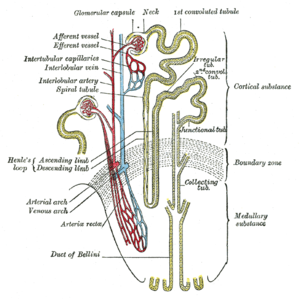
Loop of Henle (Grey's Anatomy book)

Loop of Henle (Grey’s Anatomy book) (Photo credit: Wikipedia)

Frontal section through the kidney

Frontal section through the kidney (Photo credit: Wikipedia)

_____________________________________________________________________________________________________________________________________________________________
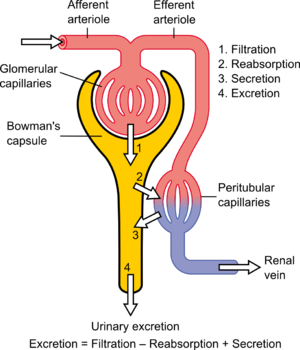
_ Part IIa. Nitric Oxide role in renal tubular epithelial cell function Tubulointerstitial Nephritides

As part of the exponential growth in our understanding of nitric oxide (NO) in health and disease over the past 2 decades, the kidney has become appreciated as a major site where NO may play a number of important roles. Although earlier work on the kidney focused more on effects of NO at the level of larger blood vessels and glomeruli, there has been a rapidly growing body of work showing critical roles for NO in tubulointerstitial disease. In this review we discuss some of the recent contributions to this important field.

Mattana J, Adamidis A, Singhal PC. Nitric oxide and tubulointerstitial nephritides. Seminars in Nephrology 2004; 24(4):345-353.

Nitric oxide donors and renal tubular (subepithelial) matrix

Nitric oxide (NO) and its metabolite, peroxynitrite (ONOO-), are involved in renal tubular cell injury. If NO/ONOO- has an effect to reduce cell adhesion to the basement membrane, does this effect contribute to tubular obstruction and would it be partially responsible for the harmful effect of NO on the tubular epithelium during acute renal failure (ARF)?

Wangsiripaisan A, et al. examined the effect of the NO donors

  • [1] (z)-1-[2-(2-aminoethyl)-N-(2-ammonioethyl)amino]diazen-1- ium-1, 2-diolate (DETA/NO),
  • [2] spermine NONOate (SpNO), and
  • [3] the ONOO- donor 3-morpholinosydnonimine (SIN-1) on

cell-matrix adhesion to collagen types I and IV, and also fibronectin using three renal tubular epithelial cell lines:

  • [1] LLC-PK1,
  • [2] BSC-1, and
  • [3] OK.

It was only the exposure to SIN-1 that caused a dose-dependent impairment in cell-matrix adhesion.

Similar results were obtained in the different cell types and matrix proteins. The effect of SIN-1 (500 microM) on LLC-PK1 cell adhesion was not associated with either cell death or alteration of matrix protein and was attenuated by either

  • [1] the NO scavenger 2-(4-carboxyphenyl)-4,4,5,5-tetramethylimidazoline-1-oxyl-3-oxide,
  • [2] the superoxide scavenger superoxide dismutase, or
  • [3] the ONOO- scavenger uric acid in a dose-dependent manner.

These investigators concluded in this seminal paper that ONOO- generated in the tubular epithelium during ischemia/reperfusion has the potential to impair the adhesion properties of tubular cells, which then may contribute to the tubular obstruction in ARF.

Wangsiripaisan A, Gengaro PE, Nemenoff RA, Ling H, et al. Effect of nitric oxide donors on renal tubular epithelial cell-matrix adhesion. Kidney Int 1999; 55(6):2281-8.

Coexpressed Nitric Oxide Synthase and Apical β1 Integrins

In sepsis-induced acute renal failure, actin cytoskeletal alterations result in shedding of proximal tubule epithelial cells (PTEC) and tubular obstruction.

This study examined the hypothesis that inflammatory cytokines, released early in sepsis, cause PTEC cytoskeletal damage and alter integrin-dependent cell-matrix adhesion. The question of whether the intermediate nitric oxide (NO) modulates these cytokine effects was also examined. After exposure of human PTEC to tumor necrosis factor-α, interleukin-1α, and interferon-γ, the actin cytoskeleton was disrupted and cells became elongated, with extension of long filopodial processes.

Cytokines induced shedding of viable, apoptotic, and necrotic PTEC, which was dependent on NO synthesized by inducible NO synthase (iNOS) produced as a result of cytokine actions on PTEC. Basolateral exposure of polarized PTEC monolayers to cytokines induced maximal NO-dependent cell shedding, mediated in part through NO effects on cGMP. Cell shedding was accompanied by dispersal of basolateral β1 integrins and E-cadherin, with corresponding upregulation of integrin expression in clusters of cells elevated above the epithelial monolayer.

These cells demonstrated coexpression of iNOS and apically redistributed β1 integrins. These authors point out that the major ligand involved in cell anchorage was laminin, probably through interactions with the integrin α3β1.

This interaction was downregulated by cytokines but was not dependent on NO. They posulate a mechanism by which inflammatory cytokines induce PTEC damage in sepsis, in the absence of hypotension and ischemia.

Glynne PA, Picot J and Evans TJ. Coexpressed Nitric Oxide Synthase and Apical β1 Integrins Influence Tubule Cell Adhesion after Cytokine-Induced Injury. JASN 2001; 12(11): 2370-2383.

Potentiation by Nitric Oxide of Apoptosis in Renal Proximal Tubule Cells

Proximal tubular epithelial cells (PTEC) exhibit a high sensitivity to undergo apoptosis in response to proinflammatory stimuli and immunosuppressors and participate in the onset of several renal diseases. This study examined the expression of inducible nitric oxide (NO) synthase after challenge of PTEC with bacterial cell wall molecules and inflammatory cytokines and analyzed the pathways that lead to apoptosis in these cells by measuring changes in the mitochondrial transmembrane potential and caspase activation.

The data show that the apoptotic effects of proinflammatory stimuli mainly were due to the expression of inducible NO synthase. Cyclosporin A and FK506 inhibited partially NO synthesis.

However, both NO and immunosuppressors induced apoptosis, probably through a common mechanism that involved the irreversible opening of the mitochondrial permeability transition pore. Activation of caspases 3 and 7 was observed in cells treated with high doses of NO and with moderate concentrations of immunosuppressors.

The conclusion is that the cooperation between NO and immunosuppressors that induce apoptosis in PTEC might contribute to the renal toxicity observed in the course of immunosuppressive therapy.

Hortelano S, Castilla M, Torres AM, Tejedor A, and Bosca L.  Potentiation by Nitric Oxide of Cyclosporin A and FK506- Induced Apoptosis in Renal Proximal Tubule Cells. J Am Soc Nephrol 2000; 11: 2315–2323.

___________________________________________________________________________________________________________________________________________________________

Part IIb. Related studies with ROS and/or RNS on nonrenal epithelial cells

Reactive nitrogen species block cell cycle re-entry Endogenous sources of reactive nitrogen species (RNS) act as second messengers in a variety of cell signaling events, whereas environmental sources of RNS like nitrogen dioxide (NO2) inhibit cell survival and growth through covalent modification of cellular macromolecules. Murine type II alveolar cells arrested in G0 by serum deprivation were exposed to either NO2 or SIN-1, a generator of RNS, during cell cycle re-entry.

In serum-stimulated cells, RNS blocked cyclin D1 gene expression, resulting in cell cycle arrest at the boundary between G0 and G1. Dichlorofluorescin diacetate (DCF) fluorescence indicated that RNS induced sustained production of intracellular hydrogen peroxide (H2O2), which normally is produced only transiently in response to serum growth factors.

Loading cells with catalase prevented enhanced DCF fluorescence and rescued cyclin D1 expression and S phase entry.

These studies indicate environmental RNS interfere with cell cycle re-entry through an H2O2-dependent mechanism that influences expression of cyclin D1 and progression from G0 to the G1 phase of the cell cycle.

Yuan Z, Schellekens H, Warner L, Janssen-Heininger Y, Burch P, Heintz NH. Reactive nitrogen species block cell cycle re-entry through sustained production of hydrogen peroxide. Am J Respir Cell Mol Biol. 2003;28(6):705-12. Epub 2003 Jan 10.

Peroxynitrite modulates MnSOD gene expression

Peroxynitrite (ONOO-) is a strong oxidant derived from nitric oxide (‘NO) and superoxide (O2.-), reactive nitrogen (RNS) and oxygen species (ROS) present in inflamed tissue. Other oxidant stresses, e.g., TNF-alpha and hyperoxia,   induce mitochondrial, manganese-containing superoxide dismutase (MnSOD) gene expression.   3-morpholinosydnonimine HCI (SIN-1) (10 or 1000 microM) increased MnSOD mRNA, but did not change hypoxanthine guanine phosphoribosyl transferase (HPRT) mRNA.   Authentic peroxynitrite (ONOO ) (100-500 microM) also increased MnSOD mRNA but did not change constitutive HPRT mRNA expression.   ONOO stimulated luciferase gene expression driven by a 2.5 kb fragment of the rat MnSOD gene 5′ promoter region.

MnSOD gene induction due to ONOO- was

  • [1] inhibited effectively by L-cysteine (10 mM) and
  • [2] partially inhibited by N-acetyl cysteine (NAC)(50 mM) or
  • [3] pyrrole dithiocarbamate (10 mM).

.NO from 1-propanamine, 3-(2-hydroxy-2-nitroso-1-propylhydrazine) (PAPA NONOate) (100 or 1000 microM) did not change MnSOD or HPRT mRNA, nor did either H202 or NO2-, breakdown products of SIN-1 and ONOO, have any effect on MnSOD mRNA expression; ONOO- and SIN-1 also did not increase detectable MnSOD protein content or increase MnSOD enzymatic activity.

Nevertheless, increased steady state [O2.-] in the presence of .NO yields ONOO , and ONOO has direct, stimulatory effects on MnSOD transcript expression driven at the MnSOD gene 5′ promoter region inhibited completely by L-cysteine and partly by N-acetyl cysteine in lung epithelial cells. This raises a question of whether the same effect is seen in renal tubular epithelium.

Jackson RM, Parish G, Helton ES. Peroxynitrite modulates MnSOD gene expression in lung epithelial cells. Free Radic Biol Med. 1998; 25(4-5):463-72.

Comparative impacts of glutathione peroxidase-1 gene knockout on oxidative stress

Selenium-dependent glutathione peroxidase-1 (GPX1) protects against reactive-oxygen-species (ROS)-induced oxidative stress in vivo, but its role in coping with reactive nitrogen species (RNS) is unclear. Primary hepatocytes were isolated from GPX1-knockout (KO) and wild-type (WT) mice to test protection of GPX1 against cytotoxicity of

  • [1] superoxide generator diquat (DQ),
  • [2]NO donor S-nitroso-N-acetyl-penicillamine (SNAP) and
  • [3] peroxynitrite generator 3-morpholinosydnonimine (SIN-1).

Treating cells with SNAP in addition to DQ produced synergistic cytotoxicity that minimized differences in apoptotic cell death and oxidative injuries between the KO and WT cells. Less protein nitrotyrosine was induced by 0.05-0.5 mM DQ+0.25 mM SNAP in the KO than in the WT cells.

Total GPX activity in the WT cells was reduced by 65 and 25% by 0.5 mM DQ+0.1 mM SNAP and 0.5 mM DQ, respectively. Decreases in Cu,Zn-superoxide dismutase (SOD) activity and increases in Mn-SOD activity in response to DQ or DQ+SNAP were greater in the KO cells than in the WT cells.

The study indicates GPX1 was more effective in protecting hepatocytes against oxidative injuries mediated by ROS alone than by ROS and RNS together, and knockout of GPX1 did not enhance cell susceptibility to RNS-associated cytotoxicity. Instead, it attenuated protein nitration induced by DQ+SNAP.

To better understand the mechanism(s) underlying nitric oxide (. NO)-mediated toxicity, in the presence and absence of concomitant oxidant exposure, postmitotic terminally differentiated NT2N cells (which are incapable of producing . NO) were exposed to [1]PAPA-NONOate (PAPA/NO) and [2] 3-morpholinosydnonimine (SIN-1).

Exposure to SIN-1, which generated peroxynitrite (ONOO) in the range of 25-750 nM/min, produced a concentration- and time-dependent delayed cell death.   In contrast, a critical threshold concentration (>440 nM/min) was required for . NO to produce significant cell injury.   There is a largely necrotic lesion after ONOO exposure and an apoptotic-like morphology after . NO exposure.

Cellular levels of reduced thiols correlated with cell death, and pretreatment with N-acetylcysteine (NAC) fully protected from cell death in either PAPA/NO or SIN-1 exposure. NAC given within the first 3 h posttreatment further delayed cell death and increased the intracellular thiol level in SIN-1 but not . NO-exposed cells.

Cell injury from . NO was independent of cGMP, caspases, and superoxide or peroxynitrite formation.   Overall, exposure of non-. NO-producing cells to . NO or peroxynitrite results in delayed cell death, which, although occurring by different mechanisms,   appears to be mediated by the loss of intracellular redox balance.

Gow AJ, Chen Q, Gole M, Themistocleous M, Lee VM, Ischiropoulos H. Two distinct mechanisms of nitric oxide-mediated neuronal cell death show thiol dependency. Am J Physiol Cell Physiol. 2000; 278(6):C1099-107.

NO2 effect on phosphatidyl choline   Nitrogen dioxide (NO2) inhalation affects the extracellular surfactant as well as the structure and function of type II pneumocytes.

The studies had differences in oxidant concentration, duration of exposure, and mode of NO2 application. This study evaluated the influence of the NO2 application mode on the phospholipid metabolism of type II pneumocytes. Rats were exposed to identical NO2 body doses (720 ppm x h), which were applied continuously (10 ppm for 3 d), intermittently (10 ppm for 8 h per day, for 9 d), and repeatedly (10 ppm for 3 d, 28 d rest, and then 10 ppm for 3 d). Immediately after exposure, type II cells were isolated and evaluated for cell yield, vitality, phosphatidylcholine (PC) synthesis, and secretion.

Type II pneumocyte cell yield was only increased from animals that had been continuously exposed to NO2, but vitality of the isolated type II pneumocytes was not affected by the NO2 exposure modes. Continuous application of 720 ppm x h NO2 resulted in increased activity of the cytidine-5-diphosphate (CDP)-choline pathway.   After continuous NO2 application,

  • [1] specific activity of choline kinase,
  • [2] cytidine triphosphate (CTP):cholinephosphate cytidylyltransferase,
  • [3] uptake of choline, and
  • [4] pool sizes of CDP-choline and PC   were significantly increased over those of controls.

Intermittent application of this NO2 body dose provoked less increase in PC synthesis and the synthesis parameters were comparable to those for cells from control animals after repeated exposure. Whereas PC synthesis in type II cells was stimulated by NO2, their secretory activity was reduced.   Continuous exposure reduced the secretory activity most, whereas intermittent exposure nonsignificantly reduced this activity as compared with that of controls. The repeated application of NO2 produced no differences.

The authors conclude that…. type II pneumocytes adapt to NO2 atmospheres depending on the mode of its application, at least for the metabolism of PC and its secretion from isolated type II pneumocytes.

The reader asks whether this effect could also be found in renal epithelial cells, for which PC is not considered vital as for type II pneumocytes and possibly related to surfactant activity in the lung.

Müller B, Seifart C, von Wichert P, Barth PJ. Adaptation of rat type II pneumocytes to NO2: effects of NO2 application mode on phosphatidylcholine metabolism. Am J Respir Cell Mol Biol. 1998; 18(5): 712-20.

iNOS involved in immediate response to anaphylaxis

The generation of large quantities of nitric oxide (NO) is implicated in the pathogenesis of anaphylactic shock. The source of NO, however, has not been established and conflicting results have been obtained when investigators have tried to inhibit its production in anaphylaxis.

This study analyzed the expression of inducible nitric oxide synthase (iNOS) and endothelial nitric oxide synthase (eNOS) in a mouse model of anaphylaxis.   BALB/c mice were sensitized and challenged with ovalbumin to induce anaphylaxis. Tissues were removed from the heart and lungs, and blood was drawn at different time points during the first 48 hours after induction of anaphylaxis. The Griess assay was used to measure nitric oxide generation.

Nitric oxide synthase expression was examined by reverse transcriptase polymerase chain reaction and immunohistochemistry. A significant increase in iNOS mRNA expression and nitric oxide production was evident as early as 10 to 30 minutes after allergen challenge in both heart and lungs.

In contrast, expression of eNOS mRNA was not altered during the course of the experiment. The results support involvement of iNOS in the immediate physiological response of anaphylaxis.

Sade K, Schwartz IF, Etkin S, Schwartzenberg S, et al. Expression of Inducible Nitric Oxide Synthase in a Mouse Model of Anaphylaxis. J Investig Allergol Clin Immunol 2007; 17(6):379-385.

________________________________________________________________________________________________________________________________________________________

Part IIc. Additional Nonrenal Related NO References

1. Nitrogen dioxide induces death in lung epithelial cells in a density-dependent manner. Persinger RL, Blay WM, Heintz NH, Hemenway DR, Janssen-Heininger YM. Am J Respir Cell Mol Biol. 2001 May;24(5):583-90. PMID: 11350828 [PubMed – indexed for MEDLINE] Free Article

2. Molecular mechanisms of nitrogen dioxide induced epithelial injury in the lung. Persinger RL, Poynter ME, Ckless K, Janssen-Heininger YM. Mol Cell Biochem. 2002 May-Jun;234-235(1-2):71-80. Review. PMID: 12162462 [PubMed – indexed for MEDLINE]

3. Nitric oxide and peroxynitrite-mediated pulmonary cell death. Gow AJ, Thom SR, Ischiropoulos H. Am J Physiol. 1998 Jan;274(1 Pt 1):L112-8. PMID: 9458808 [PubMed – indexed for MEDLINE] Free Article

4. Mitogen-activated protein kinases mediate peroxynitrite-induced cell death in human bronchial epithelial cells. Nabeyrat E, Jones GE, Fenwick PS, Barnes PJ, Donnelly LE. Am J Physiol Lung Cell Mol Physiol. 2003 Jun;284(6):L1112-20. Epub 2003 Feb 21. PMID: 12598225 [PubMed – indexed for MEDLINE] Free Article

5. Peroxynitrite inhibits inducible (type 2) nitric oxide synthase in murine lung epithelial cells in vitro. Robinson VK, Sato E, Nelson DK, Camhi SL, Robbins RA, Hoyt JC. Free Radic Biol Med. 2001 May 1;30(9):986-91. PMID: 11316578 [PubMed – indexed for MEDLINE]

6. Nitric oxide-mediated chondrocyte cell death requires the generation of additional reactive oxygen species. Del Carlo M Jr, Loeser RF. Arthritis Rheum. 2002 Feb;46(2):394-403. PMID: 11840442 [PubMed – indexed for MEDLINE]

7. Colon epithelial cell death in 2,4,6-trinitrobenzenesulfonic acid-induced colitis is associated with increased inducible nitric-oxide synthase expression and peroxynitrite production.

Yue G, Lai PS, Yin K, Sun FF, Nagele RG, Liu X, Linask KK, Wang C, Lin KT, Wong PY. J Pharmacol Exp Ther. 2001 Jun;297(3):915-25. PMID: 11356911 [PubMed – indexed for MEDLINE] Free Article

__________________________________________________________________________________________________________________________________________________________

Part IIIa. Acute renal failure   Acute renal failure (ARF), characterized by sudden loss of the ability of the kidneys to [1] excrete wastes, [2] concentrate urine, [3] conserve electrolytes, and [4] maintain fluid balance, is a frequent clinical problem, particularly in the intensive care unit, where it is associated with a mortality of between 50% and 80%.

This clinical entity was described as an acute loss of kidney function that occurred in severely injured crush victims because of histological evidence for patchy necrosis of renal tubules at autopsy. In the clinical setting, the terms ATN and acute renal failure (ARF) are frequently used interchangeably. However, ARF does not include increases in blood urea due to [1] reversible renal vasoconstriction (prerenal azotemia) or [2] urinary tract obstruction (postrenal azotemia). Acute hemodialysis was first used clinically during the Korean War in 1950 to treat military casualties, and this led to a decrease in mortality of the ARF clinical syndrome from about 90% to about 50%.   In the half century that has since passed, much has been learned about the pathogenesis of ischemic and nephrotoxic ARF in experimental models, but there has been very little improvement in mortality. This may be explained by changing demographics: [1] the age of patients with ARF continues to rise, and [2] comorbid diseases are increasingly common in this population. Both factors may obscure any increased survival related to improved critical care. Examining the incidence of ARF in several military conflicts does, however, provide some optimism. The incidence of ARF in seriously injured casualties decreased between World War II and the Korean War, and again between that war and the Vietnam War, despite the lack of any obvious difference in the severity of the injuries. What was different was the rapidity of the fluid resuscitation of the patients? Fluid resuscitation on the battlefield with the rapid evacuation of the casualties to hospitals by helicopter began during the Korean War and was optimized further during the Vietnam War. For seriously injured casualties the incidence of ischemic ARF was one in 200 in the Korean War and one in 600 in the Vietnam War. This historical sequence of events suggests that early intervention could prevent the occurrence of ARF, at least in military casualties.   In experimental studies it has been shown that progression from an azotemic state associated with renal vasoconstriction and intact tubular function (prerenal azotemia) to established ARF with tubular dysfunction occurs if the renal ischemia is prolonged. Moreover, early intervention with fluid resuscitation was shown to prevent the progression from prerenal azotemia to established ARF. Diagnostic evaluation of ARF One important question, therefore, is how to assure that an early diagnosis of acute renal vasoconstriction can be made prior to the occurrence of tubular dysfunction, thus providing the potential to prevent progression to established ARF. In this regard, past diagnostics relied on observation of the patient response to a fluid challenge: [1] decreasing levels of blood urea nitrogen (BUN) indicated the presence of reversible vasoconstriction, [2] while uncontrolled accumulation of nitrogenous waste products, i.e., BUN and serum creatinine, indicated established ARF.

This approach, however, frequently led to massive fluid overload in the ARF patient with resultant

  • [1] pulmonary congestion,
  • [2] hypoxia, and
  • [3] premature need for mechanical ventilatory support and/or hemodialysis.

On this background the focus turned to an evaluation of urine sediment and urine chemistries to differentiate between renal vasoconstriction with intact tubular function and established ARF.

It was well established that if tubular function was intact, renal vasoconstriction was associated with enhanced tubular sodium reabsorption. Specifically, the fraction of filtered sodium that is rapidly reabsorbed by normal tubules of the vasoconstricted kidney is greater than 99%.

Thus, when nitrogenous wastes, such as creatinine and urea, accumulate in the blood due to a fall in glomerular filtration rate (GFR) secondary to renal vasoconstriction with intact tubular function, the fractional excretion of filtered sodium (FENa = [(urine sodium × plasma creatinine) / (plasma sodium × urine creatinine)]) is less than 1%. An exception to this physiological response of the normal kidney to vasoconstriction is when the patient is receiving a diuretic, including mannitol, or has glucosuria, which decreases tubular sodium reabsorption and increases FENa.

It has recently been shown in the presence of diuretics that a rate of fractional excretion of urea (FEurea) of less than 35 indicates intact tubular function, thus favoring renal vasoconstriction rather than established ARF as a cause of the azotemia.

___________________________________________________________________________________________________________________________________________________________

English: Physiology of Nephron

English: Physiology of Nephron (Photo credit: Wikipedia)
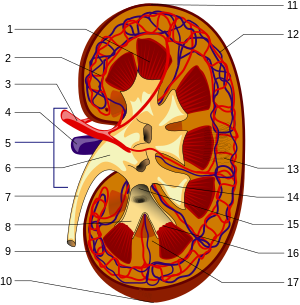
Structures of the kidney: 1.Renal pyramid 2.In...

Structures of the kidney: 1.Renal pyramid 2.Interlobar artery 3.Renal artery 4.Renal vein 5.Renal hilum 6.Renal pelvis 7.Ureter 8.Minor calyx 9.Renal capsule 10.Inferior renal capsule 11.Superior renal capsule 12.Interlobar vein 13.Nephron 14.Minor calyx 15.Major calyx 16.Renal papilla 17.Renal column (no distinction for red/blue (oxygenated or not) blood, arteriole is between capilaries and larger vessels (Photo credit: Wikipedia)

_

______________________________________________________________________________________________________________________________________________________

Mechanisms of ARF

Based on the foregoing comments, this discussion of mechanisms of ARF will not include nitrogenous-waste accumulation due to renal vasoconstriction with intact tubular function (prerenal azotemia) or urinary tract obstruction (postrenal azotemia). The mechanisms of ARF involve both vascular and tubular factors. An ischemic insult to the kidney will in general be the cause of the ARF. While a decrease in renal blood flow with diminished oxygen and substrate delivery to the tubule cells is an important ischemic factor, it must be remembered that a relative increase in oxygen demand by the tubule is also a factor in renal ischemia.

Approximately 30–70% of these shed epithelial tubule cells in the urine are viable and can be grown in culture. Recent studies using cellular and molecular techniques have provided information relating to the structural abnormalities of injured renal tubules that occur both in vitro and in vivo. In vitro studies using chemical anoxia have revealed abnormalities in the proximal tubule cytoskeleton that are associated with translocation of Na+/K+-ATPase from the basolateral to the apical membrane.

A comparison of cadaveric transplanted kidneys with delayed versus prompt graft function has also provided important results regarding the role of Na+/K+-ATPase in ischemic renal injury. This study demonstrated that, compared with kidneys with prompt graft function, those with delayed graft function had a significantly greater cytoplasmic concentration of Na+/K+-ATPase and actin-binding proteins — spectrin (also known as fodrin) and ankyrin — that had translocated from the basolateral membrane to the cytoplasm.

Such a translocation of Na+/K+-ATPase from the basolateral membrane to the cytoplasm could explain the decrease in tubular sodium reabsorption that occurs with ARF. An important focus of research is the mechanisms whereby the critical residence of Na+/K+-ATPase in the basolateral membrane (which facilitates vectorial sodium transport) is uncoupled by hypoxia or ischemia.  The actin-binding proteins,

  • spectrin and
  • ankyrin,

serve as substrates for the calcium-activated cysteine protease calpain.

________________________________________________________________________________________________________________________________________________________

In vitro studies in proximal tubules have shown a rapid rise in cytosolic calcium concentration during acute hypoxia, which antedates the evidence of tubular injury as assessed by lactic dehydrogenase (LDH) release. There is further evidence to support the importance of the translocation of Na+/K+-ATPase from the basolateral membrane to the cytoplasm during renal ischemia/reperfusion.

Specifically, calpain-mediated breakdown products of the actin-binding protein spectrin occur with renal ischemia. Calpain activity was demonstrated to increase during hypoxia in isolated proximal tubules. Measurement of LDH release following calpain inhibition indicated attenuation of hypoxic damage to proximal tubules. There was no evidence of an increase in cathepsin, a (cysteine protease) in proximal tubules during hypoxia , but there is a calcium-independent pathway for calpain activation during hypoxia.

Calpastatin, an endogenous cellular inhibitor of calpain activation, was shown to be diminished during hypoxia in association with the rise in another cysteine protease, caspase.

This effect of diminished calpastatin activity could be reversed by caspase inhibition. Proteolytic pathways appear to be involved in calpain-mediated proximal tubule cell injury during hypoxia. Calcium activation of phospholipase A has also been shown to contribute to renal tubular injury during ischemia.

________________________________________________________________________________________________________________________________________________________

Tubular obstruction during ARF

The existence of proteolytic pathways involving cysteine proteases, namely calpain and caspases, may therefore explain

  • the decrease in proximal tubule sodium reabsorption and
  • increased FENa

secondary to proteolytic uncoupling of Na+/K+-ATPase from its basolateral membrane anchoring proteins.

This tubular perturbation alone, however, does not explain the fall in GFR that leads to nitrogenous-waste retention and thus the rise in BUN and serum creatinine.   Decreased proximal tubule sodium reabsorption may lead to a decreased GFR during ARF. First of all, brush border membranes and cellular debris could provide the substrate for intraluminal obstruction in the highly resistant portion of distal nephrons.

In fact, microdissection of individual nephrons of kidneys from patients with ARF demonstrated obstructing casts in distal tubules and collecting ducts. This observation could explain the dilated proximal tubules that are observed upon renal biopsy of ARF kidneys. The intraluminal casts in ARF kidneys stain prominently for Tamm-Horsfall protein (THP), which is produced in the thick ascending limb. Importantly, THP is secreted into tubular fluid as a monomer but subsequently may become a polymer that forms a gel-like material in the presence of increased luminal Na+ concentration, as occurs in the distal nephron during clinical ARF with the decrease in tubular sodium reabsorption.

Thus, the THP polymeric gel in the distal nephron provides an intraluminal environment for distal cast formation involving viable, apoptotic, and necrotic cells.

The loss of the tubular epithelial cell barrier and/or the tight junctions between viable cells during acute renal ischemia could lead to a leak of glomerular filtrate back into the circulation. (If this occurs and normally non-reabsorbable substances, such as inulin, leak back into the circulation, then a falsely low GFR will be measured as inulin clearance. It should be noted, however, that the degree of extensive tubular damage observed in experimental studies demonstrating tubular fluid backleak is rarely observed with clinical ARF in humans). Moreover, dextran sieving studies in patients with ARF demonstrated that, at best, only a 10% decrease in GFR could be explained by backleak of filtrate. Cadaveric transplanted kidneys with delayed graft function, however, may have severe tubular necrosis, and thus backleak of glomerular filtration may be more important in this setting.

Inflammation and NO

There is now substantial evidence for the involvement of inflammation in the pathogenesis of the decreased GFR associated with acute renal ischemic injury. In this regard, there is experimental evidence that iNOS may contribute to tubular injury during ARF. Hypoxia in isolated proximal tubules has been shown to increase NO release, and there is increased iNOS protein expression in ischemic kidney homogenates. An antisense oligonucleotide was shown to block the upregulation of iNOS and afford functional protection against acute renal ischemia. Moreover, when isolated proximal tubules from iNOS, eNOS, and neuronal NO synthase (nNOS) knockout mice were exposed to hypoxia, only the tubules from the iNOS knockout mice were protected against hypoxia, as assessed by LDH release. The iNOS knockout mice were also shown to have lower mortality during ischemia/reperfusion than wild-type mice.  The scavenging of NO by oxygen radicals produces peroxynitrite causing tubule damage during ischemia. While iNOS may contribute to ischemic injury of renal tubules,  the vascular effect of eNOS in the glomerular afferent arteriole is protective against ischemic injury. In this regard, eNOS knockout mice are more sensitive to endotoxin-related injury than normal mice.

Moreover, the protective role of vascular eNOS may be more important than the deleterious effect of iNOS at the tubule level during renal ischemia.   This is because treatment of mice with the nonspecific NO synthase (NOS) inhibitor L-NAME, which blocks both iNOS and eNOS, worsens renal ischemic injury. NO may downregulate eNOS and is a potent inducer of heme oxygenase-1, which has been shown to be cytoprotective against renal injury. The MAPK pathway also appears to be involved in renal oxidant injury. Activation of extracellular signal–regulated kinase (ERK) or inhibition of JNK ameliorates oxidant injury–induced necrosis in mouse renal proximal tubule cells in vitro. Upregulation of ERK may also be important in the effect of preconditioning whereby early ischemia affords protection against a subsequent ischemia/reperfusion insult. Alterations in cell cycling are also involved in renal ischemic injury. Upregulation of p21, which inhibits cell cycling, appears to allow cellular repair and regeneration, whereas homozygous p21 knockout mice demonstrate enhanced cell necrosis in response to an ischemic insult.

Prolonged duration of the ARF clinical course and the need for dialysis are major factors projecting a poor prognosis. Patients with ARF who require dialysis have a 50–70% mortality rate. Infection and cardiopulmonary complications are the major causes of death in patients with ARF. Excessive fluid administration in patients with established ARF may lead to pulmonary congestion, hypoxia, the need for ventilatory support, pneumonia, and multiorgan dysfunction syndrome, which has an 80–90% mortality rate. Until means to reverse the diminished host defense mechanisms in azotemic patients with clinical ARF are available, every effort should be made to avoid invasive procedures such as the placement of bladder catheters, intravenous lines, and mechanical ventilation. Over and above such supportive care, it may be that combination therapy will be necessary to prevent or attenuate the course of ARF. Such combination therapy must involve agents with potential beneficial effects on vascular tone, tubular obstruction, and inflammation.

Schrier RW, Wang W, Poole B, and Mitra A. Acute renal failure: definitions, diagnosis, pathogenesis, and therapy. The Journal of Clinical Investigation 2004; 114(1):5-14. http://www.jci.org

______________________________________________________________________________________________________________________________________________________

Part IIIb. Additional Related References on NO, oxidative stress and Kidney

Shelgikar PJ, Deshpande KH, Sardeshmukh AS, Katkam RV, Suryakarl AN. Role of oxidants and antioxidants in ARF patients undergoing hemodialysis. Indian J Nephrol 2005;15: 73-76.

Lee JW. Renal Dysfunction in Patients with Chronic Liver Disease. Electrolytes Blood Press 7:42-50, 2009ㆍdoi: 10.5049/EBP.2009.7.2.42.

Saadat H, et al. Endothelial Nitric Oxide Function and Tubular Injury in Premature Infants. Int J App Sci and Technol 2012; 7(6): 77-81. http://www.ijastnet.com.

Amerisan MS. Cardiovascular disease in chronic kidney disease. Indian J Nephrol 2005;15: 1-7.

___________________________________________________________________________________________________________________________________________________________

Traditional risk factors for CVD in CKD

  • Hypertension
  • Older Age
  • Diabetes Mellitus
  • Male gender
  • High LDL
  • White Race
  • Low HDL
  • Physical inactivity
  • Smoking
  • Menopause
  • LVH

CKD Related CV Risk Factors

  • Blood Pressure
  • ? Homocysteinemia
  • Anemia
  • ? Inflammation
  •   Ca++ x P++
  • ? NO synthesis
  • Na+ Retention
  • ? Lp (a)
  • Hypervolemia
  • ? Insulin Resistance
  • Proteinuria & Hypoalbuminemia
  • Iron over load
  • ? Adeponectin
  • ??Vit. C or E
  • ? 5 Lipoxygenase
  • ROS
  • Genetic factors
  • ADMA (Asymmetric Dimethyl Arginine)

S Vikrant, SC Tiwari. Essential Hypertension – Pathogenesis and Pathophysiology. J Indian Acad Clinical Medicine 2001; 2(3):141-161. Scheme for pathogenesis of salt dependent hypertension.

The hypothesis proposes that early hypertension is episodic and is mediated by a hyperactive sympathetic nervous system or activated renin-angiotensin system.

Cell membrane alterations

Hypotheses linking abnormal ionic fluxes to increased peripheral resistance through increase in cell sodium, calcium, or pH.   The hypertension that is more common in obese people may arise in large part from the insulin resistance and resultant hyperinsulinaemia that results from the increased mass of fat. However, rather unexpectedly, insulin resistance may also be involved in hypertension in non-obese people.

Overall scheme for the mechanisms by which obesity, if predominantly upper body or visceral in location, could promote

________________________________________________________________________________________________________________________________________________________

  • diabetes,
  • dyslipidemia and
  • hypertension via hyperinsulinemia.

The explanation for insulin resistance found in as many as half of nonobese hypertensive is not obvious and may involve one or more aspects of insulin’s action

__________________________________________________________________________________________________________________________________________________________

Proposed mechanisms by which insulin resistance and/or hyperinsulinemia may lead to increased blood pressure.

  1. Enhanced renal sodium and water reabsorption.
  2. Increased blood pressure sensitivity to dietary salt intake
  3. Augmentation of the pressure and
  4. aldosterone responses to AII
  5. Changes in transmembrane electrolyte transport
  • a. Increased intracellular sodium
  • b. Decreased Na+/K+ – ATPase activity
  • c. Increased intracellular Ca2+ pump activity
  • d. Increased intracellular Ca2+ accumulation
  • e. Stimulation of growth factors

___________________________________________________________________________________________________________________________________________________________

Part IV. New Insights on NO donors

This study investigated the involvement of nitric oxide (NO) into the irradiation-induced increase of cell attachment. These experiments explored the cellular mechanisms of low-power laser therapy. HeLa cells were irradiated with a monochromatic visible-tonear infrared radiation (600–860 nm, 52 J/m2) or with a diode laser (820 nm, 8–120 J/m2) and the number of cells attached to a glass matrix was counted after 30 minute incubation at 37oC. The NO donors

  1. sodium nitroprusside (SNP),
  2. glyceryl trinitrate (GTN), or
  3. sodium nitrite (NaNO2)

were added to the cellular suspension before or after irradiation. The action spectra and the concentration and fluence dependencies obtained were compared and analyzed.

The well-structured action spectrum for the increase of the adhesion of the cells, with maxima at 619, 657, 675, 740, 760, and 820 nm, points to the existence of a photoacceptor responsible for the enhancement of this property (supposedly cytochrome c oxidase, the terminal respiratory chain enzyme), as well as signaling pathways between the cell mitochondria, plasma membrane, and nucleus.

Treating the cellular suspension with SNP before irradiation significantly modifies the action spectrum for the enhancement of the cell attachment property (band maxima at 642, 685, 700, 742, 842, and 856 nm). The action of SNP, GTN, andNaNO2 added before or after irradiation depends on their concentration and radiation fluence.

The NO donors added to the cellular suspension before irradiation eliminate the radiation induced increase in the number of cells attached to the glass matrix, supposedly by way of binding NO to cytochrome c oxidase. NO added to the suspension after irradiation can also inhibit the light-induced signal downstream. Both effects of NO depend on the concentration of the NO donors added.

The results indicate that NO can control the irradiation-activated reactions that increase the attachment of cells.

Karu TI, Pyatibrat LV, and Afanasyeva NI. Cellular Effects of Low Power Laser Therapy Can be Mediated by Nitric Oxide. Lasers Surg. Med 2005; 36:307–314.

IFNa-2b (IFN-a) effect on barrier function of renal tubular epithelium

IFNa treatment can be accompanied by impaired renal function and capillary leak. This study shows IFNa produced dose-dependent and time-dependent decrease in transepithelial resistance (TER) ameliorated by tyrphostin, an inhibitor of phosphotyrosine kinase with increased expression of occludin and E-cadherin. In conclusion, IFNa can directly affect barrier function in renal epithelial cells via ovewrexpression or missorting of the junctional proteins occludin and E-cadherin.

Lechner J, Krall M, Netzer A, Radmayr C, et al. Effects of interferon a-2b on barrier function and junctional complexes of renal proximal tubulat LLC-pK1 cells. Kidney Int 1999; 55:2178-2191.

Ischemia-reperfusion injury

The pathophysiology of acute renal failure (ARF) is complex and not well understood. Numerous models of ARF suggest that oxygen-derived reactive species are important in renal ischemia-reperfusion (I-R) injury, but the nature of the mediators is still controversial. Treatment with oxygen radical scavengers, antioxidants, and iron chelators such as

  • superoxide dismutase,
  • dimethylthiourea,
  • allopurinol, and
  • deferoxamine

are protective in some models, and suggest a role for the hydroxyl radical formation. However, these compounds are not protective in all models of I-R injury, and direct evidence for the generation of hydroxyl radical is absent. Furthermore, these inhibitors have another property in common.

They all directly scavenge or inhibit the formation of peroxynitrite (ONOO−), a highly toxic species derived from nitric oxide (NO) and superoxide. Thus, the protective effects seen with these inhibitors may be due in part to their ability to inhibit ONOO− formation. Even though reactive oxygen species are thought to participate in ischemia-reperfusion (I-R) injury, induction of and production of high levels of  inducible nitric oxide (NO)  also contribute to this injury.

NO combines with superoxide to form the potent oxidant peroxynitrite (ONOO−). NO and ONOO− were investigated in a rat model of renal I-R injury using the selective iNOS inhibitor L-N6-(1-iminoethyl)lysine (L-NIL).

I-R surgery significantly increased plasma creatinine levels to 1.9 ± 0.3 mg/dl (P < .05) and caused renal cortical necrosis. L-NIL administration (3 mg/kg) in animals subjected to I-R significantly decreased plasma creatinine levels to 1.2 ± 0.10 mg/dl (P < .05 compared with I-R) and reduced tubular damage.

ONOO− formation was evaluated by detecting 3-nitrotyrosine-protein adducts (3NTyPAs), a stable biomarker of ONOO− formation.   The kidneys from I-R animals had increased levels of 3NTyPAs compared with control animals   L-NIL-treated rats (3 mg/kg) subjected to I-R showed decreased levels of 3NTyPAs.

These results suggests that iNOS-generated NO mediates damage in I-R injury possibly through ONOO− formation.

______________________________________________________________________________________________________________________________________________________

In summary,

  1. 3-nitrotyrosine-protein adducts were detected in renal tubules after I-R injury.
  2. Selective inhibition of iNOS by L-NIL decreased injury, improved renal function, and decreased apparent ONOO− formation.
  3. Reactive nitrogen species should be considered potential therapeutic targets in the prevention and treatment of renal I-R injury.

_______________________________________________________________________________________________________________________________________________________

Walker LM, Walker PD, Imam SZ, et al. Evidence for Peroxynitrite Formation in Renal Ischemia-Reperfusion Injury: Studies with the Inducible Nitric Oxide Synthase InhibitorL-N6-(1-Iminoethyl)lysine1. 2000.

Role of TNFa independent of iNOS Renal failure is a frequent complication of sepsis, mediated by renal vasoconstrictors and vasodilators. Endotoxin induces several proinflammatory cytokines, among which tumor necrosis factor (TNF) is thought to be of major importance. Tumor necrosis factor (TNF) has been suggested to be a factor in the acute renal failure in sepsis or endotoxemia. Passive immunization by anti-TNFa prevented development of septic shock in animal experiments.The development of ARF involves excessive intrarenal vasoconstriction. Involvement of nitric oxide (NO), generated by inducible NO synthase (iNOS), is still a factor in the pathogenesis of endotoxin-induced renal failure. TNF-a leads to a decrease in glomerular filtration rate (GFR).

This study tested the hypothesis that the role of TNF-a in endotoxic shock related ARF is mediated by iNOS-derived NO.   An injection of lipopolysaccharide (LPS) constituent of gram-negative bacteria to wild-type mice resulted in a 70% decrease in glomerular filtration rate (GFR) and in a 40% reduction in renal plasma flow (RPF) 16 hours after the injection.   The results occurred independent of hypotension, morphological changes, apoptosis, and leukocyte accumulation. In mice pretreated with TNFsRp55, only a 30% decrease in GFR was observed without a significant change in RPF as compared with controls. Pretreatment with TNKsRp55 on renal function Wild-type mice were pretreated with TNFsRp55(10 mg/kg IP)  for one hour before the administration of 5 mg/kg intraperitoneal endotoxin. GFR and RPF were determined 16 hours thereafter. Data are expressed as mean 6, SEM, N 5 6. *P , 0.05 vs. Control; §P , 0.05 vs. LPS, by ANOVA.

The serum NO concentration was significantly lower in endotoxemic wild-type mice pretreated with TNFsRp55, as compared with untreated endotoxemic wild-type mice. In LPS-injected iNOS knockout mice and wild-type mice treated with a selective iNOS inhibitor, 1400W, the development of renal failure was similar to that in wild-type mice. As in wild-type mice,TNFsRp55 significantly attenuated the decrease in GFR (a 33% decline, as compared with 75% without TNFsRp55) without a significant change in RPF in iNOS knockout mice given LPS. These results demonstrate a role of TNF in the early renal dysfunction (16 h) in a septic mouse model independent of iNOS,

  • hypotension,
  • apoptosis,
  • leukocyte accumulation,and
  • morphological alterations,

thus suggesting renal hypoperfusion secondary to an imbalance between, as yet to be defined renal vasoconstrictors and vasodilators.

Knotek M, Rogachev B, Wang W,….., Edelstein CL, Dinarello CA, and Schrier RW. Endotoxemic renal failure in mice: Role of tumor necrosis factor independent of inducible nitric oxide synthase. Kidney International 2001; 59:2243–2249

Ischemic acute renal failure

Inflammation plays a major role in the pathophysiology of acute renal failure resulting from ischemia. This review discusses the contribution of

  • endothelial
  • epithelial cells and
  • leukocytes

to this inflammatory response. The roles of cytokines/chemokines in the injury and recovery phase are reviewed. The protection of mouse kidney prior to exposure to ischemia or urinary tract obstruction is  a potential model to  search for pharmacologic agents to protect the kidney against injury by inflammatory mediators produced by tubular epithelial cells and activated leukocytes in renal ischemia/reperfusion (I/R) injury. Tubular epithelia produce

  • TNF-a,
  • IL-1,
  • IL-6,
  • IL-8,
  • TGF-b,
  • MCP-1,
  • ENA-78,
  • RANTES, and
  • fractalkines,

whereas leukocytes produce

  • TNF-a,
  • IL-1,
  • IL-8,
  • MCP-1,
  • ROS, and
  • eicosanoids.

The release of these chemokines and cytokines serve as effectors for a positive feedback pathway enhancing inflammation and cell injury, the cycle of tubular epithelial cell injury and repair following renal ischemia/reperfusion.   Tubular epithelia are typically cuboidal in shape and apically-basally polarized; the Na+/K+-ATPase localizes to basolateral plasma membranes, whereas cell adhesion molecules, such as integrins localize basally. In response to ischemia reperfusion,

  • the Na+/K+-ATPase appears apically, and
  • integrins are detected on lateral and basal plasma membranes.

Some of the injured epithelial cells undergo necrosis and/or apoptosis detaching from the underlying basement membrane into the tubular space where they contribute to tubular occlusion. Viable cells that remain attached, dedifferentiate, spread, and migrate to repopulate the denuded basement membrane. With cell proliferation, cell-cell and cell-matrix contacts are restored, and the epithelium redifferentiates and repolarizes, forming a functional, normal epithelium Inflammation is a significant component of renal I/R injury, playing a considerable role in its pathophysiology.

Although significant progress has been made in defining the major components of this process, the complex cross-talk between endothelial cells, inflammatory cells, and the injured epithelium with each generating and often responding to cytokines and chemokines is not well understood. In addition, we have not yet taken full advantage of the large body of data on inflammation in other organ systems.

Furthermore, preconditioning the kidney to afford protection to subsequent bouts of ischemia may serve as a useful model challenging us to therapeutically mimic endogenous mechanisms of protection.

Understanding the inflammatory response prevalent in ischemic kidney injury will facilitate identification of molecular targets for therapeutic intervention.

Bonventre JV and Zuk A. Ischemic acute renal failure: An inflammatory disease? Forefronts in Nephrology 2002;.. :480-485

Gene expression profiles in renal proximal tubules In kidney disease renal proximal tubular epithelial cells (RPTEC) actively contribute to the progression of tubulointerstitial fibrosisby mediating both

  • an inflammatory response and
  • via epithelial-to-mesenchymal transition.

Using laser capture microdissection we specifically isolated RPTEC from cryosections of the healthy parts of kidneys removed owing to renal cell carcinoma and from kidney biopsies from patients with proteinuric nephropathies. RNA was extracted and hybridized to complementary DNA microarrays after linear RNA amplification. Statistical analysis identified 168 unique genes with known gene ontology association, which separated patients from controls. Besides distinct alterations in signal-transduction pathways (e.g. Wnt signalling), functional annotation revealed a significant upregulation of genes involved in

_________________________________________________________________________________________________________________________________________________________

  • cell proliferation and cell cycle control (like insulin-like growth factor 1 or cell division cycle 34),
  • cell differentiation (e.g. bone morphogenetic protein 7),
  • immune response,
  • intracellular transport and
  • metabolism

__________________________________________________________________________________________________________________________________________________________

in RPTEC from patients.

The study also revealed differential expression of a number of genes responsible for cell adhesion (like BH-protocadherin) with a marked downregulation of most of these transcripts. In summary, the results obtained from RPTEC revealed a differential regulation of genes, which are likely to be involved in either pro-fibrotic or tubulo-protective mechanisms in proteinuric patients at an early stage of kidney disease.

Rudnicki M, Eder S, Perco P, Enrich J, et al. Gene expression profiles of human proximal tubular epithelial cells in proteinuric nephropathies. Kidney International 2006; xx:1-11. Kidney International advance online publication, 20 December 2006; doi:10.1038/sj.ki.5002043. http://www.kidney-international.org

Oxidative stress involved with diabetic nephropathy

Diabetic Nephropathy (DN) poses a major health problem. There is strong evidence for a potential role of the eNOS gene. This case control study investigated the possible role of genetic variants of the endothelial Nitric Oxide Synthase (eNOS) gene and oxidative stress in the pathogenesis of nephropathy in patients with diabetes mellitus. The study included 124 diabetic patients;

  1. 68 of these patients had no diabetic nephropathy (group 1) while
  2. 56 patients exhibited symptoms of diabetic nephropathy (group 2).
  3. Sixty two healthy non-diabetic individuals were also included as a control group.

Blood samples from subjects and controls were analyzed to investigate the eNOS genotypes and to estimate

  • the lipid profile and
  • markers of oxidative stress such as malondialdehyde (MDA) and nitric oxide (NO).

No significant differences were found in the frequency of eNOS genotypes between diabetic patients (either in group 1 or group 2) and controls (p >0.05). Also, no significant differences were found in the frequency of eNOS genotypes between group 1 and group 2 (p >0.05). Both group 1 and group 2 had significantly higher levels of nitrite and MDA when compared with controls (all p = 0.0001). Also group 2 patients had significantly higher levels of nitrite and MDA when compared with group 1 (p = 0.02, p = 0.001 respectively).

The higher serum level of the markers of oxidative stress in diabetic patients particularly those with diabetic nephropathy suggest that oxidative stress and not the eNOS gene polymorphism is involved in the pathogenesis of the diabetic nephropathy in this subset of patients

Badawy A, Elbaz R, Abbas AM, Ahmed Elgendy A, et al. Oxidative stress and not endothelial Nitric Oxide Synthase gene polymorphism involved in diabetic nephropathy. Journal of Diabetes and Endocrinology 2011; 2(3): 29-35.

Metformin in renal ischemia reperfusion

Renal ischemia plays an important role in renal impairment and transplantation. Metformin is a biguanide used in type 2 diabetes, it inhibits hepatic glucose production and increases peripheral insulin sensitivity. While the mode of action of metformin is incompletely understood, it appears to have anti-inflammatory and antioxidant effects involved in its beneficial effects on insulin resistance.   Control, Sham, ischemia/reperfusion (I/R) and Metformin treated I /R groups   A renal I/R injury was done by a left renal pedicle occlusion to induce ischemia for 45 min followed by 60 min of reperfusion with contralateral nephrectomy. Metformin pretreated I/R rats in a dose of 200 mg/kg/day for three weeks before ischemia induction.

  • Nitric oxide (NO),
  • tumor necrosis factor alpha (TNF α) ,
  • catalase (CAT) and
  • reduced glutathione (GSH) activities

were determined in renal tissue, while

  • creatinine clearance (CrCl) ,
  • blood urea nitrogen (BUN) were measured and

5 hour urinary volume and electrolytes were estimated . BUN and CrCl levels in the I/R group were significantly higher than in control rats (p<0.05) table (1).

__________________________________________________________________________________________________________________________________

Table 1: Creatinine clearance (Cr Cl) and blood urea nitrogen (BUN) levels in control and test groups.
(Mean ± SD)

Groups CrCl   (ml/min) BUN (mg/dl)
Control group 1.30 ±0.11 14.30±0.25
Sham group+ metformin 1.27±0.09 15.70±0.19
I/R group (P1) 1.85±0.25 (<0.001 ) 28.00±0.62 (<0.001)
I/R+ metformin group (P2,P3) 1.55±0.22 (0.001, 0.028) 18.10±1.00 (<0.001, <0.001)
  • P1: Statistical significance between control
    group and saline treated I/R group.
  • P2 Statistical significance between control
    group and Metformin treated I/R group.
  • P3 Statistical significance between saline treated
    I/R group and Metformin treated I/R group

_______________________________________________________________________________________________________________________________________________________

When metformin was administered before I/R, BUN and CrCl levels were still significantly higher than control group but their elevation were significantly lower in comparison to I/R group alone (P<0.05).   TNF α and NO levels were significantly higher in the I/R group than those of the control group (Table 2). Pre-treatment with metformin significantly lowered their levels in comparison to I/R group (P<0.05).

________________________________________________________________________________________________________________________________________________________

Table 2: Tumor necrosis factor α (TNF α) and inducible nitric oxide (iNO) levels in control and test groups.
(Mean ± SD)

Groups TNF α (pmol/mg tissue) iNO (nmol/ mg tissue)
Control group 1 7.60 ±5.98 2.54 ± 0.82
Sham group+ metformin 16.70 ±5.50 2.35 ±0.80
I/R group (P1) 54. 00±6.02 (<0.001) 4.50±0.89 (<0.001)
I/R+metformin group (P2,P3) 39 ± 14.01 (<0.001, 0.006) 3.53±0.95 (0.02, 0.03)


  • P1: Statistical significance between control group
    and saline treated I/R group.
  • P2 Statistical significance between control group
    and Metformin treated I/R group.
  • P3 Statistical significance between saline treated
    I/R group and Metformin treated I/R group

_________________________________________________________________________________________________________________________________________________________

These results showed significant increase in NO,TNF α, BUN , CrCl and significant decrease in urinary volume , electrolytes, CAT and GSH activities in the I/R group than those in the control group. Metformin decreased significantly NO, TNF α, BUN and CrCl while increased urinary volume, electrolytes, CAT and GSH activities.   Lipid peroxidation is related to I/R induced tissue injury. Production of inducible NO synthase (NOS) under lipid peroxidation and inflammatory conditions results in the induction of NO which react with O2 liberating peroxynitrite (OONO-). NO itself inactivates the antioxidant enzyme system CAT and GSH. Alteration in NO synthesis have been observed in other kidney injuries as nephrotoxicity and acute renal failure induced by endotoxins.

Treatment with iNOS inhibitors improved renal function and decreased peroxynitrite radical which is believed to be responsible for the shedding of proximal convoluted tubules in I/R.   Metformin produced anti-inflammatory renoprotective effect on CrCl and diuresis in renal I/R injury.

Malek HA. The possible mechanism of action of metformin in renal ischemia reperfusion in rats. The Pharma Research Journal 2011; 6(1):42-49.

Possible role of NO donors in ARFThe L-arginine-nitric oxide (NO) pathway has been implicated in many physiological functions in the kidney, including

  • regulation of glomerular hemodynamics,
  • mediation of pressure-natriuresis,
  • maintenance of medullary perfusion,
  • blunting of tubuloglomerular feedback (TGF),
  • inhibition of tubular sodium reabsorption and
  • modulation of renal sympathetic nerve activity

Its net effect in the kidney is to promote natriuresis and diuresis, contributing to adaptation to variations of dietary salt intake and maintenance of normal blood pressure. Nitric oxide has been implicated in many physiologic processes that influence both acute and long-term control of kidney function. Its net effect in the kidney is to promote natriuresis and diuresis, contributing to adaptation to variations of dietary salt intake and maintenance of normal blood pressure. A pretreatment with nitric oxide donors or L-arginine may prevent the ischemic acute renal injury. In chronic kidney diseases, the systolic blood pressure is correlated with the plasma level of asymmetric dimethylarginine, an endogenous inhibitor of nitric oxide synthase. A reduced production and biological action of nitric oxide is associated with an elevation of arterial pressure, and conversely, an exaggerated activity may represent a compensatory mechanism to mitigate the hypertension.

JongUn Lee. Nitric Oxide in the Kidney : Its Physiological Role and Pathophysiological Implications. Electrolyte & Blood Pressure 2008; 6:27-34.

Renal Hypoxia and Dysoxia following Reperfusion

Acute renal failure (ARF) is a common condition which develops in 5% of hospitalized patients. Of the patients who develop ARF, ~10% eventually require renal replacement therapy. Among critical care patients who have acute renal failure and survive, 2%-10% develop terminal renal failure and require long-term dialysis.   The kidneys are particularly susceptible to ischemic injury in many clinical conditions such as renal transplantation, treatment of suprarenal aneurysms, renal artery reconstructions, contrast-agent induced nephropathy, cardiac arrest, and shock. One reason for renal sensitivity to ischemia is that the kidney microvasculature is highly complex and must meet a high energy demand.

Under normal, steady state conditions, the oxygen (O2) supply to the renal tissues is well in excess of oxygen demand.   Under pathological conditions, the delicate balance of oxygen supply versus demand is easily disturbed due to the unique arrangement of the renal microvasculature and its increasing numbers of diffusive shunting pathways.  

The renal microvasculature is serially organized, with almost all descending vasa recta emerging from the efferent arterioles of the juxtamedullary glomeruli. Adequate tissue oxygenation is thus partially dependent on the maintenance of medullary perfusion by adequate cortical perfusion. This, combined with the low amount of medullary blood flow (~10% of total renal blood flow) in the U-shaped microvasculature of the medulla allows O2 shunting between the descending and ascending vasa recta and contributes to the high sensitivity of the medulla and cortico-medullary junction to decreased O2 supply.

Whereas past investigations have focused mainly on tubular injury as the main cause of ischemia-related acute renal failure, increasing evidence implicates alterations in the intra-renal microcirculation pathway and in the O2 handling. Indeed, although acute tubular necrosis (ATN) has classically been believed to be the leading cause of ARF, data from biopsies in patients with ATN have shown few or no changes consistent with tubular necrosis.

The role played by microvascular dysfunction, however, has generated increasing interest. The complex pathophysiology of ischemic ARF includes the inevitable

  • reperfusion phase associated with oxidative stress,
  • cellular dysfunction and
  • altered signal transduction.

During this process, alterations in oxygen transport pathways can result in cellular hypoxia and/or dysoxia. In this context, the distinction between hypoxia and dysoxiais that

  • cellular hypoxia refers to the condition of decreased availability of oxygen due to inadequate convective delivery from the microcirculation.
  • Cellular dysoxia, in contrast, refers to a pathological condition where the ability of mitochondria to perform oxidative phosphorylation is limited, regardless of the amount of available oxygen.

_______________________________________________________________________________________________________________________________________________________

The latter condition is associated with mitochondrial failure and/or activation of alternative pathways for oxygen consumption. Thus, we would expect that an optimal balance between oxygen supply and demand is essential to reducing damage from renal ischemia-reperfusion (I/R) injury. Complex interactions exist between

  • tubular injury,
  • microvascular injury, and
  • inflammation after renal I/R.

On the one hand, insults to the tubule cells promotes the liberation of a number of inflammatory mediators, such as TNF-á, IL-6, TGF-â, and chemotactic cytokines(RANTES, monocyte chemotactic protein-1, ENA-78, Gro-á, and IL-8). On the other hand, chemokine production can promote

  • leukocyte-endothelium interactions and
  • leukocyte activation,

resulting in…..

  • renal blood flow impairment and
  • the expansion of tubular damage
  • impaired renal hemodynamics and
  • electrolyte reabsorption

Adequate medullary tissue oxygenation, in terms of balanced oxygen supply and demand, is dependent on the maintenance of medullary perfusion by adequate cortical perfusion and also on the high rate of O2 consumption required for active electrolyte transport. Furthermore, renal blood flow is closely associated with renal sodium transport, mitochondrial activity and NO-mediated O2 consumption In addition to having a limited O2 supply due to the anatomy of the microcirculation anatomy, the sensitivity of the medulla to hypoxic conditions results from this high O2 consumption.

Renal sodium transport is the main O2-consuming function of the kidney and is closely linked to renal blood flow for sodium transport, particularly in the thick ascending limbs of the loop of Henle and the S3 segments of the proximal tubules. Medullary renal blood flow is also highly dependent on cortical perfusion, with almost all descending vasa recta emerging from the efferent arteriole of juxta medullary glomeruli. A profound reduction in cortical perfusion can disrupt medullary blood flow and lead to an imbalance between O2 supply and O2 consumption. On theother hand, inhibition of tubular reabsorption by diuretics increases medullary pO2 by decreasing the activity of Na+/K+-ATPases and local O2 consumption.

Mitochondrial activity and NO-mediated O2 consumption

The medulla has been found to be the main site of production of NO in the kidney. In addition to the actions described above, NO appears to be a key regulator of renal tubule cell metabolism by inhibiting the activity of the Na+-K+-2Cl- cotransporter and reducing Na+/H+ exchange. Since superoxide (O2-) is required to inhibit solute transport activity, it was assumed that these effects were mediated by peroxynitrite (OONO-). Indeed, mitochondrial nNOS upregulation, together with an increase in NO production, has been shown to increase mitochondrial peroxynitrite generation, which in turn, can induce cytochrome c release and promote apoptosis. NO has also been shown to directly compete with O2 at the mitochondrial level. These findings support the idea that NO acts as an endogenous regulator to match O2 supply to O2 consumption, especially in the renal medulla.   NO reversibly binds to the O2 binding site of cytochrome oxidase, and acts as a potent, rapidMitochondrial activity and NO-mediated O2 consumption, and reversible inhibitor of cytochrome oxidase in competition with molecular O2. This inhibition could be dependent on the O2 level, since the IC50 (the concentration of NO that reduces the specified response by half) decreases with reduction in O2 concentration. The inhibition of electron flux at the cytochrome oxidase level switches the electron transport chain to a reduced state, and consequently leads to depolarization of the mitochondrial membrane potential and electron leakage.

To summarize, while the NO/O2 ratio can act as a regulator of cellular O2 consumption by matching decreases in O2 delivery to decreases in cellular O2 cellular, the inhibitory effect of NO on mitochondrial respiration under hypoxic conditions further impairs cellular aerobic metabolism. This leads to a state of “cytopathic hypoxia,” as described in the sepsis literature.   Only cell-secreted NO competes with O2 and to regulate mitochondrial respiration. In addition to the 3 isoforms (eNOS, iNOS, cnNOS), an α-isoform of neuronal NOS, the mitochondrial isoform (mNOS) located in the inner mitochondrial membrane, has also been shown to regulate mitochondrial respiration. These data support a role for NO in the balanced regulation of renal O2 supply and O2 consumption after renal I/R However, the relationships between the determinants of O2 supply, O2 consumption, and renal function, and their relation to renal damage remain largely unknown.

Sustained endothelial activation Ischemic renal failure leads to persistent endothelial activation, mainly in the form of endothelium-leukocyte interactions and the activation of adhesion molecules. This persistent activation can compromise renal blood flow, prevent the recovery of adequate tissue oxygenation, and jeopardize tubular cell survival despite the initial recovery of renal tubular function. A 30-50% reduction in microvascular density was seen 40 weeks after renal ischemic injury in a rat model. Vascular rarefaction has been proposed to induce chronic hypoxia resulting in tubulointerstitial fibrosis via the molecular activation of fibrogenic factors such as transforming growth factor (TGF)-β, collagen, and fibronectin, all of which may play an important role in the progression of chronic renal disease.

Adaptation to hypoxia Over the last decade, the role of hypoxia-inducible factors (HIFs) in O2 supply and adaptation to hypoxic conditions has found increasing support. HIFs are O2-sensitive transcription factors involved in O2-dependent gene regulation that mediate cellular adaptation to O2 deprivation and tissue protection under hypoxic conditions in the kidney.   NO generation can promote HIF-1α accumulation in a cGMP-independent manner. However, Hagen et al. (2003) showed that NO may reduce the activation of HIF in hypoxia via the inhibitory effect of NO on cytochrome oxidase.

Therefore, it seems that NO has pleiotropic effects on HIF expression, with various responses related to different pathways. HIF-1α upregulates a number of factors implicated in cytoprotection, including angiogenic growth factors, such as vascular endothelial growth factors (VEGF), endothelial progenitor cell recruitment via the endothelial expression of SDF-1, heme-oxygenase-1 (HO-1), and erythropoietin (EPO), and vasomotor regulation.

HO-1 produces carbon monoxide (a potent vasodilator) while degrading heme, which may preserve tissue blood flow during reperfusion. Thus, it has been suggested that the induction of HO-1 can protect the kidney from ischemic damage by decreasing oxidative damage and NO generation.

Finally, in addition to its anti-apoptotic properties, EPO may protect the kidney from ischemic damage by restoring the renal microcirculation by stimulating the mobilization and differentiation of progenitor cells toward an endothelial phenotype and by inducing NO release from eNOS.

Pharmacological interventions

Use of pharmacological interventions which act at the microcirculatory level may be a successful strategy to overcome ischemia-induced vascular damage and prevent ARF. Activated protein C (APC), an endogenous vitamin K-dependent serine protease with multiple biological activities, may meet these criteria. Along with antithrombotic and profibrinolytic properties, APC can reduce the chemotaxis and interactions of leukocytes with activated endothelium.

However, renal dysfunction was not improved in the largest study published so far. In addition, APC has been discontinued by Lilly for the use intended in severe sepsis. Moreover, neither drugs with renal vasodilatory effects (i.e., dopamine, fenoldopam, endothelin receptors blockers, adenosine antagonists) nor agents that decrease renal oxygen consumption (i.e., loop diuretics) have been shown to protect the kidney from ischemic damage. We have to bear in mind that a magic bullet to treat the highly complex condition of which is renal I/R is not in sight.

We can expect that understanding the balance between O2 delivery and O2 consumption, as well as the function of O2-consuming pathways (i.e., mitochondrial function, reactive oxygen species generation) will be central to this treatment strategy.

Take home point

The deleterious effects of NO are thought to be associated with the NO generated by the induction of iNOS and its contribution to oxidative stress both resulting in vascular dysfunction and tissue damage. Ischemic injury also leads to structural damage to the endothelium and leukocyte infiltration. Consequently, renal tissue hypoxia is proposed to promote the initial tubular damage, leading to acute organ dysfunction.   Comment: I express great appreciation for refeering to this work, which does provide enormous new insights into hypoxia-induced acute renal failure, and ties together the anatomy, physiology, and gene regulation through signaling pathways.

Ince C, Legrand M, Mik E , Johannes T, Payen D. Renal Hypoxia and Dysoxia following Reperfusion of the Ischemic Kidney. Molecular Medicine (Proof) 2008; pp36. http://www.molmed.org

Nitric oxide and non-hemodynamic functions of the kidney

One of the major scientific advances in the past decade in understanding of the renal function and disease is the prolific growth of literature incriminating nitric oxide (NO) in renal physiology and pathophysiology. NO was first shown to be identical with endothelial derived relaxing factor (EDRF) in 1987 and this was followed by a rapid flurry of information defining the significance of NO in not only vascular physiology and hemodynamics but also in neurotransmission, inflammation and immune defense systems. Although most actions of NO are mediated by cyclic guanosine monophosphate (cGMP) signaling, S-nitrosylation of cysteine residues in target proteins constitutes another well defined non-cGMP dependent mechanism of NO effects. Recent years have witnessed a phenomenal scientific interest in the vascular biology, particularly the relevance of nitric oxide (NO) in cardiovascular and renal physiology and pathophysiology. Although hemodynamic actions of NO received initial attention, a variety of non-hemodynamic actions are now known to be mediated by NO in the normal kidney, which include

  • tubular transport of electrolyte and water,
  • maintenance of acid-base homeostasis,
  • modulation of glomerular and interstitial functions,
  • renin-angiotensin activation and
  • regulation of immune defense mechanism in the kidney.

____________________________________________________________________________________________________________________________________________________________

Table 1 : Functions of NO in the kidney

  • 1. Renal macrovascular and microvascular dilatation (afferent > efferent)
  • 2. Regulation of mitochondrial respiration.
  • 3. Modulation renal medullary blood flow
  • 4. Stimulation of fluid, sodium and HCO3 – reabsorption in the proximal tubule
  • 5. Stimulation of renal acidification in proximal tubule by stimulation of NHE activity
  • 6. Inhibition of Na+, Cl- and HCO3 – reabsorption in the mTALH
  • 7. Inhibition of Na+ conductance in the CCD
  • 8. Inhibition of H+-ATPase in CCD

_____________________________________________________________________________________________________________________________________________________________

One of the renal regulatory mechanisms related to maintenance of arterial blood pressure involves the phenomenon of pressure-natriuresis in response to elevation of arterial pressure. This effect implies inhibition of tubular sodium reabsorption resulting in natriuresis, in an effort to lower arterial pressure. Experimental evidence from indicates that intra-renal NO modulates pressure natriuresis.

Furthermore many studies have confirmed the role of intra renal NO in mediating tubulo-glomerular feedback (TGF). In vivo micropuncture studies have shown that NO derived from nNOS in macula densa specifically inhibits the TGF responses leading to renal afferent arteriolar vasoconstriction in response to sodium reabsorption in the distal tubule. Other recent studies support the inhibitory role of NO from eNOS and iNOS in mTALH segment on TGF effects.

Recent observations in vascular biology have yielded new information that endothelial dysfunction early in the course might contribute to the pathophysiology of acute renal failure.  Structural and functional changes in the vascular endothelium are demonstrable in early ischemic renal failure. Altered NO production and /or decreased bioavailability of NO comprise the endothelial function in acute renal failure.

Several studies have indicated imbalance of NOS activity with enhanced expression and activity of iNOS and decreased eNOS in ischemic kidneys.

The imbalance results from enhanced iNOS activity and attenuated eNOS activity in the kidney.  

Many experimental studies support a contributory role for NO in glomerulonephritis (GN). Evidence from recent studies pointed out that NO may be involved in peroxynitrite formation, pro-inflammatory chemokines and signaling pathways in addition to direct glomerular effects that promote albumin permeability in GN. Although originally macrophages and other leukocytes were first considered as the source renal NO production in GN, it is now clear iNOS derived NO from glomerular mesangial cells are the primary source of NO in GN.

In most pathological states, the role of NO is dependent by the stage of the disease, the nitric oxide synthase (NOS) isoform involved and the presence or absence of other modifying intrarenal factors. Additionally NO may have a dual role in several disease states of the kidney such as acute renal failure, inflammatory nephritides, diabetic nephropathy and transplant rejection.

A rapidly growing body of evidence supports a critical role for NO in tubulointerstitial nephritis (TIN). In the rat model of autoimmune TIN, Gabbai et al. demonstrated increased iNOS expression in the kidney and NO metabolites in urine and plasma. However the effects of iNOS on renal damage in TIN seem to have a biphasic effect- since iNOS specific inhibitors (eg. L-Nil) are renoprotective in the acute phase while they actually accelerated the renal damage in the chronic phase.

Thus chronic NOS inhibition is used to induce chronic tubulointerstitial injury and fibrosis along with mild glomerulosclerosis and hypertension.

Major pathways of L-arginine metabolism.

L-arginine may be metabolized by the urea cycle enzyme arginase to L-ornithine and urea by arginine decarboxylase to agmatine and CO2 or by NOS to nitric oxide (NO) and L-citrulline.

Adapted from Klahr S: Can L-arginine manipulation reduce renal disease? Semin Nephrol 1999; 61:304-309.

It is obvious that kidney is not only a major source of arginine and nitric oxide but NO plays an important role in the water and electrolyte balance and acid-base physiology and many other homeostatic functions in the kidney. Unfortunately we are far from a precise understanding of the significance of NO alterations in various disease states primarily due to conflicting data from the existing literature.

Therapeutic potential for manipulation of L-arginine- nitric oxide axis in renal disease states has been discussed. More studies are required to elucidate the abnormalities in NO metabolism in renal diseases and to confirm the therapeutic potential of L-arginine.

Sharma SP. Nitric oxide and the kidney. Indian J Nephrol 2004;14: 77-84

Inhibition of Constitutive Nitric Oxide Synthase

Excess NO generation plays a major role in the hypotension and systemic vasodilatation characteristic of sepsis. Yet the kidney response to sepsis is characterized by vasoconstriction resulting in renal dysfunction. We have examined the roles of inducible nitric oxide synthase (iNOS) and endothelial NOS (eNOS) on the renal effects of lipopolysaccharide administration by comparing the effects of specific iNOS inhibition, L-N6-(1-iminoethyl)lysine (L-NIL), and 2,4-diamino-6-hydroxy-pyrimidine vs. nonspecific NOS inhibitors (nitro-L-arginine-methylester). cGMP responses to carbamylcholine (CCh) (stimulated, basal) and sodium nitroprusside in isolated glomeruli were used as indices of eNOS and guanylate cyclase (GC) activity, respectively. LPS significantly decreased blood pressure and GFR (P =0.05) and inhibited the cGMP response to CCh.

GC activity was reciprocally increased. L-NIL and 2,4-diamino-6-hydroxy-pyrimidine administration prevented the decrease in GFR, restored the normal response to CCh, and GC activity was normalized. In vitro application of L-NIL also restored CCh responses in LPS glomeruli. Neuronal NOS inhibitors verified that CCh responses reflected eNOS activity.

L-NAME, a nonspecific inhibitor, worsened GFR, a reduction that was functional and not related to glomerular thrombosis, and eliminated the CCh response. No differences were observed in eNOS mRNA expression among the experimental groups. Selective iNOS inhibition prevents reductions in GFR, whereas nonselective inhibition of NOS further decreases GFR.

These findings suggest that the decrease in GFR after LPS is due to local inhibition of eNOS by iNOS, possibly via NO autoinhibition.

Schwartz D, Mendonca M, Schwartz I, Xia Y, et al. Inhibition of Constitutive Nitric Oxide Synthase (NOS) by Nitric Oxide Generated by Inducible NOS after Lipopolysaccharide Administration Provokes Renal Dysfunction in Rats. J. Clin. Invest. 1997; 100:439–448.

Salt-Sensitivity and Hypertension Renin-angiotensin system (RAS) plays a key role in the regulation of renal function, volume of extracellular fluid and blood pressure. The activation of RAS also induces oxidative stress, particularly superoxide anion (O2-) formation.

Although the involvement of O2 – production in the pathology of many diseases is known for long, recent studies also strongly suggest its physiological regulatory function of many organs including the kidney. However, a marked accumulation of O2- in the kidney alters normal regulation of renal function and may contribute to the development of salt-sensitivity and hypertension.

In the kidney, O2- acts as vasoconstrictor and enhances tubular sodium reabsoption. Nitric oxide (NO), another important radical that exhibits opposite effects than O2 -, is also involved in the regulation of kidney function. O2- rapidly interacts with NO and thus, when O2- production increases, it diminishes the bioavailability of NO leading to the impairment of organ function. As the activation of RAS, particularly the enhanced production of angiotensin II, can induce both O2- and NO generation, it has been suggested that physiological interactions of

  • RAS,
  • NO and
  • O2-

provide a coordinated regulation of kidney function.   The imbalance of these interactions is critically linked to the pathophysiology of salt-sensitivity and hypertension.

Kopkan L, Červenka L. Renal Interactions of Renin-Angiotensin System, Nitric Oxide and Superoxide Anion: Implications in the Pathophysiology of Salt-Sensitivity and Hypertension. Physiol. Res. 2009; 58 (Suppl. 2): S55-S67.

Epicrisis

In this review I attempted to evaluate complex and still incomplete and conflicting conclusions from many studies. I thus broke the report into three major portions:

___________________________________________________________________________________________________________________________________________________________

  • 1 The kidney and its anatomy, physiology, and ontogeny.
  • 2 The pathological disease variation affecting the kidney
  • a: a tie in to eNON and iNos, nitric oxide, cGMP and glutaminase – in acute renal failure, hypertension, chronic renal failure, dialysis the pathology of acute tubular necrosis, glomerular function, efferent arteriolar and kidney medullary circulatory impairment, and cast formation related to Tamm Horsfall protein
  • b :The role of NO, eNOS and iNOS in disorders of the lund alveolar cell and subendothelial matrix, and of liver disease also affecting the kidney, and the heart. c Additional references
  • 3.     a Acute renal failure, oxidate stress, ischemia-reperfusion injury, tubulointerstitial chronic inflammation
  • 3       b Additional references 4. Nitric oxide donors – opportunities for therapeutic targeting? As we see this in as full a context as possible, it is hard to distinguish the cart from the horse.

___________________________________________________________________________________________________________________________________________________________

We know that there is an unquestionable role of NO, and a competing balance to be achieved between eNOS, iNOS, an effect on tubular water and ion-cation reabsorptrion, a role of TNFa, and consequently an important role in essential/malignant hypertension, with the size of the effect related to the stage of disorder, the amount of interstitial fibrosis, the remaining nephron population, the hypertonicity of the medulla, the vasodilation of the medullary circulation, and the renin-angiotensin-aldosterone system. Substantial data and multiple patients with many factors per patient would be need to extract the best model using a supercomputer.

Read Full Post »

Artherogenesis: Predictor of CVD – the Smaller and Denser LDL Particles

Reporter: Aviva Lev-Ari, PhD, RN

Updated 3/5/2013

Genetic Associations with Valvular Calcification and Aortic Stenosis

N Engl J Med 2013; 368:503-512

February 7, 2013DOI: 10.1056/NEJMoa1109034

METHODS

We determined genomewide associations with the presence of aortic-valve calcification (among 6942 participants) and mitral annular calcification (among 3795 participants), as detected by computed tomographic (CT) scanning; the study population for this analysis included persons of white European ancestry from three cohorts participating in the Cohorts for Heart and Aging Research in Genomic Epidemiology consortium (discovery population). Findings were replicated in independent cohorts of persons with either CT-detected valvular calcification or clinical aortic stenosis.

CONCLUSIONS

Genetic variation in the LPA locus, mediated by Lp(a) levels, is associated with aortic-valve calcification across multiple ethnic groups and with incident clinical aortic stenosis. (Funded by the National Heart, Lung, and Blood Institute and others.)

SOURCE:

N Engl J Med 2013; 368:503-512

HDL is more than an eNOS Agonist

 In addition to the modulation of NO production by signaling events that rapidly dictate the level of enzymatic activity, important control of eNOS involves changes in the abundance of the enzyme. In a clinical trial by the Karas laboratory of niacin therapy in patients with low HDL levels (nine males and two females), flow-mediated dilation of the brachial artery was improved in association with a rise in HDL of 33% over 3 months (Kuvin et al., 2002).

Am. Heart J., 144:165–172.

They also demonstrated that eNOS expression in cultured human endothelial cells is increased by HDL exposure for 24 hours. They further showed that the increase in eNOS is related to an increase in the half-life of the protein, and that this is mediated by PI3K–Akt kinase and MAPK (Ramet et al., 2003).

J. Am. Coll. Cardiol., 41:2288–2297.

Thus, the same mechanisms that underlie the acute activation of eNOS by HDL appear to be operative in upregulating the expression of the enzyme.

The current understanding of the mechanism by which HDL enhances endothelial NO production is summarized in Shaul & Mineo (2004), Figure 1.

J Clin Invest., 15; 113(4): 509–513.

It describes the mechanism of action for HDL enhancement of NO production by eNOS in vascular endothelium.

(a)   HDL causes membrane-initiated signaling, which stimulates eNOS activity. The eNOS protein is localized in cholesterol-enriched (orange circles) plasma membrane caveolae as a result of the myristoylation and palmitoylation of the protein. Binding of HDL to SR-BI via apoAI causes rapid activation of the nonreceptor tyrosine kinase src, leading to PI3K activation and downstream activation of Akt kinase and MAPK. Akt enhances eNOS activity by phosphorylation, and independent MAPK-mediated processes are additionally required (Duarte, et al., 1997). Eur J Pharmacol, 338:25–33.

HDL also causes an increase in intracellular Ca2+ concentration (intracellular Ca2+ store shown in blue; Ca2+ channel shown in pink), which enhances binding of calmodulin (CM) to eNOS. HDL-induced signaling is mediated at least partially by the HDL-associated lysophospholipids SPC, S1P, and LSF acting through the G protein–coupled lysophospholipid receptor S1P3. HDL-associated estradiol (E2) may also activate signaling by binding to plasma membrane–associated estrogen receptors (ERs), which are also G protein coupled. It remains to be determined if signaling events are also directly mediated by SR-BI (Yuhanna et al., 2001), (Nofer et al., 2004), (Gong et al., 2003), (Mineo et al., 2003).

Nat. Med., 7:853–857.

J. Clin. Invest.,113:569–581.

J. Clin. Invest., 111:1579–1587.

J. Biol. Chem., 278:9142–9149.

(b)   HDL regulates eNOS abundance and subcellular distribution. In addition to modulating the acute response, the activation of the PI3K–Akt kinase pathway and MAPK by HDL upregulates eNOS expression (open arrows). HDL also regulates the lipid environment in caveolae (dashed arrows). Oxidized LDL (OxLDL) can serve as a cholesterol acceptor (orange circles), thereby disrupting caveolae and eNOS function. However, in the presence of OxLDL, HDL maintains the total cholesterol content of caveolae by the provision of cholesterol ester (blue circles), resulting in preservation of the eNOS signaling module (Ramet et al., 2003), (Blair et al., 1999), (Uittenbogaard et al., 2000).

J. Am. Coll. Cardiol., 41:2288–2297.

J. Biol. Chem., 274:32512–32519.

J. Biol. Chem., 275:11278–11283.

SOURCE:

Shaul, PW and Mineo, C, (2004). HDL action on the vascular wall: is the answer NO? J Clin Invest., 15; 113(4): 509–513.

Are Additional Lipid Measures Useful?

Ryan D. Bradley, ND; and Erica B. Oberg, ND, MPH

http://www.imjournal.com/resources/web_pdfs/recent/1208_bradley.pdf

Total cholesterol (TC) and low-density lipoprotein cholesterol (LDL-C) are the well-established standards by which clinicians identify individuals at risk for coronary artery disease (CAD), yet nearly 50% of people who have a myocardial infarction have normal cholesterol levels. Measurement of additional biomarkers may be useful to more fully stratify patients according to disease risk. The typical lipid panel includes TC, LDL-C, high-density lipoprotein cholesterol  (HDL-C), and triglycerides (TGs). Emerging biomarkers for cardiovascular risk include measures of LDL-C pattern, size,  and density; LDL particle number; lipoprotein(a); apolipoproteins  (apoA1 and apoB100 being the most useful);  C-reactive protein; and lipoprotein-associated phospholipase

Some of these emerging biomarkers have been proven to add to, or be more accurate than, traditional risk factors in predicting coronary artery disease and, thus, may be useful for clinical decision-making in high-risk patients and in patients with borderline traditional risk factors.  However, we still believe that until treatment strategies can uniquely address these added risk factors—ie, until protocols to rectify unhealthy findings are shown to improve cardiovascular outcomes—healthcare providers should continue to focus primarily on helping patients reach optimal LDL-C, HDL-C, and TG levels

Table 1. Traditional Lipid Panel and Recommended Treatment

Goals for Cardiovascular Disease Prevention34

  • Total Cholesterol Desirable (low) < 200 mg/dL
  • Borderline high 200-239 mg/dL
  • High 240 mg/dL or greater
  • HDL Cholesterol Desirable (high) > 60 mg/dL
  • Acceptable 40-60 mg/dL
  • Low < 40 mg/dL
  • LDL Cholesterol Desirable (low) < 100 mg/dL
  • Acceptable 100-129 mg/dL
  • Borderline high 130-159 mg/dL
  • High 160-189 mg/dL
  • Very high 190 mg/dL or greater
  • Triglycerides Desirable (low) < 150 mg/dL
  • Borderline high 150-199 mg/dL
  • High 200-499 mg/dL
  • Very high 500 mg/dL or greater

LDL-C and HDL-C: Pattern, Size, and Density

Two patterns predominate and are used to describe the average size of LDL particles. Pattern A refers to a preponderance of large LDL particles, while Pattern B refers to a preponderance of small LDL particles; a minority of individuals displays an intermediate or mixed pattern. Some commercially available assays further subdivide LDL-C into 7 distinct designations based on particle size.9,10

LDL Lipoprotein Particle Number

LDL particle number (LDL-P) is a measure of the number of lipoprotein particles independent of the quantity of lipid within the cholesterol particle; ie, LDL-P measures the number of individual particles, not a concentration like LDL-C. It is measured using nuclear magnetic resonance technology and is unaffected by fasting status.21 Higher LDL-P measures have been associated with a higher risk of CAD. This might simply be because there are more particles susceptible to oxidation in circulation.

There are suggestions, but not definitive proof, that reducing LDL-P increases intra-LDL antioxidant capacity.  The European Prospective Investigation of Cancer (EPIC)-Norfolk cohort, a study that has followed 25 663 participants  (men and women aged 45-79 years) over 6 years, evaluated associations between LDL-P and risk of CAD. Compared to controls,  cases of CAD had a higher number of LDL particles (LDL-P P<.0001), smaller average LDL-particle size (P=.002), and higher concentrations of small LDL particles (P<.0001).22

Once again,  small, dense LDL-C were positively associated with TG and negatively associated with HDL.  In another study investigating incident angina and MI with LDL-P, females, but not males, had a significantly increased odds ratio for incident MI and angina for higher LDL-P—but not for LDL size—after adjustment for LDL, age, and race.  Males had increased (but not significant) point estimates showing the same relationship.23 Of note, LDL-P and non-HDL-C (ie,  TC minus HDL-C, or, specifically, LDL-C plus VLDLs), added equivalently to Framingham-predicted CAD risk stratification, thus reducing our enthusiasm for this additional measurement when TC and HDL-C are routinely available.22 Based on these results, LDL-P is becoming recognized as a more-precise measure of LDL-related risk and, as it becomes more available, is likely to replace LDL-C in risk-stratification tools. Clinical availability is currently limited; however, Medicare recently began reimbursing for regular testing of LDL-P in highrisk patients, so we should see availability increase soon. There are no novel treatments based on LDL-P at this time, and data shows therapies that lower LDL-C lower LDL-P as well.

 Apolipoproteins

Apolipoproteins are the protein components of plasma lipoproteins. Several different apolipoproteins have been identified and numbered; however, apoB48, apoB100, and apoA are the most commonly referenced.  ApoB48 is associated with LDL particles that transport dietary cholesterol to the liver for processing. ApoB100 is found in lipoproteins originating from the liver (eg, LDL and VLDL); it transports these lipoproteins and, also, TGs to the periphery. In addition, ApoB100 is involved with the binding of LDL particles to the vascular wall, implicating itself as a key player in the development of atherogenic plaques. Importantly, there is one apoB100 molecule per hepatic-derived lipoprotein. Hence, it is possible to quantify the number of LDL/VLDL particles by noting the total apoB100 concentration.

Measurement of apoB100 has been shown in nearly all studies to outperform LDL-C and non-HDL-C as a predictor of CAD events and as an index of residual CAD risk, perhaps due to differences in measurement sensitivity between measurement methodologies. Direct measurement of apolipoproteins is superior to calculated lipid measurements. Yet, currently, apoB100 measurement is more costly than routine measurements and,  because apoB100 is so closely associated with non-HDL-C (which,  as mentioned previously, can be estimated by TC minus HDL-C),  our enthusiasm for the clinical use of this test is limited.24 For its part, apoA is associated with HDL particles; the 2 major proteins in HDL are apoAI and apoAII. Of these, apoAI has more frequently been used to estimate HDL-C, but, in contrast to apoB100, apoAI is not unique to HDL and so the ratio of apoAI to HDL is not 1 to 1.24

Lipoprotein(a)

Lipoprotein(a)—Lp(a)—is attached to apoB. The association of Lp(a) with CAD and its ability to act as a biomarker of risk appears to be strongest in patients with hypercholesterolemia and, in particular, in young patients with premature atherosclerosis (males younger than 55 and females younger than 65). Part of the reason for this is the observation that there seem to be important threshold effects such that only very high Lp(a) levels (> 30 mg/dL) are associated with elevated vascular risk; in this regard, these increased plasma levels of Lp(a) independently predict the presence of CAD, particularly in patients with elevated LDL-C levels.28

In the Cardiovascular Health Study, a relative risk of approximately 3-fold for death from vascular events and stroke was seen in the highest quintile compared to the lowest quintile of Lp(a) but for males only, whereas no such relation existed for women.29 Lp(a) is commonly considered a marker for familial hypercholesterolemia. Lp(a) may best be used in assessing the risk of younger males with strong family histories of CVD but  should not be used more generally.

Risk Factors for Cardiovascular Disease

(Exclusive of LDL Cholesterol)34

  • Cigarette smoking
  • Hypertension (BP > 140/90 mmHg or on antihypertensive medication)
  • Low HDL cholesterol (< 40 mg/dL)
  • Family history of premature CHD (CHD in first-degree male relative <
  • 55 years; CHD in first-degree female relative < 65 years)
  • Age (men > 44 years; women > 54 years

In addition,

  • Clinical coronary heart disease,
  • symptomatic carotid artery disease,
  • peripheral arterial disease, or
  • abdominal aortic aneurysm

Conclusion

In the United States, treatment guidelines for high CVD risk factors are set by the National Cholesterol Education Program (NCEP) Expert Panel, which developed the third report of the Adult Treatment Panel (ATPIII).34 Treatment goals are determined according to risk stratification by LDL-C and by known additional risk factors such as smoking, low HDL, hypertension,  family history, and age. Yet, clinically, decision-making is always more complex than this. Additional risk stratification can be accomplished by measuring the biomarkers discussed above, and this may potentially provide additive benefit beyond NCEP guidelines. However, we always encourage clinicians to treat known risks to goal levels before adding additional goals for treatment. In a future article we will provide further detail on treatment options for novel biomarkers.

REFERENCES

1. No authors listed. Cardiovascular disease statistics. American Heart Association.

Available at: http://www.americanheart.org/presenter.jhtml?identifier=4478.

Accessed October 28, 2008.

2. Tsimikas S, Willerson JT, Ridker PM. C-reactive protein and other emerging blood

biomarkers to optimize risk stratification of vulnerable patients. J Am Coll Cardiol.

2006;47(8 Suppl):C19-C31.

3. Nicholls SJ, Tuzcu EM, Sipahi I, et al. Statins, high-density lipoprotein cholesterol,

and regression of coronary atherosclerosis. JAMA. 2007;297(5):499-508.

4. Hausenloy DJ, Yellon DM. Targeting residual cardiovascular risk: raising high-density

lipoprotein cholesterol levels. JAMA. 2007;297(5):499-508.

5. Bansal S, Buring JE, Rifai N, Mora S, Sacks FM, Ridker PM. Fasting compared with

nonfasting triglycerides and risk of cardiovascular events in women. JAMA.

2007;298(3):309-316.

6. Nordestgaard BG, Benn M, Schnohr P, Tybjaerg-Hansen A. Nonfasting triglycerides

and risk of myocardial infarction, ischemic heart disease, and death in men and

women. JAMA. 2007;298(3):299-308.

7. Stampfer MJ, Krauss RM, Ma J, et al. A prospective study of triglyceride level, lowdensity

lipoprotein particle diameter, and risk of myocardial infarction. JAMA.

1996;276(11):882-888.

8. Ceriello A. The post-prandial state and cardiovascular disease: relevance to diabetes

mellitus. Diabetes Metab Res Rev. 2000;16(2):125-132.

9. Carmena R, Duriez P, Fruchart JC. Atherogenic lipoprotein particles in artherosclerosis.

Circulation. 2004;109(23 Suppl 1):III2-III7.

10. Dormans TP, Swinkels DW, de Graaf J, Hendriks JC, Stalenhoef AF, Demacker PN.

Single-spin density-gradient ultracentrifugation vs gradient gel electrophoresis: two

methods for detecting low-density-lipoprotein heterogeneity compared. Clin Chem.

1991;37(6):853-858.

11. Roheim PS, Asztalos BF. Clinical significance of lipoprotein size and risk for coronary

atherosclerosis. Clin Chem. 1995;41(1):147-152.

12. Swinkels DW, Demacker PN, Hendriks JC, van ‘t Laar A. Low density lipoprotein

subfractions and relationship to other risk factors for coronary artery disease in

healthy individuals. Arteriosclerosis. 1989;9(5):604-613.

13. Tan CE, Chew LS, Chio LF, et al. Cardiovascular risk factors and LDL subfraction

profile in Type 2 diabetes mellitus subjects with good glycaemic control. Diabetes Res

Clin Pract. 2001;51(2):107-114.

14. Lamarche B, Tchernof A, Mauriège P, et al. Fasting insulin and apolipoprotein B levels

and low-density lipoprotein particle size as risk factors for ischemic heart disease.

JAMA. 1998;279(24):1955-1961.

15. St-Pierre AC, Ruel IL, Cantin B, et al. Comparison of various electrophoretic characteristics

of LDL particles and their relationship to the risk of ischemic heart disease.

Circulation. 2001;104(19):2295-2299.

16. Mora S, Szklo M, Otvos JD, et al. LDL particle subclasses, LDL particle size, and

carotid atherosclerosis in the Multi-Ethnic Study of Atherosclerosis (MESA).

Atherosclerosis. 2007;192(1):211-217.

17. Singh IM, Shishehbor MH, Ansell BJ. High-density lipoprotein as a therapeutic target:

a systematic review. JAMA. 2007;298(7):786-798.

18. Lewis GF. Determinants of plasma HDL concentrations and reverse cholesterol

transport. Curr Opin Cardiol. 2006;21(4):345-352.

19. Kontush A, de Faria EC, Chantepie S, Chapman MJ. A normotriglyceridemic, low

HDL-cholesterol phenotype is characterised by elevated oxidative stress and HDL

particles with attenuated antioxidative activity. Atherosclerosis. 2005;182(2):277-285.

20. Nobécourt E, Jacqueminet S, Hansel B, et al. Defective antioxidative activity of small

dense HDL3 particles in type 2 diabetes: relationship to elevated oxidative stress and

hyperglycaemia. Diabetologia. 2005;48(3):529-538.

21. Dungan KM, Guster T, DeWalt DA, Buse JB. A comparison of lipid and lipoprotein

measurements in the fasting and nonfasting states in patients with type 2 diabetes.

Curr Med Res Opin. 2007;23(11):2689-2695.

22. El Harchaoui K, van der Steeg WA, Stroes ES, et al. Value of low-density lipoprotein

particle number and size as predictors of coronary artery disease in apparently

healthy men and women: the EPIC-Norfolk Prospective Population Study. J Am Coll

Cardiol. 2007;49(5):547-553.

23. Kuller L, Arnold A, Tracy R, et al. Nuclear magnetic resonance spectroscopy of lipoproteins

and risk of coronary heart disease in the cardiovascular health study.

Arterioscler Thromb Vasc Biol. 2002;22(7):1175-1180.

24. Olofsson SO, Wiklund O, Borén J. Apolipoproteins A-I and B: biosynthesis, role in

the development of atherosclerosis and targets for intervention against cardiovascular

disease. Vasc Health Risk Manag. 2007;3(4):491-502.

25. Walldius G, Jungner I. Is there a better marker of cardiovascular risk than LDL cholesterol?

Apolipoproteins B and A-I—new risk factors and targets for therapy. Nutr

Metab Cardiovasc Dis. 2007;17(8):565-571.

26. Anand SS, Islam S, Rosengren A, et al. Risk factors for myocardial infarction in

women and men: insights from the INTERHEART study. Eur Heart J.

2008;29(7):932-940.

27. McQueen MJ, Hawken S, Wang X, et al. Lipids, lipoproteins, and apolipoproteins as

risk markers of myocardial infarction in 52 countries (the INTERHEART study): a

case-control study. Lancet. 2008;372(9634):224-233.

28. Danesh J, Collins R, Peto R. Lipoprotein(a) and coronary heart disease. Metaanalysis

of prospective studies. Circulation. 2000;102(10):1082-1085.

29. Ariyo AA, Thach C, Tracy R; Cardiovascular Health Study Investigators. Lp(a) lipoprotein,

vascular disease, and mortality in the elderly. N Engl J Med.

2003;349(22):2108-2115.

30. Retterstol L, Eikvar L, Bohn M, Bakken A, Erikssen J, Berg K. C-reactive protein predicts

death in patients with previous premature myocardial infarction—a 10 year

follow-up study. Atherosclerosis. 2002;160(2):433-440.

31. Kiechl S, Willeit J, Mayr M, et al. Oxidized phospholipids, lipoprotein(a), lipoprotein-

associated phospholipase A2 activity, and 10-year cardiovascular outcomes:

prospective results from the Bruneck study. Arterioscler Thromb Vasc Biol.

2007;27(8):1788-1795.

32. Kolko M, Rodriguez de Turco EB, Diemer NH, Bazan NG. Neuronal damage by

secretory phospholipase A2: modulation by cytosolic phospholipase A2, plateletactivating

factor, and cyclooxygenase-2 in neuronal cells in culture. Neurosci Lett.

2003;338(2):164-168.

33. Robins SJ, Collins D, Nelson JJ, Bloomfield HE, Asztalos BF. Cardiovascular events

with increased lipoprotein-associated phospholipase A(2) and low high-density lipoprotein-

cholesterol: the Veterans Affairs HDL Intervention Trial. Arterioscler Thromb

Vasc Biol. 2008;28(6):1172-1178.

34. Expert Panel on Detection, Evaluation, and Treatment of High Blood Cholesterol in

Adults. Executive Summary of The Third Report of The National Cholesterol

Education Program (NCEP) Expert Panel on Detection, Evaluation, And Treatment

of High Blood Cholesterol In Adults (Adult Treatment Panel III). JAMA.

2001;285(19):2486-2497.

Other related articles on this Open Access Online Scientific Journal include the following:

Fight against Atherosclerotic Cardiovascular Disease: A Biologics not a Small Molecule – Recombinant Human lecithin-cholesterol acyltransferase (rhLCAT) attracted AstraZeneca to acquire AlphaCore

Aviva Lev-Ari, PhD, RN

http://pharmaceuticalintelligence.com/2013/04/03/fight-against-atherosclerotic-cardiovascular-disease-a-biologics-not-a-small-molecule-recombinant-human-lecithin-cholesterol-acyltransferase-rhlcat-attracted-astrazeneca-to-acquire-alphacore/

Cholesteryl Ester Transfer Protein (CETP) Inhibitor: Potential of Anacetrapib to treat Atherosclerosis and CAD

Aviva Lev-Ari, PhD, RN

http://pharmaceuticalintelligence.com/2013/04/07/cholesteryl-ester-transfer-protein-cetp-inhibitor-potential-of-anacetrapib-to-treat-atherosclerosis-and-cad/

Hypertriglyceridemia concurrent Hyperlipidemia: Vertical Density Gradient Ultracentrifugation a Better Test to Prevent Undertreatment of High-Risk Cardiac Patients

Aviva Lev-Ari, PhD, RN

http://pharmaceuticalintelligence.com/2013/04/04/hypertriglyceridemia-concurrent-hyperlipidemia-vertical-density-gradient-ultracentrifugation-a-better-test-to-prevent-undertreatment-of-high-risk-cardiac-patients/

High-Density Lipoprotein (HDL): An Independent Predictor of Endothelial Function & Atherosclerosis, A Modulator, An Agonist, A Biomarker for Cardiovascular Risk

Aviva Lev-Ari, PhD, RN

http://pharmaceuticalintelligence.com/2013/03/31/high-density-lipoprotein-hdl-an-independent-predictor-of-endothelial-function-artherosclerosis-a-modulator-an-agonist-a-biomarker-for-cardiovascular-risk/


Read Full Post »

Peroxisome proliferator-activated receptor (PPAR-gamma) Receptors Activation: PPARγ transrepression for Angiogenesis in Cardiovascular Disease and PPARγ transactivation for Treatment of Diabetes

Peroxisome proliferator-activated receptor (PPAR-gamma) Receptors Activation: PPARγ transrepression  for Angiogenesis in Cardiovascular Disease and PPARγ transactivation for Treatment of Diabetes


UPDATED on 11/27/2018

A new combination drug therapy for CVD patients with co-morbidity of DM2 is presented in the following article, representing different mechanism of actions, pathways and a novel treatment proposed in 2018:

Cardiovascular (CV) Disease and Diabetes: New ACC Guidelines for use of two major new classes of diabetes drugs — sodium-glucose cotransporter type 2 (SGLT2) inhibitors and glucagon-like peptide 1 receptor agonists (GLP-1RAs) for reduction of adverse outcomes

https://pharmaceuticalintelligence.com/2018/11/27/cardiovascular-cv-disease-and-diabetes-new-acc-guidelines-for-use-of-two-major-new-classes-of-diabetes-drugs-sodium-glucose-cotransporter-type-2-sglt2-inhibitors-and-glucagon-like/

The title of this article

Peroxisome proliferator-activated receptor (PPAR-gamma) Receptors Activation: PPARγ transrepression  for Angiogenesis in Cardiovascular Disease and PPARγ transactivation for Treatment of Diabetes

represents an explanation for pathways and mechanism of actions of combination drug therapy novel in its conceptualization in 2013.


The research is presented in the following three parts. References for each part are at the end.


PART I:             Genetics and Biochemistry of Peroxisome proliferator-activated receptor

Reporter: Aviva Lev-Ari, PhD, RN

PART II:             Peroxisome proliferator-activated receptors as stimulants of angiogenesis in cardiovascular disease and diabetes

Reporter: Aviva Lev-Ari, PhD, RN

PART III:            PPAR-gamma Role in Activation of eNOS: The Cardiovascular Benefit

Author and Curator: Aviva Lev-Ari, PhD, RN


PART I:

Genetics and Biochemistry of Peroxisome proliferator-activated receptor

PPAR -alpha and -gamma pathways

In the field of molecular biology, the peroxisome proliferator-activated receptors (PPARs) are a group of nuclear receptor proteins that function as transcription factors regulating the expression of genes.[1] PPARs play essential roles in the regulation of cellular differentiation, development, and metabolism (carbohydrate, lipid, protein), and tumorigenesis[2] of higher organisms.[3][4]

Three types of PPARs have been identified: alpha, gamma, and delta (beta):[3]

Physiological function

All PPARs heterodimerize with the retinoid X receptor (RXR) and bind to specific regions on the DNA of target genes. These DNA sequences are termed PPREs (peroxisome proliferator hormone response elements). The DNA consensus sequence is AGGTCANAGGTCA, with N being a random nucleotide. In general, this sequence occurs in the promotor region of a gene, and, when the PPAR binds its ligand, transcription of target genes is increased or decreased, depending on the gene. The RXR also forms a heterodimer with a number of other receptors (e.g., vitamin D and thyroid hormone).

The function of PPARs is modified by the precise shape of their ligand-binding domain (see below) induced by ligand binding and by a number of coactivator and corepressor proteins, the presence of which can stimulate or inhibit receptor function, respectively.[9]

Endogenous ligands for the PPARs include free fatty acids and eicosanoids. PPARγ is activated by PGJ2 (a prostaglandin). In contrast, PPARα is activated by leukotriene B4. PPARγ activation by agonist RS5444 may inhibit anaplastic thyroid cancer growth.[10]

Peroxisome proliferator-activated receptor

Peroxisome proliferator-activated receptor (Photo credit: Wikipedia)

Genetics

The three main forms are transcribed from different genes:

  •                PPARα – chromosome 22q12-13.1 (OMIM 170998)
  •                PPARβ/δ – chromosome 6p21.2-21.1 (OMIM 600409)
  •                PPARγ – chromosome 3p25 (OMIM 601487).

Hereditary disorders of all PPARs have been described, generally leading to a loss in function and concomitant lipodystrophy, insulin resistance, and/or acanthosis nigricans.[11] Of PPARγ, a gain-of-function mutation has been described and studied (Pro12Ala) which decreased the risk of insulin resistance; it is quite prevalent (allele frequency 0.03 – 0.12 in some populations).[12] In contrast, pro115gln is associated with obesity. Some other polymorphisms have high incidence in populations with elevated body mass indexes.

SOURCE:

http://en.wikipedia.org/wiki/Peroxisome_proliferator-activated_receptor


Mechanism of action

Thiazolidinediones or TZDs act by activating PPARs (peroxisome proliferator-activated receptors), a group of nuclear receptors with greatest specificity for PPARγ (gamma). The endogenous ligands for these receptors are free fatty acids (FFAs) and eicosanoids. When activated, the receptor binds to DNA in complex with the retinoid X receptor (RXR), another nuclear receptor, increasing transcription of a number of specific genes and decreasing transcription of others.

PPARγ transactivation

Thiazolidinedione ligand dependent transactivation is responsible for the majority of anti-diabetic effects.

The activated PPAR/RXR dimer binds to peroxisome proliferator hormone response elements upstream of target genes in complex with a number of coactivators such as nuclear receptor coactivator 1 and CREB binding protein, this causes upregulation of genes (for a full list see PPARγ:

TZDs also increase the synthesis of certain proteins involved in fat and glucose metabolism, which reduces levels of certain types of lipids, and circulating free fatty acids. TZDs generally decrease triglycerides and increase high-density lipoprotein cholesterol (HDL-C) and low-density lipoprotein cholesterol (LDL-C). Although the increase in LDL-C may be more focused on the larger LDL particles, which may be less atherogenic, the clinical significance of this is currently unknown. Nonetheless, rosiglitazone, a certain glitazone, was suspended from allowed use by medical authorities in Europe, as it has been linked to an increased risk of heart attack and stroke.[3]

PPARγ transrepression

Thiazolidinedione ligand dependent transrepression mediates the majority of anti-inflammatory effects.

Binding of PPARγ to coactivators appears to reduce the levels of coactivators available for binding to pro-inflammatory transcription factors such as NF-κB, this causes a decrease in transcription of a number of pro inflammatory genes, including various interleukins and tumour necrosis factors.

SOURCE:

http://en.wikipedia.org/wiki/Thiazolidinedione

 1. Waki H, Yamauchi T, Kadowaki T (February 2010). “[Regulation of differentiation and hypertrophy of adipocytes and adipokine network by PPARgamma]” (in Japanese). Nippon Rinsho 68 (2): 210–6. PMID 20158086.

2. Panigrahy D, Singer S, Shen LQ, et al. (2002). “PPARγ ligands inhibit primary tumor growth and metastasis by inhibiting angiogenesis”. J. Clin. Invest. 110 (7): 923–32. doi:10.1172/JCI15634. PMC 151148. PMID 12370270.

3. NHS: Avandia diabetes drug suspended, Friday 24th September 2010


Members of the class

The chemical structure of thiazolidinedione

Chemically, the members of this class are derivatives of the parent compound thiazolidinedione, and include:

  •                Rosiglitazone (Avandia), which was put under selling restrictions in the US and withdrawn from the market in            Europe due to an increased risk of cardiovascular events.
  •                Pioglitazone (Actos), France and Germany have suspended the sale of the diabetes drug Actos after a study suggested the drug, also known as pioglitazone, could raise the risk of bladder cancer.[4]
  •                Troglitazone (Rezulin), which was withdrawn from the market due to an increased incidence of drug-induced hepatitis.

Experimental agents include netoglitazone, an antidiabetic agent, rivoglitazone, and the early non-marketed thiazolidinedione ciglitazone.

Replacing one oxygen atom in a thiazolidinedione with an atom of sulfur gives a rhodanine.

SOURCE:

http://en.wikipedia.org/wiki/Thiazolidinedione

PART II:

Peroxisome proliferator-activated receptors as Stimulants of Angiogenesis in Cardiovascular Disease and Diabetes

In 2009 in Diabetes Metab Syndr Obes a seminal paper was published on the topic by  Desouza, Rentschler and Fonseca. (2009). This work constitutes Part II. http://www.ncbi.nlm.nih.gov/pmc/articles/PMC3048019/

Mechanisms by which PPARs may stimulate angiogenesis

PPARs seem to have a protective role in ischemic tissues, including brain, cardiac and skin. A part of this may be by stimulating angiogenesis and improving blood supply. Hypoxia is a trigger for the development of angiogenesis. One of the key mediators in hypoxia-induced angiogenesis is hypoxia inducible factor (HIF-1), which is induced in hypoxic cells and binds to hypoxia response element (HRE). HIF-1 mediates the transcriptional activation of several genes that promote angiogenesis, including VEGF, angiopoeitin (Ang-1, Ang-2), and matrix metalloproteinases (MMP-2, MMP-9).55 15-deoxy-delta(12, 14)-prostaglandin J(2) (15d-PGJ(2)), a PPAR-γ agonist, has been shown to induce HIF-1 expression and thereby angiogenesis (Figure 1).34 However pioglitazone has been shown to suppress the induction of HIF-1.56 Conditions that influence the stimulation or suppression of HIF activation by PPAR-γ are largely unknown.

Several studies suggest that eNOS synthase activation is required for angiogenesis that may be protective under certain conditions.5759 In one study pioglitazone reduced the myocardial infarct size in part via activation of eNOS.60 PPAR-α activation has also been shown to protect the type 2 diabetic rat myocardium against ischemia-reperfusion injury via the activation of the NO pathway (Table 1, Figure 1).61 However, stimulation of the inducible nitric oxide (iNOS) pathway can lead to undesirable angiogenesis that may be contribute to pathological states such as proliferative retinopathy. PPARs in fact have been shown to suppress iNOS expression, thereby suppressing undesirable angiogenesis.62,63 Here again the factors that allow for activation of eNOS and suppression of iNOS is largely unknown.

The most studied pathway by which PPARs may stimulate angiogenesis is the VEGF pathway. VEGF can stimulate angiogenesis via stimulation of the ERK1/2 pathway. PPAR-β/δ activation has been shown to increase VEGF expression and thereby stimulate angiogenesis (Figure 1).26 In some studies PPAR-α and PPAR-γ have also been shown to increase VEGF expression.47,48 However the majority of studies still show that PPAR activation suppresses VEGF expression. The end result of whether PPAR activation suppresses or stimulates VEGF expression seems to lie in the pathological condition in which its actions are observed (Figure 1). It is likely that PPAR activation results in increased VEGF expression in conditions where new blood vessel formation is required, such as ischemic skin flaps, brain, or cardiac tissue ischemia. On the other hand, pathological angiogenesis such as in the eye or within an atherosclerotic plaque is suppressed by PPAR activation via a suppression of VEGF (Figure 1).

An external file that holds a picture, illustration, etc.<br /><br /><br /><br /><br /><br /><br /> Object name is dmso-2-165f1.jpg Object name is dmso-2-165f1.jpg

Mechanisms by which PPARs effect angiogenesis.

Table 1

Effect of PPARs on angiogenesis

Recently some studies indicate that PPARs may increase the expression and activation of the phosphatidylinositol-3-kinase (PI3K/AKT) pathway.61,64 The PI3K/AKT pathway stimulates angiogenesis.59,65 Again the majority of studies show that PPAR activation inhibits PI3K/AKT activation.

It is very likely that a large amount of variation found in different studies is due to the use of agonists and antagonists of the PPAR receptors that exhibit direct PPAR-independent effects. Most study designs do not distinguish between direct effects and indirect effects of various pharmacological agonists/antagonist used. Fibrates and TZDs have both been shown to have direct independent effects on inflammation, proliferation and angiogenesis. Hence it is difficult to conclude that all the pro and antiangiogenic effects seen in various studies are a result of PPAR activation exclusively.

Clinical significance and conclusions

Some compounds such as TZDs and fibrates are routinely used in patients with diabetes, dyslipidemia, and cardiovascular disease. Other compounds such as partial agonists or dual agonists of PPAR-α and PPAR-γ are in development. The effects of these newer compounds, on angiogenesis and cardiovascular disease are yet to be determined. Current evidence from clinical trials suggest a mixed picture. TZD treatment in patients with type 2 diabetes has been shown to be associated with macular edema. On the other hand, the FIELD study using fenofibrate showed a decrease in the need for laser treatments in patients with diabetic retinopathy. The PROACTIVE study showed that pioglitazone trended to decrease certain cardiovascular endpoints. In some studies, rosiglitazone increased the risk of cardiovascular events. In other studies such as ACCORD and VADT, TZD treatment was not associated with increased cardiovascular event risk. Several factors, including the study design, PPAR receptor affinity, and the PPAR-independent actions of these compounds, possibly play a role in the differences in results seen. The duration of the pathological state and the vasculature of the effected organ likely play a role in whether PPARs prove beneficial or harmful. In conclusion it may be prudent to summarize that at this point the evidence suggests that PPARs can either stimulate or inhibit angiogenesis, depending on the biological context and pathological process.

Clinical Trials: Controversial Research Results

Peroxisome proliferator-activated receptors (PPARs) are a group of nuclear hormone receptors that regulate lipid and glucose metabolism. PPAR-α agonists such as fenofibrate and PPAR-γ agonists such as the thiozolidinediones have been used to treat dyslipidemia and insulin resistance in diabetes. Over the past few years research has discovered the role of PPARs in the regulation of inflammation, proliferation, and angiogenesis. Clinical trials looking at the effect of PPAR agonists on cardiovascular outcomes have produced controversial results. Studies looking at angiogenesis and proliferation in various animal models and cell lines have shown a wide variation in results. This may be due to the differential effects of PPARs on proliferation and angiogenesis in various tissues and pathologic states. This review discusses the role of PPARs in stimulating angiogenesis. It also reviews the settings in which stimulation of angiogenesis may be either beneficial or harmful.

affect inflammation, proliferation, immune function and angiogenesis.3 There are three PPAR isotypes, PPAR-α, PPAR-β/δ, and PPAR-γ. They form heterodimers with the retinoid X receptors and bind to specific DNA sequences, called peroxisome proliferator response elements (PPRE), in the promoter regions of their target genes. PPARs exhibit isotype-specific tissue expression patterns. PPAR-α is primarily expressed in organs with significant fatty acid catabolism. PPAR-β/δ is expressed in nearly all cell types and the level of expression seems to depend on the amount of angiogenesis, cell proliferation, and differentiation occurring in that specific tissue.4 PPAR-γ is found in adipose tissue and at lower levels in immune cells vascular tissue and some organs. PPAR-γ exists in two protein isoforms, PPAR-γ1 and PPAR-γ2, with different lengths of the N-terminal. The PPAR-γ2 isoform is predominantly expressed in adipose tissue, whereas PPAR-γ1 is relatively widely expressed.5 Expression of each isoform is driven by a specific promoter that confers the distinct tissue expression patterns. There are also two other mRNA variants of PPAR-γ, proteins identical to PPAR-γ1: PPAR-γ3, which is restricted to macrophages, adipose tissue, and colon, and PPAR-γ4, the tissue distribution of which is unclear at this time.5 Human PPAR-γ plays a critical physiological role as a central transcriptional regulator of both adipogenic and lipogenic programs. Its transcriptional activity is induced by the binding of endogenous and synthetic lipophilic ligands, which has led to the determination of many roles for PPAR-γ in pathological states such as type 2 diabetes, atherosclerosis, inflammation, and cancer.

The role of PPARs has traditionally been recognized as antiproliferative and antiangiogenic in a large number of disease states including cancer and cardiovascular disease.4 These studies have led to clinical trials with PPAR agonists to evaluate their benefits in cancer and cardiovascular disease. The results of some of these trials especially in cardiovascular disease have been mixed and hence controversial.

The results obtained with a PPAR-γ agonist pioglitazone do suggest a better impact on the lipid profile compared to rosiglitazone (the former lowers triglyceride significantly and has less adverse effects on low-density lipoprotein [LDL] cholesterol), and at least a mixed result (the primary composite endpoint was not reduced significantly but myocardial infarction, stroke, and death were reduced by 16%), in an outcome trial – PROspective pioglitAzone Clinical Trial In macroVascular Events (PROACTIVE).6 Rosiglitazone on the other hand was found to increase cardiovascular events in a large restrospective analysis study.7

This has led to a lot of recent research into PPARs that is contrary to the traditional literature in their role as inhibitors of angiogenesis. This review will examine the role and evidence of PPARs as promoters of angiogenesis, the mechanisms involved, and the implications thereof.

SOURCE:

 Desouza, Rentschler and Fonseca. (2009).

Angiogenesis is described as the formation of new capillaries from the existing vasculature. This process involves the breakdown of the extracellular matrix and formation of an endothelial tube. Angiogenesis is an important physiologic process in the female reproductive cycle, wound healing, and bone formation. Angiogenesis is also a crucial step in several disease states including cancer, diabetic retinopathy, rheumatoid arthritis, stroke, and ischemic coronary artery disease.810 Neoangiogenesis has harmful as well as beneficial effects in the setting of type 2 diabetes and cardiovascular disease.10 In the setting of diabetes, there is abnormal regulation and signaling of vascular endothelial growth factor (VEGF) and its receptor Flk-1.11 This may lead to increased levels of circulating VEGF, resulting in increased permeability of vascular structures throughout the body. In the retina, this results in the formation of protein-rich exudates containing VEGF that induces a local inflammatory response resulting in capillary sprouting. A similar process might take place in the arterial wall, thereby promoting capillary sprouting and plaque destabilization.12 At the same time, the lack of Flk-1 activation in endothelial cells and abnormal VEGF-dependent activation of monocytes impair the arteriogenic response that requires monocyte recruitment, and monocyte and endothelial cell migration and proliferation.11 This could lead to a deficient angiogenic response in ischemic tissue. VEGF/Flk-1 signaling may also be required for bone marrow release of circulating endothelial progenitor cells that play a role in endothelial function and arteriogenesis.13 The abnormal release of endothelial progenitors could further reduce arteriogenic response. This has therapeutic implications in terms of vascularization and survival of skin grafts in patients with diabetes as well as vascularization of the ischemic myocardium. An important mechanism by which PPARs seem to regulate angiogenesis is via VEGF.11,12 It would therefore appear that PPARs have a role in regulating both beneficial and harmful effects of angiogenesis thereby leading to controversial results (Figure 1).

The other factor influencing the results of angiogenesis studies is the use of PPAR agonists that have pleotropic effects. PPAR-α agonists such as fibrates stimulate pathways that do not depend on PPAR-α.14 PPAR-γ agonists such as thiozolidinediones (TZDs) have PPARγ independent actions on proliferative and inflammatory pathways.14 Therefore to conclude that the effects of commonly used PPAR agonists on angiogenesis are specifically due to PPAR activation is at best controversial.15

Although the majority of studies point towards the antiproliferative, antiangiogenic properties of PPAR-α, this may be due to the use of fibrates as agonists in these experiments. A lot more research needs to be done using methods such as spontaneous PPAR-α activation, overexpression, silencing and knockout mice, rather than using chemical agonists and antagonists which might have pleotropic effects unrelated to PPAR-α.


PPAR-γ and angiogenesis

PPAR-γ is probably the most studied PPAR, likely due to the use and development of several PPAR-γ agonists such as thiozolidinediones in the treatment of type 2 diabetes. Endogenous ligands for PPAR-γ include long chain polyunsaturated fatty acids and their derivatives, 15-deoxy-Δ12, 14-prostaglandin J2 (15d-PGJ2).4 Other natural ligands include nitrolinoleic acids. 15d-PGJ2 has been found to upregulate the expression of PPAR-γ and also the DNA binding and transcriptional activity.34 Synthetic ligands include TZDs and various nonsteroidal anti-inflammatory drugs.35

Studies supporting antiproliferative properties of PPAR-γ

PPAR-γ has widespread effects involving, inflammation, atherosclerosis, obesity, diabetes, and cancer.36 PPAR-γ agonists directly inhibit tumor cell growth, induce cell differentiation, and apoptosis in various cancer types (Table 1).37 TZDs have been shown to decrease post angioplasty neointimal hyperplasia in both animals and humans (Table 1).38,39 PPAR-γ ligands have been shown to inhibit and stimulate angiogenesis (Table 1). Inhibition by PPAR-γ ligands can occur through direct effects on the endothelium or through indirect effects on the net balance of proangiogenic and antiangiogenic mediators.37 PPAR-γ expressed in choroidal endothelial cells inhibits the differentiation and proliferation of those cells.38,39 Rosiglitazone inhibited endothelial cell proliferation and migration and decreased VEGF-induced tubule formation in human umbilical vein endothelial cells.40,41 In another study PPAR-γ ligands stimulated endothelial cell caspase-mediated apoptosis.42 15d-PGJ2, an endogenous ligand of PPAR-γ, induces growth inhibition, differentiation, and apoptosis of tumor cells.43 PPAR-γ activation interrupts NF-kβ signaling with subsequent blockade of proinflammatory gene expression.43 Pioglitazone and rosiglitazone inhibit the effects of growth factors such as bFGF and VEGF. Endothelial cell migration is also inhibited by both compounds.44 Thus natural and synthetic ligands of PPAR-γ exhibit antiangiogenic properties under certain conditions.

Studies supporting proangiogenic role of PPAR-γ

However, PPAR- ligands have also been shown to stimulate the angiogenic pathway (Table 1). In bovine aortic endothelial cells, prolonged treatment with troglitazone increased VEGF and endothelial nitric oxide (NO) production with no change in endothelial nitric oxide synthase (eNOS) expression.45 In cultured rat myofibroblasts, activation of PPAR-γ by troglitazone and 15-dPGJ2 induced VEGF expression and augmented tubule formation.46 In mice treated with rosiglitazone, angiogenesis was stimulated in adipose tissue with increased expression of VEGF and angiopoeitin-4 (Ang-4). Ang-4 stimulated endothelial cell growth and tubule formation. 47 In rats with focal cerebral ischemia, rosiglitazone treatment enhanced neurologic improvement and reduced the infarct size by reducing caspase-3 activity, increasing the number of endothelial cells, and increasing eNOS expression.48 In the setting of diabetes, PPAR-γ agonists may promote revascularization of ischemic tissue. Diabetic mice with induced unilateral hind limb ischemia, when treated with pioglitazone showed normalization of VEGF, upregulation of eNOS activity, and partial restoration of blood flow recovery.49 In mice treated with pioglitazone, VEGR-receptor-2 positive EPCs were upregulated and migratory capacity was increased. In vivo angiogenesis was increased 2-fold.50 In an endothelial/interstitial cell co-culture assay, treatment with PPAR-γ agonists stimulated production of VEGF. In the same study, corneas treated with the same PPAR-γ agonists increased phosphorylation of eNOS.20

Few studies have evaluated angiogenesis in humans. Pioglitazone treatment has been shown to increase serum VEGF, IL-8, and angiogenin levels in patients with type 2 diabetes.51 In another study thiozolidinedione use in patients with type 2 diabetes was associated with diabetic macular edema.52

PGC-1α and angiogenesis

Peroxisome proliferator-activated receptor (PPAR)-gamma coactivator 1alpha (PGC-1α) is a nuclear transcriptional coactivator that regulates several important metabolic processes, including mitochondrial biogenesis, adaptive thermogenesis, respiration, insulin secretion and gluconeogenesis. 53 PGC-1α also co-activates PPAR-α, PPAR-β/δ, and PPAR-γ which are important transcription factors of genes regulating lipid and glucose metabolism.53 Recently Arany and colleagues have shown that PGC-1α stimulates angiogenesis in ischemic tissues. Using a combination of muscle cell assays and genetically modified mice that over or underexpess PGC-1α, they showed that PGC-1α is a powerful inducer of VEGF expression. PGC-1α did not involve HIF-1 but activated the nuclear receptor, estrogen-related receptor-α (ERR-α).33 PGC-1α−/− mice are viable, suggesting that PGC-1α is not essential in embryonic vascularization but they show a striking failure to reconstitute blood flow in a normal manner to the limb after an ischaemic insult.54 Transgenic expression of PGC-1α in skeletal muscle is protective against ischemic insults. This suggests that PGC-1α plays a more important role in a disease state rather than a physiologically healthy state.


PART III: PPAR-gamma Role in Activation of eNOS: The Cardiovascular Benefit

Author and Curator: Aviva Lev-Ari, PhD, RN


Mechanism of Action (MOA) for ElectEagle‘s component 3

Treatment Regime with PPAR-gamma agonists (TZDs)

For ElectEagle‘s component 1:


Lev-Ari, A., (2012 X). Clinical Trials Results for Endothelin System: Pathophysiological role in Chronic Heart Failure, Acute Coronary Syndromes and MI – Marker of Disease Severity or Genetic Determination?

http://pharmaceuticalintelligence.com/2012/10/19/clinical-trials-results-for-endothelin-system-pathophysiological-role-in-chronic-heart-failure-acute-coronary-syndromes-and-mi-marker-of-disease-severity-or-genetic-determination/


Lev-Ari, A., (2012W). Endothelin Receptors in Cardiovascular Diseases: The Role of eNOS Stimulation

http://pharmaceuticalintelligence.com/2012/10/04/endothelin-receptors-in-cardiovascular-diseases-the-role-of-enos-stimulation/


Lev-Ari, A., (2012V). Inhibition of ET-1, ETA and ETA-ETB, Induction of NO production, stimulation of eNOS and Treatment Regime with PPAR-gamma agonists (TZD): cEPCs Endogenous Augmentation for Cardiovascular Risk Reduction – A Bibliography

http://pharmaceuticalintelligence.com/2012/10/04/inhibition-of-et-1-eta-and-eta-etb-induction-of-no-production-and-stimulation-of-enos-and-treatment-regime-with-ppar-gamma-agonists-tzd-cepcs-endogenous-augmentation-for-cardiovascular-risk-reduc/

For ElectEagle‘s component 2:


Lev-Ari, A. (2012L).. Cardiovascular Disease (CVD) and the Role of agent alternatives in endothelial Nitric Oxide Synthase (eNOS) Activation and Nitric Oxide Production

http://pharmaceuticalintelligence.com/2012/07/19/cardiovascular-disease-cvd-and-the-role-of-agent-alternatives-in-endothelial-nitric-oxide-synthase-enos-activation-and-nitric-oxide-production/

Lev-Ari, A. (2012i). Bystolic’s generic Nebivolol – positive effect on circulating Endothelial Proginetor Cells endogenous augmentation

http://pharmaceuticalintelligence.com/2012/07/16/bystolics-generic-nebivolol-positive-effect-on-circulating-endothilial-progrnetor-cells-endogenous-augmentation/

Three indications for PPAR-gamma agonist (TZD): Experimental agents include netoglitazone, an antidiabetic agent, rivoglitazone, and the early non-marketed thiazolidinedione ciglitazone

  •                Antisclerosis, angiogenic progenitor cell differentiation and endogenous augmentation of cEPCs
  •                Stimulation of eNOS
  •                Decrease insulin resistance

Classic indication: action to decrease insulin resistance. PPAR-gamma receptors are complex and modulate the expression of the genes involved in lipid and glucose metabolism, insulin signal transduction and adipocyte and other tissue differentiation. TZDs have significant effects on vascular endothilium, the immune system, the ovaries, and tumor cells. Some of these responses may be independent of the PPAR-gamma pathway (Nolte and Karam, 2004). TZDs are ligands of PPAR-gamma receptors part of the steroid (estrogen receptor ligands) and thyroid superfamily of nuclear receptors found in muscle, liver and adipocytes. In the gold standard of all pharmacology books, the cardinal indication for TZDs is action to decrease insulin resistance (Nolte and Karam, 2004 in Katzung). However, the recent research has proposed two new indications for Rosiglitazone in addition to the original insulin sensitivity reduction indication.

As implied in Part I of the ElectEagle Project, TDZs were selected for a new indication in the domain of modulation of atherosclerosis (Verma and Szmitko, 2006), (Li et al., 2004)and facilitation of the differentiation of angiogenic progenitor cells, inhibition of vascular smooth muscle, proliferation and migration to improve endothelial function (Wang et al., 2004).

The following three seminal papers on the function of TDZs in modulation of vascular disease served as an inspiration for our extension of their new indication for TDZs in the anti-atherosclerosis domain into the cEPCs endogenous augmentation proposed treatment area.

Verma S, Szmitko, PE, (2006). The vascular biology of peroxisome proliferator-activated receptors: Modulation of atherosclerosis. Can J Cardiol, 22 (Suppl B):12B-17B.

Wang C-H, Ciliberti N, Li S-H, Szmitko PE, Weisel RD, Fedak PWM, Al-Omran M, Cherng W-J, Li R-K, Stanford WL, Verma S., (2004). Rosiglitazone facilitates angiogenic progenitor cell differentiation toward endothelial lineage: a new paradigm in glitazone pleiotropy. Circulation, 109:1392-1400.

Li AC, Binder CJ, Gutierrez A, Brown KK, Plotkin CR, Pattison JW, Valledor AF, Davis RA, Wilson TM, Wizttum JL, Palinski W, Glass CK., (2004). Differential inhibition of macrophage foam-cell formation and atherosclerosis in mice by PPAR alpha, beta/delta, and gamma. J. Clin. Invest., 114:1564-1576.

Namely, in the ElectEagleProject, a finely tuned interpretation is provided. We assume that TZDs may have a potential therapeutic effect on augmentation of cEPCs in a significant way should a combination drug therapy be designed to include Rosiglitazoneand two other drugsonewhich inhibits receptors ETA and ETA-ETB and the other which induces eNOS. TDZs were selected for a new indication related to anti-atherosclerosis, however, we extend and emphasize TZDs function in cell differentiation and cell migration of EPCs following encouraging results by Wang et al., (2004). Thus, we are shifting the indication from atherosclerosis and peripheral vascular disease to cardiovascular and CAD.

In 2005 a new indication for TZDs emerged from new finding about the PPAR-gamma receptors function in cell nitric oxide (NO) release without increasing the expression of endothelial nitric oxide synthase (eNOS) (Polikandriotis et al., 2005). This is an important finding for the drug combination components selected for ElectEagleProject. This subject is covered in the following section, Role of PPAR-gamma in eNOS stimulation.

Mechanism of action (MOA) for ElectEagle‘s components 2 & 3

Role of PPAR-gamma in eNOS stimulation

Polikandriotis et al. (2005), recently reported that the peroxisome proliferator-activated receptor gamma (PPARgamma) ligands 15-deoxy-Delta(12,14)-prostaglandin J2 (15d-PGJ2) and ciglitazone increased cultured endothelial cell nitric oxide (NO) release without increasing the expression of endothelial nitric oxide synthase (eNOS). Their study was designed to characterize further the molecular mechanisms underlying PPARgamma-ligand-stimulated increases in endothelial cell NO production.

Their methods and Results: Treating human umbilical vein endothelial cells (HUVEC) with PPARgamma ligands (10 micromol/L 15d-PGJ2, ciglitazone, or rosiglitazone) for 24 hours increased NOS activity and NO release. In selected studies, HUVEC were treated with PPARgamma ligands and with the PPARgamma antagonist GW9662 (2 micromol/L), which fully inhibited stimulation of a luciferase reporter gene, or with small interfering RNA to PPARgamma, which reduced HUVEC PPARgamma expression. Treatment with either small interfering RNA to PPARgamma or GW9662 inhibited 15d-PGJ2-, ciglitazone-, and rosiglitazone-induced increases in endothelial cell NO release. Rosiglitazone and 15d-PGJ2, but not ciglitazone, increased heat shock protein 90-eNOS interaction and eNOS ser1177 phosphorylation. The heat shock protein 90 inhibitor geldanamycin attenuated 15d-PGJ2- and rosiglitazone-stimulated NOS activity and NO production. Their Conclusion: These findings further clarify mechanisms involved in PPARgamma-stimulated endothelial cell NO release and emphasize that individual ligands exert their effects through distinct PPARgamma-dependent mechanisms

Originally, Rosiglitazone was indicated as an adjunct to diet and exercise to improve glycemic control in patients with type 2 diabetes mellitus who are already treated with combination rosiglitazone and metformin or who are not adequately controlled on metformin alone. As a result of the FDA drug recall of Rosiglitazone, we suggest here several alternatives: Experimental agents include netoglitazone, an antidiabetic agent, rivoglitazone, and the early non-marketed thiazolidinedione ciglitazone

In the ElectEagle project, Rosiglitazone was identified for a new indication – as a PPAR-gamma agonist implicated with efficacy for endogenous augmentation of cEPCs which serves as a biomarker for CVD risk reduction — an extension of the anti-atherosclerosis indication or the confinement to perileral vascular endothelium (Verma & Szmitko), (Wang et al., 2004), (Li et al., 2004).

Polikandriotis et al. (2005) is a very import publication for ElectEagle project for the following critical five reasons:

  •                Polikandriotis et al. (2005) clarify the mechanism of action of PPAR-gamma agonists at the protein level in a set of novel experiments, thus contributes to the understanding of the physiological process of the mechanism of action of PPAReceptor-gamma and its relations to L-arginine: NO pathway and its impact in many areas of research, notably vascular biology.
  •                Polikandriotis et al. (2005) compare two PPAR-gamma agonist agents and confirm Rosiglitazone to be the more potent among the two for the experiments described above
  •                Polikandriotis et al. (2005) identify Rosiglitazone capability to stimulate endothelial cell NO release, which is a third indication for Rosiglitazone.
  •                The combination drug therapy selected in May 2006, for the ElectEagle project involved three drugs. Two of which where a PPAR-gamma agonist, specifically, Rosiglitazone. The other drug was an eNOS agonist to stimulate NO production and reuptake. By identifying Rosiglitazone capability to stimulate endothelial cell NO release, Polikandriotis et al. (2005) offer reassurance for the selection of Rosiglitazone in the first place, and further more we became aware that it will exert synergies with the drug chosen as an eNOS agonist.
  •                In the ElectEagle project, a new experiment is called for following Polikandriotis et al. (2005) findings on Rosiglitazone impact on NO release. It will be needed to measure the incremental induction of NO release resulting from a combination therapy which includes an eNOS agonist and a PPAR-gamma agonist implicated in 2005 with stimulant effects on the release NO.

Moncada & Higgs, (2006) explain that the low concentrations of NO generated by eNOS protect against atherosclerosis by promoting vasodilatation, inhibiting leucocyte and platelet adhesion and/or aggregation and smooth muscle cell proliferation. However, higher concentrations of NO generated by iNOS promote atherosclerosis, either directly or via the formation of NO adducts, such as peroxynitrite. Such a paradox in the action of NO was apparent from their experiments some years ago, in which they found that the acute vascular injury in the ileum and colon following administration of lipopolysaccharide is aggravated by early treatment with a NO synthase inhibitor, whereas delayed administration of such a compound provides protection against the damage to the intestinal vasculature (Laszlo et al., 1994). A prominent example of this comes from experiments in Apo-Emutant mice in which the concomitant knocking out of eNOS leads to an increase in atherosclerosis, while the knocking out of iNOS reduces atherosclerosis (Moncada, 2005).

Research Goals in characterization of ElectEagle Version I


Provided rationale for agent selection for

ElectEagle Version I – Component 3: Treatment Regime with PPAR-gamma agonists (TZD)

agent selection: Rosiglitazone

As a result of the FDA drug recall of Rosiglitazone, we suggest here several alternatives: Experimental agents include netoglitazone, an antidiabetic agentrivoglitazone, and the early non-marketed thiazolidinedione ciglitazone


Retionale:            See discussion on TZDs MOA, above

a-priori postulates presented in Part I for Component 3: PPAR-gamma

  • dose concentration dependence on PPAReceptor-gamma – confirmed by a study for Rosiglitazone and a study for Ciglitazone
PPAReceptor-gamma agonists time concentration dependence manner dose concentration dependencemanner time and dose dose 
Rosiglitazone Polikandriotis et al., (2005) maximum recommended daily dose of 8 mg to 2,000 mg.
Ciglitazone   Polikandriotis et al., (2005)


Proposed integration plan for ElectEagle’s Version I with CVD patients current medication regimen for selective medical diagnoses

Blood Pressure Medicine:

Beta blockers, Verapamil (Calan), Reserpine (Hydropes), Clonidine (Catapres), Methyldopa (Aldomet)

Diuretics:

Thiazides, Spironolactone (Aldactone), Hydralazine

Antidepressants:

Prozac, Lithium, MOA’s, Tricyclics

Stomach Medicine:

Tagamet and Zantac, plus other compounds containing Cimetidine and Ranitidine or associated compounds in Anticholesterol Drugs

Antipsychotics:

Chlorpromazine (Thorazine), Pimozide (Orap), Thiothixine (Navane), Thiordazine (Mellaril), Sulpiride, Haloperidol (haldol), Fluphenazine (Modecate, Prolixin)

Heart Medicine:

Clofibrate (Atromid), Gemfibrozil, Diagoxin

Hormones:

Estrogen, Progesterone, Proscar, Casodex, Eulexin, Corticosteroids Gonadotropin releasing antagonists: Zoladex and Lupron

Cytotoxic agents:

Cyclophosphamide, Methotrexate, Roferon Non-steroidal anti-inflammatories

Others-

Alprazolam, Amoxapine, Chlordiazepoxide, Sertraline, Paroxetine, Clomipramine, Fluvoxamine, Fluoxetine, Imipramine, Doxepine, Desipramine, Clorprothixine, Bethanidine, Naproxen, Nortriptyline, Thioridazine, Tranylcypromine, Venlafaxine, Citalopram.

INTERACTIONS for Nebivolol – Component 2

Calcium Antagonists:

Caution should be exercised when administering beta-blockers with calcium antagonists of the verapamil or diltiazem type because of their negative effect on contractility and atrio-ventricular conduction. Exaggeration of these effects can occur particularly in patients with impaired ventricular function and/or SA or AV conduction abnormalities. Neither medicine should therefore be administered intravenously within 48 hours of discontinuing the other.

Anti-arrhythmics:

Caution should be exercised when administering beta-blockers with Class I anti-arrhythmic drugs and amiodarone as their effect on atrial conduction time and their negative inotropic effect may be potentiated. Such interactions can have life threatening consequences.

Clonidine:

Beta-blockers increase the risk of rebound hypertension after sudden withdrawal of chronic clonidine treatment.

Digitalis:

Digitalis glycosides associated with beta-blockers may increase atrio-ventricular conduction times. Nebivolol does not influence the kinetics of digoxin & clinical trials have not shown any evidence of an interaction.

Special note: Digitalisation of patients receiving long term beta-blocker therapy may be necessary if congestive cardiac failure is likely to develop. The combination can be considered despite the potentiation of the negative chronotropic effect of the two medicines. Careful control of dosages and of individual patient’s response (notably pulse rate) is essential in this situation.

Insulin & Oral Antidiabetic drugs:

Glucose levels are unaffected, however symptoms of hypoglycemia may be masked.

Anaesthetics:

Concomitant use of beta-blockers & anaesthetics e.g. ether, cyclopropane & trichloroethylene may attenuate reflex tachycardia & increase the risk of hypotension

Medical Diagnoses Current medication regiment ET-1, ETA and ETA-ETBinhibition eNOS agonistsproduction stimulation of NO PPAR-gamma agonist (TZD) PPAR-gamma agonist (TZD) as eNOS stimulant
CAD patients Beta blockers, ACEI, ARB, CCB, Diagoxin, Coumadin yes yes yes
Endothelial Dysfunction in DM patients with or without Erectile Dysfunction Insulin yes yes yes yes
Atherosclerosis patients: Arteries and or veins AntihypertensiveCoumadin yes yes yes yes
pre-stenting treatment phase Beta blockers, Verapamil (Calan), Reserpine (Hydropes), Clonidine (Catapres), Methyldopa (Aldomet) yes yes yes
post-stenting treatment phase Antiplatelets yes yes
if stent is a Bare Mesh stent (BMS) CoumadinBeta blockers yes yes
if stent is Drug Eluting stent (DES) antibiotics yes
if stent is EPC antibody coated yes yes
post CABG patients CoumadinBeta blockers, Verapamil(Calan), Reserpine (Hydropes), Clonidine (Catapres), Methyldopa (Aldomet) yes yes
CVD patients on blood thinner Coumadin yes yes yes

Conclusions

  •       Most favorable and unexpected to us was finding in the literature new indications for TDZs as stimulators of eNOS, in addition to the new indication for atherosclerosis besides the classic indication in pharmacology books, being in the reduction of insulin resistance. Reassuring our selection of Rosiglitazone. As a result of the FDA recoll, the drug substitute will be an Experimental agents include netoglitazone, an antidiabetic agentrivoglitazone, and the early non-marketed thiazolidinedione ciglitazone 
  •       Most favorable and unexpected to us was finding in the literature new indications for beta blockers as NO stimulant, nebivolol, a case in point, thus, fulfilling two indications in one drug along the direction of the study to identify eNOS agonists.
  •       The following combination of drugs was selected for ElectEagle Version I

Bosentan (Tracleer), Oral: 62.5 mg tablets

Nebivolol, Oral: 5mg once daily

Experimental agents include netoglitazone, an antidiabetic agent, rivoglitazone, and the early non-marketed thiazolidinedione ciglitazone

  •       We confirmed time and dose concentrations postulating apriori in most cases. Additional literature searches will benefit the project for the three drugs selected
  •       We have identified Inhibition of ET-1, ETA and ETA-ETB as one of the agent in the drug combination. The entire literature on cEPCs does not implicate Endothelin with impact on eEPCs while it is known that mechanical stress increase its secretion, this type of stress is implicated with hypertension. To leave out ET-1 from the cEPCs function in CVD risk equates to leaving out Thrombin from the coagulation cascade. ElectEagle Version I corrects that ommission.

REFERENCES for PART I:

1. Michalik L, Auwerx J, Berger JP, Chatterjee VK, Glass CK, Gonzalez FJ, Grimaldi PA, Kadowaki T, Lazar MA, O’Rahilly S, Palmer CN, Plutzky J, Reddy JK, Spiegelman BM, Staels B, Wahli W (2006). “International Union of Pharmacology. LXI. Peroxisome proliferator-activated receptors”. Pharmacol. Rev. 58 (4): 726–41. doi:10.1124/pr.58.4.5. PMID 17132851.

2. Belfiore A, Genua M, Malaguarnera R (2009). “PPAR-gamma Agonists and Their Effects on IGF-I Receptor Signaling: Implications for Cancer”. PPAR Res 2009: 830501. doi:10.1155/2009/830501. PMC 2709717. PMID 19609453.

3.a b Berger J, Moller DE (2002). “The mechanisms of action of PPARs”. Annu. Rev. Med. 53: 409–35. doi:10.1146/annurev.med.53.082901.104018. PMID 11818483.

4 Feige JN, Gelman L, Michalik L, Desvergne B, Wahli W (2006). “From molecular action to physiological outputs: peroxisome proliferator-activated receptors are nuclear receptors at the crossroads of key cellular functions”. Prog. Lipid Res. 45 (2): 120–59. doi:10.1016/j.plipres.2005.12.002. PMID 16476485.

5 Tyagi S, Gupta P, Saini AS, Kaushal C, Sharma S (October 2011). “The peroxisome proliferator-activated receptor: A family of nuclear receptors role in various diseases”. J Adv Pharm Technol Res 2 (4): 236–40. doi:10.4103/2231-4040.90879. PMC 3255347. PMID 22247890.

6 Dreyer C, Krey G, Keller H, Givel F, Helftenbein G, Wahli W (1992). “Control of the peroxisomal beta-oxidation pathway by a novel family of nuclear hormone receptors”. Cell 68 (5): 879–87. doi:10.1016/0092-8674(92)90031-7. PMID 1312391.

7 Issemann I, Green S (1990). “Activation of a member of the steroid hormone receptor superfamily by peroxisome proliferators”. Nature 347 (6294): 645–50. doi:10.1038/347645a0. PMID 2129546.

8 Schmidt A, Endo N, Rutledge SJ, Vogel R, Shinar D, Rodan GA (1992). “Identification of a new member of the steroid hormone receptor superfamily that is activated by a peroxisome proliferator and fatty acids”. Mol. Endocrinol. 6 (10): 1634–41. doi:10.1210/me.6.10.1634. PMID 1333051.

9 Yu S, Reddy JK (2007). “Transcription coactivators for peroxisome proliferator-activated receptors”. Biochim. Biophys. Acta 1771 (8): 936–51. doi:10.1016/j.bbalip.2007.01.008. PMID 17306620.

10 Marlow LA, Reynolds LA, Cleland AS, Cooper SJ, Gumz ML, Kurakata S, Fujiwara K, Zhang Y, Sebo T, Grant C, McIver B, Wadsworth JT, Radisky DC, Smallridge RC, Copland JA (February 2009). “Reactivation of suppressed RhoB is a critical step for the inhibition of anaplastic thyroid cancer growth”. Cancer Res. 69 (4): 1536–44. doi:10.1158/0008-5472.CAN-08-3718. PMC 2644344. PMID 19208833.

11 Meirhaeghe A, Amouyel P (2004). “Impact of genetic variation of PPARgamma in humans”. Mol. Genet. Metab. 83 (1-2): 93–102. doi:10.1016/j.ymgme.2004.08.014. PMID 15464424.

12 Buzzetti R, Petrone A, Ribaudo MC, Alemanno I, Zavarella S, Mein CA, Maiani F, Tiberti C, Baroni MG, Vecci E, Arca M, Leonetti F, Di Mario U (2004). “The common PPAR-gamma2 Pro12Ala variant is associated with greater insulin sensitivity”. Eur. J. Hum. Genet. 12 (12): 1050–4. doi:10.1038/sj.ejhg.5201283. PMID 15367918.

13 Zoete V, Grosdidier A, Michielin O (2007). “Peroxisome proliferator-activated receptor structures: ligand specificity, molecular switch and interactions with regulators”. Biochim. Biophys. Acta 1771 (8): 915–25. doi:10.1016/j.bbalip.2007.01.007. PMID 17317294.

REFERENCES for PART II:

Part II is based on the following:

Cyrus V Desouza, Lindsey Rentschler, and Vivian Fonseca

Peroxisome proliferator-activated receptors as stimulants of angiogenesis in cardiovascular disease and diabetes Diabetes Metab Syndr Obes. 2009; 2: 165–172. Published online 2009 September 25 PMCID: PMC3048019

http://www.ncbi.nlm.nih.gov/pmc/articles/PMC3048019/

1. Wee CC, Hamel MB, Huang A, Davis RB, Mittleman MA, McCarthy EP. Obesity and undiagnosed diabetes in the US. Diabetes Care. 2008;31:1813–1815. [PMC free article] [PubMed]

2. Westphal SA. Obesity, abdominal obesity, and insulin resistance. Clin Cornerstone. 2008;9:23–31. [PubMed]

3. Calkin AC, Thomas MC. PPAR agonists and cardiovascular disease in diabetes. PPAR Res. 2008;245410

4. Duan SZ, Ivashchenko CY, Usher MG, Mortensen RM. PPAR-gamma in the cardiovascular system. PPAR Res. 2008;745804

5. Knouff C, Auwerx J. Peroxisome proliferator-activated receptor-gamma calls for activation in moderation: lessons from genetics and pharmacology. Endocr Rev. 2004;25:899–918. [PubMed]

6. Erdmann E, Dormandy J, Wilcox R, Massi-Benedetti M, Charbonnel B. PROactive 07: pioglitazone in the treatment of type 2 diabetes: results of the PROactive study. Vasc Health Risk Manag. 2007;3:355–370. [PMC free article] [PubMed]

7. Nissen SE, Wolski K. Effect of rosiglitazone on the risk of myocardial infarction and death from cardiovascular causes. N Engl J Med. 2007;356:2457–2471. [PubMed]

8. Folkman J. Angiogenesis in cancer, vascular, rheumatoid and other disease. Nat Med. 1995;1:27–31. [PubMed]

9. Carmeliet P, Baes M. Metabolism and therapeutic angiogenesis. N Engl J Med. 2008;358:2511–2512. [PubMed]

10. Martin A, Komada MR, Sane DC. Abnormal angiogenesis in diabetes mellitus. Med Res Rev. 2003;23:117–145. [PubMed]

11. Simons M. Angiogenesis, arteriogenesis, and diabetes: paradigm reassessed? J Am Coll Cardiol. 2005;46:835–837. [PubMed]

12. Qaum T, Xu Q, Joussen AM, et al. VEGF-initiated blood-retinal barrier breakdown in early diabetes. Invest Ophthalmol Vis Sci. 2001;42:2408–2413. [PubMed]

13. Pitchford SC, Furze RC, Jones CP, Wengner AM, Rankin SM. Differential mobilization of subsets of progenitor cells from the bone marrow. Cell Stem Cell. 2009;4:62–72. [PubMed]

14. Jandeleit-Dahm KA, Calkin A, Tikellis C, Thomas M. Direct antiatherosclerotic effects of PPAR agonists. Curr Opin Lipidol. 2009;20:24–29. [PubMed]

15. Pozzi A, Ibanez MR, Gatica AE, et al. Peroxisomal proliferator-activated receptor-alpha-dependent inhibition of endothelial cell proliferation and tumorigenesis. J Biol Chem. 2007;282:17685–17695. [PubMed]

16. Grabacka M, Reiss K. Anticancer properties of PPARalpha – effects on cellular metabolism and inflammation. PPAR Res. 2008;930705

17. Scott R, O’Brien R, Fulcher G, et al. Effects of fenofibrate treatment on cardiovascular disease risk in 9,795 individuals with type 2 diabetes and various components of the metabolic syndrome: the Fenofibrate Intervention and Event Lowering in Diabetes (FIELD) study. Diabetes Care. 2009;32:493–498. [PMC free article] [PubMed]

18. Kasai T, Miyauchi K, Yokoyama T, Aihara K, Daida H. Efficacy of peroxisome proliferative activated receptor (PPAR)-alpha ligands, fenofibrate, on intimal hyperplasia and constrictive remodeling after coronary angioplasty in porcine models. Atherosclerosis. 2006;188:274–280. [PubMed]

19. Gizard F, Amant C, Barbier O, et al. PPAR alpha inhibits vascular smooth muscle cell proliferation underlying intimal hyperplasia by inducing the tumor suppressor p16INK4a. J Clin Invest. 2005;115:3228–3238. [PMC free article] [PubMed]

20. Biscetti F, Gaetani E, Flex A, et al. Selective activation of peroxisome proliferator-activated receptor (PPAR)alpha and PPAR gamma induces neoangiogenesis through a vascular endothelial growth factor-dependent mechanism. Diabetes. 2008;57:1394–1404. [PubMed]

21. Biscetti F, Gaetani E, Flex A, et al. Peroxisome proliferator-activated receptor alpha is crucial for iloprost-induced in vivo angiogenesis and vascular endothelial growth factor upregulation. J Vasc Res. 2009;46:103–108. [PubMed]

22. Fauconnet S, Lascombe I, Chabannes E, et al. Differential regulation of vascular endothelial growth factor expression by peroxisome proliferator-activated receptors in bladder cancer cells. J Biol Chem. 2002;277:23534–23543. [PubMed]

23. Wang N. PPAR-delta in Vascular Pathophysiology. PPAR Res. 2008;164163

24. Berry DC, Noy N. All-trans-retinoic acid represses obesity and insulin resistance by activating both PPAR{beta}/{delta} and RAR. Mol Cell Biol. 2009;29:3286–3296. [PMC free article] [PubMed]

25. Stephen RL, Gustafsson MC, Jarvis M, et al. Activation of peroxisome proliferator-activated receptor delta stimulates the proliferation of human breast and prostate cancer cell lines. Cancer Res. 2004;64:3162–3170. [PubMed]

26. Piqueras L, Reynolds AR, Hodivala-Dilke KM, et al. Activation of PPARbeta/delta induces endothelial cell proliferation and angiogenesis. Arterioscler Thromb Vasc Biol. 2007;27:63–69. [PubMed]

27. Gaudel C, Schwartz C, Giordano C, Abumrad NA, Grimaldi PA. Pharmacological activation of PPARbeta promotes rapid and calcineurin-dependent fiber remodeling and angiogenesis in mouse skeletal muscle. Am J Physiol Endocrinol Metab. 2008;295:E297–E304. [PubMed]

28. Yoshinaga M, Kitamura Y, Chaen T, et al. The simultaneous expression of peroxisome proliferator-activated receptor delta and cyclooxygenase-2 may enhance angiogenesis and tumor venous invasion in tissues of colorectal cancers. Dig Dis Sci. 2009;54:1108–1114. [PubMed]

29. He T, Lu T, d’Uscio LV, Lam CF, Lee HC, Katusic ZS. Angiogenic function of prostacyclin biosynthesis in human endothelial progenitor cells. Circ Res. 2008;103:80–88. [PMC free article] [PubMed]

30. Muller-Brusselbach S, Komhoff M, Rieck M, et al. Deregulation of tumor angiogenesis and blockade of tumor growth in PPARbeta-deficient mice. Embo J. 2007;26:3686–3698. [PMC free article] [PubMed]

31. Muller R, Komhoff M, Peters JM, Muller-Brusselbach S. A Role for PPARbeta/delta in Tumor Stroma and Tumorigenesis. PPAR Res. 2008;534294

32. Wang D, Wang H, Guo Y, et al. Crosstalk between peroxisome proliferator-activated receptor delta and VEGF stimulates cancer progression. Proc Natl Acad Sci U S A. 2006;103:19069–19074. [PMC free article] [PubMed]

33. Hollingshead HE, Killins RL, Borland MG, et al. Peroxisome proliferator-activated receptor-beta/delta (PPARbeta/delta) ligands do not potentiate growth of human cancer cell lines. Carcinogenesis. 2007;28:2641–2649. [PubMed]

34. Kim EH, Surh YJ. 15-deoxy-Delta12, 14-prostaglandin J2 as a potential endogenous regulator of redox-sensitive transcription factors. Biochem Pharmacol. 2006;72:1516–1528. [PubMed]

35. Lehmann JM, Lenhard JM, Oliver BB, Ringold GM, Kliewer SA. Peroxisome proliferator-activated receptors alpha and gamma are activated by indomethacin and other non-steroidal anti-inflammatory drugs. J Biol Chem. 1997;272:3406–3410. [PubMed]

36. Pershadsingh HA. Peroxisome proliferator-activated receptor-gamma: therapeutic target for diseases beyond diabetes: quo vadis? Expert Opin Investig Drugs. 2004;13:215–228.

37. Giaginis C, Tsantili-Kakoulidou A, Theocharis S. Peroxisome proliferator-activated receptor-gamma ligands: potential pharmacological agents for targeting the angiogenesis signaling cascade in cancer. PPAR Res. 2008;431763

38. Rosmarakis ES, Falagas ME. Effect of thiazolidinedione therapy on restenosis after coronary stent implantation: a meta-analysis of randomized controlled trials. Am Heart J. 2007;154:144–150. [PubMed]

39. Desouza CV, Gerety M, Hamel FG. Long-term effects of a PPAR-gamma agonist, pioglitazone, on neointimal hyperplasia and endothelial regrowth in insulin resistant rats. Vascul Pharmacol. 2007;46:188–194. [PubMed]

40. Panigrahy D, Singer S, Shen LQ, et al. PPARgamma ligands inhibit primary tumor growth and metastasis by inhibiting angiogenesis. J Clin Invest. 2002;110:923–932. [PMC free article] [PubMed]

41. Sheu WH, Ou HC, Chou FP, Lin TM, Yang CH. Rosiglitazone inhibits endothelial proliferation and angiogenesis. Life Sci. 2006;78:1520–1528. [PubMed]

42. Bishop-Bailey D, Hla T. Endothelial cell apoptosis induced by the peroxisome proliferator-activated receptor (PPAR) ligand 15-deoxy-Delta12, 14-prostaglandin J2. J Biol Chem. 1999;274:17042–17048. [PubMed]

43. Giri S, Rattan R, Singh AK, Singh I. The 15-deoxy-delta12,14-prostaglandin J2 inhibits the inflammatory response in primary rat astrocytes via down-regulating multiple steps in phosphatidylinositol 3-kinase-Akt-NF-kappaB- p300 pathway independent of peroxisome proliferator-activated receptor gamma. J Immunol. 2004;173:5196–5208. [PubMed]

44. Aljada A, O’Connor L, Fu YY, Mousa SA. PPAR gamma ligands, rosiglitazone and pioglitazone, inhibit bFGF- and VEGF-mediated angiogenesis. Angiogenesis. 2008;11:361–367. [PubMed]

45. Cho DH, Choi YJ, Jo SA, Jo I. Nitric oxide production and regulation of endothelial nitric-oxide synthase phosphorylation by prolonged treatment with troglitazone: evidence for involvement of peroxisome proliferator-activated receptor (PPAR) gamma-dependent and PPARgamma-independent signaling pathways. J Biol Chem. 2004;279:2499–2506. [PubMed]

46. Chintalgattu V, Harris GS, Akula SM, Katwa LC. PPAR-gamma agonists induce the expression of VEGF and its receptors in cultured cardiac myofibroblasts. Cardiovasc Res. 2007;74:140–150. [PubMed]

47. Gealekman O, Burkart A, Chouinard M, Nicoloro SM, Straubhaar J, Corvera S. Enhanced angiogenesis in obesity and in response to PPAR-gamma activators through adipocyte VEGF and ANGPTL4 production. Am J Physiol Endocrinol Metab. 2008;295:E1056–E1064. [PMC free article] [PubMed]

48. Chu K, Lee ST, Koo JS, et al. Peroxisome proliferator-activated receptor-gamma-agonist, rosiglitazone, promotes angiogenesis after focal cerebral ischemia. Brain Res. 2006;1093:208–218. [PubMed]

49. Huang PH, Sata M, Nishimatsu H, Sumi M, Hirata Y, Nagai R. Pioglitazone ameliorates endothelial dysfunction and restores ischemia-induced angiogenesis in diabetic mice. Biomed Pharmacother. 2008;62:46–52. [PubMed]

50. Gensch C, Clever YP, Werner C, Hanhoun M, Bohm M, Laufs U. The PPAR-gamma agonist pioglitazone increases neoangiogenesis and prevents apoptosis of endothelial progenitor cells. Atherosclerosis. 2007;192:67–74. [PubMed]

51. Vijay SK, Mishra M, Kumar H, Tripathi K. Effect of pioglitazone and rosiglitazone on mediators of endothelial dysfunction, markers of angiogenesis and inflammatory cytokines in type-2 diabetes. Acta Diabetol. 2009;46:27–33. [PubMed]

52. Fong DS, Contreras R. Glitazone use associated with diabetic macular edema. Am J Ophthalmol. 2009;147:583–586. e1. [PubMed]

53. Finck BN, Kelly DP. Peroxisome proliferator-activated receptor gamma coactivator-1 (PGC-1) regulatory cascade in cardiac physiology and disease. Circulation. 2007;115:2540–2548. [PubMed]

54. Arany Z, Foo SY, Ma Y, et al. HIF-independent regulation of VEGF and angiogenesis by the transcriptional coactivator PGC-1alpha. Nature. 2008;451:1008–1012. [PubMed]

55. Hickey MM, Simon MC. Regulation of angiogenesis by hypoxia and hypoxia-inducible factors. Curr Top Dev Biol. 2006;76:217–257. [PubMed]

56. Lee KS, Kim SR, Park SJ, et al. Peroxisome proliferator activated receptor-gamma modulates reactive oxygen species generation and activation of nuclear factor-kappaB and hypoxia-inducible factor 1alpha in allergic airway disease of mice. J Allergy Clin Immunol. 2006;118:120–127. [PubMed]

57. Chen J, Cui X, Zacharek A, Roberts C, Chopp M. eNOS mediates TO90317 treatment-induced angiogenesis and functional outcome after stroke in mice. Stroke. 2009;40:2532–2538. [PMC free article] [PubMed]

58. Howell K, Costello CM, Sands M, Dooley I, McLoughlin P. L-arginine promotes angiogenesis in the chronically hypoxic lung: a novel mechanism ameliorating pulmonary hypertension. Am J Physiol Lung Cell Mol Physiol. 2009;296:L1042–L1050. [PubMed]

59. Namkoong S, Kim CK, Cho YL, et al. Forskolin increases angiogenesis through the coordinated cross-talk of PKA-dependent VEGF expression and Epac-mediated PI3K/Akt/eNOS signaling. Cell Signal. 2009;21:906–915. [PubMed]

60. Yasuda S, Kobayashi H, Iwasa M, et al. Antidiabetic drug pioglitazone protects the heart via activation of PPAR-{gamma} receptors, PI3-kinase, Akt, and eNOS pathway in a rabbit model of myocardial infarction. Am J Physiol Heart Circ Physiol. 2009;296:H1558–H1565. [PubMed]

61. Bulhak AA, Jung C, Ostenson CG, Lundberg JO, Sjoquist PO, Pernow J. PPAR-alpha activation protects the type 2 diabetic myocardium against ischemia-reperfusion injury: involvement of the PI3-Kinase/Akt and NO pathway. Am J Physiol Heart Circ Physiol. 2009;296:H719–H727. [PubMed]

62. Cuzzocrea S, Pisano B, Dugo L, et al. Rosiglitazone, a ligand of the peroxisome proliferator-activated receptor-gamma, reduces acute inflammation. Eur J Pharmacol. 2004;483:79–93. [PubMed]

63. Tao L, Liu HR, Gao E, et al. Antioxidative, antinitrative, and vasculoprotective effects of a peroxisome proliferator-activated receptor-gamma agonist in hypercholesterolemia. Circulation. 2003;108:2805–2811. [PubMed]

64. Pedchenko TV, Gonzalez AL, Wang D, DuBois RN, Massion PP. Peroxisome proliferator-activated receptor beta/delta expression and activation in lung cancer. Am J Respir Cell Mol Biol. 2008;39:689–696. [PMC free article] [PubMed]

65. Ma J, Sawai H, Ochi N, et al. PTEN regulate angiogenesis through PI3K/Akt/VEGF signaling pathway in human pancreatic cancer cells. Mol Cell Biochem. 2009 May 13; Epub ahead of print.

66. Panigrahy D, Kaipainen A, Huang S, et al. PPARalpha agonist fenofibrate suppresses tumor growth through direct and indirect angiogenesis inhibition. Proc Natl Acad Sci U S A. 2008;105:985–990. [PMC free article] [PubMed]

67. Minutoli L, Antonuccio P, Polito F, et al. Peroxisome proliferator activated receptor beta/delta activation prevents extracellular regulated kinase 1/2 phosphorylation and protects the testis from ischemia and reperfusion injury. J Urol. 2009;181:1913–1921. [PubMed]

68. Lim HJ, Lee S, Park JH, et al. PPAR delta agonist L-165041 inhibits rat vascular smooth muscle cell proliferation and migration via inhibition of cell cycle. Atherosclerosis. 2009;202:446–454. [PubMed]

69. Borland MG, Foreman JE, Girroir EE, et al. Ligand activation of peroxisome proliferator-activated receptor-beta/delta inhibits cell proliferation in human HaCaT keratinocytes. Mol Pharmacol. 2008;74:1429–1442. [PMC free article] [PubMed]

70. Piqueras L, Sanz MJ, Perretti M, et al. Activation of PPAR{beta}/{delta} inhibits leukocyte recruitment, cell adhesion molecule expression, and chemokine release. J Leukoc Biol. 2009;86:115–122. [PubMed]

REFERENCES for PART III:


Inhibition of ET-1, ETA and ETA-ETB, Induction of NO production, stimulation of eNOS and Treatment Regime with PPAR-gamma agonists (TZD): cEPCs Endogenous Augmentation for Cardiovascular Risk Reduction – A Bibliography

http://pharmaceuticalintelligence.com/2012/10/04/inhibition-of-et-1-eta-and-eta-etb-induction-of-no-production-and-stimulation-of-enos-and-treatment-regime-with-ppar-gamma-agonists-tzd-cepcs-endogenous-augmentation-for-cardiovascular-risk-reduc/


Additional References to Studies on PPAR-Gamma


Repository on BioInfoBank Library on Peroxisome proliferator-activated receptor

http://lib.bioinfo.pl/paper:11030710


Repository on Science.gov on Peroxisome proliferator-activated receptor

http://www.science.gov/topicpages/e/exhibits+ppargamma+ligand.html


On this Open Access OnLine Scientific Journal, Dr. Lev-Ari’s research on Pharmaco-Therapy of Cardiovascular Diseases includes the following:


Lev-Ari, A., (2012 X). Clinical Trials Results for Endothelin System: Pathophysiological role in Chronic Heart Failure, Acute Coronary Syndromes and MI – Marker of Disease Severity or Genetic Determination?

http://pharmaceuticalintelligence.com/2012/10/19/clinical-trials-results-for-endothelin-system-pathophysiological-role-in-chronic-heart-failure-acute-coronary-syndromes-and-mi-marker-of-disease-severity-or-genetic-determination/


Lev-Ari, A., (2012W). Endothelin Receptors in Cardiovascular Diseases: The Role of eNOS Stimulation

http://pharmaceuticalintelligence.com/2012/10/04/endothelin-receptors-in-cardiovascular-diseases-the-role-of-enos-stimulation/


Lev-Ari, A., (2012V). Inhibition of ET-1, ETA and ETA-ETB, Induction of NO production, stimulation of eNOS and Treatment Regime with PPAR-gamma agonists (TZD): cEPCs Endogenous Augmentation for Cardiovascular Risk Reduction – A Bibliography

http://pharmaceuticalintelligence.com/2012/10/04/inhibition-of-et-1-eta-and-eta-etb-induction-of-no-production-and-stimulation-of-enos-and-treatment-regime-with-ppar-gamma-agonists-tzd-cepcs-endogenous-augmentation-for-cardiovascular-risk-reduc/


Lev-Ari, A., (2012U). Cardiovascular Outcomes: Function of circulating Endothelial Progenitor Cells (cEPCs): Exploring Pharmaco-therapy targeted at Endogenous Augmentation of cEPCs

http://pharmaceuticalintelligence.com/2012/08/28/cardiovascular-outcomes-function-of-circulating-endothelial-progenitor-cells-cepcs-exploring-pharmaco-therapy-targeted-at-endogenous-augmentation-of-cepcs/

Lev-Ari, A., (2012T). Endothelial Dysfunction, Diminished Availability of cEPCs, Increasing CVD Risk for Macrovascular Disease – Therapeutic Potential of cEPCs

http://pharmaceuticalintelligence.com/2012/08/27/endothelial-dysfunction-diminished-availability-of-cepcs-increasing-cvd-risk-for-macrovascular-disease-therapeutic-potential-of-cepcs/

Lev-Ari, A., (2012S). Vascular Medicine and Biology: CLASSIFICATION OF FAST ACTING THERAPY FOR PATIENTS AT HIGH RISK FOR MACROVASCULAR EVENTS Macrovascular Disease – Therapeutic Potential of cEPCs

http://pharmaceuticalintelligence.com/2012/08/24/vascular-medicine-and-biology-classification-of-fast-acting-therapy-for-patients-at-high-risk-for-macrovascular-events-macrovascular-disease-therapeutic-potential-of-cepcs/

Lev-Ari, A. (2012L).. Cardiovascular Disease (CVD) and the Role of agent alternatives in endothelial Nitric Oxide Synthase (eNOS) Activation and Nitric Oxide Production

http://pharmaceuticalintelligence.com/2012/07/19/cardiovascular-disease-cvd-and-the-role-of-agent-alternatives-in-endothelial-nitric-oxide-synthase-enos-activation-and-nitric-oxide-production/

Lev-Ari, A. (2012a). Resident-cell-based Therapy in Human Ischaemic Heart Disease: Evolution in the PROMISE of Thymosin beta4 for Cardiac Repair

http://pharmaceuticalintelligence.com/2012/04/30/93/

Lev-Ari, A. (2012b). Triple Antihypertensive Combination Therapy Significantly Lowers Blood Pressure in Hard-to-Treat Patients with Hypertension and Diabetes

http://pharmaceuticalintelligence.com/2012/05/29/445/

Lev-Ari, A. (2012h). Macrovascular Disease – Therapeutic Potential of cEPCs: Reduction Methods for CV Risk

http://pharmaceuticalintelligence.com/2012/07/02/macrovascular-disease-therapeutic-potential-of-cepcs-reduction-methods-for-cv-risk/

Lev-Ari, A. (2012j) Mitochondria Dysfunction and Cardiovascular Disease – Mitochondria: More than just the “powerhouse of the cell”

http://pharmaceuticalintelligence.com/2012/07/09/mitochondria-more-than-just-the-powerhouse-of-the-cell/

Lev-Ari, A. (2012i). Bystolic’s generic Nebivolol – positive effect on circulating Endothelial Proginetor Cells endogenous augmentation

http://pharmaceuticalintelligence.com/2012/07/16/bystolics-generic-nebivolol-positive-effect-on-circulating-endothilial-progrnetor-cells-endogenous-augmentation/


Electronic versions NOT available for:

Lev-Ari, A. & Abourjaily, P. (2006a) “An Investigation of the Potential of circulating Endothelial Progenitor Cells (cEPC) as a Therapeutic Target for Pharmacologic Therapy Design for Cardiovascular Risk Reduction.”Part I: Macrovascular Disease – Therapeutic Potential of cEPCs – Reduction methods for CV risk. Part II: (2006b) Therapeutic Strategy for cEPCs Endogenous Augmentation: A Concept-based Treatment Protocol for a Combined Three Drug Regimen. Part III: (2006c) Biomarker for Therapeutic Targets of Cardiovascular Risk Reduction by cEPCs Endogenous Augmentation using New Combination Drug Therapy of Three Drug Classes and Several Drug Indications. Northeastern University, Boston, MA 02115

Lev-Ari, A. (2007) Heart Vasculature Regeneration and Protection of Coronary Artery Endothelium and Smooth Muscle: A Concept-based Pharmacological Therapy of a Combined Three Drug Regimen. Bouve College of Health Sciences, Northeastern University, Boston, MA 02115


Read Full Post »

« Newer Posts - Older Posts »