Feeds:
Posts
Comments

Archive for November, 2012

Peroxisome proliferator-activated receptor (PPAR-gamma) Receptors Activation: PPARγ transrepression for Angiogenesis in Cardiovascular Disease and PPARγ transactivation for Treatment of Diabetes

Peroxisome proliferator-activated receptor (PPAR-gamma) Receptors Activation: PPARγ transrepression  for Angiogenesis in Cardiovascular Disease and PPARγ transactivation for Treatment of Diabetes


UPDATED on 11/27/2018

A new combination drug therapy for CVD patients with co-morbidity of DM2 is presented in the following article, representing different mechanism of actions, pathways and a novel treatment proposed in 2018:

Cardiovascular (CV) Disease and Diabetes: New ACC Guidelines for use of two major new classes of diabetes drugs — sodium-glucose cotransporter type 2 (SGLT2) inhibitors and glucagon-like peptide 1 receptor agonists (GLP-1RAs) for reduction of adverse outcomes

https://pharmaceuticalintelligence.com/2018/11/27/cardiovascular-cv-disease-and-diabetes-new-acc-guidelines-for-use-of-two-major-new-classes-of-diabetes-drugs-sodium-glucose-cotransporter-type-2-sglt2-inhibitors-and-glucagon-like/

The title of this article

Peroxisome proliferator-activated receptor (PPAR-gamma) Receptors Activation: PPARγ transrepression  for Angiogenesis in Cardiovascular Disease and PPARγ transactivation for Treatment of Diabetes

represents an explanation for pathways and mechanism of actions of combination drug therapy novel in its conceptualization in 2013.


The research is presented in the following three parts. References for each part are at the end.


PART I:             Genetics and Biochemistry of Peroxisome proliferator-activated receptor

Reporter: Aviva Lev-Ari, PhD, RN

PART II:             Peroxisome proliferator-activated receptors as stimulants of angiogenesis in cardiovascular disease and diabetes

Reporter: Aviva Lev-Ari, PhD, RN

PART III:            PPAR-gamma Role in Activation of eNOS: The Cardiovascular Benefit

Author and Curator: Aviva Lev-Ari, PhD, RN


PART I:

Genetics and Biochemistry of Peroxisome proliferator-activated receptor

PPAR -alpha and -gamma pathways
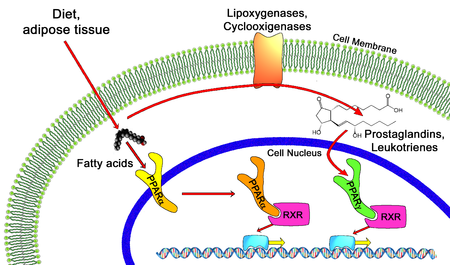
In the field of molecular biology, the peroxisome proliferator-activated receptors (PPARs) are a group of nuclear receptor proteins that function as transcription factors regulating the expression of genes.[1] PPARs play essential roles in the regulation of cellular differentiation, development, and metabolism (carbohydrate, lipid, protein), and tumorigenesis[2] of higher organisms.[3][4]

Three types of PPARs have been identified: alpha, gamma, and delta (beta):[3]

Physiological function

All PPARs heterodimerize with the retinoid X receptor (RXR) and bind to specific regions on the DNA of target genes. These DNA sequences are termed PPREs (peroxisome proliferator hormone response elements). The DNA consensus sequence is AGGTCANAGGTCA, with N being a random nucleotide. In general, this sequence occurs in the promotor region of a gene, and, when the PPAR binds its ligand, transcription of target genes is increased or decreased, depending on the gene. The RXR also forms a heterodimer with a number of other receptors (e.g., vitamin D and thyroid hormone).

The function of PPARs is modified by the precise shape of their ligand-binding domain (see below) induced by ligand binding and by a number of coactivator and corepressor proteins, the presence of which can stimulate or inhibit receptor function, respectively.[9]

Endogenous ligands for the PPARs include free fatty acids and eicosanoids. PPARγ is activated by PGJ2 (a prostaglandin). In contrast, PPARα is activated by leukotriene B4. PPARγ activation by agonist RS5444 may inhibit anaplastic thyroid cancer growth.[10]

Peroxisome proliferator-activated receptor

Peroxisome proliferator-activated receptor (Photo credit: Wikipedia)

Genetics

The three main forms are transcribed from different genes:

  •                PPARα – chromosome 22q12-13.1 (OMIM 170998)
  •                PPARβ/δ – chromosome 6p21.2-21.1 (OMIM 600409)
  •                PPARγ – chromosome 3p25 (OMIM 601487).

Hereditary disorders of all PPARs have been described, generally leading to a loss in function and concomitant lipodystrophy, insulin resistance, and/or acanthosis nigricans.[11] Of PPARγ, a gain-of-function mutation has been described and studied (Pro12Ala) which decreased the risk of insulin resistance; it is quite prevalent (allele frequency 0.03 – 0.12 in some populations).[12] In contrast, pro115gln is associated with obesity. Some other polymorphisms have high incidence in populations with elevated body mass indexes.

SOURCE:

http://en.wikipedia.org/wiki/Peroxisome_proliferator-activated_receptor


Mechanism of action

Thiazolidinediones or TZDs act by activating PPARs (peroxisome proliferator-activated receptors), a group of nuclear receptors with greatest specificity for PPARγ (gamma). The endogenous ligands for these receptors are free fatty acids (FFAs) and eicosanoids. When activated, the receptor binds to DNA in complex with the retinoid X receptor (RXR), another nuclear receptor, increasing transcription of a number of specific genes and decreasing transcription of others.

PPARγ transactivation

Thiazolidinedione ligand dependent transactivation is responsible for the majority of anti-diabetic effects.

The activated PPAR/RXR dimer binds to peroxisome proliferator hormone response elements upstream of target genes in complex with a number of coactivators such as nuclear receptor coactivator 1 and CREB binding protein, this causes upregulation of genes (for a full list see PPARγ:

TZDs also increase the synthesis of certain proteins involved in fat and glucose metabolism, which reduces levels of certain types of lipids, and circulating free fatty acids. TZDs generally decrease triglycerides and increase high-density lipoprotein cholesterol (HDL-C) and low-density lipoprotein cholesterol (LDL-C). Although the increase in LDL-C may be more focused on the larger LDL particles, which may be less atherogenic, the clinical significance of this is currently unknown. Nonetheless, rosiglitazone, a certain glitazone, was suspended from allowed use by medical authorities in Europe, as it has been linked to an increased risk of heart attack and stroke.[3]

PPARγ transrepression

Thiazolidinedione ligand dependent transrepression mediates the majority of anti-inflammatory effects.

Binding of PPARγ to coactivators appears to reduce the levels of coactivators available for binding to pro-inflammatory transcription factors such as NF-κB, this causes a decrease in transcription of a number of pro inflammatory genes, including various interleukins and tumour necrosis factors.

SOURCE:

http://en.wikipedia.org/wiki/Thiazolidinedione

 1. Waki H, Yamauchi T, Kadowaki T (February 2010). “[Regulation of differentiation and hypertrophy of adipocytes and adipokine network by PPARgamma]” (in Japanese). Nippon Rinsho 68 (2): 210–6. PMID 20158086.

2. Panigrahy D, Singer S, Shen LQ, et al. (2002). “PPARγ ligands inhibit primary tumor growth and metastasis by inhibiting angiogenesis”. J. Clin. Invest. 110 (7): 923–32. doi:10.1172/JCI15634. PMC 151148. PMID 12370270.

3. NHS: Avandia diabetes drug suspended, Friday 24th September 2010


Members of the class

The chemical structure of thiazolidinedione

Chemically, the members of this class are derivatives of the parent compound thiazolidinedione, and include:

  •                Rosiglitazone (Avandia), which was put under selling restrictions in the US and withdrawn from the market in            Europe due to an increased risk of cardiovascular events.
  •                Pioglitazone (Actos), France and Germany have suspended the sale of the diabetes drug Actos after a study suggested the drug, also known as pioglitazone, could raise the risk of bladder cancer.[4]
  •                Troglitazone (Rezulin), which was withdrawn from the market due to an increased incidence of drug-induced hepatitis.

Experimental agents include netoglitazone, an antidiabetic agent, rivoglitazone, and the early non-marketed thiazolidinedione ciglitazone.

Replacing one oxygen atom in a thiazolidinedione with an atom of sulfur gives a rhodanine.

SOURCE:

http://en.wikipedia.org/wiki/Thiazolidinedione

PART II:

Peroxisome proliferator-activated receptors as Stimulants of Angiogenesis in Cardiovascular Disease and Diabetes

In 2009 in Diabetes Metab Syndr Obes a seminal paper was published on the topic by  Desouza, Rentschler and Fonseca. (2009). This work constitutes Part II. http://www.ncbi.nlm.nih.gov/pmc/articles/PMC3048019/

Mechanisms by which PPARs may stimulate angiogenesis

PPARs seem to have a protective role in ischemic tissues, including brain, cardiac and skin. A part of this may be by stimulating angiogenesis and improving blood supply. Hypoxia is a trigger for the development of angiogenesis. One of the key mediators in hypoxia-induced angiogenesis is hypoxia inducible factor (HIF-1), which is induced in hypoxic cells and binds to hypoxia response element (HRE). HIF-1 mediates the transcriptional activation of several genes that promote angiogenesis, including VEGF, angiopoeitin (Ang-1, Ang-2), and matrix metalloproteinases (MMP-2, MMP-9).55 15-deoxy-delta(12, 14)-prostaglandin J(2) (15d-PGJ(2)), a PPAR-γ agonist, has been shown to induce HIF-1 expression and thereby angiogenesis (Figure 1).34 However pioglitazone has been shown to suppress the induction of HIF-1.56 Conditions that influence the stimulation or suppression of HIF activation by PPAR-γ are largely unknown.

Several studies suggest that eNOS synthase activation is required for angiogenesis that may be protective under certain conditions.5759 In one study pioglitazone reduced the myocardial infarct size in part via activation of eNOS.60 PPAR-α activation has also been shown to protect the type 2 diabetic rat myocardium against ischemia-reperfusion injury via the activation of the NO pathway (Table 1, Figure 1).61 However, stimulation of the inducible nitric oxide (iNOS) pathway can lead to undesirable angiogenesis that may be contribute to pathological states such as proliferative retinopathy. PPARs in fact have been shown to suppress iNOS expression, thereby suppressing undesirable angiogenesis.62,63 Here again the factors that allow for activation of eNOS and suppression of iNOS is largely unknown.

The most studied pathway by which PPARs may stimulate angiogenesis is the VEGF pathway. VEGF can stimulate angiogenesis via stimulation of the ERK1/2 pathway. PPAR-β/δ activation has been shown to increase VEGF expression and thereby stimulate angiogenesis (Figure 1).26 In some studies PPAR-α and PPAR-γ have also been shown to increase VEGF expression.47,48 However the majority of studies still show that PPAR activation suppresses VEGF expression. The end result of whether PPAR activation suppresses or stimulates VEGF expression seems to lie in the pathological condition in which its actions are observed (Figure 1). It is likely that PPAR activation results in increased VEGF expression in conditions where new blood vessel formation is required, such as ischemic skin flaps, brain, or cardiac tissue ischemia. On the other hand, pathological angiogenesis such as in the eye or within an atherosclerotic plaque is suppressed by PPAR activation via a suppression of VEGF (Figure 1).

An external file that holds a picture, illustration, etc.<br /><br /><br /><br /><br /><br /><br /> Object name is dmso-2-165f1.jpg Object name is dmso-2-165f1.jpg

Mechanisms by which PPARs effect angiogenesis.

Table 1

Effect of PPARs on angiogenesis

Recently some studies indicate that PPARs may increase the expression and activation of the phosphatidylinositol-3-kinase (PI3K/AKT) pathway.61,64 The PI3K/AKT pathway stimulates angiogenesis.59,65 Again the majority of studies show that PPAR activation inhibits PI3K/AKT activation.

It is very likely that a large amount of variation found in different studies is due to the use of agonists and antagonists of the PPAR receptors that exhibit direct PPAR-independent effects. Most study designs do not distinguish between direct effects and indirect effects of various pharmacological agonists/antagonist used. Fibrates and TZDs have both been shown to have direct independent effects on inflammation, proliferation and angiogenesis. Hence it is difficult to conclude that all the pro and antiangiogenic effects seen in various studies are a result of PPAR activation exclusively.

Clinical significance and conclusions

Some compounds such as TZDs and fibrates are routinely used in patients with diabetes, dyslipidemia, and cardiovascular disease. Other compounds such as partial agonists or dual agonists of PPAR-α and PPAR-γ are in development. The effects of these newer compounds, on angiogenesis and cardiovascular disease are yet to be determined. Current evidence from clinical trials suggest a mixed picture. TZD treatment in patients with type 2 diabetes has been shown to be associated with macular edema. On the other hand, the FIELD study using fenofibrate showed a decrease in the need for laser treatments in patients with diabetic retinopathy. The PROACTIVE study showed that pioglitazone trended to decrease certain cardiovascular endpoints. In some studies, rosiglitazone increased the risk of cardiovascular events. In other studies such as ACCORD and VADT, TZD treatment was not associated with increased cardiovascular event risk. Several factors, including the study design, PPAR receptor affinity, and the PPAR-independent actions of these compounds, possibly play a role in the differences in results seen. The duration of the pathological state and the vasculature of the effected organ likely play a role in whether PPARs prove beneficial or harmful. In conclusion it may be prudent to summarize that at this point the evidence suggests that PPARs can either stimulate or inhibit angiogenesis, depending on the biological context and pathological process.

Clinical Trials: Controversial Research Results

Peroxisome proliferator-activated receptors (PPARs) are a group of nuclear hormone receptors that regulate lipid and glucose metabolism. PPAR-α agonists such as fenofibrate and PPAR-γ agonists such as the thiozolidinediones have been used to treat dyslipidemia and insulin resistance in diabetes. Over the past few years research has discovered the role of PPARs in the regulation of inflammation, proliferation, and angiogenesis. Clinical trials looking at the effect of PPAR agonists on cardiovascular outcomes have produced controversial results. Studies looking at angiogenesis and proliferation in various animal models and cell lines have shown a wide variation in results. This may be due to the differential effects of PPARs on proliferation and angiogenesis in various tissues and pathologic states. This review discusses the role of PPARs in stimulating angiogenesis. It also reviews the settings in which stimulation of angiogenesis may be either beneficial or harmful.

affect inflammation, proliferation, immune function and angiogenesis.3 There are three PPAR isotypes, PPAR-α, PPAR-β/δ, and PPAR-γ. They form heterodimers with the retinoid X receptors and bind to specific DNA sequences, called peroxisome proliferator response elements (PPRE), in the promoter regions of their target genes. PPARs exhibit isotype-specific tissue expression patterns. PPAR-α is primarily expressed in organs with significant fatty acid catabolism. PPAR-β/δ is expressed in nearly all cell types and the level of expression seems to depend on the amount of angiogenesis, cell proliferation, and differentiation occurring in that specific tissue.4 PPAR-γ is found in adipose tissue and at lower levels in immune cells vascular tissue and some organs. PPAR-γ exists in two protein isoforms, PPAR-γ1 and PPAR-γ2, with different lengths of the N-terminal. The PPAR-γ2 isoform is predominantly expressed in adipose tissue, whereas PPAR-γ1 is relatively widely expressed.5 Expression of each isoform is driven by a specific promoter that confers the distinct tissue expression patterns. There are also two other mRNA variants of PPAR-γ, proteins identical to PPAR-γ1: PPAR-γ3, which is restricted to macrophages, adipose tissue, and colon, and PPAR-γ4, the tissue distribution of which is unclear at this time.5 Human PPAR-γ plays a critical physiological role as a central transcriptional regulator of both adipogenic and lipogenic programs. Its transcriptional activity is induced by the binding of endogenous and synthetic lipophilic ligands, which has led to the determination of many roles for PPAR-γ in pathological states such as type 2 diabetes, atherosclerosis, inflammation, and cancer.

The role of PPARs has traditionally been recognized as antiproliferative and antiangiogenic in a large number of disease states including cancer and cardiovascular disease.4 These studies have led to clinical trials with PPAR agonists to evaluate their benefits in cancer and cardiovascular disease. The results of some of these trials especially in cardiovascular disease have been mixed and hence controversial.

The results obtained with a PPAR-γ agonist pioglitazone do suggest a better impact on the lipid profile compared to rosiglitazone (the former lowers triglyceride significantly and has less adverse effects on low-density lipoprotein [LDL] cholesterol), and at least a mixed result (the primary composite endpoint was not reduced significantly but myocardial infarction, stroke, and death were reduced by 16%), in an outcome trial – PROspective pioglitAzone Clinical Trial In macroVascular Events (PROACTIVE).6 Rosiglitazone on the other hand was found to increase cardiovascular events in a large restrospective analysis study.7

This has led to a lot of recent research into PPARs that is contrary to the traditional literature in their role as inhibitors of angiogenesis. This review will examine the role and evidence of PPARs as promoters of angiogenesis, the mechanisms involved, and the implications thereof.

SOURCE:

 Desouza, Rentschler and Fonseca. (2009).

Angiogenesis is described as the formation of new capillaries from the existing vasculature. This process involves the breakdown of the extracellular matrix and formation of an endothelial tube. Angiogenesis is an important physiologic process in the female reproductive cycle, wound healing, and bone formation. Angiogenesis is also a crucial step in several disease states including cancer, diabetic retinopathy, rheumatoid arthritis, stroke, and ischemic coronary artery disease.810 Neoangiogenesis has harmful as well as beneficial effects in the setting of type 2 diabetes and cardiovascular disease.10 In the setting of diabetes, there is abnormal regulation and signaling of vascular endothelial growth factor (VEGF) and its receptor Flk-1.11 This may lead to increased levels of circulating VEGF, resulting in increased permeability of vascular structures throughout the body. In the retina, this results in the formation of protein-rich exudates containing VEGF that induces a local inflammatory response resulting in capillary sprouting. A similar process might take place in the arterial wall, thereby promoting capillary sprouting and plaque destabilization.12 At the same time, the lack of Flk-1 activation in endothelial cells and abnormal VEGF-dependent activation of monocytes impair the arteriogenic response that requires monocyte recruitment, and monocyte and endothelial cell migration and proliferation.11 This could lead to a deficient angiogenic response in ischemic tissue. VEGF/Flk-1 signaling may also be required for bone marrow release of circulating endothelial progenitor cells that play a role in endothelial function and arteriogenesis.13 The abnormal release of endothelial progenitors could further reduce arteriogenic response. This has therapeutic implications in terms of vascularization and survival of skin grafts in patients with diabetes as well as vascularization of the ischemic myocardium. An important mechanism by which PPARs seem to regulate angiogenesis is via VEGF.11,12 It would therefore appear that PPARs have a role in regulating both beneficial and harmful effects of angiogenesis thereby leading to controversial results (Figure 1).

The other factor influencing the results of angiogenesis studies is the use of PPAR agonists that have pleotropic effects. PPAR-α agonists such as fibrates stimulate pathways that do not depend on PPAR-α.14 PPAR-γ agonists such as thiozolidinediones (TZDs) have PPARγ independent actions on proliferative and inflammatory pathways.14 Therefore to conclude that the effects of commonly used PPAR agonists on angiogenesis are specifically due to PPAR activation is at best controversial.15

Although the majority of studies point towards the antiproliferative, antiangiogenic properties of PPAR-α, this may be due to the use of fibrates as agonists in these experiments. A lot more research needs to be done using methods such as spontaneous PPAR-α activation, overexpression, silencing and knockout mice, rather than using chemical agonists and antagonists which might have pleotropic effects unrelated to PPAR-α.


PPAR-γ and angiogenesis

PPAR-γ is probably the most studied PPAR, likely due to the use and development of several PPAR-γ agonists such as thiozolidinediones in the treatment of type 2 diabetes. Endogenous ligands for PPAR-γ include long chain polyunsaturated fatty acids and their derivatives, 15-deoxy-Δ12, 14-prostaglandin J2 (15d-PGJ2).4 Other natural ligands include nitrolinoleic acids. 15d-PGJ2 has been found to upregulate the expression of PPAR-γ and also the DNA binding and transcriptional activity.34 Synthetic ligands include TZDs and various nonsteroidal anti-inflammatory drugs.35

Studies supporting antiproliferative properties of PPAR-γ

PPAR-γ has widespread effects involving, inflammation, atherosclerosis, obesity, diabetes, and cancer.36 PPAR-γ agonists directly inhibit tumor cell growth, induce cell differentiation, and apoptosis in various cancer types (Table 1).37 TZDs have been shown to decrease post angioplasty neointimal hyperplasia in both animals and humans (Table 1).38,39 PPAR-γ ligands have been shown to inhibit and stimulate angiogenesis (Table 1). Inhibition by PPAR-γ ligands can occur through direct effects on the endothelium or through indirect effects on the net balance of proangiogenic and antiangiogenic mediators.37 PPAR-γ expressed in choroidal endothelial cells inhibits the differentiation and proliferation of those cells.38,39 Rosiglitazone inhibited endothelial cell proliferation and migration and decreased VEGF-induced tubule formation in human umbilical vein endothelial cells.40,41 In another study PPAR-γ ligands stimulated endothelial cell caspase-mediated apoptosis.42 15d-PGJ2, an endogenous ligand of PPAR-γ, induces growth inhibition, differentiation, and apoptosis of tumor cells.43 PPAR-γ activation interrupts NF-kβ signaling with subsequent blockade of proinflammatory gene expression.43 Pioglitazone and rosiglitazone inhibit the effects of growth factors such as bFGF and VEGF. Endothelial cell migration is also inhibited by both compounds.44 Thus natural and synthetic ligands of PPAR-γ exhibit antiangiogenic properties under certain conditions.

Studies supporting proangiogenic role of PPAR-γ

However, PPAR- ligands have also been shown to stimulate the angiogenic pathway (Table 1). In bovine aortic endothelial cells, prolonged treatment with troglitazone increased VEGF and endothelial nitric oxide (NO) production with no change in endothelial nitric oxide synthase (eNOS) expression.45 In cultured rat myofibroblasts, activation of PPAR-γ by troglitazone and 15-dPGJ2 induced VEGF expression and augmented tubule formation.46 In mice treated with rosiglitazone, angiogenesis was stimulated in adipose tissue with increased expression of VEGF and angiopoeitin-4 (Ang-4). Ang-4 stimulated endothelial cell growth and tubule formation. 47 In rats with focal cerebral ischemia, rosiglitazone treatment enhanced neurologic improvement and reduced the infarct size by reducing caspase-3 activity, increasing the number of endothelial cells, and increasing eNOS expression.48 In the setting of diabetes, PPAR-γ agonists may promote revascularization of ischemic tissue. Diabetic mice with induced unilateral hind limb ischemia, when treated with pioglitazone showed normalization of VEGF, upregulation of eNOS activity, and partial restoration of blood flow recovery.49 In mice treated with pioglitazone, VEGR-receptor-2 positive EPCs were upregulated and migratory capacity was increased. In vivo angiogenesis was increased 2-fold.50 In an endothelial/interstitial cell co-culture assay, treatment with PPAR-γ agonists stimulated production of VEGF. In the same study, corneas treated with the same PPAR-γ agonists increased phosphorylation of eNOS.20

Few studies have evaluated angiogenesis in humans. Pioglitazone treatment has been shown to increase serum VEGF, IL-8, and angiogenin levels in patients with type 2 diabetes.51 In another study thiozolidinedione use in patients with type 2 diabetes was associated with diabetic macular edema.52

PGC-1α and angiogenesis

Peroxisome proliferator-activated receptor (PPAR)-gamma coactivator 1alpha (PGC-1α) is a nuclear transcriptional coactivator that regulates several important metabolic processes, including mitochondrial biogenesis, adaptive thermogenesis, respiration, insulin secretion and gluconeogenesis. 53 PGC-1α also co-activates PPAR-α, PPAR-β/δ, and PPAR-γ which are important transcription factors of genes regulating lipid and glucose metabolism.53 Recently Arany and colleagues have shown that PGC-1α stimulates angiogenesis in ischemic tissues. Using a combination of muscle cell assays and genetically modified mice that over or underexpess PGC-1α, they showed that PGC-1α is a powerful inducer of VEGF expression. PGC-1α did not involve HIF-1 but activated the nuclear receptor, estrogen-related receptor-α (ERR-α).33 PGC-1α−/− mice are viable, suggesting that PGC-1α is not essential in embryonic vascularization but they show a striking failure to reconstitute blood flow in a normal manner to the limb after an ischaemic insult.54 Transgenic expression of PGC-1α in skeletal muscle is protective against ischemic insults. This suggests that PGC-1α plays a more important role in a disease state rather than a physiologically healthy state.


PART III: PPAR-gamma Role in Activation of eNOS: The Cardiovascular Benefit

Author and Curator: Aviva Lev-Ari, PhD, RN


Mechanism of Action (MOA) for ElectEagle‘s component 3

Treatment Regime with PPAR-gamma agonists (TZDs)

For ElectEagle‘s component 1:


Lev-Ari, A., (2012 X). Clinical Trials Results for Endothelin System: Pathophysiological role in Chronic Heart Failure, Acute Coronary Syndromes and MI – Marker of Disease Severity or Genetic Determination?

http://pharmaceuticalintelligence.com/2012/10/19/clinical-trials-results-for-endothelin-system-pathophysiological-role-in-chronic-heart-failure-acute-coronary-syndromes-and-mi-marker-of-disease-severity-or-genetic-determination/


Lev-Ari, A., (2012W). Endothelin Receptors in Cardiovascular Diseases: The Role of eNOS Stimulation

http://pharmaceuticalintelligence.com/2012/10/04/endothelin-receptors-in-cardiovascular-diseases-the-role-of-enos-stimulation/


Lev-Ari, A., (2012V). Inhibition of ET-1, ETA and ETA-ETB, Induction of NO production, stimulation of eNOS and Treatment Regime with PPAR-gamma agonists (TZD): cEPCs Endogenous Augmentation for Cardiovascular Risk Reduction – A Bibliography

http://pharmaceuticalintelligence.com/2012/10/04/inhibition-of-et-1-eta-and-eta-etb-induction-of-no-production-and-stimulation-of-enos-and-treatment-regime-with-ppar-gamma-agonists-tzd-cepcs-endogenous-augmentation-for-cardiovascular-risk-reduc/

For ElectEagle‘s component 2:


Lev-Ari, A. (2012L).. Cardiovascular Disease (CVD) and the Role of agent alternatives in endothelial Nitric Oxide Synthase (eNOS) Activation and Nitric Oxide Production

http://pharmaceuticalintelligence.com/2012/07/19/cardiovascular-disease-cvd-and-the-role-of-agent-alternatives-in-endothelial-nitric-oxide-synthase-enos-activation-and-nitric-oxide-production/

Lev-Ari, A. (2012i). Bystolic’s generic Nebivolol – positive effect on circulating Endothelial Proginetor Cells endogenous augmentation

http://pharmaceuticalintelligence.com/2012/07/16/bystolics-generic-nebivolol-positive-effect-on-circulating-endothilial-progrnetor-cells-endogenous-augmentation/

Three indications for PPAR-gamma agonist (TZD): Experimental agents include netoglitazone, an antidiabetic agent, rivoglitazone, and the early non-marketed thiazolidinedione ciglitazone

  •                Antisclerosis, angiogenic progenitor cell differentiation and endogenous augmentation of cEPCs
  •                Stimulation of eNOS
  •                Decrease insulin resistance

Classic indication: action to decrease insulin resistance. PPAR-gamma receptors are complex and modulate the expression of the genes involved in lipid and glucose metabolism, insulin signal transduction and adipocyte and other tissue differentiation. TZDs have significant effects on vascular endothilium, the immune system, the ovaries, and tumor cells. Some of these responses may be independent of the PPAR-gamma pathway (Nolte and Karam, 2004). TZDs are ligands of PPAR-gamma receptors part of the steroid (estrogen receptor ligands) and thyroid superfamily of nuclear receptors found in muscle, liver and adipocytes. In the gold standard of all pharmacology books, the cardinal indication for TZDs is action to decrease insulin resistance (Nolte and Karam, 2004 in Katzung). However, the recent research has proposed two new indications for Rosiglitazone in addition to the original insulin sensitivity reduction indication.

As implied in Part I of the ElectEagle Project, TDZs were selected for a new indication in the domain of modulation of atherosclerosis (Verma and Szmitko, 2006), (Li et al., 2004)and facilitation of the differentiation of angiogenic progenitor cells, inhibition of vascular smooth muscle, proliferation and migration to improve endothelial function (Wang et al., 2004).

The following three seminal papers on the function of TDZs in modulation of vascular disease served as an inspiration for our extension of their new indication for TDZs in the anti-atherosclerosis domain into the cEPCs endogenous augmentation proposed treatment area.

Verma S, Szmitko, PE, (2006). The vascular biology of peroxisome proliferator-activated receptors: Modulation of atherosclerosis. Can J Cardiol, 22 (Suppl B):12B-17B.

Wang C-H, Ciliberti N, Li S-H, Szmitko PE, Weisel RD, Fedak PWM, Al-Omran M, Cherng W-J, Li R-K, Stanford WL, Verma S., (2004). Rosiglitazone facilitates angiogenic progenitor cell differentiation toward endothelial lineage: a new paradigm in glitazone pleiotropy. Circulation, 109:1392-1400.

Li AC, Binder CJ, Gutierrez A, Brown KK, Plotkin CR, Pattison JW, Valledor AF, Davis RA, Wilson TM, Wizttum JL, Palinski W, Glass CK., (2004). Differential inhibition of macrophage foam-cell formation and atherosclerosis in mice by PPAR alpha, beta/delta, and gamma. J. Clin. Invest., 114:1564-1576.

Namely, in the ElectEagleProject, a finely tuned interpretation is provided. We assume that TZDs may have a potential therapeutic effect on augmentation of cEPCs in a significant way should a combination drug therapy be designed to include Rosiglitazoneand two other drugsonewhich inhibits receptors ETA and ETA-ETB and the other which induces eNOS. TDZs were selected for a new indication related to anti-atherosclerosis, however, we extend and emphasize TZDs function in cell differentiation and cell migration of EPCs following encouraging results by Wang et al., (2004). Thus, we are shifting the indication from atherosclerosis and peripheral vascular disease to cardiovascular and CAD.

In 2005 a new indication for TZDs emerged from new finding about the PPAR-gamma receptors function in cell nitric oxide (NO) release without increasing the expression of endothelial nitric oxide synthase (eNOS) (Polikandriotis et al., 2005). This is an important finding for the drug combination components selected for ElectEagleProject. This subject is covered in the following section, Role of PPAR-gamma in eNOS stimulation.

Mechanism of action (MOA) for ElectEagle‘s components 2 & 3

Role of PPAR-gamma in eNOS stimulation

Polikandriotis et al. (2005), recently reported that the peroxisome proliferator-activated receptor gamma (PPARgamma) ligands 15-deoxy-Delta(12,14)-prostaglandin J2 (15d-PGJ2) and ciglitazone increased cultured endothelial cell nitric oxide (NO) release without increasing the expression of endothelial nitric oxide synthase (eNOS). Their study was designed to characterize further the molecular mechanisms underlying PPARgamma-ligand-stimulated increases in endothelial cell NO production.

Their methods and Results: Treating human umbilical vein endothelial cells (HUVEC) with PPARgamma ligands (10 micromol/L 15d-PGJ2, ciglitazone, or rosiglitazone) for 24 hours increased NOS activity and NO release. In selected studies, HUVEC were treated with PPARgamma ligands and with the PPARgamma antagonist GW9662 (2 micromol/L), which fully inhibited stimulation of a luciferase reporter gene, or with small interfering RNA to PPARgamma, which reduced HUVEC PPARgamma expression. Treatment with either small interfering RNA to PPARgamma or GW9662 inhibited 15d-PGJ2-, ciglitazone-, and rosiglitazone-induced increases in endothelial cell NO release. Rosiglitazone and 15d-PGJ2, but not ciglitazone, increased heat shock protein 90-eNOS interaction and eNOS ser1177 phosphorylation. The heat shock protein 90 inhibitor geldanamycin attenuated 15d-PGJ2- and rosiglitazone-stimulated NOS activity and NO production. Their Conclusion: These findings further clarify mechanisms involved in PPARgamma-stimulated endothelial cell NO release and emphasize that individual ligands exert their effects through distinct PPARgamma-dependent mechanisms

Originally, Rosiglitazone was indicated as an adjunct to diet and exercise to improve glycemic control in patients with type 2 diabetes mellitus who are already treated with combination rosiglitazone and metformin or who are not adequately controlled on metformin alone. As a result of the FDA drug recall of Rosiglitazone, we suggest here several alternatives: Experimental agents include netoglitazone, an antidiabetic agent, rivoglitazone, and the early non-marketed thiazolidinedione ciglitazone

In the ElectEagle project, Rosiglitazone was identified for a new indication – as a PPAR-gamma agonist implicated with efficacy for endogenous augmentation of cEPCs which serves as a biomarker for CVD risk reduction — an extension of the anti-atherosclerosis indication or the confinement to perileral vascular endothelium (Verma & Szmitko), (Wang et al., 2004), (Li et al., 2004).

Polikandriotis et al. (2005) is a very import publication for ElectEagle project for the following critical five reasons:

  •                Polikandriotis et al. (2005) clarify the mechanism of action of PPAR-gamma agonists at the protein level in a set of novel experiments, thus contributes to the understanding of the physiological process of the mechanism of action of PPAReceptor-gamma and its relations to L-arginine: NO pathway and its impact in many areas of research, notably vascular biology.
  •                Polikandriotis et al. (2005) compare two PPAR-gamma agonist agents and confirm Rosiglitazone to be the more potent among the two for the experiments described above
  •                Polikandriotis et al. (2005) identify Rosiglitazone capability to stimulate endothelial cell NO release, which is a third indication for Rosiglitazone.
  •                The combination drug therapy selected in May 2006, for the ElectEagle project involved three drugs. Two of which where a PPAR-gamma agonist, specifically, Rosiglitazone. The other drug was an eNOS agonist to stimulate NO production and reuptake. By identifying Rosiglitazone capability to stimulate endothelial cell NO release, Polikandriotis et al. (2005) offer reassurance for the selection of Rosiglitazone in the first place, and further more we became aware that it will exert synergies with the drug chosen as an eNOS agonist.
  •                In the ElectEagle project, a new experiment is called for following Polikandriotis et al. (2005) findings on Rosiglitazone impact on NO release. It will be needed to measure the incremental induction of NO release resulting from a combination therapy which includes an eNOS agonist and a PPAR-gamma agonist implicated in 2005 with stimulant effects on the release NO.

Moncada & Higgs, (2006) explain that the low concentrations of NO generated by eNOS protect against atherosclerosis by promoting vasodilatation, inhibiting leucocyte and platelet adhesion and/or aggregation and smooth muscle cell proliferation. However, higher concentrations of NO generated by iNOS promote atherosclerosis, either directly or via the formation of NO adducts, such as peroxynitrite. Such a paradox in the action of NO was apparent from their experiments some years ago, in which they found that the acute vascular injury in the ileum and colon following administration of lipopolysaccharide is aggravated by early treatment with a NO synthase inhibitor, whereas delayed administration of such a compound provides protection against the damage to the intestinal vasculature (Laszlo et al., 1994). A prominent example of this comes from experiments in Apo-Emutant mice in which the concomitant knocking out of eNOS leads to an increase in atherosclerosis, while the knocking out of iNOS reduces atherosclerosis (Moncada, 2005).

Research Goals in characterization of ElectEagle Version I


Provided rationale for agent selection for

ElectEagle Version I – Component 3: Treatment Regime with PPAR-gamma agonists (TZD)

agent selection: Rosiglitazone

As a result of the FDA drug recall of Rosiglitazone, we suggest here several alternatives: Experimental agents include netoglitazone, an antidiabetic agentrivoglitazone, and the early non-marketed thiazolidinedione ciglitazone


Retionale:            See discussion on TZDs MOA, above

a-priori postulates presented in Part I for Component 3: PPAR-gamma

  • dose concentration dependence on PPAReceptor-gamma – confirmed by a study for Rosiglitazone and a study for Ciglitazone
PPAReceptor-gamma agonists time concentration dependence manner dose concentration dependencemanner time and dose dose 
Rosiglitazone Polikandriotis et al., (2005) maximum recommended daily dose of 8 mg to 2,000 mg.
Ciglitazone   Polikandriotis et al., (2005)


Proposed integration plan for ElectEagle’s Version I with CVD patients current medication regimen for selective medical diagnoses

Blood Pressure Medicine:

Beta blockers, Verapamil (Calan), Reserpine (Hydropes), Clonidine (Catapres), Methyldopa (Aldomet)

Diuretics:

Thiazides, Spironolactone (Aldactone), Hydralazine

Antidepressants:

Prozac, Lithium, MOA’s, Tricyclics

Stomach Medicine:

Tagamet and Zantac, plus other compounds containing Cimetidine and Ranitidine or associated compounds in Anticholesterol Drugs

Antipsychotics:

Chlorpromazine (Thorazine), Pimozide (Orap), Thiothixine (Navane), Thiordazine (Mellaril), Sulpiride, Haloperidol (haldol), Fluphenazine (Modecate, Prolixin)

Heart Medicine:

Clofibrate (Atromid), Gemfibrozil, Diagoxin

Hormones:

Estrogen, Progesterone, Proscar, Casodex, Eulexin, Corticosteroids Gonadotropin releasing antagonists: Zoladex and Lupron

Cytotoxic agents:

Cyclophosphamide, Methotrexate, Roferon Non-steroidal anti-inflammatories

Others-

Alprazolam, Amoxapine, Chlordiazepoxide, Sertraline, Paroxetine, Clomipramine, Fluvoxamine, Fluoxetine, Imipramine, Doxepine, Desipramine, Clorprothixine, Bethanidine, Naproxen, Nortriptyline, Thioridazine, Tranylcypromine, Venlafaxine, Citalopram.

INTERACTIONS for Nebivolol – Component 2

Calcium Antagonists:

Caution should be exercised when administering beta-blockers with calcium antagonists of the verapamil or diltiazem type because of their negative effect on contractility and atrio-ventricular conduction. Exaggeration of these effects can occur particularly in patients with impaired ventricular function and/or SA or AV conduction abnormalities. Neither medicine should therefore be administered intravenously within 48 hours of discontinuing the other.

Anti-arrhythmics:

Caution should be exercised when administering beta-blockers with Class I anti-arrhythmic drugs and amiodarone as their effect on atrial conduction time and their negative inotropic effect may be potentiated. Such interactions can have life threatening consequences.

Clonidine:

Beta-blockers increase the risk of rebound hypertension after sudden withdrawal of chronic clonidine treatment.

Digitalis:

Digitalis glycosides associated with beta-blockers may increase atrio-ventricular conduction times. Nebivolol does not influence the kinetics of digoxin & clinical trials have not shown any evidence of an interaction.

Special note: Digitalisation of patients receiving long term beta-blocker therapy may be necessary if congestive cardiac failure is likely to develop. The combination can be considered despite the potentiation of the negative chronotropic effect of the two medicines. Careful control of dosages and of individual patient’s response (notably pulse rate) is essential in this situation.

Insulin & Oral Antidiabetic drugs:

Glucose levels are unaffected, however symptoms of hypoglycemia may be masked.

Anaesthetics:

Concomitant use of beta-blockers & anaesthetics e.g. ether, cyclopropane & trichloroethylene may attenuate reflex tachycardia & increase the risk of hypotension

Medical Diagnoses Current medication regiment ET-1, ETA and ETA-ETBinhibition eNOS agonistsproduction stimulation of NO PPAR-gamma agonist (TZD) PPAR-gamma agonist (TZD) as eNOS stimulant
CAD patients Beta blockers, ACEI, ARB, CCB, Diagoxin, Coumadin yes yes yes
Endothelial Dysfunction in DM patients with or without Erectile Dysfunction Insulin yes yes yes yes
Atherosclerosis patients: Arteries and or veins AntihypertensiveCoumadin yes yes yes yes
pre-stenting treatment phase Beta blockers, Verapamil (Calan), Reserpine (Hydropes), Clonidine (Catapres), Methyldopa (Aldomet) yes yes yes
post-stenting treatment phase Antiplatelets yes yes
if stent is a Bare Mesh stent (BMS) CoumadinBeta blockers yes yes
if stent is Drug Eluting stent (DES) antibiotics yes
if stent is EPC antibody coated yes yes
post CABG patients CoumadinBeta blockers, Verapamil(Calan), Reserpine (Hydropes), Clonidine (Catapres), Methyldopa (Aldomet) yes yes
CVD patients on blood thinner Coumadin yes yes yes

Conclusions

  •       Most favorable and unexpected to us was finding in the literature new indications for TDZs as stimulators of eNOS, in addition to the new indication for atherosclerosis besides the classic indication in pharmacology books, being in the reduction of insulin resistance. Reassuring our selection of Rosiglitazone. As a result of the FDA recoll, the drug substitute will be an Experimental agents include netoglitazone, an antidiabetic agentrivoglitazone, and the early non-marketed thiazolidinedione ciglitazone 
  •       Most favorable and unexpected to us was finding in the literature new indications for beta blockers as NO stimulant, nebivolol, a case in point, thus, fulfilling two indications in one drug along the direction of the study to identify eNOS agonists.
  •       The following combination of drugs was selected for ElectEagle Version I

Bosentan (Tracleer), Oral: 62.5 mg tablets

Nebivolol, Oral: 5mg once daily

Experimental agents include netoglitazone, an antidiabetic agent, rivoglitazone, and the early non-marketed thiazolidinedione ciglitazone

  •       We confirmed time and dose concentrations postulating apriori in most cases. Additional literature searches will benefit the project for the three drugs selected
  •       We have identified Inhibition of ET-1, ETA and ETA-ETB as one of the agent in the drug combination. The entire literature on cEPCs does not implicate Endothelin with impact on eEPCs while it is known that mechanical stress increase its secretion, this type of stress is implicated with hypertension. To leave out ET-1 from the cEPCs function in CVD risk equates to leaving out Thrombin from the coagulation cascade. ElectEagle Version I corrects that ommission.

REFERENCES for PART I:

1. Michalik L, Auwerx J, Berger JP, Chatterjee VK, Glass CK, Gonzalez FJ, Grimaldi PA, Kadowaki T, Lazar MA, O’Rahilly S, Palmer CN, Plutzky J, Reddy JK, Spiegelman BM, Staels B, Wahli W (2006). “International Union of Pharmacology. LXI. Peroxisome proliferator-activated receptors”. Pharmacol. Rev. 58 (4): 726–41. doi:10.1124/pr.58.4.5. PMID 17132851.

2. Belfiore A, Genua M, Malaguarnera R (2009). “PPAR-gamma Agonists and Their Effects on IGF-I Receptor Signaling: Implications for Cancer”. PPAR Res 2009: 830501. doi:10.1155/2009/830501. PMC 2709717. PMID 19609453.

3.a b Berger J, Moller DE (2002). “The mechanisms of action of PPARs”. Annu. Rev. Med. 53: 409–35. doi:10.1146/annurev.med.53.082901.104018. PMID 11818483.

4 Feige JN, Gelman L, Michalik L, Desvergne B, Wahli W (2006). “From molecular action to physiological outputs: peroxisome proliferator-activated receptors are nuclear receptors at the crossroads of key cellular functions”. Prog. Lipid Res. 45 (2): 120–59. doi:10.1016/j.plipres.2005.12.002. PMID 16476485.

5 Tyagi S, Gupta P, Saini AS, Kaushal C, Sharma S (October 2011). “The peroxisome proliferator-activated receptor: A family of nuclear receptors role in various diseases”. J Adv Pharm Technol Res 2 (4): 236–40. doi:10.4103/2231-4040.90879. PMC 3255347. PMID 22247890.

6 Dreyer C, Krey G, Keller H, Givel F, Helftenbein G, Wahli W (1992). “Control of the peroxisomal beta-oxidation pathway by a novel family of nuclear hormone receptors”. Cell 68 (5): 879–87. doi:10.1016/0092-8674(92)90031-7. PMID 1312391.

7 Issemann I, Green S (1990). “Activation of a member of the steroid hormone receptor superfamily by peroxisome proliferators”. Nature 347 (6294): 645–50. doi:10.1038/347645a0. PMID 2129546.

8 Schmidt A, Endo N, Rutledge SJ, Vogel R, Shinar D, Rodan GA (1992). “Identification of a new member of the steroid hormone receptor superfamily that is activated by a peroxisome proliferator and fatty acids”. Mol. Endocrinol. 6 (10): 1634–41. doi:10.1210/me.6.10.1634. PMID 1333051.

9 Yu S, Reddy JK (2007). “Transcription coactivators for peroxisome proliferator-activated receptors”. Biochim. Biophys. Acta 1771 (8): 936–51. doi:10.1016/j.bbalip.2007.01.008. PMID 17306620.

10 Marlow LA, Reynolds LA, Cleland AS, Cooper SJ, Gumz ML, Kurakata S, Fujiwara K, Zhang Y, Sebo T, Grant C, McIver B, Wadsworth JT, Radisky DC, Smallridge RC, Copland JA (February 2009). “Reactivation of suppressed RhoB is a critical step for the inhibition of anaplastic thyroid cancer growth”. Cancer Res. 69 (4): 1536–44. doi:10.1158/0008-5472.CAN-08-3718. PMC 2644344. PMID 19208833.

11 Meirhaeghe A, Amouyel P (2004). “Impact of genetic variation of PPARgamma in humans”. Mol. Genet. Metab. 83 (1-2): 93–102. doi:10.1016/j.ymgme.2004.08.014. PMID 15464424.

12 Buzzetti R, Petrone A, Ribaudo MC, Alemanno I, Zavarella S, Mein CA, Maiani F, Tiberti C, Baroni MG, Vecci E, Arca M, Leonetti F, Di Mario U (2004). “The common PPAR-gamma2 Pro12Ala variant is associated with greater insulin sensitivity”. Eur. J. Hum. Genet. 12 (12): 1050–4. doi:10.1038/sj.ejhg.5201283. PMID 15367918.

13 Zoete V, Grosdidier A, Michielin O (2007). “Peroxisome proliferator-activated receptor structures: ligand specificity, molecular switch and interactions with regulators”. Biochim. Biophys. Acta 1771 (8): 915–25. doi:10.1016/j.bbalip.2007.01.007. PMID 17317294.

REFERENCES for PART II:

Part II is based on the following:

Cyrus V Desouza, Lindsey Rentschler, and Vivian Fonseca

Peroxisome proliferator-activated receptors as stimulants of angiogenesis in cardiovascular disease and diabetes Diabetes Metab Syndr Obes. 2009; 2: 165–172. Published online 2009 September 25 PMCID: PMC3048019

http://www.ncbi.nlm.nih.gov/pmc/articles/PMC3048019/

1. Wee CC, Hamel MB, Huang A, Davis RB, Mittleman MA, McCarthy EP. Obesity and undiagnosed diabetes in the US. Diabetes Care. 2008;31:1813–1815. [PMC free article] [PubMed]

2. Westphal SA. Obesity, abdominal obesity, and insulin resistance. Clin Cornerstone. 2008;9:23–31. [PubMed]

3. Calkin AC, Thomas MC. PPAR agonists and cardiovascular disease in diabetes. PPAR Res. 2008;245410

4. Duan SZ, Ivashchenko CY, Usher MG, Mortensen RM. PPAR-gamma in the cardiovascular system. PPAR Res. 2008;745804

5. Knouff C, Auwerx J. Peroxisome proliferator-activated receptor-gamma calls for activation in moderation: lessons from genetics and pharmacology. Endocr Rev. 2004;25:899–918. [PubMed]

6. Erdmann E, Dormandy J, Wilcox R, Massi-Benedetti M, Charbonnel B. PROactive 07: pioglitazone in the treatment of type 2 diabetes: results of the PROactive study. Vasc Health Risk Manag. 2007;3:355–370. [PMC free article] [PubMed]

7. Nissen SE, Wolski K. Effect of rosiglitazone on the risk of myocardial infarction and death from cardiovascular causes. N Engl J Med. 2007;356:2457–2471. [PubMed]

8. Folkman J. Angiogenesis in cancer, vascular, rheumatoid and other disease. Nat Med. 1995;1:27–31. [PubMed]

9. Carmeliet P, Baes M. Metabolism and therapeutic angiogenesis. N Engl J Med. 2008;358:2511–2512. [PubMed]

10. Martin A, Komada MR, Sane DC. Abnormal angiogenesis in diabetes mellitus. Med Res Rev. 2003;23:117–145. [PubMed]

11. Simons M. Angiogenesis, arteriogenesis, and diabetes: paradigm reassessed? J Am Coll Cardiol. 2005;46:835–837. [PubMed]

12. Qaum T, Xu Q, Joussen AM, et al. VEGF-initiated blood-retinal barrier breakdown in early diabetes. Invest Ophthalmol Vis Sci. 2001;42:2408–2413. [PubMed]

13. Pitchford SC, Furze RC, Jones CP, Wengner AM, Rankin SM. Differential mobilization of subsets of progenitor cells from the bone marrow. Cell Stem Cell. 2009;4:62–72. [PubMed]

14. Jandeleit-Dahm KA, Calkin A, Tikellis C, Thomas M. Direct antiatherosclerotic effects of PPAR agonists. Curr Opin Lipidol. 2009;20:24–29. [PubMed]

15. Pozzi A, Ibanez MR, Gatica AE, et al. Peroxisomal proliferator-activated receptor-alpha-dependent inhibition of endothelial cell proliferation and tumorigenesis. J Biol Chem. 2007;282:17685–17695. [PubMed]

16. Grabacka M, Reiss K. Anticancer properties of PPARalpha – effects on cellular metabolism and inflammation. PPAR Res. 2008;930705

17. Scott R, O’Brien R, Fulcher G, et al. Effects of fenofibrate treatment on cardiovascular disease risk in 9,795 individuals with type 2 diabetes and various components of the metabolic syndrome: the Fenofibrate Intervention and Event Lowering in Diabetes (FIELD) study. Diabetes Care. 2009;32:493–498. [PMC free article] [PubMed]

18. Kasai T, Miyauchi K, Yokoyama T, Aihara K, Daida H. Efficacy of peroxisome proliferative activated receptor (PPAR)-alpha ligands, fenofibrate, on intimal hyperplasia and constrictive remodeling after coronary angioplasty in porcine models. Atherosclerosis. 2006;188:274–280. [PubMed]

19. Gizard F, Amant C, Barbier O, et al. PPAR alpha inhibits vascular smooth muscle cell proliferation underlying intimal hyperplasia by inducing the tumor suppressor p16INK4a. J Clin Invest. 2005;115:3228–3238. [PMC free article] [PubMed]

20. Biscetti F, Gaetani E, Flex A, et al. Selective activation of peroxisome proliferator-activated receptor (PPAR)alpha and PPAR gamma induces neoangiogenesis through a vascular endothelial growth factor-dependent mechanism. Diabetes. 2008;57:1394–1404. [PubMed]

21. Biscetti F, Gaetani E, Flex A, et al. Peroxisome proliferator-activated receptor alpha is crucial for iloprost-induced in vivo angiogenesis and vascular endothelial growth factor upregulation. J Vasc Res. 2009;46:103–108. [PubMed]

22. Fauconnet S, Lascombe I, Chabannes E, et al. Differential regulation of vascular endothelial growth factor expression by peroxisome proliferator-activated receptors in bladder cancer cells. J Biol Chem. 2002;277:23534–23543. [PubMed]

23. Wang N. PPAR-delta in Vascular Pathophysiology. PPAR Res. 2008;164163

24. Berry DC, Noy N. All-trans-retinoic acid represses obesity and insulin resistance by activating both PPAR{beta}/{delta} and RAR. Mol Cell Biol. 2009;29:3286–3296. [PMC free article] [PubMed]

25. Stephen RL, Gustafsson MC, Jarvis M, et al. Activation of peroxisome proliferator-activated receptor delta stimulates the proliferation of human breast and prostate cancer cell lines. Cancer Res. 2004;64:3162–3170. [PubMed]

26. Piqueras L, Reynolds AR, Hodivala-Dilke KM, et al. Activation of PPARbeta/delta induces endothelial cell proliferation and angiogenesis. Arterioscler Thromb Vasc Biol. 2007;27:63–69. [PubMed]

27. Gaudel C, Schwartz C, Giordano C, Abumrad NA, Grimaldi PA. Pharmacological activation of PPARbeta promotes rapid and calcineurin-dependent fiber remodeling and angiogenesis in mouse skeletal muscle. Am J Physiol Endocrinol Metab. 2008;295:E297–E304. [PubMed]

28. Yoshinaga M, Kitamura Y, Chaen T, et al. The simultaneous expression of peroxisome proliferator-activated receptor delta and cyclooxygenase-2 may enhance angiogenesis and tumor venous invasion in tissues of colorectal cancers. Dig Dis Sci. 2009;54:1108–1114. [PubMed]

29. He T, Lu T, d’Uscio LV, Lam CF, Lee HC, Katusic ZS. Angiogenic function of prostacyclin biosynthesis in human endothelial progenitor cells. Circ Res. 2008;103:80–88. [PMC free article] [PubMed]

30. Muller-Brusselbach S, Komhoff M, Rieck M, et al. Deregulation of tumor angiogenesis and blockade of tumor growth in PPARbeta-deficient mice. Embo J. 2007;26:3686–3698. [PMC free article] [PubMed]

31. Muller R, Komhoff M, Peters JM, Muller-Brusselbach S. A Role for PPARbeta/delta in Tumor Stroma and Tumorigenesis. PPAR Res. 2008;534294

32. Wang D, Wang H, Guo Y, et al. Crosstalk between peroxisome proliferator-activated receptor delta and VEGF stimulates cancer progression. Proc Natl Acad Sci U S A. 2006;103:19069–19074. [PMC free article] [PubMed]

33. Hollingshead HE, Killins RL, Borland MG, et al. Peroxisome proliferator-activated receptor-beta/delta (PPARbeta/delta) ligands do not potentiate growth of human cancer cell lines. Carcinogenesis. 2007;28:2641–2649. [PubMed]

34. Kim EH, Surh YJ. 15-deoxy-Delta12, 14-prostaglandin J2 as a potential endogenous regulator of redox-sensitive transcription factors. Biochem Pharmacol. 2006;72:1516–1528. [PubMed]

35. Lehmann JM, Lenhard JM, Oliver BB, Ringold GM, Kliewer SA. Peroxisome proliferator-activated receptors alpha and gamma are activated by indomethacin and other non-steroidal anti-inflammatory drugs. J Biol Chem. 1997;272:3406–3410. [PubMed]

36. Pershadsingh HA. Peroxisome proliferator-activated receptor-gamma: therapeutic target for diseases beyond diabetes: quo vadis? Expert Opin Investig Drugs. 2004;13:215–228.

37. Giaginis C, Tsantili-Kakoulidou A, Theocharis S. Peroxisome proliferator-activated receptor-gamma ligands: potential pharmacological agents for targeting the angiogenesis signaling cascade in cancer. PPAR Res. 2008;431763

38. Rosmarakis ES, Falagas ME. Effect of thiazolidinedione therapy on restenosis after coronary stent implantation: a meta-analysis of randomized controlled trials. Am Heart J. 2007;154:144–150. [PubMed]

39. Desouza CV, Gerety M, Hamel FG. Long-term effects of a PPAR-gamma agonist, pioglitazone, on neointimal hyperplasia and endothelial regrowth in insulin resistant rats. Vascul Pharmacol. 2007;46:188–194. [PubMed]

40. Panigrahy D, Singer S, Shen LQ, et al. PPARgamma ligands inhibit primary tumor growth and metastasis by inhibiting angiogenesis. J Clin Invest. 2002;110:923–932. [PMC free article] [PubMed]

41. Sheu WH, Ou HC, Chou FP, Lin TM, Yang CH. Rosiglitazone inhibits endothelial proliferation and angiogenesis. Life Sci. 2006;78:1520–1528. [PubMed]

42. Bishop-Bailey D, Hla T. Endothelial cell apoptosis induced by the peroxisome proliferator-activated receptor (PPAR) ligand 15-deoxy-Delta12, 14-prostaglandin J2. J Biol Chem. 1999;274:17042–17048. [PubMed]

43. Giri S, Rattan R, Singh AK, Singh I. The 15-deoxy-delta12,14-prostaglandin J2 inhibits the inflammatory response in primary rat astrocytes via down-regulating multiple steps in phosphatidylinositol 3-kinase-Akt-NF-kappaB- p300 pathway independent of peroxisome proliferator-activated receptor gamma. J Immunol. 2004;173:5196–5208. [PubMed]

44. Aljada A, O’Connor L, Fu YY, Mousa SA. PPAR gamma ligands, rosiglitazone and pioglitazone, inhibit bFGF- and VEGF-mediated angiogenesis. Angiogenesis. 2008;11:361–367. [PubMed]

45. Cho DH, Choi YJ, Jo SA, Jo I. Nitric oxide production and regulation of endothelial nitric-oxide synthase phosphorylation by prolonged treatment with troglitazone: evidence for involvement of peroxisome proliferator-activated receptor (PPAR) gamma-dependent and PPARgamma-independent signaling pathways. J Biol Chem. 2004;279:2499–2506. [PubMed]

46. Chintalgattu V, Harris GS, Akula SM, Katwa LC. PPAR-gamma agonists induce the expression of VEGF and its receptors in cultured cardiac myofibroblasts. Cardiovasc Res. 2007;74:140–150. [PubMed]

47. Gealekman O, Burkart A, Chouinard M, Nicoloro SM, Straubhaar J, Corvera S. Enhanced angiogenesis in obesity and in response to PPAR-gamma activators through adipocyte VEGF and ANGPTL4 production. Am J Physiol Endocrinol Metab. 2008;295:E1056–E1064. [PMC free article] [PubMed]

48. Chu K, Lee ST, Koo JS, et al. Peroxisome proliferator-activated receptor-gamma-agonist, rosiglitazone, promotes angiogenesis after focal cerebral ischemia. Brain Res. 2006;1093:208–218. [PubMed]

49. Huang PH, Sata M, Nishimatsu H, Sumi M, Hirata Y, Nagai R. Pioglitazone ameliorates endothelial dysfunction and restores ischemia-induced angiogenesis in diabetic mice. Biomed Pharmacother. 2008;62:46–52. [PubMed]

50. Gensch C, Clever YP, Werner C, Hanhoun M, Bohm M, Laufs U. The PPAR-gamma agonist pioglitazone increases neoangiogenesis and prevents apoptosis of endothelial progenitor cells. Atherosclerosis. 2007;192:67–74. [PubMed]

51. Vijay SK, Mishra M, Kumar H, Tripathi K. Effect of pioglitazone and rosiglitazone on mediators of endothelial dysfunction, markers of angiogenesis and inflammatory cytokines in type-2 diabetes. Acta Diabetol. 2009;46:27–33. [PubMed]

52. Fong DS, Contreras R. Glitazone use associated with diabetic macular edema. Am J Ophthalmol. 2009;147:583–586. e1. [PubMed]

53. Finck BN, Kelly DP. Peroxisome proliferator-activated receptor gamma coactivator-1 (PGC-1) regulatory cascade in cardiac physiology and disease. Circulation. 2007;115:2540–2548. [PubMed]

54. Arany Z, Foo SY, Ma Y, et al. HIF-independent regulation of VEGF and angiogenesis by the transcriptional coactivator PGC-1alpha. Nature. 2008;451:1008–1012. [PubMed]

55. Hickey MM, Simon MC. Regulation of angiogenesis by hypoxia and hypoxia-inducible factors. Curr Top Dev Biol. 2006;76:217–257. [PubMed]

56. Lee KS, Kim SR, Park SJ, et al. Peroxisome proliferator activated receptor-gamma modulates reactive oxygen species generation and activation of nuclear factor-kappaB and hypoxia-inducible factor 1alpha in allergic airway disease of mice. J Allergy Clin Immunol. 2006;118:120–127. [PubMed]

57. Chen J, Cui X, Zacharek A, Roberts C, Chopp M. eNOS mediates TO90317 treatment-induced angiogenesis and functional outcome after stroke in mice. Stroke. 2009;40:2532–2538. [PMC free article] [PubMed]

58. Howell K, Costello CM, Sands M, Dooley I, McLoughlin P. L-arginine promotes angiogenesis in the chronically hypoxic lung: a novel mechanism ameliorating pulmonary hypertension. Am J Physiol Lung Cell Mol Physiol. 2009;296:L1042–L1050. [PubMed]

59. Namkoong S, Kim CK, Cho YL, et al. Forskolin increases angiogenesis through the coordinated cross-talk of PKA-dependent VEGF expression and Epac-mediated PI3K/Akt/eNOS signaling. Cell Signal. 2009;21:906–915. [PubMed]

60. Yasuda S, Kobayashi H, Iwasa M, et al. Antidiabetic drug pioglitazone protects the heart via activation of PPAR-{gamma} receptors, PI3-kinase, Akt, and eNOS pathway in a rabbit model of myocardial infarction. Am J Physiol Heart Circ Physiol. 2009;296:H1558–H1565. [PubMed]

61. Bulhak AA, Jung C, Ostenson CG, Lundberg JO, Sjoquist PO, Pernow J. PPAR-alpha activation protects the type 2 diabetic myocardium against ischemia-reperfusion injury: involvement of the PI3-Kinase/Akt and NO pathway. Am J Physiol Heart Circ Physiol. 2009;296:H719–H727. [PubMed]

62. Cuzzocrea S, Pisano B, Dugo L, et al. Rosiglitazone, a ligand of the peroxisome proliferator-activated receptor-gamma, reduces acute inflammation. Eur J Pharmacol. 2004;483:79–93. [PubMed]

63. Tao L, Liu HR, Gao E, et al. Antioxidative, antinitrative, and vasculoprotective effects of a peroxisome proliferator-activated receptor-gamma agonist in hypercholesterolemia. Circulation. 2003;108:2805–2811. [PubMed]

64. Pedchenko TV, Gonzalez AL, Wang D, DuBois RN, Massion PP. Peroxisome proliferator-activated receptor beta/delta expression and activation in lung cancer. Am J Respir Cell Mol Biol. 2008;39:689–696. [PMC free article] [PubMed]

65. Ma J, Sawai H, Ochi N, et al. PTEN regulate angiogenesis through PI3K/Akt/VEGF signaling pathway in human pancreatic cancer cells. Mol Cell Biochem. 2009 May 13; Epub ahead of print.

66. Panigrahy D, Kaipainen A, Huang S, et al. PPARalpha agonist fenofibrate suppresses tumor growth through direct and indirect angiogenesis inhibition. Proc Natl Acad Sci U S A. 2008;105:985–990. [PMC free article] [PubMed]

67. Minutoli L, Antonuccio P, Polito F, et al. Peroxisome proliferator activated receptor beta/delta activation prevents extracellular regulated kinase 1/2 phosphorylation and protects the testis from ischemia and reperfusion injury. J Urol. 2009;181:1913–1921. [PubMed]

68. Lim HJ, Lee S, Park JH, et al. PPAR delta agonist L-165041 inhibits rat vascular smooth muscle cell proliferation and migration via inhibition of cell cycle. Atherosclerosis. 2009;202:446–454. [PubMed]

69. Borland MG, Foreman JE, Girroir EE, et al. Ligand activation of peroxisome proliferator-activated receptor-beta/delta inhibits cell proliferation in human HaCaT keratinocytes. Mol Pharmacol. 2008;74:1429–1442. [PMC free article] [PubMed]

70. Piqueras L, Sanz MJ, Perretti M, et al. Activation of PPAR{beta}/{delta} inhibits leukocyte recruitment, cell adhesion molecule expression, and chemokine release. J Leukoc Biol. 2009;86:115–122. [PubMed]

REFERENCES for PART III:


Inhibition of ET-1, ETA and ETA-ETB, Induction of NO production, stimulation of eNOS and Treatment Regime with PPAR-gamma agonists (TZD): cEPCs Endogenous Augmentation for Cardiovascular Risk Reduction – A Bibliography

http://pharmaceuticalintelligence.com/2012/10/04/inhibition-of-et-1-eta-and-eta-etb-induction-of-no-production-and-stimulation-of-enos-and-treatment-regime-with-ppar-gamma-agonists-tzd-cepcs-endogenous-augmentation-for-cardiovascular-risk-reduc/


Additional References to Studies on PPAR-Gamma


Repository on BioInfoBank Library on Peroxisome proliferator-activated receptor

http://lib.bioinfo.pl/paper:11030710


Repository on Science.gov on Peroxisome proliferator-activated receptor

http://www.science.gov/topicpages/e/exhibits+ppargamma+ligand.html


On this Open Access OnLine Scientific Journal, Dr. Lev-Ari’s research on Pharmaco-Therapy of Cardiovascular Diseases includes the following:


Lev-Ari, A., (2012 X). Clinical Trials Results for Endothelin System: Pathophysiological role in Chronic Heart Failure, Acute Coronary Syndromes and MI – Marker of Disease Severity or Genetic Determination?

http://pharmaceuticalintelligence.com/2012/10/19/clinical-trials-results-for-endothelin-system-pathophysiological-role-in-chronic-heart-failure-acute-coronary-syndromes-and-mi-marker-of-disease-severity-or-genetic-determination/


Lev-Ari, A., (2012W). Endothelin Receptors in Cardiovascular Diseases: The Role of eNOS Stimulation

http://pharmaceuticalintelligence.com/2012/10/04/endothelin-receptors-in-cardiovascular-diseases-the-role-of-enos-stimulation/


Lev-Ari, A., (2012V). Inhibition of ET-1, ETA and ETA-ETB, Induction of NO production, stimulation of eNOS and Treatment Regime with PPAR-gamma agonists (TZD): cEPCs Endogenous Augmentation for Cardiovascular Risk Reduction – A Bibliography

http://pharmaceuticalintelligence.com/2012/10/04/inhibition-of-et-1-eta-and-eta-etb-induction-of-no-production-and-stimulation-of-enos-and-treatment-regime-with-ppar-gamma-agonists-tzd-cepcs-endogenous-augmentation-for-cardiovascular-risk-reduc/


Lev-Ari, A., (2012U). Cardiovascular Outcomes: Function of circulating Endothelial Progenitor Cells (cEPCs): Exploring Pharmaco-therapy targeted at Endogenous Augmentation of cEPCs

http://pharmaceuticalintelligence.com/2012/08/28/cardiovascular-outcomes-function-of-circulating-endothelial-progenitor-cells-cepcs-exploring-pharmaco-therapy-targeted-at-endogenous-augmentation-of-cepcs/

Lev-Ari, A., (2012T). Endothelial Dysfunction, Diminished Availability of cEPCs, Increasing CVD Risk for Macrovascular Disease – Therapeutic Potential of cEPCs

http://pharmaceuticalintelligence.com/2012/08/27/endothelial-dysfunction-diminished-availability-of-cepcs-increasing-cvd-risk-for-macrovascular-disease-therapeutic-potential-of-cepcs/

Lev-Ari, A., (2012S). Vascular Medicine and Biology: CLASSIFICATION OF FAST ACTING THERAPY FOR PATIENTS AT HIGH RISK FOR MACROVASCULAR EVENTS Macrovascular Disease – Therapeutic Potential of cEPCs

http://pharmaceuticalintelligence.com/2012/08/24/vascular-medicine-and-biology-classification-of-fast-acting-therapy-for-patients-at-high-risk-for-macrovascular-events-macrovascular-disease-therapeutic-potential-of-cepcs/

Lev-Ari, A. (2012L).. Cardiovascular Disease (CVD) and the Role of agent alternatives in endothelial Nitric Oxide Synthase (eNOS) Activation and Nitric Oxide Production

http://pharmaceuticalintelligence.com/2012/07/19/cardiovascular-disease-cvd-and-the-role-of-agent-alternatives-in-endothelial-nitric-oxide-synthase-enos-activation-and-nitric-oxide-production/

Lev-Ari, A. (2012a). Resident-cell-based Therapy in Human Ischaemic Heart Disease: Evolution in the PROMISE of Thymosin beta4 for Cardiac Repair

http://pharmaceuticalintelligence.com/2012/04/30/93/

Lev-Ari, A. (2012b). Triple Antihypertensive Combination Therapy Significantly Lowers Blood Pressure in Hard-to-Treat Patients with Hypertension and Diabetes

http://pharmaceuticalintelligence.com/2012/05/29/445/

Lev-Ari, A. (2012h). Macrovascular Disease – Therapeutic Potential of cEPCs: Reduction Methods for CV Risk

http://pharmaceuticalintelligence.com/2012/07/02/macrovascular-disease-therapeutic-potential-of-cepcs-reduction-methods-for-cv-risk/

Lev-Ari, A. (2012j) Mitochondria Dysfunction and Cardiovascular Disease – Mitochondria: More than just the “powerhouse of the cell”

http://pharmaceuticalintelligence.com/2012/07/09/mitochondria-more-than-just-the-powerhouse-of-the-cell/

Lev-Ari, A. (2012i). Bystolic’s generic Nebivolol – positive effect on circulating Endothelial Proginetor Cells endogenous augmentation

http://pharmaceuticalintelligence.com/2012/07/16/bystolics-generic-nebivolol-positive-effect-on-circulating-endothilial-progrnetor-cells-endogenous-augmentation/


Electronic versions NOT available for:

Lev-Ari, A. & Abourjaily, P. (2006a) “An Investigation of the Potential of circulating Endothelial Progenitor Cells (cEPC) as a Therapeutic Target for Pharmacologic Therapy Design for Cardiovascular Risk Reduction.”Part I: Macrovascular Disease – Therapeutic Potential of cEPCs – Reduction methods for CV risk. Part II: (2006b) Therapeutic Strategy for cEPCs Endogenous Augmentation: A Concept-based Treatment Protocol for a Combined Three Drug Regimen. Part III: (2006c) Biomarker for Therapeutic Targets of Cardiovascular Risk Reduction by cEPCs Endogenous Augmentation using New Combination Drug Therapy of Three Drug Classes and Several Drug Indications. Northeastern University, Boston, MA 02115

Lev-Ari, A. (2007) Heart Vasculature Regeneration and Protection of Coronary Artery Endothelium and Smooth Muscle: A Concept-based Pharmacological Therapy of a Combined Three Drug Regimen. Bouve College of Health Sciences, Northeastern University, Boston, MA 02115


Read Full Post »

Automated Breast Ultrasound System (‘ABUS’) for full breast scanning: The beginning of structuring a solution for an acute need!

Writer: Dror Nir, PhD

Screen Shot 2021-07-19 at 7.26.58 PM

Word Cloud By Danielle Smolyar

GE Healthcare announced this week the acquisition of U-Systems, Inc. U-systems has developed the first and only Automated Breast Ultrasound System (ABUS) on the market – somo•v®, to receive FDA approval as an adjunct to mammography screening for breast cancer of; “asymptomatic women, with greater than 50 percent dense breast tissue and no prior breast interventions.”

somo•v® screen shot, showing mass in upper-outer quadrant of the left breast. Image courtesy of U-Systems.

I became aware of somo•v® already in 2004, when Prof. André Grivegnée, head of the breast screening unit at Jules Bordet – European oncology center in Brussels, Belgium, invited me to participate in a technology assessment of U-Systems’ somo•v® product. On that occasion, I also shared with U-System’s developers the idea of incorporating tissue characterisation into their product, an idea which they did not take on board. There is nothing more vivid to fully understand the meaning of this acquisition for breast cancer screening then the following quote from AuntMinnie’s report “GE taps interest in ABUS with U-Systems acquisition”:  “You know you’re onto something when the big boys come calling. GE Healthcare today announced its acquisition of automated breast ultrasound (ABUS) developer U-Systems, a move that highlights the rapid evolution of ABUS from a niche technology into a promising adjunct to screening mammography. “ First savvy: The reality of medical device startups is that it doesn’t matter how real and large is the need for your technology. Until one of the big boys will adopt it, it is prone to be considered as niche technology. I discussed the potential role of ABUS in future breast screening in my recent posts: Closing the Mammography gap; Introducing smart-imaging into radiologists’ daily practice.  As noted, in recent years, several ABUS systems were developed. An intriguing question is; why did GE choose to buy the somo•v® and not one of the other systems? Why now and not 2 or 3 years ago? The answer must have to do with the fact that in September 2012, somo•v® became the first ABUS system to receive premarket approval (PMA) for its application to use the system in a breast cancer screening environment. Until then, somo·v was indicated for use as an adjunct to mammography for B-mode ultrasonic imaging of a patient’s breast when used with an automatic scanning linear array transducer or a handheld transducer. The PMA has extended somo·v’s Indication For Use (IFU) allowing a claim that it increases breast cancer detection in a certain patients population. Second savvy: Having a PMA approval for a compelling indication for use, in a significant enough patient group, will dramatically increase “big boys” interest in your product. From the information available on the FDA site, one can get an insight into U-System’s regulatory strategy. They were smart enough to be satisfied with achieving a small step; increasing the detection rate of mammography-based screening. Therefore, the same radiologist who read the mammograms also read the ultrasound image. This increases the probability that your device’s sensitivity will not be worse than that of mammography. U-Systems did not try to go all the way to become an alternative to mammography. A claim that would significantly increase the complexity of the required clinical study; e.g. will require comparison of cancer detection-rates between modalities by independent, blinded-readers. Therefore, “the device is not intended to be used as a replacement for screening mammography”.   Third savvy: The most expensive component, in time and money, in a regulatory pathway are the clinical studies. A cost-effective regulatory strategy is linked to good understanding of the market segmentation. Identifying what kind of IFU differentiates your products from its competition in a large enough niche-market is key. It will also lead to the simplest clinical-study design possible. As an entrepreneur, I cannot help congratulating U-Systems’ team for pulling through continuous hurdles to reach the point all medical device startups are hoping for. They certainly picked up the right item to focus their efforts on: i.e. PMA approval for breast cancer screening. Finally, I will reiterate my vision that embedding real-time tissue characterization in an ultrasound system, capable of performing fast and standardized full breast scanning is: a. Technologically achievable; and b. in the long-term, will be an excellent alternative to mammography for breast cancer screening. Additional readings: Two studies related to  somo•v® will be discussed at the 2012 RSNA meeting: “ A study led by Dr. Rachel Brem of George Washington University Medical Center: ABUS plus mammography finds cancer early in women with dense tissue  Brem’s study found that ABUS enabled detection of early-stage cancers in women with dense breasts, giving healthcare providers time to start early treatment. In all, 88% of cancers found by ABUS alone in a group of 15,000 women were grade 1 or 2.” “A study presented by Maryellen Giger, PhD, of the University of Chicago: ABUS boosts mammography’s performance  this study results showthat adding ABUS to mammography for women with dense breast tissue improved sensitivity by 23.3 percentage points, from 38.8% for mammography alone to 63.1% for mammography plus ABUS.” As I mentioned already, there are other ultrasound modalities out there, some are ABUS and some are not. All are adjunct to mammography screening. Related studies will also be presented during that same meeting.

UPDATE (04-Aug-2013)

Here below is a recent publication on  the use of ABUS for better detection of breast cancer in patients presented with mammographically dense breast.

Improved breast cancer detection in asymptomatic women using 3D-automated breast ultrasound in mammographically dense breasts

  • Breast Cancer Research Institute, Nova Southeastern University College of Medicine, 5732 Canton Cove, Winter Springs, FL 32708, USA

Abstract

Automated breast ultrasound (ABUS)was performed in 3418 asymptomatic women with mammographically dense breasts. The addition of ABUS to mammography in women with greater than 50% breast density resulted in the detection of 12.3 per 1,000 breast cancers, compared to 4.6 per 1,000 by mammography alone. The mean tumor size was 14.3 mm and overall attributable risk of breast cancer was 19.92 (95% confidence level, 16.75 – 23.61) in our screened population. These preliminary results may justify the cost-benefit of implementing the judicious us of ABUS in conjunction with mammography in the dense breast screening population.

Keywords

  • Breast ultrasound;
  • 3-dimensional sonography;
  • Breast screening;
  • Dense breast;
  • Breast cancer;
  • Cancer detection

1. Introduction

Mammographic density as an independent risk factor for developing breast cancer has been documented since the 1970’s [1]. The appearance of breast tissue is variable among women. The appearance of density on mammography is the result of the relative proportion of breast stroma, which is less radiolucent compared to fat, accounting for increased breast density. Wolfe classified breast density as an independent risk factor for breast cancer in women [2] and [3]. Approximately 70 to 80% of breast cancers occur in women with no major predictors [4][5] and [6]. Population-based screening for early detection of breast cancer is therefore the primary strategy for reducing breast cancer mortality. Mammography has been used as the standard imaging method for breast cancer screening, with reduction in breast cancer mortality [7]. Breast density significantly reduces the ability to visualize cancers on mammography. The number of missed cancers is substantially increased in mammographically dense breasts, where the sensitivity is reported as low as 30 to 48%. [8]; and the odds of developing breast cancer 17.8 times higher [9]. Hand held ultrasound (HHUS) has been used to optimize the detection of cancers in mammographically dense breasts, but is limited due to technical factors, such as breast size, considerable user variability and reproducibility, technical skill, and time constraints, precluding HHUS as an effective screening modality for breast cancer [10][11] and [12]. Kelly described the use of 3D-automated breast ultrasound (ABUS) as an adjunct to mammography in the evaluation of non-palpable breast cancers in asymptomatic women. ABUS with mammography resulted in an increase in diagnostic yield from 3.6 per 1,000 with mammography alone, to 7.2 per 1,000 by adding ABUS, resulting in a mammography miss rate of 3.6 per 1,000 [13]. However, one of the limitations of the study was that it did not isolate dense breasts as an independent risk factor for developing breast cancer, where the detection rate should be expected to be higher. ABUS is FDA-approved in the United States for screening of women with dense breast parenchyma [14]. The purpose of this study was to demonstrate that ABUS increases the detection of non-palpable breast cancers in mammographically dense breasts when used as an adjunct diagnostic modality in asymptomatic women. This resulted in the subsequent detection of cancers missed by mammography of smaller size and stage, justifying the basis for the judicious use of implementing ABUS in conjunction with mammography in the dense breast screening population. The tabulated data was extrapolated based on known mammography screening utilization to show a cost-benefit of additional ABUS as a population based screening method.

2. Methods

2.1. Selection of participants

This study and the use of patient electronic health records were approved by an ethics committee appointed by the institute Board of Directors. The study design included two study groups, the control and test groups, in successive years. Each group was followed prospectively for 1 year. The control group consisted of women screened by digital mammography alone and stratified for breast density based on a Wolf classification of 50% or greater breast density (defined as the ‘mammographically dense breast’ for the purpose of this study). The second group consisted of women initially screening by digital mammography as having mammographically dense breasts, followed by automated breast ultrasound (ABUS). Each group was carefully selected on the basis of breast density and having no major pre-existing predictors of breast cancer, such personal or family history of breast cancer, or BRCA gene positive. In addition, the test group patients were not included in the screening group so as to eliminate impact on the results of the test group patients. The control group consisting of 4076 asymptomatic women designated as Wolf classification of 50% or greater breast density underwent stand-alone screening digital mammography between January 2009 and December 2009 using digital mammography (Selenia, Hologic Inc., Bedford, MA USA). The sensitivity, specificity, positive predictive value, and negative predictive value for biopsy recommendation were determined, in addition to data collection regarding the size and stage of cancers missed by mammography. The test group, consisting of 3418 asymptomatic women designated as Wolf classification of 50% or greater breast density, underwent stand-alone screening digital mammography between January 2010 and May 2011 using digital mammography (Selenia, Hologic Inc., Bedford, MA USA). This was followed by automated whole breast ultrasound (Somo-V. U-Systems, Sunnyvale, CA USA). The mammography-alone results were not used as control results in order to eliminate potential bias introduced by ABUS results on the mammography interpretations. In addition, mammography results were interpreted independently from ABUS results so as not to introduce bias. The sensitivity, specificity, positive predictive value, and negative predictive value for biopsy recommendation were determined, in addition to derived statistical data regarding the relative risk, and odds ratio for developing breast cancer.

2.2. Assessment of mammographic density

Mammographic density was assessed independently by radiologists on a dedicated mammography viewing workstation equipped with 5-Megapixel resolution. The radiologists were FDA-qualified in mammography, with at least 10 years experience in breast ultrasound, 24 months of which included ABUS. Two radiologists interpreted both the mammography and ABUS examinations under identical viewing conditions of 5-Megapixel resolution. The mammograms and ABUS studies were double read by two radiologists, with final consensus determination for each case. Mammograms were evaluated according to one of five categories of density (0%, 1 to 24%, 25 to 49%, 50 to 74%, and 75 to 100%) and only mammograms with breast density of 50% or greater were included in the control and test study groups.

2.3. 3D-Automated breast ultrasound evaluation

3D-Automated Breast Ultrasound (ABUS) is a computer-based system for evaluating the whole breast. The whole breast ultrasound system (Somo-V, U-Systems, Sunnyvale, CA USA) was used in combination with a 6 to 14 MHz broadband mechanical transducer attached to a rigid compression plate and arm, producing over 300 images per image acquisition obtained as coronal sweeps from the skin to the chest wall. The mechanical arm controls transducer speed and position, while a trained ultrasound technologist maintains appropriate contact pressure and vertical orientation to the skin. Interpretation and reporting time for an experienced radiologist is approximately 10 minutes per examination. The radiologist has cine functionality to simultaneously view breast images in the coronal, sagittal, and axial imaging planes.

2.4. Data collection

ABUS scan data was collected for location and size of breast masses and recorded in a radial or clock orientation consistent with American College of Radiology reporting lexicon. Studies were reported according to the American College of Radiology Breast Imaging Reporting and Data System (BI-RADS) six-point scale (0=incomplete, needs additional assessment; 1=normal; 2=benign; 3=probably benign; 4=suspicious; 5=highly suggestive of malignancy) [15] and [16]. For BI-RADS scores of 1, 2, and 3 on ABUS, patients were followed prospectively for 1 year to exclude cancers missed on both mammography and ABUS. For BI-RADS scores of 4 and 5, stereotactic hand held ultrasound (HHUS) biopsy was performed using 14 gauge or larger percutaneous biopsy. HHUS was employed because ABUS is presently not equipped with biopsy capability. If a benign non-high risk lesion was diagnosed, such as simple breast cysts, no further tissue sampling was performed. All non-cystic lesions were biopsied. Cystic lesions were identified as anechoic, thin walled lesions with posterior acoustic enhancement. All pathology proven breast malignancies were further staged using contrast volumetric/whole breast MR imaging (1.5T HDe Version 15.0/M4 with VIBRANT software, GE Medical Systems, Waukesha, WI USA.) with computer assisted detection (CADStream software, Merge Healthcare, Belleview WA USA). A final pathological stage was assigned by the pathologists in the usual manner in accordance with the American Joint Committee on Cancer (AJCC) TNM system guidelines. The pathologists were blinded to patient participation in the study and the method of cancer detection.

2.5. Statistical analysis

Calculations were made of the sensitivity, specificity, positive predictive value (PPV), negative predictive value (NPV), relative risk, odds risk, and attributable risk of breast cancer using MedCal version 12.2.1 software. Exact 95% confidence intervals (CI) were calculated for diagnostic yield. Statistical methods involved the Chi-square test statistic, which was used to compare the number of cancers detected by ABUS, based on the size of cancer. P-values of less than .05 were considered to indicate statistical significance. Attributable risk (AR) was calculated according to the following formula: AR=(RR − 1)Pc ÷ RR, where RR denotes relative risk of greater than 50%, and Pc prevalence of density of greater than 50% in case patients[17][18] and [19].

3. Results

Comparable interobserver diagnostic reliability (Kappa value of 0.98) was observed with mammography and ABUS examinations. In the control group (N=4076), the median age of participants with breast cancer (N=19) at the time of biopsy was 54 years, distributed as follows: 26% (5 out of 19) cancers occurred in women younger than age 50; 63% (12 out of 19) in women 50 to 69 years; and 11% (2 out of 19) over the age of 70 years. All cancers (N=19) were biopsy proven invasive ductal carcinoma. The sensitivity and specificity of stand-alone digital mammography were 76.00% (95% CI: 54.87% – 90.58%) and 98.2% (95% CI: 97.76% – 98.59%). The positive predictive value was 20.43% (95% CI: 12.78% – 30.05%) with a breast cancer prevalence rate of 0.60% (95% CI: 12.78% – 30.05%). The cancer detection rate was 4.6 per 1,000, with mean tumor size detected by mammography (N=19) of 21.3 mm. The average size of missed breast cancer (N=6) was 22.3 mm. The node positivity rate was 5% (1 of 19 cases). In the ABUS study group (N=3418), the median age of participants with breast cancer (N=42) at the time of biopsy was 57 years, distributed as follows: 17% (7 out of 42) cancers occurred in women younger than age 50; 64% (27 out of 42) in women 50 to 69 years; and 19% (8 out of 42) over the age of 70 years. The sensitivity and specificity of ABUS were 97.67% (95% CI: 87.67% – 99.61%) and 99.70%, (95% CI=99.46% – 99.86%), respectively, in mammographically dense breasts. The positive predictive value of ABUS was 80.77% (95% CI=67.46% – 90.36%), with a breast cancer prevalence rate of 1.25% (95% CI: 0.91% – 1.69%). The odds ratio of breast cancer in mammographically dense breasts determined by ABUS was 2.65 (95% CI: 1.54 – 4.57; P=0.0004). The cancer detection rate was 12.3 per 1,000. A 2.6-fold increase in cancer detection rate was observed between ABUS added to digital screening mammography compared to stand-alone digital screening mammography. Invasive breast cancer accounted for 81% (42 out of 52) solid breast masses detected by ABUS, of which 93% (39 out of 42) were invasive ductal carcinomas, and 7% (3 out of 42) were invasive lobular carcinomas. The mean tumor size detected by ABUS in patients with breast cancer (N=42) was 14.3 mm, distributed as follows: Stage 1A disease accounted for 83% (35 out of 42) of cases; 12% were Stage 2A (5 out of 42), and 5% were Stage 3A (2 out of 42). Stage 3A disease was associated with multifocal disease in both cases, one of which also was Level 1 axillary lymph node positive. The node positivity rate was 2% (1 in 42) of cases. The false positive rate of ABUS was 19.3%, with a negative predictive value of 99.97% (95% CI 99.83% – 100.00%). The pathologies associated with false positive results (N=10) were fibroadenomas and atypical epithelial neoplasms. We also used our data to extrapolate the theoretical cost-benefit of ABUS screening applied to a large screening population in the United States. Our analysis relied on the following assumptions: (1) Global Centers for Medicare and Medicaid reimbursement rate of breast ultrasound of $71 [20]; and (2) Estimated mean doubling time of a missed cancer of 250 days at the 95th percentile [21] and [22]. According to previously cited cancer kinetics models, a missed breast cancer should be clinically evident within 9 months[23]. When we considered the mean breast cancer size in our positive test subject group, 14.3 mm (N=42), we extrapolated a theoretical missed cancer size of 29.2 mm at 9 months in mammographically dense breasts, representative of Stage 2 or greater disease. In control subjects, a mean breast cancer size of 22.3 mm was consistent with stage 2 breast cancer. Incremental treatment cost assumptions, based on the global Centers for Medicare and Medicaid reimbursement rate between Stage 1 and Stage 2 breast cancer, were $24,002 and $34,469, respectively, for a cost differential of $10,467 [24]. Accordingly, the aggregate costs of screening 3418 ABUS patients in this study were $239,260, compared to the estimated aggregate costs of additional treatment in 26 potentially missed cancers (based on previously noted theoretical assumptions) of $275,557 based on a cancer miss rate of 0.77% (or 7.7 per 1,000).

4. Discussion

Table 1 shows the clinical indications for ordering an ABUS examination. Table 2 shows the distribution of breast cancer size according to age in the control and test study groups. The test group showed no statistical difference between size of the cancer and patient age at presentation. A significant increase in tumor size in the over 70 patients in control subjects was attributed to the more advanced tumor stage at presentation.Table 3 shows that stand-alone digital mammography was less sensitive than ABUS in breast cancer detection, with a 4-fold increase in positive predictive value of ABUS compared to stand-alone mammography in dense breasts. Our results showed that mammographic density of 50% or more was associated with an increased risk of breast cancer and resulted in a significant miss rate in asymptomatic women. Table 4 shows a statistically significant age-related attributable risk of developing breast cancer for mammographic density of 50% or greater. These observations are consistent with other studies which have shown an increased risk of breast cancer in dense breasts following negative mammography screening [2],[3][8] and [9]. We observed that breast cancer risk was highest in patients over age 70, where increased breast density was associated with an attributable risk of 29.6 (95% CI, 21.5 – 40.8). Fig. 1 shows box plots comparing case patients and control subjects according to age, with tumor sizes shown as a function of the odds ratio, relative risk, and attributable risk for each age category.

Table 1. Clinical criteria for ABUS screening
• As a supplement to mammography, screening for occult cancers in certain populations of women (such as those with dense fibroglandular breasts and/or with elevated risk of breast cancer);
• Imaging evaluation of non-palpable masses in women under 30 years of age who are not at high risk for development of breast cancer, and in lactating and pregnant women; and
• BI-RADS (American College of Radiology Breast Imaging Reporting and Data System) scoring classification class III, heterogeneously dense, with 50% to 74% or 75% to 100% breast density on mammography, without palpable mass.
Table 2. Breast cancer size according to method detection

T2

Table 3. Detection of breast cancer according to method
t3

Table 4. Risk of breast cancer according to method detection

t4
  1-s2.0-S0899707112002872-gr1

Fig. 1. Breast Cancer Staging and Risk Assessment by Screening Method Detection. Box plots comparing case patients and control subjects according to age (boxes A through D). Tumor sizes are shown as a function of the odds ratio, relative risk, and attributable risk for each age category. Bars represent the highest and lowest observed values with respect to individual variables (individually labeled with arrows).

Our study also showed that 3D-Automated Breast Ultrasound (ABUS) was an effective screening modality in mammographically dense breasts. Our extrapolated data suggest a breast cancer miss rate of 7.7 per 1,000 in mammographically dense breasts in asymptomatic women, which is higher compared to the cancer miss rate of 3.6 per 1,000 reported by Kelly using ABUS [13]. We attribute the increased breast cancer miss rate due to breast density, which was isolated as the principal risk factor in our study. Other studies have shown that the attributable risk of breast cancer for a mammographic density of 50% or greater was 40% for all cancers detected less than 12 months after a negative screening mammogram, and as high as 50% in women less than the age of 50. This marked increase in the risk of breast cancer associated with mammographic density of 50% or greater up to 12 months following screening directly reflects cancers that were present at the time of screening but went undetected due to masking by dense breast parenchyma [25],[26][27][28] and [29]. In the final analysis, there is the issue of the theoretical cost-benefit of adding ABUS screening to mammography in an otherwise healthy population. The importance of screening mammographically dense breasts with ABUS has particular relevance based on the small size and early stage of breast cancers. Our study showed a mean tumor size of 14.3 mm, representing stage 1 disease, which was present in 81% of patients. From our data, we derived theoretical population-based costs as a basis for the cost-benefit of ABUS in the United States population. Our study compared the incremental costs of screening versus the costs of added treatment related to a change in the staging of missed cancers from Stage 1 to Stage 2. The costs of additional treatment outweighed the costs of screening by $32,808, which calculated to $9.60 added healthcare cost per patient in the 3418 participants in the study. In the United States, 48 million mammograms were performed annually, with a reported estimated miss rate of 10% [30]. When comparing control versus test patients, our study suggests a theoretical miss rate of 7.7 cancers per 1,000 mammograms, or 0.77%, which is considerably lower than the reported missed rate of 10%. Based on these theoretical assumptions, annual added ABUS screening of the entire U.S. population would cost $3.40-billion. However, in actual practice, ABUS would be used only in the mammographically dense breast, which would potentially reduce the screening costs by at least a factor of 0.8, bringing the cost closer to $2.72-billion. By contrast, the incremental costs of added treatment associated with stage 2 compared to stage 1 breast cancer in the U.S. population would be $3.82-billion, assuming a conservative cost basis of $10,467 per patient.. The cost-benefit of early detection of stage 1 disease results in a theoretical per capital annual cost savings of $22.75 per screened patient in the U.S. population, according to our model. However, we have no actual or derived data to support improved breast cancer mortality with the addition of ABUS as a universal screening modality. This is one of the major limitations of our study because actuarial analyses used to justify screening modalities are typically based on mortality statistics. With respect to five year survival statistics between stage 1 and stage 2 breast cancers, of 98% and 80%, respectively, one could construe the potential for a theoretical quality-of-life benefit based on judicious ABUS screening. Another limitation of our study is the relatively small screening population used in our study, emphasizing the need for continued research in order to validate ABUS as a viable and cost-effective population-based screening modality, which should be stratified for other risk factors for breast cancer, such as: personal or family history of breast cancer, BRCA genetic results, environmental factors (late parity, previous exposure to ionizing radiation, exogenous estrogen, smoking, and alcohol use), early menarche/late menopause, and ethnic/racial differences. At most imaging centers, mammography is the only screening method for breast cancer detection. Our study corroborates with the data derived from other studies that the principal mechanism for breast cancer in dense breast parenchyma is not rapid growth, but rather, the masking of coincident cancers that are missed on screening mammograms [9]. These findings further suggest that the addition of mammographic screening in patients with dense breast parenchyma is likely not to increase diagnostic yield in the detection of breast cancers. Therefore, emphasis should be placed on alternative imaging techniques for such women. To conclude, our study of a small representative dense breast screening population showed that the addition of ABUS was more effective than digital mammography alone. This study provides a platform for using ABUS as cost-effective approach to breast cancer detection in the judicious screening of asymptomatic women with excessive mammographic density, in whom the greatest risk is between screening mammography examinations.

References

    • [2]
    • JN Wolfe
    • Breast patterns as an index of risk for developing breast cancer
    • AJR Am J Roentgenol, 126 (1976), pp. 1130–1137
    • [8]
    • MT Mandelson, N Oestreicher, PL Porter et al.
    • Breast density as a predictor of mammographicdetection: comparison of interval and screen detected cancers
    • J Natl Cancer Inst, 92 (2000), pp. 1081–1087
    • [9]
    • NF Boyd, H Guo, LJ Martin et al.
    • Mammographic density and the risk and detection of breast cancer
    • N Engl J Med, 356 (2007), pp. 227–236
    • [10]
    • W Buchberger, P DeKoekkoik-Doll, P Springer, P Obrist, M Dunser
    • Incidental findings on sonography of the breast: clinical significance and diagnostic workup
    • AJR Am J Roentgenol, 173 (1999), pp. 921–927
    • [11]
    • DB Kopans
    • Breast cancer screening with ultrasonography
    • Lancet, 354 (1999), pp. 2096–2097
    • [12]
    • WA Berg, JD Blume, JB Cormack et al.
    • Combined screening with ultrasound and mammography versus mammography alone in women at elevated risk of breast cancer
    • JAMA, 299 (2008), pp. 2151–2163
    • [13]
    • KM Kelly, J Dean, WS Comulada, SJ Lee
    • Breast cancer detection using automated whole breast ultrasound and mammography in radiographically dense breasts
    • Eur Radiol, 20 (2010), pp. 734–742
    • [14]
    • United States Food and Drug Organization. Breast transilluminators. 74 FR 16214, April 9, 2009; Docket No. FDA-2012-N-0001, April 12, 2012.
    • [15]
    • C D’Orsi, L Bassett, W Berg et al.
    • ACR Breast Imaging Reporting and Data System (BIRADS)
    • (4th ed.)American College of Radiology, Reston, VA (2003)
    • [16]
    • BM Geller, WE Barlow, R Ballard-Barbash et al.
    • Use of the American College of Radiology BI-RADS to report on the mammographic evaluation of women with signs and symptoms of breast disease
    • Radiology, 222 (2002), pp. 536–542
    • [17]
    • PF Griner, RJ Mayewski, AI Mushlin, P Greenland
    • Selection and interpretation of diagnostic tests and procedures
    • Ann Intern Med, 94 (1981), pp. 555–600
    • [18]
    • JA Hanley, BJ McNeil
    • The meaning and use of the area under a receiver operating characteristic (ROC) curve
    • Radiology, 143 (1982), pp. 29–36
    • [19]
    • CE Metz
    • Basic principles of ROC analysis
    • Semin Nucl Med, 1978 (1978), pp. 283–298
    • [20]
    • Centers for Medicare, Medicaid
    • Contracted intermediary carrier fee schedule
    • First Coast Service Options, Inc., St. Augustine, FL (2004)
    • [21]
    • T Kuroishi, S Tominaga, T Morimoto et al.
    • Tumor growth rate and prognosis of breast cancer mainly detected by mass screening
    • Jpn J Cancer Res, 81 (1990), pp. 454–462
    • [22]
    • L Heuser, JS Spratt, HC Polk
    • Growth rate of primary breast cancer
    • Cancer, 43 (1979), pp. 1888–1894
    • [23]
    • JS Michaelson, E Halpern, DB Kopans
    • Breast cancer computer simulation method for estimating optimal intervals for screening
    • Radiology, 212 (1999), pp. 551–560
Corresponding author. Breast Cancer Research Institute, Nova Southeastern University College of Medicine, 5732 Canton Cove, Winter Springs, FL 32708, USA. Tel.: 1 407 699 7787.

Copyright © 2013 Elsevier Inc. All rights reserved.

Read Full Post »

Reporter: Aviva Lev-Ari, PhD, RN


Chefs and Restaurant Operators Recognized at Culinary Institute of America-Greystone for “Seductive Nutrition” Approach to Making Popular Dishes a Bit Healthier

Information contained on this page is provided by companies via press release distributed through PR Newswire, an independent third-party content provider. PR Newswire, WorldNow and this Station make no warranties or representations in connection therewith.

SOURCE Unilever Food Solutions

Unilever Food Solutions and Renowned Food Psychologist Dr. Brian Wansink Share How Restaurant Chefs and Home Cooks Alike Can Adopt the Same Approach

LISLE, Ill., Nov. 12, 2012 /PRNewswire/ — This past weekend, Unilever Food Solutions hosted a select group of chefs and restaurant operators at the Culinary Institute of America-Greystone (CIA) to highlight their efforts to help people choose delicious, slightly healthier meals when they eat out through a new concept called “Seductive Nutrition.” Developed by Unilever Food Solutions after the release of a global World Menu Report, “Seductive Nutrition” nudges guests to choose top menu items made slightly healthier through small changes to ingredients and preparation methods, with more enticing menu descriptions.

(Logo: http://photos.prnewswire.com/prnh/20120523/CG12021LOGO)

Several of the chefs and operators in attendance were awarded the CIA weekend trip as winners in Unilever Food Solutions’ “Seductive Nutrition Challenge.” The challenge asked restaurants to pledge to cut 100 calories from a top menu item by applying “Seductive Nutrition” tools and techniques.  The CIA event served as a national stage for them to share their success story among their industry peers and experts in the field, as well as motivate additional chefs to adopt the same approach to help Americans everywhere eat a little healthier when dining out, without sacrificing enjoyment.

“Unilever Food Solutions’ ‘Seductive Nutrition’ approach aligns with existing research that shows the dining choices we make can easily be shaped by minor cues, like changing the name of grilled chicken to Savory Southwestern Grilled Chicken,” said Brian Wansink, PhD, director of the Food and Brand Lab at Cornell University and author ofMindless Eating: Why We Eat More Than We Think. “The chefs showed that you can even reduce calories in popular dishes and still make them very appealing.” Dr. Wansink led a talk at the CIA event focused on “Mindless Eating” and how the wording of food descriptions and how the way food is presented can help entice diners into eating more healthfully.

“We’re thrilled to see the concept of ‘Seductive Nutrition’ put into practice at restaurants, college campuses and other out-of-home dining venues,” said Lisa Carlson, MS, RD, nutrition manager at Unilever Food Solutions. “The winning chefs have truly captured the essence of Seductive Nutrition – shaving a small number of calories, while making their dish just as delicious and appealing by romancing the menu descriptions.”

From an independent restaurant to a retirement community, the “Seductive Nutrition” Challenge winners represented a variety of restaurant segments:

  • Keith Esbin, of Bar Harbor Seafood Corporation and Boston Lobster Feast Restaurants in Orlando, Florida, switched up his New England Lobster Roll Platter using light mayonnaise and additional herbs and seasonings to become a Less Guilty New England Lobster Roll Platter. Esbin’s menu change allowed his business to reach a new customer base who looked at them as being more socially, environmentally and nutritionally responsible.
  • Thomas Ryan, of Resurrection Retirement Community in Chicago, changed his popular restaurant dish of Swedish Meatballs to Chicken Swedish Meatballs. He also revised the menu description to “tender chicken meatballs in creamy mushroom sauce” to make the dish sound much more enticing.

The two winners demonstrated their menu item changes during their trip to the Culinary Institute of America-Greystone. They participated in a hands-on session where they showed customers the small changes they had made to reduce calories. In addition, they received a tour of the Culinary Institute, learned additional healthy cooking techniques from chefs and attended a “Healthy Inspiration” lunch and wine tasting.

While the Culinary Institute of America-Greystone event focused on restaurant chefs and operators, the tips shared by Dr. Wansink can translate from out-of-home to in-home dining. For instance:

  • Simple, yet descriptive, words can help guests choose healthier menu items. Including descriptive adjectives can turn everyday mashed potatoes into “creamy, whipped mashed potatoes,” and a yogurt parfait into a “silken yogurt parfait.”
  • Incorporating vivid adjectives can trigger people’s meal expectations. Wansink and his team’s analysis of more than 1,000 descriptively named menu items pointed to three key ways for foods to be “seductively” named:
    • Geographic labels – Using words to create an image or illicit the ideology of a geographic area that consumers can associate with foods; e.g., Southwestern Tex-Mex Salad.
    • Nostalgic labels – Alluding to a diner’s past can trigger happy associations tied to family, tradition, national origin and a sense of wholesomeness. Use fond associations to create appealing names; e.g., Old-World Italian Manicotti.
    • Sensory labels – Describing the taste, smell and texture of menu items served can help set consumers’ dining expectations; e.g., Warm Apple Crisp.
  • “Seductive Nutrition” includes the holistic dining experience. Nice dinnerware, soft light and a matching tablecloth can help enhance a person’s dining expectations. Wansink’s research also found people rated the taste of a brownie much higher when served on a nice dinner plate than on a cheap plastic plate.


For more information on Unilever Food Solutions, the “Seductive Nutrition” approach to menu development and the “Seductive Nutrition” Challenge, please visit www.unileverfoodsolutions.us.


About Unilever Food Solutions North America
At Unilever Food Solutions, we help chefs all over the world serve tasty, wholesome meals that keep guests coming back for more. We create ingredients that save precious prep time in the kitchen without compromising on flavor or flair, and constantly provide ideas and inspiration that keep your menu fresh and exciting. Our ingredients are some of the staples of professional kitchens in 74 countries around the world: Knorr, Hellmann’s, Lipton and more. We’ve been in the foodservice industry since the 1880s. We have more than 300 chefs on staff around the world.  We understand that critical balance between impressing your guests and making a profit, and how to keep your menus and recipes fresh and exciting as times and tastes change.

For More Information:
Anne O’Reilly
GolinHarris Public Relations
+1 (312) 729-4060
aoreilly@golinharris.com

SOURCE:


Read Full Post »

Reporter and Curator: Dr. Sudipta Saha, Ph.D.

Genetics and Male Endocrinology

Image Source: Created by Noam Steiner Tomer 8/10/2020

Male sexual differentiation and development proceed under direct control of androgens.  Androgen action is mediated by the intracellular androgen receptor, which belongs to the superfamily of ligand-dependent transcription factors. Mutations in the androgen receptor gene cause phenotypic abnormalities of male sexual development that range from a:

  • female phenotype (complete testicular feminization), to that of
  • under-virilized or infertile men.

Using the tools of molecular biology, it was analyzed androgen receptor gene mutations in 31 unrelated subjects with androgen resistance syndromes. Most of the defects are due to nucleotide changes that cause premature termination codons or single amino acid substitutions within the open reading frame encoding the androgen receptor, and the majority of these substitutions are localized in three regions of the androgen receptor:

Less frequently, partial or complete gene deletions have been identified. Functional studies and immunoblot assays of the androgen receptors in patients with androgen resistance indicate that in most cases the phenotypic abnormalities are the result of impairment of receptor function or decreases in receptor abundance or both.

In the X-linked androgen insensitivity syndrome, defects in the androgen receptor gene have prevented the normal development of both internal and external male structures in 46, XY individuals.

The complete form of androgen insensitivity syndrome is characterized by

  • 46, XY karyotype,
  • external female phenotype,
  • intra-abdominal testes,
  • absence of uterus and ovaries,
  • blindly ending vagina, and
  • gynecomastia.

There is also a group of disorders of androgen action that result from partial impairment of androgen receptor function. Clinical indications can be abnormal sexual development of individuals with a

  • predominant male phenotype with
  • severe hypospadias and micropenis or of individuals with a
  • predominantly female phenotype with cliteromegaly,
  • ambiguous genitalia, and
  • gynecomastia.

Complete or gross deletions of the androgen receptor gene have not been frequently found in persons with the complete androgen insensitivity syndrome, whereas point mutations at several different sites in exons 2-8 encoding the DNA- and androgen-binding domain have been reported in both partial and complete forms of androgen insensitivity, with a relatively high number of mutations in two clusters in exons 5 and 7.

The number of mutations in exon 1 is extremely low, and no mutations have been reported in the hinge region, located between the DNA-binding domain and the ligand-binding domain.

The X-linked condition of spinal and bulbar muscle atrophy (Kennedy’s disease) is characterized by a progressive motor neuron degeneration associated with signs of androgen insensitivity and infertility. The molecular cause of spinal and bulbar muscle atrophy is an expanded length (> 40 residues) of one of the polyglutamine stretches in the N-terminal domain of the androgen receptor.

Source References:

http://www.ncbi.nlm.nih.gov/pubmed/8421085

http://www.ncbi.nlm.nih.gov/pubmed/8732995

Read Full Post »

Metabolic drivers in aggressive brain tumors

Reporter: Prabodh Kandala, PhD


Delineation of metabolic pathways are leading to novel insights into the way cancer cells behave. A recent study demonstrated the metabolic programs that drive glioblastoma, most aggressive form of glioma. Dr. Prakash Chinnaiyan’s group from Moffitt Cancer Center identified metabolic signatures that may pave a way for personalized therapy in glioma. They presented their findings in Cancer Research, the premier journal of American Association of Cancer Research.

This study used metabolomics,  which is the global quantitative assessment of metabolites within a biological system, to identify some of the central metabolic pathways that allow for these tumors to grow. These findings provide a unique insight into the underlying biology of glioma and appear to have prognostic significance.

These studies conducted global metabolomic profiling on patient-derived glioma specimens and identified specific metabolic programs differentiating low- and high-grade tumors, with the metabolic signature of glioblastoma reflecting accelerated anabolic metabolism. When coupled with transcriptional profiles, Dr. Chinnaiyan’s group identified the metabolic phenotype of the mesenchymal subtype to consist of accumulation of the glycolytic intermediate phosphoenolpyruvate and decreased pyruvate kinase activity. Unbiased hierarchical clustering of metabolomic profiles identified three subclasses, which they termed energetic, anabolic, and phospholipid catabolism with prognostic relevance. These studies represent the first global metabolomic profiling of glioma, offering a previously undescribed window into their metabolic heterogeneity, and provide the requisite framework for strategies designed to target metabolism in this rapidly fatal malignancy.

Ref:

1. H. Lee Moffitt Cancer Center & Research Institute. “Novel metabolic programs found driving aggressive brain tumors.” ScienceDaily, 9 Nov. 2012. Web. 11 Nov. 2012.

2. P. Chinnaiyan, E. Kensicki, G. Bloom, A. Prabhu, B. Sarcar, S. Kahali, S. Eschrich, X. Qu, P. Forsyth, R. Gillies. The Metabolomic Signature of Malignant Glioma Reflects Accelerated Anabolic MetabolismCancer Research, 2012; DOI: 10.1158/0008-5472.CAN-12-1572-T


Read Full Post »

Coagulation: Transition from a familiar model tied to Laboratory Testing, and the New Cellular-driven Model

Coagulation: Transition from a familiar model tied to Laboratory Testing, and the New Cellular-driven Model


Curator: Larry H. Bernstein, MD, FCAP 

Short Title: Coagulation viewed from Y to cellular biology.

PART I.

Summary: This portion of the series on PharmaceuticalIntelligence(wordpress.com) isthe first of a three part treatment of the diverse effects on platelets, the coagulation cascade, and protein-membrane interactions.  It is highly complex as the distinction between intrinsic and extrinsic pathways become blurred as a result of  endothelial shear stress, distinctly different than penetrating or traumatic injury.  In addition, other factors that come into play are also considered.  The second part will be directed toward low flow states, local and systemic inflammatory disease, oxidative stress, and hematologic disorders, bringing NO and the role of NO synthase in the process.   A third part will be focused on management of these states.

Coagulation Pathway

The workhorse tests of the modern coagulation laboratory, the prothrombin time (PT) and the activated partial thromboplastin time (aPTT), are the basis for the published extrinsic and intrinsic coagulation pathways.  This is, however, a much simpler model than one encounters delving into the mechanism and interactions involved in hemostasis and thrombosis, or in hemorrhagic disorders.

We first note that there are three components of the hemostatic system in all vertebrates:

  • Platelets,
  • vascular endothelium, and
  • plasma proteins.

The liver is the largest synthetic organ, which synthesizes

  • albumin,
  • acute phase proteins,
  • hormonal and metal binding proteins,
  • albumin,
  • IGF-1, and
  • prothrombin, mainly responsible for the distinction between plasma and serum (defibrinated plasma).

According to WH Seegers [Seegers WH,  Postclotting fates of thrombin.  Semin Thromb Hemost 1986;12(3):181-3], prothrombin is virtually all converted to thrombin in clotting, but Factor X is not. Large quantities of thrombin are inhibited by plasma and platelet AT III (heparin cofactor I), by heparin cofactor II, and by fibrin.  Antithrombin III, a serine protease, is a main inhibitor of thrombin and factor Xa in blood coagulation. The inhibitory function of antithrombin III is accelerated by heparin, but at the same time antithrombin III activity is also reduced. Heparin retards the thrombin-fibrinogen reaction, but otherwise the effectiveness of heparin as an anticoagulant depends on antithrombin III in laboratory experiments, as well as in therapeutics. The activation of prothrombin is inhibited, thereby inactivating  any thrombin or other vulnerable protease that might otherwise be generated. [Seegers WH, Antithrombin III. Theory and clinical applications. H. P. Smith Memorial Lecture. Am J Clin Pathol. 1978;69(4):299-359)].  With respect to platelet aggregation, platelets aggregate with thrombin-free autoprothrombin II-A. Aggregation is dependent on an intact release mechanism since inhibition of aggregation occurred with adenosine, colchicine, or EDTA. Autoprothrombin II-A reduces the sensitivity of platelets to aggregate with thrombin, but enhances epinephrine-mediated aggregation. [Herman GE, Seegers WH, Henry RL. Autoprothrombin ii-a, thrombin, and epinephrine: interrelated effects on platelet aggregation. Bibl Haematol 1977;44:21-7.]

A tetrapeptide, residues 6 to 9 in normal prothrombin, was isolated from the NH(2)-terminal, Ca(2+)-binding part of normal prothrombin. The peptide contained two residues of modified glutamic acid, gamma-carboxyglutamic acid. This amino acid gives normal prothrombin the Ca(2+)-binding ability that is necessary for its activation.

Abnormal prothrombin, induced by the vitamin K antagonist, dicoumarol, lacks these modified glutamic acid residues and that this is the reason why abnormal prothrombin does not bind Ca(2+) and is nonfunctioning in blood coagulation. [Stenflo J, Fernlund P, Egan W, Roepstorff P. Vitamin K dependent modifications of glutamic acid residues in prothrombin.  Proc Natl Acad Sci U S A. 1974;71(7):2730-3.]

Interestingly, a murine monoclonal antibody (H-11) binds a conserved epitope found at the amino terminal of the vitamin K-dependent blood proteins prothrombin, factors VII and X, and protein C. The sequence of polypeptide recognized contains 2 residues of gamma-carboxyglutamic acid, and binding of the antibody is inhibited by divalent metal ions.  The antibody bound specifically to a synthetic peptide corresponding to residues 1-12 of human prothrombin that was synthesized as the gamma-carboxyglutamic acid-containing derivative, but binding to the peptide was not inhibited by calcium ion. This suggested that binding by divalent metal ions is not due simply to neutralization of negative charge by Ca2+. [Church WR, Boulanger LL, Messier TL, Mann KG. Evidence for a common metal ion-dependent transition in the 4-carboxyglutamic acid domains of several vitamin K-dependent proteins. J Biol Chem. 1989;264(30):17882-7.]

Role of vascular endothelium.

I have identified the importance of prothrombin, thrombin, and the divalent cation Ca 2+ (1% of the total body pool), mention of heparin action, and of vitamin K (inhibited by warfarin).  Endothelial functions are inherently related to procoagulation and anticoagulation. The subendothelial matrix is a complex of many materials, most important related to coagulation being collagen and von Willebrand factor.

What about extrinsic and intrinsic pathways?  Tissue factor, when bound to factor VIIa, is the major activator of the extrinsic pathway of coagulation. Classically, tissue factor is not present in the plasma but only presented on cell surfaces at a wound site, which is “extrinsic” to the circulation.  Or is it that simple?

Endothelium is the major synthetic and storage site for von Willebrand factor (vWF).  vWF is…

  • secreted from the endothelial cell both into the plasma and also
  • abluminally into the subendothelial matrix, and
  • acts as the intercellular glue binding platelets to one another and also to the subendothelial matrix at an injury site.
  • acts as a carrier protein for factor VIII (antihemophilic factor).
  • It  binds to the platelet glycoprotein Ib/IX/V receptor and
  • mediates platelet adhesion to the vascular wall under shear. [Lefkowitz JB. Coagulation Pathway and Physiology. Chapter I. in Hemostasis Physiology. In ( ???), pp1-12].

Ca++ and phospholipids are necessary for all of the reactions that result in the activation of prothrombin to thrombin. Coagulation is initiated by an extrinsic mechanism that

  • generates small amounts of factor Xa, which in turn
  • activates small amounts of thrombin.

The tissue factor/factorVIIa proteolysis of factor X is quickly inhibited by tissue factor pathway inhibitor (TFPI).The small amounts of thrombin generated from the initial activation feedback

  • to create activated cofactors, factors Va and VIIIa, which in turn help to
  • generate more thrombin.
  • Tissue factor/factor VIIa is also capable of indirectly activating factor X through the activation of factor IX to factor IXa.
  • Finally, as more thrombin is created, it activates factor XI to factor XIa, thereby enhancing the ability to ultimately make more thrombin.


Coagulation cascade

Coagulation cascade (Photo credit: Wikipedia)

Coagulation Cascade

The procoagulant plasma coagulation cascade has traditionally been divided into the intrinsic and extrinsic pathways. The Waterfall/Cascade model consists of two separate initiations,

  • intrinsic (contact)and
    • The intrinsic pathway is initiated by a complex activation process of the so-called contact phase components,
      • prekallikrein,
      • high-molecular weight kininogen (HMWK) and
      • factor XII

Activation of the intrinsic pathway is promoted by non-biological surfaces, such as glass in a test tube, and is probably not of physiological importance, at least not in coagulation induced by trauma.

Instead, the physiological activation of coagulation is mediated exclusively via the extrinsic pathway, also known as the tissue factor pathway.

  • extrinsic pathways

Tissue factor (TF) is a membrane protein which is normally found in tissues. TF forms a procoagulant complex with factor VII, which activates factor IX and factor X.

  • common pathway which ultimately merge at the level of Factor Xa

Regulation of thrombin generation. Coagulation is triggered (initiation) by circulating trace amounts of fVIIa and locally exposed tissue factor (TF). Subsequent formations of fXa and thrombin are regulated by a tissue factor pathway inhibitor (TFPI) and antithrombin (AT). When the threshold level of thrombin is exceeded, thrombin activates platelets, fV, fVIII, and fXI to augment its own generation (propagation).

Activated factors IX and X (IXa and Xa) will activate prothrombin to thrombin and finally the formation of fibrin. Several of these reactions are much more efficient in the presence of phospholipids and protein cofactors factors V and VIII, which thrombin activates to Va and VIIIa by positive feedback reactions.

We depict the plasma coagulation emphasizing the importance of membrane surfaces for the coagulation processes. Coagulation is initiated when tissue factor (TF), an integral membrane protein, is exposed to plasma. TF is expressed on subendothelial cells (e.g. smooth muscle cells and fibroblasts), which are exposed after endothelium damage. Activated monocytes are also capable of exposing TF.

A small amount, approximately 1%, of activated factor VII (VIIa) is present in circulating blood and binds to TF. Free factor VIIa has poor enzymatic activity and the initiation is limited by the availability of its cofactor TF. The first steps in the formation of a blood clot is the specific activation of factor IX and X by the TF-VIIa complex. (Initiation of coagulation: Factor VIIa binds to tissue factor and activates factors IX and X). Coagulation is propagated by procoagulant enzymatic complexes that assemble on the negatively charged membrane surfaces of activated platelets. (Propagation of coagulation: Activation of factor X and prothrombin).  Once thrombin has been formed it will activate the procofactors, factor V and factor VIII, and these will then assemble in enzyme complexes. Factor IXa forms the tenase complex together with its cofactor factor VIIIa, and factor Xa is the enzymatic component of the prothrombinase complex with factor Va as cofactor.

Activation of protein C takes place on the surface of intact endothelial cells. When thrombin (IIa) reaches intact endothelium it binds with high affinity to a specific receptor called thrombomodulin. This shifts the specific activity of thrombin from being a procoagulant enzyme to an anticoagulant enzyme that activates protein C to activated protein C (APC).  The localization of protein C to the thrombin-thrombomodulin complex can be enhanced by the endothelial protein C receptor (EPCR), which is a transmembrane protein with high affinity for protein C.  Activated protein C (APC) binds to procoagulant surfaces such as the membrane of activated platelets where it finds and degrades the procoagulant cofactors Va and VIIIa, thereby shutting down the plasma coagulation.  Protein S (PS) is an important nonenzymatic  cofactor to APC in these reactions. (Degradation of factors Va and VIIIa).

Blood Coagulation (Thrombin) and Protein C Pat...

Blood Coagulation (Thrombin) and Protein C Pathways (Blood_Coagulation_and_Protein_C_Pathways.jpg) (Photo credit: Wikipedia)

The common theme in activation and regulation of plasma coagulation is the reduction in dimensionality. Most reactions take place in a 2D world that will increase the efficiency of the reactions dramatically. The localization and timing of the coagulation processes are also dependent on the formation of protein complexes on the surface of membranes. The coagulation processes can also be controlled by certain drugs that destroy the membrane binding ability of some coagulation proteins – these proteins will be lost in the 3D world and not able to form procoagulant complexes on surfaces.

Activated protein C resistance

Activated protein C resistance (Photo credit: Wikipedia)

Assembly of proteins on membranes – making a 3D world flat

  • The timing and efficiency of coagulation processes are handled by reduction in dimensionality
  • – Make 3 dimensions to 2 dimensions
  • Coagulation proteins have membrane binding capacity
  • Membranes provide non-coagulant and procoagulant surfaces
  • – Intact cells/activated cells
  • Membrane binding is a target for anticoagulant drugs
  • – Anti-vitamin K (e.g. warfarin)

Modern View

It can be divided into the phases of initiation, amplification and propagation.

  • In the initiation phase, small amounts of thrombin can be formed after exposure of tissue factor to blood.
  • In the amplification phase, the traces of thrombin will be inactivated or used for amplification of the coagulation process.

At this stage there is not enough thrombin to form insoluble fibrin. In order to proceed further thrombin  activates platelets, which provide a procoagulant surface for the coagulation factors. Thrombin will also activate the vital cofactors V and VIII that will assemble on the surface of activated platelets. Thrombin can also activate factor XI, which is important in a feedback mechanism.

In the final step, the propagation phase, the highly efficient tenase and prothrombinase complexes have been assembled on the membrane surface. This yields large amounts of thrombin at the site of injury that can cleave fibrinogen to insoluble fibrin. Factor XI activation by thrombin then activates factor IX, which leads to the formation of more tenase complexes. This ensures enough thrombin is formed, despite regulation of the initiating TF-FVIIa complex, thus ensuring formation of a stable fibrin clot. Factor XIII stabilizes the fibrin clot through crosslinking when activated by thrombin.

Platelet Aggregation

The activities of adenylate and guanylate cyclase and cyclic nucleotide 3′:5′-phosphodiesterase were determined during the aggregation of human blood platelets with

  • thrombin, ADP
  • arachidonic acid and
  • epinephrine

[Aggregation is dependent on an intact release mechanism since inhibition of aggregation occurred with adenosine, colchicine, or EDTA.  (Herman GE, Seegers WH, Henry RL. Autoprothrombin ii-a, thrombin, and epinephrine: interrelated effects on platelet aggregation. Bibl Haematol 1977;44:21-7)].

The activity of guanylate cyclase is altered to a much larger degree than adenylate cyclase, while cyclic nucleotide phosphodiesterase activity remains unchanged. During the early phases of thrombin- and ADP-induced platelet aggregation a marked activation of the guanylate cyclase occurs whereas aggregation induced by arachidonic acid or epinephrine results in a rapid diminution of this activity. In all four cases, the adenylate cyclase activity is only slightly decreased when examined under identical conditions.

Platelet aggregation induced by a wide variety of aggregating agents including collagen and platelet isoantibodies results in the “release” of only small amounts (1–3%) of guanylate cyclase and cyclic nucleotide phosphodiesterase and no adenylate cyclase. The guanylate cyclase and cyclic nucleotide phosphodiesterase activities are associated almost entirely with the soluble cytoplasmic fraction of the platelet, while the adenylate cyclase is found exclusively in a membrane bound form. ADP and epinephrine moderately inhibit guanylate and adenylate cyclase in subcellular preparations, while arachidonic and other unsaturated fatty acids moderately stimulate (2–4-fold) the former.

  1. The platelet guanylate cyclase activity during aggregation depends on the nature and mode of action of the inducing agent.
  2. The membrane adenylate cyclase activity during aggregation is independent of the aggregating agent and is associated with a reduction of activity and
  3. Cyclic nucleotide phosphodiesterase remains unchanged during the process of platelet aggregation and release.

Furthermore, these observations suggest a role for unsaturated fatty acids in the control of intracellular cyclic GMP levels. Arachidonic acid, once deemed essential, is a derivative of linoleic acid. (Barbera AJ. Cyclic nucleotides and platelet aggregation effect of aggregating agents on the activity of cyclic nucleotide-metabolizing enzymes. Biochimica et Biophysica Acta (BBA) 1976; 444 (2): 579–595. http://dx.doi.org/10.1016/0304-4165(76)90402-5).

Leukocyte and platelet adhesion under flow

The basic principles concerning mechanical stress demonstrated by Robert Hooke (1635-1703) proved to be essential for the understanding of pathophysiological mechanisms in the vascular bed.

In physics, stress is the internal distribution of forces within a body that balance and react to the external loads applied to it. Stress is a 2nd order tensor. The hemodynamic conditions inside blood vessels lead to the development of superficial stresses near the vessel walls, which can be divided into two categories:

a) circumferential stress due to pulse pressure variation inside the vessel;

b) shear stress due to blood flow.

The direction of the shear stress vector is determined by the direction of the blood flow velocity vector very close to the vessel wall. Shear stress is applied by the blood against the vessel wall. Friction is the force applied by the wall to the blood and has a direction opposite to the blood flow. The tensions acting against the vessel wall are likely to be determined by blood flow conditions. Shear stresses are most complicated during turbulent flow, regions of flow recirculation or flow separation.

The notions of shear rate and fluid viscosity should be first clearly apprehended, since they are crucial for the assessment and development of shear stress. Shear rate is defined as the rate at which adjacent layers of fluid move with respect to each other, usually expressed as reciprocal seconds. The size of the shear rate gives an indication of the shape of the velocity profile for a given situation.  The determination of shear stresses on a surface is based on the fundamental assumption of fluid mechanics, according to which the velocity of fluid upon the surface is zero (no-slip condition). Assuming that the blood is an ideal Newtonian fluid with constant viscosity, the flow is steady and laminar and the vessel is straight, cylindrical and inelastic, which is not the case. Under ideal conditions a parabolic velocity profile could be assumed.

The following assumptions have been made:

  1. The blood is considered as a Newtonian fluid.
  2. The vessel cross sectional area is cylindrical.
  3. The vessel is straight with inelastic walls.
  4. The blood flow is steady and laminar.

The Haagen-Poisseuille equation indicates that shear stress is directly proportional to blood flow rate and inversely proportional to vessel diameter.

Viscosity is a property of a fluid that offers resistance to flow, and it is a measure of the combined effects of adhesion and cohesion. It increases as temperature decreases. Blood viscosity (non-Newtonian fluid) depends on shear rate, which is determined by blood platelets, red cells, etc. Moreover, it is slightly affected by shear rate changes at low levels of hematocrit. In contrast, as hematocrit increases, the effect of shear rate changes on blood viscosity becomes greater. Blood viscosity measurement is required for the accurate calculation of shear stress in veins or microcirculation.

It has to be emphasised that the dependence of blood viscosity on hematocrit is more pronounced in the microcirculation than in larger vessels, due to hematocrit variations observed in small vessels (lumen diameter <100 Ìm). The significant change of hematocrit in relation to vessel diameter is associated with the tendencyof red blood cells to travel closer to the centre of the vessels. Thus, the greater the decrease in vessel lumen, the smaller the number of red blood cells that pass through, resulting in a decrease in blood viscosity.

Shear stress and vascular endothelium

Endothelium responds to shear stress through various pathophysiological mechanisms depending on the kind and the magnitude of shear stresses. More specifically, the exposure of vascular endothelium to shear forces in the normal value range stimulates endothelial cells to release agents with direct or indirect antithrombotic properties, such as prostacyclin, nitric oxide (NO), calcium, thrombomodulin, etc.  The possible existence of so-called “mechanoreceptors” has provoked a number of research groups to propose receptors which “translate” mechanical forces into biological signals.

Under normal shear conditions, endothelial as well as smooth muscle cells have a rather low rate of proliferation. Changes in shear stress magnitude activate cellular proliferation mechanisms as well as vascular remodeling processes. More specifically, a high grade of shear stress increases wall thickness and expands the vessel’s diameter, so that shear stress values return to their normal values. In contrast, low shear stress induces a reduction in vessel diameter. Shear stresses stimulate vasoregulatory mechanisms which, together with alterations of arterial diameter, serves to maintain a mean shear stress level of about 15 dynes/cm2. The presence of low shear stresses is frequently accompanied by unstable flow conditions (e.g. turbulence flow, regions of blood recirculation, “stagnant” blood areas).

(Papaioannou TG, Stefanadis C. Vascular Wall Shear Stress: Basic Principles and Methods. Hellenic J Cardiol 2005; 46: 9-15.)

Leukocyte adhesion under flow in the microvasculature is mediated by binding between cell surface receptors and complementary ligands expressed on the surface of the endothelium. Leukocytes adhere to endothelium in a two-step mechanism: rolling (primarily mediated by selectins) followed by firm adhesion (primarily mediated by integrins). These investigators simulated the adhesion of a cell to a surface in flow, and elucidated the relationship between receptor–ligand functional properties and the dynamics of adhesion using a computational method called ‘‘Adhesive Dynamics.’’ This relationship was expressed in a one-to-one map between the biophysical properties of adhesion molecules and various adhesive behaviors.

Behaviors that are observed in simulations include firm adhesion, transient adhesion (rolling), and no adhesion. They varied the dissociative properties, association rate, bond elasticity, and shear rate and found that the unstressed dissociation rate, kro, and the bond interaction length, γ, are the most important molecular properties controlling the dynamics of adhesion.

(Chang KC, Tees DFJ and Hammer DA. The state diagram for cell adhesion under flow: Leukocyte rolling and firm adhesion. PNAS 2000; 97(21):11262-11267.)

The study of the effect of leukocyte adhesion on blood flow in small vessels is of primary interest to understand the resistance changes in venular microcirculation when blood is considered as a homogeneous Newtonian fluid. When studying the effect of leukocyte adhesion on the non-Newtonian Casson fluid flow of blood in small venules; the Casson model represents the effect of red blood cell aggregation. In this model the blood vessel is considered as a circular cylinder and the leukocyte is considered as a truncated spherical protrusion in the inner side of the blood vessel. Numerical simulations demonstrated that for a Casson fluid with hematocrit of 0.4 and flow rate Q = 0:072 nl/s, a single leukocyte increases flow resistance by 5% in a 32 m diameter and 100 m long vessel. For a smaller vessel of 18 m, the flow resistance increases by 15%.

(Das B, Johnson PC, and Popel AS. Computational fluid dynamic studies of leukocyte adhesion effects on non-Newtonian blood flow through microvessels. Biorheology  2000; 37:239–258.)

Biologists have identified many of the molecular constituents that mediate adhesive interactions between white blood cells, the cell layer that lines blood vessels, blood components, and foreign bodies. However, the mechanics of how blood cells interact with one another and with biological or synthetic surfaces is quite complex: owing to the deformability of cells, the variation in vessel geometry, and the large number of competing chemistries present (Lipowski et al., 1991, 1996).

Adhesive interactions between white blood cells and the interior surface of the blood vessels they contact is important in inflammation and in the progression of heart disease. Parallel-plate microchannels have been useful in characterizing the strength of these interactions, in conditions that are much simplified over the complex environment these cells experience in the body. Recent computational and experimental work by several laboratories have attempted to bridge this gap between behavior observed in flow chamber experiments, and cell surface interactions observed in the microvessels of anesthetized animals.

We have developed a computational simulation of specific adhesive interactions between cells and surfaces under flow. In the adhesive dynamics formulation, adhesion molecules are modeled as compliant springs. One well-known model used to describe the kinetics of single biomolecular bond failure is due to Bell, which relates the rate of dissociation kr to the magnitude of the force on the bond F. The rate of formation directly follows from the Boltzmann distribution for affinity. The expression for the binding rate must also incorporate the effect of the relative motion of the two surfaces. Unless firmly adhered to a surface, white blood cells can be effectively modeled as rigid spherical particles, as evidenced by the good agreement between bead versus cell in vitro experiments (Chang and Hammer, 2000).

Various in vitro, in vivo, and computational methods have been developed to understand the complex range of transient interactions between cells, neighboring cells, and bounding surfaces under flow. Knowledge gained from studying physiologically realistic flow systems may prove useful in microfluidic applications where the transport of blood cells and solubilized, bioactive molecules is needed, or in miniaturized diagnostic devices where cell mechanics or binding affinities can be correlated with clinical pathologies.

(King MR. Cell-Surface Adhesive Interactions in Microchannels and Microvessels.   First International Conference on Microchannels and Minichannels. 2003, Rochester, NY. Pp 1-6. ICMM2003-1012.

P-selectin role in adhesion of leukocytes and sickle cells blocked by heparin

Vascular occlusion is responsible for much of the morbidity associated with sickle cell disease. Although the underlying cause of sickle cell disease is a single nucleotide mutation that directs the production of an easily polymerized hemoglobin protein, both the erythrocyte sickling caused by hemoglobin polymerization and the interactions between a proadhesive population of sickle cells and the vascular endothelium are essential to vascular occlusion.

Interactions between sickle cells and the endothelium use several cell adhesion molecules. Sickle red cells express adhesion molecules including integrin, CD36, band 3 protein, sulfated glycolipid, Lutheran protein, phosphatidylserine, and integrin-associated protein. The proadhesive sickle cells may bind to endothelial cell P-selectin, E-selectin, vascular cell adhesion molecule-1 (VCAM-1), CD36, and integrins. Activation of endothelial cells by specific agonists enhances adhesion by inducing the expression of cellular adhesion molecules and by causing cell contraction, which exposes extracellular matrix proteins, such as thrombospondin (TSP), laminin, and fibronectin. Initial events likely involve the adhesion of sickle erythrocytes to activated endothelial cells under laminar flow. The resultant adhesion of cells to the vascular wall creates nonlaminar and arrested flow, which propagates vascular occlusion by both static and flow adhesion mechanisms. It is likely too that the distinct mechanisms of adhesion and of regulation of endothelial cell adhesivity pertain under dissimilar types of flow.

The expression of adhesion molecules by endothelial cells is affected by cell agonists such as thrombin, histamine, tumor necrosis factor  (TNF-), interleukin 1 (IL-1), platelet activating factor (PAF), erythropoietin, and vascular endothelial growth factor (VEGF), and by local environmental factors such as hypoxia, reperfusion, flow, as well as by sickle erythrocytes themselves. An important effector in sickle cell vascular occlusion is thrombin. Increased thrombin activity correlates with sickle cell disease pain episodes. In addition to generating fibrin clot, thrombin also acts on specific thrombin receptors on endothelial cells and platelets. Work from our laboratory has demonstrated that thrombin treatment causes a rapid increase of endothelial cell adhesivity for sickle erythrocytes under static conditions

We have also reported that sickle cell adhesion to endothelial cells under static conditions involves P-selectin. Although P-selectin plays a major role in the tethering, rolling, and firm adhesion of leukocytes to activated endothelial cells, its contribution to the initial steps is singular and essential to the overall adhesion process. Upon stimulation of endothelial cells by thrombin, P-selectin rapidly translocates from Weibel-Palade bodies to the luminal surface of the cells. Others have shown that sickle cell adhesion is decreased by unfractionated heparin, but the molecular target of this inhibition has not been defined. We postulated that the adhesion of sickle cells to P-selectin might be the pathway blocked by unfractionated heparin. Heparin is known to block certain types of tumor cell adherence, TSP-independent sickle cell adherence, and coagulation processes that are active in sickle cell disease. In one uncontrolled study, prophylactic administration of heparin reduced the frequency of sickle cell pain crises. The role of P-selectin in the endothelial adhesion of sickle red blood cells, the capacity of heparin to block selected P-selectin–mediated adhesive events, and the effect of heparin on sickle cell adhesion suggest an association among these findings.

We postulate that, in a manner similar to that seen for neutrophil adhesion, P-selectin may play a role in the tethering and rolling adhesion of sickle cells. As with neutrophils, integrins may then mediate the firm adhesion of rolling sickle erythrocytes. The integrin  is expressed on sickle reticulocytes and can mediate adhesion to endothelial cells, possibly via endothelial VCAM-4. The endothelial integrin, V3, also mediates sickle cell adhesion to endothelial cells. Other 1 and 3 integrins may also fulfill this role.

In this report we demonstrate that the flow adherence of sickle cells to thrombin-treated human vascular endothelial cells also uses P-selectin and that this component of adhesion is inhibited by unfractionated heparin. We also demonstrate that sickle cells adhere to immobilized recombinant P-selectin under flow conditions. This adhesion too was inhibited by unfractionated heparin, in a concentration range that is clinically attainable. These findings and the general role of P-selectin in initiating adhesion of blood cells to the endothelium suggest that unfractionated heparin may be useful in preventing painful vascular occlusion. A clinical trial to test this hypothesis is indicated.

(Matsui NM, Varki A, and Embury SH.  Heparin inhibits the flow adhesion of sickle red blood cells to P-selectin  Blood. 2002; 100:3790-3796)

Related articles

Read Full Post »

Interview with the co-discoverer of the structure of DNA: Watson on The Double Helix and his changing view of Rosalind Franklin

Curator: Aviva Lev-Ari, PhD. RN

Article ID #2: Interview with the co-discoverer of the structure of DNA: Watson on The Double Helix and his changing view of Rosalind Franklin. Published on 11/9/2012

WordCloud Image Produced by Adam Tubman


As a new edition of The Double Helix hits bookshelves, Boing-Boing‘s Maggie Koerth-Baker takes the opportunity to interview James Watson about his characterization of Rosalind Franklin, who, Koerth-Baker says, “is unfairly maligned in the book as a haggy, naggy, old maid caricature” and referred to throughout as “Rosy,” even though that was not a nickname she used.

Reconsideration of Rosalind Franklin by James Watson

As a new edition of The Double Helix hits bookshelves, Boing-Boing’s Maggie Koerth-Baker takes the opportunity to interview James Watson about his characterization of Rosalind Franklin, who, Koerth-Baker says, “is unfairly maligned in the book as a haggy, naggy, old maid caricature” and referred to throughout as “Rosy,” even though that was not a nickname she used.

Answering questions by email, Watson admits that his perception of Franklin was “colored” by his friendship with Maurice Wilkins, who was openly hostile toward her.

As the new edition of the book illustrates, the friction between Franklin and Wilkins was largely due to miscommunication. While Wilkins believed Franklin was hired to be his assistant, a letter from their department head, John Randall, published in the new edition indicates that she was actually hired to lead the DNA project.

“Reading Watson’s perspective alongside the letter and a footnote explaining how Wilkins saw the situation, it becomes clear that one of the most famous conflicts in the history of science started because the department head wasn’t communicating very well with either Franklin or Wilkins,” Koerth-Baker says.

Watson tells her that the Randall letter “makes me think even more what a tragic situation Wilkins and Franklin found themselves in. Wilkins had begun the DNA work at King’s and had it taken away from him and given to Franklin, without understanding why — that Randall had made the arrangements described in this letter. The situation would have been intolerable for anyone, let alone two such incompatible characters as Wilkins and Franklin.”

Would Watson portray Franklin any differently if he were to write the book today?

“I am not an historian and wouldn’t want to write the book you describe,” he tells Koerth-Baker. “But if I were to do so, I would, of course, refer to the Randall letter and show how it set up the misunderstanding. I would write more sympathetically about the plight of both Wilkins and Franklin.”

In addition, he says, “I would also be able to write about her views of life at King’s College, including her dislike of her colleagues, in particular Maurice,” which is “made vivid” in another letter reproduced in the book.

SOURCE:

The Turn of the Screw: James Watson on The Double Helix and his changing view of Rosalind Franklin

 at 7:57 am Thu, Nov 8

The Double Helix is a famous book. It’s also an infamous one. Written by James Watson in 1968, it tells the story of how he and Francis Crick figured out the structure of DNA. The catch is that Watson chose to write that story in what was, at the time, a damn-near unprecedented way. He didn’t write a history. He didn’t exactly write an autobiography, either. Instead, The Double Helix is a bookabout history, told in story form, where everything is seen through the eyes of a single narrator — the 25-year-old James Watson.

He is not the world’s most likable narrator. Nor the most reliable one. I mean that in the sense of the “unreliable narrator” from fiction. We see this world through young Watson’s eyes, and his perspective isn’t always accurate. The story is shaped by his prejudices and his personality, and it can’t really be read as THE account of what actually happened. That’s a good thing, because the choice of style allowed Watson to really capture the back-room conflict (and cooperation), and the sense of urgency, that drives scientific discovery. It’s a bad thing because it’s far too easy to forget that The Double Helix has more in common with Truman Capote’s In Cold Blood than, say, The Decline and Fall of the Roman Empire. It’s not a scholarly history. It’s more like memoir crossed with narrative non-fiction. You can’t walk away from it thinking that Watson’s narration represents some kind of objective truth.

The new, annotated and illustrated edition of The Double Helix — published this month by Simon and Schuster — makes that fact abundantly clear. Full of photographs, letters, handwritten notes, and commentary from other people involved in the history of DNA, this edition gives you glimpses of other perspectives — of a story much bigger than the one told in The Double Helix, itself.

It also made me wonder about James Watson’s reaction to documents that completely upend the story as he told it — especially documents relating to Rosalind Franklin, a scientist whose work was instrumental in deciphering DNA’s structure and who is unfairly maligned in the book as a haggy, naggy, old maid caricature.

So I asked him about it.

I should clarify that I wasn’t able to talk to James Watson by phone. This interview was done via email, and that’s not my favorite way to work. With email (and you’ll see this) it’s far too easy to end up with one-sentence answers to complicated questions. Worse, there’s no opportunity for follow-ups. But I do appreciate the Watson took the time to write some good answers to my questions about Franklin, and I wanted to share those with you.

First, though, a little background. Rosalind Franklin was a biophysicist who worked primarily with x-ray crystallography, a method of determining the shape and structure of things that we can’t see with our own eyes. Imagine that you have captured Wonder Woman’s invisible airplane. You can’t see it. But you know it’s there because when you throw a rubber ball at the space, the ball bounces back to you. If you could throw enough rubber balls, from all different sides, and measure their trajectory and speed as they bounced back, you could probably get a pretty good idea of the shape of the plane.

That’s basically what x-ray crystallography does. You shoot x-rays at a crystalline structure, like a molecule of DNA. Those beams hit the molecule and bounce off and you use the patterns of diffraction to learn something about the molecule’s shape.

In the early 1950s, James Watson and Francis Crick were attempting to figure out the structure of DNA, but they weren’t the only ones. In fact, Crick had avoided getting involved with DNA for several years because his friend, Maurice Wilkins, was also studying it. This is where Franklin comes in.

In 1950, the head of Wilkins department hired Rosalind Franklin. Wilkins — and his friends Crick and Watson — were under the impression that Franklin was supposed to be Wilkins’ assistant. But she didn’t act like his assistant. She acted like his colleague or, perhaps, his competitor. And that disconnect between who Wilkins thought Franklin was supposed to be and who she thought she was created a really shitty working environment. Wilkins was angry at Franklin, and his anger seems to have rubbed off on how his friends perceived her. Mix that with a little sexism and you get some of The Double Helix‘s most controversial parts. Here’s an excerpt from James Watson’s initial description of Franklin:

I suspect that in the beginning Maurice hoped that Rosy would calm down. Yet mere inspection suggested that she would not easily bend. By choice she did not emphasize her feminine qualities. Though her features were strong, she was not unattractive and might have been quite stunning had she taken even a mild interest in clothes. This she did not. There was never lipstick to contrast with her straight black hair, while at the age of thirty-one her dresses showed all the imagination of English blue-stocking adolescents. So it was quite easy to imagine her the product of an unsatisfied mother who unduly stressed the desirability of professional careers that could save bright girls from marriages to dull men.

It goes without saying that Watson was not particularly concerned with the fashion choices of his male colleagues. Likewise, the nickname “Rosy” isn’t one that Franklin ever used. It was bestowed on her, and really only behind her back. Throughout The Double Helix, Watson refers to her as Rosy, even while calling other people by their formal last names. Or, at least, by names they would have called themselves.

But one of the interesting things this edition of The Double Helix does is shine some light on the initial conflict. On the page opposite the description I quoted above, you can see a photocopy of a letter, sent to Franklin by the department head, where he basically tells her that she’s been hired to lead the DNA project — not to work for Maurice Wilkins.

Basically, Franklin was right in thinking that she wasn’t Wilkins’ assistant.

Reading Watson’s perspective alongside the letter and a footnote explaining how Wilkins saw the situation, it becomes clear that one of the most famous conflicts in the history of science started because the department head wasn’t communicating very well with either Franklin orWilkins. In this reading, Watson kind of becomes the catty best friend, attacking somebody his pal was angry with even though he didn’t know all the details of what was going on. It’s Facebook drama in the laboratory.

And that brings me to the questions I asked Watson.

Maggie Koerth-Baker: I very much enjoyed this edition of the book, and the fact that it contained all these documents that provided some contrasting viewpoints and added to the depth of your perspective. And it seems like, in some cases, you’d originally written the book without having seen certain documents that end up significantly changing the story. In particular, I’m thinking of the letter from John Randall to Rosalind Franklin showing that she was right in thinking she hadn’t been hired to be Maurice Wilkins’ assistant, but rather his colleague. I’m curious about when you finally found out about that letter and what you thought about it. Did it change your perspective on the conflicts between Wilkins and Franklin?

James Watson: The Randall letter was discussed in Brenda Maddox’s biography of Franklin [in 2003] and that’s probably where I first became aware of it. But in this edition, Alex and Jan reproduce the whole letter – one of the pleasures of this edition is the number of letters and other documents they reproduce as facsimiles. Its fun to see letters just as their recipients saw them.

This letter makes me think even more what a tragic situation Wilkins and Franklin found themselves in. Wilkins had begun the DNA work at King’s and had it taken away from him and given to Franklin, without understanding why–that Randall had made the arrangements described in this letter. The situation would have been intolerable for anyone, let alone two such incompatible characters as Wilkins and Franklin.

MKB: I’d like to ask you a question about your treatment of Franklin, given that it’s one of the things The Double Helix is rather famous for. Or, perhaps, infamous. You set out to write a book that captured your thoughts and feelings and viewpoint as a young man, in this specific time period, in an often-contentious working environment. But I’m curious about how your perspective on those events has changed over time. If you were to sit down and write about the events in this book now, not through your at-the-time perspective, but as you think about the past today, would it change the way that you portrayed Dr. Franklin? How has the way you think about her changed as you’ve gotten older?

JW: We didn’t know Franklin well–I only met her perhaps three times and Francis once in this period. So, my view of her was inevitably colored by our friendship with Wilkins and what he told us about her.

I am not an historian and wouldn’t want to write the book you describe. But if I were to do so, I would, of course, refer to the Randall letter and show how it set up the misunderstanding. I would write more sympathetically about the plight of both Wilkins and Franklin. I would also be able to write about her views of life at King’s College, including her dislike of her colleagues, in particular Maurice. This is made vivid in her correspondence, especially in one letter reproduced in the book.

In this new edition, I notice that Ray [Gosling – her student] has rather a good line in response to my comments about her appearance. He notes that I never saw her dressed up to go out in the evening, and that she had an elegance that I probably never saw.

I mentioned that Francis and I hardly knew Franklin at this time. Later, of course, we both saw more of her, as she was very much part of the elite structural biology community – her excellent work on TMV ensured that (though is often over-looked in popular accounts of her life). [He’s referring to her work with tobacco mosaic virus, which she spent the last few years of her life studying. TMV was the first virus ever discovered and Franklin’s work was instrumental in our understanding of RNA viruses. Franklin died in 1958 from ovarian cancer. — MKB]

************************
Rosalind Franklin’s Photo 51, an x-ray crystallography image of DNA.

There’s a bit more to the Franklin-Watson/Crick story than just office squabbling. One of the most controversial points concerns a particular x-ray crystallography image that she took, which was shown to Watson without Franklin’s knowledge or permission. That image ended up playing an important role in Watson’s and Crick’s ability to figure out the structure of DNA. But this edition of the book — and Watson’s answers — provide a deeper view of what was going on in the background — how a personality conflict and bad management led to a much bigger controversy that people are still arguing about today.

I asked James Watson three other questions about the book, as well. His answers to these were less substantive, but you can read them below. In general, I’d definitely recommend this edition of The Double Helix. If you’re going to read the book, this is the way it ought to be read. As James Watson’s limited view of his own life, it’s interesting. But the history really comes alive when you can see more of what everybody around him was thinking, as well. Among the gems: three pages of Francis Crick’s six-page letter urging Watson to not publish The Double Helix, to begin with.

************************

MKB: I’m curious about what got you interested in writing a book like The Double Helix to begin with. At the time, it was far out of the norm for the way that scientists wrote about science and, in fact, it was fairly far out of the norm for the way anyone wrote about anything. Narrative non-fiction was still a developing field, even from the perspective of journalists. What influenced your desire to write a story this way and what did you look to for inspiration?

James Watson: The story was too good not to be told as it actually happened!

MKB: One of the things that stands out to me in the book is your frustration with stuffy and bureaucratic social expectations within the scientific community. In particular, I’m thinking about some of the early chapters, where you talk about Francis Crick being unable to study DNA because Maurice Wilkins already was and it would have been poor form for another English scientist to try and “scoop” him, as it were. How have you seen this aspect of science change in the years since you wrote The Double Helix? Have some of those formalities fallen away? What are the new social twists you see young scientists having to navigate?

JW: Friendships almost have to evaporate when a scientist chooses unilaterally to work toward a scientific objective also pursued by a friend.

MKB: I was really struck by your description of Linus Pauling and the way he announced his findings in theatrical lectures. It reminded me a bit of some of the more theatrical, hyped-up scientific pronouncements of recent years, especially the now-discredited findings like arsenic life and faster-than-light neutrinos. In the wake of those events, there was a lot of hand-wringing about how this was so outside the norm for scientists, but it doesn’t seem much different from Pauling’s tactics. It’s just that he was usually right. I’m curious about your thoughts on this. Do you see more theatrics in science today? How do you think the increased media spotlight has influenced the way scientists announce their work to the public? And how do you see your role in that, given the fact that The Double Helix was a major part of popularizing science and making it something more breathless and story-driven?

JW: I find theatrical performances even rarer than when Pauling lived. Almost no one now risks offending pompous individuals in the audience who later might review either their research articles or judge their applications for research money. Today’s science stifles individuality.

• The annotated and illustrated edition of The Double Helixby James Watson is available in hardcoverKindle, and eBook.

Maggie Koerth-Baker is the science editor at BoingBoing.net. She writes a monthly column for The New York Times Magazine and is the author of Before the Lights Go Out, a book about electricity, infrastructure, and the future of energy. You can find Maggie on Twitter and Facebook

SOURCE:

http://boingboing.net/2012/11/08/the-turn-of-the-screw-james-w.html

Shining a Light on the ‘Dark Lady of DNA’

By Josh Fischman
Posted Sunday, August 6, 2006

Four people in England, back in 1953, gazed at the mysterious image called Photo 51. It wasn’t much–a grainy picture showing a black X. But three of these people won the Nobel Prize for figuring out what the photo really showed–the shape of DNA, the basic unit of life on Earth. The discovery brought fame and fortune to scientists James Watson, Francis Crick, and Maurice Wilkins. The fourth, the one who actually made the picture, was left out.

Her name was Rosalind Franklin. “She should have been up there,” says Mary Ellen Bowden, a historian at the Chemical Heritage Foundation in Philadelphia. “If her images hadn’t been there, the others couldn’t have come up with the structure.” One reason Franklin was missing was that she had died of cancer four years before the Nobel decision, and it can’t be awarded after death. But there is a growing suspicion among scholars that Franklin was not only robbed of her life by disease but robbed of credit by her competitors. She, as much as the men around her, was first in the race to understand DNA.

Scientists knew, in the 1940s, that DNA was the thing carrying hereditary information from an organism to its descendants. But because it was too small to see directly, they had no idea how the molecule performed this feat.

Cutouts. So at Cambridge University in the 1950s, Watson and Crick went at it indirectly, by making models; they cut up shapes of DNA’s constituents and tried to piece them together. Meanwhile, at King’s College in London, Franklin and Wilkins shined X-rays at the molecule. The rays produced patterns reflecting the shape.

But Wilkins and Franklin’s relationship was a lot rockier than the celebrated teamwork of Watson and Crick. Wilkins thought Franklin was hired to be his assistant. But the college actually brought her on to take over the DNA imaging project.

Which is what she did, producing X-ray pictures that, among other things, told Watson and Crick that one of their early models was inside out. And she was not shy about saying so. That antagonized Watson, who lambasted her in his 1968 book, The Double Helix: “Mere inspection suggested that she would not easily bend. By choice she did not emphasize her feminine qualities. … Clearly Rosy had to go or be put in her place.” (Other colleagues remember her as a supportive and highly skillful scientist.)

As Franklin’s rivals, Watson and Wilkins had much to gain by cutting her out of the clubby little group of researchers, says science historian Pnina Abir-Am of Brandeis University. Exclusion was made easy by her gender–King’s banned women from important dining rooms. And Wilkins grew closer to Watson. Close enough to show to Watson, casually, Franklin’s Photo 51. “My mouth fell open,” Watson wrote. That X shape was in fact a double helix, two strands wrapped around one another but running in opposite directions. This made it a biological copying machine, able to transmit mirror images of information from one cell to a daughter cell, from a parent to a child.

Watson and Crick, Wilkins, and Franklin published separate papers describing this code of life in the same 1953 issue of Nature. Franklin went on to study viruses, and then took sick, and in 1962 the others took to the Nobel podium. Wilkins gave a speech in which he thanked 13 colleagues by name before he mentioned Franklin. Watson wrote his book deriding her. Crick wrote in 1974 that “Franklin was only two steps away from the solution.”

No, says Abir-Am: Franklin was the solution. “She contributed more than any other player to solving the structure of DNA. She must be considered a codiscoverer.” Lynne Osman Elkin, a biographer of Franklin, agrees, saying that Franklin’s notebooks show she was on to the double helix–a claim backed up by Aaron Klug, who worked with Franklin on viruses and later won a Nobel Prize himself. Once described as the “Dark Lady of DNA,” Franklin is finally coming into the light.


This story appears in the August 14, 2006 print edition of U.S. News & World Report. Article available online: <http://www.usnews.com/usnews/news/articles/060806/14dna.htm>

SOURCE:

http://pgabiram.scientificlegacies.org/dna-at-50/usnews-rosalind-franklin

Photo 51—A Recent Addition to History-of-Science-Inspired Theatre

Pnina G. Abir-Am, PhD, Brandeis University

The play Photograph 51, named after the sharpest image in a series of DNA X-ray photos taken by Rosalind Franklin (1920–1958) in a biophysics lab at King’s College, London in 1952, played this past spring at the Central Square Theatre1 in Cambridge, MA.

This Theatre is fittingly located between M.I.T. (which co-sponsors it) and Harvard, two institutions still recovering from a few scandals on the under-representation of women in science. The play is thus timely, coming as it does on the heels of “Barriers and Bias,” the National Academy of Science Reports (2006, 2007, 2009) that try to address the persisting gender inequality in science. But the play has a wider connection to the history of science because it deals not only with gender bias in science, but also with the paramount issue of credit allocation in scientific discovery.

HSS Newsletter readers may recall that the 2003 HSS Annual Meeting2 (incidentally held in Cambridge, MA. not too far from this Theatre) featured two sessions on “DNA at 50” which explored new perspectives on the discovery of DNA structure at its 50th anniversary. But unlike our HSS speakers who explored archival material, (in the regular session) or their own memories (in the panel at which attendees, including former HSS President Gerald Holton, posed questions to local DNA luminaries, Paul Doty, Wally Gilbert, and Alex Rich), this well-received play relies mainly on biographies,3 and on a namesake PBS documentary, aired in 2003: “DNA: Secret of Photo 51.”

The discovery of DNA’s structure, having been embroiled in controversy for decades,4 provides a perfect opportunity for playwrights to apply their dramatic license. The controversy revolves around the unacknowledged use of Rosalind Franklin’s work in the famous paper announcing the double helix conformation of DNA. Franklin’s premature death enabled others to both obscure her role and take all the credit for themselves,5 much as the premature death of the discoverer of the Nile’s origins provided an opportunity for another “colleague” to claim all the credit for himself.6

It is thus impossible to grasp the importance of a play7such as Photograph 51, that “succeeds in focusing a long-overdue spotlight on Rosalind Franklin…the playwright makes Franklin seem worthy of that spotlight, not just as a neglected figure of science but as a compelling character,”8 without recalling the insightful “cultural background” that precedes the play. According to The Double Helix, which is included on the reading lists of many courses and remains the only “source” most theatre goers would have read, Crick and Watson had to leave their official scientific missions in protein and virus structure, respectively, so as to rescue scientific progress in DNA from its blockage at the hands of Rosalind Franklin. She is portrayed as a recalcitrant woman scientist who refused to collaborate with their friend, the more-veteran lab member Wilkins, even though she was presumably unable to interpret her own results because of her supposed “anti-helical” bias. Consequently, the three men had no choice but to obtain the golden data by whatever means they could. (Those means were still debated half a century later.)

Though the transition from Photo 51 to the model of the double helix raises interesting questions on the relationship between the context of discovery and the context of justification, which could have been pursued in the manner of Copenhagen,9 Photograph 51 opts for interrogating the role of gender bias in preventing Franklin from both completing the discovery of DNA structure on her own, as well as in not getting credit for it. This “take” is justified by the fact that in addition to her “scientific sins,” (i.e. not being content in the role of an assistant and making discoveries on her own) Franklin was further demonized as “Rosy.” That nickname, used behind her back, captured a female character as negative as the male imagination of the early 1950s could sustain, i.e. a glasses-wearing bluestocking, poorly dressed, ignorant of lipstick, lashing at more veteran men, asocial and hence lonely, and last, but not least, lacking romantic prospects at the ripe age of 31. That “Rosy” was the very opposite of historical reality did not seem to matter to its “creators” who openly pandered to their audience’s sexism.

Photograph 51 thus revolves around the sensible idea that if there was a failure to collaborate, then the blame for it must be shared more equitably among the involved parties. Since the charge that Franklin was uncooperative originated with Wilkins, the play focuses on the role of gender in poisoning the work relationships between him and Franklin. But the play is unable to project a “balance of blame,” not for lack of talent on the part of the playwright whose dialogues are crisp and punchy, but rather because our culture remains so suffused with gender stereotypes that a mere balancing effort is not sufficient to better distribute blame across the gender divide. For example, Wilkins’ portrayal as smug and entitled does not strike the audience as so bad when compared to its portrayal of Franklin as a combative, fierce, unbendingly serious, and uncompromising female character.

However, the play’s portrayal of Wilkins as a captive of sexism who persists in regarding his colleague first and foremost as a woman whom he must date instead of seeing in her a scientist with complementary skills with whom he might collaborate, evokes well the predicament of women scientists in an era of “unmitigated sexism.” One scene revolves around a box of chocolate that Wilkins tries to force on Franklin who, to his endless surprise, declines it firmly. Women such as Franklin who chose not to surrender their bodies, were expected at the very least to surrender their body of work; if they refused, then the work was snatched anyway. The pretext that she was uncooperative was invented to justify such a scenario.10

By focusing on Franklin and her diverse relationships with men colleagues, (bad with Wilkins, but great with the graduate student Ray Gosling, and would-be boyfriend, scientist Don Caspar) Photograph 51 relegates the better-known saviors of scientific progress, Watson and Crick, further portrayed as a comic duo, to the margins, which is the way they must have looked in Franklin’s eyes. The play further contrasts the work ethics of seriousness of purpose and dedication on the part of Rosalind Franklin with the three men constantly bonding over drinks and having fun as they relax in gender-segregated dining halls. Since they spend so much time socializing and have no results of their own, they seem aware that their only way to fame is to “sniff” Franklin’s crucial data. I borrow this term from a theatre reviewer who also observed: “Franklin…is the clear intellectual hero. She is the purest, most genuinely curious scientist. The men, a casual bunch next to the burning, all-business Franklin, tend to be various strains of pig—ambitious, sexist, anti-Semitic, etc.”11

Indeed, this play dramatizes not only gender bias but also racial bias. In dialogues between Wilkins and Watson, Jews are referred to as difficult people or “ornerous,” whose loyalty to England should be questioned. There is enough in the play to suggest that race/ethnicity, as well as gender, were factors in Franklin’s decision to move to another lab. But perhaps both factors were even more important in providing the men with culturally endorsed motives for “blaming” her for their own problems, scientific and otherwise, thus paving the way for justifying their eventual “acquisition” of her data, data that she refused to surrender. In my own studies of the interaction between British science policy makers and Franklin’s lab, I came across references to “Jews and foreigners” as an undesirable trait of the lab. Apparently that trait was sufficient to require a special oversight committee over the lab, which ironically became yet another avenue for leaking Franklin’s results.12

Photo 51 does not explore another major component of the politics of identity that also played a key role in the discovery of DNA structure, that of class. This is an odd omission since in the predominantly British context of the play, class may well have been more crucial than either gender or race/ethnicity in explaining behavior (still, the sheer combination of all three variables over-determined this case). As it “happened,” all three men who sniffed Franklin’s data belonged to families that lost their middle class status during the Great Depression and hence, became obsessed with regaining their prior social respectability. For all three, the only way up at the time meant an association with a major scientific breakthrough.

By contrast, Franklin belonged to an upper-class family with a distinguished record in both civic affairs and philanthropy. One great-uncle, Viscount Herbert Samuel, was Head of the Liberal Party before WW1. Another was Lord Mayor of London.13 This social background, further coupled with gossip that her family was wealthy, (Lord Rothschild, a scientist whose namesake Report played a major role in British science policy in the 1970s was a second cousin) and that she had an allowance (though she insisted on living mainly from her modest salary) would have positioned Rosalind Franklin in the mind of these three men, all resentful at being demoted to the verge of genteel poverty, as a perfect target for revenge.

If we further recall that Wilkins and Crick were left by their first wives, (the play includes a line to that effect) and that Wilkins and Watson constantly solicited help from Crick (who lived in an open marriage with his second wife, an artist) in “finding women,” a vexing subject discussed endlessly; (apparently the women did not stick around since Wilkins and Watson continued to search for them until age 40) then, the unavailable Franklin was a constant reminder of their own far-from-shining predicament. No wonder they obsessed about her all the time and projected upon her their own social and scientific anxieties. The three men would have almost had to step outside their culture and society not to take advantage of an opportunity to become famous at the expense of a well to do, or “rich” in common parlance, Jewish woman who in their opinion didn’t even “need” a career in science. Class, race, gender, and sexuality melted any moral or ethical dilemma they might have faced. How could the playwright miss an opportunity to make more of the class, race and sex aspects of such material?!

Most of the reviews I have seen14 were appreciative of the production. (The sleek lab set is often praised, as well as the direction, and the acting.) To my delight they were also receptive of the main idea that a woman scientist with a compelling character, commitment to her vocation, and major scientific achievement was robbed of her share of glory by three men: her “emotionally constipated, professionally unsupportive colleague Maurice Wilkins,” a “bluff, worldly Crick” and an “intensely disagreeable Watson.”15 But at least one theatre critic, was sufficiently troubled by what he calls an “ideological version of her story” in this play to conduct his own research.16 Though he praises the playwright for treading “a mostly sure-footed middle ground between the ideological version of the story and the more prosaic historical one,” the critic believes that his own research lowers the play’s dramatic impact (which revolves around the disparity of fortune between those who do the work and those who take the credit). That critic, who kept the nature of his “research” to himself, tries to salvage the status quo (i.e. that the distribution of credit for this discovery is problematic but it does not require major revision17) by invoking Franklin’s departure from King’s, among related insights. I omit them here not only for reason of space but also because they are already known to historians of science to be factually incorrect.

By highlighting the profound dependence of the double helix model upon Franklin’s work, the play joins those who raised questions as to why the scientific community continues to misallocate credit for this discovery for half a century. Though not as dramatic as “Proof,” David Auburn’s Pulitzer and Tony award winning play, at which audiences of hundreds gasp at once when the mathematician’s daughter tells his male student heirs “I did not find the proof in my father’s drawer; I wrote it,” Photograph 51 exposes the audience to the perspective of a woman scientist who made a major discovery on her own, not as the daughter, wife, or relative of a male scientist. The play also caters to post-feminist sensibilities by suggesting that even a woman who prioritized a career in science over marriage can eventually meet a man who can both understand her passion for discovery and be romantically involved with her; this is so, especially if she is smart enough to look at younger men.

Finally, Photo 51 also raises more general questions on the usefulness of such theatrical dramatizations for STEM initiatives, along with stimulating historians of science to reexamine a historiography that has accepted too easily the scientists’ version of discovery. In conclusion, despite its dependence on historiographically outdated material (the lack of collaboration between Franklin and Wilkins, or these materials’ key role in the case of Crick and Watson, pillars of the play and of the received view, are both red herrings, invoked to justify problematic outcomes) and its avoidance of many other key issues in the discovery of DNA structure, as a comparison with the BBC movie Life Story, (1987) can easily reveal, this play can be seen as breaking new ground by calling attention to the key role of gender in the process and outcome of a major discovery.

From a more personal perspective, I hope that the play will prove useful in preparing the public, including historians of science and scientists, for a new, more radical interpretation of the history of the discovery of DNA structure. Soon audiences will need to cope with the historical evidence that I have been assembling for my book DNA at 50, evidence that is bound to surprise those who believe that we already know how the discovery of DNA’s structure was made. Unlike the playwright, I do not need to use artistic license for the simple reason that the actual history of this discovery proved to be dramatic in its own right.

Footnotes

1 The play’s run was February 9 to March 18, 2012; for information on the playwright, director, and actors in this production see CentralSquareTheatre.org; see also the review in the Boston Globe, http://www.bostonglobe.com/arts/
2012/02/15/picture-scientific-and-human-complexity-photograph/
h97DSsvBapHTJFHmJy4viN/story.html
. The play had previously been staged in LA and WDC, where it was also well received.

2 http://www.hssonline.org/Meeting/oldmeetings/archiveprogs/
2003archiveprogs/2003cambridgemeeting.pdf
 [co-organized with Bill Summers of Yale]

3 Rosalind Franklin, The Dark Lady of DNA, by Brenda Maddox, 2003, was better received than Rosalind Franklin and DNA; (Anne Sayre, 1975) the latter was initially dismissed as a “feminist plot,” but was reissued in 2000. One of the speakers in our HSS session in 2003, Lynn Osman Elkin, a Professor of Biology at UC-Berkeley, is transforming Sayre’s book into an educational manual. Her talk was based on her essay, “Rosalind Franklin and the Double Helix,” Physics Today, March 2003, 42-48. She also served as a consultant to the namesake PBS documentary.

4 For example, Francis Crick and Maurice Wilkins, who shared the 1962 Nobel Prize in Physiology with James D. Watson for their work on DNA, succeeded in blocking the latter’s The Double Helix, A Personal Account of the Discovery of DNA Structure from being published by Harvard University Press but they did not object to a commercial press. Crick referred to it as a “pack of nonsense.” But the pertinent correspondence on the controversy surrounding the 1968 publication became available at a much later time.

5 Elkin 2003, Maddox 2003, Sayre 1975, op.cit. These authors were concerned to establish Franklin’s centrality rather than providing a full historical account of the discovery of DNA structure. I aim to provide such an account in my forthcoming book, DNA at 50: From Memory to History, which reexamines all the various players, both known and unknown, in the discovery of DNA structure, including Franklin, in light of new archival sources.

6 The discoverer, John H. Spelke died accidentally on the day of a projected debate with Francis F. Burton, who then proceeded to claim the discovery for himself. To this day Burton is known as the Victorian explorer who solved a riddle that preoccupied civilization since ancient Greek and Roman times, while the actual discoverer remained obscured for a century and a half. See Tim Jeal, Explorers of the Nile: The Triumph and Tragedy of a Great Victorian Adventure. (2011)

7 Photo 51 is so far the more successful among several plays written on Rosalind Franklin. Commissioned in 2008 it won the STAGE prize for plays on science and technology.

8 Dan Aucoin, The Boston Globe, 2-15-2012 (bostonglobe.com/arts/2012/02/15)

9 By Michael Frayn. (London: Methuen Drama, 1998) For its resonance among historians of science see “Copenhagen and Beyond: The Interconnections between Science, Drama, and History,” Seminar at the Niels Bohr Institute (NBI) organized by Finn Aaserud, Director of NBI Archive, November 19, 1999; “Drama Meets History of Science,” Symposium, NBI Archive, September 22-23, 2001. Mara Beller, Cathy Carson, Mathias Dorries, Robert Friedman, Jan Golinsky, Klaus Henschel, among others, address the issue of “blurred genres” in the dramatization of episodes from the history of science in ways that are suggestive for my analysis of Photo 51. See also “Creating Copenhagen, A Symposium Exploring Scientific, Historical, and Theatrical Perspectives Surrounding the Events of the Acclaimed Play ‘Copenhagen’, GC-CUNY, New York City, March 27, 2000, Chris Smith and Brian B. Schwartz, “producers.”

10 For other such cases see, for example, that of a woman scientist at an Ivy League university in the Northeast who complained that she felt mugged when the lab director put his name, as well as those of his three male protégées, on a discovery that she had made and was trying to publish; she was told to be content since she had not been raped; for further details see Catherine Brady, Elizabeth Blackburn and the Story of Telomeres, (The MIT Press, 2007) p. 43. The issue of misallocation of scientific credit affects of course both women and men, but this play deals with misallocation affecting a woman.

11 Nelson Pressley, “Theater Review: ‘Photograph 51’ at Theater J,” The Washington Post, April 4, 2011.

12 Nature Reviews – Molecular Cell Biology, 3, January 2002, 65-70.

13 See Maddox 2003 for information on Franklin’s many relatives in public life.

14 E.g. The Boston Globe, 2-15-2012; The Washington Post, 4-4-2011; Los Angeles Chronicle, 3-31-2009; among other theatre specific outlets, e.g. DC Theatre Scene, see note 16.

15 Trey Graham, “Theatre J discovers DNA”, Washingtoncitypaper.com (4-1-11)

16 Steven McKnight, dctheatrescene.com, 3-31-11.

17 In 2003, the British government marked the 50th anniversary of the discovery of DNA’s structure as “50 years of excellence in British science” and included Rosalind Franklin among the (now four) discoverers. In my above-mentioned book I also include Rosalind Franklin as a discoverer, a conclusion that differs from the current historiographic status-quo, as to the number of discoverers.

SOURCES:


Photo 51—A Recent Addition to History-of-Science-Inspired Theatre

Pnina G. Abir-Am, Brandeis University Newsletter of the History of Science Society, Vol. 41, No. 3, July 2012

http://www.hssonline.org/publications/Newsletter2012/July-Photo-51.html

Read Full Post »

Author and Reporter: Anamika Sarkar, Ph.D.

Nitric Oxide (NO) is highly regulated in the blood such that it can be released as vasodilator when needed. The importance and pathway of Nitric Oxide has been nicely reviewed by. “Discovery of NO and its effects of vascular biology”. Other articles which are good readings for the importance of NO are  – a) regulation of glycolysis b) NO in cardiovascular disease c) NO and Immune responses Part I and Part II d) NO signaling pathways. The  effects of NO in diseased states have been reviewed by the articles – “Crucial role of Nitric Oxide in Cancer”, “Nitric Oxide and Sepsis, Hemodynamic Collapse, and the Search for Therapeutic Options”.. (Also, please see Source for more articles on NO and its significance).

Computational models are very efficient tools to understand complex reactions like NO towards physiological conditions. Among them wall shear stress is one of the major factors which is reviewed in the article – “Differential Distribution of Nitric Oxide – A 3-D Mathematical Model”.

Moreover, decrease in availability of NO can lead to many complications like pulmonary hypertension. Some of the causes of decrease in NO have been identified as clinical hypertension, right ventricular overload which can lead to cardiac heart failure, low levels of zinc and high levels of cardiac necrosis.

Sickle Cell disease patients, a hereditary disease, are also known to have decreased levels of NO which can become physiologically challenging. In USA alone, there are 90,000 people who are affected by Sickle cell disease.

Sickle cell disease is breakage of red blood cells (RBC) membrane and resulting release of the hemoglobin (Hb) into blood plasma. This process is also known as Hemolysis. Sickle cell disease is caused by single mutation of Hb which changes RBC from round shape to sickle or crescent shapes (Figure 1).

Image

Figure 1 (A) shows normal red blood cells flowing freely through veins. The inset shows a cross section of a normal red blood cell with normal hemoglobin. Figure 1 (B) shows abnormal, sickled red blood cells The inset image shows a cross-section of a sickle cell with long polymerized HbS strands stretching and distorting the cell shape. Image Source: http://en.wikipedia.org/wiki/Sickle-cell_disease

Sickle Cell RBCs has much shorter life span of 10-20 days when compared with normal RBCs 100-120 days lifespan. Shorter life span of Sickle cell disease RBC’s are compensated by bone marrow generation of new RBCs. However, many times new blood generation cannot cope with the small life span of Sickle cell RBCs and causes pathological condition of Anemia.

RBCs generally breakdown and release Hbs in blood plasma after they reach their end of life span. Thus, in case of Sickle cell disease, there is more cell free Hb than normal. Furthermore, it is known that NO has a very high affinity towards Hbs, which is one of the ways free NO is regulated in blood. As a result presence of larger amounts of cell free Hb in Sickle cell disease lead to less availability of NO.

However, the question remained “what is the quantitative relationship between cell free Hb and depletion of NO. Deonikar and Kavdia (J. Appl. Physiol., 2012) addressed this question by developing a 2 dimensional Mathematical Model of a single idealized arteriole, with different layers of blood vessels diffusing nutrients to tissue layers (Figure 2:  Deonikar and Kavdia Figure 1).

Image

cell free Hb in 2 dimensional representations of blood vessels.

The authors used steady state partial differential equation of circular geometry to represent diffusion of NO in blood and in tissues. They used first and second order biochemical reactions to represent the reactions between NO and RBC and NO autooxidation processes. Some of their reaction model parameters were obtained from literature, rest of them were fitted to experimental results from literature. The model and its parameters are explained in the previously published paper by same authors Deonikar and Kavdia, Annals of Biomed., 2010. The authors found that the reaction rate between NO and RBC is 0.2 x 10⁵, M-1 s-1 than 1.4 x 10⁵, M-1 s-1 as reported before by Butler et.al., Biochim. Biophys. Acta, 1998.

Their results show that even small increase in cell free Hb, 0.5uM, can decrease NO concentrations by 3-7 folds approximately (comparing Fig1(b) and 1(d) of Deonikar and Kavdia, 2012, as shown in Figure 2 of this article). Moreover, their mathematical analysis shows that the increase in diffusion resistance of NO from vascular lumen to cell free zone has no effect on NO distribution and concentration with available levels of cell free Hb.

Deonikar and Kavdia’s mathematical model is a simple representation of actual physiological scenario. However, their model results show that for Sickle cell disease patients, decrease in levels of bioavailable NO is an attribute to cell free Hb, which is in abundant for these patients. Their results show that small increase by 0.5 uM in cell free Hb can cause large decrease in NO concentrations.

These interesting insights from the model can help in further understanding in the context of physiological conditions, by replicating experiments in-vivo and then relating them to other known diseases of Sickle cell disease patients like Anemia, Pulmonary Hypertension. Further, drugs can be targeted towards decreasing free cell Hbs to keep balance in availability of NO, which in turn may help in other related disease like Pulmonary Hypertension of Sickle Cell disease patients.

Sources:

Deonikar and Kavdia (2012) :http://www.ncbi.nlm.nih.gov/pubmed/22223452

Previous model explaining mathematical representation and parameters used in the model :Deonikar and Kavdia, Annals of Biomed., 2010.

Previous paper stating reaction rate of Hb and NO: Butler et.al., Biochim. Biophys. Acta, 1998.

Causes of decrease in NO

Clinical Hypertension : http://www.ncbi.nlm.nih.gov/pubmed/11311074

Right ventricular overload : http://www.ncbi.nlm.nih.gov/pubmed/9559613

Low levels of zinc and high levels of cardiac necrosis : http://www.ncbi.nlm.nih.gov/pubmed/11243421

Sickle Cell Source:

http://en.wikipedia.org/wiki/Sickle-cell_disease

http://www.nhlbi.nih.gov/health/health-topics/topics/sca/

NO Source:

Differential Distribution of Nitric Oxide – A 3-D Mathematical Model:

Discovery of NO and its effects of vascular biology

Nitric Oxide has a ubiquitous role in the regulation of glycolysis -with a concomitant influence on mitochondrial function

Nitric oxide: role in Cardiovascular health and disease

NO signaling pathways

Nitric Oxide and Immune Responses: Part 1

Nitric Oxide and Immune Responses: Part 2

Statins’ Nonlipid Effects on Vascular Endothelium through eNOS Activation

http://pharmaceuticalintelligence.com/2012/10/08/statins-nonlipid-effects-on-vascular-endothelium-through-enos-activation/

Inhibition of ET-1, ETA and ETA-ETB, Induction of NO production, stimulation of eNOS and Treatment Regime with PPAR-gamma agonists (TZD): cEPCs Endogenous Augmentation for Cardiovascular Risk Reduction – A Bibliography

Nitric Oxide, Platelets, Endothelium and Hemostasis

Crucial role of Nitric Oxide in Cancer

The rationale and use of inhaled NO in Pulmonary Artery Hypertension and Right Sided Heart Failure

Nitric Oxide and Sepsis, Hemodynamic Collapse, and the Search for Therapeutic Options

NO Nutritional remedies for hypertension and atherosclerosis. It’s 12 am: do you know where your electrons are?

Clinical Trials Results for Endothelin System: Pathophysiological role in Chronic Heart Failure, Acute Coronary Syndromes and MI – Marker of Disease Severity or Genetic Determination?

Endothelial Function and Cardiovascular Disease

Interaction of Nitric Oxide and Prostacyclin in Vascular Endothelium

Endothelial Dysfunction, Diminished Availability of cEPCs,  Increasing  CVD Risk – Macrovascular Disease – Therapeutic Potential of cEPCs

Cardiovascular Disease (CVD) and the Role of agent alternatives in endothelial Nitric Oxide Synthase (eNOS) Activation and Nitric Oxide Production


Read Full Post »

Nitric Oxide, Platelets, Endothelium and Hemostasis (Coagulation Part II)

Curator: Larry H. Bernstein, MD, FCAP 

Subtitle: Nitric oxide and hemostatic mechanisms.  Part II.

Summary: This is the second of a coagulation series on

http://pharmaceuticalIntelligence.com

Treating the diverse effects of NO on platelets, the coagulation cascade, and protein-membrane interactions with low flow states, local and systemic inflammatory disease, oxidative stress, and hematologic disorders.  It is highly complex as the distinction between intrinsic and extrinsic pathways become blurred as a result of  endothelial shear stress, distinctly different than penetrating or traumatic injury.  In addition, other factors that come into play are also considered.

Please refer to Part I. Coagulation Pathway

http://pharmaceuticalintelligence.com/2012/11/26/biochemistry-of-the-coagulation-cascade-and-platelet-aggregation/

The workhorse tests of the modern coagulation laboratory, the prothrombin time (PT) and the activated partial thromboplastin time (aPTT), are the basis for the published extrinsic and intrinsic coagulation pathways.  This is, however, a much simpler model than one encounters delving into the mechanism and interactions involved in hemostasis and thrombosis, or in hemorrhagic disorders.

We first note that there are three components of the hemostatic system in all vertebrates:

  • Platelets,
  • vascular endothelium, and
  • plasma proteins.

The liver is the largest synthetic organ, which synthesizes

  • albumin,
  • acute phase proteins,
  • hormonal and metal binding proteins,
  • albumin,
  • IGF-1, and
  • prothrombin, mainly responsible for the distinction between plasma and serum (defibrinated plasma).

Role of vascular endothelium.

I have identified the importance of prothrombin, thrombin, and the divalent cation Ca 2+ (1% of the total body pool), mention of heparin action, and of vitamin K (inhibited by warfarin).  Endothelial functions are inherently related to procoagulation and anticoagulation. The subendothelial matrix is a complex of many materials, most important related to coagulation being collagen and von Willebrand factor.

What about extrinsic and intrinsic pathways?  Tissue factor, when bound to factor VIIa, is the major activator of the extrinsic pathway of coagulation. Classically, tissue factor is not present in the plasma but only presented on cell surfaces at a wound site, which is “extrinsic” to the circulation.  Or is it that simple?

Endothelium is the major synthetic and storage site for von Willebrand factor (vWF).  vWF is…

  • secreted from the endothelial cell both into the plasma and also
  • abluminally into the subendothelial matrix, and
  • acts as the intercellular glue binding platelets to one another and also to the subendothelial matrix at an injury site.
  • acts as a carrier protein for factor VIII (antihemophilic factor).
  • It  binds to the platelet glycoprotein Ib/IX/V receptor and
  • mediates platelet adhesion to the vascular wall under shear. [Lefkowitz JB. Coagulation Pathway and Physiology. Chapter I. in Hemostasis Physiology. In ( ???), pp1-12].

Ca++ and phospholipids are necessary for all of the reactions that result in the activation of prothrombin to thrombin. Coagulation is initiated by an extrinsic mechanism that

  • generates small amounts of factor Xa, which in turn
  • activates small amounts of thrombin.

The tissue factor/factorVIIa proteolysis of factor X is quickly inhibited by tissue factor pathway inhibitor (TFPI).The small amounts of thrombin generated from the initial activation feedback

  • to create activated cofactors, factors Va and VIIIa, which in turn help to
  • generate more thrombin.
  • Tissue factor/factor VIIa is also capable of indirectly activating factor X through the activation of factor IX to factor IXa.
  • Finally, as more thrombin is created, it activates factor XI to factor XIa, thereby enhancing the ability to ultimately make more thrombin.

The reconceptualization of hemostasis 

The common theme in activation and regulation of plasma coagulation is the reduction in dimensionality. Most reactions take place in a 2D world that will increase the efficiency of the reactions dramatically. The localization and timing of the coagulation processes are also dependent on the formation of protein complexes on the surface of membranes. The coagulation processes can also be controlled by certain drugs that destroy the membrane binding ability of some coagulation proteins – these proteins will be lost in the 3D world and not able to form procoagulant complexes on surfaces.

Assembly of proteins on membranes – making a 3D world flat

• The timing and efficiency of coagulation processes are handled by reduction in dimensionality

– Make 3 dimensions to 2 dimensions

• Coagulation proteins have membrane binding capacity

• Membranes provide non-coagulant and procoagulant surfaces

– Intact cells/activated cells

• Membrane binding is a target for anticoagulant drugs

– Anti-vitamin K (e.g. warfarin)

Modern View

It can be divided into the phases of initiation, amplification and propagation.

  • In the initiation phase, small amounts of thrombin can be formed after exposure of tissue factor to blood.
  • In the amplification phase, the traces of thrombin will be inactivated or used for amplification of the coagulation process.

At this stage there is not enough thrombin to form insoluble fibrin. In order to proceed further thrombin  activates platelets, which provide a procoagulant surface for the coagulation factors. Thrombin will also activate the vital cofactors V and VIII that will assemble on the surface of activated platelets. Thrombin can also activate factor XI, which is important in a feedback mechanism.

In the final step, the propagation phase, the highly efficient tenase and prothrombinase complexes have been assembled on the membrane surface. This yields large amounts of thrombin at the site of injury that can cleave fibrinogen to insoluble fibrin. Factor XI activation by thrombin then activates factor IX, which leads to the formation of more tenase complexes. This ensures enough thrombin is formed, despite regulation of the initiating TF-FVIIa complex, thus ensuring formation of a stable fibrin clot. Factor XIII stabilizes the fibrin clot through crosslinking when activated by thrombin.

Platelet Aggregation

The activities of adenylate and guanylate cyclase and cyclic nucleotide 3′:5′-phosphodiesterase were determined during the aggregation of human blood platelets with

  • thrombin, ADP,
  • arachidonic acid and
  • epinephrine.

[Aggregation is dependent on an intact release mechanism since inhibition of aggregation occurred with adenosine, colchicine, or EDTA.  (Herman GE, Seegers WH, Henry RL. Autoprothrombin ii-a, thrombin, and epinephrine: interrelated effects on platelet aggregation. Bibl Haematol 1977;44:21-7)].

  1. The platelet guanylate cyclase activity during aggregation depends on the nature and mode of action of the inducing agent.
  2. The membrane adenylate cyclase activity during aggregation is independent of the aggregating agent and is associated with a reduction of activity and
  3. Cyclic nucleotide phosphodiesterase remains unchanged during the process of platelet aggregation and release.

The role of platelets in arterial thrombosis

Formation of a thrombus on a ruptured plaque is the product of a complex interaction between coagulation factors in the plasma and platelets.

  • Tissue factor (TF) released from the subendothelial tissue after endothelial damage induces a cascade of activation of coagulation factors ultimately leading to the formation of thrombin.
  • Thrombin cleaves fibrinogen to fibrin, which assembles into a mesh that supports the platelet aggregates.

The Platelet

The platelets are …

  • anucleated,
  • discoid shaped cell fragments
  • originating from megakaryocytes
  •  fragmented as they are released from the bone marrow

Whether they can in circumstances be developed at extramedullary sites (liver sinusoid) is another matter. They have a lifespan of 7-10 days.  Of special interest is:

  • They have a network of internal membranes forming a dense tubular system and the open canalicular system (OCS).
  • The plasma membrane is an extension of the OCS, thereby greatly increasing the surface area of the platelet.
  • The dense tubular system is comparable to the endoplasmatic reticulum in other cell types and is the main storage place of the majority of the platelet’s Ca2+.

Three types of secretory granules exist in platelets:

  • the dense granules
    •  In the dense granules serotonin
    • adenosine diphosphate (ADP) and
    • Ca2+ are stored.
    • a-granules contain
      • P-selectin,
      • fibrinogen,
      •  thrombospondin,
      • Von Willebrand Factor,
      • platelet factor 4 and
      • platelet derived growth factor
      • lysosomes.

Circulating platelets are kept in a resting state by endothelial cell derived

  • prostacyclin (PGI2) and
  • nitric oxide (NO).

PGI2 increases cyclic adenosine monophosphate (cAMP), the most potent platelet inhibitor.

Contact activation

The major regulator of the activation of the contact system is the plasma protease inhibitor, C1-INH, which inhibits activated fXII, kallikrein and fXIa. In addition, α2-macroglobulin is an important inhibitor of kallikrein and α1-antitrypsin for fXIa. Factor XII also converts the fXI to an active enzyme, fXIa, which, in turn, converts fIX to fIXa, thereby activating the intrinsic pathway of coagulation.

Activation

Several agonists can activate platelets;

  • ADP,
  • collagen,
  • thromboxane A2 (TxA2),
  • epinephrin,
  • serotonine and
  • thrombin,

which lead to activation previously referred to:

  • platelet shape change is
  • followed by aggregation and
  • granule secretion.

Upon activation the discoid shape changes into a spherical form.

Activation of platelets is increased by two positive feedback loops

  1. arachidonic acid is cleaved from phospholipids and transformed by cyclooxygenase

(COX) to prostaglandin G2 and H2,

  • followed by the formation of TxA2, a potent platelet agonist.

2.   the secretion of ADP by the dense granules,

  • resulting in activation of the ADP receptor P2Y12.

This causes inhibition of cyclic AMP and sustained aggregation.

Aggregation

The integrin receptor αIIbβ3 plays a vital role in platelet aggregation. The platelet agonists

  • induce a conformational change of the αIIbβ3 receptor and
  • exposition of binding domains for fibrinogen and von Willebrand Factor.

This allows cross-linking of platelets and the formation of aggregates.

In addition to shape change and aggregation, the membranes of the α- and dense granules fuse with the membranes of the OCS. This causes the release of their contents and the transportation of proteins embedded in their membrane to the plasma membrane.

This complex interaction between

  • endothelial cells
  • clotting factors
  • platelets and
  • other factors and cells

can be studied in both in vitro and in vivo model systems. The disadvantage of in vitro assays is that it studies the role of a certain protein or cell in isolation. Given the large number of participants and the complex interactions of thrombus formation there is need to study thrombosis and hemostasis in intact living animals, with all the components important for thrombus formation – a vessel wall and flowing blood – present.

Endothelial Damage and Role as “Primer”

  • Endothelial injury changes the permeability of the arterial wall.
  • This is followed by an influx of low-density lipoprotein (LDL).
  • This elicits an inflammatory response in the vascular wall.
  • Monocytes and T-cells bind to the endothelial cells promoting increased migration of the cells into the intima layer
  • The monocytes differentiate into macrophages, which take up modified lipoproteins and transform them into foam cells.
  • Concurrent with this process macrophages produce cytokines and proteases.

This is a vicious circle of lipid driven inflammation that leads to narrowing of the vessel’s lumen without early clinical consequences. Clinical manifestations of more advanced atherosclerotic disease are caused by destabilization of an atherosclerotic plaque formed as described.

  • The first recognizable lesion of the stable atherosclerotic plaque is the fatty streak, which consists of the above described foam cells and T-lymphocytes in the intima.
  • Further development of the lesion leads to the intermediate lesion, composed
  • of layers of macrophages and smooth muscle cells.
  • A more advanced stage is called the vulnerable plaque.
    • It has a large lipid core that is covered by a thin fibrous cap.
    • This cap separates the lipid contents of the plaque from the circulating blood.
    • The vulnerable plaque is prone to rupture, resulting in the formation of a thrombus on the site of disruption or the thrombus can be superimposed on plaque erosion without signs of plaque rupture.

The formation of a superimposed thrombus on a disrupted atherosclerotic plaque in the lumen of the artery leads to

  • an acute occlusion of the vessel
  • hypoxia of the downstream tissue.

Depending on the location of the atherosclerotic plaque this will cause a myocardial infarction, stroke or peripheral vascular disease.

Endothelial regulation of coagulation

The endothelium attenuates platelet activity by releasing

  • nitric oxide and
  • prostacyclin.

Several coagulation inhibitors are produced by endothelial cells.

Endothelium-derived TFPI (on its surface) is rapidly released into circulation after heparin administration, reducing the pro-coagulant activities of TF-fVIIa. Endothelial cells also secrete heparin-sulphate, a glycosaminoglycan which catalyzes anti-coagulant activity of AT. Plasma AT binds to heparin-sulphate located on the luminal surface and in the basement membrane of the endothelium. Thrombomodulin is another endothelium-bound protein with anti-coagulant and anti-inflammatory functions. In response to systemic pro-coagulant stimuli, tissue-type plasminogen activator (tPA) is transiently released from the Weibel-Palade bodies of endothelial cells to promote fibrinolysis. Downstream of the vascular injury, the complex of TF-fVIIa/fXa is inhibited by TFPI. Plasma (free) fXa and thrombin are rapidly neutralized by heparan-bound AT. Thrombin is also taken up by endothelial surface-bound thrombomodulin.

The protein C pathway works in hemostasis to control thrombin formation in the area surrounding the clot. Thrombin, generated via the coagulation pathway, is localized to the endothelium by binding to the integral membrane protein, thrombomodulin (TM). TM by occupying exosite I on thrombin, which is required for fibrinogen binding and cleavage, reduces thrombin’s pro-coagulant activities. TM bound thrombin  on the endothelial cell surface is able to cleave PC producing activated protein C (APC), a serine protease.  In the presence of protein S, APC inactivates FVa and FVIIIa. The proteolytic activity of APC is regulated predominantly by a protein C inhibitor.

Fibrinolytic pathway

Fibrinolysis is the physiological breakdown of fibrin to limit and resolve blood clots. Fibrin is degraded primarily by the serine protease, plasmin, which circulates as plasminogen. In an auto-regulatory manner, fibrin serves as both the co-factor for the activation of plasminogen and the substrate for plasmin. In the presence of fibrin, tissue plasminogen activator (tPA) cleaves plasminogen producing plasmin, which proteolyzes the fibrin. This reaction produces the protein fragment D-dimer, which is a useful marker of fibrinolysis, and a marker of thrombin activity because fibrin is cleaved from fibrinogen to fibrin.

Nitric Oxide and Platelet Energy Production

Nitric oxide (NO) has been increasingly recognized as an important intra- and intercellular messenger molecule with a physiological role in

  • vascular relaxation
  • platelet physiology
  • neurotransmission and
  • immune responses.

In vitro NO is a strong inhibitor of platelet adhesion and aggregation. In the blood stream, platelets remain in contact with NO that is permanently released from the endothelial cells and from activated macrophages. It  has been suggested that the activated platelet itself is able to produce NO. It has been proposed that the main intracellular target for NO in platelets is soluble cytosolic guanylate cyclase. NO activates the enzyme. When activated, intracellular cGMP elevation inhibits platelet activation. Further, elevated cGMP may not be the sole factor directly involved in the inhibition of platelet activation.

The reaction mechanism of Nitric oxide synthase

The reaction mechanism of Nitric oxide synthase (Photo credit: Wikipedia)

Platelets are fairly active metabolically and have a total ATP turnover rate of about 3–8 times that of resting mammalian muscle. Platelets contain mitochondria which enable these cells to produce energy both in the oxidative and anaerobic pathways.

  • Under aerobic conditions, ATP is produced by aerobic glycolysis which can account for 30–50% of total ATP production,
  • by oxidative metabolism using glucose and glycogen (6–11%), amino-acids (7%) or free fatty acids (20–40%).

The inhibition of mitochondrial respiration by removing oxygen or by respiratory chain blockers (antimycin A, cyanide, rotenone) results in the stimulation of glycolytic flux. This phenomenon indicates that in platelets glycolysis and mitochondrial respiration are tightly functionally connected. It has been reported that the activation of human platelets by high concentration of thrombin is accompanied by an acceleration of lactate production and an increase in oxygen consumption.

The results (in porcine platelets) indicate that:

  • NO is able to diminish mitochondrial energy production through the inhibition of cytochrome oxidase
  • The inhibitory effect of NO on platelet secretion (but not aggregation) can be attributed to the reduction of mitochondrial energy production.

Porcine blood platelets stimulated by collagen produce more lactate. This indicates that both glycolytic and oxidative ATP production supports platelet responses, and blocking of energy production in platelets may decrease their responses. It is well established that platelet responses have different metabolic energy (ATP) requirements increasing in the order:

  • Aggregation
  • < dense and alfa granule secretion
  • < acid hydrolase secretion.

In addition, exogenously added NO (in the form of NO donors) stimulates glycolysis in intact porcine platelets. Since in platelets glycolysis and mitochondrial respiration are tightly functionally connected, this indicates the stimulatory effect of NO on glycolysis in intact platelets may be produced by non-functional mitochondria.

Can this be the case?

  • NO donors are able to inhibit both mitochondrial respiration and platelet cytochrome oxidase.
  • Interestingly, the concentrations of NO donors inhibiting mitochondrial respiration and cytochrome oxidase were similar to those stimulating glycolysis in intact platelets.

Studies have shown that mitochondrial complex I is inhibited only after a prolonged (6–18 h) exposure to NO and

  • This inhibition appears to result from S-nitrosylation of critical thiols in the enzyme complex.
  • Further studies are needed to establish whether long term exposure of platelets to NO affects Mitochondrial complexes I and II.

Comparison of the concentrations of SNAP and SNP affecting cytochrome oxidase activity and mitochondrial respiration with those reducing the platelet responses indicates that NO does not reduce platelet aggregation through the inhibition of oxidative energy production. The concentrations of the NO donors inhibiting platelet secretion, mitochondrial respiration and cytochrome oxidase were similar. Thus, the platelet release reaction strongly depends on the oxidative energy production, and  in porcine platelets NO inhibits mitochondrial energy production at the step of cytochrome oxidase.

Taking into account that platelets may contain NO synthase and are able to produce significant amounts of NO it seems possible that nitric oxide can function in these cells as a physiological regulator of mitochondrial energy production.

Key words: glycolysis, mitochondrial energy production, nitric oxide, porcine platelets.
Abbreviations: NO, nitric oxide; SNAP, S-nitroso-N-acetylpenicyllamine; SNP, sodium nitroprusside.

[M Tomasiak, H Stelmach, T Rusak and J Wysocka.  Nitric oxide and platelet energy metabolism.  Acta Biochimica Polonica 2004; 51(3):789–803.]

Nitric Oxide and Platelet Adhesion

The adhesion of human platelets to monolayers of bovine endothelial cells in culture was studied to determine the role of endothelium-derived nitric oxide in the regulation of platelet adhesion. The adhesion of unstimulated and thrombin-stimulated platelets, washed and labelled with indium-111, was lower in the presence than in the absence of bradykinin or exogenous nitric oxide. The inhibitory action of both bradykinin and nitric oxide was abolished by hemoglobin, but not by aspirin, and was potentiated by superoxide dismutase to a similar degree. It appears that the effect of bradykinin is mediated by the release of nitric oxide from the endothelial cells, and that nitric oxide release contributes to the non-adhesive properties of vascular endothelium.

(Radomski MW, Palmer RMJ, Moncada S.   Endogenous Nitric Oxide Inhibits Human Platelet Adhesion to Vascular Endothelium. The Lancet  1987 330; 8567(2): 1057–1058.
http://dx.doi.org/10.1016/S0140-6736(87)91481-4)

1 The interactions between endothelium-derived nitric oxide (NO) and prostacyclin as inhibitors of platelet aggregation were examined to determine whether release of NO accounts for the inhibition of platelet aggregation attributed to EDRF.

2 Porcine aortic endothelial cells treated with indomethacin and stimulated with bradykinin (10-100 nM) released NO in quantities sufficient to account for the inhibition of platelet aggregation attributed to endothelium-derived relaxing factor (EDRF).

3 In the absence of indomethacin, stimulation of the cells with bradykinin (1-3 nM) released small amounts of prostacyclin and EDRF which synergistically inhibited platelet aggregation.

4 EDRF and authentic NO also caused disaggregation of platelets aggregated either with collagen or with U46619.

5 A reciprocal potentiation of both the anti- and the disaggregating activity was also observed between low concentrations of prostacyclin and authentic NO or EDRF released from endothelial cells.

6 It is likely that interactions between prostacyclin and NO released by the endothelium play a role in the homeostatic regulation of platelet-vessel wall interactions.

(Radomski MW, Palmer RMJ & Moncada S. The anti-aggregating properties of vascular endothelium: interactions between prostacyclin and nitric oxide. Br J Pharmac 1987; 92: 639-646.


Factor Xa–Nitric Oxide Signaling

Although primarily recognized for maintaining the hemostatic balance, blood proteases of the coagulation and fibrinolytic cascades elicit rapid cellular responses in

  • vascular
  • mesenchymal
  • inflammatory cell types.

Considerable effort has been devoted to elucidate the molecular interface between protease-dependent signaling and pleiotropic cellular responses. This led to the identification of several membrane protease receptors, initiating intracellular signal transduction and effector functions in vascular cells. In this context, thrombin receptor activation

  • generated second messengers in endothelium and smooth muscle cells,
  • released inflammatory cytokines from monocytes, fibroblasts, and endothelium, and
  • increased the expression of leukocyte-endothelial cell adhesion molecules.

Similarly, binding of factor Xa to effector cell protease receptor-1 (EPR-1) participated in

  • in vivo acute inflammatory responses,
  • platelet and brain pericyte prothrombinase activity, and
  • endothelial cell and smooth muscle cell signaling and proliferation.

Factor Xa stimulated a 5- to 10-fold increased release of nitric oxide (NO) in a dose-dependent reaction (0.1–2.5 mgyml) unaffected by the thrombin inhibitor hirudin but abolished by active site inhibitors, tick anticoagulant peptide, or Glu-Gly-Arg-chloromethyl ketone. In contrast, the homologous clotting protease factor IXa or another endothelial cell ligand, fibrinogen, was ineffective.

A factor Xa inter-epidermal growth factor synthetic peptide L83FTRKL88(G) blocking ligand binding to effector cell protease receptor-1 inhibited NO release by factor Xa in a dose-dependent manner, whereas a control scrambled peptide KFTGRLL was ineffective.

Catalytically active factor Xa induced hypotension in rats and vasorelaxation in the isolated rat mesentery, which was blocked by the NO synthase inhibitor L-NG-nitroarginine methyl ester (LNAME) but not by D-NAME. Factor Xa/NO signaling also produced a dose-dependent endothelial cell release of interleukin 6 (range 0.55–3.1 ngyml) in a reaction

  • inhibited by L-NAME and by the
  • inter-epidermal growth factor peptide Leu83–Leu88 but
  • unaffected by hirudin.
We observe that incubation of HUVEC monolayers with factor Xa which resulted in a concentration-dependent release of NO, as determined by cGMP accumulation in these cells, was inhibited by the nitric oxide synthase antagonist L-NAME.

Catalytically inactive DEGR-factor Xa or TAP-treated factor Xa failed to stimulate NO release by HUVEC.

To determine whether factor Xa-induced NO release could also modulate acute phase/inflammatory cytokine gene expression we examined potential changes in IL-6 release following HUVEC stimulation with factor Xa. HUVEC stimulation with factor Xa resulted in a concentration-dependent release of IL-6.

The specificity of factor Xa-induced cytokine release was investigated. Factor Xa-induced IL-6 release from HUVEC was quantitatively indistinguishable from that obtained with tumor necrosis factor-a or thrombin stimulation. This response was abolished by heat denaturation of factor Xa.

Maximal induction of interleukin 6 mRNA required a brief, 30-min stimulation with factor Xa, and was unaffected by subsequent addition of tissue factor pathway inhibitor (TFPI). These data suggest that factor Xa-induced NO release modulates endothelial cell-dependent vasorelaxation and IL-6 cytokine gene expression.

Here, we find that factor Xa induces the release of endothelial cell NO

  • regulating vasorelaxation in vivo and acute response cytokine gene expression in vitro.

This pathway requires a dual step cascade, involving

  • binding of factor Xa to EPR-1 and
  • a secondary as yet unidentified protease activated mechanism.

This pathway requiring factor Xa binding to effector cell protease receptor-1 and a secondary step of ligand-dependent proteolysis may preserve an anti-thrombotic phenotype of endothelium but also trigger acute phase responses during activation of coagulation in vivo.

In summary, these investigators have identified a signaling pathway centered on the ability of factor Xa to rapidly stimulate endothelial cell NO release. This involves a two-step cascade initiated by catalytic active site-independent binding of factor Xa to its receptor, EPR-1, followed by a second step of ligand dependent proteolysis.

(Papapetropoulos A, Piccardoni P, Cirino G, Bucci M, et al. Hypotension and inflammatory cytokine gene expression triggered by factor Xa–nitric oxide signaling. Proc. Natl. Acad. Sci. USA. Pharmacology. 1998; 95:4738–4742.)

Platelets and liver disease

Thrombocytopenia is a marked feature of chronic liver disease and cirrhosis. Traditionally, this thrombocytopenia was attributed to passive platelet sequestration in the spleen. More recent insights suggest an increased platelet breakdown and to a lesser extent decreased platelet production plays a more important role. Besides the reduction in number, other studies suggest functional platelet defects. This platelet dysfunction is probably both intrinsic to the platelets and secondary to soluble plasma factors. It reflects not only a decrease in aggregability, but also an activation of the intrinsic inhibitory pathways. (Witters P, Freson K, Verslype C, Peerlinck K, et al. Review article: blood platelet number and function in chronic liver disease and cirrhosis. Aliment Pharmacol Ther 2008; 27: 1017–1029).

The shortcomings of the old Y-shaped model of normal coagulation are nowhere more apparent than in its clinical application to the complex coagulation disorders of acute and chronic liver disease. In this condition, the clotting cascade is heavily influenced by numerous currents and counter-currents resulting in a mixture of pro- and anticoagulant forces that are themselves further subject to change with altered physiological stress such as super-imposed infection or renal failure.

Multiple mechanisms exist for thrombocytopenia common in patients with cirrhosis besides hypersplenism and expected altered thrombopoietin metabolism. Increased production of two important endothelial derived platelet inhibitors

  • nitric oxide and
  • prostacyclin

may contribute to defective platelet activation in vivo. On the other hand, high plasma levels of vWF in cirrhosis appear to support platelet adhesion.

Reduced levels of coagulation factors V, VII, IX, X, XI, and prothrombin are also commonly observed in liver failure. Vitamin K–dependent clotting factors (II, VII, IX, X) may be defective in function as a result of decreased  y-carboxylation (from vitamin K deficiency or intrinsically impaired carboxylase activity). Fibrinogen levels are decreased with advanced cirrhosis and in patients with acute liver failure.

A hyperfibrinolytic state may develop when plasminogen activation by tPA is accelerated on the fibrin surface. Physiologic stress including infection may be key in tipping this process off through increased release of tPA.  Not uncommonly, laboratory abnormalities in decompensated cirrhosis come to resemble disseminated intravascular coagulation (DIC). Relatively stable platelet levels and characteristically high factor VIII levels distinguish this process from DIC as does the absence of uncompensated thrombin generation. The features of both hyperfibrinolysis and DIC are often evident in the decompensated liver disease patient, and the term “accelerated intravascular coagulation and fibrinolysis” (AICF) has been proposed as a way to encapsulate the process under a single heading. The essence of AICF can be postulated to be the result of formation of a fibrin clot that is more susceptible to plasmin degradation due to elevated levels of tPA coupled with inadequate release of PAI to control tPA and lack of a-2 plasmin inhibitor to quench plasmin activity and the maintenance of high local concentrations of plasminogen on clot surfaces despite lower total plasminogen production. These normally balanced processes become pronounced when disturbed by additional stress such as infection.

Normal hemostasis and coagulation is now viewed as primarily a cell-based process wherein key steps in the classical clotting cascade

  • occur on the phospholipid membrane surface of cells (especially platelets)
  • beginning with activation of tissue factor and factor VII at the site of vascular breach
    •  which produces an initial “priming” amount of thrombin and a
    • subsequent thrombin burst.

Coagulation and hemostasis in the liver failure patient is influenced by multiple, often opposing, and sometimes changing variables. A bleeding diathesis is usually predominant, but the assessment of bleeding risk based on conventional laboratory tests is inherently deficient.

(Caldwell SH, Hoffman M, Lisman T, Gail Macik B, et al. Coagulation Disorders and Hemostasis in Liver Disease: Pathophysiology and Critical Assessment of Current Management. Hepatology 2006;44:1039-1046.)

Bleeding after Coronary Artery bypass Graft

Cardiac surgery with concomitant CPB can profoundly alter haemostasis, predisposing patients to major haemorrhagic complications and possibly early bypass conduit-related thrombotic events as well. Five to seven percent of patients lose more than 2 litres of blood within the first 24 hours after surgery, between 1% and 5% require re-operation for bleeding. Re-operation for bleeding increases hospital mortality 3 to 4 fold, substantially increases post-operative hospital stay and has a sizeable effect on health care costs. Nevertheless, re-exploration is a strong risk factor associated with increased operative mortality and morbidity, including sepsis, renal failure, respiratory failure and arrhythmias.

(Gábor Veres. New Drug Therapies Reduce Bleeding in Cardiac Surgery. Ph.D. Doctoral Dissertation. 2010. Semmelweis University)

Hypercoagulable State in Thalassemia

As the life expectancy of β-thalassemia patients has increased in the last decade, several new complications are being recognized. The presence of a high incidence of thromboembolic events, mainly in thalassemia intermedia patients, has led to the identification of a hypercoagulable state in thalassemia. Patients with thalassemia intermedia (TI) have, in general, a milder clinical phenotype than those with TM and remain largely transfusion independent. The pathophysiology of TI is characterized by extravascular hemolysis, with the release into the peripheral circulation of damaged red blood cells (RBCs) and erythroid precursors because of a high degree of ineffective erythropoiesis. This has also been recently attributed to severe complications such as pulmonary hypertension (PHT) and thromboembolic phenomena.

Many investigators have reported changes in the levels of coagulation factors and inhibitors in thalassemic patients. Prothrombin fragment 1.2 (F1.2), a marker of thrombin generation, is elevated in TI patients. The status of protein C and protein S was investigated in thalassemia in many studies and generally they were found to be decreased; this might be responsible for the occurrence of thromboembolic events in thalassemic patients.

The pathophysiological roles of hemolysis and the dysregulation of nitric oxide homeostasis are correlated with pulmonary hypertension in sickle cell disease and in thalassemia. Nitric oxide binds soluble guanylate cyclase, which converts GTP to cGMP, relaxing vascular smooth muscle and causing vasodilatation. When plasma hemoglobin liberated from intravascularly hemolyzed sickle erythrocytes consumes nitric oxide, the balance is shifted toward vasoconstriction. Pulmonary hypertension is aggravated and in sickle cell disease, it is linked to the intensity of hemolysis. Whether the same mechanism contributes to hypercoagulability in thalassemia is not yet known.

While there are diverse factors contributing to the hypercoagulable state observed in patients with thalassemia. In most cases, a combination of these abnormalities leads to clinical thrombosis. An argument has been made for the a higher incidence of thrombotic events in TI compared to TM patients  attributed to transfusion for TM. The higher rate of thrombosis in transfusion-independent TI compared to polytransused TM patients suggests a potential role for transfusions in decreasing the rate of thromboembolic events (TEE). The reduction of TEE in adequately transfused patients may be the result of decreased numbers of pathological RBCs.

(Cappellini MD, Musallam KM,  Marcon A, and Taher AT. Coagulopathy in Beta-Thalassemia: Current Understanding and Future Prospects. Medit J Hemat Infect Dis 2009; 1(1):22009029.
DOI 10.4084/MJHID.2009.0292.0), www.mjhid.org/article/view/5250.  ISSN 2035-3006.)

Microvascular Endothelial Dysfunction

Severe sepsis, defined as sepsis associated with acute organ dysfunction, results from a generalized inflammatory and procoagulant host response to infection. Coagulopathy in severe sepsis is commonly associated with multiple organ dysfunction, and often results in death. The molecule that is central to these effects is thrombin, although it may also have anticoagulant and antithrombotic effects through the activation of Protein C and induction of prostacyclin. In recent years, it has been recognized that chemicals produced by endothelial cells play a key role in the pathogenesis of sepsis. Thrombomodulin on endothelial cells coverts Protein C to Activated Protein C, which has important antithrombotic, profibrinolytic and anti-inflammatory properties. A number of studies have shown that Protein C levels are reduced in patients with severe infection, or even in inflammatory states without infection. Because coagulopathy is associated with high mortality rates, and animal studies have indicated that therapeutic intervention may result in improved outcomes, it was rational to initiate clinical studies.

Considering the coagulation cascade as a whole, it is the extrinsic pathway (via TF and thrombin activation) rather than the intrinsic pathway that is of primary importance in sepsis. Once coagulation has been triggered by TF activation, leading to thrombin formation, this can have further procoagulant effects, because thrombin itself can activate factors VIII, IX and X. This is normally balanced by the production of anticoagulant factors, such as TF pathway inhibitor, antithrombin and Activated Protein C.

It has been recognized that endothelial cells play a key role in the pathogenesis of sepsis, and that they produce important regulators of both coagulation and inflammation. They can express or release a number of substances, such as TF, endothelin-1 and PAI-1, which promote the coagulation process, as well as other substances, such as antithrombin, thrombomodulin, nitric oxide and prostacyclin, which inhibit it.

Protein C is the source of Activated Protein C. Although Protein C is a biomarker or indicator of sepsis, it has no known specific biological activity. Protein C is converted to Activated Protein C in the presence of normal endothelium. In patients with severe sepsis, the vascular endothelium becomes damaged. The level of thrombomodulin is significantly decreased, and the body’s ability to convert Protein C to Activated Protein C diminishes. Only when activated does Protein C have antithrombotic, profibrinolytic and anti-inflammatory properties.

Blood Coagulation (Thrombin) and Protein C Pat...

Blood Coagulation (Thrombin) and Protein C Pathways (Blood_Coagulation_and_Protein_C_Pathways.jpg) (Photo credit: Wikipedia)

Coagulation abnormalities can occur in all types of infection, including both Gram-positive and Gram-negative bacterial infections, or even in the absence of infection, such as in inflammatory states secondary to trauma or neurosurgery. Interestingly, they can also occur in patients with localized disease, such as those with respiratory infection. In a study by Günther et al., procoagulant activity in bronchial lavage fluid from patients with pneumonia or acute respiratory distress syndrome was found to be increased compared with that from control individuals, with a correlation between the severity of respiratory failure and level of coagulant activity.

Severe sepsis, defined as sepsis associated with acute organ dysfunction, results from a generalized inflammatory and procoagulant host response to infection.  Once the endothelium becomes damaged, levels of endothelial thrombomodulin significantly decrease, and the body’s ability to convert Protein C to Activated Protein C diminishes. The ultimate cause of acute organ dysfunction in sepsis is injury to the vascular endothelium, which can result in microvascular coagulopathy.

(Vincent JL. Microvascular endothelial dysfunction: a renewed appreciation of sepsis pathophysiology.
Critical Care 2001; 5:S1–S5. http://ccforum.com/content/5/S2/S1)

Endothelial Cell Dysfunction in Severe Sepsis

During the past decade a unifying hypothesis has been developed to explain the vascular changes that occur in septic shock on the basis of the effect of inflammatory mediators on the vascular endothelium. The vascular endothelium plays a central role in the control of microvascular flow, and it has been proposed that widespread vascular endothelial activation, dysfunction and eventually injury occurs in septic shock, ultimately resulting in multiorgan failure. This has been characterized in various models of experimental septic shock. Now, direct and indirect evidence for endothelial cell alteration in humans during septic shock is emerging.

The vascular endothelium regulates the flow of nutrient substances, diverse biologically active molecules and the blood cells themselves. This role of endothelium is achieved through the presence of membrane-bound receptors for numerous molecules, including proteins, lipid transporting particles, metabolites and hormones, as well as through specific junction proteins and receptors that govern cell–cell and cell–matrix interactions. Endothelial dysfunction and/or injury with subendothelium exposure facilitates leucocyte and platelet aggregation, and aggravation of coagulopathy. Therefore, endothelial dysfunction and/or injury should favour impaired perfusion, tissue hypoxia and subsequent organ dysfunction.

Anatomical damage to the endothelium during septic shock has been assessed in several studies. A single injection of bacterial lipopolysaccharide (LPS) has long been demonstrated to be a nonmechanical technique for removing endothelium. In endotoxic rabbits, observations tend to demonstrate that EC surface modification occurs easily and rapidly, with ECs being detached from the internal elastic lamina with an indication of subendothelial oedema.  Proinflammatory cytokines increase permeability of the ECs, and this is manifested approximately 6 hours after inflammation is triggered and becomes maximal over 12–24 hours as the combination of cytokines exert potentiating effects. Endothelial physical disruption allows inflammatory fluid and cells to shift from the blood into the interstitial space.

In sepsis

  • ECs become injured, prothrombotic and antifibrinolytic
  • They promote platelet adhesion
  • They promote leucocyte adhesion and inhibit vasodilation

An important point is that EC injury is sustained over time. In an endotoxic rabbit model, we demonstrated that endothelium denudation is present at the level of the abdominal aorta as early as after several hours following injury and persisted for at least 5 days afterward. After 21 days we observed that the endothelial surface had recovered. The de-endothelialized surface accounted for approximately 25% of the total surface.

Thrombomodulin and protein C activation at the microcirculatory level.

The endothelial cell surface thrombin (Th)-binding protein thrombomodulin (TM) is responsible for inhibition of thrombin activity. TM, when bound to Th, forms a potent protein C activator complex. Loss of TM and/or internalization results in Th–thrombin receptor (TR) interaction. Loss of TM and associated protein C activation represents the key event of decreased endothelial coagulation modulation ability and increased inflammation pathways.
( Iba T, Kidokoro A, Yagi Y: The role of the endothelium in changes in procoagulant activity in sepsis. J Am Coll Surg 1998; 187:321-329. Keywords: ATIII, antithrombin III; NF-κ, nuclear factor-κB; PAI,plasminogen activator inhibitor).

In order to test the role of the endothelial-derived relaxing factors NO and PGI2, we investigated, in dogs, the influence of a combination of NG-nitro-L-arginine methyl ester (an inhibitor of NO synthesis) and indomethacin (an inhibitor of PGI2 synthesis). In these dogs treated with indomethacin plus NG-nitro-L-arginine methyl ester, the severity of the oxygen extraction defect was lower than that observed in the deoxycholate-treated dogs, suggesting that other mediators and/or mechanisms may be involved in microcirculatory control during hypoxia. One of these mediators or mechanisms could be related to hyperpolarization. Membrane potential is an important determinant of vascular smooth muscle tone through its influence on calcium influx via voltage-gated calcium channels. Hyperpolarization (as well as depolarization) has been shown to be a means of cell–cell communication in upstream vasodilatation and microcirculatory coordination. It is important to emphasize that intercell coupling exclusively involves ECs.

Interestingly, it was recently shown that sepsis, a situation that is characterized by impaired tissue perfusion and abnormal oxygen extraction, is associated with abnormal inter-EC coupling and reduction in the arteriolar conducted response.  An intra-organ defect in blood flow related to abnormal vascular reactivity, cell adhesion and coagulopathy may account for impaired organ oxygen regulation and function. If specific classes of microvessels must or must not be perfused to achieve efficient oxygen extraction during limitation in oxygen delivery, then impaired vascular reactivity and vessel injury might produce a pathological limitation in supply. In sepsis, the inflammatory response profoundly alters circulatory homeostasis, and this has been referred to as a ‘malignant intravascular inflammation’ that alters vasomotor tone and the distribution of blood flow among and within organs. These mechanisms might coexist with other types of sepsis associated cell dysfunction. For example, data suggest that endotoxin directly impairs oxygen uptake in ECs and indicate the importance of endothelium respiration in maintaining vascular homeostasis under conditions of sepsis.

Consistent with the hypothesis that alteration in endothelium plays a major in the pathophysiology of sepsis, it was observed that chronic ecNOS overexpression in the endothelium of mice resulted in resistance to LPS-induced hypotension, lung injury and death . This observation was confirmed by another group of investigators, who used transgenic mice overexpressing adrenomedullin  – a vasodilating peptide that acts at least in part via an NO-dependent pathway. They demonstrated resistance of these animals to LPS-induced shock, and lesser declines in blood pressure and less severe organ damage than occurred in the control animals. It might therefore be of importance to favour ecNOS expression and function during sepsis. The recent negative results obtained with therapeutic strategies aimed at blocking inducible NOS with the nonselective NOS inhibitor NG-monomethyl-L-arginine in human septic shock further confirm the overall importance of favoring vessel dilatation.

(Vallet B. Bench-to-bedside review: Endothelial cell dysfunction in severe sepsis: a role in organ dysfunction?  Critical Care 2003; 7(2):130-138 (DOI 10.1186/cc1864). (Print ISSN 1364-8535; Online ISSN 1466-609X). http://ccforum.com/content/7/2/130

Thrombosis in Inflammatory Bowel Disease

An association between IBD and thrombosis has been recognized for more than 60 years. Not only are patients with IBD more likely to have thromboembolic complications, but it has also been suggested that thrombosis might be pathogenic in IBD.

Coagulation Described.  See Part I. (Cascade)

Endothelial injury exposes TF, which forms a complex with factor VII.  This complex activates factors X and, to a lesser extent, IX. TFPI prevents this activation progressing  further; for coagulation to progress, factor Xa must be produced via factors IX and VIII. Thrombin, generated by the initial production of factor Xa, activates factor VIII and, through factor XI, factor IX, resulting in further activation of factor X. This positive feedback loop allows coagulation to proceed. Fibrin polymers are stabilized by factor XIIIa. Activated proteins CS (APCS) together inhibit factors VIIIa and Va, whereas antithrombin (AT) inhibits factors VIIa, IXa, Xa, and XIa. Fibrinolysis balances this system through the action of plasmin on fibrin. Plasminogen activator inhibitor controls the plasminogen activator-induced conversion of plasminogen to plasmin.

Inflammation and Thrombotic Processes Linked

Although interest has recently moved away from the proposal that ischemia is a primary cause of IBD, it has become increasingly clear that inflammatory and thrombotic processes are linked.  A vascular component to the pathogenesis of CD was first proposed only a year after Crohn et al. described the condition.  Subsequently, in 1989, a series of changes comprising vascular injury, focal arteritis, fibrin deposition, arterial occlusion, and then microinfarction or neovascularization was proposed as a possible pathogenetic sequence in CD.  In this study, resin casts of the intestinal vasculature showed changes ranging from intravascular fibrin deposition to complete thrombotic occlusion. Furthermore, the early vascular changes appeared to precede mucosal changes, suggesting that they were more likely to cause rather than result from the pathologic features of CD. Subsequent studies showed that intravascular fibrin deposition occurred at the site of granulomatous destruction of mesenteric blood vessels, and positive immunostaining for platelet glycoprotein IIIa occurred in fibrinoid plugs of mucosal capillaries in CD. In addition, intracapillary thrombus has been identified in biopsies from inflamed rectal mucosa from patients with CD. When combined with evidence of ongoing intravascular coagulation in both active and quiescent CD, the above data point toward a thrombotic element contributing to the pathogenesis of CD.

Not only are many different prothrombotic changes described in association with IBD, but they can also have multiple causes. Hyperhomocysteinemia, for example, is known to predispose to thrombosis, and patients with IBD are more likely to have hyperhomocysteinemia than control subjects. Hyperhomocysteinemia in IBD might be due to multiple possible causes, such as deficiencies of vitamin B12 as a result of terminal ileal disease or resection; B6, which is commonly reduced in IBD.  A vegan diet can’t be discarded either because of seriously deficient methyl donors (S-adenosyl methionine).

The realization that platelets are not only prothrombotic but also proinflammatory has stimulated interest in their role in both the pathogenesis and complications of IBD. The association between thrombocytosis and active IBD was first described more than 30 years ago. More recent observations link decreased or normal platelet survival to IBD-related thrombocytosis, possibly due to increased thrombopoiesis. This in turn could be driven by an interleukin-6 –induced increase in thrombopoietin synthesis in the liver. Spontaneous in vitro platelet aggregation occurs in platelets isolated from 30% of patients with IBD but not in platelets from control subjects. Moreover, collagen, arachidonic acid, ristocetin, and ADP-induced platelet activation are more marked in platelets from patients with active IBD than in those from healthy volunteers.

The roles of activated platelets and PLAs in mucosal inflammation. Activated platelets can interact with other cells involved in the inflammatory response either through direct contact or through the release of soluble mediators. Activated platelets interact directly with activated vascular endothelium, causing the latter to express adhesion molecules and release inflammatory and chemotactic cytokines.

Platelet activation might be pathogenic in IBD in several ways. Platelet activation might increase platelet aggregation, hence increasing the likelihood of thrombus formation at sites of vascular injury, for example, within the mesenteric circulation. P-selectin is the major ligand for leukocyte-endothelial interaction and is responsible for the rolling of platelets, leukocytes, and PLAs on vascular endothelium. Moreover, platelets adherent to injured vascular endothelium support leukocyte adhesion via P-selectin, an effect that could contribute to leukocyte emigration from the vasculature into the lamina propria in patients with IBD. In addition, P-selectin is the major platelet ligand for platelet-leukocyte interaction, which in turn causes both leukocyte activation and further platelet activation.

Platelet-Leukocyte Aggregation

Recently, studies showing that platelets and leukocytes that circulate together in aggregates (PLA) are more activated than those that circulate alone have generated interest in the role of PLA in various inflammatory and thrombotic conditions. PLA numbers are increased in patients with ischemic heart disease, systemic lupus erythematosus and rheumatoid arthritis, myeloproliferative disorders, and sepsis and are increased by smoking.

We have recently shown that patients with IBD have more PLAs than both healthy and inflammatory control subjects (patients with inflammatory arthritides).  As with platelet activation, there was no correlation with disease activity, suggesting that increased PLA formation might be an underlying abnormality. PLAs could contribute to the pathogenesis of IBD in a number of ways. As previously mentioned, TF is key to the initiation of thrombus formation. TF has recently been demonstrated on the surface of activated platelets and in platelet-derived microvesicles. Interaction between neutrophils and activated platelets or microvesicles vastly increases the activity of “intravascular” TF.

Conclusion        

It is becoming increasingly apparent that thrombosis and inflammation are intrinsically linked. Hence the involvement of thrombotic processes in the pathogenesis of IBD, although perhaps not as the primary event, seems likely. Indeed, with the recently mounting evidence of the role of activated platelets and of their interaction with leukocytes in the pathogenesis of IBD, it seems even more probable that thrombosis plays some role in the pathogenic process.

(Irving PM, Pasi KJ, and Rampton DS. Thrombosis and Inflammatory Bowel Disease. Clinical Gastroenterology and Hepatology 2005;3:617–628. PII: 10.1053/S1542-3565(05)00154-0.)

Bleeding in Patients with Renal Insufficiency

Approximately 20–40% of critically ill patients will have renal insufficiency at the time of admission or will develop it during their ICU stay, depending on the definition of renal insufficiency and the case mix of the ICU. Such patients are also predisposed to bleeding because of uremic platelet dysfunction, typically multiple comorbidities, coagulopathies and frequent concomitant treatment with antiplatelet or anticoagulant agents.

The impairment in hemostasis in uremic patients is multifactorial and includes physiological defects in platelet hemostasis, an imbalance of mediators of normal endothelial function and frequent comorbidities such as vascular disease, anemia and the frequent need for medical interventions required to treat such comorbidities. Physiologic alterations in uremia include:

  • decreased platelet glycoprotein IIb–IIIa binding to both von Willebrand factor (vWf) and fibrinogen, causing an impairment in platelet aggregation;
  • increased prostacyclin and nitric oxide production, both potent inhibitors of platelet activation and vasoconstriction; and
  • decreased levels of platelet adenosine diphosphate (ADP) and serotonin, causing an impairment in platelet secretion.

In addition to other factors, small peptides containing the RGD (Arg-Gly-Asp) sequence of amino acids have been shown to be inhibitors of platelet aggregation that act by competing with vWf and fibrinogen for binding to the glycoprotein IIb–IIIa receptor.

Conclusion

ICU patients have dynamic risks of thrombosis and bleeding. Invasive procedures may require temporary interruption of anticoagulants. Consequently, approaches to thromboprophylaxis require daily reevaluation.

(Cook DJ, Douketis J, Arnold D, and Crowther MA. Bleeding and venous thromboembolism in the critically ill with emphasis on patients with renal insufficiency. Curr Opin Pulm Med 2009;15:455–462.)

Epicrisis

I have covered a large amount of material on one of the most complex systems in medicine, and still not comprehensive, with a sufficient dash of repetition.  The task is to have some grasp of the cell-mediated imbalances inherent if coagulation and bleeding disorders.  The key points are:

  • inflammation and oxidative stress invariably lurk in the background
  • the Y-shaped model with an extrinsic, intrinsic, and common pathway has no basis in understanding
  • the current model is based on a cell-mediated concept of endothelial damage and platelet-endothelial interaction
  • the model has 3 components: Initiation, Amplification, Propagation
  • NO and prostacyclin have key roles in the process
  • The plasma proteins involved are in the serine-protease class of enzymes
  • The conversion of Protein C to APC has a central role as anti-coagulant

Part II goes into organ aystem abnormalities that are all related to impairment of the Nitric Oxide balance and dual platelet-endothelial roles.

Part III will explore therapeutic targets and opportunities.

Read Full Post »

Renal Denervation Technology of Vessix Vascular, Inc. been acquired by Boston Scientific Corporation (BSX) to pay up to $425 Million

Reporter: Aviva Lev-Ari, PhD, RN

For a detailed study of available technologies and who are the KEY Manufacturers for Renal Denervation Technology

go to 

Treatment of Refractory Hypertension via Percutaneous Renal Denervation

http://pharmaceuticalintelligence.com/2012/06/13/treatment-of-refractory-hypertension-via-percutaneous-renal-denervation/

Boston Scientific Corporation (BSX) Paying Up to $425 Million for Vessix Vascular, Inc.

11/8/2012 7:05:44 AM

NATICK, Mass., Nov. 8, 2012 /PRNewswire/ — Boston Scientific Corporation (NYSE: BSX) is extending its reach into the strategically critical renal denervation market by signing a definitive agreement to acquire Vessix Vascular, Inc., a privately held company based in Laguna Hills, California. Vessix Vascular has developed a catheter-based renal denervation system for the treatment of uncontrolled hypertension. The acquisition is expected to close by the end of November 2012.

“Hypertension is a major global healthcare challenge, affecting more than one billion people worldwide,” said Mike Mahoney, president and chief executive officer at Boston Scientific. “Renal denervation represents a potential breakthrough therapy for the treatment of uncontrolled hypertension and is an important part of the Boston Scientific growth strategy. The acquisition of Vessix Vascular adds a second generation, highly differentiated technology to our hypertension strategy while accelerating our entry into what we expect to be a multi-billion dollar market by 2020.”

Hypertension is the leading attributable cause of death worldwide. Despite the widespread availability of antihypertensive medications, the blood pressure of many patients remains high and uncontrolled. Renal denervation is an emerging, catheter-based therapy for medication-resistant hypertension that uses radiofrequency energy to disrupt the renal sympathetic nerves whose hyperactivity leads to uncontrolled high blood pressure. Renal denervation has been demonstrated in published clinical studies to significantly reduce systolic blood pressure.

The Vessix Vascular V2 Renal Denervation System has received CE Mark in Europe and TGA approval in Australia. Vessix Vascular has initiated the REDUCE-HTN post-market surveillance study and expects to initiate a full launch of the product in CE Mark countries in 2013.

A high-resolution image of the Vessix Vascular V2 Renal Denervation System is available for download at:http://bostonscientific.mediaroom.com/image-gallery?mode=gallery&cat=1762.

“The Vessix System offers the potential for a significant step forward in the treatment of uncontrolled hypertension,” said Prof. Horst Sievert, M.D., Ph.D., Director of the CardioVascular Center Frankfurt, Sankt Katharinen Hospital, in Frankfurt, Germany. “In my experience, the system offers ease of use, faster treatment times with decreased patient discomfort and an intuitive approach to renal denervation that leverages the expertise of the interventionalist with balloon catheter technology.”

“We expect that hypertension therapies will be a key growth driver for Boston Scientific going forward,” said Jeff Mirviss, president of the Peripheral Interventions business for Boston Scientific. “We believe the Vessix Vascular Renal Denervation System will position us for leadership in this important market. We look forward to offering this technology to help patients better control their blood pressure, which also may lead to reduced healthcare costs associated with uncontrolled hypertension.”

Upon completion of the acquisition, Vessix Vascular will become part of the Peripheral Interventions business at Boston Scientific. The portfolio of this business includes products that treat vascular system blockages in areas such as the carotid and renal arteries and the lower extremities.

“Physician response to the V2 Renal Denervation System has been outstanding,” said Raymond W. Cohen, chief executive officer at Vessix Vascular. “We are confident that the combination of the Vessix Vascular renal denervation technology with the Boston Scientific broad global clinical and commercial scale will result in a new standard for the treatment of uncontrolled hypertension.”

The agreement calls for an upfront payment of $125 million, plus additional clinical- and sales-based milestones aggregating a maximum of $300 million over the period between 2013 and 2017. Boston Scientific currently expects the net impact of this transaction on adjusted earnings per share to be immaterial for years 2013 and 2014 and break-even to accretive thereafter, and more dilutive on a GAAP basis as a result of acquisition-related net charges and amortization, which will be determined during the fourth quarter.

The V2 Renal Denervation System is an investigational device and not available for use or sale in the United States.

About Vessix Vascular
Founded in 2003, Vessix is a private company developing novel RF balloon catheter and bipolar RF generator technology. The company has operations in the United States and in Europe, and is backed by world-class European and U.S. venture capital firms including NeoMed Management, Edmond de Rothschild Investment Partners, OrbiMed Advisors LLC and Christopher Weil & Company.

About Boston Scientific
Boston Scientific is a worldwide developer, manufacturer and marketer of medical devices that are used in a broad range of interventional medical specialties. For more information, please visit: http://www.bostonscientific.com/.

Cautionary Statement Regarding Forward-Looking Statements
This press release contains forward-looking statements within the meaning of Section 27A of the Securities Act of 1933 and Section 21E of the Securities Exchange Act of 1934. Forward-looking statements may be identified by words like “anticipate,” “expect,” “project,” “believe,” “plan,” “estimate,” “intend” and similar words. These forward-looking statements are based on our beliefs, assumptions and estimates using information available to us at the time and are not intended to be guarantees of future events or performance. These forward-looking statements include, among other things, statements regarding our business plans, our growth strategy and drivers, markets for our products and our position in those markets, timing of closing the transaction and expected accretion/dilution, product launches, and product performance and importance. If our underlying assumptions turn out to be incorrect, or if certain risks or uncertainties materialize, actual results could vary materially from the expectations and projections expressed or implied by our forward-looking statements. These factors, in some cases, have affected and in the future (together with other factors) could affect our ability to implement our business strategy and may cause actual results to differ materially from those contemplated by the statements expressed in this press release. As a result, readers are cautioned not to place undue reliance on any of our forward-looking statements.

Factors that may cause such differences include, among other things: future economic, competitive, reimbursement and regulatory conditions; new product introductions; demographic trends; intellectual property; litigation; financial market conditions; and future business decisions made by us and our competitors. All of these factors are difficult or impossible to predict accurately and many of them are beyond our control. For a further list and description of these and other important risks and uncertainties that may affect our future operations, see Part I, Item 1A Risk Factors in our most recent Annual Report on Form 10-K filed with the Securities and Exchange Commission, which we may update in Part II, Item 1A Risk Factors in Quarterly Reports on Form 10-Q we have filed or will file hereafter. We disclaim any intention or obligation to publicly update or revise any forward-looking statements to reflect any change in our expectations or in events, conditions or circumstances on which those expectations may be based, or that may affect the likelihood that actual results will differ from those contained in the forward-looking statements. This cautionary statement is applicable to all forward-looking statements contained in this document.

CONTACT:
Steven Campanini
508-652-5740 (office)
Media Relations
Boston Scientific Corporation
steven.campanini@bsci.com

Michael Campbell
508-650-8023 (office)
Investor Relations
Boston Scientific Corporation
investor_relations@bsci.com

SOURCE: Boston Scientific Corporation, 11/8/2012

Additional coverage of the Vascular and Cardiac Repair Medical Devices Market 

go to:

Cardiovascular Medical Devices


Lev-Ari, A. (2012U). Imbalance of Autonomic Tone: The Promise of Intravascular Stimulation of Autonomics

http://pharmaceuticalintelligence.com/2012/09/02/imbalance-of-autonomic-tone-the-promise-of-intravascular-stimulation-of-autonomics/

Lev-Ari, A. (2012R). Coronary Artery Disease – Medical Devices Solutions: From First-In-Man Stent Implantation, via Medical Ethical Dilemmas to Drug Eluting Stents http://pharmaceuticalintelligence.com/2012/08/13/coronary-artery-disease-medical-devices-solutions-from-first-in-man-stent-implantation-via-medical-ethical-dilemmas-to-drug-eluting-stents/


Lev-Ari, A. (2012K). Percutaneous Endocardial Ablation of Scar-Related Ventricular Tachycardia

http://pharmaceuticalintelligence.com/2012/07/18/percutaneous-endocardial-ablation-of-scar-related-ventricular-tachycardia/


Lev-Ari, A. (2012C). Treatment of Refractory Hypertension via Percutaneous Renal Denervation

http://pharmaceuticalintelligence.com/2012/06/13/treatment-of-refractory-hypertension-via-percutaneous-renal-denervation/

Lev-Ari, A. (2012D). Competition in the Ecosystem of Medical Devices in Cardiac and Vascular Repair: Heart Valves, Stents, Catheterization Tools and Kits for Open Heart and Minimally Invasive Surgery (MIS)

http://pharmaceuticalintelligence.com/2012/06/22/competition-in-the-ecosystem-of-medical-devices-in-cardiac-and-vascular-repair-heart-valves-stents-catheterization-tools-and-kits-for-open-heart-and-minimally-invasive-surgery-mis/

Lev-Ari, A. (2012E). Executive Compensation and Comparator Group Definition in the Cardiac and Vascular Medical Devices Sector: A Bright Future for Edwards Lifesciences Corporation in the Transcatheter Heart Valve Replacement Market

http://pharmaceuticalintelligence.com/2012/06/19/executive-compensation-and-comparator-group-definition-in-the-cardiac-and-vascular-medical-devices-sector-a-bright-future-for-edwards-lifesciences-corporation-in-the-transcatheter-heart-valve-replace/


Lev-Ari, A. (2012F). Global Supplier Strategy for Market Penetration & Partnership Options (Niche Suppliers vs. National Leaders) in the Massachusetts Cardiology & Vascular Surgery Tools and Devices Market for Cardiac Operating Rooms and Angioplasty Suites

http://pharmaceuticalintelligence.com/2012/06/22/global-supplier-strategy-for-market-penetration-partnership-options-niche-suppliers-vs-national-leaders-in-the-massachusetts-cardiology-vascular-surgery-tools-and-devices-market-for-car/


Lev-Ari, A. (2012G).  Heart Remodeling by Design: Implantable Synchronized Cardiac Assist Device: Abiomed’s Symphony

http://pharmaceuticalintelligence.com/2012/07/23/heart-remodeling-by-design-implantable-synchronized-cardiac-assist-device-abiomeds-symphony/


Lev-Ari, A. (2006S). First-In-Man Stent Implantation Clinical Trials & Medical Ethical Dilemmas. Bouve College of Health Sciences, Northeastern University, Boston, MA 02115

Read Full Post »

« Newer Posts - Older Posts »